Substantial Product Hazard List: Amendments to Requirements for Window Covering Cords
To address window covering cord strangulation risks, the Commission proposes to designate certain window coverings a substantial product hazard. These include products with: acc...
To address window covering cord strangulation risks, the Commission proposes to designate certain window coverings a substantial product hazard. These include products with: accessible free hanging operating cords longer than 8 inches on custom window coverings; exposed continuous loops with and without tension devices on custom horizontal blinds; exposed continuous loops without tension devices on other custom window coverings; lack of a warning on exposed continuous loops and single retractable cords on custom window coverings; presence of stroke lengths longer than 36 inches on single retractable cord lift systems on custom window coverings; and a cord loop lift system on stock or custom roll up style shades.
DATES:
Written comments must be received by November 23, 2026.
ADDRESSES:
Submit comments, identified by Docket No. CPSC-2026-0463, by any of the following methods:
Electronic Submissions:
Submit electronic comments to the Federal eRulemaking Portal at:
www.regulations.gov.
Follow the instructions for submitting comments. CPSC typically does not accept comments submitted by email, except through
www.regulations.gov.
CPSC encourages you to submit electronic comments by using the Federal eRulemaking Portal, as described above.
Confidential Written Submissions:
If you wish to submit confidential business information, trade secret information, or other sensitive or protected information that you do not want to be available to the public, you may submit such comments by email to
cpsc-os@cpsc.gov.
Instructions:
All submissions must include the agency name and docket number. CPSC may post all comments without change, including any personal identifiers, contact information, or other personal information provided, to
www.regulations.gov.
Do not submit through this website: Confidential business information, trade secret information, or other sensitive or protected information that you do not want to be available to the public. If you wish to submit such information, please submit it according to the instructions for confidential written submissions.
Docket:
For access to the docket to read background documents or comments received, go to:
www.regulations.gov,
and insert the docket number, CPSC-2026-0463, into the “Search” box, and follow the prompts.
FOR FURTHER INFORMATION CONTACT:
Rana Balci-Sinha, Director, Division of Human Factors, Directorate for Engineering Sciences, Office of Risk Reduction, Consumer Product Safety Commission, National Product Testing and Evaluation Center, 5 Research Place, Rockville, MD 20850; Telephone: 301-987-2584; Email:
rbalcisinha@cpsc.gov.
SUPPLEMENTARY INFORMATION:
I. Product Description
Window coverings include a wide range of products, such as shades, blinds, curtains, and draperies. Generally, the industry considers blinds as “hard” window coverings, made of slats or vanes, and considers shades as “soft” window coverings, typically made of a continuous roll of material. Window coverings are produced as either “stock” products or “custom” products. “Stock” window coverings are completely or substantially fabricated prior to being distributed in commerce, while a “custom” window covering does not meet this definition and is not substantially fabricated prior to being distributed in commerce. Types of window covering products include, but are not limited to, horizontal blinds and vertical blinds that are composed of “hard” slats or vanes that are raised and lowered or traversed; cellular shades, pleated shades, roll up style shades, roller shades, Roman style shades, and sheer shades, all of which are composed of a continuous roll of material that is raised and lowered.
A key hazard arises from accessible window covering cords that are longer than 8 inches because children can wrap such cords around their necks, or insert their heads into a looped cord, and strangle. A cord or loop that consumers use to manipulate a window covering, such as to lift and lower the window covering, is called an “operating cord” and may be in the form of a single cord, multiple cords, or continuous loops. “Inner cords” transfer forces from operating cords to the components during operation. Cord loop lift systems work to raise a roll up style shade with the assistance of an operating cord. Both blinds and shades may have inner cords to raise, lower, or rotate the window covering to achieve a consumer's desired level of light control.[1]
( printed page 60547)
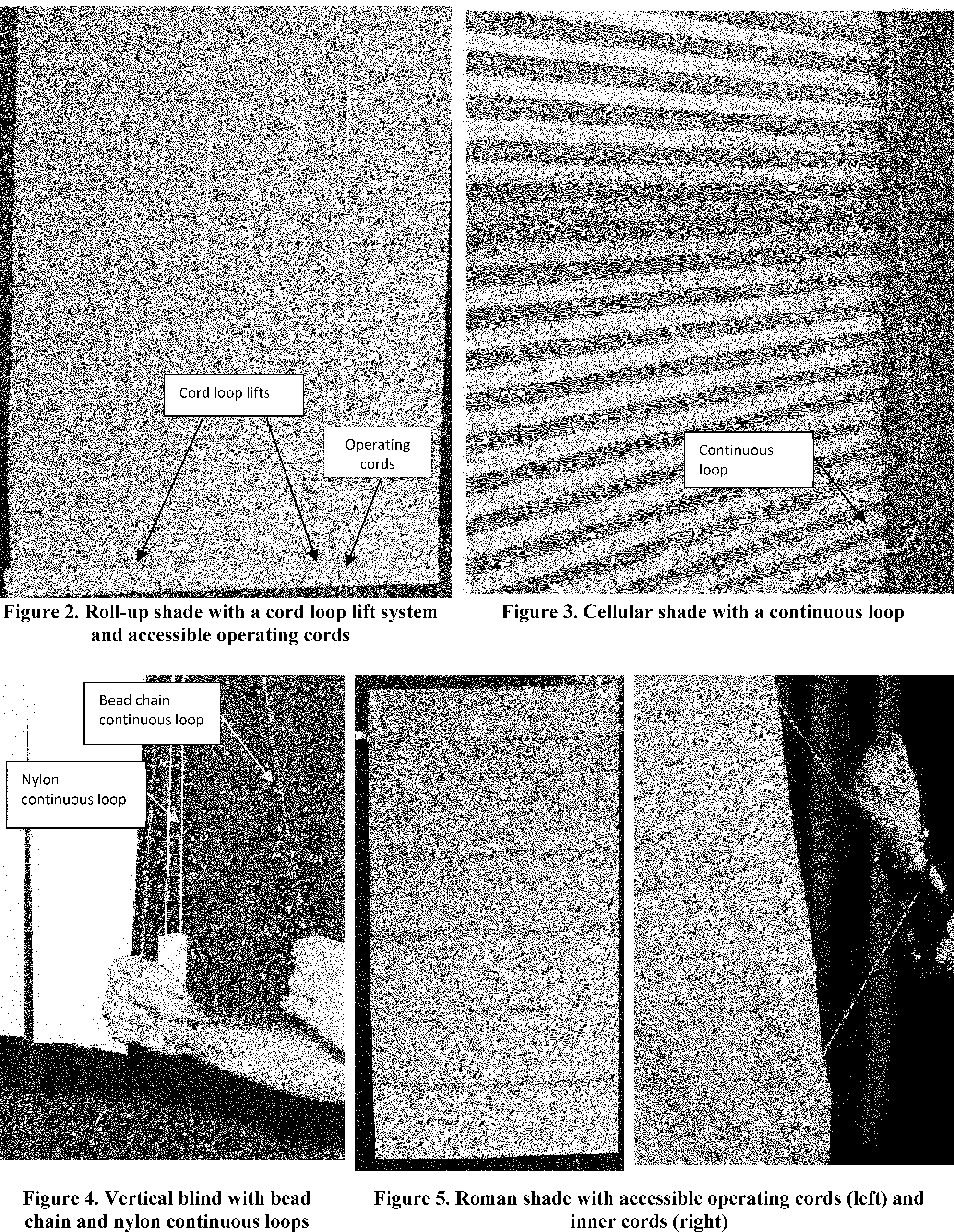
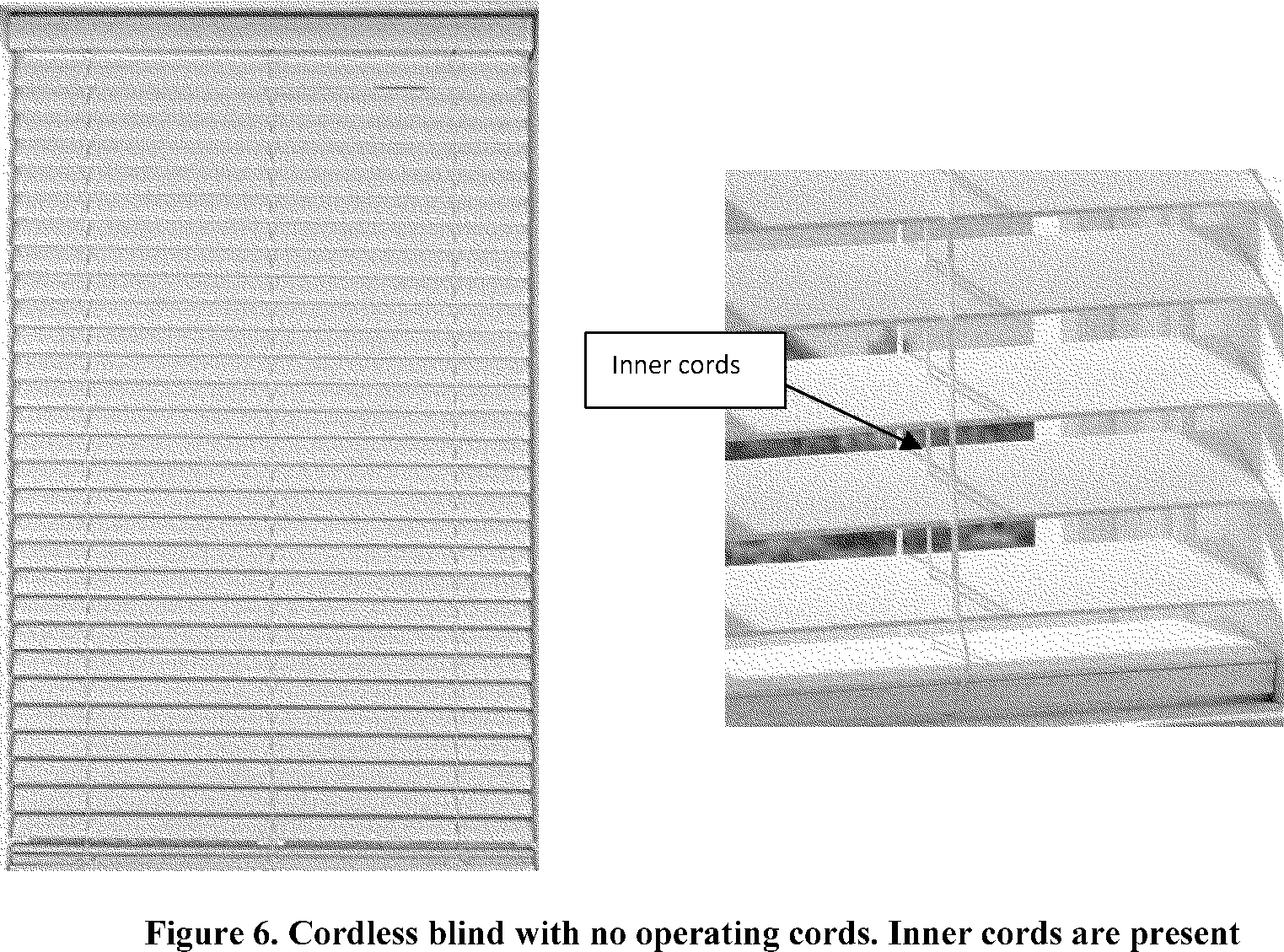
“Cordless” window coverings are products designed to function without an operating cord but may contain inner cords. Figures 1 through 6 reflect window covering terminology and examples of different window covering types.
( printed page 60548)
( printed page 60549)
Figure 1 shows a horizontal blind containing inner cords, free hanging operating (pull) cords, and tilt cords. Figure 2 illustrates a roll-up shade containing cord loop lifts and free hanging operating cords. Figure 3 shows a cellular shade with inner cords between two layers of fabric and operating cords in the form of a continuous loop. Figure 4 presents a vertical blind with two operating cords, one in the form of a looped nylon cord to traverse the blind and the other in a looped bead chain form to tilt the vanes. Figure 5 shows a Roman shade with inner cords that run on the back side of the shade and free hanging operating cords. Figure 6 is a horizontal blind that is marketed as “cordless blind” because it has no operating cords, but it still contains inner cords.
II. Statutory Authority and Background
A. Statutory Authority
Section 15(j) of the Consumer Product Safety Act (CPSA) authorizes the Commission to issue rules identifying any consumer product or class of consumer products, characteristics whose existence or absence may be deemed a substantial product hazard under section 15(a)(2) of the CPSA if: (1) the characteristics are “readily observable,” (2) the characteristics have been addressed by a voluntary standard, (3) the voluntary standard is effective in reducing the risk of injury, and (4) products subject to the voluntary standard substantially comply with the voluntary standard. 15 U.S.C. 2064(j)(1). Section 15(a)(2) of the CPSA defines a “substantial product hazard” (SPH), in relevant part, as a product defect which (because of the pattern of defect, the number of defective products distributed in commerce, the severity of the risk, or otherwise) creates a substantial risk of injury to the public. 15 U.S.C. 2064(a)(2).
A rule under section 15(j) of the CPSA is not a consumer product safety rule and does not create a consumer product safety standard. Instead, a product listed in 16 CFR part 1120 that presents an SPH is subject to the reporting requirements of section 15(b) of the CPSA, 15 U.S.C. 2064(b). A manufacturer, importer, distributor, or retailer that fails to report an SPH to the Commission may be subject to civil penalties under section 20 of the CPSA, 15 U.S.C. 2069, and criminal penalties under section 21 of the CPSA, 15 U.S.C. 2070. A product that presents an SPH may also be subject to voluntary corrective action or mandatory corrective action under sections 15(c) and (d) of the CPSA. 15 U.S.C. 2064(c) and (d).
Additionally, a product that is offered for import into the United States that presents an SPH shall be refused admission into the United States under section 17(a) of the CPSA, 15 U.S.C. 2066(a). Additionally, Customs and Border Protection (CBP) has the authority to seize certain products offered for import under the Tariff Act of 1930 (19 U.S.C. 1595a) (Tariff Act), and to assess civil penalties that CBP, by law, is authorized to impose. Section 1595a(c)(2)(A) of the Tariff Act states that CBP may seize merchandise, and such merchandise may be forfeited if: “its importation or entry is subject to any restriction or prohibition which is imposed by law relating to health, safety, or conservation and the merchandise is not in compliance with the applicable rule, regulation, or statute.” Thus, if the Notice of Proposed Rulemaking (NPRM) is finalized, stock and custom window coverings that violate the rule are subject to CBP seizure and forfeiture.
B. Overview of the Current 15(j) Rule
The Commission has promulgated several rules under section 15(j) of the CPSA, codified in 16 CFR 1120.3.[2]
Thus far, the Commission has deemed as “readily observable” product characteristics that are visually
( printed page 60550)
observable or observable using a measurement.
In 2022, the Commission issued a 15(j) rule to address hazardous operating cords and inner cords on stock window coverings, and hazardous inner cords on custom window coverings. 87 FR 72873 (Nov. 28, 2022). In that rule, the Commission determined that window covering characteristics, including cord types (operating cords, inner cords) and cord length (more than 8 inches long), were “readily observable” because they involved visual observation of the presence and accessibility of a cord, and when cords are present, assessing the length of the cord using a direct measurement. 87 FR 78873, 72883-84. Specifically, the Commission determined that three hazardous, readily observable characteristics of stock window coverings, which are adequately addressed in the applicable voluntary standard, ANSI/WCMA A100.1-2018, American National Standard for Safety of Corded Window Covering Products (ANSI/WCMA-2018), are a substantial product hazard (SPH): the presence of hazardous operating cords, the presence of hazardous inner cords, and the absence of a required manufacturer label. 87 FR 72873. The Commission also deemed that two readily observable characteristics of custom window coverings, the presence of hazardous inner cords and the absence of a manufacturer label, also addressed in ANSI/WCMA-2018, are an SPH. That rule is codified in 16 CFR 1120.3(e) (for stock window coverings) and (f) (for custom window coverings).
Consistent with the Commission's 2022 window coverings 15(j) rule, the hazardous window covering cords addressed in this proposed rule are considered “readily observable” because the relevant characteristics for this rule, including cord type (accessible free hanging operating cords longer than 8 inches, exposed continuous loops, presence of a tension device, lack of warning labels and tags, single retractable cord lift systems and cord loop lifts), window covering type (horizontal blinds and roll up style shades), and cord accessibility, are typically visually observable. When free hanging operating cords or single retractable cords are present, for example, the length of such cords can be visually observed with a direct measurement of the cord length.
The Window Covering Manufacturers Association (WCMA) revised the ANSI/WCMA-2018 standard in 2022 to add requirements for custom window coverings and to clarify requirements for stock roll up style shades.[4]
This revision became effective on June 1, 2024. The Commission now proposes to revise part 1120 to include additional readily observable characteristics of window covering cords, addressed in ANSI/WCMA-2022. Compliance with these provisions of the voluntary standard removes the strangulation hazard to young children posed by certain accessible window covering cords. The Commission is proposing to update the references in 16 CFR 1120.2, 1120.3, and 1120.4 to replace ANSI/WCMA-2018 with ANSI/WCMA-2022 for all applicable requirements, including newly proposed ones.
The purpose of this notice of proposed rulemaking (NPRM) is to further address the risk of strangulation of children 8 years old and younger associated with hazardous cords on window coverings that have now been addressed by the revised voluntary standard ANSI/WCMA-2022. The Commission issues this NPRM under section 15(j) of the CPSA, 15 U.S.C. 2064(j), to revise the substantial product hazard list in 16 CFR 1120.3. Proposed changes to sections 1120.3(e) and (f) deem the presence of hazardous window covering cords on certain stock and custom window coverings, which have been adequately addressed by the most recent voluntary standard for window coverings, ANSI/WCMA-2022, as an SPH, as defined in section 15(a)(2) of the CPSA. 15 U.S.C. 2064(a)(2).
The NPRM proposes to deem the following readily observable characteristics of window coverings an SPH:
(1) Free hanging operating cords on custom window coverings that are accessible to children and exceed 8 inches in length in any use position,
(2) Exposed continuous loops on custom window coverings except horizontal blinds, without an installed tension device,[5]
(3) Exposed continuous loops with or without an installed tension device on custom horizontal blinds,
(4) Single retractable cords with a stroke length that exceeds 36 inches in length on custom window coverings,
(5) Cord loop lifts on stock and custom roll up style shades,
(6) Lack of a warning label and a warning tag on continuous loop operating systems containing a tension device on custom window coverings, and
(7) Lack of a warning label and a warning tag on single retractable cord lift systems on custom window coverings.
As detailed in this notice, the Commission determines preliminarily that the following are readily observable characteristics of window coverings:
(1) the presence of free hanging operating cords on custom window coverings that are accessible and exceed 8 inches in length in any use position,
(2) the presence of exposed continuous loops on custom horizontal blinds,
(3) the presence of exposed continuous loops on other custom window coverings without an attached tension device,
(4) the presence of a single retractable cord lift system with a stroke length that exceeds 36 inches on custom window coverings,
(5) the presence of cord loop lifts on stock and custom roll up style shades,
(6) the lack of warning label and/or lack of a warning tag on a continuous loop operating system containing a tension device on custom window coverings, and
(7) the lack of warning label and/or lack of a warning tag on a single retractable cord lift system on custom window coverings, collectively, the “identified readily observable characteristics.”
The Commission also determines preliminarily that the following readily observable characteristics have been adequately addressed by a voluntary standard, ANSI/WCMA-2022:
(1) free hanging operating cords are addressed in sections 4.4.2.2 (requiring a short static or access cord) and 4.4.2.3 (requiring an inaccessible operating cord),
(2) continuous loops on custom horizontal blinds are addressed in section 4.4.2.5.1 prohibiting continuous loops on custom horizontal blinds that contain a tension device,
(3) continuous loops on other custom window coverings are addressed in section 4.4.2.5 that requires an installed tension device, a loop cord and bead chain restraining device or a rigid cord shroud,
(4) single retractable cord lift system with a stroke length exceeding 36 inches
( printed page 60551)
for custom window coverings are addressed in section 6.1,
(5) roll up style shades are defined in section 3, definition 1.04, as being without cords,
(6) warning labels and warning tags associated with a continuous loop operating system containing a tension device for custom window coverings are addressed in sections 5.1 and 5.2, and
(7) warning labels and warning tags associated with a single retractable cord lift system for custom window coverings is addressed in sections 5.1 and 5.2.
In addition, the Commission determines preliminarily that window coverings that conform to the identified readily observable characteristics in ANSI/WCMA-2022 are effective in reducing the risk of strangulation to children 8 years old and younger associated with hazardous cords on stock and custom window coverings. The Commission also preliminarily determines that stock and custom window coverings manufactured or imported for sale in the United States substantially comply with the identified readily observable characteristics in ANSI/WCMA-2022.
III. Hazard Patterns and Incident Data
A. Hazards Associated With Window Covering Cords
Window covering cords, including operating cords (
i.e.,
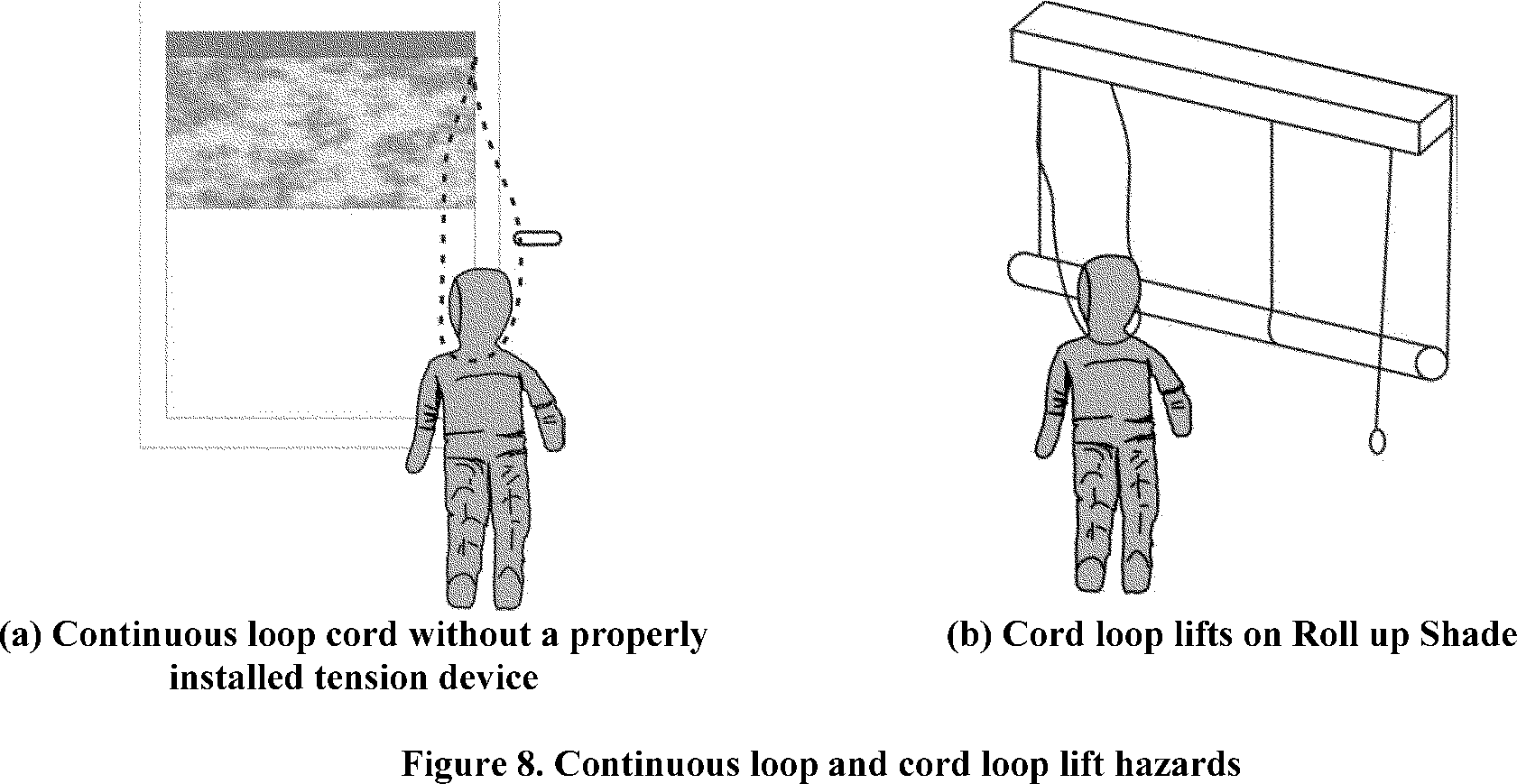
pull cords or continuous loop cords), inner cords, and cord loop lifts, can pose significant strangulation hazards to children. Strangulation hazards are present when cords are accessible and long enough to wrap around a child's neck. Figures 7 and 8 below depict the strangulation hazard for different window covering cord types relevant to this proposed rule.
Children can strangle from mechanical compression of the neck when they place a window covering cord around their neck, even in situations where the body is fully or partially supported. Strangulation is a form of asphyxia that can be partial (hypoxia) when there is an inadequate oxygen supply to the lungs or total (anoxia) when there is total impairment of oxygen transport to tissues; loss of oxygen can lead to serious injuries with permanent debilitating outcomes or death. Strangulation is a complex process resulting from multiple mechanisms and pathways that can involve obstruction of the airway passage, occlusion (blockage) of blood vessels in the neck, and nerve stimulation. Occlusion of the blood vessels can result in reduction in the
( printed page 60552)
delivery of oxygen to tissues. Brain tissue is particularly sensitive and is often the most affected organ in the body due to oxygen depletion. Moreover, compression of the vagus nerve can result in an immediate decrease in heart rate, cardiac arrest, and death. The prognosis for hypoxic victims due to strangulation is dependent primarily on the extent of oxygen deprivation, the duration of unconsciousness, and the speed of resuscitation. Rapid reversal of the hypoxic state is essential to prevent or limit the development of pulmonary and cerebral edema that can lead to death. Thus, victims who are oxygen deprived for a short duration or quickly receive cardiopulmonary resuscitation to reestablish cerebral blood flow have the most favorable prognosis and recovery.
Experimental studies show that only 2 kg (4.4 lbs.) of pressure on the neck may occlude or block the jugular vein; [6 7]
and 3-5 kg (7-11 lbs.) may occlude the common carotid arteries.[8 9 10]
Minimal compression of any of these vessels can lead to unconsciousness within 15 seconds and death within 2 to 3 minutes.[11 12 13 14]
In consideration of the incident data when a child's body is fully or partially supported, CPSC staff assesses that head insertion into a preexisting window covering cord loop poses a higher risk of injury than when a cord is wrapped around a child's neck because a preexisting loop acts as a noose when a child's neck is inserted, and death can occur within minutes if a child loses footing.[15]
CPSC staff further concludes that reliance on parental supervision and warning labels are inadequate to address the risk of injury associated with accessible window covering cords because caregivers reasonably are not always aware of the hazards cords pose nor are caregivers reasonably likely to review warnings when window coverings are a common household product not presumed hazardous.[16]
When evaluating the effectiveness of warning labels, CPSC staff has assessed that consumers are less likely to search for and read safety information about such products they frequently use and are familiar with.[17]
Consumers are very likely to have high familiarity with window coverings because they almost certainly have window coverings in their homes and use them daily, as well as likely had window coverings in their homes growing up. Therefore, window covering products do not appear overtly hazardous and even well-designed warning labels will have limited effectiveness in communicating the hazard on this type of product; consumers reasonably expect that such a product that they interact with daily is not hazardous. In fact, most of the window coverings involved in incidents contained the permanent warning labeling required by the ANSI/WCMA standard. Accordingly, the risk of injury and death associated with window coverings can most effectively be addressed through performance requirements as opposed to reliance on caregiver supervision or warning labels.
B. Incident Data Summary
CPSC staff searched two internal databases to identify incidents and hazard patterns associated with window covering cords for this NPRM:[18]
the Consumer Product Safety Risk Management System (CPSRMS) [19]
and the National Electronic Injury Surveillance system (NEISS).[20]
Across both systems, CPSC staff identified 73 incidents associated with window covering cords that reportedly occurred from January 2018 through December 2025 for this NPRM. Among these incidents, CPSC staff identified 21 incidents in CPSRMS involving window covering pull cords on four custom, two stock, and 15 window coverings where it was unknown whether they were stock or custom (unknown order type).[21]
CPSC staff also identified 7 incidents involving continuous loop operating cords associated with window coverings, one ordered as custom and 6 unknown order type, and one incident involving roll-up window coverings, with unknown order type, containing cord loop lifts. In addition, three incidents involved inner cords, which have already been addressed in the standard and 41 incidents involved unknown cord types. All incidents involved children 8 years old and younger.
1. Pull Cord Strangulation Incidents
All 21 reported incidents of window covering pull cord strangulations involved horizontal blinds. Of the 21 incidents, 18 resulted in death, two incidents required emergency department treatment, and one resulted in brain injury. Incidents involved children aged 12 months old to 4 years old. Four incidents involved custom products, while two incidents involved stock products. The 15 remaining incident reports did not provide enough information for CPSC to determine whether the product was stock or custom (
see
Table 1).
( printed page 60553)
As an example of a pull cord incident, in IDI 231005HCC3021, a 16-month-old male was found unresponsive with the pull cord from a custom horizontal blind around his neck. The child's parents had tied the cord in a loop to elevate the cord further above a mattress, which was up against a wall and under a window. The bottom of the loop was seven inches from the top of the mattress, but the child was able to reach the cord. Table 1 outlines the incident data for pull cord fatalities and injuries:
Table 1—Pull Cord Incidents by Year *
Year/stock or custom
Treated &
released
Hospitalized
Death
Grand total
2018
1
0
2
3
Custom
1
0
0
1
Unknown
0
0
2
2
2019
1
1
1
3
Unknown
1
1
1
3
2021
0
0
6
6
Custom
0
0
1
1
Unknown
0
0
5
5
2022
0
0
5
5
Custom
0
0
2
2
Stock
0
0
1
1
Unknown
0
0
2
2
2023
0
0
4
4
Stock
0
0
1
1
Unknown
0
0
3
3
Grand Total
2
1
18
21
* Years and/or categorization of custom/stock/unknown not included in the above table did not have incidents within those categories.
ANSI/WCMA-2018 prohibits stock products from using accessible operating cords longer than 8 inches, and this requirement is codified in § 1120.3(e)(1). As of June 1, 2024, all of the remaining accessible free hanging operating cord incidents involving custom window coverings are addressed in the revised ANSI/WCMA-2022 standard, which does not allow accessible free hanging operating cords longer than 8 inches on custom window coverings. ANSI/WCMA-2022 requires those cords to be inaccessible or less than 8 inches in length. The requirement that those cords be inaccessible or less than 8 inches in length addresses free hanging cord incidents by ensuring that children do not have access to cords longer than 8 inches.[22]
2. Continuous Loop Cord Strangulation Incidents
CPSC staff identified 7 fatal incidents involving continuous loops on window coverings from 2018 through 2025. The incidents involved children 2-3 years of age. Incidents demonstrate that young children can strangle after inserting their head through a looped cord. For example, in IDI 211006CCC1032, the mother of a 2-year-old male victim found her son hanging from the continuous loop cord of the vertical blinds in her bedroom. Officers observed deep indentations, appearing to be that of a beaded item, at the base of the victim's neck. No tension device to keep the loop taut was present. The victim's cause of death was “inadvertent hanging from the cords of the window blinds.” Table 2 outlines the incident data for continuous loop cord incidents. Six of the incidents had an unknown order type (stock or custom) window covering, and one of the incidents involved a custom window covering.
Table 2—Continuous Loop Incidents by Year *
Year/stock or custom
No injury
Treated &released
Hospitalized
Death
Total
2020
0
0
0
4
4
Custom
0
0
0
1
1
Unknown
0
0
0
3
3
2022
0
0
0
2
2
Unknown
0
0
0
2
2
2025
0
0
0
1
1
Unknown
0
0
0
1
1
Grand Total
0
0
0
7
7
* Years and/or categorization of custom/stock/unknown not included in the above table did not have incidents within those categories.
( printed page 60554)
ANSI/WCMA-2018 prohibits stock products from using a continuous loop operating system, with or without installed tension devices, and this requirement is codified in § 1120.3(e)(1). The ANSI/WCMA-2022 expands this prohibition to also prohibit exposed continuous loops on custom horizontal blinds. Horizontal blinds (custom or stock) that are compliant with ANSI/WCMA-2022 do not pose a strangulation risk associated with exposed continuous loops because the ANSI standard no longer allows such hazardous loops. The 2022 standard allows other custom window coverings (such as Roman shades, cellular shades, roll up shades, vertical blinds), to use a continuous loop system equipped with a tension device. For the remaining custom window coverings that use exposed continuous loops, the standard requires that the window covering contain one of the following devices: (1) a tension device that complies with section 6.3 of the standard or (2) a loop cord and bead chain restraining device that meets the requirements in section 6.4 or (3) a rigid cord shroud that meets the requirements in section 6.2. CPSC staff determined that none of the incident units with exposed continuous loops had these devices.
3. Cord Loop Lifts on Roll Up Style Shades Strangulation Incidents
CPSC identified one fatal incident in 2019 associated with cord loop lift systems on roll up style shades. In this case (IDI 200702CCC2601), a 16-month-old male who was with his twin sister unattended in the family room while the parents were in the bedroom for 5-10 minutes. The father went to the family room to check on the twins because they had seemed quiet. When the victim's father reentered the family room, he found his daughter sitting on the couch and the victim hanging from the blinds cord. The cord was wrapped around the victim's neck as he was leaning forward.
Cord loop lifts containing accessible cords longer than 8 inches should not be present on stock roll up style shades manufactured or imported after the effective date of the current 15(j) rule (December 28, 2022), because ANSI/WCMA-2018, codified in 16 CFR 1120.3(e)(1), does not allow accessible cords that are longer than 8 inches on stock products. However, CPSC has found several stock roll up style shades with hazardous cord loop lifts and in violation of the standard. To address hazardous cord loop lifts in roll up style shades, the revised ANSI/WCMA-2022 clarifies the requirements by defining roll up style shades as a flexible sheet with no cords, which will need to be rolled up and secured by clips or other fastening means.
C. Availability of Incident Data
Upon publication of this NPRM in the
Federal Register
, CPSC will make available for review and comment on the completed 43 IDIs discussed in this NPRM, to the extent allowed by applicable law. To review the data, submit a request to:
forms.office.com/g/A6np3Y2gZW.
You will then receive a website link to access the data at the email address you provided. If you do not receive a link within two business days, please contact the phone number or email address listed in the
FOR FURTHER INFORMATION CONTACT
section at the beginning of this NPRM.
D. Recalls
From January 2018 through December 2025, the Commission's Office of Compliance and Field Operations conducted 14 recalls of more than 300,000 window covering units, including roll-up blinds, roller shades, and cellular shades that pose strangulation risks to children.
Table 3 presents the 14 recalls conducted between January 1, 2018, and December 31, 2025, and notes: the recall date, the firm involved, the product types, the types of cords/cord devices that create the strangulation hazard, the approximate number of recalled units, the number of reported incidents, and the recall number. The recalled products included both stock and custom window coverings.
Table 3—Recalls Involving Window Covering Cords and Cord Devices
[January 1, 2009 to August 31, 2024]
Recall date
Firm
Product
Types of cords/
cord devices
Number of
recalled
units
Number of reported incidents
Number of
reported
deaths
Recall
number
2/1/2018
Hunter Douglas
Sheer Blinds
Cord restraints
550
11—reports of broken or cracked cord restraints
0
18-720
7/11/2019
Levolor Inc.
Cellular Shades
Operating pull cords with non-breakaway cord connector
30,000
0
0
19-761
12/05/2023
Foiresoft
Roller Blinds
Looped operating cords
9,500
0
0
24-726
01/23/2025
ChrisDowa
Roller Shades
Long operating cords
19,500
0
0
25-105
02/06/2025
Thy Trading
Roll up Blinds
Long operating cords
720
0
0
25-128
02/20/2025
Homebox
Roller Window Shades
Long operating cords
4,900
0
0
25-147
02/20/2025
Shadeks
Roller Window Shades
Long operating cords
15,500
0
0
25-151
02/27/2025
Allesin
Roller Window Shades
Long operating cords
3,800
0
0
25-163
03/27/2025
Linkcoo
Roller Window Shades
Long operating cords
16,300
0
0
25-198
04/17/2025
Joydeco
Roller Window Shades
Long operating cords
73,000
0
0
25-230
( printed page 60555)
04/24/2025
BTAMREE
Roll up Blinds
Long operating cords
20,380
0
0
25-234
04/24/2025
LuckupShein
Roller Shades
Long operating cords
545
0
0
25-233
09/25/2025
Autoez
Roll-up Shades
Long operating cords
550
0
0
25-478
09/25/2025
Persilux
Horizontal shades
Long operating cords
133,000
0
0
25-478
IV. Overview of the Applicable Voluntary Standard—ANSI/WCMA-2022
CPSC staff has collaborated with WCMA since 1995 on an ANSI voluntary standard to address the strangulation hazard from accessible cords on window coverings.[23]
The first voluntary standard for window coverings was published in 1996 and has since been revised seven times. Most recently, the Commission finalized the 2022 15(j) rule, based on ANSI/WCMA-2018, which divides the window covering market into two categories—“stock” and “custom.” ANSI/WCMA-2018 outlines performance requirements that address the risk of strangulation associated with operating cords on stock products and with inner cords on both stock and custom products.
In January 2022, WCMA published an updated version of the voluntary standard for window coverings—ANSI/WCMA-2022. The revised standard went into effect on June 1, 2024. The key updates to the revised standard include eliminating the use of free hanging operating cords, free hanging tilt cords, and multiple cords into a cord connector on all custom window covering products and prohibiting the use of continuous cord loops and bead chains on all horizontal slatted custom products. Additionally, ANSI/WCMA-2022 updates the definition of roll up style shades to prohibit the use of cords.
ANSI/WCMA-2022 prohibits the use of accessible and free hanging operating cords that are longer than 8 inches on all custom window coverings, which is same as the requirement for stock window coverings. ANSI/WCMA-2022 also prohibits the use of continuous loop operating systems with a tension device on all custom horizontal slatted blinds. Additionally, ANSI/WCMA-2022 allows the use of continuous loop operating systems on all other custom window coverings with the following options: (1) a tension device that meets the requirements in section 6.3, (2) a loop cord and bead chain restraining device that meets the requirements in section 6.4, and (3) a rigid cord shroud that meets the requirements in section 6.2. Continuous loop operating systems equipped with these safety devices when properly installed, can prevent a child from accessing the cord loop. An exposed continuous loop without a compliant tension device poses a great risk because it can function like a noose when a child inserts his/her neck, and loss of footing can lead to death within minutes.
ANSI/WCMA-2022 allows custom window coverings to use a single retractable cord lift system with a 36-inch stroke length. Single retractable cord lift systems are defined in ANSI/WCMA-2022 section 3, definition 2.17, as “[a] Cord that extends when pulled by a user through an Operating Interface, and fully retracts when Tension is no longer applied by the user.” According to the requirements in ANSI/WCMA-2022, the operating interface may not be a cord and the maximum stroke length for a cord retraction device is 36 inches.
ANSI/WCMA-2022 eliminates the use of cord loop lifts on roll up style shades by defining “roll up style shades” in section 3, definition 1.04, as a window covering product that does not contain cords. Any stock window covering that contains accessible cords longer than 8 inches, including cords in roll up style shades, already violates the existing 15(j) rule codified at 16 CFR 1120.3(e)(1). The 2022 standard adds a definition of “roll up style shades” to clarify the shades subject to the existing prohibition on cords in roll up style shades.
V. Preliminary Determination of a Substantial Product Hazard
The current 15(j) rule incorporates by reference provisions of ANSI/WCMA-2018 that address the strangulation hazard from window covering cords that the Commission has determined present an SPH. This NPRM proposes to incorporate by reference new provisions in the 2022 version of the ANSI/WCMA voluntary standard that further address the strangulation hazard associated with window covering cords. The NPRM also proposes to update the incorporation by reference in 16 CFR 1120.4 from the 2018 version of the ANSI/WCMA standard to the 2022 version, aligning existing and proposed requirements with the most recent voluntary standard for window covering cords. If finalized, the NPRM would deem nonconformance with one or more of the identified readily observable characteristics of window coverings in ANSI/WCMA-2022 to be an SPH under section 15(a)(2) of the CPSA.
A. Defined Characteristics are Readily Observable
1. Accessible Free Hanging Operating Cords on Custom Window Coverings
Custom window coverings that include free hanging operating cords that are accessible to children and longer than 8 inches do not comply with ANSI/WCMA-2022, which requires that custom window coverings have: (1) inaccessible operating cords (section 4.4.2.3); or (2) accessible operating cords that are eight inches long or shorter in any use position of the custom window covering (section 4.4.2.2). The Commission preliminarily determines that the presence of free hanging cords, accessibility of these cords, and the length of these cords, are all product characteristics that are “readily observable.”
As with the existing 15(j) rule for stock window coverings, the NPRM would require inspectors to visually observe whether custom window
( printed page 60556)
coverings contain free hanging operating cords (
i.e.,
the portion of a cord that the user interacts with during operation), and if so, whether such cords are accessible to children, and whether such pull cords exceed 8 inches in length. Figures 9, 10, and 11 show three horizontal blinds: a compliant horizontal blind without operating cords (“cordless blind”) (Figure 9); a compliant horizontal blind with inaccessible cords (Figure 10); and a noncompliant horizontal blind with accessible cords that are longer than 8 inches (Figure 11).
Custom window covering cords can comply with ANSI/WCMA-2022 if the operating cords are removed from the product, as shown in Figure 9; made inaccessible to children via a mechanism such as a cord shroud pursuant to section 4.4.2.3, as shown in Figure 10; or, made too short to wrap around a child's neck. To determine compliance, the investigator would first assess whether cords are present. If cords are present, the investigator would attempt to touch the operating cords using a cord shroud accessibility probe, as shown in Figure 10. A cord accessibility probe is a tool used to determine whether an operating cord, inner cord, or inner cord shroud is accessible to a child.[24]
Non-accessible cords are compliant with section 4.4.2.3 of ANSI/WCMA-2022.
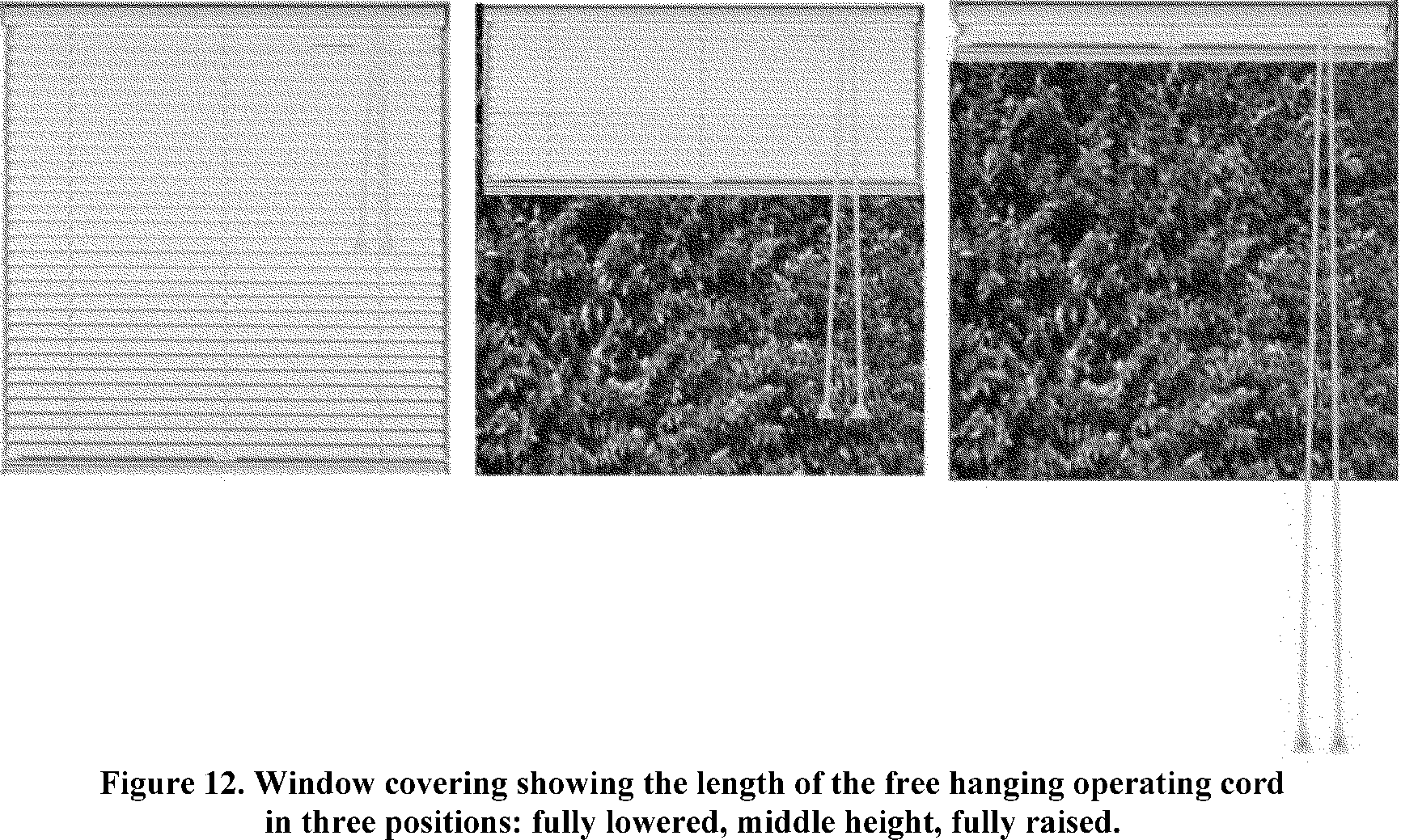
If cords are accessible using the cord accessibility probe, the investigator would then measure the cords to determine compliance. Figure 11 demonstrates accessible operating cords using a cord accessibility probe, although the presence of such cords is easily observable with visual confirmation and does not require a probe in that case. Accessible operating cords must not be longer than 8 inches in any use position of the window covering (raised or lowered), as set forth in section 4.4.2.2 of ANSI/WCMA-2022. The investigator would observe the length of an accessible cord by taking a simple measurement with a tape measure.[25]
For example, Figure 12 demonstrates fully lowered, mid-length, or fully raised window covering positions. The presence of an accessible operating cord that is longer than 8 inches in any use position does not conform to section 4.4.2.2, and the NPRM proposes to deem such a cord an SPH.
The NPRM proposes that the presence of accessible free hanging operating cords longer than 8 inches in any use position of a custom window covering is an SPH because a child can wrap such a cord, or looped cord, around his or her neck and be strangled, as evidenced in CPSC's incident data.
( printed page 60557)
2. Continuous Loops on Custom Horizontal Blinds
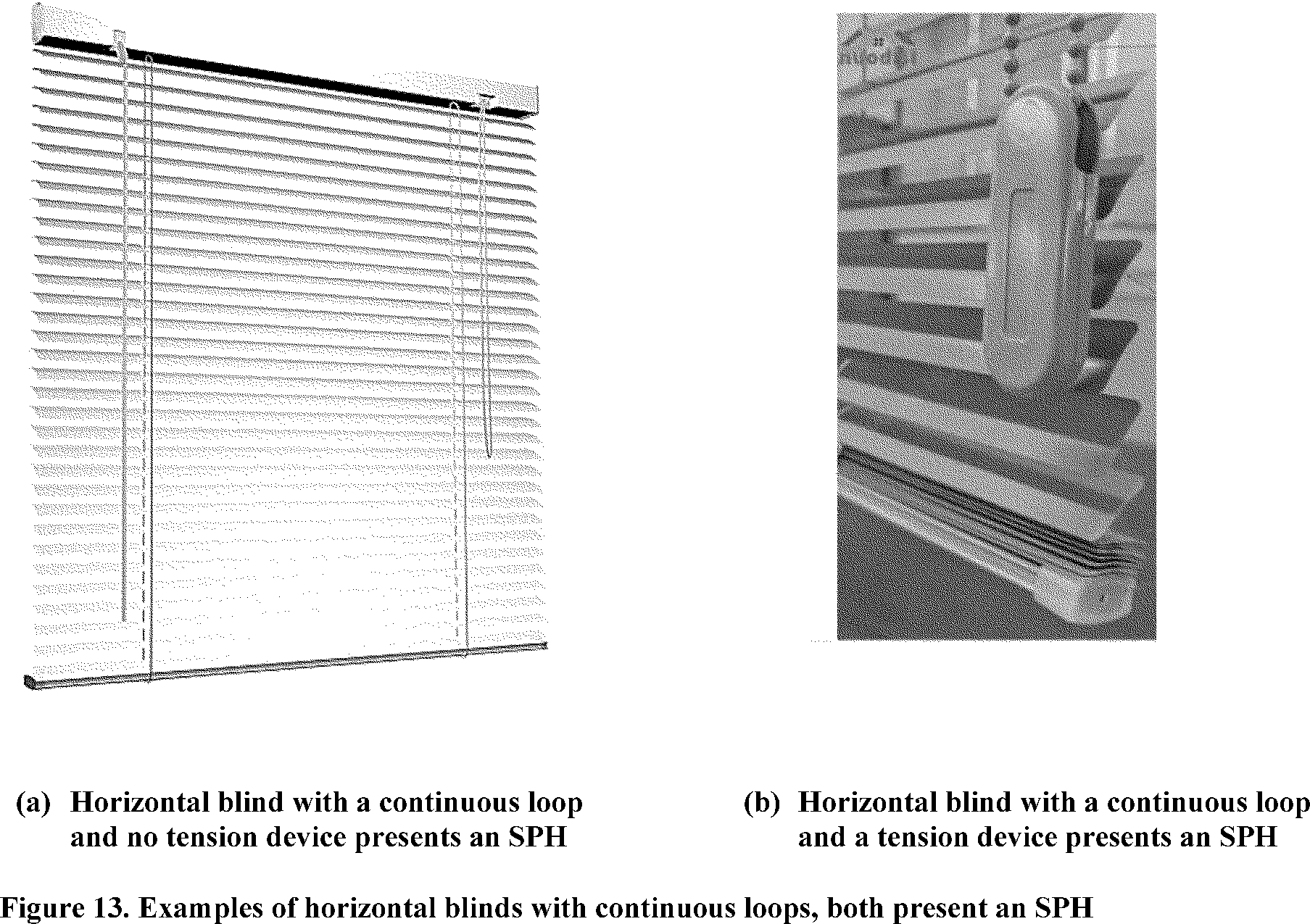
ANSI/WCMA-2022 prohibits exposed continuous loops with or without a tension device on custom horizontal blinds. Figure 13 shows horizontal blinds with continuous loops. Because the continuous loops are exposed, these horizontal blinds are considered an SPH.
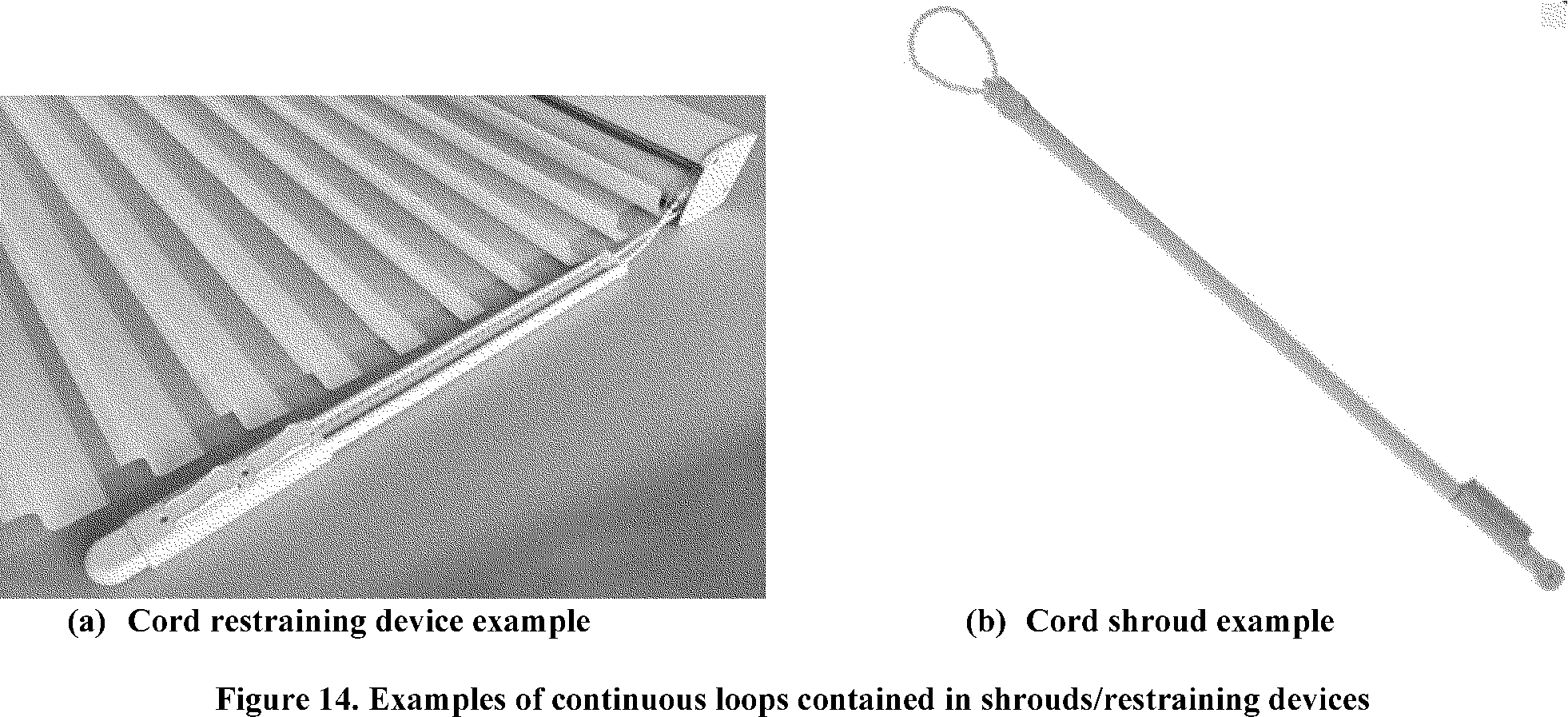
The only allowable methods to use a continuous loop operating system on a custom horizontal blind is to use a loop cord and bead chain restraining device (see Figure 14a) or a rigid cord shroud (see Figure 14b) that enclose the cord.
( printed page 60558)
ANSI/WCMA-2022 defines a loop cord and bead chain restraining device as a device that prevents the creation of a hazardous loop from an accessible continuous loop. According to the standard, these devices must pass requirements including operational cycle test, UV stability, impact test, and durability requirements. In addition, these devices must not create a hazardous loop from an accessible cord.
Rigid cord shrouds, which are defined as shrouds constructed of inflexible materials, do not have accessible cords and must comply with operational cycle test, UV stability, impact test, and durability requirements in addition to a deflection and deformation test. CPSC is aware of various cord loop and bead chain restraining devices and rigid cord shrouds that enclose continuous loops as shown in Figure 14. These products can be used on custom window coverings to prevent exposed continuous loops. If an investigator observes these products on a window covering and does not observe any hazardous cords or loops, the window covering would not present an SPH under this proposed rule. Other requirements associated with these devices such as operational cycle testing and impact testing are not readily observable, therefore they are not part of the proposed 15(j) rule.
The Commission preliminarily determines that the presence of an exposed continuous loop on a custom horizontal blind is “readily observable” because the investigator can visually identify the presence of such exposed continuous loops.[26]
3. Continuous Loops on Custom Window Coverings (Except Horizontal Blinds)
ANSI/WCMA-2022 allows custom window coverings, except horizontal blinds, to contain a tension device if it meets the requirements in section 6.3. Section 6.3 has the following requirements:
6.3.1 The manufacturer must attach the Tension Device to the Cord or Bead Chain Loop. Tension Device must be designed, placed and shipped such that, unless properly installed or altered from the shipped condition with Sequential Process or tools, it prevents the window covering from operating.
6.3.2 The attachment of the Tension Device to the Cord or Bead Chain Loop must be by means of a Permanent Assembly Method and the Tension Device assembly must meet the durability requirements in section 6.3.5.[27]
6.3.3 The Tension Device in conjunction with the product shall maintain Tension on the operating cords when properly installed. If the Tension Device is installed in a location that does not maintain Tension on the operating cords, the Tension Device will prevent the window covering from operating as designed for full operation of the product. The window covering may not operate independently of the Cord or Bead Chain Loop.
6.3.4 The Tension Device shall be supplied with fasteners and instructions to attach to wood substrates. The Tension Device shall also be supplied with information about attaching to drywall and metal substrates. The fasteners shall have a minimum fastener manufacturer-rated or tested release force of 20 lb (89 N).
6.3.5 These requirements are related to the durability of the Tension Device and include operational cycle test, UV stability, durability and impact tests.
If the current 15(j) rule is not revised to incorporate the above requirements, CPSC staff assesses that custom window coverings—except horizontal blinds—containing exposed continuous loops without any of the specified safety devices could continue to enter the market. An exposed continuous loop without a compliant tension device poses a greater hazard because, as noted earlier, a child inserting their head into a preexisting cord loop faces a higher risk of injury than when a cord is wrapped around a child's neck. A preexisting loop can function like a noose when a child's neck is inserted, and loss of footing can lead to death within minutes.
Investigators can readily observe section 6.3.1 in which the tension device must come attached to the continuous loop and cannot be removed
( printed page 60559)
without sequential process or tools. However, the remaining tension device requirements outlined in 6.3.2 through 6.3.5 are not readily observable. CPSC assesses that the risk associated with exposed continuous loops is reduced if the provided tension device complies with section 6.3 of the standard, and CPSC is not aware of incidents involving window coverings that met these requirements since 2018. The NPRM proposes the following:
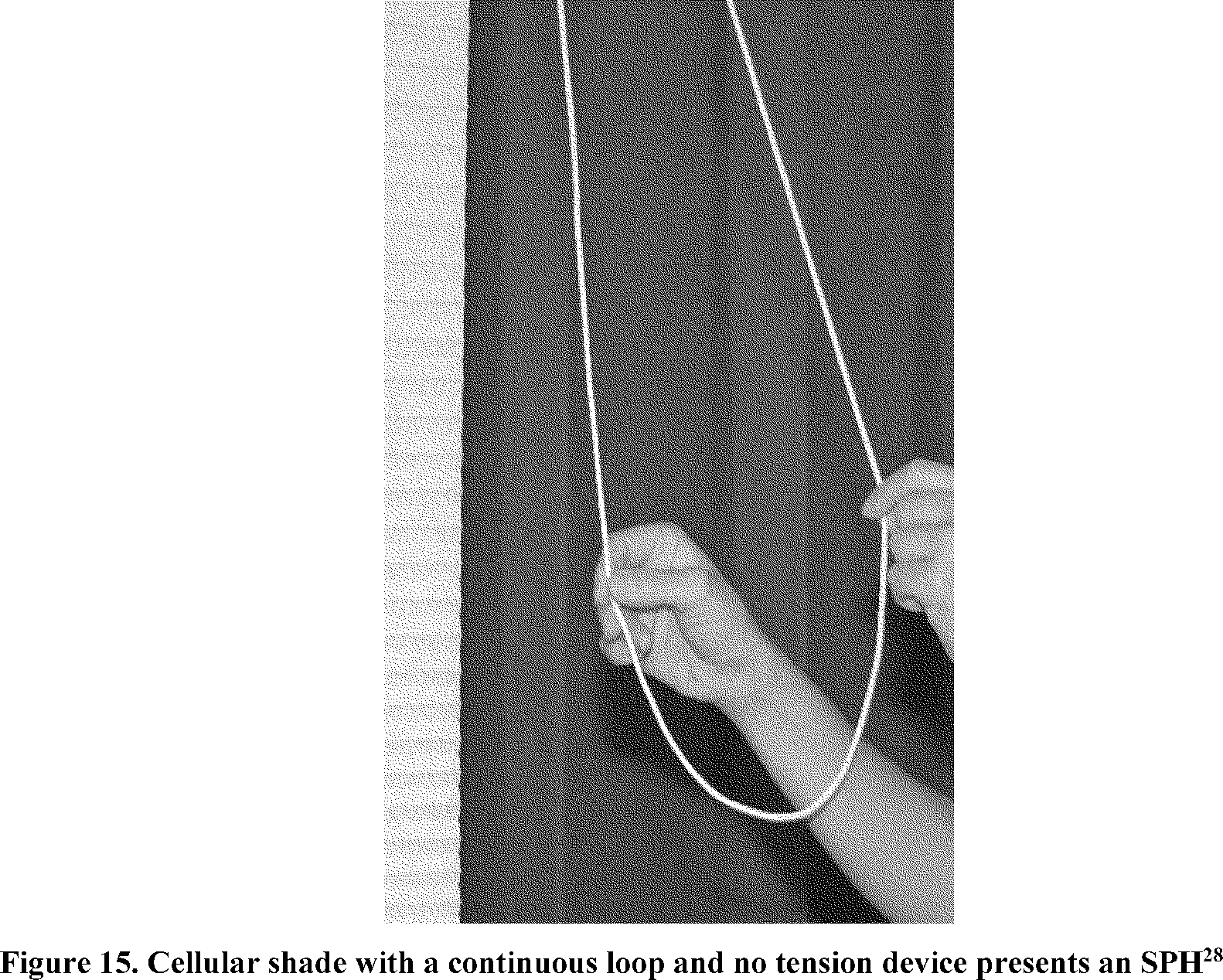
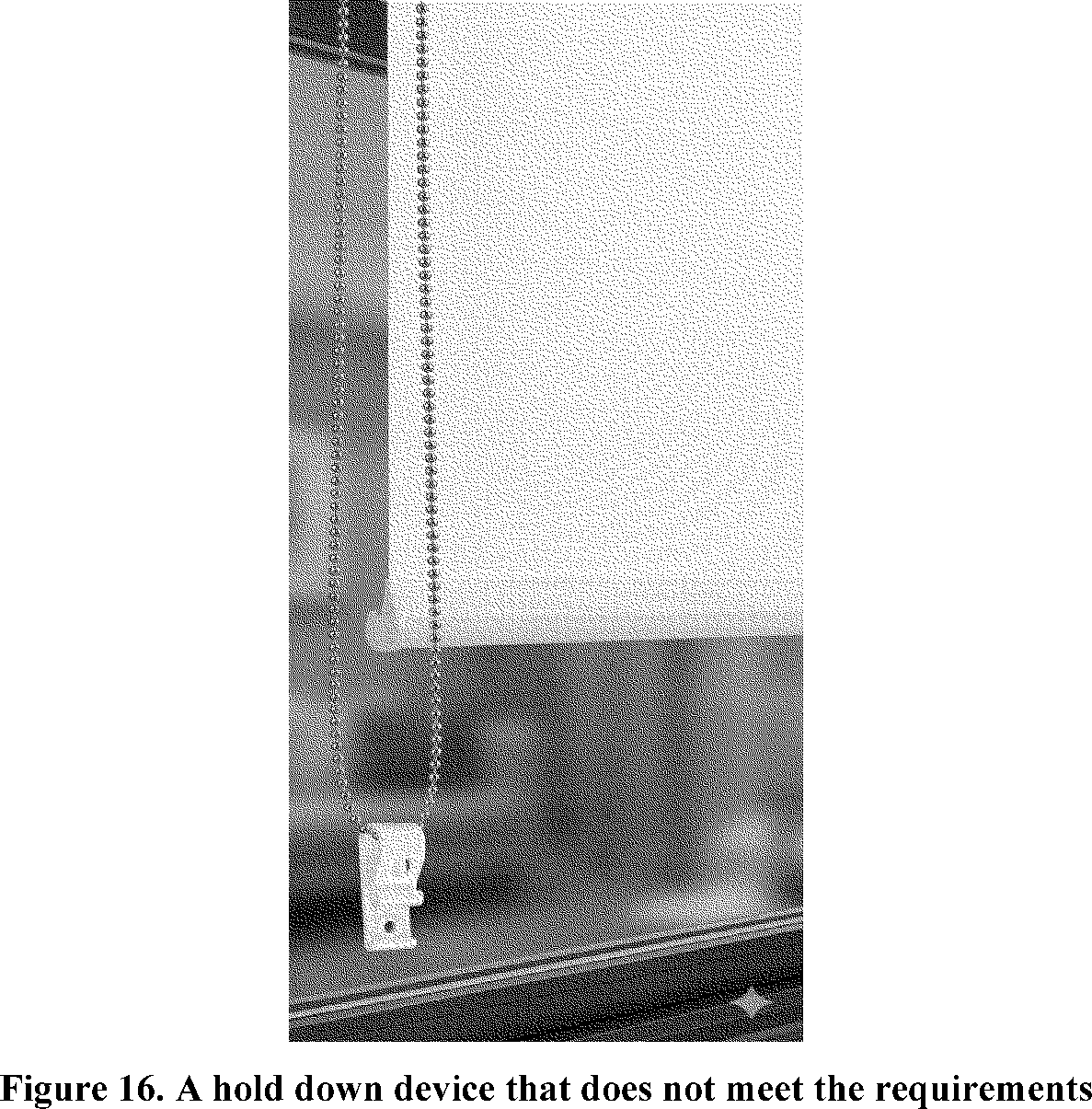
A custom window covering that is not a horizontal blind presents an SPH if the continuous loop is exposed and does not have a tension device that is attached to the continuous loop and cannot be removed without sequential process or tools. Figure 15 shows a cellular shade with no tension device attached on the loop and presents an SPH. A hold-down device such as shown in Figure 16 is not considered a tension device because this device can be easily removed from the continuous loop and does not prevent operation of the window covering. Therefore, a continuous loop with such a device would present an SPH.
( printed page 60560)
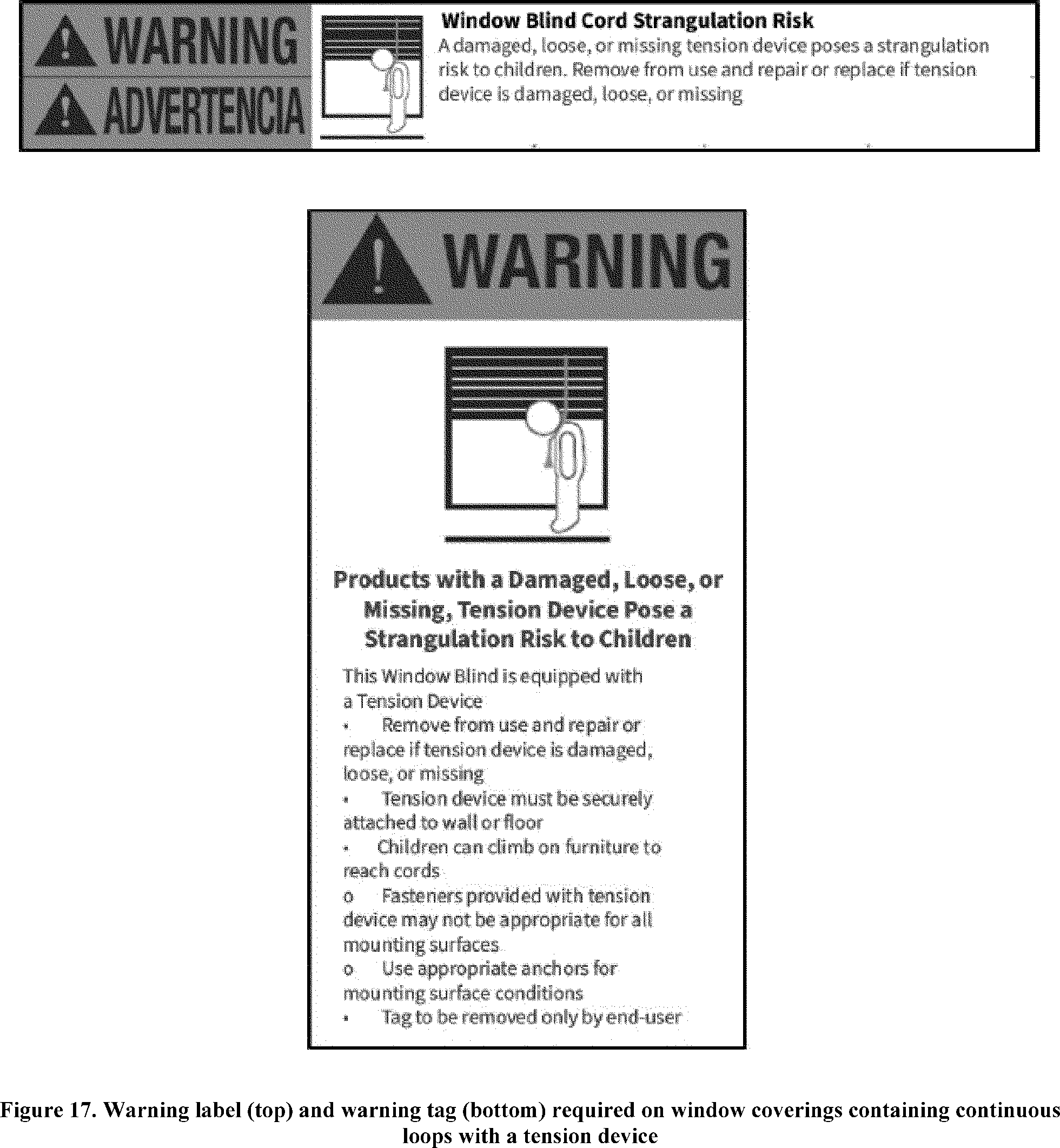
ANSI/WCMA-2022 requires all window covering products with a Tension Device for Cord or Bead Chain Loops to have warning labels and warning tags as described in sections 5.1 and 5.2. The NPRM proposes to deem the lack of warning label and/or warning tag associated with tension devices an SPH. An investigator can visually observe the presence or lack of a warning label and warning tag (see Figure 17.)
( printed page 60561)
4. Single Retractable Cord Lift System on Custom Window Coverings
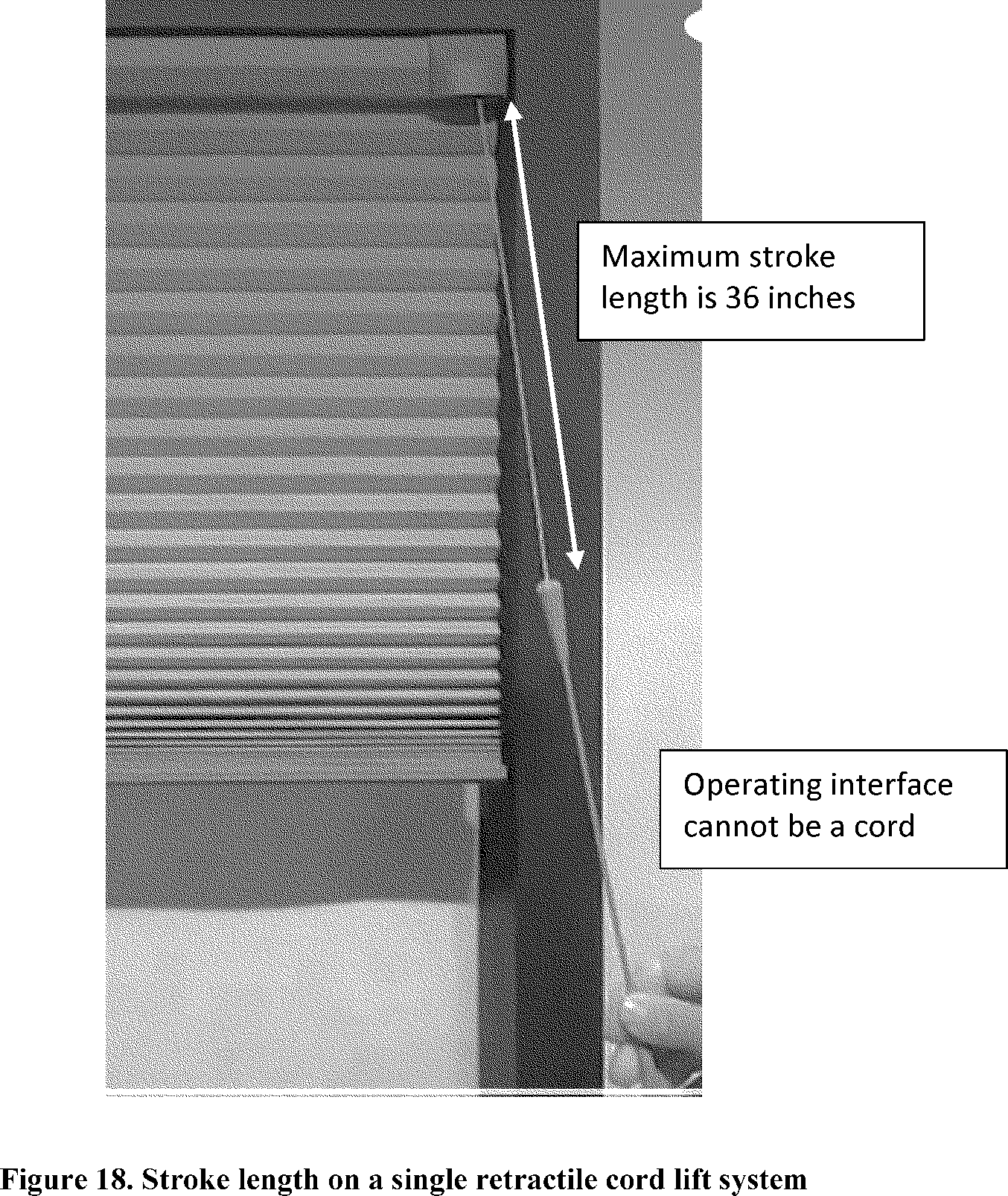
ANSI/WCMA-2022 allows the use of a single retractable cord lift system for custom window coverings as stated in section 4.4.2.4 as long as it meets the requirements in section 6.1. Further, the product must have warning tags as described in sections 5.1 and 5.2. The maximum stroke length cannot exceed 36 inches and the operating interface for the cord retraction device cannot be a cord as shown in Figure 18, both of which can be easily measured or observed.
( printed page 60562)
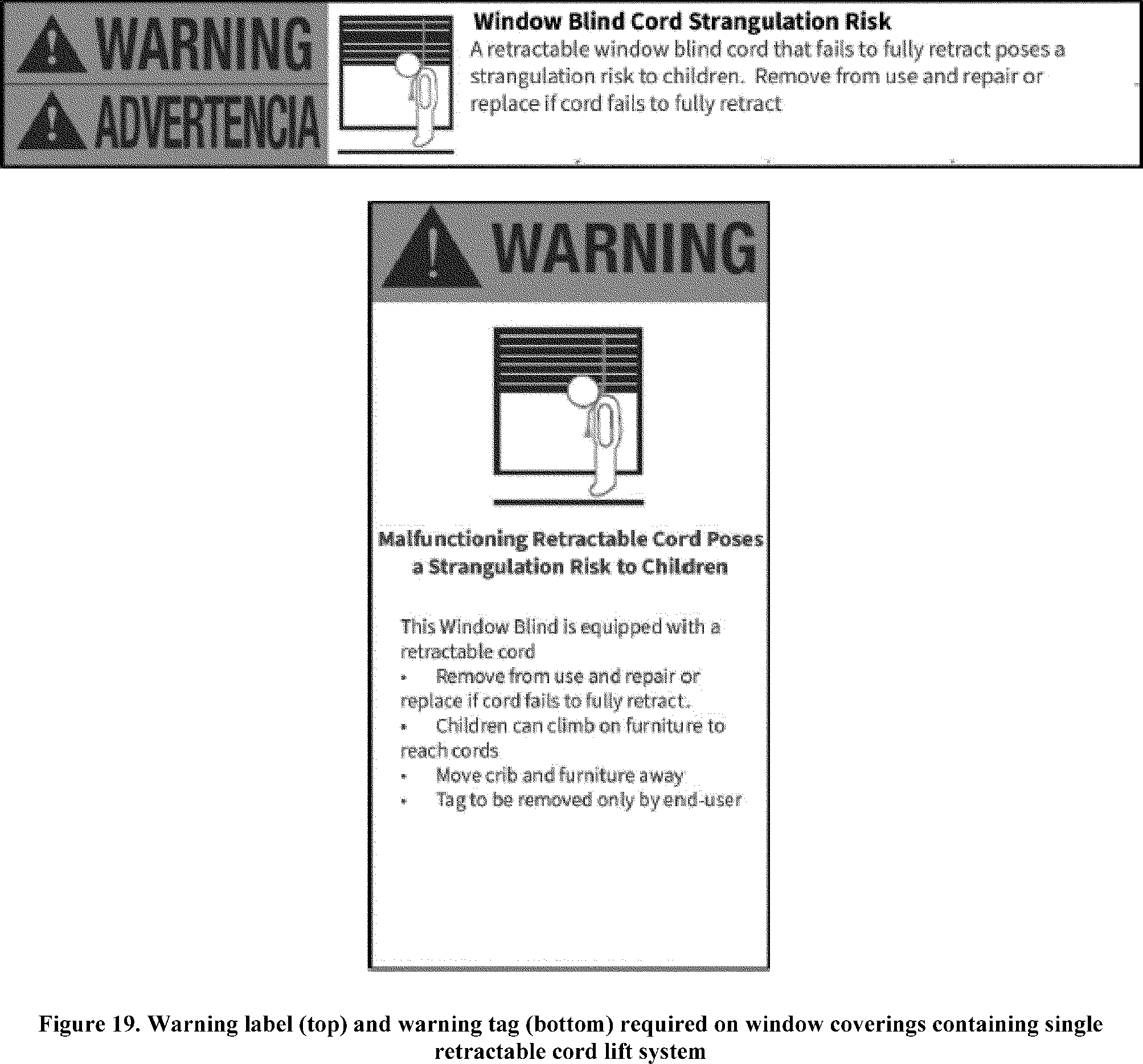
ANSI/WCMA-2022 requires all window covering products with a retractable cord to have warning labels and warning tags as described in 5.1 and 5.2. The NPRM proposes to deem the lack of warning labels and/or warning tags associated with single retractable cords an SPH. Figure 19 shows the warning label and warning tag required for single retractable cord lift system.
( printed page 60563)
5. Cord Loop Lift Systems on Stock and Custom Roll Up Style Shades
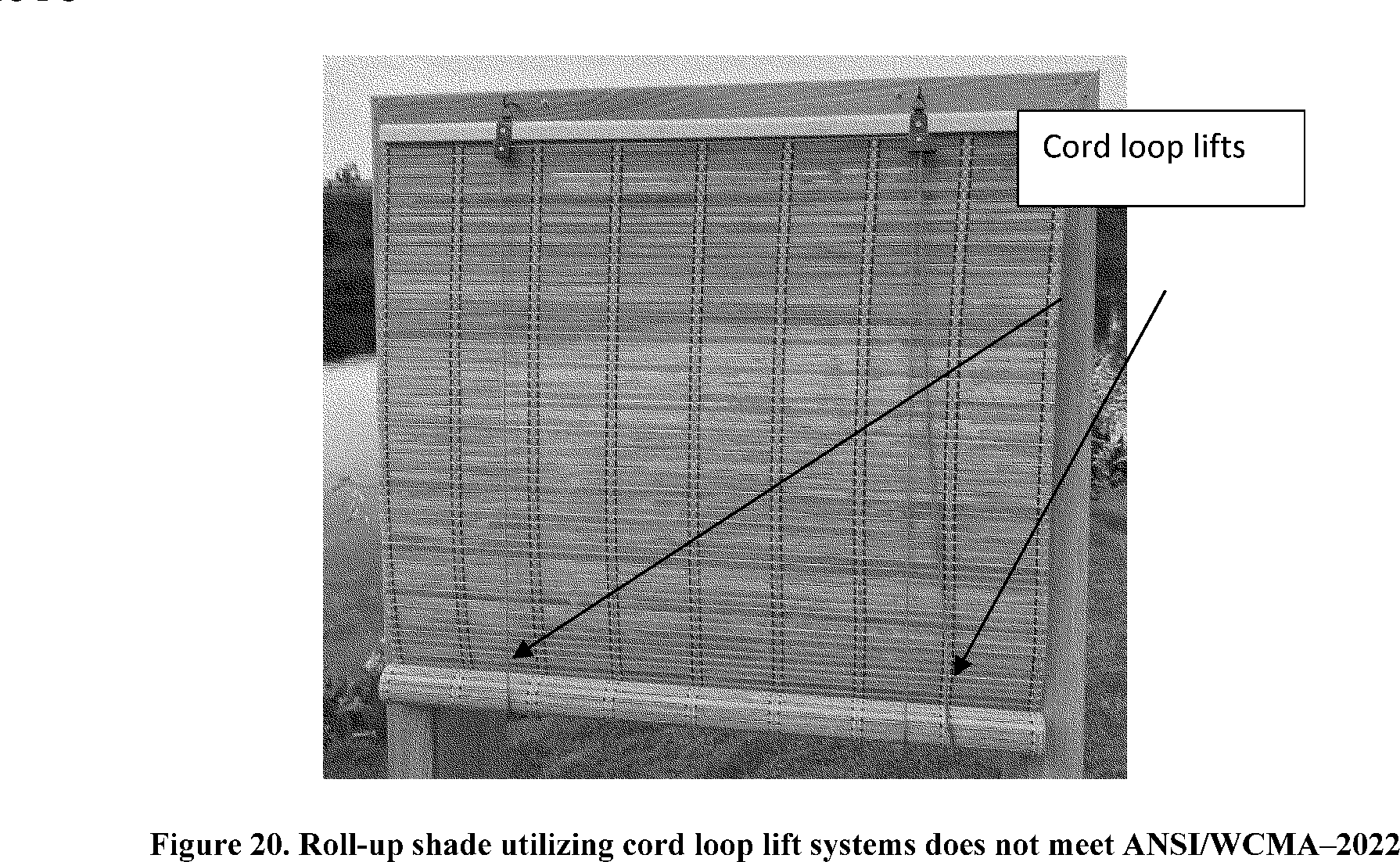
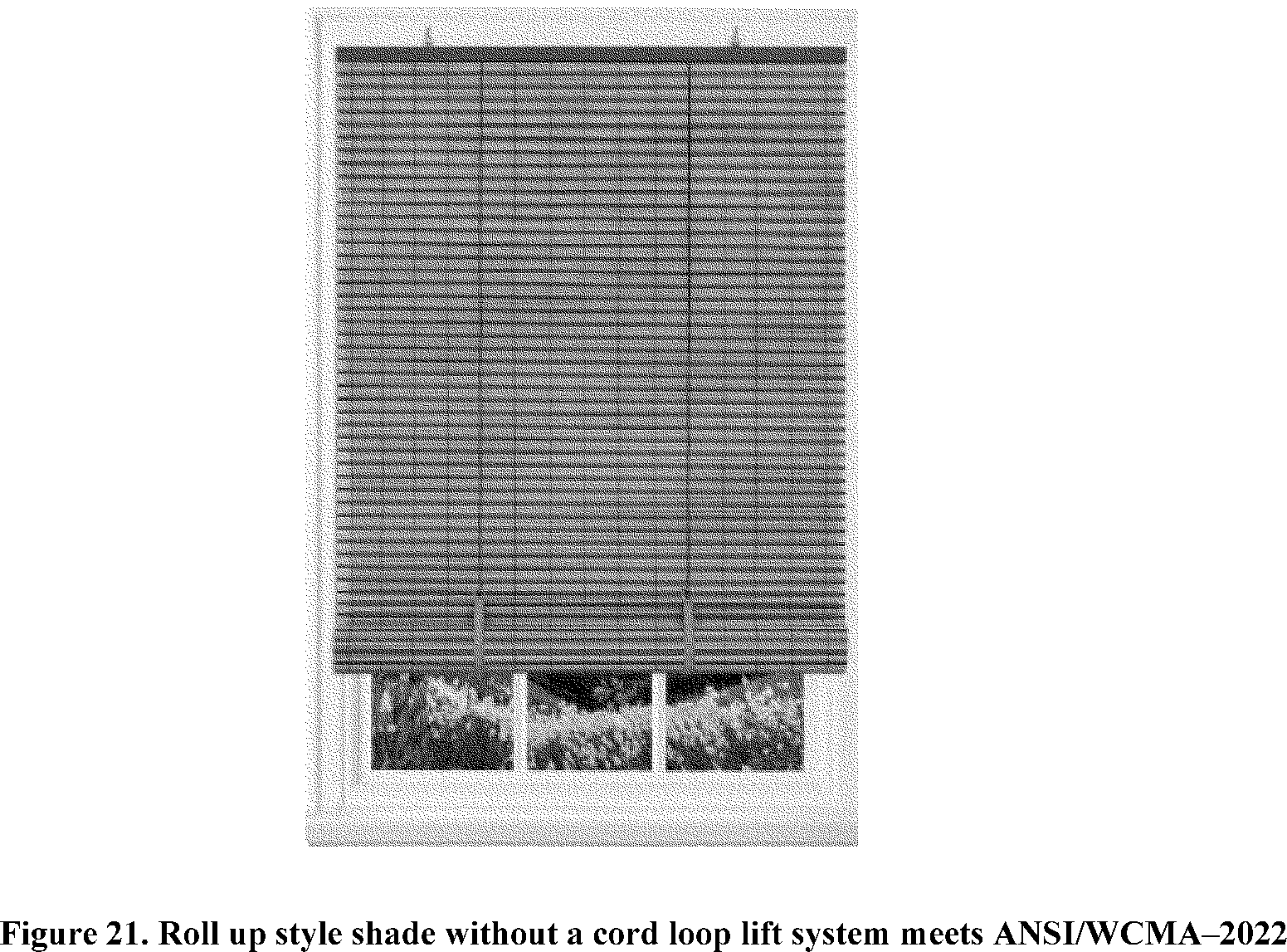
Cord loop lift systems use cords to roll up a window covering. Figures 20-21 show two roll up style shades with a cord loop lift system. Cord loop lift systems typically are comprised of cords that extend from the headrail to the bottom of the product, wrap around the bottom and extend back up to the top of the shade and through the headrail. See, section 3, definition 4.03 of ANSI/WCMA-2018. Cord loop lift systems shown in Figure 20 are hazardous to children because they contain an accessible cord on which children have strangled.
ANSI/WCMA-2022 revised requirements for cord loop lift systems on stock and custom roll up style shades by defining such systems as cordless. Section 3, definition 1.04 of ANSI/WCMA-2022 defines a roll up style shade as “[a] flexible sheet with no cords, whose operation consists of rolling up the sheet from the bottom or top, as the case may be. This would be secured by clips or other fastening means.” Many roll up style shades have been redesigned to comply with ANSI/WCMA-2018 and 2022 by eliminating operating cords, as well as cord loop lifts as shown in Figure 21. An investigator can visually observe the presence of a cord loop lift operating system on both stock and custom roll up style shades because the cord loop lifts are readily observable as shown Figure 20.
( printed page 60564)
B. Window Coverings That Conform to ANSI/WCMA-2022 Are Effective at Reducing the Risk of Injury Associated With the Identified Readily Observable Characteristics
Based on CPSC staff's analysis described above, the Commission preliminarily determines that custom window coverings with operating systems that contain accessible, free hanging cords that exceed 8 inches in length, present a strangulation hazard to children and are not in compliance with ANSI/WCMA-2022, including sections 4.4.2.2 (requiring a short static or access cord) and 4.4.2.3 (requiring an inaccessible operating cord). Additionally, custom horizontal blinds with continuous loops that use a tension device pose a risk of strangulation and are not in compliance with section 4.4.2.5.1 (prohibiting continuous loops with tension devices on custom horizontal blinds). The following also present a strangulation hazard: (1) other custom window covering types that use a tension device but without meeting sections 6.3.1 and 6.3.2, (2) all custom window coverings that use a single retractable cord that exceeds 36 inches
( printed page 60565)
of stroke length, and (3) stock and custom roll up style shades that use lifting cord loops.
Finally, the Commission preliminarily determines that custom window coverings containing the warnings described below are effective at reducing the risk of injury, by informing consumers of the hazards presented by: (1) a tension device on a continuous loop or (2) a single retractable cord. These products must contain warning labels and warning tags alerting consumers to hazardous cords if tension device is missing, damaged or loose and if a retractable cord lift system fails to fully retract the cord. The NPRM proposes that, for the identified readily observable characteristics, products that are not in compliance with ANSI/WCMA-2022 present a strangulation risk and are an SPH.
C. Window Coverings Substantially Comply With the Identified Readily Observable Characteristics of Window Coverings
The Commission has several bases to determine preliminarily that window coverings substantially comply with ANSI/WCMA-2022 requirements. First, WCMA, the trade association for window coverings and the body that created the voluntary standard, stated in a comment on the ANPR for Window Coverings (comment ID: CPSC_2013-0028-1555) that window coverings have substantially complied with the voluntary standard since its first publication.[29]
WCMA states that all companies who manufacture, distribute or sell window coverings in the U.S. must comply with the voluntary safety standards.[30]
WCMA also states that compliance with the standard is expected on the effective date, which was June 1, 2024, for ANSI/WCMA-2022.[31]
To verify whether custom window coverings substantially comply with ANSI/WCMA-2022, staff reviewed online offerings for custom horizontal blinds. Out of the 249 offerings from 5 retailers, 246 were cordless including motorized features and 3 were corded; this breakdown corresponds to about a 99 percent compliance rate with the 2022 standard. Table 4 summarizes staff's observations.
Table 4—Custom Horizontal Blinds Sold Online *
Custom horizontal blinds
Cordless
Motorized
Drawstrings
Retailer 1 (faux wood, mini, vinyl, wood)
40
3
0
Retailer 2 (faux wood, mini, wood)
64
11
0
Retailer 3 (faux wood, mini, wood, vinyl, fabric)
81
19
0
Retailer 4 (faux wood and wood)
16
0
0
Retailer 5 (mini, wood, vinyl)
11
1
3
Total
212
34
3
Compliant ratio
0.99
* Accessed on 5/4/2026
Regarding roll up style shades, most of these products are stock, not custom, and stock products are already required to comply with the existing rule codified in 16 CFR 1120.3(e). Staff did not locate any non-compliant roll up style shades from major online retailers that also have brick-and-mortar stores. Such retailers represent 75 percent of the market. However, from online retailers representing 25 percent of the market, staff identified non-compliant roll up style shades on seven websites; 37 percent of the offerings were corded, and 63 percent were cordless. Given that e-commerce accounts for about 25 percent of the market,[32]
the overall compliance rate of products reviewed by CPSC staff is about 91 percent, with the observation that brick-and-mortar stores reviewed by staff have a 100 percent compliance rate.
In addition, major manufacturers and retailers are members of WCMA, which means that they should be manufacturing and selling window coverings that comply with the ANSI/WCMA-2022. Therefore, based on the current offerings on the market, WCMA memberships, and WCMA's statements, the Commission preliminarily determines that window coverings sold in the United States substantially comply with the readily observable safety characteristics identified for this NPRM and as stated in ANSI/WCMA-2022.
VI. Description of the Proposed Rule
The NPRM proposes adding several new paragraphs to part 1120. The NPRM includes two new definitions: proposed § 1120.2(h) defines “tension device” consistent with the definition in section 3, definition 2.21, in ANSI/WCMA-2022, and proposed § 1120.2(i) defines roll up style shades consistent with the definition in section 3, definition 1.04 of ANSI/WCMA-2022. Additionally, the NPRM proposes to update the reference to ANSI/WCMA-2018 in existing definitions for stock and custom window coverings in § 1120.2(f) and (g) to ANSI/WCMA-2022. The NPRM proposes to revise § 1120.3(f) to include new requirements for custom window coverings and to change the incorporation by reference from ANSI/WCMA-2018 to ANSI/WCMA-2022. The proposed addition in § 1120.3(f)(3) creates a new requirement for free hanging operating cords stating that such cords that fail to meet operating cord requirements in sections 4.4.2.2 (short static or access cord), or 4.4.2.3 (inaccessible operating cord), present an SPH. Proposed § 1120.3(f)(4) creates a new requirement that custom horizontal blinds cannot contain an exposed continuous loop operating system based on section 4.4.2.5.1 of ANSI/WCMA-2022. Proposed § 1120.3(f)(5) requires that other custom blinds and shades containing continuous loop operating systems that fail to meet 4.4.2.5.1, 4.4.2.5.2, or 4.4.2.5.3, present an SPH. Proposed § 1120.3(f)(6) requires that a custom window covering with a single retractable cord lift system that fails to meet 4.4.2.4 presents an SPH. Proposed § 1120.3(f)(7) requires that custom roll up style shades not contain cord loop lifts, as such products are defined in section 3, definition 1.04 of ANSI/WCMA-2022 as cordless. Proposed 1120.3(f)(8) requires that a continuous loop operating system containing a
( printed page 60566)
tension device on custom products that fails to include a warning label and/or a warning tag as required in sections 5.1 and 5.2, presents an SPH. Proposed 1120.3(f)(9) requires that a single retractable lift system on custom window coverings that fails to include a warning label and/or a warning tag as required in sections 5.1 and 5.2, presents an SPH.
With regard to stock roll up styles shades, the NPRM proposes to add § 1120.3(e)(4) deeming that stock roll up style shades with cord loop lifts present an SPH. ANSI/WCMA-22 requires roll up style shades, as defined in section 3, definition 1.04, as cordless.
Finally, the NPRM proposes to update the incorporation by reference in § 1120.4(d)(1) from ANSI/WCMA-2018 to ANSI/WCMA-2022.
VII. Regulatory Flexibility Act Analysis
The Regulatory Flexibility Act (RFA) requires that proposed rules be reviewed for the potential economic impact on small entities, including small businesses. 5 U.S.C. 601-612. Section 603 of the RFA requires agencies to prepare and make available for public comment an Initial Regulatory Flexibility Analysis (IRFA), describing the impact of the proposed rule on small entities and identifying impact-reducing alternatives. The requirement to prepare an IRFA does not apply if the agency certifies that the rulemaking will not have a significant economic impact on a substantial number of small entities.
Id
at 605. As described in this section of the preamble, the Commission expects that the economic effect on all entities will be minimal because the industry already substantially complies with the ANSI/WCMA-2022 standard. Accordingly, the Commission certifies that a final rule will not have a significant economic impact on a substantial number of small entities.
A. Small Entities to Which the Proposed Rule Would Apply
The NPRM would apply to a segment of the stock and custom window covering market that sells products described above. Window coverings include the following product categories: blinds, shades, and curtains and draperies. The shades category includes cellular shades, pleated shades, roller shades, roll up style shades and Roman shades. The blinds category includes horizontal blinds and vertical blinds of varying material types. The total window covering market size in 2023 was approximately $5.3 billion.[33]
(Euromonitor 2024).[34]
CPSC staff estimates that firms classified as small by U.S. Small Business Administration (SBA) guidelines account for $1.9 billion annually, and none of these firms accounts for more than 3 percent of total market share by revenue. (Euromonitor 2024).[35]
The North American Industry Classification System (NAICS) defines product codes for U.S. firms. Firms that manufacture window coverings may list their business under the NAICS product code for blinds and shades manufacturers (337920 Blind and Shade Manufacturing) or retailers (442291 Window Treatment Stores).[36]
Importers of window coverings are generally listed in Home Furnishing Merchant Wholesalers (423220), which includes other home furnishing items and is nonspecific to window coverings.
Under SBA guidelines, a manufacturer of window coverings is categorized as small if the firm has fewer than 1,000 employees; retailers are considered small if they have sales revenue less than $11.5 million, and importers if the firm has fewer than 100 employees.[37]
Based on 2021 data, 2,128 firms were categorized as blinds and shades manufacturers and retailers.[38]
Of these, about 1,857 firms (274 manufacturers and 1,583 retailers) were beneath their respective thresholds and thus qualified as small. Unfortunately, the NAICS code for importers is nonspecific to window coverings and an estimate of the number window coverings importers that meet the SBA guidelines for a small business cannot be estimated. Nearly all the 274 small manufacturers identified are far below the 1,000 employee SBA threshold, as a majority of firms have fewer than ten employees. CPSC staff assesses that the window coverings produced by these firms would meet the voluntary standard definition of a “custom” window covering because many are handcrafters, and they produce products to a specific customer order. Stock window coverings are already subject to the existing rule at 16 CFR 1120.3(e).
B. Potential Impact of the Proposed Rule
CPSC staff indicate that the level of conformance of stock and custom window coverings with the readily observable characteristics identified in ANSI/WCMA-2022 is high. Firms already conforming to the standard would experience no impact by the proposed rule. However, CPSC staff notes that some small manufacturers do not currently conform to the accessible cord provision. Very few of these small firms solely offer window coverings; most offer other products in addition to window coverings. The firms selling multiple products would likely not have a significant impact on their overall revenue as these other items would outweigh any increased compliance cost to window coverings. Staff estimates that less than 10 of these firms will incur a significant cost impact from the rule and that this would not constitute a substantial number of small manufacturers of a market with 257 manufacturers. Retailers and importers are not expected to be impacted significantly by the rule because any potential costs to conform will be borne by manufacturers. Should a window covering retailer and/or importer bear a cost related to conformance, staff expects the cost to account only for a small portion of total revenues because these firms typically sell/import other home furnishing products in addition to window coverings.
Based on the available information, the Commission certifies that this rule would not have a significant impact on a substantial number of small businesses or other small entities.
VIII. Environmental Considerations
The Commission's regulations typically have little or no potential for affecting the human environment, thus environmental assessments and impact statements are not usually required. 16 CFR 1021.5(a). The proposed rule 16 will have little or no potential to affect the human environment; and therefore, neither an environmental assessment nor an environmental impact statement is required. The proposed rule falls within the “categorical exclusion” for the purposes of the National Environmental Policy Act. 16 CFR 1021.5(c).
IX. Preemption
The proposed rule would not establish a consumer product safety
( printed page 60567)
rule. Accordingly, the preemption provisions in section 26(a) of the CPSA, 15 U.S.C. 2075(a), would not apply to this rule.
X. Effective Date
The Administrative Procedure Act (APA) generally requires that the effective date of a rule be at least 30 days after publication of a final rule. 5 U.S.C. 553(d). The Commission proposes that any stock or custom window coverings that do not conform to the specified sections of ANSI/WCMA-2022 be deemed to present an SPH effective 30 days after publication of a final rule in the
Federal Register
. After that date, all stock and custom window coverings that are subject to, but do not comply with, ANSI/WCMA-2022 regarding the identified readily observable characteristics, will be deemed to present an SPH.
A 30-day effective date is appropriate for this rule because stock and custom window coverings already substantially comply with the identified readily observable safety characteristics in ANSI/WCMA-2022 and because there is widespread knowledge of these requirements among importers and manufacturers. Accordingly, relevant stakeholders are on notice of the requirements in ANSI/WCMA-2022. Moreover, importers likely will have ample time and opportunity to acquire conforming products, if necessary, from suppliers within normal business cycles before a final rule is promulgated. Based on the available information, the Commission concludes that a 30-day effective date would not likely result in significant impacts on industry, nor disrupt the supply of conforming products.
XI. Incorporation by Reference
The Commission proposes to incorporate by reference provisions of ANSI/WCMA A100.1-2022,
American National Standard for Safety of Corded Window Covering Products
into 16 CFR 1120.4. Currently, the 2018 version of the standard, ANSI/WCMA A100.1-2018, is incorporated by reference in section 1120.4. The Commission proposes updating the incorporation by reference from the 2018 standard to the 2022 standard, applicable to both existing and newly proposed requirements. The Office of the Federal Register (OFR) has regulations concerning incorporation by reference which require that, for a proposed rule, agencies must discuss in the preamble of the NPRM ways that the materials the agency proposes to incorporate by reference are reasonably available to interested persons or how the agency worked to make the materials reasonably available. 1 CFR part 51. In addition, the preamble of the proposed rule must summarize the material. 1 CFR 51.5(a).
In accordance with the OFR's requirements, sections I.A and V of this preamble summarize the provisions of ANSI/WCMA-2022 that the Commission proposes to incorporate by reference. ANSI/WCMA-2022 is copyrighted. You can view a read-only copy of ANSI/WCMA-2022 at no cost at:
wcmanet.com/wp-content/uploads/2023/04/WCMA-100.1-2022-FINAL-Read-Only.pdf.
To download or print the standard, interested persons can purchase a copy of ANSI/WCMA-2022 from WCMA, through its website:
wcmanet.com,
or by mail from the Window Covering Manufacturers Association, Inc. 355 Lexington Avenue, New York, NY 10017; Telephone: 212-297-2122. Alternatively, interested parties may inspect a copy of the standard free of charge by contacting the CPSC Office of the Secretary: Telephone: 301-504-7479; email:
cpsc-os@cpsc.gov.
XII. Request for Comments
The Commission invites interested persons to submit their comments to the Commission on any aspect of the proposed rule. Comments should be submitted as provided in the instructions in the
ADDRESSES
section at the beginning of this notice.
(h)
Tension device,
has the same meaning as defined in section 3, definition 2.21 of ANSI/WCMA A100. 1-2022, as a device that is used to maintain tension on the cord or bead chain loop.
(i)
Roll up style shade,
has the same meaning as defined in section 3, definition 1.04 of ANSI/WCMA A100.1-2022, as a flexible sheet with no cords, whose operation consists of rolling up the sheet from the bottom or top, as the case may be, and secured by clips or other fastening means.
4. In § 1120.3, revise paragraphs (e) and (f) to read as follows:
Products deemed to be substantial product hazards.
* * * * *
(e) Stock window coverings that fail to comply with one or more of the following requirements of ANSI/WCMA A100.1-2022 (incorporated by reference; see § 1120.4):
(1) Operating cord requirements in section 4.4.1: section 4.4.1.1 (cordless operating system), 4.4.1.2 (short static or access cord), or 4.4.1.3 (inaccessible operating cord);
(2) Inner cord requirements in sections 4.5, 6.2, and Appendices C and D;
(3) On-product manufacturer label requirement in section 5.3; and
(4) Roll up style shades requirements in section 3, definition 1.04 of ANSI/WCMA-2022 (cordless).
(f) Custom window coverings that fail to comply with one or more of the following requirements of ANSI/WCMA A100.1-2022 (incorporated by reference; see § 1120.4):
(1) Inner cord requirements in sections 4.5, 6.2, and Appendices C and D;
(2) On-product manufacturer label requirement in section 5.3;
(3) Operating cord requirements in sections 4.4.2.1 (cordless operating system), 4.4.2.2 (short static or access cord), or 4.4.2.3 (inaccessible operating cord);
(4) Horizontal blinds requirements in section 4.4.2.5.1 (no continuous loop operating systems with or without a tension device);
(5) Continuous loop operating system requirements on other custom blinds and shades in sections 4.4.2.5.1, 4.4.2.5.2, or 4.4.2.5.3;
(6) Single retractable cord lift system requirements in section 4.4.2.4;
(7) Roll up style shades requirements in section 3, definition 1.04 (cordless);
(8) Continuous loops containing a tension device, warning label and warning tag requirements in sections 5.1 and 5.2;
(9) Single retractable lift systems, warning label and warning tag requirements in sections 5.1 and 5.2.
5. In paragraph (d)(1) of § 1120.4, replace the year “2018” with “2022”
( printed page 60568)
and replace the date “January 8, 2018” with “December 13, 2022”.
Alberta E. Mills,
Secretary, Consumer Product Safety Commission.
Footnotes
1.
Manufacturers use inner cords on window coverings to open and close blinds and shades, using a variety of mechanisms, including traditional operating cords, motors, or spring-loaded systems, to manipulate inner cords. Curtains and draperies do not contain inner cords, but consumers can operate curtains and draperies using a continuous loop operating cord or a wand.
4.
ANSI/WCMA-2022 defines “Roll Up Style Shade” as, “A flexible sheet with no cords, whose operation consists of rolling up the sheet from the bottom or top, as the case may be. This would be secured by clips or other fastening means.”
wcmanet.com/wp-content/uploads/2023/04/WCMA-100.1-2022-FINAL-Read-Only.pdf.
11.
Digeronimo, R.J., Mayes T.C. (1994) Near-hanging injury in childhood: a literature review and report of three cases. Pediatr Emerg Care, 10(3):150-6.
12.
Hoff, B.H. (1978) Multiple organ failure after near-hanging.
Crit Care Med;
6:366-9. Howell MA.
13.
Iserson, K.V. (1984) Strangulation: A review of ligature, manual and postural neck compression injuries. Ann. Emerg. Med. 13:179-185.
17.
Godfrey, S.S., Allender, L., Laughery, K.R., Smith, V.L. (1983). Warning Messages: Will the consumer bother to look? Proceedings of the Human Factors Society Annual Meeting, Volume: 27 issue: 11, page(s): 950-954. Issue published: October 1, 1983.
18.
Staff searched for both stock and custom window coverings because the hazards associated with window covering cords are based on the characteristics of the cord, and not whether a product is classified as stock or custom. Product classification of stock or custom does not alter the risk of injury from accessible cords longer than 8 inches.
19.
CPSRMS includes data primarily from three groups of sources: incident reports, death certificates, and in-depth follow-up investigation reports. A large portion of CPSRMS consists of incident reports from consumer complaints, media reports, medical examiner or coroner reports, retailer or manufacturer reports (incident reports received from a retailer or manufacturer involving a product they sell or make), safety advocacy groups, law firms, and federal, state, or local authorities, among others. CPSRMS also contains death certificates that CPSC purchases from all 50 states, based on selected external cause of death codes (ICD-10). The third major component of CPSRMS is the collection of in-depth follow-up investigation reports. Based on the incident reports, death certificates, or National Electronic Injury Surveillance System (NEISS) injury reports, CPSC Field staff conduct in-depth investigations (on-site, telephone, or online) of incidents, deaths, and injuries, which are then stored in CPSRMS.
20.
NEISS is a statistically valid surveillance system for collecting injury data. NEISS is based on a nationally representative probability sample of hospitals in the U.S. and its territories. Each participating NEISS hospital reports patient information for every emergency department visit associated with a consumer product or a poisoning to a child younger than five years of age. The total number of product-related hospital emergency department visits nationwide can be estimated from the sample of cases reported in the NEISS. See
www.cpsc.gov/Research-Statistics/NEISS-Injury-Data.
25.
To take such a measurement, the investigator must first keep the product stationary, by having another person hold it, hang it up on a fixed surface, or place the window covering on the floor. The investigator can then measure the length of the operating cord with a tape measure or ruler.
26.
ANSI/WCMA-2022 allows continuous loops on custom window coverings except for horizontal blinds. Continuous loops on custom window coverings are required to be sold with an attached tension device on the continuous loop. Such tension device is intended to be attached to a wall or window frame to keep the corded loop taut.
27.
Permanent Assembly Method is defined in section 3.04 as “Any assembly method that cannot be disassembled without breaking a component, including without limitations one way snap features, sonic welding, crush pins or other compliant method”
33.
Stock window coverings most likely account for a minority of the total market size in terms of revenue due to significant average price differences between stock and custom products. (D+R International 2021).
36.
The two product codes 337920 and 442291 encompass most products in the window coverings market. However, some drapery and curtain manufacturers may be listed under 322230, stationary product manufacturing.
 www.regulations.gov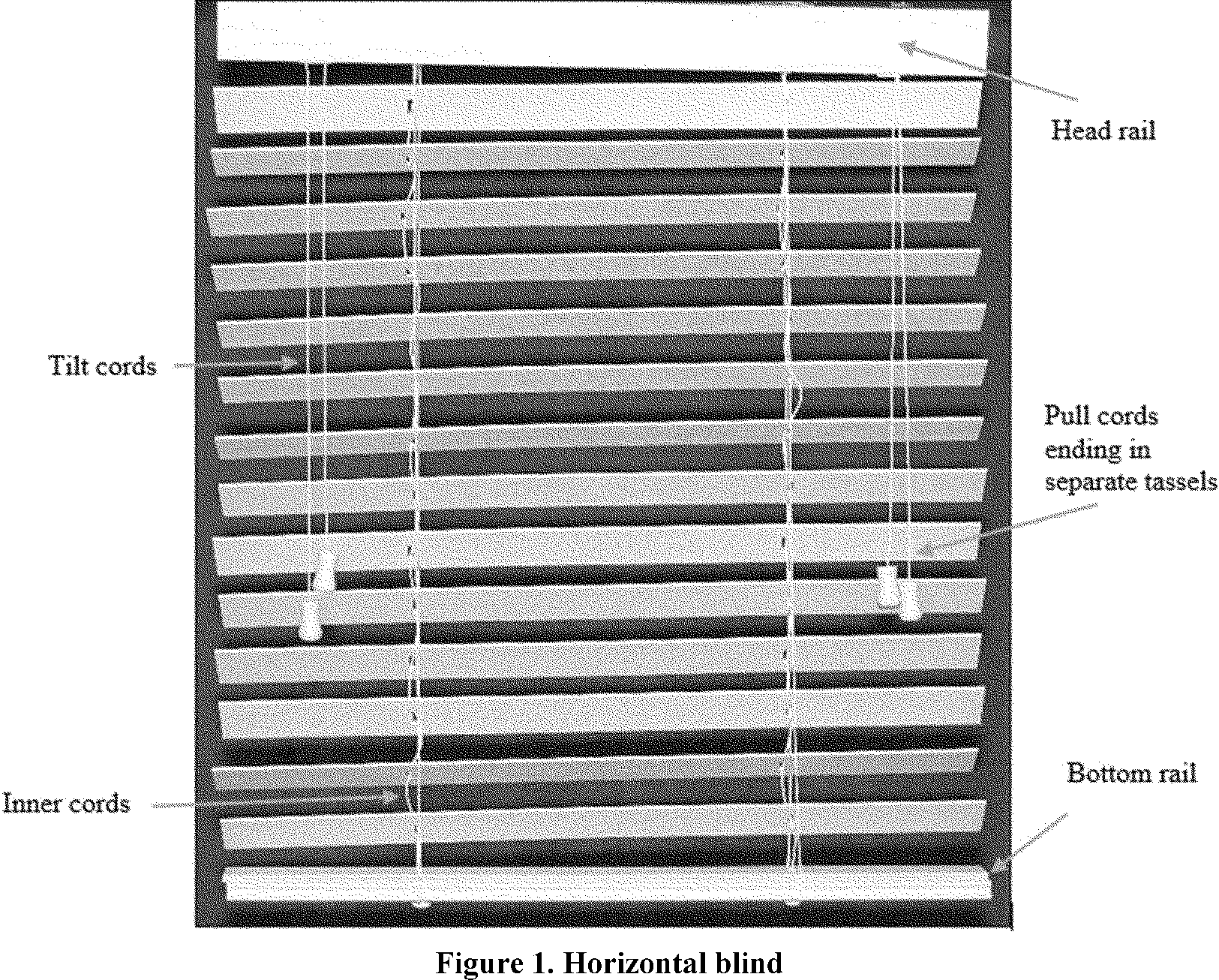
 15 U.S.C. 2064(j)(1)
 16 CFR part 1120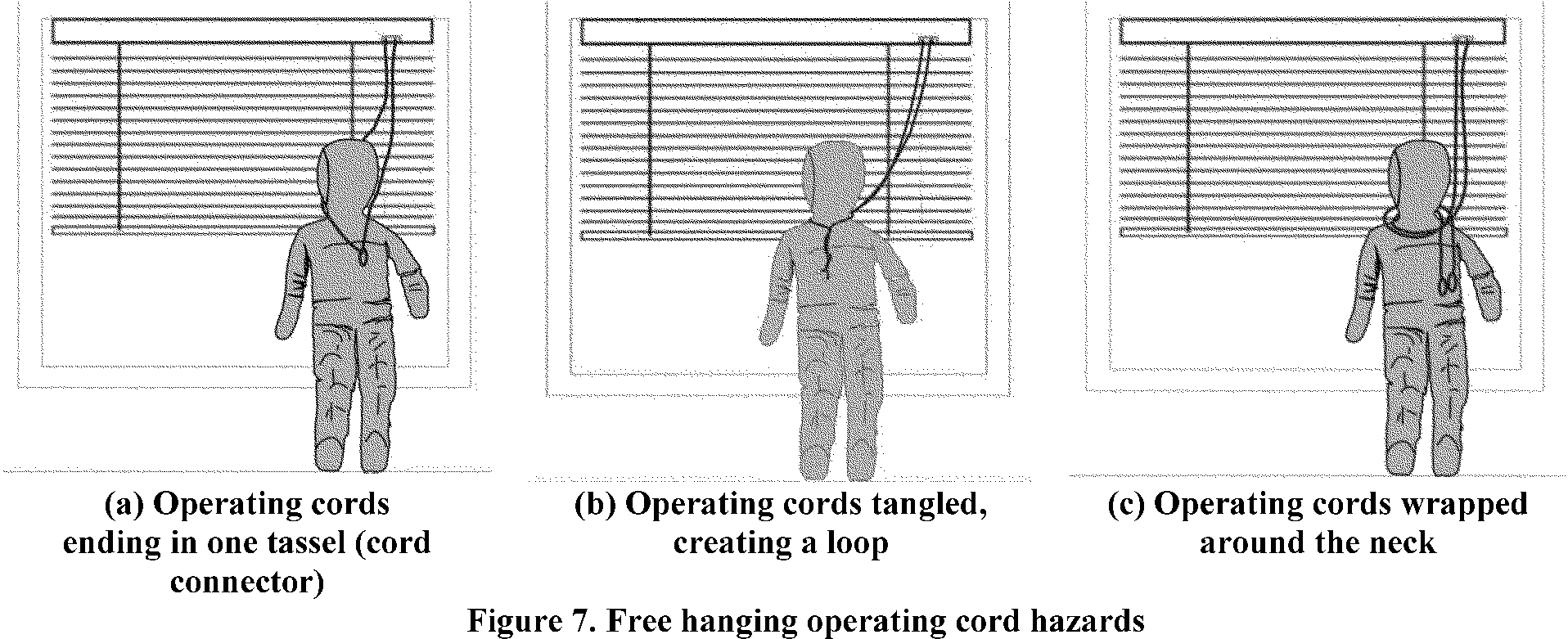
 forms.office.com/g/A6np3Y2gZW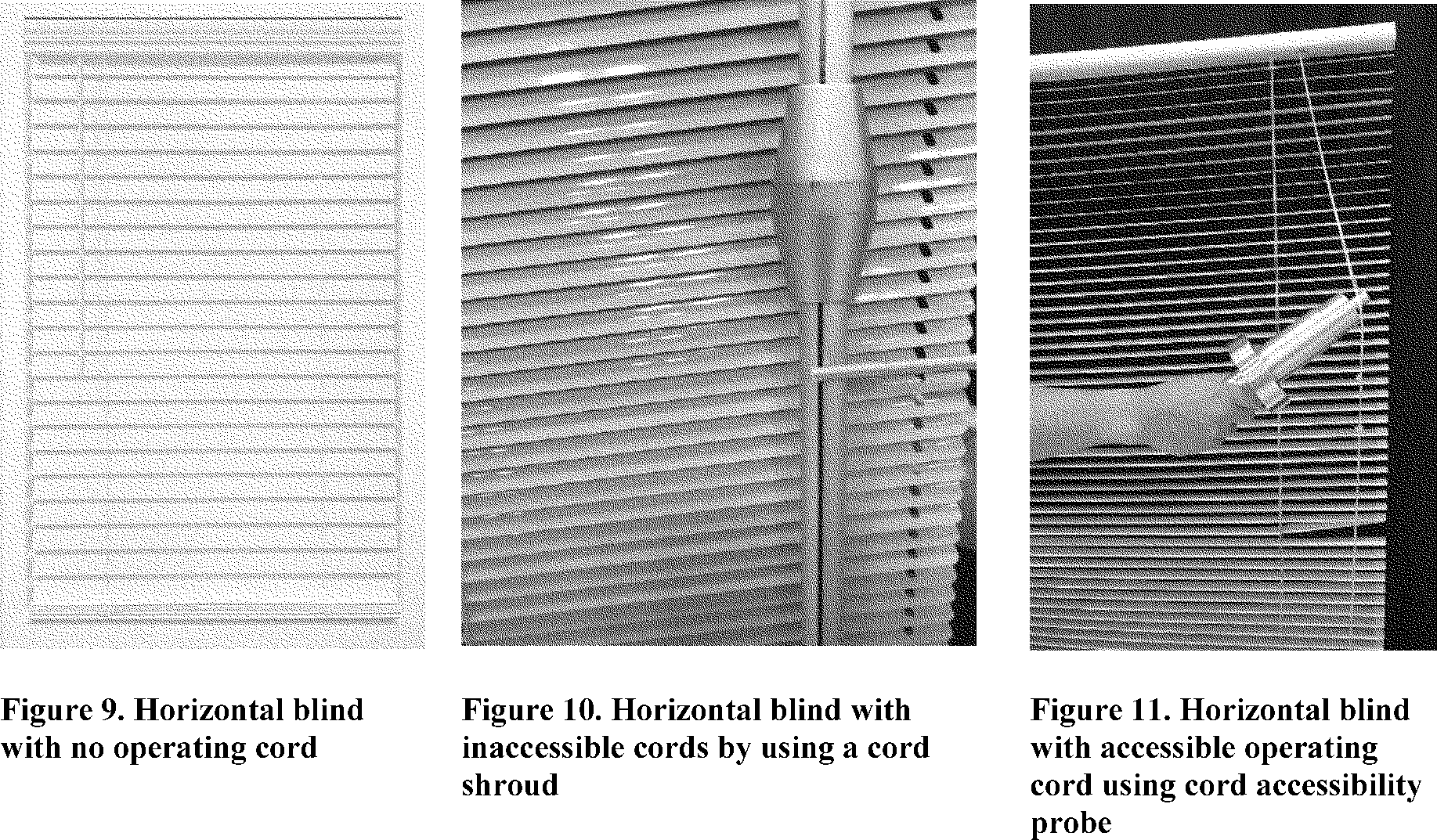
 wcmanet.com/wp-content/uploads/2023/04/WCMA-100.1-2022-FINAL-Read-Only.pdf
 www.cpsc.gov/s3fs-public/pdfs/foia_PetitionRequestingMandatoryStandardforCordedWindowCoverings.pdf
 share.google/uedI19Dq538uI2cl9
 www.portal.euromonitor.com/?eOpE%2bUmVd2xPhLHo07zPwx6WHOLgseSP5%2b9LR4N%2fEeHF30MGubTWBQ%3d%3d
 www.euromonitor.com/
 www.sba.gov/document/support-table-size-standards
 www.census.gov/data/tables/2021/econ/susb/2021-susb-annual.html