Implementation of Training Requirements for Personnel Serving on U.S.-Flagged Passenger Ships That Carry More Than 12 Passengers on International Voyages
The Coast Guard is amending its merchant mariner training regulations to implement amendments to the International Convention on Standards of Training, Certification and Watchke...
The Coast Guard is amending its merchant mariner training regulations to implement amendments to the International Convention on Standards of Training, Certification and Watchkeeping for Seafarers, 1978, and the Seafarers' Training, Certification and Watchkeeping Code, to require personnel serving on U.S.-flagged passenger ships carrying more than 12 passengers on international voyages to complete passenger ship emergency familiarization. This final rule also expands the applicability of the required crowd management training to include specified ratings on passenger ships. These required trainings would promote the safety of life at sea.
DATES:
This final rule is effective October 26, 2026. The incorporation by reference of certain material listed in this rule is approved by the Director of the Federal Register as of October 26, 2026.
ADDRESSES:
To view documents mentioned in this preamble as being available in the docket, go to
www.regulations.gov,
type USCG-2022-0649 in the search box, and click “Search.” Next, in the Document Type column, select “Supporting & Related Material.”
FOR FURTHER INFORMATION CONTACT:
For information about this document, call or email Megan Johns Henry, Coast Guard Office of Merchant Mariner Credentialing (CG-MMC-1); telephone 571-610-3303, email
Megan.C.Johns@uscg.mil.
SUPPLEMENTARY INFORMATION:
Table of Contents for Preamble
I. Abbreviations
II. Basis and Purpose, and Regulatory History
III. Discussion of Comments and Changes From Proposed Rule
IV. Discussion of the Rule
V. Incorporation by Reference
VI. Regulatory Analyses
A. Regulatory Planning and Review
B. Small Entities
C. Assistance for Small Entities
D. Collection of Information
E. Federalism
F. Unfunded Mandates
G. Taking of Private Property
H. Civil Justice Reform
I. Protection of Children
J. Indian Tribal Governments
K. Energy Effects
L. Technical Standards
M. Environment
I. Abbreviations
BLS U.S. Bureau of Labor Statistics
BTS Bureau of Transportation Statistics
CFR Code of Federal Regulations
CG-MMC Coast Guard Office of Merchant Mariner Credentialing
CSS Code Code of Safe Practices for Cargo Stowage and Securing
DHS Department of Homeland Security
DOT Department of Transportation
GSA U.S. General Services Administration
IBR Incorporated by Reference
IGF Code International Code of Safety for Ships Using Gases or Other Low Flashpoint Fuels
IMO International Maritime Organization
IRFA Initial Regulatory Flexibility Analysis
M&IE Meal and Incidental Expenses
MISLE Marine Information for Safety and Law Enforcement
MMC Merchant Mariner Credential
NAICS North American Industry Classification System
NARA National Archives and Records Administration
NMC National Maritime Center
NPRM Notice of proposed rulemaking
OMB Office of Management and Budget
PIC rule Persons in Charge of Fuel Transfers final rule
POV Privately owned vehicle
PSC Port State Control
RA Regulatory analysis
Ro-ro Roll-on/roll-off
§ Section
SBA Small Business Administration
SME Subject matter expert
SOLAS International Convention for the Safety of Life at Sea, 1974, as amended
STCW Convention International Convention on Standards of Training, Certification and Watchkeeping for Seafarers, 1978
STCW Code Seafarers Training, Certification and Watchkeeping Code
U.S.C. United States Code
VSL Value of a Statistical Life
II. Basis and Purpose, and Regulatory History
The purpose of this final rule is to ensure the safety of passengers on board U.S.-flagged passenger ships by ensuring all shipboard personnel have completed training and are competent to assist passengers in the event of an emergency. As defined in 46 CFR 11.1103 and 12.903,[1]
passenger ships are those ships carrying more than 12 passengers on an international voyage. With this rulemaking, the Coast Guard requires passenger ship emergency familiarization for all shipboard personnel on U.S.-flagged passenger ships, which may prevent the loss of life
( printed page 60847)
at sea, reduce the risk of injury, and increase protection of property and the marine environment. The Coast Guard is expanding the applicability of the existing crowd management training requirement to include ratings qualified under Chapters II, III, and VII of the International Convention on Standards of Training, Certification and Watchkeeping for Seafarers (STCW Convention) [2]
on passenger ships.
The legal basis of this final rule is 14 U.S.C. 502, which authorizes the Secretary of the Department of Homeland Security (“the Secretary”) broad authority to issue such regulations and orders as appropriate to carry out any law applicable to the Coast Guard and to delegate such regulatory authority to the Coast Guard. More specifically, 46 U.S.C. 7101 and 7301 authorize the Secretary to prescribe the requirements for the credentialing of officers and ratings, respectively. The Secretary has delegated these statutory authorities to the Coast Guard through DHS Delegation No. 00170.1(II)(92)(e), Revision No. 01.4, which generally authorizes the Coast Guard to determine and establish the experience and professional qualifications required to issue credentials.
This final rule makes the following changes, which apply to all personnel serving on U.S.-flagged passenger ships that carry more than 12 passengers on international voyages:
(1) Incorporates by reference STCW Consolidated Edition, 2017, comprised of the STCW Convention and the Seafarers' Training, Certification and Watchkeeping Code (including Erratum April 2018 and Supplement February 2019) (STCW Code), in 46 CFR parts 11 and 12. The STCW Convention and the STCW Code prescribe a five-tiered passenger ship training approach, which is detailed in Section IV, Discussion of the Rule.
(2) Adds a new requirement for all shipboard personnel to complete passenger ship emergency familiarization appropriate to their capacity, duties, and responsibilities during an emergency, before being assigned to shipboard duties. The passenger ship emergency familiarization requirement applies to all shipboard personnel, including Masters, officers, and ratings qualified under Chapters II, III, and VII of the STCW Convention. This familiarization training does not require Coast Guard approval. Mariners or vessel operators must maintain documentation verifying that personnel have completed the passenger ship emergency familiarization.
(3) Expands the applicability of crowd management training to include ratings qualified under Chapters II, III, and VII of the STCW Convention. Crowd management courses will continue to require Coast Guard approval in accordance with 46 CFR part 10, subpart D. Approved crowd management courses are readily available to mariners.
On June 21, 2024, the Coast Guard published a notice of proposed rulemaking (NPRM) (89 FR 52324) soliciting comments from the public on the described changes. The comment period closed on September 19, 2024.
III. Discussion of Comments and Changes From Proposed Rule
In response to the NPRM for this rulemaking, the Coast Guard received two comments. Both comments expressed support for the proposed changes to the merchant mariner training regulations for personnel serving on U.S.-flagged passenger ships carrying more than 12 passengers on international voyages.
One commenter stated that the Coast Guard's measures through the rulemaking are vital for enhancing safety and ensuring crews are adequately prepared to handle emergencies at sea.
The other commenter highlighted the importance of requiring personnel serving on U.S.-flagged passenger ships carrying more than 12 passengers on international voyages to complete passenger ship emergency familiarization and the expansion of the crowd management training requirement. The commenter noted that these measures are critical for enhancing the safety of life at sea. The commenter added that the NPRM changes would ensure that all relevant personnel are adequately trained to effectively manage emergencies. This includes the ability to safely and efficiently evacuate passengers, maintain order during crises, and minimize the risk of injury or loss of life. By mandating this training, the Coast Guard is taking proactive measures to protect the lives of passengers and crew alike.
Additionally, the same commenter emphasized that aligning U.S. regulations with the latest international standards outlined in the STCW Convention and STCW Code is essential for maintaining the credibility and safety of U.S.-flagged vessels in international waters. The commenter also supported the expanded scope of crowd management training to include specified ratings on passenger ships, highlighting the need to adapt to the evolving challenges posed by larger, more complex vessels and a diverse passenger base.
The Coast Guard agrees with these comments and agrees that the changes are crucial steps toward enhancing maritime safety. The alignment with the STCW Convention and STCW Code and the expanded training requirements reflect the Coast Guard's commitment to ensuring the highest standards of safety for both passengers and crew.
Therefore, we are adopting the changes to 46 CFR parts 11 and 12 with minor, non-substantive changes from the NPRM.
IV. Discussion of the Rule
In the following paragraphs, we provide a section-by-section description of our amendments to 46 CFR parts 11 and 12, in section number order with topical headings.
We are deleting reference to 46 U.S.C. 503 and adding, in its place, 46 U.S.C. 502. Section 503 no longer exists, and those authorities have been moved to section 502. We are also deleting reference to 46 U.S.C. 8906 and adding, in its place, 46 U.S.C. chapter 89. Chapter 89 of title 46 of the U.S.C. contains the authorities for requiring various small vessel officer endorsements, including the civil penalties (in 46 U.S.C. 8906) for violating the chapter. Finally, we are updating the reference to DHS Delegation No. 00170.1, Revision No. 01.4, to reflect the most recent revision to this document.
Subpart A—General
Section 11.102 Incorporation by Reference.
The Coast Guard is incorporating by reference the STCW Consolidated Edition 2017, which is comprised of the STCW Convention and the STCW Code (including Erratum April 2018 and Supplement February 2019). The STCW Convention sets the minimum standards for training, certification and watchkeeping for seafarers. The STCW Code addresses the technical aspects of the STCW Convention, including minimum standards of competence and the appropriate methods for demonstrating competence, which includes training. Currently, regulations in 46 CFR chapter I, subchapter B,
( printed page 60848)
reference the STCW Convention and the STCW Code, as amended through 2011. The STCW Consolidated Edition 2017 includes additional amendments to the STCW Convention and the STCW Code. The amendments were adopted in 2016 and entered into force on July 1, 2018. These amendments contain updated training requirements for personnel to address emergencies on passenger ships, prescribing a five-tiered passenger ship training approach.
The five-tiered approach includes passenger ship emergency familiarization, safety training for personnel providing direct service to passengers, passenger ship crowd management, crisis management and human behavior, and passenger safety, cargo safety, and hull integrity training.[3]
Each tier builds on the previous tier of training, and the training requirements are structured as appropriate to the associated position of responsibility on board the ship.
Subpart C—STCW Officer Endorsements
Section 11.305—Requirements to qualify for an STCW endorsement as Master of vessels of 3,000 GT or more (management level).
The Coast Guard amends Table 1 to § 11.305(e), footnote 2, by adding a reference to the appropriate section of the STCW Code for clarity.
Section 11.307—Requirements to qualify for an STCW endorsement as Chief Mate of vessels of 3,000 GT or more (management level).
The Coast Guard amends Table 1 to § 11.307(e), footnote 2, by adding a reference to the appropriate section of the STCW Code for clarity.
Section 11.309—Requirements to qualify for an STCW endorsement as Officer in Charge of a Navigational Watch (OICNW) of vessels of 500 GT or more (operational level).
The Coast Guard amends Table 1 to § 11.309(e), footnote 2, by adding a reference to the appropriate section of the STCW Code for clarity.
Section 11.311—Requirements to qualify for an STCW endorsement as Master of vessels of 500 GT or more and less than 3,000 GT (management level).
The Coast Guard amends Table 1 to § 11.311(d), footnote 2, by adding a reference to the appropriate section of the STCW Code for clarity.
Section 11.313—Requirements to qualify for an STCW endorsement as Chief Mate of vessels of 500 GT or more and less than 3,000 GT (management level).
The Coast Guard amends Table 1 to § 11.313(d), footnote 2, by adding a reference to the appropriate section of the STCW Code for clarity.
Section 11.315—Requirements to qualify for an STCW endorsement as Master of vessels of less than 500 GT (management level).
The Coast Guard amends Table 1 to § 11.315(d), footnote 2, by adding a reference to the appropriate section of the STCW Code for clarity.
Section 11.317—Requirements to qualify for an STCW endorsement as Master of vessels of less than 500 GT limited to near-coastal waters (management level).
The Coast Guard amends Table 1 to § 11.317(d), footnote 2, by adding a reference to the appropriate section of the STCW Code for clarity.
Section 11.319—Requirements to qualify for an STCW endorsement as Officer in Charge of a Navigational Watch (OICNW) of vessels of less than 500 GT (operational level).
The Coast Guard amends Table 1 to § 11.319(d), footnote 2, by adding a reference to the appropriate section of the STCW Code for clarity.
Section 11.321—Requirements to qualify for an STCW endorsement as Officer in Charge of a Navigational Watch (OICNW) of vessels of less than 500 GT limited to near-coastal waters (operational level).
The Coast Guard amends Table 1 to § 11.321(d), footnote 2, by adding a reference to the appropriate section of the STCW Code for clarity.
Section 11.325—Requirements to qualify for an STCW endorsement as Chief Engineer Officer on vessels powered by main propulsion machinery of 3,000 kW/4,000 HP propulsion power or more (management level).
The Coast Guard amends Table 1 to § 11.325(d), footnote 2, by adding a reference to the appropriate section of the STCW Code for clarity.
Section 11.327—Requirements to qualify for an STCW endorsement as Second Engineer Officer on vessels powered by main propulsion machinery of 3,000kW/4,000 HP propulsion power or more (management level).
The Coast Guard amends Table 1 to § 11.327(d), footnote 2, by adding a reference to the appropriate section of the STCW Code for clarity.
Section 11.329—Requirements to qualify for an STCW endorsement as Officer in Charge of an Engineering Watch (OICEW) in a manned engineroom or designated duty engineer in a periodically unmanned engineroom on vessels powered by main propulsion machinery of 750 kW/1,000 HP propulsion power or more (operational level).
The Coast Guard adds numbers to the footnotes in Table 1 to § 11.329(e) for consistency with other sections. Additionally, Table 1 to § 11.329(e), footnote 2, is amended by adding a reference to the appropriate section of the STCW Code for clarity.
Section 11.331—Requirements to qualify for an STCW endorsement as Chief Engineer Officer on vessels powered by main propulsion machinery of 750 kW/1,000 HP or more and less than 3,000 kW/4,000 HP propulsion power (management level).
The Coast Guard amends Table 1 to § 11.331(e), footnote 2, by adding a reference to the appropriate section of the STCW Code for clarity.
Section 11.333—Requirements to qualify for an STCW endorsement as Second Engineer Officer on vessels powered by main propulsion machinery of 750kW/1,000 HP or more and less than 3,000 kW/4,000 HP propulsion power (management level).
The Coast Guard amends Table 1 to § 11.333(d), footnote 2, by adding a reference to the appropriate section of the STCW Code for clarity.
Subpart K—Officers on a Passenger Ship When on an International Voyage
Section 11.1105—General requirements for officer endorsements.
The Coast Guard revises the title of this section from “General requirements for officer endorsements” to “General requirements.” The change aligns with the purpose of this subpart, in accordance with the STCW Convention and the STCW Code. Other specific changes to § 11.1105 are detailed below.
In summary, we are combining existing paragraph (a) introductory text and text from paragraph (a)(1) into paragraph (a) introductory text; adding new paragraph (a)(1); redesignating paragraphs (a)(1)(i) as (a)(3), (a)(1)(ii) as (a)(2), (a)(1)(iii) as (a)(4) and (a)(1)(iv) as (a)(5); redesignating paragraph (a)(2) as paragraph (b); and redesignating existing paragraphs (b), (c), and (d) as paragraphs (c), (d) and (e) respectively. These changes allow paragraphs (a)(1) through (a)(5) to refer to the applicable paragraphs (1 through 5) of Section A-V/2 of the STCW Code, as detailed in the following discussion of those paragraphs.
In revised paragraph (a) introductory text, we change the word “vessel” to “ship” for consistency in terminology in this part and add the text, “before being assigned to shipboard duties” for clarity. The language from existing paragraph (a)(1) in revised paragraph (a)
( printed page 60849)
introductory text details the incorporation of the STCW Convention Regulation V/2 and of Section A-V/2 of the STCW Code.
New paragraph (a)(1) specifies that all officers and personnel aboard passenger ships must have completed passenger ship emergency familiarization appropriate to their capacity, duties, and responsibilities. Paragraph (a)(1) refers to Section A-V/2 paragraph 1 of the STCW Code, which requires that passenger ship emergency familiarization be completed before personnel are assigned to shipboard duties.
In accordance with Section A-V/2 paragraph 1 of the STCW Code, passenger ship emergency familiarization must include topics to familiarize personnel with the general safety features aboard the ship, the location of essential safety equipment, including life-saving appliances, the importance of personal conduct during the implementation of emergency plans, and restrictions on the use of elevators during emergencies. Passenger ship emergency familiarization, in accordance with Section A-V/2 paragraph 1 of the STCW Code, also includes the requirement to communicate with passengers during an emergency, including the ability to communicate in the working language of the ship, including non-verbally communicating safety information, and understanding one of the languages in which emergency announcements may be broadcast on the ship during an emergency or drill.
Passenger ship emergency familiarization training in paragraph (a)(1) does not require Coast Guard approval. Operating companies must ensure personnel are familiarized with the shipboard layout, their shipboard duties, and emergency procedures. Personnel or vessel operating companies must maintain documentary evidence verifying that personnel have completed the Passenger Ship Emergency Familiarization training. It is the responsibility of the operating companies, who are obligated by Regulation I/14, “Responsibilities of Companies” of the STCW Convention, to ensure that documentation relevant to personnel training is maintained and readily accessible. Port State Control (PSC) officers or Coast Guard inspectors may ask to see evidence that personnel have completed passenger ship emergency familiarization.
Redesignated paragraph (a)(2), which already requires the completion of safety training for personnel providing direct service to passengers in passenger spaces, is revised to include the addition of “officers” to personnel providing direct service to passengers in passenger spaces. In addition, we removed “onboard passenger ships” from the explanation of passenger spaces. We add “passenger ship” to more accurately describe the type of safety training required. Paragraph (a)(2) refers to Section A-V/2 paragraph 2 of the STCW Code, which requires that passenger ship safety training be completed before personnel are assigned to shipboard duties.
In accordance with Section A-V/2 paragraph 2 of the STCW Code, passenger ship safety training must include communication. Specifically, it must include:
1. The ability to communicate with passengers during an emergency, considering the language or languages appropriate to the principal nationalities of passengers carried on the particular route;
2. The likelihood that an ability to use elementary English vocabulary for basic instructions can provide a means of communicating with a passenger in need of assistance, whether or not the passenger and crew member share a common language;
3. The possible need to communicate during an emergency by some other means, such as by demonstration, hand signals, or calling attention to the location of instructions, muster stations, life-saving devices, or evacuation routes when oral communication is impractical;
4. The extent to which complete safety instructions have been provided to passengers in their native language or languages;
5. The languages in which emergency announcements may be broadcast during an emergency or drill to convey critical guidance to passengers and to facilitate crew members in assisting passengers; and
6. In accordance with Section A-V/2 paragraph 2 of the STCW Code, passenger ship safety training must include life-saving appliances, and specifically the ability to demonstrate to passengers the use of personal life-saving appliances, and embarkation procedures with special attention to disabled persons and persons needing assistance.
Passenger ship safety training in paragraph (a)(2) does not require Coast Guard approval and can be conducted on board the ship or in a shore-based location. Personnel completing passenger ship safety training are obligated to maintain documentary evidence of their training by STCW Convention Regulation V/2, “Mandatory minimum requirements for the training and qualification of masters, officers, ratings and other personnel on passenger ships,” of the STCW Convention.
The Coast Guard makes non-substantive changes in redesignated paragraph (a)(3), which already requires the completion of crowd management training. In addition, the Coast Guard makes the following substantive changes to clarify which personnel are required to complete the required training:
1. The text, “ratings qualified under Chapters II, III, and VII of the STCW Convention” is added to Masters, officers, and personnel designated on muster lists to assist passengers in emergency situations.
2. The text, “approved or accepted” is added to clarify that Masters, officers, ratings qualified under Chapters II, III, and VII of the STCW Convention, and personnel designated on muster lists to assist passengers in emergency situations must complete “approved or accepted” training in passenger ship crowd management. Requiring approved or accepted training aligns with 46 CFR part 10, subpart D, which allows training to be either approved or accepted by the Coast Guard.
3. The text is revised to refer to Section A-V/2 paragraph 3 of the STCW Code, which requires crowd management training to be completed in accordance with STCW Convention Regulation V/2, paragraph 7, as set out in table A-V/2-1. Personnel completing crowd management training are obligated to maintain documentary evidence of their training by STCW Convention Regulation V/2, “Mandatory minimum requirements for the training and qualification of masters, officers, ratings and other personnel on passenger ships,” of the STCW Convention.
Redesignated paragraph (a)(4) makes one non-substantive change. Additionally, redesignated paragraph (a)(4), which already includes a requirement for the completion of crisis management and human behavior, clarifies that training in crisis management and human behavior must be approved “or accepted” training in accordance with 46 CFR part 10, subpart D. Paragraph (a)(4) is revised to refer to Section A-V/2 paragraph 4 of the STCW Code, which requires training in crisis management and human behavior to be completed in accordance with STCW Convention Regulation V/2 paragraph 8, as set out in table A-V/2-2. Personnel completing crisis management and human behavior training are obligated to maintain documentary evidence of their training by STCW Convention
( printed page 60850)
Regulation V/2, “Mandatory minimum requirements for the training and qualification of masters, officers, ratings and other personnel on passenger ships,” of the STCW Convention.
Redesignated paragraph (a)(5) makes one non-substantive change. Additionally, redesignated paragraph (a)(5) clarifies that training in passenger safety, cargo safety, and hull integrity must be approved “or accepted” training in accordance with 46 CFR part 10, subpart D. Paragraph (a)(5) is also revised to refer to Section A-V/2 paragraph 5 of the STCW Code, which requires that training must be completed before personnel are assigned to shipboard duties.
In accordance with Section A-V/2 paragraph 5 of the STCW Code, passenger safety, cargo safety, and hull integrity training must include loading and embarkation procedures and, specifically, the ability to properly apply the procedures established for the ship regarding loading and discharging vehicles, rail cars and other cargo transport units, including related communications; lowering and hoisting ramps; setting up and stowing retractable vehicle decks; and embarking and disembarking passengers, with special attention to disabled persons and persons needing assistance.
Passenger safety, cargo safety, and hull integrity training must also include:
1. Carriage of dangerous goods, including the ability to apply any special safeguards, procedures, and requirements regarding the carriage of dangerous goods on board roll-on/roll-off (ro-ro) passenger ships; [4]
2. Securing cargoes, specifically the ability to correctly apply the provisions of the Code of Safe Practices for Cargo Stowage and Securing (CSS Code) [5]
to the vehicles, rail cars, and other cargo transport units carried, and to properly use the cargo-securing equipment and materials provided, considering their limitations;
3. Stability, trim, and stress calculations, specifically the ability to make proper use of the stability and stress information provided; calculate stability and trim for different conditions of loading, using the stability calculators or computer programs provided; calculate load factors for decks; and calculate the impact of ballast and fuel transfers on stability, trim, and stress; and
4. Opening, closing and securing hull openings, including the ability to properly apply the procedures established for the ship for opening, closing and securing bow, stern and side doors and ramps; correctly operating the associated systems and conducting surveys on proper sealing and ro-ro deck atmosphere, including the ability to use equipment, where carried, to monitor atmosphere in ro-ro spaces and properly apply the procedures established for the ship for ventilation of ro-ro spaces during lading and discharging of vehicles, while on voyage and in emergencies.
Personnel completing passenger safety, cargo safety, and hull integrity training are obligated to maintain documentary evidence of their training by STCW Convention Regulation V/2, “Mandatory minimum requirements for the training and qualification of masters, officers, ratings and other personnel on passenger ships,” of the STCW Convention.
Redesignated paragraph (b) is revised to state that, “Personnel required to be trained in accordance with paragraph (a) of this section must hold documentary evidence of successful completion of training as proof of meeting these requirements.” These revisions clarify who is required to hold evidence of successful completion of training in accordance with paragraph (a). We removed the existing text, “through approved or accepted training,” to clarify that the training required in paragraphs (a)(1) and (a)(2) do not have to be Coast Guard-approved or accepted training, while the training required in paragraphs (a)(3), (a)(4), and (a)(5) must be Coast Guard-approved or accepted training.
Redesignated paragraph (c) updates terminology used in this subpart and makes other non-substantive changes. Paragraph (c) corrects references to other revised paragraphs in this subpart for personnel who must provide evidence of having maintained the required standard of competence every 5 years.
Redesignated paragraph (d) updates the paragraph reference, which was redesignated from paragraph (b) to paragraph (c), and replaces the word “sea” with “relevant seagoing” to better describe the service needed to maintain the standard of competence.
Redesignated paragraph (e) replaces the word “vessels” with “ships” to provide consistency of terminology used in this subpart.
The Coast Guard revises the authorities listed for part 12 by adding 14 U.S.C. 502, which governs the delegation of powers by the Secretary to the Coast Guard. It authorizes the Secretary to transfer or impose on the Coast Guard any of the rights, privileges, powers, or duties vested in the Secretary regarding the administration of the Coast Guard, including the authority to promulgate regulations. We updated this authority in part 12 for consistency with 46 CFR parts 10 and 11. We also revised the authorities listed for part 12 by adding 46 U.S.C. 7303 through 7316. We made this change to more clearly cite the statutory authority provided by Congress to issue regulations for all classifications of ratings endorsements with respect to standards of competency, training, and sea service. Finally, we updated the reference to DHS Delegation No. 00170.1, Revision No. 01.4, to reflect the most recent revision of this document.
Subpart A—General
Section 12.103 Incorporation by Reference.
The Coast Guard revises § 12.103 to incorporate by reference the STCW Consolidated Edition 2017, which is comprised of the STCW Convention and the STCW Code (including Erratum April 2018 and Supplement February 2019).[6]
Subpart F—Requirements for STCW Rating Endorsement
Section 12.603—Requirements to qualify for an STCW endorsement as Able Seafarer-Deck.
The Coast Guard amends Table 1 to § 12.603(d), footnotes 2 and 3, by adding references to the appropriate sections of the STCW Code for clarity.
Section 12.605—Requirements to qualify for an STCW endorsement as Ratings Forming Part of a Navigational Watch (RFPNW).
The Coast Guard amends Table 1 to § 12.605(c), footnote 2, by adding reference to the appropriate section of the STCW Code for clarity.
Section 12.609—Requirements to qualify for an STCW endorsement as Rating Forming Part of an Engineering Watch (RFPEW).
The Coast Guard amends Table 1 to § 12.609(c), footnote 2, by adding
( printed page 60851)
reference to the appropriate section of the STCW Code for clarity.
Section 12.611—Requirements to qualify for an STCW endorsement as Electro-technical Rating (ETR) on vessels powered by main propulsion machinery of 750 kW/1,000 HP or more.
The Coast Guard amends Table 1 to § 12.611(c), footnote 2, by adding reference to the appropriate section of the STCW Code for clarity.
Subpart I—Ratings and Personnel on a Passenger Ship When on an International Voyage
The Coast Guard is revising the title of this subpart from “Crewmembers on a Passenger Ship on an International Voyage,” to “Ratings and Personnel on a Passenger Ship When on an International Voyage.” The change aligns with the purpose of this subpart, in accordance with the STCW Convention and the STCW Code. We made an editorial change to § 12.901; for § 12.905, we combined existing paragraph (a) introductory text and paragraph (a)(1) into paragraph (a) introductory text; redesignated existing paragraph (a)(2) as paragraph (b); added new paragraphs (a)(1) through (a)(5); and redesignated existing paragraphs (b), (c), and (d) as paragraphs (c), (d) and (e) respectively. New paragraphs (a)(1) through (a)(5) refer to the applicable paragraphs (1 through 5) of Section A-V/2 of the STCW Code. The specific changes to § 12.905 are detailed below.
Section 12.905—General Requirements.
In revised paragraph (a) introductory text, we replace the word “vessel” with “ship” to provide consistency of terminology used in this subpart and revise the text to clarify when and to whom the requirements apply. We also moved language from existing paragraph (a)(1) to paragraph (a) introductory text to detail the incorporation of the STCW Convention Regulation V/2 and of Section A-V/2 of the STCW Code.
Paragraph (a)(1) specifies that all personnel must have completed passenger ship emergency familiarization appropriate to their capacity, duties, and responsibilities. Paragraph (a)(1) also refers to Section A-V/2 paragraph 1 of the STCW Code.[7]
Passenger ship emergency familiarization in paragraph (a)(1) does not require Coast Guard approval.
Paragraph (a)(2) is redesignated as paragraph (b). New paragraph (a)(2) adds the requirement that personnel providing direct service to passengers in passenger spaces must have completed the passenger ship safety training. Paragraph (a)(2) is also revised to refer to Section A-V/2 paragraph 2 of the STCW Code.[8]
Passenger ship safety training in paragraph (a)(2) does not require Coast Guard approval in accordance with 46 CFR part 10, subpart D, and can be conducted on board the ship or in a shore-based location.
New paragraph (a)(3) adds the requirement that ratings qualified under Chapters II, III, and VII of the STCW Convention and personnel designated on the muster list to assist passengers in an emergency situation onboard passenger ships must have completed approved or accepted training in passenger ship crowd management. Passenger ship crowd management training must be approved or accepted training in accordance with 46 CFR part 10, subpart D. This paragraph is also revised to refer to Section A-V/2 paragraph 3 of the STCW Code.[9]
New paragraph (a)(4) adds the requirement that personnel designated on muster lists as having responsibility for the safety of passengers in emergency situations onboard passenger ships must have completed approved or accepted training in crisis management and human behavior. Crisis management and human behavior training must be approved or accepted training in accordance with 46 CFR part 10, subpart D. This paragraph is also revised to refer to Section A-V/2 paragraph 4 of the STCW Code.[10]
New paragraph (a)(5) adds the requirement that personnel assigned immediate responsibility for embarking and disembarking passengers, loading, discharging, or securing cargo, or closing hull openings onboard ro-ro passenger ships must have completed approved or accepted training in passenger safety, cargo safety, and hull integrity. Passenger safety, cargo safety, and hull integrity training must be approved or accepted training in accordance with 46 CFR part 10, subpart D. This paragraph is also revised to refer to Section A-V/2 paragraph 5 of the STCW Code.[11]
Redesignated paragraph (b) requires personnel completing the training described in paragraph (a) to hold documentary evidence of meeting these requirements.
Redesignated paragraph (c) updates terminology used in this subpart and makes other non-substantive changes. Paragraph (c) also corrects references to other revised paragraphs in this subpart for personnel who must provide evidence of having maintained the required standard of competence every 5 years.
Redesignated paragraph (d) updates the paragraph reference which was redesignated from paragraph (b) to paragraph (c) and replaces the word “sea” with “relevant seagoing” to better describe the service needed to maintain the standard of competence.
Existing paragraph (d) is redesignated as paragraph (e) with no changes to the text.
V. Incorporation by Reference
Material for incorporation by reference appears in the regulatory text for 46 CFR 11.102 and 12.103. The sections that reference these standards, and the locations and web addresses where these standards are available, are listed in those sections. The material incorporated by reference is summarized in this preamble in Section IV., Discussion of the Rule, under the discussions of §§ 11.102 and 11.1105. For information about how to view this material, see the
FOR FURTHER INFORMATION CONTACT
section of this preamble. The Director of the Federal Register approved the material in 46 CFR parts 11 and 12 for incorporation by reference under 5 U.S.C. 552 and 1 CFR part 51. Consistent with 1 CFR part 51 incorporation by reference provisions, this material is reasonably available. Interested persons have access to it through their normal course of business, may purchase it from the International Maritime Organization (IMO) as identified in 46 CFR 11.102 or 12.103, or may view a copy by means we have identified in those sections.
SOLAS: The International Convention for the Safety of Life at Sea, 1974 is referenced in the amendatory text of this document and was previously approved for § 11.102.
VI. Regulatory Analyses
The Coast Guard received two comment submissions during the 90-day comment period that ended on September 19, 2024. Both comments were in support of the rule and, as a result, the methodology employed in the RA is unchanged from the NPRM. However, we have updated the affected population, wage, and travel cost data used throughout the analysis, resulting
( printed page 60852)
in increased cost estimates from the NPRM.
We developed this rule after considering numerous statutes and Executive orders related to rulemaking. Below we summarize our analyses based on these statutes or Executive orders.
A. Regulatory Planning and Review
Executive Orders 12866 (Regulatory Planning and Review) and 13563 (Improving Regulation and Regulatory Review) direct agencies to assess the costs and benefits of available regulatory alternatives and, if regulation is necessary, to select regulatory approaches that maximize net benefits. Executive Order 13563 emphasizes the importance of quantifying both costs and benefits, of reducing costs, of harmonizing rules, and of promoting flexibility. Executive Order 14192 (Unleashing Prosperity Through Deregulation) directs agencies to significantly reduce the private expenditures required to comply with Federal regulations and provides that “any new incremental costs associated with new regulations shall, to the extent permitted by law, be offset by the elimination of existing costs associated with at least 10 prior regulations.”
Additionally, Executive Order 13609 (Promoting International Cooperation) promotes the goal of Executive Order 13563. Executive Order 13609 targets international regulatory cooperation to reduce, eliminate, or prevent unnecessary differences in regulatory requirements.
The Office of Management and Budget (OMB) has not designated this rule a “significant regulatory action” under section 3(f) of Executive Order 12866. Accordingly, OMB has not reviewed it.
This rule is not an Executive Order 14192 regulatory action because this rule is not significant under Executive Order 12866. See OMB Memorandum M-25-20, “Guidance Implementing Section 3 of Executive Order 14192, titled `Unleashing Prosperity Through Deregulation' ” (March 26, 2025).
The United States is a signatory to the STCW Convention; therefore, the United States is required to implement amendments to the STCW Convention and the STCW Code through national regulations.
A summary of the regulatory analysis (RA) follows. The final rule makes the following changes, which apply to all personnel serving on U.S.-flagged passenger ships:
(1) Incorporates by reference the STCW Consolidated Edition 2017, comprised of the STCW Convention and the STCW Code in 46 CFR parts 11 and 12.
(2) Adds a new requirement for all personnel to complete passenger ship emergency familiarization appropriate to their capacity, duties, and responsibilities during an emergency. Personnel must complete the familiarization before being assigned to shipboard duties. The passenger ship emergency familiarization requirement applies to all personnel, including Masters, officers, and ratings qualified under Chapters II, III, and VII of the STCW Convention. This familiarization training does not require Coast Guard approval. Mariners or ship operators must maintain documentation verifying that personnel have completed the passenger ship emergency familiarization.
(3) Expands the applicability of the crowd management training requirement by adding ratings qualified under Chapters II, III, and VII of the STCW Convention to the current applicability of officers and personnel designated on the muster list to assist passengers in emergency situations. Prior to this final rule, only Masters, officers, and personnel designated on the muster list to assist passengers on board passenger ships in emergency situations had to complete crowd management training.
The Coast Guard considers the benefits and costs of the rulemaking against the baseline, which is our best assessment of maritime affairs absent this action. We do not have data on whether the U.S.-passenger-ship industry is currently in compliance with the training requirements in this final rule. Pursuant to 46 CFR 1.01-10(f)(1), which authorizes the Coast Guard to supervise the administration of the manning of U.S. ships, and prior to this final rule, PSC officers and Coast Guard inspectors were verifying that mariners held the appropriate credentials and met the training required by the STCW Convention and the STCW Code, but were not tracking compliance with the requirements outlined in this final rule, since compliance was voluntary.
While the Coast Guard believes it is possible that personnel may have already completed the required passenger ship trainings before the effective date of this final rule, due to a lack of data, we cannot assume compliance. Thus, for the purposes of this RA, we assume personnel are not in compliance with the training requirements, and we measure initial compliance costs in the first year of implementation. As a result, the Coast Guard estimates that the operating companies of U.S.-flagged passenger ships will incur undiscounted average annual costs of approximately $379,253, in 2023 dollars, from the passenger ship emergency familiarization requirements, and ratings qualified under Chapters II, III, and VII of the STCW Convention will incur undiscounted average annual costs of $22,104, in 2023 dollars, to comply with the crowd management training requirement. Taken together, the final rule will result in annualized costs to industry of approximately $403,486, and total costs of $3,624,350, in 2023 dollars, when discounted at 2 percent over a 10-year period of analysis. The Coast Guard believes the final rule will improve safety of life at sea by ensuring passenger ship personnel are equipped to assist passengers in an emergency and will also maintain the ability of passenger ships and mariners to operate in international markets. Table 1 provides a summary of the final rule's applicability, affected population, potential costs, and benefits.
( printed page 60853)
( printed page 60854)
Changes From NPRM to Final Rule
The Coast Guard received two public comments during the 90-day public comment period, and both were in support of the requirements proposed in the NPRM. As a result, the requirements and the methodology employed to analyze the associated benefits and costs are unchanged. Despite the methodology remaining consistent, we have updated the affected population, wage, and travel cost data used throughout the analysis. This involved updating wage rates and cost inputs used in the analysis from a base year of 2021 to 2023. These changes to the affected population data and cost inputs resulted in increased cost estimates from the NPRM. Beyond these increases, nothing else in the RA has changed. Table 2 summarizes the changes to the affected population from the NPRM to the final rule.
Description of Regulatory Changes
This final rule results in multiple changes that have costs. First, the rule adds passenger ship emergency familiarization requirements for officers, ratings, and personnel on passenger ships making international voyages. This training includes topics to familiarize personnel with the general safety features aboard the ship, the location of essential safety equipment, including life-saving appliances, the importance of personal conduct during the implementation of emergency plans, and restrictions on the use of elevators during emergencies. Passenger ship emergency familiarization also includes the requirement to communicate with passengers during an emergency, including the ability to communicate in the working language of the ship, including non-verbally communicating safety information, and understanding one of the languages in which emergency announcements may be broadcast on the ship during an emergency or drill.
Second, the final rule expands the applicability of crowd management training by requiring ratings qualified under Chapters II, III, and VII of the STCW Convention to complete this training. Prior to this final rule, only officers and personnel designated on the muster list to assist passengers in emergency situations were required to complete this training. Table 3 lists and describes the changes we make to 46 CFR parts 11 and 12, with their associated impacts.
( printed page 60855)
( printed page 60856)
( printed page 60857)
( printed page 60858)
( printed page 60859)
( printed page 60860)
( printed page 60861)
Affected Population
This final rule has two affected populations that will incur costs: (1) operating companies with U.S.-flagged passenger ships; and (2) ratings qualified under Chapters II, III, and VII of the STCW Convention serving on the same ships.
The Coast Guard analyzed data from the Marine Information for Safety and Law Enforcement (MISLE) database to determine the number of U.S.-flagged passenger ships that carry more than 12 passengers on international voyages and to determine the number of unique owners and operators.[12]
We determined that there are 51 U.S.-flagged passenger ships owned by 41 operating companies that will incur the costs of providing passenger ship emergency familiarization to the officers, ratings, and personnel aboard their ships. Unlike most STCW Convention and STCW Code training requirements, it will be incumbent upon the owners and operators of these passenger ships to provide this training, since it is ship-specific and is given on board prior to assuming duties.
To determine the number of officers, ratings, and personnel impacted by the passenger ship emergency familiarization requirements, as well as the number of ratings qualified under Chapters II, III, and VII of the STCW Convention subject to the crowd management training requirements, the Coast Guard used additional data from the MISLE database.[13]
The Coast Guard reviewed the certificate of inspection for all 51 U.S.-flagged passenger ships in the affected ship population and reviewed the manning requirements for each ship.[14]
Accordingly, we determined that 1,230 personnel [(103 officers + 22 specified ratings + 490 additional personnel) × 2 mariners per ship] will be subject to the training requirements.[15]
Specifically, the passenger ship emergency familiarization requirement will affect 1,230 personnel (206 officers + 44 specified ratings + 980 personnel), and the expanded applicability of crowd management training requirements will affect the 44 ratings. See table 4.
( printed page 60862)
Additionally, we used historical ship population data from 2012 to 2023 to estimate growth rates within the industry, and subsequent changes to the ship and mariner population into the future. After examining the changes in ship population over time, we determined that the population of U.S.-flagged passenger ships is facing a gradual decline despite apparent growth in the foreign-flagged fleet. While linear growth rates are typically preferred, we determined that a linear decline that will eventually reach zero is an unrealistic picture of the changing dynamics of the ship population. Instead, a logarithmic decline that gradually levels off according to the formula for the trend line y =−9.412ln(x) + 69.094 more accurately portrays the industry because logarithmic functions are best used to project slow rates of decline, and trend towards a number without reaching zero. This rate of decline is reflected in Figure 1. However, for the purposes of this analysis, we estimate that the U.S.-flagged ship population will decrease by one ship each year, which is the closest whole number to the average annual change in population over the next 10 years of analysis. Therefore, we estimate that the continuous decrease in the affected mariner population is equivalent to the manning requirements of a ship exiting service each year.
Next, we reviewed the manning requirements for the 51 U.S.-flagged passenger ships to derive the average manning requirement and thereby estimate the decrease in mariners and personnel each year. The affected population of 51 U.S.-flagged passenger ships is comprised of 3 categories of ships: 4 passenger vessels of 100 or more gross tons (46 CFR Subchapter H), 9 small passenger vessels of less than 100 gross tons carrying more than 150 passengers or with overnight accommodations for more than 49 passengers (46 CFR Subchapter K), and 38 small passenger vessels of less than 100 gross tons (46 CFR Subchapter T). The average crew size for each of the categories of vessels and the entire population is displayed in Table 5.
( printed page 60863)
Based
on this data, the Coast Guard estimates that the average ship in the population carries 13 mariners (2 officers, 1 specified rating, and 10 personnel) and operates with 2 crews that will be subject to the requirements. The Coast Guard assumes that, as ships subject to the requirements exit the fleet, mariners will have less opportunity to serve aboard these ships and leave the affected population. Because we do not know which category of vessel may exit the affected population in a given year, we elect to use the overall population average rather than the specific estimates for the subcategories of ships to account for mariner exit in the affected population. We believe that, since the majority of the affected population is made up of smaller ships (38 of the 51 affected ships), this overall average, which tends toward a smaller ship, is most representative. Therefore, we estimate that each exiting ship will result in 26 fewer personnel subject to the training requirements (4 officers, 2 specified ratings, and 20 personnel across 2 crews).
Mariner Turnover
In any given year, there will be turnover in the mariner population, and some credentialed mariners will choose to exit the industry. The turnover rate is the number of mariners who leave the industry and will need to be replaced by mariners with a Merchant Mariner Credential (MMC). Because the Coast Guard does not issue passenger ship endorsements, we cannot estimate the turnover rate from existing data. Instead, the Coast Guard uses the turnover rate derived for the “Persons in Charge of Fuel Transfers” final rule (PIC rule), published on May 27, 2020 (85 FR 31677) as an approximation for the turnover rate for this rule. In that rule, the Coast Guard estimated that, in any given year, 32.55 percent of the population that was eligible to renew a specific MMC endorsement would not do so.
The PIC rule used data from the National Maritime Center (NMC) for individuals obtaining MMCs with issue dates from April 2009 to March 2020 and expiration dates from August 2009 to March 2025. In the data from NMC, every MMC and every mariner has a unique identifying number, such that sorting by mariner reference number shows all the MMCs for that mariner. We then cleaned the data and applied a formula that marks each MMC as either renewed, not renewed, or ineligible to renew. We marked any MMC with an expiration date after July 18, 2019 (when we downloaded the data) as ineligible to renew. Otherwise, we assumed an MMC is renewed if the issue date is within 2,190 days of the previous MMC's issue date. The period of 2,190 days is equivalent to 6 years (6 years × 365 days in a standard calendar year), which represents the validity period of 5 years plus a year-long grace period wherein a mariner cannot use the expiring MMC but could renew that MMC without having to retake the required formal training from the beginning. If there was no new MMC issued by March 2015, we assumed that the mariner left the marine industry or otherwise no longer requires an MMC (turned over) in 2015. We then tabulated how many MMCs in each calendar year were eligible to renew, how many of those eligible were renewed, and how many of those eligible were not renewed to produce a turnover percentage as discussed. The PIC rule used a 3-year average of turnover rates to arrive at the calculated turnover rate. This rate assumes that any mariner lost to turnover in a given year is replaced by a mariner with an original MMC, in order to maintain a stable population of mariners able to serve the total population of vessels. We believe this turnover rate is a good approximation for the turnover rate in our population, because the MMC endorsement in the PIC rule has similar requirements for qualification, including similar prerequisites such as Basic and Advanced Firefighting training.
Therefore, in a similar manner, for this final rule, we assume that any mariner lost to annual turnover will be replaced by a mariner with the same credentials at this rate. This methodology ensures a stable population of mariners able to serve the total population of active ships. Because we state in part 12.905(d) that the standard of competence in crowd management can be maintained through evidence of 1 year of sea service within the last 5 years, employing this turnover rate allows us to capture the number of new ratings entering service who will require crowd management training. This turnover rate is applied only to ratings, because this group of mariners can be replaced by those who have a newly issued original MMC, as noted
( printed page 60864)
above, and will be required to complete this training.
Together, in subsequent years, we expect to see decreasing numbers of mariners seeking to meet the requirements of this rule. Table 6 outlines the number of officers, ratings, and personnel we estimate will be required to complete passenger ship emergency familiarization and crowd management training over the next 10 years of analysis.
Columns
(a), (b), and (c) describe the decrease in overall mariner population each year due to ships being retired from service, estimated at approximately one ship per year. Column (d) provides a running total of personnel who will be required to take passenger ship emergency familiarization each year before assuming shipboard duties. Finally, column (e) describes the total number of ratings who will seek crowd management training due to turnover within the mariner population. Since we assume that ratings are currently not in compliance with the crowd management requirements of Section A-V/2 of the STCW Code, the total is the full population of ratings in year 1, with only new ratings completing training due to turnover in subsequent years.
Costs
The Coast Guard has considered the additional costs of the final rule against the baseline. Specifically, we considered whether there are compliance costs to operating companies and personnel aboard the ships, as well as enforcement costs to the Federal government associated with the final rule.
First, the final rule adds passenger ship emergency familiarization requirements for officers, ratings, and personnel on passenger ships making international voyages. These costs will be incurred by operating companies in the ship population. Second, the final rule expands the applicability of crowd management training by requiring ratings qualified under Chapters II, III, and VII of the STCW Convention to complete this training. Prior to this final rule, only officers and personnel designated on the muster list to assist passengers in emergency situations were required to complete this training. The Coast Guard believes that there may be existing ratings qualified under Chapters II, III, and VII of the STCW Convention with duties on the muster list, which already requires them to complete crowd management training. However, for the purposes of our analysis, due to a lack of data, we assume that all qualified ratings in the affected population will need to complete crowd management for the first time as a result of this final rule.
( printed page 60865)
While these changes to training requirements will create new costs for operating companies and ratings qualified under Chapters II, III, and VII of the STCW Convention, the Coast Guard does not anticipate that this rulemaking will create added enforcement costs to the Federal government. We estimate that Coast Guard inspectors currently need 5-10 minutes to verify training documents during a PSC inspection, and that this final rule will not add to the time and resources expended under the current requirements.
Passenger Ship Emergency Familiarization and Crowd Management Trainings
The final rule requires officers, ratings, and personnel to complete the passenger ship emergency familiarization, and expands the applicability of crowd management training to include ratings qualified under Chapters II, III, and VII of the STCW Convention. Discussions with subject matter experts (SMEs) from CG-MMC and personnel at local Coast Guard inspections offices reveal that we are currently unable to determine whether the U.S. passenger ship industry complies with the training requirements of the STCW Convention because compliance has been voluntary and not required to be recorded during an inspection. Therefore, for the purposes of this analysis, we assume that everyone in the affected population will need to comply with the passenger ship emergency familiarization and crowd management training requirements.
The following section estimates the initial first-year compliance costs and the future recurring compliance costs associated with this final rule.
Cost of Passenger Ship Emergency Familiarization
Passenger ship emergency familiarization is conducted on board when personnel report for duty and includes topics to familiarize personnel with the general safety features aboard the ship, the location of essential safety equipment, including life-saving appliances, the importance of personal conduct during the implementation of emergency plans, and restrictions on the use of elevators during emergencies. Passenger ship emergency familiarization also includes the requirement to communicate with passengers during an emergency, including the ability to communicate in the working language of the ship, including non-verbally communicating safety information, and understanding one of the languages in which emergency announcements may be broadcast on the ship during an emergency or drill. Because this training is ship-specific and given before personnel are assigned to shipboard duties, we assume that operating companies will incur the costs of these required trainings. Costs are based on the opportunity cost of time of personnel required to complete the training.
The Coast Guard assumes that a mariner serving at management level aboard the ship gives the familiarization training to crewmembers. According to 46 CFR 10.107, management level refers to the level of responsibility associated with (1) serving as Master, Chief Mate, Chief Engineer Officer or Second Engineer Officer onboard a seagoing ship; and (2) ensuring that all functions within the designated area of responsibility are properly performed. We believe mariners at this level to be most qualified to provide this training, given that this training is meant to be specific to the ship on which the mariners serve.
Based on input from SMEs and Coast Guard inspectors from local offices with oversight in the operating areas of the ships, the Coast Guard estimates that this training requires 4 hours per individual. In addition, we assume that it requires half this time, or 2 hours, for a management level officer to prepare to deliver the training. We make this assumption as management level officers are responsible for shipboard management and familiar with the areas required to be included in the passenger ship emergency familiarization training. Included in this 2 hours is 0.083 hours (5 minutes) to document and record training completion, consistent with other training documentation estimates in the information collection request, Standards of Training, Certification and Watchkeeping for Seafarers (STCW), 1995, 1997 and 2010 Amendments to the International Convention (OMB Control Number 1625-0079). Given the relatively small size of the average ship in the affected population and the ship-specific knowledge of the management level officers on board, we assume that 2 hours is sufficient development, preparation, and documentation time for both initial and subsequent training offerings.
To compute the opportunity cost of time of the affected population to complete passenger ship emergency familiarization training, we use the U.S. Bureau of Labor Statistics' (BLS) Occupational Employment Statistics occupational series, “53-5021 Captains, Mates, and Pilots of Water Vessels,” under North American Industry Classification System (NAICS) 483100—Deep Sea, Coastal, and Great Lakes Water Transportation to estimate the hourly mean wage rate for officers, which is $51.30 in 2023 dollars.[21]
Similarly, we use BLS occupational series, “53-5011 Sailors and Marine Oilers,” to estimate the mean wage rate for ratings, which is $29.00 in 2023 dollars.[22]
Finally, we use “53-6061 Passenger Attendants” to estimate the mean wage rate for personnel, which is $23.11 in 2023 dollars.[23]
Next, we apply a load factor to these wage rates to determine the total compensation of officers, ratings, and personnel more accurately. We calculate a load factor of 1.42 (1.4213 rounded down) from the BLS's Employer Costs of Employee Compensation December 2023 release.[24]
We then multiply the hourly wage rates by this load factor. Therefore, we find the loaded hourly wage rate of an officer is $72.85 ($51.30 × 1.42), the loaded hourly wage rate of a rating is $41.18 ($29.00 × 1.42), and the loaded hourly wage rate of personnel is $32.82 ($23.11 × 1.42).
Because all personnel must receive this training each time they report for duty, we assume that the training will be delivered to the entire population of personnel each year. In addition, we assume that this new training will be delivered at a quarterly frequency on average, in line with other trainings required for mariners serving on Subchapter K and T vessels according to 46 CFR 122.420 and 185.420, respectively. This means that, in the first year, 206 officers, 44 specified ratings, and 980 personnel across 2 crews (assuming each crew serves 6 months on average) will need to take this training twice, for a total of 8 training hours per mariner. Additionally, 1 management level officer will need to prepare to deliver the training and document completion of the training for personnel aboard their ship twice for each crew, meaning 102 officers (1 officer delivering the
( printed page 60866)
training twice for each crew across 51 ships) will need to spend 4 hours preparing to deliver the training in the first year, 0.166 hours (10 minutes) of which will be used to document training completion.
Therefore, in the first year of implementation, we estimate that operating companies will incur costs of $421,584 in undiscounted 2023 dollars, rounded. This is the sum of 206 officers taking the training twice, for a total of 8 hours, at a loaded wage rate of $72.85 (206 × 8 × $72.85 = $120,056.80), 44 specified ratings taking the training twice, for a total of 8 hours, at a loaded wage rate of $41.18 (44 × 8 × $41.18 = $14,495.36), 980 personnel taking the training twice, for a total of 8 hours, at a loaded wage rate of $32.82 (980 × 8 × $32.82 = $257,308.80), and 102 officers preparing to deliver and document completion of the training twice, for a total of 4 hours, at a loaded wage rate of $72.85 (102 × 4 × $72.85 = $29,722.80).
Costs to the population of operating companies will decrease over time as ships exit the industry at an estimated rate of one per year. We estimate that the average ship in the population carries 13 mariners (2 officers, 1 specified rating, and 10 personnel) and operates with 2 crews that will be subject to the requirements. We assume that, as ships subject to the requirements exit the fleet, mariners serving on those ships will also exit the affected population and will no longer be subject to the training requirements. Therefore, we estimate that each exiting ship will result in 26 fewer personnel subject to the training requirements (4 officers, 2 specified ratings, and 20 personnel). This is reflected in the calculations. Over the 10 years of analysis, we estimate that operating companies will incur average annual costs of $379,253 and total costs of $3,792,528, in undiscounted 2023 dollars. Table 7 describes the cost impacts of the passenger ship emergency familiarization requirements over the next 10 years of analysis.
( printed page 60867)
Cost of the Crowd Management Trainings
The crowd management training requirement applies to the 44 specified ratings across 2 crews in the affected mariner population for the first year of implementation. In subsequent years, only a fraction of the mariner population will need to seek crowd management training, due to a declining ship population and employee turnover.[26]
The cost of attending a crowd management course includes tuition, travel expenses, opportunity cost of time, and meal and incidental expenses (M&IE), incurred by the affected ratings qualified under Chapters II, III, and VII of the STCW Convention.
(a) Tuition and Opportunity Cost of Attendance
As of November 2024, approximately 20 Coast Guard-approved training providers offer crowd management training. Because crowd management is an existing training requirement, we do not assume any new costs to training providers to develop crowd management courses and obtain Coast Guard approval of these courses. The websites of seven training centers provide detailed information on the length and tuition for the course. According to this data, the duration of a crowd management course ranges from 4 to 8 hours to complete, for an average of 5.17 hours. As a result, we estimate that ratings will take 1 day on average to complete the course. Tuition
ranges from $90 to $400, for an average cost of $226. Table 8 provides an overview of the available crowd management courses with associated costs and hours, while table 9 describes the estimated undiscounted cost for an individual rating to take crowd management training.
( printed page 60868)
(b) Travel Distribution
To estimate the cost of travel and the opportunity cost of travel time, we assume varying modes of travel for mariners getting to and from approved training based on the distribution of travel modes, derived in table 16 of CG-MMC Policy Letter 01-21: Guidelines for Qualifying for STCW Endorsements for Basic and Advanced IGF Code Operations cost analysis.[29]
We reflect the same percentages in this final rule as in the policy letter by assuming that 20 percent will drive to the training center and return the same day, 46 percent will drive and stay 2 nights, and 34 percent will fly and stay 2 nights.30
The percentages used in CG-MMC Policy Letter 01-21 derived from the distance required to travel to the nearest training provider for each mariner based on the ZIP Code associated with their credential and the ZIP Codes associated with the training provider locations. The policy letter used a random sample of 100 mariners with STCW endorsements involving the International Code of Safety for Ships Using Gases or Other Low Flashpoint Fuels (IGF Code) travelling to training centers offering relevant IGF Code training courses. In that analysis, we determined that 20 mariners will commute to the nearest training provider (or live less than 85.4 miles from a training provider), 46 will drive to the nearest training provider and lodge overnight (or live between 85.4 miles and 583.5 miles from a training provider), and 34 will fly to the nearest training provider and lodge overnight (or live greater than 583.5 miles from a training provider).
Because there is no specific endorsement for the population of mariners affected by this rule (mariners serving on small passenger ships making international voyages), it is not possible to accurately replicate this methodology in this analysis. Due to this lack of data, we have determined to use the percentages as they appear in CG-MMC Policy Letter 01-21. We acknowledge that this creates uncertainty surrounding our cost estimates related to travel for this specific population of mariners.
We use the same methodology from CG-MMC Policy Letter 01-21 to estimate the thresholds and opportunity costs for travel among the affected population. Using updated data, the Coast Guard estimates that mariners who live or reside less than 93.9 miles from a training provider will commute to the closest site without lodging or utilizing overnight accommodations. We base this assumption on a report titled, “Commuting in America (2): The National Report on Commuting Patterns and Trends,” from the American Association of State Highway and Transportation Officials, which posits that Americans, on average, are willing to spend up to a maximum of 90 minutes commuting to work each way.[31]
This report, which used data from the American Community Survey, illustrates that approximately 97.5 percent of American commuters spent 90 minutes (1.5 hours) or less commuting to work.[32]
To convert 90 minutes into a distance, we calculate an average driving speed using data from the Department of Transportation's (DOT's) National Highway Traffic Safety Administration's report, “National Traffic Speeds Survey III: 2015.”[33]
From this report, we take the mean speed from the three road classes across the five time periods provided. We obtain an average speed of 62.6 mph. We then multiply the average speed of these three road classes by 1.5 hours (90 minutes) to obtain our commuting distance threshold of 93.9 miles (62.6 mph × 1.5 hours).
The next threshold we estimated is the distance at which a mariner chooses to drive to the training provider and lodge for the duration of the training before returning to their place of residence. To determine this distance, we establish a range by calculating the minimum and maximum distances for this threshold. The minimum distance at which mariners will drive and lodge during training must be equal to the threshold established by those mariners commuting: 93.9 miles (188 miles round trip).
The National Household Travel Survey estimates that 94.3 percent of Americans travel by personal vehicle when making round trips of less than 500 miles.[34]
We use this distance of 500 miles as the lower bound of our
( printed page 60869)
maximum distance threshold. To estimate the upper bound of our maximum distance threshold, we reference data from the Office of Airline Information report, “Average Length of Haul, Domestic Freight and Passenger Modes (Miles),” which calculated the average domestic passenger flight length of 941 miles (1,882 miles round trip) in 2023.[35]
We use this average domestic passenger flight statistic because it reflects a distance at which the average American prefers flying over other modes of transportation when traveling from one location to another.
Additionally, to validate the value of a 1,882 miles round trip, we reference the National Household Travel Survey data. A round-trip distance of 1,882 miles is close to the 2,000 plus miles round-trip distance category used by the National Household Travel Survey. For trips of over 2,000 miles round trip, 22.2 percent of Americans will travel by car and 74.8 percent will travel by flying. We then average our lower and upper bounds for the maximum distance threshold to obtain an average maximum distance of 1,191 miles [(500 miles + 1,882 miles) ÷ 2], or 596 miles one-way.
Therefore, we determined that, beyond 596 miles between a mariner's place of residence and the training provider they attended, mariners will choose to fly and lodge instead of drive and lodge. Table 10 displays the distance thresholds for all three choices of transportation.
(c) Opportunity Cost of Travel Time for Mariners
After determining the travel mode thresholds, we then determined the costs associated with each mode of travel. A mariner incurs an opportunity cost during the time they spend traveling to the closest training provider. To calculate these costs, we used the commuting distances and times calculated in CG-MMC Policy Letter 01-21. The policy letter calculated that the average commuter faces a 61.2-mile round trip, and those driving and lodging face approximately a 498.8-mile round trip.[36]
Next, we calculated the wages associated with the opportunity cost of travel. To calculate these costs, we took the mean hourly loaded wage rate for a rating taking a crowd management course, $41.18 and multiplied it by the time required to travel to and from the closest training provider. For mariners commuting, it will take an average round-trip time of approximately 0.98 hours to commute to a training provider [the average round-trip distance divided by the average mean road class speed (61.2 miles round trip ÷ 62.6 mph)]. Similarly, we performed this calculation for those mariners driving and lodging to get an average round-trip time of about 7.97 hours (498.8 ÷ 62.6 mph). However, mariners driving and lodging will be traveling only half the round-trip distance, or 3.99 hours, twice (on the day of arrival and the day of departure). Lastly, we estimated that it will take mariners the equivalent of an entire workday (8 hours) to fly to a training provider and fly back to their place of residence. This estimate encompasses the time necessary to travel to and from the airport, to go through security, wait for boarding, time on the tarmac, time in-flight, and the time to go through baggage claim upon arrival.
For each travel mode, we multiplied the mean hourly loaded wage rate by the average commuting time, and the days traveling and the distribution of travel mode to arrive at the weighted opportunity cost of travel for a mariner. Table 11 displays the opportunity cost of time for each mode of transportation for an individual mariner.
( printed page 60870)
(d) Fuel Costs
If a mariner chooses to commute or chooses to drive and lodge for the duration of the training, they will incur the costs associated with the use of their own personal vehicle to travel to and from the training provider. The U.S. General Services Administration (GSA) sets the mileage reimbursement rate for federal employees who use their privately owned vehicle (POV) for official government travel and to present this information in a single standard mileage rate. The GSA also conducts reviews of travel costs on an annual basis to determine the mileage reimbursement rate by factoring in the costs of the following: the price of gasoline and oil, depreciation of the original vehicle cost, the costs of maintenance and insurance, and state and Federal taxes. The GSA approximates the POV mileage reimbursement rate to be $0.66 per mile in 2023.[37]
To calculate the fuel costs for mariners commuting and not lodging, we multiplied this reimbursement rate by the number of days a mariner commutes by the average round-trip distance calculated for commuting, 61.2 miles. We used this same method when calculating the costs for mariners driving and lodging, with the difference being that they spend the equivalent of 1 day when completing their round-trip distance of 498.8 miles. Therefore, a mariner will incur a fuel cost of about $40.39 ($0.66 × 61.2 miles × 1 day) when commuting and $329.21 ($0.66 × 498.8 miles × 1 day) when driving to and lodging near a training provider.
A mariner traveling by air will need to pay for round-trip airfare and transport fare to and from the airport. Using data from the Bureau of Transportation Statistics (BTS), we estimate the average unadjusted round-trip airfare to be $382 in 2023.[38]
To calculate the cost of transport, we referred to the costs of round-trip airport transfer in the 2006 interim rule, Validation of Merchant Mariners' Vital Information and Issuance of Coast Guard Merchant Mariner's Licenses and Certificates of Registry, published January 13, 2006 (71 FR 2154), or $50. We inflated this value using the 2023 4th Quarter and the 2006 4th Quarter Gross Domestic Product implicit price deflator values of 123.241 and 84.770, respectively.[39]
After dividing the values, we obtained a factor of approximately 1.454. We multiplied this value by $50 to obtain a transfer cost of approximately $72.70, in 2023 dollars. Table 12 presents the average fuel and transfer costs associated with ratings completing a crowd management course.
( printed page 60871)
(e) M&IE Rates and Lodging Costs
Mariners incur M&IE during training and travel days, and mariners not commuting incur lodging expenses during training days. To estimate these costs, we used the GSA 2023 general travel per diem rates of $59 for a full day and $44.25 for first and last day, calculated at 75 percent of the full day rate.[40]
We also used the general lodging rates provided by GSA for 2023, and a calculated average lodging tax rate for 2023 from the
2023 HVS Lodging Tax Report—USA,[41]
to arrive at average lodging costs of $104.13 per night.[42]
We assumed that those who choose to drive or fly will spend 2 nights (arrival and training day) in a hotel, which costs $104.13 per night, for a total of $208.26. Accordingly, personnel who commute to a training center will incur $44.25 (consistent with the M&IE rate for the first and last day of travel), while personnel who drive or fly will spend about $147.50 ((2 days × $44.25) + (1 day × $59)) on meals and incidentals. Table 13 presents the weighted average cost breakdown by mode of transportation.
( printed page 60872)
(f) Documentation Costs Related to Crowd Management Training
It is the responsibility of the operating companies who are obligated by STCW Convention Regulation I/14, “Responsibilities of Companies,” to ensure that documentation relevant to personnel training is maintained and readily accessible. According to the information collection request, Standards of Training, Certification and Watchkeeping for Seafarers (STCW), 1995, 1997 and 2010 Amendments to the International Convention (OMB Control Number 1625-0079), it currently takes a technical specialist 0.083 hours (5 minutes) to record that personnel serving on passenger vessels are trained as required by Regulation V/2 of the STCW Convention. Given that this final rule expands the applicability of the crowd management training to ratings qualified under Chapters II, III, and VII of the STCW Convention, and that other STCW Convention and STCW Code trainings are already required to be recorded, we assumed this documentation will not create additional costs.
(g) Total Cost to Mariners Taking Crowd Management Training
We estimated the total undiscounted annual costs for mariners required to take a crowd management course by adding the totals costs in tables 8, 9, 11, 12, and 13 and then multiplying by the affected population in table 6. We estimated the total undiscounted 10-year cost to be $221,041, and the undiscounted average cost to be $22,104 in 2023 dollars. Table 14 describes the total undiscounted costs for mariners taking a crowd management course over the next 10 years of analysis.
Note:
Totals may not sum due to rounding.
Likewise, table 15 describes the total cost to industry (operating companies and ratings qualified under Chapters II, III, and VII of the STCW Convention) of this final rule. Operating companies will incur the costs of the passenger ship emergency familiarization, while the ratings who will be required to take the crowd management course under the expanded applicability will incur those related costs. The Coast Guard estimates that the annualized total cost to industry over the next 10 years of analysis will be $403,486, in 2023 dollars, when discounted at 2 percent.
( printed page 60873)
Note:
Totals may not sum due to rounding.
Standards Incorporated by Reference (IBR)-Related Changes
IBR-related changes refer to the sections in 46 CFR parts 11 and 12 that will be revised to incorporate the STCW Consolidated Edition 2017, comprised of the STCW Convention and the STCW Code. See Section IV, Discussion of the Rule, in this preamble. In themselves, the IBR-related changes do not impose any cost on the regulated industry. Table 3 describes each IBR-related change in the final rule and provides explanations for the no-cost determinations.
Costs to Government
Coast Guard inspectors currently request mariner credentials and training records related to the STCW Convention and the STCW Code but are not tracking compliance with the requirements outlined in this final rule, since compliance has been voluntary. We expect that Coast Guard inspectors will verify compliance with the requirements in this rule as a part of their routine review of credentials and training records. Therefore, we do not anticipate this rulemaking to add to the time and resources currently necessary to verify training certificates as part of an inspection. Accordingly, the final rule has no new costs to the Government.
Benefits
The Coast Guard received two public comments in which commenters outlined benefits of the rule. The first commenter stated that the training requirements “are vital for enhancing safety and ensuring crews are adequately prepared to handle emergencies at sea.” The second commenter described how passenger ships on international voyages often carry large numbers of passengers who are not familiar with maritime emergency procedures. With these trainings, personnel will be better prepared and trained to assist passengers in the case of an emergency. The second commenter also stated that as ships grow larger, continue to adopt more complex systems, and cater to more diverse groups of passengers, the expansion of crowd management training applicability is important to ensure maritime personnel are able to handle the unique challenges posed by modern passenger ships; this will ultimately help increase safety and prevent accidents. As the second commenter remarked, the rule “reinforces a culture of safety within the maritime industry. By prioritizing comprehensive training for all personnel, the Coast Guard is setting a clear expectation that safety is paramount,” which benefits passengers and instills confidence in personnel who will be better equipped to respond to emergencies.
In addition, the second commenter stated that the rule will bring U.S. regulations into harmony with international standards, which is critical for ensuring U.S. mariners are held to the same standards as mariners serving on foreign-flagged ships. The second commenter states this promotes uniformity in safety standards around the globe, which is better for passengers and helps the U.S. maintain credibility when promoting other international safety standards.
The Coast Guard agrees with the public commenters and anticipates that this final rule will improve the safety of life at sea in the case of an emergency by ensuring that ship personnel are familiar with safety features, emergency equipment and procedures, basic communication, and crowd management techniques. This is important so that the ship's personnel are able to assist passengers, including elderly and disabled individuals, during an emergency. The consequences of the loss of a ship from the affected population are potentially catastrophic.
While there are no examples of major accidents in the affected population of U.S.-flagged ships, the
Costa Concordia
( printed page 60874)
disaster in the foreign fleet provides some insight into the how costly improper emergency management can be. On January 13, 2012, the
Costa Concordia,
an Italian passenger ship operating in the Mediterranean Sea with 3,206 passengers and 1,023 crewmembers on board, struck a reef off the Italian coastline. The incident resulted in the loss of 32 lives (27 passengers and 5 crewmembers), injury to 157 others, and the total loss of the ship. In the ensuing accident report,[43]
the Italian Ministry of Infrastructures and Transports concluded that multiple factors contributed to the injuries and loss of life. Some of these factors included delayed management of the emergency response and evacuation process, inconsistencies in assignment of duties, communication issues due to the different backgrounds of passengers and crewmembers, and passenger confusion over which personnel employed on passenger vessels were trained to assist in an emergency.[44]
While other factors certainly contributed to the loss of life and injury in this maritime disaster, it is evident that clearly communicated emergency procedures and experience with crowd management could have aided both crew and passengers in responding to the emergency occurring onboard their ship. Both U.S.-flagged ships and ships in the foreign-flagged fleet (where U.S. passengers disproportionately travel) can expose passengers and crew to greater risk of loss of life and injury.
While we have not conducted a risk analysis on the U.S.-flagged ship population related to the training provisions in this final rule, due to a lack of data, we can estimate the costs associated with loss of life and ship in the population. We used data from the National Vessel Documentation Center to estimate $809,500 as the median price of a U.S.-flagged passenger ship.[45]
In addition, we reviewed the manning requirements for all 51 ships in the ship population to derive the average manning requirement and maximum number of passengers. Based on this data, we estimated that the average ship in the population can carry 13 mariners (2 officers, 1 specified rating, and 10 personnel) and 114 total passengers at one time. In order to estimate the benefit of preventing a fatality, we used the Value of a Statistical Life (VSL) estimate of $13.2 million for analyses, using a base year of 2023.[46]
The VSL is defined as the additional cost that individuals would be willing to bear for improvements in safety (that is, reductions in risks) that, in the aggregate, reduce the expected number of fatalities by one. This conventional terminology has often provoked misunderstanding on the part of both the public and decision makers. What is involved is not the valuation of life, as such, but the valuation of reductions in risks. For example, a VSL of $13.2 million does not mean that a specific human life is worth $13.2 million but is, instead, meant to measure the willingness to pay for reductions in only small risks of premature death (say, $132 for a risk of 1 in 100,000). This approach to valuation of mortality risks is endorsed by OMB Circular A-4, which provides guidance to Federal agencies on the development of regulatory analysis.[47]
In the event of a total loss of ship and life due to lack of emergency training and procedure, we estimated losses totaling $809,500 from loss of ships and nearly $1.7 billion from loss of life,[48]
per ship lost.
Beyond the costs associated with a catastrophic loss, it should be noted that the United States is required to implement amendments to the STCW Convention and the STCW Code through national regulations. Failure to meet our treaty obligation to fully implement the STCW Convention could cause the United States to lose its status on the IMO White List. The White List distinguishes administrations that are in full compliance with the STCW Convention and the STCW Code. Loss of this status could cause U.S. ships to be subject to more rigorous PSC inspections in foreign ports, including possible detainment or denial of entry, resulting in potential revenue losses. Additionally, U.S. mariners could be ineligible to serve on foreign-flagged passenger ships. Hence, by aligning national regulations with the STCW Convention and the STCW Code, the final rule ensures that owners and operators of U.S.-flagged ships, as well as U.S. mariners, are able to operate in international markets.
Further, there is an additional benefit in the promotion of international harmonization and reciprocity of maritime regulation. This final rule advances Executive Order 13609, “Promoting International Cooperation,” which targets international regulatory cooperation to reduce, eliminate, or prevent unnecessary differences in regulatory requirements. By promoting harmonization of international maritime safety regulations, the United States ensures that our ships comply with international standards and meet the regulations of foreign countries while our ships are in their waters, while also promoting higher baseline safety standards for foreign-flagged ships that often carry U.S. passengers.
Alternatives Considered
This final rule codifies the STCW Convention and the STCW Code, including amendments through 2016. As a signatory to the STCW Convention, the United States must ensure compliance with its treaty obligations through full implementation of amendments to the STCW Convention and the STCW Code. The STCW Convention is not self-implementing; therefore, the Coast Guard does not have discretion and must issue regulations to implement these requirements. Failure to meet the treaty obligations could cause the United States to lose status on the IMO's “White List,” which distinguishes administrations that are in full compliance with the STCW Convention and the STCW Code. Because the Coast Guard must implement the training requirements outlined in the 2016 amendments and does not implement any discretionary requirements in this final rule, we did not examine any alternatives to the rule.
B. Small Entities
Under the Regulatory Flexibility Act (RFA), 5 U.S.C. 601-612, we considered the impact of this rule on small entities. The term “small entities” comprises small businesses, not-for-profit organizations that are independently owned and operated and are not dominant in their fields, and governmental jurisdictions with populations of less than 50,000.
A Final Regulatory Flexibility Analysis discussing the impact of this final rule on small entities addresses the following, as required under section 603(b) of the RFA:
(1) A statement of the need for, and objectives of, the rule;
( printed page 60875)
(2) A statement of the significant issues raised by the public comments in response to the Initial Regulatory Flexibility Analysis (IRFA) in the NPRM, a statement of the assessment of the agency of such issues, and a statement of any changes made in the final rule as a result of such comments;
(3) The response of the agency to any comments filed by the Chief Counsel for Advocacy of the Small Business Administration in response to the proposed rule, and a detailed statement of any change made to the final rule as a result of the comments;
(4) A description of and an estimate of the number of small entities to which the rule will apply or an explanation of why no such estimate is available;
(5) A description of the projected reporting, recordkeeping, and other compliance requirements of the rule, including an estimate of the classes of small entities that will be subject to the requirement and the type of professional skills necessary for preparation of the report or record; and
(6) A description of the steps the agency has taken to minimize the significant economic impact on small entities consistent with the stated objectives of applicable statutes, including a statement of the factual, policy, and legal reasons for selecting the alternative adopted in the final rule and why each of the other significant alternatives to the rule considered by the agency which affect the impact on small entities was rejected.
1. A statement of the need for, and objectives of, the rule.
The growth of foreign-flagged passenger ships as a vacation destination has resulted in the launching of consistently larger ships and subsequent concerns over passenger safety. Passenger ship travel requires passengers to feel assured of their safety, regardless of where the ship originates or hails. Typically, passengers are only on board these ships for a short time, and seldom have maritime experience, so they rely on the ship's crew to assist them in emergency situations. In emergency situations, it may be impossible for passengers to identify which crewmembers are trained to assist them in an emergency. Such situations pose risks to life, health, and safety, as well as damage to property and the marine environment.
The IMO has worked to address these risks, leading to amendments in 2016 to the STCW Convention and the STCW Code to ensure that passenger ship personnel are familiar with the safety features, emergency equipment and procedures, basic communication, and crowd management techniques in order to assist passengers, including elderly and disabled individuals, during an emergency.
The United States is a signatory to the STCW Convention and must ensure compliance with its treaty obligations through full implementation of the STCW Convention and the STCW Code. The STCW Convention is not self-implementing. The Coast Guard must issue regulations to implement these requirements. The Coast Guard issued CG-MMC Policy Letter 02-21 to advise owners and operators of U.S. passenger ship operating companies of the requirements of the STCW Convention and the STCW Code. However, if the Coast Guard does not issue regulations to implement these requirements, they are not enforceable, and there is a risk that U.S. ships could be denied entry to or detained in foreign ports, that U.S. mariners could be ineligible to serve on foreign-flagged ships, and that operating companies, personnel, and, we believe, the passengers will be at higher risk for loss of ship, serious injury, or loss of life as the result of an emergency for which mariners and personnel were unprepared.
The objective of this final rule is to ensure the safety of passengers on board U.S.-flagged passenger ships by ensuring all shipboard personnel have completed training and are competent to assist passengers in the event of an emergency. With this rulemaking, the Coast Guard requires passenger ship emergency familiarization for all shipboard personnel on U.S.-flagged passenger ships and expands the applicability of the existing crowd management training requirement to include ratings qualified under Chapters II, III, and VII of the STCW Convention, which may prevent the loss of life at sea, reduce the risk of injury, and increase protection of property and the marine environment.
2. A statement of the significant issues raised by the public comments in response to the IRFA, a statement of the assessment of the agency of such issues, and a statement of any changes made in the final rule as a result of such comments.
The Coast Guard received two public comments on the NPRM in support of the rule. The Coast Guard did not receive any public comments specifically addressing the IRFA, or any comments addressing costs incurred by the regulated owners and operators of the affected U.S.-flagged passenger ships. As a result, we have not adjusted the requirements from the NPRM.
3. The response of the agency to any comments filed by the Chief Counsel for Advocacy of the Small Business Administration (SBA) in response to the proposed rule, and a detailed statement of any change made to the final rule as a result of the comments.
The Chief Counsel for Advocacy of the SBA did not provide comment on the NPRM or the IRFA.
4. A description of and an estimate of the number of small entities to which the final rule will apply or an explanation of why no such estimate is available.
As described in Section VI A, Regulatory Planning and Review, in this document, there are two affected populations for the final rule: (1) operating companies that will incur the costs of the required passenger ship emergency familiarization, and (2) ratings qualified under Chapters II, III, and VII of the STCW Convention who will need to complete a crowd management course. Ratings qualified under Chapters II, III, and VII of the STCW Convention are individuals and not entities; as such, the second affected population does not contain any small entities. We focus the attention of this analysis on the operating companies of U.S.-flagged passenger ships.
Of the 51 ships in the affected ship population, there are 41 operating companies. Of these 41 operating companies:
1. 2 are governmental jurisdictions with populations over 50,000, neither of which is classified as a small entity;
2. 1 is a non-profit organization, and is classified as a small entity;
3. 38 are private companies, of which 5 are not classified as small businesses, 22 are classified as small businesses, and 11 could not be classified because information could not be found on those 11 businesses. For the purposes of this analysis, we classify those 11 businesses, where information could not be found, as small entities.
We researched the number of employees and revenue of these companies using proprietary and public business databases. Then we measured company size data using the SBA business size standards to assess how many companies in this industry may be small entities. The SBA provides business size standards for all NAICS sectors.[49]
Our analysis of the available company information revealed 14 primary NAICS codes. Table 16 displays
( printed page 60876)
the NAICS codes of the small businesses found in our sample, with applicable data.
Revenue Impacts of the Final Rule.
To determine the impacts of the final rule on small operating companies, we used information on revenue or employee size as available on business directory websites.
As discussed in the “Cost to Industry” section of the RA, we estimate that there is a population of 51 ships that will be subject to this rule in the first year of implementation, with an estimated population decline of 1 ship per year in subsequent years. There are 41 unique owners and operators of the affected ships employing 1,230 officers, ratings, and personnel subject to the passenger ship emergency familiarization requirements, 34 of which are considered small entities. The Coast Guard was able to find revenue data on 22 of those 34 small entities, allowing us to analyze estimated impacts.
We estimate that 4 hours is the time needed for officers, ratings, and personnel to complete the passenger ship emergency familiarization. In addition, a management level officer will need approximately 2 hours to prepare to deliver the passenger ship emergency familiarization aboard each ship for each crew. We assume there are 2 crews per vessel to account for the rotational nature of shipboard employment, and that each crew (serving an average of 6 months on board each ship) will take the training twice per year in line with other quarterly training requirements as outlined in 46 CFR 185.420 and § 122.420. Thus, we multiply the estimated training and training preparation hours by 2 to capture the quarterly frequency of training per year. The loaded hourly wage rate of officers, ratings, and personnel are $72.85, $41.18, and $32.82 respectively.
Because all officers, ratings, and additional personnel are required to participate in emergency familiarization training, we needed the number of officers, ratings, and personnel impacted by the passenger ship emergency familiarization requirements. To determine this, we reviewed the certificate of inspection for all 25 U.S.-flagged passenger ships in the affected ship population owned by entities with available revenue data and reviewed the manning requirements for each ship. We then added the total officers, ratings, and additional personnel for each ship owned by each entity and multiplied by
( printed page 60877)
2 to account for both crews on each ship. After determining the total affected personnel for each entity, we then calculated undiscounted first-year costs (in 2023 dollars) for each impacted small entity in the affected population with known revenue data [(number of officers delivering training × 4 preparation hours × $72.85 hourly wage) + (number of officers × 8 training hours × $72.85 hourly wage) + (number of specified ratings × 8 training hours × $41.18 hourly wage) + (number of additional personnel × 8 training hours × $32.82 hourly wage)]. We then divided the calculated first-year cost by the small entity's revenue to find the level of impact on the affected small entity. For example, for owner or operator “A” in column 1, we estimate undiscounted first-year costs of $13,179.68 [(8 officers × $72.85 officer wage × 8 training hours) + (0 ratings × $41.18 rating wage × 8 training hours) + (28 additional personnel × $32.82 personnel wage × 8 training hours) + (4 officers delivering training × $72.85 officer wage × 4 training preparation hours)]. We then found the estimated level of impact on owner or operator “A” of 1.48 percent by dividing the calculated first-year cost by its revenue obtained from public business databases ($13,179.68 ÷ $891,000 = 1.48%). See Table 17 for the calculations of first-year costs and impacts on small entities in the affected population.
( printed page 60878)
For
this final rule, the Coast Guard considers an impact of greater than 1 percent (.01) of a small entity's annual revenue to be a significant impact. Table 18 shows the distribution of revenue impacts on the small entities affected by this final rule. In addition to the less than 1 percent threshold, which indicates no significant impact, we also include the 1-to-3 percent threshold indicating significant impact, and a greater than 3 percent threshold showing even greater impacts on affected small entities. The Coast Guard estimates that 7 small entities, or 32 percent of the population with known revenue, will incur significant impacts, with 4 of those small entities incurring impacts greater than 3 percent of their annual revenue.
( printed page 60879)
5. A description of the projected reporting, recordkeeping, and other compliance requirements of the rule, including an estimate of the classes of small entities which will be subject to the requirements and the type of professional skills necessary for preparation of the report or record.
This final rule calls for a revised collection of information under the Paperwork Reduction Act of 1995, 44 U.S.C. 3501-3520. This rule revises the current information collection, Standards of Training, Certification and Watchkeeping for Seafarers (STCW), 1995, 1997 and 2010 Amendments to the International Convention, OMB Control Number: 1625-0079.
Under the existing OMB Control Number 1625-0079, the Coast Guard collects information from owners and operators of U.S.-flagged passenger ships, and ratings and officers serving on these ships, as well as from training centers. The final rule adds additional collection of information requirements to this existing collection of information in order to implement the STCW Convention and the STCW Code. These additional collection of information requirements will: (1) require the operating companies of U.S.-flagged passenger ships that carry 12 passengers or more on international voyages to provide documentary evidence that all personnel serving on these ships have completed a passenger ship emergency familiarization, and (2) require documentary evidence that required personnel have completed crowd management training for ratings serving on U.S.-flagged passenger ships that carry 12 passengers or more on international voyages.
The additional collection of information in the final rule will ensure that mariners have completed training necessary to comply with the STCW Convention and the STCW Code and adequately assist passengers in the event of an emergency. The additional collection of information is also needed to demonstrate to the IMO that the United States, as a signatory to the STCW Convention, has met the obligation to implement requirements through national regulations.
The additional collection of information in this final rule will affect an estimated 34 small entities. These entities are owners and operators of ships carrying 12 or more passengers on international voyages who employ officers, ratings, and personnel required to complete passenger ship emergency familiarization.
According to the current collection of information, a management level officer spends about 5 minutes to document evidence of personnel training on behalf of operating companies as a part of the 2 hours estimated to prepare for training and document training completion. Accordingly, we estimate that the passenger ship emergency familiarization requirement of the final rule will increase the burden hour of the existing collection of information by 17 hours (51 ships × 0.083 hours per response × 2 crews × 2 trainings per year = 16.9 hours).
In addition to the recordkeeping requirements of the final rule, there are also new training requirements. First, the final rule expands the applicability of crowd management training by requiring ratings qualified under Chapters II, III, and VII of the STCW Convention to complete this training. Prior to this final rule, only officers and personnel designated on the muster list to assist passengers in emergency situations were required to complete this training.
Second, the final rule creates a new requirement for all personnel to complete passenger ship emergency familiarization appropriate to their capacity, duties, and responsibilities during an emergency. Personnel must complete the familiarization before being assigned to shipboard duties. The passenger ship emergency familiarization requirement applies to all personnel, including Masters, officers, and ratings qualified under Chapters II, III, and VII of the STCW Convention. This familiarization training does not require Coast Guard approval. Mariners or ship operators must maintain documentation verifying that personnel have completed the passenger ship emergency familiarization. This training includes topics to familiarize personnel with the general safety features aboard the ship, the location of essential safety equipment, including life-saving appliances, the importance of personal conduct during the implementation of emergency plans, and restrictions on the use of elevators during emergencies. Passenger ship emergency familiarization also includes the requirement to communicate with passengers during an emergency, including the ability to communicate in the working language of the ship, including non-verbally communicating safety information, and understanding one of the languages in which emergency announcements may be broadcast on the ship during an emergency or drill.
6. A description of the steps the agency has taken to minimize the significant economic impact on small entities consistent with the stated objectives of applicable statutes, including a statement of the factual, policy, and legal reasons for selecting the alternative adopted in the final rule and why each of the other significant alternatives to the rule considered by the agency which affect the impact on small entities was rejected.
As a party to the STCW Convention, the United States is obligated to implement all amendments into domestic law. The United States proposed and supported these amendments, recognizing the enhanced safety measure as desirable.
This final rule codifies the 2017 edition of the STCW Convention and the STCW Code. As a signatory to the STCW Convention, the United States must ensure compliance with its treaty obligations through full implementation of amendments to the STCW Convention and the STCW Code. The STCW Convention is not self-implementing; therefore, the Coast Guard does not have discretion and must issue regulations to implement
( printed page 60880)
these requirements. Failure to meet the treaty obligations could cause the United States to lose status on the IMO's “White List,” which distinguishes administrations that are in full compliance with the STCW Convention and the STCW Code. Because the Coast Guard must implement the training requirements outlined in the 2016 amendments and does not implement any discretionary requirements in this final rule, we did not examine any alternatives to the rule.
C. Assistance for Small Entities
Under section 213(a) of the Small Business Regulatory Enforcement Fairness Act of 1996, Public Law 104-121, we want to assist small entities in understanding this final rule so that they can better evaluate its effects on them and participate in the rulemaking. If the final rule affects your small business, organization, or governmental jurisdiction and you have questions concerning its provisions or options for compliance, please call or email the person in the
FOR FURTHER INFORMATION CONTACT
section of this final rule. The Coast Guard will not retaliate against small entities that question or complain about this rule or any policy or action of the Coast Guard.
Small businesses may send comments on the actions of Federal employees who enforce, or otherwise determine compliance with, Federal regulations to the Small Business and Agriculture Regulatory Enforcement Ombudsman and the Regional Small Business Regulatory Fairness Boards. The Ombudsman evaluates these actions annually and rates each agency's responsiveness to small business. If you wish to comment on actions by employees of the Coast Guard, call 1-888-REG-FAIR (1-888-734-3247).
D. Collection of Information
This final rule calls for a revision to an existing collection of information under the Paperwork Reduction Act of 1995, 44 U.S.C. 3501-3520. As defined in 5 CFR 1320.3(c), “collection of information” comprises reporting, recordkeeping, monitoring, posting, labeling, and other similar actions. The title and description of the information collections, a description of those who must collect the information, and an estimate of the total annual burden follow. The estimate covers the time for reviewing instructions, searching existing sources of data, gathering and maintaining the data needed, and completing and reviewing the collection.
Title:
Standards of Training, Certification and Watchkeeping for Seafarers (STCW) International Convention.
OMB Control Number:
1625-0079.
Summary of the Collection of Information:
The STCW Convention establishes minimum standards of training, certification and watchkeeping for seafarers. The United States is a signatory to the STCW convention, which defines standards of competence necessary to ensure safety of life at sea and the marine environment and addresses the responsibilities of signatories to ensure seafarers meet standards of competence. The information collection requirements are necessary to implement the STCW Convention.
Under the existing information collection, OMB Control Number 1625-0079, the Coast Guard collects information from owners and operators of U.S.-flagged passenger ships, and ratings and officers serving on these ships, as well as training centers. The final rule adds additional requirements to the existing collection of information in order to implement the passenger ship training requirements of the STCW Convention. These additional collection of information requirements will: (1) require the owners and operators of U.S.-flagged passenger ships that carry 12 passengers or more on international voyages to provide documentary evidence that officers, ratings, and personnel serving on these ships have completed passenger ship emergency familiarization; (2) require owners and operators of U.S.-flagged passenger ships that carry 12 passengers or more on international voyages to provide documentary evidence that ratings qualified under Chapters II, III, and VII of the STCW Convention have completed crowd management training; and (3) require training providers to document course completion or disenrollment for crowd management training.[51]
Need for Information:
The additional collection of information in the final rule will ensure that: (1) passenger ship personnel are trained to adequately assist passengers in the case of an emergency; (2) mariners have proof of completion of training necessary for compliance with the STCW Convention; and (3) the United States can verify and demonstrate that it has in place national regulations which implement the STCW Convention and the STCW Code, as is required of a signatory to the convention.
Use of Information:
The Coast Guard will use the additional collection of information in the final rule to help to ensure compliance with international requirements and to maintain acceptable quality in activities associated with training and assessment of merchant mariners.
Description of the Respondents:
The respondents are owners and operators of U.S.-flagged passenger ships that carry 12 passengers or more on international voyages and training providers offering crowd management courses.
Number of Respondents:
The additional collection of information in this final rule will affect an estimated 41 passenger ship operating companies that carry 12 or more passengers on international voyages. These companies will have to document completion of passenger ship emergency familiarization for all personnel serving aboard their ships and retain documentation of a crowd management course for the ratings qualified under Chapters II, III, and VII of the STCW Convention serving aboard their ships.
Frequency of Response:
Operating companies of U.S.-flagged passenger ships that carry 12 or more passengers on international voyages will be required to submit the additional information when it is requested during a PSC inspection. The required passenger ship emergency familiarization and crowd management training records will be recorded at completion, to be available upon request.
Burden of Response:
According to the current collection of information, a management level officer spends about 0.083 hours (5 minutes) to document evidence of mariners' training on behalf of a ship owner or operator for each of the two crews, twice per year. These 5 minutes are accounted for in the estimate for emergency familiarization training preparation and documentation. Accordingly, we estimate that passenger ship emergency familiarization will increase the burden hour of the existing collection of information by approximately 17 hours annually (51 ships × 0.083 hours per response × 2 crews × 2 per year = 16.9 hours).
Also, according to the existing collection of information, a technical specialist spends about 0.083 hours (5 minutes) to document training records for personnel serving aboard passenger ships. Given that this final rule expands the applicability of the crowd management training to ratings qualified
( printed page 60881)
under Chapters II, III, and VII of the STCW Convention as a subset of the overall mariner population, and operating companies already record STCW training completion for this population, this will not create an increase in the amount of time required to document training records.
The existing collection of information for training providers shows that an administrative specialist spends about 1 hour to document course completion, including a student's performance. However, because this action is taken once annually for each approved course, this will not increase the estimated burden for training providers, although this rule may minimally increase the number of students taking a crowd management course.
Estimate of Total Annual Burden:
The total estimated burden hours for this final rule is approximately 17 hours for operating companies of U.S.-flagged passenger ships that carry 12 or more passengers providing documentary evidence of having completed passenger ship emergency familiarization.
As required by 44 U.S.C. 3507(d), we will submit a copy of this rule to OMB for its review of the collection of information.
You need not respond to a collection of information unless it displays a currently valid control number from OMB. Before the Coast Guard can enforce the collection of information requirements in this final rule, OMB would need to approve the Coast Guard's request to collect this information. We will publish a
Federal Register
notice once OMB acts on our request.
E. Federalism
A rule has implications for federalism under Executive Order 13132 (Federalism) if it has a substantial direct effect on States, on the relationship between the National Government and the States, or on the distribution of power and responsibilities among the various levels of government. We analyzed this final rule under Executive Order 13132 and have determined that it is consistent with the fundamental federalism principles and preemption requirements described in Executive Order 13132. Our analysis follows.
It is well settled that States may not regulate in categories reserved for regulation by the Coast Guard. It is also well settled that all the categories covered in 46 U.S.C. Chapters 71, 73, and 81 addressing personnel qualifications, and manning of ships, and any other category in which Congress intended the Coast Guard to be the sole source of a ship's obligations, are within the field foreclosed from regulation by the States.
See, e.g., United States
v.
Locke,
529 U.S. 89 (2000) (finding that the states are foreclosed from regulating tanker ships)
see also Ray
v.
Atlantic Richfield Co.,
435 U.S. 151, 157 (1978) (state regulation is preempted where “the scheme of federal regulation may be so pervasive as to make reasonable the inference that Congress left no room for the States to supplement it [or where] the Act of Congress may touch a field in which the federal interest is so dominant that the federal system will be assumed to preclude enforcement of state laws on the same subject.” (Citations omitted). Therefore, because the States may not regulate within these categories, this rule is consistent with the fundamental federalism principles and preemption requirements described in Executive Order 13132.
While it is well settled that States may not regulate in categories in which Congress intended the Coast Guard to be the sole source of a ship's obligations, the Coast Guard recognizes the key role that State and local governments may have in making regulatory determinations. Additionally, for rules with federalism implications and preemptive effect, Executive Order 13132 specifically directs agencies to consult with State and local governments during the rulemaking process. If you believe this final rule will have implications for federalism under Executive Order 13132, please call or email the person listed in the
FOR FURTHER INFORMATION CONTACT
section of this preamble.
F. Unfunded Mandates
The Unfunded Mandates Reform Act of 1995, 2 U.S.C. 1531-1538, requires Federal agencies to assess the effects of their discretionary regulatory actions. In particular, the Act addresses actions that may result in the expenditure by a State, local, or tribal government, in the aggregate, or by the private sector of $100 million (adjusted for inflation) or more in any one year. Although this final rule will not result in such an expenditure, we do discuss the potential effects of this rule elsewhere in this preamble.
G. Taking of Private Property
This rule will not cause a taking of private property or otherwise have taking implications under Executive Order 12630 (Governmental Actions and Interference with Constitutionally Protected Property Rights).
H. Civil Justice Reform
This rule meets applicable standards in sections 3(a) and 3(b)(2) of Executive Order 12988, (Civil Justice Reform), to minimize litigation, eliminate ambiguity, and reduce burden.
I. Protection of Children
We have analyzed this rule under Executive Order 13045 (Protection of Children from Environmental Health Risks and Safety Risks). This rule is not an economically significant rule and will not create an environmental risk to health or risk to safety that might disproportionately affect children.
J. Indian Tribal Governments
This final rule does not have tribal implications under Executive Order 13175 (Consultation and Coordination with Indian Tribal Governments), because it will not have a substantial direct effect on one or more Indian tribes, on the relationship between the Federal Government and Indian tribes, or on the distribution of power and responsibilities between the Federal Government and Indian tribes.
K. Energy Effects
We have analyzed this final rule under Executive Order 13211 (Actions Concerning Regulations That Significantly Affect Energy Supply, Distribution, or Use). We have determined that it is not a “significant energy action” under that order because it is not a “significant regulatory action” under Executive Order 12866 and is not likely to have a significant adverse effect on the supply, distribution, or use of energy.
L. Technical Standards
The National Technology Transfer and Advancement Act, codified as a note to 15 U.S.C. 272, directs agencies to use voluntary consensus standards in their regulatory activities unless the agency provides Congress, through OMB, with an explanation of why using these standards will be inconsistent with applicable law or otherwise impractical. Voluntary consensus standards are technical standards (
e.g.,
specifications of materials, performance, design, or operation; test methods; sampling procedures; and related management systems practices) that are developed or adopted by voluntary consensus standards bodies.
The standards applied in this rule originate from the STCW, an international Convention developed and maintained by the IMO, an intergovernmental body composed of sovereign member states. Because the STCW is a mandatory Convention
( printed page 60882)
obligation negotiated by governments rather than a technical standard developed by a voluntary consensus standards body, it does not meet the definition of a “voluntary consensus standard” under the National Technology Transfer and Advancement Act. Therefore, this final rule does not incorporate by reference voluntary consensus standards.
M. Environment
We have analyzed this final rule under Department of Homeland Security Management Directive 023-01, Rev.1, associated implementing instructions, and Environmental Planning COMDTINST 5090.1 (series), which guide the Coast Guard in complying with the National Environmental Policy Act of 1969 (42 U.S.C. 4321et seq.), and have made a determination that this action is one of a category of actions that do not individually or cumulatively have a significant effect on the human environment. A Record of Environmental Consideration supporting this determination is available in the docket. For instructions on locating the docket, see the
ADDRESSES
section of this preamble. This final rule is categorically excluded under paragraphs L54 and L56 of Appendix A, table 1 of DHS Instruction Manual 023-01, Rev. 1. Paragraph L54 pertains to regulations that are editorial or procedural and paragraph L56 pertains to regulations concerning the training, qualifying, licensing, and disciplining of maritime personnel. This final rule codifies STCW Convention and the STCW Code concerning requirements for personnel serving on passenger ships on international voyages with regard to passenger ship emergency familiarization and crowd management training to promote the safety of life at sea in the case of an emergency.
Certain material is incorporated by reference into this part with the approval of the Director of the Federal Register under 5 U.S.C. 552(a) and 1 CFR part 51. All approved incorporation by reference (IBR) material is available for inspection at the Coast Guard, Office of Merchant Mariner Credentialing (CG-MMC) and at the National Archives and Records Administration (NARA). Contact the Coast Guard, CG-MMC, at U.S. Coast Guard, Stop 7509, 2703 Martin Luther King Jr. Avenue SE, Washington, DC 20593-7509, email:
MMCPolicy@uscg.mil.
For information on the availability of this material at NARA, visit
www.archives.gov/federal-register/CFR/IBR-locations
or email
fr.inspection@nara.gov.
The material may be obtained from International Maritime Organization (IMO), 4 Albert Embankment, London SE1 7SR, England, +44 (0)20 7735 7611,
sales@imo.org, www.imo.org.
(1) STCW Convention (or STCW): The International Convention on Standards of Training, Certification and Watchkeeping for Seafarers; IBR approved for §§ 11.201(h); 11.426(c); 11.427(f); 11.428(c); 11.429(d); 11.493(e); 11.495(e); 11.497(c); 11.553(d); 11.555(e); 11.1001(a); 11.1003(a); 11.1009(c); 11.1105(a).
(2) STCW Code: The Seafarers' Training, Certification and Watchkeeping Code, (including Erratum April 2018 and Supplement February 2019); IBR approved for §§ 11.201(h); 11.301(a) and (f); 11.302(a), (c), and (d); 11.303(a) through (d); 11.305(a), (c), and (e); 11.307(a), (c), and (e); 11.309(a), (d,) and (e); 11.311(a), (c), and (d); 11.313(a), (c), and (d); 11.315(a), (c), and (d); 11.317(a), (c), and (d); 11.319(a), (c), and (d); 11.321(a), (c), and (d); 11.325(a), (c), and (d); 11.327(a), (c), and (d); 11.329(a), (d), and (e); 11.331(a), (d), and (e); 11.333(a), (c), and (d); 11.335(a) through (c); 11.604; 11.901(c); 11.1003(a); 11.1105(a).
(b) SOLAS: The International Convention for the Safety of Life at Sea, 1974; IBR approved for § 11.601.
a. In paragraph (a)(2), remove the text “of this part”; and
b. In paragraph (e), footnote 2 to Table 1 to § 11.305(e), after the text “not previously satisfied,” add the text “in accordance with Section A-II/2 of the STCW Code.”
a. In paragraph (a)(2), remove the text “of this part”; and
b. In paragraph (e), footnote 2 to Table 1 to § 11.307(e), after the text “not previously satisfied,” add the text “in accordance with Section A-II/2 of the STCW Code.”
a. In paragraph (e), footnote 2 to Table 1 to § 11.309(e), after the text “not previously satisfied,” add the text “in accordance with Section A-II/1 of the STCW Code.”
a. In paragraph (a)(2), remove the text “of this part”; and
b. In paragraph (d), footnote 2 to Table 1 to § 11.311(d), after the text “not previously satisfied,” add the text “in accordance with Section A-II/2 of the STCW Code.”
a. In paragraph (a)(2), remove the text “of this part”; and
b. In paragraph (d), footnote 2 to Table 1 to § 11.313(d), after the text “not previously satisfied,” add the text “in accordance with Section A-II/2 of the STCW Code.”
a. In paragraph (a)(2), remove the text “of this part”; and
b. In paragraph (d), footnote 2 to Table 1 to § 11.315(d), after the text “not previously satisfied,” add the text “in accordance with Section A-II/2 of the STCW Code.”
a. In paragraph (d), footnote 2 to Table 1 to § 11.317(d), after the text “not previously satisfied,” add the text “in accordance with Section A-II/3 of the STCW Code.”
a. In paragraph (d), footnote 2 to Table 1 to § 11.319(d), after the text “not previously satisfied,” add the text “in accordance with Section A-II/1 of the STCW Code.”
a. In paragraph (d), footnote 2 to Table 1 to § 11.321(d), after the text “not previously satisfied,” add the text “in accordance with Section A-II/3 of the STCW Code.”
a. In paragraph (d), footnote 2 to Table 1 to § 11.325(d), after the text “not previously satisfied,” add the text “in accordance with Section A-III/2 of the STCW Code.”
a. In paragraph (d), footnote 2 to Table 1 to § 11.327(d), after the text “not previously satisfied,” add the text “in accordance with Section A-III/2 of the STCW Code.”
14. Amend § 11.329 as follows:
a. In paragraph (e), revise table 1 to § 11.329 to read as follows:
Requirements to qualify for an STCW endorsement as Officer in Charge of an Engineering Watch (OICEW) in a manned engineroom or designated duty engineer in a periodically unmanned engineroom on vessels powered by main propulsion machinery of 750 kW/1,000 HP propulsion power or more (operational level).
* * * * *
(e) * * *
Table 1 to § 11.329(
e
)—STCW Endorsement as OICEW in a Manned Engine Room or Designated Duty Engineer in a Periodically Unmanned Engine Room on Vessels Powered by Main Propulsion Machinery of 750 kW/1,000 HP Propulsion Power or More
[Operational level]
Entry path from national endorsements
Sea service 1
Competence—STCW Table A-III/1 2
Training required by this section 3
Second Assistant Engineer any horsepower
None
Yes
Yes.
Third Assistant Engineer any horsepower
None
Yes
Yes.
Assistant Engineer—Limited
None
Yes
Yes.
Designated Duty Engineer of vessels of less than 4,000 HP/3,000 kW 4
12 months
Yes
Yes.
Designated Duty Engineer—Unlimited, less than 500 GRT
None
Yes
Yes.
Assistant Engineer—MODU
None
Yes
Yes.
Assistant Engineer—OSV
None
Yes
Yes.
Designated Duty Engineer of vessels of less than 1,000 HP/750 kW HP 4
24 months
Yes
Yes.
1
This column provides the minimum additional service required of the seafarer in order to meet the requirements of this section.
2
Complete any items in paragraph (a)(3) of this section not previously satisfied in accordance with Section A-III/1 of the STCW Code.
3
Complete any items in paragraph (a)(4) of this section not previously satisfied.
4
STCW certificate should be limited to vessels less than 500 GRT.
a. In paragraph (e), footnote 2 to Table 1 to § 11.331(e), after the text “not previously satisfied,” add the text “in accordance with Section A-III/3 of the STCW Code.”
a. In paragraph (d), footnote 2 to Table 1 to § 11.333(d), after the text “not previously satisfied,” add the text “in accordance with Section A-III/3 of the STCW Code.”
22. In § 11.1001, amend paragraph (a) by removing the text “Regulation I/10 of the International Convention on Standards of Training, Certification and Watchkeeping for Seafarers, 1978 as amended (STCW)” and adding, in its place, the text “STCW Convention Regulation I/10”.
Subpart K—Officers and Personnel on a Passenger Ship When on an International Voyage
(a) To serve on a passenger ship on international voyages, before being assigned shipboard duties, Masters, deck officers, Chief Engineers, and engineer officers must meet the appropriate requirements of the STCW Convention Regulation V/2 and of Section A-V/2 of the STCW Code (both incorporated by reference, see § 11.102) as follows:
(1) Officers and personnel must have completed passenger ship emergency familiarization appropriate to their capacity, duties, and responsibilities as specified in Section A-V/2 paragraph 1 of the STCW Code.
(2) Officers and personnel providing direct service to passengers in passenger spaces must have completed passenger ship safety training specified in Section A-V/2 paragraph 2 of the STCW Code.
(3) Masters, officers, ratings qualified under Chapters II, III, and VII of the STCW Convention, and personnel designated on muster lists to assist passengers in emergency situations must have completed approved or accepted training in passenger ship crowd management specified in Section A-V/2 paragraph 3 of the STCW Code.
( printed page 60884)
(4) Masters, Chief Engineer Officers, Chief Mates, Second Engineer Officers, and any person designated on muster lists as having responsibility for the safety of passengers in emergency situations onboard passenger ships must have completed approved or accepted training in crisis management and human behavior as specified in Section A-V/2 paragraph 4 of the STCW Code.
(5) Masters, Chief Engineer Officers, Chief Mates, Second Engineer Officers, and every person assigned immediate responsibility for embarking and disembarking passengers, loading, discharging, or securing cargo, or closing hull openings onboard ro-ro passenger ships must have completed approved or accepted training in passenger safety, cargo safety, and hull integrity as specified in Section A-V/2 paragraph 5 of the STCW Code.
(b) Personnel required to be trained in accordance with paragraph (a) of this section must hold documentary evidence of successful completion of training as proof of meeting these requirements.
(c) Personnel required to be trained in accordance with paragraph (a)(3), (a)(4), or (a)(5) of this section must provide, at intervals not exceeding 5 years, evidence of maintaining the standard of competence.
(d) The Coast Guard will accept onboard training and experience, through evidence of 1 year of relevant seagoing service within the last 5 years, as meeting the requirements of paragraph (c) of this section.
(e) Personnel serving onboard small passenger ships engaged in domestic, near-coastal voyages, as defined in § 10.107 of this subchapter, are not subject to any obligation for the purpose of this STCW requirement.
PART 12—REQUIREMENTS FOR RATING ENDORSEMENTS
24. The authority citation for part 12 is revised to read as follows:
Certain material is incorporated by reference into this part with the approval of the Director of the Federal Register under 5 U.S.C. 552(a) and 1 CFR part 51. All approved incorporation by reference (IBR) material is available for inspection at the Coast Guard, Office of Merchant Mariner Credentialing (CG-MMC) and at the National Archives and Records Administration (NARA). Contact Coast Guard, CG-MMC, at U.S. Coast Guard, Stop 7509, 2703 Martin Luther King Jr. Avenue SE, Washington, DC 20593-7509, email:
MMCPolicy@uscg.mil.
For information on the availability of this material at NARA, visit
www.archives.gov/federal-register/CFR/IBR-locations
or email
fr.inspection@nara.gov.
The material may be obtained from International Maritime Organization (IMO), 4 Albert Embankment, London SE1 7SR, England; + 44(0)20 7735 7611;
sales@imo.org; www.imo.org.
(1) STCW Convention (or STCW): The International Convention on Standards of Training, Certification and Watchkeeping for Seafarers, IBR approved for §§ 12.811(a); 12.905(a).
(2) STCW Code: The Seafarers' Training, Certification and Watchkeeping Code, (including Erratum April 2018 and Supplement February 2019); IBR approved for §§ 12.601(b); 12.602(a), (c), and (d); 12.603(a), (c), and (d); 12.605(a) through (c); 12.607(a) and (c); 12.609(a) through (c); 12.611(a) through (c); 12.613(a) and (b); 12.615(a) and (b); 12.617(a) and (b); 12.619(a); 12.621(a); 12.623(b); 12.811(a); 12.905(a).
a. In paragraph (d), footnote 2 to Table 1 to § 12.603(d), after the text “not previously satisfied,” add the text “in accordance with Section A-II/4 of the STCW Code.”; and
b. In paragraph (d), footnote 3 to Table 1 to § 12.603(d), after the text “not previously satisfied,” add the text “in accordance with Section A-II/5 of the STCW Code.”
a. In paragraph (a)(3), remove the text “of this part”; and
b. In paragraph (c), footnote 2 to Table 1 to § 12.605(c), after the text “not previously satisfied,” add the text “in accordance with Table A-II/4 of the STCW Code.”
a. In paragraph (a)(3), remove the text “of this part”; and
b. In paragraph (c), footnote 2 to Table 1 to § 12.609(c), after the text “not previously satisfied,” add the text “in accordance with Table A-III/4 of the STCW Code.”
a. In paragraph (a)(2)(iii), remove the text “of this part”; and
b. In paragraph (c), footnote 2 to Table 1 to § 12.611(c), after the text “not previously satisfied,” add the text “in accordance with Table A-III/7 of the STCW Code.
31. Revise the heading to part 12, subpart I, to read as follows:
Subpart I— Ratings and Personnel on a Passenger Ship When on an International Voyage
(a) To serve on a passenger ship on an international voyage, before being assigned shipboard duties, personnel must meet the appropriate requirements in STCW Convention Regulation V/2 and Section A-V/2 of the STCW Code (incorporated by reference, see § 12.103) as follows:
(1) All personnel must have completed passenger ship emergency familiarization appropriate to their capacity, duties, and responsibilities as specified in Section A-V/2 paragraph 1 of the STCW Code.
(2) Personnel providing direct service to passengers in passenger spaces must have completed the passenger ship safety training specified in Section A-V/2 paragraph 2 of the STCW Code.
(3) Ratings qualified under Chapters II, III, and VII of the STCW Convention and personnel designated on the muster list to assist passengers in emergency situations must have completed approved or accepted training in passenger ship crowd management specified in Section A-V/2 paragraph 3 of the STCW Code.
(4) Personnel designated on muster lists as having responsibility for the safety of passengers in emergency situations onboard passenger ships must have completed approved or accepted training in crisis management and human behavior as specified in Section A-V/2 paragraph 4 of the STCW Code.
(5) Personnel assigned immediate responsibility for embarking and disembarking passengers, loading, discharging, or securing cargo, or closing hull openings onboard ro-ro passenger ships must have completed
( printed page 60885)
approved or accepted training in passenger safety, cargo safety, and hull integrity as specified in Section A-V/2 paragraph 5 of the STCW Code.
(b) Personnel required to be trained in accordance with paragraph (a) of this section must hold documentary evidence of successful completion of training as proof of meeting these requirements.
(c) Personnel required to be trained in accordance with paragraph (a)(3), (a)(4), or (a)(5) of this section must provide, at intervals not exceeding 5 years, evidence of maintaining the standard of competence.
(d) The Coast Guard will accept onboard training and experience, through evidence of 1 year of relevant seagoing service within the last 5 years, as meeting the requirements of paragraph (c) of this section.
(e) Personnel serving onboard small passenger vessels engaged in domestic, near-coastal voyages, as defined in § 15.105(g)(1) of this subchapter, are not subject to any obligation for the purpose of this STCW requirement.
Dated: September 22, 2026.
R. C. Compher,
Rear Admiral, U. S. Coast Guard, Assistant Commandant for Prevention Policy.
Footnotes
1.
The Coast Guard adopted these definitions from the International Convention for the Safety of Life at Sea (SOLAS), 1974, as amended, and codified them in the CFR. 78 FR 77796, 77974 & 77987 (Dec. 24, 2013).
2.
Ratings qualified under Chapters II, III, and VII of the STCW Convention are: Able Seafarer Deck, Able Seafarer Engine, Ratings Forming Part of a Navigational Watch, and Ratings Forming Part of an Engine-room Watch.
3.
STCW Convention Regulation V/2 and the STCW Code, Section A-V/2,
Mandatory minimum requirements for the training and qualifications of masters, officers, ratings, and other personnel on passenger ships.
4.
A ro-ro passenger ship is defined in Chapter II-1, Regulation 2 of SOLAS, as being “a passenger ship with ro-ro cargo spaces or special category spaces.”
12.
The Coast Guard used MISLE to provide data on all active (inspected by definition) U.S.-flagged passenger vessels that carry over 12 passengers on international voyages as defined by their SOLAS certification and route type.
14.
According to 46 U.S.C. Subtitle II, Part F: Manning of Vessels, manning requirements refer to requirements generally for the number of individuals required, qualifications and conditions of employment, and duties; for masters and other licenses and registered individuals; for pilots; for unlicensed personnel; for small vessels; for tank vessels; and for pilotage on the Great Lakes.
16.
These totals are calculated from the full affected population of vessels. For example, 206 officers divided by 51 ships leads to an average of 2 officers per ship.
17.
Officers in population values are equal to the previous row value minus 4 (2 officers each across 2 crews) as a result of 1 vessel exiting the industry each year.
18.
Ratings in population values are equal to the previous row value minus 2 (1 ratings each across 2 crews) as a result of 1 vessel exiting the industry each year.
19.
Personnel in population values are equal to the previous row value minus 20 (10 personnel each across 2 crews) as a result of 1 vessel exiting the industry each year.
20.
Rounded to the nearest whole number. The first row in this column is an exception and should not be calculated with the provided formula because all ratings will need to seek crowd management training in the first year of analysis.
24.
We obtained a total compensation estimate of $43.11 and the wages and salaries estimate of $30.33 for private industry workers for the transportation and material moving occupational group from Table 4 of the Employer Costs for Employee Compensation—December 2023 release at
www.bls.gov/news.release/archives/ecec_03132024.htm
(last visited 07/14/2026). This allowed us to determine a load factor of 1.42 ($43.11 divided by$1.42) that we could apply to the mean hourly wage rate to obtain an estimate for total compensation for an officer and rating.
28.
Not all training providers indicated the length of course time on their websites. Those not providing the length of their offered crowd management course are indicated with an N/A in the Hours column.
32.
The American Community Survey is an ongoing survey by the U.S. Census Bureau. It regularly gathers information pertaining to demographics and housing characteristics of U.S. households. More information on this survey can be found at:
www.census.gov/programs-surveys/acs/about.html
(last visited 07/14/2026).
33.
In order to convert this to distance, we take the mean total of table 12's Speed by Road Type and Time of Day estimates from 2015 to get at average road speed of 62.6 miles per hour. This information can be found in table 12 using the “Download Document” link for Publication No. DOT HS 812 485 (March 2018) at this website:
rosap.ntl.bts.gov/view/dot/35961
(last visited 07/14/2026).
34.
The BTS conducted the National Household Travel Survey in 2001, and it was last updated in May of 2017. Please see table 4, “Percent of Long-Distance Trips by Mode and Roundtrip Distance” to obtain the travel distance distribution of trips by miles and travel mode. Readers can access the table at:
rosap.ntl.bts.gov/view/dot/5475
(last visited 07/14/2026).
35.
The Office of Airline Information at the BTS collects air freight and domestic passenger summary data. This office divides revenue passenger miles by revenue passenger enplanements to calculate the average length of passenger trips. To find the average length of a domestic flight, please see table 1-38, “Average Length of Haul, Domestic Freight and Passenger Modes (Miles)” and refer to cell AO:13. Readers can access the table at:
www.bts.gov/content/average-length-haul-domestic-freight-and-passenger-modes-miles
(last visited 07/14/2026).
36.
The calculations for average trip distances were obtained from page 31 of the CG-MMC Policy Letter 01-21: Guidelines for Qualifying for STCW Endorsements for Basic and Advanced IGF Code Operations cost analysis. See
www.regulations.gov/document/USCG-2020-0181-0002
(last visited 07/14/2026).
39.
U.S. Bureau of Economic Analysis, Gross Domestic Product: Implicit Price Deflator [GDPDEF], retrieved from FRED, Federal Reserve Bank of St. Louis;
fred.stlouisfed.org/series/GDPDEF
(last visited 07/14/2026).
43.
The Ministry of Infrastructures and Transports, Marine Casualties Investigative Body, Cruise Ship COSTA CONCORDIA, Marine Casualty on January 13, 2012. This report is available at:
www.transportes.gob.es/recursos_mfom/2012costaconcordia.pdf
(last visited 7/15/2026).
45.
The median price is used here due to significant outliers on the upper bound of vessel valuations. The mean price is weighted upward by the inclusion of 4 large ships with valuations of $500,000,000, which is atypical for the relatively small-sized ships in the population.
51.
As of March 24, 2014, each school with an approved course must keep records for at least 5 years after the end of each student's completion or disenrollment from a course or program (46 CFR 10.403). Training providers are not expected to keep additional records under this collection of information, only to continue to keep the records already required.
Use this for formal legal and research references to the published document.
91 FR 60846
Web Citation
Suggested Web Citation
Use this when citing the archival web version of the document.
“Implementation of Training Requirements for Personnel Serving on U.S.-Flagged Passenger Ships That Carry More Than 12 Passengers on International Voyages,” thefederalregister.org (September 25, 2026), https://thefederalregister.org/documents/2026-19652/implementation-of-training-requirements-for-personnel-serving-on-u-s-flagged-passenger-ships-that-carry-more-than-12-pas.
 www.regulations.gov
 46 CFR 11.1103
 14 U.S.C. 502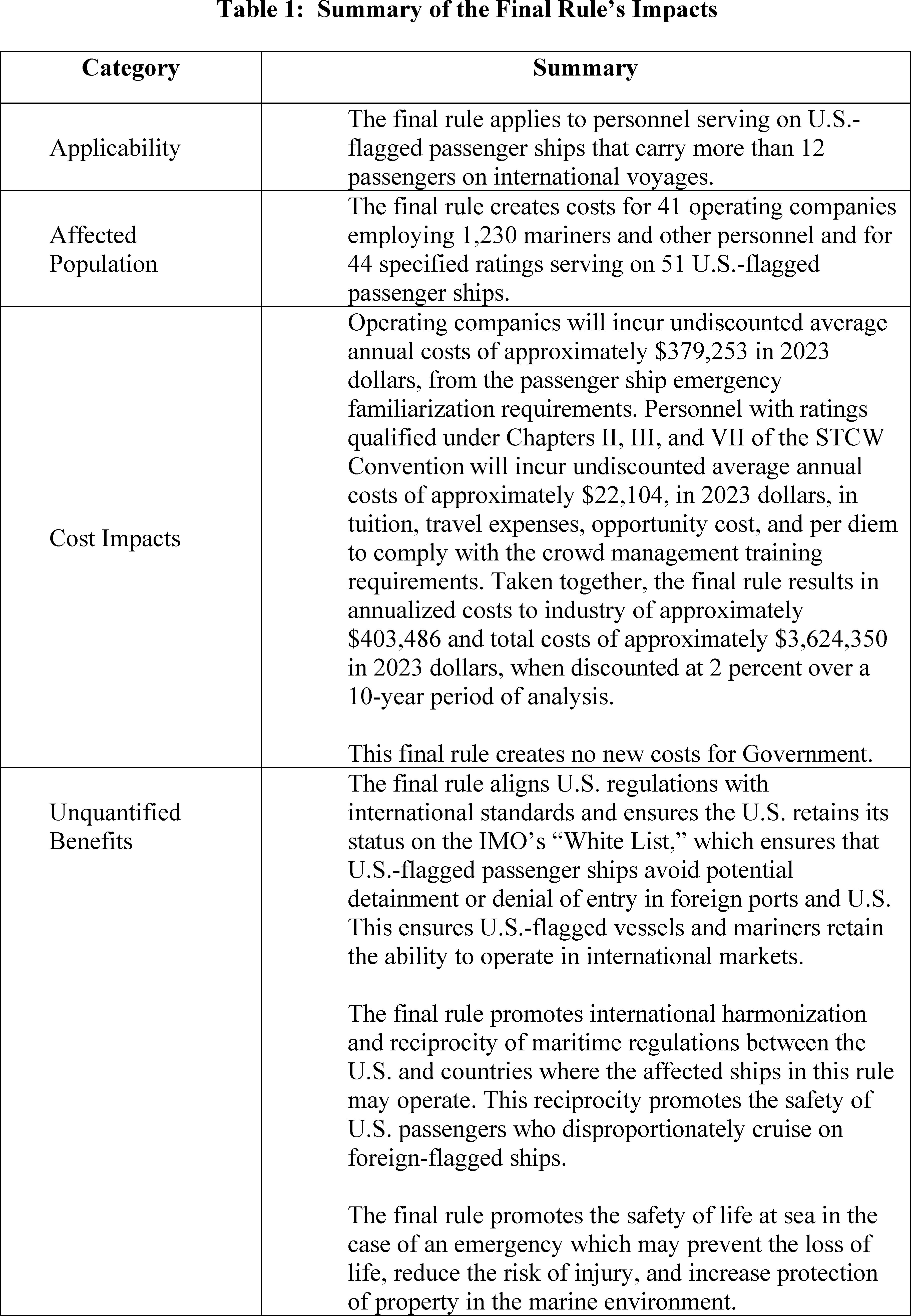
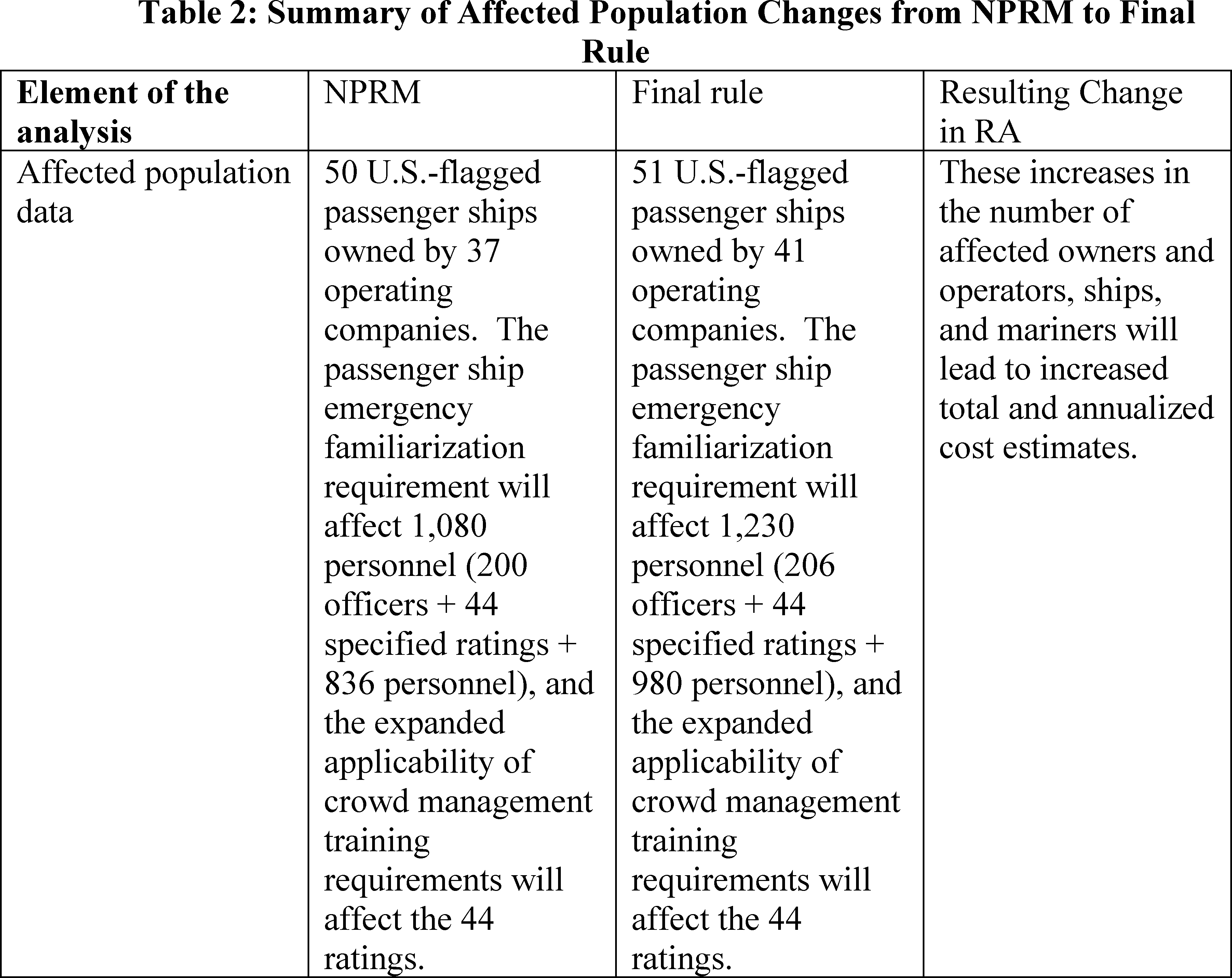
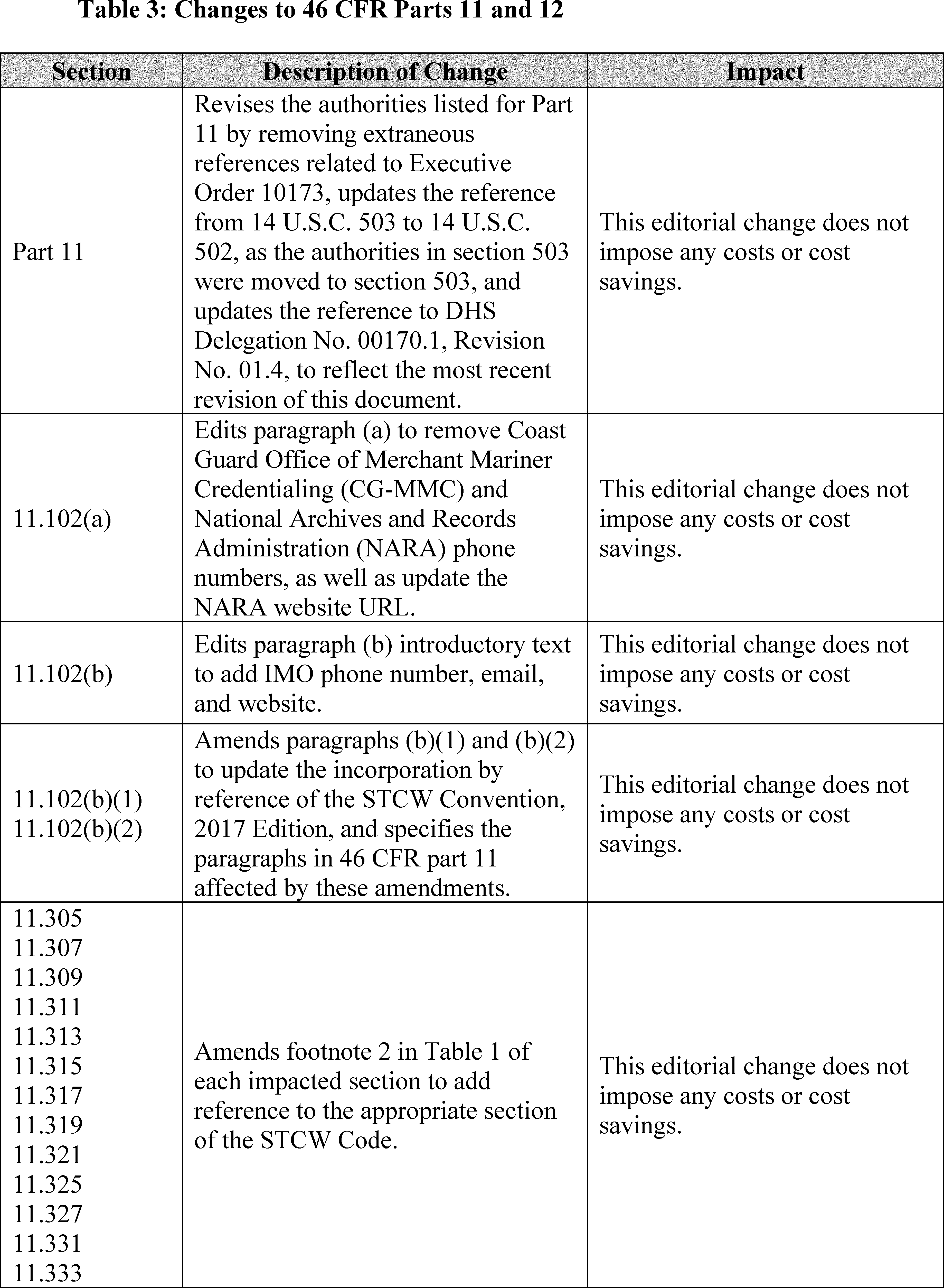
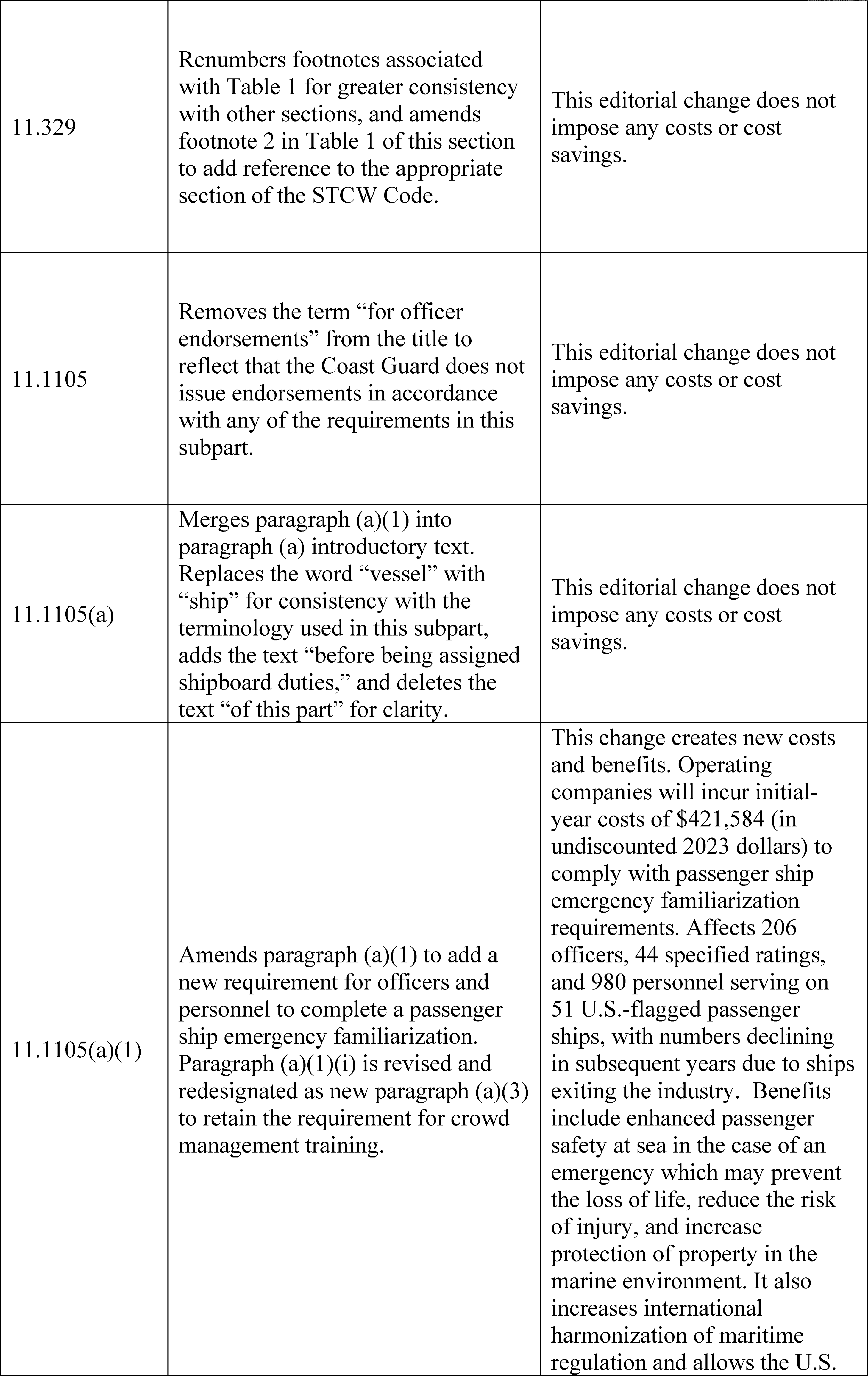
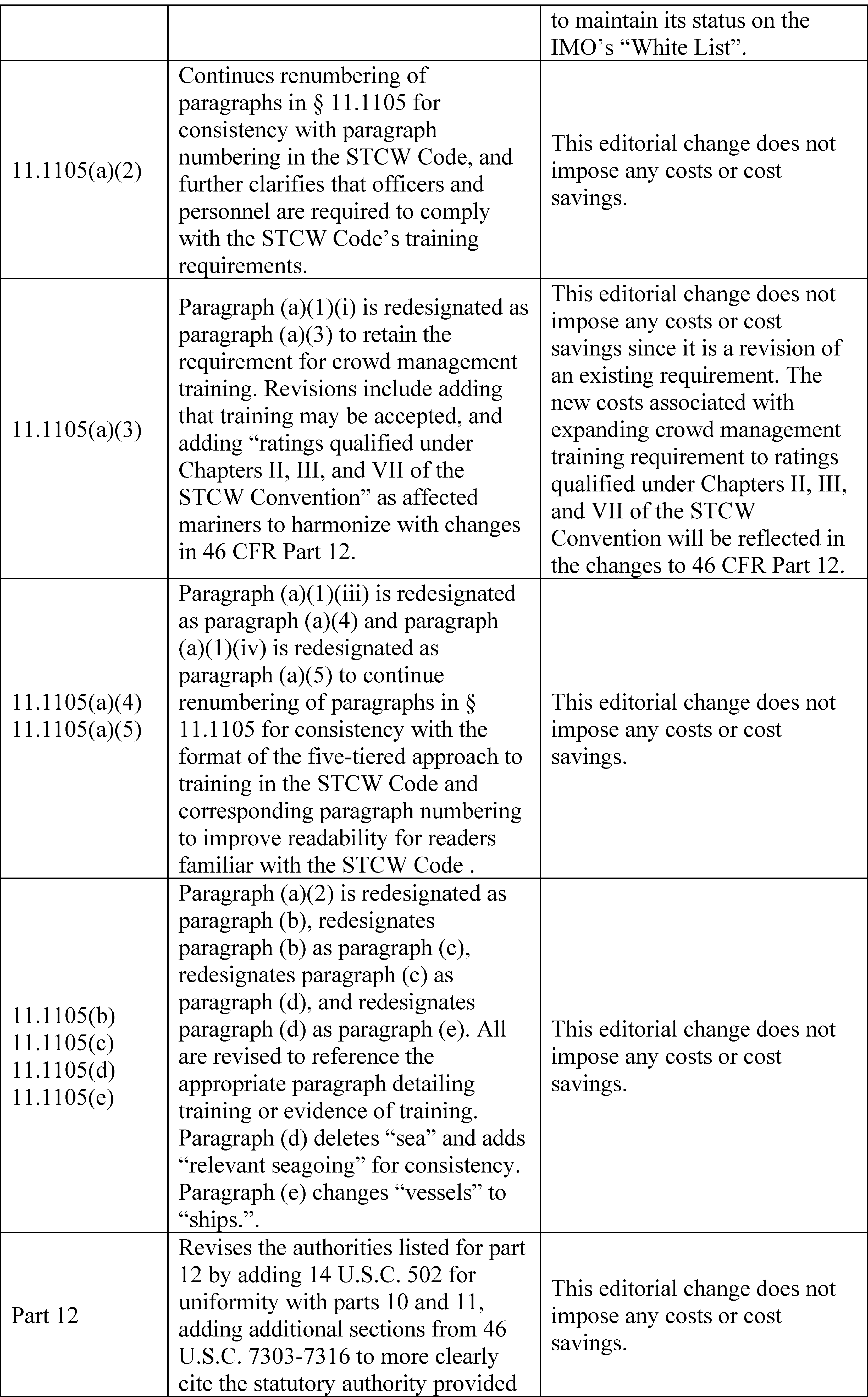
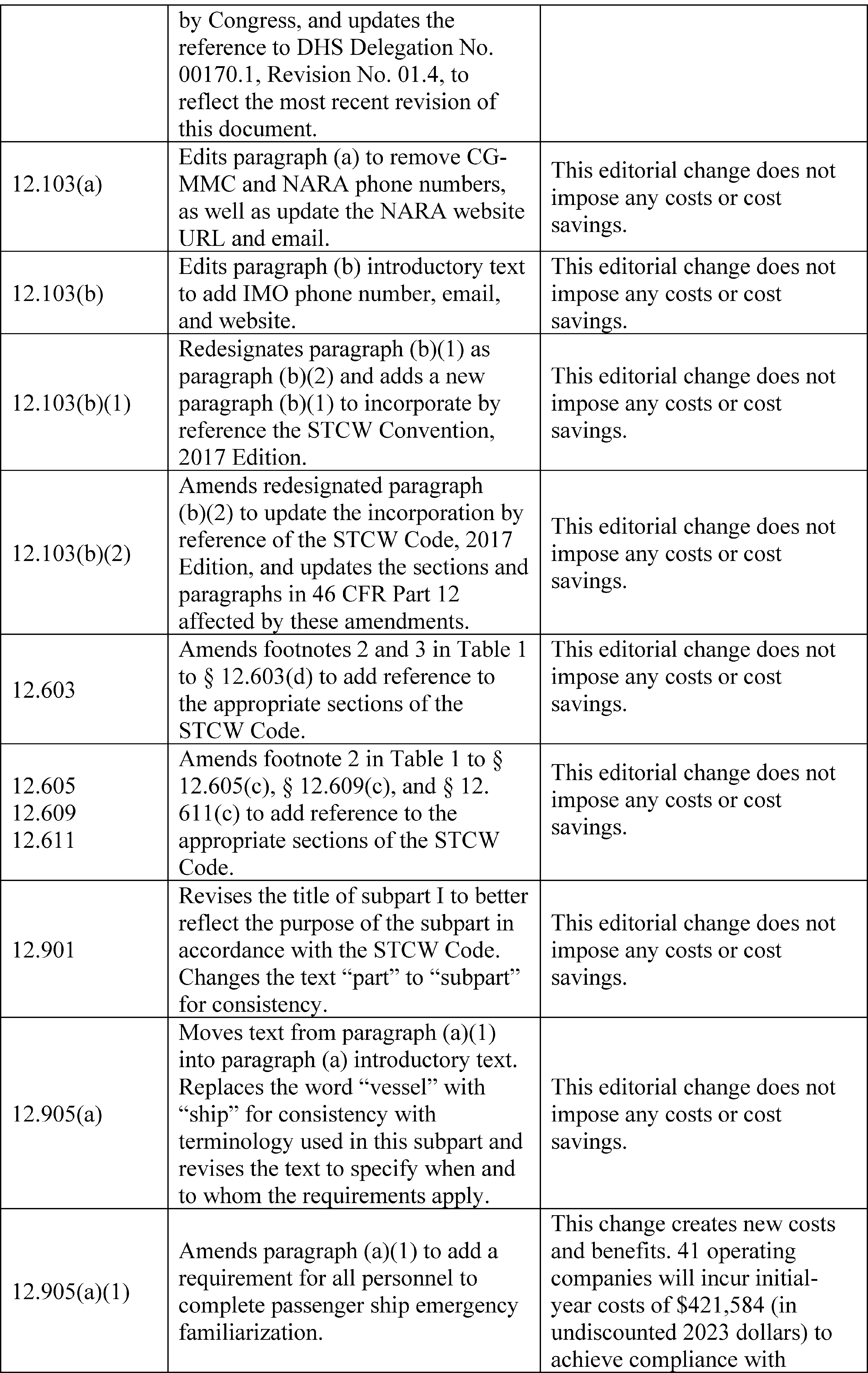
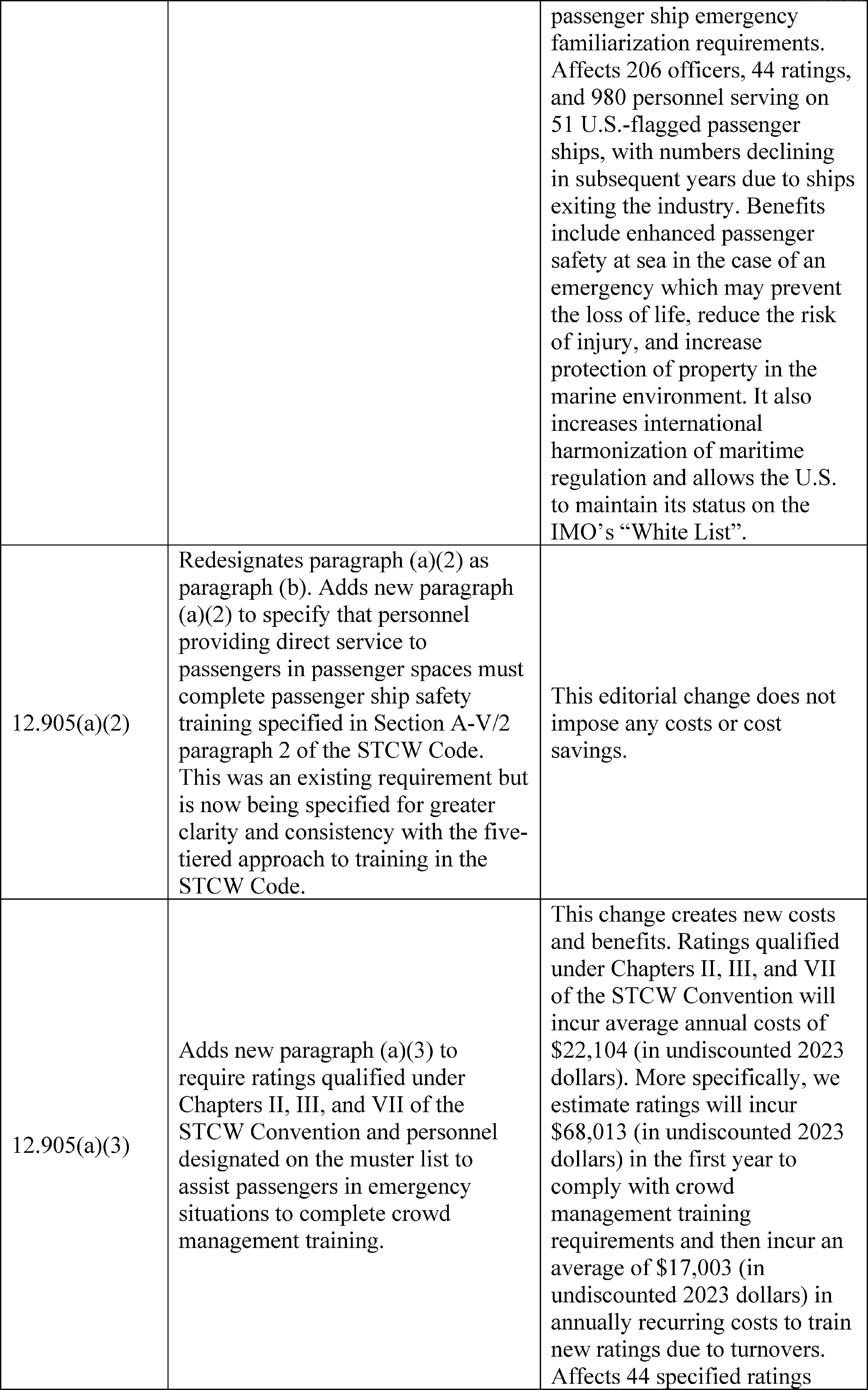
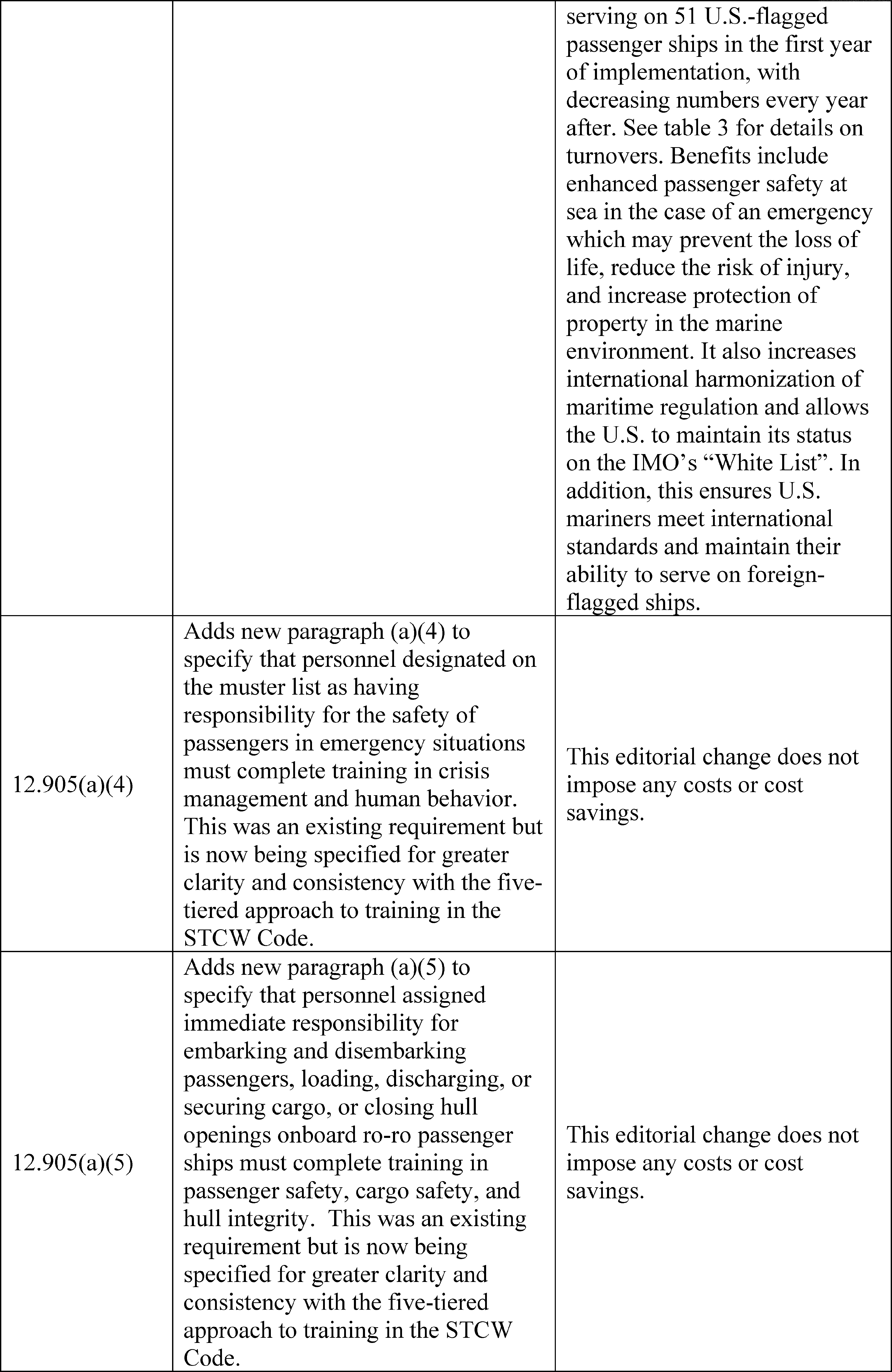
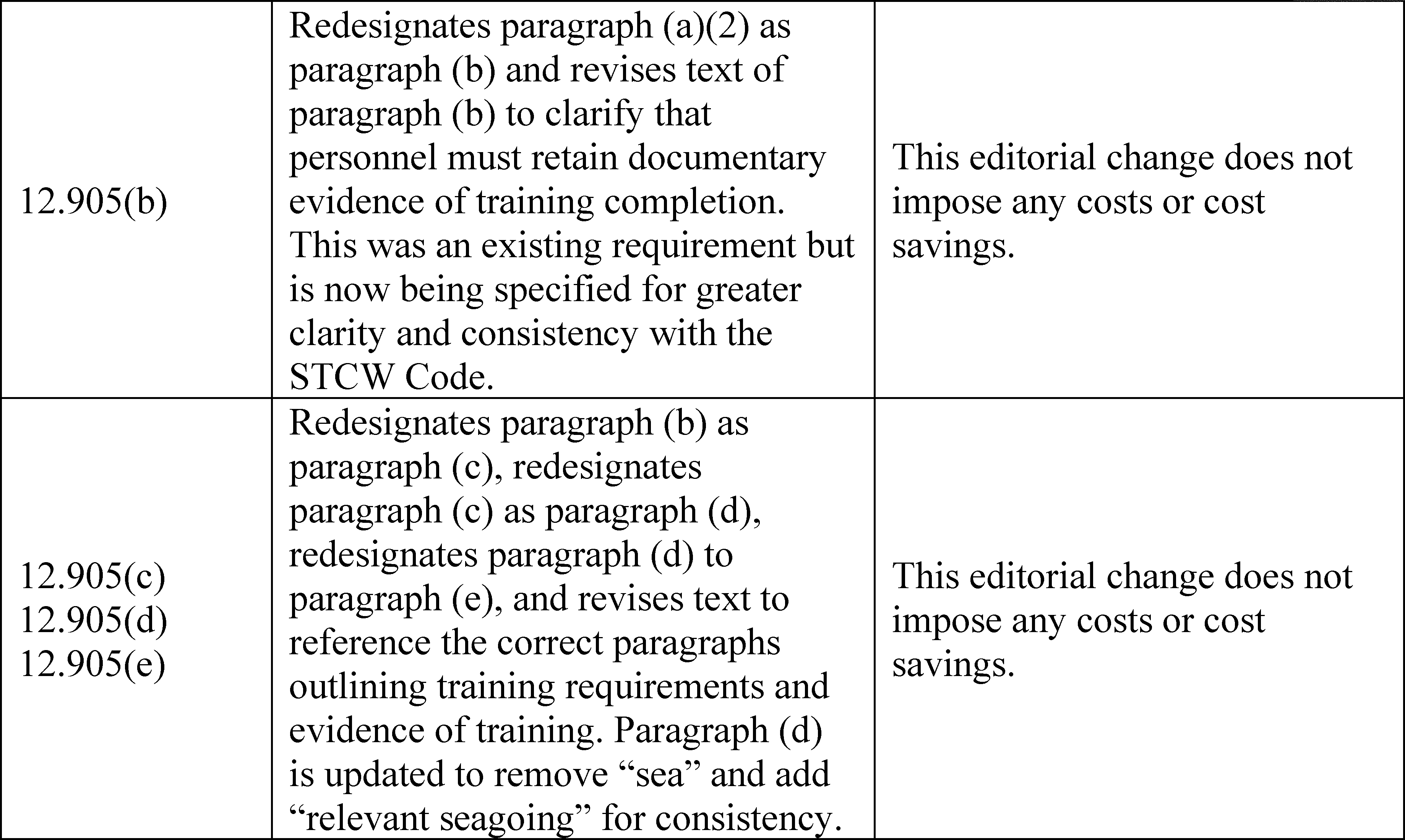
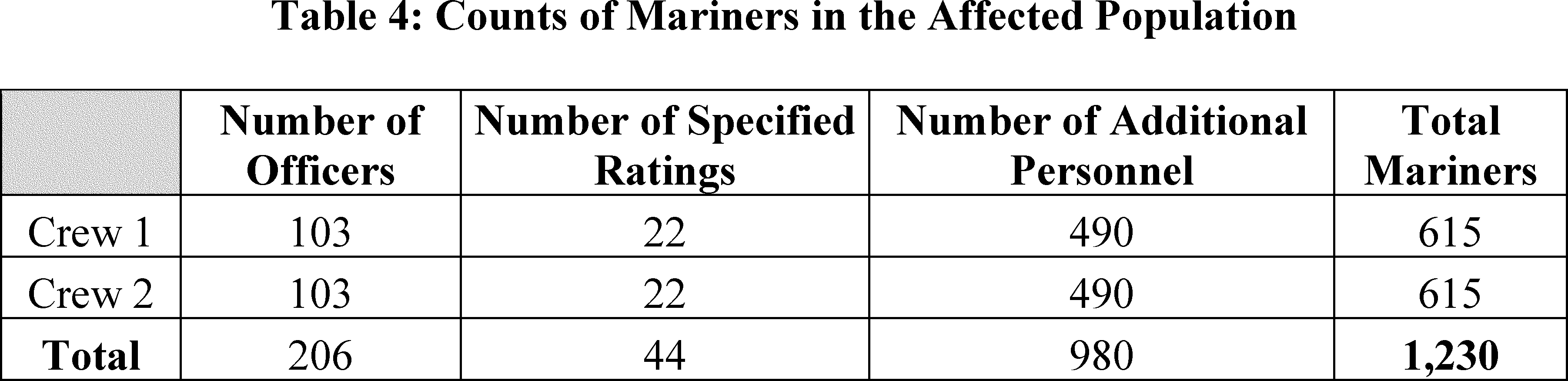
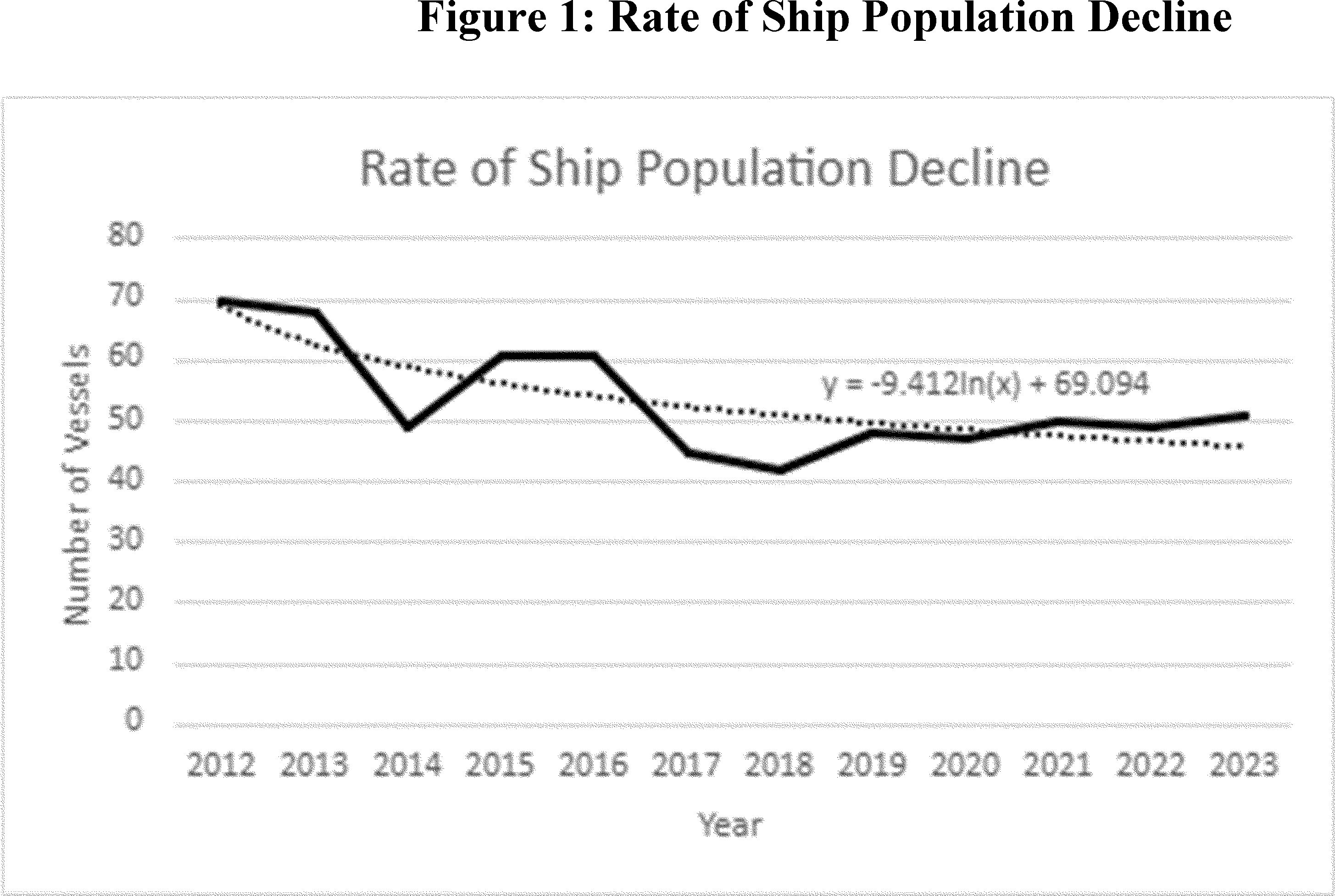
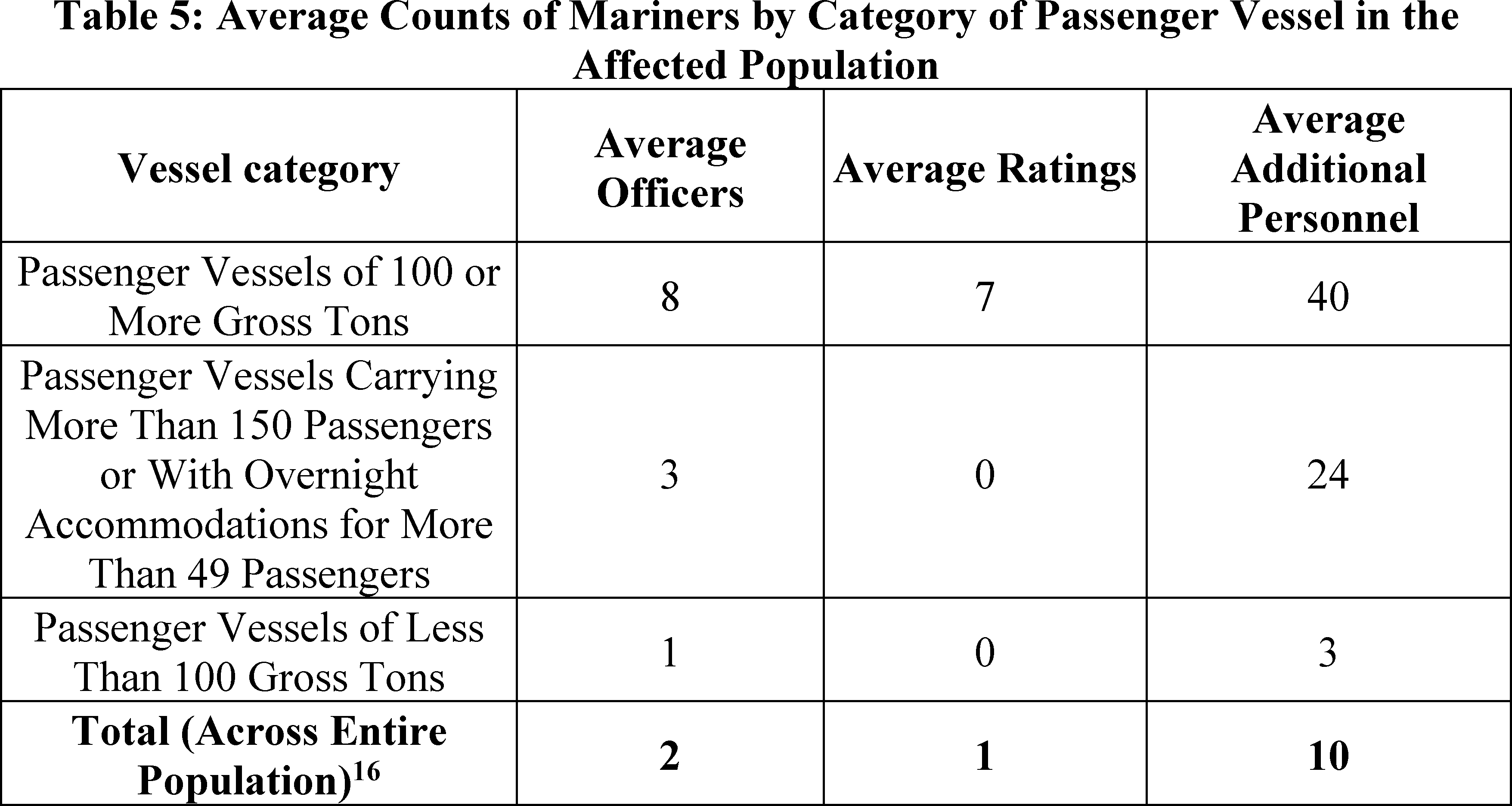
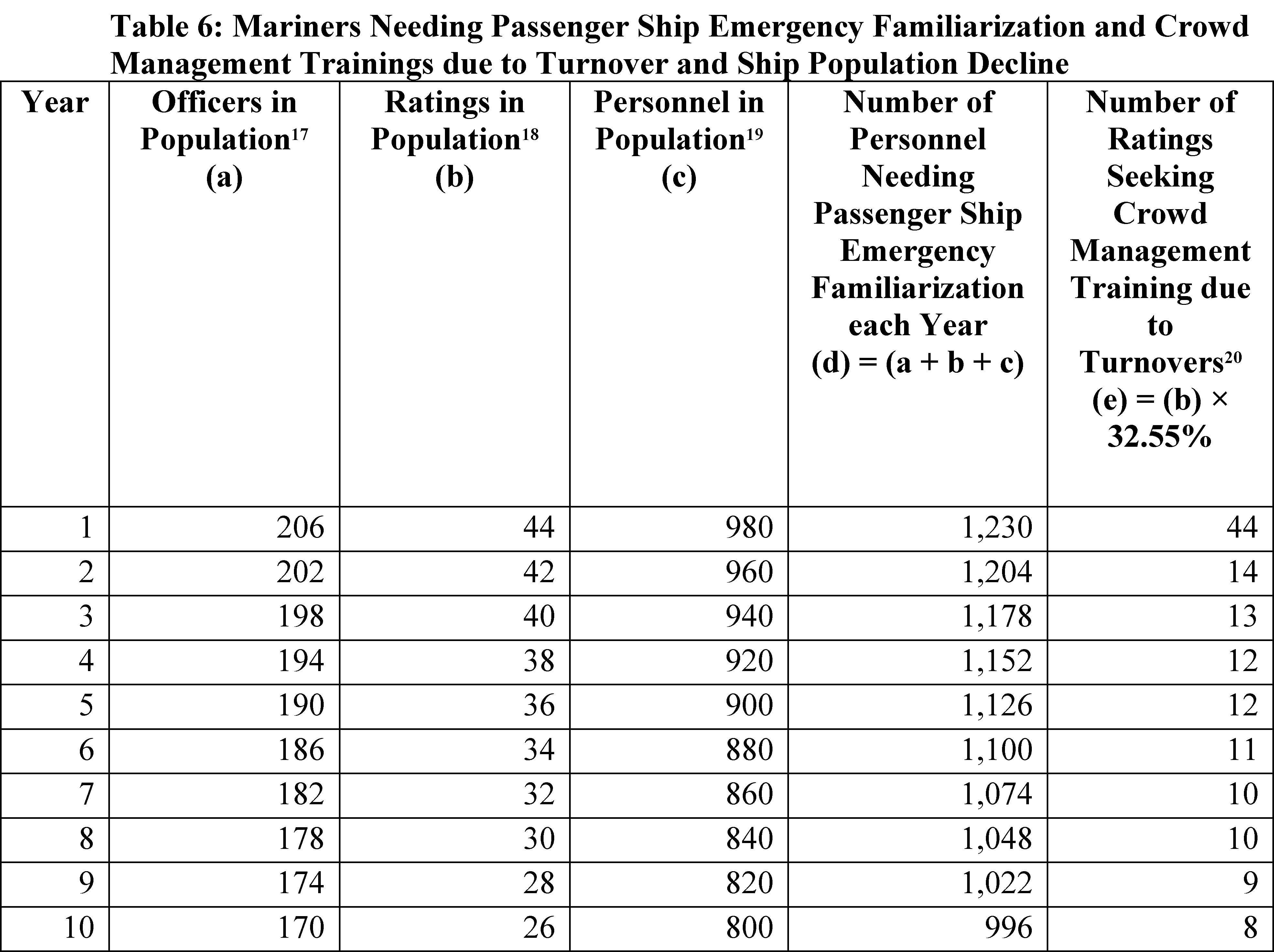
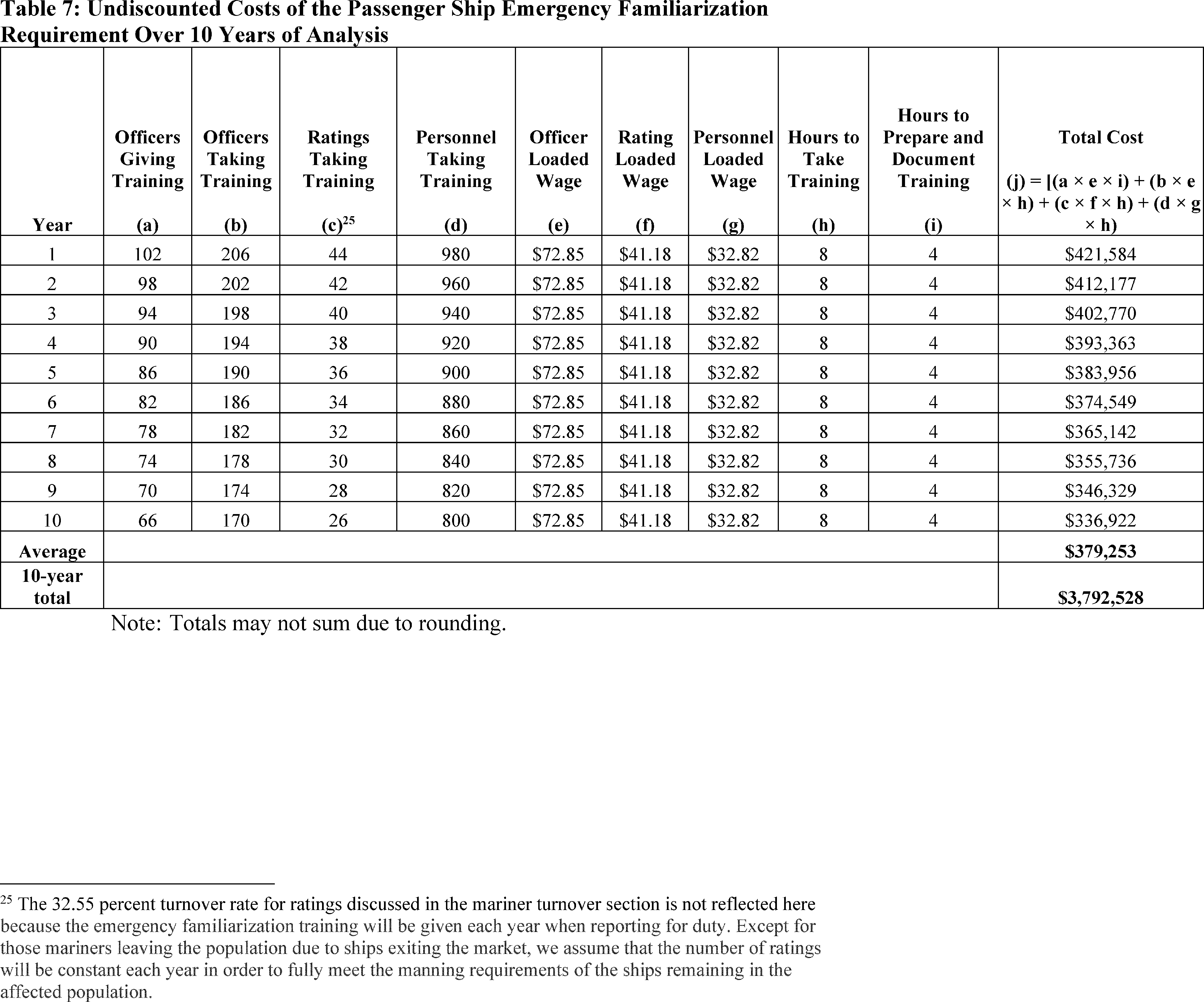
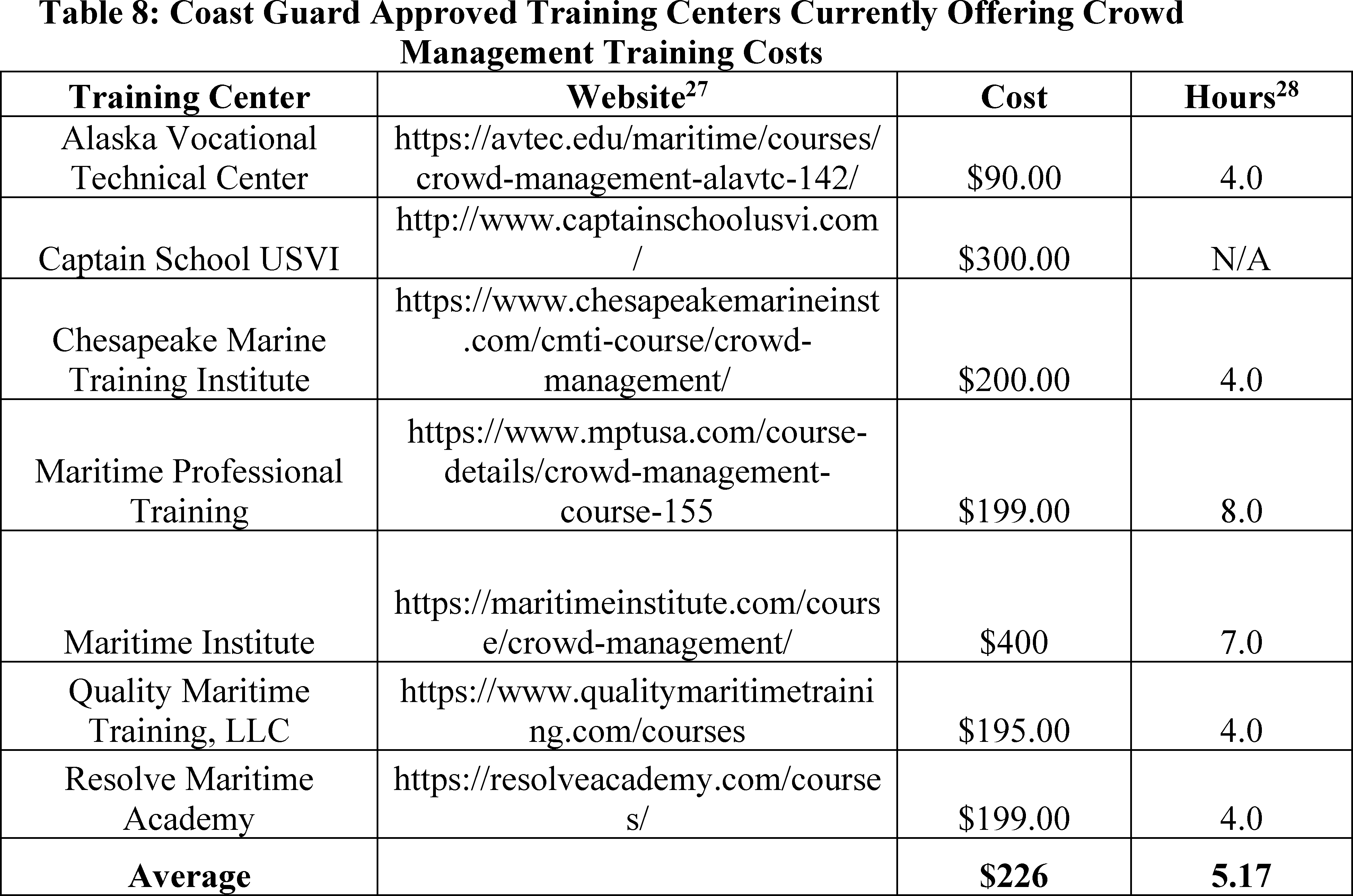
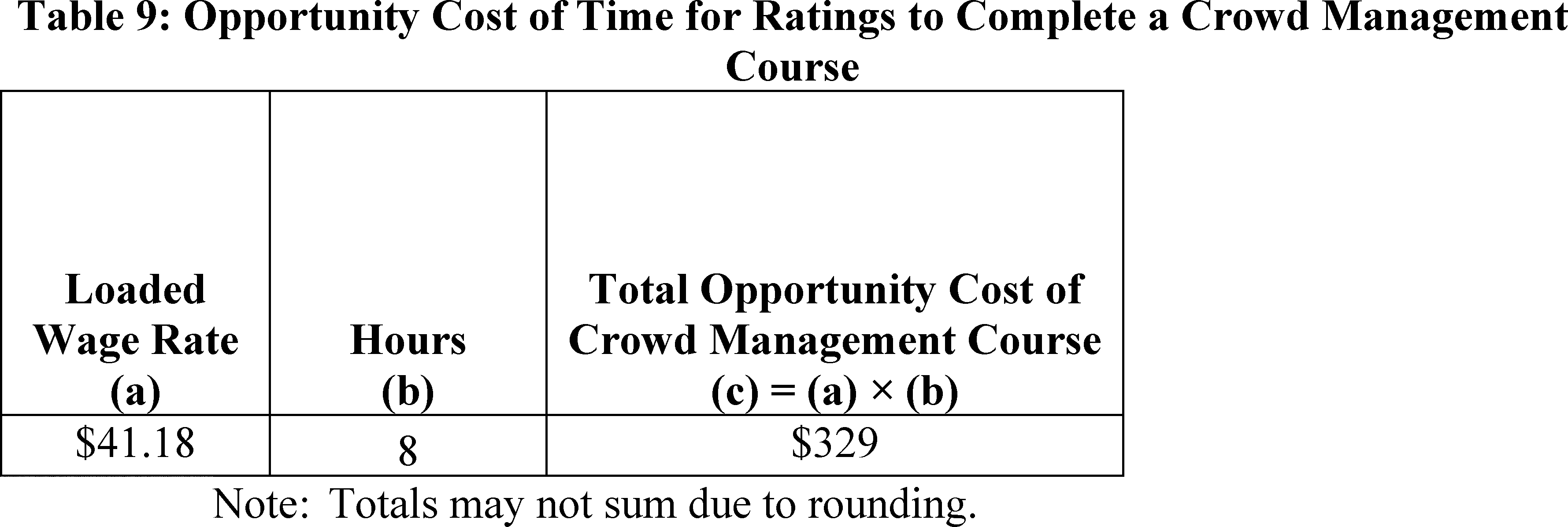
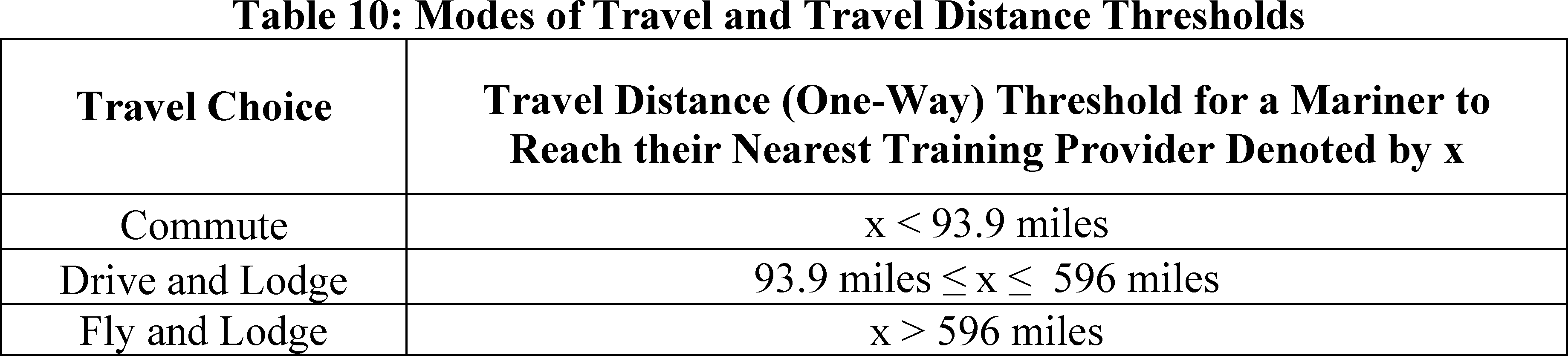
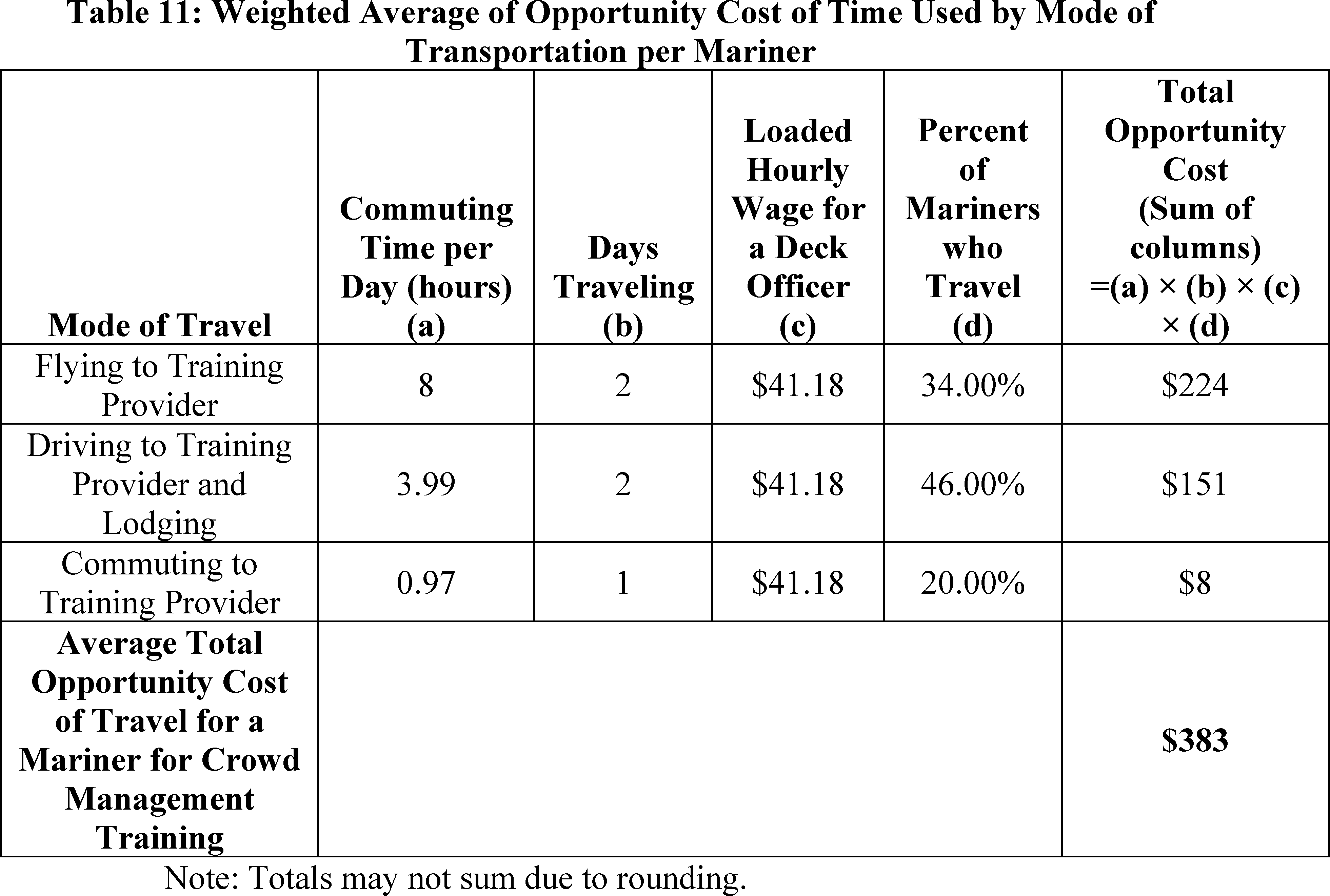
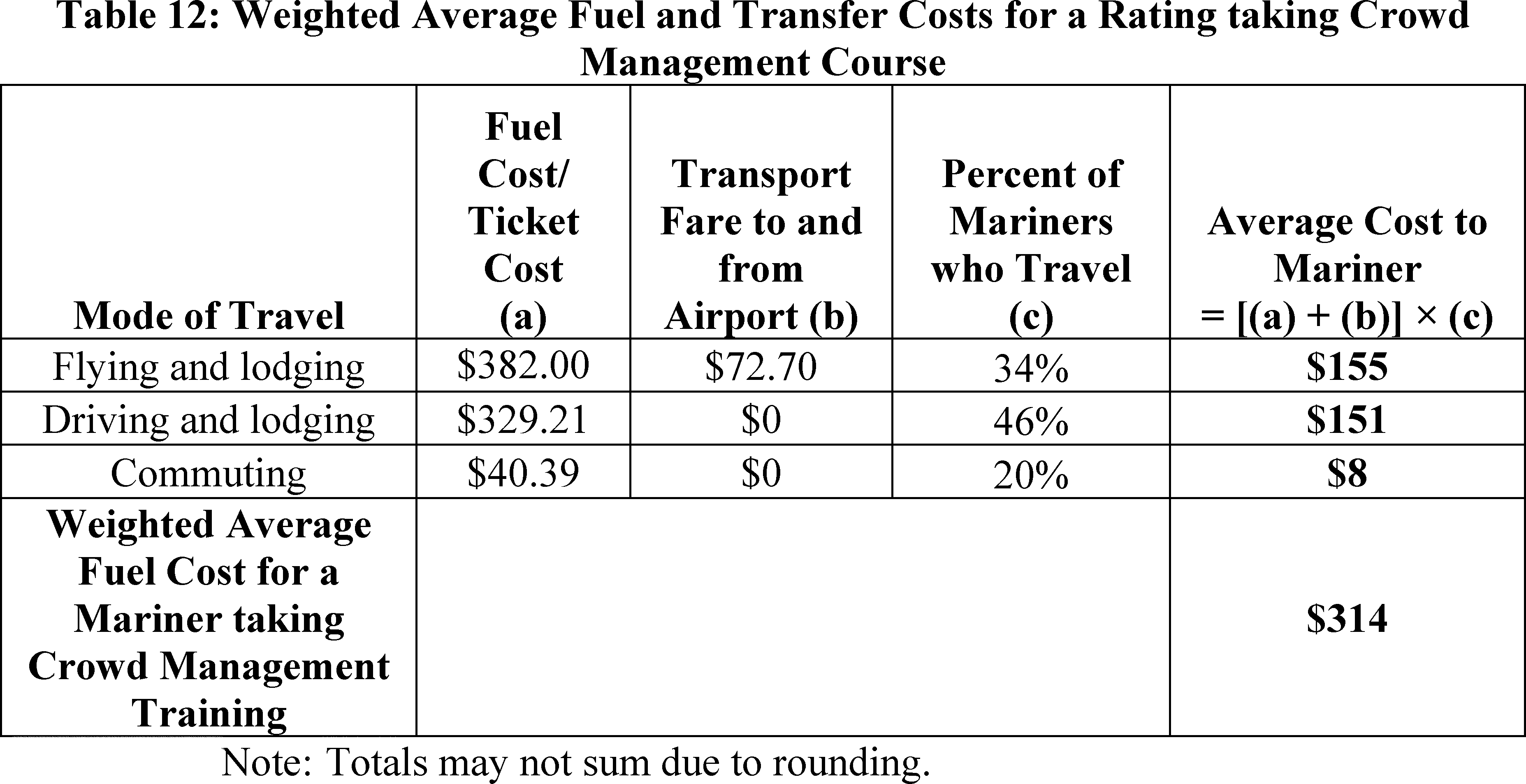
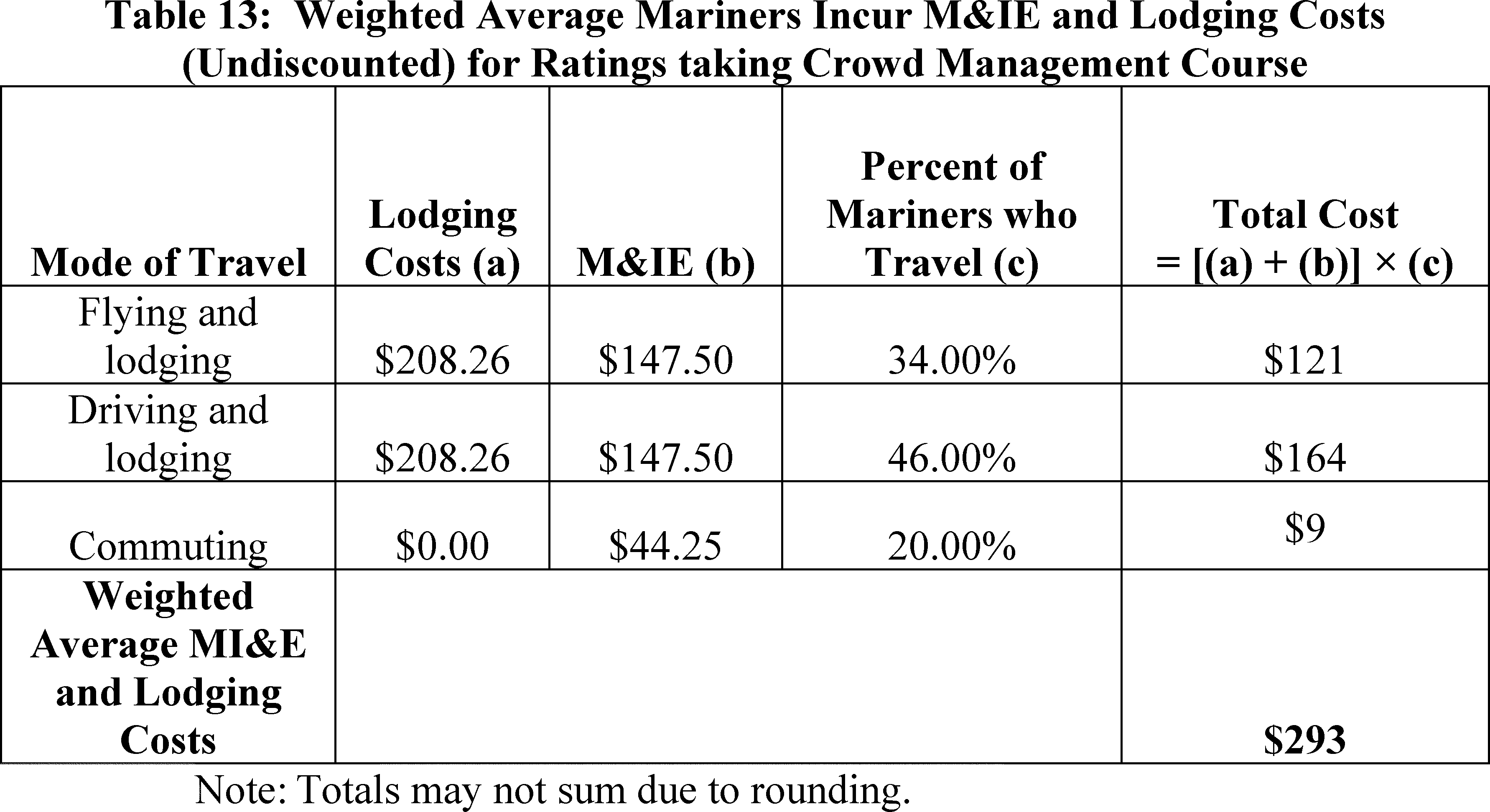
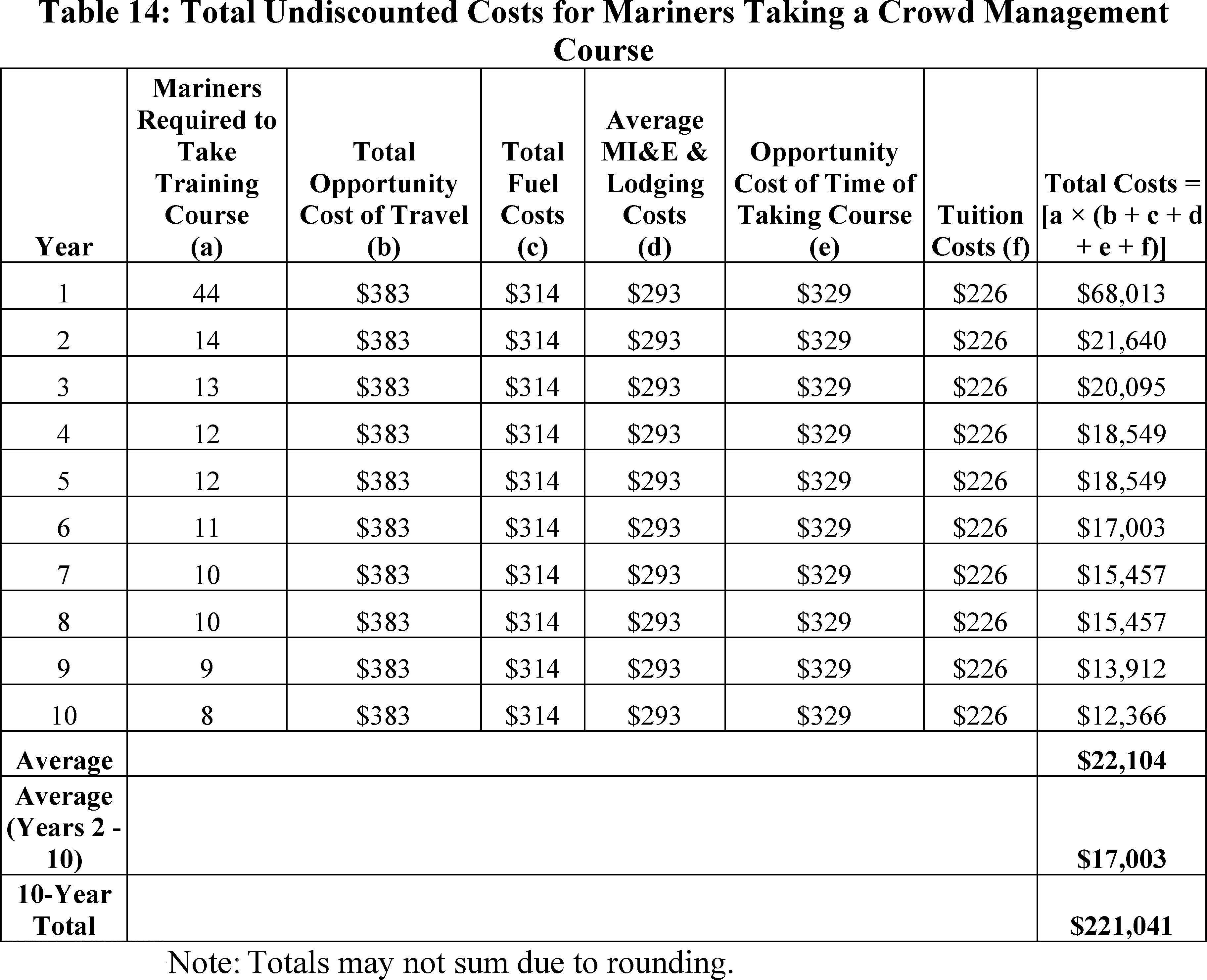
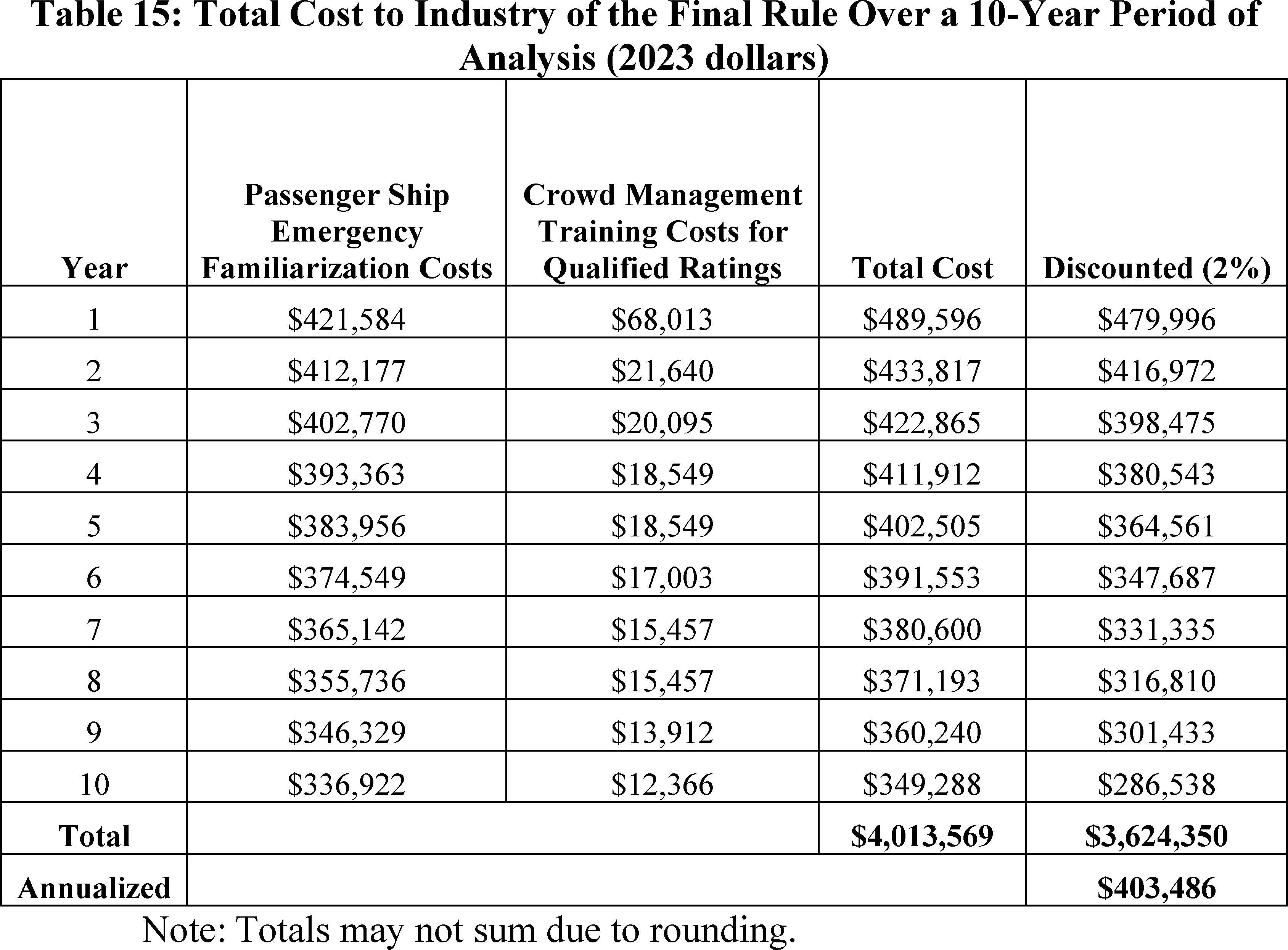
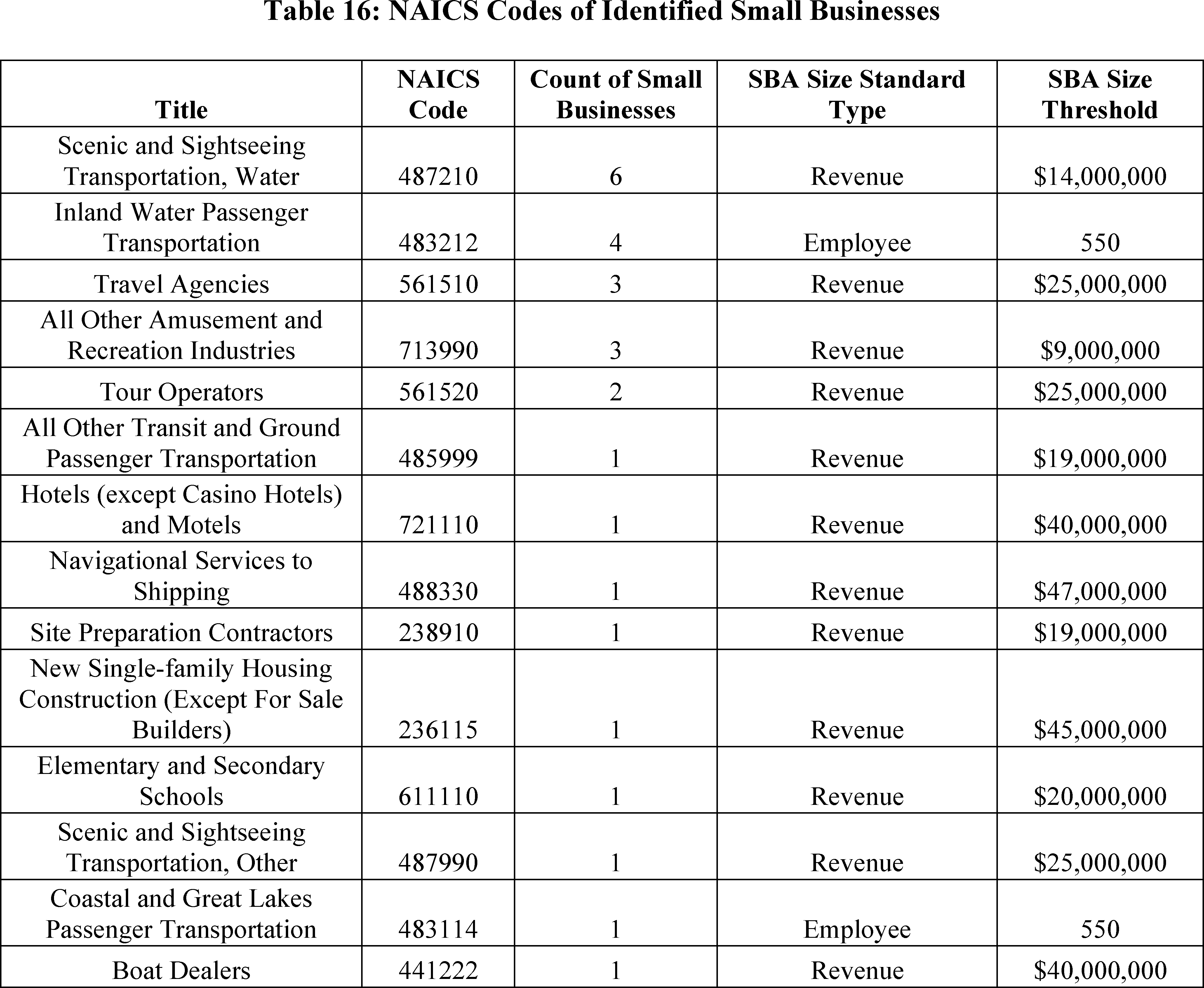
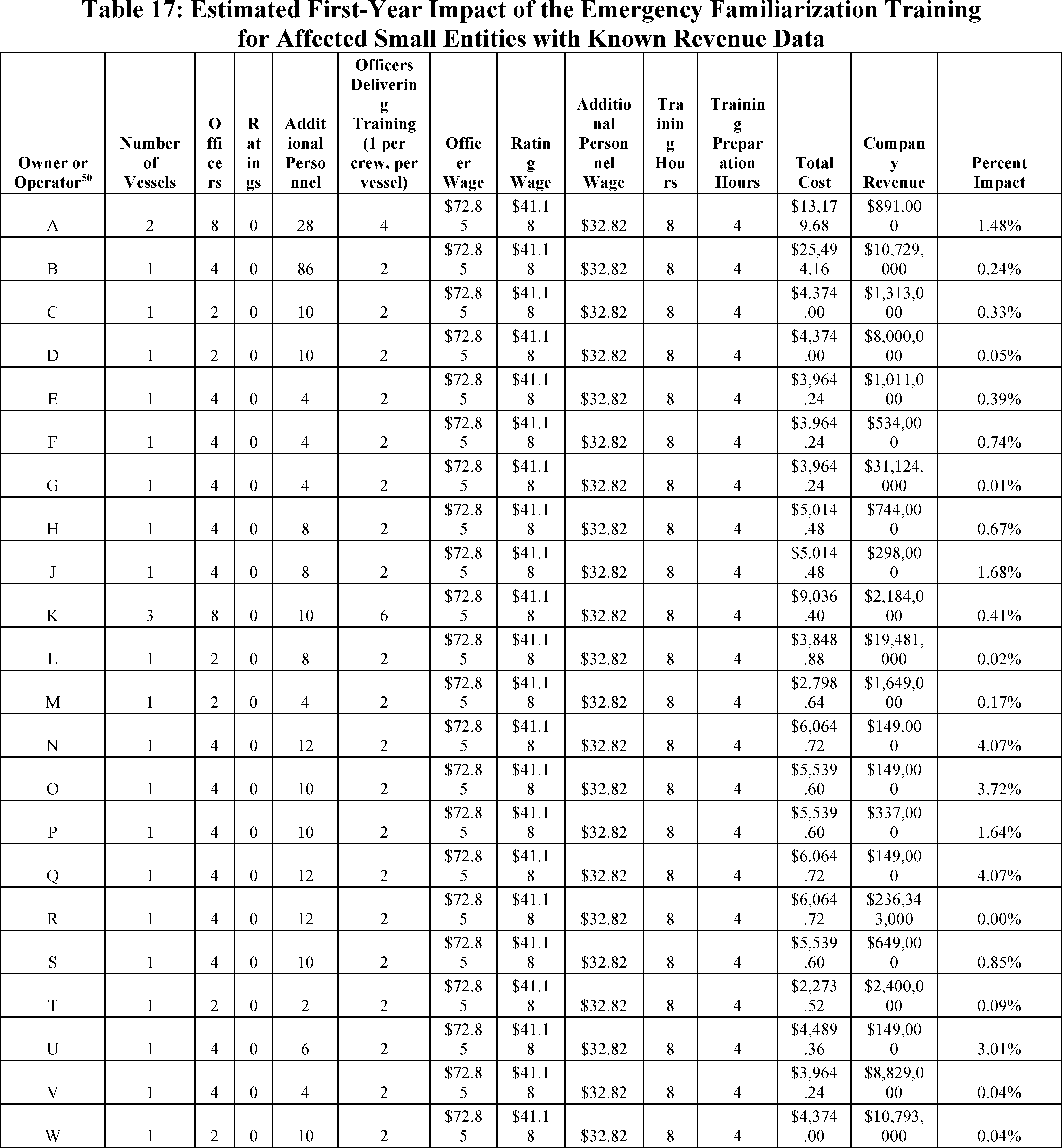
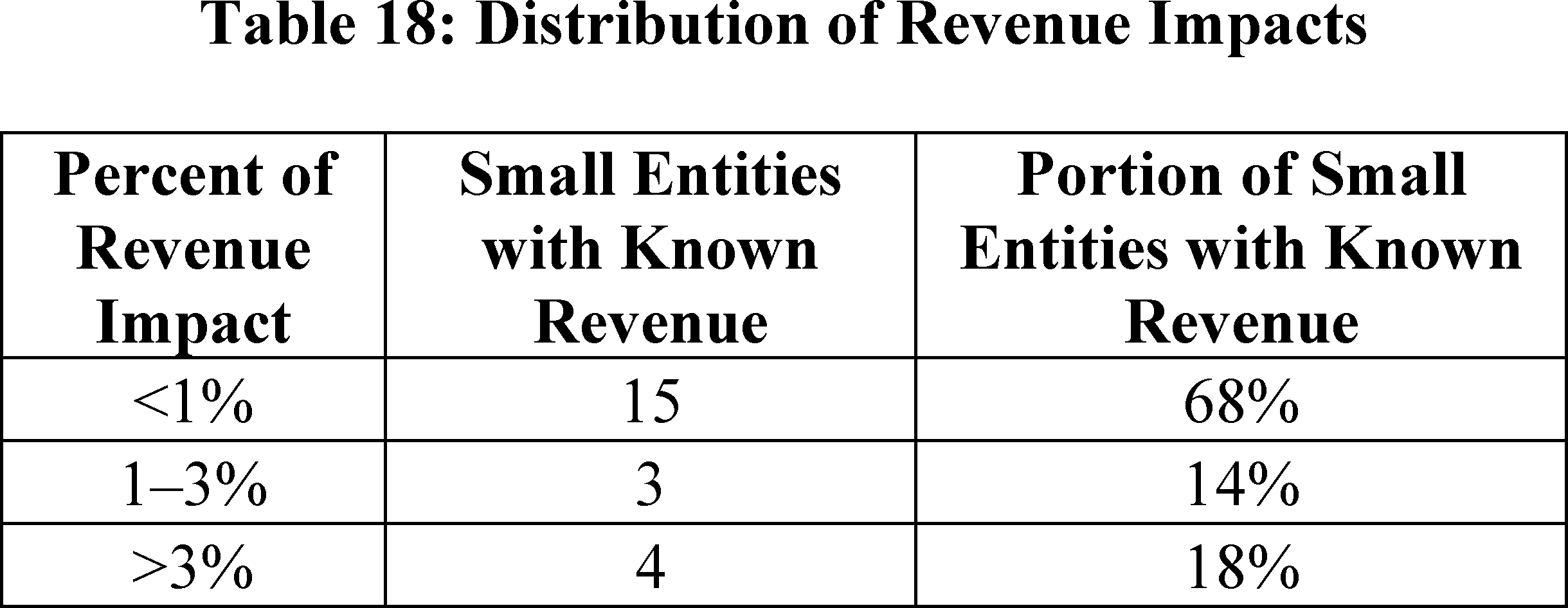
 www.archives.gov/federal-register/CFR/IBR-locations
 www.imo.org
 www.bls.gov/oes/2023/may/oes535021.htm
 transportation.org/traveltrends/commuting-in-america/brief-13-11-commuting-departure-time-and-trip-time/
 www.census.gov/programs-surveys/acs/about.html
 rosap.ntl.bts.gov/view/dot/35961
 www.bts.gov/content/average-length-haul-domestic-freight-and-passenger-modes-miles
 www.gsa.gov/travel/plan-book/transportation-airfare-rates-pov-rates/privately-owned-vehicle-pov-rates/pov-mileage-rates-archived
 fred.stlouisfed.org/series/GDPDEF
 www.hvs.com/article/9749-2023-HVS-Lodging-Tax-Report-USA
 www.transportes.gob.es/recursos_mfom/2012costaconcordia.pdf
 www.transportation.gov/office-policy/transportation-policy/revised-departmental-guidance-on-valuation-of-a-statistical-life-in-economic-analysis
 www.whitehouse.gov/wp-content/uploads/2025/08/CircularA-4.pdf
 www.sba.gov/sites/default/files/2023-06/Table%20of%20Size%20Standards_Effective%20March%2017%2C%202023%20%282%29.pdf