Securities and Exchange Commission
- [Release No. 34-106488; File No. SR-NASDAQ-2026-077]
Pursuant to Section 19(b)(1) of the Securities Exchange Act of 1934 (“Act”),[1] and Rule 19b-4 thereunder,[2] notice is hereby given that on September 14, 2026, The Nasdaq Stock Market LLC (“Nasdaq” or “Exchange”) filed with the Securities and Exchange Commission (“SEC” or “Commission”) the proposed rule change as described in Items I, II, and III below, which Items have been prepared by the Exchange. The Commission is publishing this notice to solicit comments on the proposed rule change from interested persons.
I. Self-Regulatory Organization's Statement of the Terms of Substance of the Proposed Rule Change
The Exchange proposes to amend Exchange Rule General 8 to establish fees for Liquid-Cooled Cabinets installation, Liquid-Cooled Cabinet Power Installation and Liquid-Cooled Cabinet Power in the Exchange's expanded data center. While these amendments are immediately effective, the Exchange proposes to implement the proposed fees during the fourth calendar quarter (“Q4”) of 2026. The Exchange will notify customers of the implementation date by Trader Alert.
The text of the proposed rule change is available on the Exchange's website at listingcenter.nasdaq.com/rulebook/nasdaq/rulefilings, and at the principal office of the Exchange.
 listingcenter.nasdaq.com/rulebook/nasdaq/rulefilings
II. Self-Regulatory Organization's Statement of the Purpose of, and Statutory Basis for, the Proposed Rule Change
In its filing with the Commission, the Exchange included statements concerning the purpose of and basis for the proposed rule change and discussed any comments it received on the proposed rule change. The text of these statements may be examined at the places specified in Item IV below. The Exchange has prepared summaries, set forth in sections A, B, and C below, of the most significant aspects of such statements.
A. Self-Regulatory Organization's Statement of the Purpose of, and Statutory Basis for, the Proposed Rule Change
1. Purpose
The Exchange's current data center in Carteret, New Jersey, consists of the original data center, also known as “NY11,” and expansion areas NY11-4 and NY11-5. The Exchange proposes to amend Rule General 8, Section 1 to establish fees for Liquid-Cooled Cabinets installation, Liquid-Cooled Cabinet Power Installation, and Liquid-Cooled Cabinet Power in NY11-5. The Exchange previously filed to expand its co-location services by offering Liquid-Cooled Cabinets in NY11-5.[3] In that filing, the Exchange stated that it would submit a separate fee filing to establish fees for those services. This proposed rule change establishes those fees.
Currently, co-location customers have the option of obtaining a cabinet capable of accommodating varying power options. Co-location customers may obtain a Cabinet and choose among varying power options as provided under Rule General 8, Section 1. In an earlier proposal, the Exchange introduced an additional cabinet option in NY11-5. Specifically, the Exchange introduced a cabinet featuring liquid cooling, a cooling method that uses liquid, rather than air, to absorb and transfer heat away from equipment, such as servers (“Liquid-Cooled Cabinet”). Depending on business needs of data center customers, a Liquid-Cooled Cabinet might be more attractive to data center customers because liquid cooling is more efficient and enables space optimization in ways that air cooling methods would struggle to support. For example, a Liquid-Cooled Cabinet could handle greater power densities within a given space than ( printed page 61546) would air cooling. For data center customers, this translates into the ability to deploy more computing power within the same cabinet footprint. In effect, Liquid-Cooled Cabinets allow data center customers to install more of the computing equipment that data center customers typically use within their cabinet than they would with air cooling methods because liquid cooling is more efficient at dissipating heat from a given cabinet space. The Exchange notes that data center customers prefer denser environments to minimize distance between equipment and thus maximize computing power within a given space. The Liquid-Cooled Cabinet option is only offered in NY11-5 because the required liquid-cooled infrastructure necessary to support the proposed cabinets is not available in other parts of the data center. The Exchange notes that Liquid-Cooled Cabinets are offered as one other option for data center customers to choose from because traditionally cooled cabinets throughout the data center will continue to provide the level of thermal management appropriate for each cabinet offering that the Exchange provides.
As discussed above, the Exchange is offering the Liquid-Cooled Cabinets as a convenience to its customers and notes that use of co-location services, including the proposed Liquid-Cooled Cabinet service, is completely optional. Liquid-Cooled Cabinets are an optional premium co-location offering designed to support customer equipment with enhanced cooling capabilities. Co-location services, including the proposed offering, are voluntary, and each customer may determine whether any co-location option is appropriate for its business needs.
The Exchange proposes to establish separate installation fees for Liquid-Cooled Cabinets under Rule General 8, Section 1(a). Customers may elect to use a Nasdaq-provided Liquid-Cooled Cabinet or, unlike traditional air-cooled cabinets that must be Nasdaq-provided, may supply their own Liquid-Cooled Cabinet for use within the dedicated liquid-cooling enclosure in NY11-5. For a Nasdaq-provided Liquid-Cooled Cabinet, the Exchange proposes to assess an installation fee of $5,490 and no ongoing monthly fee. The proposed $5,490 installation fee is the same NY11-4/-5 installation fee currently applicable to a standard Cabinet under Rule General 8, Section 1(a). For a customer-provided Liquid-Cooled Cabinet, the Exchange proposes to assess an installation fee of $2,500 and no ongoing monthly fee.
Providing both options is appropriate because the Liquid-Cooled Cabinet offering is purpose-built for the customer within a dedicated enclosure specifically designed to support the customer's liquid-cooling infrastructure requirements. Depending on the customer's particular equipment and infrastructure needs, a customer-provided cabinet may be more appropriate, while other customers may prefer the convenience of a Nasdaq-provided cabinet. The proposed customer-provided cabinet installation fee reflects the separate installation work associated with permitting the customer to use its own Liquid-Cooled Cabinet within the dedicated NY11-5 liquid-cooling environment, while the proposed Nasdaq-provided cabinet installation fee reflects the furnishing and installation of a Nasdaq-provided Liquid-Cooled Cabinet. Unlike the installation of a traditional air-cooled cabinet, installation of a Liquid-Cooled Cabinet involves specialized infrastructure within the dedicated NY11-5 liquid-cooling environment and additional coordination to support the customer's liquid-cooling requirements.
The Exchange also proposes to establish installation and ongoing monthly fees for Liquid-Cooled Cabinet Power as follows.
Liquid-Cooled Cabinet Power would be available only in connection with Liquid-Cooled Cabinets in NY11-5 and would be subject to a one-year, two-year, or three-year commitment, as selected by the customer. The installation fee for Liquid-Cooled Cabinet Power would consist of the applicable standard NY11-4/-5 cabinet power installation fee, as set forth in Rule General 8, Section 1(c), plus an additional per-kVA [4] Liquid-Cooled Cabinet Power installation charge. The additional per-kVA installation charge would be $1,800 per kVA for a one-year commitment, $1,650 per kVA for a two-year commitment, and $1,500 per kVA for a three-year commitment. The ongoing monthly fee would be assessed per kVA based on the customer's selected commitment term: $1,000 per kVA per month for a one-year commitment, $900 per kVA per month for a two-year commitment, and $800 per kVA per month for a three-year commitment.
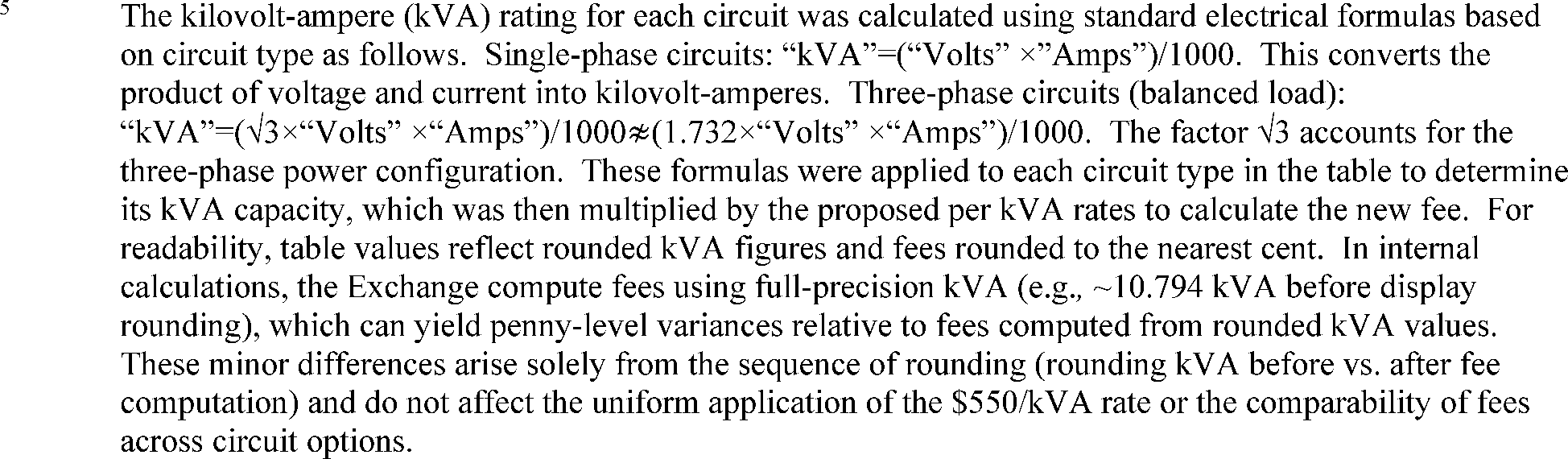
The Exchange calculates the amount of power associated with each Liquid-Cooled Cabinet Power option using the same general power-based methodology reflected in its existing cabinet power fee schedule. For single-phase power options, the Exchange calculates kVA by multiplying volts by amps and dividing by 1,000. For three-phase power options, the Exchange calculates kVA by multiplying volts by amps by the square root of three,
( printed page 61547)and then dividing by 1,000.5
For the Single Phase 240 Volt 20 Amp option, the Exchange calculates the associated kVA as 240 volts multiplied by 20 amps, divided by 1,000, which equals 4.80 kVA.
The ongoing monthly fee is calculated by multiplying 4.80 kVA by the applicable monthly per-kVA rate. Accordingly, the proposed ongoing monthly fee would be $4,800 for a one-year commitment, $4,320 for a two-year commitment, and $3,840 for a three-year commitment. The installation fee is calculated by adding the applicable $3,600 standard NY11-4/-5 installation fee to the additional per-kVA Liquid-Cooled Cabinet Power installation charge. Accordingly, the proposed installation fee would be $12,240 for a one-year commitment, calculated as $3,600 plus 4.80 kVA multiplied by $1,800; $11,520 for a two-year commitment, calculated as $3,600 plus 4.80 kVA multiplied by $1,650; and $10,800 for a three-year commitment, calculated as $3,600 plus 4.80 kVA multiplied by $1,500.
For the Single Phase 240 Volt 32 Amp option, the Exchange calculates the associated kVA as 240 volts multiplied by 32 amps, divided by 1,000, which equals 7.68 kVA. The ongoing monthly fee is calculated by multiplying 7.68 kVA by the applicable monthly per-kVA rate. Accordingly, the proposed ongoing monthly fee would be $7,680 for a one-year commitment, $6,912 for a two-year commitment, and $6,144 for a three-year commitment. The installation fee is calculated by adding the applicable $3,600 standard NY11-4/-5 installation fee to the additional per-kVA Liquid-Cooled Cabinet Power installation charge. Accordingly, the proposed installation fee would be $17,424 for a one-year commitment, calculated as $3,600 plus 7.68 kVA multiplied by $1,800; $16,272 for a two-year commitment, calculated as $3,600 plus 7.68 kVA multiplied by $1,650; and $15,120 for a three-year commitment, calculated as $3,600 plus 7.68 kVA multiplied by $1,500.
For the Single Phase 240 Volt 40 Amp option, the Exchange calculates the associated kVA as 240 volts multiplied by 40 amps, divided by 1,000, which equals 9.60 kVA. The ongoing monthly fee is calculated by multiplying 9.60 kVA by the applicable monthly per-kVA rate. Accordingly, the proposed ongoing monthly fee would be $9,600 for a one-year commitment, $8,640 for a two-year commitment, and $7,680 for a three-year commitment. The installation fee is calculated by adding the applicable $3,600 standard NY11-4/-5 installation fee to the additional per-kVA Liquid-Cooled Cabinet Power installation charge. Accordingly, the proposed installation fee would be $20,880 for a one-year commitment, calculated as $3,600 plus 9.60 kVA multiplied by $1,800; $19,440 for a two-year commitment, calculated as $3,600 plus 9.60 kVA multiplied by $1,650; and $18,000 for a three-year commitment, calculated as $3,600 plus 9.60 kVA multiplied by $1,500.
For the 3 Phase 415 Volt 20 Amp option, the Exchange calculates the associated kVA as 415 volts multiplied by 20 amps multiplied by the square root of three, divided by 1,000, which equals approximately 14.38 kVA. The ongoing monthly fee is calculated by multiplying approximately 14.38 kVA by the applicable monthly per-kVA rate. Accordingly, the proposed ongoing monthly fee would be $14,375.60 for a one-year commitment, $12,938.04 for a two-year commitment, and $11,500.48 for a three-year commitment. The installation fee is calculated by adding the applicable $4,560 standard NY11-4/-5 installation fee to the additional per-kVA Liquid-Cooled Cabinet Power installation charge. Accordingly, the proposed installation fee would be $30,436.08 for a one-year commitment, calculated as $4,560 plus approximately 14.38 kVA multiplied by $1,800; $28,279.74 for a two-year commitment, calculated as $4,560 plus approximately 14.38 kVA multiplied by $1,650; and $26,123.40 for a three-year commitment, calculated as $4,560 plus approximately 14.38 kVA multiplied by $1,500.
For the 3 Phase 415 Volt 32 Amp option, the Exchange calculates the associated kVA as 415 volts multiplied by 32 amps multiplied by the square root of three, divided by 1,000, which equals approximately 23.00 kVA. The ongoing monthly fee is calculated by multiplying approximately 23.00 kVA by the applicable monthly per-kVA rate. Accordingly, the proposed ongoing monthly fee would be $23,000.96 for a one-year commitment, $20,700.86 for a two-year commitment, and $18,400.77 for a three-year commitment. The installation fee is calculated by adding the applicable $4,560 standard NY11-4/-5 installation fee to the additional per-kVA Liquid-Cooled Cabinet Power installation charge. Accordingly, the proposed installation fee would be $45,961.73 for a one-year commitment, calculated as $4,560 plus approximately 23.00 kVA multiplied by $1,800; $42,511.58 for a two-year commitment, calculated as $4,560 plus approximately 23.00 kVA multiplied by $1,650; and $39,061.44 for a three-year commitment, calculated as $4,560 plus approximately 23.00 kVA multiplied by $1,500.
For the 3 Phase 415 Volt 40 Amp option, the Exchange calculates the associated kVA as 415 volts multiplied by 40 amps multiplied by the square root of three, divided by 1,000, which equals approximately 28.75 kVA. The ongoing monthly fee is calculated by multiplying approximately 28.75 kVA by the applicable monthly per-kVA rate. Accordingly, the proposed ongoing monthly fee would be $28,751.20 for a one-year commitment, $25,876.08 for a two-year commitment, and $23,000.96 for a three-year commitment.
The installation fee is calculated by adding the applicable $4,560 standard NY11-4/-5 installation fee to the additional per-kVA Liquid-Cooled Cabinet Power installation charge. Accordingly, the proposed installation fee would be $56,312.16 for a one-year commitment, calculated as $4,560 plus approximately 28.75 kVA multiplied by $1,800; $51,999.48 for a two-year commitment, calculated as $4,560 plus approximately 28.75 kVA multiplied by $1,650; and $47,686.80 for a three-year commitment, calculated as $4,560 plus approximately 28.75 kVA multiplied by $1,500.
For the 3 Phase 415 Volt 60 Amp option, the Exchange calculates the associated kVA as 415 volts multiplied by 60 amps multiplied by the square root of three, divided by 1,000, which equals approximately 43.13 kVA. The ongoing monthly fee is calculated by multiplying approximately 43.13 kVA by the applicable monthly per-kVA rate. Accordingly, the proposed ongoing monthly fee would be $43,130 for a one-year commitment, $38,817 for a two-year commitment, and $34,504 for a three-year commitment. The installation fee is calculated by adding the applicable $4,560 standard NY11-4/-5 installation fee to the additional per-kVA Liquid-Cooled Cabinet Power installation charge. Accordingly, the proposed installation fee would be $82,194 for a one-year commitment, calculated as $4,560 plus approximately 43.13 kVA multiplied by $1,800; $75,724.50 for a two-year commitment, calculated as $4,560 plus approximately 43.13 kVA multiplied by $1,650; and $69,255 for a three-year commitment, calculated as $4,560 plus approximately 43.13 kVA multiplied by $1,500.
The proposed installation and ongoing monthly fees therefore scale with the amount of electrical capacity associated with the selected Liquid-Cooled Cabinet Power option and the length of the customer's selected commitment term. This structure applies the same calculation consistently across the available Liquid-Cooled Cabinet Power options while providing customers that elect longer commitment terms with lower per-kVA rates.
The Exchange proposes separate cabinet installation fees and tiered Liquid-Cooled Cabinet Power pricing to reflect the optional nature of the offering and the different services customers may elect. The proposed $5,490 installation fee for a Nasdaq-provided Liquid-Cooled Cabinet is consistent with the existing NY11-4/-5 installation fee for a standard Cabinet under Rule General 8, Section 1(a), and no ongoing monthly cabinet fee would apply. The proposed $2,500 installation fee for a customer-provided Liquid-Cooled Cabinet reflects the separate installation work associated with permitting the customer to use its own Liquid-Cooled Cabinet within the dedicated NY11-5 liquid-cooling environment, and no ongoing monthly cabinet fee would apply. The proposed tiered pricing for Liquid-Cooled Cabinet Power provides customers with lower effective rates for longer-term commitments, which supports the Exchange's continued investment in making this specialized optional offering available. The proposed fees are higher than the fees applicable to standard air-cooled cabinets and associated power because Liquid-Cooled Cabinets are a premium product that provide enhanced liquid-cooling functionality and require specialized infrastructure, shared cooling capacity, and additional operational support beyond those required for standard co-location cabinets. The Exchange believes that the proposed fees are designed to reflect the value of the enhanced functionality, specialized infrastructure, customer choice, and dedicated capacity associated with Liquid-Cooled Cabinets and Liquid-Cooled Cabinet Power, while helping to support the Exchange's continued investment in this optional premium offering.
The proposed Liquid-Cooled Cabinet offering is optional. Customers are not required to purchase Liquid-Cooled Cabinet installation, Liquid-Cooled Cabinet Power Installation or Liquid-Cooled Cabinet Power to connect to the Exchange, to maintain co-location services, or to access any Exchange system. Customers may continue to use existing cabinet and power offerings under Rule General 8, Section 1, as applicable. Customers that elect the Liquid-Cooled Cabinet offering may choose between a Nasdaq-provided Liquid-Cooled Cabinet and a customer-provided Liquid-Cooled Cabinet based on their business and infrastructure needs.
The Exchange is offering Liquid-Cooled Cabinets in response to customer demand for infrastructure capable of supporting increasingly power-dense computing equipment. Although the Exchange is not aware of another exchange that currently offers a comparable liquid-cooled cabinet product in its co-location fee schedule, liquid-cooling technology is available in the broader data center industry and is not novel in data center or communications infrastructure. Accordingly, the proposal reflects the Exchange's effort to make available, as an optional premium co-location service, an infrastructure option that is responsive to evolving customer equipment and cooling needs. The Exchange proposes to implement the proposed fees during Q4 of 2026. The Exchange will notify customers of the implementation date by Trader Alert.
2. Statutory Basis
The Exchange believes that the proposed rule change is consistent with Section 6(b) of the Act, in general, and furthers the objectives of Sections 6(b)(4) and 6(b)(5) of the Act, in particular, because it provides for the equitable allocation of reasonable dues, fees, and other charges among members and issuers and other persons using any facility, and is not designed to permit unfair discrimination between customers, issuers, brokers, or dealers.
The Exchange believes that the proposed fees are reasonable because they are designed to reflect the value of the enhanced functionality, specialized infrastructure, customer choice, and dedicated capacity associated with Liquid-Cooled Cabinets and Liquid-Cooled Cabinet Power, while helping to support the Exchange's continued investment in this optional premium offering. The proposed $5,490 installation fee for a Nasdaq-provided Liquid-Cooled Cabinet is reasonable because it is consistent with the existing NY11-4/-5 installation fee for a standard Cabinet under Rule General 8, Section 1(a) and because installation of a Liquid-Cooled Cabinet is more involved than installation of a traditional air-cooled cabinet due to the specialized infrastructure and coordination required within the dedicated NY11-5 liquid-cooling environment. The proposed $2,500 installation fee for a customer-provided Liquid-Cooled Cabinet is reasonable because it applies only where the customer provides the cabinet and reflects the separate installation work associated with making the customer-provided cabinet available for use within that specialized, dedicated NY11-5 liquid-cooling environment.
The proposed Liquid-Cooled Cabinet Power installation fees are reasonable because they apply to the initial provisioning of Liquid-Cooled Cabinet Power and reflect the specialized infrastructure, configuration, and dedicated capacity associated with making the service available to a customer. The proposed ongoing monthly fees for Liquid-Cooled Cabinet Power are reasonable because they reflect the continuing availability of enhanced liquid-cooling functionality, ( printed page 61549) specialized infrastructure, and capacity throughout the customer's selected commitment term.
The Exchange believes that the proposed tiered pricing is reasonable because it offers customers lower installation and monthly rates when they elect longer commitment terms. Longer-term commitments provide the Exchange with greater certainty regarding use of the specialized infrastructure and shared capacity required to support Liquid-Cooled Cabinets, and the proposed discounts are designed to encourage such commitments while allowing customers to choose the term that best fits their business needs.
The Exchange believes that the proposed fees are equitably allocated and not unfairly discriminatory because they will apply uniformly to all similarly situated customers that elect the same Liquid-Cooled Cabinet and Liquid-Cooled Cabinet Power options in NY11-5. Customers that choose a Nasdaq-provided Liquid-Cooled Cabinet will be assessed the same Nasdaq-provided cabinet installation fee, and customers that choose a customer-provided Liquid-Cooled Cabinet will be assessed the same customer-provided cabinet installation fee. The service is optional, and customers that do not require liquid-cooling functionality may continue to use the Exchange's existing co-location cabinet and power offerings, as applicable.
B. Self-Regulatory Organization's Statement on Burden on Competition
The Exchange does not believe that the proposed rule change will impose any burden on competition not necessary or appropriate in furtherance of the purposes of the Act. The proposed fees apply only to an optional premium co-location service. Customers are not required to purchase Liquid-Cooled Cabinet installation, Liquid-Cooled Cabinet Power Installation or Liquid-Cooled Cabinet Power to connect to the Exchange or to receive co-location services, and customers will continue to have existing options for cabinet and power offerings to satisfy their business needs.
The Exchange believes that the proposal may enhance competition by expanding the range of optional co-location services available to customers, including customers that seek infrastructure options designed to support increasingly power-dense equipment. The proposal also gives customers flexibility to choose between a Nasdaq-provided Liquid-Cooled Cabinet and a customer-provided Liquid-Cooled Cabinet based on their business and infrastructure needs. The proposed fee structure reflects the value of the enhanced functionality, specialized infrastructure, customer choice, and dedicated capacity associated with Liquid-Cooled Cabinets, Liquid-Cooled Cabinet Power Installation and Liquid-Cooled Cabinet Power, and customers remain free to use existing cabinet and power offerings to satisfy their business needs. Accordingly, the Exchange does not believe that the proposal will impose any burden on intermarket or intramarket competition.
C. Self-Regulatory Organization's Statement on Comments on the Proposed Rule Change Received From Members, Participants, or Others
No written comments were either solicited or received.
III. Date of Effectiveness of the Proposed Rule Change and Timing for Commission Action
The foregoing rule change has become effective pursuant to Section 19(b)(3)(A)(ii) of the Act.[6]
At any time within 60 days of the filing of the proposed rule change, the Commission summarily may temporarily suspend such rule change if it appears to the Commission that such action is: (i) necessary or appropriate in the public interest; (ii) for the protection of investors; or (iii) otherwise in furtherance of the purposes of the Act. If the Commission takes such action, the Commission shall institute proceedings to determine whether the proposed rule should be approved or disapproved.
IV. Solicitation of Comments
Interested persons are invited to submit written data, views and arguments concerning the foregoing, including whether the proposed rule change is consistent with the Act. Comments may be submitted by any of the following methods:
Electronic Comments
- Use the Commission's internet comment form (www.sec.gov/rules/sro.shtml); or
- Send an email torule-comments@sec.gov. Please include file number SR-NASDAQ-2026-077 on the subject line.
 www.sec.gov/rules/sro.shtml
Paper Comments
- Send paper comments in triplicate to Secretary, Securities and Exchange Commission, 100 F Street NE, Washington, DC 20549-1090.
All submissions should refer to file number SR-NASDAQ-2026-077. This file number should be included on the subject line if email is used. To help the Commission process and review your comments more efficiently, please use only one method. The Commission will post all comments on the Commission's internet website ( www.sec.gov/rules/sro.shtml). Copies of the filing will be available for inspection and copying at the principal office of the Exchange. Do not include personal identifiable information in submissions; you should submit only information that you wish to make available publicly. We may redact in part or withhold entirely from publication submitted material that is obscene or subject to copyright protection. All submissions should refer to file number SR-NASDAQ-2026-077 and should be submitted on or before October 20, 2026.
For the Commission, by the Division of Trading and Markets, pursuant to delegated authority.[7]
Sherry R. Haywood,
Assistant Secretary.
 15 U.S.C. 78s(b)(1)
 17 CFR 240.19b-4