The FAA is correcting an airworthiness directive (AD) that was published in the Federal Register. That AD applies to all MD Helicopters, LLC Model 369, 369A, 369D, 369E, 369F, 3...
[Docket No. FAA-2025-3987; Project Identifier AD-2025-00017-R; Amendment 39-23466; AD 2026-19-01]
RIN 2120-AA64
AGENCY:
Federal Aviation Administration (FAA), DOT.
ACTION:
Final rule; correction.
SUMMARY:
The FAA is correcting an airworthiness directive (AD) that was published in the
Federal Register
. That AD applies to all MD Helicopters, LLC Model 369, 369A, 369D, 369E, 369F, 369FF, 369H, 369HE, 369HM, 369HS, 500N, and 600N helicopters. As published, the header of the regulatory text is missing the AD number and the amendment number. This document corrects those errors. In all other respects, the original document remains the same.
DATES:
This correction is effective October 20, 2026. The effective date of AD 2026-19-01 remains October 20, 2026.
ADDRESSES:
AD Docket:
You may examine the AD docket at
regulations.gov
under Docket No. FAA-2025-3987, or in person at Docket Operations between 9 a.m. and 5 p.m., Monday through Friday, except Federal holidays. The AD docket contains this final rule, any comments received, and other information. The address for Docket Operations is U.S. Department of Transportation, Docket Operations, M-30, West Building Ground Floor, Room W12-140, 1200 New Jersey Avenue SE, Washington, DC 20590.
AD 2026-19-01, Amendment 39-23466 (91 FR 58365, September 15, 2026) (AD 2026-19-01), requires repetitively inspecting the torque tube assembly and roller bearings, and depending on the results, replacing parts or accomplishing additional inspections for all MD Helicopters, LLC Model 369, 369A, 369D, 369E, 369F, 369FF, 369H, 369HE, 369HM, 369HS, 500N, and 600N helicopters.
Need for the Correction
As published, the header of the regulatory text of AD 2026-19-01 is missing the AD number and the amendment number.
Correction of Publication
This document corrects errors and accordingly adds the AD as an amendment to 14 CFR 39.13. Although no other part of the preamble or regulatory information has been corrected, the FAA is publishing the entire rule in the
Federal Register
.
The effective date of this AD remains October 20, 2026.
Since this action adds only the missing information identified above, it has no adverse economic impact and imposes no additional burden on any person. Therefore, the FAA has determined that notice and public comment procedures are unnecessary.
Accordingly, pursuant to the authority delegated to me by the Administrator, the FAA amends part 39 of the Federal Aviation Regulations (14 CFR part 39) as follows:
PART 39—AIRWORTHINESS DIRECTIVES
1. The authority citation for part 39 continues to read as follows:
This airworthiness directive (AD) is effective October 20, 2026.
(b) Affected ADs
This AD replaces AD 2024-23-06, Amendment 39-22885 (89 FR 91248, November 19, 2024) (AD 2024-23-06).
(c) Applicability
This AD applies to all MD Helicopters, LLC Model 369, 369A, 369D, 369E, 369F, 369FF, 369H, 369HE, 369HM, 369HS, 500N, and 600N helicopters, certificated in any category.
(d) Subject
Joint Aircraft System Component (JASC) Code 6700, Rotorcraft flight control.
(e) Unsafe Condition
This AD was prompted by a report of a seized and damaged roller bearing assembly in the torque tube assembly. The FAA is issuing this AD to prevent failure of the torque tube assembly. The unsafe condition, if not addressed, could result in reduced controllability and loss of control of the helicopter.
(f) Compliance
Comply with this AD within the compliance times specified, unless already done.
(g) Required Actions
(1) Within 100 hours time-in-service (TIS) or within 12 months after the effective date of this AD, whichever occurs first, and thereafter at intervals not to exceed 100 hours
( printed page 61305)
TIS, accomplish the actions required by paragraphs (g)(1)(i) and (ii) of this AD.
(i) Using a flashlight and mirror, visually inspect the torque tube for corrosion and cracks. If there is any corrosion or a crack, before further flight, remove the torque tube from service and install an airworthy torque tube.
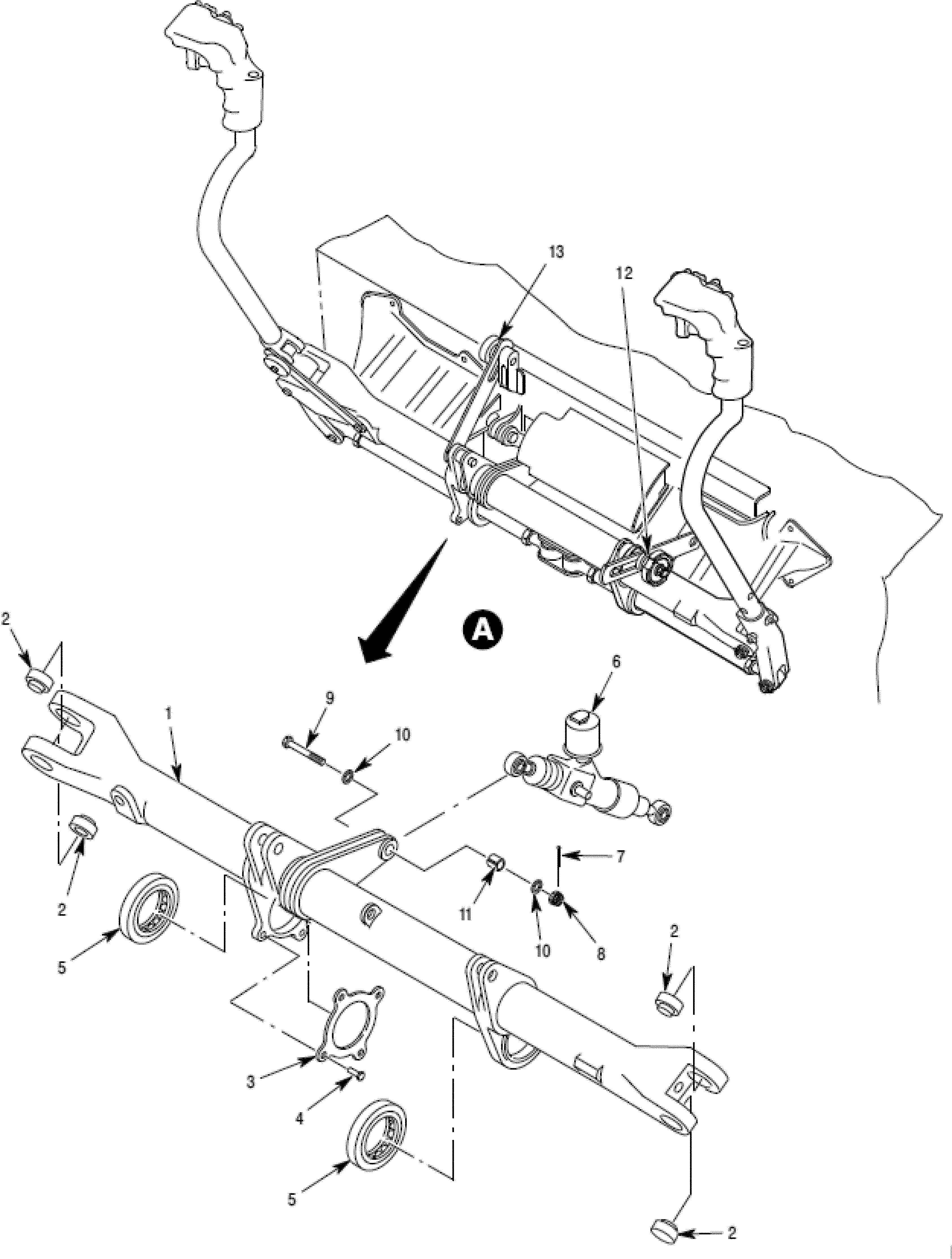
(ii) Visually inspect each roller bearing (number 5) as depicted in Figure 1 to paragraph (g)(1) of this AD for corrosion and degradation. If a roller bearing has any corrosion or degradation, before further flight, remove the roller bearing from service and install an airworthy roller bearing.
(2) Before the helicopter accumulates 3,000 total hours TIS or within 100 hours TIS after the effective date of this AD, whichever occurs later, and thereafter at intervals not to exceed 100 hours TIS, perform a freedom-of-movement inspection on the torque tube assembly by accomplishing the actions required by paragraphs (g)(2)(i) through (v) of this AD.
(i) Disconnect the one-way lock (number 6) of the torque tube by removing the cotter pin (number 7), nut (number 8), bolt (number 9), washers (number 10), and slotted bushing (number 11) from the torque tube assembly as depicted in Figure 1 to paragraph (g)(1) of this AD.
( printed page 61306)
(ii) Loosen the longitudinal cyclic friction knob (number 12 or 13) of the torque tube assembly as depicted in Figure 1 to paragraph (g)(1) of this AD.
(iii) While moving the cyclic control forward and aft to allow the torque tube assembly to rotate through its full range of motion, inspect the torque tube assembly for binding and ratcheting.
(A) If there is any binding or ratcheting as a result of the action required by paragraph (g)(2)(iii) of this AD, before further flight, inspect each roller bearing (number 5) as depicted in Figure 1 to paragraph (g)(1) of this AD for damage. For the purposes of this inspection, damage may be indicated by corrosion, lack of lubrication (dry exterior surface), or material degradation.
(B) If any roller bearing (number 5) as depicted in Figure 1 to paragraph (g)(1) of this AD has any damage, before further flight, remove the roller bearing from service and install an airworthy roller bearing.
(iv) If there is no binding or ratcheting as a result of the action required by paragraph (g)(2)(iii) of this AD or after accomplishing the action required by paragraph (g)(2)(iii)(B) of this AD, as applicable, tighten the cyclic friction knob (number 12 or 13) as depicted in Figure 1 to paragraph (g)(1) of this AD.
(v) Connect the one-way lock (number 6) as depicted in Figure 1 to paragraph (g)(1) of this AD by accomplishing the actions required by paragraphs (g)(2)(v)(A) and (B).
(A) Install the slotted bushing (number 11), washers (number 10), bolt (number 9), nut (number 8), and new (zero total hours TIS) cotter pin (number 7) as depicted in Figure 1 to paragraph (g)(1) of this AD.
(B) Ensure the edge of the slotted bushing (number 11) protrudes 0.010 to 0.080 inch (0.25 to 2.03 millimeters) above the surface of the cyclic torque tube after the nut is tightened.
(h) Alternative Methods of Compliance (AMOCs)
(1) The Manager, West Certification Branch, FAA, has the authority to approve AMOCs for this AD, if requested using the procedures found in 14 CFR 39.19. In accordance with 14 CFR 39.19, send your request to your principal inspector or responsible Flight Standards Office, as appropriate. If sending information directly to the manager of the West Certification Branch, send it to the attention of the person identified in paragraph (i) of this AD and email to:
AMOC@faa.gov.
(2) Before using any approved AMOC, notify your appropriate principal inspector, or lacking a principal inspector, the manager of the local flight standards district office/certificate holding district office.
(i) Additional Information
For more information about this AD, contact Eduardo Orozco-Duran, Aviation Safety Engineer, FAA, 3960 Paramount Boulevard, Lakewood, CA 90712; phone: (562) 627-5264; email:
eduardo.orozco-duran@faa.gov.
 14 CFR 39.13
 49 U.S.C. 106(g)