Department of Homeland Security
U.S. Customs and Border Protection
- 19 CFR Parts 113, 128, 141, 143, 145
- [USCBP-2026-0298]
- RIN 1685-AA38
AGENCY:
U.S. Customs and Border Protection, Department of Homeland Security.
ACTION:
Notice of proposed rulemaking.
SUMMARY:
This document proposes to amend the U.S. Customs and Border Protection regulations to modify filing requirements for informal entries of goods valued at $2,500 or less and to establish a new electronic informal entry type for merchandise entering through the mail environment. This document also proposes other related changes such as requiring an additional data element for carriers pertaining to mail shipments and imposing bonding requirements for certain informal entries.
DATES:
Comments on the rule must be received on or before December 7, 2026.
ADDRESSES:
You may submit comments, identified by docket number, through the Federal eRulemaking Portal: www.regulations.gov. Follow the instructions for submitting comments via docket number USCBP-2026-0298.
 www.regulations.gov
Instructions: All submissions received must include the agency name and docket number for this rulemaking. All comments received may be posted without change to www.regulations.gov, including any personal information provided. For detailed instructions on submitting comments and additional information on the rulemaking process, see the “Public Participation” heading of the SUPPLEMENTARY INFORMATION section of this document.
Docket: For access to the docket to read background documents, a plain language summary, and submitted comments, go to www.regulations.gov.
FOR FURTHER INFORMATION CONTACT:
Christopher Mabelitini, Director, Intellectual Property Rights & E-Commerce Division, Office of Trade, U.S. Customs and Border Protection, 202-325-6915, ecommerce@cbp.dhs.gov.
SUPPLEMENTARY INFORMATION:
Table of Contents
I. Public Participation
II. Background
A. Authority
1. Informal Entry
2. Bonding
3. Manifest Requirements
B. The New Low-Value Shipment Environment
C. Addressing Issues in the Low-Value Shipment Environment
1. Informal Entry Type 11 Requirements
a. Entry Type 11 Filing Requirements
b. Entry Type 11 Data: Final Deliver-To Party
c. Informal Entry and Chapter 99, Subchapter III, HTSUS
d. Right To Make Entry
2. New Informal Mail Entry Type 13 Requirements
a. New Entry Type 13—Informal Mail Entry
b. Additional Data Requirements for Entry Type 13 Filers and Carriers
c. Unentered Informal Mail Entries
3. Informal Entry Bond Requirements
a. Basic Importation and Entry Bond Required for Informal Entries
b. Minimum Amount for Liquidated Damages
III. Explanation of Proposed Amendments to the CBP Regulations
A. Proposed Amendments to Part 113
B. Proposed Amendments to Part 128
C. Proposed Amendments to Part 141
D. Proposed Amendments to Part 143
E. Proposed Amendments to Part 145
IV. Statutory and Regulatory Requirements
A. Executive Orders 12866, 13563, and 14192
B. Regulatory Flexibility Act
C. Paperwork Reduction Act
D. Unfunded Mandates Reform Act of 1995
V. Signing Authority
VI. Proposed Amendments to the CBP Regulations
I. Public Participation
Interested persons are invited to participate in this rulemaking by submitting written data, views, or arguments on all aspects of this rulemaking. U.S. Customs and Border Protection (CBP) also invites comments that relate to the economic, environmental, or federalism effects that might result from this rule. If appropriate to a specific comment, the commenter should reference the specific portion of the rule, explain the reason for any recommended change, and include data, information, or authority that supports the recommended change.
II. Background
Under 19 U.S.C. 1498(a)(1)(A), the Secretary of the Treasury [1] is authorized to prescribe rules and regulations concerning the entry of merchandise when the aggregate value of the shipment is not more than $2,500, i.e., informal entries, including shipments of merchandise that may have previously qualified for the de minimis exemption provided for in 19 U.S.C. 1321(a)(2)(C) for shipments of merchandise imported by one person on one day having an aggregate fair retail value in the country of shipment of not more than $800.
 19 U.S.C. 1498(a)(1)(A)
The de minimis exemption has been suspended since at least August 29, 2025.[2] On June 24, 2026, CBP published two interim final rules (IFRs) in the Federal Register announcing, inter alia, the indefinite suspension of the de minimis exemption in CBP's regulations, effective June 24, 2026.[3] Additionally, the One Big Beautiful Bill Act, which was enacted on July 4, 2025, terminated the de minimis exemption effective July 1, 2027.[4]
This proposed rulemaking addresses issues in the informal entry environment concerning CBP's efforts to protect the revenue and to identify violations of U.S. customs and trade laws, health and safety requirements, intellectual property rights, and consumer protection rules, as well as to detect and prevent illicit drugs such as fentanyl (including synthetic drug precursors and related chemicals and related manufacturing equipment) from entering the country. While some of these challenges have long been present in the informal entry environment, now that shipments formerly eligible for the de minimis exemption and associated entry procedures will likely be utilizing ( printed page 64533) informal entry procedures, these proposed regulations are necessary to adequately address the risks and challenges present in the low-value shipment environment generally. Specifically, and as discussed in more detail below, CBP is proposing additional data and bonding requirements for certain informal entries. Further, CBP is proposing to require that informal entries be filed electronically, prior to or upon the date of importation, and to establish a new electronic informal entry type for merchandise entering through the mail environment, i.e., entry type 13. Related to the proposed new informal mail entry type 13, CBP is also proposing to require additional data from carriers.
A. Authority
1. Informal Entry
All merchandise imported into the customs territory of the United States is subject to entry and clearance procedures, unless excepted. 19 U.S.C. 1484-85, 1498; 19 CFR 141.4. These procedures ensure the proper appraisement, valuation, and tariff classification of the merchandise for the purpose of collecting the lawful amount of duties owed, as well as compliance with all other laws and regulations administered and enforced by CBP. Different types of entry procedures are used for the entry and clearance of merchandise depending upon its value and other relevant criteria.
 19 CFR 141.4
Formal entry procedures, established by 19 U.S.C. 1484 and 1485, are generally applicable to shipments of merchandise valued in excess of $2,500.[5] Informal entry procedures are authorized by 19 U.S.C. 1498(a)(1)(A) for shipments of merchandise valued at $2,500 or less, and may incorporate formal entry procedures appearing in 19 U.S.C. 1484 and 1485. 19 U.S.C. 1498(b). Informal entry regulations are generally found in 19 CFR part 143, subpart C. Generally, informal entry procedures are less burdensome and complex than formal entry procedures. However, CBP may require formal entry for any merchandise if deemed necessary for purposes of admissibility, revenue protection, or the efficient conduct of customs business. 19 CFR 143.22. The process for filing informal entry is generally limited to parties with the right to make entry, i.e., an owner or purchaser of the shipment or, when appropriately designated by the owner, purchaser, or consignee of the shipment, a licensed customs broker. 19 CFR 143.26(a). Specific procedures for shipments imported by mail, including informal mail entries, are found in part 145, Mail Importations (19 CFR part 145).
2. Bonding
The Secretary of Homeland Security and the Commissioner of CBP [6] have broad legal authority to require bonds or other security “by regulation or specific instruction” when necessary to protect the revenue of the United States or to assure compliance with any law, regulation, or instruction that CBP is authorized to enforce. 19 U.S.C. 1623(a); 19 CFR 113.1. The Secretary and the Commissioner also have the authority to prescribe the conditions and form of the bond, the manner in which the bond may be filed, and the amount of the bond. 19 U.S.C. 1623(b); 19 CFR 113.2. This authority encompasses setting the amount owed upon breach of a bond condition. Id.
CBP has promulgated regulations exercising this authority in 19 CFR part 113, detailing requirements for the execution and filing of bonds. Subpart G of 19 CFR part 113 enumerates the terms and conditions for bonds required by CBP. The terms and conditions for the Basic Importation and Entry Bond are found in 19 CFR 113.62.
3. Manifest Requirements
Under 19 U.S.C. 1431(b), carriers are required to submit to CBP information concerning cargo they are transporting to the United States. Under 19 U.S.C. 1431(d), CBP is authorized to specify by regulation the form for, and the information and data required in, a manifest.
B. The New Low-Value Shipment Environment
Customs enforcement is essential to the national security, foreign policy, and economy of the United States. Effective customs enforcement prevents the importation of unlawful and dangerous goods and guarantees compliance with Federal laws, including laws governing forced labor, rules of origin, origin marking, intellectual property, revenue collection, and product safety. Among other things, the continued rise of e-commerce, with the internet empowering individuals to easily make international purchases, the increase of the value cap for the de minimis exemption to $800 in 2016,[7] and the establishment of the Entry Type 86 test [8] in which CBP authorized a voluntary electronic entry process for qualifying low-value shipments in the Automated Commercial Environment (ACE), led to drastic increases in the volume of shipments using the $800 de minimis exemption (and low-value informal entries more generally, i.e., shipments valued at $2,500 or less).
The drastic increase in volume highlighted numerous challenges facing CBP that impose significant and costly burdens related to processing lawful shipments and identifying violative and dangerous merchandise in the low-value environment. Even though the availability of the de minimis exemption is suspended and will be terminated on July 1, 2027, CBP anticipates that the volume of low-value shipments will remain problematically high as merchandise formerly eligible for the de minimis exemption shifts to other informal entry procedures, such as entry type 11, an informal entry type that provides CBP with certain relevant data about the merchandise.[9]
Low-value shipments sent via mail are processed initially at one of the U.S. Postal Service's (USPS) International Service Centers (ISCs) that sort international mail before it is transferred to a CBP facility for further examination. However, until the publication on June 24, 2026, of the interim final rule focusing on merchandise arriving via the postal environment, the mail informal entry process set forth in the regulations was a paper process with almost no advance entry information provided.
Under the recently updated regulatory framework for informal mail entries,[10] which requires the electronic payment of duties and transmission via email of a worksheet on a monthly basis by a party with the right to make entry, CBP still must engage in a burdensome manual process to verify the ( printed page 64534) information necessary for the shipment to be deemed admissible and properly entered in accordance with all applicable requirements. While this updated process is an improvement on the prior regulatory process, where a CBP officer would manually prepare the mail entry form for a shipment and the recipient paid the duties, taxes, and fees owed subsequently through the Postal Service, the proposed amendments in this rulemaking will allow CBP to more effectively manage its enforcement and processing responsibilities.
Even though the Entry Type 86 test proved insufficient to adequately address the issues for which it was designed, the lessons CBP learned from the test informed the recently announced Entry Type 13 test for the new electronic informal entry process for mail.[11] Accordingly, the proposals included in this rulemaking are based in part on the lessons learned from the Entry Type 86 test, including the need to require electronic filing, which data elements must be mandatory, requiring a consignee to use a licensed customs broker to file an informal entry, and the need to receive the data prior to or upon arrival of the shipment.
Simply put, CBP requires an electronic process for informal entries in order to effectively process data for purposes of validating entry information, conduct targeting in a timely and effective manner, and detect and seize illicit merchandise, such as illegal firearms, prohibited items, illicit fentanyl, and other illicit drugs. Absent these proposed regulatory amendments, discussed in more detail below, the sheer volume of imports in the informal entry environment would continue to hamper CBP's efforts to process entries and enforce U.S. law.
As noted above, the overwhelming volume of low-value shipments makes it more challenging for CBP to conduct targeting for purposes of identifying violations of U.S. customs and trade laws, health and safety requirements, intellectual property rights, and consumer protection rules, as well as preventing illicit drugs, such as fentanyl, and synthetic drug precursors, related chemicals, and manufacturing equipment from entering the country. Moreover, many consumers ordering goods online do not have sufficient information or knowledge about the goods to comply with customs and trade laws and other requirements increases the danger that an item they are purchasing may not comply with U.S. health and safety standards or pose other risks. Taken together, if not addressed, the enforcement challenges in the current environment have the capacity to put Americans' well-being and lives at risk.
Accordingly, as discussed in more detail below, CBP is proposing to implement a number of changes to address issues in the low-value shipment environment. Specifically, pursuant to its authority in 19 U.S.C. 1498(a)(1)(A), CBP is proposing to implement changes to the informal entry process for shipments valued at $2,500 or less by mandating electronic filing as well as modifying data requirements and filing timelines. Additionally, CBP is proposing a new electronic entry process for mail shipments valued at $2,500 or less. CBP is also proposing to modify the bonding requirements for informal entries, and, pursuant to its broad statutory authority in 19 U.S.C. 1498(a)(1)(A) and 1498(b), to expand the regulatory criteria when CBP may require formal entry for merchandise valued at $2,500 or less (including for entries filed through the proposed electronic process for mail). And finally, related to the new informal entry process for mail shipments valued at $2,500 or less, under its 19 U.S.C. 1431 authority, CBP is proposing to require additional information regarding mail shipments that carriers must provide as part of a manifest for mail shipments.
C. Addressing Issues in the Low-Value Shipment Environment
1. Informal Entry Type 11 Requirements
To address the challenges CBP faces in the low-value shipment environment, CBP is proposing to modify the entry process for shipments of merchandise valued at $2,500 or less, i.e., informal entries.[12] CBP is proposing to amend this process by requiring the entry to be filed electronically as an entry type 11 filing, upon or prior to the date of importation, and requiring identification of the final deliver-to party if different from the ultimate consignee on the entry summary. Relatedly, and as discussed further below in the Informal Entry Bond Requirements section, CBP is also proposing to amend the bonding requirements for entry type 11 filings.
a. Entry Type 11 Filing Requirements
Pursuant to 19 CFR 141.5, an entry must be made within 15 calendar days after merchandise has landed from a vessel, aircraft, or vehicle, or after arrival at the port of destination in the case of merchandise transported in bond.[13] This traditional entry timeframe, providing over two weeks to make entry after the arrival of the merchandise, poses problems in the context of high-volume, low-value shipments because it does not provide CBP with sufficient time to properly conduct risk assessment and targeting before the arrival of such potentially dangerous or unlawful importations in the United States. Requiring the entry data necessary to determine admissibility and eligibility for release to be provided prior to or upon the arrival of a shipment will enable CBP to make such determinations at or before a shipment arrives.
Accordingly, with this proposed rule, CBP is setting the deadline to make entry for informal entry type 11 to be upon or prior to the date of importation, which is defined in 19 CFR 101.1 as the date of arrival within port limits with intent to unlade for merchandise arriving by vessel, or the date of arrival within the customs territory of the United States for all other merchandise.
In addition, CBP is proposing to amend the regulations to require electronic filing for entry type 11. Currently, entry type 11 filers have the option to make entry on paper or electronically pursuant to 19 CFR 143.23. Paper entries are manually added to ACE by CBP employees, which imposes a processing cost to CBP both in time and expense. Moreover, the vast majority of type 11 entries are already filed electronically, so CBP does not anticipate this proposed change to pose a significant burden on the public. For example, from September 1, 2025 to May 31, 2026, only 73,534 type 11 entries were submitted manually as paper filings out of 52,450,418 type 11 entries in total (or 0.14%). It is crucial not only for CBP to have entry data at the time of or prior to the arrival of the merchandise, but also for CBP to receive the data electronically to allow for a more automated assessment of entry data for admissibility and revenue collection purposes.
b. Entry Type 11 Data: Final Deliver-To Party
CBP has determined that effective targeting requires identifying the party to whom an imported good is ultimately intended to be delivered, who may not be the initial recipient or the consignee ( printed page 64535) taking custody of the good upon arrival. Accordingly, CBP is proposing to require the submission of data identifying the Final Deliver-To Party (including the party's address), if this party is distinct from the ultimate consignee identified on the entry summary (CBP Form 7501). The purpose of this additional data element is to enable CBP to identify to whom and where the imported merchandise is destined to be delivered in the United States. To avoid duplication of data elements, CBP is proposing to only require identifying the final deliver-to party if this party is distinct from the ultimate consignee named on the entry summary. The final deliver-to party is the final intended recipient of the shipment, as known at the time of filing the entry summary.
c. Informal Entry and Chapter 99, Subchapter III, HTSUS
CBP is proposing to amend 19 CFR 143.21 by removing references to the $250 limit on eligibility for informal entry for merchandise classified under Chapter 99, Subchapters III and IV, Harmonized Tariff Schedule of the United States (HTSUS), e.g., goods subject to temporary trade remedies and/or quotas, as compared to the general $2,500 value limit for informal entry. Accordingly, under the proposed amendment, goods classified under Subchapters III and IV of Chapter 99, HTSUS, valued over $250, but not more than $2,500, would no longer be prohibited from using informal entry procedures. This proposed amendment will avoid requiring shipments of merchandise valued between $251 and $2,500 and subject to measures such as Section 232 duties (Section 232 of the Trade Expansion Act of 1962, as amended; 19 U.S.C. 1862, Public Law 87-794, 76 Stat. 872) to be formally entered, thus providing the option for filers to use informal entry procedures, because the additional duties imposed by these measures are listed in Subchapter III to Chapter 99 of the HTSUS. This proposed amendment mirrors the same change made to other informal entry regulations in 2012. 77 FR 72715 (Dec. 6, 2012). Relatedly, CBP is proposing to amend 19 CFR 141.82 and 143.23 to remove references to the $250 limit on merchandise classified under Subchapters III and IV of Chapter 99, HTSUS.
d. Right To Make Entry
CBP is proposing to amend 19 CFR 143.26(a) to require a consignee intending to enter merchandise who is not an owner or purchaser (such as a foreign postal operator, the United States Postal Service, a freight forwarder, or a carrier) to appoint a licensed customs broker who will act as the importer of record for the entry of shipments valued at $2,500 or less that are not covered by the exception in 19 CFR 143.26(b). This proposed amendment makes it clear that the requirement for a broker to act as the importer of record on behalf of a consignee, applicable to formally entered merchandise,[14] would also be applicable to the entry of merchandise valued at $2,500 or less which is entered via entry type 11 or via the newly proposed electronic informal mail entry type 13, discussed in more detail below. This proposed amendment was a requirement of the Entry Type 86 test.[15] The requirements for entering shipments exempt from duty under 19 U.S.C. 1321(a)(2)(A)-(B) will remain unchanged from the current provisions in 19 CFR 143.26(b).
2. New Informal Mail Entry Type 13 Requirements
Considering the issues discussed above and the shifting of mail volumes formerly eligible for the de minimis exemption to the informal entry process, CBP has determined it is necessary to transition to a fully electronic new entry type for mail shipments that will replace the current process under 19 CFR 145.12(b). CBP recently announced the Entry Type 13 test regarding electronic procedures for informal entry of shipments valued at $2,500 or less entering the United States through the international mail process. See91 FR 38007. The Entry Type 13 test is designed to allow CBP to evaluate ACE functionality and operational procedures while allowing participants to become familiar with the process generally during the pendency of this rulemaking. Accordingly, CBP is proposing a new regulatory entry type 13—Informal Mail Entry, applicable to shipments of merchandise valued at $2,500 or less, that are sent to the United States via mail, and that would be eligible for entry type 11 if shipped to the United States by a means other than through the international postal network.
Additionally, CBP is proposing to require additional data from carriers transporting mail to the United States, which are listed as optional in the Entry Type 13 test. Under the current regulations, such carriers only provide CBP with the weight of any mail transported into the United States, which does not allow CBP to sufficiently address the risks in this environment as CBP cannot verify that a specific mail article has been entered in accordance with all applicable requirements.[16]
Relatedly, and as discussed further below in the Informal Entry Bond Requirements section, CBP is also proposing to amend the bonding requirements for informal entries—including entry type 13 informal mail entries.
a. New Entry Type 13—Informal Mail Entry
CBP is proposing to require electronic entry filing for mail shipments arriving into the United States and entered under section 145.12(b), which would be eligible for entry type 11 if shipped to the United States by means other than mail. CBP is proposing that such mail shipments of merchandise valued at $2,500 or less must be entered via the newly established entry type 13—Informal Mail Entry. In practice, this new proposed entry type 13 for mail will largely mirror the data and process for the entry type 11, as modified by this proposed rulemaking, including the time of filing requirement discussed above and the additional requirements specific to mail discussed below.
To file an entry type 13, a party with the right to make entry will have the option to self-file the entry electronically in ACE or use a licensed broker.[17] The right to make entry, and thus to file an entry type 13, is limited to an owner or purchaser of the merchandise being mailed to the United States, or a licensed broker properly appointed by the owner, purchaser, or consignee. Under these proposed regulations, a consignee must obtain the services of a licensed broker who will act as the importer of record for the mail entry, consistent with the proposed requirements for informal entries in 19 CFR 143.26(a) detailed above. It is important to note that these proposed requirements are related to the entry and release of merchandise imported into the United States through the postal network and are distinct from, and in addition to, Universal Postal Union (UPU) requirements.
( printed page 64536)b. Additional Data Requirements for Entry Type 13 Filers and Carriers
In addition to all data required for a type 11 informal entry, including the newly proposed Final Deliver-To Party, CBP is proposing to require additional data for a type 13 informal mail entry. These are needed in order to address the risks present in the mail environment and the unique and more complex enforcement challenges arising from the shifting volume of mail formerly eligible for the de minimis exemption, as explained in more detail above. Accordingly, CBP proposes to require the following additional data element for entry type 13 filings:
Shipper/Sender. This data element will include both the identity and address of the party causing the goods to be shipped and it will be filed by the importer of record or the broker. This data element will be required on the entry type 13 filed to secure the release of an imported mail article.
Additionally, CBP is proposing to require that the Tracking Number, which is a unique number generated by the foreign postal operator assigned to each international mail shipment, i.e., the Universal Postal Union S-10 tracking number, also be provided by the party filing the inward manifest (generally carriers) for the mail article laden aboard an arriving conveyance. While this number is required for filers under 19 CFR 145.12(b)(3)(xii) as part of the postal informal entry process, it is listed as an optional data element for carriers participating in the Entry Type 13 test. Matching the required tracking number reported by the carrier as part of the manifest with the tracking number reported on the type 13 informal mail entry filing will allow CBP to determine the precise time of arrival for each mail shipment and confirm that an entry has been timely filed.
c. Unentered Informal Mail Entries
In the informal entry mail environment, as a result of the new deadline to file entry upon or prior to the date of importation, shipments arriving before an entry has been filed will not be released from CBP custody. The effect of this proposed entry requirement on the high volume of low-value shipments arriving daily means that USPS and CBP will need to move quickly to identify and dispose of mail articles for which an entry has not been timely filed to avoid the cost and burden of storing large volumes of unentered mail shipments. Accordingly, with this rulemaking, CBP is proposing that such mail articles will be deemed voluntarily abandoned if no entry is filed within 15 days of importation, and such deemed abandoned articles will then be processed in accordance with USPS requirements and procedures, which may entail destruction or return of the shipment to the sender.
Therefore, this document proposes to add a new section 145.6 (19 CFR 145.6), Unentered Packages, explaining that mail articles valued at $2,500 or less for which an entry has not been timely and properly filed will be considered by CBP to be voluntarily abandoned at the expiration of a 15-day period, beginning on the date of importation, at which time the merchandise will be processed accordingly by USPS, which may include destruction or returning the shipment to the sender.
3. Informal Entry Bond Requirements
As discussed above, pursuant to 19 U.S.C. 1623, CBP has broad legal authority to require bonds or other security “by regulation or specific instruction” when necessary to protect the revenue of the United States or to ensure compliance with laws, regulations, and lawful instructions, and to prescribe the conditions and form of the bond, the manner in which the bond may be filed, the amount of the bond, and the amount owed upon breach of a bond condition. Currently, for informal entries, including those in the mail environment, bonding is only required in certain situations.
a. Basic Importation and Entry Bond Required for Informal Entries
To help ensure that the revenue is protected and ensure the payment of the duties, taxes, and fees owed at liquidation, CBP is proposing to require that all entry type 11 and entry type 13 filers must obtain a basic importation and entry bond (either a single transaction bond (STB) or a continuous bond), with the conditions found in 19 CFR 113.62. An entry type 11 or entry type 13 filer needing a bond may either terminate and replace an existing continuous basic importation and entry bond after the finalization of this proposed rule or obtain a new basic importation and entry bond (continuous or single transaction) after the finalization of this proposed rule.
In circumstances where an entry of imported merchandise is not bonded, there is little recourse for CBP to collect the revenue owed if an importer of record defaults on its obligation to tender accurate duties, taxes, and fees. By requiring a bond for type 11 and type 13 entries, akin to bond requirements for merchandise required to be formally entered, a surety or a cash deposit ensures payment to CBP in the event the importer of record defaults. This bonding proposal is designed to secure the revenue to be collected from such imported merchandise. A basic importation and entry bond also secures redelivery of merchandise, e.g., when additional information is necessary to determine admissibility, and obligates an importer of record to correct non-compliance with an applicable law or regulation pertaining to admissibility, which aids CBP in ensuring the safety and security of American consumers. And, as mentioned above related to when a consignee who is not an owner or purchaser of the imported merchandise appoints a broker to file a type 11 or type 13 entry, CBP is proposing to require the broker to act as the importer of record, and thus the broker's basic importation and entry bond will be obligated.
b. Minimum Amount for Liquidated Damages
Liquidated damages are predetermined amounts bond principals agree to pay if they breach the conditions of their customs bond, such as failing to redeliver merchandise or meet other import requirements. A claim for liquidated damages is issued on the “Notice of Penalty or Liquidated Damages Incurred and Demand for Payment” (CBP Form 5955A). Importers can petition for relief from a claim for liquidated damages within 60 calendar days of the date of issuance of the CBP Form 5955A. Sureties are notified of liability for liquidated damages at the same time as principals, and if the principal does not respond within 60 days, a demand on the surety is issued.
Many of the existing bond conditions for a basic importation and entry bond, including conditions other than those set forth in 19 CFR 113.62(a), (g), (i), (j), (k)(2), (k)(3), (l), and (m), set the amount of liquidated damages under the bond at the value of the merchandise involved in the default, or three times the value of the merchandise involved in the default if the merchandise is restricted or prohibited merchandise or alcoholic beverages, or at another amount that may be authorized by law or regulation. For low-value shipments subject to this proposed rulemaking, assessment of liquidated damages based on the value of the merchandise will often be insufficient to ensure compliance with all applicable laws, bond conditions, and to protect the revenue. Accordingly, in conjunction with the new bonding requirements discussed above, for the basic importation and entry bond conditions other than 19 CFR 113.62(a), (g), (i), (j), (k)(2), (k)(3), (l), and (m), CBP is proposing to establish a new ( printed page 64537) minimum amount for liquidated damages assessed due to a breach of the bond for an entry type 11 or entry type 13. This proposed new minimum amount will protect the revenue and ensure compliance with applicable laws and regulations while also ensuring that the cost to CBP from collecting liquidated damages does not exceed the amount recovered. Therefore, CBP is proposing to amend 19 CFR 113.62(n) to modify the liquidated damages assessed for informal entry type 11 and informal mail entry type 13 shipments to impose a new minimum amount of $1,000 for each breach of a listed bond condition.
III. Explanation of Proposed Amendments to the CBP Regulations
This rulemaking proposes amendments to provisions found in 19 CFR parts 113, 128, 141, 143, and 145. CBP generally intends this proposed rule's provisions to be severable from each other. CBP expects to provide additional detail on severability in the final rule once CBP has considered public comments and finalized the regulatory language.
A. Proposed Amendments to Part 113
CBP is proposing to amend part 113, in accordance with the requirements discussed above. Specifically, CBP is proposing to amend § 113.62(n) by revising paragraph (n)(1) to add a reference to newly added paragraph (n)(6) (19 CFR 113.62(n)(6)), which states that defaulting on a bond required for informal entries (including mail) will result in a claim for liquidated damages in an amount equal to the value of the merchandise or $1,000, whichever is greater, or if the merchandise is restricted or prohibited or alcoholic beverages, in an amount equal to three times the value of the merchandise or $1,000, whichever is greater, or another amount authorized by law or regulation.
B. Proposed Amendments to Part 128
CBP is proposing to amend part 128. Specifically, CBP is proposing to amend § 128.24 by adding a new paragraph (f) (19 CFR 128.24(f)) to specify that bona-fide gifts (19 U.S.C. 1321(a)(2)(A)) will continue to be entered as provided for in 19 CFR 143.23(j) and 145.32. Simply put, this proposed amendment is intended to make clear that there is no change to the procedures for entering bona-fide gifts.
C. Proposed Amendments to Part 141
CBP is proposing to amend part 141, in accordance with the new informal entry requirements described above. Specifically, CBP is proposing to amend 19 CFR 141.5 to include a new paragraph (b) stating that an entry for merchandise valued at $2,500 or less for which an entry type 11 or entry type 13 is required must be filed upon or prior to the date of importation to be timely. Additionally, the proposed amendments to 19 CFR 141.5 specify the consequence for failure to timely enter such merchandise and add a reference to newly added 19 CFR 145.6 regarding unentered packages in the mail environment.
CBP is proposing to amend 19 CFR 141.68(f) to state that the time of entry for informal mail entries will be the time specified for informal entries generally, in accordance with 19 CFR 141.68(h), which states that the time of entry for informal entries will be the time the specified form is executed or completed in proper form, and filed together with any related required documents, and estimated duties, if any, have been deposited. Pursuant to 19 U.S.C. 1315(a)(1), the duty rate for a mail article is based on the “rate or rates in effect when the preparation of the entry is completed.”
CBP is proposing to amend 19 CFR 141.82(d) by removing the $250 limit on eligibility for informal entry for merchandise classified under Subchapters III and IV of Chapter 99, HTSUS. This proposed modification mirrors other amendments made at 19 CFR 143.21 and 143.23, explained in more detail below, in order to allow articles valued at $2,500 or less, that are subject to measures such as Section 232 duties, to be informally entered.
D. Proposed Amendments to Part 143
CBP is proposing to amend part 143, in accordance with the new requirements described above. Specifically, CBP is proposing to amend 19 CFR 143.21(a) and (c) by removing references to a $250 limit on eligibility for informal entry of merchandise classified under Subchapters III and IV of Chapter 99, HTSUS. This proposed modification will allow articles valued at $2,500 or less, that are subject to measures such as Section 232 duties, to be informally entered.
CBP is proposing to amend 19 CFR 143.22, consistent with its broad authority to regulate the informal entry of shipments valued at $2,500 or less pursuant to 19 U.S.C. 1498(a)(1)(A) and 1498(b),[18] to expand the criteria under which CBP may require formal entry for a shipment otherwise eligible to be informally entered. Specifically, with this proposed amendment, CBP will expand its discretionary authority to require formal entry for any reason deemed appropriate, to include requiring formal entries by a specific importer of record, or specific types or categories of merchandise, or merchandise produced by a specific manufacturer or seller. Thus, the proposed changes clarify that CBP is not limited to requiring formal entry on a case-by-case basis for a specific shipment of merchandise. Instead, under this proposed provision, CBP may require formal entry on a blanket basis, e.g., based on importer of record, manufacturer, or category of merchandise, in accordance with criteria deemed relevant by CBP.
CBP is proposing to amend 19 CFR 143.23 to require that a filer entering merchandise under entry type 11 must transmit the electronic equivalent of CBP Forms 3461 and 7501, or CBP Form 7501, to CBP via a CBP-authorized Electronic Data Interchange (EDI) system. CBP is also proposing to amend 19 CFR 143.23(d) to remove the parenthetical phrase “except for articles valued in excess of $250 classified in Chapter 99, Subchapter III and IV, Harmonized Tariff Schedule of the United States” to align with the proposed changes discussed above.
CBP is proposing to amend 19 CFR 143.26(a) to clarify the parties who may enter merchandise valued at $2,500 or less and to state that consignees that are not owners or purchasers are required to appoint a customs broker to act as the importer of record for an informal entry for a shipment valued at $2,500 or less, unless excepted pursuant to paragraph (b).
CBP is proposing to add a new section 143.29 (19 CFR 143.29) stating that shipments valued at $2,500 or less, for which CBP Forms 3461 and 7501, or CBP Form 7501, must be filed, will not be released from CBP custody unless an STB or continuous bond containing the bond conditions set forth in § 113.62 has been transmitted to CBP pursuant to part 113.
E. Proposed Amendments to Part 145
CBP is proposing to amend part 145, in accordance with the new requirements described above. Specifically, CBP is proposing to add a new section 145.6 (19 CFR 145.6) to state that any international mail shipment valued at $2,500 or less which remains not properly entered at the expiration of a 15-day period will not be released by CBP and will be deemed voluntarily abandoned. Under this proposed amendment, further ( printed page 64538) disposition or processing of the international mail shipment will be completed by the United States Postal Service in accordance with applicable requirements and procedures.
CBP is proposing to add a new section 145.7 (19 CFR 145.7) to state that, for mail shipments valued at $2,500 or less, a tracking number matching the tracking number provided by the party with the right to make entry as part of the electronic equivalents of the CBP Forms required by 19 CFR 145.12(b)(1), i.e., the Universal Postal Union S-10 tracking number assigned to each international mail shipment, must be provided as part of the inward manifest required in § 4.7a (vessel), 122.48a (air), 123.91 (rail), 123.92 (truck), or 128.21 (express consignments) of this chapter.
CBP is proposing to amend 19 CFR 145.12(b) to modify the current regulatory process for mail shipments (involving the worksheet and pay.gov requirements) to state that, unless an exception applies, mail shipments valued at $2,500 or less are required to be entered electronically by transmitting the data elements from CBP Forms 3461 and 7501, or CBP Form 7501, via a CBP-authorized EDI system upon or prior to the date of importation of the shipment. This builds upon and improves the process CBP established in Indefinite Suspension of the De Minimis Exemption for Mail Shipments and New Postal Informal Entry Process,91 FR 37801 (Jun. 24, 2026), which required carriers to submit necessary data elements via email.
CBP is proposing to revise section 145.15 (19 CFR 145.15) to more closely reflect the entry requirements proposed in this rulemaking. Revised section 145.15 states that an entry type 13 informally entered mail shipment will not be released from CBP custody, and the entry will not be accepted, unless an STB or continuous bond containing the bond conditions set forth in § 113.62 of this chapter, executed by an approved corporate surety, or secured by cash deposits as provided for in § 113.40 of this chapter, has been transmitted to CBP pursuant to part 113. Akin to the revisions made to section 145.12(b), these changes refine and improve the process established in Indefinite Suspension of the De Minimis Exemption for Mail Shipments and New Postal Informal Entry Process.
IV. Statutory and Regulatory Requirements
A. Executive Orders 12866, 13563, and 14192
Executive Orders 12866 (Regulatory Planning and Review) and 13563 (Improving Regulation and Regulatory Review) direct agencies to assess the costs and benefits of available regulatory alternatives and, if regulation is necessary, to select regulatory approaches that maximize net benefits. Executive Order 13563 emphasizes the importance of quantifying both costs and benefits, of reducing costs, of harmonizing rules, and of promoting flexibility. Executive Order 14192 (Unleashing Prosperity Through Deregulation) directs agencies to significantly reduce the private expenditures required to comply with Federal regulations and provides that “any new incremental costs associated with new regulations shall, to the extent permitted by law, be offset by the elimination of existing costs associated with at least 10 prior regulations.”
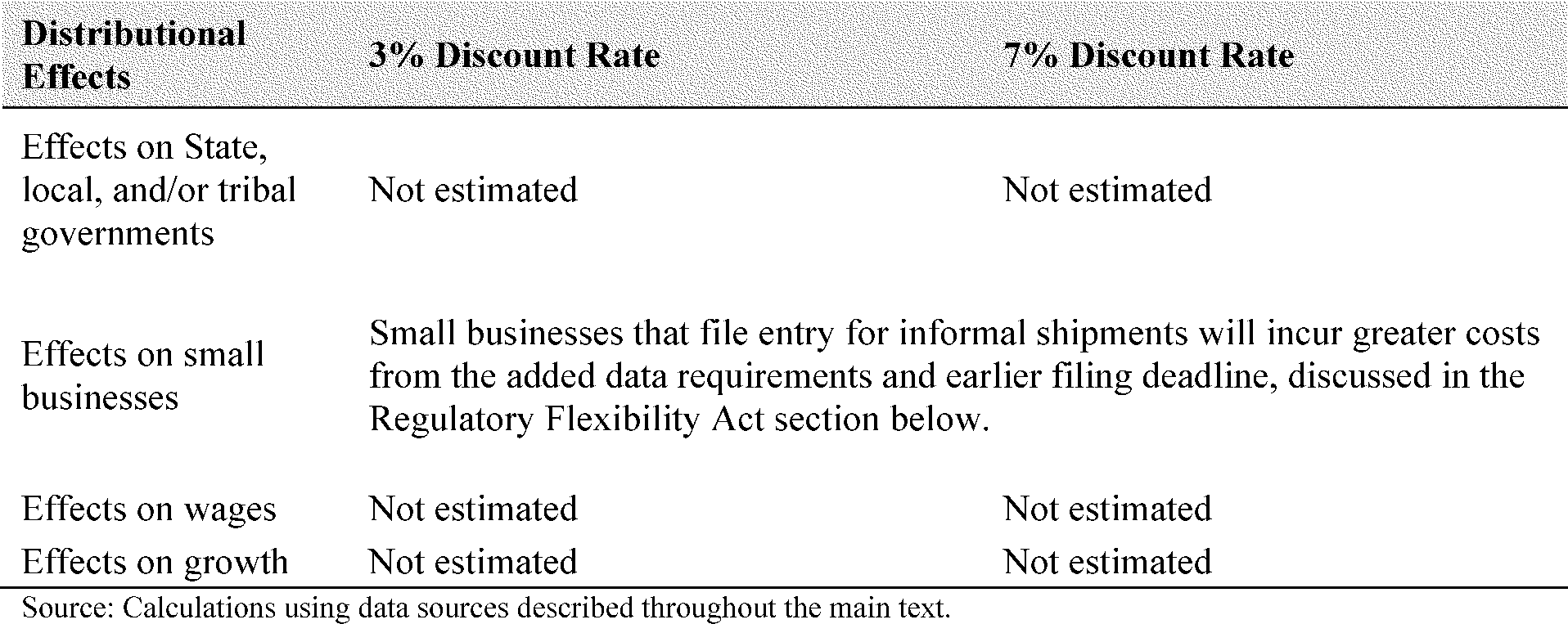
This rule has been designated a “significant regulatory action” that is economically significant, under section 3(f)(1) of Executive Order 12866. Accordingly, the rule has been reviewed by the Office of Management and Budget. Pursuant to section 5(a) of Executive Order 14192, the requirements of that Executive Order do not apply to regulations issued with respect to homeland security or foreign affairs-related functions of the United States. This notice of proposed rulemaking is issued with respect to foreign affairs-related functions of the United States Government. Accordingly, this notice of proposed rulemaking is exempt from the requirements of Executive Order 14192. The present value of the net cost of the rule over 2026-2035 would be $9,298,017,345 (2026 USD) under a discount rate of 3% or $7,715,548,573 under a rate of 7%, discounting to 2026. Table 1 shows an accounting statement for the effects of the rule. In the table and throughout this analysis, CBP abbreviates entry type 11 as ET11 and entry type 13 as ET13.
( printed page 64539)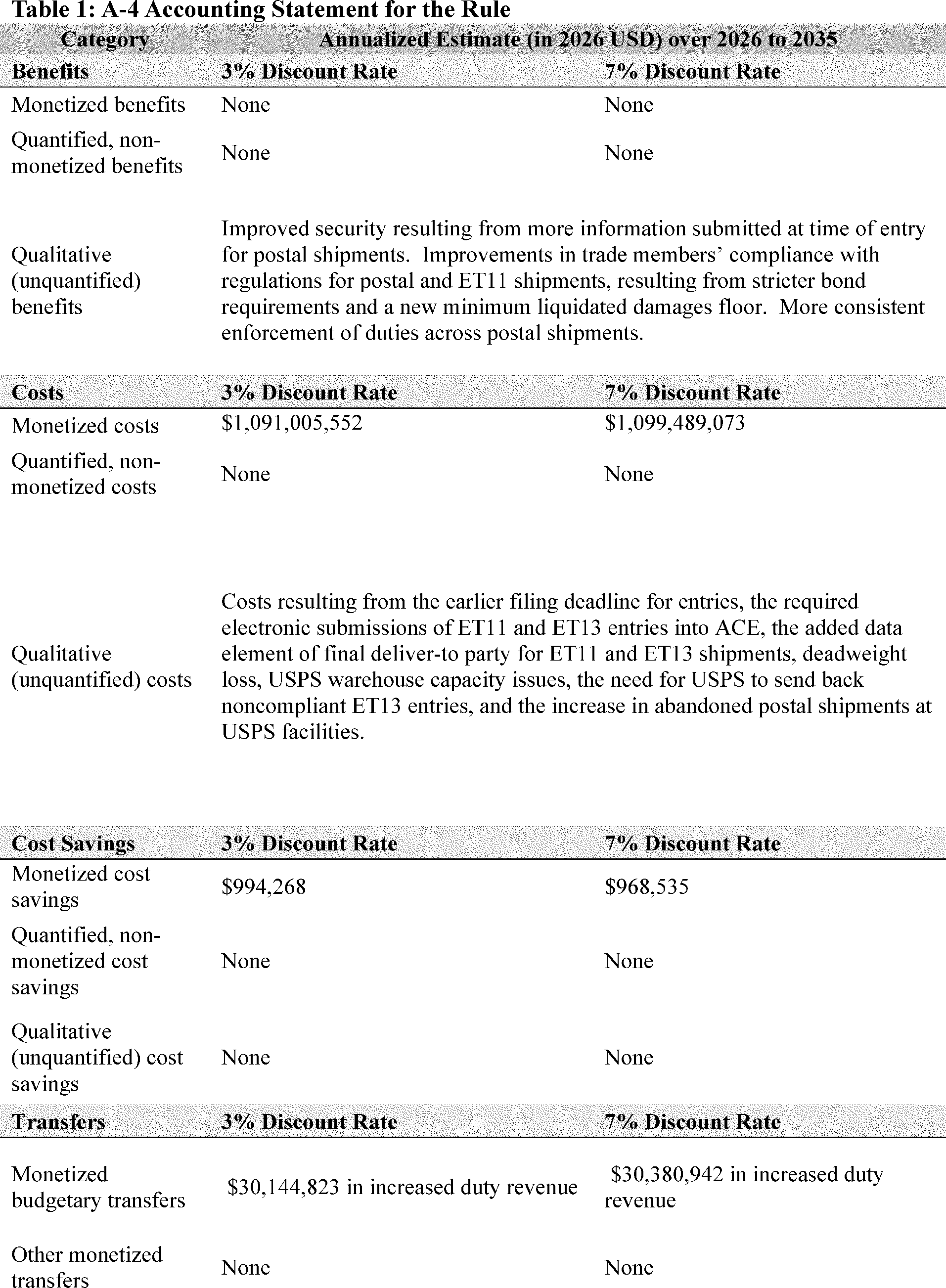
Background
Before 2025, most low-value postal shipments were eligible for the administrative exemption from duty at 19 U.S.C. 1321(a)(2)(C) ( de minimis exemption) and, consistent with the entry regulations for such low-value shipments, the submission of detailed entry information to CBP was not required. On July 4, 2025, the President signed into law the One Big Beautiful Bill Act, which, among other things, enacted the termination of the de minimis exemption effective July 1, 2027.[19] Even before that termination date, however, the President signed Executive Order 14324 (Suspending Duty-Free De Minimis Treatment For All Countries) on July 30, 2025, which announced that the President determined that it was necessary and appropriate to suspend duty-free de minimis treatment under 19 U.S.C. 1321(a)(2)(C) for most imports to deal with the identified continuing unusual and extraordinary threats, which have their source in whole or substantial part outside the United States, to the national security, foreign policy, and economy of the United States.[20] Besides suspending the de minimis exemption, the Executive Order also established an interim process and new duty rate for eligible products sent to the United States through the international postal network.
On February 20, 2026, the President signed Executive Order 14388 (Continuing the Suspension of Duty-Free De Minimis Treatment For All Countries), which, among other things, continued the suspension of duty-free de minimis treatment under 19 U.S.C. 1321(a)(2)(C), including for shipments sent through the international postal network, and confirmed that CBP should continue to collect applicable duties, taxes, fees, exactions, and charges on such shipments. That Executive Order imposed an ad valorem duty rate of 10% on postal shipments, as authorized by section 122 of the Trade Act of 1974 (19 U.S.C. 2132) (Section 122). Aside from that flat 10% duty, no other duties were collected from postal shipments entered through the interim postal process. Filers were not required to submit product classification data for postal shipments under that process, meaning that CBP did not have the necessary information to assess most other duties. Instead, filers submitted a monthly international mail duty worksheet, in which they reported the value of their postal shipments that month and the duties they owed based on the 10% rate. Informal non-postal shipments, on the other hand, were subject to both the 10% duty under Section 122 and any other applicable duties.
To eliminate the disparity in duties between postal and non-postal informal entries, CBP published the Indefinite Suspension of the De Minimis Exemption for Mail Shipments and New Postal Informal Entry Process IFR on June 24, 2026, which amended the process for entering informal mail shipments, improving upon the interim process established by Executive Order 14324, as amended.[21] Throughout this analysis, CBP refers to the informal entry process for mail shipments established by that IFR as the “current informal postal entry process.” With that rule, the monthly international mail duty worksheet was expanded to require product classification and other data elements, and CBP began applying all applicable duties to postal informal shipments. Hence, postal informal entries and ET11 entries are now subject to the same product classification reporting requirements. But while the current postal informal entry process enables CBP to impose the same duties on postal shipments as on ET11 entries, enforcement of duties and other regulations remains more difficult in the postal environment. Under the current informal postal entry process, the international mail duty (IMD) worksheet is not due until the 7th day of the following month, and most postal entries are automatically released before the IMD worksheet is submitted. The IMD worksheet also does not require as much information as CBP Forms 3461 and 7501, which are used for ET11 entries. Most international mail duty worksheets are submitted by a broker, and the broker does not have to identify the importer or the consignee. The limitations of the IMD worksheet hamper CBP's ability to enforce the same standard of compliance with regulations in the postal environment as in the non-postal environment. Therefore, CBP has continued to evaluate development of an entry process for informal mail shipments that enables filing through ACE with more aligned filing timeframes and data requirements to address challenges in the mail environment.
( printed page 64541)Moreover, many postal shipments are sent without an IMD worksheet or other entry form ever being submitted for them. Between September 2025 and May 2026, only 67% of postal shipments were sent through an informal or formal entry process.[22] The remaining 33% of postal shipments were likely shipped without the payment of duties. Moreover, merchandise subject to other requirements and regulations, such as partner government agencies' (PGA) data requirements or trade enforcement actions is disallowed, after a short-term delayed compliance window, from using the current informal postal entry process, but CBP is not well positioned to enforce these exceptions, as the data is sent well after arrival, including data that would reveal that the merchandise is subject to these requirements and regulations. Therefore, some goods could enter under the current informal postal entry process and thereby avoid trade enforcement actions or PGA data requirements if not affirmatively caught by CBP.
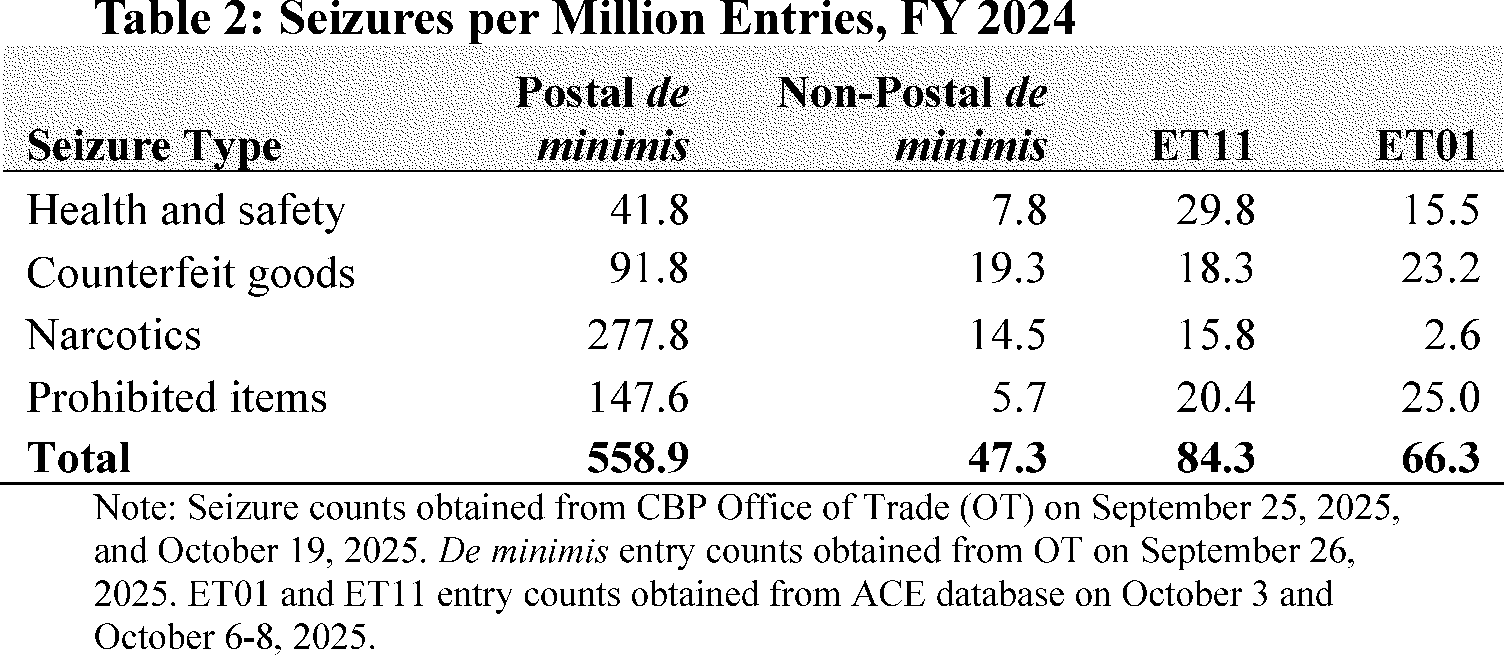
Before de minimis treatment was suspended, the postal environment differed from the non-postal environment in two significant ways. The first was that much less duty revenue was collected from postal shipments, and the second was that postal shipments had higher rates of seizures. As Table 2 shows, postal de minimis shipments had much higher seizure rates than non-postal entry types in FY 2024. CBP seized narcotics in postal de minimis shipments at a rate of 277.8 seizures per million shipments, compared to only 2.6 seizures per million shipments for formally entered shipments and 15.8 seizures per million shipments for informally entered type 11 shipments. Postal de minimis shipments had the highest seizure rates in all other seizure categories as well, including health and safety, counterfeit goods, and prohibited items. Some of the disparity between postal and non-postal seizure rates could be due to non-postal shipments sometimes lacking the final recipient name and address, as well as the lack of automation in the non-postal environment. Most importers of non-postal shipments lack the automation capacity to identify customs holds in a timely manner, which makes it difficult for both importers and CBP officers to separate such holds from the rest of cargo, thereby adding additional burden to CBP. Nevertheless, CBP believes that a fair share of the disparity between postal and non-postal seizure rates is due to postal shipments containing more violative merchandise. One likely reason that postal de minimis shipments contained more violative merchandise in relation to the non-postal de minimis environment is that the exporters of violative merchandise preferred the postal environment because they perceived it as one in which it was easier to avoid detection.
The current informal postal entry process does not fully address the data limitations that CBP faces in working to identify violations of U.S. customs and trade laws, health and safety requirements, intellectual property rights, and consumer protection rules. CBP still receives much less information to use in targeting postal informal shipments than ET11 shipments, and the information that is submitted to CBP for postal shipments tends to arrive later and be less trustworthy than the information submitted for ET11 shipments, weakening CBP's targeting abilities further.
CBP seeks to replace the current informal postal entry process with a process that subjects postal entries to requirements similar to those applicable to non-postal entries and that can also be used to enable CBP to better identify goods that are subject to trade enforcement actions or PGA data requirements. To that end, CBP has developed the ET13 process for postal informal shipments. Like the ET11 process, the proposed ET13 process requires that entry be filed electronically using CBP Forms 3461 and 7501, not the IMD worksheet. CBP created a simplified version of the proposed ET13 process, referred to as the ET13 test, which will commence on September 22, 2026.[23] A filer participating in the ET13 test must submit in ACE the following: (1) filer code; (2) Importer of Record (IOR) number; (3) description of merchandise; (4) country of origin; (5) all applicable 10-digit HTSUS classification(s), including both primary classifications in Chapters 1-97 as well as any applicable secondary classifications in Chapters 98 and/or 99 of the HTSUS; (6) quantity and weight, if using specific duty rates; (7) duty rate; (8) value; (9) total duty owed; (10) carrier name; (11) tracking number generated by the foreign post operator; and (12) arrival port. Other data fields appearing on CBP Forms 3461 and 7501 remain voluntary under the ET13 test. Under this proposed rule, however, those other data fields would be required, just as they are for ET11 entries. The purpose of the ET13 test is to give CBP and trade members the opportunity to test out the new process before this proposed rule ( printed page 64542) makes ET13 required for postal informal shipments.
Purpose of Rule
The proposed rule aims to terminate the current informal postal entry process and replace it with entry type 13 so that postal informal shipments will be subject to similar requirements as non-postal informal shipments, thereby improving CBP's enforcement in the postal environment. Furthermore, the rule would make updates to the ET11 process, which would also apply to the ET13 process, to address enforcement issues in the informal environment, namely the higher rate of violative goods in the informal environment than in the formal environment.
Informal Entry Type 11 Requirements
To give CBP time to properly assess the admissibility of informal entries, this proposed rule would move the filing deadline for type 11 entries from within 15 days of arrival to upon, or prior to, arrival at a port of entry. This proposed rule would also adjust data element requirements for ET11 by adding the final deliver-to party as a required data element, if distinct from the ultimate consignee. Goods classified under Chapter 99, Subchapters III and IV, HTSUS, that are valued at or below $2,500 would no longer be limited to formal entry; they would be allowed to enter through the ET11 entry process.
New Informal Mail Entry Type 13 and Manifest Requirements
Considering the issues discussed in the Background section above, CBP is proposing to transition to the new, fully-electronic entry type 13 (ET13)—Informal Mail Entry, for all eligible shipments sent via the mail environment that are valued at $2,500 or less. The proposed changes being made to the ET11 process, such as the earlier filing deadline and bond requirement, would also apply to the ET13 process. The data requirements would be almost the same for the ET13 process as the updated ET11 process, but with a couple noteworthy differences to account for the mail environment. In addition to the data elements generally required for an ET11 entry, an ET13 entry must also include the shipper or sender and the package tracking number. The carrier would be also required to submit the package tracking number on the inward manifest to allow CBP to verify the date of importation for postal shipments. CBP would deem articles not properly entered through ET13 to be voluntarily abandoned at the expiration of a 15-day period.
Prior to Executive Order 14324, postal shipments claiming the administrative exemption under 19 U.S.C. 1321(a)(2)(C) were admitted duty-free. Executive Order 14324, which suspended de minimis treatment for most importations, established an interim postal process, and most informal postal entries, including those previously eligible for duty-free de minimis treatment, were subject to duty payments for the first time. The interim postal process was later amended by the Indefinite Suspension of the De Minimis Exemption for Mail Shipments and New Postal Informal Entry Process IFR to require the submission of HTSUS codes on the monthly international mail duty worksheet so that CBP could collect all applicable duties.[24] This rule would terminate the current informal postal entry process and require an ET13 entry for all informal postal shipments. Because filers would have to submit the entry data by the time the shipment arrives instead of potentially weeks later, the new ET13 entry process would enable CBP to more effectively enforce the regulations for postal shipments. Therefore, CBP would protect the revenue of the U.S. Government and more effectively target violative shipments by establishing ET13.
Informal Entry Bond Requirements
CBP relies on data provided by filers to make determinations on admissibility and entry requirements, but data has been notoriously unreliable for informal entries. To ensure data accuracy, CBP would require basic importation and entry bonds under the proposed rule for all type 11 and type 13 entries. This requirement would affect ET11 entries more than postal entries, as a bond is already required to import through the current informal postal entry process.
The rule also proposes to set a $1,000 floor for liquidated damages arising from a breach of the terms of a customs bond securing an informal entry. Hence, the liquidated damages based on value for all informal entries would be $1,000 or the value of the merchandise for each instance, whichever is greater.[25] Without the floor, breaches of the bond resulting from low-value shipments receive low-value liquidated damages. Therefore, this proposed floor would improve compliance and ensure that the cost to CBP to collect the liquidated damages does not outweigh the amount collected.
Baseline and Regulatory Alternative Scenarios
This regulatory impact analysis estimates the net effects of the rule by comparing the baseline scenario with the regulatory alternative scenario. In the baseline, the ET11 entry process has not been updated, and postal shipments continue to be entered through the informal postal entry process that was implemented in June 2026 by the Indefinite Suspension of the De Minimis Exemption for Mail Shipments and New Postal Informal Entry Process IFR. The ET13 test does not exist in the baseline, as the real-world ET13 test was developed by CBP in anticipation of implementing this proposed rule. In the regulatory alternative scenario, the ET11 entry process would include new requirements, as described above, and informal postal shipments would need to be entered through the new ET13 process. The current informal postal entry process would no longer be available under the rule if finalized. The benefits and costs of the rule are the benefits and costs of changing from the baseline to the regulatory alternative scenario. Because CBP and USPS began incurring programming costs for the rule in 2026, this analysis considers the effects of the rule over a 10-year regulatory period from 2026 to 2035. CBP uses calendar years, rather than fiscal years, in its projections for this analysis.
Projected Entry Counts
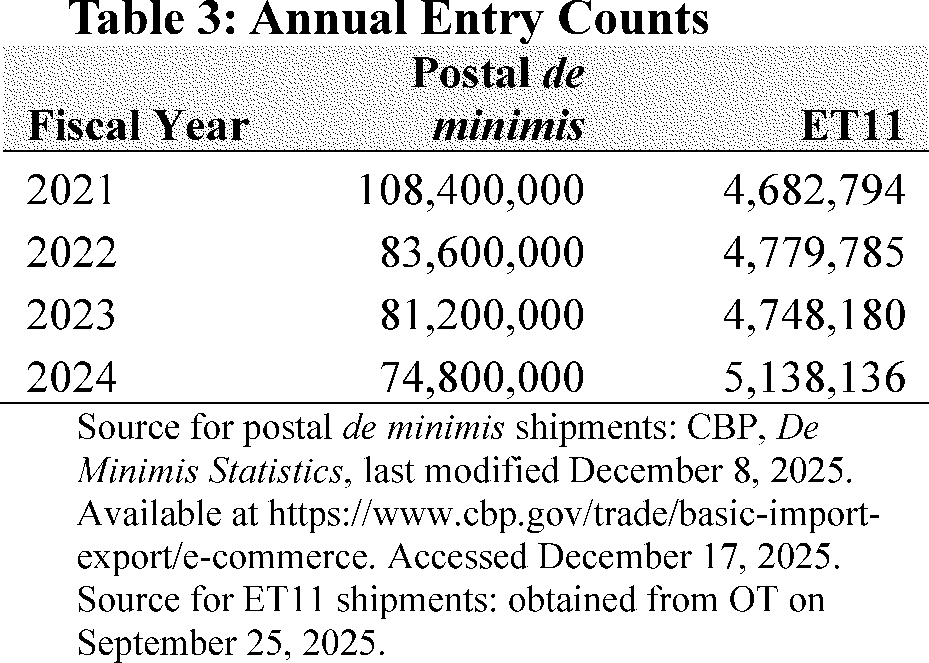
In this section, CBP presents its projections for ET11 and postal informal entry counts from 2026-2035. These projections are used in calculations throughout the analysis. Although the proposed rule could affect import volumes, CBP assumes for the purposes of this analysis that annual entry counts would be the same in the regulatory scenario as in the baseline scenario, except for the fact that postal shipments would change to ET13 in the regulatory scenario. This simplifying assumption allows CBP to calculate costs and government revenue using the same projected entry counts used in the baseline. However, the rule would result in stricter duty collection for postal entries and higher shipping costs for both ET11 and ET13 entries, and these changes would likely cause imports to fall (although the stronger duty collection and added requirements for postal shipments could lead to an increase in ET11 entries as importers shift from postal to ET11). As a result of this overall decrease in imports, the total increase in government revenue, broker fee payments, and other changes ( printed page 64543) would be lower than in the analysis, which assumes the rule would have no effect on the quantity of imports. The fall in imports would also lead to a deadweight loss, increasing the total cost of the rule to society beyond CBP's cost estimates in the analysis. CBP discusses these limitations of the analysis further below. Table 3 displays the annual entry counts for postal and ET11 entries from FY 2021 to FY 2024. Over that time period, the compound annual growth rate (CAGR) for postal de minimis entries was −11.63%, and the CAGR for ET11 entries was 3.14%.
In 2025, the imposition of new duties, the suspension of the de minimis exemption for most imports, and the creation of an interim postal process led to large changes in the import volumes for these two categories. The de minimis exemption was suspended for most imported products of all countries effective August 29, 2025. Therefore, CBP uses entry counts from the months following the suspension to estimate the inflow of entries under the current status quo. From September 1, 2025, to May 31, 2026, a total of 24,427,685 postal entries and 52,450,418 ET11 entries arrived in the United States. At that rate, 32,659,725 postal shipments and 70,126,017 ET11 shipments would arrive annually. These numbers are shown in Table 4.
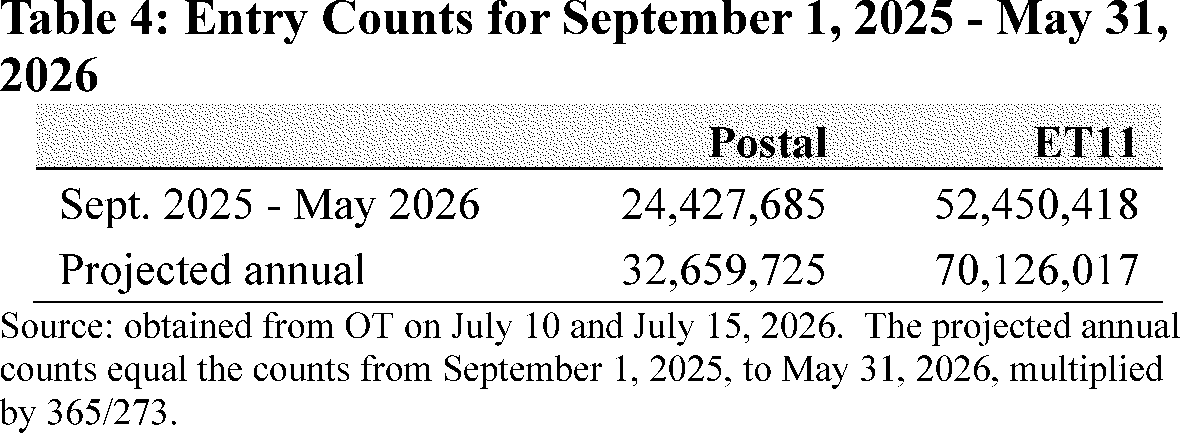
Compared to the 2024 entry counts, the figures in Table 4 show that the suspension of de minimis led to a fall in postal shipments but an increase in ET11, as many would-be de minimis shipments shifted to ET11. As de minimis treatment will remain suspended, CBP does not expect postal or ET11 volumes to return to pre-2025 levels. Moreover, since the rule would replace the current informal postal entry process with the ET13 process, postal shipments would face even higher data requirements than they do under the current informal postal entry process, making it all the more unlikely that postal entry counts would rebound. To project postal and ET11 entry counts during the regulatory period of 2026-2035, CBP applies the CAGRs from 2021-2024 to the projected annual counts in Table 4. These projections are shown in Table 5.
( printed page 64544)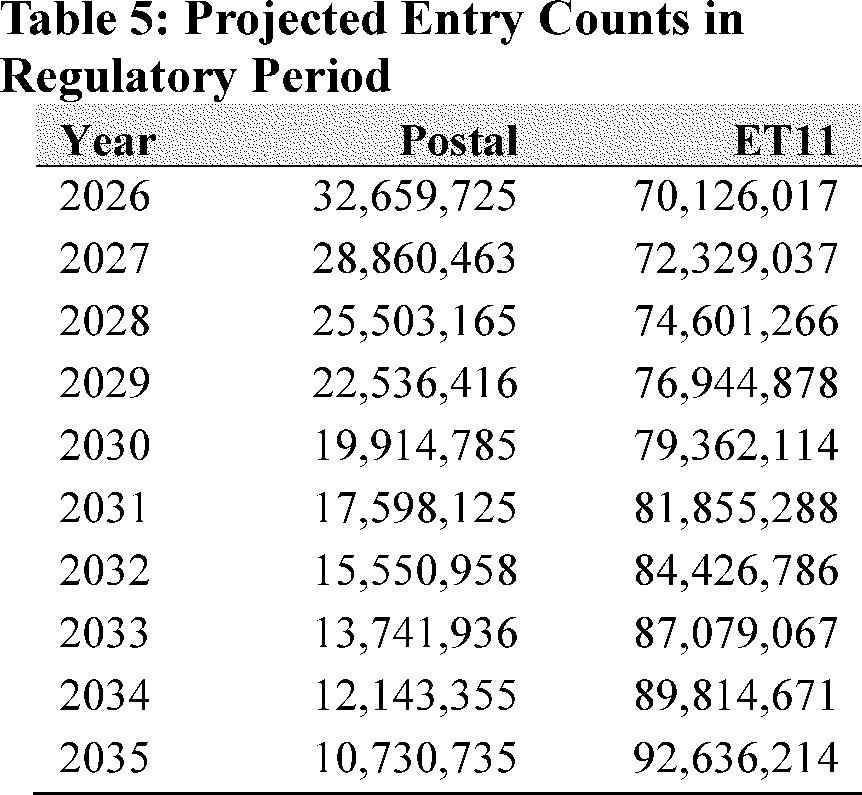
Costs
The rule would result in costs due to programming changes, larger time burdens of submitting and processing entries for postal shipments, various updates to the entry process for ET11 informal entries and postal shipments, and a decrease to social welfare stemming from a reduction in imports, as discussed in the deadweight loss subsection below.
CBP
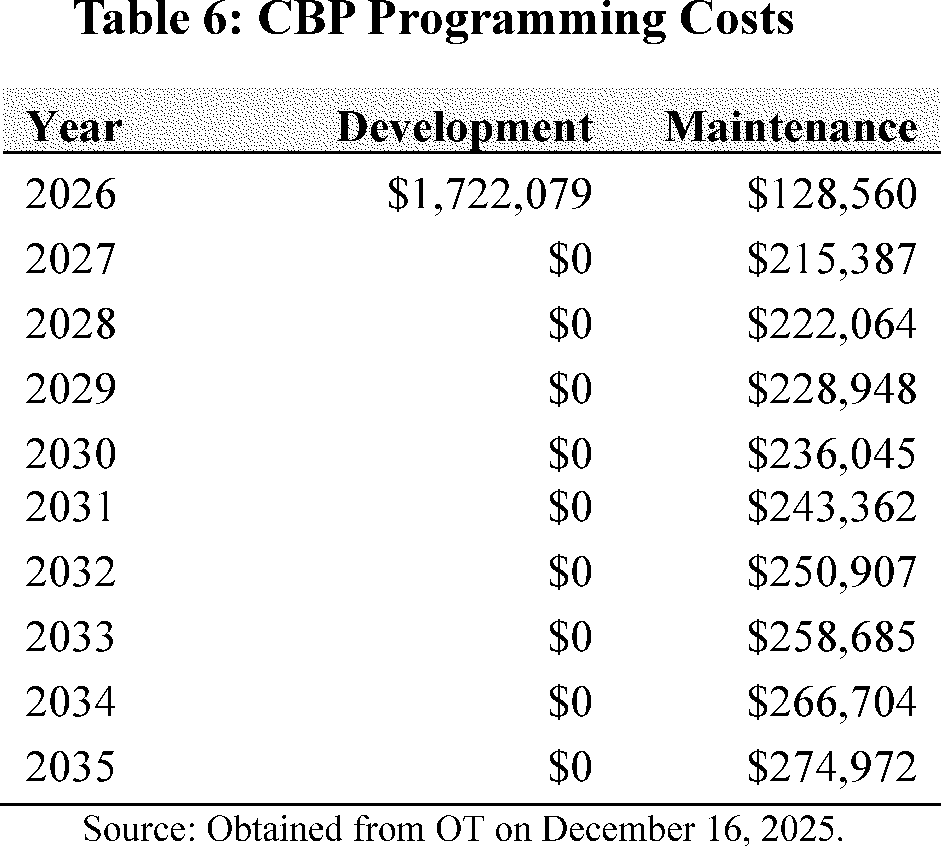
To create the new ET13 process for postal entries and update the entry process for ET11 entries, CBP needs to update its electronic systems, which entails programming costs. Much of the programming is already complete, which has allowed CBP to roll out ET13 as an option for informal postal shipments, but CBP still counts the programming costs for ET13 as an effect of the rule because the programming was done and the ET13 test was created in anticipation of this NPRM. CBP's programming costs are shown in Table 6. After the modernization is complete, only a few additional changes would be needed as a result of this rule.
CBP would receive more submissions of CBP Forms 3461 and 7501 under the rule, as postal shipments would need to be entered with these forms instead of the IMD worksheet. The time burdens for CBP to process CBP Forms 3461 and 7501 are 5 minutes and 10 minutes, respectively.[26 27] The average hourly wage of a CBP trade and revenue employee is $95.34.[28] The average costs of the time burdens for processing CBP Forms 3461 and 7501 are therefore $7.95 and $15.89 per form. CBP applies the time costs of processing these forms to the projected number of postal shipments during the regulatory period found in Table 5 to calculate the added annual costs to CBP of processing the new forms. Table 7 displays the annual costs starting in 2027 when the rule would take effect.
( printed page 64545)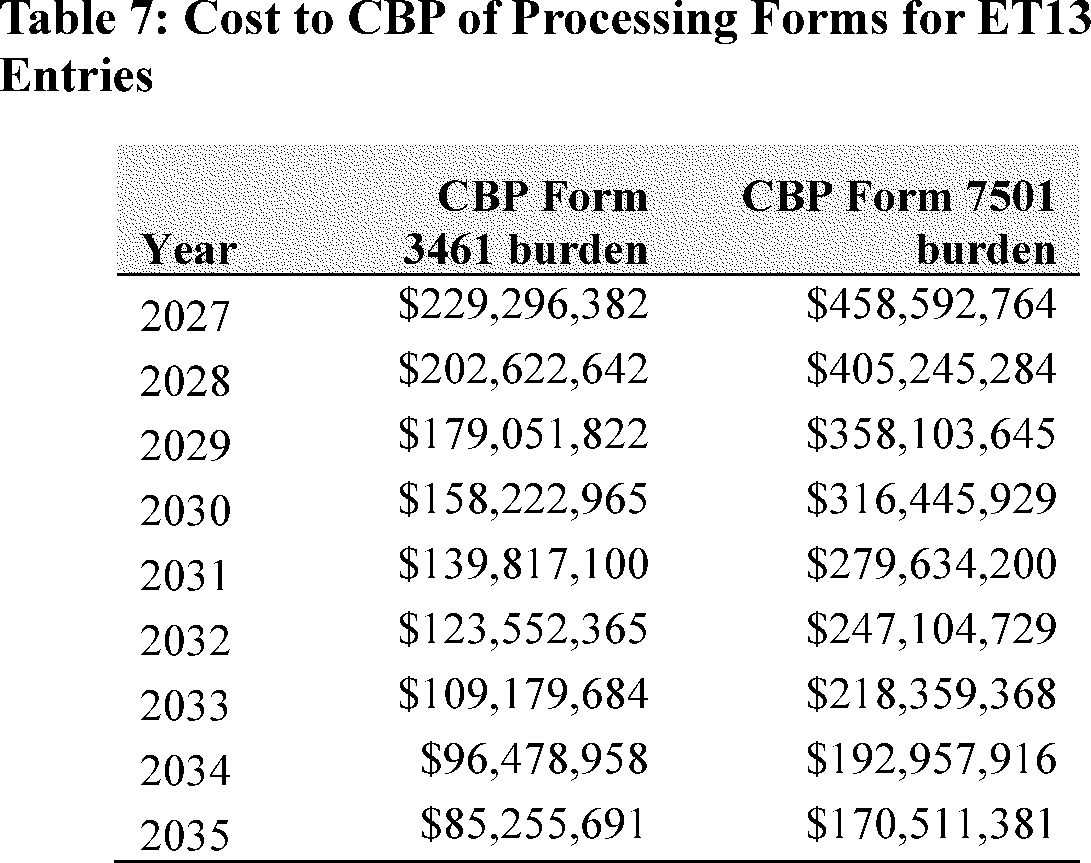
CBP may also incur costs from inspecting more shipments. Under the rule, CBP would receive more information about shipments, especially postal shipments, and would receive this information sooner, which would improve CBP's targeting capabilities. At this time, it is uncertain how improvements in targeting would affect the number of inspections that CBP conducts. CBP may inspect more shipments, or it may inspect the same number of shipments as before but improve its selection of which shipments to inspect, thanks to the additional data available under the rule. If CBP inspects more shipments under the rule, then CBP would incur the labor cost of these additional inspections.
USPS
The rule would affect USPS in several ways. USPS would need to make updates to its electronic systems to handle ET13 entries, which USPS estimates would result in an initial programming cost of between $12 million and $20 million.[29] CBP uses the midpoint of this range, $16 million, for its calculations while noting the uncertainty around the estimate. USPS expects these programming changes to take 4 to 6 months on the low end and up to 8 months on the high end. After the initial development costs, USPS expects to incur operation and maintenance costs around $1 million per year.[30] Besides the programming costs, USPS would also incur labor costs to update its process for handling shipments under the rule.
USPS may also encounter storage capacity issues. While the baseline postal shipment process allows for postal shipments to be processed quickly, USPS expects that the average holding period would lengthen under the rule. As a result, a larger volume of postal entries would be held at USPS facilities at a given time, imposing larger labor and storage costs on USPS. USPS Office of Exchanges were designed for flow-through processing, without warehousing capacity, and USPS anticipates that it would need an initial warehouse capacity equivalent to 80% or more of the import volume under the rule. Besides the cost of sourcing warehouse space, there would be additional costs from designing and implementing the storage and retrieval processes. Lease rates range from $25/sq. ft to $50/sq. ft, though offsite storage would impose additional costs.[31]
Under the rule, USPS expects that more postal shipments would be abandoned after 15 days due to not being properly entered. The cost of returning undeliverable goods depends on many variables, but USPS roughly estimates that the average cost of returns is greater than $6.00 USD per kilogram. In this analysis, CBP includes the initial estimated programming cost to USPS, but CBP lacks quantified estimates of the costs of the warehousing requirements and the resources spent returning non-compliant postal shipments under the rule. CBP has undergone extensive outreach to the trade to prepare them for this rule and will continue to do so. CBP expects that by the time the final rule becomes effective, the trade will have adjusted its processes to minimize the cost to return undeliverable mail to the extent possible. CBP requests comment on the cost to return undeliverable mail.
As discussed in the CBP subsection above, the number of inspections might increase under the rule, though not necessarily. If inspections of postal shipments do increase, then CBP would ask USPS to hold more of these shipments so that CBP can inspect them. An increase in holds could result in further costs to USPS, due to the greater need for warehouse space and the change in USPS processes needed to hold more shipments.
Filers
This subsection describes the costs of the rule to individuals and businesses that file entries. CBP expects that in both the baseline and regulatory scenario most entries would be filed by a broker hired by the owner, purchaser, or consignee. However, an owner or purchaser of a shipment is allowed to file entry themselves if they so choose.
Earlier Filing Deadline
Under this rule, filers would have to comply with an earlier filing deadline for ET11 entries. In the baseline, entry must be made for ET11 within 15 days of the shipment's arrival. Under the rule, the entry data would need to be submitted upon or prior to the shipment's arrival. CBP took a random sample of 392,473 ET11 entries from September to November of 2025 and calculated the number of days between the entries' arrival in the United States and their entry filing dates.[32] Only 0.4% ( printed page 64546) of entries were filed before the day of arrival. However, 26.6% of entries were filed the day of arrival, and 25.0% were filed the day after. Therefore, just over half of ET11 entries need to be submitted only a day or two earlier to conform with the earlier deadline.
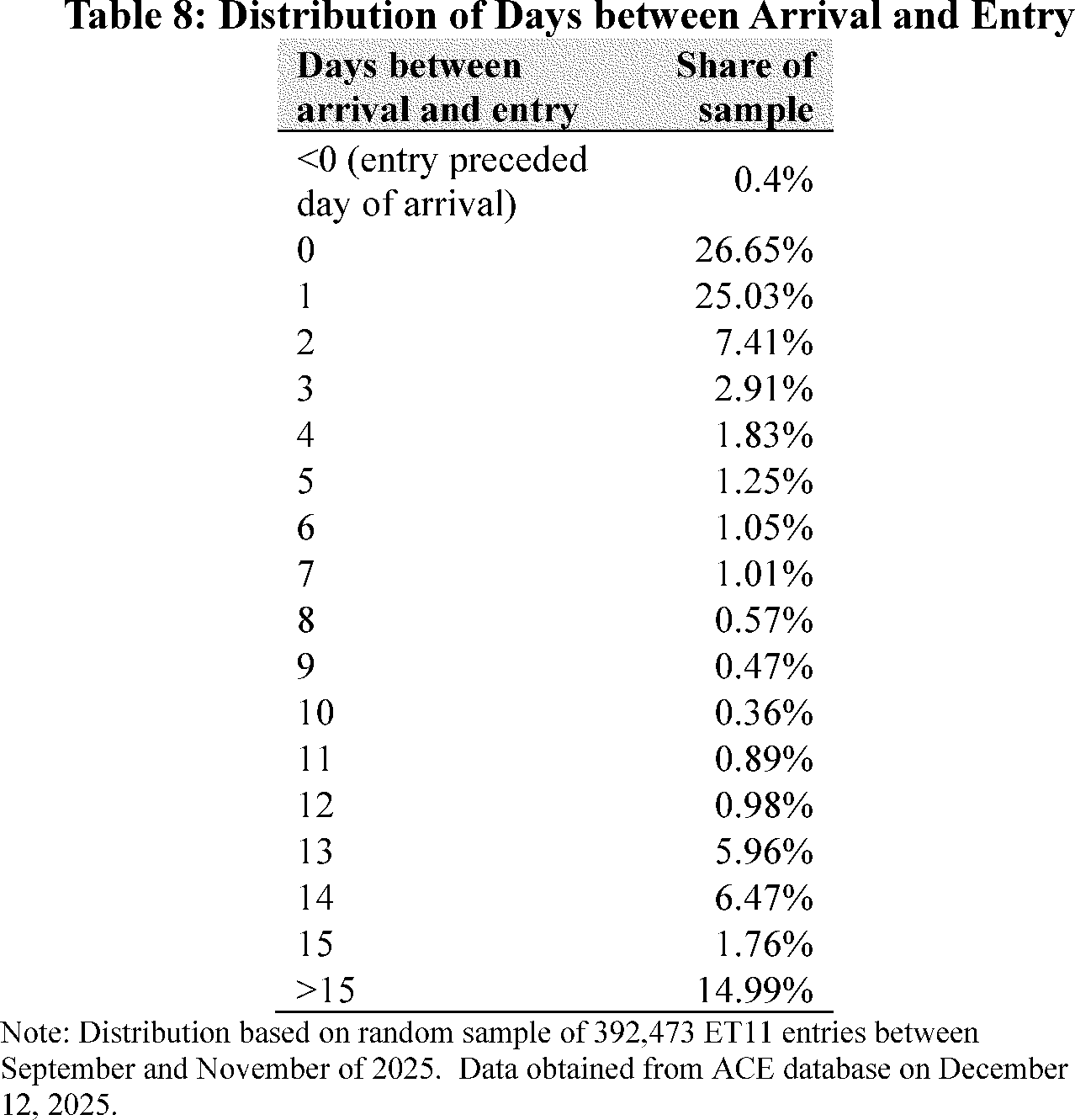
As for the entries that are filed later, CBP does not know what the costs of the new deadline would be. According to CBP subject matter experts, most of the time, the entry data is available to filers before arrival, so filers simply need to submit the data to CBP earlier. However, there could be cases in which obtaining the data earlier is difficult, and the filers and their clients may need to adjust their business processes in meaningful ways to comply with the earlier filing deadline. The earlier deadline could even result in filers needing to invest in more staffing overseas. If a filer's standard procedure in the baseline is to read the package labeling of a shipment that has arrived in the United States and then use that information to submit entry data, then that process would no longer work under the rule. Instead, the filer may need to employ more people abroad so that they can look at the shipment before it leaves for the United States to be able to make entry before the shipment's arrival. While CBP is unable to quantify these costs, it acknowledges that they could be significant, even for filers who typically make entry shortly after arrival in the baseline. CBP requests comment from the public on the magnitude of the costs of the proposed earlier filing deadline.
The rule would have an ambiguous effect on shipping times. If shippers do not believe that the transit time will be sufficient to gather and submit the necessary data, they could choose to delay shipment, perhaps by holding the goods in warehouses in the country of origin while the different parties prepare the entry data. This warehousing on the front end would increase the total shipping time and costs. On the other hand, the earlier filing deadline could have the advantage of causing the merchandise to be released sooner and therefore be delivered sooner. However, even if the latter effect prevails, any benefit from this change will be less than the cost of filing entry earlier. If the benefit to trade members exceeded the cost of filing entry upon or prior to arrival, then filers would have already chosen to do so in the baseline, as they have always had that option. Still, this effect may mitigate the costs of having to file data sooner. CBP requests comment on the impact of the earlier filing deadline on shipping times and whether it varies by mode of transport.
The change to the entry deadline could also affect how soon filers need to complete entry summary. The entry summary deadline would still be 10 days after release of the entry, just as before the rule, but since the release of merchandise is conditioned partly on the entry being filed and partly on the merchandise's arrival, the earlier deadline for filing entry would mean that some merchandise would be released sooner. As a result, entry summary would sometimes be due sooner than it is under the baseline. To the extent that having to submit entry summary sooner would be an inconvenience to filers and their clients, this effect would be another cost of the ( printed page 64547) rule, though one that CBP cannot quantify.
Electronic Submission
The rule would require ET11 and ET13 entries to be submitted electronically instead of on paper, which would let CBP avoid manually entering information into ACE. Most informal entries are already filed electronically, but some are not. From September 1, 2025, to May 31, 2026, 73,534 ET11 entries were submitted manually, out of 52,450,418 ET11 entries in total (or 0.14%).[33] As discussed in the Cost Savings section, there are some advantages to filers of submitting forms electronically. However, the fact that some filers choose to submit forms manually means that electronic submission is not their first choice and that CBP requiring electronic filing could result in a net cost to them. Otherwise, those filers would likely have already switched to electronic filing before the rule, though it is possible that inertia is the only reason they had not already converted to electronic filing. CBP requests comment on this matter.
Additional Data Requirements
Under the rule, ET11 entries would be required to include one additional data element, the final deliver-to party, which would include both the name and address of the final deliver-to party if distinct from the ultimate consignee. Filers would have to update their business practices to obtain this name and address from their clients or other entities, along with the usual entry information. CBP expects that there would be some costs of transitioning to this new method but that the time burden of gathering and submitting data for each ET11 entry would be unchanged once filers have transitioned to the new process. CBP expects that filers would request this new data element from their clients and receive it at the same time that they request and receive the rest of the entry data. Therefore, adding the final deliver-to party as a required data element would have a negligible effect on the time burden of making entry.
ET13 entries would require the same data as ET11, as well as two additional data elements: the tracking number and the shipper or sender. The ET13 process would therefore require more data than the informal postal process used in the baseline. For example, the international mail duty worksheet does not require brokers submitting the worksheet to identify the different parties involved in a shipment, such as the importer of record or consignee. The filers of ET13 entries would likely obtain the tracking numbers from the foreign postal operators (FPOs), which generally already submit the tracking numbers to USPS. Again, CBP expects that filers would incur costs in changing their operations to regularly obtain the tracking number and shipper or sender, but CBP assumes that the average time burden for ET13 entries would be the same as for ET11 entries.
Filers would also need to make changes to their electronic systems so that they can transmit data for the new ET13 process and the added data elements required for ET11 under the rule. CBP does not have data to estimate what the total costs of the programming changes would be for filers, but notes that filers and their software providers regularly make updates to comply with shifting requirements and this change could likely be done in conjunction with those changes at a relatively low additional cost. The new data requirements could also increase the time it takes to ship postal shipments, as the FPOs might require customers to provide the additional data to a filer before accepting the package, thereby delaying the shipping date.
Importers and Senders
Certain costs may fall directly on the importer or on the sender, depending on the circumstances. For example, either the importer or the sender could be the one to hire a broker to file entry, and the party that hires the broker would pay the broker fees, though the other party could ultimately bear some share of those costs. Therefore, CBP groups the costs to importers and the costs to senders into this single subsection.
Broker Fees and Data Requirements
As a result of the rule, the importer or sender of a postal shipment would have to submit more data and spend more on broker services. Under the rule, informal postal entries would need to be entered as ET13, which has similar data requirements as ET11. CBP assumes that all importers or senders of ET13 entries would resort to hiring a broker, since brokers have the expertise to determine product classification and handle various entry requirements. In the baseline, most IMD worksheets are submitted by brokers, and these IMD worksheets would be replaced by the ET13 process in the regulatory scenario. The ET13 process is more demanding for brokers than the current informal postal entry process because under the ET13 process the broker has to submit more data, the data must be submitted earlier, a form must be submitted for each individual entry, and CBP is able to more carefully monitor the data, holding the filers to a high standard of accuracy. As a result, CBP assumes that brokers would charge their customers a significantly higher fee per entry than what they charge for the monthly IMD worksheet as compensation for their higher effort. For the increase in the average broker fee per entry, CBP uses as its estimate the express commercial carriers' brokerage fee estimate found in Fajgelbaum and Khandelwal (2024),[34] which is $30 per shipment.[35] From September 2025 through May 2026, postal shipments with a value of less than or equal to $30 made up 79% of all postal shipments by volume but only 16% by value.[36] Brokerage fees can be much higher for large formal entries, but because this rule would only affect informal entries, which must be $2,500 or less, CBP uses a lower fee estimate. The ultimate cause of the increase in broker fees would be the increased labor necessary to make entry for postal shipments, and it is through the broker fees that this cost would be shifted from the brokers who are doing the work to the brokers' clients. Additionally, importers or senders of postal shipments would have to begin providing the additional data needed to fill out CBP Forms 3461 and 7501 for entry and entry summary, respectively. The time burden for CBP Form 3461 is 10 minutes,[37] and the burden for CBP Form 7501 is 5 minutes. CBP's estimate for the average hourly wage of importers and senders is $38.88.[38] The average ( printed page 64548) costs of the time burdens for submitting CBP Forms 3461 and 7501 are therefore $6.48 and $3.24. Therefore, the combined cost of the broker fee and the time burdens of submitting CBP Forms 3461 and 7501 would total $39.72 for an ET13 entry. CBP applies the average broker fee and time burden costs of ET13 entries to the projected number of postal shipments during the regulatory period, found in Table 5, to calculate the total annual costs to importers associated with the new ET13 process. Table 9 displays the annual costs starting in 2027, when the rule would take effect.
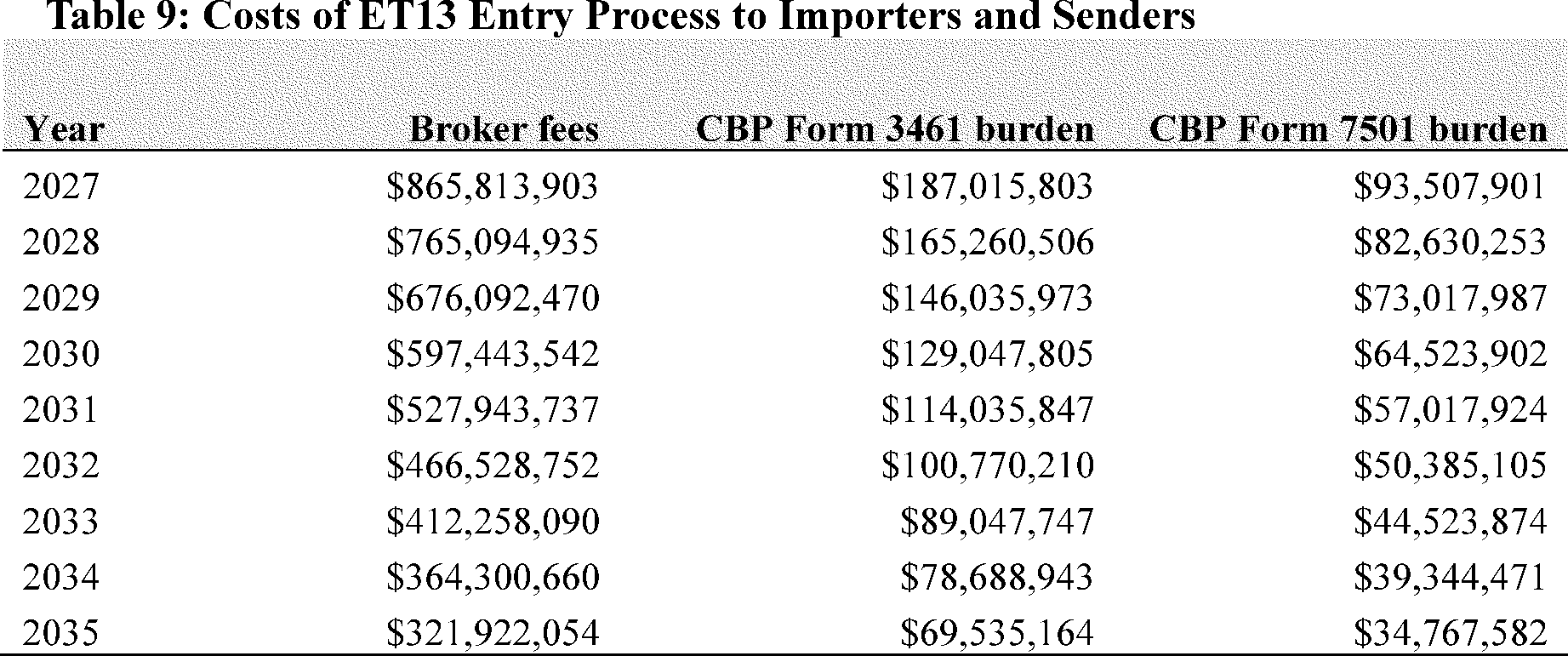
While CBP assumes for this analysis that the costs in Table 9 would fall entirely on importers and senders, the incidence of the fees is determined by the relative price elasticities of supply and demand. The importers, the senders, the final deliver-to parties, and the brokers would share the incidence of these costs to varying extents. How much of the incidence each party would bear would depend on the relevant price elasticities of supply and demand, which CBP is unable to estimate for this analysis. The costs would result to some extent in reduced quantity demanded and ultimately deadweight loss, which is discussed in a later subsection.
Basic Importation and Entry Bond Required for Informal Entries
A basic importation and entry bond would be required under the rule for ET11 and ET13 entries. Because a bond is already required under the current informal postal entry process, CBP does not expect the bond requirement for ET13 entries to result in additional costs. The bond requirement for ET11 entries, on the other hand, would be new. This change would therefore result in costs for the importers of record of ET11 entries, as the importer of record is the party whose bond is obligated. Although a basic importation and entry bond is not currently required for all ET11s, most ET11 entries are secured by a bond. From August 1, 2025, to July 31, 2026, about 2.3 million ET11 entries were entered without a bond,[39] which is only 3.31% of CBP's projected annual ET11 entries for 2026. Bonds are already common because a continuous bond is required for IORs who want to pay duties, taxes, and fees on a periodic monthly statement.
An importer of record can choose to use either a continuous bond or a single transaction bond. A continuous bond secures all entries during a period of up to one year and renews automatically for successive one-year periods, while a single transaction bond can only be used for a single entry. For importers using a continuous bond, CBP requires a bond equal to at least 10% of last year's duties, taxes, and fees or, if the importer is new, 10% of the anticipated duties, taxes, and fees to be paid in the upcoming year. The continuous bond must also be at least $50,000. A single transaction bond is generally an amount not less than the total entered value of the merchandise, plus any duties, taxes, and fees. In the baseline, a single transaction bond must be at least $100. Under the proposed rule, CBP could raise the floor to $1,000, which would equal the minimum liquidated damages under the rule.
The cost of a bond to an importer is not the amount of the bond but rather the bond premium that the importer would pay to the surety. Based on information gathered from 12 broker websites, the average premium for a $50,000 bond is $441.52. The average premium is therefore 0.883% of the bond amount for minimum continuous bonds. CBP assumes that this rate holds for continuous bonds over $50,000 as well. Based on information gathered from six broker websites, the average broker charges a premium of $4.917 per $1,000 for single transaction bonds, with a minimum premium of $54.167. CBP assumes for its calculations that the rate of $4.917 per $1,000, or 0.4917%, is applied continuously rather than at intervals of $1,000. Due to the minimum premium of $54.167, a single transaction bond of $1,000 has the same premium as one of $100. Hence, whether the floor for a single transaction bond stays at $100 or is raised to $1,000 under the rule has no effect on the estimated cost of the bond requirement. ( printed page 64549)
To estimate the annual cost of the bond requirement, CBP used data on bondless ET11 entries from August 1, 2025, to July 31, 2026, to estimate the cost to each importer of record of importing those same entries with a bond.[40] CBP estimated the cost to each importer of using a continuous bond or single transaction bonds and then determined which was the cheaper option for each importer. The continuous bond amount was based on the duties, taxes, and fees paid over that same time period, with a floor of $50,000. Of the 68,701 importers of record that imported an ET11 entry without a bond, a continuous bond would have been cheaper for 14% of those importers, while single transaction bonds would have been cheaper for the other 86%. Despite making up only 14% of the group, those importers for whom a continuous bond would have been cheaper made 96% of bondless ET11 entries. Table 10 shows the total bond amount and total bond premium of the ET11 entries for each bond type. Overall, the average bond premium for ET11 entries that would be entered without a bond in the baseline would be $3.99, but this average masks some significant variation. For importers of record who would have chosen single transaction bonds as the cheapest option, the average bond premium per ET11 entry would be $55.57, while the importers who would have chosen a continuous bond as the cheapest option would have incurred an average bond premium per ET11 entry of $1.95.
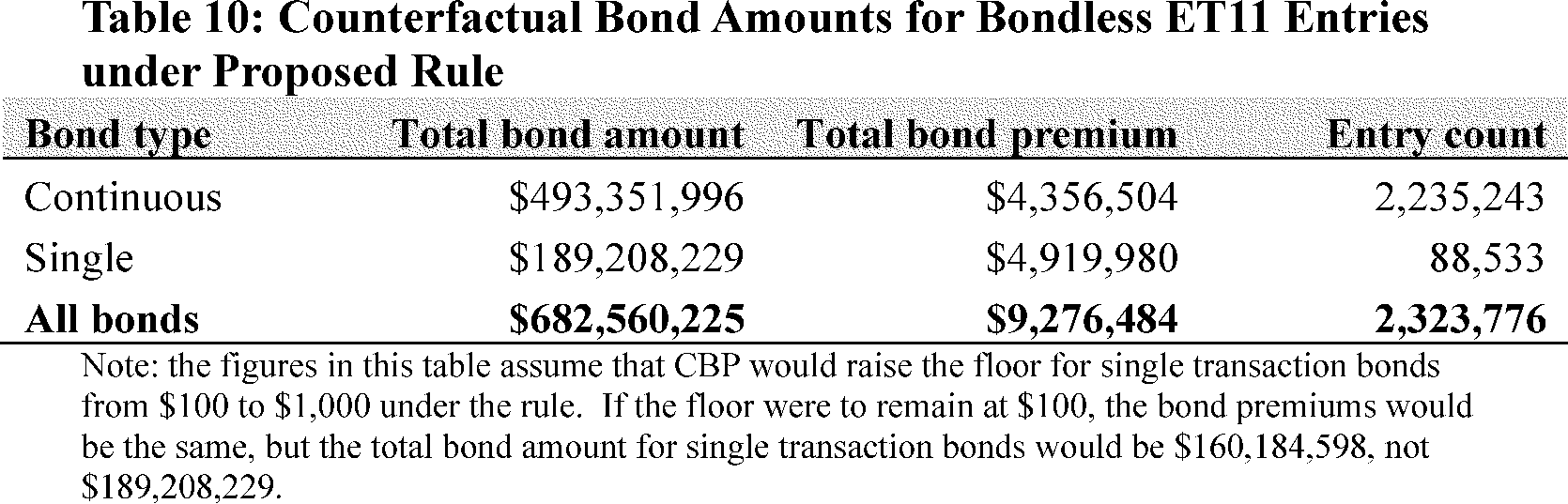
Based on the above calculations, CBP estimates that adding a bond requirement for ET11 entries would have resulted in an additional cost to importers of record of $9,276,484 at the present level of shipping activity. Because CBP projects that the annual ET11 entry count will continue to grow at 3.14%, CBP applies this growth rate to the total bond premium to project the cost of the rule's bond requirement over the period of analysis, starting in 2027 when the rule would take effect. These annual costs are shown in Table 11.
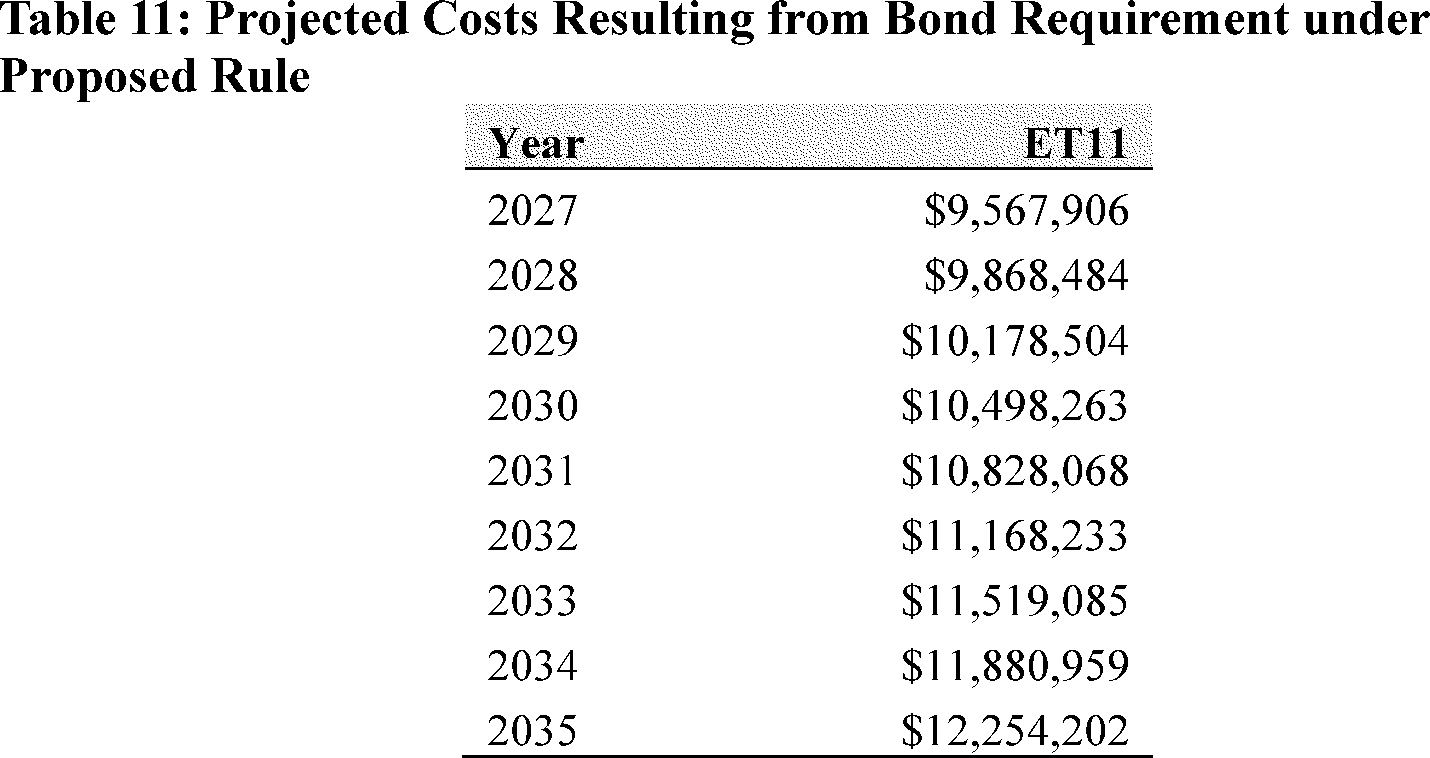
Unentered Informal Postal Entries
The rule would set the voluntary abandonment deadline for ET13 entries at the expiration of a 15-day period, meaning that postal shipments that are unentered 15 days after arrival would be deemed to be voluntarily abandoned. This deadline is stricter than the abandonment deadline for ET11 entries, which is 6 months after arrival. Postal shipments under the baseline process have a 30-day window for which USPS holds items for pickup, and if not picked up, the items are abandoned or returned. Currently, only a very small volume of items are not picked up during this window. Under the rule, however, USPS anticipates a significant number of shipments would be deemed abandoned after 15 days because no entry would be filed for them under the new process. Hence, under the rule some importers may not receive their shipments due to the 15-day voluntary ( printed page 64550) abandonment deadline combined with the more demanding entry process.
Carriers
Carriers would need to provide tracking numbers for postal shipments on the manifest. Those tracking numbers would be the same as what the brokers provide for ET13 entries and what FPOs already provide to CBP for postal shipments. The carriers therefore would have to update their business practices so that they obtain the tracking number from the broker, the FPO, or some other source through the normal course of business. CBP requests comment on how costly the change in procedure would be for the carriers. Besides the costs that carriers would incur in updating their procedures, CBP also expects this new data element to add 1 minute to carriers' time burden of submitting manifests.[41] To calculate the value of this added time burden, CBP uses an hourly wage of $38.88.[42] The average cost of the time burden to carriers is therefore $0.65 per postal entry. Based on the forecasted postal entry counts in Table 5, CBP calculates the cost burden to carriers under the rule, shown in Table 12.
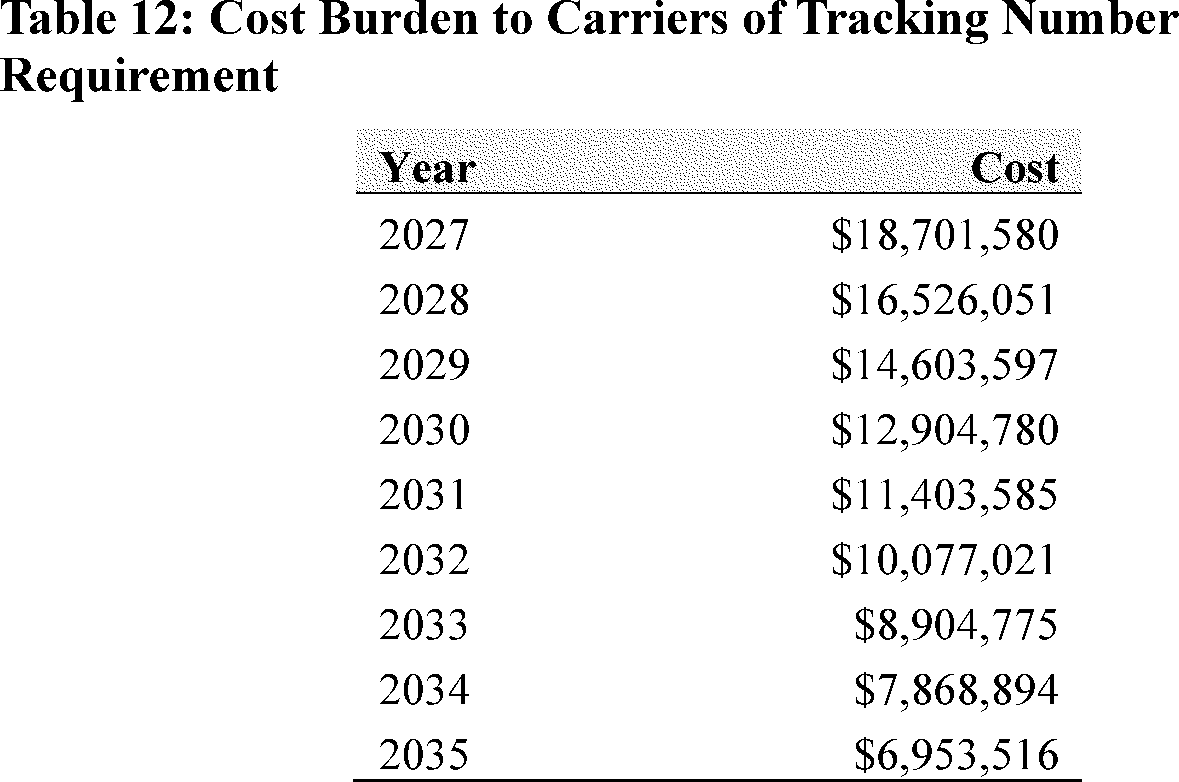
Deadweight Loss
Although this analysis assumes in its calculations that the quantity of imports would be unaffected by the rule, it is likely that the improved duty collection rate for postal shipments (discussed further in the Transfers section) and the various costs for postal and ET11 entries resulting from the rule would cause importers to import less. This decrease in imports would correspond to a cost to society in the form of deadweight loss. While some of these goods would not be imported under the rule, the fact that they would be imported in the baseline means that the benefit of those imports to importers exceeds the cost of producing those goods, shipping them, and complying with the baseline entry process. Were importers to decide not to import some of those shipments as a result of the rule, society would be missing out on the net gains from trade that would have occurred with those shipments. The deadweight loss from the rule is the total value of this lost surplus. While CBP lacks the data to estimate deadweight loss in this analysis, this could be an important cost of the rule. Also, to the extent that there would be deadweight loss under the rule due to a decrease in imports, there would be a smaller increase in government revenue, bond premiums, broker fee payments, and any other per-unit or per-value costs that CBP estimates here, as there would be fewer shipments.
While CBP cannot estimate the deadweight loss from the rule or how the change in import quantity would affect the other cost estimates, the results from one research paper could be used to approximate the magnitude of the cost to consumers when factoring in deadweight loss. In Fajgelbaum and Khandelwal (2024) (denoted here by F&K) the authors estimate the loss to consumer welfare, including deadweight loss, that would have occurred in 2021 had the de minimis exemption been terminated that year.[43] In the paper's model, ending de minimis would have resulted in more goods being subject to duties and in consumers paying an “administrative fee” to a logistics company (similar to broker fees in this analysis), with the fee ( printed page 64551) estimated at $30 for some of their calculations. Unlike in F&K, the regulatory action considered in this analysis is not the suspension of de minimis, which has already been suspended, but the replacement of the current informal postal process with the ET13 process, which would result in an estimated $30 broker fee and a time burden with a total value of $9.72 to submit entry form information for informal postal shipments, along with an increase in duty payments for the postal shipments that are noncompliant in the baseline but compliant under the rule. The regulatory action considered in F&K is therefore not the same as the regulatory changes proposed here. However, there are similarities. Both changes would involve a new per-shipment fee of $30, and both would apply to low-value shipments. The average value of a de minimis shipment in 2021 was $56.38, while the average value of postal shipments from September 2025 to May 2026 was $48.29. The value of the new time burden for informal postal entries, $9.72, is 20% of the average postal values, which is close to the average duty rate used by F&K based on CBP data, with Table 3 in F&K showing the average duty rate range from about 23% for the poorest zip codes to about 16% for the richest zip codes. Besides the precise cost increases being slightly different, the key differences between F&K and this analysis are that the regulatory changes in this rulemaking would only apply to postal shipments and that the duty revenue in F&K would be rebated back to consumers, whereas the cost of the time burden to submit CBP Forms 3461 and 7501 would be a pure loss. Still, the similarities between the two regulatory actions considered mean that F&K results about consumer welfare loss could be informative for assessing the scale of consumer welfare loss from this rulemaking.
Using CBP import data and an estimated administrative fee of $30, F&K estimate that the consumer welfare losses of ending de minimis in 2021 would have equaled $20.8 billion that year. The value of de minimis imports that year was $43.5 billion, meaning that the estimated consumer welfare losses were 47.8% of baseline consumer spending on the de minimis goods. CBP applies that 47.8% figure to informal postal imports here. From September 2025 to May 2026, the value of informal postal shipments was $1,179,693,422. At that rate, the total value imported in 2026 would be $1,577,245,784. Applying the CAGR of −11.63% discussed in the Projected Entry Counts section, CBP estimates that the value of informal postal imports in 2027 in the baseline would equal $1,392,823,929. If the relative consumer welfare losses were the same here as in F&K's estimate for ending de minimis in 2021, then, multiplying the value of postal informal imports by 47.8%, the losses would equal $666 million in 2027. To be clear, this consumer welfare loss of $666 million is not an additional cost that should be added to the estimated $1.2 billion cost to importers and senders in 2027. Rather, it is an alternative estimate of the total cost to that group. And while the $666 million is too inaccurate to use in this analysis due to the differences between this rulemaking and the regulatory action considered in F&K, it is true that a cost estimate that factors in deadweight loss from decreased imports should produce a total cost estimate less than the one estimated in this rulemaking. That is because CBP assumes in this analysis that the rule would not affect import quantity. To the extent that imports would fall as a result of the rule, the total cost of the rule would be lower than CBP's estimate because fewer imports would mean less money spent on broker fees and less time spent submitting CBP Forms 3461 and 7501. The resulting deadweight loss from decreased imports would not be large enough to outweigh those effects, or else importers would not choose to import less in the first place.
Total Costs
The quantified costs of the rule would include the cost to CBP of programming changes and reviewing more submissions of CBP Forms 3461 and 7501, the cost to USPS of updating its electronic systems, the cost to importers and senders resulting from new data requirements for postal shipments and the added bond requirements for informal entries, and the cost to carriers of supplying the tracking number on manifests for postal shipments. These costs and their totals are shown in Table 13 and Table 14 from 2026 to 2035. Due to data limitations, CBP is unable to quantify other costs that would result from the rule. These unquantified costs include the cost to USPS for storing, designing, and implementing storage and retrieval processes, and returning undeliverable goods, and the cost to brokers of earlier filing deadlines, updating electronic systems, switching to electronic submission of entry forms, and making changes to business practices to get extra data elements for ET11 and postal shipments. Our unquantified costs to importers are the deadweight loss from reduced imports. While CBP is unable to estimate these costs, it acknowledges that some of them, in particular the change in the filing deadlines, could be significant.
( printed page 64552)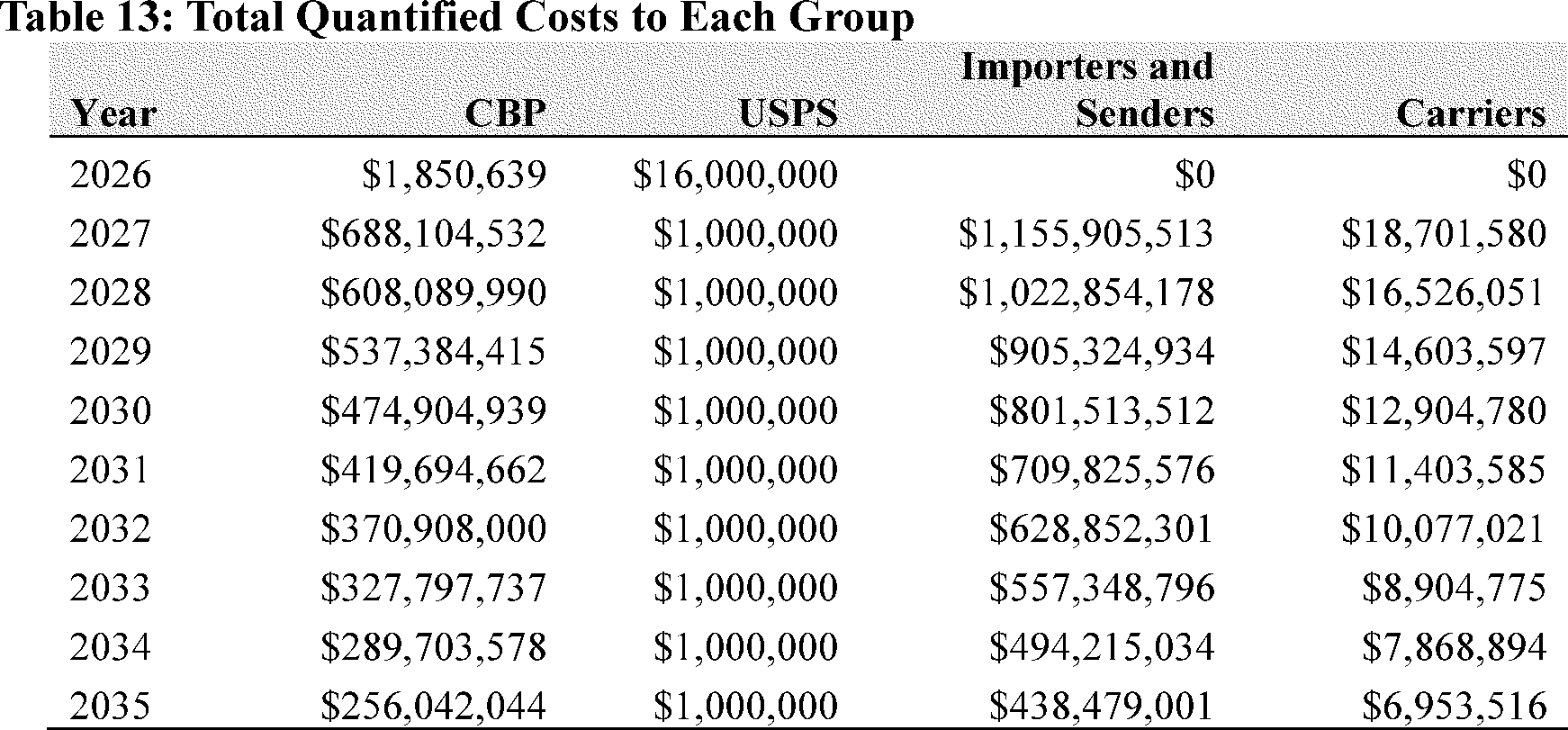
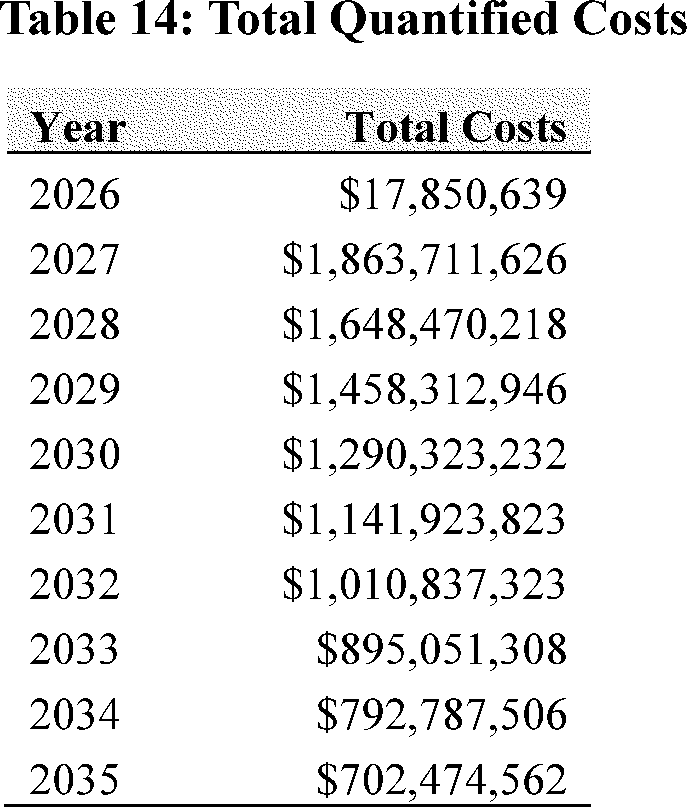
Benefits
This rule would help prevent unlawful importations, increase trade enforcement, and improve trade compliance. These benefits would result from the improvements in CBP's targeting of violative shipments and in trade members' increased compliance with regulations. CBP would be able to target violative shipments more accurately and efficiently because CBP would receive more data and because entry data would arrive sooner and be more reliable. Under the current informal postal entry process, importers do not have to provide as much information to CBP as they would have to if they had been filing ET11 entries. Under the new ET13 process for postal shipments, importers would have to provide the same information as for ET11 entries, as well as the postal tracking number and the shipper or sender. Among other data elements, CBP would receive information regarding the various parties involved with the postal shipment, which would be helpful in targeting higher risk shipments. Importers would also start providing the final deliver-to party for ET11 entries if distinct from the ultimate consignee. Because the new entry filing deadline would be the time of arrival rather than 15 days after arrival, CBP would receive the entry data sooner, which would also help with targeting.
CBP believes entry data would become more reliable under the rule due to the new bond requirement for informal entries and the new minimum liquidated damages amount of $1,000 for informal entries. In the past, for informal entries not secured by a bond, when CBP discovered a discrepancy between the data submitted by the filer and the actual contents of the shipment, such as misclassification or undervaluation, CBP was unable to assess liquidated damages for the breach of the bond. With the added bond requirement, liquidated damages would impose a financial consequence for breaching the bond, so CBP expects that the entry data would be more reliable. Liquidated damages are often calculated based on the value of the merchandise, which means that the damages are small when the merchandise has a low value. With the new minimum liquidated damages amount of $1,000 for informal entries, compliance with entry regulations could improve for low-value shipments.
Because of all the new data that would be submitted for ET13 entries that is not required in the current informal postal entry process, the largest security improvements under the rule are expected to occur in the postal environment. Carriers would provide the same tracking numbers for postal shipments that the brokers would be providing on the ET13 entry forms. By matching the tracking number provided by the carrier on the manifest to the tracking number provided by the filer for the entry, CBP would be able to connect the entry information to the manifest information and know when different postal shipments arrived in the United States.
The postal environment is a useful one to target, as postal shipments have a much higher seizure rate than other entry types. Based on data from FY 2024, Table 15 shows the number of seizures per million entries for postal de minimis, non-postal de minimis, ET11, and ET01 shipments. The total seizure rate is 6.6 times higher for postal de minimis than ET11 shipments, which has the next highest seizure rate. The narcotics seizure rate in particular is 17.6 times higher for postal de minimis entries than for ET11. Non-postal de minimis entries had a narcotics seizure rate similar to that of ET11, but many of the non-postal de minimis entries were ET86 entries, which had similar data requirements as ET11 entries. CBP believes the postal seizure rates are high because bad actors knew that mail had lower data requirements, which limited CBP's ability to identify which packages to search. Under the rule, CBP would receive much more data for postal shipments than it did in the baseline and would receive this data sooner. By requiring the same data elements as ET11 historically did and by adding new data elements, CBP would have the information needed to effectively target for narcotics and other prohibited items. Similarly, CBP believes that the bond requirements and the earlier filing deadlines would aid CBP in targeting narcotics and other illicit goods in both the postal and ET11 environments. By closing the data gap in postal ( printed page 64553) shipments, this rule would lead to a significant improvement in the interdiction of drugs and other violative merchandise.
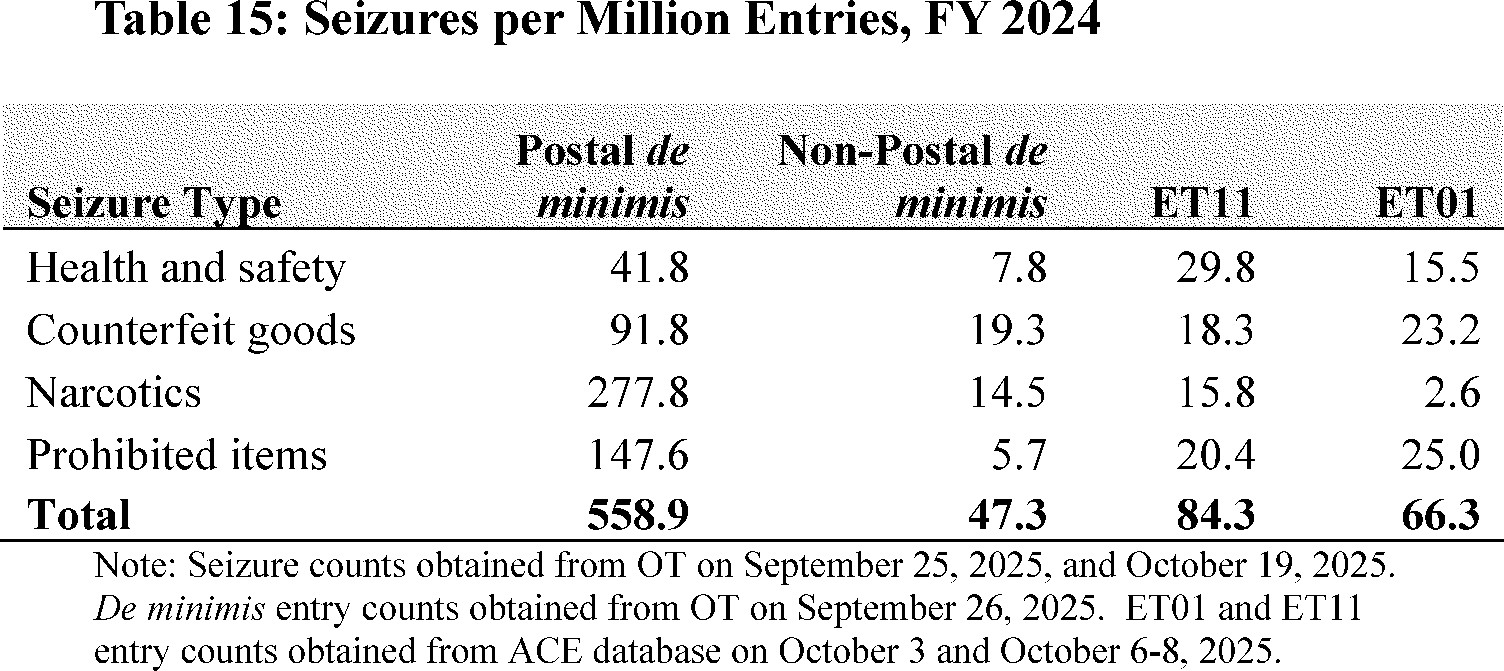
The rule would also force more senders and importers of postal shipments to comply with CBP's entry requirements. Currently, among the postal shipments that have forms submitted, almost all are entered through the informal postal process, using the IMD worksheet, while a negligible number of postal shipments are entered through formal entry. From September 2025 to May 2026, 24.4 million postal shipments were sent to the United States, but only 16.4 million postal shipments, or 67%, were entered through an informal or formal entry process. Postal shipments do not have to be entered through the current informal postal entry process or formal entry if they qualify as gifts and are eligible for the de minimis gift exemption under 19 U.S.C. 1321(a)(2)(A), which would exempt them from data entry requirements. However, CBP believes that the share of postal shipments that qualify as gifts is much lower than 33% and that most of the postal shipments sent without entry data were not complying with the existing regulations. CBP automatically releases most postal shipments with the expectation that the shipment will later be reported on an IMD worksheet, but the senders or importers do not always do so. Under the rule, however, entry data would have to be submitted prior to arrival, and carriers would have to submit the tracking number on the manifest, which is already required on the entry forms. Thus, CBP could use the tracking number on the manifest to check whether entry has been made for that postal shipment, and CBP could refuse to automatically release shipments that have not yet made entry. CBP could then also require that some postal shipments qualifying as gifts only be released manually after an officer reviews the shipment manifest. These changes would lead to a much higher share of postal shipments submitting entry data to CBP, which would further improve CBP's ability to screen for violative shipments.
The increase in entry filings would also allow CBP to collect duties on more postal shipments. After all, a postal shipment that arrives without entry forms ever being submitted is likely avoiding duty payments as well. CBP considers improvements in the enforcement of existing duties a benefit because consistent enforcement allows compliant members of the trade to follow the rules without being put at a disadvantage. On the other hand, the increase in government revenue that would result from a stricter enforcement of duties is counted as a transfer, not a benefit, as the loss to the duty-payers equals the gain to the U.S. government. CBP estimates the revenue increase in the Transfers section below.
Cost Savings
Electronic Submission
This rule would make the importation process more efficient for CBP. ET11 entries and the new ET13 entries would have to be submitted electronically. In the baseline, filers (except for express carriers) who submit entry forms manually are charged a higher fee because of the increased burden for CBP. The fact that some filers are willing to pay the fee and submit entry manually means that the burden reduction for CBP under the rule would be less than the cost to the filers. Hence, CBP does not count the cost savings from the shift to electronic submissions by non-express carrier filers, who CBP projects would submit 201 entries manually per year in the baseline.[44] As for express carriers, CBP charges them the same fee regardless of whether they submitted the forms manually or electronically, even though the added burden to CBP of handling manual entries is probably the same as with other filers. Hence, the express carriers do not internalize the added cost to CBP of processing manual entries, and therefore those carriers' decision to submit forms manually does not mean that the convenience of manual submission to them is greater than the cost to CBP. Therefore, CBP counts the burden reduction to CBP of express carriers switching to electronic submission as cost savings of the rule.
From September 1, 2025, to May 31, 2026, express carriers submitted 73,384 manual submissions for ET11 entries.[45] At that rate, 98,114 manual ET11 entries would be filed by express carriers in a year. CBP assumes that manual ET11 entries would grow at the same rate as all ET11 entries in the baseline, which is projected to be 3.14%, as discussed in the Projected Entry Counts section. CBP charges non-express carriers a fee of $8.06 for manual submissions and $2.69 for electronic submissions.[46] CBP uses the difference in the two fees, $5.37, as a proxy for the extra cost to CBP of handling manual submissions. Multiplying $5.37 by the projected annual ET11 entries submitted manually, CBP calculates the cost ( printed page 64554) savings to CBP of express carriers switching to electronic submissions, shown in Table 16. The cost savings would start in 2027, when the rule would take effect.
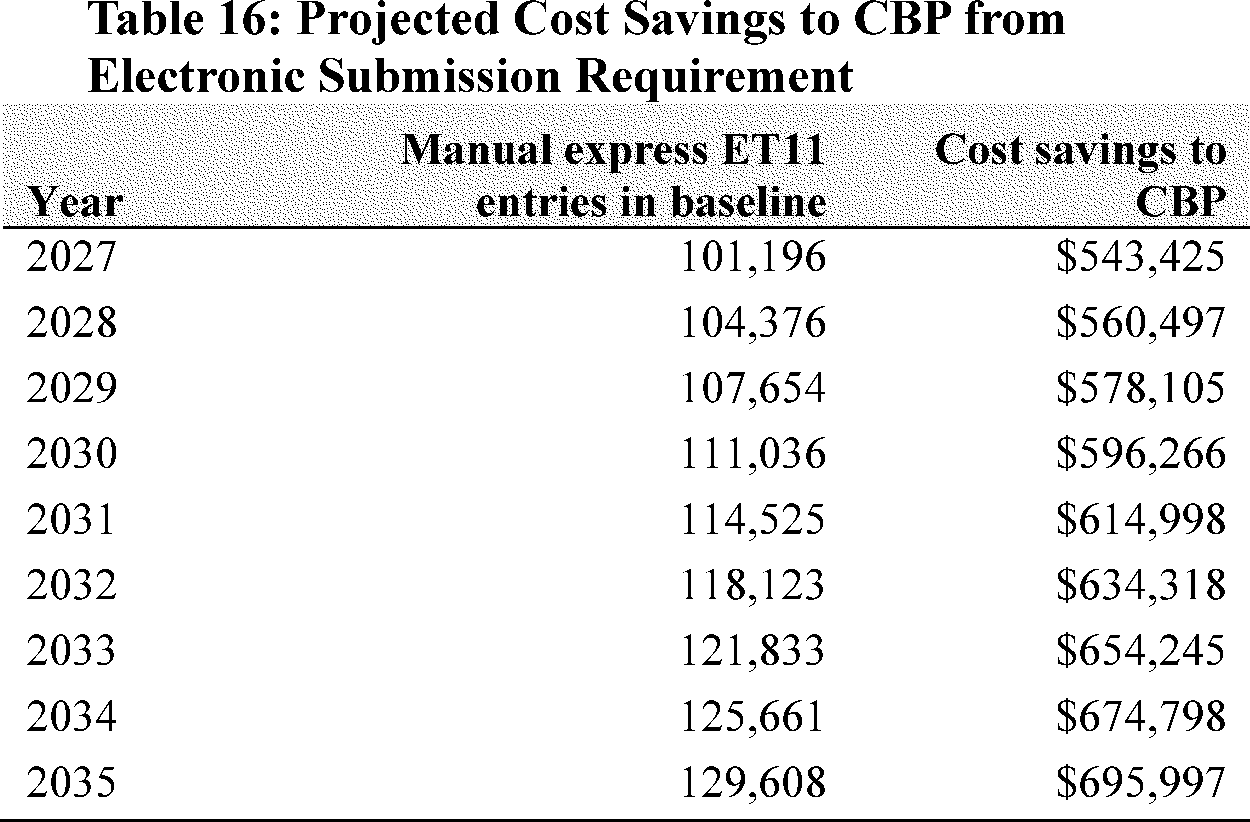
The requirement to submit ET11 entries electronically instead of manually would also result in some time savings for filers who are not express carriers. CBP estimates that the time burden to submit forms electronically is 5 minutes lower for CBP Form 3461 [47] and 10 minutes lower for CBP Form 7501 [48] compared to manual submission. Moreover, electronic submissions require less time to handle on CBP's part, as indicated by the merchandise processing fee (MPF) being lower for electronic submissions than for manual submissions. However, such filers already have the option to file electronically. The fact that some choose to file manually despite the time savings of electronic submission means there are hidden costs to these filers of switching to electronic submission that are even higher than the cost savings. Hence, CBP does not count the cost savings that would result from requiring electronic submission as part of the cost savings of this rule. Gross savings would result from the fact that the time burden to submit forms electronically is 5 minutes lower for CBP Form 3461 and 10 minutes lower for CBP Form 7501 compared to manual submission, as well as the fact that electronic submissions require less time to handle on CBP's part, as indicated by the MPF being $5.37 lower for electronic submissions than for manual submissions. This difference between the MPF for electronic submissions and the MPF for manual submissions already exists, and the rule would not affect how CBP applies the MPF to submissions.
International Mail Duty Worksheet
Brokers, owners, and purchasers who are active in the postal environment would no longer have to submit a monthly IMD worksheet to CBP, as is required for the current informal postal entry process, and this change would yield some time savings.[49] Under the current informal postal entry process, each month, the owner, purchaser, or broker must report to CBP, among other data elements, the value, country of origin, and product classification of that month's imports and pay the corresponding duties owed. CBP estimates that, in the baseline, about 100 IMD worksheets will be submitted each month, with the worksheet taking 6 hours to complete.[50] The number of worksheet submissions is much lower than the number of postal entries because a broker can submit one IMD worksheet for multiple clients. Although CBP expects the number of postal shipments to fall throughout the regulatory period, it assumes that the annual number of IMD worksheet submissions would remain constant in the baseline scenario. Therefore, 7,200 hours would be spent each year submitting the worksheet in the baseline. Most filers of IMD worksheets are brokers, who have an average hourly wage of $38.88.[51] At that wage, the ( printed page 64555) value of the time burden to the filers would be $279,936 per year. Because the rule would require informal postal shipments to be entered as ET13 entries, the IMD worksheet would no longer be necessary for the collection of postal duties, and filers would stop submitting it. Filers of IMD worksheets would therefore experience time savings of $279,936 per year under the rule. Just as brokers and other filers would no longer have to submit the IMD worksheet, CBP would no longer have to process the IMD worksheet. CBP estimates that processing an IMD worksheet takes 2 hours.[52] The average hourly wage of a CBP trade and revenue employee is $95.34.[53] As there would be 100 IMD worksheet submissions per month in the baseline, CBP estimates $228,816 to be the annual burden to CBP of processing IMD worksheets in the baseline or the annual cost savings to CBP under the rule.
Total Cost Savings
The total cost savings include the savings to CBP of no longer handling manual submissions of ET11 or processing IMD worksheets and the savings to filers of no longer submitting the IMD worksheet. The total cost savings are shown in Table 17, beginning in 2027 when the rule would take effect.
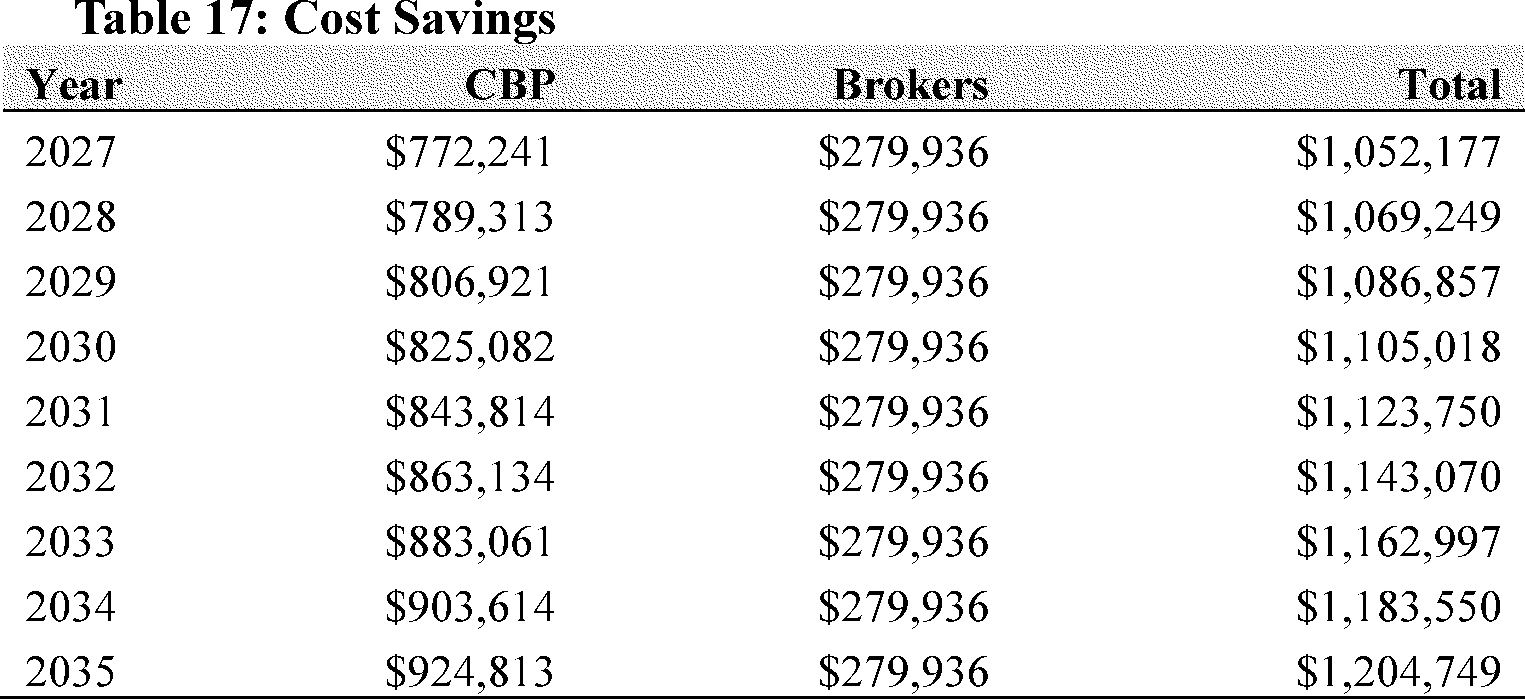
Transfers
As discussed in the Benefits section above, CBP expects that the rule would lead to greater compliance with entry requirements in the postal environment. From September 2025 to May 2026, only 67.02% of postal shipments were entered through an informal or formal entry process, and the value of those postal shipments that had entry forms submitted was 74.96% of the total value of all postal shipments.[54] The postal shipments that did not have entry data submitted through CBP also most likely did not have duties paid to CBP. Therefore, if more postal shipments were entered properly, more duty payments would be made, and CBP would see an increase in duty revenue. To estimate the increase in duty revenue, CBP assumes that the share of postal shipments for which an entry is filed would rise from 67.02% to 100% under the rule and that the average duty rate is the same for postal shipments that would not file entry in the baseline as it is for postal shipments that would. To the extent that the first assumption is inaccurate, these calculations will overestimate the increase in duty revenue. To the extent that the second assumption is inaccurate, CBP's calculations could overestimate or underestimate the revenue increase.
Because postal informal shipments were not subject to all non-Section 122 duties until recently, CBP does not yet know the average duty rate paid for postal shipments that are reported on an IMD worksheet. Therefore, CBP assumes that the effective average duty rate is the same for postal entries as for ET11 entries. CBP took a sample of 392,312 ET11 entries from September to November of 2025 and calculated the total duties paid.[55] Dividing those duties ($23,846,464) by the total value of the goods in the sample ($160,675,653) yields 14.84%, the effective average rate of those duties. From September 2025 to May 2026, $1,179,693,422 worth of postal shipments arrived in the United States. At that rate, CBP calculates that $1,577,245,784 worth of postal shipments would arrive in the United States over one year.[56] Applying the duty rate of 14.84% to this total, CBP estimates that annual duties on postal shipments would be $234,084,842 under full compliance. If only 74.96% of postal entries by value comply with duty requirements, then the total annual duties collected on postal shipments would be $175,465,755. The increase in duty revenue that would result from the compliance rate rising to full compliance under the rule would therefore be $58,619,087. CBP assumes that −11.63%, the CAGR of postal entries over 2021-2024, is the rate at which annual duties on postal shipments would change over the regulatory period. Applying −11.63% growth to the additional annual duties of $58,619,087, CBP projects the additional duties on postal shipments under the rule during the regulatory ( printed page 64556) period, shown in Table 18, starting in 2027 when the rule would take effect. To the extent that postal shipment volumes would be affected by the higher duty collection rate or that the composition of postal shipments differs from that of ET11 entries, the true increase in revenue would differ from our estimate. CBP also notes that in this analysis it did not quantify any additional tariffs that might be imposed in the future, because CBP did not have enough specific information about the rates and applicability of future tariffs.
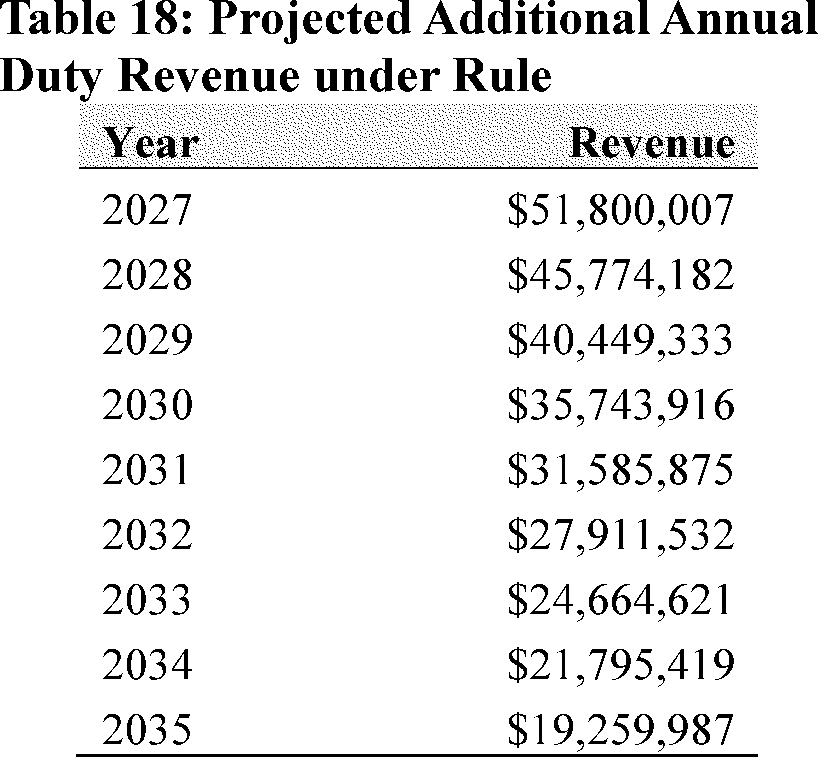
Besides the transfers to the U.S. government through increased duties, the rule could also result in transfers to brokers that were not discussed in the above sections. The increased demand in broker services under the rule could lead to an increase in broker fees, which would represent partly an increase in the marginal cost of broker services and partly a pure transfer from the brokers' customers to the brokers. Moreover, if FPOs or online platforms establish contracts with brokers to handle ET13 entries for postal shipments, these contracts could entail payments to brokers beyond the fees discussed earlier that brokers would charge per shipment.
Net Impact
The rule would increase the security of the entry process and increase duty revenue while also imposing costs on brokers, importers, senders, and the U.S. government. Security would improve for ET11 entries because CBP would receive the final deliver-to party's name and address, entry data would arrive sooner, and the data would be more reliable as a result of the bond requirement for ET11 and the $1,000 liquidated damages floor. Requiring postal informal entries to use the ET13 process would give CBP significantly more information for postal shipments and would impose the same requirements on postal shipments that are being added to ET11, such as the earlier filing deadline. Carriers would also supply CBP with the tracking number for postal shipments, which would help CBP determine when a postal shipment arrived in the United States. With these improvements, CBP could more effectively target high-risk ET11 and postal shipments and thereby detect more prohibited items, including illicit fentanyl and other narcotics. The rule would result in some cost savings to CBP and to filers who previously submitted IMD worksheets. The rule would also increase government revenue from postal shipments, as CBP could more strictly enforce entry requirements so that more postal shipments are entered properly and subject to applicable duties. The projected increase in duty revenue is shown in Table 19, starting in 2027 when the rule would go into effect.
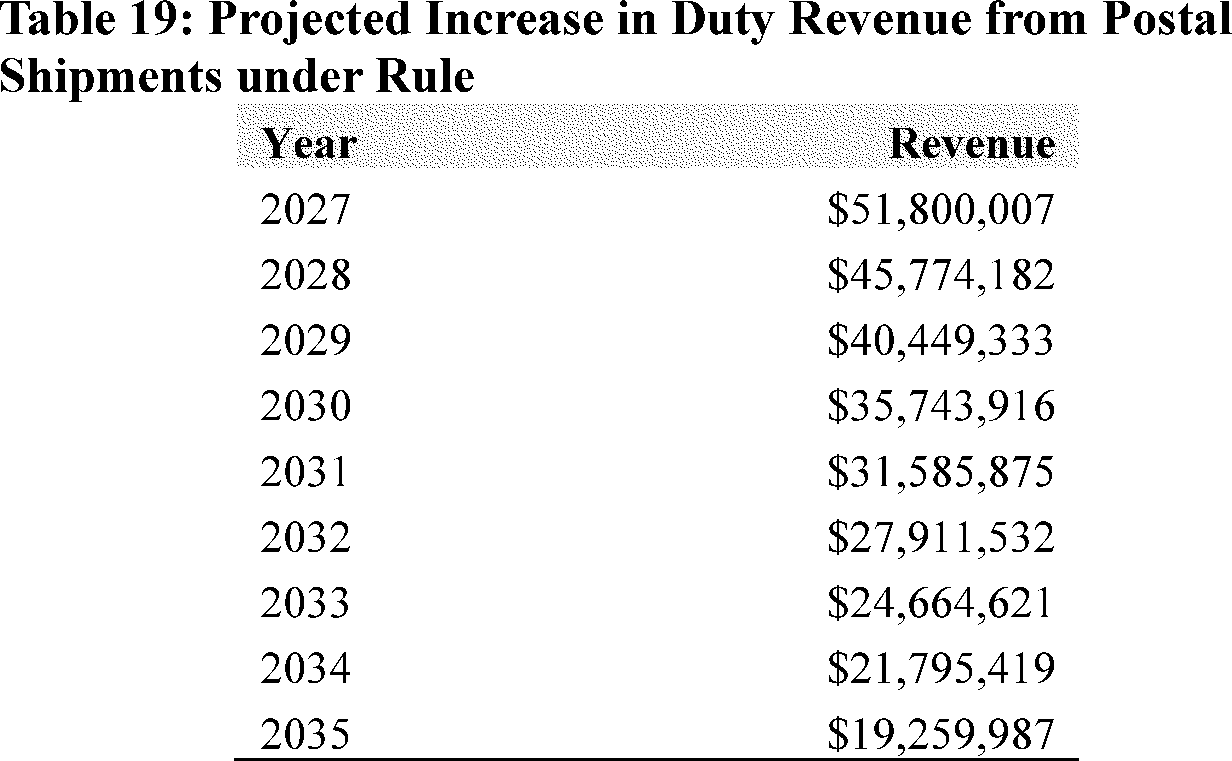
While these changes to the entry process would improve security and raise revenue, they would also result in costs. Filers would have to change their business practices to obtain additional data and to submit entry data sooner, and importers of record who do not already have a bond would have to obtain one. Importers would likely have to pay a broker to handle the entry of postal shipments under the new ET13 process. CBP would incur a time burden from processing more submissions of CBP Forms 3461 and 7501. Both CBP and USPS would incur programming costs for the new ET11 and ET13 entry processes, and brokers likewise would need to update their systems. CBP was able to quantify a portion of the costs and cost savings, but not the benefits. Table 20 shows the quantified estimates of the costs, cost savings, and net impact under the rule, and Table 21 shows the discounted net impact during the regulatory period of 2026 to 2035. The increase in duty revenue under the rule is not included in these calculations because the revenue is a transfer of value from one party (duty payers) to another (the U.S. government) that would not have a direct net effect on society as a whole. The annualized net impact of the rule is estimated to be −$1,090,011,284 per year under a discount rate of 3% or −$1,098,520,538 under a discount rate of 7%.
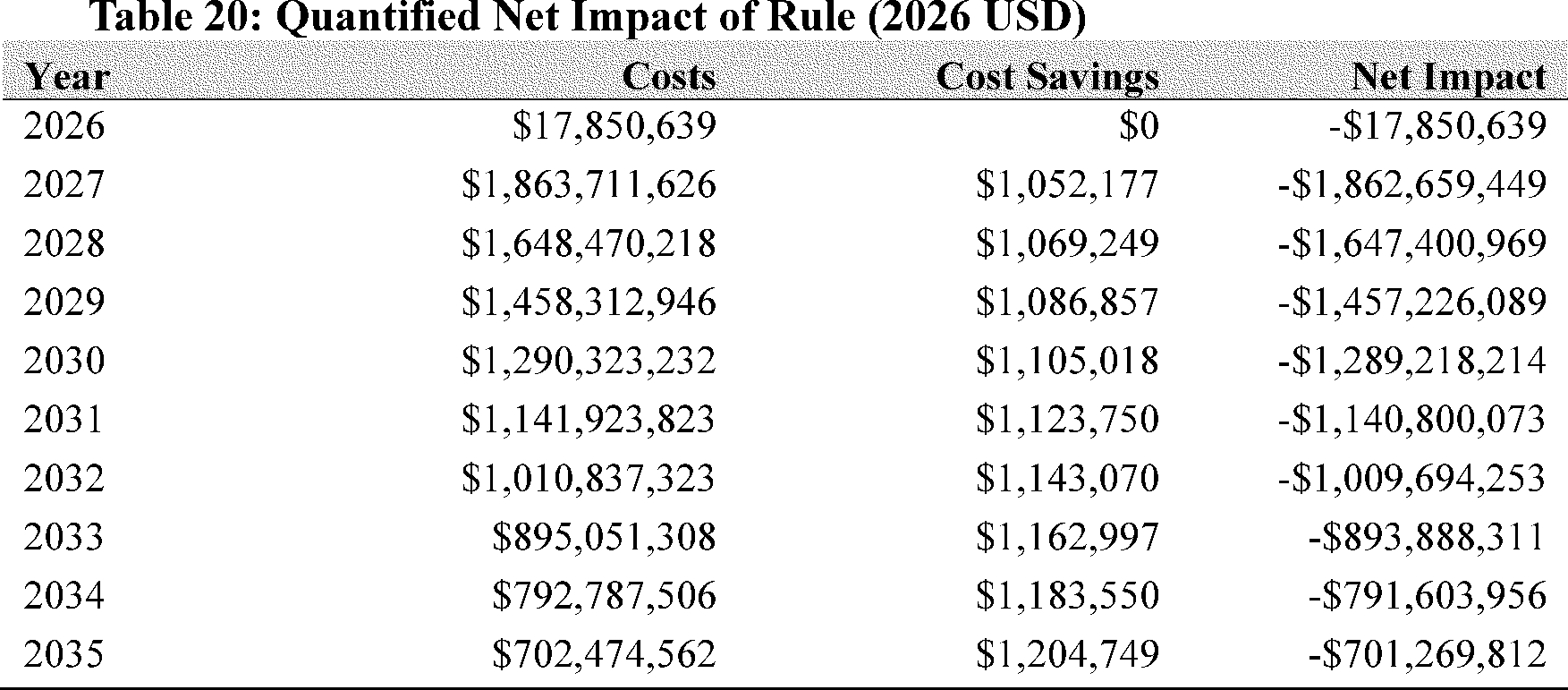

Alternative Regulatory Options
Instead of the proposed regulatory changes discussed in this NPRM, CBP could implement a stricter or a less strict regulatory alternative, especially with regard to the entry filing deadline. In the baseline, the filing deadline is 15 days after arrival, while the proposed rule would change the deadline to the time of arrival. As discussed above, this change could cause disruptions, especially for filers who typically use the package itself that has arrived in the United States to collect the necessary entry data. A less strict alternative would be to leave the filing deadline as is, while moving forward with the other changes proposed in this rulemaking. This version of the rule would be less costly, as filers could continue collecting data using their normal procedures. On the other hand, having the deadline be 15 days after arrival would mean that CBP would not have the entry data at the time of the merchandise's arrival, which would hamper the data's usefulness for screening purposes. There are likely other ways that CBP could make the rule less strict besides leaving the filing deadline unchanged. CBP invites the public to submit comments if they believe there are regulatory alternatives that would reduce the net cost of the rule.
In the other direction, CBP could make the filing deadline stricter, such as by requiring that the entry be filed 24 hours before arrival or before the shipment leaves the country of origin. This extra time before arrival would mean that CBP could analyze the data before shipments arrive, making CBP all the more prepared to process merchandise as soon as it arrives and facilitating refusal of non-compliant items upon arrival. However, this stricter alternative would exacerbate the costs of the proposed rule's earlier filing deadline. If the deadline is the time that the package is sent, the filer would not be able to use the transit time to gather data and file entry. If the deadline were 24 hours before arrival, the filer could at least file entry while the merchandise is in transit if the voyage is longer than 24 hours, but this alternative could create uncertainty for the filer. The filer may not know when exactly the shipment will arrive in the United States 24 hours in advance, making the deadline itself uncertain.
B. Regulatory Flexibility Act
This section examines the impact of the proposed rule on small entities, per the requirements of the Regulatory Flexibility Act (5 U.S.C. 601 et seq.) (RFA), as amended by the Small Business Regulatory Enforcement Fairness Act of 1996 (SBREFA). A small entity may be a small business (defined as any independently owned and operated business not dominant in its field that qualifies as a small business ( printed page 64558) per the Small Business Act); a small not-for-profit organization; or a small governmental jurisdiction (locality with fewer than 50,000 people).
Under the RFA and SBREFA, if an agency can certify (typically through a screening analysis) that a rule will not have a “significant economic impact on a substantial number of small entities,” a detailed assessment of the rule's impact on small entities is not required. Otherwise, an agency must complete an initial regulatory flexibility analysis (IRFA) exploring the impact of the proposed rulemaking on small entities.
Screening Analysis
The changes that the rule would make to the postal and non-postal informal entry processes would directly affect entry filers, senders, importers, and carriers. Filers of non-postal informal entries would need to submit an extra data element, the final deliver-to party if distinct from the ultimate consignee, and would be subject to an earlier filing deadline, the time of the shipment's arrival. Filers of postal informal entries would have to start submitting CBP Forms 3461 and 7501, and they would also have to submit this entry data before the shipment's arrival. Most filers of postal entries would be brokers, and a broker would likely obtain the postal data from the sender, who would therefore face a higher time burden under the rule. Filers of non-postal informal entries might ask the importer for the final deliver-to party, and some importers would have to obtain bonds for ET11 entries. Carriers would have to submit the tracking numbers for postal shipments on the manifests.
These groups differ in how likely they are to have a substantial number of small U.S. businesses that would be significantly affected in a direct way by the proposed rule. Few of the senders would be American, as this group comprises individuals and entities in foreign countries sending postal shipments to the United States. Carriers would be subject to the requirement to submit the postal tracking number on the manifest, and CBP estimates that 22.11% of carriers are small U.S. businesses. To calculate this share, CBP took a sample of 190 air carriers out of a population of 374 and found that 42 out of the 190 qualified as small U.S. businesses, based on D&B Hoovers data [57] and Small Business Administration size standards. Based on the sample results, CBP estimates that 83 out of the 374 air carriers would be small U.S. businesses affected by the rule, which is a substantial number. However, the effect of the rule on carriers would not be significant. As shown in Table 12, CBP estimates that the total burden to carriers would be $18,701,580 in 2027, which equates to $50,004 per carrier on average. According to D&B Hoovers data, the average revenue of the 42 small U.S. air carriers in the sample was $11,768,452. Hence, the average cost to all carriers would be only 0.425% of the average small U.S. carrier's revenue. Moreover, the average cost to small U.S. carriers would likely be even smaller than the average cost to all carriers, as the former handle fewer entries on average. Therefore, there would not be a substantial number of small U.S. carriers significantly affected by the rule.
The direct effect on importers would be the burden of providing the filer with the final deliver-to party if distinct from the consignee for ET11 entries and the added bond cost for ET11 entries that would be bondless in the baseline. CBP expects that filers would request the new data element from the importer at the same time that the filers request and receive the rest of the entry data. Therefore, adding the final deliver-to party as a required data element would have a negligible effect on the time burden of making entry. Both the final deliver-to party and other data elements would become required for postal shipments under the rule, due to the ET13 entry process replacing the current informal postal entry process, but according to a CBP subject matter expert, it is the sender, not the importer, that generally provides the shipping data to the filer in the postal environment. The added bond requirement under the rule would have resulted in importers of record paying an extra $9,276,484 in bond premiums between August 1, 2025, and July 31, 2026.[58] This total is only 3.15% of the total duties, taxes, and fees paid for bondless ET11 entries over that period. However, not all importers of bondless ET11 entries in the baseline would be affected equally. Some importers of record import low-value shipments and only do so infrequently. These importers would find it cheaper to use single transaction bonds rather than continuous bonds, under the rule. Among the 59,148 importers of record who imported an ET11 entry without a bond and would have preferred to use a single transaction bond rather than a continuous bond under the proposed rule, the total cost of the bond requirement would have been 72.66% of the total duties, taxes, and fees on their ET11 entries. For these importers of record, the bond requirement could result in a significant increase in costs. Moreover, these importers would prefer single transaction bonds over continuous bonds because they import a smaller amount of goods, which means that this category of importer is likely to include many small businesses. Therefore, CBP is unable to certify that the rule would not have a significant impact on a substantial number of small U.S. businesses that are importers of record.
Filers of non-postal informal entries would be subject to new requirements, including electronic submission of entry forms and an earlier filing deadline. Specifically, entry data would need to be submitted before arrival of the merchandise, as opposed to the current deadline of 15 days after arrival. While the other new requirements for filers may be insignificant, CBP believes that this new filing deadline could be disruptive. If a filer's standard procedure in the baseline is to read the package labeling of a shipment that has arrived in the United States and then use that information to submit entry data, then that process would no longer work under the rule. Instead, the filer may need to employ more people abroad so that they can look at the shipment before it leaves for the United States in order to make entry before the shipment's arrival. The costs of this new procedure could be significant. Therefore, CBP is unable to certify that the rule would not have a significant impact on a substantial number of small U.S. businesses in the non-postal environment.
Under the rule, filers for postal informal entries would have to submit more data to CBP and would do so under stricter conditions, such as the earlier filing deadline. For this screening analysis, CBP focuses on the filers of postal informal entries who have already filed IMD worksheets. The economic analysis above assumes that in the long run 100 filers would submit the monthly IMD worksheet in the baseline, but so far only 10 filers have done so. These filers submitted an IMD worksheet during the interim postal ( printed page 64559) process that preceded the current informal postal entry process that was established in June 2026, and CBP expects these filers to continue submitting IMD worksheets under the current informal postal entry process. These 10 filers would all be affected because they would no longer be able to submit IMD worksheets and would instead have to switch to submitting entry data through the ET13 process. ET13 entries must be filed using CBP Forms 3461 and 7501, which entail higher data requirements than the IMD worksheet.
CBP used the D&B Hoovers database to gather information on the 10 IMD worksheet filers.[59] Of those 10 filers, 9 appeared in the database, and 6 of those 9 qualify as small U.S. businesses. If a company was owned by a parent company, CBP looked at the location of the ultimate parent company to determine whether the company is American. To assess whether a company is small, CBP compared the company's sales or number of employees (whichever was called for) to the Small Business Administration size standard corresponding to the company's North American Industry Classification System (NAICS) code. As there are only 10 active filers of IMD worksheets, CBP considers 6 to be a substantial number of small U.S. businesses.
CBP expects that the small U.S. businesses that have filed IMD worksheets would face a significant economic impact under the rule. One cost of the rule would be the burden of submitting additional data for informal postal entries. In the economic impact analysis, CBP estimates that brokers would begin charging an additional $30 fee to file a postal entry under the rule. This $30 fee can also be seen as an estimate of the cost increase that filers would face as a result of the additional data requirements. Multiplying that $30 fee by the total number of postal entries that CBP projects for 2027, which is 28,860,463, yields a total cost of $865.8 million.[60] This amount is significant relative to the total revenue of the nine filers appearing in the D&B Hoovers database, with only one filer missing. Therefore, the rule would have a significant impact on current IMD worksheet filers as a whole. As small U.S. businesses make up a majority of these filers, CBP believes that a substantial number of filers considered “small” could be significantly affected by this proposed rule. For this reason, CBP cannot certify that the rule would not have a significant economic impact on a substantial number of small entities in the postal environment. CBP has prepared the following initial regulatory flexibility analysis (IRFA) assessing the rule's potential effect on small entities. CBP welcomes public comments on the data and findings included in this IRFA. Comments that will provide the most assistance to CBP will reference a specific portion of the IRFA, explain the reason for any recommended change, and include data, information, or authority that supports a recommended change.
Initial Regulatory Flexibility Analysis
This IRFA includes the following:
1. A description of the reasons why the action by the agency is being considered;
2. A succinct statement of the objectives of, and legal basis for, the proposed rule;
3. A description—and, where feasible, an estimate of the number—of small entities to which the proposed rule would apply;
4. A description of the projected reporting, recordkeeping, and other compliance requirements of the proposed rule, including an estimate of the classes of small entities that would be subject to the requirement and the types of professional skills necessary for preparation of the report or record;
5. An identification, to the extent practicable, of all relevant federal rules that may duplicate, overlap, or conflict with the proposed rule; and
6. A description of any significant alternatives to the proposed rule which accomplish the stated objectives of applicable statutes and which minimize any significant economic impact of the proposed rule on small entities.
1. A description of the reasons why the action by the agency is being considered.
To eliminate the disparity in duties between postal and non-postal informal entries, CBP published the Indefinite Suspension of the De Minimis Exemption for Mail Shipments and New Postal Informal Entry Process IFR on June 24, 2026, which established a new postal informal entry process for certain merchandise entering the United States, improving upon the interim postal process established pursuant to Executive Order 14324, as amended.[61] With that rule, the monthly international mail duty worksheet was expanded to require product classification and other data elements, and CBP began applying all relevant duties to postal informal entries. Postal informal entries and ET11 entries are now subject to the same product classification reporting requirements, but while the new postal process enables CBP to impose the same duties on postal entries as on ET11 entries, enforcement of duties and regulations is more difficult in the postal environment. CBP needs entry data to make sure that filers are paying what they should, but filers of the international mail duty (IMD) worksheet do not have to submit as much data as ET11 filers, nor do they have to submit the IMD worksheet within the same timeframe.
The limited data required on the IMD worksheet also limits CBP's ability to screen postal shipments for violative goods, yet postal shipments need strong screening the most. In FY 2024, CBP seized narcotics in postal de minimis shipments at a rate of 277.8 seizures per million shipments, compared to only 2.6 seizures per million shipments for formally entered shipments and 15.8 seizures per million shipments for informally entered type 11 shipments.[62] Postal de minimis shipments had the highest seizure rates in all other seizure categories as well, including health and safety, counterfeit goods, and prohibited items.
2. A succinct statement of the objectives of, and legal basis for, the proposed rule.
The rule aims to replace the current informal postal process with entry type 13 so that postal informal entries are subject to similar requirements as non-postal informal entries, thereby improving CBP's enforcement in the postal environment. Like the ET11 process, the ET13 process would require that entry be filed using CBP Forms 3461 and 7501, not the IMD worksheet. The rule would also make updates to the ET11 process, which would apply to the ET13 process as well. These updates, such as the new bonding requirements and earlier filing deadlines, would aim to address the enforcement issues in the informal environment, as evidenced by the ( printed page 64560) higher rate of seizures of violative goods in the informal environment than the formal environment.
3. A description—and, where feasible, an estimate of the number—of small entities to which the proposed rule would apply.
The rule would affect small U.S. businesses that have been filing informal entries, both in the postal and non-postal environment. Currently in the postal environment, these businesses submit a monthly IMD worksheet, but this worksheet would no longer be accepted under the rule. Instead, informal postal entries would need to be entered through the ET13 process. So far, 10 entities have filed an IMD worksheet. Of these 10 entities that have filed an IMD worksheet, 6 of them are small U.S. businesses. The average annual sales for these six companies is $11 million, but three of them have sales under $300,000. The sales estimates are taken from the D&B Hoovers database, which uses a model to estimate some companies' sales figures. The rule would also affect filers of ET11 entries. In the non-postal environment, there were 2,428 brokers that filed an entry summary between October 1, 2020, and February 6, 2026.[63] All of these brokers were U.S. businesses, and some fraction were small businesses that filed ET11 entries.
There could also be a substantial number of importers of record that are U.S. small businesses that would be significantly affected by the rule as a result of the bonding requirement for informal entries. Bonds would be required for both ET13 and ET11 entries. As bonds are already required for the current informal postal entry process, CBP does not expect that the bond requirement for ET13 entries would result in an increase in costs for postal shipments. For ET11 entries, however, there are importers of record that import without a bond and would need to obtain a bond under the rule. Some importers of record import enough merchandise that a continuous bond would be the cheaper option, and these importers would probably not be significantly affected. Among importers that import small amounts of goods, the cheaper bond option would be to rely on single transaction bonds. This group comprises 59,148 importers of record, and some of these importers could see a significant increase in their importing costs, as they would incur an increase in bond costs equal to 73% of duties, taxes, and fees. Moreover, a substantial number of these importers could be small businesses.
Other classes of small entities would be affected by the rule, but not in a significant way. Carriers would have to submit the postal tracking number on the manifest, and an estimated 83 of these carriers are small U.S. businesses. Importers of ET11 entries who already have bonds would only be affected by the requirement to provide the final deliver-to party. Between October 1, 2020 and February 6, 2026, there were 999,938 U.S. importers of record who made entry of some kind, 26% of which were ET11 entries, and some of those U.S. IORs are small businesses.[64]
4. A description of the projected reporting, recordkeeping, and other compliance requirements of the proposed rule, including an estimate of the classes of small entities that would be subject to the requirement and the types of professional skills necessary for preparation of the report or record.
The proposed rule would increase reporting requirements because more entry data would need to be submitted for postal informal entries and ET11 entries. Because filers of postal informal entries would have to submit CBP Forms 3461 and 7501 instead of an IMD worksheet to CBP, these filers would have to provide more data. For example, CBP Forms 3461 and 7501 require the filer to identify the consignee, the importer of record, and the manufacturer of the merchandise. The rule would require an additional data element for ET11 entries, the final deliver-to party if distinct from the consignee, which would be required of ET13 entries as well. In addition to requiring more data to be submitted, the rule would also require that this data be submitted sooner. Instead of the entry filing deadline being 15 days after the date of arrival for ET11 entries and the 7th day of the following month for postal informal entries, both ET11 entries and ET13 entries would need to be filed by arrival.
The small entities that would be subject to these new requirements would mostly be brokers who file IMD worksheets or ET11 entries. To obtain the additional data that CBP would be requiring, these brokers would need to communicate with the parties that have the data, such as the sender or importer, and the brokers would need to obtain this data earlier in the shipping process so that the entry data can be submitted by arrival.
5. An identification, to the extent practicable, of all relevant federal rules that may duplicate, overlap, or conflict with the proposed rule.
CBP does not believe that any federal rule duplicates, overlaps, or conflicts with the proposed rule.
6. A description of any significant alternatives to the proposed rule which accomplish the stated objectives of applicable statutes and which minimize any significant economic impact of the proposed rule on small entities.
As discussed in the Alternative Regulatory Options section above, CBP has considered preserving the old entry filing deadline for ET11 and ET13 entries, which is 15 days after arrival, rather than making the entry filing deadline the time of arrival. This alternative would reduce costs for all entities, including small entities. However, the entry data that CBP receives is not as useful for screening purposes if it is sent weeks after the shipment arrives.
C. Paperwork Reduction Act
In accordance with the Paperwork Reduction Act of 1995, Public Law 104-13, 109 Stat. 163 (44 U.S.C. 3501 et seq.) (PRA), CBP may not conduct, and a person is not required to respond to, a collection of information unless the collection of information displays a valid control number assigned by the Office of Management and Budget (OMB). The collections of information contained in this proposed rulemaking will be submitted to OMB for review and authorization in accordance with 5 CFR 1320.10 of the PRA.
CBP is simultaneously inviting the general public and other Federal agencies to comment on the proposed and/or continuing information collections pursuant to 44 U.S.C. 3506(c)(2)(A). This process is conducted in accordance with 5 CFR 1320.8. Written comments and suggestions from the public and affected agencies should address one or more of the following four points: (1) whether the proposed collection of information is necessary for the proper performance of the functions of the agency, including whether the information will have practical utility; (2) the accuracy of the agency's estimate of the burden of the proposed collection of information, including the validity of the methodology and assumptions used; (3) suggestions to enhance the quality, utility, and clarity of the information to be collected; and (4) suggestions to minimize the burden of the collection of information on those who are to respond, including through the use of appropriate automated, electronic, ( printed page 64561) mechanical, or other technological collection techniques or other forms of information technology, e.g., permitting electronic submission of responses. The comments that are submitted will be summarized and included in the request for approval. All comments will become a matter of public record. Such comments can be submitted in the regulatory docket for this NPRM or by email to CBP_PRA@cbp.dhs.gov.
Among other things, this proposed rule would require that informal entries be filed electronically, that postal shipments be entered by filing Entry and Entry Summary documentation, and that new data elements be submitted on the existing Entry and Entry Summary information collections. The proposed rule would also eliminate the use of the International Mail Duty Worksheet. This rule would result in changes to three OMB-approved information collections: Entry (OMB Control Number 1651-0024), Entry Summary (OMB Control Number 1651-0022), and the Cargo Manifest Declaration (OMB Control Number 1651-0001).
Entry (1651-0024)
ACE Cargo Release/ABI
Estimated Number of Respondents: 9,810.
Estimated Number of Total Annual Responses: 106,015,998.
Estimated Time per Response: 10 minutes (0.166 hours).
Estimated Total Annual Burden Hours: 17,669,333.
ACE Cargo Release/ABI—Postal
Estimated Number of Respondents: 28,860,463.
Estimated Number of Total Annual Responses: 28,860,463.
Estimated Time per Response: 10 minutes (0.166 hours).
Estimated Total Annual Burden Hours: 4,810,077.
Entry/Immediate Delivery Form 3461
Estimated Number of Respondents: 12,307.
Estimated Number of Total Annual Responses: 12,307.
Estimated Time per Response: 15 minutes (0.25 hours).
Estimated Total Annual Burden Hours: 3,077.
Entry Summary (1651-0022)
Informal Entry (Electronic Submission)
Estimated Number of Respondents: 1,902.
Estimated Number of Total Annual Responses: 72,329,037.
Estimated Time per Response: 5 minutes (0.083 hours).
Estimated Total Annual Burden Hours: 6,027,420.
Informal Entry (Electronic Submission)—Postal
Estimated Number of Respondents: 28,860,463.
Estimated Number of Total Annual Responses: 28,860,463.
Estimated Time per Response: 5 minutes (0.083 hours).
Estimated Total Annual Burden Hours: 2,405,039.
Cargo Manifest Declaration (1651-0001)
ET-13
Estimated Number of Respondents: 84.
Estimated Number of Total Annual Responses: 28,860,463.
Estimated Time per Response: 1 minute (0.0167 hours).
Estimated Total Annual Burden Hours: 481,008.
D. Unfunded Mandates Reform Act of 1995
Title II of the Unfunded Mandates Reform Act of 1995 (2 U.S.C. 1531-38, UMRA) requires each Federal agency to prepare a written statement assessing the effects of any Federal mandate in a proposed rule or final rule for which the agency published a proposed rule, which includes any Federal mandate that may result in a $100 million or more expenditure (adjusted annually for inflation) in any one year by State, local, and tribal governments, in the aggregate, or by the private sector.
The proposed rule does not include any unfunded mandates to State, local, or tribal governments. However, the rule would result in annual costs to the private sector of more than $100 million. Most notably, importers and senders would incur costs from increased time burdens and broker fees for informal postal entries and from the new bond requirement for ET11 entries. These costs would total more than $1 billion in the first year of the rule. CBP discusses the costs of the rule in more detail in the E.O. 12866 analysis above.
V. Signing Authority
In accordance with Treasury Order 100-20, the Secretary of the Treasury has delegated to the Secretary of Homeland Security the authority related to the customs revenue functions vested in the Secretary of the Treasury as set forth in 6 U.S.C. 212 and 215, subject to certain exceptions. This regulation is being issued in accordance with Department of Homeland Security Delegation 07010.3, Revision 03.2, which delegates to the Commissioner of CBP the authority to prescribe and approve regulations related to customs revenue functions.
Rodney S. Scott, Commissioner, having reviewed and approved this document, has delegated the authority to electronically sign this document to Susan S. Thomas, the Executive Assistant Commissioner, Office of Trade, for purposes of publication in the Federal Register .
List of Subjects
19 CFR Part 113
- Common carriers
- Exports
- Freight
- Laboratories
- Reporting and recordkeeping requirements
- Surety bonds
19 CFR Part 128
- Administrative practice and procedure
- Freight
- Reporting and recordkeeping requirements
19 CFR Part 141
- Reporting and recordkeeping requirements
19 CFR Part 143
- Reporting and recordkeeping requirements
19 CFR Part 145
- Exports
- Lotteries
- Postal Service
- Reporting and recordkeeping requirements
VI. Proposed Amendments to the CBP Regulations
For the reasons stated above in the preamble, CBP is proposing to amend 19 CFR parts 113, 128, 141, 143, and 145 as set forth below:
PART 113—CBP BONDS
1. The general authority citation for part 113 continues to read as follows:
Authority: 19 U.S.C. 66, 1623, 1624.
2. In § 113.62, revise paragraph (n)(1) and add new paragraph (n)(6) to read as follows:
(n) Consequence of default.
(1) Except as provided for in paragraph (6) below, if the principal defaults on agreements in this condition other than conditions in paragraphs (a), (g), (i), (j), (k)(2), (k)(3), (l), or (m) of this section the obligors agree to pay liquidated damages equal to the value of the merchandise involved in the default, or three times the value of the merchandise involved in the default if the merchandise is restricted or prohibited merchandise or alcoholic ( printed page 64562) beverages, or such other amount as may be authorized by law or regulation.
(6) If the principal defaults on agreements in this condition other than conditions in paragraphs (a), (g), (i), (j), (k)(2), (k)(3), (l), or (m) of this section, for shipments valued at $2,500 or less and required to be filed on CBP Forms 3461 and 7501, or CBP Form 7501, pursuant to part 143 Subpart C or part 145, the obligors agree to pay liquidated damages equal to the value of the merchandise involved in the default or $1,000, whichever is greater, or three times the value of the merchandise involved in the default or $1,000, whichever is greater, if the merchandise is restricted or prohibited or alcoholic beverages, or such other amount as may be authorized by law or regulation.
PART 128—EXPRESS CONSIGNMENTS
3. The general authority citation for part 128 continues to read as follows:
Authority: 19 U.S.C. 58c, 66, 1202 (General Note 3(i), Harmonized Tariff Schedule of the United States), 1321, 1484, 1498, 1551, 1555, 1556, 1565, 1624.
4. Revise § 128.24 by adding a new paragraph (f) to read as follows:
(f) Bona-fide gifts. Shipments valued at $100 or less ($200, in the case of articles sent from persons in the Virgin Islands, Guam, and American Samoa) meeting the requirements of § 10.152 of this chapter may be passed free of duty and tax if entered under the procedures set forth in § 143.23(j)(1)-(2) of this chapter.
PART 141—ENTRY OF MERCHANDISE
5. The general and specific authority citations for part 141 continue to read as follows:
Authority: 19 U.S.C. 66, 1448, 1484, 1498, 1624.
Section 141.68 also issued under 19 U.S.C. 1315;
6. Revise § 141.5 to read as follows:
(a) General. Subject to paragraph (b), merchandise for which entry is required will be entered within 15 calendar days after landing from a vessel, aircraft, or vehicle, or after arrival at the port of destination in the case of merchandise transported in bond. Merchandise for which timely entry is not made will be treated in accordance with § 4.37 or § 122.50 or § 123.10 of this chapter.
(b) Informal Entry. Merchandise valued at $2,500 or less for which informal entry is filed, and for which entry is required on the electronic equivalent of CBP Forms 3461 and 7501, or CBP Form 7501, must be entered upon or prior to the date of importation (as defined in § 101.1 of this chapter). Merchandise for which timely entry is not made will be treated in accordance with § 4.37 or § 122.50 or § 123.10 or § 145.6 of this chapter.
7. Revise § 141.68(f) to read as follows:
(f) Informal mail entry. The time of entry of merchandise under an informal mail entry (§ 145.12(b)) will be the time the preparation of the entry is completed as specified in paragraph (h) below. For informal mail entries where CBP prepares the entry documentation, CBP Form 3419 or 3419A or CBP Form 368 or 368A, the time of entry of merchandise will be the time the preparation of the entry documentation by a CBP employee is completed.
8. Revise § 141.82(d) to read as follows:
(d) Informal entry. Any bona fide installment valued at not over $2,500 may be entered on an informal entry in accordance with subpart C of part 143 of this chapter, in which case such installment need not be considered in connection with invoice requirements for the balance of the series.
PART 143—SPECIAL ENTRY PROCEDURES
9. The general authority citation for part 143 is revised to read as follows:
Authority: 19 U.S.C. 66, 1321, 1414, 1481, 1484, 1498, 1623, 1624, 1641.
10. Revise the introductory text and paragraphs (a) and (c) of § 143.21 to read as follows:
The following types of merchandise are among those which may be entered under informal entry (see §§ 141.52 and 143.22 of this chapter):
(a) Shipments of merchandise not exceeding $2,500 in value;
(c) A portion of one consignment, when such portion does not exceed $2,500 in value and may be entered separately pursuant to § 141.52 of this chapter;
11. Revise § 143.22 to read as follows:
CBP may require a formal consumption or appraisement entry for any merchandise or category of merchandise, or for any importer, or for merchandise produced by any manufacturer or producer, if deemed necessary for: import admissibility enforcement purposes; revenue protection; the efficient conduct of customs business; or for any other purpose, and for any period of time, deemed necessary by CBP. Individual shipments for the same consignee, when such shipments are valued at $2,500 or less, may be consolidated on one such entry.
12. Revise the introductory text of § 143.23 and paragraph (d) to read as follows:
Except for the types of merchandise listed below which may be entered on the forms indicated, merchandise to be entered informally must be entered on a CBP Form 368 or 368A (serially numbered), or the electronic equivalents of CBP Forms 3461 and 7501, or of CBP Form 7501, transmitted to CBP through a CBP-authorized EDI system. If authorized by the Center director, such forms may be submitted by an alternate method, or the merchandise may be entered upon the presentation of a commercial invoice which contains the following declaration, signed by the importer or its agent:
I declare that the information on this invoice is accurate to the best of my knowledge and belief; that the invoice quantities are true and correct manifest quantities; and that I have not received and do not know of any invoice other than this one.
(d) Shipments not exceeding $2,500 in value which are either
(1) unconditionally free of duty and not subject to any quota or internal revenue tax, or
(2) conditionally free (other than shipments of merchandise provided for in paragraph (g) of this section) and all conditions for free entry are met at the time of entry, which may be released upon the filing by the importer on CBP Form 7523, in duplicate, supported by evidence of the right to make entry.
13. Revise § 143.26 to read as follows:
(a) Shipments valued at $2,500 or less. A shipment of merchandise valued at $2,500 or less, which qualifies for informal entry under 19 U.S.C. 1498 may be entered, using reasonable care, by the owner or purchaser of the shipment or, when appropriately designated by the owner, purchaser, or consignee of the shipment, a customs broker licensed under 19 U.S.C. 1641. A consignee that is not the owner or purchaser must appoint a customs broker to act as the importer of record for the entry.
(b) Shipments valued at $800 or less. A shipment of merchandise valued at $800 or less which qualifies for informal entry under 19 U.S.C. 1498 and meets the requirements in 19 U.S.C. 1321(a)(2) and in §§ 10.151, 10.152, 10.153, 145.31, 145.32, 148.51, or 148.64, of this chapter, may be entered, using reasonable care, by the owner, purchaser, or consignee of the shipment or, when appropriately designated by one of these persons, a customs broker licensed under 19 U.S.C. 1641.
14. Add new § 143.29 to read as follows:
Shipments valued at $2,500 or less that must be entered on CBP Forms 3461 and 7501, or CBP Form 7501, will not be released from CBP custody unless a single transaction or continuous bond containing the bond conditions set forth in § 113.62 of this chapter has been transmitted to CBP pursuant to part 113 of this chapter, and has been secured by an approved corporate surety, or cash deposits as provided for in § 113.40 of this chapter.
PART 145—MAIL IMPORTATIONS
15. The general authority citation for part 145 is revised to read as follows:
Authority: 19 U.S.C. 66, 1202 (General Note 3(i)), Harmonized Tariff Schedule of the United States, 1415, 1431, 1433, 1434, 1436, 1623, 1624.
16. Add new § 145.6 to read as follows:
Any mail shipment valued at $2,500 or less for which an entry has not been timely and properly filed, as provided for in § 145.12(b), and which remains in CBP custody 15 days after the date of importation will be deemed voluntarily abandoned and will not be released from CBP custody. Disposition of such unentered mail shipments is governed by the requirements and procedures established by the United States Postal Service.
17. Add new § 145.7 to read as follows:
For mail shipments valued at $2,500 or less, a tracking number that matches the tracking number provided electronically by the party with the right to make entry in compliance with 19 CFR 145.12(b)(1) must be provided for each mail shipment laden aboard an arriving conveyance for delivery by the United States Postal Service as part of the inward manifest required in §§ 4.7a (vessel), 122.48a (air), 123.91 (rail), 123.92 (truck), or 128.21 (express consignments) of this chapter.
18. Revise § 145.12(b) to read as follows:
(b) Mail and informal entries —(1) Preparation of entry form. Except as provided in paragraphs (a), (c), (d), and (e) of this section, for each eligible shipment not exceeding $2,500 in value which is to be delivered by the United States Postal Service, a party with the right to make entry according to § 143.26(a) of this chapter must file the electronic equivalents of CBP Forms 3461 and 7501, or CBP Form 7501, via a CBP-authorized EDI system upon or prior to the date of importation (as defined in § 101.1 of this chapter) for the shipment.
(2) Rates of duty and payment. Merchandise released under a mail informal entry will be dutiable at the rates of duty in effect when the preparation of the entry is completed (as specified in 19 CFR 141.68(f)).
19. Revise § 145.15 to read as follows:
Each shipment valued at $2,500 or less which is to be delivered by the United States Postal Service, and for which entry is required to be filed on the electronic equivalents of CBP Forms 3461 and 7501, or CBP Form 7501, via a CBP-authorized EDI system, upon or prior to its date of importation, will not be released from CBP custody unless a single transaction or continuous bond containing the bond conditions set forth in § 113.62 of this chapter has been transmitted to CBP pursuant to part 113 of this chapter, and has been secured by an approved corporate surety, or cash deposits as provided for in § 113.40 of this chapter.
Susan S. Thomas,
Executive Assistant Commissioner, Office of Trade, U.S. Customs and Border Protection.
Footnotes
1. The Homeland Security Act of 2002 (HSA) generally transferred the functions of the U.S. Customs Service from the Treasury Department to the Secretary of Homeland Security. See Public Law 107-296, 116 Stat. 2142; 6 U.S.C. 203 (“there shall be transferred to the Secretary [of Homeland Security] the functions . . . of (1) the United States Customs Service of the Department of the Treasury, including the functions of the Secretary of the Treasury relating thereto”). Nevertheless, pursuant to Section 412 of the HSA, the Treasury Department retained authority related to various customs revenue functions, including those functions found in the Tariff Act of 1930 (Pub. L. 71-361, 46 Stat. 590, as amended (codified at 19 U.S.C. 1202 et seq.)). 6 U.S.C. 212(a)(1), (2). But the Secretary of the Treasury may delegate any such retained authority at the Treasury Secretary's discretion. 6 U.S.C. 212(a)(1). Consistent with this delegation authority, the Secretary of the Treasury issued Treasury Order 100-20 (available at home.treasury.gov/about/general-information/orders-and-directives/treasury-order-100-20), delegating the authorities contained in 6 U.S.C. 212 and 215 to the Secretary of Homeland Security.
Back to Citation home.treasury.gov/about/general-information/orders-and-directives/treasury-order-100-20
2. See E.O. 14324, 90 FR 37775 (suspending duty-free de minimis treatment for low-value imports of all countries since August 29, 2025); E.O. 14256, 90 FR 14899 (suspending duty-free de minimis treatment for low-value imports from the People's Republic of China since May 2, 2025).
Back to Citation3. On June 24, 2026, CBP published an interim final rule (IFR) suspending the de minimis exemption for merchandise arriving via all modes other than through the postal environment (91 FR 37789) and a concurrent IFR suspending the de minimis exemption for merchandise arriving through the postal environment (91 FR 37801).
Back to Citation4. One Big Beautiful Bill Act, Public Law 119-21, Section 70531(b), 139 Stat. 72, 283 (2025).
Back to Citation5. Part 142 of title 19 of the CFR (19 CFR part 142) implements 19 U.S.C. 1484, as amended, and prescribes formal entry procedures.
Back to Citation6. Consistent with the explanation provided earlier in footnote 1, this authority has been delegated to the Secretary of Homeland Security and his delegates.
Back to Citation7. In 2016, Section 901(d) of Trade Facilitation and Trade Enforcement Act of 2015 (TFTEA) amended 19 U.S.C. 1321(a)(2)(C) by increasing the value cap from $200 to $800. Section 901 did not change the administrative exemptions for bona-fide gifts and personal or household articles accompanying travelers under 19 U.S.C. 1321(a)(2)(A) and (B), respectively.
Back to Citation8. 84 FR 40079 (Aug. 13, 2019); suspended by 90 FR 42418 (Sept. 2, 2025).
Back to Citation9. Entry type 11 (or “type 11”) is the general informal entry type for merchandise valued at $2,500 or less (the general formal entry type is referred to as “type 01”). The requirements for a type 11 also apply to type 12 entries, for merchandise valued at $2,500 or less that is subject to a quota/visa. Comparatively, type 12 is a rarely used entry type—in FY25, there were only 214 type 12 entries filed. The requirements for type 11 entries, as described in this rule, will also apply to type 12 entries. For more information on entry types, please see www.cbp.gov/trade/automated/catair.
Back to Citation www.cbp.gov/trade/automated/catair
10. See 91 FR 37801 (June 24, 2026).
Back to Citation11. See 91 FR 38007 (July 24, 2026). The notice announcing the Entry Type 13 test includes a detailed description of the test, including information regarding eligible participants and the requirements for filing entry under the test.
Back to Citation13. Participants in the Entry Type 86 test, previously available for filers claiming the de minimis exemption, were required to file prior to or upon arrival of the cargo into the United States. See 89 FR 2630 (Jan. 16, 2024).
Back to Citation14. Customs Directive 3530-002A (June 27, 2001), available at www.cbp.gov/document/directives/3530-002a-right-make-entry.
Back to Citation15. See 84 FR 40079 (Aug. 13, 2019).
Back to Citation16. Although CBP receives additional data for mail pursuant to the regulations implementing 19 U.S.C. 1415(a)(3)(K), that information cannot be used “for any commercial enforcement purposes, including for determining merchandise entry.” See 19 U.S.C. 1415(a)(3)(F).
Back to Citation17. For more information regarding ACE, including information on the Automated Broker Interface (ABI) and ACE Portal application, please see www.cbp.gov/trade/automated.
Back to Citation18. “The Secretary of [Homeland Security] is authorized to include in such rules and regulations any of the provisions of section 1484 or 1485 of this title (relating, respectively, to entry and to declaration of merchandise generally).”
Back to Citation19. One Big Beautiful Bill Act, Public Law 119-21, Section 70531(b), 139 Stat. 72, 283 (2025).
Back to Citation20. For more information regarding the multiple national emergency declarations, please see 90 FR 42418 (September 2, 2025), which is CBP's notice effectuating Executive Order 14324, discussing, inter alia,Executive Order 14193 of February 1, 2025 (Imposing Duties To Address the Flow of Illicit Drugs Across Our Northern Border), Executive Order 14194 of February 1, 2025 (Imposing Duties To Address the Situation at Our Southern Border), and Executive Order 14195 of February 1, 2025 (Imposing Duties To Address the Synthetic Opioid Supply Chain in the People's Republic of China).
Back to Citation21. See 91 FR 37801.
Back to Citation22. Based on information obtained from the CBP Office of Trade on July 15, 2026.
Back to Citation23. 91 FR 38007 (June 24, 2026).
Back to Citation24. See 91 FR 37801.
Back to Citation25. Liquidated damages based on value for restricted or prohibited merchandise, or alcoholic beverages, will be $1,000 or three times the value of the merchandise, whichever is greater.
Back to Citation26. Source for CBP Form 3461 burden: see estimated time burden to CBP for OMB Control Number 1651-0024, available at www.reginfo.gov/public/do/PRAViewICR?ref_nbr=202112-1651-003.
 www.reginfo.gov/public/do/PRAViewICR?ref_nbr=202112-1651-003
27. Source for CBP Form 7501 burden: see estimated time burden to CBP for OMB Control Number 1651-0022, available at www.reginfo.gov/public/do/PRAViewICR?ref_nbr=202311-1651-004.
Back to Citation28. CBP bases this wage on the FY 2025 salary and benefits of the national average of CBP Officer Positions. Source: email correspondence with CBP's Office of Finance on June 11, 2026.
Back to Citation29. Obtained from USPS on April 22, 2026.
Back to Citation30. Obtained from USPS on September 9, 2026.
Back to Citation31. Obtained from USPS on April 22, 2026.
Back to Citation32. The random sample was approximately 3% of the total population. Each entry has an 11-digit entry number. As the last few digits of the entry number are not correlated with any relevant variables, CBP selected a random 3% of ET11 entries by selecting all ET11 entries with an entry number ending in 11, 22, or 33, which are 3 of the 100 possible combinations of last 2 digits. The data was pulled from the ACE database on December 12, 2025.
Back to Citation33. Source: count of manual ET11 entries obtained from OT on June 10, 2026; total count of ET11 entries obtained from OT on July 10, 2026.
Back to Citation34. Fajgelbaum, P.D. and A. Khandelwal. (2024). “The Value of De Minimis Imports.” National Bureau of Economic Research Working Paper No. 32607.
Back to Citation35. In the paper cited, CBP takes “shipment” to mean merchandise belonging to a single entry.
Back to Citation36. Based on statistics obtained from CBP Office of Trade on July 15 and September 8, 2026.
Back to Citation37. CBP uses the time burden of the electronic equivalent of CBP Form 3461 for its estimates in this analysis.
Back to Citation38. To calculate this loaded wage rate CBP multiplied the Bureau of Labor Statistics' (BLS) 2025 median hourly wage rate for Cargo and Freight Agents ($25.13), which CBP assumes best represents the wage for importers and exporters, by the ratio of BLS' Q4 2025 total compensation to wages and salaries for Office and Administrative Support occupations (1.497), the assumed occupational group for importers and exporters, to account for non-salary employee benefits, ($37.62 in 2025 dollars). To adjust to 2026 dollars, CBP assumes an annual increase of 3.36% based on the December 2025 12-month percent change in the Employment Cost Index. Source of median wage rate: U.S. Bureau of Labor Statistics. Occupational Employment and Wage Statistics, 2025 National Occupational Employment and Wage Estimates United States, OCC_code 43-5011. Updated May 15, 2026. Available at www.bls.gov/oes/special-requests/oesm25nat.zip. Accessed May 21, 2026. The total compensation to wages and salaries ratio is equal to the total compensation cost per hour worked for Office and Administrative Support occupations ($37.47) divided by the wages and salaries cost per hour worked for the same occupation category ($25.03). See “Table 2. Employer Costs for Employee Compensation for civilian workers by occupational and industry group.” Bureau of Labor Statistics, “Employer Costs for Employee Compensation—December 2025.” Released March 20, 2026. Available at www.bls.gov/news.release/archives/ecec_03202026.pdf. Accessed May 21, 2026. Source of Employment Cost Index: Bureau of Labor Statistics “Employment Cost Index, Continuous data.” Data used was for civilian workers, total compensation for all industries all occupations current dollar index number. December 2025 Index (173.64), December 2024 Index (168.0). CBP estimates a 3.36% (173.64/168.0-1) increase in 2025. Updated April 30, 2026. Available at www.bls.gov/eci/tables.htm. Accessed May 21, 2026.
Back to Citation www.bls.gov/oes/special-requests/oesm25nat.zip
39. Source: Based on data obtained from ACE database on August 3, 2026.
Back to Citation40. Source: Data obtained from ACE database on August 3, 2026.
Back to Citation41. U.S. Customs and Border Protection. Supporting Statement for Paperwork Reduction Act Submission OMB Number 1651-0001: Cargo Manifest/Declaration, Stow Plan, Container Status Messages, and Importer Security Filing.
Back to Citation42. To calculate this loaded wage rate CBP multiplied the Bureau of Labor Statistics' (BLS) 2025 median hourly wage rate for Cargo and Freight Agents ($25.13), which CBP assumes best represents the wage for carriers, by the ratio of BLS' Q4 2025 total compensation to wages and salaries for Office and Administrative Support occupations (1.497), the assumed occupational group for carriers, to account for non-salary employee benefits, ($37.62 in 2025 dollars). To adjust to 2026 dollars, CBP assumes an annual increase of 3.36% based on the December 2025 12-month percent change in the Employment Cost Index. Source of median wage rate: U.S. Bureau of Labor Statistics. Occupational Employment and Wage Statistics, 2025 National Occupational Employment and Wage Estimates United States, OCC_code 43-5011. Updated May 15, 2026. Available at www.bls.gov/oes/special-requests/oesm25nat.zip. Accessed May 21, 2026. The total compensation to wages and salaries ratio is equal to the total compensation cost per hour worked for Office and Administrative Support occupations ($37.47) divided by the wages and salaries cost per hour worked for the same occupation category ($25.03). See “Table 2. Employer Costs for Employee Compensation for civilian workers by occupational and industry group.” Bureau of Labor Statistics, “Employer Costs for Employee Compensation—December 2025.” Released March 20, 2026. Available at www.bls.gov/news.release/archives/ecec_03202026.pdf. Accessed May 21, 2026. Source of Employment Cost Index: Bureau of Labor Statistics “Employment Cost Index, Continuous data.” Data used was for civilian workers, total compensation for all industries all occupations current dollar index number. December 2025 Index (173.64), December 2024 Index (168.0). CBP estimates a 3.36% (173.64/168.0-1) increase in 2025. Updated April 30, 2026. Available at www.bls.gov/eci/tables.htm. Accessed May 21, 2026.
Back to Citation43. Fajgelbaum, P.D. and A. Khandelwal. (2024). “The Value of De Minimis Imports.” National Bureau of Economic Research Working Paper No. 32607.
Back to Citation44. Non-express carriers submitted 150 manual ET11 entries from September 2025 to May 2026, and CBP assumes for the projections that this rate would hold constant in the baseline. Source for manual entry count: obtained from OT on June 10, 2026.
Back to Citation45. Source: obtained from OT on June 10, 2026.
Back to Citation46. Source: CBP, User Fee Table, last modified October 6, 2025. Available at www.cbp.gov/trade/basic-import-export/user-fee-table. Accessed December 12, 2025
Back to Citation47. See CBP's time savings estimated for OMB Control Number 1651-0024, available at www.reginfo.gov/public/do/PRAViewICR?ref_nbr=202112-1651-003.
Back to Citation48. See CBP's time savings estimated for OMB Control Number 1651-0022, available at www.reginfo.gov/public/do/PRAViewICR?ref_nbr=202311-1651-004.
Back to Citation49. See E.O. 14324, § 4(c) (“Consistent with applicable law, the Secretary of Homeland Security is directed and authorized to take all necessary actions to implement and effectuate this order—including through temporary suspension or amendment of regulations or through notices in the Federal Register and by adopting rules, regulations, or guidance . . .”); 90 FR 42418, at 42419 (Sept. 2, 2025) (“CBP will provide separate guidance instructing carriers and other qualified parties on how to remit payments.”); CSMS Message No. 66311990 (Sept. 22, 2025).
Back to Citation50. See Supporting Statement for Paperwork Reduction Act Submission OMB Number 1651-0147: International Mail Duty Worksheet. August 25, 2025. Available at www.reginfo.gov/public/do/PRAViewDocument?ref_nbr=202508-1651-006. Accessed December 12, 2025.
Back to Citation51. To calculate this loaded wage rate CBP multiplied the Bureau of Labor Statistics' (BLS) 2025 median hourly wage rate for Cargo and Freight Agents ($25.13), which CBP assumes best represents the wage for importers, by the ratio of BLS' Q4 2025 total compensation to wages and salaries for Office and Administrative Support occupations (1.497), the assumed occupational group for importers, to account for non-salary employee benefits ($37.62 in 2025 dollars). To adjust to 2026 dollars, CBP assumes an annual increase of 3.36% based on the December 2025 12-month percent change in the Employment Cost Index. Source of median wage rate: U.S. Bureau of Labor Statistics. Occupational Employment and Wage Statistics, 2025 National Occupational Employment and Wage Estimates United States, OCC_code 43-5011. Updated May 15, 2026. Available at www.bls.gov/oes/special-requests/oesm25nat.zip. Accessed May 21, 2026. The total compensation to wages and salaries ratio is equal to the total compensation cost per hour worked for Office and Administrative Support occupations ($37.47) divided by the wages and salaries cost per hour worked for the same occupation category ($25.03). See “Table 2. Employer Costs for Employee Compensation for civilian workers by occupational and industry group.” Bureau of Labor Statistics, “Employer Costs for Employee Compensation—December 2025.” Released March 20, 2026. Available at https:// www.bls.gov/news.release/archives/ecec_03202026.pdf. Accessed May 21, 2026. Source of Employment Cost Index: Bureau of Labor Statistics “Employment Cost Index, Continuous data.” Data used was for civilian workers, total compensation for all industries all occupations current dollar index number. December 2025 index (173.64), December 2024 Index (168.0). CBP estimates a 3.36% (173.64/168.0-1) increase in 2025. Updated April 30, 2026. Available at www.bls.gov/eci/tables.htm. Accessed May 21, 2026.
Back to Citation52. See Supporting Statement for Paperwork Reduction Act Submission OMB Number 1651-0147: International Mail Duty Worksheet. August 25, 2025. Available at www.reginfo.gov/public/do/PRAViewDocument?ref_nbr=202508-1651-006. Accessed December 12, 2025.
Back to Citation53. CBP bases this wage on the FY 2025 salary and benefits of the national average of CBP Trade and Revenue Positions. Source: email correspondence with CBP's Office of Finance on June 11, 2026.
Back to Citation54. Based on information obtained from OT on 7/15/2026.
Back to Citation55. Source: data obtained from CBP's ACE database on December 15, 2025.
Back to Citation56. $1,577,245,784 = $1,179,693,422 × (365/273 days).
Back to Citation57. D&B Hoovers is a database maintained by Dun & Bradstreet, a for-profit firm that provides financial and other business information for use in analysis and decision-making ( www.dnb.com/products/marketing-sales/dnb-hoovers/free-trial.html?utm_source=google&utm_medium=cpc&utm_campaign=BL+%7C+G+%7C+NAMER+%7C+SMS+%7C+Brand-Product&utm_content=&utm_term=d%26b%20hoovers&campaignid=18334555603&adgroupid=159738947917&creativeid=693112542863&gad_source=1&gclid=EAIaIQobChMIyJXwnePriQMVEqEgBR0taySvEAAYASAAEgLDdvD_BwE&gclsrc=aw.ds).
Back to Citation www.dnb.com/products/marketing-sales/dnb-hoovers/free-trial.html?utm_source=google&utm_medium=cpc&utm_campaign=BL+%7C+G+%7C+NAMER+%7C+SMS+%7C+Brand-Product&utm_content=&utm_term=d%26b%20hoovers&campaignid=18334555603&adgroupid=159738947917&creativeid=693112542863&gad_source=1&gclid=EAIaIQobChMIyJXwnePriQMVEqEgBR0taySvEAAYASAAEgLDdvD_BwE&gclsrc=aw.ds
58. Source: based on data obtained from ACE on August 3, 2026.
Back to Citation59. D&B Hoovers is a database maintained by Dun & Bradstreet, a for-profit firm that provides financial and other business information for use in analysis and decision-making ( www.dnb.com/products/marketing-sales/dnb-hoovers/free-trial.html?utm_source=google&utm_medium=cpc&utm_campaign=BL+%7C+G+%7C+NAMER+%7C+SMS+%7C+Brand-Product&utm_content=&utm_term=d%26b%20hoovers&campaignid=18334555603&adgroupid=159738947917&creativeid=693112542863&gad_source=1&gclid=EAIaIQobChMIyJXwnePriQMVEqEgBR0taySvEAAYASAAEgLDdvD_BwE&gclsrc=aw.ds).
Back to Citation60. See Table 9 above.
Back to Citation61. See 91 FR 37801.
Back to Citation62. Based on seizure counts obtained from OT on September 25, 2025, and October 19, 2025, de minimis entry counts obtained from OT on September 26, 2025, and ET01 and ET11 entry counts obtained from ACE database on October 3 and October 6-8, 2025.
Back to Citation63. Obtained from CBP's Advanced Trade Analytics Platform, received from OT on February 19, 2026.
Back to Citation64. Obtained from CBP's Advanced Trade Analytics Platform, received from OT on February 19, 2026.
Back to Citation