Department of Homeland Security
- 8 CFR Part 274a
- [CIS No. 2859-26; DHS Docket No. USCIS-2025-0271]
- RIN 1615-AD05
AGENCY:
U.S. Citizenship and Immigration Services, DHS.
ACTION:
Final rule.
SUMMARY:
On October 30, 2025, DHS published an interim final rule (IFR) that amended DHS regulations to end the practice of automatically extending the validity of employment authorization documents (Forms I-766 or EADs) for aliens who have timely filed an application to renew their EAD in certain employment authorization categories. This final rule responds to comments received on the IFR and reaffirms and finalizes the provisions of the IFR. Ending the automatic extension of EADs enhances benefit integrity and prioritizes the proper vetting and screening of aliens before granting a new period of employment authorization and/or a new EAD.
DATES:
This final rule is effective on October 14, 2026.
FOR FURTHER INFORMATION CONTACT:
Business and Foreign Workers Division, Office of Policy and Strategy, U.S. Citizenship and Immigration Services (USCIS), DHS, 5900 Capital Gateway Drive, MD, Camp Springs, 20746; telephone (240) 721-3000 (this is not a toll-free number).
SUPPLEMENTARY INFORMATION:
Table of Contents
I. Executive Summary
A. Basis and Purpose
B. Legal Authority
C. Summary of the Major Provisions of the Regulatory Action
D. Costs and Benefits
II. Background
A. Legal Authority
B. Automatic Extension of Employment Authorization and Documentation
C. Increasing the Automatic Extension Period From a Maximum of 180 Days to a Maximum of 540 Days
D. The 2025 Interim Final Rule Removed Automatic Extensions for Certain Employment Authorization Documents
1. Added New 8 CFR 274a.13(e)
 8 CFR 274a.13(e)
2. Modified the Heading of 8 CFR 274a.13(d)
E. Severability
III. Changes in the Final Rule
IV. Response to Public Comments on the Interim Final Rule
A. Summary of Comments
B. Comments in Support of the Rule
C. Comments in Opposition to the Rule and Mixed Comments
1. DHS Legal Authority
i. DHS Statutory Authority and Congressional Intent
ii. Constitutional Concerns
iii. International Law and Refugee Protections
2. DHS Justification and Need for the Rule
i. Security Rationale for the Rule
a. General Security Rationale Comments
b. Lack of Evidence Supporting Security Rationale
c. Prior Vetting of Renewal Applicants and Existing Security Measures
d. Rule Would Not Strengthen Security
e. Other Comments on Security Rationale
ii. Consistency in USCIS Rationale and Reversal of Longstanding Policy
iii. Lack of Acknowledgement of the Backlog and Other Operational Realities
iv. “Proper Planning” Rationale
3. Rationale for Eliminating the Automatic Extension of EADs
4. Impact on USCIS Processing
i. Administrative Burden and Efficiency
ii. Processing Timelines
iii. Procedural Fairness
iv. General or Mixed Feedback on USCIS Processing
5. Combined Impacts on Individuals, Employers, the Economy, and Specific EAD Categories
i. Impacts on Aliens, Families, and Communities
a. General Hardship, Fairness, Educational Disruptions, and Family Impacts
b. Mental Health and Vulnerability, Including Risk of Exploitation
c. Identification, Driver's Licenses, and Access to Services
ii. Employment, Employers, and Economic Impacts
a. Employer Burdens, Business Continuity, and Sector Specific Concerns
b. Immigrant Contributions to the Economy and Macroeconomic and Local Economic Impacts of the Rule
iii. Relief for Specific Immigration Categories
a. Impact on Refugees, Asylees, Asylum Seekers, Unaccompanied Alien Children (UACs), and Other Humanitarian Categories
b. Impact on Employment-Based Nonimmigrants, Their Dependents, and Employment-Based Green Card Applicants
6. Clarification Request
7. Recommendations for the Automatic Extension and EAD Validity Period
i. Maintain the Automatic Extension, Including Various Lengths of the Extension Period
ii. Consecutive EAD Validity Periods
iii. Allowing Application Filing Earlier Than 180 days
iv. Enhanced Vetting
8. Processing Capacity and Timelines
i. Timely Processing of Renewals
ii. Increase Resources and Staffing
iii. Prioritize Initial EAD Reviews
9. Coordination, Guidance, and Outreach
i. Additional Guidance and Communication
ii. Accountability
10. Other Alternatives and Recommendations
11. Administrative Procedure Act
i. “Good Cause” for Bypassing the Notice and Comment Period
ii. “Foreign Affairs” Exception
iii. Reasoned Decision-Making Requirement
iv. Arbitrary and Capricious/Procedural Deficiencies That Violate the APA
v. Reliance Interests
vi. Failure To Consider Alternatives
vii. Comment Period
viii. Comment Submission Requirements
12. Regulatory Impact Analysis
i. Methodology
ii. Impact on Individuals
iii. Impact on the U.S. Economy, Employers, and Labor Force
iv. Other Comments on the RIA
13. Regulatory Flexibility Act
14. Paperwork Reduction Act
15. General Comments on Statutory and Regulatory Requirements
D. Additional Out of Scope Comments
V. Statutory and Regulatory Requirements
A. Administrative Procedure Act: Delayed Effective Date
B. Executive Order 12866 (Regulatory Planning and Review), Executive Order 13563 (Improving Regulation and Regulatory Review), and 14192 (Unleashing Prosperity Through Deregulation)
1. Affected Population
2. Economic Impacts of the Final Rule
Module A
Module B
Module C
C. Regulatory Flexibility Act (RFA)
D. Unfunded Mandates Reform Act of 1995 (UMRA)
E. Congressional Review Act (CRA)
F. Executive Order 13132 (Federalism)
G. Executive Order 12988 (Civil Justice Reform)
H. Family Assessment
I. Executive Order 13175 (Indian Tribal Governments)
J. National Environmental Policy Act (NEPA)
K. Paperwork Reduction Act
List of Subjects and Regulatory Amendments
Table of Abbreviations
APA—Administrative Procedure Act
CBP—U.S. Customs and Border Protection
CDAO—Chief Data and Analytics Office
CFR—Code of Federal Regulations
CRA—Congressional Review Act
DHS—U.S. Department of Homeland Security
EAD—employment authorization document
E.O.—Executive Order
Form I-765—Application for Employment Authorization
FY—Fiscal Year
HSA—Homeland Security Act of 2002
ICE—U.S. Immigration and Customs Enforcement
IFR—Interim final rule
IIRIRA—Illegal Immigration Reform and Immigrant Responsibility Act of 1996
INA—Immigration and Nationality Act
ISO—Immigration Service Officer ( printed page 65307)
NEPA—National Environmental Policy Act
OMB—Office of Management and Budget
OPQ—Office of Performance and Quality
PRA—Paperwork Reduction Act
SBREFA—Small Business Regulatory Enforcement Fairness Act of 1996
Secretary—Secretary of Homeland Security
TFR—Temporary final rule
UMRA—Unfunded Mandates Reform Act of 1995
U.S.C.—United States Code
USCIS—U.S. Citizenship and Immigration Services
I. Executive Summary
A. Basis and Purpose
DHS's mission is to safeguard the American people, our homeland, and our values with honor and integrity. In service of that mission, DHS protects the United States from threats by terrorists, criminals, smugglers, transnational criminal organizations, failed-state actors, and unpredictable lone offenders that constitute present and future threats to public safety and national security.
USCIS issues EADs to certain classes of aliens. These documents are valid for a specified period. Aliens who intend to continue their employment beyond the date specified on their EAD must generally file an application to renew their employment authorization and/or EAD.
The automatic extension of the validity of an EAD grants the alien the benefit of extending his or her expired employment authorization and/or EAD merely by filing a timely renewal EAD application and without first completing adjudicative review and related vetting, including resolution of any derogatory information identified during the vetting process. That is, the automatic extension allows for the granting of the benefit without USCIS first performing the following actions: an eligibility determination, completing vetting and screening checks, resolving potential hits of derogatory information in connection with the alien, and a determination that the employment authorization should be granted in the exercise of discretion, if applicable.
On October 30, 2025, DHS issued an IFR titled, “Removal of the Automatic Extension of Employment Authorization Documents,” with a request for comment. See90 FR 48799 (Oct. 30, 2025). The IFR amended DHS regulations to end the practice of automatically extending the validity of EADs for aliens in certain employment authorization categories who timely filed an application to renew their EAD. After careful consideration of the public comments submitted in connection with the IFR, DHS is reaffirming and finalizing the IFR without changes. The rationale and reasoning provided in the preamble for the IFR remains unchanged with respect to the regulatory amendments, and DHS, therefore, adopts such reasoning also to support this final rule.
In reaffirming and finalizing the changes made in the IFR, the purpose of this rule remains the same as articulated in the IFR: to prioritize the proper vetting and screening of aliens and ensure continued eligibility before granting a new period of employment authorization and/or a new EAD by ending the practice of automatically extending the validity of employment authorization and/or EADs for certain employment authorization categories.
Ending the practice of providing automatic extensions of EADs is consistent with Section 16 of President Trump's directive in Executive Order (E.O.) 14159, Protecting the American People Against Invasion, which directs the Secretary of Homeland Security, in coordination with the Secretary of State and the Attorney General, to take all appropriate action to align any departmental activities with the policies set out by the President and to ensure, among others, “that employment authorization is provided in a manner consistent with section 274A of the Immigration and Nationality Act (8 U.S.C. 1324a), and that employment authorization is not provided to any unauthorized alien in the United States.” [1] It is also consistent with Section 2 of E.O. 14161, Protecting the United States From Foreign Terrorists and Other National Security and Public Safety Threats, which directs the Secretary of State, in coordination with the Secretary of Homeland Security, the Attorney General, and the Director of National Intelligence to “identify all resources that may be used to ensure that all aliens seeking admission to the United States, or who are already in the United States, are vetted and screened to the maximum degree possible.” [2]
 8 U.S.C. 1324a
B. Legal Authority
The legal basis of this rulemaking is found in section 103(a) of the Immigration and Nationality Act (INA), 8 U.S.C. 1103(a), which authorizes the Secretary to administer and enforce the immigration and nationality laws and establish such regulations as the Secretary deems necessary for carrying out such authority, and section 101(b)(1)(F) of the Homeland Security Act (HSA), 6 U.S.C. 111(b)(1)(F), which establishes as a primary mission of DHS the duty to “ensure that the overall economic security of the United States is not diminished by efforts, activities, and programs aimed at securing the homeland.”
C. Summary of the Major Provisions of the Regulatory Action
This final rule adopts the IFR as final, without any changes, after careful consideration of the comments received. Accordingly, DHS is adopting as final the following changes that the IFR has made:
- Revised the heading of8 CFR 274a.13(d) to clearly indicate that the up-to-540-day automatic extension period only applies to renewal EAD applications filed before October 30, 2025.
- Added new8 CFR 274a.13(e). The new provision explains that, unless otherwise provided in 8 CFR 274a.13(d), by law, or through a Federal Register notice for Temporary Protected Status (TPS)-related employment documentation, the validity period of an expired or expiring Employment Authorization Document and/or employment authorization will not be automatically extended by a renewal EAD application filed on or after October 30, 2025.
DHS explained in the IFR that the IFR did not impact the validity of EADs that were automatically extended prior to October 30, 2025. It also explained that the IFR did not impact automatic extensions of EADs and/or employment authorization provided by law or Federal Register notices, such as those for TPS applicants pursuant to section 244 of the Act, 8 U.S.C. 1254a, and 8 CFR part 244.[3] This final rule similarly does not impact these provisions.
D. Costs and Benefits
This final rule has been designated a “significant regulatory action” and economically significant as defined under section 3(f)(1) of E.O. 12866, because its annual effects on the economy may exceed $100 million in any year of the analysis. Accordingly, this rule has been reviewed by the Office of Management and Budget (OMB). ( printed page 65308)
This final rule reaffirms and finalizes changes made by the IFR to DHS regulations to end the practice of automatically extending the validity of employment authorization documents (Forms I-766 or EADs) for aliens who have timely filed an application to renew their EAD in certain employment authorization categories. The purpose of this change is to prioritize the proper vetting and screening of aliens and ensure continued eligibility before granting a new period of employment authorization and/or a new EAD. This final rule does not affect the validity of EADs that were automatically extended prior to the IFR. In previous rules providing for the automatic extension of EADs based on the timely filing of a renewal EAD application, DHS attempted to stabilize aliens' earnings and avoid labor turnover costs of employers. However, as explained in the IFR, the Department has shifted focus to prioritizing public safety and national security, and ensuring that aliens continue to be eligible and merit a favorable exercise of discretion, as applicable, before being granted continued employment authorization. See90 FR 48799, 48816 (Oct. 30, 2025).
DHS has prepared two types of quantified estimates of the impacts generated by this final rule. For a single 18-month window (starting in May 2027) from about 20,000 to 33,000 EADs are estimated to lapse, based on several assumptions. This rule may result in some EAD holders incurring a loss of earnings (“reduced earnings”) because of USCIS process delays for renewal EAD applications, as under this rule there could be disruption to their earnings due to a lapsed EAD. Such earnings loss to aliens could comprise beneficial transfers to other U.S. workers if the substitution of the latter for the former is relatively frictionless. Additionally, to the extent this rule affects EAD holders' jobs going unfilled, there will be impacts to tax transfers from businesses and employees to the Federal Government.[4] This rule will also generate labor turnover costs to businesses that employ the affected-lapsed EAD holders, as under this rule there would be a disruption to the EAD holders' employment authorization and/or document validity. In conducting these estimates DHS emphasizes that variation in factors involved in the impact, including impact processing times, filing volumes, the timing of renewal filings, and underlying benefit requests, will cause variation in the impacts.
Due to variation in future populations and process times, there is likely to be substantial variation in the impact estimates. For this reason, DHS develops wide ranges capturing a high and low bound for the estimates, in terms of the means (expected value). This rule is estimated to result in $138.1 million in lost productivity costs to employers that are not able to easily replace aliens with lapsed EADs, costs of $312.1 million to U.S. employers from potential labor turnover, transfers due to earnings changes worth $138.1 million from employment-authorized aliens to replacement workers and is expected to generate tax reduction impacts of $14.5 million over an 18-month period. Approximately 1,700 and 2,800 employers are estimated to be impacted.
Section V.B. provides an A-4 accounting statement supporting the analysis and the accompanying economic analysis details the data and methodology supporting the impact estimates.
II. Background
A. Legal Authority
The Secretary of Homeland Security's (Secretary) authority for the regulatory amendments made in this final rule are found in various sections of the INA, 8 U.S.C. 1101 et seq., and the HSA, Public Law 107-296, 116 Stat. 2135 (codified in part at 6 U.S.C. 101 et seq.).
General authority for issuing this rule is found in section 103(a) of the INA, 8 U.S.C. 1103(a), which authorizes the Secretary to administer and enforce the immigration and nationality laws and establish such regulations as the Secretary deems necessary for carrying out such authority, as well as section 102 of the HSA, 6 U.S.C. 112, which vests all of the functions of DHS in the Secretary and authorizes the Secretary to issue regulations.[5] Further authority for this rule is found in:
- Section 208(d)(2) of the INA,8 U.S.C. 1158(d)(2), which provides the Secretary with authority to grant employment authorization, in his or her discretion, to applicants for asylum if 180 days have passed since filing an application for asylum;
- Section 214 of the INA,8 U.S.C. 1184, including section 214(a)(1) of the INA, 8 U.S.C. 1184(a)(1), which authorizes the Secretary to prescribe, by regulation, the time and conditions of the admission of nonimmigrants;
- Section 244(a)(1)(B) of the INA,8 U.S.C. 1254a(a)(1)(B), which states that the Secretary shall authorize employment and provide evidence of employment authorization for aliens who have been granted Temporary Protected Status;
- Section 274A(b) of the INA,8 U.S.C. 1324a(b), which provides for the employment verification system and outlines employment eligibility verification requirements;
- Section 274A(h)(3)(B) of the INA,8 U.S.C. 1324a(h)(3)(B), which recognizes the Secretary's authority to extend employment authorization to aliens in the United States; [6] and
- Sections 100003(c) and 100012(a) of the One Big Beautiful Bill Act,Public Law 119-21 (July 4, 2025), which limit the validity period of any employment authorization for aliens granted TPS under section 244 of the INA, 8 U.S.C. 1254a, to either a period of one year or for the duration of the designation of TPS, whichever is shorter.
B. Automatic Extension of Employment Authorization and Documentation
Before November 2016, 8 CFR 274a.13(d) stated that USCIS would adjudicate an EAD application within 90 days of receipt. If USCIS did not adjudicate the EAD application within that timeframe, the alien was eligible to request an interim EAD with a validity period not to exceed 240 days.[7]
On November 18, 2016, as part of DHS's efforts to implement the American Competitiveness in the ( printed page 65309) Twenty-first Century Act of 2000 (AC21), DHS published a final rule that eliminated Interim EADs and replaced them with a maximum 180-day automatic extension period for certain renewal applicants.[8]
C. Increasing the Automatic Extension Period From a Maximum of 180 Days to a Maximum of 540 Days
Since the promulgation of the final rule authorizing up to 180-day automatic extension period for certain renewal EAD applicants, USCIS' ability to process both initial and renewal EAD applications within USCIS' targeted processing times was adversely impacted by a variety of temporary circumstances.[9] In May 2022 [10] and April 2024,[11] DHS temporarily increased the automatic extension from up to 180 days to up to 540 days. The May 2022 and April 2024 temporary final rules were intended to reduce the number of renewal EAD applicants eligible for an automatic extension of their EAD validity under 8 CFR 274a.13(d) experiencing lapses in their employment authorization and/or EAD validity because of USCIS processing delays.
DHS also issued a final rule in December 2024 [12] that indefinitely increased the up to 540-day automatic extension for certain applications pending on May 4, 2022, or properly filed on or after May 4, 2022. That rule was intended to reduce the effects of unknown future circumstances that could significantly impact EAD renewal processing times.[13]
D. The 2025 Interim Final Rule Removed Automatic Extensions for Certain Employment Authorization Documents
The IFR amended DHS regulations to end the practice of automatically extending the validity of certain EADs. See8 CFR 274a.13(e). The IFR did not impact the automatic extensions already granted to renewal EAD applicants under 8 CFR 274a.13(d)(1), if the renewal EAD application was filed before October 30, 2025. See8 CFR 274a.13(d). The IFR also did not impact automatic extensions otherwise provided by law or in an applicable Federal Register notice regarding procedures for renewing TPS-related employment documentation pursuant to section 244 of the INA, 8 U.S.C. 1254a, and 8 CFR part 244. 14 See8 CFR 274a.13(e).
The IFR made two changes to the regulations governing EAD, as discussed below.
1. Added New 8 CFR 274a.13(e)
The IFR added a new paragraph (e) that went into effect immediately with the publication of the IFR on October 30, 2025. With 8 CFR 274a.13(e), DHS eliminated the practice of providing automatic extension periods for employment authorization and/or EAD validity for up to 540 days for renewal applications filed on or after October 30, 2025. Therefore, renewal EAD applicants no longer receive an up to 540-day automatic extension of their employment authorization and/or EAD validity if they file their application on or after October 30, 2025. See8 CFR 274a.13(e).
Except as otherwise provided by law, in 8 CFR 274a.13(d), or in accordance with an applicable Federal Register notice regarding procedures for renewing TPS-related employment documentation, an alien's employment authorization and/or EAD validity will expire as explained in the following paragraphs:
For those aliens who are employment authorized incident to status under 8 CFR 274a.12(a), unless otherwise provided by law, their EAD will expire on the day after the end validity date stated on the face of the EAD. See8 CFR 274a.13(e)(1). Because the alien's employment authorization is tied to the alien's status in the United States, the alien's employment authorization will not expire on the date indicated on the EAD. Instead, the alien's employment authorization will expire or terminate on the same date the alien's status in the United States expires or terminates.
For example, an alien in L-2 nonimmigrant status as the spouse of an L-1 nonimmigrant is employment authorized incident to status. See INA sec. 214(c)(2)(E), 8 U.S.C. 1184(c)(2)(E). If the L-2 nonimmigrant chooses to apply for an EAD to evidence his or her employment authorization, the EAD will expire as of the date indicated on the face of the EAD. In some cases that may be the same date as the expiration of the L-2's nonimmigrant status. But in other cases, the L-2 status expiration date may be after the EAD expiration date, particularly if the L-2 nonimmigrant travelled outside of the United States after obtaining an EAD and, upon return to the United States, was provided a new status expiration date that will expire after the EAD expires.[15] In that scenario, the L-2 nonimmigrant would remain employment authorized while in L-2 nonimmigrant status, even after the EAD expires, but the expired EAD would no longer be a valid document to evidence the L-2 nonimmigrant's employment authorization.[16] Once the alien is no longer in L-2 status (for example, the L-2 nonimmigrant status expires), the alien would no longer be employment authorized as an L-2 nonimmigrant because such employment authorization is dependent on being in L-2 nonimmigrant status.
For aliens who are not employment authorized incident to their immigration status and who instead must obtain employment authorization from USCIS, pursuant to 8 CFR 274a.12(c) before accepting employment in the United States, such as adjustment of status applicants or aliens with a pending asylum application, USCIS determines the length of the period of employment authorization in the exercise of its discretion and thereafter issues an EAD reflecting the validity period.[17] Therefore, the EAD will expire and the employment authorization will terminate the day after the end validity ( printed page 65310) date stated on the face of the EAD based upon the situations outlined in 8 CFR 274a.14, or for aliens with employment authorization under 8 CFR 274a.12(c)(19) based on a pending TPS application, pursuant to section 244 of the Act and 8 CFR part 244 18 See8 CFR 274a.13(e)(2).
For example, an alien with a pending adjustment of status application (Form I-485) has an EAD that expires on May 30, 2026. The alien's adjustment of status application has not been adjudicated and continues to be pending. The alien is eligible to apply for a renewal EAD based on the pending adjustment of status application. The alien applies for a renewal of the EAD on February 4, 2026, which is after the October 30, 2025, effective date of the IFR. The alien will maintain continuous employment authorization if his or her renewal application is granted before his or her current employment authorization expires on May 30, 2026. If the renewal EAD application remains unadjudicated on May 31, 2026, the alien cannot continue to work for his or her employer on or after May 31, 2026, unless the alien is employment authorized on a separate basis. See8 CFR 274a.13(e). If the renewal EAD application is subsequently approved, the alien would again be employment authorized and may resume employment during the validity period stated on the new EAD. The longer an alien waits to file a renewal EAD application, the more likely it is that he or she may experience a temporary lapse in his or her employment authorization and/or EAD validity.
2. Modified the Heading of 8 CFR 274a.13(d)
On December 13, 2024, DHS published a final rule amending 8 CFR 274a.13(d) to permanently increase the automatic extension period for certain employment authorization and/or EAD validity. The rule became effective on January 13, 2025.[19] DHS is retaining the provision granting an automatic extension for those aliens who had timely filed a renewal EAD request before October 30, 2025, and who otherwise meet the requirements of 8 CFR 274a.13(d). The IFR amended 8 CFR 274a.13(d) by revising the paragraph's heading to reflect that the paragraph applies to renewal requests properly filed before October 30, 2025, to avoid confusion between the automatic extension period granted under 8 CFR 274a.13(d) for those renewal EAD requests filed prior to October 30, 2025, and those filed on the day of or after the publication of the IFR. With this final rule, DHS is adopting and finalizing the changes made by the IFR and not making any additional changes to the regulations.
This change to the heading of 8 CFR 274a.13(d) ensures that the IFR and this rule do not retroactively affect those aliens who have already timely and properly filed a renewal EAD application before October 30, 2025. For these aliens, an EAD that appears on its face to be expired (“facially expired”) is considered unexpired under this rule for up to 540 days from the expiration date on the front of the EAD when combined with a Notice of Action (Form I-797C) indicating timely filing (that is, the receipt notice for the Form I-765 issued by USCIS has a receipt date that is before the expiration date on the EAD and before October 30, 2025) of the renewal application based on the same employment eligibility category as stated on the facially expired EAD (or in the case of an EAD and I-797C notice) that contains either an A12 or C19 category code, the category codes need not match). In those cases, the alien's facially expired EAD is considered unexpired for up to 540 days from the expiration date on the face of the EAD.[20]
USCIS updated the web page on the USCIS website with the appropriate information.[21] USCIS also updated I-9 Central on the USCIS website and the Handbook for Employers, M-274, to provide employers and employees with additional guidance.[22]
E. Severability
In issuing this final rule, like the IFR, DHS continues to intend that the rule's various provisions be considered severable from one another to the greatest extent possible. For instance, if a court of competent jurisdiction were to hold that ending the practice of automatically extending the validity of employment authorization and/or EADs for aliens who have timely filed an application to renew their employment authorization and/or EAD in certain employment categories may only be applied to a particular category of renewal EAD applicants or in a particular circumstance, DHS would intend for the court to leave the remainder of the rule in place with respect to all other covered persons and circumstances. DHS's overarching goal is to militate against threats to national security and public safety and to ensure that employment authorization and/or EADs are provided only after USCIS conducts adequate vetting and determines that the alien continues to be eligible and merits a favorable exercise of discretion, if applicable.
III. Changes in the Final Rule
This final rule adopts as final, without change, the amendments to 8 CFR 274a.13(d) and (e) in the IFR, published on October 30, 2025, at 90 FR 48799.
IV. Response to Public Comments on the Interim Final Rule
A. Summary of Comments
When issuing the IFR, DHS invited the public to participate in the rulemaking by submitting post-promulgation comments on every aspect of the rule. DHS provided a 33-day comment period following the publication of the IFR. DHS received 653 public comment submissions in the Federal eRulemaking Portal site under Docket ID Number USCIS-2025-0271 [23] in response to the rulemaking.
Comments were submitted by a range of entities and individuals, including attorneys and legal service providers, applicants, individual commenters, professional organizations, unions, advocacy groups, religious organizations, research and community organizations, and State and local government agencies or elected officials. Some commenters expressed support for the rule or offered suggestions for improvement. Some expressed general opposition to the rule, and some offered alternatives. For some of the public ( printed page 65311) comments, DHS could not ascertain whether the commenter supported or opposed the IFR. Finally, some commenters addressed topics outside the scope of this rulemaking.
DHS carefully reviewed all the public comments received in response to the IFR and addresses relevant comments in this final rule, grouped by subject area.
B. Comments in Support of the Rule
Comment: Several commenters supported the rule based on national security concerns, citing the need for proper vetting of nonimmigrant workers. Specifically, they stated that the rule would allow for thorough vetting of nonimmigrants before DHS extends their authorization to work in the United States. Commenters called the rule a “critical” measure to support the safety and security of the public. One commenter emphasized that working in the United States is a privilege, not a right, while another said that safety and national security should be government's highest priority.
Several commenters supported the rule based on concerns about fraud and abuse in the visa system, stating, for example, that it would help deter potential fraud and abuse by preventing aliens from remaining in the workforce for extended periods without final adjudication of their eligibility.
Multiple commenters supported the rule based on concerns about protecting job opportunities for American citizens. A commenter stated that automatic extensions keep nonimmigrant workers employed without timely reevaluation, allowing them to compete with American workers for positions while requiring renewed authorization before continuing employment ensures that only eligible aliens remain in the workforce.
Response: DHS agrees that this rule safeguards the process to fully evaluate the applicants in order to determine continued eligibility, identify national security and public safety concerns, and enhance fraud prevention through robust vetting and screening processes. This administration prioritizes the safety of the American people. Ensuring that employment authorization and/or EADs are provided only after USCIS conducts adequate vetting and determines that the alien continues to be eligible and merits a favorable exercise of discretion, if applicable, better protects national security, public safety, and the integrity of the immigration system. This rule is part of a larger DHS effort to reduce frivolous, fraudulent, and otherwise non-meritorious EAD filings and focus adjudicatory and other resources on ensuring national security and program integrity.
C. Comments in Opposition to the Rule and Mixed Comments
1. DHS Legal Authority
i. DHS Statutory Authority and Congressional Intent
Comment: Multiple commenters requested that the rule be withdrawn stating that the rule contradicts DHS's statutory mandate, including the mandate to ensure that “the overall economic security of the United States is not diminished by efforts . . . aimed at securing the homeland” under 6 U.S.C. 111(b)(1)(F). Many of these commenters stated that, consistent with this statutory mandate, DHS recently concluded that a 540-day automatic EAD extension was necessary to protect employers and workers from lapses in work authorization due to USCIS delays, and DHS previously found that even the 180-day extension established under the 2016 Final Rule was not enough time to avoid harmful gaps in work authorization.
Response: DHS disagrees that this rule is inconsistent with DHS's statutory mandate, including the mandate under 6 U.S.C. 111(b)(1)(F). According to 6 U.S.C. 111(b), DHS's primary mission includes preventing terrorist attacks within the United States, reducing the vulnerability of the United States to terrorism, minimizing the damage, and assisting in the recovery, from terrorist attacks that occur within the United States, and ensuring that the overall economic security of the United States is not diminished by efforts, activities, and programs aimed at securing the homeland. See6 U.S.C. 111(b)(1)(A), (B), (C), and (F). While the provision does not specifically define “economic security,” another provision within 6 U.S.C. Chapter 1 (Homeland Security Organization), defines “economic security” as the “condition of having secure and resilient domestic production capacity, combined with reliable access to the global resources necessary to maintain an acceptable standard of living and to protect core national values.” See6 U.S.C. 474(c)(2).[24] In addition, DHS is charged with the implementation of section 274A of the INA, 8 U.S.C. 1324a, preventing unlawful employment of aliens. This rule, which is part of an effort to secure the homeland, supports DHS's mission as provided by Congress in 6 U.S.C. 111(b) and section 274A of the Act, 8 U.S.C. 1324a, ensures lawful employment, and supports the overall national and economic security of the United States.
Ending the practice of providing automatic extension of employment authorization and/or EADs enhances the benefit integrity in adjudications of employment authorization requests and better protects public safety and national security by ensuring that aliens are properly vetted and determined to be eligible (and merit a favorable exercise of discretion, if applicable), for employment authorization before such authorization is provided to the alien. The automatic extension of an EAD grants the benefit of extending an alien's expired employment authorization and/or EAD merely by filing a timely renewal EAD application and without first completing adjudicative review and related vetting, including resolution of any derogatory information identified during the vetting process. That is, the benefit is granted without USCIS first performing the following actions: an eligibility determination, completing vetting and screening checks, resolving potential hits of derogatory information in connection with the alien, and a determination that the employment authorization should be renewed in the exercise of discretion, if applicable. Without the IFR and this final rule, aliens could still obtain an automatic extension despite derogatory information that could flag them as national security or public safety risks. Automatic extensions, therefore, pose a security risk.
DHS is charged with combating unauthorized employment in accordance with section 274A of the Act, 8 U.S.C. 1324a, which Congress implemented, among other reasons, because of the detrimental negative effect that unauthorized employment and illegal immigration has on the United States and the national economy.[25] Sections 103 and 274A of ( printed page 65312) the Act, 8 U.S.C. 1103(a) and 8 U.S.C. 1324a, among other provisions, provide DHS and USCIS with considerable flexibility to administer and enforce the INA, including granting employment authorization and the issuance of an EAD. There is no generally applicable statutory mandate that requires DHS to provide an automatic extension. As explained in the IFR, the automatic extension carries the risk that employers unwittingly continue to employ a worker whose employment authorization is in fact no longer valid. See 90 FR at 48810. This includes that aliens may no longer be entitled to employment authorization because they no longer have an underlying status which entitles them to work. Additionally, vetting every alien before granting an immigration benefit, including employment authorization, has been one of the key considerations of Congress.[26]
The rule does not eliminate employment authorizations or prevent eligible aliens from obtaining EADs for employment purposes or proof of identity; or from seeking and maintaining authorized employment. The rule does not reduce economic security. To the contrary, the rule supports the condition of having secure and resilient domestic production capacity, and protects core national values, as directed by Congress, with U.S. workers who are legally authorized to work. Therefore, the IFR is consistent with DHS's statutory mandate, including the mandate at 6 U.S.C. 111(b)(1)(F), because it appropriately balances the need for security and vetting while maintaining overall EAD eligibility practices.
DHS is cognizant that prior rulemakings stated that DHS believed, at the time, that taking immediate action and providing automatic extensions of employment authorization supported USCIS' (as a component of DHS) statutory mission to administer employment authorization effectively, and as a measure to ensure that the overall economic security was not diminished by potentially harmful gaps in employment authorizations. See, e.g.,89 FR 101208, 101209 (Dec. 13, 2024); 89 FR 24628, 24629 and 24651(Apr. 8, 2024). As explained in this response, and throughout this rule, DHS believes that the factual situation underlying prior rules, in particular the Dec. 13, 2024 rule, have significantly changed, including that DHS has taken significant steps to reduce the flood of filings of EADs that overwhelmed USCIS' adjudicative resources.[27] Furthermore, the 2024 final rule made the automatic extension period permanent based on the presumption that harmful gaps would occur given the operational realities at the time.[28] Even if the 2024 final rule had taken into account the security posture of the United States, it was unclear how the rule furthered the economic security given that the rule was based on potential harm to individual applicants and their employers, rather than the broader national economy. It is thus unclear how removing the automatic extension period, which improves the security posture of the United States and is consistent with immigration laws, would undermine the overall economic security of the United States.
Comment: A commenter asserted that removing the automatic extension of employment authorization without ensuring timely adjudication would strip lawfully authorized noncitizens [29] of their ability to work due to USCIS processing delays, which, according to the commenter, contradicts the intent of the INA and the “right” to work in the United States. Another commenter stated that the IFR incorrectly states that the rule is consistent with section 274A of the INA, 8 U.S.C. 1324a. Another commenter stated that it seems illegal to deny someone a renewal when they have followed the law and have filed the renewal application in a timely manner.
Response: DHS disagrees with these commenters' assertions. This final rule and the IFR are consistent with section 274A of the Act, 8 U.S.C. 1324a, which, among other things, recognizes the Secretary's authority to grant employment authorization in his or her discretion. DHS disagrees with the commenter's assertion that aliens have a broadly applicable “right” to work in the United States. Rather, the INA makes clear that aliens, to lawfully work in the United States, must be so authorized by law or a grant of employment authorization by the Secretary. See INA 274A(h)(3), 8 U.S.C. 1324a(h)(3). Contrary to the commenters' assertions, this rule does not impact whether DHS will renew an alien's employment authorization; it only removes an intermediate automatic extension of the EAD period. If DHS determines that the alien is eligible for continued employment authorization and merits a favorable exercise of discretion, as applicable, DHS may grant the renewal of employment authorization. This final rule merely ends the practice of automatically granting the benefit of continued employment authorization without USCIS first performing the following actions: eligibility determination, completing vetting and screening checks, resolving potential hits of derogatory information in connection with the alien, and a determination that the employment authorization should be granted in the exercise of discretion, if applicable.
Comment: A commenter stated that, when providing the ability for asylum ( printed page 65313) seekers to obtain work authorization, Congress could not have intended the arbitrary and capricious impact, on both the alien authorized to work and the employer who has relied on that alien, of being without authorization for an indeterminate amount of time until USCIS adjudicates either the asylum application or a new EAD. A commenter stated, without pointing to specific provisions, that the IFR should be discontinued because its policy changes do not reflect the law or the intent of the law or even the will of the people who voted for candidates who would make immigration changes.
Response: DHS disagrees with the commenters' assertion. Section 208(d)(2) of the Act, 8 U.S.C. 1158(d)(2), expressly states that “[a]n applicant for asylum is not entitled to employment authorization,” though it also provides the Secretary with authority to grant employment authorization, in his or her discretion, to applicants for asylum if 180 days have passed since filing an application for asylum. The IFR, and this final rule, clearly outline the legal authority for this change, and are consistent with the Secretary's discretionary authority regarding the grant of employment authorization for asylum applicants and the duration of such authorization.
ii. Constitutional Concerns
Comment: Multiple commenters expressed that the IFR raises First Amendment concerns, because the IFR suggests that USCIS must evaluate whether renewal applicants “bear hostile attitudes” toward U.S. citizens, culture, government, institutions, or founding principles. The commenters reasoned that employment authorization may not be conditioned on ideological conformity and that agency action on unconstitutional factors may not be sustained as it is constitutionally questionable and impermissible. Another commenter stated that an ideological screening regime for work authorization renewals would further entrench USCIS in DHS's “troubling pattern” of suppressing First Amendment rights in the name of national security and opens the door for USCIS to profile individuals.
Response: DHS disagrees with the commenters. Citizens and aliens may object to various statutes, regulations, and policies and express those objections publicly. This rule neither penalizes individuals for protected political beliefs or associations nor subjects them to activities such as ideological screenings or profiling. This rule does not abridge the freedom of speech, of the press, or of association or peaceful assembly. Rather, it ends the practice of automatically granting the benefit of continued employment authorization without USCIS concurrently performing the following actions: eligibility determination, completing vetting and screening checks, resolving potential hits of derogatory information in connection with the alien, or a determination that the employment authorization should be renewed in the exercise of discretion, if applicable.
DHS notes that freedom of speech for aliens is not absolute. See, e.g., INA sec. 212(a)(3)(B)(i)(VII), 8 U.S.C. 1182(a)(3)(B)(i)(VII) (stating that any alien who endorses or espouses terrorist activity, or persuades others to endorse or espouse terrorist activity or support a terrorist organization, is inadmissible), and INA sec. 212(a)(6)(C)(ii), 8 U.S.C. 1182(a)(6)(C)(ii) (stating that any alien who falsely represents, or has falsely represented, himself or herself to be a citizen of the United States for any purpose or benefit under Federal or State law is inadmissible). DHS has a compelling interest in vetting and screening aliens before granting a benefit request, particularly when such request is granted in USCIS' discretion, as applicable.
DHS also notes that a challenge to the First Amendment cannot lie unless an individual establishes that he or she faces a “credible threat of prosecution” specifically for his or her speech, “under a statute [or rule] that appears to render the [individual]'s arguably protected speech illegal.” See, e.g., Am. Library Ass'n v. Barr, 956 F.2d 1178, 1194 (D.C. Cir. 1992). As indicated above, that is not the case in this scenario as neither section 274A of the Act, 8 U.S.C. 1324a, nor the associated regulations, renders any form of speech illegal or attempts to directly or indirectly regulate or penalize speech. Rather, the IFR and this final rule subject all EAD renewal applicants to the same vetting and screening procedures used for initial applications or those applicants who were not previously eligible for an automatic extension of their renewal employment authorization and/or EAD.
Comment: Several commenters raised concerns related to due process. Referencing the Fifth Amendment, a commenter stated that the IFR undermines the right to due process and the right to seek asylum by eliminating automatic extensions, which will cause large numbers of asylum seekers and other immigrants to lose employment authorization through no fault of their own. Another commenter said the rule replaces due process with guilt by association and abandons any pretense of a fair and rational immigration system. Other commenters expressed concerns about due process related to the immediate effective date of the IFR, stating that implementation of the IFR appears to be designed to reflect and further the current administration's policies and efforts toward “creating and enhancing chaos and dysfunction.”
Response: DHS disagrees with the commenters' assertions that the IFR, and this final rule by virtue of reaffirming and finalizing the IFR, undermine due process or the ability of aliens to request asylum, or that it will cause large numbers of asylum seekers or other aliens to lose employment authorization.
In general, the Fifth Amendment of the U.S. Constitution protects due process rights to a government benefit if the alien has an entitlement to it, but a benefit is not a protected entitlement if government officials may grant or deny it in their discretion. See Town of Castle Rock, Colorado v. Gonzales, 545 U.S. 748, 756 (2005). There is no generally applicable statutory mandate to grant automatic extensions of employment authorizations. DHS and USCIS have been provided with considerable flexibility and discretion under section 103 and 274A of the INA, 8 U.S.C. 1103(a) and 8 U.S.C. 1324a, among other provisions, to administer and enforce the INA, including granting employment authorization. Therefore, there is generally no cognizable due process interest in matters related to automatic extensions of employment authorizations and/or EADs. Additionally, contrary to the commenter's assertion, the rule does not suggest guilt by association or that the immigration system is unfair or irrational. A fair and rational immigration system ensures that aliens are sufficiently vetted, and any background hits are resolved before a determination is made that the alien is eligible for an extension of his or her employment authorization and/or an EAD and merits a favorable exercise of discretion, as applicable. The examples provided in the IFR do not suggest guilt by association. Rather, those examples highlight the importance and urgency of ensuring that aliens are not granted employment authorization until appropriate adjudicative review has been completed, and the risks to the national security and public safety if such benefits are granted automatically.
DHS also disagrees with the assertion that immediate implementation of the IFR was designed or intended to create chaos or dysfunction. DHS explained in the IFR why it was implementing the ( printed page 65314) rule with immediate effect. DHS concluded that the good cause exceptions in 5 U.S.C. 553(b)(B) and (d)(3) apply to the IFR and that delaying the implementation of the IFR until the conclusion of notice and comment procedures and the delayed effective date would be impracticable and contrary to public interest. See90 FR 48814 (Oct. 30, 2025). DHS also explained that the IFR was issued with an immediate effective date because the rule clearly implicates the foreign affairs policy of the United States, and that notice and comment procedure as well as a 30-day delayed effective date would result in undesirable international consequences. See90 FR 48816 (Oct. 30, 2025).
iii. International Law and Refugee Protections
Comment: Several commenters stated that the IFR violates refugee protections, including the 1967 Protocol Relating to the Status of Refugees and the Refugee Act of 1980.[30] One of these commenters said the Refugee Act of 1980 specifically enshrines the right of refugees to work, obtain documentation, and access education, and UNHCR Guidance makes clear that asylum seekers awaiting adjudication of their cases are to be afforded the right to work. The commenter said asylum seekers must obtain EADs to work while their cases are pending, and gaps in EADs restrict the enjoyment of these rights either by directly impacting the right to safe work, or because many services require documentation for which an EAD may be the only form of proof available.
Another commenter stated that eliminating the automatic extension was contrary to Article 34 of the 1951 Refugee Convention, because the resulting loss of employment and the bar of legal employment impede assimilation and naturalization of refugees. The commenter also said the IFR was contrary to Article 33's nonrefoulement, and the Refugee Convention's and Protocol's mandate to facilitate access to fair and efficient refugee status determination procedures that function as a safeguard against refoulement. The commenter reasoned that by undermining asylum seekers' ability to meet their basic needs through legal employment while their claims are pending, the rule obstructs access to a fair asylum procedure and risks forcing aliens to abandon their claims, potentially resulting in their return to the country of persecution.
A commenter stated that cutting off work authorization from people fleeing persecution contradicts our legal obligations and longstanding values.
Response: DHS disagrees that ending the practice of granting automatic extensions for EAD renewals is inconsistent with the United States' international obligations related to refugee protections, including the Refugee Convention and its Protocol and the Refugee Act of 1980. Although the United States is party to the 1967 Protocol, which incorporates, among others, Articles 17, 33, and 34 of the 1951 Refugee Convention, the treaty is not self-executing and is not directly enforceable in U.S. law. It is the domestic implementing law that governs. The Supreme Court and other case law makes clear that the Protocol serves only as a useful guide in determining congressional intent in enacting the Refugee Act of 1980, because the Act sought to bring U.S. law into conformity with the Protocol. See, e.g., INS v. Stevic, 467 U.S. 407, 428 n.22 (1984); Khan v. Holder, 584 F.3d 773, 783 (9th Cir. 2009). The United States Congress implemented U.S. obligations with respect to certain provisions of the Refugee Convention in the Refugee Act of 1980, including in sections 208, 235, and 241 of the INA, 8 U.S.C. 1158, 1225 and 1231, and DHS regulations, including 8 CFR part 208 and 1208. Section 208(d)(2) of the INA, 8 U.S.C. 1158(d)(2), provides the Secretary with authority to grant employment authorization, in his or her discretion, to applicants for asylum if 180 days have passed since filing an application for asylum.
The IFR is limited in scope, merely ending the practice of automatically extending the validity of employment authorization and/or EADs for aliens who have timely filed an application to renew their EAD in certain employment categories. There is no mandate under international or United States law that DHS provide an automatic extension of employment authorization and/or EAD validity for aliens filing renewal EAD applications, and certainly not without adequately being vetted for continued eligibility. Aliens with a pending asylum application are permitted to still apply for employment authorization as nothing in this rule restricts the ability to apply for an EAD.[31] Rather, the IFR, and this final rule, are consistent with the Secretary's discretionary authority regarding the grant of employment authorization for asylum applicants and the duration of such authorization, and with international obligations, including the favorable treatment of those seeking refuge from persecution in their countries. DHS finally notes that asylees (but not those with pending asylum applications), refugees, and certain other aliens are “qualified aliens” for purpose of receiving public benefits to cover basic needs under Title IV of the Personal Responsibility and Work Opportunity Reconciliation Act of 1996.[32] Therefore, even if there are gaps in employment on account of adjudication delays, these aliens may be able to obtain public benefits.
Comment: A commenter referenced Article 17 of the Refugee Convention, which provides that refugees lawfully in the territory of the host state (which would include not only asylees and resettled refugees, but all aliens pursuing asylum claims who apply for renewal EADs), shall be the accorded the “most favorable treatment accorded to nationals of a foreign country in the same circumstances.” The commenter stated that, because the rule does not end all automatic extensions of the validity period of EADs for those applying for renewal (for example, TPS-based EAD validity extensions through FRN), it provides refugees applying to renew their EADs less favorable treatment than other foreign nationals. The commenter concluded that the rule is therefore issued in violation of Article 17 of the Refugee Convention and should be withdrawn. ( printed page 65315)
Response: DHS disagrees with the commenters. The United States implemented the “Wage-earning and Employment” provision of Article 17 of the 1951 Refugee Convention (as incorporated through the 1967 Protocol) through sections 207 and 208 of the INA, 8 U.S.C. 1157, 1158, and implementing regulations at 8 CFR 207, 208 and 274a. Refugees (and asylees) [33] have the right to employment authorization upon arrival, with minimal restrictions and are provided a pathway to lawful permanent residency because their status in the United States is permanent. This approach aligns with Article 17's requirements and complies with the U.S. obligation including that these individuals are not subject to more restrictive conditions than other foreign nationals in similar circumstances. Even if Article 17 were imposing a binding obligation, nothing in Article 17 requires DHS to provide employment authorization to noncitizens seeking refugee status or asylum before DHS or an immigration judge has made a final determination that they meet requirements for asylum or refugee status and grant the alien's application.
TPS applicants do not have the same protections and legal definition as refugees and asylees. Aliens granted TPS and TPS applicants are only temporarily in the United States on account of the Secretary's designation under section 244 of the Act, 8 U.S.C. 1254a, and 8 CFR part 244. As part of the TPS statute, Congress provided employment authorization for purposes of the entire designation period. See INA sec. 244(a)(1)(B) and (2), 8 U.S.C. 1254a(a)(1)(B) and (2). To comply with the law enacted by Congress, DHS is typically extending employment authorization via a Federal Register notice. However, TPS applicants still must apply for the renewal employment authorization document as part of the redesignation to obtain evidence of employment. Additionally, TPS may be terminated, and TPS never leads to permanent residency. See INA sec. 244(b)(3)(B), (h), 8 U.S.C. 1254a(b)(3)(B), (h). Thus, upon termination of TPS, TPS beneficiaries and applicants may lose employment authorization in the United States. See8 CFR 244.12 and 13. Refugees (and asylees) once granted, do not typically lose their refugee status and thus, their right to employment and path to lawful permanent residency and eventually citizenship. Therefore, the implementation scheme and the termination of automatic extension is not contrary to the United States international obligations.
2. DHS Justification and Need for the Rule
i. Security Rationale for the Rule
a. General Security Rationale Comments
Comment: Multiple commenters said the IFR rests on a single asserted justification: the desire to complete vetting and security checks before approving an individual's [34] work permit renewal, and DHS offers no other policy rationale for eliminating automatic extensions. Commenters stated the IFR is a reversal in policy without new evidence or a reasoned explanation and violates the APA. The commenters stated that DHS's sole rationale suffers from numerous problems and reveals a significant mismatch between the concern asserted and the real-world purpose and impact of automatic extensions.
Additional commenters stated that DHS's security rationale for the IFR contradicts findings in its own 2024 Final Rule, which did not identify any adverse impact of automatic extensions on USCIS' ability to conduct security checks. Commenters stated that DHS offers no credible rationale for this new finding. Some commenters also stated that this rule ignores that DHS narrowly tailored the prior automatic extensions to certain applicants who applied for EAD renewals, which “reasonably assured” the agency that the individual remained eligible for employment authorization and protected the program from abuse.
Response: DHS does not agree that the IFR is a “reversal of policy without new evidence or a reasoned explanation,” that the justification for the rule is a “mismatch between the concern asserted and the real-world purpose and impact of automatic extensions,” or that DHS failed to consider important aspects of the program. DHS, in the IFR, explained that it is ending the practice of providing automatic extensions of employment authorization documents to enhance integrity in adjudications of employment authorization requests and better protect public safety and national security by ensuring that aliens are properly vetted and determined to continue to be eligible (and merit a favorable exercise of discretion, if applicable), for employment authorization before such authorization is provided to the alien. The Department also explained the permissibility of the change and specifically acknowledged and considered reliance interests that applicants could have engendered by the prior policy and explained why the policy considerations outweighed these interests. The IFR and this final rule reflect a continuation and refinement of DHS's longstanding focus on security, fraud prevention, and benefit integrity in the employment authorization context.
In 2016, DHS eliminated the interim EAD and replaced it with the 180-day automatic extension of employment authorization and explained that it would support the Department's vital mission of securing the nation from the many threats it faces. Therefore, DHS determined that the elimination of both the 90-day EAD processing timeframe and the issuance of interim EADs was necessary.[35] This change in 2016 reflected DHS's “continued attention to security and commitment to improving adjudication processes, including technological advances in document production, to reduce fraud and address threats to national security.” See81 FR 82398 (Nov. 18, 2016) (AC21 Final Rule). DHS implemented the automatic extension of employment authorization to avoid gaps in employment without compromising national security and public safety given the context at the time. However, the automatic extension of employment authorization and/or EADs, whether 180 days or 540 days, extends employment authorization based solely on the filing of a renewal EAD application, before USCIS has completed full vetting, resolved any derogatory information, and determined continuing eligibility for the benefit. Today, concerns regarding national ( printed page 65316) security, public safety, and integrity of immigration benefits are at a high point, and the President has directed DHS, through Executive Orders 14159 and 14161, to vet and screen aliens to the maximum extent possible and to ensure that employment authorization is not provided to unauthorized aliens.[36] DHS notes there is no statutory requirement for USCIS to automatically extend EADs.
DHS has provided a reasonable explanation for changing its policy, namely by giving greater weight to different policy considerations than in the past. DHS has concluded that, owing to current conditions and presidential directives, the security and program-integrity risks inherent in automatic extensions must be given greater weight than the benefits and different temporary circumstances that motivated prior rules. Given the inherent national security and public safety concerns that flow from granting immigration benefits (including EADs) to aliens before determining continued eligibility, DHS believes that rescinding the automatic extension of employment authorization and/or EADs is a necessary remedy. Ending the practice of providing automatic extensions of employment authorization and/or EADs enables DHS to better protect the public's safety and enhance benefit integrity.
b. Lack of Evidence Supporting Security Rationale
Comment: Numerous commenters stated that DHS did not present evidence or data supporting the claim that automatic extensions pose security risks or that eliminating extensions would meaningfully enhance screening. Multiple commenters stated that the absence of any such evidence demonstrates that the purported problem does not exist. Several commenters wrote that for nearly 10 years, millions of workers have worked under automatic extensions, but the IFR provided no evidence showing that this system allowed security risks to persist or resulted in later security-based denials.
Response: DHS disagrees with the commenters' assertions. DHS explained in its AC21 Final Rule nearly 10 years ago that it was prioritizing national security and fraud concerns by eliminating the interim EAD and the mandated EAD 90-day processing timeframe. Specifically, DHS noted that “any reduction in the level of eligibility and security vetting before issuing evidence of employment authorization, whether on an interim basis or otherwise, would both be contrary to its core mission and undermine the security, quality, and integrity of the documents issued.” [37] Consistent with that rationale, and as explained in the IFR, DHS now believes that eliminating the automatic extension of employment authorization and/or EADs will ensure that all identity verification, public safety and security related checks are completed, and that a determination has been made that the applicant continues to be eligible and merits a favorable exercise of discretion, as applicable, before renewing employment authorization and/or an EAD. The IFR also clearly explained the relevance of the Boulder incident and its connection to the automatic extension,[38] and why the measure was justified. Maintaining automatic extensions based upon the filing of an EAD renewal application would be inconsistent with DHS's stated benefit integrity, security and fraud-prevention objectives.
Comment: Many commenters stated that DHS's reliance on a single anecdotal incident involving an individual in Boulder, Colorado, was insufficient evidence to justify a policy reversal negatively affecting hundreds of thousands of law-abiding workers and their employers. Commenters wrote that DHS did not demonstrate that the incident involved an automatic extension or how eliminating automatic extensions would have prevented this incident.
Response: DHS disagrees that the IFR relied on insufficient evidence to justify the IFR's policy change as alleged by commenters. The concern addressed by the IFR and this final rule is that, under the automatic extension framework, an alien's employment authorization and/or EAD validity could be extended for up to 540 days based only on the filing of a renewal application and without having fully vetted the alien for eligibility, including background and security checks. When employment authorization is automatically extended before those checks are complete, aliens who may no longer qualify for the benefit, or who present public safety or national security concerns, are able to remain employment-authorized. This allows aliens who could be public safety or national security threats to use associated documentation to potentially obtain other credentials, such as driver's licenses, and use such document, in turn, to engage in nefarious activities. For example, an alien could rent a car by using the driver's license obtained with an automatically extended EAD as an identity document and subsequently use the car to perpetrate a terrorist attack or other criminal activity. As explained in the IFR and throughout this final rule, DHS has found that these public safety and national security concerns outweigh the interim impacts that may result from a temporary lapse in an individual aliens' employment authorization and/or documentation while USCIS completes refreshed vetting, evaluates any new derogatory information, and determines that the alien remains eligible and continues to merit a favorable exercise of discretion, if applicable.
The IFR references the attack by an alien against peaceful demonstrators in Boulder, Colorado, as a concrete example of an alien in possession of an automatic extension that highlighted the urgent need to mitigate additional public safety emergencies, as well as the importance of ensuring aliens are not granted employment authorization until adjudicative review has been completed. The alien responsible for the Boulder, Colorado, incident was the beneficiary of an automatic extension of his employment authorization, and is thus one example of an alien who remained employment authorized without having undergone full vetting for eligibility or security concerns. Attacks, such as the one in Boulder, Colorado, are tough to predict, but they may not be impossible to stop with proper and thorough vetting and intelligence sharing among government agencies each time an alien is seeking immigration benefits.[39] DHS is prioritizing the completion of vetting ( printed page 65317) prior to granting an immigration benefit to ensure public safety and national security and to mitigate the immediate risks posed to Americans. Ending automatic extensions based on the filing of an EAD renewal application alone addresses that systemic vulnerability. It ensures that continued employment authorization and its documentation is conferred only after USCIS has completed refreshed vetting, evaluated any new derogatory information, and determined that the alien remains eligible and continues to merit a favorable exercise of discretion, if applicable. As discussed in the Executive Summary, President Trump has directed DHS to “vet and screen to the maximum degree possible” all aliens within the United States and ensure that “employment authorization is not provided to any unauthorized alien.” [40] In line with presidential priorities, DHS is prioritizing program integrity, public safety, and national security and believes the benefits of eliminating automatic extensions of EADs outweigh the risks of potential temporary lapses in employment authorization.
c. Prior Vetting of Renewal Applicants and Existing Security Measures
Comment: One commenter stated that DHS “offered no credible evidence of security risks associated with” the automatic extension of employment authorization and/or EADs, and that the IFR therefore “lacks any substantive rationale.” Other commenters claimed the security rationale for the rule is inadequate given that aliens applying for EAD renewals have already been vetted. Some commenters said many EAD holders are also likely to have other pending applications before USCIS with evidentiary submissions, background, and identity documents that allow for additional agency vetting.
Response: DHS disagrees that the IFR lacks a rationale. DHS is prioritizing the completion of proper vetting before issuing immigration benefits and cannot continue to extend employment authorization or EADs without determining that the applicant continues to be eligible and, when applicable, merits a favorable exercise of discretion, regardless of any prior vetting that may have been conducted in connection with past or pending benefit requests. DHS is not required by statute to provide an automatic extension of employment authorization and/or EADs. Rather, DHS is exercising its authority to structure employment authorization processes in a manner that ensures the integrity of the immigration benefit provided, and better advances national security, public safety, and program integrity.
Comment: Commenters wrote that the IFR misstates how security vetting works, stating that all relevant background check processes occur independently of whether a worker has an unexpired EAD. The commenter said many security flags require follow up investigation, interagency coordination, and a full review of classified or sensitive information that can take considerable time to evaluate, and these assessments occur within the structured adjudicative framework, not during the mechanical, threshold review of an EAD-renewal request.
Response: DHS disagrees with the premise of these comments. While some background checks and security review processes may be ongoing, others are initiated when USCIS receives a request and are completed in connection with that adjudication. There are no statutory or other regulatory limitations on USCIS' authority to conduct background and security checks to determine eligibility for employment authorization. Additionally, background checks and vetting can be a lengthy process that may require additional time to resolve or to make an eligibility determination. For USCIS to renew an immigration benefit, the applicant must meet the relevant eligibility standards and merit a favorable exercise of discretion, if applicable. All individuals who apply for immigration benefits, including applications for employment authorization, are required to submit and sign the application authorizing the release of any information from their records that USCIS may need to determine eligibility for the benefit sought. By signing and submitting the form to USCIS, the applicant consents to verification by USCIS, as well as use of information to determine initial or continued benefit eligibility. Given the, at times, lengthy vetting process, the previous practice allowed automatic extension of EADs to aliens that would otherwise be found ineligible after USCIS initiates or resolves background check information.
The previous practice of automatically extending employment authorization for a period of up to 540 days prioritized EAD backlog management over program integrity, public safety and national security. Requiring completion of adjudicative review before extending employment authorization and/or EADs better aligns with DHS's vetting responsibilities and the policy priorities of enhancing program integrity, public safety, and national security.
Comment: Multiple commenters stated that USCIS remains free to conduct continuous vetting during the renewal process and deny the renewal application and terminate employment authorization immediately should it identify new information indicating a security concern.
Some commenters stated that DHS already has the capability to perform continuous screening and vetting, such as through ATLAS and the Continuous Immigration Vetting (CIV) program, which allow for ongoing information sharing and monitoring of individuals in the immigration system, stating these systems can identify security concerns at any time, not just during the renewal application process.
Response: DHS continues to implement various strategies to address public safety and national security concerns. These efforts include, but are not limited to, the use of continuous screening and vetting capabilities, interagency information-sharing, and enhancements to identity and security verification processes. However, these tools do not obviate the need to complete appropriate vetting and screening before extending employment authorization. Conducting background checks, whether continuously or at certain intervals (for example, when an alien again applies for an immigration benefit), is only one part of the overall vetting and screening process.
Furthermore, derogatory information identified during the background check process must still be reviewed and resolved.[41] DHS believes that before any immigration benefit is granted, such as an extension of employment authorization and/or an EAD, USCIS should complete the vetting and screening process and determine that the alien continues to be eligible for the benefit and merits a favorable exercise of discretion, as applicable.
Comment: A commenter stated that the rule discounts the multiple layers of ( printed page 65318) vetting and monitoring tools that are already being conducted by employers to identify potential security threats, including Form I-9 verification, E-Verify participation, and criminal background checks.
Response: DHS will not delegate to employers its responsibility to enhance program integrity and better protect public safety and national security. The varying levels of vetting by different employers are not a substitute for the vetting that USCIS conducts. USCIS has information-sharing agreements with various agencies within the U.S. government and foreign partners. Therefore, vetting from an employer is typically not comparable to USCIS access and vetting. In addition, Form I-9 and E-Verify are not used for national security and public safety vetting. Form I-9 is required for all U.S. employers to document identity and employment authorization for every worker hired. E-Verify is a voluntary program that electronically compares the information on Form I-9 with SSA and DHS records to confirm employment eligibility.[42] Criteria for security checks and vetting depend upon the immigration benefit sought as well as various other factors, and each benefit request has its own requirements and vulnerabilities. DHS does not believe that renewing employment authorization should be an exception to the stated policy objectives of better protecting public safety and national security and ensuring continued eligibility and that the applicant warrants a favorable exercise of discretion (as applicable) prior to issuing immigration benefits. USCIS is exercising its full authority to investigate immigration benefit requests filed by aliens who may pose risks to the national security and public safety of the United States while adhering to the provisions of the INA and applicable laws, as outlined in DHS Delegation of Authority 0150.1 and 15006.[43] The elimination of automatic extensions of employment authorization and/or an EAD based on the filing of a renewal application is one component of this broader effort to enhance program integrity and safeguard the United States.
d. Rule Would Not Strengthen Security
Comment: One commenter said justifying the rule under “the guise of national security is ironic” because the rule's likely consequence in derailing the livelihoods of aliens may push them to violate the law for survival. Another commenter stated that most of the public safety and national security risk created by malicious aliens stems from their presence in the United States rather than their ability to work and encouraged DHS to study how significant the risk associated with income generated through lawful employment is compared to the risk associated with presence on U.S. soil. A commenter stated that DHS implicitly assumes that unemployment is the antidote to potential crime when common sense and empirical evidence provides the opposite is true.
Response: DHS disagrees with the comment that this rule will result in derailing the livelihoods of aliens and the insinuation that it may push individuals to become criminals to survive.
As explained in the IFR, DHS has taken significant steps to reduce the overall EAD filings that followed the unprecedented flood of illegal immigration into the United States during previous years.[44] For example, DHS has narrowed the use of parole and better aligned TPS and related programs with statutory criteria. As a result, initial EAD applications have significantly declined since 2025. USCIS has also seen a decline in the number of filings in the largest EAD categories that were formerly eligible for automatic extensions based on the filing of a renewal EAD application, as shown in Table 1.
( printed page 65319)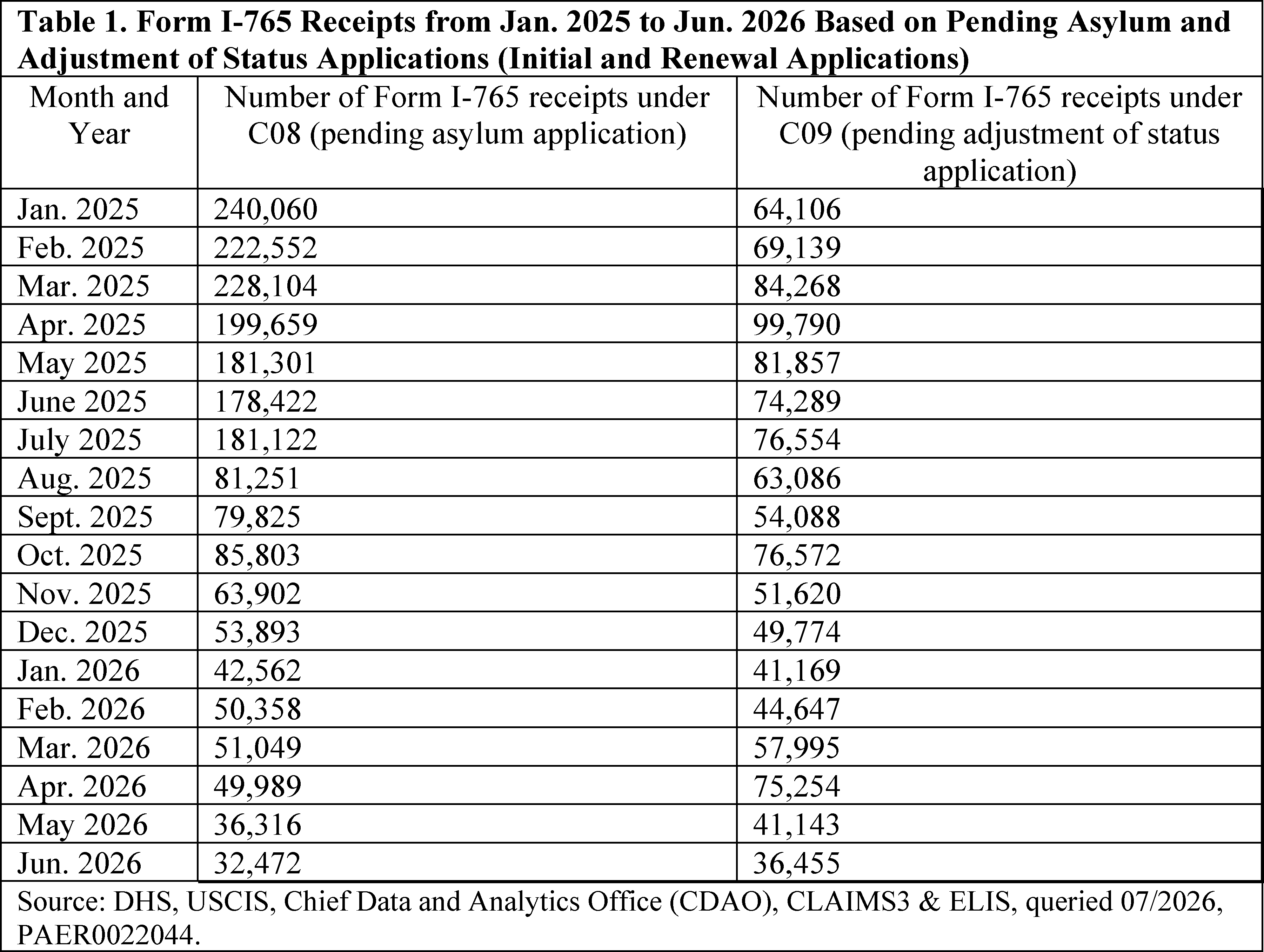
The two largest categories of Form I-765 applicants are those with pending asylum applications (C08) and those with pending adjustment of status applications (C09). Together these categories made up approximately 80% of all I-765 applicants from January 2025 through the end of June 2026.[45]
Table 1 shows how C08 and C09 filings have decreased since the start of the current administration in January 2025. USCIS received a total of 240,060 C08 filings in January 2025, which decreased to 32,472 in June 2026.[46] Similarly, USCIS received a total of 64,106 C09 filings in January 2025, which decreased to 36,455 in June 2026. USCIS notes the decreased EAD filing rates support the point made in the IFR that the potential lapse, and in particular the duration of any lapse, is speculative and could be outweighed by the harm posed by automatic extensions.
Finally, DHS regularly publishes detailed statistics on its activities,[47] but declines to perform a study of the additional risk to national security caused by income aliens generated through lawful employment for multiple reasons. For example, isolating and quantifying the incremental risk attributable solely to income derived from lawful employment—as distinct from the risk associated with presence, travel, associations, unauthorized employment, or other activities—would present significant methodological and data limitations. The relevant population would be small, sensitive national security information would constrain the availability and use of underlying case data, and it would be difficult to draw statistically meaningful conclusions.
DHS acknowledges the commenter's view that the primary public safety and national security risk posed by malicious actors arises from their presence in the United States and not solely from their continuing ability to work. Even so, DHS considers it important and appropriate to use its authorities to reduce risks associated with both presence and employment. Access to lawful employment can provide malicious actors with financial resources, routine cover for their activities, and access to certain workplaces and facilities. Limiting the ability of aliens with potentially malicious intent to retain EADs and/or employment authorization, and to lawfully work and generate income, without full vetting is therefore a meaningful component of DHS's broader efforts to safeguard benefit integrity, national security and public safety.
For these reasons, DHS continues to view measures that reduce the likelihood that malicious actors can obtain or rely on employment authorization and related secure documentation as worthwhile.
Comment: Some commenters stated that, if the goal is to strengthen vetting integrity, the logical solution is to expedite case processing so that all ( printed page 65320) background checks and reviews are completed more quickly. One commenter also stated that workers should be able to maintain their employment authorization and support their families while vetting occurs.
Response: DHS undertakes every effort to complete case processing as expeditiously as possible while being conscious of the importance of vetting every benefit requestor thoroughly for eligibility, including vetting for criminal activity and other security risks. DHS believes screening, vetting, and determining continued eligibility before granting a renewal of employment authorization and/or documentation is essential to enhance program integrity and better protect public safety and national security. Such processes, however, especially given the volume of initial and renewal EAD applicants that USCIS encounters, necessarily take time. Note that expediting a case generally means that USCIS would move the benefit request to the front of the processing queue to the detriment of those who may have filed earlier but does not otherwise change the time needed to properly conduct screening and vetting and determine continued eligibility. To the extent that these commenters suggest that USCIS should expedite all EAD renewal applications and thus put renewal EAD applications in front of other applications in the processing queue, DHS maintains that this would not be a viable solution and would not enhance program integrity or better protect public safety and national security.
Comment: Multiple commenters stated that the security benefit of the rule is incremental because renewal applicants have already been robustly vetted and will not be re-vetted until the EAD renewal is adjudicated, stating that this second vetting by USCIS occurs even if EAD extensions are automatic.
Response: USCIS must ensure that all aliens who request immigration benefits from USCIS are eligible for the benefit sought, merit a favorable exercise of discretion, if applicable, and do not pose a threat to national security or public safety. It is necessary and within USCIS' authority to continue investigating immigration benefit requests and to assess whether an applicant has established ongoing eligibility and warrants favorable discretion, if applicable, and whether they pose a risk to the national security and public safety of the United States, before issuing immigration benefits. This includes renewal applications for employment authorization and/or EADs, which may reveal new derogatory information or changed circumstances that were not present at the time of the initial grant.
Comment: One commenter stated that the IFR would cause DHS resources to be spent on EAD processing while people remain in the United States without decisions on their ability to stay, stating that the rule “punishes applicants, families, communities, and employers for USCIS' failure to timely process applications.” Another commenter similarly stated that the rule “does not meaningfully improve homeland security” and would divert resources rather than supporting security or operational efficiency.
Response: DHS is dedicated to ensuring that all aliens who enter and remain in the United States do not present threats to national security or public safety. USCIS plays an instrumental role in preventing terrorists and other bad actors from harboring in the United States, and screening and vetting should be prioritized over purely expedient adjudications to that end. DHS will continue to work to reduce frivolous, fraudulent, and meritless EAD filings to free up adjudicatory and other resources to better ensure national security and program integrity. Therefore, DHS does not agree that focusing resources on careful EAD renewal adjudications “diverts” resources from security; rather, such adjudications are themselves a core security function of USCIS.
e. Other Comments on Security Rationale
Comment: Some commenters expressed concern with DHS's rationale that bad actors could benefit from EADs being automatically extended and the income generated from working to support “nefarious activities,” stating that it is speculative, discriminatory, and perpetuates anti-immigrant rhetoric. A commenter said this is particularly dangerous language for Asian American communities who face a persistent narrative as the “perpetual foreigner” and will only contribute to that “pernicious stereotype” and support unfounded suspicions that Asians are agents of foreign governments.
Response: DHS disagrees with the commenters' assertions. DHS ended the practice of providing automatic extension of employment authorization and/or EADs based on the filing of a renewal EAD application to ensure continued eligibility and prioritizing the proper vetting and screening of aliens in furtherance of its mission. This rule does not target Asian American communities or any other specific group of aliens. Instead, this rule, as written, applies to all aliens who were eligible for the automatic extension of their employment authorization and/or EADs under former 8 CFR 274a.13(d). As explained in the IFR and this final rule, DHS is prioritizing the completion of vetting prior to granting an immigration benefit to enhance program integrity and better protect public safety and national security. The examples provided in the IFR illustrated the broader concern that extending employment authorization before completing vetting can allow aliens who may present public safety or national security risks to retain employment authorization. Ending automatic extensions based on the filing of an EAD renewal application ensures that continued employment authorization is conferred only after USCIS has completed renewed vetting, evaluated any new derogatory information, and determined that the alien remains eligible and continues to merit a favorable exercise of discretion, if applicable. DHS believes that the program integrity, public safety, and national security benefits of eliminating automatic extensions of EADs outweigh the risks of potential temporary lapses in employment authorization.
Comment: Commenters stated that, while DHS repeatedly cites purported national security concerns as justification for the IFR, the “underemphasized yet explicit” motivation for the IFR is a reduction in EAD filings overall. They stated that the rule is intended to generally deter immigration, specifically for asylum seekers, and that DHS ignores that asylees and refugees are authorized employment even if the expiration date on their EAD has passed. One commenter stated that, while DHS claims it is ending the practice of automatically renewing EADs for refugees and asylees to take a “uniform approach” and avoid “the potential for confusion” of employers, it does not quantify the potential confusion or justify why it cannot at least provide automatic renewals for refugees and asylees, who are authorized to work incident to their status.
The commenters concluded that the IFR is meant to undermine and frustrate those with legal work authorization and will cause unnecessary lapses in work authorization creating unreasonable obstacles, citing DHS's referenced goal of providing a “comprehensive policy solution” and stating the rule is actually intended to unnecessarily confuse employers, frustrate immigrants' ability to work, and push more into “dire straits.” Another commenter questioned enhanced security as the true intent of ( printed page 65321) the rule, suggesting other motives such as intentionally causing aliens to fall out of status and lose their jobs.
Response: DHS disagrees with the commenters that the goal of this rule is to reduce EAD filings overall, generally deter immigration or to “unnecessarily confuse employers” and “frustrate immigrants' ability to work.” As previously stated, the purpose of this rule is to prioritize the proper vetting and screening of aliens, to ensure continued eligibility, and to confirm that applicants continue to merit favorable exercises of discretion, if applicable, before granting new periods of employment authorization and/or new EADs by ending the practice of automatically extending the validity of employment authorization and/or EADs.
DHS recognizes that aliens who are granted asylum or refugee status are authorized employment incident to their asylum or refugee status. As explained in the IFR, aliens who are authorized employment incident to their status [48] and are maintaining their respective immigration status, such as asylees and refugees, will continue to be employment authorized while maintaining their immigration status, regardless of the expiration date on their EAD. Aliens who are authorized employment incident to status will continue to have the choice to file Form I-765 to obtain EADs for proof of identity. As stated in the IFR, DHS is taking a uniform approach for all aliens by ending the practice of providing automatic extensions of employment authorization and/or EADs.
Comment: One commenter said that eliminating automatic extensions does not serve E.O. 14159, Protecting the American People Against Invasion, which orders DHS and other agencies to ensure that employment authorization is not provided to any unauthorized alien in the United States. The commenter said eliminating automatic extensions has no impact on this mandate, as the purpose of such automatic extensions is to afford USCIS the time and resources to make a robust determination in compliance with its statutory and regulatory obligations in cases where aliens were already approved for employment authorization.
Response: DHS maintains that this rule accomplishes the mandate of E.O. 14159. This executive order directs the Secretary of Homeland Security, in coordination with the Secretary of State and the Attorney General, in Section 16 to take all appropriate action to align any departmental activities with the policies set out by the President, to ensure that “employment authorization is not provided to any unauthorized alien in the United States.” As stated in the IFR and this rule, ending the practice of providing automatic extensions of EADs is consistent with this instruction in E.O. 14159 because a previous grant of employment authorization does not mean that an applicant remains indefinitely eligible for employment authorization, and it is necessary to review eligibility to ensure that an alien's circumstances have not changed such that the alien is no longer eligible. Granting automatic extensions of employment without proper vetting and full adjudication to ensure continued eligibility is not consistent with E.O. 14159 or with current priorities.
ii. Consistency in USCIS Rationale and Reversal of Longstanding Policy
Comment: Multiple commenters wrote that USCIS says it does not expect delays in processing EAD renewals in the future, but also says it must end automatic extensions on EADs now because it needs more time to finish security checks. Commenters said both cannot be true. Commenters also stated that, if DHS expects continued delays, then ending automatic extensions will push employees out of work authorization simply because the government cannot finish adjudicating these cases fast enough. These commenters said courts invalidate rules when an agency's reasoning is contradictory and the agency offers no adequate justification for the inconsistency, with some commenters citing F.C.C. v. Fox Television Stations, Inc.
Also referencing this purported inconsistency, multiple commenters stated that DHS's conclusion that EAD applications will decline and that more adjudicative resources will reduce EAD renewal processing times ignores that those same resources will be available at the initial stage to address any red flags. Thus, the commenter said DHS's purported need for fuller investigations at the renewal stage will be even less necessary moving forward. The commenter said the claim also cannot be reconciled with the Department's historic position that it can complete sufficient investigations promptly, given sufficient resources.
Multiple commenters said the IFR rejects and contradicts the policies of both the 2016 and the recent 2024 rules, the purpose of which was to mitigate the harm to workers and employers caused by interruptions in work authorization, without adequate explanation, justification, or alternative remedies. One commenter specified that the IFR cites no data showing sustained reductions in renewal processing times, no new performance metrics, and no analysis demonstrating that the long-recognized adjudication challenges identified in 2016 and again in 2024 have materially changed.
Response: DHS disagrees with the commenters' assertion that the reasoning in the IFR, and this final rule, is contradictory or unjustified. DHS notes the IFR does not state that “USCIS does not expect delays in processing EADs.” Instead, DHS explained it has taken measures to address floods of filings from TPS beneficiaries and other applicants, and that DHS expects that overall filing rates for initial and renewal EADs are likely to substantially decline, freeing up adjudicative resources to reduce renewal EAD processing times.[49]
USCIS routinely evaluates filing volumes relative to adjudicative resources and reallocates workloads to address priorities as appropriate and feasible, including between initial and renewal EAD filings. The IFR explains that, while USCIS continues to work to improve processing times and reduce backlogs, DHS has determined that automatic extensions are inconsistent with ensuring continued eligibility or with current security and vetting priorities. DHS believes that the reasoning provided in the IFR is appropriate and that the purpose of the IFR has been adequately justified. Ending automatic extensions based on the filing of an EAD renewal application ensures that continued employment authorization is conferred only after USCIS has completed renewed vetting, evaluated any new derogatory information, and determined that the alien remains eligible and continues to merit a favorable exercise of discretion, if applicable. DHS believes that the program integrity, public safety, and national security benefits of eliminating automatic extensions of EADs outweigh the risks of potential temporary lapses in employment authorization.
As discussed in greater detail in response to a previous comment in Section IV.C.2.i.a. of this preamble, the decision to end automatic extensions reflects a change in how DHS balances operational efficiency and continuity of employment against these security and benefit integrity concerns rather than an inconsistency in DHS's underlying commitment to timely adjudications.
DHS expects that overall, EAD filing rates will substantially decline and free up adjudicative resources to reduce ( printed page 65322) renewal EAD processing times. Decreasing processing times would result in a reduced need for aliens filing renewal EAD applications to rely on an automatic extension of their EAD to avoid potential lapses. Since the IFR became effective on October 30, 2025, USCIS has seen a steady decrease in overall EAD filings. See Table 1 in Section IV.C.2.i.d. of this preamble. USCIS notes that decreased EAD filing rates support the point made in the IFR: that the potential for an alien to have a lapse, and in particular the duration of any lapse, is speculative and could be outweighed by the harm posed by automatic extensions.
iii. Lack of Acknowledgement of the Backlog and Other Operational Realities
Comment: Multiple commenters stated that the IFR ignores that backlogs persist today and provides no projections or plans to reduce the backlogs that necessitate automatic extension. Some of these commenters said the IFR incorrectly portrays backlogs as a future “scenario,” but processing delays are significant. A commenter stated that external analyses reinforce the conclusion that long delays in EAD adjudication are a documented, ongoing reality and, despite this record, DHS offers no empirical data showing in the IFR that processing times have improved enough to make automatic extensions unnecessary. A commenter stated that external analyses reinforce the conclusion that long delays in EAD adjudication are a documented, ongoing reality and, despite this record, DHS offers no empirical data showing in the IFR that processing times have improved enough to make automatic extensions unnecessary. Some commenters referenced DHS backlog data in asserting the value of the automatic extension mechanism and the rule's lack of acknowledgement of the backlog. Another commenter stated that, while striving for timely adjudication is a worthy goal, it does not eliminate the need for automatic extensions, and USCIS should not eliminate the regulatory provision of automatic extensions in its entirety.
Response: DHS is ending the automatic extension of employment authorization and EADs not because USCIS has completed its backlog of pending cases, but rather because DHS is prioritizing ensuring continued eligibility and proper vetting. However, USCIS will continue to work through its backlog of cases without unnecessarily granting immigration benefits to those who may be ineligible or threaten the public safety and national security of the United States.
DHS acknowledged the EAD backlog in the IFR, stating that most of the backlog resulted from prior policy decisions that resulted in an overwhelming number of initial and subsequent renewal EAD filings.[50] DHS discussed potential future backlog scenarios while also acknowledging the current backlogs in each of those rules. Specifically, DHS provided data in the 2024 TFR to project the impact of the asylum filing surges and backlogs to consider possible renewal EAD application filing behaviors and the impact throughout the effective period of the 2024 TFR. See89 FR 24628 (Apr. 8, 2024). DHS discussed the same data in the 2024 Final Rule. See 89 FR 101208 (Dec. 13, 2024). These rules attempted to mitigate the impact of potential future renewal EAD processing backlogs that could have been caused by a variety of circumstances, and DHS used those data projections to estimate the impact of codifying the automatic extension period increase from up to 180 days to up to 540 days. DHS has reassessed that conjectural approach and determined that, notwithstanding ongoing backlogs, automatic extensions are not an appropriate mechanism given the associated security and integrity risks.
As discussed elsewhere in this preamble, DHS has taken significant steps to reduce the overall EAD filings that followed the unprecedented flood of illegal immigration into the United States during previous years.[51] Significant declines in initial EAD applications since 2025 highlight the impact of these changes, which include a narrowed use of parole and a realignment of TPS and related programs with statutory criteria. Specifically, USCIS has also seen a decline in the number of filings in the largest EAD categories that were formerly eligible for automatic extensions based on the filing of a renewal EAD application, as shown in Table 1. See Section IV.C.2.i.d. of this preamble. The two largest categories of Form I-765 applicants are those with pending asylum applications (C08) and those with pending adjustment of status applications (C09). Together these categories made up approximately 80% of all I-765 applicants from January 2025 through the end of June 2026.[52] Table 1 shows how C08 and C09 filings have decreased since the start of the current administration in January 2025. For example, USCIS received a total of 240,060 C08 filings in January 2025, which decreased to 32,472 in June 2026.[53] Similarly, USCIS received a total of 64,104 C09 filings in January 2025, which decreased to 36,455 in June 2026.
Comment: Multiple commenters said the IFR ignores the reality of continued high demand for work authorization and that DHS is wrong to expect that EAD renewal filings will “substantially decline” because this Administration attempted to terminate the Cuban, Haitian, Nicaraguan, and Venezuelan (CHNV) parole program and several TPS designations. Many people who first came through CHNV and similar parole programs, or who previously had TPS, have now applied for asylum or other protections that still require EAD renewals. Additionally, the commenters said the termination of the CHNV parole program and the TPS designations have all been challenged in court with no final judgments issued; if terminations are reversed, parolees and TPS beneficiaries will continue applying for EAD renewals. The commenters ( printed page 65323) concluded that DHS must plan for continued high renewal volumes.
One commenter said the rule fails to account for the impact that halting asylum decisions will have on the backlog of renewal EAD applications. The commenter referenced the November 28, 2025, statement of the USCIS Director that “USCIS has halted all asylum decisions until we can ensure that every alien is vetted and screened to the maximum degree possible.” The commenter said halting asylum decisions means that asylum applications will remain pending longer, which means more asylum applicants' EADs will expire during the pendency of their asylum applications and result in the need to file additional requests to renew their EADs.
Response: DHS acknowledges that various policy changes outside of this rulemaking, such as significant changes to humanitarian parole programs,[54] the termination of TPS designations,[55] and changes made to the asylum program,[56] have affected, and will continue to affect, the demand for employment authorization and/or EADs in the future. DHS also recognizes the continued high demand for employment authorization and/or EADs, and DHS disagrees with the commenters' assertion that the IFR ignored such demand. Rather, as the IFR and this final rule explain, DHS believes the program integrity, public safety, and national security benefits of eliminating automatic extensions of EADs outweigh the risks of potential temporary lapses in employment authorization.
While DHS recognizes that the demand for employment authorization and/or EADs remains high, the various immigration-related initiatives implemented by this administration described previously in the IFR preamble have reduced EAD filings overall. See Table 1 in Section IV.C.2.i.d. of this preamble.
Comment: Commenters stated that the IFR ignores the impact of DHS's recent and planned future reductions in the USCIS workforce. Specifically, in April, nearly 20,000 USCIS staff—about 80 percent of the workforce—received communications urging them to end their employment with USCIS. The commenter said the rule does not explain how ongoing or planned USCIS staffing cuts affect the adjudicative resources available to process renewal EAD applications or how it accounted for these cuts in its planning to reduce backlogs. Another commenter similarly said the IFR also ignores the effects of this administration's “decimation” of the federal workforce and the longest shutdown of government operations in history.
Response: The IFR and this final rule do not undercount or ignore the impact of processing times and resources needed for adjudicating EADs. As stated previously, DHS is prioritizing public safety, national security and benefit integrity.
DHS notes that USCIS is generally fee-funded and able to continue its adjudicatory work during government shutdowns. However, DHS notes that government shutdowns could impact our ability to work with federal law enforcement partners and other agencies that are more directly impacted.
Regarding the size of USCIS' workforce, DHS agrees that adequate staffing and efficient allocation of resources are important to reducing backlogs and minimizing the risk that a renewal EAD application will remain pending past the current card's expiration. USCIS continuously takes operational steps within existing budgetary and hiring authorities to further enhance processing efficiency, including hiring and reallocating personnel, refining workflows, investing in automation where appropriate,[57] and implementing the fee [58] and program changes directed by recent legislation and executive actions.[59]
iv. “Proper Planning” Rationale
Comment: Multiple commenters stated that DHS's assertion that renewal applicants' “proper planning” could avoid lapses in work authorization is false and ignores operational realities and backlogs, asserting that EAD renewal applicants cannot “properly plan” for every unforeseen circumstance that may affect USCIS processing times. Commenters stated that the 2016 and 2024 Final Rules were issued to address unforeseen circumstances that neither the agency nor applicants could reasonably anticipate.
Commenters cited processing backlog figures when stating that applicants who follow the agency's recommendation not to file more than 180 days in advance face unavoidable employment gaps. Multiple commenters stated that many EAD applications, including renewals, took longer than 180 days to adjudicate.[60]
Response: As previously discussed, DHS has determined that the potential impact that some aliens may experience a temporary lapse, of unpredictable duration, in the validity of their employment authorization and/or EAD is outweighed by the need to better protect the safety and security of the American people by ensuring that employment authorization and/or an EAD is not granted until USCIS has thoroughly vetted and screened the applicant, resolved any derogatory hits, and determined that the alien continues to be eligible for the immigration benefit and merits a favorable exercise of discretion, as applicable.
USCIS provides case processing times for select forms and locations to inform the public how long it generally takes to process benefit requests.[61] USCIS updates case processing times on its website monthly with the latest available data. The processing times ( printed page 65324) fluctuate over time and are based on how long it took USCIS to complete (meaning issue an approval or denial notice) 80% of adjudicated cases over the six months prior to the posted processing times.[62] Each case is unique, and some cases may take longer than others. Processing times should be used as a reference point, not an absolute measure of how a case will take to be completed. The fact that a particular form type and category shows a processing time slightly longer than 6 months at the 80th percentile does not mean that a particular application will take longer than 6 months to approve or deny. Processing times, because they represent a 6-month reporting period, are a lagging indicator as it pertains to more recent policy changes and related filing rates. Processing times are also based on the time it took USCIS to approve or deny applications, which can be skewed by the time needed to request additional evidence before an application is approved or denied.
Although USCIS generally recommends that applicants not file requests to renew EADs more than 180 days before the expiration of their EADs, there is no prohibition on filing the form before a certain date ahead of expiration. Proper planning by applicants includes filing early, rather than close to the expiration of the EAD, and ensuring that all evidence needed for USCIS to determine eligibility has been submitted with the application at the time of filing. While proper planning might not avoid a temporary lapse in employment authorization and/or documentation in all cases, it should help to reduce the potential of a lapse and shorten the duration if a lapse were to occur.
3. Rationale for Eliminating the Automatic Extension of EADs
Comment: A couple of commenters opposed the rule without providing their rationale. They supported automatic extension of employment authorization, and the provision of employment authorization documents, without vetting or reviewing aliens' applications. One called the regulatory change “wrong” and “inhumane.”
Response: As discussed in greater detail in response to more specific comments elsewhere in this preamble, to the extent that some renewal applicants might face a temporary lapse in employment authorization and/or documentation, DHS believes this approach is nevertheless justified as it will enhance program integrity and better protect public safety and national security. Ending automatic extensions based on the filing of an EAD renewal application ensures that continued employment authorization is conferred only after USCIS has completed renewed vetting, evaluated any new derogatory information, and determined that the alien remains eligible and continues to merit a favorable exercise of discretion, if applicable. DHS believes that the program integrity, public safety, and national security benefits of eliminating automatic extensions of EADs outweigh the risks of potential temporary lapses in employment authorization and or EAD validity.
In addition to these independent reasons for promulgating this rule, DHS is acting in accord with presidential directives. As discussed in the Executive Summary, E.O. 14159 instructs the Secretary of Homeland Security, alongside the Secretary of State and Attorney General, to ensure that employment authorization is not provided to unauthorized aliens.[63] Furthermore, removing automatic extensions of employment authorization and/or EADs aligns with Executive Order 14161, which requires DHS to vet and screen all aliens within the United States “to the maximum degree possible,” [64] and Presidential Proclamation 10949, which orders DHS to ensure that aliens already within the United States do not support foreign terrorists or bear hostile attitudes toward its citizens, culture, government, institutions, or founding principles.[65]
4. Impact on USCIS Processing
i. Administrative Burden and Efficiency
Comment: Multiple commenters asserted that the IFR would increase the administrative burden on the government and further slow the adjudication process and USCIS' ability to timely processes EAD renewals. A commenter stated that eliminating the automatic extension does not speed up adjudications, but simply “creates a guaranteed administrative failure” and will lead to increases in emergency service requests, inquiries, and appeals. Similarly, another commenter wrote that the IFR would create unnecessary administrative inefficiencies as USCIS would likely face an increase in prematurely filed renewal applications, multiple submissions from applicants fearing gaps in employment, and additional employer verification requests during pending periods. One commenter reasoned it would be less burdensome for USCIS to not implement the IFR than to implement it.
Other commenters stated that the Agency has been unable to timely adjudicate EAD renewals for several years and the IFR does not resolve the current operational reality to avoid gaps in employment authorization, because even when applicants file at the earliest possible date, their current EADs often expire long before adjudication concludes as USCIS processing times are sometimes 8 to 11 months. A commenter remarked that backlogs and resulting lapses in employment authorization are not the fault of EAD renewal applicants.
One commenter stated that the IFR does not account for the impact of other DHS rules, including the recent Duration of Status proposed rule,[66] which would increase the adjudication workload on USCIS staff and jeopardize the Agency's ability to ensure extensions can be consistently processed within existing timeframes.
Response: DHS acknowledges that backlogs and operational challenges were justifications for the 2022 and 2024 Temporary Final Rules and the 2024 Final Rule. However, as DHS explained in the IFR, the automatic extension of the validity of an EAD grants the benefit of extending an alien's expired employment authorization and/or EAD merely by filing a timely renewal EAD application and without first completing adjudicative review and related vetting, including resolution of derogatory information identified during the vetting process. That is, the benefit is granted without USCIS first performing the following actions: an eligibility determination; completing vetting and screening checks; resolving potential hits of derogatory information in connection with the alien; and a determination that the employment authorization should be granted in the exercise of discretion, if applicable. The automatic extension, therefore, poses a security vulnerability that could allow bad actors to continue to work and generate income to potentially finance nefarious activities that pose an imminent threat to the American public. Granting benefits without proper vetting and full adjudication is contrary to the ( printed page 65325) mission of DHS and poses a threat to the safety and security of the American people.[67] DHS believes that this concern outweighs concerns about potential backlogs and operational challenges that may result in temporary lapses of employment authorization and/or EAD validity.
As DHS stated in the IFR, it is the policy of the Administration “to faithfully execute the immigration laws against all inadmissible and removable aliens, particularly those aliens who threaten the safety or security of the American people.” [68] Pursuant to this policy, the Secretary of Homeland Security, in collaboration with the Secretary of State and the Attorney General, has been directed to “rescind the policy decisions of the previous administration that led to the increased or continued presence of illegal aliens in the United States, and align any and all departmental activities with the policies set out by this order and the immigration laws” including by “ensuring that the parole authority under section 212(d)(5) of the INA (8 U.S.C. 1182(d)(5)) is exercised on only a case-by-case basis in accordance with the plain language of the statute” and by “ensuring that designations of TPS are consistent with the provisions of section 244 of the INA (8 U.S.C. 1254a), and that such designations are appropriately limited in scope and made for only so long as may be necessary to fulfill the textual requirements of that statute.” [69]
DHS has already taken a number of actions in support of the directives described in the preceding paragraph.[70] Thus, in addition to the serious concerns relating to automatic EAD extensions discussed previously, DHS is taking steps independent of this rule, including narrowing the use of parole and to align TPS designations with statutory criteria, that are likely to result in lower EAD filing volumes and improve renewal EAD application processing times.
With respect to the comment about the impact of other DHS rules that could impact the adjudication workload on USCIS and thus, the processing timeframe of EAD renewals: DHS published a final rule eliminating duration of status (D/S) on July 17, 2026.[71] DHS agrees with commenters that there will be an increase in the filing volume of Forms I-539, Application for Extension of Stay/Change of Status, received by USCIS following September 15, 2026, the effective date of the final rule as those nonimmigrants who are required to file such forms begin to do so. The transition period described in 8 CFR 214.1(m), however, provides for a 4-year transition period for F and J nonimmigrants currently in the United States for D/S to gradually shift to a fixed admission period.[72] As explained in the final rule, these F and J nonimmigrants will continue to remain admitted for D/S until they depart, or until the program end date specified on designated forms or 4 years after the effective date of the rule, whichever comes first.[73] This would allow time for DHS to shift resources as needed to ensure that the larger, increased volumes are integrated into existing workflows. USCIS will continue to monitor its resource allocations and adjust as appropriate.
On December 4, 2025, USCIS changed the validity periods for certain other EAD categories, including C08s, to enhance its screening and vetting efforts.[74] Therefore, C08 applicants now must seek renewal of their EAD more often than under the previous 5-year EAD validity period. DHS, however, cannot accurately predict whether this policy change will adversely affect EAD renewal processing times, as a likely increase in EAD renewals could be offset by other recent or future policy changes. For example, on February 23, 2026, DHS published an NPRM proposing to modify filing and eligibility requirements for aliens with a pending asylum application requesting employment authorization and an employment authorization document (EAD). See91 FR 8616 (Feb. 23, 2026). As of the publication of this final rule, the NPRM has not been finalized. If finalized as proposed, changes to eligibility for C08 employment authorization could significantly reduce the number of initial C08 applications and, by extension, the longer-term number of renewal applications.
ii. Processing Timelines
Comment: One commenter asserted that early filing routinely leads to rejections or denials, and that filing fees are not returned to the applicant if they are rejected for early filing. Another commenter reasoned that since USCIS' policy only allows service inquiries after 365 days, this would limit employer and employee's options for addressing delays.
Response: Although USCIS generally recommends that applicants not file to renew their EAD more than 180 days before the expiration of their current EAD, USCIS will not reject or deny an otherwise eligible Form I-765 renewal solely because it was filed sooner. The USCIS Contact Center is an available resource and provides specific customer service options, including how to obtain assistance if a case is rejected or denied.[75] Further, USCIS does not have a set rule that applicants must wait 365 days to submit a service inquiry. Rather, USCIS posts processing times on its Case Processing Times web page, which includes a tool to help determine whether an applicant can request an update on their case. Depending on the applicant's receipt date and other factors, USCIS provides an estimated date for when a case inquiry may be submitted or a link to submit a case inquiry.[76]
DHS recognizes that an alien who is authorized employment incident to their status may still wish to obtain an EAD. Aliens who are authorized employment incident to status will continue to have the choice to file Form I-765 to obtain an EAD as proof of identity and employment authorization. DHS also recognizes that, in the absence of automatic extensions, some aliens may experience temporary lapses in employment authorization and/or EAD validity if their renewal applications are not adjudicated before their current EADs expire. However, DHS maintains that the security risks associated with automatically extending employment authorization and/or EADs without updated vetting and adjudication outweigh the benefits of using automatic ( printed page 65326) extensions to ensure that aliens have uninterrupted employment authorization and/or EADs. While DHS cannot guarantee that every renewal will be adjudicated before the existing EAD expires, DHS believes that proper planning by applicants, combined with reduced filing volumes and ongoing operational improvements, may lessen the likelihood and duration of lapses.
iii. Procedural Fairness
Comment: Many commenters expressed concerns about the procedural fairness of applicants losing work authorization due to USCIS processing times. Specifically, some commenters said that the IFR would punish people who are following the law, complying with immigration procedures, or, more generally, “have done everything right,” losing status through “no fault of their own.” Likewise, several commenters remarked that the current automatic extension policy helps prevent nonimmigrants from being punished for delays beyond their control. A few commenters said that removing automatic extensions without addressing processing delays would be unjust.
A few other commenters remarked that the IFR would contradict administrative equity or fairness. Other commenters said that the rule would contradict DHS's own acknowledgement that interruptions in work authorization cause “substantial and unnecessary harm.” A couple of commenters said that the rule would penalize law abiding applicants due to an extreme individual case.
Response: DHS recognizes that many renewal applicants diligently comply with filing requirements and that delays in adjudication may not be within their control. DHS also acknowledges that prior rulemakings, including the 2016 and 2024 rules, sought to mitigate the impact of processing delays on workers and employers by providing automatic extensions of employment authorization and/or EADs.
However, as explained in the IFR, DHS has reassessed the balance between continuity of employment authorization and the need to ensure that immigration benefits are granted only after appropriate vetting and eligibility determinations. There is no statutory entitlement to an automatic extension of employment authorization. Employment authorization in the relevant categories is generally discretionary and time-limited, and renewal requires a new adjudication. The IFR and this final rule do not deny renewal to eligible applicants; they simply require that continued employment authorization be based on an approved renewal application rather than on the mere filing of that application.
DHS has determined that granting automatic extensions without updated vetting and adjudication is inconsistent with its mission and with E.O.s directing DHS to ensure that employment authorization is not provided to unauthorized aliens and that all aliens in the United States are vetted and screened to the maximum degree possible. While DHS is mindful of the hardships that may arise from temporary lapses in employment authorization, the need to protect national security and public safety, and to enhance the integrity of immigration benefits, justifies discontinuing automatic extensions.
iv. General or Mixed Feedback on USCIS Processing
Comment: Several commenters asked questions about USCIS operational metrics, processing times, use of RFEs, and remedial actions for applicants who lose their jobs due to adjudication delays. A commenter agreed that a 540-day extension was too long because there should be thorough vetting before granting EADs and/or employment authorization.
Response: DHS acknowledges commenters' questions about the rule's impact. As discussed in the IFR and earlier in this preamble, the department has taken measures to address policies that resulted in the historic spike in EAD applications received during the previous administration. DHS anticipates a substantial decrease in both initial and renewal filings for EADs,[77] which would allow for a reduction in processing times for renewal EADs.
USCIS has the discretion to deny benefit requests for lack of required initial evidence or for ineligibility, or to request that additional evidence is submitted within a specified period of time.[78] The benefit requestor bears the burden of proof for establishing eligibility.[79] A request for evidence (RFE), though it may add time to the adjudication of an application, is an opportunity for the applicant to provide additional evidence to USCIS in support of their application.
DHS will not be implementing remedial actions in case an alien's employment authorization lapses. DHS believes that careful planning by applicants includes filing early, rather than close to the expiration of the EAD, and ensuring that all evidence needed for USCIS to determine eligibility has been submitted with the application at the time of filing, may help to reduce the risk of a potential lapse in employment authorization. While proper planning might not avoid a temporary lapse in employment authorization and/or documentation in all cases, it should help to reduce the potential of a lapse and shorten the duration if a lapse were to occur. DHS also notes that an applicant may request that USCIS expedite the adjudication of an application that is under USCIS jurisdiction.[80] USCIS considers all expedite requests on a case-by-case basis and generally requires documentation to support such requests.[81] The decision to expedite is within the sole discretion of USCIS.[82] Expediting a case generally means that USCIS would adjudicate a benefit ahead of others, including those who may have filed earlier, so USCIS carefully weighs the urgency and merit of each expedite request.[83]
Finally, DHS agrees with commenters' belief that the previous 540-day automatic extension was too long, as demonstrated by this rule's finalization of the IFR's removal of the automatic extension process.
5. Combined Impacts on Individuals, Employers, the Economy, and Specific EAD Categories
i. Impacts on Aliens, Families, and Communities
a. General Hardship, Fairness, Educational Disruptions, and Family Impacts
Comment: Many commenters expressed concerns that the IFR would cause lapses in valid work authorization, causing job loss or interruptions of work, while undermining aliens' financial stability.
Commenters expressed that lapses in work authorization lead to job loss, income loss, housing/food insecurity, loss of health coverage, strain on community resources, educational disruption, and harm to families and children, and that this is unfair to individuals who have complied with all requirements. Many commenters expressed general concerns about the consequences of lost wages due to gaps in employment authorization. For example, commenters shared that lost wages could lead to housing and food ( printed page 65327) insecurity for nonimmigrants. Several commenters wrote that a lapse in employment could make nonimmigrants face the threat of eviction and other commenters shared concerns about increased risk of homelessness. Commenters remarked that many nonimmigrants may not have families or friends to lean on for temporary shelter, making this group particularly vulnerable to income shortages. One commenter remarked that in the current job market, it would be extremely difficult for them to find another job if they were to lose employment due to a lapse in work authorization.
Several commenters expressed concern about the negative impact that the IFR would have on families. Some commenters said that employment lapses would result in financial insecurity for households. Some commenters specifically expressed concern that the IFR would cause significant financial hardship for families, including those who depend on dual incomes to meet basic needs such as mortgage payments, rent, childcare, healthcare, food, transportation, and other living expenses. A commenter said that the IFR could force family separation. A commenter remarked that a lapse in employment authorization would affect nonimmigrants' ability to travel and visit or take care of sick family members. Another commenter wrote that work authorization gaps would disproportionately affect households where women care for children, elders, and disabled family members.
Several commenters expressed concern regarding the IFR's specific impact on children. For example, commenters shared that employment gaps would hinder their ability to provide care for their special needs children. A commenter remarked that families that continually face unmet needs endure stress that can impact the long-term health and development of children. Similarly, another commenter wrote that if household income is interrupted, children could lose their access to stable food, shelter, healthcare, and education “overnight.” The commenter reasoned that, as a result, children whose parents lack stable work authorization are more likely to suffer from poor overall health, and have a greater likelihood of hospitalization, school absenteeism, and disciplinary issues. Commenters remarked that food insecurity from disrupted wages would contribute to conditions such as hypertension and diabetes and said that children from poor families are four times as likely to be in “less than very good health” than children from wealthier families. Another commenter similarly remarked that they anticipate U.S. citizen children with an immigrant parent to be particularly impacted by the IFR.
A few commenters said that the IFR poses humanitarian difficulties and challenges aliens' rights to pursue dignified work, as well as the American Dream. Other commenters said that the IFR is inhumane and erodes trust in the immigration system, while others stated it sends the message that working aliens are dispensable.
One commenter stated that many EAD applicants are victims of disasters abroad and do not need to face further hardship. Similarly, multiple commenters stated that aliens come to the United States fleeing conflict or persecution and described automatic work authorization as “a lifeline.” Another commenter described the IFR's removal of automatic extensions of EAD validity periods as an unlawful form of coercion, stating that it will make life in the United States unbearable for aliens. A few commenters expressed concerns about the IFR causing potential discrimination in the hiring process. For example, a couple of commenters expressed concern that employers would not hire employees who are dependent on work authorization, due to potential disruptions from processing delays. One commenter remarked that the automatic extension policy helps level the hiring playing field against potential discrimination.
A couple of commenters remarked that many nonimmigrant families live on modest wages and may not have enough saved up to supplement a gap in income. One commenter added that, since asylum seekers are not eligible for federal benefits, this group would be left particularly vulnerable.
Some commenters also expressed concerns that nonimmigrants would lose benefits such as unemployment insurance and employer sponsored health coverage during employment authorization gaps. One commenter said that many nonimmigrants rely on EADs to demonstrate their eligibility to purchase healthcare on the Healthcare Marketplace. Multiple commenters added that, without health care coverage, aliens may be more likely to avoid treating health conditions and seeking preventive services. Commenters remarked that this would consequently increase use of emergency rooms and urgent care and expose nonimmigrant populations to medical debt. Additional commenters remarked that the 2025 tax and budget law, Public Law 119-21, also known as the “One Big Beautiful Bill Act,” will further limit health coverage for aliens, and expressed concern for resulting health outcomes, citing several articles which demonstrated correlation between one's ability to afford health insurance and their health outcomes. One commenter also remarked that some medical insurance plans require minor children to have an unexpired EAD for coverage.
Many commenters expressed concerns about the impact that the IFR would have on public resources. Commenters reasoned that loss of income would have to be supplemented by increased reliance on public assistance programs, charity, and other community or humanitarian services. For example, commenters said that the IFR would increase demand for services like food pantries, emergency shelters, clothing or donation centers, and community health centers. A few commenters remarked that these resources are already strained, particularly after having absorbed the spillover from shrinking federal assistance programs. One commenter remarked that cities in Maine are already exceeding their general assistance funds and cannot afford additional strain on resources. The commenter added that alien workers fill vital roles at social service agencies, working as translators, interpreters, case managers, and cultural brokers. The commenter reasoned that loss of these workers would exacerbate the strain on these agencies, predicting that if the alien workers face a lapse in EAD validity, they may then turn to the social service agency for help. The commenter added that local support services such as food banks have already seen an uptick in demand over the past year.
Several commenters expressed concern that nonprofit legal providers would see an overwhelming increase in demand for services. Similarly, some commenters said that crisis-driven requests require timely responses and cannot be integrated into existing caseloads without sacrificing key legal services, and that shouldering more of these cases would cause stress to their organization and divert attention away from humanitarian case preparation.
Response: DHS recognizes that lapses in employment authorization can create real hardship for affected aliens, their families, their employers and the communities in which they live. Commenters described risks such as job loss, reduced income, housing and food insecurity, loss of health coverage, strain on community resources, educational disruption, and negative impacts on children and family stability, particularly for households ( printed page 65328) relying on dual incomes or modest wages. DHS is also mindful of other disruptions that a temporary lapse in employment authorization of an alien may bring, including for those who may rely on an automatic extension to obtain REAL ID-compliant driver's licenses and other forms of identification.
DHS considered these concerns before issuing the IFR [84] and again in finalizing this rule. However, DHS has concluded that the need to ensure proper vetting and screening, and continued eligibility, before granting renewed employment authorization and issuing secure evidence of that authorization outweighs the risk that some applicants might experience a temporary lapse in employment authorization and/or EAD validity. DHS also determined that extending this benefit without updated adjudication and screening is inconsistent with its mission and with E.O.s [85] directing DHS to ensure that employment authorization is not provided to unauthorized aliens and that aliens in the United States are vetted and screened to the maximum degree possible.
Nevertheless, DHS emphasizes that this rule does not eliminate eligibility for employment authorization or prevent eligible aliens from obtaining initial or renewal EADs. Rather, it ends the practice of automatically extending employment authorization and/or EAD validity for up to 540 days based solely on the filing of a renewal application, without completion of adjudicative review and related vetting, including resolution of any derogatory information. Continued employment authorization will now depend on USCIS' approval of a renewal application, after USCIS has determined that the alien continues to be eligible and continues to merit a favorable exercise of discretion, if applicable.
This rule also does not change underlying eligibility standards for immigration benefits, public benefits, or educational programs, and it does not restrict aliens from seeking assistance for which they are otherwise eligible under Federal or State law. Certain categories of aliens, such as refugees and asylees, remain “qualified aliens” for specified public benefits under existing statutes, and those authorities are unchanged by this rule. Likewise, this rule does not alter the ability of States, localities, or private organizations to provide charitable or humanitarian assistance.
DHS also notes that, independent of this rule, it has taken steps to reduce the extraordinary EAD filing volumes driven by prior policies, including narrowing the use of parole and aligning TPS designations with statutory criteria. DHS expects that overall EAD filing rates (initial and renewal) will substantially decline because of those actions, freeing adjudicative resources to reduce renewal EAD application processing times. For example, initial and renewal EAD applications for the largest EAD categories that were formerly eligible for automatic extensions have significantly reduced since the start of 2025. See Table 1 in Section IV.C.2.i.d. of this preamble.
Accordingly, the decreased EAD filing rates support the point made in the IFR that any claims about an increase in the number and duration of employment authorization and/or EAD lapses are speculative and outweighed by the harm posed by automatic extensions.
USCIS also publishes current case processing time information on its website.[86] Proper planning by applicants, such as monitoring EAD expiration dates, consulting posted processing times, and filing renewal applications as soon as permitted by regulation and form instructions, can further mitigate the risk and duration of any lapses in employment authorization.
Overall, DHS recognizes the seriousness of the hardships described by commenters but concludes that, on balance, the national security, public safety, and benefit integrity interests served by ending automatic EAD extensions outweigh the potential adverse impacts associated with temporary lapses in employment authorization and/or EAD validity.
b. Mental Health and Vulnerability, Including Risk of Exploitation
Comment: Commenters asserted that employment gaps due to the lack of automatic extensions and processing delays will exacerbate stress, trauma, and anxiety, and may push some aliens into unauthorized or exploitative employment or unsafe living conditions.
Multiple commenters remarked that the IFR would instill fear, stress, depression, and anxiety, among other mental health concerns. One commenter asserted that some of the immigrant population is already experiencing significant levels of trauma and stress from immigration enforcement activity, and that the IFR would only exacerbate such feelings.
Many commenters shared concerns about nonimmigrants' increased level of vulnerability to exploitation by employers and landlords, as well as human trafficking, sexual harm, and abuse owing to the IFR's elimination of automatic extensions. For example, multiple commenters said that loss of employment authorization makes nonimmigrants vulnerable to exploitative working conditions. Some commenters remarked that if aliens lose their ability to work legally, they may seek under the table work or unlawful employment. Commenters warned that this leaves such individuals vulnerable to exploitation, explaining that these jobs often have lower wages, minimal labor protections, and abusive conditions which they may be afraid to report due to unlawful status. They also indicated that 84.9 percent of unauthorized immigrants reported not being paid time and a half for overtime labor, and 37.1 percent reported being victims of minimum wage violations. The commenter added that many employers of unauthorized workers do not carry workers compensation insurance, meaning that employees may be responsible for covering their own medical costs in the case of work-related injury. The commenter added that since USCIS recently ended a program that protected whistleblowers, unauthorized employees are now less likely to report various types of abuse. A different commenter added that forcing applicants into unlawful employment may also impact their eligibility for future immigration benefits, putting them in a long-term position of vulnerability.
Response: DHS recognizes that uncertainty about employment authorization and potential lapses in income can contribute to stress, anxiety, and other mental health challenges, particularly for individuals who may already have experienced trauma or instability. DHS also recognizes that economic insecurity and lack of lawful employment opportunities can increase vulnerability to exploitation by unscrupulous employers, landlords, or others, and may heighten risks of trafficking, abuse, or other harm.
The IFR and this final rule do not deny eligible aliens access to employment authorization or to the underlying immigration benefits for which they qualify. Rather the IFR, affirmed by this final rule, removes only the automatic extension mechanism that previously allowed aliens to remain employment authorized for up to 540 ( printed page 65329) days based solely on a pending renewal application, without completion of updated vetting and adjudication. As described throughout this preamble, DHS has determined that such automatic extensions present an unacceptable security and program integrity risk because they confer significant benefits before USCIS has completed vetting and screening, resolved any derogatory information, determined continued eligibility and that the applicant merits a favorable exercise of discretion, if applicable.
DHS cannot structure its regulatory framework on the assumption that aliens and/or employers will respond to temporary lapses in employment authorization by engaging in unauthorized employment or other unlawful conduct. The INA prohibits the knowing employment of unauthorized aliens and establishes consequences for both employers and aliens who violate those provisions. While DHS recognizes that some aliens may face difficult choices if a lapse occurs, DHS does not condone unauthorized employment or believe that it is an appropriate response to a temporary lapse in employment authorization.
DHS shares commenters' concerns about exploitation and abuse. DHS, including through components such as ICE and USCIS' fraud detection and victim protection programs, will continue to enforce laws related to human trafficking, forced labor, and other forms of exploitation, and to coordinate with the Department of Labor and other agencies on enforcement. Existing protections for victims of trafficking, crime, and abuse (including T and U nonimmigrant classifications and VAWA) are unaffected by this rule. Nothing in this rule diminishes DHS's commitment to identify and assist victims or to support the investigation and prosecution of traffickers and other offenders.
DHS recognizes that some aliens may experience heightened stress or vulnerability if their employment authorization temporarily lapses. However, DHS has concluded that the need to ensure that employment authorization is extended only after appropriate vetting and adjudication, consistent with current national security and public safety priorities, justifies ending automatic extensions. DHS also expects that reductions in overall EAD filing volumes may help limit the frequency and length of lapses and that timely filing and planning by applicants can further reduce uncertainty. For reduced filing volumes, see Table 1 in Section IV.C.2.i.d. of this preamble.
c. Identification, Driver's Licenses, and Access to Services
Comment: Several commenters expressed concerns that lapses in employment authorization and the associated use of employment authorization documents would hinder nonimmigrants' abilities to obtain or renew their driver's licenses, open and access bank accounts, obtain or renew health insurance, enroll in educational programs and training, and interact with law enforcement. Commenters remarked that lack of a driver's license could interfere with critical daily activities for nonimmigrants, such as taking children to school, commuting to work, or attending doctors' appointments or immigration hearings. A few commenters shared that in many cases, nonimmigrants require driver's licenses to perform their job duties and that, without a valid driver's license, nonimmigrants may be pushed to drive without a license, compromising road safety.
Response: DHS acknowledges that EADs are commonly used by aliens as identity and, in some contexts, status documents for State-issued driver's licenses and identification cards, financial services, and other purposes. Under the prior automatic extension framework, an EAD that was facially expired could be treated as unexpired for certain purposes if accompanied by a Form I-797C receipt notice, including obtaining a driver's license. As explained in the IFR, DHS determined that continuing that practice and the use of automatically extended EADs is no longer appropriate.
This rule does not change State authority to determine which documents are acceptable for issuance of driver's licenses or other State identification, nor does it amend the Department's REAL ID regulations for issuance of driver's licenses or identification cards acceptable for federal official purposes defined in the REAL ID Act. It does, however, make clear that, for renewal applications filed on or after October 30, 2025, a pending Form I-765 and associated receipt notice will no longer operate to automatically extend EAD validity under DHS regulations. An EAD that is facially expired will not be treated as unexpired for employment or immigration purposes unless it qualifies for an automatic extension under 8 CFR 274a.13(d) based on a renewal application filed before October 30, 2025, or is otherwise extended by law or an applicable Federal Register notice (for example, certain TPS-related documents).
The rule does not prevent eligible aliens from seeking or renewing EADs, nor does it prohibit States or other entities from accepting alternative forms of identification or documentation where permitted by law.
DHS also expects that, as overall EAD filing volumes decline and renewal processing times improve, the risk and duration of lapses will be reduced. USCIS has already seen a decline in filing rates for the main EAD categories that were eligible for automatic extensions. See Table 1 in Section IV.C.2.i.d. of this preamble.
DHS concludes that the security and benefit integrity gains from ensuring that EADs used as evidence of identity and work authorization reflect a recent adjudication and completed vetting outweigh the potential risks associated with discontinuing automatic extensions.
ii. Employment, Employers, and Economic Impacts
a. Employer Burdens, Business Continuity, and Sector Specific Concerns
Comment: Multiple commenters argued that loss of automatic extensions will increase Form I-9 compliance complexity, cause turnover and productivity losses, exacerbate existing shortages in health care, education, agriculture, manufacturing, etc., and impose particular burdens on small employers.
Commenters expressed opposition to removing automatic extensions, stating that such a change would cause significant disruption to employers, including operational inefficiencies (loss of productivity and delays), administrative burdens, staffing gaps, human capital costs and retention, civil penalties, and compliance burdens as employees await renewal decisions without work authorization. A few commenters stated that employers could violate Form I-9 compliance rules due to unclear authorization statuses.
Multiple commenters asserted that the IFR would exacerbate existing labor shortages and projected a continued decrease in labor force participation rates through at least 2030, cautioning that the IFR could worsen such shortages by preventing asylum seekers from working during EAD processing and removing vetted workers. One commenter stated that labor shortages would negatively impact the U.S. economy, hinder growth and contribute to inflationary pressures. Another commenter stated that a decline of 2 million immigrant workers between 2019 and 2021 contributed to labor ( printed page 65330) shortages across sectors, including a labor shortage in the construction industry valued at $10.8 billion, reasoning that the IFR would replicate such labor shortages across every industry. A commenter stated that until public and private sector efforts could fully meet industry demand, the United States would need additional workers to fill jobs left vacant by the domestic workforce, expressing concern that ending the EAD extension could further disrupt workforce stability and business continuity for manufacturers. Many commenters stated that the removal of automatic extensions would negatively impact critical industries and sectors of the U.S. economy that rely on foreign workers, including agriculture, technology, energy, manufacturing, logistics, transportation, hospitality, education, and construction. Several commenters expressed concern about the impact on healthcare and healthcare workers, noting that even a brief lapse in employment authorization disrupts patient care, clinic operations, and community health access. One commenter remarked about how the IFR will adversely affect teaching hospitals and academic health systems that employ EAD workers.
Other commenters expressed concerns that the IFR would undermine labor unions, collective bargaining, and workforce stability by disrupting bargaining units that include immigrant workers with EADs, stating that increased risk of sudden job loss among workers would strain unions' ability to enforce workplace standards, forcing them to devote more resources to protecting vulnerable workers and addressing instability caused by the IFR.
Multiple commenters expressed the importance of automatic extensions for business continuity amid persistent government processing delays and stated that the IFR would impose unnecessary burdens and costs, especially on smaller companies without in-house legal departments. Some commenters stated that the rule would force employers to conduct extensive contingency planning and workforce audits to prepare for potential lapses in work authorization. Specifically, a commenter stated that groups such as asylees, who are authorized to work incident to status, may still be asked to show an EAD to their employer, and further reasoned that the IFR could still cause employer confusion and job loss among these groups. Other commenters stated that eliminating automatic EAD extensions would cause businesses to lose workers and cited to a USCIS analysis establishing that EAD extensions previously saved U.S. employers an estimated $3.5 billion by avoiding labor turnover.
Numerous commenters expressed concern that employers would be forced to terminate employees due to administrative delays in processing EAD renewals. Commenters stated that previous sudden reversals of work permit rules have created confusion for employers and caused them to make rash decisions based on misinformation about changing Federal regulations, leading to erroneous layoffs where workers with valid EADs were dismissed because employers did not understand how to comply with current rules. A commenter said that such impacts would exacerbate the ongoing teacher shortage crisis.
Response: DHS recognizes that some sectors, including healthcare, education, manufacturing, agriculture, hospitality, and technology, and unionized workplaces may be particularly sensitive to interruptions in workforce continuity.
This rule does not change employers' underlying obligations under section 274A of the INA, 8 U.S.C. 1324a, and 8 CFR part 274a to hire only individuals who are authorized to work in the United States, to verify employment eligibility, and to reverify employment authorization when existing documentation expires.
By ending automatic extensions for renewal applications filed on or after October 30, 2025, this rule ensures that employment authorization will be evidenced by a secure, unexpired document issued following adjudication. This reduces the risk that employers will rely on outdated or invalid documentation, and it aligns with DHS's responsibility to ensure that employment authorization and/or an EAD is provided only after USCIS has completed appropriate vetting and determined continued eligibility.
To ensure that workplaces and businesses have a clear understanding of the requirements of the IFR, DHS has updated the Handbook for Employers (M-274) and related guidance to assist employers in understanding these changes and properly completing Form I-9. Employers are responsible for ensuring I-9 compliance for all of their employees, including updates to the I-9 verification process.[87]
DHS acknowledges that, where renewal adjudications are not completed before current EADs expire, some employers may face temporary staffing gaps and associated costs. These can include lost productivity, overtime for remaining staff, recruitment and training for temporary or replacement workers, and internal administrative costs associated with planning, auditing, and compliance. DHS discussed these categories of impacts in the IFR and in the economic analysis accompanying this rule and recognizes there may be negative impacts for some employers.[88] DHS outlined the difficulties in estimating the number of EADs that would lapse in the Section V.B.1. of this preamble. However, in this final rule DHS has made estimates of economic impacts and emphasizes that there is likely to be variation in the impacts, due to factors such as dynamic process times, filing volumes, and filing behavior. For this reason, DHS provides a wide range for the estimates.
DHS has determined that these operational burdens are outweighed by the national security, public safety, and benefit integrity concerns associated with automatic EAD extensions. Automatic EAD extensions allow employment authorization and/or EAD validity to continue for up to 540 days based solely on a pending renewal application, before USCIS has completed updated background checks and adjudication. Considering current security priorities and E.O.s directing enhanced vetting of aliens already present in the United States, DHS has concluded that continued reliance on automatic extensions is not an acceptable means of managing adjudication backlogs.
Independent of this rule, DHS has taken steps expected to reduce initial and renewal EAD filing volumes by narrowing the use of parole and aligning TPS and related policies with statutory text. As discussed previously in response to comments, DHS anticipates that overall EAD filings will decline and that adjudicative capacity can increasingly be focused on timely renewal adjudications.
DHS notes that an applicant may request that USCIS expedite the adjudication of an application that is under USCIS jurisdiction.[89] USCIS considers all expedite requests on a case-by-case basis and generally requires documentation to support such ( printed page 65331) requests.[90] The decision to expedite is within the sole discretion of USCIS.[91] Expediting a case generally means that USCIS would adjudicate a benefit ahead of others, including those who may have filed earlier, so USCIS carefully weighs the urgency and merit of each expedite request.[92]
DHS recognizes the concerns raised by employers, unions, and industry groups and will continue to monitor implementation and processing times. Nonetheless, DHS concludes that ensuring that renewed employment authorization is granted only after complete vetting and adjudication is necessary to better protect national security and public safety and to enhance the integrity of the employment verification system. Adhering to a system that prioritizes national security, public safety, and benefit integrity outweighs the potential risks and additional burdens that applicants and their employers may face by a potential temporary lapse in employment authorization.
b. Immigrant Contributions to the Economy and Macroeconomic and Local Economic Impacts of the Rule
Comment: Numerous commenters stated that the IFR ignores the vital economic contributions of immigrants, and operational realities that the work authorization is a critical tool to successfully integrate aliens into the United States and contribute to the economy. Commenters also stated that the IFR is disrupting businesses that employ these aliens and thereby losing the economic contribution of immigrants. For example, commenters discussed the positive impacts that asylees and refugees make to the U.S. economy and stated that this population contributed more revenue than they cost in expenditures to the U.S. government. Another commenter said that in 2023, New York State's immigrant population represented about 23 percent of the total population and paid $74.8 billion in taxes, thus demonstrating that immigrants are productive members of the workforce. The commenter also stated that a lapse in employment authorization could mean that they would lose their homes, face hunger, contribute less taxes to state and the federal government or would otherwise become vulnerable (such as incurring negative health effects). Another commenter said that immigrant workers are a key driver of New York City's economy, making up 36 percent of the population; accounting for 37 percent of total wage, salary, and business income; and in 2021, contributed tens to hundreds of billions of dollars in taxes and spending to the city and state. An additional commenter identified in-migration of workers, including asylum seekers and other immigrants, as one of the few positive trends offsetting the rapid exit of older workers and emphasized that many economic development strategies depend on immigrants' continuous access to work authorization. Other commenters highlighted potential impacts on the economy, pointing out that asylum seekers and refugees work in sectors that face shortages and pay billions in taxes, and that immigrants will add $7 trillion to the economy over the next decade.
Commenters raised concerns about the macroeconomic impacts of eliminating automatic extensions of EADs, such as undermining U.S. economic competitiveness, innovation capacity, and national interests by forcing workers into temporary unemployment. Other commenters predicted that the IFR would lead to negative economic impacts, including reduced tax revenue, costs to taxpayers, supply chain disruptions, reduced consumer spending, the risk of a recession, and job losses. Some commenters expressed general concern that the IFR will reduce economic productivity and destabilize the workforce and the economy, considering that one in five U.S. workers is an immigrant who relies on EADs.
Commenters said that the IFR would significantly increase States' healthcare costs by driving up the uninsured rate among immigrants, who already face limited access to Medicaid and Affordable Care Act coverage. The commenters remarked that with lapses in work authorization eliminating employer-sponsored insurance, States could bear nearly $280 billion in uncompensated care costs. The commenters also stated that the IFR would adversely impact the States' ability to enforce their laws, reasoning that legal workers with lapses in work authorization would increasingly enter the underground economy and become less likely to report labor and civil rights violations and discussed how this would interfere with the States' ability to enforce their labor and civil rights laws, because effective enforcement relies on employees' ability and willingness to report violations.
A commenter said the IFR would have significant negative consequences on the federal budget and federal agencies such as the Internal Revenue Service (IRS) and Department of Labor (DOL) because the IFR would reduce the amount of taxable income reported to the IRS when applicants face prolonged lapses in employment authorization, diminishing federal revenue and complicating federal fiscal projections. The commenter further asserted that cutting off work authorization for aliens awaiting renewal would push thousands of workers into unauthorized employment or out of the workforce entirely and consequently increase DOL's investigatory burdens.
Furthermore, commenters highlighted a range of potential negative impacts on the local and state economy, such as disrupting the workforce and hindering an alien's ability to maintain consistent employment, which, in turn, could directly affect essential community services, including infrastructure projects, healthcare, and public safety. A commenter highlighted that immigrants play a major role in entrepreneurship. Another commenter remarked that Maine stands to lose an economic boom they are currently experiencing if immigrant workers lose work authorization.
While expressing concerns about the impacts the IFR's regulatory changes would have on the economy, multiple commenters requested a return to previous practices allowing automatic extension of EAD validity periods.
Response: DHS agrees that immigrants, including aliens who were eligible for the automatic extension of their employment authorization and/or EAD for up to 540 days, make important contributions to the national and local economies through their labor, entrepreneurship, tax payments, and consumer spending; and that continuity of lawful employment can benefit workers, employers, and communities. DHS also acknowledges the many cited studies, data points, and experiences to support their claims about these contributions.
As the commenters noted, prior DHS rulemakings, including the 2022 and 2024 temporary final rules and the 2024 final rule, emphasized the economic and operational benefits of automatic extensions as a tool to mitigate the effects of EAD processing delays. Those rules estimated that automatic extensions could reduce wage losses for affected workers, avoid turnover costs for employers, and maintain tax contributions that might otherwise be impacted by lapses in employment authorization. In adopting those measures, DHS gave significant weight to the economic and labor market ( printed page 65332) advantages of continuity of employment.
The IFR and this final rule in contrast reflect a reassessment of that policy and how to balance those economic considerations against DHS's core responsibilities for national security, public safety, and benefit integrity. DHS has determined that continued use of automatic extensions, which allow employment authorization and the related use of secure documentation to continue for up to 540 days based solely on the filing of a renewal application, before USCIS has completed updated vetting, resolved any derogatory information, and determined that the alien remains eligible and continues to merit a favorable exercise of discretion, if applicable, is not consistent with DHS's current policy priorities reflected in, among others, E.O. 14159 [93] and 14161.[94] Those E.O.s direct DHS to vet and screen aliens already present in the United States to the maximum degree possible, to ensure that employment authorization is not provided to unauthorized aliens, and to identify all resources that may be used to ensure that all aliens who are already in the United States, are vetted and screened to the maximum degree possible.
Accordingly, ending the practice of providing automatic extension of employment authorization documents enhances the benefit integrity in adjudications of employment authorization requests and better protects public safety and national security by ensuring that aliens are properly vetted and determined to continue to be eligible (and merit a favorable exercise of discretion, if applicable) for employment authorization before such authorization is provided to the alien. DHS emphasizes that it is charged with combating unauthorized employment in accordance with section 274A of the Act, 8 U.S.C. 1324a, which Congress implemented, among other reasons, because of the detrimental negative effect that unauthorized employment and illegal immigration has on the United States and the economy.[95] In light of these directives, DHS is now placing greater weight on security and benefit integrity considerations.
DHS recognizes that ending automatic extensions may result in temporary lapses in employment authorization and/or EAD validity for some renewal applicants if the adjudication of their renewal EAD application is not completed before their current EAD expires. Those lapses can lead to lost wages for affected workers, lost output and turnover costs for employers, and associated reductions in payroll and income tax contributions for the duration of the lapse. DHS also acknowledges that such impacts may be more pronounced in certain localities, sectors, or communities where EAD holders represent a substantial share of the workforce, and that employers and governments may face transitional challenges as they adjust to this change.
While DHS faces uncertainty in projecting the size of any future affected population and the magnitude of resulting macroeconomic impacts, under several assumptions DHS has estimated the impacted population and cost-impacts for a specific window of time. As explained in the IFR and earlier in this preamble, EAD processing times have fluctuated over recent years due to changes in application volumes, programmatic policies, resource levels, and court orders. DHS has also undertaken significant policy changes, such as narrowing the use of parole and better aligning TPS and related programs with statutory criteria, that are expected to materially reduce initial and renewal EAD filings over time. Given this evolving environment, DHS estimates of the number of renewal applicants who might experience lapses in the absence of automatic extensions population, and the resultant impact estimates, likely face significant variation. For this reason, we clearly articulate the assumptions and inputs relied upon to make the estimates and provide ranges for them.
With respect to commenters' concerns about reduced tax revenues and increased uncompensated care, DHS acknowledges that lower earned income during periods when some workers are not employed could reduce certain tax payments and contributions toward employer-sponsored health coverage for those individuals. At the same time, total tax receipts and healthcare costs depend on numerous factors across the broader economy, and DHS cannot attribute or forecast such aggregate effects with sufficient precision to support a quantitative estimate specific to this rule.
DHS also does not agree that ending automatic extensions will necessitate or require a shift of large numbers of workers into unauthorized employment.[96] While DHS acknowledges that unauthorized work can create an underground labor market where exploitation is more likely and enforcement more difficult, this rule does not require or condone unauthorized employment. The INA prohibits the knowing employment of unauthorized aliens and establishes consequences for both employers and aliens who engage in such conduct. See INA sec. 274A, 8 U.S.C. 1324a; 8 CFR part 274a. DHS will continue to enforce those provisions, as well as coordinate with the Department of Labor and other agencies on labor-rights enforcement and protection of workers, regardless of immigration status. Nothing in this rule alters existing worker-protection authorities or the ability of Federal, State, or local entities to investigate and remedy labor law violations.
DHS further notes that this rule does not change underlying eligibility criteria for employment authorization or prevent renewal applicants from obtaining employment authorization and/or an EAD. Eligible aliens remain able to apply for and receive renewed EADs, and, once those renewals are approved, continue contributing economically through lawful employment. DHS expects that other policy changes that DHS has made will reduce EAD filing volumes, and when combined with ongoing process improvements and careful resource allocation within USCIS, will lessen the frequency and duration of any future lapses in employment authorization and/or EADs.[97] DHS has seen falling ( printed page 65333) numbers of I-765 applications since October 2025. See Table 1 in Section IV.C.2.i.d. of this preamble.
Renewal applicants can further reduce their risk of a temporary lapse in employment authorization by filing as early as permitted under applicable regulations and form instructions, ensuring that their application includes all evidence needed to establish continued eligibility so that processing is not delayed by a Request for Evidence, and by keeping informed of current processing-time information posted by USCIS.[98] Proper planning by applicants, together with anticipated reductions in overall EAD demand, may help mitigate the extent of any temporary disruptions.
As discussed above, DHS believes the public safety, national security and benefit-integrity benefits of eliminating automatic extensions outweigh the potential macroeconomic and local economic costs identified by commenters. Ending the practice of providing automatic extension of employment authorization documents enhances the benefit integrity in adjudications of employment authorization requests and better protects public safety and national security by ensuring that aliens are properly vetted and determined to continue to be eligible (and merit a favorable exercise of discretion, if applicable) for employment authorization before such authorization is provided to the alien.
iii. Relief for Specific Immigration Categories
a. Impact on Refugees, Asylees, Asylum Seekers, Unaccompanied Alien Children (UACs), and Other Humanitarian Categories
Comment: Multiple commenters stated that refugees, asylees, TPS beneficiaries, VAWA self-petitioners, and unaccompanied children will be disproportionately harmed by gaps in work authorization because of their vulnerability, limited access to public benefits, which makes work authorization crucial to their wellbeing, and reliance on work to support themselves, safety, and integration. A commenter indicated that the IFR would not only destabilize the workforce, but would inflict unconscionable distress and cause lasting harm to refugees, asylees (including those with pending claims) and other humanitarian entrants and their families, solely on account of the government's processing delay and the impact of lapses in employment on this population.
Some commenters expressed concern that asylum seekers of specific nationalities including Haitians, Ukrainians, Asian Americans and Pacific Islanders, and Afghans were disproportionally affected by the IFR. Additionally, some of these commenters indicated that these aliens did not enter through an unknown or informal process but known, vetted and humanitarian programs, and are law-abiding and productive individuals that benefited the government and the economy. For that reason—while at the same time acknowledging the Department's interest in benefit integrity, security vetting, and aligning policies with recent executive directives emphasizing enforcement and careful screening, a commenter advocated for a narrow, risk-sensitive approach that preserves the core logic of the interim final rule while avoiding an “all or nothing” outcome for the vetted humanitarian population.
Another commenter remarked that the removal of the automatic extension of EADs would have severe consequences for those obtaining status through the Violence Against Women Act (VAWA), in particular Asian American and Pacific Islander women, who are particularly vulnerable to these harms, as work interruptions can force them into unsafe situations or dependence on abusive partners. Others indicated that access to employment authorization offers safety, stability, and a better quality of life for survivors of gender-based violence. One commenter explained that abusers commonly misuse the immigration system, for example, by threatening to withhold, withdraw, or sabotage immigration filings, as a means of control and intimidation, and predicted the rule would exacerbate this problem. This submission called attention to backlogs in adjudicating EAD renewal applications and predicted hardships for survivors and families due to lapses in employment.
A commenter expressed concern that unaccompanied children and youth would be negatively impacted. The commenter said that young protection seekers, even those not yet eligible to work, often rely on EADs as a form of government identification to access essential social services and care such as psychological, education, and housing services. The commenter also said that EADs “facilitate critical access to jobs and training opportunities for older youth.”
Response: DHS understands that refugees, asylees, asylum applicants, TPS beneficiaries, VAWA self-petitioners, unaccompanied children, and other humanitarian populations may be particularly vulnerable to hardship if they experience lapses in employment authorization and/or EAD validity. As recognized in the IFR for purposes of all applicants, including those in humanitarian programs, DHS is cognizant that a lapse in employment authorization and/or EAD validity may impact individual aliens, and their families. Many applicants in the United States may have fled persecution, violence, or disaster, may have limited access to public benefits, and often rely heavily on employment authorization to support themselves and their families and to integrate into their communities.
This rule does not eliminate access to employment authorization for any of these categories. Refugees and asylees (not including asylum applicants) remain employment authorized incident to their status under 8 CFR 274a.12(a); they may continue to work so long as they maintain that status, regardless of the expiration date on any EAD issued as evidence of that authorization. Similarly, aliens with a pending asylum application may apply for employment authorization in accordance with the regulations provided at 8 CFR part 208 and 8 CFR part 274a. TPS beneficiaries likewise receive employment authorization consistent with section 244 of the Act, 8 U.S.C. 1254a, and its implementing regulations at 8 CFR 244, and TPS-related extensions of documentation may continue to be provided by law or Federal Register notice. This rule does not change those underlying eligibility frameworks.
The IFR and this final rule simply end the practice of automatically extending the validity of EADs and, for categories not authorized incident to status, attendant employment authorization based solely on the filing of a renewal application on or after October 30, 2025, except where extensions are provided by law or Federal Register notice (such as certain TPS-related documents). DHS has determined that automatic extensions of employment authorization and/or EADs, even for vulnerable populations, present the same underlying concern: they allow continued employment authorization and use of secure documentation for up to 540 days based solely on a pending renewal application, before USCIS has determined continued eligibility and that the applicant merits a favorable exercise of discretion (if applicable) in ( printed page 65334) light of any new information, including potential criminal or other derogatory information.
Consistent with Executive Orders [99] and the Department's mission, DHS does not believe that it is reasonable to maintain a separate automatic extension regime for particular categories of applicants, while at the same time addressing this core security and benefit integrity issue. Even a risk-based approach for humanitarian programs, as a commenter suggested, would fail to address the core concern that some aliens could continue employment authorization, and potentially use associated documents to obtain other benefits, without updated vetting and adjudication. The Department has instead chosen a uniform approach that applies the same principle across affected categories.
DHS acknowledges that some asylum applicants and other humanitarian applicants may experience temporary lapses in employment authorization if renewal adjudications are not completed before their current EADs expire. Asylum applicants, in particular, may have limited access to public benefits under existing statutes, and gaps in income may be difficult to absorb. DHS considered these factors but concluded that they did not outweigh the need to ensure that each renewal of employment authorization and/or an EAD is granted only after USCIS has completed appropriate vetting and determined that the applicant continues to be eligible and continues to merit a favorable exercise of discretion, if applicable.
DHS notes that, separate from this rule, asylum and refugee status confers or may lead to eligibility for certain public benefits under existing law, and certain other vulnerable groups may be eligible for specialized support programs.[100] Those frameworks are not altered by this rule.
In addition, DHS has taken steps to reduce incentives for frivolous or non-meritorious filings that might delay adjudications for bona fide humanitarian applicants, thereby seeking to improve processing for those with meritorious claims. For example, in the past four years, USCIS has seen alarming new filing trends, including a 360% overall increase in VAWA self-petition filings.[101] When unqualified aliens misuse the VAWA program, it causes significant processing delays, harming survivors with legitimate claims.[102] On December 22, 2025, USCIS took steps to address these issues by updating guidance in the USCIS Policy Manual to streamline and clarify the expectations of submitted evidence and reduce the need for Requests for Evidence and Notices of Intent to Deny, among other clarifying changes.[103]
With respect to unaccompanied children and youth, this rule does not change any statutory protections or procedural safeguards applicable to that population.[104] To the extent that employment-eligible unaccompanied children and youth seek EADs to participate in job training opportunities for valid employment purposes, they remain eligible to apply and, if approved, to work consistent with existing regulations. The IFR and this final rule do not impact or prevent the use of valid EADs as identity documents; they simply end the practice of automatically extending the validity of employment authorization documents for aliens who have timely filed an application to renew their EAD in certain employment authorization categories filed on or after October 30, 2025.
DHS recognizes the heightened vulnerability of humanitarian populations and will continue to administer those programs consistent with statutory protections and humanitarian objectives. However, DHS concludes that the core principle underlying this rule, namely that renewed employment authorization should not be automatically extended without fully completing the adjudicative review and the related vetting, including resolution of any derogatory information identified during the vetting process—must be applied consistently across affected categories to fulfill DHS's national security, public safety, and benefit integrity responsibilities. As explained in detail in the IFR, granting benefits without fully completing the adjudicative review, which includes proper vetting, is contrary to the statutory mission of DHS and poses a threat to the safety and security of the American people.[105]
b. Impact on Employment-Based Nonimmigrants, Their Dependents, and Employment-Based Green Card Applicants
Comment: Multiple commenters expressed concern about the removal of automatic extensions of EADs for H-4 dependent spouses. Some commenters said that eliminating automatic EAD renewal disproportionately harms women, who make up most H-4 EAD holders. Multiple commenters raised concerns that H-4 nonimmigrants are dependent on their spouses' H-1B status, creating vulnerabilities.
A number of commenters remarked that current processing times for H-4 EAD applications frequently exceed the recommended filing time of 180 days prior to the current EAD's expiration and argued the removal of automatic extensions would result in many aliens losing employment authorization and facing unavoidable work gaps. Commenters said that delays in H-1B processing, from either the Department of Labor or DHS, could adversely affect an H-4 nonimmigrant's status and application for an EAD, complicating timely filing.
Other commenters suggested that removing the automatic extension would significantly reduce the employability of H-4 nonimmigrants and will cause adverse effects including family income and savings disruption, termination of health insurance for spouses and children, possible eviction or inability to meet mortgage obligations, psychological stress and medical hardship, administrative burden on employers managing I-9 reverifications, and work interruptions.
Other commenters said that H-4 EAD holders contribute significantly to the economy through their specialized work and through taxes; have been thoroughly vetted by USCIS; and are actively contributing to their ( printed page 65335) communities. The commenters indicated that the lack of a reasonable extension period for a fully vetted and documented population of legal residents is counterproductive to the goals of a stable immigration system. Therefore, one commenter urged DHS to reconsider this IFR, or revert to the previous duration of the automatic extension or extend it to at least 240 days, to align with the current USCIS processing timelines or exempt certain categories like C26 and other legal resident categories who are already vetted multiple times.
Other commenters highlighted the effects of the IFR on business as they are relying on a stable and authorized workforce to meet client commitments, drive innovation, and support U.S. economic growth. This commenter concluded that the IFR would primarily affect H-4 and L-2 dependents whose EAD renewals already face significant processing delays, which in turn disrupts projects, increases administrative burdens and cause significant financial and emotional distress to the employees and their families. Many also believed that they could lose their authorization to work, impacting them and the U.S. citizens they employ. Many urged USCIS to retain the automatic extensions to reduce backlogs and improve adjudication, reduce disruptions to businesses, including small-businesses, and increase America's global competitiveness.
Response: This rule does not change the underlying eligibility of H-4, L-2, or other employment-based dependents to apply for employment authorization and/or EAD. This final rule also does not alter the eligibility of employment-based adjustment applicants to seek EADs while their Form I-485 applications are pending. For nonimmigrants whose employment authorization is incident to status and not necessarily evidenced by an EAD (for example, certain L-2 spouses with appropriate notation on their Form I-94), that authorization continues for so long as the underlying nonimmigrant status remains valid, irrespective of any separate EAD. For those whose employment authorization is granted under 8 CFR 274a.12(c), renewal of that authorization remains discretionary and time limited.
As is the case for all nonimmigrant classifications who were eligible to receive an automatic extension of the validity of employment authorization documents prior to the IFR, this rule eliminates only the practice of providing an automatic extension of the EAD validity and, where applicable, attendant employment authorization based solely on a timely filed renewal EAD application on or after October 30, 2025. DHS acknowledges that, given current and historical processing times for some dependent and employment-based EAD categories, as well as the steps needed to fully adjudicate and vet an application, there may be a risk that USCIS may not complete adjudication of every renewal application before the prior card expires. In such cases, affected dependents and adjustment applicants may experience temporary lapses in employment authorization and associated impacts on income, benefits, and career continuity. Employers may also face disruptions if they are unable to retain those employees pending renewal.
DHS has carefully weighed these impacts against its responsibility to ensure that renewed employment authorization is granted only after USCIS has completed appropriate vetting and determined that the applicant continues to be eligible and merit a favorable exercise of discretion, if applicable. Automatic extensions for H-4, L-2, and employment-based adjustment applicants present the same underlying security and program integrity concerns as automatic extensions for other categories: they allow continued employment authorization and use of facially expired secure documentation for up to 540 days based solely on a pending application, before USCIS has determined continued eligibility in light of any new information, including potential ineligibility for employment authorization or potential criminal or other derogatory information.
For these reasons, DHS declines to preserve automatic extensions of any length for any subset of renewal EAD applicants, including employment-based- dependents or adjustment applicants.[106] Providing carve outs would perpetuate the core concern that some aliens could continue employment authorization, and potentially use associated documents to obtain other benefits, without updated vetting and adjudication. The Department has instead chosen a uniform approach that applies the same principle across affected categories.
DHS notes that many employment-based EADs are linked to other benefit requests (for example, principal nonimmigrant extensions or adjustment applications) and that USCIS is engaged in efforts to streamline and coordinate processing where operationally feasible. USCIS will continue to explore process improvements to further reduce the potential for future backlogs, including the potential for expanded use of premium processing or other tools where authorized by statute, while ensuring that security and integrity are not compromised.
DHS recognizes the important economic and personal contributions of employment-based nonimmigrants, their families, and adjustment applicants, and the disruption that lapses in employment authorization may cause for these aliens, their employers, or to the businesses that these aliens may have opened and operated based on their EAD. Nevertheless, DHS concludes that the need to ensure that renewed employment authorization is extended only after full adjudicative review for continued eligibility (including whether the applicant merits a favorable exercise of discretion, if applicable) and vetting, consistent with current national security and public safety priorities, justifies ending automatic extensions for these categories as well and outweighs the potential impacts of temporary lapses in employment authorization.
6. Clarification Request
Comment: A commenter requested that USCIS confirm that the filing date governs eligibility for automatic extensions. Specifically, the commenter sought to confirm that all timely filers before October 30, 2025, would receive automatic extensions, regardless of when their current EAD expired.
Response: The IFR,[107] and this final rule, do not impact the validity of EADs that were automatically extended prior to October 30, 2025, or which are otherwise automatically extended by law or Federal Register notice. To have received an automatic extension under the regulation in effect prior to October 30, 2025, an eligible renewal application must have met the following conditions:
- The alien must have timely filed an application to renew the employment authorization and/or EAD before the EAD expires.See8 CFR 274a.13(d)(1)(i); [108]
- The alien's application to renew the employment authorization and/or EAD must have been properly filed before ( printed page 65336) October 30, 2025,[109] irrespective of when the EAD expired;
- The renewal EAD application is based on the same employment authorization category shown on the front of the expiring EAD or, for an alien approved for TPS, whose EAD was issued pursuant to either8 CFR 274a.12(a)(12) or (c)(19); and
- The alien's eligibility to apply for employment authorization continued notwithstanding the expiration of the EAD and was based on an employment authorization category that does not require the adjudication of an underlying application or petition before the adjudication of the renewal application, as may have been announced on the USCIS website.[110]
For aliens who meet these requirements, an EAD that appears on its face to be expired (“facially expired”) is considered unexpired for up to 540 days from the expiration date on the front of the EAD when combined with a Notice of Action (Form I-797C) that USCIS mails to an applicant, indicating a timely filing ( i.e., the receipt notice for the Form I-765 issued by USCIS has a receipt date that is prior to the expiration date on the EAD and before October 30, 2025) of the renewal application based on the same employment eligibility category as stated on the facially expired EAD (or in case of an EAD and I-797C notice that contains either A12 or C19 category code—the category code need not match for these categories. In those cases, the alien's facially expired EAD is considered unexpired for up to 540 days from the date of the EAD, even if the EAD expires on or after October 30, 2025.
7. Recommendations for the Automatic Extension and EAD Validity Period
Several commenters encouraged DHS to explore alternative solutions that better balance national security, economic stability, and human dignity.
i. Maintain the Automatic Extension, Including Various Lengths of the Extension Period
Comment: Many commenters urged DHS to withdraw the IFR and instead maintain the automatic extension policy. Some commenters stated that keeping the automatic extension policy is necessary to protect workers and their families from losing continuity of employment caused by processing delays and protecting the economic and strategic interests of the United States. Multiple commenters reasoned that the automatic extension should be retained until reliable EAD renewal processing benchmarks (for example, less than 90 days) are consistently met.
Numerous commenters said DHS should at a minimum restore the up-to-180-day automatic extension period. Other commenters recommended various extension periods, including up to 120 days, up to 180 days, or up to 240 days, rather than removing extension periods entirely to better align with the current USCIS processing timelines and ensure minimal workforce disruption.
Response: DHS declines to adopt the commenters' suggestions. Keeping a reduced automatic extension period would conflict with DHS's overriding concern that granting employment authorization benefits to aliens without those aliens being properly vetted and determined to continue to be eligible (and merit a favorable exercise of discretion, if applicable) based on a complete adjudicative review is contrary to the DHS mission to enhance benefit integrity and protect public safety and national security.[111] As explained in the IFR,[112] if DHS pursued these options, aliens with derogatory information flagged during the background check process would nevertheless still obtain an automatic extension of some lengths (such as 180 or 240 days). These extensions pose a security vulnerability and undermine benefit integrity. As with the up to 540-day automatic extension, any automatic extension duration would not eliminate the risk that an alien who wished to fund nefarious activities could continue to work lawfully and generate money. These same aliens could use their automatically extended employment authorization and/or EADs to obtain valid identity documents, which would make it easier to commit conduct detrimental to the United States.
ii. Consecutive EAD Validity Periods
Comment: Numerous commenters recommended implementing consecutive EAD validity periods so that applicants could file early without losing work authorization, time, and money. Commenters reasoned that under the current system, when aliens file well in advance of expiration, USCIS routinely issues overlapping validity periods rather than starting the new approval period at the end of the existing authorization period resulting in early filers losing usable work authorization time. Some commenters concluded that consecutive EAD validity periods would allow aliens to apply far in advance, provide USCIS with a longer adjudication window, and preserve the full period of authorized employment.
Similarly, another commenter reasoned that EADs should be issued for longer validity periods to reduce the frequency of renewals, stating that a 1-year EAD is, in practice, effective for only 6 months as renewal adjudication typically requires approximately 6 months. The commenter wrote that the IFR ignores the operational realities, that, although USCIS may accept EAD renewals filed more than 180 days before expiration, the agency issues overlapping—not consecutive—validity periods, effectively cutting into the card's usable time and forcing applicants into an ever earlier renewal cycle.
Response: DHS considered the alternatives suggested by the commenters but will not adopt them. DHS's top priority is the robust vetting of all aliens in our country to better protect the safety of American workers and the public at large. The IFR, and this final rule, will enhance public safety by ensuring proper vetting before issuing renewal EADs, which are important benefits, and improve program integrity. DHS is enhancing its vetting and screening efforts, increasing its ability to detect aliens with potentially harmful intent, deter fraud, and place removable aliens into proceedings. USCIS uses all provisions under the law, to the extent permissible under the law, to deny benefits to those who are a risk to public safety and national security. This includes more frequent vetting of aliens, including more frequent determinations that an alien granted an EAD continues to remain eligible for employment ( printed page 65337) authorization and, as applicable, continues to merit a favorable exercise of discretion. DHS believes that it would be inconsistent with these policy goals for USCIS to issue, concurrently or in close proximity, multiple EADs to the same alien with consecutive validity periods or to issue EADs with longer validity periods, as the commenters suggest. Consecutive EADs based on the filing of multiple renewal applications, concurrently or in close proximity, would be tantamount to one EAD with a longer validity period. The result of these alternatives would be less frequent vetting and eligibility determinations, which would be directly contrary to DHS's stated policy goal of the IFR and this final rule.
iii. Allowing Application Filing Earlier Than 180 days
Comment: Some commenters recommended extending the filing window for EAD renewals beyond the current 180 days prior to expiration to mitigate processing risks. A few commenters said USCIS should allow EAD renewals to be filed 12 months prior to expiration.
Response: Although USCIS generally recommends that applicants not file requests to renew EADs more than 180 days before the expiration of their EADs, there is no prohibition on filing the form before a certain date ahead of expiration. However, USCIS does not postdate the renewal EAD in relation to an applicant's current EAD's validity period. Therefore, applicants who file and have their EAD applications adjudicated further ahead of the expiration of their current EADs may have less of a risk of incurring gaps in their employment authorization but may also have a shorter combined employment authorization validity period.
USCIS is committed to continuing to explore processing efficiencies, including possible expansion of premium processing for some or all affected populations.
iv. Enhanced Vetting
Comment: Some commenters said DHS should implement enhanced vetting, such as ongoing security checks for applicants, without eliminating automatic extension of EADs. Other commenters recommended DHS maintain the automatic extension of EADs for up to 540 days while renewal applications are adjudicated, but conduct vetting on a “particularized basis,” noting that USCIS can use its discretionary authority to cancel an extension in individual cases when and if derogatory information or other concerns arise.
Response: In service of the DHS mission, and to ensure that DHS grants benefits only after having thoroughly vetted in the context of the renewal application and full adjudicative review for continued eligibility (including, as applicable, whether the applicant merits a favorable exercise of discretion), DHS declines to adopt these recommendations. DHS has determined that automatic extensions are not compatible with its current security and benefit integrity priorities, even in an environment where enhanced vetting tools are used. DHS will grant renewed employment authorization only after USCIS has reviewed a completed application, conducted the appropriate checks, resolved any derogatory information, and determined that the applicant continues to be eligible and continues to merit a favorable exercise of discretion, if applicable. Even if DHS were to cancel the extension in individual cases, as the commenter suggests, the alien would still have had the benefit of a renewed EAD, even if for a short time, without proper vetting and a full eligibility adjudication, which is contrary to the DHS mission to enhance benefit integrity and better protect public safety and national security. Any automatic extension of employment authorization and/or EAD validity based solely on the filing of a renewal application, even if subsequently cancelled or terminated, would not eliminate the risk that an alien who wished to fund nefarious activities could continue to work lawfully and generate money, even though the alien may not be eligible for the renewal EAD in the first place. Thus, DHS believes granting a benefit without completely and fully finishing the adjudicatory process (including vetting) would make it easier for aliens engaged in nefarious activity to commit conduct detrimental to the United States and will not adopt the commenter's suggestion.
8. Processing Capacity and Timelines
i. Timely Processing of Renewals
Comment: A few commenters stated support for the IFR but urged USCIS to ensure timely processing of renewals, so workers and employers do not experience unintended lapses in employment authorization. A commenter added that if the process cannot be completed within 180 days of application, then the IFR is “very unfair.” Many commenters said USCIS should be required to adjudicate and process all EAD applications more quickly. Multiple commenters recommended a specific timeframe (for example, under 90 days or under 6 months/180 days) be set for renewals to ensure timely processing. A commenter stated that efficient, timely processing is the only measure that genuinely improves both security and economic stability.
Response: DHS remains committed to timely processing applications without lowering security and vetting standards or benefit integrity. DHS understands the importance of timely processing and strives to adjudicate applications as efficiently as possible. However, a variety of factors can affect processing times, such as security vetting requirements and the total number of applications pending review. USCIS continually monitors its resource allocations and makes adjustments, as appropriate and feasible to ensure customer service. However, DHS cannot commit to a maximum processing time in all cases given the need for thorough review of each application to ensure that USCIS only grants employment authorization after full vetting and screening of the applicant, including resolution of any derogatory information, and determining that the alien continues to be eligible for employment authorization and/or an EAD and to merit a favorable exercise of discretion, if applicable.
DHS notes that we expect overall EAD filing rates (initials and renewals) are likely to substantially decline given actions DHS has taken to align policy with statutory text. DHS anticipates that this decline will free up adjudicative resources to reduce renewal EAD processing times and the need for renewal EAD applicants in the longer term to rely on an automatic extension of their EAD to avoid lapses in employment authorization and/or EAD validity due to processing delays.[113]
Therefore, aliens seeking renewal of their employment authorization and/or EADs may not be likely to experience lapses in employment authorization and/or EAD validity.
ii. Increase Resources and Staffing
Comment: Numerous commenters urged USCIS to focus on reducing backlogs, improving processing capacity, and modernizing processing systems. Some commenters discussed how the IFR offers no alternative solutions or proposed improvements to processing times. A commenter urged DHS to work with Congress to approve appropriations to strengthen USCIS' capacity to consistently facilitate adjudications in a timely manner. Some ( printed page 65338) commenters said it was crucial for USCIS to enhance staffing and resource allocation to ensure that approvals are completed before expiration of EADs. A commenter stated that USCIS should consider redoubling resources and staffing to reduce backlogs and minimize harmful impacts.
Response: DHS agrees that reducing backlogs, improving processing capacity, and modernizing case-processing systems, as well as ensuring sufficient staffing, are important objectives, and USCIS is pursuing such efforts as permissible within its existing statutory fee authority and broader initiatives.
For example, USCIS continuously takes steps within existing budgetary and hiring authorities to further enhance processing efficiency, hire new staff,[114] reallocate personnel, refine workflows, invest in automation,[115] and implement the fee [116] and program changes directed by recent legislation and executive actions.[117]
As discussed elsewhere in this preamble, DHS has taken significant steps to reduce the overall EAD filings that followed the unprecedented flood of illegal immigration into the United States during previous years.[118] As such, DHS also expects that overall EAD filing rates (both initials and renewals) will decline over time due to other actions taken by USCIS, such as narrowing the use of parole and better aligning TPS and related programs with statutory criteria. In fact, USCIS has already seen a reduction in EAD filings since January 2025 as evidenced by Table 1 in Section IV.C.2.i.d. of this preamble above. USCIS notes the decreased EAD filing rates support the point made in the IFR, that the potential lapse, and in particular the duration of any lapse, is speculative and could be outweighed by the harm posed by automatic extensions. DHS expects that this reduction in volume will free adjudicative resources, and USCIS will continue to monitor its workloads and adjust staffing and resource allocations as appropriate.
This final rule, however, is not a backlog-management measure. It addresses the fundamental concern that automatic extensions allow employment authorization and/or EAD validity to continue for up to 540 days based solely on the filing of a renewal application, before USCIS has fully completed vetting, resolved any derogatory information, and determined that the alien remains eligible and continues to merit a favorable exercise of discretion, if applicable. Even if additional resources were to further improve processing times, they would not eliminate the core security and program-integrity risk inherent in granting automatic extensions without a full adjudication of the application.
Comment: Multiple commenters suggested implementing premium processing options for EAD renewals. A commenter stated that since many applications take more than 6 months, premium processing should be an option before ending the automatic extension. Some commenters noted that this alternative allows employers and/or employees to determine for themselves if the additional cost of premium processing is reasonable and necessary for their business or individual needs. Other commenters said DHS should focus on allowing concurrent premium processing for H-1B, H-4, and H-4 EAD applications to provide predictability for dependent applicants and their employers.
Response: USCIS will continue to explore expanding premium processing for Form I-765 for affected populations.[119] USCIS will alert the public through the website if it expands premium processing services to include additional classes of applicants for employment authorization and, if so, which categories will have premium processing.[120]
USCIS reminds the public that, in the absence of premium processing, an applicant may request that USCIS expedite the adjudication of an application, including for employment authorization, that is under USCIS jurisdiction.[121] USCIS considers all expedite requests on a case-by-case basis and generally requires documentation to support such requests.[122] The decision to expedite is within the sole discretion of USCIS.[123] Expediting a case generally means that USCIS would adjudicate a benefit ahead of others, including those who may have filed earlier, so USCIS carefully weighs the urgency and merit of each expedite request.[124]
Note that EADs for H-4 nonimmigrants who timely filed renewal EAD applications before October 30, 2025, were automatically extended if they had an unexpired Form I-94, Arrival Departure Record, showing valid H-4 nonimmigrant status. See8 CFR 274a.13(d)(1)(iii); 90 FR at 48804. Even under the rules prior to the IFR, however, an H-4 nonimmigrant spouse eligible for employment authorization under 8 CFR 274a.12(c)(26) was not eligible for an automatic extension of employment authorization if their renewal application was dependent upon the adjudication of an application to extend their H-4 nonimmigrant status. See8 CFR 274a.13(d)(1)(iii) (Jan. 1, 2025). USCIS is engaged in efforts to streamline and coordinate processing where operationally feasible. USCIS will continue to explore process improvements to further reduce the potential for future backlogs, including the potential for expanded use of premium processing or other tools where authorized by statute, while ensuring that security and integrity are not compromised.
iii. Prioritize Initial EAD Reviews
Comment: A commenter reasoned that DHS resources should prioritize initial EAD screenings, where new entrants are evaluated, rather than duplicating ( printed page 65339) review efforts for previously cleared renewal applicants.
Response: Although renewal EAD applicants will already have been vetted during the adjudication of their initial EAD applications, DHS disagrees that review at subsequent stages, including upon the filing of a renewal EAD application, is duplicative. Aliens may engage in criminal activity after entry, for example, and new derogatory information, including that which is newly obtained despite having occurred previously, may appear at any stage. DHS will continue to prioritize vetting with the filing of every benefit request, and DHS will proceed with finalizing this rule to end the practice of automatically extending employment authorization and/or EADs to ensure that applicants do not receive benefits without full and complete vetting in conjunction with the application and a determination that they continue to be eligible.
9. Coordination, Guidance, and Outreach
i. Additional Guidance and Communication
Comment: A commenter said USCIS should provide clear communication and documentation outlining the impacts of the IFR and information on how professionals in similar situations can navigate the change effectively. Similarly, other commenters recommended:
- Clear employer guidance (such as updated I-9 instructions and outreach);
- SAVE-based verification so that employers are less dependent on self-reported information;
- An electronic notification system for renewal filing receipt and adjudication status that employers can rely upon for reverification purposes; and
- Health-sector-specific guidance recognizing the unique staffing obligations of hospitals, laboratories, and emergency care providers.
Response: On October 30, 2025, USCIS published an update to section 5 of the Handbook for Employers M-274, which contains guidance for employers regarding Form I-9, Employment Eligibility Verification. The update highlighted October 30, 2025, as the relevant date to determine whether an alien qualifies for the automatic extension announced in the 2024 Final Rule.[125] USCIS further updated the Handbook at Section 5.1 to spell out the categories and sources of evidence for those aliens who qualified for the automatic extension.[126] USCIS updates the M-274 periodically, and in addition offers guidance for employers on the agency website, hosts several monthly webinars for employers and employees on the I-9, and maintains a Form I-9 Contact Center with a phone number and email address.[127]
SAVE is an online service administered by USCIS that provides point in time immigration status and U.S. citizenship information to federal, state, territorial, tribal, and local agencies.[128] SAVE is limited to its statutory purposes [129] and, accordingly, does not provide employment eligibility verification to private employers. E-Verify, which is also administered by USCIS, does provide a service that allows employers to electronically confirm employment eligibility of newly hired workers.
DHS will not adopt the suggestion to provide an electronic notification system that employers can access to see information about the status of pending applications. Employment authorization applications may contain sensitive information. Under the Privacy Act of 1974,[130] Freedom of Information Act (FOIA),[131] and other applicable laws, regulations and policies,[132] USCIS and other immigration agencies are legally obligated to safeguard a petitioner's and applicant's information and limit information sharing. Third party access to information relating to pending application information may result in accidental disclosure of information that is protected by law.
However, for aliens alleging that they qualify for an automatic extension of their employment authorization under previous rules, an employer may use the Form I-797C, Notice of Action, that an alien supplies for employment verification purposes, to check the status of the underlying benefit request by going to the USCIS Case Status Online web page [133] and entering the receipt number on the Form I-797C.
As for health-sector-specific guidance, DHS appreciates the unique staffing obligations of hospitals, laboratories, and emergency care providers. However, the comment does not suggest the type of guidance that would be ( printed page 65340) uniquely useful to this population, and DHS believes the IFR, this final rule, and USCIS web page updates that followed the IFR and will accompany this final rule are sufficient guidance for all affected aliens and their employers.
ii. Accountability
Comment: A commenter suggested requiring accountability on renewal processing times so workers and employers can plan realistically. Another commenter recommended quarterly performance reports by category.
Response: DHS understands the importance of timely processing and strives to adjudicate applications as efficiently as possible. However, as discussed above in Section IV.C.8.i. of this preamble, processing times can be affected by a variety of factors, including security vetting requirements, and the need for thorough review to enhance program integrity and better protect public safety and national security. USCIS will continue to monitor its resource allocations and adjust, as appropriate. DHS will not commit to periodic reports at this time beyond the processing times available on the USCIS website.[134]
10. Other Alternatives and Recommendations
Comment: A commenter discussed Continuous Immigration Vetting (CIV) as a more effective timely identification of national security and public safety risks than point-in-time screening and vetting that occurs only upon application submissions. Multiple commenters asked why DHS cannot utilize “concurrent vetting,” an apparent reference to CIV, as an alternative to the procedures implemented by the IFR. Commenters noted that DHS currently employs CIV in some contexts. Specifically, commenters noted that, “DHS already has a system that protects security while letting people keep working, and it has not explained why it cannot keep using it.”
Response: DHS appreciates the commenters' focus on the role of CIV and other automated screening tools in enhancing national security and public safety. CIV is an event-based vetting tool that automates and streamlines the process of notifying USCIS of potential derogatory information in Government databases that may relate to individuals in USCIS systems, as new information is discovered.[135] DHS agrees that continuous screening and vetting capabilities (including systems such as CIV and ATLAS, along with interagency information sharing) are important components of DHS's security efforts.
However, these tools are not a substitute for the full adjudicative process that occurs when USCIS considers a new application for an immigration benefit, including a renewal of employment authorization. Continuous vetting may identify new information or trigger further review, but it does not, by itself, resolve questions of eligibility (including whether the alien warrants a favorable exercise of discretion, if applicable), assess all relevant evidence, or provide the structured context in which USCIS officers make determinations about continued eligibility and the exercise of discretion, if applicable. Eligibility determinations are complex and require an officer to examine all the facts and evidence of a case prior to a finding. Vetting, like CIV, is one part of the overall process.
A core concern addressed by the IFR and this final rule is that automatic extensions of EADs allow employment authorization to continue for up to 540 days based solely on the filing of a renewal application, without USCIS first completing adjudicative review and the related vetting, including the resolution of any derogatory information. That is, the benefit is granted without USCIS first performing the following actions: an eligibility determination, completing vetting and screening checks, resolving potential hits of derogatory information in connection with the alien, and a determination that the employment authorization should be granted in the exercise of discretion, if applicable. Even with continuous vetting in place, an alien could remain work authorized under an automatic extension and use that authorization to obtain or maintain other documents, such as driver's licenses, including REAL ID compliant driver's licenses in some jurisdictions, during a period when USCIS has not yet reevaluated eligibility in light of any new information or changed circumstances.
Accordingly, DHS has determined that automatic extensions are not compatible with its current security and benefit integrity priorities, even in an environment where CIV and other continuous vetting tools are used. Those tools complement but do not replace the requirement that renewed employment authorization be granted only after USCIS has completed the actions discussed above. Therefore, DHS declines to rely on CIV as a basis for retaining automatic extensions of EADs.
Comment: Multiple commenters requested that USCIS withdraw or delay the implementation of the IFR until DHS could guarantee timely EAD processing for all categories.
Several commenters requested a grace period or transitional period to mitigate the abrupt impacts of the IFR. Some commenters reasoned that the IFR provided no grace period for applicants who relied on the prior policy at the time of filing, imposing undue hardship on individuals and families who would face employment gaps threatening their livelihoods and financial security.
Some commenters requested specific transitional measures, including:
- Granting the automatic extension to all applicants whose renewal applications were postmarked before the effective date of the rule, even if received later;
- Delaying the effective date of the IFR by at least 90 days;
- Providing a transition period of at least 12 months for employers and employees to adjust workforce planning and compliance systems;
- A phased transition to prevent work authorization gaps during EAD adjudication; and
- Coordinating with the Department of Health and Human Services, the Health Resources and Services Administration, the Department of Veterans Affairs, and the Centers for Medicare & Medicaid Services to assess workforce impacts prior to full implementation.
A few commenters urged DHS to delay implementation and open a full notice and comment period.
Response: DHS understands that the IFR and this final rule, and any resulting gaps in continued employment authorization, may have adverse impacts on employers and applicants to the extent that individuals experience disruptions in employment. However, as stated earlier in the preamble DHS expects that overall EAD filing rates will substantially decline and free up adjudicative resources to reduce renewal EAD processing times. Decreasing processing times would result in a reduced need for aliens filing renewal EAD applications to rely on an automatic extension of their EAD to avoid potential lapses. DHS notes that USCIS has, as expected, seen a steady decrease in overall EAD filings since ( printed page 65341) January 2025. See Table 1 in Section IV.C.2.i.d. of this preamble.
In addition, as discussed in Section IV.C.2.iv. of the preamble, proper planning by an alien may allow the alien to timely file a renewal EAD application thus mitigating the risk of experiencing prolonged lapses in their employment authorization and/or EAD validity. Ultimately, granting benefits without proper vetting and full adjudication is contrary to the DHS mission to enhance benefit integrity and better protect public safety and national security.[136] DHS believes that these policy goals outweigh concerns about potential backlogs and operational challenges that may result in a temporary lapse of employment authorization and/or EAD validity. Therefore, DHS declines to adopt the commenters' suggested transitional measures or otherwise delay implementation of this rule.
Comment: A commenter reasoned that an alternative to ending the policy of automatic extensions would be a more concerted effort to explain the 540-day automatic extension to employers who may be confused. The commenter suggested “(1) conducting outreach and public engagements with employers, unions, and associations of human resources staff to explain the extensions; (2) posting about the extensions on its websites or social media platforms; and (3) creating fact sheets, FAQs, and other materials that explain the extensions in accessible language.”
Response: DHS conducted most, if not all, of the outreach the commenter suggested following publication of the 2024 TFR and 2024 final rule.[137] However, additional outreach would not resolve concerns with the automatic extension framework. For example, employers are required to use an applicant's unsecure Form I-797, Notice of Action, with separate web pages and tools to determine whether, and for how long, an alien employee remains in an automatically extended period of employment authorization. Further, additional outreach would not address the fact that employers do not receive direct notice if their alien employees' pending EAD renewal applications have been denied, which creates a risk that employers could unwittingly engage in unauthorized employment and provide income to aliens with potentially nefarious motives.
After considering these concerns, DHS determined that continued reliance on the 540-day automatic extension, even with expanded outreach and educational materials, would not sufficiently address these compliance and program integrity risks. DHS will continue to provide clear, accessible information about employment authorization validity through its public-facing resources.
DHS notes that the justification for the IFR and this final rule is to enhance benefit integrity and better protect public safety and national security. While employer confusion is relevant to the integrity of the EAD program, conducting more outreach to employers to eliminate potential confusion would not address the primary concerns addressed by the IFR and this final rule. Therefore, DHS declines to adopt this suggestion.
Comment: Additional alternatives and recommendations included suggestions of specific remedies for applicants:
- Implementing 90-day Service Level Agreements (SLAs) with fee refunds for delays.
- Allowing automatic extensions for applicants who file their EAD applications at least nine months before their current EADs expire and committing to adjudicating those applications within nine months.
- Enabling interim I-9 verification during card production.
- Allowing automatic extensions for certain EAD categories for which vetting may take longer than others.
Response: DHS has considered the alternatives noted above as well as a return to previous practices. USCIS generally does not refund fees to applicants for immigration benefits. See8 CFR 103.2(a). While DHS continues to focus on ways to improve processes, DHS will not commit to allowing automatic extensions or interim verification for certain EAD application categories because the time it takes to vet an applicant is entirely dependent on the applicant and his or her case history and vetting is just one part of the overall adjudicative review to determine continued eligibility and that the applicant continues to merit a favorable exercise of discretion, if applicable. DHS is also not enabling interim I-9 verification during EAD production because approval notices are not secure documents establishing proof of current work authorization. USCIS notices can only be used in the very limited circumstances where DHS has expressly authorized a specific combination for I-9 purposes in the M-274 Handbook for Employers.[138]
DHS is not enacting the suggested alternatives because it is prioritizing national security and public safety and is determined to cease any provision of employment authorization documents to ineligible aliens.[139]
11. Administrative Procedure Act
i. “Good Cause” for Bypassing the Notice and Comment Period
Comment: Numerous commenters stated that DHS failed to demonstrate valid “good cause” to bypass the standard notice and comment process. Commenters said that immediate implementation without notice and comment rulemaking represents a “significant procedural failure.” Two commenters requested that USCIS reconsider the decision to immediately implement the IFR and that fair advance notice should be given in the future.
Other commenters stated that the described “security vulnerability that could allow bad actors to continue to work and generate income to potentially finance nefarious activities that pose an imminent threat to the American public” had no causal connection to the automatic extension, was speculative, unsupported by any reliable evidence, and at any rate that a single example of potential adverse consequence is insufficient to establish the meticulous and demanding good cause standard. Commenters indicated that the analysis was devoid of specific factual allegations of harm or threat to public safety.
Commenters also indicated that the IFR failed to explain how the incident in Boulder was related to the automatic work authorization extension provision or why this one incident, even if related, would justify the impact the termination of this rule would have on hundreds of thousands of workers and their U.S. employers. ( printed page 65342)
Many commenters stated that DHS's claim that providing a notice and comment period would cause noncitizens to “rush” to file EAD renewal applications was unfounded. One commenter said that this “rush” is unlikely given that USCIS instructs applicants not to file more than 180 days before their current EAD expires, and because the high renewal fees make rapid, unplanned filings less feasible.
Multiple commenters said that to properly invoke the “good cause” exemption, the claimed harm must be “demonstrable and immediate—like war, health crisis, or economic collapse.” The commenters noted that DHS recognizes that “good cause” has been limited to quantifiable threats, such as in the aftermath of the 9/11 attacks or hurricanes, and that one anecdote is insufficient evidence of “demonstrable and immediate” harm at the scale of economic collapse. They also asserted that DHS failed to establish that the attack would not have occurred in the absence of automatic renewals, or that it would have been detected or prevented with additional vetting. Finally, these commenters also indicated that there was no good cause because DHS failed to overcome indisputable evidence that immigrants are less likely to commit crimes than native-born citizens.
Response: DHS disagrees with the commenters that DHS failed to meet the good cause standard under 5 U.S.C. 553(b) or that DHS did not provide sufficient factual evidence of a public security risks to justify bypassing notice and comment procedures. DHS maintains that, under the totality of the circumstances, bypassing notice and comment procedures under 5 U.S.C. 553(b) was justified to act swiftly and expeditiously, as notice and comment procedures would have been impracticable or contrary to public interest.
DHS also disagrees that the IFR was devoid of specific factual allegations of harm or threat to public safety, that the harm was speculative, and that the solution of the IFR was not rationally connected to the need for immediate action. The IFR clearly explained the relevance of the Boulder incident and its connection to the automatic extension,[140] and why the measure was justified, notwithstanding the impact of the automatic extension's termination on aliens and employers. DHS notes that it has now considered all comments received on the IFR and responded to them in this preamble, thereby providing the notice and comment process sought by commenters.[141]
DHS believes that commenters may have misunderstood the risks associated with granting automatic extensions of an alien's expired employment authorization and/or EAD that is merely based on the timely filing of a renewal EAD application but not on fully vetting an applicant's eligibility or background. As explained in the IFR, aliens could obtain an automatic extension even if they no longer qualified for employment authorization and/or an EAD. Examples include if the alien no longer possessed the underlying status, had derogatory information that would render them ineligible for employment authorization, or would not merit a favorable exercise of discretion, if applicable. These aliens could properly file a timely renewal application to obtain the benefit of continued employment authorization and/or an EAD for up to 540 days. This would allow aliens who could be public safety or national security threats to use associated documentation to potentially obtain other credentials, such as driver's licenses, and use it to engage in nefarious activities.
Unfortunately, aliens committing harmful acts and those engaging in nefarious activities do not operate on a schedule that aligns neatly with them seeking benefits applications. They may or may not engage in harmful activity post-approval of an application granting immigration status. Attacks, such as the one in Boulder, Colorado, are tough to predict, but they may not be impossible to stop with proper and thorough vetting and intelligence sharing among government agencies each time an alien is seeking immigration benefits.[142] Congress has long emphasized the importance of vetting each and every applicant before an immigration benefit is granted.[143] Fully vetting each applicant during every USCIS encounter helps identify patterns, flags activities, alerts officials to potential threats, and protects U.S. residents from harm. The attack in Boulder, Colorado—committed by an alien in possession of an EAD that was automatically extended—provided clear evidence of the ongoing public emergency, exposed the security vulnerability of the automatic extension, and demonstrated that every time USCIS is granting a benefit without fully vetting an applicant, an opportunity is lost to detect bad actors and protect the public. The public's response to the Boulder event underscored the urgency to act to safeguard public safety,[144] and DHS acted accordingly.
If DHS had announced the change, and followed the standard rulemaking procedures, the automatic extension process would have continued during the time spent developing this final rule. During that period, aliens with unresolved derogatory information could have obtained an automatically extended EAD. Even if USCIS had ultimately denied the actual application, the documents related to the automatically extended EAD would remain in possession of the affected alien, even if they were engaging in nefarious activity. Indeed, the automatically extended EAD may have given the attacker the very thing that enabled him to follow through with the attack in the first place. This demonstrates that the threat of attacks, as shown by the events in Boulder, ( printed page 65343) Colorado, is real, immediate, and ongoing.
If DHS had announced the rulemaking, DHS believes that aliens would have rushed to file renewal EAD applications to obtain automatic extensions before the rule's effective date. DHS does not believe that USCIS' instructions to renewal applicants to file 180 days before the expiration of their authorization would have helped in this regard as it would have been unclear how quickly a final rule would be issued by DHS.
Similarly, DHS does not agree that renewal fees necessarily make rapid, unplanned filings less feasible. Historically, increased filing fees have not depressed the number of individuals seeking immigration benefits, and fee waivers are still available for some applicants.[145]
For these reasons, allowing automatic extension to continue for the duration of the notice and comment period would have been irresponsible given the high threat level.[146] It would also have been contrary to the public interest, impeding DHS's ability to fully execute its functions—to vet every EAD applicant with each application to prevent terrorist attacks and grant immigration benefits only to eligible aliens.
Finally, DHS is not aware of any case law—and the commenters did not cite to any—requiring that good cause can only be demonstrated if there has been more than one incident that causes an emergency or that the demonstrable and immediate harm must be of the scale of an “economic collapse” or a 9/11-type of event. Similarly, the government is not required to prove that the Boulder, Colorado attack would not have occurred in the absence of automatic extension renewals. The applicable APA standard is whether “notice and public procedure thereon are impracticable, unnecessary, or contrary to the public interest.” [147] This standard is met when, inter alia, there is an emergency; when delay caused by the APA's notice and comment procedures would result in serious harm to life, property or an immediate threat to the public safety; or when announcing the rule would have hurt the public interest.[148] DHS has met the standard.
Immediately ending the practice and acting expeditiously given the security posture was a reasonable measure. As is noted throughout this rulemaking, this rule does not remove the alien's ability to seek and obtain employment authorization in accordance with current laws and regulations. To address the prior flood of EAD applications, as discussed earlier, this administration has taken significant actions that are expected to result in fewer EAD applications and shorter renewal EAD processing times.[149]
Additionally, the issuance of employment authorization and/or an EAD depends largely on the applicant timely filing a renewal EAD application with sufficient evidence to establish eligibility. Thus, early and timely filing of a renewal application may allow the alien to mitigate or reduce the risk for the alien, the alien's family, and the alien's employer. DHS does not anticipate, nor have commenters provided evidence, that the IFR will adversely impact hundreds of thousands of workers and their U.S. employers. This assessment considers efforts to reduce the number of filings through policy and operational measures, as well as expected improvements in processing resulting from the overall reduction in filings. While DHS cannot rule out the potential for temporary lapses in employment authorization, DHS believes that the program integrity, public safety, and national security benefits of eliminating automatic extensions of EADs outweigh the risks of potential temporary lapses in employment authorization.
Immediately ending the practice of providing automatic extensions resulted in continued improvement in program integrity by ensuring that employment authorization is provided in a manner consistent with the laws of the United States, allowed the agency to properly perform its adjudicative function, and immediately closed the gap in the security vulnerability that the automatic extension created.
ii. “Foreign Affairs” Exception
Comment: Many commenters stated that DHS improperly relied on the exception for to a pre-promulgation notice-and-comment for rules involving the “foreign affairs function of the United States.” Commenters stated that this exception has a “high bar” and courts have warned against “[t]he dangers of an expansive reading of the foreign affairs exception” in the immigration context, where inevitable “incidental foreign affairs effects” would effectively “eliminate[ ] public participation in this entire area of administrative law.” Other commenters said that DHS does not explain how, or cite anything to substantiate its allegation that, the comment period would disrupt foreign affairs, other than reiterate the national security crisis as demonstrated by the recent events in Boulder, Colorado. The commenters stated that these speculative and vague claims cannot support a “foreign affairs” exception.
Response: DHS disagrees that it did not explain how, or cite anything to substantiate, its explanation that the rulemaking involves a “foreign affairs function of the United States.” [150] DHS further explained that the comment period would disrupt a foreign affairs function because the practice of granting automatic extensions involves the status of people and the transfer of goods across the border, and ending the practice of granting automatic extensions directly implicates foreign ( printed page 65344) affairs because of the significance a decline in remittances can have on many countries. Eliminating the practice of providing automatic extensions based on the filing of a renewal EAD application is also part of the implementation of the President's foreign policy directives, thus further implicating a foreign affairs function.[151] Engaging in notice and comment procedure also would have resulted in undesirable international consequences, as outlined in the IFR.[152]
Specifically, DHS explained in detail why ending the practice of providing employment authorization based on the filing of an EAD renewal application will also impact foreign remittances sent abroad, to the extent that such remittances include money earned through employment based on automatically extended employment authorization cards and EADs. Reductions in remittances, including those stemming from changes in U.S. immigration policies have been viewed unfavorably by other countries.[153] DHS also established how remittances may pose international money laundering and terrorist financing risks. Thus, ending the practice of providing unvetted employment authorization and/or documents, and fully vetting these aliens, particularly those coming from regions or nations with identified security risks, as well as economic impacts on other countries on account of the U.S. immigration policies, involves more cautious and sensitive considerations of those matters as they could easily impact foreign nations.[154]
Further, as also indicated in the IFR, having to engage in notice and comment rulemaking on such matters may lead to the disclosure of sensitive intelligence related to the reasons why the administration is taking this step in the first place.
Overall, these consequences were neither speculative nor vague.
Comment: Multiple commenters stated that DHS's justifications for invoking the foreign affairs function exception were both unsupported and overbroad, relying on a recent notice from the Secretary of State claiming that virtually all border-related activities constitute “foreign affairs.” One commenter added that this notice has no legal effect, as agencies cannot define the scope of the APA or its exceptions. Another commenter stated that the IFR regulates domestic employment authorization, not foreign affairs. The commenter said that courts apply the foreign affairs function exception only when an agency action clearly implicates foreign relations or when notice and comment would provoke “undesirable international consequences,” neither of which are justified in the IFR.
Response: Nothing in the law prevents the Secretary from adopting the foreign affairs determination made by Secretary Rubio for rulemaking purposes.
As outlined in the IFR, the Secretary has broad general authority under section 103(a) of the Act, 8 U.S.C. 1103(a) to administer and enforce “this chapter and all other laws relating to the immigration and naturalization of aliens, except insofar as this chapter or such laws relate to the powers, functions, and duties conferred upon the President, the Attorney General, the Secretary of State, the officers of the Department of State, or diplomatic or consular officers . . . .” See INA sec. 103(a)(1); 8 U.S.C. 1103(a)(1).
The Department of State is the agency that is leading interagency coordination in developing and implementing foreign policy and foreign affairs matters. Correspondingly, DOS and DHS are called upon to coordinate often, including in numerous Presidential actions reflecting the President's top foreign policy priorities, such as E.O. 14161 upon which this action is based. The Secretary of Homeland Security and the Secretary of State both derive their authority from the law and the powers granted to the executive. Thus, it is appropriate for the Secretary of Homeland Security, in fulfilling the Secretary's responsibilities under the APA and this rulemaking, to refer to Secretary Rubio's determination. This approach ensures also that the government presents a unified position on issues related to entry, status, immigration and the removal of aliens, in alignment with the President's foreign policy determination and objectives.[155] Correspondingly, DHS continues to find that EADs and employment authorizations, including automatic extensions under former 8 CFR 274a.13(d), are directly connected to the alien's status or authorized period of stay, because eligibility for employment authorization and/or documentation is dependent on the alien's status or circumstances. Because the grant of employment authorization and/or EADs is integral to the control of aliens, and affects the transfer and movements of goods, including money across the U.S. border, these actions fall within the Secretary's foreign affairs determination and within the President's foreign policy directives, thereby clearly involving and implicating the foreign affairs functions.
iii. Reasoned Decision-Making Requirement
Comment: Many commenters, including organizations and a form letter campaign, said that, not even a year ago, DHS determined that a 540-day automatic extension of employment authorization was necessary to meet a Congressional mandate. However, the IFR eliminates automatic extensions entirely without any new evidence or a coherent rationale to justify such a reversal. The commenters reasoned that the IFR fails to satisfy the “reasoned decision-making” requirement of the APA and cited FCC v. Fox Television Stations, 556 U.S. 502 (2009).
Response: DHS disagrees with the commenters' assertion that the IFR did not provide a reasoned justification for the rulemaking. The IFR discussed the prior rulemakings pertaining to EAD automatic extensions and then explained that this administration's priority is the robust vetting of all aliens in our country to better protect the safety of American workers and the public at large. 90 FR 48799, 48808 (Oct. 30, 2025). The IFR also explained that this rulemaking will enhance public safety by ensuring proper vetting before issuing renewal EADs, which are important benefits, and improve program integrity. See90 FR 48799, 48804 (Oct. 30, 2025). DHS is enhancing its vetting and screening efforts, increasing its ability to detect aliens with potentially harmful intent, deter fraud, and place removable aliens into proceedings. DHS uses all applicable provisions under the law to help protect the United States from those who pose a risk to public safety and national security.
The IFR, and this final rule, ends the practice of automatically extending the validity of employment authorization documents, so that DHS can take appropriate action before an immigration benefit is again provided to an alien. The IFR discussed specific examples of the harm that could result from continuing to automatically extend an alien's expired employment authorization and/or EAD merely by filing a timely renewal EAD ( printed page 65345) application.[156] The IFR also explained that such automatic extensions grant the benefit without USCIS first performing the following actions: an eligibility determination, completing vetting and screening checks, resolving potential hits of derogatory information, and a determination that the employment authorization should be granted in the exercise of discretion, if applicable.[157] Without the IFR, and this final rule, aliens could still obtain an automatic extension despite derogatory information that could flag them as a national security or public safety risk. As described above, vetting and screening might not be completed and derogatory information reviewed and resolved before the alien's EAD expires. The automatic extension, therefore, poses a security vulnerability that could allow bad actors to continue to work and generate income to potentially finance nefarious activities that pose an imminent threat to the American public. Granting benefits without proper vetting and full adjudication is contrary to the DHS mission to enhance benefit integrity and better protect public safety and national security.[158]
iv. Arbitrary and Capricious/Procedural Deficiencies That Violate the APA
Comment: A few commenters said that the rule was arbitrary and capricious under the APA since the rule neither adequately analyzed the impacts on employers and the economy nor proposed mitigation strategies. One commenter said that the IFR is arbitrary and capricious because it provides no economic analysis of the IFR's impact, disregards evidence of persistent backlogs and ongoing demand for work permits, relies on speculative or unsupported assertions, and ignores serious reliance interests. The commenter said that the IFR is arbitrary and capricious under the APA because the agency failed to “examine the relevant data and articulate a satisfactory explanation for its action including a rational connection between the facts found and the choice made.”
Response: DHS disagrees with the commenters' assertions. The IFR acknowledged and analyzed the potential impacts of the IFR but explained that due to factors contributing to a high degree of uncertainty, DHS cannot estimate the number of renewal EAD applicants who will be affected by this rule. See90 FR 48816. The analysis included a discussion of the potential impacts on U.S. employers of aliens with EADs. See90 FR 48817. As explained in the IFR and in Section V.B.1. of this preamble, given the large amount of uncertainty pertaining to EAD filing rates and processing efficiencies, including those stemming from recent and future policy changes that may affect EAD eligibility, DHS was unable to produce a tenable population estimate for the future population that could be affected by the IFR and this final rule. See90 FR 48817.
DHS recognizes, despite limitations on the ability to quantify future impacts of this rulemaking, that some aliens may experience a temporary lapse in their employment authorization and/or EAD validity in the absence of an automatic extension, and that this could impact the alien and their U.S. employer. As explained earlier in this preamble, DHS has determined that the program integrity, public safety, and national security benefits of eliminating automatic extensions of EADs outweigh the risks of potential temporary lapses in employment authorization.
Comment: A commenter said that DHS provides no estimate of how many unionized workers are likely to lose employment authorization because of adjudication delays, an omission that is particularly glaring given the size of the affected workforce. The commenter added that DHS also does not analyze how sudden, government-caused employment interruptions could weaken labor unions or destabilize labor management planning across sectors that depend heavily on immigrant workers. The commenter stated that the IFR's silence on these issues underscores its arbitrary and capricious nature, which is in violation of the APA.
Response: DHS disagrees with the commenters' assertions. The IFR acknowledged and analyzed the potential impacts of the IFR but explained that due to factors contributing to a high degree of uncertainty, DHS cannot estimate the number of renewal EAD applicants who will be affected by this rule. See90 FR48816. As explained in the IFR, given the large amount of uncertainty pertaining to EAD filing rates and processing efficiencies, including those stemming from recent and future policy changes that may affect EAD eligibility, DHS is unable to produce a tenable population estimate for the future population that may be affected by the IFR and this final rule. See90 FR 48799, 48816 (Oct. 30, 2025). The degree of uncertainty is not exclusive to non-unionized workers who might be potentially affected by the IFR and this final rule if faced with a temporary lapse in their employment authorization and/or EAD validity. Given the high degree of uncertainty, DHS cannot estimate the number of unionized renewal EAD applicants who will be affected by this rule and the impacts, if any, that might flow to labor unions.
Comment: Multiple commenters requested that DHS withdraw the IFR in its entirety because it violates the APA and/or is arbitrary and capricious. One commenter said that DHS did not establish why the current vetting is insufficient and that upending work authorization for millions without sufficient factual data in support violates the APA. Another commenter said that the rule violates the APA because USCIS is removing the guardrails it acknowledged needing, without any facts or proof that would indicate improved adjudication times.
Response: DHS disagrees with the commenters' assertions that the IFR violates the APA, or that DHS did not provide sufficient justification for the rule. DHS will not withdraw the IFR. DHS is adopting the IFR as final following careful consideration of the comments received.
The IFR and this final rule end the practice of automatically extending the validity of employment authorization documents so that DHS can take appropriate action before an immigration benefit is provided to an alien. The IFR discussed specific examples of the harm that could result from continuing to automatically extend an alien's expired employment authorization and/or EAD merely by filing a timely renewal EAD application and without first completing adjudicative review and related vetting, including resolution of derogatory information identified during the vetting process.[159] The IFR also explained that such automatic extensions grant the benefit without benefit is granted without USCIS first performing the following actions: an eligibility determination, completing vetting and screening checks, resolving potential hits of derogatory information in connection with the alien; and, a determination that the employment authorization should be granted in the ( printed page 65346) exercise of discretion, if applicable.[160] Without the IFR, and this final rule, aliens could still obtain an automatic extension despite derogatory information that could flag them as a national security or public safety risk. As described previously, vetting and screening might not be completed and derogatory information reviewed and resolved before the alien's EAD expires. The automatic extension, therefore, poses a security vulnerability that could allow bad actors to continue to work and generate income to potentially finance nefarious activities that pose an imminent threat to the American public. Granting benefits without proper vetting and full adjudication is contrary to the DHS mission to enhance benefit integrity and better protect public safety and national security.[161]
DHS has determined that the potential impact that some aliens may experience a temporary lapse in the validity of their employment authorization and/or EAD is outweighed by the need to better protect the safety and security of the American people by ensuring that employment authorization and/or an EAD is not granted until USCIS has thoroughly vetted and screened the applicant, resolved any derogatory hits, and determined that the alien continues to be eligible for the immigration benefit and merits a favorable exercise of discretion, as applicable.
v. Reliance Interests
Comment: Many commenters stated that the IFR disregarded significant reliance interests that DHS itself reaffirmed when it issued a permanent 540-day automatic extension less than one year before the IFR. Commenters said the 2025 IFR eliminates extensions entirely, imposing consequences DHS recently deemed economically harmful and operationally unworkable. Several commenters added that this reversal in policy, without new evidence or a reasoned explanation, violates the APA.
Several commenters stated that for nearly a decade, USCIS has automatically provided an extension of some length to some groups of workers with expiring EADs. The commenters said that employers and workers structured hiring, staffing, payroll planning, and employee retention around that assurance, and now, DHS cannot abruptly withdraw the permanent 540-day automatic extension without addressing these significant reliance interests. The commenters said that doing so violates core administrative law principles, because Dep't of Homeland Sec. v. Regents of the Univ. of Cal., 591 U.S. 1, 30 (2020), concluded that agencies must meaningfully consider reliance interests when abandoning prior policy.
Several commenters stated that the IFR failed to consider the reliance interests of broader stakeholders, including state and local governments, service providers, regional economies, and federal agencies, all of whom depend on stable workforces. A commenter stated that in Maine, automatic extensions are especially critical for the thousands of immigrants who rely on regulatory stability and plan their lives around this expectation, and DHS's actions failed to properly consider these significant reliance interests and have “pulled the rug out from under them without explanation.”
Response: DHS disagrees with the assertion that the IFR did not sufficiently consider the reliance interests of the regulated public on the prior rules that provided for automatic extension of EADs and/or employment authorization based on a timely filed renewal application. The IFR specifically discussed and acknowledged reliance interests and explained why DHS has determined that any reliance interests are outweighed by the removal of automatic extensions for aliens in certain employment authorization categories. See90 FR 48809-10. In preparing this final rule, DHS further considered all comments that articulated specific reliance interests.
DHS believes that the benefits of this rule to the United States outweigh any reliance interests held by the alien, his or her family, the employer or the public at-large in the automatic extensions of EADs to avoid temporary lapses in employment authorization and/or EAD validity. The Federal Government has a duty to protect U.S. national security, public safety, and the integrity of immigration benefits, and in the context of the IFR and this final rule, to better ensure that employment authorization is provided in a manner consistent with prohibiting the unlawful employment of aliens. Any reliance interest in the prior regulatory framework and policy does not outweigh the need to protect public safety and the integrity of immigration benefits and employment authorization.
vi. Failure To Consider Alternatives
Comment: A commenter argued that DHS's rejection of two alternatives ((1) returning to a 180-day automatic work permit extension period and (2) issuing interim EAD cards) without substantive analysis and based upon unsubstantiated risks to national security does not satisfy the APA's requirement of “meaningful consideration of alternatives.”
Response: DHS disagrees with the commenter's assertion that it did not meaningfully consider reasonable alternatives. These were reasonable alternatives for DHS to consider since they are prior DHS policies. As DHS explained in the IFR, and reiterates in this final rule, these and the other sub regulatory alternatives mentioned above suffer the same flaws as the up-to-540-day automatic extension. The automatic extension of an EAD, whether for 180 days, 540 days, or through the issuance of an interim EAD, grants the benefit of extending an alien's expired employment authorization and/or EAD merely by filing a timely renewal EAD application. That is, the benefit is granted without USCIS first performing the following actions: an eligibility determination, completing vetting and screening checks, resolving potential hits of derogatory information in connection with the aliens, and a determination that the employment authorization should be granted in the exercise of discretion, if applicable. If DHS pursued these options, aliens with derogatory information flagged during the background check process would nevertheless still obtain an automatic extension of 180 days, or an interim EAD, even if derogatory information cannot be reviewed and resolved, and their application denied, before the alien's EAD expires. These automatic extensions therefore pose a security vulnerability that could allow bad actors to continue to work and generate income to potentially finance nefarious activities that pose an imminent threat to the American public.
Comment: Multiple commenters stated that the IFR failed to consider reasonable alternatives to eliminating automatic extensions entirely, which violates the standards of “rational decision-making” required under the APA. A commenter said DHS did not articulate any consideration of alternative, sub-regulatory means to achieve increased security for the American public, such as providing direction to staff to prioritize the vetting of EAD renewal applications, which ( printed page 65347) would be appropriate and a better option to meet the agency's security goals than the rule's termination of the post-2024 practice of providing automatic extensions of employment authorization and/or EADs for 540 days for eligible aliens who timely filed. A commenter stated that DHS ignores the straightforward solution of printing extension confirmations on secure paper or commonsense alternatives such as issuing multiple EADs with consecutive validity periods or improving USCIS data systems to identify and expedite renewal applications for applicants whose EAD will imminently expired, and that rejecting a simple administrative fix in favor of a rule that foreseeably creates widespread employment interruptions reflects precisely the sort of arbitrary and capricious decision-making the APA prohibits.
Another commenter said that DHS's failure to address consecutive EAD validity periods underscores the inadequacy of its “proper planning” rationale and confirms that the agency did not meaningfully consider reasonable, less disruptive alternatives, which is in violation of the APA.
Response: DHS considered the alternatives suggested by the commenters but declined to adopt them. This administration's priority is the robust vetting of all aliens in our country to better protect the safety of American workers and the public at large. The IFR, and this final rule, will enhance public safety by ensuring proper vetting before issuing renewal EADs, which are important benefits, and improve program integrity. DHS is enhancing its vetting and screening efforts, increasing its ability to detect aliens with potentially harmful intent, deter fraud, and place removable aliens into proceedings. DHS uses all applicable provisions under the law, to protect the United States from those who are a risk to public safety and national security. This includes more frequent vetting of aliens, including more frequent determinations that an alien granted an EAD continues to remain eligible for employment authorization, and continues to merit a favorable exercise of discretion, as applicable. DHS believes that it would be inconsistent with these policy goals for USCIS to issue, concurrently or in close proximity, multiple EADs to the same alien with consecutive validity periods. Essentially, this would allow an alien to submit multiple EAD applications at or around the same time, and consecutive EADs would be tantamount to one EAD with a longer validity period. The result of this alternative would be less frequent vetting and eligibility determinations, which would be directly contrary to DHS's stated policy goal of the IFR and this final rule.
DHS does not agree that identifying and expediting renewal applications for applicants whose EAD will imminently expire is a reasonable alternative. Such an approach, even if operationally feasible, would simply encourage and incentivize applicants to wait until the last minute before filing the EAD renewal application. Expediting the applications of those who wait to file would have the unintended consequence of delaying the adjudication of those who filed six months in advance of their EAD expiration. DHS does not believe it is reasonable to reward applicants who wait until the last minute to file their renewal EAD application by moving those applications to the front of the processing queue to the disadvantage of other applicants who filed months in advance.
Furthermore, DHS does not agree that a reasonable alternative is to issue evidence of an automatic extension of employment authorization on secure paper, as that would not further the policy goal of more frequently vetting, screening, and adjudicating continued eligibility and that the alien continues to merit a favorable exercise of discretion, as applicable. Secure paper would also not resolve the issue DHS noted in the IFR [162] pertaining to the risks associated with automatic extension of employment authorization and the potential for employer confusion as to when the automatic extension of employment authorization ends. The potential confusion stems from the fact that the alien, not their employer, is the party to the renewal application and is the one notified if the renewal application is denied. Their employer is not separately notified and is dependent on notification from the alien that their renewal application has been denied and they are no longer employment authorized. If the alien does not immediately notify their employer, the employer could unknowingly employ an alien who is no longer authorized to work in the United States. The use of secure paper to print evidence of the automatic extension would have no effect on this issue, or the need to ensure more frequent vetting and screening and that the alien continues to be eligible for employment authorization and merits a favorable exercise of discretion, as applicable.
vii. Comment Period
Comment: Several commenters requested that DHS extend the comment period beyond the December 1, 2025 deadline. An individual commenter requested that DHS extend the comment period to 60 days beyond December 1, 2025. Additional commenters requested that DHS rescind the IFR's implementation and provide a full 90-day comment period. One commenter requested that DHS reopen the comment period for at least 60 days.
Response: DHS believes that the 33-day comment period from October 30, 2025, to December 1, 2025, was sufficient and reasonable, given the straightforward purpose of the IFR, as evidenced by the quality of comments that DHS carefully considered in the promulgation of this final rule.
The APA does not specify a minimum comment period. On January 20, 2025, the President issued E.O. 14159, Protecting the American People Against Invasion (Jan. 20, 2025), 90 FR 8443, 8446 (Jan. 29, 2025), which put the public on notice that it was the President's priority to take all appropriate action to alien any departmental activities with the policies set out by the President and to ensure, among others, “that employment authorization is provided in a manner consistent with section 274A of the INA, 8 U.S.C. 1324a, and that employment authorization is not provided to any unauthorized alien in the United States.”
Additionally, on Jan. 20, 2025, the President also issued E.O. 14161, Protecting the United States from Foreign Terrorists and other National Security and Public Safety Threats, which directs the coordination among the departments to identify all resources that may be used to ensure that all aliens seeking admission to the United States, or who are already in the United States, are vetted and screened to the maximum degree possible. On October 29, 2025, the IFR was published for public inspection, which allowed individuals to familiarize themselves with the rule. On October 30, 2025, the comment period opened with the publication of the rule in the Federal Register and commenters had 33 days, that is to December 1, 2025, to provide comments. DHS believes that the 33-day period is sufficient given the straightforward purpose of the IFR.
Comment: Commenters stated that the post-promulgation comment period offered by DHS was insufficient to bypass the APA's notice and comment procedures. Courts have repeatedly held that such after-the-fact opportunities ( printed page 65348) cannot substitute for prior notice and comment. Once a rule takes effect, the ability to influence the agency's decision-making is, as a practical matter, diminished. The commenters added that pre-promulgation notice and comment are not optional—they are statutory prerequisites for a legislative rule to be valid, especially in this instance where the IFR will have far reaching effects. A commenter said they were not afforded the customary notice and comment period to conduct a full, data-driven economic or labor market impact analysis prior to implementation, which undermines their ability to provide DHS with the comprehensive, evidence-based assessment that this rule warrants. A different commenter similarly stated that with more time and a comment period that accounts for stakeholder input prior to implementation, they would have submitted more feedback directly relevant to the IFR. A few commenters requested that DHS conduct a full notice and comment process to consider stakeholder input.
Response: DHS disagrees with the commenters that allowing for post-promulgation comments when issuing the IFR may be insufficient for purposes of the Administrative Procedure Act (APA) and that the rule may be invalid or otherwise procedurally deficient. Unless a statutory exception to notice and comment rulemaking applies, the APA requires agencies to publish a notice of proposed rulemaking in the Federal Register before the rule has legal effect. See5 U.S.C. 553(b). The APA requires that the notice of proposed rulemaking contain reference to the legal authority under which the rule is proposed and either the terms or substance of the proposed rule or a description of the subjects and issues involved. See5 U.S.C. 553(b)(2)-(3). DHS has complied with the requirements under the APA. The IFR explained the relevant issues and the Department's rationale why it was ending the automatic extensions of employment authorizations and/or EADs under 8 CFR 274a.13. DHS also demonstrated that it had good cause to bypass standard notice and comment procedures under the APA. With the issuance of the IFR, DHS invited the public to participate in the rulemaking, thus giving stakeholders an opportunity to provide comments on every aspect of this rule, including potential modifications. DHS is now considering all comments received on the IFR and responded to them in this preamble, thereby providing the notice and comment process sought by commenters. DHS thus has met every statutory requisite for the IFR and this final rule to be a properly issued legislative rule under the APA.[163]
Comment: Several commenters expressed that the issuance of the rule as an IFR with immediate effect that same day deprived stakeholders of any meaningful opportunity to review, comment, or prepare for compliance.
Response: As stated in the IFR, DHS issued the IFR without prior notice or public procedures because DHS was invoking the “good cause” exception under the APA, 5 U.S.C. 553(b)(B). For the same reason, DHS found that a delayed effective date of 30-days was not required. See5 U.S.C. 553(d)(3). Both provisions allow an agency to publish a measure immediately if acting expeditiously is warranted. DHS further explained in the IFR why it was necessary for the agency to move so expeditiously in promulgating and implementing this rule. With the issuance of the IFR, however, DHS invited the public to participate in the rulemaking, thus giving stakeholders an opportunity to provide comments on every aspect of this rule, including potential modifications. DHS has now considered all comments received on the IFR and responded to them in this preamble, thereby providing the notice and comment process sought by commenters. Furthermore, DHS also explained in the IFR that the regulatory amendment involves a foreign affairs function under 5 U.S.C. 553(a)(1) and that therefore, the agency may forego notice and comment rulemaking and a delayed effective date. Therefore, the IFR and this final rule complied with the process required under the APA for rules that are excepted from notice and comment.
viii. Comment Submission Requirements
Comment: A couple of commenters stated that DHS's requirement that comments be submitted in English deprived many asylum seekers and other immigrants of their right to comment on the IFR and to provide input grounded in their own lived experiences. The commenter stated that many asylum seekers come from countries where English is not the primary language and may not have the ability and resources to prepare comments in English.
Response: DHS does not agree that the requirement that comments be submitted in English, or accompanied by an English translation, deprived aliens of the opportunity to comment on the IFR.
As stated in the IFR, comments “must be submitted in English, or an English translation must be provided.” [164] That requirement is consistent with longstanding USCIS practice and with E.O. 14224, Designating English as the Official Language of the United States, 90 FR 11363 (Mar. 1, 2025). This requirement does not limit who may submit comments. It only specifies the language in which comments must appear in the rulemaking record so that they can be reviewed and considered on a consistent basis as part of the administrative process.
Nothing in the IFR prevented non-English-speaking individuals, including asylum seekers and other immigrants, from participating in this rulemaking. Individuals and organizations were free to submit comments translated into English, whether prepared by the commenter or with the assistance of online translation tools or counsel, community organizations, or other representatives. Many of the comments DHS received came from advocacy and legal-services organizations that described, in detail, the lived experiences and concerns of asylum seekers and other non-English-speaking communities.
The English-language requirement for comments in this rulemaking does not restrict who may have their views considered in the development of this final rule.
Comment: A commenter said that the FRN states that the comments must include the agency and docket number, but that requirement is arbitrary and capricious with respect to online submissions. Online submissions are linked to the specific FRN so there is no ambiguity as to which FRN is at issue. The commenter said that any decision to exclude comments from consideration because of these administrative barriers violates the APA and the whole purpose of soliciting comments from the public. Another commenter asked why comments must have USCIS Docket No. USCIS-2025-0271 for DHS to consider them.
One commenter stated that comments should be restricted to U.S. citizens.
Response: DHS considered all comments received in the docket. Accordingly, commenters' concerns about DHS's requirements for labeling comments are moot.
Finally, the APA requires that a rule be published in the Federal Register ( printed page 65349) and, unless an exception to the notice and comment procedures applies, to give interested people an opportunity to participate in the rulemaking. See5 U.S.C. 553(b). The APA does not restrict public participation in rules to U.S. citizens, and DHS would not have a legal basis to do so.
12. Regulatory Impact Analysis
i. Methodology
Comment: Many commenters stated that the IFR fails to provide any substantive economic impact analysis of eliminating automatic EAD extensions and did not reconcile its position with DHS's recent finding that automatic extensions yield substantial economic benefits.
Multiple commenters stated that the IFR failed to meet the standards required by E.O. 12866 for economically significant rules. They stated that such rules must be supported by a clear statement of need, a thorough examination of alternative approaches, and a detailed benefit-cost analysis.
Several commenters remarked that USCIS relies on “conjectural concerns” such as a remittance-based theory that are inconsistent with DHS's own statistics.
One commenter stated that the rule declined to quantify productivity losses or turnover costs, elements that were addressed in the 2024 rule with detailed estimates of economic impact. The commenter noted that DHS speculated that renewal filings would decrease but did not account for the number of current EAD holders who would need to renew or the implications of shortened validity periods, which might require more frequent renewals.
One commenter provided a conservative scenario analysis to demonstrate that the economic impact would exceed the $100 million threshold for economically significant rules under Executive Order 12866.
Multiple commenters expressed concern that eliminating automatic extensions would disrupt a significant portion of the U.S. labor force. They cited DHS's acknowledgment that foreign-born workers constitute roughly 20% of the U.S. civilian workforce and argued that eliminating automatic extensions would not simply affect individual households or hypothetical outflows abroad but would disrupt up to one-fifth of the U.S. labor force and the U.S. employers, tax revenues, and economic activity tied to that workforce.
One commenter specifically noted that the impact would be significantly more severe in New York City, where the foreign-born workforce comprises approximately 1.8 million people, about 44.3 percent of the city's total labor force.
Another commenter stated that California alone is home to over 10.5 million immigrants, comprising 27.3 percent of the state's population, and that in California, immigrants have contributed $168.1 billion in taxes and have $404.4 billion in spending power. The commenter stated that California relies on the contribution of working immigrants to stimulate the economy.
Response: DHS believes it conducted an analysis in full compliance with E.O. 12866, and DHS described that this rule would affect those aliens who would no longer receive an automatic EAD extension. DHS did designate the IFR as a “significant regulatory action” and economically significant as defined under section 3(f)(1) of E.O. 12866, because its annual effects on the economy may exceed $100 million in any year of the analysis. Although there is likely to be variation and uncertainty in populations and filing behavior, DHS estimated in this final rule the number of EADs that are expected to lapse, and the estimated duration of the lapse, for a specific 18-month window based on some specific assumptions. See Section V.B.1 of this preamble for more information.
In previous rules, DHS attempted to stabilize aliens' earnings and avoid labor turnover costs of employers. DHS also continues to work to improve processing times and reduce backlogs. However, the Department has shifted focus to prioritizing public safety, national security and benefit integrity. Due to this shift, DHS acknowledges that there will be impacts to EAD renewal applicants for the classes covered in the previous extension actions and their employers. DHS disagrees with the comment that this rule would destabilize up to one-fifth of the national labor force and the employers, tax revenues, and economic activity that depend on that workforce or that the discussion about remittances in the IFR is inconsistent with DHS statistics. The reference in the IFR to the total percentage of foreign-born workers in the United States was in the context of the foreign affairs exception and a broader discussion about the significance of remittances, including by aliens affected by this rule, on foreign affairs. This rule applies directly to certain categories of renewal applications that were previously provided automatic extensions and not, as the commenter suggests, to every foreign-born worker in the U.S. economy.
ii. Impact on Individuals
Comment: One commenter remarked that the IFR would severely harm Colorado's economy and businesses and that the automatic extension that come from the temporary final rules of 2022 and 2024 resulted in wage stabilization worth $10 billion to employment authorized aliens and average cost savings of $3.5 billion to U.S. employers over that period.
Another commenter stated that recent and proposed immigration policies will raise the cost of goods and services for U.S. families.
Response: In previous rules providing for the automatic extension of employment authorization and/or EADs based on the timely filing of a renewal EAD application, DHS attempted to stabilize aliens' earnings and avoid labor turnover costs of employers; however, the Department has shifted focus to prioritizing public safety, national security and benefit integrity. Due to this shift, DHS acknowledges that there will be impacts on a portion of the U.S. labor force. DHS disagrees that this specific immigration policy alone is going to be the sole reason for the costs of goods and services to increase.
iii. Impact on the U.S. Economy, Employers, and Labor Force
Comment: Multiple commenters provided input on the RIA's assessment of impacts on the economy. One submission expressed concern that USCIS recognized the negative impacts of removing the automatic extension period on aliens and employers but declined to conduct any economic analysis during the rulemaking. The commenter said that such an approach disregarded an estimated $4 billion in turnover costs and additional burdens on employers and Form I-9 vendors to update systems and policies. By omitting quantification of significant costs, the commenter reasoned that DHS cannot credibly claim it weighed the IFR's benefits against its costs, as the IFR provided no numeric estimates despite prior rules showing costs in the billions of dollars. Furthermore, the commenter said that the immediate effect of the IFR would place significant burdens on employers and vendors. The commenter concluded that DHS's justification for immediate implementation—to prevent a surge in renewal applications—would not outweigh the operational and economic strain imposed on employers and industry.
Likewise, another commenter expressed concern that the IFR offered ( printed page 65350) no new economic analysis and did not reconcile its approach with DHS's recent determination that automatic extensions provide substantial economic benefits. The commenter said that although DHS conducted detailed modeling less than a year earlier, the IFR stated the agency could not quantify the impact of eliminating extensions while bypassing notice and comment procedures. The commenter remarked that DHS previously found extensions stabilize billions in earnings, reduce turnover costs, and increase tax revenue, yet the IFR relied on speculative concerns instead of updated data. Moreover, the commenter said DHS's own figures, removing extensions could destabilize up to one-fifth of the labor force, creating systemic risks to employers, tax revenues, and economic activity that the 2024 Final Rule had acknowledged but the IFR failed to address.
Similarly, one commenter stated that DHS had not estimated or considered the economic value and workforce impact of EADs in the IFR. The commenter remarked that existing research had shown that work authorization allowed migrants with temporary protections to make significant economic contributions. For example, when the TPS population was about 354,000 in 2021, estimates indicated billions in tax contributions and spending power, and other studies suggested large contributions to GDP. Similar findings were reported for DACA recipients, including tax payments, household spending power, and wage increases after receiving EADs. Additional research has shown that EADs were associated with higher employment rates and wage gains for TPS holders and asylum seekers. The commenter said that such studies suggested that work authorization had positive effects on earnings, job quality, and economic stability. The commenter concluded that if DHS had conducted an economic analysis, it could have accounted for these impacts before finalizing the rule.
One commenter said that DHS's own figures indicated that eliminating automatic EAD extensions could disrupt a significant portion of the U.S. workforce and impose substantial economic costs. The commenter reasoned that such figures underscore the need for DHS to complete a thorough economic analysis before finalizing the IFR. Therefore, the commenter requested that DHS provide a comprehensive economic analysis.
A commenter stated that DHS's prior analysis projected 293,000-449,000 timely EAD renewal applicants would face work authorization lapses, and USCIS data showed backlogs were already increasing before the IFR, making lapses inevitable. The commenter further stated even short lapses could cause thousands of dollars in lost wages per worker and major operational disruptions. Lastly, the commenter stated that DHS acknowledged the IFR would cause lost wages, productivity, payroll tax contributions, as well as turnover costs, but failed to quantify the aggregate impact.
Response: DHS agrees that this rule reverses some of the impacts described in the prior automatic extension rules. As DHS acknowledged in the IFR, temporary lapses in employment authorization and/or EAD validity could result in cost and transfer impacts such as lost compensation to workers, transfers between workers losing their employment authorizations to replacement workers, employers' lost productivity when they are not able to quickly replace employees with lapses, and turnover costs for employers to find replacement employees.
DHS's 2024 final rule analysis projected that automatic extensions would prevent a significant number of future lapses, but anticipated that lapses would generally cease beginning in April 2026, even without the 540-day extension.[165] DHS acknowledges that the December 2025 reduction in EAD validity periods may lead to more frequent renewal applications, potentially affecting this projection.[166] However, recent declines in the affected population and changes in filing behavior make it nearly impossible to reliably estimate the number and duration of lapses.
DHS has concluded that the need to ensure proper vetting and screening, and continued eligibility, before granting renewed employment authorization and issuing secure evidence of that authorization outweighs the risk that some applicants might experience a temporary lapse in employment authorization and/or EAD validity. The prior automatic extension framework allowed aliens to continue working for up to 540 days based solely on a pending renewal application, during which time USCIS might identify, but not yet resolve, derogatory information bearing on eligibility or security concerns. DHS has determined that extending this benefit without updated adjudication and screening is inconsistent with its mission and with E.O.s directing DHS to ensure that employment authorization is not provided to unauthorized aliens and that aliens in the United States are vetted and screened to the maximum degree possible.[167] DHS disagrees with the comment that this rule would destabilize up to one-fifth of the national labor force and the employers, tax revenues, and economic activity that depend on that workforce. This rule applies directly to certain categories of renewal applications that were previously eligible for automatic extensions.
iv. Other Comments on the RIA
Comment: A commenter asked that USCIS suspend further action with the rule until it prepares and publishes a full RIA, an Initial Regulatory Flexibility Analysis, and reopen the comment period for 60 days following the publishing of those materials.
Response: DHS published an RIA in the IFR providing a qualitative assessment of benefits, transfers, and costs. In that analysis, DHS acknowledged the possibility that some renewal applicants could experience EAD lapses. However, due to factors such as population changes, reduced filings, shorter validity periods for certain EADs, DHS determined that the conditions are too uncertain to accurately estimate the number or duration of lapses. Additionally, lower filing volumes may allow DHS to address the backlog more rapidly.
While many renewal applicants covered by the two TFRs who received automatic extensions may have eventually obtained five-year EADs, projecting how many new and renewal EADs will be subject to the 18-month validity period is highly speculative. As a result, DHS cannot reliably estimate processing times, which are essential for calculating lapses and their duration.
Within the IFR, DHS referenced prior analyses from the TFRs and 2024 final rule to demonstrate that it is aware of the past situations of large lapses, but could not use prior historical data to ( printed page 65351) forecast the IFR's impact. Assuming prior spikes in EAD filings would continue is inconsistent with recent data. See Table 1 in Section IV.C.2.i.d. of this preamble. Therefore, at the time of the IFR and the issuance of this final rule, DHS could not reliably estimate the number or duration of lapsed EADs.
The Regulatory Flexibility Act of 1980 (5 U.S.C. 601 et seq.) requires agencies to prepare an initial regulatory flexibility analysis when issuing a notice and comment rulemaking. DHS disagrees with the claims that a proper regulatory flexibility analysis was not conducted. The RFA's regulatory flexibility analysis requirements apply only to those rules for which an agency is required to publish a general notice of proposed rulemaking pursuant to 5 U.S.C. 553 or any other law. DHS did not issue a notice of proposed rulemaking for this action. Accordingly, DHS is not required to either certify that this IFR would not have a significant economic impact on a substantial number of small entities nor conduct a regulatory flexibility analysis. DHS acknowledged that this interim final rule directly regulates individuals, and individuals are not defined as “small entities” by the Regulatory Flexibility Act. The rule indirectly impacts certain employers if, in the future, processing times exceed the expiration dates of EADs.
DHS used the IFR, in part, to address prior policy decisions that resulted in the filing of an overwhelming and unmanageable number of EAD applications making it more important than ever to conduct complete and thorough vetting of applicants, including those filing for renewal EADs, to mitigate potential risks to public safety and national security. DHS understands that the IFR and this final rule, and any resulting gaps in continued employment authorization, may have adverse impacts on employers and applicants. However, as DHS noted in the IFR, DHS expects that overall EAD filing rates (initials and renewals) are likely to substantially decline given actions DHS has taken in support of presidential directives, freeing up adjudicative resources to reduce renewal EAD processing times and the need for renewal EAD applicants in the longer term to rely on an automatic extension of their EAD to avoid lapses in employment authorization and/or EAD validity due to processing delays.
In addition, proper planning by an applicant, and monitoring of EAD processing times, may allow the alien to mitigate the risk for the alien, the alien's family, as well as the alien's employer that the alien will experience prolonged lapses in their employment authorization and/or EAD validity. Proper planning may ameliorate the risk of losing valid employment authorization, as well as the disruption and associated instability with business continuity or other financial harm for employers and the community. Ultimately, granting benefits without proper vetting and full adjudication is contrary to the DHS mission to enhance benefit integrity and better protect public safety and national security.[168] DHS believes that this concern justifies potential backlogs and operational challenges that may result in a temporary lapse in employment authorization and/or EAD validity.
As explained, DHS has complied with the requirements of the APA and RFA. Therefore, DHS will not adopt the commenters' suggestions to withdraw the IFR, delay the implementation of the IFR or this final rule, and provide an additional comment period.
13. Regulatory Flexibility Act
Comment: A few commenters remarked that small businesses may be unfairly burdened with additional costs associated with administering a more complex I-9 program in their workplace or may be burdened by disruptions caused by lapses in employment authorization. Another commenter said that the IFR will have a chilling effect on the hiring of otherwise eligible non-citizen workers.
Commenters called for USCIS to conduct a complete RFA assessment. A commenter said the RFA requires an Initial Regulatory Flexibility Analysis unless the head of the agency certifies that the rule will not have a significant economic impact on a substantial number of small entities (5 U.S.C. 603-605), and an adequate certification must be supported by a factual basis. The commenter went on to detail impacts to small entities. The commenter stated that, if DHS has certified no significant impact without disaggregated data by sector and firm size, empirical estimates of affected headcount, and a monetized impact range, the certification is unsupported and unlawful. The commenter concluded that DHS must publish an IRFA, evaluate alternatives that minimize small-entity impacts, and seek small-entity input before proceeding.
Response: DHS disagrees with the claims that a proper regulatory flexibility analysis was not conducted. The RFA's regulatory flexibility analysis requirements apply only to those rules for which an agency is required to publish a general notice of proposed rulemaking pursuant to 5 U.S.C. 553 or any other law.[169] DHS did not issue a notice of proposed rulemaking for this action. Accordingly, DHS is not required to either certify that this IFR would not have a significant economic impact on a substantial number of small entities nor conduct a regulatory flexibility analysis. DHS acknowledged that this interim final rule directly regulates individuals, and individuals are not defined as “small entities” by the Regulatory Flexibility Act.[170] The rule indirectly impacts certain employers if, in the future, processing times exceed the expiration dates of EADs.
USCIS does take actions to address reducing burden and complexity for employers. As DHS discussed previously, USCIS periodically updates the M-274, offers guidance on the agency website, hosts several monthly I-9 webinars, and has a Form I-9 Contact Center. Further, E-Verify is a service that allows employers to electronically confirm employment eligibility of newly hired workers.
As DHS stated in the IFR, it is the policy of the Administration “to faithfully execute the immigration laws against all inadmissible and removable aliens, particularly those aliens who threaten the safety or security of the American people.” [171] Pursuant to this policy, the Secretary of Homeland Security, in collaboration with the Secretary of State and the Attorney General, has been directed to “rescind the policy decisions of the previous administration that led to the increased or continued presence of illegal aliens in the United States, and align any and all departmental activities with the policies set out by this order and the immigration laws.” [172]
DHS has already taken a number of actions in support of the directives described earlier in this final rule. 173 ( printed page 65352) Thus, in addition to the serious concerns relating to automatic EAD extensions discussed previously, DHS is taking steps independent of this rule, including narrowing the use of parole and to align TPS designations with statutory criteria, that are likely to result in lower EAD filing volumes and improve renewal EAD application processing times. DHS anticipates that these may reduce processing time and lapses. However, DHS cautions that various factors make it difficult to estimate the number of lapses and when they will occur. Applicants may also apply earlier to reduce the chances of lapses.
14. Paperwork Reduction Act
Comment: A commenter said that eliminating the automatic extension directly affects two OMB-approved information collections: Form I-9 Employment Eligibility Verification (OMB Control No. 1615-0047) and Form I-765 Application for Employment Authorization (OMB Control No. 1615-0040/0016). The commenter said the rule does not appear to include Paperwork Reduction Act (PRA) notices proposing revisions to these collections or revised burden estimates and DHS must either (a) publish PRA notices with revised burden and cost estimates aligned to the rule's effects, or (b) explain why no change occurs and provide data supporting that assertion. Proceeding without PRA compliance is a defect.
Response: DHS has considered the comment asserting that this rule triggers new information collection requirements under the PRA for Form I-9, Employment Eligibility Verification (OMB Control No. 1615-0047), and Form I-765, Application for Employment Authorization (OMB Control No. 1615-0040).
Under the PRA, an agency must obtain OMB approval when it seeks to “collect information” from 10 or more persons, or when it revises an existing collection in a way that changes the information requested, who must respond, how often they must respond, or the estimated burden of responding. This rule does none of those things.
The rule does not change the Form I-765 itself, the data elements on the form, the categories of individuals who file it, or the circumstances under which it must be filed. Aliens who seek initial or renewal employment authorization and/or EAD in the affected categories will continue to use the same form, with the same instructions, to request the same benefit. The rule changes only the regulatory consequence that previously flowed automatically from the filing of certain renewal applications, not the information collected on Form I-765 or the obligation to file the form in the first place.
This rule also does not amend the requirements that govern employers' use of Form I-9. Employers are required under section 274A of the INA and 8 CFR 274a.2 to complete Form I-9 for each new hire and to reverify employment authorization when previously presented documentation expires. Those obligations exist independent of this rule. While the elimination of automatic extensions may result in some employers conducting reverification at different times than they would have under the prior automatic-extension framework, the scope and content of the information collected on Form I-9 are unchanged. The rule does not add any new fields to Form I-9, does not create a new reverification requirement, and does not expand the universe of employers subject to the Form I-9 provisions. Accordingly, it does not revise the underlying information collection approved under OMB Control No. 1615-0047.
This rule does not require DHS or employers to collect new categories of information, does not increase the frequency with which individuals must submit information to DHS beyond what is already required to seek or renew an EAD, and does not impose new recordkeeping or reporting requirements on employers beyond existing Form I-9 obligations.
Consistent with the IFR's PRA discussion and the PRA section of this final rule, DHS concludes that this rule does not introduce a new collection of information or revise an existing collection within the meaning of the PRA and that no new or amended OMB approval is required.
15. General Comments on Statutory and Regulatory Requirements
Comment: A commenter stated that DHS must provide more evidence for why the rule's implementation is needed despite its likely negative impact on families and must include a Family Policymaking Assessment as required by Section 654 of the Treasury and General Government Appropriations Act of 1999, 5 U.S.C. 601. The commenter said DHS's rationale does not comprehensively consider how the loss of discretionary income will impact families and fails to consider that EADs are strongly tied to obtaining forms of identification. Without the ability to drive, many families may be limited or prevented from attending church, medical appointments, buying groceries, or taking children to school. They may also have more difficulty accessing utilities and their bank accounts. The commenter said the rule cannot move forward without an adequate rationale that properly considers these dynamics, which DHS failed to consider.
Another commenter stated that USCIS should prepare and publish a written statement as required by the Unfunded Mandates Reform Act of 1995 (UMRA) to assess the effects of Federal regulatory actions on State, local, and Tribal governments and the private sector. The commenter said even conservative scenarios imply private sector costs approaching or exceeding the threshold for a required UMRA analysis based on lost wages, productivity, and turnover.
A commenter that supports the rule said DHS should add a categorical exclusion to its NEPA procedures to strengthen its position that this rule does not require a NEPA analysis. The commenter stated that, in this IFR, DHS's NEPA implementation process was lacking though the commenter agreed that this rule does not have a significant environmental impact. The commenter went on to expand on DHS's conclusion that the rule is “strictly administrative and procedural” and the appropriate use of categorical exclusion A3. The commenter recommended that DHS strengthen the final version of this rule by adopting NEPA procedures that draw a distinction between rules that increase immigration (and therefore do have environmental impacts) and rules that do not (and where the invocation of such categorical exclusions are appropriate).
Response: DHS recognizes that this rule has the potential to impact families, as described above and in the Interim Final Rule.[174] DHS is charged with protecting the national security and public safety of the American people, and so is finalizing this regulation to enhance benefit integrity and better protect public safety and national security by prioritizing the proper vetting and screening of aliens and ensuring continued eligibility before granting a new period of employment authorization and/or a new EAD. DHS urges eligible aliens to timely file renewal EAD applications to mitigate the risk that the applicant may experience a temporary lapse in ( printed page 65353) employment authorization and/or EAD validity. Regarding the commenters' concern that the rule inadequately considered impacts on aliens' ability to obtain driver's licenses or other identification cards, DHS emphasizes that the IFR explicitly explained that security concerns outweigh granting automatic extensions of EADs in this context.[175] Nevertheless, this rule does not prevent the use of properly issued EADs for identification.
The Unfunded Mandates Reform Act of 1995 (UMRA) is intended, among other things, to curb the practice of imposing unfunded Federal mandates on State, local, and Tribal governments.[176] Title I of UMRA provides certain exceptions to its requirements and definitions. For example, UMRA does not apply to rules issued with no notice of proposed rulemaking, such as the IFR and this final rule.[177] Further, this rule does not impose an enforceable duty on EAD renewal applicants or their employers and is thus not a federal mandate. Accordingly, there is nothing further required for DHS to comply with UMRA.
DHS appreciates the recommendation to reconsider how it approaches NEPA and its categorical exclusions, specifically by differentiating between regulations that would increase immigration or not. However, this suggestion of adding an additional appropriate CATEX goes beyond the scope of this rule.
Please see Section V.J. below for our discussion of this rule's implementation and NEPA. As stated in the IFR, and below in this final rule, DHS finds that this action falls strictly within CATEX A3 of the DHS Instructions Manual 023-01-001-1, relating to the promulgation of rules, issuance of rulings or interpretations, and the development and publication of policies, orders, directives and notices procedures, manuals and advisory circulars and other guidance documents that are administrative or procedural in nature, and that interpret or amend and existing regulation without changing its environmental effect. See DHS Instructions Manual 023-01-001-1, CATEX A3.
Comment: A commenter stated that the rule was not listed on the Unified Agenda or the regulatory information dashboard until October 30, 2025. According to RegInfo.gov, the IFR was submitted to the OMB's Office of Information and Regulatory Affairs (OIRA) on October 29 and posted for public inspection the same day. The commenter stated that this timeline not only deprived the regulated public of both notice and an opportunity to comment, but it also marked a “radical departure” from the traditional process of careful OIRA review and deliberation. The commenter stated that it is impossible to envision meaningful OIRA review, a step that is not only conceptually essential but required under Executive Order 12866, in a single day.
Response: First, Executive Order 12866 establishes procedures for OIRA review of significant regulatory actions, but “does not create any right or benefit, substantive or procedural, enforceable at law or equity by a party against the United States” or an agency.[178] Accordingly while commenters are correct that there was not advance notice of the rule's consideration at OIRA prior to publication of the rule, and that commenters accordingly did not have an opportunity for a listening session before OIRA prior to publication, DHS followed all legally required procedures for publication of the rule. Further, DHS emphasizes that commenters had the opportunity to comment under the APA on the IFR, as explained above in previous responses addressing notice and comment procedures.
Second, the Unified Agenda of Federal Regulatory and Deregulatory Actions, issued under E.O. 12866, is a planning tool published semiannually to inform the public about upcoming regulatory actions. See, generally, Section 4 of E.O. 12866 (Planning Mechanism); see also OIRA, OMB, “About the Unified Agenda.” There is not a legal requirement that agencies announce rules in the Unified Agenda prior to publication in the Federal Register or taking effect. Accordingly, the omission of a rule in the United Agenda does not invalidate or otherwise render procedurally defective a rule properly promulgated in accordance with applicable law and the APA. Instead, the APA requires agencies to provide notice of a rulemaking via the Federal Register . See5 U.S.C. 553(b).[179]
Finally, the procedures for review by OIRA at the OMB are not within the purview of DHS. Accordingly, comments regarding actions taken by OIRA during their review are outside the scope of this rulemaking.
D. Additional Out of Scope Comments
Comment: Commenters asked to end other classifications, such as: L-1, H-1B, and H-4 nonimmigrant classifications. Other commenters advocated for: allowing aliens to maintain their legal status under the H-1B visa program; deporting or ending employment authorization for aliens; expanded worksite auditing, particularly for employment-based nonimmigrant visa categories; protecting newcomers; granting immigrant aliens green cards; the creation of a startup visa; and enabling employment authorization for the accompanying spouse incident to dependent status.
One commenter argued that aliens in T nonimmigrant status should be allowed automatic extension of EADs. Another commenter said that they were displeased with the current administration.
Response: This rule addresses processes for the extension of EADs and employment authorization in certain circumstances. The comments above addressed topics or EAD categories outside the scope of this rule and will not be addressed in this final rule.[180]
V. Statutory and Regulatory Requirements
A. Administrative Procedure Act: Delayed Effective Date
This final rule is exempt from the Administrative Procedure Act (APA)'s delayed effective date requirement under 5 U.S.C. 553(d) because DHS has for good cause found that it is unnecessary to delay implementation of this final rule.
Although the good cause exception for the 30-day effective date in 5 U.S.C. 553(d) mirrors the “good cause” language of 5 U.S.C. 553(b), the good cause exception from the 30-day effective date requirement is easier to meet because these provisions have different purposes. See Riverbend Farms, Inc. v. Madigan, 958 F.2d 1479, 1485 (9th Cir. 1992); see also U.S. Steel Corp. v. EPA, 605 F.2d 283, 289-90 (7th Cir. 1979) (good cause more easily found as to 30-day waiting period). Unlike the notice-and-comment requirement, which is designed to ensure public participation in rulemaking, the 30-day waiting period is intended to give affected parties time to ( printed page 65354) adjust their behavior before the final rule takes effect. See Riverbend Farms, 958 F.2d at 1485.
It is unnecessary to delay this final rule's effective date because in this final rule, DHS is addressing public comments solicited as part of the IFR that has been in effect since October 30, 2025. In this final rule, DHS is not making any substantive or non-substantive changes to the IFR published in October 2025. There is no need to give affected parties additional time to adjust their behavior before this final rule takes effect. Therefore, a delayed effective date serves no purpose, and this final rule is effective immediately.
B. Executive Order 12866 (Regulatory Planning and Review), Executive Order 13563 (Improving Regulation and Regulatory Review), and 14192 (Unleashing Prosperity Through Deregulation)
E.O.s 12866 and 13563 direct agencies to assess the costs and benefits of available regulatory alternatives and, if regulation is necessary, to select regulatory approaches that maximize net benefits. E.O. 13563 emphasizes the importance of quantifying costs and benefits, reducing costs, harmonizing rules, and promoting flexibility. E.O. 14192 directs agencies to significantly reduce the private expenditures required to comply with Federal regulations and provides that “any new incremental costs associated with the new regulations shall, to the extent permitted by law be offset by the elimination of existing costs associated with at least 10 prior regulations.”
This final rule has been designated a “significant regulatory action” and economically significant as defined under section 3(f)(1) of E.O. 12866, because its annual effects on the economy may exceed $100 million in any year of the analysis. Accordingly, this rule has been reviewed by the OMB.
This final rule is not an E.O. 14192 regulatory action because it is being issued with respect to an immigration-related function of the United States. The rule's primary direct purpose is to implement or interpret the immigration laws of the United States (as described in INA sec. 101(a)(17), 8 U.S.C. 1101(a)(17)) or any other function performed by the U.S. Federal Government with respect to aliens. See OMB Memorandum M-25-20, “Guidance Implementing Section 3 of E.O. 14192, titled `Unleashing Prosperity Through Deregulation' ” (Mar. 26, 2025).
This final rule reaffirms and finalizes changes made by the IFR to DHS regulations to end the practice of automatically extending the validity of employment authorization documents (Forms I-766 or EADs) for aliens who have timely filed an application to renew their EAD in certain employment authorization categories. The purpose of this change is to prioritize the proper vetting and screening of aliens and ensure continued eligibility before granting a new period of employment authorization and/or a new EAD. This final rule does not affect the validity of EADs that were automatically extended prior to the IFR. In previous rules providing for the automatic extension of EADs based on the timely filing of a renewal EAD application, DHS attempted to stabilize aliens' earnings and avoid labor turnover costs of employers. However, as explained in the IFR, the Department has shifted focus to prioritizing public safety and national security, and ensuring that aliens continue to be eligible and merit a favorable exercise of discretion, as applicable, before being granted continued employment authorization. See90 FR 48799, 48816 (Oct. 30, 2025).
DHS has prepared two types of quantified estimates of the impacts that could be generated by this final rule. For a single 18-month window (starting in May 2027) from about 20,000 and 33,000 EADs are estimated to lapse, based on several assumptions. This rule may result in some EAD holders incurring a loss of earnings (“reduced earnings”) because of USCIS process delays for renewal EAD applications, as under this rule there could be disruption to their earnings due to a lapsed EAD. Such earnings loss to aliens could comprise beneficial transfers to other U.S. workers if the substitution of the latter for the former is relatively frictionless. Additionally, to the extent this rule affects EAD holders' jobs going unfilled, there will be impacts to tax transfers from businesses and employees to the Federal Government.[181] This rule will also generate labor turnover costs to businesses that employ the affected-lapsed EAD holders, as under this rule there would be a disruption to the EAD holders' employment authorization and/or document validity. In conducting these estimates DHS emphasizes that variation in factors involved in the impact, including impact processing times, filing volumes, the timing of renewal filings, and underlying benefit requests, will cause variation in the impacts.
Due to variation in future populations and process times, there is likely to be substantial variation in the impact estimates. For this reason, DHS develops wide ranges capturing a high and low bound for the estimates, in terms of the means (expected value). This rule is estimated to result in $138.1 million in lost productivity costs to employers that are not able to easily replace aliens with lapsed EADs, costs of $312.1 million to U.S. employers from potential labor turnover, transfers due to earnings changes worth $138.1 million from employment-authorized aliens to replacement workers and is expected to generate tax reduction impacts of $14.5 million over an 18-month period. Approximately 1,700 and 2,800 employers are estimated to be impacted.
Consistent with OMB Circular A-4, Table 2 presents the prepared A-4 accounting statement showing the costs and transfers associated with this rule.
( printed page 65355)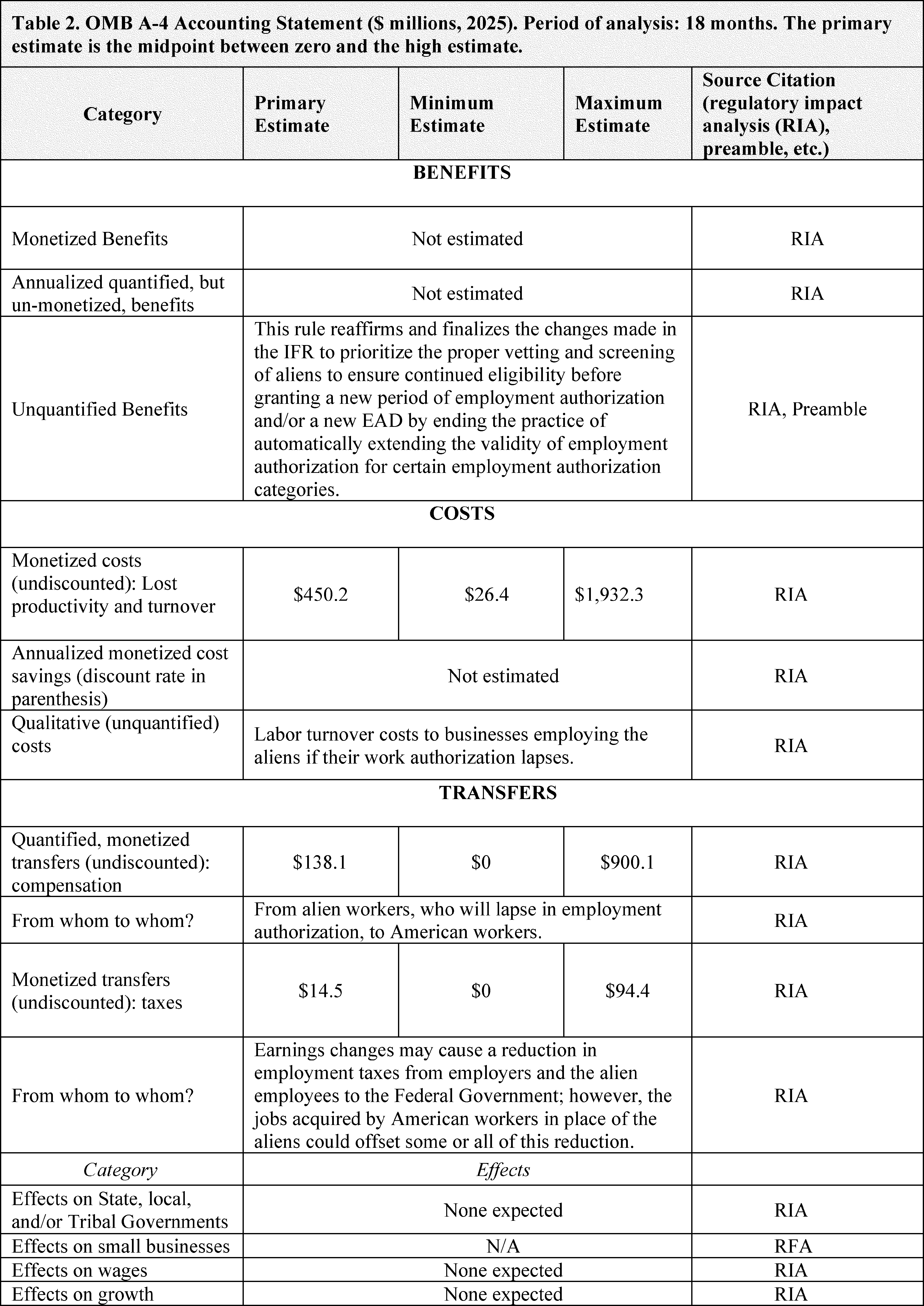
Details concerning the impacts are developed in the following analysis.
1. Affected Population
Due to factors contributing to uncertainty and changing trends, it is not possible to make a precise estimate of the population who will be affected by this rule. Since previous extension actions were meant to prevent lapses, an expected impact of this final rule will be ( printed page 65356) that some EADs will lapse while the renewal EAD application is pending with USCIS. Therefore, DHS will focus on estimating this impacted population (aliens with pending renewal EAD applications in categories previously eligible for automatic extension who may experience a lapse in their employment authorization and/or documentation), which will also factor into the estimation of labor turnover costs. A complicating factor is that the impacted population is likely to change over time, due to a number of factors related to processing times, backlogs, filing behavior, and resources. DHS cannot take dynamic effects into account and therefore focuses on a static, 18-month window, chosen to capture the time in which the initial impacts will first be realized, which will be May 2027 (the time in which the initials filed after the end of 540-day extension [182] would come up for renewal).
In order to ascertain the primary-impact population, DHS utilized initial receipt volumes applicable to the C8 and C9 EADs (Table 1), extended through June 2026. These categories are the largest categories affected by the rule. DHS forecasted monthly values and summed them for the period December 2025 through May 2027 (thereby incorporating eleven forecasted months), and DHS applies a range of 25% to account for variation.[183] The forecasted monthly time series point value estimate aggregated over 18 months and ranges are shown in Table 3, along with other relevant population components. To account for the non-C8 and C9 populations affected by the rule, DHS added a 22% factor to the broad population.
( printed page 65357)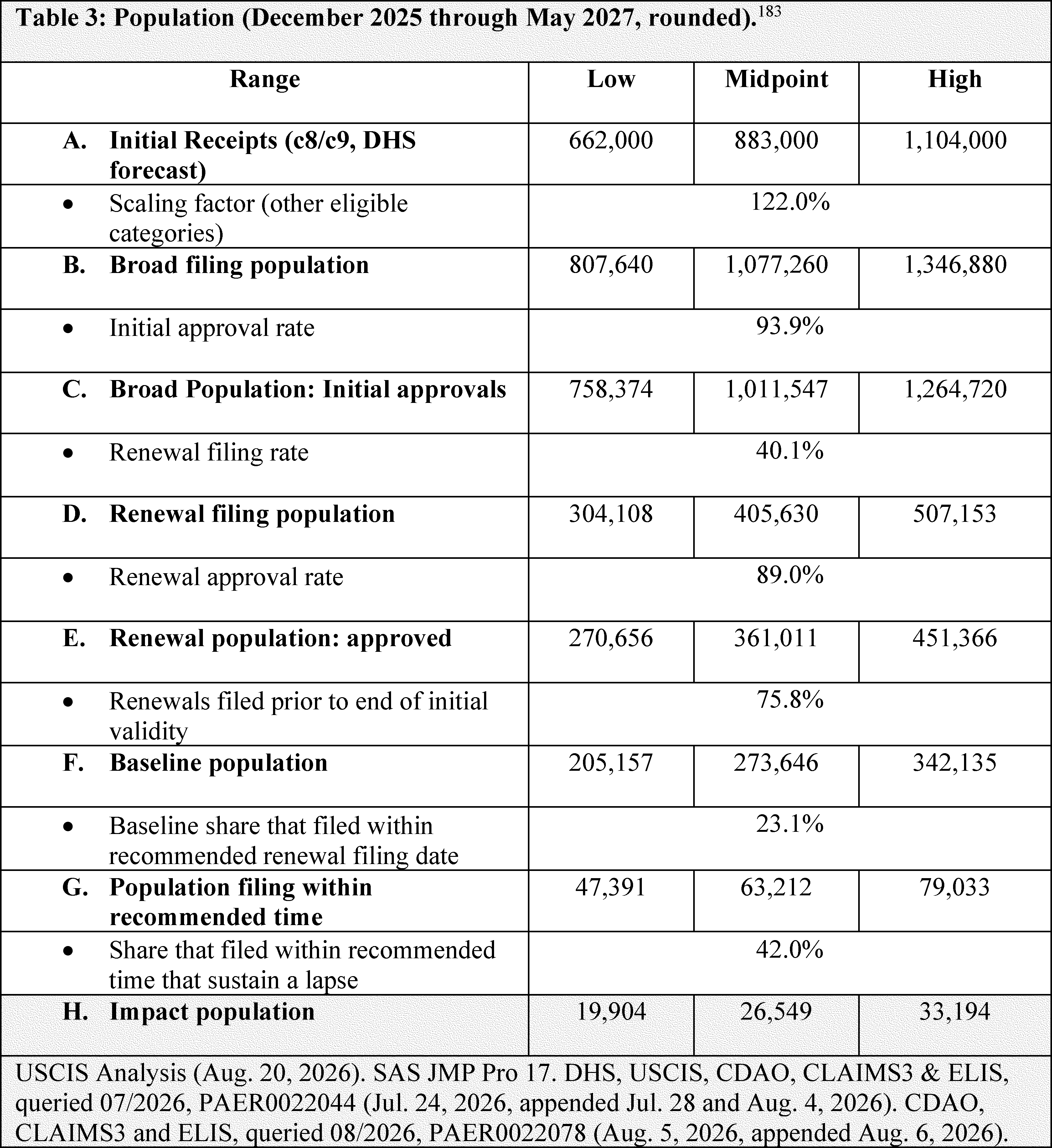
Table 3 employs a stepwise procedure for thoroughness and transparency, starting with initial receipts (c8 and c9, A) which are scaled for the other categories and the generalized approval rate for initial filings to yield a broad initial approval population (C); after which the scaling proceeds downward such that shares are applied to the immediately preceding population level (not the broad population). Population (F) is designated as the “baseline” since it is the largest population component that could sustain the impact. Population G depends on the timeframe—from when the renewal is filed to the end of the existent EAD validity period—based on a recommended renewal filing date. DHS currently benchmarks the time to 90 days, which is important because a different level will change the population. The final row (H) constitutes the population of interest—filers that are estimated to incur a lapse. As is reported in Table 3, based on imposition of 90 days as the recommended filing time, between about 20,000 and 33,000 EADs are estimated to lapse, with a midpoint estimate of about 27,000. It is noted that Pop. H is not the entire population that ( printed page 65358) would lapse; DHS makes impacts estimates on individuals filing their renewal within a recommended amount of time, which is 90 days.
2. Economic Impacts of the Final Rule
This section is divided into three modules. Module A is a discussion of certain aspects of the related rulemakings and factors involved in the future trends are provided. Module B provides mainly a descriptive assessment of the impacts. Module C is the self-contained quantitative section that estimates and monetizes a primary impact (also reported in the A-4 statement, Table 2).
Module A
When DHS adjudicates and approves renewal EAD applications before the applicant's current EAD expiration date, this final rule results in no quantifiable impacts to aliens and their employers. DHS anticipates that due to other DHS actions affecting populations that might otherwise have applied for EADs, the number of initial and renewal EAD applications will be lower than in recent years.[185] For more information on these actions, see Section IV. B. of the IFR. DHS assumes this reduced workload on USCIS could potentially eliminate the EAD backlog. Accordingly, under this scenario, this final rule would be less likely to result in lapses in employment authorization and/or EAD validity. If USCIS continues to have a backlog and is unable to adjudicate renewal EAD applications before an applicant's current EAD expires, then this final rule, by ending automatic extensions for certain EAD categories based on timely renewal filings, would result in temporary lapses in employment authorization and/or EAD validity.
Precisely determining the population that is expected to experience a lapse in employment authorization and/or an EAD as a result of this final rule is extremely difficult. A key factor is the backlog and whether recent external actions do not eliminate the backlog. In the following analysis DHS will provide analysis of potential lapses based on granular data. In this section DHS describes the impacted EAD renewal population that would have been subject to automatic extensions from prior, recent backlogs. As detailed earlier in the preamble,[186] DHS has previously published two temporary final rules (2022, 2024) and a final rule (2024). DHS previously estimated a population that would have lapsed in the hypothetical absence of the 2024 final rule and the two temporary final rules. In the 2024 final rule, DHS projected that between July 2023 and March 2026, 293,000 to 449,000 pending renewal EAD applicants in the categories eligible for automatic extension would have experienced a lapse in employment.[187] Additionally, in the 2024 final rule, DHS anticipated that starting around April 2026 through March 2027, fewer than 500 EADs would lapse each month, even without the up to 540-day extension.[188] This projection was based on the five-year EAD validity period in effect at that time and the pre-existing up to 180-day extension.
In December 2025, USCIS reduced the validity period to a maximum of 18 months for certain EAD categories, which could increase the frequency of renewal filings.[189] The IFR also eliminated the up to 180-day automatic extension, which was factored into the 2024 final rule Table 12 projection. Both recent changes may lead to more renewal filings; however, as stated in the IFR and in this preamble, other external factors have contributed to decreased filings.
DHS noted uncertainty in the 2024 final rule projections, cautioning that various factors make it difficult to accurately estimate the impact of the up to 540-day extension.[190] While more reliable estimates were possible for the 2022 and 2024 temporary final rules, uncertainty regarding the number and duration of EAD lapses has increased since the 2024 final rule and IFR.
DHS observes that the population affected by the IFR and this rule may have declined, as EAD filings began decreasing before the IFR was issued. See Table 1 in Section IV.C.2.i.d. of this preamble. At the same time, shorter EAD validity periods could increase renewal filings. These opposing trends complicate estimates of lapses and their duration but do not preclude DHS from making estimates.
DHS reviewed recently available EAD renewal data. DHS queried data on EAD automatic extension category expirations from October 30, 2025, through June 28, 2026.[191] The number of EAD renewal applicants in categories previously eligible for the automatic extension who did not receive an automatic extension was 1,541 from February, through June 2026. The number of EAD renewal applicants in categories previously eligible for the automatic extension who did receive an automatic extension based on a timely-filed renewal EAD application (before October 30, 2025), and who would have experienced a lapse in the absence of the automatic extension was 12,547 for the same timeframe. DHS emphasizes that these figures do not represent the likely population that could lapse starting in May 2027.
Additionally, it is difficult to accurately project future processing times. As stated in the 2024 final rule, processing times for EAD applications have fluctuated over the years. DHS cannot predict future fluctuations because they are dependent on variables that may change or are unanticipated, such as changes in application filing rates and processing efficiencies.[192] However, to evaluate recent data, DHS retrieved data on the median processing times for EAD categories previously eligible for automatic extensions renewals. The processing time slightly increased from November 2025 through March 2026, ranging from a median of 3.7 to 4.4 months.[193] This median data presented here differs from the 80th percentile estimates posted on the USCIS website. This data also shows a per month median rather than an 80th percentile estimate over a 6-month timeframe. Processing times also depend on available adjudicative resources, and while USCIS aims to minimize backlogs, it must ensure thorough review of applications. DHS understands that there are evolving circumstances and unknown factors that contribute to backlogs. Given recent data limitations, shifting trends, and external policy effects, the population estimated for this final rule is likely to vary in level and across time.
( printed page 65359)Module B
The purpose of this rulemaking is to prioritize benefits integrity and the proper vetting and screening of aliens before granting a new period of employment authorization and/or a new EAD by ending the practice of automatically extending the validity of employment authorization and/or EADs for aliens who have timely filed an application to renew their EAD in certain employment authorization categories. While prior automatic extensions reduced the risk of employers employing aliens with lapsed employment authorization and/or EAD validity, this final rule will also reduce the risk that affected employers will continue to employ an alien who is no longer authorized to work. For example, within their automatic extension period, an alien's application could have been adjudicated and denied. The obligation is on the alien employee to notify his or her employer that he or she is no longer work authorized, which puts employers at risk of unknowingly employing an unauthorized alien. Absent the IFR and this final rule, employers assess the applicability of the automatic extension based in part on a non-secure document (such as Form I-797C, Notice of Action, which is printed on plain paper). With this final rule ending the practice of providing automatic extensions based on the timely filing of a renewal EAD application, DHS is reducing the potential for fraud and instances where employers unknowingly employ aliens beyond their employment authorization and/or EAD validity.
This rule reverses some of the impacts described in the prior automatic extension rules. Employment lapses could result in cost and transfer impacts such as lost compensation to workers, transfers between workers losing their employment authorizations to replacement workers, employers' lost productivity when they are not able to quickly replace employees with lapses, and turnover costs for employers to find replacement employees. In the following section, DHS discusses impacts but cannot reliably quantify these impacts due to uncertainty.
As was described earlier in the Affected Population section, DHS determined that an expected impact of this final rule is that some EADs will lapse while the alien's renewal EAD application is pending with USCIS. In this section, the estimated lapse is developed into a quantified impact, which will constitute an earnings change to aliens. The employment lapse impacts, a loss of income to aliens, could result in either transfers of compensation to other workers or costs to employers, depending on employers' ability to replace workers with lapsed employment authorization and/or EAD validity. In cases where, in the absence of an automatic extension period, businesses would have been able to easily find reasonable labor substitutes for aliens with a lapsed employment authorization and/or EAD validity, this rule results in transfers of the earnings of affected aliens to others, who might fill in for or replace the renewal EAD applicants during their earnings lapse. In cases where, absent the automatic extension period, businesses may not easily find reasonable labor substitutes, employers may incur lost productivity and turnover costs or other disruptions. This could result in losses to native-owned businesses and their native employees. DHS assumes the value of lost productivity is at least as high as the compensation the employer would have paid the affected alien.
The employer turnover cost is generally reported as a share of annual wages.[194] DHS would calculate the turnover costs by multiplying the number of impacted lapsed employees by the hourly wage rate, hours worked per year, and the share of annual wages.
Finally, if employers are unable to replace affected workers, there could be changes in transfers from taxes that would have been paid by affected aliens and their employers. It is challenging to quantify Federal and State income tax impacts of employment lapses because individual and household tax situations vary widely as do the various State income tax rates. To calculate the potential transfers impact on employment taxes, DHS would estimate the decrease in Medicare and Social Security taxes, which have a combined tax rate of 7.65 percent (6.2 percent and 1.45 percent, respectively).[195]
DHS acknowledges that the impact of this final rule is an increased risk of a temporary loss of employment authorization for aliens and employers. To the extent that aliens can file their renewals earlier and DHS is able to reduce the backlog, reductions in this uncertainty are expected.
DHS is aware of the importance of employment authorization and evidence of employment authorization for applicants' and their families' livelihoods, as well as their U.S. employers' continuity of operations and financial health. DHS also is cognizant of the potential detrimental impact that gaps in employment authorization may have on an applicant's eligibility for future immigration benefits should the applicant engage in unauthorized employment during the gap,[196] and on their U.S. employers who must examine unexpired documents that evidence their employees' employment eligibility and attest that their employees are authorized to work in the United States.[197] DHS also acknowledges that backlogs and prolonged processing times for renewal EAD applications are not the fault of applicants, but nonetheless could have significant adverse consequences for applicants, their families, and their employers. DHS will continue to work to reduce frivolous, fraudulent or otherwise non-meritorious EAD filings to free up adjudicatory and other resources to better ensure national security and program integrity.
DHS acknowledges there is potential for detrimental impacts to applicants but recognizes the important benefits in ensuring only those eligible and suitable for renewed work authorization are allowed to work.
Module C
This module prepares a thorough and transparent quantitative setup incorporating population information from Table 3, factors discussed on Module 2 above, DHS analysis of EAD renewal data, and labor market data. Since the impetus for the previous automatic extensions was to stabilize earrings, it is logical to consider the primary economic impact of this final rule as changes to earnings, which will comprise lost earnings to aliens, but potentially beneficial transfers to others authorized to work in the United States.
Due to uncertainty in future processing times and other factors, DHS ( printed page 65360) will utilize the population range (H, Table 3) but notes that variation in all of the variables is likely.[198] The primary impact is earnings change, which is measured in valued work hour-units. The data supporting the lapse share was described in the Population section, for which DHS also fit a distribution to the lapse durations, with a mean of 40.1 days. The mean lapse duration of 40.1 days is lower than DHS estimated in the 2022 and 2024 TFRs, at 52 and 271 days, respectively. There were various reasons and time-specific conditions that led to estimates of higher average lapse duration, primarily historic spikes in pending asylum applications (C08) initial and renewal EAD applications. In the 2024 TFR, DHS acknowledged the significant contributing factor to the severe backlog and increased processing times for renewal EAD applications was the substantial increase in the number of initial C08 EAD applications that began in March 2023. Because USCIS was required to prioritize certain initial EAD applications over other applications renewal EAD processing times increased substantially. However, DHS anticipates a substantial decrease in both initial and renewal filings for EADs, which would allow for a reduction in renewal EAD processing times and consequently lapse durations. Therefore, DHS finds an estimate of 40 days for the average lapse duration is reasonable for this analysis.[199]
The earnings impact is estimated as an equation incorporating population, wages, lapse durations, and adjustments for labor market indicators, the latter of which makes the estimates more realistic. DHS relies on the uniform distribution bounded at the 10th percentile wage across all occupations ($15.00) and upper bound of $46.07, the latter of which updates the figure from the 2024 TFR.[200]
Further, DHS accounts for worker benefits when estimating the opportunity cost of time by calculating a benefits-to-wage multiplier (BEN) using the most recent Bureau of Labor Statistics (BLS) report detailing average total employee compensation for all civilian U.S. workers.[201] Using the BEN of 1.46, the total rate of compensation for individuals at the low end of the range as $21.90 and high end as $67.26 per hour.[202]
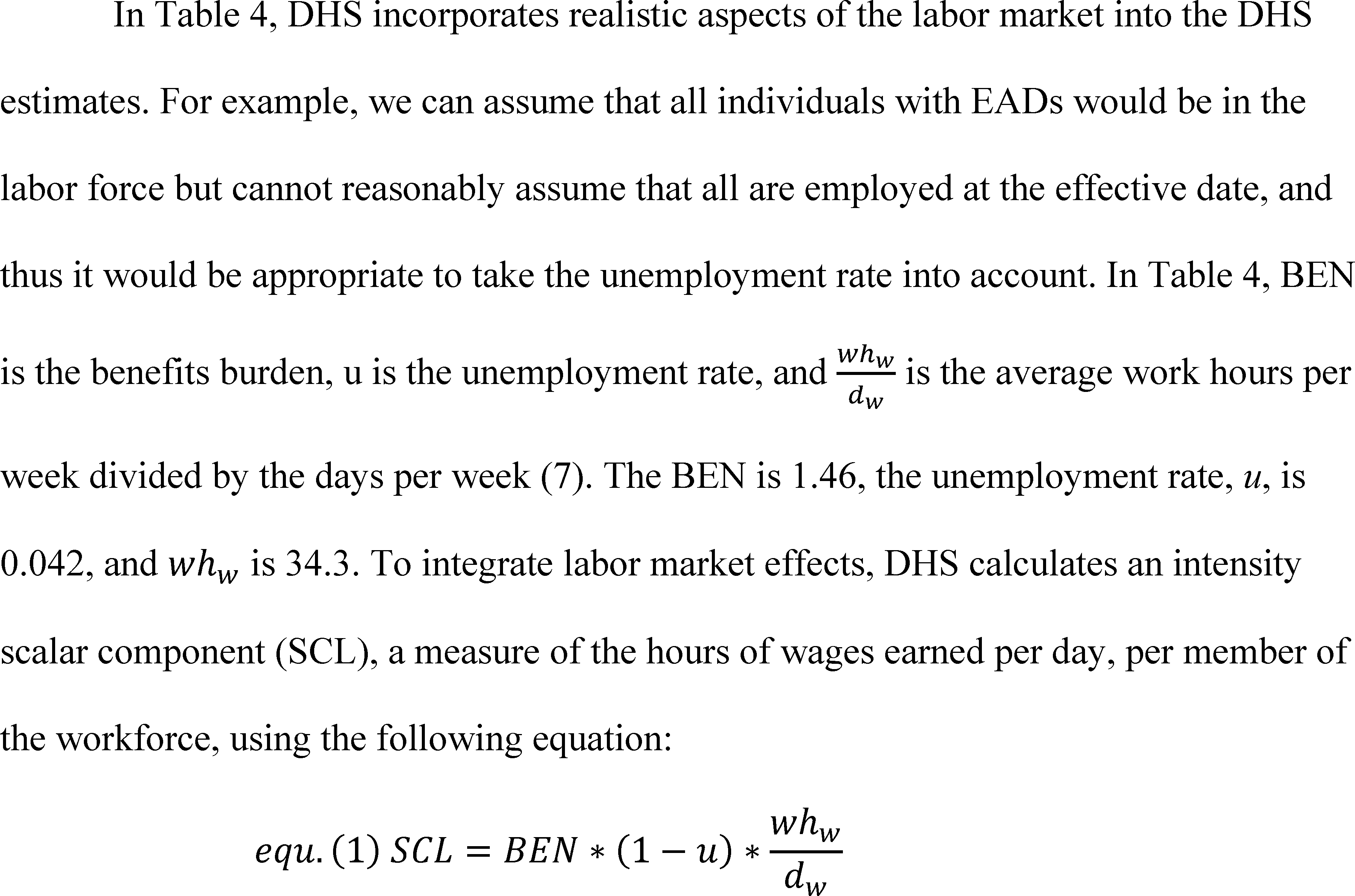
This yields a SCL value of 6.85 hours of wages earned per day per member of the workforce.[203]
Next, DHS calculates the income component (INC), a measure of range in the wage impacts based on the range of lapsed population and lapse durations. The earnings metric (ERN) integrates the labor market intensity and income components through the product of their ranged values. The tax impact (TAX) is calculated as earnings multiplied by the tax rate, 15.3 percent, and then divided by the benefits factor (BEN), as DHS quantifies tax impacts on unloaded wages. Working with a single value to incorporate realistic labor factors is beneficial because it is not necessary to adjust the variables—such as the benefits burden to wages and the approval rate to the population—sequentially or even directly; all the inputs interact multiplicatively and can therefore be nested as a single dimensional system.
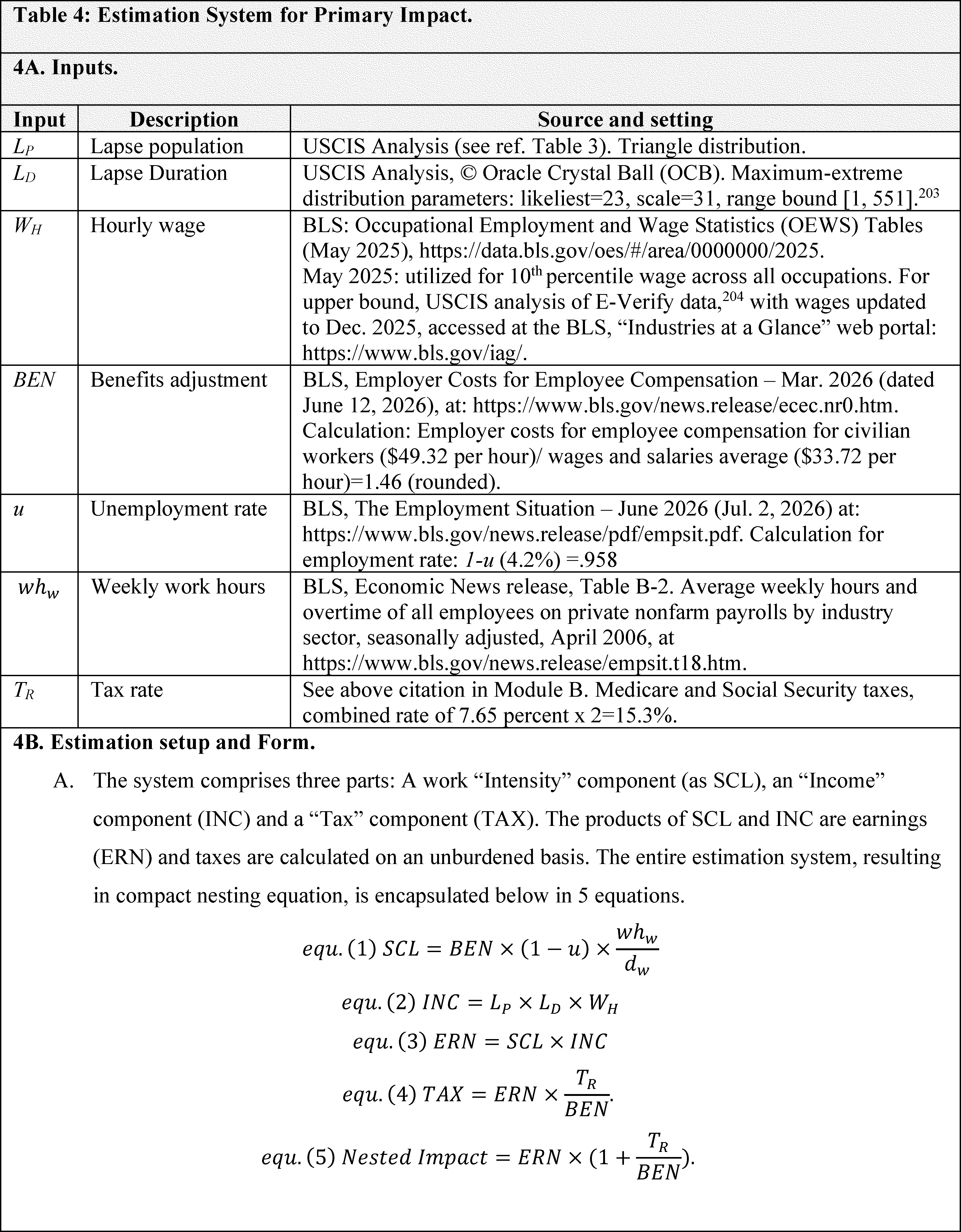
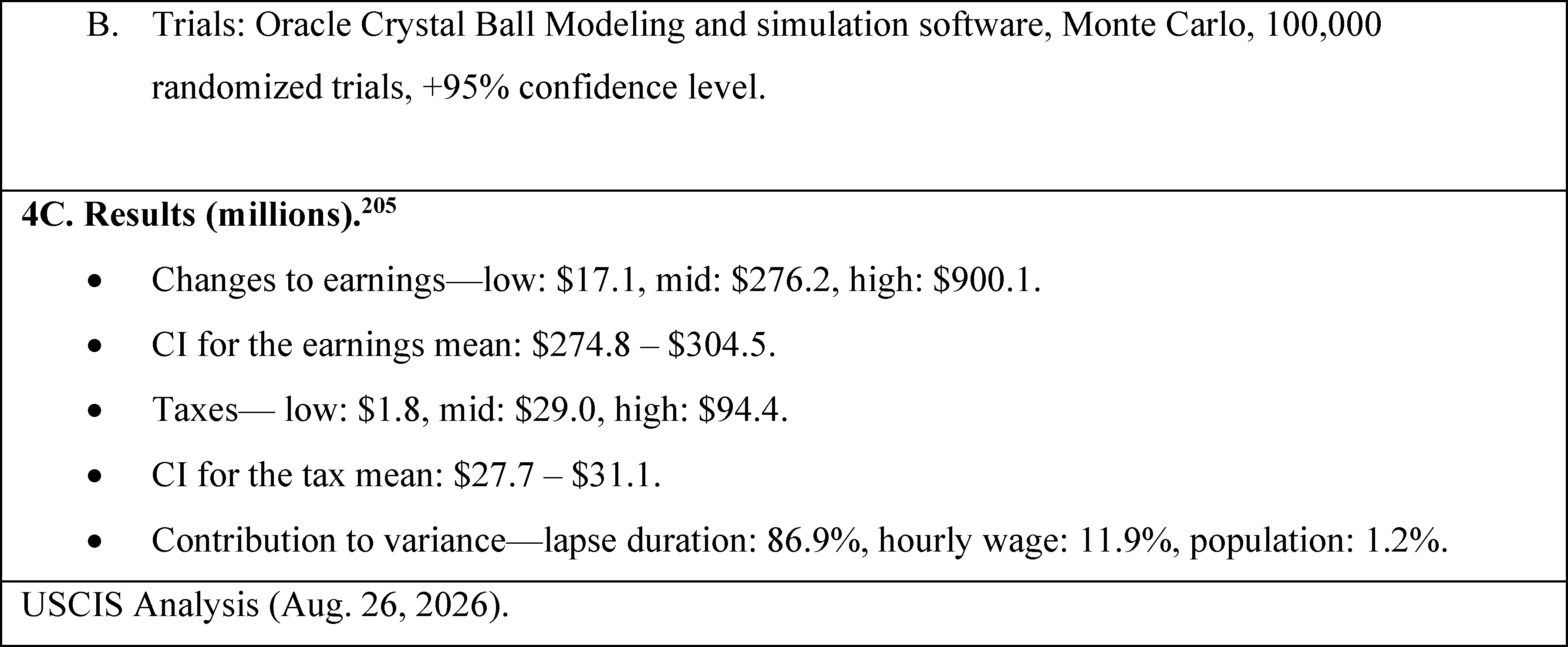
Labor Turnover Cost Impacts
This final rule is expected to generate labor turnover costs to some employers of affected EAD holders. DHS bases the assessment of these impacts on the assumption that the estimated population of aliens with lapsed EADs because of this final rule would involuntarily separate from an employer, or otherwise cease employment, and that the separation or cessation would not be due to other factors.
Employment separations or cessation can generate labor turnover costs to employers. First are the direct or “hard” costs that involve separation and replacement costs. These include exit interviews, severance pay, and costs of temporarily covering the employee's duties and functions with other employees, which may require overtime or temporary staffing. The replacement costs typically include expenses of advertising positions, search and agency fees, screening applicants, interviews, background verification, employment testing, hiring bonuses, and travel and relocation costs. Once hired, employers face additional training, orientation, and assessment costs.
Second, direct costs involve loss of productivity and possibly profitability due to operational disruptions, which can include errors from employees that may temporally fill the position. A third cost segment is a type of indirect cost that encompasses loss of institutional knowledge, networking, and impacts to work-culture, morale, and interpersonal relationships. This last type of cost is almost impossible to measure quantitatively.[207]
There are studies and reports concerning labor turnover costs available from Human Resource entities that are cited across correspondent literature, and turnover cost can be measured in slightly different ways. The turnover cost is generally reported as a share of annual earnings or an actual cost per employee. Usually, these reports measure the more direct, or hard costs associated with turnover and not intangible effects such as worker morale or lost productivity. Many reports cite a 2012 Center for American Progress (CAP) report that surveyed more than 30 studies that considered both direct ( e.g., separation and replacement) and indirect ( e.g., loss of institutional knowledge) costs.
The CAP and other reports confirm three central aspects of turnover cost: (1) that they vary substantially across industries and jobs; (2) that they tend to grow (in absolute and percentage terms) according to skill level and earnings; and (3) that they are higher for salaried workers compared to hourly wage earners.[208] The report notes that specialized technical jobs and highly paid jobs in line with senior or executive levels, which involve high levels of education, credentials, and stringent hiring criteria, can generate disproportionately high replacement costs that can reach more than 100 percent of the salary—compared to jobs with low educational and technical requirements.[209]
DHS examined a 2020 report by the Washington Center for Equitable Growth, which updated the earlier CAP study results to provide information on about thirty-five studies on turnover costs.[210] We selected data points that captured both the annual earnings salary (which the study benchmarked to 2019 levels) and turnover costs. We then culled the data applicable to salary levels more than the maximum in our earnings bound. We note before making any adjustments, multiplying the maximum wage ($41.07) by 2,080 average annual full-time hours yields a maximum annual earnings figure of $95,825.6. To obtain the annual salary we multiply the (non-burdened) wage bounds ($15.00 and $46.07) by 2,080 average annual full-time hours but make the adjustment to account for average ( printed page 65363) work hours per week [211] and employment by scaling by 0.858 and 0.958, in order, as was introduced above.
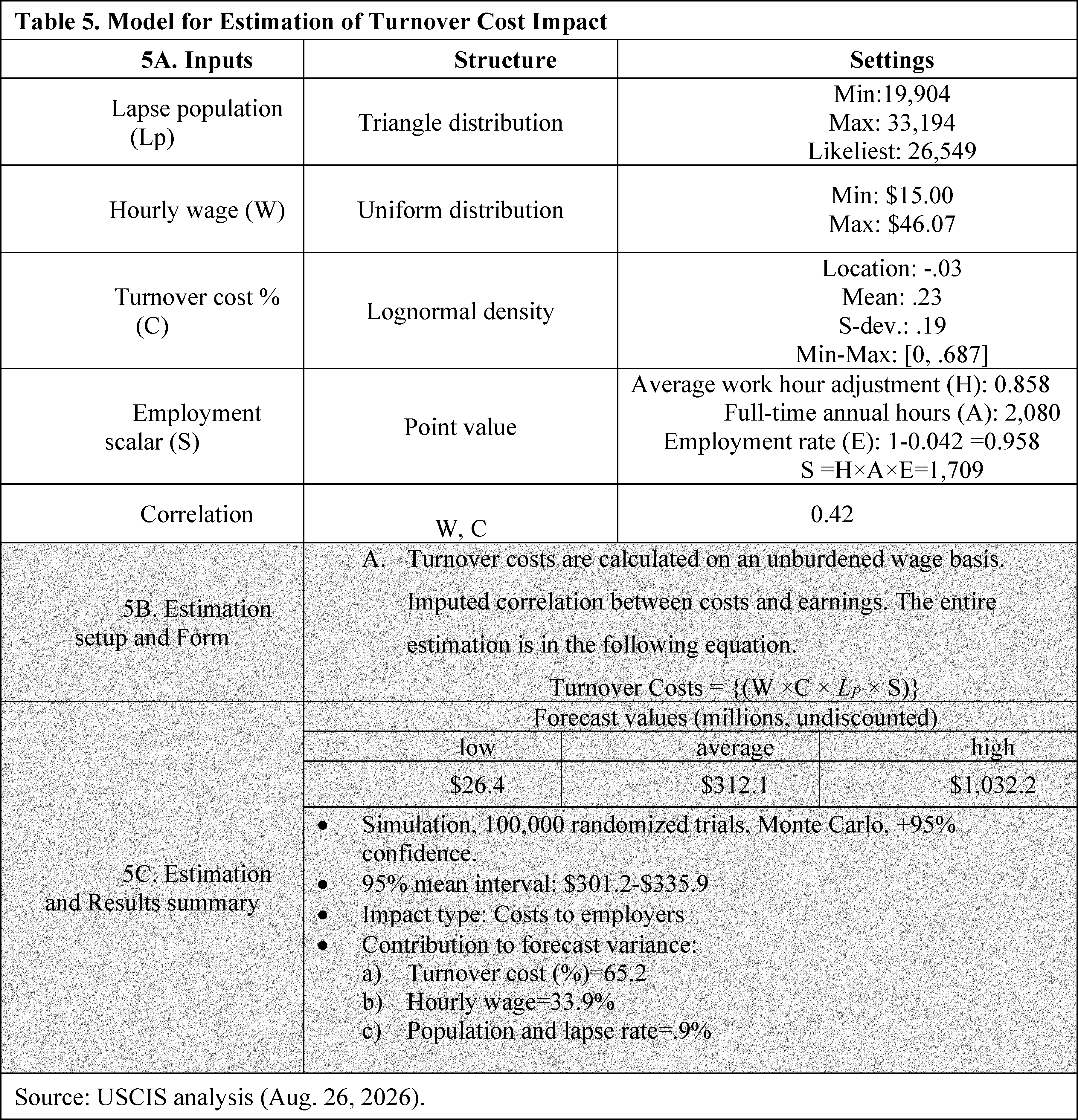
We calibrated the lognormal distribution for the parameters produced and calibrated the estimation program according to the below input values. The lognormal distribution is infinite in the upper tail, and we truncated the cost percentage to 68.7 percent, the highest value in the underlying data. The core inputs are the lapse population, turnover cost percentage, and the wage (unburdened). All the inputs can be abridged into a single equation and nested compactly as a “one-step” routine in the software program. The correlation between cost and earnings is tuned to 0.421. Imputing the correlation essentially means that if a randomly chosen earnings value is high, there is a higher probability that a high turnover cost percentage will be selected as well and vice versa for lower cost percentages. See Table 5 for estimation of turnover cost impacts.
Table 6 presents a summary of the impacts estimated.
( printed page 65364)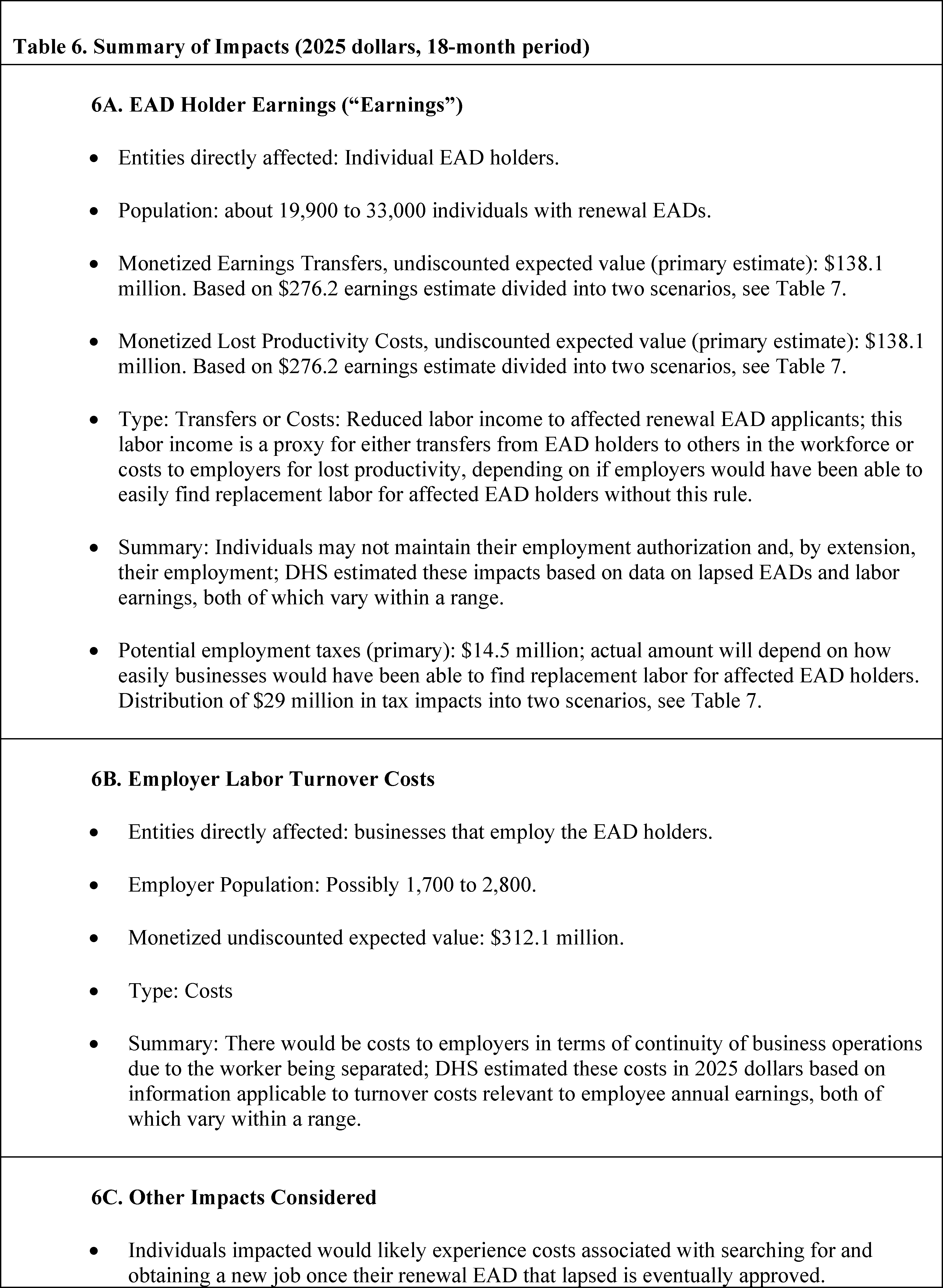
As is shown in Table 6B, DHS estimates that a maximum of about 2,800 employers could incur turnover costs. This estimate draws on the 2024 TFR in which analysis of E-Verify data revealed that on average, each business employed twelve EAD holders. DHS has no reason to believe that there has been a substantive change to this figure.
Some of the impacts of this rule will depend on whether businesses will be able to find replacement labor for the positions the affected renewal EAD applicants are expected to lose if they experience a lapse in employment authorization and/or employment authorization documentation due to this rule. If businesses can find replacement labor from the pool of the unemployed, the only monetized costs of this rule to society is for costs resulting from labor ( printed page 65365) turnover. If businesses cannot find replacement labor, the monetized costs of the rule would also include lost productivity due to a lack of available labor.
DHS estimates that reduced earnings to renewal EAD applicants ranges from $17.1 million to $900.8 million with a primary estimate of $276.2 million depending on the wages and other compensation the renewal EAD applicants earn, the number of renewal EAD applicants affected, and the duration of the lapse in employment authorization and/or employment authorization documentation that may occur because of this rule.[212] DHS uses estimates of the earnings as a measure of either: (1) transfers of this compensation from the affected population to others in the labor market, but are not already employed; or (2) a proxy for businesses' costs from lost productivity, depending on whether businesses would be able to find replacement labor for affected renewal EAD applicants due to this rule.
DHS does not know what the next best labor alternative would be for businesses when lapses occur due to this rule. Accordingly, DHS does not know the portion of the overall effects of this rule that are transfers or costs. To begin, DHS describes the two extreme scenarios, which provide the bounds for the range of effects.
Scenario 1: If, under the effect of this rule with potential lapsed EADs, all businesses would have been able to immediately find reasonable labor substitutes for the positions the renewal EAD applicants lost, businesses lose little or no productivity. Accordingly, this rule could result in $276.2 million (primary estimate, undiscounted) being transferred from affected renewal EAD applicants to workers currently in the labor force (whom are not presently employed full time) or induced back into the labor force and this rule would result in $0 costs to businesses for prevented productivity losses.
Scenario 2: Conversely, if all businesses would be unable to, within the period of analysis, find reasonable labor substitutes for the position the EAD holder filled, then businesses would lose productivity. Accordingly, $276.2 million is the estimated monetized costs from this rule for productivity losses and this rule will result in $0 being transferred from affected renewal EAD applicants to replacement labor. Because under this scenario businesses would not have been able to find replacement labor, the rule may also result in additional costs to employers for profit losses; and may result in a reduction in tax transfer payments from businesses and employees to the government. DHS has not estimated all potential tax effects but notes that earnings of $276.2 million would result in employment tax losses to the Federal Government ( i.e., Medicare and Social Security) of $29.0 million.
In both scenarios, whether without this rule employers would have been able to find replacement labor or not, DHS assumes that businesses would have incurred labor turnover costs for having to search for a replacement for affected renewal EAD applicants. Accordingly, DHS estimates the rule will also result in additional labor turnover costs to businesses of $312.1 million.
Table 7 below summarizes these two scenarios and the primary estimate of this rule. Because DHS does not know the overall proportion of businesses that would have been able to easily find replacement labor in the absence of this rule, for DHS's primary estimate we assume that replacement labor would have been immediately found for half of all renewal EAD applicants and not found for the other half ( i.e., an average of the two extreme scenarios described above). The June 2026 unemployment and job openings data indicate there are as many jobs available as there are people looking for jobs.[213] Accordingly, we believe the impacts of this rule will likely skew towards Scenario 1, with the rule resulting in mostly transfers of compensation from renewal EAD applicants to other workers and turnover costs for employers.
( printed page 65366)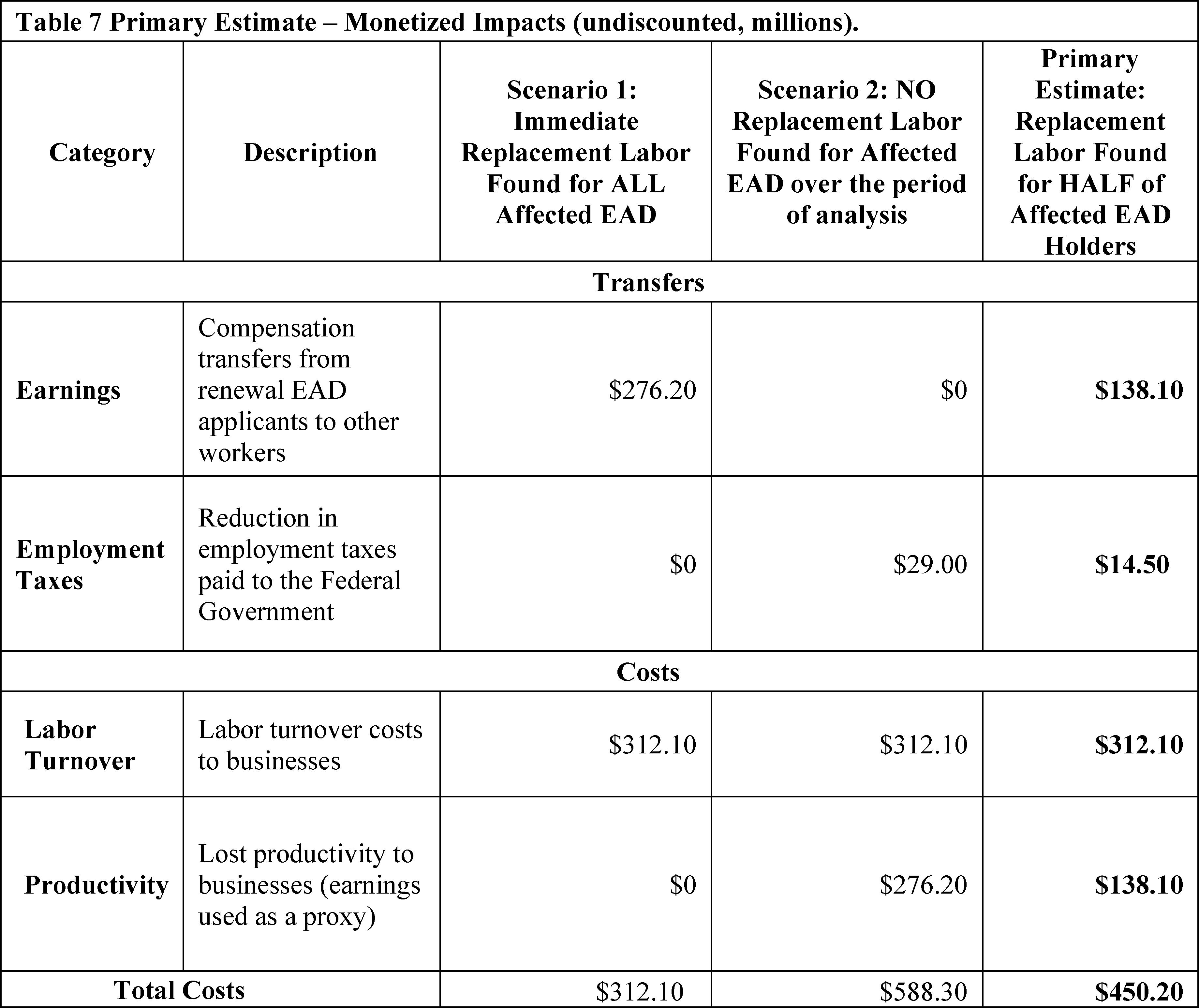
C. Regulatory Flexibility Act (RFA)
The Regulatory Flexibility Act of 1980 (5 U.S.C. 601 et seq.), as amended by the Small Business Regulatory Enforcement Fairness Act of 1996, requires Federal agencies to consider the potential impact of regulations on small businesses, small governmental jurisdictions, and small organizations during the development of their rules. The term “small entities” comprises small businesses, nonprofit organizations that are independently owned and operated and are not dominant in their fields, and governmental jurisdictions with populations of less than 50,000. The RFA's regulatory flexibility analysis requirements apply only to those rules for which an agency is required to publish a general notice of proposed rulemaking pursuant to 5 U.S.C. 553 or any other law.[214] DHS did not issue a notice of proposed rulemaking for this action. Accordingly, DHS is not required to certify either that this final rule would not have a significant economic impact on a substantial number of small entities nor conduct a regulatory flexibility analysis.
Further, this final rule directly regulates individuals, and individuals are not defined as “small entities” by the Regulatory Flexibility Act. The rule indirectly impacts certain employers if, in the future, processing times exceed the expiration dates of EADs.
DHS is unsure what backlogs may continue in the future; however, DHS anticipates that, due to other DHS actions described in Section IV.C. of this final rule, it is possible that the backlog may end. If the backlogs are eliminated outside of this rule, employers will no longer be indirectly impacted by this final rule.
In the alternate scenario of a backlog in renewal EAD processing, some employers could experience indirect costs or transfer effects. The transfers would be in the form of lost compensation (wages and benefits). A portion of this lost compensation might be transferred from renewal EAD applicants to others who are currently in the U.S. labor force. A portion of the effects of this rule would also be borne by companies that would have continued to employ renewal EAD applicants had they been in the labor market longer; however, they were unable to find available replacement labor. These companies may incur an indirect cost, as they will be losing the productivity and potential profits the EAD applicant would have provided. Companies may also incur opportunity costs by having to choose the next best alternative to the immediate labor the applicant would have provided and by having to pay workers to work overtime hours. DHS does not know what this next best alternative may be for those companies. If companies can find reasonable labor substitutes for the positions the alien occupied, they will bear little or no costs. Conversely, if companies are unable to find reasonable labor substitutes for the position the applicant would have maintained then there would be no transfers and companies may experience turnover costs or other disruptions. ( printed page 65367)
D. Unfunded Mandates Reform Act of 1995 (UMRA)
The Unfunded Mandates Reform Act of 1995 (UMRA) is intended, among other things, to curb the practice of imposing unfunded Federal mandates on State, local, and Tribal governments.[215] Title I of UMRA provides certain exceptions to its requirements and definitions. UMRA does not apply to rules from independent regulatory agencies or rules issued with no notice of proposed rulemaking. UMRA exempts legislative provisions and rules relating to individual constitutional rights, discrimination, emergency assistance, grant accounting and auditing procedures, national security, treaty obligations, and elements of Social Security legislation.
Title II of UMRA requires each Federal agency to prepare a written statement assessing the effects of any Federal mandate in a proposed rule, or final rule for which USCIS published a proposed rule, which includes any Federal mandate that may result in a $100 million or more expenditure (adjusted annually for inflation) in any one year by State, local, and Tribal governments, in the aggregate, or by the private sector. See2 U.S.C. 1532(a). This rule is exempt from the written statement requirement because DHS did not publish a notice of proposed rulemaking for this rule. This final rule does not contain a federal mandate as the term is defined under UMRA.[216] Therefore, the requirements of Title II of UMRA do not apply, thus DHS has not prepared a statement under UMRA.
E. Congressional Review Act (CRA)
The Congressional Review Act (CRA) was included as part of the Small Business Regulatory Enforcement Fairness Act of 1996 (SBREFA) by subtitle E of SBREFA, Public Law 104-121, tit. II, 110 Stat. 847, 868, et seq. This final rule meets the criteria set forth in 5 U.S.C. 804(2) because it is likely to result in an annual effect on the economy of $100 million or more. See5 U.S.C. 804(2)(A). DHS has complied with the CRA's reporting requirements and has sent this rule to Congress and to the Comptroller General as required by 5 U.S.C. 801(a)(1). The CRA generally provides a 60-day delayed effective date for rules that meet the 5 U.S.C. 804(2) criteria. See5 U.S.C.801(a)(3). Because this rule makes permanent the October 2025 IFR that would otherwise continue to apply for months before this final rule has practical effect, DHS has for good cause found that the 60-day delay typically required under 5 U.S.C. 801(a)(3)(A) is unnecessary. Therefore, this rule is effective immediately upon publication consistent with 5 U.S.C. 808(2).
F. Executive Order 13132 (Federalism)
This final rule will not have substantial direct effects on the States, on the relationship between the National Government and the States, or on the distribution of power and responsibilities among the various levels of government. Therefore, in accordance with section 6 of E.O. 13132, Federalism, 64 FR 43255 (Aug. 4, 1999), it is determined that this final rule does not have sufficient federalism implications to warrant the preparation of a federalism summary impact statement.
G. Executive Order 12988 (Civil Justice Reform)
This final rule was drafted and reviewed in accordance with E.O. 12988, Civil Justice Reform. This final rule was written to provide clear legal standards for affected conduct and was reviewed carefully to eliminate drafting errors and ambiguities, as to minimize litigation and undue burden on the Federal court system. DHS has determined that this final rule meets the applicable standards set forth in sections 3(a) and 3(b)(2) of Executive Order 12988.
H. Family Assessment
DHS has reviewed this rule in line with the requirements of section 654 of the Treasury and General Appropriations Act, 1999,[217] enacted as part of the Omnibus Consolidated and Emergency Supplemental Appropriations Act, 1999.[218] DHS has systematically reviewed the criteria specified in section 654(c) of the Treasury and General Appropriations Act by evaluating whether this regulatory action: (1) impacts the stability or safety of the family, particularly in terms of marital commitment; (2) impacts the authority of parents in the education, nurture, and supervision of their children; (3) helps the family perform its functions or substitutes governmental activity for the function; (4) affects disposable income or poverty of families and children; (5) only financially impacts families, if at all, to the extent such impacts are justified; (6) may be carried out by State or local government or by the family; or (7) establishes a policy concerning the relationship between the behavior and personal responsibility of youth and the norms of society. If the agency determines a regulation may negatively affect family wellbeing, then the agency must provide an adequate rationale for its implementation.
As articulated in the IFR and this final rule, DHS is discontinuing the practice of providing an automatic extension of the EAD or employment authorization upon the filing of a renewal EAD application because it grants a benefit without an eligibility determination, without completing vetting and screening checks and without resolving the potential hits and derogatory information. DHS has determined that the implementation of this regulation may potentially negatively affect family wellbeing as outlined in section 654 of the Treasury General Appropriations Act, 1999. Specifically, the IFR and this final rule has the potential to affect disposable income of families and children, and therefore, also impacts the family financially. However, DHS believes that it has an adequate rationale for its implementation. DHS believes that the consequences of the IFR and this final rule, the possibility that an alien is not authorized to work during the pendency of the alien's renewal EAD application and thus, that families have less disposable income, are justified in light of the national security and public safety risk that automatically issuing immigration benefits, such as an automatic extension of an EAD, poses to the public. Additionally, DHS is not removing the alien's ability to obtain a renewal of their employment authorization and/or EAD. DHS is also not preventing eligible aliens from obtaining an EAD for purposes such as proof of identity. The issuance of a renewal EAD depends in large part on the applicant's timely application for a renewal EAD. The proper planning by the alien, and monitoring of EAD processing times, allows the alien to timely file a renewal EAD application far enough in advance of their EAD expiration date, which may mitigate the risk that the alien could experience a lapse in their employment authorization and/or EAD validity and have to temporarily stop working. For these reasons, DHS believes that the benefit this rule provides by improving the security posture as it relates to the issuance of automatic extensions outweighs the impact, if any, on families and their children. Better ( printed page 65368) protecting public safety and national security before providing immigration benefits, such as automatic extensions of employment authorizations based on the filing of a renewal EAD application, is paramount.
I. Executive Order 13175 (Indian Tribal Governments)
This final rule would not have Tribal implications under E.O. 13175, Consultation and Coordination with Indian Tribal Governments, because it would not have a substantial direct effect on one or more Indian Tribes, on the relationship between the Federal Government and Indian Tribes, or on the distribution of power and responsibilities between the Federal Government and Indian Tribes.
J. National Environmental Policy Act (NEPA)
DHS and its components analyze proposed regulatory actions to determine whether the National Environmental Policy Act (NEPA), 42 U.S.C. 4321, et seq., applies and, if so, what degree of analysis is required. DHS Directive 023-01 Rev. 01 “Implementing the National Environmental Policy Act” (Dir. 023-01 Rev. 01) and Instruction Manual 023-01-001-01 Rev. 01 (Instruction Manual) [219] establish the policies and procedures that DHS and its components use to comply with NEPA.
NEPA allows Federal agencies to establish, in their NEPA implementing procedures, categories of actions (“categorical exclusions”) that experience has shown do not, individually or cumulatively, have a significant effect on the human environment and, therefore, do not require an environmental assessment or environmental impact statement.[220] The Instruction Manual, Appendix A lists the DHS Categorical Exclusions.[221]
Under DHS NEPA implementing procedures, for an action to be categorically excluded, it must satisfy each of the following three conditions: (1) The entire action clearly fits within one or more of the categorical exclusions; (2) the action is not a piece of a larger action; and (3) no extraordinary circumstances exist that create the potential for a significant environmental effect.[222]
This final rule responds to public comments provided in response to the IFR and adopts the IFR as final without change. This final rule therefore retains the changes made to the DHS regulations by the IFR, discontinuing the practice of providing an automatic extension of employment authorization and/or EAD validity upon the filing of a renewal EAD application. Through the IFR, and now this final rule, DHS is ending the practice of providing automatic extensions of EADs to prioritize the completion of vetting and eligibility screening of aliens before granting a new period of employment authorization and/or a new EAD.
This final rule is strictly administrative and procedural. DHS has reviewed this final rule and finds that no significant impact on the environment, or any change in environmental effect will result from the amendments being promulgated in this final rule.
Accordingly, DHS finds that the promulgation of this final rule's amendments to current regulations clearly fits within categorical exclusion A3 established in DHS's NEPA implementing procedures as an administrative change with no change in environmental effect, is not part of a larger Federal action, and does not present extraordinary circumstances that create the potential for a significant environmental effect. Therefore, regulatory amendments are categorically excluded from further NEPA review.
K. Paperwork Reduction Act
Under the Paperwork Reduction Act of 1995, Public Law 104-13, all agencies are required to submit to OMB, for review and approval, any reporting requirements inherent in a rule. This rule does not impose any new reporting or recordkeeping requirements under the Paperwork Reduction Act.
However, this rule requires the use of USCIS Form I-765. This form has previously been approved by OMB under the Paperwork Reduction Act. The OMB control number(s) for this information collection is 1615-0040.
List of Subjects in 8 CFR Part 274a
- Administrative practice and procedure
- Aliens
- Cultural exchange program
- Employment
- Penalties
- Reporting and recordkeeping requirements
- Students
PART 274a—CONTROL OF EMPLOYMENT OF ALIENS
Accordingly, for the reasons set forth in the preamble, the Secretary of Homeland Security adopts the amendments to 8 CFR Part 274a as published on October 30, 2025, at 90 FR 48799 as final.
Markwayne Mullin,
Secretary, U.S. Department of Homeland Security.
Footnotes
1. See E.O. 14159, Protecting the American People Against Invasion (Jan. 20, 2025), 90 FR 8443, 8446 (Jan. 29, 2025).
Back to Citation2. See E.O. 14161, Protecting the United States from Foreign Terrorists and Other National Security and Public Safety Threats (Jan. 20, 2025), 90 FR 8451, 8451 (Jan. 30, 2025).
Back to Citation3. However, on July 4, 2025, Congress passed and the President signed into law sections 100003(c) and 100012(a) of the One Big Beautiful Bill Act, Public Law 119-21, 139 Stat.72 (July 4, 2025) (H.R 1), which limit the validity period of any employment authorization for aliens granted TPS under section 244 of the INA, 8 U.S.C. 1254a, to a period of one year or for the duration of the designation of TPS, whichever is shorter.
Back to Citation4. This rule could also result in a reduction in State and local tax revenue, but this impact is not quantified in this analysis due to variations in state and local tax laws and individual's tax scenarios.
Back to Citation5. Although several provisions of the INA discussed in this final rule refer exclusively to the “Attorney General,” such provisions are now to be read as referring to the Secretary of Homeland Security by operation of the HSA. See 6 U.S.C. 202(3), 251, 271(b), 542 note, 557; 8 U.S.C. 1103(a)(1) and (g), 1551 note; Nielsen v. Preap, 586 U.S. 392, 397 n.2 (2019).
Back to Citation6. Courts have acknowledged that Congress delegated authority to DHS to grant or extend employment authorization to certain classes of aliens. See, e.g., Wash. All. of Tech. Workers v. DHS, 50 F.4th 164, 191-192 (D.C. Cir. 2022) (“What matters is that section 1324a(h)(3) expressly acknowledges that employment authorization need not be specifically conferred by statute; it can also be granted by regulation.”). DHS is exercising this discretionary authority consistent with all applicable authorities, including the referenced authorities in the HSA, and sections 103, 208, 214, 244, and 274A(h)(3) of the INA, 8 U.S.C. 1103, 1158, 1184, 1254a, and 1324a(h)(3), as well as the Administrative Procedure Act at 5 U.S.C. 553. See Loper Bright Enterprises v. Raimondo, 144 S. Ct. 2244, 2263 (2024) (“In a case involving an agency, of course, the statute's meaning may well be that the agency is authorized to exercise a degree of discretion. Congress has often enacted such statutes. For example, some statutes `expressly delegate' to an agency the authority to give meaning to a particular statutory term. Others empower an agency to prescribe rules to `fill up the details' of a statutory scheme, or to regulate subject to the limits imposed by a term or phrase that leaves agencies with flexibility, such as `appropriate' or `reasonable.' ”) (internal citations omitted).
Back to Citation7. See 8 CFR 274a.13(d) (2016).
Back to Citation8. See 81 FR 82398 (Nov. 18, 2016) (AC21 Final Rule).
Back to Citation9. See 87 FR 26614, 26617-26 (May 4, 2022) (identifying USCIS' precarious fiscal status, the COVID-19 public health emergency, and dramatic increases in Form I-765 filings); see also89 FR 24628, 24634-40 (Apr. 8, 2024) (identifying an increase in referrals to USCIS for Credible Fear Assessment and an increase in affirmative and defensive asylum filings as contributing factors to increased EAD processing times).
Back to Citation10. 87 FR 26614 (May 4, 2022) (temporarily increased the automatic extension period to up to 540 days).
Back to Citation11. 89 FR 24628 (Apr. 8, 2024) (temporarily increased the automatic extension period to up to 540 days).
Back to Citation12. See 89 FR 101208 (Dec. 13, 2024) (permanently increased the automatic extension period to up to 540 days).
Back to Citation13. See 89 FR 101210 (“When unforeseen future circumstances cause processing times to extend beyond 180 days and result in large scale lapses in renewal EADs, this permanent adjustment of the automatic extension period to 540 days will result in benefits and cost savings, such as stabilized earnings and avoided labor turnover costs.”).
Back to Citation14. DHS notes, however, that sections 100003(c) and 100012(a) of H.R. 1, Public Law 119-21 (2025), 139 Stat. 221 (2025) (codified at 8 U.S.C. 1802-1815), limits the validity period of any employment authorization for aliens granted TPS under section 244 of the INA, 8 U.S.C. 1254a, to a period of 1 year or for the duration of the designation of TPS, whichever is shorter.
Back to Citation15. In this case, the new status expiration date is the date stated on the alien's Form I-94, Arrival Departure document.
Back to Citation16. An L-2 can still have other evidence of documentation of employment authorization, such as a Form I-94, Arrival/Departure Record, designated with the L-2S classification.
Back to Citation17. Employment authorization granted pursuant to 8 CFR 274a.12(c) is generally granted in the discretion of the Secretary. See 8 CFR 274a.13(a)(1) (“The approval of applications filed under 8 CFR 274a.12(c), except for 8 CFR 274a.12(c)(8), are within the discretion of USCIS.”).
Back to Citation18. For example, employment authorization may also end prior to the expiration date displayed on the EAD, in accordance with 8 CFR 274a.14, if exclusion or deportation proceedings are instituted against the alien; if a condition upon which the EAD was granted has not been met or no longer exists; or upon a showing that the information contained in the request for an EAD was not true and correct.
Back to Citation19. See 89 FR 101208 (Dec. 13, 2024).
Back to Citation20. If an adjustment of status applicant's (C09) EAD card is combined with the advance parole authorization, i.e., the applicant is issued a combo card (in this case, the EAD itself has an annotation “SERVES AS I-512 ADVANCE PAROLE”), the up-to-540-day automatic extension under 8 CFR 274a.13(d) does not apply to the advance parole part of the applicant's combo card.
Back to Citation21. The website entitled “Automatic Employment Authorization Document (EAD) Extension” has been archived in light of the IFR but the web page is still available for viewing at www.uscis.gov/archive/automatic-employment-authorization-document-ead-extension (last updated Oct. 29, 2025).
Back to Citation www.uscis.gov/archive/automatic-employment-authorization-document-ead-extension
22. See DHS, USCIS, Handbook for Employers M-274, 5.0 Automatic Extensions of Employment Authorization and/or Employment Authorization Documents (EADs) in Certain Circumstances (last updated Oct. 30, 2025), www.uscis.gov/i-9-central/form-i-9-resources/handbook-for-employers-m-274/50-automatic-extensions-of-employment-authorization-andor-employment-authorization-documents-eads-in.
Back to Citation23. The comments can be viewed by visiting the docket for this rule on the Federal eRulemaking Portal site at www.regulations.gov/document/USCIS-2025-0271-0001/comment.
Back to Citation www.regulations.gov/document/USCIS-2025-0271-0001/comment
24. See Sorenson v. Sec'y of Treasury of U.S., 475 U.S. 851, 860 (1986) (“The normal rule of statutory construction assumes that identical words used in different parts of the same act are intended to have the same meaning.”).
Back to Citation25. Section 274A of the Act, 8 U.S.C. 1324a was codified as part of the Immigration Reform and Control Act of 1986, Public Law 99-603, for the purpose of controlling illegal immigration to the United States by, among other things, establishing penalties for employers who knowingly hire undocumented aliens and prohibiting the employment of aliens who are unauthorized to work in the United States either because they entered the country illegally or are in an immigration status which does not permit employment. See H. Rep. No. 99-682, 46, 1986 U.S.C.C.A.N. 5649, 5649-5650. The legislative history reflects that Congress considered, among other things, evidence of prior studies demonstrating the adverse impact of illegal immigration that warranted legislation to protect U.S. labor and the economy. See, e.g., H. Rep. 99- 682, 46—52, 1986 U.S.C.C.A.N. 5649, 5649-5656 [“The need for control is underscored by international demographics. Undocumented aliens tend to come from countries with high population growth and few employment opportunities. The United States is not in a position to redress this imbalance by absorbing these workers into our economy and our population. U.S. unemployment currently stands at 7%, and is much higher among the minority groups with whom undocumented workers compete for jobs most directly . . . Extensive investigative and legislative hearings on the problem of undocumented aliens were held during the 92d Congress beginning in 1971, by the House Judiciary Subcommittee with special jurisdiction over immigration matters, then under the chairmanship of Representative Peter W. Rodino, Jr. Quoting from a 1975 House Judiciary Committee report, `The basic conclusion reached by the majority of the members of the subcommittee as a result of the hearings was that the adverse impact of illegal aliens was substantial, and warranted legislation both to protect U.S. labor and the economy, and to assure the orderly entry of immigrants into this country.' (H. Rept. 94-506, p. 3)”].
Back to Citation26. For example, the Congressional recommendation to establish an organization “responsible for developing, implementing, directing, and overseeing the joint USCIS-Immigration and Customs Enforcement (ICE) anti-fraud initiative and conducting law enforcement/background checks on every applicant, beneficiary, and petitioner prior to granting immigration benefits.” See Conference Report to accompany H.R. 4567 [Report 108-774], “Making Appropriations for the Department of Homeland Security for the Fiscal Year Ending September 30, 2005,” p. 74, www.gpo.gov/fdsys/pkg/CRPT-108hrpt774/pdf/CRPT-108hrpt774.pdf [emphasis added]. In response to this recommendation, the Fraud and National Security Division (FDNS) was established at USCIS. See USCIS, DHS, “Fraud Detection and Nat'l Security Directorate,” www.uscis.gov/about-us/organization/directorates-and-program-offices/fraud-detection-and-national-security-directorate (last updated Apr. 16, 2026); USCIS, “Fraud Detection and Nat'l Security Directorate (FDNS),” May 2022, www.uscis.gov/sites/default/files/document/brochures/FDNS_Brochure_Web_V2_508.pdf.
Back to Citation www.gpo.gov/fdsys/pkg/CRPT-108hrpt774/pdf/CRPT-108hrpt774.pdf
27. See 90 FR 48799, 48809 (Oct. 30, 2025).
Back to Citation28. See 89 FR 101208, 101245 (noting “the purpose of this final rule is to provide a long-term solution to mitigate the potential for unpredictable circumstances to significantly increase renewal EAD application processing times that would require future urgent action).
Back to Citation29. USCIS generally refers to “aliens” when discussing foreign nationals present in the United States. The term “alien” is a legal term defined in the INA that is used to describe any person who is not a citizen or national of the United States. See INA sec. 101(a)(1) of the Act, 8 U.S.C. 1101(a)(1). Some commenters used “aliens”, but others may have used different terminology (such as person or individual). In general, when describing comments in this preamble, DHS has sought to mirror the language used in those comments, sometimes with quotation marks for clarity. Otherwise, DHS has used alien, or applicant, beneficiary, or requestor.
Back to Citation30. In 1968, the U.S. acceded to the 1967 Protocol Relating to the Status of Refugees (“Protocol”), which adopted articles of the 1951 Convention Relating to the Status of Refugees (“Convention”).
Back to Citation31. On December 4, 2025, USCIS changed the validity periods for certain other EAD categories, including pending asylum seeker (“C08”) to enhance screening and vetting efforts. See DHS, USCIS, Policy Alert, Subject: Updating Certain Employment Authorization Document Validity Periods (December 4, 2025), www.uscis.gov/sites/default/files/document/policy-manual-updates/20251204-EmploymentAuthorizationValidity.pdf. Therefore, C08 applicants now must seek renewal of their EAD more often than under the previous 5-year EAD validity period. DHS, however, cannot accurately predict whether this policy change will adversely affect EAD renewal processing times, as a likely increase in EAD renewals could be offset by other recent or future policy changes. For example, on February 23, 2026, DHS published a Notice of Proposed Rulemaking proposing to modify filing and eligibility requirements for aliens requesting employment authorization based on a pending asylum application and an employment authorization document. See 91 FR 8616 (Feb. 23, 2026). As of the publication of this final rule, the NPRM has not been finalized. If finalized as proposed, changes to eligibility for C08 employment authorization could significantly reduce the number of initial C08 applications and, by extension, the longer-term number of renewal applications.
Back to Citation32. Public Law 104-193, 110 Stat. 2105, 2260 (1996), codified at 8 U.S.C. 1601-1646; see8 U.S.C. 1641(b)(1) and (2) (defining asylees and refugees as “qualified aliens” eligible for federal public benefits); see also8 U.S.C. 1611(a) (providing that an alien who is not defined as a “qualified alien” is not eligible for federal public benefits).
Back to Citation33. Asylees are aliens who are physically present in the United States or at a U.S. port of entry and who meets the definition of a refugee because he or she has a reasonable fear of persecution as defined in section 101(a)(42) of the Act, 8 U.S.C. 1101(a)(42). In contrast, a refugee is an alien located outside the United States who has been determined to have a fear of persecution. Asylees who meet the conditions of section 208 of the Act, 8 U.S.C. 1158 are afforded the same treatment as refugees in regard to the wage-earning and employment requirement of Article 17. Contrary to the commenter's assertion, applicants for asylum are not asylees or covered by Article 17. Even if they were, the United States implemented Article 17 through sections 207 and 208 of the INA, 8 U.S.C. 1157, 1158.
Back to Citation34. USCIS generally refers to “aliens” when discussing foreign nationals present in the United States. The term “alien” is a legal term defined in the INA that is used to describe any person who is not a citizen or national of the United States. See INA sec. 101(a)(1) of the Act, 8 U.S.C. 1101(a)(1). Some commenters used “aliens”, but others may have used different terminology (such as person or individual). In general, when describing comments in this preamble, DHS has sought to mirror the language used in those comments, sometimes with quotation marks for clarity. Otherwise, DHS has used alien, or applicant, beneficiary, or requestor.
Back to Citation35. On November 18, 2016, as part of DHS's efforts to implement the American Competitiveness in the Twenty-first Century Act of 2000 (AC21), DHS published a final regulation that eliminated interim EADs and provided for a 180-day automatic extension period. 81 FR 82398 (Nov. 18, 2016).
Back to Citation36. See E.O. 14161, Protecting the United States from Foreign Terrorists and Other National Security and Public Safety Threats (Jan. 20, 2025), 90 FR 8451, 8451 (Jan. 30, 2025); s eeE.O. 14159, Protecting the American People Against Invasion (Jan. 20, 2025), 90 FR 8443, 8446 (Jan. 29, 2025).
Back to Citation37. See 81 FR 82398 (Nov. 18, 2016) (AC21 Final Rule).
Back to Citation38. See 90 FR 48799, 48808 (Oct. 30, 2025) (explaining that the need to fully vet applicants for renewal EADs became clear when an alien with an automatically extended EAD perpetrated a terrorist attack that injured many people in Boulder, Colorado on June 1, 2025).
Back to Citation39. The public, including members from Congress, criticized immigration and law enforcement authorities, including DHS, for not detecting the alien's activities and not protecting the public. They emphasized the urgency to fix security vulnerabilities. See House of Representatives Homeland Security Committee, “Chairman Pfluger, Green Request DHS Documents on Suspect in Boulder Terror Attack” (June 4, 2025), homeland.house.gov/2025/06/04/chairmen-green-pfluger-request-dhs-documents-on-suspect-in-boulder-terror-attack (“This tragedy is indicative of a heightened terrorism threat on U.S. soil, signaling an urgent need for increased homeland security measures, particularly with respect to foreign nationals who are unlawfully present in the United States, as Soliman reportedly overstayed a nonimmigrant visa. Our nation has now faced several major acts of antisemitic terror this year alone, including the recent assassination of two Israeli embassy staffers in our nation's capital.”).
Back to Citation homeland.house.gov/2025/06/04/chairmen-green-pfluger-request-dhs-documents-on-suspect-in-boulder-terror-attack
40. See E.O. 14161, Protecting the United States from Foreign Terrorists and Other National Security and Public Safety Threats (Jan. 20, 2025), 90 FR 8451, 8451 (Jan. 30, 2025); s eeE.O. 14159, Protecting the American People Against Invasion (Jan. 20, 2025), 90 FR 8443, 8446 (Jan. 29, 2025).
Back to Citation41. Thus, even with CIV, USCIS is required to manually resolve derogatory information, which needs time. See DHS/USCIS/PIA-076 Continuous Immigration Vetting, at 8, www.dhs.gov/publication/dhsuscispia-076-continuous-immigration-vetting (last updated March 31, 2023) (“Although automation assists with the identification of national security concerns, FDNS officers also manually review each hit to confirm the validity, relevancy, and accuracy of the information and to determine if the information is actionable, consistent with DHS authorities. If actionable, USCIS FDNS may perform administrative investigations to produce findings to sufficiently inform adjudications.”).
Back to Citation www.dhs.gov/publication/dhsuscispia-076-continuous-immigration-vetting
42. See E-Verify, 1.1 Background and Overview, www.e-verify.gov/e-verify-user-manual-10-introduction/11-background-and-overview (last updated May 29, 2024).
Back to Citation www.e-verify.gov/e-verify-user-manual-10-introduction/11-background-and-overview
43. See, e.g., DHS, Delegation to the Bureau of Citizenship and Immigration Services, Delegation No. 0150.1 (June 5, 2003), available at www.hsdl.org/c/view?docid=234775; DHS, USCIS, Delegation to Director, United States Citizenship and Immigration Services, to Order Expedited Removal and to Enforce Immigration Laws, Delegation No. 15006 (May 2, 2025), www.uscis.gov/sites/default/files/document/legal-docs/Delegation_to_USCIS_for_LE_Authorities_15006_1_1.pdf. DHS Delegation Number 0150.1 is based on the Homeland Security Act of 2002 and delegates broad authority under the INA, to the Bureau of Citizenship and Immigration Services (BCIS), now USCIS, to administer the laws, process benefits, investigate potential fraud, make prosecution recommendations, and initiate removal proceedings. DHS Delegation Number 15006 grants the Director of USCIS the authority to issue warrants, order immediate removal of aliens, to detain or release aliens on bond, and the ability to investigate civil and criminal immigration law violations.
Back to Citation www.hsdl.org/c/view?docid=234775;
44. See 90 FR 48799, 48809 (Oct. 30, 2025).
Back to Citation45. Though their numbers were much smaller, I-765 applications also declined in the A07, A08, A10, C16, C20, C24, and C31 categories. DHS, USCIS, OPQ, I-765 Application for Employment Authorization Receipts by Eligibility Category Code, Month, and EAD Type FY 2025-2026 (through Mar 05, 2026). CLAIMS3, ELIS, queried 03/2026, PAER0020648; DHS, USCIS, Chief Data and Analytics Office (CDAO), I-765 Application for Employment Authorization Receipts by Eligibility Category Code, Month, and EAD Type October 30, 2025-June 30, 2026. CLAIMS3, ELIS, queried 07/2026, PAER0022044.
Back to Citation46. DHS, USCIS, OPQ, I-765 Application for Employment Authorization Receipts by Eligibility Category Code, Month, and EAD Type FY 2025-2026 (through Mar 05, 2026). CLAIMS3, ELIS, queried 03/2026, PAER0020648; DHS, USCIS, Chief Data and Analytics Office (CDAO), I-765 Application for Employment Authorization Receipts by Eligibility Category Code, Month, and EAD Type October 30, 2025-June 30, 2026. CLAIMS3, ELIS, queried 07/2026, PAER0022044.
Back to Citation47. See Office of Homeland Security Statistics, ohss.dhs.gov (last visited Apr. 2, 2026).
Back to Citation ohss.dhs.gov
48. See 8 CFR 274a.12(a).
Back to Citation49. See 90 FR 48799, 48809 (Oct. 30, 2025).
Back to Citation50. See 90 FR 48799, 48807 (Oct. 30, 2025) (discussing an influx of EAD applications that “continues to bog down USCIS processing times and adjudicative resources,” and “was largely caused by the prior administration's policies that allowed a significant number of aliens to enter the country on parole and seek asylum and/or TPS, and alongside such applications, employment authorization”).
Back to Citation51. See 90 FR 48799, 48809 (Oct. 30, 2025). See also USCIS, “DHS Strengthens Integrity in Nation's Immigration System, Returns to Commonsense Legal Immigration Levels,” www.uscis.gov/newsroom/news-releases/dhs-strengthens-integrity-in-nations-immigration-system-returns-to-commonsense-legal-immigration (Nov. 13, 2025); Testimony of USCIS Director Joseph B. Edlow, Oversight of the Department of Homeland Security: ICE, CBP, and USCIS: Hearing Before the House Comm. on Homeland Security, docs.house.gov/meetings/HM/HM00/20260210/118916/HHRG-119-HM00-Wstate-EdlowJ-20260210.pdf, at 6, (Feb. 10, 2026), (“These critical efforts have strengthened the integrity of our legal immigration system, reinforced accountability, and ensured that USCIS resources are directed toward lawful, properly filed cases.”).
Back to Citation docs.house.gov/meetings/HM/HM00/20260210/118916/HHRG-119-HM00-Wstate-EdlowJ-20260210.pdf
52. Though their numbers were much smaller, I-765 applications also declined in the A07, A08, A10, C16, C20, C24, and C31 categories. DHS, USCIS, OPQ, I-765 Application for Employment Authorization Receipts by Eligibility Category Code, Month, and EAD Type FY 2025-2026 (through Mar. 05, 2026). CLAIMS3, ELIS, queried 03/2026, PAER0020648; DHS, USCIS, Chief Data and Analytics Office (CDAO), I-765 Application for Employment Authorization Receipts by Eligibility Category Code, Month, and EAD Type October 30, 2025-June 30, 2026. CLAIMS3, ELIS, queried 07/2026, PAER0022044.
Back to Citation53. DHS, USCIS, OPQ, I-765 Application for Employment Authorization Receipts by Eligibility Category Code, Month, and EAD Type FY 2025-2026 (through Mar. 05, 2026). CLAIMS3, ELIS, queried 03/2026, PAER0020648; DHS, USCIS, Chief Data and Analytics Office (CDAO), I-765 Application for Employment Authorization Receipts by Eligibility Category Code, Month, and EAD Type October 30, 2025-June 30, 2026. CLAIMS3, ELIS, queried 07/2026, PAER0022044.
Back to Citation54. See, e.g., Termination of Parole Processes for Cubans, Haitians, Nicaraguans, and Venezuelans, 90 FR 13611 (Mar. 25, 2025). This termination is the subject of ongoing legal challenges but remains in place. See Doe v. Noem, No. 1:25-cv-10495-IT (D. Mass); Noem v. Doe, 145 S. Ct. 1525 (2025).
Back to Citation55. The TPS designations for numerous countries have been terminated in the past year, but there has been significant litigation over these terminations. See, e.g., Mullin v. Doe, No. 25-2083 (argued Apr. 29, 2026). The latest status of TPS designations is available on the USCIS website. USCIS, Temporary Protected Status (Mar. 17, 2026), www.uscis.gov/humanitarian/temporary-protected-status.
Back to Citation56. See, e.g., Proclamation 10888, Guaranteeing the States Protection Against Invasion,90 FR 8333 (Jan. 20, 2025) (suspending the entry of aliens who unlawfully enter the United States across the southern border and barring those aliens from asylum and other provisions of the INA). Litigation against the Proclamation is ongoing, but asylum remains barred for covered aliens as of the time of drafting this rule. See Refugee and Immigrant Ctr. for Educ. & Legal Servs. v. Mullin, No. 25-5243,—F.4th—, 2026 WL 1110616 (D.C. Cir. Apr. 24, 2026) (affirming the district court's decision with modifications to the definition of the certified class and enjoining the Departments from continuing to implement the Invasion Proclamation, including the Proclamation's restriction on asylum but staying the decision until after disposition of either a petition for rehearing or rehearing en banc).
Back to Citation57. For example, USCIS has undertaken various efforts to incorporate AI to deliver immigration services to their customers more efficiently. See DHS United States Citizenship and Immigration Services—AI Use Cases, www.dhs.gov/ai/use-case-inventory/uscis (last updated Feb. 12, 2026).
Back to Citation58. See DHS, U.S. Citizenship and Immigration Services Fee Schedule and Changes to Certain Other Immigration Benefit Request Requirements, 89 FR 6194 (Jan. 31, 2024) (“These fee collections fund the cost of fairly and efficiently adjudicating immigration benefit requests, including those provided without charge to refugee, asylum, and certain other applicants or petitioners”). USCIS is primarily a fee-based agency. See sec. 286(m), 8 U.S.C. 1356(m) that is generally not appropriated by Congress.
Back to Citation59. See, e.g., USCIS Immigration Fees and Related Procedures by H-R.1 Reconciliation Bill, 91 FR 22952 (Apr. 29, 2026).
Back to Citation60. See USCIS, Immigration and Citizenship Data, FY 22 Appropriations Reporting Requirement—Application Processing Data for September, 2025, www.uscis.gov/tools/reports-and-studies/immigration-and-citizenship-data (last visited Feb. 13, 2026).
Back to Citation61. See USCIS, Case Processing Times, egov.uscis.gov/processing-times (last visited May 8, 2026).
Back to Citation egov.uscis.gov/processing-times
62. See USCIS, Case Processing Times, egov.uscis.gov/processing-times/more-info (last visited Apr. 22, 2026).
Back to Citation63. See Executive Order, Protecting the American People Against Invasion, 90 FR 8443, 8446 (Jan. 29, 2025).
Back to Citation64. See 90 FR 8451, 8451 (Jan. 31, 2025).
Back to Citation65. Proclamation 10949 (June 4, 2025), 90 FR 24497-98 (June 10, 2025).
Back to Citation66. DHS, Immigration and Customs Enforcement, Establishing a Fixed Time Period of Admission and an Extension of Stay Procedure for Nonimmigrant Academic Students, Exchange Visitors, and Representatives of Foreign Information Media,90 FR 42070 (proposed Aug. 28, 2025).
Back to Citation67. See, e.g., Conference Report to accompany H.R. 4567 [Report 108-774], “Making Appropriations for the Department of Homeland Security for the Fiscal Year Ending September 30, 2005,” p. 74 (Oct. 9, 2004), www.gpo.gov/fdsys/pkg/CRPT-108hrpt774/pdf/CRPT-108hrpt774.pdf (recommending, among other things, the creation of an organization to conduct “law enforcement/background checks on every applicant, beneficiary, and petitioner prior to granting immigration benefits.”).
Back to Citation68. See 90 FR 8443, 8446.
Back to Citation69. See 90 FR 8443, 8446.
Back to Citation70. See, e.g., Termination of Parole Processes for Cubans, Haitians, Nicaraguans, and Venezuelans,90 FR 13611 (Mar. 25, 2025); Termination of the October 3, 2023 Designation of Venezuela for Temporary Protected Status,90 FR 9040 (Feb. 5, 2025); Special Immigrant Juvenile Classification and Deferred Action, USCIS Policy Alert (June 6, 2025) www.uscis.gov/sites/default/files/document/policymanual-updates/20250606-SIJDeferredAction.pdf (last visited June 13, 2025).
Back to Citation71. See 91 FR 44976.
Back to Citation72. See 91 FR 44976 (discussing 8 CFR 214.1(m)(1)).
Back to Citation73. See 91 FR 44976, 45017.
Back to Citation74. See DHS, USCIS, Policy Alert, Subject: Updating Certain Employment Authorization Document Validity Periods (December 4, 2025), www.uscis.gov/sites/default/files/document/policy-manual-updates/20251204-EmploymentAuthorizationValidity.pdf.
Back to Citation75. See USCIS, Contact Us (last visited Feb. 3, 2026), www.uscis.gov/about-us/contact-us.
Back to Citation76. See Frequently Asked Questions About Processing Times, USCIS, egov.uscis.gov/processing-times/processing-times-faqs (last visited Mar. 23, 2026).
Back to Citation77. See 90 FR 48814, footnote 157.
Back to Citation78. See 8 CFR 103.2(b)(8)(ii).
Back to Citation79. See INA sec. 291, 8 U.S.C 1361.
Back to Citation80. See USCIS, Expedite Requests (last updated Sep. 8, 2026), www.uscis.gov/forms/filing-guidance/expedite-requests.
Back to Citation81. See id.
Back to Citation82. See id.
Back to Citation83. See id.
Back to Citation84. See 90 FR 48799, 48809 (Oct. 30, 2025).
Back to Citation85. See E.O. 14159, Protecting the American People Against Invasion (Jan. 20, 2025), 90 FR 8443, 8446 (Jan. 29, 2025) and E.O. 14161, Protecting the United States From Foreign Terrorists and Other National Security and Public Safety Threats (Jan. 20, 2025), 90 FR 8451, 8451 (Jan. 30, 2025).
Back to Citation86. See USCIS, Case Processing Times, egov.uscis.gov/processing-times/more-info (last visited Apr. 22, 2026).
Back to Citation87. See DHS, USCIS, Handbook for Employers M-274, 5.0 Automatic Extensions of Employment Authorization and/or Employment Authorization Documents (EADs) in Certain Circumstances (last updated Oct. 30, 2025), www.uscis.gov/i-9-central/form-i-9-resources/handbook-for-employers-m-274/50-automatic-extensions-of-employment-authorization-andor-employment-authorization-documents-eads-in.
Back to Citation88. See 90 FR 48799, 48817 (Oct. 30, 2025). See also Section V of this preamble.
Back to Citation89. See USCIS, Expedite Requests, www.uscis.gov/forms/filing-guidance/expedite-requests (last updated Sep. 8, 2026).
Back to Citation90. See id.
Back to Citation91. See id.
Back to Citation92. See id.
Back to Citation93. See Executive Order 14159 “Protecting the American People Against Invasion,” 90 FR 8443 (Jan. 29, 2025)
Back to Citation94. See Executive Order 14161, “Protecting the United States from Terrorist and Other National Security and Public Safety Threats,” 90 FR 8451 (Jan. 31, 2025). See also Presidential Proclamation 10949, “Restricting the Entry of Foreign Nationals To Protect the United States From Foreign Terrorists and Other National Security and Public Safety Threats,” 90 FR 24497 (June 10, 2025).
Back to Citation95. Section 274A of the Act, 8 U.S.C. 1324a was codified as part of the Immigration Reform and Control Act of 1986, Public Law 99-603, for the purpose of controlling illegal immigration to the United States by, among other things, establishing penalties for employers who knowingly hire undocumented aliens, and prohibit the employment of aliens who are unauthorized to work in the United States either because they entered the country illegally or are in an immigration status which does not permit employment. See H.R. REP. 99-682, 46, 1986 U.S.C.C.A.N. 5649, 5649-5650. The legislative history reflects that Congress considered, among other things, evidence of prior studies demonstrating the adverse impact of illegal immigration that warranted legislation to protect U.S. labor and the economy. See, e.g., H.R. REP. 99-682, 46-52, 1986 U.S.C.C.A.N. 5649, 5649-5656.
Back to Citation96. The final rule making the up to 540-day automatic extension period permanent was based on speculative assumptions given the operational realities at USCIS at the time. See 89 FR 101208, 101245 (noting “the purpose of this final rule is to provide a long-term solution to mitigate the potential for unpredictable circumstances to significantly increase renewal EAD application processing times that would require future urgent action”).
Back to Citation97. See Table 1 in Section IV.C.2.i.d. of this preamble for numbers of I-765 applicants from the largest eligibility categories, the C08 and C09, from January 2025 to June 2026.
Back to Citation98. USCIS publishes case processing times on USCIS.gov that are regularly updated. See USCIS, Case Processing Times, egov.uscis.gov/processing-times (last visited May 8, 2026).
Back to Citation99. See Executive Order 14159 “Protecting the American People Against Invasion,” 90 FR 8443 (Jan. 29, 2025); Executive Order 14161, “Protecting the United States from Terrorist and Other National Security and Public Safety Threats,” 90 FR 8451 (Jan. 31, 2025); Presidential Proclamation 10949, “Restricting the Entry of Foreign Nationals To Protect the United States From Foreign Terrorists and Other National Security and Public Safety Threats,” 90 FR 24497 (June 10, 2025).
Back to Citation100. See, e.g., U.S. Department of Health and Human Services, Domestic Violence Fact Sheet (discussing access to HHS funded services for immigrant survivors of domestic violence), www.hhs.gov/civil-rights/for-individuals/special-topics/national-origin/domestic-violence/index.html (last revised Aug. 22, 2012).
Back to Citation www.hhs.gov/civil-rights/for-individuals/special-topics/national-origin/domestic-violence/index.html
101. See USCIS, USCIS Restores Integrity to the VAWA Domestic Abuse Program After Finding Rampant Fraud, www.uscis.gov/newsroom/alerts/uscis-restores-integrity-to-the-vawa-domestic-abuse-program-after-finding-rampant-fraud (last updated Dec. 22, 2025).
Back to Citation102. Id.
Back to Citation103. See USCIS, USCIS Policy Alert: Violence Against Women Act, PA-2025-33 (last updated Dec. 22, 2025).
Back to Citation104. See, e.g., William Wilberforce Trafficking Victims Protection Reauthorization Act of 2008, Public Law 110-457 (Dec. 23, 2008).
Back to Citation105. See, e.g., Conference Report to accompany H.R. 4567 [Report 108-774], “Making Appropriations for the Department of Homeland Security for the Fiscal Year Ending September 30, 2005,” p. 74 (Oct. 9, 2004), www.gpo.gov/fdsys/pkg/CRPT-108hrpt774/pdf/CRPT-108hrpt774.pdf (recommending, among other things, the creation of an organization to conduct “law enforcement/background checks on every applicant, beneficiary, and petitioner prior to granting immigration benefits.”).
Back to Citation106. See 90 FR 48799, 48810 (discussing DHS consideration of alternatives, such as shorter automatic extensions of EADs and outlining the security and eligibility concerns underlying rejection of alternatives).
Back to Citation107. See 90 FR 48799, 48799 (Oct. 30, 2025).
Back to Citation108. TPS beneficiaries must have filed during the re-registration period in the Applicable Federal Register notice; see81 FR 82398, 82455 (Nov. 18, 2016).
Back to Citation109. To have been properly filed before October 30, 2025, the alien must have submitted their application so that USCIS actually received the properly signed application, with required fees, on or before October 29, 2025. See 8 CFR 103.2(a)(7)(i). Accordingly, an alien whose application was submitted but not yet received before October 30, 2025, is ineligible for the automatic extension.
Back to Citation110. The website entitled “Automatic Employment Authorization Document (EAD) Extension” has since been archived in light of the IFR but the web page is still available for viewing at www.uscis.gov/archive/automatic-employment-authorization-document-ead-extension (last updated Oct. 29, 2025).
Back to Citation111. See, e.g., Conference Report to accompany H.R. 4567 [Report 108-774], “Making Appropriations for the Department of Homeland Security for the Fiscal Year Ending September 30, 2005,” p. 74 (Oct. 9, 2004), www.gpo.gov/fdsys/pkg/CRPT-108hrpt774/pdf/CRPT-108hrpt774.pdf (recommending, among other things, the creation of an organization to conduct “law enforcement/background checks on every applicant, beneficiary, and petitioner prior to granting immigration benefits.”).
Back to Citation112. See 90 FR 48810.
Back to Citation113. See section IV(C)(2)(i)(c), supra.
Back to Citation114. See, e.g., USICS, “USCIS Received 35,000 Applications for Homeland Defenders, Most for Any Job in Agency History,” www.uscis.gov/newsroom/news-releases/uscis-received-35000-applications-for-homeland-defenders-most-for-any-job-in-agency-history (Nov. 6, 2025).
Back to Citation115. For example, USCIS has undertaken various efforts to incorporate AI to deliver immigration services to their customers more efficiently. See DHS United States Citizenship and Immigration Services—AI Use Cases, www.dhs.gov/ai/use-case-inventory/uscis (Last updated Feb. 12, 2026).
Back to Citation116. See DHS, U.S. Citizenship and Immigration Services Fee Schedule and Changes to Certain Other Immigration Benefit Request Requirements, 89 FR 6194 (Jan. 31, 2024) (“These fee collections fund the cost of fairly and efficiently adjudicating immigration benefit requests, including those provided without charge to refugee, asylum, and certain other applicants or petitioners”). USCIS is primarily a fee-based agency. See sec. 286(m), 8 U.S.C. 1356(m) that is generally not appropriated by Congress.
Back to Citation117. See, e.g., USCIS Immigration Fees and Related Procedures by H-R.1 Reconciliation Bill, 91 FR 22952 (Apr. 29, 2026).
Back to Citation118. See 90 FR 48799, 48809 (Oct. 30, 2025). See also USCIS, “DHS Strengthens Integrity in Nation's Immigration System, Returns to Commonsense Legal Immigration Levels,” www.uscis.gov/newsroom/news-releases/dhs-strengthens-integrity-in-nations-immigration-system-returns-to-commonsense-legal-immigration (Nov. 13, 2025); Testimony of USCIS Director Joseph B. Edlow, Oversight of the Department of Homeland Security: ICE, CBP, and USCIS: Hearing Before the House Comm. on Homeland Security, docs.house.gov/meetings/HM/HM00/20260210/118916/HHRG-119-HM00-Wstate-EdlowJ-20260210.pdf, at 6, (Feb. 10, 2026), (“These critical efforts have strengthened the integrity of our legal immigration system, reinforced accountability, and ensured that USCIS resources are directed toward lawful, properly filed cases.”).
Back to Citation119. The statutory authority for premium processing is found at section 286(u) of the Act, 8 U.S.C. 1356(u).
Back to Citation120. See DHS, USCIS, How Do I Request Premium Processing? (last updated Mar. 23, 2026), www.uscis.gov/forms/all-forms/how-do-i-request-premium-processing.
Back to Citation121. See DHS, USCIS, Expedite Requests (last updated Sep. 8, 2026), www.uscis.gov/forms/filing-guidance/expedite-requests.
Back to Citation122. See id.
Back to Citation123. See id.
Back to Citation124. See id.
Back to Citation125. See USCIS, Handbook for Employers M-274, 5.0 Automatic Extensions of Employment Authorization and/or Employment Authorization Documents (EADs) in Certain Circumstances (last updated Oct. 30, 2025), www.uscis.gov/i-9-central/form-i-9-resources/handbook-for-employers-m-274/50-automatic-extensions-of-employment-authorization-andor-employment-authorization-documents-eads-in.
Back to Citation126. See DHS, USCIS, Handbook for Employers M-274, 5.1 Automatic Extensions Based on a Timely Filed Application to Renew Employment Authorization and/or Employment Authorization Document Before Oct. 30, 2025 (last updated Oct. 30, 2025), www.uscis.gov/i-9-central/form-i-9-resources/handbook-for-employers-m-274/50-automatic-extensions-of-employment-authorization-andor-employment-authorization-documents-eads-in/51-automatic-extensions-based-on-a-timely-filed-application-to-renew-employment-authorization.
Back to Citation127. See USCIS, I-9, Employment Eligibility Verification, www.uscis.gov/i-9 (last updated April 2, 2025) (explaining the relation of the M-274 to the I-9); see also USCIS, I-9 Central, www.uscis.gov/i-9-central (last visited May 6, 2026) (a central website with a number of updated links on I-9 topics); USCIS, Employment Eligibility Webinars, www.uscis.gov/i-9-central/form-i-9-resources/employment-eligibility-webinars (last visited May 6, 2026); USCIS, Form I-9 Contact Us, www.uscis.gov/i-9-central/form-i-9-contact-us (last updated April 15, 2025).
Back to Citation128. USCIS, SAVE (last visited Apr. 23, 2026), www.uscis.gov/save.
Back to Citation129. See, e.g., Immigration Reform and Control Act of 1986, Public Law 99-603, 100 Stat. 3359, 3396 (Nov. 6, 1986) (mandating creation of an electronic system for verifying the immigration status of alien applicants for, and recipients of, certain types of federally funded benefits and requiring that the system be made available to federal, state, and local agencies administering these benefits); Personal Responsibility and Work Opportunity Reconciliation Act of 1996, Public Law 104-193, 110 Stat. 2105 (Aug. 22, 1996) (restricting immigrant eligibility for public benefits, expanding the need for benefit-granting agencies to verify immigration status); Illegal Immigration Reform and Immigrant Responsibility Act of 1996, Public Law 104-208, 110 Stat. 3009 (Sept. 30, 1996) (requiring the former Immigration and Naturalization Service, and now DHS as its successor, to respond to inquiries from federal, state, and local agencies seeking to verify or determine the citizenship or immigration status of any individual within the jurisdiction of the agency for any purpose authorized by law); REAL ID Act of 2005, Public Law 109-13, 119 Stat. 231 (May 11, 2005) (requiring state motor vehicle administrations to verify the immigration status of alien applicants for a REAL ID driver's license or identification card); Patient Protection and Affordable Care Act of 2010, Public Law 111-148, 124 Stat. 119 (Mar. 23, 2010) (provided for a variety of healthcare reforms, including health insurance benefits and subsidies for qualified aliens lawfully present in the United States, to be verified by health and human services agencies using SAVE); The Federal Aviation Administration Extension, Safety, and Security Act of 2016 (FAA Act), Public Law 114-190, 130 Stat. 615 (Jul. 15, 2016) (directing DHS to authorize SAVE access for airport operators to determine the eligibility of individuals seeking unescorted access to any security identification display area of an airport).
Back to Citation130. Public Law, 88 Stat. 1896, 93-579 (Dec. 31, 1974), codified at 5 U.S.C. 552a (specifically 5 U.S.C. 52a(b) (providing that no agency shall disclose any records which is contained in a system of records by any means of communication to any person, or to another agency, except pursuant to a written request by or with the prior written consent of the individuals to whom the record pertains).
Back to Citation131. Public Law 89-554, 80 Stat. 378 (September 6, 1966) codified at 5 U.S.C. 552 ( see specifically 5 U.S.C. 552(b)(7)(C), exempting from FOIA release materials that could reasonably be expected to constitute an unwarranted invasion of personal privacy) and DHS's implementing regulations at 6 CFR part 5 (Disclosure of Records and Information).
Back to Citation132. See, e.g.,8 CFR part 103, specifically 8 CFR 103.2(a)(3) and 8 CFR 103.2(b)(19)(i) and (ii) (when read together, articulating that notification is provided only to applicants, petitioners, and representatives).
Back to Citation133. See DHS, USCIS, Case Status Online, egov.uscis.gov (last visited May 26, 2026).
Back to Citation134. See DHS, USCIS, Case Processing Times, egov.uscis.gov/processing-times (last visited May 8, 2026).
Back to Citation135. DHS, Privacy Impact Assessment for the Continuous Immigration Vetting, (Feb. 14, 2019), www.dhs.gov/publication/dhsuscispia-076-continuous-immigration-vetting.
Back to Citation136. See, e.g., Conference Report to Accompany H.R. 4567 [Report 108-774], “Making Appropriations for the Department of Homeland Security for the Fiscal Year Ending September 30, 2005,” p. 74 (Oct. 9, 2004), www.gpo.gov/fdsys/pkg/CRPT-108hrpt774/pdf/CRPT-108hrpt774.pdf (recommending, among other things, the creation of an organization to conduct “law enforcement/background checks on every applicant, beneficiary, and petitioner prior to granting immigration benefits.”) (last visited May 26, 2026).
Back to Citation137. 89 FR 24628 (Apr. 8, 2024) (temporarily increased the automatic extension period to up to 540 days); 89 FR 101208 (Dec. 13, 2024) (permanently increased the automatic extension period to up to 540 days).
Back to Citation138. See DHS, USCIS, Handbook for Employers M-274 (last updated July 7, 2026), www.uscis.gov/i-9-central/form-i-9-resources/handbook-for-employers-m-274. For example, a USCIS approval notice that extends an H-1B worker's nonimmigrant status, together with the attached Form I-94, may serve as evidence of that worker's continued employment authorization.
Back to Citation139. See E.O. 14161, Protecting the United States from Foreign Terrorists and Other National Security and Public Safety Threats (Jan. 20, 2025), 90 FR 8451, 8451 (Jan. 30, 2025); s eeE.O. 14159, Protecting the American People Against Invasion (Jan. 20, 2025), 90 FR 8443, 8446 (Jan. 29, 2025).
Back to Citation140. See 90 FR 48799, 48808 (Oct. 30, 2025) (explaining that the need to fully vet applicants for renewal EADs became clear when an alien with an automatically extended EAD perpetrated a heinous attack that injured many people in Boulder, Colorado on June 1, 2025).
Back to Citation141. Cf. Little Sisters of the Poor Saints Peter and Paul Home v. Pennsylvania, 591 U.S. 657, 683-84 (2020) (holding that an agency's IFR complied with the APA's procedural requirements under 5 U.S.C. 553(b)(2)-(3)).
Back to Citation142. It is DHS's mandate, among others, to prevent terrorist attacks and administer immigration laws, including administering the laws pertaining to employment authorization. For purposes of grating employment authorizations to aliens, the authority is delegated to USCIS. DHS acknowledges the commenters reference to statistics indicating that aliens may commit less crimes than native born citizens. This rule deals exclusively with aliens. Therefore, the information as well as the comparison is irrelevant to the matter at hand.
Back to Citation143. See Conference Report to accompany H.R. 4567 [Report 108-774], “Making Appropriations for the Department of Homeland Security for the Fiscal Year Ending September 30, 2005,” p. 74, www.gpo.gov/fdsys/pkg/CRPT-108hrpt774/pdf/CRPT-108hrpt774.pdf (last visited May 26, 2026).
Back to Citation144. The public, including members from Congress, criticized immigration and law enforcement authorities, including DHS, for not detecting the alien's activities and not protecting the public. They emphasized the urgency to fix security vulnerabilities. See “Chairman Pfluger, Green Request DHS Documents on Suspect in Boulder Terror Attack” (June 4, 2025), homeland.house.gov/2025/06/04/chairmen-green-pfluger-request-dhs-documents-on-suspect-in-boulder-terror-attack (“This tragedy is indicative of a heightened terrorism threat on U.S. soil, signaling an urgent need for increased homeland security measures, particularly with respect to foreign nationals who are unlawfully present in the United States, as Soliman reportedly overstayed a nonimmigrant visa. Our nation has now faced several major acts of antisemitic terror this year alone, including the recent assassination of two Israeli embassy staffers in our nation's capital.”); see CPR.org, “Colorado notified feds after failed gun purchase by accused Boulder firebomber, months before the attack” (June 6, 2025), www.cpr.org/2025/06/10/cbi-notified-homeland-security-after-attempted-gun-purchase-by-boulder-attacker (questioning how DHS's failure to probe Soliman's attempted purchase or how, more broadly, they approach immigration enforcement investigations through the National Instant Criminal Background Check System, which tracks and notifies authorities when people without legal status attempt to buy guns).
Back to Citation www.cpr.org/2025/06/10/cbi-notified-homeland-security-after-attempted-gun-purchase-by-boulder-attacker
145. See, e.g.,89 FR 6194, 6355 (Jan. 31, 2024) (“DHS saw no or limited decreases in the number of benefit requests submitted after its fee adjustments in 2010, 2016, and 2020 and has no data that would indicate that the fees for family-based benefit requests, lawful permanent residence, and naturalization in this final rule would prevent applicants from filing.”).
Back to Citation146. See E.O. 14159,90 FR 8443 (Jan. 29, 2025); see also, e.g., Office of the Director of National Intelligence, Annual Threat Assessment of the U.S. Intelligence Community (March 2025), at 5, www.intelligence.gov/annual-threat-assessment (last visited Sep. 9, 2026), (“Transnational criminals, terrorists, and other nonstate actors are threatening and impacting the lives of U.S. citizens, the security and prosperity of the Homeland, and U.S. strength at home and abroad. Some transnational criminal organizations (TCOs) are producing and trafficking large amounts of illicit drugs that are imperiling American lives and livelihoods. They are conducting other illegal activities that challenge U.S. security, such as human trafficking, cyber operations, money laundering, and inciting violence. U.S. citizens—at home and abroad—are also facing more diverse, complex, and decentralized terrorist threats. Actors, ranging from designated Foreign Terrorist Organizations—including the Islamic State of Iraq and ash-Sham (ISIS), al-Qa`ida, other Islamist terrorist groups, and some drug cartels—to terrorists acting alone or in small cells, are likely to pursue, enable, or inspire attacks. Finally, large-scale illegal immigration has strained local and national infrastructure and resources and enabled known or suspected terrorists to cross into the United States.”). For additional information and updated information on the national security risks and threat assessments, see Office of the Director of National Intelligence, Annual Threat Assessment of the U.S., www.intelligence.gov/annual-threat-assessment (last visited Sep. 9, 2026).
Back to Citation www.intelligence.gov/annual-threat-assessment
148. See 90 FR 48812-14.
Back to Citation149. See 90 FR 48799, 48809 (Oct. 30, 2025). See also USCIS, “DHS Strengthens Integrity in Nation's Immigration System, Returns to Commonsense Legal Immigration Levels,” www.uscis.gov/newsroom/news-releases/dhs-strengthens-integrity-in-nations-immigration-system-returns-to-commonsense-legal-immigration (last updated Nov. 13, 2025); Testimony of USCIS Director Joseph B. Edlow, Oversight of the Department of Homeland Security: ICE, CBP, and USCIS: Hearing Before the House Comm. on Homeland Security, docs.house.gov/meetings/HM/HM00/20260210/118916/HHRG-119-HM00-Wstate-EdlowJ-20260210.pdf, at 6, (Feb. 10, 2026), (“These critical efforts have strengthened the integrity of our legal immigration system, reinforced accountability, and ensured that USCIS resources are directed toward lawful, properly filed cases.”) (last visited May 26, 2026).
Back to Citation151. See 90 FR 48814 and footnote 139. DHS is addressing the comments related to the application of Secretary Rubio's foreign affair determination in response to the next comment.
Back to Citation152. See 90 FR 48814-15.
Back to Citation153. Id.
Back to Citation154. 90 FR 48815.
Back to Citation155. See, e.g., Arizona v. United States, 567 U.S. 387, 409 (2012) (recognizing that decision on removability requires a determination whether it is appropriate to allow a foreign national to continue living in the United States. Decisions of this nature touch on foreign relations and must be made with one voice).
Back to Citation156. See 90 FR at 48807-48808.
Back to Citation157. See 90 FR at 48808.
Back to Citation158. See, e.g., Conference Report to accompany H.R. 4567 [Report 108-774], “Making Appropriations for the Department of Homeland Security for the Fiscal Year Ending September 30, 2005,” p. 74 (Oct. 9, 2004), www.gpo.gov/fdsys/pkg/CRPT-108hrpt774/pdf/CRPT-108hrpt774.pdf (recommending, among other things, the creation of an organization to conduct “law enforcement/background checks on every applicant, beneficiary, and petitioner prior to granting immigration benefits.”) (last visited May 26, 2026).
Back to Citation159. 90 FR 48799 48807-48808 (Oct. 30, 2025).
Back to Citation160. 90 FR 48799, 48808 (Oct. 30, 2025).
Back to Citation161. See, e.g., Conference Report to accompany H.R. 4567 [Report 108-774], “Making Appropriations for the Department of Homeland Security for the Fiscal Year Ending September 30, 2005,” p. 74 (Oct. 9, 2004), www.gpo.gov/fdsys/pkg/CRPT-108hrpt774/pdf/CRPT-108hrpt774.pdf (recommending, among other things, the creation of an organization to conduct “law enforcement/background checks on every applicant, beneficiary, and petitioner prior to granting immigration benefits.”) (last visited May 26, 2026).
Back to Citation162. See 90 FR 48799, 48808-48809 (Oct. 30, 2025).
Back to Citation163. Cf. Little Sisters of the Poor Saints Peter and Paul Home v. Pennsylvania, 591 U.S. 657, 683-84 (2020) (finding that an IFR satisfied the APA's notice requirements).
Back to Citation165. See 89 FR 101251 (Dec. 13, 2024), Table 12 (Population Projections by Month, Rounded to Thousands).
Back to Citation166. The 2024 final rule analysis projection starting in April 2026 was based on the 5-year validity period in place at the time of the 2024 final rule. In December 2025, USCIS shortened the validity period to maximum of 18 months for certain categories. The reduced validity period could impact the frequency of future renewal filings See www.uscis.gov/save/current-user-agencies/news-alerts/reduced-validity-periods-for-newly-issued-employment-authorization-documents (last updated Jan. 12, 2026).
Back to Citation167. See E.O. 14159, Protecting the American People Against Invasion 90 FR 8443, 8446 (Jan. 20, 2025); E.O. 14161, Protecting the United States from Foreign Terrorists and Other National Security and Public Safety Threats, 90 FR 8451, 8451 (Jan. 20, 2025).
Back to Citation168. See, e.g., Conference Report to Accompany H.R. 4567 [Report 108-774], “Making Appropriations for the Department of Homeland Security for the Fiscal Year Ending September 30, 2005,” p. 74 (Oct. 9, 2004), www.gpo.gov/fdsys/pkg/CRPT-108hrpt774/pdf/CRPT-108hrpt774.pdf (recommending, among other things, the creation of an organization to conduct “law enforcement/background checks on every applicant, beneficiary, and petitioner prior to granting immigration benefits.”) (last visited May 26, 2026).
Back to Citation169. See 5 U.S.C. 604(a).
Back to Citation170. See 5 U.S.C. 604(a).
Back to Citation171. See 90 FR 8443, 8446.
Back to Citation172. Id.
Back to Citation173. See, e.g., Termination of Parole Processes for Cubans, Haitians, Nicaraguans, and Venezuelans,90 FR 13611 (Mar. 25, 2025); Termination of the October 3, 2023 Designation of Venezuela for Temporary Protected Status, 90 FR 9040 (Feb. 5, 2025); Special Immigrant Juvenile Classification and Deferred Action, USCIS Policy Alert (June 6, 2025) www.uscis.gov/sites/default/files/document/policymanual-updates/20250606-SIJDeferredAction.pdf (last visited June 13, 2025).
Back to Citation174. See 90 FR 48818-19.
Back to Citation175. 87 FR 48809. See 90 FR 48809, footnote 112.
Back to Citation176. The term “Federal mandate” means a Federal intergovernmental mandate or a Federal private sector mandate. See 2 U.S.C. 1502(1) and 658(5) and (6).
Back to Citation177. See 2 U.S.C. 1532(a).
Back to Citation178. See E.O. 12866 at sec. 10; 58 FR 51384.
Back to Citation179. Alternatively, the APA also allows for the provision of notice in other ways if the people subject to the rule “are named and either personally served or otherwise have actual notice”. 5 U.S.C. 553(b).
Back to Citation180. T nonimmigrants were not among the classes of aliens who received automatic extensions of their employment authorization, and they are therefore not impacted by either the IFR or this final rule.
Back to Citation181. This rule could also result in a reduction in State and local tax revenue, but this impact is not quantified in this analysis due to variations in state and local tax laws and individual's tax scenarios.
Back to Citation182. See DHS, USCIS, Policy Alert, Subject: Updating Certain Employment Authorization Document Validity Periods (December 4, 2025), www.uscis.gov/sites/default/files/document/policy-manual-updates/20251204-EmploymentAuthorizationValidity.pdf.
Back to Citation183. DHS utilized the SAS JMP PRO 17 software. The “State Space Smoothing” suite utilizes machine learning algorithms to offer the best model information criterion to assess fit and forecasting technique for queued time series data, given dozens of potential model specifications. Based on the Akaike Information Criterion (AIC) DHS forecasted the data via a multiplicative error-multiplicative (undamped) trend, non-seasonal component (MMN) setup. The MMN model fits five parameters, but these are not reported here since the goal is limited to forecasting and not hypothesis testing. The fit results are very good according to the diagnostics: R-squared = .932, AIC = 405.6, and the residuals display no discernable pattern and are purged of serial correlation (at any lag, as all p -values of the Ljung-Box statistic are far greater than .05). In principal DHS could rely on each prediction interval around a monthly forecast to develop an aggregate range. In practice, the intervals applicable to the data are not plausible, for the following reasons. The standard error is large to begin with due to some sharp movements in the underlying data; and with a downward trending time series, the standard error takes on increasing relative weigh as the forecast values decline. The result is a “division by zero” issue in which the lower bound is pulled towards zero. But the increased relative weight of standard error does not discriminate between the upper and lower bounds, and it therefore enacts a proportional effect to the upper level, causing it to diverge on an unstable path. For this reason, the forecast prediction interval at a 95% confidence level is not reliable.
Back to Citation184. The approval rate for initials and renewals was obtained from filing data for Form I-765 C8 and C9 for the period FY 2012 through FY 2016. This period was chosen as it is the more recent period in which automatic extension was generally not in place. The percentages shown are averages for both forms taken together (a weighted average) and display very little variation. The renewal (filing) rate was conceptually and practically more difficult. The average renewal filing rate over the same period was high for the C8 (77.6%) but low for the C9 (13.1%). The existence of a large difference in filing rates is not problematic per se, but the composition of the two filings has changed substantially over time, meaning that relying on the past averages in inadequate. For example, in the period of analysis the C8 comprised 15.2% of the two forms in terms of approvals. But, due to a surge in C8 filings, one can glean from the data in Table 1 that that form has taken on a much larger share. Therefore, DHS proceeded by developing a weighted average based on what is possible in the near future. Specifically, workflow projections estimated by OPQ place the shares of the two forms at 41.9 percent and 58.1 percent, in order, for FY 2026 through FY 2028. Multiplying these shares by the afore reported renewal rates yields weight factors of .325 and .076, in order, which sum to the relied upon 40.1 percent. Table populations in rows E-H were derived from DHS analysis of forensic data applicable to a 3,000 randomly sampled initial renewal filings for the same period. in addition to the data reported in Figure 3, some other key findings of the analysis are as follows. Of the 3,000-record random sample, DHS was able to extract 2,638 viable records on approved renewals. The median filing time for the renewal was 64 days prior to the initial EAD expiration date. To put into perspective on the filing behavior, DHS observed 20.2 percent filed within 30 days, and 46.9 percent filed within 60 days of the initial EAD expiration.
Back to Citation185. As an example of the potential reduction in the number of EAD applications from external DHS actions, DHS estimated that approximately 532,000 Cubans, Haitians, Nicaraguans, and Venezuelans that were part of the Parole Processes are no longer eligible for employment authorization. Many of these aliens may have applied for an EAD, but will no longer be eligible, alleviating demands on USCIS EAD adjudication resources. See 90 FR 13611 (March 25, 2025).
Back to Citation186. See Section III.C. Background & Purpose: Automatic Extension of Employment Authorization and Documentation.
Back to Citation187. See Table 8 (Summary of Impacts), 89 FR 101246 (Dec. 13, 2024).
Back to Citation188. See Table 12 (Population Projections by Month, Rounded to Thousands), 89 FR 101251 (Dec. 13, 2024).
Back to Citation189. See www.uscis.gov/save/current-user-agencies/news-alerts/reduced-validity-periods-for-newly-issued-employment-authorization-documents (last updated Jan. 12, 2026).
Back to Citation190. See Summary of Costs and Benefits, 89 FR 101208, 101210 (Dec. 13, 2024).
Back to Citation191. This data was until June 28, 2026, the most recent data available at the time of the query.
Back to Citation192. See Preamble, Section III.D. for reasons the processing times and backlogs have increased resulting in the 2024 TFR and 2024 Final rules.
Back to Citation193. Department of Homeland Security, U.S. Citizenship and Immigration Services, CDAO (formerly called Office of Performance and Quality), CLAIMS3 & ELIS, queried 04/2026, PAER0021133.
Back to Citation194. In the 2024 Automatic Extension Temporary Final Rule, DHS estimated the turnover costs as a percentage of annual wages, using a mean of 23 percent (Table 11). Temporary Increase of the Automatic Extension Period of Employment Authorization and Documentation for Certain Employment Authorization Document Renewal Applicants, 89 FR 24669 (April 8, 2024).
Back to Citation195. The various employment taxes are discussed in more detail, see Internal Revenue Service, “Understanding Employment Taxes,” www.irs.gov/businesses/small-businesses-self-employed/understanding-employment-taxes (last updated May 7, 2025). See Internal Revenue Service “Publication 15, (Circular E), Employer's Tax Guide” (June 7, 2024), www.irs.gov/publications/p15 ( for specific information on employment tax rates. Relevant calculation: (6.2 percent Social Security + 1.45 percent Medicare) × 2 employee and employer losses = 15.3 percent total estimated public tax impact) (last visited on May 26, 2026).
Back to Citation www.irs.gov/businesses/small-businesses-self-employed/understanding-employment-taxes
196. With certain exceptions, if an alien continues to engage in or accepts unauthorized employment, the individual may be barred from adjusting status to that of a lawful permanent resident under INA 245. See INA secs. 245(c)(2) and (8), 8 U.S.C. 1255(c)(2) and (8).
Back to Citation197. See, e.g., INA sec. 274A(b)(1), 8 U.S.C. 1324a(b)(1); 8 CFR 274a.2(a)(3).
Back to Citation198. Two inputs that are especially subject to variation are the renewal rate and the lapse rate, because they are influenced directly by actions being taken outside the scope of this rule, and indirectly through process times. For example, DHS has only included the C8 and C9 in the population, which may understate the population, but this factor may be mitigated if the C9 renewals fall even farther from their historically low pace. If the process time for the underlying adjustment of status claim declines, the C9 renewal rate may approach zero in the future. In addition, the decision of when to file a C8— i.e., a shift in behavior—could be driven by declines in the process time of the underlying asylum benefit claim, the EAD, or both.
Back to Citation199. The mean of 40.1 days applies to the population estimated to lapse that filed before their initial EAD expiration. The impacted population (Table 3) applies to those that filed more than 90 days prior to the expiration. DHS believes it is appropriate to expand the batch for estimating the lapse duration to ensure we are capturing a broader range of lapses, due to uncertainty. In the 2022 TFR, DHS estimated a mean of 52.5 days for the average lapse duration. See 87 FR 26643 (May 4, 2022). In the 2024 TFR, DHS estimated a mean of 271 days. See Table 10 and footnote 311, 89 FR 24665, 24671 (April 8, 2024). In FY 2023, USCIS received about 3.49 million total EAD applications, a 50 percent increase from FY 2022, including about 2.37 million initial applications, a 77 percent increase, and 1.12 million renewal applications, a 13 percent increase. See 89 FR 24635 (April 8, 2024).
Back to Citation200. See 89 FR 101208, Table 13 and incumbent footnotes for details on the upper bound, based on USCIS analysis of E-Verify data. In this final rule there is only one difference compared to the TFR. The BLS is not reporting an updated wage for NAICS code 518200, for the industry, Internet Service providers, Web Search Portals, & Data Processing. Instead, it encapsulates that industry now into subsector 518, Computing infrastructure providers, data processing, web hosting, and related services.
Back to Citation201. Table 4 includes source information.
Back to Citation202. Low end is calculated based on $15 × 1.46 = $21.90 and high end is $46.07 × 1.46 = $67.26.
Back to Citation203. 6.85 = 1.46 × (1-0.042) × (34.3/7).
204. The Maximum-Extreme distribution is the fit recommend by OCB based on the ranking of the Anderson-Darling goodness of fit test for all continuous distributions. This distribution fits two parameters and is highly positively skewed, being similar to the Lognormal and Exponential distributions. While it is continuous in both tails, DHS truncated the bounds to [1, 551] to capture the actual maximum and minimum in the data.
Back to Citation205. See 89 FR 101208, Table 13 and incumbent footnotes for details on the upper bound, based on USCIS analysis of E-Verify data. In this final rule there is only one difference compared to the TFR. The BLS is not reporting an updated wage for NAICS code 518200, for the industry, Internet Service providers, Web Search Portals, & Data Processing. Instead, it encapsulates that industry now into subsector 518, Computing infrastructure providers, data processing, web hosting, and related services.
206. The earnings change range reflects a 95% certainty level, which is distribution-specific set of forecast values lying between the 2.5th and 97.5th percentile. Since the range is very wide, DHS also provides a 95% confidence interval for the mean (expected value), obtained from the BC-a ( Bias-Corrected and accelerated) bootstrapping procedure.
Back to Citation207. For additional descriptions of the components of labor turnover costs, see Ghase Charba, “Employee retention: The Real Cost of Losing an Employee,” PeopleKeep, (updated February 2, 2023), www.peoplekeep.com/blog/employee-retention-the-real-cost-of-losing-an-employee.
Back to Citation www.peoplekeep.com/blog/employee-retention-the-real-cost-of-losing-an-employee
208. See Heather Boushey and Sarah Jane Glynn, “There Are Significant Business Costs to Replacing Employees,” Center for American Progress, (Nov. 16, 2012), www.americanprogress.org/issues/economy/reports/2012/11/16/44464/there-are-significant-business-costs-to-replacing-employees/.
Back to Citation www.americanprogress.org/issues/economy/reports/2012/11/16/44464/there-are-significant-business-costs-to-replacing-employees/
209. See Shane Mcfeely and Ben Wigert, “This Fixable Problem Costs U.S. Businesses $1 Trillion,” Workplace, (Mar. 13, 2019), www.gallup.com/workplace/247391/fixable-problem-costs-businesses-trillion.aspx. See also Kate Heinz, “The True Costs of Employee Turnover,” Built In, builtin.com/recruiting/cost-of-turnover (last updated June 23, 2023).
Back to Citation www.gallup.com/workplace/247391/fixable-problem-costs-businesses-trillion.aspx
 builtin.com/recruiting/cost-of-turnover
210. See Kate Bahn and Carmen Sanchez Cumming, “Improving U.S. Labor Standards and the Quality of Jobs to Reduce the Costs of Employee Turnover to U.S. Companies,” Washington Center for Equitable Growth, (December 2020), equitablegrowth.org/wp-content/uploads/2020/12/122120-turnover-costs-ib.pdf.
Back to Citation equitablegrowth.org/wp-content/uploads/2020/12/122120-turnover-costs-ib.pdf
211. Work hours per week were 34.3, divided by 40 hours gives a 0.858 adjustment.
Back to Citation212. Lapse-duration accounted for approximately 86.9 percent of this range, wages accounted for 11.9 percent, and the lapse rate (population) 1.2 percent.
Back to Citation213. Bureau of Labor Statistics data show that, as of June 2026, there were 1.0 unemployed persons per job opening. See U.S. Department of Labor, U.S. Bureau of Labor Statistics, “Number of unemployed persons per job opening, seasonally adjusted,” www.bls.gov/charts/job-openings-and-labor-turnover/unemp-per-job-opening.htm (last visited Aug. 19, 2026).
Back to Citation www.bls.gov/charts/job-openings-and-labor-turnover/unemp-per-job-opening.htm
214. See 5 U.S.C. 604(a).
Back to Citation215. The term “Federal mandate” means a Federal intergovernmental mandate or a Federal private sector mandate. See 2 U.S.C. 1502(1) and 658(5) and (6).
Back to Citation216. See 2 U.S.C. 1502(1), 658(6).
Back to Citation217. See 5 U.S.C. 601 note.
Back to Citation218. See Public Law 105-277, 112 Stat. 2681 (1998).
Back to Citation219. The Instruction Manual contains DHS's procedures for implementing NEPA and was issued on November 6, 2014, www.dhs.gov/ocrso/eed/epb/nepa (last updated July 29, 2025).
Back to Citation220. See 42 U.S.C. 4336(a)(2), 4336e(1).
Back to Citation221. See Instruction Manual, Appendix A, Table 1.
Back to Citation222. See Instruction Manual at V.B(2)(a) through (c).
Back to Citation