Allocation and Service Rules for the 1675-1680 MHz Band
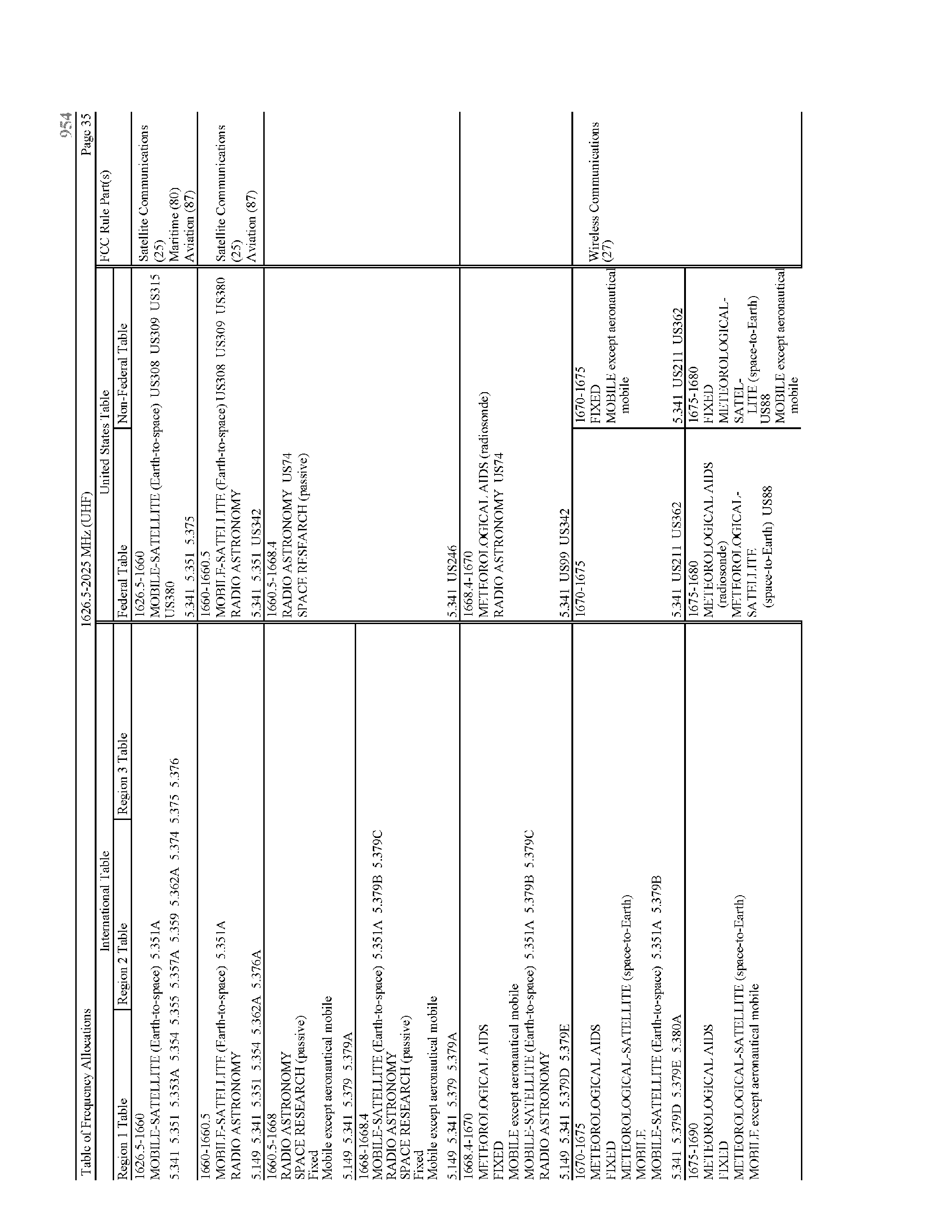
In this document, the Federal Communications Commission proposes to reallocate the 1675-1680 MHz band for shared use between incumbent federal operations and new, non-federal fl...
In this document, the Federal Communications Commission proposes to reallocate the 1675-1680 MHz band for shared use between incumbent federal operations and new, non-federal flexible wireless (fixed or mobile) use operations. The Commission seeks comment on the appropriate sharing mechanisms that will protect incumbent federal operations while making the spectrum available for new, non-federal use. The Commission also proposes service and technical rules designed to promote efficient and intensive use by any new, non-federal services.
DATES:
Interested parties may file comments on or before June 21, 2019; and reply comments on or before July 22, 2019.
ADDRESSES:
You may submit comments, identified by WT Docket No. 19-116, by any of the following methods:
Electronic Filers:
Comments may be filed electronically using the internet by accessing the Commission's Electronic Comment Filing System (ECFS):
https://fjallfoss.fcc.gov/ecfs2/.
See Electronic Filing of Documents in Rulemaking Proceedings, 63 FR 24121 (1998).
Paper Filers:
Parties who choose to file by paper must file an original and one copy of each filing. Generally if more than one docket or rulemaking number appears in the caption of this proceeding, filers must submit two additional copies for each additional docket or rulemaking number. Commenters are only required to file copies in GN Docket No. 13-111.
Filings can be sent by hand or messenger delivery, by commercial overnight courier, or by first-class or overnight U.S. Postal Service mail. All filings must be addressed to the Commission's Secretary, Office of the Secretary, Federal Communications Commission.
All hand-delivered or messenger-delivered paper filings for the Commission's Secretary must be delivered to FCC Headquarters at 445 12th St. SW, Room TW-A325, Washington, DC 20554. The filing hours are 8:00 a.m. to 7:00 p.m. All hand deliveries must be held together with rubber bands or fasteners. Any envelopes and boxes must be disposed ofbefore
entering the building.
Commercial overnight mail (other than U.S. Postal Service Express Mail and Priority Mail) must be sent to 9050 Junction Drive, Annapolis Junction, MD 20701.
U.S. Postal Service first-class, Express, and Priority mail must be addressed to 445 12th Street SW, Washington, DC 20554.
People with Disabilities:
To request materials in accessible formats for people with disabilities (Braille, large print, electronic files, audio format), send an email to
fcc504@fcc.gov
or call the Consumer & Governmental Affairs Bureau at 202-418-0530 (voice), 202-418-0432 (TTY).
FOR FURTHER INFORMATION CONTACT:
Anna Gentry,
Anna.Gentry@fcc.gov,
of the Wireless Telecommunications Bureau, Mobility Division, (202) 418-7769. For additional information
( printed page 23509)
concerning the PRA information collection requirements contained in this document, contact Cathy Williams at (202) 418-2918 or send an email to
PRA@fcc.gov.
SUPPLEMENTARY INFORMATION:
This is a summary of the Commission's Notice of Proposed Rulemaking (
NPRM) in WT Docket No. 19-116, FCC 19-43, released on May 13, 2019. The complete text of the
NPRM
is available for viewing via the Commission's ECFS website by entering the docket number, WT Docket No. 19-116. The complete text of the
NPRM
is also available for public inspection and copying from 8 a.m. to 4:30 p.m. Eastern Time (ET) Monday through Thursday or from 8 a.m. to 11:30 a.m. ET on Fridays in the FCC Reference Information Center, 445 12th Street SW, Room CY-B402, Washington, DC 20554, telephone 202-488-5300, fax 202-488-5563.
This proceeding shall continue to be treated as a “permit-but-disclose” proceeding in accordance with the Commission's
ex parte
rules (47 CFR 1.1200et seq.). Persons making
ex parte
presentations must file a copy of any written presentation or a memorandum summarizing any oral presentation within two business days after the presentation (unless a different deadline applicable to the Sunshine period applies). Persons making oral
ex parte
presentations are reminded that memoranda summarizing the presentation must (1) list all persons attending or otherwise participating in the meeting at which the
ex parte
presentation was made, and (2) summarize all data presented and arguments made during the presentation. If the presentation consisted in whole or in part of the presentation of data or arguments already reflected in the presenter's written comments, memoranda or other filings in the proceeding, the presenter may provide citations to such data or arguments in his or her prior comments, memoranda, or other filings (specifying the relevant page and/or paragraph numbers where such data or arguments can be found) in lieu of summarizing them in the memorandum. Documents shown or given to Commission staff during
ex parte
meetings are deemed to be written
ex parte
presentations and must be filed consistent with rule 1.1206(b). In proceedings governed by rule 1.49(f) or for which the Commission has made available a method of electronic filing, written
ex parte
presentations and memoranda summarizing oral
ex parte
presentations, and all attachments thereto, must be filed through the electronic comment filing system available for that proceeding, and must be filed in their native format (
e.g.,.doc, .xml, .ppt, searchable .pdf). Participants in this proceeding should familiarize themselves with the Commission's
ex parte
rules.
I. Notice of Proposed Rulemaking
Reallocation of the 1675-1680 MHz Band.
Consistent with the allocation of the broader 1675-1690 MHz band in all three ITU Regions of the International Table,[1]
the
NPRM
proposes to reallocate the 1675-1680 MHz band on a co-primary basis for non-federal fixed and mobile (except aeronautical mobile) services. Similar to the Commission's allocation of certain other bands, the proposed reallocation of the 1675-1680 MHz band also would permit the band to be auctioned and used for fixed and mobile (except aeronautical mobile) services, thereby providing flexibility for potential users to tailor the use of the band depending on the specific needs of their networks.
The 1675-1680 MHz band is currently used by NOAA for the Meteorological Satellite (MetSat) and Meteorological Aids (MetAids) services. These services provide robust weather data to the National Oceanic and Atmospheric Administration (NOAA) and other users, which they use for forecasting weather, and in part, managing hydrological resources across the country. MetSat services will continue to occupy the band until at least 2036. The
NPRM
seeks comment on an appropriate sharing mechanism that will allow both federal and non-federal users to operate successfully in the band. Specifically, the
NPRM
seeks comment on how: (1) Current federal earth stations in, and adjacent to, the band could be protected from harmful interference; (2) planned federal earth stations could be added to the band while minimizing disruptions to commercial service; and (3) non-federal earth stations that rely on the data transmitted in the band by NOAA satellites could continue to have access to this data.
A number of non-federal users operate earth stations that receive the signal from the GOES-N and GOES-R series satellites to provide them access to data necessary to carry out their weather forecasting and other activities. The Commission believes that these users should continue to have access to this data, and the
NPRM
seeks comment on how best to achieve this goal. The
NPRM
seeks comment on the number and location of such non-federal earth stations, the likelihood of interference at such locations, and ways to mitigate the risk of interference or otherwise ensure that they continue to have access to the data were we to allow non-federal fixed and mobile operations. In this regard, the
NPRM
notes the Commission also expects that the completed Spectrum Pipeline Act study [2]
will provide additional information on these topics. To the extent that particular users rely on non-federal earth stations for critical public safety, weather forecasting, and emergency response data and are concerned about their ability to continue to receive the data directly from the NOAA satellites if the band is made available for shared operations, the
NPRM
encourages them to identify their locations and specific data needs, and discuss alternative means to receive such data.
To ensure that data from GOES satellites is made broadly available to the public, the
NPRM
seeks comment on alternative means of delivering such data to current users and other interested parties. For example, the
NPRM
seeks comment on whether an internet-based or private network content delivery system be used to make the GOES data available more broadly, without the need for an earth station, and whether this would be an adequate means of ensuring the data can be accessed reliably. The
NPRM
seeks comment on the likely costs of shifting to alternative delivery systems and whether such a content delivery system increase the total number of users with reliable access to such data. To the extent that parties believe that an alternative solution would be less reliable than an earth station, the
NPRM
seeks specific comment on the factors that contribute to the lower reliability for an internet-based or other terrestrial solution. The
NPRM
notes that NOAA already makes some MetSat and other weather data services available through other means—
e.g.,
the internet—and these services vary in bandwidth
( printed page 23510)
requirements. The
NPRM
seeks comment on whether there are examples in this or other bands in which other content delivery solutions have replaced or supplemented earth-station-based receivers, and if so, how such data feeds perform during major weather events. The
NPRM
also seeks comment on any special protections that may be appropriate to ensure continuity of service for MetSat users.
1675-1680 MHz Band Plan.
Given the limited size of this band, the
NPRM
proposes to auction 1675-1680 MHz licenses on an unpaired basis for terrestrial fixed and mobile use. Further, to avoid incompatible operations among co-channel or adjacent channel licensees, the
NPRM
proposes that 1675-1680 MHz be used solely as a downlink band. Alternatively, the
NPRM
seeks comment on whether to authorize this band for a combination of uplink and downlink on a TDD or other basis (as in the adjacent unpaired 1670-1675 MHz band), or for uplink. The
NPRM
seeks comment on the costs and benefits of such alternate approaches, including the likely use cases each would support. In order to best accommodate the fullest range of mobile wireless services, the
NPRM
proposes to license the 1675-1680 MHz band as a five-megahertz block and seeks comment on this proposal.
Consistent with the Commission's approach in several other bands used to provide fixed and mobile services, the
NPRM
proposes to license the 1675-1680 MHz band on a geographic area basis. In determining the appropriate geographic license size, the Commission considers several factors, including: (1) Facilitating access to spectrum by both small and large providers; (2) providing for the efficient use of spectrum; (3) encouraging deployment of wireless broadband services to consumers, especially those in rural areas and tribal lands; and (4) promoting investment in and rapid deployment of new technologies and services. In light of these considerations, the
NPRM
proposes to license the 1675-1680 MHz band on a partial economic area (PEA) basis, which may enable a wide range of bidders to participate in the auction and select the focused geographic areas that are most suited to their planned operations using the 1675-1680 MHz spectrum. The
NPRM
asks commenters to discuss and quantify the economic, technical, and other public interest considerations of licensing on a PEA basis, or any other recommended licensing approach, given that the band will be shared with federal users.
Licensing and Operating Rules.
In order to afford licensees the flexibility to align licenses in the 1675-1680 MHz band with licenses in other spectrum bands governed by Part 27 of the Commission's rules, including the adjacent 1670-1675 MHz band, the
NPRM
proposes that licensees in the 1675-1680 MHz band comply with licensing and operating rules that are applicable to all Part 27 services, including assignment of licenses by competitive bidding,[3]
flexible use,[4]
regulatory status,[5]
foreign ownership reporting,[6]
compliance with construction notification requirements,[7]
renewal criteria,[8]
permanent discontinuance of operations,[9]
partitioning and disaggregation,[10]
and spectrum leasing.[11]
The
NPRM
seeks comment on this approach and asks commenters to identify any aspects of the Commission's general Part 27 service rules that should be modified to accommodate the particular characteristics of the 1675-1680 MHz band. In addition, the
NPRM
seeks comment on service-specific rules for the 1675-1680 MHz band, including eligibility, mobile spectrum holdings policies, license term, performance requirements, renewal term construction obligations, and other licensing and operating rules.
Consistent with established Commission practice, the
NPRM
proposes to adopt an open eligibility standard for licenses in the 1675-1680 MHz band. Similar to the Commission's approach in the
2017 Spectrum Frontiers Order and FNPRM,
the
NPRM
proposes not to adopt a pre-auction, bright line limit on the ability of any entity to acquire spectrum in the 1675-1680 MHz band through competitive bidding at auction.[12]
The
NPRM
proposes that this band be included in the Commission's spectrum screen, which helps to identify those markets that may warrant further competitive analysis, when evaluating proposed secondary market transactions. In addition, the
NPRM
proposes to review spectrum holdings on a case-by-case basis when applications for initial licenses are filed post-auction to ensure that the public interest benefits of having a threshold on spectrum applicable to secondary market transactions are not rendered ineffective. The
NPRM
seeks comment on whether and how the similarity of this spectrum to spectrum currently included in the screen should be factored into the Commission's analysis, including the suitability of 1675-1680 MHz spectrum for use in the provision of mobile telephony/broadband services.
The
NPRM
proposes a 15-year term for licenses for the 1675-1680 MHz band, and invites commenters to submit alternate proposals for the appropriate license term, which should include a discussion on the costs and benefits. The Commission continues to believe that performance requirements play a critical role in ensuring that licensed spectrum does not lie fallow. Accordingly, considering the unique characteristics of this band, the
NPRM
proposes that a 1675-1680 MHz band licensee shall provide reliable signal coverage and offer service to at least 45 percent of the population in each of its license areas within 6 years of initial grant (first performance benchmark), and to at least 80 percent of the population in each of its license areas within 12 years of initial grant (second performance benchmark). The
NPRM
notes that to the extent that sharing in this band is achieved with protection zones, those zones may limit a non-federal fixed or mobile licensee's ability to serve some portion of the population. For purposes of assessing the satisfaction of the buildout requirement, the
NPRM
seeks comment on how to account for the areas where federal use limits or prohibits 1675-1680 MHz use. The
NPRM
also seeks comment on alternative methodologies for measuring population coverage requirements in the Gulf of Mexico (
e.g.
using off-shore platforms as a proxy for population coverage).
Along with performance benchmarks, the Commission seeks to adopt a meaningful and enforceable penalty for failing to meet those benchmarks. The
NPRM
proposes that, in the event a 1675-1680 MHz licensee fails to meet the first performance benchmark, the licensee's second performance benchmark and license term would be reduced by two years, thereby requiring it to meet the second performance benchmark two years sooner (at 10 years into the license term), and reducing its license term to 13 years. The
NPRM
further proposes that, in the event a 1675-1680 MHz licensee fails to meet the second performance benchmark of
( printed page 23511)
80 percent population coverage for a particular license area, its authorization for each such license area shall terminate automatically without further Commission action. In the event a licensee's authority to operate terminates, the
NPRM
proposes that the licensee's spectrum rights would become available for reassignment pursuant to the competitive bidding provisions of section 309(j). Further, consistent with the Commission's rules for other WRS licenses, including AWS-1, AWS-3, AWS-4 and H Block, the
NPRM
proposes that any 1675-1680 MHz licensee that forfeits its license for failure to meet its performance requirements would be precluded from regaining the license. Finally, the
NPRM
seeks comment on whether there are other alternative buildout and enforcement mechanisms the Commission should consider, including alternative metrics for licensees that provide services potentially less suited to a population metric, such as Internet of Things type services.
In addition to being subject to procedures applicable to all Part 27 licensees for demonstrating compliance with performance requirements, including the filing of electronic coverage maps and supporting documentation, the
NPRM
proposes that such electronic coverage maps must accurately depict the boundaries of each license area in the licensee's service territory. If a licensee does not provide reliable signal coverage to an entire license area, the
NPRM
proposes that its map must accurately depict the boundaries of the area or areas within each license area that are not being served. Further, the
NPRM
proposes that each licensee also must file supporting documentation regarding the type of service it is providing for each licensed area within its service territory and the type of technology used to provide such service, and certify the accuracy of such documentation. Supporting documentation must include the assumptions used to create the coverage maps, including the propagation model and the signal strength necessary to provide reliable service with the licensee's technology.
In addition to, and independent of, the general renewal requirements contained in § 1.949 of the Commission's rules, which apply to all WRS licenses, the
NPRM
also seeks comment on application of specific renewal term construction obligations to 1675-1680 MHz licenses. The
WRS Renewal Reform FNPRM
proposed to apply rules adopted in that proceeding to all flexible geographic licenses.[13]
Given the proposal to license this band on a geographic basis for flexible use, any additional renewal term construction obligations proposed in the
WRS Renewal Reform FNPRM
also would apply to licenses in the 1675-1680 MHz band. The
NPRM
seeks comment on whether there are unique characteristics of the 1675-1680 MHz band that might require a different approach than the various proposals raised by the
WRS Renewal Reform FNPRM.
If the Commission adopts a geographic area licensing scheme that allows submission of mutually exclusive applications for the proposed non-federal use of the 1675-1680 MHz band, it will use a competitive bidding process as required by the Communications Act.[14]
As the Commission has done in previous auctions, the
NPRM
proposes to conduct any auction for 1675-1680 MHz licenses in conformity with the general competitive bidding rules set forth in Part 1, subpart Q, of the Commission's rules.[15]
Under this proposal, such rules would be subject to any modifications that the Commission may adopt for its Part 1 general competitive bidding rules in the future. The
NPRM
seeks comment on general application of the Part 1 competitive bidding rules to any auction of 1675-1680 MHz band licenses and whether any of the Part 1 rules or other competitive bidding policies would be inappropriate or should be modified for an auction of licenses in this band.
The
NPRM
seeks comment on whether to make bidding credits for designated entities available for this band and how to define a small business if the Commission decides to offer small business bidding credits. In recent years, for other flexible use licenses we have adopted bidding credits for the two larger designated entity business sizes provided in the Commission's Part 1 standardized schedule of bidding credits. For the 1675-1680 MHz band, we seek comment on defining a small business as an entity with average gross revenues for the preceding five years not exceeding $55 million, and a very small business as an entity with average gross revenues for the preceding five years not exceeding $20 million.[16]
A qualifying “small businesses” would be eligible for a bidding credit of 15 percent and qualifying “very small businesses” would be eligible for a bidding credit of 25 percent. The
NPRM
also seeks comment on whether to offer rural service providers a designated entity bidding credit for licenses in this band.[17]
Technical Rules.
The
NPRM
proposes to allow fixed and base station (downlink) operations in the 1675-1680 MHz band and to apply technical standards similar to those in other AWS bands. The
NPRM
also considers the technical rules governing the adjacent 1670-1675 MHz band and seeks comment on how the two bands can best coexist either separately, or in combination. The
NPRM
seeks to establish technical rules that will help optimize the potential uses of spectrum, while minimizing the impact on other users in the band or adjacent bands, consistent with the public interest.
The
NPRM
proposes to allow fixed and base stations to operate up to 2000 watts peak equivalent isotropically radiated power (EIRP), consistent with the limits established for similar services governed by Part 27 of the Commission's rules. The
NPRM
proposes an out-of-band emissions (OOBE) limit for fixed and base stations of 43 + 10 log10
(P) dB, where P is the transmit power in watts. The
NPRM
proposes to limit a licensee's predicted
( printed page 23512)
or measured field strength to 47 dBµV/m (or less) at any location along the border of its license area. The
NPRM
does not propose to limit the height of antennas for either fixed or base stations. Consistent with existing rules for AWS operations, the
NPRM
proposes that operations in the 1675-1680 MHz band would be subject to international agreements with Mexico and Canada. Finally, Part 27 contains several additional technical rules applicable to all Part 27 services, including Section 27.51 (Equipment authorization), Section 27.52 (RF safety), Section 27.54 (Frequency stability), and Section 27.56 (Antennas structures; air navigation safety).[18]
The
NPRM
proposes that all of these Part 27 technical rules should apply to all 1675-1680 MHz band licenses and licensees, including licensees who acquire their licenses through partitioning or disaggregation.
II. Procedural Matters
Initial Regulatory Flexibility Act Analysis
As required by the Regulatory Flexibility Act of 1980 (RFA), the Commission has prepared an Initial Regulatory Flexibility Analysis (IRFA) of the possible significant economic impact on small entities of the policies and rules proposed in this document. We request written public comment on the IRFA. Comments must be filed in accordance with the same deadlines as comments filed in response to the
NPRM
as set forth on the first page of this document, and have a separate and distinct heading designating them as responses to the IRFA. The Commission's Consumer and Governmental Affairs Bureau, Reference Information Center, will send a copy of the
NPRM,
including the IRFA, to the Chief Counsel for Advocacy of the Small Business Administration.
Initial Paperwork Reduction Act Analysis
The
NPRM
contains proposed new information collection requirements. The Commission, as part of its continuing effort to reduce paperwork burdens, invites the general public and OMB to comment on the information collection requirements contained in this document, as required by PRA. In addition, pursuant to the Small Business Paperwork Relief Act of 2002, Public Law 107-198, see 44 U.S.C. 3506(c)(4), the Commission seeks specific comment on how it might “further reduce the information collection burden for small business concerns with fewer than 25 employees.”
Covered Geographic Licenses.
Covered geographic licenses consist of the following services: 1.4 GHz Service (part 27, subpart I); 1.6 GHz Service (part 27, subpart J); 24 GHz Service and Digital Electronic Message Services (part 101, subpart G); 218-219 MHz Service (part 95, subpart F); 220-222 MHz Service, excluding public safety licenses (part 90, subpart T); 600 MHz Service (part 27, subpart N); 700 MHz Commercial Services (part 27, subpart F and H); 700 MHz Guard Band Service (part 27, subpart G); 800 MHz Specialized Mobile Radio Service (part 90, subpart S); 900 MHz Specialized Mobile Radio Service (part 90, subpart S); 1675-1680 MHz Service (part 27, subpart O); Advanced Wireless Services (part 27, subparts K and L); Air-Ground Radiotelephone Service (Commercial Aviation) (part 22, subpart G); Broadband Personal Communications Service (part 24, subpart E); Broadband Radio Service (part 27, subpart M); Cellular Radiotelephone Service (part 22, subpart H); Citizens Broadband Radio Service (part 96, subpart C); Dedicated Short Range Communications Service, excluding public safety licenses (part 90, subpart M); H Block Service (part 27, subpart K); Local Multipoint Distribution Service (part 101, subpart L); Multichannel Video Distribution and Data Service (part 101, subpart P); Multilateration Location and Monitoring Service (part 90, subpart M); Multiple Address Systems (EAs) (part 101, subpart O); Narrowband Personal Communications Service (part 24, subpart D); Paging and Radiotelephone Service (part 22, subpart E; part 90, subpart P); VHF Public Coast Stations, including Automated Maritime Telecommunications Systems (part 80, subpart J); Upper Microwave Flexible Use Service (part 30); and Wireless Communications Service (part 27, subpart D).
* * * * *
3. Section 1.9005 is amended by revising paragraph (n) to read as follows:
(m)
1675-1680 MHz band.
Authorizations for the 1675-1680 MHz band will have a term not to exceed 15 years from the date of issuance or renewal.
11. Section 27.14 is amended by revising the first sentence of paragraph (a) and the first sentence of paragraph (k) and adding paragraph (u) to read as follows:
(a) AWS and WCS licensees, with the exception of WCS licensees holding authorizations for the 600 MHz band, Block A in the 698-704 MHz and 728-734 MHz bands, Block B in the 704-710 MHz and 734-740 MHz bands, Block E in the 722-728 MHz band, Block C, C1 or C2 in the 746-757 MHz and 776-787 MHz bands, 1675-1680 MHz band, Block A in the 2305-2310 MHz and 2350-2355 MHz bands, Block B in the 2310-2315 MHz and 2355-2360 MHz bands, Block C in the 2315-2320 MHz band, and Block D in the 2345-2350 MHz band, and with the exception of licensees holding AWS authorizations in the 1915-1920 MHz and 1995-2000 MHz bands, the 2000-2020 MHz and 2180-2200 MHz bands, or 1695-1710 MHz, 1755-1780 MHz and 2155-2180 MHz bands, must, as a performance requirement, make a showing of “substantial service” in their license area within the prescribed license term set forth in § 27.13. * * *
* * * * *
(k) Licensees holding WCS or AWS authorizations in the spectrum blocks enumerated in paragraphs (g), (h), (i), (q), (r), (s), (t), and (u) of this section, including any licensee that obtained its license pursuant to the procedures set forth in paragraph (j) of this section, shall demonstrate compliance with performance requirements by filing a construction notification with the Commission, within 15 days of the expiration of the applicable benchmark, in accordance with the provisions set forth in § 1.946(d) of this chapter. * * *
* * * * *
(u) The following provisions apply to any licensee holding an authorization in the 1675-1680 MHz band:
(1) A licensee shall provide reliable signal coverage and offer service within six (6) years from the date of the initial license to at least forty-five (45) percent of the population in each of its license areas (“First Buildout Requirement”).
(2) A licensee shall provide reliable signal coverage and offer service within twelve (12) years from the date of the initial license to at least eighty (80) percent of the population in each of its license areas (“Final Buildout Requirement”).
(3) If a licensee fails to establish that it meets the First Buildout Requirement for a particular license area, the licensee's Final Buildout Requirement deadline and license term will be reduced by two years.
(4) If a licensee fails to establish that it meets the Final Buildout Requirement for a particular license area, its authorization for each license area in which it fails to meet the Final Buildout Requirement shall terminate automatically without Commission action, and the licensee will be ineligible to regain it if the Commission makes the license available at a later date.
(5) To demonstrate compliance with these performance requirements, licensees shall use the most recently available decennial U.S. Census Data at the time of measurement and shall base their measurements of population served on areas no larger than the Census Tract level. The population within a specific Census Tract (or other acceptable identifier) will be deemed served by the licensee only if it provides reliable signal coverage to and offers service within the specific Census Tract (or other acceptable identifier). To the extent the Census Tract (or other acceptable identifier) extends beyond the boundaries of a license area, a licensee with authorizations for such areas may include only the population within the Census Tract (or other acceptable identifier) towards meeting the performance requirement of a single, individual license. For the Gulf of Mexico license area, the licensee shall demonstrate compliance with these performance requirements, using off-shore platforms, including production, manifold, compression, pumping and valving platforms as a proxy for population in the Gulf of Mexico.
(6) An applicant for renewal of a license covered by this paragraph (u) must make a renewal showing, independent of its performance requirements, consistent with section 1.949 as a condition of each renewal.
12. Section 27.50 is amended by adding paragraph (j) to read as follows:
(k)(1) For operations in the 1670-1675 MHz and 1675-1680 MHz bands, the power of any emission outside the licensee's frequency band(s) of operation shall be attenuated below the transmitter power (P) by at least 43 + 10 log (P) dB. Compliance with these provisions is based on the procedures described in paragraph (a)(5) of this section.
(2) For operations in the 1670-1675 MHz and 1675-1680 MHz bands, to the extent a licensee establishes unified operations across the AWS blocks, that licensee may choose not to observe the emission limit specified in paragraph (k)(1) of this section, strictly between its adjacent block licenses in a geographic area, so long as it complies with other Commission rules and is not adversely affecting the operations of other parties by virtue of exceeding the emission limit.
(3)
Private Agreements.
Licensees in the 1670-1675 MHz and 1675-1680 MHz bands may enter into a private agreement with all affected licensees operating in either band to allow the out-of-band emission limit described in this paragraph to be exceeded only between the 1670-1675 MHz and 1675-
( printed page 23519)
1680 MHz blocks. A licensee who is a party to a private agreement described in this section (3) must maintain a copy of the agreement in its station files and disclose it, upon request, to prospective AWS assignees, transferees, or spectrum lessees and to the Commission.
* * * * *
14. Section 27.55 is amended by revising paragraph (a)(1) to read as follows:
(c) Operation in the 1675-1680 MHz, 1695-1710 MHz, 1710-1755 MHz, 1755-1780 MHz, 1915-1920 MHz, 1995-2000 MHz, 2000-2020 MHz, 2110-2155 MHz, 2155-2180 MHz, and 2180-2200 MHz bands is subject to international agreements with Mexico and Canada.
16. Subpart O, consisting of §§ 27.1400, 27.1401, and 27.1410, is added to read as follows:
1675-1680 MHz band subject to competitive bidding.
Mutually exclusive initial applications for 1675-1680 MHz band licenses are subject to competitive bidding. The general competitive bidding procedures set forth in 47 CFR part 1, subpart Q of this chapter will apply unless otherwise provided in this subpart.
(a)
Eligibility for small business provisions
—(1)
Definitions
—(i)
Small business.
A small business is an entity that, together with its affiliates, its controlling interests, and the affiliates of its controlling interests, has average gross revenues not exceeding $55 million for the preceding five (5) years.
(ii)
Very small business.
A very small business is an entity that, together with its affiliates, its controlling interests, and the affiliates of its controlling interests, has average gross revenues not exceeding $20 million for the preceding five (5) years.
(2)
Bidding credits.
A winning bidder that qualifies as a small business, as defined in this section, or a consortium of small businesses may use the bidding credit of 15 percent, as specified in § 1.2110(f)(2)(i)(C) of this chapter. A winning bidder that qualifies as a very small business, as defined in this section, or a consortium of very small businesses may use the bidding credit of 25 percent, as specified in § 1.2110(f)(2)(i)(B) of this chapter.
(b)
Eligibility for rural service provider bidding credit.
A rural service provider, as defined in § 1.2110(f)(4)(i) of this chapter, that has not claimed a small business bidding credit may use the bidding credit of 15 percent specified in § 1.2110(f)(4) of this chapter.
Protection of Federal Government Meteorological-Satellite operations.
(a)
14 Protection Zones.
Within 14 Protection Zones, prior to operating a base station in the 1675-1680 MHz band, licensees must successfully coordinate such base station operations with Federal Government entities operating meteorological satellite Earth-station receivers in the 1675-1710 MHz band.
(b)
Additional Protection Zones.
Federal earth stations in the 1675-1680 MHz band may be added subject to approval by NTIA and in compliance with a coordination process that will be announced jointly by the FCC and NTIA via Public Notice.
(c)
Interference.
If protected Federal earth stations receive harmful interference from 1675-1680 MHz band operations in the 1675-1680 MHz band, a 1675-1680 MHz band licensee must, upon notification, modify its operations and/or technical parameters as necessary to eliminate the interference.
(d)
Point of contact.
1675-1680 MHz band licensees must provide and maintain a point of contact at all times so that immediate contact can be made should interference against protected Federal sites occur.
(e)
Coordination procedures.
Federal use of the radio spectrum is generally governed by the National Telecommunications and Information Administration (NTIA) while non-Federal use is governed by the Commission. As such, any guidance or details concerning Federal/non-Federal coordination must be issued jointly by NTIA and the Commission. The Commission may jointly issue with NTIA one or more public notices with guidance or details concerning the coordination procedures for the 1675-1680 MHz band.
2.
Title X of the Bipartisan Budget Act of 2015 (Spectrum Pipeline Act) modified previous legislation to provide funds from the Spectrum Relocation Fund for research and development, engineering studies, economic analyses, or other activities that “improve the efficiency and effectiveness of the spectrum use of federal entities in order to make available frequencies . . . for reallocation for non-federal use or shared federal and non-federal use, or a combination thereof, and for auction in accordance with such reallocation.”
See
Spectrum Pipeline Act, 129 Stat. 584, Sec. 1005(a)(2) (2015). NOAA is currently conducting a study using Spectrum Relocation Fund support, as provided under the Spectrum Pipeline Act, regarding the protection methodology necessary to make the 1675-1680 MHz band available on a shared basis with non-federal fixed or mobile (except aeronautical mobile) users.
12.
Use of Spectrum Bands Above 24 GHz For Mobile Radio Services et al.,
GN Docket No. 14-177 et al., Second Report and Order, Second Further Notice of Proposed Rulemaking, Order on Reconsideration, and Memorandum Opinion and Order, 32 FCC Rcd 10988, 11009-11011, paras. 70-74 (2017) (
2017 Spectrum Frontiers Order and FNPRM).
13.
Amendment of Parts 1, 22, 24, 27, 74, 80, 90, 95, and 101 To Establish Uniform License Renewal et al.,
WT Docket No. 10-112, Second Report and Order and Further Notice of Proposed Rulemaking and Order, 32 FCC Rcd 8874, 8915, paras. 111-12 (2017) (
WRS Renewal Reform 2nd R&O and FNPRM).
16.
The standardized schedule of bidding credits provided in § 1.2110(f)(2)(i) defines small businesses based on average gross revenues for the preceding three years. In December 2018, Congress revised the standard set out in the Small Business Act for categorizing a business concern as a “small business concern,” by changing the annual average gross receipts benchmark from a three-year period to a five-year period. Thus, as a general matter, a Federal agency cannot propose to categorize a business concern as a “small business concern” for Small Business Act purposes unless the size of the concern is based on its annual average gross receipts “over a period of not less than 5 years.” 15 U.S.C. 632(a)(2)(C)(ii)(II),
as amended by
Small Business Runway Extension Act of 2018, Public Law 115-324 (Dec. 17, 2018). We therefore propose to adopt the Small Business Act's revised five-year average gross receipts benchmark for purposes of determining which entities qualify for small business bidding credits. But because the SBA has not yet revised its regulations to update the definition of “small business concern,” for purposes of compliance with the Regulatory Flexibility Act, the Commission will continue to use the SBA's current definitions of “small business,” which is based on a three-year benchmark.
See infra
Appendix C.
17.
47 CFR 1.2110(f)(4)(i) (bidding credit of 15 percent for applicants meeting the requirements for being designated as a rural service provider). To be eligible to receive a rural service provider bidding credit, an applicant must meet the requirements set forth in Part 1. An applicant eligible for both small business bidding credits and rural service provider bidding credits may only receive one of the two credits.
Id.
§ 1.2110(f)(2)(i), (4)(i).
Use this for formal legal and research references to the published document.
84 FR 23508
Web Citation
Suggested Web Citation
Use this when citing the archival web version of the document.
“Allocation and Service Rules for the 1675-1680 MHz Band,” thefederalregister.org (May 22, 2019), https://thefederalregister.org/documents/2019-10675/allocation-and-service-rules-for-the-1675-1680-mhz-band.