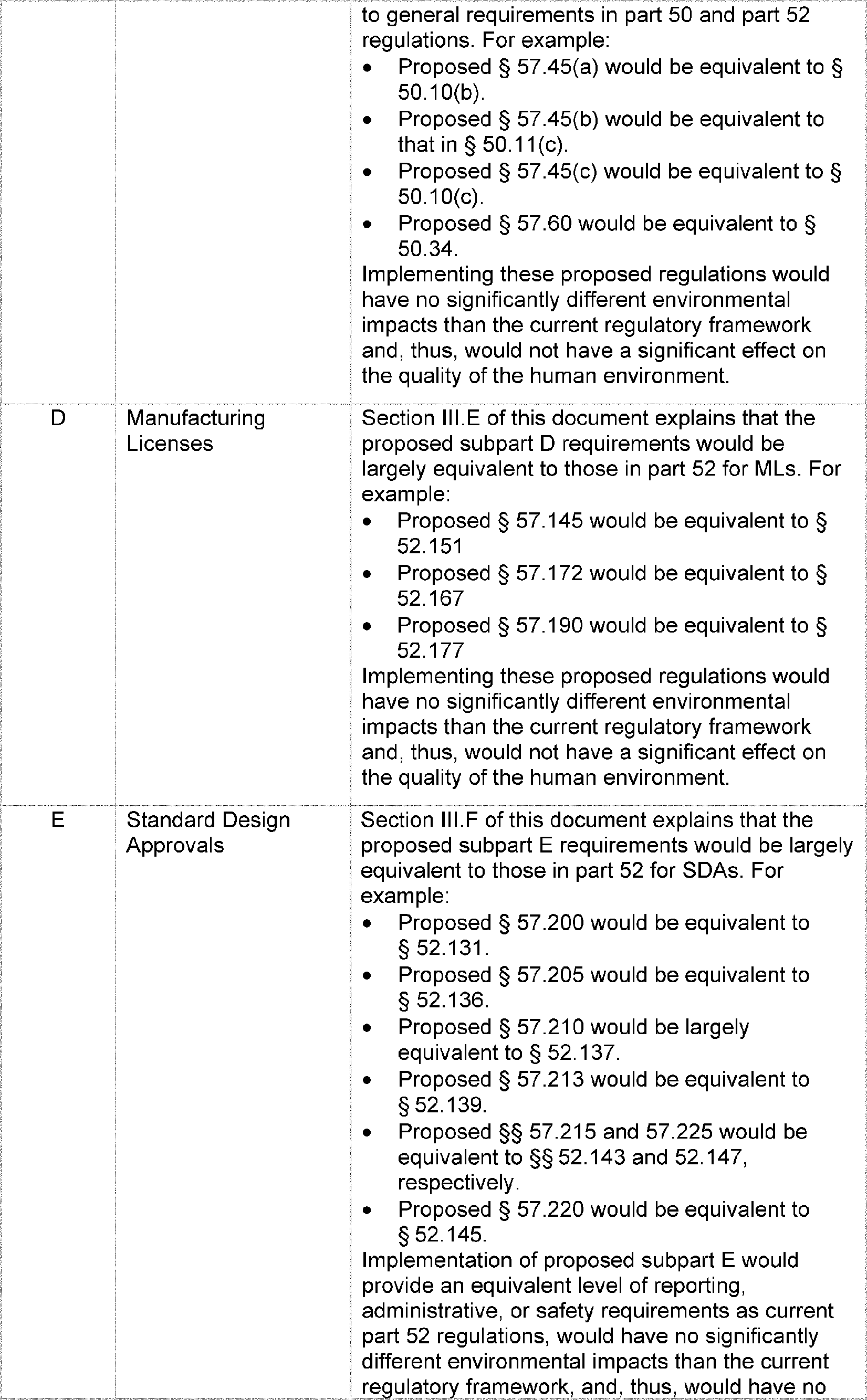
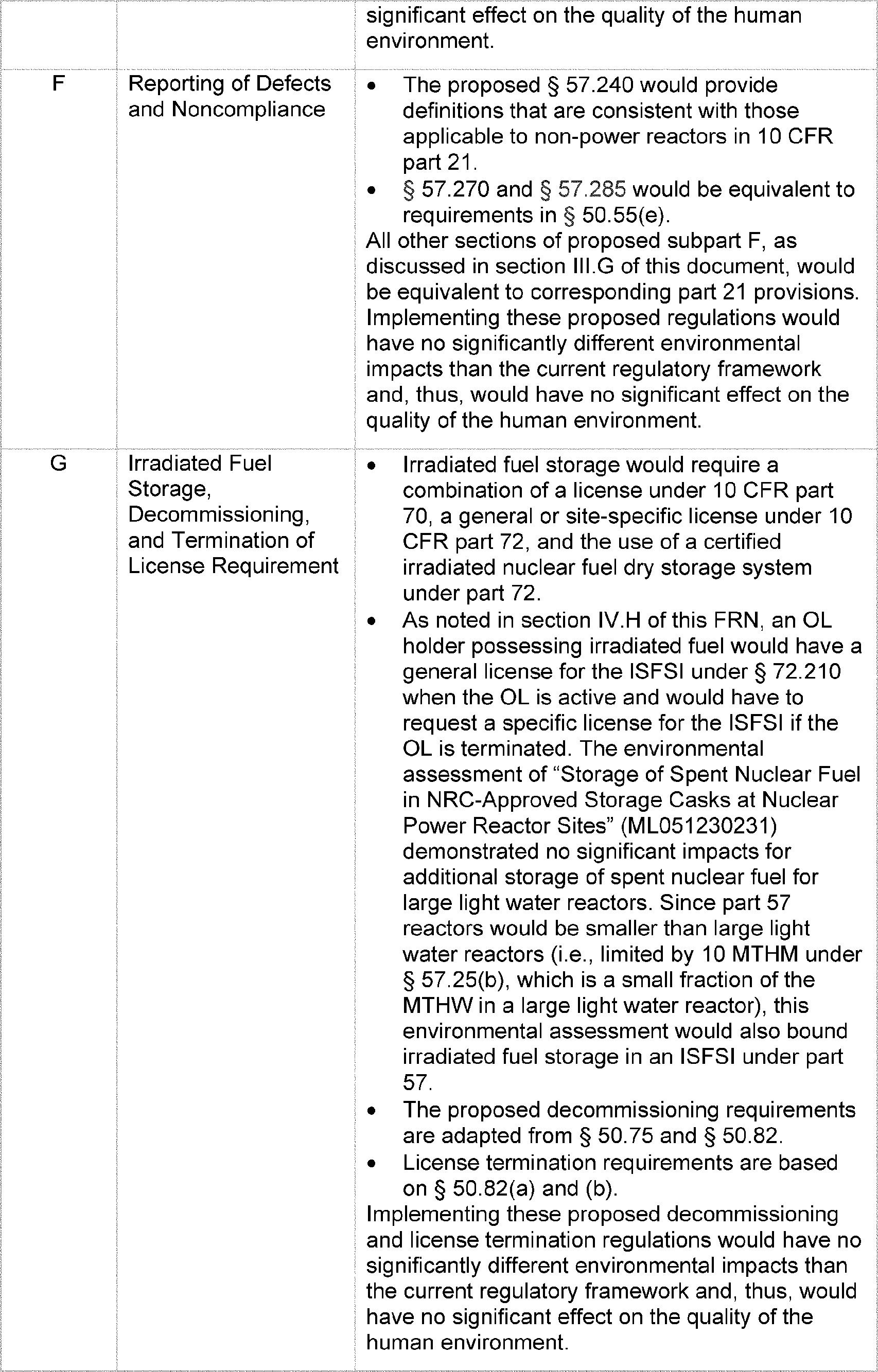
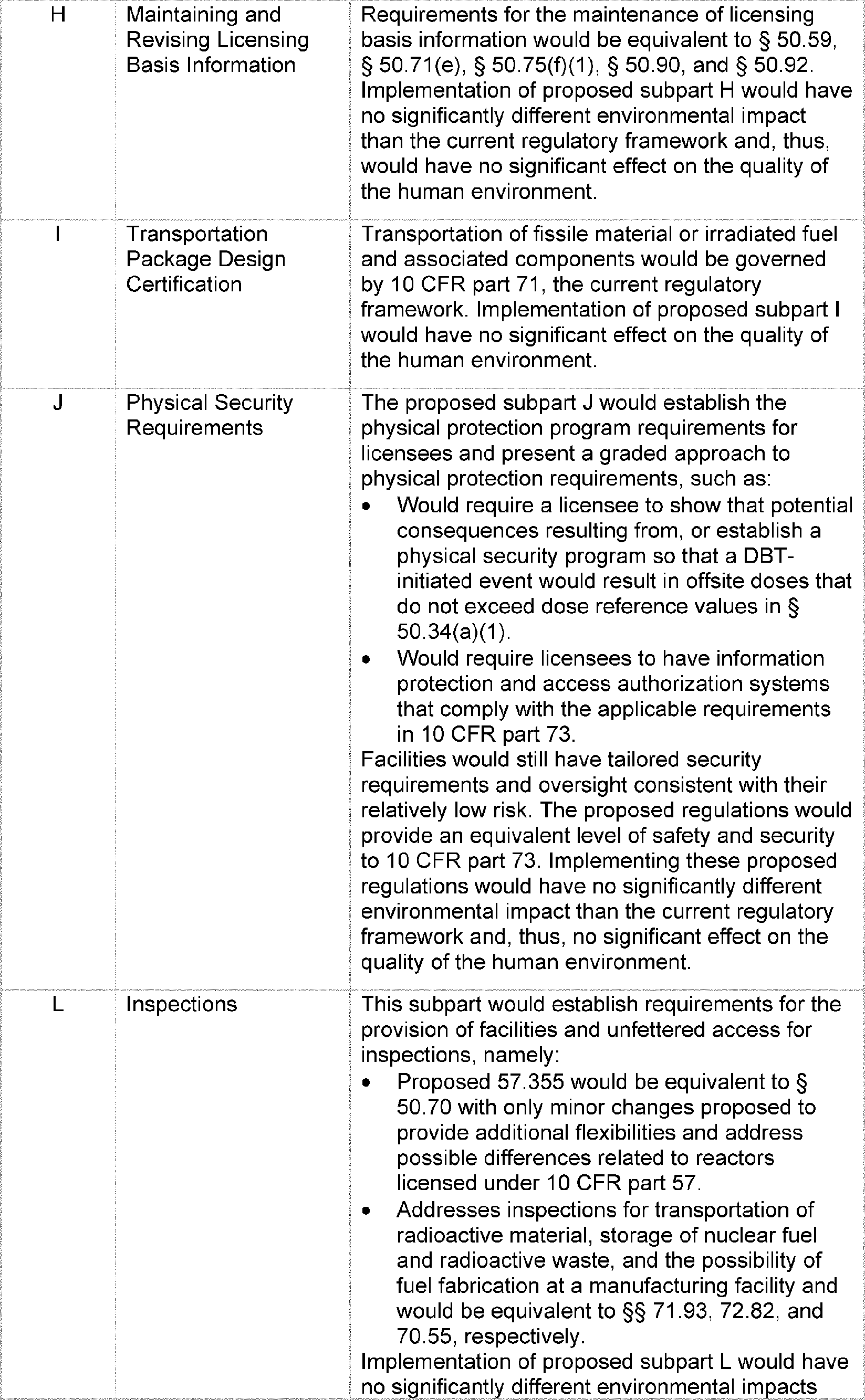
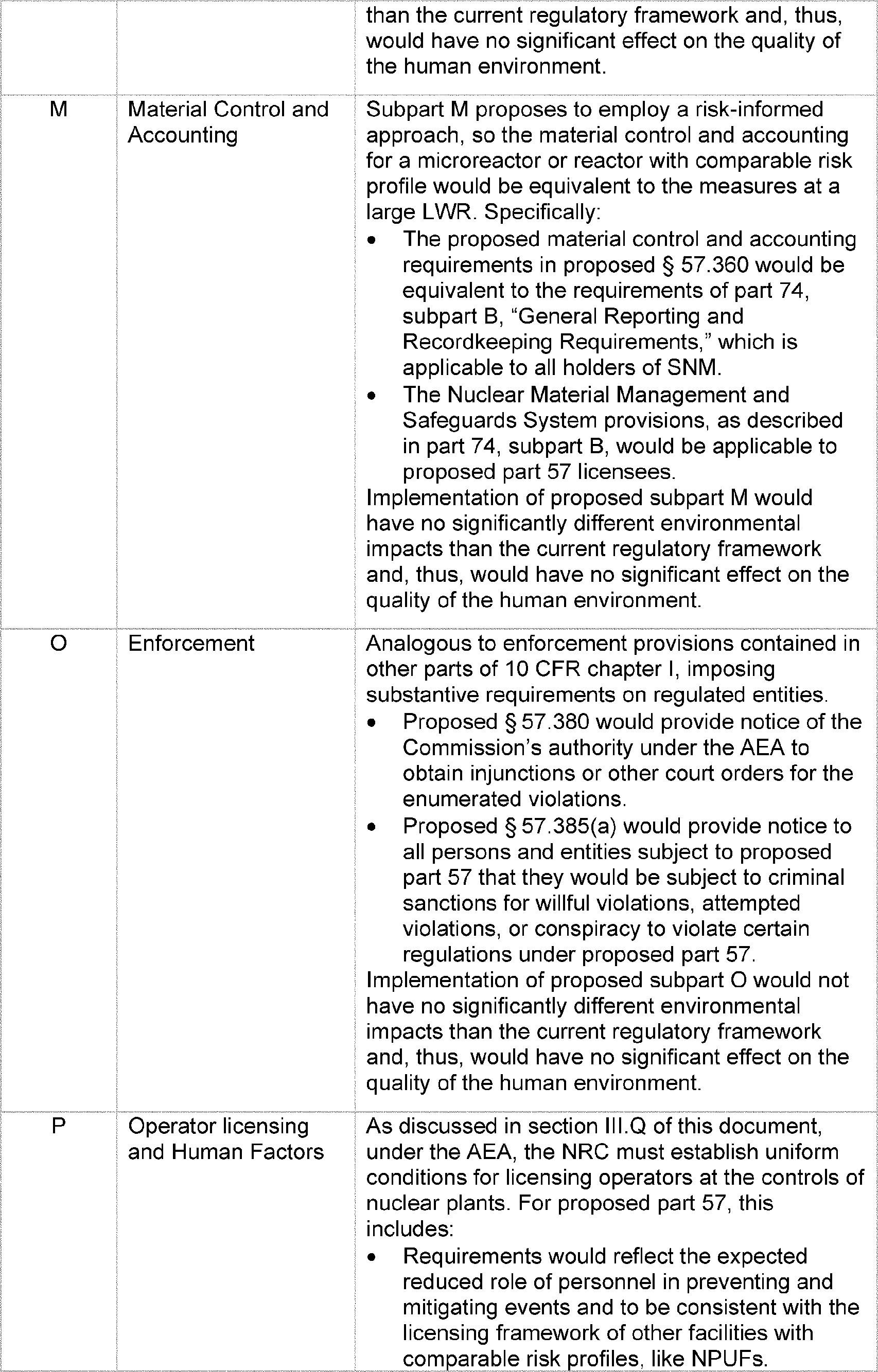
Licensing Requirements for Microreactors and Other Reactors With Comparable Risk Profiles
The U.S. Nuclear Regulatory Commission (NRC) is proposing to amend its regulations to establish a risk-informed and performance- based regulatory framework for rapid licensing o...
The U.S. Nuclear Regulatory Commission (NRC) is proposing to amend its regulations to establish a risk-informed and performance-based regulatory framework for rapid licensing of new microreactors and other reactors with comparable risk profiles and for high-volume deployment of these reactors. The proposed rule would provide a flexible set of licensing pathways, reduce regulatory burden, and ensure that safety and security requirements remain commensurate with the potential hazards posed by these facilities.
DATES:
Comments must be submitted electronically using
https://www.regulations.gov
by 11:59 p.m. eastern time on June 15, 2026.
ADDRESSES:
Submit your comments, identified by Docket ID NRC-2025-0379, at
https://www.regulations.gov.
If your material cannot be submitted using
https://www.regulations.gov,
call or email the individuals listed in the
FOR FURTHER INFORMATION CONTACT
section of this document for alternate instructions.
Do not include any personally identifiable information (such as name, address, or other contact information) or confidential business information that you do not want publicly disclosed. All comments are public records; they are publicly displayed exactly as received, and will not be deleted, modified, or redacted. Comments may be submitted anonymously.
You can read a plain language description of this proposed rule at
https://www.regulations.gov/docket/NRC-2025-0379.
For additional direction on obtaining information and submitting comments, see “Obtaining Information and Submitting Comments” in the
SUPPLEMENTARY INFORMATION
section of this document.
FOR FURTHER INFORMATION CONTACT:
George Tartal, Office of Nuclear Material Safety and Safeguards, telephone: 301-415-0016, email:
George.Tartal@nrc.gov;
Elijah Dickson, Office of Nuclear Reactor Regulation, telephone: 301-415-7647, email:
Elijah.Dickson@nrc.gov;
Michael Balazik, Office of Nuclear Reactor Regulation, telephone: 301-415-2856, email:
Michael.Balazik@nrc.gov;
and William Kennedy, telephone: 301-415-2313, email:
William.Kennedy@nrc.gov.
All are staff of the U.S. Nuclear Regulatory Commission, Washington, DC 20555-0001.
SUPPLEMENTARY INFORMATION:
Executive Summary
A. Need for the Regulatory Action
The purpose of this rulemaking is to safely expedite the licensing process for microreactors and other reactors with comparable risk profiles. This effort is consistent with, and implements direction in, the Accelerating Deployment of Versatile, Advanced Nuclear for Clean Energy Act of 2024 (Pub. L. 118-67, 138 Stat. 1448) (ADVANCE Act), and Executive Order (E.O.) 14300, “Ordering the Reform of the Nuclear Regulatory Commission” (90 FR 22587; May 29, 2025).
Section 208 of the ADVANCE Act requires the NRC to develop “risk-informed and performance-based strategies and guidance to license and regulate microreactors.” The ADVANCE Act mandates that these strategies be incorporated into the existing regulatory framework, the technology-inclusive regulatory framework to be established through the rulemaking required by section 103(a)(4) of the Nuclear Energy Innovation and Modernization Act (Pub. L. 115-439, 132 Stat. 5572) (NEIMA), or a pending or new rulemaking by July 2027.
On January 20, 2025, the President declared a National Energy Emergency in E.O. 14156, “Declaring a National Energy Emergency” (90 FR 8433; January 29, 2025), and stressed the need for a reliable, diversified, and affordable supply of energy. The President also issued E.O. 14154 (90 FR 8353; January 29, 2025), titled, “Unleashing American Energy,” with an objective of unleashing “America's affordable and reliable energy and natural resources.”
On May 23, 2025, the President issued E.O. 14300. Section 5(e) of that E.O. directs the NRC to revise its regulations to “[e]stablish a process for high-volume licensing of microreactors and modular reactors, including by allowing for standardized applications and approvals and by considering to what extent such reactors or components thereof should be regulated through general licenses.” That E.O. set February 23, 2026, as the deadline for issuing this proposed rule, and the final rule must be issued by November 23, 2026.
In developing this proposed rule, the NRC considered whether to establish the rule's scope within the amended non-power production or utilization facility (NPUF) licensing framework set out in the NRC's final rule, “Non-Power Production or Utilization Facility License Renewal,” issued on December 30, 2024 (89 FR 106234). That NPUF rulemaking was primarily intended to revise and streamline the license renewal process for facilities such as research and test reactors and medical isotope production facilities and was not designed to serve as a comprehensive licensing pathway for the high-volume deployment of microreactors. However, many of the design features and siting characteristics of NPUFs are expected to closely align with those reactors within the scope of this rulemaking. NPUFs are commonly located at national laboratories, private ventures, and universities, situated in both sparsely and densely populated areas. They operate over a broad range of thermal powers—up to tens of megawatts—with large thermal capacities and fuel designed with inherent safety features that enhance their stability and safety.
The NRC considered amending part 50, “Domestic Licensing of Production and Utilization Facilities,” or part 52, “Licenses, Certifications, and Approvals For Nuclear Power Plants,” of title 10 of the
Code of Federal Regulations
(10 CFR), to provide for high-volume licensing of microreactors and other reactors with comparable risk profiles. The NRC didn't pursue amending part 52 or implementing a combined license approach in this proposed rule because the requirements for inspections, tests, analyses, and acceptance criteria (ITAAC) were designed for light water reactors (LWRs) (required by the Atomic Energy Act of 1954, as amended (AEA)) and the associated hearing on ITAAC closure could extend the licensing timeline. The NRC didn't pursue amending part 50 because the regulations in part 50 for commercial reactors were designed for large LWRs.
The NRC also considered developing this proposed rule's scope within the framework of 10 CFR part 53, “Risk-Informed, Technology-Inclusive Regulatory Framework for Commercial Nuclear Plants.” Although part 53 provides a pathway to support licensing of microreactors, part 53 is designed to also cover large, complex reactors. The
( printed page 23629)
NRC decided to create a new part in 10 CFR chapter I that would be focused on rapid and high-volume licensing of microreactors and other reactors with comparable risk profiles. Therefore, the NRC developed a separate rulemaking that combines elements of the Commission's NPUF licensing approach in 10 CFR part 50 with elements from 10 CFR parts 52 and 53 to create proposed part 57, “Licensing Requirements for Microreactors and Other Reactors with Comparable Risk Profiles.” This proposed rule's framework would support rapid licensing of first-of-a-kind microreactors and other reactors with comparable risk profiles and high-volume deployment of these reactors through multiple licensing pathways, including the option for a general license to construct parts of these facilities.
Collectively, the NRC's regulatory frameworks offer optionality and enable applicants to select licensing pathways that align with applicant-specific circumstances and deployment strategies.
B. Major Provisions
The primary provisions of this proposed rule would establish a risk-informed and performance-based regulatory framework for rapid and high-volume licensing of microreactors and reactors with comparable risk profiles. The proposed rule would provide flexible licensing pathways with streamlined requirements, as compared to the analogous requirements in part 50 and part 52, that would ensure safety and security requirements remain commensurate with the potential hazards posed by these facilities. Licensing and approval pathways would include a construction permit (CP) and an operating license (OL), a manufacturing license, a standard design approval, and provisions for affording regulatory finality to nuclear plant designs and essentially complete standardized operational programs. Applicants could combine in a single application requests for these licenses and approvals with requests for other licenses, approvals, and certifications for special nuclear material, byproduct material, transportation, and irradiated fuel storage to enable a broad spectrum of deployment models.
The proposed rule is intended to expedite licensing reviews based on the statutory requirements of the AEA. E.O. 14300 directs the NRC to reach a final decision on an application to construct and operate a new reactor of any type within 18 months. This proposed licensing process should enable the NRC to issue an OL within 6-12 months after accepting an application, assuming that several factors beyond the NRC's control are met (
e.g.,
the application contains adequate information to allow the NRC to immediately docket the application and does not require the NRC to issue requests for additional information, the licensee completes timely construction, and any hearing contentions are expeditiously resolved). For a joint application for a CP and associated OL(s), the applicant would be required to submit final design information and complete operational programs at the time of application. The NRC would conduct a single, comprehensive safety review and potentially hold one adjudicatory hearing on the joint application. The Advisory Committee on Reactor Safeguards would review each joint application, focusing on aspects of the design that are unique, novel, and noteworthy.
This proposed licensing framework would contain performance-based and risk-informed entry criteria consistent with design attributes that are necessary and essential for rapid, high-volume licensing of microreactors and other reactors with comparable risk profiles. Flexibilities in the proposed rule would include allowing a graded site characterization approach using existing site characterization data from Federal, State, or other organizations, provided that the data meets applicable NRC quality standards. Also, applicants would be able to define certain regulatory terms (
e.g.,
“basic component” and “safety-related”) and to limit the definition of “construction” to safety-related structures, systems, and components (SSCs), as defined in the proposed rule, or SSCs that would be relied upon to implement the proposed security requirements.
The proposed rule would provide applicants with other flexibilities. Applicants could propose and justify an appropriate use of codes and standards as well as quality assurance programs tailored to the safety significance of the facility's SSCs. For environmental reviews, the proposed rule would permit the use of categorical exclusions under the National Environmental Policy Act, provided that specific conditions are met. The proposed rule would provide a general license for certain construction activities before issuance of a CP for an “nth-of-a-kind” facility (
i.e.,
a nuclear reactor or nuclear plant of a design that the NRC has already approved in a licensing proceeding) if certain conditions are met. The proposed rule would also provide alternative fitness-for-duty requirements for these licenses, as well as require the development of a cybersecurity program using a consequence-based approach.
C. Costs and Benefits
The NRC prepared a draft regulatory analysis to determine the expected quantitative costs and benefits of this proposed rule and associated guidance as well as qualitative factors to be considered in the NRC's rulemaking decision. The conclusion from the analysis is that this proposed rule and associated guidance would result in net averted costs to the industry and the NRC of approximately $3.76 billion using a 7-percent discount rate and $11.84 billion using a 3-percent discount rate. As the number of applicants increases, so do the estimated averted costs.
The draft regulatory analysis also considers qualitative factors, such as greater regulatory stability, predictability, and clarity to the licensing process. Another qualitative factor is promoting a performance-based regulatory framework that specifies requirements to be met and provides flexibility to an applicant or licensee regarding the information or approach needed to satisfy those requirements.
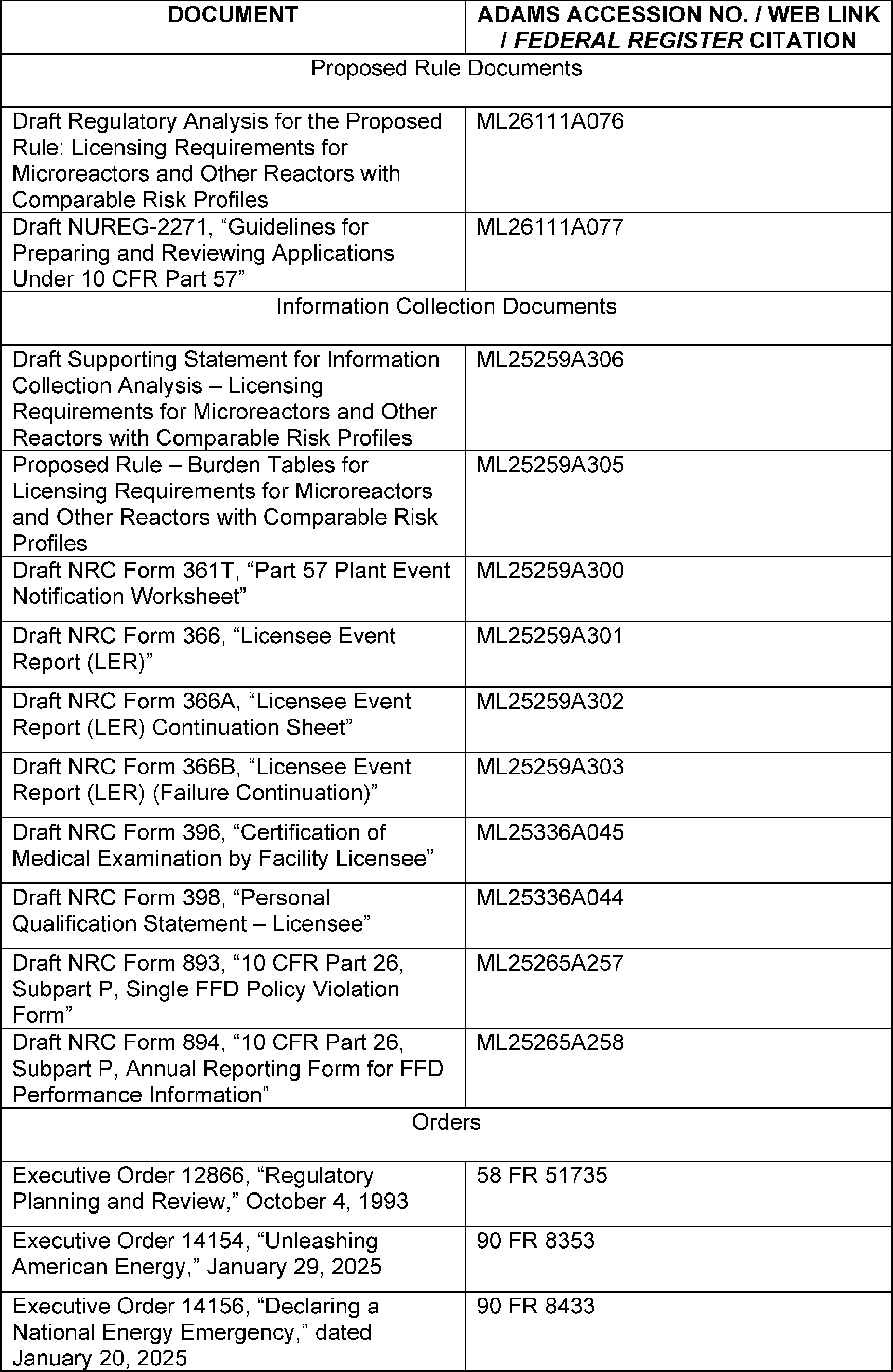
For more information, please see the draft regulatory analysis (available in the NRC's Agencywide Documents Access and Management System (ADAMS) Accession No. ML26111A076).
Please refer to Docket ID NRC-2025-0379 when contacting the NRC about the availability of information for this action. You may obtain publicly available information related to this action by any of the following methods:
NRC's Agencywide Documents Access and Management System (ADAMS):
You may obtain publicly available documents online in the ADAMS Public Documents collection at
https://www.nrc.gov/reading-rm/adams.html.
To begin the search, select “Begin Web-based ADAMS Search.” For problems with ADAMS, please contact the NRC's Public Document Room (PDR) reference staff at 1-800-397-4209, at 301-415-4737, or by email to
PDR.Resource@nrc.gov.
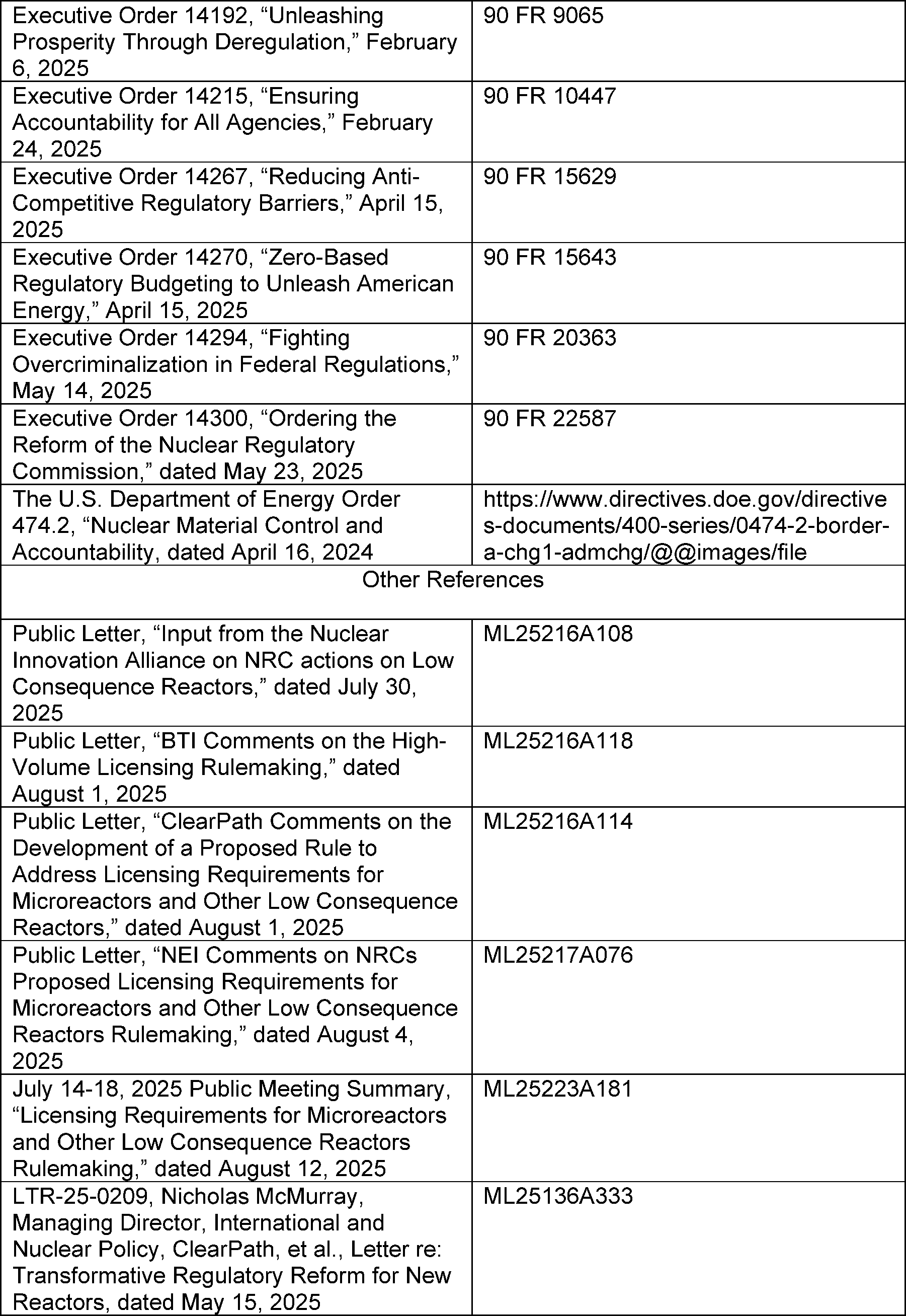
For the convenience of the reader, instructions about obtaining materials referenced in this document are provided in the “Availability of Documents” section.
NRC's PDR:
The PDR, where you may examine and order copies of publicly available documents, is open by appointment. To make an appointment to visit the PDR, please send an email to
PDR.Resource@nrc.gov
or call 1-800-397-4209 or 301-415-4737, between 8 a.m. and 4 p.m. eastern time, Monday through Friday, except Federal holidays.
Public Meeting:
The NRC may conduct a public meeting to describe the proposed amendments and answer questions from the public on the proposed rule. If the NRC determines it will hold a public meeting, NRC will publish a notice of the location, time, and agenda of the meeting on the NRC's public meeting website within 10 calendar days of the meeting. Stakeholders should monitor the NRC's public meeting website for information about the public meeting at:
https://www.nrc.gov/public-involve/public-meetings/index.cfm.
B. Submitting Comments
Comments must be submitted electronically using
https://www.regulations.gov
by 11:59 p.m. eastern time on June 15, 2026. Please include Docket ID NRC-2025-0379 in your comment submission.
The NRC cautions you not to include identifying or contact information that you do not want to be publicly disclosed in your comment submission. The NRC will post all comment submissions at
https://www.regulations.gov
as well as enter the comment submissions into ADAMS. The NRC does not routinely edit comment submissions to remove identifying or contact information.
If you are requesting or aggregating comments from other persons for submission to the NRC, then you should inform those persons not to include identifying or contact information that they do not want to be publicly disclosed in their comment submission. Your request should state that the NRC does not routinely edit comment submissions to remove such information before making the comment submissions available to the public or entering the comment into ADAMS.
On May 23, 2025, President Donald J. Trump signed Executive Order (E.O.) 14300, “Ordering the Reform of the Nuclear Regulatory Commission.” Section 5, “Reforming and Modernizing the NRC's Regulations,” requires the NRC to undertake a review and wholesale revision of its regulations and guidance documents as guided by the policies set forth in section 2 of the E.O. This rulemaking addresses section 5(e), which requires the NRC to “[e]stablish a process for high-volume licensing of microreactors and modular reactors, including by allowing for standardized applications and approvals and by considering to what extent such reactors or components thereof should be regulated through general licenses.”
III. Background
A. Characteristics of Microreactors and Other Reactors With Comparable Risk Profiles
The microreactors and other reactors with comparable risk profiles that would be licensed under this proposed rule would be commercial nuclear reactors under section 103, “Commercial Licenses,” of the Atomic Energy Act of 1954, as amended (AEA). Due to their expected small sizes, low power levels, potential mobility, and simplicity of operation compared to the current fleet of operating power reactors, microreactors and other reactors with comparable risk profiles may be useful, for example, for remote communities, non-electric industrial processes, military bases, maritime applications, disaster relief, and other applications where a grid connection is unreliable or nonexistent.
Microreactors and other reactor concepts with comparable risk profiles encompass a wide variety of reactor designs, including fuel forms, coolant types, and power levels. These concepts often incorporate inherent and passive safety design features that distinguish them from the large light water reactors
( printed page 23631)
in the current operating fleet. Fuel forms vary widely, from traditional light water reactor fuel assemblies to advanced fuels such as tri-structural isotropic (TRISO) particles, metallic fuels, and liquid fuels. Coolants include water, liquid metals (
e.g.,
sodium, lead), inert gases (
e.g.,
helium), and various molten salts. Power outputs range from only a few kilowatts to several tens of megawatts, and designs may operate in either a fast or thermal neutron spectrum. These diverse technical approaches reflect the industry's pursuit of reactor systems optimized for specific missions, operational environments, and market applications.
Based on input from stakeholders (see section III.B, “Public Interest in Microreactors and Other Reactors with Comparable Risk Profiles,” of this document), the NRC anticipates that microreactors and other reactors with comparable risk profiles would rely heavily on standardization of design features and mass production to simplify licensing and deployment. Some reactors may be “self-contained” in that they would incorporate the reactor, shielding, and balance of plant in one or several transportable containers and require minimal site preparation or construction activities at the deployment site. Other designs may consist of a nuclear reactor that would be fabricated in a manufacturing facility and then incorporated into or connected to the permanent structures and systems of a nuclear plant constructed at the deployment site, such as a reactor building and power conversion equipment.
The NRC understands that deployment models for microreactors and other reactors with comparable risk profiles would include various activities involving NRC licensing, certification, or approval. These activities may include designing reactors, manufacturing at a manufacturing facility, loading fuel at a manufacturing facility, operating the reactors for testing at a manufacturing facility, transporting fueled reactors to deployment sites (loaded with unirradiated or irradiated fuel), operating the reactors for the production of electrical or heat energy at the deployment sites, replacing reactors at the deployment sites, transporting reactors away from the deployment sites at the end of their useful lives, decommissioning or refurbishing and refueling reactors at locations away from the deployment sites, and re-deploying refurbished reactors to deployment sites. Some microreactors and other reactors with comparable risk profiles may also use more “traditional” approaches, including constructing the reactor in its entirety, loading fuel, or performing operational testing at the deployment site. This proposed rule would provide processes and requirements that would enable all these potential deployment models.
B. Public Interest in Microreactors and Other Reactors With Comparable Risk Profiles
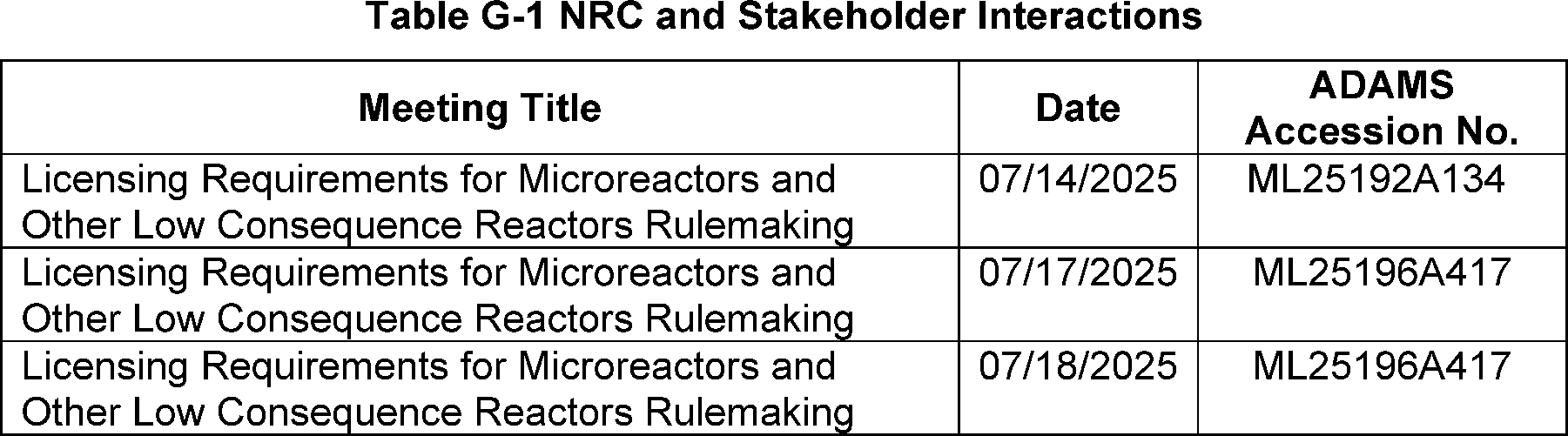
The NRC recognizes the public interest in the development and deployment of microreactors and other reactors with comparable risk profiles. For several years, the NRC has conducted advanced reactor stakeholder meetings to facilitate open communication between the agency, industry, and the public regarding regulatory policy, licensing pathways, and technical issues related to advanced reactors. These meetings covered a wide range of topics, including safety and security considerations, fuel qualification and transportation, siting and environmental review, emergency preparedness, quality assurance approaches, risk-informed and performance-based regulatory methods, and lessons learned from the licensing of non-power production or utilization facilities (NPUFs). Stakeholders have also discussed and presented strategies for streamlining licensing processes to accommodate the anticipated high licensing volumes associated with modular and transportable reactor concepts.
In addition to these public meetings, the NRC has received letters and formal reports from a broad spectrum of interested parties, including non-governmental organizations, policy organizations representing both the nuclear industry and public interest groups, national laboratories, and Federal, State, and local governmental entities. These submissions have provided perspectives on technical design features, operational considerations, safety analysis methodologies, environmental impacts, workforce development, and policy objectives for advanced reactor deployment. Many communications have highlighted the potential for microreactors to support energy resilience, remote power applications, industrial process heat, and national security missions.
A recurring theme in both the stakeholder discussions and the written correspondence has been the need for the NRC to develop a clear, predictable, and efficient regulatory framework that supports rapid licensing of new microreactors and other reactors with comparable risk profiles and high-volume deployment of these reactors. Several stakeholders emphasized that when a microreactor applicant demonstrates low radiological consequences at the site boundary in the unlikely event of an accident, the NRC should allow the use of a licensing approach similar to that established for NPUFs. Stakeholders have noted that such an approach—appropriately adapted for microreactors—would leverage proven regulatory structures, align safety requirements with actual risk, and reduce unnecessary regulatory burden while maintaining the NRC's safety and security standards.
IV. Discussion
A. Need for an Alternative Regulatory Framework
Rapid and high-volume deployment of microreactors and modular reactors is needed to support national policy and market demand. The Nuclear Energy Innovation and Modernization Act seeks to streamline licensing and reduce regulatory uncertainty for advanced reactor designs. The Accelerating Deployment of Versatile, Advanced Nuclear of Clean Energy Act requires the NRC to develop “risk-informed and performance-based strategies and guidance to license and regulate microreactors.” Executive Orders promote the development of domestic energy supplies to meet the increasing demand for electricity and direct the NRC to conduct this rulemaking. Market demand for baseload power has resulted in business cases for high-volume deployment of microreactors and modular reactors in markets where traditional large-scale nuclear power plants are impractical or uneconomical.
This proposed rule is needed to establish a regulatory framework specifically tailored to rapid licensing of first-of-a-kind microreactors and other reactors with comparable risk profiles and high-volume deployment of these reactors. The use cases for such reactors support energy resilience, remote power applications, and industrial process heat. The proposed framework would be based on simplified safety requirements and would maximize the benefits of standardization. The proposed processes and requirements in this rule would enable shorter licensing timeframes that require fewer resources than those supported by existing regulations for nuclear power reactors in part 50 and part 52, which were designed for stationary, large light water reactors (LWRs). This proposed alternative regulatory framework is also needed to address Presidential and Congressional direction and stakeholder feedback.
( printed page 23632)
B. Description of Proposed Licensing Framework
This proposed rule is complementary to and shares several features with part 53, “Risk-Informed, Technology-Inclusive Regulatory Framework for Commercial Nuclear Plants.” The part 53 rule features a risk analysis approach that accommodates licensing all reactor technologies, including microreactors and large, complex reactors. To complement this broad scope approach, proposed part 57 would rely on streamlined safety requirements to focus on simpler license applications and rapid licensing reviews of new reactors with less complex designs and operational characteristics and low potential radiological consequences. The major provisions and features of this proposed part 57 rule include the following:
1. Rapid Licensing Through Streamlined and Focused Safety Requirements
This proposed rule would provide a pathway to enable rapid licensing through streamlined and focused safety requirements, for microreactors and other reactors with comparable risk profiles. The proposed rule would leverage the simplified designs, limited nuclear inventory, and overall low risk profiles of these facilities to establish the necessary and sufficient regulatory requirements to provide for reasonable assurance of adequate protection. This approach would enable shorter licensing timeframes by streamlining the information needed to be prepared by applicants and reviewed by the NRC. The applicant would be required to submit final design information and complete operational programs in a joint application for a construction permit (CP) and associated operating licenses (OLs). The NRC would conduct a single, comprehensive safety review and potentially hold one adjudicatory hearing on the joint application. Time and resource savings would be achieved for qualifying “first-of-a-kind” and “nth-of-a-kind” designs without any adverse impact on safety and security.
2. High Volume Licensing
This proposed rule would enable high volume licensing based on standardization of reactor designs and operational programs. An applicant would have the option to request a single CP and any number of OLs for any number of nuclear reactors of essentially the same design to be built at one or more specific sites or within designated large geographical areas. Multiple applicants for essentially the same design would have the option to reference common non-site-specific information, and the NRC could consolidate some aspects of the licensing proceedings.
3. Rapid Deployment
This proposed rule would provide options for issuance of a CP to include approval of the final reactor design and operational programs, address siting and environmental requirements for large geographical areas or multiple specific sites, and satisfy requirements for mandatory and adjudicatory hearings if an applicant provided all necessary information in a joint application for a CP and associated OL(s). This could support licensing reactor operation within days of site selection for time-critical deployment, depending on the simplicity of onsite construction activities.
4. Multiple Licensing Pathways
The proposed rule would provide several licensing options for applicants to choose from to meet their deployment model or business case needs, including a joint application for a CP and associated OL(s), which would allow for deployment of reactors and approval of standard designs; a manufacturing license (ML), which would allow for approval and manufacture of standardized designs and approval of operational programs; and a standard design approval (SDA), which would allow for approval of entire reactor designs or major portions thereof. Applicants would be able to combine requests for these types of licenses and approvals with requests for license(s), approvals, and certifications under other regulations in a single application to holistically address their deployment strategies.
5. Request for Generic Finality
An applicant may include in its joint application for a CP and associated OL(s) a request for generic finality. Matters resolved in a proceeding on the application for issuance of the CP and associated OL(s) for which the applicant has requested and the Commission has granted generic finality would be considered resolved in proceedings on other joint applications under proposed part 57 that reference the approved CP or associated OL(s). For joint applications for “nth-of-a-kind” nuclear reactors and nuclear plants that reference CPs and associated OL(s) afforded generic finality, the scope of licensing proceedings would be reduced to site- and applicant-specific information.
6. Manufacturing License Provisions
The proposed rule would include the use of features to prevent criticality to allow reactors to be fabricated, fueled, and tested at a manufacturing facility before being transported to an operating site. This proposed rule would also allow ML applicants to request and the NRC to afford finality to the entire nuclear plant design and operational programs, thereby reducing the scope of proceedings on joint application for a CP and associated OL(s) that reference the ML to site- and applicant-specific information.
7. Categorical Exclusions
The proposed rule would permit the use of categorical exclusions from the requirement for the NRC to prepare an environmental assessment or environmental impact statement under the National Environmental Policy Act (NEPA), provided that specific conditions are met.
8. General Licensee for Construction
This proposed rule would establish a general license under which an applicant that files a joint application for a CP and associated OL(s) for a “nth-of-a-kind facility” could begin construction activities before the issuance of a CP, provided that certain conditions are met.
The proposed rule would allow a graded site characterization approach with use of existing site characterization data from Federal, State, or other organizations, provided that the data meets applicable NRC quality standards.
10. Applicant Defined Definitions
The definitions of many terms in this proposed rule would be equivalent to the corresponding terms defined in §§ 21.3, 50.2, and 52.1, all entitled “Definitions,” and other NRC regulations. However, given the variety of microreactor and other reactor designs with comparable risk profiles, flexibility is proposed to allow applicants to redefine applicable definitions to support their specific design and licensing basis needs, provided that such redefinitions are justified and supported by the applicant's safety analysis.
11. Codes or Standards
The proposed rule would allow applicants to propose, with adequate justification, the use of codes and standards appropriate for their reactor design and not incorporate by reference
( printed page 23633)
the specific codes and standards in 10 CFR 50.55a, “Codes and standards.”
12. Quality Assurance Program
The proposed rule would not impose quality assurance requirements under the existing regulations in appendix B, “Quality Assurance Criteria for Nuclear Power Plants and Fuel Reprocessing Plants,” to 10 CFR part 50. Instead, the proposed rule would allow the applicant to choose an industry-approved quality assurance program, similar to the approach taken in American National Standards Institute/American National Standard ANSI/ANS-15.8-1995 (R2018), “Quality Assurance Program Requirements for Research Reactors.”
13. Operational Programs
Information related to operational programs concerning facility operation could be standardized to facilitate fleet-wide deployment of a microreactor or other reactor with comparable risk profile. These standardized operational programs could be designed to be administered onsite or at a corporate or institutional level. Standard operational programs such as emergency preparedness and security plans would receive finality, to the extent practicable, for future applicants that reference those approvals.
14. Remote Monitoring, Remote Operation, and Autonomous Operation
This proposed rule would include provisions for applicants to specify design features for monitoring and operating a nuclear reactor from outside the site boundary and for autonomous performance of operations and safety functions. The NRC has posed a question in this proposed rule to obtain stakeholder feedback on remote operations and autonomous operations.
15. Operator Licensing and Human Factors
This proposed rule would adjust staffing, training, personnel qualifications, and human factors engineering requirements, and would include provisions for general licenses for reactor operators, to reflect the expectation that the role of operators would be reduced for microreactors and other facilities with comparable risk profiles as compared to the current fleet of large LWRs.
16. Flexible Processes for Changes
This proposed rule includes provisions for ML holders and holders of OLs that reference reactors manufactured under MLs to combine applications for license amendments or to make changes to the facility as described in the final safety analysis report (FSAR) without an amendment. Under certain conditions, holders of OLs for manufactured reactors would be able to implement the same changes approved by amendment to an ML without requesting amendments to their OLs that reference the ML. This would eliminate duplication of applications for NRC review of changes to manufactured reactors, including changes that might be made for improving safety or operational reliability.
17. Readiness for Operation Finding
This proposed rule would provide for the NRC to authorize reactor operation upon finding that reactor construction conforms to the approved design and license requirements instead of using inspections, tests, analyses, and acceptance criteria under 10 CFR part 52, which could delay this authorization.
18. Fitness-for-Duty Program Flexibility
This proposed rule would allow an applicant to propose an FFD program of its own specification if operator action would not be required to maintain the reactor within the criterion of proposed § 57.25(a) or a credible operator or maintenance error could not result in exceeding that criterion.
19. Resident Inspectors
The NRC does not anticipate stationing a full-time resident inspector at facilities licensed under this framework. Instead, this proposed rule would rely on targeted inspections and performance oversight.
20. Transportation
The proposed rule would add a provision that allows for a risk methodology to be used for evaluating normal and/or accident conditions in the event that an applicant cannot meet the testing and performance requirements of 10 CFR part 71, “Packaging and Transportation of Radioactive Material.”
21. Decommissioning and License Termination
The NRC is proposing the flexibility for applicants to develop decommissioning plans as part of the initial licensing process. This approach would offer greater flexibility, given the variety of design and operational strategies being considered. The proposed decommissioning framework primarily builds on the NPUF model while incorporating elements from the power reactor framework.
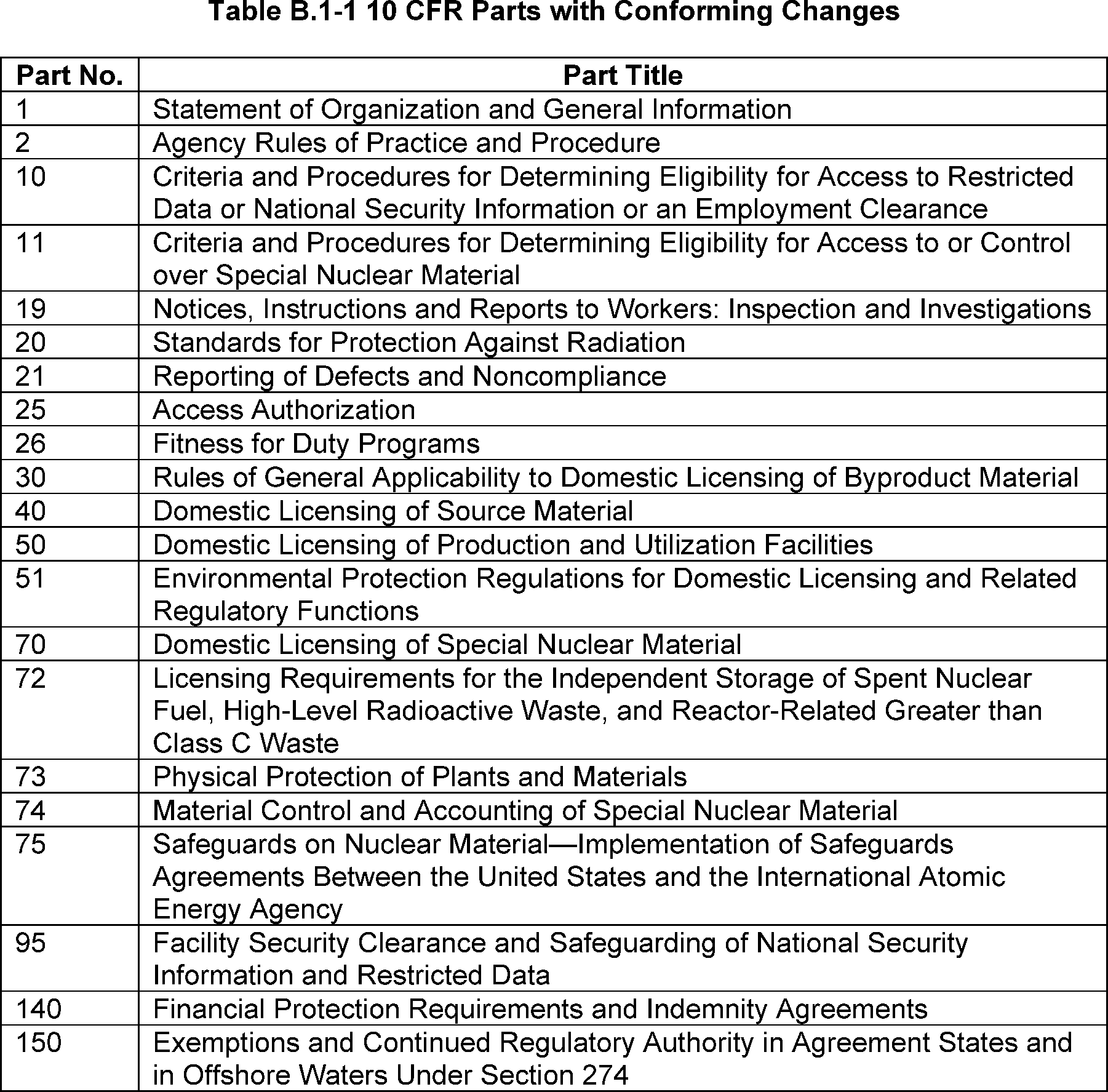
This proposed rule consists of several major components, including a new part 57, revisions to 10 CFR parts 26, “Fitness for Duty Programs,” and 73, “Physical Protection of Plants and Materials,” and conforming changes throughout 10 CFR chapter I to refer to part 57 where appropriate.
C. Utilization Facilities and General Licenses
E.O. 14300 directed the NRC to consider regulating microreactors or their components through general licenses. Stakeholders also have expressed interest in the possibility of the NRC using general licenses for these reactors or redefining “utilization facility” to exclude some nuclear reactors from the licensing requirements in section 103 of the AEA. The NRC considered these potential alternative approaches for high-volume licensing and regulation of nuclear reactors or fleets of reactors in developing this proposed rule. The NRC proposes that using a general license for regulation of construction activities for certain structures, systems, and components of nuclear reactors or nuclear plants would be the most practicable approach under this proposed rule.
The NRC considered whether it would be practicable to exclude certain reactors that would otherwise be licensed under proposed part 57 from the definition of “utilization facility” and regulate them under a different regulatory framework. The pertinent portions of the definition of “utilization facility” in section 11(cc) of the AEA are the following: “(1) any equipment or device, except an atomic weapon, determined by rule of the Commission to be capable of making use of special nuclear material in such quantity as to be of significance to the common defense and security, or in such manner as to affect the health and safety of the public . . .; or (2) any important component part especially designed for such equipment or device as determined by the Commission.” The AEA definition of a utilization facility allowed the Atomic Energy Commission (AEC), the NRC's predecessor, to determine by rulemaking which equipment or devices met the criteria for a utilization facility. By connecting the definition of a utilization facility to the quantity of special nuclear material involved and the manner the material is used, and that material's potential impact on the common defense and security and public health and safety, Congress ensured that the AEC's regulatory authority would encompass facilities whose operation involves radiological safety and security.
( printed page 23634)
The AEC promulgated a definition of “utilization facility” in 1956, now set forth at 10 CFR 50.2 and proposed for part 57, that was limited to “any nuclear reactor other than one designed or used primarily for the formation of plutonium or [uranium-233].” The AEC also defined “nuclear reactor” as an apparatus, other than an atomic weapon, designed or used to sustain nuclear fission in a self-supporting chain reaction. This definition, also part of this proposed rule, implements both criteria of the AEA's “utilization facility” definition. An apparatus designed or used to sustain nuclear fission in a self-supporting chain reaction meets the first criterion—capable of making use of special nuclear material (SNM) in such quantity as to be of significance to the common defense and security. Several current examples show that even a quantity of SNM less than what is required to support a self-sustaining fission reaction in a nuclear reactor is significant to the common defense and security. The U.S. Department of Energy Order 474.2A, “Nuclear Material Control and Accountability,” requires that quantities of uranium-235 or plutonium of 1 gram or larger are subject to that order and require material control and accounting and security programs. Additionally, the NRC defines a quantity of uranium-235 (contained in enriched uranium) in excess of 1 kilogram as being at least Category III material requiring material control and accounting and security requirements. Finally, the International Atomic Energy Agency's Nuclear Security Recommendation on Physical Protection of Nuclear Material and Nuclear Facilities states that a mass as small as 1 kilogram of uranium-235 (contained in enriched uranium) needs to be subject to physical security requirements. These examples are relevant to this proposed rule because all reactors that would be licensed under this proposed rule—each one an apparatus designed or used to sustain nuclear fission in a self-supporting chain reaction—would require more than these minimum amounts of SNM to operate.
An apparatus designed or used to sustain nuclear fission in a self-supporting chain reaction also meets the second criterion in the AEA definition of utilization facility—capable of making use of SNM in such manner as to affect the health and safety of the public. Decades of reactor licensing, including research reactors with power levels ranging from a few watts to several tens of megawatts, have shown that the use of SNM for self-sustaining fission reactions is capable of affecting public health and safety. Direct radiation from fission reactions, the creation and potential release of radioactive byproducts, and improperly-controlled (or uncontrolled) self-sustaining fission reactions can all affect public health and safety. Improper control of a self-sustaining fission reaction can cause significant and potentially very rapid increases in radiation levels, temperatures, and pressures, which is why the NRC requires appropriate regulatory controls that are different than those for devices that use SNM in other manners, such as a subcritical assembly for physics experiments or a neutron source for providing the initial neutrons needed to safely start up a nuclear reactor. These other devices have not typically been considered utilization facilities. The NRC anticipates that any nuclear reactor that would be licensed under proposed part 57 to use SNM for self-sustaining fission reactions for commercial purposes would clearly require controls to provide reasonable assurance of adequate protection of public health and safety.
The AEA definition of “utilization facility” requires that only the safety prong or security prong of the definition be met. The discussion of the safety and security prongs in this document suggests that any nuclear reactor would meet both prongs and constitute a utilization facility under the definition in the AEA, thereby warranting regulation by the NRC as such, consistent with the responsibilities and authorities conferred to the NRC by the AEA. The Commission has used its regulatory authority under sections 103 and 182(a) of the AEA to require technical specifications for utilization facilities to provide reasonable assurance of adequate protection of public health and safety. The NRC would continue to do so under this proposed rule.
The NRC considered whether it would be practicable to use the authority provided to the Commission by section 109(a) of the AEA to “issue general licenses for domestic activities required to be licensed under section [101 of the AEA] if the Commission determines in writing that such general licensing will not constitute an unreasonable risk to the common defense and security.” The AEA limits this authority “to those utilization and production facilities which are so determined by the Commission pursuant to section [11(cc)(2)] of [the AEA].” Section 11(cc) of the AEA is the definition of utilization facility, and section 11(cc)(2) of the AEA is “any important component part especially designed for [a utilization facility as defined in section 11(cc)(1) of the AEA] as determined by the Commission.” Thus, the NRC can issue a general license for any important component part especially designed for a utilization facility. The Commission proposes to use this authority to issue a general license in proposed § 57.45(d) for construction activities, subject to conditions in proposed § 57.45(d)(1) through (6) that would ensure that the general license would only be for any important component part especially designed for a utilization facility, not constitute an unreasonable risk to the common defense and security, and provide for adequate protection of the health and safety of the public. The proposed general license would potentially enable shorter deployment timeframes and is described in detail in section V.D of this document.
The NRC also considered whether it could include in proposed part 57 a general license for regulation of an entire utilization facility, meaning a utilization facility as defined in section 11(cc)(1) of the AEA. However, the AEA provides the NRC with the authority to issue general licenses only for utilization facilities as defined in section 11(cc)(2) of the AEA, meaning any important component part especially designed for an entire utilization facility. Therefore, in developing proposed part 57, the NRC did not consider general licensing of an entire utilization facility as viable under the current statutory structure. Instead, the proposed rule would include a licensing framework under section 103 of the AEA that would reduce the number of licensing actions, resources for their completion, and required NRC oversight associated with deployment of individual reactors or nuclear plants or fleets of such facilities, as described in section IV.B of this document.
V. Part 57 Framework
A. Discussion of Provisions in Proposed Part 57
Proposed part 57 is comprised of subparts A through Q. These subparts would provide performance criteria and would be organized to specify requirements to demonstrate compliance with those performance criteria throughout the major stages of the life cycle of microreactors and reactors with comparable risk profiles. The performance-based approach proposed in part 57 also would include regulatory requirements that would allow applicants to use a flexible and graded approach to the performance of
( printed page 23635)
safety functions based on the role of a particular structure, system, or component and limiting its impact on assessed radiological consequence to the public.
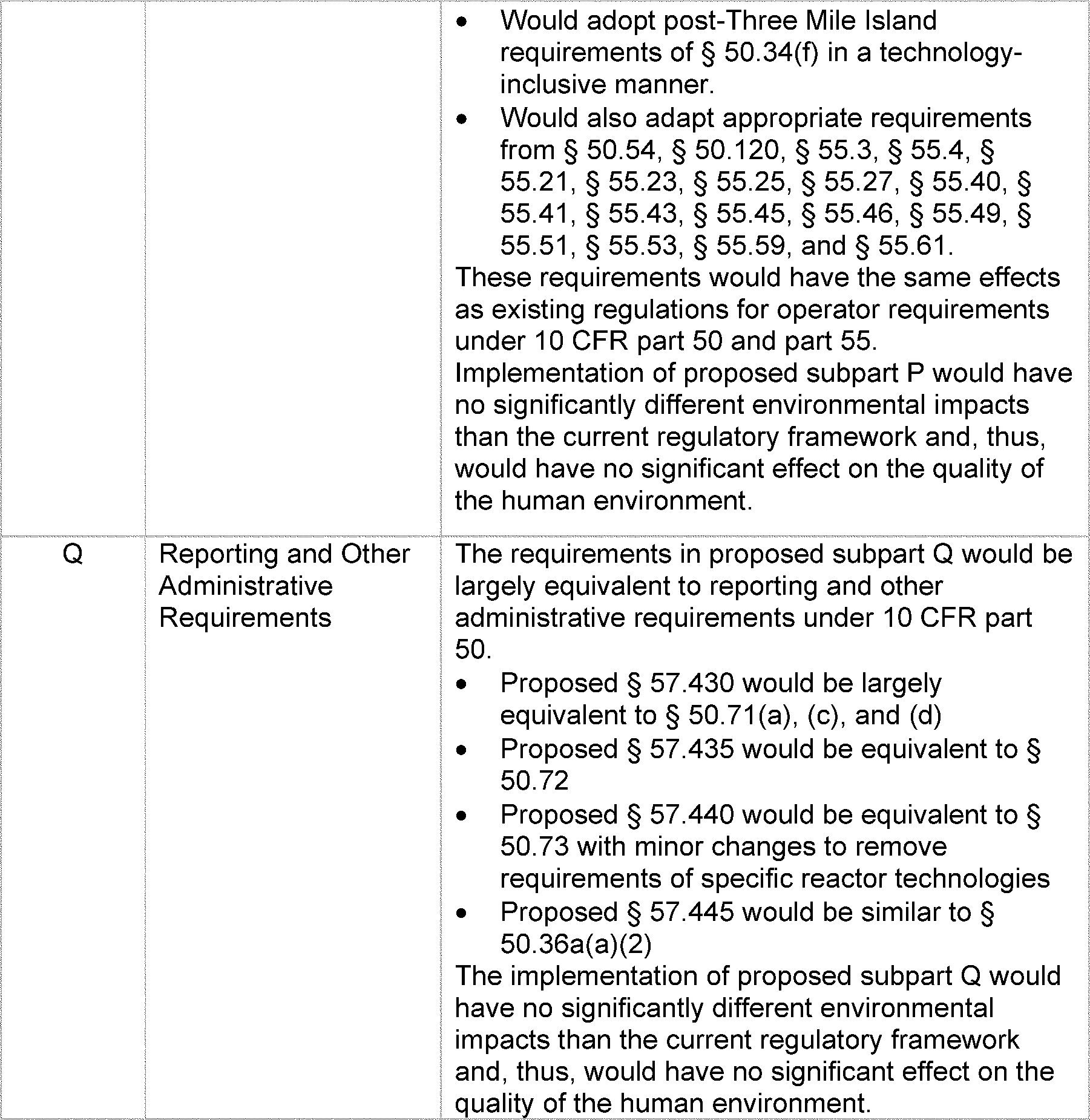
Proposed subpart P of part 26 would be new and would be largely consistent with the fitness-for-duty (FFD) requirements in current subpart K, “FFD Programs for Construction,” of part 26 supplemented by select requirements from subparts A through I, N, and O of part 26. These requirements are designed to ensure program effectiveness, maintain protections afforded to individuals subject to the FFD program, and align with FFD program implementation by parts 50 and 52 licensees. The proposed requirements would not be entirely equivalent with requirements in current subpart K of part 26 because the latter only applies during construction of the nuclear plant, whereas proposed subpart P of part 26 would apply during construction and operation. Furthermore, proposed subpart P of part 26 would allow the use of a variety of biological specimens for drug testing as well as innovative technologies for drug and alcohol screening and testing that are not described or allowed by the requirements in subparts A through K, N, and O of part 26, except under limited conditions.
Proposed part 57 would also include a technology-inclusive consequence-based approach for physical security and emergency preparedness for nuclear plants. The NRC used operating experience to propose additional regulatory flexibility for a part 57 licensee's implementation of security requirements. This proposed rule would also propose changes to part 73 for a technology-inclusive approach to cybersecurity. The proposed provisions for these operational programs are based on meeting the proposed entry criteria for part 57.
In addition, this proposed rule would make conforming changes throughout 10 CFR chapter I, by adding “and part 57” or similar language where appropriate to account for the addition of the proposed part 57.
B. Subpart A—General Provisions
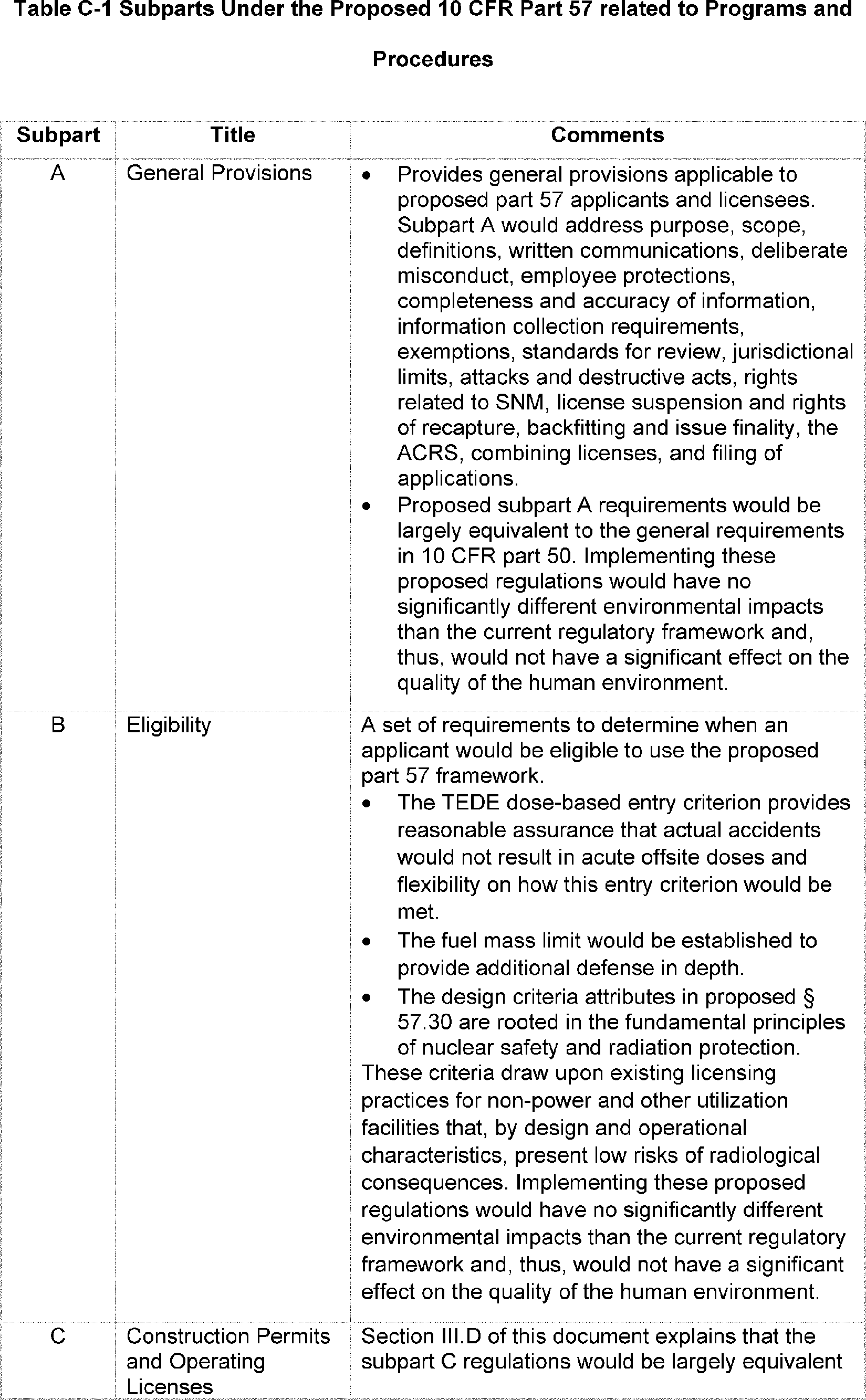
Subpart A would provide the general provisions applicable to all applicants and licensees under proposed part 57. Subpart A would include provisions on purpose, scope, definitions, written communications, deliberate misconduct, employee protections, completeness and accuracy of information, information collection requirements, exemptions, standards for review, jurisdictional limits, attacks and destructive acts, rights related to SNM, license suspension and rights of recapture, backfitting and issue finality, the Advisory Committee on Reactors Safeguards, combining licenses, and filing of applications.
1. Definitions in Proposed Part 57
This proposed rule would provide its own definitions section in proposed § 57.3, “Definitions.” The definitions of many terms in proposed § 57.3 would be equivalent to the corresponding terms defined in §§ 21.3, 50.2, 52.1, and other NRC regulations. However, given the variety of microreactor and other reactor designs with comparable risk profiles, proposed § 57.3 would provide flexibility by allowing applicants to redefine applicable definitions to support their specific design and licensing basis needs, provided that such redefinitions are justified and supported by the applicant's safety analysis. Definitions established by the application would not require an exemption from proposed part 57. The flexibility to provide new definitions would extend only to definitions defined in proposed part 57 and not to those terms defined by statute, such as “special nuclear material.” Specific proposed definitions are further explained in the following paragraphs.
The NRC proposes to include a definition of “Autonomous operation” in part 57 that would provide the means for applicants to present information regarding the performance of operational and safety functions without reliance on human intervention, external command, or active control system input under normal operations and accident conditions. The design of the microreactor with inherent safety features and active structures, systems, and components (SSCs) would govern what design functions need to be executed and/or monitored during normal, off-normal and accident conditions.
The proposed definition of “Certified fuel handler” would mean a non-licensed operator who is responsible for decisions on the safe conduct of decommissioning activities, safe handling and storage of spent fuel as defined in 10 CFR 72.3, “Definitions,” and appropriate response to plant emergencies. The certified fuel handler would need to be qualified in accordance with a fuel handler training program that meets the same requirements as training programs for non-licensed operators required by proposed § 57.420, “Training and qualification for non-licensed personnel.”
The proposed definition of “Consensus code or standard” would be based on the use of these terms in the National Technology Transfer and Advancement Act of 1995 (NTTAA) (Pub. L. 104-113) and the Office of Management and Budget (OMB) Circular No. A-119, “Federal Participation in the Development and Use of Voluntary Consensus Standards and in Conformity Assessment Activities.” As required by NTTAA, the NRC undertakes the following activities: (i) consults with voluntary consensus standards bodies; (ii) participates with voluntary consensus bodies in the development of consensus standards; and (iii) uses consensus standards to carry out the NRC's policy objectives.
The proposed definition of “Construction” is slightly different than the current definition in existing § 50.10, “License required; limited work authorization.” The proposed definition would differ from the current § 50.10 definition in that it would apply to only safety-related SSCs (as defined in proposed part 57) and SSCs relied upon to implement the proposed security requirements.
The proposed definition of “Control room” would provide a means for remote monitoring and/or remote operation outside the site boundary where actions can be taken to operate the nuclear power unit safely under normal conditions and to maintain it in a safe condition under accident conditions.
The proposed definition of “Decommission” would be slightly different than the definition in § 50.2. The proposed definition would also include permanent removal of an individually licensed nuclear reactor.
The proposed definition of “Defense in depth” would provide a philosophy of designing a nuclear facility that includes two or more independent and redundant layers of defense in the design of a facility and its operating procedures to compensate for uncertainties such that no single layer of defense, no matter how robust, is exclusively relied upon. Defense in depth includes, but is not limited to, the use of access controls, physical barriers, redundant and diverse safety functions, and emergency response measures.
The proposed definition of “Design bases” would be the information that identifies the specific functions to be performed by an SSC of a facility, and the specific values or ranges of values chosen for controlling parameters as reference bounds for design. These values may be (1) restraints derived from generally accepted “state-of-the-art” practices for achieving functional
( printed page 23636)
goals, or (2) requirements derived from analysis (based on calculation and/or experiments) of the effects of a postulated accident for which an SSC must meet its functional goals.
The proposed definition of “Design features” would be the active and passive SSCs and inherent characteristics of those SSCs that contribute to limiting the total effective dose equivalent (TEDE) to individual members of the public during normal operations and prevent or mitigate the consequences of design basis accidents.
The proposed definition of “Fission product release” would be the amount and composition of radioactive material released to the environment, after accounting for any retention of radionuclides provided by reactor design features.
The proposed definition of “Fuel” would be SNM or source material, discrete elements that physically contain SNM or source material, and homogeneous mixtures that contain SNM or source material, intended to or used to create power in a nuclear reactor.
The proposed definition of “Licensing basis information” would be the information contained in regulations, orders, licenses, certifications, or approvals issued by the NRC for a nuclear plant licensed under proposed part 57 and that information submitted to the NRC by an applicant or licensee in a safety analysis report, program description, or other licensing-related document required under proposed part 57.
The proposed definition of “Manufactured reactor” would be the essential portions of a nuclear reactor that are manufactured under an ML and subsequently incorporated into a nuclear plant under a construction permit issued under subpart C of proposed part 57.
The proposed definition of “Manufacturing license” would be a license issued under subpart D of proposed part 57 that authorizes the production of manufactured reactors but not their construction, installation, or operation.
The proposed definition of “Programmatic controls and operational programs” would be administrative procedures that govern human action in implementing programs and operating, monitoring, and maintaining SSCs and equipment of a nuclear plant. Programmatic controls could be standardized to facilitate fleet-wide deployment of a microreactor. These standardized operational programs could be designed to be administered on site or at a corporate or institutional level. Implementation milestones for each operational program would need to be described depending on whether the program will be implemented all at once or on a phased basis.
The proposed definition of “Quality assurance” (QA) would be planned and systematic actions during design, construction, and modification necessary to provide adequate confidence that the SSC will perform satisfactorily in service.
The proposed definition of “Remote monitoring” would mean observing plant data from a location outside of the site boundary. Remote monitoring does not include the performance of any operator actions necessary to manipulate the reactor to protect the public health and safety (
i.e.,
remote operations). However, remote monitoring could be used to access real-time data needed to perform other functions that protect the public health and safety, such as emergency preparedness or security. The ability to protect the public would be dependent upon having accurate and timely access to the plant-monitored parameter data. Wireless communication could be used to support remote monitoring.
The proposed definition of “Remote operation” would be to command and control the reactor from a location outside of the site boundary. Industry has indicated that the design of a microreactor with inherent safety features and active SSCs would govern what design functions need to be executed and/or monitored during normal, off-normal, and accident conditions.
The proposed definition of “Safe shutdown” would be bringing the nuclear reactor to safe, stable conditions specified in plant technical specifications when the reactor is under design basis accident conditions with loss of emergency power and offsite power.
The proposed definition of “Safety function” would be the purpose served by a design feature, human action, or programmatic control to prevent or mitigate unplanned events and thereby demonstrate compliance with requirements in proposed part 57 for limiting risks to public health and safety. Safety functions could be performed by any combination of the elements supported by the safety analysis and could be specified at the plant level or at the level of a particular barrier or system. Multiple plant-level safety functions would be assumed to apply to all reactor designs based on established requirements and historical practices. These fundamental safety functions would include the control of reactivity, removal of heat, and limiting the release of radioactive materials. The protection of a specific barrier or system that contributes to meeting plant-level safety criteria could also be referred to as a safety function.
The proposed definition of “Safety-related structures, systems and components” is slightly different than the definition in § 50.2. Whereas the § 50.2 definition refers to “events,” the proposed definition would refer to “accidents.” Design basis accidents bound events. Also, where the § 50.2 definition refers to a reactor coolant pressure boundary, the proposed definition would be technology neutral because some reactor designs under proposed part 57 may not operate at pressure.
The proposed definition of “Source term” would be the magnitude and mix of the radionuclides released from the fuel, expressed as fractions of the fission product inventory in the fuel, as well as their physical and chemical form, and the timing of their release. The source term would be developed by the applicant when performing the maximum hypothetical accident (MHA) or maximum credible accident (MCA) methodology. This source term would then be analyzed with site parameter information to demonstrate compliance with the accident dose-based entry criterion in proposed § 57.25(a).
The proposed definition of “Special nuclear material” would be (1) plutonium, uranium-233, uranium enriched in the isotope-233 or in the isotope-235, and any other material that the Commission, pursuant to the provisions of section 51 of the AEA, determines to be SNM, but does not include source material; or (2) any material artificially enriched by any of the foregoing, but does not include source material.
2. Other General Provisions
Proposed § 57.4, “Written communications,” would govern written communications and how applications and other required information must be submitted to the NRC. These requirements would be equivalent to those in § 50.4, “Written communications.”
Proposed § 57.5, “Deliberate misconduct,” would establish requirements for enforcement action to which a licensee, an applicant, or a licensee's or applicant's contractor or subcontractor, or an employee of any of them, may be subject for engaging in deliberate misconduct. These requirements would be equivalent to those in § 50.5, “Deliberate misconduct.”
( printed page 23637)
Proposed § 57.6, “Employee protection,” would prohibit discrimination against an employee of a holder or applicant for an NRC license, permit, or SDA, or a contractor or subcontractor of a holder or applicant for an NRC license, permit, or SDA for engaging in certain protected activities. Proposed § 57.6 also would prescribe a procedure for seeking a remedy for employees who believe they have been discriminated against for engaging in such protected activities. These requirements would be equivalent to those in §§ 50.7 and 52.5, both entitled “Employee protection.”
Proposed § 57.7, “Completeness and accuracy of information,” would govern the completeness and accuracy of information provided to the NRC. These requirements would be equivalent to those in §§ 50.9 and 52.6, both entitled “Completeness and accuracy of information.”
Proposed § 57.8, “Information collection requirements: OMB approval,” would establish requirements for information collection requirements and OMB approval. These requirements would be equivalent to those in § 50.8, “Information collection requirements: OMB approval.”
Proposed § 57.9, “Specific exemptions,” would govern exemptions from the requirements of the regulations in proposed part 57. These requirements would be equivalent to those in §§ 50.12 and 52.7, both entitled “Specific exemptions.”
Proposed § 57.11, “Jurisdictional limits,” would require that no license or SDA issued under proposed part 57 would cover activities that are not under or within the jurisdiction of the United States. These requirements would be equivalent to those in § 50.53, “Jurisdictional limitations.”
Proposed § 57.12, “Attacks and destructive acts,” would state that licensees, holders of standard design approvals, and applicants for licenses and standard design approvals would not be required to provide design features or other measures for the specific purpose of protection against the effects of attacks and destructive acts by enemies of the United States directed against the facility or deployment of weapons incident to U.S. defense activities. These requirements would be equivalent to those in § 50.13, “Attacks and destructive acts by enemies of the United States; and defense activities.”
Proposed § 57.13, “Rights related to special nuclear material,” would establish requirements for rights related to SNM. These requirements would be equivalent to those in § 50.54(b) and (c).
Proposed § 57.14, “License suspension and rights of recapture,” would establish requirements for license suspension and rights of recapture of the material or control of the facility in a state of war or national emergency declared by Congress. These requirements would be equivalent to those in § 50.54(d).
Proposed § 57.15, “Agreement limiting access to Classified Information,” would address requirements for agreements limiting access to classified information and would be equivalent to § 50.37, “Agreement limiting access to Classified Information.”
Proposed § 57.16, “Backfitting and issue finality,” would address backfitting requirements by providing requirements that would be equivalent to those in § 50.109, “Backfitting,” and issue finality requirements by providing requirements that would be equivalent to those in §§ 52.83(a), 52.145, “Finality of standard design approvals; information requests,” and 52.171, “Finality of manufacturing licenses; information requests.” An exception is that proposed § 57.16(c) would not include an equivalent requirement to § 52.171(b)(2), which requires the Commission to determine that departures will comply with the requirements in § 52.7 and that the special circumstances for the departure would outweigh any decrease in safety that may result from the reduction in standardization caused by the departure. Proposed § 57.16(c) would instead require the joint application for the referencing CP and OL(s) to include analysis of departures from the design characteristics, site parameters, terms and conditions, or approved design of the nuclear reactor, nuclear plant, or manufactured reactor. Proposed § 57.16(c) would also specify that analysis would not be required for departures from any operational programs or requirements approved with the referenced CP, OL, or ML that are not material to the adequacy of the design, if the joint application includes proposed alternative operational programs or requirements. Under proposed § 57.16(c), all departures would be subject to litigation in the same manner as other issues in the CP or OL, which would be equivalent to § 52.171(b)(2).
Proposed § 57.17, “Referral to the Advisory Committee on Reactor Safeguards (ACRS),” would address referral to the Advisory Committee on Reactor Safeguards (ACRS) and would be equivalent to §§ 50.58, “Hearings and report of the Advisory Committee on Reactor Safeguards,” 52.141, “Referral to the Advisory Committee on Reactor Safeguards (ACRS),” and 52.165, “Referral to the Advisory Committee on Reactor Safeguards (ACRS).”
Proposed § 57.18, “Combining licenses; elimination of repetition; relationships between subparts,” would address combining applications and would be equivalent to §§ 50.31, “Combining applications,” 50.52, “Combining licenses,” and 52.8, “Combining licenses; elimination of repetition.” Proposed § 57.18 would also provide clarity about various combinations of licenses and contents of related applications that would enable various high-volume deployment strategies. While proposed part 57 clearly outlines the licensing framework for combining licenses for multiple reactors, multiple sites, manufacturing, possession of special nuclear material, and other deployment activities, this licensing framework largely exists under other parts of 10 CFR chapter I, such as parts 50, 52, and 53.
Proposed § 57.18(a)(1) would include a provision for applications that would be filed under proposed part 57 by one or more applicants for licenses to construct and operate nuclear reactors or nuclear plants of essentially the same design to be located at different sites, to refer to a single FSAR. This proposed provision would be similar to the provisions in appendix N to part 50, “Standardization of Nuclear Power Plant Designs: Permits To Construct and Licenses To Operate Nuclear Power Reactors of Identical Design at Multiple Sites.”
Proposed § 57.18(a)(2) would include a provision that an applicant may include in one application for a CP and associated OL(s) for a nuclear reactor or nuclear plant under proposed part 57 information for multiple sites at which the applicant proposes to construct and operate the reactor or plant. This proposed provision would allow for licensing construction and operation of a single nuclear reactor or nuclear plant at multiple locations over its lifetime, such as for operational testing at a manufacturing facility and power operation at a deployment site.
Proposed § 57.18(a)(3) would require an application under proposed part 57 for multiple types of permits, licenses, or certifications to clearly indicate to which permit, license, or certification information in the application pertains. This proposed requirement would facilitate the NRC's review of the application by ensuring that the NRC would apply the appropriate proposed requirements (
e.g.,
standards of review, issuance, hearings, finality, etc.) to the information in the application.
( printed page 23638)
Proposed § 57.18(a)(4) would include provisions for holders of OLs that reference the same ML to combine among themselves, or with the holder of the ML, applications for license amendments under proposed § 57.310, “Amendment of license.” This proposed provision would potentially decrease the overall resources that would be required for applicants and the NRC for identical requests for amendments to multiple licenses as opposed to separate filings and reviews of each application for amendment.
Proposed § 57.18(a)(5) would specify that an applicant may include in a single joint application a request for a CP for any number of nuclear reactors of essentially the same design that would be built at a specific site and requests for OLs for those reactors, provided that the application would state the earliest and latest dates for completion of the construction of each nuclear reactor as would be required by proposed § 57.55(g) and would include the information that would be specified in proposed § 57.60(a)(4). This proposed provision would potentially reduce applicant and NRC resources related to licensing a nuclear plant at which multiple nuclear reactors of essentially the same design would be operated over its lifetime, including replacement reactors.
Proposed § 57.18(b), (d), and (e) would include provisions for incorporating by reference information contained in previous applications, statements, or reports filed with the Commission and applicable Commission approvals issued under part 50 or 52; referencing a standard design approval, CP, OL, ML, or combination thereof, that would be issued under proposed part 57; and referencing a relevant U.S. Department of War or U.S. Department of Energy authorization for a utilization facility that has been tested and that has demonstrated the ability to function safely, respectively. These provisions would allow applicants and the NRC to minimize duplication of previous efforts in filing and reviewing applications under proposed part 57.
Proposed § 57.18(c) would continue the Commission's practice of combining multiple authorizations for a licensee under various parts of 10 CFR chapter I into one license based on the Commission's authority under section 161(h) of the AEA to combine NRC licenses.
Proposed § 57.19, “Filing of application,” would address filing of applications and would be equivalent to §§ 50.30, “Filing of application; oath or affirmation,” 52.135, “Filing of applications,” and 52.155(a). Proposed § 57.19(f) would require an applicant for licenses to construct and operate one or more nuclear reactors under subpart C of proposed part 57 to file a joint application for a CP and associated OL(s). Proposed § 57.19(f) would also require that the joint application include the information specified in proposed §§ 57.55, “Content of applications; general information,” and 57.60, “Content of applications; technical information,” and be complete enough to permit all evaluations necessary for the issuance of the requested CP and the associated OL(s) upon the NRC making the finding required by proposed § 57.100(b)(1) (
i.e.,
the finding that construction has been substantially completed). The joint application would permit the NRC to use the regulations in § 2.105(c) to specify in the notice of proposed issuance of the CP that on completion of construction and the NRC making the finding that would be required by proposed § 57.100(b)(1), the associated OL(s) would be issued without further prior notice, thus streamlining the process for issuance of the associated OL(s) and reducing the timeframe for licensing.
C. Subpart B—Eligibility
The NRC based the development of the proposed part 57 framework on existing licensing practices for non-power and other utilization facilities that, by design and operational characteristics, present low risks of radiological consequences. These characteristics have designers approach safety by emphasizing accident prevention with inherent self-limiting reactivity feedback mechanisms and passive safety systems for heat and decay heat removal without reliance on complex active safety systems. The NRC used these characteristics to create a set of requirements to determine which applicants would be eligible to use proposed part 57. Located in proposed §§ 57.25, “Applicability,” and 57.30, “Design criteria attributes,” these proposed requirements are termed “entry criteria” and “design criteria attributes,” respectively.
Given the wide range of reactor types and their functional characteristics, this proposed rule would emphasize the “attributes” of microreactors and other reactors with comparable risk profiles. Rather than defining these reactors in terms of thermal power level, this attribute-based approach would describe microreactors and other reactors with comparable risk profiles in terms of their functional characteristics, such as the capability to prevent or mitigate accidents without active systems or operator intervention. By doing so, the NRC recognizes that reactors with inherently safe design features and more favorable safety profiles may appropriately be designed with higher power levels than other reactor designs.
The first eligibility criterion would be a dose-based acceptance value. The second eligibility criterion would be an upper limit on the amount of fuel. These eligibility criteria are intended to screen in reactor designs that are smaller, simpler, and more conducive to rapid, high-volume licensing. These eligibility criteria would be supported by six design criteria attributes. These design criteria attributes emphasize the features of inherently and passively safe reactors that make them secure and protective against radiological harm. These attributes include (1) reactivity control, (2) heat removal, (3) fission product retention, (4) shielding, (5) radioactive effluents control, (6) security by design. If an applicant for a reactor design does not meet these criteria, they can apply for a license under a different regulatory framework.
1. Dose-Based Entry Criterion
A dose-based entry criterion under accident conditions would be used to inform the analysis of postulated accidents and the development of safety measures so that, in the unlikely event of an accident, there is assurance that no acute radiation-related harm will result to any member of the public. The Commission has found the use of a dose-based entry criterion to be adequate for facility siting and design purposes based on decades of extensive experience in the criterion's application and in recognition of the assumptions and considerations applied within the radiological consequence analyses. While the dose-based entry criterion would be computed in terms of dose, it is a figure of merit used to characterize the minimum requirements for design, fabrication, construction, testing, operational limits, and performance for safety-related SSCs. The numerical value of the criterion does not represent acceptable or actual public exposures received during normal and emergency conditions, which are primarily controlled by 10 CFR part 20, “Standards for Protection Against Radiation,” and through emergency planning.
An applicant would be required to demonstrate their reactor design meets the 1 rem (10 millisieverts (mSv)) TEDE dose-based entry criterion in proposed § 57.25(a), and the NRC has found that the maximum hypothetical and
( printed page 23639)
maximum credible accident methodologies would be acceptable means of providing this demonstration. These methodologies are associated with a fission product release accompanying damage to fission product retention barriers, maximum allowable leak rates, a postulated single failure of any safety-related SSCs, conservative site meteorological dispersion characteristics, and an individual member of the public presumed to be at the location of maximum cumulative dose in the unrestricted area without protective actions. By demonstrating under these conservative assumptions that, in the unlikely event of an accident, the dose to the maximally exposed individual member of the public in the unrestricted area would remain below the accident dose acceptance criterion, there is reasonable assurance that actual accidents would not result in acute offsite doses.
Historically, NRC licensing processes have relied on deterministic bounding analyses that, while conservative, may impose unnecessary siting, design, and operational constraints on advanced reactor designs with inherent and highly reliable passively safe reactor technologies. The Commission recognizes the need for flexibility in how applicants define their licensing basis to reflect the diversity of microreactors and other reactor designs with comparable risk profiles. Proposed part 57's inclusion of both the MHA and MCA methodologies provides risk-informed and performance-based regulatory pathways that align the applicant's safety analysis scope with the complexity and safety characteristics of their design. Proposed part 57 distinguishes between the MHA and the MCA with respect to the amount of analytical rigor necessary to justify the derived source term. By distinguishing between the MHA and MCA approaches, the Commission would allow applicants to tailor the scope and depth of their accident analyses to their design and business model needs while continuing to ensure safety.
The source term defines the magnitude and mix of the radionuclides released from the fuel, expressed as fractions of the fission product inventory in the fuel, as well as their physical and chemical form, and the timing of their release. The applicant would utilize their MHA or MCA source term to establish the site boundary and determine the level of design, qualification, testing, and maintenance of SSCs necessary to show with reasonable assurance that the radiological consequences at the site boundary are below the 1 rem TEDE entry criterion of proposed § 57.25(a).
Depending on the desired level of analysis, applicants may select either the MHA or MCA approach. The MHA approach can demonstrate safety through a postulated accident scenario, often highly conservative, which assumes a severe release of radioactive material consistent with physical laws, regardless of probability. This MHA analysis does not rely on detailed risk-informed assessment methodologies, thereby reducing analytical complexity for reactors with few to no active systems or self-limiting physical phenomena. The MHA approach may be desirable for applicants that are willing to accept additional conservatism by leveraging simplified analyses that are less time and resource intensive. Although the MHA may not necessarily reflect a realistic or credible sequence of events, it represents a bounding case to support subsequent safety decisions.
If an applicant does not wish to accept the conservatisms associated with the MHA approach, further analyses would need to be performed to support an MCA approach. The MCA approach excludes certain physically unrealistic or excessively conservative assumptions, focusing instead on events that are credible given the technology, safety systems, and plant operating conditions. The MCA analysis can leverage a variety of modern risk-informed methodologies to credibly quantify events and consequences, providing a rational basis for a smaller site boundary and focused SSC categorization and potentially reducing the number of components subject to the more stringent safety requirements.
Two identical reactor designs could, in principle, yield different site boundary distances and safety classifications depending on whether their analyses employ the MHA or MCA methodology. Under the MHA approach, conservative bounding assumptions, such as postulated worst-case system failures and maximum radionuclide release, would produce a larger source term necessitating a greater site boundary and broader safety classification of SSCs. In contrast, an MCA analysis that quantifies system performance and reliability could justify a smaller, more realistic source term and a correspondingly smaller site boundary and narrower safety classification. Both outcomes would be acceptable under proposed part 57's consequence-based framework because each would provide reasonable assurance that offsite radiological consequences remain below the 1 rem TEDE entry criterion. The preferred approach would likely depend on the scope and depth of analysis the applicant wishes to undertake. Applicants would need to be clear on which approach is being applied, and analyses would have to be supported by appropriate and sufficient technical justifications.
The NRC is providing flexibility on how the TEDE dose-based entry criterion would be met in recognition of the need for expedited licensing and deployment of the types of facilities on which proposed part 57 is focused. Including both the MHA and MCA methodologies supports the Commission's regulatory modernization goals by encouraging innovation in reactor design while maintaining a consistent safety objective. Furthermore, this graded approach would enable efficient licensing reviews by aligning analytical rigor with risk significance without diminishing safety assurance. Under this proposed framework, applicants should discuss their plans for use of an MHA or MCA with the NRC staff prior to submittal of an application. This would ensure there is common understanding of the applicant's approach and would allow for resolution of any issues before development of a complete application.
2. Fuel Mass Limit
The premise of this proposed rule is to establish regulatory requirements commensurate with the low hazards posed by facilities that would be licensed under proposed part 57. These requirements would be justified by the use of a dose-based entry criterion applied to the results of a maximum hypothetical or maximum credible accident that assesses siting and the performance of safety-related SSCs. This would also be true for large LWRs with a very large site boundary. However, many of the traditional requirements that the NRC considered when creating this proposed rule have historically provided defense in depth to address unlikely events that may exceed analyzed releases. Traditional requirements include the Commission's historical treatment of severe accidents based on lessons learned from operating large LWRs. Examples of these regulations include: 10 CFR 50.46, “Acceptance criteria for emergency core cooling systems for light-water nuclear power reactors,” for assessing large-break loss of coolant accidents; 10 CFR 50.155, “Mitigation of beyond-design-basis events,” for flexible mitigation strategies for beyond-design-basis events; and several part 52 requirements for severe accident design features.
( printed page 23640)
The fuel mass limit entry criteria would deterministically screen reactor designs without additional performance-based acceptance criterion or severe accident analysis to assess events beyond which SSCs could be challenged. The fuel mass limit entry criteria would be established to provide additional defense in depth for these very unlikely events by limiting the amount of decay heat that may necessitate the need for active cooling systems and overall material available for release, further limiting the potential for causing acute health effects to the public. However, the NRC has proposed a question in this proposed rule, asking whether, in lieu of applying a deterministic material limit on the quantity of SNM, the NRC should apply an alternative performance-based acceptance criterion such as an adiabatic heat rate threshold, beyond which SSCs could be challenged.
To assist in developing a quantitative basis for such a limit, the NRC reviewed and evaluated the quantities of SNM in the cores of several reactor types. In evaluating the quantities of SNM, the NRC determined the quantities of uranium (U) and plutonium (Pu). This includes the following isotopes: [1]
U-233, U-234, U-235, U-236, U-238, Pu-236, Pu-238, Pu-239, Pu-240, Pu-241, Pu-242, and Pu-244. For technological neutrality, the mass criteria would also include thorium isotopes, because thorium can be used as a breeding material in thermal spectrum breeder reactors. None of the reactors considered in the evaluation included this technology, but there have been early indications of industry interest in pursuing this concept.
In conducting this evaluation, the NRC considered a spectrum of reactor technologies, including several non-LWR designs, two small modular pressurized water reactors (PWRs) and one small modular boiling water reactor (BWR), and several representative large LWRs. The purpose of this evaluation was to understand the similarities and differences between these reactor technologies and inform an entry criterion that facilitates high-volume licensing of microreactors. The assessment compared these reactor technologies, the SNM masses, type and kinds of engineered safety features, and accident response characteristics. To perform this evaluation, the NRC considered several sources of publicly available information covering a range of reactor types and power levels.
The evaluation included several non-LWRs of various reactor types and fuel forms (
e.g.,
TRISO, metal, oxide, and molten salt) and coolants (
e.g.,
gas, molten salt, liquid metal, water). The power range of these designs spans from approximately 5 megawatts thermal (MWth) to about 2250 MWth
. The assessment also included small modular and large LWRs to gain a sense of the differences in SNM quantities between the non-LWR and small LWR designs currently in development versus the quantities in the currently operating large LWR commercial fleet. The power reactor range for the large LWRs spans from approximately 2600 MWth
to about 4400 MWth.
The quantities of SNM vary by reactor technology. For each reactor technology, the NRC calculated SNM quantities at the beginning and end of an operating cycle based on published core and fuel parameters and operational characteristics. To perform the calculation, the NRC utilized the Oak Ridge National Laboratory SCALE code system. The SCALE code system is a widely used modeling and simulation suite for nuclear safety analysis and design. Results of these calculations found that the large LWR SNM quantities at the beginning of an operating cycle ranged from approximately 71 metric tons heavy metal (MTHM) [2]
for a PWR to 154 MTHM for a BWR. At the end of an operating cycle, these quantities range from approximately 69 to 148 MTHM, respectively. Except for a large molten salt reactor, which had an SNM quantity of approximately 43 MTHM, the remaining reactors at the beginning of an operating cycle had SNM quantities no greater than 9.3 MTHM and at the end of an operating cycle, or equilibrium, SNM quantities no greater than 8.7 MTHM.
Table 1 compares various reactor types by the amount of SNM, in terms of MTHM, each contains by cycle period. Table 1 provides the reactor name, fuel type, percent fuel enrichment, and cycle period for which each of the SNM quantities were estimated as beginning of life (BOL), continuous refueling (cont.), equilibrium (equil.), beginning of equilibrium cycle (BOEC), and end of equilibrium cycle (EOEC). The BOL are conditions of the reactor core at initial startup after fresh fuel loading. The end of life (EOL) describes the conditions of the reactor core at the end of its useful fuel cycle, when fuel burnup or reactivity limits have been reached. Some reactor designs operate continuously. For continually refueled systems, SNM inventories are given as equilibrium conditions. For these designs, the BOEC is a state of the reactor core at the start of a cycle once equilibrium operating conditions have been established. Likewise, the EOEC is a state of the reactor core operating on a continuous refueling cycle at the end of a typical equilibrium operating cycle, after equilibrium burnup has occurred. Uranium dioxide (UO2) is a ceramic oxide fuel made from uranium dioxide powder, pressed into pellets, and sintered for LWRs. TRISO fuel consists of spherical uranium kernels, usually of uranium dioxide or uranium oxycarbide, coated with multiple layers of pyrolytic carbon and silicon carbide, which act as a miniature containment system. Metallic alloy fuel in a compact form is composed of uranium (U), transuranics (TRU), and 10 weight percent (wt. %) zirconium (Zr) (U-TRU-10Zr Metal Fuel). Molten salt fuel is a liquid fuel salt mixture consisting of lithium fluoride (LiF), beryllium fluoride (BeF2), and uranium tetrafluoride (UF4) (LiF-BeF2
-UF4).
( printed page 23641)
Reactor safety profiles vary significantly between technologies due to differences in fuel type, coolant, operating characteristics, and reliance
( printed page 23642)
on active versus intrinsic and passive safety systems. Traditional large LWRs have large inventories of SNM and operate at higher power levels, power densities, and operating pressures than the other reactors studied. These features present more complex accident scenarios, and the reactor design relies on multiple engineered safety systems, active cooling, and robust containment structures to manage accident conditions. Accident analyses for large LWRs frequently require a high level of analytical rigor, including the use of sophisticated probabilistic risk assessment methodologies and computational tools to characterize plant responses and overall risk profiles. While appropriate for complex, high-power facilities, this level of analysis is resource intensive and not well suited to the streamlined processes needed to support high-volume licensing. In contrast, many advanced non-LWR designs incorporate inherent safety features—such as low-pressure operation, high thermal capacities, and strong negative reactivity feedbacks—that reduce the likelihood and severity of accidents. Also, small LWRs, while similar in technology to large LWRs, generally benefit from reduced core power levels and power density, fission product inventories, and simpler system layouts, leading to more straightforward accident analyses. As such, these non-LWR and small LWR risk profiles can demonstrate the designs' low consequence without a very large site boundary and without extensive reliance on probabilistic risk assessment methods. These safety features and relatively small sizes and source terms as compared to large LWRs lend themselves to licensing and manufacturing standardization, which makes these types of reactors more conducive to efficient, high-volume licensing.
To understand the various reactor technology safety profiles, the NRC reviewed several published scientific studies, NRC's preliminary safety evaluation reports, and environmental review documents. The review focused on identifying common design attributes among these reactors—such as strong negativity reactivity feedback, robust fuel forms, higher thermal margins, and passive heat removal—that inherently limit transient and accident progression. The NRC found non-LWR designs and microreactors are often designed with large thermal capacities that allow them to dissipate operational and decay heat passively for relatively long periods of time without the need for active systems or operator action. These designs also feature large shutdown reactivity margins and other intrinsic safety characteristics that provide strong inherent barriers to accident progression. As a result, their overall safety behavior can be well understood without relying on sophisticated probabilistic or risk assessment methodologies, since the fundamental design attributes themselves demonstrate a robust ability to prevent and mitigate accidents that previous large LWR designs have traditionally been designed to accommodate. Accordingly, these designs do not necessarily have the need for traditional containments as there is a reduced likelihood of events occurring requiring such mitigation features. Furthermore, these designs would not warrant precautionary protective measures to respond to emergencies. Instead, as a final layer of defense in depth, licensees could rely on a risk-informed approach to emergency planning.
Based on its evaluation of SNM inventories and safety characteristics of non-LWRs, small LWRs, and representative large LWRs, the NRC concluded that the establishment of a defined SNM material limit would be technically justified as an entry criterion to proposed part 57. This material limit would be defined as a total inventory of thorium, uranium, and plutonium contained in the nuclear reactor not to exceed 10 metric tons. The evaluation showed that designs within the material limit would likely have inherent and passive safety features and exhibit favorable safety profiles despite variations in core design and thermal power levels. Together, these insights support the NRC's determination that a numerical material limit that is risk-informed due to inherent and passive design features could be part of an appropriate regulatory threshold to using a licensing approach to enable rapid and efficient licensing of microreactors and other reactor designs with comparable risk profiles.
3. Design Criteria Attributes
The design criteria attributes in proposed § 57.30—reactivity control, heat removal, fission product retention, shielding, radioactive effluent control, and security by design—are rooted in the fundamental principles of nuclear safety and radiation protection.
Reactivity Control—The reactor would need to be able to safely control the power level in normal operation, shut down quickly if needed, and stay safely shut down. The reactor would be required to have a natural “braking” effect: when temperatures rise, the power level automatically falls (net negative reactivity feedback). Also, if the fuel would be loaded into the reactor at a manufacturing facility, then the reactor design would need to have built-in protections to prevent the reactor from unplanned criticality.
Heat Removal—Even after the reactor is shut down, heat keeps being produced. The design would be required to have highly reliable, passive systems to keep the reactor cool and within safe temperature limits, even if the main cooling system fails during events like power loss or earthquakes.
Fission Product Retention—Barriers like the fuel itself and the reactor vessel can retain radioactive materials during both normal operations and accident conditions. The design would need to keep temperatures and pressures well below the limits these barriers can handle.
Shielding—The reactor would need strong, durable shielding to protect workers and the public from radiation, including during transportation. The design also would have to account for heat that builds up in shielding and the removal of the heat if needed.
Radioactive Effluents Control—The reactor would be required to meet limits for any radioactive gases, liquids, or solid wastes it would release, and have monitoring and handling systems that protect people and the environment.
Security by Design—Where possible, the design itself should address security risks, using built-in engineering and physical protection features instead of relying only on procedural measures.
D. Subpart C—Construction Permits and Operating Licenses
Proposed subpart C would provide requirements related to applications for NRC licenses to construct and operate utilization facilities for commercial or industrial purposes under part 57. The AEA calls these licenses “construction permits” and “operating licenses,” and the NRC proposes to use that nomenclature in proposed part 57 as it has done in part 50. Proposed part 57 would include licensing options based on the CP and OL approaches in part 50, and proposed subpart C would contain several sections that would be similar to existing regulations in part 50.
Proposed § 57.45, “License required; exceptions from licensing,” would address required licenses and identify certain exceptions from licensing. Proposed § 57.45(a) would describe activities requiring an NRC license and would be equivalent to § 50.10(b). Proposed § 57.45(b) would govern an exemption from the licensing requirements under proposed part 57.
( printed page 23643)
This proposed requirement would be equivalent to that in § 50.11(c). Proposed § 57.45(c) would require issuance of a construction permit, with the exception in proposed § 57.45(d), prior to starting construction of a utilization facility at a site and would be equivalent to § 50.10(c).
Proposed § 57.45(d) would issue a general license for construction activities on a site that is specified in a joint application for a CP and associated OL(s) under proposed part 57 for a nuclear reactor or nuclear plant subject to certain conditions in proposed § 57.45(d)(1)-(7). The proposed general license would allow the general licensee to perform construction, as would be defined in proposed § 57.3, before NRC issuance of a construction permit for the nuclear reactor or nuclear plant.
Proposed § 57.45(d)(1) would require that the general licensee has submitted, and the Commission docketed, a joint application for a CP and associated OL(s) under proposed part 57. This proposed requirement would include several additional conditions on the joint application. First, the joint application would be required to reference an ML issued by the Commission under 10 CFR chapter I. This condition would provide assurance that the general licensee would not complete construction of the nuclear reactor or nuclear plant before issuance of the CP because the manufactured reactor would be an essential part of the reactor or plant and proposed § 57.45(d)(5) would prohibit bringing it to the site under the general license. Second, the joint application would be required to reference a CP and OL issued pursuant to proposed part 57 that the Commission afforded generic finality under proposed § 57.142(e) and that referenced the same ML as the general licensee's joint application. This condition would ensure that the complete design had been reviewed and approved by the NRC and that a nuclear reactor or nuclear plant of the same design had been successfully constructed under NRC oversight and placed into operation. This would also ensure that the public had been afforded an opportunity for hearing on the design, including the postulated site parameters for the design, in accordance with §§ 57.142(e) and 57.60(c). Third, the joint application would be required to reference a design that met the criteria for a categorical exclusion under proposed subpart K of part 57. Taken together, the requirements proposed in § 57.45(d)(1)(i) and (ii) would provide assurance that the SSCs of the nuclear reactor or nuclear plant, which could be difficult to change after their construction, would not pose obstacles to eventual issuance of an OL under proposed part 57. Fourth, proposed § 57.45(d)(1)(iii) would require the joint application to include a plan for redress of any adverse environmental impact from conduct of activities under the general license should such redress be necessary. This proposed requirement would be similar to the requirements in § 50.10(d)(3)(iii), which requires a redress plan as part of an application for a limited work authorization, and § 50.11(b)(2), which requires the Commission to consider redress of adverse environmental impacts in determining whether to grant an exemption permitting the conduct of construction activities prior to the issuance of a construction permit.
Proposed § 57.45(d)(2) would require that the general licensee has notified the NRC under proposed § 57.4 that all applicable permits, licenses, approvals, and other entitlements in connection with the proposed action that the general licensee was responsible for obtaining have been obtained. Proposed § 57.45(d)(3) would require that applicable Federal environmental consultations have been completed. This would ensure that construction activities would not begin unless the NRC has the information it would need to fulfill its obligations for environmental review under the AEA, NEPA, and other relevant laws.
Proposed § 57.45(d)(4) would require that the general licensee not allow SNM or radioactive material that would be associated with the operation of the nuclear reactor or nuclear plant under an operating license issued pursuant to proposed part 57 to be brought to the site. This would ensure that activities under the general license would not create radiological hazards or irreversible radiological impacts at the site that would otherwise be controlled by a CP or OL under proposed part 57. This would also ensure that activities under the proposed general license would not involve radiological security concerns. In addition, proposed subpart P of part 26 would require implementation of an appropriate FFD program during construction.
Proposed § 57.45(d)(6) would require that the general licensee allow for any NRC inspections that the Commission would deem necessary related to activities that would be performed under the general license. This would ensure that the NRC could apply experience gained from inspection of the construction of the same nuclear reactor or nuclear plant design if needed during construction activities that would be conducted under the proposed general license.
Proposed § 57.45(d)(7) would clarify that any activities undertaken by the general licensee or on its behalf under the general license would be entirely at the risk of the general licensee and would have no bearing on the issuance of a construction permit under proposed part 57 with respect to the requirements of the AEA, and rules, regulations, or orders issued under the AEA. However, the general licensee would be able to mitigate this additional regulatory risk through careful site selection to ensure that site characteristics are within the bounds of the postulated site parameters and by performing construction activities following appropriate QA and FFD programs.
Based on the proposed requirements in § 57.45(d)(1)-(7), the Commission has determined that such general licensing would be for only parts of utilization facilities, not constitute an unreasonable risk to the common defense and security, and, therefore, be consistent with the authority provided to the Commission by section 109(a) of the AEA.
Proposed § 57.55, “Content of applications; general information,” would provide general information requirements for the content of joint applications under proposed part 57 and would be equivalent to § 50.33, “Content of applications; general information,” with the exception that no emergency planning zones would be defined for facilities licensed under proposed part 57.
Proposed § 57.60, “Contents of applications; technical information,” would provide technical information for the content of joint applications and would be equivalent to § 50.34, “Contents of applications; technical information,” but would not include a preliminary safety analysis report. Proposed § 57.60(a) would provide the technical requirements for an FSAR submitted as part of a joint application under proposed part 57. Proposed § 57.60(a)(1)(i) would address the intended use of the reactor to include maximum power and inventory of radioactive material. Proposed § 57.60(a)(1)(ii) would provide requirements for an FSAR to describe and assess safety features and barriers designed into the facility to prevent or mitigate the consequences of an accident similar to § 50.34(a)(ii)(D) without the requirement to comply with part 100 or the radiation dose criterion for an individual in § 50.34(a)(1)(ii)(D).
Proposed § 57.60(a)(1)(iii) would require the applicant to demonstrate, through an evaluation, that the dose-
( printed page 23644)
based entry criterion specified in proposed § 57.25(a) is satisfied.
Proposed § 57.60(a)(1)(iv) through (vi) would require the applicant to describe the design features associated with any remote or autonomous operation or remote monitoring capabilities. Proposed § 57.60(a)(1)(vii) would require the applicant to provide the analysis, appropriate test programs, prototype testing, operating experience, or a combination thereof that would demonstrate that each of the design criteria attributes described by proposed § 57.30 would be met.
Proposed § 57.60(a)(2) would require the applicant to include design basis and principal design criteria information in the application including the relation of the design bases to the design criteria, and the relation of the principal design criteria to the design criteria attributes described in proposed § 57.30. The principal design criteria establish the necessary design, fabrication, construction, testing, and performance requirements for safety-related SSCs that provide reasonable assurance that the facility can be operated without undue risk to the health and safety of the public. The reference to principal design criteria in proposed § 57.60(a)(2) would not require the applicant to meet the General Design Criteria in appendix A of part 50. However, the General Design Criteria in appendix A could be generally applicable to other types of nuclear plants and used as guidance in establishing the principal design criteria for a facility using part 57.
This proposed rule would not impose QA requirements under existing appendix B to part 50. Proposed § 57.60(a)(3) would require the applicant to describe its QA program to be applied to the design, fabrication, manufacturing, construction, and testing of safety-related SSCs and would be equivalent to § 50.34(a)(7). Qualified suppliers of nuclear-grade SSCs have decreased over the last several decades. This shrinking base of suppliers, increasing demand for advanced reactors, existing SSC upgrades and maintenance needs for the operating fleet, restart of shutdown plants, and policies to buy U.S. products, are creating a need for new suppliers to enter the market. At the same time, the evolution of quality system requirements has led to the development of several QA standards with shared elements. The NRC's proposal to enable applicants to select QA programs could broaden the supplier base and increase flexibility in procurement. This approach may encourage participation from qualified commercial suppliers, thereby expanding the pool of vendors available to support nuclear projects. This could mitigate risks of shortages, backlogs, and higher costs of deployment of microreactors and reactors with comparable risk profiles.
Proposed § 57.60(a)(4) would specify requirements related to sites at which multiple nuclear reactors may be built or installed. Proposed § 57.60(a)(4)(i) and (ii) would require the applicant to analyze and specify limits on the number and configuration of reactors at the site and evaluate potential hazards to safety-related SSCs of any operating reactors that could arise from activities associated with construction, operation, and decommissioning of other reactors at the site. These requirements would be similar to existing requirements in § 50.34(a)(11). Proposed § 57.60(a)(4)(iii) would require the joint application to include a description of the portions of the nuclear plant that a nuclear reactor would share with one or more other reactors over the lifetime of the plant and to specify the functional requirements and measures to meet the requirements for any shared safety-related SSCs. Proposed § 57.60(a)(4)(iv) would require the joint application to include technical specifications, as appropriate, for shared portions of the nuclear plant.
Proposed § 57.60(a)(5) would require the applicant to include current and projected population distributions and site evaluation factors for seismic, meteorological, hydrologic, and geologic characteristics with appropriate consideration of natural phenomena. The reason for establishing siting requirements would remain the same as it has been historically, which is to ensure that licensees and applicants assess what impact the site environs may have on a nuclear plant (
e.g.,
external hazards) and, conversely, what potential adverse health and safety impacts a nuclear plant may have on nearby populations in view of the site characteristics. Natural phenomena's and site characteristics' impacts are key inputs into the design of safety-related SSCs to ensure they can perform their intended safety functions. The information required by proposed § 57.60(a)(5) would inform site selection demonstrating that the site characteristics would be bounded by site parameters postulated for a given design.
Proposed § 57.60(a)(6) would require the applicant to provide an analysis and evaluation of safety-related SSCs related to performance requirements and information that show that safety functions will be accomplished and would be equivalent to § 50.34(b)(2).
Proposed § 57.60(a)(7) would require the applicant to provide information on the kinds and quantities of radioactive materials expected to be produced by operation and the means for controlling and limiting radioactive effluents and radiation exposures within the limits set forth in 10 CFR part 20 and would be equivalent to § 50.34(b)(3). The application would have to include an estimate of the quantity of each of the principal radionuclides expected to be released annually to unrestricted areas in liquid effluents produced during normal reactor operations, an estimate of the quantity of each of the principal radionuclides of the gases, halides, and particulates expected to be released annually to unrestricted areas in gaseous effluents produced during normal reactor operations, and a description of the equipment and procedures for the control of gaseous and liquid effluents and for the maintenance and use of equipment installed in radioactive waste systems.
Proposed § 57.60(a)(8) would require the applicant to provide information related to operational programs concerning facility operations. These programs could be developed specifically for an individual reactor or generically for a particular design to be administered at a corporate or institutional level to support fleet operations. Proposed § 57.60(a)(8)(i)-(iii) would require the applicant to include information related to the organizational structure, training and qualification, conduct of operations, plans for preoperational testing and initial operations, and plans for normal operations, and would be equivalent to § 50.34(b)(6)(i)-(iv). Proposed § 57.60(a)(8)(iv) would require emergency plans for responding to an accidental release or loss of control of radioactive material. Proposed § 57.60(a)(8)(iv) would also require the applicant to coordinate response needs with local emergency planning and offsite response organizations. This proposed provision would ensure adequate communication, coordination, and cooperation among applicants, licensees, and offsite response organizations to establish agreements and arrangements for offsite support and to ensure protective measures can and will be taken as conditions warrant.
An emergency planning zone (EPZ) would not be defined for facilities licensed under proposed part 57. An EPZ is most useful as a planning tool for implementing precautionary actions through predetermined, prompt protective measures to respond to
( printed page 23645)
events that involve a wide-scale area involving multiple jurisdictions and rapidly progressing incidents that could result in acute doses or early health effects. The characteristics of facilities that would be licensed under proposed part 57 provide assurance that planning for such precautionary actions is unnecessary. Consistent with other NRC-licensed facilities that do not have defined EPZs, the proposed rule would ensure that applicants and licensees develop and maintain capabilities to protect emergency workers and the public.
Proposed § 57.60(a)(8)(v) would require the applicant to describe its physical security program, cybersecurity program, information security program, and access authorization program and is equivalent to § 50.34(c). The physical security program would need to meet the security requirements in part 70. For radiological sabotage, because these events could disrupt the performance of the design of reactors licensed under proposed part 57, the applicant would need to perform an assessment against the threat of radiological sabotage. The purpose of this assessment would be to evaluate the design against security events derived from the design basis threat (DBT) of radiological sabotage defined in § 73.1, “Purpose and scope,” to determine if an operational program for physical security is needed. The criterion for the assessment in proposed § 57.60(a)(8)(v)(A)(
3) would require an applicant to show that potential consequences resulting from an event initiated by the DBT would result in offsite doses below the values in § 50.34(a)(1)(ii)(D) even if mitigation and recovery actions, including any operator action, were unavailable or ineffective. For those proposed part 57 applicants not able to meet the criterion in proposed § 57.60(a)(8)(v)(A)(
3), proposed subpart J would provide performance-based requirements for licensees.
Proposed § 57.60(a)(8)(v)(B) would require licensees to establish, implement, and maintain a cybersecurity program in accordance with either § 73.54, “Protection of digital computer and communication systems and networks,” or proposed § 73.110, “Cybersecurity program.” Proposed § 57.60(a)(8)(v)(C) would require licensees to establish, implement, and maintain an information protection system that complies with the requirements of §§ 73.21, “Protection of Safeguards Information: Performance requirements,” 73.22, “Protection of Safeguards Information: Specific requirements,” and 73.23, “Protection of Safeguards Information—Modified Handling: Specific requirements,” as applicable. Proposed 57.60(a)(8)(v)(D) would require licensees to establish, implement, and maintain an access authorization program in accordance with § 73.56, “Personnel access authorization requirements for nuclear power plants.”
Proposed § 57.60(a)(8)(vi) would require the applicant to provide proposed technical specifications prepared in accordance with the requirements of § 50.36, “Technical specifications,” and would be equivalent to § 50.34(b)(6)(vi).
Proposed § 57.60(a)(8)(vii) would require the applicant to submit procedures to be used to provide assurance that limiting conditions for any operating reactors will not be exceeded as a result of activities associated with the construction of any additional reactors at the same site and would be equivalent to § 50.34(b)(6)(vii).
Proposed § 57.60(a)(8)(viii) would require the applicant to provide a radiation protection program as part of its application and would be similar to § 20.1101, “Radiation protection programs.”
Proposed § 57.60(a)(8)(ix) would require the applicant to provide a fire protection program and would be similar to § 50.48(a). Proposed § 57.60(a)(8)(ix)(A)-(C) would require the applicant to describe the fire protection program for the facility, any specific features necessary to implement the program, and an analysis to demonstrate that a fire or explosion in any area of the plant would not prevent a safety-related SSC from performing its safety function. Proposed § 57.60(a)(8)(ix)(D)-(H) would establish specific requirements for the fire protection program.
Proposed § 57.60(a)(8)(x) would require the applicant to describe how the human factors engineering requirements of proposed § 57.395 would be addressed. Proposed § 57.60(a)(8)(x) would also require the applicant to describe the training, examination, and proficiency programs necessary to meet the requirements of proposed subpart P.
Proposed § 57.60(a)(8)(xi) would require the applicant to submit its description and plan for implementation of a remote operation or monitoring program, if applicable. Remote operation and remote monitoring are defined in proposed § 57.3 as control of the reactor and observation of plant data, respectively, from a location outside of the site boundary. Stakeholders have expressed interest in the incorporation of remote operation and monitoring into their plant designs.
Proposed § 57.60(a)(8)(xii) would require the applicant to submit its program to ensure that systems and components meet the requirements in the codes and standards identified in the application in accordance with proposed § 57.60(a)(9).
Proposed § 57.60(a)(8)(xiii) would require the applicant to submit its environmental qualification of safety-related electric equipment and would be similar to § 50.49(a), which requires an applicant to establish a program for qualifying the electrical equipment. “Environmental qualification” means the applicant would assess possible degradation of safety-related SSCs by the effects of various environmental conditions.
Proposed § 57.60(a)(8)(xiv) would require the applicant to describe its FFD program under part 26 and would be equivalent to § 52.79(a)(44).
Proposed § 57.60(a)(8)(xv) would require the applicant to submit a staffing plan that details operations staffing and what staffing will be available to provide other needed support functions as proposed in § 57.395(c).
Proposed § 57.60(a)(8)(xvi) would allow the applicant to seek approval of a plan for the storage of irradiated fuel after termination of an OL and would be similar to § 50.54(bb). The plan would need to demonstrate compliance with all applicable irradiated fuel possession, safety, and environmental requirements; include a plan for funding the management of the fuel; and address, as applicable, transportation of the irradiated fuel.
Proposed § 57.60(a)(8)(xvii) would allow the applicant to seek approval of a decommissioning plan by submitting its plan with its joint application and would be similar to § 50.82(b)(1), which requires the submittal of a decommissioning plan to the Commission.
Proposed § 57.60(a)(8)(xviii) would require the applicant to describe the managerial and administrative controls to assure safe operation. The managerial and administrative controls would promote safe, reliable, and efficient plant operation, including related maintenance activities. These controls would be in effect at all times during the operational phase. These controls would be in the form of procedures to effectively implement a QA program.
Proposed § 57.60(a)(9) would require the applicant to provide information on the use of codes and standards used to design the facility. In proposed part 57, the NRC would not incorporate by reference specific codes and standards
( printed page 23646)
as is done under the existing regulations in § 50.55a, “Codes and standards,” because some codes and standards are technology specific. Rather, the proposed rule would provide flexibility for the applicant to choose which codes and standards, including generally recognized consensus codes or standards to apply to the design of its facility. The applicant would be required to name each proposed code or standard and evaluate it for applicability, adequacy, and sufficiency. Justification would need to be provided if the code or standard would be supplemented or modified. Criteria from these consensus codes or standards would need to be clearly stated and shown to provide the appropriate level of reliability, safety, and performance capability. The applicability of these criteria would need to be determined from the safety assessment. However, the applicant could still choose to utilize 10 CFR 50.55a. Proposed part 57 would allow for the use of international codes and standards not previously used in NRC licensing, but the NRC recognizes that the use of any consensus code or standard would ultimately need to be found acceptable on an application-specific basis during an individual licensing review.
Proposed § 57.60(a)(10) would require the applicant to provide analyses and descriptions of the equipment and systems for combustible gas control required by paragraph (d) of § 50.44, “Combustible gas control for nuclear power reactors,” and would be similar to § 50.34(g), “Combustible gas control.”
Proposed § 57.60(a)(11) would require applicants to demonstrate their technical qualifications to carry out the proposed activities in compliance with the regulations in 10 CFR chapter I. This requirement would be similar to § 50.34(a)(9).
Proposed § 57.60(a)(12) would require applicants to provide a description of the design-specific risk analysis methods used to demonstrate adequate defense in depth and safety margins, along with the results of that analysis. This approach would offer appropriate flexibility for risk analysis methods to be developed and assessed based on the application they are used to support. This would also include consideration of how risk analysis results and insights are relied upon, together with factors such as defense in depth, safety margin, simplicity of design, and treatment of uncertainty.
Proposed § 57.60(a)(13) would require an applicant to provide information demonstrating how it will comply with requirements for criticality accidents in § 50.68, “Criticality accident requirements,” with the exception that proposed § 57.60(a)(13) would limit the maximum nominal U-235 enrichment of fresh fuel assemblies specified in § 50.68(b)(7) to less than twenty (20.0) weight percent to allow for the fuel enrichments anticipated for reactors that would be licensed under proposed part 57.
Proposed § 57.60(b) would require applicants to either justify the use of a categorical exclusion or, if a categorical exclusion would not apply, submit an environmental report, or an applicant-prepared environmental assessment or environmental impact statement, in accordance with 10 CFR part 51. Proposed § 57.350(b) would establish criteria under which certain NRC actions would be categorically excluded from the requirement to prepare an environmental assessment or environmental impact statement.
Proposed § 57.60(c) would provide the option for an applicant to include in its joint application a request for generic finality. Under proposed § 57.142(e) and § 57.130(b)(7), affording the licensee “generic finality” would mean that matters resolved in the proceedings on the application for issuance of the CP and associated OL(s) for which the applicant has requested and the Commission has granted generic finality would be considered resolved in proceedings on other joint applications that reference the approved CP or associated OL(s). Proposed § 57.60(c) would require the joint application to include, in addition to the information that would be required by proposed § 57.60(a) and (b), site parameters postulated for the design, including the design basis external hazard levels for the relevant external hazards, and an analysis and evaluation of the design in terms of those site parameters, and may include generic aspects of operational programs and requirements of the types specified in proposed § 57.60(a)(8), to the extent practicable. This would provide an alternate licensing pathway to an ML under proposed subpart D for obtaining finality on a complete final design for a nuclear reactor or nuclear plant. This would support high volume licensing of designs of reactors that would be wholly constructed at the site of operation and would also serve as a means for obtaining finality on the design of the portions of a nuclear plant other than the manufactured reactor, if one or more manufactured reactors were to be used.
Proposed § 57.60(d) would provide the option for an applicant to designate in its joint application for a CP and associated OL(s) a large geographical area or areas, as opposed to a specific site or sites, within which it proposes to construct and operate one or more nuclear reactors. This proposed regulation would provide a licensing pathway that could support rapid deployment of a reactor for disaster relief or other time-critical application, or fleet deployment within a large area. Proposed § 57.60(d)(1)-(3) and (8) would require the applicant to supplement the information under proposed § 57.60(a) and (b) to cover the entire designated area or areas, include maps, and provide any restrictions on specific locations within the designated area or areas.
Proposed § 57.60(d)(4) would require a plan for storage of irradiated fuel after termination of an operating license and proposed § 57.60(d)(5) would require the application to include a decommissioning plan. Proposed § 57.60(d)(6) would require the application to include a procedure covering activities that will be conducted in connection with constructing each reactor and placing it into operation at a specific location. Together, these requirements would ensure that the entire lifecycle of any nuclear reactor deployed in this manner would be analyzed and subject to public hearing at the construction permit review stage, thereby facilitating potential rapid issuance of an operating license once a specific location is chosen and the reactor constructed.
Proposed § 57.60(d)(7) would require the application to include a procedure that describes how the applicant would determine that a specific location within a designated area is suitable for construction and operation, including notification to the NRC, in the manner specified under proposed § 57.4, before beginning construction. This procedure would provide assurance that any change in site characteristics at a specific location within the designated area or areas would be identified and verified to be within the bounds of the site characteristics approved in the construction permit. The notification that would be required by this procedure would allow the NRC to conduct any inspections deemed necessary during construction and prepare for activities needed to make the finding required by proposed § 57.100(b)(1) and issue an OL.
Proposed § 57.80, “Standards for review of applications,” would require a joint application for a CP and associated OL(s) to be reviewed under the standards in parts 20, 50, 51, 54, 55, 70, 71, 72, 73, 74, and 140, as applicable, and that the Commission must perform an environmental review of the application in accordance with
( printed page 23647)
the provisions in proposed subpart K of part 57 and part 51.
Paragraphs (a) through (i) of proposed § 57.90, “Common standards for licenses,” would establish requirements for standards that the NRC would consider in determining whether a CP or OL under part 57 would be issued to an applicant. These requirements would be equivalent to those in §§ 50.23, “Construction permits,” 50.40, Common standards,” 50.42, “Additional standard for class 103 licenses,” 50.43(a)-(d), 50.45, “Standards for construction permits, operating licenses, and combined licenses,” and 50.50, “Issuance of licenses and construction permits,” except proposed § 57.90(h) would specify that a CP would be converted into one or more OLs.
Proposed § 57.95, “Issuance of construction permit,” would address issuance of construction permits, such as the findings the Commission must make, the authorization provided by the construction permit, and limits on that authorization. Proposed § 57.95(a) is based on § 52.97, “Issuance of combined licenses,” which covers issuance of combined licenses because under proposed part 57, the Commission would review the final design and any operational programs and requirements that are material to the adequacy of the design as part of the construction permit review. Unlike § 52.97(a)(1)(iii), proposed § 57.95(a)(3) would not include a finding about whether the facility would operate in conformity with the license as this would be left for the issuance of the OL under proposed § 57.100, “Issuance of operating license.” Proposed § 57.95(b) would be equivalent to § 50.35(b), except that it would specify that the construction permit would not constitute Commission approval of the operational programs and requirements provided in the application unless the applicant specifically requests such approval and such approval is incorporated in the construction permit. Proposed § 57.95(c) would be equivalent to § 50.35(c).
Proposed § 57.100, “Issuance of operating license,” would address issuance of OLs, such as the findings the Commission must make, requests for low power testing, and conditions on the OL. Proposed § 57.100(a) would be equivalent to § 50.56, “Conversion of construction permit to license; or amendment of license.” Proposed § 57.100(b)(1) through (6) would be equivalent to § 50.57(a)(1) through (6). Proposed § 57.100(c) would be equivalent to 50.57(b). Proposed § 57.100(d) would be equivalent to 50.57(c).
Proposed § 57.100(e) would require an operating license that references an ML to include a condition, as appropriate, that would specify that the authorization to operate the reactor would be suspended while features to prevent criticality are in place. The condition would also specify that initiation of removal of features to prevent criticality would not be allowed unless either all conditions of an OL issued under proposed part 57 authorizing operating of the reactor were satisfied, or the reactor had been defueled in accordance with an appropriate license issued by the Commission.
Proposed § 57.100(f) would specify that an OL for a nuclear reactor that would be part of a nuclear plant at which portions of the nuclear plant would be shared with one or more other reactors over the lifetime of the plant as described in proposed § 57.60(a)(4)(iii), must include a condition specifying that the shared portions of the plant would be part of the facility as described in the operating license's FSAR and any related technical specifications under proposed § 57.60(a)(4)(iv) would be incorporated in the license. This proposed requirement would ensure that shared portions of a nuclear plant and any shared safety-related SSCs would be appropriately considered in each OL for a nuclear reactor that would be part of the nuclear plant and support the requirements in proposed § 57.305, “Decommissioning and license termination,” for decommissioning a nuclear plant at which more than one reactor would be operated over the lifetime of the plant.
Proposed § 57.105(a) would address the duration of a CP and OL and would be equivalent to § 50.51(a). Proposed § 57.105(b) would address cessation of operations and the continued possession and ownership of the nuclear reactor or nuclear plant and would be equivalent to § 50.51(b).
Proposed § 57.110, “Transfer of licenses,” would establish requirements for the transfer of a CP or OL by providing the equivalent requirements of § 50.80, “Transfer of licenses.”
Proposed § 57.115, “Application for renewal,” would address applications for renewal of OLs. Proposed § 57.110(a) would require the filing of an application for a renewed license to be in accordance with proposed §§ 57.4 and 57.7. Proposed § 57.115(b)-(e) would specify the information required to be included in an application for renewal to include the technical specifications and information related to general, technical, environmental, and aging management requirements and would be equivalent to §§ 54.19, “Contents of application—general information,” 54.21, “Contents of application—technical information,” and 54.22, “Contents of application—technical specifications,” albeit modified to reflect the requirements for the FSAR, environmental report, and technical specifications for reactors licensed under proposed part 57. Proposed § 57.115(f) would address hearing opportunities and would be equivalent to § 54.27, “Hearings.”
Proposed § 57.120, “Criteria for renewal,” would address the Commission's criteria for issuing a renewed operating license and would be equivalent to § 54.29, “Standards for issuance of a renewed license.”
Proposed § 57.130, “Hearings,” would address requirements for hearings for CPs and OLs and would be equivalent to the requirements in § 50.58(b) and § 54.27. If an applicant were to request generic finality under proposed § 57.60(c), then the Commission's ruling on a request for hearing or petition for leave to intervene under 10 CFR 2.309(d)(2) would consider that a petitioner may have an interest that may be affected by the proceeding on the application if matters resolved in the licensing proceeding were to be afforded generic finality under proposed § 57.142, “Finality for construction permits and operating licenses.” This would enable petitioners whose property, financial, or other interests would not be directly affected by the issuance of the CP and OL for a particular reactor to have an opportunity to intervene on generic aspects of the design that would be afforded finality and would therefore not be subject to hearing if referenced in a joint application for a CP and associated OL(s) that would affect the petitioner's property, financial, or other interest. Proposed § 57.130(b)(7) would require the Commission to include an applicant's request for generic finality as a proposed action in the joint notice of hearing and proposed action that would be required by §§ 2.104, “Notice of hearing,” and 2.105, “Notice of proposed action.”
Proposed § 57.135, “Duration of renewal,” would require that a renewed OL be issued for a fixed period of time beyond the expiration of the current OL. The period would be the sum of the amount of time beyond the expiration of the OL requested in a renewal application plus any remaining years on the operating license currently active. This proposed rule would provide that no renewed license would exceed more than 40 years in duration, which is limited by the AEA.
( printed page 23648)
Proposed § 57.142 would include requirements to address finality for construction permits and operating licenses and would be similar to the finality provisions for MLs in proposed § 57.175, “Finality of manufacturing licenses; information requests.” Proposed § 57.142(e) would specify that the Commission may afford generic finality to generic aspects of the design of a nuclear reactor or nuclear plant, including postulated site parameters, and generic operational programs and requirements submitted pursuant to proposed § 57.60(c), if it finds that the proposed generic design can be constructed and operated at sites having characteristics that fall within the site parameters postulated for the design, and in accordance with the generic operational programs and requirements, without undue risk to the health and safety of the public. This proposed requirement would provide an alternative to an ML for standardization of nuclear reactor or nuclear plant designs and operational programs and requirements for the purpose of referencing in a subsequent joint application for a CP and associated OL(s) under proposed part 57.
E. Subpart D—Manufacturing Licenses
Provisions related to MLs were first adopted by the NRC in 1973 through the addition of appendix M to part 50. The regulation supported the manufacture of a nuclear power reactor to be incorporated into a commercial nuclear plant under a CP and operated under an OL at a different location from the place of manufacture. The regulations and processes for MLs were changed substantially in the part 52 rulemaking in 2007 (72 FR 49352). The most important shift in the ML concept in that rulemaking was that a final reactor design, which would be equivalent to that required for a standard design certification under part 52 or an OL under part 50, must be submitted and approved before issuance of an ML. The rationale for that change was that approval of a final design ensures early consideration and resolution of technical matters before there is any substantial commitment of resources associated with the actual manufacture of the reactor, which greatly enhances regulatory stability and predictability.
Proposed subpart D would address applications for, issuance of, and other provisions related to MLs covering manufacturing activities at one or more licensee facilities under proposed part 57. These proposed requirements would be largely equivalent to those in part 52 for MLs.
Proposed § 57.145, “Scope,” would address the scope of the proposed subpart D sections and would be equivalent to § 52.151, “Scope of subpart,” except that it also would state that the scope of proposed subpart D includes requirements for manufacturing manufactured reactors at a manufacturing facility, loading fuel into manufactured reactors at the manufacturing facility, and transportation of manufactured reactors.
Proposed § 57.150, “Contents of applications for manufacturing licenses; general information,” would address general information requirements for the content of ML applications and would be equivalent to § 52.156, “Contents of applications; general information,” with one exception. Proposed § 57.150 would require each application for an ML to also include the information required by proposed § 57.55(e). This information would include the type of license applied for, the use to which the facility will be put, the period of time for which the license is sought, and a list of other licenses, except operator's licenses, issued or applied for in connection with the proposed facility to address the potential variations in how MLs might be formulated under proposed part 57.
Proposed §§ 57.155, “Contents of applications; technical information in final safety analysis report,” and 57.160, “Contents of applications; additional information,” would address requirements for the technical content of applications for MLs to be included in the FSAR and additional information to be included in the application and would be equivalent to §§ 52.157, “Contents of applications; technical information in final safety analysis report,” and 52.158, “Contents of applications; additional technical information,” with three significant exceptions. First, proposed § 57.155(c) would include the option for the application to include final, non-site-specific design information for a nuclear plant that would use a reactor manufactured under the ML. This would allow the NRC to review the design of the entire nuclear plant and afford finality in accordance with proposed § 57.175, which would increase the efficiency of reviewing a joint application for a CP and associated OL(s) under proposed subpart C that references the ML. Second, proposed § 57.155 would not include a requirement for proposed inspections, tests, analyses, and acceptance criteria to be included in the application because they would not be required for the issuance of OLs under proposed subpart C. Third, proposed § 57.160(a) would provide the option for an applicant to include in its application descriptions of generic operational programs and requirements, which the NRC could afford finality to in accordance with proposed § 57.175.
In addition, the requirements in proposed §§ 57.155 and 57.160 would be modified from the analogous requirements in §§ 52.157 and 52.158 to align with the technical requirements in proposed part 57. Proposed § 57.155(a) would outline the required content of the application addressing design information and state that the application must include design information equivalent to that required for a joint application for a CP and associated OL(s) under proposed subpart C, other than site-specific information, relevant to the manufactured reactor.
Proposed § 57.160(b) would require an ML application to include either the information justifying application of a categorical exclusion as described in proposed subpart K of part 57, or an environmental report or applicant-prepared environmental assessment, in accordance with 10 CFR part 51.
Proposed § 57.160(c) would require an ML application to include a description of the safeguards information program, in accordance with §§ 73.21 and 73.22 of this chapter, as applicable, to prevent any unauthorized disclosure.
Proposed § 57.160(d)(1) would require an ML application to include a description of the relevant codes and standards used in the procurement, fabrication, and assembly of components comprising the manufactured reactor. Proposed § 57.160(d)(2) would require an ML application to include a description of the organizational and management structure responsible for the design and manufacturing of the manufactured reactor. Proposed § 57.160(d)(3) would require an ML application to include a description of the tests and inspections to be performed during the manufacturing and fabrication process, including components, as well as an assembled manufactured reactor. Proposed § 57.160(d)(4) would require an ML application to include a description of the fitness-for-duty program required by part 26.
Proposed § 57.160(e) would provide application requirements related to the deployment of the completed manufactured reactor. Proposed § 57.160(e)(1) would require inclusion of information related to the procedures governing the preparation of the manufactured reactor for shipping to the site where it is to be operated, the conduct of shipping, and the verification of the condition of the
( printed page 23649)
shipped items upon receipt at the site. Proposed § 57.160(e)(2) would require that the application include information on the interaction of the design, manufacture, and installation of a manufactured reactor within the applicant's organization and the manner by which the applicant would ensure close integration between the designer, contractors, and any licensee of a facility in which the manufactured reactor is to be installed. Finally, proposed § 57.160(e)(3) would require that the application include a description of the measures to be used for the control of interfaces between the holder of the ML and the holder of the CP for the nuclear plant at which the manufactured reactor is to be installed. This information would be necessary for the NRC to determine whether the applicant has appropriate controls in place to ensure coordination between parties involved in the design, manufacture, and eventual operation of any reactor manufactured under an ML.
Proposed § 57.160(f) would include additional requirements for application content for applicants seeking an ML for manufactured reactors that will be fueled at the manufacturing facility under a license issued in accordance with 10 CFR part 70, “Domestic Licensing of Special Nuclear Material,” consistent with the requirements in proposed § 57.197(d). These provisions would require the application to include information related to loading fuel and the required features to prevent criticality and to otherwise provide assurance that the fueled manufactured reactor could be successfully transported, installed, and operated at a site for which the Commission has issued a CP under proposed subpart C that authorizes construction of a nuclear plant using the manufactured reactor.
Proposed §§ 57.165, “Standards for review of applications,” and 57.170, “Administrative review of applications; hearings,” would provide standards for review of applications and administrative review of applications for MLs, including hearings, and would be equivalent to §§ 52.159, “Standards for review of applications,” and 52.163, “Administrative review of applications; hearings.”
Proposed § 57.172, “Issuance of manufacturing license,” would address issuance of an ML and would be equivalent to § 52.167, “Issuance of manufacturing license,” with two exceptions. First, proposed § 57.172(a)(6) would include a requirement that the Commission make a finding that generic operational programs submitted as part of the ML application under proposed § 57.160(a) provide reasonable assurance that the manufactured reactor can be operated under an operating license that references the manufacturing license in conformity with the provisions of the AEA and the Commission's regulations. Second, proposed § 57.172(b)(4) would require each ML issued under proposed part 57 to specify that the portions of the nuclear plant other than the manufactured reactor must be as described in the information included in the ML application if the applicant chose to include this information in accordance with proposed § 57.155(c)(8) instead of interface requirements. These provisions of proposed § 57.172 could greatly reduce the scope of and timeframe for review of a joint application for a CP and associated OL(s) that references the ML because the NRC would have afforded finality to the entire nuclear plant design and potentially nearly all the operational programs through the ML proceeding, allowing the review of the joint application to focus on site-specific information.
Proposed § 57.175 would address finality of MLs and would be equivalent to § 52.171, with the exception that proposed § 57.175(d) would allow the holder of an ML to use the regulations in § 50.59, “Changes, tests, and experiments,” to determine whether changes to the facility or procedures as described in the FSAR would require an amendment to the ML. This would be different than the provisions in § 52.171 that do not allow any changes to the design of a manufactured reactor without requesting a license amendment.
Proposed § 57.180, “Duration of manufacturing license,” would address the duration of MLs. However, compared to the current analogous requirements in § 52.173, “Duration of manufacturing license,” proposed § 57.180 would not include a minimum duration for an ML and would provide for a 40-year maximum for the duration of an ML. These differences would be consistent with the requirement in proposed § 57.55(e) that each application must state the period of time for which the license is sought and the limitation on the duration of design certifications in § 52.55, “Duration of certification.” Proposed § 57.185, “Transfer of manufacturing license,” would address the transfer of MLs and would be equivalent to § 52.175, “Transfer of manufacturing license.”
Proposed § 57.190, “Renewal of manufacturing licenses,” would address the renewal of MLs and would be equivalent to §§ 52.177, “Application for renewal,” 52.179, “Criteria for renewal,” and 52.181, “Duration of renewal,” with a minor exception. Proposed § 57.190(b) would state that an ML for which a timely application for renewal has been filed would remain in effect until the Commission has made a final determination on the renewal application. However, this provision would omit a limitation from the equivalent provision in § 52.177, which prohibits the holder of an ML from beginning the manufacture of a manufacture reactor less than 3 years before the expiration of the license. This limitation would be omitted because applicants under proposed part 57 may present smaller, simpler designs in ML applications than those that were envisioned when the existing requirements were written. Eliminating the 3-year constraint in this provision would provide greater flexibility for ML holders related to manufactured reactors being produced close to the time when the ML expires. Finally, proposed § 57.190(e) would provide for a 40-year term for a renewed ML, consistent with the term for an initial ML under proposed § 57.180.
Proposed § 57.197, “Manufacturing,” would include requirements covering the activities performed under an ML issued under proposed part 57. Proposed § 57.197 would also include requirements that apply to portions of a manufactured reactor in recognition that some activities covered by an ML may occur at different fabrication facilities. Proposed § 57.197(a) would establish the requirements to have in place programs, procedures, and a well-defined command and control structure to manage manufacturing-related activities.
Proposed § 57.197(b) would include requirements for executing the manufacturing activities following receipt of an ML under proposed part 57. These requirements would include conducting manufacturing processes within facilities for which the license holder can control access and activities that might affect manufacturing, performing manufacturing in accordance with the ML and appropriate codes and standards, and establishing and implementing post-manufacturing inspections.
Proposed § 57.197(c) would provide requirements for the control of radioactive materials if the holder of an ML plans to possess and use source, byproduct, or special nuclear material as part of the manufacturing process. By and large, the proposed § 57.197 would refer to NRC regulations in 10 CFR part 30, “Rules of General Applicability to Domestic Licensing of Byproduct Material,” 10 CFR part 40, “Domestic
( printed page 23650)
Licensing of Source Material,” and part 70 for the requirements on controlling radioactive materials. The NRC proposes several specific requirements to address the potential hazards of radioactive materials in areas such as having a fire protection program, an emergency plan, training programs, and procedures to minimize contamination.
The most significant change proposed for MLs in part 57 (which would be similar to changes for MLs under part 53) as compared to MLs under part 52 relates to proposed § 57.197(d), which would allow and establish requirements for the loading of fuel into a manufactured reactor at the manufacturing site for subsequent transport to a nuclear plant that would be constructed pursuant to a CP that would be issued under proposed part 57. The first requirement in proposed § 57.197(d) would establish limitations on when a holder of an ML under proposed part 57 and a license under part 70 could load fuel into a reactor manufactured under the ML. The proposed regulation would require that features to prevent criticality specified in the ML be in place before loading fuel into the manufactured reactor and during the reactor's storage and transport. The proposed requirement would provide flexibility because of the potential variety of reactor designs, the variety of possible measures to prevent criticality, and the range of possible conditions associated with the loading of fuel into, storage of, and transport of manufactured reactors. For example, the features to prevent criticality that could be considered individually and collectively to address possible adverse conditions include the reactivity control systems in place to support operations, inherent features of the fuel and materials within a manufactured reactor, and temporary measures or physical mechanisms (
e.g.,
neutron poisons) for specific circumstances and conditions. This proposed requirement would contribute to the NRC's longstanding practice of requiring defense in depth for preventing accidents in any facility possessing or using SNM, including requirements in § 70.22(a)(8) for procedures to protect health and minimize danger to life or property (
e.g.,
procedures to avoid accidental criticality, determine subcritical limits on controlled parameters under normal conditions or subcritical values under abnormal conditions, monitor personnel and waste disposal, provide post-criticality accident emergency response, and adhere to the double contingency principle where practicable).
The proposed requirements to have in place features to prevent criticality could likewise support meeting other provisions in part 70, such as those related to equipment and procedures that protect health and minimize danger to life or property. The features to prevent criticality in the proposed part 57 requirements would reasonably ensure that a manufactured reactor does not become critical over a range of possible conditions. With the requirements for features to prevent criticality under proposed part 57 and all criticality safety controls required by part 70 in place, the presence of fuel in the manufactured reactor would not create a nuclear hazard different than the hazard from the presence of the same fuel in a storage location or container licensed under part 70. Collectively, these measures would reasonably ensure that the manufactured reactor is not capable of operations, thereby obviating the need for an OL under proposed subpart C of part 57 to authorize fuel loading. Additionally, this approach would focus the ML application and its review on the design, manufacture, and deployment of the manufactured reactor.
The activities involving SNM within the manufacturing facility, including the loading of fuel, would be regulated primarily under the part 70 license. The provisions of subpart H to part 70 would not be applicable to a part 70 license that only authorizes possession of special nuclear material for the purpose of loading fresh fuel into a manufactured reactor. The reference to the requirements in part 70 in proposed § 57.197(d) would reasonably assure that the applicant will utilize the appropriate equipment and procedures to protect health and minimize danger to life or property. The regulations in part 51 provide a flexible approach for environmental review to address the range of regulated activities under part 70. The flexibility in part 51 would enable the NRC to determine the appropriate type of environmental review based on the circumstances associated with the loading of fuel into a specific manufactured reactor.
Proposed § 57.197(d) would cite the requirements in 10 CFR parts 70 and 73 to ensure important features and programs are in place prior to the receipt of SNM. The features and programs that would be required by 10 CFR parts 70 and 73 to be in place prior to receipt of SNM would include (1) radiation monitoring instrumentation and alarms; (2) measures to detect potential criticality accidents; (3) appropriate procedures, equipment, and personnel qualified for the fuel loading; (4) programs for physical security and cybersecurity; and (5) material control and accounting (MC&A) programs.
Proposed § 57.197(d)(2) would cover the activities related to the storage, movement, and loading of fresh fuel into a manufactured reactor in the manufacturing facility and would likewise refer to the applicable regulations in part 70.
Proposed § 57.197(d)(3) would include requirements to address security programs for any ML authorizing possession of a manufactured reactor into which fuel has been loaded at the manufacturing facility. Currently, for category II SNM, security measures may be required in addition to requirements included in § 73.67, “Licensee fixed site and in-transit requirements for the physical protection of special nuclear material of moderate and low strategic significance,” on a case-by-case basis. Including appropriate security measures in the proposed part 57 regulations would provide additional openness and transparency for applicants applying for an ML who seek to load fuel into manufactured reactors at a manufacturing site.
Currently, § 73.67 only requires a security plan for licensees who possess, use, transport, or deliver to a carrier for transport SNM of moderate strategic significance, or 10 kg or more of SNM of low strategic significance. However, the physical security program for fueled manufactured reactors would require a security plan for any ML authorizing possession of a manufactured reactor into which fuel has been loaded at the manufacturing facility, regardless of fuel type, enrichment, and quantity. This would be consistent with other controls proposed for MLs, including reactivity and criticality controls.
The proposed § 57.197(d)(3) would also require a holder of an ML that would load fuel into a manufactured reactor under a part 70 license to address cybersecurity to ensure a cyberattack would not adversely impact the functions performed by digital assets necessary for physical security, radiation monitoring, or criticality prevention.
Proposed § 57.197(d)(4) would require the loading or unloading of fuel into or from a manufactured reactor and any changes to the configuration of reactivity-related systems to be performed by a certified fuel handler.
Proposed § 57.197(e) would only allow the transport or removal of a manufactured reactor or portions of a manufactured reactor for either (1) delivery to a domestic site for which the
( printed page 23651)
Commission has issued a CP authorizing the construction of a nuclear plant using a manufactured reactor under the specific ML, or (2) export in accordance with 10 CFR part 110, “Export and Import of Nuclear Equipment and Material.” This proposed requirement would be similar to the limitations in § 52.153, “Relationship to other subparts,” with the difference being that proposed part 57 would allow the installation of a manufactured reactor only at the site of a CP issued under proposed subpart C of part 57. An additional paragraph in proposed § 57.197(e) would provide requirements for protecting fueled manufactured reactors during transport to the site of the nuclear plant by referencing the transportation and security requirements in 10 CFR part 71 and part 73. As previously noted, proposed § 57.197(e) would include an additional provision that would allow a manufactured reactor or portions of a manufactured reactor to be removed from the place of manufacture for export in accordance with 10 CFR part 110, which represents another difference from the similar provision in § 52.153.
Proposed § 57.197(f) would include requirements for the acceptance of a manufactured reactor at the site of a nuclear plant specified in a CP issued under proposed subpart C of part 57 and would require that the manufactured reactor be installed in accordance with that CP. Other requirements in proposed § 57.197(f) would address required receipt inspections and verification that any interface requirements between the manufactured reactor and the balance of the nuclear plant have been met.
F. Subpart E—Standard Design Approvals
Proposed subpart E would address applications for, issuance of, and other requirements related to SDAs under proposed part 57. Proposed § 57.200, “Scope,” would describe how the contents of proposed subpart E would address SDAs and would be equivalent to § 52.131, “Scope of subpart.” Proposed § 57.205, “Contents of applications; general information,” would address general information requirements for the content of applications and would be equivalent to § 52.136, “Contents of applications; general information.”
Proposed § 57.210, “Contents of applications; technical information,” would address requirements for the technical content of applications and would be largely equivalent to § 52.137, “Contents of applications; technical information.” Proposed § 57.210 would include additional requirements for applications for approval of a “major portion” of a standard design. Additional discussion regarding standard design approvals for a major portion of a standard design can be found in the NRC's “A Regulatory Review Roadmap for Non-Light Water Reactors,” which considers the Nuclear Innovation Alliance report, “Clarifying `Major Portions' of a Reactor Design in Support of a Standard Design Approval.” Proposed § 57.210(a) would outline the required content of the FSAR. This content would be modified from the analogous requirements in § 52.137 to align with the technical requirements in proposed part 57. Proposed § 57.210(b)(1) for portions of the application addressing design information would state that the application must include design information equivalent to that required for a joint application for a CP and associated OL(s) under proposed subpart C, other than site-specific information, relevant to the scope of the SDA.
Proposed § 57.213, “Standards for review of applications,” would address standards for review of applications and would be equivalent to § 52.139, “Standards for review of applications.” Proposed §§ 57.215, “Staff approval of design,” would address staff approval of designs and would be equivalent to §§ 52.143, “Staff approval of design.”
Proposed § 57.220, “Finality of standard design approvals; information requests,” would address finality of standard design approvals and information requests and would be equivalent to § 52.145, “Finality of standard design approvals; information requests.” There would be no equivalent to proposed § 57.220(d) in part 52 for standard design approvals. This provision would state that the Commission will require, before granting a CP, OL, or ML that references a standard design approval, that information normally contained in engineering documents be completed and available for audit. A similar provision is included in § 52.47, “Contents of applications; technical information,” in relation to a standard design certification. Proposed § 57.220(d) would require that design and analysis information that would be needed for the Commission to make its safety determination be complete and available for any application the NRC would be reviewing. Making this explicit would provide increased clarity to future standard design approval applicants under proposed part 57.
Proposed § 57.225, “Duration of design approval,” would specify that an SDA under the part 57 framework does not expire, which is different than the current regulation in § 52.147, “Duration of design approval,” that limits the validity of an SDA under the part 52 framework to 15 years and prohibits renewal. Proposed § 57.220(a) would specify that the NRC staff and the ACRS do not have to use or rely on the earlier determination on an SDA under the proposed § 57.215 in their review of any application under proposed part 57 that incorporates by reference the SDA if there exists significant new information or for other good cause that substantially affects the earlier determination. This would allow the NRC staff and ACRS to address potential issues, including but not limited to design obsolescence or advances in the state of the art, that might arise because of the indefinite duration of the SDA. This change would also reduce the administrative burden on applicants and the NRC associated with a request for re-approval of a standard design and would align with the indefinite validity (as supported by renewals) of OLs and MLs that could reference an SDA.
G. Subpart F—Reporting of Defects and Noncompliance
Proposed subpart F of part 57 would establish procedures and requirements for implementation of section 206 of the Energy Reorganization Act of 1974. That section requires any individual director or responsible officer of a firm constructing, owning, operating, or supplying the components of any facility or activity that is licensed or otherwise regulated pursuant to the AEA or the Energy Reorganization Act of 1974, to immediately notify the Commission if they obtain information reasonably indicating certain failures to comply or defects, unless the individual has actual knowledge that the Commission has been adequately informed of the failure to comply or defect. These failures to comply or defects are the following: the facility, activity, or basic component supplied to such facility or activity fails to comply with the AEA or any applicable rule, regulation, order, or license of the Commission relating to substantial safety hazards; or the facility, activity, or basic component supplied to such facility or activity contains defects that could create a substantial safety hazard.
The proposed § 57.240, “Definitions,” would provide definitions that are consistent with those applicable to non-power reactors in 10 CFR part 21, “Reporting of Defects and Noncompliance,” with some slight differences to be technology neutral and reflect the types of facilities that would be eligible for licensing under proposed
( printed page 23652)
part 57. The proposed definition of “Basic component” would be slightly different than the definition in § 50.2 in that the proposed definition would cover the same concept but would be technology neutral and reference the accident dose entry criterion in proposed § 57.25(a). The proposed § 57.240 would specifically define “construction” or “constructing” for use in proposed subpart F to mean the analysis, design, manufacture, fabrication, placement, erection, installation, modification, inspection, or testing of a facility or activity that is subject to the regulations in proposed part 57 and safety-related consulting services related to the facility or activity. This definition of “constructing” or “construction” would be different than the definition in proposed § 57.3 because it is needed to define the applicability of proposed § 57.240 and part 21. The proposed definition of “Dedicating entity” is slightly different than the definition in § 21.3. The proposed definition would state that the dedicating entity would be the organization that performs the dedication process and would not otherwise describe the dedicating entity like in § 21.3. The proposed definition of “Dedication” is slightly different than the definition in § 21.3. The dedication process must be conducted in accordance with the applicant's applicable provisions for their proposed § 57.60(a)(3)-required quality assurance program rather than appendix B to part 50.
Proposed § 57.270, “Notification of failure to comply or existence of a defect and its evaluation,” would require the holders of construction permits and manufacturing licenses under proposed part 57 to report any significant breakdown in quality assurance and would be equivalent to requirements in § 50.55(e). Proposed § 57.285, “Maintenance and inspection of records,” would provide record retention requirements for the holders of construction permits and manufacturing licenses under proposed part 57 that would be equivalent to record retention requirements in § 50.55(e). All other sections of proposed subpart F would be equivalent to corresponding part 21 provisions.
H. Subpart G—Irradiated Fuel Storage, Decommissioning, and License Termination Requirements
1. Irradiated Fuel Storage
The NRC proposes to regulate irradiated fuel storage by entities licensed under proposed part 57 by requiring a combination of a license under 10 CFR part 70, a general or site-specific license under 10 CFR part 72, and the use of a certified irradiated nuclear fuel dry storage system under part 72.
The NRC proposes to issue to the holder of an OL under proposed part 57 a part 72 general license for the disposition of irradiated fuel, similar to the general license issued to the holder of a part 50 OL under § 72.210, “General license issued.” Proposed § 57.300(a) would permit the proposed part 57 OL holder to store the irradiated fuel from its reactor at the operating site within the reactor or in an irradiated fuel storage system certified under part 72. The NRC proposes to allow in-reactor storage of irradiated fuel because the conditions of the reactor are essentially unchanged whether the reactor is in operation or has ceased operations (
e.g.,
radiation shielding, confinement, passive heat dissipation). Thus, an OL holder would continue to comply with its OL license to maintain the condition of the reactor and, by doing so, would safely store the irradiated fuel in the reactor. If the OL is to be terminated, the OL holder would need to request and be issued a part 72 specific license to store the irradiated fuel in a storage installation at the operating site.
Proposed § 57.300(b) would permit the holder of a manufacturing license under proposed part 57 to store at the manufacturing site the irradiated fuel from a reactor manufactured under the ML, operated under the OL, and returned to the manufacturing site. Under this scenario, the ML holder would need a part 70 license for possession of the SNM contained in the fuel and a part 72 site-specific license to allow storage of the irradiated fuel. The ML holder could store the reactor's irradiated fuel within the reactor if the reactor has been certified as a part 72 irradiated fuel storage system or move the reactor's irradiated fuel to another NRC-certified irradiated fuel storage system. In the cases where the ML holder may temporarily allow fuel to remain within a reactor, either after operational testing and before shipment, or when a reactor containing irradiated fuel is returned to the manufacturing facility site, the ML holder must demonstrate that the fuel in the reactor is maintained in a safe condition and that dose to the workers and the public is limited, consistent with the provisions provided in part 72. Proposed § 57.300(b) would not require the reactor to be a certified storage system under part 72 because the duration of the storage condition is expected to be limited as determined by the ML holder's safety evaluation.
Alternatively, under proposed § 57.300(c), the OL or ML holder may move the irradiated fuel to another part 72 licensed storage facility either by transporting the reactor still containing the irradiated fuel as an NRC-certified transportation package or by repackaging the irradiated fuel in an NRC-certified transportation package.
Proposed § 57.300(d), “Irradiated fuel storage plan,” would apply to a holder of a proposed part 57 OL, or a holder of a proposed part 57 ML that plans to store the irradiated fuel from a reactor manufactured under the ML, that did not request NRC approval of an irradiated fuel management and funding plan with its license application. Such a licensee would be required to submit, for NRC review and approval under proposed § 57.310, a plan describing how the licensee intends to manage and provide funding for the management of all irradiated fuel at a designated storage site following permanent cessation of operations of the reactor. This submission would need to occur within 1 year following permanent cessation of reactor operations, more than 2 years before expiration of the OL if storage would occur at the operating site, or more than 2 years before the expiration of the ML if the storage would occur at the manufacturing site.
2. Decommissioning
Proposed § 57.305, “Decommissioning and license termination,” would contain the decommissioning requirements and is generally consistent with the framework provided in § 50.82(b). The proposed rule would accommodate the decommissioning of individual microreactors separate from the overall site, allowing licensees to use the structure of § 50.82(b)(4), tailored to the design characteristics of the licensee's facility.
In proposed § 57.60(a)(8)(xvii), applicants would be able to request NRC approval of a decommissioning plan as part of the joint application. Early approval of the decommissioning plan would provide flexibility to support a range of decommissioning strategies, including decommissioning individual reactors, transporting reactors to a designated facility, or full-site decommissioning. This approach would enable licensees to align decommissioning planning with the specific designs and operational models of their facilities.
Under proposed § 57.305(b), in the absence of an NRC-approved decommissioning plan, a licensee would be subject to the requirements of § 50.82(b). Whether at initial licensing or thereafter, the decommissioning plan
( printed page 23653)
would need to be prepared using the framework of § 50.82(b)(4), limited to those provisions applicable to the design characteristics of the licensed portion of the facility. The licensee's plan would need to address, as appropriate, transport to a designated facility for final decommissioning, final decommissioning of individual modules, or final decommissioning of the entire facility, and would have to ensure compliance with all applicable safety and environmental requirements.
While licensees under proposed part 57 would not be required to submit post-shutdown decommissioning activities reports (required for large LWRs under § 50.82(a)(4)) or license termination plans, they would be required to provide decommissioning plans under § 50.82(b). The proposed framework is designed to be sufficiently flexible to address plausible scenarios involving remediation of radiological contamination and demolition and dismantlement of radiologically contaminated structures after reactor shutdown and final demonstration of compliance with the unrestricted release criteria for residual radioactive material in § 20.1402, “Radiological criteria for unrestricted use,” that may arise during decommissioning. For example, deployment models may involve one or several nuclear reactors at a single site, or operational activities could result in significant radiological contamination that would need to be remediated in order to meet the unrestricted release criteria. A licensee may request approval of a decommissioning plan and actions necessary for license termination prior to permanent cessation of operations, facilitating a streamlined transition from operations to decommissioning. The decommissioning plans covering individually licensed reactors are anticipated to have relatively short decommissioning timelines. Larger or more complex sites may have extended periods for decommissioning because any residual radioactivity in the onsite licensed area or environmental media and from shared systems may be addressed with the last operating unit at a nuclear plant. Licensees under proposed part 57 would not be subject to the 60-year decommissioning requirement in § 50.82(a)(3) but would be required to complete decommissioning without significant delay. The decommissioning schedules would be approved by the NRC. The proposed framework supports a graded approach to decommissioning, tailored to the specific site, design, operational characteristics, and radiological conditions.
Proposed § 57.305(c)(1) would describe the decommissioning trust fund requirements and would be equivalent to § 50.82(a)(8)(i). Proposed § 57.305(c)(2)-(3) would describe the decommissioning cost estimate annual update requirements and would be equivalent to § 50.82(a)(8)(v)-(vi), respectively.
Proposed § 57.305(d) would prohibit certain decommissioning activities and would be equivalent to § 50.82(a)(6).
Proposed § 57.305(e) would specify that the entire nuclear plant must be decommissioned before the final operating license for a reactor at the site could be terminated.
3. Termination of License
Proposed § 57.305(f) would identify the license termination requirements as those in § 50.82(b). A licensee would be required to submit an application for license termination within 2 years following permanent cessation of operation. Each application for termination of a license would need to be accompanied or preceded by the proposed decommissioning plan. The NRC would terminate the license under the criteria in § 50.82(b)(6). Proposed § 57.305 would allow for site-specific flexibility in the decommissioning plan to accommodate various decommissioning strategies for individual reactors and nuclear plants at which more than one nuclear reactor operated during the lifetime of the plant, including shared operational areas and plant systems This approach would ensure that license termination could be achieved in a manner that would maintain safety and regulatory compliance while addressing the operational and design-specific needs of the facility.
I. Subpart H—Maintaining and Revising Licensing Basis Information
The NRC proposes to establish requirements for the maintenance of licensing basis information in proposed subpart H to part 57.
Proposed § 57.310 would be equivalent to § 50.90, “Application for amendment of license, construction permit, or early site permit,” and would require that a licensee submit an application to request an amendment to a license. Under proposed part 57, licensees would be required to include in their applications an analysis of whether the amendment would involve no significant hazards consideration, which would be equivalent to the standards in § 50.92, “Issuance of amendment.” Proposed § 57.310(e) would reference § 50.91, “Notice for public comment; State consultation,” for procedures for the Commission to use for notifying the public and State of the application requesting an amendment for an OL.
Proposed § 57.312(a) would require a licensee to use § 50.59 for evaluating changes to an FSAR and determining if an amendment to an OL is required to implement a change to a facility or procedures. Proposed § 57.312(b) would allow a holder of a part 57 OL that authorizes operation of a part 57 manufactured reactor to make changes in the facility or procedures as described in the FSAR (as updated) without requesting a license amendment if the changes would be the same as changes approved by amendment to the ML for the manufactured reactor and other conditions specified in proposed § 57.312(b) were met. This proposed requirement would prevent license holders and the NRC from having to duplicate the amendment process for each manufactured reactor.
Proposed § 57.315, “Maintenance and submittal of the final safety analysis, as updated,” would provide requirements that would be equivalent to § 50.71(e) for submitting periodic FSAR updates. Licensees would be required to submit their updated safety analysis report every 5 years, equivalent to the timeframe for an NPUF as required by § 50.71(e)(3)(iv).
Proposed § 57.317, “Updated decommissioning report,” would be similar to current § 50.75(f)(1) and would require a construction permit holder to submit an update to the information required by proposed § 57.55(i) (
i.e.,
information in the form of a report indicating how reasonable assurance will be provided that funds will be available to decommission the facility) before the NRC would issue each operating license associated with the construction permit. The operating license holder would be required to submit subsequent updates to the report every three years beginning within three years after issuance of the operating license.
J. Subpart I—Transportation Package Design Certification
Under this rulemaking, the NRC proposes to govern transportation of fissile material or irradiated fuel and associated components through the provisions of 10 CFR part 71. Part 71 would apply whether the fueled microreactor or other transportable reactor with a comparable risk profile would be transported as the packaging plus the approved contents or only as
( printed page 23654)
the approved contents in an NRC-certified transportation package.
1. Fueled Reactor as Transportation Package
A fueled reactor could be designated as the transportation package with the loaded fuel (unirradiated, irradiated, or both) and associated components as approved contents. To receive a Certificate of Compliance (CoC) for a transportation package containing fissile or other radioactive material, an applicant must submit an application to the NRC and demonstrate that the transportation package design meets the requirements of 10 CFR part 71. The requirements of § 71.41(a) stipulate that a transportation package be subjected to tests prescribed in §§ 71.71 and 71.73 in addition to specific Type B packages being subject to the provisions of § 71.61. The regulations in § 71.41(a) and (c) allow the NRC to approve alternatives to the testing requirements provided that those alternatives are appropriate for the features being considered and provide an equivalent level of safety, respectively.
The NRC is proposing in § 57.320(a)(1) to provide an option to allow the use of a previously endorsed or approved risk methodology or other risk-informed approach in lieu of meeting specific prescriptive requirements in 10 CFR part 71 if a fueled reactor would be used as the transportation package. The NRC endorsed a limited use of a risk-informed methodology for accident conditions specifically for a transportable microreactor (SECY-24-0062, “Risk-Informed Methodology for a Future Transportable TRISO-Based Micro-Reactor Package Application”). This endorsed risk methodology is an example of one approach developed only for accident conditions that could be modified for use as a framework to craft a design certification pathway under proposed § 57.320(a)(1). This design certification pathway could be used for both normal and accident conditions with appropriate justifications, which would allow a package designer to demonstrate the transportation package meets or exceeds the current level of safety provided by the part 71 framework.
2. Fueled Reactor as Approved Contents
The NRC proposes two optional considerations for a licensee with respect to transporting a fueled reactor designated only as approved contents: (1) design a new transportation package identifying the fueled reactor as approved contents and submit an application for review to the NRC for a new part 71 CoC or (2) use an existing transportation package design with an amended CoC to allow for the fueled reactor be designated as approved contents. The licensee (ML or OL) would be designated as the CoC user if they are not responsible for design authority of the transportation package and thus are not the CoC holder, or they would be designated as the CoC holder if they are the responsible design authority and have been issued a CoC by the NRC.
K. Subpart J—Physical Security Requirements
Proposed subpart J would establish the physical protection program requirements for licensees under proposed part 57 and present a graded approach to physical protection requirements. If a licensee could meet the criterion in proposed § 57.60(a)(8)(v)(A)(
3), then the requirement to protect against the DBT of radiological sabotage would not be applicable. The criterion in proposed § 57.60(a)(8)(v)(A)(
3) would require a licensee to show that potential consequences resulting from a DBT-initiated event would result in offsite doses below the values in § 50.34(a)(1)(ii)(D) even if mitigation and recovery actions, including any operator action, were unavailable or ineffective. Where the criterion is met, the resulting physical protection requirements would be those under proposed § 57.60(a)(8)(v)(A)(
1)-(
2) for protection of SNM and Category 1 and Category 2 radioactive material, if applicable.
Proposed subpart J would require that an applicant or licensee establish a physical security program to protect the reactor against the DBT for radiological sabotage to provide reasonable assurance that a DBT-initiated event would result in offsite doses below the values in § 50.34(a)(1)(ii)(D). The elements of this program would include required intrusion detection and assessment, security communications, and security response capabilities but would not establish prescriptive requirements designed to demonstrate that these elements are met. Proposed subpart J would establish a requirement to coordinate with local law enforcement and provide sufficient information and training to personnel who would be relied upon to interdict and neutralize threats up to and including the design basis threat of radiological sabotage. Proposed subpart J also would include requirements to identify target sets, establish and maintain cybersecurity, insider mitigation, and individual and vehicle search programs and develop processes to track the performance of the physical protection program.
Section 170D(a) of the AEA permits the Commission to determine which licensed facilities are part of a class of licensed facilities for which NRC-conducted force-on-force exercises are appropriate to assess the ability of a private security force of a licensed facility to defend against any applicable DBT. Due to the characteristics of reactors to be licensed under proposed part 57 and the associated physical security requirements to protect against radiological sabotage, it would not be appropriate to require force-on-force exercises to evaluate the performance of these facilities. Therefore, reactors licensed under proposed part 57 would not be subject to force-on-force exercises, but these facilities would still have tailored security requirements and oversight consistent with their relatively low risk.
L. Subpart K—Categorical Exclusion
As directed by the Commission in the July 28, 2025, Staff Requirements Memorandum for SECY-24-0046, “Implementation of the Fiscal Responsibility Act of 2023 National Environmental Policy Act Amendments,” and in accordance with E.O. 14300 section 5(e), the NRC is proposing for inclusion in subpart K of proposed part 57 a categorical exclusion from the requirement to prepare an environmental assessment or environmental impact statement if an application for an NRC action under proposed part 57 demonstrates that the licensed action meets the criteria for the categorical exclusion under proposed § 57.350(b). The licensed action could include the siting of multiple reactors across a region or at one site, and not just a single microreactor or other reactor with comparable risk profile. For the reasons described below, the proposed rule includes a determination in § 57.350(a) that the criteria in § 57.350(b) describe a category of actions that do not individually or cumulatively have a significant effect on the human environment as required by 10 CFR 51.22. If the licensed action does not meet the criteria for the categorical exclusion under proposed § 57.350(b), then the application would need to include an environmental report in accordance with part 51.
The criteria to be met for determining the categorical exclusion applies to a proposed action would include proposed reactor environmental plant parameter and site parameter envelope values being compared to values in Table C-1 of appendix C of part 51.
( printed page 23655)
These proposed reactor values could be derived from the technical information in a joint application for a CP and associated OL under proposed subpart C, an ML application under proposed subpart D, or a standard design approval application under proposed subpart E. The derived values could then be compared to the appropriate microreactor-designated Category 1 plant and site parameter envelope values in NUREG-2249, “Generic Environmental Impact Statement for Licensing of New Nuclear Reactors,” codified in Table C-1 of appendix C of part 51 for demonstrating the appropriateness of a categorical exclusion. In NUREG-2249, the NRC addresses the impacts of building and operating new nuclear reactors anywhere in the United States. NUREG-2249 uses a technology-neutral approach that identifies and analyzes environmental issues based on plant parameter and site parameter values, common to building and operating any nuclear reactor for a limited work authorization, early site permit, construction permit, operating license, or combined license. Therefore, NUREG-2249 and its findings can be applied to microreactors and other reactors with comparable risk profiles under proposed part 57. As such, NUREG-2249 and its findings can also be applied as the basis for a categorical exclusion for Category 1 issues, which are issues that the Commission has determined are SMALL at all sites as long as the proposed action is within the bound of the relevant values and assumptions in NUREG-2249, and there is no new and significant information.
For instance, all radiological issues within NUREG-2249 are SMALL (see Table C-1 in appendix C of 10 CFR part 51). This conclusion is based on the Commission's determination, in the 1996 final rule amending its license renewal environmental review regulations (61 FR 66537), that impacts are of small significance if radiological doses to individuals and radiological effluent releases do not exceed the permissible levels in the Commission's regulations. The AEA requires the NRC to promulgate, inspect, and enforce standards that provide an adequate level of protection of the public health and safety. Health impacts on individual humans are the focus of NRC regulations limiting radiological doses. Numerous environmental assessments developed by the NRC have concluded no significant impact with respect to human health if radiological doses to individuals and radiological effluent releases do not exceed the permissible levels in the Commission's regulations. Therefore, if radiological doses to individuals and radiological effluent releases do not exceed the permissible levels in the Commission's regulations, which is the basis of the findings within NUREG-2249, the impacts are not significant.
For those environmental impacts outside of human health, when a SMALL impact is concluded in NUREG-2249, the NRC has determined that the environmental effects are not detectable or are so minor that they will neither destabilize nor noticeably alter any important attribute of the resource, and this determination is comparable to a no significant impact determination. The practical effect of this determination is that actions that fall within the bounds of those generic analyses in NUREG-2249 would meet the criteria for a categorical exclusion, or the basis for a finding of no significant impact if the NRC prepares an environmental assessment.
This categorical exclusion for this proposed rule does not rely upon Category 2 issues in NUREG-2249 because that conclusion is not generic across all sites. Instead, this proposed rule includes criteria in § 57.350(b) that, if met, ensure the environmental impacts of the action would not be significant. The NRC provides guidance in Chapter 16 of draft NUREG-2271, “Guidelines for Preparing and Reviewing Applications Under 10 CFR part 57,” on addressing these criteria.
As such, if an application for a proposed microreactor meets the values and assumptions of the plant parameter envelope and site parameter envelope for Category 1 issues as defined in NUREG-2249 and the specific criteria for all other issues that are described in Chapter 16 of draft NUREG-2271, and there is no new and significant information that would change these conclusions, then these actions related to construction permits and operating licenses for microreactors and other reactors with comparable risk profiles do not individually or cumulatively have a significant effect on the human environment under 10 CFR 51.22.
The proposed criteria for the categorical exclusion would revolve around site-specific considerations that the NRC and other Federal agencies have established based on environmentally sensitive resources. An environmentally sensitive resource is typically a resource that has been identified as needing protection through Executive Order, statute, or regulation by Federal, State, or local government, or a Federally-recognized Indian tribe. The NRC is proposing four such criteria based on past NEPA reviews and being informed on how other Federal agencies, such as the U.S. Department of Energy (DOE) and the U.S. Department of War (DOW), have defined environmentally sensitive resources. The four criteria being proposed and the rational for each are as follows:
1. The Site Will Be Within a Previously Disturbed Area as Defined in § 57.3
The NRC would define “previously disturbed areas” in proposed § 57.3 as areas that have been changed by development of a prior facility and remain altered by human activity such that they do not provide habitat for ecologically important species, such as those protected under the Endangered Species Act, and no longer have the potential to yield historic and cultural resources. This definition would include the lateral and vertical extent of alteration from natural cover to a managed state. This proposed definition is based on the definition of “previously disturbed or developed” in DOE's NEPA implementing regulations under paragraph (g)(1) of § 1021.102, “Application of categorical exclusions (categories of actions that normally do not require EAs or EISs).”
2. The Cooling System(s) Will Not Require the Use or Consumption of Water Withdrawn Directly From Surface Water or Groundwater Sources or Discharge to Surface Water or Groundwater Sources
In NUREG-2249, the NRC identified three water-related issues as Category 2 issues, which cannot be evaluated generically and must be evaluated on a case-by-case basis using project-specific information. Water-based cooling systems discharge waste heat and have the potential to affect the water bodies from which water is taken and into which it is discharged. If the cooling system of the facility does not result in the direct withdraw or discharge of water from surface water or groundwater resources degradation of surface water quality and impacts to aquatic biota from chemical and thermal discharges are not anticipated. The three issues involve (1) surface water quality degradation due to chemical and thermal discharges, (2) thermal discharge plume impacts on aquatic biota, and (3) other effects of cooling-water discharges on aquatic biota. Of specific note regarding surface water quality degradation due to chemical and thermal discharges, Clean Water Act section 401 on water quality certification states that a Federal agency may not issue a license or permit to conduct any activity, including
( printed page 23656)
construction or operation of facilities, that may result in any discharge into navigable waters (
i.e.,
“waters of the United States”) unless the State or authorized Tribe where the discharge would originate issues either a Clean Water Act section 401 water quality certification or a waiver. The Clean Water Act forbids “any addition” of any pollutant from “any point source” to “navigable waters” without an appropriate permit from the Environmental Protection Agency (EPA), or EPA-delegated permit authority. Water quality certification is intended to ensure that the discharge will comply with applicable effluent limitations and water quality requirements under the Clean Water Act and with any appropriate requirement of State law. The Supreme Court of the United States reinforced this in its decision in
County of Maui
v.
Hawaii Wildlife Fund,
590 U.S. 165 (2020). The Court held that the statute requires a permit when there is a direct discharge from a point source into navigable waters. This includes industrial and stormwater point-source discharges of pollutants to navigable waters of the United States, which, in the case of many nuclear power plants, are to surface water bodies. Thus, if a reactor under proposed part 57 would not require the use or consumption of water for the cooling system and the site would not have significant point-source discharges (
e.g.,
stormwater), no project-specific information or analysis would be necessary. Therefore, meeting this criterion would support a determination that a categorical exclusion could be issued. In a similar manner, both DOW and DOE categorical exclusions include when environmental effects involving water use and quality are items that must be considered (
e.g.,
DOW's “Cultural and natural resources” categorical exclusion in its “National Environmental Policy Act Implementing Procedures,” appendix A, “Department of Defense Categorical Exclusions (CATEX),” paragraph I.(c)1., and DOE's “Drop-in Hydroelectric Systems” categorical exclusion in 10 CFR part 1021, “National Environmental Policy Act Implementing Procedures,” appendix B, “Categorical Exclusions Applicable to Specific Agency Actions,” paragraph B5.24).
3. Air Emissions Will Be Below de Minimis Threshold Levels in 40 CFR 93.153(b)(1) or (b)(2), as Applicable
The Clean Air Act, as implemented in EPA's enabling regulations, set de minimis threshold levels for air quality in areas defined as non-attainment and maintenance areas under 40 CFR 93.153(b)(1) for non-attainment areas and 40 CFR 93.153(b)(2) for maintenance areas. This criterion on air emissions would be consistent with categorical exclusion criteria in other Federal agencies such as the DOW and DOE where all airborne emissions must be in compliance with existing applicable Federal, State, and local laws and regulations (
e.g.,
paragraph III.16. of appendix A in DOW's NEPA Implementing Procedures) or would not cause a significant increase in the quantity or rate of air emissions (
e.g.,
DOE's “Projects to Reduce Emissions and Waste Generation” categorical exclusion in 10 CFR part 1021, appendix B, paragraph B3.9).
4. The Licensed Activity Will Be in Accordance With Applicable State and Local Requirements (Such as Land Use Planning, Zoning Requirements, and Coastal Zone Management Program Requirements Under the Coastal Zone Management Act) in the Proposed Site or Region
Any commercial construction activity may have to satisfy local land use planning and zoning requirements as enacted in ordnances outside of the NRC's licensing actions. Government ordnances could include radiological liquid effluent discharge restrictions, and land use planning and zoning requirements. Some States may also have their own environmental regulations similar to the Federal government's NEPA (
e.g.,
the State of Washington's State Environmental Policy Act (
https://ecology.wa.gov/regulations-permits/sepa/environmental-review/sepa-guidance/basic-overview)). This categorical exclusion criterion would be similar to the criterion in DOW and DOE categorical exclusions. For example, DOW applies the following criterion under a Missile Defense Agency categorical exclusion in paragraph VI.18.a of appendix A in its NEPA Implementing Procedures for new construction or equipment installation: “The structure and proposed use are compatible with applicable Federal, tribal, state, and local planning and zoning standards.” DOE states in many of their categorical exclusions that “[c]overed actions would be in accordance with applicable requirements (such as local land use and zoning requirements) in the proposed project area” (
e.g.,
DOE's “Small-Scale Renewable Energy Research and Development and Pilot Projects” categorical exclusion in 10 CFR part 1021, appendix B, paragraph B5.15). Thus, the construction and operation of microreactors or other reactors with comparable risk profiles would also need to be in accordance with applicable State and local requirements in the proposed site or region.
Separately, in response to E.O. 14300, section 5(c), the NRC is reexamining the NRC's NEPA implementing regulations in 10 CFR part 51.
M. Subpart L—Inspections
Proposed § 57.355, “Unfettered access for inspections,” would establish requirements for the provision of facilities and unfettered access for inspections. These requirements would be equivalent to § 50.70, “Inspections,” with only minor changes proposed to provide additional flexibilities and address possible differences related to reactors licensed under proposed part 57. Proposed § 57.355 also would address inspections for transportation of radioactive material, storage of nuclear fuel and radioactive waste and would be equivalent to §§ 71.93, “Inspection and tests,” 72.82, “Inspections and tests,” and 70.55, “Inspections,” respectively.
N. Subpart M—Material Control and Accounting
The NRC would include regulations for material control and accounting specific to microreactors and other reactors with comparable risk profiles because the provisions in 10 CFR part 74, “Material Control and Accounting of Special Nuclear Material,” do not explicitly provide these requirements. The proposed material control and accounting requirements in proposed § 57.360, “Material control and accounting,” would be equivalent to the requirements of part 74, subpart B, “General Reporting and Recordkeeping Requirements,” which is applicable to all holders of SNM. Microreactors and other reactors with comparable risk profiles would not be required to meet the other requirements in part 74 (except enforcement), the general performance objectives and system capabilities, because those requirements were written principally for fabrication and enrichment facilities.
The NRC proposes to employ a risk-informed approach, so the material control and accounting for a microreactor or reactor with comparable risk profile would be equivalent to the measures at a large LWR, recognizing that the total amounts of material would differ. For the use of high assay low enriched uranium (HALEU) at microreactors or other reactors with comparable risk profiles, the frequency of physical inventory would not be greater than 6 months for licensees of facilities without personnel on site.
( printed page 23657)
Otherwise, licensees of facilities under proposed part 57 would be subject to the controls under part 74, subpart B. The increase in periodicity of the physical inventory from the 12 month subpart B requirement would provide additional assurance that this higher enriched material has not been diverted or lost. For these reactors that will use fuel that is not in item form, equivalent measures to the material control and accounting under subpart B would be used, but not the full set of measures used at a fabrication or enrichment facility.
The Nuclear Material Management and Safeguards System provisions, as described in part 74, subpart B, would be applicable to proposed part 57 licensees, especially for reporting operation location as the nuclear reactors move across geographic locations. These licensees would follow the reporting requirements for nuclear material transaction reports and material balance reports, as required in part 74, subpart B and submit reports consistent with electronic reporting instructions provided in NUREG/BR-0006 and NUREG/BR-0007.
O. Subpart N—[Reserved]
Subpart N is reserved for future rulemakings in part 57.
P. Subpart O—Enforcement
Subpart O would contain two provisions, proposed § 57.380, “Violations,” and § 57.385, “Criminal penalties,” which would be analogous to provisions contained in other parts of 10 CFR chapter I that impose requirements on regulated entities. Proposed § 57.380 would provide notice of the Commission's authority under the AEA to obtain injunctions or other court orders for the enumerated violations. Proposed § 57.385(a) would provide notice to all persons and entities subject to proposed part 57 that they would be subject to criminal sanctions for willful violations, attempted violations, or conspiracy to violate certain regulations under proposed part 57. Criminal sanctions would not apply to the regulations listed in proposed § 57.385(b). The regulations for which criminal penalties would apply are limited to those that establish either a regulatory obligation or prohibition.
Q. Subpart P—Operator Licensing and Human Factors
Proposed subpart P of part 57 would include provisions to address staffing, training, personnel qualifications, and human factors engineering (HFE) requirements that would be applicable to the operation of microreactors or other facilities with comparable risk profiles. These requirements would be adapted from portions of §§ 50.34(f) and 50.54, “Conditions of licenses,” and 10 CFR part 55, “Operators' Licenses,” with considerable modification to reflect the expected reduced role of personnel in preventing and mitigating events and to be consistent with the licensing framework of other facilities with comparable risk profiles, like NPUFs. These requirements also would serve as a component of the required content of joint applications for CPs and associated OLs under proposed part 57. The requirements associated with this approach would be in proposed §§ 57.390, “Definitions,” through 57.429, “Training and qualification for non-licensed personnel.” These sections would be divided into four main portions that cover HFE and human interface system (HSI) design requirements, generally licensed reactor operator (GLRO) requirements, operator and senior operator requirements, and training requirements for other nuclear plant personnel.
Proposed § 57.390 would define specific terms. Some definitions would draw from those in § 55.4, “Definitions.” The NRC would introduce five new definitions for use within the context of proposed subpart P. These new definitions would be the following: “Auxiliary operator,” “Generally licensed reactor operator,” “Load following,” “Operator-dependent facility,” and “Operator-independent facility.”
To establish uniform conditions for the licensing operators, the NRC proposes two classes of nuclear power plants in § 57.391(a). An “operator-dependent facility” is the classification for a nuclear plant whose design demonstrates that operator actions are required to maintain the nuclear plant within the dose criterion of proposed § 57.25(a); the NRC would require the specific licensing of operators and senior operators to manipulate the controls and direct the licensed activities of operators at this class of nuclear plant under proposed § 57.420. This concept would be like provisions for operators and senior operators at “interaction-dependent-mitigation facilities” introduced in part 53.
An “operator-independent facility” is the classification for a nuclear plant whose design demonstrates that no operator actions are required to maintain the nuclear plant within the criterion of proposed § 57.25(a). A GLRO would be an individual licensed under the provisions of proposed § 57.405, “Generally licensed reactor operators,” to manipulate controls of an operator-independent facility licensed under proposed part 57 and to direct the licensed activities of GLROs. The concept of general licensing of operators under proposed part 57 would be similar to provisions for GLROs introduced in part 53.
The term “auxiliary operator” would mean any individual who would operate components of a nuclear plant licensed under proposed part 57 but would not manipulate controls or direct the manipulation of controls of the plant and would not be required to be licensed under proposed part 57. This term would distinguish between plant personnel that operate the controls of the facility and are therefore required to be licensed and those that are not required to be licensed because they do not manipulate or direct the manipulation of plant controls. The term “load following” would describe a nuclear plant automatically changing its output to match expected demand in response to externally originated instructions or signals.
Certain routine communications are necessary to facilitate the operator licensing process. The NRC would adapt the requirements of §§ 55.5, “Communications,” and 50.74, “Notification of change in operator or senior operator status,” in proposed § 57.392, “Communications,” to accomplish this.
Specific information must be collected to facilitate the initial issuance of operator licenses, as well as to allow for license renewals and required updates thereafter. Such information collection activities must also be approved by the OMB. The NRC would adapt the requirements of § 55.8, “Information collection requirements; OMB approval,” to include any needed updates in OMB approval information in proposed § 57.8 to accomplish this.
The information used within the regulatory processes of the NRC must be free from omissions and inaccuracies to facilitate effective regulation. Consistent with this, the NRC would adapt the requirements of § 55.9, “Completeness and accuracy of information,” in proposed § 57.393, “Completeness and accuracy of information,” to require the completeness and accuracy of material information provided by individual applicants and license holders.
Proposed § 57.395, “Human factors engineering requirements,” would contain the HFE requirements for applicants for or holders of an OL under proposed part 57. Proposed § 57.395(a) would contain the human-system interface design requirements. Human-system interfaces provide vital information to plant operations staff
( printed page 23658)
across a spectrum of operating conditions that can range from normal operations through accident conditions. The specific types of information that must be available to support operations staff during such conditions would include, in part, those associated with safety function parameters, safety system status, possible core damage states, barrier integrity, and radioactive leakage. Due to the importance of such information, the NRC would require, under proposed § 57.395(a), specific human-system interface design features for all part 57 facilities. Therefore, the NRC would adapt the following post-Three Mile Island requirements of § 50.34(f) in a technology-inclusive manner:
§ 50.34(f)(2)(iv) would become proposed § 57.395(a)(1).
§ 50.34(f)(2)(v) would become proposed § 57.395(a)(2).
§ 50.34(f)(2)(xi), 50.34(f)(2)(xii), and 50.34(f)(2)(xxi) would become proposed § 57.395(a)(3).
§ 50.34(f)(2)(xvii), 50.34(f)(2)(xviii), 50.34(f)(2)(xix), and 50.34(f)(2)(xxiv) would become proposed § 57.395(a)(4).
§ 50.34(f)(2)(xxvi) would become proposed § 57.395(a)(5).
§ 50.34(f)(2)(xxvii) would become proposed § 57.395(a)(6).
§ 50.34(f)(2)(iii) would become the proposed § 57.395(d) and would only be applicable to locations where operator actions are required to maintain the reactor within the criterion of proposed § 57.25(a) or locations where a credible operator or maintenance error could result in exceeding that criterion.
In addition to the requirements of proposed § 57.395(a)(1) through (6), the human-system interfaces and operator capabilities listed in proposed § 57.395(a)(7)(i)-(iv) would be required to allow GLROs, operators, and senior operators to evaluate plant conditions and respond appropriately in the event of an emergency. This would also include the ability to immediately initiate a manual reactor shutdown. Operating experience provides an important source of information by which to inform various aspects of facility design and operations. Accordingly, the NRC would adopt in proposed § 57.395(b) the requirements of § 50.34(f)(3)(i) for requiring an operating experience program.
The NRC recognizes that the licensed operator staffing requirements of § 50.54(k) and (m) are prescriptive and in most cases would not be appropriate for the staffing needs of microreactors and other reactors with comparable risk profiles. Therefore, proposed § 57.395(c) would allow a performance-based means to determine staffing levels for proposed part 57 facilities. The staffing plan would need to be supported by HFE analyses and assessments and approved by the NRC. Once the appropriate facility staffing plan has been determined and approved by the NRC, the staffing level would need to be maintained to ensure that appropriately qualified individuals would be available when needed to support the safe operation of the facility. Therefore, the NRC would require under proposed § 57.399(a) that the staffing described within the approved facility staffing plan be maintained as a condition of the facility license. Under proposed § 57.395(c), the staffing plan would be part of the OL and, thus, a license amendment would be required for any subsequent changes to the plan.
Due to the unique authorities and responsibilities of nuclear power plant operators, it would be essential that any individual fulfilling such a role demonstrate compliance with the regulatory requirements for operator licensing. Section 107 of the AEA authorizes the Commission to prescribe conditions for the licensing of operators and to issue licenses consistent with those conditions. The NRC would adapt the requirements of § 55.3, “License requirements,” in proposed § 57.398, “Operator license requirements,” to require that any person performing the function of a GLRO, operator, or senior operator be authorized by a license issued by the Commission.
The NRC proposes to license individuals to operate proposed part 57 facilities under a general licensing framework or a specific licensing framework depending on the licensed operators' role in reactor safety. The GLRO framework would only be applicable to proposed part 57 facilities that do not require operator actions to maintain the reactor within the criterion of proposed § 57.25(a), or operator-independent facilities, as required by proposed § 57.405(a), “Applicability.” If one or more operator actions are required to maintain the reactor within the criterion of proposed § 57.25(a), then the specific licensing framework for operators at operator-dependent facilities and the requirements in proposed §§ 57.420 through 57.427, “Expiration of operator and senior operator licenses,” would apply.
GLROs would perform duties under the provisions of a general license that would be effective without the filing of an application with the Commission or the issuance of licensing documents to a particular person. The NRC proposes requirements for the general licensing process for GLROs under proposed § 57.400 through § 57.415. The requirements for GLROs would parallel those for senior operators under part 55 regarding their comparable administrative responsibilities. However, operator licensing for GLROs would have fewer requirements compared to the requirements for specifically licensed operators under part 55 due to the GLROs not having to execute operator actions to maintain the reactor within the criterion of proposed § 57.25(a) and unique safety attributes of microreactors and other reactors with comparable risk profiles.
In order to use GLROs to operate the controls of a proposed part 57 facility, an OL applicant would need to demonstrate that it would comply with the following requirements on an ongoing basis: maintain GLRO qualifications for the performance of important functions and tasks; incorporate relevant programmatic controls into technical specifications; administer the related programs for training, examination, and proficiency; and ensure that the relevant provisions of part 26 would be met. Additionally, to provide for an accurate accounting of what individuals would be licensed under the general license, facility licensees would be required to report the identities of all generally licensed reactor operators to the NRC on an annual basis. Proposed § 57.400(a) through (f) would establish requirements for facility licensees that address these topics and others.
Under the AEA, the NRC is required to license any individuals who manipulate the controls of a utilization or production facility. Because the operation of facility controls would directly affect reactivity or power level of the reactor, only those individuals who possess appropriate levels of qualification and authorization would be permitted to operate those controls. The NRC would adapt the requirements of § 50.54(i) in proposed § 57.399(b) to require that only GLROs, operators, and senior operators may operate facility controls, with allowance for specified exceptions for the purposes of operator training or proficiency.
Proposed § 57.399(c) would require that a GLRO, operator, or senior operator monitor plant conditions during the manipulation of apparatus and mechanisms, other than controls, that could affect the reactivity or power level of the reactor.
Load following occurs when plant output automatically changes in response to externally originated instructions or signals and is not permitted under the existing regulations of § 50.54. However, new technological considerations and concepts of
( printed page 23659)
operation may justify such an operational approach under appropriate circumstances. The NRC recognizes that, beyond electrical power generation, load following may also affect other applications of plant output, such as hydrogen production, desalination, or district heating. For load following to be permissible, measures must be in place to provide assurance that plant output considerations are not permitted to lead to challenges to safe reactor operations. These measures may consist of automated control systems, automatic protective features, or the continuous oversight and immediate intervention capability of an appropriately qualified and authorized individual. Proposed § 57.399(d) would allow for load following, provided that appropriate measures in proposed § 57.399(d)(1) were in place.
Core alterations such as refueling are associated with specific considerations that warrant limiting the oversight of such operations to appropriately qualified and authorized individuals. Unlike other types of fuel handling operations, core alterations occur within the confines of a reactor vessel that is specifically designed to support and sustain nuclear criticality, thereby justifying the imposition of higher qualification levels within such contexts. The NRC would adapt the requirements of § 50.54(m)(2)(iv) in proposed § 57.399(e) to require the supervision of core alterations by a GLRO, senior operator, or a senior operator limited to fuel handling, as applicable to the facility. Because certain reactor designs may be capable of refueling while at power and, in any event, overall facility oversight would already be required by a GLRO or senior operator, proposed § 57.399(f) would omit this requirement as redundant during periods where core alterations occur while the plant is operating.
The NRC cannot predict every possible scenario that a nuclear plant might potentially encounter. Therefore, it is prudent to grant the authority for appropriately qualified individuals to depart from facility license conditions when emergency circumstances dictate that doing so is in the interest of public health and safety. The NRC would adapt the requirements of § 50.54(x) and (y) in proposed § 57.399(g) and (h) to permit GLROs or senior operators to authorize departures from facility license conditions or technical specifications when emergency conditions warrant doing so for the protection of the public health and safety. While the NRC does not anticipate that GLROs will have a role in the fulfillment of safety functions at operator-independent facilities licensed under part 57 or that operators at such facilities would be in a position to significantly influence radiological safety outcomes, the very nature of § 50.54(x) and (y) and proposed § 57.399(g) and (h) concerns situations that are unanticipated and, therefore, unforeseeable. Thus, it is appropriate to propose to grant GLROs a comparable authority to that of senior licensed operators and certified fuel handlers as it relates to invoking this provision under emergency conditions as a means of accounting for such possibilities.
GLROs would be licensed as a class of individuals under the provision of proposed § 57.405(a) and would be subject to the conditions specified in proposed § 57.405(b)(1) through (8). Portions of these conditions are adapted from § 55.53, “Conditions of licenses.” The NRC would retain the ability to suspend or prohibit individuals from operating under the general license should such action be warranted.
The NRC proposes overall programmatic requirements for GLRO training, examination, and proficiency in proposed § 57.410, “Generally licensed reactor operator training, examination, and proficiency programs.” In general, these proposed requirements would be adapted from those of part 55. These requirements would include flexibility commensurate with the expected reduced level of operator actions at microreactor and other reactors with comparable risk profiles. The requirements in proposed § 57.410 would cover, in part, the initial training, initial examination, continuing training, requalification examination, and proficiency of GLROs. Proposed § 57.400(b) would require the facility licensee to develop, implement, and maintain these programs. Proposed § 57.405(b)(1)-(8), in turn, would prescribe that the requirements of proposed § 57.400 would need to be met as a requirement of the general license. The implication of this structure is that the facility licensee would need to implement these programs for training, examination, and proficiency, and GLROs would need to participate in these programs to demonstrate compliance with the requirements of the general license. The initial training process would provide GLROs with the knowledge and abilities needed to fulfill assigned duties as GLROs. The use of a systems approach to training (SAT)-based training program would serve to ensure that the training program is based upon job requirements in a manner that can be adapted to account for differences in plant technology and concepts of operations. Proposed § 57.410(b) would require facility licensees to implement an SAT-based training program for the initial training of GLROs that would be adequate to ensure that they have the necessary knowledge, skills, and abilities to perform their duties. For microreactor and other reactors with comparable risk profiles, such programs would not be subject to NRC approval, however the NRC would maintain oversight of these licensing programs through inspection.
Examinations would provide a means of assessing that individuals have achieved a degree of knowledge and ability that would be sufficient to enable them to carry out assigned duties as GLROs in a manner that is both safe and reliable. The NRC would adapt the requirements of §§ 55.40, “Implementation,” 55.41, “Written examination: Operators,” 55.43, “Written examination: Senior operators,” and 55.45, “Operating tests,” in proposed § 57.410(b), “Requirements,” to require that facility licensees establish and implement an initial examination program for GLROs. A key difference from the current comparable requirements of part 55 would be that facility licensees under proposed part 57 would have the flexibility to determine, subject to NRC approval, the examination methods and criteria to be used in assessing satisfactory individual performance. Such examination programs (including those used within the scope of continuing training) would need to provide for acceptable levels of both test validity and test reliability in order to be considered acceptable. In contrast with requirements for licensing examinations in part 55, the NRC would not administer or evaluate these initial examinations of GLROs. However, the examination processes would continue to be subject to ongoing NRC oversight including subsequent review and approval of any substantial changes to approved examination programs. The NRC plans to develop guidance to facilitate the review of initial examination programs that are proposed by facility licensees.
Continuing training programs would provide the ongoing training and examination of GLROs to ensure that they maintain the knowledge and abilities needed to support the safe and reliable performance of job duties following the completion of an initial training and examination program. The NRC would adapt the requirements of § 55.59, “Requalification,” in proposed § 57.410(b) to require that facility licensees implement both an SAT-based continuing training program and a requalification examination program.
( printed page 23660)
However, a notable difference from the examinations required under part 55 is that under proposed part 57, distinct annual operating test and biennial written examination components would not be required. Instead, the facility licensee would propose examination methods and criteria to be used in assessing satisfactory performance. The NRC plans to develop guidance to facilitate the review of the requalification examination programs that are proposed by facility licensees.
For examinations to provide for valid assessments of the knowledge and abilities of individuals, the examinations must remain free from compromises that could affect their underlying integrity. The NRC would adapt the requirements of § 55.49, “Integrity of examinations and tests,” in proposed § 57.410(d) to require that examinations and related activities remain free from any compromise that might affect the integrity of the examination process.
Simulators provide a valuable means of training and evaluating plant operators, and the NRC is specifically authorized under section 306 of the Nuclear Waste Policy Act of 1982 (42 U.S.C. 10226) to establish regulations for the use of simulators within such context. The NRC would adapt the requirements of § 55.46, “Simulation facilities,” in proposed § 57.410(e) to address the use of simulation facilities for training and examinations, and experience requirements, as well as to address the maintenance of simulator fidelity. The use of full scope, plant-referenced simulators would not be mandatory. The potential use of alternative simulation facilities consisting of, for example, partial scope simulators or the plant itself, would be allowed provided that all associated proposed requirements were demonstrated to be met using alternative approaches and methods.
There may be situations in which GLROs have previous training and experience that justify waiving some or all of the initial examination. Therefore, under proposed § 57.410(f), the NRC would allow facility licensees to waive some or all portions of initial examinations provided that such waivers would be consistent with an examination program that has been approved by the NRC.
For GLROs to safely and reliably perform their assigned duties, they would need to perform those duties frequently enough to maintain a sufficient degree of proficiency. However, the NRC recognizes that facilities that would utilize GLROs may have concepts of operation that warrant unique proficiency considerations. Therefore, the NRC would require in proposed § 57.410(g) that facility licensees develop, implement, and maintain programs to maintain and re-establish, if needed, the proficiency of GLROs. This could occur, for example, if an individual's extended absence from watch standing rendered proficiency requirements unmet.
The NRC would require under proposed § 57.415, “Cessation of individual applicability,” that the general license would cease to be applicable on an individual basis when the individual would no longer be employed in a position that might call for the individual to manipulate the reactivity controls of the facility. However, the NRC recognizes that for some types of proposed part 57 facilities, very long periods may elapse between circumstances that necessitate manual manipulation of reactivity controls. Therefore, the general license would remain in effect for an individual as long as the individual's current position could potentially require that individual to manipulate reactivity controls at some point within the course of the individual's assigned job duties.
Specifically licensed operators would differ from GLROs because the former would be directly and independently evaluated by the NRC as part of their licensing process. This direct and independent evaluation would remain appropriate at operator-dependent facilities where operators may reasonably be expected to have a role in public health and safety outcomes. The NRC would set forth requirements for the use of a specific licensing process for licensed operators and senior operators under proposed §§ 57.420 through 57.427, with § 57.420 addressing applicability.
Medical fitness is an important component of the overall process of specifically licensing operators because it provides assurance that operators will be able to carry out important duties without being precluded from doing so by health-related issues. Medical fitness also provides assurance that such issues will not adversely affect the performance of assigned job duties or cause operational errors that endanger public health and safety. In addition to a requirement for medical fitness, a medical examination by a physician to confirm compliance with this requirement would be necessary. The NRC would adapt the requirements of §§ 55.21, “Medical examination,” 55.23, “Certification,” and 55.27, “Documentation,” under proposed § 57.421, “Medical requirements,” to require medical fitness, examinations by physicians, and medical certification for specifically licensed operators and senior operators. In recognition of the fact that GLROs are not expected to have a role in the fulfillment of safety functions at the facilities at which they are licensed, the NRC would not extend a comparable medical requirement to GLROs.
The NRC also would adapt the requirements of §§ 55.25, “Incapacitation because of disability or illness,” and 50.74(c) in proposed § 57.422, “Incapacitation because of disability or illness,” to require that timely notifications be made to the NRC if a specifically licensed operator or senior operator develops a permanent physical or mental condition that adversely affects the performance of assigned operator job duties or could cause operational errors endangering public health and safety.
The process of specifically licensing individuals as operators or senior operators requires the submittal of applications to the NRC for review. These applications must detail certain elements associated with licensing, including the demonstration of compliance with examination, experience, and medical requirements. The NRC would adapt the requirements of current subpart D, “Applications,” of part 55 in proposed § 57.423, “Applications for operators and senior operators,” to include requirements for the applications associated with the specific licensing of operators and senior operators at commercial nuclear plants licensed under proposed part 57.
The NRC proposes programmatic requirements for specifically licensed operator and senior operator training, examination, and proficiency in § 57.424, “Training, examination, and proficiency programs.” In general, the requirements are adapted from those in part 55, but with flexibility to support diverse reactor technologies and concepts of operations. Specifically, the requirements in proposed § 57.424 would concern the initial training, initial examination, requalification training, requalification examination, and proficiency of specifically licensed operators and senior operators.
The initial training process provides individuals with the knowledge and abilities needed to subsequently fulfill assigned duties as licensed operators or senior operators in a safe and reliable manner. The use of an SAT-based training program would ensure that the training program is based upon job requirements in a manner that can be adapted to account for differences in plant technology, concepts of operations, and operator roles in the
( printed page 23661)
fulfillment of design-specific safety functions. The NRC would require under proposed § 57.424(a)(1) that facility licensees implement an SAT-based training program for the initial training of operator and senior operator applicants. The program would need to be adequate to ensure that applicants will be capable of performing the duties necessary to both protect public health and safety and maintain plant safety functions. The NRC would also require NRC approval of the training program, including the change process, which would state when NRC approval is needed for subsequent changes.
Examinations provide a means of assessing that individuals have achieved a level of knowledge and ability that is sufficient to carry out assigned duties as specifically licensed operators or senior operators in a manner that is safe and reliable. The NRC would adapt the requirements of §§ 55.40, 55.41, 55.43, and 55.45 in proposed § 57.424(b) to require that facilities establish and implement an initial examination program. However, a key difference from the comparable requirements of part 55 is that facilities would have the flexibility to propose, subject to NRC approval, the examination methods and the criteria for use in assessing applicant performance. Such examination programs (including those used within the scope of requalification training) would need to provide for acceptable levels of both test validity and test reliability in order to be considered acceptable. The NRC intends that guidance would be available to facilitate the review of licensing examination programs that are proposed by facility licensees and that, following NRC approval, initial examination programs will be subject to an appropriate change control process. Furthermore, the NRC would allow facility licensees the option to administer their own NRC-approved licensing examinations. The NRC would continue to exercise appropriate oversight of the program, make operator licensing decisions based upon the examination results, and reserve the right to administer the examinations in lieu of permitting the facility to do so.
Requalification training programs provide for the continuing training and examination of specifically licensed operators and senior operators to ensure that they maintain the knowledge and abilities needed to support the safe and reliable performance of job duties following the completion of an initial training and examination program. The NRC would adapt the requirements of § 55.59 in proposed § 57.424(c) to require that facilities implement both an SAT-based requalification training program and a biennial requalification examination program. However, a notable difference from the biennial requalification examinations required under part 55 is that facility licenses would be able to propose examination methods and criteria to be used in assessing satisfactory performance as part of their replated programs. The NRC intends that guidance would be available to facilitate the review of the requalification examination programs that are proposed by facility licensees and that, following NRC approval, requalification examination programs would be subject to an appropriate change control process.
For examinations to provide valid assessments of the knowledge and abilities of individuals, the examinations must remain free from compromises that could affect their underlying integrity. The NRC would adapt the requirements of § 55.49 in proposed § 57.424(d) to require that examinations and related activities remain free from any compromise that might affect the integrity of the examination process.
Simulators provide a valuable means of training and evaluating plant operators, and the NRC is specifically authorized under the section 306 of the Nuclear Waste Policy Act of 1982, as amended to establish regulations for the use of simulators within such context. The NRC would adapt the requirements of § 55.46 in proposed § 57.424(e) to address the use of simulation facilities for training, examinations, and applicant experience requirements, as well as to address the maintenance of simulator fidelity. However, the requirements of proposed part 57 would not mandate that full scope, plant-referenced simulators be used and would allow the use of alternative simulation facilities consisting of, for example, partial scope simulators or the plant itself, provided that all associated requirements can be demonstrated to be met using alternative approaches and methods.
There may be situations in which applicants for operator or senior operator licenses have previous training and experience that justify reducing some, or all, of the initial examination requirements. The NRC would adapt the high-level requirements of § 55.47, “Waiver of examination and test requirements,” in proposed § 57.424(f), to support the evaluation of requests for waivers of examination requirements.
For licensed operators and senior operators to perform their assigned duties safely and reliably, it is essential that they perform those duties frequently enough to maintain proficiency. The NRC would adapt the requirements of § 55.53(e) and (f) in proposed § 57.424(g) to require that specifically licensed operators and senior operators maintain proficiency and, if proficiency is not maintained, regain proficiency prior to resuming licensed duties. However, a major difference from the part 55 requirements is that the facility licenses would propose their own program for operator proficiency, subject to NRC approval. Similar to training and examination program changes, following NRC approval, proficiency programs would also be subject to an appropriate change control process.
As the holders of specific licenses, licensed operators and senior operators would be subject to license conditions on an individual basis to ensure that the basis upon which the licenses were issued remains valid. The NRC would adapt the requirements of § 55.53 in proposed § 57.425, “Conditions of operator and senior operator licenses,” to require appropriate conditions of licenses for specifically licensed operators and senior operators. However, in contrast with the requirements of § 55.53(e) and (f), the NRC would allow certain aspects of operator proficiency to be addressed by an NRC-approved facility proficiency program.
Licenses for specifically licensed operators and senior operators under part 55 are currently issued by the NRC and must remain subject to modification or revocation. The NRC would adapt the requirements of §§ 55.51, “Issuance of licenses,” and 55.61, “Modification and revocation of licenses,” in proposed § 57.426, “Issuance, modification, and revocation of operator and senior operator licenses,” to address the issuance, modification, and revocation of licenses issued to specifically licensed operators and senior operators.
Finally, proposed § 57.427 would address conditions that would cause licenses issued to specifically licensed operators and senior operators to expire.
Section 306 of the Nuclear Waste Policy Act of 1982 authorizes and directs the NRC to, in part, issue regulations and guidance that address the training and qualifications of civilian nuclear power plant operators, supervisors, technicians, and other appropriate operating personnel. The NRC implements this in part 50 through the requirements of § 50.120, “Training and qualification of nuclear power plant personnel.” The NRC would adapt under proposed § 57.429 the requirements of § 50.120 for specific categories of nuclear plant personnel.
( printed page 23662)
This list of personnel would be modified from the list of positions in § 50.120 to be more applicable to facilities licensed under proposed part 57. The NRC would require under proposed § 57.429 that SAT-based training programs would be established within a timeframe based upon when the associated personnel would be needed to support facility-specific needs. The training programs would include the training and qualification of plant personnel in the general categories of supervisors, technicians, and other appropriate operating personnel. The category of supervisors would reflect on-shift supervisors for the licensed operators, similar to the current classification in § 50.120(b)(2)(ii). The facility licensee would not be required to seek NRC approval of a training program prior to usage. However, the facility licensee would be required to accommodate NRC inspection of the training programs.
R. Subpart Q—Reporting and Other Administrative Requirements
Proposed part 57 would address various reporting and administrative requirements in subpart Q.
Proposed § 57.430, “Maintenance of records, making of reports,” would require the maintenance of records and the making of various reports by the licensee to the NRC. These requirements would be largely equivalent to § 50.71(a), (c), and (d).
Proposed § 57.430(f) would require licensees to notify the NRC of successful completion of any startup testing of a nuclear reactor to support the assessment of annual fees under 10 CFR part 171, “Annual Fees for Reactor Licenses and Fuel Cycle Licenses and Materials Licenses, Including Holders of Certificates of Compliance, Registrations, and Quality Assurance Program Approvals and Government Agencies Licensed by the NRC.” The assessment of annual fees normally commences upon completion of those testing activities. With respect to annual fees, the NRC recently modified its annual fee regulations to address differences between the current fleet of large operating reactors and potential future smaller reactors. In the Fiscal Year 2023 final fee rule, the NRC amended its annual fee regulations to (1) be technology-inclusive by expanding the applicability of the small modular reactor variable fee structure to include non-LWR small modular reactors (previously it was limited to LWR small modular reactors); and (2) establish an additional minimum fee and variable rate applicable to smaller reactors.
Proposed § 57.435, “Reporting requirements,” would establish requirements for immediate notifications by licensees under proposed part 57. These requirements would be equivalent to § 50.72, “Immediate notification requirements for operating nuclear power reactors,” with minor changes proposed to make the reporting criteria technology-inclusive and remove the notification of the NRC Operations Center using the Emergency Notification System.
Proposed § 57.440, “Licensee event report system,” would require each holder of an OL under proposed part 57 to have a licensee event report system. These requirements would be equivalent to § 50.73, “Licensee event report system,” with minor changes to remove requirements of specific reactor technologies.
Proposed § 57.445(a) and (b) would require periodic reporting of the quantity of radionuclides released to unrestricted areas in liquid and gaseous effluents, and doses to members of the public. Proposed § 57.445, “Reports of radiation exposure to members of the public,” would be similar to § 50.36a(a)(2).
This proposed rule would make conforming changes throughout 10 CFR chapter I by adding “and part 57” where appropriate to account for the addition of the proposed part 57. In addition, this proposed rule would revise § 2.340(d) in three places to correct the manufacturing license reference from subpart C to subpart F.
The NRC proposes to include fitness-for-duty (FFD) requirements for microreactors and other reactors with comparable risk profiles. This proposed rule would establish a technology-inclusive, risk-informed, and performance-based approach for the application of drug and alcohol testing and fatigue management requirements for facilities licensed under proposed part 57. The proposed rule would add a new subpart P, “Fitness-for-Duty Programs for Facilities Licensed Under 10 CFR part 57,” in 10 CFR part 26, “Fitness for Duty Programs,” and make conforming changes to existing part 26 provisions. The proposed rule would also provide the option for certain reactors with comparable risk profiles to implement an FFD program of their specification (
i.e.,
one that is not subject to the requirements of part 26) if they meet applicable human reliability criteria.
The NRC would use operating experience to provide regulatory flexibility to proposed part 57 licensees and other entities in the part 26 framework to help support a licensee's or other entity's response to changes in societal drug use, drug testing technologies and processes, and FFD program performance. The flexibility would also help in FFD program implementation because of the wide variety of staff sizes anticipated at nuclear plants licensed under proposed part 57 and the geographically remote locations in which these nuclear plants may be sited.
Licensees and other entities would have the option to implement one of three types of FFD programs at their facilities: one that meets all the requirements of part 26 except subpart K, “FFD Program for Construction,” of part 26 and proposed subpart P; one that meets the requirements in proposed subpart P; or an FFD program of their specification. These requirements would be commensurate with the potential radiological consequences of reactors licensed under proposed part 57, and the options available to a licensee would be dependent on the human reliability considerations associated with the operation of their facilities. This risk-informed regulatory strategy would be consistent with the current part 26, which provides a comprehensive set of deterministic requirements for licensees and other entities at facilities that are operating plus a more flexible framework under subpart K for nuclear power reactors under construction.
Proposed subpart P to part 26 would be essentially equivalent to the requirements in subpart K as supplemented by select requirements from subparts E, “Collecting Specimens for Testing,” of part 26, and the requirements in subparts A, “Administrative Provisions,” I, “Managing Fatigue,” and O, “Inspection, Violations, and Penalties,” of part 26. These requirements would help deter individuals subject to proposed subpart P from drug and/or alcohol use and from being impaired from any cause including fatigue. These requirements also would help licensees and other entities identify individuals as users of impairing substances and demonstrate compliance with § 26.23, “Performance objectives.”
Proposed subpart P of part 26 would enable a part 57 licensee or other entity
( printed page 23663)
to implement innovative drug testing technologies and behavior observation techniques while continuing to demonstrate compliance with the part 26 performance objective in § 26.23(b) of providing reasonable assurance that individuals are not under the influence of any substance or mentally or physically impaired from any cause, which in any way adversely affects their ability to safely and competently perform assigned duties. These technologies would include drug testing of oral fluid, urine, and hair specimens and non-invasive portal area screening instruments that would passively test for drugs, alcohol, or both. Part of the basis to enable the use of innovative drug and alcohol testing technologies, should they become available, is to maintain FFD program effectiveness should the staff size at a part 57 nuclear plant be small and challenge the effective implementation of the behavioral observation and drug and alcohol testing programs. Also, a proposed part 57 nuclear plant that is sited at a geographically remote location could present additional challenges not encountered by traditional LWR facilities licensed under part 50 or 52, such as: efficiency of postal services for shipping and controlling biological specimens; proximity to drug and alcohol collection facilities that are reasonably equivalent to that described in subpart E of part 26; availability of internet and cellular services to enable same-time discussions among the Medical Review Officer (MRO), donor, and laboratory; accessibility to substance abuse treatment services described in subpart H of part 26; and proximity to an MRO (or management and clinical staff) to evaluate potential impairment caused by fatigue and/or substance use or abuse, for-cause and post-event occurrences, and the individual's potential to return to duty.
A proposed part 57 nuclear plant that is sited in a geographically remote location and has a small staff size may present implementation challenges and the potential for small group dynamics that could have the potential to impact FFD program effectiveness. For example, behavioral observation may be less effective at a plant that has a small staff size, which can be subject to greater impacts from groupthink and other biasing factors.[3]
As such, alternative approaches to behavior observation programs, such as supplementing onsite behavior observation activities with video-based observation by individuals separate from the onsite work unit, could serve to mitigate potential issues by bringing in independent and objective perspectives.
Additionally, random testing may be less effective when applied to small staff sizes, because it may be easier for staff to communicate and predict when individuals will be subject to drug and alcohol testing. Furthermore, if a facility is sited in a remote location, program implementation could be challenged by the following factors: limited mail services to laboratories certified by the U.S. Department of Health and Human Services (HHS), availability of local clinical or medical options for treatment and determinations of fitness by an MRO or Substance Abuse Expert, and use of offsite drug and alcohol collection facilities.
The increased potential for small staff sizes to impact FFD policy compliance would necessitate additional flexibilities be provided to implement various FFD program elements. The NRC would require that facilities with small staff sizes that cannot implement random drug and alcohol testing without predictability, use a consortium/third-party administrator (C/TPA) to include the workers from multiple licensees or other entities into a combined random testing pool under § 26.907(b)(2)(vi). Use of a C/TPA would significantly improve the effectiveness of the random testing programs of sites with small worker populations and ensure that individuals would not be able to predict whether random testing would be conducted in a given period of time. Use of C/TPAs is not new in Federally-regulated testing, as the U.S. Department of Transportation has employed the use of C/TPAs in specific modal administrations, such as the Federal Motor Carrier Safety Administration under 49 CFR part 382, “Controlled Substances and Alcohol Use and Testing,” which, in part, covers independent owner-operator truck drivers that must be drug and alcohol tested. The U.S. Department of Transportation requirements in 49 CFR part 40, “Procedures for Transportation Workplace Drug and Alcohol Testing Programs” also enables the use of C/TPAs to perform a variety of functions for employers, such operating random testing programs, and contracting with specimen collection sites and HHS-certified laboratories for services.
Another flexibility would be proposed § 26.907(g)(2), where the NRC would enable the virtual collection of oral fluid specimens for drug and alcohol testing at facilities that must use a C/TPA to implement random testing under § 26.907(b)(2)(vi). These sites would have small staff sizes and could be in remote locations where accessing an in-person specimen collector might be difficult, untimely, and/or costly. Because all aspects of an oral fluid collection would be directly observed by the specimen collector, a video teleconference could accomplish many key elements of the collection process. The use of video teleconference technology would not be new to the NRC, as some clinicians complete other required evaluations, such as performing a psychological assessment under the personnel access authorization requirements in § 73.56(e)(4) or a determination of fitness performed under § 26.189(b) by a Substance Abuse Expert when potentially disqualifying FFD information is discovered about an individual that is subject to 10 CFR part 26. In addition, existing § 26.31(b)(1)(iii) enables the use of a monitor to assist a specimen collector in completing aspects of a urine collection when a trained collector is not able to complete the activity, and existing § 26.109(b)(1) permits a hydration monitor to observe a donor during the shy bladder process in lieu of the collector conducting the activity. In both cases, the monitor must receive information from the collector on his or her responsibilities.
Also, the NRC would establish a change control requirement to allow a licensee or other entity to change its subpart P FFD program while ensuring that FFD program effectiveness is maintained.
2. Proposed Changes to Part 26, Subparts A Through E, I, and N
Proposed § 26.3(d) is the applicability paragraph for contractor/vendors (C/Vs) that implement FFD programs or program elements, to the extent that the licensees and other entities specified in § 26.3(a) through (c) rely on those C/V FFD programs or program elements to satisfy the requirements of part 26. Section 26.3(d) would be amended to address proposed part 57 licensees and other entities in proposed § 26.3(f).
( printed page 23664)
Proposed § 26.3(f) would place part 57 licensees or other entities within the scope of part 26. For applicants for or holders of a CP or OL under proposed part 57, except a holder of an ML, proposed § 26.3(f)(1) would require the FFD program to be implemented no later than the start of construction activities. Proposed § 26.3(f)(2) would require the holder of an ML under proposed part 57 to implement its FFD program before commencing activities that assemble a reactor. All three licensees would have three FFD program options: implement all the requirements of part 26 except subparts K and P, the requirements in proposed subpart P, or an FFD program of their specification. Proposed § 26.3(f)(3) would provide the criteria by which licensees and other entities under proposed part 57 could implement an FFD program of their specification. That criterion would be if the licensee's or other entity's reactor manufactured, constructed, or operated under a part 57 license would not require operator action to maintain the reactor within the criterion of § 57.25(a) or a credible operator or maintenance error could not result in exceeding that criterion.
Current § 26.4, “FFD program applicability to categories of individuals,” describes FFD program applicability to categories of individuals. These categories are based on the duties, responsibilities, and the types of access an individual may possess. The NRC proposes to amend § 26.4 to include licensees and other entities described in proposed § 26.3(f). The NRC expects that not all categories of individuals described in current § 26.4 would be applicable to all proposed part 57 facilities.
Section 26.4(a) requires individuals who are granted unescorted access to nuclear power reactor protected areas by the licensees in § 26.3(a) and, as applicable, (c) and perform the duties listed in 26.4 to be subject to an FFD program that meets all of the requirements of part 26, except subpart K. The NRC would amend § 26.4(a) to except proposed subpart P as well as subpart K.
Section 26.4(a)(1) and (a)(4) would be amended to account for the possibility that certain individuals may perform or direct the performance of operational and maintenance activities from a remote facility (for example, a remote control station) for licensees or other entities licensed under proposed part 57. The framework of the current part 26 does not account for individuals who perform operating and maintenance duties at remote facilities. Although current § 26.4(a)(1) does not limit the operating of applicable SSCs to onsite operating, § 26.5, “Definitions,” limits the definition of “Maintenance,
”
for the purposes of § 26.4(a)(4), to include only “onsite maintenance activities.” In the 2008 part 26 final rule preamble, the NRC explained that the work hour requirements apply to those individuals who perform maintenance activities within the licensee's owner-controlled area. Furthermore, regarding the direction of applicable operations and maintenance activities, current § 26.4(a)(1) and (4) address only individuals who perform “onsite direction.”
Under the proposed amendments to part 26, the limitation of “onsite” activities to those performed within the owner-controlled area would still apply to facilities licensed under part 50 or 52. However, for licensees and other entities described in proposed § 26.3(f), the NRC would remove the “onsite” limitation to include activities performed both within the owner-controlled area as well as operations and maintenance duties performed at remote facilities where safety-significant systems and components are expected to be operated within the design basis of the nuclear plant.
In the 2008 part 26 final rule, the purpose of limiting “directing” activities to those “directing” activities that are conducted onsite was to avoid requiring work hour controls for individuals performing incidental duties, consistent with § 26.205(b)(5), from an offsite location in instances where those duties might be considered to be “directive” in nature. Under the proposed amendments to part 26, the exclusion of incidental duties while calculating work hours would still be applicable for licensees and other entities licensed under proposed part 57. However, for these licensees and other entities, beyond instances of incidental duties, the direction of operations and maintenance activities associated with safety-significant SSCs, when performed at remote facilities, would be considered in an equivalent fashion as direction performed at non-remote facilities, for the purposes of administering work hour controls.
Section 26.4(b) requires individuals who are granted unescorted access to nuclear power reactor protected areas by the licensees in § 26.3(a) and, as applicable, (c) and who do not perform the duties described in § 26.4(a), to be subject to an FFD program that meets all of the requirements of part 26, except §§ 26.205, “Work hours,” through 26.209, “Self-declarations,” and subpart K. The NRC would amend § 26.4(b) to except proposed subpart P as well as subpart K. Proposed § 26.4(b) also would include in an FFD program individuals who are granted unescorted access to the protected area of a facility licensed under proposed part 57 and do not perform or direct the performance of the duties described in § 26.4(a). This requirement would contribute to the defense in depth regulatory framework that helps provide that individuals who have unescorted access are fit for duty, trustworthy, and reliable.
Section 26.4(c) requires individuals who are required by a licensee in § 26.3(a) and, as applicable, (c) to physically report to the licensee's Technical Support Center or Emergency Operations Facility by licensee emergency plans and procedures to be subject to an FFD program that meets all of the requirements of part 26, except §§ 26.205 through 26.209 and subpart K. The NRC would amend § 26.4(c) to except proposed subpart P as well as subpart K.
The NRC also would amend § 26.4(c) to include in an FFD program individuals who are assigned to physically report to the proposed part 57 licensee's emergency response facility (or facilities) or participate remotely in emergency response activities, and individuals without unescorted access to the part 57 facility who, remotely or otherwise, make decisions and/or direct actions regarding plant safety or security. Proposed part 57 nuclear plants may rely upon offsite facilities to fulfill the role of a Technical Support Center or Emergency Operations Facility. Therefore, the proposed rule would account for such offsite facilities or remotely performed activities. Further, the use of personnel to operate systems and components, maintain and surveil SSCs, and respond to plant conditions and security events may be different than those included in the Technical Support Center or Emergency Operations Facility team for power reactors currently licensed under part 50 or part 52.
For the individuals whose duties for the licensees and other entities in § 26.3(c) require the individuals to have the types of access or perform the activities listed in § 26.4(e)(1) through (6) at the location where the nuclear plant will be constructed and operated, current § 26.4(e) requires them to be subject to an FFD program that satisfies all the requirements of part 26 except subparts I and K. The NRC would amend § 26.4(e) to except proposed subpart P as well as subparts I and K. The NRC would also amend § 26.4(e) to include in an FFD program the individuals whose duties for the
( printed page 23665)
licensees and other entities in § 26.3(f) require the individuals to have the types of access or perform the activities listed in § 26.4(e)(1) through (6) or perform construction activities as defined in § 26.5.
The proposed rule would amend § 26.4(f) to require individuals who construct or direct the construction of safety- or security-related SSCs at facilities licensed under proposed part 57 to be subject to an FFD program under proposed subpart P of part 26 or an FFD program that demonstrates compliance with all the requirements of part 26 except for subparts I, K, and P of part 26, unless the licensee or other entity meets the criteria in proposed § 26.3(f)(3) and subjects these individuals to an FFD program of its own specification.
Section 26.4(g) is the applicability paragraph for FFD program personnel (
e.g.,
the FFD manager, MRO, and technicians) and persons who perform access authorization determinations (
e.g.,
the licensee- or other entity-designated Reviewing Official). This section would be amended to address proposed part 57 licensed facilities. Specifically, a proposed part 57 licensee or other entity would use FFD program personnel to implement its FFD program as well as other assigned individuals who are not involved in the day-to-day operations of the program to implement specific elements of its FFD program, such as the collection of a specimen for drug or alcohol testing. These individuals would be held accountable for program implementation, including consistent implementation of protections afforded to all individuals subject to the FFD program.
Section 26.4(h) would be amended to include proposed subpart P of part 26 unless the licensee or other entity meets the criteria in proposed § 26.3(f)(3) and subjects these individuals to an FFD program of its own specification.
The NRC proposes to include several new definitions in § 26.5 and amend some existing definitions. The NRC is proposing to add a definition for “Biological marker.” The proposed definition would be consistent with “Biomarker” defined by the HHS in its Mandatory Guidelines for Federal Workplace Drug Testing (HHS Guidelines) using oral fluid as the biological specimen to be tested (84 FR 57554; October 25, 2019). However, the proposed definition for § 26.5 would add that the endogenous substance used to validate that the biological specimen “was produced by the donor” because subpart P of part 26 proposes to have the MRO evaluate any discrepant biological marker identified in a biological specimen collected from a donor.
The NRC is proposing a definition for the word “Change” as used in proposed § 26.903(c), “FFD program change control,” process. The proposed definition would be consistent with the definition of “Change” for a part 50 or 52 licensee's emergency plans in § 50.54(q)(1)(i).
The NRC is proposing a definition for “Consortium/third-party administrator,” which would be used in § 26.907(b)(2)(vi), with respect to administering the random testing pool and random testing selections for licensees and other entities with facilities with small staff sizes. A C/TPA also could provide access to, for example, services of medical review officers, substance abuse experts, employee assistance programs, and HHS-certified laboratories under contract to perform drug testing.
The NRC proposes to revise the definition of “Constructing or construction activities” to clarify that for licensees or other entities in proposed § 26.3(f), the definition of “Construction” would be that in proposed § 57.3.
The definitions of “Contractor/vendor” (C/V) and “Other entity” would be revised to make them applicable to proposed part 57 licensees. A holder of an ML under part 57 could be a C/V under the proposed C/V definition.
The NRC is proposing a definition for “Illicit substance” because this phrase would be used in proposed subpart P of part 26 and would address substances that cause impairment and possible addiction but would not be an “illegal drug” as defined in § 26.5. This proposal is based on operating experience where individuals have admitted to using common household, non-drug substances to achieve a high or satisfy an addiction. These common household items include, but are not limited to nitrous oxide, butane, propane, glue, paint vapors, lighter fluid, nail polish remover, degreasers, permanent markers, and methyl alcohol (which is found in hand sanitizer and mouthwash).
The NRC is proposing a definition for “Reduction in FFD program effectiveness” because this phrase, similar to the proposed definition for “Change,” would be used in proposed § 26.903(c). The proposed definition is generally consistent with the definition of “Reduction in effectiveness” provided for emergency plans in § 50.54(q)(1)(iv).
The proposed rule would make the current definition of “Reviewing official” applicable to those licenses and other entities in proposed § 26.3(f).
The current part 26 definition of “Safety-related structures, systems, and components” would be amended to use the NRC's proposed definition in § 57.3 for the part 57 licensees and other entities described in proposed § 26.3(d) and (f).
The NRC would amend the definition of “Security-related SSCs” in § 26.5 to make it applicable to a licensee or other entity described in proposed § 26.3(d) and (f).
The NRC proposes a definition for “Special nuclear material” that would refer to the definition in § 70.4, “Definitions,” to ensure consistency.
The NRC is proposing a revision of the definition of “Unit outage” to account for the potential use of nuclear plants for purposes other than electricity generation.
The proposed rule would amend § 26.8, “Information collection requirements: OMB approval,” to reflect the addition of proposed subpart P to part 26.
Section 26.21, “Fitness-for-duty program,” an applicability statement for part 26 FFD programs, would be amended to include licensees and other entities described in proposed § 26.3(f) that choose to implement an FFD program that implements all part 26 requirements, except those in subparts K and P of part 26, and do not implement an FFD program of their own specification if they meet the criteria in proposed § 26.3(f)(3).
The proposed rule would amend § 26.35(c)(3) to include a reference to proposed § 26.906(b)(2)(vii), which would ensure that licensees and other entities take immediate action upon receiving notice from the EAP that an individual's condition or actions pose or have posed an immediate hazard to themself or others.
Section 26.51, “Applicability,” would be amended to apply to licensees and other entities described in proposed § 26.3(f) that elect not to implement the requirements in proposed subpart P of part 26 for the categories of individuals in § 26.4, and do not implement an FFD program of their own specification if they meet the criteria in proposed § 26.3(f)(3).
Section 26.53(e) and (g) through (i), which are general provisions for granting and maintaining authorization, would be amended to apply to licensees and other entities described in proposed § 26.3(f).
Section 26.63(d), a suitable inquiry requirement, would be amended to apply to licensees and other entities described in proposed § 26.3(f).
( printed page 23666)
Section 26.73, “Applicability,” the applicability statement for subpart D of part 26, would be amended to apply to licensees and other entities described in proposed § 26.3(f) that elect not to implement the requirements in proposed subpart P of part 26 for the categories of individuals in § 26.4 and do not implement an FFD program of their own specification if they meet the criteria in proposed § 26.3(f)(3).
Section 26.81, “Purpose and applicability,” the purpose and applicability statement for subpart E of part 26, would be amended to apply to licensees and other entities described in proposed § 26.3(f) that elect not to implement the requirements in proposed subpart P of part 26 for the categories of individuals in § 26.4 and do not implement an FFD program of their own specification if they meet the criteria in proposed § 26.3(f)(3). The subpart E requirements to be implemented are listed in proposed § 26.907(c)(2)(i) and (c)(2)(ii) and (c)(3).
The NRC proposes to revise § 26.97(a) and (b) to enable the virtual collection of oral fluid specimens for drug and alcohol testing, as would be permitted under proposed § 26.907(g)(2). The NRC also would amend § 26.97(a) and (b) to update the oral fluid specimens collection process requirements.
Section 26.201, “Applicability,” the applicability statement for subpart I of part 26, would be amended to apply to licensees and other entities described in proposed § 26.3(f). Also, the applicability statement would be divided into two paragraphs for clarity.
The NRC proposes to add § 26.202, “General provisions for facilities licensed under part 57,” for licensees or other entities described in proposed § 26.3(f) that elect to implement the requirements in subpart I of part 26 in accordance with proposed § 26.904, “FFD program requirements.” Proposed § 26.202 would establish requirements equivalent to those in current § 26.203, “General provisions,” which is applicable to part 50 and 52 licensees. The NRC would add the separate § 26.202 because § 26.203 would refer to various requirements under subpart B of part 26, which would not be applicable to facilities licensed under proposed part 57 that implement proposed subpart P of part 26.
Additionally, proposed § 26.202(c), “Training and assessments,” unlike current § 26.203(c), “Training and examinations,” would not include a comprehensive examination requirement because trainee assessment is conducted as part of an SAT that would be required as proposed under the FFD program training requirements in proposed § 26.908, “FFD program training.”
Proposed changes in §§ 26.205, 26.207, “Waivers and exceptions,” and 26.211, “Fatigue assessment,” would add references to new requirements in subparts I and P of part 26 that would be applicable specifically to licensees and other entities in proposed § 26.3(f). The NRC would not change the specific provisions for work hour requirements in current § 26.205(d).
Proposed changes to §§ 26.207(a)(1)(ii) and 26.211(b) would allow licensees and other entities in proposed § 26.3(f) to perform face-to-face assessments to support the approval of work hour control waivers and the conduct of fatigue assessments, respectively, using electronic communications. These proposals would allow supervisors to conduct such assessments from a remote location under appropriate circumstances. Such remotely conducted assessments would need to be supported by someone who is present in-person with the individual being assessed and who is trained in accordance with the requirements of either § 26.29, “Training,” and § 26.203(c) or proposed § 26.908 and § 26.202(c). The reasoning for these proposals and the associated need for in-person support to augment electronic communications is addressed further in the preamble discussion of proposed § 26.919, “Suitability and fitness determinations.”
Proposed § 26.709, “Applicability,” would make the recordkeeping and reporting requirements in subpart N, “Recordkeeping and Reporting Requirements,” of part 26 applicable to licensees and other entities of facilities licensed under proposed part 57 that elect not to implement the requirements in proposed subpart P of part 26 and do not implement an FFD program of their own specification if they meet the criteria in proposed § 26.3(f)(3).
Proposed § 26.711(c) and (d) would be amended to make these requirements applicable to licensees or other entities described in proposed § 26.3(f). Section 26.711(c) provides protection to individuals subject to part 26 by enabling an individual's right to review FFD-related information and correct any inaccurate or incomplete information. Section 26.711(d) requires, in part, that any FFD-related information shared with other licensees or other entities is correct and complete.
3. Proposed Requirements for Part 26, Subpart P
The proposed rule would add a new subpart P to part 26 that would provide alternative FFD requirements for licensees and other entities licensed under proposed part 57.
Proposed § 26.901, “Applicability,” would make subpart P of part 26 applicable to part 57 licensees and other entities, at their discretion. As provided for in proposed § 26.3(f), a part 57 licensee or other entity that does not elect to implement an FFD program that demonstrates compliance with the requirements of proposed subpart P must implement an FFD program that demonstrates compliance with all part 26 requirements, except for those requirements in subparts K and P, or an FFD program of their specification if they meet the criteria in proposed § 26.3(f)(3).
Proposed § 26.903(a), “FFD program description,” would require a proposed part 57 applicant to include a description of its FFD program in its FSAR, required by proposed subparts C and D of part 57. Unlike an application for a license, a description of an FFD program would not receive NRC review for possible approval. The applicant would provide the NRC with information about the applicant's proposed FFD program to inform the NRC's inspection program and to demonstrate that the FFD program would be effectively implemented before a licensee or other entity commences any activity making individuals at the NRC-licensed facility subject to the FFD program.
Proposed § 26.903(a)(1) would require a discussion that informs the NRC of the applicability of the applicant's FFD program to individuals as specified in § 26.4. This description should summarize any key differences between the staff at the site and any remote facility and the categories of individuals in § 26.4. The principal purpose of providing this description would be to inform the NRC of any substantial differences in the applicability of the FFD program to the categories of individuals in § 26.4. Proposed § 26.903(a)(1) would also require the FFD program description to describe how the program would be implemented at a facility authorized to assemble or perform non-operational testing of a manufactured reactor under an ML issued under proposed part 57, if applicable.
Proposed § 26.903(a)(2) would require a description of the drug and alcohol testing and fitness determination process to be implemented through the licensee's or other entity's procedures, including the collection and testing facilities to be used, biological specimens to be collected and tested, and sanctions to be imposed for FFD policy violations. This process would
( printed page 23667)
include how individuals who test positive for a drug or alcohol would be evaluated before being afforded unescorted access to the protected area to perform or direct those duties or responsibilities making them subject to the FFD program.
Proposed § 26.903(b), “FFD program implementation and availability,” would establish the longevity of the FFD program. Unlike the current part 26 regulations, § 26.903(b) would state that an FFD program is not applicable during decommissioning under proposed part 57. Proposed § 26.903(b) would require the holder of a manufacturing license under proposed part 57 to maintain its FFD program until expiration of the manufacturing license.
In proposed § 26.903(c), “FFD program change control,” the NRC proposes a change control requirement for subpart P of part 26 FFD programs. Licensees and other entities would be required to demonstrate compliance with certain requirements before implementing changes to their FFD programs. Change control would rely on the licensee or other entity maintaining its procedures in a manner that details how its FFD program is to be implemented while incorporating changes, with documentation that justifies the changes to support audits and NRC inspection.
Proposed § 26.903(c)(1) would permit the licensee or other entity to implement changes to its FFD program if the licensee or other entity performs and retains an analysis demonstrating that the changes do not reduce the effectiveness of the FFD program or the changes were necessitated or justified by a change to part 26, laboratory processes, or guidance issued by the HHS or NRC. The change control requirement would enable flexibility in program implementation should the NRC or HHS change its drug testing procedures (as implemented by the licensee or other entity through its procedures) in response to changes in societal substance abuse or drug testing technologies.
Proposed § 26.903(c)(2) would require that if a change reduces FFD program effectiveness, then the licensee or other entity must implement a mitigating strategy so the FFD program, as revised, would continue to demonstrate compliance with the performance objectives in § 26.23 and not result in a reduction in program effectiveness.
Proposed § 26.903(c)(3) would prohibit the use of the change control process to reduce the minimum panel of drugs to be tested and would reference the drugs listed in proposed § 26.907(c)(1). Proposed § 26.907(c)(1) would reference current § 26.31(d)(1), which states that, at a minimum, licensees and other entities shall test for marijuana metabolite, cocaine metabolite, opioids (codeine, morphine, 6-acetylmorphine, hydrocodone, hydromorphone, oxycodone, and oxymorphone), amphetamines (amphetamine, methamphetamine, methylenedioxymethamphetamine, and methylenedioxyamphetamine), phencyclidine, and alcohol. The testing of these drugs and drug metabolites and alcohol is necessary for the FFD program to remain effective.
Also, there is no proposed subpart P requirement stating that this panel of drugs and drug metabolites needs to consist of only scheduled drugs. This flexibility would account for the situation where an impairing substance becomes prevalent in society and a licensee or other entity elects to add the substance to their panel of substances to be tested prior to it being scheduled by the Drug Enforcement Administration. Alternatively, if HHS proposes to remove a class of drugs from the panel of drugs to be tested that is listed in § 26.31(d)(1), then a licensee or other entity may not make a similar change to its panel of drugs to be tested, because this change would be a reduction in FFD program effectiveness even with a mitigative strategy implemented.
Changes in the HHS panel of drugs and drug metabolites to be tested could potentially shift from one metabolite to a different metabolite for the same drug. Should HHS issue such a change to its panel, this would not be expected to result in a reduction in FFD program effectiveness because HHS would be targeting a more effective metabolite for identifying an existing drug already being tested in its panel. This situation could occur as HHS gathers more operating experience from Federal government implementation of its HHS Guidelines, or data generated by drug testing laboratories and Federally mandated drug testing programs required by Federal agencies such as the NRC and U.S. Department of Transportation.
Proposed § 26.903(c)(4) would require that change control records be maintained for a 5-year record retention period based on the current NRC practice to conduct triennial inspections of licensees' and other entities' FFD programs. This would afford the NRC an opportunity to review the licensee's or other entity's determination that FFD program changes have not reduced the effectiveness of their FFD program. Licensees and other entities would also be required to summarize each change made under proposed § 26.903(c) in their annual FFD performance reports required by proposed § 26.917(b)(2) or § 26.717, “Fitness-for-duty program performance data,” as applicable.
Proposed § 26.904(a) would provide the timing for when a licensee or other entity under proposed part 57 would be required to have its subpart P FFD program in place and in effect. The timing of proposed § 26.904(a) would be equivalent to that for an LWR licensee or other entity that is performing those same activities at a facility licensed under part 50 or 52 and would help provide assurance that those individuals who assemble, conduct non-operational testing, or perform construction activities as defined in § 26.5 or direct these activities are fit for duty and trustworthy and reliable. This is important because assembly and non-operational testing of a manufactured reactor and the construction and testing of SSCs required for facility operation require, in part, adherence to procedures, possible implementation of unique and precise assembly techniques, and QA and controls. Additionally, SSCs within a manufactured reactor may not be accessible, testable, or available for quality assurance and verification after the reactor is assembled. This requirement also would address solo-assembly activities that may cause latent failures and passive SSCs located internal to a reactor (for example, a fusible link designed to melt at a particular temperature to trigger an actuation mechanism) that would be relied upon for safe operation but could not be inspected or tested for proper installation, configuration, or operation after installation. A proposed subpart P FFD program for these types of activities would be equivalent to the FFD program applicable to the assembly of the reactor vessel internals and testing of the SSCs internal to the reactor at an LWR licensed under part 50 or 52.
The holder of the ML should establish in its procedures when reactor assembly commences and what constitutes assembly. For example, the FFD program would not need to be implemented for the receipt, storage, inspection, and staging of components and systems used to assemble (
i.e.,
build or fabricate) the reactor because this is not a current requirement for LWR facilities licensed under part 50 or 52. Furthermore, the NRC currently does not require that an FFD program be applied to the assembly or manufacturing of components (or basic components as defined in § 21.3), or systems that were fabricated or assembled outside the footprint of a power reactor, and this regulatory
( printed page 23668)
position also would apply to a manufacturing facility.
Proposed § 26.904(b) would set out the requirements that each subpart P FFD program would be required to implement. These requirements include FFD program elements similar to those in subpart B of part 26, but the proposed new requirements would be less prescriptive, enabling more flexibility in program implementation like that offered in subpart K of part 26. For example, the requirements in subpart B of part 26 are explicit requirements for, in part, the collection and testing of urine specimens. Subpart B of part 26 does not enable the use of oral fluid for drug testing, except under very limited situations as described in subpart E of part 26, or the use of hair specimens, unlike proposed subpart P. Proposed subpart P would require drug and alcohol testing based on either the requirements in part 26 or the HHS Guidelines. The principal benefits of the proposed subpart P FFD program would be that it would provide a regulatory framework that is consistent with the radiological consequences for microreactors and other reactors with comparable risk profiles, and would afford flexibilities in the conduct of drug and alcohol testing.
Proposed § 26.906, “Written policy and procedures,” would require licensees and other entities to implement and maintain an FFD policy and procedures for their FFD programs. Proposed § 26.906(a)(1) would require each licensee and other entity to provide a written FFD policy statement to individuals subject to the FFD program before the individuals are subjected to any FFD program drug and alcohol test. This would be a protection measure afforded to individuals subject to the FFD program to help ensure that they know what is expected of them before being subject to the FFD program and potential consequences should they violate the FFD policy or procedures. This requirement would also contribute to safety and security because understanding FFD program responsibilities may enhance an individual's safety culture or the individual may self-select out of the licensee's or other entity's hiring process.
Proposed § 26.906(a)(2) would require that the FFD policy statement describe the performance objectives in § 26.23, which are the same FFD program performance objectives required for facilities licensed under part 50, 52, or 70. Having a standard performance outcome based on a licensee or other entity satisfying the § 26.23 performance objectives would enhance consistency in FFD program implementation across all entities subject to part 26. It would also generate confidence that individuals subject to part 26 will safely and competently perform their duties and responsibilities and use NRC-licensed materials in a manner that will protect the public health and safety and common defense and security.
Proposed § 26.906(a)(3) would require that the FFD policy statement describe the licensee's or other entity's implementation of the minimum days off requirements in § 26.205(d)(3) or maximum average work hours requirements in § 26.205(d)(7).
Proposed § 26.906(a)(4) would require the FFD policy statement be written in sufficient detail to provide affected individuals with information on what is expected of them and what consequences may result from a lack of adherence to the policy, including those elements described in proposed § 26.903(b), part 26-required sanctions, and required medical/clinical treatment and follow-up testing for FFD policy violations. This requirement would be equivalent to § 26.403(a) of subpart K but would include an additional description of what the policy statement must include. For example, the policy would describe the NRC-required sanctions to help deter substance abuse and required medical/clinical treatment and follow-up testing for FFD policy violations. This provision would provide a protection measure by helping the individual get the assistance they need and help ensure that the individual refrains from substance abuse.
Proposed § 26.906(a)(5) would require that the FFD policy statement describes the individual's responsibilities to report for work in a physiological and psychological condition that enables the safe and competent performance of assigned duties and responsibilities and to inform a licensee- or other entity-designated representative when the individual determines that this cannot be accomplished.
Proposed § 26.906(a)(6) would require the FFD policy statement to prohibit alcohol consumption within at least 5 hours prior to the individual's arrival at the licensee's or other entity's facility.
Proposed § 26.906(a)(7) would require the FFD policy statement to convey that abstaining from alcohol for at least 5 hours before any scheduled tour of duty is a minimum necessary measure, though it may not be sufficient to ensure fitness for duty.
Proposed § 26.906(b) would require licensees and other entities implementing a proposed subpart P FFD program to establish, implement, and maintain written procedures for their FFD programs. This requirement would be equivalent to that in § 26.403(b) of subpart K.
Proposed § 26.906(b)(1) would establish requirements for a proposed subpart P FFD program to have written procedures for the drug and alcohol testing program. This provision would be equivalent to the requirements in current § 26.403(b)(1) of subpart K, but proposed § 26.906(b)(1)(i) through (iv) proposes additional clarity and specificity that licensees and other entities would be required to detail in their procedures to address new testing methods in proposed subpart P that are not permitted under the current part 26 framework. Clarity and specificity in procedural instructions would support consistent program implementation, which protects all individuals subject to the program.
Proposed § 26.906(b)(1)(iv) would require that if the licensee or other entity elects to use the HHS Guidelines for the conduct of drug testing, the FFD program procedures must include the name of the specific HHS Guideline and revision being implemented by the licensee or other entity and a description of the specific sections in the guideline that are being implemented, including specimen collections, drug testing, laboratory procedures, and evaluation of test results. This requirement would help ensure the following: the validity and accuracy of drug testing because the specimens would be subject to laboratory testing that has been certified by the HHS; protection of worker rights equivalent to the privacy, information, and due process protections afforded to Federal workers under the HHS Guidelines because the HHS Guidelines are used in the Federally mandated drug testing programs; consistency in program implementation because all individuals subject to the FFD program would be subject to the same collection, testing, and evaluation processes; and FFD program effectiveness because the effectiveness of the HHS Guidelines have been verified by HHS's National Laboratory Certification Program (NLCP). Detailed procedures would enhance MRO and FFD program personnel reviews of individual test results because instructions would be provided for, in part, the evaluation of specific test results (
e.g.,
positive, negative, biological markers), the conduct of additional testing for invalid or dilute specimens, and the assessment of subversion attempts (
e.g.,
adulterated or substituted). This would benefit FFD program effectiveness and help prevent
( printed page 23669)
misunderstanding of program requirements and processes.
Proposed § 26.906(b)(2) would require licensees and other entities to include in their written procedures the immediate and follow-up actions that would be taken, and the procedures that would be used, in certain situations specified in proposed § 26.906(b)(2)(i) through (vi). Proposed § 26.906(b)(2) would be equivalent to the requirements in current § 26.403(b)(2), which provides the same requirement under an FFD program for construction for part 50 or 52 licensees and other entities. This would help ensure the effectiveness of the FFD program and its consistent implementation, because part 57 licensees and other entities would be implementing procedures to address the same requirements and with individuals who would understand what is expected of them no matter what part 57 facility they were assigned.
The situation specified in proposed § 26.906(b)(2)(i) would arise when individuals subject to the FFD program have been involved in the use, sale, or possession of illegal substances, illegal drugs, or illicit substances. This provision would be equivalent to current § 26.403(b)(2)(i), except that the phrase “illegal drugs” would be replaced with “illegal substances, illegal drugs, or illicit substances.” Illegal substances would include legal substances used in a manner inconsistent with Federal or State law.
The situation specified in proposed § 26.906(b)(2)(ii) would arise when individuals are impaired by any substance or the consumption of alcohol as determined by behavioral observation or a test that measures blood alcohol concentration, as defined in § 26.5. Except for a few differences, this provision would be equivalent to current § 26.403(b)(2)(ii) of subpart K. The NRC would not include the phrases “to excess” and “accurately” in proposed § 26.906(b)(2)(ii). Proposed subpart P of part 26 would be a performance-based framework that focuses on impaired human performance, and for alcohol, impairment is determined by blood alcohol concentrations exceeding the limits in § 26.103, “Determining a confirmed positive test result for alcohol,” using an evidentiary breath testing device (EBT) for alcohol (not whether an individual drank “to excess”).
The NRC would include the phrase “illegal substances, illegal drugs, and illicit substances” in proposed § 26.906(b)(2)(ii) based on operating experience and the terminology in current § 26.23(b). There are far more substances that may cause impairment than those designated by U.S. Drug Enforcement Administration as controlled substances (
i.e.,
those that appear on Schedules I through V of section 202 of the Controlled Substances Act), and alcohol. The phrase “before or while constructing or directing construction of safety- or security-related SSCs” in current § 26.403(b)(2)(ii) is not included in proposed § 26.906(b)(2)(ii) because proposed § 26.906 would apply during construction and operation. The NRC would include the term “behavioral observation” in proposed § 26.906(b)(2)(ii) because impairment can be visibly or audibly observed in an individual, and individuals subject to proposed subpart P would be trained in behavioral observation under proposed § 26.908.
The situation specified in proposed § 26.906(b)(2)(iii) would arise when individuals attempt to subvert the testing process by adulterating or diluting specimens (
in vivo
or
in vitro), substituting specimens, or by any other means and would be equivalent to current § 26.403(b)(2)(iii). The purpose underlying this proposed requirement has increased in significance since the issuance of the 2008 part 26 final rule because subversion attempts have accounted for about one-third of all drug testing violations of the FFD policy every year since 2016.
The situation specified in proposed § 26.906(b)(2)(iv) would arise when individuals refuse to provide a specimen for analysis or refuse to follow instructions provided by FFD program personnel. Except for one difference, this provision would be equivalent to current § 26.403(b)(2)(iv). The NRC would include the phrase “or follow the instructions provided by FFD program personnel” based on an existing requirement in § 26.89(c) that the collector must inform the donor that if the donor refuses to cooperate in the specimen collection process, then such refusal will be considered a refusal to test and sanctions for subverting the testing process will be imposed.
The situation specified in proposed § 26.906(b)(2)(v) would arise when individuals had legal action taken relating to drug or alcohol use. This requirement would be equivalent to current § 26.403(b)(2)(v).
The situation specified in proposed § 26.906(b)(2)(vi) would be when individuals subject to an FFD program demonstrated character or actions indicating that the individual cannot be trusted or relied upon to perform those duties and responsibilities or maintain access to NRC-licensed facilities, SNM, or sensitive information. This includes character traits beyond those attributed to drug or alcohol use. This proposal would help ensure that the licensee or other entity will implement an FFD program designed to demonstrate compliance with the § 26.23(c) performance objective that FFD programs must provide “reasonable measures for the early detection of individuals who are not fit to perform the duties that require them to be subject to the FFD program.” An individual who is not trustworthy and reliable is not fit to perform or direct the performance of those duties and responsibilities or be afforded those types of access that make the individual subject to an FFD program.
The phrase “character or actions” would be used in proposed § 26.906(b)(2)(vi) to focus on observed examples that indicate an individual subject to proposed subpart P may not be fit for duty or trustworthy and reliable. Character traits would include but not be limited to personality, temperament, honesty, carelessness, apathy, psychosis, and commitment to safety culture. Assessment of an individual's character should consider the potential for changes in these traits when compared to a previous baseline. Actions would include a physical or verbal demonstration of a character trait that could call into question an individual's fitness, trustworthiness, or reliability. For example, the individual does something physically, verbally, or in writing (
e.g.,
falsifying records, driving while impaired, or harming or threatening to harm oneself, others, or property) that compels another individual to conclude that the observed individual cannot be trusted or relied upon.
Unlike the background investigation and reviews of “character and reputation” in § 73.56(d)(6) and (k)(1)(v), which are principally retrospective reviews of an individual and may be based on third-party information (
i.e.,
information from individuals not subject to NRC requirements), the “character or action” focus of proposed § 26.906(b)(2)(vi) would be a present observation of an individual subject to the FFD program and performed by an individual who is also subject to the FFD program. Whether the information would be received from an individual subject to the FFD program or someone who is not subject to the FFD program, the licensee or other entity would need to review this information (
i.e.,
determine if the information and its source are credible) to determine whether the individual should maintain authorization.
( printed page 23670)
The situation specified in proposed § 26.906(b)(2)(vii) would be when an individual's condition or actions pose or have posed an immediate hazard to themself or others, as notified by EAP personnel under § 26.35(c)(2).
Proposed § 26.906(b)(3) would require licensees and other entities to address in their procedures the process, including the duties and responsibilities of FFD program personnel, to be followed if an individual's behavior or condition raises an FFD concern. This provision would also require a process to be conducted when credible information is received by the licensee or other entity that the individual is not fit for duty, trustworthy, and reliable.
With a few exceptions, proposed § 26.906(b)(3) would be equivalent to current § 26.403(b)(3). Instead of the phrase “while constructing or directing the construction of safety- or security-related SSCs” in current § 26.403(b)(3), the NRC would use “on the NRC-licensed facility” in proposed § 26.906(b)(3) because this provision would apply during nuclear plant construction and operation in addition to holders of an ML as described in proposed § 26.3(f). The requirement that the roles and responsibilities of FFD program personnel be described was developed from current §§ 26.4(g) and 26.31(b) and operating experience, which has demonstrated that clear job descriptions help ensure that individuals know who is designated by the licensee or other entity to make decisions regarding FFD program implementation and who can be approached when physiological or psychological help is needed. This is principally a protection consideration afforded to individuals subject to the FFD program.
Proposed § 26.906(b)(3) would also include two conditions not found in current § 26.403(b) that would clarify the initiation of the fitness determination process should an individual's behavior or condition raise an FFD concern. The phrase, “impairment from any cause that in any way could adversely affect the individual's ability to safely and competently perform the individual's duties,” would reflect the § 26.23(b) performance objective. The condition, “the receipt of credible information indicating that the individual cannot be trusted or relied on to perform those duties and responsibilities making the individual subject to this part,” would reflect the § 26.23(a) performance objective. In either case, as required by § 26.23(c), the FFD program would have to provide reasonable measures for the early detection of individuals who are not fit to perform the duties that require them to be subject to the FFD program.
Proposed § 26.906(b)(4) would require licensees and other entities to have written procedures that address the operation and oversight of onsite and offsite collection facilities. This requirement would be equivalent to current §§ 26.403(b) and 26.405(e) and is developed from § 26.41(b), which states that each licensee and other entity who is subject to subpart B of part 26, shall ensure that the entire FFD program is audited, which is part of a licensee's or other entity's oversight of the facility, and § 26.87(a), which states that each FFD program must have one or more designated collection sites that have all necessary personnel, materials, equipment, facilities, and supervision to collect specimens for drug testing and to perform alcohol testing. Having procedures for the operation and oversight of onsite and offsite collection facilities would enhance consistency in program implementation, protect individuals subject to testing, and account for the flexibilities afforded in the types of biological specimens than may be collected under an FFD program subject to proposed subpart P of part 26. Proposed § 26.906(b)(4), when used with the audit requirement in proposed § 26.915, “Audits,” would help maintain FFD program effectiveness and prevent subversion attempts at facilities that may not be under the direct day-to-day oversight of FFD program personnel.
Proposed § 26.906(b)(5) would require licensees and other entities to have written procedures that address the fatigue management requirements in proposed § 26.202(b), “Procedures,” and either § 26.205(d)(3) or (d)(7).
Proposed § 26.906(b)(6) would require licensees and other entities to have written procedures that provide measures to prevent subversion of drug and alcohol tests conducted onsite and offsite. This proposal was developed from § 26.27(c)(1).
Proposed § 26.907, “Drug and alcohol testing,” would establish drug and alcohol testing requirements for licensees and other entities. Except for a few differences, proposed § 26.907 would be equivalent to current § 26.405, “Drug and alcohol testing,” which requires licensees and other entities implementing an FFD program under subpart K of part 26 to have a drug and alcohol testing program that demonstrates compliance with the requirements in § 26.405(b) through (g). The differences are commensurate with the risk consequences presented by a part 57-licensed facility as compared to a part 50 or 52 nuclear power plant. These proposed requirements would improve flexibility in the conduct of drug and alcohol testing while maintaining protections afforded to individuals subject to the FFD program.
Proposed § 26.907(a), “Split specimens,” would require licensees and other entities to obtain a split specimen for all drug tests using oral fluid or urine for all test conditions in proposed § 26.907(b), “Test conditions,” and (j), “Blood testing.” Neither current subpart K nor current subparts B or E of part 26 require a split specimen. However, many of the LWR fleet uses split specimens for drug testing, and commercially available drug screening products use a split specimen technique. Since publication of the 2008 part 26 final rule, the HHS has issued guidelines for urine and oral fluid specimen testing that require split specimen collections. The U.S. Department of Transportation regulations under 49 CFR part 40 also require split specimen collections for urine and oral fluid. The proposed HHS Guidelines for hair testing also require split specimen collections.
The required use of a split specimen process would protect the individual because, upon a donor-alleged discrepant or questionable test result, the donor may provide permission to test the split specimen (specimen B) in an effort to refute the laboratory test results for specimen A. The requirement also would enable the MRO to direct laboratory testing of specimen B if specimen A were invalid; though the NRC expects specimens becoming invalid at the laboratory to be a rare occurrence as testing would be conducted by HHS-certified laboratories. If a specimen is determined to be invalid, then the occurrence would likely warrant further investigation by the MRO and laboratory to identify the cause. This protocol would be equivalent to the special analysis testing in current § 26.163(a)(2) for dilute specimens and specimens collected under most directly observed collection conditions in that additional laboratory analysis is performed because of a questionable test result.
If a split specimen is tested by an HHS-certified laboratory, then the test result from specimen B must be used as part of the determination for an FFD policy violation as required by § 26.185(n), “Evaluating results from a second laboratory.” However, this is not to say that the test results from specimen A should be discarded. Since the HHS-certified laboratory should report all test results from all specimens tested to the MRO, like the information described in § 26.169, “Reporting
( printed page 23671)
results,” test result differences between specimens A and B can be used to inform the MRO as to what should be reported to the licensee or other entity to either facilitate medical or clinical assistance for the individual, inform an FFD policy violation determination, or both.
Proposed § 26.907(a) would state that split specimen collections of oral fluid or urine must be used for the test conditions described in proposed § 26.907(b). In addition, testing of the split specimen (specimen B) would require the donor's permission unless ordered by the MRO to resolve an invalid test result obtained for specimen A.
Proposed § 26.907(b) would require the licensee or other entity to subject individuals identified in § 26.4 to drug and alcohol testing under the five conditions listed in proposed § 26.907(b)(1) through (5). Proposed § 26.907(b) would be equivalent to current § 26.405(c).
Proposed § 26.907(b)(1), “Pre-access,” would require pre-access testing similar to current § 26.405(c)(1), which requires testing before assignment to construct or direct the construction of safety- or security-related SSCs. Unlike current § 26.405(c)(1), the proposed requirement would not include the phrase, “construct or direct the construction of safety- or security-related SSCs,” because, for licensees or other entities under proposed part 57, the pre-access test condition would apply to construction and operation to help inform a licensee's or other entity's authorization determination. The proposed requirement also would use “pre-access” instead of “pre-assignment,” which is used in current § 26.405(c)(1).
A pre-access test would require the collection of an oral fluid or a urine specimen no more than 14 days before the individual is granted unescorted access. Although this change has roots in the 2008 part 26 final rule, which reduced the period within which pre-access testing must be performed from 60 days to 30 days or less, the 14-day proposal is based on two lessons learned from operating experience.
First, the 14-day period would be a large enough window of time to collect the specimen and evaluate test results because licensees or other entities typically receive laboratory test results within 5 business days of laboratory receipt of the biological specimen. At the same time, the 14-day period would be small enough to help ensure that the test results are representative of the individual's recent drug use before being granted authorization.
Second, the NRC does not expect licensees and other entities licensed under proposed part 57 to have the large and periodic influxes of individuals (either licensee employees or C/Vs) that large LWRs have to support facility operation, maintenance, engineering design changes, or nuclear refueling. Therefore, these licensees or other entities would not be periodically challenged to in-take a large workforce within the proposed 14-day pre-access testing window.
Proposed § 26.907(b)(2), “Random,” would require the licensee or other entity to conduct random drug and alcohol testing of all individuals subject to the FFD program. With some exceptions, this proposed requirement would be equivalent to current § 26.405(b). Section 26.405(b) gives licensees and other entities that implement an FFD program subject to subpart K of part 26 the option to impose random drug and alcohol testing. Proposed § 26.907(b)(2) would not offer that option because proposed subpart P of part 26, unlike subpart K, would not allow a licensee or other entity to implement a fitness monitoring program under current § 26.406, “Fitness monitoring,” instead of a random testing program. The principal reasons for not allowing this flexibility would be that no licensee or other entity has ever implemented a fitness monitoring program (
i.e.,
there is no operating or regulatory experience on which to judge the effectiveness of a fitness monitoring program), and the proposed subpart P framework already uses behavioral observation to help ensure FFD program effectiveness. Supplementing the proposed § 26.909, “Behavioral observation,” behavioral observation program (BOP) with an additional observation technique (
i.e.,
the fitness monitoring program) would not result in a level of deterrence or detection equivalent to that which would be obtained through behavioral observation and random drug and alcohol testing.
Proposed § 26.907(b)(2)(i) through (v) would provide specific requirements for the conduct of a random testing program. These paragraphs would be equivalent to § 26.405(b)(1) through (4), although with a few differences. The similar provisions would be proposed § 26.907(b)(2)(i), (b)(2)(iii), and (b)(2)(iv).
The differing provisions would include proposed § 26.907(b)(2)(ii), which would refer to an “FFD program procedure” instead of the reference to an “FFD program policy” in § 26.405(b)(2) because procedures contain the instructions that implement FFD program requirements, but the FFD policy need not contain specific instructions. Proposed § 26.907(b)(2)(ii) also would require individuals who are selected for random testing to report to the onsite collection site, as opposed to the collection site in § 26.405(b)(2), because alcohol metabolism necessitates a timely alcohol test. This change is also proposed because the NRC expects that part 57 licensees and other entities may use a combination of onsite (for random, for-cause, and post-event testing) and offsite (for pre-access, post-event, and follow-up testing) collection facilities for drug and alcohol testing and may have to afford reasonable accommodation to certain individuals, which would add complexity in the licensee's or other entity's procedurally determined time period in which an individual must report to the collection facility.
Another difference from § 26.405(b) is proposed § 26.907(b)(2)(v), which would establish the random testing rate for the population of individuals subject to testing. Subpart K of part 26 does not establish a random testing rate. The proposed requirement would be equivalent to current § 26.31(d)(2)(vii), which requires that the sampling process used to select individuals for random testing provides that the number of random tests performed annually is equal to at least 50 percent of the population that is subject to the FFD program at the NRC-licensed site.
Proposed § 26.907(b)(3), “For cause,” would require for-cause testing equivalent to that used in current FFD programs implementing § 26.405(c)(2). The NRC is proposing for-cause testing, like random testing, to be conducted onsite to ensure that the test is conducted as soon as reasonably practicable. This is an important consideration when for-cause testing for alcohol or using oral fluid for drug screening or testing because human metabolism continually lowers the concentrations of the drugs, drug metabolites, and alcohol perhaps to concentrations lower than the initial or confirmatory testing cutoffs. Additionally, for facilities that are sited in geographically remote locations, an offsite collection facility might be too far away or not readily accessible.
Proposed § 26.907(b)(4), “Post-event,” would require post-event testing in a manner equivalent to current § 26.405(c)(3), with a few adjustments. For proposed part 57 licensees or other entities, the NRC is proposing post-event testing under two conditions: events involving human errors that may have caused or contributed to the events (proposed § 26.907(b)(4)(i)), and events
( printed page 23672)
not involving human error that result in adverse health consequences or damage to any safety- or security-related SSC (proposed § 26.907(b)(4)(ii)). The word “significant” would not be used in proposed § 26.907(b)(4)(ii)(A) to describe the “illness or personal injury” as used in § 26.405(c)(3)(i) because proposed § 26.907(b)(4)(ii)(A) would describe which illnesses or injuries are covered. Proposed § 26.907(b)(4)(ii)(B), unlike § 26.405(c)(3)(ii), would not use the word “significant” to describe the damage to safety- or security-related SSCs because any damage to safety- or security-related SSCs would require testing within four hours of the event unless immediate medical intervention precludes the conduct of the test on the individual(s) who caused or contributed to the event. Proposed § 26.907(b)(4)(ii)(B) would also not use the word “construction” as in § 26.405(c)(3)(ii) because proposed § 26.907(b)(4) would apply to construction and operation.
Proposed § 26.907(b)(4)(i) would require the licensee or other entity to define in its procedures the term “human error.” This term may take on various meanings and it is not defined in the current or proposed rule, so the licensee or other entity would be required to describe or define this term to help ensure consistent implementation of proposed subpart P and that the post-event test condition would be consistently applied to all individuals subject to the FFD program. The § 26.405(c)(3)(i) requirement that “the event is recordable under the Department of Labor standards contained in 29 CFR 1904.7, and subsequent amendments thereto,” would not be carried over to proposed § 26.907(b)(4). Instead, the NRC proposes to prescribe the post-event test conditions in proposed § 26.907(b)(4), in part so they would not change unless the NRC amends the requirement.
Proposed § 26.907(b)(5), “Follow-up,” would require follow-up testing. This requirement would be equivalent to current § 26.405(c)(4), although proposed § 26.907(b)(5) would further describe follow-up testing. The NRC proposes to describe follow-up testing as part of a series of tests for drugs, alcohol, or both, which are performed after an individual subject to part 26 has violated the FFD policy on substance use or abuse, or the sale, use, or possession of illegal drugs. Follow-up testing would be used to verify an individual's continued abstinence from substance abuse. The NRC would not include a reference to a follow-up plan as in § 26.405(c)(4) because the intent of a follow-up plan is to conduct a series of drug tests, alcohol tests, or both, to verify continuing abstinence from substance abuse. Nevertheless, individuals who violate an FFD policy on substance use or abuse, or the sale, use, or possession of illegal drugs, should have a follow-up plan that includes a definition of “abstinence” from the medical professional prescribing the plan.
Proposed § 26.907(c), “Urine and oral fluid specimens,” would provide additional testing requirements. The proposed requirement would be equivalent to § 26.405(d) and would require implementation of select requirements from current subpart E of part 26. The proposed requirements would govern directly observed collections, shy bladder situations, special analysis testing, and alcohol testing. These requirements would be necessary to maintain FFD program effectiveness equivalent to that currently implemented by the LWR fleet.
Proposed § 26.907(c)(1) would establish the minimum panel of drugs and drug metabolites to be tested. This panel would be the same as those in §§ 26.31(d)(1) and 26.405(d) because, based on operating experience from LWR FFD program implementation, this panel has been determined to contribute to a licensee or other entity satisfying the FFD performance objectives in § 26.23(a) through (d).
Section 26.405(d) requires that urine specimens collected for drug testing be subject to validity testing. Like § 26.405(d), proposed § 26.907(c)(1) would require testing of urine specimens for validity. Oral fluid specimens could also be subject to validity testing, including a biological marker, as specified in either part 26 or the HHS Guidelines.
Proposed § 26.907(c)(2) would include requirements that already exist in the part 26 framework that provide protections for individuals subject to the FFD program and contribute to testing effectiveness when collecting and assessing a urine specimen. Specifically, current § 26.115, “Collecting a urine specimen under direct observation,” describes the exclusive grounds for performing a directly observed collection and the process to be followed to protect the privacy of the individual. Section 26.119, “Determining `shy' bladder,” establishes the process to be followed when a donor is not able to produce a sufficient amount of urine for testing, and § 26.163(a)(2) requires special analysis testing when a specimen is dilute to help prevent a subversion attempt.
Proposed § 26.907(c)(3) would require implementation of all the current alcohol testing requirements in § 26.91, “Acceptable devices for conducting initial and confirmatory tests for alcohol and methods of use,” through § 26.103. Using the same alcohol testing framework for parts 50, 52, 57, and 70 licensees and other entities would provide for regulatory consistency, protections for individuals subject to the FFD program (
e.g.,
the quality controls and verification applied to the EBT), and FFD program effectiveness (
e.g.,
accuracy of test results). For alcohol testing, unlike drug testing, there is a preponderance of evidence that correlates blood alcohol concentrations to impairment and intoxication. Furthermore, FFD performance data has demonstrated that the time-dependent alcohol cutoffs in § 26.103 have increased the detection of individuals who are under the influence of alcohol. For these reasons, the current alcohol requirements in part 26 would be required for FFD programs under proposed subpart P.
Proposed § 26.907(c)(4) would establish additional testing requirements. This proposal would be equivalent to current § 26.405(f) for facilities licensed under proposed part 57 for the conduct of drug testing. Unlike § 26.405(f), proposed § 26.907(c)(4) would not reference validity screening and initial drug and validity tests at licensee testing facilities. Another minor difference between § 26.405(f) and proposed § 26.907(c)(4) would reflect the requirement in proposed subpart P to use an HHS-certified laboratory for all biological specimens collected and not just for urine specimens.
Consistent with § 26.405(f), proposed § 26.907(c)(4) would require the use of an HHS-certified laboratory for all test conditions listed in proposed § 26.907(b), MRO-directed tests, and the testing of a split specimen. Further, HHS-certified laboratory test results using urine or oral fluid would be required for the issuance of an FFD policy violation and part 26-required sanction.
All drug testing would need to be performed at an HHS-certified laboratory to help ensure FFD program effectiveness and to protect the donor from a false positive test result and an unwarranted FFD policy violation. The donor would be protected because laboratory procedures for specimen accessioning, testing, custody and control, and evaluation of test results and the training and qualification of laboratory personnel are evaluated by HHS as part of the NLCP. This would
( printed page 23673)
provide assurance that the drug testing results are accurate and attributed to the donor. Hair specimens could also be pre-access tested for drugs as described in proposed § 26.907(h), “Hair testing,” and positive test results could only be used as potentially disqualifying information for a licensee's or other entity's authorization determination (
i.e.,
used to assess the fitness, trustworthiness, and reliability of the individual). A positive hair test result could not be used for the administration of an FFD policy violation and sanction, except as provided for in proposed §§ 26.907(h)(3) and 26.910(b)(4) for attempts to subvert the testing process, as defined in § 26.5.
There are three phrases or requirements in § 26.405(f) that the NRC does not propose to use in proposed § 26.907(c)(4). The first is the phrase, “consistent with its standards and procedures for certification,” regarding the operation of an HHS-certified laboratory, because the laboratory would not be HHS-certified if it were not following “its standards and procedures for certification.” The second is the requirement that urine specimens that yield positive, adulterated, substituted, or invalid initial validity or drug test results must be subject to confirmatory testing by the HHS-certified laboratory, except for invalid specimens that cannot be tested. This requirement would not be used because, under proposed subpart P of part 26, licensees or other entities would not be required to use an HHS-certified laboratory. For a laboratory to be HHS-certified, it must follow the HHS Guidelines and include procedures that describe when a specimen cannot be tested. Lastly, the § 26.405(f) requirement that other specimens that yield positive initial drug test results must be subject to confirmatory testing by a laboratory that demonstrates compliance with stringent quality control requirements that are comparable to those required for certification by the HHS, would not be used because proposed subpart P of part 26 would require the use of an HHS-certified laboratory.
Proposed § 26.907(c)(5) would require the licensee or other entity to contract with an HHS-certified laboratory and would specify the same requirements that current § 26.153(f) requires for contracts between licensees or other entities who are subject to part 26 and HHS-certified laboratories. Proposed § 26.907(c)(5)(ii) would state that records and documents must be provided and/or able to be photocopied and removed from the premises to support the inspection or audit. This requirement would be equivalent to current § 26.41(d), except that laboratories would not be able to limit the use and dissemination of documents copied or taken from the laboratory by a licensee or other entity. This would be necessary to ensure the continuing effectiveness of FFD programs, because NLCP findings and audit results could adversely impact FFD program effectiveness. Pertinent information includes and should not be limited to NLCP-identified weaknesses (
e.g.,
custody and control, accessioning, instrumentation, procedures, training, supervision, review of test results, and resolution of previously identified corrective actions) that may impact the effectiveness of FFD programs.
Proposed § 26.907(d), “Privacy and integrity,” would help protect the donor from mistakes made during the drug and alcohol testing processes and help ensure FFD program effectiveness. The NRC would require the licensee or other entity to protect the individual's privacy and the integrity of the specimen and to implement quality controls to ensure that test results are valid and attributable to the correct individual. This proposed requirement would be equivalent to the first sentence of current § 26.405(e), except that the word “stringent” would be removed from the phrase “stringent quality controls,” because the word “stringent” is not defined.
Proposed § 26.907(e), “Offsite collection facilities,” would describe the requirements for licensees and other entities that use offsite collection facilities. Consistent with current § 26.405(e), a licensee or other entity would be able to conduct specimen collections and alcohol testing at a local hospital or other facility, except for those specimens that must be collected onsite under proposed § 26.907(b)(3) and (4). Unlike § 26.405(e), proposed § 26.907(e) would not restrict licensees and other entities to use hospitals and other facilities that meet the U.S. Department of Transportation requirements in 49 CFR part 40 because proposed subpart P of part 26 is intended to provide flexibilities beyond those in the current part 26 framework. Licensees and other entities may use these Department of Transportation requirements to inform their procedures under proposed § 26.906(b)(1) as long as the procedures do not conflict with the requirements in part 26 or the HHS Guidelines.
Proposed § 26.907(e) would also require licensees and other entities to audit offsite collection facilities before their use and biennially to confirm that the facility procedures are comparable to those described in subpart E of part 26 or the HHS Guidelines for urine and oral fluid. This prosed requirement is based on current § 26.41(a) and (b). The proposed § 26.907(e) audit requirement is a program effectiveness consideration because offsite collection facilities may not require vigilance of their collectors (
e.g.,
identification of subversion attempts), diligence in the protection of worker rights (
e.g.,
privacy and specimen custody and control), or procedural compliance.
The offsite facility used by a licensee or other entity under proposed § 26.907(e) would have to be licensed to conduct specimen collections and perform alcohol testing, and be audited, by the State or a State-designated entity. This requirement would help provide assurance of adequate collection facility performance and may help reduce the burden on the licensee or other entity and the collection facility. Crediting a State audit (or State licensure, oversight, or regulation) is established in §§ 26.4(i)(4) and (j), 26.91(e)(5), 26.153(f)(1), and 26.183(a).
Proposed § 26.907(f), “Initial testing,” would provide the requirements for initial drug testing. This provision would be equivalent to § 26.405(f) except to account for the testing of urine and oral fluid specimens under proposed subpart P of part 26. The initial test would have to use an immunoassay or an alternative technology, as specified in the HHS Guidelines for the specific biological specimen that is to be tested. Examples of alternative technologies include liquid or gas chromatography and mass spectrometry. Another difference from § 26.405(f) would be changing the word “urine” in § 26.405(f) to “biological specimens” in proposed § 26.907(f). Lastly, proposed § 26.907(f) would include the phrase “discrepant biological marker” as a drug screening result that would have to be analyzed by an HHS-certified laboratory and evaluated by the MRO to help inform the MRO's determination of a subversion attempt.
Proposed § 26.907(g), “Oral fluid testing,” would enable a part 57 licensee to use oral fluid as a biological specimen for testing. This requirement would be equivalent to § 26.31(d)(5), which enables the MRO to conduct drug and alcohol testing using alternative methods, and § 26.405, which does not preclude the use of oral fluid specimens for FFD programs that implement subpart K of part 26 requirements. In order to provide assurance that drug testing is effective and protects the worker, proposed § 26.907(g) would require that the licensee's or other
( printed page 23674)
entity's procedures incorporate the HHS Guidelines or the requirements in part 26 for the conduct of urine or oral fluid testing.
Proposed § 26.907(g) would require that the oral fluid device must not expire before the date of the collection of the specimen. Also, the drugs, drug metabolites, initial and confirmatory testing cutoffs, and biological markers, if applicable, would need to be those established by the HHS Guidelines for oral fluid drug testing and the alcohol cutoffs in part 26. If they were not established by the HHS Guidelines or part 26 for the paneled drugs and drug metabolites, then they would be determined and documented by a forensic toxicologist review under § 26.31(d)(1)(i)(D).
Proposed § 26.907(g)(2) would permit the virtual collection of oral fluid specimens for drug and alcohol testing but only at facilities that must use a C/TPA to implement random testing under proposed § 26.907(b)(2)(vi). A virtual collection monitor would be permitted in the location where the specimen collection is to be performed to assist the virtual collector, such as by completing Federal CCF paperwork; observing activities outside the viewable area of the video teleconference equipment to ensure that the donor does not attempt to subvert the testing process; providing information to the virtual collector if/when requested; and ensuring that the oral fluid specimen(s) once packaged for shipping are secured until picked up for transportation to the HHS-certified laboratory.
Proposed § 26.907(h) would enable the collection of hair specimens for drug testing to supplement pre-access testing of urine or oral fluid specimens. Hair testing would be a new feature in the part 26 framework. The NRC proposes to permit the use of hair testing for only Schedule I or II drugs or their metabolites to inform a licensee's or other entity's determination whether the individual is trustworthy and reliable. For example, if an individual stated no prior use of illegal drugs, a pre-access hair test could be performed to ascertain the validity of the individual's statement. However, if the HHS-certified laboratory were to report a positive test result, an FFD policy violation could not be administered. This laboratory information would need to be treated as potentially disqualifying FFD information, unless the individual were determined to have attempted to subvert the testing process, in which case a permanent denial of authorization would be required under proposed § 26.910(b)(4). To provide assurance of testing effectiveness and protections afforded to individuals subject to the FFD program, proposed § 26.907(h) would require that an HHS-certified laboratory must be used to test the hair specimen. The forensic toxicologist review would be necessary if the panel of drug or drug metabolites to be tested and their cutoffs were not established by HHS or part 26 for hair.
Proposed § 26.907(i), “Portal area screening,” would enable the use of portal area screening instruments to test for drugs, alcohol, or both, should these types of screening tests become available for use. This technology could substantially contribute to a licensee or other entity satisfying the § 26.23 performance objectives by helping ensure that all individuals who arrive at the NRC-licensed facility to perform or direct those duties and responsibilities or maintain those types of access making them subject to the FFD program are fit for duty and deterred from arriving onsite in a physiological condition that may be adverse to safety and security. Additionally, screening could be conducted when individuals exit the NRC-licensed facility to provide assurance that substance abuse had not occurred onsite (see § 26.23(d)). The screening instrument could be electronically linked to temporarily prevent ingress or egress and could automatically inform licensee- or other entity-designated officials of the portal area alarm. The use of portal area screening technologies could also represent cost savings because, for NRC-licensed facilities that have small staff sizes or are geographically remote, passive drug and alcohol screening technologies could be an innovative alternative to a random testing program, although the license or other entity would need to request and receive an exemption.
Proposed § 26.907(i) would also provide that if the portal area screening instrument detects a substance that exceeds the instrument's established setpoint, the individual then would need to be for-cause tested under proposed § 26.907(b)(3) for drugs, alcohol, or both, depending on the screening test result received. A portal area screening test result is to be considered credible use information, which would strengthen the effectiveness of a licensee's or other entity's BOP. The requirements would not allow an individual to be rescreened by the portal area screening instrument following an initial screening detection that exceeded an established setpoint in order to prevent a subversion attempt. To ensure the accuracy of any portal area screening testing performed by a licensee or other entity, a performance-based approach would need to be used to verify the continuing accuracy of the testing for each substance tested by the instrument. A portal area screening test could be used so long as the accuracy of the test result for a specific substance were confirmed by the resultant for-cause testing performed on an oral fluid or urine specimen for drugs, oral fluid or breath specimen for alcohol, or both. If a portal area screening result for a specific drug or drug metabolite were confirmed by drug testing performed at an HHS-certified laboratory, or oral fluid or breath alcohol testing for at least 85 percent of the specimens testing positive on portal area screening in the past 12-month data reporting period for a specific substance, the portal area screening test for that substance could continue to be used. This performance-based measure would balance the use of the technology with the protection afforded to individuals from unnecessary testing. If these instruments and alcohol screening devices have the capability, they could also be used to determine the true identity of individuals to facilitate the implementation of the FFD BOP, which could be very practicable at facilities that operate with small staff sizes.
Proposed § 26.907(j) would enable the use of a blood specimen for drug, alcohol, or other testing for certain medical conditions as determined by the licensee- or other entity-designated MRO. This requirement would be equivalent to current § 26.31(d)(5). The use of a licensee- or other entity-designated MRO and not one designated by a third party, such as an MRO employed by an offsite specimen collection facility, would be important because the MRO must be familiar with the proposed subpart P requirements. To help ensure testing effectiveness and protect the worker, the blood test would need to be conducted by a laboratory that demonstrates compliance with quality control requirements that are comparable to those required for certification by the HHS, such as a hospital or clinic certified by the State, Commonwealth, or territory.
Proposed § 26.907(k), “Federal custody and control form,” would require licensee and other entities to use a Federal custody and control form (Federal CCF) as defined in § 26.5 for the collection and packaging of hair, oral fluid, and urine specimens for drug testing. This proposed requirement is based on the Federal CCF documentation requirements in current subpart E of part 26 because subpart K of part 26 does not require the use of a Federal CCF under § 26.117(e).
( printed page 23675)
Proposed § 26.907(l), “Medical Review Officer,” would establish requirements for the licensee- or other entity-designated MRO. Proposed § 26.907(l)(1) would be equivalent to § 26.405(g), however, the word “designated” would be added to the first sentence to clarify that the MRO would be designated by the licensee or other entity, and not by a third party. As stated with regard to proposed § 26.907(j), this change would clarify that it is the licensee's or other entity's responsibility, through their designated MRO, to determine whether an individual is fit for duty and trustworthy and reliable. This would be consistent with the description of FFD program personnel in current § 26.31(b) and help provide FFD program effectiveness and protections to individuals subject to the FFD program. The paragraph was also modified from § 26.405(g) to address the determinations of FFD policy violations and fitness required by subpart H of part 26.
Proposed § 26.907(l)(2) would help ensure that MRO reviews are consistent with those MRO reviews conducted at other NRC-licensed facilities subject to part 26 and that the MRO maintains knowledge of drug collection, testing processes and procedures, and evaluation of testing results.
The NRC also proposes that if an MRO performed the duties and responsibilities in §§ 26.185, “Determining a fitness-for-duty policy violation,” and 26.187, “Substance abuse expert,” for at least three continuous years in the last 10 years prior to being hired or contracted by the licensee or other entity, then the MRO would not need to repeat the initial training and examination requirements. The basis for 3 years is that the MRO would have experienced three annual cycles of evaluating drug and alcohol test results, contributed to the annual FFD program performance data reported to the NRC, experienced a refueling or maintenance outage, understood the duties and responsibilities of individuals subject to the FFD program to make informed determinations of fitness, demonstrated a safety culture that helps ensure FFD program effectiveness, and been subject to NRC inspection. The basis for 10 years is the relatively long periods between significant changes to part 26 and the HHS Guidelines.
Proposed § 26.907(l)(3) would require that the MRO attend a medical- or clinical-based training session every 5 years. This proposal was developed, in part, from section 13.1 of the HHS Guidelines for the testing of urine and oral fluid specimens and 49 CFR 40.121 of the U.S. Department of Transportation's requirements. The NRC would not include an examination requirement as part of this refresher training requirement because it could limit the types of trainings that MROs may attend. The proposed requirements are justified to maintain currency on changes in societal drug use, forensic toxicology, determinations of fitness, and other part 26 technical areas necessary to perform required responsibilities as an MRO performing services under proposed subpart P.
Proposed § 26.907(l)(4) would require the MRO to evaluate drug testing results by implementing the requirements in § 26.185 or the HHS Guidelines through the licensee's or other entity's procedures. This requirement would help ensure FFD program effectiveness and enhance consistency across the commercial nuclear industry for the evaluation of drug testing results. This also would help protect individuals because they would be subject to the same evaluation criteria. If § 26.185 provides insufficient information for an MRO to make a determination on a drug testing result (including adulterant and discrepant biological markers), the guidance issued by a State agency in the state in which the NRC-licensed facility is located, Federal agency, or nationally recognized MRO training and certification organization may be used to inform an MRO determination. This provision would ensure that the MRO has the flexibility to inform their evaluation of the drug testing results and fitness determination, if necessary, considering the drug- and alcohol-related flexibilities afforded in subpart P of part 26.
The proposed requirement would also state that an MRO need not review alcohol test results, including positive confirmatory alcohol test results determined by an EBT under proposed § 26.907(c)(3)(vi) and (vii), which are the current requirements in §§ 26.101, “Conducting a confirmatory test for alcohol,” and 26.103, respectively. Proposed § 26.907(c)(3)(i) would require the use of an EBT under § 26.91, which would ensure that confirmatory alcohol test results are precise and accurate to issue FFD policy violations.
Proposed § 26.907(l)(5) would require the licensee- or other entity-designated MRO to determine and approve the use of oral fluid or urine as an alternative biological specimen when the donor cannot provide a requested specimen for testing. This proposed requirement would be equivalent to § 26.31(d)(5), which enables the use of an alternative specimen collection if a medical condition makes the collection of the biological specimen difficult. This determination and the retest must be completed as soon as reasonably practicable and documented to support recordkeeping, auditing, and NRC inspection.
Proposed § 26.907(l)(6) would require that the MRO review all specimen test results associated with a drug-related FFD policy violation. This would include split specimens and all specimens taken to resolve a discrepant condition, such as a possible subversion attempt, impairment without a known cause, or a donor-requested or MRO-directed retest. To resolve a discrepant condition, the MRO would be authorized to test a specimen for a biological marker, adulterants, or additional drugs. The broad scope of this MRO evaluation would be necessary because of the variety of different screening and testing methods that may have been associated with the FFD policy violation. All information learned from the conduct of part 26 drug and alcohol screening and testing should be used in the evaluation of an individual's trustworthiness and reliability, issuance of a sanction, and development of a follow-up treatment and testing plan, if administered.
Proposed § 26.907(m), “Limitations of screening and testing,” would be equivalent to current § 26.31(d)(6) and would establish limits on the screening and testing of biological specimens. This would be a protection consideration afforded to individuals subject to the FFD program and was not provided in subpart K of part 26. This proposed requirement would state that specimens collected under NRC regulations may only be designated or approved for screening and testing as described in part 26 and may not be used to conduct any other analysis or test without the written permission of the donor. Analyses and tests that would not be permissible would include, but would not be limited to, deoxyribonucleic acid (
i.e.,
DNA) testing, serological typing, or any other medical or genetic test used for diagnostic or specimen identification purposes.
The NRC proposes to require that no biological specimens may be passively sampled and analyzed in a manner different than described in proposed subpart P of part 26 to ensure workers are protected from non-consensual passive screening. The proposed subpart P framework would enable passive detection of drugs and alcohol, whereas passive detection is not afforded in subparts A through I, N, and O of part 26.
( printed page 23676)
Proposed § 26.907(n), “Specimen collectors,” would be equivalent to current §§ 26.31(b)(1)(iii)(A) and 26.89 and would require that all specimen collections be conducted by a licensee- or other entity-designated and -trained individual. For proposed subpart P of part 26, this would include onsite specimen collections, except a collection by a portal area screening instrument in proposed § 26.907(i).
Proposed § 26.908 would require licensees and other entities to provide FFD program training to individuals subject to the FFD program. The performance-based proposed § 26.908 requirement was developed from the prescriptive training requirements in current § 26.29 and modeled on current § 50.120 because there is no training requirement in subpart K of part 26.
Proposed § 26.908(a)(1) would require an FFD training program that includes the licensee's or other entity's FFD policies and procedures, including fatigue management, and the individuals' FFD program responsibilities. Individuals who collect specimens for testing would also need to be trained in specimen collector duties and responsibilities, including, at a minimum, specimen collection, custody and control, identification and response to subversion attempts, and privacy. For individuals specified in § 26.4, a licensee or other entity of a nuclear plant would be required to use a systems approach to training as defined in proposed in § 57.390. These requirements are based on requirements in § 26.29(a)(2), (3), (9), and (10).
Proposed § 26.908(a)(2) would require training on the BOP. This requirement would be based on §§ 26.29(a)(8), (9), and (10) and 26.33, “Behavioral observation.” The proposal would require individuals to be trained in the detection of behaviors or conditions that may indicate the use of illegal drugs, as in the current § 26.33 BOP requirements, and the use of illicit drugs and substance abuse onsite and offsite. Also, in reference to impairment from fatigue or any cause if left unattended, the phrase in § 26.33, “may constitute a risk to public health and safety or the common defense and security,” would be replaced in proposed § 26.908(a)(2)(iii) with “could result in inattentiveness or human errors,” because proposed subpart P of part 26 would be focused, in part, on ensuring individuals are fit for duty to perform or direct the performance of assigned duties and responsibilities safely and competently.
Proposed § 26.908(a)(2)(iv) would focus on training to inform individuals that they are responsible for their own conduct, as well as observing others. Specifically, individuals would be trained to recognize when they feel unable to safely and competently perform assigned duties and responsibilities, as well as to recognize when others appear unable to safety and competently perform assigned duties and responsibilities or act in an untrustworthy and unreliable manner. The training requirement and the self-reporting requirement in proposed § 26.906(a)(5) would be in the interest of safety and security because the individual is proactively announcing that assistance may be necessary. This would be consistent with the performance objectives in § 26.23(b) and (c), where certain behavior or stress conditions may be indicative of an individual not being fit for duty, trustworthy, and reliable.
Proposed § 26.908(a)(3) would help ensure that individuals subject to the FFD program understand that FFD policy violations would result in an FFD program sanction and that program information learned or generated by FFD program implementation would be used to aid licensee or other entity authorization determinations and be shared, as requested, with other licensees or other entities subject to parts 26 and 73. This proposed requirement would be equivalent to § 26.29(a)(1). Proposed § 26.908(a)(3) would be a protection measure afforded to individuals subject to the FFD program because they would understand that licensees and other entities subject to parts 26 and 73 would be informed of, in part, an individual's character, reputation, and ability to follow policies, procedures, and instructions to safely and competently perform assigned duties and responsibilities in a trustworthy and reliable manner. Fitness for duty-related information would include drug and alcohol testing results (not quantitative testing values), issuance of any sanctions, FFD-determinations regarding trustworthiness and reliability, testing programs, treatment, and other remedial or corrective action.
Proposed § 26.908(b), “Training and assessments,” would require individuals to be trained on the FFD program and to receive a trainee assessment before pre-access testing. Proposed § 26.908(b) also would require that FFD program refresher training and trainee assessments be conducted on a nominal 24-month frequency or more frequently if the need is indicated. These requirements would be equivalent to § 26.29(c)(1). However, proposed § 26.908(b) was developed from the systems approach to training-based training requirements in § 50.120 and training elements from the annual FFD program refresher training requirements in § 26.29(c)(2). A trainee assessment would be the same as in currently required systems approach to training-based training programs.
Proposed § 26.908(c), “Training program review,” would require licensees and other entities to periodically evaluate their FFD training programs and revise them as appropriate. This training focus is not required by subpart K of part 26 or § 26.29 but is proposed to address the flexibilities afforded in proposed subpart P of part 26. This section would be equivalent to § 50.120(b)(3).
Proposed § 26.909 would require the implementation of a BOP. The requirement would be equivalent to that in §§ 26.33 and 26.407, “Behavioral observation,” and would apply during construction and operation. Under the FFD program, the purpose of the BOP would be to help ensure that individuals subject to the FFD program are fit for duty and trustworthy and reliable to perform or direct those duties and responsibilities and maintain those types of access that make the individual subject to the FFD program. This assurance would be accomplished by requiring each individual subject to proposed subpart P to be subject to behavioral observation, and by requiring all individuals to perform behavioral observation of others and report FFD concerns to the licensee- or other entity-designated representative(s). The intent of the BOP requirement would not be to require that all individuals be observed at all times by others; NRC-licensed operators, maintenance professionals, security officers, and others routinely perform solo operations periodically throughout the day. However, individuals would need to be subject to observation while they are performing or directing the performance of duties and responsibilities or maintaining the types of access making them subject to the FFD program. Observing behavior only at the beginning of a work shift would not be sufficient to ascertain whether an individual is fit for duty, trustworthy, and reliable. Impairing substances may have a delayed effect between use (
e.g.,
ingestion of a controlled substance) and the onset of physiological or psychological effects, and fatigue accumulates with time. Behavior must be continually observed throughout the work shift to detect any changes from baseline human performance characteristics, including mental or physical health and mannerisms, or any activities that may
( printed page 23677)
indicate that the individual is not trustworthy and reliable.
Proposed § 26.909(a) would differ from §§ 26.33 and 26.407 in that it would place the responsibility for performing behavioral observation on “all individuals subject to this subpart,” rather than only those “individuals specified in § 26.4(f) [who] are constructing or directing the construction of safety- or security-related SSCs” in § 26.407 or “individuals who are trained under § 26.29 to detect behaviors” in § 26.33 to improve clarity.
Proposed § 26.909(b) would require all individuals subject to the FFD program to report to the licensee- or other entity-designated representative any onsite or offsite behaviors or activities by individuals subject to part 26 that could constitute an unreasonable risk to the safety or security of the NRC-licensed facility or SNM or may cause harm to others. The NRC would require this description of reportable conduct because an individual's activities (
e.g.,
use of illegal substances) and communications (
e.g.,
hate speech or threats of violence) offsite are a direct indication of the individual's fitness, trustworthiness, and reliability and must be evaluated as to whether authorization should be granted or maintained. Proposed § 26.909(b) would include a description of this conduct instead of the § 26.33 undefined phrase, “FFD concerns,” to enhance the clarity of the requirement. This BOP reporting requirement would include any information relating to character or reputation of the individual indicating that the individual cannot be trusted or relied upon to perform those duties and responsibilities or maintain access to NRC-licensed facilities, SNM, or sensitive information. Proposed § 26.909(a) and (b) were written broadly to include offsite conduct that the reporting individual considers serious enough to call into question the character or reputation of the subject individual.
Proposed § 26.909(c) would require that licensees and other entities perform behavioral observation visually, in-person, and, when necessary, remotely by live video and audible streaming and capture. This requirement was developed from the security observation requirements in § 73.55(e)(7)(i)(B) and (C), (h)(2)(v), and (i)(2) and (i)(5)(ii). Conducting an in-person observation of another individual would be the preferred method to ascertain whether the observed individual can safely and competently perform assigned duties and responsibilities. When in-person observations would not be feasible (
e.g.,
during solo operations), the proposed requirement would enable the use of video monitoring. This is addressed, for example, in proposed § 26.909(d) regarding NRC-licensed operator manipulation of reactor controls. Additionally, certain duties (such as maintenance activities performed by a single worker outside of a control room) may not present an opportunity for video monitoring; in these situations, behavioral observation should be conducted on a sampling basis (
i.e.,
a planned observation of the work activity) as outlined in a licensee's or other entity's FFD program.
In situations involving small staff sizes, facilities sited in geographically remote locations, or both, additional observers would enhance the effectiveness of a BOP. Technological developments in automated safety and security systems may enable licensees or other entities to reduce staff sizes to 10 to 40 percent of the staff size of an LWR facility licensed under part 50 or 52. Smaller staff sizes may translate into more solo operations, less teamwork, fewer peer checks, or infrequent management oversight of field activities, leading to fewer behavioral observations. Therefore, a licensee or other entity may have fewer opportunities to observe whether individuals are fit for duty.
Proposed § 26.909(d) would require that licensees or other entities perform behavioral observation of NRC-licensed operators who manipulate the controls of any nuclear plant licensed under proposed part 57, remotely by live video and audible streaming capture for those part 57 facilities where individual task loading does not allow for the effective conduct of behavior observation in addition to assigned operational tasks. The purpose of this paragraph would be similar to that of proposed § 26.909(c), where the possibility of in-person observation is significantly diminished because of solo operations or because the facility may only require a minimum staff size onsite.
Proposed § 26.910(a) would be similar to § 26.409, “Sanctions,” and would require the licensee or other entity to establish sanctions for FFD policy violations that, at a minimum, would prohibit the individuals specified in § 26.4 from being assigned to perform or direct those duties and responsibilities or maintaining authorization making them subject to proposed subpart P of part 26. To be consistent with § 26.75, “Sanctions,” the severity of the sanction as described in proposed § 26.910(b) would escalate with the number of occurrences and severity of the FFD policy violation. The sanction would be long enough to help deter future FFD policy violations and facilitate counseling and treatment before the licensee reinstates the individual's access to the facility.
Proposed § 26.910(b)(1) would require a minimum 14-day denial of access for an individual's first violation of the FFD policy involving a confirmed positive drug or alcohol test result. Proposed § 26.910(b)(2) would require a minimum 3-year denial of access for an individual's second violation of the FFD policy involving a confirmed positive drug or alcohol test result.
Equivalent to § 26.75(c), proposed § 26.910(b)(3) would require a minimum 5-year denial of access for who is determined to have been involved in the sale, use, or possession of illegal drugs or the consumption of alcohol within a protected area of any facility licensed under proposed part 57 or within a transporter's facility or vehicle used in the conveyance of formula quantities of strategic SNM. Equivalent to § 26.75(b), proposed § 26.910(b)(4) would require a permanent denial of authorization be issued for a third violation of the FFD policy involving a confirmed positive drug or alcohol test result or a subversion attempt of any drug or alcohol test or screening process.
Proposed § 26.911, “Protection of information,” would protect information collected from FFD program implementation and would be equivalent to current § 26.411, “Protection of information.” The protected information would include, but not be limited to, privacy and medical information. Proposed § 26.911 would not include the § 26.411 requirement that FFD programs must maintain and use the personal information with the highest regard for individual privacy because such a requirement would be unnecessary considering the proposed § 26.911(a) requirement that licensees and other entities would have to establish and maintain a system of files and procedures to prevent unauthorized disclosure.
Proposed § 26.911(b), although equivalent to § 26.411(b), would require licensees and other entities to have all individuals sign a consent to be subject to the FFD program before subjecting the individual to the FFD program (
e.g.,
before being subject to a pre-access test in proposed § 26.907(b)(1), unlike § 26.411(b)). The purpose of this proposal would be to enhance protections afforded to individuals subject to the FFD program and their knowledge of, in part, why they are subject to drug and alcohol testing, behavioral observation, information
( printed page 23678)
collection, MRO reviews, and other FFD program elements. Like the consent required by § 26.411(b), the consent would authorize disclosure of the collected information. Consent would not be needed for disclosures to the individuals and entities specified in § 26.37(b)(1) through (b)(6), (b)(8), and persons deciding matters under review in proposed § 26.913, “Appeals process.”
Proposed § 26.913 would be equivalent to § 26.413, “Review process.” The proposed title would be changed to an appeal process to clarify that proposed § 26.913 would be the process implemented when an individual elects to appeal a licensee or other entity determination that the individual had violated the FFD policy. The proposal would also require that the process include a schedule for the completion of the review of the determination that the individual had violated the FFD policy. The NRC proposes this requirement because operating experience demonstrates that workers may not be protected from a continuous review process that does not result in an outcome.
Proposed § 26.915, “Audits,” would require licensees and other entities to perform audits of the FFD program. The proposed section would be similar to § 26.415, “Audits.” Under proposed § 26.915(a), audits would be performed at a frequency that ensures the FFD program's continuing effectiveness. Corrective actions would be taken as soon as reasonably practicable to resolve any problems identified and preclude recurrence. Proposed § 26.915(b) would require the subject matter, scope, and frequency of audits to be revised as necessary to improve or maintain FFD program performance based on annual FFD program performance data reviews performed under proposed § 26.917(d) and unsatisfactory performance or programmatic weaknesses identified under proposed § 26.917(b)(3) and (e).
Proposed § 26.915(c) would be equivalent to § 26.415(b) and would enable licensees and other entities to conduct joint audits or accept audits of C/Vs so long as the audit addresses the relevant services of the C/Vs.
Proposed § 26.915(d) would be equivalent to § 26.415(c) by establishing requirements for the auditing of HHS-certified laboratories. Unlike § 26.415(c), the proposal would not contain a reference to the U.S. Department of Transportation drug and alcohol testing requirements. This would broaden the regulatory flexibility afforded to a licensee or other entity in that they may use an offsite collection or testing facility that does not meet the Department of Transportation requirements.
Proposed § 26.915(d) would state that licensees and other entities need not audit an HHS-certified laboratory if the licensee's or other entity's panel of drugs and drug metabolites to be tested is equivalent to the panel by which the laboratory is certified by HHS or is subject to the standards and procedures for drug testing and evaluation used by the laboratory under the HHS Guidelines. The NRC would afford this flexibility because the NRC is aware that HHS desires to streamline changes in its guidelines to its panel of drugs and drug metabolites to be tested. Therefore, if a licensee or other entity elects to implement the HHS Guidelines in its procedures and maintains the minimum panel of drugs and drug metabolites to be tested as required by proposed subpart P, a licensee or other entity may still use (and not audit) the HHS-certified laboratory because the proposed § 26.903(e) change control process would maintain FFD program effectiveness.
To help ensure FFD program effectiveness, § 26.915(d) would also require that collection facility procedures are comparable to those required in subpart E of part 26, including a proposed requirement that the offsite facility's specimen collection and testing procedures are audited on a biennial basis, which is also a protection consideration afforded to individuals subject to the FFD program. Conducting this audit on a biennial basis would be equivalent to that required in § 26.41(b) and would help ensure that the specimen collection process at the facility remains effective.
Proposed § 26.917, “Recordkeeping, reporting and FFD program performance,” would establish recordkeeping, reporting, and FFD program performance requirements similar to those in current § 26.417, “Recordkeeping and reporting.” However, proposed § 26.917 would require retention of records pertaining to administration of the FFD program and FFD performance data required by § 26.717 until license termination, which is based on current § 26.711(a) because § 26.417 does not provide for a retention period.
Proposed § 26.917(b)(1) would be identical to the reporting requirements in § 26.417(b)(1) regarding the licensee's or other entity's FFD program.
Proposed § 26.917(b)(2) would require the reporting of annual (
i.e.,
January through December) FFD program performance data for each FFD program subject to proposed subpart P. Licensees and other entities would be required to submit the program performance data to the NRC before March 1 of the following year. This reporting would be equivalent to the annual program performance requirement in § 26.417(b)(1), and the March 1 due date is based on the reporting deadline in § 26.717(e). Licensees and other entities would be required to report FFD performance information using NRC-provided forms (
e.g.,
new NRC Forms 893, “Single Positive Test Form, 10 CFR part 26, subpart P FFD Program,” and 894, “Annual Reporting Form, 10 CFR part 26, subpart P FFD Program.”
Proposed § 26.917(b)(3) would require the reporting of drug and alcohol testing errors to the NRC within 30 days of completing an investigation of any testing errors or unsatisfactory performance, discovered at an HHS-certified laboratory or through the processing of appeals under proposed § 26.913, or matters that could adversely reflect on the integrity of the random selection or random testing process. Licensees and other entities would be required to describe in the reports the incident and any corrective actions taken or planned.
Proposed § 26.917(c) would require that FFD-related information be shared within the nuclear industry when requested to support authorization determinations. This requirement would help individuals seeking employment by another NRC-licensed facility subject to subpart C of part 26, complete their NRC-required sanctions and licensee-administered or -directed drug and/or alcohol abuse treatment plans before the restoration of authorization by a licensee or other entity. Information sharing may also enhance FFD program effectiveness because FFD-related lessons learned from, for example, substance testing, subversion attempts, and laboratory and MRO performance would have to be shared when requested.
Proposed § 26.917(d) would require that licensees and other entities must analyze FFD program performance data at least annually and take appropriate actions to correct any identified program weakness.
Proposed § 26.917(e) would require that licensees and other entities must document, trend, and correct non-reportable indicators of FFD programmatic weaknesses under the licensee's or other entity's corrective action program. However, to protect individual privacy, drug and alcohol test results could not be tracked in a manner that would permit the identification of any individuals.
Proposed § 26.919, “Suitability and fitness determinations,” would require
( printed page 23679)
licensees or other entities to establish a process to evaluate individuals when their fitness or trustworthiness and reliability are in question. Section 26.919 would be equivalent to § 26.419, “Suitability and fitness determinations,” but, unlike § 26.419, would apply during the construction and operation phases. Also, proposed § 26.919 would require that a suitability or fitness determination conducted for cause be conducted face-to-face. This proposed requirement is based on current § 26.189(c); however, unlike § 26.189(c), proposed § 26.919 would not prohibit augmenting determinations via electronic means of communication (
i.e.,
provide sufficient visual and aural clarity to complete the process). Instead, proposed § 26.919 would explicitly permit determinations to be performed via electronic means and would explain when a trained individual must be present in-person with the individual being assessed (
i.e.,
only to assist in completing for-cause drug and alcohol testing determinations and fatigue assessments).
In considering the current restriction on the use of electronic means of communication for determinations of fitness conducted for cause, the NRC finds that since publication of the 2008 part 26 final rule, there have been developments in using electronic means of communication (
i.e.,
videoconferencing) as an alternative to conducting face-to-face interactions. To address these considerations, the NRC contracted the Pacific Northwest National Laboratory to study whether a medical and mental health assessment via electronic communication could be an acceptable alternative to an in-person, face-to-face assessment. Based on this study, if electronic means were to be used to conduct a face-to-face assessment, an in-person element would still be integral to the assessment process. However, under certain circumstances, face-to-face determinations and assessments conducted as part of an FFD program for an entity licensed under proposed part 57 (
i.e.,
those determinations and assessments performed in accordance with proposed § 26.919, § 26.207, or § 26.211) may be augmented via electronic communications. Such remotely conducted determinations and assessments would be required to be conducted with someone who is present in-person with the individual being assessed and who is trained in accordance with the requirements of either § 26.29 and § 26.203(c) or proposed § 26.908 and § 26.202(c). Permitting the use of electronic communications would help ensure FFD program effectiveness, especially in instances where the part 57 nuclear plant is sited in a geographically remote location, when the facility has a small staff size, and when an urgent determination is required.
The NRC proposes several conforming changes to its regulations in 10 CFR part 73. Changes to §§ 73.1, 73.2, “Definitions,” 73.8, “Information collection requirements: OMB approval,” 73.50, “Requirements for physical protection of licensed activities,” 73.56, “Personnel access authorization requirements for nuclear power plants,” 73.57, “Requirements for criminal history records checks of individuals granted unescorted access to a nuclear power facility, a non-power reactor, or access to Safeguards Information,” and 73.58, “Safety/security interface requirements for nuclear power reactors,” would be needed to incorporate proposed part 57 into these requirements. Changes to § 73.54, “Protection of digital computer and communication systems and networks,” would require a licensee that elects to implement the requirements of § 73.54 to establish and implement cybersecurity reviews to assess the effectiveness of the implementation of the cybersecurity program. Changes to § 73.77, “Cyber security event notifications,” would incorporate proposed § 73.110 into the cyberattack notification requirement and simplify the regulation by eliminating specific event notifications and redirecting licensees to existing notification processes.
Proposed § 73.110 would establish requirements for the development and maintenance of a cybersecurity program for nuclear plants licensed under proposed part 57. This section would implement a graded approach to determine the level of cybersecurity protection required for digital computers, communication systems, and networks. The proposed new section is informed by: (1) the operating experience from power reactors and insights from cyber-related assessments of fuel cycle facilities; and (2) the existing § 73.54 framework, which addresses some of the basic issues for cybersecurity regardless of the type of reactor. Differences between the § 73.54 requirements and those proposed in § 73.110 are primarily based on the implementation of a consequence-based approach to cybersecurity that provides flexibility to accommodate the wide range of reactor technologies the NRC expects to assess under proposed part 57. A graded approach based on consequences would account for the differing risk levels among reactor technologies. Specifically, the proposed new section would require licensees to demonstrate protection against cyberattacks in a manner that is commensurate with the potential consequences from those attacks.
In this proposed rule, the NRC proposes several conforming changes to its regulations in part 140 of this chapter. These conforming changes would be needed to include licenses issued under the proposed part 57 into the NRC's financial protection requirements and in accordance with the requirements set forth in the Price-Anderson Act (42 U.S.C. 2210). During the development of this proposed rule, the NRC also considered a reduction in the amount of financial protection required for facilities licensed under proposed part 57. Facilities that would be licensed under proposed part 57 could pose reduced risks in comparison to existing facilities, for which the current financial protection requirements were established, thereby warranting a reduced amount of required financial protection. Upon receipt of a joint application under proposed part 57, the NRC would perform the necessary review(s) in which to make a technical finding of this presumption. If a lesser amount of financial protection were determined to be commensurate with the reduced risk profile of the reactor, the NRC would exercise its regulatory discretion to establish a reduced amount of financial protection for facilities licensed under part 57, based on factors such as those specified in the Price-Anderson Act: (A) the cost and terms of private insurance; (B) the type, size, and location of the licensed activity and other factors pertaining to the hazard; and (C) the nature and purpose of the licensed activity.
Similarly, the NRC could also consider reducing indemnification fees for certain licensees. The Price-Anderson Act establishes indemnification fees but gives discretion to the NRC to establish lower indemnification fees for some licensees. During its review of part 57 joint applications, the NRC could consider establishing reduced indemnification fees for those applicants based on factors such as those specified in the Price-Anderson Act: (1) the type, size, and location of facility involved, and other factors pertaining to the hazard, and (2) the nature and purpose of the facility.
( printed page 23680)
VII. Specific Requests for Comments
The NRC is seeking advice and recommendations from the public on this proposed rule. We are particularly interested in comments and supporting rationale from the public on the following:
1.
Entry Criteria.
The NRC is proposing both a dose limit and a material limit in proposed § 57.25 as entry criteria for using proposed part 57. The technical basis for these criteria are described in section V.C of this document. During its public meetings on this proposed rule in July 2025, the NRC received feedback from several stakeholders requesting that this criterion be removed and the NRC instead rely on a single entry criterion of a 1 rem (10 mSv) site boundary dose threshold.
Q1-1:
In lieu of applying a deterministic material limit on the quantity of SNM to ensure safety, should the Commission consider an alternative performance-based entry criterion? Please explain the basis for your recommendation.
2.
General License for Construction.
During the development of this proposed rule, the NRC considered whether it could use a general license for rapid deployment of the types of reactors described herein. The general license topic is discussed in section IV.C of this document and concludes that the NRC cannot license entire utilization facilities with a general license because of the limits in the NRC's authority under the AEA. However, the NRC did determine that the issuance of a general license for some construction activities for “nth-of-a-kind” reactors would be permissible.
Q2-1:
Besides the general license approach for certain construction activities in the proposed rule, are there other general licensing approaches for important components parts of utilization facilities that would benefit high-volume licensing or other regulatory processes for microreactors and other reactors with comparable risk profiles? Please explain the basis for your recommendation.
Q2-2:
Given that the NRC anticipates that a review timeline for the required part 70 license will align with the timeline to complete a safety and security review of reactors via proposed part 57, would there be any benefits provided by a general license for a reactor in addition to the general license for construction activities proposed in part 57? Please provide your explanation.
3.
Improvements to Proposed Part 57 Requirements.
The NRC developed this proposed rule with the intent to establish a risk-informed and performance-based regulatory framework for high-volume licensing of microreactors and other reactors with comparable risk profiles. The proposed rule would provide licensing pathways and streamlined requirements with increased flexibility, as compared to that of 10 CFR parts 50 and 52, in meeting certain technical requirements. Examples of this increased flexibility would include applicants being able to specify industry-approved standards such as for QA programs and technical codes and standards.
Q3-1:
Should any requirements in proposed part 57 be eliminated or made less burdensome or more flexible? If so, which ones? For existing requirements in 10 CFR chapter I that are referenced by proposed part 57, should any of them be similarly revised to the extent that they are relied upon by a proposed part 57 requirement? If so, which ones? Please explain the basis for your recommendation.
Q3-2:
Recognizing that part 57 shares similar features with part 53, are there any provisions in part 57 that should be adapted for part 53 to enhance their complementary nature? For example, should the NRC include provisions in part 53 that would provide a general license for partial reactor construction or allow applicants to reference a general area for siting? If so, what, if any, modifications to the language in part 57 would be needed for it to be appropriate in part 53?
Q3-3:
Because the proposed part 57 directs licensees to use 10 CFR 50.59, which uses the term “important to safety,” and that term is not used in part 57, should the NRC explain in a guidance document how a part 57 licensee should use 10 CFR 50.59 or should the final part 57 include its own specific 10 CFR 50.59-like process?
Q3-4:
Is a single notice in the
Federal Register
for each joint application for a construction permit and associated operating license(s) sufficient and appropriate for notice for large geographic areas? Or should additional measures be employed to put the public on notice of a hearing opportunity for a large geographic area, and if so, what measures?
Q3-5:
Should the NRC look holistically at the duration of renewals for manufacturing licenses, design certifications, and standard design approvals across all parts?
Q3-6:
Should the NRC consider periodicities other than the proposed 5-year interval for FSAR updates?
4.
Early Site Permit Considerations for Proposed Part 57.
Under the current regulatory framework, applicants pursuing licenses under 10 CFR part 50 must address site suitability, environmental, and emergency preparedness issues as part of their CP and OL applications. By contrast, 10 CFR part 52 provides an early site permit (ESP) process that allows applicants to resolve site-related issues in advance of design certification or combined license applications. As interest grows in deploying a wider range of advanced reactor technologies, including microreactors and other reactors with comparable risk profiles, stakeholders have suggested that a similar ESP process for applicants for licenses for microreactors and other reactors with comparable risk profiles could increase licensing efficiency. Such a process could enable early resolution of site issues, reduce duplicative reviews, and provide greater certainty to project developers while maintaining the NRC's high standards for safety and environmental protection.
Q4-1:
Should a proposed part 57-compatible early site permit process be developed? Describe the potential value of creating a proposed part 57-compatible ESP process, including the benefits and drawbacks of such an approach for applicants and stakeholders, and whether this process could facilitate more timely and predictable licensing outcomes.
Q4-2:
What types of site issues (
e.g.,
seismic, emergency planning, tribal consultations) would benefit most from early resolution under such a process?
Q4-3:
Would a part 52-type ESP process reduce licensing uncertainty and costs for developers, and if so, how?
5.
Decommissioning Considerations for Proposed Part 57.
Some stakeholders shared with the NRC at the July 2025 public meetings that they envision that microreactors could be transported to a facility at a different location than the operating site to be decommissioned or refurbished and refueled. If refurbished and refueled, the reactor would be redeployed for another operating cycle but eventually it would permanently cease operation and decommissioning would be necessary.
Q5-1:
Besides the volume of waste, would there be differences in the process for refurbishment versus decommissioning of the reactor, if both occurred at the same facility, that would be important to consider with regard to enabling more efficient and safe streamlining of the decommissioning licensing and the license termination processes? Please provide a rationale supporting your comment.
Q5-2:
The NRC's current regulations generally restrict the use of
( printed page 23681)
decommissioning trust funds to activities conducted after permanent cessation of operations, unless an exemption is granted. The NRC has received stakeholder interest in accessing decommissioning funds during reactor operation for the removal or replacement of major components when those activities would ultimately be necessary for decommissioning. The NRC is seeking stakeholder input on whether, and under what conditions, limited access to decommissioning trust funds for such activities during reactor operation should be considered. For example, is there an anticipated need to access radiological decommissioning funds during operations to facilitate the removal of a reactor for refurbishment or other major radioactive component disposal? Please provide a rationale supporting your comment.
6.
Release of Part of a Nuclear Plant or Site for Unrestricted Use.
Under this proposed rule, a licensee would be able to release portions of its nuclear plant or site for unrestricted use before license termination by license amendment, or by including plans to release parts of the site in the decommissioning plan. However, the proposed rule does not include a specific provision for release of a part of a site for unrestricted use before license termination as licensees can request under § 50.83 and § 53.1080. Under those provisions, licensees may request a partial site release by providing specific information to the NRC, with the extent of the necessary information depending on whether the area to be released has been designated as “nonimpacted” or “impacted.” The NRC is considering whether specific provisions for partial site release, similar to those in parts 50 and 53, should be included in proposed part 57. In addition, because proposed part 57 would include provisions for the NRC to approve decommissioning plans well before decommissioning activities would commence, the NRC is asking whether there should be differences between a provision for releasing part of a site in proposed part 57 and similar provisions in parts 50 and 53.
Q6-1:
Should the NRC include a specific provision for releasing a part of a nuclear plant or site for unrestricted use before license termination in proposed part 57? If so, how should the NRC consider adapting the approach in § 50.83 and § 53.1080 to make the provision applicable to licensees under proposed part 57?
7.
Transportation Dose Rates for Proposed Part 57.
For the certification of a transportation package, specific dose rate requirements must be met during normal operations, normal conditions of transport, and hypothetical accident conditions. For example, under § 71.47(a), during normal conditions incident to transport, the maximum dose rate cannot exceed 2 millisieverts/hour (2 mSv/h) (or 200 millirem/hour) (200 mrem/h) at any point on the external surface of the package, unless prepared for transport as an exclusive use package pursuant to § 71.47(b). Section 71.47(b) has additional operational requirements and specified dose rates that include 10 mSv/h (1000 mrem/h) at any point on the external surface of the package, 2 mSv/h (200 mrem/h) at any point on the outer surface of the vehicle, 0.1 mSv/h (10 mrem/h) at any point 2 meters (80 inches) from the outer lateral surfaces of the vehicle, and 0.02 mSv/h (2 mrem/h) in any normally occupied space, except that this provision does not apply to private carriers, if exposed personnel under their control wear radiation dosimetry devices in conformance with § 20.1502, “Conditions requiring individual monitoring of external and internal occupational dose.” The additional requirements for Type B packages during accident conditions is that no external radiation dose rate may exceed 10 mSv/h (1 rem/h) at 1 meter (40 inches) from the external surface of the package. These dose rates were developed in coordination with both the Department of Transportation and the International Atomic Energy Agency. The NRC is considering whether existing dose rate limits for the transportation of radioactive material under 10 CFR part 71 remain appropriate in light of the anticipated deployment of advanced reactors, including microreactors. Microreactors may present unique transportation considerations, such as the movement of fueled or partially fueled reactors, higher-temperature or higher-burnup fuels, increased shipment frequency to support rapid deployment, and near-site transport for demonstration projects.
Q7-1:
Provide feedback on the need for alternate dose rates for transportable microreactors, the technical basis for those alternate dose rates, and the safety implications for those alternative dose rates.
Q7-2:
Are there cost-benefit considerations beyond the costs and benefits associated with rulemaking (
e.g.,
the costs of additional shielding due to lower dose rates) that the NRC should consider with respect to alternate dose rates for transportable microreactors? Please provide a basis for your response.
Q7-3:
Provide feedback on the impact to international and interstate shipments if there were alternate transportation package dose rate limits for transportable microreactors.
Q7-4:
What assumptions should the NRC use when estimating the number of shipments, exposure scenarios, and expected dose rates for fresh and irradiated transportable microreactors? Please provide a basis for your response.
8.
Fitness For Duty for Proposed Part 57.
The proposed rule would allow a licensee or other entity to implement an FFD program of its own specification if operator action would not be required to maintain the reactor within the criterion of proposed § 57.25(a) or a credible operator or maintenance error could not result in exceeding that criterion.
Q8-1:
To support licensees developing an FFD program tailored to their own specifications, what core elements (such as program policy and governance; program scope and applicability; behavioral observation; specimen collection and testing; substances tested; pre-employment screening; for-cause and post-event measures; periodic medical fitness evaluations for licensed reactor operators; program-related training; program audits and corrective actions; and supportive resources, such as an employee assistance program or other equivalent substance abuse counseling) should the NRC include in its program requirements or guidance to help licensees ensure the trustworthiness, reliability, and fitness of personnel and to support FFD program consistency within the industry? Please provide a basis for your response.
Q8-2:
What approach or methodology should be used to determine whether a credible operator or maintenance error could result in exceeding the dose-based entry criterion specified in proposed § 57.25(a)? Please provide a basis for your response.
Q8-3:
What alternative criteria could be applied to proposed § 26.3(f)(3) to determine whether a licensee should be permitted to implement an FFD program of its own specification or be required to implement either the requirements of part 26 except subparts K and P or the program described in proposed subpart P of part 26? Please provide a basis for your response.
9.
Establishing Schedules for Part 57 Applications in the NRC's Contested Hearing Process.
In response to the Accelerating Deployment of Versatile, Advanced Nuclear for Clean Energy Act of 2024 and E.O. 14300, section 5(j), the NRC has published a proposed rule to streamline the NRC's contested hearing process for licensing proceedings (91 FR 10450; March 3, 2026). As part of that proposed rule, the NRC proposes to
( printed page 23682)
establish strict hearing schedules for different types of applications, including special requirements for highly expedited proceedings to ensure that they are completed more promptly than they otherwise would be to support expedited NRC decision-making on the underlying applications. These special requirements include shorter filing periods (
e.g.,
for hearing requests, answers to hearing requests, new or amended contention, and motions) and shorter deadlines for the completion of evidentiary hearings. The NRC proposes to establish a new term, “highly expedited proceeding,” in § 2.4, “Definitions,” to define which proceedings are subject to these special requirements. The rationale and detailed provisions for this proposal are described in the proposed rule to streamline the NRC's contested hearing process for licensing proceedings.
Q9-1:
Consistent with the objectives of this proposed rule to support high-volume licensing of microreactors and other reactors with comparable risk profiles, should the NRC include certain proposed part 57 applications within the definition of “highly expedited proceeding” if the NRC issues a final rule modifying the NRC's contested hearing process with special requirements for highly expedited proceedings? Specifically, when a proposed part 57 application references an NRC approval providing finality on the design in the adjudicatory proceeding, the scope of issues for adjudication would be narrow, supporting an even more expedited schedule for filings and decisions. Licensee-initiated amendments to proposed part 57 licenses should be similarly narrow. Therefore, should the NRC include these types of proposed part 57 applications within the § 2.4 definition of “highly expedited proceeding” and thereby apply requirements for highly expedited proceedings to these applications? If these applications were to be included within the scope of highly expedited proceedings, should the NRC include the following definition of “highly expedited proceeding” in § 2.4 (underlined and strikeout text shows potential changes to the definition of this term in the proposed rule to streamline the NRC's contested hearing process):
Q9-2:
What hearing schedule requirements should apply to proposed part 57 joint applications for construction permits and operating licenses that would not be included within the proposed definition of “highly expedited proceeding”? Under the proposed rule to streamline the NRC's contested hearing process, 10 CFR part 50 or 52 applications for new reactor licenses with no design finality in the adjudicatory proceeding would be subject to the longest hearing schedules because these are considered to be the most complex applications. However, proposed part 57 is limited to smaller reactors with less complex designs and operational characteristics and low potential radiological consequences, which should limit the potential complexity of the license application. Also, proposed part 57 is intended to support more expedited reviews. Therefore, should the NRC treat proposed part 57 applications that are not within the proposed definition of “highly expedited proceeding” in accordance with the proposed hearing schedules that would apply to most types of license applications, such as 10 CFR part 54 license renewals, rather than the longer hearing schedules reserved for the most complex applications? Please provide a basis for your response.
10.
Remote Operations and Autonomous Operations.
Proposed part 57 would allow remote operations and autonomous operations, which is expected to be a paradigm shift for the nuclear industry and the NRC.
Q10-1:
Should the NRC allow remote operations and autonomous operations of nuclear power plants that demonstrate low consequences? What, if any, additional requirements and guidance are necessary for the regulatory review of remote operation and autonomous operation as part of the rapid licensing envisioned under part 57? Please provide a basis for your response.
11.
Application of the Single Failure Criterion.
Applicants are encouraged to balance their selected risk assessment methods between traditional deterministic approaches such as application of single failure criterion methodologies (see SECY-77-439) with risk-insights (see SRM-SECY-19-0036) as the most effective path forward to achieving rapid and streamlined licensing decisions. While the single failure criterion is a cornerstone of nuclear safety, the NRC recognizes that it is not sufficient by itself for ensuring reasonable assurance of adequate protection. Instead, it serves as just one analytical tool within a broader, multi-layered framework, designed to achieve reliable shutdown, cooling, and accident mitigation of a facility. The Commission's “Policy Statement on the Regulation of Advanced Reactors” (73 FR 60612, October 14, 2008) includes expectations that advanced reactors will provide enhanced margins of safety and/or use simplified, inherent, passive, or other innovative means to accomplish their safety and security functions. The policy statement provides examples of design attributes that could assist in establishing the acceptability or licensability of a proposed advanced reactor design and explains that incorporating these attributes may promote more efficient and effective design reviews. However, some licensing problems continue to exist in specific interpretations and applications of the single failure criterion for advanced reactor designs. Some of these issues were described in
( printed page 23683)
SRM-SECY-19-0036, and the Commission directed the NRC staff to apply risk-informed principles when strict, prescriptive application of deterministic criteria such as the single failure criterion is unnecessary to provide for reasonable assurance of adequate protection of public health and safety.
Q11-1:
To what extent should the proposed part 57 implementation guidance consider the single failure criterion as a desired attribute to enhance reliability and defense in depth, rather than as a limiting factor in determining whether reasonable assurance of adequate protection exists for advanced reactor designs with enhanced margins of safety and/or that use simplified, inherent, passive, or other innovative means to accomplish their safety and security functions? Please provide a basis for the response.
Q11-2:
Are there criteria or methods that can be included in the proposed part 57 implementation guidance that provide balance between the use of deterministic methods such as the single failure criterion and applicant-derived risk information to provide for reasonable assurance of adequate protection of public health and safety? Please provide a basis for the response.
12.
Alternatives considered in the Regulatory Analysis.
The NRC invites comment on the alternatives considered and the rationale for establishing proposed part 57 rather than using other frameworks (
i.e.,
part 50, part 52, or part 53).
Q12-1:
Are the NRC's conclusions—existing pathways designed for large or specialized facilities (
e.g.,
part 52 with inspections, tests, analyses, and acceptance criteria (ITAAC) or part 50 requirements tailored to large LWRs) would impose unnecessary burden and extend review timelines for microreactors—accurate and sufficiently supported?
Q12-2:
What additional, intermediate, or hybrid alternatives (
e.g.,
targeted modifications to part 52, streamlined ITAAC constructs, or scoped use of part 53 elements) should the NRC evaluate to meet the statutory objectives while minimizing cost and schedule impacts? Please provide data, examples, or suggested regulatory text that could enable rapid, high-volume licensing of microreactors within or alongside existing regulations.
VIII. Regulatory Flexibility Certification
As required by the Regulatory Flexibility Act of 1980, 5 U.S.C. 605(b), the Commission certifies that this rule, if adopted, will not have a significant economic impact on a substantial number of small entities. This proposed rule affects only the licensing and operation of nuclear power plants. The companies that own these plants do not fall within the scope of the definition of “small entities” set forth in the Regulatory Flexibility Act or the size standards established by the NRC (10 CFR 2.810).
IX. Regulatory Analysis
The NRC has prepared a draft regulatory analysis on this proposed regulation. The analysis examines the costs and benefits of the alternatives considered by the NRC. The conclusion from the analysis is that this proposed rule and associated guidance would result in net averted costs (cost savings) to the industry and the NRC of approximately $3.76 billion using a 7-percent discount rate and $11.84 billion using a 3-percent discount rate due to reductions in exemption requests. The analysis also assumes 2,235 applicants under part 57 over the 40 years of the analysis. As the number of applicants increases, so do the estimated averted costs. The NRC requests public comment on the draft regulatory analysis, which is available as indicated in the “Availability of Documents” section of this document. Comments on the draft analysis may be submitted to the NRC as indicated under the
ADDRESSES
caption of this document.
X. Backfitting and Issue Finality
This section describes the backfitting and issue finality implications of this proposed rule and the draft guidance document described in section XVIII, “Availability of Guidance,” of this document, as applied to pertinent NRC approvals and certain applicants that reference NRC approvals in their applications. The NRC's current backfitting provisions relevant to this proposed rule appear in § 50.109, § 70.76, and § 72.62, all entitled “Backfitting,” and apply to holders of construction permits and operating licenses for commercial and industrial purposes under part 50, holders of licenses under part 70, and holders of general or specific licenses under part 72, respectively. Issue finality provisions (analogous to the backfitting provisions in § 50.109) for approvals under part 52 are in various provisions of part 52. The NRC Management Directive 8.4, “Management of Backfitting, Forward Fitting, Issue Finality, and Information Requests,” describes the Commission's policies on backfitting and issue finality.
This proposed rule would provide a regulatory scheme for entities to apply for approvals under parts 30, 40, 57, 70, 71, and 72. The parts 50, 70, and 72 backfitting provisions and part 52 issue finality provisions apply to actions taken by the NRC under parts 50, 70, 72, and 52, respectively, or actions taken by the NRC under other parts of 10 CFR chapter I that, for holders of certain approvals under part 50, 70, 72, or 52, inextricably affect their activities regulated under part 50, 70, 72, or 52, respectively. Issuance and implementation of proposed part 57 would not constitute actions taken under part 50, 70, 72, or 52. Therefore, the issuance and implementation of proposed part 57 would not affect part 50, 70, 72, or 52 entities' activities regulated under those parts. The addition of part 57 through this proposed rule would not be within the scope of the part 50, 70, or 72 backfitting or part 52 issue finality provisions.
The NRC also proposes conforming changes to parts 1, 2, 10, 11, 19, 20, 21, 25, 26, 30, 40, 50, 51, 70, 72, 73, 74, 75, 95, 140, and 150 to reflect the addition of part 57 (see section VI.A of this document). These changes would not meet the definition of “backfitting” in § 50.109 or § 70.76 because the proposed changes would not modify or add to the systems, structures, components, or design of a facility or to the procedures or organization required to operate a facility under part 50 or 70. These changes would not meet the definition of “backfitting” in § 72.62 because the proposed changes would not add, eliminate, or modify the SSCs of an independent spent fuel storage installation or the procedures or organization required to operate an independent spent fuel storage installation. These proposed changes would not inextricably affect activities regulated under parts 50, 52, 70, or 72. Therefore, the proposed changes to parts 1, 2, 10, 11, 19, 20, 21, 25, 26, 30, 40, 50, 51, 70, 72, 73, 74, 75, 95, 140, and 150 would not constitute backfitting under parts 50, 70, or 72 or affect the issue finality of an approval under part 52.
The NRC is issuing one draft guidance document that, if issued as a final guidance document, would provide guidance on the methods acceptable to the NRC for complying with aspects of this proposed rule. This guidance would not apply to holders of approvals issued under part 50 or part 52. Although the guidance could apply to holders of part 70 or part 72 licenses, the guidance would apply to them only in relation to a part 57 license, and there would be no
( printed page 23684)
part 57 licenses at the time the final guidance is issued. Further, as discussed in the guidance documents, applicants and licensees would not be required to comply with the positions set forth in the guidance. Therefore, issuance of the guidance documents as final guidance would not constitute backfitting under part 50, 70, or 72 or affect the issue finality of any approval issued under part 52.
XI. Cumulative Effects of Regulation
The NRC seeks to minimize potential negative consequences resulting from the cumulative effects of regulation (CER). The NRC believes that the de-regulatory impacts of this rulemaking activity are unlikely to cause implementation challenges for stakeholders. In addition, during the pendency of this rulemaking, the NRC is deprioritizing issuance of regulatory actions that might influence the implementation date for the new rule requirements (
e.g.,
orders, generic communications, license amendment requests, and inspection findings of a generic nature).
To fully understand any potential CER implications that could result from this rulemaking, the NRC is asking the following questions. Response to these questions is voluntary and any input will be considered during development of the final rule.
1. The NRC is proposing an effective date that will be 30 days after the date of publication of a final rule. Does this provide sufficient time to implement the proposed requirements? Please provide a rationale for your response.
2. Are there unintended consequences related to this rulemaking and how should they be addressed? Please provide a rationale for your response.
3. Please comment on the NRC's cost and benefit estimates in the regulatory analysis that supports this proposed rule.
XII. Plain Writing
The Plain Writing Act of 2010 (Pub. L. 111-274) requires Federal agencies to write documents in a clear, concise, and well-organized manner. The NRC has written this document to be consistent with the Plain Writing Act as well as the Presidential Memorandum, “Plain Language in Government Writing,” published June 10, 1998 (63 FR 31885). The NRC requests comment on this document with respect to the clarity and effectiveness of the language used.
XIII. Environmental Assessment and Proposed Finding of No Significant Environmental Impact
A. Introduction
The NRC has prepared this environmental assessment (EA) in compliance with the agency's environmental review requirements in 10 CFR part 51, “Environmental Protection Regulations for Domestic Licensing and Related Regulatory Functions,” which implement the National Environmental Policy Act of 1969, as amended. This EA evaluates and documents the potential environmental impacts resulting from the proposed rulemaking related to amending the regulations by creating an alternative regulatory framework for licensing microreactors and other reactors with comparable risk profiles.
Sections III and IV of this document provide the background regarding E.O. 14300, the proposed action, along with the purpose of and need for the proposed action. Section V of this document describes the structure of the proposed part 57. Further discussion of these topics does not need to be repeated in this EA. The organization of this EA addresses the conforming changes under this proposed part 57 rule, environmental impacts of the proposed action, the environmental impacts of the alternative to the proposed action, agencies and persons consulted, proposed finding of no significant environmental impacts, stakeholder interactions, and the references noted in this EA.
B. Conforming Changes
This rulemaking would make conforming changes throughout 10 CFR chapter I. Table B.1-1 lists the chapter I parts with conforming changes for this proposed rule. Most of these changes would only insert the appropriate part 57 cross-reference and are considered administrative changes.
( printed page 23685)
C. Environmental Impacts of the Proposed Action
Most of the subparts to the proposed part 57 are related to establishing programs and related procedures rather than actions requiring technical analysis with approved methodologies or guidance. Additionally, many of these subparts establish technical requirements that would be equivalent to companion regulations under 10 CFR part 21, part 50, part 52, part 70, part 71, part 72, part 73, and part 74. Thus, these subparts are procedural provisions or incorporate similar requirements as existing regulations and are not substantive environmentally different regulations. Therefore, since this group of subparts would generally address administrative, procedural processes, and technical requirements equivalent to ones under various parts under 10 CFR, their implementation would result in no significantly different environmental impacts under this rule. The proposed part 57 subpart regulations with their equivalent regulations are listed in Table C-1.
( printed page 23686)
( printed page 23687)
( printed page 23688)
( printed page 23689)
( printed page 23690)
( printed page 23691)
C.1 Part 57 Subparts Not Related to Existing 10 CFR Regulations
Subpart C—Construction Permits and Operating Licenses
As noted in Table C-1, proposed subpart C would contain several sections that would be similar to existing regulations in part 50. Proposed part 57 also relies upon regulatory radiological limits under 10 CFR part 20 and an entry criterion of 1 rem (10 mSv) dose threshold to any individual located in the unrestricted area. Similarly, for other facilities with comparable risk profiles, such as research reactors licensed under 10 CFR part 50, the NRC applies the radiological limit requirements in 10 CFR part 20 and a comparable accident dose criterion of 1 rem (10 mSv), as specified in § 50.34(a)(1)(i). Other regulations under proposed subpart C would be new regulations that would also provide assurance that the complete design had been reviewed and approved by the NRC or are related to required processes and procedures necessary to further support such reasonable assurance.
Proposed § 57.45(d) would establish a general license for construction activities on a site that is specified in a joint application for a construction permit and associated operating license(s) under proposed part 57, subject to certain conditions. These conditions would include requirements that the application references a reactor of the same design that had been constructed and placed into operation under Commission oversight and that had met the criteria for a categorical exclusion under the regulations in proposed subpart K of part 57. In addition, the proposed § 57.45(d)(4) would require that the general licensee must not allow special nuclear material or radioactive material that would be associated with operation under an operating license issued pursuant to proposed part 57 to be brought to the site under the general license. Therefore, the activities that would be conducted under the general license would not give rise to nuclear or radiological hazards. Also, proposed § 57.45(d)(1)(iii) would require that the application submitted by the general licensee would include a plan for redress of any adverse environmental impact from conduct of activities under the general license should such redress be necessary.
Therefore, the regulations under proposed subpart C would provide the
( printed page 23692)
same level of protection of public health and safety as existing regulations, and there would be no significantly different environmental effects with implementing this new regulation.
Subpart D—Manufacturing Licenses
As previously noted, the proposed subpart D would address applications for, issuance of, and other provisions related to MLs covering manufacturing activities at one or more licensee facilities. These proposed requirements would be largely equivalent to those in part 52 for MLs. The most significant change proposed for MLs in part 57 as compared to MLs under part 52 relates to proposed § 57.197(d), which would allow and establish requirements for the loading of fuel into a manufactured reactor at the manufacturing site for subsequent transport to a nuclear plant that would be constructed pursuant to a CP that would be issued under proposed part 57. Because the proposed § 57.197(d) would cite the requirements in 10 CFR parts 70 and 73 to ensure important features and programs are in place prior to the receipt of SNM, the same level of reasonable assurance of adequate protection of public health and safety would be maintained as for currently licensed operating plants for their receipt of SNM. Thus, implementation of subpart D would provide an equivalent level of reporting, administrative, and safety requirements as the current ML and fuel possession and loading regulatory framework with no significant environmental impacts.
Subpart K—Categorical Exclusions
Categorical exclusions provide a mechanism to identify types of Federal actions that normally do not have significant environmental effects to the human environment and for which neither an environmental assessment nor environmental impact statement is normally required. This ensures that resources are not expended conducting environmental analysis of proposals that do not present potential for significant environmental impacts. The proposed § 57.350 establishes the criteria for determining whether a categorial exclusion applies in support of a license under this part. Additionally, determining whether a categorical exclusion applies is a NEPA process to inform the decision-maker of the environmental impacts for issuing a license and, thus, an administrative step. Therefore, there would be no significant environmental effects with implementing this proposed new categorical exclusion regulation.
C.2 Changes to Other Parts of Chapter 10 of the CFR
The conforming changes to part 25 for activities in connection with the proposed part 57 are a revision to a definition, the addition of a reference regarding access authorizations for individuals who need access to classified information, and an update to apply the requirements for classified visits to licensees and applicants under proposed part 57. Therefore, these changes to part 25 would be at a level equivalent to the current 10 CFR part 25 regulatory framework and its implementation would have no significantly different environmental impacts.
As stated in section VI.B. of this document, proposed part 57 would add a new subpart P in 10 CFR part 26, “Fitness for Duty Programs,” and make other conforming changes to existing part 26 provisions. The NRC proposes a flexible, technology-inclusive, risk-informed, and performance-based approach with options to the application of drug and alcohol testing and fatigue management requirements for facilities licensed under proposed part 57. Proposed part 57 licensees and other entities could implement requirements in proposed subpart P of part 26, all the requirements of part 26 except subparts K and P, or an FFD program of their specification. Notwithstanding the type of FFD program a licensee or other entity would implement, the licensees and other entity that would apply for or have been issued an OL or CP under proposed part 57 would be required, no later than the start of construction activities, to implement the FFD program. Holders of an ML under proposed part 57 would be required to implement their FFD program before commencing activities that assemble a manufactured reactor.
Concerning an FFD program of their specification, licensees and other entities that would apply for or would have been issued an OL or CP under proposed part 57, and holders of an ML under proposed part 57, could elect to implement an FFD program of their specification only if the licensee's or other entity's reactor manufactured under an ML issued under proposed part 57, constructed under a construction permit issued under proposed part 57, or operated under an OL issued under proposed part 57, as applicable, would not require operator action to maintain the reactor within the criterion of proposed § 57.25(a) or a credible operator or maintenance error could not result in exceeding that criterion.
The FFD requirements would be commensurate with the radiological risks presented by the facilities in question (
i.e.,
reactors with comparable risk profiles). The NRC used operating experience to propose regulatory flexibility in the new FFD framework to help support a licensee's or other entity's response to changes in societal drug use, drug testing technologies and processes, and FFD program performance. The flexibility would also help in FFD implementation because of the wide variety of staff sizes anticipated at different facilities licensed under proposed part 57 and the geographically remote locations in which these facilities may be sited. Therefore, an FFD program implemented under this proposed rule would be at a level of risk-informed equivalency to the current 10 CFR part 26 regulatory framework ensuring adequate protection of the public health and safety while providing flexibility to a proposed part 57 license, and its implementation would have no significantly different environmental impacts.
Additional text under 10 CFR 51.4, “Definitions,” for “construction” would point to the definition of “construction” under § 57.3 to account for differences among that definition and the definitions of “construction” under 10 CFR parts 50 and 52. This proposed change to the definition of “construction” in 10 CFR part 51 would be administrative in application and, as such, would not have a significant environmental impact.
Changes to part 73 in support of proposed part 57 address cybersecurity programs by implementing a graded approach to determine the level of cybersecurity protection required for digital computers, communication systems, and networks. The changes are based on (1) the operating experience from power reactors and insights from cyber-related assessments of fuel cycle facilities; and (2) the existing § 73.54 framework. Differences between the § 73.54 requirements and those proposed by part 57 changes to part 73 are primarily based on the implementation of a consequence-based approach to cybersecurity. This consequence-based approach would provide flexibility to accommodate the wide range of reactor technologies and would account for the differing risk
( printed page 23693)
levels among reactor technologies. Specifically, the proposed new section would require licensees to demonstrate reasonable assurance of protection against cyberattacks in a manner that is commensurate with the potential consequences from those attacks. Thus, the part 73 changes in this rule would provide a similar level of protection from cyberattack as the current regulations and its implementation would have no significantly different environmental impacts.
C.3 Summary of the Environmental Impacts of the Proposed Action
With regard to potential environmental effects, implementation of the proposed part 57 rule would not have a significant environmental impact. Proposed requirements would be administrative in application, a matter of procedure, or would provide an equivalent level of safety and security for protection of public health and safety as existing regulations with no significant environmental effects to the human environment with implementing this new regulation.
In addition, requirements under proposed part 57 would not affect any threatened or endangered species or historic properties since this proposed rule would result in no physical changes to the environment.
Accordingly, the NRC finds that this proposed rulemaking action would not have a significant effect on the quality of the human environment.
D. Environmental Impacts of the Alternative to the Proposed Agency Action
Under the no-action alternative (
i.e.,
the status quo), the regulations would not change. Licensees would continue to be required to meet current regulations (namely, 10 CFR part 50 and 10 CFR part 52) or seek relief using the existing regulatory framework. As stated in section C of this EA, the proposed rule would not result in a significant impact on the environment because reactors licensed under the proposed part 57 are expected to have a smaller impact on the affected environment than plants licensed under the current regulations, and the proposed rule would offer an equivalent level of safety as provided by the current regulations. This rulemaking provides an additional option to existing processes to license a microreactor or other reactor with a comparable risk profile and does not add any additional environmental requirements. Therefore, there would be no difference in environmental impacts between the no-action alternative and the proposed rule. The NRC would analyze the environmental impacts of a license application under existing regulations and guidance for the no-action alternative and would continue to analyze the environmental impacts of applications, exemptions, and license amendment requests on a case-by-case basis. The NRC describes the costs and benefits of the no-action alternative and the proposed action in the regulatory analysis for the proposed rule.
E. Agencies and Persons Consulted
The NRC developed the proposed rule and is requesting public comment on this draft EA. The NRC intends to hold a public meeting during the proposed rule comment period to allow stakeholders to ask questions about the proposed rule and this EA. The agency will consider comments received on the docket as it develops the final rule and the final EA. The NRC will issue the final EA when it publishes the final rule.
The proposed rule is one step in the rulemaking process. During the development of this proposed rule, the NRC conducted public meetings and other interactions with stakeholders related to the development of the part 57 regulations. Table G-1 in Section G of this EA provides details about stakeholder interactions.
The proposed rule would provide an equivalent level of safety as the current regulations in 10 CFR part 50 and 10 CFR part 52 and would result in no significant impact on the environment. As such, the rulemaking would not impact threatened or endangered species or critical habitat; the NRC has determined that a section 7 consultation under the Endangered Species Act is not necessary. Likewise, the NRC has determined that the proposed rulemaking would not cause any adverse effects to historic properties. Therefore, the NRC has determined that no consultation is required under section 106 of the National Historic Preservation Act.
F. Proposed Finding of No Significant Environmental Impacts
The Commission has determined under the National Environmental Policy Act of 1969, as amended, and the Commission's regulations in 10 CFR part 51, that this rule, if adopted, would not be a major Federal action significantly affecting the quality of the human environment, and an environmental impact statement is not required. The basis of this determination is that NRC's proposed action (rulemaking) would provide adequate protection of the public health and safety and common defense and security for microreactors and reactors with comparable risk profiles without the need to grant specific exemptions or license amendments in certain regulatory areas. Rulemaking would reduce the need for exemptions from existing regulations and license amendment requests and would support the principles of good regulation, including openness, clarity, and reliability. Therefore, the proposed rulemaking meets the need for the proposed agency action.
The determination of this EA is that this proposed agency action would not have a significant effect on the quality of the human environment. Public stakeholders should note, however, that comments on any aspect of this EA may be submitted to the NRC as indicated under the
ADDRESSES
caption.
The NRC has sent a copy of the EA and this proposed rule to every State Liaison Officer and has requested comments.
G. Stakeholder Interactions
The stakeholder interactions for part 57 thus far are listed in Table G-1 for interactions between the NRC and stakeholders during public meetings and communications on issues related to the part 57 rulemaking. The NRC received feedback from various stakeholders on part 57 during or as a result of these interactions.
U.S. Department of Energy (DOE). 2025. Revision of National Environmental Policy Act Implementing Procedures. Interim final rule; request for comments. DOE-HQ-2025-0026, RIN 1990-AA52.
https://federalregister.gov/d/2025-12383.
July 3, 2025.
XIV. Paperwork Reduction Act
This proposed rule contains new or amended collections of information subject to the Paperwork Reduction Act of 1995 (44 U.S.C. 3501 et seq). This proposed rule has been submitted to the Office of Management and Budget (OMB) for review and approval of the information collections.
Type of submission:
New.
The title of the information collection:
Licensing Requirements for Microreactors and Other Reactors with Comparable Risk Profiles.
The form number if applicable:
NRC Forms 361T, 366, 366A, 366B, 396, 398, 893, and 894.
How often the collection is required or requested:
Once, on occasion, every 30 days, biannually, annually, biennially, every four years, every five years, every ten years.
Who will be required or asked to respond:
Part 57 licensees and license applicants for reactors to be licensed under part 57.
Abstract:
The NRC is proposing to establish a risk-informed and performance-based regulatory framework for rapid licensing of new microreactors and other reactors with comparable risk profiles and for high-volume deployment of these reactors, consistent with the licensing framework for non-power production or utilization facilities. The proposed rule would provide a flexible set of licensing pathways, reduce regulatory burden, and ensure that safety and security requirements remain commensurate with the potential hazards posed by these facilities. The NRC's goal in this rulemaking is to expedite the licensing process for microreactors and other reactors with comparable risk profiles.
The proposed rule covers diverse topics, which result in recordkeeping and reporting requirements related to construction and manufacturing, contents of applications, plant design and analysis, facility operations, decommissioning, FFD, physical security, cybersecurity, siting, programs, staffing, and quality assurance.
In addition to the new information collections in the proposed regulations, proposed part 57 would result in new collections via NRC Forms 361T, 366, 366A, 366B, 396, 398, 893, and 894. A new version of NRC Form 361 (NRC Form 361T) would be created for use by proposed part 57 licensees, covering an equivalent scope as the requirements in § 50.72, but without LWR-specific terminology to ensure technology inclusiveness. NRC Forms 366, 366A, and 366B would be modified to include reportable events in proposed part 57, subpart Q, covering an equivalent scope as the requirements in § 50.73, but without LWR-specific terminology to ensure technology inclusiveness. NRC Forms 396 and 398 would be modified to satisfy requirements in proposed part 57, subpart P, to certify the medical fitness of an applicant for an operator or senior operator license. Finally, the proposed rule would require part 57 licensees to use NRC Forms 893 and 894 to report on positive drug and alcohol test results (NRC Form 893) and annual fitness-for-duty program performance
( printed page 23695)
(NRC Form 894), as required in proposed § 26.917.
The NRC is seeking public comment on the potential impact of the information collections contained in this proposed rule and on the following issues:
1. Is the proposed information collection necessary for the proper performance of the functions of the NRC, including whether the information will have practical utility? Please explain your response.
2. Is the estimate of the burden of the proposed information collection accurate? Please explain your response.
3. Is there a way to enhance the quality, utility, and clarity of the information to be collected? Please explain your response.
4. How can the burden of the proposed information collection on respondents be minimized, including the use of automated collection techniques or other forms of information technology? Please explain your response.
A copy of the OMB clearance package and proposed rule are available in the “Availability of Documents” section of this document or may be viewed free of charge by contacting the NRC's Public Document Room reference staff at 1-800-397-4209, at 301-415-4737, or by email to
PDR.Resource@nrc.gov.
You may obtain information and comment on submissions related to the OMB clearance package by searching on
https://www.regulations.gov
under Docket ID NRC-2025-0379.
You may submit comments on any aspect of these proposed information collection(s), including suggestions for reducing the burden and on these issues, by the following method:
The NRC may not conduct or sponsor, and a person is not required to respond to, a collection of information unless the document requesting or requiring the collection displays a currently valid OMB control number.
XV. Executive Orders
The following are Executive orders that are related to this proposed rule:
The Office of Information and Regulatory Affairs (OIRA) has determined that this proposed rule is an economically significant regulatory action. Accordingly, the NRC submitted this proposed rule to OIRA for review. The NRC is required to conduct an economic analysis in accordance with section 6(a)(3)(B) of E.O. 12866. More information can be found in section IX, “Regulatory Analysis,” of this document.
This action is tentatively determined to be a deregulatory action as defined by E.O. 14192. Details on the estimated costs of this proposed rule can be found in Section IX, of this document, “Regulatory Analysis.”
D. Executive Order 14270: Zero-Based Regulatory Budgeting To Unleash American Energy
E.O. 14270, “Zero-Based Regulatory Budgeting to Unleash American Energy,” requires the NRC to insert a conditional sunset date into all new or amended NRC regulations provided the regulations are (1) promulgated under the Atomic Energy Act of 1954, as amended (AEA), the Energy Reorganization Act of 1974, as amended (ERA), or the Nuclear Waste Policy Act of 1982, as amended (NWPA); (2) not statutorily required; and (3) not part of the NRC's permitting regime. The NRC determined that the regulatory changes proposed in this rule are required because they would be necessary for providing reasonable assurance of adequate protection of public health and safety and provide for the common defense and security, and would be part of the NRC's permitting regime authorized by the AEA. Therefore, the NRC views this rulemaking to be outside the scope of E.O. 14270 and does not propose to insert conditional sunset dates for the regulatory changes in this proposed rule.
This proposed rule includes Federal regulations that, if adopted, would be enforceable by criminal penalty, as authorized by section 223 of the AEA. Therefore, per E. O. 14294, those regulations constitute “criminal regulatory offenses.”
For the purposes of section 223 of the AEA, the NRC is issuing this proposed rule that would add a new part 57 and amend 10 CFR parts 19, 20, 21, 25, 26, 30, 40, 50, 70, 72, 73, 74, 95, and 140 under one or more of sections 161(b), 161(i), or 161(o) of the AEA, except as noted in §§ 19.40(b), 20.2402(b), 21.62(b), 25.39(b), 26.825(b), 30.64(b), 40.82(b), 50.111(b), 57.385(b), 70.92(b), 72.86(b), 73.81(b), 74.84(b), 95.63(b), and 140.89(b). The applicability of criminal penalties to regulations in parts 19, 20, 21, 25, 26, 30, 40, 50, 57, 70, 72, 73, 74, 95, and 140 is set forth in §§ 19.40, 20.2402, 21.62, 25.39, 26.825, 30.64, 40.82, 50.111, 57.385, 70.92, 72.86, 73.81, 74.84, 95.63, and 140.89, respectively. Willful violations of the 10 CFR parts 19, 20, 21, 25, 26, 30, 40, 50, 57, 70, 72, 73, 74, 95, and 140 regulations, other than those listed in §§ 19.40(b), 20.2402(b), 21.62(b), 25.39(b), 26.825(b), 30.64(b), 40.82(b), 50.111(b), 57.385(b), 70.92(b), 72.86(b), 73.81(b), 74.84(b), 95.63(b), and 140.89(b) (including as updated by this proposed rule), would be subject to criminal enforcement.
XVI. Voluntary Consensus Standards
The National Technology Transfer and Advancement Act of 1995, Public Law 104-113, requires that Federal agencies use technical standards that are developed or adopted by voluntary consensus standards bodies unless the use of such a standard is inconsistent with applicable law or otherwise impractical. In this proposed rule, the NRC will revise regulations by adding a regulatory framework for microreactors and other reactors with comparable risk profiles. This action does not constitute the establishment of a standard that contains generally applicable requirements.
XVII. Availability of Guidance
The NRC is issuing draft guidance in NUREG-2271, “Guidelines for Preparing and Reviewing Applications Under 10 CFR part 57,” for implementation of the proposed requirements in this rulemaking. The draft guidance is available in ADAMS under Accession No. ML25259A304. When finalized, NUREG-2271 would provide stakeholders with guidance for implementing the final requirements contemplated by this proposed rule. You may submit comments on the draft regulatory guidance by the methods outlined in the
ADDRESSES
section of this document.
XVIII. Public Meeting
The NRC will conduct a public meeting on the proposed rule for the purpose of describing the proposed rule to the public and answering questions
( printed page 23696)
from the public to facilitate public comments on the proposed rule.
The NRC will publish a notice of the location, time, and agenda of the meeting in the
Federal Register
, on
Regulations.gov, and on the NRC's public meeting website within at least 10 calendar days before the meeting. Stakeholders should monitor the NRC's public meeting website for information about the public meeting at:
https://www.nrc.gov/public-involve/public-meetings/index.cfm.
XIX. Availability of Documents
The documents identified in the following table are available to interested persons through one or more of the following methods, as indicated.
( printed page 23697)
( printed page 23698)
( printed page 23699)
( printed page 23700)
( printed page 23701)
The NRC may post materials related to this document, including public comments, on the Federal rulemaking website at
https://www.regulations.gov
under Docket ID NRC-2025-0379. In addition, the Federal rulemaking website allows members of the public to receive alerts when changes or additions occur in a docket folder. To subscribe: (1) navigate to the docket folder (NRC-2025-0379); (2) click the “Subscribe” link; and (3) enter an email address and click on the “Subscribe” link.
For the reasons set out in the preamble and under the authority of the Atomic Energy Act of 1954, as amended; the Energy Reorganization Act of 1974, as amended; and 5 U.S.C. 552 and 553, the NRC is proposing to amend 10 CFR parts 1, 2, 10, 11, 19, 20, 21, 25, 26, 30, 40, 50, 51, 70, 72, 73, 74, 75, 95, 140, and 150 and add 10 CFR part 57:
PART 1—STATEMENT OF ORGANIZATION AND GENERAL INFORMATION
1. The authority citation for part 1 continues to read as follows:
Authority:Atomic Energy Act of 1954, secs. 23, 25, 29, 161, 191 (42 U.S.C. 2033, 2035, 2039, 2201, 2241); Energy Reorganization Act of 1974, secs. 201, 203, 204, 205, 209 (42 U.S.C. 5841, 5843, 5844, 5845, 5849); Administrative Procedure Act (5 U.S.C. 552, 553); Reorganization Plan No. 1 of 1980, 5 U.S.C. Appendix (Reorganization Plans).
(i) Submit to the Director, Office of Nuclear Reactor Regulation, or Director, Office of Nuclear Material Safety and Safeguards, as appropriate, such additional copies as the regulations in part 50, part 51, and part 57 of this chapter require;
* * * * *
8. In § 2.105, revise paragraphs (a)(4) and (a)(13) to read as follows:
(4) An amendment to an operating license, combined license, or manufacturing license for a facility of the type described in § 50.21(b) or § 50.22 of this chapter, as applicable, or for a testing facility, as follows:
(i) If the Commission determines under § 50.58 or § 57.130 of this chapter that the amendment involves no significant hazards consideration, though it will provide notice of opportunity for a hearing pursuant to this section, it may make the amendment immediately effective and grant a hearing thereafter; or
(ii) If the Commission determines under §§ 50.58 and 50.91 or § 57.130 of this chapter, as applicable, that an emergency situation exists or that exigent circumstances exist and that the amendment involves no significant hazards consideration, it will provide notice of opportunity for a hearing pursuant to § 2.106 (if a hearing is requested, it will be held after issuance of the amendment);
* * * * *
(13) A manufacturing license under subpart F of part 52 or subpart D of part 57 of this chapter.
* * * * *
9. In § 2.109, revise paragraphs (b) and (d) to read as follows:
(b) If the licensee of a nuclear power plant of the type described in § 50.21(b) or § 50.22 of this chapter files a sufficient application for renewal of either an operating license or a combined license at least 5 years before the expiration of the existing license, the existing license will not be deemed to have expired until the application has been finally determined.
* * * * *
(d) If the licensee of a manufacturing license under subpart F of part 52, or under subpart D of part 57 of this chapter files a sufficient application for renewal under § 52.177 or § 57.190 of this chapter at least 12 months before the expiration of the existing license, the existing license will not be deemed to have expired until the application has been finally determined.
* * * * *
10. In § 2.110, revise paragraphs (a)(1) and (b) to read as follows:
Filing and administrative action on submittals for standard design approval or early review of site suitability issues.
(a)(1) A submittal for a standard design approval under subpart E of part 52 or under subpart E of part 57 of this chapter shall be subject to §§ 2.101(a) and 2.390 to the same extent as if it were an application for a permit or license.
* * * * *
(b) Upon initiation of review by the NRC staff of a submittal for an early review of site suitability issues under appendix Q to part 50 of this chapter, or for a standard design approval under subpart E of part 52 or under subpart E of part 57 of this chapter, the Director, Office of Nuclear Reactor Regulation, shall publish in the
Federal Register
a notice of receipt of the submittal, inviting comments from interested persons within 60 days of publication or other time as may be specified, for consideration by the NRC staff and ACRS in their review.
* * * * *
11. In § 2.202, revise paragraphs (e)(1), (e)(5), and (6) to read as follows:
(e)(1) If the order involves the modification of a part 50 or a part 57 license and is a backfit, the requirements of § 50.109 or § 57.16 of this chapter, as applicable, shall be followed, unless the licensee has consented to the action required.
* * * * *
(5) If the order involves a change to a standard design approval referenced by that plant's application, the requirements of § 52.145 or § 57.220 of this chapter, as applicable, must be followed unless the applicant or licensee has consented to follow the action required.
(6) If the order involves a modification of a manufacturing license under subpart F of part 52 or under subpart D of part 57 of this chapter, the requirements of § 52.171 or § 57.175 of this chapter, as applicable, must be followed, unless the applicant or licensee has consented to the action required.
12. In § 2.309, revise paragraph (h)(2) to read as follows:
Hearing requests, petitions to intervene, requirements for standing, and contentions.
* * * * *
(h) * * *
(2) If the proceeding pertains to a production or utilization facility (as defined in § 50.2 or § 57.3 of this chapter) located within the boundaries of the State, local governmental body, or Federally-recognized Indian Tribe seeking to participate as a party, no further demonstration of standing is required. If the production or utilization facility is not located within the boundaries of the State, local governmental body, or Federally-recognized Indian Tribe seeking to participate as a party, the State, local governmental body, or Federally-recognized Indian Tribe also must demonstrate standing.
(d) The provisions of this section do not apply to an initial decision directing the issuance of a limited work authorization under 10 CFR 50.10; an early site permit under subpart A of part 52 of this chapter; a construction permit or construction authorization under part 50 or part 57 of this chapter; a combined license under subpart C of part 52 of this chapter; or a manufacturing license under subpart F of part 52 or under subpart D of part 57.
15. In § 2.340, revise paragraphs (d), (f), and the introductory text of paragraph (i) to read as follows:
Initial decision in certain contested proceedings; immediate effectiveness of initial decisions; issuance of authorizations, permits, and licenses.
* * * * *
(d)
Initial decision—manufacturing license under 10 CFR part 52 or part 57.
(1) Matters in controversy; presiding officer consideration of matters not put in controversy by parties. In any initial decision in a contested proceeding on an application for a manufacturing license under subpart F of part 52 or subpart D of part 57 of this chapter (including an amendment to or renewal of a manufacturing license), the presiding officer shall make findings of fact and conclusions of law on the matters put into controversy by the parties and any matter designated by the Commission to be decided by the presiding officer. The presiding officer also shall make findings of fact and conclusions of law on any matter not put into controversy by the parties, but only to the extent that the presiding officer determines that a serious safety, environmental, or common defense and security matter exists, and the Commission approves of an examination of and decision on the matter upon its referral by the presiding officer under, inter alia, the provisions of §§ 2.323 and 2.341.
(2)
Presiding officer initial decision and issuance of permit or license.
(i) In a contested proceeding for the initial issuance or renewal of a manufacturing license under subpart F of part 52 or subpart D of part 57 of this chapter, or the amendment of a manufacturing license, the Commission or the Director, Office of Nuclear Reactor Regulation, as appropriate, after making the requisite findings, shall issue, deny, or appropriately condition the permit or license in accordance with the presiding officer's initial decision once that decision becomes effective.
(ii) In a contested proceeding for the initial issuance or renewal of a manufacturing license under subpart F of part 52 or subpart D of part 57 of this chapter, or the amendment of a manufacturing license, the Commission or the Director, Office of Nuclear Reactor Regulation, as appropriate (appropriate official), may issue the license, permit, or license amendment in accordance with § 2.1202(a) or § 2.1403(a) before the presiding officer's initial decision becomes effective. If, however, the presiding officer's initial decision becomes effective before the license, permit, or license amendment is issued under § 2.1202 or § 2.1403, then the Commission or the Director, Office of Nuclear Reactor Regulation, as appropriate, shall issue, deny, or appropriately condition the license, permit, or license amendment in accordance with the presiding officer's initial decision.
* * * * *
(f)
Immediate effectiveness of certain presiding officer decisions.
A presiding officer's initial decision directing the issuance or amendment of a limited work authorization under § 50.10 of this chapter; an early site permit under subpart A of part 52 of this chapter; a construction permit or construction authorization under part 50 or part 57 of this chapter; an operating license under part 50 or part 57 of this chapter; a combined license under subpart C of part 52 of this chapter; a manufacturing license under subpart F of part 52 or subpart D of part 57 of this chapter; a renewed license under part 54 or part 57 of this chapter; or a license under part 72 of this chapter to store irradiated fuel in an independent spent fuel storage installation (ISFSI) or a monitored retrievable storage installation (MRS); an initial decision directing issuance of a license under part 61 of this chapter; or an initial decision under § 52.103(g) of this chapter that acceptance criteria in a combined license have been met, is immediately effective upon issuance unless the presiding officer finds that good cause has been shown by a party why the initial decision should not become immediately effective.
* * * * *
(i)
Issuance of authorizations, permits, and licenses—production and utilization facilities.
The Commission or the Director, Office of Nuclear Reactor Regulation, as appropriate, shall issue a limited work authorization under § 50.10 of this chapter; an early site permit under subpart A of part 52 of this chapter; a construction permit or construction authorization under part 50 or part 57 of this chapter; an operating license under part 50 or part 57 of this chapter; a combined license under subpart C of part 52 of this chapter; or a manufacturing license under subpart F of part 52 or subpart D of part 57 of this chapter within 10 days from the date of issuance of the initial decision:
Notice of hearing on construction permit application pursuant to 10 CFR part 57 or appendix N of 10 CFR part 50 or combined license application pursuant to appendix N of 10 CFR part 52.
(a) In the case of applications under appendix N of part 50 of this chapter for construction permits for nuclear power reactors of the type described in § 50.22 of this chapter, or applications under appendix N of part 52 of this chapter for combined licenses, or applications under part 57 of this chapter for construction permits, the Secretary will issue notices of hearing pursuant to § 2.104.
* * * * *
18. In § 2.402, revise paragraph (a) to read as follows:
Separate hearings on separate issues; consolidation of proceedings.
(a) In the case of applications under appendix N of part 50 of this chapter for construction permits for nuclear power reactors of a type described in 10 CFR 50.22, or applications pursuant to appendix N of part 52 of this chapter for combined licenses, or applications under part 57 of this chapter for construction permits and operating licenses, the Commission or the presiding officer may order separate hearings on particular phases of the proceeding, such as matters related to the acceptability of the design of the reactor in the context of the site parameters postulated for the design or environmental matters.
* * * * *
19. In § 2.403, revise the section heading and section to read as follows:
In the case of applications pursuant to appendix N of part 50 or part 57 of this chapter for operating licenses for nuclear power reactors, if the
( printed page 23705)
Commission has not found that a hearing is in the public interest, the Commission or the Director, Office of Nuclear Reactor Regulation, as appropriate will, prior to acting thereon, cause to be published in the
Federal Register,
pursuant to § 2.105, a notice of proposed action with respect to each application as soon as practicable after the applications have been docketed.
If a request for a hearing and/or petition for leave to intervene is filed within the time prescribed in the notice of proposed action on an application for an operating license pursuant to appendix N of part 50 or part 57 of this chapter with respect to a specific reactor(s) at a specific site, and the Commission, the Chief Administrative Judge, or a presiding officer has issued a notice of hearing or other appropriate order, then the Commission, the Chief Administrative Judge, or the presiding officer may order separate hearings on particular phases of the proceeding and/or consolidate for hearing two or more proceedings in the manner described in § 2.402.
Notwithstanding any other provision of this chapter, in a proceeding conducted pursuant to this subpart and appendix N to part 50 or 52 or part 57 of this chapter, no matter which has been reserved for consideration in one phase of the hearing shall be considered at another phase of the hearing except on the basis of significant new information that substantially affects the conclusion(s) reached at the other phase or other good cause.
This subpart prescribes procedures applicable to licensing proceedings that involve the consideration in separate hearings of an application for a license to manufacture nuclear power reactors under subpart F of part 52 or subpart D of part 57 of this chapter.
23. In § 2.501, revise the section heading, introductory text of paragraph (a), and footnote 1 to read as follows:
Notice of hearing on application under subpart F of 10 CFR part 52 or subpart D of part 57 for a license to manufacture nuclear power reactors.
(a) In the case of an application under subpart F of part 52 or subpart D of part 57 of this chapter for a license to manufacture nuclear power reactors of the type described in § 50.22 or part 57 of this chapter to be operated at sites not identified in the license application, the Secretary will issue a notice of hearing to be published in the
Federal Register
at least 30 days before the date set for hearing in the notice.1
The notice shall be issued as soon as practicable after the application has been docketed. The notice will state:
* * * * *
1
The thirty-day (30) requirement of this paragraph is not applicable to a notice of the time and place of hearing published by the presiding officer after notice of hearing described in this section has been published.
(3) An application for a manufacturing license under subpart F of 10 CFR part 52 or under subpart D of 10 CFR part 57;
* * * * *
(6) Production or utilization facility licensing actions that involve significant hazards considerations as defined in § 50.92 or subpart H of part 57 of this chapter.
31. In § 10.2, in paragraph (b), wherever it may appear, remove the phrase “of this chapter” and add in its place the phrase “or part 57 of this chapter”.
PART 11—CRITERIA AND PROCEDURES FOR DETERMINING ELIGIBILITY FOR ACCESS TO OR CONTROL OVER SPECIAL NUCLEAR MATERIAL
32. The authority citation for part 11 continues to read as follows:
(1) All persons who receive, possess, use, or transfer material licensed by the NRC under the regulations in parts 30 through 36, 39, 40, 60, 61, 63, 70, or 72 of this chapter, including persons licensed to operate a production or utilization facility under part 50, part 52, or part 57 of this chapter, persons licensed to possess power reactor spent fuel in an independent spent fuel storage installation (ISFSI) under part 72 of this chapter, and in accordance with 10 CFR 76.60 to persons required to obtain a certificate of compliance or an approved compliance plan under part 76 of this chapter;
(2) All applicants for and holders of licenses (including construction permits
( printed page 23706)
and early site permits) under parts 50, 52, 54, and 57 of this chapter;
(3) All applicants for and holders of a standard design approval under subpart E of part 52 or under subpart E of part 57 of this chapter; and
* * * * *
36. In § 19.3, revise the definitions for “ License
” and “
Regulated entities
” to read as follows:
License
means a license issued under the regulations in part 30 through 36, 39, 40, 60, 61, 63, 70, or 72 of this chapter, including licenses to manufacture, construct and/or operate a production or utilization facility under part 50, 52, 54, or 57 of this chapter.
* * * * *
Regulated entities
means any individual, person, organization, or corporation that is subject to the regulatory jurisdiction of the NRC, including (but not limited to) an applicant for or holder of a standard design approval under subpart E of part 52 or under subpart E of part 57 of this chapter or a standard design certification under subpart B of part 52 of this chapter.
* * * * *
37. In § 19.11, revise paragraphs (a), (b), and (e)(1) to read as follows:
(a) Each licensee (except for a holder of an early site permit under subpart A of part 52 of this chapter, or a holder of a manufacturing license under subpart F of part 52 or subpart D of part 57 of this chapter) shall post current copies of the following documents:
* * * * *
(b) Each applicant for and holder of a standard design approval under subpart E of part 52 or subpart E of part 57 of this chapter, each applicant for an early site permit under subpart A of part 52 of this chapter, each applicant for a standard design certification under subpart B of part 52 of this chapter, and each applicant for and holder of a manufacturing license under subpart F of part 52 or subpart D of part 57 of this chapter shall post:
* * * * *
(e)(1) Each licensee, each applicant for a specific license, each applicant for or holder of a standard design approval under subpart E of part 52 or subpart E of part 57 of this chapter, each applicant for an early site permit under subpart A of part 52 of this chapter, and each applicant for a standard design certification under subpart B of part 52 of this chapter shall prominently post NRC Form 3, “Notice to Employees,” dated August 1997. Later versions of NRC Form 3 that supersede the August 1997 version shall replace the previously posted version within 30 days of receiving the revised NRC Form 3 from the Commission.
* * * * *
38. In § 19.14, revise paragraph (a) to read as follows:
Presence of representatives of licensees and regulated entities, and workers during inspections.
(a) Each licensee, applicant for a license, applicant for or holder of a standard design approval under subpart E of part 52 or subpart E of part 57 of this chapter, applicant for an early site permit under subpart A of part 52 of this chapter, and applicant for a standard design certification under subpart B of part 52 of this chapter shall afford to the Commission at all reasonable times opportunity to inspect materials, activities, facilities, premises, and records under the regulations in this chapter.
43. In § 20.1406, in paragraphs (a) and (b), wherever it may appear, remove the phrase “of this chapter” and add in its place the phrase “or part 57 of this chapter”.
44. In § 20.1905, in paragraph (g) introductory text, remove the phrase “of this chapter” and add in its place the phrase “, or part 57 of this chapter”.
45. In § 20.2004, revise paragraph (b)(1) to read as follows:
(b)(1) Waste oils (petroleum derived or synthetic oils used principally as lubricants, coolants, hydraulic or insulating fluids, or metalworking oils) that have been radioactively contaminated in the course of the operation or maintenance of a nuclear power reactor licensed under part 50 or part 57 of this chapter may be incinerated on the site where generated provided that the total radioactive effluents from the facility, including the effluents from such incineration, conform to the requirements of appendix I to part 50 of this chapter and the effluent release limits contained in applicable license conditions other than effluent limits specifically related to incineration of waste oil. The licensee shall report any changes or additions to the information supplied under § 50.34, § 50.34a, or subpart C of part 57 of this chapter associated with this incineration pursuant to § 50.71 or 57.315 of this chapter, as appropriate. The licensee shall also follow the procedures of § 50.59 of this chapter with respect to such changes to the facility or procedures.
* * * * *
46. In § 20.2201, revise paragraphs (b)(2)(i) and (c) to read as follows:
(i) For holders of an operating license for a nuclear power plant, the events included in paragraph (b) of this section must be reported under the procedures described in § 50.73(b), (c), (d), (e), and (g) or § 57.440(b), (c), (d), and (e) of this chapter and must include the information required in paragraph (b)(1) of this section, and
* * * * *
(c) A duplicate report is not required under paragraph (b) of this section if the licensee is also required to submit a report pursuant to § 30.55(c), § 37.57, § 37.81, § 40.64(c), § 50.72, § 50.73, subpart Q of part 57, § 70.52, § 73.27(b), § 73.67(e)(3)(vii), § 73.67(g)(3)(iii), § 73.1205, or § 150.19(c) of this chapter.
Reports of exposures, radiation levels, and concentrations of radioactive material exceeding the constraints or limits.
* * * * *
(c) For holders of an operating license or a combined license for a nuclear power plant, the occurrences included in paragraph (a) of this section must be reported under the procedures described in § 50.73(b), (c), (d), (e), and (g) or § 57.440(b), (c), (d), and (e) of this chapter, and must include the information required by paragraph (b) of this section. Occurrences reported under § 50.73 or § 57.440(b), (c), (d), and (e) of this chapter need not be reported by a duplicate report under paragraph (a) of this section.
* * * * *
49. In § 20.2206, revise paragraph (a)(1) to read as follows:
(1) Operate a nuclear reactor that is both designed to produce electrical or heat energy and of the type described in § 50.21(b) or § 50.22 of this chapter, or is a testing facility as defined in § 50.2 of this chapter; or
* * * * *
PART 21—REPORTING OF DEFECTS AND NONCOMPLIANCE
50. The authority citation for part 21 continues to read as follows:
(2) Each individual, corporation, partnership, or other entity doing business within the United States, and each director and responsible officer of such an organization, that constructs a production or utilization facility licensed for manufacture, construction, or operation under part 50, part 52, or part 57 of this chapter, an ISFSI for the storage of spent fuel licensed under part 72 of this chapter, an MRS for the storage of spent fuel or high-level radioactive waste under part 72 of this chapter, or a geologic repository for the disposal of high-level radioactive waste under part 60 or part 63 of this chapter; or supplies basic components for a facility or activity licensed, other than for export, under parts 30, 40, 50, 52, 57, 60, 61, 63, 70, 71, or 72 of this chapter;
* * * * *
(4) Each individual, corporation, partnership, or other entity doing business within the United States, and each director and responsible officer of such an organization, applying for or holding a standard design approval under part 52 or part 57 of this chapter; or supplying basic components with respect to a standard design approval under part 52 or part 57 of this chapter.
(b) For persons licensed to construct a facility under either a construction permit issued under § 50.23 or § 57.95 of this chapter or a combined license under part 52 of this chapter (for the period of construction until the date that the Commission makes the finding under § 52.103(g) of this chapter), or to manufacture a facility under part 52 or part 57 of this chapter, evaluation of potential defects and failures to comply and reporting of defects and failures to comply under § 50.55(e) or § 57.270 of this chapter satisfies each person's evaluation, notification, and reporting obligation to report defects and failures to comply under this part and the responsibility of individual directors and responsible officers of these licensees to report defects under Section 206 of the Energy Reorganization Act of 1974.
(c) For persons licensed to operate a nuclear power plant under part 50, part 52, or part 57 of this chapter, evaluation of potential defects and appropriate reporting of defects under § 50.72, § 50.73, § 57.270, or §§ 73.1200 and 73.1205 of this chapter, satisfies each person's evaluation, notification, and reporting obligation to report defects under this part, and the responsibility of individual directors and responsible officers of these licensees to report defects under Section 206 of the Energy Reorganization Act of 1974.
* * * * *
52. In § 21.3, revise the definitions for “ Commercial grade item
”, “
Critical characteristicsv”, “Dedicating entity
”, “
Defect
”, and “
Substantial safety hazard
” to read as follows:
(1) When applied to nuclear power plants licensed under 10 CFR part 50, commercial grade item means a structure, system, or component, or part thereof that affects its safety function, that was not designed and manufactured as a basic component. Commercial grade items do not include items where the design and manufacturing process require in-process inspections and verifications to ensure that defects or failures to comply are identified and corrected (
i.e.,
one or more critical characteristics of the item cannot be verified).
(2) When applied to facilities and activities licensed pursuant to 10 CFR parts 30, 40, 50 (other than nuclear power plants), 57, 60, 61, 63, 70, 71, or 72, commercial grade item means an item that is:
(i) Not subject to design or specification requirements that are unique to those facilities or activities;
(ii) Used in applications other than those facilities or activities; and
(iii) To be ordered from the manufacturer/supplier on the basis of specifications set forth in the manufacturer's published product description (for example, a catalog)
* * * * *
Critical characteristics.
When applied to nuclear power plants licensed under part 50 or part 57 of this chapter, critical characteristics are those important design, material, and performance characteristics of a commercial grade item that, once verified, will provide reasonable assurance that the item will perform its intended safety function.
Dedicating entity.
When applied to nuclear power plants licensed under part 50 or part 57 of this chapter, dedicating entity means the organization that performs the dedication process. Dedication may be performed by the manufacturer of the item, a third-party dedicating entity, or the licensee itself. The dedicating entity, under § 21.21(c) of this part, is responsible for identifying and evaluating deviations, reporting defects and failures to comply for the dedicated item, and maintaining auditable records of the dedication process.
* * * * *
Defect
means:
(1) A deviation in a basic component delivered to a purchaser for use in a facility or an activity subject to the regulations in this part if, on the basis of an evaluation, the deviation could create a substantial safety hazard;
(2) The installation, use, or operation of a basic component containing a defect as defined in this section;
(3) A deviation in a portion of a facility subject to the early site permit, standard design certification, standard
( printed page 23708)
design approval, construction permit, combined license or manufacturing licensing requirements of part 50, part 52, or part 57 of this chapter, provided the deviation could, on the basis of an evaluation, create a substantial safety hazard and the portion of the facility containing the deviation has been offered to the purchaser for acceptance;
(4) A condition or circumstance involving a basic component that could contribute to the exceeding of a safety limit, as defined in the technical specifications of a license for operation issued under part 50, part 52, or part 57 of this chapter; or
(5) An error, omission or other circumstance in a design certification, or standard design approval that, on the basis of an evaluation, could create a substantial safety hazard.
* * * * *
Substantial safety hazard
means a loss of safety function to the extent that there is a major reduction in the degree of protection provided to public health and safety for any facility or activity licensed or otherwise approved or regulated by the NRC, other than for export, under part 30, 40, 50, 52, 57, 60, 61, 63, 70, 71, or 72 of this chapter.
* * * * *
53. In § 21.21, revise paragraphs (a)(3), (d)(1)(i) and (ii) to read as follows:
Notification of failure to comply or existence of a defect and its evaluation.
(a) * * *
(3) Ensure that a director or responsible officer subject to the regulations of this part is informed as soon as practicable, and, in all cases, within the 5 working days after completion of the evaluation described in paragraphs (a)(1) or (a)(2) of this section if the manufacture, construction, or operation of a facility or activity, a basic component supplied for such facility or activity, the design certification or design approval under part 52 of this chapter, or the design approval under part 57 of this chapter—
* * * * *
(d)(1) * * *
(i) The manufacture, construction or operation of a facility or an activity within the United States that is subject to the licensing requirements under parts 30, 40, 50, 52, 57, 60, 61, 63, 70, 71, or 72 of this chapter and that is within his or her organization's responsibility; or
(ii) A basic component that is within his or her organization's responsibility and is supplied for a facility or an activity within the United States that is subject to the licensing, design certification, or approval requirements under parts 30, 40, 50, 52, 57, 60, 61, 63, 70, 71, or 72 of this chapter.
(b) Any NRC licensee or applicant for a license (including an applicant for, or holder of, a permit), applicant for a design certification under part 52 of this chapter during the pendency of its application, applicant for a design certification after Commission adoption of a final design certification rule for that design, or applicant for or holder of a standard design approval under part 52 or part 57 of this chapter subject to the regulations in this part who fails to provide the notice required by § 21.21, or otherwise fails to comply with the applicable requirements of this part shall be subject to a civil penalty as provided by Section 234 of the Atomic Energy Act of 1954, as amended.
* * * * *
PART 25—ACCESS AUTHORIZATION
56. The authority citation for part 25 continues to read as follows:
(a) The number of classified visits must be held to a minimum. The licensee, certificate holder, applicant for a standard design certification under part 52 of this chapter (including an applicant after the Commission has adopted a final standard design certification rule under part 52 of this chapter), or other facility, or an applicant for or holder of a standard design approval under part 52 or part 57 of this chapter shall determine that the visit is necessary and that the purpose of the visit cannot be achieved without access to, or disclosure of, classified information. All classified visits require advance notification to, and approval of, the organization to be visited. In urgent cases, visit information may be furnished by telephone and confirmed in writing.
* * * * *
PART 26—FITNESS FOR DUTY PROGRAMS
60. The authority citation for part 26 continues to read as follows:
(a) Licensees who are authorized to operate a nuclear power reactor under 10 CFR 50.57, and holders of a combined license under 10 CFR part 52 after the Commission has made the finding under 10 CFR 52.103(g) shall comply with the requirements of this part, except for subparts K and P of this part. Licensees who receive their authorization to operate a nuclear power reactor under 10 CFR 50.57 after the date of publication of this final rule in the
Federal Register
and holders of a combined license under 10 CFR part 52 after the Commission has made the finding under 10 CFR 52.103(g) shall implement the FFD program before the receipt of special nuclear material in the form of fuel assemblies.
(b) Licensees who are authorized to possess, use, or transport formula quantities of strategic special nuclear material (SSNM) under part 70 of this chapter, and any corporation, firm, partnership, limited liability company, association, or other organization who obtains a certificate of compliance or an approved compliance plan under part 76 of this chapter, only if the entity elects to engage in activities involving formula quantities of SSNM shall comply with the requirements of this
( printed page 23709)
part, except for subparts I, K, and P of this part.
(c) Before the receipt of special nuclear material in the form of fuel assemblies, the following licensees and other entities shall comply with the requirements of this part, except for subparts I and P of this part; and, no later than the receipt of special nuclear material in the form of fuel assemblies, the following licensees and other entities shall comply with the requirements of this part, except for subpart P of this part:
* * * * *
(d) Contractor/vendors (C/Vs) who implement FFD programs or program elements, to the extent that the licensees and other entities specified in paragraphs (a) through (c) and (f) of this section rely on those C/V FFD programs or program elements to meet the requirements of this part, shall comply with the requirements of this part.
* * * * *
(f) Applicants for and holders of licenses, permits, and approvals under part 57 of this chapter, as applicable, must implement their FFD programs as follows:
(1) No later than the start of construction activities, licensees and other entities that have applied for or have been issued an operating license or construction permit under part 57 of this chapter must implement the requirements in subpart P of this part, all the requirements of this part except subparts K and P, or an FFD program of their specification.
(2) Holders of a manufacturing license under part 57 of this chapter must implement the requirements in subpart P, all the requirements of this part except subparts K and P, or an FFD program of their specification, before commencing activities that assemble a manufactured reactor.
(3) Licensees and other entities that have applied for or have been issued an operating license or construction permit under part 57 of this chapter, and holders of a manufacturing license under part 57 of this chapter, may elect to implement an FFD program of their specification only if the licensee's or other entity's reactor manufactured under a manufacturing license issued under part 57 of this chapter, constructed under a construction permit issued under part 57 of this chapter, or operated under an operating license issued under part 57 of this chapter, as applicable, would not require operator action to maintain the reactor within the criterion of § 57.25(a) of this chapter or a credible operator or maintenance error could not result in exceeding that criterion.
62. In § 26.4, revise paragraph (a) introductory text, (a)(1) and (4), (b), (c), (e) introductory text, (f), (g) introductory text, and (h) introductory text to read as follows:
FFD program applicability to categories of individuals.
(a) All persons who are granted unescorted access to nuclear power reactor protected areas by the licensees in § 26.3 (a) and, as applicable, (c) and perform the following duties shall be subject to an FFD program that meets all of the requirements of this part, except subparts K and P of this part, and those persons who are granted unescorted access to either nuclear power reactor protected areas or remote facilities where safety-significant systems or components may be operated within the design basis of a nuclear plant, by the licensees and other entities in § 26.3(f) and perform the following duties must be subject to an FFD program that satisfies either the requirements in subpart P of this part or all of the requirements of this part except subparts K and P, unless the licensee or other entity meets the criteria in § 26.3(f)(3) and subjects these individuals to an FFD program of its own specification:
(1) For persons who are granted unescorted access by the licensees in § 26.3(a) and, as applicable, (c), operating or onsite directing of the operation of systems and components that a risk-informed evaluation process has shown to be significant to public health and safety; for those persons who are granted unescorted access by the licensees and other entities in § 26.3(f), operating or directing of the operation of systems and components that a risk-informed evaluation process has shown to be significant to public health and safety;
* * * * *
(4) For persons who are granted unescorted access to nuclear power reactor protected areas by the licensees in § 26.3(a) and, as applicable, (c), performing maintenance or onsite directing of the maintenance of SSCs that a risk-informed evaluation process has shown to be significant to public health and safety; for those persons who are granted unescorted access to nuclear power reactor protected areas by the licensees and other entities in § 26.3(f), performing maintenance or directing of the maintenance of SSCs that a risk-informed evaluation process has shown to be significant to public health and safety; and
* * * * *
(b) All persons who are granted unescorted access to nuclear power reactor protected areas by the licensees in § 26.3(a) and, as applicable, (c) and who do not perform the duties described in paragraph (a) of this section shall be subject to an FFD program that meets all of the requirements of this part, except §§ 26.205 through 26.209 and subparts K and P of this part. All persons who are granted unescorted access to a facility licensed under part 57 of this chapter, and who do not perform or direct the performance of the duties described in § 26.4(a), must be subject to either the requirements in subpart P of this part or all the requirements of this part, except §§ 26.205 through 26.209 and subparts K and P, unless the licensee or other entity meets the criteria in § 26.3(f)(3) and subjects these individuals to an FFD program of its own specification.
(c) All persons who are required by a licensee in § 26.3(a) and, as applicable, (c) to physically report to the licensee's Technical Support Center or Emergency Operations Facility by licensee emergency plans and procedures shall be subject to an FFD program that meets all of the requirements of this part, except §§ 26.205 through 26.209 and subparts K and P of this part. For licensees or other entities in § 26.3(f), all persons without unescorted access to the facility who make decisions and/or direct actions regarding plant safety and security, and all persons who participate remotely in emergency response activities or physically report to the Technical Support Center or Emergency Operations Facility (or an equivalent facility), must be subject to an FFD program that satisfies either all of the requirements described in subpart P of this part or all the requirements of this part, except §§ 26.205 through 26.209 and subparts K and P, unless the licensee or other entity meets the criteria in § 26.3(f)(3) and subjects these individuals to an FFD program of its own specification.
* * * * *
(e) When construction activities, as defined in § 26.5, begin, any individual whose duties for the licensees and other entities in § 26.3(c) require him or her to have the following types of access or perform the following activities at the location where the nuclear power plant will be constructed and operated shall be subject to an FFD program that meets all of the requirements of this part, except subparts I, K, and P of this part, and for any individual whose duties for the licensees and other entities in § 26.3(f) require him or her to have the
( printed page 23710)
following types of access, perform construction activities as defined in § 26.5, or perform the following activities must be subject to an FFD program as described in subpart P or an FFD program that satisfies all the requirements of this part, except subparts I, K, and P, unless the licensee or other entity meets the criteria in § 26.3(f)(3) and subjects these individuals to an FFD program of its own specification:
* * * * *
(f) Any individual who is constructing or directing the construction of safety- or security-related SSCs shall be subject to an FFD program that meets the requirements of subpart K, or, if applicable, subpart P of this part or all the requirements of this part, except for subparts I, K, and P of this part, unless the licensee or other entity meets the criteria in § 26.3(f)(3) and subjects these individuals to an FFD program of its own specification.
(g) All FFD program personnel who are involved in the day-to-day operations of the program, as defined by the procedures of the licensees and other entities in § 26.3(a) through (c), and, as applicable, (d) and whose duties require them to have the following types of access or perform the following activities shall be subject to an FFD program that meets all of the requirements of this part, except subparts I, K, and P of this part, and, at the licensee's or other entity's discretion, subpart C of this part. All personnel whose duties require them to have the following types of access or perform the following activities at facilities licensed under part 57 of this chapter must be subject to the requirements in either subpart P or all the requirements of this part, except subparts I, K, and P, and, at the licensee's or other entity's discretion, subpart C of this part, unless the licensee or other entity meets the criteria in § 26.3(f)(3) and subjects these individuals to an FFD program of its own specification:
* * * * *
(h) Individuals who have applied for authorization to have the types of access or perform the activities described in paragraphs (a) through (d) of this section shall be subject to §§ 26.31(c)(1), 26.35(b), 26.37, 26.39, and the applicable requirements of subparts C, E through H, and P of this part, unless the licensee or other entity meets the criteria in § 26.3(f)(3) and subjects these individuals to an FFD program of its own specification.
* * * * *
63. In § 26.5, add, in alphabetical order, definitions for “ Biological marker
”, “
Change
”, “
Consortium/third-party administrator
”, “
Illicit substance
”, “
Reduction in FFD program effectiveness
”, and “
Special nuclear material
”; and revise the definitions for “
Constructing or construction activities
”, “
Contractor/vendor (C/V)
”, “
Other entity
”, “
Reviewing official
”, “
Safety-related structures, systems, and components (SSCs)
”, “
Security-related SSCs
”, and “
Unit outage
” to read as follows:
Biological marker
means, for a part 57 licensee implementing subpart P of this part, an endogenous substance that is used to validate that the biological specimen collected for testing was produced by the donor.
* * * * *
Change
as used in § 26.903 (c) means an action that results in a modification of, addition to, or removal from the licensee's or other entity's FFD program.
* * * * *
Constructing or construction activities
mean, for the purposes of this part, the tasks involved in building a nuclear power plant that are performed at the location where the nuclear power plant will be constructed and operated. These tasks include fabricating, erecting, integrating, and testing safety- and security-related SSCs, and the installation of their foundations, including the placement of concrete. For a licensee or other entity described in § 26.3(f), construction is defined in § 57.3 of this chapter.
Consortium/third-party administrator
means a contractor/vendor that provides or coordinates one or more FFD program elements for a group of licensees or other entities, such as administering a collective random testing pool and random testing selections under § 26.907(b)(2)(vi), that otherwise could not be independently implemented by those licensees or other entities. A consortium/third-party administrator also could provide access to, for example, the services of medical review officers, substance abuse experts, employee assistance programs, and HHS-certified laboratories under contract to perform drug testing.
Contractor/vendor (C/V)
means any company, or any individual not employed by a licensee or other entity specified in § 26.3(a) through (c) and (f), who is providing work or services to a licensee or other entity covered in § 26.3(a) through (c) and (f), either by contract, purchase order, oral agreement, or other arrangement.
* * * * *
Illicit substance
means a substance that causes impairment and possible addiction but is not an illegal drug as defined in this section.
* * * * *
Other entity
means any corporation, firm, partnership, limited liability company, association, C/V, or other organization who is subject to this part under § 26.3(a) through (c) and (f) but is not licensed by the NRC.
* * * * *
Reduction in FFD program effectiveness
means, for a part 57 licensee or other entity implementing subpart P of this part, a change or series of changes to an element of the FFD program that reduces or eliminates the licensee's ability to satisfy or maintain site-specific FFD program performance when compared to historical site-specific performance, the licensee's fleet-level program performance, or industry performance.
* * * * *
Reviewing official
means an employee of a licensee or other entity specified in § 26.3(a) through (c) and (f), who is designated by the licensee or other entity to be responsible for reviewing and evaluating any potentially disqualifying FFD information about an individual, including, but not limited to, the results of a determination of fitness, as defined in § 26.189, in order to determine whether the individual may be granted or maintain authorization.
Safety-related structures, systems, and components (SSCs)
means, for part 50 or part 52 licensees and other entities described in § 26.3(a) through (d), those SSCs that are relied on to remain functional during and following design basis events to ensure the integrity of the reactor coolant pressure boundary, the capability to shut down the reactor and maintain it in a safe shutdown condition, or the capability to prevent or mitigate the consequences of accidents that could result in potential offsite exposure comparable to the guidelines in § 50.34(a)(1) of this chapter. For part 57 licensees and other entities described in § 26.3(d) and (f), safety-related has the same meaning as that in § 57.3 of this chapter.
Security-related SSCs
means, for the purposes of this part, those structures, systems, and components that the licensee will rely on to implement the licensee's physical security and safeguards contingency plans that either are required under part 73 of this chapter if the licensee is a construction
( printed page 23711)
permit applicant or holder or an early site permit holder, as described in § 26.3(c)(3) through (c)(5), respectively, or are included in the licensee's application if the licensee is a combined license applicant or holder, as described in § 26.3(c)(1) and (c)(2), respectively, or a licensee or other entity described in § 26.3(d) or (f).
* * * * *
Special nuclear material (SNM)
has the same meaning as that in § 70.4 of this chapter.
* * * * *
Unit outage
means, for the purposes of this part, for electricity-generation units, that the reactor unit is disconnected from the electrical grid.
Unit outage
means, for the purposes of this part, for non-electricity-generation units, that the reactor unit is disconnected from the loads to which its output is supplied under normal operating conditions.
* * * * *
64. In § 26.8, revise paragraph (b) to read as follows:
The licensees and other entities specified in § 26.3(a) through (c) and (f) (for those licensees and other entities that do not implement the requirements in subparts P and K of this part, and do not implement an FFD program of their own specification if they meet the criteria in § 26.3(f)(3) shall establish, implement, and maintain FFD programs that, at a minimum, comprise the program elements contained in this subpart. The individuals specified in § 26.4(a) through (e) and (g), and, at the licensee's or other entity's discretion, § 26.4(f), and, if necessary, § 26.4(j) shall be subject to these FFD programs. Licensees and other entities may rely on the FFD program or program elements of a C/V, as defined in § 26.5, if the C/V's FFD program or program elements satisfy the applicable requirements of this part.
66. In § 26.35, revise paragraph (c)(3) to read as follows:
(3) If a licensee or other entity receives a report from EAP personnel under paragraph (c)(2) of this section, the licensee or other entity must ensure that the requirements of §§ 26.69(d) and 26.77(b), or the procedures and actions required by § 26.906(b)(2)(vii) are implemented, as applicable.
The requirements in this subpart apply to the licensees and other entities identified in § 26.3(a), (b), and, as applicable, (c) for the categories of individuals in § 26.4(a) through (d), and, at the licensee's or other entity's discretion, in § 26.4(g) and, if necessary, § 26.4(j). The requirements in this subpart also apply to the licensees and other entities specified in § 26.3(c), as applicable, for the categories of individuals in § 26.4(e). At the discretion of a licensee or other entity in § 26.3(c), the requirements of this subpart also may be applied to the categories of individuals identified in § 26.4(f). In addition, the requirements in this subpart apply to the entities in § 26.3(d) to the extent that a licensee or other entity relies on the C/V to satisfy the requirements of this subpart. Certain requirements in this subpart also apply to the individuals specified in § 26.4(h). The requirements in this subpart apply to the FFD programs of licensees and other entities identified in § 26.3(f) that elect not to implement the requirements in subpart P for the categories of individuals in § 26.4 and do not implement an FFD program of their own specification if they meet the criteria in § 26.3(f)(3).
68. In § 26.53, revise paragraph (e) introductory text, paragraph (g), and introductory text of paragraphs (h) and (i) to read as follows:
(e) Licensees and other entities in § 26.3(a) through (c) and (f) may also rely on a C/V's FFD program or program elements when granting or maintaining the authorization of an individual who is or has been subject to the C/V's FFD program, if the C/V's program or program elements meet the applicable requirements of this part.
* * * * *
(g) The licensees and other entities specified in § 26.3(a) and, as applicable, (c), (d), and (f), shall identify any violation of any requirement of this part to any licensee who has relied on or intends to rely on the FFD program element that is determined to be in violation of this part.
(h) The licensees and other entities specified in § 26.3(a) and, as applicable, (c), (d), and (f), may not initiate any actions under this subpart without the knowledge and written consent of the subject individual. The individual may withdraw his or her consent at any time. If an individual withdraws his or her consent, the licensee or other entity may not initiate any elements of the authorization process specified in this subpart that were not in progress at the time the individual withdrew his or her consent, but shall complete and document any elements that are in progress at the time consent is withdrawn. The licensee or other entity shall record the individual's application for authorization; his or her withdrawal of consent; the reason given by the individual for the withdrawal, if any; and any pertinent information gathered from the elements that were completed (
e.g.,
the results of pre-access drug tests, information obtained from the suitable inquiry). The licensee or other entity to whom the individual has applied for authorization shall inform the individual that—
* * * * *
(i) The licensees and other entities specified in § 26.3(a) and, as applicable, (c), (d), and (f), shall inform, in writing, any individual who is applying for authorization that the following actions related to providing and sharing the personal information required under this subpart are sufficient cause for denial or unfavorable termination of authorization:
* * * * *
69. In § 26.63, revise paragraph (d) to read as follows:
(d) When any licensee or other entity in § 26.3(a) through (d) and (f) is legitimately seeking the information required for an authorization decision under this subpart and has obtained a signed release from the subject individual authorizing the disclosure of information, any licensee or other entity subject to this part shall disclose whether the subject individual's authorization was denied or terminated
( printed page 23712)
unfavorably as a result of a violation of an FFD policy and shall make available the information on which the denial or unfavorable termination of authorization was based, including, but not limited to, drug or alcohol test results, treatment and follow-up testing requirements or other results from a determination of fitness, and any other information that is relevant to an authorization decision.
The requirements in this subpart apply to the licensees and other entities identified in § 26.3(a), (b), and, as applicable, (c) for the categories of individuals specified in § 26.4(a) through (d) and (g). The requirements in this subpart also apply to the licensees and other entities specified in § 26.3(c), as applicable, for the categories of individuals in § 26.4(e). At the discretion of a licensee or other entity in § 26.3(c), the requirements of this subpart also may be applied to the categories of individuals identified in § 26.4(f). In addition, the requirements in this subpart apply to the entities in § 26.3(d) to the extent that a licensee or other entity relies on the C/V to satisfy the requirements of this subpart. The regulations in this subpart also apply to the individuals specified in § 26.4(h) and (j), as appropriate. The requirements in this subpart apply to the FFD programs of licensees and other entities identified in § 26.3(f) that elect not to implement the requirements in subpart P for the categories of individuals in § 26.4 and do not implement an FFD program of their own specification if they meet the criteria in § 26.3(f)(3).
This subpart contains requirements for collecting specimens for drug testing and conducting alcohol tests by or on behalf of the licensees and other entities in § 26.3(a) through (d) for the categories of individuals specified in § 26.4(a) through (d) and (g). At the discretion of a licensee or other entity in § 26.3(c), specimen collections and alcohol tests must be conducted either under this subpart for the individuals specified in § 26.4(e) and (f) or the licensee or other entity may rely on specimen collections and alcohol tests conducted under the requirements of 49 CFR part 40 for the individuals specified in § 26.4(e) and (f). The requirements of this subpart do not apply to specimen collections and alcohol tests that are conducted under the requirements of 49 CFR part 40, as permitted in this paragraph and under §§ 26.4(j) and 26.31(b)(2) and subpart K. The requirements in this subpart apply to the FFD programs of licensees and other entities identified in § 26.3(f) that elect not to implement the requirements in subpart P for the categories of individuals in § 26.4 and do not implement an FFD program of their own specification if they meet the criteria in § 26.3(f)(3).
72. In § 26.97, revise paragraphs (a) and (b) to read as follows:
Collecting oral fluid specimens for alcohol and drug testing.
(a) The collector, with the assistance of a virtual collection monitor as permitted under § 26.907(g)(2) of this chapter, if applicable, shall perform the oral fluid specimen collection consistent with the device manufacturer's instructions. At a minimum, the collector shall—
(1) Check the expiration date on the device and show it to the donor (the device cannot be used after its expiration date).
(2) Explain the collection process to the donor, including any actions the donor must perform during the collection process, and that a failure to cooperate with the specimen collection process will be considered a refusal to test and sanctions for subverting the testing process will be imposed.
(3) Instruct the donor to wash and dry their hands before providing a specimen. If a sink is not available in the area where the collection is to be conducted, another equivalent method to clean the donor's hands must be provided (
e.g.,
provide the donor with single use examination gloves to wear during the collection process).
(4) Ensure that the donor's mouth is free of any items that could impede or interfere with the collection of an oral fluid specimen, such as food or tobacco.
(5) Open in the presence of the donor, or direct the donor to open an individually wrapped or sealed package containing the device.
(6) Instruct the donor to insert the device into their mouth to gather oral fluids in the manner described in the device manufacturer's instructions.
(7) When the device is ready to be removed from the donor's mouth, follow the device manufacturer's instructions to complete the collection process.
(b) If all steps in paragraph (a) of this section could not be completed successfully (
e.g.,
the device breaks, the device is dropped on the floor, the device fails to activate), the collector, with the assistance of a virtual collection monitor as permitted under § 26.907(g)(2), if applicable, shall—
(1) Discard the oral fluid specimen device;
(2) Document the reason(s) that a new specimen collection is required, or the reasons that a donor has been determined to have refused the test; and
(3) If a new specimen collection is required, collect a new specimen under paragraph (a) of this section.
(a) The requirements in this subpart, with the exception of § 26.202, apply to the licensees and other entities identified in § 26.3(a); if applicable, (c), (d), and (f), for licensees and other entities not implementing the requirements in subparts K and P and that do not implement an FFD program of their own specification if they meet the criteria in § 26.3(f)(3). For the licensees and other entities to whom the requirements in this subpart, with the exception of § 26.202, apply, the requirements in §§ 26.203 and 26.211 apply to the individuals identified in § 26.4(a) through (c). In addition, the requirements in § 26.205 through § 26.209 apply to the individuals identified in § 26.4(a).
(b) The requirements in this subpart, with the exception of § 26.203, apply to the licensees or other entities identified in § 26.3(f) implementing this subpart under § 26.904. For these licensees and other entities, the requirements in §§ 26.202 and 26.211 apply to the individuals identified in § 26.4(a) through (c) and any person licensed to operate under 10 CFR part 57; and the requirements in §§ 26.205 through 26.209 apply to the individuals identified in § 26.4(a).
General provisions for facilities licensed under part 57.
(a)
Policy.
Licensees must establish a policy for the management of fatigue for all individuals who are subject to the licensee's FFD program and incorporate it into the written policy required in § 26.906(a).
(b)
Procedures.
In addition to the procedures required in § 26.906(b), licensees must develop, implement, and maintain procedures that—
(1) Describe the process to be followed when any individual identified in § 26.4(a) through (c) makes a self-declaration that the individual is not fit to safely and competently perform his or her duties for any part of a working tour as a result of fatigue. The procedure must—
( printed page 23713)
(i) Describe the individual's and licensee's rights and responsibilities related to self-declaration;
(ii) Describe requirements for establishing controls and conditions under which an individual may be permitted or required to perform work after that individual declares that he or she is not fit due to fatigue; and
(iii) Describe the process to be followed if the individual disagrees with the results of a fatigue assessment that is required under § 26.211(a)(2);
(2) Describe the process for implementing the controls required under § 26.205 for the individuals who are performing the duties listed in § 26.4(a);
(3) Describe the process to be followed in conducting fatigue assessments under § 26.211; and
(4) Describe the disciplinary actions that the licensee may impose on an individual following a fatigue assessment, and the conditions and considerations for taking those disciplinary actions.
(c)
Training and assessments.
Licensees must include the following knowledge and abilities in the content of the training and trainee assessments required in § 26.908:
(1) Knowledge of the contributors to worker fatigue, circadian variations in alertness and performance, indications and risk factors for common sleep disorders, shiftwork strategies for obtaining adequate rest, and the effective use of fatigue countermeasures; and
(2) Ability to identify symptoms of worker fatigue and contributors to decreased alertness in the workplace.
(d)
Recordkeeping.
Licensees must retain the following records for at least 3 years or until the completion of all related legal proceedings, whichever is later:
(1) Records of work hours for individuals who are subject to the work hour controls in § 26.205;
(2) For licensees implementing the requirements of § 26.205(d)(3), records of shift schedules and shift cycles, or, for licensees implementing the requirements of § 26.205(d)(7), records of shift schedules and records showing the beginning and end times and dates of all averaging periods, of individuals who are subject to the work hour controls in § 26.205;
(3) The documentation of waivers that is required in § 26.207(a)(4), including the bases for granting the waivers;
(4) The documentation of work hour reviews that is required in § 26.205(e)(3) and (e)(4); and
(5) The documentation of fatigue assessments that is required in § 26.211(g).
(e)
Reporting.
Licensees must include the following information in a standard format in the annual FFD program performance report required under § 26.917(b)(2):
(1) A summary for each nuclear power plant site of all instances during the previous calendar year when the licensee waived one or more of the work hour controls specified in § 26.205(d)(1) through (d)(5)(i) and (d)(7) for individuals described in § 26.4(a). The summary must include only those waivers under which work was performed. If it was necessary to waive more than one work hour control during any single extended work period, the summary of instances must include each of the work hour controls that were waived during the period. For each category of individuals specified in § 26.4(a), the licensee must report—
(i) The number of instances when each applicable work hour control specified in § 26.205(d)(1)(i) through (iii), (d)(2)(i) and (ii), (d)(3)(i) through (v), and (d)(7) was waived for individuals not working on outage activities;
(ii) The number of instances when each applicable work hour control specified in § 26.205(d)(1)(i) through (iii), (d)(2)(i) and (ii), (d)(3)(i) through (v), (d)(4) and (d)(5)(i), and (d)(7) was waived for individuals working on outage activities; and
(iii) A summary that shows the distribution of waiver use among the individuals applicable within each category of individuals identified in § 26.4(a) (
e.g.,
a table that shows the number of individuals who received only one waiver during the reporting period, the number of individuals who received a total of two waivers during the reporting period).
(2) A summary of corrective actions, if any, resulting from the analyses of these data, including fatigue assessments.
(f)
Audits.
Licensees must audit the management of worker fatigue under § 26.915.
75. In § 26.205, revise paragraphs (d)(7)(iii) and (d)(8) to read as follows:
(iii) Each licensee shall state, in its FFD policy and procedures required by either § 26.27 and § 26.203(a) and (b) or § 26.202(a) and (b) and § 26.906, the work hour counting system in § 26.205(d)(7)(ii) the licensee is using.
(8) Each licensee shall state, in its FFD policy and procedures required by either § 26.27 and § 26.203(a) and (b) or § 26.202(a) and (b) and § 26.906, the requirements with which the licensee is complying: the minimum days off requirements in § 26.205(d)(3) or maximum average work hours requirements in § 26.205(d)(7).
* * * * *
76. In § 26.207, revise paragraph (a)(1)(ii) to read as follows:
(ii) A supervisor assesses the individual face to face and determines that there is reasonable assurance that the individual will be able to safely and competently perform his or her duties during the additional work period for which the waiver will be granted. The supervisor performing the assessment shall be trained as required by either § 26.29 and § 26.203(c) or § 26.202(c) and § 26.908 and shall be qualified to direct the work to be performed by the individual. If there is no supervisor on site who is qualified to direct the work, the assessment may be performed by a supervisor who is qualified to provide oversight of the work to be performed by the individual. At a minimum, the assessment must address the potential for acute and cumulative fatigue considering the individual's work history for at least the past 14 days, the potential for circadian degradations in alertness and performance considering the time of day for which the waiver will be granted, the potential for fatigue-related degradations in alertness and performance to affect risk-significant functions, and whether any controls and conditions must be established under which the individual will be permitted to perform work. For licensees and other entities in § 26.3(f), the assessment may be performed remotely using electronic communications. In such instances, the assessment must be supported by someone who is present in-person with the individual whose alertness may be impaired, and that supporting person must be trained under the requirements of either § 26.29 and § 26.203(c) or § 26.202(c) and § 26.908.
* * * * *
77. In § 26.211, revise paragraphs (a)(1) and (3) and the introductory text of paragraph (b) to read as follows:
(1) For-cause. In addition to any other test or determination of fitness that may be required under §§ 26.31(c), 26.77, 26.907(b), and 26.919, a fatigue
( printed page 23714)
assessment must be conducted in response to an observed condition of impaired individual alertness creating a reasonable suspicion that an individual is not fit to safely and competently perform his or her duties, except if the condition is observed during an individual's break period. If the observed condition is impaired alertness with no other behaviors or physical conditions creating a reasonable suspicion of possible substance abuse, then the licensee need only conduct a fatigue assessment. If the licensee has reason to believe that the observed condition is not due to fatigue, the licensee need not conduct a fatigue assessment;
* * * * *
(3) Post-event. A fatigue assessment must be conducted in response to events requiring post-event drug and alcohol testing as specified in § 26.31(c) or post-event tests in § 26.907(b)(4). Licensees may not delay necessary medical treatment in order to conduct a fatigue assessment; and
* * * * *
(b) Only supervisors and FFD program personnel who are trained under either §§ 26.29 and 26.203(c) or §§ 26.202(c) and 26.908 may conduct a fatigue assessment. The fatigue assessment must be conducted face to face with the individual whose alertness may be impaired. For licensees and other entities in § 26.3(f), a fatigue assessment may be performed remotely using electronic communications. In such instances, the fatigue assessment must be supported by someone who is present in-person with the individual whose alertness may be impaired, and that supporting person must be trained in accordance with the requirements of either §§ 26.29 and 26.203(c) or §§ 26.202(c) and 26.908.
(a) The requirements of this subpart apply to the FFD programs of licensees and other entities specified in § 26.3(a) through (d), except for FFD programs that are implemented under subpart K of this part.
(b) The requirements in this subpart apply to the FFD programs of licensees and other entities specified in § 26.3(f) that elect not to implement the requirements in subpart P and do not implement an FFD program of their own specification if they meet the criteria in § 26.3(f)(3).
79. In § 26.711, revise paragraphs (c) and (d) to read as follows:
(c) The licensees and other entities specified in § 26.3(a) and, as applicable, (c), (d), and (f), shall inform each individual of his or her right to review information about the individual that is collected and maintained under this part to assure its accuracy. Licensees and other entities shall provide the individual with an opportunity to correct any inaccurate or incomplete information that is documented by licensees and other entities about the individual.
(d) Licensees and other entities shall ensure that only correct and complete information about individuals is retained and shared with other licensees and entities. If, for any reason, the shared information used for determining an individual's eligibility for authorization under this part changes or new information is developed about the individual, licensees and other entities shall correct or augment the shared information contained in the records. If the changed or developed information has implications for adversely affecting an individual's eligibility for authorization, a licensee and other entity specified in § 26.3(a) and, as applicable, (c), (d), and (f), who has discovered the incorrect information, or develops new information, shall inform the reviewing official of any FFD program under which the individual is maintaining authorization of the updated information on the day of discovery. The reviewing official shall evaluate the information and take appropriate actions, which may include denial or unfavorable termination of the individual's authorization.
80. Add Subpart P, consisting of §§ 26.901 through 26.919, to read as follows:
Subpart P—Fitness-for-Duty Programs for Facilities Licensed Under 10 CFR Part 57
A licensee or other entity in § 26.3(f) that elects to implement the requirements of this subpart must establish, implement, and maintain a fitness-for-duty (FFD) program that satisfies the requirements of this subpart for those categories of individuals in § 26.4, as applicable, and any person licensed to operate under 10 CFR part 57.
(a)
FFD program description.
An applicant's description of the FFD program in its final safety analysis report, required by subparts C and D of 10 CFR part 57, must include—
(1) A discussion of the applicability of the FFD program to those individuals described in § 26.4 and how the program will be implemented at a facility authorized to assemble or perform non-operational testing of a manufactured reactor under a manufacturing license issued under part 57 of this chapter, if applicable; and
(2) A description of the drug and alcohol testing and fitness determination process to be implemented through the licensee's or other entity's procedures, including the collection and testing facilities to be used, biological specimens to be collected and tested, and sanctions to be imposed for FFD policy violations.
(b)
FFD program implementation and availability.
For the licensees and other entities implementing the requirements of this subpart, the FFD program must be implemented as stated in § 26.904(a). For the holder of an operating license under part 57 of this chapter, the FFD program must be maintained until the NRC's docketing of the license holder's certifications described in § 57.305 of this chapter. For the holder of a manufacturing license under part 57 of this chapter, the FFD program must be maintained until expiration of the manufacturing license.
(c)
FFD program change control.
(1) The licensee or other entity may make changes to its FFD program under this subpart if—
(i) The licensee or other entity performs and retains an analysis demonstrating that the changes do not reduce the effectiveness of the FFD program; or
(ii) The change was necessitated or justified by a change to part 26, laboratory processes or procedures, or guidance issued by the HHS or NRC, as implemented by the licensee or other entity though its procedures.
(2) A licensee or other entity desiring to make a change that decreases FFD program effectiveness must implement a mitigating strategy so the FFD program, as revised, will continue to satisfy the performance objectives in § 26.23 and
( printed page 23715)
will not result in a reduction in FFD program effectiveness.
(3) Notwithstanding § 26.903(c)(1)(ii), the change control process may not be used to reduce the minimum panel of drugs to be tested in § 26.907(c)(1).
(4) The licensee must retain a record of each change made under this section for a period of at least 5 years from the date the change was implemented and summarize this change in its annual FFD performance report required by § 26.917(b)(2) or § 26.717, as applicable.
(a) The licensee or other entity must establish, implement, and maintain an FFD program under this subpart before the start of—
(1) for a holder of a manufacturing license, activities authorized by the manufacturing license;
(2) for a holder of a construction permit, construction activities as defined in § 26.5;
(3) for the holder of an operating license—
(i) operational testing of a manufactured reactor at a manufacturing facility; and
(ii) the earliest occurrence of the following at the operating site, as applicable:
(A) the loading of fuel into a reactor vessel;
(B) the receipt of a fueled manufactured reactor; and
(C) individuals subject to part 26 operate, test, perform maintenance of, or direct the maintenance or surveillance of security-related equipment or equipment that a risk-informed evaluation process has shown to be significant to public health and safety; and
(4) for a general licensee under § 57.45(d), construction activities as defined in § 26.5.
(b) The FFD program required by this subpart must:
(1) Apply to those individuals described in § 26.4, as applicable; and
(2) Implement the following requirements and subparts:
(i) Section 26.23, Performance objectives;
(ii) Section 26.35, Employee assistance programs;
(iii) Section 26.903, General provisions;
(iv) Section 26.906, Written policies and procedures;
(v) Section 26.907, Drug and alcohol testing;
(vi) Section 26.908, FFD program training;
(vii) Section 26.909, Behavioral observation;
(viii) Section 26.910, Sanctions;
(ix) Section 26.911, Protection of information;
(x) Section 26.913, Appeals process;
(xi) Section 26.915, Audits;
(xii) Section 26.917, Recordkeeping, reporting, and FFD program performance;
(xiii) Section 26.919, Suitability and fitness determinations;
(xiv) Subpart A—Administrative Provisions;
(xv) Subpart I—Managing Fatigue; and
(xvi) Subpart O—Inspections, Violations, and Penalties.
(a) Licensees and other entities that implement an FFD program under this subpart must ensure that—
(1) A written FFD policy statement is provided to each individual who is subject to the program before the individual is subject to drug and alcohol testing.
(2) The FFD policy statement describes the performance objectives in § 26.23.
(3) The FFD policy statement describes the minimum days off requirements in § 26.205(d)(3) or maximum average work hours requirements in § 26.205(d)(7).
(4) The FFD policy statement must be written in sufficient detail to provide affected individuals with information on what is expected of them and what consequences may result from a lack of adherence to the policy, including those elements described in § 26.906(b), part 26-required sanctions, and required medical/clinical treatment and follow-up testing for FFD policy violations.
(5) The FFD policy statement describes the individual's responsibilities to report for work in a physiological and psychological condition that enables the safe and competent performance of assigned duties and responsibilities and inform a licensee- or other entity-designated representative when the individual determines that this cannot be accomplished.
(6) The FFD policy statement must prohibit the consumption of alcohol, at a minimum, within an abstinence period of 5 hours preceding the individual's arrival at the licensee's or other entity's facility.
(7) The FFD policy statement must convey that abstinence from alcohol for the 5 hours preceding any scheduled tour of duty is considered to be a minimum that is necessary, but may not be sufficient, to ensure that the individual is fit for duty.
(b) Licensees and other entities must establish, implement, and maintain written procedures that address the following topics:
(1) For the drug and alcohol testing program under this subpart,
(i) The methods and techniques to collect and test for drugs and alcohol and for the shipping and temporary storage of biological specimens used for drug testing at HHS-certified laboratories,
(ii) The urine specimen volumes, techniques for split specimen collections, and the acceptability of a urine specimen as described in § 26.111 or as described in the HHS Guidelines,
(iii) Protecting the privacy of an individual who provides a specimen, protecting the integrity of the specimen, and ensuring that the test results are valid and attributable to the correct individual, and
(iv) If the licensee or other entity elects to use the HHS Guidelines, the name of the specific HHS Guideline and revision being implemented by the licensee or other entity and a description of the specific sections in the guideline that are being implemented in the procedure, including specimen collections, drug testing, and evaluation of test results.
(2) The immediate and follow-up actions that will be taken, and the procedures to be used, in those cases in which individuals who are subject to the FFD program:
(i) Have been involved in the use, sale, or possession of illegal substances, illegal drugs, or illicit substances;
(ii) Are impaired by any illegal substances, illegal drugs, or illicit substances or the consumption of alcohol as determined by behavioral observation or a test that measures blood alcohol concentration;
(iii) Attempted to subvert the testing process by adulterating or diluting specimens (
in vivo
or
in vitro), substituting specimens, or by any other means;
(iv) Refused to provide a specimen for analysis or follow instructions provided by FFD program personnel;
(v) Had legal action taken relating to drug or alcohol use;
(vi) Demonstrated character or actions indicating that the individual cannot be trusted or relied upon to perform those duties and responsibilities or maintain access to NRC-licensed facilities, special nuclear material (SNM), or sensitive information; or
(vii) Have a condition or have taken actions that pose or have posed an immediate hazard to themselves or others, as notified by EAP personnel under § 26.35(c)(2).
(3) The process, including the duties and responsibilities of FFD program
( printed page 23716)
personnel, to be followed if an individual's behavior or condition raises a concern regarding the possible use, sale, or possession of illegal drugs on- or offsite; the possible use or possession of alcohol on the NRC-licensed facility; impairment from any cause that in any way could adversely affect the individual's ability to safely and competently perform the individual's duties; or the receipt of credible information indicating that the individual cannot be trusted or relied on to perform those duties and responsibilities making the individual subject to this part.
(4) Operation and oversight of any onsite or offsite collection facility.
(5) The fatigue management requirements in §§ 26.202(b) and either 26.205(d)(3) or (d)(7).
(6) Measures to prevent subversion of drug and alcohol tests conducted onsite and offsite.
Licensees and other entities must perform drug and alcohol testing that complies with the following requirements—
(a)
Split specimens.
Split specimen collections of oral fluid or urine must be used for the test conditions described in paragraph (b) of this section. Testing of the split specimen (specimen B) requires the donor's permission unless ordered by the MRO to resolve an invalid test result obtained for specimen A.
(b)
Test conditions.
Individuals identified in § 26.4 must be subject to drug and alcohol testing under the following conditions:
(1)
Pre-access.
A pre-access test must be conducted for drugs and alcohol before performing or directing the conduct of roles and responsibilities making the individual subject to this subpart or being granted unescorted access to the protected areas of the NRC-licensed facility. A pre-access test must have been conducted no more than 14 days before the individual is granted unescorted access.
(2)
Random.
Random testing for drugs and alcohol must—
(i) Be administered in a manner that provides reasonable assurance that individuals are unable to predict the time periods during which specimens will be collected;
(ii) Require individuals who are selected for random testing to report to the onsite collection site as soon as reasonably practicable after notification, within the time period specified in the FFD program procedure;
(iii) Ensure that all individuals in the population that is subject to random testing on a given day have an equal probability of being selected and tested;
(iv) Ensure that an individual completing a test is immediately eligible for another random test; and
(v) Ensure that the sampling process used to select individuals for random testing provides that the number of random tests performed annually is equal to at least 50 percent of the population that is subject to the FFD program at the NRC-licensed site.
(vi) If the number of individuals subject to random testing at an NRC-licensed site is such that paragraph (b)(2)(v) of this section cannot be implemented without predictable outcomes, the licensee must use a consortium/third-party administrator to manage the random testing pool and make selections for testing throughout the year. In such instances, the consortium/third-party administrator must ensure that the testing rate for the random testing pool from which they sample meets the requirement in paragraph (b)(2)(v).
(3)
For-cause.
For-cause drug and alcohol tests must be conducted onsite in response to an individual's observed behavior or physical condition indicating possible substance abuse, as defined in § 26.5. A for-cause drug test, alcohol test, or both, must be conducted onsite after receiving credible information either that an individual is engaging in substance abuse or in response to a portal area screening test result under paragraph (i) of this section.
(4)
Post-event.
A post-event test for drugs and alcohol must be conducted—
(i) As soon as practical after an event involving a human error that was committed by an individual specified in § 26.4, where the human error may have caused or contributed to the event. This test must be conducted onsite unless the individual requires offsite medical care. The licensee or other entity must test the individual(s) who committed or directed the error and need not test individuals who were affected by the event and whose actions likely did not cause or contribute to the event. The licensee or other entity must describe in its procedures what constitutes a human error.
(ii) Within 4 hours of an event unless immediate medical intervention precludes the conduct of the test on the individual(s) who caused or contributed to the accident(s), if the event results in—
(A) An illness or personal injury to any individual which results in death, days away from work, restricted work, transfer to another job, medical treatment beyond first aid, loss of consciousness, or other significant illness or injury, as diagnosed by a licensee- or other entity-designated physician or other licensed health care professional, even if the illness or injury does not result in death, days away from work, restricted work or job transfer, medical treatment beyond first aid, or loss of consciousness; or
(B) Damage to any safety- or security-related structures, systems, and components; and
(5)
Follow-up.
An individual subject to part 26 who has violated the FFD policy for substance use or abuse, or the sale, use, or possession of illegal drugs must be subject to a follow-up series of tests for drugs, alcohol, or both to verify an individual's continued abstinence from substance abuse.
(c)
Urine and oral fluid specimens.
(1) All urine or oral fluid specimens must be tested for the substances listed in § 26.31(d)(1), except as allowed by § 26.903(c)(3). All urine specimens must be subject to validity testing as specified in either this part or the HHS Guidelines. All oral fluid specimens may be subject to validity testing, including a biological marker, as specified in either this part or the HHS Guidelines.
(2) For the use of urine as the biological specimen to be tested, the following requirements must be implemented—
(i) Section 26.115, Collecting a urine specimen under direct observation;
(ii) Section 26.119, Determining “shy” bladder; and
(iii) Section 26.163, Cutoff levels for drugs and drug metabolites.
(3) For alcohol testing onsite, the following requirements must be implemented—
(i) Section 26.91, Acceptable devices for conducting initial and confirmatory tests for alcohol and methods of use;
(ii) Section 26.93, Preparing for alcohol testing;
(iii) Section 26.95, Conducting an initial test for alcohol using a breath specimen;
(iv) Section 26.97, Collecting oral fluid specimens for alcohol and drug testing;
(v) Section 26.99, Determining the need for a confirmatory test for alcohol;
(vi) Section 26.101, Conducting a confirmatory test for alcohol; and,
(vii) Section 26.103, Determining a confirmed positive test result for alcohol.
(4) For all test conditions in § 26.907(b), MRO-directed tests under § 26.185, and the testing of a split specimen, drug testing must be performed at an HHS-certified laboratory for the specific biological
( printed page 23717)
specimen to be tested. Only HHS-certified laboratory test results from urine and oral fluid specimens may be used for the issuance of a part 26-required sanction.
(5) The licensee or other entity must establish and maintain a contract with an HHS-certified laboratory for each specimen to be tested. Each contract must stipulate the following:
(i) The laboratory must comply with the applicable provisions of any State licensor requirements;
(ii) Laboratory records and documents must be provided and/or able to be photocopied and removed from the premises to support an inspection or audit;
(iii) The laboratory must make available qualified personnel to testify in an administrative or disciplinary proceeding against an individual when that proceeding is based on test results reported by the HHS-certified laboratory;
(iv) The laboratory must maintain test records in confidence, consistent with the requirements of § 26.37, and use them with the highest regard for individual privacy;
(v) Consistent with the principles established in section 503 of Public Law 100-71, any employee of a licensee or other entity who is the subject of a drug test (or his or her representative designated under § 26.37(d)) must, on written request, have access to the laboratory's records related to his or her validity and drug test and any records related to the results of any relevant certification, review, or revocation-of-certification proceedings;
(vi) The laboratory may not enter into any relationship with the licensee's or other entity's MRO(s) that may be construed as a potential conflict of interest, including, but not limited to, the relationships described in § 26.183(b), and may not derive any financial benefit by having a licensee or other entity use a specific MRO; and
(vii) The laboratory must permit representatives of the NRC and any licensee or other entity using the laboratory's services to inspect the laboratory at any time, including unannounced inspections.
(d)
Privacy and integrity.
The specimen collection and drug and alcohol testing procedures of FFD programs must protect the donor's privacy and the integrity of the specimen and implement quality controls to ensure that test results are valid and attributable to the correct individual.
(e)
Offsite collection facilities.
At the licensee's or other entity's discretion, except for those specimens that must be collected onsite under § 26.907(b)(3) and (4), specimen collections and alcohol testing may be conducted at a local hospital or other facility licensed to conduct specimen collections and perform alcohol testing and audited by the State or a State-designated entity. The licensee or other entity must audit these facilities, if used, before their initial use and then on a biennial basis to confirm that the facility procedures are comparable to those described in subpart E of this part or the HHS Guidelines for urine and oral fluid.
(f)
Initial testing.
A licensee or other entity subject to this subpart performing an initial test must use an immunoassay, or an alternative technology as specified in the HHS Guidelines for the specific biological specimen that is to be tested. Specimens that yield positive, positive and dilute, adulterated, substituted, or invalid initial validity or drug test results or discrepant biological markers must be subject to confirmatory testing by an HHS-certified laboratory, certified for that biological specimen, except for invalid specimens that cannot be tested.
(g)
Oral fluid testing.
(1) If the licensee or other entity elects to use oral fluid for drug or alcohol testing, the collection, packaging, temporary storage and shipment of an oral fluid specimen to an HHS-certified laboratory for drug testing, or the collection of an oral fluid specimen for alcohol testing must be performed in accordance with licensee- or other entity-established procedures based either on the requirements in this part or the procedures in HHS Guidelines identified by the licensee or other entity in § 26.906(b)(1)(iv). The oral fluid device must not expire before the date of the collection of the specimen for testing. The drugs, drug metabolites, initial and confirmatory testing cutoffs, and biological markers, if applicable, must be those established by the HHS Guidelines for oral fluid testing and the alcohol cutoffs in this part or, if not established by the HHS Guidelines or this part for the panel of drugs and drug metabolites to be tested, as determined and documented by a forensic toxicologist review conducted pursuant to § 26.31(d)(1)(i)(D).
(2) The virtual collection of oral fluid specimens for drug and alcohol testing is only permitted for sites that must use a consortium/third-party administrator to implement random testing under § 26.907(b)(2)(vi). For a licensee or other entity to utilize a virtual oral fluid specimen collection process, the following must apply or should be considered, as applicable:
(i) The specimen collector completing the virtual collection must meet the requirements in 10 CFR 26.85, “Collector qualifications and responsibilities.”
(ii) The oral fluid specimen collection process must be completed as described in § 26.97, “Collecting oral fluid specimens for alcohol and drug testing,” and § 26.99, “Determining the need for a confirmatory test for alcohol.”
(iii) An individual other than the donor (
i.e.,
a virtual collection monitor) may be needed in the location where the specimen collection is to be performed to assist the virtual collector in completing activities, performing observations, or both.
(iv) If a virtual collection monitor is used to assist the specimen collector in completing an oral fluid specimen collection, then the virtual specimen collector must explain the collection process to the monitor and provide instruction to the monitor on required activities to be performed during the collection process. The monitor's name must be recorded on the Federal CCF for drug testing specimens, or an analogous document for alcohol testing.
(v) Video teleconference communication method(s) must provide sufficient visual and aural clarity to complete the process and ensure that a donor is not able to subvert the testing process.
(vi) Collection kit materials must be maintained in a secure fashion until the virtual collector initiates the virtual collection process with the donor.
(vii) The licensee or other entity's written FFD procedures must describe in detail the virtual collection process and when and how it is to be implemented.
(viii) The virtual collection procedure must address problem collections, such as the video teleconference becomes inoperable during the collection process or the donor is unable to provide an oral fluid specimen of sufficient quantity to complete the specimen collection process for drug or alcohol testing.
(ix) The virtual collection procedure must include steps to collect a breath specimen using an EBT if the oral fluid specimen test result under § 26.99(b) requires a confirmatory testing for alcohol under § 26.101. At a minimum, a donor with an oral fluid specimen test result requiring confirmatory testing for alcohol must be removed from duty pending additional testing.
(h)
Hair testing.
The testing of hair specimens may only be used to inform a licensee's or other entity's determination of whether the individual is trustworthy and reliable under the test condition in § 26.907(b)(1) to
( printed page 23718)
supplement the information gained from a pre-access test using oral fluid or urine as the test specimen and must be conducted at an HHS-certified laboratory certified to test hair specimens.
(1) If used, this process must be described in the licensee's or other entity's FFD policy and described in detail in its procedure. The panel of drugs and drug metabolites to be evaluated must only include those listed as Schedule I or II of section 202 of the Controlled Substances Act [21 U.S.C. 812]. The collection, packaging, and temporary storage of a hair specimen and shipment of the specimen to an HHS-certified laboratory must be conducted in accordance with the HHS Guidelines. The licensee- or other entity-designated FFD program personnel must conduct the collection, packaging, temporary storage, shipping, and custody and control of the specimen.
(2) Before the licensee or other entity begins to conduct hair testing, the initial and confirmatory testing cutoffs must be the cutoffs established by the HHS Guidelines for hair testing or, if not established by the HHS Guidelines or this part, as determined by a forensic toxicologist review conducted pursuant to § 26.31(d)(1)(i)(D).
(3) Confirmed positive test results must be considered potentially disqualifying FFD information until proven otherwise by a review under § 26.913. Sanctions under this subpart must not be issued for any FFD policy violation involving a drug test using a hair specimen unless the licensee or other entity determines that the individual has attempted to subvert the testing process, as defined in § 26.5, for the hair test.
(i)
Portal area screening.
A non-invasive testing instrument may be used to screen individuals for drugs, drug metabolites, and alcohol before the individuals' entry into or exit from a protected or vital area.
(1) The instrument must be operated in accordance with the manufacturer's specifications. If screening detects the presence of any drug, drug metabolite, or alcohol at or above the instrument set point(s), the individual screened by the instrument must be subject to for-cause testing under § 26.907(b)(3).
(2) Annually, the licensee or other entity must verify the accuracy of the portal area screening test for each substance with any positive results. If at least 85 percent of the positive portal area screening test results for a substance in the past 12 months do not subsequently confirm positive on for-cause testing performed under paragraph (i)(1) of this section, the licensee or other entity cannot continue to use the screening test for the particular substance until such time as corrective actions have been implemented to improve the testing accuracy.
(3) A part 26 sanction may not be issued to an individual based solely on a portal area screening instrument detection that drugs or alcohol exceed the instrument's established setpoint.
(j)
Blood testing.
The testing of blood specimens may only be conducted under the order of the licensee- or other entity-designated MRO for a valid medical reason as confirmed by the MRO pursuant to § 26.31(d)(5). This specimen must be subject to testing by a laboratory that satisfies quality control requirements that are comparable to those required for certification by the HHS.
(k)
Federal custody and control form.
For the collection and packaging of urine, oral fluid, and hair specimens for drug testing, the licensee or other entity must use a Federal CCF.
(l)
Medical Review Officer.
Licensees or other entities must—
(1) Require their designated MRO to review positive, positive and dilute, adulterated, substituted, and invalid confirmatory drug and validity test results to determine whether the donor has violated the FFD policy. The review must be completed before reporting the results to the individual designated by the licensee or other entity to assess authorization or perform the suitability and fitness determinations required under § 26.919, or, if required, that are described in subpart H of this part.
(2) Require their MRO to satisfy the requirements in § 26.183 and, prior to conducting any activities under this part, attend and pass a medical- or clinical-based training session to improve his/her knowledge of MRO duties and responsibilities, drug and alcohol testing processes and procedures, and evaluation of drug testing results. This training session must be conducted by a nationally recognized MRO training and certification organization that has been assessed by the licensee's or other entity's FFD program personnel to include the technical elements an MRO must implement under § 26.185. An MRO who performed the duties and responsibilities in §§ 26.185 and 26.187 for at least 3 continuous years in the last 10 years prior to being hired or contracted by the licensee or other entity satisfies the requirements in this paragraph (l)(2).
(3) Require their MRO to attend a medical- or clinical-based training session at least every 5 years to improve his/her knowledge of changes in drug and alcohol testing processes and procedures and evaluation of drug testing results.
(4) Require their MRO to determine whether a biological specimen is positive, positive and dilute, adulterated, substituted, or invalid by implementing the requirements in § 26.185 or the HHS Guidelines through the licensee's or other entity's procedures.
(i) If § 26.185 or the HHS Guidelines, as used by the licensee or other entity in its procedures, are insufficient to make this determination, then guidance issued by a State agency in the State in which the NRC-licensed facility is located, Federal agencies, or nationally recognized MRO training and certification organizations may be used to inform an MRO determination.
(ii) An MRO need not review alcohol test results, including positive confirmatory alcohol test results determined by an EBT under § 26.907(c)(3)(vi) and (vii).
(5) Require their MRO to determine and approve the use of oral fluid or urine as an alternative biological specimen when the donor cannot provide a specimen for testing. This determination and the retest must be documented and completed as soon as reasonably practicable.
(6) Require the MRO to review all specimen test results associated with drug-related FFD policy violations. This review includes split specimens and all specimens taken to resolve a discrepant condition, such as a possible subversion attempt, impairment without a known cause, or a donor-requested or MRO-directed retest. To resolve a discrepant condition, the MRO is authorized to test a specimen for a biological marker, adulterants, or additional drugs.
(m)
Limitations of screening and testing.
Specimens collected under NRC regulations may only be designated or approved for screening and testing as described in this part and may not be used to conduct any other analysis or test without the written permission of the donor. Analyses, screens, and tests that may not be conducted include, but are not limited to, DNA testing, serological typing, or any other medical or genetic test used for diagnostic or specimen identification purposes. No biological specimens may be passively sampled and analyzed in a manner different than described in this subpart.
(n)
Specimen collectors.
All onsite specimen collections, except a collection by a portal area screening instrument in § 26.907(i), must be
( printed page 23719)
conducted by licensee- or other entity-designated and -trained personnel.
(1) Individuals must be trained in the FFD policy and procedure, including fatigue management, and their FFD program responsibilities. Individuals who collect specimens for testing must also be trained in specimen collector duties and responsibilities, including, at a minimum, specimen collection, custody and control, identification and response to subversion attempts, and privacy. For licensees and other entities of nuclear plants, the FFD program training program must use a systems approach to training as described in § 57.390 of this chapter for those individuals in § 26.4.
(2) FFD program training must include training on the behavioral observation program. The behavioral observation program training must include the detection of physiological behaviors or conditions that may indicate—
(i) Possible use, sale, or possession of illegal drugs or illicit drugs, or substance abuse on- or offsite;
(ii) Use or possession of alcohol onsite or use while on duty offsite;
(iii) Impairment from fatigue or any cause that, if left unattended, could result in inattentiveness or human errors; and
(iv) Any individual's inability to safely and competently perform assigned duties and responsibilities or act in a trustworthy and reliable manner while having access to protected areas, SNM, or sensitive information.
(3) Training must explain that an individual's FFD policy violation will—
(i) Subject the individual to an FFD program-required sanction designed to preclude recurrence of an FFD policy violation;
(ii) Contribute to the licensee's or other entity's assessment of whether the individual can be trusted and relied upon to safely and competently perform the assigned duties and responsibilities making the individual subject to this subpart;
(iii) Be used to inform the licensee's or other entity's insider mitigation program under § 57.325 of this chapter and access authorization program under § 73.56 of this chapter; and
(iv) Be used to inform other NRC licensees and other entities subject to part 26 when FFD program information is requested to support authorization determinations under subpart C of part 26 or § 73.56 of this chapter.
(b)
Training and assessments.
Training and a trainee assessment must be conducted before pre-access testing, and FFD program refresher training and trainee assessments must be conducted on a nominal 24-month frequency, or more frequently where the need is indicated. Indications of the need for more frequent training include, but are not limited to, an individual's failure to properly implement FFD program procedures and the frequency, nature, or severity of problems discovered through audits or the administration of the program.
(c)
Training program review.
The licensee or other entity must periodically evaluate its FFD training program and revise it as appropriate to reflect industry experience as well as applicable changes to the regulations in this part, the HHS Guidelines, if used, and specimen collection and testing processes implemented by the licensee or other entity.
(a) Licensees and other entities must ensure that the individuals who are subject to this subpart are subject to behavioral observation and that behavioral observation is performed by all individuals subject to this subpart.
(b) Licensees and other entities must require all individuals subject to the FFD program to report to the licensee- or other entity-designated representative any onsite or offsite behaviors or activities by individuals subject to this part that may constitute an unreasonable risk to the safety or security of the NRC-licensed facility or SNM or may cause harm to others. This reporting must include any information relating to character or reputation of the individual indicating that the individual cannot be trusted or relied upon to perform those duties and responsibilities or maintain access to NRC-licensed facilities, SNM, or sensitive information that makes them subject to part 26.
(c) Behavioral observation must be performed visually, in-person, and, when necessary, remotely by live video and audible streaming and capture, to observe the behavior of individuals in the workforce subject to the requirements in this subpart.
(d) Not withstanding § 26.909(c), for a reactor facility where individual task loading does not allow for the effective conduct of behavior observation in addition to assigned operational tasks, the licensee or other entity must implement a live video and audible streaming and capture system to conduct behavioral observation of persons licensed to operate under 10 CFR part 57 who manipulate the controls of any nuclear plant licensed under 10 CFR part 57.
(a) Licensees and other entities that implement an FFD program under this subpart must establish sanctions for FFD policy violations that, at a minimum, prohibit the individuals specified in § 26.4 from being assigned to perform or direct those duties and responsibilities or maintaining authorization making them subject to this subpart.
(b) The severity of the sanction must escalate with the number of occurrences and severity of the FFD policy violation. The sanction must be long enough to act as a deterrent and, if the individual is retained as a licensee employee or contractor/vendor, facilitate the individual to complete counseling or treatment. The sanctions must include an immediate unfavorable termination of the individual's authorization as follows:
(1) A minimum 14-day denial of access for a first violation of the FFD policy involving a confirmed positive drug or alcohol test result;
(2) A minimum 3-year denial of access for a second violation of the FFD policy involving a confirmed positive drug or alcohol test result;
(3) A minimum 5-year denial of access for any individual who is determined to have been involved in the sale, use, or possession of illegal drugs or the consumption of alcohol within a protected area of any facility licensed under part 57 of this chapter or within a transporter's facility or vehicle used in the conveyance of formula quantities of strategic SNM while the individual is subject to this subpart; and
(4) A permanent denial of access for a third violation of the FFD policy involving a confirmed positive drug or alcohol test result or a subversion attempt of any drug or alcohol test or screening process.
(a) Licensees and other entities that collect personal information about an individual for the purpose of complying with this subpart must establish and maintain a system of files and procedures to prevent unauthorized disclosure.
(b) Licensees and other entities must obtain a signed consent that documents the individual's acceptance of being subject to the FFD program and authorizes the disclosure of the personal information collected and maintained under this subpart, except for disclosures to the individuals and entities specified in § 26.37(b)(1)
( printed page 23720)
through (b)(6), (b)(8), and persons deciding matters under review in § 26.913. This signed and dated consent must be obtained before making the individual subject to the FFD program.
Licensees and other entities that implement an FFD program under this subpart must establish and implement procedures for the review of a determination that an individual in § 26.4 has violated the FFD policy. The procedure must provide for an objective and impartial review of the facts related to the determination that the individual has violated the FFD policy and a schedule for the completion of the review.
(a) Licensees and other entities that implement an FFD program under this subpart must audit their programs at a frequency that ensures the continuing effectiveness of their FFD program, FFD program elements that are provided by C/Vs, and the FFD programs of C/Vs that are accepted by the licensee or other entity. Corrective actions must be taken as soon as reasonably practicable to resolve any problems identified in an audit and preclude recurrence.
(b) The subject matter, scope, and frequency of audits must be revised as necessary to improve or maintain program performance based on annual FFD program performance data reviews performed under § 26.917(d) and unsatisfactory performance or programmatic weaknesses identified under § 26.917(b)(3) and (e).
(c) Licensees and other entities may conduct joint audits or accept audits of C/Vs so long as the audit addresses the relevant services of the C/Vs.
(d) Licensees and other entities must audit HHS-certified laboratories unless the licensee's or other entity's panel of drugs and drug metabolites to be tested is equivalent to the panel by which the laboratory is certified by HHS or is subject to the standards and procedures for drug testing and evaluation used by the laboratory under the HHS Guidelines. Licensees and other entities must audit any hospital or other facility licensed by the State (or State-designated entity) if used to conduct specimen collections and perform alcohol testing under this part on a biennial basis to confirm that the facility procedures are comparable to those described in subpart E of this part, for urine and oral fluid.
Recordkeeping, reporting, and FFD program performance.
(a) Licensees and other entities that implement FFD programs under this subpart must ensure that records pertaining to the administration of their program, which may be stored and archived electronically, are maintained so that they are available for NRC inspection purposes and for any legal proceedings resulting from the administration of the program. Records pertaining to the administration of the FFD program and FFD performance data required by § 26.717 must be retained until license termination.
(b) Licensees and other entities must make the following reports:
(1) Reports to the NRC Headquarters Operations Center by telephone within 24 hours after the licensee or other entity discovers any intentional act that casts doubt on the integrity of the FFD program and any programmatic failure, degradation, or discovered vulnerability of the FFD program that may permit undetected drug or alcohol use or abuse by individuals who are subject to this subpart. These events must be reported under this subpart, rather than under the provisions of § 73.1200 of this chapter;
(2) Annual FFD program performance data under § 26.717(b) for each FFD program subject to this subpart. Licensees and other entities must submit FFD program performance data (for January through December) to the NRC annually, before March 1 of the following year and must use unexpired NRC-provided forms for the electronic submission of FFD information to the NRC; and
(3) Reports on drug and alcohol testing errors within 30 days of completing an investigation of any testing errors or unsatisfactory performance discovered at an HHS-certified laboratory or through the processing of appeals under § 26.913, or errors or matters that could adversely reflect on the integrity of the random selection or random testing process. The reports must describe the incident and any corrective actions taken or planned.
(c) Licensees and other entities subject to this subpart must describe in sufficient detail to support an authorization determination, an individual's FFD policy violation (while protecting privacy information under § 26.911) and FFD program weakness to the NRC, licensees, and other entities subject to part 26 when requested to support authorization determinations under subpart C of this part or to support licensee or other entity performance monitoring.
(d) Licensees and other entities must analyze FFD program performance data at least annually and take appropriate actions to correct any identified program weakness.
(e) Licensees and other entities must document, trend, and correct non-reportable indicators of FFD programmatic weaknesses under the licensee's or other entity's corrective action program, but may not track or trend drug and alcohol test results in a manner that would permit the identification of any individuals.
Licensees and other entities that implement FFD programs under this subpart must develop, implement, and maintain procedures for evaluating whether to assign individuals to perform or direct those duties and responsibilities making them subject to this subpart. A suitability or fitness determination conducted for cause must be performed face to face. A suitability or fitness determination conducted for cause may be performed remotely using electronic communications that provide sufficient visual and aural clarity to complete the assessment. A fitness determination may be supported by someone who is present in-person with the individual being assessed only during for-cause drug and alcohol testing determinations under § 26.907(b)(3) and fatigue assessments performed under § 26.211(a)(1). The supporting person must be trained in accordance with the requirements of either § 26.29 or § 26.908.
PART 30—RULES OF GENERAL APPLICABILITY TO DOMESTIC LICENSING OF BYPRODUCT MATERIAL
81. The authority citation for part 30 continues to read as follows:
(3) The provisions of § 30.50 do not apply to licensees subject to the notification requirements in § 50.72 or
( printed page 23721)
§ 57.435 of this chapter. They do apply to those part 50 or part 57 licensees possessing material licensed under part 30, who are not subject to the notification requirements in § 50.72 or § 57.435 of this chapter, respectively.
PART 40—DOMESTIC LICENSING OF SOURCE MATERIAL
84. The authority citation for part 40 continues to read as follows:
(3) The provisions of § 40.60 do not apply to licensees subject to the notification requirements in § 50.72 or § 57.435, of this chapter. They do apply to those part 50 or part 57 licensees possessing material licensed under part 40 of this chapter who are not subject to the notification requirements in § 50.72 or § 57.435 of this chapter, respectively.
PART 50—DOMESTIC LICENSING OF UTILIZATION AND PRODUCTION FACILITIES
86. The authority citation for part 50 is revised to read as follows:
Combustible gas control for nuclear power reactors.
* * * * *
(c) Requirements for future water-cooled reactor applicants and licensees.1
* * *
* * * * *
(d)
Requirements for future non-water-cooled reactor applicants and licensees and certain water-cooled reactor applicants and licensees.
The requirements in this paragraph apply to all construction permits and operating licenses under this part, and to all design approvals, design certifications, combined licenses, or manufacturing licenses under part 52 or construction permits, operating licenses, manufacturing licenses, or standard design approvals under part 57 of this chapter, for non-water-cooled reactors and water-cooled reactors that do not fall within the description in paragraph (c), footnote 1 of this section, any of which are issued after October 16, 2003. Applications subject to this paragraph must include:
* * * * *
[1]
The requirements of this paragraph apply only to water-cooled reactor designs with characteristics (
e.g.,
type and quantity of cladding materials) such that the potential for production of combustible gases is comparable to light water reactor designs licensed as of October 16, 2003.
* * * * *
88. In § 50.59, revise paragraphs (b), (c)(3), and (d)(2) to read as follows:
(b) This section applies to each holder of an operating license issued under this part, or a combined license issued under part 52 of this chapter, or a manufacturing license, construction permit, or operating license issued under part 57 of this chapter, including the holder of a license authorizing the operation of a nuclear power reactor that has submitted the certification of permanent cessation of operations required under § 50.82(a)(1) or § 52.110 or 57.305 of this chapter, a reactor licensee whose license has been amended to allow possession of nuclear fuel but not operation of the facility, or a non-power production or utilization facility that has permanently ceased operations.
* * * * *
(c) * * *
(3) In implementing this paragraph, the FSAR (as updated) is considered to include FSAR changes resulting from evaluations performed pursuant to this section and analyses performed pursuant to § 50.90 or § 57.312 of this chapter since submittal of the last update of the final safety analysis report pursuant to § 50.71 or § 57.315 of this chapter.
* * * * *
(d) * * *
(2) The licensee shall submit, as specified in § 50.4 or § 52.3 or § 57.4 of this chapter, as applicable, a report containing a brief description of any changes, tests, and experiments, including a summary of the evaluation of each. A report must be submitted at intervals not to exceed 24 months. For combined licenses, the report must be submitted at intervals not to exceed 6 months during the period from the date of application for a combined license to the date the Commission makes its findings under 10 CFR 52.103(g).
* * * * *
89. In § 50.68, revise paragraph (a), to read as follows:
(a) Each holder of a construction permit or operating license for a nuclear power reactor issued under this part or part 57 of this chapter, or a combined license for a nuclear power reactor issued under part 52 of this chapter, shall comply with either 10 CFR 70.24 of this chapter or the requirements in paragraph (b) of this section.
* * * * *
PART 51—ENVIRONMENTAL PROTECTION REGULATIONS FOR DOMESTIC LICENSING AND RELATED REGULATORY FUNCTIONS
90. In § 51.4, revise the definition for “ Construction”
to read as follows:
(1) For production and utilization facilities licensed under 10 CFR part 50 or 10 CFR part 52, the activities in paragraph (1)(i) of this definition, and does not mean the activities in paragraph (1)(ii) of this definition.
* * * * *
(3) For utilization facilities licensed under 10 CFR part 57, the activities in the definition of
construction
in 10 CFR 57.3.
* * * * *
91. Add part 57, consisting of §§ 57.1 through 57.445, to read as follows:
PART 57—LICENSING REQUIREMENTS FOR MICROREACTORS AND OTHER REACTORS WITH COMPARABLE RISK PROFILES
For the purposes of this part, the following definitions apply, although an applicant may provide its own definitions of these terms in an application submitted under this part if the definitions are supported by the applicant's safety analysis, except for those terms defined in the Atomic Energy Act of 1954 (68 Stat. 919), as amended (AEA).
Applicant
means a person applying for a license, construction permit, or other form of Commission permission or approval under this part.
Autonomous operation
means the performance of operational and safety functions without reliance on human intervention, external command, or active control system input under normal, abnormal, and accident conditions.
Certified fuel handler
means a non-licensed operator who demonstrates compliance with the following criteria:
( printed page 23723)
(1) Has qualified in accordance with a fuel handler training program that demonstrates compliance with the same requirements as training programs for non-licensed operators required by § 57.420, and
(2) Is responsible for decisions on—
(i) Safe conduct of decommissioning activities,
(ii) Safe handling and storage of spent fuel, and
(iii) Appropriate response to plant emergencies.
Commission
means the Nuclear Regulatory Commission or its duly authorized representatives.
Construction
means the driving of piles, subsurface preparation, placement of backfill, concrete, or permanent retaining walls within an excavation, installation of foundations, or in-place assembly, erection, fabrication, or testing, which are for safety-related structures, systems, or components (SSCs) of a facility or SSCs that are relied upon to implement the requirements in § 57.60(a)(8)(v) or subpart J of this part.
Controls
means an apparatus and mechanisms, the manipulation of which directly affects the reactivity or power level of the reactor.
Control room
means a location either inside or outside the site boundary where actions can be taken to operate the nuclear reactor safely under normal conditions and to maintain it in a safe condition under accident conditions.
Decommission
means to remove an individually licensed nuclear reactor, a nuclear plant, or a site safely from service and reduce residual radioactivity to a level that permits—
(1) Release of the property for unrestricted use and termination of the license; or
(2) Release of the property under restricted conditions and termination of the license.
Defense in depth
means inclusion of two or more independent and redundant layers of defense in the design of a facility and its operating procedures to compensate for uncertainties such that no single layer of defense, no matter how robust, is exclusively relied upon. Defense in depth includes, but is not limited to, the use of access controls, physical barriers, redundant and diverse safety functions, and emergency response measures.
Department and Department of Energy
means the Department of Energy established by the Department of Energy Organization Act (Pub. L. 95-91, 91 Stat. 565, 42 U.S.C. 7101et seq.), to the extent that the department, or its duly authorized representatives, exercises functions formerly vested in the Atomic Energy Commission, its Chairman, members, officers and components and transferred to the U.S. Energy Research and Development Administration and to the Administrator thereof pursuant to sections 104 (b), (c) and (d) of the Energy Reorganization Act of 1974 (Pub. L. 93-438, 88 Stat. 1233 at 1237, 42 U.S.C. 5814) and retransferred to the Secretary of Energy pursuant to section 301(a) of the Department of Energy Organization Act (Pub. L. 95-91, 91 Stat. 565 at 577-578, 42 U.S.C. 7151).
Design bases
means the information that identifies the specific functions to be performed by an SSC of a facility, and the specific values or ranges of values chosen for controlling parameters as reference bounds for design. These values may be:
(1) Restraints derived from generally accepted “state-of-the-art” practices for achieving functional goals; or
(2) Requirements derived from analysis (based on calculation and/or experiments) of the effects of a postulated accident for which an SSC must meet its functional goals.
Design features
mean the active and passive safety-related SSCs and inherent characteristics of those safety-related SSCs that contribute to limiting the total effective dose equivalent (TEDE) to individual members of the public during normal operations and prevent or mitigate the consequences of design basis accidents.
Director
means an individual, appointed or elected according to law, who is authorized to manage and direct the affairs of a corporation, partnership or other entity. In the case of an individual proprietorship, director means the individual.
Electric utility
means any entity within the U.S. Nuclear Regulatory Commission's (NRC's) jurisdiction that generates or distributes electricity and which recovers the cost of this electricity, either directly or indirectly, through rates established by the entity itself or by a separate regulatory authority. Investor-owned utilities, including generation or distribution subsidiaries, public utility districts, municipalities, rural electric cooperatives, and State and Federal agencies, including associations of any of the foregoing, are included within the meaning of “electric utility.”
Fission product release
means the amount and composition of radioactive material released to the environment, after accounting for any retention of radionuclides provided by reactor design features.
Fuel
means special nuclear material (SNM) or source material, discrete elements that physically contain SNM or source material, and homogeneous mixtures that contain SNM or source material, intended to or used to create power in a nuclear reactor.
Government agency
means any executive department, commission, independent establishment, corporation, wholly or partly owned by the United States of America which is an instrumentality of the United States, or any board, bureau, division, service, office, officer, authority, administration, or other establishment in the executive branch of the Government.
License
means a license, including a construction permit, operating license, or manufacturing license, issued by the Commission under this part.
Licensee
means a person who is authorized to conduct activities under a license issued by the Commission.
Licensing basis information
means information contained in regulations, orders, licenses, certifications, or approvals issued by the NRC for a nuclear plant licensed under this part and that information submitted to the NRC by an applicant or licensee in a final safety analysis report, program description, or other licensing-related document required under this part.
Manufactured reactor
means the essential portions of a nuclear reactor that are manufactured under a manufacturing license and subsequently incorporated into a nuclear plant under a construction permit issued under subpart C of this part.
Manufacturing license
means a license issued under subpart D of this part that authorizes the manufacture of manufactured reactors but not their construction, installation, or operation.
Notification
means communication to the NRC Operations Center or written transmittal of information to the NRC Document Control Desk.
Nuclear plant
means one or more nuclear reactors and the supporting safety-related SSCs and other SSCs used together to generate thermal energy to produce electricity or process heat, or for other applications.
Nuclear reactor
means an apparatus, other than an atomic weapon, designed or used to sustain nuclear fission in a self-supporting chain reaction.
Operating or operation
means the operation of a facility or the conduct of a licensed activity which is subject to the regulations in this part and consulting services related to operations that are safety related.
Person
means:
(1) Any individual, corporation, partnership, firm, association, trust, estate, public or private institution, group, government agency other than the Commission or the Department,
( printed page 23724)
except that the Department will be considered a person to the extent that its facilities are subject to the licensing and related regulatory authority of the Commission pursuant to section 202 of the Energy Reorganization Act of 1974, any State or any political subdivision of, or any political entity within a State, any foreign government or nation or any political subdivision of any such government or nation, or other entity; and
(2) Any legal successor, representative, agent, or agency of the foregoing.
Previously disturbed area
means areas that have been changed by development of a prior facility and remain altered by human activity such that they do not provide habitat for ecologically important species, such as those protected under the Endangered Species Act, and no longer have the potential to yield historic and cultural resources. This definition will include the lateral and vertical extent of alteration from natural cover to a managed state.
Programmatic controls
means administrative procedures that govern human action in implementing programs and operating, monitoring, and maintaining safety-related SSCs and equipment of a nuclear plant.
Quality assurance
means those planned and systematic actions during design, construction, and modification necessary to provide adequate confidence that the structure, system, or component will perform satisfactorily in service.
Remote monitoring
means observation of plant data from a location outside of the site boundary.
Remote operation
means command and control of the nuclear reactor or nuclear plant from a location outside of the site boundary.
Restricted data
means all data concerning:
(1) Design, manufacture, or utilization of atomic weapons;
(2) The production of special nuclear material; or
(3) The use of special nuclear material in the production of energy but must not include data declassified or removed from the Restricted Data category pursuant to section 142 of the AEA.
Safe shutdown
means, under design basis accident conditions with loss of emergency power and off site power, bringing the nuclear reactor to safe, stable conditions specified in plant technical specifications.
Safety function
means a purpose served by a design feature, human action, or programmatic control to prevent or mitigate unplanned events and thereby demonstrate compliance with requirements in this part for limiting risks to public health and safety. Safety functions can be performed by any combination of the elements supported by the safety analysis and can be specified at the plant level or at the level of a particular barrier or system. Multiple plant-level safety functions are assumed to apply to all reactor designs based on established requirements and historical practices. These fundamental safety functions include the control of reactivity, removal of heat, and limiting the release of radioactive materials. The protection of a specific barrier or system that contributes to meeting plant-level safety criteria may also be referred to as a safety function. Subpart B provides qualitative information of design criteria attributes for control of reactivity, removal of heat, and limiting the release of radioactive materials.
Safety-related SSCs
means those SSCs of a nuclear plant that are relied upon to remain functional during and following design basis accidents to ensure:
(1) The capability to adequately control thermodynamic conditions and reactivity, and to retain radioactive material;
(2) The capability to shut down the reactor and maintain it in a safe shutdown condition; or
(3) The capability to prevent or mitigate the consequences of accidents analyzed to meet the entry criteria in subpart B of this part.
Source material
means source material as defined in section 11(z) of the AEA and in the regulations contained in part 40 of this chapter.
Source term
means the magnitude and mix of the radionuclides released from the fuel, expressed as fractions of the fission product inventory in the fuel, as well as their physical and chemical form, and the timing of their release.
Special nuclear material
means:
(1) Plutonium, uranium-233, uranium enriched in the isotope-233 or in the isotope-235, and any other material that the Commission, pursuant to the provisions of section 51 of the AEA, determines to be special nuclear material, but does not include source material; or
(2) Any material artificially enriched by any of the foregoing, but does not include source material.
Standard design approval or design approval
means an NRC staff approval, issued under subpart E of this part of a final standard design for a nuclear reactor. The approval may be for either the final design for the entire nuclear reactor or the final design of major portions thereof.
Total effective dose equivalent
(TEDE) means the sum of the effective dose equivalent (for external exposures) and the committed effective dose equivalent (for internal exposures).
Unrestricted area
means a location where the public can be present without restrictions related to radiation exposure. These areas are characterized by the absence of controls to limit access specifically for radiation protection purposes.
Utilization facility
means any nuclear reactor other than one designed or used primarily for the formation of plutonium or U-233.
(a)
General requirements.
All correspondence, reports, applications, and other written communications from the applicant or licensee to the NRC concerning the regulations in this part or individual license conditions must be sent either by mail addressed: ATTN: Document Control Desk, U.S. Nuclear Regulatory Commission, Washington, DC 20555-0001; by hand delivery to the NRC's offices at 11555 Rockville Pike, Rockville, Maryland, between the hours of 8:15 a.m. and 4 p.m. eastern time; or, where practicable, by electronic submission, for example, via Electronic Information Exchange, email, or CD-ROM. Electronic submissions must be made in a manner that enables the NRC to receive, read, authenticate, distribute, and archive the submission, and process and retrieve it a single page at a time. Detailed guidance on making electronic submissions can be obtained by visiting the NRC's website at
https://www.nrc.gov/site-help/e-submittals.html;
by email to
MSHD.Resource@nrc.gov;
or by writing the Office of the Chief Information Officer, U.S. Nuclear Regulatory Commission, Washington, DC 20555-0001. The guidance discusses, among other topics, the formats the NRC can accept, the use of electronic signatures, and the treatment of nonpublic information. If the communication is on paper, the signed original must be sent. If a submission due date falls on a Saturday, Sunday, or Federal holiday, the next Federal working day becomes the official due date.
(b)
Distribution requirements.
Copies of all correspondence, reports, and other written communications concerning the regulations in this part, individual license conditions, or the terms and conditions of a standard design approval, must be submitted to the persons listed in this section (addresses for the NRC Regional Offices are listed in appendix D to 10 CFR part 20).
( printed page 23725)
(1)
Applications for amendment of construction permits and licenses, reports, and other communications.
All written communications (including responses to generic letters, bulletins, information notices, regulatory information summaries, inspection reports, and miscellaneous requests for additional information) that are required of holders of licenses, construction permits, or design approvals issued pursuant to this part, must be submitted as follows, except as otherwise specified in paragraphs (b)(2) through (7) of this section: to the NRC's Document Control Desk (if on paper, the signed original), with a copy to the appropriate Regional Office, and a copy to the appropriate NRC Resident Inspector if one has been assigned to the site of the facility or the place of manufacture of a reactor licensed under this part.
(2)
Applications for construction permits and licenses, and amendments to applications.
Applications for licenses, construction permits, and design approvals and amendments to any of these types of applications must be submitted to the NRC's Document Control Desk, with a copy to the appropriate Regional Office, and a copy to the appropriate NRC Resident Inspector if one has been assigned to the facility or the place of manufacture of a reactor licensed under this part, except as otherwise specified in paragraphs (b)(3) through (9) of this section. If the application or amendment is on paper, the submission to the Document Control Desk must be the signed original.
(3)
Acceptance review application.
Written communications required for an application for determination of suitability for docketing must be submitted to the NRC's Document Control Desk, with a copy to the appropriate Regional Office. If the communication is on paper, the submission to the Document Control Desk must be the signed original.
(4)
Security plan and related submissions.
Written communications, as defined in paragraphs (b)(4)(i) through (v) of this section, must be submitted to the NRC's Document Control Desk, with a copy to the appropriate Regional Office. If the communication is on paper, the submission to the Document Control Desk must be the signed original. Submissions should include the following as appropriate:
(i) Physical security plan;
(ii) Safeguards contingency plan;
(iii) Cybersecurity plan;
(iv) Application for amendment of the physical security plan, safeguards contingency plan, or cybersecurity plan as part of an application for amendment of the license; and
(v) Changes to the physical security plan, safeguards contingency plan, or cybersecurity plan made without prior Commission approval if the changes do not decrease the safeguards effectiveness of these plans.
(5)
Security plan and related changes and records.
(i) The licensee must maintain records of changes to the submissions in paragraphs (b)(4)(i) through (iii) of this section made without prior approval for a period of three years from the date of the change, and must, within two months after the change is made, submit a report addressed to Director, Office of Nuclear Security and Incident Response, U.S. Nuclear Regulatory Commission, in accordance with this section, containing a description of each change.
(ii) A copy of the report must be sent to the Regional Administrator of the appropriate NRC Regional Office specified in appendix A to part 73 of this chapter.
(6)
Emergency plan and related submissions.
Written communications as defined in paragraphs (b)(5)(i) through (ii) of this section must be submitted to the NRC's Document Control Desk, with a copy to the appropriate Regional Office, and a copy to the appropriate NRC Resident Inspector if one has been assigned to the site of the facility. If the communication is on paper, the submission to the Document Control Desk must be the signed original. Submissions should include the following as appropriate:
(i) Emergency plan; and
(ii) Change to an emergency plan.
(7)
Updated final safety analysis report.
An updated final safety analysis report (FSAR) or replacement pages under § 57.315 must be submitted to the NRC's Document Control Desk every 5 years beginning 5 years after the date of issuance of an operating license or manufacturing license under this part to ensure that the information included in the report contains the latest information developed. This submittal must contain all the changes necessary to reflect information and analyses submitted to the Commission by the applicant or licensee or prepared by the applicant or licensee pursuant to Commission requirement since the submittal of the original FSAR, or as appropriate, the last update to the FSAR under this section. The submittal must include the effects of all changes made in the facility or procedures as described in the FSAR; all safety analyses and evaluations performed by the applicant or licensee either in support of approved license amendments or in support of conclusions that changes did not require a license amendment in accordance with § 50.59(c)(2) of this chapter and all analyses of new safety issues performed by or on behalf of the applicant or licensee at Commission request. Effects of changes include appropriate revisions of descriptions in the FSAR such that the updated FSAR is complete and accurate. The updated information must be appropriately located within the FSAR (as updated). If the communication is on paper, the submission to the Document Control Desk must be the signed original. If the communications are submitted electronically, see Guidance for Electronic Submissions to the Commission.
(8)
Quality assurance related submissions.
Changes to the final safety analysis report quality assurance program description under § 57.60(a)(3), or a change to a licensee's NRC-accepted quality assurance topical report, must be submitted to the NRC's Document Control Desk, with a copy to the appropriate Regional Office, and a copy to the appropriate NRC Resident Inspector if one has been assigned to the site of the facility or the place of manufacture of a reactor licensed under this part. If the communication is on paper, the submission to the Document Control Desk must be the signed original copy.
(9)
Certification of permanent cessation of operations.
The licensee's certification of permanent cessation of operations, under subpart G of this part, must state the date on which operations have ceased or will cease, and must be submitted to the NRC's Document Control Desk. This submission must be under oath or affirmation.
(10)
Certification of permanent fuel removal.
The licensee's certification of permanent fuel removal, under subpart G of this part, must state the date on which the fuel was removed from the reactor vessel and the disposition of the fuel, and must be submitted to the NRC's Document Control Desk. This submission must be under oath or affirmation.
(c)
Form of communications.
All paper copies submitted to demonstrate compliance with the requirements set forth in paragraph (b) of this section must be typewritten, printed, or otherwise reproduced in permanent form on unglazed paper. Exceptions to these requirements imposed on paper submissions may be granted for the submission of micrographic, photographic, or similar forms.
( printed page 23726)
(d)
Regulation governing submission.
Licensees and applicants under this part submitting correspondence, reports, and other written communications under the regulations of this part are requested but not required to cite whenever practical, in the upper right corner of the first page of the submission, the specific regulation or other basis requiring submission.
(a) Any licensee or applicant for a license, or holder of or applicant for a standard design approval, under this part; employee of a licensee or holder of a standard design approval, or applicant for a license or standard design approval under this part; or any contractor (including a supplier or consultant), subcontractor, employee of a contractor or subcontractor of any licensee or applicant for a license, or holder of or applicant for a standard design approval under this part, who knowingly provides to any licensee, applicant, contractor, or subcontractor, any components, equipment, materials, or other goods or services that relate to a licensee's or applicant's activities in this part, may not—
(1) Engage in deliberate misconduct that causes or would have caused, if not detected, a licensee or applicant to be in violation of any rule, regulation, or order; or any term, condition, or limitation of any license issued by the Commission; or
(2) Deliberately submit to the NRC, a licensee, an applicant, or a licensee's or applicant's contractor or subcontractor, information that the person submitting the information knows to be incomplete or inaccurate in some respect material to the NRC.
(b) A person who violates paragraph (a)(1) or (2) of this section may be subject to enforcement action in accordance with the procedures in subpart B of 10 CFR part 2.
(c) For the purposes of paragraph (a)(1) of this section, deliberate misconduct by a person means an intentional act or omission that the person knows—
(1) Would cause a licensee or applicant to be in violation of any rule, regulation, or order; or any term, condition, or limitation, of any license issued by the Commission; or
(2) Constitutes a violation of a requirement, procedure, instruction, contract, purchase order, or policy of a licensee, applicant, contractor, or subcontractor.
(a) Discrimination by a Commission licensee, a holder of a standard design approval, an applicant for a license or standard design approval, or a contractor or subcontractor of a Commission licensee, holder of a standard design approval, or an applicant for a license or standard design approval, against an employee for engaging in certain protected activities is prohibited. Discrimination includes discharge and other actions that relate to compensation, terms, conditions, or privileges of employment. The protected activities are established in section 211 of the Energy Reorganization Act of 1974, as amended, and in general are related to the administration or enforcement of a requirement imposed under the AEA or the Energy Reorganization Act of 1974, as amended.
(1) The protected activities include but are not limited to—
(i) Providing the Commission or his or her employer information about alleged violations of either of the statutes named in paragraph (a) of this section or possible violations of requirements imposed under either of those statutes;
(ii) Refusing to engage in any practice made unlawful under either of the statutes named in paragraph (a) of this section or under these requirements if the employee has identified the alleged illegality to the employer;
(iii) Requesting the NRC to institute action against his or her employer for the administration or enforcement of these requirements;
(iv) Testifying in any Commission proceeding, or before Congress, or at any Federal or State proceeding regarding any provision (or proposed provision) of either of the statutes named in paragraph (a) of this section; and
(v) Assisting or participating in, or being about to assist or participate in, these activities.
(2) These activities are protected even if no formal proceeding is actually initiated as a result of the employee assistance or participation.
(3) This section does not apply to any employee alleging discrimination prohibited by this section who, acting without direction from his or her employer (or the employer's agent), deliberately causes a violation of any requirement of the Energy Reorganization Act of 1974, as amended, or the AEA.
(b) Any employee who believes that they have been discharged or otherwise discriminated against by any person for engaging in protected activities specified in paragraph (a)(1) of this section may seek a remedy for the discharge or discrimination through an administrative proceeding in the Department of Labor. The administrative proceeding must be initiated within 180 days after an alleged violation occurs. The employee may do this by filing a complaint alleging the violation with the Department of Labor, Wage and Hour Division. The Department of Labor may order reinstatement, back pay, and compensatory damages.
(c) A violation of paragraph (a), (e), or (f) of this section by a Commission licensee, a holder of a standard design approval, an applicant for a Commission license or standard design approval, or a contractor or subcontractor of a Commission licensee or holder of a standard design approval, or any applicant may be grounds for—
(1) Denial, revocation, or suspension of the license or standard design approval;
(2) Imposition of a civil penalty on the licensee, holder of a standard design approval, or applicant, or a contractor or subcontractor of the licensee, holder of a standard design approval or applicant; or
(3) Other enforcement action.
(d) Actions taken by an employer, or others, which adversely affect an employee may be predicated upon nondiscriminatory grounds. The prohibition applies when the adverse action occurs because the employee has engaged in protected activities. An employee's engagement in protected activities does not automatically render him or her immune from discharge or discipline for legitimate reasons or from adverse action dictated by nonprohibited considerations.
(e) To ensure employees are informed of their rights, each license holder or applicant must follow the guidelines for posting NRC Form 3, “Notice to Employees,” as follows:
(1) Each holder or applicant for a license or design approval must prominently post the revision of NRC Form 3, “Notice to Employees,” referenced in § 19.11(e)(1) of this chapter. This form must be posted at locations sufficient to permit employees protected by this section to observe a copy on the way to or from their place of work. Premises must be posted no later than 30 days after an application is docketed and remain posted while the application is pending before the Commission, during the term of the license, and for 30 days following license termination.
(f) No agreement affecting the compensation, terms, conditions, or privileges of employment, including an agreement to settle a complaint filed by an employee with the Department of Labor pursuant to section 211 of the Energy Reorganization Act of 1974, as amended, may contain any provision which would prohibit, restrict, or otherwise discourage an employee from participating in protected activity as defined in paragraph (a)(1) of this section including, but not limited to, providing information to the NRC or to his or her employer on potential violations or other matters within NRC's regulatory responsibilities.
(g) Part 19 of 10 CFR sets forth requirements and regulatory provisions applicable to licensees, holders of a standard design approval, applicants for a license or standard design approval, and contractors or subcontractors of a Commission licensee or holder of a standard design approval, and are in addition to the requirements in this section.
(a) Information provided to the Commission by a holder of a license, construction permit, or standard design approval under this part or an applicant for a license, construction permit, or standard design approval under this part, and information required by statute or by the Commission's regulations, orders, license conditions, or terms and conditions of a standard design approval to be maintained by the applicant or the licensee must be complete and accurate in all material respects.
(b) Each applicant or licensee and each holder of a standard design approval under this part must notify the Commission of information identified by the applicant or licensee as having for the regulated activity a significant implication for public health and safety or common defense and security. An applicant, licensee, or holder violates this paragraph only if the applicant, licensee, or holder fails to notify the Commission of information that the applicant, licensee, or holder has identified as having a significant implication for public health and safety or common defense and security. Notification must be provided to the Administrator of the appropriate Regional Office within 2 working days of identifying the information. This requirement is not applicable to information which is already required to be provided to the Commission by other reporting or updating requirements.
Information collection requirements: OMB approval.
(a) The NRC has submitted the information collection requirements contained in this part to the Office of Management and Budget (OMB) for approval as required by the Paperwork Reduction Act (44 U.S.C. 3501et seq.). The NRC may not conduct or sponsor, and a person is not required to respond to, a collection of information unless it displays a currently valid OMB control number. OMB has approved the information collection requirements contained in this part under control number 3150-XXXX.
(b) The approved information collection requirements contained in this part appear in §§ 57.7, 57.9, 57.15, 57.45, 57.55, 57.60, 57.95, 57.110, 57.115, 57.145, 57.150, 57.155, 57.160, 57.190, 57.197, 57.205, 57.210, 57.220, 57.255, 57.270, 57.285, 57.300, 57.305, 57.310, 57.315, 57.317, 57.325, 57.395, 57.399, 57.400, 57.405, 57.410, 57.424, 57.425, 57.429, 57.430, 57.435, 57.445.
(c) This part contains information collection requirements in addition to those approved under the control number specified in paragraph (a) of this section. The information collection requirement and the control numbers under which it is approved are as follows:
(1) In §§ 57.421, 57.422, and 57.423, NRC Form 396 is approved under control number 3150-0024.
(2) In §§ 57.423 and 57.424, NRC Form 398 is approved under control number 3150-0090.
(3) In § 57.435, NRC Form 361 is approved under control number 3150-0238.
(4) In § 57.440, NRC Form 366 is approved under control number 3150-0104.
(a) The Commission may, upon application by any interested person or upon its own initiative, grant exemptions from the requirements of the regulations of this part, which are authorized by law, will not present an undue risk to the public health and safety, and are consistent with the common defense and security.
(b) The Commission will not consider granting an exemption unless special circumstances are present. Special circumstances are present whenever—
(1) Application of the regulation in the particular circumstances conflicts with other rules or requirements of the Commission;
(2) Application of the regulation in the particular circumstances would not serve the underlying purpose of the rule or is not necessary to achieve the underlying purpose of the rule;
(3) Compliance would result in undue hardship or other costs that are significantly in excess of those contemplated when the regulation was adopted, or that are significantly in excess of those incurred by others similarly situated;
(4) The exemption would result in benefit to the public health and safety that compensates for any decrease in safety that may result from the grant of the exemption;
(5) The exemption would provide only temporary relief from the applicable regulation and the licensee or applicant has made good faith efforts to comply with the regulation; or
(6) There is present any other material circumstance not considered when the regulation was adopted for which it would be in the public interest to grant an exemption. If such condition is relied on exclusively for demonstrating compliance with paragraph (b) of this subsection, the exemption may not be granted until the Executive Director for Operations has consulted with the Commission.
(c) Any person may request an exemption permitting the conduct of construction before the issuance of a construction permit. The Commission may grant such an exemption upon considering and balancing the following factors:
(1) Whether conduct of the proposed activities will give rise to a significant adverse impact on the environment and the nature and extent of such impact, if any;
(2) Whether redress of any adverse environment impact from conduct of the proposed activities can reasonably be effective should such redress be necessary;
(3) Whether conduct of the proposed activities would foreclose subsequent adoption of alternatives; and
(4) The effect of delay in conducting such activities on the public interest, including whether the power needs to be used by the proposed facility, the availability of alternative sources, if any, to meet those needs on a timely basis and delay costs to the applicant and to consumers.
(d) Issuance of such an exemption will not be deemed to constitute a
( printed page 23728)
commitment to issue a construction permit. During the period of any exemption granted pursuant to paragraph (c) of this section, any activities conducted must be carried out in such a manner as will minimize or reduce their environmental impact.
(e) The Commission's consideration of requests for exemptions from requirements of the regulations of other parts in this chapter that are applicable by virtue of this part will be governed by the exemption requirements of those parts.
No license or standard design approval under this part may be deemed to have been issued for activities that are not under or within the jurisdiction of the United States.
Licensees, holders of a standard design approval, applicants for licenses and design approvals, and applicants for an amendment to any license or design approval under this part are not required to provide for design features or other measures for the specific purpose of protection against the effects of—
(a) Attacks and destructive acts, including sabotage, directed against the facility by an enemy of the United States, whether a foreign government or other person; or
(b) Use or deployment of weapons incident to U.S. defense activities.
(a) No right to the SNM will be conferred by a license issued under this part except as may be defined by the license.
(b) Neither a license issued under this part, nor any right thereunder, nor any right to utilize or produce SNM may be transferred, assigned, or disposed of in any manner, either voluntarily or involuntarily, directly or indirectly, through transfer of control of the license to any person, unless the Commission, after securing full information, finds that the transfer is in accordance with the provisions of the AEA and gives its consent in writing.
Any license issued under this part will be subject to suspension and to the rights of recapture of the material or control of the facility reserved to the Commission under section 108 of the AEA in a state of war or national emergency declared by Congress.
Agreement limiting access to classified information.
As part of its application under this part and in any event before the receipt of Restricted Data or classified National Security Information or the issuance of a license or standard design approval, the applicant must agree in writing that it will not permit any individual to have access to, or any facility to possess, Restricted Data or classified National Security Information until the individual and/or facility has been approved for access under the provisions of 10 CFR parts 25 and/or 95. The agreement of the applicant becomes part of the license or standard design approval.
(i)
Definition.
Backfitting is defined as the modification of or addition to systems, structures, components, or design of a facility; or the standard design approval or manufacturing license for a facility; or the procedures or organization required to design, construct or operate a facility; any of which may result from a new or amended provision in the Commission's regulations or the imposition of a regulatory staff position interpreting the Commission's regulations that is either new or different from a previously applicable staff position after:
(A) The date of issuance of a construction permit under subpart C of this part;
(B) The date of issuance of an operating license under subpart C of this part;
(C) The date of issuance of a manufacturing license under subpart D of this part; or
(D) The date of issuance of a standard design approval under subpart E of this part.
(ii)
Proposed backfitting.
Except as provided in paragraph (a)(1)(iv) of this section, the Commission must require a systematic and documented analysis pursuant to paragraph (a)(2) of this section for backfits which it seeks to impose.
(iii)
Backfit analysis.
Except as provided in paragraph (a)(1)(iv) of this section, the Commission must require the backfitting of a facility only when it determines, based on the analysis described in paragraph (a)(2) of this section, that there is a substantial increase in the overall protection of the public health and safety or the common defense and security to be derived from the backfit and that the direct and indirect costs of implementation for that facility are justified in view of this increased protection.
(iv)
Exceptions.
The provisions of paragraphs (a)(1)(ii) and (iii) of this section are inapplicable and, therefore, backfit analysis is not required and the standards in paragraph (a)(1)(iii) of this section do not apply where the Commission or staff, as appropriate, finds and declares, with appropriate documented evaluation for its finding, either:
(A) That a modification is necessary to bring a facility into compliance with a license or the rules or orders of the Commission, or into conformance with written commitments by the licensee; or
(B) That regulatory action is necessary to ensure that the facility provides adequate protection to the health and safety of the public and is in accord with the common defense and security; or
(C) That the regulatory action involves defining or redefining what level of protection to the public health and safety or common defense and security should be regarded as adequate.
(v)
Mandatory backfitting.
The Commission will always require the backfitting of a facility if it determines that such regulatory action is necessary to ensure that the facility provides adequate protection to the health and safety of the public and is in accord with the common defense and security.
(vi)
Documented evaluation.
The documented evaluation required by paragraph (a)(1)(iv) of this section must include a statement of the objectives of and reasons for the modification and the basis for invoking the exception. If immediately effective regulatory action is required, then the documented evaluation may follow rather than precede the regulatory action.
(vii)
Implementation.
If there are two or more ways to achieve compliance with a license or the rules or orders of the Commission, or with written licensee commitments, or there are two or more ways to reach a level of protection which is adequate, then ordinarily the applicant or licensee is free to choose the way which best suits its purposes. However, should it be necessary or appropriate for the Commission to prescribe a specific way to comply with its requirements or to achieve adequate protection, then cost may be a factor in selecting the way, provided that the objective of compliance or adequate protection is met.
(2)
Backfit analysis factors.
In reaching the determination required by paragraph (a)(1)(iii) of this section, the Commission will consider how the backfit should be scheduled in light of
( printed page 23729)
other ongoing regulatory activities at the facility and, in addition, will consider information available concerning any of the following factors as may be appropriate and any other information relevant and material to the proposed backfit:
(i) Statement of the specific objectives that the proposed backfit is designed to achieve;
(ii) General description of the activity that would be required by the licensee or applicant in order to complete the backfit;
(iii) Potential change in the risk to the public from the accidental off site release of radioactive material;
(iv) Potential impact on radiological exposure of facility employees;
(v) Installation and continuing costs associated with the backfit, including the cost of facility downtime or the cost of construction delay;
(vi) The potential safety impact of changes in plant or operational complexity, including the relationship to proposed and existing regulatory requirements;
(vii) The estimated resource burden on the NRC associated with the proposed backfit and the availability of such resources;
(viii) The potential impact of differences in facility type, design or age on the relevancy and practicality of the proposed backfit;
(b)
Issue finality.
In the proceedings for issuance of a standard design approval, manufacturing license, construction permit, or operating license under this part—
(1) For which a construction permit or operating license issued under part 50 of this chapter, or a standard design approval or combined license issued under part 52 of this chapter, is referenced, the NRC staff and the Advisory Committee on Reactor Safeguards will use and rely on the reactor design and any operational programs or requirements with generic applicability that were approved in the proceeding on the application for issuance or renewal of the construction permit or operating license under part 50 of this chapter or the standard design approval or combined license under part 52 of this chapter, unless there exists significant new information that substantially affects the earlier determination or other good cause.
(2) For which an early site permit, standard design certification, or manufacturing license issued under part 52 of this chapter is referenced, the Commission will treat as resolved those matters resolved in the proceeding on the application for issuance or renewal of the early site permit, standard design certification, or manufacturing license under part 52 of this chapter.
(c)
Requests for departures.
An applicant or licensee under this part who references a construction permit or operating license for a nuclear reactor or nuclear plant that was afforded generic finality under § 57.142(e) or references a manufacturing license under this chapter must include in the application analysis of each departure, both individually and cumulatively, from the design characteristics, site parameters, terms and conditions, or approved design of the nuclear reactor, nuclear plant, or manufactured reactor. An applicant is not required to provide analysis of departures from operational programs or requirements approved with the referenced construction permit, operating license, or manufacturing license that are not material to the adequacy of the design, if the applicant proposes alternative operational programs or requirements. Departures will be subject to litigation in the same manner as other issues in the construction permit or operating license hearing.
Referral to the Advisory Committee on Reactor Safeguards (ACRS).
The Commission will refer a copy of each initial joint application submitted under this part for a construction permit and associated operating license(s) and each application for a manufacturing license or standard design approval to the ACRS. The ACRS must apply the standards in §§ 57.80, 57.165, and 57.213 in accordance with the finality provisions for any construction permit, operating license, manufacturing license, or standard design approval referenced in the application. The ACRS review will focus on aspects of the design that are principally unique, novel, and noteworthy. Any report will be made part of the record of the application and available to the public, except to the extent that security classification prevents disclosure.
Combining licenses; elimination of repetition; relationships between subparts.
(a) Applicants under this part may combine applications for multiple and different kinds of licenses, certifications, and approvals under the regulations of this part and parts 30, 40, 70, 71, and 72 of this chapter.
(1) In situations in which applications are filed under this part by one or more applicants for licenses to construct and operate nuclear reactors or nuclear plants of essentially the same design to be located at different sites, reference may be made to a single final safety analysis report other than for applicant- or site-specific information.
(2) An applicant may include in its joint application for a construction permit and operating licenses for a nuclear reactor or nuclear plant under this part the information required by § 57.60(a)(5) and 10 CFR part 51 for multiple sites at which the applicant proposes to construct and operate the reactor or plant.
(3) An application under this part for multiple types of permits, licenses, or certifications must clearly indicate to which permit, license, or certification information in the application pertains.
(4) Holders of operating licenses under this part that reference the same manufacturing license may combine applications for a license amendment under § 57.310 that would affect the facility or the procedures described in the final safety analysis report for the manufacturing license, and may combine, with the holder of the manufacturing license that is referenced in the operating licenses, applications for a license amendment submitted by the holder of the manufacturing license under § 57.310.
(5) An applicant may include in a joint application a request for a construction permit for any number of nuclear reactors of essentially the same design to be built at a specific site and requests for operating licenses for those reactors, provided that the application states the earliest and latest dates for completion of the construction of each nuclear reactor as required by § 57.55(g) and includes the information specified in § 57.60(a)(4).
(b) An applicant may incorporate by reference in its application information contained in previous applications, statements, or reports filed with the Commission and applicable Commission approvals issued under part 50 or 52 of this chapter, provided that such references are clear and specific. For an application under this part that references an approval issued under part 50 or 52 of this chapter, the scope and nature of matters resolved for that application are governed by § 57.16(b).
(c) The Commission may combine in a single license the activities of an applicant that would otherwise be licensed separately.
(d) A joint application for a construction permit and associated operating license(s) filed under this part may reference a standard design approval, construction permit, operating license, manufacturing license, or combination thereof, issued under this part. An application for a manufacturing license under this part may reference a
( printed page 23730)
standard design approval issued under this part.
(e) An application for a standard design approval or manufacturing license or a joint application for a construction permit and associated operating license(s) filed under this part may reference a relevant U.S. Department of War or U.S. Department of Energy authorization for a utilization facility that has been tested and that has demonstrated the ability to function safely. Any reference must identify how aspects of the authorization address applicable NRC regulations in this part.
(f) Subparts in this part may be used independently.
(a) Any person, except one excluded by 10 CFR 50.38, may file a joint application for a construction permit and associated operating license(s), or an application for a manufacturing license under this part with the Director, Office of Nuclear Reactor Regulation.
(b) Any person may submit a proposed standard design for a nuclear reactor of the type described in this part to the NRC staff for its review. The submittal may consist of either the final design for the entire nuclear reactor or the final design of major portions thereof.
(c) The application must comply with the applicable filing requirements of 10 CFR 50.30 and subpart A of 10 CFR part 2.
(d) The submittal for review of a proposed standard design must be made in the same manner as provided in 10 CFR 50.30 for license applications.
(e) The fees associated with the filing and review of applications under this part are set forth in 10 CFR part 170.
(f) An applicant for licenses to construct and operate one or more nuclear reactors under subpart C of this part must file a joint application for a construction permit and associated operating license(s). The joint application must include the information specified in § 57.55 and § 57.60 and be complete enough to permit all evaluations necessary for the issuance of the requested construction permit and the associated operating license(s) upon the NRC making the finding required by § 57.100(b)(1).
This subpart specifies the applicability criteria for construction permit, operating license, and manufacturing license applicants and the design criteria attributes for these applicants and standard design approval applicants, under which these entities may be considered eligible to use the provisions of this part.
To be eligible for a construction permit and operating license or a manufacturing license under this part, an applicant must demonstrate that its nuclear reactor or nuclear plant design and operation meets the following entry criteria:
(a) An evaluation of the applicable radiological consequences shows with reasonable assurance that any individual located in the unrestricted area following the onset of a postulated accident that bounds a broad range of design basis accidents would not exceed 1 rem (0.01 Sv) TEDE for the duration of the accident; and
(b) The total inventory of thorium, uranium, and plutonium contained in the nuclear reactor or any individual nuclear reactor that is part of the nuclear plant must not exceed 10 metric tons.
The applicant for a license or design approval under this part must provide information that demonstrates that the nuclear reactor or nuclear plant design has design criteria attributes that satisfy the following:
(a)
Reactivity control.
The design must provide for the following:
(1) Control of the power level during normal operations;
(2) Rapid insertion of reactivity control devices to immediately shut down the reactor and maintain it in a safe shutdown state under accident conditions; and
(3) Net negative reactivity feedback as a result of increased reactor power.
(b)
Heat removal.
The design must provide for highly reliable passive decay heat removal to limit core coolant and fuel temperatures during accident conditions to within design limits to protect the fuel and, as appropriate, the reactor coolant and fission product boundaries.
(c)
Fission product retention.
The design must provide for the protection of engineered fission product boundaries to limit the fission product release of radionuclides during normal and accident conditions.
(d)
Shielding.
The design must provide the following:
(1) Adequate permanent and temporary shielding to comply with 10 CFR part 20 for the protection of workers and the public from direct radiation exposure from the reactor and radioactive sources during operation, shutdown, and transport, including during abnormal conditions; and
(2) Sufficient robustness and heat removal to prevent loss of shielding integrity during normal and accident conditions
(e)
Radioactive effluents control.
The design must meet the requirements of part 20 of this chapter for control, monitoring, and release of radioactive materials to the environment.
(f)
Security by design.
Safety and security must be considered together in the design process such that, where possible, security issues are effectively resolved through design and engineered security features.
(a) If an applicant for a construction permit, license, or standard design approval under this part can demonstrate that its reactor design meets the applicable eligibility requirements of §§ 57.25 and 57.30, then the applicant must comply with the applicable application and procedural requirements set forth in this part.
(b) Notwithstanding the requirements of part 50 or 52 of this chapter, if an applicant is issued a construction permit, license, or design approval under this part, then that entity is subject to the requirements of this part and not part 50 or 52 of this chapter unless specifically required by this part.
Subpart C—Construction Permits and Operating Licenses
This subpart sets forth the requirements and procedures applicable to Commission issuance of construction permits and operating licenses for utilization facilities of the type described in § 50.22 of this chapter.
(a) Except as provided for in paragraph (b) of this section, no person within the United States may transfer or receive in interstate commerce, manufacture, produce, transfer, acquire, possess, or use any utilization facility under this part except as authorized by a license issued under this part by the Commission.
(b) Nothing in this part may be deemed to require a license for the transportation or possession of a utilization facility by a common or contract carrier or warehousemen in the regular course of carriage for another or storage incident thereto.
(c) Except as provided for in paragraph (d) of this section, no person may begin the construction of a utilization facility on a site on which
( printed page 23731)
the facility is to be operated until that person has been issued a construction permit under this part.
(d) A general license is hereby issued for construction activities on a site that is specified in a joint application for a construction permit and associated operating license(s) under this part, subject to the following conditions:
(1) The general licensee has submitted and the Commission docketed a joint application for a construction permit and associated operating license(s) under this part that meets the following criteria:
(i) The joint application references a manufacturing license issued by the Commission under this chapter;
(ii) The joint application references a construction permit and operating license issued pursuant to this part that the Commission afforded generic finality under § 57.142(e), that referenced the same manufacturing license as the general licensee in its joint application, and that met the criteria for a categorical exclusion under subpart K of this part.
(iii) The joint application includes a plan for redress of any adverse environmental impact from conduct of activities under the general license should such redress be necessary.
(2) The general licensee has notified the NRC under § 57.4 that all applicable permits, licenses, approvals, and other entitlements in connection with the proposed action have been obtained.
(3) All applicable Federal environmental consultations have been completed.
(4) The general licensee must not allow special nuclear material or radioactive material that would be associated with operation under an operating license issued pursuant to this part to be brought to the site under the general license;
(5) The general licensee must not allow a manufactured reactor to be brought to the site under the general license.
(6) The general licensee must allow for NRC inspections that the Commission deems necessary related to activities performed under the general license.
(7) Any activities undertaken by the general licensee or on its behalf under the general license are entirely at the risk of the general licensee and have no bearing on the issuance of a construction permit with respect to the requirements of the AEA, and rules, regulations, or orders issued under the AEA.
(c) Description of business or occupation of applicant;
(d) Organization information of applicant, including the following information:
(1) If applicant is an individual, the citizenship of applicant.
(2) If applicant is a partnership, the name, citizenship and address of each partner and the principal location where the partnership does business.
(3) If applicant is a corporation or an unincorporated association, the following information:
(i) The state where it is incorporated or organized and the principal location where it does business;
(ii) The names, addresses and citizenship of its directors and of its principal officers;
(iii) Whether it is owned, controlled, or dominated by an alien, a foreign corporation, or foreign government, and if so, give details.
(4) If the applicant is acting as agent or representative of another person in filing the application, identify the principal and furnish information required under this paragraph with respect to such principal.
(e) The type of license(s) applied for, the use to which the facility will be put, the period of time for which the license(s) are sought, and a list of other licenses, issued or applied for in connection with the proposed facility.
(f) Except for an electric utility applicant for a license to operate a utilization facility, information sufficient to demonstrate to the Commission the financial qualification of the applicant to carry out, in accordance with regulations in this chapter, the activities for which the construction permit and operating license is sought. As applicable, the following must be provided:
(1) For a construction permit under this section, the applicant must submit information that demonstrates that the applicant appears to be financially qualified to cover estimated construction costs and related fuel cycle costs. The applicant must submit estimates of the total construction costs of the facility and related fuel cycle costs, a financial capacity plan, and any source(s) of funds available at the time of application to cover these costs. If available funding at the time of application is 50 percent or less, the applicant should include proposed license conditions to facilitate verification that funding is available prior to the start of construction.
(2) For an operating license under this section, the applicant must submit information that demonstrates the applicant appears to be financially qualified to cover estimated operation costs for the period of the license. The applicant must submit estimates for total annual operating costs for each of the first 5 years of operation of the facility and a financial capacity plan and indicate any source(s) of funds available at the time of application to cover these costs. If available funding at the time of application is 50 percent or less, the applicant should include proposed license conditions to facilitate verification that funding is available prior to the start of operations. An applicant seeking to renew or extend the term of an operating license need not submit the financial information that is required in an application for an initial license.
(g) If the applicant proposes to construct or materially alter a utilization facility, the application must state the earliest and latest dates for completion of the construction or material alteration.
(h) If the proposed activity is the generation and distribution of electric energy under a license under this part, a list of the names and addresses of such regulatory agencies as may have jurisdiction over the rates and services incident to the proposed activity, and a list of trade and news publications that circulate in the area where the proposed activity will be conducted and that are considered appropriate to give reasonable notice of the application to those municipalities, private utilities, public bodies, and cooperatives, which might have a potential interest in the facility.
(i) Information in the form of a report, as described in 10 CFR 50.75, indicating how reasonable assurance will be provided that funds will be available to decommission the facility.
(j) If the application contains Restricted Data or classified National Security Information, confirmation that all Restricted Data and classified National Security Information are separated from the unclassified information.
(a)
Final safety analysis report.
Each application must include a final safety analysis report that consists of the following:
(1) A description and safety assessment of the site and a safety assessment of the facility, including the following:
(i) Intended use of the reactor including the maximum power level
( printed page 23732)
and the nature and inventory of contained radioactive materials;
(ii) The safety features that are to be engineered into the facility and those barriers that must be breached as a result of an accident before a release of radioactive material to the environment can occur. Special attention must be directed to design features intended to prevent and mitigate the radiological consequences of accidents.
(iii) An evaluation that meets the dose-based entry criterion of § 57.25(a). In performing this evaluation, an applicant must assume a fission product release utilizing a postulated accident source term that represents the most limiting fission product inventory during the lifetime of the nuclear reactor while assuming that the reactor is operated at the ultimate power level contemplated.
(iv) As applicable, a description and assessment of SSCs for remote operation of the reactor from outside the site boundary that demonstrates that the reactor can be safely operated and can reach and maintain a safe shutdown state, including under abnormal conditions.
(v) As applicable, a description and assessment of design features for remote monitoring of the nuclear reactor or nuclear plant from outside the site boundary and protecting the integrity of important safety parameters and safety function data needed to perform human actions that protect public health and safety, and to protect sensitive plant data that could be used to aid in an attack (physical or cyber) against the reactor.
(vi) As applicable, a description and assessment of design features for autonomous performance of operations and safety functions without reliance on human intervention, external command, or active control system input under normal, abnormal, and accident conditions.
(vii) Analysis, appropriate test programs, prototype testing, operating experience, or a combination thereof that demonstrates that each of the design criteria attributes described in § 57.30 are met. This demonstration must consider interdependent effects throughout the nuclear plant for the duration of the nuclear plant's lifetime.
(2) The design basis of the facility, including:
(i) The principal design criteria.
(ii) Relation of the design bases to the principal design criteria.
(iii) Relation of the principal design criteria to the design criteria attributes described in § 57.30.
(3) A description of the quality assurance program to be applied to the design, fabrication, manufacture (as applicable), construction, and testing of the safety-related SSCs of the facility.
(4) For sites at which multiple nuclear reactors may be built or installed under a construction permit under this part, the application must—
(i) specify limitations on and provide an analysis of the number and configuration of nuclear reactors that may be in various stages of construction, operation, shutdown, and decommissioning at any time from the commencement of construction of the first reactor to the termination of the last operating license;
(ii) include an assessment of potential hazards to safety-related SSCs of the operating reactors at the site posed by activities related to the construction, operation, and decommissioning of other reactors at the site;
(iii) include a description of the portions of the nuclear plant that will be shared by multiple reactors over the lifetime of the plant and specify functional requirements and measures to meet the requirements for any safety-related SSCs of the nuclear plant that will be shared by multiple reactors over the lifetime of the plant; and
(iv) include technical specifications in accordance with § 57.60(a)(8)(vi), as appropriate, for the portions of the nuclear plant that will be shared with one or more other reactors over the lifetime of the plant.
(5) Information relating to current and projected population distributions in the surrounding area and applicable site evaluation factors for seismic, meteorological, hydrologic, and geologic characteristics with appropriate consideration of natural phenomena, including, as applicable, information demonstrating that the site characteristics are bounded by the site parameters postulated for the design.
(6) An evaluation of the safety-related SSCs of the facility, with emphasis upon performance requirements; the bases, with their technical justifications, upon which such requirements have been established; and the evaluations required to show that safety functions will be accomplished. The evaluation must be sufficient to permit understanding of the system designs and their relationship to safety analyses.
(7) The kinds and quantities of radioactive materials expected to be produced by operation of the nuclear reactor or nuclear plant and the means for controlling and limiting radioactive effluents and radiation exposures within the limits set forth in part 20 of this chapter, including:
(i) An estimate of the quantity of each of the principal radionuclides expected to be released annually to unrestricted areas in liquid effluents produced during normal operations;
(ii) An estimate of the quantity of each of the principal radionuclides of the gases, halides, and particulates expected to be released annually to unrestricted areas in gaseous effluents produced during normal operations; and
(iii) A description of the equipment and procedures for the control of gaseous and liquid effluents and for the maintenance and use of equipment installed in radioactive waste systems.
(8) Information related to operational programs concerning facility operation. Implementation milestones for each operational program must be described depending on whether the program will be implemented all at once or on a phased basis. Programs concerning facility operations include:
(i) The applicant's organizational structure, allocations of responsibilities and authorities, personnel qualifications and training requirements, and conduct of operations.
(ii) Plans for preoperational testing and initial operations.
(iii) Plans for conduct of normal operations, including maintenance, surveillance, and periodic testing of safety-related SSCs.
(iv) An emergency plan for responding to events that could lead to an accidental release or loss of control of radioactive material, and to any associated hazards directly incident thereto. Each applicant and licensee under this part must coordinate response needs with local emergency planning and offsite response organizations. The applicant must provide the offsite response organizations that are expected to respond in an emergency with the opportunity to provide input on the emergency plan before submitting it to the NRC. The application must contain any input on the emergency plan received from offsite organizations.
(v) Security programs.
(A) Physical Security.
(
1) Each applicant and licensee under this part must implement security requirements for the protection of special nuclear material based on the type, enrichment, and quantity in accordance with part 73 of this chapter, as applicable.
(
2) Each applicant and licensee under this part must implement security requirements for the protection of Category 1 and Category 2 quantities of radioactive material in accordance with part 37 of this chapter, as applicable.
(
3) Each applicant and licensee under this part must implement security requirements for radiological sabotage
( printed page 23733)
set forth in subpart J of this part, unless the applicant and licensee demonstrates that the radiological consequences from a design basis threat-initiated event do not exceed the dose reference values defined in § 50.34(a)(1)(ii)(D)(
1) of this chapter. To satisfy this requirement, the design must be assessed against the design basis threat of radiological sabotage as stated in § 73.1 of this chapter. The analysis must assume that licensee mitigation and recovery actions, including any operator actions, are unavailable or ineffective.
(B) Cybersecurity. Each applicant and licensee under this part must develop, implement, and maintain a cybersecurity program under § 73.54 or § 73.110 of this chapter.
(C) Information Security. Each applicant and licensee under this part must develop, implement, and maintain an information protection system under §§ 73.21, 73.22, and 73.23 of this chapter, as applicable.
(D) Access Authorization. Each applicant and licensee under this part must establish, implement, and maintain an access authorization program under § 73.56 of this chapter and must describe the program in the physical security plan.
(vi) Proposed technical specifications prepared in accordance with the requirements of § 50.36 of this chapter.
(vii) As applicable, procedures to be used to provide assurance that the limiting conditions for operation of any operating reactor will not be exceeded as a result of activities associated with construction of additional reactors at the same site.
(viii) The radiation protection program.
(ix) The fire protection program.
(A) Each application must include a fire protection plan that describes the overall fire protection program for the facility; identifies the various positions within the licensee's organization that are responsible for the program; states the authorities that are delegated to each of these positions to implement those responsibilities; and outlines the plans for fire protection, fire detection and suppression capability, and limitation of fire damage.
(B) The fire protection plan must also describe specific features necessary to implement the program described in paragraph (a)(8)(ix)(A) of this section such as the following: administrative controls and personnel requirements for fire prevention and manual fire suppression activities; training requirements for any fire brigade members; automatic and manually operated fire detection and suppression systems, as appropriate; and the means to limit fire damage to safety-related SSCs.
(C) The fire protection plan must include an analysis to demonstrate that a fire or explosion in any plant area would not prevent safety-related SSCs from fulfilling safety functions.
(D) Safety-related SSCs must be designed, located, and maintained to minimize, consistent with other safety requirements, the likelihood and effect of fires and explosions.
(E) Noncombustible and fire-resistant materials must be used wherever practical in locations with safety-related SSCs.
(F) Fire detection and fire suppression systems of appropriate capacity and capability must be provided and designed and maintained to minimize the adverse effects of fires on safety-related SSCs.
(G) Fire suppression systems must be designed and maintained to ensure that their rupture or inadvertent operation does not significantly impair the ability of safety-related SSCs to perform their safety functions.
(H) Fire detection and fire suppression systems must also consider and address, as appropriate, any impact from collocated facilities within the site boundary.
(x) A description of how the human factors engineering requirements of § 57.395 are addressed and the training, examination, and proficiency programs necessary to meet the requirements of subpart P of this part.
(xi) As applicable, a description and plans for implementation of a remote operation or monitoring program.
(xii) Program(s), and their implementation, necessary to ensure that the systems and components meet the requirements in the codes or standards identified in the application in accordance with § 57.60(a)(9).
(xiii) The program, and its implementation, for the environmental qualification of safety-related electric equipment.
(xiv) A fitness-for-duty program under part 26 of this chapter.
(xv) A staffing plan and supporting analysis in accordance with § 57.395(c).
(xvi) If the applicant seeks, with its application, approval of a plan for storage of irradiated fuel after termination of an operating license, then a plan that demonstrates compliance with all applicable irradiated fuel possession, safety, and environmental requirements; includes a plan for funding the management of the fuel; and addresses, as applicable, transport of the fuel to a designated storage site.
(xvii) If the applicant seeks, with its application, approval of a decommissioning plan, then a decommissioning plan prepared using the framework of § 50.82(b)(4) of this chapter, limited to those provisions applicable to the design characteristics of the nuclear reactor or nuclear plant, that addresses, as applicable, transport of a nuclear reactor to a designated facility for final decommissioning, final decommissioning of individual nuclear reactors, and final decommissioning of the entire nuclear plant, and ensures compliance with all applicable safety and environmental requirements.
(xviii) Managerial and administrative controls to be used to assure safe operation.
(9) Information related to the use of codes and standards. In the case that generally recognized consensus codes or standards are used and applied to the design of the facility, they must be named and evaluated for applicability, adequacy, and sufficiency. Justification must be provided if they are to be supplemented or modified in keeping with the safety importance of the function to be performed. Criteria from these consensus codes or standards must be clearly stated and must be shown to provide the appropriate level of reliability, safety, and performance capability. The applicability of these criteria must be determined from the safety assessment.
(10) The analyses and descriptions of the equipment and systems for combustible gas control required by § 50.44(d) of this chapter.
(11) The technical qualifications of the applicant to engage in the proposed activities in accordance with the regulations of this chapter.
(12) A description of the design-specific risk analysis methods applied to demonstrate adequate defense in depth and safety margin and the results of the analysis; and
(13) Information demonstrating how the applicant will comply with requirements for criticality accidents in § 50.68 of this chapter, except that the maximum nominal U-235 enrichment of the fresh fuel assemblies is limited to less than twenty (20.0) weight percent for the purposes of § 50.68(b)(7).
(b)
Environmental information.
Each application must include information justifying application of a categorical exclusion, or if a categorical exclusion is not applicable, an environmental report or applicant-prepared environmental assessment or environmental impact statement, in accordance with part 51 of this chapter.
(c)
Request for generic finality.
An applicant may include in its joint application a request that the Commission afford generic finality, in
( printed page 23734)
accordance with § 57.142(e), to the construction permit, associated operating license(s), or both. The joint application must include site parameters postulated for the design, including the design basis external hazard levels for the relevant external hazards, and an analysis and evaluation of the design in terms of those site parameters, and may include generic aspects of operational programs and requirements of the types specified in § 57.60(a)(8), consistent with the scope of the request for generic finality.
(d)
Large designated areas.
If a joint application for a construction permit and associated operating license(s) under this part designates large geographical areas within which the applicant proposes to construct and operate one or more utilization facilities specified in the application, then it must include the following additional information:
(1) Under § 57.60(a)(1), descriptions and safety assessments of the designated areas, including maps showing the boundaries of the areas;
(2) Under § 57.60(a)(4), any restrictions on the relative specific locations of the nuclear reactors proposed in the application within a designated area;
(3) Under § 57.60(a)(5), information covering the entirety of the designated areas, including information demonstrating that the site parameters postulated for the design bound the maximum values for site evaluation factors within the designated areas;
(4) A plan for storage of irradiated fuel after termination of an operating license as described in § 57.60(a)(8)(xvi);
(5) A decommissioning plan as described in § 57.60(a)(8)(xvii);
(6) A procedure covering activities that will be conducted in connection with constructing each utilization facility and placing it into operation at a specific location, including considerations related to § 57.60(a)(8)(vii) and NRC inspections required by § 57.100(b)(1);
(7) A procedure that describes how the applicant will determine that a specific location within a designated area is suitable for construction and operation, including notification to the NRC, in the manner specified under § 57.4, prior to beginning construction; and
(8) Under § 57.60(b), information in the environmental report or applicant-prepared environmental assessment or environmental impact statement, required by part 51 of this chapter pertaining to the entirety of the designated areas, as appropriate.
(a) Applications filed under this part will be reviewed according to the standards set out in this part and 10 CFR parts 20, 50, 51, 54, 70, 71, 72, 73, 74, and 140, as applicable.
(b) The Commission must perform an environmental review during review of the application in accordance with the applicable provisions of subpart K of this part and 10 CFR part 51.
In determining that a construction permit or operating license in this part will be issued to an applicant, the Commission will be guided by the following considerations:
(a) The processes to be performed, the operating procedures, the facility and equipment, the use of the facility, and other technical specifications, or the proposals, in regard to any of the foregoing collectively provide reasonable assurance that the applicant will comply with the regulations in this chapter, including the regulations in part 20 of this chapter, and that the health and safety of the public will not be endangered.
(b) The applicant for a construction permit and operating license is technically and financially qualified to engage in the proposed activities in accordance with the regulations in this chapter. However, no consideration of financial qualification is necessary for an electric utility applicant for an operating license under this part.
(c) The issuance of a construction permit or operating license to the applicant will not, in the opinion of the Commission, be inimical to the common defense and security or to the health and safety of the public.
(d) Any applicable requirements of 10 CFR part 51 have been satisfied.
(e) In determining whether a construction permit or operating license will be issued to an applicant, the Commission will consider whether the proposed activities will serve a useful purpose proportionate to the quantities of special nuclear material or source material to be utilized.
(f) Upon determination that an application for a license meets the standards and requirements of the AEA and regulations, and that notifications, if any, to other agencies or bodies have been duly made, the Commission will issue a construction permit or operating license in such form and containing such conditions and limitations including technical specifications, as it deems appropriate and necessary.
(g) An applicant for an operating license or an amendment of an operating license who proposes to construct or materially alter a utilization facility will be initially granted a construction permit if the application is in conformity with and acceptable under the criteria of §§ 57.55 through 57.80, and the standards of this section as applicable.
(h) A construction permit under this part for the construction of one or more utilization facilities will be issued before the issuance of any license to operate a utilization facility if the application is otherwise acceptable. The construction permit will be converted into one or more operating licenses upon the completion of construction and Commission action. A construction permit for a material alteration of a utilization facility will be issued before the issuance of an amendment of a license, if the application for amendment is otherwise acceptable, as provided in § 57.310.
(i) In the case of a construction permit or operating license under this part for a facility for the generation of commercial power:
(1) The NRC will—
(i) Give notice in writing of each application to the regulatory agency or State as may have jurisdiction over the rates and services incident to the proposed activity;
(ii) Publish notice of the application in trade or news publications as it deems appropriate to give reasonable notice to municipalities, private utilities, public bodies, and cooperatives which might have a potential interest in the utilization facility; and
(iii) Publish notice of the application once each week for four consecutive weeks in the
Federal Register
. No license will be issued by the NRC prior to the giving of these notices and until four weeks after the last notice is published in the
Federal Register
.
(2) If there are conflicting applications for a limited opportunity for such license, the Commission will give preferred consideration in the following order: first, to applications submitted by public or cooperative bodies for facilities to be located in high cost power areas in the United States; second, to applications submitted by others for facilities to be located in such areas; third, to applications submitted by public or cooperative bodies for facilities to be located in areas other than high cost power areas; and, fourth, to all other applicants.
(3) The licensee who transmits electric energy in interstate commerce, or sells it at wholesale in interstate commerce, will be subject to the regulatory provisions of the Federal Power Act.
( printed page 23735)
(4) Nothing must preclude any government agency, now or hereafter authorized by law to engage in the production, marketing, or distribution of electric energy, if otherwise qualified, from obtaining a construction permit or operating license under this part for a utilization facility for the primary purpose of producing electric energy for disposition for ultimate public consumption.
(a) After conducting a hearing in accordance with § 57.130 and receiving the report submitted by the ACRS, the Commission may issue a construction permit if the Commission finds that:
(1) The applicable standards and requirements of the AEA and the Commission's regulations have been met;
(2) Any required notifications to other agencies or bodies have been duly made;
(3) There is reasonable assurance that the facility will be constructed in conformity with the construction permit, the provisions of the AEA, and the Commission's regulations.
(4) The applicant is technically and financially qualified to engage in the activities authorized;
(5) Issuance of the construction permit will not be inimical to the common defense and security or to the health and safety of the public; and
(6) The findings required by part 51 of this chapter have been made.
(b) A construction permit will constitute an authorization to the applicant to proceed with construction but will not constitute Commission approval of the operational programs or requirements, other than those material to the adequacy of the design, unless the applicant specifically requests such approval and such approval is incorporated in the construction permit. The applicant, at its option, may request such approvals in the construction permit or, from time to time, by amendment of its construction permit. The Commission may, in its discretion, incorporate in any construction permit provisions requiring the applicant to furnish periodic reports of the progress.
(c) Any construction permit must state the earliest and latest dates for the completion of the construction of each nuclear reactor or modification authorized by the permit.
(a) Upon completion of the construction or material alteration of a facility, in compliance with the terms and conditions of the construction permit and subject to any necessary testing of the facility for health or safety purposes, the Commission will, in the absence of good cause shown to the contrary, issue an operating license or an appropriate amendment of the license, as the case may be.
(b) An operating license may be issued by the Commission, up to the full term authorized by § 57.105(a), upon finding that:
(1) Construction of the facility has been substantially completed, in conformity with the construction permit and the application as amended, the provisions of the AEA, and the rules and regulations of the Commission;
(2) The facility will operate in conformity with the application as amended, the provisions of the AEA, and the rules and regulations of the Commission;
(3) There is reasonable assurance that the activities authorized by the operating license can be conducted without endangering the health and safety of the public and will be conducted in compliance with the regulations in this chapter;
(4) The applicant is technically and financially qualified to engage in the activities authorized by the operating license in accordance with the regulations in this chapter. However, no finding of financial qualification is necessary for an electric utility applicant for an operating license for a utilization facility;
(5) The applicable provisions of part 140 of this chapter have been satisfied; and
(6) The issuance of the operating license will not be inimical to the common defense and security or to the health and safety of the public.
(c) Each operating license will include appropriate provisions with respect to any uncompleted items of construction and such limitations or conditions as are required to ensure that operation during the period of the completion of such items will not endanger public health and safety.
(d) An applicant may, in a case where a hearing is held in connection with a pending proceeding under this section make a motion in writing, under this paragraph, for an operating license authorizing low power testing, and further operations less than full power operation. Action on such a motion by the presiding officer will be taken with due regard to the rights of the parties to the proceedings, including the right of any party to be heard to the extent that his contentions are relevant to the activity to be authorized. Before taking any action on such a motion that any party opposes, the presiding officer must make findings on the matters specified in paragraph (b) of this section as to which there is a controversy, in the form of an initial decision with respect to the contested activity sought to be authorized. The Director of Nuclear Reactor Regulation will make findings on all other matters specified in paragraph (b) of this section. If no party opposes the motion, the presiding officer will issue an order in accordance with § 2.319(p) of this chapter authorizing the Director of Nuclear Reactor Regulation to make appropriate findings on the matters specified in paragraph (b) of this section and to issue a license for the requested operation.
(e) Each operating license for a nuclear reactor issued under this part that references a manufacturing license issued under subpart D of this part must include, as applicable, a condition that—
(1) The authorization to operate the reactor is suspended while the features to prevent criticality described in the manufacturing license are in place; and
(2) Removal of the features to prevent criticality may not be initiated unless—
(i) All conditions of an operating license under this part are met, or
(ii) The reactor has been defueled in accordance with an appropriate license issued by the Commission.
(f) The operating license for a nuclear reactor that is part of a nuclear plant at which portions of the nuclear plant will be shared by multiple reactors over the lifetime of the plant as described in § 57.60(a)(4)(iii), must include a condition specifying that the shared portions of the plant are part of the facility as described in the operating license's final safety analysis report and any related technical specifications under § 57.60(a)(4)(iv) are incorporated in the license.
(a) Each construction permit and operating license will be issued for a fixed period of time to be specified in the license but in no case to exceed 40 years from date of issuance. Where the operation of a facility is involved, the Commission will issue the operating license for the term requested by the applicant or for the estimated useful life of the nuclear reactor or nuclear plant if the Commission determines that the estimated useful life is less than the term requested. Licenses may be renewed by the Commission upon the expiration of the period. Renewal of operating licenses requirements are provided in § 57.115 and § 57.120. Application for termination of license is to be made pursuant to § 57.305.
(b) Each operating license for a facility that has permanently ceased operations,
( printed page 23736)
continues in effect beyond the expiration date to authorize ownership and possession of the facility, until the Commission notifies the licensee in writing that the operating license is terminated. During such period of continued effectiveness the licensee must—
(1) Take actions necessary to decommission and decontaminate the facility and continue to maintain the facility, including, where applicable, the storage, control and maintenance of irradiated fuel, in a safe condition, and
(2) Conduct activities in accordance with all other restrictions applicable to the facility in accordance with the NRC regulations and the provisions of the specific license for the facility.
(a) No construction permit or license under this part, or any right thereunder, may be transferred, assigned, or in any manner disposed of, either voluntarily or involuntarily, directly or indirectly, through transfer of control of the license or construction permit to any person, unless the Commission gives its consent in writing.
(b) Contents of license transfer applications.
(1) An application for transfer of a license or construction permit must include:
(i) For a construction permit or operating license under this part, as much of the information described in §§ 57.55 and 57.60 with respect to the identity and technical and financial qualifications of the proposed transferee as would be required by those sections if the application were for an initial construction permit or license.
(ii) For a manufacturing license under this part, as much of the information described in §§ 57.150 and 57.155 with respect to the identity and technical qualifications of the proposed transferee as would be required by those sections if the application were for an initial license.
(2) For a construction permit or operating license under this part, the Commission may require additional information such as data respecting proposed safeguards against hazards from radioactive materials and the applicant's qualifications to protect against such hazards.
(3) The application must include a statement of the purposes for which the transfer of the construction permit or license is requested, the nature of the transaction necessitating or making desirable the transfer, and an agreement to limit access to Restricted Data and classified National Security Information pursuant to § 57.15. The Commission may require any person who submits an application for a construction permit or license pursuant to the provisions of this section to file a written consent from the existing licensee or a certified copy of an order or judgment of a court of competent jurisdiction attesting to the person's right (subject to the licensing requirements of the AEA and these regulations) to possession of the facility or site involved.
(c) After appropriate notice to interested persons, including the existing licensee, and observance of such procedures as may be required by the AEA or regulations or orders of the Commission, the Commission will approve an application for the transfer of a construction permit or license, if the Commission determines:
(1) That the proposed transferee is qualified to be the holder of the license; and
(2) That transfer of the construction permit or license is otherwise consistent with applicable provisions of law, regulations, and orders issued by the Commission pursuant thereto.
(a) The filing of an application for renewal must be in accordance with subpart A of part 2 of this chapter, § 57.4, and § 57.7.
(b) Each application for renewal must include the information described in § 57.55(a) through (e), (g), and (h).
(c) Each application must include any information required by 10 CFR part 51.
(d) Each application must include any technical specification changes or additions necessary to manage the effects of aging during the period of extended operation as part of the renewal application. The justification for changes or additions to the technical specifications must be contained in the operating license renewal application.
(e) Each application for renewal must include technical information as follows:
(1) Identify safety-related SSCs subject to an aging management review, excluding those that are not subject to replacement based on a qualified life or specified time period.
(2) For each safety-related SSC identified in paragraph (e)(1) of this section, demonstrate that the effects of aging will be adequately managed so that the intended safety function(s) will be maintained consistent with the licensing basis for the period of extended operation.
(3) At least 3 months before scheduled completion of the NRC review, an amendment to the renewal application must be submitted that identifies any change to the licensing basis of the facility that materially affects the contents of the license renewal application, including the FSAR supplement.
(4) A list of time-limited aging analyses to demonstrate the following:
(i) The analyses remain valid for the period of extended operation;
(ii) The analyses have been projected to the end of the period of extended operation; or
(iii) The effects of aging on the safety function(s) will be adequately managed for the period of extended operation.
(5) An FSAR supplement for the facility that contains a summary description of the programs and activities for managing the effects of aging and the evaluation of time-limited aging analyses for the period of extended operation.
(f) A notice of an opportunity for a hearing will be published in the
Federal Register
in accordance with 10 CFR 2.105 and 2.309. In the absence of a request for a hearing filed within 60 days by a person whose interest may be affected, the Commission may issue a renewed operating license without a hearing upon a 30-day notice and publication in the
Federal Register
of its intent to do so.
A renewed license may be issued by the Commission up to the full term authorized by § 57.135 if the Commission finds that:
(a) Actions have been identified and have been or will be taken with respect to the matters identified in paragraphs (a)(1) and (a)(2) of this section, such that there is reasonable assurance that the activities authorized by the renewed license will continue to be conducted in accordance with the current licensing basis, and that any changes made to the plant's current licensing basis in order to comply with this paragraph are in accord with the AEA and the Commission's regulations. These matters are:
(1) Managing the effects of aging during the period of extended operation on the functionality of structures and components that have been identified to require review under § 57.115(e)(1); and
(2) Time-limited aging analyses that have been identified to require review under § 57.115(e)(4).
(b) Any applicable requirements of 10 CFR part 51 have been satisfied.
(c) Any matters raised under 10 CFR 2.335 have been addressed.
(a) A notice of an opportunity for a hearing will be published in the
Federal Register
in accordance with 10 CFR
( printed page 23737)
2.105 and 2.309 for each application for a renewed operating license. In the absence of a request for a hearing filed within 30 days by a person whose interest may be affected, the Commission may issue a renewed operating license or without a hearing upon a 30-day notice and publication in the
Federal Register
of its intent to do so.
(b) Hearings procedure.
(1) The Commission will hold a hearing after at least 30 days' notice and publication once in the
Federal Register
on each application for a construction permit filed under this part.
(2) When an application is made for an amendment to a construction permit or operating license, the Commission may hold a hearing after at least 30 days' notice and publication once in the
Federal Register
, or, in the absence of a request therefor by any person whose interest may be affected, may issue an amendment to a construction permit or operating license without a hearing, upon 30 days' notice and publication once in the
Federal Register
of its intent to do so.
(3) If the Commission finds, in an emergency situation, as defined in § 50.91 of this chapter, that no significant hazards consideration is presented by an application for an amendment to an operating license, it may dispense with public notice and comment and may issue the amendment. If the Commission finds that exigent circumstances exist, as described in § 50.91, it may reduce the period provided for public notice and comment.
(4) Both in an emergency situation and in the case of exigent circumstances, the Commission will provide 30 days' notice of opportunity for a hearing, though this notice may be published after issuance of the amendment if the Commission determines that no significant hazards consideration is involved.
(5) The Commission will use the standards in subpart H of this part to determine whether a significant hazards consideration is presented by an amendment to an operating license and may make the amendment immediately effective, notwithstanding the pendency before it of a request for a hearing from any person, in advance of the holding and completion of any required hearing, where it has determined that no significant hazards consideration is involved.
(6) No petition or other request for review of or hearing on the staff's significant hazards consideration determination will be entertained by the Commission. The staff's determination is final, subject only to the Commission's discretion, on its own initiative, to review the determination.
(7) If an applicant requests generic finality under § 57.60(c), then the Commission will include a request for generic finality as a proposed action in the joint notice of hearing and proposed action under §§ 2.104 and 2.105 of this chapter.
A renewed license will be issued for a fixed period of time, which is the sum of the additional amount of time beyond the expiration of the operating license that is requested in a renewal application plus the remaining number of years on the operating license currently in effect. The term of any renewed license may not exceed 40 years.
Finality for construction permits and operating licenses.
(a) Notwithstanding any provision in § 57.16, during the term of a construction permit or operating license issued under this part, the Commission may not modify, rescind, or impose new requirements on the terms and conditions of the construction permit or operating license afforded generic finality pursuant to paragraph (e) of this section, unless the Commission determines that a modification is necessary to bring the construction permit or operating license into compliance with the Commission's requirements applicable and in effect at the time the construction permit or operating license was issued, or to provide reasonable assurance of adequate protection to public health and safety or common defense and security.
(b) In the proceedings for issuance of a construction permit or operating license, or in any enforcement hearing other than one initiated by the Commission under paragraph (a) of this section, in which a construction permit or operating license issued under this subpart is referenced, the Commission must treat as resolved those matters resolved in the proceeding on the application for issuance or renewal of the referenced construction permit or operating license, including, if applicable, the adequacy of a reactor design and any generic aspects of operational programs or requirements, where the referenced construction permit or operating license was afforded finality pursuant to paragraph (e) of this section.
(c) The holder of a construction permit or operating license afforded generic finality pursuant to paragraph (e) of this section may make changes to the facility or procedures as described in the FSAR associated with the construction permit or operating license without obtaining a license amendment pursuant to § 57.310 if the change meets the criteria in § 50.59(c) of this chapter. If the change does not meet the criteria in § 50.59(c) of this chapter, then the request for a change must be in the form of an application for a license amendment under § 57.310.
(d) Except for information requests seeking to verify compliance with the current licensing basis of the construction permit or operating license, the NRC must prepare the reason or reasons for each information request to the holder of a construction permit or operating license under this part before issuance to ensure that the burden to be imposed on respondents is justified in view of the potential safety significance of the issue to be addressed in the requested information. Each such justification provided for an evaluation performed by the NRC staff must be approved by the Executive Director for Operations or designee before issuance of the request.
(e) The Commission may afford generic finality to generic aspects of the design of a nuclear reactor or nuclear plant, including postulated site parameters, and generic aspects of operational programs and requirements submitted pursuant to § 57.60(c), if it finds that the proposed generic design can be constructed and operated at sites having characteristics that fall within the site parameters postulated for the design, and in accordance with the generic aspects of operational programs and requirements, without undue risk to the health and safety of the public.
This subpart sets out the requirements and procedures applicable to Commission issuance of a license under this part authorizing the manufacture of manufactured reactors. This subpart also sets out requirements for manufacturing, loading fuel into, and transportation of manufactured reactors.
Contents of applications; technical information in final safety analysis report.
The application must include a final safety analysis report containing the
( printed page 23738)
information set forth below, with a level of design information sufficient to enable the Commission to judge the applicant's proposed means of assuring that the manufacturing conforms to the design of the reactor to be manufactured and to reach a final conclusion on all safety questions associated with the design, permit the preparation of construction and installation specifications by an applicant who seeks to use the manufactured reactor, and permit the preparation of acceptance and inspection requirements by the NRC. The application must include the following information:
(a) Other than site-specific information, the information required by § 57.60(a)(1) through (3), (6), (7), and (9) through (12) relevant to the manufactured reactor;
(b) The site parameters postulated for the design of the reactor to be manufactured under this subpart, including the design basis external hazard levels for the relevant external hazards, and an analysis and evaluation of the design in terms of those site parameters; and
(c) Information necessary to establish that the design of the reactor to be manufactured under this subpart complies with the technical requirements in 10 CFR chapter I, including:
(1) A description and analysis of the fire protection design features for the manufactured reactor necessary to comply with § 57.60(a)(8)(ix)(B);
(2) Information demonstrating how the applicant will comply with requirements for criticality accidents in § 50.68(b)(2) through (4) of this chapter;
(3) The information required by § 20.1406 of this chapter;
(4) The technical qualifications of the applicant to engage in the proposed activities in accordance with the regulations in this chapter;
(5) Proposed technical specifications applicable to the manufactured reactor, prepared in accordance with the requirements of § 57.60(a)(8)(vi);
(6) The interface requirements between the manufactured reactor and the remaining portions of the nuclear plant or connections to other facilities outside of the nuclear plant. These requirements must be sufficiently detailed to allow for applicants for construction permits and operating licenses under this part that reference the manufactured reactor to complete the final safety analysis;
(7) A representative conceptual design for a nuclear plant using the manufactured reactor, to aid the NRC in its review of the final safety analysis report required by this section and to permit assessment of the adequacy of the interface requirements;
(8) As an alternative to the information required by paragraphs (c)(6) and (7) of this section, the application may include all non-site-specific information on the remaining portions of the nuclear plant that would be included in a joint application for a construction permit and associated operating license(s) under subpart C of this part;
(9) Justification that compliance with the interface requirements of paragraph (c)(6) of this section or the information provided under paragraph (c)(8) is verifiable through inspections, testing, or analysis; and
(10) Unless the application includes essentially complete plans for preoperational testing and initial operation under § 57.160(a), necessary parameters to be used in developing such plans.
(a) An applicant may include in its application descriptions of generic operational programs and requirements of the types described in § 57.60(a)(8). The NRC may afford finality to such programs in accordance with §§ 57.16 and 57.175.
(b) The application must include information justifying application of a categorical exclusion or, if a categorical exclusion is not applicable, an environmental report or applicant-prepared environmental assessment, in accordance with part 51 of this chapter.
(c) The application must contain a description of the program to protect safeguards information against unauthorized disclosure in accordance with the requirements in §§ 73.21 and 73.22 of this chapter, as applicable.
(d) The application must include the following information related to the manufacturing processes, organization, controls, and inspections:
(1) A description, including references to relevant codes and standards, of the processes that will be used to procure, fabricate, and assemble components that make up the manufactured reactor. The description must clearly define which activities are proposed to be within the scope of the manufacturing license and those, such as the making of a component to be procured from a separate company for installation in the manufactured reactor, that are not considered to be within the scope of the manufacturing license;
(2) A description of the organizational and management structure singularly responsible for direction of the design and manufacture of the manufactured reactor. The information should include a description of the management plans, technical qualifications, and controls in place to demonstrate compliance with the requirements of § 57.197.
(3) A description of the inspections and tests to be performed as part of the manufacturing process, including the inspection of procured components, inspection and testing of fabrication processes, and inspections and testing of the assembled manufactured reactor;
(4) A description of the fitness-for-duty program required by part 26 of this chapter and its implementation.
(e) The application must include a description of the following information related to the deployment of a manufactured reactor:
(1) Procedures governing the preparation of the manufactured reactor or portions of the manufactured reactor for shipping to the site where it is to be operated; the conduct of shipping; and verifying the condition of the shipped items upon receipt at the site;
(2) Details of the interaction of the design, manufacture, and installation of a manufactured reactor within the applicant's organization and how the applicant will ensure integration between the designer, contractors, and any facility in which the manufactured reactor is to be installed; and
(3) Measures to be used for the control of interfaces, including the consideration of significant site parameters, between the holder of the manufacturing license and the holder of the construction permit for the nuclear plant at which the manufactured reactor is to be installed.
(f) An application for a manufacturing license for a manufactured reactor that will be fueled at the manufacturing facility under a 10 CFR part 70 license must include the following information related to loading fuel and the required features to prevent criticality and to otherwise provide reasonable assurance that the fueled manufactured reactor can be transported to and installed at a site for which the Commission has issued a construction permit that authorizes construction of a nuclear plant using the manufactured reactor and operated in accordance with an operating license issued under this part:
(1) A description of the procedures used during the fueling of the manufactured reactor that ensure that the configuration of fuel within the fueled manufactured reactor is consistent with the design and analyses supporting operation of the manufactured reactor under the operating license at the place of operation. The description may reference the applicable 10 CFR part 70
( printed page 23739)
application and other sections of the final safety analysis report supporting the manufacturing license application.
(i) The application must describe the measures taken for inspections and non-nuclear testing performed to ensure that the configuration of fuel within the fueled manufactured reactor is consistent with the design and analyses supporting operation of the manufactured reactor under the operating license at the place of operation.
(ii) The application must describe the design features included in the manufactured reactor to prevent criticality, the associated functional design criteria applied to those design features, and the physical and programmatic controls implemented during manufacturing, storage, and transport that are credited to ensure the features function as designed when subject to potential hazards and human errors. The descriptions must include how those measures will be controlled during installation under the manufacturing license and removal under the operating license at the place of operation.
(2) A description of the procedures governing the transfer of responsibilities for the fueled manufactured reactor from the holder of the manufacturing license to the holder of the construction permit for the installation site.
(3) If available at the time of filing the manufacturing license application or, if not available at the time of filing the manufacturing license application, submitted as an amendment to the manufacturing license or manufacturing license application at the time of filing the 10 CFR part 70 application, a description of the programs needed to demonstrate compliance with the requirements of § 57.197(d) and 10 CFR parts 70, 71, and 73 for the receipt, storage, and loading of SNM into a manufactured reactor and the transport of the fueled manufactured reactor to a site for which the Commission has issued a construction permit that authorizes construction of a nuclear plant using the manufactured reactor, including the following:
(i) A physical security program in accordance with § 57.197(d)(3)(i).
(ii) A cybersecurity program in accordance with § 57.197(d)(3)(i).
Applications for manufacturing licenses under this part will be reviewed according to the applicable standards set out in this subpart as well as applicable standards in 10 CFR parts 20, 25, 26, 50, 51, 57, 70, 71, 73, and 75.
A proceeding on a manufacturing license under this part is subject to all applicable procedural requirements contained in 10 CFR part 2, including the requirements for docketing in § 2.101(a)(1) through (4) of this chapter, and the requirements for issuance of a notice of proposed action in § 2.105 of this chapter, provided, however, that the designated sections may not be construed to require that the environmental report or applicable environmental review by the NRC include an assessment of the benefits of constructing and/or operating the manufactured reactor or an evaluation of alternative energy sources. All hearings on manufacturing licenses are governed by the hearing procedures contained in 10 CFR part 2, subparts C, E, G, L, and N.
(a) After completing any hearing under § 57.170, and receiving the report submitted by the ACRS under § 57.17, the Commission may issue a manufacturing license if the Commission finds that:
(1) Applicable standards and requirements of the AEA and the Commission's regulations have been met;
(2) There is reasonable assurance that the manufactured reactor will be manufactured, and can be transported, incorporated into a nuclear plant, and operated in conformity with the manufacturing license, the provision of the AEA, and the Commission's regulations;
(3) The proposed manufactured reactor can be incorporated into a nuclear plant, including, as applicable, the nuclear plant described in the manufacturing license application, and operated at sites having characteristics that fall within the site parameters postulated for the design of the manufactured reactors in conformity with the requirements in subpart B of this part and without undue risk to the health and safety of the public;
(4) The applicant is technically qualified to design and manufacture the proposed manufactured reactor;
(5) The proposed parameters to be used in developing plans for preoperational testing and initial operation, or the essentially complete plans provided in the application, are necessary and sufficient, within the scope of the manufacturing license, to provide reasonable assurance that the manufactured reactor will be manufactured and operated in conformity with the license, the provisions of the AEA, and the Commission's regulations;
(6) The generic operational programs and requirements proposed for the manufactured reactor provide reasonable assurance that the manufactured reactor can be operated under an operating license that references the manufacturing license in conformity with the provisions of the AEA and the Commission's regulations.
(7) The issuance of a manufacturing license to the applicant will not be inimical to the common defense and security or to the health and safety of the public; and
(8) The findings required by 10 CFR part 51 have been made.
(b) Each manufacturing license issued under this subpart must specify:
(1) Terms and conditions as the Commission deems necessary and appropriate;
(2) Technical specifications for operation of the manufactured reactor, as the Commission deems necessary and appropriate;
(3) Significant site parameters and significant design characteristics for the manufactured reactor; and
(4) The interface requirements to be met by the site-specific elements of the facility not within the scope of the manufactured reactor, or that the portions of the nuclear plant other than the manufactured reactor must be as described in the application.
Finality of manufacturing licenses; information requests.
(a) Notwithstanding any provision in § 57.16, during the term of a manufacturing license issued under this part the Commission may not modify, rescind, or impose new requirements on the design of the nuclear reactor being manufactured under the manufacturing license, or the requirements for the manufacture of the nuclear reactor, unless the Commission determines that a modification is necessary to bring the design of the reactor or its manufacture into compliance with the Commission's requirements applicable and in effect at the time the manufacturing license was issued, or to provide reasonable assurance of adequate protection to public health and safety or common defense and security.
(b) Any modification to the design of a manufactured reactor that is imposed by the Commission under paragraph (a) of this section will be applied to all reactors manufactured under the license, including those that have already been transported and sited, except those reactors to which the modification has been rendered
( printed page 23740)
technically irrelevant by action taken under paragraph (d) of this section.
(c) In the proceedings for issuance of a construction permit or operating license, or in any enforcement hearing other than one initiated by the Commission under paragraph (a) of this section, in which a manufacturing license under this part is referenced, the Commission must treat as resolved those matters resolved in the proceeding on the application for issuance or renewal of the manufacturing license, including the adequacy of design of the manufactured reactor, the adequacy of the design of the remaining portions of a nuclear plant described in the manufacturing license application, and any essentially complete operational programs or requirements.
(d) The holder of a manufacturing license under this part may make changes to the facility or procedures as described in the FSAR associated with the manufacturing license without obtaining a license amendment pursuant to § 57.310 if the change meets the criteria in § 50.59(c) of this chapter. If the change does not meet the criteria in § 50.59(c) of this chapter, then the request for a change must be in the form of an application for a license amendment under § 57.310.
(e) Except for information requests seeking to verify compliance with the current licensing basis of either the manufacturing license or the manufactured reactor, the NRC must prepare the reason or reasons for each information request to the holder of a manufacturing license under this part or an applicant or licensee using a manufactured reactor before issuance to ensure that the burden to be imposed on respondents is justified in view of the potential safety significance of the issue to be addressed in the requested information. Each such justification provided for an evaluation performed by the NRC staff must be approved by the Executive Director for Operations or designee before issuance of the request.
A manufacturing license issued under this subpart may be valid for up to 40 years from the date of issuance. Upon expiration of the manufacturing license, the manufacture of any uncompleted reactors must cease unless a timely application for renewal has been docketed with the NRC.
(a) Not less than 12 months, nor more than 5 years before the expiration of the manufacturing license, or any later renewal period, the holder of the manufacturing license issued under this part may apply for a renewal of the license. An application for renewal must contain all information necessary to bring up to date the information and data contained in the previous application. The filing of an application for a renewed license must be in accordance with subpart A of 10 CFR part 2 of this chapter and § 57.19.
(b) A manufacturing license issued under this part, either original or renewed, for which a timely application for renewal has been filed, remains in effect until the Commission has made a final determination on the renewal application.
(c) Any person whose interest may be affected by renewal of the license may request a hearing on the application for renewal. The request for a hearing must comply with § 2.309 of this chapter. If a hearing is granted, notice of the hearing will be published in accordance with § 2.104 of this chapter.
(d) The Commission may grant the renewal if the Commission determines—
(1) The manufacturing license complies with the AEA and the Commission's regulations and orders applicable and in effect at the time the manufacturing license was originally issued; and
(2) Any new requirements the Commission may wish to impose are—
(i) Necessary for adequate protection to public health and safety or common defense and security;
(ii) Necessary for compliance with the Commission's regulations and orders applicable and in effect at the time the manufacturing license was originally issued; or
(iii) A substantial increase in overall protection of the public health and safety or the common defense and security to be derived from the new requirements, and the direct and indirect costs of implementation of those requirements are justified in view of this increased protection.
(e) A renewed manufacturing license may be issued for a term up to 40 years, plus any remaining years on the manufacturing license then in effect before renewal. The renewed license will be subject to the requirements of § 57.175.
(a) Holders of manufacturing licenses must ensure that the following plans, programs, and organizational units are developed and implemented to manage and control the manufacturing activities within the scope of the manufacturing license:
(1) Programs to ensure that the manufacturing of a reactor complies with the design and analysis requirements in this part. The entity with design authority for the manufactured reactor covered by the manufacturing license must be identified in the license.
(2) An organizational and management structure responsible for managing, controlling, and evaluating the adequacy of the reactor design and manufacturing activities.
(3) Procedures describing the qualifications for personnel in key positions in the licensee's management and control organization and the organizational responsibilities, authority, and interfaces with other parts of the licensee's organization.
(4) A fitness-for-duty program, in accordance with part 26 of this chapter.
(5) A quality assurance program to be applied to the design, fabrication, construction, and testing of the safety-related SSCs of the manufactured reactor.
(6) A radiation protection program, in accordance with 10 CFR part 20, that includes measures for monitoring the dose to individuals if the manufacturing activities include working with radioactive materials.
(7) An information security program in accordance with §§ 73.21, 73.22 and 73.23 of this chapter, as applicable.
(b) Holders of manufacturing licenses must satisfy the following requirements:
(1) The manufacturing process must be conducted within facilities for which the manufacturing license holder has the authority to establish controls on any activity that might affect manufacturing. The licensee must establish access controls to the portions of each facility involved in the manufacturing processes governed by the manufacturing license.
(2) Manufacturing processes must be performed in accordance with the manufacturing license, including the codes or standards described in the manufacturing license application under § 57.160(d) and found acceptable by the NRC.
(3) A post-manufacturing inspection and acceptance process to verify that manufacturing activities have been completed in accordance with the manufacturing license must be established and implemented before transporting a manufactured reactor or portions of a manufactured reactor for installation at a nuclear plant.
( printed page 23741)
(c) As appropriate considering the types and quantities of radioactive materials being brought into the manufacturing facility—
(1) Procedures must be in place to receive, transfer, possess, and use source, byproduct, and special nuclear material in accordance with the applicable portions of 10 CFR parts 30, 40 and 70.
(2) A fire protection program must be established and implemented before the initial receipt of byproduct, source, or non-fuel special nuclear material (excluding exempt quantities as described in § 30.18 of this chapter).
(3) An emergency plan appropriate for responding to the facility-specific hazards of an accidental release of radioactive material and to limit the health effects of the associated chemical hazards of licensed material must be approved and implemented prior to the receipt of byproduct, source, or special nuclear material (excluding exempt quantities as described in § 30.18 of this chapter).
(4) A plant staff training program associated with the receipt of radioactive material must be approved and implemented before initial receipt of byproduct, source, or special nuclear material (excluding exempt quantities as described in § 30.18 of this chapter).
(5) Security requirements must be implemented for the protection of SNM based on the type, enrichment, and quantity in accordance with 10 CFR part 73, as applicable, and for the protection of Category 1 and Category 2 quantities of radioactive material in accordance with 10 CFR part 37, as applicable.
(d) Fuel loading.
(1) The Commission has determined that a fueled manufactured reactor in which features to prevent criticality are in place is not in operation.
(i) A holder of a manufacturing license may load fuel into a manufactured reactor pursuant to a license issued under part 70 of this chapter only if the manufactured reactor is configured before its fuel loading and during storage and transport with features to prevent criticality that are specified in the manufacturing license.
(ii) Upon issuance of an operating license for a nuclear plant that incorporates the manufactured reactor, the features to prevent criticality may be removed. Upon initiating the removal of the features to prevent criticality, the fueled manufactured reactor has commenced operation.
(2) Holders of 10 CFR part 70 licenses authorizing the possession and loading of fuel into reactors manufactured under a manufacturing license issued under this part must comply with the requirements of 10 CFR part 70 for the facilities and activities related to the storage, movement, and loading of fuel in the manufactured reactors. Procedures, equipment, and personnel required by the 10 CFR part 70 license must be in place before the receipt of SNM at the manufacturing facility.
(3) Before the receipt of SNM, the licensee must have security programs in place that meet the performance objectives of 10 CFR 73.67, with the following additions and exceptions:
(i) A physical security plan describing the physical security program must be maintained and a cybersecurity program must be established for the possession and loading of fresh fuel into a manufactured reactor authorized by a 10 CFR part 70 license, regardless of fuel type, enrichment, and quantity.
(ii) The physical security program must be designed to prevent unintended and uncontrolled criticality events.
(iii) The cybersecurity program must provide reasonable assurance that a cyberattack would not adversely impact the functions performed by digital assets necessary for implementing the physical security requirements of this section, or the radiation monitoring and criticality requirements in this section or in 10 CFR part 70.
(iv) All holders of a 10 CFR part 70 license that authorizes loading of fresh fuel into a manufactured reactor must perform the screening required in § 73.67(d)(4) of this chapter to confirm the identity, trustworthiness, and reliability of individuals prior to granting unescorted access to special nuclear material, and these determinations must be documented.
(4) The loading or unloading of fresh fuel into or from a manufactured reactor and any changes to the configuration of reactivity control and prevention systems for the fueled manufactured reactor must be performed by a certified fuel handler.
(e) Transportation.
(1) A holder of a manufacturing license under this part may not transport or allow to be removed from the places of manufacture the reactor manufactured under the manufacturing license except for either transport to a site for which the Commission has issued a construction permit that references the subject manufacturing license or for export in accordance with 10 CFR part 110.
(2) A holder of a manufacturing license must include in any contract governing the transport of a manufactured reactor or portions thereof as defined in the manufacturing license from the places of manufacture to any other location, a provision requiring that the person transporting the manufactured reactor comply with all shipping requirements in applicable NRC regulations, certificates of compliance, and NRC-issued licenses.
(3) Procedures governing the preparation of the manufactured reactor or portions thereof as defined in the manufacturing license for transport and the conduct of the transport must be issued prior to transport. The procedures must implement the protective measures and restrictions described in NRC regulations and NRC-issued licenses to protect the reactor from potential conditions that would adversely affect the safe operation of a nuclear plant.
(4) For a manufactured reactor that is to be loaded with fresh fuel before transport to the place of operation, the manufacturing license must specify that transportation will be in accordance with parts 71 and 73 of this chapter.
(f) Acceptance and installation at the site for which the Commission has issued a construction permit that references the subject manufacturing license.
(1) Installation must be in accordance with the construction permit that references the subject manufacturing license.
(2) Upon arrival at the site, the manufactured reactor may not be installed in its place of operation unless the construction permit holder performs inspections sufficient to verify the reactor is in compliance with the manufacturing license and has not been damaged in transit. The construction permit holder must perform these inspections in accordance with documented procedures subject to quality assurance measures commensurate with their importance to safety. In addition, inspections must confirm that the interface requirements between the manufactured reactor or portions of a manufactured reactor and the remaining portions of the nuclear plant are met.
This subpart sets out procedures for the filing and NRC staff review of standard designs, or major portions thereof, for a nuclear reactor of the type to which this part is applicable.
(a) If the applicant seeks review of a major portion of a standard design, the application need only contain the information required by this section to the extent the requirements are applicable to the major portion of the standard design for which NRC staff approval is sought. If an applicant seeks approval of a major portion of the design, the application must demonstrate compliance with the design criteria attributes in § 57.30, as applicable, for the major portion of the standard design for which NRC staff approval is sought. Such applicants must identify conditions related to interfaces with systems outside the scope of the major portion of the standard design for which NRC staff approval is sought, and functional or physical boundary conditions between the major portion of the standard design for which NRC staff approval is sought and the remainder of the standard design. These conditions must be demonstrated when the standard design approval is incorporated into a subsequent joint application for a construction permit and associated operating license(s) or a manufacturing license application under this part.
(b) The application must contain a final safety analysis report that describes the facility, presents the design bases and the limits on its operation, and presents a safety analysis of the safety-related SSCs and of the facility, or major portion thereof, and must include the following information:
(1) Other than site-specific information, the information required by § 57.60(a)(1) through (3), (a)(6) and (7), and (a)(9) through (13) relevant to the standard design;
(2) A description and analysis of the fire protection design features for the standard plant necessary to limit fire damage to safety-related SSCs as required by § 57.60(a)(8)(ix)(B);
(3) The information necessary to demonstrate that the standard plant complies with the environmental information relating to applicable site evaluation factors for seismic, meteorological, hydrologic, and geologic characteristics with appropriate consideration of natural phenomena;
(4) A description, analysis, and evaluation of the interfaces between the standard design and the balance of the nuclear plant; and
(5) The information required by § 20.1406 of this chapter.
Upon completion of its review of a submittal under this subpart and receiving any report submitted by the ACRS under § 57.17, the NRC staff must publish a determination in the
Federal Register
as to whether the design is acceptable, subject to appropriate terms and conditions, and make an analysis of the design in the form of a report available at the NRC website,
https://www.nrc.gov.
Finality of standard design approvals; information requests.
(a) An approved design must be used by and relied upon by the NRC staff and the ACRS in their review of any joint application for a construction permit and associated operating license(s) or a manufacturing license application under this part that incorporates by reference a standard design approved in accordance with this paragraph unless there exists significant new information that substantially affects the earlier determination or other good cause.
(b) The determination and report by the NRC staff do not constitute a commitment to issue a construction permit, operating license, or manufacturing license in any way affect the authority of the Commission, Atomic Safety and Licensing Board Panel, or presiding officers in any proceeding under part 2 of this chapter.
(c) Except for information requests seeking to verify compliance with the current licensing basis of the standard design approval, the NRC must prepare the reason or reasons for each information request to the holder of a standard design approval under this part before issuance to ensure that the burden to be imposed on respondents is justified in view of the potential safety significance of the issue to be addressed in the requested information. Each such justification provided for an evaluation performed by the NRC staff must be approved by the Executive Director for Operations or designee before issuance of the request.
(d) The Commission will require, before granting a construction permit, operating license, or manufacturing license that references a standard design approval, that engineering documents, such as analyses, drawings, procurement specifications, or construction and installation specifications, be completed and available for audit if the more detailed information is necessary for the Commission to verify the information in the application and make its safety determination, including the determination that the application is consistent with the design approval information. This information may be acquired by appropriate arrangements with the design approval applicant.
The regulations in this subpart establish procedures and requirements for implementation of section 206 of the Energy Reorganization Act of 1974. That section requires any individual director or responsible officer of a firm constructing, owning, operating, or supplying the components of any facility or activity that is licensed or otherwise regulated pursuant to the AEA or the Energy Reorganization Act of 1974, who obtains information reasonably indicating:
(a) that the facility, activity or basic component supplied to such facility or activity fails to comply with the AEA or any applicable rule, regulation, order, or license of the Commission relating to substantial safety hazards; or
(b) that the facility, activity, or basic component supplied to such facility or activity contains defects, which could create a substantial safety hazard, to immediately notify the Commission of such failure to comply or such defect, unless the individual has actual knowledge that the Commission has been adequately informed of such defect or failure to comply.
(1) Each individual, partnership, corporation, or other entity applying for or holding a license or construction permit under this part to construct, manufacture, possess, own, operate, or transfer within the United States, a utilization facility; and each director and responsible officer of such a licensee;
(2) Each individual, corporation, partnership, or other entity doing business within the United States, and each director and responsible officer of such an organization, that constructs a utilization facility licensed for manufacture, construction, or operation under this part; or supplies basic
( printed page 23743)
components for a facility or activity licensed under this part; and
(3) Each individual, corporation, partnership, or other entity doing business within the United States, and each director and responsible officer of such an organization, applying for or holding a standard design approval under this part; or supplying basic components with respect to a standard design approval under this part.
(b) For persons licensed to construct a facility under subpart C of this part, or to manufacture a facility under subpart D of this part, evaluation of potential defects and failures to comply and reporting of defects and failures to comply satisfies each person's evaluation, notification, and reporting obligation to report defects and failures to comply under this part and the responsibility of individual directors and responsible officers of these licensees to report defects under Section 206 of the Energy Reorganization Act of 1974.
(c) For persons licensed to operate a nuclear plant under subpart C of this part, evaluation of potential defects and appropriate reporting of defects under this subpart satisfies each person's evaluation, notification, and reporting obligation to report defects under this part, and the responsibility of individual directors and responsible officers of these licensees to report defects under Section 206 of the Energy Reorganization Act of 1974.
(d) Nothing in these regulations should be deemed to preclude either an individual, a manufacturer, or a supplier of a commercial grade item (as defined in § 57.240) not subject to the regulations in this part from reporting to the Commission, a known or suspected defect or failure to comply and, as authorized by law, the identity of anyone so reporting will be withheld from disclosure. NRC regional offices and headquarters will accept collect telephone calls from individuals who wish to speak to NRC representatives concerning nuclear safety-related problems. The location and telephone numbers of the four regions (answered during regular working hours) are listed in appendix D to part 20 of this chapter. The telephone numbers of the NRC Headquarters Operations Center (answered 24 hours a day—including holidays) are listed in appendix A to part 73 of this chapter.
For purposes of this subpart, the definitions in § 57.3 of this part apply, except the term “construction.” The following definitions also apply for the purposes of this subpart.
Basic component
means—
(1) a structure, system, or component, or part thereof necessary to ensure:
(i) The capability to adequately control thermodynamic conditions and reactivity, and to retain radioactive material;
(ii) The capability to shut down the reactor and maintain it in a safe shutdown condition; or
(iii) The capability to prevent or mitigate the consequences of accidents that could result in potential offsite exposures comparable to those referred to in § 57.25(a).
(2) Basic components are items designed and manufactured under a quality assurance program complying with § 57.60(a)(3) of this part, or commercial grade items which have successfully completed the dedication process.
(3) In all cases,
basic component
s include safety related design, analysis, inspection, testing, fabrication, replacement parts, or consulting services that are associated with the component hardware, whether these services are performed by the component supplier or other supplier.
Commercial grade item
means an item that is:
(1) Not subject to design or specification requirements that are unique to facilities or activities licensed pursuant to this part;
(2) Used in applications other than facilities or activities licensed pursuant to this part; and
(3) To be ordered from the manufacturer/supplier on the basis of specifications set forth in the manufacturer's published product description (for example, a catalog).
Constructing
or
construction,
as used in this subpart, means the analysis, design, manufacture, fabrication, placement, erection, installation, modification, inspection, or testing of a facility or activity that is subject to the regulations in this part and safety-related consulting services related to the facility or activity.
Critical characteristics
means those important design, material, and performance characteristics of a commercial grade item that, once verified, will provide reasonable assurance that the item will perform its intended safety function.
Dedicating entity
means the organization that performs the dedication process.
Dedication
means an acceptance process undertaken to provide reasonable assurance that a commercial grade item to be used as a basic component will perform its intended safety function and, in this respect, is deemed equivalent to an item designed and manufactured under a § 57.60(a)(3) quality assurance program. This assurance is achieved by identifying the critical characteristics of the item and verifying their acceptability by inspections, tests, or analyses performed by the purchaser or third-party dedicating entity after delivery, supplemented as necessary by one or more of the following: commercial grade surveys; product inspections or witness at hold points at the manufacturer's facility, and analysis of historical records for acceptable performance. In all cases, the dedication process must be conducted in accordance with the applicant's applicable provisions for their § 57.60(a)(3) quality assurance program. The process is considered complete when the item is designated for use as a basic component.
Defect
means:
(1) A deviation in a basic component delivered to a purchaser for use in a facility or an activity subject to the regulations in this part if, on the basis of an evaluation, the deviation could create a substantial safety hazard;
(2) The installation, use, or operation of a basic component containing a defect as defined in this part;
(3) A deviation in a portion of a facility subject to the construction permit or manufacturing licensing requirements of this part, provided the deviation could, on the basis of an evaluation, create a substantial safety hazard and the portion of the facility containing the deviation has been offered to the purchaser for acceptance;
(4) A condition or circumstance involving a basic component that could contribute to the exceeding of a safety limit, as defined in the technical specifications of a license for operation issued under this part; or
(5) An error, omission or other circumstance in a standard design approval that, on the basis of an evaluation, could create a substantial safety hazard.
Deviation
means departure from the technical requirements included in a procurement document or specified in standard design approval.
Discovery
means the completion of the documentation first identifying the existence of a deviation or failure to comply potentially associated with a substantial safety hazard within the evaluation procedures discussed in § 57.270.
Evaluation
means the process of determining whether a particular deviation could create a substantial hazard or determining whether a failure to comply is associated with a substantial safety hazard.
( printed page 23744)
Procurement document
means a contract that defines the requirements which facilities or basic components must meet in order to be considered acceptable by the purchaser.
Responsible officer
means the president, vice-president, or other individual in the organization of a corporation, partnership, or other entity who is vested with executive authority over activities subject to this part.
Substantial safety hazard
means a loss of safety function to the extent that there is a major reduction in the degree of protection provided to public health and safety for any facility or activity authorized under this part.
(1) Each individual, partnership, corporation, dedicating entity, or other entity subject to the regulations in this part must post current copies of —
(i) The regulations in this part;
(ii) Section 206 of the Energy Reorganization Act of 1974; and
(iii) Procedures adopted pursuant to the regulations in this part.
(2) These documents must be posted in a conspicuous position on any premises within the United States where the activities subject to this part are conducted.
(b) If posting of the regulations in this part or the procedures adopted pursuant to the regulations in this part is not practicable, the licensee or firm subject to the regulations in this part may, in addition to posting Section 206 of the Energy Reorganization Act of 1974, post a notice that describes the regulations or procedures, including the name of the individual to whom reports may be made, and states where they may be examined.
Notification of failure to comply or existence of a defect and its evaluation.
(a) Each individual, corporation, partnership, dedicating entity, or other entity subject to the regulations in this part must adopt appropriate procedures to—
(1) Evaluate deviations and failures to comply to identify defects and failures to comply associated with substantial safety hazards as soon as practicable, and, except as provided in paragraph (a)(2) of this subsection, in all cases within 60 days of discovery, in order to identify a reportable defect or failure to comply that could create a substantial safety hazard, were it to remain uncorrected.
(2) Ensure that if an evaluation of an identified deviation or failure to comply potentially associated with a substantial safety hazard cannot be completed within 60 days from discovery of the deviation or failure to comply, an interim report is prepared and submitted to the Commission through a director or responsible officer or designated person as discussed in § 57.270(d)(5). The interim report should describe the deviation or failure to comply that is being evaluated and should also state when the evaluation will be completed. This interim report must be submitted in writing within 60 days of discovery of the deviation or failure to comply.
(3) Ensure that a director or responsible officer subject to the regulations of this part is informed as soon as practicable, and, in all cases, within the 5 working days after completion of the evaluation described in paragraphs (a)(1) or (a)(2) of this section if the manufacture, construction, or operation of a facility or activity, a basic component supplied for such facility or activity, or standard design approval of this part—
(i) Fails to comply with the AEA or any applicable rule, regulation, order, or license of the Commission, relating to a substantial safety hazard, or
(ii) Contains a defect.
(iii) For construction permit and manufacturing license holders, undergoes any significant breakdown in any portion of the quality assurance program conducted under the requirements of § 57.60(a)(3), which could have produced a defect in a basic component. These breakdowns in the quality assurance program are reportable whether the breakdown actually resulted in a defect in a design approved and released for construction, installation, or manufacture.
(b) If the deviation or failure to comply is discovered by a supplier of basic components, or services associated with basic components, and the supplier determines that it does not have the capability to perform the evaluation to determine if a defect exists, then the supplier must inform the purchasers or affected licensees within five working days of this determination so that the purchasers or affected licensees may evaluate the deviation or failure to comply, pursuant to § 57.270(a).
(c) A dedicating entity is responsible for—
(1) Identifying and evaluating deviations and reporting defects and failures to comply associated with substantial safety hazards for dedicated items; and
(2) Maintaining auditable records for the dedication process.
(d) Notifications to the NRC.
(1) A director or responsible officer subject to the regulations of this part or a person designated under § 57.270(d)(5) must notify the Commission when he or she obtains information reasonably indicating a failure to comply or a defect affecting—
(i) The manufacture, construction, or operation of a facility or an activity within the United States that is subject to the licensing requirements under this part and that is within his or her organization's responsibility; or
(ii) A basic component that is within his or her organization's responsibility and is supplied for a facility or an activity within the United States that is subject to the licensing or approval requirements under this part;
(iii) For construction permit and manufacturing license holders, a quality assurance program that undergoes any significant breakdown that could have produced a defect in a basic component.
(2) The notification to the NRC of a failure to comply or of a defect under paragraph (d)(1) of this section and the evaluation of a failure to comply or a defect under paragraphs (a)(1) and (a)(2) of this section, are not required if the director or responsible officer has actual knowledge that the Commission has been notified in writing of the defect or the failure to comply.
(3) Notification required by paragraph (d)(1) of this section must be made as follows—
(i) Initial notification to the NRC Headquarters Operations Officer email address:
hoo.hoc@nrc.gov, which is the preferred method of notification, or by telephone to the NRC Operations Center at (301) 816—5100 within two days following receipt of information by the director or responsible corporate officer under paragraph (a)(1) of this section, on the identification of a defect or a failure to comply. Verification that the email has been received should be made by calling the NRC Operations Center. This paragraph does not apply to interim reports described in § 21.21(a)(2) of this chapter.
(ii) Written notification to the NRC at the address specified in § 57.4 within 30 days following receipt of information by the director or responsible corporate officer under paragraph (a)(3) of this subsection, on the identification of a defect or a failure to comply.
(4) The written report required by paragraph (d)(1) must include, but need not be limited to, the following information, to the extent known:
( printed page 23745)
(i) Name and address of the individual or individuals informing the Commission.
(ii) Identification of the facility, the activity, or the basic component supplied for such facility or such activity within the United States that fails to comply or contains a defect.
(iii) Identification of the firm constructing the facility or supplying the basic component that fails to comply or contains a defect.
(iv) Nature of the defect or failure to comply and the safety hazard that is created or could be created by such defect or failure to comply.
(v) The date on which the information of such defect or failure to comply was obtained.
(vi) In the case of a basic component that contains a defect or fails to comply, the number and location of these components in use at, supplied for, being supplied for, or may be supplied for, manufactured, or being manufactured for one or more facilities or activities subject to the regulations in this part.
(vii) The corrective action that has been, is being, or will be taken; the name of the individual or organization responsible for the action; and the length of time that has been or will be taken to complete the action.
(viii) Any advice related to the defect or failure to comply about the facility, activity, or basic component that has been, is being, or will be given to purchasers or licensees.
(5) The director or responsible officer may authorize an individual to provide the notification required by this paragraph, provided that, this must not relieve the director or responsible officer of his or her responsibility under this paragraph (d).
(e) Individuals subject to this part may be required by the Commission to supply additional information related to a defect or failure to comply. Commission action to obtain additional information may be based on reports of defects from other reporting entities.
Each individual, corporation, partnership, dedicating entity, or other entity subject to the regulations in this part must ensure that each procurement document for a facility, or a basic component issued by him, her or it specifies, when applicable, that the provisions of 10 CFR part 57, subpart F apply.
Each individual, corporation, partnership, dedicating entity, or other entity subject to the regulations in this part must permit the Commission to inspect records, premises, activities, and basic components as necessary to accomplish the purposes of this part.
(a) Each individual, corporation, partnership, dedicating entity, or other entity subject to the regulations in this part must prepare and maintain records necessary to accomplish the purposes of this part, specifically —
(1) Retain evaluations of all deviations and failures to comply for a minimum of five years after the date of the evaluation;
(2) Suppliers of basic components must retain any notifications sent to purchasers and affected licensees for a minimum of five years after the date of the notification.
(3) Suppliers of basic components must retain a record of the purchasers of basic components for 10 years after delivery of the basic component or service associated with a basic component.
(4) Applicants for or holders of a standard design approval under subpart E of this part and others providing a design that is the subject of a design approval must retain any notifications sent to purchasers and affected licensees for a minimum of 5 years after the date of the notification, and retain a record of the purchasers for 15 years after delivery of the design which is the subject of the design approval or service associated with the design.
(b) The holder of a construction permit or manufacturing license must prepare and maintain records necessary to accomplish the purposes of this part, specifically—
(1) Retain procurement documents, which define the requirements that facilities or basic components must meet in order to be considered acceptable, for the lifetime of the facility or basic component.
(2) Retain records of evaluations of all deviations and failures to comply for the longer of:
(i) Ten (10) years from the date of the evaluation; or
(ii) Five (5) years from the date of the delivery of a manufactured reactor.
(3) Suppliers of basic components must retain records of:
(i) All notifications sent to affected licensees or purchasers for a minimum of 10 years following the date of the notification;
(ii) The facilities or other purchasers to whom basic components or associated services were supplied for a minimum of 15 years from the delivery of the basic component or associated service.
(c) Each individual, corporation, partnership, dedicating entity, or other entity subject to the regulations in this part must permit the Commission the opportunity to inspect records pertaining to basic components that relate to the identification and evaluation of deviations, and the reporting of defects and failures to comply, including (but not limited to) any advice given to purchasers or licensees on the placement, erection, installation, operation, maintenance, modification, or inspection of a basic component.
(a) Any director or responsible officer of an entity (including dedicating entity) that is not otherwise subject to the deliberate misconduct provisions of this chapter but is subject to the regulations in this part who knowingly and consciously fails to provide the notice required by § 57.270 will be subject to a civil penalty equal to the amount provided by section 234 of the AEA.
(b) Any NRC licensee or applicant for a license (including an applicant for, or holder of, a construction permit), or applicant for or holder of a standard design approval under subpart E, subject to the regulations in this part who fails to provide the notice required by § 57.270, or otherwise fails to comply with the applicable requirements of this part will be subject to a civil penalty as provided by section 234 of the AEA.
(c) The dedicating entity, pursuant to § 57.270(c) of this part, is responsible for identifying and evaluating deviations, reporting defects and failures to comply for the dedicated item, and maintaining auditable records of the dedication process. NRC enforcement action can be taken for failure to identify and evaluate deviations, failure to report defects and failures to comply, or failure to maintain auditable records.
Subpart G—Irradiated Fuel Storage, Decommissioning, and License Termination Requirements
While an irradiated fuel transportation package certified under 10 CFR part 71 of this chapter or irradiated fuel storage system certified under 10 CFR part 72 is in the SNM handling or storage area, the requirements in 10 CFR part 71 or 72, as applicable, and the requirements of the certificate of compliance for that package or storage system, are the applicable requirements for the fuel within that package or storage system.
(a)
Operating licensee.
After cessation of operations of a nuclear reactor
( printed page 23746)
licensed under this part, the holder of the operating license may store the fuel irradiated in the reactor at the operating site by either in-reactor storage governed by the provisions of the operating license or transfer of the irradiated fuel to an NRC-certified irradiated fuel storage system pursuant to the provisions of 10 CFR part 72. If the operating license is no longer in effect, a 10 CFR part 72 site-specific license is required to maintain a storage installation at the operating site location.
(b)
Manufacturing licensee.
A holder of a manufacturing license under this part and a license under 10 CFR part 70 for possession of the special nuclear material contained in a reactor manufactured under the manufacturing license may store the reactor's irradiated fuel at the manufacturing site by either in-reactor storage if the reactor has been certified as a 10 CFR part 72 irradiated fuel storage system, or transfer of the reactor's irradiated fuel to an NRC-certified irradiated fuel storage system pursuant to the provisions of 10 CFR part 72. The manufacturing license holder may temporarily allow irradiated fuel to remain within the reactor after operational testing and before shipment to an operating site or when a reactor containing irradiated fuel is returned to the manufacturing facility site. The manufacturing license holder must demonstrate that the irradiated fuel in the reactor is maintained in a safe condition and that radiological dose to the workers and the public is consistent with the provisions in 10 CFR part 72.
(c)
Site-specific licensee.
A holder of a 10 CFR part 70 license for possession of SNM and a site-specific license under 10 CFR part 72 for irradiated fuel storage may store irradiated fuel from a reactor at the licensed storage site after transfer of the reactor's irradiated fuel to an NRC-certified irradiated fuel storage system pursuant to the provisions of 10 CFR part 72.
(d)
Irradiated fuel storage plan.
Licensees that do not have an approved plan for storage of irradiated fuel must submit, for NRC review and approval under § 57.310, a plan describing how the licensee intends to manage and provide funding for the management of all irradiated fuel at the designated storage site following permanent cessation of operations of the reactor.
(1) Submission of this plan must occur (1) within 1 year following permanent cessation of operations of the reactor, (2) more than 2 years before expiration of the reactor operating license if storage occurs at the reactors site, or (3) more than 2 years before expiration of the manufacturing license if storage occurs at the manufacturing site, whichever occurs first.
(2) The licensee must demonstrate to the NRC that the storage management and funding plan is in compliance with all applicable possession, safety, and environmental requirements for storage of irradiated fuel, and must address, as applicable, transport to a designated storage site.
(a)(1) When a licensee has determined to permanently cease operations, the licensee must, within 30 days, submit a written certification to the NRC, consistent with the requirements of § 57.4(b)(8);
(2) If the fuel has been permanently removed from the reactor on site or transferred to a licensed remediation or storage facility, the licensee must submit a written certification to the NRC that meets the requirements of § 57.4(b)(9);
(3) A licensee that permanently ceases site operations must make notification of the permanent cessation of operations no later than 1 year prior to the expiration of the operating license.
(b) Licensees that do not have an approved decommissioning plan at the time of permanent cessation of operations are subject to the requirements of § 50.82(b) of this chapter. These licensees' decommissioning plans may be limited to those provisions applicable to the design characteristics of the nuclear reactors or nuclear plants and must address, as applicable, transport of nuclear reactors to designated facilities for final decommissioning, final decommissioning of individual nuclear reactors, or final decommissioning of entire nuclear plants, and ensure compliance with all applicable safety and environmental requirements.
(c)(1) Decommissioning trust funds may be used by licensees that meet the following requirements:
(i) The withdrawals are for expenses for legitimate decommissioning activities consistent with the definition of decommissioning in § 57.3;
(ii) The expenditure would not reduce the value of the decommissioning trust below an amount necessary to place and maintain the reactor in a safe storage condition if unforeseen conditions or expenses arise; and
(iii) The withdrawals would not inhibit the ability of the licensee to complete funding of any shortfalls in the decommissioning trust needed to ensure the availability of funds to ultimately release the site and terminate the license.
(2) Unless otherwise noted in a licensee's NRC-approved decommissioning plan, and until the licensee has completed its final radiation survey and demonstrated that residual radioactivity has been reduced to a level that permits termination of its license, the licensee must annually submit to the NRC, by March 31, a financial assurance status report. The report must include the following information, current through the end of the previous calendar year:
(i) The amount spent on decommissioning, both cumulative and over the previous calendar year, the remaining balance of any decommissioning funds, and the amount provided by other financial assurance methods being relied upon;
(ii) An estimate of the costs to complete decommissioning, reflecting any difference between actual and estimated costs for work performed during the year, and the decommissioning criteria upon which the estimate is based;
(iii) Any modifications occurring to a licensee's current method of providing financial assurance since the last submitted report; and
(iv) Any material changes to trust agreements or financial assurance contracts.
(3) If the sum of the balance of any remaining decommissioning funds, plus earnings on such funds calculated at not greater than a 2 percent real rate of return, together with the amount provided by other financial assurance methods being relied upon, does not cover the estimated cost to complete the decommissioning, the financial assurance status report must include additional financial assurance to cover the estimated cost of completion.
(d) Licensees may not perform any decommissioning activities that—‐
(1) Foreclose release of the site for possible unrestricted use;
(2) Result in significant environmental impacts not previously reviewed; or
(3) Result in there no longer being reasonable assurance that adequate funds will be available for decommissioning.
(e) If the operating license is the only operating license for a nuclear reactor using the shared portions of the plant described in § 57.60(a)(4)(iii), then the entire nuclear plant must be decommissioned before termination of the operating license.
(f) All holders of operating licenses are subject to the license termination provisions of § 50.82(b) of this chapter.
( printed page 23747)
Subpart H—Maintaining and Revising Licensing Basis Information
(a) Whenever a holder of a construction permit, operating license, or manufacturing license desires to amend the license, application for an amendment must be filed with the Commission, as specified in § 57.4, as applicable. The application must fully describe the changes desired and follow, as far as applicable, the form prescribed for original applications.
(b) In determining whether an amendment to a license issued under this part will be issued to the applicant, the Commission will be guided by the considerations that govern the issuance of initial licenses to the extent applicable and appropriate. If the application involves the material alteration of a licensed facility, a construction permit will be issued before the issuance of the amendment to the license. However, no application for a construction permit is required if the application involves a material alteration to a nuclear reactor manufactured under a manufacturing license issued under this part before the reactor is installed at a site. If the amendment involves a significant hazards consideration, the Commission will give notice of its proposed action according to the following:
(1) Under § 2.105 of this chapter before acting thereon; and
(2) As soon as practicable after the application has been docketed.
(c) The Commission will be particularly sensitive to a license amendment request that involves irreversible consequences (such as one that permits a significant increase in the amount of effluents or radiation emitted by a nuclear plant).
(d) The Commission may make a final determination, under the procedures in § 50.91 of this chapter, that a proposed amendment to an operating license under this part involves no significant hazards consideration, if operation of the facility in accordance with the proposed amendment would not:
(1) Involve a significant increase in the likelihood or consequences of an accident previously evaluated; or
(2) Create the possibility of a new or different kind of accident from any accident previously evaluated; or
(3) Involve a significant reduction in a margin of safety.
(e) For an application requesting an amendment to an operating license under this part, the Commission will use the procedures in § 50.91 of this chapter for notifying the public and consulting the State.
Changes to facility as described in final safety analysis reports.
(a) A licensee under this part may make changes in the facility as described in the final safety analysis report, make changes in the procedures as described in the final safety analysis report, and conduct tests or experiments not described in the final safety analysis report without obtaining a license amendment pursuant to § 57.310 in accordance with the requirements in § 50.59 of this chapter.
(b) The holder of an operating license issued under this part that authorizes operation of a manufactured reactor may make changes in the facility as described in the final safety analysis report (as updated) and make changes in the procedures as described in the final safety analysis report (as updated) if the changes are identical to changes approved by the Commission by amendment to the manufacturing license for the manufactured reactor and upon determining that implementation of the changes will be consistent with the basis for the Commission's approval of the amendment to the manufacturing license and not involve any additional changes that would require an amendment to its operating license.
Maintenance and submittal of the final safety analysis, as updated.
(a) Each holder of an operating license issued under this part and each holder of a manufacturing license issued under this part must update periodically the FSAR originally submitted as part of the application for the license, to ensure that the information included in the report contains the latest information developed. This submittal must contain all the changes necessary to reflect information and analyses submitted to the Commission by the applicant or licensee or prepared by the applicant or licensee pursuant to Commission requirement since the submittal of the original FSAR, or as appropriate, the last update to the FSAR under this section. The submittal must include the effects of all changes made in the facility or procedures as described in the FSAR; all safety analyses and evaluations performed by the applicant or licensee either in support of approved license amendments or in support of conclusions that changes did not require a license amendment in accordance with § 50.59(c)(2) or (e) of this chapter and all analyses of new safety issues performed by or on behalf of the applicant or licensee at Commission request. Effects of changes include appropriate revisions of descriptions in the FSAR such that the FSAR (as updated) is complete and accurate. The updated information must be appropriately located within the update to the FSAR.
(b) The licensee must submit revisions containing updated information to the Commission, as specified in § 57.4, on a replacement-page basis that is accompanied by a list which identifies the current pages of the FSAR following page replacement. Each submittal must reflect all changes made to the FSAR up to a maximum of 6 months prior to the date of filing the submittal.
(c) The submittal must include:
(1) a certification by a duly authorized officer of the licensee that either the information accurately presents changes made since the previous submittal, necessary to reflect information and analyses submitted to the Commission or prepared pursuant to Commission requirement, or that no such changes were made; and
(2) an identification of changes made under the provisions of § 50.59 of this chapter but not previously submitted to the Commission.
(d) Each replacement page must include both a change indicator for the area changed,
e.g.,
a bold line vertically drawn in the margin adjacent to the portion actually changed, and a page change identification (date of change or change number or both).
(e) The updated FSAR must be retained by the licensee until the Commission terminates their license.
The report required by § 57.55(i) must be updated and submitted to the NRC as specified in § 57.4 before issuance of any operating license associated with an approved construction permit, within 3 years following issuance of an operating license, and no more than every 3 years thereafter for that operating license. The updated information must include the amount of decommissioning funds estimated to be required; the amount of decommissioning funds accumulated to the end of the calendar year preceding the date of the report; a schedule of the annual amounts remaining to be collected; and the assumptions used regarding rates of escalation in decommissioning costs, rates of earnings on decommissioning funds, and rates of other factors used in funding projections.
This subpart sets forth the requirements and procedures applicable
( printed page 23748)
to certificates of compliance for packaging and shipping of one or more reactors manufactured or operated under a license issued under this part.
While an irradiated fuel transportation package approved under 10 CFR part 71 of this chapter is in the SNM handing or storage area at the licensee's site, the requirements in 10 CFR part 71, as applicable, and the requirements of the certificate of compliance for that package, are the applicable requirements for the fuel within that package.
(a)
Reactor as transportation package.
A licensee under this part may transport a reactor loaded with fuel, either irradiated or unirradiated, under a certificate of compliance issued pursuant to 10 CFR part 71 if the licensee meets the following criteria:
(1) The requirements of 10 CFR part 71 considering the reactor as the transportation package have been met. In lieu of an evaluation of the effects of the tests required by 10 CFR 71.41(a) and specified in 10 CFR 71.71, 71.73 and 71.61 on a package, a risk methodology or other risk-informed approach for evaluating normal and/or accident conditions that has been endorsed or otherwise approved by the Commission may be used to evaluate a package for certification, and
(2) Features to prevent criticality that meet the requirements of § 57.160(f)(1)(ii) are in place.
(b)
Reactor as transportation package contents.
A 10 CFR part 71 general license is issued to any licensee of the Commission to transport, or to deliver to a carrier for transport, licensed material in a package for which a license, certificate of compliance, or other approval has been issued by the NRC. The fueled reactor as transportation package contents must have been identified as authorized contents in the transportation package certificate of compliance in the application for a new package certification or through an amendment of an existing transportation package under 10 CFR 71.19(c) before the licensee's first use of the transportation package to transport a reactor.
(1) A general licensee must meet the requirements of 10 CFR 71.17, and
(2) Features to prevent criticality that meet the requirements of § 57.160(f)(1)(ii) must be in place before the first use of the package.
(1) Each licensee that is licensed to operate a nuclear reactor under this part and did not meet the requirement in § 57.60(a)(8)(v)(A)(
3) must implement the requirements of this section through its physical security plan, training and qualification plan, safeguards contingency plan, and cybersecurity plan, referred to collectively hereafter as “security plans,” before initial fuel load into the reactor (or, for a fueled manufactured reactor, before initiating the removal of any of the features to prevent criticality required under § 57.160(f)(1)(ii)).
(2) The security plans must identify, describe, and account for site-specific conditions that affect the licensee's capability to satisfy the requirements of this section.
(b)
General performance objective and requirements.
(1) The licensee must establish, implement, and maintain a physical protection program and a security organization, which will have as their objective to provide reasonable assurance that activities involving special nuclear material are not inimical to the common defense and security and do not constitute an unreasonable risk to the public health and safety.
(2) The physical protection program must be designed to prevent a release of radionuclides from any source from exceeding the dose reference values defined in § 50.34(a)(1)(ii)(D)(
1) of this chapter.
(3) To satisfy the general performance objective of paragraph (b)(1) of this section, the physical protection program must protect against the design basis threat of radiological sabotage as stated in § 73.1 of this chapter.
(4) The physical protection program must be designed and implemented to achieve and maintain the reliability and availability of SSCs required for demonstrating compliance with the following performance requirements at all times:
(i)
Intrusion detection.
The licensee must be capable of detecting attempted and actual unauthorized access to interior and exterior areas containing SSCs needed to implement safety and security functions.
(ii)
Intrusion assessment.
The licensee must be capable of timely assessment for determining the cause of a detected intrusion.
(iii)
Security communication.
The licensee must be capable of continuous security communications. Communication systems must account for design basis threats that can interrupt or interfere with continuity or integrity of communications.
(iv)
Security response.
The physical protection program must be designed to provide timely security response to interdict and neutralize adversary attacks up to and including the design basis threat of radiological sabotage.
(5) The licensee must provide necessary information about the facility and make available periodic training to law enforcement or other offsite armed responders who will fulfill the interdiction and neutralization functions for threats up to and including the design basis threat of radiological sabotage.
(6) The licensee must be capable of detecting and denying unauthorized access to persons and pass-through of contraband materials to protected areas.
(7) The licensee must document and maintain the process used to develop and identify target sets, to include the site-specific analyses and methodologies used to determine and group the target set equipment or elements.
(8) The licensee must implement a process for the oversight of target set equipment and systems to ensure that changes to the configuration of the identified equipment and systems are considered in the licensee's protective strategy. Where appropriate, changes must be made to documented target sets.
(9) The licensee must establish, implement, and maintain a performance evaluation program to assess the effectiveness of the licensee's implementation of the physical protection program to protect against the design basis threat of radiological sabotage.
(10) The licensee must establish, implement, and maintain a cybersecurity program under § 73.54 or § 73.110 of this chapter and must describe the program in the cybersecurity plan.
(11) The licensee must establish, implement, and maintain an insider mitigation program and must describe the program in the physical security plan.
(12) The licensee must have the capability to track, trend, correct, and prevent recurrence of failures and deficiencies in the implementation of the requirements of this section.
(13) Implementation of security plans and associated procedures must be coordinated with other onsite plans and procedures to preclude conflict during both normal and emergency conditions and ensure the adequate management of the safety and security interface.
(14) The licensee must ensure that the firearms background check requirements of § 73.17 of this chapter are met for all members of the security organization whose official duties
( printed page 23749)
require access to covered weapons or who inventory enhanced weapons. The provisions of this paragraph are only applicable to licensees subject to this section that are also subject to the firearms background check provisions of § 73.17 of this chapter.
(c)
Protection of records.
The licensee must retain, in accordance with paragraph (h) of this section, all analyses, assessments, calculations, and descriptions of the technical basis for demonstrating compliance with the performance requirements of paragraph (b) of this section. The licensee must protect these records in accordance with the requirements for protecting safeguards information in §§ 73.21 and 73.22 of this chapter.
(d)
Search requirements.
The licensee must establish and implement searches of individuals, vehicles, and materials to detect and prevent the introduction into the protected area of firearms, explosives, incendiary devices, or other items and material which could be used to commit radiological sabotage.
(e)
Training and qualification program.
The licensee must establish and maintain a training and qualification program that ensures personnel who are responsible for the physical protection of the facility against radiological sabotage are able to effectively perform their assigned security-related job duties for implementing the requirements of this section and must describe the program in the training and qualification plan.
(f)
Performance evaluation.
Licensee performance evaluations must include methods appropriate and necessary to assess, test, and challenge the integration of the physical protection program's functions to protect against the design basis threat, including measures to protect against cyberattack and engineered systems designed to protect against the design basis threat standalone ground vehicle bomb attack.
(g)
Suspension of security measures.
(1) The licensee may suspend implementation of affected requirements of this section in accordance with § 57.399(g)-(h) of this chapter under the following conditions:
(i) In an emergency, when action is immediately needed to protect the public health and safety; and
(ii) During severe weather, when the suspension of affected security measures is immediately needed to protect the personal health and safety of personnel.
(2) Suspended security measures must be reinstated as soon as conditions permit.
(3) The suspension of security measures must be reported and documented in accordance with the provisions of §§ 73.1200 and 73.1205 of this chapter.
(h)
Records.
(1) The Commission may inspect, copy, retain, and remove all reports, records, and documents required to be kept by Commission regulations, orders, or license conditions, whether the reports, records, and documents are kept by the licensee or a contractor.
(2) The licensee must maintain all records required to be kept by Commission regulations, orders, or license conditions, until the Commission terminates the license for which the records were developed and must maintain superseded portions of these records for at least 3 years after the record is superseded, unless otherwise specified by the Commission.
(3) If a contracted security force is used to implement the onsite physical protection program, the licensee's written agreement with the contractor must be retained by the licensee as a record for the duration of the contract.
(4) Review and audit reports must be available for inspection, for a period of 3 years.
(a) The NRC has determined that the categories of actions identified in paragraph (b) of this section meet the criteria for categorical exclusion pursuant to 10 CFR 51.22.
(b) The issuance of an initial or renewed license for a microreactor or other reactor with a comparable risk profile, and all forms of related NRC actions, including amendments, exemptions and orders, under this part, are categorically excluded from the requirement to prepare an environmental assessment or environmental impact statement, provided that the following criteria are met:
(1) The application for the initial or renewed license, amendment, or exemption, or the order, demonstrates that the licensed action is within the environmental plant parameter and site parameter envelope for Table C-1 of Appendix C of 10 CFR part 51, which may include the siting of multiple reactors across a region or at one site.
(2) The application for the initial or renewed license, amendment, or exemption, or the order, demonstrates the following:
(i) The site will be within a previously disturbed area as defined in § 57.3;
(ii) The cooling system(s) will not require the use or consumption of water withdrawn directly from surface water or groundwater sources or discharges to surface water or groundwater sources;
(iii) Air emissions will be below de minimis threshold levels in 40 CFR 93.153(b)(1) or (b)(2), as applicable; and
(iv) The licensed activity will be in accordance with applicable State and local requirements (such as land use planning, zoning requirements, and coastal zone management program requirements under the Coastal Zone Management Act) in the proposed site or region.
(a) Each applicant for or holder of a construction permit, operating license, or manufacturing license, and each general licensee under § 57.45(d), must permit inspection, by duly authorized representatives of the Commission, of its records, premises, and activities, and of licensed materials in possession or use, related to the license or construction permit as may be necessary to effectuate the purposes of the AEA and the Energy Reorganization Act of 1974, as amended.
(b) Each holder of a construction permit, operating license, or manufacturing license must provide adequate facilities and access for Commission inspection personnel as follows:
(1) Each holder of a construction permit, operating license, or manufacturing license must provide temporary office space for the exclusive use of the Commission inspection personnel. Heat, air conditioning, light, and electrical outlets must be furnished by each licensee and each holder of a construction permit. The office space must be convenient to and have full access to the facility and must provide the inspectors with both visual and acoustic privacy. The office space must be generally commensurate with other office accommodations at the site.
(2) The licensee or permit holder must afford any NRC inspectors identified by the Regional Administrator as likely to inspect the facility, immediate unfettered access, equivalent to access provided regular plant employees, following proper identification and compliance with applicable access control measures for security, radiological protection, and personal safety.
(3) The licensee or permit holder must ensure that the arrival and presence of an NRC inspector, who has been properly authorized facility access as described in paragraph (b)(2) of this section, is not announced or otherwise
( printed page 23750)
communicated by its employees or contractors to other persons at the facility unless specifically requested by the NRC inspector.
(c) For fuel cycle facilities licensed under part 70, NRC inspections are conducted in accordance with 10 CFR 70.55.
(d) For a licensee, certificate holder, and applicant for a certificate of compliance, NRC transportation inspections are conducted in accordance with 10 CFR 71.93.
(e) For a holder of a license to receive, possess, package, or transfer irradiated fuel, high-level radioactive waste, or reactor-related greater than Class C waste, NRC inspections are conducted in accordance with 10 CFR 72.82.
(a) Licensees of facilities licensed under this part and containing special nuclear material (SNM) are subject to the material control and accounting requirements found in 10 CFR 74.11, 74.13, 74.15, and 74.19.
(b) Licensees of facilities under this part with initial unirradiated fuel load that averages greater than 10% uranium-235 (U-235) enrichment but less than 20% U-235 enrichment and that do not have personnel on site must perform the physical inventory with not greater than 6 months periodicity.
(c) Each licensee under this part that possesses more than 1 gm of SNM must report location changes in accordance with 10 CFR 74.15.
(a) Section 223 of the AEA provides for criminal sanctions for willful violation of, attempted violation of, or conspiracy to violate, any regulation issued under sections 161(b), 161(i), or 161(o) of the AEA. For purposes of section 223, all the regulations in part 57 are issued under one or more of sections 161(b), 161(i), or 161(o), except for the sections listed in paragraph (b) of this section.
(b) The regulations in 10 CFR part 57 that are not issued under sections 161b, 161i, or 161o for the purposes of section 223 are as follows: §§ 57.1, 57.2, 57.3, 57.4, 57.8, 57.9, 57.11, 57.12, 57.15, 57.16, 57.17, 57.18, 57.19, 57.20, 57.25, 57.30, 57.35, 57.40, 57.55, 57.60, 57.80, 57.90, 57.95, 57.100, 57.105, 57.115, 57.120, 57.130, 57.135, 57.142, 57.145, 57.150, 57.155, 57.160, 57.165, 57.170, 57.172, 57.175, 57.180, 57.185, 57.190, 57.200, 57.205, 57.210, 57.213, 57.215, 57.220, 57.225, 57.230, 57.235, 57.240, 57.260, 57.290, 57.310, 57.319, 57.350, 57.380, 57.385, 57.390, 57.415.
For the purposes of this subpart, the following definitions apply:
Auxiliary operator
means any individual who operates components of a nuclear plant under this part but does not manipulate controls or direct the manipulation of controls of the plant and is not required to be licensed under the provisions of this part.
Facility licensee
means the holder of an operating license under this part for the nuclear plant where a generally licensed reactor operator, operator, or senior operator would be licensed or is licensed.
Generally licensed reactor operator (GLRO)
means any individual licensed under the provisions of § 57.405 to manipulate controls of an operator-independent facility licensed under this part and to direct the licensed activities of GLROs.
Licensed medical examiner
means an individual licensed by a State or territory of the United States, the District of Columbia, or the Commonwealth of Puerto Rico to conduct medical examinations for the purpose of determining an individual's medical condition and general health.
Load following
means a nuclear plant automatically changing its output to match expected demand in response to externally originated instructions or signals.
Operator
means any individual licensed under the provisions of §§ 57.420 through 57.427 to manipulate controls of an operator-dependent facility licensed under this part.
Operator-dependent facility
means a nuclear plant whose design demonstrates that operator actions are required to maintain the nuclear plant within the criterion of § 57.25(a).
Operator-independent facility
means a nuclear plant whose design demonstrates that no operator actions are required to maintain the nuclear plant within the criterion of § 57.25(a).
Performance testing
means testing conducted to verify a simulation facility's performance as compared to actual or predicted reference plant performance.
Physician
means an individual licensed by a State or territory of the United States, the District of Columbia or the Commonwealth of Puerto Rico to dispense drugs in the practice of medicine.
Reference plant
means the specific nuclear power plant from which a simulation facility's control room configuration, system control arrangement, and design data are derived. The reference plant may or may not be constructed.
Senior operator
means any individual licensed under the provisions of §§ 57.420 through 57.427 to manipulate controls of an operator-dependent facility licensed under this part and to direct the licensed activities of operators.
Simulation facility
or
simulator
means an interface designed to provide a realistic imitation of the operation of a nuclear plant and used for the administration of examinations, for training, and/or to demonstrate compliance with experience prerequisites for applicants or GLROs, operators, or senior operators. A simulation facility may rely, in whole or part, upon the physical utilization of the reference plant itself.
Systems approach to training
means a training program that includes the following five elements:
(1) Systematic analysis of the jobs to be performed.
(2) Learning objectives derived from the analysis which describe desired performance after training.
( printed page 23751)
(3) Training design and implementation based on the learning objectives.
(4) Evaluation of trainee mastery of the objectives during training.
(5) Evaluation and revision of the training based on the performance of trained personnel in the job setting
General requirements for operator licensing and human factors.
(a)
Two classes of nuclear plants.
Nuclear plants licensed under this part are of the class of either operator-independent facilities or operator-dependent facilities, based upon the similarity of operating and technical characteristics of the plants in the class. A nuclear plant is an operator-independent facility if the NRC determined as part of its approval of the operating license for that plant that its design demonstrates that no operator actions are required to maintain the reactors within the criterion of § 57.25(a). Otherwise, the nuclear plant is an operator-dependent facility.
(b)
Purpose and applicability.
The regulations in §§ 57.390 through 57.429 address areas related to staffing, training, personnel qualifications, human factors engineering, generally licensed reactor operators, operators, and senior operators, for applicants for or holders of operating licenses under this part. These regulations are organized as follows:
(1) Sections 57.391 through 57.399 address staffing, training, personnel qualifications, and human factors engineering requirements. The regulations within these sections are applicable to all applicants for or holders of operating licenses under this part, except where specifically stated otherwise.
(2) Sections 57.400 through 57.415 address generally licensed reactor operator requirements. The regulations within these sections are applicable to those applicants for or holders of operating licenses under this part for operator-independent facilities that have not yet certified the permanent cessation of operations and permanent removal of fuel from the reactor vessel as described under § 57.305(a).
(3) Sections 57.420 through 57.427 address operator and senior operator requirements. The regulations within these sections are in lieu of §§ 57.400 through 57.415 for those applicants for or holders of operating licenses under this part for operator-dependent facilities that have not yet certified the permanent cessation of operations and permanent removal of fuel from the reactor vessel as described under § 57.305(a).
(4) Section 57.429 provides general personnel training and qualification requirements. The regulations within this section are applicable to all applicants for or holders of operating licenses under this part.
(a) Except as provided under a regional licensing program identified in paragraph (b) of this section, an applicant or licensee or facility licensee must submit any communication or report required by the regulations contained within §§ 57.391 through 57.429 and any application filed under these regulations to the Commission using any of the methods specified in § 57.4(a).
(b) (1) The Director, Office of Nuclear Reactor Regulation, has delegated to the Regional Administrators of Regions I, II, III, and IV authority and responsibility under the regulations in this part for the issuance of licenses for operators and senior operators of nuclear power reactors licensed under this part and located in these regions.
(2) Any application for an operator or senior operator license filed under the regulations in § 57.420 and any related inquiry, communication, information, or report must be submitted to the appropriate Regional Administrator listed in appendix D to 10 CFR part 20 by a method specified in § 57.4(a). The Regional Administrator or their designee will transmit to the Director, Office of Nuclear Reactor Regulation, any matter that is not within the scope of the Regional Administrator's delegated authority.
(c) Each facility licensee that is required to comply with the requirements of §§ 57.420 through 57.427 must notify the appropriate Regional Administrator regarding an operator or senior operator within 30 days of the following events:
(1) Permanent reassignment from the position for which the facility licensee has certified the need for an operator or senior operator under § 57.423(a)(1);
(2) Termination of any operator or senior operator; or
(3) Permanent disability or illness as required under § 57.422.
Information provided to the Commission by an applicant for an operator or senior operator license or by a licensee or information required by statute or the Commission's regulations, orders, or license conditions to be maintained by the applicant or the licensee must be complete and accurate in all material respects.
Applicants for or holders of an operating license for a nuclear plant licensed under this part must comply with the following:
(a)
Human-system interface design requirements.
The plant design must provide for the following to support operating personnel in monitoring plant conditions and responding to plant events:
(1) Features for displaying to operating personnel a minimum set of parameters that define the safety status of the plant and are capable of displaying both the full range of important plant parameters and data trends on demand, as well as indicating when process limits are being approached or exceeded;
(2) Automatic indication of the bypassed and operable status of safety systems;
(3) Direct indication of SSC status that relates to the ability of the SSC to perform its safety function, such as relief and safety valve position (
i.e.,
open or closed), and ultimate heat sink and cooling system status and availability;
(4) Instrumentation to measure, record, and display key plant parameters related to the performance of SSCs and the integrity of barriers important to fulfilling safety functions to support operators in monitoring plant conditions and responding to plant events.
(5) Leakage control and detection in the design of systems that pass through barriers important to fulfilling safety functions for the release of radionuclides.
(6) Monitoring of in-plant radiation and airborne radioactivity as appropriate for a broad range of normal operating and accident conditions; and
(7) The capability for GLRO, operator, or senior operator to do the following:
(i) Receive plant operating data, including reactor parameters and information needed for the evaluation of emergency conditions.
(ii) Promptly dispatch operations and maintenance personnel.
(iii) Immediately implement responsibilities under the facility emergency plan, as applicable.
(iv) Immediately initiate a reactor shutdown from their location.
(b)
Operating experience.
A program, during construction and during operation, as applicable, for evaluating and applying operating experience must be developed, implemented, and maintained.
( printed page 23752)
(c)
Staffing plan.
A staffing plan must be developed and comply with the following:
(1) The staffing plan must include a description of how the proposed numbers, positions, and qualifications of GLROs, operators, or senior operators will be sufficient to ensure that plant safety functions will be maintained across all modes of plant operations. The staffing plan must be supported by human factors engineering analyses and assessments.
(2) The staffing plan must include a description of how the positions and responsibilities of personnel contained within those plans will adequately satisfy necessary support functions within areas such as plant operations, equipment surveillance and maintenance, radiological protection, chemistry control, fire brigades, engineering, security, and emergency response.
(3) The staffing plan must be approved by the NRC as part of its approval of the operating license for the plant. The approved staffing plan is subject to the requirements of § 57.312.
(d)
Human factors engineering design requirements.
The nuclear plant design must reflect state-of-the-art human factors engineering principles for safe and reliable performance in all locations that operator actions are required to maintain the reactor within the criterion of § 57.25(a) or locations where a credible operator or maintenance error could result in exceeding that criterion.
A person must be authorized by a license issued by the Commission to perform the function of a GLRO, operator, or senior operator, as defined in this part.
(a) The facility licensee must maintain the staffing complement described under its approved staffing plan until such time as the permanent cessation of operations and permanent removal of fuel from the reactor vessel has been certified as described under § 57.305(a). The facility licensee must develop, implement, and maintain facility technical specifications that provide the necessary administrative controls to ensure the implementation of the approved staffing complement.
(b) The facility licensee may not permit the manipulation of the controls of any facility by anyone who is not a GLRO, operator, or senior operator, as appropriate, except in cases where a non-licensed operator manipulates the controls under the direction and in the presence of a GLRO, operator, or senior operator as part of the individual's training as part of the operator training program or to load or unload fuel into, out of, or within the reactor vessel while the reactor is not operating.
(c) Apparatus and mechanisms other than controls, the operation of which may affect the reactivity or power level of a reactor, must be manipulated only while plant conditions are being monitored by an individual who is a GLRO, operator, or senior operator, as appropriate.
(d)
Load following operations.
(1) Load following is permitted if at least one of the following is immediately capable of refusing demands when they could challenge the safe operation of the plant or when precluded by the plant equipment conditions:
(i) The actuation of an automatic protection system that utilizes setpoints more conservative than those otherwise credited for the purposes of reactor protection;
(ii) An automated control system; or
(iii) GLRO, operator, or senior operator, as appropriate,
(2) The provisions of paragraph (c) of this section do not apply during load following operations.
(e) Facility licensees must have present during alteration of the core (including fuel loading or transfer) an individual holding a GLRO license, a senior operator license, or a senior operator license limited to fuel handling to directly supervise the activity and, during this time, the facility licensee must not assign other duties to this person.
(f) The provisions of paragraph (e) of this section do not apply to core alterations performed as part of refueling operations while a facility that is capable of online refueling is operating at power.
(g) A facility licensee may take reasonable action that departs from a license condition or a technical specification (contained in a license issued under this part) in an emergency when this action is immediately needed to protect the public health and safety and no action consistent with license conditions and technical specifications that can provide adequate or equivalent protection is immediately apparent.
(h) Facility licensee action permitted by subparagraph (g) of this section must be approved, as a minimum, by a GLRO or senior operator, or, at a nuclear plant for which the certifications required under § 57.305(a) have been submitted, by either a GLRO or a certified fuel handler, prior to taking the action.
Licensees of operator-independent facilities that have not yet certified the permanent cessation of operations and permanent removal of fuel from the reactor vessel as described under § 57.305(a) must demonstrate compliance with the following requirements:
(a) Ensure that, in addition to being qualified to perform those items identified by the facility-specific systems approach to training conducted under § 57.410, GLROs are qualified to safely and competently—
(i) Perform administrative tasks, including compliance with technical specifications, and perform operability determinations;
(ii) Implement maintenance and configuration controls;
(iii) Comply with radioactive release limitations;
(iv) Understand plant operating data, including reactor parameters, and evaluate emergency conditions;
(v) Initiate a reactor shutdown from necessary locations;
(vi) Dispatch and direct operations and maintenance personnel;
(vii) Implement any applicable responsibilities under the facility emergency plan; and
(viii) Make required notifications to local, State, participating Tribal, and Federal authorities.
(b) Develop, implement, and maintain the GLRO training, examination, and proficiency programs required under § 57.410.
(c) Ensure that GLROs are subject to the facility's GLRO training, examination, and proficiency programs required under § 57.410. Ensure that GLROs are subject to and comply with the applicable programmatic requirements for plant personnel required under 10 CFR parts 26 and 73 of this chapter. An individual that is not in compliance with any of these programs is not qualified to be in a position that may involve the manipulation of the controls of the nuclear plant.
(d) Report annually to the NRC the identity of all GLROs at the nuclear plant, including all additions and deletions since the previous report.
(e) Develop, implement, and maintain facility technical specifications that provide the necessary administrative controls to ensure the implementation of the requirements of § 57.399(a) and paragraphs (a) through (d) of this section.
(f) Ensure that the facility design and operation continue to not rely on
( printed page 23753)
operator actions to maintain the reactor within the criterion of § 57.25(a).
(a)
Applicability.
The requirements of this section apply to each holder on a GLRO license for an operator-independent facility licensed under this part.
(b)
Requirements.
(1) A general license to manipulate the controls of a facility licensed under this part and to direct the licensed activities of generally licensed reactor operators is hereby issued to any individual employed in a position that may involve the manipulation of the controls of that facility and who observes the restrictions of this section.
(2) A GLRO must comply with the operating procedures and other conditions specified in the license authorizing operation of the facility.
(3) The general license is limited to the facility or facilities at which the operator is employed.
(4) The Commission will suspend the general license on an individual basis for violations of any provision of the AEA or any rule or regulation issued thereunder whenever the Commission deems such suspension desirable, including—
(i) For willful violation of, or failure to observe, any of the terms and conditions of the AEA or the general license, or of any rule, regulation, or order of the Commission;
(ii) For any conduct determined by the Commission to be a hazard to safe operation of the facility; or
(iii) For the sale, use, or possession of illegal drugs, or refusal to participate in the facility drug and alcohol testing program, or a confirmed positive test for drugs, drug metabolites, or alcohol in violation of the conditions and cutoff levels established by § 57.405(b)(6) or the consumption of alcoholic beverages where the individual perform activities requiring a general license, or a determination of unfitness for scheduled work as a result of the consumption of alcoholic beverages.
(5) The Commission may require information from a GLRO to determine whether a general license should be revoked or suspended with respect to that operator.
(6) The GLRO must not consume or ingest alcoholic beverages in any location where they perform activities requiring a general license. The GLRO must not use, possess, or sell any illegal drugs. The GLRO must not perform activities requiring a general license while under the influence of alcohol or any prescription, over-the-counter, or illegal substance that could adversely affect his or her ability to safely and competently perform these activities. For the purpose of this paragraph, with respect to alcoholic beverages and drugs, the term “under the influence” means the GLRO exceeded, as evidenced by a confirmed test result, the lower of the cutoff levels for drugs or alcohol contained in 10 CFR part 26, or as established by the facility licensee. The term “under the influence” also means the GLRO could be mentally or physically impaired as a result of substance use including prescription and over-the-counter drugs, as determined under the provisions, policies, and procedures established by the facility licensee for its fitness-for-duty program, in such a manner as to adversely affect his or her ability to safely and competently perform GLRO duties.
(7) The GLRO must notify the Commission within 30 days about a conviction for a felony.
(8) The GLRO must complete a training and examination program as described in § 57.410.
Generally licensed reactor operator training, examination, and proficiency programs.
(a)
Applicability.
The requirements of this section apply to each licensee of an operator-independent facility that has not yet certified the permanent cessation of operations and permanent removal of fuel from the reactor as described under § 57.305(a).
(b)
Requirements.
(1) The facility licensee must develop, implement, and maintain training and examination programs that demonstrate compliance with the requirements of paragraphs (b)(2) and (3) of this section.
(2) The training program must provide for both the initial and continuing training of GLROs and be derived from a systems approach to training as defined in § 57.390.
(3) Training and examination program requirements.
(i) The training program must incorporate the instructional requirements necessary to provide qualified GLROs to operate and maintain the facility in a safe manner in all modes of operation. The training program must comply with the facility license, including all technical specifications and applicable regulations. The facility licensee must periodically evaluate and revise the training program as appropriate to reflect industry experience and relevant changes, including changes to the facility, procedures, regulations, and quality assurance requirements. Facility licensee management must periodically review the training program for effectiveness.
(ii) The training program must ensure that GLROs have and maintain the knowledge, skills, and abilities necessary to operate and maintain the facility in a safe manner.
(iii) The training program must include the GLROs manipulating the controls of either the facility or a simulation facility that demonstrates compliance with the requirements of § 57.410(e).
(iv) The training program must include an initial examination program for testing a representative sample of the knowledge, skills, and abilities needed to safely perform GLRO duties, to include both the examination methods and criteria to be used to assess passing performance. The facility licensee must provide the opportunity for a representative of the Commission to be present during initial examination administration.
(v) The training program must include a requalification examination program for testing a sample of the topics included under the systems approach to training and include the examination methods and criteria to assess passing performance. The requalification examination program must specify an appropriate periodicity for administering a complete requalification examination to each GLRO, and the facility licensee must provide the opportunity for a representative of the Commission to be present during requalification examination administration.
(A) The facility licensee must ensure that any GLRO who either demonstrates unsatisfactory performance on, or fails to complete, the requalification examination is removed from the performance of GLRO duties until any necessary remedial training has been completed and a retake examination has been passed.
(B) [Reserved]
(vi) The initial and requalification examination programs must provide valid and reliable examinations and must be approved by the Commission prior to their first use.
(c)
Records.
The following is required regarding the documentation of the GLRO training and examination programs:
(1) Sufficient records must be maintained by the facility licensee to maintain the integrity of the programs and kept available for NRC inspection to verify the adequacy of the programs.
(2) The facility licensee must maintain records documenting the participation of each GLRO in the
( printed page 23754)
training and examination programs. The records must contain copies of examinations administered, the answers given by the GLRO, documentation of the grading of examinations, and documentation of any additional training administered in areas in which a GLRO exhibited deficiencies. The facility licensee must retain these records while the associated GLROs remain employed at the facility.
(3) Each record required by this part must be legible throughout the retention period. The record may be the original, a reproduced copy, or an electronic copy provided that the copy is authenticated by authorized personnel.
(d)
Examination integrity.
Generally licensed reactor operators and facility licensees must not engage in any activity that compromises the integrity of any examination conducted under the GLRO training and examination programs. The integrity of an examination is considered compromised if any activity, regardless of intent, affected or, but for detection, could have affected the consistent administration of the examination. This includes all activities related to the preparation, administration, and grading of examinations.
(e)
Simulation facilities.
(1) Simulation facilities used for training purposes, for maintaining proficiency, or for the conduct of examinations must demonstrate compliance with the following criteria as they relate to the facility licensee's reference plant:
(i) The simulation facility must be of sufficient scope and fidelity for individuals to acquire and demonstrate the necessary knowledge, skills, and abilities to safely perform GLRO duties.
(ii) The simulation facility must utilize models relating to nuclear, thermal-hydraulic, and other applicable design-specific characteristics that either replicate the most recent fuel load in the reference nuclear plant or, prior to initial fuel load (or, for a fueled manufactured reactor, prior to initiating the removal of the features to prevent criticality), replicate the intended initial fuel load for the reference nuclear plant, with the exception of those portions of the simulation facility that utilize the reference plant itself.
(iii) Simulator fidelity must be demonstrated so that significant control manipulations are completed without procedural exceptions, simulator performance exceptions, or deviation from the approved training scenario sequence.
(2) Facility licensees that maintain a simulation facility for training purposes, for maintaining proficiency, or for the conduct of examinations must—
(i) Conduct performance testing throughout the life of the simulation facility in a manner sufficient to ensure that paragraph (e)(1) of this section is met;
(ii) Retain the results of performance testing for 4 years after the completion of each performance test or until superseded by updated test results;
(iii) Promptly correct modeling and hardware discrepancies and discrepancies identified from scenario validation and from performance testing or provide justification for why the presence of such discrepancies will not adversely affect the criteria of paragraph (e)(1) of this section;
(iv) Make the results of any uncorrected performance test failures that may exist at the time of an inspection available for NRC review; and
(v) Maintain the provisions for examination integrity consistent with § 57.410(d).
(f)
Waiver of examination requirement.
The facility licensee may waive any or all the requirements for an examination in accordance with the facility licensee's Commission-approved GLRO examination program.
(g)
Proficiency.
The facility licensee must develop, implement, and maintain a proficiency program to allow GLROs to maintain proficiency regarding position functions and familiarity with plant status. This program must include those steps that will be taken to re-establish proficiency when it cannot be maintained.
The general license ceases to be applicable on an individual basis once a GLRO is no longer being employed in a position that may involve the manipulation of the controls of the operator-independent facility.
Operator licensing for operator-dependent facilities.
(a)
Applicability.
Sections 57.420 through 57.427 address operator and senior operator licensing requirements. The regulations within these sections are applicable to those applicants for or holders of operating licenses under this part for operator-dependent facilities that have not yet certified the permanent cessation of operations and permanent removal of fuel from the reactor vessel as described under § 57.305(a).
(a) An applicant for an operator or senior operator license must have a medical examination by a physician or other licensed medical examiner. An operator or senior operator must have a medical examination by a physician or other licensed medical examiner every 2 years. The physician or other licensed medical examiner shall determine that the applicant or licensee meets the requirements of § 57.423(b)(1)(i).
(b) To certify the medical fitness of an applicant for an operator or senior operator license, an authorized representative of the facility licensee must complete and sign NRC Form 396, “Certification of Medical Examination by Facility Licensee,” which can be obtained by writing the Office of the Chief Information Officer, U.S. Nuclear Regulatory Commission, Washington, DC 20555-0001, by calling 301-415-7232, or by visiting the NRC's website at
https://www.nrc.gov
and selecting forms from the index found on the home page, or by other means provided by the NRC.
(1) NRC Form 396 must certify that a physician or other licensed medical examiner has conducted the medical examination of the applicant as required in paragraph (a) of this section.
(2) When the medical certification requests a conditional license based on medical evidence, the medical evidence must be submitted on NRC Form 396 to the Commission to enable the Commission to make a determination in accordance with § 57.425(b).
(c) The facility licensee must document and maintain the results of medical qualifications data, test results, and each operator's or senior operator's medical history for the current license period and provide the documentation to the Commission upon request. The facility licensee must retain this documentation while an individual performs the functions of an operator or senior operator.
If, during the term of the operator or senior operator license, the licensee develops a permanent physical or mental condition that causes the licensee to fail to demonstrate compliance with the requirements of § 57.423(b)(1)(i), the facility licensee must notify the Commission within 30 days of learning of the diagnosis. For conditions for which a conditional license (as described in § 57.423(b)) is requested, the facility licensee must provide medical certification on NRC Form 396 to the Commission (as described in § 57.421(b)).
(1) The applicant for an operator or senior operator license must—
(i) Complete NRC Form 398, “Personal Qualification Statement— Licensee,” which can be obtained by writing the Office of the Chief Information Officer, U.S. Nuclear Regulatory Commission, Washington, DC 20555-0001, by calling 301-415-5877, or by visiting the NRC's website at
https://www.nrc.gov
and selecting forms from the index found on the home page, or by other means provided by the NRC;
(ii) File an original of NRC Form 398, or an equivalent electronic submittal, together with the information required in paragraphs (a)(1)(iii) and (a)(1)(iv) of this section, with the appropriate Regional Administrator.
(iii) Provide evidence that the applicant, as a trainee, has successfully demonstrated competence in manipulating the controls of either the facility for which a license is sought or a simulation facility that demonstrates compliance with the requirements of § 57.424(e). For operators applying for a senior operator license, certification that the operator has successfully operated the controls of the facility as an operator will be accepted; and
(iv) Provide certification by the facility licensee of medical condition and general health on NRC Form 396, to comply with § 57.421.
(2) The Commission may at any time after the application has been filed, and before the license has expired, require further information under oath or affirmation to enable it to determine whether to grant or deny the application or whether to revoke, modify, or suspend the license.
(3) An applicant whose application has been denied because of a medical condition or their general health may submit a further medical report at any time as a supplement to the application.
(4) Each application and statement must contain complete and accurate disclosure as to all matters required to be disclosed. The applicant must sign statements required by paragraphs (a)(1)(i) and (a)(1)(ii) of this section.
(b)
Disposition of an initial application.
(1)
License approval.
The Commission will approve an initial application if it finds that the following criteria are met:
(i)
Health.
The applicant's medical condition and general health will not adversely affect the performance of assigned operator or senior operator job duties or cause operational errors endangering public health and safety. The Commission will base its finding upon the certification by the facility licensee as detailed in § 57.421(b).
(ii)
Examination.
The applicant has passed the requisite examination in accordance with § 57.424(b). The examination determines whether the applicant for an operator's or senior operator's license has learned to operate a facility competently and safely, and, in the case of a senior operator, whether the applicant has learned to supervise the licensed activities of operators competently and safely.
(2)
Conditional license.
If an applicant's general medical condition does not demonstrate compliance with the minimum standards under § 57.423(b)(1)(i), the Commission may approve the application and include conditions in the license to accommodate the medical condition. The Commission will consider the recommendations and supporting evidence of the facility licensee and of the examining physician (provided on NRC Form 396) in arriving at its decision.
(c)
Re-applications.
(1) An applicant whose application for a license has been denied because of failure to pass the examination may file a new application. The application must be submitted on NRC Form 398 and include a statement signed by an authorized representative of the facility licensee by whom the applicant will be employed that states in detail the extent of the applicant's additional training and remediation since the denial and certifies that the applicant is ready for re-examination.
(2) An applicant who has passed a portion of the examination and failed another may request in a new application on NRC Form 398 to be excused from re-examination on the portions of the examination that the applicant has passed. The Commission may in its discretion grant the request if it determines that sufficient justification is presented.
(1) A program that is based upon a systems approach to training, as defined by § 57.390, must be utilized for the training of applicants for operator and senior operator licenses. The program must ensure that applicants at the facility will possess the knowledge, skills, and abilities necessary to protect public health and safety and maintain plant safety functions specific to the facility design. The program must be approved by the Commission prior to its use for training applicants.
(2) The facility licensee must maintain operator licensing initial training program records documenting the initial operator licensing training administered and completed by each applicant. The facility licensee must retain these records during the period in which any trainees subsequently remain licensed as operators or senior operators at the facility.
(1) The facility licensee must establish and implement an examination program for testing a representative sample of the knowledge, skills, and abilities needed to safely perform operator and senior operator duties, to include both the examination methods and criteria to be used to assess passing performance. The program must provide for valid and reliable examinations and be approved by the Commission prior to its use for examining applicants.
(2) The facility licensee must submit prepared examinations to the Commission for review and approval in advance of their administration.
(3) The Commission will either administer an approved examination or allow the facility licensee to administer the examination. The facility licensee must ensure that sufficient advance notification is provided to the Commission to either administer the examination or allow for a representative of the Commission to be afforded the opportunity to be present when the facility licensee administers the examination.
(4) Graded examination documentation for each applicant must be provided to the Commission for review in making operator licensing decisions.
(5) The facility licensee must maintain operator licensing initial examination program records documenting the participation of each operator and senior operator applicant in the initial examination. The records must contain copies of examinations administered, the answers given by the applicant, documentation of the grading of examinations, and documentation of any additional training administered in areas in which an applicant exhibited deficiencies. The facility licensee must retain these records during the period in which the associated operators or senior operators remain licensed at the facility.
(c)
Operator licensing requalification program.
(1) A program based upon a systems approach to training must be utilized for the continuing training of operators and senior operators.
( printed page 23756)
(i) The program must ensure that operators and senior operators at the facility maintain the knowledge, skills, and abilities necessary to protect the public health and safety and maintain plant safety functions specific to the facility design. The program must be conducted for a continuous period not to exceed 24 months in duration.
(ii) The program must be approved by the Commission prior to its use for continuing training and implemented upon commencing the administration of initial examinations under the operator licensing examination program required under § 57.424(b).
(2) The following requirements apply to operator licensing requalification programs:
(i) The facility licensee must propose a requalification examination program for testing, for each requalification period, a sample of the topics included under the systems approach to training, to include both the examination methods and criteria to be used to assess passing performance. The program must provide for valid and reliable examinations and be approved by the Commission prior to its use for examining operators and senior operators.
(ii) The following requirements apply to the requalification examination program:
(A) The facility licensee must make prepared requalification examinations available to the Commission for review.
(B) The facility licensee must ensure that a representative of the Commission is afforded the opportunity to be present during requalification examination administration.
(C) The facility licensee must ensure that each operator and senior operator is administered a complete requalification examination on a periodicity not to exceed 24 months. Additionally, the facility licensee must ensure that any operator or senior operator who either demonstrates unsatisfactory performance on, or fails to complete, this biennial requalification examination is removed from the performance of operator and senior operator duties until any necessary remedial training has been completed and a retake examination has been passed.
(D) The facility licensee must promptly provide a summary of examination results to the NRC for each operator and senior operator following the completion of the requalification examination.
(3) The facility licensee must maintain operator licensing requalification program records documenting the participation of each operator and senior operator in the requalification program. The records must contain copies of examinations administered, the answers given by the operator or senior operator, documentation of the grading of examinations, and documentation of any additional training administered in areas in which an operator or senior operator exhibited deficiencies. The facility licensee must retain these records until the operator's or senior operator's license is renewed.
(d)
Examination integrity.
Applicants, operators, senior operators, and facility licensees must not engage in any activity that compromises the integrity of any application or examination required by §§ 57.420 through 57.427. The integrity of an examination is considered compromised if any activity, regardless of intent, affected or, but for detection, could have affected the consistent administration of the examination. This includes activities related to the preparation and certification of applications and all activities related to the preparation, administration, and grading of examinations required by §§ 57.420 through 57.427.
(e)
Simulation facilities.
(1) This section addresses the use of a simulation facility for the administration of examinations, for training, or to demonstrate compliance with experience requirements for applicants for operator and senior operator licenses.
(2) Simulation facilities used for training purposes, for demonstrating compliance with experience requirements, or for the conduct of examinations under § 57.424(b) and (c) must demonstrate compliance with the following criteria as they relate to the facility licensee's reference plant:
(i) The simulation facility must be of sufficient scope and fidelity for individuals to acquire and demonstrate the necessary knowledge, skills, and abilities to safely perform operator and senior operator duties.
(ii) The simulation facility must utilize models relating to nuclear, thermal-hydraulic, and other applicable design-specific characteristics that either replicate the most recent fuel load in the reference nuclear plant or, prior to initial fuel load (or, for a fueled manufactured reactor, prior to initiating the removal of the features to prevent criticality), replicate the intended initial fuel load for the reference nuclear plant, with the exception of those portions of the simulation facility that utilize the reference plant itself.
(iii) Simulation facility fidelity must be demonstrated so that significant control manipulations are completed without procedural exceptions, simulator performance exceptions, or deviation from the approved training scenario sequence.
(3) Facility licensees that maintain a simulation facility that has been approved by the Commission for training purposes, demonstrating compliance with experience requirements, or the conduct of examinations under § 57.424(b) and (c) for the facility licensee's reference plant must:
(i) Conduct performance testing throughout the life of the simulation facility in a manner sufficient to ensure that paragraph (e)(2) of this section is met;
(ii) Retain the results of performance testing for 4 years after the completion of each performance test or until superseded by updated test results;
(iii) Promptly correct modeling and hardware discrepancies and discrepancies identified from scenario validation and performance testing or provide justification as to why the presence of such discrepancies will not adversely affect simulator performance with respect to the criteria of paragraph (e)(2) of this section;
(iv) Make the results of any uncorrected performance test failures that may exist at the time of the initial license examination or requalification examination available for NRC review, prior to or concurrent with preparations for each initial license examination or requalification examination; and
(v) Maintain the provisions for license application and examination integrity consistent with § 57.424(d).
(4) A simulation facility must demonstrate compliance with the requirements of paragraphs (e)(2) and (e)(3) of this section for the Commission to accept the simulation facility for conducting initial examinations as described in § 57.424(b), requalification training as described in § 57.424(c), or performing control manipulations that affect reactivity to establish eligibility for an operator or senior operator license as described in § 57.423(a).
(f)
Waiver of examination requirement.
On application, the Commission may waive any or all of the requirements for an initial licensing examination if it finds that the applicant has demonstrated the required knowledge, skills, and abilities to safely operate the plant, and is capable of continuing to do so. The Commission may make such a finding based on demonstration of the following:
(1) Recent operating experience at a comparable facility;
( printed page 23757)
(2) Proof of the applicant's past competent and safe performance; and
(3) Proof of the applicant's current qualifications.
(g)
Proficiency.
The facility licensee must develop, implement, and maintain a proficiency program to ensure that operators and senior operators will actively perform the functions of an operator or senior operator, respectively, as needed to maintain proficiency with on-shift duties and familiarity with plant status. This program must include those steps that will be taken to re-establish proficiency when it cannot be maintained. This program must be approved by the Commission as part of its approval of the operating license for the plant.
(h)
Records.
Each record required by this section must be legible throughout the retention period specified by each Commission regulation. The record may be the original, a reproduced copy, or an electronic copy provided that the copy is authenticated by authorized personnel.
Conditions of operator and senior operator licenses.
Each operator and senior operator license contains and is subject to the following conditions whether stated in the license or not:
(a) Neither the license nor any right under the license may be assigned or otherwise transferred.
(b) The license is limited to the facility or facilities for which it is issued.
(c) The license is limited to those controls of the facility or facilities specified in the license.
(d) The license is subject to, and the licensee must observe, all applicable rules, regulations, and orders of the Commission.
(e) The licensee must maintain or re-establish proficiency in accordance with the facility licensee's Commission-approved proficiency program required under § 57.424(g).
(f) The licensee must be subject to the facility's Commission-approved operator licensing requalification and requalification examination programs required under § 57.424(c).
(g) The licensee must have a biennial medical examination as described by § 57.421.
(h) The licensee must notify the Commission within 30 days about a conviction for a felony.
(i) The licensee must not consume or ingest alcoholic beverages within the protected area of nuclear plants. The licensee must not use, possess, or sell any illegal drugs. The licensee must not perform activities authorized by a license issued under this part while under the influence of alcohol or any prescription, over-the-counter, or illegal substance that could adversely affect his or her ability to safely and competently perform his or her licensed duties. For the purpose of this paragraph (i), with respect to alcoholic beverages and drugs, the term “under the influence” means the licensee exceeded, as evidenced by a confirmed test result, the lower of the cutoff levels for drugs or alcohol contained in 10 CFR part 26, or as established by the facility licensee. The term “under the influence” also means the licensee could be mentally or physically impaired as a result of substance use including prescription and over-the-counter drugs, as determined under the provisions, policies, and procedures established by the facility licensee for its fitness-for-duty program, in such a manner as to adversely affect his or her ability to safely and competently perform licensed duties.
(j) Each licensee must participate in the drug and alcohol testing programs as required under 10 CFR part 26.
(k) The licensee must comply with any other conditions that the Commission may impose to protect health or to minimize danger to life or property.
Issuance, modification, and revocation of operator and senior operator licenses.
(a)
Issuance of operator and senior operator licenses.
If the Commission determines that an applicant for an operator license or a senior operator license demonstrates compliance with the requirements of the AEA and its regulations, it will issue a license in the form and containing any conditions and limitations it considers appropriate and necessary.
(b)
Modification and revocation of operator and senior operator licenses.
(1) The terms and conditions of all operator and senior operator licenses are subject to amendment, revision, or modification by reason of rules, regulations, or orders issued in accordance with the AEA or any amendments thereto.
(2) Any license may be revoked, suspended, or modified, in whole or in part—
(i) For any material false statement in the application or in any statement of fact required under section 182 of the AEA;
(ii) Because of conditions revealed by the application or statement of fact or any report, record, inspection, or other means that would warrant the Commission to refuse to grant a license on an original application;
(iii) For willful violation of, or failure to observe, any of the terms and conditions of the AEA or the license, or of any rule, regulation, or order of the Commission;
(iv) For any conduct determined by the Commission to be a hazard to safe operation of the facility; or
(v) For the sale, use, or possession of illegal drugs, or refusal to participate in the facility drug and alcohol testing program, or a confirmed positive test for drugs, drug metabolites, or alcohol in violation of the conditions and cutoff levels established by § 57.425(i) or the consumption of alcoholic beverages within the protected area of nuclear plants, or a determination of unfitness for scheduled work as a result of the consumption of alcoholic beverages.
Expiration of operator and senior operator licenses.
Each operator license and senior operator license expires upon termination of employment with the facility licensee, or upon determination by the facility licensee that the licensed individual no longer needs to maintain a license. The facility licensee shall notify the Commission, as described in § 57.392, within 30 days of either occurrence. An operator license or senior operator license also expires upon the Commission's determination that a licensed individual's general medical condition does not meet the minimum standards under § 57.423(b)(1)(i) and that the medical condition cannot be accommodated.
Training and qualification for non-licensed personnel.
(a) The regulations within this section address personnel training requirements and are applicable to all applicants for or holders of an operating license under this part.
(b) Prior to initial fuel load (or, for a fueled manufactured reactor, prior to initiating the removal of the features to prevent criticality), each holder of an operating license under this part must, with sufficient time to provide trained and qualified personnel to operate the facility, establish, implement, and maintain a training program that demonstrates compliance with the requirements of paragraphs (c) and (d) of this section.
(c) The training program must be derived from a systems approach to training as defined in § 57.390 and must provide, at a minimum, for the training and qualification of the following categories of nuclear plant personnel:
(2) Technicians (
e.g.,
maintenance, chemistry, and radiological); and
(3) Other appropriate operating personnel (
e.g.,
auxiliary operators and certified fuel handlers).
(d) The training program must incorporate the instructional requirements necessary to provide qualified personnel to operate components of a nuclear plant and maintain the facility in a safe manner in all modes of operation. The training program must be developed to be in compliance with the facility license, including all technical specifications and applicable regulations.
(1) The training program must be periodically evaluated and revised as appropriate to reflect industry experience and relevant changes, including changes to the facility, procedures, regulations, and quality assurance requirements. The training program must be periodically reviewed by facility licensee management for effectiveness.
(2) Sufficient records must be maintained by the facility licensee to maintain program integrity and kept available for NRC inspection to verify the adequacy of the training program.
Subpart Q—Reporting and Other Administrative Requirements
(a) Each holder of a manufacturing license, operating license, or construction permit must maintain all records and make all reports, in connection with the activity, as may be required by the conditions of the license or permit or by the regulations and orders of the Commission in effectuating the purposes of the AEA and the Energy Reorganization Act of 1974, as amended. Reports must be submitted in accordance with § 57.4.
(b) Records that are required by this part, by license condition, or by technical specifications must be retained for the period specified by the appropriate regulation, license condition, or technical specification. If a retention period is not otherwise specified, these records must be retained until the Commission terminates the facility license.
(c) Records that must be retained under this part may be the original or a reproduced copy or a microform if the reproduced copy or microform is duly authenticated by authorized personnel and the microform is capable of producing a clear and legible copy after storage for the period specified by Commission regulations. The record may also be stored in electronic media with the capability of producing legible, accurate, and complete records during the required retention period. Records such as letters, drawings, and specifications, must include all pertinent information such as stamps, initials, and signatures. The licensee must maintain adequate safeguards against tampering with and loss of records.
(d) Each licensee must keep records of information important to the decommissioning of the facility in accordance with the requirements of 10 CFR 50.75(g).
(e) If there is a conflict between the Commission's regulations in this part, license condition, or technical specification, or other written Commission approval or authorization pertaining to the retention period for the same type of record, the retention period specified in the regulations of this part for such records must apply unless the Commission, pursuant to § 57.9 of this part, has granted a specific exemption from the record retention requirements in the regulations of this part.
(f) Each licensee must notify the Commission as specified in § 57.4, of successfully completing startup testing, as applicable, within 30 calendar days of completing the testing.
(a)
Reporting methods.
Licensees under this part must make reports required by paragraphs (b) and (c) of this section by telephone or any other method that will ensure that a report is made as soon as possible to the NRC Headquarters Operations Center at the numbers specified in appendix A to part 73 of this chapter.
(b)
Events for notification
—
(1)
One-hour reports.
The licensee must notify the NRC as soon as possible and in all cases within 1 hour of the occurrence of any of the following:
(i) Any event resulting in activation of the emergency plan.
(ii) Any deviation from the plant's Technical Specifications authorized pursuant to § 57.399(g) of this part.
(2)
Four-hour reports.
If not reported under paragraph (b)(1) of this section, the licensee must notify the NRC as soon as possible, and in all cases, within 4 hours of the occurrence of any of the following:
(i) The initiation of any nuclear plant shutdown required by the plant's Technical Specifications.
(ii) Any event or condition that results in actuation of the reactor protection system when the reactor is critical except when the actuation results from and is part of a pre-planned sequence during testing or reactor operation.
(iii) Any event or condition that results in an unplanned actuation of a safety-related cooling system.
(iv) Any event or condition that results in an unplanned movement of, change of state in, or chemical interaction involving a significant amount of radioactive material within the nuclear plant.
(v) Any event or situation, related to the health and safety of the public or onsite personnel, or protection of the environment, for which a news release is planned or notification to other government agencies has been or will be made. Such an event may include an onsite fatality or inadvertent release of radioactively contaminated materials.
(3)
Eight-hour reports.
If not reported under paragraphs (b)(1) or (b)(2) of this section, the licensee must notify the NRC as soon as possible and in all cases within 8 hours of the occurrence of any of the following:
(i) Any event or condition that results in—
(A) The condition of the nuclear plant, including its principal safety barriers, being seriously degraded; or
(B) The nuclear plant being in an unanalyzed condition that significantly degrades plant safety.
(ii) Any event or condition that results in valid actuation of a safety-related system, except when the actuation results from and is part of a pre-planned sequence during testing or reactor operation.
(iii) Any event or condition that at the time of discovery could have prevented the fulfillment of the safety function of structures or systems that are needed to—
(A) Shut down the reactor and maintain it in a safe shutdown condition;
(B) Remove residual heat;
(C) Control the release of radioactive material; or
(D) Mitigate the consequences of an accident.
(iv) Events covered in paragraph (b)(3)(iii) of this section may include one or more procedural errors, equipment failures, and/or discovery of design, analysis, fabrication, construction, and/or procedural inadequacies. However, individual component failures need not be reported pursuant to paragraph (b)(3)(iii) of this section if redundant equipment in the same system was operable and available to perform the required safety function.
(v) Any event requiring the transport of a radioactively contaminated person to an offsite medical facility for treatment.
( printed page 23759)
(c)
Follow-up notification:
With respect to the notifications made under paragraph (b) of this section, in addition to making the required initial notification, each licensee must, during the course of the event—
(1) Immediately report:
(i) Any further degradation in the level of safety of the plant or other worsening plant conditions, including those that require activation of the emergency plan, if such a declaration has not been previously made,
(ii) Any escalation in emergency response measures has been necessitated, and
(iii) Termination of an emergency event.
(2) Immediately Report:
(i) The results of ensuing evaluations or assessments of plant conditions,
(ii) The effectiveness of response or protective measures taken, and
(iii) Important information related to plant behavior that is not understood.
(3) Maintain an open, continuous communication channel with the NRC Operation Center upon request by the NRC. *Other requirements for immediate notification of the NRC by licensed operating nuclear plants are contained elsewhere in this chapter, in particular, §§ 20.1906, 20.2202, 72.216, 73.71, and 73.77 of this chapter.
(1) Each licensee holding an operating license under this part must submit a licensee event report for any event of the type described in this section within 60 days after discovery of the event. In the case of an invalid actuation reported under § 57.440(a)(2)(iv)(B), other than automatic reactor shutdown when the reactor is critical, the licensee may, at its option, provide a telephone notification to the NRC Operations Center within 60 days after discovery of the event instead of submitting a written licensee event report. Unless otherwise specified in this section, the licensee must report an event if it occurred within 3 years of the date of discovery regardless of the plant mode or power level, and regardless of the significance of the structure, system, or component that initiated the event.
(2) The licensee must report—
(i) The completion of any nuclear plant shutdown required by the plant's Technical Specifications.
(ii) Any operation or condition that was prohibited by the plant's Technical Specifications except when—
(A) The Technical Specification is administrative in nature;
(B) The event consisted solely of a case of a late surveillance test where the oversight was corrected, the test was performed, and the equipment was found to be capable of performing its specified safety functions; or
(C) The Technical Specification was revised prior to discovery of the event such that the operation or condition was no longer prohibited at the time of the event.
(iii) Any deviation from the plant's Technical Specifications authorized pursuant to § 57.399(g) of this part.
(iv) Any event or condition that resulted in—
(A) The condition of the nuclear plant, including its principal safety barriers, being seriously degraded; or
(B) The nuclear plant being in an unanalyzed condition that significantly degraded plant safety.
(v) Any natural phenomena or other external condition that posed an actual threat to the safety of the nuclear plant or significantly hampered site personnel in the performance of duties necessary for the safe operation of the nuclear plant.
(vi) Any event or condition that resulted in manual or automatic actuation of a safety-related system, except when—
(A) The actuation resulted from and was part of a pre-planned sequence during testing; or
(B) The actuation was invalid and—
(
1) Occurred while the system was properly removed from service; or
(
2) Occurred after the safety function had been already completed.
(vii) Any event or condition that could have prevented the fulfillment of the safety function of structures or systems that are needed to—
(A) Shut down the reactor and maintain it in a safe shutdown condition;
(B) Remove residual heat;
(C) Control the release of radioactive material; or
(D) Mitigate the consequences of an accident.
(viii) Events covered in paragraph (a)(2)(v) of this section may include one or more procedural errors, equipment failures, and/or discovery of design, fabrication, construction, and/or procedural inadequacies. However, individual component failures need not be reported pursuant to paragraph (a)(2)(v) of this section if any other equipment was operable and available to perform the required safety function.
(ix) Any event where a single cause or condition caused at least one independent train or channel to become inoperable in multiple systems or two independent trains or channels to become inoperable in a single system designed to—
(A) Shut down the reactor and maintain it in a safe shutdown condition;
(B) Remove residual heat;
(C) Control the release of radioactive material; or
(D) Mitigate the consequences of an accident.
(x) Any of the following types of releases—
(A) Airborne radioactive release that, when averaged over a time period of 1 hour, resulted in airborne radionuclide concentrations in an unrestricted area that exceeds 20 times the applicable concentration limits specified in appendix B to part 20 of this chapter, table 2, column 1.
(B) Liquid effluent release that, when averaged over a time period of 1 hour, exceeds 20 times the applicable concentrations specified in appendix B to part 20 of this chapter, table 2, column 2, at the point of entry into the receiving waters (
i.e.,
unrestricted area) for all radionuclides except tritium and dissolved noble gases.
(xi) Any event or condition that as a result of a single cause could have prevented the fulfillment of a safety function for two or more trains or channels in different systems that are needed to—
(A) Shut down the reactor and maintain it in a safe shutdown condition;
(B) Remove residual heat;
(C) Control the release of radioactive material; or
(D) Mitigate the consequences of an accident.
(xii) Events covered in paragraph (a)(2)(ix)(A) of this section may include cases of procedural error, equipment failure, and/or discovery of a design, analysis, fabrication, construction, and/or procedural inadequacy. However, licensees are not required to report an event pursuant to paragraph (a)(2)(ix)(A) of this section if the event results from—
(A) A shared dependency among trains or channels that is a natural or expected consequence of the approved plant design; or
(B) Normal and expected wear or degradation.
(xiii) Any event that posed an actual threat to the safety of the nuclear plant or significantly hampered site personnel in the performance of duties necessary for the safe operation of the plant, including fires, toxic gas releases, or radioactive releases.
(b)
Contents.
The licensee event report must contain—
(1) A brief abstract describing the major occurrences during the event, including all component or system failures that contributed to the event
( printed page 23760)
and significant corrective action taken or planned to prevent recurrence.
(2) A specific description of the event as follows:
(i) A clear, specific narrative description of what occurred so that knowledgeable readers conversant with the design of nuclear plants, but not familiar with the details of a particular plant, can understand the complete event.
(ii) The narrative description must include the following specific information as appropriate for the particular event:
(A) Plant operating conditions before the event.
(B) Status of structures, components, or systems that were inoperable at the start of the event and that contributed to the event.
(C) Dates and approximate time of the occurrences.
(D) The cause of each component or system failure or personnel error, if known.
(E) The failure mode, mechanism, and effect of each failed component, if known.
(F) For failures of components with multiple functions, include a list of systems or secondary functions that were also affected.
(G) For failure that rendered a train of a safety system inoperable, an estimate of the elapsed time from the discovery of the failure until the train was returned to service.
(H) The method of discovery of each component or system failure or procedural error.
(I) For each human performance related root cause, the licensee must discuss the cause(s) and circumstances.
(J) Automatically and manually initiated safety system responses.
(K) The manufacturer and model number (or other identification) of each component that failed during the event.
(3) An assessment of the safety consequences and implications of the event. This assessment must include—
(i) The availability of systems or components that could have performed the same function as the components and systems that failed during the event, and
(ii) For events that occurred when the reactor was shut down, the availability of systems or components that are needed to shut down the reactor and maintain safe shutdown conditions, remove residual heat, control the release of radioactive material, or mitigate the consequences of an accident.
(4) A description of any corrective actions planned as a result of the event, including those to reduce the likelihood of similar events occurring in the future.
(5) Reference to any previous similar events at the same plant that are known to the licensee.
(6) The name and contact information of a person within the licensee's organization who is knowledgeable about the event and can provide additional information concerning the event and the plant's characteristics.
(c)
Supplemental Information:
The Commission may require the licensee to submit specific additional information beyond that required by paragraph (b) of this section if the Commission finds that supplemental material is necessary for complete understanding of an unusually complex or significant event. These requests for supplemental information will be made in writing and the licensee must submit, as specified in § 57.4, the requested information as a supplement to the initial licensee event report.
(d)
Submission of Reports:
Licensee event reports must be prepared on Form NRC 366 and submitted to the NRC, as specified in § 57.4.
(e)
Report Legibility:
The reports and copies that licensees are required to submit to the Commission under the provisions of this section must be of sufficient quality to permit legible reproduction and micrographic processing.
Reports of radiation exposure to members of the public.
(a) Each holder of an operating license must submit a report to the Commission annually that specifies the quantity of each of the principal radionuclides released to unrestricted areas in liquid and in gaseous effluents during the previous 12 months. In addition, the report must include an estimate of the dose received by the maximally exposed member of the public in an unrestricted area from effluents and direct radiation from contained sources during the previous 12 months and include any other information as may be required by the Commission to estimate maximum potential annual radiation doses to the public. If the TEDE to members of the public in unrestricted areas during the reporting period is greater than 10 mrem/year TEDE, the report must specify the causes for exceedance and describe any corrective actions.
(b) The reports required by this section must be submitted as specified in § 57.4, and the time between submission of the reports must be no longer than 12 months.
PART 70—DOMESTIC LICENSING OF SPECIAL NUCLEAR MATERIAL
95. The authority citation for 10 CFR part 70 continues to read as follows:
(b) Each application for a license to possess special nuclear material, to possess equipment capable of enriching uranium, to operate an uranium enrichment facility, to possess and use at any one time and location special nuclear material in a quantity exceeding one effective kilogram, except for applications for use as sealed sources and for those uses involved in the operation of a nuclear reactor licensed pursuant to part 50 or part 57 of this chapter and those involved in a waste disposal operation, must contain a full description of the applicant's program for control and accounting of such special nuclear material or enrichment equipment that will be in the applicant's possession under license to show how compliance with the requirements of § 74.31, 74.33, 74.41, or 74.51 of this chapter, as applicable, will be accomplished.
* * * * *
(h)(1) Each application for a license to possess or use, at any site or contiguous sites subject to licensee control, a formula quantity of strategic special nuclear material, as defined in § 70.4, other than a license for possession or use of this material in the operation of a nuclear reactor licensed pursuant to part 50 or part 57 of this chapter, must include a physical security plan. The plan must describe how the applicant will meet the applicable requirements of part 73 of this chapter in the conduct of the activity to be licensed, including the identification and description of jobs as required by 10 CFR 11.11(a). The plan must list tests, inspections, audits, and other means to be used to demonstrate compliance with the requirements of 10 CFR parts 11 and 73, if applicable.
* * * * *
(j)(1) Each application for a license to possess or use at any site or contiguous sites subject to control by the licensee uranium-235 (contained in uranium enriched to 20 percent or more in the uranium-235 isotope), uranium-233, or
( printed page 23761)
plutonium alone or in any combination in a quantity of 5,000 grams or more computed by the formula, grams = (grams contained U—235) + 2.5 (grams U-233 + grams plutonium) other than a license for possession or use of this material in the operation of a nuclear reactor licensed pursuant to part 50 or part 57 of this chapter, must include a licensee safeguards contingency plan for dealing with threats, thefts, and radiological sabotage, as defined in part 73 of this chapter, relating to nuclear facilities licensed under part 50 of this chapter or to the possession of special nuclear material licensed under this part.
* * * * *
(k) Each application for a license to possess or use at any site or contiguous sites subject to licensee control, special nuclear material of moderate strategic significance or 10 kg or more of special nuclear material of low strategic significance as defined under § 70.4, other than a license for possession or use of this material in the operation of a nuclear power reactor licensed pursuant to part 50 or part 57 of this chapter, must include a physical security plan that demonstrates how the applicant plans to meet the requirements of paragraphs (d), (e), (f), and (g) of § 73.67 of this chapter, as appropriate. The licensee shall retain a copy of this physical security plan as a record for the period during which the licensee possesses the appropriate type and quantity of special nuclear material under each license, and if any portion of the plan is superseded, retain that superseded portion of the plan for 3 years after the effective date of the change.
* * * * *
98. In § 70.32, revise the introductory text of paragraph (c)(1) and paragraph (d) to read as follows:
(c)(1) Each license authorizing the possession and use at any one time and location of uranium source material at an uranium enrichment facility or special nuclear material in a quantity exceeding one effective kilogram, except for use as sealed sources and those uses involved in the operation of a nuclear reactor licensed pursuant to part 50 or part 57 of this chapter and those involved in a waste disposal operation, shall contain and be subject to a condition requiring the licensee to maintain and follow:
* * * * *
(d) The licensee shall make no change which would decrease the effectiveness of the plan for physical protection of special nuclear material in transit prepared pursuant to § 70.22(g) or § 73.20(c) of this chapter without the prior approval of the Commission. A licensee desiring to make such changes shall submit an application for a change in the technical specifications incorporated in his or her license, if any, or for an amendment to the license pursuant to § 50.90, § 57.310, or § 70.34 of this chapter, as appropriate. The licensee may make changes to the plan for physical protection of special nuclear material without prior Commission approval if these changes do not decrease the effectiveness of the plan. The licensee shall retain a copy of the plan as a record for the period during which the licensee possesses a formula quantity of special nuclear material requiring this record under each license and each change to the plan for three years from the effective date of the change. Within two months after each change, a report containing a description of the change must be furnished to the Director of the NRC's Office of Nuclear Material Safety and Safeguards, using an appropriate method listed in § 70.5(a); and a copy must be sent to the appropriate NRC Regional Office shown in appendix A to part 73 of this chapter.
* * * * *
99. In § 70.50, revise paragraph (d) to read as follows:
(d) The provisions of § 70.50 do not apply to licensees subject to § 50.72 or § 57.435 of this chapter. They do apply to those 10 CFR part 50 or part 57 licensees possessing material licensed under 10 CFR part 70 that are not subject to the notification requirements in § 50.72 or § 57.435 of this chapter, respectively.
PART 72—LICENSING REQUIREMENTS FOR THE INDEPENDENT STORAGE OF SPENT NUCLEAR FUEL AND HIGH-LEVEL RADIOACTIVE WASTE, AND REACTOR-RELATED GREATER THAN CLASS C WASTE
100. The authority citation for 10 CFR part 72 continues to read as follows:
Independent spent fuel storage installation or ISFSI
means a complex designed and constructed for the interim storage of spent nuclear fuel, solid reactor-related GTCC waste, and other radioactive materials associated with spent fuel and reactor-related GTCC waste storage. An ISFSI that is located on the site of another facility licensed under this part or a facility licensed under part 50 or part 57 of this chapter and shares common utilities and services with that facility or is physically connected with that other facility may still be considered independent.
* * * * *
102. In § 72.30, revise paragraph (e)(5) to read as follows:
Financial assurance and recordkeeping for decommissioning.
* * * * *
(e) * * *
(5) In the case of licensees who are issued a power reactor license under part 50 or part 57 of this chapter or ISFSI licensees who are an electric utility, as defined in part 50 or part 57 of this chapter, with a specific license issued under this part, the methods of § 50.75(b), (e), and (h) or § 57.55(i) of this chapter, as applicable. In the event that funds remaining to be placed into the licensee's ISFSI decommissioning external sinking fund are no longer approved for recovery in rates by a competent rate making authority, the licensee must make changes to provide financial assurance using one or more of the methods stated in paragraphs (1) through (4) of this section.
Reporting requirements for specific events and conditions.
* * * * *
(i) * * *
(1) * * *
(ii) Licensees issued a general license under § 72.210, after the licensee has
( printed page 23762)
placed spent fuel on the ISFSI storage pad (if the ISFSI is located inside the collocated protected area, for a reactor licensed under part 50 or part 57 of this chapter) or after the licensee has transferred spent fuel waste outside the reactor licensee's protected area to the ISFSI storage pad (if the ISFSI is located outside the collocated protected area, for a reactor licensed under part 50 or part 57 of this chapter).
A general license is hereby issued for the storage of spent fuel in an independent spent fuel storage installation at power reactor sites to persons authorized to possess or operate nuclear power reactors under 10 CFR part 50, 52, or 57.
107. In § 72.212, revise paragraph (b)(8) to read as follows:
Conditions of general license issued under § 72.210.
* * * * *
(b) * * *
(8) Before use of the general license, determine whether activities related to storage of spent fuel under this general license involve a change in the facility Technical Specifications or require a license amendment for the facility pursuant to § 50.59(c) or § 57.312 of this chapter. Results of this determination must be documented in the evaluations made in paragraph (b)(5) of this section.
* * * * *
108. In § 72.218, revise paragraphs (a) and (b) to read as follows:
(a) The notification regarding the program for the management of spent fuel at the reactor required by § 50.54(bb) or § 57.300 of this chapter must include a plan for removal of the spent fuel stored under this general license from the reactor site. The plan must show how the spent fuel will be managed before starting to decommission systems and components needed for moving, unloading, and shipping this spent fuel.
(b) An application for termination of a reactor operating license issued under 10 CFR part 50 and submitted under § 50.82 of this chapter, or a combined license issued under 10 CFR part 52 and submitted under § 52.110 of this chapter, or an operating license issued under 10 CFR part 57 and submitted under § 57.305 of this chapter must contain a description of how the spent fuel stored under this general license will be removed from the reactor site.
* * * * *
PART 73—PHYSICAL PROTECTION OF PLANTS AND MATERIALS
109. The authority citation for 10 CFR part 73 continues to read as follows:
Information collection requirements: OMB approval.
* * * * *
(b) The approved information collection requirements contained in this part appear in §§ 73.5, 73.15, 73.17, 73.20, 73.21, 73.24, 73.25, 73.26, 73.27, 73.37, 73.40, 73.45, 73.46, 73.50, 73.54, 73.55, 73.56, 73.57, 73.58, 73.60, 73.67, 73.70, 73.72, 73.73, 73.74, 73.77, 73.110, 73.1200, 73.1205, 73.1210, 73.1215, and appendices B and C to this part.
* * * * *
113. In § 73.50, revise the introductory text to read as follows:
Requirements for physical protection of licensed activities.
Each licensee who is not subject to § 73.51, but who possesses, uses, or stores formula quantities of strategic special nuclear material that are not readily separable from other radioactive material and which have a total external radiation level in excess of 1 gray (100 rad) per hour at a distance of 1 meter (3.3 feet) from any accessible surfaces without intervening shielding other than at a nuclear reactor facility licensed under part 50, 52, or 57 of this chapter, shall comply with the following:
* * * * *
114. In § 73.54, revise paragraph (g) to read as follows:
Protection of digital computer and communication systems and networks.
* * * * *
(g) Each licensee that is licensed to operate a nuclear plant under 10 CFR part 50 or 52 after [INSERT THE EFFECTIVE DATE OF THE FINAL RULE] and elects to implement the requirements of this section, and each licensee that is licensed to operate a nuclear plant under 10 CFR part 57 and elects to implement the requirements of this section, must establish and implement cybersecurity reviews to assess the effectiveness of the implementation of the cybersecurity program.
(1) The licensee must review each element of the cybersecurity program at a frequency commensurate with the importance or significance to safety of plant operations to ensure timely identification and documentation of vulnerabilities, improvements, and corrective actions.
(2) Cybersecurity reviews must be performed by individuals independent of those personnel responsible for program management and any individual who has direct responsibility for implementing the cybersecurity program.
(3) The licensee must establish and perform self-assessments to ensure the effective implementation of the cybersecurity program.
(4) The results and recommendations of the cybersecurity program reviews, management's findings regarding program effectiveness, and any actions taken as a result of recommendations from prior program reviews, must be documented in a report and must be maintained in an auditable form and available for inspection.
* * * * *
115. In § 73.56, revise paragraph (a)(3) to read as follows:
Personnel access authorization requirements for nuclear power plants.
(a) * * *
(3) Each applicant for an operating license under the provisions of part 50
( printed page 23763)
of this chapter, each holder of a combined license under the provisions of part 52 of this chapter, and each applicant for an operating license under the provisions of part 57 of this chapter that must meet the requirements of subpart J of this part, shall implement the requirements of this section before fuel is allowed on site (protected area).
* * * * *
116. In § 73.57, revise paragraph (a)(3) to read as follows:
Requirements for criminal history records checks of individuals granted unescorted access to a nuclear power facility, a non-power reactor, or access to Safeguards Information.
(a) * * *
(3) Before receiving its operating license under part 50 or part 57 of this chapter or before the Commission makes its finding under § 52.103(g) of this chapter, each applicant for a license to operate a nuclear power reactor (including an applicant for a combined license) or a non-power reactor may submit fingerprints for those individuals who will require unescorted access to the nuclear power facility or non-power reactor facility.
* * * * *
117. In § 73.58, revise paragraph (a) to read as follows:
Safety/security interface requirements for nuclear power reactors.
(a) Each operating nuclear power reactor licensee with a license issued under part 50, 52, or 57 of this chapter shall comply with the requirements of this section.
* * * * *
118. In § 73.77, revise paragraphs (a) and (b) to read as follows:
(a) Each licensee subject to the provisions of § 73.54 or § 73.110 must notify the NRC Headquarters Operations Center of a cyberattack that adversely impacted a safety or security function using the procedures of § 50.72 or § 57.435 of this chapter or § 73.1200 based on the function adversely impacted (safety or security).
(b) If it is later determined that the cause of a previously reported event was from a cyberattack, the licensee must inform the NRC using one of the following applicable methods:
(1) Follow-up notification process as specified in § 50.72 or § 57.435 of this chapter;
(2) Significant supplemental information process as specified in § 73.1200; or
(3) Submission of a Licensee Event Report as specified in § 50.73 or § 57.440 of this chapter.
* * * * *
119. Add § 73.110 to subpart I to read as follows:
(a) Each licensee that is licensed to operate a nuclear plant under 10 CFR part 57 and elects to implement the requirements of this section, and each licensee that is licensed to operate a nuclear plant under 10 CFR part 50 or 52 after [INSERT THE EFFECTIVE DATE OF THE FINAL RULE] and elects to implement the requirements of this section, must establish, implement, and maintain a cybersecurity program that is commensurate with the potential consequences resulting from cyberattacks, up to and including the design basis threat as described in § 73.1. The cybersecurity program must provide reasonable assurance that digital computer and communication systems and networks are adequately protected against cyberattacks that are capable of causing the following consequences:
(1) Adversely impacting the safety, security, and emergency preparedness functions performed by digital assets that prevent a postulated fission product release resulting in offsite doses exceeding the values in § 50.34(a)(1)(ii)(D) or 52.47(a)(2)(iv) of this chapter, as applicable.
(2) Adversely impacting the security functions performed by digital assets necessary for implementing the physical security requirements in § 57.60(a)(8)(v)(A) of this chapter or § 73.55, as applicable.
(b) To protect digital computer and communication systems and networks associated with the functions described in paragraphs (a)(1) and (2) of this section (including support systems and equipment that, if compromised, adversely impact these functions), the licensee must—
(1) Analyze the potential consequences resulting from cyberattacks on digital computer and communication systems and networks and identify those assets that must be protected to demonstrate compliance with paragraph (a) of this section; and
(2) Implement the cybersecurity program in accordance with paragraph (d) of this section.
(c) The licensee must protect the systems and networks identified in paragraph (b)(1) of this section in a manner that is commensurate with the potential consequences resulting from cyberattacks that:
(1) Adversely impact the integrity or confidentiality of data and/or software;
(2) Deny access to systems, services, and/or data; and
(3) Adversely impact the operation of systems, networks, and associated equipment.
(d) The cybersecurity program must be designed in a manner that is commensurate with the potential consequences resulting from cyberattacks through the following steps:
(1) Implement security controls to protect the assets identified under paragraph (b)(1) of this section from cyberattacks, commensurate with the assets' safety and security significance;
(2) Apply and maintain defense in depth protective strategies to ensure the capability to detect, delay, respond to, and recover from cyberattacks capable of causing the consequences identified in paragraph (a) of this section;
(3) Mitigate the adverse effects of cyberattacks capable of causing the consequences identified in paragraph (a) of this section; and
(4) Ensure that the functions of protected assets identified under paragraph (b)(1) of this section are not adversely impacted due to cyberattacks.
(e) The licensee must implement the following requirements in a manner that is commensurate with the potential consequences resulting from cyberattacks:
(1) As part of the cybersecurity program, the licensee must comply with the requirements in § 73.54(d)(1), (2), and (4), and must ensure that modifications to assets, identified under paragraph (b)(1) of this section are evaluated before implementation to ensure that the cybersecurity performance objectives identified in paragraph (a) of this section are maintained.
(2) The licensee must establish, implement, and maintain a cybersecurity plan that implements the cybersecurity program requirements of this section.
(i) The cybersecurity plan must describe how the requirements of this section will be implemented and must account for the site-specific conditions that affect implementation.
(ii) The cybersecurity plan must include measures for incident response and recovery for cyberattacks. The cybersecurity plan must include the analysis identified under paragraph (b)(1) of this section and describe how the licensee will—
(A) Apply and maintain defense in depth protective strategies as required in paragraph (d)(2) of this section;
( printed page 23764)
(B) Maintain the capability for timely detection and response to cyberattacks;
(C) Mitigate the consequences of cyberattacks;
(D) Correct exploited vulnerabilities; and
(E) Restore affected systems, networks, and/or equipment affected by cyberattacks.
(3) The licensee must develop and maintain written policies and implementing procedures to implement the cybersecurity plan. Policies, implementing procedures, and other supporting technical information used by the licensee need not be submitted for Commission review and approval as part of the cybersecurity plan but are subject to inspection by NRC staff on a periodic basis.
(4) The licensee must establish and implement cybersecurity reviews to assess the effectiveness of the implementation of the cybersecurity program.
(i) The licensee must review each element of the cybersecurity program at a frequency commensurate with the importance or significance to safety of plant operations to ensure timely identification and documentation of vulnerabilities, improvements, and corrective actions.
(ii) Cybersecurity reviews must be performed by individuals independent of those personnel responsible for program management and any individual who has direct responsibility for implementing the cybersecurity program.
(iii) The licensee must establish and perform self-assessments to ensure the effective implementation of the cybersecurity program.
(iv) The results and recommendations of the cybersecurity program reviews, management's findings regarding program effectiveness, and any actions taken as a result of recommendations from prior program reviews, must be documented in a report and must be maintained in an auditable form and available for inspection.
(5) The licensee must retain all records and supporting technical documentation required to demonstrate compliance with the requirements of this section as a record until the Commission terminates the license for which the records were developed and must maintain superseded portions of these records for at least three (3) years after the record is superseded, unless otherwise specified by the Commission.
120. In § 73.1200, revise introductory text of paragraphs (a), (c)(1), and (e)(1), revise paragraph (e)(4), and introductory text of paragraph (g)(1) to read as follows:
(a)
15-minute notifications—facilities.
Each licensee subject to the provisions of § 73.20, § 73.45, § 73.46, § 73.51, § 73.55, or subpart J of part 57 of this chapter, must notify the NRC Headquarters Operations Center, as soon as possible but within 15 minutes after—
* * * * *
(c) * * *
(1) Each licensee subject to the provisions of § 73.20, § 73.45, § 73.46, § 73.50, § 73.51, § 73.55, § 73.60, § 73.67, or subpart J of part 57 of this chapter, must notify the NRC Headquarters Operations Center as soon as possible but no later than 1 hour after the time of discovery of the following significant facility security events involving—
* * * * *
(e) * * *
(1) Each licensee subject to the provisions of § 73.20, § 73.45, § 73.46, § 73.50, § 73.51, § 73.55, § 73.60, § 73.67, or subpart J of part 57 of this chapter, must notify the NRC Headquarters Operations Center within 4 hours after time of discovery of the following facility security events involving—
* * * * *
(4) For licensees subject to the provisions of § 73.55 or subpart J of part 57 of this chapter, an event involving the licensee's suspension of security measures.
* * * * *
(g) * * *
(1) Each licensee subject to the provisions of § 73.20, § 73.45, § 73.46, § 73.50, § 73.51, § 73.55, § 73.60, § 73.67, or subpart J of part 57 of this chapter, must notify the NRC Headquarters Operations Center within 8 hours after time of discovery of the following facility security program failures involving—
* * * * *
(iv) For licensees subject to the provisions of § 73.77, a cybersecurity event that impacted the ability of the facility's SSCs to perform their intended security functions.
* * * * *
121. In § 73.1205, revise paragraph (b)(2) to read as follows:
(1) Licensees with facilities or shipment activities subject to the provisions of § 73.20, § 73.25, § 73.26, § 73.27, § 73.37, § 73.45, § 73.46, § 73.50, § 73.51, § 73.55, § 73.60, § 73.67, or subpart J of part 57 of this chapter, must record the physical security events and conditions adverse to security that are specified in paragraphs (c) through (f) of this section.
* * * * *
(b) * * *
(3)(i) Licensees must record these physical security events and conditions adverse to security in either a stand-alone safeguards event log or as part of the licensee's corrective action program, as specified under the applicable quality assurance program provisions of parts 50, 52, 57, 60, 63, 70, and 72 of this chapter, or both.
* * * * *
123. In § 73.1215, revise introductory text of paragraph (d)(1) to read as follows:
(1) For licensees subject to the provisions of § 73.20, § 73.45, § 73.46, § 73.50, § 73.51, § 73.55, § 73.60, § 73.67, or subpart J of part 57 of this chapter, the licensees must report activities they assess are suspicious. Examples include, but are not limited to, the following:
* * * * *
124. In appendix B to part 73, revise Definitions
introductory text to read as follows:
APPENDIX B TO PART 73—GENERAL CRITERIA FOR SECURITY PERSONNEL
* * * * *
Definitions
Terms defined in parts 50, 57, 70, and 73 of this chapter have the same meaning when used in this appendix.
* * * * *
PART 74—MATERIAL CONTROL AND ACCOUNTING OF SPECIAL NUCLEAR MATERIAL
125. The authority citation for 10 CFR part 74 continues to read as follows:
Nuclear material control and accounting for special nuclear material of low strategic significance.
(a)
General performance objectives.
Each licensee who is authorized to possess and use more than one effective kilogram of special nuclear material of low strategic significance, excluding sealed sources, at any site or contiguous sites subject to control by the licensee, other than a production or utilization facility licensed pursuant to part 50, part 57, or part 70 of this chapter, or operations involved in waste disposal, shall implement and maintain a Commission-approved material control and accounting system that will achieve the following objectives:
* * * * *
127. In § 74.41, revise the introductory text of paragraph (a) to read as follows:
Nuclear material control and accounting for special nuclear material of moderate strategic significance.
(a)
General performance objectives.
Each licensee who is authorized to possess special nuclear material (SNM) of moderate strategic significance or SNM in a quantity exceeding one effective kilogram of strategic special nuclear material in irradiated fuel reprocessing operations other than as sealed sources and to use this material at any site other than a nuclear reactor licensed pursuant to part 50 or part 57 of this chapter; or as reactor irradiated fuels involved in research, development, and evaluation programs in facilities other than irradiated fuel reprocessing plants; or an operation involved with waste disposal, shall establish, implement, and maintain a Commission-approved material control and accounting (MC&A) system that will achieve the following performance objectives:
* * * * *
128. In § 74.51, revise the introductory text of paragraph (a) to read as follows:
Nuclear material control and accounting for strategic special nuclear material.
(a)
General performance objectives.
Each licensee who is authorized to possess five or more formula kilograms of strategic special nuclear material (SSNM) and to use such material at any site, other than a nuclear reactor licensed pursuant to part 50 or part 57 of this chapter, an irradiated fuel reprocessing plant, an operation involved with waste disposal, or an independent spent fuel storage facility licensed pursuant to part 72 of this chapter shall establish, implement, and maintain a Commission-approved material control and accounting (MC&A) system that will achieve the following objectives:
* * * * *
PART 75—SAFEGUARDS ON NUCLEAR MATERIAL—IMPLEMENTATION OF SAFEGUARDS AGREEMENTS BETWEEN THE UNITED STATES AND THE INTERNATIONAL ATOMIC ENERGY AGENCY
129. The authority citation for 10 CFR part 75 continues to read as follows:
Unless otherwise defined in this section, the terms defined in §§ 40.4, 50.2, 57.3, and 70.4 of this chapter have the same meaning when used in this part.
* * * * *
Facility
means:
(1) * * *
(6) Any plant or location where the possession of more than 1 effective kilogram of nuclear material is licensed pursuant to 10 CFR part 40, 50, 57, 60, 61, 63, 70, 72, 76, or 150 of this chapter or an Agreement State license.
* * * * *
PART 95—FACILITY SECURITY CLEARANCE AND SAFEGUARDING OF NATIONAL SECURITY INFORMATION AND RESTRICTED DATA
131. The authority citation for 10 CFR part 95 continues to read as follows:
(a)
Restrictions.
Documents and material containing classified information received or originated in connection with an NRC license, certificate, standard design approval or standard design certification under part 52 of this chapter, or NRC license or standard design approval under part 57 of this chapter, must be transmitted only to CSA approved security facilities.
* * * * *
PART 140—FINANCIAL PROTECTION REQUIREMENTS AND INDEMNITY AGREEMENTS
134. The authority citation for 10 CFR part 140 continues to read as follows:
(1) To each person who is an applicant for or holder of a license issued under 10 CFR part 50, 52, 54, or 57 to operate a nuclear reactor, and
(2) With respect to an extraordinary nuclear occurrence, to each person who is an applicant for or holder of a license to operate a production facility or a utilization facility (including an operating license issued under part 50 or part 57 of this chapter and a combined license under part 52 of this chapter), and to other persons indemnified with respect to the involved facilities.
This subpart applies to each person who is an applicant for or holder of a license issued under 10 CFR part 50, 54, or 57 to operate a nuclear reactor, or is the applicant for or holder of a combined license issued under 10 CFR part 52 or 54, except licenses held by persons found by the Commission to be Federal agencies or nonprofit educational institutions licensed to
( printed page 23766)
conduct educational activities. This subpart also applies to persons licensed to possess and use plutonium in a plutonium processing and fuel fabrication plant.
137. In § 140.11, revise paragraph (b) to read as follows:
Amounts of financial protection for certain reactors.
* * * * *
(b) In any case where a person is authorized under 10 CFR part 50, 52, 54, or 57 to operate two or more nuclear reactors at the same location, the total primary financial protection required of the licensee for all such reactors is the highest amount which would otherwise be required for any one of those reactors; provided, that such primary financial protection covers all reactors at the location.
138. In § 140.12, revise paragraph (c) to read as follows:
Amount of financial protection required for other reactors.
* * * * *
(c) In any case where a person is authorized under 10 CFR part 50, 52, 54, or 57 to operate two or more nuclear reactors at the same location, the total financial protection required of the licensee for all such reactors is the highest amount which would otherwise be required for any one of those reactors; provided, that such financial protection covers all reactors at the location.
Amount of financial protection required of certain holders of construction permits and combined licenses under 10 CFR part 52.
Each holder of a 10 CFR part 50 or part 57 construction permit, or a holder of a combined license under part 52 of this chapter before the date that the Commission had made the finding under § 52.103(g) of this chapter, who also holds a license under part 70 of this chapter authorizing ownership, possession and storage only of special nuclear material at the site of the nuclear reactor for use as fuel in operation of the nuclear reactor after issuance of either an operating license under 10 CFR part 50 or part 57, or a combined license under 10 CFR part 52, shall, during the period before issuance of a license authorizing operation under 10 CFR part 50 or part 57, or the period before the Commission makes the finding under § 52.103(g) of this chapter, as applicable, have and maintain financial protection in the amount of $1,000,000. Proof of financial protection shall be filed with the Commission in the manner specified in § 140.15 before issuance of the license under part 70 of this chapter.
140. In § 140.20, revise paragraph (a)(1)(i) to read as follows:
(1)(i) The effective date of the license (issued under part 50 or part 57 of this chapter) authorizing the licensee to operate the nuclear reactor involved; or
* * * * *
PART 150—EXEMPTIONS AND CONTINUED REGULATORY AUTHORITY IN AGREEMENT STATES AND IN OFFSHORE WATERS UNDER SECTION 274
141. The authority citation for 10 CFR part 150 continues to read as follows:
(iii) Greater than Class C waste, as defined in part 72 of this chapter, in an ISFSI or an MRS licensed under part 72 of this chapter; the Greater than Class C waste must originate in, or be used by, a facility licensed under part 50, part 52, or part 57 of this chapter.
(8) Greater than Class C waste, as defined in part 72 of this chapter, that originates in, or is used by, a facility licensed under part 50, part 52, or part 57 of this chapter and is licensed under part 30 and/or part 70 of this chapter.
* * * * *
For the Nuclear Regulatory Commission.
Dated: April 29, 2026
Tomas Herrera,
Acting Secretary of the Commission.
Footnotes
1.
None of the evaluated non-LWRs included thorium, so they had negligible amounts of U-233.
2.
MTHM is a unit used to define the mass of SNM where that material may include more than uranium (
i.e.,
when plutonium is included). One metric ton of heavy metal equates to 1000 kg of uranium, plutonium, or both. For a reactor containing entirely uranium fuel, 1 MTHM = 1 MTU.
3.
Groupthink is a psychological phenomenon that can emerge and is particularly prevalent among cohesive and insulated groups that experience high levels of decisional stress. Groupthink can impact individuals' willingness to speak out against practices they deem unsafe, for fear of deviating from group norms. Research also indicates that groups make riskier decisions than individuals acting alone due to the diffusion of responsibility among group members. For additional information; see,
e.g.,
Irene Wærø, Ragnar Rosness, and Stine Skaufel Kilska, “Human performance and safety in Arctic environments,” SINTEF (2018); and see,
e.g.,
Mannion and Thompson, “Systematic biases in group decision-making: implications for patient safety,”
International Journal for Quality I Health Care,
Vol. 26, No. 6 (2014): 606-612.
Use this for formal legal and research references to the published document.
91 FR 23628
Web Citation
Suggested Web Citation
Use this when citing the archival web version of the document.
“Licensing Requirements for Microreactors and Other Reactors With Comparable Risk Profiles,” thefederalregister.org (May 1, 2026), https://thefederalregister.org/documents/2026-08550/licensing-requirements-for-microreactors-and-other-reactors-with-comparable-risk-profiles.