Reimagining and Improving Student Education-Federal Student Loan Program Final Regulations
The Secretary amends the regulations for the Federal student loan programs authorized under title IV of the Higher Education Act (HEA) of 1965, as amended (the title IV, HEA pro...
Office of Postsecondary Education, Department of Education.
ACTION:
Final rule.
SUMMARY:
The Secretary amends the regulations for the Federal student loan programs authorized under title IV of the Higher Education Act (HEA) of 1965, as amended (the title IV, HEA programs) to implement the statutory changes to the title IV, HEA programs included in Public Law 119-21, the Working Families Tax Cuts Act signed into law by President Trump on July 4, 2025. The Department previously referred to the Working Families Tax Cuts Act as the “One Big Beautiful Bill Act,” including in the Notice of Proposed Rulemaking published on January 30, 2026. These changes include establishing new loan limits for graduate students, professional students, and parents, and phasing out the Graduate PLUS (Grad PLUS) Program. The Working Families Tax Cuts Act also simplifies the current broken and confusing myriad of Federal student loan repayment plans by phasing out the existing Income-Contingent Repayment (ICR) plans, creating a new Tiered Standard repayment plan option, and establishing a new income-driven repayment plan known as the Repayment Assistance Plan. The Working Families Tax Cuts Act also enables borrowers in default who have previously rehabilitated a defaulted loan a second chance to rehabilitate their loan(s) and resume repayment.
DATES:
This final rule is effective on July 1, 2026.
FOR FURTHER INFORMATION CONTACT:
Tamy Abernathy, Office of Postsecondary Education, 400 Maryland Ave. SW, 5th Floor, Washington, DC 20202. Telephone: (202) 245-4595. Email:
Tamy.Abernathy@ed.gov.
If you are deaf, hard of hearing, or have a speech disability and wish to access telecommunications relay services, please dial 7-1-1.
CIP Code: Classification of Instructional Programs Code
DL: Federal Direct Loans
E.O.: Executive Order
FFEL: Federal Family Education Loan Program
FSA: Federal Student Aid
Grad PLUS: Direct PLUS Loan made to graduate or professional students
HEA: Higher Education Act of 1965, as amended
IBR: Income-Based Repayment
ICR Plan: Income-Contingent Repayment plan
NPRM: Notice of Proposed Rulemaking
OIRA: Office of Information and Regulatory Affairs
PRA: Paperwork Reduction Act of 1995
PAYE: Pay As You Earn plan
PDF: Portable Document Format
Parent PLUS: Direct PLUS Loan made to parents of dependent undergraduate students
PSLF: Public Service Loan Forgiveness
RAP: Repayment Assistance Plan
RFA: Regulatory Flexibility Act
RIA: Regulatory Impact Analysis
Title IV, HEA Programs: Student financial assistance programs authorized under title IV of the HEA
rtf: Rich Text Format
RISE: Reimagining and Improving Student Education
SAVE Plan: Saving on a Valuable Education plan
SBREFA: Small Business Regulatory Enforcement Fairness Act of 1996
txt: text format
II. Executive Summary
The Secretary implements the amendments made to the HEA relating to the Federal student loan programs made by Public Law 119-21, the Working Families Tax Cuts Act, through these final regulations.
These regulations revise the Direct Loan Program under 34 CFR part 685 by amending the annual and aggregate loan limits for graduate, professional, and parent loan borrowers. The regulations also implement two new streamlined student loan repayment plans, the Repayment Assistance Plan and the Tiered Standard repayment plan. The regulations also make conforming amendments to current regulations on consolidation, deferment, forbearance, and Public Service Loan Forgiveness (PSLF). The regulations also provide borrowers in default a second opportunity to rehabilitate their loans and resume repayment, even if they previously rehabilitated a defaulted loan.
1. Summary of Major Provisions of This Regulatory Action
These final regulations:
Amend §§ 674.39, 682.215, and 682.405 to allow loan rehabilitation up to twice per each loan borrowed under the Federal Perkins Program, Federal Family Education Loan Program, and the Direct Loan Program, up from only one.
Amend § 685.102 to include new definitions for the following terms: expected time to credential, graduate student, professional student, and program length.
Amend § 685.200 to include Direct PLUS Loan eligibility for graduate and professional students.
Amend § 685.201 to establish the limited Direct PLUS Loan eligibility for a graduate or professional student.
Amend § 685.203 to include new Direct Loan annual and aggregate limits, create a new lifetime maximum aggregate limit, establish less than full-time reduction of annual loan limits, and permit institutions to limit borrowing for specific programs.
Amend § 685.204 to clarify conditions and borrower eligibility for the unemployment deferment and the economic hardship deferment.
Amend § 685.205 to establish the modified eligibility criteria for borrowers to receive a forbearance.
Amend § 685.208 to establish the terms for the Tiered Standard repayment plan, set the minimum payment for the Tiered Standard repayment plan, and restructure each Fixed repayment plan's terms under their respective plan.
Amend § 685.209 to establish terms for the Repayment Assistance Plan and sunset ICR plans and conditions.
( printed page 23769)
Amend § 685.210 to provide information to borrowers about choosing a repayment plan.
Amend § 685.211 to establish miscellaneous repayment provisions including the minimum payment increase for the Income-Based Repayment (IBR) plan.
Amend § 685.219 to clarify that repaying under the Repayment Assistance Plan will qualify for PSLF if all other eligibility criteria are met.
Amend § 685.220 to provide terms and repayment plan eligibility for consolidation loans.
Amend § 685.221 to clarify when a borrower may be eligible for an alternative repayment plan.
Amend § 685.303 to waive the substantially equal disbursement requirement for an institution when a borrower has less than full-time enrollment for the academic year and is subject to the schedule of reductions.
The regulations in this final rule consider each change to be a discrete change and independent from the other changes. Consistent with 34 CFR 685.109, “[i]f any provision of this subpart or its application to any person, act, or practice is held invalid, the remainder of the subpart or the application of its provisions to any person, act, or practice will not be affected thereby.”
2. Summary of Costs and Benefits
As further detailed in the
Regulatory Impact Analysis
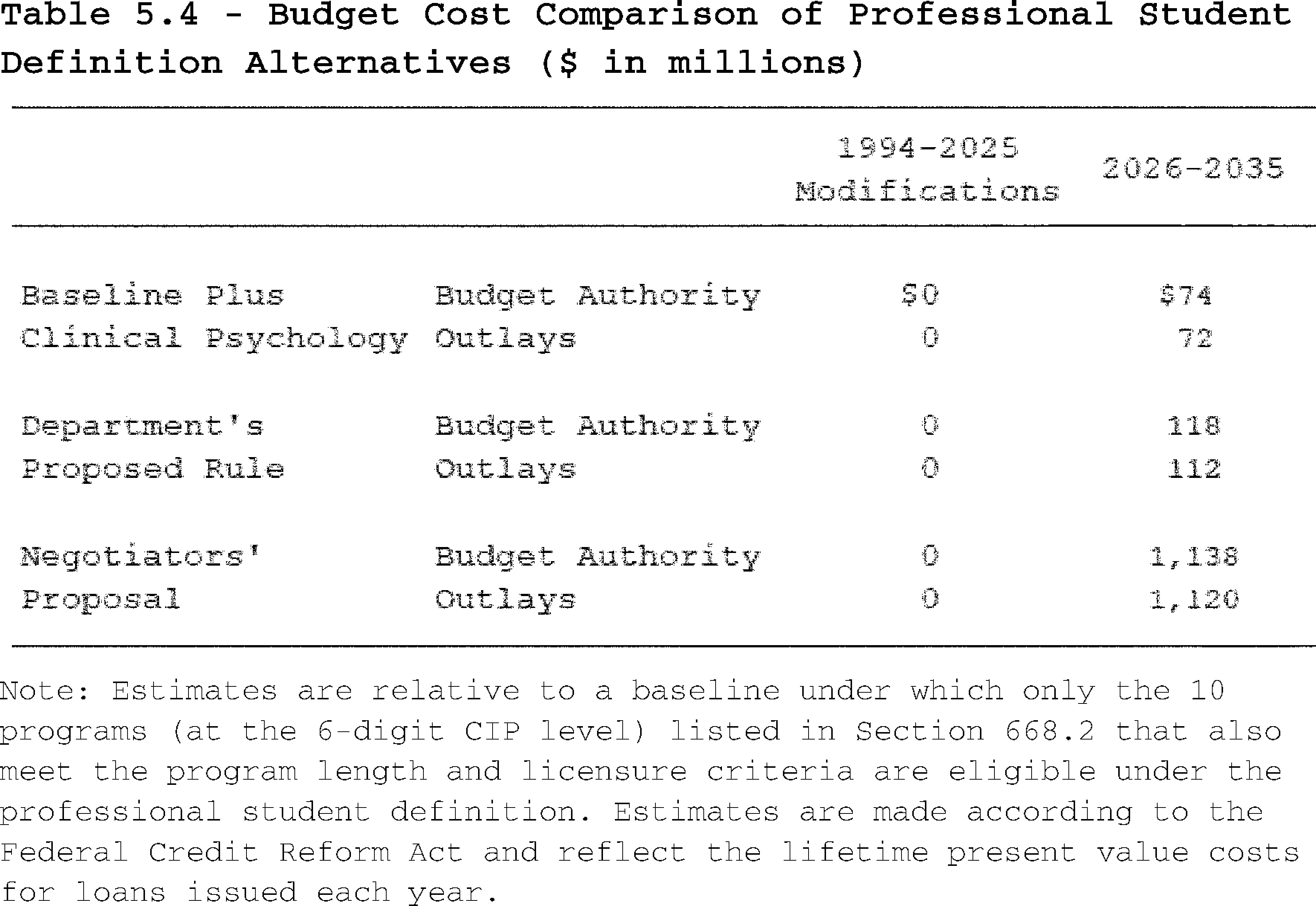
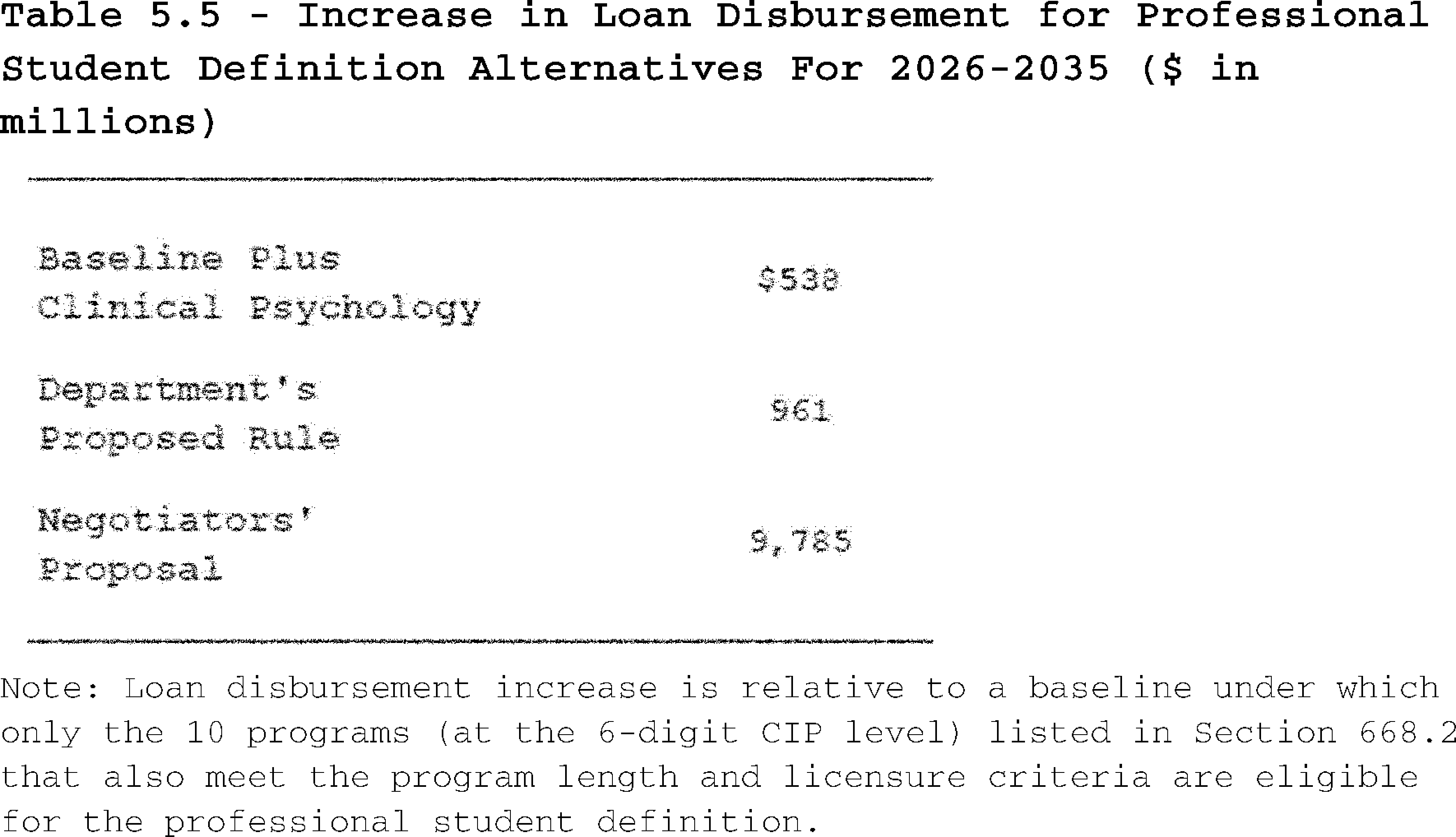
(RIA), the Department estimates a net budget impact compared to the President's Budget baseline for FY 2026 of −$409.3 billion from cohorts 1994 to 2035 for all provisions except the professional student definition. This is equivalent to an annualized reduction in transfers of −$42.3 billion at 3 percent discounting and −$44.3 billion at 7 percent discounting. The professional student definition had an estimated net budget impact of $537 million for loan cohorts 2027-2036 compared to the President's Budget for PB2027 baseline, equivalent to $51 million and $52 million at 3 percent and 7 percent discounting, respectively. Additionally, we estimate annualized cost related to paperwork burden ($25.0/$37.2 million), administrative updates to Government systems ($10.4/$12.1 million), systems maintenance and operation costs ($7.4/$7.8 million) and staffing ($5.5/$6.0 million) at 3 percent and 7 percent discounting, respectively.
As also further detailed in the RIA, these final regulations provide benefits to students, borrowers, and taxpayers. These benefits include potentially lower tuition costs for students, simplified repayment terms for student loan borrowers, and lower costs for taxpayers.
III. Purpose of This Regulatory Action
This regulatory action seeks to effectuate regulations that address the statutory changes made by the Working Families Tax Cuts Act.
IV. Background
Public Law 119-21, which the Department refers to as the “Working Families Tax Cuts Act,” was signed into law by President Trump on July 4, 2025. This landmark legislation makes extensive statutory changes to fix broken and unnecessarily complex aspects of the Federal student loan programs, specifically, in the areas of loan limits, repayment plans, and related provisions in title IV of the HEA. Among other changes, the Working Families Tax Cuts Act sets a new lifetime borrowing cap ($257,500 for most borrowers), eliminates the authority to disburse new Graduate PLUS Loans, limits borrowing under the PLUS program for parents, maintains current annual limits under the Federal Direct Stafford Loan Program for undergraduate and graduate students, increases annual Federal Direct Stafford loan limits for professional degree students, establishes aggregate limits for graduate students, professional degree students, and parents of undergraduates, and reduces annual loan amounts for students enrolled less than full-time. For repayment, the Working Families Tax Cuts Act simplifies and streamlines the current confusing patchwork of repayment plan options for future borrowers to two flexible options: a new Tiered Standard repayment plan for fixed monthly payments over a 10 to 25-year term, and a new income-driven plan called the Repayment Assistance Plan that allows borrowers the opportunity to actually pay down their student loan debt by preventing negative amortization over the life of the loan. Confusing, outdated (and in some cases, unlawful) repayment plans are phased out, including the Income-Contingent Repayment plan (ICR), Pay As You Earn plan (PAYE), and Saving on a Valuable Education plan (SAVE), which has been held as unlawful in Federal court.
See Missouri
v.
Biden,
112 F.4th 531, 538 (8th Cir. 2024).
This final rule complies with Section 492 of the HEA, which requires the Secretary to obtain public input and conduct negotiated rulemaking before issuing proposed regulations for the title IV, HEA programs. To meet those requirements and implement the new statutory directives provided for in the Working Families Tax Cuts Act, the Department convened the Reimagining and Improving Student Education (RISE) negotiated rulemaking committee (Committee). The Committee was composed of representatives from institutions, students and borrowers, State officials, financial aid administrators, loan servicers, and consumer and civil rights organizations. The Committee met over multiple sessions with the first session being from September 29 through October 3, 2025, and the second session being held November 3-6, 2025. The Committee reached consensus on the entirety of the regulatory text. In accordance with the protocols established by the Committee, the Department incorporated the regulatory amendatory text that was mutually agreed upon into a Notice of Proposed Rulemaking (NPRM) published on January 30, 2026. Building on the statutory and regulatory history, the Committee's consensus language, and the public comments received, this final rule amends Direct Loan regulations to the changes enacted in the Working Families Tax Cuts Act by revising loan limit provisions, restructuring repayment options (including IBR and adding the new Repayment Assistance Plan), updating PSLF eligibility and qualifying payment rules, and aligning consolidation, deferment, forbearance, and borrower relief provisions with the revised statutory framework.
V. Authority for This Regulatory Action
Congress passed legislation that amended statutory provisions governing programs administered by the Department, and this final rule implements those changes in the Department's regulations. The Working Families Tax Cuts Act amended portions of the HEA related to the Federal student loan programs administered by the Department. The Secretary has been granted the broad authority by Congress to implement Federal student aid programs under title IV of the HEA, including amendments made by the Working Families Tax Cuts Act.
See20 U.S.C. 1221e-3,
see
also 20 U.S.C. 1082, 3441, 3474, 3471. In order to carry out functions otherwise vested in the Secretary by law or by delegation of authority pursuant to law, and subject to limitations as may be otherwise imposed by law, the Secretary is authorized to make, promulgate, issue, rescind, and amend rules and regulations governing the manner of operations of, and governing the applicable programs administered by, the Department.
See20 U.S.C. 1221e-3. These programs include the Federal
( printed page 23770)
student loan programs authorized by the HEA.
Waiver of HEA Master Calendar Requirements
Congress may waive, modify, or rescind requirements in the HEA and Administrative Procedure Act (APA) that require the Department to follow certain processes and procedures when engaging in informal notice-and-comment rulemaking.
See, e.g., Asiana Airlines
v.
F.A.A.,
134 F.3d 393, 398 (D.C. Cir. 1998);
Methodist Hospital of Sacramento
v.
Shalala,
38 F.3d 1225, 1237 (D.C. Cir. 1998) (finding that certain parts of the APA procedural framework had been waived when Congress gave an agency direction that conflicts with and is irreconcilable with the APA).
At the same time, the court in
Asiana Airlines
made clear that the APA requires “clear intent” from Congress to justify a departure from the procedural requirements in the APA, noting that 5 U.S.C. 559 requires an explicit waiver of APA procedural requirements. Here, the Department is complying with all of the requirements for informal notice-and-comment rulemaking in 5 U.S.C. 553, so an express waiver is not needed. The explicit waiver standard in 5 U.S.C. 559 only applies to the procedural requirement of the APA and does not apply to the Master Calendar provision in Section 482(c) the HEA. Had Congress wished for the HEA Master Calendar provision to have the same rule of construction as it does for procedural requirements of the APA, we would have expected that Congress would either cross reference and incorporate 5 U.S.C. 559 into the HEA or use similar language to 5 U.S.C. 559 within Section 482(c) of the HEA. Congress knows how to create these types of special rules of construction when they want to, and they declined to do so in Section 482(c) of the HEA.
Absent an explicit rule of construction in the HEA, we rely on the ordinary tools of statutory interpretation to glean the meaning of the statute. The Harmonious-Reading Canon provides that statutes should, when possible, be interpreted in a way that renders them compatible, not contradictory, but such an approach is not always possible if context and other considerations (including the application of other canons) make it impossible to do so, another approach to statutory interpretation, such as the General/Specific Canon must be applied.
See
Scalia & Garner,
Reading Law,
155 (2012). The General/Specific Canon dictates that, in cases where a general prohibition is contradicted by a specific permission or a general permission that is contradicted by a specific prohibition, the more specific of the two provisions controls.
Id.
at 158. Because, as discussed below, the Working Families Tax Cuts Act contains provisions with effective dates that cannot possibly be implemented in regulation in accordance with the HEA's master calendar requirements, and as such, implicitly provides a limited waiver of the HEA's master calendar requirement, so far as it is necessary to promulgate regulations that give effect to those provisions.
See Dorsey
v.
United States,
567 U.S. 260, 274 (2012) (stating that an agency's compliance with an existing statute “cannot justify a disregard of the will of Congress as manifested either expressly or by necessary implication in a subsequent enactment” (
quoting Great Northern R. Co.
v.
United States,
208 U. S. 452, 465 (1908)).
Here, the Working Families Tax Cuts Act was enacted on July 4, 2025. The Working Families Tax Cuts Act directs the Department to implement roughly a dozen provisions by July 1, 2026. Many of these provisions are not self-executing and could not be implemented absent the Department promulgating regulations to provide details for institutions on how to comply with the Working Families Tax Cuts Act. Congress gave the Secretary discretion within the Working Families Tax Cuts Act to implement the provisions impacting the title IV, HEA programs and knew that its commands were not self-executing when directing the Secretary to take action. Congress expected the Secretary to act via rulemaking before July 1, 2026, to enable these provisions to actually go into effect.
The master calendar in the HEA provides that regulatory changes initiated by the Secretary affecting the title IV, HEA programs must be published in final form by November 1st in order for them to go into effect by July 1st of the following year. 20 U.S.C § 1089(c)(1). Section 492 of the HEA requires the Department to undertake negotiated rulemaking as part of any regulation under title IV of the HEA. In order to conduct negotiated rulemaking and meet APA requirements, the Department must have a public hearing (providing notice to the public), solicit nominations from the public to serve on a negotiated rulemaking Committee, select non-Federal negotiators, hold negotiations, develop an NPRM, publish an NPRM (with at least a 30-day comment period), and then publish a final rule that responds to any substantive comments received. The fastest possible timeframe in which the negotiated rulemaking process for the rulemaking packages assigned to the RISE Committee could have occurred is 149 days, which is irreconcilable with the timeline allowed by the enactment of the Working Families Tax Cuts Act, due to the fact that there were 120 days from July 4, 2025, (the day the Working Families Tax Cuts Act was enacted), through and including November 1, 2025, (the publication date of the final rule required by the master calendar).
It would not have been possible for the Department to undertake every step of the negotiated rulemaking process by November 1, 2025, in order to implement the provisions that become effective in the Working Families Tax Cuts Act by July 1, 2026, which is the statutory effective date. Congress was aware of this temporal impossibility when they passed the Working Families Tax Cuts Act, yet Congress decided that these provisions would still go into effect on July 1, 2026. Because these provisions are not self-implementing and cannot go into effect unless the Department promulgates a final rule, the Working Families Tax Cuts Act implicitly waives the master calendar.
With important details unanswered by the plain text of the Working Families Tax Cuts Act, it is clear that the policy scheme set forth in the HEA made by the Working Families Tax Cuts Act cannot be implemented absent regulatory action by the Department. At the same time, even though the requirements of negotiated rulemaking are onerous, it is possible to undergo negotiated rulemaking and publish a final rule at least 30 days prior to the effective date of these Working Families Tax Cuts Act provisions on July 1, 2026. Therefore, the Working Families Tax Cuts Act does not waive negotiated rulemaking nor any provision in the APA. For provisions in the Working Families Tax Cuts Act that become effective July 1, 2027, and beyond, Congress did not implicitly repeal the master calendar because it is possible for the Department to publish a final rule that complies with the master calendar to implement those provisions.
Severability
“It is axiomatic” that a regulation may be invalid in part but not in whole or as applied to one set of facts but not another.
Ayotte
v.
Planned Parenthood of N. New England,
546 U.S. 320, 329 (2006). If a court finds one part of a regulation is unlawful, the “normal rule” is to enjoin only that part.
Id.
(quoting
Brockett
v.
Spokane Arcades, Inc.,
472 U.S. 491, 504 (1985). It is the Department's intent that if any provision of this subpart or its
( printed page 23771)
application to any person, act, or practice is held invalid, the remainder of the subpart or the application of its provisions to any person, act, or practice shall not be affected thereby. Statutes and regulations are severable if the separate provisions are “wholly independent of each other” and can operate independently.
Brockett
v.
Spokane Arcades, Inc.,
472 U.S. 491, 502 (1985). That is the case here. No part herein will be affected if another part is found to be unlawful. Nor does the Department believe courts or regulated parties would be unable to apply the rule if one part is held invalid.
C.f. Dep't of Educ.
v.
Louisiana,
603 U.S. 866, 868 (2024) (per curiam) (denying the government's request to stay a preliminary injunction against an entire rule where only parts were found to be invalid because “schools would face in determining how to apply the rule for a temporary period with some provisions in effect and some enjoined”). In particular, the Department believes that the classification degrees between “professional” or “graduate” degrees is severable. For the reasons discussed in the rule, the Department is confident in how we classified the degrees that commenters and negotiators argued were “professional.” However, if a court disagrees with our analysis, we believe and intend that this portion of the regulation is entirely severable and does not substantially impact any other portion of the regulation or any other part of this final rule. Relatedly, if a court disagrees with the Department's classification of a particular degree or degrees, the Department intends for its classification of all other degrees to survive and remain in effect.
VI. Analysis of Public Comment and Changes
On January 30, 2026, the Secretary published an NPRM for these regulations in the
Federal Register
(91 FR 4254) (January 30, 2026). The Department received 80,793 comments on the proposed regulations. The Department has grouped the comments by the regulatory section and by similar themes. We discuss substantive issues under the sections of the regulations to which they pertain. In instances where individual submissions appeared to be duplicates or near-duplicates of comments prepared as part of a write-in campaign, the Department posted one representative sample comment along with the total comment count for that campaign to
www.Regulations.gov,
which continues to be our standard practice. We considered these comments along with all the other comments received. In instances where individual submissions were bundled together (submitted as a single document or packaged together), the Department posted all the substantive comments included in the submissions along with the total comment count for that document or package to
www.Regulations.gov.
Generally, we do not address minor, non-substantive changes (such as renumbering paragraphs, adding a word, or typographical errors) within this final rule. Additionally, we generally do not address changes or comments recommended by commenters that the statute does not authorize the Secretary to make (such as forgiving all student loans), or comments pertaining to operational processes. Analysis of the comments and of any changes in the regulations since publication of the NPRM (91 FR 4254) follows.
1. Process for Out-of-Scope Comments
The Department does not typically address comments that are out of scope. For purposes of this final rule, out-of-scope comments are those that are not addressed in the NPRM (91 FR 4254) altogether. Generally, comments that are outside of the scope of the NPRM (91 FR 4254) are comments that do not discuss the content or impact of the proposed regulations or the Department's evidence or reasons for the proposed regulations.
Public Comment Period
Comments:
Several commenters requested the Department extend the comment period and some requested we hold hearings so that students, educators, and employers in counseling fields can testify regarding real world impact of the proposed regulations on the mental health profession, students, and the public.
Discussion:
Prior to publishing the NPRM (91 FR 4254), the Department solicited public input through a public hearing held on August 7, 2025, from 9:00 a.m. to 4:00 p.m. Eastern Time, including a lunch break from 12:00 p.m. to 1:00 p.m. All individuals who requested to speak were accommodated during the hearing. The Department also solicited public comments for 30 days and received 1,846 comments on the public hearing notice, which informed the development of the proposed regulations.
Following the public hearing, the Department convened a negotiated rulemaking Committee in fall 2025, consistent with the requirements of the HEA. The Department selected non-Federal negotiators representing affected constituencies and stakeholders. This negotiated rulemaking process provided additional opportunities for stakeholders to offer feedback prior to publication of the NPRM (91 FR 4254).
After publication of the NPRM (91 FR 4254), the Department provided a 30-day public comment period, which is consistent with the Department's obligations under the APA. During that period, the Department received 80,793 public comments, many of which included detailed and substantive feedback. The Department carefully reviewed these comments to determine whether clarification or revisions to the final regulations were appropriate.
Although some commenters requested that the Department extend the comment period or hold additional hearings, the Department believes that the opportunities for stakeholder engagement, including the public hearing, negotiated rulemaking sessions, and the NPRM (91 FR 4254) comment period provided the public with sufficient opportunity to comment on the proposed regulations.
Changes:
None.
General Agreement With the Regulations
Comments:
Many commenters supported the Department's proposed rule and its broader efforts to reform the Federal student loan system. Commenters stated that the current system has created long-term financial challenges for many borrowers and that such reforms are necessary to better align repayment structures with borrowers' financial realities. These commenters noted that excessive student loan debt may affect borrowers' ability to achieve financial stability, including purchasing homes, starting families, or pursuing certain career opportunities. Commenters supported reforms that would simplify repayment options, improve borrower protections, and provide borrowers with clearer and more manageable repayment options for their Federal student loans.
Discussion:
The Department appreciates the commenters' support for the proposed rule and their perspectives regarding the need to improve the Federal student loan system. As discussed in the NPRM (91 FR 4255), the Department proposed these regulatory changes to implement the Working Families Tax Cuts Act's statutory requirements and to improve the clarity and administration of Federal student loan programs. Simplifying repayment choices and improving borrower protections helps borrowers better understand their repayment obligations and remain in good standing on their loans.
Changes:
None.
( printed page 23772)
Comments:
Several commenters supported provisions in the regulations that would limit or restructure certain Federal student loan programs, including changes affecting borrowing limits and loan availability. These commenters stated that unlimited or excessive borrowing may contribute to rising tuition prices and may result in borrowers taking on debt that is difficult to repay relative to actual earnings. Some commenters noted that certain graduate programs may lead to relatively modest salaries and suggested that establishing reasonable borrowing limits may encourage students to make more informed borrowing decisions and encourage institutions to control educational costs.
Discussion:
The Department acknowledges commenters' views regarding borrowing limits and the relationship between borrowing levels and expected earnings. The Department notes that the regulatory provisions in this rulemaking implement the statutory changes in the Working Families Tax Cuts Act and are intended to support responsible borrowing while maintaining access to Federal student loans. Taken together with the other important changes made to the title IV, HEA programs, the new regulatory framework established in these final rules supports program integrity while continuing to provide the financial assistance needed by students pursuing higher education.
Changes:
None.
Comments:
Other commenters discussed the importance of maintaining access to Federal student aid programs for individuals seeking to pursue or advance their education. These commenters stated that Federal student loan programs play an important role in allowing students to obtain professional credentials and access career opportunities that may otherwise be financially out of reach. Some commenters also emphasized the importance of ensuring that borrowers have access to repayment options that are understandable and accessible so that borrowers can successfully remain in repayment and avoid default. Several commenters encouraged the Department to establish clear guidance and implementation support for borrowers and institutions.
Discussion:
The Department supports continued access to Federal student aid for students with financial need and helping borrowers successfully repay their loans and avoid default. The Department believes these regulations balance the need to provide financial support through the Federal student loan programs to students who may otherwise be unable to access postsecondary education while also providing necessary restrictions to prevent accumulation of debt a borrower may never be able to repay. The Department will continue to provide guidance and support to borrowers and institutions to facilitate implementation of the regulatory changes, including additional details on the two new repayment plans that streamline repayment. The Department believes that the changes made in these final regulations will help improve title IV, HEA program administration and improve a borrower's understanding of their repayment obligations.
Changes:
None.
General Opposition to the Regulations
Comments:
Some commenters opposed the proposed regulatory changes described in the NPRM (91 FR 4254). Commenters stated that the proposed regulations could weaken borrower protections, increase financial hardship, and make repayment less affordable. Commenters also expressed concern that these changes could disproportionately affect borrowers with low incomes and borrowers from historically underserved communities. Some commenters asserted that the proposed changes could discourage individuals from pursuing higher education or entering certain professions.
Discussion:
The Department appreciates the commenters' views regarding the potential impact of the proposed regulatory changes on borrowers. However, the Department proposed these changes to implement the Working Families Tax Cuts Act statutory requirements and to improve the administration and sustainability of the Federal student aid programs. The Department believes the final regulations implement the law while appropriately balancing borrower support with program integrity considerations.
Changes:
None.
Comments:
Several commenters stated that the proposed changes could increase financial hardship for borrowers who are also caregivers, experiencing unemployment, illness, or other economic disruptions. Commenters expressed concern that limiting borrower relief options could reduce borrowers' ability to manage temporary financial challenges.
Discussion:
The Department recognizes that borrowers may experience periods of financial hardship and acknowledges the importance of certain safeguards in the repayment process that could provide flexibility. The Department notes that the Federal student loan programs continue to include repayment options designed to help borrowers manage repayment obligations based on their financial circumstances. Depending on the borrower's personal circumstances, borrowers may enroll in various income-driven repayment plans, forbearance, or deferments in accordance with the HEA.
Changes:
None.
Comments:
Some commenters stated that the proposed regulatory changes could discourage individuals from pursuing higher education due to concerns about Federal student loan borrowing limits, repayment affordability, and financial risk.
Discussion:
The final regulations are consistent with the Working Families Tax Cuts Act's statutory requirements to curb excessive borrowing and support the improved administration of the Federal student loan programs. Contrary to the commenters' claims, the changes in this final rule, such as the simplification of the confusing myriad of borrower repayment plans, other complicated requirements, and implementation of the new Repayment Assistance Plan, address long-standing past criticisms and failures of the Federal student loan programs.
Changes:
None.
Comments:
A commenter requested that the Department align implementation of these regulations with the Administration's broader goal of supporting American workers.
Discussion:
The proposed regulations implement the statutory framework enacted in the Working Families Tax Cuts Act and are intended, among other objectives, to promote affordability, reduce the risk of unmanageable borrowing burdens, and deliver measurable results, thereby complementing and supporting key elements of the Administration's America's Talent Strategy to reindustrialize the United States.
Changes:
None.
Negotiated Rulemaking
Comments:
Some commenters expressed concerns about the integrity, security, and reliability of the public comment submission process and questioned whether comments would be reviewed in a transparent and impartial manner. Commenters stated that some stakeholders may fear professional repercussions for submitting dissenting views, which could chill participation. Several commenters who submitted comments anonymously requested assurances that comments would be protected, verified, and meaningfully
( printed page 23773)
considered and asked the Department to identify the offices responsible for reviewing comments, the criteria used to evaluate comments, and how the Department would demonstrate that input was weighed objectively and in good faith.
Discussion:
The Department reviewed all comments, including comments that were submitted anonymously, that were received by the deadline in response to the NPRM and conducted a multi-step review process in which every comment was read, cataloged, and analyzed based on the issues raised and the supporting rationale and evidence provided. In addition, Department staff with relevant subject-matter expertise, including staff from the Office of Postsecondary Education, Office of the General Counsel, Office of the Under Secretary, Office of the Chief Economist, and Federal Student Aid, conducted a comprehensive review and analysis to identify significant comments submitted in response to the NPRM. The Department's responses in this preamble reflect careful consideration of those issues and concise general statements explaining how stakeholder input informed the Department's policy determinations.
Changes:
None.
Comments:
Several commenters commended the Department for engaging in the negotiated rulemaking process and inviting public input for these significant changes. One commenter believed our proposals reflected a reasonable exercise of our authority under the negotiated rulemaking process.
Discussion:
We appreciate the commenters' support and likewise acknowledges the work of the RISE Committee in reaching consensus on regulatory text, which underlies this final rule.
Changes:
None.
Comments:
Some commenters expressed dissatisfaction with our negotiated rulemaking process. Some of these commenters believed we addressed too many complex issues at once. Other commenters believed our timeline to make the system and operational changes by the implementation date to be aggressive and unreasonable.
Discussion:
We disagree with these commenters. Since the enactment of the Working Families Tax Cuts Act, the Department has engaged with the community in a transparent manner about the statutory changes to the title IV, HEA programs. Although there were various issues under the RISE Committee's purview, the Department believes the scope and breadth of the rulemaking process was manageable. The Department often negotiates many topics during the negotiated rulemaking process. In many prior negotiations, the Department had a very wide array of topics that were negotiated—often times, all unrelated to one another. By contrast, the RISE Committee's negotiations focused exclusively on student loans and related provisions. Other changes enacted by the Working Families Tax Cuts Act, such as the establishment of Workforce Pell Grants and a new accountability standard tied to low earning outcomes, were considered by a separate negotiated rulemaking Committee.
With respect to system and operational changes, as we state in the
Analysis of Public Comments and Changes
section of this document, we generally do not address changes or comments pertaining to operational processes. However, we encourage affected parties to monitor our websites for the latest updates.
Changes:
None.
Comments:
One commenter noted that we had an inaccessible docket on
regulations.gov.
Discussion:
We disagree with the claim that the docket was inaccessible on
regulations.gov.
The Department reviewed the docket and determined the link that we published in the
Federal Register
(91 FR 4254) was to a summary that is required to be included in the docket. Specifically, the Providing Accountability Through Transparency Act of 2023 requires agencies to publish the URL where a plain language summary of the proposed rules may be found.
Throughout the public comment period, over 81,000 other commenters were able to successfully submit comments. If the commenter believed they were unable to submit a comment, we provided clear instructions in the NPRM (91 FR 4254) that if a commenter cannot otherwise submit their comments via
Regulations.gov, to contact
regulationshelpdesk@gsa.gov
or by phone at 1-866-498-2945.
Changes:
None.
Comments:
Some commenters advocated adding certain constituency groups in the negotiated rulemaking process, including certain health professionals. These commenters urged us to engage and consult with experts from different backgrounds before implementing changes.
Discussion:
On July 25, 2025, the Department published a notice in the
Federal Register
(90 FR 31836) announcing its intention to establish a negotiated rulemaking committee to prepare proposed regulations for these issues. The notice set forth a schedule for the committee meetings and requested nominations for individual negotiators to serve on the RISE Committee. As we stated in that solicitation and request for nominations, we select individual negotiators with demonstrated experience in the relevant subjects under negotiation in accordance with Section 492(b)(1) of the HEA. We established a committee that allowed significantly affected parties to be represented while at the same time keeping the Committee size manageable. As with all other Committee representatives, each of these constituencies had primary representatives and alternates. The Department believes it identified the appropriate constituency groups involved in the title IV, HEA program regulations being negotiated by the Committee. Further, interested parties had several opportunities to be involved with the rulemaking process, including by submitting written comments on the proposed rule during the comment period we established prior to negotiated rulemaking and during the public comment period on the proposed rule. In fact, the number of written comments the Department received, including those from the health professions community, demonstrates the opportunity we provided for public participation in the process. Additionally, the full negotiated rulemaking Committee reached agreement on its protocols, including the composition of the primary negotiators.
Changes:
None.
Comments:
Several commenters urged us to delay implementation of these regulations. These commenters stressed the need for more time to comply with the regulations or to allow for a transition to help make certain that affected borrowers are not harmed by these regulations.
Discussion:
As we stated in the NPRM (91 FR 4254), within the Working Families Tax Cuts Act enacted on July 4, 2025, the vast majority of the regulatory provisions have an effective date by July 1, 2026, and Congress expected the Secretary to act via rulemaking before July 1, 2026, to enable the various provisions to go into effect in accordance with statutory deadlines (91 FR 4254). Affected stakeholders will have had nearly a year since enactment of the Working Families Tax Cuts Act to assess the potential effects of the statutory provisions and to begin planning any necessary policy and operational changes.
Changes:
None.
( printed page 23774)
Legal Authority/Department Authority
Comment:
One commenter requested that the Department classify this final rule as a major rule under the Congressional Review Act and allow for full congressional review.
Discussion:
The Office of Information and Regulatory Affairs has already classified this final rule as a major rule, and as such, will have at least a 60-day review period prior to the effective date. This information is clearly reflected in the preamble in the Regulatory Analyses section.
Changes:
None.
Comments:
Some commenters noted their belief that revoking or changing the terms of a borrower's loan after they signed an agreement to those terms is dishonest and wrong. These commenters point out that when borrowers took out student loans, they signed an agreement with the understanding that the terms and conditions would remain the same.
Discussion:
We disagree with these commenters. We note that the legally binding instrument upon origination of a Federal student loan is the master promissory note (MPN). The MPN contains the legally binding terms and conditions, including a section on the Borrower's Rights and Responsibilities (BRR) stipulated under the HEA. By signing the MPN, borrowers agree to the terms and conditions of the loans while acknowledging that terms and conditions of those loans may be changed. The MPN explicitly states that its terms and conditions “are determined by the HEA and other Federal laws and regulations” and the BRR further clarifies that subsequent amendments to the HEA and other Federal laws could amend the terms of the MPN. Therefore, by signing the MPN, and as explicitly stated in the BRR section of the MPN, the borrower acknowledges amendments to the HEA may change the terms of the MPN. The borrower also acknowledges that any amendment to the HEA that changes the terms of the MPN will be applied to the borrower's loans in accordance with the effective date of the amendment. Depending on the effective date of the amendment, amendments to the HEA may modify or remove a benefit that existed at the time that a borrower signed the MPN.
This is not a new concept as Congress has changed the terms and conditions of title IV loan programs numerous times, including for borrowers who had already taken out loans. As we also explain in the PSLF final rule (90 FR 48978), the MPN disclaims the notion that terms and conditions of Federal student loans are fixed and can only be changed through the legal process. The legal process here is through the legislative changes enacted by Congress and signed by the President. Here, the statutory changes to the HEA mandate that we provide these revised terms and conditions.
Changes:
None.
Comment:
For purposes of the interim exception, one association requested clarification regarding the treatment of existing borrowers whose Direct Unsubsidized Loan MPNs expire after July 1, 2026. This commenter inquired if a current borrower signs a new MPN on or after July 1, 2026, if that borrower would remain subject to the prior terms applicable at the time of their original borrowing or by the new terms. This commenter maintained that clarification is necessary to make certain that institutions can accurately and effectively counsel borrowers.
Discussion:
As stated above, the MPN includes information in the BRR that clearly informs borrowers that any changes or amendments to the HEA could change the terms of the MPN and the MPN would still be valid. This includes MPNs that have previously been signed and are fully executable. Specifically, we note that any amendment to the HEA that changes the terms of the MPN would apply to the borrower's loans in accordance with the effective date of the amendment and that depending on the effective date of such amendment, amendments to the HEA may modify or remove a benefit that existed at the time that the borrower signed the MPN. We disagree with the commenter's characterization that a borrower who signs a new MPN would either be subject to the terms of their original MPN or the new MPN; both MPNs would have that general condition that statutory changes could amend the terms of their promissory notes, including ones that were signed prior to the Working Families Tax Cuts Act. At the same time, some borrowers who have loans that were originated before July 1, 2026, are eligible for certain legacy repayment plans that loans originated after such date are not eligible for, as explained below in this final rule. We remind institutions that if the borrower's MPN is expiring, the institution must obtain a valid MPN from the borrower before disbursing a new Direct Loan to such borrower. This does not have an impact on the eligibility for the interim exception; it is a requirement to receive additional Federal student loans if desired.
Changes:
None.
Comments:
Some commenters argued that we should protect borrowers' reliance interests, especially as they relate to PSLF. These commenters believed that, at the time a borrower signed their MPN, the regulations could not be materially altered. One commenter recommended that the Department implement a grandfathering provision, whereby a borrower who was on track to receive PSLF would retain the right to remain in an income-contingent repayment plan until forgiveness or paid in full.
Discussion:
We disagree with the commenters' concerns and believe that reliance interests are not impacted here. Similar to the Department's statements in the PSLF final rule (90 FR 48979) with respect to reliance interests, a borrower would have to demonstrate their detrimental reliance and would require proof that a promise or representation was made and that promise or representation was relied upon by the borrower asserting the estoppel in such a manner as to change his position for the worse, and that the promise's reliance was reasonable and should have been reasonably expected by the promisor. See
L. Mathematics & Tech., Inc.
v.
United States,
779 F.2d 675, 678 (Fed. Cir. 1985). Much like the PSLF final rule, the borrower would fail to satisfy the required elements for a promissory estoppel claim because they expressly acknowledged and agreed to the possibility of changes to benefits that existed when they signed the MPN. The MPN disclaims the idea that the terms and conditions of a Federal student loan are unalterable, as we explain elsewhere in this document, meaning that any reliance interest is not reasonable.
We also reject the commenter's recommendation that we grandfather a borrower who was on track to PSLF so that they may retain the right to remain in an income-contingent repayment plan until forgiveness or paid in full as the statute is clear that these income-contingent repayment plans must be sunset. Borrowers on track toward receiving PSLF will have other PSLF-qualifying repayment plans available to them. Congress was clear that income-contingent repayment plans sunset and will be no longer available after July 1, 2028. The Department has no authority to alter this sunset date.
Changes:
None.
Loan Rehabilitation
Second Rehabilitation
Comments:
A significant majority of commenters expressed strong support for the provision allowing borrowers a second opportunity to rehabilitate defaulted Federal student loans
( printed page 23775)
beginning on or after July 1, 2027. Commenters characterized this as a humane and positive step that acknowledges the reality of recurring financial hardship. Commenters noted that financial situations can change due to market factors beyond a borrower's control, such as entering a workforce with low job opportunities. Supporters argued that giving borrowers a second chance encourages repayment rather than long-term default and helps bring consumers back into the economy. Several commenters stated that this change strikes an appropriate balance between personal accountability and the need for a meaningful path back to repayment.
Discussion:
The Department, effective July 1, 2027, increased the number of times a borrower may rehabilitate a defaulted Federal student loan made, insured, or guaranteed under title IV of the HEA from one time to two times to reflect the changes made by the Working Families Tax Cuts Act. The Department agrees that providing a second opportunity for loan rehabilitation is a balanced and constructive borrower protection. Allowing borrowers an additional opportunity to rehabilitate a loan may assist borrowers in resolving default and returning to repayment.
Changes:
None.
Comments:
Some commenters applauded the alignment of administrative wage garnishment (AWG) suspensions with the two rehabilitation opportunities authorized by the Working Families Tax Cuts Act, stating that suspending garnishment during voluntary payment periods is vital for a borrower's financial stability and their ability to successfully complete the rehabilitation agreement.
Discussion:
The Department agrees that expanding rehabilitation opportunities can support borrowers seeking to resolve default. Section 82003(a)(1) of the Working Families Tax Cuts Act amended Sections 428F(a)(5) and 464(h)(1)(D) of the HEA, which permit borrowers to rehabilitate a defaulted Federal student loan up to two times beginning on or after July 1, 2027. The Department also agrees that suspending AWG while a borrower makes voluntary rehabilitation payments supports the borrower's transition back to good standing. Sections 685.211(f)(11) and (12) reflect that on or after July 1, 2027, a borrower may obtain both the benefit of an AWG suspension, and the rehabilitation process itself a maximum of two times per loan.
Changes:
None.
Comments:
Commenters requested regulatory language to clarify whether restarting payments after a period of enrollment constitutes a continuation of the first rehabilitation attempt or the start of a second attempt. Specifically, these commenters proposed language stating that a rehabilitation is considered a single attempt if a borrower makes six payments, pauses for school, and then resumes to complete the final three payments.
Discussion:
Under existing regulations, a rehabilitation agreement is defined by the successful completion of the required payment series (nine payments within ten months). An attempt at rehabilitation that does not result in the loan returning to good standing does not count against the statutory limit on rehabilitations. A rehabilitation is only counted toward the limit once it is successfully completed. Therefore, if a borrower makes six payments, stops, and later enters into a new agreement to make nine payments and successfully completes the later agreement, they have still only used one of their permitted rehabilitations. The Department believes the proposed regulations at § 685.211(f)(12), which distinguish between rehabilitations completed before and after July 1, 2027, provide sufficient clarity on the limits on successful rehabilitations without the need for the additional language suggested by the commenters and the Department declines to make these changes.
Changes:
None.
Comments:
One commenter recommended that the Department clarify how the timing of a borrower signing a rehabilitation agreement should be treated in implementing the second rehabilitation opportunity established by the Working Families Tax Cuts Act. The commenter stated that borrowers who have already been making voluntary payments on a defaulted loan prior to July 1, 2027, should be able to receive the benefit of the second rehabilitation opportunity if they sign the rehabilitation agreement on or after that date, provided they have otherwise satisfied the required payment criteria. The commenter also suggested that borrowers who have already demonstrated good-faith repayment through voluntary payments should not be required to repeat the full series of rehabilitation payments solely because of when the rehabilitation agreement was signed.
Discussion:
The Department appreciates the commenters' recommendation regarding the implementation of the second rehabilitation opportunity authorized by the Working Families Tax Cut. As discussed in the NPRM (91 FR 4259), the Department's loan rehabilitation regulations implement the statutory changes that allow borrowers to rehabilitate a defaulted loan up to two times beginning July 1, 2027. The Department notes that loan rehabilitation is defined by the successful completion of the required payment series under the statute governing rehabilitation. The Department believes that the proposed regulatory structure provides sufficient clarity regarding how rehabilitation opportunities are counted and declines to make additional regulatory changes regarding the timing of rehabilitation agreements. As we also explain in the NPRM (91 FR 4288), we note that the effective date for the second rehabilitation attempt cannot begin until July 1, 2027, because the changes to the HEA regarding loan rehabilitations take effect
beginning
on July 1, 2027 [emphasis added] in accordance with the statutory deadlines contained in the Working Families Tax Cuts Act. As such, the borrower cannot begin that second rehabilitation until on or after the effective date.
Changes:
None.
Comments:
One commenter recommended that the Department require borrowers who seek to rehabilitate a defaulted loan for a second time to complete mandatory financial literacy counseling before entering into a second rehabilitation agreement. The commenter stated that counseling could help borrowers better understand the consequences of repeated default and improve long-term repayment success. The commenter suggested that such counseling could be provided by the Department or an approved third-party partner and could emphasize the importance of sustainable repayment strategies and the benefits of avoiding future default.
Discussion:
The Department appreciates the commenters' recommendation regarding mandatory financial literacy counseling for borrowers seeking a second loan rehabilitation. The Department agrees that providing borrowers with information about repayment options and the consequences of default can support successful repayment outcomes. As discussed in the NPRM (91 FR 4289), the Department intends to provide borrowers with improved guidance and information regarding repayment options as they transition out of default and into repayment. However, the Department declines to adopt a regulatory requirement mandating counseling as a condition for a second rehabilitation. The HEA establishes the
( printed page 23776)
statutory framework governing loan rehabilitation, including the requirement that borrowers make nine voluntary, reasonable, and affordable payments within ten months to successfully rehabilitate a defaulted loan. Requiring a borrower who seeks to rehabilitate a defaulted loan a second time to complete mandatory financial literacy counseling before entering into a second rehabilitation agreement is inconsistent with the HEA and no statutory basis exists to impose such a requirement for purposes of loan rehabilitation. The Department believes that the existing statutory structure, combined with borrower communications and guidance, is sufficient to support borrowers seeking to rehabilitate their loans and declines to make the commenters' proposed changes.
Changes:
None.
Comments:
One commenter supported the statutory provision permitting borrowers to rehabilitate a defaulted loan a second time beginning July 1, 2027, stating that the additional rehabilitation opportunity could assist borrowers who previously rehabilitated their loans but later experienced circumstances that resulted in another default. However, the commenter expressed concern that the proposed regulations do not describe how borrowers eligible for a second rehabilitation opportunity will be identified or notified.
The commenter also requested that the Department include in regulatory text the clarification provided in the preamble to the NPRM that participation in the Fresh Start Initiative does not count as a rehabilitation for purposes of the statutory limit on the number of rehabilitations permitted. The commenter recommended that the Department codify this clarification in the regulations and establish outreach procedures to notify borrowers of their eligibility for a second rehabilitation opportunity.
Discussion:
The Department appreciates the commenter's support for implementing the statutory provision allowing borrowers to rehabilitate a loan a second time. As explained in the NPRM (91 FR 4259), the Department is amending the loan rehabilitation regulatory revisions to implement Section 82003 of the Working Families Tax Cut, which provides that a borrower may rehabilitate a defaulted loan no more than two times. The Department intends to implement this statutory change consistently with existing loan rehabilitation processes administered through Federal loan servicers and Department operational guidance.
Participation in the Fresh Start Initiative does not constitute a loan rehabilitation for purposes of the statutory limit, as this program purported to rely on a different legal authority. The Department does not believe additional regulatory text changes are necessary to implement this clarification and declines to make the proposed changes.
Changes:
None.
Streamlining Rehabilitation Process To Repayment
Comments:
One commenter requested that the Department align the definition of full rehabilitation to six months. The commenter noted that under current regulations, a borrower can regain eligibility for new Federal student loans after six on-time payments but must make nine on-time payments to fully rehabilitate the defaulted loan. The commenter argued that this discrepancy sets borrowers up for failure by allowing them to take on new debt before their previous default is fully resolved. Alternatively, commenters suggested that the Secretary consider at least half-time enrollment at an eligible institution as an approved “hold” on the rehabilitation process, allowing borrowers to resume their remaining three payments within 45 days of their enrollment end date without having to restart the process.
Discussion:
The Department acknowledges the commenter's concern regarding the different timelines for regaining title IV eligibility versus completing rehabilitation. However, under Section 428F(a)(1)(A), the nine-payment stipulation is a statutory requirement to successfully rehabilitate a Federal student loan before a loan is returned to non-defaulted status and the record of default is removed from a borrower's credit history.
The Department declines to reduce the number of payments required for full rehabilitation or to create a regulatory “hold” for enrollment. Section 428F(a)(1) of the HEA specifically requires a borrower to make nine payments within ten consecutive months to successfully rehabilitate a defaulted loan. The Department does not have the statutory authority to change this requirement through regulation.
Changes:
None.
Comments:
Members of Congress and other commenters requested that the Department allow payments made while a borrower is in default to count toward timed forgiveness under IDR plans. Commenters stated that for low-income borrowers, timed forgiveness is an important safeguard that prevents borrowers from remaining in repayment indefinitely. Commenters asserted that the default collections process may result in borrowers paying more through wage garnishment or offsets than they would otherwise pay under an IDR plan. Commenters noted that under current regulations at § 685.209, certain voluntary payments made during loan rehabilitation may count as qualifying payments toward forgiveness under the IBR plan. Commenters urged the Department to maintain or expand this approach so that payments made while a borrower is in default would count toward forgiveness across legacy IDR plans and the Repayment Assistance Plan. Commenters stated that this policy would help borrowers make meaningful progress toward forgiveness and reduce confusion between repayment and default systems. Some commenters also urged the Department to implement these provisions before restarting involuntary collections such as through AWG and the Treasury Offset Program (TOP).
Discussion:
The Department appreciates commenters' perspectives regarding the treatment of payments made while a borrower is in default and their relationship to forgiveness under IDR plans. The Department is amending § 685.211 to implement the statutory changes made by the Working Families Tax Cuts Act, including provisions establishing the Repayment Assistance Plan, clarifying the repayment plans that may be designated for borrowers in default, and revising the loan rehabilitation framework. These amendments are intended to provide borrowers and servicers with clearer rules governing the treatment of payments and the repayment options available to borrowers who wish to resolve their default. The Department's authority regarding how payments may count toward forgiveness under IDR plans is governed by the HEA and applicable statutory requirements that does not permit us to count such payments toward forgiveness. Consistent with the proposed regulations, the Department is focusing on clarifying the repayment framework for borrowers in default and the transition from default into repayment.
Changes:
None.
Comments:
One commenter recommended that the Department consider using reliable third-party employment and income data sources to help determine whether proposed rehabilitation payment amounts are reasonable and affordable. The commenter stated that access to up-to-date employment and salary information could help servicers
( printed page 23777)
establish rehabilitation payment amounts that better reflect borrowers' current financial circumstances and improve the sustainability of rehabilitation agreements.
Discussion:
The Department appreciates the commenters' suggestion regarding the use of additional data sources to support the determination of reasonable and affordable rehabilitation payment amounts. Under the HEA, rehabilitation payments must be based on the borrower's total financial circumstances. The Department currently permits borrowers to provide income documentation or other financial information to establish reasonable and affordable payment amounts. The Department will continue to evaluate operational tools and data sources that may assist in administering the rehabilitation process consistent with statutory requirements and borrower privacy protections. However, the Department declines to adopt specific regulatory provisions governing the use of third-party employment data at this time.
Changes:
None.
Comments:
Commenters requested that the Department simplify the loan rehabilitation process to eliminate administrative barriers for borrowers. Commenters noted that the current rehabilitation process relies heavily on manual and paper-based procedures, including submitting documentation by mail or fax, which can result in a slow process for borrowers seeking to resolve their default. Commenters recommended several operational improvements, including allowing borrowers to request and execute rehabilitation agreements online, enabling electronic submission of income documentation, allowing borrowers to track their progress toward completing rehabilitation payments, and facilitating enrollment in income-driven repayment plans following rehabilitation. Commenters also recommended that the Department improve outreach to defaulted borrowers, streamline the administrative steps required to enroll in rehabilitation, and explore approaches to make post-rehabilitation payments more manageable, including potential phase-in or transition periods for repayment amounts.
Discussion:
The Department appreciates commenters' recommendations regarding improvements to increase the effectiveness of loan rehabilitation as a path out of default. The Department is developing a number of operational improvements that complement the regulations implementing the rehabilitation improvements enacted in the Working Families Tax Cuts Act.
We agree with commenters that operational improvements to make it easier to enroll in income-driven repayment plans following rehabilitation is important to make a seamless transition to repayment for borrowers exiting default. Many borrowers who rehabilitate their loans ultimately redefault if they do not enroll in an affordable income-driven repayment plan. To that end, the final rule will enable the Secretary to create a single application for rehabilitation agreements for Direct Loans that also includes the option to sign up for an eligible IDR plan. This single application will not be available to Perkins Loan or FFEL borrowers. Borrowers who only wish to enroll in loan rehabilitation will not be forced to also sign up for IDR; however, the Department believes that giving borrowers the option to do so will make it easier for borrowers to sign up. This all-in-one application will allow borrowers to replace multiple applications with one single transaction that would allow them to become enrolled in an affordable payment plan after they successfully rehabilitate their loan. Borrowers will also have the option to sign up for auto-debit for both the rehabilitation agreement and the IDR plan, making it easy for borrowers to make payments without the need for additional actions.
Under this single, all-in-one application, the Secretary would be able to calculate the borrower's payment under the IDR plan using the Federal tax information (FTI) (with the borrower's approval under HEA, as amended by the FUTURE Act) [1]
to inform the borrower what their IDR payment would be after rehabilitation. 26 U.S.C. 6103(l)(13); 20 U.S.C. 1098h. The borrower is not required to actually enroll in the IDR plan for the Department to be able to use its authority (with borrower approval) to access FTI and calculate eligible IDR payment amounts. 20 U.S.C. 1098h. This enables the borrower to compare different IDR plans before selecting a plan or deciding not to enroll.
If the borrower elects to see the monthly payment under and IDR plan through this single application process, the Secretary now has the borrower's monthly payment.
34 CFR 685.211 requires borrowers to make 9 monthly payments that are reasonable and affordable to rehabilitate a loan. The regulations include a provision that states that “The Secretary initially considers the borrower's reasonable and affordable payment amount to be an amount equal to the payment required under the IBR plan.” [2]
The Department believes that this requirement is too narrow in that it only applies to IBR and that monthly payment amounts under any eligible IDR plan (not including SAVE/REPAYE) are reasonable and affordable. These payment plans have been designed by the Department and Congress to be affordable for borrowers. And furthermore, under the changes we are making to this provision, borrowers can pick from among any eligible plan, all of which are designed to be affordable.
When a borrower elects to have their FTI pulled for the purposes of determining an IDR monthly payment rate, the Secretary may use that derivative monthly payment rate (with the borrower's approval) as the monthly payment rate for the purposes of the rehabilitation agreement. 34 CFR 685.211(f)(1)(ii) currently calls on the borrower to submit documentation to verify income, but in this limited circumstance, the Department believes that additional documentation is generally unnecessary. As such, the Department proposes to give the Secretary the option not to require additional verification.
In some circumstances even when FTI is used to calculate the IDR rate (which becomes the reasonable and affordable rate under a rehabilitation), it may be appropriate for the Secretary to require additional documentation. This may include when the borrower represents that his or her income is higher or lower than what was reported on his or her taxes, and when their family size has changed. In these circumstances, the Secretary may have an interest in requesting additional documentation from the borrower.
If the income information is unavailable or the Secretary does not believe it is accurate, the borrower will be required to provide alternative documentation of income. This approach is consistent with and complements the regulations implementing the rehabilitation improvements enacted in the Working Families Tax Cuts Act.
In addition, Parent PLUS borrowers are no longer eligible to enroll in IDR
( printed page 23778)
plans after the statutory changes made by the Working Families Tax Cuts Act. For the purposes of the rehabilitation process, the Secretary may confirm that the borrower is not eligible if they have Parent PLUS loans. But the Secretary may follow the formulas in this final rule under 34 CFR 685.211(f) under the IDR plans as if they were eligible in order to determine the reasonable and affordable payment.
The Department's changes in these final regulations enable, but do not require, the Secretary to provide a single application. The Department intends to provide a single application to borrowers as soon as practical but notes that several operational and technical changes must be made to Department systems to make this possible. As such, the Department will not have the single application available on July 1, 2026. However, as explained in the Paperwork Reduction Act section of this preamble, the Department will make the draft application publicly available and open a 60-day and 30-day public comment period before being made available for use.
Lastly, the Department notes that borrowers who have a defaulted student loan are ineligible for any IDR plan. As such, if a defaulted borrower were to apply for an IDR plan under our current regulations, the Secretary would be required to deny the application. However, we propose changes to the regulations that allow the Secretary to hold the IDR application, when it is submitted in combination with a rehabilitation agreement application on the single application, until the borrower has either: (1) completed the rehabilitation, or (2) failed to complete the rehabilitation by not making the required nine payments in a ten month period.
When a borrower successfully completes the rehabilitation, the Secretary then approves the IDR plan and automatically enrolls the borrower into the IDR plan. The single application will also enable the borrower to sign up for auto-debit such that the Secretary may continue the auto-debit after automatically enrolling the borrower into an IDR plan. If the borrower fails to complete the rehabilitation, then the Secretary denies the IDR application because the borrower is ineligible for the plan.
As a result of these improvements to loan rehabilitation, we also make two technical corrections to paragraphs (f)(2) and (3). In (f)(2), we replace “account” with “loans” and in (f)(3), we replace “objects to” to “rejects”.
Changes:
We amend § 685.211(f)(1)(ii) to read as follows: (ii)(A) The Secretary may calculate the payment amount based on information provided orally (or through other means) by the borrower or the borrower's representative and provide the borrower with a rehabilitation agreement using that amount. (B) The Secretary may provide a single application for the purpose of enabling a borrower to apply for loan rehabilitation and income driven repayment simultaneously, and may, with the borrower's approval, calculate the payment amount for any income driven repayment plan that the borrower would otherwise be eligible for (after successful rehabilitation of the defaulted loan) to inform the borrower of the projected monthly repayment amount under such plan after the loans are rehabilitated. The Secretary may use the calculated payment required under any eligible income driven repayment plan for the purpose of determining the reasonable and affordable payment amount under this paragraph (f)(1), with the borrower's approval. Nothing in this section prohibits the Secretary from accepting an application from a borrower for an IDR plan who is currently enrolled in a rehabilitation agreement but has not yet completed such agreement by making the requisite payments and holding such application until the borrower has completed the rehabilitation. (C) The Secretary requires the borrower to provide documentation to confirm the borrower's AGI and family size, except that the Secretary may, in his or her discretion, consider such additional documentation unnecessary if the borrower approves having the payment amount calculated by the Secretary for an eligible income driven repayment plan as the borrower's reasonable and affordable payment. If the borrower's AGI or family size is not available, or if the Secretary believes that the borrower's reported AGI or family size may be inaccurate, the borrower must provide other documentation to verify income or family size. If the borrower fails to provide acceptable documentation to verify family size, the Secretary assumes a family size of one. If the borrower does not provide the Secretary with any income documentation requested by the Secretary to calculate or confirm the reasonable and affordable payment amount within a reasonable time deadline set by the Secretary, the rehabilitation agreement provided is null and void.
We also make two technical corrections to §§ 685.211(f)(2) and (3).
Comments:
Commenters generally supported the establishment of clear minimum payment amounts for rehabilitation. However, some sought clarification on the difference between FFEL and Direct Loan requirements.
Discussion:
To reflect changes made by the Working Families Tax Cuts Act that amended Section 428F(a)(1)(B) of the HEA, the Department is establishing a $10 minimum monthly payment for the rehabilitation of a defaulted Direct Loan beginning July 1, 2027. Prior to that date, the minimum payment is $5. The Department notes that, while the Direct Loan minimum monthly rehabilitation payment will increase to $10, the minimum monthly rehabilitation payment for the FFEL Program remains at $5 under § 682.405. This lack of change is because the statute did not amend the minimum monthly payment for rehabilitation of a defaulted FFEL loan. Section 428F(a)(1)(B) of the HEA was amended only with respect to a borrower who has one or more loans made under part D [
i.e.: Direct Loans] on or after July 1, 2027, that are being rehabilitated, establishing the total monthly payment for the borrower with all such loans shall not be less than $10.
When the Secretary determines the amount of a borrower's reasonable and affordable payment for loan rehabilitation, we initially proposed that the loan rehabilitation payment amount to be an amount equal to the minimum payment required under the IBR plan, except if this amount was less than $5 (or $10 beginning on or after July 1, 2027), the monthly payment was $5 (or $10 beginning on or after July 1, 2027). After further review, if the borrower avails themself of the rehabilitation agreement under § 685.211(f)(1)(ii), the loan rehabilitation payment amount will be the minimum amount under the IDR plan proactively selected by the borrower in their application. We note, however, that if a borrower's IDR monthly payment is $0, the borrower's loan rehabilitation payment amount will be $10 in accordance with the aforementioned.
Section 494(b) of the HEA and 26 U.S.C. 6103(l)(13) limits the Secretary's authority to obtain FTI from the IRS only for purposes of administering the FAFSA®, enrollment in an IDR plan, and total and permanent disability discharge determinations. However, in response to the commenters' desire to streamline the rehabilitation process as well as an on-ramp to affordable repayment, we believe we can proactively obtain the borrower's FTI for enrollment in an IDR plan with their approval. As such, we are using the IDR rate, derived from the borrower's FTI, to determine the reasonable and affordable rate for loan rehabilitation.
( printed page 23779)
The borrower is not required to actually enroll in the IDR plan for the Department to be able to use its authority (with borrower approval) to access FTI and calculate eligible IDR payment amounts. 20 U.S.C. 1098h. This enables the borrower to compare different IDR plans before selecting a plan or deciding not to enroll.
If the borrower elects to see the repayment rates through this single application process, the Secretary now has the borrower's monthly repayment rate.
The Department may not require borrowers to check their IDR payment rates using FTI, and even if a borrower elects to do so, the Department cannot require the borrower to use the derivative monthly payment rate as the reasonable and affordable rate. However, the Department believes that we may provide this option to borrowers to reduce the need for additional documentation of income and family size, potentially reducing the process that currently takes a few weeks down to a matter of minutes.
Section 494(b) of the HEA limits the Secretary's authority to obtain FTI from the IRS only for purposes of administering the FAFSA®, enrollment in an IDR plan, and total and permanent disability discharge determinations. However, in response to the commenters' desire to streamline the rehabilitation process as well as into better facilitate on-ramp to repayment, we believe we can proactively obtain the borrower's FTI for enrollment in an IDR plan. Since we would have the borrower's income at that point, with the borrower's approval, we could use that income information for purposes of calculating a reasonable and affordable payment for loan rehabilitation which will facilitate support a more seamless process for struggling distressed borrowers. This reasonable and affordable payment will align with the minimums in § 685.211(f)(1)(i).
Changes:
We amend § 685.211(f)(1)(i) to read as follows: (i) Payment Amount. (A) Before July 1, 2027, the Secretary initially considers the borrower's reasonable and affordable payment amount to be an amount equal to the payment required under any eligible income-driven repayment plan, except if this amount is less than $5, the borrower's monthly payment is $5. (B) Beginning on and after July 1, 2027, the Secretary initially considers the borrower's reasonable and affordable payment amount to be an amount equal to the payment required under any eligible income-driven repayment plan, except that if this amount is less than $10, the borrower's monthly payment is $10.
Comments:
Non-Federal negotiators and other commenters urged the Department to automatically enroll borrowers in an income-driven repayment plan, such as the Repayment Assistance Plan, immediately upon completion of rehabilitation. Commenters expressed concern that borrowers might successfully rehabilitate but then default again because they failed to navigate the process required to select an affordable repayment plan.
Discussion:
The Department shares the goal of ensuring borrowers enter into affordable plans post-rehabilitation and continue to successfully repay the rehabilitated loans. However, under the HEA, the Secretary does not have the unilateral authority to select a repayment plan for a borrower who is no longer in default. As discussed in the NPRM (91 FR 4288), borrowers who rehabilitate a defaulted loan may select a repayment plan, including the Repayment Assistance Plan, and must affirmatively authorize the Department to use their FTI to determine their monthly payment amounts for plans that are based on income. To accomplish this, the Department is designing improved processes for rehabilitation so that borrowers can choose their repayment plans earlier and can authorize the use of FTI to enroll in the new Repayment Assistance Plan upon rehabilitation of the defaulted loans. Additionally, the Department may not move borrowers into different repayment plans without their consent.
We believe that regulatory text is needed to clarify the borrower's enrollment in an IDR plan after rehabilitation. Because we share commenters' concern to make post-rehabilitation enrollment in an IDR plan as seamless as possible, we will add a new paragraph (f)(14) that states a borrower who has a defaulted Direct Loan that is rehabilitated on or after July 1, 2026, may be transferred to the income-driven repayment plan by the Secretary if that borrower applied for such plan on a single application.
Changes:
We add § 685.211(f)(14) to read as follows: A borrower who has a defaulted Direct Loan that is rehabilitated on or after July 1, 2026, may be transferred to the income-driven repayment plan by the Secretary if that borrower applied for such plan on a single application.
Comments:
Commenters supported the Department's proposal to improve the loan rehabilitation process by ensuring borrowers are informed of repayment options and the ability to authorize the use of FTI to enroll in affordable repayment plans. Commenters encouraged the Department to amend § 685.211(f) to allow borrowers to consent to sharing their FTI at the time they enter into a rehabilitation agreement so that they may be automatically enrolled in the income-driven repayment plan with the lowest payment, unless they decline such enrollment. Commenters also recommended improving the borrower experience during rehabilitation by allowing borrowers to make rehabilitation payments online, enroll in automatic payments, and track their progress toward completing rehabilitation. In addition, commenters recommended that the Department cease involuntary collections activities, including AWG and TOP collections, once a borrower executes a rehabilitation agreement rather than waiting until several rehabilitation payments have been made.
Discussion:
The Department appreciates commenters' support for improving the loan rehabilitation process and agrees that borrowers who successfully rehabilitate their loans should have access to clear information about their repayment options and straightforward pathways to affordable repayment. As discussed in the NPRM (91 FR 4288), the Department is redesigning the rehabilitation process so that borrowers are informed of their repayment options, may authorize the use of FTI to enroll in the Repayment Assistance Plan, to facilitate borrowers' transition from default into sustainable repayment once their loans are rehabilitated. As stated earlier, we share commenters' concern to make post-rehabilitation enrollment in an IDR plan as seamless as possible and will add a new paragraph (f)(14) that states a borrower who has a defaulted Direct Loan that is rehabilitated on or after July 1, 2026, may be transferred to the income-driven repayment plan by the Secretary if that borrower applied for such plan on a single application.
With respect to involuntary collections during rehabilitation, the Department's regulations reflect the statutory framework governing loan rehabilitation and the suspension of AWG under § 685.211, and therefore, we decline to make the commenter's proposed changes.
Changes:
We add § 685.211(f)(14) to read as follows: A borrower who has a defaulted Direct Loan that is rehabilitated on or after July 1, 2026, may be transferred to the income-driven repayment plan by the Secretary if that
( printed page 23780)
borrower applied for such plan on a single application.
Comments:
Commenters suggested strengthening the Repayment Assistance Plan by preserving automatic enrollment into an income-driven repayment plan after a borrower completes loan rehabilitation. Commenters stated that this change, and others, would help make certain that borrowers transitioning out of default remain in an affordable repayment plan and reduce the likelihood of re-default. Commenters emphasized that borrowers who successfully complete rehabilitation should be able to seamlessly transition into the Repayment Assistance Plan or another IDR plan so that they can maintain manageable monthly payments.
Discussion:
The Department appreciates commenters' recommendations regarding the Repayment Assistance Plan and the transition of borrowers from default into repayment. The Department is revising § 685.211 to implement the statutory changes made by the Working Families Tax Cuts Act, including establishing the Repayment Assistance Plan, clarifying which repayment plans which may be used for certain defaulted Direct Loans, and expanding the number of times a borrower may rehabilitate a defaulted loan. The Department recognizes the importance of ensuring that borrowers who exit default have access to affordable repayment options and intends to provide opportunities for borrowers to select a repayment plan earlier during the rehabilitation process, consistent with the statutory framework governing the use of FTI for IDR plans.
As stated earlier, we are compelled that facilitating enrollment in income-driven repayment plans following rehabilitation is important to make a seamless transition to repayment after exiting default. We explained that we will create a single application for purposes of enrollment in an IDR plan as well as a rehabilitation agreement. To implement this approach, we will amend § 685.211(f)(1)(ii). We explained that we will create a single, all-in-one application for purposes of enrollment in an IDR plan as well as a rehabilitation agreement and that, under this single application, the Secretary would be able to calculate the borrower's payment under the IDR plan using the FTI (with the borrower's approval under the FUTURE Act) to inform the borrower what their IDR payment would be after rehabilitation. Because the borrower would have already disclosed their FTI to the Secretary, we then can use the income information (with the borrower's approval) to calculate a reasonable and affordable payment for rehabilitation and additional documentation would not be necessary. To codify this approach that is consistent with and complements the regulations implementing the rehabilitation improvements enacted in the Working Families Tax Cuts Act, we will amend § 685.211(f)(1)(ii).
Changes:
We amend § 685.211(f)(1)(ii) to read as follows: (ii)(A) The Secretary may calculate the payment amount based on information provided orally (or through other means) by the borrower or the borrower's representative and provide the borrower with a rehabilitation agreement using that amount. (B) The Secretary may provide a single application for the purpose of enabling a borrower to apply for loan rehabilitation and income driven repayment simultaneously, and may, with the borrower's approval, calculate the payment amount for any income driven repayment plan that the borrower would otherwise be eligible for (after successful rehabilitation of the defaulted loan) to inform the borrower of the projected monthly repayment amount under such plan after the loans are rehabilitated. The Secretary may use the calculated payment required under any eligible income driven repayment plan for the purpose of determining the reasonable and affordable payment amount under this paragraph (f)(1), with the borrower's approval. Nothing in this section prohibits the Secretary from accepting an application from a borrower for an IDR plan who is currently enrolled in a rehabilitation agreement but has not yet completed such agreement by making the requisite payments. (C) The Secretary requires the borrower to provide documentation to confirm the borrower's AGI and family size, except that the Secretary may, in his or her discretion, consider such additional documentation unnecessary if the borrower approves to having the payment amount calculated by the Secretary for an eligible income driven repayment plan as the borrower's reasonable and affordable payment. If the borrower's AGI or family size is not available, or if the Secretary believes that the borrower's reported AGI or family size may be inaccurate, the borrower must provide other documentation to verify income or family size. If the borrower fails to provide acceptable documentation to verify family size, the Secretary assumes a family size of one. If the borrower does not provide the Secretary with any income documentation requested by the Secretary to calculate or confirm the reasonable and affordable payment amount within a reasonable time deadline set by the Secretary, the rehabilitation agreement provided is null and void.
Comments:
One commenter recommended that the Department amend § 685.211(f)(13) to allow borrowers who rehabilitate a Direct Loan and returns to a repayment status on that rehabilitated loan on or after July 1, 2024, and who have one or more Direct Loans made on or after July 1, 2026, to be transferred to the Repayment Assistance Plan rather than the REPAYE plan. The commenter stated that such an amendment would align the regulation with the repayment options that will be available to borrowers under the amendments made to the HEA by the Working Families Tax Cuts Act.
Discussion:
The Department shares the commenter's goal of ensuring that borrowers who exit default are placed in the most appropriate repayment plan available to them under the HEA and the Working Families Tax Cuts Act. As noted in the discussion regarding automatic enrollment, the Department intends to design rehabilitation processes that inform borrowers of their repayment options, including the Repayment Assistance Plan, and allow them to authorize the use of FTI to determine their payment amounts for plans based on income.
However, under the HEA, the Secretary does not have the unilateral authority to select a specific repayment plan for a borrower who is no longer in default without the borrower's affirmative selection and authorization. While the Repayment Assistance Plan will be the primary income-driven option for new borrowers under the Working Families Tax Cuts Act, the administrative transition into that plan is an operational matter. These improvements, including the use of online self-service tools to facilitate enrollment, will be addressed through implementation guidance and system updates, and, as such, we decline to make commenters' proposed changes to paragraph (f)(13).
However, we believe that regulatory text is needed to clarify the borrower's enrollment in an IDR plan after rehabilitation. Because we share commenters' concern to make post-rehabilitation enrollment in an IDR plan as seamless as possible, we will add a new paragraph (f)(14) that states a borrower who has a defaulted Direct Loan that is rehabilitated on or after July 1, 2026, may be transferred to the income-driven repayment plan by the Secretary if that borrower applied for such plan on a single application.
( printed page 23781)
Changes:
We add § 685.211(f)(14) to read as follows: A borrower who has a defaulted Direct Loan that is rehabilitated on or after July 1, 2026, may be transferred to the income-driven repayment plan by the Secretary if that borrower applied for such plan on a single application.
Definitions
Graduate Student (Definition and Boundary With “Professional Student”)
Comments:
Many commenters asked the Department to clarify how the definition of
graduate student
differs from the definition of
professional student.
Some commenters argued that the Department was creating a hierarchy among graduate pathways, while others requested greater clarity about how programs would be identified for placement in the correct category.
Commenters also raised implementation and classification concerns regarding how programs will be identified for purposes of placing borrowers into the correct category, including concerns about inconsistent institutional labeling and program coding. Some commenters asked whether doctoral programs could be swept into the professional category unintentionally, while others urged the Department to treat certain graduate programs as professional even if they were not originally included in the definition.
Discussion:
The Department is retaining the proposed definition. As explained in the NPRM (91 FR 4260), § 685.102 defines a
graduate student
as a student enrolled in a program of study above the baccalaureate level that awards a graduate credential other than a professional degree upon completion.
Professional student
is a narrower classification tied directly to the incorporated professional-degree framework enacted by Congress in its amendments to Section 455(a)(4) of the HEA, rather than institutional labeling or the broader fact that many graduate programs lead to professional employment. These definitions serve a loan-administration function: they identify borrower categories for solely for the purposes of obtaining the higher loan limits for Direct Loan purposes. They do not express a value judgment about the importance of any occupation or field.
The Department further clarifies that, unless a borrower is enrolled in a program that satisfies the incorporated professional-degree framework, a borrower in graduate-level enrollment is treated as a graduate student for purposes of the Direct Loan regulations. This approach provides a clearer and more uniform boundary than commenter-suggested approaches that hinge on program title, generalized licensure concepts, or case-by-case characterizations of professional status.
Changes:
None.
Program Length (Definition and Role in Applying Transition Concepts)
Comments:
Commenters asked the Department to clarify whether the definition of
program length
means the institution's published minimum full-time length for a program or a borrower-specific estimate based on remaining terms, credits, or anticipated graduation date. Some commenters argued that a published minimum-time standard is too rigid for students in sequenced curricula, students on academic probation who remain full-time, or students whose progression is delayed by course ordering or other ordinary academic variation.
Commenters also raised process questions about uniformity across institutions, particularly where similarly titled programs have different pacing models, and asked whether program length is intended to reflect the minimum published time for full-time enrollment or the typical time a student actually takes to complete their degree, including for part-time attendance or stop-outs.
Discussion:
The Department clarifies that, consistent with Section 455(a)(8)(C) of the HEA, program length in 34 CFR 685.102(b) means the minimum amount of time in weeks, months, or years specified in an institution's catalog, marketing materials, or other official publications for a full-time student to complete a specific program of study. Program length is therefore a program-level attribute, not a borrower-specific projection based on an anticipated graduation date, remaining course credits, sequencing delays, or other individualized circumstances. This approach provides a clear, consistent reference point that can be applied across institutions and programs when the regulations rely on program length for related concepts.
The Department further notes that, where a borrower enrolls part-time, pauses enrollment, or otherwise deviates from the standard full-time progression, the borrower's
actual
time to completion may differ from the program's standard length; however, the Department does not interpret program length to change borrower-by-borrower. Rather, program length remains a program-level feature used for applying the related definitions and transition concepts discussed elsewhere in the rule. The NPRM (91 FR 4267) further explains that the Department included the term “full-time” because that wording appears in the statutory definition. The Department believes the statute refers to the institution's published program structure (see Section 455(a)(8)(C) of the HEA), consistent with how program length is used in other title IV contexts.
The Department believes that an objective, published measure is necessary because the transition provisions use program length as an input for related definitions, including
expected time to credential,
and because a borrower-specific anticipated-graduation-date approach would reduce consistency in administration across institutions.
Changes:
None.
Expected Time to Credential (Definition and Application)
Comments:
Commenters asked how
expected time to credential
would be calculated, who would apply the calculation, and how the concept would operate in the transition exception for continuing borrowers. Commenters specifically raised questions about whether the calculation depends on academic-year definitions, course credits completed, class standing, or other individualized circumstances, and whether borrowers must be able to finish within three academic years to remain within the transition framework.
Discussion:
The Department is retaining the proposed definition of expected time to credential as, from July 1, 2026, the lesser of three academic years, as defined in 34 CFR 668.3, or the period determined by subtracting from the program length the portion of the program the borrower has already completed.
Expected time to credential
was included in the statute to provide a transition period for currently enrolled students to maintain eligibility for the current loan limits during the length of their program. The Department therefore declines to replace this program-based calculation with anticipated graduation date or other individualized approaches.
The NPRM (91 FR 4261) explains that the Department included the July 1, 2026, date and the cross-reference to
academic year
to provide clarity and consistency with other elements of the regulations and existing policy.
Changes:
None.
Professional Student
Professional Student and Professional Degree
The Department received a substantial number of comments concerning both
( printed page 23782)
the overall framework for identifying a professional student for title IV loan limit purposes, and the application of that framework to professions, degree pathways, and instructional programs. The Department addresses those comments in two parts. First, we address cross-cutting comments concerning the statutory and regulatory framework, the meaning of the incorporated professional degree concepts, and commenters' broad arguments regarding licensure required to enter practice, workforce need, borrowing costs, and program identification.
Second, the Department addresses comments concerning specific professions and degree pathways, applying the same governing framework of the definition of professional student to the particular fields and programs discussed by commenters in order of the enumerated list of professional degrees as explained in the NPRM (91 FR 4260-4266), and then by other degrees not specifically mentioned in the NPRM. This organization promotes clarity, reduces unnecessary repetition, and explains the basis for the Department's responses in a consistent and uniform manner.
At the onset, the Department notes that our classification of particular professions and degree pathways into either “graduate” or “professional” does not represent a normative judgment regarding whether we think the underlying career is worthy. The term “professional student” is used in the new amendments to the Higher Education Act to classify degrees based upon particular characteristics
only
for the purposes of Direct Loan eligibility.
Conversely, the word “professional” is used in common parlance to describe how individuals approach their work or the nature of their employment. Throughout our economy, there are many workers who are appropriately described as “professional” in that they have significant skills and carry out their duties in a competent manner. This rule does not pass judgment regarding the relative worth of those careers, nor does it claim that the work that many Americans are engaged in is not professional.
The Higher Education Act uses the term “professional student” in an entirely different context and defines that term in a manner that is quite different than the common usage of the word “professional.” In this rule, we interpret the law as written and do not claim that degrees that do not meet the definition of “professional student” are of lesser worth.
Professional Student Definition—General Support, Opposition, and Statutory/Regulatory Framework General Support
Comments:
Many commenters expressed support for the Department's definition of
professional degree.
These commenters emphasized Congress's intent to curb graduate borrowing and supported the Department's decision to closely follow the definition contained in the Working Families Tax Cuts Act. These commenters also supported the Department's adherence to the consensus definition reached by the negotiated rulemaking RISE Committee.
Some commenters also supported the Department's use of a bounded and objective framework for implementing the statutory distinction between graduate students and professional students. These commenters generally agreed that a clear rule would be easier for institutions and borrowers to administer, would reduce
ad hoc
expansion pressure, and would better align borrowing with the statutory structure. A smaller set of commenters also supported common sense loan caps and bounded classification as a form of consumer protection and fiscal stewardship. For example, one commenter stated that no one should borrow more than $100,000 for a non-professional master's degree and stated that stronger guardrails would better protect future borrowers from devastating financial decisions. Commenters noted that programs that do not meet the definition of professional degree have an opportunity to better align costs with market need.
Some commenters supported the inclusion of doctoral-level clinical psychology within the professional student framework. These commenters agreed that doctoral-level clinical psychology fits within the incorporated professional degree definition because it signifies completion of the academic requirements for beginning practice in a distinct profession, requires a level of professional skill beyond that normally required for a bachelor's degree, and generally requires licensure. Commenters also supported the Department's conclusion that inclusion of doctoral-level clinical psychology is consistent with the structure of the incorporated definition and the context supplied by the illustrative examples in the NPRM (91 FR 4262-63).
Discussion:
As explained in the NPRM (91 FR 4261-63), the final rule implements Congress's decision to tie the professional student classification to the existing definition of professional degree in 34 CFR 668.2 for title IV loan-limit purposes. The Department is adopting that approach in the final rule to provide a clear, nationally uniform framework for administering the statutory loan-limit provisions. The Department agrees with commenters who supported that approach and who stated that it will improve clarity and consistency in the Federal student loan system.
The Department also agrees with commenters who supported inclusion of doctoral-level clinical psychology. As explained in the NPRM (91 FR 4263-64), doctoral-level clinical psychology satisfies each element of the incorporated framework. First, obtaining a doctorate in clinical psychology because it signifies completion of the academic requirements for beginning practice in a distinct profession, as a doctorate in clinical psychology is explicitly required for licensure (and therefore to practice) as a psychologist in every State.[3]
Second, a doctorate in clinical psychology requires a level of professional skill significantly in excess of that normally required for a bachelor's degree, as profession must require skill(s) that students who only have a bachelor's degree (or training below a bachelor's degree level) would not have. Finally, in every State, a license is required to practice in the field of clinical psychology.[4]
In addition to satisfying the operative requirements, a doctorate in clinical psychology also shares common characteristics with the other degrees included in the illustrative list of professional degrees in the definition. Like nearly all of the other degrees in the illustrative list, a Doctor of Psychology (Psy. D.) requires a minimum of three full-time academic years of graduate study (or the equivalent thereof) plus an internship to graduate from any APA-accredited program.[5]
Like nearly all of the other degrees included in the illustrative list, this degree is at the doctoral level. Finally, like all persons holding those degrees included in the illustrative list where licensure is explicitly required to practice in their field, doctoral-level clinical psychology graduates are not required to work under the supervision of another professional in a different profession (so other residencies or internships) as a condition of licensure.
( printed page 23783)
Therefore, the Department concludes that treating doctoral-level clinical psychology as a professional degree under this framework is consistent with the structure of the incorporated definition and the context supplied by the illustrative examples.
Changes:
None.
General Opposition
Comments:
Many commenters opposed the Department's approach to defining professional student, as they believed it to be too narrow. These commenters argued that the incorporated professional degree examples are underinclusive, outdated, or tied to historical models of professional education that no longer reflect modern practice. Some urged the Department to treat the enumerated examples as illustrative rather than bounded. Others argued that the Department was adding limitations not found in the statutory or regulatory text, including by requiring programs to resemble the enumerated examples in 34 CFR 668.2, to fit older historical models of professional education, or to satisfy a narrower set of licensure and practice conditions than commenters believed the incorporated definition requires. Many commenters specifically argued that physical therapy, occupational therapy, social work, physician assistant, and various graduate-level nursing programs satisfy the “three-part test” in 34 CFR 668.2: (1) the degree signifies both completion of the academic requirements for beginning practice in a given profession, (2) requires a level of professional skill beyond that is normally required for a bachelor's degree, and (3) professional licensure is generally required. They believed that in excluding these programs, that the Department is improperly narrowing Congress's adopted language. Other commenters asserted that additional graduate programs should qualify because they believed those programs satisfy both the operative elements of 34 CFR 668.2 (as codified by the Act) and closely resemble the listed professional degree examples reflected in the incorporated framework.
Similarly, at least one commenter stated that the Doctor of Public Health (DrPH) functions as the terminal professional practice doctorate in public health and therefore, should be treated as a professional degree. These comments also urged the Department to move away from a bounded cross-reference and toward a broader, more contemporary standard linked to licensure, professional responsibility, and practice expectations.
Some commenters also stated that the Department's definition of
professional student
does not account for graduate pathways that may involve specialized professional preparation, occupational responsibility, formal accreditation, or strong labor-market recognition.
Discussion:
The Department does not believe that our approach to defining professional student is too narrow nor do we believe it should be expanded to include more degree programs. Congress defined
professional student
in Section 455(a)(4)(C)(ii) of the HEA by cross referencing the Department's current definition of professional degree in 34 CFR 668.2 (effectively codifying that regulatory definition), and the Department is implementing that framework in § 685.102 as a loan limit classification.
The Department also does not agree with commenters who argued that physician assistant, physical therapy, occupational therapy, social work, graduate-level nursing programs, Doctor of Public Health programs, and similar graduate programs should qualify because they allegedly satisfy the operative elements of the incorporated definition. The Department is not interpreting the cross-referenced definition as a free-standing test under which any graduate program involving advanced study, clinical preparation, licensure-related requirements, accreditation, or occupational responsibility must be treated as a professional degree program. Nor is the Department treating the enumerated professional degree examples in 34 CFR 668.2 as indicative of an open-ended category to be added to at the Department's discretion. Rather, the Department is applying the incorporated definition as a bounded and uniform classification informed by the listed examples and the same general class of programs reflected in the enumerated examples. Applying that interpretation, the Department's conclusion is that the additional programs identified by the commenters do not qualify.
As discussed in the NPRM (91 FR 4261-65) and in the program-specific discussions below, the Department reviewed these proposals and concluded that the cited additional programs do not fall within the incorporated professional degree framework for title IV loan limit purposes.
Changes:
None.
Definition of Professional Student Provided by Congress
Comments:
Several commenters disagreed with our definition of
professional student
and that we should modify our definition of the list of degrees that are considered professional degrees. These commenters stated that we should use the definition provided by Congress and that the statute did not limit the list of professional degrees based on Classification of Instructional Programs code (CIP codes), or other factors, as we stated in the NPRM. These commenters assert adding other criteria to the definition is beyond the scope of our authority.
Discussion:
The Department does not believe further clarifying this definition in regulation is outside of our authority and believe we based our definition on the statute. As we explain in the NPRM (91 FR 4261), we added a new definition of
professional student
in § 685.102 for the purpose of distinguishing between graduate students and professional students solely for the new loan limits. This definition is consistent with Section 455(a)(4)(C)(ii) of the HEA, the statutory definition of
professional student.
Specifically, in paragraph (2)(i) of our definition of
professional student
in § 685.102, we added a list of enumerated professional degrees that is consistent with the statute.
The statute creates an operative definition with elements that must be applied to all degree programs. In addition, the illustrative list of degrees in the statute provides context and limiting principles that are common across all, or substantially all, of the illustrative programs listed in the definition. Degree programs that meet the operative elements and satisfy the contextual principles are professional degrees; all other programs at the graduate level do not. The statute is not fixed in the sense that new degree programs could, at some point in the future, be professional degrees even if the program-type was not in existence when Congress passed the Act. As the economy evolves and new degrees and careers are created, it is possible that those degree pathways could meet the definition of professional student. Therefore, our definition of
professional student
in § 685.102 is consistent with the HEA, and we use the statutory definition as the basis for our regulatory definition.
Although the commenters point out that one of the elements of
professional degree
also includes CIP codes, as we state in the NPRM (91 FR 4264), it is the Department's view that incorporating the four-digit CIP code into the definition of
professional degree
in the regulations is not inconsistent with the statute. Rather, this is merely an outgrowth of Congress giving the Executive Branch the authority “to fill up the details” of the statutory scheme.
( printed page 23784)
West Virginia
v.
Env't Prot. Agency,
597 U.S. 697, 737, (2022) (Gorsuch, J., concurring) (quoting
Wayman
v.
Southard,
10 Wheat. 1, 42-43 (1825)). The CIP code taxonomy incorporates the Department's existing classification system to make the rule operational for institutions and the Department. The higher education market is very complex with over 4,000 institutions and tens of thousands of programs that grant numerous types of degrees. Absent use of the CIP code system, there could be confusion among institutions or even at the Department regarding what specific programs are eligible for the higher loan limits. These “details” may seem mundane, but they are critical to ensuring that the rule is operationally feasible. Congress, through the new amendments to the HEA and through statutes granting us broad rulemaking authority, has empowered the Department to prescribe regulations that make the underlying statute fully operational. Use of the CIP code taxonomy makes the loan limits established in the Working Families Tax Cuts Act operational.
In paragraph (1)(iv) of our definition of
professional student
in § 685.102, we note that a professional degree is a degree that includes a four-digit CIP code in the same intermediate group as the fields listed in paragraph (2)(i) of the definition of
professional student.
We explain in the NPRM (91 FR 4264) and in discussion above our basis for adopting a CIP code element in the definition of
professional student
would ease administrative burden and remains consistent with the statutory framework. Statute, and the definition provided by Congress, supports our adoption of a CIP code standard in the definition of
professional student.
Relatedly, in paragraph (1)(ii) of the definition of
professional student,
we include a provision that a professional degree is generally at the doctoral level and requires at least six academic years of coursework, including at least two years of post-baccalaureate level coursework.[6]
As we explain in the NPRM (91 FR 4262), the illustrative list of professional degrees in § 668.2 provides contextual signs under which we must rely upon as we apply the meaning of the operative test to any degree program. Contrary to the commenters' assertion that our definition goes beyond the scope of the HEA, we explain (91 FR 4262), the illustrative list of professional degrees in § 668.2 provides contextual clues for applying the incorporated definition to particular degree programs. The list shows that the incorporated framework is not categorically limited to doctoral degrees, but it also shows that the category is narrow and specific rather than open-ended. The Department cannot overlook that, among the professional degrees listed in § 668.2, only one is not at the doctoral level. The Department therefore did not read the statute either to require a doctoral-only rule or to encompass all advanced non-doctoral programs. Paragraph(1)(ii) reflects that contextual reading of the incorporated definitions and is consistent with the statute.
Changes:
None.
Scope and Legal Effect of Professional Student Classification for Title IV Loan Limit Administration
Comments:
Many commenters objected to the Department's proposed treatment of excluded fields on the basis that exclusion of students enrolled in such programs from the professional student category would trigger immediate adverse financial consequences beyond the applicable Direct Unsubsidized Loan limits. Other commenters argued that the Department's use of the term professional student carries legal and practical implications outside of title IV administration by signaling that excluded fields are less rigorous, less legitimate, or less professionally recognized than the programs treated as qualifying professional degree programs. Some commenters further asserted that third parties, including payers, insurers, employers, credentialing bodies, and malpractice carriers, could rely on the Department's terminology in ways that disadvantage excluded professions. These comments were especially pronounced from commenters with vested interests in counseling, marriage and family therapy, social work, nursing, and other practice-oriented fields, who argued that the Department's terminology could be misread as relevant to reimbursement, contracting, licensure recognition, or broader professional standing.
Discussion:
The Department acknowledges these comments but clarifies that the professional student designation is used solely for purposes of administering title IV loan limit provisions. It is not intended to provide, nor does it represent, a normative judgment regarding the value of these programs. The Department acknowledges that many people who work in counseling, marriage and family therapy, social work, nursing, and other practice-oriented fields are professional and deserve respect and praise for their work. And although we do not think that Congress intended to cast aspersion on degrees like the Bachelors of Nursing (BSN) program, it is likewise clear that Congress did not want to make undergraduates eligible for professional degree loan limits. Congress created undergraduate loan limits because it wanted those programs to be treated distinctly. Indeed, loan limits for undergraduates have been around for decades, and we do not think we are breaking new ground by categorizing BSN programs as undergraduate degrees rather than professional degrees for the purposes of higher loan limits. Likewise, the Department has classified some degrees as “professional” for decades without projecting a normative judgment on the degrees that are not considered “professional.” For these programs, including graduate programs that do not meet the operative definition, we disagree with commenters that by excluding certain degree programs that we are degrading the normative value of these programs. The term professional is long-standing and has appeared in the Department's regulations for decades, well before this rulemaking.
In the same way, the taxonomy used here for only loan eligibility purposes does not rank academic fields, confer professional recognition, or determine whether a program, occupation, or degree carries greater status, worth, legitimacy, or public value than another. Nor does the Department interpret or apply this terminology to govern State licensure, scope of practice, payer credentialing, insurer recognition, reimbursement, contracting, employer treatment, or malpractice coverage. Those matters arise under separate statutory, regulatory, and private frameworks and are not controlled by the title IV loan classifications adopted in this rule. The Department therefore does not revise the rule based on commenters' concern that third parties might misread title IV terminology for purposes beyond Federal student aid administration. To the extent commenters urged the Department to broaden the professional student category in order to avoid perceived downstream signaling effects, the Department declines to do so, because that is not a factor Congress directed the Department to consider when classifying programs for the purpose of
( printed page 23785)
higher loan limit eligibility. Indeed, the regulation does not create a broader designation intended to resolve collateral questions of occupational status or external professional recognition. The Department therefore retains the NPRM's approach. The NPRM explains the separate legal consequences of the graduate/professional borrowing categories and the Department's implementation of the incorporated professional degree framework for title IV loan limit purposes, as well as the fact that the Department does not intend these categories to serve any purpose outside of loan limits or represent the Department's opinion as to the societal value that roles in any given field provide.
Changes:
None.
Mistaken Causal Link Between Professional Student Definition and Loss of Access to Grad PLUS Loans
Comments:
A few commenters objected to the exclusion of their degree program from the definition of
professional degree,
stating that it prevents them from accessing Grad PLUS loans.
Discussion:
The commenters misconstrue the new loan limits for graduate students and professional students and the termination of the Grad PLUS Loan for graduate and professional students. There are two separate Direct Loan programs: the Direct Unsubsidized Loan program and the Grad PLUS program. The new annual and aggregate loan limits for graduate students and professional students are separate and apart from the termination of the authority to make Grad PLUS loans to graduate and professional students. Section 81001(1)(C) of the Working Families Tax Cuts Act amended Section 455(a)(3)(C) of the HEA by terminating eligibility for the Grad PLUS Loan program for all graduate and professional students for any period of instruction beginning on or after July 1, 2026. There is no difference between graduate and professional students with respect to their access to Grad PLUS and the new loan limits based on whether a student is a graduate student or professional student. Separately, Section 81001(1)(B) of the Working Families Tax Cuts Act amended Section 455(a)(4) of the HEA to include new annual loan limits for graduate students and professional students ($20,500 and $50,000, respectively) for periods of enrollment beginning on or after July 1, 2026. Section 81001(2) of the Working Families Tax Cuts Act amended Section 455(a)(4)(B) of the HEA to include new aggregate loan limits for graduate students and professional students ($100,000 and $200,000, respectively) for periods of enrollment beginning on or after July 1, 2026. Unlike Grad PLUS loans, these Direct Unsubsidized loan limits vary based on whether the student is a graduate student or professional student.
Changes:
None.
Non-Exhaustive List of Professional Degrees
Comments:
Several commenters noted that our definition of
professional student
adopts the definition of
professional degrees
in § 668.2 and that we acknowledged that the list of degrees is illustrative and not exhaustive. These commenters believed that we are inconsistent between definitions and that we treat the list of professional degrees as exhaustive for determining eligibility for the higher loan limits. Some commenters believed that the law does not contemplate a narrow or exhaustive definition of professional degree, while other commenters stated that we added clinical psychology to an exhaustive list in § 668.2.
Discussion:
The Department believes we have remained consistent in our definition. To be considered a professional degree, a degree must meet the three-prong test and be similar in character to the degrees Congress included in the illustrative list in the definition of professional degree. Contrary to commenters' assertion, and as we explain in detail in the NPRM (91 FR 4263), the list of
professional degrees
in the definition of
professional student
need not be exhaustive and is merely an illustrative list of degrees. We further clarify that we do not assert that the list of included professional degrees represents all degrees that may be professional in nature offered by institutions. The list provides those degree programs that we have identified as meeting the statutory definition of a
professional degree
for the purposes of determining who is considered a professional student and is subject to the higher loan limits. Additionally, the definition's framework provides clear clues that, so long as the operative definition and context allow, additional degrees may be added to the list of professional degrees through future rulemaking.
By stating that the law does not contemplate a narrow or exhaustive definition of professional degree, we believe that commenters mischaracterize our approach in defining
professional student.
The Department provides key context to the statute in the NPRM (91 FR 4263); we explain our use of the interpretive canon
noscitur a sociis
as an instructive canon to determine the universe of professional degrees that are eligible for the higher loan limits. (“we rely on the principle of noscitur a sociis—a word is known by the company it keeps—to “avoid ascribing to one word a meaning so broad that it is inconsistent with its accompanying words, therefore giving unintended breadth to the Acts of Congress.” (quoting
Gustafson
v.
Alloyd Co.,
513 U.S. 561, 115 S.Ct. 1061, 131 L.Ed.2d 1 (1995))
Yates
v.
United States,
574 U.S. 528, 543, 135 S. Ct. 1074, 1085, 191 L. Ed. 2d 64 (2015)).
Here, we rely on the illustrative list of degrees provided by Congress, as well as the historical context in which that list was originally developed by the Department, to identify common characteristics of those degrees. We further explain each of those commonalities and attributes of these professional degrees.
With respect to adding the doctorate in clinical psychology to an illustrative list of professional degrees, we explain in the NPRM (91 FR 4263-4264) how, during negotiated rulemaking, the Committee was able to determine that the doctorate in clinical psychology met all of the criteria in the definition of
professional degree
in § 668.2 and was substantially similar to the other professional degrees in the definition. Although the commenters are correct that the list of degrees in § 668.2 is non-exhaustive, the professional degrees in paragraph (2) of the definition of
professional student
is exhaustive and the basis for including clinical psychology, as mentioned earlier, is because that program meets all the criteria of the definition.
Changes:
None.
CIP Code at the Two-Digit Level
Comments:
Some commenters believed our definition of
professional student
should include programs at the two-digit CIP code level, specifically, CIP code 51 (Health Professions and Related Clinical Sciences). These commenters believed that nursing, naturopathy, speech pathology, audiology, rehabilitation and therapeutics, public health, nutrition, and other allied health professions with a two-digit CIP code of 51 should be considered professional degrees alongside medicine, dentistry, pharmacy, chiropractic, and optometry, which are established professional degrees under § 668.2 that share the same two-digit CIP code.
Discussion:
We do not believe our definition of
professional student
should include programs at the two-
( printed page 23786)
digit CIP code level. As we explain in the NPRM (91 FR 4264), the CIP code taxonomy for instructional programs is organized on three levels: (1) A two-digit series of 48 general fields that groups a larger number of related programs; (2) A four-digit series nested within each two-digit series, which represents groupings of programs that have comparable content and objectives within those two-digit fields; and (3) A six-digit series that assigns unique six-digit codes to specific instructional programs. We further explain in the NPRM (91 FR 4264) why we believe the four-digit grouping is the more appropriate level for classifying programs: two-digit groupings, as the commenters propose, would be far too inclusive of programs that are not connected to professional practice at that two-digit level. As an illustrative example, we highlighted the CIP code for veterinary medicine (CIP code 01.80) and how veterinary medicine was categorically different from the other CIP codes at that same two-digit level of 01 (91 FR 4264). Therefore, it would be inappropriate to include professional degrees based upon their classification at the two-digit CIP level, as these would include certain programs that are categorically different from the programs Congress included in its statutory definition.
Changes:
None.
Professional Student Definition—Licensure, Entry-to-Practice, Degree Characteristics, and Historical Degree Evolution
Degree Not Required for Initial Entry, But Required for Entry to Practice
Comments:
Some commenters argued that the Department incorrectly applied the first part of the operative test, which requires “completion of academic requirements for beginning practice in a given profession” for a program to be a professional degree. These commenters claimed that their programs should be professional degrees on the basis that they are required for initial entry into their chosen profession and that there is no lower academic pathway that begins practice. These commenters believed the Department mistakenly equates “beginning practice” with the lowest entry point in the field, rather than the start of practice within the specific profession represented by the degree. They said that this unfairly collapses two different professional tiers with different licensure, certification, scopes of work, and legal responsibility.
Discussion:
The Department agrees that many degrees are required for entry into a profession, but that this argument alone is not sufficient to be a professional degree; these programs must meet each element of the definition of
professional student
independently. Ultimately, we disagree that “beginning practice” can be used for the specific profession represented by the degree, rather than initial entry into the field. These types of degrees train students for things that are beyond “beginning practice,” and therefore they do not meet the definition. As we explain in the NPRM (91 FR 4265), programs that lead to degrees that are not necessary for entrance into a profession cannot be considered professional degrees under the definition in § 668.2. This approach aligns with the historical basis that underpins the definition in § 668.2 (72 FR 62014).
Changes:
None.
Degree Includes Post-Baccalaureate Professional Training
Comments:
Many commenters pointed to their programs' advanced-level curriculum as evidence that they satisfy the second part of the operative test, which “requires a level of professional skill beyond that is normally required for a bachelor's degree” and therefore should be included in the list of professional degrees. One commenter argued that this specific wording in 34 CFR 668.2 does not imply that a degree would not be a professional degree simply because one can obtain a license after earning only a bachelor's degree. Instead, the commenters argued that the definition allows for professional degrees to include bachelor's degrees that require “a level of professional skill beyond that is normally required for a bachelor's degree,” including additional hours of field education on top of a bachelor's degree.
Discussion:
As with other elements of the operative test, many graduate programs fulfill the requirement that the program require “a level of professional skill beyond that is normally required for a bachelor's degree.” However, programs where their graduates obtain work in the profession after earning only a bachelor's degree (91 FR 4266) would not require post-baccalaureate training and would therefore fail this aspect of the three-part operative test. Therefore, such programs do not meet the definition of
professional degree
because they fail one part of the three-part operative test.
Changes:
None.
Degree Is Generally Required for Professional Licensure
Comments:
Many commenters claimed that additional programs should qualify as professional degrees because they align with the third part of the operative test: “generally requires professional licensure” (91 FR 4262). They emphasized that graduates cannot enter the profession without completing an accredited program, passing a national board or State licensure exam, and in many fields, maintaining ongoing certification or continuing education. As a result, they claimed that licensure should be an essential gatekeeping mechanism to determine whether a program is a professional degree. A few commenters equated State permits and Federal qualification standards to licensure, and that this lack of uniform licensure should not disqualify the field from being treated as a professional degree.
Discussion:
The Department recognizes many graduate programs prepare students to obtain professional licensure; however, this alone is not sufficient to be a professional degree. Additionally, preparation for licensure does not always correspond to a licensure requirement as the operative test in § 668.2 necessitates. In many instances, licensure provides individuals with the possibility of career advancement or additional responsibility but is not a requirement to enter the profession (91 FR 4265). In other instances, the regulatory landscape around licensure is inconsistent, so it is not clear that licensure is required to enter those professions (91 FR 4265). Finally, in many fields, there are multiple pathways students may take to qualify to sit for licensure exams. All of the programs on the enumerated list have generally one pathway toward licensure,[7]
which includes earning the requisite degree first prior to sitting for a licensure exam. Since these pathways divert from the enumerated list of professional degrees, programs where there are alternate pathways to licensure
( printed page 23787)
are unlikely to be considered professional degrees (91 FR 4265).
Changes:
None.
Supervision Should Not Be a Dispositive Factor in Whether Program Is Professional Degree
Comments:
Some commenters objected to what they understood as the Department's reliance on supervision, collaboration, or the absence of immediate independent practice as a reason to exclude certain programs from the professional degree category. These commenters argued that the incorporated definition in 34 CFR 668.2 does not refer to supervision, independent practice, or collaborative practice arrangements and therefore does not permit the Department to treat those concepts as freestanding disqualifying criteria. In their view, the relevant question is whether the degree signifies completion of the academic requirements for beginning practice in a licensed or regulated profession, not whether the graduate may later practice under some form of supervision, collaboration, or transitional oversight.
Some commenters also asserted that the Department's reliance on supervision in some States overlooks the dynamic and evolving nature of State licensure frameworks and wrongly treats supervision as equivalent to subordinate status, even though many jurisdictions recognize broader Advanced Practice Registered Nurses (APRN) authority, for example. Other commenters argued that the proposed rule's supervision rationale is internally inconsistent because clinical residency in medicine and postgraduate training in clinical psychology are also forms of supervised practice. Still others maintained that State-by-State variation in supervision or collaborative-practice requirements should not determine a nationwide, Federal classification, particularly where commenters believed nurse practitioner programs otherwise meet the incorporated elements of 34 CFR 668.2.
Discussion:
The Department does not agree that these comments warrant revision of the final rule. The NPRM (91 FR 4264-66) did not adopt supervision, collaboration, or the absence of immediate independent practice as freestanding disqualifying criteria. Rather, the Department explained that it was applying the incorporated professional degree framework in light of the contextual significance of the illustrative list and, in that context, was not persuaded that degrees leading to employment that ordinarily must be supervised by a licensed professional in a different occupation and cannot be performed independently fit within that framework. Commenters' analogies to medical residency, clinical psychology internships or postdoctoral experience, and similar forms of supervised professional development, do not alter that conclusion. Those examples show only that supervised practice may exist within recognized professional pathways as part of the training process for those professionals. Supervision in this context is temporary, and after the training is complete, supervision is no longer required. Medical residents and medical fellows become attending physicians; clinical psychology interns become clinical psychologists. The relevant inquiry is how the degree ordinarily functions within the incorporated framework, not whether some supervision exists somewhere after degree completion.
The Department likewise does not agree that variation in State supervision and practice-authority is relevant to determining whether a program may be considered a professional degree. To implement Section 455(a)(4)(C)(ii) of the HEA, the Department used the tools of statutory construction to determine what programs were substantially similar to the list outlined in § 668.2. Supervision, collaboration, and practice authority is consistent among the list of professional degrees in § 685.102(b)(ii)(A) in that people who practice these professions may obtain a license and practice without supervision of another licensed professional, and, to the extent they are supervised at the beginning of their careers, it is by someone who holds the same degree and practices the same profession; it is not for the degrees mentioned with varying State supervision and practice authority. We decline to amend the regulations to create a dynamic classification keyed to a certain numerical court of State laws, as this would undermine clarity, predictability, and nationally uniform administration.
Changes:
None.
Specialization and Concentration
Comments:
Several commenters disagreed with our exclusion of their field as a professional degree and stated that these programs prepare graduates for a distinct profession, not just specialization or a concentration. These commenters argued that although an individual with a bachelor's degree may gain an entry-level position in their field, independent clinical practice requires an advanced post-baccalaureate degree from an accredited program followed by supervisory practice and successful completion of a licensing exam.
Discussion:
We disagree with the commenters' assertion. In at least one field, in the NPRM (91 FR 4266), we acknowledge that an individual who obtains an advanced degree may assume a supervisory role in that field or take on more responsibilities. While such work is different from that in a lower role, we do not believe that the statute permits classification of a specialization or concentration as a separate and distinct profession in most circumstances. Indeed, the profession in which the graduate is entering is still generally the same profession, regardless of the specialty associated with that advanced degree. There are, of course, exceptions to this general rule. For example, a nurse practitioner is a distinct profession from being a registered nurse (which generally requires a bachelor's or associate degree). Relatedly, we also disagree with the commenters' argument that independent clinical practice requires these advanced degrees. However, a person may obtain work in some of these fields after earning only a bachelor's degree; therefore, the additional advanced degree in these fields is beyond what is required for “beginning practice in a given profession” as stated in paragraph (1)(ii) of the definition of
professional student.
In some fields, individuals who are licensed with a bachelor's degree may later obtain an advanced degree with only one year of additional coursework for a total of five years of education compared to six years as provided for in paragraph (1)(ii) of our definition of professional student. Therefore, these programs do not meet our definition.
Changes:
None.
Evolution of the Profession to Advanced Degrees
Comments:
Several commenters disagreed with the Department's approach to put significant weight on the historical treatment of “first-professional degrees” and the illustrative list derived from the National Center for Education Statistics (NCES) classifications when determining the list of professional degrees, rather than considering the degrees that are required for lawful entry into a profession today (91 FR 4266). These commenters asserted that it is not relevant that the Department has never previously included these degrees in the definition of
professional degree
if they are now the only degrees available for students to enter that profession. These commenters noted the evolution of their profession: formerly,
( printed page 23788)
one only needed a master's degree to enter the field but now, one needs a doctoral level degree. These commenters argued that this progression of needing a higher credential occurred in other health professions that are already on the list of professional degrees.
Discussion:
The Department believes the former inclusion of such programs in the definition of
professional degree
is relevant. As we state in the NPRM (91 FR 4266), the Department must adhere to the decisions in
Loper Bright Enters.,
603 U.S. 369, 386 (2024) and
NLRB
v.
Noel Canning,
573 U.S. 513, 525 (2014), which limits how we may expand the interpretation of a professional degree. Some commenters contended that certain fields have shifted over time to higher entry credentials and that the Department should account for that evolution in identifying professional degrees. As explained in the NPRM (91 FR 4266), later movement of a field to a higher credential level does not itself alter the incorporated definition in § 668.2 or provide a basis to expand that definition beyond its text. Where programs later migrated to higher credential levels but were not incorporated into the existing definition over time, the Department does not treat that later credential escalation alone as a basis for inclusion. Since some degree programs progressed to higher credential levels after the creation of the list of “first professional degrees,” but were not adopted into the definition in intervening years, we believe we cannot include these programs and remain “consistent over time” and represent “the longstanding practice of the government,” which is what
Loper Bright
cautions against.
Changes:
None.
Transparency, Predictability, and Implementation Clarity in Administration of the Professional Student Provisions
Comments:
Some commenters argued that the Department should provide greater transparency and clearer criteria regarding which programs qualify. These commenters generally sought a rule that institutions and borrowers could apply consistently without needing to infer eligibility field by field or program by program. A recurring theme was that ambiguity in program identification could create uneven treatment across institutions, confusion for borrowers, and operational difficulty for financial aid administrators. For example, commenters from the architecture field emphasized that degree pathways have multiple naming conventions. Other commenters requested clearer signals, broader publication of qualifying groupings, or some form of predictable inclusion methodology so that students could know in advance whether a program would be treated as graduate or professional for loan limit purposes. Institutions also raised broader implementation concerns and asked the Department to provide as much clarity and transparency as possible so they could update policies, systems, communications, and advising before the 2026-2027 award year.
Discussion:
The Department acknowledges these comments and agrees that transparency, predictability, and clarity in implementation are important. The Department also recognizes that institutions and students benefit from a framework that can be applied consistently across programs and institutions without requiring repeated case by case judgments. The Department believes, however, that the bounded approach reflected in the NPRM (91 FR 4263-65) is itself the clearest and most consistent way to implement the statutory cross reference because it avoids an open-ended system in which institutions or commenters would continually seek individualized additions, exceptions, or reinterpretations. At the same time, the Department recognizes the value of clear implementation signals and may provide additional clarification, as appropriate, regarding how the final rule is applied. The Department believes the use of the CIP code taxonomy will also help to make it clearer to institutions and students the way each program is classified.
Changes:
None.
Directed Questions
Analysis Relating to Professional Degrees in Professional Student
Comments:
Several commenters responded to our request for comments in the NPRM (91 FR 4261) regarding our analysis of professional degrees included in or excluded from the definition of
professional student.
In the NPRM (91 FR 4261), we specified that it would be useful to have feedback on how we applied the operative definition of
professional student
and utilized the context of the illustrative list of degrees when interpreting the definition.
Several commenters believed that various graduate-level nursing programs, such as the Master of Science in Nursing (MSN), Doctor of Nursing Practice (DNP), Doctor of Nurse Anesthesia Practice (DNAP) lead to employment in distinct professions (nurse practitioners, clinical nurse specialists, certified nurse midwives, and certified registered nurse anesthetists), sometimes collectively referred to APRNs). These commenters stated that these programs were fundamentally distinct from that of Registered Nurse and met the operative definition's three-part test and argued that completion of these programs signifies completion of academic requirements for beginning practice; requires skill beyond the baccalaureate level; and leads to licensure. Another commenter provided a detailed analysis and believed that our definition of professional student departed from the statutory framework Congress enacted in the Working Families Tax Cuts Act. Finally, one commenter from a professional association representing naturopathic medicine claimed that we made an
ultra vires
reinterpretation and unlawful narrowing of an “included but not limited to” definition for
professional student;
and alleged that naturopathic medical programs met the statutory three-part test; naturopathic medical programs have been classified as a first-professional degree since 1999; and, that our exclusion of the naturopathic medical programs from professional degrees imposed a “majority of States” requirement that is beyond our authority.
Discussion:
Although we appreciate the feedback from these commenters, we disagree with these assertions.
With respect to the commenters who argued that APRNs should be considered to hold a distinct professions, the Department agrees that nurse practitioners, clinical nurse specialists, certified nurse midwives, and certified registered nurse anesthetists, hold unique roles that are specialized in nature and all require training at the graduate level—a MSN or Doctor of Nursing Practice DNP in the case of nurse practitioners, clinical nurse specialists, and certified nurse midwives; a DNP or a DNAP in the case of certified registered nurse anesthetists. Therefore, as a result, the Department acknowledges that nurse practitioners, clinical nurse specialists, and certified nurse midwives, and certified registered nurse anesthetists can all be considered to hold a fundamentally distinct profession, both in respect to other APRNS, as well as to Registered Nurses.
In response to commentors' assertions that the MSN, DNP, and DNAP meet the operative definition's three-part test, we explain in the NPRM (91 FR 4262) that, in addition to the operative test, the definition of
professional student
also provides for an illustrative list of advanced degrees that are professional degrees and meet our definition.
( printed page 23789)
Graduate-level nursing programs meeting the operative definition's three-part test, alone, would not constitute that program satisfying all elements of the definition of
professional student.
As we explain more fully in the Section titled “Graduate-level nursing (Master of Science in Nursing (MSN), Doctor of Nursing Practice (DNP), Doctor of Nurse Anesthesia Practice (DNAP) degree programs”, while these programs may satisfy the operative definition's three-part test, they do not satisfy the contextual requirements provided by the illustrative list of advanced degrees included within the definition of
professional student.
We also disagree with the second commenter who asserted our definition of
professional student
departed with the statutory framework. Throughout the NPRM (91 FR 4262-67), we explain our basis on how we crafted the definition of
professional student
to comport with the statute. As noted in Section 455(a)(4)(C)(ii) of the HEA, we highlight that Congress borrowed and codified the Department's definition of
professional degree
in § 668.2. We further explain that we must identify the best reading of the statute using the tools of statutory construction. In addition to the
noscitur a sociis,
canon, which, as discussed above, requires us to determine what the enumerated degrees have in common and take that into account when determining whether another degree should be considered a
professional degree,
the Department also considers the surplusage canon when making this determination. The canon against surplusage holds that every part of a statute should be given meaning and effect.[8]
Here, we would not presume Congress provided a merely illustrative list of degrees without intending that list to have some legal consequence. The purpose of the list is to help distinguish professional degrees from graduate degrees. We give effect to this provision by identifying the common characteristics of those degrees, examining the historical context that underpins the list, and evaluating other degrees in light of those commonalities. The Working Families Tax Cuts Act limited our authority to distribute student loans by capping the amount of loans each student could take out. Congress specified different caps for different post-bachelor's degrees. Indeed, § 81001(C) distinguishes between graduate credentials and a professional degree. Interpreting the provided list of professional degrees as merely a list of degrees Congress specifically considered professional degrees with no further legal effect would allow circumvention of these caps by allowing a number of graduate programs to take advantage of the higher loan limits allotted to professional degrees. Construing the list as we have done furthers general policy set forth in the statute to set higher loan limits for a narrow group of programs. If Congress had intended to expand the list substantially beyond the programs enumerated in § 668.2, it would have directed the Department to do so. However, it did not. The Department cannot write a regulation to reflect a meaning that commenters wish it had, however popular, but must instead interpret the statute based on its wording and established methods of statutory interpretation.
Finally, with respect to the third commenter, we disagree with the assertions made. Contrary to the commenter's argument, the proposal would not have unlawfully narrowed the definition of professional degree. The Department did not claim that the proposed definition was fixed and unalterable. To the contrary, the degree programs that are developed in the future have the opportunity to satisfy the definition of a professional degree if they meet the operative test and the program is consistent with the contextual elements. We address the commenter's concern in the NPRM (91 FR 4263), and we specify that the list of degrees in the
professional student
definition is not exhaustive and includes an illustrative list of degrees; and we assert that so long as the operative definition and context allow, we could add additional degrees to the list of professional degrees through future rulemaking. However, the context definition limits overly broad interpretations. Indeed, the interpretive canon
noscitur a sociis
provides that the vague or ambiguous terms are often given a more precise meaning when read in the context of the broader provision in the statute. And to the degree the definition is ambiguous, we look for commonalities between the enumerated list of professional degrees to provide clarity when considering if other degrees should be classified as “professional degrees.” Therefore, we do not find credence in the commenter's assertion that we unlawfully narrowed the definition of professional student.
To the degree the commenter is suggesting that the Department lacks the authority to regulate on defining
professional degree,
we disagree. In Section 81001 of the Working Families Tax Cuts Act, Congress adopted the regulatory definition of professional student that was currently in the regulations. Specifically, the Act states “the term `professional student' means a student enrolled in a program of study that awards a professional degree, as defined under section 668.2 of title 34, Code of Federal Regulations (as in effect on the date of enactment of this paragraph), upon completion of the program.” Congress essentially used a copy-and-paste function whereby the statute means what the regulation said on the date of enactment. Congress did not permanently enshrine the regulation itself, rather it directed the Department to consider the words of that regulation at the time of enactment as if it were a statute. This is a static reference, not a dynamic reference, and the Department has no power to change or alter the statute. The statute is invariably the text of the regulation on the date of enactment; and the Department may regulate to expound upon the meaning of the statute, as we have done in this rule.
Commenters are confused about this fundamental point in that they seem to assert that Congress enshrined the text of the regulation in 34 CFR 668.2 and made it unalterable by the Department. Congress did nothing of the sort: they created a new statute but chose not to, for whatever reason, paste the words of the regulation into the Act and used a cross reference instead. Had Congress wished to halt the Department from making regulatory changes in the CFR, they would have been explicit like they did in Section 85001 and Section 85002, where they enshrined previous versions of other Department regulations for a period of time. Instead, Congress incorporated the words of the regulation into the statute through a reference to a text to the regulation. Congress's decision to create binding statutory text through this reference has no bearing on the Department's authority to regulate. Commenter's attempt to glean interpretive meaning from this typographical drafting choice is misplaced.
The regulation itself is vague and begs to be expounded upon. Millions of students who are enrolled in tens of thousands of programs participate in the Direct Loan program every year. All those students must have clear information regarding how much they are eligible to borrow from the Department. Because professional students can borrow up to $50,000 annually, while graduate students may borrow up to $20,500 annually, it is important that students know which
( printed page 23790)
category their program is in. The new statute provides some clarity. We know for certain that if a student is enrolled in one of the 10 programs explicitly listed in 34 CFR 668.2, then they are eligible for up to $50,000 in loans each year. But the statute does not preclude programs not explicitly listed in the existing regulation from being considered professional degrees in certain circumstances. If the Department does not regulate on this issue, there will be profound confusion as to which students are eligible for the higher loan limits. As such, it is clear that the Department is not foreclosed from regulating to fill in the details regarding which programs are considered professional degrees, and which are not.
In regard to the commenter's assertion that naturopathic medical programs have been classified as first-professional degrees in NCES for the purposes of IPEDs, that is not relevant here. Instead, we are interpreting the statute provided under the Working Families Tax Cuts Act, which does not reference IPEDS reporting classification. Rather, the statute has an operative test and there is contextual information in the illustrative list of degrees that helps to further interpret the definition.
Naturopathic medicine is illegal in several States.
See
Fla. Stat. § 458.305, S.C. Code Ann. § 40-31-10, and Tenn. Code Ann. § 63-6-205. The definition requires, among other things, that the degree signifies the beginning of practice in a profession where “[p]rofessional licensure is also generally required.” Here, professional licensure is not “generally required” because the practice is altogether prohibited in certain States. In contrast, every degree on the illustrative list leads to professions that are legally permissible in
every
State. Naturopathic Medicine cannot legally operate in any capacity in certain States and therefore they do not meet the definition of professional degree for purposes of higher loan limits. As we state throughout this final rule, the Department does not make a normative judgment regarding the practice of professions that it does not classify as professional for loan limit purposes, including Naturopathic Medicine.
Changes:
None.
Pre-Existing Interest on Prior Use of Professional Degree
Comments:
A few commenters responded to our directed question that asked commenters to identify any interest in the prior use of the term
professional degree
that will be impaired by the definition's adoption in this rule (91 FR 4262). One commenter claimed that this definition of
professional degree
will reduce access to the funding needed for students to pursue their education and exacerbate healthcare workforce shortages.
Another commenter claimed that our definition of
professional degree
would affect the architecture profession, where licensure is required to practice. To be licensed as an architect, students must pass an exam after completing what accredited architecture schools deem are “first professional degrees,” which includes both the five-year Bachelor of Architecture and the two-year to three-year Master of Architecture. This commenter believed that changing the definition of
professional degree
as it relates to the licensure process may negatively affect the field.
Discussion:
We thank the commenters for addressing our question in the NPRM (91 FR 4262) but decline to make any changes to the definitions in § 685.102(b). As for the first commenter, we do not believe that the potential for reduced access or workforce shortages is relevant in how we interpret the term
professional student.
Although we share the commenters concern broadly about workforce shortages, the kind of analysis the commenter is calling for is outside the scope of this rule. There is nothing in the operative definition or the illustrative list that would suggest that Congress wanted the Department to consider workforce shortages.
The Department notes that the paths to becoming a licensed architect differ from State-to-State and, while some require an individual to hold a bachelors or master's degree in architecture, this is not universally the case, as some States allow applicants for licensure to substitute work experience in place of a degree (in some cases, allowing even individuals with no higher education at all to obtain licensure as architects).[9]
As such, completion of a bachelor's or master's programs does not necessarily signify beginning practice in the architect profession because there are alternative pathways (without a degree) to becoming an architect.
We also disagree with the second commenter's supposition that the use of
professional degree
in this rule will impact how the architecture profession screens applicants for examination. Their argument proves to be too much. The term
professional student
in § 685.102(b) only affects the maximum amount that eligible individuals may borrow under the Direct Loan program. Furthermore, architecture degrees have never been classified as professional degrees under the Department's regulatory definition in § 668.2. Commenters do not claim to have suffered reputational damage from that longstanding regulation, but suddenly now that the Department is promulgating a rule for loan eligibility purposes, reputational injury will flow. The Department finds this to be rhetorical hyperbole. But even if we assumed there would be reputational harm, Congress did not direct the Department to take into account such harm when classifying degree programs as professional degrees or graduate degrees.
Changes:
None.
Enumerated List of Professional Degrees
Preservation of Included Professional Degree Classifications
Comments:
Some commenters referenced fields already recognized as professional degrees under current § 668.2. These commenters urged the Department to keep these as professional degree programs in the final rule. Other commenters urged the Department to include additional fields that were not specified in the NPRM so that these borrowers could receive higher loan limits. Specifically, commenters referenced medicine, osteopathic medicine, dentistry, pharmacy, chiropractic, optometry, podiatry, veterinary medicine, theology, law, and clinical psychology as examples of programs that remain within the existing incorporated framework and argued that those fields should continue to be treated as professional degree programs and that excluded fields should be analyzed more analogously to them.
Commenters stated that, similar to chiropractic, optometry, podiatry, veterinary medicine, and clinical psychology, other fields were also licensed or practice-oriented fields. These commenters stated we were being underinclusive and internally inconsistent. Some commenters more specifically emphasized that medicine and osteopathic medicine require doctoral level education, extensive supervised clinical training, national licensing examinations, State licensure for independent practice, and ongoing professional competency requirements, and they urged the Department to preserve those programs as professional degree programs.
Other commenters likewise highlighted podiatry and veterinary medicine as already included
( printed page 23791)
professional pathways involving intensive clinical preparation, national examinations, direct patient or public health responsibility, and significant workforce importance. Other commenters discussed the importance of veterinary medicine, and, in particular, emphasized the cost and intensity of veterinary education and its importance to animal health, food safety, zoonotic disease response, rural practice, and broader public health.
A smaller number of commenters pointed to chiropractic specifically as an example of what they viewed as internal inconsistency, arguing that retaining chiropractic while excluding other contemporary licensure leading programs was arbitrary and unsupported.
Discussion:
The Department is retaining the professional degree classifications already recognized under the incorporated framework, including all the degree programs referenced by the commenters in the summary directly above. As explained in the NPRM (91 FR 4260-63), Congress referenced the Department's current definition of professional degree in § 668.2 when writing the Working Families Tax Cuts Act. Because Congress inserted a cross-reference to professional degree, the ten-degree categories in the illustrative list of advanced degrees are professional degrees and meet the definition. The statute explicitly includes such degrees in the definition and therefore the Department is foreclosed, by statute, from removing them. And as explained above, the Department believes that even though it is not explicitly referenced on the list, clinical psychology meets the operative test and satisfies the contextual elements of professional degree. No further interpretive work is required for these degree programs to be classified as professional degrees. The Department therefore considers professional degrees, such as medicine, osteopathic medicine, dentistry, pharmacy, chiropractic, optometry, podiatry, veterinary medicine, theology, law, and clinical psychology as professional degrees whose students are considered
professional students
for purposes of higher loan limits.
To the extent commenters referenced psychiatry, the Department understands those programs relating to medicine or osteopathic medicine, not a separate degree category. Students pursuing an M.D. or D.O. are considered professional students for the purposes of the definition regardless of the specialty they enter, including psychiatry.
The Department likewise declines to adopt commenters' argument that excluded programs should be treated similarly to chiropractic, optometry, podiatry, veterinary medicine, clinical psychology, or other already included fields merely because commenters view those programs as analogous in rigor, licensure structure, clinical responsibility, or public importance. As explained in the NPRM (91 FR 4262-65) and elsewhere in this final rule, among other requirements, the Department considers a three-part operative test to determine if a degree is a professional degree.
The Department therefore retains the NPRM's (91 FR 4261) treatment of the enumerated included fields while declining, for the reasons discussed elsewhere in this section, either to remove legacy included fields or to broaden the category beyond the incorporated framework.
Changes:
None.
Comments:
Several commenters argued that chiropractic and theology should not be classified as a professional degree, especially if fields such as nursing, engineering, and public health are excluded. Commenters frequently described chiropractic as lacking a strong evidence base, calling it “pseudoscience” or “quackery,” and asserted that its scientific rigor does not compare to excluded licensed health professions. Similarly, numerous commenters challenged the inclusion of theology as a professional degree, arguing that theological degrees do not require State licensure, are not mandatory for entry into ministry, and therefore fail the operative test in the NPRM (91 FR 4262).
Discussion:
The Department declines to remove these degrees from inclusion in the definition. Congress amended Section 455(a)(4) of the HEA to add the definition of
professional student
as defined in § 668.2 as of the time of enactment. Consequently, the Department does not have the authority to reclassify these programs as graduate degrees, as they must retain their professional classification.
As explained above, the statute explicitly includes such degrees in the definition and therefore the Department is foreclosed, by statute, from removing them. No further interpretive work is required for these degree programs to be classified as professional degrees.
In promulgating the definition of professional degree in 34 CFR 668.2, the Department did not consider the lack of State licensure for individuals with theology degrees to be dispositive. The First Amendment would not permit a State or the Federal government to require professional clergy to be licensed to act as religious leaders. The Free Exercise Clause of the First Amendment prevents excessive government entanglement in the exercise of religion. Indeed, even broadly applicable and facially neutral labor laws do not apply to the employment of clergy under what is known as the ministerial exception.
See Kedroff
v.
St. Nicholas Cathedral of Russian Orthodox Church,
344 U.S. 94, 116 (1952) (“Freedom to select the clergy, where no improper methods of choice are proven, we think, must now be said to have Federal constitutional protection as a part of the free exercise of religion against State interference”);
Hosanna-Tabor Evangelical Lutheran Church & Sch.
v.
EEOC,
565 U.S. 171, 188-189 (2012) (“By imposing an unwanted minister, the State infringes the Free Exercise Clause, which protects a religious group's right to shape its own faith and mission through its appointments.”) Additionally, the Department notes that the fact that professional clergy have long been considered an exception to the rule that licensure is part of what defines a profession.[10]
Changes:
None.
Business, Master's in Business Administration (MBA), and Accounting
Comments:
The Department received comments from business school stakeholders, accounting faculty, accounting organizations, State certified public accountant (CPA) societies, and students urging it to treat certain business and accounting graduate programs as professional degree programs. Commenters generally argued that the MBA and related graduate business programs are practice oriented, may be accreditation driven, and often function as career entry, career critical, or leadership credentials. Some commenters, including institutions, emphasized that MBA and executive MBA programs serve working professionals, regional leadership pipelines, and workforce needs in business, healthcare, agriculture, education, government, and nonprofit management, and argued that restricting access to higher borrowing limits would reduce educational access and economic mobility in underserved regions. Other commenters urged the Department to expand professional degree treatment to doctoral business programs, including
( printed page 23792)
the Doctor of Business Administration (D.B.A.) and business-related Ph.D. programs, arguing that those degrees prepare future faculty, business leaders, and administrators, and are increasingly expected for academic and leadership roles.
A subset of commenters urged the Department to treat accounting pathways, particularly those intended to prepare students for CPA licensure, like other included professional programs. These commenters emphasized public protection responsibilities, ethical obligations, State licensure requirements, and the central role of CPAs in attestation, auditing, tax, and financial reporting. Several State CPA societies argued that graduate accounting programs remain a critical and widely used route to CPA licensure, even where States now provide more than one educational pathway. For example, commenters emphasized that their State allows either a bachelor's degree plus two years of experience, or a master's degree plus one year of experience, both coupled with the passage of the Uniform CPA Examination and satisfaction of ethics and competency standards as pathways to licensure.
Other commenters argued that even where a master's degree is not universally required, accounting should still qualify, as graduate study is often the practical route to meet the 150-credit hour expectation, the profession is heavily regulated, and the work implicates public trust and economic stability. Some commenters also urged the Department to either include accounting expressly or to retain non-exclusive phrasing that would preserve flexibility for inclusion of accounting and similarly situated programs.
Some also requested clarification regarding accounting concentrations housed within business schools and how program identification would be administered for business-related degrees.
Discussion:
The Department is not revising § 685.102 to treat MBA, graduate accounting, or related business programs as professional degree programs. As explained in the NPRM (91 FR 4260-65), the final rule implements Congress's cross-reference to the existing definition of professional degree in 34 CFR 668.2 for title IV loan limit purposes by applying the incorporated framework Congress chose, rather than treating that cross-reference as an open-ended basis for expanding the category to additional fields.
The Department does not adopt commenters' requests because, as the NPRM (91 FR 4265) specifically explained, an MBA does not satisfy the incorporated professional degree definition where it is not required for entrance into a specific profession and does not itself carry accompanying licensure. The NPRM (91 FR 4265) further explained that even if MBA coursework may satisfy certain prerequisite requirements relevant to another licensed field, that does not make the MBA itself a licensure qualifying professional degree. Put plainly, there is no single recognized profession that an MBA prepares students to enter. For the same reason, the Department declines to consider other business programs, such as an executive MBA, D.B.A., or related business doctoral study as professional degrees. The Department does not contest that these programs may have career value or otherwise assist students in satisfying certain prerequisite licensure requirements. But, for example, to obtain licensure as a certified public accountant, an applicant must have completed 150 credit hours of coursework but is not required to have earned a specific post-baccalaureate degree, which is relevant when the Department determines whether a specific degree is a professional degree.
The Department also disagrees with commenters that advanced accounting degrees beyond the baccalaureate level should be considered professional degrees. As the commenters themselves concede, these master's degrees are not required, in general, to become a Certified Public Accountant (CPA). Even though students must have completed 150-credit hours or 225 quarter hours to sit for the Uniform CPA Examination, there is no specific requirement to earn a master's degree. In other words, the master's degree does not signify the beginning of practice in a given profession, because earning 150 credit hours is the primary determinate. In general, undergraduate accounting students can take all of the requisite coursework required to sit for the exam as part of their baccalaureate coursework, although the Department acknowledges that most institutions require less than 150 credit hours to graduate.
Changes:
None.
Education (M.Ed./Ed.D./Ed.S./MAT and Teacher-Preparation Concerns)
Comments:
The Department received many comments urging it to treat educator-preparation degrees and related graduate education programs as professional degree programs or otherwise to provide greater borrowing capacity for educators. These commenters emphasized teacher shortages, supervised field and clinical components, and the importance of graduate study to licensure advancement, leadership, and specialization in education.
Many commenters argued that the Department's approach understates the role of graduate and post-baccalaureate education in modern educator preparation, particularly for school leadership, specialized instructional support, endorsements, and career change pathways. Commenters also argued that limiting graduate borrowing for educators will disproportionately burden lower income, first generation, and part time students and weaken the teacher pipeline, including in specialized teaching fields and underserved communities. In discussing education related pathways, commenters repeatedly referenced the Master of Arts in Teaching (MAT), Master of Education (M.Ed.), Education Specialist (Ed.S.), Master of Library Sciences (MLS), and Doctor of Education (Ed.D.) programs associated with certification, licensure advancement, specialization, or leadership roles in education.
Another commenter asserted that many graduate education programs provide initial certification for school administrators or other specialized roles and that those positions often require 30 to 60 graduate credit hours, supervised clinical practice, and licensure assessments beyond a bachelor's degree. Individual educator commenters similarly argued that the Department's focus on entry into classroom teaching is too narrow, because school leadership and certain specialized roles require a completed master's degree as a gatekeeping credential.
Other commenters argued that many individuals who change careers pursue master's level programs for initial certification, particularly in high need fields, and that degree titles vary across institutions and States even where the programs lead to regulated professional roles. Still, others urged the Department to include post-baccalaureate certificates and other educator preparation programs, including programs leading to initial certification or additional educator endorsements, arguing that the proposed framework does not fit how educator preparation operates for working adults, part time students, and mid-career professionals.
Discussion:
The Department is not revising § 685.102 to treat education pathways, including the M.Ed., Ed.D., Ed.S., MAT, MLS, and related educator-preparation or educator advancement programs, as qualifying professional
( printed page 23793)
degree programs. As explained in the NPRM (91 FR 4260-63), the final rule implements Congress's cross-reference to the existing definition of professional degree in 34 CFR 668.2 for title IV loan limit purposes. In applying that incorporated definition, the Department looks to the structure of the three-part operative test, and the context supplied by the enumerated examples. The characteristics of the program, and the requirements of the profession, rather than broader workforce need, public importance, or the general professional value of the work.
The NPRM (91 FR 4260-63) then specifically concluded that the M.Ed. and Ed.D. do not satisfy the incorporated professional degree definition because they are not required for entrance into a specific profession or for licensure. It further explained that, although several States ultimately require teachers to obtain a master's degree to maintain a license, no State requires an M.Ed. or similar master's degree to begin work as a teacher, and an Ed.D. may offer career advancement but is not required for entrance into a specific profession or as a prerequisite for licensure in a field. Many schools may require these upper-level degrees for career progression through school administration. However, these jobs do not require licensure nor is there a specific pathway that must be followed in order to become a school administrator.
The Department does not agree with commenters' arguments that the NPRM (91 FR 4265) focuses too narrowly on entry into classroom teaching and does not adequately account for school leadership, specialized instructional support, certain administrative roles, or master's level initial certification pathways for career changers. Because these advanced roles are not required to enter into the profession, as required by the first part of the operative test (91 FR 4262), these programs are not professional degree programs for the purposes of Direct Loan eligibility.
Changes:
None.
Rehabilitation and Therapy Fields (Physical Therapy (PT/DPT), and Occupational Therapy (OT/MSOT/OTD))
Comments:
The Department received numerous comments urging it to treat physical therapy, occupational therapy, and related rehabilitation and therapy pathways as qualifying professional degree programs. These commenters argued that such programs are licensed health-professions pathways that require graduate or doctoral education, extensive clinical training, national examinations, and State licensure.
Some commenters who discussed physical-therapy emphasized that the Doctor of Physical Therapy (DPT) is now the current entry-to-practice credential for physical therapists nationwide and argued that the Department should not rely on older, historical treatment from periods when physical therapy was not a doctoral-entry field.
Other commenters who discussed occupational-therapy similarly argued that, for U.S.-educated students, graduation from an accredited MSOT or OTD program by the Accreditation Council for Occupational Therapy Education (ACOTE) is the route to certification from the National Board for Certification in Occupational Therapy (NBCOT) and State licensure as an occupational therapist, and they further argued that the NPRM misread the occupational-therapy entry pathway by treating the Occupational Therapist Eligibility Determination (OTED) process as though it created an alternative domestic route into the profession.
Commenters across both fields also argued that these programs are clinically intensive, cohort-based, and difficult to complete while working, and that lower Federal loan limits would increase reliance on private loans, create front-loaded funding gaps, reduce access for lower-income and first-generation students, and worsen workforce shortages and access-to-care problems in rural, school-based, disability, home-health, hospital, and other underserved settings. A subset of commenters further argued that the Department's approach is inconsistent with the statute because DPT, MSOT, and OTD programs satisfy what commenters described as the operative functional criteria in 34 CFR 668.2 and are comparable to other modern health-professions pathways that commenters view as paradigmatic professional education.
Discussion:
The final rule implements Congress's cross-reference to the existing professional-degree framework in 34 CFR 668.2 as a limited title IV loan-limit classification rule. The Department therefore does not accept commenters' proposed interpretation that physical therapy, occupational therapy, and related rehabilitation and therapy pathways must be treated as qualifying professional degree programs based on current entry-to-practice requirements, clinical intensity, workforce importance, or the evolution of those professions since the earlier examples reflected in the incorporated framework were incorporated.
Commenters emphasized that the DPT is now the current entry-to-practice credential for physical therapists nationwide and argued that the Department therefore should not rely on earlier historical treatment from periods when physical therapy was not a doctoral-entry field.
The Department does not agree with that argument. The fact that the PT profession has evolved to a doctoral-entry model establishes that the profession's educational requirements have changed over time; it does not establish that PT must therefore be treated as falling within the incorporated professional-degree framework. The Department does not treat PT as falling within the incorporated profession degree framework solely because the profession later moved to a doctoral-entry model tied to licensure and clinical training. That later shift in credential level shows that entry requirements changed over time; it does not itself alter the incorporated definition in § 668.2.
In addition, many States provide for licensure for individuals who have obtained a master's degree in physical therapy. Where there are multiple pathways to licensure, like here, the Department finds that the degree is not professional because that feature makes the profession dissimilar to the features of the program in the illustrative list of degrees in the definition of
professional degree.
The Department is specifically concerned that recognizing this shift from the master's level credential to the doctoral level credential as a professional degree could create a moral hazard to incentivize unnecessary degree inflation, which has been a documented problem for many years.[11]
Since May 1, 2026,none of the degrees on the illustrative list have a history of degree inflation, where a lower-level degree at some point enabled the student to become credentialed, but now only a doctoral level degree can qualify an individual for licensure. This context is dispositive and the Department therefore does not think the statute authorizes classification of physical therapist programs as professional degrees.
This conclusion is likewise dispositive for OT. Commenters argued that, for U.S.-educated students, graduation from an ACOTE-accredited MSOT or OTD program is the route to NBCOT certification and State licensure as an occupational therapist, and they
( printed page 23794)
further argued that the NPRM misread the occupational-therapy entry pathway by treating the OTED process as though it created an alternative domestic route into the profession. The Department does not accept the conclusion commenters draw from it. At most, that argument establishes that OT is a graduate-entry licensed clinical field for U.S.-educated students. It does not establish that OT therefore must be treated as falling within the incorporated professional-degree framework, nor does it require the Department to classify every field with an accredited graduate-entry licensure pathway as substantially similar to the illustrative examples in 34 CFR 668.2. OT therefore does not qualify here simply because the current domestic pathway runs through ACOTE-accredited graduate education, NBCOT certification, and State licensure.
The Department does not treat accreditation, national board eligibility, front-loaded tuition, or the existence of strong workforce demand as independently sufficient to establish professional degree status. The statute instead directs the Department to implement the incorporated professional degree framework Congress chose to reference for title IV loan limit purposes.
Changes:
None.
Naturopathic Medicine (ND)
Comments:
The Department received many comments urging it to explicitly include the Doctor of Naturopathic Medicine (ND) as a professional degree. These commenters argued that naturopathic medical education is comparable in rigor and structure to other medical pathways, and that entry to practice in regulating jurisdictions requires graduation from a four-to-five-year Council on Naturopathic Medical Education (CNME) accredited doctoral naturopathic medical program, passage of the Naturopathic Physicians Licensing Examinations (NPLEX), and State or jurisdictional licensure. Commenters repeatedly argued that ND programs satisfy the three-part operative test: they meet the academic requirements necessary for entry into practice; require knowledge and clinical skill beyond the bachelor's level, including over 4,000 hours of didactic and clinical training; and lead to licensure in the jurisdictions that regulate the profession.
With respect to the licensure requirement in the three-part test, some commenters further argued that the Department is improperly reading “generally required” to mean licensure in a majority of States, or some other threshold not found in the regulation, and asserted instead that licensure in 26 jurisdictions representing more than half the U.S. population is sufficient to satisfy that concept. They claimed that the Department should not weigh the prohibitions in three jurisdictions over the 26 States and territories with licensure frameworks and that the prohibitions in these three jurisdictions are irrelevant to the three-part operative test. Furthermore, since licensure remains the legal gateway to professional practice, these commenters argued that the Department's interpretation to exclude ND programs from the definition of
professional degrees
improperly penalizes regulated States, licensed practitioners, and students in accredited programs based on the decisions of unregulated States.
Discussion:
The Department declines to include the Doctor of Naturopathic Medicine in the list of professional degrees in § 685.102. As we explained in the NPRM (91 FR 4262), Congress borrowed and codified the Department's definition of
professional degree
in § 668.2 in the definition of
professional student
in § 685.102, which includes a three-part operative test, among other requirements. Under the HEA's tools of statutory construction, ND cannot be included in the list of professional degrees because it does not pass all parts of the operative test.
As we explain in the NPRM (91 FR 4265), the Department determined that an ND would not satisfy the first and third part of the
professional degree
definition because less than half of States license NDs and some States ban the practice of naturopathy altogether. As such, the ND is not required to for entry into the profession and licensure is not “generally required.”
As explained above, the definition for professional student requires, among other things, that the degree signifies the beginning of practice in a profession where “[p]rofessional licensure is also generally required.” Here, obtaining a Doctor of Naturopathic Medicine does prepare students to begin practice in naturopathic medicine; however, professional licensure is not possible in certain States because the practice is altogether prohibited. In contrast, every degree listed in the illustrative list leads to professions that are legal in every State. Naturopathic Medicine cannot legally operate in any capacity in certain States and therefore they do not meet the definition of
professional degree.
Changes:
None.
Comments:
A few commenters disagreed with the Department's characterization of the regulatory landscape surrounding ND as “unsettled” and believed the field to be emerging and growing, with 21 States introducing or passing laws to license NDs. They added that osteopathic medicine and chiropractic both faced historical State prohibitions before being ultimately included in the list of professional degrees to draw parallels to how naturopathy may similarly develop. As such, they recommended including ND in the list of professional degrees.
Discussion:
We continue to consider naturopathy “unsettled” and do not believe that the history of other degree programs is relevant to this analysis. Indeed, this claim is a red herring and there is no predictive value to commenters comparison because Naturopathy is entirely different from osteopathic medicine and chiropractic. Naturopathy is not and has never been included in the list of professional degree programs in § 668.2 and is not substantially similar to the programs mentioned, so it cannot be considered a professional degree.
Changes:
None.
Comments:
Several commenters pointed to NCES classifications in 1999-2021 IPEDS data tables and terminology in the Federal Student Aid Handbook that refer to the ND as a “first professional degree” as evidence that the Department has long treated naturopathic medicine as a professional degree. These commenters believed it would be historically inconsistent to exclude ND from the definition of
professional degree
since it has been treated as a “first professional degree” since 1999. These commenters argued that reversing that treatment now would be arbitrary and destabilizing.
Discussion:
The Department also declines to adopt the commenters' argument that prior NCES/IPEDS “first professional degree” classifications and language in the Federal Student Aid Handbook affect which degrees are included in the definition of
professional degre
e. As we explain in the NPRM (91 FR 4262-3), the definition of
professional student
references the definition of
professional degree
in § 668.2 as it was codified on the date of the law's enactment. Since the Department dropped “first” from “first professional degree” in 2007 and promulgated the definition of
professional degree
in 34 CFR 668.2, naturopathy has never been included. Congress could have, but declined to, adopt the older definition referenced by the commenters. We must assume this choice was intentional. Inclusion in NCES data tables is irrelevant when determining if ND students would be considered
professional students.
( printed page 23795)
Changes:
None.
Comment:
One commenter claimed that naturopathy programs (CIP 51.3303) should be considered professional degrees because they are defined using the same language as chiropractic programs (CIP 51.0101) in the NCES CIP definitions. Both are programs that “prepare individuals for the independent professional practice.”
Discussion:
The Department recognizes the similarity that the commenter mentioned but declines to add ND to the list of professional degrees in § 685.102 accordingly. As previously mentioned, the Department analyzed degrees not included in § 668.2 to only add ones that are substantially similar to those already on the list. Comparable language between two NCES CIP code definitions does not alone make the two programs substantially similar, nor does it make the ND similar enough to the full list of professional degrees.
Changes:
None.
Graduate-Level Nursing (Master of Science in Nursing (MSN), Doctor of Nursing Practice (DNP), Doctor of Nurse Anesthesia Practice (DNAP) Degree Programs
Comments:
Many graduate nursing students, advanced practice nurses, nurse educators, nurse anesthesia stakeholders, and professional associations urged the Department to include graduate-level nursing programs in the list of professional degree programs. Commenters stated that programs such as the MSN, DNP, DNAP, and related advanced practice programs are clinically intensive, competency-based, highly regulated, and essential to the Nation's health care system. Many of these commenters focused on nurse anesthesia programs and stated that nurse anesthesia education is at the doctoral-level, academically rigorous, directly tied to national certification and continuing professional requirements, and designed to prepare graduates for immediate high responsibility clinical practice. These commenters further stated that these programs require extensive full-time clinical preparation, frequently preclude outside employment, and entail substantial program costs associated with simulation, specialized equipment, malpractice coverage, clinical placement infrastructure, and specialized faculty. Some commenters also stressed that certified registered nurse anesthetists are primary or sole anesthesia providers in many rural and underserved communities and argued that lower graduate borrowing limits would weaken the nurse anesthesia workforce pipeline and reduce access to care.
Other commenters argued that the Department's nursing analysis is inconsistent because we state that graduate education is not required to enter nursing generally, rather than whether graduate education is required to enter an advanced role in the nursing field, such as a nurse practitioner, clinical nurse specialist, a certified registered nurse anesthetist, and a certified nurse midwife. These commenters argued that advanced roles in the nursing field requiring completion of a graduate-level nursing program are a distinct profession, not merely a specialization within registered nursing, and that the Department's reasoning gives insufficient weight to the regulatory term “generally.”
Finally, other commenters took issue with the Department's position that the fact that many States require APRNs to practice under the supervision by a physician as a basis for not designating graduate-level nursing programs to be professional. Some commentors arguing that this factor was irrelevant, dismissed the fact that APRNs have full, independent practice authority in some States, and ignored the fact that other professions, such as physicians, are required to be supervised by other professionals during their required residencies.
Discussion:
As we stated in the NPRM (91 FR 4254), the designation or lack thereof, of a program as professional does not reflect a value judgment by us regarding whether a graduate from the program is considered a professional. Relatedly, while these commenters list attributes as to why these nursing programs need higher loan limits and the importance of nursing in society, our task is to differentiate between graduate students and professional students for determining the new loan limits under Section 455(a) of the HEA. These attributes such as nursing programs' cost, the academic rigor, and others, have no bearing on our determination whether these graduate-level nursing programs are eligible for the higher loan limits. Congress did not direct us to consider those factors as we contemplated the definition of
professional student.
The Department has further considered commenters' arguments that reduced Federal borrowing capacity may increase reliance on private loans, deter qualified applicants, and constrain the pipeline of advanced practice nurses and certified registered nurse anesthetists, including in rural and underserved communities. Those concerns are not relevant for these purposes because the law does not permit us to use those bases as considerations in determining whether a program is a professional degree.
With respect to commenters' points that graduate nursing programs are academically rigorous, licensure linked, and in some cases doctoral entry programs that lead directly to high responsibility clinical practice, we note that these factors cannot be used as considerations whether a program is a professional degree as the statute does not support that. While, as discussed previously, these factors do support the conclusion that nurse practitioner, clinical nurse specialist, certified registered nurse anesthetist, and certified nurse midwife are all distinct professions, these factors do not fully support treating the MSN, DNP, or DNAP as being eligible for the higher professional loan limits, due to the contextual requirements imposed by the illustrative list of credentials included in the definition of
professional degree.
The Department's specific rationale for excluding each of the graduate nursing credentials mentioned by commentors is set forth below:
Master of Science in Nursing (MSN)
The MSN appears to satisfy the three parts of the operative test but fails to satisfy the contextual requirements imposed by the illustrative list of credentials included in the definition of
professional degree.
In regard to the operative test factors, first, the MSN signifies completion of the academic requirements for beginning practice in a given profession, as it is the minimum requirement for licensure as a nurse practitioner, or to obtain certification and/or licensure as a certified nurse midwife or clinical nurse specialist. Second, the professions that graduates of MSN programs enter require a level of professional skill beyond what is normally required for a bachelor's degree, as nurse practitioners, clinical nurse specialists, and certified nurse midwives all perform specialized roles that require unique training that exceeds the type of training provided to holders of a BSN. Third, the professions that a holder of an MSN may enter after graduating generally require professional licensure, or they must obtain additional authorization to begin practicing in all States.
However, while the MSN appears to satisfy the three parts of the operative test, it fails to satisfy the contextual test provided by the illustrative list of degrees included in the definition of
professional degree
because (1) it is at the master's-level, (2) it can be obtained
( printed page 23796)
with as little as three years of total postsecondary study, and (3) in many States, nurse practitioners, certified nurse midwives, and clinical nurse specialists are subject to career-long supervision or otherwise may be required to practice under the supervision of (or in collaboration with) a licensed professional in a different profession physicians for a period of time;.
First, the MSN is a master's-level degree, while the illustrative list suggests that a
professional degree
must
generally
be at the doctoral-level. As noted in the NPRM (91 FR 4262), the illustrative list of degrees contains only three non-doctoral degrees—the L.L.B. (a law degree no longer conferred by American institutions of higher education), as well as the two listed theology degrees (the M.Div. and the M.H.L.).
Secondly, an MSN does not require the same amount of post-graduate training as other degrees included in the illustrative list of degrees. The degrees included within that list generally require at least six academic years of postsecondary education coursework for completion, including at least two years of post-baccalaureate level coursework. By comparison, a traditional MSN (where the student already has a BSN) may be completed in 18 months, with programs requiring as few as 36 credit hours to complete (though this can vary substantially, based on the institution), meaning that a traditional MSN student may be able to earn the degree while only having completed five and one-half academic years of postsecondary education coursework for completion, with only 18 months of post-baccalaureate level coursework.[12]
Additionally, MSNs may be earned through RN to MSN programs, which allow nurses holding associate degrees (or even a nursing diploma) to earn an MSN without having first obtained a BSN and can generally be completed in two to four years.[13]
Because a nursing diploma can be earned in as little as one year,[14]
this means that it is conceivably possible for a student to obtain an MSN with a total of three years or less of postsecondary education coursework—half of the minimum suggested by the illustrative list of degrees.[15]
Third, the MSN leads to employment in professions which may require career-long supervision by persons in a different profession, as a condition of licensure and practice, in some States, physician oversight is often required for APRNs to be allowed to practice. This is true for all APRN professions, with State-level requirements differing based on each individual profession: [16]
Nurse Practitioners:
Thirty-five States (as well as the District of Columbia and Guam) grant nurse practitioners full independent practice and prescriptive authority, allowing them to practice completely independent of a physician's supervision (though, in some States, nurse practitioners may only transition to such full independent practice and prescribing authority after undergoing a period of physician supervision). Two States allow nurse practitioners to practice independently of physician supervision but require a relationship with a physician to be permitted to prescribe medications. Thirteen States (as well as Puerto Rico, American Samoa, and the U.S. Virgin Islands) require a nurse practitioner to have a relationship with a physician that outlines procedures the nurse practitioner may perform and procedures for consulting with the physician, including outlining the nurse practitioner's prescribing authority.[17]
Certified Nurse Midwives:
Thirty-one States (as well as the District of Columbia and Guam) grant certified nurse midwives full independent practice and prescriptive authority, allowing them to practice completely independent of a physician's supervision (though, in some States, certified nurse midwives may only transition to such full independent practice and prescribing authority after undergoing a period of physician supervision). Four States allow certified nurse midwives to practice independently of physician supervision but require a relationship with a physician to be permitted to prescribe medications. Fifteen States (as well as Puerto Rico, American Samoa, and the U.S. Virgin Islands) require a certified nurse midwife to have a relationship with a physician that outlines procedures the certified nurse midwife may perform and procedures for consulting with the physician, including outlining the certified nurse midwife's prescribing authority.[18]
Clinical Nurse Specialists:
Nineteen States (as well as the District of Columbia) grant clinical nurse specialists full independent practice and prescriptive authority, allowing them to practice completely independent of a physician's supervision (though, in some States, clinical nurse specialists may only transition to such full independent practice and prescribing authority after undergoing a period of physician supervision). Nine States allow clinical nurse specialists to practice independently of physician supervision but require a relationship with a physician to be permitted to prescribe medications. Ten States allow clinical nurse specialists to practice independently of physician supervision but require a relationship with a physician to be permitted to prescribe medications (or do not allow clinical nurse specialists to prescribe
( printed page 23797)
medications at all). Twenty-two States require clinical nurse specialists to have a relationship with a physician that outlines procedures the clinical nurse specialists may perform and procedures for consulting with the physician, including outlining the clinical nurse specialists prescribing authority, or otherwise do not recognize clinical nurse specialists as APRNs.[19]
The Department notes that, due to the unsettled practice authority landscape discussed above, the MSN differs substantially from the other degrees which are included within the illustrative list of degrees, as none of those degrees lead to employment in a profession that requires career-long supervision, much less by individuals with a different profession.[20]
All of those degrees, with appropriate licensure, are sufficient for independent and unsupervised practice, in every State, in the relevant profession. While the Department acknowledges that some of the degrees included within the illustrative list of degrees lead to employment in professions where a residency or a fixed period of supervised practice is required as a condition of licensure, we believe that it is significant that this is only a temporary requirement and is not required for the entirety of the degree-holder's career. Additionally, the Department notes that, in those professions where a residency or a fixed period of supervised practice is required as a condition of licensure, such supervision is provided by another licensed professional in the same profession.
By contrast, the professions that an MSN leads to employment in lack a nationwide, uniform standard for practice and prescriptive authority. In a significant proportion of States, nurse practitioners, certified nurse midwives, and clinical nursing specialists, are subject to career-long supervision or are otherwise required to enter into formal relationships with physicians as a condition of their authority to practice their profession. As noted previously, no State imposes a comparable requirement in regard to the professions requiring the degrees included within the illustrative list of
professional degrees.
We additionally note that, in several of the States in which nurse practitioners, certified nurse midwives, and clinical nursing specialists are able to obtain full independent practice authority, a period of physician supervision is required before that practice authority is granted. Again, no State imposes a comparable requirement in regard to the professions requiring the degrees included within the illustrative list of
professional degrees,
and insofar as those professions require a residency or fixed period of supervised practice as a condition of licensure, the supervision is provided by individuals holding the same profession.
Therefore, because no State imposes restrictions on professions requiring the degrees included within the illustrative list of
professional degrees
which are comparable to the restrictions some States impose on nurse practitioners, certified nurse midwives, and clinical nursing specialists, the MSN cannot be said to fit within the context of those degrees. That any State imposes any restrictions is determinative because all of the degrees in the illustrative list of
professional degrees
grant unrestricted ability for holders of those degrees to practice that profession in every State without supervision by a professional licensed in another profession. That is therefore an implied requirement of
professional degrees.
And insofar as a residency or some fixed period of supervised practice is required, the supervision during that period is provided by members of the same profession. Imposing supervision by a member of another profession, all of the professions that the MSN leads to fundamentally precludes treating the MSN as a
professional degree.
Doctor of Nursing Practice (DNP) Programs Leading to APRN Professions Other Than Certified Nurse Anesthetist
Like the MSN, the DNP appears to satisfy the three parts of the operative test but fails to satisfy the contextual requirements imposed by the illustrative list of credentials included in the definition of
professional degree.
The DNP appears to satisfy the three parts of the operative test. First, the DNP signifies completion of the academic requirements for beginning practice in a given profession, the degree enables the holder to obtain licensure as a nurse practitioner, as well as to obtain certification as a clinical nurse specialist and certified nurse midwife. Second, the professions that graduates of DNP programs enter require a level of professional skill beyond what is normally required for a bachelor's degree, as nurse practitioners, clinical nurse specialists, and certified nurse midwives all perform specialized roles that require unique training that exceeds the type of training provided to holders of a BSN. Third, the professions that a holder of a DNP may enter after graduating require professional licensure and/or additional authorization to begin practicing in all States.
However, while the DNP appears to satisfy the three parts of the operative test, it fails to satisfy the contextual test provided by the illustrative list of degrees included in the definition of
professional degree
because (1) in many States, nurse practitioners, certified nurse midwives, and clinical nurse specialists are subject to career-long supervision or otherwise may be required to practice under the supervision of (or in collaboration with) a licensed professional in a different profession for a period of time; namely physicians and, (2) the DNP exceeds the minimum credential level required for an individual to begin practice as a nurse practitioner, certified nurse midwife, and clinical nurse specialists.
First, as discussed more fully in the “
Master of Science in Nursing (MSN)
” section the APRN professions that a DNP leads to employment in the same professions that the MSN leads to, as well as that of certified registered nurse anesthetist (discussed separately) lack a nationwide, uniform standard for practice and prescriptive authority. In a significant proportion of States, nurse practitioners, certified nurse midwives, and clinical nursing specialists, are subject to career-long supervision or are otherwise required to enter into formal relationships with physicians as a condition of their authority to practice their profession. As noted previously, no State imposes a comparable requirement in regard to the professions requiring the degrees included within the illustrative list of
professional degrees.
We additionally note that, in several of the States in which nurse practitioners, certified nurse midwives, and clinical nursing specialists are able to obtain full independent practice authority, a period of physician supervision is required before that practice authority is granted. Again, no State imposes a comparable requirement for the professions requiring the degrees included within the illustrative list of
professional degrees,
and, insofar as those professions require a residency or fixed period of supervised practice as a condition of licensure, the supervision is provided by individuals holding
the same profession.
Therefore, because no State imposes restrictions on professions requiring the
( printed page 23798)
degrees included within the illustrative list of
professional degrees
which are comparable to the restrictions some States impose on nurse practitioners, certified nurse midwives, and clinical nursing specialists, the DNP cannot be said to fit within the context of those degrees.
Secondly, the DNP (except in the case of DNPs in nurse anesthesia) exceeds the minimum credential level required for an individual to begin practice as a nurse practitioner, certified nurse midwife, and clinical nurse specialists, as an MSN is the minimum degree required to obtain the licensure/certifications necessary to begin practice in those fields. With a sole exception, for each profession with multiple degrees included in the illustrative list of
professional degrees,
the degrees leading to employment in that profession are at the same credential level.[21]
The only exception to this rule is law, as both the L.L.B. and J.D. are included as
professional degrees,
however, as noted previously, the L.L.B. is no longer conferred by American institutions of higher education, meaning that the J.D., practically, is the only degree leading to employment in the profession of law in most States.[22]
In addition, in the case of all degrees included in the illustrative list of
professional degrees
where licensure is necessary to begin practice in a profession, it is not possible to obtain licensure in that profession by virtue of holding another degree in that field.
With the exception of certified registered nurse anesthetist, the MSN leads to employment in same professions as the DNP. Likewise, with the exception of certified registered nurse anesthetist, the DNP does not enable its holders to obtain any additional professional licensure or certification necessary to practice in a given field beyond that which an individual holding an MSN is able to obtain. Therefore, the Department believes DNP degrees (outside of those awarded in nurse anesthesia DNP programs) fail to satisfy a contextual requirement which can be inferred from the degrees included in the illustrative list of
professional degrees.
Furthermore, the Department believes that it would be illogical to treat a DNP leading to employment as a nurse practitioner, certified nurse midwife, or clinical nurse specialist as satisfying the requirements of the illustrative list of
professional degrees
when it has already determined that the MSN, which leads to employment in those same professions, does not. Such disparate treatment of degrees leading to the same ultimate outcome could be interpreted as the Department's endorsement of one degree over another and could encourage students to pursue a DNP instead of an MSN solely because of the higher loan limits available to professional students.
Doctor of Nursing Practice (DNP) in Nurse Anesthesia or Doctor of Nursing Anesthesia Practice (DNAP)
The DNP in Nurse Anesthesia and DNAP appear to satisfy the three parts of the operative test but fail to satisfy the contextual requirements imposed by the illustrative list of credentials included in the definition of
professional degree.
First, both degrees signify completion of the academic requirements for beginning practice in the certified registered nurse anesthetist profession. Second, the professions that graduates of the DNP in Nurse Anesthesia and DNAP programs enter require a level of professional skill beyond what is normally required for a bachelor's degree, as certified registered nurse anesthetists perform specialized roles that require unique training that exceeds the type of training provided to holders of a BSN. Third, the professions that the holder of a DNP in Nurse Anesthesia or DNAP may enter after graduating require professional licensure in all States.
However, while the DNP in Nurse Anesthesia and DNAP appear to satisfy the three parts of the operative test, both fail to satisfy the contextual test provided by the illustrative list of degrees included in the definition of
professional degree
because in the vast majority of States, certified registered nurse anesthetists are subject to career-long supervision or otherwise may be required to practice under the supervision of (or in collaboration with) physicians for a period of time.
Seventeen States (as well as the District of Columbia, Guam, and the Northern Mariana Islands) grant certified registered nurse anesthetists independent practice authority, allowing them to practice independent of a physician's supervision (though, in some States, nurse practitioners may only transition to such full independent practice authority after undergoing a period of physician supervision). By contrast, thirty-three States (as well as Guam, Puerto Rico, and the U.S. Virgin Islands) require a certified registered nurse anesthetist to have a relationship with a physician that outlines procedures the certified registered nurse anesthetist may perform and procedures for consulting with the physician, including outlining the certified registered nurse anesthetist's prescribing authority.[23]
The Department notes that, due to the unsettled practice authority landscape discussed above, a DNP in Nurse Anesthesia and DNAP differ substantially from the other degrees which are included within the illustrative list of degrees, as none of those degrees lead to employment in a profession that requires career-long supervision, much less by individuals with a different profession.[24]
We additionally note that, in one of the States in which certified registered nurse anesthetists are able to obtain full independent practice authority, a period of physician supervision is required before that practice authority is granted. Again, no State imposes a comparable requirement in regard to the professions requiring the degrees included within the illustrative list of
professional degrees,
as, insofar as those professions
( printed page 23799)
require a residency or fixed period of supervised practice as a condition of licensure, the supervision is provided by individuals holding the same profession.
Therefore, because no State imposes restrictions on professions requiring the degrees included within the illustrative list of
professional degrees
which are comparable to the restrictions the majority of States impose on certified registered nurse anesthetists, a DNP in Nurse Anesthesia and a DNAP cannot be said to fit within the context of those degrees. That any State imposes such restrictions is determinative because all of the degrees in the illustrative list of
professional degrees
grant unrestricted ability for holders of those degrees to practice that profession in every State without supervision by a professional licensed in another profession. That is therefore an implied requirement of
professional degrees.
And insofar as a residency or some fixed period of supervised practice is required, the supervision during that period is provided by members of the same profession. Imposing supervision by a member of another profession all of the professions that the DNAP leads to fundamentally precludes treating the DNAP as a
professional degree.
Finally, the Department likewise declines to adopt commenters' position that doctoral entry, national certification, extensive clinical training, or comparisons to physician anesthesia education are sufficient by themselves to consider DNP nurse anesthesia programs or DNAP programs as professional degrees, as these are also not bases under which we may consider a program is a professional degree program.
Nursing Graduate Certificate Programs:
Several commentors suggested that students in nursing graduate certificate programs in nursing should be eligible to receive the higher
professional student
loan limits. The Department believes that this is fundamentally and definitionally not permitted, as the statute specifically referenced the definition of
professional degree.
Certificate programs are distinct from degree programs. Therefore, regardless of the details of the specific program, students enrolled in a graduate certificate program are not eligible for the higher
professional student
loan limits.
Comments:
Some commenters urged us to explicitly include graduate nursing programs that are in the four-digit CIP code series 51.38 in the list of professional degrees in paragraph (2) of the definition of
professional student.
Specifically, these commenters urged us to include in paragraph (2)(i) of the definition of
professional student,
“Nursing (MSN, DNP, Ph.D.).”
Discussion:
The Department declines to include nursing programs at the four-digit CIP code series 51.38 in the list of professional degrees. In crafting the list of professional degrees in paragraph (2)(i) of the definition of
professional student,
and as we explain in the NPRM (91 FR 4263), we used the list of degrees in § 668.2 as the baseline and the
interpretive
canon
noscitur a sociis
to determine what those degrees had in common. As we considered the characteristics these professions in § 668.2 have in common, we noted that these characteristics do not include the degrees that lead to employment that must be supervised by a licensed professional in another profession and cannot be performed independently. Therefore, these cannot be considered professional degrees within our definition; nursing being one of those degrees requiring supervisory oversight. For these reasons, the Department cannot include nursing in the paragraph (2)(i) of the definition of
professional student.
Changes:
None.
Comments:
Several commenters stated that nursing programs meet the three-part test. These commenters asserted that these nursing programs allow completion of the academic requirements for beginning practice in the nursing profession; these programs are above the baccalaureate degree; and the nursing specialization that these graduates would enter generally requires professional licensure.
Discussion:
While certain graduate nursing programs may meet some or all of the three-part operative test, we explain in the NPRM (91 FR 4262) that in addition to the operative test, the definition of
professional student
also provides for an illustrative list of advanced degrees that are professional degrees and meet our definition and requires additional consideration beyond the three-part test. Graduate-level nursing programs, do not satisfy all elements of the definition of
professional student.
As we explain more fully in the Section titled “Graduate-level nursing (Master of Science in Nursing (MSN), Doctor of Nursing Practice (DNP), Doctor of Nurse Anesthesia Practice (DNAP) degree programs”, while these programs may satisfy the operative definition's three-part test, they do not satisfy the contextual requirements provided by the illustrative list of advanced degrees included within the definition of
professional student.
Changes:
None.
Comments:
Some commenters believed we departed from the plain language of the law by introducing criteria for determining professional degree status pertaining to the supervision of that profession. These commenters asserted that adding criteria surrounding unsupervised practice after licensure to the definition is being selectively applied to nursing and that by adding this criterion, we narrow the definition of
professional degree
without statutory authority. Other commenters asserted that nurses, indeed, had more autonomy and could practice independently without supervisory oversight.
Discussion:
We state in the NPRM (91 FR 4263) that the professional degrees listed in § 668.2 are not exhaustive and are illustrative. However, we also qualify that context is key; as we explain in the NPRM (91 FR 4263), using the list of professional degrees in § 668.2 as the baseline and applying the
interpretive
canon
noscitur a sociis,
we determined what those degrees had in common. Among them, a profession must not be supervised by a licensed professional from a different profession. As we explain in the NPRM (91 FR 4265), we are hesitant to include in this list of professional degrees any degrees that must be supervised by a licensed professional from another profession and cannot be performed independently. Therefore, we believe this approach is consistent with the HEA and does not narrow the definition of
professional degree.
We also do not believe that this supervisory requirement is being applied selectively to nursing; elsewhere in the NPRM (91 FR 4266), we explain other how we apply these criteria to other fields, such as physician assistants/associates, in which another professional supervises another practice and further explain this factor prevents us from considering PA masters programs as professional degrees. Finally, we disagree with the commenters who claimed that nurses have broad autonomy and can practice independently without supervisory oversight. As we cite in the NPRM (91 FR 4265), practice authority for some of these nurses differs from State to State, and, as such, prevents us from considering this profession to generally practice autonomously.
Comments:
The Department received numerous comments asserting that PA programs should be treated as qualifying professional degree programs. These commenters described PA education as
( printed page 23800)
a graduate entry, licensure-leading pathway that prepares students directly for regulated clinical practice. These commenters argued that it is among the clearest contemporary examples of a post-baccalaureate professional program in health care. Commenters emphasized that PA programs are tightly structured around accreditation requirements, sequenced didactic and clinical education, supervised rotations across multiple practice settings, and national credentialing tied to State licensure. Many argued that these programs satisfy the incorporated professional degree framework because graduates in all 50 States and the District of Columbia must complete an accredited PA program, obtain a master's degree, and pass the Physician Assistant National Certifying Examination (PANCE) to obtain State licensure.
Some commenters further argued that the NPRM's (91 FR 4266) reliance on variation in collaboration or supervision is overstated because post-degree supervision structures exist in other medical professions included in the Department's definition of
professional degree,
namely medicine, pharmacy, and psychology. These commenters stated that Congress did not intend to condition professional student status on independent practice criteria, nor did it suggest that professions operating under statutory or regulatory relationships with other providers be excluded from the definition. They claimed that the Department did not raise the topic of a scope-of-practice requirements during negotiated rulemaking and therefore did not gain consensus on its use but nonetheless included it in the preamble of the NPRM without statutory basis. Therefore, according to these commenters, the Department is exceeding its authority in adding this scope-of-practice requirement.
Some commenters described this rule as misaligned with Congressional and Trump Administration priorities for primary care and rural health workforce, which they say views PAs as a solution for rural health workforce shortages via the Rural Health Transformation program.
Discussion:
The Department declines to include PA programs as professional degree programs. As explained in the NPRM (91 FR 4263-66), the final rule implements Congress's cross reference to the existing definition of
professional degree
in 34 CFR 668.2 for title IV loan limit purposes. The Department likewise does not interpret the existence of a master's level entry credential, national examination, or formal licensure structure as sufficient to be considered a professional degree.
The Department disagrees with the commenters' argument that we unlawfully added extra statutory criteria by discussing variation in credential level, licensure, scope of practice, prescribing authority, collaboration requirements, or supervision structures. In context, those observations do not create a new regulatory test. Rather, they help explain why the Department does not view PA pathways as fitting within the incorporated professional degree framework Congress chose to reference. The Department likewise is not persuaded by commenters' comparisons to other licensed professions. An MSPA, which is a master's level credential that enables the graduate to sit for licensure. But after the graduate becomes licensed, their practice must generally be supervised by medical doctors. With just a few exceptions, States do not provide for independent practice authority for licensed physician assistants. As explained in more detail in the section on “Loan Limits,” Congress did not ask the Department to align the definition of
professional student
to any workforce transformation, shortage, or relative importance of such program, so we decline to consider this argument here.
Changes:
None.
Public Health (MPH/DrPH and Related Programs)
Comments:
The Department received many comments urging it to treat Master of Public Health (MPH), DrPH, and related public health pathways as qualifying professional degree programs. These commenters described those degrees as practice oriented, accreditation governed, and essential to public service, emergency preparedness, and population health leadership. Many commenters argued that public health differs from more traditional, licensed clinical fields, because professional authority in public health often derives from governmental, institutional, and statutory public health functions rather than from a single universal professional license. They therefore argued that the Department's analysis is too narrow to the extent it treats the absence of a uniform individual license as effectively disqualifying. Commenters also argued that MPH and DrPH programs are already treated as professional credentials by accreditors, employers, universities, and government entities, and they emphasized that the Council on Education for Public Health (CEPH) distinguishes MPH and DrPH pathways from research-oriented MS and Ph.D. pathways in public health.
Several commenters advanced more specific examples. Other commenters argued that accredited MPH and DrPH programs include structured practica, capstones, and applied training designed to prepare graduates for direct public health practice, rather than research alone. APHA and related commenters argued that professional public health degrees prepare graduates for emergency preparedness, disease prevention, health promotion, and leadership in public health systems and that public health credentialing structures, including the Certified in Public Health (CPH) credential, show that the field has recognized practice standards even without a single universal license. Several individual commenters also argued that the DrPH, in particular, functions as the terminal professional practice doctorate in public health and should be treated differently from research doctorates as it is oriented toward applied leadership, policy implementation, emergency response, and public health governance.
Discussion:
The Department is not revising § 685.102 to treat MPH, DrPH, or related public health pathways as qualifying professional degree programs. As explained in the NPRM (91 FR 4260-63), this final rule implements Congress's cross reference to the existing definition of
professional degree
in 34 CFR 668.2 for title IV loan limit purposes. The Department is applying that incorporated definition, rather than treating the statute as authorizing an open-ended basis for expanding the category to additional fields. Under that incorporated framework, the Department does not adopt commenters' requests to treat public health pathways as professional degree programs based on workforce need, public value, employer preference, or the practical importance of the field to emergency response, disease prevention, or community health. The Department likewise does not adopt a broader standard under which graduate pathways qualify as professional degree programs because they are costly, socially valuable, or associated with substantial public need. The NPRM (91 FR 4265-66) specifically explained that the Department was not defining professional degree by reference to workforce conditions; we concluded that the MPH would not satisfy the incorporated definition because it is not required for entrance into a specific profession and does not itself lead to licensure.
Congress did not authorize the Department to adopt a broader standard under which graduate pathways become qualifying professional degree programs
( printed page 23801)
whenever accreditors, employers, or commenters describe them as professional, practice oriented, or terminal within a modern field. These classifications have no bearing on the definition of
professional student
for the purposes of loan limits.
Changes:
None.
Comments:
Several commenters emphasized that MPH and DrPH degrees are the standard entry or preferred qualifications for epidemiologists and public health analysts in State, local, and Federal agencies, with civil service rules and hiring requirements explicitly listing them as minimum credentials. At the same time, they argued that excluding these degrees from the “professional” category directly contradicts existing Federal norms and accreditation standards, since CEPH already defines MPH and DrPH programs as professional practice degrees, rather than academic or research-oriented degrees.
Discussion:
As we explain in the NPRM (91 FR 4262), the third part of the operative test to be considered a professional degree is that graduates of that program would be generally required to obtain professional licensure before beginning practice. While it is true that many employers, including the ones mentioned by the commenters, may prefer an MPH or Master's in Epidemiology for the positions they are hiring for, this is a matter of preference rather than licensure requirements for the profession. Since licensure is not required for epidemiology or other public health positions, the MPH, DrPH, and related Master's in Epidemiology are not considered professional degrees.
Additionally, the term
professional student
in § 685.102(b) only affects the Direct Unsubsidized loan amounts that those students can receive for their studies; it does not affect the names that schools or accreditors use to refer their programs. Therefore, we decline to alter the list of professional degrees based on the commenter's argument.
Changes:
None.
Social Work (Master of Social Work (MSW)/Doctor of Social Work (DSW) and Related Pathways)
Comments:
The Department received extensive comments urging it to treat MSW and DSW pathways as professional degree programs. These comments often came from current students, practitioners, faculty, and advocates for behavioral health, as well as healthcare, child welfare, school-based, and community service systems. Commenters emphasized that social work is central to mental health, public welfare, and case management systems and argued that graduate social work education is necessary for independent clinical licensure, insurance billing, supervision, and accountable professional practice. Many commenters argued that the MSW/DSW satisfies all three criteria of the Department's “professional degree.” (These commenters also disputed the Department's claim that the BSW may later obtain an MSW with only one year of additional coursework, for a total of five years of education compared to six years as provided for in the professional degree definition (91 FR 4266), as this is a rare option for “advanced standing” tracked students. The commenters noted that most students complete the typical two-year (600-credit) graduate program. These commenters further claimed that advanced standing does not redefine the standard credential for the profession any more than accelerated or combined pathways do in medicine, law, or pharmacy.
Many commenters argued that the Department improperly conflated the possibility of some social work employment with a bachelor's degree with whether graduate education is required for independent clinical social work practice, including psychotherapy, diagnosis, and autonomous practice under Licensed Clinical Social Worker (LCSW) or similar clinical licensure frameworks. These commenters further claimed that the existence of BSW licensure does not change the fact that the licensure entry point requirement for independent practice is the graduate degree. They also explained that students who earn the Licensed Bachelor of Social Work (LBSW) are limited to specific roles, such as case manager and patient navigator, and are unable to perform the independent work of a licensed professional without at least a master's degree.
Some commenters also argued that clinical social work should be treated as a distinct professional pathway, rather than as a mere specialization within broader social work, and pointed to State licensure structures, supervised postgraduate practice, examination requirements, and Federal recognition of clinical social workers as independent providers. They stated that CMS (Medicare/Medicaid), State laws, the Association of Social Work Boards (ASWB), and the Social Work Licensure Compact all treat clinical social work as a separate professional category with its own licenses, exams, and scope, like clinical psychology, which the Department recognizes as a professional degree. A few commenters pointed out that the Bureau of Labor Statistics (BLS) affirms that clinical social work requires a master's degree and State licensure, directly contradicting the Department's claim that a bachelor's degree is sufficient to practice. One commenter highlighted clinical social workers' independence by citing Section 1861(hh)(1)(A) of the Social Security Act, which defines a “clinical social worker” as an individual who possesses a master's or doctors' degree in social work, has completed at least two years of supervised clinical social work, and is licensed or certified as a clinical social worker.
Some commenters also made a legal argument that the Department's reasoning focuses too heavily on beginning practice in a given profession and not enough on qualification for independent professional practice, which they argued more accurately reflects the operative concept of a professional degree.
Discussion:
The Department is not revising § 685.102 to treat MSW or DSW pathways as professional degree programs. As the NPRM explains (91 FR 4266), MSW and DSW pathways do not satisfy the incorporated framework. The Department recognizes that licensed social work is a distinct profession, however, that has no bearing on the definition of
professional degree.
We note that States have different requirements for social work licensure.[25]
Some license social workers at the bachelor's level (LBSW), while others require a master's degree (LMSW). No State requires a doctorate degree to enter the profession. Therefore, a DSW is not generally required to enter the profession, and the Department cannot say an MSW is generally required either. In addition, the MSW fails the operative test for two reasons: (1) it can be completed in as few as five years of postsecondary education and (2) it is at the master's level, not the doctorate level. We note that schools offer advanced standing MSW degree pathways to students with BSW degrees, which may only require one additional year of study.[26]
For
( printed page 23802)
example, one school offers an advanced standing MSW degree pathway that requires thirty hours of study,[27]
and another offers a 36-hour MSW pathway that can be completed in eleven months.[28]
So, a student may obtain an MSW in as few as five years, not the six years required by the definitional test. Finally, an MSW fails the contextual test in that, unlike the degrees that lead to licensure, an MSW is a master's level degree.
The Department rejects the commenters' position that the MSW and DSW should be treated like clinical psychology based on asserted functional similarity. As we explained in the NPRM (91 FR 4263, 4265), the Department treated clinical psychology as within the incorporated professional degree framework based on the definition of
professional degree
and the contextual support discussed there. By contrast, the Department concluded the MSW and DSW do not satisfy that framework because those degrees are not generally required to obtain entry-level licensure or to begin practice in social work, and because clinical social work is better understood as a specialization within social work rather than a separate profession.
Changes:
None.
Pilot Training, Including Federal Aviation Administration (FAA) Certificated Part 141 Flight Education and Training Programs
Comments:
Commenters who represented the aviation industry and pilot training, including accredited, FAA certificated Part 141 flight education and training programs, argued that FAA Part 141 programs combine academic instruction, intensive skills based training, and mandatory licensure pathways to prepare students for entry into a highly regulated, safety critical occupation. Commenters emphasized that these programs are subject to dual oversight, in that they are regulated by the FAA at the programmatic level and by the Department and recognized accreditors at the institutional level. They further argued that the cost of required flight training commonly adds approximately $80,000 to $100,000 beyond standard tuition and fees. Commenters argued that these costs are not discretionary because they reflect Federally mandated flight hour requirements, certified instructors, simulator time, aircraft operation and maintenance, testing, and related compliance obligations.
These commenters stated that FAA certified Part 141 programs function like graduate education in substance, even when they remain structured as undergraduate or non-graduate programs. Commenters argued that students in these programs complete extensive postsecondary, profession specific training; obtain licenses, certificates, and ratings while enrolled; and enter a Federally regulated profession in which licensure is required for employment. Commenters also argued that these programs intentionally remain undergraduate or non-graduate in structure to avoid credential inflation, unnecessary coursework, additional time to completion, and higher student cost. On that basis, commenters urged the Department to treat FAA Part 141 programs as graduate degree programs. Some commenters proposed specific amendments to the definition of
graduate student
and related loan limit provisions, while others urged an interpretive clarification in the preamble if the Department declined to revise the text.
Commenters also argued that excluding these programs from higher borrowing limits would undermine the pilot pipeline, worsen regional and rural air service constraints, and impose particularly acute burdens on low- and middle-income students, because training costs are front loaded while students are still enrolled in undergraduate or non-graduate programs. Other commenters framed their request as a narrow clarification, rather than a request for special treatment, and argued that pilot training represents a high return workforce investment associated with strong earnings and repayment capacity. These commenters requested that we clarify the treatment of accredited flight training programs under our definition of
graduate student
and the loan limits. These commenters urged that we permit flight students enrolled in these flight programs to be considered graduate students.
Discussion:
The Department understands that while flight training programs have some specialized credentialing pathways, pilot training programs generally do not require the completion of or training beyond what is normally provided for in a baccalaureate degree. Individuals can become credentialed as a pilot without having first earned a baccalaureate degree and therefore fail the second part of the operative test. Indeed, these programs are not even graduate programs because a graduate program requires, as a prerequisite for enrollment, a bachelor's degree. That term is defined as a student enrolled in a program of study that is above the baccalaureate level and awards a graduate credential (other than a professional degree) upon completion of the program. Accordingly, because pilot training programs are awarded at the baccalaureate level and no higher, the Department cannot include these programs in the definition of
graduate student
due to statutory constraints.
Changes:
None.
Other Professional Degree Field-Specific Comments Concerning Professional Student Classification
Architecture, Urban Planning, Interior Design
Comments:
The Department received extensive comments from deans of architecture programs, accrediting and professional organizations, students, and practitioners urging us to include architecture, and in some instances, landscape architecture, in the list of professional degrees. These commenters emphasized that architecture is a licensed profession with accredited educational pathways, supervised experience requirements, examinations, and legally protected titles tied to public health, safety, and welfare. Many commenters argued that the M.Arch. is the post-baccalaureate professional degree specifically designed to meet licensure requirements and should be treated as within the same general class as the enumerated professional degree programs. Several commenters also made parallel arguments regarding the master's in landscape architecture (M.L.A.), asserting that it is the Landscape Architectural Accreditation Board (LAAB) accredited graduate professional degree that fulfills the academic prerequisites for licensure in that field. Commenters frequently argued that these graduate degrees satisfy each element of the incorporated professional degree definition because they complete the academic requirements for beginning practice, necessitate professional skill beyond what is normally required for a bachelor's degree, and lead to professions in which licensure is generally required.
( printed page 23803)
Many commenters argued that the post-degree experience and exam requirements in architecture and landscape architecture are analogous to medical residency, rather than additional academic coursework; therefore, completing the M.Arch. or M.L.A. meets the academic requirements for beginning practice. Some argued that the Department's use of law and theology as comparable fields reveals inconsistency because, in their view, the J.D. is not universally required for initial licensure in every jurisdiction and professional licensure is not generally required in theology, while architecture and landscape architecture satisfy the operative test more cleanly. Other commenters emphasized that many States have no in-State B.Arch. option and that graduate architecture pathways now constitute a substantial share of accredited architecture graduates, and they urged the Department to, at minimum, recognize NAAB accredited architecture programs, among other post-baccalaureate State licensed professions, as professional degrees. Commenters also stressed that the high costs associated with the structure of studio-based design education, including dedicated studio space, fabrication, software, computing, and extended building access, and argued that lower borrowing limits would delay degree completion, defer licensure, and weaken the architecture and design workforce supporting housing, infrastructure, and economic development.
Discussion:
The Department is not revising § 685.102 to treat architecture, landscape architecture, or related design fields as qualifying professional degree pathways. As explained in the NPRM (91 FR 4260-65), the final rule implements Congress's cross reference to the existing definition of
professional degree
in 34 CFR 668.2 for title IV loan limit purposes.
As reflected in the NPRM (91 FR 4260-65), the Department does not conclude that architecture fits that framework where a graduate architecture degree is not generally required across jurisdictions for entry into the profession and where a five-year Bachelor of Architecture commonly serves as the academic predicate for licensure. In that circumstance, the M.Arch. does not function as the single graduate level academic threshold to begin practice in the profession the way commenters propose; therefore it cannot be considered a professional degree. The same basic structural concern applies to commenters' arguments regarding landscape architecture, where multiple undergraduate and graduate pathways exist.
The Department likewise declines to adopt commenters' requests for a broader criteria-based rule that would include architecture, landscape architecture, or other post-baccalaureate licensed professions that do not satisfy the operative test or contextual requirements for what constitutes a
professional degree.
Changes:
None.
Counseling, Marriage and Family Therapy, and Related Behavioral Health Pathways
Comments:
The Department received many comments urging it to treat clinical mental health counseling, professional counseling, marriage and family therapy, art therapy, and related applied behavioral health pathways as professional degree programs. These commenters generally described counseling as graduate entry, licensure leading pathways that require supervised practicum and internship training, post degree supervised clinical hours, and examination for independent licensure. Many commenters emphasized that these pathways culminate in a master's degree that they view as the terminal credential for independent practice, diagnosis, treatment, and other core behavioral health functions. Commenters also pointed to accreditation and professional standard frameworks, including programs accredited by the Council for Accreditation of Counseling and Related Educational Programs (CACREP), and argued that those frameworks demonstrate that these are not general academic degrees but structured professional preparation for regulated clinical practice. Several commenters further argued that excluding counseling while continuing to include clinical psychology creates an arbitrary or internally inconsistent distinction because, in their view, these are similarly situated licensed professions requiring graduate education, supervised clinical preparation, and independent practice authority after licensure.
Commenters also urged the Department to adopt more explicit criteria for professional degree classification, such as accreditation standards, terminal degree status, supervised clinical training requirements, licensure mandates, and scope of independent practice. Some argued that the proposed rule fails to apply such criteria consistently across similarly situated programs and instead draws distinctions that undervalue modern behavioral health professions. Some also raised a separate concern that classifying counseling and related mental health clinicians as non-professional could be misread by third-party payers, credentialing entities, or employers as signaling that these pathways are less rigorous or less legitimately clinical than included professions.
Discussion:
The Department declines to treat counseling as a professional degree program. The final rule implements Congress's cross reference to the existing definition of
professional degree
in 34 CFR 668.2 through a bounded framework for title IV loan limit administration, rather than through a new, open-ended classification system based on contemporary accreditation, licensure structure, terminal degree status, workforce need, or parity with other graduate clinical fields. Additionally, as we mention in the NPRM (91 FR 4277), the definition of
professional student
is not a judgment regarding the relative value of the profession, so third-party payers, credentialing entities, or employers should not change their practices with these occupations. We expand on the reasons why these counseling professions are not substantially similar to the list of professional degrees in § 668.2 and therefore cannot be included in the definition of
professional student
in § 685.102 in the following sections.
Changes:
None.
Comments:
Many commenters stated that marriage, MFT, and applied behavior analysis (ABA) are professional degrees because they prepare practitioners for State-regulated licensure and require a graduate-level curriculum accredited by the Commission on Accreditation for Marriage and Family Therapy Education (COAMFTE) or the Association for Behavior Analysis International (ABAI). Commenters emphasized that MFT programs require extensive supervised clinical training, and graduates must complete national competency examinations governed by the Association of Marital & Family Therapy Regulatory Boards (AMFTRB). These commenters disputed the NPRM's claim that a master's or doctoral degree is not specifically required to enter the field for U.S. educated students, claiming that graduate education is not optional for U.S.-educated individuals entering the MFT profession. Commenters also highlighted that excluding the MFT, while including fields such as theology, is internally inconsistent, because inclusion should logically follow licensure-based criteria that the MFT clearly satisfies.
( printed page 23804)
Discussion:
As we explain in the NRPM (91 FR 4265), degree programs that are not specifically required to enter a field, such as the MSOT or OTD for occupational therapy, would not be considered professional degrees, even if they are one possible condition for eligibility for licensure. It is true that most States require an MFT from an accredited institution prior to licensure, but some States allow degrees in related counseling fields, such as psychology, psychiatry, social work, or professional counseling.[29]
Additionally, one can become a certified behavior analyst with a variety of master's degrees or a graduate certificate.[30]
Therefore, neither the MFT nor the Master's in ABA are specifically required for entry and cannot be considered a professional degree.[31]
Changes:
None
Comments:
Some commenters argued that the Master's in Genetic Counseling is a professional degree because it requires completion of a rigorous, full-time, and clinically intensive graduate program accredited by the Accreditation Council for Genetic Counseling (ACGC), which prepares students for independent entry into practice in a specialized healthcare profession. They emphasized that genetic counseling is a regulated clinical field in which practitioners must pass the American Board of Genetic Counseling (ABGC) national certification exam to become a Certified Genetic Counselor (CGC) and obtain State licensure in many jurisdictions. Commenters noted that these programs meet all three prongs of the longstanding Federal definition of
professional degree.
They also noted that this degree is not a steppingstone to another credential but is instead the required credential for entry into the profession.
Discussion:
As of January 2026, 12 States still do not require Genetic Counselors to be licensed.[32]
As explained in the NPRM (91 FR 4262), the third part of the operative test for a program to be considered a professional degree is that graduates of that program would be generally required to obtain professional licensure before beginning to practice. Given the continuous change in requirements for genetic counseling, it cannot be considered professional given that licensure is an unsettled area.
Changes:
None.
Comments:
Some commenters opposed art therapy being excluded from the list of professional degrees. They claimed that art therapy is a licensed mental health profession requiring a master's degree (accredited by CAAHEP) or higher, national credentialing through the Art Therapy Credentials Board (ATR or ATR-BC), and 700-1,000+ hours of supervised clinical training, with many States also requiring dual mental-health licensure (
e.g.,
LPC, LMFT) for practice. They emphasized that this graduate-level clinical preparation qualifies art therapy as a practice-entry professional degree, comparable to other recognized therapeutic and healthcare professions, because art therapists provide regulated psychotherapeutic services to individuals with trauma, mental illness, developmental differences, and complex emotional needs. Commenters also argued that excluding art therapy from professional-degree status contradicts Federal criteria, since the degree leads directly to licensure, requires advanced clinical competencies, and prepares practitioners for roles essential to the mental-health workforce during a national provider shortage.
Discussion:
We disagree. As we explain in the NRPM (91 FR 4265), degree programs that are not specifically required to enter a field, such as the MSOT or OTD for occupational therapy, would not be considered professional degrees, even if they are one possible condition for eligibility for licensure. It is true that most States require students to obtain a master's in art therapy from an accredited institution prior to licensure, but some States allow degrees in related mental health counseling fields.[33]
Additionally, licensure is inconsistent from State to State.[34]
Therefore, a master's in art therapy is not specifically required for entry into the field and cannot be considered a professional degree.
Changes:
None.
Modern Health Profession Pathways
Comments:
The Department received comments concerning a group of smaller but increasingly formalized health profession pathways that commenters argued should be treated as qualifying professional degree programs, including athletic training, certified anesthesiologist assistant programs, respiratory therapy, medical laboratory science, orthotics and prosthetics, cardiovascular perfusion, and similar graduate entry or clinically intensive health pathways. These commenters generally argued that such programs are offered at the post-baccalaureate or graduate level, accreditation driven, clinically intensive, and tied to formal certification, examination, or licensure requirements for practice. They contended that these pathways function as modern entry-to-practice professional education even if they are not among the historical examples most closely associated with the incorporated professional degree framework in 34 CFR 668.2.
Discussion:
The Department is not revising 34 CFR 685.102 to treat these modern health profession pathways as qualifying professional degree programs. As explained in the NPRM (91 FR 4260-63), the final rule implements Congress's cross reference to the existing definition of
professional degree
in 34 CFR 668.2 for title IV loan limit purposes. The Department is applying that incorporated definition, rather than treating the statute as authorizing an open-ended basis for expanding the category to additional fields. We expand on the reasons why these modern health professions are not substantially similar to the list of professional degrees in § 668.2 and therefore cannot be included in the definition of
professional student
in § 685.102 in the following sections. That framework is applied to specific degrees below.
Changes:
None.
Comments:
A few commenters discussed that allied health professional programs should be considered professional because their field is licensed, clinically intensive, and requires advanced postsecondary education and credentialing. They explain that allied health programs are accredited by specialized accrediting bodies recognized by the Council for Higher Education Accreditation (CHEA) and lead to eligibility for national certification or licensure exams. These programs meet rigorous educational standards comparable to other healthcare professions that receive adequate loan support. The commenters emphasized that allied health professionals are essential frontline clinicians whose expertise is vital to the national workforce and to provide safe patient care, particularly during emergencies and high-acuity hospitalizations. One commenter highlighted that radiologic assistant
( printed page 23805)
programs (RA programs) require a minimum of three years of clinical experience and a master's degree, in addition to a national board requirement to actively practice, and so should be included as professional degrees.
Discussion:
The Department recognizes that these fields often require significant post-secondary education and licensure, but we disagree that they should be considered professional degrees on that basis alone. As we mention in the NPRM (91 FR 4265), supervision by a licensed professional from a different profession, namely physicians, dentists, and other medical professionals who have more education, training, and qualifications, as required by their license and degree, disqualifies a student from being considered professional for the purpose of loan limits. Additionally, many of these programs, namely medical laboratory scientists and dental hygienists, are eligible for certification and entry into the field with only an associate or bachelor's degree. Therefore, these graduate-level programs cannot be professional degrees, as they do not satisfy all parts of the three-part operative definition.
Changes:
None.
Comments:
Commenters emphasized that Orthotics and Prosthetics (O&P) should be a professional degree because it meets all three requirements of the Department's operative test. They noted O&P is a regulated clinical healthcare profession requiring a master's degree (MPO) from a Commission on Accreditation of Allied Health Education Programs (CAAHEP)-accredited program, followed by a supervised National Commission on Orthotic and Prosthetic Education (NCOPE) residency, national board certification via the American Board for Certification (ABC), and, in many States, licensure, which are the same structural hallmarks used to define other Federally recognized professional degrees. They further stressed that excluding O&P from professional-degree status is inconsistent with existing Federal and accreditation frameworks, noting that O&P programs are assigned a dedicated CIP code (51.2307), and that certification and licensure requirements already place O&P squarely within regulated professional practice.
Discussion:
O&P master's programs are not considered professional degrees because they are not required for entry into the profession and licensure is only required in 15 States.[35]
According to the American Board for Certification in Orthotics, Prosthetics & Pedorthics, Inc., there are multiple pathways to certification, including bachelor's programs, when combined with certificates and residencies.[36]
Additionally, the existence of a CIP code does not in and of itself attribute a program to inclusion in the illustrative list; rather the program must match the 4-digit CIP code of a program already listed in 34 CFR 668.2 (91 FR 4264). For all these reasons, master's programs in O&P do not pass the operative test and cannot be considered professional degrees for the purpose of title IV loan limits.
Changes:
None.
Comments:
Commenters emphasized that a Master's of Science in Athletic Training and Master of Athletic Training (MAT) should be professional degrees, as entry into practice requires completion of a master's degree from a Commission on Accreditation of Athletic Training Education (CAATE)-accredited program, with no alternate pathway to becoming eligible for the Board of Certification (BOC) exam or for State licensure. They noted that the profession demands rigorous graduate-level preparation, including extensive clinical hours, competency-based assessments, and advanced medical training well beyond the bachelor's level. Because athletic trainers must also obtain national certification and are required to be licensed in 49 States and DC, commenters argued that athletic training clearly satisfies all three elements of the longstanding Federal definition of
professional degree:
it is the required academic preparation for practice, it requires professional skills beyond a bachelor's degree, and it generally requires certification or licensure to practice.
Discussion:
The Department recognizes that, since 2022, students who want to become certified and licensed athletic trainers across the country are no longer able to complete only a bachelor's degree and instead must complete a master's degree program.[37]
We also recognize that they meet the operative test, as described by the commenters. However, these programs are not considered professional degrees for the purposes of loan limits because, similar to the nursing profession (91 FR 4265), athletic trainers are typically supervised by a licensed professional from a different profession, namely physicians who have more education, training, and qualifications as required by their license and degree.[38]
Therefore, athletic trainers do not meet the criteria necessary to consider such programs a professional degree for the purposes of loan limits.
Changes:
None.
Comments:
Some commenters disagreed with the exclusion of Certified Anesthesiologist Assistants from the
professional student
definition because they complete rigorous, clinically intensive CAAHEP-accredited master's programs that include demanding didactics, simulation training, and thousands of supervised anesthesia care hours. They must also obtain national certification (NCCAA) and State licensure, meeting the same regulatory and competency standards required of other licensed clinical providers. These commenters believed CAA education clearly satisfies the Department's definition of
professional degree
—requiring advanced skills beyond a bachelor's, specialized preparation for clinical practice, and mandatory certification/licensure—making CAA programs equivalent in structure and purpose to other recognized professional health degrees.
Discussion:
The Department acknowledges the immense training required to become a CAA but declines to consider these master's programs as professional degrees. While these master's programs meet the three-part operative test, CAAs do not operate independently and instead are supervised by anesthesiologists. As we mention in the NPRM (91 FR 4265), supervision by another professional licensed in another profession, namely physicians who have more education, training, and qualifications, as required by their license and degree, disqualifies a program from being considered professional for the purpose of loan limits.
Changes:
None.
Nutrition and Dietetics
Comments:
The Department received comments urging it to treat nutrition and dietetics programs that lead to Registered Dietitian Nutritionist (RDN) credentialing as qualifying professional degree programs. These commenters argued that RDN preparation is now a structured graduate entry pathway requiring a master's degree, accredited supervised practice, and subsequent credentialing before entry into the RDN workforce. Many commenters
( printed page 23806)
emphasized that the required supervised practice and clinical training are not optional components of later professional advancement, but mandatory elements of the pathway to RDN eligibility. Commenters also stressed that nutrition and dietetics programs are rigorous, full time, and costly, and that students often cannot work while completing the combined academic and supervised practice requirements. A recurring argument was that the graduate borrowing limits do not reflect the real cost of required RDN preparation and would therefore force students to rely on higher interest private loans, delay or prevent completion of training, or abandon the profession altogether. Commenters further argued that RDNs are licensed or otherwise regulated health professionals who play essential roles in hospitals, long term care, chronic disease management, food insecurity, preventive care, and community health, and that excluding these pathways would weaken an already strained workforce and reduce diversity in the future nutrition workforce.
Several commenters offered more specific examples. Program directors and faculty commenters emphasized that ACEND accredited master's, plus supervised practice programs, are now the required educational route to RDN credentialing, and argued that the financial structure of those programs is comparable to other graduate health pathways already treated as professional. The Academy of Nutrition and Dietetics argued that RDNs are licensed healthcare professionals who complete a master's degree, supervised practice, and extensive clinical training before entering the workforce and that lower borrowing limits will worsen shortages in hospitals, long term care, community health, and rural settings. Individual commenters similarly stressed that their internships required full-time clinical or hospital rotations of 40 or more hours per week, that outside employment was impracticable during their time to credential, and that they relied on Federal loans to complete their training. Other commenters argued that RDNs reduce health care costs through disease prevention, nutrition counseling, and medical nutrition therapy and that Federal student aid policy should reflect the structure of modern dietetics training, rather than older assumptions about the field.
Discussion:
The Department is not revising § 685.102 to treat nutrition and dietetics pathways that lead to RDN credentialing as qualifying professional degree programs. As explained in the NPRM (91 FR 4260-65), this final rule implements Congress's cross reference to the existing definition of
professional degree
in 34 CFR 668.2 for title IV loan limit purposes.
In applying that incorporated definition, the Department considers the structure of the existing regulation, the context supplied by the enumerated examples, the characteristics of the program, and the requirements of the profession, rather than broader workforce need, public health value, or the general importance of the work. Under that framework, the Department does not adopt commenters' request to treat nutrition and dietetics pathways as professional degree programs because the RDN pathway now requires a master's degree, accredited supervised practice, and credentialing.
That is the core reason the Department is not revising the rule here. The incorporated framework does not ask whether a graduate credential has become the preferred or current route to a valued healthcare credential, or whether a profession now uses a master's degree plus supervised practice as part of one important pathway into regulated work. It asks, in substance, whether the degree itself functions as the graduate level academic threshold for beginning practice in the profession within the framework Congress chose to incorporate. The Department concludes that the RDN pathway does not satisfy that framework where the graduate credential at issue is not the basis for entry into the broader nutrition or dietetics field as a whole, and where commenters' arguments depend heavily on the structure of one credentialing pathway within a broader field of nutrition related practice. The Department therefore does not revise the rule merely because the RDN pathway is now graduate entry, supervised practice based, and professionally significant.
The Department has considered commenters' argument that required supervised practice is not optional advancement, but a mandatory component of qualifying for RDN credentialing, and that RDNs therefore should be treated more like other clinically oriented, graduate entry health professions. The Department does not dispute that supervised practice and credentialing are mandatory features of the RDN pathway. However, the various degrees that enable the holder to become credentialed as an RDN do not meet the necessary criteria to be for eligibility for the higher
professional student
loan limits.
To obtain credentialing as an RDN, an individual is required to pass the Registered Dietitian examination administered by the Commission on Dietetic Registration (CDR). To be eligible to take the examination (among other requirements), an individual must hold a graduate degree from an Accreditation Council for Education in Nutrition and Dietetics(ACEND)—accredited didactic program in dietetics, an ACEND-accredited coordinated program, an ACEND-accredited graduate program, or, alternatively, a doctorate from an institution that is accredited by an institutional accreditor recognized by the Department.[39]
No State requires a doctorate degree to enter the profession and the CDR only requires a doctorate degree if an applicant to take the Registered Dietitian examination does not have a graduate degree from an ACEND-accredited program, which may well be at the master's-level. Therefore, a doctorate (in dietetics or otherwise) is not generally required to enter the profession,
In addition, masters degrees leading to RDN certification fail the operative test for two reasons: (1) it is possible to complete some degrees that confer eligibility to take the Registered Dietitian examination in as few as five years of postsecondary education and (2) to the extent that they take six years or longer, such degrees are at the master's level, not the doctorate level. We note that it is possible to obtain a master's degree from an ACEND-accredited program in as little as one year.[40]
As a result, a student may obtain the necessary education to sit for the Registered Dietitian examination in as few as five years, not the six years required by the definitional test. The Department likewise declines to revise the rule based on commenters' arguments that RDNs are essential to chronic disease management, food insecurity, preventive care, and community health, or that lower loan limits will increase reliance on private loans, reduce diversity, and worsen shortages in nutrition care. The Department recognizes the seriousness of those concerns, including commenters' descriptions of full-time internship demands, inability to work during a borrowers' time to completion,
( printed page 23807)
and the role of loans in permitting students with limited financial means to complete required training. But those are not factors that Congress directed the Department to consider when classifying degrees as professional degrees or graduate degrees, and, as such, the Department cannot consider these programs to be included in the definition of
professional degree.
Changes:
None.
Speech-Language Pathology (SLP) and Audiology (AuD)
Comments:
Many commenters stated that SLPs and audiologists should be considered professional students because entry into both fields requires advanced, specialized graduate education, extensive supervised clinical training, national certification, and State licensure-credentials that align with the operative test and each additional Federal criterion for a professional degree. SLPs must earn a master's degree, and audiologists must complete a doctoral degree (AuD), with both programs requiring hundreds of hours of clinical practicum, rigorous academic coursework in areas such as anatomy, neuroscience, communication sciences, and swallowing, and successful completion of national Praxis board examinations. These are not optional enhancements but mandatory pathways to practice in all 50 States and the District of Columbia. These commenters claimed that SLPs and audiologists therefore pass the Department's operative test to be considered professional students. One association argued that SLPs demonstrate similar patient care processes to many programs included in the illustrative list of enumerated professional degrees. They also noted the Department's language in the NPRM (91 FR 4265) that claims that professional degrees that “ . . . lead to employment that must be supervised by a licensed professional and cannot be performed independently . . .” to argue that speech-language pathology must be a professional program because SLPs practice without supervision once licensed. Another commenter emphasized that SLPs and audiologists use autonomous clinical judgement within interdisciplinary teams when evaluating, diagnosing, and providing evidence-based intervention to patients.
Discussion:
The Department acknowledges that SLPs and audiologists meet the operative test, as do many graduate programs. However, like physical therapists (91 FR 4266), advanced degree, licensure, and certification requirements for SLPs and audiologists are a recent development and therefore were not included in the original list of professional degrees.[41]
This degree progression pre-dates the changes made to the professional degree definition in 34 CFR 668.2, yet the Department did not update definition to include SLP or audiology.
Changes:
None.
Acupuncture and Herbal Medicine/Chinese Medicine (AHM)
Comments:
Several commenters requested that we treat AHM programs as professional degree programs. Commenters repeatedly describe AHM programs as accredited, graduate-level, licensure-leading clinical training that includes thousands of hours of didactic coursework, supervised patient care, national board exams, and State licensure as the gateway to practice. They framed these as not enrichment degrees but the required pathway into a regulated healthcare profession. Because graduates treat patients directly (including needle insertion and herbal pharmacology), commenters argued that the high educational and clinical standards safeguard competency, ethics, and scope-of-practice.
Many pointed out that Medicare covers acupuncture for chronic low back pain, and the U.S. Department of Veterans Affairs integrates acupuncture in its Whole Health model—evidence; therefore, commenters argue that Federal health systems view it as legitimate, regulated care. Several also noted major insurers reimburse acupuncture services. Commenters added that the CIP code 51.3301 (“Acupuncture”) explicitly describes preparation for independent professional practice, which they believed aligns with the Department's own professional degree definition.
Discussion:
Although licensure and the completion of a graduate-level master's or doctoral program are required to legally practice as a licensed acupuncturist, these credentials are not the only way people enter the field of acupuncture. In many States, related modalities such as dry needling performed by physical therapists and medical acupuncture performed by physicians with comparatively short supplemental training allow individuals to work in overlapping therapeutic spaces without completing the full accredited AHM curriculum.[42]
As a result, the profession has multiple entry points, and not all of those require the rigorous, multi-year clinical education that licensed acupuncturists must complete. As we stated in the NPRM, and similar to Occupational Therapy (91 FR 4266), the AHM would not satisfy the professional degree definition because the degree is not specifically required to enter the field.
Changes:
None.
Master of Public Policy (MPP)/Master of Public Administration (MPA) and Other Academic, Research, or General Graduate Fields
Comments:
The Department received a comparatively smaller and less substantiated set of comments concerning additional graduate fields that do not fit squarely within the major clinical, behavioral-health, or other licensure-centered categories addressed elsewhere in this preamble. These commenters argued that graduate education in highly specialized or professionally oriented fields should not be disadvantaged simply because those fields do not resemble older or narrower models of professional education. Commenters referenced public policy and public administration programs, engineering, anthropology, archaeology, and faculty- or professor-oriented graduate pathways as examples of fields requiring advanced expertise, specialized training, and significant professional responsibility, even where they do not culminate in a licensure model similar to other health professions or traditionally recognized professional degrees.
Some commenters argued that MPP and MPA programs, in particular, should receive treatment more comparable to professional degree pathways because they prepare students for specialized public-sector, institutional, or policy-facing roles involving substantial responsibility even without a traditional licensure model. More generally, commenters suggested that advanced graduate study, specialized expertise, and the institutional, scholarly, civic, or public value of research-oriented, knowledge-intensive, or policy-facing disciplines should be enough to warrant treatment more comparable to professional degree pathways for borrowing purposes.
Discussion:
As explained in the NPRM (91 FR 4254, 4260-65), this final rule implements Congress's cross reference to the existing definition of
professional degree
in 34 CFR 668.2 for title IV loan limit purposes. As we stated in the NPRM (91 FR 4262), programs may not be considered professional degrees unless they meet
( printed page 23808)
the conditions of a three-part operative test: (1) signifies both completion of the academic requirements for beginning practice in a given profession, (2) requires a level of professional skill beyond that normally required for a bachelor's degree; and (3) professional licensure is generally required. While the commenters mention graduate programs that are advanced, specialized, rigorous, institutionally central, policy-facing, civic-facing, or otherwise socially valuable, these programs do not meet all of the conditions of the three-part operative test. Generally speaking, individuals can enter the public policy or public administration fields and civic-oriented or public-facing roles without an advanced degree (or any type of degree), and licensure is not required to enter such fields. Therefore, the Department cannot consider such programs as professional degree programs.
Changes:
None.
Comments:
A smaller set of commenters urged the Department to treat certain engineering fields, particularly civil, structural, and related engineering pathways, as professional degree programs. These commenters argued that graduate engineering education is closely tied to public health, safety, welfare, infrastructure, and regulated professional practice. They asserted that graduate engineering study may provide specialized competencies needed for high-responsibility practice, may be relevant to Professional Engineer (P.E.) licensure pathways, and in some cases may substitute for or accelerate experiential requirements associated with P.E. licensure.
Some commenters further argued that lower Federal borrowing limits could constrain the pipeline for engineering and infrastructure-related professions and that the Department's approach gives insufficient weight to the public-safety and licensure-adjacent features of these fields.
Discussion:
The Department is not revising the rule to include engineering fields as professional degree programs. This final rule implements Congress's cross-reference to the existing professional-degree framework in § 668.2 as a limited title IV loan-limit classification rule; programs must satisfy all parts of the operative-test and be substantially similar to the list of programs provided in 668.2 to be considered professional degrees. The Department does not doubt that some engineering fields involve substantial responsibility, that graduate engineering education may provide highly specialized preparation, or that such education may lead to P.E. licensure; however, this training is not required to enter the engineering profession. As such, engineering master's programs cannot be considered professional degrees as they do not meet the requirements of the three-part test.
Changes:
None.
Comments:
Some commenters argued that archaeology is a professional field because it requires advanced graduate training, including a master's or doctoral degree in archaeology or anthropology, intensive field and laboratory preparation, and adherence to professional standards such as those established by the U.S. Department of the Interior, which many States and Federal agencies use to determine eligibility for archaeological work. They emphasized that archaeology is heavily regulated even without traditional licensure, as practitioners must meet Federal and State permitting requirements, comply with laws such as the National Historic Preservation Act (NHPA), Archeological Resources Protection Act (ARPA), the Native American Graves Protection and Repatriation Act (NAGPRA), and the National Environmental Policy Act (NEPA), and often obtain certifications from the Register of Professional Archaeologists (RPA) to work independently. Archaeologists play a crucial role in infrastructure development, cultural resource management, and environmental compliance, ensuring that Federally funded construction and land-use projects meet legal mandates and avoid delays caused by insufficient qualified staff. Commenters asserted that excluding archaeology from professional-degree loan eligibility would shrink the pipeline of trained specialists and undermine the nation's capacity to preserve cultural heritage, protect archaeological sites, support Tribal consultation, and safeguard irreplaceable historical resources.
Discussion:
As we explain in the NPRM (91 FR 4262), the third part of the operative test to be considered a professional degree is that graduates of that program would generally be required to obtain professional licensure before beginning practice. While it is true that many employers, including the ones mentioned by the commenters, may prefer a master's or doctorate in archeology or anthropology, this is a matter of preference rather than licensure standards for the profession. Additionally, these programs are not required for entrance into the profession, nor require postbaccalaureate training. Since these programs do not meet all the conditions of the three-part operative test, master's and doctoral programs in archaeology and anthropology will not be considered professional degrees.
Changes:
None.
Comments:
One commenter requested we include master's degree and graduate certificate programs that prepare students for nonprofit and public-sector roles, such as the Master of Public Policy (MPP) Master of Public Administration (MPA), the Graduate Certificate in Nonprofit Management, and the Graduate Certificate in Public Management, in the definition of
professional student.
They claimed that the current definition does not reflect the rigorous, practice-oriented nature of public administration and nonprofit management graduate programs.
Discussion:
As we explain in the NPRM (91 FR 4262), to be considered a professional degree, programs must pass a three-part operative test: prepare graduates to begin practice in a given profession, require a level of professional skill beyond that normally required for a bachelor's degree, and generally require professional licensure to begin practice. The MPA, MPP, and related graduate certificates cannot be considered professional degrees because they do not meet any of these conditions.
Changes:
None.
Undergraduate Pathways Raised in the Professional Student Comments
Comments:
Some commenters referenced undergraduate pathways, including bachelor's level social work pathways, dental hygiene, and mixed undergraduate/graduate design pathways, in challenging the Department's interpretation of beginning practice and professional entry. These commenters generally used undergraduate pathways as comparators, either to argue that the Department was reading “beginning practice” too narrowly or to show that some professions involve layered educational structures not captured by a simple undergraduate versus graduate distinction. For example, some social work commenters argued that the existence of bachelor's level social work roles should not control the Department's analysis where independent clinical social work practice requires graduate education and licensure. Some dental hygiene commenters similarly used undergraduate entry structures to argue that the Department's framework does not adequately account for fields in which professional responsibility may attach at multiple educational levels.
( printed page 23809)
Architecture and landscape architecture commenters made a related point, arguing that the existence of professional undergraduate degrees such as the B.Arch. should not disqualify post baccalaureate pathways such as the M.Arch. or M.L.A. where graduate study is, in their view, the principal or most realistic route to licensed practice for many students. These commenters generally urged the Department to adopt a more flexible reading of the incorporated framework that would better accommodate mixed entry or layered professional pathways.
Discussion:
The Department is not revising the rule on this basis. As explained in the NPRM (91 FR 4260-65), the final rule implements Congress's cross reference to the existing definition of
professional degree
in 34 CFR 668.2 through a bounded framework for title IV loan limit administration. That framework does not turn simply on whether a field has both undergraduate and graduate educational pathways. Rather, the Department applies the incorporated definition by considering the structure of the existing regulation, the context supplied by the enumerated examples, the characteristics of the program, and the requirements of the profession. The existence of layered or mixed undergraduate and graduate pathways can therefore be relevant context, but it does not itself require the Department to classify a graduate pathway as a qualifying professional degree program whenever commenters believe the graduate credential better reflects modern practice.
That is the core reason the Department is not revising the rule here. The Department continues to consider whether the graduate degree itself functions within the incorporated framework as the academic threshold for beginning practice in the relevant profession. Where commenters rely on undergraduate pathways as comparator evidence, whether to show that a field includes multiple tiers of practice or to argue that a graduate pathway should still qualify despite the existence of an undergraduate professional route, the Department has considered those arguments but does not view them as a basis to depart from the incorporated framework.
The Department therefore does not revise the rule based on commenters' references to bachelor's level social work, dental hygiene, or mixed undergraduate/graduate design structures. Those comments underscore that some professions have layered educational and licensure models. They do not alter the Department's conclusion that this rule implements a title IV classification tied to the incorporated definition of
professional degree
for graduate and professional borrowing purposes. Nor does this rulemaking revise the separate statutory and regulatory framework governing undergraduate Direct Loan limits.
To the extent commenters relied on bachelor's-level or otherwise undergraduate pathways, those programs remain governed by the undergraduate Direct Loan limit framework and are not eligible for the graduate or professional annual loan limits addressed by this rule. For these reasons, the Department retains the NPRM's (91 FR 4260-65) approach to the extent commenters invoked undergraduate pathways as part of broader arguments about beginning practice, mixed entry professions, or graduate level professional recognition.
Changes:
None.
Loan Limits
General Support for Loan Limits
Comments:
Some commenters supported the termination of the Grad PLUS Program and establishment of additional loan limits to rein in excessive borrowing and enhance fiscal discipline in the Federal student loan system. A few commenters agreed that these limits will restore cost accountability by protecting borrowers whose future incomes would not support repayment of large debt loads after graduation, ultimately contributing to financial stress and discouraging others from entering the profession. Some commenters suggested that universities will adapt by addressing tuition and fee structures, improving cost efficiency, and enhancing the value of their programs. These commenters also appreciated that taxpayers will not have to shoulder the debt incurred by borrowers who will be unable to repay these loans. Commenters applaud the Department for aligning Federal student loan borrowing with responsible financing principles while still preserving access to higher education.
Discussion:
The Department appreciates the commenters' support and agrees with their analysis of how these limits will affect the student loan system.
Changes:
None.
General Opposition to Loan Limits
Comments:
Most commenters opposed the termination of the Grad PLUS program and implementation of new loan limits and stated that higher borrowing allowances have enabled many borrowers to obtain graduate degrees. These commenters expressed their concern that removing graduate and professional students' access to Grad PLUS on or after July 1, 2026, will serve as a barrier to students continuing and completing their education, especially in high-cost programs where reducing cost may compromise accreditation or patient safety. Since these fields often require program completion to enter, many students must make a substantial upfront investment to afford tuition and expenses without the guarantee of high early-career earnings. These commenters claimed that without Grad PLUS or higher Unsubsidized loan limits, low and middle-income students without independent wealth will be forced to abandon their educational goals and dreams or turn to private loans. Some commenters opposed being restricted to the graduate student loan limit, while others oppose any limit on Federal loans, including the professional loan limit and borrowing up to the cost of attendance as allowed under Grad PLUS. Many other commenters opposed limits for healthcare programs specifically, noting them as essential for society to function. Other commenters recommended the Department improve access to college through grants and other funding mechanisms, rather than restrict Federal student loans. A few commenters requested the Department cap loan interest rates, rather than the loan itself. A few commenters requested that the implementation date for these loan limits be delayed past July 1, 2026, to at least July 1, 2027.
Discussion:
We appreciate the commenters' concerns and recognize that many students have relied on higher Federal student loan allowances to complete their education. However, the Department is tasked with implementing Sections 81001(1)(A), (B), and (C) of the Working Families Tax Cuts Act, which amended Section 455(a) of the HEA to terminate graduate and professional students' access to Grad PLUS loans and set new loan limits. Congress did not task the Department to make certain tuition decreases take place prior to implementation nor did they permit the Department to change the terms of Grad PLUS loans extend the implementation date of this change. The Working Families Tax Cuts Act also did not include the authority for the Department to create any new grant programs or other financial mechanisms to increase college access. The authority was limited specifically to the requirement to implement new graduate and
( printed page 23810)
professional student borrowing limits for all applicable students and programs, without exceptions for healthcare or other essential careers. Lastly, interest rates are set by Congress through statute, and the Secretary has no authority to cap interest rates.
Changes:
None.
Comments:
Some commenters disputed the notion that tuition will be reduced by implementing these loan limits. One commenter asked that the Department make certain tuition decreases before implementing this regulation. Another commenter claimed that tuition prices are unlikely to fall in response to Federal student loan lending restrictions in healthcare education where clinical placements, accreditation requirements, and faculty costs drive expenses. Without directly addressing why tuition and other expenses keep rising or how schools set prices with very little constraint, some commenters indicated that eliminating access to Federal funding would create “financial aid deserts” that shift the financial burden onto students who already face substantial economic pressure. Some commenters highlighted that these limits may worsen financial stress, leading to higher attrition.
Discussion:
We disagree with the commenters. Congress included these loan limits in the Working Families Tax Cuts Act to prevent borrowers from being saddled with debt they will struggle to repay. As we acknowledged in the NPRM (91 FR 4297), while these loan limits could make it more difficult for some students to afford their education without turning to non-Federal sources of financing, Congress believed this will make college more affordable for all students by placing downward pressure on institutions to adjust tuition in programs where cost is inflated and where students can reap the benefits of increased ROI in a program. The Department does not agree with the claim that these limits will shift the economic burden to students or worsen financial stress. In fact, the opposite is the case. Programs should become more affordable as a result for students. Further discussion regarding classification into graduate and professional loan limits can be found in the “Professional Student” section of this final rule.
Changes:
None.
Dependence on Private Lending
Comments:
Some commenters were concerned that the new loan limits and elimination of Grad PLUS without viable or affordable alternatives may push more students into the private loan market. They argued that unlike Federal loans, private loans do not offer favorable interest rates, borrower protections, income-driven repayment options, or loan forgiveness. Additionally, one commenter argued that replacing Federally regulated lending with private credit increases default risk at the individual level while reducing transparency and consumer protection—outcomes that run counter to the stated goals of borrower protection and systemic stability. They claim that these benefits allow graduates to pursue careers in lower paying, but essential, public service roles that do not allow them to secure outside employment while enrolled in these programs. These commenters say that eliminating Grad PLUS creates an opportunity for private lenders to exploit borrowers without much oversight. They assert that certain borrowers rely on Federal loans because they face systemic barriers to building credit; therefore, many students will either be denied private loans or be forced to accept higher interest rates, fewer protections and predatory terms. One commenter expressed concern that many first-generation and international-background students will not be able to obtain private loans because private lenders frequently require higher credit scores that these borrowers may have, and sometimes domestic co-signers. Ultimately, commenters argued that implementing these limits will restrict access to graduate education based on financial privilege rather than academic merit or professional commitment. In consideration of a potential shift toward the private loan market, one commenter requested we provide institutions further training on existing Preferred Lender List regulations.
Discussion:
The Department acknowledges that there may be a transition from Federal to private lending that corresponds with the elimination of Grad PLUS. However, Sections 81001(1)(A)(B) and (C) of the Working Families Tax Cuts Act amend Section 455(a) of the HEA to terminate graduate and professional students' access to Grad PLUS loans and set new loan limits without consideration of alternate sources of financing. As we explain in the NPRM (91 FR 4299), we believe this is a positive shift for borrowers, as private lenders set rates based on expected return on their capital; therefore, these borrowers will be guided to programs with stronger earnings. Regarding the comment requesting we provide further training on preferred lender arrangements and other private loans, we note that the Preferred Lender Arrangements and other regulations under 34 CFR part 601 have not changed.
Changes:
None.
Programs' Financial Viability and Continuance
Comments:
Some commenters stated that the elimination of Grad PLUS loans and the implementation of new loan limits will directly threaten existing programs' financial viability, hurting both colleges and students. These commenters claimed that many qualified students will be unable to afford graduate education if these regulations are implemented, leading to reduced enrollment in certain programs and eventual program closures, particularly at community-based, rural, and regional institutions without endowments or State subsidies needed to offset these changes. One commenter noted that limiting program options could lead students to pursue different career paths or select programs based on affordability rather than quality to obtain the training required to practice, potentially undermining the long-term stability of their profession.
Discussion:
Sections 81001(A), (B) and (C) of the Working Families Tax Cuts Act instruct the Department to amend Section 455(a) of the HEA to eliminate the Grad PLUS program and set new loan limits for borrowers with new loans made on or after July 1, 2026. We agree with the commenters' speculation that some programs may be eliminated or closed if they do not reduce tuition, or students are unable to access alternative methods of funding that may include a number of options, such as institutional aid, scholarships, use of endowment funds, or external funding. The Department reminds commenters that ultimately, Congress intended these changes to put downward pressure on tuition and reduce costs to decrease the debt burden on students and align with new, statutory loan limits. Additionally, Congress did not ask the Department to consider impacts to program viability when implementing these regulations. As we mentioned in the NPRM (91 FR 4299), we believe both borrowers and taxpayers will benefit if low-value programs are eliminated. Students will be incentivized to enroll in programs that produce earnings that allow a borrower to pay off their loans upon graduation, rather than saddling the borrower with enormous levels of debt.
Changes:
None.
Disproportionate Effect on Underrepresented Groups
Comments:
Many commenters criticized the new loan limits and
( printed page 23811)
elimination of Grad PLUS on the basis that this change would limit the ability for certain groups of borrowers, including underrepresented populations, first-generation students, women, students of color, and individuals with disabilities from low socioeconomic backgrounds to receive advanced degrees that often lead to higher incomes. Many commenters claimed that these loan limits are deliberately targeting female-dominated programs. They assert that without the ability to self-fund or qualify for private loans, Federal loans are the only viable mechanism to finance their education.
These commenters claimed that these loan limits will reduce the overall diversity of degree seekers in these careers and increase existing racial and gender wealth gaps, making higher education less accessible to students from historically marginalized communities. One commenter opposed the proposed rule because they believe limiting access to graduate education for low-income and minority students violates the spirit of civil rights laws aimed at ensuring equal access to educational opportunities. A few commenters claimed that this will reverse years of progress toward building a workforce that reflects the population it serves. Several commenters requested that the Department preserve Grad PLUS for students who serve communities with high needs. Many of these commenters urge the Department to reconsider implementing these loan limits and eliminating Grad PLUS to uphold the values of equity and access in education.
Discussion:
Congress enacted Sections 81001(1)(A), (B) and (C) of the Working Families Tax Cuts Act to eliminate Grad PLUS and set new loan limits loans for all students, regardless of race, gender, or socioeconomic background. The Federal student loan program is race-neutral and was not designed with any specific targeting of benefits to borrowers from underrepresented or economically disadvantaged backgrounds. Federal student loans enable students of all backgrounds to pursue their educational goals. As we explain in the NPRM (91 FR 4299), we believe that eliminating Grad PLUS and implementing loan limits is consistent with statute and require institutions to implement cost discipline and increase affordability of their programs for all students.
Changes:
None.
Labor Shortage in Key Fields
Comments:
Many commenters speculated that without access to higher loan limits or Grad PLUS loans, students will be discouraged from pursuing certain careers. They argue that decreased enrollment and graduation from certain graduate and professional programs as a result of loan limits or lack of Grad PLUS loans will negatively impact the labor market in key industries. They highlighted occupations such as nursing, education, and medicine as the most likely to experience less diversity in providers, weakened workforce pipelines, and staffing shortages of qualified providers, especially for small businesses and in rural and underserved communities where there is acute need. One commenter mentioned that this change will risk restricting entry into licensed roles and leadership positions that are already facing staffing and succession challenges. Some commenters suggest that this labor shortage will undermine Federal and State efforts to improve workforce development, health equity, and access to coordinated care, straining an already overburdened healthcare system. One commenter claims this change will lead to an increase in medical expenditures as communities rely on more expensive provider models. Another commenter claims that workforce shortages would increase recruitment and turnover costs for public agencies, and these weakened service systems would ultimately raise costs for taxpayers. One commenter urged the Department to reconsider the elimination of Grad PLUS or, at minimum, create targeted protections or increased loan limits for fields experiencing demonstrated workforce shortages.
Discussion:
Congress enacted Section 81001(A), (B), and (C) of the Working Families Tax Cuts Act to amend Section 455(a) of the HEA to eliminate the Grad PLUS program and implement new loan limits. As we explain in the NPRM (91 FR 4264), Congress did not instruct the Department to consider need for workers in a given field when applying the definition of
professional degree
in 34 CFR 668.2, which determined eligibility for the higher loan limits. Therefore, these changes are statutory and must be implemented as written, without consideration of how degree attainment affects labor market conditions or adjacent markets such as healthcare. The statutory language also does not implore the Department to implement any increased loan limits or protections for fields experiencing workforce shortages. Lastly, tying access to higher loan limits or Grad PLUS loans to the labor market would result in excessive change and uncertainty for schools and regulators. We further discuss the macroeconomic issues with the labor market in the Regulatory Impact Analysis (RIA) section of this document.
Changes:
None.
Good Return on Investment
Comments:
A few commenters argue that programs where students always repay their loans should not be subject to these loan limits. These commenters claim that these programs have a very strong return on investment (ROI) and low default rates, so there is no reason to limit their students' access to loans. Some commenters highlight that in addition to high personal ROI, these programs represent a strong public investment that is associated with equally strong health outcomes and reduced medical expenditures.
Discussion:
The statute limits borrowing across many program categories, irrespective of a program's ROI. While it is true that many programs produce a high ROI, nothing in Section 455(a) of the HEA permits the Department to consider a program's default rate or return on investment (individual or societal) as a basis for higher loan limits.
Changes:
None.
Distorts Students' Career Decision-Making
Comments:
A few commenters claimed that setting new loan limits and eliminating Grad PLUS will discourage students from pursuing careers in dental, nursing, occupational therapy, physical therapy, and others since tuition costs for these programs are above the Unsubsidized loan limits determined under this rule. These commenters argue that if students are forced to take out private loans with immediate repayment obligations, they will be pushed toward higher-paying positions rather than community health centers, rural practices, or Federally qualified health centers serving high-need populations. They claim that this distorts career decision-making based on Federal loan policy rather than individual calling or workforce need.
Discussion:
Congress enacted Sections 81001(1)(A), (B), and (C) of the Working Families Tax Cuts Act to set new loan limits and eliminate Grad PLUS loans with the knowledge that large numbers of professional students utilize Grad PLUS to afford their education. Tables 5.2 (91 FR 4315) and 5.3 (91 FR 4316) in the RIA section of the NPRM (91 FR 4292) show that a significant number of borrowers borrow more than the new Unsubsidized loan limits. Congress intended for these limits to put pressure
( printed page 23812)
on institutions to lower tuition for these programs so that students may pursue careers in areas of high need without accumulating huge debt burdens.
Changes:
None.
General Comments on Interim Exceptions
Comments:
Some commenters expressed concern that they would not be eligible for loans for their current program of study due to the caps set by §§ 685.200, 685.201, or 685.203. One commenter urged the Department to consider longer phase-in periods, higher interim loan limits, and broader eligibility for higher caps to mitigate the adverse equity and workforce impacts of this statutory change. They urged the Department to maintain unlimited access to Grad PLUS so graduate and professional students can finish their degrees without having to resort to private loans, regardless of minor enrollment status fluctuations like summer terms, approved leaves of absence, or program milestones. One commenter requested confirmation that students who are eligible for the interim exception have access to Grad PLUS even if they have exceeded previous aggregate loan limits.
Further, one commenter requested that the Department consider transitional provisions for current and near-term students who planned to go to graduate school with the expectation that the Grad PLUS program and the ability to borrow up to the cost of attendance would be available. Another recommended that the interim exceptions apply to all students for three years, regardless of whether they remain continuously enrolled throughout that period.
Discussion:
The Department appreciates the opportunity to clarify the conditions for which graduate, professional, or parent borrowers are eligible for the interim exceptions to the new loan limits and are therefore subject to the pre-July 1, 2026, regulations. Section 81001(8) of the Working Families Tax Cuts Act amended Section 455(a)(8) of the HEA to set interim exceptions for the loan changes in this rule. As such, the Department added §§ 685.200(b)(2)(ii), 685.203(b)(2)(iv)(B), 685.203(e)(6), 685.203(f)(2)(ii), 685.203(g)(3), and 685.203(j)(3) to explain that a graduate student or professional student is not subject to the new loan limits during the period of the student's expected time to credential, as described in § 685.102, as so long as the student is enrolled in a program of study at an institution as of June 30, 2026; and, a Direct Loan was made to the student for such program of study prior to July 1, 2026. Therefore, all students currently enrolled in a program of study with an existing Direct Loan as of July 1, 2026, will retain eligibility for Grad PLUS and the other loan limits established in Section 455 of the HEA prior to the implementation of the Working Families Tax Cuts Act. Graduate and professional students eligible for Grad PLUS will maintain access to the program during their expected time to credential, even if they have exceeded the previous aggregate loan limits. Congress did not authorize the Department to amend these interim exceptions in the ways the commenters recommend. We discuss specific comments related to summer terms, approved leaves of absence, and other enrollment-related situations later in this section.
Changes:
None.
Comments:
One commenter asked the Department to clearly communicate a phase out timeline so borrowers can make informed financial decisions, and another asked for clear transition guidance and borrower protections to prevent unintended financial hardship during implementation. One commenter expressed concern that the Department has not explained how servicers will reliably obtain and verify enrollment information to execute these exceptions, as they believe the National Student Loan Data System (NSLDS) does not currently track enrollment at the program of study level with sufficient granularity to implement these provisions. One commenter requested additional clarification regarding the treatment of students who satisfy all eligibility requirements for a pre-July 1, 2026, Direct Loan disbursement, but whose disbursement posting is delayed due to institutional processing factors beyond the student's control.
Discussion:
The Department recommends borrowers communicate with their loan services with any questions regarding timelines. Additionally, requirements for data collection in this area are addressed operationally and not in regulation. With respect to the treatment of students who could experience a delayed loan disbursement and requested clarification on their eligibility for the interim exception, we believe the regulations are clear: a student may receive the legacy loan limits during the period of the student's expected time to credential, if the student is enrolled in a program of study at an institution as of June 30, 2026; and, a Direct Loan was made to the student for such program of study prior to July 1, 2026. In the commenter's example, we do not consider the student to have met the interim exception requirements if the first Direct Loan disbursement for said graduate program occurred on or after July 1, 2026.
Changes:
None.
Comment:
One commenter disagreed with phasing out the Grad PLUS Loan Program but strongly supported the proposed interim exception that protects current students from losing funding mid-degree. They urged the Department to maintain the exception, exempt current students from new loan limits for their ongoing program, and provide clear and flexible guidance on the definition of
expected time to credential
to account for students in rigorous programs that may require adjustments to their graduation timeline.
Discussion:
The definition of
expected time to credential
is defined in Section 455(a)(8)(B) of the HEA as the lesser of three academic years and the difference between the student's program length and the period of their program that they have completed as of July 1, 2026. Since it is statutory, this definition is not flexible. Students who enroll in a new program of study on or after July 1, 2026, may not receive a new Grad PLUS loan and are subject to the new loan limits.
Changes:
None.
Eligibility for the Interim Exception When a Loan Is “Made”
Comments:
Several commenters requested that we clarify the language for the interim exception, specifically what is meant by the phrase “a Direct Loan was made prior to July 1, 2026.” One commenter asked if a cancelled or repaid loan made to the student or parent for the same program of study at the same institution satisfies this eligibility requirement or if a balance must remain on the loan.
Discussion:
Consistent with Section 455(a)(8) of the HEA, the only requirements to meet the interim exception are that the student is enrolled in a program of study at an institution as of June 30, 2026; and a Direct Loan was made for such program of study prior to July 1, 2026. Here, the Department uses the terms “made” and “disbursed” interchangeably in the context of the interim exception provision. A Direct Loan that was canceled is not considered to have been made in this limited context. Further, a Direct Loan would be considered to have been made if that loan was disbursed before July 1, 2026, but repaid.
Changes:
None.
( printed page 23813)
Students Enrolled Beyond Program Length
Comments:
Some commenters requested clarification regarding students' eligibility for the interim exceptions if their enrollment in a program of study extends beyond that program's established program length. Given the definition of
expected time to credential,
they have determined that these students—whether they are enrolled part-time or have required additional time to complete their degree—will be subjected to the new loan limits on July 1, 2026. One commenter requested that a student's expected time to credential should reflect their own enrollment patterns, rather than full-time enrollment. They claim that the current application of the definition of
program length
understates the length of time many current students and parents need to access Federal student loan programs to complete their degree program. Instead, this commenter recommended that the remaining time to credential should not be static but redetermined whenever a student gets a new loan based on their own progress, up to a maximum of three years.
Discussion:
The Department disagrees with the commenters. In § 685.102,
expected time to credential
is defined as the lesser of three academic years or the difference between the student's program length and the period of such program of study that such individual has completed as of June 30, 2026. Section 685.102 also defines
program length
as the minimum amount of time in weeks, months, or years that is specified in the catalog, marketing materials, or other official publications of an institution for a full-time student to complete the requirements for a specific program of study. As such, part-time students, who enroll in fewer credits per academic term, may have an expected time to credential equal to zero on July 1, 2026. These students would not be eligible for the interim exception and would be subject to the new loan limits on or after July 1, 2026. We remind institutions that they are responsible for defining program length for their programs.
Disruption of Long-Term Planning and Expectations
Comments:
Several commenters argued that establishing loan limits and eliminating Grad PLUS loans is fundamentally unfair because students made multi-year educational and career plans with the reasonable expectation that Federal financing up to the program's cost of attendance would remain available. They note that pursuing a graduate or professional program often requires years of preparation, and sudden policy changes introduce financial uncertainty that can derail carefully built plans and deter students from the careers they have long intended to pursue. For example, a few commenters described their intent to go straight from their bachelor's program into a master's program but that they will no longer be able to after these regulations take effect.
Discussion:
The Department understands that many students make multi-year educational and career plans based on the continued availability of Federal student loans as a full-cost financing option. However, the statutory changes to the HEA require us to impose these loan limits. Congress used its authority to eliminate the Grad PLUS program and change various loan limits in the Working Families Tax Cuts Act, so the Department must implement this change. Consistent with the changes the Working Families Tax Cuts Act made to the HEA, to ease the transition, we included §§ 685.200(b)(2)(ii), 685.203(b)(2)(iv)(B), 685.203(e)(6), 685.203(f)(2)(ii), 685.203(g)(3), and 685.203(j)(3) as interim exceptions for graduate and professional students during the period of the student's expected time to credential, if the student is enrolled in a program of study at an institution as of June 30, 2026; and, a Direct Loan was made to the student for such program of study prior to July 1, 2026.
Changes:
None.
Withdrawals or Change of Programs Prior to July 1, 2026
Comments:
Some commenters expressed concern that if they withdraw from their program or change programs within their institution, they will lose the ability to borrow under the legacy limits under the interim exception, even if they subsequently return. A few commenters expressed concern that students could lose eligibility for the interim exception to the new loan limits if they must take time off for personal reasons; they believe it will be difficult for institutions to monitor the students' status. One commenter claimed that imposing a continuous enrollment requirement would create redundancy with existing title IV regulations including Leave of Absence (LOA), Return of title IV Funds, and Satisfactory Academic Progress (SAP) standards, so adding a separate continuous enrollment condition would create confusion and potentially hurt students.
Discussion:
As we explain in the NPRM (91 FR 4268), Section 455(a)(8) of the HEA contains an interim exception under which loan limits that are effective July 1, 2026, do not apply. In §§ 685.200(b)(3), 685.203(b)(2)(C), 685.203(e)(7), 685.203(f)(2)(iii), 685.203(g)(4), and 685.203(j)(4), we explain the terms and conditions for borrowing loans under this exception. A borrower who officially withdraws or otherwise ceases to be enrolled would lose continued eligibility under the interim exception. Students who must take time off for personal reasons must remain enrolled or be approved for official leaves of absence (in accordance with § 668.22) to remain eligible for the interim exception. We provide an example of this in the NPRM (91 FR 4268): a borrower, such as a servicemember-borrower, may be called to active-duty and receive a leave of absence from their institution because of military orders. As we explain in the NPRM (91 FR 4275), the servicemember would not be subject to the new loan limits and would be eligible for the interim exception. Borrowers who switch to a different graduate or professional program within the same institution or withdraw and re-enroll in the same program are also considered to have withdrawn for the purposes of these regulations. Nothing in this rule amends the other provisions in the Student Assistance General Provisions (34 CFR part 668), such as returning title IV funds or satisfactory academic progress.
Changes:
None.
Change of Modality
Comment:
One commenter requested clarification regarding whether a student who changes their modality of instruction, such as residential, flex, hybrid or distance formats, without impacting their enrollment status within a program, maintains access to the interim exceptions to the new loan limits. They noted that institutions may terminate a student that has changed the modality of instruction but has remained continuously enrolled in the program and recommend that the Department maintain access to the interim exceptions for these students.
Discussion:
We disagree with the commenters' recommendation. Consistent with Section 455(a)(8) of the HEA, the interim exception to the loan limits in this rule apply to students enrolled in a program of study at an institution for which they received a Direct Loan prior to July 1, 2026. The Department believes students who are terminated and re-enroll in a program have not met Section 455(a)(8) of the
( printed page 23814)
HEA and will be considered to not meet the interim exception requirements, regardless of modality.
Changes:
None.
Campus Reaffiliation Interruption
Comments:
Several commenters requested the regulatory text be amended so that students enrolled in a program of study at an eligible institution whose institution's location is realigned after a merger, two-step change in ownership, or campus reaffiliation benefit from the interim exception for the new loan limits. They argued that Section 455(a)(8) of the HEA does not require a student to remain at the same institution to continue to benefit from the interim exception, nor be continuously enrolled, to be included in the interim exception.
Discussion:
The Department recognizes that students continue their educational programs through campus reaffiliations without much disruption. Borrowers who are impacted by a change in ownership and continue their enrollment at the institution and have received a Direct loan for that program would be eligible for the interim exception. We do not believe it is necessary to amend the regulations to affirm these commenters' request.
Changes:
None.
Interaction With Academic Structures
Comments:
A few commenters requested that the Department clarify if the expected time to credential for the interim exception is measured in academic-period constructs or elapsed calendar time. One commenter claims that the NPRM (91 FR 4276) does not fully explain how the Department's revised language would apply across varying academic structures and may result in mid-academic year changes to loan eligibility. Another commenter stated that it was not clear how the interim exceptions would apply to programs that use a Borrower Based Academic Year (BBAY) and requested that we clarify whether institutions should base the borrower's eligibility for Direct Loans during the expected time to credential on the institution's academic year structure.
Discussion:
As we stated in the NPRM (91 FR 4261), in the definition of
expected time to credential
at § 685.102(b)(i), we added a cross reference to the definition of the term
academic year
as that term is defined in § 668.3. We explain our rationale, as doing so would be consistent with existing policy reflected in § 685.203(h), where the loan limit period applies to an
academic year
as defined in § 668.3. Consistent with our definition and cross-reference, the borrower's expected time to credential is measured by the academic year as defined in § 668.3. We note that the clock starts from July 1, 2026, as the definition of
expected time to credential
at § 685.102(b)(i) begins with the clause “From July 1, 2026 . . .”. We disagree with the commenter that the NPRM did not adequately explain how our language applies across different academic structures and may result in mid-academic year changes to loan eligibility. We note that we explained in the NPRM (91 FR 4261) that the
expected time to credential
is the lesser of three academic years as defined in § 668.3, or the remaining period for the borrower to complete the program of study. The cross-reference to § 668.3 provides a longstanding definition of
academic year
which institutions are familiar with. Because under a BBAY the academic year “floats” with the student, the award year may be different than the academic year in § 668.3. Nevertheless, the student's remaining eligibility for Direct Loans under the expected time to credential may not exceed three academic years.
Changes:
None.
Non-Attendance for Terms of Program
Comment:
One commenter questioned whether current students maintain their eligibility for the interim exception if they either do not attend an optional summer term or are not enrolled in a future term but have not withdrawn.
Discussion:
The Department maintains the reasoning explained in the NPRM (91 FR 4268) regarding withdrawal and leaves of absence in § 668.22. As long as the student is continuously enrolled in (and has not withdrawn from) a program of study at an institution and received a Direct Loan prior to June 30, 2026, for that program of study, they are eligible for the interim exception during their expected time to credential. Periods that are optional, such as a summer term, are not considered to be a break in continuous enrollment.
Changes:
None.
Transferring Between Schools Within Same Program of Study
Comments:
A few commenters requested that the Department preserve a graduate student's ability to transfer between schools within the same program of study without losing eligibility for the interim exception. They believe this change will prevent significant financial disruption to many students' lives.
Discussion:
A student is eligible for the interim exception during the period of the student's expected time to credential if the student is enrolled in a program of study at an institution as of June 30, 2026, and a Direct Loan was made for such program of study prior to July 1, 2026. If a student transfers to a different institution, even in the same program of study, the Department would consider that to be a new program of study. Therefore, this student would not be eligible for the interim exception. The Department declines to make the change the commenters suggested.
Changes:
None.
Change in Graduate Concentration
Comments:
A few commenters argued that students should be able to shift within the same 4-digit CIP code at an institution without being considered to have changed programs. They contend that Congress intended to protect students from losing access to the interim exception for existing loan terms due to minor adjustments (such as a change in concentration) within the same academic field. They referred to the Department claiming broad discretion to define
program of study
during rulemaking sessions and in its proposed treatment of undergraduate major changes. Because the Department already relies on 4-digit CIP codes to determine which programs are
professional degrees,
they argue that this standard is appropriate for graduate programs as well.
Discussion:
The Department appreciates the commenters' suggestions and recognizes that we explicitly allow for undergraduates to change majors and remain in the same program of study in § 685.203(g)(5). However, as we stated in the NPRM (91 FR 4270), admittance is significantly different for graduate and professional students than it is for undergraduates. Students in a graduate program cannot generally switch to a different degree program without submitting a new application for admittance. But, as the commenters point out, students who shift within the same 4-digit CIP code at a particular credential level at an institution do not change programs of study. As such, students who change concentrations within an academic field, as long as they remain in the same 4-digit CIP code at that credential level and institution, remain eligible for the interim exception. Conversely, graduate students who change their program of study will be ineligible for the interim exception.
Changes:
None.
( printed page 23815)
Leave of Absence (LOA) for Students Prior to July 1, 2026
Comments:
A few commenters asked for clarification on how students can remain eligible for the interim exception if they take a leave of absence (LOA), especially since LOAs are limited to a maximum of 180 days within a 12-month period, rather than a full academic year. One commenter expressed concern that students may lose access to the interim exception because their institutions structure calendar breaks in a way that a student taking a LOA might return after the 180-day requirement set out in § 668.22. One commenter similarly explained that leave of absence policies are structured to align with the sequential design of the medical curriculum, which does not allow reentry at arbitrary points and may exceed the maximum timeframe for a LOA in § 668.22. One commenter claimed that proposed rule did not clearly explain whether the duration of a borrower's absence that does not constitute withdrawal in § 668.22 counts toward the expected time to credential for the interim exception. One commenter recommended that the Department include in the regulatory text how approved LOAs are excluded from being considered withdrawn.
Discussion:
As stated in the NPRM (91 FR 4268), the details for how leaves of absences affect eligibility for the interim exception are outlined in §§ 685.200(b)(3), 685.203(b)(2)(C), 685.203(e)(7), 685.203(f)(2)(iii), 685.203(g)(4), and 685.203(j)(4); these provisions distinguish between withdrawals and leaves of absences in accordance with § 668.22. This cross-reference preserves certain borrowers' eligibility under the interim exception where the borrower receives an approved leave of absence from their institution. As provided in § 668.22(d), an approved LOA is limited to 180 days within a 12-month period, beginning on the first day of the student's initial leave of absence. When a borrower is granted a leave of absence, they are not considered to be withdrawn, so they are still eligible for the interim exception. The student's leave of absence does not count toward their expected time to credential as so long as they adhere to the conditions outlined in § 668.22. The Department believes this language is clear and declines the commenter's proposal to add additional language to the regulatory text.
Changes:
None.
Dual Degree Programs
Comments:
Some commenters expressed concern that students enrolled in combined undergraduate and graduate programs (dual degree programs) will lose eligibility for the interim exception to the new loan limits if they move from undergraduate to graduate status on or after July 1, 2026. Some claimed that the entire six-year program is reported in IPEDS under the same program and CIP code, so it should be considered a single program of study for purposes of the interim exception. Others claim that the interim exception should apply to these directly admitted students (students are admitted to both undergraduate and graduate school via these dual degree programs) since they apply to students already in graduate school.
Discussion:
A borrower may be eligible for the interim exception if they (or their dependent, in the case of a parent borrower under the Parent PLUS program) are enrolled in a dual degree program. According to § 668.2, “for purposes of dual degree programs that allow individuals to complete a bachelor's degree and either a graduate or professional degree within the same program, a student is considered an undergraduate student for at least the first three years of that program.” In that time, the student is eligible for undergraduate-level title IV aid; if that student's parent received a Parent PLUS loan, the interim exception for Parent PLUS loans applies. Once the student has completed at least three years of full-time study, they are eligible to receive graduate-level title IV aid and are no longer eligible for undergraduate-level title IV aid or the Parent PLUS interim exception. Still, since this dual degree program is considered a single program of study, students who have received a Direct Loan for the program prior to July 1, 2026, become eligible for the graduate level interim exceptions in §§ 685.200(b)(2)(ii), 685.203(b)(2)(iv)(B), 685.203(e)(6), and 685.203(j)(3) through their expected time to credential.
Students in programs that lead only to a graduate or professional degree and do not meet the regulatory requirements to be considered graduate or professional degree students, are not considered to be enrolled in an undergraduate program of study and are ineligible to receive any type of title IV aid. Accordingly, they would not have received a Direct loan prior to July 1, 2026, and would not be eligible for any interim exceptions in this rule.
Changes:
None.
Opt-Out of Interim Exceptions
Comments:
A few commenters requested more information regarding borrowers' ability to opt out of the interim exception to the new graduate and professional student loan limits. One commenter asked if they are considered a
professional student
under the definition outlined in § 685.102, would they be able to opt out of eligibility for the interim exceptions to the Grad PLUS program in favor of the higher loan limit offered to professional students. Another commenter questioned whether a part-time student would be able to opt out of their current Unsubsidized loan limit in favor of the professional student limit. They argue that it would be unfair for two students in the same program to have access to different limits. One commenter requested that the Department clarify that the interim exception is not subject to borrower or school choice and that the only way to opt out would be to withdraw and re-enroll.
Discussion:
According to Section 81001(8) of the Working Families Tax Cuts Act, the interim exception to the new loan limits are mandatory, and a student cannot opt out without withdrawing and re-enrolling. Therefore, the new loan limits do not apply to students who were enrolled and have had a Direct Loan disbursed to them prior to July 1, 2026. The law does not permit any student to opt-out of this interim exception, including a part-time student. The commenter is correct to recognize that there will likely be students in the same program with access to different loan limits, however, this is not a matter of subjective fairness but determined based on the borrower's eligibility in accordance with the law.
Graduate and/or Professional Unsubsidized Loan Limits
General Support for Graduate/Professional Loan Limits
Comments:
Some commenters supported our regulations that implement the graduate student and professional student Unsubsidized loan limits. These commenters voiced support that the $20,500 annual, $100,000 aggregate limit for graduate students and $50,000 annual, $200,000 aggregate limits for professional students were adequate for most students to fund their education and commended Congress and the Department for setting these limits. Without these limits, commenters say tuition costs will continue to soar. One commenter explicitly supports the $100,000 aggregate cap for healthcare-related programs, arguing it provides consumer protections, safeguards taxpayer resources, and encourages market competition and transparency.
Discussion:
We thank the commenters for their support and agree that these are
( printed page 23816)
reasonable and prudent limits for graduate and professional students.
Changes:
None.
General Opposition to Graduate/Professional Loan Limits
Comments:
Some commenters opposed the proposed loan limits, arguing that the $20,500 annual and $100,000 aggregate caps for graduate students, and the $50,000 annual and $200,000 aggregate caps for professional students, are fundamentally misaligned with the actual cost of attending most health and education programs, especially for out-of-State students. They claim these caps would leave large financing gaps, particularly in clinical, licensure-based programs where tuition and expenses commonly exceed the new Federal limits. Several commenters state that this shift would worsen existing workforce shortages in nursing, mental health, rehabilitation therapy, education, and other high-need fields, especially in rural and underserved areas that already depend heavily on these professionals for basic access to care. A few commenters also argued that the policy would unintentionally reduce diversity and economic mobility, because students from low- and middle-income backgrounds are the least able to cover funding gaps without Federal aid.
Some commenters asked the Department to annually adjust the limits with inflation, rising institutional costs, and cost-of-living variability. Several commenters requested the Department permit higher loan limits for graduate-level healthcare programs with documented clinical and patient-safety obligations. One commenter recommended the Department tie graduate loan access to a debt-to-earnings ratio or other outcomes-based accountability measure, rather than a prescribed cap.
Discussion:
We appreciate the commenters' concerns and suggested solutions, but Section 455(a)(3) and (4) of the HEA provides new annual and aggregate limits of Direct Unsubsidized Loans for graduate and professional students for periods of enrollment beginning on or after July 1, 2026, regardless of institutions' tuition prices or workforce impacts. The Department is not permitted to adjust the limits for inflation, tuition prices, based on specific program metrics, such as the ones the commenters mention.
Changes:
None.
Comments:
Most commenters specifically opposed their academic program being included in the $20,500 annual and $100,000 aggregate graduate loan limit, rather than the $50,000 annual and $200,000 aggregate professional loan limit. They claim that the lower loan cap fails to account for the demands of their profession and will cause many students to avoid pursuing those degrees in the future. In many cases, these commenters report that annual tuition costs are nearly double the $20,500 limit. Some commenters further claim that the caps will worsen workforce shortages in fields like nursing education, where faculty must hold graduate degrees but may be unable to finance them under the new limits. These commenters warn that a weakened workforce inevitably puts the viability of many health services at risk. A few commenters said that individuals pursuing vital career paths in helping professions such as counseling, social work and other healthcare fields will be put at a direct disadvantage to their peers pursuing different degrees with higher loan limits. These commenters say these limits create a two-tiered system of loan support, which reinforces a false hierarchy and undermines the interprofessional collaboration that modern healthcare demands.
Other commenters claim that the $50,000 professional loan cap is too low for programs in medicine, veterinary, dental, and law, where tuition is higher than the cap. These commenters argue that lowering tuition is nearly impossible since programs need to compete with the private sector for professors. Several commenters recommended increasing the annual loan limit to at least $100,000.
Discussion:
We disagree with the commenters' opposition. The definitions of
graduate student
and
professional student
are statutory in § 685.102, as amended in Section 455(a) of the HEA and may not be changed. As we explain in the NPRM (91 FR 4264), Congress did not instruct the Department to consider need for workers in a given field when applying the definition of
professional degree
in 34 CFR 668.2, which determined eligibility for the higher loan limits. Further detail regarding the programs that meet the definition of
graduate student
or
professional student
can be found in the section labeled “Professional Student.” As we say in that section, the term “professional” is not a value judgment and should have no bearing on the collaboration between different professions in the healthcare workforce. Additionally, as we explained in Table 5.3 of the RIA (91 FR 4316), fewer than 15 percent of annual loan disbursements were more than $50,000 for the programs included under the Department's definition of
professional student,
which refutes the commenters claim that tuition prices cannot support this loan limit. Additionally, since these loan limits are statutory, the Department does not have the authority to change them as the commenters requested.
Changes:
None.
Comments:
Many commenters claimed that certain professions, namely nursing and social work, were being reclassified and stripped of professional status, thereby reducing their annual loan cap from $50,000 to $20,500.
Discussion:
The commenters' claims are incorrect. Prior to the Working Families Tax Cuts Act, graduate and professional degree programs were considered together solely for loan limit purposes. Congress amended Section 455(a) of the HEA to add the definitions of
graduate student
and
professional student
and separate these programs for the purposes of loan limits, and we established the statutory loan limits in § 685.203. And, as we explain in the beginning of the NPRM (91 FR 4254), the designation, or lack thereof, of a program as “professional” does not reflect a value judgment by the Department whether a borrower graduating from the program is considered a “professional” and that we are only interpreting the term as used in the context of the new loan limits. Therefore, no profession was reclassified or stripped of any status, as this definition for the purposes of higher loan limits was only enacted in 2025 with the signing of the Working Families Tax Cuts Act. Additionally, all graduate and professional students were limited to $20,500 in Direct Unsubsidized loans annually prior to the Working Families Tax Cuts Act. As such, we reject the commenters' claims that any student's loan cap was reduced from $50,000 to $20,500 because of this rule.
Changes:
None.
Comment:
One commenter opposed the loan limits for students going to graduate school, claiming that students going for their doctorates are unable to receive more Federal loans than undergraduate students.
Discussion:
We disagree. The undergraduate loan limits in § 685.203 remain unchanged; the aggregate Subsidized and Unsubsidized loan limits for dependent and independent undergraduates are $31,000 and $57,500, respectively. This is less than both the graduate and professional aggregate loan limits of $100,000 and $200,000, respectively.
Changes:
None.
( printed page 23817)
Dispute Regarding 95 Percent of Nursing Students Borrow Below Annual Loan Limit
Comments:
Several commenters disputed information from a Department press release that 95 percent of nursing students borrow below the $20,500 annual loan limit.[43]
A few commenters claimed that a graduate nursing degree costs an average of approximately $30,000 per year, exceeding the proposed $20,500 annual cap. One commenter thought that this figure may be inflated if it includes undergraduate nursing programs. Another commenter believed that certified registered nurse anesthetists disproportionately fall in the 5 percent that remain, so this metric ignores how this specific degree program will be negatively affected by this change. One commenter opposes the cap because the 95 percent figure reflects borrowing behavior when students could borrow up to cost of attendance, which will no longer be true on July 1, 2026.
Discussion:
We appreciate the opportunity to expand on our claim that 95 percent of nursing students borrow less than the $20,500 annual loan limit. Table 5 in the RIA shows that greater than 95 percent of total Federal loan borrowers in 2023-2024 for nursing Masters, Doctoral, and Professional programs borrowed below the annual limit. We agree with the commenter who said the 5 percent of remaining borrowers are disproportionately nurse anesthetist students, but the total number of borrowers remains low. While students will no longer be able to borrow up to cost of attendance using the Grad PLUS program, borrowers may have access to different funding options, that may include institutional loans, scholarships, non-Federal funding sources, or additional institutional aid drawn down from endowments. Ultimately, the Working Families Tax Cuts Act was intended to incentivize institutions to first, decrease tuition to align with new, statutory loan limits, or to implement additional solutions to provide students with sufficient funding to attend their programs, should they choose not to decrease tuition.
Changes:
None.
Loans Inadequate for Year-Round Programs
Comments:
Several commenters opposed the annual loan limits for graduate programs, including advanced practice registered nursing, audiology, and occupational therapy on the basis that their programs run year-round and therefore require higher loan limits. They claim that the $20,500 annual Unsubsidized loan limit was designed for two standard semesters and should be adjusted to account for trimesters or other academic structures. Since year-round instruction necessitates higher annual instructional costs and living expenses, institutions believe this loan limit is unnecessarily punitive, especially because reducing the overall time to degree and cost of attendance provides immense benefit to their students. These commenters recommend the Department adjust the annual loan limit for programs requiring continuous year-round enrollment, allowing borrowing that is proportional to the number of required semesters.
Discussion:
We appreciate the commenters' concerns but disagree with their argument that these changes are especially punitive to year-round programs. Prior to Working Families Tax Cuts Act, graduate or professional students had an annual loan limit of $20,500 for Direct Unsubsidized loans. Sections 455(a)(3) and (4) of the HEA were amended by the Working Families Tax Cuts Act to create new annual loan limits for graduate students and professional students of $20,500 and $50,000, respectively. This annual limit still applies to an academic year or its equivalent. Congress did not give the Department the authority to make any adjustments to the $20,500 annual limit for graduate programs including to align with year-round enrollment, as the commenter requested.
Changes:
None.
Joint Graduate and Professional Degrees
Comments:
None.
Discussion:
In the NPRM (91 FR 4274), the Department requested input on alternative approaches on how to classify joint degree programs for the purposes of Direct Loan eligibility. We did not receive any input from commenters. As per the NPRM (91 FR 4270), if a student is enrolled in a program that awards both a graduate degree and professional degree, the student would be considered a professional student for the purposes of loan eligibility if more than 50 percent of the credit hours in that academic program count toward the professional degree. Specifically, this calculation is based upon the entire course of study and does not need to be calculated during each academic term. A student may be a professional student notwithstanding whether the student's courseload for a given semester is comprised of more than 50 percent of the credits that count toward a professional degree. Based on the lack of comments, the Department makes no other changes to § 685.203(l), and institutions should be able to utilize the calculation provided to certify joint degrees correctly. Section § 685.203(l) will read as follows: (l) For the purposes of this section, if a student is enrolled in a program that awards both a graduate degree and professional degree, the student must be considered a professional student if more than 50 percent of the credit hours in that program count toward the professional degree.
Changes:
None.
Interim Exception for Dual Graduate and Professional Degrees
Comments:
A few commenters requested clarification on whether a student enrolled in a dual master's or doctorate degree program would maintain access to the interim exceptions until they complete both degrees. One commenter requested that any dual-degree or fellowship program with a professional degree be treated as a single professional program of study for the purposes of any loan limits and legacy borrowing provisions.
Discussion:
The Department appreciates the opportunity to clarify the conditions under which a graduate or professional dual degree student receives the interim exception in §§ 685.200(b)(2)(ii), 685.203(b)(2)(iv)(B), 685.203(e)(6), and 685.203(j)(3). Students are eligible for this interim exception when they are enrolled in a program of study at an institution and have received a Direct Loan prior to July 1, 2026, for that program. Dual degree programs allow students to complete both degrees in less time through shared credit policies between the two programs; however, there is variability in whether they are considered one or two programs. If the dual degree program is considered one program that grants two degrees upon completion, enrolled students who have received a Direct Loan prior to July 1, 2026, will maintain eligibility for the interim exception for graduate or professional students during their expected time to credential. On the other hand, if students enroll in one degree program for some number of years and the other for the remaining years, they will be subject to the new graduate or professional loan limits when they switch from one program to the other. Students enrolled in their terminal degree program will retain eligibility for the interim exception during their expected time to credential.
Changes:
None.
( printed page 23818)
Elimination of Increased Unsubsidized Loan Limits for Health Professionals
Comments:
A few commenters argued that the elimination of the increased loan limits for health professionals is unfair, given that Congress has held that their professions constitute “specialized training requiring exceptionally high costs of education” and therefore deserve access to higher loan limits for multiple decades. They argue that since the Secretary's authority to increase borrowing limits for these programs in Section 428H(d) of the HEA was not amended in the Working Families Tax Cuts Act, these limits should remain intact for new borrowers. They claim that preserving this eligibility makes certain that qualified students can pursue medical and other health professions degrees without unnecessary financial barriers. One commenter requests that the Department use this authority to further adjust loan limits as needed for advanced nursing programs whose tuition, fees, and clinical requirements exceed even the professional student loan caps.
Discussion:
As we explain in the NPRM (91 FR 4277), the Secretary previously used their authority in 1998 and 2008 to grant access to higher loan limits to students in certain health profession programs as defined by Section 703(a) of the Public Health Act. However, Section 455(a)(1) of the HEA provides that “loans made to borrowers under Part D of the HEA must have the same terms, conditions, and benefits, and be available in the same amounts, as loans made to borrowers, and first disbursed on June 30, 2010 under sections 428, 428B, 428C, and 428H” of the HEA, “unless otherwise specified in this part.” Section 455(a)(4) of the HEA, added by the Working Families Tax Cuts Act, established new annual and aggregate limits for Federal Direct Unsubsidized Stafford Loans made to graduate and professional students “beginning on July 1, 2026.” Because the limits set forth in Section 455(a)(4) explicitly apply to all Federal Direct Unsubsidized Loans made to graduate and professional students on or after July 1, 2026, including those enrolled in health profession programs, the increased annual and aggregate loan limits established by the Secretary for graduate and professional students enrolled in certain approved health profession programs will not apply to loans made on or after July 1, 2026. These limits, as explained in the interim exception in § 685.203(b)(2)(iv)(B) regarding Unsubsidized annual loan limits or § 685.203(e)(6) regarding Unsubsidized aggregate loan limits, will not apply to borrowers during their expected time to credential so long as they remain enrolled in their program of study. Borrowers enrolled in a program of study at an institution who have had a Direct Loan disbursed to them for that program prior to July 1, 2026, will retain access to the increased Unsubsidized loan during their expected time to credential. Due to these changes made by the Working Families Tax Cuts Act, the Secretary declines to use her authority in 428H(d) of the HEA to expand the list of programs or change the loan limits as requested by the commenter.
Changes:
None.
Comment:
One commenter requested that the Department include in the regulatory text that the interim provisions extend to Health Education Assistance Loans (HEAL loans) so borrowers relying on that program have the same protections as other graduate borrowers.
Discussion:
The making of HEAL program loans expired on September 30, 1998. Based on this fact, we believe this commenter referenced the increased loan amounts for graduate and professional students enrolled in certain approved health professions, and not the HEAL loans. The interim exceptions for students eligible for these increased loan amounts are explained above. Any additional guidance or changes will be clearly articulated in future sub-regulatory guidance.
Changes:
None.
“Hard Stop” for Legacy Borrowers
Comments:
One commenter requested that a “hard stop” apply to borrowers who have reached or exceeded the new $100,000 aggregate limit for graduate students so that graduate student borrowers who are eligible for the interim exception would not be allowed to borrow more than $100,000 (of any loan) unless the student is in medical or law school where the ROI justifies the debt load.
Discussion:
The Department does not have the authority to implement the commenter's request. Section 455(a)(8) of the HEA provides an interim exception under which a graduate student borrower would not be subject to the aggregate loan limits during their expected time to credential. We cannot restrict graduate students from continuing to borrow if they are eligible for the interim exception.
Changes:
None.
Aggregate Limit Discrepancy of Subsidized Loans
Comments:
A few commenters noted a discrepancy between § 685.203(e)(4) and § 685.203(e)(5) related to the exclusion of prior Subsidized loan amounts borrowed from the graduate and professional student aggregate loan limits. These commenters assert that § 685.203(e)(5) sets professional student aggregate limits at $200,000 “minus any Direct Subsidized Loan, Subsidized Federal Stafford Loan, and Federal SLS Program loan amounts. . .”, but § 685.203(e)(4) makes no similar mention of Subsidized loans with respect to graduate student aggregate limits. One commenter noted that they believe § 685.203(e)(5) carries over language from the legacy undergraduate/graduate aggregate loan limit of $138,500 in § 685.203(e)(3) where the reduction of certain undergraduate loans is appropriate. However, the commenter suggests that this is not appropriate for graduate and professional students and conflicts with Section 81001 of the Working Families Tax Cuts Act. The commenters requested the Department explain or resolve this discrepancy.
Discussion:
We thank the commenters for noting this discrepancy and agree that prior Subsidized loans should be treated the same for graduate and professional aggregate loan limits. We disagree with the commenter who suggests that undergraduate loans are included in the aggregate loan limits for graduate or professional students; these graduate student and professional student aggregate loan limits include Subsidized loans that a borrower received as a graduate or professional student when such students were eligible to receive Subsidized loans (before July 1, 2012). To provide consistency and remind borrowers that all prior Subsidized loans received as a graduate or professional student count toward aggregate limits, we amend the text for these sections in the final rule.
Changes:
We amend § 685.203(e)(4) to read as follows: “(4) For a graduate student with a period of enrollment beginning on or after July 1, 2026— (i) who is not and has never been a professional student at an institution, $100,000, which includes any Direct Subsidized Loan, Subsidized Federal Stafford Loan, and Federal SLS Program loan, if applicable. (ii) who is or has been a professional student at an institution, $200,000, minus any amounts such student borrowed as a professional student, which includes any Direct Subsidized Loan, Subsidized Federal Stafford Loan, Federal SLS Program loan, if applicable.” We amend § 685.203(e)(5) to read as follows: “(5) For a professional student for a period of enrollment beginning on or after July 1, 2026, $200,000, minus any amounts
( printed page 23819)
such student borrowed as a graduate student, which includes any Direct Subsidized Loan, Subsidized Federal Stafford Loan, and Federal SLS Program loan amounts, if applicable.”
Transferring From Graduate to Undergraduate Program
Comment:
One commenter requested information regarding annual loan limits for students who transfer from a graduate program to an undergraduate program in the middle of an academic year. They believe the undergraduate annual loan limit for the student's grade level applies and that amounts previously borrowed at the graduate level within the same academic year do not count against the undergraduate annual loan limit. However, the total amount awarded for the academic year may not exceed the higher (graduate or professional) annual loan limit.
Discussion:
The Department agrees with the commenter's analysis and notes that the conditions relevant to students who transfer from a graduate to undergraduate program have not changed. Only the annual limits for graduate and professional students have changed for all loans made on or after July 1, 2026. It is important to note that when a student transfers, they will lose access to the interim exception they are eligible for while remaining enrolled in a program of study at an institution for which a Direct Loan was made prior to July 1, 2026.
Changes:
None.
Treatment of Previously Borrowed Unsubsidized Loans
Comments:
A few commenters requested guidance on how loans previously borrowed are treated once a student withdraws from or completes a graduate or professional program. One commenter sought clarity on how previously borrowed Federal loans should be treated when a student completes one academic program and begins another, particularly when this shift causes the student to lose legacy borrowing status. They ask whether all prior Unsubsidized loans (including additional health professional loans) at a graduate or professional level should count toward the new $100,000 or $200,000 aggregate limit for graduate or professional students, respectively. One commenter questioned whether loans previously made for graduate programs count toward the $200,000 professional student aggregate limit, if the student is enrolled in a professional program of study on or after July 1, 2026.
Discussion:
For students enrolled in a program of study at an institution with a Direct Loan made for such program of study prior to July 1, 2026, the student is eligible for the interim exception. On or after July 1, 2026, all graduate students who have never been professional students at an institution, are limited to $100,000 in aggregate for any new loans disbursed, including all previously borrowed Unsubsidized loans for previous graduate programs. Similarly, all professional students at an institution are limited to $200,000 in aggregate for any new loans disbursed, including all previously borrowed Unsubsidized loans for previous graduate and professional programs. Unlike the lifetime maximum aggregate loan limit and the Parent PLUS aggregate loan limit, where these aggregate limits are without regard to amounts repaid, forgiven, canceled, or otherwise discharged on such loans, the aggregate limits for graduate students or professional students will be $100,000 and $200,000, respectively. A graduate student or professional student borrower who has reached the aggregate borrowing limit may not receive additional Unsubsidized loans until they are repaid, whether in full or in part.
Changes:
None.
Undergraduate Loans Applied to Aggregate Limit
Comments:
A few commenters opposed the $100,000 aggregate limit for graduate study because they believe it is not a “fresh start” cap limited only to graduate borrowing and instead includes the borrower's total Direct Loan history, including undergraduate borrowing. One commenter requested the Department explicitly state that loans borrowed as an undergraduate would not be applied against graduate or professional student aggregate limits.
Discussion:
We disagree with the commenters' claims that undergraduate loans are included in these limits. Section 455(a)(4)(B) provides the aggregate limits on the amount of Federal Direct Unsubsidized loans are “in addition to the amount borrowed for undergraduate education.” Section 455(a)(4) was amended so that the aggregate limit for graduate students only included loans made to the students while they were enrolled in graduate programs. Neither §§ 685.203(e)(4) nor (e)(5) mention undergraduate loans when defining the graduate and professional aggregate limit; undergraduate loans are included in the lifetime maximum aggregate limit, not the aggregate limits at the granular graduate or professional level. We believe the amended provisions are sufficient.
Changes:
None.
Termination of Grad PLUS
General Support for Termination of Grad PLUS
Comments:
Some commenters supported the termination of the Grad PLUS Program. These commenters believe the absence of a borrowing limit has created a moral hazard in which institutions do not share the risk associated with high-cost graduate and professional programs or take steps to prevent their students from overborrowing, leading to the current unsustainable level of student loan debt. A few commenters agreed with the idea that eliminating Grad PLUS will restore cost accountability without undermining program integrity by aligning tuition with labor market realities and prevent borrowers from taking on more debt than they can realistically repay. One commenter suggested that universities will adapt by addressing tuition and fee structures, improving cost efficiency, and enhancing the value of their programs. They also appreciate that taxpayers will not have to shoulder the debt incurred by borrowers who will not be able to repay these Grad PLUS loans.
Discussion:
We agree with the commenters and appreciate the support. Congress ended the Grad PLUS program to limit students from accumulating excessive debt. As we state in the NPRM (91 FR 4299), research points to the implementation of loan limits providing institutions with an incentive to limit tuition increases.
Changes:
None.
Comment:
One commenter supported phasing out the Grad PLUS Program, as the replacement program will set lower borrowing limits and cap graduate borrowing, ensuring that students in debt will have enhanced access.
Discussion:
The Department appreciates this commenter's support and agrees that the new loan limits set in § 685.203 will improve the student loan system but wishes to clarify that there will be no replacement for the Grad PLUS program. Section 81001(1)(C) of the Working Families Tax Cuts Act amended Section 455(a)(3)(C) of the HEA and terminated the authority to make new Grad PLUS loans; generally, for any period of instruction on or after July 1, 2026, a graduate student or professional student may not receive a Grad PLUS loan. Accordingly, there is no replacement program, but borrowers will be subject to new loan limits
Changes:
None.
( printed page 23820)
General Opposition to Termination of Grad PLUS
Comments:
Most commenters opposed the termination of the Grad PLUS program because they believe Federal student loans have enabled many borrowers to obtain graduate degrees. These commenters expressed concern that removing graduate and professional students' access to Grad PLUS on July 1, 2026, will serve as a barrier to students continuing and completing their education. These commenters claim that without Grad PLUS, low- and middle-income students without independent wealth will be forced to abandon their educational goals and dreams or turn to private loans. One commenter asserts that this change goes against the Department's mission to “promote student achievement and preparation for global competitiveness by fostering educational excellence and ensuring equal access” because students will now have a much higher bar of entry to pursue graduate school, resulting in unequal access to education. They say this will hurt the country altogether by cultivating a less educated workforce, costing the U.S. more money in the long-term than the amount saved now by phasing out the Grad PLUS program.
Discussion:
The Department is tasked with fully implementing Section 81001(1)(C) of the Working Families Tax Cuts Act, which amended Section 455(a)(3)(C) of the HEA to eliminate the Grad PLUS program. Congress considered the impacts on access to education and determined that removing access to Grad PLUS was in the best interest of borrowers and taxpayers.
We disagree with the commenter's claim that this change will make the country less educated or cost the U.S. more money in the long term, as their claim is pure speculation and was submitted without substantiating evidence.
Changes:
None.
Comments:
A few commenters requested compromises to avoid complete elimination of the Grad PLUS program without a replacement. Some commenters asked the Department to continue Grad PLUS or provide a viable alternative to Grad PLUS that offers comparable access, flexibility, and borrower protection so that they can earn degrees that allow them to fill crucial roles in their communities. One commenter suggested that annual and lifetime limits should be established for Grad PLUS loans, and others proposed an aggregate lifetime limit, refined credit criteria, or interest rate adjustments in place of outright elimination. Another commenter requested that Grad PLUS be maintained, but limited to pay for tuition only, rather than tuition and related expenses. A few commenters requested that the implementation date for the elimination of Grad PLUS be changed from July 1, 2026, to July 1, 2027.
Discussion:
We decline the commenters' request to maintain the Grad PLUS program. As we stated throughout the NPRM, Section 455(a)(3)(C) of the HEA generally terminated the Department's authority to make new Grad PLUS loans for periods of enrollment on or after July 1, 2026. Congress did not include a replacement, nor did it permit the Department to change the terms of the Grad PLUS Loan Program when it wrote Section 81001(1)(C) of the Working Families Tax Cuts Act. The Department also does not have the authority to extend the implementation date of this change.
Changes:
None.
Prohibits Borrowing up to Cost of Attendance (COA)
Comments:
Some commenters expressed concern that students will not be able to cover their full cost of attendance without access to Grad PLUS loans. They explain that the Grad PLUS program has effectively filled the gap to cover the growing cost of attendance components beyond tuition and fees, to include living and other expenses beyond what is covered by the student's Direct Unsubsidized Loan. Many commenters highlight their experience balancing school, unpaid work, and personal responsibilities while enrolled in these programs. They explain how the Grad PLUS program provided necessary funding when they could not obtain additional paid work on top of their internships and unpaid field placements without compromising academic performance or patient care responsibilities. Multiple commenters also highlighted that for fields such as nursing, social work, and allied health, where clinical fees, practicum requirements, and credentialing costs often exceed tuition, this change will create significant barriers to entering or advancing within these professions. Other commenters asked the Department to make certain that loan limits realistically reflect the cost of attendance for graduate and professional programs, especially those that serve critical public needs.
Discussion:
Congress wrote Section 81001(1)(C) of the Working Families Tax Cuts Act to terminate the Grad PLUS program, in effect ending the practice of borrowing up to a student's COA. The Department is merely implementing this statutory provision. Students who cannot work while in school may be able to attain additional, non-Federal sources of funding. Additionally, institutions have the flexibility to lower their programs' tuition, provide additional, institutional funding to students, and provide additional flexibilities to students who may no longer have access to borrowing up to the cost of attendance.
Changes:
None.
Program-Specific Access to Grad PLUS
Comments:
A few commenters stated their opposition to the exclusion of certain programs, such as nursing, physician assistance, social work, occupational therapy, and acupuncture and herbal medicine from Grad PLUS eligibility, believing that it would create unnecessary financial barriers for students pursuing these vital careers and ultimately harm patient care. Another commenter opposed lowering Grad PLUS loan caps for certain programs. One commenter opposed capping Grad PLUS loans at $200,000 for professional students.
Discussion:
With respect to the commenters who opposed the elimination of Grad PLUS on the basis that it would limit access to certain health fields and negatively affect patient care, Section 81001(1)(C) of the Working Families Tax Cuts Act amended Section 455(a)(3)(C) of the HEA to remove access to Grad PLUS for all borrowers, except for those eligible for the interim exception in § 685.200(b)(2)(ii). Because these changes are statutory, we dismiss the commenters' concerns. We believe that the other commenters misconstrue the elimination of the Grad PLUS program with the other loan limit provisions. We explain those annual and aggregate limits in more detail in the section on Unsubsidized loan limits. There is no distinction between graduate and professional student borrowers regarding Grad PLUS.
Changes:
None.
Parent PLUS Loan Limits
General Support for Parent PLUS Loan Limits
Comments:
A minority of commenters agreed with capping Parent PLUS loans to prevent parent borrowers from taking on more debt than they can realistically repay. They claim that unlimited borrowing has led to unchecked tuition growth, excessive borrower debt, and significant taxpayer exposure and these
( printed page 23821)
new annual and aggregate caps for Parent PLUS loans are a financially responsible way to preserve access to higher education. One commenter recommended that these limits should be determined based on parents' actual income and repayment capacity, and that the approval process for such loans should be more rigorous.
Discussion:
We appreciate the commenters' support. While the Parent PLUS annual and aggregate loan limits have changed, Congress did not authorize the Department to change the process to determine Parent PLUS eligibility under the Working Families Tax Cuts Act.
Changes:
None.
General Opposition to Parent PLUS Loan Limits
Comments:
Many commenters opposed the new $20,000 annual loan limit and $65,000 aggregate loan limit for Parent PLUS loans. They claim that these limits are misaligned with the real cost of completing a four-year degree and will likely prevent students from pursuing post-secondary education at prestigious universities that may be otherwise affordable without working while attending school, which may distract from their education. They claim this could lead to increased stop-outs, delayed graduation, and students' inability to finish their programs due to a structural funding shortfall, rather than academic or financial irresponsibility. Parents repeatedly note that borrowing $20,000 for each of the first three years would leave only $5,000 available in the fourth year, making it impossible to cover remaining costs and potentially forcing students to withdraw or turn to private loans to cover cost of attendance. Several commenters explicitly argue that the aggregate cap should be raised to approximately $80,000 to align with the need for stable and predictable financing through degree completion. One commenter recommended setting caps based on institutional costs rather than flat limits. One commenter requested the Department phase in Parent PLUS loan limits gradually while monitoring tuition responses through data collection.
Discussion:
We thank the commenters for their responses; however, we note our opposition to several points made. Congress amended Section 455(a)(5) of the HEA to implement common sense limits on the amount parents can borrow to finance their children's postsecondary education. Since the annual and aggregate limits are statutory, they may not be changed as requested and will be effective as of July 1, 2026.
Changes:
None.
Annual Limit Regulatory Text Change
Comments:
A couple of commenters questioned the language used to calculate the Parent PLUS annual loan limit in § 685.203(f)(2)(i). One commenter requested that the regulatory text on the annual loan limit for Parent PLUS loans mirror the statute which states “may not exceed $20,000 minus other financial assistance” rather than state “is cost of attendance minus other financial assistance, not to exceed $20,000.” One commenter requested the Department confirm if they should interpret the reference to “other financial assistance” as a reminder for schools to consider what aid the student has already received, rather than to reduce the PLUS loan directly if the cost of attendance allows for the full $20,000 amount.
Discussion:
The Department agrees with the commenters that the proposed language was potentially confusing but that the needs analysis formula in Part F of the HEA would help make certain that Parent PLUS loans and other financial assistance could not exceed the institution's cost of attendance. The Department is amending the text to clarify that for periods of enrollment beginning on or after July 1, 2026, the total amount of Parent PLUS loans that all parents may borrow on behalf of each dependent student for any academic year of study may not exceed $20,000.
Changes:
Section 685.203(f)(2)(i) is amended to read as follows: “For periods of enrollment beginning on or after July 1, 2026, the total amount of all Direct PLUS Loans that all parents may borrow on behalf of each dependent student for any academic year of study may not exceed $20,000.”
Changing Undergraduate Major
Comments:
Some parent borrowers expressed concern over their continued access to Parent PLUS limits for loans disbursed prior to July 1, 2026, if their child switches majors or enters a different program of study.
Discussion:
We appreciate the commenters' concerns and will reiterate the details of how program of study affects loan eligibility. As mentioned in the NPRM (91 FR 4270), for the purposes of the Parent PLUS annual and aggregate loan limits, a student who changes majors within the same degree or certificate program remains enrolled in the same program of study. This includes a student enrolled in a bachelor's degree program who changes majors but remains enrolled in a bachelor's degree program at the same institution. Students are generally not admitted to undergraduate institutions in a manner that binds them to a specific major; they can generally switch majors without seeking new admittance to the institution. As such, they are in the same program of study for the purposes of the interim exceptions identified in § 685.203(f)(2)(ii) and (g)(3).
Changes:
None.
Undergraduate Transfers
Comments:
A few commenters requested the Department clarify that, for purposes of eligibility for the interim exception, if a dependent undergraduate student whose parent received a Parent PLUS loan disbursement prior to July 1, 2026, remains eligible for existing Parent PLUS loan provisions regardless of transfer between title IV participating institutions. Many commenters question whether community college students who transfer to a four-year program, especially under formal articulation agreements, will retain eligibility for the Parent PLUS interim exception. They emphasize that many students intentionally begin at two-year institutions with the expectation of continuing their degree program at a four-year school and may not be awarded an associate degree at the time of transfer. Considering the transfer to the four-year institution as a new “program of study,” they argue, would unfairly strip families of the protections intended for in progress students and treat students who begin at four-year institutions differently from those who pursue structured community college articulation pathways toward the same credential. In response, some commenters propose a regulatory clarification ensuring that any continuous undergraduate enrollment, not institutional continuity, should count as the same “program of study” for up to three academic years or until degree completion, regardless of which institution the student is enrolled in.
Discussion:
As we mention in our NPRM (91 FR 4270), students who are enrolled in an associate's degree program and transfer into a bachelor's degree program are unlike undergraduate students who transfer majors. We disagree with the commenters and will treat the transfer to a four-year institution as enrolling in a new program of study.
The statutory construct of the HEA supports our position that these transfer programs are not considered the same program at the new institution. Section 101(a)(3),
et seq.
of the HEA provides
( printed page 23822)
that at public and private nonprofit institutions of higher education, the following types of programs are title IV eligible: degree programs; transfer programs that are at least two academic years in length and for which the institution does not award a credential but that are acceptable for full credit toward a bachelor's degree; gainful employment programs that are at least one year in length; programs that are less than one year in length, if the institution also meets the definition of a postsecondary vocational institution; and, teacher certification coursework. Clearly, given the statutory construct of institutions of higher education that are comprised of the sum of their eligible programs, Congress envisioned these transfer programs as functionally separate eligible programs. Accordingly, the parent borrower would not be eligible for the interim exception for a Parent PLUS loan in § 685.203(f)(2)(ii) or (g)(3) even if the student is under an articulation or transfer agreement or if an associate degree has not been awarded at the time of transfer.
Changes:
None.
Treatment of Previously Borrowed Parent PLUS Loans
Comments:
A few commenters requested guidance on how previously borrowed loans are treated once a student withdraws from or completes a program. One commenter sought clarity on how previously borrowed Federal loans should be treated when a student completes one academic program and begins another, particularly when this shift causes the student to lose legacy borrowing status. They ask whether all prior Parent PLUS borrowing should count toward the new $65,000 Parent PLUS aggregate limit when a dependent student finishes a first bachelor's degree and begins a second, and similarly, whether all prior borrowing should count when a student completes one of two simultaneous bachelor's programs and continues with the remaining one.
Discussion:
Since the aggregate limit for Parent PLUS loans is defined in § 685.203(g)(2) as cumulative and “may not exceed $65,000, without regard to any amounts repaid, forgiven, canceled, or otherwise discharged,” it will include all loans borrowed by that parent for that dependent undergraduate, including the amounts borrowed prior to July 1, 2026. This limit is also without regard to any amounts repaid, forgiven, canceled, or otherwise discharged on any such loan. As such, if a parent has borrowed greater than or equal to $65,000 when the student completes or withdraws from a program, they will not be able to borrow additional Federal loans for any future degree program.
Changes:
None.
Return of Funds
Comment:
One commenter requested clarification regarding how return of funds affects the $65,000 aggregate limit for Parent PLUS loans. They noted that if a Parent PLUS borrower repays any portion of their loan, that does not reset the $65,000 aggregate limit, but requested clarification if they return the funds to the institution and the institution returns the funds on their behalf, whether the portion returned will not be counted towards the $65,000 limit.
Discussion:
As we explain in the NPRM (91 FR 4270), for periods of enrollment beginning on or after July 1, 2026, the total amount of all Direct PLUS loans that all parents may borrow on behalf of each dependent student must not exceed $65,000, without regard to any amounts repaid, forgiven, canceled, or otherwise discharged on any such loan. Any amount of loan funds that have been returned by the institution, or the borrower, will not count against the aggregate loan limit.
Changes:
None.
Parent PLUS Replacement Loans
Comment:
One commenter requested clarification on whether dependent borrowers are eligible for additional Unsubsidized loans, often called PLUS replacement loans, when their parent borrowers have reached the $65,000 aggregate loan cap.
Discussion:
Section 685.203(c) outlines the additional eligibility for Direct Unsubsidized loans for students whose parents are unable to obtain a Direct PLUS loan. These limits are unchanged by this rule; a dependent undergraduate whose parent receives a Parent PLUS Loan is still ineligible for additional Unsubsidized loans. Therefore, the additional eligibility is separate and apart from the Parent PLUS loan limits and whether a parent is approaching the new $65,000 aggregate limit. As such, the student is not eligible for any more Direct Unsubsidized loans when their parent reaches the $65,000 aggregate limit.
Changes:
None.
Lifetime Maximum Aggregate Loan Limits
General Support of Lifetime Maximum
Comments:
A few commenters expressed support for the creation of a lifetime maximum aggregate loan limit to prevent borrowers from taking on loans that they may never repay.
Discussion:
We appreciate the commenters' support and agree with their assessment.
Changes:
None.
General Opposition to Lifetime Maximum
Comments:
Many commenters opposed the new lifetime maximum aggregate loan limit of $257,500 because they believe it creates significant barriers to accessing graduate and professional education, particularly in fields where the cost of attendance far exceeds this cap. Many commenters explain that programs such as medicine, dentistry, veterinary medicine, physical therapy, physician assistant studies, nurse practitioner programs, psychology, social work, and other health and behavioral health professions routinely require tuition and living expenses well beyond the Federal lifetime cap. Students who already carry undergraduate debt or prior graduate loans would reach this cap even earlier, making it impossible to complete the advanced degrees required for licensure and professional practice. The lifetime limit is described as fundamentally misaligned with real educational costs and timelines, disproportionately burdening low-income, first-generation, and rural students who rely entirely on Federal loans to pursue advanced degrees. Some commenters provided anecdotes to highlight that without the ability to borrow enough through Federal channels, students without family financial support would be functionally excluded from entering high-cost but high-need professions. Commenters also warn that the cap will drive graduates into higher-paying specialties or urban settings if forced to rely on private loans, as the resulting debt burden would make it financially impossible to work in lower-paying public service, rural, or safety-net roles. Some commenters ask the Department to raise the cap and account for inflation.
Discussion:
Section 455(a)(6) of the HEA establishes $257,500 as the new lifetime maximum aggregate limit for the total amount of title IV loans that a student may borrow, excluding Parent PLUS loans. The Department must implement these statutory provisions without considering educational costs or workforce impacts. Congress also did not provide the statutory authority for the Department to implement an increase to the lifetime maximum aggregate limit to account for inflation.
Changes:
None.
( printed page 23823)
Excluded Loans
Comments:
One commenter noted that the lifetime maximum aggregate limit excludes Parent PLUS and Graduate PLUS loans and requested clarification on whether consolidated loans, HEAL, and Health Professions Loans are also excluded from this limit.
Discussion:
Section 455(a)(6) of the HEA states that “beginning on July 1, 2026, the maximum aggregate amount of loans made, insured, or guaranteed under this title that a student may borrow (other than a Federal Direct PLUS loan, or loan under Section 428B, made to the student as a parent borrower on behalf of a dependent student) must be $257,500, without regard to any amounts repaid, forgiven, canceled, or otherwise discharged on any such loan.” In general, these are the FFEL Program, Perkins, and Direct Loans that are made, insured, or guaranteed under title IV of the HEA to a student borrower. To provide additional clarity, we reiterate that the lifetime maximum aggregate loan limit excludes Parent PLUS loans, as the commenter mentions, but includes Grad PLUS loans.
Consistent with how the Department treats aggregate loan limits, the consolidation loan is not included in a student's maximum aggregate loan limit because the underlying title IV loans were paid off through a consolidation loan and are already included in the lifetime maximum aggregate limit. HEAL and Health professional loans authorized under the Public Health Service Act are excluded.
Changes:
None.
Limits Career Mobility
Comments:
Many commenters perceive the lifetime cap as arbitrary or punitive in its design. Because the cap does not reset after loans are repaid, individuals who return to school for graduate or postgraduate studies cannot receive new loans, even if they have no late or missed payments in repaying their undergraduate loans. These commenters are skeptical that this limit will force tuition to decrease, as most programs require many years of specialized training. One commenter disagrees with this limit because it discourages ambition, successful repayment, and career reinvention and requests that future rulemakings consider excluding repaid loans from the lifetime borrowing calculation to allow responsible borrowers access to advanced education for those seeking to contribute meaningfully across multiple disciplines.
Discussion:
The commenters are correct that § 685.203(j)(2) provides that effective July 1, 2026, the lifetime maximum aggregate amount of all title IV loans that a student may borrow, excluding Parent PLUS, would be $257,500 without regard to any amounts repaid, forgiven, canceled, or otherwise discharged on such loans, unless the student is under the interim exception. Congress wrote this statute to rein in excessive borrowing and discourage institutions from offering high-cost, low-value credentials that cannot attract loans from private sources, putting more downward pressure on prices that institutions are able to charge (91 FR 4293). We decline to comment on future rulemakings.
Changes:
None.
Maximum Loan Limits
Comments:
Some commenters expressed concerns over differences in the application of the new loan limits for past, currently-enrolled, and future borrowers. Previously, the aggregate limit for undergraduate and graduate Stafford loans was $138,500 in lifetime aggregate, but there was not an aggregate limit for Graduate PLUS loans. The commenters believed that there were a variety of scenarios where the new regulations would be inconsistent in applying a new lifetime aggregate loan limits to different groups of borrowers, including those eligible to receive new loans under the interim exception. Additionally, some of the commenters appear to incorrectly assume that all Graduate PLUS loans are excluded from the new lifetime aggregate loan limits.
Discussion:
Section 455(a)(6) of the HEA provides that subject to the interim exception, and notwithstanding the provisions of the Direct Loan and FFEL Program authorities, beginning on July 1, 2026, the lifetime maximum aggregate amount of loans made, insured, or guaranteed under title IV of the HEA that a student may borrow (other than a Federal Direct PLUS loan, or FFEL PLUS loan, made to the student as a parent borrower on behalf of a dependent student) is $257,500, without regard to any amounts repaid, forgiven, canceled, or otherwise discharged on any such loan. The parenthetical exception in Section 455(a)(6) of the HEA excludes only FFEL Parent PLUS Loans or Direct Parent PLUS Loans but does not exclude PLUS loans made to graduate or professional students (Grad PLUS loans). In the regulations in § 685.203(j)(2), we note that the lifetime maximum aggregate limit applies to all title IV loans that the borrower receives as a student but excludes amounts borrowed as a parent borrower (
i.e.:
Parent PLUS loans). Therefore, Grad PLUS loans are included in the $257,500 maximum aggregate limit.
Furthermore, a borrower who is eligible for the interim exception, is not subject to the new annual, aggregate and lifetime aggregate loan limits that are effective July 1, 2026, during the interim exception period.
However, if a borrower begins a new program because they are no longer borrowing under the interim exception, they are subject to the new loan limits. Once a borrower borrows up to the lifetime aggregate loan limit, they are ineligible for additional loan funds.
We disagree with the commenters' conclusion that there is inconsistent application of lifetime maximum aggregate loan limits. We note that Section 455(a)(6) excludes only Parent PLUS loans from consideration (“. . . other than other than a Federal Direct PLUS loan, or loan under Section 428B, made to the student as a parent borrower on behalf of a dependent student.”) The statute clearly states that any loan made, guaranteed, or insured under the Act that a student may borrower is included in the lifetime maximum aggregate limit.
Our regulatory language in § 685.203(j)(2) resolves the confusion expressed by the commenters as to inclusion of Grad PLUS loans in aggregate lifetime loan limits when borrowers are not borrowing under the interim exception.
Changes:
We amend § 685.203(j)(2) to clarify that only title IV loans borrowed as a student are included toward the lifetime maximum aggregate limit.
Previously Discharged Loans
Comments:
A few commenters were concerned that loans “borrowed” but never disbursed or loans not received by the borrower would count toward their aggregate or lifetime loan cap. One commenter requested confirmation that loans discharged due to false certification or theft would not count against lifetime limit.
Discussion:
As we mention in the NPRM (91 FR 4275), any funds not received by the borrower will not count toward their aggregate or lifetime limits. We believe this is aligned to Congress' intent in using the words in Section 455(a)(5)(B) of the HEA, “without regard to any amounts repaid, forgiven, canceled, or otherwise discharged on any such loan,” excluding instances such as false certification discharges for identity theft, or amounts returned by the institution or the borrower. We therefore included a provision in § 685.203(j)(2) proposing that any amount of loan funds that have been returned by the institution, or the
( printed page 23824)
borrower, will not count against that borrower's lifetime maximum aggregate loan limit. Because the borrower did not receive the benefit of those funds that were returned to the Secretary, we believe those amounts should not be counted toward this lifetime maximum aggregate limit so that we remain consistent with historical precedent. Similarly, and as we discuss in the NPRM (91 FR 4275), amounts discharged for false certification to include identity theft would also not be counted against the lifetime maximum aggregate loan limit.
Changes:
None.
“Hard Stop” for Legacy Borrowers
Comments:
Several commenters requested that the Department implement a “hard stop” of $257,500 regarding all borrowing, including Grad PLUS. They urge the Department to clarify that the interim exception for Grad PLUS does not apply to borrowers who have already reached the $257,500 lifetime limit. They claim that institutions are inducing high-debt students into three-year academic plans under the false premise of guaranteed Grad PLUS funding, which creates a massive “unpaid balance” risk for the Federal student loan portfolio. They recommend that the Department adjust the Common Origination and Disbursement (COD) system to prioritize the statutory cap over legacy status so that current students who may be over the cap and their institutions know they will no longer qualify for Grad PLUS loans.
Discussion:
We appreciate the commenters' concern, but the requests they are making are not within the Department's authority to implement. While the lifetime maximum aggregate loan limit includes Grad PLUS loans, we cannot restrict students from continuing to borrow under this program during their expected time to credential if they are eligible for the interim exception, as Congress wrote in Section 455(a)(8) of the HEA.
Changes:
None.
Alignment With Return to Title IV Requirements
Comment:
One commenter requested confirmation whether the lifetime maximum aggregate loan limit regulation in § 685.203(j)(2) aligns with current Return to title IV requirements. The commenter claims that an update on the Federal Student Aid Training Center portal states that borrowers who repay a portion of their loans or receive loan forgiveness that reduces their outstanding balance below the aggregate loan limit may regain eligibility to borrow up to the remaining amount under that limit, which contradicts the requirements of the lifetime maximum limit.
Discussion:
The Department rejects that there is a contradiction between the Working Families Tax Cuts Act and the Return to title IV regulations. When this rule becomes effective on July 1, 2026, it will supersede existing guidance. On or after July 1, 2026, the lifetime maximum limit will be $257,500 and will not be adjusted if a borrower repays part of their loan or has any amounts repaid, forgiven, canceled, or otherwise discharged on such loans. We note Parent PLUS loans are excluded from the lifetime maximum aggregate limit. Any amount of loan funds that have been returned by the institution, or the borrower, will not count against the lifetime maximum. After this rule is finalized, the Department will update information on its public-facing portals to reflect the changes made in the rule.
Changes:
None.
Loan Limit Information Availability
Comment:
One commenter requested more information regarding how financial aid administrators will track which students qualify for the pre-Working Families Tax Cuts Act $138,500 lifetime loan limits and the new loan limits. They ask if a new field will be added to the FAFSA so administrators can easily identify these students.
Discussion:
As we explain in the NPRM (91 FR 4299), the Department is updating two systems for loan origination and repayment tracking to align them with the changes to loan limits and repayment plans: the COD System and NSLDS. These portals will provide all necessary information. There are no plans to update the FAFSA. We will provide technical and operational updates to financial aid administrators through our FSA Partner Connect website. Institutions are responsible for remaining up to date with all changes made to the title IV programs by this final rule and on the FSA Partner Connect website.
Changes:
None.
Technical Language Change Requests
Comments:
A couple of commenters recommended we amend § 685.203(f)(1) to replace “estimated financial assistance” (EFA) with the term “other financial assistance” (OFA) as established in the Consolidated Appropriations Act of 2021, for the sake of consistency within the regulations.
Discussion:
We agree with the commenters who recommended we reflect the change from “estimated financial assistance” to “other financial assistance” in § 685.203(f)(1). To maintain consistency with the Consolidated Appropriations of Act 2021, which replaced the term EFA with OFA, we amend §§ 685.102(b), 685.203(f)(1), (g)(1) and (j)(1)(i). The Department plans to update provisions not addressed in this rule in the future.
Changes:
We revise §§ 685.203(f)(1) and (g)(1) to remove the word “estimated.” We also revise § 685.203(j)(1)(i) to replace “estimated financial assistance” with “other financial assistance.” We also revise § 685.102(b) to add the definition of “Other financial assistance.”
Comments:
A couple of commenters requested we replace “borrowed” with “borrow” in § 685.203(f)(2)(ii) to signify that this provision is forward-looking.
Discussion:
We concur with the commenters who requested we replace “borrowed” with “borrow” in § 685.203(f)(2)(ii) to signify that this provision is forward-looking.
Changes:
We revise § 685.203(f)(2)(ii) to replace the word “borrowed” with “borrow.”
Comments:
A couple of commenters requested that the Department add a parenthetical after “Direct Loan” to say “Direct PLUS, Direct Unsubsidized and/or Direct Subsidized” in § 685.203(b)(2)(iv)(B)(2) to make clear that a student must have borrowed any Direct Loan to retain eligibility under the limited exception provisions.
Discussion:
We recognize the commenters' request for clarity but decline to add a parenthetical after “Direct Loan” to say “Direct PLUS, Direct Unsubsidized and/or Direct Subsidized” in § 685.203(b)(2)(iv)(B)(2). Consistent with § 685.100, the Direct Loan Program includes four components—Direct Subsidized, Direct Unsubsidized, Direct PLUS, and Direct Consolidation—and we believe it superfluous to include a parenthetical as the commenters suggest.
Less Than Full-Time Annual Limit (Schedule of Reductions)
General Objections to Reducing Annual Loan Eligibility for Less Than Full-Time Students
Comments:
Many commenters opposed the less than full-time annual limit, citing numerous reasons why borrowers attend less than full-time, including employment, caregiver responsibilities, disability or health-related circumstances, military obligations, geographic constraint, and program structure. These commenters felt that reducing a borrower's annual Direct Loan eligibility based on
( printed page 23825)
enrollment status disproportionately burdens students, creates affordability gaps, increases reliance on private loans, and makes persistence and program completion more difficult. Other commenters similarly argued that part-time enrollment often simply reflects how adult, online, and workforce-connected students move through programs, rather than diminished academic commitment.
Some commenters also maintained that reducing a later disbursement based on an earlier enrollment change could create midyear billing surprises for families, increase the risk that students stop out if they cannot cover an unexpected balance, and create pressure on students to remain enrolled in courses they otherwise would appropriately withdraw from for academic or personal reasons. Some commenters further stated that these effects could be particularly difficult for smaller institutions with more limited administrative capacity.
Some commenters also asserted that mandatory reductions based on less than full-time enrollment could disproportionately affect students whose enrollment intensity is reduced because of disability-related accommodations or other documented circumstances and urged the Department to provide additional flexibility in such cases.
Discussion:
The Department understands that there are valid borrower-specific, workforce-specific, and program-specific reasons why students enroll less than full-time. The statute requires that Direct Loan eligibility be reduced for students who enroll less than full-time in an academic year or its equivalent in proportion to the borrower's enrollment status. The statutory intent provides a framework that aligns borrowing with enrollment status. Despite the circumstances commenters identified that may appropriately explain why many borrowers enroll less than full-time, the Department must adhere to the statute. Additionally, the statute does not permit exemptions from the requirement to reduce a borrower's loan through the schedule of reductions when they are enrolled less than full-time in an academic year or its equivalent. The Department therefore concludes that the concerns raised do not provide a basis to eliminate or narrow the required schedule of reductions and that statute does not permit us to take such actions.
The Department understands commenters' concern that later adjustments to annual loan eligibility may create administrative and financial challenges for students and institutions. Those concerns do not alter the statutory requirement that annual Direct Loan eligibility for a student who enrolls less than full-time during an academic year or its equivalent be reduced in proportion to the student's enrollment status. The Department has, however, clarified the implementation framework to provide institutions greater operational clarity and flexibility regarding packaging assumptions, the treatment of undisbursed amounts, and the administration of adjusted annual eligibility across payment periods.
The Department also understands commenters' concern regarding students whose enrollment status may be reduced because of disability-related accommodations or other documented circumstances. The statute did not make an exception or waive the requirement of reducing a direct loan when a borrower enrolls less than full-time in an academic year or its equivalent. The Department notes, however, that institutions may continue to administer other applicable title IV aid rules (
e.g.,
Leave of Absence (LOA) policies) consistent with governing law while applying the annual-loan-limit determination required by § 685.203 (m)(1).
Changes:
None.
Requests for a Phase-In, Grandfathering Period, or Expected-Time-to-Credential Protection for Currently Enrolled Less Than Full-Time Students
Comments:
Several commenters did not object to the existence of a less than full-time reduction in principle but urged the Department to phase in the requirement for currently enrolled students or otherwise protect those students during their expected time to credential. These commenters argued that immediate implementation would create abrupt affordability gaps for students who planned their borrowing and enrollment under prior rules and who may already be progressing through programs on part-time timelines. Some proposed specific language to add conditions to implementation, such as enrollment as of June 30, 2026, prior Direct Loan receipt before July 1, 2026, or an expected-time-to-credential concept to the schedule of reductions. Commenters also requested that a phase-in implementation approach or grandfathering approach, which they noted would reduce disruption for students and provide institutions, servicers, and vendors additional time to build awarding, packaging, and communication processes.
Discussion:
The statute requires a reduction in the annual loan limits for less than full-time enrollment, and the Department does not interpret that framework to permit a separate regulatory exemption for currently enrolled students as proposed by the commenters. The Department also concludes that an expected-time-to-credential approach would introduce significant operational uncertainty, create unnecessary complications, and would not align with the statutory intent. Borrowers will receive the level of loan funding based on their enrollment, which may hold borrowers accountable to completing their coursework in a more efficient manner, and could encourage greater on-time program globally. The Department believes that the proposed regulations faithfully implement the statute while ensuring borrowers do not borrow beyond their means when their expected time to completion is greater than expected program length. As commenters observed, such an approach would require additional rules governing leave of absence, transfers, changes in modality, changes in concentration, mixed borrowing periods, and other common enrollment variations. Those additions would require further rules for common enrollment variations and would make the schedule of reductions framework more complex to administer consistently. The Department declines to accept the commenters' recommendations for changes in the proposed regulations to include a phase-in, grandfathering provision, or expected-time-to-credential exception for less than full-time enrollment because the statute did not provide flexibility to include any additional exemption criteria when determining a borrower's schedule of reduction.
Changes:
None.
Objections to Using an Academic-Year Framework Instead of a Purely Term-Based or Payment-Period Approach, Including Sequencing Concerns
Comments:
Several commenters requested that the Department not anchor the reduction to an academic-year framework and instead permit institutions to determine reduced eligibility solely on a term-by-term or payment-period basis. These commenters stated that enrollment often changes by term because of sequencing, work, family obligations, summer catch-up enrollment, or other academic realities, and argued that a purely annual approach does not align with how all institutions package, disburse, and communicate aid notifications. Other commenters urged a prospective or payment-period-based approach to
( printed page 23826)
varying enrollment status across terms. Other commenters have reasoned that using an academic year framework could produce different disbursement outcomes for students who complete the same total number of credits over the academic year, depending on the order in which those credits are taken, particularly where one period of enrollment is less than half-time. These commenters urged the Department to account more fully for anticipated later-term enrollment so that similarly situated students would not receive different results solely because of sequencing.
Discussion:
The Department understands the need for flexibility in determining the schedule of reductions for less than full-time employment for differing academic calendars and payment period structures. However, we do not believe that modifying this provision to adopt a purely term-based or payment-period-only framework or approach aligns with the statutory requirements. The statute requires a reduction in the annual loan amount for the academic year, or its equivalent, when a borrower's enrollment status is less than full-time. We believe the proposed regulations preserve that annual-limit requirement while providing flexibility for institutions to choose the approach suited to their needs. A term-only approach is not what Congress intended. The Department also concludes, however, that the annual reduction process must be flexible to work in various situations. For that reason, the regulation ties application of the schedule of reductions to the point at which the institution determines eligibility for the disbursement at issue. That approach preserves not only the statutory annual-loan-limit structure but allows institutions to create their packaging routines, loan award adjustments, and schedule of reductions processes to provide the institution discretion in determining which approach works best for their students and programs, while adhering to the statute. The Department will provide sub regulatory guidance to clarify how the processes are flexible and accommodate the commenters' needs.
The Department has also considered comments asserting that, where one period of enrollment is less than half-time, the order in which a student enrolls over the academic year may affect when a disbursement may be made. That effect, however, follows from the interaction between the annual limit reduction required by § 685.203(m)(1) and otherwise applicable disbursement rules. That interaction does not provide a basis to replace the academic year framework required by the statute with a separate term-based methodology.
Changes:
None.
Timing of the Reduction, Treatment of Post-Disbursement Enrollment Changes, and Optional Same-Term Adjustments
Comments:
A substantial number of commenters sought clarification or objected to how the schedule of reductions operate when a student's enrollment changes after an initial disbursement has already occurred. Commenters described scenarios in which a student begins the year full-time, later drops or withdraws from credits in the first term, and then receives a subsequent disbursement in the next term. These commenters argued that this could create unexpected later-term balances, unequal outcomes among similarly situated students, and planning difficulties for institutions and families. Other commenters urged the Department to avoid reopening previously valid disbursements and instead to use a forward-looking, disbursement-based determination.
Some commenters requested clarification regarding whether institutions may adopt a policy to make an adjustment during the same period of enrollment if the student drops classes after a disbursement has already been made, rather than waiting to adjust a later undisbursed amount or subsequent disbursement. These commenters stated that, in some cases, institutions may believe it is better for students to address the effect of an enrollment reduction in the term in which it occurred rather than in a later term.
Moreover, some commenters argued that coursework from which a student later withdraws should not be treated the same as coursework dropped early in the payment period. These commenters stated that withdrawn coursework remains attempted coursework, may appear on the transcript with a W, and may be treated differently for other title IV purposes. They therefore urged the Department to distinguish more clearly between dropped and withdrawn coursework for § 685.203(m)(1) purposes or to avoid phrasing that suggests every post-disbursement course status change should be treated identically.
Discussion:
The Department understands the concerns commenters regarding potential harm to borrowers by making adjustments after disbursement and in subsequent semesters. The Department is not requiring changes to disbursements already made. An institution must, before disbursing subsequent loan funds, re-evaluate and determine if application of the schedule of reductions is necessary based on the enrollment status for the complete academic year or its equivalent. This approach allows the institution to determine whether the student is subject to a reduced annual amount at the point prior to the subsequent disbursement rather than requiring institutions to adjust disbursements. Non-Federal negotiators were in agreement with this approach when the Committee discussed this provision during negotiated rulemaking. The Department recognizes that this may result in a reduced subsequent disbursement where a student's enrollment status declines after an earlier disbursement has already been made. Even so, the Department concludes that this process allows flexibility, is administrable, more predictable, and more consistent with existing loan administration processes than a broader retroactive recalculation model.
The Department concludes that additional clarity is warranted but does not believe the rule should be revised to create a separate recalculation regime for each post-disbursement enrollment-change scenario. The better course is to align the reduction to existing eligibility and disbursement processes rather than to create multiple institution-specific adjustment frameworks. Accordingly, institutions may determine a student's reduced annual eligibility using the best information available about the student's expected enrollment for the academic year or its equivalent and may revise undisbursed amounts, including subsequent disbursements, once the student's actual or expected enrollment pattern becomes known. The Department intends to provide additional operational guidance addressing common post-disbursement enrollment change scenarios.
The Department further clarifies that nothing in § 685.203(m)(1) prohibits an institution from adopting a consistently applied policy under which it reduces an undisbursed amount during the same period of enrollment after a post-disbursement reduction in enrollment, provided the institution administers that policy consistent with otherwise applicable disbursement rules. The Department further understands commenters' concern that later changes in coursework, including withdrawals, may not track the same way they do in other title IV contexts. But those other frameworks do not control the separate annual Direct Loan limit determination required by § 685.203 (m)(1). The better
( printed page 23827)
course is not to attempt to codify a separate rule for every transcript outcome or post-disbursement course-status change. Instead, the Department is clarifying that the relevant inquiry under § 685.203(m)(1) is the student's enrollment status for purposes of determining and administering the reduced annual loan amount for the academic year or its equivalent, using the institution's disbursement-eligibility determination and otherwise applicable rules. The Department intends to provide additional examples and operational guidance addressing post-disbursement enrollment-change scenarios, including dropped and withdrawn coursework.
Changes:
None.
Requests for Examples and Clarification, Including Full Academic Year and Post-Withdrawal Examples
Comments:
Many commenters asked for substantially more examples and operational guidance. These commenters stated that the examples circulated to date did not adequately resolve recurring questions involving one-term graduating borrowers, transfers, quarter calendars, summer trailers, and variable enrollment across terms. Commenters also requested full-academic-year examples showing exact calculation steps where a student takes more credits in fall than spring, more in spring than fall, is SAP-ineligible in one term and eligible in another, is less than half-time in one term, or has summer eligibility following less than full-time fall and spring enrollment. Other commenters likewise requested examples for nonstandard terms, modules, clinical sequences, and uneven credit distributions across the year.
Some commenters also requested additional examples illustrating how the schedule of reductions applies across a full academic year and in common enrollment-change scenarios, including dropped classes, withdrawn classes, incomplete grades, failed coursework, full withdrawal from a term, and later disbursements following an earlier enrollment change. These commenters stated that, although the concept of reducing annual loan eligibility for less than full-time enrollment is straightforward at a high level, its application across varying enrollment patterns and academic structures is more complex in practice.
Discussion:
The Department agrees that institutions and borrowers would benefit from additional examples and implementation guidance. The Department has been working with institutions and agencies to provide scenarios and examples for the schedule of reduction processes. Additionally, the Department will provide additional support and responses to accommodate questions we have received in subsequent guidance. The Department is confident that the schedule of reductions formula is sufficient and meets the statutory requirement. The Department is not including any additional regulatory changes to address each term-by-term, calendar-specific, or borrower-specific example the commenters described. The Department feels that flexibility to implement this provision allows an institution to adapt its packaging routine and procedures that align with other processes in the office. The Department intends to provide additional examples and implementation guidance addressing recurring scenarios, including full-academic-year enrollment patterns and changing eligibility across terms. The Department will also have a resource page that will include Frequently Asked Questions and Answers to assist institutions in the operational components of this requirement.
Changes:
None.
Requests To Standardize the Definition of Full-Time Enrollment, Especially for Graduate Programs
Comments:
Some commenters argued that the proposed rule relies too heavily on institution-specific definitions of full-time enrollment, especially for graduate programs, and that this could create inconsistent results across institutions. These commenters urged the Department to impose a more uniform Federal enrollment-status framework rather than allow each institution's graduate full-time standard to drive the reduction calculation.
Discussion:
The Department declines to impose a new Federal full-time enrollment standard for purposes of § 685.203(m)(1). The Department concludes that the reduction should be calculated using the individual student's enrolled credit hours relative to the institution's full-time standard for the relevant academic period in the student's program. This provision does not require the Department to establish a uniform Federal enrollment status framework across all institutions and programs. Using the institution's existing full-time standard remains the most workable way to apply the statutory proportional-reduction requirement across varied academic structures.
Changes:
None.
Questions About Interaction With One-Term Borrowing, COA Limits, Late Disbursements, Other Loan Rules, and “Double Proration”
Comments:
Several commenters requested clarification on whether the less than full-time annual-limit framework would result in “double proration” or otherwise interact unpredictably with other title IV rules. These commenters asked how the schedule of reductions applies when a student is enrolled for less than a full academic year, how it interacts with other eligibility rules, and whether borrowers can ever access the full annual amount in a one-term period. Other commenters similarly asked how the schedule of reductions would operate alongside existing withdrawal and proration frameworks, particularly where a student both attends less than full-time and borrows for less than a full academic year.
Some commenters requested written clarification regarding how the less than full-time annual limit reduction interacts with existing loan limitations and disbursement rules, including proration for less than an academic year, cost of attendance (COA) constraints, and late disbursement requirements. Some commenters characterized the combined application of these provisions as “double proration” and requested a written explanation of the order in which institutions should apply these overlapping requirements.
Discussion:
The statute established a new annual loan limit based on enrollment status of less than full-time for an academic year and it does not waive any other existing title IV eligibility rules. The schedule of reductions creates a new loan limit because a borrower enrolls less than full-time for the entire academic year or its equivalent. The Department recognizes the concern that institutions and vendors may view the framework as a form of “double proration” when a student both attends less than full-time and borrows for less than a full academic year. The Department does not agree that there is double proration, as the rule will not reduce the same amount twice for the same reason. Less than full-time enrollment affects the size of the annual cap, while the loan period and payment periods affect how that cap is distributed or limited. Because those steps address different questions, their combined application is not double proration. The Department believes the appropriate response is additional implementation guidance explaining how the adjusted annual limit interacts with shorter loan periods,
( printed page 23828)
withdrawals, and related loan-administration concepts rather than to create a separate regulatory sequencing regime.
Changes:
None.
Modular Programs, Nonstandard Terms, BBAYs, Required Summer Terms, Fluctuating Enrollment, Clinical Sequences, and Other Changing-Status Scenarios
Comments:
Several commenters argued that the proposed rule would be especially difficult to administer for modular programs, programs with frequent enrollment changes, accelerated or nonstandard academic calendars, or institutions that distinguish between dropped and withdrawn coursework. These commenters asked the Department to clarify whether dropped classes, withdrawn classes, retroactive withdrawals, incomplete grades, failed coursework, or other transcript outcomes should be treated as changes in enrollment that affect a later disbursement, and how the schedule of reductions applies in nonstandard academic settings beyond traditional fall/spring term structures. Some commenters also emphasized that health-professions programs may assign extended clinical or experiential terms less than full-time status for credit-calculation reasons, even where the student's workload remains intensive.
Some commenters also requested clarification on how the schedule of reductions applies in nonstandard-term programs, programs with required summer enrollment, programs that use borrower-based academic years (BBAYs), and programs in which course sequencing, clinical components, or fluctuating enrollment patterns may affect how credit load is measured across the academic year.
Discussion:
The regulation appropriately focuses on the student's enrollment status at the point, the institution determines eligibility for the disbursement. The Department declines to codify every academic calendar and payment period structure in the regulations because the formula accommodates different academic programs and structures.
For non-standard terms, the Department believes existing title IV disbursement rules are already tightly linked to academic progress; therefore the schedule of reduction is not required. Students in these programs generally may not receive subsequent disbursements until they complete the required number of clock or credit hours, and institutions calculate payment periods and disbursements based on hours completed rather than fixed terms of time. The Department further concludes that additional clarity is warranted because the schedule of reductions is built on the institution defining what full-time enrollment is for the academic year or its equivalent and what is considered full-time enrollment by the student for that enrollment period. The Department does not agree that these academic structures require a separate legal framework under § 685.203(m)(1). The general applicability of § 685.203(m)(1) while provides a formula that is applicable to borrower-based academic years, required summer terms, modular enrollment patterns, and fluctuations in similar enrollment changing-status scenarios.
The Department believes that the existing framework and schedule of reductions provision is already applicable and adaptable to modular, accelerated, and clinical programs because the institution defines what is considered full-time for the academic year and what constitutes full-time enrollment for students.
Changes:
None.
Implementation of Annual Enrollment-Based Loan Limit Reductions
Comments:
Many commenters argued that the less than full-time framework will require substantial systems work, vendor changes, recalculation logic, retraining, revised awarding procedures, updated receivables and billing practices, and more complex borrower communications. Some requested delayed implementation, a longer transition period, or additional guidance. Others emphasized system and implementation concerns across community colleges, public systems, and other institutions, including the scale of system reprogramming and the need to coordinate implementation across nontraditional and complex calendar structures. These commenters also requested additional clarity regarding how institutions should determine a student's reduced annual loan eligibility, how the Department's systems and institutional systems will implement the new requirements, and how institutions may administer the reduced annual amount across payment periods. Some commenters also urged the Department to provide timely technical guidance and systems information so institutions and vendors can implement the new requirements in an orderly manner.
Discussion:
The Department has no plans to create an operational process or system for institutions to use for the schedule of reductions process. The Department recognizes that the less than full-time annual-limit framework may require systems, processes, and communication changes by institutions, vendors, and servicers. Those operational burdens, however, do not provide a basis to delay implementation. Additionally, the statute did not waive any reporting requirements and did not make any changes to the information that is already required to be reported. The Department declines to revise § 685.203(m)(1) to adopt a different general framework for implementing the schedule of reductions for students enrolled less than full-time. The statute requires that annual Direct Loan eligibility for a student who enrolls less than full-time during an academic year or its equivalent be reduced in proportion to the student's enrollment status. The Department also concludes that it is more workable to align the reduction to existing eligibility and disbursement processes than to create a separate recalculation regime or multiple institution-specific transition frameworks. The Department intends to provide implementation guidance to support an institution's operational readiness, but the administrative concerns raised do not warrant revising the rule itself.
The Department recognizes commenters' concern that determining annual Direct Loan eligibility based on enrollment across the academic year or its equivalent differs from the more term-based administration with which institutions are familiar and may require operational and systems changes for the institution. For that reason, the Department is clarifying how institutions may determine a student's reduced annual eligibility using the best information available about expected enrollment and may administer that amount through equal or proportional disbursements across payment periods and determining eligibility for the loan at the time of disbursement. As this is an annual loan limit, in so much that an institution may adjust a subsequent disbursement to resolve the less than half-time status or to increase a loan based on adjustments to enrollment. The Department believes these clarifications provide a workable means of implementing the statutory requirement.
Accordingly, an institution is not required to use a single packaging assumption in all cases. If the institution reasonably expects at the outset that the student will enroll less than full-time for the academic year or its equivalent, it may initially package the borrower at the reduced annual
( printed page 23829)
amount. If the institution reasonably expects full-time enrollment or does not yet know the student's later payment-period enrollment, it may initially package based on the best information available at that time as it currently does. The institution upon a subsequent disbursement may then revise undisbursed amounts, or pending disbursements, once the student's actual or expected enrollment pattern becomes known. In all cases, the institution must make certain that the total amount disbursed does not exceed the annual limit as reduced in § 685.203(m)(1).
The Department is also clarifying that institutions have flexibility in how they administer the reduced annual amount once determined. Because the regulations do not require substantially equal disbursements, an institution may divide the adjusted annual eligibility evenly across payment periods, or it may allocate that amount proportionally based on each payment period's enrollment relative to the total enrollment on which the annual eligibility determination is based. This flexibility allows institutions to implement the statutory requirement across a range of academic calendars, program structures, and enrollment patterns without establishing a separate uniform Federal enrollment-status framework for this provision.
Comments:
The Department specifically invited comments on whether additional provisions were needed to address the unique aspects of subscription-based programs and how the schedule of reductions should operate in that context. Commenters took differing positions. Some commenters argued that subscription-based programs warrant distinct treatment because enrollment status in those programs is fixed administratively for the academic year; student pace may not map neatly to term-by-term credit accumulation; and the existing subscription-based disbursement structure already addresses progression in ways that differ from traditional term-based programs. Other commenters opposed creating a special exception, arguing that the statute does not contemplate exempting subscription-based programs from the less than full-time annual limit requirement, that the current subscription-based framework is already permissive, and that a broad exclusion could create opportunities to evade the statutory proration requirement.
Discussion:
The Department concludes that additional regulatory clarity is warranted, but it does not agree that subscription-based programs should be excluded from § 685.203(m)(1) or treated as outside the less than full-time annual-limit framework. The statute does not support a categorical exception of that kind. The Department also declines to characterize subscription-based programs as non-term programs for this purpose. Subscription-based programs are administered as term-based programs for title IV purposes, and § 685.203 (m)(1) expressly excludes non-term programs. The better course is to retain § 685.203(m)(1)'s applicability while adding targeted regulatory text explaining how institutions determine the relevant disbursement-eligibility date across subscription periods.
Changes:
The Department revises § 685.203(m)(1) to add specific provisions addressing the application of the schedule of reductions in subscription-based programs.
Subscription-Based Programs—Disbursement Eligibility, Coursework Completion, and Avoidance of Non-Term Framing
Comments:
Commenters addressing subscription-based programs raised questions about whether the existing title IV disbursement framework for those programs already accounts for student pace and enrollment status, whether a separate subscription-based rule is necessary, and whether any accommodation could undermine the statute's requirement that less than full-time annual loan eligibility be reduced proportionately. Some commenters argued that, if the Department does not exclude subscription-based programs from proration, any approach should be tied to the point at which disbursement eligibility is established and should avoid importing non-term concepts that could create confusion about whether § 685.203(m)(1) applies at all.
Discussion:
The Department is adopting regulatory text to clarify how § 685.203(m)(1) applies in subscription-based programs. For the first and second subscription periods, the institution may determine the student's eligibility for the disbursement for that subscription period without applying the subscription-based coursework completion requirement. For those subscription periods, the institution will apply the reduction required under § 685.203(m)(1) based on the student's enrollment status as of the date described in § 685.203(m)(1), just as it would in other term-based contexts. Beginning with the third subscription period and for each subsequent subscription period; however, the institution must apply the subscription-based coursework completion requirement when determining whether the student is eligible to receive the disbursement for that subscription period. Accordingly, the institution cannot establish disbursement eligibility for those later subscription periods and therefore cannot set the date described in § 685.203(m)(1) for measuring enrollment status and applying the schedule of reductions before the student satisfies the applicable coursework completion requirement. The Department concludes that this approach preserves the applicability of § 685.203(m)(1), avoids non-term framing, and provides a clearer administrative rule for subscription-based institutions.
Changes:
The Department revises § 685.203(m)(1) to specify how institutions in subscription-based programs determine the date on which the student's eligibility for a disbursement is established for purposes of measuring enrollment status and applying the schedule of reductions, including by distinguishing between the first and second subscription periods and the third and subsequent subscription periods.
Changes:
None.
Waiver of Substantially Equal Disbursements
Comments:
Although relatively few commenters addressed § 685.303 as a standalone provision, several commenters raised operational concerns that directly implicate the substantially equal disbursement requirement. These commenters explained that, under the proposed less than full-time annual-limit framework, institutions may need to determine term-level loan amounts in a way that produces unequal disbursements across the year, even when a student remains enrolled for a full academic year or ultimately reaches the same annual amount. For example, commenters argued that the proposal could require schools to reduce a later disbursement based on an earlier enrollment change, resulting in funding shortfalls, unequal awards among similarly situated students, and significant administrative burden. At least one commenter directly objected to the substantially equal disbursement clause and urged the Department to strike it from the rule.
Discussion:
The Department acknowledges these comments but is retaining the proposed waiver of the substantially equal disbursement requirement. The Department agrees
( printed page 23830)
that the concerns raised by commenters illustrate why a targeted waiver is necessary to implement the less than full-time annual-limit framework in an administrable way. Current § 685.303(d)(5) generally requires Direct Loan proceeds to be disbursed in substantially equal installments, and no installment may exceed one-half of the loan. Under the proposed less than full-time framework, however, an institution may need to adjust a borrower's annual loan amount based on enrollment status in a way that results in disbursements that are not substantially equal. Without a waiver, institutions could face conflict between the new less than full-time annual-limit requirements and the existing substantially equal installment rule.
The Department does not agree that the waiver should be removed. The proposed amendment does not newly impose a substantially equal disbursement requirement; rather, it creates a limited exception to an existing rule so that institutions can disburse in accordance with the schedule of reductions when a borrower is subject to the award-year loan limit for less than full-time enrollment. The Department believes this is the more administrable approach because it reduces, rather than increases, conflict within the disbursement framework. The Department also emphasizes that the waiver is narrow. It is not a blanket authorization for unequal Direct Loan disbursements. Instead, it applies only in the specific circumstances in which a borrower is subject to the less than full-time annual-limit framework and the institution would disburse in accordance with the schedule of reductions. The Department therefore concludes that retaining the waiver is necessary to align § 685.303 with the revised loan-limitation structure and to avoid operational inconsistency in administering the rule.
Changes:
None.
Institutionally Determined Loan Limits
Objections To Giving Institutions Authority To Set Program-Level Direct Loan limits Below the Statutory Cap
Comments:
Some commenters objected to the Department permitting institutions to set program-level loan caps below the statutory limits. For example, one commenter stated that institutions should not have this authority and that Congress, rather than individual institutions, should determine whether borrowing may be limited for specific programs. Other commenters similarly expressed concern that allowing institutions to impose program-specific Federal loan caps could create uneven treatment across institutions or fields and could further restrict access to graduate and postbaccalaureate education.
Discussion:
Congress amended Section 455(a)(7)(B) of the HEA to allow an institution to limit the total amount of Direct Loans that a student, or a parent on behalf of the student, may borrow for a specific program of study for an academic year, provided the limitation is applied consistently to all students enrolled in that program, beginning on July 1, 2026. The NPRM (91 FR 4276) further explains that institutions already possess authority in § 685.301(a)(8), on a case-by-case basis, to reduce or refuse to originate a Direct Loan, and that § 685.203(m)(2) provides additional flexibility regarding when and how institutions may exercise program-level borrowing limits under the new statutory framework. As we explain in the NPRM (91 FR 4276), financial aid administrators have long supported the approach that Congress enacted as a strategy to prevent borrowers from taking out excessive debt. The Department has no statutory authority to amend the regulations as the commenters recommend but have implemented § 685.203(m)(2)(ii) through (iv) to collect data from institutions that will improve transparency for borrowers.
Changes:
None.
Requests for Guardrails To Prevent Arbitrary, Inconsistent, or Inequitable Use of Program-Level Loan Caps
Comments:
Some commenters urged the Department to establish guardrails to prevent arbitrary, inconsistent, or inequitable use of program-level loan caps. One commenter specifically requested clear guidance for institutions if they are permitted to limit borrowing for specific programs to prevent inconsistent or inequitable outcomes across schools. Another commenter similarly urged the Department to establish guardrails on institutional decision-making for program-level loan limits.
Some commenters clarified that, although they have historically supported institutional authority to limit borrowing, they did not support an approach under which mandatory less than full-time reductions would also be applied to institutionally determined limits without any ability to account for individual circumstances through professional judgment.
Discussion:
The Department believes the regulation already includes appropriate guardrails and declines to add additional guidance. Section 685.203(m)(2)(i) requires that any institutionally determined cap be applied consistently to all students enrolled in the affected program of study. As explained in the NPRM (91 FR 4276), § 685.203(m)(2)(ii) through (iv) also require institutions to document and disclose such limitations. The Department therefore declines to add broader or more prescriptive restrictions.
The Department recognizes commenters' clarification regarding prior support for institutional loan-limit authority. However, where an institution establishes a lower loan limit under the regulation, the required reduction for less than full-time enrollment applies to the limit that governs the student's borrowing under that provision. The Department does not interpret the statute to permit case-by-case restoration of the full statutory annual amount through professional judgment where the law requires a reduction based on less than full-time enrollment.
Changes:
None.
Transparency, Borrower Notice, and Disclosure of Program-Level Loan Limits
Comments:
Several commenters stressed that, if institutions are permitted to impose program-level borrowing caps, students and families must receive clear and timely notice. One commenter urged transparent, easily explainable calculations and strong borrower disclosures. Commenters raising guardrail concerns likewise emphasized the need for students to understand when a program is subject to a lower institutional cap before they enroll or make financing decisions.
Discussion:
The Department agrees that transparency is critical. We note that § 685.203(m)(2)(iii) and (iv) requires institutions to provide clear and conspicuous information describing any program of study subject to a loan limitation and to explain the need for that limitation to current and prospective students, including through publication in the institution's course catalog, on the institution's website, and in award notifications. The NPRM (91 FR 4271, 4276-77) also explains that, prior to taking action to limit borrowing under this provision, the institution must notify any student who plans to enroll or is enrolled in the affected program.
The Department also explained in the NPRM (91 FR 4276) that it expects an institution's decision to reduce borrowing for a specific program of study to occur before the start of the
( printed page 23831)
new academic year so that current and prospective students have adequate time to receive notice before being subjected to the reduced limit. The Department believes these requirements appropriately respond to concerns about borrower surprise and provide students with the information needed to make informed enrollment and financing decisions.
Changes:
None.
Concerns That Program-Level Loan Caps Could Reduce Access or Exacerbate Inequities Across Programs and Institutions
Comments:
Some commenters argued that allowing program-level institutional caps could reduce access to graduate, professional certificate, or other advanced programs by limiting Federal borrowing for some students but not others. One commenter, for example, argued that all graduate, professional certificate, and higher-degree students should have equal access to loans and should not face lower dollar limits based on program. Another commenter, likewise, warned that, without clear guidance, program-level caps could create inconsistent or inequitable outcomes across institutions. More broadly, commenters urged the Department to protect students from economic harm and to establish guardrails on institutional decision-making for program-level loan limits.
Discussion:
The Department acknowledges these concerns but is not persuaded that they warrant eliminating the authority for institutions to limit loans. § 685.203(m)(2) is discretionary, not mandatory. It does not require institutions to establish lower loan caps, nor does it alter the statutory maximum loan amounts established elsewhere in the HEA and in these proposed regulations. Instead, it permits institutions to adopt a lower cap for a particular eligible program where the institution determines that a lower amount is appropriate, so long as the cap is applied consistently within that program and students receive advance disclosure.
The Department further believes that the possibility of differing program-level caps across institutions is not, in itself, a reason to eliminate the provision. Institutions already vary in program price, structure, and borrowing patterns. As we stated in the NPRM (91 FR 4268), this authority gives institutions a tool to set more appropriate loan caps tied to program cost and borrowing risk, thereby helping to prevent overborrowing. In the Department's view, that objective is consistent with the broader statutory changes enacted in the Working Families Tax Cuts Act, which were intended to constrain excessive borrowing and reduce the risk that students will incur debt they may struggle to repay.
Changes:
None.
Clarification That the Authority Is Program-Level and Tied to the “Program of Study”
Comments:
Some commenters sought clearer guidance about how any institutionally determined loan cap would be operationalized and to what level of academic offering the cap would apply. Institutional commenters also raised broader implementation concerns in their comments.
Discussion:
The Department acknowledges these comments and believes the NPRM (91 FR 4271) provides sufficient clarification regarding scope. The proposed regulation provides that the institution may limit borrowing for a “specific program of study,” and the NPRM (91 FR 4276) further explains that, for purposes of institutionally determined loan limits, “program of study” means “eligible program.” In fact, we explicitly provide in § 685.203(m)(2)(v) that for the purposes of the institutionally determined loan limits, program of study means eligible program. This framing makes clear that the institutionally determined loan limits apply to an eligible program, rather than to an individual course load, a student subgroup within the eligible program, or an individualized borrower-level determination.
The Department also notes that the NPRM (91 FR 4276) distinguishes this new program-level authority from the institution's existing case-by-case authority in § 685.301(a)(8). The Department believes that retaining both authorities is appropriate: existing § 685.301(a)(8) continues to govern individualized reductions or refusals to originate loans, while proposed § 685.203(m)(2) governs prospective program-level caps that apply uniformly to all students in the affected eligible program. The Department is therefore not adopting additional regulatory text on this point.
Changes:
None.
Relationship Between Institutionally Determined Loan Limits and the Department's Broader Limits To Overborrowing
Comments:
Some commenters questioned whether program-specific institutional caps are the correct policy mechanism for addressing borrowing concerns and suggested that the Department should focus instead on tuition, affordability, or other structural drivers of debt. A commenter questioned the NPRM's implementation of this authority, particularly the proposal to require institutions to explain or justify program-specific reduced loan limits, while other commenters in the broader loan limit discussion argued that borrower harm is more directly caused by high post-secondary education costs than by the absence of additional borrowing constraints.
Discussion:
The Department agrees with the commenters who say that tuition, fees, and broader affordability issues affect student borrowing outcomes; however, this is unrelated to the institutionally determined loan limit set by Congress as provided for in Section 455(a)(7)(B) of the HEA. This cap provides institutions with an additional tool to address overborrowing at the program level. As explained in the NPRM (91 FR 4277), the Department implements institutionally determined loan limits as a means of helping prevent borrowers from incurring unreasonable levels of debt, while requiring institutions to apply any such limits consistently and provide clear notice to borrowers. The Department therefore rejects any changes to § 685.203(m)(2).
Changes:
None.
Deferments
Comments:
One commenter expressed support for the Department's proposed changes to sunset the economic hardship and unemployment deferments for new borrowers. The commenter stated that revising deferments for loans disbursed on or after July 1, 2027, is consistent with the statutory direction provided in Section 82002 of the Working Families Tax Cuts Act and aligns with the broader repayment and borrower relief framework.
Discussion:
The Department appreciates the commenters' support for the proposed revisions to the deferment provisions. As explained in the NPRM (91 FR 4277), the Department is revising these regulations to implement the statutory changes enacted by the Working Families Tax Cuts Act, which eliminated the economic and unemployment deferments for Direct Loans made on or after July 1, 2027.
Changes:
None.
Comments:
Numerous commenters opposed the proposed elimination of unemployment deferment and economic hardship deferment for loans first disbursed on or after July 1, 2027. Commenters described these deferments as critical safeguards that allow
( printed page 23832)
borrowers experiencing job loss, reduced income, illness, caregiving responsibilities, or broader economic disruptions to temporarily pause payments without entering delinquency or default. Commenters asserted that removing these protections could increase financial strain on borrowers, particularly low-income borrowers, borrowers of color, and early-career professionals such as medical residents and clinicians who may face periods of limited income. Commenters further stated that eliminating these deferment options could reduce the Department's ability to provide relief during economic downturns or unexpected financial hardship and recommended extending the limitation to twelve months within a 24-month period.
Discussion:
The Department acknowledges commenters' concerns regarding the elimination of unemployment and economic hardship deferments for new borrowers. As discussed in the RISE NPRM (91 FR 4277), however, these deferment regulations have been amended to reflect the changes made by the Working Families Tax Cuts Act which eliminated the economic and unemployment deferments for Direct Loans made on or after July 1, 2027. Therefore, we disagree with these commenters who opposed our changes.
It is important to note that borrowers with loans made before July 1, 2027, will retain the economic hardship and unemployment deferment benefit for loans made before July 1, 2027.
Changes:
None.
Comments:
Several commenters stated that reducing or eliminating deferment options could limit borrowers' ability to manage temporary financial hardships and unexpected life events. Commenters noted that borrowers may experience circumstances such as illness, caregiving responsibilities, military service, relocation, or early-career income instability that may affect their ability to make scheduled payments. Commenters asserted that deferment options have historically allowed borrowers to remain current on their loans while navigating these challenges and that limiting these options could reduce flexibility within the Federal student loan system.
Discussion:
The Department recognizes that borrowers may encounter temporary financial challenges that affect their ability to make scheduled payments. However, as discussed in the NPRM (91 FR 4277), these regulatory changes to the deferment provisions implement the Working Families Tax Cuts Act's statutory changes, which sunset the authority for unemployment and economic hardship deferments for new Direct Loans while preserving these deferments for existing borrowers.
Changes:
None.
Comments:
One commenter discussed the relationship between deferment use and interest capitalization. The commenter stated that borrowers who utilize deferments during periods of hardship may experience increases in their loan balances if unpaid interest is capitalized. The commenter asserted that capitalization could increase the total cost of borrowing and disproportionately affect borrowers who rely on deferment during periods of financial difficulty. The commenter opined that there should be legislation to disallow interest capitalization during deferment periods and after the end of such deferment periods.
Discussion:
The Department acknowledges commenters' concerns regarding interest capitalization associated with deferment. The commenter misconstrues the Department's regulations: as we stated throughout the NPRM (91 FR 4278), the Department must sunset the economic hardship and unemployment deferments for Direct Loans made on or after July 1, 2027. The Working Families Tax Cuts Act had no impact on deferments and capitalization during and after deferments. Moreover, § 685.202(b) provides instances when the Secretary may capitalize interest.
Changes:
None.
Comments:
Some commenters stated that eliminating unemployment and economic hardship deferments could disproportionately affect borrowers early in their careers, including borrowers in residency programs, graduate training, or other professional fields with temporarily limited earnings. Commenters asserted that deferments provide necessary flexibility for borrowers during periods when income is insufficient to support repayment but is expected to increase in the future. Other commenters expressed concern that eliminating these deferments could reduce the Department's ability to provide targeted relief during broader economic downturns or labor market disruptions.
Discussion:
The Department recognizes that some borrowers experience periods of temporarily reduced income early in their careers or during economic disruptions. As described in the NPRM (91 FR 4277), the Department must sunset the economic hardship and unemployment deferments for Direct Loans made on or after July 1, 2027, in accordance with the changes made by the Working Families Tax Cuts Act.
Changes:
None.
Forbearance
Comments:
One commenter expressed support for the Department's proposed changes to forbearance provisions for new borrowers. The commenter stated that revising forbearance for loans disbursed on or after July 1, 2027, and limiting general forbearance to nine months within a 24-month period is consistent with the statutory direction provided in Section 82002 of the Working Families Tax Cuts Act and aligns with the broader repayment and borrower relief framework.
Discussion:
The Department appreciates the commenters' support for the proposed revisions to the forbearance provisions. As explained in the NPRM (91 FR 4278), the Department is revising these regulations to implement the statutory changes enacted by the Working Families Tax Cuts Act.
Changes:
None.
Comments:
Several commenters opposed the Department's proposal to limit the availability of general forbearance, stating that forbearance serves as an important safety net for borrowers experiencing temporary financial hardship such as job loss, illness, caregiving responsibilities, or other unexpected life events. Commenters asserted that reducing the availability or duration of forbearance could limit borrowers' ability to manage short-term financial disruptions and recommended that the Department retain unemployment deferment for borrowers who demonstrate active job-seeking status.
Discussion:
The Department appreciates the commenters' feedback regarding the role of forbearance in providing temporary relief to borrowers experiencing financial hardship. However, these regulatory changes are necessary to reflect the statutory amendments made by the Working Families Tax Cuts Acts. As discussed in the RISE NPRM (91 FR 4278), the Department will restructure § 685.205(c)(1) to preserve existing general forbearance provisions for loans disbursed before July 1, 2027, while providing that for loans disbursed on or after July 1, 2027, when a borrower requests a general forbearance, that the forbearance period may not exceed nine-months within a 24-month period. The Department believes these changes align the regulations with the statutory framework established by the Working Families Tax Cuts Act while continuing
( printed page 23833)
to provide borrowers with short-term relief options.
Changes:
None.
Comments:
Some commenters expressed concern that limiting the availability of forbearance could increase delinquency or default rates if borrowers are unable to access temporary payment relief during periods of financial instability. One commenter requested that the Department make certain that administrative forbearances—such as those used while processing loan discharge applications (such as total and permanent disability discharges)—remain unaffected noting that these protections are critical. The commenter also recommended that the Department adopt a regulatory change to preserve these administrative forbearances.
Discussion:
Under the regulations, borrowers will continue to have access to repayment options designed to address financial hardship, including IDR plans like the Repayment Assistance Plan that adjust monthly payments based on a borrower's income. As we stated in the NPRM (91 FR 4278), the proposed nine-month limit applies only to borrowers who request general forbearances in § 685.205(a)(1) and does not apply to administrative or processing forbearances initiated by the Department or a servicer. The Department believes these safeguards will continue to provide borrowers with flexibility during periods of financial difficulty while encouraging the use of IDR plans designed for longer-term affordability. We also decline to adopt the commenter's proposed regulatory changes regarding administrative forbearances for discharge applications, because administrative forbearances are covered in § 685.205(b).
Changes:
None.
Comments:
Several commenters opposed the proposed limitations on the cumulative duration of forbearance for new borrowers. Commenters stated that borrowers may experience financial disruptions at multiple points during repayment and that strict limits on forbearance could reduce borrowers' flexibility to address temporary hardship.
Discussion:
The Department understands that borrowers may experience financial hardship at different points during repayment. However, consistent with the Working Families Tax Cuts Act and Section 455(f)(8) of the HEA, the Department limits the availability and duration for general forbearance for loans disbursed on or after July 1, 2027, to no more than nine months within any 24-month period, while preserving the existing one-year renewable forbearance provisions for loans disbursed before that date. The Department believes this approach maintains forbearance as a short-term relief option while encouraging borrowers experiencing longer-term financial challenges to enroll in IDR plans that better support sustained repayment.
Changes:
None.
Comments:
Some commenters stated that limiting forbearance may disproportionately affect borrowers, particularly low-income borrowers, borrowers of color, and early-career professionals such as medical residents and clinicians with limited financial resources, who experience unstable employment or unexpected economic shocks.
Discussion:
The Department recognizes commenters' concerns regarding the potential impact of these changes on borrowers of different demographics or those with fewer financial resources. The Department notes, however, that the regulations governing forbearance apply uniformly to all borrowers and are intended to implement the statutory changes enacted by the Working Families Tax Cuts Act, which limit general forbearance requests to loans disbursed on or after July 1, 2027. Borrowers with loans disbursed before that date retain access to existing forbearance options under current regulations. These provisions are applied consistently regardless of a borrower's demographic or socioeconomic background.
Changes:
None.
Repayment Plans and Other Repayment Provisions
Comments:
Many commenters supported our repayment provisions and stated that making these changes would provide much needed simplicity and enhanced borrower understanding to repayment. These commenters cite the confusing nature of the current loan repayment system and requested affordable repayment plans. Some of these commenters agreed with our regulations because they were consistent with the Working Families Tax Cuts Act.
Discussion:
We thank the commenters for their support, and we agree that the various changes throughout our regulations will implement a more streamlined and simplified loan repayment system that will help facilitate less borrower confusion and better repayment outcomes. We also agree that our regulations are consistent and align with in the stator language of the Working Families Tax Cuts act.
Changes:
None.
Comments:
Many commenters opposed our regulations on the repayment plans. Many commenters provided personal testimony about their experiences with Federal student loans. Some of these commenters opposed our loan repayment plan regulations by expressing concern about the rule's impact on vulnerable populations, that payments would be unaffordable, and that the new repayment scheme would be complex and inflexible. Other commenters urged us to withdraw our proposed rule.
Discussion:
The Department disagrees with the points the commenters made. Throughout the NPRM, the Department stated that the basis for this rulemaking is to codify in regulations the statutory changes to the repayment plans made by the Working Families Tax Cuts Act. We find the concerns about the rule's impact on certain demographics and will cause harm to individuals to be unfounded. Contrary to some of the commenters' assertions, we do not believe the payments would be unaffordable nor will there be reduced flexibility for borrowers. The Repayment Assistance Plan, for example, has benefits that are unique to that plan and are not found in other repayment plans. Taking all these points into consideration, we reject the request to withdraw our rule.
Changes:
None.
Comments:
Many commenters, who are also borrowers, provided testimonials and their personal anecdotes about their (or friends and family members') experience repaying Federal student loans. Some of these commenters requested that we lower interest rates, preserve access to the legacy repayment plans and forgiveness provisions, make sure that payments are low, and maintain the SAVE provisions.
Discussion:
The Department declines to amend our regulations in such manner. First, interest rates are set by Congress through statute, and the Secretary has no authority to set interest rates besides those prescribed in the HEA. In some circumstances, some borrowers may retain access to the legacy repayment plans, however, consistent with the Working Families Tax Cuts Act amendments to the HEA, receipt of a new Direct Loan generally subjects the borrower to new terms and conditions including limited access to certain repayment plans. With respect to forgiveness provisions, we note that loan forgiveness programs like PSLF were not eliminated by the Working Families Tax Cuts Act. The Repayment Assistance Plan, like the other IDR plans, also contains a loan forgiveness component. Finally, payments
( printed page 23834)
calculated for the repayment plans, including the new Tiered Standard and the Repayment Assistance Plan, are established by statute.
Changes:
None.
Comments:
Several commenters stated the importance of clear and timely communication to borrowers with respect to changes to the Federal student loan programs by the Working Families Tax Cuts Act. These commenters highlighted that the Department must support loan servicers and adequately fund and fully staff the Department's Office of Federal Student Aid to oversee the transition.
Discussion:
We agree with the commenters that borrowers require clear and timely communication about the latest changes to the Federal student loan programs. The Department provides updates to the loan programs on its
StudentAid.gov
website and we encourage borrowers to review information there to find the latest information. Loan servicers and Department staff have adequate resources to carry out the provisions of the Working Families Tax Cuts Act.
Changes:
None.
Comment:
One commenter stated that the minimum payments required when repaying loans under the IDR plans must be explicit in the regulations.
Discussion:
The Department appreciates the comment but does not believe this needs to be included in our regulations. Section 685.209(f) provides how the Secretary generally calculates the payment amount required under the various IDR plans, including the Repayment Assistance Plan. The regulations at § 685.209(g) further provide adjustments to the calculated payment amounts in accordance with the statute. Because the Secretary already accounts for minimum payments between §§ 685.209(f) and (g), it is unnecessary to explicitly state such minimum payments in regulation as the commenter desires.
Changes:
None.
Comment:
One commenter recommended that the Department support a policy that permanently excludes PSLF and IDR forgiveness from being taxable, rather than allowing the temporary tax relief to expire.
Discussion:
The provisions of the American Rescue Plan Act of 2021 modified the Federal tax treatment of certain student loan discharges through December 31, 2025, by excluding these discharges from gross income for Federal income tax purposes. The Department does not have the authority to change income tax laws relating to the amount of any loan that is forgiven. The Internal Revenue Code (Title 26 of the U.S.C.) governs what is considered taxable income. A borrower may need to consider any tax implications of their choice of repayment plan and potential loan forgiveness and any resulting taxes.
Changes:
None.
Comments:
One commenter requested clarification if provisions in § 685.210 apply at the loan level or the borrower level. This commenter stated that our regulations would require loan servicers to track different repayment rules for different loans within a single borrower's account. To secure program integrity and borrower success, this commenter urged us to adopt a policy that operates at the borrower level rather than the loan level and provided suggested regulatory text.
Discussion:
We do not believe any clarification is necessary and, generally, eligibility for the repayment plans is at the borrower level, not at the loan level. Separately, the regulations at § 685.208, § 685.209, and § 685.221 outline a borrower's eligibility to repay a Federal student loan under the repayment plans under those sections.
Changes:
None.
Comments:
One commenter stated that the minimum payments under the IDR plans must be explicit in the regulations.
Discussion:
The Department does not believe that the minimum payments under IDR plans must be explicit in these regulations. Section 685.209(f) provides how the Secretary generally calculates a payment under the various IDR plans, including the Repayment Assistance Plan. The regulations at § 685.209(g) further provide adjustments to the calculated payment amounts in accordance with the statute. Because the Secretary already accounts for minimum payments between §§ 685.209(f) and (g), it is unnecessary to explicitly state such minimum payments in regulations as the commenter desires.
Changes:
None.
Comments:
Some commenters urged us to collect data on repayment due to the various loan changes and report this information to the public. These commenters highlighted key areas to track including information about borrower repayment behavior; the use of private loans; tuition and overall enrollment; and the workforce.
Discussion:
As stated in the NPRM (91 FR 4299), the Department will modify its systems to collect the necessary information to carry out the provisions of the Working Families Tax Cuts Act. With respect to reporting information to the public, including information that some of the commenters raised, the Department provides information to the public on its FSA Data Center about the Federal student loan portfolio and will continue to update those reports, as appropriate. However, there were no provisions in the Working Families Tax Cuts Act that required the Department to report information to the public about repayment.
Changes:
None.
Comments:
One commenter believed that misapplication of payments is a persistent problem when a borrower has multiple loans with multiple statuses. This commenter notes the burden borrowers face to navigate repayment and correct loan servicers and holders' mistakes with some borrowers facing adverse consequences like default. This commenter believed in the importance of consistent payment application; first to unpaid accrued interest, outstanding fees, and then principal. The commenter also asked us to consider regulatory changes to § 685.211 to allow a borrower to “opt-in” for any additional payment to be applied to future payments.
Discussion:
We decline to incorporate the payment application that the commenter suggests. Depending on the IDR plan, the payment application rules in §§ 685.211(a)(1)(i) and (ii) are consistent with statute, and we provide the order of precedence. While we understand that borrowers with multiple loans and multiple statuses may find the process confusing, we encourage such borrowers to contact their loan servicer to better understand the payment application rules based on their circumstances. We also decline to make further changes to permit a borrower to “opt-in” so that additional payments are applied to future payments rather than an “opt-out.” Because the HEA prohibits a penalty on prepayment of Federal student loans, we believe the framework that we have is adequate. We discuss the Repayment Assistance Plan's principal matching and interest subsidy provisions and a borrower's “opt-out” in § 685.209(o) of this rule.
Changes:
None.
Tiered Standard Repayment Plan, Fixed Payment Repayment Plans
Comments:
Some commenters supported the Tiered Standard repayment plan, arguing that this plan would simplify the confusing array of various repayment plans for borrowers and reduce administrative complexity. One commenter believed that the new Tiered Standard plan would be transparent for borrowers, reduce negative amortization, and better balance borrower protection with fiscal responsibility.
Discussion:
We thank the commenters for their support. The provisions in the
( printed page 23835)
Tiered Standard plan facilitate a streamlined repayment plan for borrowers that contains a fixed monthly payment over a defined repayment period based on the outstanding balance due.
Changes:
None.
Comment:
One commenter noted a technical correction that needs to be made to § 685.208(b)(7)(i) by striking “(j)”.
Discussion:
We concur with the correction and thank the commenter for their assistance.
Changes:
We amend § 685.208(b)(7)(i) to read as follows: “(i) Under this repayment plan, a borrower must repay a loan in full by making monthly payments that gradually increase in stages over the course of a repayment period that varies with the total amount of the borrower's student loans, as described in paragraph (b)(7)(iii) of this section.”
Comments:
Other commenters did not support the addition of the Tiered Standard plan. They stated that this plan would yield higher monthly payments for borrowers, likely lead to higher default rates, and reduce protections for borrowers. One commenter believed that under the Tiered Standard plan, borrowers would not know their loan terms before repaying their loans, undermining transparency and informed decision-making. Some of these commenters stated that the Tiered Standard payment plan would be unaffordable for borrowers, too rigid, and would leave borrowers fewer options with regard to affordable repayment plans.
Discussion:
We disagree with these commenters. As we stated in the NPRM, Congress specified the Tiered Standard repayment plan in Section 455(d)(7)(A)(i) of the HEA to be one of the two repayment plans available to new borrowers on or after July 1, 2026. Our regulations in § 685.208 codify the Tiered Standard repayment plan that was established through statute. We also find speculation that the Tiered Standard plan would lead to higher default rates or reduce protections for borrowers to be unfounded.
We do not believe that the terms and conditions of the Tiered Standard plan would be unknown by the borrower. Throughout a loan's lifecycle, we seek to continuously inform borrowers about their repayment plans, including periodic updates to
StudentAid.gov
and via the Loan Simulator. Borrowers receive personalized and tailored estimates of monthly student loan payments and may choose a loan repayment option that best meets their needs and goals. We plan to update the terms and conditions, as well as estimates of monthly payments under the Tiered Standard plan, on
StudentAid.gov.
We also reject the claim that this repayment plan is unaffordable; under the Tiered Standard repayment plan, borrowers have a set repayment period, ranging from 10 years to 25 years based on the outstanding principal balance when the borrower enters repayment. This makes certain that borrowers with higher balances have additional time to pay their loans in full, allowing for lower monthly payments for those borrowers.
Changes:
None.
Comments:
A few commenters disagreed with repayment under the Tiered Standard plan not counting toward PSLF. A few commenters asserted that the Tiered Standard plan creates an administrative trap for PSLF, especially as it is the default plan, and is not a qualifying repayment plan for PSLF. Another commenter asserted that borrowers with Parent PLUS loans who receive a Direct Loan on or after July 1, 2026, may only access the Tiered Standard repayment plan and would be ineligible for PSLF because of the limited repayment plans afforded to such borrowers.
Discussion:
As we stated in the NPRM (91 FR 4280), Section 455(m)(1)(A) of the HEA outlines the 120 monthly payments under a list of qualifying repayment plans that are eligible for PSLF. Tiered standard is not among these qualifying repayment plans. Accordingly, we are unable to count a monthly payment under Tiered Standard plan as a qualifying monthly payment for PSLF purposes. We disagree with the commenter who asserted that the Tiered Standard plan induces an administrative trap for PSLF; borrowers on track toward PSLF should take action to understand whether their repayment plan qualifies for PSLF and the default repayment plan for borrowers should not have any bearing on qualification toward PSLF. We discuss parent borrowers' access to PSLF elsewhere in this document.
Changes:
None.
Comments:
One commenter urged us to proactively notify borrowers in the Tiered Standard repayment plan that it is not a qualifying repayment plan for PSLF.
Discussion:
We decline to take such action. Nothing in the HEA requires the Secretary to preemptively notify borrowers that the plan they are enrolled in is a qualifying repayment plan for PSLF. And, because every borrower's circumstances are unique, borrowers who are not on track toward PSLF would not find such information useful. Instead, the information that we publish on
StudentAid.gov
already establishes the qualifying repayment plans for PSLF should the borrower find the information necessary.
Changes:
None.
Comments:
Some commenters disagreed with the $50 minimum payment under Tiered Standard and requested that it be as low as $10. Another commenter asserted that the statutory minimum can be adjusted when the lender and borrower agree and at least one other HEA provision with fairly similar language has been interpreted to give the Department the authority to adjust the minimum payment.
Discussion:
As we discussed in the NPRM (91 FR 4280), Section 428(b)(1)(L)(i) of the HEA requires that the total amount of annual payments made by a borrower during any year of a repayment period with respect to the aggregate amount of all loans made to that borrower must not be less than $600 or the balance of all such loans, whichever amount is less. This statutory provision effectively mandates a $50 minimum payment. We further explain the parallel terms and conditions provision in Section 455(a)(1) of the HEA and, as required by operation of the parallel terms and conditions provision of the HEA, the minimum monthly payment amount is imputed into the language of the Tiered Standard repayment plan. Accordingly, to be consistent with other repayment plans, we decline to adjust the minimum payment as the commenters suggest.
Changes:
None.
Comments:
One commenter noted inconsistences in our regulations at § 685.208(b)(4), the extended repayment plan for all Direct Loan borrowers entering repayment on or after July 1, 2006. The commenter specified a provision in § 685.208(b)(4)(i) “within 25 years” and noted the inconsistency in the repayment period in § 685.208(b)(4)(iv) that contains “within 30 years” that this commenter believes needs correction.
Discussion:
Upon further review, we note that regulatory text changes are needed in § 685.208(b)(4). Section 685.208(b)(4)(i) provides that under the extended repayment plan for all Direct Loan borrowers entering repayment on or after July 1, 2006, a new borrower with more than $30,000 in outstanding Direct Loans accumulated on or after October 7, 1998, must repay either a fixed annual or graduated repayment amount over a period not to exceed 25 years from the date the loan entered repayment. As the reader sees, the repayment period is embedded in
( printed page 23836)
§ 685.208(b)(4)(i). In addition, eligibility for this extended repayment plan in § 685.208(b)(4) is only available to borrowers with more than $30,000 in outstanding Direct Loans accumulated on or after the passage of the 1998 HEA Amendments. The repayment periods for extended repayment plan in the NPRM ranged from 12 to 30 years depending on loan balance but the correct period is 25 years for the extended repayment plan in § 685.208(b)(4).
Changes:
We amend § 685.208(b)(4) to read as follows: “Extended repayment plan for all Direct Loan borrowers entering repayment on or after July 1, 2006, and who have not received a Direct Loan on or after July 1, 2026. Under this repayment plan, a new borrower with more than $30,000 in outstanding Direct Loans accumulated on or after October 7, 1998, must repay either a fixed annual or graduated repayment amount over a period not to exceed 25 years from the date the loan entered repayment. For this repayment plan, a new borrower is defined as an individual who has no outstanding principal or interest balance on a Direct Loan as of October 7, 1998, or on the date the borrower obtains a Direct Loan on or after October 7, 1998. (ii) A borrower's payments under this plan are at least $50 per month and will be more if necessary to repay the loan within the required time period. (iii) The number of payments or the monthly repayment amount may be adjusted to reflect changes in the variable interest rate identified in § 685.202(a). (iv) The repayment period for the repayment plan described in this paragraph (b)(4) does not include periods of authorized deferment or forbearance.”
Comments:
One commenter noted that the Tiered Standard plan lacks regulatory text to account for variable interest rate loans, unlike the other fixed payment plans. This commenter suggested regulatory text that states that for the Tiered Standard repayment plan, the repayment terms may be adjusted to reflect changes in the variable interest rate considering adjustments to the number of payments before considering adjustments to the payment amount under Tiered Standard.
Discussion:
The Department notes the comment but declines to make the suggested amendment. This is not a new concept for existing fixed payment plans, as each year a holder would need to re-amortize the remaining balance based on the new rate and remaining term. Similarly, for the Tiered Standard plan, the Department's loan servicers will re-amortize the remaining balance based on the new variable interest rate and the remaining term.
Changes:
None.
Repayment Assistance Plan, General
Comments:
Many commenters supported our regulations for the Repayment Assistance Plan. These commenters supported the simplified repayment options, interest protections, and other features of the Repayment Assistance Plan including the matching payment and interest subsidy.
Discussion:
We thank the commenters for their support. We also believe the features of the Repayment Assistance Plan make it one of the most affordable repayment plans including those such as using a percentage of a borrower's income to determine a monthly payment calculation; allowing a reduction in monthly payment based on the number of dependents a borrower has; containing a maximum repayment period; and, an interest subsidy and matching principal payment, among others.
Changes:
None.
Comments:
Some commenters disagreed with our regulations for the Repayment Assistance Plan. These commenters believed that the Repayment Assistance Plan would be more costly to borrowers compared to other IDR plans.
Discussion:
As we stated in the NPRM (91 FR 4284), Section 82001(d) of the Working Families Tax Cuts Act added Section 455(q) to the HEA, which provides the authority and overall framework for the Repayment Assistance Plan. Accordingly, the Department added the general terms and conditions of the Repayment Assistance Plan in § 685.209. The Department does not believe commenters' concerns that monthly payments under the Repayment Assistance Plan would be more costly to borrowers compared to other IDR plans are valid. The statutory changes to the HEA did not condition offering the Repayment Assistance Plan based on whether a borrower's monthly payment in that plan is lower than a payment under another IDR plan. We note that the Repayment Assistance Plan uses a percentage of a borrower's income, not to exceed 10 percent, to determine a monthly payment calculation. The Repayment Assistance Plan also allows a reduction in monthly payment based on the number of dependents a borrower has and includes an interest subsidy and matching principal payment, and the potential for loan forgiveness after 30 years, among other benefits. For some borrowers, the Repayment Assistance Plan will be the most affordable option available because of these features.
Changes:
None.
Comments:
Several commenters opposed our regulations and expressed dissatisfaction with the Repayment Assistance Plan. Some of these commenters stated that the new repayment plan will be less generous than other IDR plans and will increase defaults.
Discussion:
We disagree with these sentiments. As we stated throughout the NPRM (91 FR 4284), the Department implements two new streamlined student loan repayment plans, including the Repayment Assistance Plan, as a result of the Working Families Tax Cuts Act. We do not believe that the Repayment Assistance Plan will be less generous than other IDR plans for all borrowers as the plan includes certain benefits, such as a matching principal payment and interest subsidy, and a dependent-based reduction in monthly payment of $50 that is not found in any of the other IDR plans, among others. The commenters also provided no evidence that the Repayment Assistance Plan will increase defaults, as this plan has not yet been in existence, so the assertion is unfounded.
Changes:
None.
Comments:
One commenter noted technical corrections throughout § 685.209 including an extra comma in § 685.209(b)(6); and inconsistent punctuation throughout § 685.209(k)(4).
Discussion:
We concur with the corrections and thank the commenter for their assistance.
Changes:
We amend § 685.209(b)(6) to read as follows: “(b)(6)
Excepted consolidation loan
means—”. We amend 685.209(k)(4)(iv)(K) to read as follows: “(K) A bankruptcy forbearance in§ 685.205(b)(6)(viii) on or after July 1, 2024, if the borrower made the required payments on a confirmed bankruptcy plan;”. We amend § 685.209(k)(4)(v) to read as follows: “(v) Making a qualifying payment as described in § 685.219(c)(2);”. We amend § 685.209(k)(4)(vi) to read as follows: “(vi)(A) Counting payments a borrower of a Direct Consolidation Loan made on the Direct Loans or FFEL program loans repaid by the Direct Consolidation Loan if the payments met the criteria in paragraph (k)(4) of this section, the criteria in § 682.209(a)(6)(vi) that were based on a 10-year repayment period, or the criteria in § 682.215; (B) For a borrower whose Direct Consolidation Loan repaid loans with more than one period of qualifying payments, the borrower receives credit for the number of months equal to the weighted average of qualifying payments made rounded
( printed page 23837)
up to the nearest whole month; (C) For borrowers whose Joint Direct Consolidation Loan is separated into individual Direct Consolidation loans, each borrower receives credit for the number of months equal to the number of months that was credited prior to the separation; or”.
Comments:
Some commenters urged us to automatically enroll borrowers into an IDR plan, including the Repayment Assistance Plan. These commenters stated that streamlining automatically enrolling borrowers into IDR plans like the Repayment Assistance Plan helps reduce barriers to repayment and avoid default. Some commenters urged us to automatically enroll borrowers who are delinquent into an IDR plan, like the Repayment Assistance Plan. Others, meanwhile, urged automating enrollment for recertification.
Discussion:
In general, we agree with the commenters. The Department did not substantively amend any regulations in § 685.209(m), the regulations that allow the Secretary to automatically enroll a borrower in an IDR plan, including the Repayment Assistance Plan. The regulations in § 685.209(m)(1) further allow us to place a borrower who is delinquent for at least 75 days and is not subject to enforced collections such as AWG or TOP or litigation to be enrolled in an IDR plan, including the Repayment Assistance Plan. Our regulations in § 685.209(l) further provide the framework for applying for an IDR plan, including the Repayment Assistance Plan, and annual recertification procedures. These procedures provide clarity of such automated processes and mitigate the risk of default. Where appropriate and with the borrower's (and their spouse, if applicable) approval, the Secretary has authority to obtain Federal tax information to initially calculate payment under an IDR plan, including the Repayment Assistance Plan or to continue repayment under such IDR plan.
We note that we made technical corrections in § 685.209 and replaced “Federal Offset” with “Treasury Offset Program”.
Changes:
We amend §§ 685.209(k)(5)(ii) and (m)(3) to replace “Federal Offset” with “Treasury Offset Program”.
Comments:
Some commenters stated that we need to minimize the impact on students because of the repayment plan changes. These commenters urged us to work with our loan servicers to release information about the changes and to provide actionable steps. Some commenters urged us to have a hold harmless provision during this transitional phase of loan repayment. Finally, one commenter urged us to pause involuntary collections.
Discussion:
The Department makes information available about the latest changes to the Federal student loan programs on
StudentAid.gov.
With respect to changes to the Working Families Tax Cuts Act, since the bill was enacted, the Department has a website dedicated to providing updates on the implementation of the law at
https://studentaid.gov/announcements-events/big-updates.
Loan servicers will have the latest information and will relay information to borrowers, as appropriate. We decline to implement a hold harmless provision, as the statute is clear that most of these loan provisions are effective July 1, 2026. Finally, with respect to pausing involuntary collections, as the Department announced in January 2026,[44]
we have paused involuntary collections amidst our ongoing student loan repayment improvements.
Changes:
None.
Comments:
One commenter requested a transition period for borrowers in IBR and PAYE. This commenter believed that since some of these borrowers could be near forgiveness, and with the changes to the loan programs, the timelines to forgiveness may reset, and other actions could alter eligibility for forgiveness. The commenter states that we should provide regulatory text to institute a transitional period and preserve any prior payment counts. Another commenter stated that many borrowers will be transitioning from existing plans into the new Repayment Assistance Plan structure, and that institutions need detailed instructions to provide a smooth and transparent process for students.
Discussion:
With respect to the first commenter, the statute clearly specifies borrowers' eligibility for certain repayment plans and the periods that are creditable toward forgiveness without any consideration given to a borrower's progress toward forgiveness. Specifically, our regulations in § 685.209(k)(4) outline the forgiveness timelines and the periods that are creditable toward IBR and PAYE forgiveness. Because each borrower's circumstances are unique, we encourage them to visit
StudentAid.gov
to determine the best course of action for them. We further provide clear transition periods for borrowers in PAYE. For example, § 685.209(c)(7) provides the transition from the income-contingent repayment plans to another repayment plan for which the borrower is eligible. Accordingly, we decline the commenter's request for a transition period.
We also believe that institutions will have adequate time and information to communicate with their student borrowers appropriately. Institutions will be made aware of the various repayment plans, including the Repayment Assistance Plan, and borrowers' eligibility for the repayment plans based on the borrower's circumstances. Institutions will have this information by the time to comply with the counseling requirements (entrance and exit counseling).
Changes:
None.
Comment:
One commercial commenter appreciated our regulations for the Repayment Assistance Plan. This commenter urged us to leverage third-party commercial data related to a borrower's income for purposes of determining a borrower's payment amount for the Repayment Assistance Plan and provided regulatory text to permit use of commercial data for income certification.
Discussion:
While a borrower's income is a critical piece of information in calculating a borrower's payment amount under the Repayment Assistance Plan, we also require the borrower's family size to appropriately calculate a payment, and we do not believe we can efficiently capture those data from commercial products. The existing framework in § 685.209(l) outlines the process by which we obtain a borrower's FTI for purposes of calculating a payment under the Repayment Assistance Plan.
Changes:
None.
Comments:
One commenter urged us to retain certain provisions from the SAVE plan that will complement the new Tiered Standard and Repayment Assistance Plan framework. Specifically, this commenter urged us to retain provisions regarding data-sharing between the IRS and the Department to facilitate auto-enrollment of borrowers into income-driven repayment (IDR) plans, including the Repayment Assistance Plan; allowing delinquent borrowers to be automatically enrolled in an IDR plan; and, permitting account adjustments for current borrowers to earn credit toward IDR plans while in default on their loans.
Discussion:
These rules reflect negotiations from the Working Families Tax Cuts Act and are not related to the SAVE Final Rule. Any provisions related to the SAVE final rule will be
( printed page 23838)
separate and apart from this final rule. Therefore, we are not making any changes pertaining to the SAVE final rule in these regulations.
Changes:
None.
Comment:
One commenter believed we should omit obsolete regulatory provisions that were made in the SAVE Final Rule that sunset certain IDR plans and conflict with the Working Families Tax Cuts Act's sunsetting provisions. Another commenter argued that in light of the latest actions of the SAVE Final Rule, we should clarify and expand the situations under which borrowers can provide approval for the IRS to share their FTI with the Department using FUTURE Act authority.
Discussion:
These rules reflect negotiations from the Working Families Tax Cuts Act and are not related to the SAVE Final Rule. Any provisions related to the SAVE final rule will be separate and apart from this final rule. Therefore, we decline at this time to make any changes to our regulations pertaining to the SAVE final rule. We note that under Section 494 of the HEA, a borrower can provide approval for the IRS to share the borrower's FTI with the Department.
Changes:
None.
Repayment Assistance Plan Payment Calculations
Comments:
Some commenters urged that the Repayment Assistance Plan have repayment protection to reflect income variability and cost-of-living differences. Some commenters urged that payment calculations also consider an income protection allowance consistent with the other IDR plans. One commenter urged us to acknowledge that the statute restricts us from implementing an income protection allowance and to explain with examples that payments will increase as income increases. Relatedly, one commenter requested that we publicly identify the statutory changes needed if Congress wishes to allow an income protection allowance within the Repayment Assistance Plan.
Discussion:
We believe that the statutorily defined plan already provides enough protection to borrowers to reflect income variability: monthly payment amounts are based on a borrower's total AGI and the percentage of a borrower's AGI that is used for monthly payment calculation has a sliding scale that ranges from 1 percent to 10 percent as provided for in § 685.209(f)(5)(i). While there is no benefit for cost-of-living differences, the Repayment Assistance Plan has a dependent-based reduction in monthly payment that assists borrowers with dependents. We decline to implement an income protection allowance, as suggested by some of the commenters, as Section 455(q) of the HEA does not contemplate such income protection allowance to calculate a monthly payment under the Repayment Assistance Plan. Instead, the Repayment Assistance Plan considers only the borrower's AGI. We decline to address statutory changes needed for the Repayment Assistance Plan to allow for an income protection allowance as our role is to implement the statutory provisions to Federal student loan repayment, not advocate for a specific provision. Finally, with respect to the request that we explain with examples how payment under the Repayment Assistance Plan will increase as income increases, we decline. We note that other factors, such as whether a borrower has dependents and receives a $50 reduction per dependent, may lower that payment based on family composition in the previous year. Instead, we believe the borrower utilizing the Loan Simulator will provide the borrower a more tailored understanding of their loan payments under the Repayment Assistance Plan based on their individual circumstances.
Changes:
None.
Comment:
One commenter from an institution urged the Department to replace the bracketed base payment system in the Repayment Assistance Plan with a marginal-rate calculation, similar to the U.S. Federal income tax system.
Discussion:
The Department does not have the authority to make such a change. Section 455(q)(4)(B) of the HEA defines the applicable monthly payment under the Repayment Assistance Plan, which includes the applicable base payment of the borrower. In defining
base payment
in § 685.209(b)(2), we specify the appropriate percentage of the borrower's AGI. Replacing the base payment system envisioned in the Repayment Assistance Plan with a marginal rate calculation as the commenter suggests is inconsistent with the statutory framework of the plan.
Changes:
None.
Comments:
Some commenters believed our regulations treat married borrowers unfairly. These commenters assert that, under the Repayment Assistance Plan, the Department calculates a single payment based on combined income then divides that payment between spouses proportionally based on their respective loan balances. One commenter stated that the treatment of married borrowers imposes unjustifiable costs and that proration is not required by the statute. One commenter urged us to consider attributing half of the spouses' combined income to each spouse while another recommended we index payments to account for borrowers who are married filing jointly, similar to how Federal taxes work.
Conversely, some commenters expressed appreciation for our treatment of married borrowers and the proration of monthly payments for married borrowers.
Discussion:
As we stated in the NPRM (91 FR 4284-4285), we prorate the monthly payment amounts in the Repayment Assistance Plan to avoid unfairly penalizing married borrowers. Absent proration, the loan payment for each spouse would increase proportionately to the other spouse's income, effectively counting each income twice and resulting in each borrower making substantially higher payments. Our basis for allowing proration for married borrowers in the Repayment Assistance Plan was to provide consistency with IBR, which we believed to be similar in form. Therefore, we disagree with the commenters who objected to proration for married borrowers. We also decline the recommendations to attribute half of the spouses' combined income to each spouse and the other recommendation that we should index payments to account for borrowers married filing jointly, as the statute does not permit this.
We appreciate the commenters who supported our approach to prorate monthly payments for married borrowers.
Changes:
None.
Comments:
One commenter stated that multiple payment calculations based on different educational levels may present challenges for servicers and borrowers. This commenter noted the different percentages of income for payments when borrowers have both undergraduate and graduate loans.
Discussion:
We believe the commenter is referring to the REPAYE/SAVE plan, where a borrower would only be required to pay 5 percent of their discretionary income on loans borrowed for undergraduate studies and borrowers with only graduate school related loans would only pay 10 percent of their discretionary income. In drafting these new regulations, the Department did not amend those REPAYE/SAVE regulations. We note that the Secretary calculates a monthly payment under the Repayment Assistance Plan in accordance with § 685.209(f)(5).
Changes:
None.
( printed page 23839)
Comments:
One commenter urged us to require borrowers enrolled in the Repayment Assistance Plan or any other IDR plan to notify the Secretary upon a material increase to their income, and, if the borrower failed to notify the Secretary, they would be placed in the Tiered Standard Plan. This commenter suggested this approach to make certain that the responsibility falls on the borrower to update income information, which would limit the number of borrowers who take advantage of IDR forgiveness, which ultimately use taxpayer dollars toward lower payments and forgiveness.
Discussion:
The Department does not believe we have a statutory basis to require a borrower to provide information when they experience increases in income and to report on a more frequent basis; nor is there any explicit statutory authority that failure to provide such information on increased income would place the borrower in the Tiered Standard plan. We note that Section 455(q)(1)(G) of the HEA provides that the procedures for obtaining a borrower's income on an annual basis for IBR must also apply annually to determine the borrower's eligibility for the Repayment Assistance Plan, including verification of income and the annual amount due on the total amount of loans eligible to be repaid under the Repayment Assistance Plan. Because our procedures for IBR only require income certification on an annual basis, we see no basis to treat borrowers in the Repayment Assistance Plan differently. Finally, requiring more frequent reporting of income, especially if a borrower's income increases would unduly place additional administrative burden on the Department.
Changes:
None.
Comments:
One commenter encouraged us to strengthen the regulations to require fast, borrower-protective income recalculation and clear dependent documentation standards. They urged us to commit to exercising oversight over loan servicers.
Discussion:
In addition to the regulations in § 685.209(f)(5) where we outline how we calculate a monthly payment under the Repayment Assistance Plan, we explain in the NPRM our regulations at § 685.209(l) that outline how borrowers apply for and recertify their intent to repay under an IDR plan, including the Repayment Assistance Plan. We believe these regulations, along with the authorities under Section 494(a)(5) of the HEA permitted under the FUTURE Act, are adequate to provide borrowers accurate payment amounts under the Repayment Assistance Plan. In general, we believe obtaining FTI from the IRS will allow us to determine the number of dependents a borrower has in order to receive the benefit of dependent-based reductions in monthly payment amounts. To the extent that the borrower believes the information obtained from the IRS is inaccurate, our regulations at § 685.209(l)(6) permit a borrower to provide us with alternative documentation of income, or family size, or income and the number of dependents for the Repayment Assistance Plan. We will provide acceptable documentation in sub-regulatory guidance so borrowers have a clear understanding of what they may utilize to furnish their application.
Changes:
None.
Comments:
One commenter, on behalf of medical and dental residents, appreciated the Repayment Assistance Plan's interest subsidy and principal matching provision. However, they urged us to implement an interest-free deferment program for medical and dental residents to allow for no interest accrual for up to four years.
Discussion:
The Department does not have the statutory authority to take such an action. The Working Families Tax Cuts Act did not amend the HEA to permit a deferment as the commenter describes, nor is there any existing authority to permit such a deferment.
Changes:
None.
Comments:
Some commenters urged us to account for a borrower's irregular income due to variations and volatility in how some borrowers are paid.
Discussion:
Consistent with existing guidance to borrowers, if a borrower's income is different from the FTI that the Department obtained from the IRS, the borrower could submit alternative documentation of income (ADOI) which could be a borrower's pay stub. Our regulations at § 685.209(l) permit a borrower to submit ADOI if the FTI is not reflective of the borrower's income or family size for us to recalculate the payment amount.
Changes:
None.
Comments:
Several commenters expressed concern about the $10 minimum payments under the Repayment Assistance Plan. These commenters asserted that the new minimum payment would reduce borrowers' repayment flexibility and incur higher costs compared to other plans, which could have a payment as low as $0. Some commenters asserted that they would likely default as a result of the minimum payment and urged us to reconsider our minimum payment requirement.
Discussion:
We appreciate the commenters' concerns, however, we note that the $10 minimum payment is statutory. Section 455(q)(4)(B)(ii) of the HEA provides that a borrower whose monthly payment calculated under the Repayment Assistance Plan is less than $10, the applicable monthly payment is $10. The HEA also provides the caveat under Section 455(q)(4)(B)(iii) that the final payment under the Repayment Assistance Plan may be less than $10, in which case the monthly payment would be the outstanding principal balance and interest. We also do not see any validity to the claim that borrowers would likely default as a result of the minimum payment, as there is no causal evidence that a minimum payment results in default.
In the course of our review, we note that our final regulations did not reflect this statutory requirement for payments under the Repayment Assistance Plan. While we explain in the NPRM (91 FR 4281) that we initially proposed to add § 685.209(g)(3) for spousal proration that we would adjust a monthly payment under Repayment Assistance Plan to a minimum payment of $10, the statute requires us to establish a minimum payment of $10 for all monthly payment calculations for the Repayment Assistance Plan, not just in the case of spousal proration. Accordingly, our regulations at § 685.209(g)(3) now reflect the minimum payment for spousal proration as well as any payment calculated for the Repayment Assistance Plan. Because of our amendments to § 685.209(g)(3), we also make conforming changes to cross-references to paragraph (g)(3) including those in § 685.209(o).
Changes:
We amend § 685.209(g)(3) to read as follows: (i) Monthly payment amounts calculated under paragraph (f)(5) of this section will be adjusted in cases when the borrower's spouse's loan debt is included in accordance with paragraph (e)(2)(i) of this section: (A) The borrower's payment is adjusted by—(
1) Dividing the outstanding principal and interest balance of the borrower's eligible loans by the couple's combined outstanding principal and interest balance on eligible loans; and (
2) Multiplying the borrower's payment amount as calculated in accordance with paragraph (f)(5) of this section by the percentage determined under paragraph (g)(3)(i) of this section. (B) If a borrower's adjusted monthly payment, as calculated under paragraph (g)(3)(i), is less than $10, the monthly payment is $10. (ii) In cases where the borrower's monthly payment amount calculated under paragraph (f)(5) of this section is less than $10, the monthly payment is $10 except that the final payment may be less than $10.
( printed page 23840)
Sunsetting Other Repayment Plans
General Support for Sunsetting ICR Plans
Comments:
A few commenters supported the simplification of repayment options through the elimination of the fragmented and confusing array of income-contingent repayment plans. One commenter supported this change but urged the Department to provide clear instructions when sunsetting or restructuring existing repayment plans, including plain-language comparisons and clear transition rules so borrowers are not surprised by payment changes.
Discussion:
We thank the commenters for their support and agree with their conclusion. Borrowers are encouraged to speak with their loan servicer and view information provided on the
StudentAid.gov
regarding program sunsetting details.
Changes:
None.
General Opposition to Sunsetting ICR Plans
Comments:
Many commenters oppose the sunsetting of the ICR plans because they believe it restricts flexibility for borrowers and removes affordable options to repay their loans contingent on their income. They claim that eliminating these repayment pathways undermines students' access to education who cannot rely on personal or generational wealth. They believe that borrowers who have spent a decade or more in these plans are given only a temporary transition period before being pushed into far less favorable options that increase costs and extend repayment timelines. By sunsetting options for income-driven repayment, these commenters believe the Department is cutting off a major PSLF pathway and may push qualified workers to leave or forgo public service. They also believe that eliminating these plans and altering borrowers' eligibility for forgiveness ignores the reliance interests of borrowers, violates the terms and conditions of the loans, and makes the regulations implementing the new repayment plans vulnerable to being seen as arbitrary and capricious. Some commenters noted their belief that this change will lead many people, especially early-career professionals, public servants, parents, and borrowers with older loans, to default on their loans or not be able to afford other personal expenses. Overall, they believe this change prioritizes Federal cost reduction over borrower protections, fairness, or contractual integrity.
Discussion:
We appreciate the commenters' concerns and recognize that many people have benefited from the existing ICR plans. However, Section 82001(b)(6) and (7) amended Section 455(d) of the HEA to require the Department to sunset the ICR plans and effectuate borrowers' transition to one of the remaining plans. We do not believe the commenters' concerns that this cuts off income-driven repayment options and pathways to PSLF to be valid, since borrowers may continue in their plan through July 1, 2028, and will retain PSLF eligibility if they transition to the income-driven Repayment Assistance Plan on or before that date. Borrowers who do not take out additional loans will retain access to IBR as well.
Sunsetting these ICR plans does not violate the terms of the loans, nor is it arbitrary and capricious. For more information regarding changes to the terms of an MPN, see “Legal Authority.”
Changes:
None
Grandfathering Current Borrowers Under PAYE, REPAYE and ICR
Comments:
Many commenters opposed the Department requiring existing borrowers transition their loans under the PAYE, REPAYE (SAVE), and ICR plans to one of the new repayment plans and believe they should have the option to be grandfathered into the repayment terms under which they initially enrolled. They believe it is unfair and violates reliance interests to have an unexpected increase in financial obligation, despite no change in borrowing behavior or repayment history. One commenter recommended that any borrower who has an active PSLF employment certification on file prior to July 2028 should retain the right to remain on PAYE or ICR until their loans are forgiven or paid in full. One commenter suggested that previous borrowers could finish out their original plans with the option to switch to a new plan if they wanted. Several commenters believe there will be a lot of confusion during the transition, which could negatively affect borrowers.
A few comments argue that they should keep the terms of their original loan if they must transition to a new repayment plan and should not have additional years of repayment added to their timeline toward forgiveness.
Discussion:
The Department appreciates the commenters' concerns and recognizes the effort required to transition repayment plans. To ease the transition, we amended §§ 685.209(c)(2), (4), and (5) to provide that through June 30, 2028, borrowers may repay under the PAYE and ICR plans if they meet the criteria in each of those ICR plans and have not received a Direct Loan on or after July 1, 2026. The transition from income-contingent repayment plans must follow § 685.209(c)(7), which was added to conform with Section 82001(a) of the Working Families Tax Cuts Act. Accordingly, any borrowers who are repaying Direct Loans under REPAYE, PAYE or ICR, or who are in an administrative forbearance (as defined in § 685.205(b)) associated with PAYE, or ICR, must elect to repay those Direct Loans under the Repayment Assistance Plan, IBR, or the standard, graduated or extended repayment plans beginning July 1, 2028. Congress did not allow the Department to grandfather any borrowers into existing ICR plans beyond that date, nor can the terms of the borrower's original loan be transferred to their new repayment plan. Further discussion of reliance interests and the APA can be found in “Legal Authority.”
Changes:
None.
Parent PLUS Borrowers
Comments:
Several commenters expressed concern that Parent PLUS borrowers would no longer be eligible for PSLF once the ICR plans sunset on July 1, 2028. They note that since Parent PLUS borrowers are not eligible to enroll in the Repayment Assistance Plan, many of these parent borrowers who have been working towards debt relief through public service for several years will unfairly lose access to this forgiveness pathway; they also highlighted that the Tiered Standard repayment plan is ineligible for PSLF. One commenter requested existing Parent PLUS borrowers be “grandfathered” to maintain their existing IDR protections or make certain that new disbursements would not disqualify prior consolidated balances from IDR/PSLF eligibility.
Discussion:
The Department appreciates the opportunity to clarify the options for Parent PLUS borrowers before and after July 1, 2026. The commenters are correct that new borrowers who have never received a Direct Loan and take out a Parent PLUS loan on behalf of a dependent undergraduate on or after July 1, 2026, may only be enrolled in the Tiered Standard repayment plan, which is not a qualifying repayment plan for PSLF purposes. In the case of borrowers who have existing Parent PLUS loans in repayment and borrow a new Direct Loan on or after July 1, 2026, all of their Parent PLUS Loans may only be repaid under the Tiered Standard repayment plan.
However, borrowers who have existing Parent PLUS loans in
( printed page 23841)
repayment prior to July 1, 2026, and do not receive any other Direct Loans, maintain a pathway to PSLF so long as their Parent PLUS loan has been consolidated before July 1, 2026, and moved to an IDR plan prior to July 1, 2028. Prior to the Working Families Tax Cuts Act, consolidated loans that include a Parent PLUS loan were not eligible for IBR, but Section 493C of the HEA was amended to exempt excepted loans made prior to July 1, 2026, from that restriction. As such, Parent PLUS loans consolidated prior to July 1, 2026, where at least one payment has been made under any IDR plan through July 1, 2028, will then be moved to the IBR plan and retain eligibility for PSLF.
Changes:
None.
Comment:
One commenter requested that eligible borrowers with Parent PLUS loans should be given the option to “enroll in IBR via ICR,” when consolidation occurred prior to July 1, 2026, and servicers should be directed to note an enrollment in ICR for one payment and then place the borrower into IBR. This commenter also asked the Department to allow Parent PLUS consolidations to count if they are submitted by June 30, 2026, as opposed to being processed and disbursed by June 30, 2026, even though they are currently requesting at least three months to process consolidation paperwork. One commenter requests that the Department clearly communicate these changes to parent borrowers, especially since they will soon lose access to income-driven repayment if they do not consolidate before July 1, 2026.
Discussion:
With respect to the commenter's proposal to enroll in IBR via ICR, we decline to make such a change. The commenter's proposal adds administrative burden and complexity to the consolidation process. After consolidating, Parent PLUS borrowers may repay under the repayment plan for which they are eligible. We also decline to consider a consolidation to have been made based on the application, as we explain elsewhere in this document that we utilize the disbursement date of the consolidation loan to determine when that consolidation loan was made.
Finally, we note that we have provided periodic updates to
StudentAid.gov
highlighting the changes the Working Families Tax Cuts Act made to the title IV programs. We will continue to update
StudentAid.gov
to reflect the latest changes but decline to initiate specific communication to certain subsets of borrowers, like Parent PLUS borrowers.
Changes:
None.
PAYE Borrower Transition
Comments:
A few commenters requested that borrowers repaying in PAYE should be eligible for the 2014 IBR plan if they are not able to remain in their current plan. They claim it is unfair to have to choose between 2007 IBR and the Repayment Assistance Plan, which have longer repayment schedules than their current plan, as well as 2014 IBR.
Discussion:
Section 82001(f) of the Working Families Tax Cuts Act amends Section 493C(e) of the HEA to limit 2014 IBR eligibility to loans made to new borrowers between July 1, 2014, and July 1, 2026. Since this condition is statutory and the Department has no authority to amend it, we are unable to make the change requested by the commenters.
Changes:
None.
Transitioning SAVE Borrowers
Comments:
Many commenters requested more information regarding how loans in the SAVE repayment plan will be repaid under the proposed rule. Some were concerned that they would have to make higher payments than under either the Repayment Assistance Plan or IBR. A few commenters requested that SAVE borrowers be able to make progress toward PSLF, either on their SAVE amount or previous REPAYE loan amount, rather than stay in forced forbearance. A few commenters referenced a Federal judge dismissing
Missouri
v.
Trump
on February 27, 2026, to call for the Department to reimplement the SAVE plan and process the cancellation of all borrowers who qualify for relief under the SAVE rule. One borrower requests that the Department compensate borrowers for being in forced forbearance by eliminating the interest that has accrued since August 1, 2025, for SAVE borrowers, or at least the amount in excess of what their SAVE payments would have been during this period.
Discussion:
In our NPRM (91 NFR 4298), we acknowledge that some borrowers will pay higher monthly payments under the Repayment Assistance Plan than they did under SAVE. However, the Department is enjoined from implementing the SAVE plan, as it has been held as unlawful in Federal court.
See Missouri
v.
Biden,
112 F.4th 531, 338 (8th Cir. 2024). Additionally, Section 82001(a)(1) of the Working Families Tax Cuts Act instructs the Secretary to take steps to make certain that borrowers in an income-contingent repayment plan under Section 455(d) of the HEA (including REPAYE (SAVE)) select the Repayment Assistance Plan, IBR, or any other repayment plan as authorized under Section 455(d)(1) of the HEA before July 1, 2028.
Changes:
None.
Excepted Loans
Comments:
Some commenters insisted that borrowers with Parent PLUS loans should be eligible for the Repayment Assistance Plan and other IDR plans. One commenter noted that if a borrower with a Parent PLUS loan obtains a new Direct Loan on or after July 1, 2026, they would be ineligible for any IDR plan and believe this creates a trap for certain borrowers.
Discussion:
Consistent with Section 455(d) of the HEA, borrowers with an excepted PLUS loan or excepted consolidation loan are not eligible for the Repayment Assistance Plan, irrespective of whenever they obtained their excepted PLUS loan or excepted consolidation loan. We disagree with the characterization that the loan repayment scheme creates a trap for Parent PLUS borrowers; the Department merely codifies in regulation the plans under which borrowers are eligible for in accordance with the HEA.
Changes:
None.
Comments:
One commenter urged us to streamline the application process for Parent PLUS borrowers and their application for the IBR plan. This commenter urged us to consider allowing a single application for a Parent PLUS borrower to consolidate their Federal student loans and to also apply for IBR, rather than requiring them to first apply for the ICR plan first and then apply for IBR.
Discussion:
The Department generally does not address operational issues in the preamble of a final rule, and therefore, does not intend to make such an adjustment at this time.
Changes:
None.
Repayment Assistance Plan Forgiveness Requirements
Comments:
Some commenters believe that the 30-year repayment period before receiving forgiveness under the Repayment Assistance Plan is too long and urged the Department to use the current 10-, 20- or 25-year timeline(s) to forgiveness. One commenter urged a shorter timeline the Department to implement a shorter time to forgiveness under the Repayment Assistance Plan for small-balance borrowers.
Discussion:
As we state in the NPRM (91 FR 4284), Section 455(q)(1)(E) of the HEA provides that a borrower repaying under the Repayment Assistance Plan receives forgiveness of the remaining
( printed page 23842)
balance of the borrower's loans after the borrower has satisfied 360 monthly payments, or the equivalent, over a period of at least 30 years. Timeframes shorter than 30 years as some of the commenters suggested would run contrary to the law; therefore, the Department declines to make such a change.
Changes:
None.
Comment:
One commenter opposed our regulatory text regarding forgiveness requirements. This commenter expressed concern that payments made under the Repayment Assistance Plan count towards IBR forgiveness. This commenter specified that the Working Families Tax Cuts Act did not amend the IBR statute in the HEA to include payments made under the Repayment Assistance Plan as creditable towards IBR forgiveness and believed that Congress was intentional about excluding payments made under the Repayment Assistance Plan to count towards IBR forgiveness.
Discussion:
We concur with the commenter. After further review of the HEA, neither Sections 493C(b)(7) nor 455(e)(7) of the HEA enumerate the Repayment Assistance Plan as creditable toward forgiveness for the IBR or income-contingent repayment plans, respectively. Accordingly, we note that for the PAYE, ICR, and IBR plans, a borrower receives a month of credit toward forgiveness by making payment under an IDR plan, except the Repayment Assistance Plan, or having a monthly payment obligation of $0.
Changes:
We amend § 685.209(k)(4)(i)(A) to read as follows: “Notwithstanding paragraph (k)(4)(i)(B) of this section, making a payment under an IDR plan except the Repayment Assistance Plan or having a monthly payment obligation of $0;”.
Comment:
One commenter noted that payments made while a borrower was in default should count toward forgiveness under the Repayment Assistance Plan. This commenter maintained that, in order to be consistent with the IBR plan, we should also explicitly include in our regulations that periods in default count toward IDR forgiveness including under the Repayment Assistance Plan.
Discussion:
Section 455(q)(1)(F) of the HEA enumerates the qualifying monthly payments that are includible toward the 360 monthly payments toward forgiveness under the Repayment Assistance Plan. Consistent with the statute, we codified in § 685.209(k)(8)(i)(C) the qualifying monthly payments. To the extent a payment made while in default is a qualifying monthly payment in § 685.209(k)(8)(i)(C), that payment would count toward forgiveness under the Repayment Assistance Plan.
Changes:
None.
Comments:
One commenter believed we should clarify whether payments under the REPAYE/SAVE plans made before July 1, 2028, constitute qualifying payments toward IBR forgiveness. This commenter stated that our regulations at § 685.209(k)(4)(i)(B) was confusing and superfluous. This commenter urges us to clarify to make certain borrowers who made payments under REPAYE/SAVE have those periods count toward IBR forgiveness even if the SAVE plan is eliminated.
Discussion:
Under
Missouri, et. al.
v.
Trump, et. al.
(4:24-cv-00520-JAR), the SAVE Plan Final Rule was vacated in full. The Department is unable to comment further at this time on the but will provide further guidance as a result of
Missouri.
Because the SAVE/REPAYE plan was enjoined in its entirety by the 8th Circuit on February 18, 2025, the Department committed not to implement any of the SAVE Plan Final Rule provisions, except for periods of deferments and forbearances that are eligible for IDR plans, in the
Missouri
settlement entered into on October 9, 2025.
We note that in light of the
Missouri
litigation regarding the SAVE Final Rule, the Department placed borrowers who were enrolled in REPAYE/SAVE in a forbearance in August 2024.[45]
Periods from August 2024 going forward would not count toward IBR forgiveness as borrowers would have been in a forbearance. Pursuant to Section 493C(b)(7)(B)(iv) of the HEA, periods when a borrower made payments under an income-contingent repayment plan would be creditable toward the 25 years for IBR forgiveness. However, consistent with Section 493C(b)(7)(B) of the HEA payments made under SAVE/REPAYE or during periods a borrower was in a forbearance as a result of the
Missouri
litigation on or after August 2024 do not count toward IBR forgiveness.
Changes:
None.
Comments:
One commenter urged us to explicitly state that payments under the IBR and PAYE plans are creditable toward forgiveness under the Repayment Assistance Plan, including months during which borrowers qualified for $0 payments.
Discussion:
Consistent with Section 455(q)(1)(F) of the HEA, the Department enumerated in § 685.209(k)(8)(C) the qualifying monthly payments that are includable toward forgiveness under the Repayment Assistance Plan. We disagree that additional regulatory language is necessary.
Changes:
None.
Comment:
One commenter urged us to preserve borrowers' progress toward IBR and PAYE forgiveness and to prevent the extension of these borrowers' repayment timelines toward IBR and PAYE, especially borrowers nearing 20-year completion. This commenter believed that transitional protections for borrowers who entered repayment under sunsetting plans would allow the Repayment Assistance Plan to function prospectively rather than retroactively.
Discussion:
The Repayment Assistance Plan has no bearing on a borrower's progress toward IBR or PAYE forgiveness. The Department did not substantively amend any IBR or PAYE forgiveness provisions under the RISE Committee, including the timelines to obtain forgiveness under those plans. Therefore, we do not believe the commenter's concerns are valid.
Conversely, consistent with Section 455(q)(1)(F)(iv) and (v) of the HEA, in § 685.209(k)(8)(i)(C)(
4) and (
5), the 360 qualifying monthly payments toward forgiveness under the Repayment Assistance Plan may include, respectively, a monthly payment under the IBR plan, and prior to July 1, 2028, a monthly payment under PAYE.
Changes:
None.
Matching Payment and Interest Subsidy
Comment:
One commenter expressed their dissatisfaction with the Repayment Assistance Plan and stated that the plan offered weaker interest protections.
Discussion:
We do not believe that the Repayment Assistance Plan offers weaker interest protections. In § 685.209(h)(4), during all periods of repayment on all loans being repaid under the Repayment Assistance Plan, the Secretary does not charge the borrower's account for any accrued interest that is not covered by the borrower's on-time payment of the amount due for that month. We explain in the NPRM (91 FR 4284) how the interest subsidy would function for payments made under the Repayment Assistance Plan. This interest subsidy is just as generous, if not more advantageous, to a borrower repaying their loans under the Repayment Assistance Plan than any other repayment plan.
Changes:
None.
Comment:
One commenter expressed their dissatisfaction with the matching payment and interest benefits under the Repayment Assistance Plan. This commenter believed that the changes
( printed page 23843)
appear to focus heavily on addressing defaults and nonpayment, while borrowers who have remained in good standing continue to accrue interest on their loans and receive fewer benefits, and, as such, continue to see their balances grow. This commenter claimed that the imbalance is discouraging and undermines the principle of rewarding compliance and responsible repayment. The commenter urges fairness for borrowers who have been dutifully paying their loan debts.
Discussion:
We disagree with the commenter's characterization. Under the Repayment Assistance Plan, the matching payment and interest subsidy are features of the plan that encourages on-time payment. By making an on-time payment, the borrower could be eligible for a matching principal payment if their on-time payment is less than $50 in total monthly principal. That matching principal payment would be equal to the lesser of $50 or the total monthly payment minus the on-time payment repaid by the borrower. Upon making an on-time payment, the borrower could also be eligible for the interest subsidy. Monthly accrued interest that remains unpaid after the on-time monthly payment is made is not charged to the borrower. A borrower would still be required to make an on-time payment in order to receive such benefits. With respect to default and the Repayment Assistance Plan, defaulted loans may be repaid under the Repayment Assistance Plan after the default is resolved, but we note that the Repayment Assistance Plan is not exclusively offered to defaulted borrowers. Finally, the Department extends all the benefits of loan repayment permitted under the law to all borrowers.
Changes:
None.
Comment:
One commenter appreciated the Repayment Assistance Plan's provision that stops interest from ballooning so long as the borrower makes a monthly payment. Another commenter stated that they supported the prevention of negative amortization so that when a borrower makes a payment, their principal balance also goes down. Another commenter requested that we cap the interest rates or the amount of interest accrued over the life of the loan as this would assist borrowers in repayment.
Discussion:
We thank the commenter for their support. We note that borrowers under the Repayment Assistance Plan would be required to make an on-time payment so as to take advantage of the matching principal payment, interest subsidy, and dependent-based reductions in monthly payment that collectively reduce the loan principal. While interest rates are set under statute and the Secretary cannot change the interest rate on Federal student loans, we note in § 685.209(h)(4) that the Repayment Assistance Plan's interest subsidy provision provides that if a borrower's on-time monthly payment is insufficient to cover the interest accrued, the Secretary does not charge the borrower accrued interest for that month.
Changes:
None.
Comment:
In order to prevent any misunderstanding that borrowers only have one method to contact their servicer, one commenter suggested technical edits to § 685.209(o)(3)(i) regarding the provision where a borrower may contact the servicer by phone in order to not advance the due date for purposes of the matching principal and interest subsidy. This commenter stated that borrowers have other methods to notify servicers to change their instructions including via the borrower's online loan account, secure mail, and telephone.
Discussion:
We concur with the commenter and believe striking “by phone” in § 685.209(o)(3) is appropriate.
Additionally, the Department notes a technical correction in § 685.209(o)(3)(i). Section 685.209(o)(3) defines on-time payments and § 685.209(o)(3)(i) discusses the circumstances where a borrower may opt out of advancing a due date. However, we never explained why these terms are necessary or what they pertain to. To clarify that the terms pertain to the interest and principal subsidy for purposes of the Repayment Assistance Plan, the Department adds clarifying language to § 685.209(o)(3)(i), which states that unless a borrower opts out of advancing a due date, they will not receive the matching principal or interest subsidy in § 685.209(o).
Changes:
We amend § 685.209(o)(3)(i) to read as follows: “When the borrower elects to make a payment in excess of the amount due, the next payment due date is automatically advanced. A borrower is not eligible to receive matching principal and interest payment for the periods without a due date. To receive a matching principal and interest payment, a borrower must opt out of advancing payment due date. The Secretary allows the borrower to opt-out of advancing the due date which is provided for in 34 CFR 685.211. In the case where the borrower makes an electronic payment, the Secretary allows the borrower to select when submitting the payment whether the excess payment will advance the due date (and eliminate the possibility of a Repayment Assistance Plan subsidy until the next month in which a payment becomes due), or to not advance the due date. No matter the method of payment, the borrower may contact their servicer to elect not to advance the due date. The Secretary must disclose to the borrower the potential consequences of electing to advance the due date or not.”
Comments:
One commenter believed we should add additional language to § 685.209(o) to denote that the interest subsidy and principal matching must only occur after application of the borrower's monthly payment application. This commenter believes this clarification would establish that the subsidy does not function as a prepayment subsidy and reduces the risk that future guidance could modify sequencing in a manner inconsistent with the law. This commenter also stated that we should provide publicly accessible information and reports to Congress on the annual subsidy cost estimates for the interest subsidy and matching principal payment.
Discussion:
One of the principles of the Repayment Assistance Plan is that a borrower makes an on-time monthly payment to receive the interest subsidy or matching principal payment in § 685.209(o). The commenter's concerns are already resolved with the concept of an “on-time” payment as a condition of receiving these benefits under the Repayment Assistance Plan; therefore we decline to incorporate their suggested regulatory text in § 685.209(o). With respect to making information publicly accessible regarding the Repayment Assistance Plan and furnishing reports to Congress, although the Working Families Tax Cuts Act does not require such reports as the commenter envisions, the Department already provides information to the public on its FSA Data Center about the Federal student loan portfolio. We also provide Congress information to the extent that the law requires such reports, work with Members of Congress through the Department's Office of Legislation and Congressional Affairs.
Changes:
None.
Repayment Assistance Plan for Defaulted Borrowers
Comments:
One commenter implored us to create a portal for defaulted borrowers to track payments and their progress toward exiting default, manage their payments, and simulate options and next steps. This commenter urged us to also collect and report information about default to understand the landscape of defaulted borrowers.
Discussion:
Borrowers in default have already been directed to visit
( printed page 23844)
StudentAid.gov
and
myeddebt.ed.gov
on how to manage their defaulted Federal student loans and pathways to exit default. We will continue to publish information on our websites to make borrowers aware of their options, including the provision that defaulted loans may be repaid under the Repayment Assistance Plan. We disagree with the need to collect and report additional information about borrowers in default as we already publish information on the FSA Data Center and
StudentAid.gov
about Federal student loan defaults.
Changes:
None.
Choice of Repayment Plan
Support for Simplifying Repayment Plan Options
Comments:
Some commenters supported that our regulations at § 685.210 simplify repayment plan options and will reduce borrower confusion. These commenters generally supported a more streamlined repayment framework, though several commenters also expressed concerns about access and affordability.
Discussion:
The Department agrees with the commenters that a simpler repayment framework will improve borrower understanding and administration of Federal student loans.
Changes:
None.
Objections to Limiting Repayment Plan Choice for New Loans
Comments:
Many commenters opposed limiting borrowers' choice of repayment plan for loans made on or after July 1, 2026, arguing that restricting borrowers to the Tiered Standard repayment plan and the Repayment Assistance Plan would eliminate needed flexibility and make repayment less manageable for borrowers whose earnings, family obligations, or living costs change over time.
Discussion:
The Department disagrees with these commenters. Congress amended Section 455(d)(7) of the HEA to limit loans made on or after July 1, 2026, to repayment under either the Tiered Standard repayment plan or the Repayment Assistance Plan and in Section 455(d)(6) of the HEA, removed authority for the legacy repayment plans for loans made on or after July 1, 2026. The Department declines to adopt requests to preserve broader repayment plan choice for new loans because doing so would be inconsistent with the statute.
Changes:
None.
Requests To Make the Repayment Assistance Plan, Rather Than the Tiered Standard Repayment Plan, the Default
Comments:
Some commenters argued that borrowers with new loans should have the Repayment Assistance Plan as the default repayment plan, rather than the Tiered Standard repayment plan. They noted that borrowers who do not make an affirmative selection may otherwise be placed into a repayment plan that is not well suited to their financial circumstances.
Discussion:
The Department declines to adopt these requests due to statutory constraints. Consistent with Section 455(d)(7)(B) of the HEA, for Direct Loans made on or after July 1, 2026, if a borrower does not select a repayment plan, the Secretary must place the borrower in the Tiered Standard repayment plan.
Changes:
None.
Flexibility To Change Plans After Repayment Begins
Comments:
Some commenters emphasized that borrowers' circumstances frequently change after repayment begins. They argued that borrowers need the ability to move to a different plan if the original selection proves unaffordable or otherwise inappropriate.
Discussion:
The Department permits a borrower to change repayment plans consistent with the statute. Additionally, § 685.210(b) establishes the framework for changing repayment plans in accordance with the HEA. For Direct Loans made before July 1, 2026, § 685.210(b)(1) through (4) govern plan changes. For Direct Loans made on or after July 1, 2026, § 685.210(b)(5) permits borrowers to change plans after entering repayment, but only between the Tiered Standard repayment plan and the Repayment Assistance Plan.
Changes:
None.
Public Service Loan Forgiveness Program (PSLF)
Broader Comments Seeking Preservation of PSLF Pathways
Comments:
Several commenters urged the Department to preserve existing, broader PSLF pathways. These commenters expressed concern about narrowing the set of qualifying repayment plans, limiting continued PSLF credit for payments made under income-contingent repayment plans after June 30, 2028, excluding certain Repayment Assistance Plan-related months from reconsideration-type relief, and reducing the predictability of PSLF for borrowers who structured public-service careers around prior repayment options.
Discussion:
The Department is not adopting broader requests to preserve PSLF features beyond those reflected in the amended statute. Under the definition of
qualifying repayment plan
in § 685.219(b), the Department adds the Repayment Assistance Plan as a qualifying repayment plan for PSLF; provides that payments made under an income-contingent repayment plan count for PSLF only if made on or before June 30, 2028; specifies when certain deferment or forbearance periods count as qualifying PSLF months outside periods of enrollment in the Repayment Assistance Plan; and clarifies that months in the Repayment Assistance Plan are not eligible for reconsideration credit. To the extent commenters sought to preserve qualifying-payment treatment beyond those parameters, including by extending qualifying status to repayment arrangements not authorized by the amended statute, the Department declines to adopt those requests because they would be inconsistent with the amended HEA.
Changes:
None.
The Repayment Assistance Plan as a Qualifying Repayment Plan for PSLF
Comments:
Some commenters supported or requested confirmation that payments made under the Repayment Assistance Plan would count toward PSLF for borrowers who otherwise meet the program's employment and loan eligibility requirements.
Discussion:
As we stated in the NPRM (91 FR 4289), and consistent with Section 455(m)(1)(A)(v) of the HEA, “on-time” payments made under the Repayment Assistance Plan are PSLF qualifying payments. The other PSLF requirements remain unchanged.
Changes:
None.
Objections to Limiting PSLF Credit Under the Repayment Assistance Plan to On-Time Payments
Comments:
Some commenters objected to limiting PSLF credit under the Repayment Assistance Plan to on-time payments, arguing that the proposed standard is too restrictive and may cause borrowers to lose PSLF credit because of servicing problems, administrative timing issues, or other minor payment irregularities.
Discussion:
The Department declines to adopt these requests. Section 455(m)(1)(A)(v) of the HEA specifies that, for the Repayment Assistance Plan, only on-time payments qualify for PSLF. The Department therefore may not treat
( printed page 23845)
non-on-time payments under such plan as qualifying PSLF payments through regulation.
Changes:
None.
Continued PSLF Credit for ICR Payments Through June 30, 2028
Comments:
Several commenters objected to ending PSLF credit for income-contingent repayment payments (
i.e.,
those payments made under the ICR, PAYE, or REPAYE/SAVE plans) after June 30, 2028, and urged the Department to preserve payments made under any income contingent repayment plan as a qualifying payment for PSLF purposes. These commenters stated that they have relied on these plans as a pathway toward PSLF.
Discussion:
The Department declines to adopt these requests. Section 82001(c)(1) of the Working Families Tax Cuts Act sunsets the income-contingent repayment plans on July 1, 2028, and Section 455(m)(1)(A)(iv) of the HEA provides that only payments made under an income-contingent repayment plan on or before June 30, 2028, will count as a qualifying PSLF payment. The Department therefore must limit PSLF credit for payments made under those plans accordingly.
Changes:
None.
Deferment, Forbearance, and Reconsideration Credit While a Borrower Is Enrolled in the Repayment Assistance Plan
Comments:
Some commenters objected to the proposal that time in certain deferment or forbearance statuses while a borrower is enrolled in the Repayment Assistance Plan would not count toward PSLF. These commenters also objected to the proposal that months in the Repayment Assistance Plan would not be eligible for reconsideration credit.
Discussion:
The Department believes these provisions are necessary to maintain alignment between the Repayment Assistance Plan-specific statutory payment requirement and the broader PSLF framework. Because Section 455(m)(1)(A)(v) of the HEA specifies that only on-time payments made under the Repayment Assistance Plan may be treated as qualifying PSLF payments, a borrower under the Repayment Assistance Plan who defers or forbears their loans cannot be considered to have made an “on-time” payment.
Changes:
None.
Borrower Confusion Regarding Which Repayment Plans Continue To Qualify for PSLF
Comments:
Some commenters expressed concern that borrowers may be confused about which repayment plans continue to qualify for PSLF, particularly because the Tiered Standard repayment plan would be the default plan for many new loans, even though it is not PSLF-qualifying.
Discussion:
The Department believes our regulations clearly outline the qualifying plans for purposes of PSLF forgiveness under the definition
qualifying repayment plan
in § 685.219(b). The NPRM (91 FR 4284) explains that the Repayment Assistance Plan is being added as a qualifying repayment plan for PSLF and that the Tiered Standard repayment plan is not a PSLF-qualifying repayment plan.
Changes:
None.
Consolidation
Comments:
Several commenters supported our consolidation regulations in § 685.220. These commenters stated that our changes and additions were consistent with the statutory provisions of the Working Families Tax Cuts Act.
Discussion:
We thank the commenters for their support.
Changes:
None.
Comments:
One commenter notes that our regulations permit defaulted borrowers to consolidate for purposes of entering IBR or the Repayment Assistance Plan. However, they note that we do not address how borrowers subject to the TOP or AWG would navigate consolidation to enter these plans. They urged us to add specific procedures in our regulations for borrowers transitioning from default status, including timelines for cessation of involuntary collection activity upon rehabilitating or consolidating out of default.
Discussion:
We decline the commenter's suggestion to add regulatory text on procedures. We note that our regulations at § 685.220(d)(2)(i)(B) provide that a borrower may consolidate a Federal Consolidation Loan into a new Direct Consolidation loan without including any additional loans on or after July 1, 2028, if the borrower has a Federal Consolidation Loan that is in default or has been submitted to the guaranty agency by the lender for default aversion, and the borrower wants to consolidate the Federal Consolidation Loan into the Direct Loan Program for the purpose of accessing IBR or the Repayment Assistance Plan. If the borrower's loan is subject to AWG or Treasury offset, that garnishment order must first be lifted for the loan to be eligible for consolidation in § 685.220 to access the Repayment Assistance Plan. We note that a loan on which a court judgment has been secured through litigation is not eligible for loan consolidation. Because borrowers' circumstances may vary, we strongly encourage that borrower to contact the FSA Default Resolution Group via
myeeddebt.ed.gov
or using the self-help features on
StudentAid.gov.
Changes:
None.
Comments:
One commenter suggested adding additional text to § 685.200 to the effect that consolidation must not result in repayment terms or forgiveness eligibility more favorable than would have applied absent the borrower's consolidation, except where expressly required by statute. This commenter believes clarification is necessary to establish that consolidation cannot be used to reset status in a way that increases eligibility for cancellation or forgiveness relative to the underlying loans.
Discussion:
As we discussed in the NPRM (91 FR 4291), the Working Families Tax Cuts Act amended the HEA to permit defaulted borrowers to consolidate their loans for purposes of obtaining access to the IBR or Repayment Assistance Plan to fix the default; and to determine the limited repayment options for a Direct Consolidation Loan made on or after July 1, 2026. Accordingly, we amended §§ 685.220(h) and (i) to reflect these statutory changes. In general, borrowers exercise their option to consolidate for a variety of reasons, including for the purpose of streamlining multiple Federal student loans with one monthly bill, gaining access to IDR plans including the Repayment Assistance Plan, or to fix a default. Because borrowers' circumstances and repayment activity could vary, the Department does not have any process to consistently determine if consolidation was “more favorable” as the commenter suggests than having not consolidated. Therefore, we decline the commenter's suggestion.
Changes:
None.
Comments:
A few commenters urged us, when implementing the regulations, to recognize borrowers who have applied to consolidate their Parent PLUS loans before July 1, 2026, to have met the requirement to consolidate by July 1, 2026, to preserve their eligibility for an IDR plan. These commenters note that these parent borrowers cannot control the process by which their consolidation applications are processed and should not be considered
( printed page 23846)
permanently excluded due to servicer delays.
Discussion:
The Department appreciates the comment but does not intend to make such a change. The disbursement of a consolidation loan is when the Department considers the loan to have been consolidated, not when the borrower has applied to consolidate. This is because the repayment period for a Direct Consolidation Loan begins upon disbursement of the loan as provided for in § 685.220(i)(1).
Changes:
None.
Income-Based Repayment Plan Issues
Comments:
Several commenters supported our IBR regulations, specifically, where we define applicable amount in lieu of partial financial hardship. These commenters believed that our changes conform to the Working Families Tax Cuts Act's amendments to the HEA that encourage repayment and responsible borrowing.
Discussion:
We thank the commenters for their support.
Changes:
None.
Comment:
One commenter expressed disagreement with our IBR proposals and believed such changes were designed to deliberately shift borrowers toward higher repayment burdens. This commenter stated that the removal of the partial financial hardship requirement was framed as simplification, but in practice will enable borrowers to be placed into higher-payment repayment plans. This commenter believed partial financial hardship once acted as a safeguard and that eliminating it makes it easier to transition borrowers out of PAYE, SAVE, and ICR once those plans are sunset. Another commenter believed that our rule alters the IBR plan in the name of simplification.
Discussion:
We disagree with these commenters and their sentiment about IBR. As we explained in the NPRM (91 FR 4260, 4280), the HEA was amended to eliminate the requirement that borrowers have a partial financial hardship to be eligible for IBR, and our regulations simply reflect the new statutory conditions for IBR. The commenter misconstrues the purpose of partial financial hardship. Its elimination does not make it easier to transition borrowers out of plans; instead, partial financial hardship was a condition for entry into IBR and upon no longer having a partial financial hardship, the borrower's calculated payment on IBR would be what the borrower would have paid under a standard 10-year repayment plan. Neither the statute nor the regulations ever intended the partial financial hardship requirement to be a safeguard of any sort.
Changes:
None.
Comments:
Some commenters expressed dissatisfaction with “old IBR”: one commenter believed old IBR was disadvantageous to older borrowers and that such borrowers should be removed the plan. They also noted that any borrowers on an existing plan should be allowed to choose between new IBR and the Repayment Assistance Plan; while another commenter believed that the old IBR plan was less favorable than other IDR plans due to higher monthly payments or longer repayment terms.
Discussion:
Because of the Working Families Tax Cuts Act's amendments to the HEA, we note that our regulations with respect to IBR were primarily regarding the removal of partial financial hardship as a condition of entry or maintaining eligibility in IBR.
With respect to “old IBR” that the commenters mention, Congress authorized the IBR plan in 2007. Under the original IBR plan, borrowers' monthly payments were generally equal to one-twelfth of 15 percent of their discretionary income with a maximum repayment period of 25 years. In 2010, Congress amended the HEA to authorize another IBR plan available only to new borrowers. These borrowers' monthly payments were generally equal to one-twelfth of 10 percent of their discretionary income, with a maximum repayment period of 20 years. Section 493C(e) of the HEA restricts eligibility for the IBR plan to new borrowers on or after July 1, 2014, and before July 1, 2026, with 10 percent of the borrower's discretionary income and a repayment period of 20 years. Therefore, despite the commenters' dissatisfaction, the terms of “new IBR” are a statutory restriction.
Changes:
None.
Comment:
One commenter expressed concern about our regulatory text in § 682.215. This commenter believed that our regulations effectively reintroduce a capitalizing event because of the calculation of applicable amount in lieu of partial financial hardship. This commenter recommended that we eliminate the applicable amount capitalization trigger from our regulations and retain capitalization only when a borrower voluntarily exits IBR, fails to pay, or meets other statutory capitalization triggers. The commenter further stated that income growth alone cannot trigger capitalization. Finally, the commenter believed that the IBR regulations failed to address past inequities that affect taxation and forgiveness calculations. They proposed to implement transitional relief or explicit exemptions for artificially inflated balances stemming from prior IBR rules and urged us to make certain that forgiveness calculations, tax reporting, and repayment obligations reflect actual amounts owed, rather than structural inflation caused by IBR program design flaws.
Discussion:
We disagree with the commenter and decline their proposed regulatory solutions. With respect to the commenter's concern that § 682.215 effectively reintroduces a capitalizing event because of the calculation of applicable amount in lieu of partial financial hardship, we note that capitalizing events are determined under Section 493C(b)(3)(B) of the HEA. Even though Congress removed partial financial hardship as a condition to enter IBR, the capitalizing events in Section 493C(b)(3)(B) of the HEA remain. Specifically, Sections 493C(b)(3)(B)(i)(I) and (ii)(I) of the HEA provide that interest is capitalized when the borrower ends the election to make IBR payments (
i.e.,
leaves IBR). And Sections 493C(b)(3)(B)(i)(II) and (ii)(II) of the HEA provide that interest is capitalized when the borrower begins making payments of not less than standard 10-year amount, which could occur when a borrower's income grows. The Department does not have the authority on the taxation portions of the commenter's concerns as tax issues are under the purview of Congress and the Internal Revenue Service. In short, capitalizing events for IBR are statutory and the Department has structured the repayment plans under the statutory confines.
Changes:
None.
Comments:
One group urged us to clarify if Parent PLUS borrowers who consolidated before July 1, 2026, are permitted to enroll in IBR as soon as they make one payment in ICR, even if that is before July 1, 2028. Another commenter asked us to clarify how a borrower may repay a loan under IBR with both pre- and post-2026 loans.
Discussion:
In general, prior to July 1, 2026, Parent PLUS borrowers with an excepted consolidation loan are not eligible for any IDR plan except the ICR plan. However, a Parent PLUS borrower who consolidates before July 1, 2026, may have access to IBR if they consolidate that Parent PLUS loan into a Direct Consolidation Loan. This is because, in accordance with Section 493C(a)(2)(B) of the HEA, that new Direct Consolidation Loan would not be considered an excepted consolidation loan if on any date between July 4, 2026, and June 30, 2028, that new Direct
( printed page 23847)
Consolidation Loan was being repaid under the ICR plan or another IDR plan. Because that new Direct Consolidation Loan would not be considered an excepted consolidation loan, it may be repaid under the IBR plan.
With respect to the commenter who asked how a borrower could repay a loan under IBR with both pre- and post-2026 loans, we intended to convey several scenarios in the NPRM (91 FR 4286), but we believe we could have stated that clearer. In the NPRM, we stated that Committee members provided scenarios that involved borrowers with loans made before, and after, July 1, 2026, and requested confirmation that those borrowers could continue to change plans (91 FR 4286). We intended that sentence to represent multiple, distinct scenarios with different implications. One scenario could explain the repayment plans available for a borrower with pre-2026 loans and another scenario could explain the limited plans available to a borrower with post-2026 loans and the limited plans available to such borrowers. The first scenario includes the instance where a pre-2026 borrower and who does not obtain any other Direct Loan after July 1, 2026. Such borrower would be permitted to move between IBR and the Repayment Assistance Plan, where permitted. However, the commenter is generally correct that upon receipt of a Direct Loan on or after July 1, 2026, that borrower is no longer eligible for the IBR plan.
Changes:
None.
Alternative Repayment Plans
Comments:
One commenter suggested we add regulatory text to § 685.221 to establish that monthly payments under the alternative repayment plan are not qualifying payments for purposes of PSLF or IDR forgiveness. This commenter also suggested we require recertification to re-enroll in an alternative repayment plan at least every 12 months or more frequently. Finally, this commenter stated we should define exceptional circumstances for purposes of the alternative repayment plan.
Discussion:
We appreciate the comment, however, as we explain in the NPRM (91 FR 4291) our regulatory text for § 685.221 was written to incorporate the changes to the HEA that condition a borrower's potential eligibility for an alternative repayment plan to borrowers who have not received a Direct Loan on or after July 1, 2026, and to make certain that the alternative repayment plan is only applicable to Direct Loans made before July 1, 2026. We decline the suggested regulatory text as our regulations elsewhere make clear that payments made under the alternative repayment plan are not considered qualifying for PSLF in § 685.219 and IDR forgiveness in § 685.209. With respect to the suggestion to require recertification to re-enroll in an alternative repayment plan at least every 12 months or more frequently, we decline, as we reiterate the purpose of our amendments to § 685.221 was to limit borrowers and the loans that would be eligible to be repaid under the alternative repayment plan in accordance with the changes to the HEA by the Working Families Tax Cuts Act. Additional requirements on recertification for the alternative repayment plan are beyond the scope of this rulemaking. Finally, with respect to the comment that we should define exceptional circumstances for purposes of the alternative repayment plan, we decline as doing so is beyond the scope of the RISE Committee's purview.
Changes:
None.
VIII. Regulatory Analyses
1. Regulatory Planning and Review, Including a Regulatory Impact Analysis
Executive Orders 12866 and 13563
Under Executive Orders (E.O.) 12866, the Office of Management and Budget (OMB) must determine whether a regulatory action is “significant” and, therefore, subject to the requirements of the E.O. and subject to review by OMB. Section 3(f) of E.O. 12866 defines a “significant regulatory action” as an action likely to result in a rule that may:
(1) Have an annual effect on the economy of $100 million or more or adversely affect in a material way the economy, a sector of the economy, productivity, competition, jobs, the environment, public health or safety, or State, local, or Tribal governments or communities;
(2) Create a serious inconsistency or otherwise interfere with an action taken or planned by another agency;
(3) Materially alter the budgetary impacts of entitlements, grants, user fees, or loan programs or the rights and obligations of recipients thereof; or
(4) Raise novel legal or policy issues arising out of legal mandates, the President's priorities, or the principles stated in the E.O.
The Department estimates the downward net budgetary impacts to be −$409.3 billion from changes in transfers between the Federal Government and student loan borrowers resulting from changes in annual and lifetime loan limits; the introduction of Repayment Assistance Plan and Tiered Standard repayment plans, and additional repayment plan changes; proration for less than full-time enrollment; the elimination of economic hardship and unemployment deferments; and limitations on the length of discretionary forbearance compared to the President's Budget for FY 2026 baseline. The definition of
professional student
has an estimated net budget impact against the President's Budget for FY2027 baseline of $537 million for cohorts 2027-2036.
Quantified economic impacts include annualized transfers of −$42.3 billion at 3 percent discounting and −$44.3 billion at 7 percent discounting, paperwork burden ($25.0/$37.2 million), administrative updates to Government systems ($10.4/$12.1 million), staffing ($5.5/$6.0 million), and ongoing costs to operate and maintain systems to administer the provisions ($7.43/$7.76 million) at 3 percent and 7 percent discounting, respectively. Therefore, based on our estimates, the Office of Information and Regulatory Affairs (OIRA) has determined that this proposed rule is “economically significant” under section 3(f)(1) of E.O. 12866 and subject to OMB review 3(f)(1).
We have also reviewed these regulations under E.O. 13563, which supplements and explicitly reaffirms the principles, structures, and definitions governing regulatory review established in E.O. 12866. To the extent permitted by law, E.O. 13563 requires that an agency:
(1) Propose or adopt regulations only on a reasoned determination that their benefits justify their costs (recognizing that some benefits and costs are difficult to quantify);
(2) Tailor its regulations to impose the least burden on society, consistent with obtaining regulatory objectives and considering, among other things, and to the extent practicable, the costs of cumulative regulations;
(3) In choosing among alternative regulatory approaches, select those approaches that maximize net benefits (including potential economic, environmental, public health and safety, and other advantages; distributive impacts; and equity);
(4) To the extent feasible, specify performance objectives rather than the behavior or manner of compliance a regulated entity must adopt; and
(5) Identify and assess available alternatives to direct regulation, including economic incentives, such as user fees or marketable permits, to encourage the desired behavior, or provide information that enables the public to make choices.
( printed page 23848)
The E.O. 13563 also requires an agency “to use the best available techniques to quantify anticipated present and future benefits and costs as accurately as possible.” OIRA has emphasized that these techniques may include “identifying changing future compliance costs that might result from technological innovation or anticipated behavioral changes.”
This final rule is considered an E.O. 14192 deregulatory action. We estimate that this rule generates $11.1 million in annualized cost savings at a 7% discount rate, discounted relative to year 2024, over a perpetual time horizon. E.O. 14192 directs agencies of the executive branch to be prudent and financially responsible in the expenditure of funds, from both public and private sources, and to alleviate unnecessary regulatory burdens placed on the American people.
a. Need for Regulatory Action
These final regulations are needed to implement certain provisions of the Working Families Tax Cuts Act that affect students, borrowers, and the title IV, HEA program participants. The Working Families Tax Cuts Act amended numerous provisions of the HEA affecting the terms and eligibility criteria for students and institutions of higher education that participate in the Federal student loan program. The Department has limited discretion in implementing many provisions in the Working Families Tax Cuts Act. Many of the changes included in these final regulations simply modify the Department's regulations to reflect statutory changes made by the Working Families Tax Cuts Act.
In some cases, the Secretary has exercised her limited discretion to implement certain provisions of the Working Families Tax Cuts Act. Areas of limited discretion include the treatment of married borrowers repaying under the Repayment Assistance Plan and the definition of
professional student
for the purposes of qualifying for higher annual and aggregate loan limits. These areas of discretion are included in the discussion of alternatives section.
b. Summary of Comments and Changes in the Final Rule
Table 3.1—Summary of Key Changes in the Final Regulations
Provision
Regulatory
section
Description of proposed provision
Working Families Tax Cuts Act
Definitions
§ 685.102
Would define a professional student as a student enrolled in a professional degree program, which is a program that requires completion of the academic requirements for beginning practice in a given profession, and a level of professional skill beyond that normally required for a bachelor's degree; is generally at the doctoral level; requires at least six academic years of postsecondary education coursework for completion, including at least two years of post-baccalaureate level coursework; generally requires professional licensure to begin practice; includes a four-digit program CIP code, in the same intermediate group as the fields of Pharmacy (Pharm.D.), Dentistry (D.D.S. or D.M.D.), Veterinary Medicine (D.V.M.), Chiropractic (D.C. or D.C.M.), Law (L.L.B. or J.D.), Medicine (M.D.), Optometry (O.D.), Osteopathic Medicine (D.O.), Podiatry (D.P.M., D.P., or Pod.D.), Theology (M.Div., or M.H.L.), and Clinical Psychology (Psy.D. or Ph.D.).
Establishment of Repayment Assistance Plan and Tiered Standard Repayment Plan
§ 685.209, § 685.208
Would establish two repayment options for new borrowers as of July 1, 2026: a tiered standard repayment plan with fixed, fully amortizing payments and longer terms for higher balances (10 to 25 years); and an income-based repayment plan that sets payments based on share of income, provides loan forgiveness after 30 years of payments, waives unpaid interest monthly, and provides a matching principal payment up to $50 per month.
Graduate and Professional Loan Limits
§ 685.203
Would limit annual and aggregate Direct student loans for graduate and professional students beginning July 1, 2026. Graduate students would be subject to a $20,500 annual limit and a $100,000 aggregate limit. Professional students would be subject to a $50,000 annual limit and a $200,000 aggregate limit.
Parent PLUS Loan Limits
§ 685.203
Would limit Parent PLUS Loans for dependent undergraduates beginning July 1, 2026. Parents would be limited to $20,000 annually (per child) and $65,000 aggregate (per child).
Prorated loans for less than full-time enrollment
§ 685.203
Would reduce Direct Loan disbursements in direct proportion to the degree to which a student is not so enrolled on a full-time basis.
Elimination of Economic Hardship and Unemployment Deferments
§ 685.204
Would eliminate the economic hardship and unemployment deferments for loans issued on or after July 1, 2027.
Forbearance limited to 9 months per 24-month period
§ 685.205
Would limit discretionary forbearances on Direct loans to 9 months in a 24-month period for new loans made on or after July 1, 2027.
Allow second rehabilitation on defaulted loans
§ 674.39, § 682.204, § 685.405
Would allow all borrowers with a defaulted loan to rehabilitate a second time, on or after July 1, 2027.
Summary of Comments From the NPRM
Comments:
One commenter expressed concern that the purpose of the changes to the loan program in the proposed rule appears to be to increase payments that borrowers are required to make on their loans and to reduce loan forgiveness benefits. The commenter noted that in the Regulatory Impact Analysis the Department's estimates confirm that fewer borrowers will have their loans forgiven under the changes to repayment plans under the proposed rule and that more borrowers will fully repay their debts.
Discussion:
The Department agrees with the commenter. The proposed rule implements the statutory changes under the Working Families Tax Cuts Act, which as the Net Budget Impact estimate and the Regulatory Impact Analysis show, will generally require that borrowers pay a larger share of their
( printed page 23849)
loans and that fewer borrowers will receive loan forgiveness. Moreover, most of the reduction in budget outlays that result from the proposed rule stem from these changes. The Department believes these were the intended effects of the Working Families Tax Cuts Act.
Changes:
None.
Comments:
The commenter argued that many graduate degrees in nursing and other health professions charge tuition prices that are above the annual and aggregate loan limits in the proposed regulation. They argued that the new graduate loan limits will therefore limit access to these degrees.
Discussion:
The Department agrees that for some credentials, the annual loan limits included in the proposed rule are less than the annual tuition charged to students. In some cases, the Department believes institutions will need to provide greater institutional aid or lower their published prices to assist students affected by the new loan limits. In other cases, students may need to find alternative financing options, such as private student loans, which the Department has acknowledged in the proposed rule.
Changes:
None.
Comments:
Commenters disagree with the Department's claimed that the proposed annual and aggregate loan limits will put downward pressure on the tuition prices that institutions charge. Others argued that research does not support the Department's claim or that the Department misinterprets existing research showing relationships between the Grad PLUS Loan Program and tuition changes.
Discussion:
The Department disagrees. Existing research shows that uncapped Federal loans for graduate credentials led to increases in students' cost of attendance.[46]
While it is not a certainty that new annual and aggregate limits on graduate lending will result in broad based reductions in tuition, since passage of the Working Families Tax Cuts Act, there have been several instances of institutions lowering their tuition or increasing their institutional aid for programs that may be impacted by the new annual and aggregate limits on Federal student loans and some of these institutions say that their actions are a direct response to the elimination of the Grad PLUS program.[47]
With new limits in place, the Department believes there will continue to be more institutions adjusting program pricing like those that have already done so to date.
Changes:
None.
Comments:
Commenters argued that the annual and aggregate loan limits for graduate and professional students in the Department's proposed rule will reduce access to these degrees for low-income, first generation, and under-represented groups. Some commenters argue that the Department has not provided impact analyses on these effects.
Discussion:
The Department notes that there is nothing in the statutory changes in the Working Families Tax Cuts Act or the HEA that makes distinctions for graduate loan limits for low-income, first-generation, or under-represented students. Rather, the Working Families Tax Cuts Act provides a base level of Federal student loans for all graduate and professional students regardless of financial situation or demographic characteristics. With respect to concerns regarding access, the Department disagrees. Empirical evidence has shown that uncapped Federal graduate loans did not improve access to existing programs overall or for underrepresented groups.[48]
Changes:
None.
Comments:
Commenters argued that the Department has not provided an analysis that shows the effects of the proposed rule on institutions of higher education.
Discussion:
The Department disagrees. The Regulatory Impact Analysis includes detailed tables showing the estimated loss in revenue institutions are likely to experience because of the changes in loan limits and the loan proration for less-than-full-time students under the proposed rule. These tables are shown by sector and degree level. The Regulatory Flexibility Act section of the Regulatory Impact Analysis also includes a table detailing the share of institutions' revenue that could be cut due to the proposed changes in loan policy.
Changes:
None.
Comments:
Commenters argued that the annual and aggregate loan limits for graduate and professional students in the Department's proposed rule will reduce access to master's degree programs in counseling and mental health degrees because students will not be able to afford to attend these programs without access to higher Federal loan limits. The commenter raised concerns that this will adversely affect the workforce in this field and reduce access to mental health professionals.
Discussion:
The Department understands the concern raised by the commenter and acknowledges that there is a risk that some graduate students will not be able to obtain private loans or other means to finance their graduate degrees due to the proposed loan limits. However, the Department analyzed data from its student loan records and found that only about 18 percent of master's degree programs (weighted by enrollment) in psychology and related fields report that most of their students borrow above the proposed annual limits for graduate student loans. Therefore, in at least 4 out of 5 of these programs most students are not currently borrowing above the new $20,500 annual limit, suggesting that the overall reduction in access the commenter discusses will be limited. Moreover, the Department finds that average annual Federal loan borrowing per student in the mental health master's degree programs where most students borrow above the limits was $34,082, but in programs where most students do not exceed the limit, it was $14,346. This suggests that there are many lower priced alternative programs students may be able to pursue even with the new loan limits in place.
Changes:
None.
Comments:
Commenter expressed concern that a Doctor of Naturopathic Medicine (ND) degree is not included in the proposed definition of
professional student,
and that this could cause colleges of naturopathic medicine to close. The commenter noted that many of these colleges are small and would be classified as “Small Entities” under the Regulatory Flexibility Act.
Discussion:
Small colleges with FTE below 1,000 meet the Department's definition of small entities for this rule under the Regulatory Flexibility Act analysis. The Department has determined that for two subgroups of small entities the rule would have a significant economic impact on a substantial number of such entities. Specifically, Table 5.8 shows the results of the Department's analysis of the share of small entities' title IV loan revenue that could be lost due to the proposed rule.
( printed page 23850)
While the Department finds that some subgroups of small entities would experience greater than a 3 percent loss in revenue on average due to the proposed rule, extremely small entities (which tend to be institutions that offer a single program or credential, such as a college of naturopathic medicine) will experience a smaller loss in revenue (1.2%) than institutions broadly (1.9%). The next smallest category of institutions of higher education (very small entities) is estimated to lose 2.6% of revenue, which is below the 3-percent threshold for economic significance under the rule. Separately, the Department does not believe it has discretion to differentiate its definition of
professional student
based on the size of the institution a student attends.
Changes:
None
Comments:
Several commenters requested that the Department provide more information about the numbers of students that could be affected by the new loan limits for graduate and professional students for different fields of study and credential levels. Commenters also requested information on the dollar amount of loans that will no longer be available by different fields and credentials.
Discussion:
To respond to these requests, we are publishing additional tables in our Regulatory Impact Analysis that show Federal student loan disbursements for the 2023-24 academic years for graduate and professional degrees, including disbursements and borrower counts for loans over the new annual limits. These tables include the fields and credentials with the greatest number of borrowers who borrowed above the new annual loan limits.
Changes:
No changes to the regulatory text. The Department has added Tables 1, 2, and 3 to the Regulatory Impact Analysis.
Table 1—Federal Loan Borrowers and Amount Borrowed Above the Proposed Annual Loan Limits by Credential Level in 2023-24
Credential level
Federal loan
borrowers
Federal loan
disbursements
(millions)
Federal loan
borrowers
with loans
over the
annual limit
Federal loan
disbursements
over the
annual limit
millions
Masters
1,061,670
$19,520
215,560
$4,961
First Professional
244,150
12,799
130,490
4,976
Doctoral
234,790
6,535
75,890
2,211
Grad Cert
65,410
866
7,380
195
Total
1,606,020
39,720
429,320
12,343
Source: Department analysis using data from NSLDS.
Table 2—Fields With the Most Federal Loan Borrowers Who Borrowed Above the New Annual Loan Limits in 2023-24
[Master's degrees]
Master's degrees
Federal loan
borrowers
Federal loan
disbursements
(millions)
Federal loan
borrowers
with loans
over the
annual limit
Federal loan
disbursements
over the
annual limit
millions
Physician Assistant
25,740
$1,310
19.580
$812
Social Work
63,880
1,315
16,290
295
Business Admin & Management, General
99,910
1,614
14,730
306
Registered Nursing/Registered Nurse
54,840
997
11,140
241
Counseling Psychology
27,460
529
5,610
124
Management Science
12,140
394
5,290
198
Mental Health Counseling/Counselor
32,920
539
5,120
89
Public Health, General
15,430
312
4,910
86
Occupational Therapy/Therapist
9,160
272
4,390
114
Family Practice Nurse/Nursing
24,190
379
3,870
62
Note
: Degree programs are at the 6-digit CIP level.
Source: Department analysis using data from NSLDS.
Source: Department analysis using data from NSLDS.
Table 3—Fields With the Most Federal Loan Borrowers Who Borrowed Above the New Annual Loan Limits in 2023-24
[Doctoral and professional degrees]
Doctoral and professional degrees
Federal loan
borrowers
Federal loan
disbursements
(millions)
Federal loan
borrowers
with loans
over the
annual limit
Federal loan
disbursements
over the
annual limit
millions
Medicine
63,300
$3,835
36,950
$1,557
Law
78,400
3,295
34,180
888
Physical Therapy/Therapist
30,850
1,210
19,310
633
( printed page 23851)
Osteopathic Medicine/Osteopathy
26,540
1,979
18,940
933
Dentistry
20,160
1,844
15,970
1,035
Pharmacy
28,830
1,342
13,510
398
Veterinary Medicine
14,010
833
8,420
325
Occupational Therapy/Therapist
9,390
342
5,460
170
Chiropractic
9,910
522
5,000
132
Nursing Practice
15,920
333
4,590
104
Note
: Degree programs are at the 6-digit CIP level.
Source: Department analysis using data from NSLDS.
Source: Department analysis using data from NSLDS.
Comments:
Several commenters raised concerns that some borrowers may not be able to secure private students loans, which they will need to finance their education due to the new loan limits for graduate and professional students, as well as parent PLUS loans. Commenters said that some students lack credit scores or credit histories that would allow them to take out private student loans. Commenters also said that the Department has not adequately considered or quantified these costs to students.
Discussion:
The Department acknowledges these costs to students in the Regulatory Impact Analysis, noting that, “These loan limits will create several new costs for students . . . some students and parents may not be able to secure non-Federal loans to replace the borrowing capacity lost under the Working Families Tax Cuts Act . . . because the borrowers do not have adequate credit histories or cannot obtain a co-signer.” The Department has not, however, quantified or analyzed how many or which borrowers are most at risk of incurring these costs because the Department lacks readily available data on borrowers' credit scores. The Department does not have the discretion to modify the statutory loan limits in the Working Families Tax Cuts Act based on students' credit profiles.
Changes:
None.
Comments:
Many commenters expressed concern over the impact of the new loan limits for graduate and professional students on the health care and mental health workforce and requested that the Department provide more information about the numbers of students in nursing, counseling, and other health-related programs that could be affected. Commenters also requested information on the dollar amount of loans that will no longer be available by different fields and credentials.
Discussion:
To respond to these requests, the Department is publishing additional information in our Regulatory Impact Analysis that shows Federal student loan disbursements for the 2023-24 award year for all health care related fields (CIP2 51) by credential level in Table 4. Additionally, Tables 5 and 6 provide information on the number of borrowers in nursing programs across all credential levels who borrowed above the new annual loan limits and on the number of borrowers in graduate psychology programs who borrowed above the new annual limits.
Changes:
No changes to the regulatory text. The Department has added Table 4, 5, and 6 to the Regulatory Impact Analysis.
Table 4—Credentials in Health Care Fields: Federal Borrowing Statistics and Number of Federal Loan Borrowers Who Borrowed Over the Annual Graduate and Professional Loan Limits in 2023-24
Credential level
Federal loan
borrowers
Federal loan
disbursements
(millions)
Federal loan
borrowers
with loans
over the
annual limit
Federal loan
disbursements
over the
annual limit
millions
First Professional
156,250
$9,004
90,730
$3,835
Masters
283,950
6,416
82,520
2,235
Doctoral
97,160
3,761
46,720
1,652
Grad Cert
18,750
369
4,000
144
Undergrad Cert
263,330
1,541
0
0
Associate
398,110
2,209
0
0
Bachelor
592,480
3,491
0
0
Post Bacc Cert
1,570
10
0
0
Total
1,811,580
26,801
223,970
7,866
Note:
Includes all programs at the CIP 52 level in all credential levels.
Source: Department analysis using data from NSLDS.
( printed page 23852)
Table 5—Nursing Fields and Credentials Ranked by the Number of Federal Student Loan Borrowers Who Borrowed Over the New Annual Graduate and Professional Loan Limits in 2023-24
Program
Credential
Federal loan
borrowers
Federal loan
disbursements
(millions)
Federal loan
borrowers
with loans
over the
annual limit
Federal loan
disbursements
over the
annual limit
millions
Registered Nurse
Masters
54,840
$997
11,140
$241
Family Practice Nurse
Masters
24,190
379
3,870
62
Nursing Practice
Doctoral
13,730
278
3,780
84
Nurse Anesthetist
Doctoral
4,290
206
3,090
124
Psychiatric Nurse
Masters
6,650
110
1,170
23
Nursing Practice
Professional
2,190
55
810
20
Nursing Science
Masters
1,770
46
690
18
Nurse Anesthetist
Professional
950
44
670
26
Registered Nurse
Doctoral
3,230
57
650
15
Nursing Admin
Masters
6,260
81
600
10
All Other Nursing
571,330
4,009
6,180
148
Total
689,410
6,263
32,660
770
Note
: Ranking includes all nursing credentials and programs, including at the undergraduate level. Programs are at the 6-digit CIP level.
Source: Department analysis using data from NSLDS.
Table 6—Graduate Psychology Fields and Credentials Ranked by the Number of Federal Student Loan Borrowers who Borrowed Over the New Annual Graduate and Professional Loan Limits in 2023-24
Program
Credential
Federal loan
borrowers
Federal loan
disbursements
(millions)
Federal loan
borrowers
with loans
over the
annual limit
Federal loan
disbursements
over the
annual limit
millions
Counseling Psychology
Masters
27,460
$529
5,610
$124
Clinical Psychology
Masters
6,870
191
3,100
81
Clinical Psychology
Doctoral
10,340
377
3,080
80
School Psychology
Masters
4,690
85
1,010
18
Forensic Psychology
Masters
3,450
70
970
19
Applied Behavior Analysis
Masters
9,530
143
900
16
Industrial & Org. Psychology
Masters
3,180
49
460
8
Educational Psychology
Masters
1,890
29
320
4
Counseling Psychology
Doctoral
3,140
50
290
4
Clinical, Counseling, Other
Masters
1,210
20
270
4
All Other Graduate Psychology
13,480
226
2,040
38
Total
85,240
1,770
18,060
397
Note
: Programs are at the 6-digit CIP level.
Source: Department analysis using data from NSLDS.
Comments:
One commenter requested that the Department provide an analysis of the impact of loan limits for graduate and professional students in architecture-related programs.
Discussion:
To respond to this comment, the Department is providing an additional analysis specific to borrowers enrolled in architecture programs (CIP4 0402). According to NSLDS data, 21 percent of such students borrowed more than the $20,500 annual limit. The average amount borrowed above the limit of such students was $14,472 on average, comprising 17 percent of all loans disbursed to graduate architecture programs.
Changes:
None.
Comments:
One commenter requested that the Department provide an analysis of the impact of loan limits for graduate and professional students enrolled in accounting-related programs.
Discussion:
To respond to this comment, the Department is providing an additional analysis specific to borrowers enrolled in graduate accounting and finance programs (CIP4 5203). According to NSLDS data, 10 percent of such students borrowed more than the $20,500 annual limit. The average amount borrowed above the limit of such students was $14,635 on average, comprising 11 percent of all loans disbursed to graduate accounting and finance programs.
Changes:
None.
Comments:
Commenters requested the department provide more information about the impacts of the Repayment Assistance Plan based on borrower characteristics such as race and sex.
Discussion:
To respond to these requests, the Department is publishing additional information in our Regulatory Impact Analysis by race and sex in Tables 7 and
8
below.
Changes:
No changes to the regulatory text. The Department has added Tables 7 and 8 to the Regulatory Impact Analysis.
( printed page 23853)
Table 7—Projected Repayment Outcomes by Race and Ethnicity Under SAVE, IBR, and the Repayment Assistance Plan
Repayment plan
Race and ethnicity
AIAN
API
Black
Hispanic
White
Other/multi
SAVE:
Years in Repayment
13.1
12.9
14.2
12.9
12.9
12.7
Years Not Reducing Balance
7.4
5.8
8.4
7
5.8
6.1
Percent of Borrowers Receiving Forgiveness
73.1
52.4
77.7
70.8
57.5
61.3
Repayment Ratio
0.46
0.67
0.44
0.50
0.64
0.59
IBR:
Years in Repayment
14.3
13.1
14.8
13.9
13
13.3
Years Not Reducing Balance
7.4
5.7
7.5
6.8
5.2
5.9
Percent of Borrowers Receiving Forgiveness
35.3
24.4
38.9
31.8
23.8
26.0
Repayment Ratio
0.85
0.95
0.84
0.89
0.96
0.93
RAP:
Years in Repayment
11.2
9.1
12.4
10.6
9.2
9.6
Years Not Reducing Balance
0
0
0
0
0
0
Percent of Borrowers Receiving Forgiveness
7.3
3.7
8.8
6.4
4.7
5.5
Repayment Ratio
0.88
0.94
0.87
0.90
0.94
0.92
Note
: AIAN = American Indian or Alaska Native; API = Asian or Pacific Islander.
Source: Department analysis using data from the College Scorecard, Integrated Postsecondary Education Data System, and the Census Bureau.
Table 8—Projected Repayment Outcomes by Sex Under SAVE, IBR, and the Repayment Assistance Plan
Repayment plan
Sex
Male
Female
SAVE:
Years in Repayment
12.4
13.5
Years Not Reducing Balance
5
7.2
Percent of Borrowers Receiving Forgiveness
53.1
68.1
Repayment Ratio
0.69
0.53
IBR:
Years in Repayment
12.4
14.1
Years Not Reducing Balance
4.2
6.9
Percent of Borrowers Receiving Forgiveness
16.7
33.9
Repayment Ratio
1.02
0.87
RAP:
Years in Repayment
8.5
10.8
Years Not Reducing Balance
0
0
Percent of Borrowers Receiving Forgiveness
2.1
7.6
Repayment Ratio
0.96
0.90
Source: Department analysis using data from the College Scorecard, Integrated Postsecondary Education Data System, and the Census Bureau.
Comments:
One commenter requested that the Department provide a distributional analysis of the impact of limits on Parent PLUS loans by institutional sector.
Discussion:
To respond to these requests, the Department is publishing additional tables in our Regulatory Impact Analysis that shows Federal student loan disbursements for the 2023-24 award year separately for graduate and parent borrowers by institutional control.
Changes:
No changes to the regulatory text. The Department has added Table 9 to the Regulatory Impact Analysis.
Table 9—Federal Student Loans to Graduate and Parent Borrowers Over the Limit in 2023-24 by Institutional Control
Federal loan
borrowers
Federal loan
disbursements
(millions)
Federal loan
borrowers
with loans
over the
annual limit
Federal loan
disbursements
over the
annual limit
(millions)
Public:
Graduate
630,760
13,746
142,722
3,100
Parent
508,047
6,261
89,003
848
Non-Profit:
Graduate
723,836
20,821
241,564
7,553
Parent
308,935
4,924
83,049
1,097
For-Profit:
( printed page 23854)
Graduate
230,490
3,697
50,306
784
Parent
59,275
720
9,365
115
Source: 2023-2024 NSLDS and IPEDS data reported to the Department.
Comments:
A commenter suggested that the Department provide more information about the assumptions used in its estimate of loan limits provisions and use more reliable information in its estimates, specifically in connection with the estimation of the effect of the professional student definition for loan limits. The commenter noted that data about whether a program meets licensure requirements or prepares students for a licensure exam in a given occupation is collected under requirements in 34 CFR 668.408(a)(1)(iii).
Discussion:
We appreciate the commenter's suggestion to provide more information about the Department's assumptions involved in estimating the effect of the professional student definition. The Department aims to explain the basis for its cost estimates and will review the Net Budget Impact section related to the professional student definition to provide that sufficient detail is provided.
With respect to the use of data regarding programs that meet licensure requirements or prepare students for licensure exams in a given occupation, the Department has started collecting data under the Financial Value and Transparency and Gainful Employment regulations [49]
with a rough and limited file received by the Office of Chief Economist (OCE) in October 2025. OCE consulted FSA and they both agreed that the data is not ready to be integrated into budget estimates as there are issues of completeness and reliability as well as timing for integration in the budget estimates. The Department plans to continue collecting the data under the proposed rule and will work to improve its reliability and completeness, potentially allowing its use in future budget re-estimates.
Changes:
The Net Budget Impact section has been reviewed and further detail about the basis for the estimates around the definition of
professional student
has been added. We have considered the data regarding programs and licensure requirements and determined it is not complete and reliable enough to use for budget estimates at this time. The Department will consider incorporating information about programs meeting licensure requirements or preparing students for licensure exams in future budget cycles.
Comments:
A commenter suggested that the Department should consider increased rates of default from Repayment Assistance Plan in the RIA, specifically noting the increased minimum payment from $0 to $10 for IDR borrowers. Referencing a study by Tomás Monarrez and Lesley Turner [50]
and a report by the Congressional Budget Office, the commenter suggested the Department increase defaults in its primary estimate of these final regulations and provide some sensitivity runs related to that possible effect.
Discussion:
The Department recognizes that changes in default rates may occur as part of the change from other income-driven repayment plans to Repayment Assistance Plan. As the commenter notes, the significant reduction in defaults for borrowers with a zero-dollar payment while borrowers are on the plan found in the study is a short-term effect that is largely reversed within three years. The study authors point to disengagement with the student loan repayment process of borrowers with a zero-dollar payment as a contributing factor to the longer-term reversal,[51]
so the minimum payment of $10 could keep the borrowers involved and encourage participation in automatic payments, potentially reducing defaults. The direction and magnitude of the potential change in defaults is uncertain, so similar to not decreasing defaults for estimates of the SAVE plan, we do not choose to increase defaults for the introduction of the Repayment Assistance Plan.
Changes:
No change to include increased defaults in the primary budget estimate for the final regulations. We will include some additional discussion of potential effects of Repayment Assistance Plan on defaults in the Net Budget Impact section.
c. Discussion of Costs and Benefits
The final regulations change many provisions related to the terms and benefits available to borrowers in the Federal student loan program, resulting in both costs and benefits for students, borrowers, institutions, private companies, and taxpayers. Note that costs to one party which are completely offset by benefits to another party are classified as transfers, as required by OMB Circular A-4.
The provisions in the final regulations that produce significant costs or benefits include new annual and aggregate loan limits for graduate and professional students, as well as parents who borrow under the Parent PLUS Program. Under the policy preceding the final regulations, loans to these borrowers were available up to the full cost of attendance with no aggregate limit. The final regulations also reduce the amount of loans students may receive when they enroll less than full-time. Prior policy made no distinction between full-time and less than full-time attendance with respect to loan eligibility; students attending on at least a half-time basis could receive the same loan disbursement as if they were attending full-time.[52]
The final regulations also replace all prior IDR plans in the Federal student loan program for new borrowers and loans with a new plan, the Repayment Assistance Plan. Features of the Repayment Assistance Plan will result in costs for some borrowers but benefits for others. The final regulations reduce forbearance and deferment benefits for borrowers in the Federal student loan program but allow borrowers to receive additional loan rehabilitation benefits.
( printed page 23855)
Costs of the Final Regulations:
The final regulations would impose costs on students, institutions, the Department, and private companies. A major source of costs for both institutions and borrowers is the reduction in student loans disbursements that will occur as a result of the policy changes enacted by the Working Families Tax Cuts Act. Between 2026-2035, the Department estimates that the final regulations will result in 9.9 million fewer non-consolidated student loans issued, and a total reduction in non-consolidated Federal student loan disbursements by $223.9 billion (Table 3.1). This decline is driven by the reduction in loan disbursements in Graduate Stafford and Graduate PLUS Loans ($171 billion) and Parent PLUS Loans ($49 billion). As shown in Table 3.1 the reduction in non-consolidated loans also decreases future consolidation loan volume, which does contribute to the net budget impact of the changes.
Table 3.1—Estimated Changes in Total Federal Student Loan Disbursements Pre- and Post-Working Families Tax Cuts Act, 2026-2035
Loans
(millions)
Disbursed
(millions)
Pre
Post
Pre
Post
Undergrad
94.5
93.4
$355,842
$352,085
Grad Stafford & PLUS
22.2
13.9
436,437
265,542
Parent PLUS
7.9
7.3
154,140
104,881
Non-Consolidated Loan Difference
−9.9
−223,911
Consolidation
12.8
8.4
454,638
338,687
Note:
Borrower counts projected by the Department are not unduplicated across cohorts, and loan counts were used to provide a sense of the effect of the Working Families Tax Cuts Act loan limit provisions. The relationship between the number of loans and borrowers varies somewhat by loan type, risk group, and cohort but is approximately 1.67 loans annually per undergraduate borrower, 1.28 loans annually for Parent PLUS, and 1.3 loans annually for graduate students.
Source: Student Loan Model volume assumption for PB2026 and Working Families Tax Cuts Act cost estimates.
The reduction in loan volume is due to several policy changes imposed by the Working Families Tax Cuts Act. First, prior to the Working Families Tax Cuts Act, graduate students and parents of dependent undergraduates were able to borrow up to an institution's full cost of attendance annually and with no aggregate limit. Beginning July 1, 2026, the Working Families Tax Cuts Act imposes annual and aggregate limits on these loans. Annual limits for graduate students, professional students, and parents are $20,500, $50,000, and $20,000, respectively. The aggregate limits are $100,000, $200,000, and $65,000 (per dependent student of the parent), respectively. The new loan limits do not apply to borrowers who are currently enrolled in higher education programs who had received Federal loans made prior to July 1, 2026. In other words, the new limits apply only to new borrowers on or after July 1, 2026.
Second, a reduction in loan volume will occur due to the proration of loans for students enrolled less than full-time. Beginning July 1, 2026, the Working Families Tax Cuts Act imposes new loan limits for students enrolled less than full-time. Specifically, a student will only be able to borrow up to a prorated annual limit based on the individual borrower's enrollment status. Prior to the Working Families Tax Cuts Act, undergraduate and graduate students could borrow up to the full annual loan limit, as long as they were enrolled at least half-time.
Table 3.2 describes the number of borrowers and loan volume that could be affected by the proration provision using Department data from FY 2025. Of the $92.7 billion in non-consolidated Federal student loans disbursed in FY 2025, $84 billion was disbursed to full-time students. The remaining disbursements ($8.7 billion) were to students enrolled less than full-time and would therefore be subject to the prorated annual loan limit beginning July 1, 2026.
Table 3.2—Distribution of Non-Consolidated Borrowers and Loan Disbursements in FY 2025 by Enrollment Status
[Millions]
Enrollment status
Program
Borrowers
(unduplicated)
Loan volume
(excluding
parent PLUS)
Parent PLUS
loan volume
Full-Time
2-Yr Undergrad
0.6
$4,493.4
$402.5
4-Yr Undergrad
4.0
26,573.5
12,255.2
Grad
1.2
40,309.8
Total
5.8
71,376.6
12,657.7
Less than Full-Time
2-Yr Undergrad
0.2
1,054.1
17.6
4-Yr Undergrad
0.4
3,318.9
76.9
Grad
0.2
4,263.1
Total
0.8
8,636.1
94.6
( printed page 23856)
Grand Total
6.5
80,012.7
12,752.2
Note
: Full-time includes all students who were enrolled as a full-time student at any point during FY 2025. Less than full-time includes students who were never enrolled as full-time during FY 2025.
Source: Department analysis using National Student Loan Data System (NSLDS) data.
These loan limits will create several new costs for borrowers relative to pre-Working Families Tax Cuts Act policy. First, borrowers may have to reduce their enrollment due to the inability to afford the cost of their program. This could delay the time it takes students to finish their program. Second, students may need to seek other forms of financing to maintain their enrollment, such as by pursuing employment while enrolled or taking out private loans. Private loans may have less favorable terms than Federal student loans, meaning some students and parents who utilize these financing options could face higher interest rates and fees. Third, some students and parents may not be able to secure non-Federal loans to replace the borrowing capacity lost under the Working Families Tax Cuts Act, whether that be because non-Federal lenders deem the programs and institutions the students attend to be financially risky, or because the borrowers do not have adequate credit histories or cannot obtain a co-signer. Some of these borrowers may have to drop out of their program due to their inability to afford their program through alternative means. These effects will require some affected borrowers to reconsider their enrollment and financing decisions. These, in turn, may have further effects, such as on timing of on when individuals enter the labor force and their career choices. The changes to Federal student loan limits create indirect costs for institutions. Institutions of higher education will receive less loan revenue from the Federal government if those loans are used to cover education expenses paid directly to the institution, such as tuition and fees. While that revenue may be replaced by students securing other sources of financing or using more of their own funds to pay for postsecondary education, some of it may not be replaced. This will cause a loss of revenue for institutions. These institutions are likely to incur costs determining their best response to these changes, which may include reducing tuition prices or restructuring their programs. Table 3.3 shows that loan disbursements to institutions will differ across sectors and may be largest for institutions that enroll large shares of graduate students.
Table 3.3—Estimated Changes in Federal Student Loan Disbursements Pre- and Post-Working Families Tax Cuts Act by Sector, 2026-2035
Total dollars disbursed
($ millions)
Number of loans
(millions)
Pre
Post
Pre
Post
A. For-Profit 2-Year:
Undergrad
19,798
19,644
5.8
5.7
ParentPLUS
3,147
2,932
0.3
0.3
B. Non-Profit and Public 2-Year:
Undergrad
34,859
34,409
10.2
10.1
ParentPLUS
1,141
987
0.1
0.1
C. 4-Year Freshman and Sophomore:
Undergrad
148,909
146,944
43.3
42.7
ParentPLUS
85,648
61,318
4.2
4.0
D. 4-Year Junior and Senior:
Undergrad
152,276
151,088
35.2
35.0
ParentPLUS
64,204
39,644
3.2
2.9
E. Graduate:
Grad
436,437
265,542
22.2
13.9
F. Consolidation:
Not-from-Default
364,392
327,487
8.6
7.9
From Default
90,246
11,200
4.2
0.6
Beyond the costs associated with changes to Federal student loan limits, another source of costs to borrowers are through changes to student loan repayment plans. The Working Families Tax Cuts Act creates a new student loan repayment plan, the Repayment Assistance Plan, which replaces all prior IDR plans beginning on July 1, 2026. The Repayment Assistance Plan will create new costs for borrowers relative to a pre-Working Families Tax Cuts Act baseline. Borrowers' payments in the Repayment Assistance Plan are calculated on a sliding scale relative to their incomes, ranging from 1 percent for borrowers with $10,000 of annual income, to 10 percent for borrowers earning $100,000 or more. Although those terms will result in similar monthly payments for many borrowers compared with some prior IDR plans, monthly payments will be higher for all borrowers compared to repayment terms
( printed page 23857)
that were available under the SAVE plan.[53]
Some low-income borrowers will also face higher costs under the Repayment Assistance Plan compared to any prior IDR plan due to higher monthly payments. Unlike prior IDR plans, there is no exempted income under the Repayment Assistance Plan. This means monthly payments are calculated using the borrower's entire income. The Repayment Assistance Plan also includes a minimum payment amount, which requires borrowers earning less than $10,000 annually to pay $10 per month. Prior IDR plans allowed borrowers to make $0 payments if their incomes were below the level of exemption.
The Repayment Assistance Plan also reduces loan forgiveness benefits relative to prior IDR plans. Some of that loss in benefits is, however, offset by the Repayment Assistance Plan's interest subsidies and new principal payment matching discussed later in the RIA. The Repayment Assistance Plan provides loan forgiveness to borrowers who make a total of 360 on-time payments in the plan. Prior IDR plans generally provided loan forgiveness after 20 or 25 years of payments, although the SAVE plan would have provided loan forgiveness in as early as 10 years for undergraduate borrowers with lower balances.
A final repayment-related cost for borrowers results from changes to forbearance options. The Working Families Tax Cuts Act reduces the time that a borrower may use a forbearance to 9 months in any 24-month period. Prior policy allowed borrowers 12-month forbearances for up to three years. The Working Families Tax Cuts Act also eliminates the economic hardship deferment and unemployment deferment as options for borrowers with new loans made on or after July 1, 2027. As with changes to loan limits, changes to repayment may affect enrollment, financing, and labor market decisions for affected borrowers.
The final regulations will also impose administrative costs on the Department to implement the changes to the Federal student loan program (Table 4.5). We estimate that, based on comparable changes made in the past, those administrative costs would average approximately $23.86 million (using a 3 percent discount rate, Table 4.5) in systems modifications, contract change requests, and staffing costs on an annual basis over the 2026-2035 period. The majority of these estimated costs, 62 percent, will be incurred during the first three years of implementation. The Department will incur administrative costs as it works with the private companies that administer the Federal student loan program (loan servicers) to update their systems, training, and communications to implement and operate the two new repayment plans in the Working Families Tax Cuts Act: the Repayment Assistance Plan and the Tiered Standard plan by July 1, 2026. The Department is also updating its systems for loan origination and repayment tracking to align them with the changes to loan limits and repayment plans. One of these systems, the Common Origination and Disbursement (COD) system, is designed to support origination, disbursement, and reporting for Direct Loan, Federal Pell Grant, and the Teacher Education Assistance for College and Higher Education (TEACH) Grant programs. The system uses a single “Common Record” (XML format) for efficiency and eliminating duplicate student and borrower data, providing a centralized system for title IV program administration used by the Department and all institutions across the country that participate in the delivery of Federal student aid. The other system that will be updated, the National Student Loan Data System (NSLDS), is the central database for all Federal student aid, tracking title IV loans and grants (like Pell Grants) through their entire lifecycle, from approval to repayment or closure. The system provides an integrated view for students, schools, and servicers to manage aid, loan status, balances, and enrollment. It consolidates data from schools, lenders, and programs, enabling users to access loan history, disbursement details, and servicer information via the FSA Partner Connect portal.
The COD system and NSLDS must be modified to reflect the terms of the new repayment plans (which include new features, such as matching principal payments), new annual and lifetime loan limits for graduate and professional students and Parent PLUS Loans, and elimination of Graduate PLUS Loans. For the COD system, these changes include updates to current fields and the collection of additional fields, such as modifications to grade level definitions. In addition, new system edits will be added to account for loan limit exceptions and other changes. For NSLDS, these changes reflect new reporting requirements for servicers and system changes to account for new aggregate loan limits and exceptions that must now be tracked to determine borrower eligibility. In addition, NSLDS will be updated to account for new pre-and-post screening processes related to aggregate loan limits and new academic levels that account for the different loan limits for graduate and professional students.
While most of the administrative costs the Department will incur implementing the Working Families Tax Cuts Act occur in the first few years, the Department will incur long-term administrative costs maintaining the Department's COD, NSLDS, and other system changes in future years to account for ongoing development, operations, and maintenance. The Department does not estimate that it will incur a large increase in long-term administrative costs with respect to payments to loan servicers. The Department pays loan servicers based on monthly borrower counts and the Department does not expect the number of student loan borrowers to change significantly in the future due to changes in the Working Families Tax Cuts Act. The Department will, however, incur additional costs to monitor data reported by loan servicers. The Department expects to incur additional administrative costs to train and support institutions of higher education that now must align their procedures and systems with the new loan disbursement policies in the Working Families Tax Cuts Act.
Benefits of the Final Regulations:
The final regulations provide benefits to students, borrowers, and taxpayers. These benefits include potentially lower tuition costs for students, simplified repayment terms for student loan borrowers, and lower costs for taxpayers. Benefits to students and borrowers are discussed first, followed by the benefits to taxpayers. The first benefit to students and borrowers stems from the new limits on Federal student loans for graduate and professional programs. Research finds that these loan limits could provide an incentive to institutions to limit tuition increases, benefiting current and future students.[54]
Due to the pressure these loan limits may have on tuition, more students may be able to enroll in graduate school, persist to graduation, and incur lower costs. A Federal Reserve Bank of
( printed page 23858)
Philadelphia Working Paper (2024) indicated that higher net prices are associated with higher student borrowing, and that this relationship is particularly evident at the graduate program level, where annual borrowing limits generally do not bind. The paper suggests that tuition inflation alone does not explain changes in borrowing. While the correlation does not establish causation, it may reflect bidirectional dynamics, including both higher prices driving greater student borrowing and expanded capacity for student borrowing.[55]
The paper suggests factors beyond rising sticker prices may drive borrowing, with students sometimes choosing more expensive higher-quality programs or institutions with better amenities, leading to higher net costs and greater borrowing.
Similarly, the Working Families Tax Cuts Act's limits on graduate loans will help reduce the number of degree programs that result in low earnings relative to the prices institutions charge. Prior research has found that approximately 43 percent of master's degrees and 23 percent of doctoral and professional degrees do not increase students' earnings enough to justify the costs of those programs.[56]
Because private lenders' decisions to provide credit is in large part based on students' future ability to repay, some of these low-value programs are unlikely to attract private loans to fully replace lost Federal student loans and are therefore expected to shrink in both size and number.[57]
Such an outcome will increase earnings for individuals throughout the economy, as students shift towards programs that provide a stronger return on investment or choose not to enroll in postsecondary education and instead enter the labor force. In turn, such an outcome will reduce taxpayer subsidies for individuals who would otherwise use loans to finance these lower earning credentials.
Borrowers will also benefit through changes to repayment provisions. The first repayment-related benefit for borrowers is the new provision that allows borrowers who default on Federal student loans to rehabilitate a second time. Prior to the Working Families Tax Cuts Act, borrowers were allowed to rehabilitate a defaulted loan only once. Under rehabilitation, a borrower makes a series of nine on-time payments that fulfill the rehabilitation agreement and return their loans to good standing, and the Department then requests that the credit reporting bureau remove the default from the borrower's record. A second rehabilitation will benefit borrowers by providing borrowers who re-default a pathway to return their loans to good standing and, in turn, increase their ability to purchase a home, automobile, or other items financed through consumer credit markets as result of the removal of the default from their record. This provision will also allow defaulted borrowers to avoid administrative wage garnishments, the Treasury Offset Program, and collection fees associated with defaulted loans.
The second repayment-related benefit for borrowers is through the new loan repayment terms provided under the Repayment Assistance Plan. These benefits stem from several provisions. First, relative to most existing IDR plans (such as IBR but not SAVE), some borrowers using the Repayment Assistance Plan will see a reduction in their calculated monthly payment. Table 3.4 shows that relative to IBR (for new borrowers as of 2014), monthly payments are lower under the Repayment Assistance Plan for borrowers with adjusted gross incomes between $30,000 and $70,000. For borrowers with an adjusted gross income lower than $30,000, monthly payments only differ marginally, by approximately $10 to $22 per month.
Table 3.4—Monthly Payments Under IBR and the Repayment Assistance Plan
Adjusted gross
income
IBR
Repayment
assistance
plan
Under $10,000
$0
$10
$10,001-$20,000
0
13
$20,001-$30,000
20
42
$30,001-$40,000
103
88
$40,001-$50,000
187
150
$50,001-$60,000
270
229
$60,001-$70,000
353
325
$70,001-$80,000
437
438
$80,001-$90,000
520
567
$90,001-$100,000
603
713
$100,000-$110,000
687
875
Note:
Monthly payment amounts are based on the midpoint for each category of adjusted gross income. IBR monthly payments assume a single borrower with no dependents using the 2024 Federal poverty line ($15,060).
Second, some borrowers will receive new benefits under the Repayment Assistance Plan that have historically not been available on prior IDR plans. The Repayment Assistance Plan waives unpaid interest for borrowers with on-time payments that do not fully cover accruing interest. That benefit applies to all loan types at any point in repayment. Prior IDR plans generally did not waive all unpaid interest on all types of loans at any point in repayment (with the exception of the SAVE plan).
Third, the Repayment Assistance Plan includes a new principal subsidy for borrowers who are not reducing their principal balance. Under this plan, the Department matches borrowers' payments dollar-for-dollar, up to $50 in loan principal reduction each month. No prior IDR plan included a principal subsidy such as the one included in the Repayment Assistance Plan.
Together, these provisions prevent borrowers' loan balances from increasing while they repay under the Repayment Assistance Plan, and some of these policies would disproportionately benefit low-income borrowers. Unlike prior IDR plans, the loan balances of borrowers using the Repayment Assistance Plan will decline each month if they make an on-time payment, because their unpaid interest is first fully waived, and the Department then reduces their principal balance equal to the payments the borrower makes, up to $50.
To better understand these benefits, the Department simulated how future cohorts of borrowers would benefit under the Repayment Assistance Plan relative to existing repayment plans. The Department used data from the College Scorecard and Integrated Postsecondary Education Data System (IPEDS) to create a synthetic cohort of borrowers. Using Census Bureau data, the Department projected earnings and employment, marriage, spousal debt, spousal earnings, and family size for each borrower up to age 60. Using these projections, payments under different loan repayment plans can be calculated
( printed page 23859)
for the full length of time between repayment entry, and full repayment or forgiveness.
Table 3.5—Projected Repayment Outcomes by Outstanding Balance at Repayment Entry Under SAVE, IBR, the Repayment Assistance Plan, and Tiered Standard Repayment Plan
Repayment plan
Outstanding balance at repayment entry
Less than
$25,000
$25,000-
$49,999
$50,000-
$99,999
$100,000
or greater
SAVE:
Years in Repayment
11.5
17.6
19.9
21.8
Years Not Reducing Balance
5.7
8.2
8.9
11.6
Percent of Borrowers Receiving Forgiveness
64.5
53.6
51.8
66.5
Repayment Ratio
0.56
0.65
0.73
0.68
IBR:
Years in Repayment
12.8
14.6
16.2
17.9
Years Not Reducing Balance
5.6
6.1
6.8
9.9
Percent of Borrowers Receiving Forgiveness
22.8
34.2
48.6
68.4
Repayment Ratio
0.94
0.89
0.87
0.77
Repayment Assistance Plan:
Years in Repayment
9
11.9
13.7
17.5
Years Not Reducing Balance
0
0
0
0
Percent of Borrowers Receiving Forgiveness
4.5
7.6
9.3
17.7
Repayment Ratio
0.92
0.91
0.94
0.95
Tiered Standard:
Years in Repayment
10
15
20
25
Repayment Ratio
1.07
1.08
1.12
1.05
Average annual earnings at repayment entry
$31,253
$37,542
$58,685
$74,791
Average annual family earnings at repayment entry
$35,973
$42,864
$67,335
$86,086
Percent of Borrowers with Graduate Loans
1.2
47.5
100
100
Note:
The repayment ratio is defined as the share of a borrower's initial balance that is ultimately repaid in present value terms.
Source: Department analysis completed using data from the College Scorecard, Integrated Postsecondary Education Data System, and the Census Bureau.
Using these simulations, Table 3.5 illustrates borrower repayment outcomes across different repayment plans. Under the Repayment Assistance Plan, borrowers spend fewer years both in repayment and where they are not reducing their loan balance, on average, relative to other types of income-driven repayment plans. Further, for borrowers with initial loan balances of less than $50,000, borrowers will fully repay their loans faster under the Repayment Assistance Plan while paying a similar amount (in present value terms) than they would under IBR, as shown by the repayment ratio in Table 3.5.
The changes in the Working Families Tax Cuts Act also produce significant savings to taxpayers. These savings are summarized in Table 3.6 (note that interactive budget effects are not included in these estimates). The largest benefits to taxpayers—which are the focus of the following discussion—come from changes to student loan repayment plans. These changes are estimated to save taxpayers $121.8 billion in modifications to cohorts from 1994-2025, and another $246.5 billion in outlays between 2026-2035.
Table 3.6—Net Budget Effects for Major Student Loan Changes in Working Families Tax Cuts Act
[$ In millions]
Policy
Modification
for cohorts
1994-2025
Change in
budget
outlays,
2026-2035
Grad and Professional Loan Limits
−$51,809
ParentPLUS Loan Limits
2,801
Prorated loans for less than full-time enrollment
−15,361
Changes to Repayment plans, Including Income-Driven Repayment
−121,830
−246,460
Elimination of Economic Hardship & Unemployment Deferment Options and Limitations on Forbearance
148
Allow Additional Loan Rehabilitation
Updated Definition of Professional Student
112
Note:
Estimates reflect policy scored in isolation compared to President's Budget 2026 baseline, except for repayment plan changes, which are scored including the effects of loan limits on the Repayment Assistance Plan and the revised distribution of volume to the Tiered Standard and Repayment Assistance Plan plans from FY2027 onward.
( printed page 23860)
These changes to repayment plans benefit taxpayers for several reasons. First, the Working Families Tax Cuts Act eliminates the SAVE plan, producing significant savings.[58]
Eight million borrowers had enrolled in SAVE, and more than half (4.5 million) qualified for a $0 monthly payment.[59]
These borrowers must now enroll in a different repayment plan and begin making larger payments than under SAVE.
Second, under the Repayment Assistance Plan, larger proportions of loans will be repaid, saving taxpayers money. This is seen in the average repayment ratio (defined as the share of a borrower's initial balance that is ultimately repaid in present value terms) shown in Table 3.5. Under the Repayment Assistance Plan, the repayment ratio is consistently higher than other IDR plans. This is because the Repayment Assistance Plan requires borrowers to repay their loans for longer (30 years instead of 10 to 25 years under prior plans) before qualifying for loan forgiveness, because monthly payments are calculated using a borrower's full income, and because there is a minimum monthly payment requirement.
Third, the Repayment Assistance Plan also requires borrowers with higher incomes to make higher monthly payments than prior IDR plans, and the income brackets used to determine the monthly payment amount under the Repayment Assistance Plan are not indexed to inflation. Together, these changes will increase the amount borrowers are expected to repay in future years, reducing costs to taxpayers. Lastly, these features will discourage over-borrowing, as the terms of the Repayment Assistance Plan reduce the moral hazard associated with IDR relative to previous plans with shorter repayment periods and lower total payments.[60]
Similarly, these features are likely to discourage institutions from offering programs that lead to low earnings relative to students' debts because borrowers will now bear more of their loan repayment costs. That in turn will benefit taxpayers and the broader economy by better aligning higher education costs with graduates' potential earnings. Due to the terms of the Repayment Assistance Plan, fewer borrowers are likely to use this new plan than would have repaid under prior IDR plans.
To better understand these benefits, the Department modeled the share of loan volume repaid through different repayment plans using the cohort of loans entering repayment in 2030. These estimates are shown in Table 3.7. Prior to the Working Families Tax Cuts Act, the Department estimated that, for loans entering repayment in 2030, 59 percent of Unsubsidized graduate loans and 67 percent of Graduate PLUS Loans were expected to be repaid through an IDR plan. After the Working Families Tax Cuts Act, the Department now estimates that, for the same cohort, 47 percent of Unsubsidized graduate loans and 55 percent of Graduate PLUS Loans will be repaid through an IDR plan. The Department estimates that graduate borrowers will enroll in the standard repayment plan at higher rates (relative to pre-Working Families Tax Cuts Act policy), reducing the amount of loan volume that could be forgiven.
Table 3.7—Estimated Shares of Direct Loan Volume in Repayment for Cohort 2030, Pre- and Post-Working Families Tax Cuts Act by Loan Type and Repayment Plan
Cohort 2030
Subsidized
Unsubsidized
PLUS
Pre
(%)
Post
(%)
Pre
(%)
Post
(%)
Pre
(%)
Post
(%)
2-year Proprietary:
Standard/Tiered Standard
62
63
59
60
92
100
Extended/Graduated
11
0
11
0
8
0
IDR Plans
27
37
30
40
0
0
RAP
N/A
75
N/A
75
N/A
75
Other IDR Plans
100
25
100
25
100
25
2-year Not-for-Profit & Public:
Standard/Tiered Standard
56
69
54
68
90
100
Extended/Graduated
7
0
8
0
10
0
IDR Plans
37
31
38
32
0
0
RAP
N/A
88
N/A
88
N/A
88
Other IDR Plans
100
12
100
12
100
12
4-year Freshman and Sophmore:
Standard/Tiered Standard
58
59
58
58
90
100
Extended/Graduated
6
0
7
0
10
0
IDR Plans
36
41
35
42
0
0
RAP
N/A
89
N/A
89
N/A
89
Other IDR Plans
100
11
100
11
100
11
4-year Junior and Senior:
Standard/Tiered Standard
50
55
49
53
83
100
Extended/Graduated
8
0
9
0
17
0
IDR Plans
42
45
42
47
0
0
RAP
N/A
84
N/A
84
N/A
84
Other IDR Plans
100
16
100
16
100
16
( printed page 23861)
Graduate:
Standard/Tiered Standard
N/A
N/A
32
53
26
45
Extended/Graduated
N/A
N/A
9
0
6
0
IDR Plans
N/A
N/A
59
47
67
55
RAP
N/A
N/A
N/A
93
N/A
93
Other IDR Plans
N/A
N/A
100
7
100
7
Consolidated Not-from-Default:
Standard/Tiered Standard
1.2
33
0.5
26
0.5
100
Extended/Graduated
21.4
0
13
0
99.5
0
IDR Plans
77.4
67
87
74
0
0
RAP
N/A
89
N/A
89
N/A
89
Other IDR Plans
100
11
100
11
100
11
Consolidated From Default:
Standard/Tiered Standard
0.5
25
0.2
23
100
100
Extended/Graduated
18.9
0
13.1
0
0
0
IDR Plans
80.6
75
86.8
77
0
0
RAP
N/A
75
N/A
75
N/A
75
Other IDR Plans
100
25
100
25
100
25
Note:
First three rows within each section represent the distribution of all volume in the category for the 2030 repayment cohort. The indented rows capture the split in volume between the Repayment Assistance Plan and other income-driven plans among borrowers assigned to IDR plans.
Source: The Department's Student Loan Model percent volume assumption of repayment plan distribution and IDR sub-model plan distribution for year 10 for PB2026 and Working Families Tax Cuts Act cost estimates.
d. Net Budget Impact
As anticipated in the NPRM published January 30, 2026, the Department has released an updated budget since that publication. The Working Families Tax Cuts Act changes implemented in these final regulations are considered current law and included in the President's Budget for FY 2027 (PB2027) baseline, and as no significant additional changes have been made to these final regulations, there is no significant net budget impact compared to the PB2027 baseline. Table 4.1A provides an updated estimate of the net Federal budget impact of expanding the professional student definition from the 6-digit CIP level to the 4-digit CIP level and the inclusion of Clinical Psychology, an area in which the Department exercised its discretion during negotiated rulemaking. This is estimated compared to a modified PB2027 baseline that defines
professional student
at the 6-digit CIP level with no Clinical Psychology. This change only affects future loans so Table 4.1A covers cohorts 2027-2036 only with no modification to prior cohorts.
For informational purposes, we have included Table 4.1B that restates the net Federal budget impact of the modification executed in September 2025 to reflect the provisions of the Working Families Tax Cuts Act as understood at that time and scored against the President's Budget for FY2026. This includes both the effects of a modification to existing loan cohorts and costs for loan cohorts from 2026 to 2035. A cohort reflects all loans originated in a given fiscal year. Consistent with the requirements of the Credit Reform Act of 1990, budget cost estimates for the Federal student loan programs reflect the estimated net present value of all future non-administrative Federal costs associated with a cohort of loans.
Table 4.1A—Estimated Budget Impact of the Professional Student Definition Compared to PB2027 With 6-Digit CIP Definition
[$ in millions]
Section
Description
Total
(2027-2036)
§ 685.102
Change to professional student definition to use 4-digit CIP and include Clinical Psychology (Psy.D. and Ph.D.)
$537
Note:
The estimate of the update to the professional student definition is scored off a PB2027 baseline that includes the Working Families Tax Cuts Act statutory changes including a professional student definition at the 6-digit CIP level.
Table 4.1B—Estimated Budget Impact of the Working Families Tax Cuts Act Changes Compared to PB2026
[$ in millions]
Section
Description
Modification
score
(1994-2025)
Outyear
score
(2026-2035)
Total
(1994-2035)
§ 685.208, § 685.209
Establishment of RAP and Tiered Standard Repayment Plan and other changes in repayment plans *
−$121,830
−$246,460
−$368,290
§ 685.203
Graduate and Professional Loan Limits
−51,809
−51,809
( printed page 23862)
§ 685.203
Parent PLUS Loan Limits
2,801
2,801
§ 685.203
Prorated loans for less than full-time enrollment
−15,361
−15,361
§ 685.204
Elimination of Economic Hardship and Unemployment Deferments
−2,083
−2,083
§ 685.205
Forbearance Limited to 9 months per 24-month period
1,246
1,246
Note:
Estimates reflect policy scored in isolation compared to PB2026 baseline, except for the repayment plan changes score, which included effects of loan limits on Repayment Assistance Plan and revised distribution of volume to the Tiered Standard Plan and the Repayment Assistance Plan from FY 2027 on.
The final regulations implement several provisions of the Working Families Tax Cuts Act including the introduction of the Repayment Assistance Program, the Tiered Standard repayment plan, and associated eligibility provisions for borrowers with all loans disbursed before July 1, 2026, and those with loans disbursed on or after July 1, 2026; elimination of the availability of economic hardship and unemployment deferments for loans disbursed on or after July 1, 2027; discretionary forbearances limited to a period that does not exceed nine months within a 24-month period; annual and aggregate loan limits; the ability to undergo a second loan rehabilitation; definition of qualifying payments for the purposes of the PSLF program to include ICR plans only up to July 1, 2028 and the Repayment Assistance Plan, and certain deferments not counting towards PSLF fulfillment under the Repayment Assistance Plan; elimination of Graduate PLUS Loans with some grandfathering for existing borrowers; and other provisions as detailed and described in this NPRM.
Overall, these provisions have a net budget impact of -$312 billion for loan cohorts 2026 to 2035, and of an additional -$122 billion in modifications for loan cohorts from 1994 to 2025 (Table 4.1B). Several provisions reduce transfers from the Federal government to borrowers, such as the modifications to repayment plans, the new loan limits for graduate and professional students, and the proration for less than full-time students. Other provisions increase transfers from the Federal government to borrowers, such as the new loan limits for parent borrowers on behalf of dependent undergraduate students and the modifications to forbearance options.
As noted in the
Methodology for Budget Impact
section of this RIA, the score for these final regulations involved multiple assumptions in the Department's student loan modeling, and there can be significant interaction among the provisions such as loan limits affecting the score of the repayment plan changes. The one additional item that has a budget impact relative to the original score of the provisions related to student loans in the Working Families Tax Cuts Act is the definition of
professional student.
The original estimate was based on a definition that specified 6-digit CIP codes; the proposed definition is slightly broader and would use 4-digit CIP codes with the inclusion of Clinical Psychology.
Methodology for Budget Impact
The Department estimated the net budget impact of the final regulations through changes to several assumptions involved in its student loan modeling, including predicted volumes, the percentage of volumes assigned to different repayment plans, deferments and forbearance, the IDR sub model which includes changes to PSLF, and updated calculations within the Student Loan Model (SLM) for the Tiered Standard repayment plan. The possibility of a second rehabilitation was evaluated by adding second rehabilitation activities into the collection assumption. The assumed population for the second rehabilitation included borrowers who have previously rehabilitated their loans and subsequently consolidated them. We used the payment data from the first rehabilitation to model potential second rehabilitation activity, which resulted in a 0.035 percent increase in all payments. This did not affect the subsidy rates for loans at the 2-digit decimal place for scoring a budget impact and is therefore not specified in Table 4.1B. Specific changes related to key provisions are described in this section.
Loan Volumes:
All estimates in the Department's student loan modeling are driven off a set of actual (for existing cohorts) and projected loan volumes. The final regulations implement several significant changes to projected loan volumes, especially the changes to annual and aggregate loan limits and the elimination of Graduate PLUS Loans. Within the loan volumes assumption, we made certain that Parent PLUS borrowers with loans starting on or after July 1, 2026, do not exceed the $20,000 annual limit per dependent student and the $65,000 aggregate limit. Field of study and enrollment data is not available within our loan volume assumption model, therefore a scenario for both the graduate loans limits of $20,500 annually and $100,000 aggregate and the professional loan limits of $50,000 annually and $200,000 aggregate were created and combined at the point of aggregation, using factors based on school-certified enrollment data from the Enterprise Data Warehouse. Similarly, enrollment data from the Enterprise Data Warehouse was used to determine the percentage of all volume that would exceed half-time limits for affected borrowers. This percentage was used to decrease aggregated volumes.
Repayment Plan Assignment:
Another significant factor in estimating the impact of the provisions implemented in the final regulations is the percent of volume assigned to the various repayment plans. This is done through the one assumption that assigns volume in the SLM to the standard, extended, graduated, and all IDR plans. Distribution among IDR plans is done in the IDR sub model and is detailed in the description of the methodology for those provisions. For borrowers with loans made on or after July 1, 2026, affected by the Working Families Tax Cuts Act, the assumption was changed to assign loan volume to the Tiered Standard repayment plan or the IDR category which would be the Repayment Assistance Plan for those borrowers.
The Department did not have specific data to estimate whether loan volume in
( printed page 23863)
the graduated and extended plans in the baseline would move to the Repayment Assistance Plan or the Tiered Standard repayment plan. For example, we do not have income information for borrowers in repayment on all non-IDR plans to assess if they might be better off in the Repayment Assistance Plan or the Tiered Standard repayment plan. For the Working Families Tax Cuts Act modification score presented in Table 4.1B, the assumption was that borrowers would evenly split between the two remaining repayment plan options. This assumption was updated for PB2027 with those in extended repayment assumed to choose the Tiered Standard repayment plan as the structure is fairly similar. Those previously assumed to be in graduated repayment were divided between the two options, with 75 percent going to Tiered Standard repayment plan and 25 percent to the Repayment Assistance Plan.
The Repayment Assistance Plan and changes to Income-Driven Repayment Plans:
The introduction of the Repayment Assistance Plan and the changes to the availability or terms of existing repayment plans are estimated through changes to the IDR sub model. This is the same process used to estimate previous changes to IDR plans including, most recently, the SAVE plan that remains in the baseline for the Working Families Tax Cuts Act estimate in Table 4.1B. The negative net budget impact of the changes to the income-driven repayment plans comes from the difference in expected payments under the baseline distribution of income-driven plans and the options available following implementation of the Working Families Tax Cuts Act provisions.
For borrowers in the IDR sub model with loan originations on or after July 1, 2026, payments are calculated based on the terms of the Repayment Assistance Plan. Key provisions that affect the change in payments include the 1 percent of income per $10,000 in AGI payment calculation, non-accrual of interest when monthly payments are made, thirty years of payments timeline to forgiveness, principal reduction up to $50 monthly, $50 reductions in payments per dependent, and changes in the treatment of deferments and forbearances. Loan limit provisions also affect these borrowers and reduce the balances for some borrowers, which potentially reduced their flow of payments compared to the baseline for Table 4.1B. The combination of the changes results in a much higher percentage of borrowers paying off their balances than receiving forgiveness compared to the baseline. In the President's Budget for FY 2026, we estimated that approximately 44.5 percent of borrowers entering repayment in FY 2030 and enrolling in an IDR plan, who are much more likely to have the Repayment Assistance Plan as their only income-driven repayment option, would pay their loans in full.
As noted previously, one change made during the RISE negotiated rulemaking that affected the definition of
professional student
was the expansion to define programs for that purpose at the 4-digit CIP level and to include Clinical Psychology. This expanded the professional student category from the interpretation used for the Department's initial score of the Working Families Tax Cuts Act legislation that assumed a 6-digit CIP code definition without Clinical Psychology.
A commenter requested additional information about the assumptions the Department used in estimating the effect of the definition of
professional student
and the applicability of loan limits related to that. One point raised was about income information outside of income-driven repayment plans. Incomes were not a factor in developing the percentage of graduate borrowers considered to be in professional programs, but total debt ranges were for the IDR sub-model. The commenter also requested clarification of applying the annual and overall loan limits.
Using data in Federal Student Aid's (FSA) Enterprise Data Warehouse, the Department evaluated borrowers who had entered repayment in 2021 to 2024 in the designated CIP codes by credential level and total loan amount upon entering repayment to generate a percentage in those categories considered professional. The IDR sub model does not have program level information, so the percentage across all the CIP codes is applied by the debt ranges (up to $100k, $101-$150k, $151-$175k, $176-$200k, more than $200k) to randomly assign graduate borrowers in the IDR sub model to professional or graduate status for the application of loan limits. The percentages applied by debt range shown in Table 4.2 were for the IDR sub-model only. The IDR sub-model is not loan-level, it is based on synthetic borrowers and amounts aggregated to the loan type level for cohorts entering repayment. Therefore, the cash flow effects related to the 6-digit CIP professional student definition and loan limits within IDR included in the repayment plans change score ($368.3 billion in Table 4.1B) capture the impact of the overall loan limits. The annual loan limits have no effect in the IDR sub-model results but do affect the loan volumes assigned to IDR plans in the aggregated Student Loan Model (SLM) assumptions.
Table 4.2—Percentage of Professional Students by Debt Amounts for the IDR Sub-Model
Debt range
Working families tax
cuts act baseline
professional percentage
Revised NPRM
professional
percentage
<= $100,000
4.0
4.4
$100,001-$150,000
15.3
16.6
$150,001-$175,000
35.6
37.4
$175,000-$200,000
46.8
48.6
Over $200,000
66.7
69.5
Note:
The “Working Families Tax Cuts Act Baseline Professional” column includes the ten specific programs (defined using 6-digit CIP codes) listed as example professional programs in CFR 668.2. The “Revised NPRM Professional” column includes the ten specific programs listed as example professional programs in CFR 668.2, as well as Clinical Psychology, and all programs sharing the same 4-digit CIP codes as these programs.
A similar analysis of borrowers was performed for overall graduate level borrowers entering repayment in 2021-2024. The $537 million estimate for the budget impact of the professional/graduate definition in Table 4.1A reflects the change from the 6-digit CIP to 4-digit CIP with Clinical Psychology. The approximately −$51.8 billion non-IDR budget effect of loan limits in the § 685.203 row of Table 4.1B represents the cost of applying the full loan limit policy, both annual and overall, to loan volume of non-IDR borrowers. The marginal cost of changing the definition
( printed page 23864)
of
professional student
from the 6-digit CIP to 4-digit CIP with clinical psychology for non-IDR and IDR borrowers is $537 million in Table 4.1A. For non-IDR borrowers this represents going from 9.9 percent professional students to 11 percent professional students.
Along with the new provisions related to the Repayment Assistance Plan, the Working Families Tax Cuts Act affected existing income-driven repayment plan availability. Borrowers who did not meet the statutory requirements for 10-percent IBR by being a new borrower as of July 1, 2014, will have the option of 15-percent IBR and 25 years to repayment. These changes also increase payments and the percentage of borrowers who fully pay off their loans in the model compared to the baseline.
The IDR sub model has the features of the existing plans built in, so the major updates for these estimates were to include the Repayment Assistance Plan as an option and to assign borrowers to the plans available to them. Incorporating the features of the Repayment Assistance Plan was straightforward and involved bringing the Repayment Assistance Plan features coded in the part of the model handling those required to be in the Repayment Assistance Plan into the program for those with a choice.
For the choice of IBR or the Repayment Assistance Plan, we adapted the process we have used in recent cycles to make the choice of plan. While under the baseline, the choice of plan is determined by the net present value of payments over the life of the loan under the different plans, for the choice of the Repayment Assistance Plan versus IBR we compared payments for FY 2027 and beyond for the first three years of the Repayment Assistance Plan availability and the total payments made during the life of the loans. If both conditions were lower for the Repayment Assistance Plan, the borrower would choose to switch into that plan. We also assumed that borrowers eligible for 10 percent IBR would stay in that plan. With this approach, approximately 3 percent of borrowers with a choice selected the Repayment Assistance Plan. For the estimate of the Working Families Tax Cuts Act statute that is reflected in Table 4.1B, this choice was made up-front and did not change. We believe the PB2026 approach that limits switching is appropriate with the clarification that RAP payments will not count towards forgiveness under IBR. The plan choice process and the changes to the availability of existing plans were significant contributors to the modification score in the Repayment Assistance Plan row of Table 4.1B.
Tiered Standard repayment plan: Estimates for the Tiered Standard repayment plan was scored through applying changes to the SLM calculations. The percent volume assumption was changed to include a new plan and to distribute loan volume entering repayment from FY 2027 on to the Tiered Standard repayment plan and the IBR plans, which would be assigned to the Repayment Assistance Plan in the IDR sub model. The lower and upper bounds for the maturity term table were adjusted. As the tiers are based on the amount of debt, we created a new distribution of volume to the breakouts shown in Table 4.3.
Table 4.3—Amount of Debt Range and Repayment Term for Tiered Standard Repayment Plan Used in the Student Loan Model
Debt range
Repayment
term
(years)
Under $25,000
10
$25,000-$49,999
15
$50,000-$99,999
20
$100,000 or more
25
This changed the maturity term in the SLM and generated a different cashflow than that associated with the percentage of volume that was assigned to the standard, extended, or graduated repayment plans under the baseline, resulting in the downward cost estimate in Table 4.1.
Deferments and Forbearances:
Deferments and forbearances outside of IDR plans are handled through an assumption that generates separate deferment and forbearance rates by program (Direct Loan or FFEL), population (non-consolidated, consolidated not-from-default, consolidated-from-default), loan type, budget risk group (Two-Year Public and Not-for-Profit, Two-Year Proprietary, Four-Year Freshmen and Sophomore, Four-Year Junior and Senior, and Graduate Student), and years between origination and entering repayment. NSLDS data from multiple files are combined to identify the timing and nature of all events affecting each loan. Deferments are identified either through the loan deferment table or based on a specific status from the loan status table. Similarly, forbearances are identified either through the loan forbearance table or based on a specific status from the loan status table. Rates are calculated as the balance in deferment and forbearance divided by the total principal loan amount outstanding at the start of each fiscal year. Beginning balances and average balances in deferment and forbearance in each year are then aggregated by population, program, loan type, risk group, and years in repayment. Deferment and forbearance rates past FY 2025 are forecasted using a logistic regression model. The response is the number of dollars in deferment/forbearance (successes) divided by the number of dollars outstanding (trials). Separate equations are estimated by population, program, and loan type.
To estimate the effect of the changes implemented by the final regulations, the Department removed the unemployment deferment factor from the regression models predicting outyear deferments. The effect of the removal of economic hardship deferments was calculated by calibrating the results from the adjusted regressions without unemployment deferments. This was done by multiplying those outyear deferment rates by 91.13 percent to reflect the removal of the estimated 8.87 percent of deferments categorized as an economic hardship.
The limitation on discretionary forbearances to no more than 9 months during any 24-month period was estimated by calibrating the forbearance rate. Discretionary forbearances represent about 19 percent of forbearances in the Department's data. The calibration factor was calculated as shown in the following expression:
0.81 * original forbearance + 0.19 * (original forbearance * 75 percent) = 0.81 * original forbearance + 0.1425 * original forbearance = 0.9524 * original forbearance.
The effects of these changes that reduce the deferment and forbearance outyear rates without any other Working Families Tax Cuts Act changes are −2.1 billion and 1.2 billion, respectively.
As noted in the
Discussion of Comments and Changes
in this RIA, a commenter suggested the changes to repayment plans, especially the elimination of zero-payment amounts in the Repayment Assistance Plan, would lead to higher default rates and effects of changing default rates should be included in the Department's estimates. The Department acknowledges that significant changes in repayment plan terms such as occurred in the Working Families Tax Cuts Act legislation will have some effect on default rates. However, the direction and magnitude is too uncertain for us to include in our net budget impact estimate and we generally refrain from predicting the
( printed page 23865)
effect on default rates in our regulatory packages involving changes in repayment plans. However, the Department does regular sensitivity runs related to important assumptions including defaults. The estimated net budget impact of a 1 percent increase or decrease in defaults for cohorts 2027 to 2036, the cohorts in the PB27 baseline most affected by the repayment plan changes, are $667.3 million for a 1 percent increase and −$623.9 million for a 1 percent decrease in defaults.
Accounting Statement
Consistent with OMB Circular A-4, we have prepared an accounting statement showing the classification of the expenditures associated with the provisions of these final regulations. Table 4.5 provides our best estimate of the changes in annualized effects that may result from these final regulations. Expenditures are classified as transfers from the Federal government to affected student loan borrowers.
Table 4.5—Accounting Statement: Classification of Estimated Annualized Expenditures
[in millions]
Category
Benefits
Lower tuition due to new borrowing limits for graduate and parent loans
Not quantified.
Fewer low-earning graduate credentials and programs
Not quantified.
Costs
Category
3%
7%
Costs of compliance with paperwork requirements
25.0
37.2
Costs of system changes for Education to implement the final regulations
10.43
12.14
Federal implementation staffing costs
3.9
4.5
Federal long-term staffing increases
1.6
1.5
Additional contract costs to operate and maintain systems to administer regulatory provisions
7.43
7.76
Transfers
Category
3%
7%
Reduced transfers from Federal Government to affected borrowers for changes in repayment plans that increase repayments and reduce forgiveness
−34,066
−36,168
Reduced transfers to borrowers from Federal government due to revised graduate and professional loan limits
−4,969
−4,693
Reduced transfers to borrowers from Federal government due to Parent PLUS Loan limits
280
282
Reduced transfers to borrowers from Federal government due to prorated loans for less than full-time enrollment
−1,488
−1,423
Reduced transfers from Federal Government to affected borrowers from elimination of Unemployment and Economic Hardship Deferments
−206
−204
Increased transfers from Federal Government to affected borrowers in charging and collecting less interest from limitation of discretionary forbearances
123
122
Increased transfers from Federal Government to affected borrowers from change to professional student definition to use 4-digit CIP and include Clinical Psychology (Psy.D. and Ph.D.)
51
52
Reduced transfers from combined Working Families Tax Cuts Act changes except using 4-digit CIP with Clinical Psychology in the definition of
professional student
−42,345
−44,338
e. Alternatives Considered
As part of the development of these final regulations, the Department engaged in the negotiated rulemaking process in which we received comments and proposals from non-Federal negotiators representing numerous impacted constituencies. These included higher education institutions, State officials, legal assistance organizations, student loan servicers, student loan borrowers, and organizations representing taxpayer and public interests. Non-Federal negotiators submitted a variety of proposals relating to the issues under discussion. Information about these proposals is available on our negotiated rulemaking website at:
https://www.ed.gov/laws-and-policy/higher-education-laws-and-policy/higher-education-policy/negotiated-rulemaking-for-higher-education-2025-2026.
Most of these final regulations implement statutory provisions of the Working Families Tax Cuts Act where the Department does not have discretion. There are two areas under the Working Families Tax Cuts Act where the Department exercised discretion and the alternatives the Department considered have significant impact:
(1) Whether payments in the Repayment Assistance Plan for married borrowers who each have student debt are calculated on each spouse's respective income or calculated on their combined income; and
(2) Defining a professional student, which allows certain degree programs to access higher annual and aggregate loan limits than a graduate program.
While there are other provisions of the Working Families Tax Cuts Act where the Department also exercised more limited discretion in implementing the law, the alternatives considered in those cases do not result in significant impact. Therefore, our discussion of alternatives considered by the Department is limited to the two areas listed above.
Payments Under the Repayment Assistance Plan for Married Borrowers Filing Joint Tax Returns
Like prior IDR plans, the Repayment Assistance Plan requires the Department to calculate monthly payments for borrowers using their “adjusted gross income” for the most recent tax year as defined in Section 62 of the Internal Revenue Code of 1986, except that, in the case of a married borrower who files a separate Federal income tax return,
( printed page 23866)
the term does not include the adjusted gross income of the borrower's spouse. In cases where only one tax filer has a student loan in a married household that files a joint tax return, payments under the Repayment Assistance Plan are calculated on the household's combined adjusted gross income. The Working Families Tax Cuts Act is, however, silent as to how payments in the Repayment Assistance Plan should be calculated when both filers have Federal student loans.
The Department considered two options for how payments under the Repayment Assistance Plan should be calculated for married individuals who each have Federal student loans. In one, the monthly payments would be calculated for each borrower based on the married filers' joint income. Under this approach, borrowers effectively owe double payments on their loans; each borrower has a payment calculated on the couple's combined income. The Repayment Assistance Plan's progressive payment calculation, that charges higher rates as income increases, creates an additional penalty because married borrowers would pay a higher share of their incomes when their incomes are combined. For example, consider a married couple where each individual has an adjusted gross income of $27,500 (or $55,000 combined) and each individual has $20,000 in student debt (or $40,000 combined). Under the terms of the Repayment Assistance Plan, each individual would have a $229 monthly payment (a combined monthly payment of $458). While these borrowers could file separate Federal income tax returns to address this issue, and each pay $46 per month ($92 combined), they could then face higher taxes as a result.
In the other approach, a total combined loan payment for the couple would be calculated based on the filers' joint income and then that payment would be divided between each filer based on the share of the total Federal student loan balance each held. Put another way, a single payment is calculated off the combined income, and then it is prorated among the two borrowers based on the share of the combined Federal student loan balance. The couple in the example above with a $55,000 income would instead owe $229 per month on their combined Federal student loans, not $458. The Department adopted this proration approach in 2009 when implementing the Income-Based repayment plan and that policy has been in place since for all IDR plans.[61]
The Department proposes to maintain the proration approach for married borrowers who use the Repayment Assistance Plan. The Department believes that the alternative creates two penalties for borrowers: it first “double counts” married borrowers' income and then assesses them a higher payment threshold due to their higher incomes. This excessive marriage penalty undermines the intent of the Repayment Assistance Plan, which is to provide borrowers with an income-based repayment option to help make certain loans affordable. Although the Repayment Assistance Plan allows these borrowers to file separate income tax returns to reduce their payments, the Department believes that option can be burdensome and costly for tax filers and should be reserved for borrowers in extenuating circumstances, not the normal course of action for borrowers using the Repayment Assistance Plan. Given the large penalty in the monthly payments married borrowers would face if they filed a joint tax return while using Repayment Assistance Plan, the Department is concerned that many borrowers would be forced to file separate tax returns for the Repayment Assistance Plan to work as Congress intended. The Department's data on past IDR plan use shows that only 8 percent of married borrowers repaying in IDR file separate tax returns, suggesting that separate filing is uncommon.[62]
The Department's baseline budget estimates of the Working Families Tax Cuts Act and the Repayment Assistance Plan assumed that the Department's longstanding policy to allow prorated payments would continue in the Repayment Assistance Plan. Therefore, the proration policy in the final regulations would not increase budgetary costs relative to either the pre-statutory baseline or the current-law baseline.
Professional Student Loan Limits
The Working Families Tax Cuts Act terminated the Graduate PLUS Loan program that allowed graduate and professional students to borrow up to the full cost of attendance, with no aggregate limit. In place of that policy, the Working Families Tax Cuts Act establishes new annual and aggregate loan limits for Direct loans for students enrolled in graduate or professional degree programs. Graduate students may borrow $20,500 annually with an aggregate limit of $100,000. Professional students may borrow $50,000 annually with an aggregate limit of $200,000.
The Working Families Tax Cuts Act defines a
professional degree
as those described under Section 668.2 of title 34, CFR effective July 4, 2025. That definition states that a professional degree, “signifies both completion of the academic requirements for beginning practice in a given profession and a level of professional skill beyond which is normally required for a bachelor's degree.” It states that professional licensure is also generally required. It then lists 10 specific fields of study that are included but notes that it is not limited to those.
The Department considered several options that would expand the list of professional degree programs beyond those listed in Section 668.2, including one proposed by non-Federal negotiators. These options, including the Department's definition, are discussed in the following sections and summarized in Table 5.1. We compare the impact of these options to a baseline option, which the Department also considered, where professional degree programs are defined as only the 10 examples listed in Section 668.2.
( printed page 23867)
Under the baseline option, only programs from 10 unique 6-digit CIP codes would qualify for the $50,0000 annual and $200,000 aggregate loan limit: Pharmacy (Pharm.D.), Dentistry (D.D.S. or D.M.D.), Veterinary Medicine (D.V.M.), Chiropractic (D.C. or DCM.), Law (L.L.B. or J.D.), Medicine (M.D.), Optometry (O.D.), Osteopathic Medicine (D.O.), Podiatry (D.P.M., D.P.), and Theology (M.Div., or M.H.L.).[63]
In this baseline case, all other graduate programs would be subject to the $20,500 annual and $100,000 aggregate limit.
Students enrolled in these programs represent 12.1 percent of Federal student loan borrowers in all graduate and professional programs, and 27.1 percent of all loan dollars disbursed to borrowers in these programs (Table 5.1).[64]
Statistics on loan disbursements made to borrowers in these 10 programs during the 2023-24 award year are shown in Table 5.2. In aggregate, these programs received $10.7 billion in Federal student loan disbursements. Relative to pre-Working Families Tax Cuts Act policy, between one-third and two-thirds of borrowers in these programs typically borrowed above $50,000 annually. Post-Working Families Tax Cuts Act, future borrowers would not be able to borrow at these levels due to the new loan limits for professional students.
( printed page 23868)
Department's Proposed Definition of a Professional Degree Program
The Department initially considered expanding the baseline list of 10 programs to include one additional program at the 6-digit CIP level: Clinical Psychology.[65]
Under this option, 12.6 percent of graduate borrowers attend one of these 11 programs, or about 0.5 percentage points more than the baseline 10 programs listed in Section 668.2 (Table 5.1).
The Department ultimately opted to propose a broader definition to include all programs that are adjacent to the 10 programs listed in 668.2 at the 4-digit CIP code level and Clinical Psychology that also meet program length and licensure requirements for a professional degree. In total, programs within 38 unique 6-digit CIP codes meet this definition. The Department's definition encompasses 12.9 percent of the Federal student loan borrowers in graduate programs, 0.8 percentage points more than the baseline 10 programs listed in Section 668.2.[66]
The characteristics of these programs that meet the Department's definition are listed in the top panel of Table 5.3. In total, graduate students in these programs received $11.2 billion in Federal student loan disbursements during the 2023-24 award year. Across these programs, fewer than 15 percent of annual loan disbursements were in excess of $50,000, suggesting that the loan limit will have a binding effect on relatively few borrowers.
Negotiators' Proposed Professional Degree Definition
The Department considered a proposal from RISE Committee non-Federal negotiators that would define a professional student more broadly than the Department's definition.[67]
The negotiators' proposal would define a professional program as any program within the same two 2-digit CIP code as the 10 programs listed in section 668.2 (an “adjacent field”) that also meets a program length requirement of at least 80 credit hours. The proposal adds Clinical Psychology to the list of eligible 2-digit CIP codes.
The bottom panel of Table 5.3 provides summary information about the programs included in the negotiators' proposal. The non-Federal negotiators' proposal includes programs in 219 unique 6-digit CIP codes (compared with 38 under the Department's definition) that cover 17.5 percent of graduate student borrowers. Unlike the Department's definition, the non-Federal negotiators' definition includes all professional programs in health care and health care-related fields and therefore encompasses several large fields with high levels of borrowing, such as physical therapy and nursing. Over 24,000 professional and doctoral students in physical therapy borrowed nearly $1 billion in Federal student loans in the 2023-24 award year.
( printed page 23869)
In addition to examining the numbers and types of programs included in the alternative definitions of a
professional degree,
the Department also estimated the budget costs and increase in loan disbursements for each of the alternatives (Table 5.4 and Table 5.5, respectively). We again compare these impacts relative to a definition limited to only the 10 programs listed in Section 668.2.
The Department's definition would increase outlays by $112 million over the 10-year budget window relative to restricting professional degrees to only the 10 programs listed in Section 668.2 (Table 5.4). Loan disbursements would increase by $961 million between 2026-2035 under the Department's definition, mostly due to the addition of programs in Clinical Psychology (Table 5.5). Conversely, the non-Federal negotiators' proposal would increase outlays by $1.12 billion in the 2026-2035 budget window, relative to the cost of limiting professional programs to only the 10 programs in Section 668.2 (Table 5.4). Additionally, the non-Federal negotiators' proposal would increase loan disbursements by an estimated $9.79 billion, relative to the same baseline (Table 5.5). Programs in physical therapy and nursing account for a large share of the projected increase in loan disbursements and budget costs relative to the Department's definition and the baseline 10 programs.
( printed page 23870)
7. Regulatory Flexibility Act
This section considers the effects that the proposed regulations may have on small entities in the Educational Sector as required by the Regulatory Flexibility Act (RFA, 5 U.S.C.
et seq.,
Public Law 96-354) as amended by the Small Business Regulatory Enforcement Fairness Act of 1996 (SBREFA). The purpose of the RFA is to establish as a principle of regulation that agencies should tailor regulatory and informational requirements to the size of entities, consistent with the objectives of a particular regulation and applicable statutes.
The RFA generally requires an agency to prepare a regulatory flexibility analysis of any rule subject to notice and comment rulemaking requirements under the Administrative Procedure Act (APA) or any other statute unless the agency certifies that the rule will not have a “significant impact on a substantial number of small entities.”
This final rule amends the regulations for the Federal student loan programs authorized under the title IV, HEA programs to implement the statutory changes to the title IV, HEA programs
( printed page 23871)
included in the Working Families Tax Cuts Act signed into law on July 4, 2025. These changes include establishing new loan limits for graduate students, professional students, and parents. The Working Families Tax Cuts Act also simplifies the current broken and confusing myriad of Federal student loan repayment plans by phasing out the existing Income-Contingent Repayment plans, creates a new tiered standard repayment plan option, and implements a new income-driven repayment plan known as the Repayment Assistance Plan.
As we describe below, the Department anticipates that this regulatory action will have a significant economic impact on a substantial number of small entities. We therefore present this Final Regulatory Flexibility Analysis. Our analysis focuses on the loan limit components of the Working Families Tax Cuts Act and the final regulation, as those would have the most economically significant implications for small entities.
Description of, and, Where Feasible, an Estimate of the Number of Small Entities to Which the Regulations Will Apply
The Small Business Administration (SBA) defines “small institution” using data on revenue, market dominance, tax filing status, governing body, and population. The majority of entities to which the Office of Postsecondary Education's (OPE) regulations apply are postsecondary institutions, which do not report such data to the Department. As a result, for purposes of this final rule, the Department proposes to continue defining “small entities” by reference to enrollment, to allow meaningful comparison of regulatory impact across all types of higher education institutions. We construct four different categories of small entities for the purposes of classifying higher education institutions: [68]
(1) Extremely Small (1-249 FTE, full-time equivalent student enrollees); (2) Very Small (250-499 FTE); (3) Moderately Small (500-749 FTE); and (4) Small (750-999 FTE). Table 5.6 summarizes the number of institutions affected by these final regulations. In total, 53 percent of institutions are classified as small institutions under the enrollment-based definition. Specifically, 33 percent are Extremely Small (1-249 FTE), 9 percent are Very Small (250-499 FTE), 6 percent are Moderately Small (500-749 FTE), and 5 percent are Small (750-999 FTE). The remaining 47 percent of institutions are not in one of these categories.
As seen in Table 5.7, small entities (all four categories combined) in the public sector generate $3.5 billion in institutional revenues annually, small entities (all four categories combined) in the private non-profit sector generate $12.3 billion in institutional revenues annually, and small entities (all four categories combined) in the for-profit sector generate $4.2 billion in institutional revenues annually. An outsized share of these revenues come from institutions in the largest category of small entities (institutions with 750-999 FTE). These institutions make up just 9 percent of all institutions classified as a small entity (having fewer than 1,000 FTE) but comprise 38 percent of the annual revenues generated by these institutions.
( printed page 23872)
Table 5.8 shows the estimated change in annual loan disbursements from the Department to small entities as a result of the new loan limits established in the Working Families Tax Cuts Act. As noted in the previous section, the Working Families Tax Cuts Act includes new annual and aggregate loan limits for graduate and professional students as well as parents of dependent undergraduate students who use the Parent PLUS Program. The annual limits, as described in the previous section, are $20,500 for graduate students, $50,000 for professional students as defined in the proposed regulation, and $20,000 for parents borrowing on behalf of their dependent undergraduate student.
Among all small entities (institutions with 1-999 FTE), the percentage of annual loan volume that exceeds the new annual loan limits is approximately 13.9 percent on average, though there is variation across institutional sectors. Among private non-profit small entities, the average share of annual loan volume above the limit is 21 percent, whereas the share of annual volume above the limit at public and for-profit small entities is between 4 percent-6 percent. These values represent an estimate of the share of annual Federal student loan disbursements to small entities that will no longer be issued due to the Working Families Tax Cuts Act's loan limits for graduate students and parent borrowers.
Federal student loans can comprise a significant portion of institutions' revenue, including small institutions, if such funds are used to pay tuition and other costs billed directly by the institution. However, it is important to note that not all Federal loan disbursements contribute to institutional revenues. Sometimes, Federal loan dollars are used to pay for other items, like housing, transportation, and food, which do not always go to the institution the student attends. Therefore, the new loan limits could result in a reduction in institutional revenue unless those direct costs are funded by other sources, such as grants, non-Federal loans, or personal savings. Due to data limitations, we are unable to estimate reliably the share of Federal loan disbursements to small entities that the institution receives and therefore are unable to reliably estimate the share of small entities' revenue affected by the loan limit reduction. Table 5.8 presents the maximum amount of revenue that could be affected, but the actual amount will be lower and may vary by institution.
( printed page 23873)
Description of the Projected Reporting, Recordkeeping, and Other Compliance Requirements of the Regulations, Including of the Classes of Small Entities That Will Be Subject to the Requirement and the Type of Professional Skills Necessary for Preparation of the Report or Record
The regulations are unlikely to result in additional reporting, recordkeeping, or additional compliance requirements for small entities beyond the paperwork burden as described in the
Paperwork Reduction Act
section.
Identification, to the Extent Practicable, of All Relevant Federal Regulations That May Duplicate, Overlap, or Conflict With the Regulations
The regulations are unlikely to conflict with or duplicate existing Federal regulations.
a. Alternatives Considered for Small Entities
The Department examined whether the final rule could incorporate other options or changes to the rule intended to make compliance less burdensome for small institutions of higher education. Specifically, the Department considered whether small institutions of higher education could be exempted from the changes to the statue in the final rule, or whether they could be granted a delayed start date to the changes, particularly those changes related to the reductions in student loan limits in the Working Families Tax Cuts Act. The Department does not have discretion in the Working Families Tax Cuts Act to exempt certain institutions of higher education from the Working Families Tax Cuts Act requirements. The statute also establishes the effective date for the changes to the Federal student loan program and does not leave flexibility to the Department to consider granting a delay in compliance for small entities that may benefit from such a delay. Therefore, the Department determined that none of these options would be permissible under the statute.
5. Paperwork Reduction Act of 1995
As part of its continuing effort to reduce paperwork and respondent burden, the Department provides the general public and Federal agencies with an opportunity to comment on proposed and continuing collections of information in accordance with the Paperwork Reduction Act of 1995 (PRA) (44 U.S.C. 3506(c)(2)(A)). This helps make certain that: the public understands the Department's collection instructions, respondents can provide the requested data in the desired format, reporting burden (time and financial resources) is minimized, collection instruments are clearly understood, and the Department can properly assess the impact of collection requirements on respondents.
This Final Rule contains information collection requirements that include reporting or recordkeeping burden. Under the PRA, the Department has or will at the required time submit a copy of these sections and Information Collection requests to OMB for its review.
A Federal agency may not conduct or sponsor a collection of information unless OMB approves the collection under the PRA and the corresponding information collection instrument displays a currently valid OMB control number. Notwithstanding any other provision of law, no person is required to comply with or is subject to penalty for failure to comply with, a collection of information if the collection instrument does not display a currently valid OMB control number. In these final regulations, we display the control numbers assigned by OMB to any information collection requirements proposed in the NPRM and adopted in the final regulations. This final rule amends the following information collections:
( printed page 23874)
OMB Control No.
Title
1845-0021
William D. Ford Federal Direct Loan Program (DL) Regulations.
The regulations will also modify other existing information collections. However, at this time it is unclear what changes will be made to these existing collections. In the below table, we identify information collections that we anticipate will also be modified by these regulations. The Department will separately seek public comment on the proposed revisions to these collections before changes go into effect.
Additional Information Collections Impacted by RISE
OMB control No.
Title
Current burden
1845-0014
William D. Ford Federal Direct Loan Program Repayment Plan Selection Form
Responses: 660,000. Burden hours: 110,220.
1845-0058
Loan Discharge Applications (DL/FFEL/Perkins)
Responses: 32,761. Burden hours: 21,376.
1845-0059
Federal Direct Loan Program and Federal Family Education Loan Program Teacher Loan Forgiveness Forms
Responses: 8,700. Burden hours: 2,871.
1845-0065
Direct Loan, FFEL, Perkins and TEACH Grant Total and Permanent Disability Discharge Application and Related Forms
Responses: 61,629. Burden hours: 30,814.
1845-0103
William D. Ford Federal Direct Loan Program, Federal Direct PLUS Loan Request for Supplemental Information
Responses: 1,230,000. Burden hours: 615,000.
1845-0110
Application and Employment Certification for Public Service Loan Forgiveness
Responses: 913,713. Burden hours: 456,857.
1845-0120
Loan Rehabilitation: Reasonable and Affordable Payments
Responses: 139,000. Burden hours: 139,000.
1845-0164
Public Service Loan Forgiveness Reconsideration Request
Responses: 36,000. Burden hours: 9,000.
1845-0182
Joint Consolidation Loan Separation Application
Responses: 74,000. Burden hours: 24,050.
1845-0102
Income-Driven Repayment Plan Request for the William D. Ford Federal Direct Loans and Federal Family Education Loan Programs
Responses: 9,500,000. Burden hours: 3,135,000.
1845-0023
Federal Perkins Loan Program Regulations
Responses: 8,217,172. Burden hours: 149,369.
1845-0019
Federal Perkins Loan Program and General Provisions Regulation
Responses: 11,616,710. Burden hours: 6,247,152.
1845-0119
Federal Direct Loan Program Regulations for Forbearance and Loan Rehabilitation
Responses: 129,027. Burden hours: 35,094.
Below we identify the provisions of the regulation that have an impact on information collections.
§ 685.102 Definitions
Requirements
Section 685.102 adds the following new definitions: expected time to credential; graduate student; professional student; and program length. To comply, institutions will be required to update their internal systems and policies to bifurcate and update the definition of graduate or professional student in order to determine a student's annual and aggregate loan limits. We expect the associated burden on institutions will be minimal. Institutions already differentiate graduate students from baccalaureate students while packaging aid. The regulation would not create a new burden for schools as they already have a process to differentiate students in their systems. We believe separating graduate and professional student would only slightly alter the burden already assigned to this type of activity within this regulation.
Section 685.102 will require institutions to update their internal system definitions of expected time to credential and program length. We believe the burden to conform with these new definitions will be minimal as the definitions serve to provide consistency and clarity of these terms rather than change them.
Burden
In sum, to conform to all definitions in § 685.102, institutions would be required to review the new definitions, update internal policies and procedures, modify systems, perform basic testing, and train staff. We believe there will be a small increase in burden of approximately 300 hours per institution in order to implement these regulations. This additional burden is assigned to this regulatory collection, 1845-0021.
§ 682.215 Income-Based Repayment
Requirements
Section 682.215(b) amends the terms and conditions of the IBR plan to remove any references to partial financial hardship to conform with changes from the Working Families Tax Cuts Act Section 82001(f)(1)(B). This will decrease burden on borrowers as they will no longer be required to demonstrate a partial financial hardship to apply for an IDR plan, including the IBR plan. Updates to the IDR form and burden estimates on individual borrowers will be completed and made available for comment in a separate public comment notice issued under OMB Control # 1845-0102 Income-Driven Repayment Plan Request for the William D. Ford Federal Direct Loans and Federal Family Education Loan Programs before being made available for use by the effective date of the regulations.
Likewise, loan servicers will no longer have to determine that the borrower meets the partial financial hardship requirement before placing a borrower in the income-based repayment plan, nor will they be required to make annual redeterminations of partial financial hardship status.
( printed page 23875)
Burden
The elimination of the partial financial hardship requirement will reduce burden on loan servicers. When partial financial hardship was first implemented, the Department estimated there would be an increase of 90,286 burden hours on loan servicers. Because these partial financial hardship determinations will no longer be required under this regulation, the Department removes all 90,286 hours of burden from this regulatory collection, 1845-0021.
§ 685.201 Obtaining a Loan
Requirements
Before July 1, 2026, for a graduate or professional student to apply for a Direct PLUS Loan, the borrower would complete a FAFSA and submit it in accordance with instructions in the application. The borrower would also complete the Direct PLUS Loan Request and the Direct PLUS Loan MPN.
Section 685.201 would align the regulations with the changes to Section 81001(1)(C) of the Working Families Tax Cuts Act, which amends Section 455(a)(3)(C) of the HEA by terminating graduate and professional students' access to the Direct PLUS Loan Program for any period of instruction beginning on or after July 1, 2026 (except for those current students who qualify for the interim exception).
Burden
By discontinuing the Graduate PLUS Loan Program for new students and those who do not qualify for the interim exception for certain students, the Department proposes removing an entire category of loan processing requirements for servicers and institutions. This will reduce burden in any collection related to PLUS loans, including the 1845-0021 collection.
In the 2024-25 award year, there were 2,020 title IV eligible schools who originated and disbursed at least one Graduate PLUS Loan. Of those, 124 proprietary schools made an average of 465 Graduate PLUS Loans; 1,341 private schools made an average of 279 Graduate PLUS Loans; and 555 public schools made an average of 413 Graduate PLUS Loans.
Title IV eligible schools may still participate in the Direct PLUS Loan Program. Proposed § 685.201 would disqualify graduate and professional students from eligibility, but parents of dependent undergraduate students remain eligible to borrow Parent PLUS Loans. Therefore, this specific loan program will not be eliminated in its entirety. Because of this, we estimate there would be a 620-hour reduction in burden per title IV institution participating in the Direct PLUS Loan Program. This would remove approximately 1,252,400 hours of burden from the 1845-0021 William D. Ford Federal Direct Loan Program collection.
Additional reductions in burden on individual borrowers stemming from § 685.201 will be assessed to OMB Control # 1845-0103 William D. Ford Federal Direct Loan Program, Federal Direct PLUS Loan Request for Supplemental Information and OMB Control # 1845-0129 PLUS Adverse Credit Reconsideration Loan Counseling. As previously mentioned, these updates will be completed and made available for comment through a separate public comment notice before these requirements are in effect.
§ 685.220 Consolidation
Requirements
Section 82001(c)(2)(B) of the Working Families Tax Cuts Act made statutory changes to permit defaulted borrowers to consolidate their loans for the purposes of obtaining access to the IBR or Repayment Assistance Plan plans to fix the default. The Department amends § 685.220 to conform with these statutory changes. Before July 1, 2028, defaulted borrowers may consolidate to gain access to the IBR and/or ICR plans. On or after July 1, 2028, defaulted borrowers may consolidate to gain access to the IBR plan or the Repayment Assistance Plan. Notwithstanding the foregoing, Section 455(g)(3) of the HEA provides that a Direct Consolidation Loan made on or after July 1, 2026, may only be repaid under Repayment Assistance Plan or the Tiered Standard repayment plan.
Section 685.220 would allow defaulted borrowers to consolidate into the Direct Loan Program and defines which repayment plans they have access to, including the Repayment Assistance Plan. Increases in burden to individual borrowers will be assessed under OMB Control # 1845-0007 William D. Ford Federal Direct Loan Program (Direct Loan Program) Promissory Notes and related form, which the Department will seek comment on in a separate public comment notice.
Burden
Servicers are already in the practice of limiting repayment plans available to defaulted borrowers. We do not believe that the particular change in § 685.220 will have an impact on the burden hours or number of respondents currently assessed to OMB Control # 1845-0021.
Three of the proposed regulations would allow a borrower to rehabilitate and/or receive the benefit of a suspension of AWG for a second time: Sections 674.39, 682.405, and 685.211. This widens eligibility for loan rehabilitation and therefore adds burden to servicers who process rehabilitations.
Burden
The Department estimates that approximately 91,700 additional borrowers would successfully rehabilitate their loan for a second time. If a servicer spends 8 hours on each borrower's loan rehabilitation, this adds 733,600 burden hours for loan servicers under this regulatory collection, 1845-0021 William D. Ford Federal Direct Loan Program regulations.
Updates to burden on individuals due to the increased number of respondents for loans eligible for rehabilitation and/or administrative wage garnishment will be assessed under form changes to OMB Control # 1845-0120 Loan Rehabilitation: Reasonable and Affordable Payments. The Department will seek comment on this in a separate public comment notice.
§ 685.208 Fixed Repayment
Requirements
The Department restructures § 685.208 to provide fixed repayment plans based on when a Direct Loan was made. Loans made before July 1, 2026, will contain the following fixed repayment plans: standard, graduated, and extended. Loans made on or after July 1, 2026, would only have the Tiered Standard repayment plan as a fixed repayment plan option. Updates would be made to the form and the burden assessed under OMB Control # 1845-0014 William D. Ford Federal Direct Loan Program Repayment Plan Selection Form. These updates will be completed and made available for comment through a separate public comment notice before the requirements are in effect.
This will also require loan servicers to update their systems, including eligibility logic for the updated repayment plans, train staff, and make edits to communications materials.
Burden
Based upon experience with prior repayment plan changes, the
( printed page 23876)
Department estimates it will take a total of 1,500 hours for loan servicers to update their systems to comply with the changes in repayment plan options. This would result in 9,000 additional burden hours that would be assessed to OMB Control #1845-0021 William D. Ford Federal Direct Loan Program regulations.
§ 685.210 Choice of Repayment Plan
Requirements
Section 685.210 changes the eligible repayment plans available for loans made on or after July 1, 2026. Updates will be made to the form and the burden assessed under OMB Control #1845-0014 William D. Ford Federal Direct Loan Program Repayment Plan Selection Form. These updates will be completed and made available for comment through a separate public comment notice before requirements go into effect.
Burden
Additional burden on loan servicers due to changes to repayment plans in their systems was accounted for in § 685.208.
§ 685.200 Borrower Eligibility
Requirements
Section 81001 of the Working Families Tax Cuts Act amended Section 455(a)(3)(C) of the HEA by eliminating the graduate and professional Direct PLUS Loan Program for new loans made on or after July 1, 2026. This regulation decreases burden on institutions and individuals.
Section 685.200 requires Direct PLUS Loan applicants who have been denied a Direct PLUS Loan due to an adverse credit history determination to complete enhanced Direct PLUS Loan counseling and submit documentation of extenuating circumstances to the Secretary to request a review of their loan application.
Burden
Section 685.200 results in a change in burden for institutions. Because graduate and professional students would no longer be eligible for PLUS loans there will be a reduction in the number of PLUS loans originated by institutions and therefore a reduction of respondents to form OMB Control #1845-0129 PLUS Adverse Credit Reconsideration Loan Counseling. The Department will seek approval for this modification through a separate public comment notice before the requirements are in effect.
§ 685.204 Deferment
Requirements
Section 685.204 updates the eligibility criteria for an economic hardship deferment based on loan disbursement date. Section 82002 of the Working Families Tax Cuts Act amends Section 455(f) of the HEA to remove the authority for unemployment and economic hardship deferments for Direct Loans made on or after July 1, 2027.
Burden
The changes will decrease burden related to the deferment processes. Updates will need to be made to the current deferment forms under OMB Control #1845-0011 Federal Student Loan Program Deferment Request Forms and its associated burden. This form update will be completed and made available for comment through a separate public comment notice before requirements go into effect.
§ 685.205 Forbearance
Requirements
Section 82002 of the Working Families Tax Cuts Act amends Section 455(f) of the HEA to limit the use of forbearance for future borrowers with loans made on or after July 1, 2027.
Burden
Section 685.205 decreases burden related to the forbearance process due to new limitations on the use of forbearance. Updates will need to be made to OMB Control #1845-0018 Federal Student Loan Program: Internship/Residency and Loan Debt Burden Forbearance Forms and its associated burden. The Department will seek comment on this form update in a separate public comment notice before requirements go into effect.
§ 685.221 Alternative Repayment
Requirements
Section 82001(b) of the Working Families Tax Cuts Act amended Section 455(d)of the HEA to define which repayment plans are available to borrowers with loans made on or after July 1, 2026, thereby limiting which loans may use the alternative repayment plan to borrowers with Direct Loans made before July 1, 2026. We do not believe this regulation would require a change to burden estimates for loan servicers. The alternative repayment plan was promulgated into regulation for borrowers with extreme circumstances.
Burden
There is no OMB control number currently assigned to this repayment plan because the annual number of respondents does not meet the minimum required by OMB. As a result, the Department does not anticipate there will be enough borrowers who meet the alternative repayment plan requirements each year to have an impact on burden for loan servicers.
§ 685.203 Loan Limits
Requirements
To conform with changes from the Working Families Tax Cuts Act, § 685.203 requires updates to loan limits. Additionally, due to the changes in § 685.203, the Department will waive the requirement in § 685.303(d)(5) that prevents Direct Loans from being disbursed in any amount other than substantially equal installments when a borrower is enrolled for less than full-time enrollment.
Burden
These changes create burden on institutions. A school may need to make significant changes to implement revised disbursement requirements including the ability to accommodate uneven disbursements between periods of enrollment.
Section 685.203(m) addresses when a student is enrolled in an eligible program on a less than full-time basis that would require a school to calculate and reduce a borrower's loan disbursement amount based upon less than full-time enrollment status. Schools are already required to package title IV aid evaluating for half-time or greater enrollment and less than half-time enrollment and adjusting, as needed.
The Department estimates that changes in § 685.203 will take 950 hours per institution or servicer to complete creating a total of 5,350,400 additional burden hours assigned to the 1845-0021 William D. Ford Federal Direct Loan Program collection.
§ 685.209 Income-Driven Repayment
Requirements
Section 685.209 makes several modifications to the administration of IDR plans. First, we add a new repayment plan, the Repayment Assistance Plan, to § 685.209 of the Direct Loan regulations. This repayment plan would be available to all Direct Loan borrowers regardless of when the borrower received their loan except for excepted Direct Loans. The legacy plans of PAYE, IBR, and ICR would only be
( printed page 23877)
available to borrowers with Direct Loans made before July 1, 2026.
Burden
This regulation will alter the current IDR form. Any adjustments to burden calculation and number of respondents due to revisions to income-driven repayment regulations will be captured under OMB Control #1845-0102 Income-Driven Repayment and the Department will seek public comment on this in a separate notice before requirements go into effect. § 685.209 also requires loan servicers to update their systems and policies and procedures to comply with the modified regulations. This includes changes related to repayment plan eligibility and monthly payment calculations.
We estimate it will take loan servicers 700 hours to complete systems programming and integration; 190 hours for testing; 50 hours for edits to letters or communication material; and 600 hours for project management for a total of 1,540 burden hours. Currently there are six loan servicers, which would create 9,240 additional burden hours assessed to this regulatory collection, 1845-0021 William D. Ford Federal Direct Loan Program regulations.
§ 685.219 Public Service Loan Forgiveness Program (PSLF)
Requirements:
The Department amends § 685.219 Public Service Loan Forgiveness in accordance with amendments made by 82004(b)(1) through (3) of the Working Families Tax Cuts Act to specify the qualifying repayment plans for the purposes of PSLF. § 685.219 expands the definition of a qualifying repayment plan for PSLF by adding two new categories: (1) income-contingent repayment plans, but only for payments made on or before June 30, 2028, and (2) the new Repayment Assistance Plan in § 685.209.
Burden
This will require updates to burden assessed to OMB Control #1845-0110 Application and Employment Certification for Public Service Loan Forgiveness. The Department will update this form through a separate public comment notice before requirements go into effect.
Collection of Information
We provide below our estimates for burden changes and potential costs associated with changes to information collections impacted by these regulations. For institutions, we used the median hourly wage for Education Administrators, Postsecondary (11-9033) from the U.S. Bureau of Labor Statistics. In 2024 this was $49.98.
OMB Control #1845-0120 Loan Rehabilitation: Reasonable and Affordable Payments
OMB Control #1845-0021 William D. Ford Federal Direct Loan Program (DL) Regulations: Borrowers would be permitted to seek loan rehabilitation for a second time, increasing burden on servicers
The Department will assess the burden hours for proposed regulations with the form updates to 184-0120
8 burden hours × 91,700 = 733,600 additional burden hours
$49.98 × 733,600 burden hours = $36,665,328 total cost.
§ 685.102 Definitions
OMB Control #1845-0021: Institutions will be required to update internal systems and policies
$49.98 × 1,687,800 burden hours = $84,356,244 total cost.
§ 682.215 Income-Based Repayment
OMB Control #1845-0102 Income-Driven Repayment Plan Request for the William D. Ford: Federal Direct Loans and Federal Family Education Loan Programs
OMB Control #1845-0021: Partial Financial Hardship will no longer be a requirement for IBR applicants removing burden from servicers
The Department will assess the burden hours for proposed regulations with the form updates to 1845-0102
Decrease of 90,286 burden hours from the regulatory collection 1845-0021 William D. Ford Federal Direct Loan Program regulation
$49.98 × 90,286 = $4,512,494 decrease in cost burden.
§ 685.200 Borrower Eligibility
OMB Control #1845-0129 PLUS Adverse Credit Reconsideration Loan Counseling
The Department will assess the burden hours for proposed regulations with the form updates to 1845-0129
N/A
( printed page 23878)
§ 685.201 Obtaining a Loan
OMB Control #1845-0103 William D. Ford Federal Direct Loan Program, Federal Direct PLUS Loan Request for Supplemental Information
OMB Control #1845-0129 PLUS Adverse Credit Reconsideration Loan Counseling
OMB Control #1845-0021: Graduate and professional students will not be able to borrow a Direct PLUS Loan therefore decreasing the number of PLUS Loans originated by institutions
Updates to burden for individuals will be assessed under 1845-0103, 2,020 institutions × 620 burden hours = 1,252,400 decrease in burden hours
$49.98 × 1,252,400 burden hours = $62,594,952 total decrease in cost burden.
§ 685.203 Loan Limits
OMB Control #1845-0021: Internal system changes for updates to loan limits would increase burden on institutions and servicers
$49.98 × 5,350,400 burden hours = $267,412,992 total costs.
§ 685.204 Deferment
OMB Control #1845-0011 Federal Student Loan Program Deferment Request Forms
The Department will assess the burden hours for individuals for proposed regulations with the form updates to 1845-0011
N/A
§ 685.205 Forbearance
OMB Control #1845-0018 Federal Student Loan Program: Internship/Residency and Loan Debt Burden Forbearance Forms
The Department will assess the burden hours for individuals for proposed regulations with the form updates to 1845-0018
N/A
§ 685.208 Fixed payment repayment plans
OMB Control #1845-0014 William D. Ford Federal Direct Loan Program Repayment Plan Selection Form
OMB Control #1845-0021: servicers will be required to update their systems
The Department will assess the burden hours for individuals under proposed regulations with the form updates to 1845-0014, Additional 1,500 burden hours × 6 servicers = 9,000 hours
$49.98 × 9,000 hours = $449,820 00 increase in costs.
§ 685.209 Income-driven repayment
OMB Control #1845-0102 Income-Driven Repayment Plan Request for the William D. Ford Federal Direct Loans and Federal Family Education Loan Programs
OMB Control #1845-0021: servicers will be required to update systems, policies, and procedures
The Department will assess the burden hours for individuals for proposed regulations with the form updates to 1845-0102, 6,000 burden hours × 6 servicers = 36,000 additional burden hours
$49.98 × 36,000 = $1,799,280 increase in costs.
§ 685.210 Choice of Repayment Plan
OMB Control #1845-0014 William D. Ford Federal Direct Loan Program Repayment Plan Selection Form
The Department will assess the burden hours for individuals proposed regulations with the form updates to 1845-0014
N/A
§ 685.211 Miscellaneous
OMB Control #1845-0007 William D. Ford Federal Direct Loan Program Promissory Notes and related forms
The Department will assess the burden hours for individuals for proposed regulations with the form updates to 1845-0007
N/A
§ 685.219 Public Service Loan Forgiveness
OMB Control #1845-0102 Income-Driven Repayment Plan Request for the William D. Ford Federal Direct Loans and Federal Family Education Loan Programs
OMB Control #1845-0110 Application and Employment Certification for Public Service Loan Forgiveness
OMB Control #1845-0164 Public Service Loan Forgiveness Reconsideration Request
The Department will assess the burden hours for individuals for proposed regulations with the form updates to 1845-0102, 0110, and 0164
N/A
( printed page 23879)
§ 685.220 Consolidation
OMB Control #1845-0007 William D. Ford Federal Direct Loan Program Promissory Notes and related forms
The Department will assess the burden hours for individuals for proposed regulations with the form updates to 1845-0007
N/A
§ 685.303 Processing Loan Proceeds
Schools must use a new calculation for students enrolling less than full-time
Burden for this proposed regulation was accounted for in § 685.102
N/A
Total
6,474,114
$323,576,218
Certain regulations in this notice add approximately 7,816,800 hours of burden; other adjustments in regulation reduce the burden by approximately 1,342,686 hours. This results in a net increase of 6,474,114 burden hours assessed to 1845-0021 William D. Ford Federal Direct Loan Program Regulations.
A Federal agency may not conduct or sponsor a collection of information unless OMB approves the collection under the PRA and the corresponding information collection instrument displays a currently valid OMB control number. Notwithstanding any other provision of law, no person is required to comply with or is subject to penalty for failure to comply with, a collection of information if the collection instrument does not display a currently valid OMB control number.
Comments
Comments:
Two comments suggested that proposed changes create additional burden and compliance requirements without clear evidence that the burden will lead to improved affordability, completion rates, or repayment outcomes.
Discussion:
The Department considered administrative burden when drafting the regulations. Where possible, the Department took care to develop these regulations with the least amount of administrative burden as possible while still aligning the regulations with the statutory changes required from the OBBA.
Changes:
None.
Comment:
One comment recommended that the administrative record clearly demonstrates compliance with the Paperwork Reduction Act.
Discussion:
The Department included a section providing requirements of the Paperwork Reduction Act in the Notice of Proposed Rulemaking, 91 FR 4254 page 4320.
Changes:
None.
Comment:
One commenter stated that a closed list of professional degrees is likely to create future inconsistencies and increased regulatory burden. The commenter suggested restoring the “illustrative and not exhaustive” language to the professional degree definition to allow for future flexibility.
Discussion:
The Department disagrees. Regulatory burden is assessed and updated at least once every three years per the Paperwork Reduction Act of 1995, regardless of whether or not there are any regulatory changes. In addition, there would be nothing preventing Congress from expanding the professional degree definition in the future.
Changes:
None.
6. Congressional Review Act
Pursuant to the Congressional Review Act (5 U.S.C. 801et seq.), OIRA has determined that this rule does meet the criteria in 5 U.S.C. 804(2).
Intergovernmental Review
This program is subject to E.O. 12372 and the regulations in 34 CFR part 79. One of the objectives of the E.O. is to foster an intergovernmental partnership and strengthen Federalism. The E.O. relies on processes developed by State and local governments for coordination and review of proposed Federal financial assistance.
This document provides early notification of our specific plans and actions for this program.
Assessment of Education Impact
In accordance with section 411 of the General Education Provisions Act, 20 U.S.C. 1221e-4, the Secretary requests comments on whether these final regulations would require transmission of information that any other agency or authority of the United States gathers or makes available.
Federalism
E.O. 13132 requires us to provide meaningful and timely input by State and local elected officials in the development of regulatory policies that have Federalism implications. “Federalism implications” means substantial direct effects on the States, on the relationship between the National Government and the States, or on the distribution of power and responsibilities among the various levels of government. The proposed regulations do not have Federalism implications.
Accessible Format:
On request to the program contact person(s) listed under
FOR FURTHER INFORMATION CONTACT
, individuals with disabilities can obtain this document in an accessible format. The Department will provide the requestor with an accessible format that may include Rich Text Format (RTF) or text format (txt), a thumb drive, an MP3 file, braille, large print, audiotape, or compact disc, or other accessible format.
Electronic Access to This Document:
The official version of this document is the document published in the
Federal Register
. You may access the official edition of the
Federal Register
and the Code of Federal Regulations at
www.govinfo.gov.
At this site you can view this document, as well as all other documents of this Department published in the
Federal Register
, in text or Adobe Portable Document Format (PDF). To use PDF, you must have Adobe Acrobat Reader, which is available free at the site.
You may also access documents of the Department published in the
Federal Register
by using the article search feature at
www.federalregister.gov.
Specifically, through the advanced search feature at this site, you can limit your search to documents published by the Department.
(4)
Applicable amount
means, for the purposes of the IBR plan, 15 percent of the result obtained by calculating, on at least an annual basis, the amount by which the adjusted gross income of the borrower and the borrower's spouse (if applicable) exceeds 150 percent of the poverty guideline.
* * * * *
(b) * * *
(1) For the Income-Based Repayment plan, a borrower may elect to have their aggregate monthly payment recalculated to not exceed the applicable amount. The borrower's aggregate monthly loan payments are limited to no more than 15 percent of the amount by which the borrower's AGI exceeds 150 percent of the poverty line income applicable to the borrower's family size, divided by 12. The loan holder adjusts the calculated monthly payment if—
(i) Except for borrowers provided for in paragraph (b)(1)(ii) of this section, the total amount of the borrower's eligible loans includes loans not held by the loan holder, in which case the loan holder determines the borrower's adjusted monthly payment by multiplying the calculated payment by the percentage of the total outstanding principal amount of the borrower's eligible loans that are held by the loan holder;
(ii) Both the borrower and the borrower's spouse have eligible loans and filed a joint Federal tax return, in which case the loan holder determines—
(A) Each borrower's percentage of the couple's total eligible loan debt;
(B) The adjusted monthly payment for each borrower by multiplying the calculated payment by the percentage determined in paragraph (b)(1)(ii)(A) of this section; and
(C) If the borrower's loans are held by multiple holders, the borrower's adjusted monthly payment by multiplying the payment determined in paragraph (b)(1)(ii)(B) of this section by the percentage of the total outstanding principal amount of the borrower's eligible loans that are held by the loan holder;
(iii) The calculated amount under paragraph (b)(1), (b)(1)(i), or (b)(1)(ii) of this section is less than $5.00, in which case the borrower's monthly payment is $0.00; or
(iv) The calculated amount under paragraph (b)(1), (b)(1)(i), or (b)(1)(ii) of this section is equal to or greater than $5.00 but less than $10.00, in which case the borrower's monthly payment is $10.00.
* * * * *
(5) Except as provided in paragraph (b)(4) of this section, accrued interest is capitalized at the time the borrower chooses to leave the income-based repayment plan or when the applicable amount exceeds the maximum amount calculated under paragraph (d)(1)(i) of this section.
(6) If the borrower's monthly payment amount is not sufficient to pay any principal due, the payment of that principal is postponed until the borrower chooses to leave the income-based repayment plan or when the applicable amount exceeds the maximum amount calculated under paragraph (d)(1)(i) of this section.
(7) The special allowance payment to a lender during the period in which the borrower has their aggregate monthly payment recalculated to not exceed the applicable amount, under the income-based repayment plan, is calculated on the principal balance of the loan and any accrued interest unpaid by the borrower.
* * * * *
(d) * * *
(1) If a borrower's applicable amount exceeds the maximum amount calculated under paragraph (d)(1)(i) of this section, the borrower may continue to make payments under the income-based repayment plan, but the loan holder must recalculate the borrower's monthly payment. The loan holder also recalculates the monthly payment for a borrower who chooses to stop making income-based payments. In either case, as a result of the recalculation—
(i) The maximum monthly amount that the loan holder requires the borrower to repay is the amount the borrower would have paid under the FFEL standard repayment plan based on a 10-year repayment period using the amount of the borrower's eligible loans that was outstanding at the time the borrower began repayment on the loans with that holder under the income-based repayment plan; and
(ii) The borrower's repayment period based on the recalculated payment amount may exceed 10 years.
* * * * *
(e) * * *
(1) The loan holder recalculates the borrower's aggregate monthly payment to not exceed the applicable amount for the year the borrower elects the Income-Based Repayment plan and for each subsequent year that the borrower remains on the plan. To make this determination, the loan holder requires the borrower to—
(i) Provide documentation, acceptable to the loan holder, of the borrower's AGI;
(ii) If the borrower's AGI is not available, or the loan holder believes that the borrower's reported AGI does not reasonably reflect the borrower's current income, provide other documentation to verify income;
(iii) If the spouse of a married borrower who files a joint Federal tax return has eligible loans and the loan holder does not hold at least one of the spouse's eligible loans—
(A) Confirm that the borrower's spouse has provided consent for the loan holder to obtain information about the spouse's eligible loans from the National Student Loan Data System; or
(B) Provide other documentation, acceptable to the loan holder, of the spouse's eligible loan information; and
(iv) Annually certify the borrower's family size. If the borrower fails to certify family size, the loan holder must assume a family size of one for that year.
(2) After determining the borrower's aggregate monthly payment for the year the borrower initially elects the plan and for any subsequent year that the
( printed page 23881)
borrower remains on the Income-Based Repayment plan, the loan holder must send the borrower a written notification that provides the borrower with—
(i) The borrower's scheduled monthly payment amount, as calculated under paragraph (b)(1) of this section, and the time period during which this scheduled monthly payment amount will apply (annual payment period);
(ii) Information about the requirement for the borrower to annually provide the information described in paragraph (e)(1) of this section, if the borrower chooses to remain on the income-based repayment plan after the initial year on the plan, and an explanation that the borrower will be notified in advance of the date by which the loan holder must receive this information;
(iii) An explanation of the consequences, as described in paragraph (e)(1)(iv) and (e)(7) of this section, if the borrower does not provide the required information;
(iv) An explanation of the consequences if the borrower no longer wishes to repay under the income-based repayment plan; and
(v) Information about the borrower's option to request, at any time during the borrower's current annual payment period, that the loan holder recalculate the borrower's monthly payment amount if the borrower's financial circumstances have changed and the income amount that was used to calculate the borrower's current monthly payment no longer reflects the borrower's current income. If the loan holder recalculates the borrower's monthly payment amount based on the borrower's request, the loan holder must send the borrower a written notification that includes the information described in paragraphs (e)(2)(i) of this section through this paragraph (e)(2)(v).
(3) For each subsequent year that a borrower remains on the income-based repayment plan, the loan holder must notify the borrower in writing of the requirements in paragraph (e)(1) of this section no later than 60 days and no earlier than 90 days prior to the date specified in paragraph (e)(3)(i) of this section. The notification must provide the borrower with—
(i) The date, no earlier than 35 days before the end of the borrower's annual payment period, by which the loan holder must receive all of the information described in paragraph (e)(1) of this section (annual deadline); and
(ii) The consequences if the loan holder does not receive the information within 10 days following the annual deadline specified in the notice, including the borrower's new monthly payment amount as determined under paragraph (d)(1) of this section, the effective date for the recalculated monthly payment amount, and the fact that unpaid accrued interest will be capitalized at the end of the borrower's current annual payment period in accordance with paragraph (b)(5) of this section.
(4) Each time a loan holder recalculates the borrower's monthly payment amount for a subsequent year that the borrower wishes to remain on the plan, the loan holder must send the borrower a written notification that provides the borrower with—
(i) The borrower's recalculated monthly payment amount, as determined in accordance with paragraph (d)(1) of this section;
(ii) An explanation that unpaid accrued interest will be capitalized in accordance with paragraph (b)(5) of this section; and
(iii) Information about the borrower's option to request, at any time, that the loan holder recalculate the monthly payment amount, if the borrower's financial circumstances have changed and the income amount used does not reflect the borrower's current income, and an explanation that the borrower will be notified annually of this option. If the loan holder recalculates the borrower's monthly payment amount based on the borrower's request, the loan holder must send the borrower a written notification that includes the information described in paragraphs (e)(2)(i) through (e)(2)(v) of this section.
(5) For each subsequent year that a borrower remains on the income-based repayment plan, the loan holder must send the borrower a written notification that includes the information described in paragraph (e)(4)(iii) of this section.
(6) If a borrower who is currently repaying under another repayment plan selects the income-based repayment plan but does not provide the documentation described in paragraphs (e)(1)(i) through (e)(1)(iii) of this section, the borrower remains on his or her current repayment plan.
* * * * *
(f) * * *
(1) To qualify for loan forgiveness after 25 years, the borrower must have participated in the income-based repayment plan and satisfied at least one of the following conditions during that period—
(i) Made reduced monthly payments as provided in paragraph (b)(1) of this section, including a monthly payment amount of $0.00, as provided in paragraph (b)(1)(iii) of this section;
(ii) Made reduced monthly payments or stopped making income-based payments as provided in paragraph (d)(1) of this section;
(iii) Made monthly payments under any repayment plan, that were not less than the amount required under the FFEL standard repayment plan described in § 682.209(a)(6)(vi) with a 10-year repayment period for the amount of the borrower's loans that were outstanding at the time the loans initially entered repayment;
(iv) Made monthly payments under the FFEL standard repayment plan described in § 682.209(a)(6)(vi) based on a 10-year repayment period; or
(v) Received an economic hardship deferment on eligible FFEL loans.
* * * * *
5. Amend § 682.405 by revising paragraphs (a)(3) and (4) to read as follows:
(iii)(A) Through July 1, 2027, a borrower may only obtain the benefit of suspension of administrative wage garnishment while also attempting to rehabilitate a defaulted loan once.
(B) On or after July 1, 2027, a borrower may only obtain the benefit of suspension of administrative wage garnishment one time per each attempt to rehabilitate a defaulted loan.
(4)(i) After the loan has been rehabilitated, the borrower regains all benefits of the program, including any remaining deferment eligibility under section 428(b)(1)(M) of the Act, from the date of the rehabilitation.
(ii) A loan may only be rehabilitated once between August 14, 2008, through June 30, 2027. On or after July 1, 2027, a loan may only be rehabilitated a maximum of two times over the loan's lifetime, regardless of when the loan was made.
* * * * *
PART 685—WILLIAM D. FORD FEDERAL DIRECT LOAN PROGRAM
6. The authority citation for part 685 is revised to read as follows:
Subpart B also issued under U.S.C 1078, 1078-3, 1087(e), 1087e(a)(2), 1087e(a), 1087e(a)(3), 1087e(b), 1087e(d), 1087e(d)(1), 1087e(f), 1087e(g), 1087(m)(1)(A), 1091(a), 1092(d)(1), 1098e(a)(2), 1098e(a)(3), 1098h(a)(2)
Subpart C also issued under U.S.C 1087a
7. Section 685.102 is amended paragraph (b) by adding, in alphabetical order, the definitions of “ Expected time to credential”,
“
Graduate student”,
( printed page 23882)
“
Other financial assistance”,
“
Professional student”,
and “
Program length”
to read as follows:
Expected time to credential:
From July 1, 2026, the expected time for a student to complete a program that is equal to or the lesser of—
(i) Three academic years, as defined in 34 CFR 668.3; or
(ii) The period determined by calculating the difference between—
(A) The program length for the program of study in which the individual is enrolled; and
(B) The period of such program of study that such individual has completed as of the date of the determination under paragraph (ii) of this definition.
* * * * *
Graduate student:
A student enrolled in a program of study that is above the baccalaureate level and awards a graduate credential (other than a professional degree) upon completion of the program.
* * * * *
Other financial assistance:
(i) The estimated amount of assistance for a period of enrollment that a student (or a parent on behalf of a student) will receive from Federal, State, institutional, or other sources, such as scholarships, grants, net earnings from need-based employment, or loans, including but not limited to—
(A) Except as provided in paragraph (ii)(C) of this definition, national service education awards or post-service benefits under title I of the National and Community Service Act of 1990 (AmeriCorps).
(B) Except as provided in paragraph (ii)(G) of this definition, veterans' education benefits;
(C) Any educational benefits paid because of enrollment in a postsecondary education institution, or to cover postsecondary education expenses;
(D) Fellowships or assistantships, except non-need-based employment portions of such awards;
(E) Insurance programs for the student's education; and
(F) The estimated amount of other Federal student financial aid, including but not limited to a Federal Pell Grant, campus-based aid, and the gross amount (including fees) of subsidized and unsubsidized Federal Stafford Loans, Direct Subsidized and Unsubsidized Loans, and Federal PLUS or Direct PLUS Loans.
(ii) Other financial assistance does not include—
(A) Those amounts used to replace the expected family contribution (EFC), including the amounts of any TEACH Grants, unsubsidized Federal Stafford Loans or Direct Unsubsidized Loans, Federal PLUS or Direct PLUS Loans, and non-Federal non-need-based loans, including private, State-sponsored, and institutional loans. However, if the sum of the amounts received that are being used to replace the students' EFC exceed the EFC, the excess amount must be treated as other financial assistance;
(B) Federal Perkins loan and Federal Work-Study funds that the student has declined;
(C) For the purpose of determining eligibility for a Direct Subsidized Loan, national service education awards or post-service benefits under title I of the National and Community Service Act of 1990 (AmeriCorps);
(D) Any portion of the other financial assistance described in paragraph (i) of this definition that is included in the calculation of the student's EFC;
(E) Non-need-based employment earnings;
(F) Assistance not received under a title IV, HEA program, if that assistance is designated to offset all or a portion of a specific amount of the cost of attendance and that component is excluded from the cost of attendance as well. If that assistance is excluded from either other financial assistance or cost of attendance, it must be excluded from both;
(G) Federal veterans' education benefits paid under—
(
4) Chapter 1607 of title 10, United States Code (Educational Assistance Program for Reserve Component Members Supporting Contingency Operations and Certain Other Operations);
(
10) Section 903 of the Department of Defense Authorization Act, 1981 (10 U.S.C. 2141 note) (Educational Assistance Pilot Program);
(
11) Section 156(b) of the “Joint Resolution making further continuing appropriations and providing for productive employment for the fiscal year 1983, and for other purposes” (42 U.S.C. 402 note) (Restored Entitlement Program for Survivors, also known as “Quayle benefits”);
(
13) Any program that the Secretary may determine is covered by section 480(c)(2) of the HEA; and
(H) Iraq and Afghanistan Service Grants made under section 420R of the HEA.
* * * * *
Professional student:
A student enrolled in a program of study that awards a professional degree upon completion of the program;
(i) A professional degree is a degree that:
(A) Signifies both completion of the academic requirements for beginning practice in a given profession, and a level of professional skill beyond that normally required for a bachelor's degree;
(B) Is generally at the doctoral level, and that requires at least six academic years of postsecondary education coursework for completion, including at least two years of post-baccalaureate level coursework;
(C) Generally requires professional licensure to begin practice; and
(D) Includes a four-digit program CIP code, as assigned by the institution or determined by the Secretary, in the same intermediate group as the fields listed in paragraph (ii)(A) of this definition.
(ii) A professional degree may be awarded in the following fields:
(A) Pharmacy (Pharm.D.), Dentistry (D.D.S. or D.M.D.), Veterinary Medicine (D.V.M.), Chiropractic (DC or DCM.), Law (L.L.B. or J.D.), Medicine (M.D.), Optometry (O.D.), Osteopathic Medicine (D.O.), Podiatry (D.P.M., D.P., or Pod.D.), Theology (M.Div., or M.H.L.), and Clinical Psychology (Psy.D. or Ph.D.).
(B) [Reserved]
(iii) A professional student under this definition:
( printed page 23883)
(A) May not receive title IV aid as an undergraduate student for the same period of enrollment; and
(B) Must be enrolled in a program leading to a professional degree under paragraph (ii) of this definition.
Program length:
The minimum amount of time in weeks, months, or years that is specified in the catalog, marketing materials, or other official publications of an institution for a full-time student to complete the requirements for a specific program of study.
* * * * *
8. Amend § 685.200 by revising paragraph (b) to read as follows:
(b)
Student PLUS borrower.
(1) A graduate student or professional student is eligible to receive a Direct PLUS Loan if the student meets the following requirements:
(i) The student is enrolled, or accepted for enrollment, on at least a half-time basis in a school that participates in the Direct Loan Program.
(ii) The student meets the requirements for an eligible student under 34 CFR part 668.
(iii) The student meets the requirements of paragraphs (a)(1)(iv) and (a)(1)(v) of this section, if applicable.
(iv) The student has received a determination of his or her annual loan maximum eligibility under the Direct Unsubsidized Loan Program and, for periods of enrollment beginning before July 1, 2012, the Direct Subsidized Loan Program; and
(v) The student meets the requirements that apply to a parent under paragraphs (c)(2)(viii)(A) through (G) of this section.
(2)(i) Beginning on July 1, 2026, a graduate student or professional student may not borrow a Direct PLUS Loan.
(ii) The limitation for making new Federal Direct PLUS Loan awards described in paragraph (b)(2)(i) of this section shall not be applicable to student borrowers during the period of the student's expected time to credential, if—
(A) the student is enrolled in a program of study at an institution as of June 30, 2026; and
(B) a Direct Loan was made for such program of study prior to July 1, 2026.
(3) If the student withdraws in accordance with § 668.22 or otherwise ceases to be enrolled in the program of study at any point after receiving the exception under paragraph (b)(2)(ii) of this section, the limitations under paragraph (b)(2)(i) shall apply.
(i) Before July 1, 2026, for a graduate or professional student to apply for a Direct PLUS Loan, the student must complete a Free Application for Federal Student Aid and submit it in accordance with instructions in the application. The graduate or professional student must also complete the Direct PLUS Loan MPN.
(ii) On or after July 1, 2026, a graduate student or professional student may only apply for a Direct PLUS Loan if the student satisfies the conditions set forth in § 685.200(b)(2)(ii).
* * * * *
10. Section 685.203 is amended by:
a. Revising paragraphs (b)(2)(iii) and (iv)(A)(1) through (C), (c)(2)(v), (e)(3) through (7), (f), (g), and (j); and
(iii) In the case of a graduate or professional student for a period of enrollment beginning on or after July 1, 2012, and ending on or before June 30, 2026, the total amount the student may borrow for any academic year of study under the Direct Unsubsidized Loan Program may not exceed $8,500.
(iv)
Loan Limits for Graduate and Professional Students for Periods of Enrollment Beginning On or After July 1, 2026
(A)(
1) A graduate student, who is not a professional student, for a period of enrollment beginning on or after July 1, 2026, may borrow up to $20,500 for any academic year under the Direct Unsubsidized Loan Program.
(
2) A professional student, for a period of enrollment beginning on or after July 1, 2026, may borrow up to $50,000 for any academic year under the Direct Unsubsidized Loan Program.
(B) The limitations in effect on July 1, 2026, for annual loan limits as described in paragraph (b)(2)(iv)(A) of this section shall not be applicable to student borrowers during the period of the student's expected time to credential if—
(
1) the student is enrolled in a program of study at an institution as of June 30, 2026; and
(
2) a Direct Loan was made prior to July 1, 2026, for such a program of study.
(C) If the student withdraws in accordance with § 668.22 or otherwise ceases to be enrolled in the program of study at any point after receiving the exception under paragraph (b)(2)(iv)(B) of this section, the limitations under paragraph (b)(2)(iv)(A) shall apply.
* * * * *
(c) * * *
(2) * * *
(v) In the case of a graduate or professional student for a period of enrollment through June 30, 2026, $12,000.
* * * * *
(e) * * *
(3) For a graduate or professional student for periods of enrollment beginning before July 1, 2026, $138,500, including any loans for undergraduate study, minus any Direct Subsidized Loan, Subsidized Federal Stafford Loan, and Federal SLS Program loan amounts.
(4) For a graduate student for a period of enrollment beginning on or after July 1, 2026—
(i) Who is not and has never been a professional student at an institution, $100,000, which includes any Direct Subsidized Loan, Subsidized Federal Stafford Loan, and Federal SLS Program loan, if applicable.
(ii) Who is or has been a professional student at an institution, $200,000, minus any amounts such student borrowed as a professional student, which includes any Direct Subsidized Loan, Subsidized Federal Stafford Loan, Federal SLS Program loan, if applicable.
(5) For a professional student for a period of enrollment beginning on or after July 1, 2026, $200,000, minus any amounts such student borrowed as a graduate student, which includes any Direct Subsidized Loan, Subsidized Federal Stafford Loan, and Federal SLS Program loan amounts, if applicable.
(6) The limitations for aggregate loan limits described in paragraphs (e)(4) and (e)(5) of this section shall not be applicable to student borrowers during the period of the student's expected time to credential, if—
(i) The student is enrolled in a program of study at an institution as of June 30, 2026; and
(ii) A Direct Loan was made for such program of study prior to July 1, 2026.
(7) If the student withdraws in accordance with § 668.22 or otherwise ceases to be enrolled in the program of study at any point after receiving the
( printed page 23884)
exception under paragraph (e)(6) of this section, the limitations under paragraphs (e)(4) or (e)(5) shall apply, as applicable.
* * * * *
(f)
Direct PLUS Loans annual limit—
(1)
Annual limits before July 1, 2026.
The total amount of all Direct PLUS Loans that a parent or parents may borrow on behalf of each dependent student, or that a graduate or professional student may borrow, for any academic year of study for a period of enrollment beginning before July 1, 2026, may not exceed the cost of attendance minus other financial assistance for the student.
(2)
Direct PLUS annual limits for parents of dependents undergraduates on or after July 1, 2026.
(i) For periods of enrollment beginning on or after July 1, 2026, the total amount of all Direct PLUS Loans that all parents may borrow on behalf of each dependent student for any academic year of study may not exceed $20,000.
(ii) The limitation for annual loan limits described in paragraph (f)(2)(i) of this section shall not be applicable to parent borrowers, who borrow a loan on behalf of a dependent student, during the period of the student's expected time to credential, if—
(A) the student is enrolled in a program of study at an institution as of June 30, 2026; and
(B) a Direct Loan was made to the parent borrower for such program of study on behalf of the dependent student, or a Direct Loan was made to the dependent student for such program of study.
(iii) If the student withdraws in accordance with § 668.22 or otherwise ceases to be enrolled in the program of study at any point after receiving the exception under paragraph (f)(2)(ii) of this section, the limitations under paragraph (f)(2)(i) of this section shall apply to the parent borrower of that dependent student.
(iv) For the purposes of this subparagraph (f), a student who changes majors within the same degree or certificate shall be considered to be enrolled in the same program of study.
(3)
Direct PLUS annual limits for graduate students and professional students on or after July 1, 2026.
The Direct PLUS annual limits for graduate students and professional students for periods of enrollment beginning on or after July 1, 2026, can be found at § 685.200(b)(2) and (3).
(g)
Direct PLUS Loans aggregate limit
—(1)
Aggregate Limits Before July 1, 2026.
The total amount of all Direct PLUS Loans that a parent or parents may borrow on behalf of each dependent student, or that a graduate or professional student may borrow for a period of enrollment beginning before July 1, 2026, for enrollment in an eligible program of study may not exceed the student's cost of attendance minus other financial assistance for that student for the entire period of enrollment.
(2)
Direct PLUS aggregate limits for parents of dependent undergraduates on or after July 1, 2026.
For periods of enrollment beginning on or after July 1, 2026, the total amount of all Direct PLUS Loans that all parents may borrow on behalf of each dependent student may not exceed $65,000, without regard to any amounts repaid, forgiven, canceled, or otherwise discharged on any such loan. Any amount of loan funds that have been returned by the institution, or the borrower will not count against the aggregate loan limit under this paragraph (g)(2).
(3) The limitation for aggregate loan limits described in paragraph (g)(2) of this section shall not be applicable to parent borrowers during the period of the student's expected time to credential, if—
(i) The student is enrolled in a program of study at an institution as of June 30, 2026; and
(ii) A Direct Loan was made to the parent for such program of study on behalf of the dependent student, or a Direct Loan was made to the dependent student for such program of study prior to July 1, 2026.
(4) If the student withdraws in accordance with § 668.22 or otherwise ceases to be enrolled in the program of study at any point after receiving the exception under paragraph (g)(3) of this section, the limitations under paragraph (g)(2) of this section shall apply.
(5) For the purposes of this paragraph (g), a student who changes majors within the same degree or certificate shall be considered to be enrolled in the same program of study.
(6)
Direct PLUS aggregate limits for graduate students and professional students On or after July 1, 2026.
The Direct PLUS aggregate limits for graduate students and professional students for periods of enrollment beginning on or after July 1, 2026, can be found at § 685.200(b)(2) and (3).
* * * * *
(j)
Maximum loan amounts.
(1) In no case may a Direct Subsidized, Direct Unsubsidized, or Direct PLUS Loan amount exceed the student's estimated cost of attendance for the period of enrollment for which the loan is intended, less—
(i) The student's other financial assistance for that period; and
(ii) In the case of a Direct Subsidized Loan, the borrower's expected family contribution for that period.
(2) Effective July 1, 2026, the lifetime maximum aggregate amount of loans made, insured, or guaranteed under the Act that a student may borrow, shall be $257,500, excluding Federal Direct PLUS or Federal PLUS loans made to that student as a parent on behalf of another dependent undergraduate student. Such maximum, aggregate loan amount shall be determined without regard to any amounts repaid, forgiven, canceled, or otherwise discharged on such loans. Any amount of loan funds that have been returned by the institution, or the borrower, will not count against the lifetime maximum aggregate loan limit in this paragraph (j)(2).
(3) The limitation for lifetime maximum aggregate loan limits described in paragraph (j)(2) of this section shall not be applicable to student borrowers during the period of the student's expected time to credential, if—
(i) The student is enrolled in a program of study at an institution as of June 30, 2026; and
(ii) A Direct Loan was made for such program of study prior to July 1, 2026.
(4) If the student withdraws in accordance with § 668.22 or otherwise ceases to be enrolled in the program of study at any point after receiving the exception under paragraph (j)(3) of this section, the limitations under paragraph (j)(2) of this section shall apply.
* * * * *
(l) For the purposes of this section, if a student is enrolled in a program that awards both a graduate degree and professional degree, the student shall be considered a professional student if more than 50 percent of the credit hours in that program count toward the professional degree.
(m)
Additional rules for loan limits
—(1)
Less than full-time enrollment.
Notwithstanding any provision of 34 CFR parts 682 or 685, in any case in which a student is enrolled in an eligible program (except for a non-term program) at an institution on a less than a full-time basis during any academic year, the amount of any Direct Loan that student may borrow for an academic year or its equivalent shall be reduced in direct proportion to the degree to which that student is not so enrolled on a full-time basis, as of the date the institution determined the student's eligibility for the disbursement in accordance with 34 CFR 668.164(b)(3),
( printed page 23885)
rounded to the nearest whole percentage point, as follows:
Equation 11 to paragraph (m)(1) introductory text
(i)
Periods of Enrollment that are Less than a Full Academic Year.
For a period of enrollment of less than an academic year as defined under § 668.3, the institution must calculate the Direct Loan eligibility that student may borrow for the term in which the borrower is enrolled, or its equivalent, in direct proportion to the degree to which that student is not so enrolled on a full-time basis for that term.
(A) The institution shall first determine the amount of the academic year loan limit under this section that the term represents.
(B) The institution shall then determine the borrower's eligibility for a disbursement of a Direct Loan for the term, in accordance with 34 CFR 668.164(b)(3).
(C) The institution shall then reduce the borrower's Direct Loan amount based on less than full-time enrollment for that term at that institution, as follows:
Equation 12 to paragraph (m)(1)(i)(C)
(ii)
Periods of Enrollment in Subscription-based Programs.
For a period of enrollment that is in a subscription-based program as defined in § 668.2, the institution must apply the reduction under paragraph (m)(1) based on the student's enrollment status determined by the institution as follows:
(A) For the first and second subscription periods, in any case in which the institution has determined that a student is enrolled in an eligible program on a less than a full-time basis, the amount of any Direct Loan that student may borrow for an academic year or its equivalent shall be reduced in direct proportion under (m)(1)based on the student's enrollment status determined by the institution for the subscription-based program and the number of credit hours calculated by the institution for the student to complete before receiving subsequent disbursements for that program; and
(B) For the third subscription period and for each subsequent subscription period, the institution would treat the student as enrolled full-time in a non-term program.
(2)
Institutionally Determined Loan Limits.
(i) Beginning on July 1, 2026, an institution may limit the total amount of Direct Subsidized, Unsubsidized, and PLUS loans that a student, or a parent on behalf of such student, may borrow for a program of study for an academic year, as long as any such limit is applied consistently to all students enrolled in that program of study.
(ii) An institution that limits the total amount of Direct Loans for an eligible program under paragraph (m)(2)(i) of this section must document its decision and follow the record retention and examination requirements in 34 CFR 668.24.
(iii) An institution must provide clear and conspicuous information describing any program of study that is subject to the loan limitation and explain the need for such limitation to current and prospective students, including, but not limited to: publication in the institution's course catalog, publication on institution's website(s), and award notifications.
(iv) Prior to taking such action under paragraph (m)(2)(i) of this section, an institution must notify the student who plans to enroll or is enrolled in the program subject to this limitation.
(v) For purposes of this paragraph (m)(2), program of study means eligible program.
* * * * *
11. Section 685.204 is amended by revising paragraphs (f)(1), (f)(3) introductory text, and (g)(1) to read as follows:
(f)
Unemployment deferment.
(1)(i) For loans disbursed before July 1, 2027, a Direct Loan borrower is eligible for a deferment during periods that, collectively, do not exceed three years in which the borrower is seeking and unable to find full-time employment.
(ii) For loans disbursed on or after July 1, 2027, a borrower may not receive an unemployment deferment.
* * * * *
(3) For the purposes of obtaining an unemployment deferment under paragraph (f)(2)(ii) of this section, the following rules apply:
* * * * *
(g)
Economic hardship deferment.
(1)(i) For loans disbursed before July 1, 2027, a Direct Loan borrower who has experienced or will experience an economic hardship in accordance with paragraph (g)(2) of this section, is eligible for a deferment during periods that, collectively, do not exceed three years.
(ii) For loans disbursed on or after July 1, 2027, a borrower may not receive an economic hardship deferment under paragraph (g) of this section.
(iii) An economic hardship deferment is granted for periods of up to one year at a time, except that a borrower who receives a deferment under paragraph (g)(2)(iv) of this section may receive an economic hardship deferment for the lesser of the borrower's full term of service in the Peace Corps or the borrower's remaining period of economic hardship deferment eligibility under the 3-year maximum.
* * * * *
12. Section 685.205 is amended by revising paragraph (c)(1) to read as follows:
(c)
Period of forbearance.
(1)(i) The Secretary grants forbearance for a period of up to one year.
(ii) For loans disbursed on or after July 1, 2027, and notwithstanding paragraph (c)(1)(i) of this section, the Secretary grants forbearance for a period that does not exceed nine months within a 24-month period for forbearances under paragraph (a)(1) of this section. The forbearance under this paragraph (c)(1)(ii) begins on the first month for which the forbearance is granted.
(a)
General.
Under a fixed payment repayment plan, the borrower's required monthly payment amount is determined based on the amount of the borrower's Direct Loans, the interest rates on the loans, and the repayment plan's maximum repayment period.
(b)
Fixed Repayment Plans for Direct Loans Made Before July 1, 2026.
(1) Standard repayment plan for all Direct Subsidized Loan, Direct Unsubsidized Loan, and Direct PLUS Loan borrowers, who have not received a Direct Loan on or after July 1, 2026, and for Direct Consolidation Loan borrowers who entered repayment before July 1, 2006, and have not received a Direct Loan on or after July 1, 2026.
(i) Under this repayment plan, a borrower must repay a loan in full within ten years from the date the loan entered repayment by making fixed monthly payments.
(ii) A borrower's payments under this repayment plan are at least $50 per month, except that a borrower's final payment may be less than $50.
(iii) The number of payments or the fixed monthly repayment amount may be adjusted to reflect changes in the variable interest rate identified in § 685.202(a).
(iv) The repayment period for the repayment plan described in this paragraph (b)(1) does not include periods of authorized deferment or forbearance.
(2) Standard repayment plan for Direct Consolidation Loan borrowers entering repayment on or after July 1, 2006, and who have not received a Direct Loan on or after July 1, 2026.
(i) Under this repayment plan, a borrower must repay a loan in full by making fixed monthly payments over a repayment period that varies with the total amount of the borrower's student loans, as described in paragraph (b)(2)(iii) of this section.
(ii) A borrower's payments under this repayment plan are at least $50 per month, except that a borrower's final payment may be less than $50.
(iii) Under this repayment plan, if the total amount of the Direct Consolidation Loan and the borrower's other student loans, as defined in § 685.220(i), is—
(A) Less than $7,500, the borrower must repay the Consolidation Loan within 10 years of entering repayment;
(B) Equal to or greater than $7,500 but less than $10,000, the borrower must repay the Consolidation Loan within 12 years of entering repayment;
(C) Equal to or greater than $10,000 but less than $20,000, the borrower must repay the Consolidation Loan within 15 years of entering repayment;
(D) Equal to or greater than $20,000 but less than $40,000, the borrower must repay the Consolidation Loan within 20 years of entering repayment;
(E) Equal to or greater than $40,000 but less than $60,000, the borrower must repay the Consolidation Loan within 25 years of entering repayment; and
(F) Equal to or greater than $60,000, the borrower must repay the Consolidation Loan within 30 years of entering repayment.
(iv) The repayment period for the repayment plan described in this paragraph (b)(2) does not include periods of authorized deferment or forbearance.
(3) Extended repayment plan for all Direct Loan borrowers who entered repayment before July 1, 2006, and who have not received a Direct Loan on or after July 1, 2026.
(i) Under this repayment plan, a borrower must repay a loan in full by making fixed monthly payments within an extended period of time that varies with the total amount of the borrower's loans, as described in paragraph (b)(4)(iv) of this section.
(ii) A borrower makes fixed monthly payments of at least $50, except that a borrower's final payment may be less than $50.
(iii) The number of payments or the fixed monthly repayment amount may be adjusted to reflect changes in the variable interest rate identified in § 685.202(a).
(iv) Under the repayment plan, if the total amount of the borrower's Direct Loans is—
(A) Less than $10,000, the borrower must repay the loans within 12 years of entering repayment;
(B) Greater than or equal to $10,000 but less than $20,000, the borrower must repay the loans within 15 years of entering repayment;
(C) Greater than or equal to $20,000 but less than $40,000, the borrower must repay the loans within 20 years of entering repayment;
(D) Greater than or equal to $40,000 but less than $60,000, the borrower must repay the loans within 25 years of entering repayment; and
(E) Greater than or equal to $60,000, the borrower must repay the loans within 30 years of entering repayment.
(v) The repayment period for the repayment plan described in this paragraph (b)(3) does not include periods of authorized deferment or forbearance.
(4) Extended repayment plan for all Direct Loan borrowers entering repayment on or after July 1, 2006, and who have not received a Direct Loan on or after July 1, 2026.
(i) Under this repayment plan, a new borrower with more than $30,000 in outstanding Direct Loans accumulated on or after October 7, 1998, must repay either a fixed annual or graduated repayment amount over a period not to exceed 25 years from the date the loan entered repayment. For this repayment plan, a new borrower is defined as an individual who has no outstanding principal or interest balance on a Direct Loan as of October 7, 1998, or on the date the borrower obtains a Direct Loan on or after October 7, 1998.
(ii) A borrower's payments under this plan are at least $50 per month and will be more if necessary to repay the loan within the required time period.
(iii) The number of payments or the monthly repayment amount may be adjusted to reflect changes in the variable interest rate identified in § 685.202(a).
(iv) The repayment period for the repayment plan described in this paragraph (b)(4) does not include periods of authorized deferment or forbearance.
(5) Graduated repayment plan for all Direct Loan borrowers who entered repayment before July 1, 2006, and who have not received a Direct Loan on or after July 1, 2026.
(i) Under this repayment plan, a borrower must repay a loan in full by making payments at two or more levels within a period of time that varies with the total amount of the borrower's loans, as described in paragraph (b)(5)(iv) of this section.
(ii) The number of payments or the monthly repayment amount may be adjusted to reflect changes in the variable interest rate identified in § 685.202(a).
(iii) No scheduled payment under this repayment plan may be less than the amount of interest accrued on the loan between monthly payments, less than 50 percent of the payment amount that
( printed page 23887)
would be required under the standard repayment plan described in paragraph (b)(1) of this section, or more than 150 percent of the payment amount that would be required under the standard repayment plan described in paragraph (b)(1) of this section.
(iv) Under this repayment plan, if the total amount of the borrower's Direct Loans is—
(A) Less than $10,000, the borrower must repay the loans within 12 years of entering repayment;
(B) Greater than or equal to $10,000 but less than $20,000, the borrower must repay the loans within 15 years of entering repayment;
(C) Greater than or equal to $20,000 but less than $40,000, the borrower must repay the loans within 20 years of entering repayment;
(D) Greater than or equal to $40,000 but less than $60,000, the borrower must repay the loans within 25 years of entering repayment; and
(E) Greater than or equal to $60,000, the borrower must repay the loans within 30 years of entering repayment.
(v) The repayment period for the repayment plan described in this paragraph (b)(5) does not include periods of authorized deferment or forbearance.
(6) Graduated repayment plan for Direct Subsidized Loan, Direct Unsubsidized Loan, and Direct PLUS Loan borrowers entering repayment on or after July 1, 2006, and who have not received a Direct Loan on or after July 1, 2026.
(i) Under this repayment plan, a borrower must repay a loan in full by making payments at two or more levels over a period of time not to exceed ten years from the date the loan entered repayment.
(ii) The number of payments or the monthly repayment amount may be adjusted to reflect changes in the variable interest rate identified in § 685.202(a).
(iii) A borrower's payments under this repayment plan may be less than $50 per month. No single payment under this plan will be more than three times greater than any other payment.
(iv) The repayment period for the repayment plan described in this paragraph (b)(6) does not include periods of authorized deferment or forbearance.
(7) Graduated repayment plan for Direct Consolidation Loan borrowers entering repayment on or after July 1, 2006, and who have not received a Direct Loan on or after July 1, 2026.
(i) Under this repayment plan, a borrower must repay a loan in full by making monthly payments that gradually increase in stages over the course of a repayment period that varies with the total amount of the borrower's student loans, as described in paragraph (b)(7)(iii) of this section.
(ii) A borrower's payments under this repayment plan may be less than $50 per month. No single payment under this plan will be more than three times greater than any other payment.
(iii) Under this repayment plan, if the total amount of the Direct Consolidation Loan and the borrower's other student loans, as defined in § 685.220(i), is—
(A) Less than $7,500, the borrower must repay the Consolidation Loan within 10 years of entering repayment;
(B) Equal to or greater than $7,500 but less than $10,000, the borrower must repay the Consolidation Loan within 12 years of entering repayment;
(C) Equal to or greater than $10,000 but less than $20,000, the borrower must repay the Consolidation Loan within 15 years of entering repayment;
(D) Equal to or greater than $20,000 but less than $40,000, the borrower must repay the Consolidation Loan within 20 years of entering repayment;
(E) Equal to or greater than $40,000 but less than $60,000, the borrower must repay the Consolidation Loan within 25 years of entering repayment; and
(F) Equal to or greater than $60,000, the borrower must repay the Consolidation Loan within 30 years of entering repayment.
(iv) The repayment period for the repayment plan described in this paragraph (b)(7) does not include periods of authorized deferment or forbearance.
(8) Tiered Standard repayment plan for Direct Loan borrowers who received a Direct Loan before July 1, 2026, and also received a Direct Loan that was made on or after July 1, 2026.
(i) Under this repayment plan, a borrower must repay a loan in full by making fixed monthly payments over a repayment period that varies with the total amount of the borrower's Direct Loans, as described in paragraph (b)(8)(ii) of this section.
(ii) A borrower's payments under this repayment plan are at least $50 per month, except that when a borrower's balance is less than $50, the minimum payment will be equal to the outstanding amount due.
(iii) Under this repayment plan, if the total amount of Direct Loans at the time the borrower is entering repayment, is—
(A) Less than $25,000, the borrower must repay the Direct Loan within 10 years of entering repayment;
(B) Equal to or greater than $25,000 but less than $50,000, the borrower must repay the Direct Loan within 15 years of entering repayment;
(C) Equal to or greater than $50,000 but less than $100,000, the borrower must repay the Direct Loan within 20 years of entering repayment; and
(D) Equal to or greater than $100,000, the borrower must repay the Direct Loan within 25 years of entering repayment.
(c)
Fixed Repayment Plans for Direct Loans Made On or After July 1, 2026.
The fixed repayment plans under this paragraph (c) shall only apply to Direct Loans made on or after July 1, 2026.
(1) Tiered Standard repayment plan for Direct Loan borrowers who received a Direct Loan on or after July 1, 2026.
(i) Under this repayment plan, a borrower must repay a loan in full by making fixed monthly payments over a repayment period that varies with the total amount of the borrower's Direct Loans, as described in paragraph (c)(1)(ii) of this section.
(ii) A borrower's payments under this repayment plan are at least $50 per month, except that when a borrower's balance is less than $50, the minimum payment will be equal to the outstanding amount due.
(iii) Under this repayment plan, if the total amount of Direct Loans at the time the borrower is entering repayment, is—
(A) Less than $25,000, the borrower must repay the Direct Loan within 10 years of entering repayment;
(B) Equal to or greater than $25,000 but less than $50,000, the borrower must repay the Direct Loan within 15 years of entering repayment;
(C) Equal to or greater than $50,000 but less than $100,000, the borrower must repay the Direct Loan within 20 years of entering repayment; and
(D) Equal to or greater than $100,000, the borrower must repay the Direct Loan within 25 years of entering repayment.
(a)
General.
Income-driven repayment (IDR) plans are repayment plans that base the borrower's monthly payment amount on the borrower's income and family size. The five IDR plans are—
(1) The Revised Pay As You Earn (REPAYE) plan, which may also be referred to as the Saving on a Valuable Education (SAVE) plan;
(2) The Income-Based Repayment (IBR) plan;
(3) The Pay As You Earn (PAYE) Repayment plan; and
(4) The Income-Contingent Repayment (ICR) plan; and
(5) The Repayment Assistance Plan.
(b) For the purposes of this section, the following terms apply:
( printed page 23888)
(1)
Applicable amount
means—
(i) For a borrower who is not a new borrower under the IBR plan, 15 percent of the result obtained by calculating on at least an annual basis, the amount of the borrower's adjusted gross income, and the borrower's spouse's adjusted gross income if married filing jointly, that exceeds 150 percent of the poverty guideline;
(ii) For a new borrower under the IBR plan, 10 percent of the result obtained by calculating on at least an annual basis, the amount of the borrower's adjusted gross income, and the borrower's spouse's adjusted gross income if married filing jointly, that exceeds 150 percent of the poverty guideline; or
(iii) For any borrower under the PAYE plan, 10 percent of the result obtained by calculating on at least an annual basis, the amount of the borrower's adjusted gross income, and the borrower's spouse's adjusted gross income if married filing jointly, that exceeds 150 percent of the poverty guideline.
(2)
Base payment,
under the Repayment Assistance Plan, means the amount of the applicable base payment for a borrower with an adjusted gross income—
(i) Not more than $10,000, is $120;
(ii) More than $10,000 and not more than $20,000, is 1 percent of such adjusted gross income;
(iii) More than $20,000 and not more than $30,000, is 2 percent of such adjusted gross income;
(iv) More than $30,000 and not more than $40,000, is 3 percent of such adjusted gross income;
(v) More than $40,000 and not more than $50,000, is 4 percent of such adjusted gross income;
(vi) More than $50,000 and not more than $60,000, is 5 percent of such adjusted gross income;
(vii) More than $60,000 and not more than $70,000, is 6 percent of such adjusted gross income;
(viii) More than $70,000 and not more than $80,000, is 7 percent of such adjusted gross income;
(ix) More than $80,000 and not more than $90,000, is 8 percent of such adjusted gross income;
(x) More than $90,000 and not more than $100,000, is 9 percent of such adjusted gross income; and
(xi) More than $100,000, is 10 percent of such adjusted gross income.
(3)
Dependent,
for the purposes of the Repayment Assistance Plan, means an individual who qualifies as a dependent under section 152 of the Internal Revenue Code of 1986, as amended, and who were claimed on the borrower's Federal income tax return. For a borrower who filed a Federal tax return as married filing separately, “dependent” shall only include the dependents claimed on the borrower's return.
(4)
Discretionary income
means the greater of $0 or the difference between the borrower's income as determined under paragraph (e)(1) of this section and—
(i) For the REPAYE plan, 225 percent of the applicable Federal poverty guideline;
(ii) For the IBR and PAYE plans, 150 percent of the applicable Federal poverty guideline; and
(iii) For the ICR plan, 100 percent of the applicable Federal poverty guideline.
(5)
Eligible loan,
for purposes of determining the applicable amount and for adjusting the monthly payment amount in accordance with paragraph (g) of this section means—
(i) Any outstanding loan made to a borrower under the Direct Loan Program, except for a Direct PLUS Loan made to a parent borrower, or an excepted consolidation loan; and
(ii) Any outstanding loan made to a borrower under the FFEL Program, except for a Federal PLUS Loan made to a parent borrower, or an excepted consolidation loan.
(6)
Excepted consolidation loan
means—
(i)(A) A FFEL or Direct Consolidation Loan if such consolidation loan repaid a FFEL or Direct PLUS Loan made to a parent borrower on behalf of a dependent student; or
(B) A FFEL or Direct Consolidation Loan that repaid a FFEL or Direct Consolidation loan described under paragraph (b)(6)(i)(A) of this definition that repaid a FFEL or Direct PLUS Loan made to a parent borrower on behalf of a dependent student; and
(ii) Excludes a loan described under paragraphs (b)(6)(i)(A) or (B) of this definition that was being repaid under the ICR, PAYE, or IBR plans on any date on or after July 4, 2025, through anCd including June 30, 2028. For purposes of paragraph (b)(6)(ii) of this definition, being repaid means at least one payment was made under the ICR, PAYE, or IBR repayment plans.
(7)
Excepted loan
means any outstanding loan that is—
(i) a Federal Direct PLUS Loan made to a parent borrower on behalf of a dependent student; or
(ii) a Federal Direct Consolidation Loan, if it repaid an excepted PLUS loan (as defined in this section) or an excepted consolidation loan (as defined in this section).
(8)
Excepted PLUS loan
means any outstanding loan that is a FFEL or Direct PLUS Loan made to a parent borrower on behalf of a dependent student.
(9)
Family size
means, for all IDR plans except the Repayment Assistance Plan, the number of individuals that is determined by adding together—
(i)(A) The borrower;
(B) The borrower's spouse, for a married borrower filing a joint Federal income tax return;
(C) The borrower's children, including unborn children who will be born during the year the borrower certifies family size, if the children receive more than half their support from the borrower and are not included in the family size for any other borrower except the borrower's spouse who filed jointly with the borrower; and
(D) Other individuals if, at the time the borrower certifies family size, the other individuals live with the borrower and receive more than half their support from the borrower and will continue to receive this support from the borrower for the year for which the borrower certifies family size.
(ii) The Department may calculate family size based on FTI reported to the Internal Revenue Service.
(10)
Income
means either—
(i) The borrower's and, if applicable, the spouse's Adjusted Gross Income (AGI) as reported to the Internal Revenue Service; or
(ii) The amount calculated based on alternative documentation of all forms of taxable income received by the borrower and provided to the Secretary.
(11)
Income-driven repayment plan
means a repayment plan in which the monthly payment amount is primarily determined by the borrower's income.
(12)
Monthly payment or the equivalent
under the PAYE, ICR, and IBR plans means—
(i) A required monthly payment as determined in accordance with paragraphs (k)(4)(i) through (iii) of this section;
(ii) A month in which a borrower receives a deferment or forbearance of repayment under one of the deferment or forbearance conditions listed in paragraph (k)(4)(iv) of this section; or
(iii) A month in which a borrower makes a payment in accordance with procedures in paragraph (k)(6) of this section.
(13)
New borrower
means—
(i) For the purpose of the PAYE plan, an individual who—
(A) Has no outstanding balance on a Direct Loan Program loan or a FFEL program loan as of October 1, 2007, or who has no outstanding balance on such a loan on the date the borrower receives a new loan after October 1, 2007; and
( printed page 23889)
(B) Receives a disbursement of a Direct Subsidized Loan, a Direct Unsubsidized Loan, a Direct PLUS Loan made to a graduate or professional student, or a Direct Consolidation Loan on or after October 1, 2011, except that a borrower is not considered a new borrower if the Direct Consolidation Loan repaid a loan that would otherwise make the borrower ineligible under paragraph (13)(i)(A) of this definition.
(ii) For the purposes of the IBR plan, an individual who has no outstanding balance on a Direct Loan or FFEL program loan before July 1, 2014, and obtains no new loan on or after July 1, 2026, or who has no outstanding balance on such a loan on the date the borrower obtains a loan after July 1, 2014, but before July 1, 2026.
(14)
Poverty guideline
refers to the income categorized by State and family size in the Federal poverty guidelines published annually by the United States Department of Health and Human Services pursuant to 42 U.S.C. 9902(2). If a borrower is not a resident of a State identified in the Federal poverty guidelines, the Federal poverty guideline to be used for the borrower is the Federal poverty guideline (for the relevant family size) used for the 48 contiguous States.
(15)
Support
includes money, gifts, loans, housing, food, clothes, car, medical and dental care, and payment of college costs.
(c)
Borrower eligibility for IDR plans.
(1) Except as provided in paragraphs (d)(2) and (d)(4) of this section, defaulted loans may not be repaid under an IDR plan.
(2) Through June 30, 2028, a Direct Loan borrower who has not received a Direct Loan on or after July 1, 2026, may repay under the REPAYE plan if the borrower has loans eligible for repayment under the plan;
(3)(i) Except as provided in paragraph (c)(3)(ii) of this section, any Direct Loan borrower may repay under the IBR plan if the borrower has loans eligible for repayment under the plan and elects to have their aggregate monthly payment amount recalculated to not exceed the applicable amount when the borrower initially enters the plan.
(ii) A borrower who has made 60 or more qualifying repayments under the REPAYE plan on or after July 1, 2024, may not enroll in the IBR plan.
(4) Through June 30, 2028, a borrower may repay under the PAYE plan only if the borrower—
(i) Has loans eligible for repayment under the plan;
(ii) Is a new borrower;
(iii) Elects to have their aggregate monthly payment amount recalculated to not exceed the applicable amount when the borrower initially enters the plan;
(iv) Was repaying a loan under the PAYE plan on July 1, 2024. A borrower who was repaying under the PAYE plan on or after July 1, 2024, and changes to a different repayment plan in accordance with § 685.210(b) may not re-enroll in the PAYE plan; and
(v) Has not received a Direct Loan on or after July 1, 2026.
(5)(i) Except as provided in (c)(5)(ii) or (c)(5)(iii) of this section, and through June 30, 2028, a borrower may enroll under the ICR plan only if the borrower—
(A) Has loans eligible for repayment under the plan;
(B) Was repaying a loan under the ICR plan on July 1, 2024. A borrower who was repaying under the ICR plan on or after July 1, 2024, and changes to a different repayment plan in accordance with § 685.210(b) may not re-enroll in the ICR plan unless they meet the criteria in paragraphs (c)(5)(ii) or (c)(5)(iii); and
(C) Has not received a Direct Loan on or after July 1, 2026.
(ii)(A) Through June 30, 2028, a borrower may choose the ICR plan to repay a Direct Consolidation Loan disbursed on or after July 1, 2006, and that repaid a parent Direct PLUS Loan or a parent Federal PLUS Loan.
(B) Paragraph (c)(5)(ii)(A) of this section shall not apply if that borrower received a Direct Loan on or after July 1, 2026.
(iii)(A) Through June 30, 2028, a borrower who has a Direct Consolidation Loan disbursed on or after July 1, 2025, which repaid a Direct Parent PLUS Loan, a FFEL Parent PLUS Loan, or a Direct Consolidation Loan that repaid a consolidation loan that included a Direct Parent PLUS or FFEL Parent PLUS Loan may not choose any IDR plan except the ICR plan.
(B) Paragraph (c)(5)(iii)(A) of this section shall not apply if that borrower received a Direct Loan on or after July 1, 2026.
(6) Any Direct Loan borrower may repay under the Repayment Assistance Plan if the borrower has loans eligible for repayment under the plan.
(7) Transition from Income-Contingent Repayment Plans
(i) Before July 1, 2028, a borrower repaying Direct Loans under the PAYE, and ICR plan, respectively, under paragraphs (a)(1), (a)(3), or (a)(4) of this section, or who is in an administrative forbearance (as defined under § 685.205(b)) associated with PAYE, or ICR, must elect to repay those Direct Loans under one of the following repayment plans for which they are otherwise eligible before July 1, 2028:
(A) the Repayment Assistance Plan under paragraph (a)(5) of this section;
(B) the IBR plan under paragraph (a)(2) of this section;
(C) the standard repayment plans under § 685.208(b)(1) or (b)(2);
(D) the graduated repayment plans under § 685.208(b)(5), (b)(6), or (g)(7);
(E) the extended repayment plans under § 685.208(b)(3) or (b)(4); or
(F) through June 30, 2028, the PAYE and ICR plans, respectively, under paragraphs (a)(3) and (4) of this section.
(ii) A borrower who elects to repay their loans under paragraph (c)(7)(i) of this section shall begin repaying under the terms of their elected repayment plan on July 1, 2028. Notwithstanding the foregoing, the borrower may elect to repay their loans earlier than July 1, 2028.
(iii) (A) In the case of a borrower who does not select a repayment plan under paragraph (c)(7)(i) of this section by July 1, 2028, the Secretary shall require the loans to be repaid under the following repayment plans:
(
1) the Repayment Assistance Plan under paragraph (a)(5) of this section, for the Direct Loans eligible to be repaid under such repayment plan; or
(
2) the IBR plan under paragraph (a)(2), for the Direct Loans that are ineligible to be repaid under the Repayment Assistance Plan.
(B) The Secretary will require the borrower to repay their Direct Loans that are in a repayment status in PAYE, or ICR or an administrative forbearance associated with PAYE, or ICR repayment plan under the terms of the applicable plan under paragraphs (c)(7)(iii)(A)(
1) or (
2) of this section on July 1, 2028.
(d)
Loans eligible to be repaid under an IDR plan.
(1) Through June 30, 2028, the following loans are eligible to be repaid under the REPAYE and PAYE plans: Direct Subsidized Loans, Direct Unsubsidized Loans, Direct PLUS Loans made to graduate or professional students, and Direct Consolidation Loans that are not excepted consolidation loans;
(2) The following loans, including defaulted loans, are eligible to be repaid under the IBR plan: Direct Subsidized Loans, Direct Unsubsidized Loans, Direct PLUS Loans made to graduate or professional students, and Direct Consolidation Loans that are not excepted consolidation loans.
(3) Through June 30, 2028, the following loans are eligible to be repaid under the ICR plan: Direct Subsidized Loans, Direct Unsubsidized Loans, Direct PLUS Loans made to graduate or
( printed page 23890)
professional students, and all Direct Consolidation Loans (including excepted consolidation loans), except for Direct PLUS Consolidation Loans made before July 1, 2006.
(4) The following loans, including defaulted loans, are eligible to be repaid under the Repayment Assistance Plan: Direct Subsidized Loans, Direct Unsubsidized Loans, Direct PLUS Loans made to graduate or professional students, and Direct Consolidation Loans that are not excepted consolidation loans.
(5) Notwithstanding the conditions under paragraphs (d)(1) through (3) of this section, only Direct Loans made before July 1, 2026, may be repaid under the PAYE, IBR, and ICR plans.
(e)
Treatment of income and loan debt—
(1)
Income.
(i) For purposes of calculating the borrower's monthly payment amount under the Repayment Assistance Plan, REPAYE, IBR, and PAYE plans—
(A) For an unmarried borrower, a married borrower filing a separate Federal income tax return, or a married borrower filing a joint Federal tax return who certifies that the borrower is currently separated from the borrower's spouse or is currently unable to reasonably access the spouse's income, only the borrower's income is used in the calculation.
(B) For a married borrower filing a joint Federal income tax return, except as provided in paragraph (e)(1)(i)(A) of this section, the combined income of the borrower and spouse is used in the calculation.
(ii) For purposes of calculating the monthly payment amount under the ICR plan—
(A) For an unmarried borrower, a married borrower filing a separate Federal income tax return, or a married borrower filing a joint Federal tax return who certifies that the borrower is currently separated from the borrower's spouse or is currently unable to reasonably access the spouse's income, only the borrower's income is used in the calculation.
(B) For married borrowers (regardless of tax filing status) who elect to repay their Direct Loans jointly under the ICR Plan or (except as provided in paragraph (e)(1)(ii)(A) of this section) for a married borrower filing a joint Federal income tax return, the combined income of the borrower and spouse is used in the calculation.
(2)
Loan debt.
(i) For the REPAYE, IBR, PAYE plans and the Repayment Assistance Plan, the spouse's eligible loan debt is included for the purposes of adjusting the borrower's monthly payment amount as described in paragraph (g) of this section if the spouse's income is included in the calculation of the borrower's monthly payment amount in accordance with paragraph (e)(1) of this section.
(ii) For the ICR plan, the spouse's loans that are eligible for repayment under the ICR plan in accordance with paragraph (d)(3) of this section are included in the calculation of the borrower's monthly payment amount only if the borrower and the borrower's spouse elect to repay their eligible Direct Loans jointly under the ICR plan.
(f)
Monthly payment amounts.
(1) For the REPAYE plan, the borrower's monthly payments are—
(i) $0 for the portion of the borrower's income, as determined under paragraph (e)(1) of this section, that is less than or equal to 225 percent of the applicable Federal poverty guideline; plus
(ii) 5 percent of the portion of income as determined under paragraph (e)(1) of this section that is greater than 225 percent of the applicable poverty guideline, prorated by the percentage that is the result of dividing the borrower's original total loan balance attributable to eligible loans received for the borrower's undergraduate study by the original total loan balance attributable to all eligible loans, divided by 12; plus
(iii) For loans not subject to paragraph (f)(1)(ii) of this section, 10 percent of the portion of income as determined under paragraph (e)(1) of this section that is greater than 225 percent of the applicable Federal poverty guidelines, prorated by the percentage that is the result of dividing the borrower's original total loan balance minus the original total loan balance of loans subject to paragraph (f)(1)(ii) of this section by the borrower's original total loan balance attributable to all eligible loans, divided by 12.
(2) For new borrowers under the IBR plan and for all borrowers on the PAYE plan, the borrower's monthly payments are the lesser of—
(i) 10 percent of the borrower's discretionary income, divided by 12; or
(ii) What the borrower would have paid on a 10-year standard repayment plan based on the eligible loan balances and interest rates on the loans at the time the borrower began paying under the IBR or PAYE plans, except that the borrower may repay such loans in excess of 10 years.
(3) For those who are not new borrowers under the IBR plan, the borrower's monthly payments are the lesser of—
(i) 15 percent of the borrower's discretionary income, divided by 12; or
(ii) What the borrower would have paid on a 10-year standard repayment plan based on the eligible loan balances and interest rates on the loans at the time the borrower began paying under the IBR plan, except that the borrower may repay such loans in excess of 10 years.
(4)(i) For the ICR plan, the borrower's monthly payments are the lesser of—
(A) What the borrower would have paid under a repayment plan with fixed monthly payments over a 12-year repayment period, based on the amount that the borrower owed when the borrower began repaying under the ICR plan, multiplied by a percentage based on the borrower's income as established by the Secretary in a
Federal Register
notice published annually to account for inflation; or
(B) 20 percent of the borrower's discretionary income, divided by 12.
(ii)(A) Married borrowers may repay their loans jointly under the ICR plan. The outstanding balances on the loans of each borrower are added together to determine the borrowers' combined monthly payment amount under paragraph (f)(4)(i) of this section;
(B) The amount of the payment applied to each borrower's debt is the proportion of the payments that equals the same proportion as that borrower's debt to the total outstanding balance, except that the payment is credited toward outstanding interest on any loan before any payment is credited toward principal.
(5) For the Repayment Assistance Plan, the borrower's applicable monthly payment is an amount equal to—
(i) the borrower's applicable base payment, divided by 12; minus
(ii) $50 for each dependent of the borrower.
(g)
Adjustments to monthly payment amounts.
(1) Monthly payment amounts calculated under paragraphs (f)(1) through (3) of this section will be adjusted in the following circumstances:
(i) In cases where the spouse's loan debt is included in accordance with paragraph (e)(2)(i) of this section, the borrower's payment is adjusted by—
(A) Dividing the outstanding principal and interest balance of the borrower's eligible loans by the couple's combined outstanding principal and interest balance on eligible loans; and
(B) Multiplying the borrower's payment amount as calculated in accordance with paragraphs (f)(1) through (3) of this section by the percentage determined under paragraph (g)(1)(i) of this section.
(ii) In cases where the borrower has outstanding eligible loans made under the FFEL Program, the borrower's
( printed page 23891)
calculated monthly payment amount, as determined in accordance with paragraphs (f)(1) through (3), of this section or, if applicable, the borrower's adjusted payment as determined in accordance with paragraph (g)(1) of this section is adjusted by—
(A) Dividing the outstanding principal and interest balance of the borrower's eligible loans that are Direct Loans by the borrower's total outstanding principal and interest balance on eligible loans; and
(B) Multiplying the borrower's payment amount as calculated in accordance with paragraphs (f)(1) through (3) of this section or the borrower's adjusted payment amount as determined in accordance with paragraph (g)(1) of this section by the percentage determined under paragraph (g)(2)(i) of this section.
(iii) In cases where the borrower's monthly payment amount calculated under paragraphs (f)(1) through (3) of this section or the borrower's adjusted monthly payment as calculated under paragraph (g)(1)(i) or(g)(1)(ii) of this section is—
(A) Less than $5, the monthly payment is $0; or
(B) Equal to or greater than $5 but less than $10, the monthly payment is $10.
(2) Monthly payment amounts calculated under paragraph (f)(4) of this section will be adjusted to $5 in circumstances where the borrower's calculated payment amount is greater than $0 but less than or equal to $5.
(3)(i) Monthly payment amounts calculated under paragraph (f)(5) of this section will be adjusted in cases when the borrower's spouse's loan debt is included in accordance with paragraph (e)(2)(i) of this section:
(A) The borrower's payment is adjusted by—
(
1) Dividing the outstanding principal and interest balance of the borrower's eligible loans by the couple's combined outstanding principal and interest balance on eligible loans; and
(
2) Multiplying the borrower's payment amount as calculated in accordance with paragraph (f)(5) of this section by the percentage determined under paragraph (g)(3)(i) of this section.
(B) If a borrower's adjusted monthly payment, as calculated under paragraph (g)(3)(i), is less than $10, the monthly payment is $10. (ii) In cases where the borrower's monthly payment amount calculated under paragraph (f)(5) of this section is less than $10, the monthly payment is $10 except that the final payment may be less than $10.
(h)
Interest.
If a borrower's calculated monthly payment under an IDR plan is insufficient to pay the accrued interest on the borrower's loans, the Secretary charges the remaining accrued interest to the borrower in accordance with paragraphs (h)(1) through (4) of this section.
(1) Under the REPAYE plan, during all periods of repayment on all loans being repaid under the REPAYE plan, the Secretary does not charge the borrower's account any accrued interest that is not covered by the borrower's payment;
(2)(i) Under the IBR and PAYE plans, the Secretary does not charge the borrower's account with an amount equal to the amount of accrued interest on the borrower's Direct Subsidized Loans and Direct Subsidized Consolidation Loans that is not covered by the borrower's payment for the first three consecutive years of repayment under the plan, except as provided for the IBR and PAYE plans in paragraph (h)(2)(ii) of this section;
(ii) Under the IBR and PAYE plans, the 3-year period described in paragraph (h)(2)(i) of this section excludes any period during which the borrower receives an economic hardship deferment under § 685.204(g); and
(3) Under the ICR plan, the Secretary charges all accrued interest to the borrower.
(4) (i) Under the Repayment Assistance Plan, during all periods of repayment on all loans being repaid under the Repayment Assistance Plan, the Secretary does not charge the borrower's account for any accrued interest that is not covered by the borrower's on-time payment of the amount due for that month.
(ii) If a borrower's payment is credited to a future monthly payment, and the payment equals or exceeds the on-time monthly payment amount made under the Repayment Assistance Plan under (f)(5)(i) of this section, the Secretary charges the borrower's account any accrued interest that is not covered by the borrower's on-time payment of the amount due for that month, in accordance with paragraph (h)(4)(i) of this section.
(i)
Changing repayment plans.
A borrower who is repaying under an IDR plan may change at any time to any other repayment plan for which the borrower is eligible, except as otherwise provided in § 685.210(b).
(j)
Interest capitalization.
(1) Under the Repayment Assistance Plan, REPAYE, PAYE, and ICR plans, the Secretary capitalizes unpaid accrued interest in accordance with § 685.202(b).
(2) Under the IBR plan, the Secretary capitalizes unpaid accrued interest—
(i) In accordance with § 685.202(b);
(ii) When a borrower's payment is the amount described in paragraphs (f)(2)(ii) and (f)(3)(ii) of this section; and
(iii) When a borrower leaves the IBR plan.
(k)
Forgiveness timeline.
(1) In the case of a borrower repaying under the REPAYE plan who is repaying at least one loan received for graduate or professional study, or a Direct Consolidation Loan that repaid one or more loans received for graduate or professional study, a borrower repaying under the IBR plan who is not a new borrower, or a borrower repaying under the ICR plan, the borrower receives forgiveness of the remaining balance of the borrower's loan after the borrower has satisfied 300 monthly payments or the equivalent in accordance with paragraph (k)(4) of this section over a period of at least 25 years;
(2) In the case of a borrower repaying under the REPAYE plan who is repaying only loans received for undergraduate study, or a Direct Consolidation Loan that repaid only loans received for undergraduate study, a borrower repaying under the IBR plan who is a new borrower, or a borrower repaying under the PAYE plan, the borrower receives forgiveness of the remaining balance of the borrower's loans after the borrower has satisfied 240 monthly payments or the equivalent in accordance with paragraph (k)(4) of this section over a period of at least 20 years;
(3) Notwithstanding paragraphs (k)(1) and (2) of this section, a borrower receives forgiveness if the borrower's total original principal balance on all loans that are being paid under the REPAYE plan was less than or equal to $12,000, after the borrower has satisfied 120 monthly payments or the equivalent, plus an additional 12 monthly payments or the equivalent over a period of at least 1 year for every $1,000 if the total original principal balance is above $12,000.
(4) For the PAYE, ICR, and IBR plans, a borrower receives a month of credit toward forgiveness by—
(i)(A) Notwithstanding paragraph (k)(4)(i)(B) of this section, making a payment under an IDR plan except the Repayment Assistance Plan or having a monthly payment obligation of $0;
(B) For the IBR plan only, making a payment on or before June 30, 2028, under the PAYE, or ICR plan or having a monthly payment obligation of $0;
(ii) Making a payment under the 10-year standard repayment plan under § 685.208(b)(1);
(iii) Making a payment under a repayment plan with payments that are as least as much as they would have been under the 10-year standard
( printed page 23892)
repayment plan under § 685.208(b)(1), except that no more than 12 payments made under paragraph (l)(9)(iii) of this section may count toward forgiveness under the REPAYE plan;
(iv) Deferring or forbearing monthly payments under the following provisions:
(A) A cancer treatment deferment under section 455(f)(3) of the Act;
(B) A rehabilitation training program deferment under § 685.204(e);
(C) An unemployment deferment under § 685.204(f);
(D) An economic hardship deferment under § 685.204(g), which includes volunteer service in the Peace Corps as an economic hardship condition;
(E) A military service deferment under § 685.204(h);
(F) A post active-duty student deferment under § 685.204(i);
(G) A national service forbearance under § 685.205(a)(4) on or after July 1, 2024;
(H) A national guard duty forbearance under § 685.205(a)(7) on or after July 1, 2024;
(I) A Department of Defense Student Loan Repayment forbearance under § 685.205(a)(9) on or after July 1, 2024;
(J) An administrative forbearance under § 685.205(b)(8) or (9) on or after July 1, 2024; or
(K) A bankruptcy forbearance under § 685.205(b)(6)(viii) on or after July 1, 2024, if the borrower made the required payments on a confirmed bankruptcy plan;
(v) Making a qualifying payment as described under § 685.219(c)(2);
(vi)(A) Counting payments a borrower of a Direct Consolidation Loan made on the Direct Loans or FFEL program loans repaid by the Direct Consolidation Loan if the payments met the criteria in paragraph (k)(4) of this section, the criteria in § 682.209(a)(6)(vi) that were based on a 10-year repayment period, or the criteria in § 682.215;
(B) For a borrower whose Direct Consolidation Loan repaid loans with more than one period of qualifying payments, the borrower receives credit for the number of months equal to the weighted average of qualifying payments made rounded up to the nearest whole month;
(C) For borrowers whose Joint Direct Consolidation Loan is separated into individual Direct Consolidation loans, each borrower receives credit for the number of months equal to the number of months that was credited prior to the separation; or
(vii) Making payments under paragraph (k)(6) of this section.
(5) For the IBR plan only, a monthly repayment obligation for the purposes of forgiveness includes—
(i) A payment made pursuant to paragraph (k)(4)(i) or (k)(4)(ii) of this section on a loan in default;
(ii) An amount collected through administrative wage garnishment or Treasury Offset Program that is equivalent to the amount a borrower would owe under paragraph (k)(4)(i) of this section, except that the number of monthly payment obligations satisfied by the borrower cannot exceed the number of months from the Secretary's receipt of the collected amount until the borrower's next annual repayment plan recertification date under IBR; or
(iii) An amount collected through administrative wage garnishment or Treasury Offset Program that is equivalent to the amount a borrower would owe on the 10-year standard plan.
(6)(i) A borrower may obtain credit toward forgiveness as defined in paragraph (k) of this section for any months in which a borrower was in a deferment or forbearance not listed in paragraph (k)(4)(iv) of this section, other than periods in an in-school deferment, by making an additional payment equal to or greater than their current IDR payment, including a payment of $0, for a deferment or forbearance that ended within 3 years of the additional repayment date and occurred after July 1, 2024.
(ii) Upon request, the Secretary informs the borrower of the months for which the borrower can make payments under paragraph (k)(6)(i) of this section.
(7) In the case of a borrower repaying under the Repayment Assistance Plan, the borrower receives forgiveness of the remaining balance of the borrower's loans after the borrower has satisfied 360 monthly payments or the equivalent in accordance with paragraph (k)(8) of this section over a period of at least 30 years.
(8) For a borrower repaying at least one loan under the Repayment Assistance Plan—
(i) To qualify for loan forgiveness, a borrower must have—
(A) participated in the Repayment Assistance Plan during any period;
(B) made their final payment under such Repayment Assistance Plan prior to loan cancellation; and
(C) Made 360 qualifying monthly payments, which includes any of the following:
(
1) An on-time monthly payment made by the date the payment is due for that month in accordance with paragraph (f)(5) of this section;
(
2) An on-time monthly payment made by the date the payment is due for that month under the Tiered Standard repayment plan in accordance with § 685.208(c)(1);
(
3) A monthly payment under any other repayment plan (excluding the Repayment Assistance Plan), of not less than the monthly payment that would have been required under a standard repayment plan amortized over a 10-year period;
(
4) A monthly payment under the IBR plan in accordance with this section of not less than the monthly payment required under the plan, including the minimum payment permitted under that plan;
(
5) Prior to July 1, 2028, a monthly payment under an income-contingent repayment plan under this section, of not less than the monthly payment required under the applicable plan, including the minimum payment permitted under such plan;
(
6) Prior to July 1, 2028, a monthly payment under an alternative repayment plan in accordance with § 685.221, of not less than the monthly payment required under the plan, including the minimum payment permitted under that plan;
(
7) A month when the borrower received an unemployment deferment (as provided under § 685.204(f)) or economic hardship deferment (as provided under § 685.204(g)); or
(
8) A month that ended before July 1, 2026, when the borrower did not make a payment because they were in a period of deferment or forbearance as follows:
(
i) A cancer treatment deferment under section 455(f)(3) of the Act;
(
ii) A rehabilitation training program deferment under § 685.204(e);
(
iii) An unemployment deferment under § 685.204(f);
(
iv) An economic hardship deferment under § 685.204(g), which includes volunteer service in the Peace Corps as an economic hardship condition;
(
v) A military service deferment under § 685.204(h);
(
vi) A post active-duty student deferment under § 685.204(i);
(
vii) A national service forbearance under § 685.205(a)(4) on or after July 1, 2024;
(
viii) A national guard duty forbearance under § 685.205(a)(7) on or after July 1, 2024;
(
ix) A Department of Defense Student Loan Repayment forbearance under § 685.205(a)(9) on or after July 1, 2024;
(
x) An administrative forbearance under § 685.205(b)(8) or (9) on or after July 1, 2024; or
(
xi) A bankruptcy forbearance under § 685.205(b)(6)(viii) on or after July 1, 2024, if the borrower made the required payments on a confirmed bankruptcy plan.
( printed page 23893)
(l)
Application and annual recertification procedures.
(1) To initially enter or recertify their intent to repay under an IDR plan, a borrower (and their spouse, if applicable) provides approval for the disclosure of applicable tax information to the Secretary either as part of the process of completing a Direct Loan Master Promissory Note or a Direct Consolidation Loan Application and Promissory Note in accordance with sections 493C(c)(2) and 494(a)(2) of the Act or on application form approved by the Secretary.
(2) If a borrower (and their spouse, if applicable) does not provide approval for the disclosure of applicable tax information under sections 493C(c)(2) and 494(a)(2) of the Act when completing the promissory note or on the application form for an IDR plan, the borrower must provide documentation to the Secretary—
(i) For the Income-Based Repayment plan, of the borrower's income and family size; or
(ii) For the Repayment Assistance Plan, the borrower's income and the number of dependents of the borrower.
(3) If the Secretary has received approval for disclosure of applicable tax information, but cannot obtain the borrower's tax information from the Internal Revenue Service, the borrower (and their spouse, if applicable) must provide documentation to the Secretary—
(i) For the Income-Based Repayment plan, the borrower's income and family size; or
(ii) For the Repayment Assistance Plan, the borrower's income and the number of dependents.
(4) After the Secretary obtains sufficient information to calculate the borrower's monthly payment amount, the Secretary calculates the borrower's payment and establishes the 12-month period during which the borrower will be obligated to make a payment in that amount.
(5) The Secretary sends to the borrower a repayment disclosure that—
(i) Specifies the borrower's calculated monthly payment amount;
(ii) Explains how the payment was calculated;
(iii) Informs the borrower of the terms and conditions of the borrower's selected repayment plan;
(iv) Informs the borrower of how to contact the Secretary if the calculated payment amount is not reflective of the borrower's current income and family size, or income and the number of dependents for the Repayment Assistance Plan;
(v) Informs the borrower of the right of the Secretary to follow the procedures in paragraph (l)(3) of this section and in accordance with section 493C(c)(2) of the Act on an annual basis to automatically recertify their eligibility for an IDR plan; and
(vi) Informs the borrower of their right to opt out, at any time, of the disclosure of applicable tax information under section 493C(c)(2) of the Act and describes the process for affirmatively opting out.
(6) If the borrower believes that the payment amount is not reflective of the borrower's current income and family size, or income and the number of dependents for the Repayment Assistance Plan, the borrower may request that the Secretary recalculate the payment amount. To support the request, the borrower must also submit alternative documentation of income and family size, or income and the number of dependents for the Repayment Assistance Plan to account for circumstances such as a decrease in income since the borrower last filed a tax return, the borrower's separation from a spouse with whom the borrower had previously filed a joint tax return, the birth or impending birth of a child, or other comparable circumstances.
(7) If the borrower provides alternative documentation under paragraph (l)(6) of this section or if the Secretary obtains documentation from the borrower or spouse under paragraph (l)(3) of this section, the Secretary grants forbearance under § 685.205(b)(9) to provide time for the Secretary to recalculate the borrower's monthly payment amount based on the documentation obtained from the borrower or spouse.
(8) Once the borrower has 3 monthly payments remaining under the 12-month period specified in paragraph (l)(4) of this section, the Secretary follows the procedures in paragraphs (l)(3) through (l)(7) of this section.
(9) If the Secretary requires information from the borrower under paragraph (l)(3) of this section to recalculate the borrower's monthly repayment amount under paragraph (l)(8) of this section, and the borrower does not provide the necessary documentation to the Secretary by the time the last payment is due under the 12-month period specified under paragraph (l)(4) of this section—
(i) For the IBR and PAYE plans, the borrower's monthly payment amount is the amount determined under paragraphs (f)(2)(ii) or (f)(3)(ii) of this section;
(ii) For the ICR plan, the borrower's monthly payment amount is the amount the borrower would have paid under a 10-year standard repayment plan based on the total balance of the loans being repaid under the ICR Plan when the borrower initially entered the ICR Plan;
(iii) For the REPAYE plan, the Secretary removes the borrower from the REPAYE plan and places the borrower on an alternative repayment plan under which the borrower's required monthly payment is the amount the borrower would have paid on a 10-year standard repayment plan based on the current loan balances and interest rates on the loans at the time the borrower is removed from the REPAYE plan; and
(iv) For the Repayment Assistance Plan, the borrower's required monthly payment is the amount the borrower would have paid on a 10-year standard repayment plan based on the total balance of the loans when such loans entered repayment.
(10) At any point during the 12-month period specified under paragraph (l)(4) of this section, the borrower may request that the Secretary recalculate the borrower's payment earlier than would have otherwise been the case to account for a change in the borrower's circumstances, such as a loss of income or employment or divorce. In such cases, the 12-month period specified under paragraph (l)(4) of this section is reset based on the borrower's new information.
(11) The Secretary tracks a borrower's progress toward eligibility for forgiveness under paragraph (k) of this section and forgives loans that meet the criteria under paragraph (k) of this section without the need for an application or documentation from the borrower.
(m)
Automatic enrollment in an IDR plan.
The Secretary places a borrower on the IDR plan under this section that results in the lowest monthly payment based on the borrower's income and family size if—
(1) The borrower is otherwise eligible for the plan;
(2) The borrower has approved the disclosure of tax information under paragraph (l)(1) of this section;
(3) The borrower has not made a scheduled payment on the loan for at least 75 days or is in default on the loan and is not subject to an offset under the Treasury Offset Program, administrative wage garnishment under section 488A of the Act, or to a judgment secured through litigation; and
(4) The Secretary determines that the borrower's payment under the IDR plan would be lower than or equal to the payment on the plan in which the borrower is enrolled.
( printed page 23894)
(n)
Removal from default.
The Secretary will no longer consider a borrower in default on a loan if—
(1) The borrower provides information necessary to calculate a payment under paragraph (f) of this section;
(2) The payment calculated pursuant to paragraph (f) of this section is $0; and
(3) The income information used to calculate the payment under paragraph (f) of this section includes the point at which the loan defaulted.
(o)
Other provisions.
(1) For the PAYE plan, Repayment Assistance Plan, and REPAYE plan, if the borrower's monthly payment amount or the monthly payment reduced under paragraph (g)(3)(i) of this section is not sufficient to pay any of the principal due, the payment of that principal is postponed.
(2)(i)
Matching Principal Payment under the Repayment Assistance Plan.
When the borrower is not in a period of deferment under § 685.204 or forbearance under § 685.205, for each month the borrower makes an on-time monthly payment as applied in paragraph (f)(5)(i) of this section and the outstanding principal balance is reduced by less than $50, the Secretary reduces such total outstanding principal of the borrower by an amount that is equal to—
(A) the lesser of—
(
1) $50; or
(
2) the monthly payment made; minus
(B) the amount of the monthly payment that is applied to such total outstanding principal balance.
(ii) If a borrower's payment is credited to a future monthly payment, and the payment equals or exceeds the monthly repayment amount made under (f)(5)(i) of this section, the Secretary does not provide the borrower a matching principal payment in accordance with paragraph (o)(2)(i) of this section.
(3) For purposes of the Repayment Assistance Plan under this section, a borrower's monthly payment under (f)(5) of this section is considered on-time if the payment is received on or before the due date for the current month, but after the due date for the previous month.
(i) When the borrower elects to make a payment in excess of the amount due, the next payment due date is automatically advanced. A borrower is not eligible to receive matching principal and interest payment for the periods without a due date. To receive a matching principal and interest payment a borrower must opt out of advancing payment due date. The Secretary allows the borrower to opt-out of advancing the due date which is provided for in 34 CFR 685.211. In the case where the borrower makes an electronic payment, the Secretary allows the borrower to select when submitting the payment whether the excess payment will advance the due date (and eliminate the possibility of a Repayment Assistance Plan subsidy until the next month in which a payment becomes due), or to not advance the due date. No matter the method of payment, the borrower may contact their servicer to elect not to advance the due date. The Secretary shall disclose to the borrower the potential consequences of electing to advance the due date or not.
(ii) If a borrower elects to make a payment in excess of the amount due and does not opt-out of advancing the due date through the process described in subparagraph (o)(3)(i), for the month the payment was made, as well as for each month the borrower would have been required to make a payment if the due date had not been advanced, the borrower will be considered to have made:
(A) a qualifying monthly payment under subparagraph (k)(8)(C) of this section;
(B) a monthly payment for the purposes of the Public Service Loan Forgiveness Program under section § 685.219(c)(2).
15. Amend by revising § 685.210 to read as follows:
(a)
Initial selection of a repayment plan.
(1)(i) Before a Direct Loan enters into repayment, the Secretary provides a borrower with a description of the available repayment plans and requests that the borrower select one. A borrower may select a repayment plan before the loan enters repayment by notifying the Secretary of the borrower's selection in writing.
(ii) Borrowers with Direct Loans made on or after July 1, 2026, may select—
(A) The Tiered Standard repayment plan in accordance with § 685.208 if those Direct Loans are otherwise eligible to be repaid under the plan; or
(B) The Repayment Assistance Plan in accordance with § 685.209 if those Direct Loans are otherwise eligible to be repaid under the plan.
(2)(i) For Direct Loans made before July 1, 2026, if a borrower does not select a repayment plan, the Secretary designates the standard repayment plan described in § 685.208(b)(1) or (b)(2) for the borrower, as applicable.
(ii) For Direct Loans made on or after July 1, 2026, if a borrower does not select a repayment plan, the Secretary designates the Tiered Standard repayment plan described in § 685.208(c)(1) for the borrower.
(3) All Direct Loans obtained by one borrower must be repaid together under the same repayment plan, except that—
(i) A borrower of a Direct PLUS Loan or a Direct Consolidation Loan that is not eligible for repayment under an IDR plan may repay the Direct PLUS Loan or Direct Consolidation Loan separately from other Direct Loans obtained by the borrower;
(ii) A borrower of a Direct PLUS Consolidation Loan that entered repayment before July 1, 2006, may repay the Direct PLUS Consolidation Loan separately from other Direct Loans obtained by that borrower; and
(iii)(A) A borrower of a Direct PLUS Loan or an excepted consolidation loan defined under § 685.209 that is not eligible for repayment under the Repayment Assistance Plan must repay the Direct PLUS Loan or excepted consolidation loan separately from other Direct Loans obtained by the borrower that are being repaid under the Repayment Assistance Plan.
(B) A borrower who has received an excepted loan as defined under § 685.209 made on or after July 1, 2026, must repay the excepted loan under the Tiered Standard repayment plan under § 685.208(c)(1) and may repay the other Direct Loans separately from such excepted loan.
(b)
Changing repayment plans.
(1) For Direct Loans made before July 1, 2026, a borrower who has entered repayment may change to any other repayment plan for which the borrower is eligible at any time by notifying the Secretary. However, a borrower who is repaying a defaulted loan under the IBR plan or who is repaying a Direct Consolidation Loan under an IDR plan in accordance with § 685.220(d)(1)(i)(A)(
3) may not change to another repayment plan unless—
(i) The borrower was required to and did make a payment under the IBR plan or other IDR plan in each of the prior three months; or
(ii) The borrower was not required to make payments but made three reasonable and affordable payments in each of the prior 3 months; and
(iii) The borrower makes, and the Secretary approves, a request to change plans.
(2)(i) For Direct Loans made before July 1, 2026, a borrower may not change to a repayment plan that would cause the borrower to have a remaining repayment period that is less than zero months, except that an eligible borrower may change to an IDR plan under § 685.209 at any time.
(ii) For the purposes of paragraph (b)(2)(i) of this section, the remaining repayment period is—
( printed page 23895)
(A) For a fixed repayment plan under § 685.208 or an alternative repayment plan under § 685.221, the maximum repayment period for the repayment plan, the borrower is seeking to enter, less the period of time since the loan has entered repayment, plus any periods of deferment and forbearance; and
(B) For an IDR plan under § 685.209, as determined under § 685.209(k).
(3) For Direct Loans made before July 1, 2026, a borrower who made payments under the IBR plan and successfully completed rehabilitation of a defaulted loan may choose the REPAYE plan when the loan is returned to current repayment if the borrower is otherwise eligible for the REPAYE plan and if the monthly payment under the REPAYE plan is equal to or less than their payment on IBR.
(4)(i) For Direct Loans made before July 1, 2026, if a borrower no longer wishes to pay under the IBR plan, the borrower must pay under the standard repayment plan or the Repayment Assistance Plan. For the standard repayment plan, the Secretary recalculates the borrower's monthly payment based on—
(A) For a Direct Subsidized Loan, a Direct Unsubsidized Loan, or a Direct PLUS Loan, the time remaining under the maximum ten-year repayment period for the amount of the borrower's loans that were outstanding at the time the borrower discontinued paying under the IBR plan; or
(B) For a Direct Consolidation Loan, the time remaining under the applicable repayment period as initially determined under § 685.208(b)(7)(iii) and the amount of that loan that was outstanding at the time the borrower discontinued paying under the IBR plan.
(ii) For Direct Loans made before July 1, 2026, a borrower who no longer wishes to repay under the IBR plan and who is required to repay under the Direct Loan standard repayment plan in accordance with paragraph (b)(4)(i) of this section may request a change to a different repayment plan after making one monthly payment under the Direct Loan standard repayment plan. For this purpose, a monthly payment may include one payment made under a forbearance that provides for accepting smaller payments than previously scheduled, in accordance with § 685.205(a).
(5) For Direct Loans made on or after July 1, 2026, a borrower may change repayment plans in accordance with this paragraph (b)(5) at any time after the loan has entered repayment by notifying the Secretary.
(i) A borrower who is enrolled in the Tiered Standard repayment plan under § 685.208(c)(1) or is placed in the Tiered Standard repayment plan in accordance with the provisions under paragraph (a)(2)(ii) of this section may change to the Repayment Assistance Plan under § 685.209.
(ii) A borrower who is enrolled in the Repayment Assistance Plan under § 685.209 may change to the Tiered Standard repayment plan under § 685.208(c)(1).
16. Section 685.211 is amended by revising paragraphs (a)(1)(i), (d)(3)(ii), and (f) to read as follows:
(i) Except as provided for the Income-Based Repayment plan or Repayment Assistance Plan in paragraph (a)(1)(ii) of this section, the Secretary applies any payment in the following order:
(A) Accrued charges and collection costs.
(B) Outstanding interest.
(C) Outstanding principal.
(ii) The Secretary applies any payment made under the Income-Based Repayment plan or the Repayment Assistance Plan in the following order:
(A) Accrued interest.
(B) Collection costs and late charges.
(C) Loan principal.
* * * * *
(d) * * *
(3) * * *
(ii) If a borrower defaults on a Direct Subsidized Loan, a Direct Unsubsidized Loan, a Direct Consolidation Loan that is not an excepted consolidation loan as defined in § 685.209, or a student Direct PLUS Loan, the Secretary may designate the Repayment Assistance Plan or the income-based repayment plan for the borrower.
* * * * *
(f)
Rehabilitation of defaulted loans.
(1) A defaulted Direct Loan, except for a loan on which a judgment has been obtained, is rehabilitated if the borrower makes 9 voluntary, reasonable and affordable monthly payments within 20 days of the due date during 10 consecutive months. The Secretary determines the amount of a borrower's reasonable and affordable payment on the basis of a borrower's total financial circumstances.
(i)(A) Before July 1, 2027, the Secretary initially considers the borrower's reasonable and affordable payment amount to be an amount equal to the payment required under any eligible income-driven repayment plan, except if this amount is less than $5, the borrower's monthly payment is $5.
(B) Beginning on and after July 1, 2027, the Secretary initially considers the borrower's reasonable and affordable payment amount to be an amount equal to the payment required under any eligible income-driven repayment plan, except that if this amount is less than $10, the borrower's monthly payment is $10.
(ii)(A) The Secretary may calculate the payment amount based on information provided orally (or through other means) by the borrower or the borrower's representative and provide the borrower with a rehabilitation agreement using that amount.
(B) The Secretary may provide a single application for the purpose of enabling a borrower to apply for loan rehabilitation and income driven repayment simultaneously, and may, with the borrower's approval, calculate the payment amount for any income driven repayment plan that the borrower would otherwise be eligible for (after successful rehabilitation of the defaulted loan) to inform the borrower of the projected monthly repayment amount under such plan after the loans are rehabilitated. The Secretary may use the calculated payment required under any eligible income driven repayment plan for the purpose of determining the reasonable and affordable payment amount under this paragraph (f)(1), with the borrower's approval. Nothing in this section prohibits the Secretary from accepting an application from a borrower for an IDR plan who is currently enrolled in a rehabilitation agreement but has not yet completed such agreement by making the requisite payments.
(C) The Secretary requires the borrower to provide documentation to confirm the borrower's AGI and family size, except that the Secretary may, in his or her discretion, consider such additional documentation unnecessary if the borrower approves having the payment amount calculated by the Secretary for an eligible income driven repayment plan as the borrower's reasonable and affordable payment. If the borrower's AGI or family size is not available, or if the Secretary believes that the borrower's reported AGI or family size may be inaccurate, the borrower must provide other documentation to verify income or family size. If the borrower fails to provide acceptable documentation to verify family size, the Secretary assumes a family size of one. If the borrower does not provide the Secretary with any income documentation requested by the Secretary to calculate or confirm the
( printed page 23896)
reasonable and affordable payment amount within a reasonable time deadline set by the Secretary, the rehabilitation agreement provided is null and void.
(iii) A reasonable and affordable payment amount is not—
(A) A required minimum loan payment amount (
e.g.,
$50) if the Secretary determines that a smaller amount is reasonable and affordable;
(B) A percentage of the borrower's total loan balance; or
(C) Based on other criteria unrelated to the borrower's total financial circumstances.
(iv) Within 15 business days of the Secretary's determination of the borrower's loan rehabilitation payment amount, the Secretary provides the borrower with a written rehabilitation agreement which includes the borrower's reasonable and affordable payment amount, a prominent statement that the borrower may object orally or in writing to the reasonable and affordable payment amount with the method and timeframe for raising such an objection, a statement that the rehabilitation is null and void if the borrower does not provide the documentation required to calculate the reasonable and affordable payment amount, and an explanation of any other terms and conditions applicable to the required series of payments that must be made. To accept the agreement, the borrower must sign and return the agreement or accept the agreement electronically under a process provided by the Secretary. The Secretary does not impose any other conditions unrelated to the amount or timing of the rehabilitation payments in the rehabilitation agreement. The written rehabilitation agreement informs the borrower of the effects of having the loans rehabilitated (
e.g.,
removal of the record of default from the borrower's credit history and return to normal repayment).
(2) The Secretary provides the borrower with a written statement confirming the borrower's reasonable and affordable payment amount, as determined by the Secretary, and explaining any other terms and conditions applicable to the required series of payments that must be made before the borrower's loans can be rehabilitated. The statement informs the borrower that the borrower may object to the terms and conditions of the rehabilitation agreement and explains the method and timeframe for objecting to the terms and conditions of the rehabilitation agreement.
(3) If the borrower rejects the monthly payment amount determined under paragraph (f)(1) of this section, the Secretary recalculates the payment based solely on information provided on a form approved by the Secretary and, if requested, supporting documentation from the borrower and other sources, and considerations
(i) The borrower's, and if applicable, the spouse's current disposable income, including public assistance payments, and other income received by the borrower and the spouse, such as welfare benefits, Social Security benefits, Supplemental Security Income, and workers' compensation. Spousal income is not considered if the spouse does not contribute to the borrower's household income;
(ii) Family size as defined in § 685.209; and
(iii) Reasonable and necessary expenses, which include—
(A) Food;
(B) Housing;
(C) Utilities;
(D) Basic communication expenses;
(E) Necessary medical and dental costs;
(F) Necessary insurance costs;
(G) Transportation costs;
(H) Dependent care and other work-related expenses;
(I) Legally required child and spousal support;
(J) Other title IV and non-title IV student loan payments; and
(K) Other expenses approved by the Secretary.
(4) The Secretary provides the borrower with a new written rehabilitation agreement confirming the borrower's recalculated reasonable and affordable payment amount. To accept the agreement, the borrower must sign and return the agreement or accept the agreement electronically under a process provided by the Secretary.
(5) The Secretary includes any payment made under paragraph (1) of the definition of “satisfactory repayment arrangement” in § 685.102(b) in determining whether the 9 out of 10 payments required under paragraph (f)(1) of this section have been made.
(6) A borrower may request that the monthly payment amount be adjusted due to a change in the borrower's total financial circumstances only upon providing the documentation specified in paragraph (f)(3) of this section.
(7) During the rehabilitation period, the Secretary limits contact with the borrower on the loan being rehabilitated to collection activities that are required by law or regulation and to communications that support the rehabilitation.
(8) If a defaulted loan is rehabilitated, the Secretary instructs any consumer reporting agency to which the default was reported to remove the default from the borrower's credit history.
(9) A defaulted Direct Loan on which a judgment has been obtained may not be rehabilitated.
(10) A Direct Loan obtained by fraud for which the borrower has been convicted of, or has pled nolo contendere or guilty to, a crime involving fraud in obtaining title IV, HEA program assistance may not be rehabilitated.
(11)(i) If a borrower's loan is being collected by administrative wage garnishment while the borrower is also making monthly payments on the same loan under a loan rehabilitation agreement, the Secretary continues collecting the loan by administrative wage garnishment until the borrower makes five qualifying monthly payments under the rehabilitation agreement, unless the Secretary is otherwise precluded from doing so.
(ii) After the borrower makes the fifth qualifying monthly payment, the Secretary, unless otherwise directed by the borrower, rescinds the garnishment order issued to the borrower's employer.
(iii)(A) Before July 1, 2027, a borrower may only obtain the benefit of a suspension of administrative wage garnishment while also attempting to rehabilitate a defaulted loan once.
(B) On or after July 1, 2027, a borrower may only obtain the benefit of a suspension of administrative wage garnishment while also attempting to rehabilitate a defaulted loan a maximum of twice per loan.
(12)(i) Effective for any defaulted Direct Loan that is rehabilitated on or after August 14, 2008, and before July 1, 2027, the borrower cannot rehabilitate the loan again if the loan returns to default status following the rehabilitation.
(ii) Effective for any defaulted Direct Loan on or after July 1, 2027, the borrower may not rehabilitate the loan again if the loan returns to default status following the second rehabilitation.
(13) A borrower who has a Direct Loan that is rehabilitated and which has been returned to repayment status on or after July 1, 2024, may be transferred to REPAYE by the Secretary if the borrower's minimum payment amount on REPAYE would be equal to or less than the minimum payment amount on the Income-Based Repayment Plan.
(14) A borrower who has a defaulted Direct Loan that is rehabilitated on or after July 1, 2026, may be automatically transferred to the income-driven repayment plan by the Secretary if that borrower applied for such plan on a single application.
( printed page 23897)
17. Amend § 685.219 by revising to read as follows:
(a) Purpose. The Public Service Loan Forgiveness Program is intended to encourage individuals to enter and continue in full-time public service employment by forgiving the remaining balance of their Direct loans after they satisfy the public service and loan payment requirements of this section.
(b) Definitions. The following definitions apply to this section:
(1)
Aiding or abetting
has the same meaning as defined under 18 U.S.C. 2.
(2) AmeriCorps service means service in a position approved by the Corporation for National and Community Service under section 123 of the National and Community Service Act of 1990 (42 U.S.C. 12573).
(3)
Chemical castration or mutilation
means:
(i) The use of puberty blockers, including GnRH agonists and other interventions, to delay the onset or progression of normally timed puberty in an individual who does not identify as his or her sex; and
(ii) The use of sex hormones, such as androgen blockers, estrogen, progesterone, or testosterone, to align an individual's physical appearance with an identity that differs from his or her sex.
(4)
Child or children
for the sole and specific purpose of this section means an individual or individuals under 19 years of age.
(5)
Civilian service to the military
means providing services to or on behalf of members, veterans, or the families or survivors of deceased members of the U.S. Armed Forces or the National Guard that is provided to a person because of the person's status in one of those groups.
(6)
Early childhood education program
means an early childhood education program as defined in section 103(8) of the Act (20 U.S.C. 1003).
(7)
Eligible Direct Loan
means a Direct Subsidized Loan, a Direct Unsubsidized Loan, a Direct PLUS Loan, or a Direct Consolidation Loan.
(8)
Emergency management
means services that help remediate, lessen, or eliminate the effects or potential effects of emergencies that threaten human life or health, or real property.
(9)
Employee or employed
means an individual:
(i) To whom an organization issues an IRS Form W-2;
(ii) Who receives an IRS Form W-2 from an organization that has contracted with a qualifying employer to provide payroll or similar services for the qualifying employer, and which provides the Form W-2 under that contract;
(iii) who works as a contracted employee for a qualifying employer in a position or providing services which, under applicable State law, cannot be filled or provided by a direct employee of the qualifying employer.
(10)
Foreign Terrorist Organizations
mean organizations on the list published under paragraph (a)(2)(A)(ii) under the Immigration and Nationality Act (8 U.S.C. 1189).
(11)
Full-time
means:
(i) Working in qualifying employment in one or more jobs—
(A) A minimum average of 30 hours per week during the period being certified,
(B) A minimum of 30 hours per week throughout a contractual or employment period of at least 8 months in a 12-month period, such as elementary and secondary school teachers and professors and instructors, in higher education, in which case the borrower is deemed to have worked full time; or
(C) The equivalent of 30 hours per week as determined by multiplying each credit or contact hour taught per week by at least 3.35 in non-tenure track employment at an institution of higher education.
(12)
Illegal discrimination
means a violation of any Federal discrimination law including, but not limited to, the Civil Rights Act of 1964 (42 U.S.C. 1981et seq.), Americans with Disabilities Act (42 U.S.C. 12101et seq.), and the Age Discrimination in Employment Act of 1967 (29 U.S.C. 621et seq.).
(13)
Law enforcement
means service that is publicly funded and whose principal activities pertain to crime prevention, control or reduction of crime, or the enforcement of criminal law.
(14)
Military service
means “active duty” service or “full-time National Guard duty” as defined in section 101(d)(1) and (d)(5) of title 10 in the United States Code and does not include active duty for training or attendance at a service school.
(15)
Non-governmental public service
means services provided by employees of a non-governmental qualified employer where the employer has devoted a majority of its full-time equivalent employees to working in at least one of the following areas (as defined in this section): emergency management, civilian service to military personnel, military service, public safety, law enforcement, public interest law services, early childhood education, public service for individuals with disabilities or the elderly, public health, public education, public library services, school library, or other school-based services. Service as a member of the U.S. Congress is not qualifying public service employment for purposes of this section.
(16)
Non-tenure track employment
means work performed by adjunct, contingent or part time faculty, teachers, or lecturers who are paid based on the credit hours they teach at institutions of higher education.
(17)
Other Federal Immigration laws
mean any violation of the Immigration and Nationality Act (8 U.S.C. 1105et seq.) or any other Federal immigration laws.
(18)
Other school-based services
mean the provision of services to schools or students in a school or a school-like setting that are not public education services, such as school health services and school nurse services, social work services in schools, and parent counseling and training.
(19)
Peace Corps position
means a full-time assignment under the Peace Corps Act as provided for under 22 U.S.C. 2504.
(20)
Public education service
means the provision of educational enrichment or support to students in a public school or a public school-like setting, including teaching.
(21)
Public health
means those engaged in the following occupations (as those terms are defined by the Bureau of Labor Statistics): physicians, nurse practitioners, nurses in a clinical setting, health care practitioners, health care support, counselors, social workers, and other community and social service specialists.
(22)
Public interest law
means legal services that are funded in whole or in part by a local, State, Federal, or Tribal government.
(23)
Public library service
means the operation of public libraries or services that support their operation.
(24)
Public safety service
means services that seek to prevent the need for emergency management services.
(25)
Public service for individuals with disabilities
means services performed for or to assist individuals with disabilities (as defined in the Americans with Disabilities Act (42 U.S.C. 12102)) that is provided to a person because of the person's status as an individual with a disability.
(26)
Public service for the elderly
means services that are provided to individuals who are aged 62 years or older and that are provided to a person because of the person's status as an individual of that age.
(27)
Qualifying employer
means:
( printed page 23898)
(i)(A) A United States-based Federal, State, local, or Tribal government organization, agency, or entity, including the U.S. Armed Forces or the National Guard;
(B) A public child or family service agency;
(C) An organization under Section 501(c)(3) of the Internal Revenue Code of 1986 that is exempt from taxation under Section 501(a) of the Internal Revenue Code;
(D) A Tribal college or university; or
(E) A nonprofit organization that—
(1) Provides a non-governmental public service as defined in this section, attested to by the employer on a form approved by the Secretary; and
(2) Is not a business organized for profit, a labor union, or a partisan political organization; and
(ii) Does not include organizations that engage in activities such that they have a substantial illegal purpose, as defined in this section.
(28)
Qualifying repayment plan
means:
(i) An income-driven repayment plan under § 685.209;
(ii) The 10-year standard repayment plan under § 685.208(b) or the consolidation loan standard repayment plan with a 10-year repayment term under § 685.208(c);
(iii) Except for the alternative repayment plan, any other repayment plan if the monthly payment amount is not less than what will have been paid under the 10-year standard repayment plan under § 685.208(b);
(iv) An income-contingent repayment plan under § 685.209 for which a payment was received on or before June 30, 2028; or
(v) The Repayment Assistance Plan as defined as defined under § 685.209.
(29)
School library services
mean the operations of school libraries or services that support their operation.
(30)
Substantial illegal purpose
means:
(i) aiding or abetting violations of 8 U.S.C. 1325 or other Federal immigration laws;
(ii) Supporting terrorism, including by facilitating funding to, or the operations of, cartels designated as Foreign Terrorist Organizations consistent with 8 U.S.C. 1189, or by engaging in violence for the purpose of obstructing or influencing Federal Government policy;
(iii) Engaging in the chemical and surgical castration or mutilation of children in violation of Federal or State law;
(iv) Engaging in the trafficking of children to another State for purposes of emancipation from their lawful parents in violation of Federal or State law;
(v) Engaging in a pattern of aiding and abetting illegal discrimination; or
(vi) Engaging in a pattern of violating State laws as defined in paragraph (b)(34) of this section.
(31)
Surgical castration or mutilation
means surgical procedures that attempt to transform an individual's physical appearance to align with an identity that differs from his or her sex or that attempt to alter or remove an individual's sexual organs to minimize or destroy their natural biological functions.
(33)
Trafficking
means transporting a child or children from their State of legal residence to another State without permission or legal consent from the parent or legal guardian for purposes of emancipation from their lawful parents or legal guardian, in violation of applicable law.
(34)
Violating State law
means a final, non-default judgment by a State court of:
(i) Trespassing;
(ii) Disorderly conduct;
(iii) Public nuisance;
(iv) Vandalism; or
(v) Obstruction of highways.
(35)
Violence for the purpose of obstructing or influencing Federal Government policy
means violating any part of 18 U.S.C. 1501et seq.
by committing a crime of violence as defined under 18 U.S.C. 16.
(c)
Borrower eligibility.
(1) A borrower may obtain loan forgiveness under this program if the borrower—
(i) Is not in default on the loan at the time forgiveness is requested;
(ii) Is employed full-time by a qualifying employer or serving in a full-time AmeriCorps or Peace Corps position—
(A) When the borrower satisfied the 120 monthly payments described under paragraph (c)(1)(iii) of this section; and
(B) At the time the borrower applies for forgiveness under paragraph (e) of this section; and
(iii) Satisfies the equivalent of 120 monthly payments after October 1, 2007, as described in paragraph (c)(2) of this section, on eligible Direct loans.
(2) Except as provided in paragraph (c)(4) of this section, a borrower will be considered to have made monthly payments under paragraph (c)(1)(iii) of this section by—
(i) Paying at least the full scheduled amount due for a monthly payment under the qualifying repayment plan;
(ii) Paying in multiple installments that equal the full scheduled amount due for a monthly payment under the qualifying repayment plan;
(iii) For a borrower on an income-driven repayment plan under § 685.209, paying a lump sum or monthly payment amount that is equal to or greater than the full scheduled amount in advance of the borrower's scheduled payment due date for a period of months not to exceed the period from the Secretary's receipt of the payment until the borrower's next annual repayment plan recertification date under the qualifying repayment plan in which the borrower is enrolled;
(iv) For a borrower on the 10-year standard repayment plan under § 685.208(b)(1) or the consolidation loan standard repayment plan with a 10-year repayment term under § 685.208(b)(2), paying a lump sum or monthly payment amount that is equal to or greater than the full scheduled amount in advance of the borrower's scheduled payment due date for a period of months not to exceed the period from the Secretary's receipt of the payment until the lesser of 12 months from that date or the date upon which the Secretary receives the borrower's next submission under subsection (e).
(v) Except during periods when a borrower is enrolled in the Repayment Assistance Plan under § 685.209, receiving one of the following deferments or forbearances for the month:
(A) Cancer treatment deferment under section 455(f)(3) of the Act;
(B) Economic hardship deferment under § 685.204(g);
(C) Military service deferment under § 685.204(h);
(D) Post-active-duty student deferment under § 685.204(i);
(E) AmeriCorps forbearance under § 685.205(a)(4);
(F) National Guard Duty forbearance under § 685.205(a)(7);
(G) U.S. Department of Defense Student Loan Repayment Program forbearance under § 685.205(a)(9);
(H) Administrative forbearance or mandatory administrative forbearance under § 685.205(b)(8) or (9); and
(vi) Being employed full-time with a qualifying employer, as defined in this section, at any point during the month for which the payment is credited.
(3) If a borrower consolidates one or more Direct Loans into a Direct Consolidation Loan, including a Direct PLUS Loan made to a parent borrower, the weighted average of the payments the borrower made on the Direct Loans prior to consolidating and that met the criteria in paragraphs (c)(2)(i) through (vi) of this section will count as qualifying payments on the Direct Consolidation Loan.
( printed page 23899)
(4) Effective on or after July 1, 2026, through a standard as described in paragraph (h) of this section, no payment shall be credited as a qualifying payment for any month subsequent to a determination that a qualifying employer engaged in activities enumerated in paragraph (b)(30) such that it has a substantial illegal purpose, as described in this section.
(d)
Forgiveness amount.
The Secretary forgives the principal and accrued interest that remains on all loans for which the borrower meets the requirements of paragraph (c) of this section as of the date the borrower satisfied the last required monthly payment obligation.
(e)
Application process.
(1) Notwithstanding paragraph (f) of this section, after making the 120 monthly qualifying payments on the eligible loans for which loan forgiveness is requested while working the 120 months of qualifying service, a borrower may request loan forgiveness by filing an application approved by the Secretary.
(2) If the Secretary has sufficient information to determine the borrower's qualifying employer and length of employment, the Secretary informs the borrower if the borrower is eligible for forgiveness.
(3) If the Secretary does not have sufficient information to make a determination of the borrower's eligibility for forgiveness, the borrower must provide additional information about the borrower's employment and employer on a form approved by the Secretary.
(4) If the borrower is unable to secure a certification of employment from a qualifying employer, the Secretary may determine the borrower's qualifying employment or payments based on other documentation provided by the borrower at the Secretary's request.
(5) The Secretary may request reasonable additional documentation pertaining to the borrower's employer or employment before providing a determination.
(6) The Secretary may substantiate an employer's attestation of information provided on the form in paragraph (e)(3) of this section based on a review of information about the employer.
(7) If the Secretary determines that the borrower meets the eligibility requirements for loan forgiveness under this section, the Secretary—
(i) Notifies the borrower of this determination; and
(ii) Forgives the outstanding balance of the eligible loans.
(8) If the Secretary determines that the borrower does not meet the eligibility requirements for loan forgiveness under this section, grants forbearance of payment on both principal and interest for the period in which collection activity was suspended. The Secretary notifies the borrower that the application has been denied, provides the basis for the denial, and informs the borrower that the Secretary will resume collection of the loan. The Secretary does not capitalize any interest accrued and not paid during this period.
(9) If the Secretary has notified the borrower's employer that the employer may no longer satisfy the definition of qualifying employer set forth in paragraph (b)(28) of this section, pending a determination made under paragraph (h) of this section, the Secretary notifies the borrower of the potential change in the employer's status.
(10) If the Secretary has determined the borrower's employer has ceased to be a qualifying employer as a result of a determination made under paragraph (h) of this section, the Secretary notifies the borrower of the change in the employer's status.
(f)
Application not required.
The Secretary forgives a loan under this section without an application from the borrower if the Secretary has sufficient information in the Secretary's possession to determine the borrower has satisfied the requirements for forgiveness under this section.
(g)
Reconsideration process.
(1) Within 90 days of the date the Secretary sent the notice of denial of forgiveness under paragraph (e)(8) of this section to the borrower, the borrower may request that the Secretary reconsider whether the borrower's employer or any payment meets the requirements for credit toward forgiveness by requesting reconsideration on a form approved by the Secretary. Borrowers who were denied loan forgiveness under this section after October 1, 2017, and prior to July 1, 2023, have 180 days from the effective date of this Final Rule to request reconsideration.
(2) To evaluate a reconsideration request, the Secretary considers—
(i) Any relevant evidence that is obtained by the Secretary; and
(ii) Additional supporting documentation not previously provided by the borrower or employer.
(3) The Secretary notifies the borrower of the reconsideration decision and the reason for the Secretary's determination.
(4) If the Secretary determines that the borrower qualifies for forgiveness, the Secretary adjusts the borrower's number of qualifying payments or forgives the loan, as appropriate.
(5) After the Secretary makes a decision on the borrower's reconsideration request, the Secretary's decision is final, and the borrower will not receive additional reconsideration unless the borrower presents additional evidence.
(6) Except for repayment periods when a borrower is repaying under the Repayment Assistance Plan under § 685.209, for any months in which a borrower postponed monthly payments under a deferment or forbearance and was employed full-time at a qualifying employer as defined in this section but was in a deferment or forbearance status besides those listed in paragraph (c)(2)(v) of this section, the borrower may obtain credit toward forgiveness for those months, as defined in paragraph (d) of this section, for any months in which the borrower—
(i) Makes an additional payment equal to or greater than the amount they would have paid at that time on a qualifying repayment plan or
(ii) Otherwise qualified for a $0 payment on an income-driven repayment plan under § 685.209.
(7) Notwithstanding paragraph (g)(1) of this section, a borrower may not request reconsideration under this paragraph (g) based on the Secretary's determination that the organization lost its status as a qualifying employer due to engaging in activities that have a substantial illegal purpose under the standard described in paragraph (h) of this section.
(h)
Standard for determining whether a qualifying employer has a substantial illegal purpose.
(1) The Secretary determines by a preponderance of the evidence, and after notice and opportunity to respond (which is referred to as the “employer reconsideration process”), that a qualifying employer has engaged on or after July 1, 2026, in illegal activities such that it has a substantial illegal purpose by considering the materiality of any illegal activities or actions as described in paragraph (b)(30) of this section. In making such a determination, the Secretary shall presume that any of the following is conclusive evidence that the employer engaged in activities enumerated in paragraph (b)(30):
(i) A final judgment by a State or Federal court, whereby the employer is found to have engaged in illegal activities that have a substantial illegal purpose;
(ii) A plea of guilty or
nolo contendere,
whereby the employer
( printed page 23900)
admits to have engaged in illegal activities that have a substantial illegal purpose or pleads
nolo contendere
to allegations that the employer engaged in illegal activities that have substantial illegal purpose; or
(iii) A settlement that includes admission by the employer that it engaged in illegal activities that have a substantial illegal purpose described in paragraph (h) of this section.
(2) Nothing in this paragraph (h)(2)shall be construed to authorize the Secretary to determine an employer has a substantial illegal purpose based upon the employer or its employees exercising their First Amendment protected rights, or any other rights protected under the Constitution.
(i)
Process for determining when a qualifying employer engaged in activities such that it has a substantial illegal purpose.
(1) The Secretary will determine that a qualifying employer violated the standard under paragraph (h) of this section when the Secretary:
(i) Receives an application as referenced under paragraph (e) of this section in which the employer fails to certify that it did not participate in activities that have a substantial illegal purpose; or
(ii) Determines that the qualifying employer engaged in activities such that it has a substantial illegal purpose under paragraph (h) of this section, unless, prior to the issuance of the Secretary's determination, the Secretary includes the factors set forth in paragraph (j)(2) of this section.
(2) Notwithstanding paragraph (i)(1) of this section, the Secretary shall, in the event an employer is operating under a shared identification number or other unique identifier, consider the organization to be separate if the employer is operating separately and distinctly, for the purposes of determining whether an employer is eligible.
(j)
Regaining eligibility as a qualifying employer.
An organization that loses eligibility for failure to meet the conditions of paragraph (b)(27) of this section may regain eligibility to become a qualifying employer after—
(1) 10 years from the date the Secretary determines the organization engaged in activities such that it has a substantial illegal purpose in accordance with paragraph (h) of this section, if, at or after that time, the organization certifies on a borrower's subsequent application that the organization is no longer engaged in activities that have a substantial illegal purpose as defined in paragraph (b)(30) of this section; or
(2) The Secretary approves a corrective action plan signed by the employer that includes—
(i) a certification by the employer that it is no longer engaging in activities that have a substantial illegal purpose as defined in paragraph (b)(30) of this section;
(ii) a report describing the employer's compliance controls that are designed to ensure that the employer does not continue to engage in activities that have a substantial illegal purpose as defined in paragraph (b)(30) of this section in the future; and
(iii) any other terms or conditions imposed by the Secretary designed to ensure that employers do not engage in actions or activities that have a substantial illegal purpose.
(k)
Borrower notification of regained eligibility.
If an employer regains eligibility under paragraph (j) of this section, the Secretary shall update the qualifying employer list, which is accessible to borrowers for purposes of certification or application.
18. Amend Section 685.220 by revising paragraphs (d)(2)(i), (h) (1) through (3), and (i)(2) and (3) to read as follows:
(i)(A) Before July 1, 2028, the borrower has a Federal Consolidation Loan that is in default or has been submitted to the guaranty agency by the lender for default aversion, and the borrower wants to consolidate the Federal Consolidation Loan into the Direct Loan Program for the purpose of obtaining an income-contingent repayment plan or an income-based repayment plan; or
(B) On or after July 1, 2028, the borrower has a Federal Consolidation Loan that is in default or has been submitted to the guaranty agency by the lender for default aversion, and the borrower wants to consolidate the Federal Consolidation Loan into the Direct Loan Program for the purpose of obtaining the Repayment Assistance Plan; or
* * * * *
(h)(1) For a Direct Consolidation Loan made before July 1, 2026, a borrower may choose a repayment plan, in accordance with §§ 685.208, 685.209, and 685.221, and may change repayment plans in accordance with § 685.210(b).
(2) For a Direct Consolidation Loan made on or after July 1, 2026, a borrower may choose the Tiered Standard repayment plan, or the Repayment Assistance Plan, in accordance with §§ 685.208, 685.209 and may change repayment plans in accordance with § 685.210(b).
(i) * * *
(2)(i) Borrowers who entered repayment before July 1, 2006. The Secretary determines the repayment period under § 685.208 (b)(3)(iv) or (5)(iv) on the basis of the outstanding balances on all of the borrower's loans that are eligible for consolidation and the balances on other education loans except as provided in paragraphs (i)(3)(i), (ii), and (iii) of this section.
(ii) Borrowers entering repayment on or after July 1, 2006. The Secretary determines the repayment period under § 685.208 (b)(2)(iii) or (7)(iii) on the basis of the outstanding balances on all of the borrower's loans that are eligible for consolidation and the balances on other education loans except as provided in paragraphs (i)(3)(i) through (iii) of this section.
(3)(i) The total amount of outstanding balances on the other education loans used to determine the repayment period under § 685.208(b)(2)(iii), (3)(iv), (5)(iv), and (7)(iii) may not exceed the amount of the Direct Consolidation Loan.
(ii) The borrower may not be in default on the other education loan unless the borrower has made satisfactory repayment arrangements with the holder of the loan.
(iii) The lender of the other educational loan may not be an individual.
* * * * *
19. Section 685.221 is amended by revising paragraph (a) and adding paragraph (e) to read as follows.
(a) The Secretary may provide an alternative repayment plan to a borrower who has not received a Direct Loan on or after July 1, 2026, and who demonstrates to the Secretary's satisfaction that the terms and conditions of the repayment plans specified in §§ 685.208 and 685.209 are not adequate to accommodate the borrower's exceptional circumstances.
* * * * *
(e) The repayment plan under this section shall only apply to Direct Loans made before July 1, 2026.
20. Section 685.303 is amended by revising paragraph (d)(5) to read as follows:
(5) The school must disburse loan proceeds in substantially equal
( printed page 23901)
installments, and no installment may exceed one-half of the loan, except when borrowers are subject to the award year loan limit for less than full-time enrollment, as described in 34 CFR 685.203(m), the institution will disburse in accordance with such schedule of reductions.
2.
The Department notes that this specific regulatory provision has been vacated in Federal court because it was originally promulgated as part of the SAVE Rule. See
Missouri
v.
Department, Case No. 4:24-cv-00520-JAR (E.D. Mo. March 10, 2026) (final order vacating most aspects of the SAVE rule); Improving Income Driven Repayment for the William D. Ford Federal Direct Loan Program and the Federal Family Education Loan (FFEL) Program, 89 FR 2489 (Jan. 16, 2024). The Department's final rule here is not foreclosed by that court order.
6.
The list of programs in § 668.2 was based on the definition of
first-professional degree
used by the National Center for Education Statistics (NCES), which included the same limited 10 fields that are listed in § 668.2 today (72 FR 62014). Because the Department relied on this NCES definition to develop the list in § 668.2, we also used this historical definition to inform the incorporated definition.
7.
The Department acknowledges that there are alternative pathways to become licensed in a profession for a few of the degrees on the on the enumerated list. These circumstances are narrow. For example, the State of California does not require individuals to earn a law degree prior to sitting for the bar in narrow circumstances. However, the overwhelming number of jurisdictions require a law degree prior to being eligible to become a licensed attorney. In addition, the Department acknowledges that the pathway to being in the clergy varies widely among religions with some faiths requiring theology degrees while others do not. The Department does not think these minor deviations overcome the general principle that the enumerated degrees typically require a specific pathway where a degree is earned prior to licensure.
8.
Scalia & Garner,
Reading Law,
176 (2012) (“If possible, every word and every provision is to be given effect. None should be needlessly given an interpretation that causes it . . . to have no consequence.”);
see also Straub
v.
BNSF Ry. Co.,
909 F.3d 1280, 1287 n.8 (10th Cir. 2018).
10.
See
John W. Wade,
Public Responsibilities Of The Learned Professions,
21 La. L. Rev 130 (“What do we mean when we speak of the learned professions? . . . We think of law, medicine, the ministry and teaching. . . The State licenses the admission to the particular learned professions—all, that is, except ministers, for reasons which are obvious.”).
15.
See, e.g.
Herzing Univ.,
Accelerated RN to MSN,Herzing.edu,
https://www.herzing.edu/nursing/rn-to-msn-program
(last visited Apr. 15, 2026) (example of an RN to MSN program advertised as taking as “few as 20-28 months, depending on specialty”).
16.
Certified nurse anesthetists are described separately from other APRNs, under “Doctor of Nursing Practice (DNP) in Nurse Anesthesia or Doctor of Nursing Anesthesia Practice (DNAP)”)” due to the degree being the minimum required degrees to enter that specific APRN profession.
19.
Nat'l Ass'n of Clinical Nurse Specialties, CNS Scope of Practice and Prescriptive Authority as of 7.31.2020, (Jul. 31, 2020)
https://nacns.org/wp-content/uploads/2020/08/PractPrescAuthority7.31.2020.pdf.
The Department notes that, despite its age, this report is the most recent released by the National Associations of Clinical Nurse SP.
20.
The Department notes that States do not license, supervise, or regulate the practice of religion, including the licensure of clergy who may earn degrees in theology (M.Div., or M.H.L.).
22.
Several States allow individuals to satisfy the educational requirements necessary to take the bar exam by “reading law”—essentially an extended internship or apprenticeship under the supervision of an experienced lawyer, sometimes in conjunction with some formal legal education—instead of obtaining a J.D. Debra Cassens Weiss,
Students try to avoid law school costs with 'reading law' path to law license,ABAJournal.com
(Jul. 30, 2014, 5:53 p.m.),
https://www.abajournal.com/news/article/want_to_avoid_the_costs_of_law_school_these_students_try_reading_law_path_t.
However, while someone may obtain licensure as an attorney in a specific jurisdiction through these pathways, they would not satisfy the requirements to sit for a bar in any State other than the one in which they read law. Additionally, even in States where reading law is permitted, individuals who have read law make up only a minute fraction of attorneys.
See
Nat'l Conference of Bar Examiners,
Persons Taking and Passing the 2023 Bar Examination by Source of Legal Education, NCBEX.org:
The Bar Examiner,
https://thebarexaminer.ncbex.org/2023-statistics/persons-taking-and-passing-the-2023-bar-examination-by-source-of-legal-education/
(last visited Apr. 28, 2026).
Note that, while the prescriptive authority of certified registered nurse anesthetist's varies by State, certified registered nurse anesthetists are not required to have prescriptive authority to provide anesthesia care and may order and directly administer controlled substances and other drugs perioperatively within their scope of practice. Therefore, because the prescriptive authority does not impact a certified registered nurse anesthetist's ability to carry out their core profession of providing anesthesia care, the Department did not take prescriptive authority into consideration in this situation.
24.
The Department notes that States do not license, supervise, or regulate the practice of religion, including the licensure of clergy who may earn degrees in theology (M.Div., or M.H.L.).
42.
Does Your Scope of Practice for Physical Therapists Allow Dry Needling? The Regulation of the Practice of Acupuncture by Physicians in the United States: https://pmc.ncbi.nlm.nih.gov/articles/PMC5512332/.
46.
Black, S. Turner, L. Denning, J. (2023). PLUS or Minus? The Effect of Graduate School Loans on Access, Attainment, and Prices.
NBER Working Paper 31291
(
https://doi.org/10.3386/w31291).
48.
Black, S. Turner, L. Denning, J. (2023). PLUS or Minus? The Effect of Graduate School Loans on Access, Attainment, and Prices.
NBER Working Paper 31291
(
https://doi.org/10.3386/w31291).
54.
Black, S. Turner, L. Denning, J. (2023). PLUS or Minus? The Effect of Graduate School Loans on Access, Attainment, and Prices.
NBER Working Paper 31291
(
https://doi.org/10.3386/w31291).
55.
Adam Looney, “
How Much Does College Cost and How Does It Relate to Student Borrowing? Tuition Growth and Borrowing over the Past 30 Years,”
Federal Reserve Bank of Philadelphia, Working Paper 24-16 (Sept. 2024), DOI: 10.21799/frbp.wp.2024.16.
58.
Working Families Tax Cuts Act eliminated the authority for the Department to offer income-contingent repayment plans under Section 493C of the HEA beginning after July 1, 2028. The Department is currently operating the ICR and PAYE repayment plans relying upon that authority. The SAVE plan also purportedly relied upon that authority, but the Department is enjoined from implementing that plan.
See Missouri
v.
Biden,
112 F.4th 531, 538 (8th Cir. 2024.
64.
Doctoral and professional students are defined here using the definitions from the National Student Loan Data System's (NSLDS) criteria for reporting student credential level. Institutions self-report this information in the NSLDS system. We include doctoral programs in our analysis because some fields at that credential level may meet the definition of a
professional degree
under Working Families Tax Cuts Act. See: NSLDS Enrollment Reporting Guide (November 2022),
https://fsapartners.ed.gov/knowledge-center/library/nslds-user-resources/2022-11-14/nslds-enrollment-reporting-guide-november-2022.
65.
This definition would add all programs within the 422801 CIP code that also meet the other criteria for a professional degree, such as program length and licensure.
Use this for formal legal and research references to the published document.
91 FR 23768
Web Citation
Suggested Web Citation
Use this when citing the archival web version of the document.
“Reimagining and Improving Student Education-Federal Student Loan Program Final Regulations,” thefederalregister.org (May 1, 2026), https://thefederalregister.org/documents/2026-08556/reimagining-and-improving-student-education-federal-student-loan-program-final-regulations.