Proposed Revisions to the Federal Reserve Policy on Payment System Risk and the Guidelines for Account and Services Requests
The Board of Governors of the Federal Reserve System (Board) is issuing a notice and request for comment on proposed revisions to the Federal Reserve Policy on Payment System Ri...
The Board of Governors of the Federal Reserve System (Board) is issuing a notice and request for comment on proposed revisions to the Federal Reserve Policy on Payment System Risk (PSR Policy), including the proposed addition of a new Part IV, to accommodate the provision by Reserve Banks of special-purpose accounts that would clear and settle certain payment activity (Payment Accounts). The Board is also proposing updates to its guidelines for Federal Reserve Banks (Reserve Banks) to utilize in evaluating requests for access to Reserve Bank account and services (Account Access Guidelines or Guidelines) to accommodate requests for access to Payment Accounts. Finally, the Board is encouraging Reserve Banks to pause decisions on requests for Reserve Bank accounts and services from institutions that are Tier 3 under the Account Access Guidelines until the Board has completed its policy development process on the Payment Account proposal.
DATES:
Comments must be received on or before July 27, 20.
ADDRESSES:
You may submit comments, identified by Docket No. OP-1878, by any of the following methods:
Mail:
Benjamin W. McDonough, Secretary, Board of Governors of the Federal Reserve System, 20th Street and Constitution Avenue NW, Washington, DC 20551.
Hand Delivery/Courier:
Same as mailing address.
Other Means: publiccomments@frb.gov.
You must include docket number in the subject line of the message.
Comments received are subject to public disclosure. In general, comments received will be made available on the Board's website at
https://www.federalreserve.gov/apps/proposals/
without change and will not be modified to remove personal or business information including confidential, contact, or other identifying information. Comments should not include any information such as confidential information that would be not appropriate for public disclosure. Public comments may also be viewed electronically or in person in Room M-4365A, 2001 C St. NW, Washington, DC 20551, between 9 a.m. and 5 p.m. during Federal business weekdays.
FOR FURTHER INFORMATION CONTACT:
Jason Hinkle, Associate Director, Zineb York, Manager, Kristopher Natoli, Manager, or Brajan Kola, Lead Financial Institution Policy Analyst, Division of Reserve Bank Operations and Payment Systems; or Corinne Milliken Van Ness, Senior Counsel, or Sumeet Shroff, Senior Counsel, Legal Division, Board of Governors of the Federal Reserve System: (202) 452-3000. For users of TTY-TRS, please call 711 from any telephone, anywhere in the United States or (202) 263-4869.
SUPPLEMENTARY INFORMATION:
I. Background
The Board is seeking comment on a proposal to revise the PSR Policy and the Account Access Guidelines to accommodate the provision of Payment Accounts by Reserve Banks.
This notice is organized into eight sections. Section I contains background on the Account Access Guidelines and the PSR Policy, a description of developments in the payments ecosystem since the Board issued the Account Access Guidelines, and an overview of the Board's Request for Information (RFI) on the Payment Account prototype. Section II provides a summary of comments on the RFI and the Board's responses. Section III.A describes the Board's proposal to offer a Payment Account and the risk-mitigating terms of the Payment Account.[1]
Section III.B summarizes the
( printed page 30628)
proposed amendments to the PSR Policy to accommodate the Payment Account. Section III.C summarizes the proposed amendments to the Account Access Guidelines (i) to accommodate the Payment Account, (ii) to update the review framework to accommodate the Payment Account, and (iii) to introduce timing expectations for reviewing certain access requests. Section IV requests comment on the proposal as a whole and sets out specific questions on which the Board is soliciting the public's input. Section V analyzes the competitive impact of the proposal. Section VI includes the Board's analysis of the proposal under the Regulatory Flexibility Act and the Paperwork Reduction Act and includes other administrative law matters. Finally, Sections VII and VIII contain the proposed amendments to the PSR Policy and the Account Access Guidelines, respectively.
A. Statutory Background, the Account Access Guidelines, and the PSR Policy
The Reserve Banks may provide accounts (accounts) and financial services (services) to institutions as authorized by federal law. Reserve Banks generally provide accounts and services to member banks, depository institutions, and branches and agencies of foreign banks pursuant to sections 13(1) and 13(14) of the Federal Reserve Act (FRA).[2]
Pursuant to section 11(j) of the FRA, the Board exercises general supervision over the Reserve Banks.[3]
In supervising and overseeing the activities of the Reserve Banks, the Board may issue guidance to the Reserve Banks regarding the provision of accounts and services. On August 15, 2022, after a public comment process, the Board adopted the Account Access Guidelines, which the Reserve Banks utilize in evaluating access requests.[4]
The Guidelines establish a transparent, risk-based, and consistent set of factors for Reserve Banks to use in reviewing access requests from legally eligible institutions. The Guidelines incorporate a tiering framework under which access requests from certain types of entities (
e.g.,
non-federally insured institutions) are subject to greater due diligence and scrutiny than access requests from other types of entities (
e.g.,
federally insured institutions). The tiering framework acknowledges the spectrum of regulatory and supervisory frameworks that apply to institutions that may request access. For example, federally insured institutions (Tier 1) are subject to a comprehensive and consistent set of federal banking regulations and, in most cases, detailed regulatory and financial information about these firms is readily available. These institutions are therefore generally subject to a less intensive and streamlined review under the Guidelines relative to institutions in higher tiers. On the other end of the spectrum, non-federally insured institutions that are not subject to prudential supervision by a federal banking agency at the institution or holding company level (Tier 3) may be subject to a supervisory or regulatory framework that is substantially different from the supervisory and regulatory framework that applies to federally insured institutions, and their access may pose the highest level of risk. Accordingly, access requests from Tier 3 institutions receive the strictest level of review under the Guidelines.
The PSR Policy addresses the risks that payment, clearing, settlement, and recording activities present to the financial system and to the Reserve Banks. In adopting the PSR Policy, the Board's objectives were to foster the safety and efficiency of payment, clearing, settlement, and recording systems, and to promote financial stability more broadly. The PSR Policy consists of three parts.[5]
Part I sets forth the Board's views and related standards regarding the management of risks in certain payment, clearing, and settlement systems. Part II of the PSR Policy outlines the methods the Reserve Banks use to provide intraday credit, also known as daylight overdrafts, while controlling credit risk posed to the Reserve Banks. Part III of the PSR Policy governs the Board's policy on overnight overdrafts in Reserve Bank accounts.
B. Developments Since Issuance of the Account Access Guidelines
The payments ecosystem continues to evolve rapidly. Technological progress, statutory developments, consumer and business preferences, and other factors are driving both the introduction of innovative financial products and services and new approaches to the traditional banking functions of payments, deposit-taking, and lending.
The Board continues to monitor developments in the payments ecosystem, including the development of new financial products and technologies. Since the Board issued the Account Access Guidelines, the types of institutions seeking accounts and services have continued to evolve. Several institutions focused on payments innovation have explained that they are interested in direct access to accounts and services, as opposed to having to rely on third-party intermediaries to access services, to reduce costs to their customers while increasing payment processing speed. These institutions have also argued that direct access to accounts and services would reduce the concentration risk created by their reliance on a limited number of third-party intermediaries for accessing services. Direct access, in their view, would reduce risks to the overall payment system. Some of these institutions have requested either a state or federal banking charter, and a few have initiated requests for accounts and services.
Many of these institutions are legally eligible for accounts and services, and they are often considered Tier 2 or Tier 3 institutions under the Board's Account Access Guidelines.[6]
Some Tier 2 and Tier 3 institutions that have requested, or expressed interest in requesting, access have voiced concern about the length of time that Reserve Banks take to review access requests and the high likelihood of denial.
C. Overview of Request for Information on Payment Account Prototype
On December 23, 2025, the Board published an RFI seeking public input
( printed page 30629)
on a special-purpose Payment Account prototype tailored to the needs and risks of institutions focused on payments innovation.[7]
The RFI contemplated that a Payment Account would be designed for the purpose of clearing and settling the Payment Account holder's payment activity, and that Payment Accounts would have a common set of risk-mitigating terms. Consistent with the Reserve Banks' legal authorities, only institutions that are legally eligible to maintain accounts with a Reserve Bank would be eligible to maintain a Payment Account. The Payment Account would be subject to an overnight balance limit. The Board explained that it was considering setting the overnight balance limit at the lesser of $500 million or 10 percent of the relevant Payment Account holder's total assets.[8]
Balances in a Payment Account would not receive interest. The RFI also contemplated that a Payment Account holder would not have access to Reserve Bank credit, either through the discount window or through intraday credit. Given the lack of access to intraday credit, Payment Account holders would only have access to services with automated controls to prevent overdrafts: Fedwire® Funds Service, the FedNow® Service, the National Settlement Service (NSS), and the Fedwire Securities Service for transfers free of payment.[9]
Payment Account holders would not be permitted to act as correspondent banks, and a Payment Account could not be used to settle a respondent institution's activity.[10]
The Board also noted that it was exploring additional risk controls and conditions to cover areas such as risks to the payment system or risks associated with illicit finance.
The RFI explained that, consistent with a Payment Account's lower residual risk profile given its mitigating terms, a request for a Payment Account would generally receive a more streamlined review than a request for a Master Account from the same institution. Accordingly, the RFI proposed that a Reserve Bank generally would complete its review of a Payment Account request within 90 calendar days following receipt of all documentation requested by the Reserve Bank.[11]
The Board received 72 comment letters on the RFI. Commenters represented several types of institutions and organizations, including (1) non-traditional institutions, including those focused on payments or crypto, along with their trade associations; and (2) traditional banks, including community banks, and their trade associations. Comments on the Payment Account tended to divide along industry lines. Non-traditional institutions generally supported the proposal, with many seeking access to a wider range of services or fewer controls. Traditional banks and related trade associations generally expressed concerns with the proposal, with many favoring additional restrictions or controls.
A. Eligibility
1. Summary of Comments
Several commenters requested the Board clarify legal eligibility to access accounts and services. One commenter asserted that legal eligibility remains a source of confusion and asked the Board to specifically address eligibility by institution type. Another commenter asked the Board to clarify that the establishment of a Payment Account does not alter the statutory eligibility for a Master Account.
Some commenters argued that legal eligibility should be further limited. Several commenters stated that a Master Account should be limited to Tier 1 institutions, and a few commenters stated that a Payment Account should also be limited to Tier 1 institutions. One commenter stated that Payment Account eligibility should be limited to Tier 1 and Tier 2 institutions. Another commenter stated that Master Account eligibility should be limited to Tier 1 and Tier 2 institutions, and that Tier 3 institutions should only be eligible for a Payment Account.
Some commenters discussed whether the Board could expand legal eligibility. One commenter requested that the Board expand eligibility for a Payment Account to money transmitter license holders that meet certain requirements. Another commenter advocated for all regulated stablecoin providers to be eligible for a Payment Account, arguing that nonbank stablecoin providers will be at a competitive disadvantage if they are not eligible for a Payment Account. Another commenter argued that providing access to stablecoin issuers should not be done without clear Congressional authorization. A few commenters noted that decisions by other agencies to grant charters to institutions with novel business models would effectively expand the institutions eligible to request a Payment Account. One commenter emphasized that any expansion of legal eligibility for Reserve Bank account access should be addressed by Congress through legislation, and another commenter supported Congressional action to expand eligibility to nonbank payment providers.
2. Board Response
Federal law—as enacted by Congress—dictates the entities that are eligible to maintain an account at a Reserve Bank. Currently, any institution that satisfies the legal eligibility requirements for an account under the FRA or other federal law is eligible to request a Master Account. Under the proposal, these same institutions (
i.e.,
those that satisfy the legal eligibility requirements for an account) would have the option of requesting either a Payment Account or a Master Account.
B. General Design of the Payment Account
1. Summary of Comments
Most of the comment letters received provided views about the extent to which the Payment Account's design would support an eligible institution's payment activity, the use cases it would best facilitate, and the use cases it might not facilitate.
Commenters noted that the Payment Account's design could address some, but not all, of eligible institutions' core payment needs. Many indicated that direct access to services, particularly the Fedwire Funds Service and the FedNow Service, could reduce costs for smaller institutions and consumers when considering current transaction fees associated with correspondent banking. The Payment Account was viewed as suitable for more routine, pre-funded payments by businesses and consumers.
( printed page 30630)
Some of the examples of use cases provided by commenters included instant access to wages or refunds, person-to-person or business-to-business transfers, pay-by-bank at checkout, payments related to stablecoins or other tokenized assets and, potentially, the U.S. dollar leg of cross-border transactions. Multiple commenters expressed particular interest in the benefits of the Payment Account for tokenization and stablecoins. They argued that a Payment Account could enable effective development of tokenization platforms that facilitate the transfer and settlement of tokenized securities in central bank money. Other commenters focused on how a Payment Account would improve stablecoin issuer operations through better reserve management and issuance and redemption. Additionally, several commenters noted that a Payment Account could improve functionality by fostering stablecoin-dollar fungibility and improving interoperability and settlement between different stablecoins. Some commenters noted improvement in general treasury management as a potential benefit of the Payment Account.
Several commenters asserted that excluding direct access to FedACH Services (FedACH) would significantly limit the use cases that the Payment Account could satisfy because of ACH's prominence in payroll, bill payments, and business-to-business payments. In addition to pre-funding ACH credit originations, some commenters expressed a willingness to maintain a minimum amount of balances or otherwise post collateral to mitigate the credit risk of other types of ACH transactions (for example, when a Payment Account receives a debit transaction, which would pull funds out of a Payment Account). At least one commenter suggested that Payment Account holders should be restricted from receiving any debit transaction.
Additionally, commenters offered varied opinions about how access to other Federal Reserve services, such as NSS and the Fedwire Securities Service, would affect the use cases the Payment Account could or could not support. While one commenter suggested that allowing Payment Account holders to access Fedwire Securities Service's delivery-versus-payment functionality could facilitate movement of Treasury securities, particularly for stablecoin issuers and entities engaged in repo and reverse repo transactions, another commenter stated that Payment Account holders should not have access to either the Fedwire Securities Service or NSS. Finally, one commenter noted that the Payment Account's prohibition on correspondent-respondent relationships could limit the services Payment Account holders could provide to third parties.
2. Board Response
While the Board recognizes several commenters' desire for Payment Account holders to have access to the full range of services, the Board believes that doing so would undermine the objectives of Payment Accounts as special-purpose accounts designed to minimize risk. The Board's goal is to support private-sector innovation in payments while ensuring that the risks identified in the Account Access Guidelines continue to be managed prudently. The Board believes that, on balance, this proposal would create a structured framework that would facilitate innovation in areas where providing Payment Account holders with direct access to the Fedwire Funds Service, the FedNow Service, NSS, and the Fedwire Securities Service for transfers free of payment would provide meaningful value. The Board understands that some commenters do not believe Payments Accounts should have access to NSS or do not identify use cases for NSS access; the Board believes, however, that the proposed Payment Account terms mitigate potential risk associated with granting access to NSS. Therefore, given the goal of supporting private-sector innovation, the Board believes it is appropriate to make access to NSS an option for a Payment Account holder.
For the reasons explained in Section III.A.1 the Board is proposing to exclude access to the Fedwire Securities Service for delivery versus payment transactions. Similarly, Section III.A.2 discusses the Board's rationale for prohibiting Payment Account holders from acting as OC 1 Correspondents or OC 1 Respondents (defined in Section III.A.2) under the Reserve Banks' Operating Circular 1 (OC 1).[13]
When considering whether to provide Payment Account holders with access to FedACH, the Board considered FedACH's unique characteristics. Unlike Fedwire Funds Service or FedNow Service transactions, banks can originate both credit-push and debit-pull ACH payments, commingled into batches containing many payments that are processed together.[14]
As background, credit originations result in a debit to the account of the sending bank and a credit to the receiving bank (such as for payroll payments). Debit originations result in the reverse: a credit to the account of the sending bank and a debit to the receiving bank (such as for bill payments that a consumer authorizes in advance). If there is an issue with either a credit or debit origination, such as an incorrect payee or insufficient funds, the transaction must be returned by the receiver within a specific time frame (up to two days later for business payments and up to 60 days later for consumer payments). Additionally, a bank that originated an ACH payment could reverse the payment if it contained an error. As a result, a bank whose account was credited could have its account debited in the following days or months due to an issue with the original transaction.
With respect to access to financial services through Payment Accounts, ACH's unique characteristics materially alter the relevant considerations compared to the Fedwire Funds Service and the FedNow Service. Unlike ACH, those systems are real-time gross settlement systems with final and irrevocable settlement of credit transfers and real-time reject controls, which ultimately allows the Reserve Banks to prevent an account holder from making individual FedNow Service or Fedwire Fund Service payments that would overdraw their account. ACH is different; it employs deferred settlement, batch processing, and the provision of returns and reversals for both credit and debit transfers would require a complex, layered set of ACH controls to prevent Payment Account overdrafts. For example, today, account holders that are subject to enhanced credit risk scrutiny by the Reserve Banks can be required to prefund the value of ACH credits they originate, to protect against account overdrafts at settlement.[15]
This control could likewise be imposed on Payment Account holders in order to limit the risk of overdrafts from a Payment Account holder's origination of ACH credits, but it would only address the
( printed page 30631)
credit risk from that one discrete type of ACH transaction.
The Board believes a minimum balance or collateralization approach would not sufficiently mitigate the credit risk from ACH debits received by Payment Accounts, because the Reserve Banks do not have the ability to predict debit transactions with sufficient accuracy or limit the amount of debit transactions a Payment Account could receive to a certain threshold.[16]
The only way for Reserve Banks to sufficiently mitigate their credit risk from ACH debit transactions would be to restrict Payment Account holders from receiving any debit transactions. However, it would be unprecedented within the ACH network, and highly disruptive to the efficient operation of the network and other participants, to attempt to introduce a broad class of ACH participants that is generally not allowed to receive debit transactions but is allowed to engage in other transaction types.[17]
The ubiquity of the ACH network is in part driven by the expectation that banks can generally send and receive debits and credits to all other participants on the network at all times, and this expectation is codified in many network rules. Another essential aspect of the efficiency and ubiquity of ACH is the ability to return or reverse transactions for a range of problems after the fact. Prohibiting Payment Accounts from receiving any ACH debits would undermine a fundamental element of the ACH network by effectively eliminating the ability to process returns and reversals for ACH debit transactions originated by a class of ACH participants.[18]
Institutions need the ability to manage effectively the inherent risks of debit transactions, including fraudulent or otherwise unauthorized payments, to ensure the safety of the payment system. Restricting the ability of Payment Account holders to receive debits, which would be necessary to manage credit risk to the Reserve Banks, would dramatically reduce other institutions' ability to manage their own risks.
Further, restricting debit receipts would remove important use cases from the ACH network for Payment Account holders and their counterparties, reducing the general utility of ACH. Prohibiting Payment Accounts from receiving ACH debits therefore would mitigate credit risk to the Reserve Banks but result in unacceptable degradation to the function of the ACH network and have significant negative effects on other participants' use of the network.
Based on these considerations, the Board does not believe there is a reasonable way to allow Payment Accounts to access FedACH and effectively mitigate credit risk to the Reserve Banks without disrupting the ACH network and potentially undermining its efficiency and effectiveness.[19]
The Reserve Banks may modify their systems' controls over time. If the Reserve Banks' systems' controls were to change, the Board might reconsider the suite of services to which Payment Accounts are given access. In the interim, institutions seeking access to additional services may request a Master Account.
C. Impact on Barriers to Innovation
1. Summary of Comments
In the RFI, the Board asked about what barriers to payments innovation the Payments Account would eliminate or alleviate. Many commenters indicated that the Payment Account would alleviate or eliminate barriers to innovation in the payments system. Some of these commenters identified the reliance on intermediaries as the primary barrier that the Payment Account would address, noting that firms without Master Accounts must currently settle transactions through their existing third-party intermediaries. Commenters indicated that removing this barrier would reduce counterparty risk, decrease the costs and fees associated with accessing services through intermediaries, increase the speed of settlement, and improve the competitive environment for payment services by leveling the playing field for new entrants. One commenter noted that fintech payment providers must often rely on the banks with which they are competing to provide them with correspondent services. Relatedly, some commenters noted that having direct access to services through a Payment Account would provide them with greater operational independence and the ability to design better, more efficient processes.
A few commenters disagreed that reducing reliance on intermediaries would effectively alleviate barriers to innovation. Some commenters noted that institutions rely on intermediaries for risk mitigation, and that reducing reliance on intermediaries will shift risk-management obligations entirely onto the requesting entity itself, without reducing the overall need for risk and compliance controls. These commenters argued that this approach would move the responsibility from a supervised bank to an entity that may have less oversight, fewer resources, or a more limited compliance infrastructure.
Some commenters provided additional observations on the Payment Account's potential benefits. A few commenters noted that Payment Accounts would increase visibility into dollar activity, while another commenter noted that combined with digital settlement technologies, Payment Accounts can reduce frictions and help the U.S. dollar maintain global leadership while enabling innovation and cross-border interoperability.
2. Board Response
The Board believes that the Payment Account could support private-sector innovation by reducing (1) the uncertainty, time, and related costs of obtaining access; and (2) the reliance on intermediaries. This, in turn, could increase competition in the payments marketplace and allow institutions to design innovative and efficient services that better leverage all the capabilities of the services to which the Payment Account will have access. The Board reiterates its expectation that Reserve Banks assess access requests against the Account Access Guidelines, and this would apply to the proposed Payment Account as well. Payment Account holders would be expected to meet the Account Access Guidelines' risk-management expectations and have in place appropriate operational and risk-management frameworks.
D. Limit on Closing Balances
1. Summary of Comments
Over half the comments received discussed the RFI's proposed balance limit. Although the Board received comments on the overall purpose and need for a limitation on overnight balances, a large majority of comments addressed the balance limit amount, the
( printed page 30632)
methodology for determining the limit, or both.
With respect to overall purpose and need, some commenters noted the importance of a limit to minimize the effects of Payment Accounts on the Federal Reserve's balance sheet; discourage the use of Payment Accounts as a store of value; and create an account that complements, rather than disrupts, the banking system. One commenter argued that a balance limit could support monetary policy transmission and mitigate concerns about narrow bank dynamics or deposit flight in periods of stress. Several commenters asserted that a balance limit was unnecessary because Payment Accounts would not receive interest. Two commenters suggested that, in lieu of a limit, Payment Account balances could receive interest up to a threshold level.
Regarding the limit amount, although one commenter viewed the RFI's balance limit amount as too high and another suggested a lower limit during an initial phase, a substantial number of commenters stated that the proposed limit would be too low. Commenters indicated the limit should be set at a level that accommodates the actual operating liquidity needs of account holders, and that high-volume payments business models may require a greater overnight limit to fund opening settlements. Some suggested that the limit would disproportionately impact smaller institutions. One suggested a uniform limit of $250 to $500 million and stated that the suggested level would not have a meaningful impact on the Federal Reserve's balance sheet. One commenter recommended setting the limit solely at 10 percent of total assets, rather than the
lesser
of $500 million or 10 percent of total assets. Other commenters suggested raising the balance limit to between 25 and 40 percent of total assets or a graduated asset-based limit.
Many commenters indicated that the balance limit should be calibrated to an institution's payment activity. Commenters noted that, for a payment-oriented institution, an asset-based limit may not reflect the institution's actual payment needs and that such a limit could inhibit growth. They also noted that an asset-based limit could cause inefficiencies and that an activity-based limit could promote the smooth functioning of the payment system and reduce operational risk. Commenters provided a variety of suggestions for an activity-based methodology. Some commenters recommended a balance cap commensurate with historical or near-term anticipated settlement needs and noted the need for 24/7/365 operational continuity during weekends and multi-day holiday windows. Other commenters noted the need for flexibility, including around events such as holidays and quarter ends, to meet the needs of firms that move large and concentrated amounts (such as payroll firms), and to accommodate unusual circumstances. Another commenter suggested that the asset-based limit set forth in the RFI should serve as an upper bound for an activity-based limit. Other commenters suggested stress-based limits, such as a limit based on an institution's stressed one-day liquidity needs.
Commenters also raised other suggestions regarding the balance limit. One commenter suggested establishing an institution's balance limit based on the business plan it provides to its chartering authority. Another commenter suggested establishing a limit that increases over time as a Payment Account holder demonstrates its safe payment operations. Other commenters stated that upward adjustments to an institution's limit should be subject to established public standards. Two commenters addressed stablecoin issuers specifically, with one proposing a limit of 10 percent of circulating payment stablecoin supply, and the other proposing that a balance limit should account for the likelihood that dollar-based stablecoins will displace physical currency over time.
One commenter suggested that, for smaller institutions, the Board could consider calibrating the balance limit and interest rate prohibitions by deploying them in complementary ways, which the commenter stated could preserve the Payment Account's purpose, avoid unintended incentives for intraday volatility and underfunding accounts, and better align operational resiliency with the Board's monetary policy objectives.
2. Board Response
The Board's goal in proposing a special-purpose Payment Account is to support private-sector innovation in payments while ensuring that the risks identified in the Account Access Guidelines continue to be managed prudently. As further explained in Section III.A.4, as part of a Payment Account's standard terms, the Board believes that establishing a balance limit, to be measured at the Federal Reserve's daily close of business, is important to mitigate potential risks related to financial stability and the implementation of monetary policy. Many of the comments received supported this premise.
In reviewing the comments received, the Board recognizes that calling this limit an “overnight balance limit” could result in confusion about when the limit applied, especially whether there would be a balance limit during what many businesses consider overnight hours, but when the FedNow Service or the Fedwire Funds Service is operational (
e.g.,
10 p.m. ET). To avoid any potential confusion, the Board refers to the balance limit as a “Closing Balance Limit” in this proposal. While commenters did not specifically raise questions around when the limit would apply, the Board believes that some comments about the size of the balance limit may also be addressed by clarifying the mechanics of the limit. The proposal also clarifies that the balance limit would apply solely at the close of the Federal Reserve's business hours.[20]
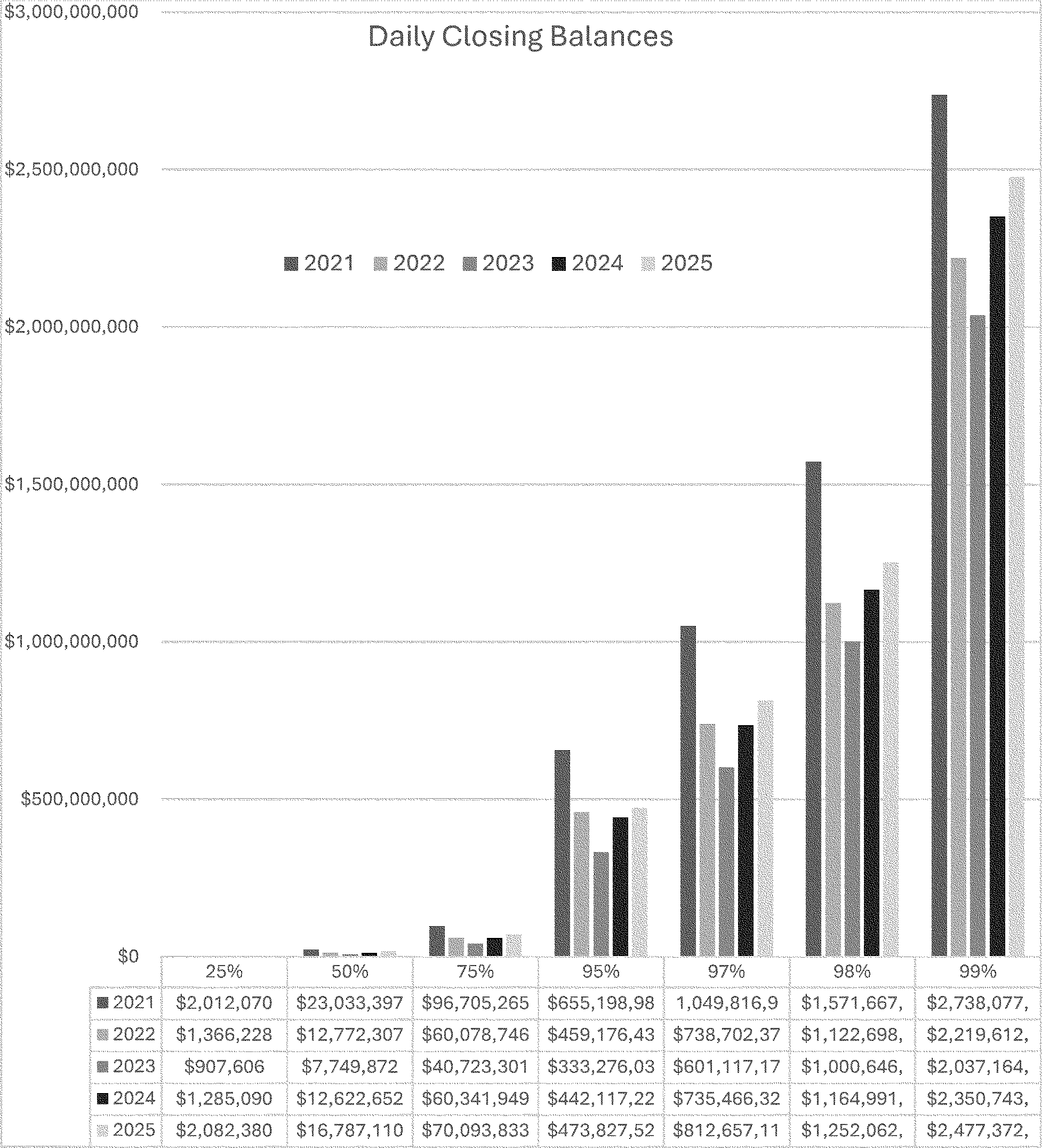
The Board has carefully reviewed the factors that commenters suggested should be considered in the design and implementation of the Closing Balance Limit. In particular, the Board recognizes that an asset-based limit may not reflect a payment-oriented institution's actual payment needs and that the net benefits of the Payment Account would be enhanced if the limit were calibrated to an individual institution's payment activity. However, as discussed in Section III.A.4 the Board continues to believe that having a uniform upper bound for setting the balance limit would mitigate potential risks related to financial stability and the implementation of monetary policy. As a result, the Board is proposing that the relevant Reserve Bank will set an individual Closing Balance Limit, not to exceed $1 billion, based on the Reserve Bank's analysis of the Payment Account holder's payment flows (if available), in particular at the beginning of the Federal Reserve's business day, and take into consideration periods of time when external sources of liquidity may be limited, such as during weekends and holidays.
E. Limit on Intraday Credit Access
1. Summary of Comments
Several commenters said the lack of access to intraday credit would make the Payment Account less appealing or useful for its intended purpose. For example, one commenter noted that the combination of low balance caps and the prohibition on daylight overdrafts would increase the risk of failed payments.
( printed page 30633)
Conversely, multiple commenters noted that the lack of intraday credit is an appropriate risk mitigant of the Payment Account design. Additionally, some commenters suggested that Reserve Banks implement intraday liquidity monitoring and tools to reject transactions that would result in a negative account balance, further reinforcing the goal of requiring prefunding for the Payment Account.
2. Board Response
The lack of access to intraday credit is a central feature of the Payment Account as proposed. Although providing intraday credit can foster the smooth operation of the payment system, the Board is proposing to design the Payment Account to minimize its operational complexities and risk profile. This design would enable the Reserve Banks to provide timely, direct access to accounts and services to institutions with novel and diverse business models and risk profiles. Prohibiting access to intraday credit would facilitate this goal by minimizing credit risk to the Reserve Banks, thus reducing the complexity of the risk assessment required for Payment Account requests.
If an institution desires access to intraday credit, the institution should consider requesting a Master Account, which may provide access to a broader range of services but would likely be subject to greater due diligence and scrutiny relative to a request for a Payment Account from the same institution.[21]
As discussed in Section III.A.1, consistent with some commenters' suggestions, the Board notes that Payment Accounts would only be permitted access to those services for which the Reserve Banks have automated tools to reject transactions that would result in a negative account balance.[22]
F. Effect of Providing Payment Accounts on the Risks Identified in the Account Access Guidelines
1. Summary of Comments
Commenters expressed differing views on the effect that providing Payment Accounts would have on the risks identified in the Account Access Guidelines. Some commenters stated that the design features of the Payment Account, such as no daylight overdrafts and the Closing Balance Limit, inherently limit credit and liquidity risks. They further stated that direct access to the payment system could reduce settlement risk by shortening settlement chains and lowering reliance on intermediaries that can amplify the impacts of operational outages or liquidity constraints during stress events. However, other commenters cautioned that providing direct access to institutions not subject to the same regulatory regime as federally insured depository institutions could result in heightened risks related to operational resiliency, financial stability, and Bank Secrecy Act (BSA)/Anti Money Laundering (AML) compliance.
Further, a few commenters expressed concerns that the design of the Payment Account would increase risks to the payment system as interconnectedness between Payment Account holders may create systemic risk and suggested setting exposure limits for single counterparties. Many of these commenters provided recommendations for additional requirements or terms to which Payment Account holders could be subject, such as submitting stress-testing plans and back-up liquidity arrangements, and suggested that strong supervision, consistent application across Reserve Banks, and the ability to revoke access if risks emerge would be essential safeguards. Similarly, other commenters emphasized the importance of explicit and enforceable expectations for operational resilience, governance, cyber maturity, and compliance to ensure that the Payment Account does not weaken the safety, soundness, or integrity of the payments system.
Lastly, commenters expressed divergent views on liquidity and capital requirements for Payment Account holders. Some argued that Payment Account holders should be subject to additional liquidity and capital controls to manage risk, particularly given their potential lack of operational maturity or limited experience with supervisory oversight. Conversely, other commenters recommended that the Federal Reserve tailor such controls to individual institutions and avoid imposing onerous requirements that may impede adoption.
2. Board Response
The Board recognizes commenters' concerns regarding potential risks associated with the Payment Account design. The Board acknowledges that providing direct access to financial services requires careful attention to the risk profile of requesting institutions and the potential for systemic implications.
The Board does not believe the Payment Account would increase systemic risk. The Board believes that the Payment Account's design would result in an appropriately low residual risk profile. In particular, the core design features of the Payment Account—including payment service limitations, no access to Reserve Bank intraday credit, the Closing Balance Limit, no interest on balances, and no access to the discount window—would generally mitigate the risks that Payment Account holders pose to the Reserve Banks, the payment system, and monetary policy implementation. If necessary, a Reserve Bank would retain discretion to impose additional restrictions on the use of a Payment Account or, if necessary, to terminate the account.
G. Payment Account Risk Associated With Illicit Finance
1. Summary of Comments
Just over half of the comment letters discussed risks related to BSA, AML, and countering the financing of terrorism (CFT) and related illicit finance issues. While nearly all of these commenters acknowledged the importance of the Board considering illicit finance risk in the context of the Payment Account, and for Payment Account holders to have rigorous BSA/AML/CFT programs, there was significant divergence among commenters in the criteria and conditions Reserve Banks should apply when evaluating illicit finance risks under Principle 5 of the Account Access Guidelines. Several commenters supported Reserve Banks relying on institutions' primary state or federal supervisors to supervise and assess an institution's BSA/AML/CFT compliance, while other commenters supported Reserve Banks having a stronger BSA/AML/CFT supervisory role over, or imposing additional BSA/AML/CFT conditions on, Payment Account holders.
Among the commenters supporting a stronger role for the Federal Reserve, some argued that the Reserve Banks should ensure that Payment Account holders are compliant with BSA/AML and Office of Foreign Assets Control (OFAC) requirements through periodic examinations. Others proposed that Reserve Banks impose additional controls, such as prohibiting nested transactions or imposing transaction limits until a Payment Account holder demonstrates compliance over an extended period. Among the commenters who supported the Federal Reserve relying on the primary federal or state supervisor, many noted that state-chartered institutions are required to maintain BSA/AML compliance programs and argued that the Federal
( printed page 30634)
Reserve should use compliance with these program requirements as evidence of the adequacy of an institution's BSA/AML program to avoid creating duplicative compliance regimes. Some commenters also raised the concern that by imposing additional conditions or controls, the Federal Reserve might hold Payment Account holders to higher standards relative to traditional institutions to which the Federal Reserve has historically provided accounts and services through Master Accounts. Other commenters raised concerns that newly chartered institutions may not have history or experience with effective BSA/AML/CFT compliance programs.
A few commenters discussed how new technologies either present new types of illicit finance risk, including, for example, in the form of agentic artificial intelligence (AI) in payments, or new opportunities for combatting these risks, including, for example, through the use of blockchain technology or AI.
2. Board Response
The Board agrees that all account holders, including any Payment Account holders, must mitigate illicit activity risks of their account access by complying with federal laws and regulations enacted to combat money laundering and the financing of terrorism. In practice, these means Reserve Bank accountholders must demonstrate their management of the illicit finance risks of their account access by having robust BSA/AML and OFAC compliance programs that meet the relevant regulatory and supervisory requirements, including those administered by the Financial Crimes Enforcement Network (FinCEN) and OFAC.
Most institutions that are legally eligible to maintain an account, including a Payment Account, with a Reserve Bank meet the definition of a “bank” for purposes of the BSA and, as a result, are required to maintain a comprehensive AML program that includes customer due diligence, transaction monitoring, and suspicious activity reporting.[23]
All U.S. persons, including all institutions eligible to maintain an account with a Reserve Bank, are required to comply with OFAC sanctions requirements. Institutions eligible to maintain an account with a Reserve Bank are also generally subject to examination by a primary state or federal supervisor to assess and determine their BSA/AML and OFAC compliance.
The Board does not believe that a Payment Account would present materially different illicit finance risk than a Master Account because both accounts can be used to clear and settle payments. As discussed in Section III.A.3, however, the Board is proposing to include a term for the Payment Account that confirms and reinforces that Board's expectation that the Payment Account holder demonstrates that it effectively mitigates the illicit finance risk of its account access. This term would clarify that Reserve Banks may implement illicit finance risk account terms or mitigating controls for Payment Accounts just as they may with Master Accounts.
Under Principle 5 of the Account Access Guidelines, Reserve Banks are expected to evaluate whether provision of an account and services to an institution would create undue risk by facilitating activities such as money laundering, terrorism financing, fraud, cybercrimes, economic or trade sanctions violations, or other illicit activity (illicit finance). The Guidelines note that the Reserve Bank should incorporate into its risk assessment, to the extent possible, the assessments of an institution by its state and/or federal supervisors. In addition, the Guidelines indicate that the Reserve Bank should confirm that the institution has compliance program(s) consisting of the BSA/AML components set out in the Guidelines and in relevant regulations and are designed to support compliance with OFAC regulations.
In implementing the Guidelines, the Reserve Banks have identified several account terms or risk mitigating controls available to Reserve Banks to mitigate illicit finance risk. For example, during its review of an access request, a Reserve Bank may, in its discretion, require information to augment that received from supervisory assessments of an institution's BSA/AML and OFAC compliance programs or otherwise identified by the Reserve Bank during its review. Additionally, a Reserve Bank may determine, in its discretion, that terms or risk mitigating controls are necessary to reduce the illicit finance risk associated with the provision of an account and services to an institution. A Reserve Bank may implement such requirements for a Master Account and would be able to do so for a Payment Account as well. Section III.A.3 provides examples of these informational requests, terms, and risk mitigating controls.
H. Payment Account Request Process
1. Summary of Comments
Commenters expressed divergent opinions on whether the 90-day review timeline for Payment Account access requests would provide adequate time for the Reserve Banks to assess risks. Views generally fell into three categories: (1) commenters who viewed the timeline as a significant improvement that would support innovation; (2) commenters who expressed concern that the timeline was insufficient for thorough risk assessment; and (3) commenters who supported the timeline in principle but raised concerns about consistent enforcement and implementation.
Many commenters viewed the 90-day review timeline as a significant improvement over the time it sometimes takes Reserve Banks to review requests for Master Accounts, a process which some commenters described as opaque. These commenters noted that the timeline would materially shorten review times and lower the cost of entry and uncertainty for eligible institutions seeking an account and services. One commenter characterized the timeline as a catalyst for innovation.
Conversely, some commenters expressed concern that 90 days would provide insufficient time for proper risk assessment. One commenter argued that reviews must be risk-based and take as long as necessary. Another commenter questioned whether the sufficiency and effectiveness of BSA/AML programs could be properly assessed within an expedited 90-day review period.
Several commenters questioned whether the Reserve Banks would adhere to the 90-day timeline in a consistent way. These commenters suggested that without additional clarity on eligibility expectations and procedural standards, the Payment Account may not be successful. One commenter noted that the absence of procedural standards has the potential to render the 90-day timeline ineffective because the RFI did not define what constitutes a complete account request and would allow for extensions. Another commenter cautioned that the possibility of open-ended extensions could create uncertainty that functions as a de facto denial and recommended that extensions be strictly time-limited and permitted only in exceptional circumstances.
( printed page 30635)
Several commenters discussed how, if at all, a Reserve Bank's provision of a Payment Account should influence the Reserve Bank's potential future provision of a Master Account to the Payment Account holder. A few commenters argued for a clearly defined pathway from a Payment Account to Master Account; some advocated for a defined on-ramp from one to the other. Conversely, other commenters argued against such a pathway and stated Payment Account holders should undergo the same level of review as Master Account requests do under the Guidelines.
To address these concerns, commenters made several recommendations. One commenter advocated for clearly defined timeline triggers for the 90-day review, including transparent pause and clock-stop rules to enhance consistency and transparency. Another commenter acknowledged that limited extensions may be appropriate for complex cases but maintained that reviews should generally conclude within three to six months. Some commenters suggested that the Board publish a standardized request checklist and release periodic summary statistics on approvals, denials, and typical timelines.[24]
One commenter suggested that the Board establish a specific timeline for Master Account access requests similar to the 90-day timeline proposed for Payment Accounts, arguing that such a timeline would provide greater transparency and reduce uncertainty in the application process.
2. Board Response
The Board believes the terms of the Payment Account would create a lower residual risk profile relative to a Master Account and thereby support the proposed 90-day review timeframe. Having a clear expected timeframe would create a transparent process and would help foster consistent evaluation of Payment Account access requests across all twelve Reserve Banks.
With respect to illicit finance risk, the Board does not have reasonable evidence to support the assertion that Payment Accounts would pose unique illicit finance risk. The Board believes that the Reserve Banks' experience reviewing access requests would facilitate adequate reviews of Payment Account requests in the proposed timeframe. In addition, the Board has added a term to the Payment Account to provide institutions greater clarity on what information a Reserve Bank may request an institution provide in order to support the Reserve Bank's analysis of illicit finance risk.[25]
The Board acknowledges concerns about extensions and consistent enforcement of the timeline. Consistent with the RFI, the Board is proposing that if a Reserve Bank requires additional time beyond the 90-day period to complete its review, the Reserve Bank would be expected to consult with the Board before extending the review period. As further explained in Section III.C.4, the Board believes the consultation process provides an appropriate mechanism for ensuring consistent application of the proposed review timelines. Further, the Board, in conducting its general supervision of the Reserve Banks, would monitor the extent to which Reserve Banks were processing Payment Account requests in accordance with the Guidelines.
In response to comments suggesting that the Payment Account be designed as an on- ramp to a Master Account, the Board believes that the provision of a Payment Account should not be an indication of any future provision of a Master Account. A request for a Master Account by a Payment Account holder would require a full review under the Account Access Guidelines. Although the Reserve Bank would have reviewed the Payment Account holder's request for a Payment Account under the Guidelines, the Reserve Bank would have done so in light of the Payment Account's standard terms, which substantially limit the range of risks posed. However, the Board acknowledges that a Reserve Bank's experience with a Payment Account holder could inform its review of a request for a Master Account.
In response to a comment about providing timelines for Master Account requests, the Board proposes that requests from Tier 1 institutions be reviewed generally within 45 calendar days, as discussed further in Section III.C.4.
I. Other Comments
1. Summary of Comments
Several trade associations requested the Board extend the RFI's 45-day comment period for an additional 30 days. The Board received one comment requesting that the Board deny the trade associations' extension request.
Several commenters discussed the need for consumer and privacy protections for Payment Account holders that facilitate retail transactions. These commenters expressed differing views on the appropriate level of protection, with some advocating for additional safeguards and others recommending that such protections be tailored to the payment activity or commensurate with the Payment Account holder's overall size or risk profile.
Additionally, one commenter mentioned structural inequities between traditional banks and non-traditional banks, noting that Payment Account holders would gain direct access to the Federal Reserve payment infrastructure without incurring the regulatory costs and investments that traditional banks have made, undermining competitive fairness. Another commenter suggested that the proposal could dilute the payments franchise of insured institutions with Master Accounts and that mid-size and community banks would face acute competitive pressure.
2. Board Response
The Board believes the 45-day comment period was reasonable and sufficient for commenters to review the RFI and provide meaningful input. The Board also believes it is appropriate to issue this notice, which provides more information on the proposal, so that the public has sufficient detail to consider and comment upon the proposed Payment Account.
With respect to other commenters' focus on consumer and privacy protections, the Board expects all accountholders to comply with applicable laws and regulations governing consumer protection.
III. Proposal
A. Proposal To Offer a Payment Account
The Board is proposing to set forth standard and transparent terms for the provision of Payment Accounts by Reserve Banks. The Board is proposing to create a Payment Account to support private-sector payments innovation while prudently managing the risks identified in the Account Access Guidelines.
The Board encourages Reserve Banks to pause decisions on access requests from Tier 3 institutions until the Board has completed its policy development process on the Payment Account
( printed page 30636)
proposal.[26]
A pause will allow time for the public to provide input on the proposal, and it will give the Federal Reserve the opportunity to consider this input. A pause also will ensure greater transparency, consistency, and certainty for institutions that are seeking access during this period. The Board requests that Reserve Banks implement this temporary pause until the Board has completed its policy development process with respect to the Payment Account.[27]
While eligible institutions from any tier may request a Payment Account, the Board anticipates that most Payment Account requesters would be Tier 2 or Tier 3 institutions. As explained above, access to an account and services by non-federally insured institutions (Tiers 2 and 3) presents greater and more heterogenous risks than federally insured institutions (Tier 1).[28]
Accordingly, the Board believes it is necessary that the Payment Account be designed with ex ante controls and standard terms to mitigate these risks.
A Payment Account, as the Board proposes to define it, would be a special-purpose account available to institutions that are legally eligible to maintain accounts with a Reserve Bank (regardless of their tier) for the purpose of clearing and settling payments activity for the institution and its customers.[29]
Payment Accounts would be a new, optional way for institutions to request access to accounts and services. As further described in this notice, the Payment Account's standard terms would reduce its residual risk profile facilitating a more streamlined review relative to the review of an access request from the same institution. Institutions seeking to access intraday credit or a broader set of services; to act as an OC 1 Correspondent or OC 1 Respondent (defined in Section III.A.2); or to maintain larger closing balances would retain the option of requesting a Master Account or to be an OC 1 Respondent.[30]
The Payment Account's terms would be set out in the Account Access Guidelines, the PSR Policy, the Board's Regulation A (12 CFR part 201), and the Board's Regulation D (12 CFR part 204). For convenience, the Board has included a summary of all the proposed Payment Account terms below:
Topic
Term
Implementing
document
Eligibility 31
Institutions that are legally eligible under the Federal Reserve Act or other federal statute to maintain an account at a Reserve Bank and receive services
Federal law.
Closing Balances 32
Closing balance limits would be set by the Reserve Bank for an individual Payment Account based on expected payment activity in the account, not to exceed $1 billion. There would be no limit on intraday balances in a Payment Account
PSR Policy.
Intraday Credit 33
Payment Accounts would not be permitted to access intraday credit. Transactions that would cause an overdraft would be automatically rejected
PSR Policy
Available Services 34
Only those services for which the Reserve Banks can automatically reject transactions that would cause an overdraft would be permitted to settle in a Payment Account (
i.e.,
currently, the Fedwire Funds Service, the FedNow Service, NSS, and the Fedwire Securities Service for securities transfers free of payment)
PSR Policy.
Correspondent Prohibition 35
A Payment Account holder may not act as a “Correspondent” as defined in the Reserve Bank Operating Circular No. 1 (OC 1) by permitting other legally eligible institutions to settle their services activity directly in the Payment Account
PSR Policy.
Respondent Prohibition 36
A Payment Account holder may not act as a “Respondent” as defined by OC 1 by settling its services activity directly in another institution's Master Account
PSR Policy.
Illicit Finance Risk 37
A Payment Account holder may be required to provide (ad hoc or periodically) information to demonstrate its compliance with BSA/AML and OFAC requirements 38
PSR Policy.
Discount Window 39
Payment Account holders would not be permitted to access credit from the discount window
Regulation A.
Interest on Balances 40
Balances in a Payment Account would not receive interest
Regulation D.
Excess Balance Account (EBA) Participation 41
A Payment Account holder would not be permitted to participate in an EBA
Regulation D.
Review Timeline 42
Review of Payment Account requests would generally be completed within 90 calendar days of receiving all requested documents
Account Access Guidelines.
Under
the proposal, Payment Accounts would have a consistent set of terms to mitigate the risks posed to the Reserve Banks (Principle 2 of the Guidelines), the payment system (Principle 3 of the Guidelines), financial stability (Principle 4 of the Guidelines), and the implementation of monetary policy (Principle 6 of the Guidelines). A Reserve Bank might also require a Payment Account holder to submit information to demonstrate its compliance with BSA/AML and OFAC requirements, which would mitigate illicit finance risk (Principle 5 of the
( printed page 30637)
Guidelines). Beyond the Payment Account's specified terms, the Reserve Banks would retain discretion to impose additional restrictions on a Payment Account, or to remove access to service or close an existing account, on a case-by-case basis, in the same manner and to the same extent as they can with Master Accounts.
Under the proposal, requests by Tier 2 and Tier 3 institutions for Payment Accounts, with their standard terms and resulting lower residual risk profile, would typically be reviewed by Reserve Banks in a shorter period than Master Account requests from the same institution. However, to the extent a Reserve Bank identifies any risk that it cannot evaluate in the proposed 90-day review period, the Reserve Bank would consult with the Board about extending the review period.[43]
While the Board believes that the Payment Account terms permit a streamlined review relative to a request for a Master Account from the same institution, Reserve Banks would still be expected to use the Account Access Guidelines, including its tiered review framework, to review all access requests, regardless of account type.
Payment Accounts and Master Accounts would be distinct Reserve Bank account types. As described further below, Payment Accounts would have a standard set of risk-mitigating terms designed to create a lower residual risk profile. Conversely, Master Accounts do not have a standard set of risk-mitigating terms (although Reserve Banks have discretion to impose terms on Master Accounts). Accordingly, the Board is proposing to define Master Accounts to clarify that they are separate from Payment Accounts. The proposed definition simply memorializes the existing characteristics of a Master Account. Institutions would not be permitted to have both a Payment Account and a Master Account simultaneously, which is consistent with existing Reserve Bank practice.[44]
A Payment Account holder that wants a Master Account would have to submit a new access request to its Reserve Bank, which would review the request in accordance with the Account Access Guidelines. The Board has considered comments suggesting that a Payment Account should be an on-ramp to a Master Account.[45]
Although the Reserve Bank would have reviewed the Payment Account holder's request for a Payment Account under the Guidelines, it would have done so in light of the Payment Account's unique terms, which substantially limit the range of risks posed by the Payment Account. Further, since Reserve Banks have the discretion to determine whether to grant a master account, as well as to tailor the terms of a Master Account to an institution's risk profile, conducting a full review according to the Account Access Guidelines would be necessary to ensure appropriate calibration of those terms. Holding a Payment Account would not indicate likely approval of a Master Account request, and a Reserve Bank would maintain its discretion to impose terms on the provision of any Master Account. Nevertheless, the Board recognizes that the Reserve Bank may be informed by its review of a Payment Account holder's request for a Payment Account and subsequent experience with the Payment Account holder when reviewing its request for a Master Account.
1. Terms To Mitigate Risk to the Reserve Banks
The Board is proposing several terms for Payment Accounts to manage risks to the Reserve Banks (and by extension to the American public).[46]
First, Payment Account holders would not be permitted access to intraday credit under the Board's proposed revisions to Part II of the PSR Policy, which governs the amount of intraday credit, if any, that an institution may receive from a Reserve Bank.[47]
In general, the Reserve Banks, at their discretion, may provide intraday credit to institutions with accounts at Reserve Banks to foster the smooth operation of the payment system.[48]
The Board, however, believes it would be imprudent for the Reserve Banks to extend intraday credit to Payment Account holders.
As described in the PSR Policy, an institution's eligibility for either
uncollateralized
or
collateralized
intraday credit (
i.e.,
a positive net debit cap) depends, in part, on the institution meeting certain creditworthiness standards.[49]
These eligibility requirements reflect the fact that all recipients of intraday credit, including collateralized intraday credit, pose some credit risk to the Reserve Bank.[50]
The Board has intentionally designed the Payment Account to minimize its operational complexity and risk profile to provide direct access to a basic account and services to a broader population of institutions with novel and diverse business models and risk profiles in a timely manner. Prohibiting access to intraday credit is central to the Board achieving this goal.
Several additional considerations support making intraday credit inaccessible to Payment Account holders. For one, institutions seeking Payment Accounts are unlikely to be subject to the resolution regimes that accompany federal deposit insurance. Resolution of federally insured depository institutions follows clear, consistent, and well-established rules for paying Reserve Banks and other creditors of a failed institution.[51]
Insolvency regimes applicable to uninsured Payment Account holders may be new or may involve the application of rarely invoked state and federal laws. Moreover, uninsured Payment Account holders likely would not be subject to a framework of prudential supervision and regulation that is as robust as that applied to federally insured depository institutions. Finally, data available to Reserve Banks may vary across Payment Account holders. Current credit risk monitoring at Reserve Banks relies mostly on supervisory information received from within the Federal Reserve System or from other federal regulators, and similar information on the full range of potential Payment Account holders may not be readily available. Consideration of the risks associated with providing credit to institutions subject to alternative regulatory and resolution regimes would require a level of analysis and due diligence that is likely infeasible in the
( printed page 30638)
expedited review period for Payment Account requests.
The Board has considered the comments that addressed the RFI's proposal not to permit Payment Accounts intraday credit access. For the reasons explained above and in Section II.E.2, the Board is proposing that Payment Accounts would not have access to intraday credit, either uncollateralized or collateralized. As such, an institution would need to prefund all transactions settling in its Payment Account. If an institution desires access to intraday credit, the institution should request a Master Account.
Second, and consistent with the lack of intraday credit access, the Reserve Banks would only permit Payment Account holders to access, at most, services for which the Reserve Banks can automatically reject transactions that would cause an overdraft. Currently, the Reserve Banks can implement credit-limit monitoring controls to prevent overdrafts at a service-line level for the Fedwire Funds Service, the FedNow Service, and the National Settlement Service. In addition, the Reserve Banks can prevent overdrafts caused by securities transfers over the Fedwire Securities Service by limiting Payment Account holders to securities transfers free of payment.[52]
The Board acknowledges the comments suggesting that Payment Accounts be provided with access to FedACH. As discussed in detail in Section II.B.2, the Board does not believe there is a reasonable way to allow Payment Accounts to access FedACH and effectively mitigate credit risk to the Reserve Banks without disrupting the ACH network and potentially undermining its efficiency and effectiveness. If the Reserve Banks were to change the controls that apply to their payment systems such that it becomes possible to automatically reject additional types of transactions that would cause an overdraft, the Board might reconsider the suite of services to which Payment Accounts are given access, but the Board would expect to evaluate any potential expansion of Payment Account services through public comment.
In addition to credit risk, the Account Access Guidelines include an assessment of a wide range of risks to the Reserve Banks that can arise from the provision of an account and services, such as operational and cyber risks. Today, Reserve Banks mitigate cyber and operational risk through strong risk management controls and processes, including a security and resiliency assurance program that requires institutions to attest to their compliance with Reserve Bank security requirements.[53]
Payment Account holders would be subject to the same controls, processes, and attestation requirement. Given the Payment Account's proposed simplified operational and risk profile, the Board believes Reserve Banks generally should be able to assess requesters' cyber and operational risks within the proposed 90-day review period.
2. Terms To Mitigate Risk to the Payment System
The Board is proposing a usage restriction for Payment Accounts to reduce their risk to the payment system. The Board anticipates that a Payment Account holder, like a Master Account holder, would use its account to clear and settle its depositors' and other customers' payment activity. However, the Reserve Banks' OC 1 also permits a contractually defined Correspondent-Respondent relationship in which an account holder may agree to act as a Correspondent (OC 1 Correspondent) and allow its Master Account to be used to settle certain transactions and service fees for a Respondent (OC 1 Respondent).[54]
This OC 1 Correspondent-Respondent relationship creates a materially different relationship between the Reserve Bank, the OC 1 Correspondent, and the OC 1 Respondent from a traditional relationship in which a financial institution processes payments on behalf of its depositors and customers. In particular, in an OC 1 Correspondent-Respondent relationship, an OC 1 Respondent can submit payment instructions
directly
to a Federal Reserve Bank (rather than to its OC 1 Correspondent), and the debits and credits associated with those payments settle in the Master Account of the OC 1 Correspondent. The Board proposes that Payment Account holders not be permitted to act as either OC 1 Correspondents or OC 1 Respondents because these relationships pose unique and complex risks.
Under these arrangements, multiple OC 1 Respondents can settle debits and credits associated with Federal Reserve payments in a single OC 1 Correspondent's account. Assessing the risks associated with multiple institutions settling their transactions in the Master Account of a single OC 1 Correspondent involves detailed due diligence. Additionally, if an OC 1 Correspondent fails or decides to abruptly terminate its relationship with an OC 1 Respondent, the OC 1 Respondent's continued access to services could be affected and, particularly when the OC 1 Respondent is accessing FedACH as an OC 1 Respondent, could cause challenges for other participants in the payment system.
The Board believes acting as an OC 1 Correspondent should be subject to the full review associated with the provision of a Master Account. Similarly, the Board is proposing that Payment Account holders would not be permitted to act as OC 1 Respondents. The Board reiterates, however, that this would not prevent the Payment Account holder from clearing and settling activity associated with its customers' payments activity in the Payment Account subject to the Payment Account's terms.
The Board considered whether Payment Account holders should be permitted to be OC 1 Respondents. The Board recognizes that OC 1 Respondent relationships may pose lower residual risks, for example lower credit risk to the Reserve Banks, which may result in a more streamlined review than a Master Account request from the same institution under the Guidelines. OC 1 Respondent relationships only permit access to a subset of services, although FedACH is among those included, while Master Account holders may, if approved by the Reserve Bank, potentially access all services and potentially access intraday credit.[55]
Given the potential operational complexity that could arise from an institution maintaining OC 1 Respondent status, which would be subject to a one type of review and ongoing monitoring while simultaneously holding a Payment Account, which would subject to a different type of review and ongoing monitoring, the Board is proposing that Payment Account holders not be permitted to act as OC 1 Respondents. The Board also does not anticipate that Payment Account holders would be
( printed page 30639)
interested in being OC 1 Respondents when they could instead request a Master Account.
Therefore, given the Board's goals of creating a Payment Account with a relatively simple operational and risk profile, the request for which is subject to a comparatively streamlined review to that of a request for a Master Account from the same institution, the Board does not believe the risks associated with a Payment Account holder acting as either OC 1 Correspondent or OC 1 Respondent can be sufficiently mitigated. Accordingly, the proposal would not permit Payment Account holders to act as either OC1 Correspondents or OC 1 Respondents as those terms are defined in OC1.
The Account Access Guidelines' consideration of risks to the payment system includes cyber and operational risks among the payment risk considerations. As previously discussed in Section III.A.1, given the Payment Account's proposed simplified operational and risk profile and the reliance on the assessments of requesters' primary supervisors, the Board believes Reserve Banks can assess requesters' cyber and operational risks at that time within the proposed 90-day review period.
3. Terms To Mitigate Illicit Finance Risk
Under the Account Access Guidelines, provision of a Payment Account should not create undue risk to the overall economy by facilitating illicit finance. In consideration of this principle and the comments received on the RFI, the Board is proposing to set out a non-exhaustive list of terms available to a Reserve Bank, at its discretion, to mitigate illicit finance risk associated with the provision of a particular Payment Account. If requested by the Reserve Bank, a Payment Account holder would be required to provide information related to its BSA/AML and OFAC compliance. This information would assist the Reserve Bank in its initial or ongoing assessment of the illicit finance risk associated with provision of the Payment Account. The Reserve Bank could require this additional information on an ad hoc or periodic basis depending on its individualized assessment of the institution. These informational requirements could include:
Providing the Reserve Bank with an independent, third-party assessment of the Payment Account holder's BSA/AML and OFAC compliance programs;
Providing the Reserve Bank with an attestation regarding the Payment Account holder's compliance with BSA/AML and OFAC laws and regulations;
Providing the Reserve Bank with copies of audit reports of the Payment Account holder's BSA/AML or OFAC compliance programs;
Meeting regularly with the Reserve Bank to discuss noteworthy or material BSA/AML or OFAC compliance issues;
Notifying the Reserve Bank of any BSA/AML or OFAC enforcement action taken against the Payment Account holder by a regulatory or supervisory authority; or
Notifying the Reserve Bank of any material deficiencies identified regarding the Payment Account holder's BSA/AML or OFAC compliance programs.[56]
These illicit finance terms are consistent with those the Reserve Banks already use to mitigate illicit finance risks associated with Master Accounts. The Board believes potential Payment Account holders, in particular, would benefit from the transparency provided by setting out potential illicit finance terms that a Reserve Bank might impose. The Board anticipates that Payment Account requesters are more likely to be subject to weaker or more divergent supervisory regimes and are more likely to engage in new or emerging business lines. Accordingly, Payment Account requesters could pose greater and more heterogenous risk than federally insured institutions. The above non-exhaustive list of potential terms would inform potential Payment Account holders of the illicit finance mitigants that Reserve Banks may apply to Payment Accounts.[57]
4. Terms To Mitigate Risk to Financial Stability and Monetary Policy Implementation
The Board is proposing that the Payment Account would be subject to a Closing Balance Limit established by the Reserve Bank pursuant to the new Part IV of the PSR Policy proposed by this notice. Under the framework set out in this proposal, an individual Payment Account's Closing Balance Limit, not to exceed $1 billion, would be based on the Reserve Bank's analysis of the Payment Account holder's expected payment flows, in particular at the beginning of the Federal Reserve's business day, and take into consideration periods of time when external sources of liquidity may be limited, such as during weekends and holidays. The Payment Account holder would be required by the Reserve Bank to achieve a closing account balance at or below its Closing Balance Limit by the Federal Reserve's close of business, as defined in Part II of the PSR Policy, and maintain such balance until the open of the Federal Reserve's next business day.[58]
The proposal does not contemplate that Payment Account balances would be capped during the business day. The Board believes an intraday balance cap would limit a Payment Account's utility for clearing and settling payments, which is its intended purpose.
Payment Account holders would be responsible for managing their account to ensure compliance with their Closing Balance Limit. Under the proposal, Reserve Banks would also implement an escalating compliance program—moving from counseling to service restrictions, and potentially to account closure as the incidence or severity of breaches of the Closing Balance Limit increases.[59]
In setting the individual Closing Balance Limit, the Reserve Bank would analyze internal Reserve Bank data on the Payment Account holder's payment flows, in particular at the beginning of the Federal Reserve's business day, and take into consideration periods of time when external sources of liquidity may be limited such as during weekends and holidays.[60]
In addition, the Payment Account holder could provide the Reserve Bank with forecasts and additional information related to expected daily variations in payments and growth in payments over time. Similarly, the Reserve Bank would
( printed page 30640)
review each Payment Account's individual Closing Balance Limit at least annually using Reserve Bank data and any additional information provided by the Payment Account holder.
Limiting the closing balances of Payment Accounts would mitigate risks posed by Payment Accounts to the financial sector and overall economy. The Board continues to believe that provision of an account and services to an institution should not create undue risk to the stability of the U.S. financial system. As discussed above, the Payment Account is designed as a special-purpose account for clearing and settling the Payment Account holder's payment activity and not for the store of value. However, Payment Account holders may seek to hold balances in excess of those needed for payments in the Payment Account. Such a scenario could have negative financial stability implications. In particular, during periods of market volatility or stress, and in the absence of a Closing Balance Limit, Payment Account holders might quickly increase Payment Account balances at a Reserve Bank, which could rapidly drain balances from other account holders. A rapid decrease in the amount of reserves that account holders can access could increase money market rate volatility.
Furthermore, a Closing Balance Limit would help the Federal Reserve maintain an overall balance sheet that is consistent with its monetary policy implementation framework. Consistent with the Board's proposal to amend Regulation D, the Board has considered the effects of limiting balances in Payment Accounts on monetary policy implementation. As discussed in greater detail in the Board's
Federal Register
notice proposing to amend Regulation D to prohibit Payment Account balances from earning interest, the contained size of Payment Accounts would help ensure that their direct effect on Federal Reserve liabilities would be modest and that the Federal Reserve will not have to expand its balance sheet significantly beyond what would otherwise be needed to efficiently and effectively implement monetary policy. However, the indirect effect of Payment Accounts on other Federal Reserve liabilities is difficult to assess and would depend on several factors, including: the characteristics of the Payment Account holders (
i.e.,
their balance sheet composition and business models), the form of substitution into Payment Accounts from other means of payment (
e.g.,
deposits at depository institutions, physical currency), and the amount of sweeping activity of Payment Account holders from commercial bank deposits to support higher intraday balances in Payment Accounts.[61]
The Board believes that paying zero interest on Payment Account balances and establishing the Closing Balance Limit would support the goal of limiting balances in Payment Accounts. During normal market conditions, it is likely that a zero interest rate would incentivize Payment Account holders to minimize Payment Account balances to the lowest level practical to manage their payment flows. During periods of general market stress, Payment Account holders may prefer to hold higher account balances than during non-stress periods, regardless of the interest rate paid on the Payment Account. In addition, there may be periods where the Payment Account holder has idiosyncratic incentives to hold higher balances at a Reserve Bank. In these periods, the Closing Balance Limit would further support minimizing balances in Payment Accounts. Together, these two Payment Account terms—paying zero interest and the Closing Balance Limit—support the Board's goal of minimizing the direct effects of Payment Accounts on the Federal Reserve balance sheet to only what is needed for efficient and effective implementation of monetary policy.
In proposing the maximum size of the Closing Balance Limit, the Board completed a distributional analysis of closing balances data for existing Reserve Bank accounts over the past five years and found that $1 billion would be equal to or greater than approximately 97 percent of account closing balances over the review period.[62]
In determining the appropriate maximum Closing Balance Limit, the Board considered several options, including setting the limit to zero. The Board believes a limit of zero would be inconsistent with a Payment Account holder's need to prefund its payment activity for the beginning of the next business day. For example, the FedNow Service operates 24 hours a day, and the Fedwire Funds Service currently operates 22 hours a day. Because Payment Accounts will not have access to intraday credit, Payment Accounts will need to maintain a sufficient balance in the account to settle payments. The Board was also informed by the comments it received on the RFI when determining the Closing Balance Limit amount. For the reasons explained above and in Section II.D.2, the Board is proposing that the Reserve Bank would take into account the Payment Account holder's individual circumstance in setting the individual Closing Balance Limit, up to a limit of $1 billion.
Finally, the proposal acknowledges that, in unusual circumstances, the Reserve Banks may temporarily permit an institution to exceed its individual Closing Balance Limit. The Reserve Bank would require the Payment Account holder to provide a reasonable explanation for why it is seeking to temporarily exceed its Closing Balance Limit. The Board believes that requests to temporarily exceed the Closing Balance Limit should be granted only rarely. For example, a Payment Account holder could anticipate larger than normal payment outflows and request to temporarily exceed its Closing Balance Limit to maintain the smooth flow of payments. Given the reasons for limiting Payment Account balances explained above, the Reserve Bank would be expected to consult with the Board if the requested temporary Closing Balance Limit exceeds $1 billion. The Reserve Bank would be expected to consult with the Board if it temporarily permitted a Payment Account's closing balance to be equal to or less than $ 1 billion (but, in excess of its Closing Balance Limit) for two consecutive Federal Reserve business days.
B. Proposed Changes to the PSR Policy
The Board is proposing to amend the PSR Policy to provide transparency around certain standard terms that would apply to accounts that Reserve Banks provide to legally eligible institutions.[63]
The Board believes that such transparency would benefit institutions as they make decisions around business structure and potential account usage.
1. Proposal to Add Part IV to the PSR Policy
The Board believes the PSR Policy is the most appropriate existing Federal Reserve policy to document these account terms. The PSR Policy already covers certain activities that occur in accounts, such as risks associated with
( printed page 30641)
the incurrence of intraday or overnight overdrafts in Master Accounts. More importantly, the PSR Policy focuses on risks associated with payments, clearing, and settlement. Each of these activities is fundamental to Reserve Bank accounts and services. The Board is proposing to introduce a new Part IV to the PSR Policy to outline the types of accounts that Reserve Banks provide to legally eligible institutions, and certain standard terms that Reserve Banks apply to these accounts.
a. General Terms and Master Account Terms
Proposed Part IV would include general terms that apply to both Master Accounts and Payment Accounts. In recent years, some institutions have requested that Reserve Banks recognize third-party interests in Master Accounts. For example, some institutions have requested accounts to hold funds in a trustee or fiduciary capacity. Reserve Banks do not maintain Master Accounts for the benefit of anyone other than the accountholder and, as such, do not recognize third-party interests in Master Accounts. Accordingly, Part IV would state that Reserve Banks do not recognize third-party interests in Master Accounts and would not recognize them in the proposed Payment Account.
Proposed Part IV would also state that an institution may only maintain one account except in very limited circumstances. For example, following a merger, a bank may maintain two accounts for up to a year. The proposal to limit institutions to one account and the exceptions to the one-account rule are consistent with the Reserve Banks' existing account agreement.[64]
Finally, as explained in Section III.A., the Board is proposing to clarify that Master Accounts do not have a standard set of risk-mitigating terms (although Reserve Banks have discretion to impose terms on Master Accounts) and are separate from Payment Accounts.
b. Payment Account Terms
As discussed in Section III.A of this notice, the Payment Account is designed with a standard set of risk-mitigating terms that create a lower residual risk profile to the relevant Reserve Bank, the payment system, and to monetary policy implementation relative to a Master Account. Proposed Part IV describes these standard Payment Account terms. While some of the terms in Part IV of the PSR Policy would be implemented through Regulations A and D and the Account Access Guidelines, Part IV of the PSR Policy would include them all for completeness and transparency. The terms discussed in proposed Part IV relate to (a) closing balances, (b) interest on overnight balances, (c) access to Reserve Bank credit, (d) access to Reserve Bank financial services, (e) account usage restrictions, (f) excess balance account participation, and (g) illicit finance risk.
In addition to serving as a resource to summarize Payment Account terms that are implemented through other regulations or policies, proposed Part IV would itself implement certain Payment Account terms. First, Part IV would require Reserve Banks to establish the proposed Closing Balance Limit as described in Section III.A.4. Part IV would also clarify that Payment Accounts would not have limits on intraday balances. In addition to the proposed changes to Part II discussed below, Part IV would prohibit Payment Account holders from accessing intraday credit (also known as daylight overdrafts). Relatedly, Part IV would provide that a Payment Account would only have access to those services in which the Reserve Banks can automatically reject transactions that would cause an overdraft. The Board's proposal to restrict a Payment Account from being an OC 1 Correspondent or OC 1 Respondent would also be implemented through Part IV.[65]
Part IV would also outline a set of non-exhaustive, discretionary illicit finance mitigants available to Reserve Banks. Finally, the Board would include a provision in Part IV, similar to that for Master Accounts, reiterating the Reserve Banks' discretion to impose other Payment Account terms to manage the risks identified in the Guidelines.
2. Revisions to Part II
In addition to the standard account terms set out in the new proposed Part IV, the Board is proposing changes to Section II.F of the Board's PSR Policy. Specifically, the Board proposes to revise Section F (Special Situations) of Part II (Federal Reserve Intraday Credit Policies) of the PSR Policy to clarify that institutions granted a Payment Account would not be eligible for intraday credit and would only have access, at most, to those services for which the Reserve Banks can automatically reject transactions that would cause an overdraft.[66]
Reserve Bank systems would monitor the institution's account balance in real time to automatically reject any transactions that would create an overdraft.
C. Proposed Revisions to the Guidelines
Given that Reserve Banks' access decisions can have implications for a wide array of Federal Reserve policies and objectives, the Board continues to believe that a structured, transparent, and detailed framework for evaluating access requests benefits the financial system broadly. Such a framework also helps foster consistent evaluation of access requests, from both risk and policy perspectives, across all twelve Reserve Banks.
A Payment Account request would be evaluated using the same principles as a request for a Master Account. The Board considered making changes to the risk-based principles set out in the Account Access Guidelines to accommodate the Payment Account, but believes it appropriate to propose no amendments at this time.
1. Proposed Revisions to the Review Framework To Accommodate Payment Accounts
As discussed in Section III.A of this notice, the Payment Account, by design, would have a lower residual risk profile than a Master Account due to the proposed Payment Account terms. Additionally and consistent with the Account Access Guidelines, the Board expects the Reserve Banks would incorporate, to the extent possible, the assessments of an institution's primary supervisor into its independent assessment of the institution's risk profile. Therefore, the Board is proposing that requests for a Payment Account receive a more streamlined review relative to the same institution requesting a Master Account.[67]
2. Proposed Timing Expectations for Reviewing Access Requests
The Board believes that setting expectations about the period within which a Reserve Bank would grant or deny an access request would give requesting institutions clarity on the resources and time needed for the evaluation process. While target dates are useful, the Board also believes that the differences across access requests, which would involve different charter types, business models, regulatory regimes, and risk profiles, preclude specification of rigid timelines. Instead,
( printed page 30642)
the Board believes that the tiering framework and the Payment Account's risk controls permit the creation of indicative timelines.
First, the Board is proposing that the review of any requests for accounts and services from Tier 1 institutions, including a Master Account or Payment Account access request, should be completed within 45 calendar days after the Reserve Bank receives all requested documentation. The proposed time period reflects the less intensive and more streamlined review for Tier 1 institutions under the Guidelines' tiering framework. Because detailed regulatory and financial information would be available for most Tier 1 institutions, the Board believes review of a Tier 1 institution's access request should take less than 45 calendar days once the Reserve Bank receives all documents. The Board, however, is proposing 45 calendar days to accommodate those requests where a Reserve Bank may need additional time, for example, if there have been recent material changes to an institution's business model.
The Payment Account's standardized controls and limitations would reduce its residual risk profile and thereby facilitate a more streamlined review relative to the review of a request for a Master Account from the same institution. The Board believes it would be appropriate for Reserve Banks generally to evaluate Payment Account access requests, under the Guidelines' tiered framework, from Tier 2 and Tier 3 institutions within 90 calendar days of receiving all requested documentation.[68]
Reserve Banks would consult with the Board if their review of a Payment Account request might take longer than the 90-calendar day period.
The proposal contemplates that Reserve Banks would consult with the Board when the review of an access request might take longer than the contemplated time period. Each institution is unique, and in certain instances, an institution's request might require more time than the proposed indicative timelines. In such cases, the Board would expect the Reserve Bank to explain the efforts it has made to meet the relevant review period, why it has been unable to meet the review period, and the time expected to complete its review. The Board believes the proposal would provide sufficient flexibility to Reserve Banks while giving clearer expectations to institutions seeking accounts and services.
The Board considered setting the time periods from the date on which an institution first requested access. The Board understands that some commenters may express concern that Reserve Banks will continually request new documents to extend the review timeline. However, the Board believes that setting the timeline from the date an institution submits its access request would not give the Reserve Banks sufficient time or information to review an institution's request. In many cases, institutions do not submit sufficient documentation with their access request to facilitate the Reserve Banks' review under the Guidelines.
For Master Account requests from Tier 2 and Tier 3 institutions, the Board believes that the nature of the relevant variables—including the variety of charter types, business models, regulatory regimes, and risk profiles—precludes specification of a single timeline. As a result, the Board is not setting an indicative timeline for Reserve Bank reviews of these access requests. The Board would continue to monitor the length of Reserve Banks' individual reviews.
IV. Request for Comment
The Board requests comments on all aspects of the proposed changes to the Account Access Guidelines and the PSR Policy. Further, the Board specifically seeks comment on the following aspects of the proposal:
1. Would the design of the Payment Account, as updated from the RFI, support eligible institutions' payment activity and be an attractive account option?
2. The Board is proposing to establish the Closing Balance Limit in a new Part IV of the PSR Policy.
a. Given that paying zero interest and limiting closing balances on Payment Accounts both serve a similar function and have important interactions, should the Board consider codifying the Closing Balance Limit in Regulation D? Why or why not?
b. Are there important interactions between limiting closing balances and paying zero interest on Payment Accounts that the Board has not identified?
3. The Board is proposing to restrict a Payment Account from being an OC 1 Correspondent or OC 1 Respondent for any service to which Payment Accounts have access. Should a Payment Account holder be permitted to access the FedNow Service as an OC 1 Respondent? If an institution were permitted to offer OC 1 Correspondent services to a Payment Account holder for use of FedNow in an OC 1 Respondent capacity, are there particular or unique risks the institution should consider in deciding whether or not to offer such services?
4. The Board is proposing that the Closing Balance Limit be established based on an institution's expected payment activity at the beginning of the Federal Reserve's business day, not to exceed $1 billion.
a. Is $1 billion an appropriate maximum for the Closing Balance Limit?
b. Are there effects of limiting closing balances in Payment Accounts that the Board has not identified?
5. The proposal does not include specific illicit finance requirements in connection with a Payment Account request. Should there be requirements for institutions that are not federally insured? For example, if an institution requesting a Payment Account were not federally insured, should the institution be required to submit an attestation that it is a “bank” under the BSA or be required to submit an assessment of its BSA/AML and OFAC compliance programs from an independent third-party, or should the Reserve Bank be required to confirm that the BSA/AML and OFAC supervisory and regulatory regime of the institution is comparable to that of a federally insured institution?
6. Should the Board make any changes to the existing tiering framework in connection with the Payment Account proposal and the proposed amendments to the Guidelines?
7. Is the proposed timeline for reviewing access requests from Tier 1 institutions appropriate? Should the Board consider setting timelines for reviewing other access requests from Tier 2 and Tier 3 institutions?
V. Competitive Impact Analysis
When considering changes to an existing service, the Board conducts a competitive impact analysis to determine whether there would be a direct and material adverse effect on the ability of other service providers to compete effectively with the Federal Reserve in providing similar services due to differing legal powers or the Federal Reserve's dominant market position deriving from such legal differences.[69]
Consistent with this policy, the Board typically conducts a competitive impact analysis when it
( printed page 30643)
proposes amendments to the PSR Policy.
With respect to the proposed amendments to Part II.F of the PSR Policy (which would specify that Payment Account holders do not have access to intraday credit), the Board believes that there would be no adverse effects to other service providers resulting from the proposed changes to the PSR Policy because the proposed changes do not materially change the current approach of the PSR Policy—the amendments would continue to limit intraday credit access to institutions eligible for regular access to the discount window.
With respect to proposed new Part IV of the PSR Policy (which would outline the types of accounts that the Reserve Banks provide to legally eligible institutions, and certain standard terms that the Reserve Banks apply to these accounts), the Board is not conducting a competitive impact analysis. Under Board policy, the Board conducts a competitive impact analysis when it considers “an operational or legal change, such as a change to a price or service, or a change to Regulation J, if that change would have a direct and material adverse effect on the ability of
other service providers
to compete effectively with the Federal Reserve in providing
similar services
due to differing legal powers or constraints or due to a dominant market position of the Federal Reserve deriving from such legal difference.” (emphasis added).[70]
This policy is focused on the role of the Reserve Banks in their provision of financial services, such as the Fedwire Funds Service, the Fedwire Securities Service, and the FedNow Service, that compete with private-sector financial services. Financial services are distinct from an account, which at, its core, is a record of rights and obligations between an account holder and its bank. With the proposed introduction of Part IV, the Board is thus not considering a change to any of the Reserve Banks' services (or Regulation J). Accordingly, the Board is not conducting a competitive impact analyses in connection with the proposed introduction of Part IV.
VI. Administrative Law Matters
A. Regulatory Flexibility Act
The Regulatory Flexibility Act, 5 U.S.C. 601et seq.
(RFA), requires an agency to consider the impact of its rules on small entities.[71]
In connection with a proposed rule, the RFA generally requires an agency to prepare an Initial Regulatory Flexibility Analysis (IRFA) describing the impact of the rule on small entities, unless the head of the agency certifies that the proposal will not have a significant economic impact on a substantial number of small entities and publishes such certification along with a statement providing the factual basis for such certification in the
Federal Register
. An IRFA must contain (i) a description of the reasons why action by the agency is being considered; (ii) a succinct statement of the objectives of, and legal basis for, the proposal; (iii) a description of, and, where feasible, an estimate of the number of small entities to which the proposal will apply; (iv) a description of the projected reporting, recordkeeping, and other compliance requirements of the proposal, including an estimate of the classes of small entities that will be subject to the requirement and the type of professional skills necessary for preparation of the report or record; (v) an identification, to the extent practicable, of all relevant Federal rules that may duplicate, overlap with, or conflict with the proposal; and (vi) a description of any significant alternatives to the proposal that accomplish its stated objectives and minimize any significant economic impact of the proposed rule on small entities.[72]
While the Board does not believe that the proposed changes to the PSR Policy would have a significant economic impact on a substantial number of small entities, and regardless of whether the RFA applies to the PSR Policy per se, the Board has nevertheless prepared the following IRFA with respect to the proposed changes to the PSR Policy.
The Board believes that the proposed changes to the PSR Policy to accommodate the provision of Payment Accounts by Reserve Banks will not have a significant economic impact on a substantial number of small entities. First, Payment Accounts would be a new, optional way for institutions to request access to Reserve Bank accounts and services, and therefore no existing account holders would be affected. Second, institutions would retain the option of requesting a Master Account (for which the proposed changes to accommodate the Payment Account are not applicable), OC 1 Respondent status, or not requesting access. The proposed changes to the PSR Policy, therefore, would not impose mandatory requirements on any small entities. The Board invites public comments on all aspects of this IFRA.
1. Reasons Action Is Being Considered
As discussed in this notice, the Board is proposing to revise the PSR Policy to accommodate the provision of Payment Accounts by Reserve Banks.
2. Objectives of and Legal Basis for the Proposal
As discussed in this notice, the proposed changes to the PSR Policy would implement certain proposed terms of the Payment Account, most notably the Closing Balance Limit, terms to mitigate illicit finance risk, the intraday credit restriction, the limitation of services to those in which the Reserve Banks can automatically reject transactions that would cause an overdraft, and the OC 1 Correspondent and OC 1 Respondent restrictions.
Section 11(j) of the Federal Reserve Act authorizes the Board to exercise general supervision over the Reserve Banks, including their provision of accounts and services.[73]
Pursuant to this authority, the Board issued the PSR Policy to support its objective to foster the safety and efficiency of payment, clearing, settlement, and recording systems and to promote financial stability, more broadly. The proposed changes to the PSR Policy would further these objectives.
3. Description and Estimate of the Number of Small Entities
The SBA has adopted size standards for determining whether a particular entity is a “small entity” for purposes of the RFA. The Board believes that the most appropriate SBA size standard to apply in determining whether a member bank, depository institution, or branch or agency of a foreign bank is a small entity is the SBA size standard for “commercial banking.” Under this standard, an entity engaged in commercial banking is considered a small entity if it has total assets of $850 million or less.[74]
The population of relevant institutions could potentially include all institutions that (1) are legally eligible for a Payment Account, and (2) do not have a Master Account or settle transactions in a correspondent's Master
( printed page 30644)
Account.[75]
The Board estimates that, as of the end of 2025, there are approximately 7,000 small entities, of which 6,800 already have a Master Account or access to services. Accordingly, the Board estimates that there are approximately 200 small entities that the proposed amendments to the PSR Policy might affect, were these small entities to decide to request Payment Accounts.
4. Description of Compliance Requirements
The proposal to establish a Closing Balance Limit for Payment Accounts in the PSR Policy would impose additional compliance requirements on institutions requesting and holding a Payment Account. As discussed in Section III.A.4 above, an individual Payment Account's Closing Balance Limit would be based on the Reserve Bank's analysis of the Payment Account holder's payment flows, using internal Reserve Bank data and any forecasts and additional information provided by the Payment Account holder. To comply with the proposed terms to mitigate illicit finance risk in the PSR Policy, a Payment Account holder may be required on an ad hoc or ongoing basis to provide information to demonstrate its compliance with BSA/AML and OFAC requirements as discussed in Section III.A.3 above.[76]
5. Duplicative, Overlapping, and Conflicting Rules
The Board is not aware of any federal rules that may duplicate, overlap with, or conflict with the proposed changes to the PSR Policy.
6. Significant Alternatives Considered
The Board considered alternatives such as setting the Closing Balance Limit to zero and calculating the Closing Balance Limit in a different manner (see Section III.A.4 above) and not proposing any illicit finance terms (see Section III.A.3 above). The Board does not believe that any of these alternatives considered by the Board would have affected the economic impact on small entities because, as noted above, the Payment Account would be a new, optional way for institutions to request access to accounts and services, and the proposed changes to the PSR Policy would not impose mandatory requirements on any small entities.
Therefore, the Board believes that proposed changes to the PSR Policy will not have a significant economic impact on substantial number of small entities supervised by the Board.
The Board welcomes comment on all aspects of its analysis. In particular, the Board requests that commenters describe the nature of any impact on small entities and provide empirical data to illustrate and support the extent of the impact.
B. Paperwork Reduction Act
Certain provisions of the Guidelines and PSR Policy contain “collections of information” within the meaning of the Paperwork Reduction Act (PRA) of 1995.[77]
In accordance with the requirements of the PRA, the Board may not conduct or sponsor, and the respondent is not required to respond to, an information collection unless it displays a currently valid Office of Management and Budget (OMB) control number. The Board has reviewed the Guidelines and PSR Policy under authority delegated to the Board by the OMB. The Guidelines and PSR Policy contain information collections subject to the PRA. The Board proposes to implement for three years the Disclosure Provisions Associated with the Payment System Risk Policy and Account Access Guidelines (FR 4103; OMB No. 7100-NEW) to account for these provisions.
Comments are invited on:
(a) whether the collection of information is necessary for the proper performance of the Board's functions, including whether the information has practical utility;
(b) the accuracy of the estimates of the burden of the information collection, including the validity of the methodology and assumptions used;
(c) ways to enhance the quality, utility, and clarity of the information to be collected;
(d) ways to minimize the burden of the information collection on respondents, including through the use of automated collection techniques or other forms of information technology; and
(e) estimates of capital or start-up costs and costs of operation, maintenance, and purchase of services to provide information.
Comments on aspects of this document that may affect reporting, recordkeeping, or disclosure requirements and burden estimates should be sent to the addresses listed in the
ADDRESSES
section. A copy of the comments may also be submitted to the OMB desk officer: By mail to U.S. Office of Management and Budget, 725 17th Street NW, #10235, Washington, DC 20503 or by facsimile to (202) 395-5806, Attention, Federal Banking Agency Desk Officer.
Proposed Implementation of the Following Information Collection
Collection Title:
Disclosure Provisions Associated with the Payment System Risk Policy and Account Access Guidelines.
Collection Identifier:
FR 4103.
OMB Number:
7100-NEW.
General Description of Collection:
PSR Policy:
The proposed changes to the PSR Policy would introduce two disclosure provisions. First, under the proposal, Payment Accounts would be subject to a Closing Balance Limit, which would be set by the Reserve Banks and reviewed at least annually. In order to initially set the Closing Balance Limit, a Reserve Bank would rely on information obtained by the Reserve Bank during its review of the institution's Payment Account request. Payment Account holders would have an ongoing ability to submit additional data and information to support the Reserve Bank's determination of the individual Payment Account's Closing Balance Limit. The disclosure of this additional data and information would be voluntary. Second, under the proposal, a Payment Account holder may be required on an ad hoc or ongoing basis to provide information to demonstrate its compliance with BSA/AML and OFAC requirements.[78]
If required by a Reserve Bank, the disclosure of this information would be required to retain a benefit.
Guidelines:
Pursuant to the Guidelines, institutions requesting an account or services from a Reserve Bank must disclose to the Reserve Bank information about the institution sufficient for the Reserve Bank to evaluate the request against the Guidelines. These disclosures are required to obtain a benefit.
Frequency:
Event-generated.
Respondents:
Institutions that are legally eligible to, and request to, obtain an account or services from a Reserve Bank. Legally eligible institutions include member banks, depository institutions, and U.S. branches and
( printed page 30645)
agencies of foreign banks pursuant to Sections 13(1) and 13(14) of the FRA.[79]
PSR Policy:
The proposal would add two disclosure provisions to the PSR Policy. First, as discussed above in Section III.A.4, a Reserve Bank would review an individual Payment Account's Closing Balance Limit at least annually, using internal Reserve Bank data and any forecasts and additional information provided by the Payment Account holder, to ensure the limit remains appropriately sized. The Closing Balance Limit, and therefore this disclosure, would only be applicable institutions that are granted a Payment Account. Second, as discussed in Section III.A.3 above, a Payment Account holder may be required on an ad hoc or ongoing basis to provide information to demonstrate its compliance with BSA/AML and OFAC requirements.[83]
Guidelines:
Reserve Banks use the Guidelines to analyze all requests for access to accounts and services. Currently, institutions requesting an account (
e.g.,
a Master Account) or services from a Reserve Bank must disclose to the Reserve Bank information about the institution sufficient for the Reserve Bank to evaluate the request against the six principles of the Guidelines. The proposed change to the Guidelines would add the Payment Account as a new type of account that an eligible institution may request. The request for a Payment Account, like all other account requests, would be evaluated pursuant to the Guidelines, and any institution requesting a Payment Account from a Reserve Bank would be required to disclose to the Reserve Bank information about the institution sufficient for the Reserve Bank to evaluate the request.
VII. Federal Reserve Policy on Payment System Risk
For the reasons set forth in the preamble, the Board proposes to amend the PSR Policy as follows:
[The following titled portion will not be published in the Code of Federal Regulations.]
Revision to the Introduction to the PSR Policy
The Board proposes to revise the Introduction section of the PSR Policy by adding the following new paragraph immediately before the last paragraph in the existing section.
Introduction
* * * * *
Part IV of this policy outlines some of the different types of Reserve Bank accounts (accounts) that Reserve Banks provide to most legally eligible institutions, and the standard terms under which these accounts and Reserve Bank financial services (services) are provided.[1]
Under this part, the Board recognizes the benefit of providing transparency around the standard terms under which the Reserve Banks provide these accounts and services while acknowledging that Reserve Banks maintain discretion whether to provide these accounts and services and whether to impose additional, more restrictive terms on the provision of these accounts and services.
Revision to Section II.F of the PSR Policy
The Board proposes to revise Section II.F of the PSR Policy by adding the following new section II.F.5 (“Special-purpose account (Payment Account)”) and renumbering existing section II.F.5 as section II.F.6.
F. Special Situations
* * * * *
5. Special-Purpose Account (Payment Account)
Institutions that have been granted a special-purpose account for purposes of settling and clearing payment activity, also known as a Payment Account, may not incur daylight overdrafts. Reserve Banks will monitor the institution's activity in real time and reject transactions that would create an overdraft. Reserve Banks may apply other risk controls as necessary.[2]
Addition of Part IV to the PSR Policy and Conforming Changes to the Table of Contents
The Board proposes to revise the PSR Policy by adding the following new Part IV following Part III and proposes to make conforming changes to the table of contents to the PSR Policy.
Part IV. Policy on Reserve Bank Accounts and Services
This part outlines some of the different types of accounts and services that Reserve Banks provide to legally eligible institutions, and the standard terms under which these accounts are provided.[3]
Decisions regarding the provision of accounts and services are made at the discretion of individual Reserve Banks, and the Reserve Banks retain discretion to impose additional terms to manage the risks set forth in the Guidelines on a case-by-case basis.
Reserve Banks evaluate requests from legally eligible institutions for access to accounts and services under the Board's guidelines for Reserve Banks to evaluate requests for access to Reserve Bank accounts and services (Account Access Guidelines or Guidelines).[4]
A. Reserve Bank Account Options
For most legally eligible institutions, the Reserve Banks offer two account
( printed page 30646)
types: a Master Account or a Payment Account.[5]
A Master Account is a general-purpose account maintained by a Reserve Bank for a legally eligible institution. A Payment Account is a special-purpose account maintained by a Reserve Bank for a legally eligible institution for the purpose of clearing and settling payments activity of the institution, its depositors, and its other customers.
B. Reserve Bank Account and Service Terms
Accounts and services are subject to the terms set forth in the Reserve Banks' operating circulars and any other agreements governing the provision of accounts and services. These terms are designed to mitigate a range of risks set forth in the Account Access Guidelines.
The Reserve Banks implement various controls to mitigate the risks associated with the provision of accounts and services. For example, Reserve Banks in certain cases use credit-limit monitoring of account balances, limit access to intraday credit, restrict access to different services, and impose account balance requirements to mitigate the risks posed by an institution's access to accounts and services.
Certain terms apply to the provision of all Reserve Bank accounts. In particular, institutions generally may only maintain one account with a Reserve Bank, either a single Payment Account or a single Master Account.[6]
Further, Reserve Banks do not recognize third-party interests in Master Accounts or Payment Accounts, and they do not maintain Master Accounts or Payment Accounts for the benefit of third parties. For example, Reserve Banks do not maintain accounts for institutions acting in a trustee, fiduciary, or similar capacity.
1. Master Account Terms
The Reserve Banks' general-purpose Master Accounts do not have standard usage restrictions. A Master Account may be used to settle any service approved by the relevant Reserve Bank. Notwithstanding the foregoing, Reserve Banks have discretion on a case-by-case basis to impose other terms on a Master Account or terminate a Master Account to manage the risks set forth in the Guidelines.[7]
2. Payment Account Terms
Payment Accounts are special purpose accounts designed for the purpose of clearing and settling payments activity of the institution, its depositors, and its other customers. Payment Accounts have a standard set of risk-mitigating terms that create a lower residual risk profile than a Master Account.
a. Account Balances
Closing Balance Limit:
The Reserve Bank will require each holder of a Payment Account to limit closing balances maintained in its Payment Account to the amount set pursuant to this part (the Closing Balance Limit). The Payment Account holder is expected to achieve an account balance at or below the Closing Balance Limit at the Federal Reserve's close of business.[8]
A Payment Account is designed only to facilitate the clearing and settlement of the Payment Account holder's payment activity. Payment Account holders are permitted to maintain balances in the account at the Federal Reserve's close of business only to provide sufficient liquidity for payment activity at the beginning of the next Federal Reserve business day. In setting the Closing Balance Limit for an individual Payment Account, the Reserve Bank will analyze internal Reserve Bank data on the Payment Account holder's payment flows (if available), in particular at the beginning of the Federal Reserve's business day, and take into consideration periods of time when external sources of liquidity may be limited, such as during weekends and holidays.[9]
In addition, the Payment Account holder may provide the Reserve Bank with forecasts and additional information related to expected daily variations in payments and growth in payments over time. The Reserve Bank will review an individual Payment Account's Closing Balance Limit at least annually, using Reserve Bank data and any forecasts and additional information provided by the Payment Account holder, to ensure the limit remains appropriately sized to support the Payment Account holder's payments at the open of the Federal Reserve business day.
At the same time, the Federal Reserve desires to limit the overall size of closing Payment Account balances. Therefore, notwithstanding the foregoing, an individual Payment Account's Closing Balance Limit shall not exceed $1 billion.
The Reserve Bank has sole discretion to set the Closing Balance Limit of the Payment Account within the parameters noted above.
In unusual circumstances, the Reserve Bank may permit, on a case-by-case basis, a Payment Account holder to temporarily exceed its Closing Balance Limit (Temporary Closing Amount). The Reserve Bank will consult with the Board before (i) permitting a Payment Account's Temporary Closing Amount to exceed $1 billion or (ii) if it permits a Payment Account's Temporary Closing Amount to excess the relevant Payment Account's Closing Balance Limit for two consecutive Federal Reserve business days.
A Reserve Bank may contact a Payment Account holder if its Payment Account balance exceeded its Closing Balance Limit at the close of Federal Reserve business. If a Payment Account holder repeatedly violates its Closing Balance Limit, a Reserve Bank should consider additional restrictions or terminating the institution's access to one or more services. The Reserve Bank should consider closing the account in cases where the Payment Account holder is in frequent or material
( printed page 30647)
noncompliance with its Closing Balance Limit.
Intraday Balance Limit:
Payment Accounts have no intraday account balance limit. During the Federal Reserve business day, a Payment Account holder is allowed to maintain an unlimited balance in a Payment Account. This will allow the Payment Account holder to fund its payments activity flexibly during the Federal Reserve business day.
b. Interest on Overnight Balances
Pursuant to the Board's Regulation D, a Payment Account holder will not receive interest on balances maintained at a Reserve Bank.[10]
c. Access to Reserve Bank Credit
No Access to the Discount Window:
Pursuant to the Board's Regulation A, a Payment Account holder will not be permitted to access credit from the discount window.
No Access to Intraday Credit and Credit-Limit Monitoring:
Payment Account holders will not be permitted to utilize Reserve Bank intraday credit (
i.e.,
incur daylight overdrafts). Reserve Banks will reject transactions that would create an overdraft.[11]
d. Reserve Bank Financial Services
A Payment Account may only be used to settle services for which the Reserve Banks have automated solutions to reject a transaction that would cause the Payment Account balance to be negative.[12]
e. Account Usage Restrictions
Correspondent Prohibition:
A Payment Account holder is not permitted to act as a Correspondent as defined in the Reserve Banks' Operating Circular 1 (
Accounts
) (OC 1).[13]
Otherwise, a Payment Account may be used to clear and settle transactions for which the Payment Account holder is not the originator or beneficiary or for which the Payment Account holder is the intermediary bank.
Respondent Prohibition:
A Payment Account holder is not permitted to act as a Respondent as defined in OC 1.
f. Illicit Finance Risk Mitigants
Under the Account Access Guidelines, a Payment Account holder's access to an account and services should not create undue risk to the overall economy by facilitating activities such as money laundering, terrorism financing, fraud, cybercrimes, economic or trade sanctions violations, or other illicit activity (illicit activity).
In many cases, the Reserve Bank will receive, on an ongoing basis, an assessment of the Payment Account holder by its primary supervisor. A Reserve Bank may, at its discretion, require a Payment Account holder to provide additional information to mitigate illicit finance risk. These mitigants may include, but are not limited to, requiring that the Payment Account holder:
Provide the Reserve Bank with an independent, third-party assessment that the Payment Account holder's BSA/AML and OFAC compliance programs are consistent with the terms in the Board's Account Access Guidelines;
Provide the Reserve Bank with an attestation regarding the Payment Account holder's BSA/AML or OFAC compliance;
Meet regularly with the Reserve Bank to discuss noteworthy or material compliance issues regarding BSA/AML and OFAC;
Notify the Reserve Bank of any BSA/AML or OFAC enforcement action taken against the Payment Account holder by a regulatory or supervisory authority;
Notify the Reserve Bank of any material deficiencies identified regarding the Payment Account holder's BSA/AML or OFAC compliance program; or
Provide the Reserve Bank with copies of audit reports of the Payment Account holder's compliance programs.
At its discretion, the Reserve Bank may take additional actions in response to heightened illicit finance risk, including restricting or terminating the Payment Account holder's access to services or closing of the institution's account.
g. Discretion To Impose Other Terms
Reserve Banks have discretion on a case-by-case basis to impose other terms to manage the risks set forth in the Guidelines with respect to the ongoing provision of a Payment Account.
VIII. Updated Account Access Guidelines
For the reasons set forth in the preamble, the Board proposes to amend and restate the Account Access Guidelines as follows:
[The following titled portion will not be published in the Code of Federal Regulations.]
Guidelines Covering Access to Accounts and Services at Federal Reserve Banks (Account Access Guidelines)
Section 1: Principles
The Board of Governors of the Federal Reserve System (Board) has adopted these account access guidelines comprised of six principles to be used by Federal Reserve Banks (Reserve Banks) in evaluating requests (access requests) for Reserve Bank accounts (accounts) and Reserve Bank financial services (services).[1 2]
The Board has issued these account access guidelines under its general supervision authority over the operations of the Reserve Banks, 12 U.S.C. 248(j). Decisions on individual requests for access to accounts and services are made by the Reserve Bank in whose District the requester is located.
The Account Access Guidelines apply to access requests from all institutions that are legally eligible to receive an account or services, as discussed in more detail in the first principle.[3]
The Board expects the Reserve Banks to engage in consultation with each other and the Board, as appropriate, on reviews of access requests, as well as ongoing monitoring of accountholders, to ensure that the guidelines are implemented in a consistent and timely manner. The Board believes it is important to make clear that legal eligibility does not bestow a right to obtain an account and services. While decisions regarding individual access requests remain at the discretion of the individual Reserve Banks, the Board believes it is important that the Reserve Banks apply a consistent set of guidelines when reviewing such access requests to promote consistency across Reserve Banks and to facilitate equitable treatment across institutions.
These Account Access Guidelines also serve to inform requesters of the
( printed page 30648)
factors that a Reserve Bank will review in any access request and thereby allow a requester to make any enhancements to its risk management, documentation, or other practices to attempt to demonstrate how it meets each of the principles.
These guidelines broadly outline considerations for evaluating access requests, but they are not intended to provide assurance that any specific institution will be granted an account or services. The individual Reserve Bank will evaluate each access request on a case-by-case basis. When applying these account access guidelines, the Reserve Bank should factor, to the extent possible, the assessments of an institution by state and/or federal supervisors into its independent analysis of the institution's risk profile. The evaluation of an institution's access request should also consider whether the request has the potential to set a precedent that could affect the Federal Reserve's ability to achieve its policy goals now or in the future.
If the Reserve Bank decides to grant an access request, it may impose (at the time of account opening, granting access to a service, or any time thereafter) obligations relating to, or conditions or limitations on, use of the account or services as necessary to limit, operational, credit, legal, or other risks posed to the Reserve Banks, the payment system, financial stability, or the implementation of monetary policy or to address other considerations.[4]
The account-holding Reserve Bank may, at its discretion, decide to place additional risk management controls on the account and services, such as real-time monitoring of account balances, as it may deem necessary to mitigate risks. If the obligations, conditions or limitations, or controls are ineffective in mitigating the risks identified—or if they are breached—the Reserve Bank may further restrict the institution's use of accounts and services or may close the account.
While decisions regarding the conditions or limitations imposed on an institution's use of accounts and services are made at the discretion of individual Reserve Banks, the Board believes that setting out a standard set of terms will facilitate greater transparency and consistent treatment across institutions with similar business needs or models.[5]
Accordingly, these Account Access Guidelines apprise requesters of two different account types that come with different terms: Master Accounts and Payment Accounts (as described in Section 2).
Establishment of an account and provision of services by a Reserve Bank under these guidelines is not an endorsement or approval by the Federal Reserve of the institution. Nothing in the Board's guidelines relieves any institution from compliance with obligations imposed by the institution's supervisors and regulators.
Accordingly, Reserve Banks should evaluate how each institution requesting access to an account or services will meet the following principles.[6]
Each principle identifies factors that Reserve Banks should consider when evaluating an institution against the specific risk targeted by the principle (several factors are pertinent to more than one principle). The Reserve Banks should consider the nature of the institution and the access being sought when reviewing a request under these guidelines. For example, provision of a Payment Account with its accompanying controls poses materially lower risk than provision of a Master Account.
The identified factors are commonly used in the regulation and supervision of federally insured institutions. As a result, the Board anticipates the application of these guidelines to access requests by federally insured institutions will be fairly straightforward in most cases, which is consistent with Section 3 of these Guidelines. However, Reserve Bank assessments of access requests from non-federally insured institutions may require more extensive due diligence.
Reserve Banks monitor and analyze the condition of institutions with access to accounts and services on an ongoing basis. Reserve Banks should use these guidelines to re-evaluate the risks posed by an institution in cases where its condition monitoring and analysis indicate potential changes in the risk profile of an institution, including a significant change to the institution's business model.
1. Each institution requesting an account or services must be eligible under the Federal Reserve Act or other federal statute to maintain an account and receive services and should have a well-founded, clear, transparent, and enforceable legal basis for its operations.[7]
a. Unless otherwise specified by federal statute, only member banks, entities that meet the definition of a depository institution under section 19(b) of the Federal Reserve Act, or U.S. branches or agencies of foreign banks are legally eligible to obtain accounts and services.[8]
b. The Reserve Bank should assess the consistency of the institution's activities and services with applicable laws and regulations, such as Article 4A of the Uniform Commercial Code and the Electronic Fund Transfer Act (15 U.S.C. 1693 et seq). The Reserve Bank should also consider whether the design of the institution's services would impede compliance by the institution's customers with U.S. sanctions programs, Bank Secrecy Act (BSA) and anti-money laundering (AML) requirements or regulations, or consumer protection laws and regulations.
2. Provision of an account and services to an institution should not present or create undue credit, operational, settlement, cyber or other risks to the Reserve Bank.
a. The Reserve Bank should incorporate, to the extent possible, the assessments of an institution by state and/or federal supervisors into its independent assessment of the institution's risk profile.
b. The Reserve Bank should confirm that the institution has an effective risk management framework and governance arrangements to ensure that the institution operates in a safe and sound manner, during both normal conditions and periods of idiosyncratic and market stress.
( printed page 30649)
i. For these purposes, effective risk management includes having a robust framework, including policies, procedures, systems, and qualified staff, to manage applicable risks. The framework should at a minimum identify, measure, and control the particular risks posed by the institution's business lines, products and services. The effectiveness of the framework should be further supported by internal testing and internal audit reviews.
ii. The framework should be subject to oversight by a board of directors (or similar body) as well as oversight by state and/or federal banking supervisor(s).
iii. The framework should clearly identify all risks that may arise related to the institution's business (
e.g.,
legal, credit, liquidity, operational, custody, investment) as well as objectives regarding the risk tolerances for the management of such risks.
c. The Reserve Bank should confirm that the institution is in substantial compliance with its supervisory agency's regulatory and supervisory requirements.
d. The institution must, in the Reserve Bank's judgment:
i. Demonstrate an ability to comply, were it to obtain an account, with Board orders and policies, Reserve Bank agreements and operating circulars (Operating Circulars), and other applicable Federal Reserve requirements.
ii. Be in sound financial condition, including maintaining adequate capital to continue as a going concern and to meet its current and projected operating expenses under a range of scenarios.
iii. Demonstrate the ability, on an ongoing basis (including during periods of idiosyncratic or market stress), to meet all of its obligations in order to remain a going concern and comply with its agreement for a Reserve Bank account and services, including by maintaining:
A. Sufficient liquid resources to meet its obligations to the Reserve Bank under applicable agreements, Operating Circulars, and Board policies;
B. The operational capacity to ensure that such liquid resources are available to satisfy all such obligations to the Reserve Bank on a timely basis; and
C. Settlement processes that are designed to appropriately monitor balances in its account on an intraday basis, to process transactions through its account in an orderly manner and comply with any balance requirements by the end of the business day.[9]
iv. Have in place an operational risk framework designed to ensure operational resiliency against events associated with processes, people, and systems that may impair the institution's use and settlement of Reserve Bank services. This framework should consider internal and external factors, including operational risks inherent in the institution's business model, risks that might arise in connection with its use of any account and services, and cyber-related risks. At a minimum, the operational risk framework should:
A. Identify the range of operational risks presented by the institution's business model (
e.g.,
cyber vulnerability, operational failure, resiliency of service providers), and establish sound operational risk management objectives to address such risks;
B. Establish sound governance arrangements, rules, and procedures to oversee and implement the operational risk management framework;
C. Establish clear and appropriate rules and procedures to carry out the risk management objectives;
D. Employ the resources necessary to achieve its risk management objectives and implement effectively its rules and procedures, including, but not limited to, sound processes for physical and information security, internal controls, compliance, program management, incident management, business continuity, audit, and well-qualified personnel; and
E. Support compliance with the electronic access requirements, including security measures, outlined in the Reserve Banks' Operating Circular 5 and its supporting documentation.
3. Provision of an account and services to an institution should not present or create undue credit, liquidity, operational, settlement, cyber or other risks to the overall payment system.
a. The Reserve Bank should incorporate, to the extent possible, the assessments of an institution by state and/or federal supervisors into its independent assessment of the institution's risk profile.
b. The Reserve Bank should confirm that the institution has an effective risk management framework and governance arrangements to limit the impact that idiosyncratic stress, disruptions, outages, cyber incidents, or other incidents at the institution might have on other institutions and the payment system broadly. The framework should include:
i. Clearly defined operational reliability objectives and policies and procedures in place to achieve those objectives;
ii. A business continuity plan that addresses events that have the potential to disrupt operations and a resiliency objective to ensure the institution can resume services in a reasonable timeframe; and
iii. Policies and procedures for identifying risks that external parties may pose to sound operations, including interdependencies with affiliates, service providers, and others.
c. The Reserve Bank should identify actual and potential interactions between the institution's use of an account and services and (other parts of) the payment system.
i. The extent to which the institution's use of an account and services might restrict funds from being available to support the liquidity needs of other institutions should also be considered.
d. The institution must, in the Reserve Bank's judgment:
i. Be in sound financial condition, including maintaining adequate capital to continue as a going concern and to meet its current and projected operating expenses under a range of scenarios.
ii. Demonstrate the ability, on an ongoing basis (including during periods of idiosyncratic or market stress), to meet all of its obligations in order to remain a going concern and comply with its agreement for an account and services, including by maintaining:
A. Sufficient liquid resources to meet its obligations to the Reserve Bank under applicable agreements, Operating Circulars, and Board policies;
B. The operational capacity to ensure that such liquid resources are available to satisfy all such obligations to the Reserve Bank on a timely basis; and
C. Settlement processes that are designed to appropriately monitor balances in its account on an intraday basis, to process transactions through its account in an orderly manner and comply with any balance requirements by the end of the business day.[10]
iii. Have in place an operational risk framework designed to ensure operational resiliency against events associated with processes, people, and systems that may impair the institution's payment system activities. This framework should consider
( printed page 30650)
internal and external factors, including operational risk inherent in the institution's business model, risk that might arise in connection with its use of the payment system, and cyber-related risks. At a minimum, the framework should:
A. Identify the range of operational risks presented by the institution's business model (
e.g.,
cyber vulnerability, operational failure, resiliency of service providers), and establish sound operational risk management objectives;
B. Establish sound governance arrangements, rules, and procedures to oversee the operational risk management framework;
C. Establish clear and appropriate rules and procedures to carry out the risk management objectives;
D. Employ the resources necessary to achieve its risk management objectives and implement effectively its rules and procedures, including, but not limited to, sound processes for physical and information security, internal controls, compliance, program management, incident management, business continuity, audit, and well-qualified personnel.
4. Provision of an account and services to an institution should not create undue risk to the stability of the U.S. financial system.
a. The Reserve Bank should incorporate, to the extent possible, the assessments of an institution by state and/or federal supervisors into its independent assessment of the institution's risk profile.
b. The Reserve Bank should determine, in consultation with the other Reserve Banks and the Board as appropriate, whether the access to an account and services by an institution itself or a group of like institutions could introduce financial stability risk to the U.S. financial system.
c. The Reserve Bank should confirm that the institution has an effective risk management framework and governance arrangements for managing liquidity, credit, and other risks that may arise in times of financial or economic stress.
d. The Reserve Bank should consider the extent to which, especially in times of financial or economic stress, liquidity or other strains at the institution may be transmitted to other segments of the financial system.
e. The Reserve Bank should consider the extent to which, especially during times of financial or economic stress, access to an account and services by an institution itself (or a group of like institutions) could affect deposit balances across U.S. financial institutions more broadly and whether any resulting movements in deposit balances could have a deleterious effect on U.S. financial stability.
i. Balances held in Reserve Bank accounts present no credit or liquidity risk, making them very attractive in times of financial or economic stress. As a result, in times of stress, investors that would otherwise provide short-term funding to non-financial firms, financial firms, and state and local governments could rapidly withdraw that funding and instead deposit their funds with an institution holding mostly central bank balances. If the institution is not subject to capital requirements similar to a federally insured institution, it can more easily expand its balance sheet during times of stress; as a result, the potential for sudden and significant deposit inflows into that institution is particularly large, which could disintermediate other parts of the financial system, greatly amplifying stress.
5. Provision of an account and services to an institution should not create undue risk to the overall economy by facilitating activities such as money laundering, terrorism financing, fraud, cybercrimes, economic or trade sanctions violations, or other illicit activity.
a. The Reserve Bank should incorporate, to the extent possible, the assessments of an institution by state and/or federal supervisors into its independent assessment of the institution's risk profile.
b. The Reserve Bank should confirm that the institution has a BSA/AML compliance program consisting of the components set out below and in relevant regulations.[11]
i. For these purposes, the Reserve Bank should confirm that the institution's BSA/AML compliance program contains the following elements: [12]
A. A system of internal controls, including policies and procedures, to ensure ongoing BSA/AML compliance;
B. Independent audit and testing of BSA/AML compliance to be conducted by bank personnel or by an outside party;
C. Designation of an individual or individuals responsible for coordinating and monitoring day-to-day compliance (BSA compliance officer);
D. Ongoing training for appropriate personnel, tailored to each individual's specific responsibilities, as appropriate;
E. Appropriate risk-based procedures for conducting ongoing customer due diligence to include, but not limited to, understanding the nature and purpose of customer relationships for the purpose of developing a customer risk profile and conducting ongoing monitoring to identify and report suspicious transactions and, on a risk basis, to maintain and update customer information;
c. The Reserve Bank should confirm that the institution has a compliance program designed to support its compliance with the Office of Foreign Assets Control (OFAC) regulations at 31 CFR Chapter V.[13]
i. For these purposes, the Reserve Bank may review the institution's written OFAC compliance program, provided one has been created, and confirm that it is commensurate with the institution's OFAC risk profile. An OFAC compliance program should identify higher-risk areas, provide for appropriate internal controls for screening and reporting, establish independent testing for compliance, designate a bank employee or employees as responsible for OFAC compliance, and create a training program for appropriate personnel in all relevant areas of the institution.
6. Provision of an account and services to an institution should not adversely affect the Federal Reserve's ability to implement monetary policy.
a. The Reserve Bank should incorporate, to the extent possible, the assessments of an institution by state and/or federal supervisors into its independent assessment of the institution's risk profile.
b. The Reserve Bank should determine, in consultation with the other Reserve Banks and the Board as appropriate, whether access to an account and services by an institution itself or a group of like institutions could have an effect on the implementation of monetary policy.
c. The Reserve Bank should consider, among other things, whether access to an account and services by the institution or group of like institutions could affect the level and variability of the demand for and supply of reserves, the level and volatility of key policy interest rates, the structure of key short-term funding markets, and the overall size of the consolidated balance sheet of
( printed page 30651)
the Reserve Banks. The Reserve Bank should consider the implications of providing an account to the institution in normal times as well as in times of stress. This consideration should occur regardless of the current monetary policy implementation framework in place.
Section 2: Reserve Bank Account Options
The Reserve Banks offer two account types to legally eligible institutions: Master Accounts and Payment Accounts.[14]
A Master Account is a general-purpose account maintained by a Reserve Bank for a legally eligible institution as further described in Part IV of the Federal Reserve Policy on Payment System Risk (PSR Policy). A Payment Account is a special-purpose account maintained by a Reserve Bank for a legally eligible institution for the purpose of clearing and settling payments activity of the institution and its customers subject to the terms set forth in Part IV of the PSR Policy, the Board's Regulation A, and the Board's Regulation D.
Section 3: Review Frameworks
The review framework in this section is meant to serve as a guide to the level of due diligence and scrutiny to be applied by Reserve Banks to access requests from different types of institutions. Although institutions in a higher tier will on average face greater due diligence and scrutiny than institutions in a lower tier, a Reserve Bank has the authority to grant or deny an access request by an institution in any of the three tiers, based on the Reserve Bank's application of the principles in Section 1 to that particular institution.
As discussed above, an institution's access request will be reviewed on a case-by-case, risk-focused basis and the tiers are designed to provide additional transparency into the expected review process based on key characteristics.
1. Tier 1: Eligible institutions that are federally insured.[15]
a. As federally insured depository institutions, Tier 1 institutions are already subject to a standard, strict, and comprehensive set of federal banking regulations.
b. In addition, for most Tier 1 institutions, detailed regulatory and financial information would in most cases be readily available, often in public form.
c. Accordingly, access requests by Tier 1 institutions will generally be subject to a less intensive and more streamlined review.
d. In cases where the application of the Guidelines to Tier 1 institutions identifies potentially higher risk profiles, the institutions will receive additional attention.
e. Access requests from Tier 1 institutions will be subject to the timing expectations set out in Section 4.
2. Tier 2: Eligible institutions that are not federally insured but are subject (by statute) to prudential supervision by a federal banking agency.[16]
In addition, (i) if such an institution is chartered under federal law, it has a holding company that is subject to Federal Reserve oversight (by statute or commitments); and (ii) if such an institution is chartered under state law and has a holding company, that holding company is subject to Federal Reserve oversight (by statute or commitments).[17]
a. Tier 2 institutions are subject to a similar, but not identical, set of regulations as federally insured institutions. As a result, Tier 2 institutions may still present greater risks than Tier 1 institutions.
b. Reserve Banks will have significant supervisory information about, as well as some level of regulatory authority over, Tier 2 institutions.
c. Accordingly, account access requests by Tier 2 institutions will generally receive an intermediate level of review.
d. Payment Account requests from Tier 2 institutions will be subject to the timing expectations set out in Section 4.
3. Tier 3: Eligible institutions that are not federally insured and are not considered in Tier 2.
a. Non-federally insured institutions that are chartered under federal law but do not have a holding company subject to Federal Reserve oversight would be considered in Tier 3.
b. Non-federally insured institutions that are chartered under state law and are not subject (by statute) to prudential supervision by a federal banking agency, or have a holding company that is not subject to Federal Reserve oversight, would be considered in Tier 3.
c. Tier 3 institutions may be subject to a regulatory framework that is substantially different from the regulatory framework that applies to federally insured institutions.
d. In addition, detailed regulatory and financial information regarding Tier 3 institutions may not exist or may be unavailable.
e. Accordingly, Tier 3 institutions will generally receive the strictest level of review.
f. Payment Account requests from Tier 3 institutions will be subject to the timing expectations set out in Section 4.
Section 4: Account Request Review Timelines
The Board believes that setting general expectations about the period within which a Reserve Bank will complete its review of an access request give requesting institutions greater clarity on the resources and time needed for the evaluation process. However, the Board also believes that the nature of the relevant variables in access requests—including the variety of charter types, business models, regulatory regimes, and risk profiles—precludes specification of a single timeline. Accordingly, the Board generally expects Reserve Banks to evaluate access requests according to the timelines set forth below.[18]
Requests From Tier 1 Institutions
As discussed in Section 3, access requests from Tier 1 institutions will generally be subject to a less intensive and more streamlined review. As a result, Reserve Banks are generally expected to complete their review of access requests from Tier 1 institutions within 45 calendar days of receiving all requested documentation. In rare cases where the Reserve Bank is unable to
( printed page 30652)
complete its review and provide a response to the requesting institution within this timeline, the Reserve Bank will be expected to consult with Board staff on the additional time needed.
Requests for Payment Accounts
Given that the Payment Account, by design, has a lower residual risk profile compared to a Master Account, a request from a Tier 2 or Tier 3 institution for a Payment Account will generally receive a more streamlined review relative to a request for a Master Account from the same institution. As a result, Reserve Banks are generally expected to complete their review of Payment Account requests from Tier 2 and Tier 3 institutions within 90 calendar days of receiving all requested documentation.[19]
In rare cases where the Reserve Bank is unable to complete its review and provide a response to the requesting institution within this timeline, the Reserve Bank will be expected to consult with Board staff on the additional time needed.
Appendix I: Daily Closing Balances
The graphic below displays the distribution of daily closing balances for each year from 2021 to 2025, showing how closing balances vary from the 25th percentile to the 99th percentile.
By order of the Board of Governors of the Federal Reserve System.
Benjamin W. McDonough,
Secretary of the Board.
( printed page 30653)
Footnotes
1.
As used in this notice, the phrase “Payment Account terms” (and similar phrases) refers to the standard set of parameters of the Payment Account as proposed by the Board in proposed revisions to
Regulation A, Regulation D, the Account Access Guidelines and the PSR Policy and as would be implemented by the Reserve Banks through their Operating Circulars and other agreements.
2.
The first paragraph of section 13(1) provides that a Reserve Bank “may receive from any of its member banks, or other depository institutions . . . deposits of current funds in lawful money . . . .” 12 U.S.C. 342. “Depository institution” is defined in section 19(b)(1)(A) of the FRA. 12 U.S.C. 461(b)(1)(A). Section 13(14) of the FRA provides that, “[s]ubject to such restrictions, limitations, and regulations as may be imposed by the [Board], each [Reserve Bank] may receive deposits from . . . any branch or agency of a foreign bank in the same manner and to the same extent that it may exercise such powers with respect to a member bank if such branch or agency is maintaining reserves with such Reserve Bank pursuant to section 7 of the International Banking Act of 1978.” 12 U.S.C. 347d.
4.
87 FR 51099 (Aug. 19, 2022) (as amended by 89 FR 100495 (Dec. 12, 2024). The Guidelines do not apply to accounts provided under fiscal agency authority, to accounts authorized pursuant to the Board's Regulation N (12 CFR part 214), to joint account requests, or to account requests from designated financial market utilities, since existing rules or policies already set out the considerations involved in evaluating requests for these types of accounts.
6.
Non-federally insured institutions are Tier 2 under the Guidelines' tiering framework if they are subject to federal prudential banking supervision and (1) if they are state chartered and have a holding company that is subject to Federal Reserve oversight (by statute or commitment) or (2) if they are federally chartered, they have a holding company that is subject to Federal Reserve oversight (by statute or commitment). All other non-federally insured institutions are Tier 3 under the Guidelines.
9.
“Fedwire” and “FedNow” are service marks of the Federal Reserve Banks. A list of marks related to financial services products that are offered to financial institutions by the Federal Reserve Banks is available at
FRBservices.org
®.
10.
Section III.A.2 of this notice clarifies that the proposed prohibition on Payment Account holders acting as correspondent banks refers to that term as defined in the Reserve Banks' Operating Circular 1.
11.
The RFI acknowledged that additional due diligence might be required in some cases. If a Reserve Bank needed additional time to complete its review, the Reserve Bank would be expected to consult with the Board.
12.
As described elsewhere in today's
Federal Register
, the Board is requesting comment on proposals to amend Regulation A (12 CFR part 201) (the Regulation A Notice) so that that Payment Account holders would not be eligible to access the discount window and Regulation D (12 CFR part 204) (the Regulation D Notice) so that balances in the Payment Account would not earn interest. Comments on those aspects of the RFI are discussed in the Regulation A Notice and Regulation D Notice.
13.
As explained in Section III.A.2, OC 1 permits a contractually defined Correspondent-Respondent relationship that differs from a traditional commercial correspondent-respondent relationship through which a financial institution processes payments on behalf of its depositors and customers.
14.
The original ACH networks were designed to leverage the Federal Reserve's existing check operations, using its infrastructure and transportation services because the ACH process paralleled the processing and settlement of checks, except that in the case of ACH, ground and air transportation services were used to move magnetic tapes, punch cards, or printed advices instead of checks.
16.
The Reserve Banks have the ability to share information with an account holder about expected activity in the account and to warn an account holder if its balance is low, but these are notification mechanisms only and cannot prevent transactions from overdrawing an account.
18.
If a Payment Account holder were able to originate but not receive debits, it could originate a debit transaction that its counterparty would be unable to return if the debit was unauthorized or had another issue. The counterparty would have to seek another way to have the Payment Account holder return the affected funds, and in the meantime the counterparty would have to refund its own customer for the problematic debit. This dynamic could create significant confusion and credit risk for other participants in the ACH network.
19.
To adequately limit access to FedACH, the Reserve Banks would also not enter into settlement agreements with payment account holders to settle interoperator ACH transactions.
23.
If an institution requesting a Payment Account is not a “bank” under the BSA, a Reserve Bank should conduct a more extensive review of the institution's illicit finance risk. The Board is considering whether it would be appropriate to review access requests from institutions that do not meet the definition of a “bank” under the BSA under the full tiered review framework that applies to Master Account requests. These institutions may raise novel risks under the Account Access Guidelines, including but not limited to illicit finance risk.
24.
The Board publishes a list of institutions that have requested access to Reserve Bank accounts and financial services after December 23, 2022 (or that had submitted an access request that was pending on December 23, 2022), along with the status of these requests.
See
Federal Reserve Board,
Master Account and Services Database, https://www.federalreserve.gov/paymentsystems/master-account-and-services-database-about.htm.
26.
The Board understands that there may be cases where extraordinary or unusual circumstances exist that support a Reserve Bank making a decision before the Board has completed its policy development process. The Board requests that the Reserve Bank consult with the Board in such cases.
31.
Refer to the Account Access Guidelines, Section 1, Principle 1,
see infra
Section VIII.
32.
Refer to proposed Section IV.B.2.a of the PSR Policy,
see infra
Section VII.
33.
Refer to proposed Sections II.F.5 and IV.B.2.b of the PSR Policy,
see infra
Section VII.
34.
Refer to proposed Section IV.B.2.d of the PSR Policy,
see infra
Section VII.
35.
Refer to proposed Section IV.B.2.e of the PSR Policy,
see infra
Section VII.
36.
Id.
37.
Refer to proposed Section IV.B.2.f of the PSR Policy,
see infra
Section VII.
38.
A Reserve Bank may require similar information when reviewing a Master Account request.
39.
Refer to proposed Regulation A amendment (proposed 12 CFR 201.3),
see
Regulation A Notice.
40.
Refer to proposed Regulation D amendment (proposed 12 CFR 204.10(b)(3)-(4)),
see
Regulation D Notice.
41.
Id.
An EBA is a limited-purpose account at a Reserve Bank established for one or more institutions (participants) that are eligible to earn interest on balances held at the Reserve Banks. EBAs are managed by agents that hold Master Accounts. Balances maintained in EBAs may not be used for general payments or other activities, but participants may ask their agents to transfer EBA balances to another account (such as that of a correspondent) for purposes of making payments. There is no limit on balances that can be maintained in an EBA.
42.
Refer to the Account Access Guidelines, proposed Section 4,
see infra
Section VIII.
46.
The FRA requires the Reserve Banks to remit excess earnings to the U.S. Treasury after providing for operating costs, payments of dividends, and an amount necessary to maintain surplus. 12 U.S.C. 289(a)(3).
47.
The Board, in a separate
Federal Register
notice, is also proposing to amend Regulation A to prohibit Reserve Banks from providing Payment Account holders with overnight credit through the Discount Window. Regulation A Notice.
48.
Under the PSR Policy, certain institutions are not eligible for intraday credit. These include Edge and Agreement Corporations, bankers' banks that are not subject to reserve requirements, limited-purpose trust companies, government-sponsored enterprises, and certain international organizations.
See
section II.F of the PSR Policy (Special situations).
49.
See
section II.D.1 of the PSR Policy (Eligibility). Creditworthiness is determined by an institution's supervisory ratings and, as applicable, its Prompt Corrective Act designation or Foreign Banking Organization (FBO) PSR capital category.
50.
See also
section II.F.5 of the PSR Policy (stating that institutions in weak financial condition should refrain from incurring daylight overdrafts).
51.
While federally insured depository institutions may, in theory, maintain Payment Accounts, given their status as Tier 1 institutions and the proposed Payment Account controls, the Board does not anticipate that federally insured institutions will seek Payment Accounts.
52.
Free of payment access to the Fedwire Securities Service means that a participant may only use the service to make securities transfers that will not result in a debit or credit to a Master Account other than a transaction fee.
53.
Under the FedLine Solutions Security and Resiliency Assurance Program each organization, at least annually, must conduct a self-assessment of its compliance with the FedLine Security Requirements and attest to having conducted such self-assessment, as outlined in Appendix A, Section 3 of Operating Circular 5. These measures are intended to help protect against unauthorized access to FedLine services or transactional data.
56.
Reserve Banks may request independent assessments, attestations, and audit reports on an ad hoc basis or on an ongoing basis at a frequency determined by the Reserve Bank.
58.
The business day of Federal Reserve Financial Services is defined in Part II of the PSR Policy. It is the 24-hour period that begins immediately after the regularly-scheduled close of business of the Fedwire Funds Service (on days when the Fedwire Funds Service is open) and the FedNow Service on all other days, including weekends and holidays (which, in both cases, is generally 7:00 p.m. ET). For the purposes of the Closing Balance Limit, the open of the Federal Reserve business day would be the open of the FedNow Service Funds Transfer Business Day (generally 7:01 p.m. ET).
59.
The Board considered whether Reserve Banks should rely solely on an account holders' internal controls to ensure balance limit compliance or, on the other hand, if Reserve Banks should immediately restrict access if an account holder violated its limit. The Board believes the proposed approach strikes the right balance of ensuring compliance while not overly penalizing an account holder for isolated violations of its limit.
60.
A Reserve Bank would not have internal data to conduct this analysis at account opening. The Reserve Bank, however, would have obtained information to review the institution's Payment Account request under the Account Access Guidelines. The Reserve Bank should rely on this information to conduct its analysis to set the initial Closing Balance Limit.
63.
The accounts covered by the proposed Part IV are distinct from the accounts that Reserve Banks provide (i) as depository and fiscal agent, such as those provided for the Treasury and for certain government-sponsored entities (12 U.S.C. 391, 393-95, 1823, 1435), (ii) to certain international organizations (22 U.S.C. 285d, 286d, 290o-3, 290i-5, 290l-3), (iii) to designated financial market utilities (12 U.S.C. 5465), and (iv) pursuant to the Board's Regulation N (12 CFR part 214), excess balances accounts (12 CFR 204.10(d)), and joint accounts described in the Board's Guidelines for Evaluating Joint Account Requests.
66.
Currently, those services are the Fedwire Funds Service, the FedNow Service, the National Settlement Service, and the Fedwire Securities Service for securities transfers free of payment.
67.
While Payment Account requests will receive a more streamlined review than a Master Account request from the
same institution
due to the Payment Account's lower residual risk profile, the Board reiterates that the Guidelines' tiered framework would continue to apply.
68.
An institution's delay or failure to provide documents requested by the Reserve Bank might result in a delay in the Reserve Bank's review of its access request.
71.
Under regulations issued by the U.S. Small Business Administration (SBA), a small entity includes a depository institution, bank holding company, or savings and loan holding company with total assets of $850 million or less.
See 13 CFR 121.201. Consistent with the SBA's General Principles of Affiliation, the Board includes the assets of all domestic and foreign affiliates toward the applicable size threshold when determining whether to classify a particular entity as a small entity.
See 13 CFR 121.103.
75.
The Board assumes that small entities that currently have Master Accounts or settle transactions in a correspondent's Master Account would not request a Payment Account.
76.
See
Section VI.B for the estimated annual burden hours associated with setting the Closing Balance Limit and compliance with the terms to mitigate illicit finance risk. As stated in footnote 57 supra, while the terms in the PSR Policy address Payment Account holders, the Reserve Banks would retain their discretion to implement illicit finance controls for Master Accounts and OC 1 Respondents.
78.
As stated in footnote 57 supra, while the terms in the PSR Policy address Payment Account holders, the Reserve Banks would retain their discretion to implement illicit finance controls for Master Accounts and OC 1 Respondents.
79.
The Guidelines apply to access requests from any institution legally eligible to obtain an account or services, including Edge Agreement Corporations (12 U.S.C. 601-604a, 611-631) and to requests to be an agent or participant in an excess balance account (12 CFR 204.10(d));
provided that
the Guidelines and PSR Policy do not apply to accounts and services provided by a Reserve Bank (i) as depository and fiscal agent, such as those provided for the Treasury and for certain government-sponsored entities (12 U.S.C. 391, 393-95, 1823, 1435), (ii) to certain international organizations (22 U.S.C. 285d, 286d, 290o-3, 290i-5, 290l-3), (iii) to designated financial market utilities (12 U.S.C. 5465), and (iv) pursuant to the Board's Regulation N (12 CFR part 214), or to joint accounts as described in the Board's Guidelines for Evaluating Joint Account Requests.
80.
These Guidelines disclosure requirements are currently applicable to all requests for access to accounts and services (
e.g.,
Master Account requests) and would be applicable to Payment Account requests.
82.
The disclosure provision relating to illicit finance controls would be applicable to Payment Accounts, Master Accounts, and OC 1 Respondents, based on Reserve Bank discretion.
83.
As stated in footnote 57 supra, while the terms in the PSR Policy address Payment Account holders, the Reserve Banks would retain their discretion to implement illicit finance controls for Master Accounts and OC 1 Respondents.
1.
This policy does not apply to accounts that the Reserve Banks provide (i) as depository and fiscal agent, such as those provided for the Treasury and for certain government-sponsored entities (12 U.S.C. 391, 393-95, 1823, 1435), (ii) to certain international organizations (22 U.S.C. 285d, 286d, 290o-3, 290i-5, 290l-3), (iii) to designated financial market utilities (12 U.S.C. 5465), and (iv) pursuant to the Board's Regulation N (12 CFR part 214), excess balances accounts (12 CFR 204.10(d)), and joint accounts described in the Board's Guidelines for Evaluating Joint Account Requests.
3.
Terms, as used in this part, refers to parameters set by the Board by regulation or policy and as implemented by the Reserve Banks through their Operating Circulars and other agreements.
5.
Master Accounts and Payment Accounts are distinct from the accounts that Reserve Banks provide (i) as depository and fiscal agent, such as those provided for the Treasury and for certain government-sponsored entities (12 U.S.C. 391, 393-95, 1823, 1435), (ii) to certain international organizations (22 U.S.C. 285d, 286d, 290o-3, 290i-5, 290l-3), (iii) to designated financial market utilities (12 U.S.C. 5465), and (iv) pursuant to the Board's Regulation N (12 CFR part 214), excess balances accounts (12 CFR 204.10(d)) and joint accounts described in the Board's Guidelines for Evaluating Joint Account Requests.
6.
An institution may have more than one account only in the following circumstances:
(i) it may retain, for a transitional period not to exceed 12 months, the account of an acquired, failed, or a non-surviving institution with which it has merged or consolidated. The relevant Reserve Bank may restrict the use of such an account as it deems necessary or appropriate, and may require that the Financial Institution execute a security agreement covering multiple accounts;
(ii) a U.S. branch or agency of a foreign bank, an Edge Act corporation, or an Agreement Corporation may maintain a single account, or it may maintain an account for each group of offices located in the same state and the same Federal Reserve District; and
(iii) the relevant Reserve Bank, in its discretion, may allow multiple accounts in other situations.
7.
Such conditions or limitations may include credit-limit monitoring of account balances, limiting access to intraday credit, restricting or not permitting access to different Reserve Bank services, and imposing account balance requirements.
8.
The business day of Federal Reserve Financial Services is defined in Part II. It is the 24-hour period that begins immediately after the regularly-scheduled close of business of the Fedwire Funds Service (on days when the Fedwire Funds Service is open) and the FedNow Service on all other days, including weekends and holidays (which, in both cases, is generally 7:00 p.m. ET). For the purposes of the Closing Balance Limit, the open of the Federal Reserve business day is the open of the FedNow Service Funds Transfer Business Day (generally 7:01 p.m. ET).
9.
When setting the initial Closing Balance Limit for a Payment Account, internal Reserve Bank data may not be available. The Reserve Bank will rely on information obtained by the Reserve Bank during its review of the institution's Payment Account request to conduct its analysis to set the initial Closing Balance Limit.
13.
Many legally eligible institutions access Reserve Bank services directly from a Reserve Bank but settle the debits and credit associated with their Reserve Bank service activity in the Master Account of another legally eligible institution.
1.
As discussed in the Federal Reserve's Operating Circular No. 1, an institution (other than a Payment Account holder) has the option to settle its Federal Reserve financial services transactions in its master account with a Reserve Bank or in the master account of another institution that has agreed to act as its correspondent. These principles apply to requests for either arrangement.
2.
Reserve Bank financial services mean all services subject to Federal Reserve Act Section 11A (“priced services”) and Reserve Bank cash services. Financial services do not include transactions conducted as part of the Federal Reserve's open market operations or administration of the Reserve Banks' Discount Window.
3.
These principles would not apply to accounts provided under fiscal agency authority, to accounts authorized pursuant to the Board's Regulation N (12 CFR part 214), to joint account requests, or account requests from designated financial market utilities, since existing rules or policies already set out the considerations involved in granting these types of accounts.
4.
The conditions imposed could include, for example, establishing a cap on the amount of balances held in the account. In addition, the Board may authorize a Reserve Bank to pay a different rate of interest on balances held in the account or may limit the amount of balances in the account that receive interest.
5.
Terms, as used in these guidelines, refers to parameters set by the Board by regulation or policy and as implemented by the Reserve Banks through their Operating Circulars and other agreements.
6.
The principles are designed to address the risks posed by an institution having access to an account or services, ranging from narrow risks (
e.g.,
to an individual Reserve Bank) to broader risks (
e.g.,
to the overall economy). Reviews performed by the Reserve Bank may address several principles at once.
7.
These principles do not apply to accounts and services provided by a Reserve Bank (i) as depository and fiscal agent, such as those provided for the Treasury and for certain government-sponsored entities (12 U.S.C. 391, 393-95, 1823, 1435), (ii) to certain international organizations (22 U.S.C. 285d, 286d, 290o-3, 290i-5, 290l-3), (iii) to designated financial market utilities (12 U.S.C. 5465), and (iv) pursuant to the Board's Regulation N (12 CFR part 214) or to joint accounts as described in the Board's Guidelines for Evaluating Joint Account Requests.
8.
Unless otherwise expressly excluded under the previous footnote, these principles apply to account and service requests from all institutions, including member banks, entities that meet the definition of a depository institution under Section 19(b) (12 U.S.C. 461(b)(1)(A)), U.S. branches and agencies of foreign banks (12 U.S.C. 347d), and Edge and Agreement Corporations (12 U.S.C. 601-604a, 611-631), and to requests to be an agent or participant in an excess balance account (12 CFR 204.10(d)).
9.
All accounts must comply with any applicable balance requirements. Generally, Master Accounts must achieve a positive balance at the close of the Federal Reserve business day (as defined in Part II of the PSR Policy). Payment Accounts must have a balance at or below their applicable balance limit at the close of the Federal Reserve business day.
13.
Reserve Banks may reference the OFAC section of the FFIEC BSA/AML Manual. These guidelines may be updated to reflect any changes to relevant regulations.
14.
As explained in footnote 7, requests to be an agent or participant in an excess balance account will also be reviewed pursuant to these guidelines. Excess balances accounts are not discussed here as they may not be used for general payments or other activities. 12 CFR 204.10(d). For purposes of these guidelines, Master Accounts and Payment Accounts are distinct from the accounts that Reserve Banks provide (i) as depository and fiscal agent, such as those provided for the Treasury and for certain government-sponsored entities (12 U.S.C. 391, 393-95, 1823, 1435), (ii) to certain international organizations (22 U.S.C. 285d, 286d, 290o-3, 290i-5, 290l-3), (iii) to designated financial market utilities (12 U.S.C. 5465), and (iv) pursuant to the Board's Regulation N (12 CFR part 214), and joint accounts described in the Board's Guidelines for Evaluating Joint Account Requests.
15.
See 12 U.S.C. 1813(c)(2) (defining “insured depository institution” for purposes of the Federal Deposit Insurance Act) and 12 U.S.C. 1752(7) (defining “insured credit union” for purposes of the Federal Credit Union Act).
16.
The federal banking agencies include the Board, the Office of the Comptroller of the Currency (OCC), the Federal Deposit Insurance Corporation, and the National Credit Union Administration. Non-federally insured institutions that are chartered under federal law are subject to prudential supervision by the OCC. Non-federally insured institutions that are chartered under state law are subject to prudential supervision by the Board if they become members of the Federal Reserve System.
17.
Edge and Agreement Corporations and U.S. branches and agencies of foreign banks would fall under a Tier 2 level of review because of Federal Reserve oversight over these institutions.
18.
An institution's delay or failure to provide documents requested by the Reserve Bank may result in a delay in the Reserve Bank's review of its access request.
Use this for formal legal and research references to the published document.
91 FR 30627
Web Citation
Suggested Web Citation
Use this when citing the archival web version of the document.
“Proposed Revisions to the Federal Reserve Policy on Payment System Risk and the Guidelines for Account and Services Requests,” thefederalregister.org (May 26, 2026), https://thefederalregister.org/documents/2026-10375/proposed-revisions-to-the-federal-reserve-policy-on-payment-system-risk-and-the-guidelines-for-account-and-services-requ.