The Coast Guard must approve marine foam fire-extinguishing systems. Currently, eight guidance documents set out the existing type approval criteria. The Coast Guard proposes to...
Coast Guard, Department of Homeland Security (DHS).
ACTION:
Notice of proposed rulemaking.
SUMMARY:
The Coast Guard must approve marine foam fire-extinguishing systems. Currently, eight guidance documents set out the existing type approval criteria. The Coast Guard proposes to update and codify the type approval criteria to reflect current industry practices. Criteria updates would reflect advancements in technology, reduce certain testing and design requirements, and reduce the administrative burden on industry and the government. This deregulatory measure would result in cost savings for industry and the government.
DATES:
Comments and related material must be received by the Coast Guard on or before July 27, 2026.
ADDRESSES:
To submit comments and view available documents, go to
https://www.regulations.gov
and search for USCG-2022-0471. See the “Public Participation and Request for Comments” portion of the
SUPPLEMENTARY INFORMATION
section for further instructions on submitting comments. This proposed rule, with its plain-language proposed rule summary of 100 words or less, will be available in this same docket.
Collection of information.
Submit comments on the collection of information discussed in section VII.D. of this preamble both to the Coast Guard's online docket and to the Office of Information and Regulatory Affairs (OIRA) in the White House Office of Management and Budget (OMB) using their website
www.reginfo.gov/public/do/PRAMain.
Comments sent to OIRA on the collection of information must reach OMB on or before the comment due date listed on their website.
Viewing material proposed for incorporation by reference.
Make arrangements to view this material by calling the person identified in the
FOR FURTHER INFORMATION CONTACT
section of this document.
The Coast Guard views public participation as essential to effective rulemaking and will consider all comments and material received during the comment period. Your comment can help shape the outcome of this rulemaking. If you submit a comment, please include the docket number for this rulemaking (USCG-2022-0471), indicate the specific section of this document to which each comment applies, and provide a reason for each suggestion or recommendation.
Submitting comments.
We encourage you to submit comments by going to
www.regulations.gov.
Type USCG-2022-0471 in the search box and click “Search.” Next, look for this document in the Search Results column, and click on it. Then click on the Comment option. If you cannot submit your material by using
www.regulations.gov,
call or email the person in the
FOR FURTHER INFORMATION CONTACT
section of this proposed rule for alternate instructions.
Viewing material in the docket.
To view documents mentioned in this proposed rule as being available in the docket, find the docket as described in the previous paragraph, and then select “Supporting & Related Material” in the Document Type column. Public comments will also be placed in our online docket and can be viewed by following instructions on the Frequently Asked Questions (FAQ) web page, available at
www.regulations.gov/faq.
That page also explains how to subscribe for email alerts that will notify you when comments are posted or if a final rule is published. We review all comments received. We may choose not to post off-topic, inappropriate, or duplicate comments that we receive.
Personal information.
We accept anonymous comments. Comments we post to
www.regulations.gov
will include any personal information you have provided. For more about privacy and submissions in response to this document, see the Department of Homeland Security's eRulemaking System of Records notice (85 FR 14226, March 11, 2020).
Public meeting.
We do not plan to hold a public meeting, but we will consider doing so if we determine from public comments that a meeting would be helpful. We would issue a separate
Federal Register
notice to announce the date, time, and location of such a meeting.
II. Abbreviations
BLS U.S. Bureau of Labor Statistics
COA Certificate of Approval
CFR Code of Federal Regulations
CG-ENG-4 Coast Guard Lifesaving and Fire Safety Division
( printed page 30558)
CGMIX Coast Guard Maritime Information Exchange
DIOM Design, Installation, Operation, and Maintenance
DHS Department of Homeland Security
EC European Commission
FR Federal Register
Ft2 Square feet
GS General Schedule
ICAO International Civil Aviation Organization
IMO International Maritime Organization
MRA Mutual Recognition Agreements
MSC.1/Circ. International Maritime Organization's Maritime Safety Committee Circular
NFPA National Fire Protection Association
NPRM Notice of Proposed Rulemaking
NVIC Navigation and Vessel Inspection Circular
OMB Office of Management and Budget
RA Regulatory Analysis
REC Record of Environmental Consideration
§ Section symbol
SOLAS International Convention for the Safety of Life at Sea
U.S.C. United States Code
III. Basis and Purpose
The Coast Guard is required to inspect certain vessels to ensure they are “equipped with proper appliances for lifesaving, fire prevention, and firefighting.” 46 U.S.C. 3305(a)(1)(B). To carry out these inspections, in accordance with Section 3306 of Title 46 United States Code (U.S.C.), the Coast Guard prescribes regulations for the design, construction, alteration, repair, and operation of vessels subject to inspection, and approves safety and other equipment, to secure the safety of life and property at sea. Under this authority, the Coast Guard is authorized to prescribe regulations that apply to, among other systems or equipment, “firefighting equipment, its use, and precautionary measures to guard against fire.” [1]
The Secretary of Homeland Security delegated this authority to promulgate regulations under this section to the Commandant of the Coast Guard under Department of Homeland Security (DHS) Delegation No. 00170.1(II)(92)(b), Revision No. 01.4.
The purpose of this proposed rulemaking is to update and codify the type approval criteria for marine foam fire-extinguishing systems. Guidance documents that are outdated, difficult to find, or not publicly available currently contain the existing type approval criteria for these systems. We would update these criteria to reflect advancements in technology, which would lower industry costs. Consolidating hard-to-find criteria and processes into published regulations would improve efficiency and decrease the administrative burden on industry and the government. In addition, codifying these criteria would strengthen the Coast Guard's enforcement mission of ensuring the safety of life and property at sea.
IV. Background
A. Foam Fire-Extinguishing Systems
Coast Guard regulations require certain vessels to carry foam fire-extinguishing systems. The requirements for foam fire-extinguishing systems for vessels apply to Tank Vessels, Passenger Vessels, Cargo Vessels, and Mobile Offshore Drilling Units.[2]
Foam fire-extinguishing systems are designed to extinguish fires from flammable liquids, such as petroleum or alcohol-based chemicals. These systems produce firefighting foam by mixing a controlled amount of foam concentrate with water to create a foam solution. The foam solution then flows through piping to a foam-making device, where it is mixed with air as it discharges and expands to create firefighting foam. After it is expelled, firefighting foam creates a fluid blanket of air-filled bubbles, which extinguishes fires by sealing the burning liquid surface and preventing oxygen from mixing with volatile vapors from the fuel. The water contained in the foam also provides cooling to aid in extinguishment.
B. Foam Fire-Extinguishing System Components
A typical foam system contains several parts: A proportioning station, which consists of a foam concentrate storage tank, and a proportioning system, where water and foam liquid concentrate are mixed to form a foam solution. The foam solution then travels through a network of piping to one or several foam-making devices, where air is introduced, and the solution is agitated to form expanded foam.
Foam-making devices can include foam monitors, foam nozzles, and sprinklers. A foam monitor is a type of foam cannon that is capable of delivering a large flow of foam over a significant distance; it is typically mounted on a fixed or portable base and can swivel or rotate to cover a wide area. A foam monitor can be operated manually, or remotely from a central control room. Hoses with hand-held foam nozzles can be used on tank vessel cargo decks, helidecks, or other locations to manually direct the foam to cover spilled or burning fuel. Sprinklers can be used in a variety of applications that include, but are not limited to, machinery spaces, helidecks, and open deck areas.
C. Foam Fire-Extinguishing System Types
Deck foam fire-extinguishing systems, such as tank vessel cargo deck systems, use monitors to apply foam over a large deck area from a safe distance.
Foam systems for machinery spaces are similar to deck foam systems, with the exception that the foam is typically applied through fixed foam spray nozzles or sprinklers, rather than hand-held or monitor nozzles.
In helideck foam systems, the foam solution is directed through hand-held or monitor foam nozzles that can direct foam to fires on the helicopter deck or helicopter fueling areas. Fixed foam spray nozzles located flush in the helideck or around the perimeter of the helideck and fueling area may also be used for helideck protection.
In addition, some vessels and facilities use foam hose reel stations. A foam hose reel station consists of a small foam concentrate tank with a mounted proportioner and a hose reel with hose and a hand-held nozzle. Foam hose reel stations are permitted as excess equipment, principally for the protection of helidecks without fueling facilities, and as an adjunct to fire main systems.
D. Type Approval
1. General
All fire-extinguishing equipment installed on U.S.-flagged vessels must have a type approval issued by the Coast Guard.[3]
See generally 46 CFR part 159.
In order to receive type approval, materials and equipment must meet the relevant requirements, complete specified tests, and be enrolled in a quality control or follow-up program. The Mutual Recognition Agreements
( printed page 30559)
(MRA) between the United States, the United Kingdom, the European Commission (EC), and the European Free Trade Association do not include fire extinguishing systems and equipment. We do not accept the approvals of other governments, classification societies, Marine Equipment Directive certificates, or EC wheel-marks as equivalent to Coast Guard type approval for these products. Systems intended for special applications or one-time only installations may be accepted on a case-by-case basis without type approval.
The Commandant, Coast Guard Office of Design and Engineering Standards, Lifesaving and Fire Safety Division (CG-ENG-4) reviews items for type approval. The Coast Guard developed type approval testing procedures based on practical marine operating experience to ensure that the fire protection equipment installed on U.S.-flagged vessels will function in the harsh marine environment. Manufacturers seeking type approval for fire protection equipment should first contact the Commandant (CG-ENG-4) to discuss the intended use of their equipment.[4]
If the Coast Guard determines that the intended application is suitable, a testing program will be developed, in conjunction with an independent testing laboratory selected by the manufacturer. The Coast Guard does not charge a fee for approvals, but the manufacturer is responsible for paying all laboratory testing and follow-up program service fees.
After the approval testing is completed, the manufacturer submits a report to the Coast Guard for review and concurrence. If the Coast Guard accepts the submittal, a Certificate of Approval (COA) is issued to the manufacturer. A COA is valid for 5 years and can be re-issued if the product, manufacturing process, and the acceptance standard have not been altered, and if the follow-up program is maintained.
Manufacturers must have a follow-up program in order to receive a U.S. Coast Guard type approval. The manufacturer must contract for this follow-up program through a Coast Guard-accepted independent laboratory. The follow-up program enables periodic inspections and tests of factory production to ensure continued compliance with the type approval requirements. Further information on follow-up programs is available in the Coast Guard's Navigation and Vessel Inspection Circular (NVIC) 02-06, “Follow-up Programs for Fire Safety Type-Approved Products.” [5]
Finally, the Coast Guard assigns each type approval a dedicated approval series number. Purchasers and inspectors can use this number to confirm that a particular system is Coast Guard-approved.
2. The Foam Fire-Extinguishing Systems Type Approval Program
To receive Coast Guard type approval for a foam fire-extinguishing system, an applicant must submit the following:
Drawings and specifications for the system;
The engineering manual that details the operation and maintenance of the system; and
A prospective test program.
The Commandant (CG-ENG-4) performs a preliminary review to clear the prospective system and test program of any potential shortcomings or flaws that would render the independent laboratory test invalid. Testing may begin once the Coast Guard has pre-approved the prospective test program. The applicant then submits the independent laboratory's test report, along with any changes to the specifications, drawings, and manual made as a result of testing, to the Coast Guard. The Coast Guard reviews the test reports, drawings, specifications, and manual to determine if the system meets all the criteria for foam fire-extinguishing system type approval. If they have, the Coast Guard issues a COA, which is valid for 5 years (46 CFR 159.005-13(a)(2)), provided that the follow-up program remains in effect. Thereafter, upon request of the applicant, the Coast Guard may renew the certificate again as long as the follow-up program remains in effect and there are no changes to the product that would affect its performance.
3. Existing Foam Fire-Extinguishing System Type Approval Criteria
Currently, the CFR does not have type approval specifications codified for foam systems. Instead, the Coast Guard relies on previously issued guidance and past decisions for these types of systems. These decisions and guidance include Coast Guard policy guidelines and industry consensus standards.
The Coast Guard's existing type approval program for foam fire-extinguishing systems focuses primarily on three elements: the foam concentrate, the foam proportioner, and the foam-making devices. The existing criteria are based on the foam concentrate fire test from the National Fire Protection Association (NFPA) 11, “Standard for Low-, Medium-, and High-Expansion Foam, Annex F,” 2024 Edition, dated December 21, 2023, (originally published in O-F-555C, Federal Specification: “Foam Liquid, Fire Extinguishment, Mechanical”), and the fire, hydraulic, materials, and performance tests and requirements of UL Standard 162, “Foam Equipment and Liquid Concentrates,” Eighth Edition, dated February 23, 2018.
Most foam concentrates for use on petroleum-based chemicals must pass the 100 square feet (ft2
) fire test published in NFPA 11, Annex F. This test involves using foam to extinguish a flaming pool fire in a 100 ft2
pan. Foam concentrates intended to be used on flammable polar solvent chemicals, such as alcohols, must pass an additional set of fire tests. These foam concentrates are tested with the UL 162 50 ft2
test, using a series of representative fuels that cover various families of flammable chemicals.
Per UL 162, proportioners must pass an induction rate test to demonstrate that the proportioner adds the proper percentage of foam liquid concentrate to the water stream to form foam solution. Foam makers must pass foam quality tests to demonstrate that they can produce foam that is similar to that used to pass the fire test. Proportioners and foam makers must also pass a series of tests to demonstrate their durability, including pressure tests and harsh environment tests.
4. Existing Guidance for Foam Systems Type Approval
The Coast Guard's decisions and guidance related to the approval of foam systems include Coast Guard policy guidelines and industry consensus standards that are either located on web-based platforms or physical PDF documents that are only available on request through the CG-ENG-4 office of the Coast Guard. All the documents listed below are available either in the docket (where indicated under the
ADDRESSES
portion of this preamble, use USCG-2022-0471) or online at the link provided in this section.
Current guidance and decision documents include the following:
The website of CG-ENG-4 includes foam fire-extinguishing system guidelines and information.[6]
This website provides primary guidance on the Coast Guard approval process for marine foam fire-extinguishing systems.
( printed page 30560)
The website covers the process for obtaining Coast Guard type approval for foam systems as well as the test criteria used, including the fire test from NFPA 11, Annex F, and the various fire, hydraulic and material tests found in UL 162.
NVIC 11-82, “Deck Foam System for Polar Solvents” [7]
(published 1982). This document contains guidance for the design and review of deck foam fire-extinguishing systems for tank vessels carrying polar solvents. Although primarily concerned with the design criteria for the installation of foam systems on tank vessels carrying polar solvents, some material in NVIC 11-82 addresses the special type approval criteria for the different families of chemicals that may be protected by a type-approved foam system.
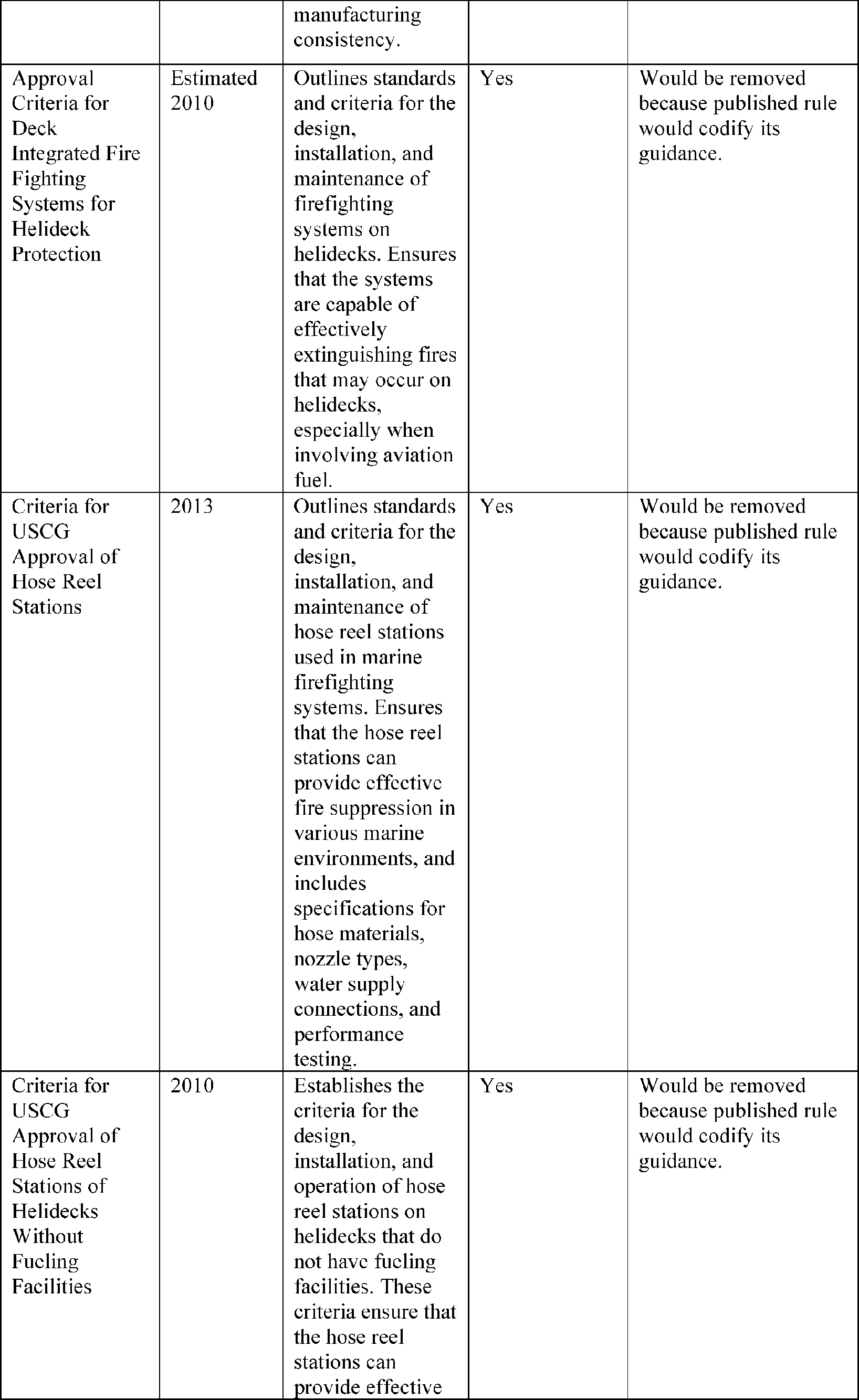
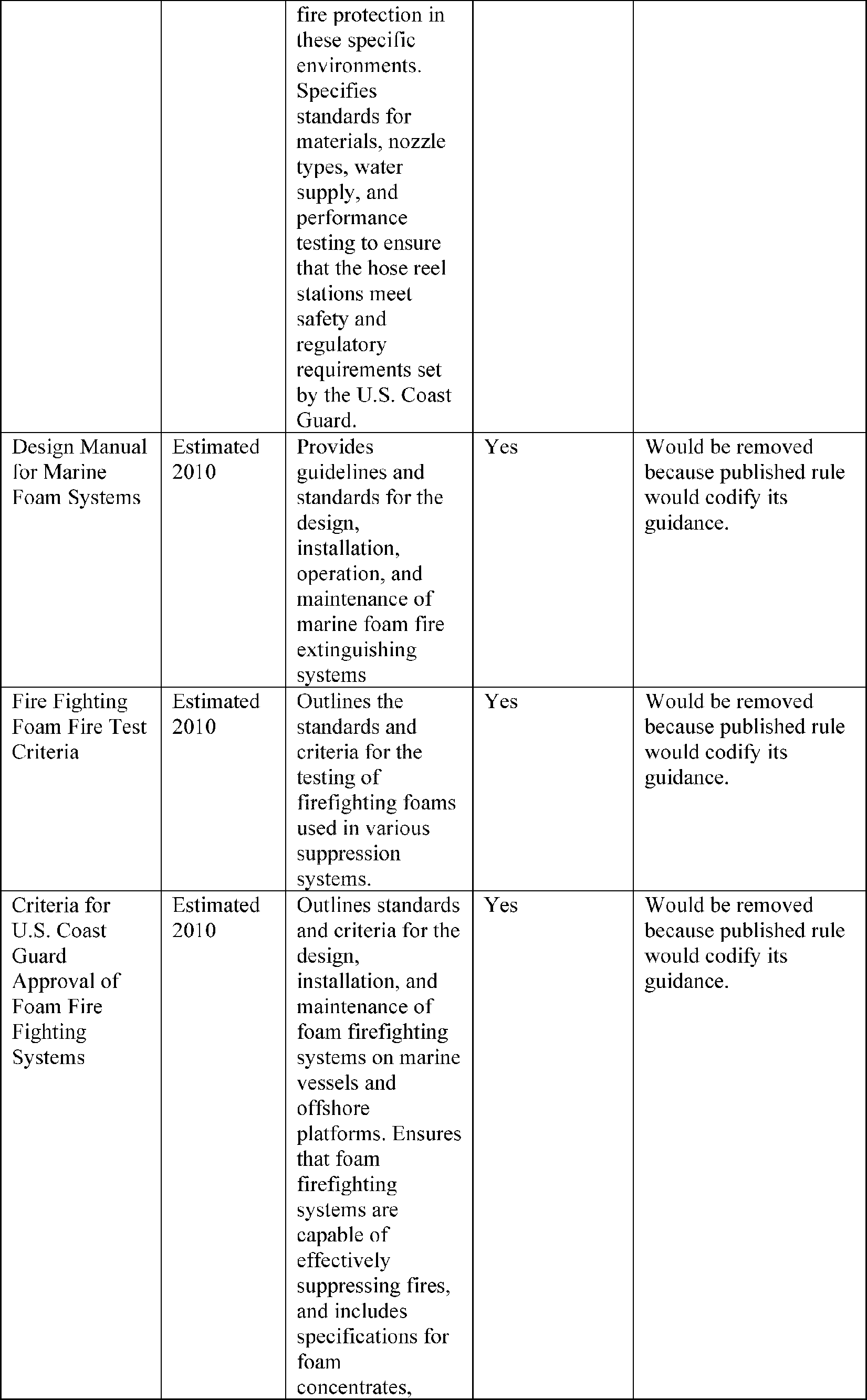
“Fire Fighting Foam Fire Test Criteria” (USCG Fire Test) (published approximately 2010). This document describes in detail the fire test from NFPA 11, Annex F for the approval of foam concentrates. The Coast Guard has regularly distributed this document on request to prospective applicants for Coast Guard type approval of foam fire-extinguishing systems. With incorporation by reference (IBR) of NFPA 11, Annex F by this proposed rule, this document would become obsolete.
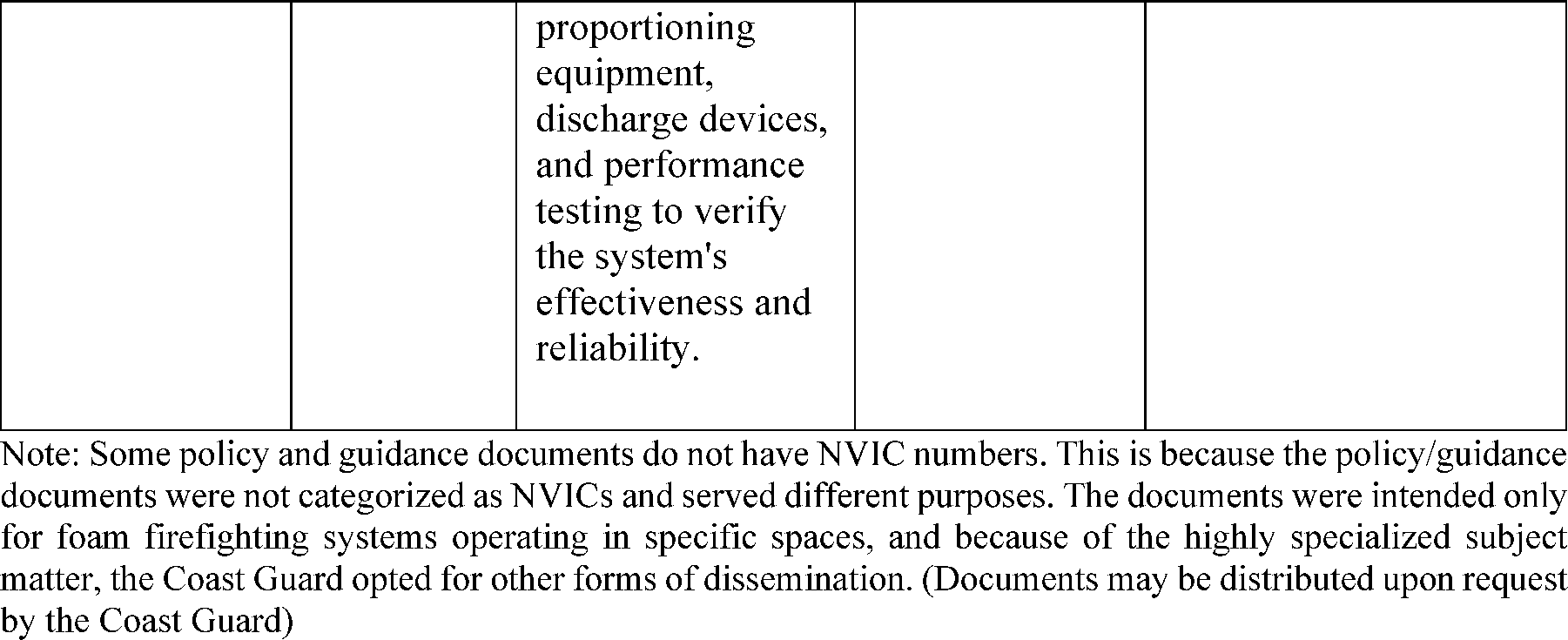
“Criteria for U.S. Coast Guard Approval of Foam Fire Fighting Systems” (USCG Foam Criteria) (published approximately 2010). This document prescribes the approval of whole systems, the use of the NFPA 11, Annex F test for the approval of foam concentrates, hydraulic and durability tests for foam system components, and the elements of the design manual. The Coast Guard has regularly distributed this document on request to prospective applicants for Coast Guard type approval of foam fire-extinguishing systems. It is available in the docket or from the Coast Guard upon request.
NVIC 02-06, “Follow-Up Programs for Fire-Safety Type-Approved Products” [8]
(published 2006). This document provides guidance on the elements of follow-up programs for foam fire-extinguishing systems.
“Approval Criteria for Deck Integrated Fire Fighting Systems for Helideck Protection” (USCG Heli Criteria) (published approximately 2010). This document outlines the specific type approval criteria for foam fire-extinguishing systems for helidecks, including foam concentrate specifications, hydraulic and durability tests from UL 162, and foam quality limits. The Coast Guard has regularly distributed this document on request to prospective applicants for Coast Guard type approval of helideck foam fire-extinguishing systems. It is available in the docket or from the Coast Guard upon request.
“Criteria for USCG Approval of Hose Reel Stations” (USCG FHS Criteria) (published 2013). This document outlines the specific type approval criteria for foam hose reel stations that can also be used as hose stations on the fire main system. It includes criteria from UL 162 for fire, hydraulic, foam quality, and durability tests, as well as guidance on components and operational requirements for foam hose reel stations. The Coast Guard has regularly distributed this on request to prospective applicants for Coast Guard type approval of foam fire-extinguishing systems. It is available in the docket or from the Coast Guard upon request.
“Criteria for USCG Approval of Hose Reel Stations of Helidecks Without Fueling Facilities” (USCG FHS Helideck Criteria) (published 2010). This document outlines the specific type approval criteria for foam hose reel stations on helidecks without fueling facilities. It includes criteria from UL 162 for fire, hydraulic, foam quality, and durability tests, as well as guidance on components and operational requirements for foam hose reel stations. The Coast Guard has regularly distributed this document on request to prospective applicants for Coast Guard type approval of foam hose reel stations used on helidecks. It is available in the docket or from the Coast Guard upon request.
“Design Manual for Marine Foam Systems” (USCG Manual Requirements) (published approximately 2010). This document outlines the specific type approval criteria for foam fire-extinguishing system manuals. It lists the criteria to be in the manual including component list, hydraulic calculations, foam characteristics, component test data, and sample system calculations. The Coast Guard has regularly distributed this document on request to prospective applicants for Coast Guard type approval of foam systems. It is available in the docket or from the Coast Guard upon request.
V. Discussion of Proposed Rule
The Coast Guard proposes to add two new subparts to Subchapter Q, “Equipment, Construction, and Materials: Specifications and Approval.” These subparts would contain the existing construction criteria and test regimen for the type approval of foam fire-extinguishing systems on Coast Guard-inspected vessels. This rule would consolidate the policies that the Coast Guard uses for approval of foam fire-extinguishing systems into the CFR. Publication would make them more accessible and ease the industry burden of locating the relevant guidance. It would also improve efficiency by streamlining government processes and would reduce government costs by eliminating the need for government employees to manually distribute guidance and answer questions about the approval process.
Proposed Subpart 46 CFR 162.033—Fixed Foam Fire-Extinguishing Systems
This subpart would contain the existing criteria for the type approval of fixed foam fire-extinguishing systems.
This subpart would contain the existing criteria for the type approval of foam hose reel stations used as excess equipment.
These new subparts would codify type approval procedures for foam fire-extinguishing systems into the CFR. The procedures would be based on the existing type approval procedures and longstanding criteria employed by the Coast Guard for the approval of marine foam fire-extinguishing systems that are discussed in section IV. Background of this preamble. However, this rule proposes some modifications to the existing procedures for type approval. These changes would allow greater flexibility for the manufacturers in the design of these systems and, in some instances, update testing procedures to help reduce the cost and potential environmental impacts of production and certification of foam fire-extinguishing systems, while still ensuring their capability and reliability.
Specific changes are as follows, detailed by subpart:
Proposed Subpart 162.033
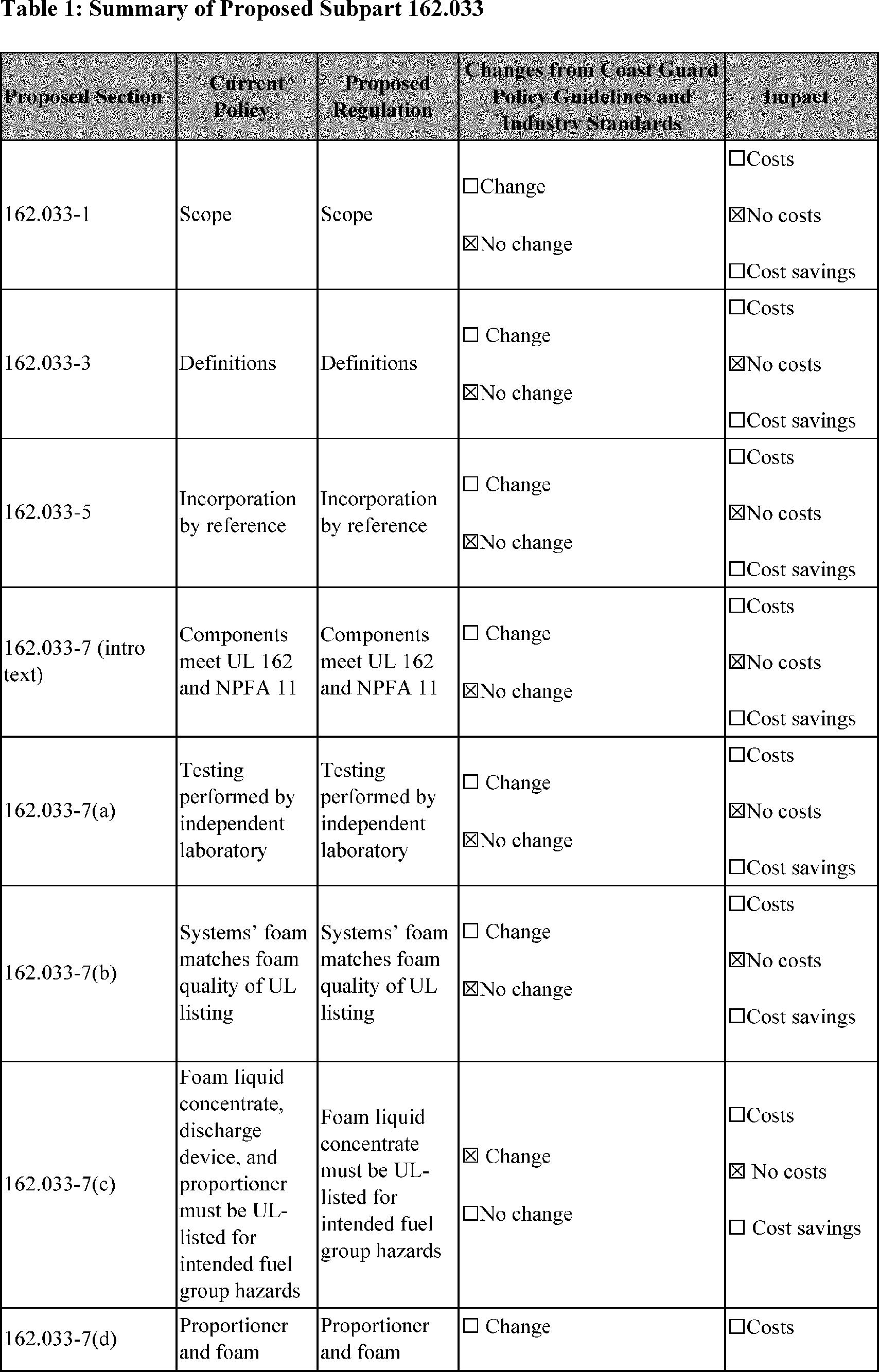
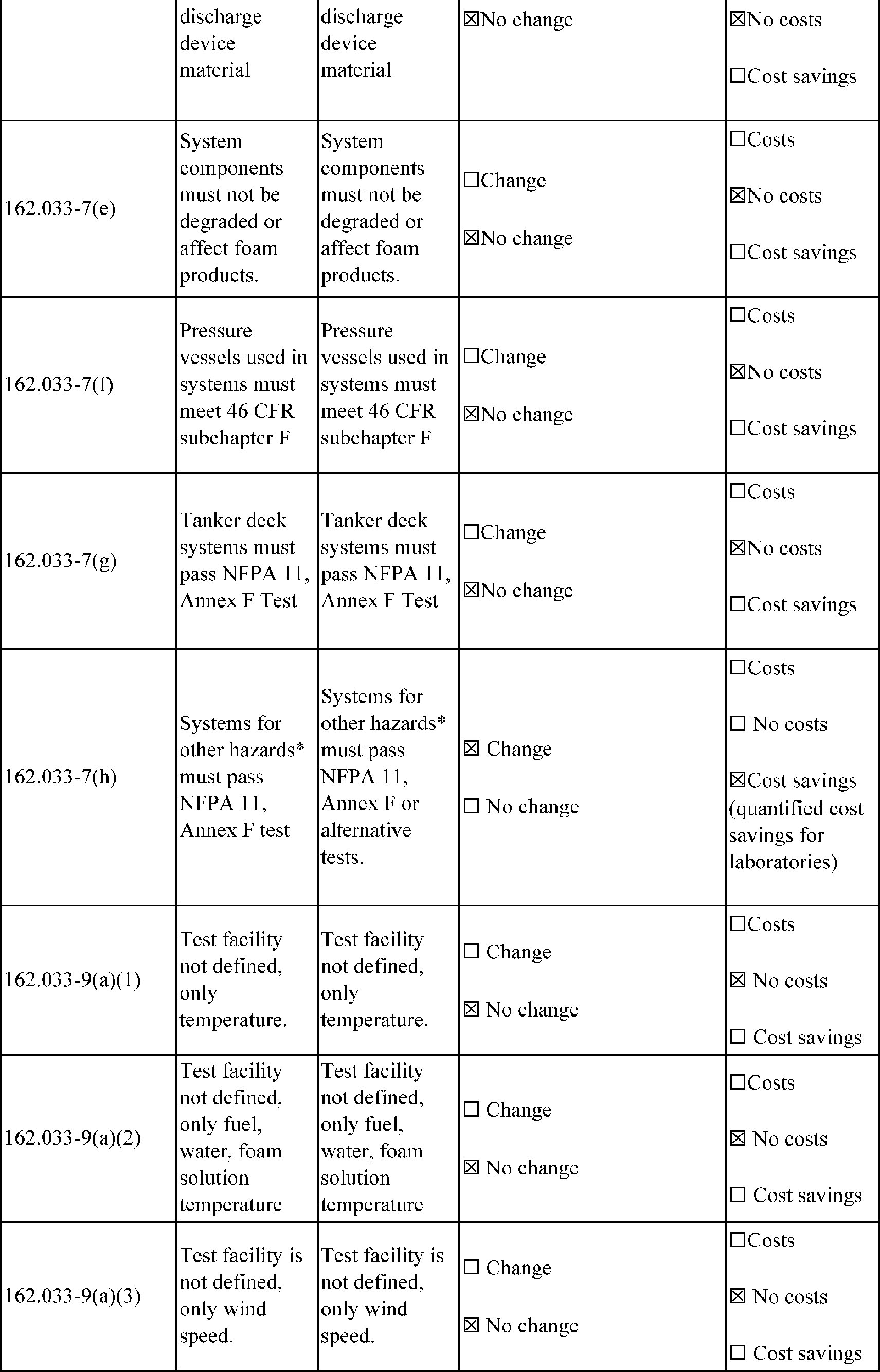
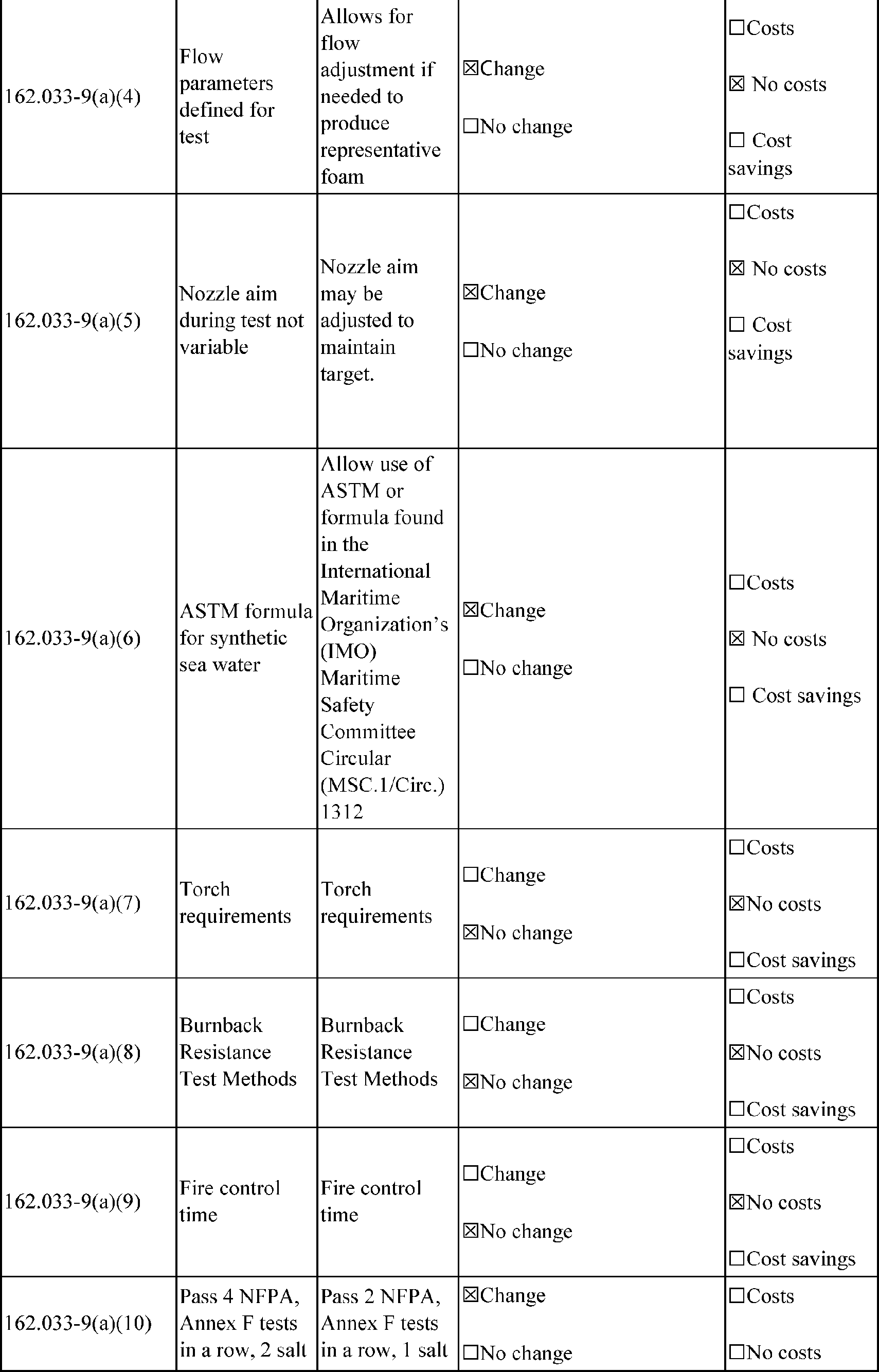
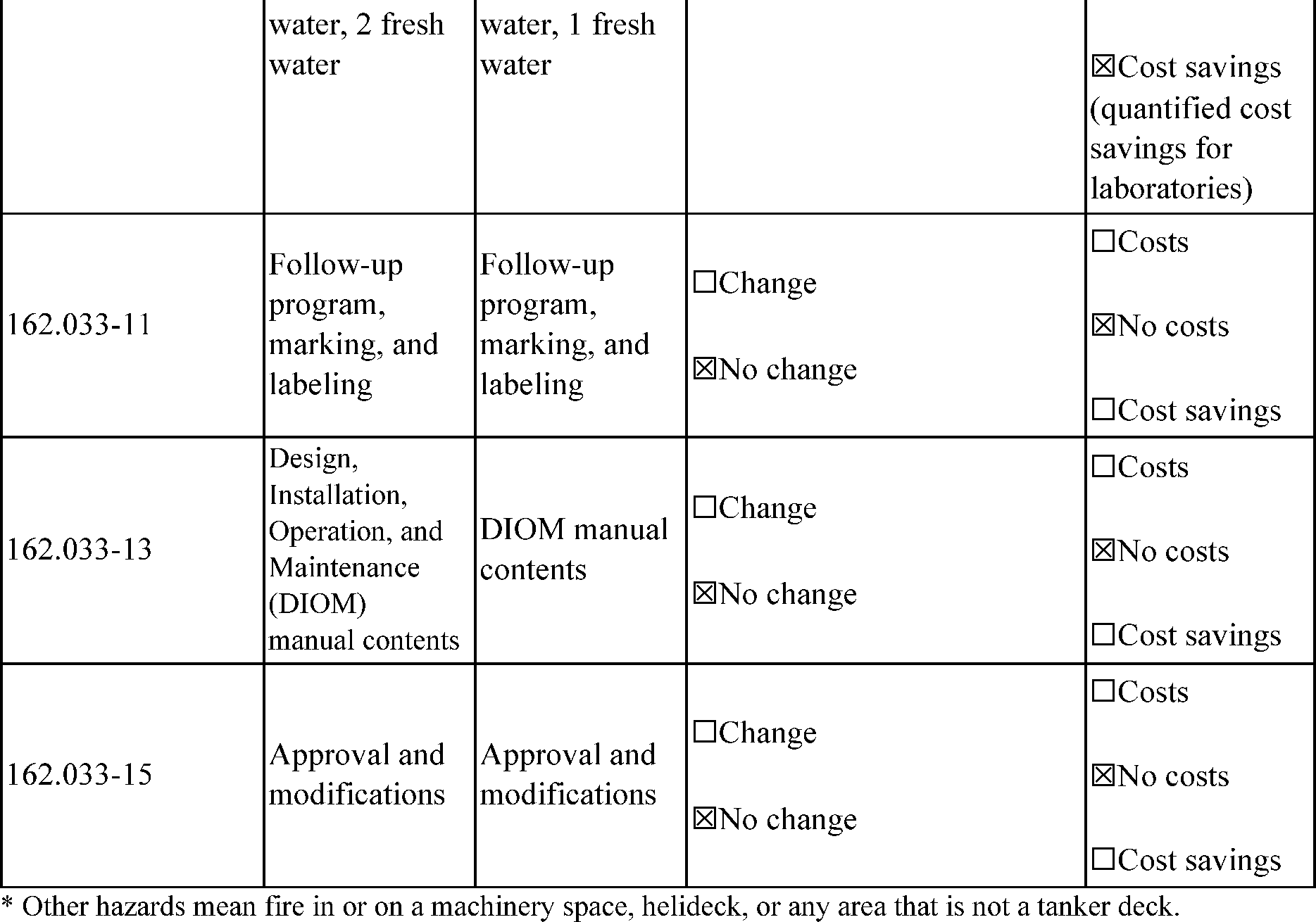
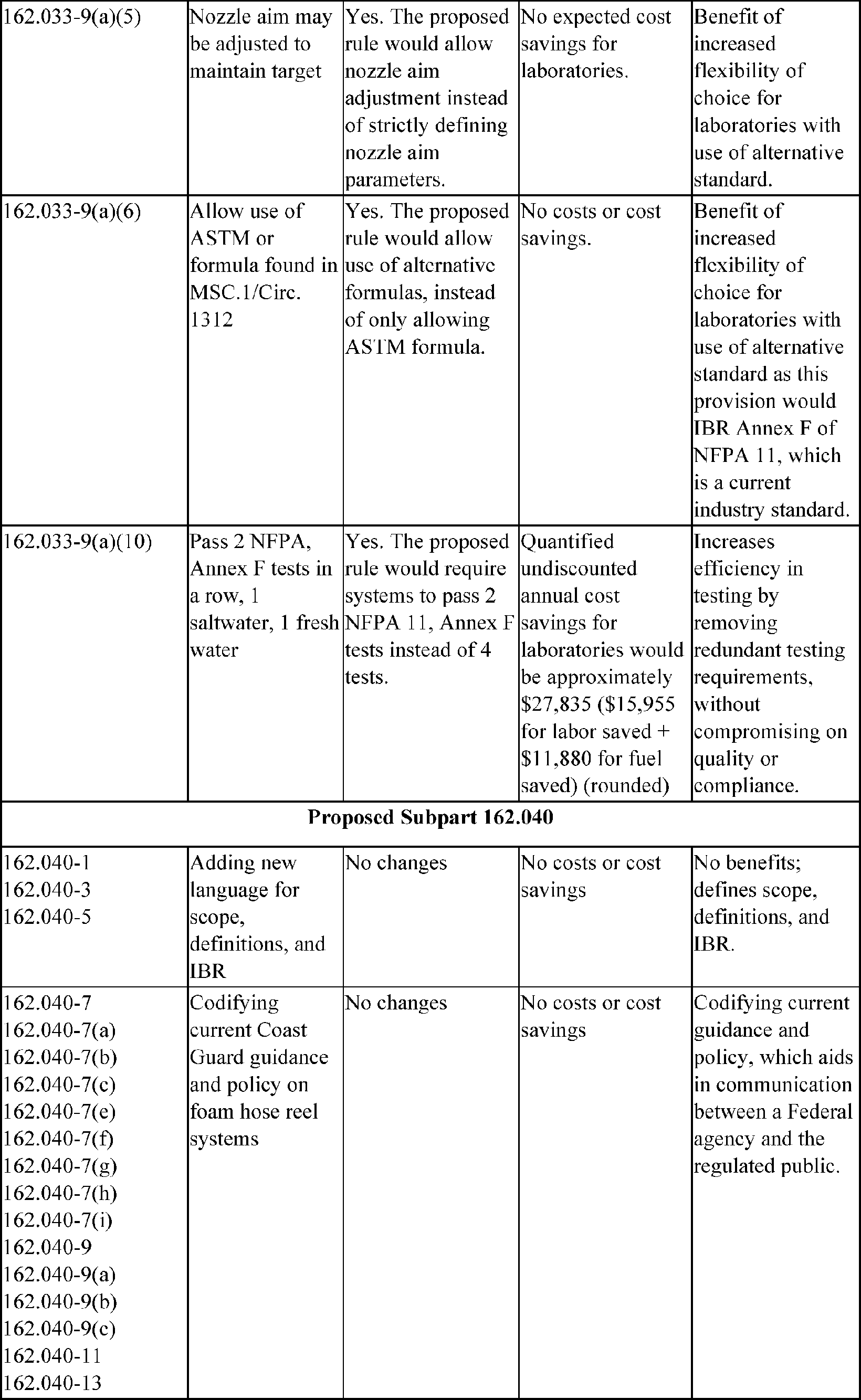
Table 1 lists the proposed sections of subpart 162.033, the current policy, what the new section proposes, whether the criterion would be a change from current Coast Guard policy guidelines and industry standards, and its potential cost impact. After this table, we explain each section in more detail. Two
( printed page 30561)
proposed provisions of 162.033 would produce cost savings: 162.033-7(h) and 162.033-9(a)(10). None of the proposed provisions would add a new cost burden.
( printed page 30562)
( printed page 30563)
( printed page 30564)
( printed page 30565)
Proposed 46 CFR 162.033 would follow a standardized format, laid out as follows:
Proposed 46 CFR 162.033-1,
“Scope,” would be unchanged from the scope of current policy.
Proposed 46 CFR 162.033-3,
“Definitions,” would list procedural definitions currently used in the type approval program.
Proposed 46 CFR 162.033-5,
“Incorporation by reference,” would incorporate by reference widely accepted national and international standards currently used by the Coast Guard to approve foam fire-extinguishing systems. It also would include standards that we are proposing to add as alternatives. Specifically, it would incorporate the following standards:
1. UL 162, “Standards for Safety: Foam Equipment and Liquid Concentrates,” Eighth Edition, dated February 23, 2018, would be incorporated for its alternative fire tests for other hazards that are not on a tanker deck (“other hazards”) and various tests related to the performance and durability of foam system components.
2. NFPA 11, “Standard for Low-, Medium-, and High-Expansion Foam, 2024 Edition,” dated December 21, 2023, would be incorporated for component general requirements and for the Annex F foam concentrate test for tanker decks or other hazards.
3. MSC.1/Circ. 1312/Corr.1, dated November 22, 2011, “Revised Guidelines for the Performance and Testing Criteria, and Surveys of Foam Concentrates for Fixed Fire-Extinguishing Systems,” would be incorporated as an alternative foam concentrate test for other hazards and an alternative formula for synthetic sea water.
4. International Civil Aviation Organization (ICAO) Airport Services Manual (Doc. 9137-AN/898), Fourth Edition, 2014, Part 1 “Rescue and Fire Fighting”, Chapter 8, “Extinguishing Agent Characteristics,” would be incorporated for its Class B and C tests that are proposed as alternative foam concentrate tests for other hazards.
Proposed 46 CFR 162.033-7,
“General requirements for fixed foam fire-extinguishing systems,” would list the design, construction, and performance criteria currently used by the Coast Guard for the approval of fixed foam fire-extinguishing systems. Consolidating these policies into the CFR would streamline government processes, improve industry accessibility, and strengthen the enforceability of the design, construction and performance criteria.
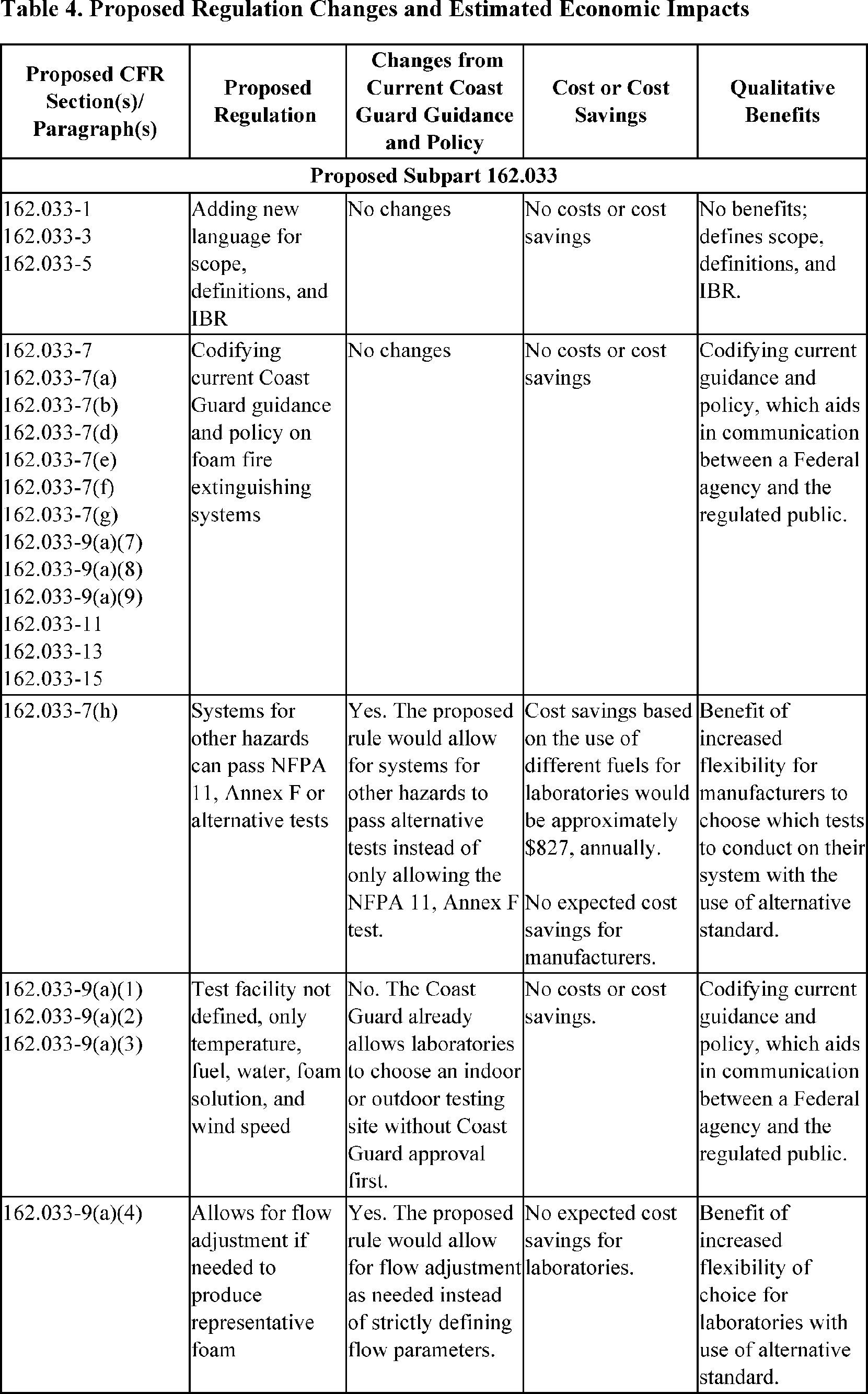
Most of these requirements would be essentially unchanged from existing Coast Guard policy and guidance. However, paragraphs (c) and (h) of this proposed CFR section would introduce greater flexibility that differs from current Coast Guard policy and guidance. Paragraph (c) would allow the use of non-UL-listed components (for example, proportioners and foam-making devices). We do not expect any costs or cost savings under (c). Paragraph (h) would allow alternative tests for foam concentrates intended for other hazards. We expect quantified cost savings for laboratories under paragraph (h), and we present these cost savings in section VII. Regulatory Analyses of this proposed rule.
Proposed 46 CFR 162.033-9,
“Foam liquid concentrate tests for fixed foam fire-extinguishing systems,” would list the tests required for foam liquid concentrates used in a fixed foam fire-extinguishing system. Consolidating these policies into the CFR would streamline government processes, improve industry accessibility, and strengthen the enforceability of the foam liquid concentrate test criteria.
This section would also contain proposed changes to the existing NFPA 11, Annex F foam concentrate test for tanker decks that would be a benefit to independent laboratories. These
( printed page 30566)
proposed changes would reduce requirements and provide flexibility in the test method, which would benefit the manufacturer and the independent laboratory that conduct the tests.
Proposed paragraphs (a)(1) through (a)(3) do not define the test facility as indoor; they only specify the wind speed and ambient, fuel, water, and foam solution temperatures, possibly allowing the test to be conducted outside. This would codify a standard industry practice, where laboratories may choose to conduct tests indoors or outdoors. The Coast Guard required the use of indoor testing facilities in the Fire Fighting Foam Fire Test Criteria published approximately in 2010 but allowed the use of outdoor testing with Coast Guard approval. However, shortly afterwards, the Coast Guard began allowing outdoor testing without the need for approval. Discussions with the affected laboratories reveal that there are no cost savings that would result from this proposed part since laboratories already have the ability to choose indoor or outdoor testing and already have their testing facilities set-up based on their preference.
Proposed paragraphs (a)(4) and (a)(5) would allow for adjustments to nozzle aim and flow during the fire test. These adjustments could make it easier for the foam to extinguish the fire and pass the test. This deregulatory measure would eliminate an unnecessary testing protocol for laboratories and would introduce more flexibility by making the task easier and more efficient to complete. We do not expect these two provisions to produce any new costs or cost savings. See section VII. Regulatory Analyses of this proposed rule for further detail.
Proposed paragraph (a)(6) would allow for multiple formulas of the synthetic sea water needed for the NFPA 11, Annex F fire test. This would benefit independent laboratories by allowing them to choose the formula. This deregulatory measure would eliminate an unnecessary testing protocol for laboratories and introduce more flexibility for industry. We do not expect any new costs or cost savings under this proposed provision.
Proposed paragraphs (a)(7) through (a)(9) would provide expanded detail for the torch, burnback resistance tests methods, and the fire control time for the NFPA 11, Annex F fire test procedure. These requirements would be essentially unchanged from existing Coast Guard policy and guidance. Consolidating these policies into the CFR would streamline government processes, improve industry accessibility, and strengthen the enforceability of these details for the NFPA 11, Annex F fire test procedure. There are no new costs or cost savings associated with this proposed section because these are already widespread industry practices.
Proposed paragraph (a)(10) would reduce the required number of fire tests to be conducted within the NFPA 11, Annex F test procedure from four tests to two tests. Because standards are already strict, the Coast Guard has determined that passing two tests in a testing series suffices. This would produce quantified cost savings for laboratories because conducting two fewer tests would save time and resources. A reduction in the number of tests would also reduce potential environmental impacts associated with the management of foam concentrate. This would introduce a deregulatory measure and cost savings by eliminating an unnecessary testing protocol for laboratories by reducing the number of tests that are required for system type approval, in line with technological advancements in testing procedures.
Proposed paragraphs (b) through (e) would include additional foam concentrate tests for other hazards that have not been previously available to manufacturers or accepted laboratories. This deregulatory measure would eliminate unnecessary testing restrictions for manufacturers and laboratories and would introduce flexibility of choice for manufacturers and laboratories. We do not expect any new costs or cost savings under these proposed provisions.
Proposed 46 CFR 162.033-11,
“Follow-up program, marking, and labeling,” would describe the follow-up program and the marking and labeling of equipment associated with a fixed foam fire-extinguishing system. These requirements would be essentially unchanged from existing Coast Guard policy and guidance. Consolidating these policies into the CFR would streamline government processes, improve industry accessibility, and strengthen the enforceability of the follow up program and marking and labeling requirements. There are no new costs or cost savings associated with this proposed section because these are already widespread industry practices. The marking and labeling requirements do not introduce a new paperwork burden and are already captured in an existing ICR (OMB Collection 1625-0035).
Proposed 46 CFR 162.033-13,
“Design, installation, operation, and maintenance (DIOM) manual for fixed foam fire-extinguishing systems,” would list the requirements for a DIOM manual for fixed foam fire-extinguishing systems. These requirements would be essentially unchanged from existing Coast Guard policy and guidance. Consolidating these policies into the CFR would streamline government processes, improve industry accessibility, and strengthen the enforceability of the DIOM manual requirements.
Proposed 46 CFR 162.033-15,
“Approval and modification procedures,” would list the approval and modification procedures for fixed foam fire-extinguishing systems. These requirements would be essentially unchanged from the existing Coast Guard policy and guidance. Consolidating these policies into the CFR would streamline government processes, improve industry accessibility, and strengthen the enforceability of the approval and modification procedures.
Proposed Subpart 162.040
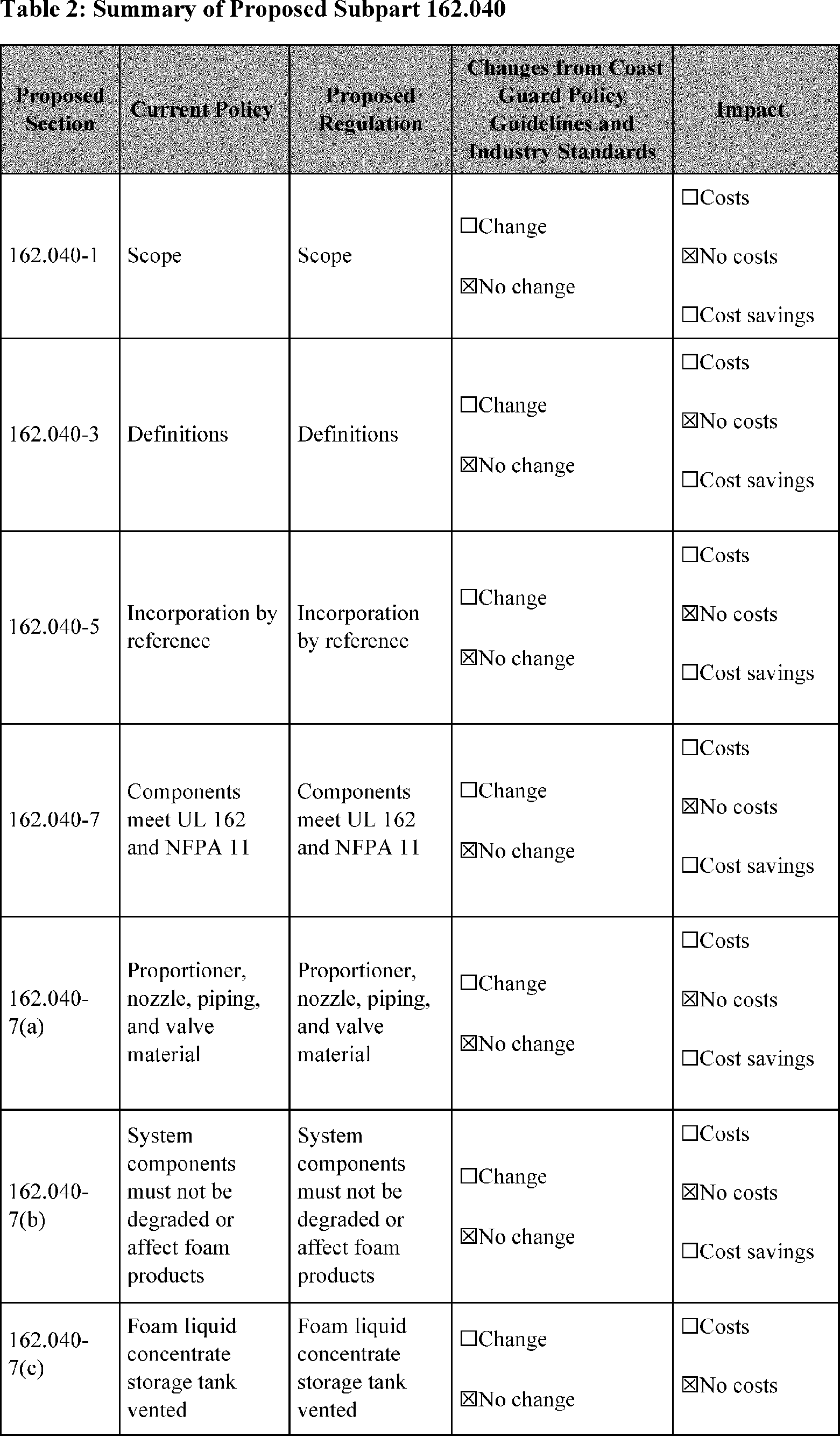
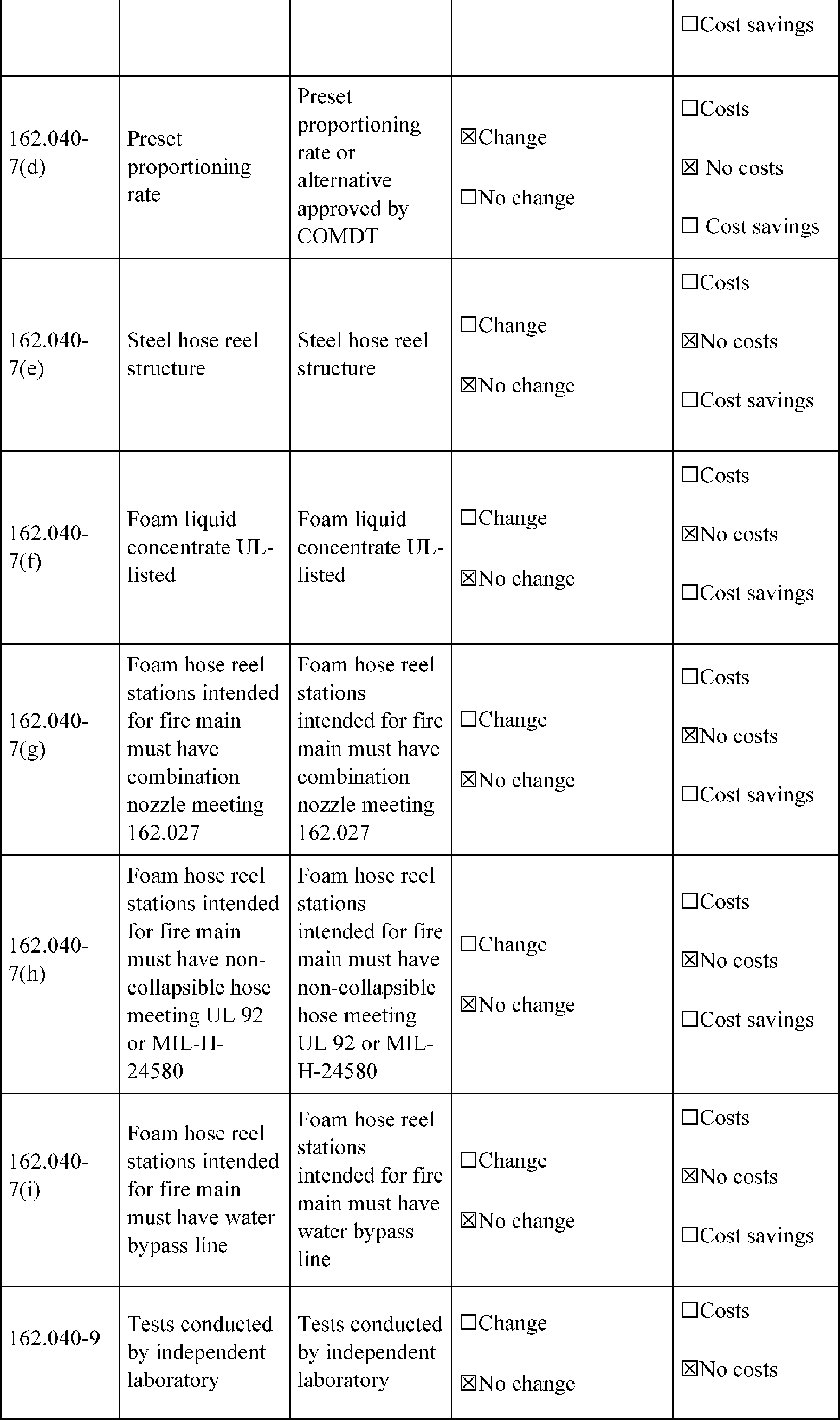
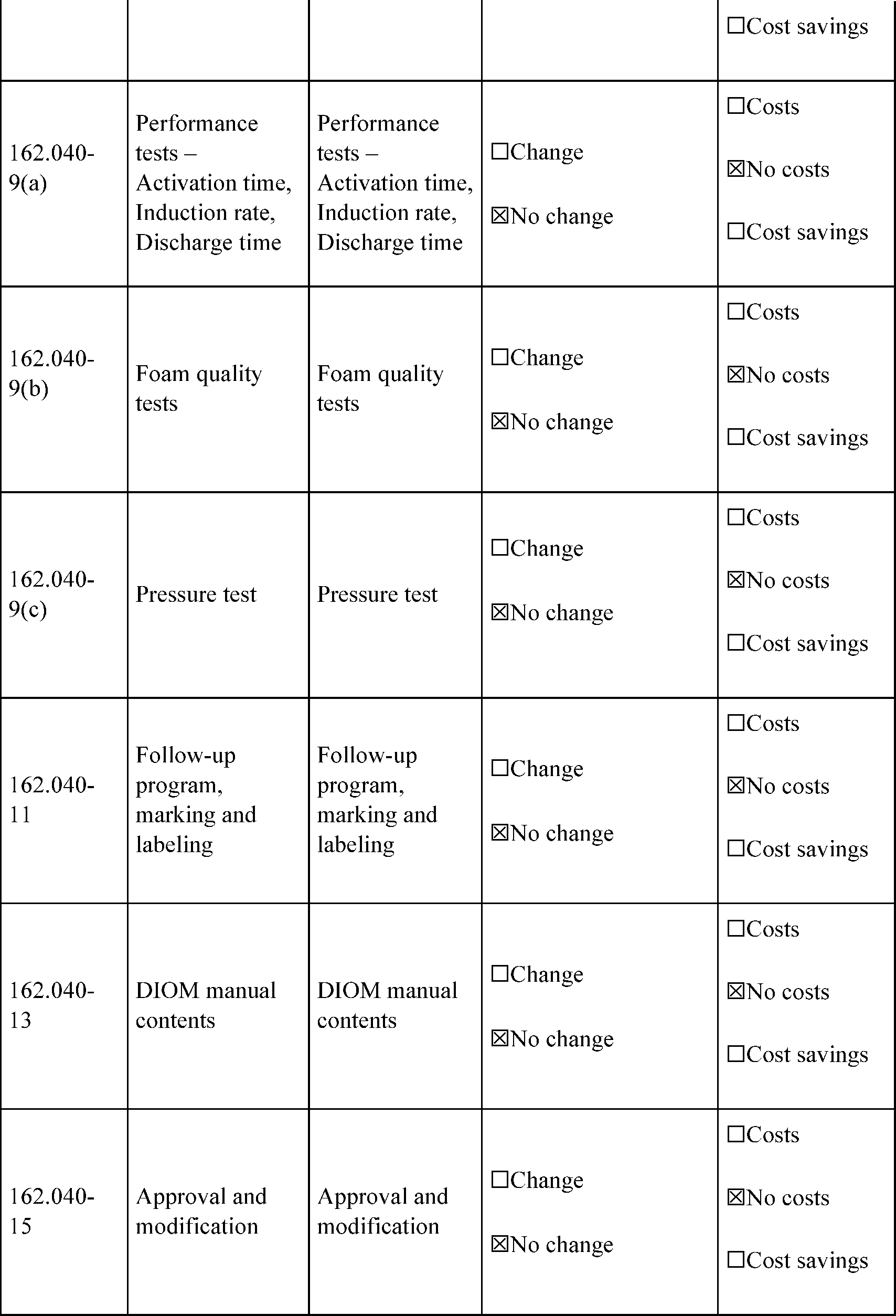
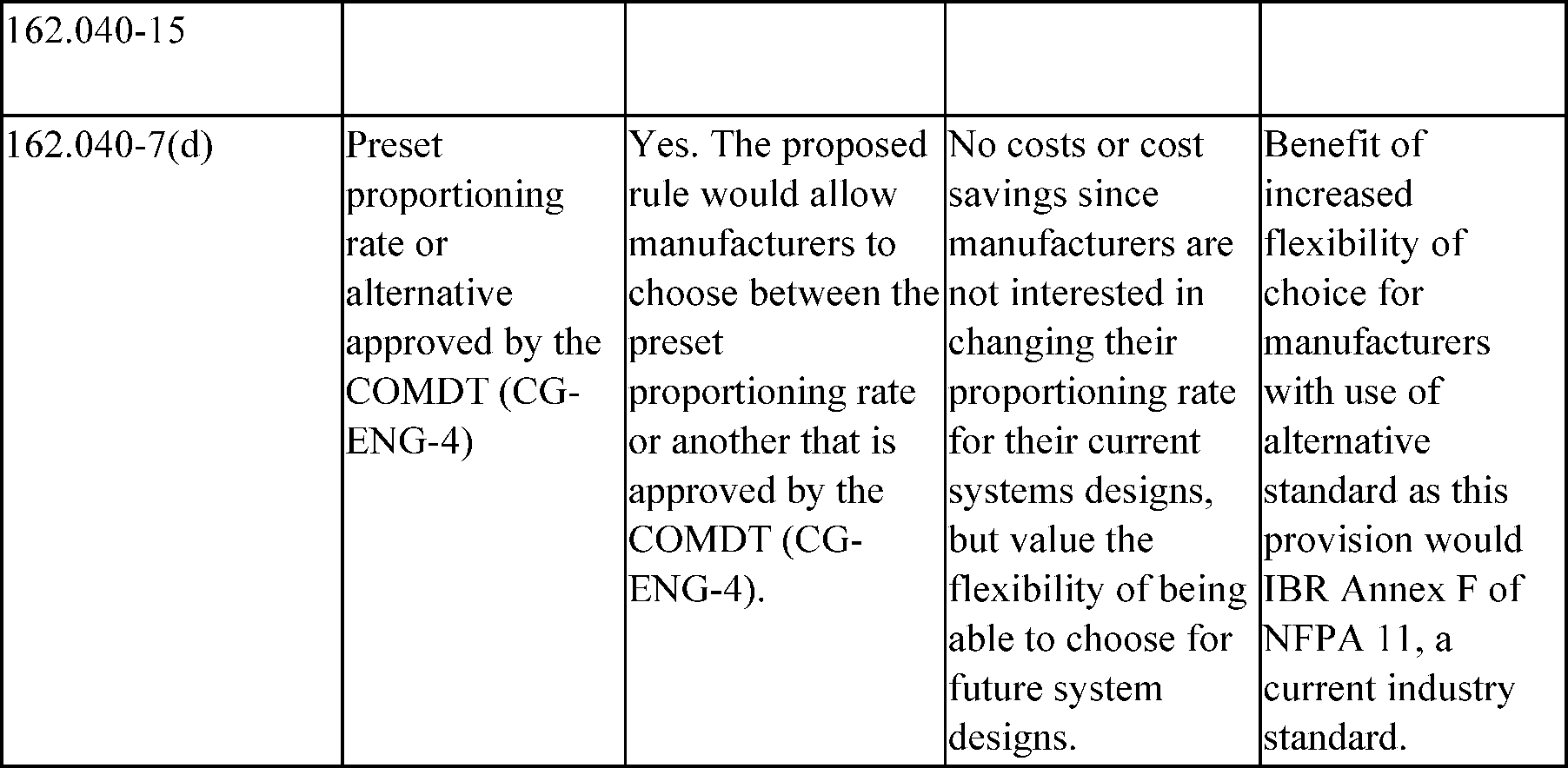
Table 2 lists the proposed sections of subpart 162.040, the current policy, what the section proposes, whether this would be a change from current Coast Guard policy guidelines and industry standard, and its potential cost impact. Further explanation for each of these sections can be found after the table. None of these provisions would add a new cost burden or result in a cost savings.
( printed page 30567)
( printed page 30568)
( printed page 30569)
Proposed 46 CFR 162.040 would follow standardized format, laid out as follows:
Proposed 46 CFR 162.040-1,
“Scope,” would be unchanged from the scope of existing policy (Criteria for USCG Approval of Hose Reel Stations and Criteria for USCG Approval of Hose Reel Stations of Helidecks Without Fueling Facilities, 2013).
Proposed 46 CFR 162.040-3,
“Definitions,” would list procedural and contextual definitions currently used in the foam hose reel station industry and the type approval program.
( printed page 30570)
Proposed 46 CFR 162.040-5,
“Incorporation by reference,” would incorporate by reference widely accepted national and international standards used by the Coast Guard to approve foam fire-extinguishing systems. Specifically:
1. UL 162, “Standard for Safety: Foam Equipment and Liquid Concentrates,” Eighth Edition, dated February 23, 2018, would be incorporated for its requirements associated with the design, construction, and performance of foam hose reel stations.
2. UL 92, “Standard for Safety: Fire Extinguisher, Booster Hose, and Noncollapsible Standpipe Hose and Hose Assemblies,” Eleventh Edition, dated March 24, 2020, and MIL-H-24580(SH), “Military Specification, Hose Assemblies, Synthetic Rubber, Non-collapsible, Fire Fighting,” dated May 21, 1985, would be incorporated for the specifications for hose used on foam hose reel stations.
3. NFPA 11, “Standard for Low-, Medium-, and High-Expansion Foam, 2024 Edition,” dated December 21, 2023, would be incorporated for its requirements associated with the design, construction, and performance of foam hose reel stations.
4. MSC.1/Circ. 1312/Corr.1, “Revised Guidelines for the Performance and Testing Criteria, and Surveys of Foam Concentrates for Fixed Fire-Extinguishing Systems,” dated 22 November 2011, would be incorporated for its requirements on the periodic sampling of foam liquid concentrates.
Proposed 46 CFR 162.040-7,
“General requirements for foam hose reel stations,” would list the design, construction, and performance criteria currently used by the Coast Guard for the approval of foam hose reel stations. Consolidating these policies into the CFR would streamline government processes, improve industry accessibility, and strengthen the enforceability of these requirements.
These requirements would be essentially unchanged from existing Coast Guard policy and guidance. However, paragraph (d) would allow for the possibility of a variable proportioning rate for the foam hose reel station, if approved by the Commandant (CG-ENG-4). This change would allow manufacturers to choose the proportion of foam to water that best suit their needs. The two manufacturers of foam hose reel stations have expressed interest in a variable proportioning rate but currently do not plan to seek approval from the Commandant (CG-ENG-4). This is because any new proportioning rate would differ only slightly from their current proportioning rates, making the change unnecessary at this time. Manufacturers expressed interest in pursuing this option in the future for modified foam hose reel station system designs but stated that they will not for now. As such, this proposed provision would not generate costs or cost savings, and the Coast Guard does not foresee additional costs for approval since manufacturers are unlikely to request changes at this moment. This deregulatory measure would eliminate an unnecessary foam system design restriction for manufacturers and would introduce flexibility of choice for future foam hose reel station designs.
Proposed 46 CFR 162.040-9,
“Tests for foam hose reel stations” would list the tests for foam hose reel stations that an independent laboratory must conduct. These tests would be essentially unchanged from existing Coast Guard policy and guidance. Consolidating these policies into the CFR would streamline government processes, improve industry accessibility, and would strengthen their enforceability.
Proposed 46 CFR 162.040-11,
“Follow-up program, marking, and labeling,” would describe the follow-up program and the marking and labeling of equipment associated with a foam hose reel station. These requirements would be essentially unchanged from existing Coast Guard policy and guidance. Consolidating these policies into the CFR would streamline government processes, improve industry accessibility, and strengthen the enforceability of these requirements.
Proposed 46 CFR 162.040-13,
“Design, installation, operation, and maintenance (DIOM) manual for foam hose reel stations,” would list the requirements for a DIOM manual for foam hose reel stations. These requirements would be essentially unchanged from existing Coast Guard policy and guidance. Consolidating these policies into the CFR would streamline government processes, improve industry accessibility, and strengthen the enforceability of the DIOM manual requirements
Proposed 46 CFR 162.040-15,
“Approval and modification procedures,” would list the approval and modification procedures for foam hose reel stations. These requirements would be essentially unchanged from existing Coast Guard policy and guidance. Consolidating these policies into the CFR would streamline government processes, improve industry accessibility, and strengthen the enforceability of the approval and modification procedures.
VI. Incorporation by Reference
Material for incorporation by reference appears in proposed §§ 162.033-5 and 162.040-5. The standards are summarized in section VII.L. Technical Standards of this preamble. For information about how to view this material, see the
ADDRESSES
section of this preamble. Copies of the materials are available from the sources listed in §§ 162.033-5 and 162.040-5. Before publishing a binding rule, we will submit this material to the Director of the Federal Register for approval of the incorporation by reference.
VII. Regulatory Analyses
We developed this proposed rule after considering numerous statutes and Executive orders related to rulemaking. A summary of our analyses based on these statutes or Executive orders follows.
A. Regulatory Planning and Review
Executive Orders 12866 (Regulatory Planning and Review) and 13563 (Improving Regulation and Regulatory Review) direct agencies to assess the costs and benefits of available regulatory alternatives and, if regulation is necessary, to select regulatory approaches that maximize net benefits. Executive Order 13563 emphasizes the importance of quantifying both costs and benefits, of reducing costs, of harmonizing rules, and of promoting flexibility. Executive Order 14192 (Unleashing Prosperity Through Deregulation) directs agencies to significantly reduce the private expenditure required to comply with Federal regulations and provides that “any new incremental costs associated with new regulations shall, to the extent permitted by law, be offset by the elimination of existing costs associated with at least 10 prior regulations.”
Two additional Executive orders promote the goals of Executive Order 13563: Executive Order 13609 (Promoting International Regulatory Cooperation) and Executive Order 13610 (Identifying and Reducing Regulatory Burdens). Executive Order 13609 targets international regulatory cooperation to reduce, eliminate, or prevent unnecessary differences in regulatory requirements. Executive Order 13610 aims to modernize the regulatory systems and to reduce unjustified regulatory burdens and costs on the public.
The Office of Management and Budget (OMB) has not designated this rule a “significant regulatory action,” under section 3(f) of Executive Order 12866. Accordingly, OMB has not reviewed it.
( printed page 30571)
This proposed rule, if finalized as proposed, is expected to be an Executive Order 14192 deregulatory action.
The proposed rule would reduce the burden on manufacturers of foam firefighting systems and the laboratories that test them by removing unnecessary testing and design protocols and restrictions, promoting flexibility of choice to industry, and generating cost savings for industry. It would also improve government efficiency and increase accessibility by consolidating type approval criteria into the CFR where it is publicly available. A regulatory analysis (RA) follows.
No-Action Baseline Discussion
The 2003 Circular A-4 [9]
encourages agencies to include multiple baselines in regulatory analyses to provide a more comprehensive evaluation of potential impacts, and it mandates that agencies consider at least one baseline that reflects the state of the world without the regulation. This proposed rule consolidates eight prior policy actions. Pursuant to the Circular A-4 guidance, the Coast Guard analyzed the marginal effects of each policy action to isolate the incremental impact of the proposed rule relative to each baseline.
For this proposed rule, the Coast Guard did not conduct a multiple baseline analysis because the policy guidance documents were all published over 10 years ago, and industry already complies with the prospective regulations. Given the age of the policy actions, it is difficult to analyze the state of the world before and after their implementation because of the lack of accurate data. These policy actions are well-established over time, with little or no changes in policy or practice since their publication. In fact, the industry began implementing significant changes around 2003, driven by advancements in technology. This included more rigorous inspections, testing protocols, and enhancements in safety standards. The industry standards illustrated in the policy actions predate the policy actions themselves, which further complicates a marginal effect analysis. Given our previous explanation, because there is 100 percent compliance within the industry with previously issued guidance letters, and because this proposed rule updates and codifies past policy actions, we analyze a single baseline scenario (without guidance) in this RA. As a result, the impacts we estimate in this RA are attributed to the proposed rule.
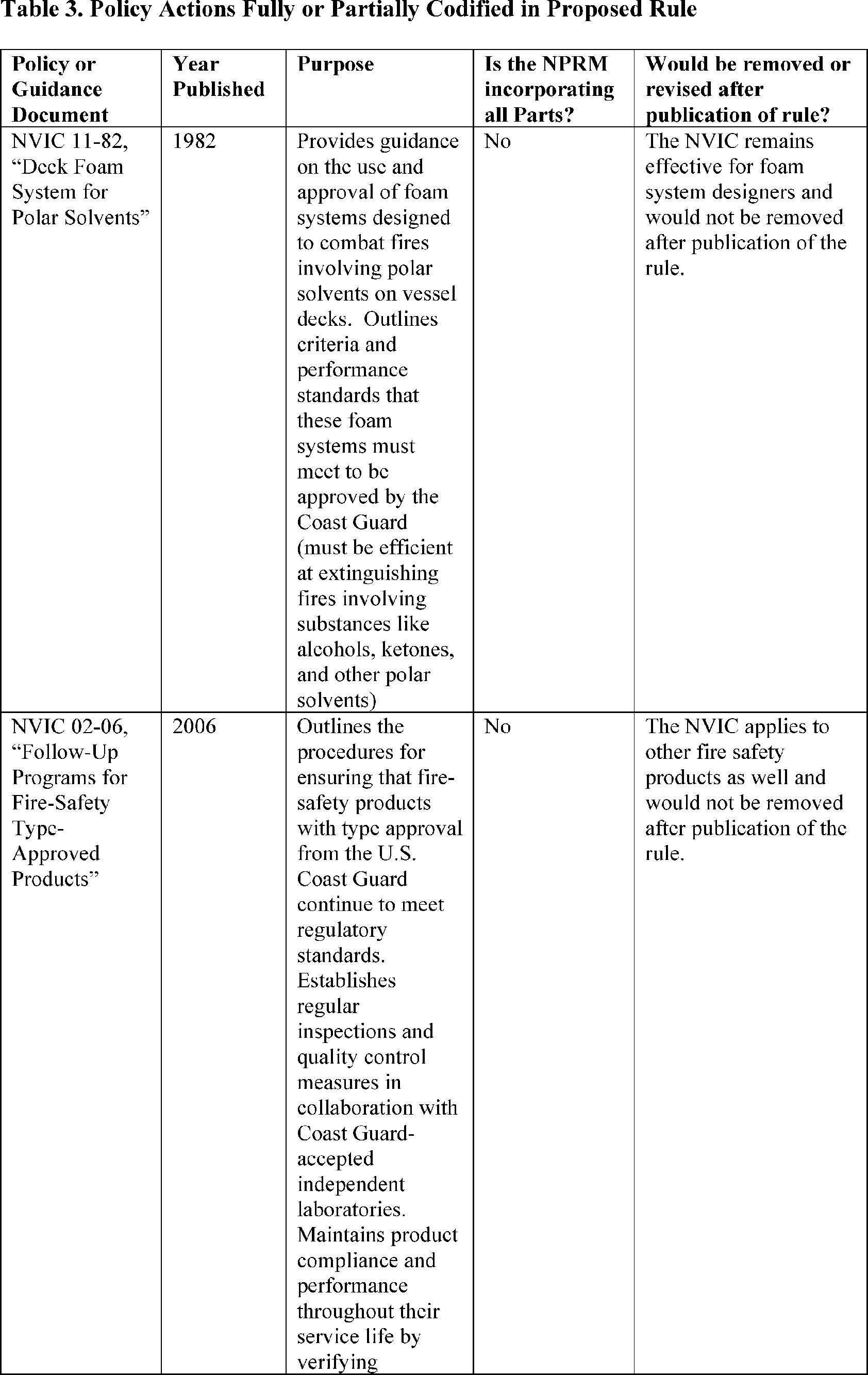
Table 3 lists each policy/guidance document along with its year of publication or an approximate date. If this rule is finalized as proposed, most of these policy actions would be cancelled and replaced by this rule. NVIC 11-82 and NVIC 02-06 are the only documents that would remain in effect, because they address issues beyond foam firefighting type approval that fall outside the scope of this proposed rule. They would continue to serve as key policy guidance for those matters.
( printed page 30572)
( printed page 30573)
( printed page 30574)
( printed page 30575)
Proposed Changes
Table 4 lists the proposed new CFR subparts, sections, and paragraphs broken down by criteria changes and economic impact.
( printed page 30576)
( printed page 30577)
( printed page 30578)
The proposed rule would update the type approval criteria for foam fire-extinguishing systems to reflect advancements in technology and introduce deregulatory measures and cost savings for industry. The proposed rule would also consolidate existing foam fire-extinguishing system type approval criteria derived from Coast Guard policy, guidelines, and industry standards.
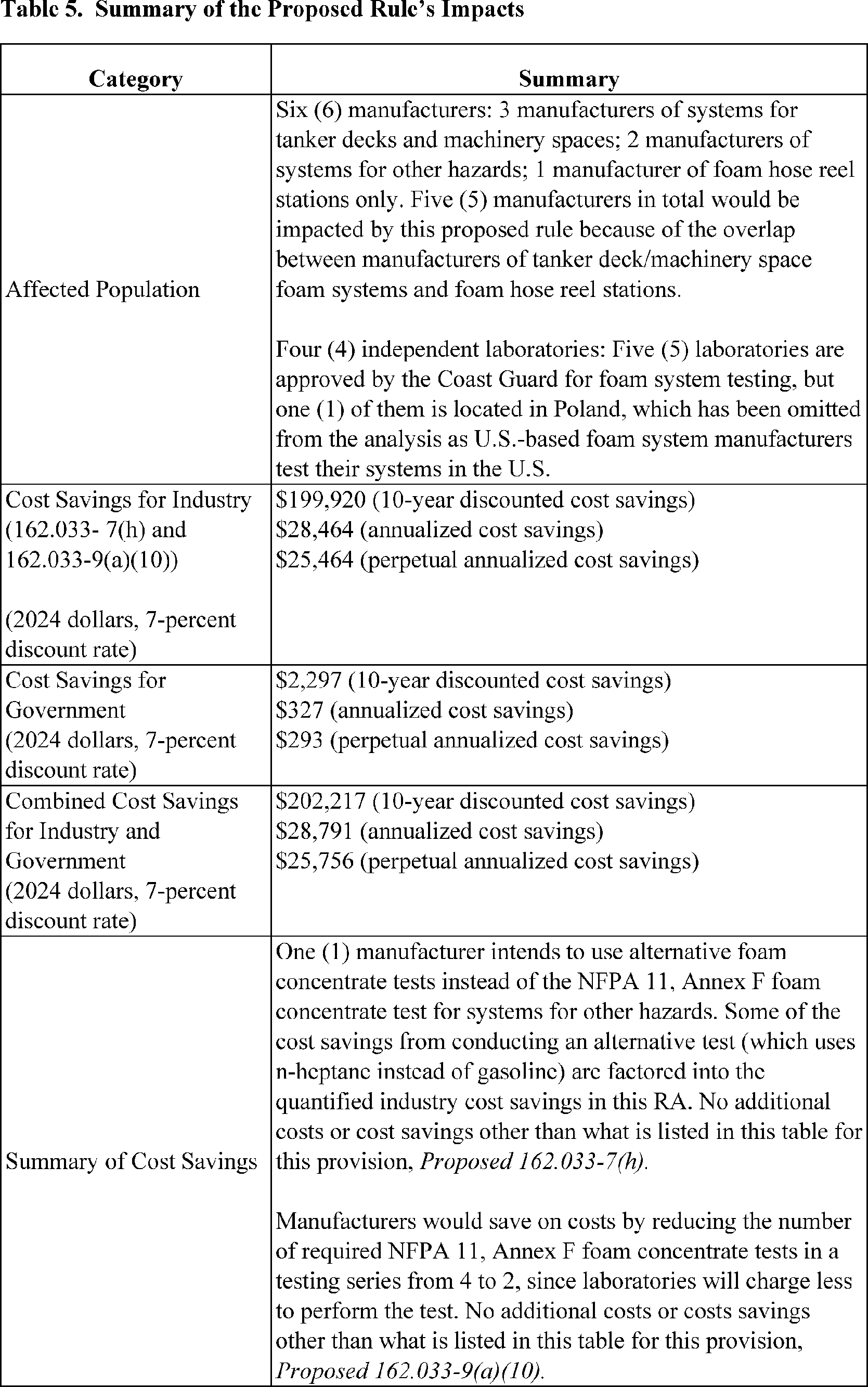
Table 5 presents the estimated impacts of this proposed rule on industry and the Federal Government. Please see table 1 in section V. Discussion of Proposed Rule of this preamble, for more details.
( printed page 30579)
( printed page 30580)
Affected Population
Based on the publicly available Coast Guard Maritime Information Exchange (CGMIX) Equipment List,[10]
this proposed rule would directly impact three manufacturers of foam systems for tanker decks and two manufacturers of foam systems for other hazards. Additionally, this rule's change in 162.040-7(d) would affect five manufacturers that produce foam hose reel stations. Because there is overlap between the manufacturers of the foam systems and the foam hose reel stations, the total number of manufacturers in our affected population is six. Other than the cost savings listed in table 5 for regulatory provisions 162.040-7(h) and 162.033-9(a)(10), we do not expect this proposed rule to produce other costs or cost savings associated with the use of the alternative standard NFPA 11, Annex F, that we would incorporate by reference.
This proposed rule would result in quantified cost savings for four Coast Guard-approved laboratories that test foam systems and foam hose reel stations.
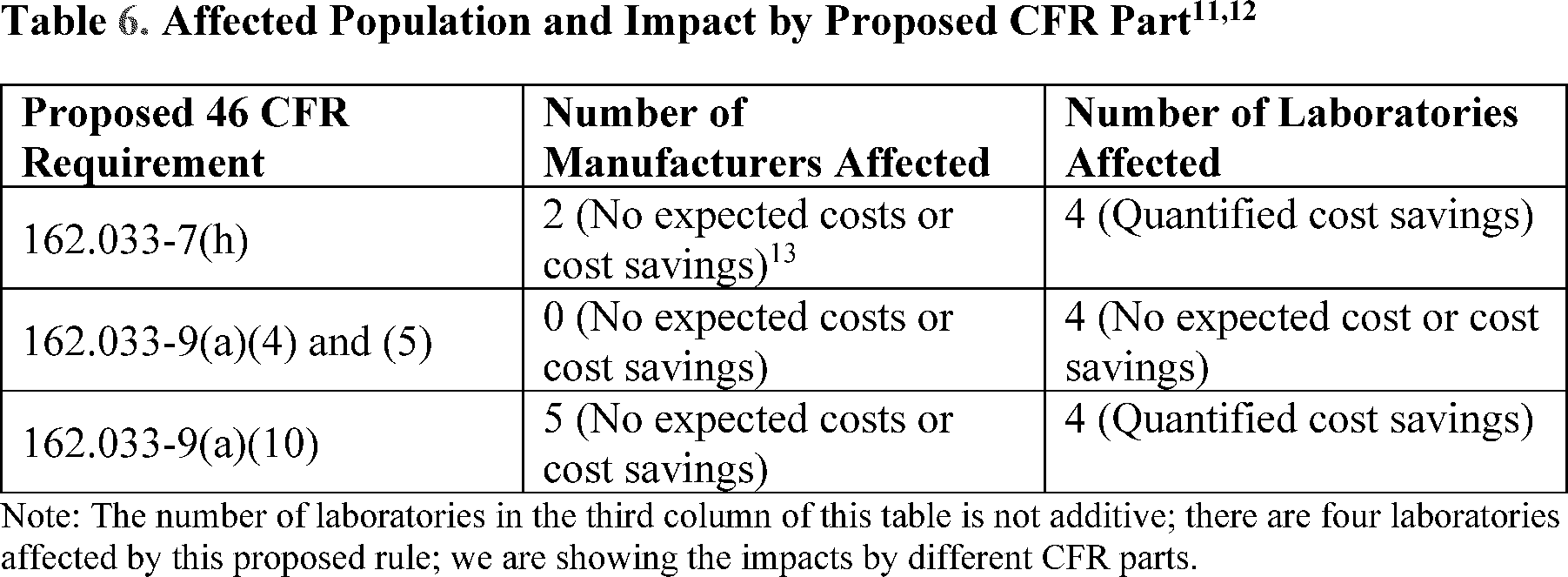
While all manufacturers and laboratories would benefit from increased flexibility and transparency from the proposed requirements, only two of the proposed regulatory provisions would produce quantified cost savings, proposed 162.033-7(h) and 162.033-9(a)(10). See Table 6.
Table 6 outlines the number of manufacturers and laboratories affected by each proposed requirement that would depart from the pre-rule requirements, along with whether the requirement would lead to costs or cost savings.
( printed page 30581)
Costs
This proposed rule would not impose net costs on industry. The changes to the type approval criteria would streamline the process by providing alternatives and eliminating redundancy in testing. The proposed provisions would incorporate by reference the existing standards; however, two proposed provisions would result in cost savings, 162.033-7(h) and 162.033-9(a)(10). We do not expect any new costs or cost savings associated with any other provision of this proposed rule.
Cost Savings
This proposed rule would generate quantifiable cost savings for laboratories that test foam fire-extinguishing systems. Two proposed requirements (proposed 162.033-7(h) and proposed 162.033-9(a)(10) would produce quantified cost savings. We examine the cost savings of each of these regulatory provisions in the following analysis.
Discussion of Proposed Regulatory Changes to Manufacturers
Proposed 162.033-7(h) would allow for alternative tests other than the NFPA 11, Annex F foam concentrate test to be performed on systems for other hazards. Alternative tests include the UL-162, the ICAO Fire Test, or the or MSC.1/Circ. 1312/Corr.1 foam concentrate tests. According to the manufacturers we spoke with, these tests will be less costly and take less time to conduct than the NFPA 11, Annex F foam concentrate test. For example, the NFPA 11, Annex F foam concentrate test uses a 100 ft2
pool of fire, versus the 50 ft2
pool of fire that would be used for alternative tests. This would allow laboratories to save on resources, such as foam, fuel, and time expended during testing, and possibly charge manufacturers less for alternative testing.
There are two manufacturers in our population that manufacture foam systems for other hazards. One manufacturer in our population does not foresee using the alternative tests for foam concentrate testing and would continue using the NFPA 11, Annex F foam concentrate test due to their prior investment in systems to pass the test. However, the other manufacturer is interested in pursuing alternative testing and would choose the UL-162 alternative test.
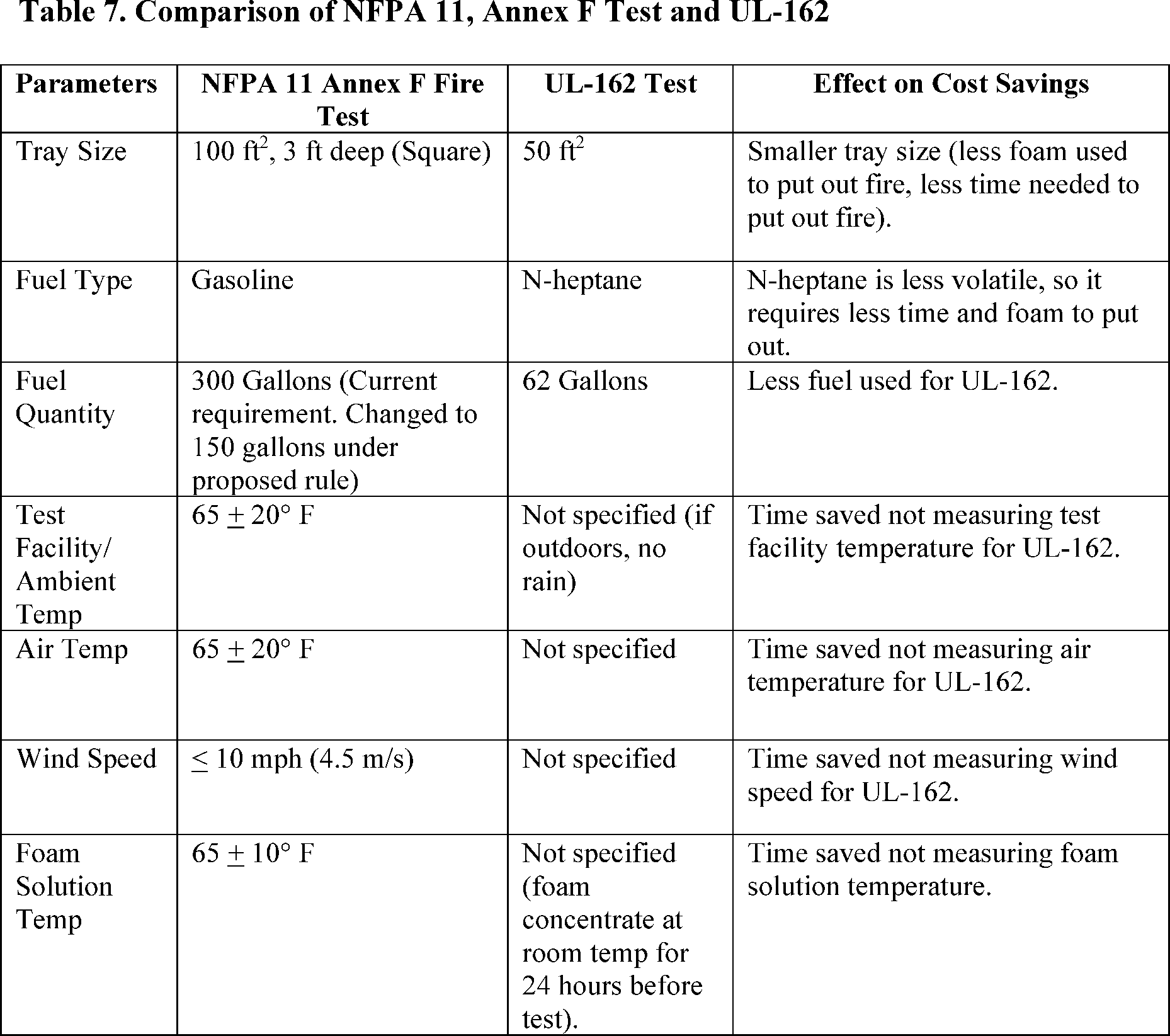
Table 7 illustrates areas of cost savings where the NFPA 11, Annex F foam concentrate test and the UL-162 test primarily differ. Similar differences exist between the NFPA 11, Annex F test and other alternative tests, but since the manufacturer expressed interest in using the UL-162 test, we are providing this difference between parameters for these two tests for clarity.
( printed page 30582)
According to this manufacturer, the cost savings for this test are currently unquantifiable due to a lack of data. Laboratories have not yet determined how much they would charge manufacturers for the UL-162 test (the NFPA 11, Annex F test is priced at $50,000). While they are aware of the differences in parameters between the UL-162 test and the NFPA 11, Annex F test, they lack information on the variations in time or resources needed to make the cost calculable, though they believe that the difference in costs would likely be minimal. The Coast Guard requests public comments on the data that may be available for this particular item under this provision, to determine if cost savings exist for manufacturers.
Proposed 162.033-9(a)(10) would reduce the number of required foam concentrate tests in a testing series from four NFPA 11, Annex F foam concentrate tests to two. The NFPA 11, Annex F testing series is structured as follows: (1) a preliminary testing series setup; (2) the required number of foam concentrate tests (formerly four, proposed two), each followed by cleanup and setup for a subsequent test; and (3) a final clean-up of the testing site that closes out the testing series. The cost savings to manufacturers would come from the reduction of tests in a single testing series (from four tests to two tests), which would reduce the cost of the overall testing series. The average cost of an NFPA 11, Annex F foam concentrate test series is $50,000 for four tests in one series. However, much of the cost is attributed to the preliminary testing series setup and final cleanup, which will already occur, given that two tests will still be conducted; therefore, we do not expect cost savings to be associated with the preliminary setup and final cleanup portion of the test (the quantified cost savings is from the reduction in the number of tests itself, which we discuss in the cost savings portion of this RA). The Coast Guard requests public comment on this item to determine if there would be cost savings for this part of the test for manufacturers.
Discussion of Proposed Regulatory Changes to Independent Laboratories
Proposed 162.033-7(h) would allow for tests other than the NFPA 11, Annex F foam concentrate test to be performed on hazards other than tanker decks. Alternative tests include the UL-162 test, ICAO Fire test, or MSC.1/Circ. 1312/Corr.1 tests. According to manufacturers, these tests would be less costly and take less time to conduct than the NFPA 11, Annex F foam concentrate test, and one manufacturer of foam systems for other hazards has expressed intent to use the UL-162 test.
Regarding
Quantified Cost Savings to Laboratories,
we calculated the cost savings for a single laboratory that uses n-heptane fuel instead of gasoline to conduct the UL-162 test, specifically for the one manufacturer who expressed interest in alternative testing. Aside from this quantifiable cost, we do not
( printed page 30583)
expect cost savings to come from laboratories not having to measure environmental conditions—such as test facility temperature, air temperature, wind speed, and foam solution temperature—when performing the UL-162 test, as well as the difference in the amount of foam used and the difference in time it takes to conduct the tests. Laboratories did not have estimates on how much time or resources would be saved; therefore, we are not able to include these savings in this RA. The Coast Guard requests public comments to determine if cost savings exist for laboratories who would use the UL-162 test.
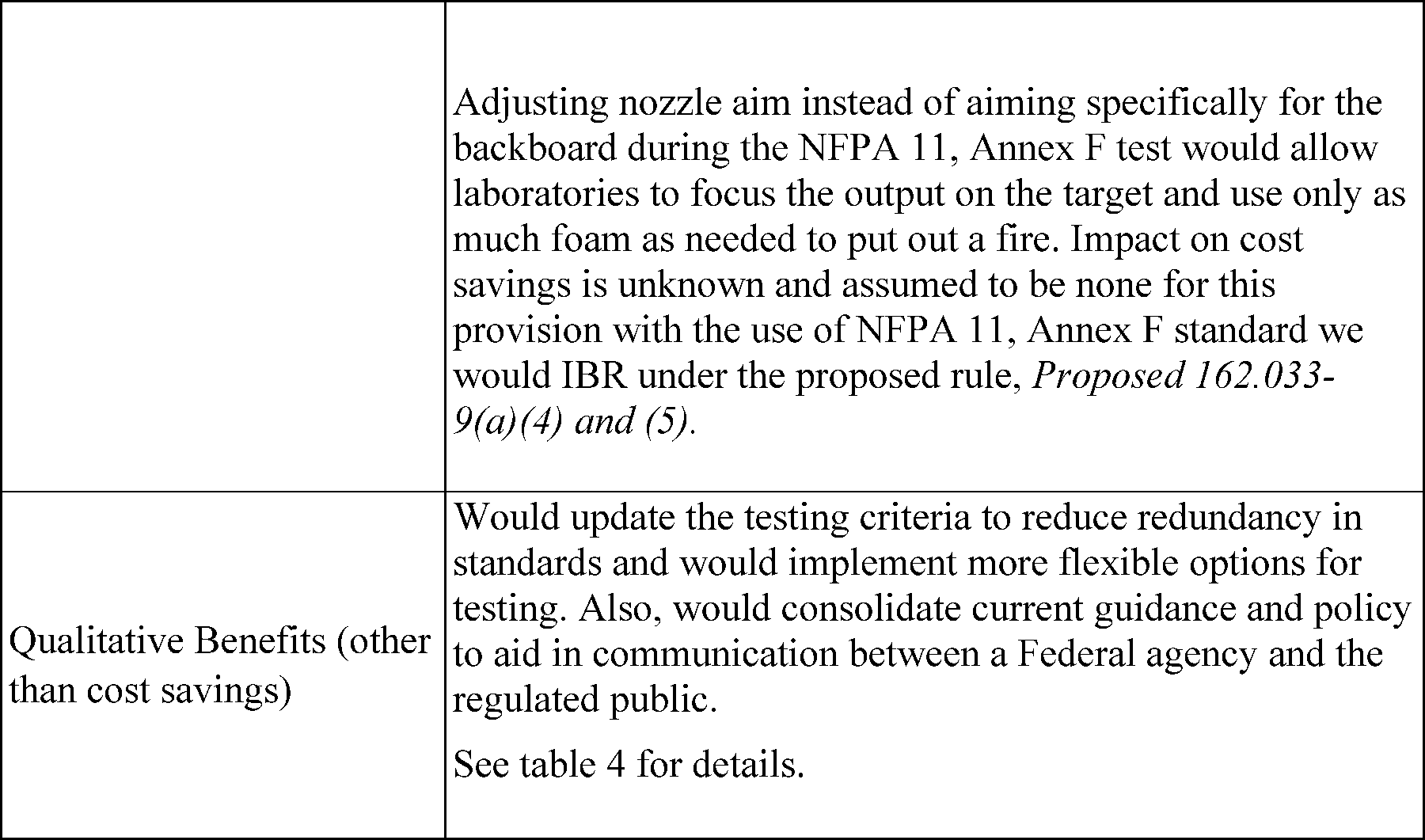
Proposed 162.033-9(a)(4) and (5) would allow laboratories to adjust nozzle aim during testing, which would allow laboratories to maintain the target and use only as much foam as needed to put out a fire. Currently, the firefighter conducting the test is required to aim at the approximate center of the backside of the pan, which can result in foam spraying outside the intended area. This proposed paragraph allows the firefighter to adjust the aim along the backside of the pan, potentially reducing the amount of foam that misses the pan. This adjustment could lead to small cost savings for laboratories, as less foam would be wasted. However, laboratories currently lack data on the amount of foam lost when aiming at the middle of the backside of the pan; therefore, we cannot estimate a cost savings associated with these two regulatory provisions and it is unclear if a cost savings would exist. The Coast Guard requests public comments to gather more information and to determine if cost savings exist.
Quantified Cost Savings to Laboratories
Cost Savings From Proposed 162.033-7(h)
Proposed 162.033-7(h) would allow for manufacturers of systems for other hazards to choose alternative tests instead of the NFPA 11, Annex F test. In NFPA 11, Annex F tests, gasoline is used in a larger 100 square foot pan, which makes the test more stringent and requires more foam to extinguish the fire due to gasoline's higher volatility. This results in a greater quantity of foam needed and a longer test duration. In contrast, alternative tests use n-heptane fuel, which is easier to extinguish, and only requires a 50 square foot pan. The smaller test area and simpler fuel type would reduce the overall expense of conducting the test and would make alternative tests more cost-efficient compared to NFPA tests. These savings would be from reduced material costs (foam) and shorter test times that minimize labor requirements.
While laboratories were unable to provide the amount of foam saved and the amount of time saved, we were able to calculate the fuel savings from using n-heptane fuel instead of gasoline for the UL-162 test. We calculated the cost savings for a single laboratory, assuming that the manufacturer of the foam system would select one laboratory at a time for testing. We also assume that a single lab would test a foam system for other hazards annually because foam systems, after prior certification, require periodic testing by laboratories to ensure quality control. As shown in table 7, the UL-162 test requires 62 gallons of n-heptane, while the current NFPA 11, Annex F test requires 300 gallons of gasoline. Specific 2024 North American price data for n-heptane was unavailable, so we used the Q3 2025 price of $2,250 per metric ton as a proxy.[14]
While n-heptane experienced rising costs in 2024, the price of n-heptane stabilized in 2025. Therefore, while the figure we use is likely lower than the Q4 2024 price, the stabilization in 2025 makes it a reliable estimate. Since 1 metric ton of n-heptane equals approximately 386 gallons, the price of 1 gallon of n-heptane fuel is approximately $5.83 ($2,250 per metric ton ÷ 386 gallons), rounded. We multiplied 62 gallons required for the UL-162 test by $5.83 to obtain the total cost of n-heptane fuel for the UL-162 test of approximately $361.40. For the NFPA 11, Annex F test, the average price per gallon for the type of gasoline used in fire testing (regular grade gasoline) averaged around $3.30 in 2024.[15]
For the currently required 300 gallons for the NFPA 11, Annex F test, the total cost of fuel would be $990. Therefore, the quantifiable cost savings for a laboratory conducting the UL-162 test instead of the NFPA 11, Annex F test would be approximately $629 ($990−$361.40 = $628.60), rounded, annually.
Cost Savings From Proposed 162.033-9(a)(10)
Proposed 162.033-9(a)(10) would reduce the number of required foam concentrate tests in a testing series from four NFPA 11, Annex F foam concentrate tests to two. There are currently four tests per testing series. As stated previously, the structure of a testing series is: (1) a preliminary testing series setup; (2) the required number of foam concentrate tests (formerly four tests, now two tests), each followed by cleanup and setup for a subsequent test; and (3) a final cleanup of the testing site that closes out the testing series. According to sources at the affected laboratories in our population, there is an average of six testing series conducted annually by each of the 4 laboratories. These tests can either be initial testing of a new foam system for prior certification or required annual or biannual testing of foam systems for quality assurance. Each NFPA 11, Annex F foam concentrate test takes between 26 and 31 minutes to conduct, with cleanup after each test and preparation for the next test averaging approximately 2 hours. These individual tests are conducted sequentially, or all in a single day.
Given this, laboratories would save approximately 28.5 minutes ((26 + 31) ÷ 2), on average, for each test not required, as well as 4 hours of expected cleanup and preparation time for the new test. The preliminary setup and final cleanup after the foam concentrate tests remain the same. In total, laboratories would save approximately 57 minutes on tests (28.5 minutes × 2 tests) and approximately 4 hours on set-up and clean-up (240 minutes), totaling approximately 4.95 hours for clean-up and preparation (297 minutes total).
To calculate the cost savings, we used the U.S. Bureau of Labor Statistics (BLS) Occupational Employment Series. We considered the unloaded wage rates for a firefighter (BLS Occupational Employment Series: 33-2011 “Firefighters”), who is responsible for conducting the foam concentrate test, and the Health and Safety engineer (BLS Occupational Employment Series: 17-2111 “Health and Safety Engineers, Except Mining Safety Engineers and Inspectors”) who is responsible for overseeing the testing. Laboratories used the occupation title “fire safety engineer,” but that occupation does not have an individual Occupational Employment Series, so we approximate it with the BLS labor category “Health and Safety Engineers . . .” series, whose job description is to develop procedures and design systems to protect people from illness and injury and property from damage.[16]
The firefighter is a local Government employee hired by the laboratory for the testing series, and the Health and Safety
( printed page 30584)
Engineer is considered a private industry employee. The laboratories are located in Illinois, Texas, Minnesota, and Massachusetts. The unloaded mean hourly wage rate for Health and Safety Engineers is $53.91 in Illinois, $63.38 in Massachusetts, $56.88 in Minnesota, and $60.39 in Texas.[17]
Across four states, this averages out to $58.64 for Health and Safety Engineers, rounded. BLS does not have mean wage rates for local Government employees by region, so for firefighters, we use the national unloaded mean wage rate for firefighters employed by local government ($31.50).[18]
Laboratories stated that they pay the firefighters an equivalent wage to their mean hourly wage. We obtained the unloaded compensation rates, and wages and salaries for the occupations of Firefighters and Health and Safety Engineers using the BLS Employer Costs for Employee Compensation News Release published in December 2024 (Quarter 4).[19]
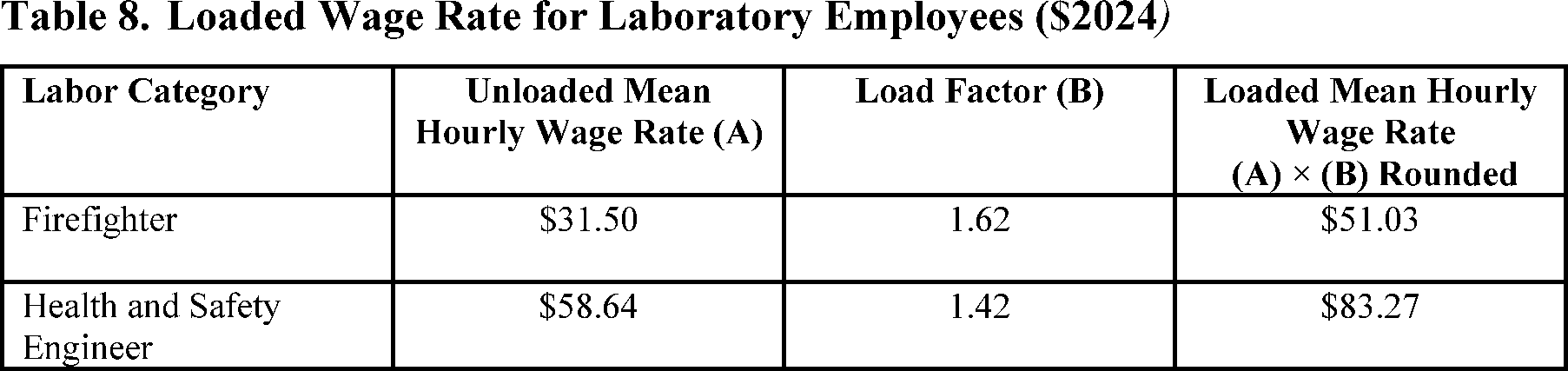
For Firefighters, we used the total compensation value of $63.46 for Quarter 4 of 2024 for state and local Government employees, and the “Wages and Salaries” value of $39.22 for Quarter 4 of 2024 for state and local Government employees. These values are found in the third paragraph of the Economic News Release. We calculated the load factor by dividing “Total Compensation” by “Wages and Salaries” ($63.46 ÷ $39.22), for a load factor of approximately 1.62 for Firefighters. Similarly, we calculated the load factor for private industry employees (Health and Safety Engineer) using the total compensation value of $44.67 for Quarter 4 of 2024 and the “Wages and Salaries” value of $31.47 for Quarter 4 of 2024. These values are found in the second paragraph of the Economic News Release. We calculated the load factor for Health and Safety Engineers by dividing $44.67 by $31.47 for a load factor of approximately 1.42. In table 8, we present the loaded mean hourly wage rates for each occupational category.
Laboratories pay for the Firefighters to conduct the tests. For each testing series, laboratories would save approximately $252.60 in labor time for Firefighters (4.95 hours × $51.03 loaded wage rate). They would save approximately $412.18 for Health and Safety Engineers (4.95 hours × $83.27 loaded wage rate), for a total cost savings of approximately $664.78 per testing series. Given an average of six testing series (with 4 tests per series) conducted annually by a single laboratory, or a total of 24 testing series for all laboratories annually (6 testing series × 4 laboratories), laboratories would save a total of approximately $15,955, rounded, (24 testing series × $664.78) annually from this proposed change. Based on industry information, which was validated by Coast Guard SMEs, each test takes approximately 15 minutes for documentation; four tests take approximately 1 hour for a total hour burden of approximately 24 hours. This proposed rule would allow for the removal of two tests, which would result in an annual paperwork hour burden reduction of 12 hours (30-minute reduction (0.5 hours) from documenting two fewer tests per series × 6 testing series × 4 laboratories). Please see section D. Collection of Information for further details.
Under the same proposed paragraph, 162.033-9(a)(10), the laboratory would save approximately 150 gallons of fuel by conducting two fewer tests (300 gallons of fuel currently required ÷ 2), according to sources from the independent laboratories. The average price per gallon for the type of gasoline used in fire testing (regular grade gasoline) averaged around $3.30 in 2024.[20]
This would result in cost savings of approximately $495 (150 gallons of fuel saved × $3.30) for each testing series. Given an average of six foam concentrate tests annually, the cost savings for fuel consumption would be approximately $2,970 (6 testing series × $495) for an individual laboratory. Across the four affected laboratories (24 testing series conducted annually), this would result in a cost savings for fuel consumption of approximately $11,880 (24 total testing series × $495). In total, laboratories would save approximately $27,835 ($15,955 from reduced time used to conduct tests + $11,880 from fuel savings) annually under proposed paragraphs 162.033-9(a)(10).
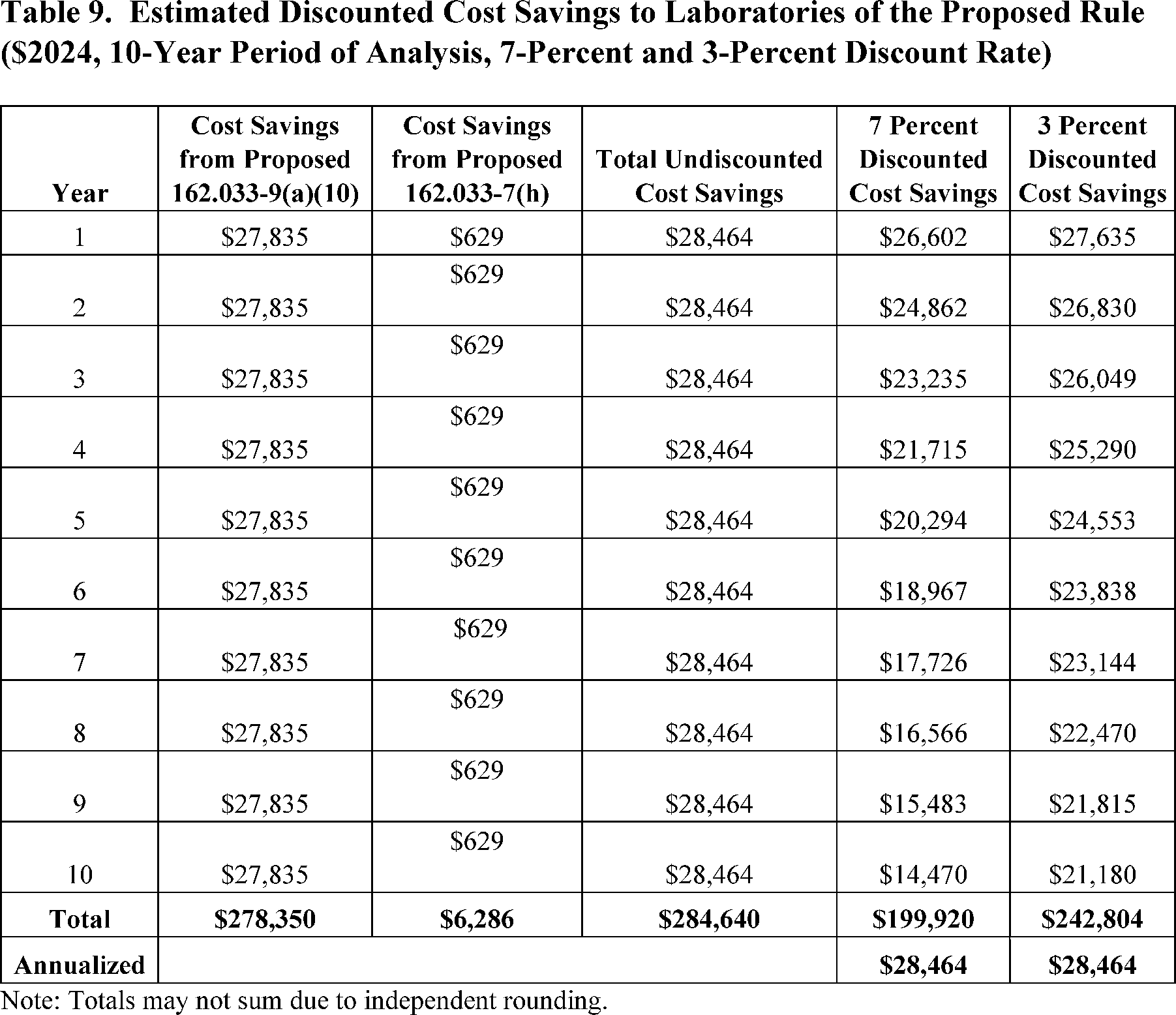
We combine this result with the cost savings of $629 from using n-heptane fuel for the UL-162 test instead of gasoline for the NFPA 11, Annex F test. The estimated annual undiscounted cost savings for industry is approximately $28,464, rounded (laboratories only). Table 9 shows the estimated cost savings to industry of the proposed rule over a 10-year period of analysis, using 7-percent and 3-percent discount rates.
( printed page 30585)
For industry, we estimate that the 7-percent discounted cost savings over a 10-year period of analysis would be approximately $199,920, rounded to the nearest whole number, and the annualized cost savings using a 7-percent discount rate would be approximately $28,464, rounded. The Coast Guard requests public comments on our estimates for the two provisions of the proposed rule that we determined would produce cost savings. Using a perpetual period of analysis with an assumed implementation year of 2026, we estimate the total industry annualized cost savings of this action to be $25,464 deflated back to 2024 dollars, using a 7 percent discount rate.
Cost Savings to Government
Currently, the Coast Guard receives an average of three inquiries annually regarding foam equipment and testing from manufacturers. Under this proposed rule, the answers to these inquiries would be in the CFR, where the Coast Guard would refer a caller to obtain the specific information. The anticipated reduced hour burden to the Government is not associated with any specific proposed change to a regulatory provision. Changes in the number of these inquiries following publication of an effective rule is not something the Coast Guard can predict. These inquiries, either through email or by telephone, take approximately 1 hour to resolve. Through this proposed rulemaking, the Coast Guard anticipates that the time spent on inquiries would fall to a 5-minute response (0.083 hours) for an hour-burden savings of approximately 55 minutes (0.917 hours) for each inquiry, because the Coast Guard would be able to directly reference the CFR parts outlined in this proposed rule to resolve the inquiries. In terms of paperwork requirements, the hour burden for the Government would be reduced by approximately 2.758 hours annually (0.917 hours × 3 inquiries annually). This is not included in the ICR amendment in the
Collection of Information
section because only the paperwork burden reduction to industry is included in the change.
The Coast Guard individual responsible for responding to inquiries is a Federal Government employee with a General Schedule (GS) grade level of GS-14, located in the Washington, DC metropolitan area. In 2024, the unloaded mean hourly wage rate for a GS-14, step 5 (using the midpoint of the pay scale) employee is $75.70,[21]
and the load factor is 1.57.[22]
The loaded mean hourly wage rate is approximately $118.85, rounded ($75.70 × 1.57). Given this, the Coast Guard would save approximately $108.99 ((1 hour × $118.85)−(0.083 hours × $118.85)), rounded, on each inquiry. This would have annual cost savings of approximately $327 (3 inquiries × $108.99). This is the undiscounted cost
( printed page 30586)
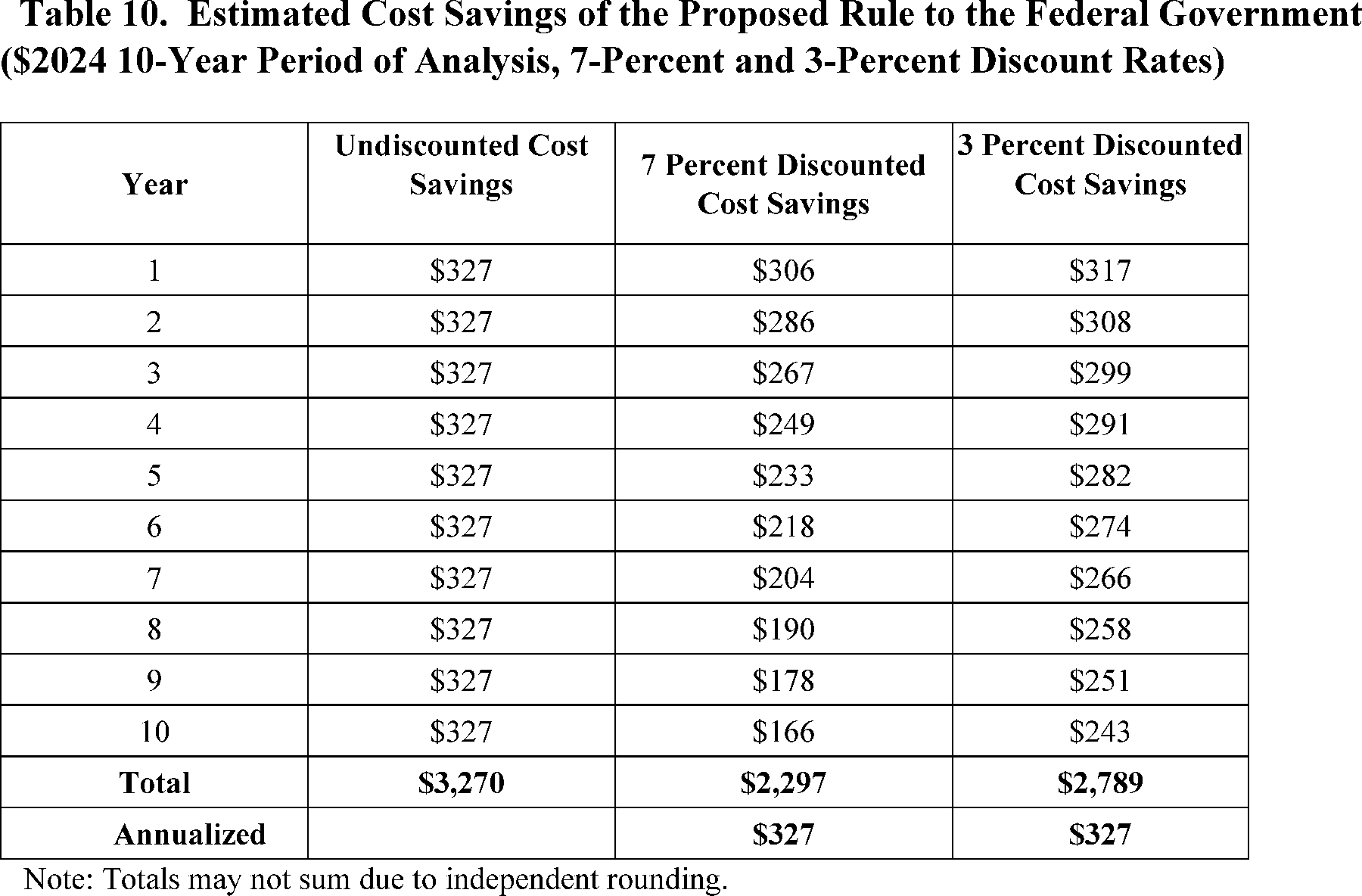
for a single year to the Government. Table 10 presents the cost savings to the Government over a 10-year period of analysis using 7-percent and 3-percent discount rates.
For the Government, we estimate that the total discounted cost savings over a 10-year period of analysis would be approximately $2,297, rounded, using a 7-percent discount rate. We estimate the annualized cost savings for the Government would be approximately $327, rounded, using a 7-percent discount rate. Using a perpetual period of analysis with an assumed implementation year of 2026, we estimate the total Government annualized cost savings of this proposed rule to be $293 deflated back to 2024 dollars, using a 7 percent discount rate.
Costs Savings to Industry and Government (Combined)
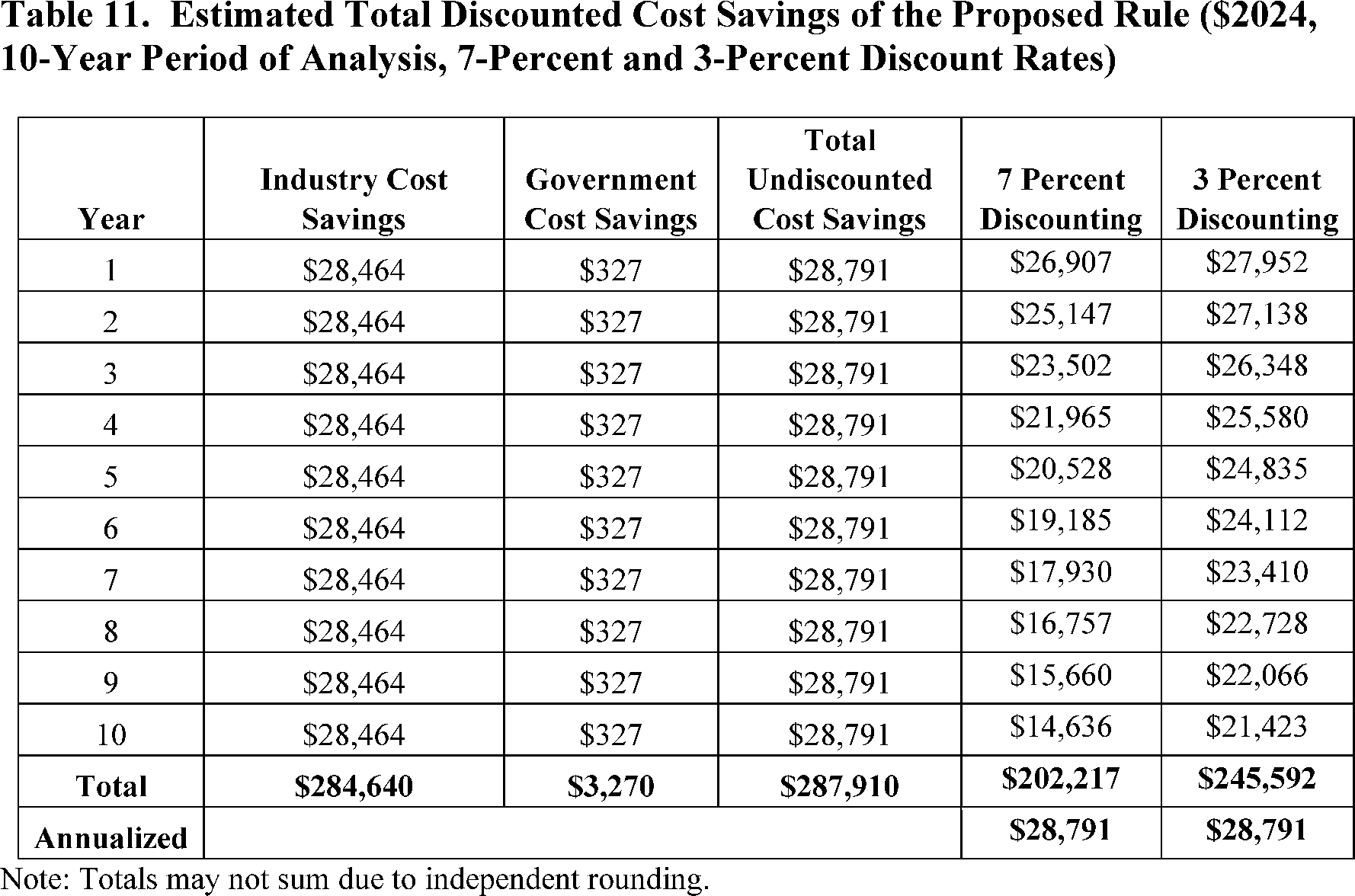
The annual undiscounted cost savings of this proposed rule would be approximately $28,779, which is the sum of $28,464 annual cost savings to industry and $327 annual cost savings to the Government. Table 11 shows a 10-year cost savings breakdown with 7 percent and 3 percent discounted values.
( printed page 30587)
For industry and government combined, we estimate the total 7-percent discounted cost savings over a 10-year period of analysis to be approximately $202,217, rounded to the nearest whole dollar, and the annualized cost savings at a 7-percent discount rate to be approximately $28,791, rounded. Using a perpetual period of analysis with an assumed implementation year of 2026, we estimate the total annualized cost savings of this proposed rule (industry plus Federal Government cost savings) to be approximately $25,756 in 2024 dollars, using a 7 percent discount rate.
Qualitative Benefits to Industry
In addition to the quantified cost savings associated with this proposed rule, there are additional qualitative benefits that come from the IBR of industry standards and the flexibility of choice for industry by the proposed provisions. Additionally, certain provisions eliminate standards made redundant by advancements in technology.
Proposed 162.033-7(h), 162.033-9(a)(4), 162.033-9(a)(5), 162.033-9(a)(6), and 162.040-7(d) would provide the benefit of flexibility of choice for industry by allowing the use of alternative standards.
Proposed 162.033-9(a)(10) would eliminate the stringent and redundant standards to pass the NFPA 11, Annex F foam concentrate test by reducing the number of tests in a testing series from four tests to two tests. Because standards are already strict, passing two tests in a testing series suffices, thereby increasing efficiency in testing without compromising on quality or compliance.
Proposed46 CFR 162.033-9(a)(1), (2), and (3) would provide the benefit of codifying industry policy and guidance that allows laboratories to choose whether to conduct testing indoors or outdoors.
Proposed 162.033-7, 7(a), (b), (c), (d), (e), (f), (g), 162.033-9(a)(7), (8), (9), 162.033-11, 162.033-12, and 162.033-15, and proposed 162.040-7, 7(a), (b), (c), (d), (e), (f), (g), (h), (i), 162.040-9, 9(a), (b), (c), 162.040-11, 162.040-13, and 162.040-15 all would provide the benefit of codifying existing guidance and policy, which aids in communication between a Federal agency and the regulated public.
The Coast Guard requests public comments on the economic impact of this proposed rule. Comments may be submitted using one of the methods indicated in the
ADDRESSES
portion of this preamble.
Analysis of Alternatives
The Coast Guard considered three alternatives for this proposed rule, discussed in detail as follows:
Alternative 1
—
Codify process and streamline standards.
This is the preferred alternative. We expect this alternative would codify the process, streamline standards, consolidate information, allow public comment on the type approval process, cut redundant standards in the face of technological advancements, and result in no additional costs to industry. We expect quantified cost savings for laboratories and the Federal government. Please see section VII. Regulatory Analyses of the preamble for the estimated impacts of this chosen alternative.
Alternative 2
—
Reduce required NFPA 11, Annex F foam concentrate testing series from four tests to three tests.
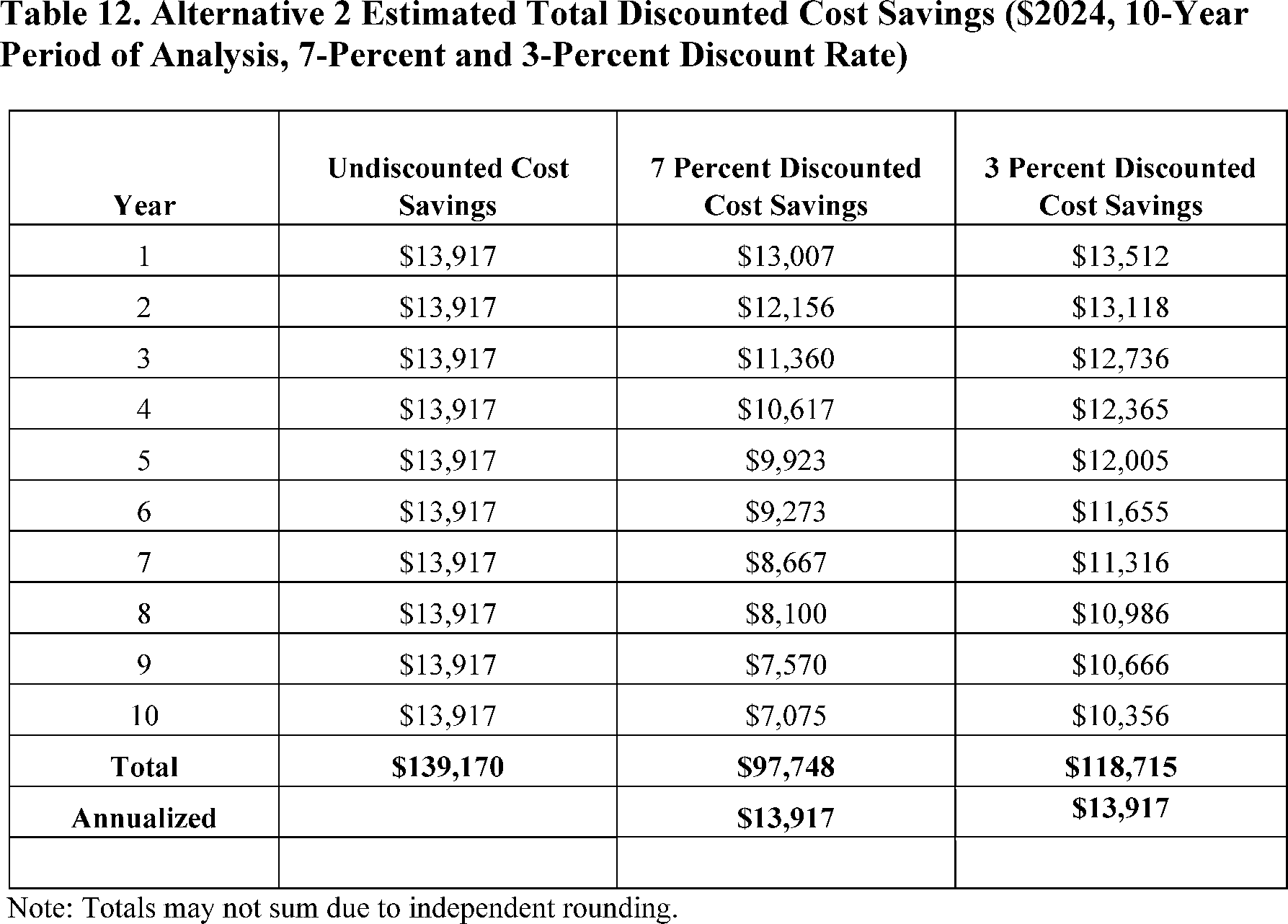
This alternative would reduce the number of foam concentrate tests in a testing series from four to three, as outlined in NFPA 11, Annex F. The cost savings of performing one less NFPA 11, Annex F foam concentrate test in a single testing series is the sum of the labor costs for the laboratory and the fuel costs. As explained in this RA, there are four labs which conduct these tests six times per year, resulting in a total of 24 testing series per year. A single test series with three instead of four tests takes 148.5 minutes (approximately 2.475 hours), including cleanup. When multiplied by the loaded wages for Firefighters ($51.03) and Health and Safety engineers ($83.27), we obtain cost savings of approximately $126.30 and $206.09 per test, respectively. When combined ($332.39, approximately) and multiplied by 24 annual tests, the cost savings per year would be approximately $7,977.42.
( printed page 30588)
A single test would require 75 gallons of gasoline at the 2024 market rate of $3.30, resulting in a cost of approximately $247.50, rounded. When we multiply this cost by the 24 tests per year, it results in cost savings of approximately $5,940. The total undiscounted cost savings per year for this alternative would be approximately $13,917 ($7,977.42 + $5,940), resulting in a 10-year cost savings (at a 7 percent discount rate) of approximately $97,748, rounded to the nearest whole dollar, and an annualized cost savings of $13,917, rounded.
Alternative 3
—
Adopt the International Convention for the Safety of Life at Sea (SOLAS) type approval regimen.
This alternative would adopt the internationally recognized firefighting standards for type approval from SOLAS. The IMO adopted the amended SOLAS treaty in 1974 and set safety standards for vessels on international voyages. With this alternative, we would adopt elements of SOLAS (SOLAS II-2, Regulation 10.4). However, adopting SOLAS standards in their entirety would reduce the stringency of testing to a point deemed unsafe by the Coast Guard.
Adopting SOLAS standards would allow foam concentrate testing for protection of tanker decks to be performed on a 50 ft2
pool instead of a 100 ft2
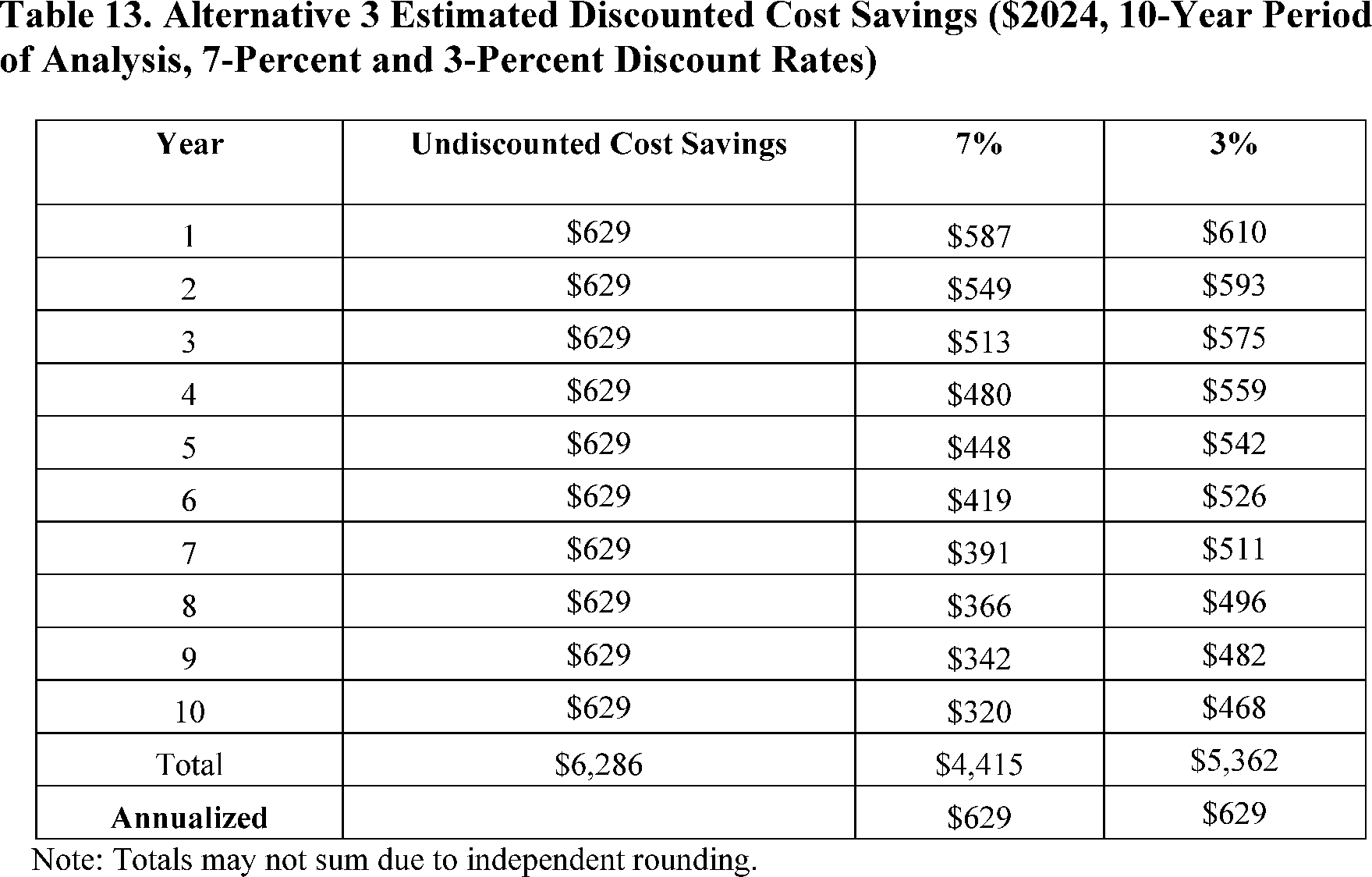
pool. It would also allow the use of n-heptane instead of gasoline. We are unable to quantify the full cost savings of performing testing under SOLAS requirements due to a lack of information on the difference in parameters between the SOLAS standard and the NFPA 11, Annex F test. However, we can calculate partial cost savings, since the cost savings calculated earlier for the UL-162 test compared to the NFPA 11, Annex F test also applies here. If adopted, the SOLAS standard test would have partial cost savings of approximately $629 annually, and a total cost savings of $4,415, rounded to the nearest whole dollar, at a 7-percent discount rate over a 10-year period, given annual testing requirements for foam systems, since the SOLAS test uses n-heptane instead of gasoline. Table 13 shows the 10-year cost breakdown at the 7-percent and 3-percent discount rates.
( printed page 30589)
Adopting SOLAS standards would result in both quantifiable and unquantifiable cost savings for manufacturers and laboratories. However, it would be a less stringent alternative to the proposed rule, and we would still require the NFPA 11, Annex F testing series to be performed on systems operating on tanker decks. We do not believe that the SOLAS standards adequately assess these firefighting systems on tank vessels. We believe that the existing NFPA 11, Annex F test is a more rigorous foam concentrate test and is more representative of the conditions aboard a tank vessel (such as a 100 ft2
pool of fire versus a 50 ft2
pool of fire). Therefore, we rejected this alternative.
B. Small Entities
Under the Regulatory Flexibility Act, 5 U.S.C. 601-612, we have considered whether this proposed rule would have a significant economic impact on a substantial number of small entities. The term “small entities” comprises small businesses, not-for-profit organizations that are independently owned and operated and are not dominant in their fields, and governmental jurisdictions with populations of less than 50,000 people. No companies that we researched in our affected population are considered to be small entities.
Therefore, the Coast Guard certifies under 5 U.S.C. 605(b) that this proposed rule would not have a significant economic impact on a substantial number of small entities because the eight companies in our affected population are not “small entities” under the Act. If you think that your business, organization, or governmental jurisdiction qualifies as a small entity and that this proposed rule would have a significant economic impact on it, please submit a comment to the docket at the address listed in the
ADDRESSES
section of this preamble. In your comment, explain why you think it qualifies and how and to what degree this proposed rule would economically affect it.
C. Assistance for Small Entities
Under section 213(a) of the Small Business Regulatory Enforcement Fairness Act of 1996, Public Law 104-121, we want to assist small entities in understanding this proposed rule so that they can better evaluate its effects on them and participate in the proposed rule. If the proposed rule would affect your small business, organization, or governmental jurisdiction and you have questions concerning its provisions or options for compliance, please call or email the person in the
FOR FURTHER INFORMATION CONTACT
section of this proposed rule. The Coast Guard will not retaliate against small entities that question or complain about this proposed rule or any policy or action of the Coast Guard.
Small businesses may send comments on the actions of Federal employees who enforce, or otherwise determine compliance with, Federal regulations to the Small Business and Agriculture Regulatory Enforcement Ombudsman and the Regional Small Business Regulatory Fairness Boards. The Ombudsman evaluates these actions annually and rates each agency's responsiveness to small business. If you wish to comment on actions by employees of the Coast Guard, call 1-888-REG-FAIR (1-888-734-3247).
D. Collection of Information
This proposed rule would call for a change to an existing collection of information under the Paperwork Reduction Act of 1995, 44 U.S.C. 3501-3520. As defined in 5 CFR 1320.3(c), “collection of information” comprises reporting, recordkeeping, monitoring, posting, labeling, and other similar actions. OMB Collection 1625-0035, Subchapter Q: Lifesaving, Electrical, and Engineering Equipment, Construction and Materials & Marine Sanitation Devices, outlines paperwork requirements for the type approval of lifesaving, electrical, and engineering equipment used in the maritime industry. Manufacturers of this equipment and the laboratories that test them are required to document and report information collected during the development and testing phases.
This change specifically affects laboratories that test foam firefighting extinguishing systems. Due to changes in the requirements for the NFPA 11,
( printed page 30590)
Annex F test, laboratories would now be required to take fewer notes during testing, since the required number of tests would be reduced from four to two. As a result, the overall paperwork burden for these laboratories would be reduced by half.
The total estimated annual burden reduction for industry is approximately 12 hours, reflecting the reduced time spent observing and recording test outcomes for foam firefighting extinguishing systems. Below are the details of the information collection, including the affected parties and the estimated burden reduction hours.
Title:
Subchapter Q: Lifesaving, Electrical, and Engineering Equipment, Construction and Materials & Marine Sanitation Devices (33 CFR part 159).
OMB Control Number:
1625-0035.
Summary of the Collection of Information:
During testing of foam firefighting extinguishing systems, laboratories document testing outcomes to generate official reports submitted to the U.S. Coast Guard. With recent changes to the NFPA 11, Annex F requirement which reduces the number of tests in a testing series from four to two, the amount of time required for documenting the test results would be reduced.
Need for Information:
This change to OMB Collection 1625-0035 would capture changes in testing criteria for foam firefighting extinguishing systems that reduce the paperwork burden for industry.
Proposed Use of Information:
OMB Collection 1625-0035 would allow the U.S. Coast Guard to monitor compliance with the type-approval process for foam firefighting extinguishing systems.
Description of the Respondents:
The respondents are U.S. Coast Guard-approved laboratories who test foam firefighting extinguishing systems.
Number of Respondents:
The existing OMB-approved number of respondents is 856. This proposed rule would not change the number of respondents in this collection of information. There are four testing laboratories that are affected by this proposed rule that are included in this total number of respondents.
Frequency of Response:
The existing OMB-approved number of responses is 402,310. The number of responses would not change with this proposed rule.
Burden of Response:
Each test takes about 15 minutes to document the results. This proposed rule would not change this estimate.
Estimate of Total Annual Burden:
The existing OMB-approved total annual hour burden is 86,430 hours. This proposed rule would reduce that number annually by 12 hours for a total of 86,418 hours. The decrease is a result of the number of tests that would be reduced from four to two for each testing series. Four laboratories conduct 6 testing series annually; therefore, the total annual burden reduction would be 12 hours (0.5 hours × 6 testing series × 4 laboratories × 2 tests per laboratory).
As required by 44 U.S.C. 3507(d), we will submit a copy of this proposed rule to OMB for its review of the collection of information.
We ask for public comments on the proposed collection of information to help us determine, among other things—
How useful the information is;
Whether the information can help us perform our functions better;
How we can improve the quality, usefulness, and clarity of the information;
Whether the information is readily available elsewhere;
How accurate our estimate is of the burden of collection;
How valid our methods are for determining the burden of collection; and
How we can minimize the burden of collection.
If you submit comments on the collection of information, submit them to both the OMB and to the docket where indicated under
ADDRESSES
.
You need not respond to a collection of information unless it displays a currently valid control number from OMB. Before the Coast Guard could enforce the collection of information requirements in this proposed rule, OMB would need to approve the Coast Guard's request to collect this information.
E. Federalism
A rule has implications for federalism under Executive Order 13132 (Federalism) if it has a substantial direct effect on States, on the relationship between the National Government and the States, or on the distribution of power and responsibilities among the various levels of government. We have analyzed this proposed rule under Executive Order 13132 and have determined that it is consistent with the fundamental federalism principles and preemption requirements described in Executive Order 13132. Our analysis follows.
It is well settled that States may not regulate in categories reserved for regulation by the Coast Guard. It is also well settled that all of the categories covered in 46 U.S.C. 3306, 3703, 7101, and 8101 (design, construction, alteration, repair, maintenance, operation, equipping, personnel qualification, and manning of vessels), as well as any other category in which Congress intended the Coast Guard to be the sole source of a vessel's obligations, are within the field foreclosed from regulation by the States.
See United States
v.
Locke,
529 U.S. 89 (2000) (finding that the states are foreclosed from regulating tank vessels);
see also Ray
v.
Atlantic Richfield Co.,
435 U.S. 151, 157 (1978) (State regulation is preempted where “the scheme of federal regulation may be so pervasive as to make reasonable the inference that Congress left no room for the States to supplement it [or where] the Act of Congress may touch a field in which the federal interest is so dominant that the federal system will be assumed to preclude enforcement of state laws on the same subject” (citations omitted)). This proposed rule involves codifying the type approval requirements and process for foam fire-extinguishing systems and is authorized by 46 U.S.C. 3306; as such it is part of a pervasive scheme of Federal regulation that forecloses regulation by the States. Because the States may not regulate within this field, this proposed rule is consistent with the principles of federalism and preemption requirements in Executive Order 13132.
While it is well settled that States may not regulate in categories in which Congress intended the Coast Guard to be the sole source of a vessel's obligations, the Coast Guard recognizes the key role that State and local governments may have in making regulatory determinations. Additionally, for rules with federalism implications and preemptive effect, Executive Order 13132 specifically directs agencies to consult with State and local governments during the rulemaking process. If you believe this proposed rule would have implications for federalism under Executive Order 13132, please call or email the person listed in the
FOR FURTHER INFORMATION CONTACT
section of this preamble.
F. Unfunded Mandates
The Unfunded Mandates Reform Act of 1995, 2 U.S.C. 1531-1538, requires Federal agencies to assess the effects of their discretionary regulatory actions. In particular, the Act addresses actions that may result in expenditure by a State, local, or tribal government, in the aggregate, or by the private sector of $100 million (adjusted for inflation) or more in any one year. Although this proposed rule would not result in such an expenditure, we do discuss the effects of this proposed rule elsewhere in this preamble.
( printed page 30591)
G. Taking of Private Property
This proposed rule would not cause taking private property or otherwise have taking implications under Executive Order 12630 (Governmental Actions and Interference with Constitutionally Protected Property Rights).
H. Civil Justice Reform
This proposed rule meets applicable standards in sections 3(a) and 3(b)(2) of Executive Order 12988, (Civil Justice Reform), to minimize litigation, eliminate ambiguity, and reduce burden.
I. Protection of Children
We have analyzed this proposed rule under Executive Order 13045 (Protection of Children from Environmental Health Risks and Safety Risks). This proposed rule is not an economically significant rule and would not create an environmental risk to health or risk to safety that might disproportionately affect children.
J. Indian Tribal Governments
This proposed rule does not have tribal implications under Executive Order 13175 (Consultation and Coordination with Indian Tribal Governments), because it would not have a substantial direct effect on one or more Indian tribes, on the relationship between the Federal Government and Indian tribes, or on the distribution of power and responsibilities between the Federal Government and Indian tribes.
K. Energy Effects
We have analyzed this proposed rule under Executive Order 13211 (Actions Concerning Regulations That Significantly Affect Energy Supply, Distribution, or Use). We have determined that it is not a “significant energy action” under that order because it is not a “significant regulatory action” under Executive Order 12866 and is not likely to have a significant adverse effect on the supply, distribution, or use of energy.
L. Technical Standards
The National Technology Transfer and Advancement Act, codified as a note to 15 U.S.C. 272, directs agencies to use voluntary consensus standards in their regulatory activities unless the agency provides Congress, through OMB, with an explanation of why using these standards would be inconsistent with applicable law or otherwise impractical. Voluntary consensus standards are technical standards (for example, specifications of materials, performance, design, or operation; test methods; sampling procedures; and related management systems practices) that are developed or adopted by voluntary consensus standards bodies.
This proposed rule uses the following voluntary consensus standards: ICAO Airport Services Manual, IMO MSC.1/Circ. 1312/Corr.1, NFPA 11, UL 92, and UL 162. The proposed sections that reference these standards and the locations where these standards are available are listed in §§ 162.033-5 and 162.040-5.
These standards provide internationally accepted and recognized parameters that equipment and material must meet to ensure its safety, proper usage, and preservation on the seas. The standards that would be incorporated were developed by either the ICAO, IMO, NFPA, or UL, which are voluntary consensus standard-setting organizations.
Consistent with incorporation by reference provisions in 1 CFR part 51, this material is reasonably available. Interested persons have access to it through their normal course of business; can purchase it from the organizations identified in §§ 162.033-5 and 162.040-5; or may view a copy using the methods identified in those sections.
If you disagree with our analysis of these voluntary consensus standards or are aware of voluntary consensus standards that might apply but are not listed, please send a comment explaining your disagreement or identifying additional standards to the docket using one of the methods under
ADDRESSES
.
M. Environment
We have analyzed this proposed rule under Department of Homeland Security Management Directive 023-01, Rev. 1, associated implementing instructions, and Environmental Planning COMDTINST 5090.1 (series), which guide the Coast Guard in complying with the National Environmental Policy Act of 1969 (42 U.S.C. 4321-4370f), and have made a preliminary determination that this action is one of a category of actions that do not individually or cumulatively have a significant effect on the human environment. A preliminary Record of Environmental Consideration (REC) supporting this determination is available in the docket. The preliminary REC includes a Special Condition that “It is the responsibility of facility operators to obtain and comply with all necessary local, state, and federal environmental approvals for discharges associated with the facility's operations. Additionally, all facility operators must submit documentation of compliance with all applicable local, state, and federal environmental approvals for discharges associated with the facility's operations”. For instructions on locating the docket, see the
ADDRESSES
section of this preamble. This proposed rule would be categorically excluded under paragraph L58 of Appendix A, Table 1 of DHS Instruction Manual 023-01-001-01, Rev. 1. Paragraph L58 pertains to regulations concerning equipment approval and carriage requirements.
This proposed rule involves updating and codifying the marine foam fire-extinguishing systems type approval procedure and criteria from the existing guidance into the Code of Federal Regulations. The proposed codification would promote maritime safety and stewardship by making the foam systems approval procedures and criteria more transparent and easily available. We seek any comments or information that may lead to the discovery of a significant environmental impact from this proposed rule.
This subpart prescribes standards, tests, and procedures for obtaining Coast Guard type approval of fixed foam fire-extinguishing systems. Each system consists of at least a foam liquid concentrate, a proportioner, and a foam discharge device. Systems may also include foam liquid concentrate tanks, valves, gauges, piping, and fittings. Fixed foam fire-extinguishing systems are approved as a functional system.
Commandant
means the Office of Design and Engineering Standards, Lifesaving and Fire Safety Division (CG-ENG-4). Address: Commandant (CG-ENG-4), Attn: Lifesaving and Fire Safety Division, U.S. Coast Guard Stop 7509, 2703 Martin Luther King Jr. Avenue SE, Washington, DC 20593-7509; email
typeapproval@uscg.mil.
Discharge device
means a fixed, semi-fixed, or portable device, such as a foam chamber, fixed foam maker, monitors, nozzle, spray nozzle, and sprinkler that directs the flow to the fire or flammable liquid surface.
Film-forming foam liquid concentrate
means a foam solution that has a spreading coefficient greater than zero when tested in accordance with the Film Forming Test of UL 162 (Incorporated by reference, see § 162.033-5).
Fire control
means a reduction in fire intensity of approximately 90 percent.
Foam
means a fire-fighting agent made by mechanically mixing air with a solution consisting of fresh or salt water to which a foam liquid concentrate has been added.
Foam expansion value
means the ratio of final foam volume to original foam solution volume before adding air.
Foam liquid concentrate
means a protein or synthetic based liquid that is intended to be diluted with fresh water, salt water, or a mixture of both fresh and salt water to a concentration (volume of concentrate/volume of solution).
Foam quality
means a measure of a foam's physical characteristics, expressed as a foam's twenty-five percent drainage time, and a foam expansion value.
Foam solution
means a mixture of proportioned or premixed foam liquid concentrate dissolved in fresh water, salt water, or a mixture of both.
Follow-up program
means a quality control system developed and performed by an independent laboratory to ensure compliance with the type approval conditions of a fixed foam fire-extinguishing system.
Independent laboratory
means an organization which meets the standards for acceptance in § 159.010-3, and which is accepted by the Coast Guard for performing certain tests and inspections.
Listed
means equipment or materials included in a list published by an organization that is an independent laboratory, whose listing states that either the equipment or material meets appropriate designated standards.
Proportioner
means a device intended to provide continuous introduction of foam liquid concentrate at the recommended ratio into a water stream to form a foam solution.
Twenty-five percent drainage time
means the time required for a twenty-five percent volume of liquid foam solution to drain from the foam sample.
(a) Certain material is incorporated by reference into this part with the approval of the Director of the Federal Register under 5 U.S.C. 552(a) and 1 CFR part 51. All approved incorporation by reference (IBR) material is available for inspection at the U.S. Coast Guard Stop 7509, Office of Design and Engineering Standards (CG-ENG), 2703 Martin Luther King Jr. Avenue SE, Washington, DC 20593-7509; email
typeapproval@uscg.mil
or visit
https://www.dco.uscg.mil/CG-ENG-4/.
It is also available for inspection at the National Archives and Records Administration (NARA). For information on the availability of this material at NARA; email:
fr.inspection@nara.gov,
or go to:
www.archives.gov/federal-register/cfr/ibr-locations.
The material may also be obtained from the following sources:
(b) UL Solutions (formerly Underwriters Laboratories), 333 Pfingsten Road, Northbrook, IL 60062-2096, 877-854-3577,
www.ul.com.
(1) UL 162, Standard for Safety: Foam Equipment and Liquid Concentrates, Eighth Edition, February 23, 2018, IBR approved for §§ 162.033-3, 162.033-7 introductory text and paragraphs (b) and (c), 162.033-9(b) and (c), 162.033-11(d), and 162.033-13(e).
(2) [Reserved]
(c) National Fire Protection Association (NFPA), 1 Batterymarch Park, Quincy, MA 02169-7471, 800-344-3555,
https://www.nfpa.org.
(1) NFPA 11, Standard for Low-, Medium-, and High-Expansion Foam, 2024 Edition, December 21, 2023, IBR approved for §§ 162.033-7 introductory text and 162.033-9(a).
(2) [Reserved]
(d) International Maritime Organization (IMO) Publications Section, 4 Albert Embankment, London SE1 7SR, United Kingdom, +44 (0)20 7735 7611,
https://www.imo.org.
(1) MSC.1/Circular 1312/Correction 1, Revised Guidelines for the Performance and Testing Criteria, and Surveys of Foam Concentrates for Fixed Fire-Extinguishing Systems, (Circ 1312), November 22, 2011, IBR approved for §§ 162.033-9(a) and (e) and 162.033-13(e).
General requirements for fixed foam fire-extinguishing systems.
For Coast Guard approval, all components of a fixed foam fire-extinguishing system must meet the applicable design, construction, and performance requirements of UL 162 (incorporated by reference, see § 162.033-5), NFPA 11 (incorporated by reference, see § 162.033-5), and the following additional requirements:
(a) All testing and inspections required by this subpart must be performed by an independent laboratory. A list of accepted independent laboratories is available online at
https://cgmix.uscg.mil/EQlabs/Default.aspx.
(b) Fixed foam fire-extinguishing systems must generate foam that matches the foam quality of the foam liquid concentrate UL 162 (incorporated by reference, see § 162.033-5) listing.
(c) The foam liquid concentrate of a fixed foam fire-extinguishing system must be UL 162 (incorporated by reference, see § 162.033-5) listed by an independent laboratory for its intended fuel group hazards (hydrocarbon, polar solvent, alcohol-resistant).
(d) Each proportioner and foam discharge device of the fixed foam fire-extinguishing system must be brass, bronze, stainless steel, or similarly durable, heat-resistant, corrosion-resistant material, except for incidental hardware and other parts, such as gaskets, bumpers, etc. Aluminum or aluminum alloys must not be used.
(e) All materials used in the construction of the fixed foam fire-extinguishing system must not be degraded by or adversely affect the foam products.
(f) Pressure vessels used in fixed foam fire-extinguishing systems must meet
( printed page 30593)
the applicable criteria of 46 CFR Subchapter F Part 54.
(g) Fixed foam fire-extinguishing system foam liquid concentrates intended for use on tanker decks must pass the fire test prescribed in § 162.033-9(a).
(h) Fixed foam fire-extinguishing system foam liquid concentrates intended for all other hazards must pass one of the tests prescribed in § 162.033-9(a)-(e).
Foam liquid concentrate tests for fixed foam fire-extinguishing systems.
Foam liquid concentrates must meet one of the following requirements:
(a) Test Method for Marine Fire-Fighting Foam Concentrates Protecting Hydrocarbon Hazards set forth in Annex F of NFPA 11 (incorporated by reference, see § 162.033-5), as modified below:
(1) The test facility must be 65 °F ± 20 °F.
(2) The fuel, water and foam solution temperature must be 65 °F ± 10 °F.
(3) The maximum wind speed must not exceed 10 mph.
(4) The flow parameters may be adjusted to produce representative foam of the full-scale system; however, the flow rate must not be more than 6.0 gallons per minute.
(5) The nozzle's aim may be adjusted during the tests as necessary to maintain its target as the fire conditions change.
(6) Simulated sea water meeting Circ. 1312 (incorporated by reference, see § 162.033-5) may be used.
(7) The torch must be constructed of nominal
3/4
inch O.D. aluminum pipe approximately 9 feet in length. Up to 10 inches of fire-resistant absorbent material must be wrapped with nichrome wire around one end of the pipe, and the wrapped end must be dipped in a container of kerosene.
(8) Burnback resistance test Method 1 must be used for non-film-forming foam liquid concentrates. Method 2 must be used for film-forming foam liquid concentrates or if the exposed fuel surface cannot be ignited using Method 1.
(9) Fire control time must occur within 4 minutes of the start of foam application.
(10) Two fire tests are required, one with fresh water and one with synthetic or simulated sea water. Upon a failure of either test, the series of tests must start over.
(b) UL 162 (incorporated by reference, see § 162.033-5) Topside Discharge Device Class B Fire Test;
(c) UL 162 (incorporated by reference, see § 162.033-5) Sprinklers and Spray Nozzles Class B Fire Test;
(d) ICAO Airport Services Manual (incorporated by reference, see § 162.033-5) Part 1 Class B or Class C fire test; or,
(e) Circ. 1312 (incorporated by reference, see § 162.033-5) fire test.
(a) An independent laboratory must perform an initial factory inspection to establish the materials of construction, foam quality tests, fixed foam fire-extinguishing system performance, material schedule, system specifications, dimensions, tolerances and other related factors needed to confirm product consistency during follow-up production inspections.
(b) Production inspections must be performed by an independent laboratory at least annually to confirm that no changes have been made to the fixed foam fire-extinguishing system that may adversely affect the fixed foam fire-extinguishing system effectiveness.
(c) An independent laboratory must prepare production inspection procedures and a report of the results of the fire testing program, and it must furnish the manufacturer a copy of each upon completion of the required testing.
(d) Materials approved under this subpart must be shipped in packaging that is clearly marked with the name of the manufacturer, product designation, date of manufacture, batch or lot number, Coast Guard type approval number and other information required by UL 162 (incorporated by reference, see § 162.033-5).
Design, installation, operation, and maintenance (DIOM) manual for fixed foam fire-extinguishing systems.
Each fixed foam fire-extinguishing system must have a DIOM manual that includes:
(a) A description of the system design, including a system schematic that includes detailed, orthographic engineering drawings.
(b) A complete list of components.
(c) Drawings of major system components, such as nozzles, monitor turrets, proportioners, etc.
(d) Information such as proportioning curves, discharge curves, and hydraulic calculations for system components including minimum and maximum inlet pressures at the discharge devices, range (throw), and pattern (vertical and horizontal) data for all pressure settings in increments of 25 psi (or smaller).
(e) List of type and characteristic of foam liquid concentrates (for example: the basic composition, percent concentration, and trade name of concentrate), as well as instructions and acceptance criteria for periodic sampling of foam liquid concentrates to meet UL 162 (incorporated by reference, see § 162.033-5), NFPA 11 (incorporated by reference, see § 162.033-5), and Circ. 1312 (incorporated by reference, see § 162.033-5).
(f) Sample calculations and drawings for typical fixed foam fire-extinguishing system installations in accordance with the applicable vessel regulations (such as 46 CFR 76.17 for passenger vessels). The drawings must show the location and range of foam coverage for the discharge devices, and the calculations must demonstrate that the design foam application rate is achieved for the entire protected area of the space. Sample drawings for tanker deck system installations in accordance with 46 CFR 34.17 must show the location of the deck foam monitors and the range of the foam stream for the monitors, which may not exceed 75% of the recorded foam discharge device range data.
(g) System operation, testing and maintenance instructions.
(h) For alcohol resistant and polar-solvent foam systems, a set of annexes that contain the design foam application rate for each chemical cargo the system is intended to protect.
(a) Fixed foam fire-extinguishing systems will be approved in accordance with the procedures in 46 CFR 159.005. Any modifications in design, formulation, specification, material, or construction must be approved by the Commandant (CG-ENG-4) before being installed or used on a U.S. vessel in any place where a Coast Guard-approved fixed foam fire-extinguishing system is required.
(1) The manufacturer must submit an approval or modification request application consisting of:
(i) A cover letter requesting type approval to the Commandant (CG-ENG-4) describing the product, its intended uses and confirmation that it complies with the requirements in 46 CFR 162.033. Modification requests should include a change log for the product.
(ii) A test report from an independent laboratory that meets §§ 159.005-9, 11 and 162.033-9.
(iii) Evidence of a follow-up program or listing with an independent laboratory that meets §§ 159.005-11 and 162.033-11.
(iv) A DIOM manual for the fixed foam fire-extinguishing system that meets the requirements of §§ 159.005-12 and 162.033-13.
( printed page 30594)
(2) The approval application must be submitted to Commandant (CG-ENG-4) at:
This subpart prescribes standards, tests, and procedures for obtaining Coast Guard type approval of foam hose reel stations as excess fire-extinguishing systems for helicopter decks without fueling facilities. Approved foam hose reel stations may also be used as a substitute for required hose reel stations on deck fire mains if they meet the applicable requirements of this subpart. Each foam hose reel station consists of at least a foam tank, foam liquid concentrate, a proportioner, a hose reel with non-collapsible hose and a nozzle, all integrated into a compact unit.
Commandant
means the Office of Design and Engineering Standards, Lifesaving and Fire Safety Division (CG-ENG-4). Address: Commandant (CG-ENG-4), Attn: Lifesaving and Fire Safety Division, U.S. Coast Guard Stop 7509, 2703 Martin Luther King Jr. Avenue SE, Washington, DC 20593-7509; email:
typeapproval@uscg.mil.
Foam
means a fire-fighting agent made by mechanically mixing air with a solution consisting of fresh or salt water to which a foam liquid concentrate has been added.
Foam expansion value
means the ratio of final foam volume to original foam solution volume before adding air.
Foam liquid concentrate
means a protein or synthetic based liquid that is intended to be diluted with fresh water, salt water, or a mixture of both fresh and salt water to a concentration (volume of concentrate/volume of solution).
Foam quality
means a measure of a foam's physical characteristics, expressed as a foam's twenty-five percent drainage time, and a foam expansion value.
Foam solution
means a mixture of proportioned or premixed foam liquid concentrate dissolved in fresh water, salt water, or a mixture of fresh and salt water.
Follow-up program
means a quality control system developed and performed by an independent laboratory to ensure compliance with the type approval conditions of a product.
Independent laboratory
means an organization which meets the standards for acceptance in § 159.010-3, and which is accepted by the Coast Guard for performing certain tests and inspections.
Listed
means equipment or materials included in a list published by an organization that is an independent laboratory, whose listing states that either the equipment or material meets appropriate designated standards.
Proportioner
means a device intended to provide continuous introduction of foam liquid concentrate at the recommended ratio into a water stream to form a foam solution.
Twenty-five percent drainage time
means the time required for a twenty-five percent volume of liquid foam solution to drain from the foam sample.
(a) Certain material is incorporated by reference into this part with the approval of the Director of the Federal Register under 5 U.S.C. 552(a) and 1 CFR part 51. All approved incorporation by reference (IBR) material is available for inspection at the U.S. Coast Guard Stop 7509, Office of Design and Engineering Standards (CG-ENG), 2703 Martin Luther King Jr Avenue SE, Washington, DC 20593-7509; email
typeapproval@uscg.mil
or visit
https://www.dco.uscg.mil/CG-ENG-4/.
It is also available for inspection at the National Archives and Records Administration (NARA). For information on the availability of this material at NARA; email:
fr.inspection@nara.gov,
or go to:
www.archives.gov/federal-register/cfr/ibr-locations.
The material may also be obtained from the following sources:
(b) UL Solutions (formerly Underwriters Laboratories), 333 Pfingsten Road, Northbrook, IL 60062-2096, 919-549-1400,
www.ul.com.
(1) UL 162 Standard for Safety: Foam Equipment and Liquid Concentrates, Eighth Edition, (UL 162), dated February 23, 2018, IBR approved for §§ 162.040-7 introductory text, 162.040-7(f), 162.040-9(b), 162.040-11(d), and 162.040-13(e).
(2) UL 92 Standard for Safety: Fire Extinguisher, Booster, and Noncollapsible Standpipe Hose and Hose Assemblies, Eleventh Edition, (UL 92), March 24, 2020, IBR approved for § 162.040-7(h).
(c) Naval Sea Systems Command (SEA 55Z3), Department of the Navy, Washington, DC 20362-5101.
(1) MIL-H-24580 (SH), Military Specification, Hose Assemblies, Synthetic Rubber, Non collapsible, Fire Fighting, (MIL-H-24580), amended May 21, 1985, IBR approved for § 162.040-7(h).
(2) [Reserved]
(d) National Fire Protection Association (NFPA), 1 Batterymarch Park, Quincy, MA 02169-7471, 800-344-3555,
https://www.nfpa.org.
(1) NFPA 11, Standard for Low-, Medium-, and High-Expansion Foam, 2024 Edition, December 21, 2023, IBR approved for §§ 162.040-7 introductory text, and 162.040-13(e).
(2) [Reserved]
(e) International Maritime Organization (IMO) Publications Section, 4 Albert Embankment, London SE1 7SR, United Kingdom, +44 (0)20 7735 7611,
https://www.imo.org.
(1) MSC.1/Circ. 1312/Correction 1, Revised Guidelines for the Performance and Testing Criteria, and Surveys of Foam Concentrates for Fixed Fire-Extinguishing Systems, (Circ 1312), November 22, 2011, IBR approved for § 162.040-13(e).
For Coast Guard approval, all components of a foam hose reel station must meet the applicable design, construction and performance requirements of UL 162 (incorporated by reference, see § 162.040-5), NFPA 11 (incorporated by reference, see § 162.040-5), and the following requirements:
(a) Each proportioner, nozzle, piping, and valves of the foam hose reel station must be brass, bronze, stainless steel, or similarly durable, heat resistant, corrosion-resistant material, except for incidental hardware and other parts, such as gaskets, bumpers, etc., which may be of rubber or plastic. Aluminum and aluminum alloys must not be used.
(b) All materials used in the construction of the foam hose reel station must not be degraded by or adversely affect the foam products.
(c) The foam liquid concentrate storage tank must be vented.
(d) The proportioner must be permanently preset at the factory to the
( printed page 30595)
recommended ratio and must not be field adjustable to a range of concentrations unless otherwise approved by the Commandant.
(e) The foam hose reel station structure must be made of stainless or galvanized steel.
(f) The foam liquid concentrate used in the foam hose reel station must be listed by an independent laboratory as meeting the requirements of UL 162 (incorporated by reference, see § 162.040-5).
(g) Foam hose reel stations intended to be used on fire main systems must have combination nozzles that are approved by the Coast Guard under approval series 162.027.
(h) Foam hose reel stations intended to be used on fire main systems must have non-collapsible hose that complies with either UL 92 or MIL-H-24580 (incorporated by reference, see § 162.040-5).
(i) Foam hose reel stations intended to be used on fire main systems must have a water bypass line around the foam proportioner for use when flowing water only.
For Coast Guard approval, the tests of this part must be conducted by an independent laboratory.
(a)
Performance tests.
Two discharge tests must be conducted for each foam hose reel station for which approval is sought. Each discharge test must be conducted with half of the hose unwound from the foam hose reel station. Each discharge test must include:
(i)
Activation time.
The foam hose reel station must be capable of producing foam within 10 seconds of activation. Starting with empty foam hose reel station piping and hose, water must be supplied to the foam hose reel station at nominal maximum inlet pressure and the time taken to produce foam from the nozzle must be recorded.
(ii)
Induction rate.
The ability of the proportioner of the foam hose reel station to induce liquid concentrate into the water flow at the correct percentage must be demonstrated at the minimum and maximum nominal inlet pressures of the foam hose reel station. The criterion for the induction rate is the nominal percentage for the liquid concentrate minus 0 and plus 30 percent.
(iii)
Discharge time.
The foam discharge time of the foam hose reel station must be at least 5 minutes at the maximum nominal inlet pressure.
(b)
Foam quality tests.
(i) Foam hose reel stations must generate foam that matches the foam quality of their foam concentrate UL 162 (incorporated by reference, see § 162.033-5) listing.
(ii) [Reserved]
(c)
Pressure test.
A sample hose reel, hose, and piping assembly of the foam hose reel station must be subjected to a pressure test. The test must be conducted at twice the maximum nominal station inlet pressure or 400 psi, whichever is less. The test must be for a duration of one minute. No part of the tested assembly may break or rupture during the test.
(a) An independent laboratory must perform an initial factory inspection to establish the materials of construction, foam quality tests, foam hose reel station performance, material schedule, system specifications, dimensions, tolerances and other related factors needed to confirm product consistency during follow-up production inspections.
(b) Production inspections must be performed by an independent laboratory at least annually to confirm that no changes have been made to the foam hose reel station that may adversely affect the foam hose reel station effectiveness.
(c) The independent laboratory must prepare production inspection procedures and a report of the results of the testing program and must furnish the manufacturer with each upon completion of the required testing.
(d) Materials approved under this subpart must be shipped in packaging that is clearly marked with the name of the manufacturer, product designation, date of manufacture, batch or lot number, Coast Guard type approval number and other information required by UL 162 (incorporated by reference, see § 162.040-5).
Design, installation, operation, and maintenance (DIOM) manual for foam hose reel stations.
Each foam hose reel station must have a DIOM manual that includes the following:
(a) Detailed, orthographic, engineering drawings of the hose reel station.
(b) A complete list of components.
(c) Drawings of major system components, such as the nozzle, reel, proportioner, etc.
(d) Hydraulic data for system components such as proportioning curves, discharge curves, and ranges of discharge from nozzles.
(e) List of type and characteristic of foam liquid concentrates for use with the hose reel station (basic composition, percent concentration, and trade name of concentrate, etc.), as well as instructions and acceptance criteria for periodic sampling of foam liquid concentrates carried on each vessel to meet UL 162 (incorporated by reference, see § 162.040-5), NFPA 11 (incorporated by reference, see § 162.040-5), and Circ 1312 (incorporated by reference, see § 162.040-5).
(f) System operation, testing and maintenance instructions.
(a) Foam hose reel stations will be approved in accordance with the procedures in 46 CFR 159.005. Any changes in design, formulation, specification, material, or construction must be approved by the Commandant before being installed as excess equipment on a U.S. vessel.
(b) The manufacturer must submit an approval or modification request application consisting of:
(i) A cover letter requesting type approval or modification to the Commandant (CG-ENG-4) describing the product, its intended uses and confirmation it complies with the requirements in § 162.040. For modifications, this should include a revision table for the product.
(ii) A test report from an independent laboratory that meets 46 CFR 159.005-9 & 11, and § 162.040-9.
(iii) Evidence of a follow-up program or listing with an independent laboratory that meets 46 CFR 159.005-11 and § 162.040-11.
(iv) A DIOM manual for the foam hose reel station that meets the requirements of 46 CFR 159.005-12 and § 162.040-13.
(c) The approval application must be submitted to Commandant (CG-ENG-4) by—
(2) Mail to Commandant (CG-ENG-4), Attn: Lifesaving and Fire Safety Division, U.S. Coast Guard Stop 7509, 2703 Martin Luther King Jr. Avenue SE, Washington, DC 20593-7509.
Dated: May 21, 2026.
W.R. Arguin,
Rear Admiral, U.S. Coast Guard, Assistant Commandant for Prevention Policy.
3.
While vessel-specific fire-extinguishing equipment carriage requirements are contained in various subchapters of Title 46 (
e.g.,
subchapters D, H, I, and I-A, see footnote 2, above), requirements that apply generally to the type-approval of fire-extinguishing equipment are contained in subchapter Q. Currently, some requirements for fire protection equipment and systems are in parts 161, 162, and 164 of subchapter Q. This proposed rule would add what is required for fixed foam fire-extinguishing systems, which currently exists only in policy.
10.
CGMIX is a publicly available USCG database containing maritime information, the majority of which is pulled from the Coast Guard's Marine Information for Safety and Law Enforcement (MISLE) database. The website can be found here:
https://cgmix.uscg.mil/Default.aspx,
and was last accessed on July 7, 2025.
11.
To access information on foam firefighting system manufacturers, go to “CGMIX”. Select “Search CGMIX”, then “USCG Approved Equipment”, then “USCG Approved Equipment Search.” For “Approval Series Name,” select either “Foam Type Fire Extinguishing Systems” or “Foam Hose Reel Stations.” For “Approval Status,” select “Approved.” Based on “Item Description,” the equipment was determined to be applicable to tanker deck systems and machinery spaces or to “other hazards” (helideck systems), which also applies to foam hose reel stations.
12.
To access information on independent laboratories, select “Search CGMIX,” then “USCG Accepted Laboratories,” then “Accepted Labs Search.” For “Approval Series,” select “Foam Systems.”
13.
The 2 manufacturers are a subset of the 4 manufacturers that manufacture foam firefighting systems in our affected population. The 2 manufacturers develop systems that target other hazards that are not on tanker decks or machinery spaces. There is one manufacturer that only produces foam hose reel systems, so the total number of manufacturers affected is 5.
17.
To find mean hourly wage rates for individual States, visit
https://www.bls.gov/oes/2024/may/oessrcst.htm
(last accessed January 14, 2026). Select the Illinois, Texas, Minnesota, or Massachusetts and scroll down to Occupation Code: 17-2111 Health and Safety Engineers, Except Mining Safety Engineers and Inspectors. See the “Mean Hourly Wage” cell. We did not estimate a cost for a firefighter to travel to a laboratory because a firefighter would still need to be present even though the number of tests is being reduced from four to two.
18.
Visit
https://data.bls.gov/oes/#/industry/999301.
(last accessed January 14, 2026). Scroll down to “Firefighters (33-2011)” and then across to the third column “Hourly Mean Wage”.
19.
Visit
https://www.bls.gov/news.release/archives/ecec_03142025.pdf
(last accessed January 14, 2026) to calculate the load factors for state and local government employees and private industry employees in December 2024 (Quarter 4). Divide the total employer compensation costs by the wages and salaries to obtain the load factor. Refer to paragraph 3 for state and local government employees and paragraph 2 for private industry employees.
22.
To calculate load factor, we go to
https://www.cbo.gov/system/files/115th-congress-2017-2018/reports/52637-federalprivatepay.pdf.
Last accessed July 7, 2025. Use tables 2 and 4. Divide the total compensation by the wages for a Federal employee. Multiply by hourly wage rate obtained from OPM. GS-14 falls under “Professional/Doctorate Degree”. For the Professional/Doctoral Degree, we obtain a load factor of approximately $81.70 ÷ $51.90 = 1.57.