National Emission Standards for Hazardous Air Pollutants From Hazardous Waste Combustors: Residual Risk and Technology Review
The U.S. Environmental Protection Agency (EPA) is finalizing the residual risk and technology review (RTR) conducted for the National Emission Standards for Hazardous Air Pollut...
The U.S. Environmental Protection Agency (EPA) is finalizing the residual risk and technology review (RTR) conducted for the National Emission Standards for Hazardous Air Pollutants (NESHAP) from Hazardous Waste Combustors (HWC). Specifically, the EPA is finalizing that risks due to emissions of hazardous air pollutants (HAP) from this source category are adequately addressed by the existing standards; that the NESHAP provides an ample margin of safety to protect public health; and that no developments in practices, processes, or control technologies necessitate revision of the standards. In addition, the EPA is promulgating emission standards for hydrogen fluoride (HF) and hydrogen cyanide (HCN) emissions from major source HWC incinerators, cement kilns, solid fuel boilers, and liquid fuel boilers under Clean Air Act (CAA) sections 112(d)(2) and (3) and 112(h). These final amendments also include work practice standards under CAA section 112(h) for periods of startup, shutdown, and malfunction (SSM); new electronic reporting provisions and requirements; provisions allowing States to choose to exempt area source HWCs from certain permitting requirements; and certain typographical and technical corrections and clarifications.
DATES:
This final rule is effective on June 3, 2026. The incorporation by reference of certain material listed in the rule was approved by the Director of the Federal Register as of September 8, 2020.
ADDRESSES:
The EPA established a docket for this action under Docket ID No. EPA-HQ-OAR-2004-0022. All documents in the docket are listed in
https://www.regulations.gov/.
Although listed, some information is not publicly available,
e.g.,
Confidential Business Information or other information whose disclosure is restricted by statute. The EPA does not place certain other material, such as copyrighted material, on the internet; this material is publicly available only as Portable Document Format (PDF) versions and accessible only on EPA computers in the docket office reading room. The public cannot download certain databases and physical items from the docket but may request these items by contacting the docket office by telephone at (202) 566-1744. The docket office has 10 business days to respond to such requests. Except for these items, publicly available docket materials are available electronically at
https://www.regulations.gov
or on EPA computers in the docket office reading room at the EPA Docket Center, WJC West Building, Room Number 3334, 1301 Constitution Ave. NW, Washington, DC. The Public Reading Room hours of operation are 8:30 a.m. to 4:30 p.m. Eastern Time (ET), Monday through Friday. The telephone number for the Public Reading Room is (202) 566-1744, and the telephone number for the EPA Docket Center is (202) 566-1742.
FOR FURTHER INFORMATION CONTACT:
For information about this final rule, contact U.S. EPA, Attn: Rachel Smoak, Mail Drop: Natural Resources Division (E143-02), 109 T.W. Alexander Drive, P.O. Box 12055, RTP, North Carolina 27711; telephone number: (919) 541-0253; and email address:
smoak.rachel@epa.gov.
Individuals who are deaf or hard of hearing, as well as individuals who have speech or communication disabilities, may use a telecommunications relay service. To learn more about how to make an accessible telephone call to any of the telephone numbers shown in this preamble, please visit the web page [1]
for the relay service of the Federal Communications Commission, and a list of relay services is available on their directory page.[2]
SUPPLEMENTARY INFORMATION:
Preamble acronyms and abbreviations.
Throughout this preamble, the use of “we,” “us,” or “our” refers to the EPA. We use multiple acronyms and terms in this preamble. While this list may not be exhaustive, to ease the reading of this preamble and for reference purposes, the EPA defines the following terms and acronyms here:
APCD air pollution control device
AWFCO automatic waste feed cutoff
CAA Clean Air Act
CDX Central Data Exchange
CEDRI Compliance and Emissions Data Reporting Interface
CEMS continuous emission monitoring system(s)
CISWI commercial and industrial solid waste incinerator
CFR Code of Federal Regulations
CfPT confirmatory performance test
CMAS chemical manufacturing area sources
CMS continuous monitoring system(s)
COMS continuous opacity monitoring system(s)
CPT comprehensive performance test
DRE destruction and removal efficiency
°F degrees Fahrenheit
EPA Environmental Protection Agency
ERT Electronic Reporting Tool
GACT generally available control technology
GMCS GORE Mercury Control System
HAP hazardous air pollutants(s)
HBEL health-based emission limit
HCl hydrochloric acid
HCN hydrogen cyanide
HF hydrogen fluoride
Hg mercury
HQ hazard quotient
HWC hazardous waste combustor
ICR Information Collection Request
MACT maximum achievable control technology
MMBTU/hr million British thermal units per hour
MTEC maximum theoretical emissions concentration
NESHAP national emission standards for hazardous air pollutants
NSPS new source performance standards
NOC Notification of Compliance
NTTAA National Technology Transfer and Advancement Act
OMB Office of Management and Budget
OPL operating parameter limit
PAH polycyclic aromatic hydrocarbons
PCB polychlorinated biphenyls
PCDD/PCDF polychlorinated dibenzo-
p
-dioxins and polychlorinated dibenzofurans
PM particulate matter
POM polycyclic organic matter
ppmv parts per million by volume
RATA relative accuracy test audit
RCRA Resource Conservation and Recovery Act
RFA Regulatory Flexibility Act
RTR risk and technology review
SDDS Shell Dioxin Destruction System
SSM startup, shutdown, and malfunction
TEQ toxic equivalency quotient
THC total hydrocarbons
TOSHI target organ-specific hazard index
UMRA Unfunded Mandates Reform Act
UPL upper prediction limit
Table of Contents
I. General Information
A. Executive Summary
B. Does this action apply to me?
C. What is the statutory authority for this final action?
D. Where can I get a copy of this document and other related information?
E. Judicial Review and Administrative Reconsideration
F. Severability
II. Background
A. What is the HWC NESHAP source category and how does the HWC
( printed page 33485)
NESHAP regulate HAP emissions from the source category?
B. What changes did we propose for the HWC NESHAP source category in our November 10, 2025, proposal?
III. What is included in this final rule?
A. What are the final rule amendments based on the risk review for the HWC NESHAP source category?
B. What are the final rule amendments based on the technology review for the HWC NESHAP source category?
C. What are the final rule amendments pursuant to CAA sections 112(d)(2) and (3) and 112(h) for the HWC NESHAP source category?
D. What are the final rule amendments addressing emissions during periods of startup, shutdown, and malfunction?
E. What other changes have been made to the NESHAP?
F. What are the effective and compliance dates of the standards?
IV. What is the rationale for our final decisions and amendments for the HWC NESHAP source category?
A. Residual Risk Review for the HWC NESHAP Source Category
B. Technology Review for the HWC NESHAP Source Category
C. Amendments Pursuant to CAA Sections 112(d)(2) and (3) and 112(h) for the HWC NESHAP Source Category
D. Changes to Provisions for Periods of Startup, Shutdown, and Malfunction
E. Other Amendments to the HWC NESHAP
V. Summary of Cost, Environmental, and Economic Impacts and Additional Analyses Conducted
A. What are the affected facilities?
B. What are the air quality impacts?
C. What are the cost impacts?
D. What are the economic impacts?
E. What are the benefits?
VI. Statutory and Executive Order Reviews
A. Executive Orders 12866: Regulatory Planning and Review and Executive Order 13563: Improving Regulation and Regulatory Review
G. Executive Order 13175: Consultation and Coordination with Indian Tribal Governments
H. Executive Order 13045: Protection of Children From Environmental Health Risks and Safety Risks
I. Executive Order 13211: Actions Concerning Regulations That Significantly Affect Energy Supply, Distribution, or Use
J. National Technology Transfer and Advancement Act (NTTAA)
K. Congressional Review Act (CRA)
I. General Information
A. Executive Summary
The EPA promulgated the current HWC NESHAP to address emissions of HAP from hazardous waste burning incinerators, cement kilns, lightweight aggregate kilns, solid fuel-fired boilers, liquid fuel-fired boilers, and HCl production furnaces under CAA section 112 in 2005.[3]
This followed the vacatur [4]
of the 1999 standards [5]
and a period of regulation under a 2002 interim final rule [6]
while the EPA developed the updated HWC NESHAP. In response to multiple petitions for reconsideration, the EPA sought and received a full voluntary remand of the rule in 2009 to reexamine the HWC NESHAP.[7]
CAA section 112(f)(2) requires the EPA to review the standards initially promulgated for this source category within eight years to identify and address residual risk to human health and the environment. CAA section 112(d)(6) also requires the EPA to review and revise the standards “as necessary” at least every eight years to address developments in practices, processes, and control technologies.
The EPA conducted the required RTR and proposed those results in 2025.[8]
In the same action, the EPA withdrew a previous proposal regarding emission standards during periods of malfunction [9]
and proposed new standards for HF and HCN for HWCs with demonstrated emissions of those HAP, which had not previously been regulated by the HWC NESHAP; revisions to the SSM provisions; electronic reporting provisions; provisions regarding area source HWC title V permitting requirements; and other technical, typographical, and clarifying corrections.[10]
In this final rule, the EPA is finalizing the results of the RTR, determining that the risks due to HAP emissions from the HWC NESHAP are adequately addressed by the existing standards, that the HWC NESHAP provides an ample margin of safety to protect public health, and that there are no developments in practices, processes, or control technologies that warrant revisions to the standards pursuant to the technology review. The EPA is finalizing a new work practice standard for HF for HWC incinerators, numerical emission limits for HCN for HWC cement kilns, numerical emission limits for HF and HCN for HWC solid fuel boilers, and a work practice standard for HF and numerical emission limits for HCN for HWC liquid fuel boilers. The EPA is also finalizing new work practice standards for periods of SSM; electronic reporting provisions; provisions that title V air permitting authorities may choose to exempt area sources not otherwise subject to title V air permitting requirements on a case-by-case basis; and other technical, typographical, and clarifying corrections to the HWC NESHAP.
Following consideration of comments and evaluation of additional information received on the proposed rule, the EPA is revising our assessment of the emission limits for HF and HCN for HWC cement kilns. The EPA received additional data on the emission of HF from cement kilns demonstrating that the HF emissions the EPA relied upon to propose a work practice standard for HF were artifacts of the measurement technique, not data demonstrating HF emissions from HWC cement kilns. The EPA does not currently have any credible data demonstrating that HWC cement kilns measurably emit HF. Accordingly, the EPA is not finalizing any emission standard for HF emissions from HWC cement kilns. The EPA is also revising the HCN emission limit for new source HWC cement kilns based on information about the best similar source for new cement kilns. The EPA has also made other minor revisions in response to comments.
The EPA estimates that this final rule will result in present value costs of $2.4 million at a three percent discount rate and $1.8 million at a seven percent discount rate over the 2027 to 2041 time frame, with equivalent annualized values of $200,000 per year for both discount rates (in 2024 dollars). Averaged over the first three years, the EPA does not expect any affected entity to incur an annual cost of more than 0.16 percent of their revenues, and the Agency expects nine affected parent entities to have cost savings associated with this final rule.
B. Does this action apply to me?
Regulated entities.
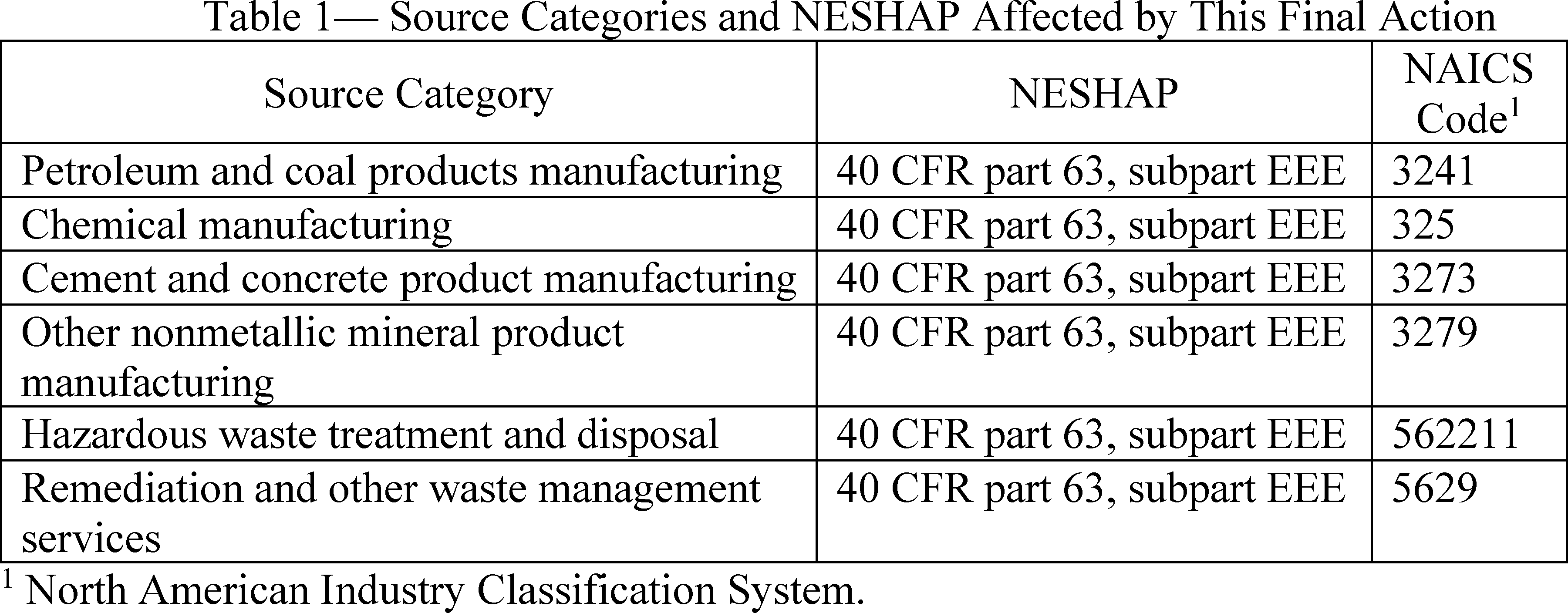
Table 1 of this preamble presents categories and entities that this action potentially regulates.
( printed page 33486)
Table 1 of this preamble, although not exhaustive, provides a guide for readers regarding entities that this final action likely affects for the source categories listed. To determine if this action affects your facility, you should examine the applicability criteria in title 40 of the Code of Federal Regulations (CFR), part 63, subpart EEE. If you have any questions regarding the applicability of any aspect of this NESHAP, please contact the appropriate person listed in the preceding
FOR FURTHER INFORMATION CONTACT
section of this preamble. To our knowledge, State, local, and Tribal government entities do not own or operate sources that would be affected by this action.
C. What is the statutory authority for this final action?
CAA sections 112, as amended, and 502(a) provide the statutory authority for this action.[11]
CAA section 112 establishes a multi-stage regulatory process to develop standards for emission of HAP from stationary sources. Generally, the first stage involves the EPA establishing technology-based standards that reflect the maximum achievable control technology (MACT) or an appropriate alternative.[12]
The second stage involves evaluating those standards within eight years pursuant to CAA section 112(f)(2) to determine whether additional standards are needed to address remaining risk associated with HAP emissions.[13]
This second stage is commonly referred to as the “residual risk review.” In addition to the residual risk review, CAA section 112(d)(6) also requires the EPA to review the standards every eight years and “revise as necessary” taking into account “developments in practices, processes, and control technologies.” [14]
This review is commonly referred to as the “technology review.” The following discussion identifies the most relevant statutory sections and briefly explains the contours of the methodology used to implement these statutory requirements.
In the first stage of the CAA section 112 standard-setting process, the EPA promulgates technology-based standards under CAA section 112(d) for categories of sources identified as emitting one or more of the HAP listed in CAA section 112(b). Sources of HAP emissions are either major sources or area sources, and CAA section 112 establishes different requirements for major source standards and area source standards. The HWC NESHAP regulates both major and area sources, but only the requirements for establishing emissions limitations for major sources are relevant to the present rulemaking. “Major sources” are those that emit or have the potential to emit 10 tons per year or more of a single HAP or 25 tons per year or more of any combination of HAP.[15]
All other sources are “area sources.” [16]
For major sources, CAA section 112(d)(2) provides that the technology-based NESHAP must reflect the maximum degree of reduction in emissions of HAP achievable (after considering cost, energy requirements, and non-air quality health and environmental impacts). These standards are commonly referred to as MACT standards. CAA section 112(d)(3) also establishes a minimum control level for MACT standards, known as the MACT “floor,” which is based on emission control achieved in practice by the best performing sources. For new sources, the MACT floor cannot be less stringent than the emission control achieved in practice by the best-controlled similar source. The MACT standards for existing sources can be less stringent than floors for new sources, but they cannot be less stringent than the average emission limitation achieved by the best-performing 12 percent of existing sources in the category or subcategory (or the best-performing five sources for categories or subcategories with fewer than 30 sources). The EPA also considers control options that are more stringent than the floor and may establish standards more stringent than the floor, based on the consideration of the cost of achieving the emissions reductions, any non-air quality health and environmental impacts, and energy requirements.[17]
Standards that are more stringent than the floor are commonly referred to as “beyond-the-floor” standards.[18]
In certain instances, as provided in CAA section 112(h), the EPA may set work practice standards in lieu of numerical emission standards. Under CAA section 112(h), the EPA may adopt a work practice standard in lieu of a numerical emission standard if it is “not feasible in the judgment of the Administrator to prescribe or enforce an emission standard for control of a hazardous air pollutant.” [19]
The next stage in standard-setting focuses on identifying and addressing any remaining (
i.e.,
“residual”) risk within eight years pursuant to CAA
( printed page 33487)
section 112(f)(2). The approach incorporated into the CAA and used by the EPA to evaluate residual risk and develop standards under CAA section 112(f)(2) is also a two-step approach. In the first step, the EPA determines whether risks are adequately addressed by existing standards. This determination “considers all health information, including risk estimation uncertainty, and includes a presumptive limit on maximum individual lifetime [cancer] risk (MIR) of approximately 1 in 10 thousand.” [20]
If risks are unacceptable, the EPA determines the emission standards necessary to reduce risk to an acceptable level without considering costs. In the second step of the approach, the EPA considers whether the emission standards provide an ample margin of safety to protect public health “in consideration of all health information, including the number of persons at risk levels higher than approximately 1 in 1 million, as well as other relevant factors, including costs and economic impacts, technological feasibility, and other factors relevant to each particular decision.” [21]
The EPA promulgates emission standards necessary to provide an ample margin of safety to protect public health or determine that the standards being reviewed provide an ample margin of safety without any revisions. After conducting the ample margin of safety analysis, the EPA considers whether a more stringent standard is necessary to prevent an adverse environmental effect, taking into consideration costs, energy, safety, and other relevant factors.
CAA section 112(d)(6) separately requires the EPA to review MACT standards promulgated under CAA section 112 and revise them “as necessary (taking into account developments in practices, processes, and control technologies)” no less frequently than every eight years. In conducting this review, the EPA is not required to recalculate the MACT floors that were established in earlier rulemakings.[22]
In
Louisiana Environmental Action Network (LEAN)
v.
EPA,
the D.C. Circuit held that the EPA must address previously unregulated HAP known to be emitted from a major source category as part of its periodic review under CAA section 112(d)(6).[23]
CAA section 112(d)(6) and relevant case law provide the EPA with flexibility to consider additional relevant factors other than those enumerated in CAA section 112(d)(6) when deciding whether revisions to existing standards are “necessary.” The D.C. Circuit has held that the CAA section 112(d)(6) requirement to periodically review and revise CAA section 112 emission standards “as necessary” is not limited to the consideration of “developments in practices, processes and control technologies.” [24]
Rather, “the operative standard is `revise as necessary,' with the parenthetical pointing to a non-exhaustive list of considerations.” [25]
The Supreme Court also emphasized in
Michigan
v.
EPA
that unless the statute provides otherwise, broad terms such as “necessary” direct the relevant agency to consider all relevant factors, including cost.[26]
That decision is particularly relevant here because the Court was interpreting a provision of CAA section 112 that instructs the Administrator to determine whether it is “appropriate and necessary” to regulate HAP emissions from electric utility steam generating units.[27]
Thus, under relevant case law, when the EPA is deciding whether it is “necessary” to revise standards pursuant to CAA section 112(d)(6), the Agency considers the costs of any developments in practices, processes, and control technologies.
The EPA is also required to specify relevant test methods, best practices, procedures, or protocols and recordkeeping requirements for standards promulgated under CAA section 112. Finally, CAA section 502(d)(l) requires each State to develop and submit to the EPA an operating permit program to meet the requirements of title V of the CAA and the EPA's implementing regulations at 40 CFR part 70 (“title V”). Major stationary sources of air pollution and certain other non-major sources are required to apply for and operate in accordance with title V operating permits that include emission limitations and other conditions as necessary to assure compliance with applicable requirements of the CAA, including the requirements of the applicable implementation plan.
D. Where can I get a copy of this document and other related information?
In addition to the docket, an electronic copy of this final action is available on the internet. A brief summary of this rule is available at
https://www.regulations.gov,
Docket ID No. EPA-HQ-OAR-2004-0022. Following signature by the EPA Administrator, the EPA will post a copy of this rule at:
https://www.epa.gov/hazardous-waste-combustors-national-emission-standards-hazardous.
Following publication in the
Federal Register
, the EPA will post the
Federal Register
version and key technical documents at this same website.
E. Judicial Review and Administrative Reconsideration
Under CAA section 307(b)(1), judicial review of this final action is available only by filing a petition for review in the United States Court of Appeals for the District of Columbia Circuit by August 3, 2026. CAA section 307(b)(2) prohibits a party from challenging this final rule separately in any civil or criminal proceedings brought by the EPA for enforcement.
CAA section 307(d)(7)(B) further provides that only an objection to a rule or procedure that was raised with reasonable specificity during the period for public comment (including any public hearing) may be raised during judicial review. This section also requires the EPA to reconsider the rule if the person raising an objection can demonstrate to the Administrator that it was impracticable to raise such objection within the period for public comment or if the grounds for such objection arose after the period for public comment (but within the time specified for judicial review) and if such objection is of central relevance to the outcome of the rule. Any person seeking to make such a demonstration should submit a Petition for Reconsideration to the Office of the Administrator, U.S. EPA, Room 3000, WJC South Building, 1200 Pennsylvania Ave. NW, Washington, DC 20460, with a copy to both the person(s) listed in the preceding
FOR FURTHER INFORMATION CONTACT
section, and the Associate General Counsel for the Air and
( printed page 33488)
Radiation Law Office, Office of General Counsel (Mail Code 2344A), U.S. EPA, 1200 Pennsylvania Ave. NW, Washington, DC 20460.
F. Severability
This final rule contains several discrete components, which the EPA views as severable as a practical matter—
i.e.,
they are functionally independent and will operate in practice independently of the other components. These discrete components are detailed in sections III.A through III.E of this preamble and the technical memoranda available in the docket.[28]
For example, the outcome of the risk review, the outcome of the technology review, the final emission limits for HF and HCN for each type of HWC, and the final work practice standards for periods of SSM generally function independently of one another and would not be impacted if a reviewing court were to vacate one or more of the other final provisions. In addition, as this final rule revises an existing NESHAP, the EPA notes that if a reviewing court were to vacate one or more of the standards finalized here, the affected standards will revert to those present in the 2005 HWC NESHAP as revised in 2005, 2006, and 2008.[29]
II. Background
A. What is the HWC NESHAP source category and how does the HWC NESHAP regulate HAP emissions from the source category?
HWCs are units that combust hazardous waste and they can be located at many types of facilities including those listed in table 1 of this preamble. The source category covered by the HWC NESHAP currently includes approximately 160 HWCs located at approximately 90 facilities in the United States. HWCs are incinerators, cement kilns, lightweight aggregate kilns, boilers, or HCl production furnaces that combust hazardous waste for waste reduction, thermal energy recovery, and/or production of a product. Hazardous waste is defined under the Resource Conservation and Recovery Act (RCRA), which establishes a comprehensive regulatory structure overseeing the treatment, storage, and disposal of hazardous waste.[30]
In 2023, approximately 32.2 million tons of hazardous waste were generated in the United States, all of which must be treated or disposed of in a manner that protects human health and the environment.[31]
Hazardous waste incineration provided that manner of disposal for approximately 1.1 million tons of that hazardous waste, and energy recovery in units like hazardous waste burning boilers accounted for an additional 1.4 million tons.[32]
The key HAP that the HWC NESHAP regulates include polychlorinated dibenzodioxins and furans (PCDD/PCDF); mercury (Hg); cadmium and lead as semi-volatile metals; arsenic, beryllium, and chromium as low-volatile metals; antimony, cobalt, manganese, nickel, and selenium as non-enumerated metal HAP; HCl and chlorine gas; and other hydrocarbon HAP, including polychlorinated biphenyls (PCB) and polycyclic aromatic hydrocarbons (PAH). The HWC NESHAP also includes several other emission limits used as surrogate standards to regulate emissions of other HAP such as a carbon monoxide (CO) or total hydrocarbon (THC) limit associated with demonstrating good combustion practices, a destruction and removal efficiency (DRE) standard also for demonstrating good combustion practices, and a particulate matter (PM) emission limit for some subcategories.[33]
The EPA originally promulgated the HWC NESHAP, codified at 40 CFR part 63, subpart EEE, in 1999.[34]
It regulated incinerators, cement kilns, and lightweight aggregate kilns that burned hazardous waste. These standards were vacated in 2001 [35]
and replaced with interim standards in 2002.[36]
The EPA promulgated replacement standards for hazardous waste incinerators, cement kilns, and lightweight aggregate kilns and first-time standards for hazardous waste solid fuel boilers, liquid fuel boilers, and HCl production furnaces in 2005.[37]
In response to multiple petitions for reconsideration, the EPA sought and received a voluntary remand of the rule in 2009 to reexamine the HWC NESHAP.[38]
In October 2022, Earthjustice filed an action in the U.S. District Court for the District of Columbia to compel the EPA to review and revise the HWC NESHAP under CAA sections 112(d)(6) and (f)(2) (
i.e.,
complete the RTR). In December 2024, the district court issued an order requiring that the EPA sign the final RTR rule for this source category by December 31, 2025.[39]
In response to the EPA's request for an extension of time, the district court subsequently extended the deadline from December 31, 2025, to May 29, 2026.[40]
The EPA is finalizing this action in response to the court order.[41]
B. What changes did we propose for the HWC NESHAP source category in our November 10, 2025, proposal?
On November 10, 2025, the EPA published a proposed rule in the
Federal Register
for the HWC NESHAP, 40 CFR part 63, subpart EEE, that discussed the results of the RTR and proposed actions reflecting those results. Specifically, the EPA proposed: that the results of the risk review demonstrated that no revisions to the existing standards were required to address residual risk; that no revisions to the existing standards were necessary based on developments in practices, processes, or control technologies under the technology review; numeric emission limits for HF and HCN for major source HWC solid fuel boilers; a work practice standard for HF for major source HWC incinerators; a work practice standard for HF and numeric emission limits for HCN for major source HWC cement kilns; a work practice standard for HF and numeric emission limits for HCN for major source liquid fuel boilers; work practice standards for periods of SSM; electronic reporting provisions; allowing title V air
( printed page 33489)
permitting authorities to choose to exempt area sources from the requirement to obtain a title V permit if such area sources are not otherwise subject to title V air permitting requirements; and other items and technical corrections.[42]
III. What is included in this final rule?
This action finalizes the EPA's determinations pursuant to the RTR provisions of CAA section 112 for the HWC NESHAP source category. This action also finalizes other changes to the NESHAP, including emission limits and work practice standards for HF and HCN from major source HWC incinerators, cement kilns, solid fuel boilers, and liquid fuel boilers; work practice standards for periods of SSM; new electronic reporting provisions and requirements; provisions allowing title V air permitting authorities to choose to exempt area source HWCs from the requirement to have a title V air permit if such area sources are not otherwise subject to title V air permitting requirements; and minor corrections and clarifications to a number of other rule provisions. This action also reflects several changes to the November 2025 proposal in consideration of comments received during the public comment period, as described in section IV of this preamble.
A. What are the final rule amendments based on the risk review for the HWC NESHAP source category?
The EPA is finalizing, as proposed, that pursuant to CAA section 112(f), risks from this source category are adequately addressed by the existing standards and therefore acceptable, the existing standards provide an ample margin of safety to protect public health, and more stringent standards are not necessary to prevent an adverse environmental effect. The EPA is not promulgating any additional control requirements pursuant to CAA section 112(f)(2) but instead reaffirming the existing standards.[43]
Sections IV.A.2 through IV.A.4 of this preamble provide a more in-depth analysis of the decision to finalize that the risks from the source category are acceptable and provide an ample margin of safety pursuant to CAA section 112(f).
B. What are the final rule amendments based on the technology review for the HWC NESHAP source category?
The EPA is finalizing, as proposed, that pursuant to CAA section 112(d)(6), there are no developments in practices, processes, and control technologies that warrant revisions to the MACT standards for this source category. Sections IV.B.2 through IV.B.4 of this preamble provide a more in-depth analysis of the decision not to revise the existing MACT standards under CAA section 112(d)(6).
C. What are the final rule amendments pursuant to CAA sections 112(d)(2) and (3) and 112(h) for the HWC NESHAP source category?
Consistent with our authority to review and revise the HWC NESHAP and with the proposed rule,[44]
the EPA is finalizing regulatory provisions to address previously unregulated HAP emissions within the source category in this rule. Based on a review of available information, the EPA is finalizing the following pursuant to CAA sections 112(d)(2), (d)(3), and (h)(1): [45]
Numeric emission limits for HF and HCN for major source HWC solid fuel boilers.
Work practice standard for HF for major source HWC incinerators.
Numeric emission limit for HCN for major source HWC cement kilns.
Work practice standard for HF for all major source HWC liquid fuel boilers and numeric emission limits for HCN for some major source HWC liquid fuel boilers.
The EPA presents the results and final decisions based on the analyses performed pursuant to CAA sections 112(d)(2), (d)(3), and (h)(1) below, with separate discussion for each subcategory and HAP. All emission standards discussed here regulate only HWCs at facilities that are major sources of HAP. Sections IV.C.2 through IV.C.4 of this preamble provide a more in-depth discussion of the HF and HCN emission limitations.
1. Solid Fuel Boilers
a. Hydrogen Fluoride
The EPA is promulgating standards for HF emissions from major source HWC solid fuel boilers pursuant to CAA sections 112(d)(2) and (3). The EPA is promulgating a limit at the MACT floor of 6.2 parts per million by volume (ppmv) HF, dry basis and corrected to seven percent oxygen, for both existing and new solid fuel boilers.[46]
The EPA is finalizing these standards as proposed.
The EPA is finalizing as proposed that existing sources must comply with the HF emission limits for solid fuel boilers within three years after June 3, 2026, and must conduct an initial compliance test demonstrating compliance no later than six months after the compliance date using EPA Methods 26A or 320. For affected facilities that commence construction or reconstruction after November 10, 2025, owners or operators must comply with all requirements of the subpart, including the HF emission limits, no later than the effective date of the final rule or upon startup, whichever is later, and must demonstrate compliance no later than six months after the compliance date using the same methods. All sources must subsequently demonstrate compliance once every five years during the comprehensive performance test (CPT).
b. Hydrogen Cyanide
The EPA is promulgating standards for HCN emissions from major source HWC solid fuel boilers pursuant to CAA sections 112(d)(2) and (3). The EPA is promulgating a limit at the MACT floor of 5.0 ppmv HCN, dry basis and corrected to seven percent oxygen, for both existing and new solid fuel boilers.[47]
The EPA is finalizing these standards as proposed.
The EPA is finalizing as proposed that existing sources must comply with the HCN emission limits for solid fuel boilers within three years after June 3, 2026, and must conduct an initial compliance test demonstrating compliance no later than six months after the compliance date using EPA Method 320 or, if there are entrained water droplets in the flue gas, an alternative test method submitted and approved by the Administrator.[48]
For affected facilities that commence construction or reconstruction after November 10, 2025, owners or operators must comply with all requirements of the subpart, including the HCN emission limits, no later than the effective date of the final rule or upon startup, whichever is later, and must demonstrate compliance no later than six months after the compliance date
( printed page 33490)
using the same methods. Sources must subsequently demonstrate compliance once every five years during the CPT.
2. Incinerators
a. Hydrogen Fluoride
The EPA is promulgating a work practice standard with multiple compliance options for HF emissions from major source HWC incinerators pursuant to CAA section 112(h) because it is not feasible to prescribe or enforce a standard of performance.[49]
The same work practice standard is applicable to both new and existing sources.[50]
In response to comments, the EPA is finalizing the requirement that one automatic waste feed cutoff (AWFCO)-interlocked operating parameter limit (OPL) other than chlorine feed rate, rather than two, is appropriate for complying with the work practice standard.
The work practice standard requires a source to comply with their choice of one of three options. The options of the work practice standard are as follows:
Option 1:
If a source actively controls HCl emissions and the source has at least one AWFCO-interlocked OPL other than chlorine feed rate to control HCl, then the source may comply with the HCl and chlorine gas OPL or limits and indicate in the CPT report and Notification of Compliance (NOC) that they are demonstrating compliance with the HF work practice standard by complying with the HCl and chlorine gas OPL requirements.
Option 2:
If a facility does not feed any material with detectable levels of fluorine to the source, then the source may certify in the CPT report that no fluorine is fed and indicate in the CPT report and NOC that they are demonstrating compliance with the HF work practice standard through the certification.
Option 3:
If a facility feeds fluorine to a source and the source has no active HCl control with at least one AWFCO-interlocked OPL other than chlorine feed rate to control HCl emissions (Option 1), then the facility must monitor and record the total fluorine fed to the unit as a 12-hour rolling average. If at any point the feed rate suggests that HF emissions may exceed the solid fuel boiler existing source emission limit for HF (6.2 ppmv HF as calculated according to the HWC NESHAP's maximum theoretical emissions concentration (MTEC) procedure), then the source must complete a one-time HF emissions test during the next CPT at the maximum recorded fluorine feed rate and include the test results in the CPT report. The source must include the comparison of the HF MTEC to the solid fuel boiler existing source emission limit for HF in the CPT plan.
The EPA is finalizing as proposed that existing sources must comply with the HF work practice standard for incinerators within three years after June 3, 2026, and must demonstrate compliance through a certification, test plan, or initial compliance test no later than six months after the compliance date. Emission testing for HF must use EPA Methods 26A or 320. For affected facilities that commence construction or reconstruction after November 10, 2025, owners or operators must comply with all requirements of the subpart, including the HF work practice standard, no later than the effective date of the final rule or upon startup, whichever is later, and must demonstrate compliance no later than six months after the compliance date. Sources must subsequently demonstrate compliance once every five years during the CPT.
b. Hydrogen Cyanide
The EPA did not propose and is not finalizing standards for HCN emissions from major source HWC incinerators because the EPA does not have credible data indicating that major source HWC incinerators measurably emit HCN.[51]
3. Cement Kilns
a. Hydrogen Fluoride
As explained in sections IV.C.2 through IV.C.4 of this preamble, the EPA is not finalizing standards for HF emissions from major source HWC cement kilns because the Agency does not have credible data indicating that HWC cement kilns measurably emit HF.
b. Hydrogen Cyanide
The EPA is promulgating standards for HCN emissions from major source HWC cement kilns pursuant to CAA sections 112(d)(2) and (3). For existing sources, the EPA is finalizing as proposed a limit at the MACT floor of 56 ppmv HCN, dry basis and corrected to seven percent oxygen. As explained in sections IV.C.2 through IV.C.4 of this preamble, for new sources the EPA is finalizing for new sources a limit at the revised MACT floor of 5.5 ppmv HCN, dry basis and corrected to seven percent oxygen.[52]
The EPA is finalizing as proposed that existing sources must comply with the HCN emission limits for cement kilns within three years after June 3, 2026, and must demonstrate compliance through an initial compliance test no later than six months after the compliance date using EPA Method 320 or, if there are entrained water droplets in the flue gas, an alternative test method submitted and approved by the Administrator.[53]
For affected facilities that commence construction or reconstruction after June 3, 2026, owners or operators must comply with all requirements of the subpart, including the HCN emission limits, no later than the effective date of the final rule or upon startup, whichever is later, and must demonstrate compliance no later than six months after the compliance date using the same methods. Sources must subsequently demonstrate compliance once every five years during the CPT using EPA Method 320 or, if there are entrained water droplets in the flue gas, an alternative test method submitted and approved by the Administrator.[54]
4. Liquid Fuel Boilers
a. Hydrogen Fluoride
The EPA is promulgating a work practice standard with multiple compliance options for HF emissions from major source HWC liquid fuel boilers pursuant to CAA section 112(h) because it is not feasible to prescribe or enforce a standard of performance.[55]
This is the same work practice standard with multiple compliance options described in section III.C.2.a of this preamble for incinerators. The same work practice standard is applicable to both new and existing sources.[56]
The EPA is finalizing these standards as proposed.
The EPA is finalizing as proposed that existing sources must comply with the HF work practice standard for liquid
( printed page 33491)
fuel boilers within three years after the publication of the final rule and that demonstration through a certification, test plan, or initial compliance test would occur no later than six months after the compliance date. For affected facilities that commence construction or reconstruction after June 3, 2026, owners or operators must comply with all requirements of the subpart, including the HF work practice standard, no later than the effective date of the final rule or upon startup, whichever is later, and must demonstrate compliance no later than six months after the compliance date. Sources must subsequently demonstrate compliance once every five years during the CPT. Emission testing for HF must use EPA Methods 26A or 320.
b. Hydrogen Cyanide
The EPA is promulgating standards for HCN emissions from two subcategories of major source HWC liquid fuel boilers pursuant to CAA sections 112(d)(2) and (3). The EPA is finalizing as proposed the subcategorization of liquid fuel boilers by size, under CAA section 112(d)(1), for the purposes of the HCN emission standard.[57]
The size categories are as follows: capacity less than or equal to 50 million british thermal units per hour (MMBTU/hr), capacity greater than 50 MMBTU/hr but less than or equal to 250 MMBTU/hr, and capacity greater than 250 MMBTU/hr.
The EPA did not propose and is not finalizing standards for HCN emissions from major source HWC liquid fuel boilers with a capacity that is less than or equal to 50 MMBTU/hr because the Agency does not have credible data indicating that major source HWC incinerators measurably emit HCN.
For existing major source HWC liquid fuel boilers with capacity greater than 50 MMBTU/hr but less than or equal to 250 MMBTU/hr, the EPA is finalizing as proposed a limit at the MACT floor of 2.7 ppmv HCN, dry basis and corrected to seven percent oxygen. For new major source HWC liquid fuel boilers with capacity greater than 50 MMBTU/hr but less than or equal to 250 MMBTU/hr, the EPA is finalizing as proposed a limit at the MACT floor of 1.2 ppmv HCN, dry basis and corrected to seven percent oxygen.[58]
For existing major source HWC liquid fuel boilers with capacity greater than 250 MMBTU/hr, the EPA is finalizing as proposed a limit at the MACT floor of 3.4 ppmv HCN, dry basis and corrected to seven percent oxygen. For new major source HWC liquid fuel boilers with capacity greater than 250 MMBTU/hr, the EPA is finalizing as proposed a limit at the MACT floor of 1.1 ppmv HCN, dry basis and corrected to seven percent oxygen.
The EPA is finalizing as proposed that existing sources must comply with the HCN emission limits for liquid fuel boilers within three years after June 3, 2026, and must demonstrate compliance through an initial compliance test no later than six months after the compliance date using EPA Method 320 or, if there are entrained water droplets in the flue gas, an alternative test method submitted and approved by the Administrator.[59]
For affected facilities that commence construction or reconstruction after June 3, 2026, owners or operators must comply with all requirements of the subpart, including the HCN emission limits, no later than the effective date of the final rule or upon startup, whichever is later, and must demonstrate compliance no later than six months after the compliance date using the same methods. Sources must subsequently demonstrate compliance once every five years during the CPT using EPA Method 320 or, if there are entrained water droplets in the flue gas, an alternative test method submitted and approved by the Administrator.[60]
5. HCl Production Furnaces
a. Hydrogen Fluoride
The EPA did not propose and is not finalizing standards for HF emissions from major source HWC HCl production furnaces because the Agency does not have credible data indicating that major source HWC HCl production furnaces measurably emit HF.[61]
b. Hydrogen Cyanide
The EPA did not propose and is not finalizing standards for HCN emissions from major source HWC HCl production furnaces because the Agency does not have credible data indicating that major source HWC HCl production furnaces measurably emit HCN.[62]
6. Lightweight Aggregate Kilns
The EPA did not propose and is not finalizing standards for HF or HCN emissions from lightweight aggregate kilns because the EPA has no credible emissions data on which to base decisions about whether or how to regulate such emissions.[63]
If an HWC lightweight aggregate kiln begins operating after the promulgation of this final rule, the EPA expects to collect emissions testing data from them and address potential emissions in a subsequent action.
D. What are the final rule amendments addressing emissions during periods of startup, shutdown, and malfunction?
Consistent with
Sierra Club
v.
EPA[64]
and the proposed rule,[65]
the EPA is finalizing revisions to the SSM provisions of the NESHAP to ensure that HWCs meet MACT standards at all times when controlling HAP emissions. The EPA is promulgating work practice standards for periods of SSM. These work practice standards include the following: (1) a clean fuel requirement for periods of startup and shutdown; (2) a requirement to follow an approved SSM plan during periods of SSM; and (3) the AWFCO system requirement. The EPA is also finalizing as proposed various other changes to modify recordkeeping and reporting requirements as a result of the SSM provisions.
The EPA is finalizing a work practice standard for periods of startup and shutdown. This work practice standard is the combination of firing prescribed supplemental clean fuels during periods of startup and shutdown and operating in accordance with an approved SSM plan during periods of startup and shutdown. The EPA is also finalizing a work practice standard for periods of malfunction. This work practice standard is the combination of AWFCO system requirements and operating in accordance with an approved SSM plan during periods of malfunction. Because the SSM plan also includes a description of potential causes of malfunctions that may result in significant releases of HAP and actions the source takes to minimize the frequency and severity of those malfunctions, the source must also comply with any requirements to minimize the frequency and severity of malfunctions prescribed in the SSM plan for periods of normal operation.
The EPA is also finalizing that owners or operators must submit SSM plans to the Administrator for approval within 180 days of the effective date of this rule or upon initial startup, whichever is
( printed page 33492)
later, and that sources must begin complying with the SSM plan immediately upon submittal. While the EPA expects SSM plans to be reviewed within no more than 90 days of submittal, commenters pointed out, and the Agency agrees, that owners or operators of HWCs can only control the submittal date, not the approval date of an SSM plan, and so the EPA considers that it is more appropriate to tie the compliance timeline to the action that HWC owners or operators can control.[66]
In response to comments, the EPA is also finalizing that if changes are made to the SSM plan as a result of the approval process, sources must begin complying with the revised SSM plan upon notification of approval.
As discussed in sections IV.D.2 through IV.D.4 of this preamble, the EPA is finalizing revised definitions of startup, shutdown, and supplemental fuel in response to comments received on the proposal.[67]
Commenters requested, and the EPA is finalizing, separate definitions of startup and shutdown for different types of HWCs and is clarifying that transitioning from operating under the requirements of an otherwise applicable requirement constitutes a period of startup.[68]
The definitions of startup are:
For incinerators, startup begins with the firing of supplemental fuel in the combustion chamber or with transitioning from a period of shutdown. All air pollution control devices (APCDs) must be in operation as expeditiously as possible and prior to the introduction of any waste material that is not supplemental fuel into the HWC. Startup ends once the system has stabilized but no later than 15 minutes after either hazardous waste that is not fed in accordance with the AWFCO requirements when burning hazardous waste during startup and shutdown or any waste material that is not supplemental fuel is fed into the HWC, whichever occurs first.[69]
For cement kilns and lightweight aggregate kilns, startup begins when a kiln either begins firing supplemental fuel or transitions from a period of shutdown. All APCDs must be in operation as expeditiously as possible and prior to the introduction of kiln feed or any waste material that is not supplemental fuel into the kiln. Startup ends 120 minutes after the continuous introduction of kiln feed, when the feed rate exceeds 60 percent of the kiln design limitation rate, or 15 minutes after hazardous waste that is not fed in accordance with the AWFCO requirements when burning hazardous waste during startup and shutdown is fed into the HWC, whichever occurs first.[70]
Cement kilns may fire traditional fuels as defined in 40 CFR 241.2 once the HWC achieves 1200 degrees Fahrenheit (°F) measured at a location that best represents, as practicable, the bulk gas temperature in the combustion zone and all APCDs are operational.
For solid fuel boilers and liquid fuel boilers, startup begins with either the first-ever firing of supplemental fuel in a boiler for the purpose of supplying useful thermal energy (such as heat or steam) for heating, cooling, or process purposes, or producing electricity or the firing of fuel in a boiler for any purpose after a shutdown event. All APCDs must be in operation as expeditiously as possible and prior to the introduction of any waste material that is not supplemental fuel into the boiler. Startup ends at the earliest of the following: four hours after when the boiler supplies useful thermal energy (such as heat or steam) for heating, cooling, or process purposes; the boiler produces electricity; or 15 minutes after either hazardous waste that is not fed in accordance with the AWFCO requirements when burning hazardous waste during startup and shutdown or any waste material that is not supplemental fuel is fed into the boiler.[71]
For HCl production furnaces, startup begins when the HCl production furnace either begins firing supplemental fuel or transitions from a period of shutdown. All APCDs must be in operation as expeditiously as possible and prior to the introduction of any waste material that is not supplemental fuel into the HCl production furnace. Startup ends either 120 minutes after the continuous introduction of materials intended to produce HCl to the HCl production furnace or 15 minutes after either hazardous waste that is not fed in accordance with the AWFCO requirements when burning hazardous waste during startup and shutdown or any waste material that is not supplemental fuel is fed into the HCl production furnace, whichever is earlier.[72]
Notwithstanding the previous definitions, transitioning from an otherwise applicable standard initiates a period of startup lasting no more than 15 minutes in duration.
The definitions of shutdown are:
For incinerators, shutdown begins when hazardous waste feed to the combustion chamber has been cut off for a period of time not less than the hazardous waste residence time and the feed of non-hazardous waste materials to the combustion chamber is cut off. Shutdown ends when fire is extinguished in the combustion chamber, the incinerator enters another mode of operation, or when a startup is initiated.
For cement kilns and lightweight aggregate kilns, shutdown begins when hazardous waste feed to the combustion chamber has been cut off for a period of time not less than the hazardous waste residence time and kiln feed is halted. Shutdown ends when continuous kiln rotation ceases, the kiln enters another mode of operation, or when a startup is initiated.
For solid fuel boilers and liquid fuel boilers, shutdown begins when the boiler no longer supplies useful thermal energy (such as heat or steam) for heating, cooling, or process purposes and/or generates electricity or when no fuel is being fed to the boiler, whichever is earlier, and when hazardous waste feed to the combustion chamber has been cut off for a period of time not less than the hazardous waste residence time. Shutdown ends when the boiler no longer supplies useful thermal energy (such as steam or heat) for heating, cooling, or process purposes and/or generates electricity, and no fuel is being combusted in the boiler, the boiler enters another mode of operation, or when startup is initiated.
For HCl production furnaces, shutdown begins when hazardous waste feed to the combustion chamber has been cut off for a period of time not less than the hazardous waste residence time and raw material feed to the HCl production furnace is halted. Shutdown ends when the HCl production furnace flame is extinguished, the HCl production furnace enters another mode of operation, or when a startup is initiated.
The EPA defines supplemental fuel as one or a combination of the following fuels: natural gas, synthetic natural gas,
( printed page 33493)
propane, other gas 1 fuels, distillate oil, syngas, ultra-low sulfur diesel, kerosene, hydrogen, refinery gas, liquified petroleum gas, and any other fuel approved in the SSM plan. For solid fuel boilers, the definition of supplemental fuel includes coal. The EPA also defines other gas 1 fuels as gaseous fuel that is not natural gas, refinery gas, or a hazardous waste and does not exceed a maximum Hg concentration of 40 micrograms per cubic meter of gas. The SSM plan must specify the basis for determining that any gas qualifies as other gas 1 fuel.
The EPA is also finalizing as proposed changes in recordkeeping requirements that are associated with periods of SSM. In accordance with this final action, sources must retain in the operating record the start date, start time, and duration (hours) of each startup, shutdown, or malfunction of affected process, air pollution control, and monitoring equipment and whether the source followed the SSM plan. For periods of SSM when the SSM plan was not followed, sources must record and retain a list of the affected sources or equipment; actions taken to minimize emissions in accordance with 40 CFR 63.6(e)(1)(i) and 40 CFR 63.8(c)(1)(i); any corrective actions taken to return the affected unit to its normal or usual manner of operation; whether the failure occurred during a period of SSM; an estimate of the quantity of each regulated pollutant emitted; and a description of the method used to estimate the emissions.
Sections IV.D.2 through IV.D.4 of this preamble provide a more in-depth analysis of the EPA's decisions regarding work practice standards for periods of SSM.
E. What other changes have been made to the NESHAP?
The EPA is promulgating other changes to the HWC NESHAP. Regarding electronic reporting, the EPA is finalizing as proposed the requirement to electronically report performance test results, NOC reports, and certain other submissions. Regarding technical corrections, the EPA is finalizing, as proposed, the removal of the requirement that CO is kept between the average and maximum reported values during the confirmatory performance test (CfPT) and the never-implemented requirement that sources install and operate PM continuous emission monitoring systems (PM CEMS). Regarding clarifications, the EPA is finalizing the following issues as proposed: explicitly allowing incorporation by reference of OPLs determined during the CPT in air permits, removing references that were incorrectly incorporated by reference and have since expired, clarifying the demonstration of compliance timeframe for new standards by removing an outdated demonstration of compliance timeline for the 2005 HWC NESHAP, and other minor editorial corrections. The EPA is also clarifying that a relative accuracy test audit (RATA) must be performed within 180 days before every CPT. The EPA is also finalizing that title V air permitting authorities including but not limited to States may choose to exempt area sources not otherwise subject to title V air permitting requirements from the requirement to obtain a title V permit on a case-by-case basis. Section IV.E of this preamble provides a more in-depth analysis of the EPA's decisions regarding these revisions.
EPA Method 0023A is referenced in the amendatory text of this document and was previously approved for § 63.1208.
F. What are the effective and compliance dates of the standards?
The revisions to the HWC NESHAP standards promulgated in this action are effective on June 3, 2026. The EPA is finalizing the timeline for compliance with the HF and HCN limits as proposed. Existing sources must comply with the HF and HCN emission limits as applicable by June 3, 2029, which is three years after publication of this final rule. For existing sources, CAA section 112(i) provides that the compliance date for standards promulgated under CAA section 112(d) shall be as expeditious as practicable, but no later than three years after the effective date of the standard.[73]
As the EPA explained in the proposal, and as some commenters agreed, owners and operators need at least three years to implement the requirements that the EPA is finalizing under CAA section 112(d)(2), (3), and (6).[74]
For example, sources that complete performance testing to demonstrate compliance with the HF or HCN emission limits must determine if they need to make any modifications to comply with the limits, implement any changes, submit a performance test plan at least one year before testing commences, get the performance test plan approved, and schedule and conduct a performance test to demonstrate compliance. Owners or operators may also require modifications to their title V, other air, or RCRA permits if they modify operations of their HWC to comply with the HF or HCN emission limits. As provided in CAA section 112(i) and 5 U.S.C. 801(3), all new affected sources, which are for the purposes of the HF and HCN standards sources constructed or reconstructed after November 10, 2025, must comply with all requirements under CAA sections 112(d)(2), (3), (6), and 112(h) immediately upon the effective date, which is June 3, 2026, or upon startup, whichever is later. Both new and existing sources must commence performance testing to demonstrate compliance with the HF and HCN emission limits no later than six months after their respective compliance dates. The EPA provided additional rationale for these compliance dates in the preamble to the proposed rule.[75]
The EPA is clarifying in this final rule that the Administrator may grant an extension of the compliance timeline, as appropriate.[76]
The EPA is promulgating new electronic reporting requirements for all sources, and the Agency is finalizing all electronic reporting compliance dates as proposed. Owners and operators must submit notifications of intent to comply, eligibility demonstrations, periodic SSM reports, and compliance progress reports electronically through a PDF upload in Compliance and Emissions Data Reporting Interface (CEDRI) beginning 60 days from the effective date of the final rule, which is August 3, 2026. As the EPA is not changing the contents and structure of these reports, but only the manner of submission, the Agency believes that 60 days is sufficient time for facilities to enroll in
( printed page 33494)
CEDRI if not already enrolled and to submit these reports electronically. Owners and operators must submit performance tests and performance evaluations including RATA electronically using the Electronic Reporting Tool (ERT) beginning 90 days after the effective date of the final rule, which is September 1, 2026. In the EPA's experience, since the ERT has been available for use for over a decade and stack testing firms are well acquainted with its use, 90 days is sufficient time to begin electronic reporting using the ERT. Owners and operators must submit the NOC and the excess emissions and continuous monitoring system (CMS) performance reports and summary reports electronically in CEDRI using a spreadsheet template beginning one year from the effective date of the final rule, which is June 3, 2027, or one year from the date the EPA makes the template available on the CEDRI homepage, whichever is later. The EPA believes that one year is necessary to ensure that facilities can become acquainted with the spreadsheet template and begin entering data into the new format.
The EPA is promulgating new work practice standards for periods of SSM, which are described in sections III.D and IV.D of this preamble. In response to comments, the EPA is finalizing that all facilities must submit the SSM plan to the Administrator for approval either postmarked within 180 days of June 3, 2026, or upon initial startup, whichever is later. For clarity, November 30, 2026, is 180 days after the date of this rule's effective date. The EPA anticipates that most facilities are already operating in accordance with their SSM plan. Based on the EPA's experience and comments received from affected entities, the 180-day compliance period is a reasonable timeframe for facilities to review their SSM plans, revise them, if required, based on the contents of this action, and submit them for approval. All facilities already implement the AWFCO system requirement of the SSM work practice standards and so HWC owners and operators do not require additional time for compliance.
The EPA is finalizing as proposed that all other revisions to the HWC NESHAP would become applicable on the effective date of the final rule, which is June 3, 2026, or as otherwise indicated in the regulatory text. These revisions are technical corrections, clarifications, and deregulatory actions that do not require demonstrations of compliance or immediate action on the part of regulated entities.
IV. What is the rationale for our final decisions and amendments for the HWC NESHAP source category?
For each issue, this section provides a description of what the EPA proposed and what the Agency is finalizing, the Agency's rationale for the final decisions and amendments, and a summary of key comments and responses. For all comments not discussed in this preamble, comment summaries and the EPA's responses are in the document titled
Summary of Public Comments and Responses for the National Emission Standards for Hazardous Air Pollutants from Hazardous Waste Combustors
(“Comment Response Document”), which is in the docket for this rulemaking.[77]
A. Residual Risk Review for the HWC NESHAP Source Category
1. What did we propose pursuant to CAA section 112(f) for the HWC NESHAP source category?
On November 10, 2025, the EPA proposed that risks posed by HAP emissions from HWCs are adequately address by existing standards and acceptable, that the current NESHAP provides an ample margin of safety to protect public health, and that additional standards are not necessary to prevent an adverse environmental effect.[78]
The EPA's residual risk review found that the estimated cancer risks were below the presumptive limit of acceptability and that the noncancer risk results indicates a minimal likelihood of adverse noncancer health effects due to HAP emissions from HWCs. The EPA based the proposed decision on ample margin of safety on a weighing of relevant factors, including the risk posed by HWCs, the costs and effectiveness of additional controls to further reduce risk, and uncertainties and conservative assumptions in the emission rates used in estimating risk.
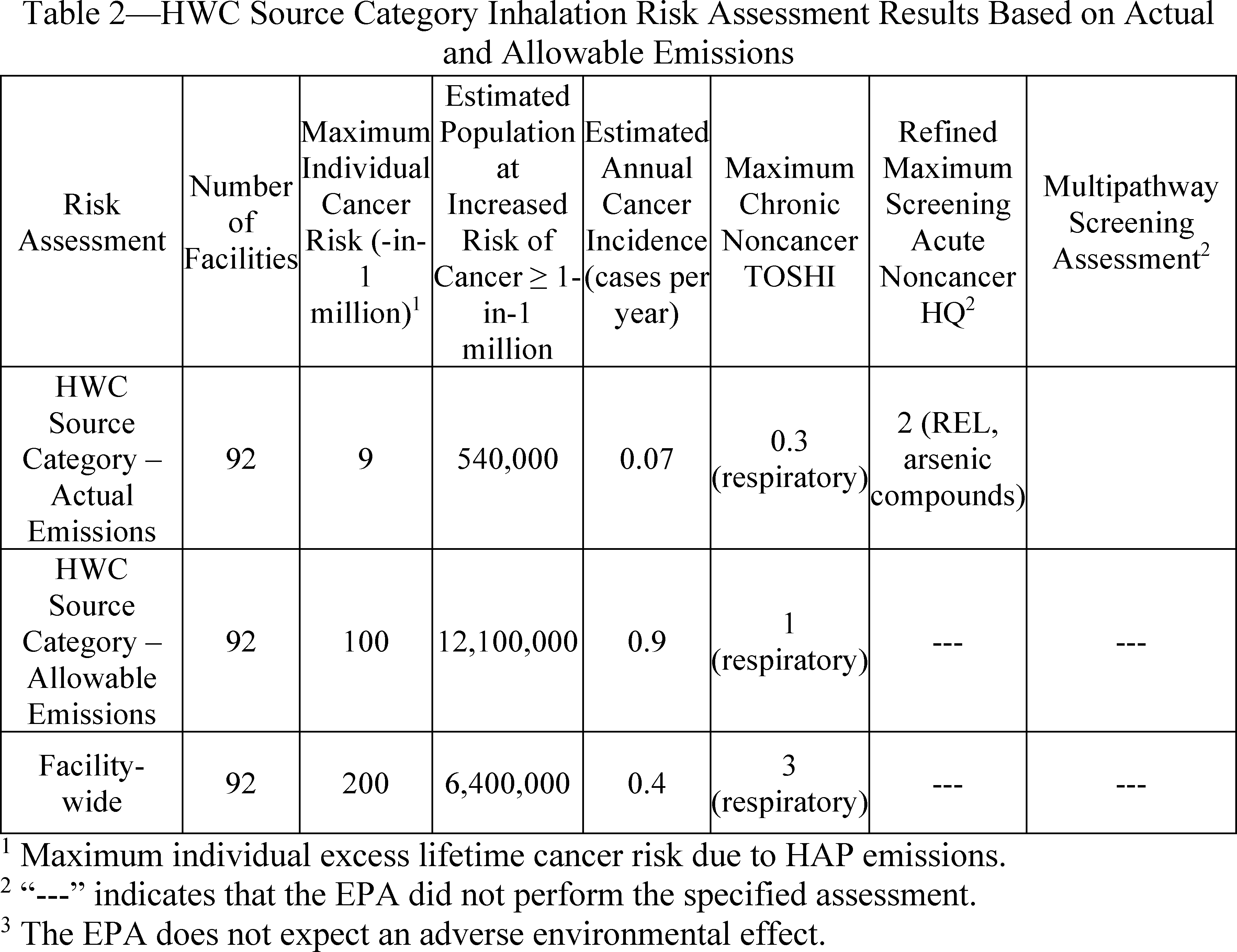
In the proposed review, the EPA evaluated risk based on estimates of current actual HAP emissions from HWCs, maximum allowable HAP emissions from HWCs, and facility-wide risk based on reported actual HAP emissions to characterize the risk from HWCs in the context of whole facility risk. The EPA modeled several metrics for risk due to HAP inhalation in the proposed review, including cancer risk to the individual most exposed, total cancer incidence, population within 50 kilometers of an HWC facility exposed to cancer risk greater than or equal to one in one million, modeled chronic noncancer target organ-specific hazard index (TOSHI), and maximum modeled acute noncancer hazard quotient (HQ). The EPA also evaluated in the proposed review multipathway human health risks including the cancer risk for the highest exposed individual, the maximum chronic noncancer HQ for persistent and bioaccumulative HAP, and if the Agency expected an adverse environmental effect as a result of HAP emissions from HWCs based on the results of an environmental risk screening analysis. Table 2 of this preamble presents a summary of the results of the proposed risk analysis. The EPA estimates that no people will be at an increased risk of cancer greater than or equal to 100-in-1 million based on source category actual or allowable emissions.
( printed page 33495)
The EPA also considered the uncertainty associated with the proposed risk assessment. Some of the major uncertainties in the proposed risk assessment were associated with the RTR emissions dataset, dispersion modeling, inhalation exposure estimates, and dose-response relationships.[79]
Considering all of the health risk information, including the uncertainties, the EPA proposed to conclude that the risks for this source category under the current NESHAP provisions are acceptable.
As part of the ample margin of safety analysis performed for the proposal, the EPA evaluated additional potential technologies for controlling emissions to further reduce risk from HWCs, taking into consideration costs and economic impacts of controls, technological feasibility, uncertainties, and other relevant factors.
The EPA evaluated the installation of a Shell Dioxin Destruction System (SDDS) for control of PCDD/PCDF in the proposal. The EPA estimated in the proposal that emissions reductions of PCDD/PCDF due to SDDS installation would have no impact on the cancer maximum individual risk or the maximum noncancer TOSHI, a minimal impact on the cancer incidence, and little impact on the number of people exposed to cancer risks greater than or equal to one, but could potentially lower the cancer risks that the EPA estimated in the multipathway risk screening. The EPA did not propose revisions based on this control scenario pursuant to CAA section 112(f) because of the relatively high capital and annualized costs compared to relatively low reductions in cancer risks and emissions reductions.
The EPA similarly evaluated the installation of a GORE Mercury Control System (GMCS) for control of Hg in the proposal. The EPA estimated in the proposal that the emission reductions due to GMCS installation would have no impact on the cancer maximum individual risk, maximum TOSHI, cancer incidence, or number of people exposed to cancer risk levels of greater than or equal to one in one million but could potentially lower the cancer risks estimated in the multipathway risk screening. Like the SDDS, the EPA did not propose revisions based on this control scenario pursuant to CAA section 112(f) because of the relatively high capital and annualized costs compared to relatively low reductions in cancer risk and emissions reductions.
Based on the EPA's weighing of all the relevant factors presented in the risk analyses for the HWC NESHAP and all of the other information discussed earlier in this section, the Agency proposed to conclude that the current standards provide an ample margin of safety to protect public health. Therefore, the EPA did not propose any changes to the HWC NESHAP in order to provide an ample margin of safety to protect public health or to prevent an adverse environmental effect.
2. How did the risk review for the HWC NESHAP source category change since proposal?
The EPA did not make any changes to the risk review in this final rule and is finalizing the residual risk assessment as proposed.
3. What key comments did we receive on the risk review, and what are our responses?
The EPA received comments in support of and against the proposed risk
( printed page 33496)
review. Commenters generally discussed the statutory requirements for the residual risk review, the methodology used to conduct the residual risk review, and the EPA's conclusions concerning the residual risk review. This section provides a summary of and response to key comments received regarding the statutory requirements for the residual risk review. Comment summaries and the EPA's responses for additional issues raised regarding the residual risk review for the HWC NESHAP are in the Comment Response Document, which is available in the docket for this rulemaking.
Comment: Two commenters asserted that the D.C. Circuit previously affirmed the EPA's interpretation of CAA section 112(f)(2) in
NRDC
v.
EPA[80]
under the second step of the
Chevron
framework and that, per
Loper Bright
, the Agency's interpretations must now reflect the best reading of the statute.[81]
The commenters stated that the proposed rule does not reflect the best reading of the statute because CAA section 112(f)(2)(A) requires the EPA to promulgate risk-based standards to reduce the maximum individual lifetime cancer risk to less than one in one million, which they assert the Agency has not done. The commenters further argued that the EPA's interpretation of CAA section 112(f)(2)(B), which they characterized as a savings provision, makes CAA section 112(f)(2)(A) meaningless because the maximum individual cancer risk for the HWC source category would remain above one in one million. Additionally, the EPA's interpretation allows for readopting standards that have “already been promulgated,” which is contrary to language contained in CAA section 112(f)(2)(A). One commenter further asserted that since the EPA has not promulgated any standards under CAA section 112(f) for this source category, it is in violation of the best reading of the statute.
Response
: The EPA disagrees with the commenters' assertion that the best reading of CAA section 112(f)(2) requires the EPA to promulgate risk-based standards to reduce the maximum individual lifetime cancer risk to less than one in one million. As described in the preamble for the notice of proposed rulemaking,[82]
CAA section 112(f)(2)(B) expressly preserves the EPA's use of the two-step approach for developing standards to address any residual risk and the Agency's interpretation of “ample margin of safety” developed in the
National Emissions Standards for Hazardous Air Pollutants: Benzene Emissions from Maleic Anhydride Plants, Ethylbenzene/Styrene Plants, Benzene Storage Vessels, Benzene Equipment Leaks, and Coke By-Product Recovery Plants
(“Benzene NESHAP”).[83]
Specifically, CAA section 112(f)(2)(B) states that nothing in CAA section 112(f)(2)(A) or in any other provision of CAA section 112 shall be construed as affecting or applying to the Administrator's interpretation of CAA section 112 as set forth in the Benzene NESHAP final rule.[84]
The commenters cite language in CAA section 112(f)(2)(A), which is subject to the plain language of CAA section 112(f)(2)(B). The best interpretation of CAA section 112(f)(2)(B) indicates that the Administrator's interpretation of a residual risk review as set forth in the Benzene NESHAP should be used for the residual risk review conducted by the EPA for the HWC source category. The EPA does not agree that CAA section 112(f)(2)(A) is best read as compelling the Agency to promulgate standards pursuant to subsection (f)(2) where, as here, the residual risk is acceptable and there is an ample margin of safety.
The EPA further disagrees that the D.C. Circuit precedents rejecting commenters' argument are no longer valid under
Loper Bright. The D.C. Circuit has rejected the commenters' alternative reading of CAA section 112(f)(2) on multiple occasions, and the court's reasoning makes clear that the EPA's longstanding position is at least the better reading of the statute. In any event, the Supreme Court noted in
Loper Bright
that it did “not call into question prior cases that relied on the
Chevron
framework.” [85]
The EPA also disagrees with the commenters' assertion that the Agency is not promulgating standards pursuant to CAA section 112(f)(2). As described in the preamble to the proposed rule, the EPA completed the residual risk review pursuant to CAA section 112(f)(2), proposed to determine that the risks are acceptable with an ample margin of safety under the statutory authority of CAA section 112(f)(2), and is finalizing that determination under the same authority. As previously discussed, CAA section 112(f)(2)(B) dictates that the Administrator may continue to use the interpretation set forth in the Benzene NESHAP for the residual risk review conducted pursuant to CAA section 112(f)(2). In the Benzene NESHAP, the Administrator determined that existing levels of control provided an ample margin of safety for ethylbenzene/styrene process vents and benzene equipment leaks and so the Administrator did not promulgate a new standard for those processes, instead drawing a conclusion that additional standards were not warranted for those processes.[86]
The conclusion that no new standards were warranted and so no new standards were promulgated in the Benzene NESHAP combined with CAA section 112(f)(2)(B) leads the EPA to determine that the best plain language reading of CAA section 112(f)(2) allows for the Administrator to affirm or readopt existing standards for the HWC source category under CAA section 112(f)(2).[87]
4. What is the rationale for our final approach and final decisions for the risk review?
The EPA's residual risk review focused on whether risks due to HAP emissions from HWCs are acceptable and if the standards provide an ample margin of safety to protect public health. The EPA considered multiple measures of health risk, including cancer risks and incidence rates, the presence of non-cancer health effects due to chronic or acute exposure, the potential for an adverse environmental effect, and the uncertainties of the risk assessment. Based on consideration of all of the health risk information, factors, results, and uncertainties discussed in section IV.A.1 of this preamble and in the proposal, the EPA concludes that the risks due to HAP emissions from the HWC NESHAP source category are acceptable.[88]
Furthermore, based on the analyses described in the proposal and elsewhere in this preamble, including the evaluation of the costs and effectiveness of potential controls to reduce emissions and risks, the EPA concludes that the HWC NESHAP provides an ample margin of safety to protect public health. Finally, based on our evaluation of environmental risks, the EPA concludes that more stringent standards are not necessary to prevent an adverse environmental effect. Therefore, the EPA is not promulgating any additional control requirements pursuant to CAA section 112(f)(2) but
( printed page 33497)
instead reaffirming the existing standards.[89]
B. Technology Review for the HWC NESHAP Source Category
1. What did we propose pursuant to CAA section 112(d)(6) for the HWC NESHAP source category?
The EPA's technology review under CAA section 112(d)(6) focused on the identification and evaluation of potential developments in practices, processes, and control technologies that have occurred since the promulgation of the HWC NESHAP in 2005. The EPA reviewed various sources of information to identify any such developments and found that since 2005, two new control technologies have been employed in the HWC NESHAP source category on one incinerator, the SDDS for control of PCDD/PCDF and the GMCS for control of Hg. Based on an evaluation of the capital cost, annualized cost, potential emission reductions, and HAP cost effectiveness, the EPA proposed not to consider either the SDDS or the GMCS a cost-effective technology to further reduce HAP emissions from sources subject to the HWC NESHAP.
In summary, the EPA did not identify any additional relevant cost-effective developments in technologies, practices, or processes since promulgation of the HWC NESHAP in 2005 to further reduce HAP emissions. Therefore, the EPA did not propose any changes to the MACT standards in this action as a result of our technology review under CAA section 112(d)(6).[90]
2. How did the technology review for the HWC NESHAP source category change since proposal?
The EPA did not make any changes to the technology review in this final rule and is finalizing the technology review as proposed.[91]
The EPA provided one additional scenario to estimate the cost-effectiveness of the SDDS at the average rate of HWC PCDD/PCDF emissions, which is available in the document titled
Clean Air Act Section 112(d)(6) Technology Review for the Hazardous Waste Combustor Source Category
in the docket for this rulemaking.
3. What key comments did we receive on the technology review, and what are our responses?
The EPA received comments in support of and against the proposed technology review results. Commenters generally discussed the criteria used to evaluate potential developments, the developments evaluated, and the scope of the technology review. This section provides a summary of and response to key comments received regarding the EPA's evaluation criteria for the technology review for the HWC NESHAP. Comment summaries and the EPA's responses for additional issues raised regarding the technology review for the HWC NESHAP are in the Comment Response Document, which is available in the docket for this rulemaking.
Comment:
A commenter disagreed with both the proposed technology review's calculation of cost-effectiveness for new HAP control technologies and the conclusion that there would be high cost and low potential emissions reductions for the identified pollution control technologies. The commenter was concerned about the social and economic harm caused by exposure to toxic chemicals on human health, including families dealing with radiation and chemotherapy treatments, impacts on child development, reproductive harm, and funeral costs. The commenter asserted that “petrochemical polluters” can easily absorb the costs from more stringent standards.
Response:
The EPA disagrees with the commenter's assertion that the Agency's calculations of emissions reduction, cost, and cost-effectiveness in the technology review were inappropriate. As described in the preamble for the proposed rule, the EPA based its technology review decisions on the criteria described in CAA section 112(d)(6), that is, to review and revise the standards as necessary taking into account developments in practices, processes, and control technologies.[92]
The EPA's decision on whether it is “necessary” to revise the HWC NESHAP emission standards was based on cost, cost-effectiveness, technical feasibility, energy implications, non-air environmental impacts, and emission reductions associated with the potential application of each development.[93]
The EPA estimated that the SDDS could reduce emissions of PCDD/PCDF by between 7.66 and 211 milligrams of PCDD/PCDF toxic equivalency quotient (TEQ) per year per unit, with the average reduction on the low end of the range.[94]
Because the EPA does not expect an adverse environmental effect resulting from HAP emissions from HWCs, as described in the environmental risk screening results, the EPA also does not expect a positive non-air environmental effect from these modest emission reductions of PCDD/PCDF.[95]
The EPA also estimated a total capital investment cost of $1,776,000 and a total annualized cost of $299,000 per year (2024$) per unit. This results in an annualized cost-effectiveness of between $1.4 million and $39 million (2024$) per gram of PCDD/PCDF TEQ emission.[96]
Given the modest emission reductions, lack of non-air environmental effects, high cost of installation, and lack of cost-effectiveness, the EPA is determining that the SDDS does not constitute a development that makes it necessary to revise the HWC NESHAP emission limits.
The EPA estimated that the GMCS could reduce emissions of Hg by approximately 13 pounds of Hg per year per unit.[97]
Because the EPA does not expect an adverse environmental effect resulting from HAP emissions from HWCs, as described in the environmental risk screening results, the EPA also does not expect a positive non-air environmental effect from these modest emission reductions of Hg.[98]
The EPA also estimated a total capital investment cost of $4,143,000 and a total annualized cost of $804,000 per year (2024$) per unit. This results in an annualized cost-effectiveness of $62,000
( printed page 33498)
(2024$) per pound of Hg emission.[99]
Given the modest emission reductions, lack of non-air environmental effects, high cost of installation, and lack of cost-effectiveness, the EPA is determining that the GMCS does not constitute a development that makes it necessary to revise the HWC NESHAP emission limits.
4. What is the rationale for our final approach for the technology review?
The EPA's technology review focused on the identification and evaluation of developments in practices, processes, and control technologies that have occurred since the EPA promulgated the 2005 HWC NESHAP. In the proposal, the EPA identified two potential developments but proposed that they did not necessitate a change in the HWC NESHAP standards. During the public comment period, the EPA received several comments on the Agency's proposed determinations for the technology review. The comments and the EPA's specific responses and rationale for the Agency's final decisions are in section IV.B.3 of this preamble and in the Comment Response Document, which is in the docket for this rulemaking.
No information presented by commenters has led the EPA to change the Agency's proposed determination under CAA section 112(d)(6). For the reasons explained in the proposed rule and in this final rule preamble, the EPA is finalizing that there are no developments in practices, processes, or control technologies to further reduce HAP emissions that warrant revisions to the standards.[100]
Consequently, the EPA is not promulgating any new or revised standards in this action for the HWC NESHAP as a result of our technology review under CAA section 112(d)(6).
C. Amendments Pursuant to CAA Sections 112(d)(2) and (3) and 112(h) for the HWC NESHAP Source Category
1. What did we propose pursuant to CAA sections 112(d)(2) and (3) and 112(h) for the HWC NESHAP source category?
On November 10, 2025, the EPA proposed emission standards for HF and HCN pursuant to CAA sections 112(d)(2), (d)(3), and (h)(1) for major source HWC solid fuel boilers, incinerators, cement kilns, and liquid fuel boilers. For existing and new major source solid fuel boilers, the EPA proposed a MACT floor emission limit of 6.2 ppmv HF, dry basis and corrected to seven percent oxygen. The EPA proposed that existing sources must comply with the HF emission limit within three years after publication of the final rule, and that new sources must comply with the HF emission limits no later than the effective date of the final rule or upon startup, whichever is later. For both existing and new sources, the EPA proposed that owners or operators must demonstrate compliance with this limit through an initial compliance test using EPA Methods 26A or 320 occuring no later than six months after the applicable compliance date.[101]
The EPA also proposed that subsequent performance testing would be required once every five years during the CPT using the same methods.
For existing and new major source HWC incinerators, cement kilns, and liquid fuel boilers, the EPA proposed a work practice standard for HF emissions with multiple compliance options. The EPA proposed that a source would have a choice of complying with only one of the three following options:
Option 1:
If a source actively controls HCl emissions and the source has at least two AWFCO-interlocked OPLs other than chlorine feed rate to control HCl, then the facility must comply with the HCl and chlorine gas OPLs and indicate in the CPT report and NOC that compliance is demonstrated by complying with the HCl and chlorine gas OPLs.
Option 2:
If a facility does not feed any material with detectable levels of fluorine to the source, then the facility must certify in the CPT report that no fluorine is fed and indicate in the CPT report and NOC that compliance is demonstrated through the certification.
Option 3:
If a facility feeds fluorine to a source and the source has no active HCl control with at least two AWFCO-interlocked OPLs other than chlorine feed rate to control HCl emissions, then the facility must monitor and record the total fluorine fed to the unit as a 12-hour rolling average. If at any point the feed rate suggests that HF emissions may exceed the solid fuel boiler existing source emission limit for HF (as calculated according to the HWC NESHAP's MTEC procedure), then the source would complete a one-time HF emissions test using EPA Methods 26A or 320 during the next CPT at the maximum recorded fluorine feed rate and include the test results in the CPT report. The demonstration that HF MTEC does not exceed the solid fuel boiler existing source emission limit for HF would be included in the CPT plan.
The EPA proposed that existing sources must comply with the work practice standard for HF within three years after publication of the final rule, and that new sources must comply with the work practice standard for HF no later than the effective date of the final rule or upon startup, whichever is later. For both existing and new sources, owners or operators must demonstrate compliance with this work practice through a certification, test plan, or initial compliance test occuring no later than six months after the applicable compliance date. The EPA also proposed to require subsequent demonstration of compliance once every five years during the CPT.
The EPA also proposed emission standards for HCN pursuant to CAA sections 112(d)(2) and (d)(3) for major source HWC solid fuel boilers, cement kilns, liquid fuel boilers with capacity greater than 50 MMBTU/hr but less than or equal to 250 MMBTU/hr, and liquid fuel boilers with capacity greater than 250 MMBTU/hr. The EPA did not propose emission standards for HCN for major source HWC incinerators, liquid fuel boilers with capacity less than or equal to 50 MMBTU/hr, HCl production furnaces, or lightweight aggregate kilns.
For existing and new major source HWC solid fuel boilers, the EPA proposed a MACT floor emission limit of 5.0 ppmv HCN. For existing major source HWC cement kilns, the EPA proposed a MACT floor emission limit of 56 ppmv HCN. For new major source HWC cement kilns, the EPA proposed a MACT floor emission limit of 1.8 ppmv HCN. For existing major source HWC liquid fuel boilers with capacity greater than 50 MMBTU/hr but less than or equal to 250 MMBTU/hr, the EPA proposed a MACT floor emission limit of 2.7 ppmv. For new major source HWC liquid fuel boilers with capacity greater than 50 MMBTU/hr but less than or equal to 250 MMBTU/hr, the EPA proposed a MACT floor emission limit of 1.2 ppmv HCN. For existing major source HWC liquid fuel boilers with capacity greater than 250 MMBTU/hr, the EPA proposed a MACT floor emission limit of 3.4 ppmv HCN. For new major source HWC liquid fuel boilers with capacity greater than 250 MMBTU/hr, the EPA proposed a MACT floor emission limit of 1.1 ppmv HCN. All proposed emission limits are on a dry basis and corrected to seven percent oxygen.
( printed page 33499)
For all subcategories with proposed limits, the EPA proposed that existing sources must comply with the applicable HCN emission limit within three years after publication of the final rule, and that new sources must comply with the HCN emission limits no later than the effective date of the final rule or upon startup, whichever is later. For both existing and new sources, the EPA proposed that owners or operators must demonstrate compliance with this limit through an initial compliance test occuring no later than six months after the applicable compliance date using EPA Method 320 or, if there are entrained water droplets in the flue gas, an alternative test method submitted and approved by the Administrator.[102]
The EPA also proposed that subsequent performance testing would be required once every five years during the CPT using the same methods.[103]
2. How did the revisions pursuant to CAA sections 112(d)(2) and (3) and 112(h) for the HWC NESHAP source category change since proposal?
The EPA is finalizing as proposed the numeric emission limits for HF and HCN for solid fuel boilers and the numeric emission limits for HCN for liquid fuel boilers with capacity greater than 50 MMBTU/hr but less than or equal to 250 MMBTU/hr and liquid fuel boilers with capacity greater than 250 MMBTU/hr.[104]
The EPA is finalizing the proposed work practice standard for HF for incinerators and liquid fuel boilers with one minor revision in response to comment. Specifically, sources must have one AWFCO-interlocked OPL other than chlorine feed rate to control HCl to use Option 1 of the work practice standard. For cement kilns, in response to information submitted by commenters, the EPA is finalizing a revised numeric emission limit for HCN. Further, the EPA is not finalizing the work practice standard for HF for cement kilns. In addition, the EPA is clarifying that the Administrator may extend the timeline for compliance with these standards.[105]
3. What key comments did we receive on the proposed revisions pursuant to CAA sections 112(d)(2) and (3) and 112(h), and what are our responses?
This section provides summaries of and responses to key comments received regarding the EPA's proposed emission standards for HF and HCN. The comments are organized as: (1) the EPA's beyond-the-floor evaluation methodology, (2) HF work practice standard, (3) HF emissions from cement kilns, (4) HCN emission limits for cement kilns, and (5) health-based emission limits (HBELs). Comment summaries and the EPA's responses for additional issues raised regarding the revisions pursuant to CAA sections 112(d)(2) and (3) and 112(h) for the HWC NESHAP are in the Comment Response Document, which is available in the docket for this rulemaking.
a. The EPA's Beyond-the-Floor Evaluation Methodology
Comment:
One commenter stated that the EPA did not establish emission limits or evaluate potential beyond-the-floor options for HF for incinerators, cement kilns, liquid fuel boilers, HCl production furnaces or lightweight aggregate kilns, which according to the commenter encompasses 157 out of 164 sources in the HWC category. The commenter also argued that the EPA did not evaluate beyond-the-floor controls for HCN emissions at incinerators, HCl production furnaces, and lightweight aggregate kilns, which according to the commenter encompasses 81 out of 164 sources in the HWC category. The commenter noted that there is a “self-created lack of data,” but that the EPA can still determine whether there are additional controls that should be implemented, and that the EPA must consider what beyond-the-floor controls are available for these sources.
Response:
The EPA did not propose and, as such, is not finalizing numeric emission limits for HF emissions from HWC incinerators, cement kilns, lightweight aggregate kilns, liquid fuel boilers, and HCl production furnaces and for HCN emissions from incinerators, lightweight aggregate kilns, and HCl production furnaces.[106]
Thus, the commenter's count of sources appears to be a combination of subcategories the EPA did not propose to establish emission limits or evaluate beyond-the-floor options for because of no demonstrated emissions of HF or HCN and subcategories that the EPA proposed to regulate through a work practice standard. The EPA disagrees that the Agency must consider beyond-the-floor standards where we are not setting emission limits.[107]
The EPA collected emissions data regarding emissions of HCN from HWC incinerators and HCl production furnaces. The emissions data indicated in all test runs for both subcategories that HCN is not emitted from HWC incinerators and HCl production furnaces.[108]
Under CAA section 112(d)(1), the EPA is required to set emissions standards for major source categories and subcategories that emit HAP.[109]
Under the EPA's historic approach to standard setting, the first step requires the establishment of the MACT standard developed under CAA section 112(d)(3). In the second step, which is after establishing the MACT standard, the EPA then determines whether to set more stringent standards that control emissions beyond-the-floor considering criteria and methods contained in CAA section 112(d)(2) (
i.e.,
cost, non-air quality health and environmental impacts, and energy requirements).[110]
The EPA has no obligation or statutory authority to establish emissions limitations for HAP that are not emitted from a source category and as such the EPA is also under no obligation to undertake a beyond-the-floor analysis under CAA section 112(d)(2).
As previously explained, the EPA made a reasonable attempt to collect emissions data where the Agency had reason to believe that a type of HWC could emit a given HAP. At proposal, the EPA did not have any credible emissions data regarding HF emissions from lightweight aggregate kilns and HCl production furnaces and HCN emissions from lightweight aggregate kilns.[111]
Therefore, the EPA did not propose MACT standards for HF emissions from HCl production furnaces. Additionally, the EPA did not propose MACT standards for HF and
( printed page 33500)
HCN emissions for lightweight aggregate kilns.[112]
As such, the EPA did not conduct a beyond-the-floor analysis pursuant to CAA section 112(d)(2) for HF emissions from lightweight aggregate kilns or HCl production furnaces or HCN emissions from lightweight aggregate kilns.
The EPA is finalizing work practice standards for HF emissions from HWC incinerators and liquid fuel boilers. The EPA requested and analyzed data on HF emissions [113]
and practices used to control HF emissions from incinerators and liquid fuel boilers.[114]
The EPA generally considers a work practice standard to be justified if a significant majority (
e.g.,
more than 55 percent of test runs) of emissions data available indicate that emissions are so low that they cannot be reliably measured (
i.e.,
emissions are below detection limit). Emissions testing data showed that 94 percent of HF measurements from HWC incinerators and 75 percent of HF measurements from HWC liquid fuel boilers were below the detection limit.[115]
The EPA identified the best performing incinerators and liquid fuel boilers as those where all HF measurements were below the detection limit. Sources with non-detectable HF emissions reported that they used the following methods that control HF emissions: not feeding fluorinated organics, various control devices that control HCl emissions, and tracking the feedrate of fluorine.[116]
Based on this data, the EPA determined that the best performing HWC incinerators and liquid fuel boilers control HF emissions through one or a combination of not feeding fluorinated organics, actively controlling HCl emissions, and tracking the feedrate of fluorine, which forms the basis of the EPA's work practice standard for HF emissions.
The EPA also considered additional measures that would be more stringent than those reported by HWCs. The EPA proposed expanding the scope of the feed restrictions from not feeding fluorinated organics to not feeding fluorine-containing materials. Chemically, if no fluorine enters an HWC, then the HWC cannot produce HF; this control cannot be improved upon. As explained in the preamble to the proposed rule, APCDs that control HCl are equally or more effective at controlling HF than HCl. As these HWCs already control HF emissions, there is no need for further control requirements. The information collection indicated that some HWCs are monitoring fluorine content in their combustor feed; it did not indicate that HWCs routinely report on the amount of fluorine fed to the HWC or perform emissions testing for HF. The EPA proposed and is finalizing the requirement that HWCs tracking fluorine input would need to calculate a theoretical HF output and if that theoretical output exceeds the numerical emission limit for existing solid fuel boilers, perform a one-time HF emission test at their next CPT. This one-time test performs at least three important functions. First, it provides data for the EPA to consider in a future technology review if HF emissions are more common or higher than the current data suggests.[117]
Second, it provides State regulators with information they can use to determine if State emission limits for HF are warranted. Third, it provides the public with transparent information about HWC emissions of HF. There was no single best performer from this pool of sources with all HF measurements below detection limit, so the EPA proposed and is finalizing the same work practice standard for existing and new sources.
b. HF Work Practice Standard
Comment:
Four commenters supported the work practice standards for HF emissions. One commenter suggested modifying Option 1 to require one AWFCO-interlocked operating parameter instead of two.[118]
According to the commenter, a single AWFCO-interlocked operating parameter would cut off waste feed as appropriate. The commenter gave the example of a hazardous waste incinerator that uses HCl CEMS interlocked with the AWFCO system as the control and concluded that a failure of any OPL or CEM would trigger an AWFCO. The commenter also questioned the EPA's proposed numerical emission limit for solid fuel boilers and suggested the same work practice options for solid fuel boilers because the fundamental principles for the three options are also valid for solid fuel boilers. Finally, the commenter reinforced their conclusions by explaining the technical aspects of HCl and HF control in HWCs.
One commenter pointed out that the AWFCO system requirements in the proposed work practice standards are already in use by many hazardous waste incinerators.
One commenter suggested that the EPA should allow owners or operators to demonstrate compliance for Option 1 or 2 with a notification to the Administrator (
e.g.,
NOC Status Report) without necessarily including it in the CPT report.
Response:
The EPA acknowledges the commenter's support for the work practice standard for HF emissions from incinerators and liquid fuel boilers and the many HWCs incinerators that are already in compliance. In response to comment, the EPA is modifying the work practice standard option to actively control HCl emissions by finalizing that the HWC must have at least one AWFCO-interlocked OPL other than chlorine feed rate and then comply with the HCl and chlorine gas OPLs. The EPA agrees that complying with one interlocked parameter other than chlorine feedrate meets the objective of an OPL controlling chlorine emissions; controlling only chlorine feed rate does not control HF emissions.
The EPA disagrees with the commenter that solid fuel boilers should be able to use the work practice standard for HF, given that the emissions test data from solid fuel boilers demonstrated measurable HF emissions. CAA section 112(h)(1) authorizes the EPA to promulgate a work practice standard where it is not feasible to prescribe and enforce a standard.[119]
Because it is feasible to prescribe and enforce a numerical standard for HF emissions from solid fuel boilers, the EPA is doing so.
HWCs must report the option they select to comply with the work practice standard for HF in both the NOC and the CPT report to reduce confusion and for completeness. The NOC is a streamlined summary of the outcomes of a CPT, which is in a more readable format. The CPT report contains all the information needed to determine how a source is complying with the HWC NESHAP, and so the EPA believes that it is reasonable to include this compliance information in the CPT report. Given the minimal burden associated with stating how an HWC incinerator or liquid fuel boiler is complying with the HF work practice standard, the EPA is finalizing as proposed the requirement to state the
( printed page 33501)
method of compliance in both the CPT report and NOC.
c. HF Emissions From Cement Kilns
Comment:
One commenter asserted that cement kilns do not emit HF and provided information to show that HF from cement kiln stack tests during testing for the EPA's emissions testing request was invalid data because of calibration gas contamination. The commenter challenged the EPA's conclusion at proposal that 71 percent of HF data were below the detection limit for cement kilns, asserting that this 71 percent included invalid data and, without the invalid data, 100 percent of the remaining HF data were below the detection limit. The commenter referenced previous communications with the EPA warning against using HF reference gas and explaining why HF contaminates the performance tests. The commenter also cited a previous emissions testing request for the Portland Cement NESHAP to support these conclusions.
The commenter identified the following issues with the EPA's proposed approach for HF emissions from cement kilns:
The inability to identify facilities with HCl controls.
Non-compliance with an HCl OPL would lead to an automatic non-compliance for HF even though cement kilns do not emit HF.
Incinerators can certify that there is no fluorine fed, but there might be a detectable amount of HF in the raw materials including fluorine found in limestone.
Comparing MTEC against the solid fuel boiler numeric HF limit is inappropriate for cement kilns because they are not boilers.
Fluorine monitoring would be needlessly burdensome because it would require updates to feedstream analysis, data acquisition and handling systems to calculate, and procuring new lab equipment and training staff on new lab methods.
Response:
After reviewing the information provided by the commenter, the EPA agrees that HF was not measurably present in cement kiln emissions and further agrees that the long period of time necessary for HF to purge from the sample system when there is no measurable HF in the sample stream caused the few values that were above detection limit. The EPA disagrees with the commenter that it is always inappropriate to calibrate using HF, as the “sticky” nature of HF makes it more important to demonstrate that the sampling system can accurately quantify HF in the gas stream. This is a not an otherwise unknown situation with certain gases in stack sampling and is analogous to SO2
CEMS calibrations on low emitting SO2
sources, where purging SO2
from a system post calibration requires an atypically long time compared to other typical CEMS gases. The EPA is not promulgating any final HF work practice for cement kilns as HWC cement kilns do not emit measurable quantities of HF.
d. HCN Emission Limits for Cement Kilns
Comment:
One commenter challenged the EPA's proposed HCN emission limit for new cement kilns. The commenter highlighted that the limit was based on a single best performing HWC cement kiln for HCN, which is a long wet-process kiln with no APCD for HCN. The commenter attested that this type of kiln has the worst emission profile for criteria pollutants. The commenter cautioned that there are no feasible controls to reduce HCN and explained why caustic scrubbers and RTOs are not feasible control measures for cement kilns. The commenter concluded that new and modified sources would be unable to simultaneously meet the proposed HCN new source limit and the criteria pollutant standards, even with pollution controls, and that existing hazardous waste cement kilns could not modernize and would have to close. The commenter recommended requiring sources to develop site-specific HBELs if necessary, in the future.
Response:
In response to comment, the EPA is finalizing an HCN emission limit for new HWC cement kilns of 5.5 ppmv, dry basis at seven percent oxygen. The EPA agrees with the commenter that the Agency calculated the proposed HCN limit for new HWC cement kilns, 1.8 ppmv, dry basis at seven percent oxygen, based on data from a long wet-process kiln. In a follow-up conversation with representatives of all companies that own or operate HWC cement kilns, the EPA learned about the low likelihood of future construction of long wet process cement kilns based on industry clarification that included long wet-process kiln emitting more criteria pollutants than preheater/precalciner cement kilns, along with energy inefficiencies of long wet-process kilns in comparison to other kiln types.[120]
The EPA further confirmed that the HWC wet process kilns owned by Heidelberg Materials in Logansport, IN were built between 1961 and 1965 [121]
while the HWC wet process kilns owned by Amrize in Paulding, OH were constructed in the 1950s.[122]
To the EPA's knowledge, no other long wet-process HWC cement kilns have been constructed since 1965. Additionally, companies are even replacing wet-process kilns with dry process kilns.[123]
CAA section 112(d)(3) requires “that the maximum degree of reduction in emissions that is deemed achievable for new sources in a category or subcategory shall not be less stringent than the emission control that is achieved in practice by the best controlled similar source, as determined by the Administrator.” [124]
Based on comments received at proposal, the EPA reasonably believes that owners or operators of HWC cement kilns will not construct new long wet-process kilns in the future. Accordingly, the EPA does not view a long wet-process kiln as an appropriate “best controlled similar source” for new HWC cement kilns.[125]
Instead, the EPA views the best performing dry cement kiln as the “best controlled similar source” for new HWC cement kilns.[126]
The EPA has the “discretion to determine what metric to use in defining the `best' source, so long as it is reasonable.” [127]
Additionally, the D.C. Circuit “has generally acknowledged that EPA may exercise discretion and utilize its expertise when calculating emission standards for categories of sources” under CAA sections 112(d)(2) and (d)(3).[128]
Accordingly, the MACT floor emission limit for HCN emissions from new HWC cement kilns is 5.5 ppmv, dry basis at seven percent oxygen. It is also worth noting that the EPA solicited comment on this limit as a new source HCN limit for a potential subcategory of dry cement kilns in the preamble to the proposed rule.[129]
At proposal, the EPA evaluated whether the incremental emissions reduction achievable with RTO would be cost-effective. The EPA estimated
( printed page 33502)
that RTO would achieve approximately 95 percent reduction of HCN. This may be an overestimation of effectiveness given the relatively high HCN emissions from one Portland cement kiln with RTO installed.[130]
A 95 percent reduction from the UPL MACT floor due to RTO results in an emission limit of 0.275 ppmv, which is below three times the RDL value for HCN for cement kilns (1.1 ppmv, dry basis at seven percent oxygen). Therefore, the evaluated beyond-the-floor-limit for new sources is 1.1 ppmv, dry basis at seven percent oxygen. This is the same beyond-the-floor new source limit that the EPA evaluated in the preamble to the proposed rule at section IV.A.3.b with the same associated costs and benefits.[131]
For the reasons explained in the preamble to the proposed rule, the EPA does not consider that installation and operation of RTO for the beyond-the-floor control of HCN emissions from HWC cement kilns is cost-effective for new HWC cement kilns and would have additional non-air quality health and environmental impacts and energy requirements.[132]
Therefore, the EPA is finalizing a new source limit for HCN emissions from HWC cement kilns as 5.5 ppmv, dry basis at seven percent oxygen.
e. Health-Based Emission Limits
Comment:
Several commenters supported adopting HBELs for HF and HCN under CAA section 112(d)(4). Some of these commenters suggested that the EPA should adopt the site-specific risk assessment approach currently used for the alternative HCl HBEL.[133]
Two commenters pointed out that emissions of HF and HCN from sites electing to implement an HBEL will necessarily be at a level that provides an ample margin of safety. Similarly, another commenter argued that using HBELs provides a flexible alternative that allows the EPA to ensure standards remain protective of public health with an ample margin of safety without unnecessarily locking future HBELs into a particular form of limit or method for establishing them.
Many commenters argued that CAA section 112(d)(4) allows the EPA to set risk-based standards in lieu of the technology-based standards. The commenters said that rather than relying on the MACT floor approach in CAA section 112(d)(2) and (3) and (h), which can overregulate by emphasizing technological performance instead of actual risk reduction, Congress intentionally allows the EPA, in CAA section 112(d)(4), to avoid unnecessary over-regulation by tailoring the stringency of emission limits for a given threshold HAP to the specific health risks posed by that pollutant in a particular source category. A commenter elaborated that given that CAA section 112(d)(4) is under the same subsection as 112(d)(1), the EPA's authority to utilize a health threshold approach is in addition to its authority to promulgate an emissions standard; therefore, the EPA may elect to establish a health threshold with an ample margin of safety under CAA section 112(d)(4) or adopt a MACT standard as set forth under CAA section 112(d)(2). The commenter pointed out that in
Sierra Club
v.
EPA,
the Court recognized that the “EPA may use a health threshold rather than MACT standards for `pollutants for which a health threshold has been established.' Such a health-based standard must include an `ample margin of safety.' ” [134]
The commenter said that according to the EPA, an HBEL does not need to be as stringent as a MACT standard.[135]
The commenter added that the D.C. Circuit Court has confirmed the EPA's understanding that HBELs can be less stringent than MACT standards.[136]
Commenters in favor of HBELs for HF and HCN provided the following additional arguments to reinforce their support:
The EPA has often tried to set MACT floors using limited data, resulting in standards that are overly burdensome and technically infeasible.
Neither HF or HCN has been determined to be a non-threshold pollutant by the EPA or any other similar public health agency.
Citing the 2024 supplemental proposed rule for the lime manufacturing NESHAP, completion of the one-time CAA section 112(f) residual risk review lays a solid foundation for a subsequent HBEL.[137]
Risk from small levels of HCN emissions is presumably even lower than 9-in-1 million even at the highest risk site, which is far under the EPA's 100-in-1-million residual risk threshold.
The EPA's precedent on HBELs in the HWC NESHAP, Lime NESHAP, and the Brick and Structural Clay Products Manufacturing and Clay Ceramic Manufacturing NESHAPs demonstrate the flexibility that the EPA can employ to ensure that HBELs are implemented in a manner appropriate for each applicable industry.
On the contrary, a commenter said that adopting HBELs for HF and HCN under CAA section 112(d)(4) would be unlawful and arbitrary and capricious. The commenter argued that: (1) the CAA does not authorize the EPA to set health-based emission limitations under section 112(d)(4) that are less stringent than the floor limits required under CAA section 112(d)(2) and (3); (2) the EPA may only set health-based limits with substantial evidence that the regulated pollutant(s) is not carcinogenic; and (3) the EPA may, in all cases, only set health-based limits if it has substantial evidence of an established threshold for the regulated HAP.
The commenter elaborated by citing the language of CAA section 112(d)(4) that allows the Administrator to “consider” health threshold levels “when establishing emission standards under this subsection.” The commenter says that this language indicates that Congress wanted CAA section 112(d)(4) to provide for more stringent standards. The commenter said that CAA section 112(d)(2) provides that standards “promulgated under this subsection” must meet the stringency requirements in section 112(d)(2) and (3). The commenter concluded that because CAA section 112(d)(2) requires the “maximum” reductions that are achievable “including a prohibition on such emissions, where achievable,” reading CAA section 112(d)(4) as authorizing more stringent standards is consistent with section 112(d)(2). The commenter added that the EPA cannot rely on Senator Durenberger's floor
( printed page 33503)
statement for authority to set limits that are less stringent than CAA section 112(d)(2) and (3) require.[138]
The commenter also asserted that the EPA cannot show with substantial evidence that HF or HCN are not carcinogens; therefore, the EPA cannot set a health-based emission threshold for these pollutants. The commenter said that for HCN, the EPA has found that it does not have adequate evidence to determine whether it is carcinogenic.[139]
The commenter pointed out that the EPA has stated that there are no studies on the carcinogenicity of HCN.[140]
The commenter said that for HF, the EPA has stated that “[s]tudies investigating the carcinogenic potential of hydrogen fluoride are unreliable due to confounding factors and because of lack of breakdown by type of fluoride exposure.” [141]
Finally, the commenter said that even if the EPA could set an HBEL for carcinogens under CAA section 112(d)(4), it could not establish a threshold for HF and HCN because: (1) the EPA has insufficient evidence to assess whether either pollutant is carcinogenic, so it cannot establish any cancer-related threshold; (2) for HCN, no inhalation studies on reproductive/developmental effects exist, and the EPA's reference concentration is rated “low confidence,”[142]
which the D.C. Circuit has already ruled cannot support an HBEL; [143]
and (3) for HF, the EPA has no reference concentration or dose, and no human inhalation data on reproductive/developmental effects, so no “established” threshold exists.[144]
Response:
The EPA acknowledges commenter support and opposition regarding an HBEL for HF or HCN in the HWC NESHAP. The EPA finds that additional time is needed to evaluate the existing body of evidence regarding toxicology and ecological impacts of HCN and HF in order to determine whether there is an existing threshold for HCN or HF.[145]
For this reason, the EPA is not promulgating an HBEL for HCN or HF at this time.
4. What is the rationale for our final approach and final decisions for the revisions pursuant to CAA sections 112(d)(2) and (3) and 112(h) for the HWC NESHAP source category?
The EPA evaluated the comments on the proposed emission and work practice standards for HF and HCN. Consistent with the order issued by the DC District Court addressing our obligations to review and revise the HWC NESHAP [146]
and the proposal,[147]
the EPA is finalizing actions to address HF and HCN emissions from HWCs in this final rule pursuant to CAA sections 112(d)(2) and (3) and 112(h). The EPA notes that if the Agency had set the HF and HCN limits pursuant to CAA section 112(d)(6) as compared to CAA sections 112(d)(2) and (3), the Agency would not have any cost or impact differences because the estimated costs are for testing, recordkeeping, and reporting under all provisions. Additionally, for HF and HCN emission limits in all subcategories if the EPA had set the standard when promulgating the HWC NESHAP in 2005, the Agency would have set substantially similar standards because the best performing sources have not modified their operations for the purpose of reducing HF or HCN emissions between 2005 and 2026.
Therefore, the EPA is finalizing the proposed emission limits for HF from solid fuel boilers, HCN from solid fuel boilers, and HCN from liquid fuel boilers. The EPA is also finalizing emission limits for HCN from cement kilns and a work practice standard for HF emissions from incinerators and liquid fuel boilers. More information and rationale concerning the amendments that the EPA is finalizing pursuant to CAA section 112(d)(2) and (3) and 112(h) are in the preamble to the proposed rule, section IV.C.3 of this preamble and in the Comment Response Document, which is in the docket for this rulemaking.
D. Changes to Provisions for Periods of Startup, Shutdown, and Malfunction
1. What SSM provisions did we propose for the HWC NESHAP source category?
On November 10, 2025, the EPA proposed revisions to the SSM provisions of the HWC NESHAP consistent with
Sierra Club
v.
EPA,
to ensure that HWCs meet MACT standards at all times when controlling HAP emissions.[148]
The EPA proposed to remove the exemption from emission standards and operating requirements during periods of SSM and to add new work practice standards that apply for periods of SSM.[149]
For periods of startup and shutdown, the EPA proposed a clean fuel requirement that would limit which supplemental fuels could be burned during those periods to minimize emissions of HAP. For all periods of SSM, the EPA also proposed that all sources must have an approved SSM plan and also proposed adding an explicit requirement that sources must operate according to their approved SSM plan during periods of SSM. For periods of malfunction, the EPA also proposed the current AWFCO requirements as part of the work practice standards.[150]
At proposal, the EPA explained that the HWC NESHAP did not involve issues relating to affirmative defenses like the one at issue in
SSM Litigation Group
v.
EPA,
but nevertheless requested comment on whether and how the Agency should establish regulations within this and other New Source Performance Standards (NSPS) or NESHAPs in response to the court decision.[151]
The EPA further explained that the Agency intended to address the impacts of the
SSM Litigation Group
decision in an appropriate future action given the court-ordered deadline for the HWC NESHAP and the timing of the decision.[152]
The EPA received comments in support of a future Agency action to add affirmative defenses in NSPS and NESHAPs through a separate rulemaking. However, these supportive
( printed page 33504)
comments did not provide a suggested specific timeframe for the EPA to promulgate such a rule. Conversely, the EPA also received comments urging the Agency not to engage in rulemaking for purposes of creating any affirmative defense or exemption. A summary of these comments is available in the Comment Response Document, which is in the docket for this rulemaking.
2. How did the SSM provisions for the HWC NESHAP source category change since proposal?
The EPA is finalizing work practice standards for periods of SSM that are generally consistent with the Agency's proposal. Additionally, in response to comments received on the proposed SSM provisions, the EPA is making the following revisions to the proposal: (1) adding distinct definitions of startup and shutdown for different types of HWCs, (2) requiring that all APCDs must be in operation as expeditiously as possible and before any waste material that is not supplemental fuel is introduced into the HWC, (3) clarifying that transitioning from a mode of operation representing an otherwise applicable standard triggers a period of startup, (4) for solid fuel boilers only, including coal in the definition of supplemental fuel, (5) allowing cement kilns to burn traditional fuels during periods of startup after the combustion chamber reaches 1200 °F and the HWC is operating all APCDs, (6) adding a definition for “other gas 1 fuel,” (7) requiring that the SSM plan be submitted, not approved, within 180 days of the effective date of this final rule, (8) requiring HWCs to comply with their SSM plans upon submittal and any changes to their SSM plans as a result of the approval process upon notification of approval, and (9) clarifying text regarding AWFCOs during periods of SSM.
3. What key comments did we receive on SSM provisions for the HWC NESHAP source category?
This section provides summaries of and responses to key comments received regarding the EPA's proposed work practice standards for periods of SSM. The comments are organized as follows: (1) legal sufficiency of SSM work practice standards, (2) definitions of startup and shutdown, (3) definition of supplemental fuel, (4) SSM plan approval, and (5) AWFCO during periods of SSM. Comment summaries and the EPA's responses for additional issues raised regarding the revisions pursuant to CAA sections 112(d)(2) and (3) and 112(h) for the HWC NESHAP are in the Comment Response Document, which is available in the docket for this rulemaking.
a. Legal Sufficiency of SSM Work Practice Standards
Comment:
Several commenters supported the EPA's partial withdrawal of the July 2024 proposal to apply numeric emission standards during malfunction events. Some of these commenters said that the EPA's proposed work practice standards for periods of SSM align with waste combustor design and pollution control systems that improve safety and reduce emissions, while also matching established industry best practices for operating during SSM conditions. A commenter said that SSM events are brief, typically lasting under three hours, which is shorter than the minimum test duration required by the EPA, and represent only temporary operating conditions for HWCs. Another commenter said that the EPA's proposed work practice standards for periods of SSM are consistent with the design of waste combustors and associated pollution control systems, which are based on best available control technology and allow for the use of Emergency Safety Vents (ESVs). The commenter pointed out that the ESV feature is integral to the design of a combustor and intended to prevent a catastrophic failure of pollution control equipment and possible danger to plant personnel and combustor equipment in the event of an unplanned shutdown or malfunction. Similarly, another commenter noted that enforceable SSM standards improve safety and environmental accountability. The commenter requested that the EPA spell out exactly what compliance should look like during SSM events and to acknowledge that actions taken to protect workers, equipment, and nearby communities should not create unintended liability or discourage responsible emergency decision-making.
Another commenter warned that imposing numerical emission limits uniformly during SSM events: (1) disregards the physical limitations of combustion systems and control equipment, (2) does not necessarily reduce emissions, and (3) may instead encourage unsafe or unstable operating practices. The commenter provided the following rationale in support of work practice standards for periods of SSM in lieu of emission limits:
Properly designed work practice requirements focus on operator actions, system controls, and procedural safeguards that influence emissions during transitional events. They provide clearer compliance expectations and more meaningful environmental protection than after-the-fact numerical violations.
Penalizing facilities for malfunctions even when they follow approved procedures could discourage transparency and timely fixes, undermining the cooperative approach needed for effective environmental regulation.
Overly prescriptive SSM requirements may discourage facilities from performing necessary maintenance or upgrades, increasing long-term environmental and safety risks.
Safety-driven operational choices sometimes need to take precedence over strict emissions control, and regulations should allow for that rather than impose conflicting obligations.
SSM requirements should not become enforcement traps; compliance should hinge on following approved procedures in good faith, not on hindsight divorced from real operating conditions.
HWCs vary widely in design and operation, so a uniform SSM rule can impose irrelevant or counterproductive requirements, making flexibility essential to ensure both practicality and environmental protection.
Some commenters said the use of work practice standards for periods of SSM is supported by statute and the courts. A commenter said that CAA section 302(k) explicitly provides that “any design, equipment, work practice or operational standard promulgated under [the CAA]” may constitute a valid “emission limitation.” The commenter added that in
Sierra Club
v.
EPA,
the D.C. Circuit relied on
Kamp
v.
Hernandez,
where the court specifically held “the requirement of regulation on a continuous basis does not necessarily imply that the source always be subject to precisely the same limitation.” The commenter said that while CAA section 302(k) may confer a “requirement of regulation on a continuous basis,” this does not necessarily equate to continuous numeric limits.[153]
The commenter concluded that numeric limits during malfunction periods are not required; work practice standards are an acceptable alternative that maintain continuous compliance with CAA section 112.
Another commenter echoed that while CAA section 112 requires emission limitations to apply continuously, the broad definition of the term “emission limitation” in CAA section 302(k) includes in pertinent part “. . . any requirement relating to the
( printed page 33505)
operation or maintenance of a source to assure continuous emission reduction, and any design, equipment, work practice or operational standard promulgated under this chapter.” The commenter added that the D.C. Circuit found in
Sierra Club
v.
EPA
that under certain conditions it is not feasible to accurately measure emissions or enforce a numeric standard, and that in such instances the EPA may establish work practice standards as authorized in CAA section 112(h).[154]
Another commenter added that
Sierra Club
v.
EPA
did not address SSM provisions under any specific NESHAP, including the HWC NESHAP, so the decision has no bearing on whether final HWC NESHAP rule's SSM provisions violate the requirement for continuous CAA section 112 standards.[155]
The commenter said that the Court noted that the EPA had not tried to justify the general duty provision as a CAA section 112(h) work practice, which is allowed when numerical limits are not feasible. The commenter stated that this signaled the Court's acceptance that work practices are permissible so long as they ensure continuous compliance with CAA section 112. The commenter argued that the EPA's proposed work practice standards for periods of SSM meet the requirements of the CAA that emission limits must apply at all times and provided the following rationale in support of their position:
The commenter pointed to the joint initial brief filed by industry petitioners on August 16, 2000, which challenged the EPA's SSM provisions in the 1999 final HWC NESHAP Rule which stated that the standards and operating parameter limits apply during periods of SSM except when hazardous waste was not being combusted. At that time, industry argued that the provisions were non-achievable because all technologies fail on occasion and the EPA provided no recourse for those occurrences, thereby conflicting with (sic) CAA section 112(b)(3).
CitingCement Kiln Recycling Coalition
v.
EPA,
the commenter stated that the Court cast doubt on the EPA's approach to SSM but declined to rule on the industry's challenge to SSM provisions while also noting that industry challengers might have valid concerns over the Agency disallowing exemptions during SSM, and uncontrollable emergency valve events.[156]
The EPA agreed with commenters “who state that sources must be exempt from technology-based emission standards and operating limits during SSM events” in the preamble to the 2005 final HWC NESHAP rule.[157]
The commenter stated that the AWFCO requirement already minimizes emissions when malfunctions occur; and this has been a requirement since the first HWC NESHAP regulations were promulgated in 1999.[158]
The “hopelessly generic” problem discussed in
U.S. Sugar Corp. v.
EPA
does not apply to the AWFCO requirement.[159]
Some commenters stated that the combined requirements of a SSM plan and AWFCO system ensure continuous compliance and function like a work practice by limiting emissions through a non-numerical control. These commenters further noted that the combined requirements of a SSM plan and AWFCO system restricts emissions at all times and, therefore, align with the continuous compliance principles in
Sierra Club.
On the other hand, other commenters opposed the EPA's proposal to not apply numeric emission standards during SSM events. A commenter argued that the EPA's proposed work practice standards for periods of SSM do not ensure continuous compliance. The commenter said that
Sierra Club
requires emissions standards or limits to apply continuously during SSM events. The commenter contended that requiring an SSM plan just allows polluters to follow their own plans, which may or may not be meaningful. The commenter concluded that having a procedure on paper is no substitute for requiring facilities to meet CAA section 112-compliant emission standards at all times. Another commenter argued that the proposed work practice standards for periods of SSM would greatly increase pollution exposure for already burdened communities, cannot plausibly protect public health, and are especially alarming given the extraordinarily high number of SSM events (
i.e.,
20,000 to 30,000 based off compliance documents) reported in the last five years at some incinerators.
Response:
The EPA acknowledges comments in support of work practice standards during periods of SSM.
The EPA disagrees with the comment that the work practice standards for periods of SSM do not constitute emission limits that apply continuously.[160]
The EPA may set work practice standards when “the application of measurement methodology to a particular class of sources is not practicable due to technological or economic limitations.” [161]
According to the D.C. Circuit, “[w]ork practice standards can be thought of as a statutory Plan B; EPA may resort to them only when using numeric limits is `not feasible.' . . . The statute defines when EPA may conclude that numeric limits are infeasible, including—as relevant here—when `the application of measurement methodology to a particular class of sources is not practicable due to technological or economic limitations.” [162]
Thus, the “EPA's authority to resort to a work practice standard does not depend on its determining that numerically gauging emissions would be impractical throughout the entire startup period for every single source to which a work practice applies; the Act requires only that EPA determine that it is impractical to measure emissions for the `particular class of sources' at issue.” [163]
As the EPA explained at proposal, the combination of a clean fuel requirement during periods of startup and shutdown, a requirement to develop and follow an approved SSM plan during periods of SSM, and the AWFCO system requirement constitutes a work practice standard for periods of malfunction.[164]
Here, specifically, the EPA is promulgating work practice standards for periods of SSM because it is often not feasible to accurately measure emissions of HWCs during periods of SSM. Periods of SSM are transitory and often unstable for HWCs. The isokinetic sampling required in the primary means of compliance demonstration during stack testing cannot be met during unstable periods of operation and, therefore, it is not technically feasible for operators to conduct the emissions testing necessary to demonstrate compliance with numeric emission limits during those periods.
( printed page 33506)
Accordingly, the EPA does not have any data on which to base numeric emission limits for periods of SSM. In addition, many OPLs required under the HWC NESHAP cannot be met during startup and shutdown, including minimum combustion temperature. Further, some APCDs cannot operate during the full duration of startup and shutdown. One example is that stack gas cannot be directed to a baghouse until the temperature surpasses the dew point.[165]
The EPA also disagrees that approved SSM plans may or may not be meaningful. In addition to the elements of the SSM plan described in general provisions of 40 CFR part 63, the SSM plan must include a description of potential causes of malfunctions that may result in significant HAP releases and of actions the source is taking to minimize the frequency and severity of these malfunctions.[166]
This final rule requires that all owners or operators of HWCs submit their SSM plans for approval by the Administrator, which serves to ensure that SSM plans are appropriate to minimize both the occurrence of unusual combustion events like malfunctions and emissions during periods of SSM. Any changes that may significantly increase emissions must also be submitted for approval. Further, it bears note that the D.C. Circuit cast doubt on our removal of the SSM exemption as far back as 2001 in
Cement Kiln Recycling Coalition
v.
EPA.[167]
Owners or operators of HWCs must meet the requirements of the HWC NESHAP at all times, including the work practice standard for periods of SSM during such periods.
The EPA disagrees that the work practice standards for periods of SSM will increase emissions of HAP and are not protective of public health. Given that emission limits under the HWC NESHAP historically have not applied during periods of SSM, the EPA fails to see how an enforceable work practice standard could lead to increased emissions of HAP, and the commenter has not provided support for that statement. The commenter also provides no support for the statement that the work practice standards for periods of SSM cannot plausibly protect public health and did not provide the alleged compliance documents showing “20,000 to 30,000 SSM events” reported in the last five years at some incinerators. The EPA reiterates that the definition of “malfunction” governing the HWC NESHAP requires that a malfunction event must be sudden, infrequent, and not reasonably preventable; failures that are caused in part by poor maintenance or careless operation are not malfunctions.[168]
Comment:
A commenter argued that the alternative fuel requirement is not sufficient to comply with
Sierra Club.
The commenter asserted that the EPA's claim that the clean fuel requirement will “minimize” emissions says nothing about how much emissions will be reduced and whether such reductions reflect the emissions of the best performers. The commenter said that the EPA failed to demonstrate that the SSM plan and clean fuel requirements together represent both: (1) the “average emission limitation achieved” by the best performing sources, and (2) the maximum reduction in emissions “achievable” considering cost and other relevant factors.
Response:
The EPA disagrees with the commenter's assumption that the alternative fuel requirement is the only requirement under the work practice standard for periods of startup and shutdown. Rather, the work practice standard for periods of startup and shutdown is a combination of the alternative fuel requirement and following an approved SSM plan. As the EPA stated in the proposed rule preamble, the Agency cannot feasibly measure accurate HAP emissions during periods of startup and shutdown because the transitory and unstable emissions during periods of startup and shutdown mean that sources cannot achieve the isokinetic sampling required for the primary means of compliance demonstration during stack testing.[169]
Because the EPA cannot feasibly measure HAP emissions for HWCs during periods of startup and shutdown, the EPA also cannot quantitatively measure emissions reductions achieved by the work practice standard or numerically define best performing sources.[170]
To determine the best performers for periods of startup and shutdown, the EPA requested and analyzed information on how sources minimized emissions during these periods.[171]
Sources generally indicated that they were complying with the requirements already in the HWC NESHAP to minimize emissions during periods of startup and shutdown (
e.g.,
following their SSM plan, operator training, following startup and shutdown procedures). Some sources indicated that in addition to complying with the requirements already in the HWC NESHAP, they burned only clean fuel during periods of startup and shutdown.
Based on this data, the EPA determined that the best performing HWCs both burned only clean fuels during periods of startup and shutdown and complied with their SSM plan during such periods. The HWC NESHAP already requires operator training and certification, with annual review or refresher training.[172]
Both the initial and annual training must include operation of the combustor, including proper startup and shutdown procedures; operation of air pollution control equipment; and actions to correct malfunctions or conditions that may lead to malfunctions. This training requirement ensures that operators know and can follow the HWC's SSM plan, augmenting the SSM plan portion of the work practice standards for periods of SSM. Further, the definitions of startup and shutdown described in section IV.D.3.b of this preamble constitute an implicit emissions limitation by ensuring that periods of startup and shutdown are “not needlessly drawn out,” thereby minimizing emissions that are not constrained by the numeric emissions limitations of periods of normal operations.[173]
While the information collection generally did not indicate if the SSM plans were approved, the EPA reasoned that having an approved SSM plan would better ensure that the contents of the SSM plan were reasonable and protective of human health and the environment. Accordingly, the EPA proposed a work practice standard of burning only clean, supplemental fuels during periods of startup and shutdown and requiring HWCs to follow an
( printed page 33507)
approved SSM plan during those periods. Combined they “are materially more precise and demanding than the general duty standard . . . disapproved in
Sierra Club
.” [174]
The EPA notes that the D.C. Circuit has previously upheld very similar work practice standards for industrial boilers consisting of using clean fuels, following a startup and shutdown plan, engaging APCDs as expeditiously as possible, and limiting the amount of time spent in startup and shutdown as consistent with CAA section 112's MACT approach.[175]
The commenter neither suggested that another work practice standard would better reduce emissions during periods of startup and shutdown nor provided additional work practices that the EPA could incorporate into the proposed work practice standard to minimize HAP emissions.
Comment:
Several commenters supported the EPA's proposal to require an SSM plan. However, other commenters argued that the EPA's proposed SSM plan is legally inadequate because it functions like the “general duty” standard that the D.C. Circuit struck down in
Sierra Club
v.
EPA.
The commenter asserted that an SSM plan merely requires facilities to minimize emissions and fix malfunctions promptly, which are obligations the Court already rejected as insufficient substitutes for real, enforceable emission limits. The commenter concluded that the EPA must impose actual CAA section 112-compliant emission standards that apply during SSM periods rather than relying on SSM plans.
Response:
The EPA acknowledges commenters' support for requiring an SSM plan.
The EPA disagrees with commenters who equate the requirement for an approved SSM plan as part of work practice standards for periods of SSM to the “general duty” standard that the D.C. Circuit struck down in
Sierra Club
v.
EPA.
In
Sierra Club
v.
EPA,
the Court's decision centered around the requirement that there must be continuous section 112-compliant standards and the EPA's general duty regulatory provisions that exempt sources from emission limitation under CAA section 112(d), or an alternate standard under CAA section 112(h) during periods of SSM. The Court ruled that “[b]ecause the general duty is the only standard that applies during SSM events—and accordingly no section 112 standard governs these events—the SSM exemption violates the CAA's requirement that some section 112 standard apply continuously.” [176]
The Court did not rule that requirements to minimize emissions, fix malfunctions immediately, and have an SSM plan are inappropriate, but that as promulgated, the general duty standard was not a CAA section 112(d) or 112(h) standard. Moreover, since then the D.C. Circuit has rejected a somewhat similar argument to the one made by the commenter finding instead that work practice standards that include the use of clean fuels at start up and shut down, starting certain APCDs as expeditiously as possible, and the requirement to develop and follow an SSM plan to be “meaningful constraint[s].” [177]
As previously explained, it is not feasible to measure emissions during periods of SSM and so work practice standards under CAA section 112(h) are appropriate.[178]
The EPA has also explained that the clean fuel requirements during periods of startup and shutdown, AWFCO requirement, and the requirement to follow an approved SSM plan constitute work practice standards for periods of SSM consistent with requiring the maximum degree of emissions reductions based on the best performing sources for which the Administrator has data.[179]
Promulgating these requirements as a CAA section 112(h) work practice standard makes them CAA section 112-compliant, enforceable emission standards that apply during periods of SSM.
Comment:
Commenters said that combined with an SSM plan, the use of an AWFCO system ensures that corrective actions may be taken to minimize emissions during malfunction periods, during which time waste will not be fed to the combustor. A commenter said that the AWFCO system immediately (or within a minute), automatically cuts off the hazardous waste feed to the HWC when an AWFCO event occurs. The commenter pointed out that where an AWFCO is triggered, operators must continue to send combustion gases to the air pollution control system while hazardous waste remains in the combustion chamber.
On the other hand, a commenter argued that the use of an AWFCO system combined with an SSM plan does not meet the requirement for CAA section 112-complaint standards under the
Sierra Club
decision. The commenter said that the EPA failed to demonstrate that the SSM plan and AWFCO system requirements together represent both (1) the “average emission limitation achieved” by the best performing sources, and (2) the maximum reduction in emissions “achievable” considering cost and other relevant factors.
Response:
The EPA acknowledges commenters' support. Similar to how the EPA developed the work practice standard for periods of startup and shutdown, the Agency requested and analyzed information on how sources minimized emissions during periods of malfunction.[180]
Sources generally indicated that they were complying with the requirements already in the HWC NESHAP to minimize emissions during periods of malfunction (
e.g.,
following their SSM plan, operator training, complying with the AWFCO requirements). Sources did not indicate additional methods for minimizing emissions during periods of malfunction. Based on this data, the EPA determined that the best performing HWCs both complied with the AWFCO provisions and complied with their SSM plan during periods of malfunction. While the information collection generally did not indicate if the SSM plans were approved, the EPA reasoned that having an approved SSM plan would better ensure that the contents of the SSM plan were reasonable and protective of human health and the environment.
All HWCs are also required to operate an AWFCO system, which is a system that immediately (or within one minute in some circumstances), automatically cuts off the hazardous waste feed to the HWC when an OPL or other certain monitoring condition indicated in the HWC NESHAP is exceeded or any component of the AWFCO system fails. These monitoring conditions are set to ensure that HWCs always comply with the emission limits of the HWC NESHAP. To avoid any potential exceedances, many HWC owners or operators set their AWFCO system to trigger when a monitored parameter approaches the monitoring condition limit instead of when the parameter exceeds it. During an AWFCO, as one
( printed page 33508)
commenter noted, owners or operators must continue to send combustion gases to the air pollution control system while hazardous waste remains in the combustion chamber of the HWC. Hazardous waste feed to the HWC cannot restart until the monitoring conditions are within the specified limits, which typically takes no less than one hour. The AWFCO system must generally be tested at least weekly. The AWFCO system triggering does not necessarily indicate that the HWC is malfunctioning, but a malfunction that may lead to excess HAP emissions will trigger the AWFCO system.[181]
The AWFCO requirements minimize emissions during malfunctions that could cause exceedances by requiring swift hazardous waste feed shut off. Because hazardous waste is a primary source of HAP emissions for most HWCs, shutting off hazardous waste feed immediately minimizes emissions while the owner or operator can diagnose and resolve the issue that triggered the AWFCO. Finally, it bears note that the D.C. Circuit cast doubt on our removal of the SSM exemption as far back as 2001 in
Cement Kiln Recycling Coalition
v.
EPA.[182]
Accordingly, the EPA proposed a work practice standard of the AWFCO provision and requiring HWCs to follow an approved SSM plan during periods of malfunction. The commenter neither suggested that another work practice standard would better reduce emissions during periods of malfunction nor provided additional work practices that the EPA could incorporate into the proposed work practice standard to minimize HAP emissions.
b. Definitions of Startup and Shutdown
Comment:
A commenter said that although the EPA's proposed SSM approach is “lawful” and “reasonable,” it cannot be finalized until the EPA creates startup and shutdown regulations that fit how HWC cement kilns operate. The commenter argued that the proposed work practices are designed for incinerators and fail to account for the fact that cement kilns exist to produce Portland cement. The commenter argued that the SSM requirements must incorporate concepts reflecting that both raw materials and fuel are introduced during startup and shutdown, building on the framework in the Portland Cement NESHAP.[183]
The commenter said that the EPA's proposed “shutdown” regulation is unworkable because it prohibits a facility—once it initiates shutdown—from going back to startup without first firing supplemental fuel. The commenter contended that this is inconsistent with operating procedures, and a short interruption in hazardous waste combustion should not lead to this result.
The commenter requested the EPA adopt the following definition for “startup”:
Startup means the time from when a shutdown hazardous waste burning cement kiln begins firing supplemental fuel. Startup ends at the earlier of either 120 minutes after the continuous introduction of kiln feed or 15 minutes after hazardous waste is continuously fired into the hazardous waste burning cement kiln.
The commenter also requested the EPA finalize the following requirements:
During startup, the hazardous waste burning cement kiln shall not start the flow of hazardous waste fuels to the hazardous waste burning cement kiln until the applicable operating parameters and emission levels are within the limits specified in the NOC,[184]
unless the owner or operator does so in accordance with the AWFCO requirements when burning hazardous waste during startup and shutdown.[185]
The owner or operator must operate in accordance with the SSM plan during periods of shutdown.
The commenter explained that their suggested rule text makes it clear that a source would not have to keep burning supplemental fuel during a later startup; and instead would allow the source to switch back to traditional or hazardous-waste fuel sooner once the hazardous waste burning cement kiln reaches the necessary operating conditions or emission levels. The commenter added that their suggested rule text would allow HWC cement kilns the ability to restart hazardous waste fuel firing after shutdown begins by complying with the requirements for restarting waste feed after an AWFCO.[186]
Another commenter also suggested that there is considerable variation in construction and operation of HWCs between and within HWC subcategories, which makes it difficult to develop definitions of startup and shutdown that fit all sources. The commenter offered the example of a solid fuel boiler that may start up on supplemental fuel, begin supplying useful thermal energy to a steam header, then begin combusting non-hazardous waste, and stated that the solid fuel boiler could operate in this way (
i.e.,
normal operation) for an extended period of time before it needs to manage hazardous waste. The commenter pointed out that under the proposed definition of startup, this would mean that the solid fuel boiler was operating in a “startup” period until it introduces hazardous waste. The commenter suggested that the EPA should define either “startup” and “shutdown” on a site-specific basis in approved SSM plans or develop different startup and shutdown definitions for incinerators, cement kilns, boilers, and HCl production furnaces.
Response:
The EPA acknowledges the commenter's general support for work practice standards for periods of SSM.
In response to comments on the proposed SSM provisions that highlighted the differences in startup and shutdown for the HWC subcategories, the EPA is finalizing separate definitions of startup for incinerators, cement kilns and lightweight aggregate kilns, solid fuel and liquid fuel boilers, and HCl production furnaces. As suggested by a commenter, the EPA has utilized the frameworks developed in corresponding rules for similar sources that do not burn hazardous waste: the Portland Cement NESHAP [187]
for cement kilns, lightweight aggregate kilns, and HCl production furnaces and the major-source industrial boilers NESHAP [188]
for solid fuel boilers and liquid fuel boilers. The new definitions for startup are as follows:[189]
For incinerators, startup begins with the firing of supplemental fuel in the combustion chamber or with transitioning from a period of shutdown. All APCDs must be in operation as expeditiously as possible and prior to the introduction of any waste material that is not supplemental fuel into the HWC. Startup ends once the system has stabilized but no later than 15 minutes after either hazardous waste that is not fed in accordance with the AWFCO requirements when burning hazardous waste during startup and shutdown or any waste material that is
( printed page 33509)
not supplemental fuel is fed into the HWC, whichever occurs first.[190]
For cement kilns and lightweight aggregate kilns, startup begins when a kiln either begins firing supplemental fuel or transitions from a period of shutdown. All APCDs must be in operation as expeditiously as possible and prior to the introduction of kiln feed or any waste material that is not supplemental fuel into the kiln. Startup ends 120 minutes after the continuous introduction of kiln feed, when the feed rate exceeds 60 percent of the kiln design limitation rate, or 15 minutes after hazardous waste that is not fed in accordance with the AWFCO requirements when burning hazardous waste during startup and shutdown is fed into the HWC, whichever occurs first.[191]
Cement kilns may fire traditional fuels as defined in 40 CFR 241.2 once the HWC achieves 1200 °F measured at a location that best represents, as practicable, the bulk gas temperature in the combustion zone and all APCDs are operational.
For solid fuel boilers and liquid fuel boilers, startup begins with either the first-ever firing of supplemental fuel in a boiler for the purpose of supplying useful thermal energy (such as heat or steam) for heating, cooling, or process purposes, or producing electricity, or the firing of fuel in a boiler for any purpose after a shutdown event. All APCDs must be in operation as expeditiously as possible and prior to the introduction of any waste material that is not supplemental fuel into the boiler. Startup ends at the earliest of the following: four hours after when the boiler supplies useful thermal energy (such as heat or steam) for heating, cooling, or process purposes; the boiler produces electricity; or 15 minutes after either hazardous waste that is not fed in accordance with the AWFCO requirements when burning hazardous waste during startup and shutdown or any waste material that is not supplemental fuel is fed into the boiler.[192]
For HCl production furnaces, startup begins when an HCl production furnace either begins firing supplemental fuel or transitions from a period of shutdown. All APCDs must be in operation as expeditiously as possible and prior to the introduction of any waste material that is not supplemental fuel into the HCl production furnace. Startup ends 120 minutes after the continuous introduction of materials intended to produce HCl to the HCl production furnace or 15 minutes after either hazardous waste that is not fed in accordance with the AWFCO requirements when burning hazardous waste during startup and shutdown or any waste material that is not supplemental fuel is fed into the HCl production furnace, whichever is earlier.[193]
The new definitions for shutdown are as follows:
For incinerators, shutdown begins when hazardous waste feed to the combustion chamber has been cut off for a period of time not less than the hazardous waste residence time and the feed of non-hazardous waste materials to the combustion chamber is cut off and ends when fire is extinguished in the combustion chamber, the incinerator enters another mode of operation, or when a startup is initiated.
For cement kilns and lightweight aggregate kilns, shutdown begins when hazardous waste feed to the combustion chamber has been cut off for a period of time not less than the hazardous waste residence time and kiln feed is halted and ends when continuous kiln rotation ceases, the kiln enters another mode of operation, or when a startup is initiated.
For solid fuel boilers and liquid fuel boilers, shutdown begins when the boiler no longer supplies useful thermal energy (such as heat or steam) for heating, cooling, or process purposes and/or generates electricity or when no fuel is being fed to the boiler, whichever is earlier, and when hazardous waste feed to the combustion chamber has been cut off for a period of time not less than the hazardous waste residence time. Shutdown ends when the boiler no longer supplies useful thermal energy (such as steam or heat) for heating, cooling, or process purposes and/or generates electricity, and no fuel is being combusted in the boiler, the boiler enters another mode of operation, or when startup is initiated.
For HCl production furnaces, shutdown begins when hazardous waste feed to the combustion chamber has been cut off for a period of time not less than the hazardous waste residence time and raw material feed to the HCl production furnace is halted. Shutdown ends when the HCl production furnace flame is extinguished, the HCl production furnace enters another mode of operation, or when a startup is initiated.
The EPA is finalizing as proposed that hazardous waste may not be fed to an HWC until applicable operating parameters and emission levels are within the limits set by the NOC and that sources must operate according to their SSM plan during periods of shutdown. The EPA disagrees that the requirement not to burn hazardous waste in an HWC until applicable operating parameters and emission levels are within the limits set by the NOC should be different for each subcategory, given that the only substantive change suggested by the commenter was the inclusion of the phrase “the hazardous waste burning cement kiln.”
Comment:
A commenter expressed concern that the proposed definition of startup does not consider switching from an “otherwise applicable” standard and instead suggested that the definition of startup should include the phrase “or when transitioning from an otherwise applicable standard.” Additionally, regarding the definition of startup the commenter expressed confusion as to why the EPA included the following sentence: “When startup is conducted under an otherwise applicable standard according to § 63.1206 (b)(1)(ii), startup is defined in accordance with the otherwise applicable standard.” The commenter said that when a unit conducts startup while operating under an otherwise applicable standard, the HWC NESHAP does not apply and the unit must instead follow the startup (and shutdown) requirements of that standard, and the commenter suggested that the EPA delete that sentence.
Response:
The EPA agrees with the commenter that it is appropriate to initiate a period of startup when transitioning from a mode of operation representing an otherwise applicable standard.[194]
The EPA disagrees with the commenter that the referenced sentence should be deleted. Generally, an HWC operating under a mode of operation representing an otherwise applicable standard will have similar, but not identical, operating conditions and requirements. When transitioning out of a mode of operation representing an otherwise applicable standard, the combustor changes from fully complying with one set of emissions limits and OPLs to fully complying with a separate set. This warrants a startup period because during this transition, the combustor may not be able to fully
( printed page 33510)
comply with one set of limits or the other due to differences in controlling operating parameters and OPLs. However, based on the definitions of startup described for different types of HWCs previously in this section, an HWC could simultaneously trigger the start and end of startup (
e.g.,
an incinerator operating with the Commercial and Industrial Solid Waste Incinerator (CISWI) rule as an otherwise applicable standard begins to feed hazardous waste, triggering the beginning of startup, but has been burning non-hazardous solid waste for more than 15 minutes operating with CISWI as an otherwise applicable standard, simultaneously triggering the end of startup). To provide for a short period of startup while an HWC transitions out of an otherwise applicable standard mode of operation, the EPA is finalizing that, notwithstanding the previously discussed definitions of startup, transitioning from an otherwise applicable standard initiates a period of startup lasting no more than 15 minutes in duration.
The commenter is correct that if an HWC conducts startup or shutdown under an otherwise applicable standard, the unit is required to follow the startup and shutdown requirements of that standard. The EPA disagrees with the commenter's assertion that when a unit operates under otherwise applicable standards, the HWC NESHAP does not apply. The HWC NESHAP specifies that when a unit operates under otherwise applicable requirements,[195]
the otherwise applicable requirements are applicable requirements under the HWC NESHAP and that the otherwise applicable requirements must be specified as a mode of operation in the source's Documentation of Compliance,[196]
NOC,[197]
and title V or other air permit application.[198]
The EPA has previously and specifically explained that a source that elects to invoke the otherwise applicable requirements provision [199]
to become temporarily exempt from the emission standards and operating requirements of the HWC NESHAP remains an affected source under the HWC NESHAP, and only the HWC NESHAP, until the source is no longer an affected source by meeting the requirements specified in Table 1 to 40 CFR 63.1200.[200]
The EPA is retaining the sentence for clarity that the definitions of startup and shutdown in otherwise applicable standards apply if the HWC starts up or shuts down under a mode of operation representing an otherwise applicable standard.
c. Definition of Supplemental Fuel
Comment:
A commenter pointed out that solid fuel boilers by necessity burn coal during startup and that under the proposed definition of startup, solid fuel boilers would be required to start up under CISWI rule as an otherwise applicable standard to allow the units to burn coal during startup. The commenter states that the solid fuel boilers could operate in a non-hazardous waste combustion mode under CISWI and later switch to a hazardous waste combustion mode. The commenter states that the transition period between CISWI and the HWC NESHAP is not allowed under the proposed rule because the proposed definition of supplemental fuel does not include coal. The commenter notes that the proposed definition does allow for other supplemental fuels as authorized in the SSM plan but says that the plan may not be approved within 180 days to allow coal as a supplemental fuel. The commenter suggests that the definition of supplemental fuels include coal and perhaps other clean fuels as defined in the Industrial, Commercial, and Institutional Boilers and Process Heaters NESHAP but restrict that use to solid fuel boilers and possibly other source categories (
e.g.,
cement kilns) as needed.[201]
Another commenter requested that, in keeping with the Portland Cement NESHAP, the definition of “supplemental fuel” should be revised as follows: “Supplemental fuel is defined as one or a combination of the following fuels: natural gas, synthetic natural gas, propane, other gas 1 fuels, distillate oil, syngas, ultra-low sulfur diesel, kerosene, hydrogen, refinery gas, liquified petroleum gas, non-hazardous traditional fuels once 1200 degrees Fahrenheit in the kiln has been achieved, or any other fuel authorized in the SSM plan.”
Response:
In response to comments, the EPA is finalizing specific allowances for other supplemental fuels for solid fuel boilers and additional fuels that can be burned during startup for cement kilns.
For solid fuel boilers only, the EPA is finalizing that coal is included in the definition of supplemental fuel. Based on the information collected in the survey sent to owners and operators of HWCs, all HWC solid fuel boilers use coal during periods of startup. This means that coal combustion during startup represents the performance of the best-performing source.
For cement kilns, the EPA is finalizing that cement kilns may burn traditional fuels once the HWC achieves 1200 °F in the combustion chamber measured at a location that best represents, as practicable, the bulk gas temperature in the combustion zone.[202]
This is the same as the requirements of the Portland Cement NESHAP, which determined that combustion of the primary kiln fuel once the kiln temperature reaches 1200 °F is a MACT work practice standard for cement kilns during periods of startup.[203]
The EPA is also finalizing a requirement that all APCDs must be operational before HWC cement kilns may feed traditional fuels, kiln feed, or any waste material that is not supplemental fuel, in keeping with the Portland Cement NESHAP.[204]
Similarly, the EPA is finalizing that all APCDs must be in operation as expeditiously as possible and prior to the introduction of any waste material that is not supplemental fuel into any HWC.
d. SSM Plan Approval
Comment:
Some commenters argued that obtaining approval of the SSM plan within 180 days is a requirement that could be difficult to comply with.
A commenter stated that the EPA is wrong to assume most facilities already have approved SSM plans or can get approval within 180 days and further stated that many facilities have submitted plans but still lack formal approval. The commenter said they are concerned that a facility could potentially be penalized if the permitting authority takes too long to approve a SSM plan. The commenter said that facilities can control when they submit a plan, but they cannot control how quickly the Agency reviews it. They argued that facilities should be allowed to keep operating after submitting the plan, as long as they continue responding to any follow-up questions. Because delays would be outside the facility's control, the commenter urged the EPA to revise the rule so that submitting the SSM plan, but not waiting for approval, counts as meeting the requirement. Similarly, another commenter pointed out the
( printed page 33511)
need for additional time to accommodate any required amendments related to a revised SSM plan approved by the authorized state. The commenter also pointed out that as a new facility goes through the shakedown process and operators gain experience managing the new kiln, the SSM plan is likely to change with some frequency. The commenter added that the EPA's proposed 180-day compliance timeline for existing sources is insufficient to ensure compliance with the proposed supplemental fuel requirement. The commenter argued that the EPA had no basis to assume facilities already have or can obtain enough supplemental fuel, that these issues cannot be solved in a few months, and that the proposed timeline is not enough time for facilities to get approval for a facility-specific supplemental fuel.
Commenters suggested the following alternatives for the EPA's consideration for the final rule in lieu of requiring approval of the SSM plan within 180 days:
Option #1—Instead of the proposed approval requirements, the regulated entities would be required to maintain the SSM plans with the AWFCO system information. The SSM plans would then be part of the facility's operating record. Regulated entities would then be required to share or provide them upon request by a state agency or by the EPA; or
Option #2—If agency approval continues to be a requirement, to provide automatic approval of the SSM plan if the administrator does not respond within 45 calendar days of the original submittal and does not respond within 30 calendar days after receipt of any additional information; or
Option #3—If the SSM plan approval takes more than 180 days after submittal, the SSM plan should be deemed approved, and the owner/operator remains responsible for answering any additional questions that the agency has after this 180-day period; or
Option #4—Require facilities to comply with the SSM work practice and the details of its plan upon submittal, just as the regulations do with a NOC. If, because of the approval process, the permitting authority requires changes to the SSM plan, then the facility will comply with the revised plan once it is approved.
Response:
The EPA agrees with the commenters that the owner or operator of a source can control the date they submit an SSM plan but not the date that the Administrator reviews or approves the SSM plan. The Administrator should notify the owner or operator of approval or the intention to deny approval of the SSM plan within 90 calendar days after receipt of the original request and within 60 calendar days after receipt of any supplemental information, and the owner or operator should ensure that they submit supplementary and additional information in a timely manner.[205]
Action or inaction on the part of the Administrator should not subject sources to the risk of noncompliance with the HWC NESHAP.
Accordingly, the EPA is finalizing that owners or operators of HWCs must postmark their SSM plans for approval within 180 days of the effective date of the final rule. Sources must begin complying with their SSM plan upon postmark while awaiting approval. If changes are made to the SSM plan as a result of the approval process, sources must begin complying with the revised SSM plan upon notification of approval.
e. AWFCO During Periods of SSM
Comment:
A commenter said that the EPA correctly recognizes that “an exceedance of an OPL or emission standard interlocked with the AWFCO system is not a violation of the HWC NESHAP if the corrective measures prescribed in the SSM plan are correctly followed.” [206]
On the other hand, a commenter argued that 40 CFR 63.1206(c)(2)(v)(A)(2) and 40 CFR 63.1206(c)(2)(v)(B)(4) are unlawful because they require no more than compliance with the general-duty SSM plan during SSM periods. The commenter asserted that the plain text of these provisions would allow facilities to claim that any exceedance constitutes a malfunction and therefore does not constitute a violation, provided they follow their SSM plan. The commenter said that the EPA must delete or clarify these provisions to ensure that its SSM plan requirements do not entirely supplant the emission standards that apply during normal operations.
Response:
The EPA recognizes that questions regarding the provisions in 40 CFR 63.1206(c)(2)(v)(A)(2) and 40 CFR 63.1206(c)(2)(v)(B)(4) are raised from time to time. The EPA has previously stated that these provisions apply during periods of SSM only; that is, during a period of startup or shutdown when burning hazardous waste or a period of malfunction, an exceedance of a continuously monitored emission standard or operating limit is not a violation if the operator correctly follows their SSM plan.[207]
This interpretation is consistent with the regulatory text, given that the sections are entitled “Compliance with AWFCO requirements during malfunctions” [208]
and “Compliance with AWFCO requirements when burning hazardous waste during startup and shutdown.” [209]
In response to comment, the EPA is adding clarifying text in 40 CFR 63.1206(c)(2)(v)(A)(2) as shown below and reserving 40 CFR 63.1206(c)(2)(v)(B)(4). The EPA is promulgating that only the work practice standards for periods of SSM apply during periods of SSM, which means that the emissions limits and their OPLs are not applicable standards during periods of SSM unless they are specified as applicable in an approved SSM plan.[210]
CEMS, Continuous Opacity Monitoring System (COMS), or CMS recording emissions or OPLs that do not meet the requirements for periods of normal operation are not a violation of the HWC NESHAP during periods of SSM unless otherwise specified in an approved SSM plan because the requirements for periods of normal operation do not apply during periods of SSM. The obligations for periods of startup and shutdown and periods of malfunction differ slightly because 40 CFR 63.1206(c)(2)(ii)(A) requires the SSM plan to describe potential causes of malfunctions that may result in significant releases of HAP and actions that the source is taking to minimize the frequency and severity of those malfunctions, and complying with the SSM plan requires that sources take those actions prior to the malfunction. The EPA is clarifying 40 CFR 63.1206(c)(2)(v)(A)(2) to read:
Although the automatic waste feed cutoff requirements continue to apply during a malfunction, an exceedance of an emission standard monitored by a CEMS or COMS or operating limit specified under § 63.1209 after a malfunction has occurred is not a violation of this subpart if: (
i) You took the actions to minimize the frequency and severity of the malfunction prescribed in the startup, shutdown, and malfunction plan prior to the malfunction and (
ii) You take the corrective measures prescribed in the startup, shutdown, and malfunction plan in response to the malfunction.
The EPA is reserving 40 CFR 63.1206(c)(2)(v)(B)(4) because compliance with the SSM work practice
( printed page 33512)
standards are the only requirements for periods of startup and shutdown.[211]
The EPA is also reiterating that the governing definition of “malfunction” is “any sudden, infrequent, and not reasonably preventable failure of air pollution control and monitoring equipment, process equipment, or a process to operate in a normal or usual manner which causes, or has the potential to cause, the emission limitations in an applicable standard to be exceeded. Failures that are caused in part by poor maintenance or careless operation are not malfunctions.” [212]
While an exceedance of an emission limit or OPL could indicate that a malfunction is occurring, an exceedance of a limit is not, by itself, a malfunction that triggers the work practice standard for periods of malfunction. After an exceedance of an emission limit or OPL that triggers the AWFCO system, owners or operators of HWCs must investigate the cause of the AWFCO system trigger.[213]
The cause of the exceedance would determine whether the exceedance occurred during a period of malfunction and so whether the governing standard is the work practice standard for periods of malfunction or the emission limits for periods of normal operation.
4. What is the rationale for our final approach and final decisions for SSM provisions for the HWC NESHAP source category?
The EPA evaluated the comments on the EPA's proposed work practice standards for periods of SSM. New standards for periods of SSM are necessary to ensure consistency with the requirement in
Sierra Club
v.
EPA
that CAA section 112 standards apply at all times. Because it is not feasible to prescribe or enforce an emission standard for periods of SSM, the EPA is finalizing work practice standards for periods of SSM based on the practices that best performers use to maximize their reductions in emissions during those periods. As explained at proposal, due to the timing of the D.C. Circuit decision and the court-ordered deadline for the HWC NESHAP RTR, the EPA continues to intend to address the impacts of the SSM Litigation Group decision in a future, separate action. More information and rationale concerning the work practice standards for periods of SSM are in the preamble to the proposed rule,[214]
in section IV.D.3 of this preamble, and in the comments and the EPA's specific responses to the comments in the Comment Response Document, which is in the docket for this rulemaking.
E. Other Amendments to the HWC NESHAP
1. What other amendments did we propose for the HWC NESHAP source category?
On November 10, 2025, the EPA proposed amendments for the HWC NESHAP including electronic reporting provisions, allowing States to choose to exempt area sources not otherwise subject to title V air permitting requirements from such requirements on a case-by-case basis, and other technical corrections and clarifications. This section summarizes those proposals.
a. Electronic Reporting
The EPA proposed that owners and operators of HWC facilities must submit electronic copies of certain notifications already required by the HWC NESHAP through the EPA's Central Data Exchange (CDX) using CEDRI. Specifically, the EPA proposed requirements for owners or operators of HWCs to submit performance test results and performance evaluation results of CEMS that include a RATA in the format generated through the use of the EPA's ERT or an electronic file consistent with the extensible markup language (XML) schema on the ERT website.[215]
The EPA also proposed requirements for owners or operators of HWCs to submit the notification of intent to comply, eligibility demonstrations, periodic SSM reports, and compliance progress reports as PDF uploads in CEDRI. For the NOC and the excess emissions and CMS performance reports and summary reports, the EPA proposed that owners and operators must use the appropriate spreadsheet template to submit information to CEDRI.
b. Title V Permits for Area Sources
The EPA proposed to allow States to exempt HWC area sources from title V permitting requirements based on the Administrator's proposed determination under CAA section 502(a) that compliance with title V requirements is “unnecessarily burdensome.” The EPA proposed that State permitting authorities would have the option to exclude HWC area sources from the requirement to obtain a title V permit on a source-by-source basis unless the area source is otherwise required by law to obtain a title V permit (
e.g.,
is an area source of HAP but a major source of criteria pollutants).[216]
c. Technical Corrections and Clarifications
The EPA proposed the following technical corrections and clarifications:
Removing the requirement that CO or THC CEMS emission levels must be within the range of the average value to the maximum value allowed during the CfPT, unless the requirement is waived in the CfPT plan approval; [217]
Clarifying that operating parameter requirements may be incorporated in the title V permit or other air permit either directly or by reference; [218]
Clarifying that the reference to performance test is only to a CPT and not a CfPT and that the RATA must occur within 60 days of the CPT; [219]
Removing the requirement that HWC owners and operators install, calibrate, maintain, and operate a PM CEMS to demonstrate continuous compliance with the PM standard; [220]
Removing references to the following methods that were not properly incorporated by reference and which have since expired: ASME QHO-1-1994, QHO-1a-1996, QHO-1-2004 for operator training; [221]
ASTM D 6735-01 for measurement of HCl and chlorine gas; [222]
and ASTM E-29-90 for rounding and significant figures; [223]
Removing the outdated 12-month demonstration of compliance provision for incinerators, cement kilns, and lightweight aggregate kilns; [224]
Updating definitions as indicated in the full text of proposed revisions to the HWC NESHAP placed in the docket upon proposal; [225]
Removing the reference to the general provisions for performance test operating conditions [226]
in the section describing methods for determining compliance [227]
and replacing it with a reference within the HWC NESHAP; [228]
Clarifying that the CMS performance evaluation plan in a CfPT must only include CMS performance evaluation for parameters required in40 CFR 63.1207(b)(2)(ii); [230]
Revising40 CFR 63.1207(f)(1)(xv), which was inadvertently left in the subpart when the EPA revised EPA Method 23 in March 2023 [231]
and replacing it with the CPT plan submission requirements associated with the HF work practice standard;
Clarifying that records must be kept of operating conditions during performance testing; [232]
Removing the option to use SW-846 Method 0023A to demonstrate compliance with the PCDD/PCDF standards effective three years after the publication date of the final rule; [233]
Clarifying methods for measuring HCl and chlorine gas; [234]
Removing a cross-reference to a reserved section; [235]
Adjusting the numbering to account for the described changes; [236]
Adding the work practice standard and OPLs for HF; [237]
Revising the notification tables to reflect the proposed notification changes; [238]
Revising the recordkeeping and reporting tables to reflect the proposed recordkeeping and reporting changes; [239]
Adding a requirement that sources report if they fail to meet an applicable standard in the excess emissions and CMS performance report and summary report; [240]
Clarifying recordkeeping requirements for periods of SSM and records to be kept for failures to meet an applicable standard; [241]
Correcting the web addresses for HCl and chlorine gas reference concentrations and acute reference exposure levels; [242]
Correcting the web address of the EPA'sAir Toxics Risk Assessment Reference Library, Volume 2: Facility-Specific Assessment;[243]
Revising instructions on significant figures and intermediate use in calculations to align with existing EPA policy; [244]
Revising the general provisions applicability table to reflect proposed changes to general provisions applicability; [245]
Revising “NIST traceable calibration standards” to “EPA traceability protocol calibration gases” to improve consistency across NESHAP and to better match the intent of the requirement; [246]
Revising “yearly” to “annually” for consistent terminology; [247]
Clarifying who must approve a request to use alternative spans and ranges; [248]
Clarifying and adding options for the moisture correction procedure; [249]
and
Removing the extra word “expressed” in section 6.6 of the appendix to subpart EEE of part 63.
2. How did the other amendments for the HWC NESHAP source category change since proposal?
The EPA is finalizing the electronic reporting requirements as proposed. The EPA is also finalizing that title V permitting authorities, including but not limited to States, may choose to exempt area sources not otherwise subject to title V permitting requirements from the requirement to obtain a title V permit on a case-by-case basis. The EPA is finalizing the following changes to other technical corrections and clarifications: requiring a RATA within 180 days before the CPT rather than the proposed 60 days; requiring that the initial demonstration of compliance commences within six months of the compliance date rather than the report being postmarked in the same timeframe; modifying the proposed definition of postmark to be inclusive of more delivery methods; amending the definition of by-pass duct to submit for the Administrator's determination through an applicability determination request; clarifying that the DRE test methodology will be determined in the CPT test plan; cross-referencing HAP list alterations instead of listing them individually in the HWC NESHAP; [250]
correcting an erroneous cross reference in 40 CFR 63.1207(f)(1)(xvii); and clarifying what OPLs do not apply when hazardous waste is not in the combustion chamber.[251]
All other technical corrections and clarifications are being finalized as proposed.
3. What key comments did we receive on other amendments for the HWC NESHAP source category?
This section provides summaries of and responses to the key comments received regarding the EPA's proposed changes to title V permitting requirements for area sources and technical corrections and clarifications. Other comment summaries and the EPA's responses regarding electronic reporting and technical corrections and clarifications are in the Comment Response Document, which is in the docket for this rulemaking.
a. Title V Permits for Area Sources
Comment:
Commenters supported the EPA's proposal to allow States to exempt HWC area sources from title V permitting requirements and agreed with the EPA that State permitting is “essentially equivalent” to Federal requirements and “offer[s] no additional compliance benefits.” However, a commenter noted that while States exempting HWC area sources from title V (under the proposed rule) could still enforce non-title V permits incorporating NESHAP requirements, the approach only works if all States apply the exemption uniformly; otherwise, some sources could gain an unfair competitive or environmental advantage. Another commenter said they support the EPA's proposal related to title V permitting requirements as long as emission limits and work
( printed page 33514)
practice standards remain fully enforceable and the EPA clearly defines expectations for State oversight and consistency.
Other commenters opposed exempting area source HWCs from title V permitting requirements or giving States the option to make the exemption. Commenters argued that the CAA requires both major and area sources to obtain title V permits and that the EPA may only grant exemptions when compliance is “impracticable, infeasible, or unnecessarily burdensome.” A commenter said that title V permits are “critically important” because they consolidate all applicable air requirements into one enforceable document and enhance transparency, public involvement, and continuous compliance. The commenter added that communities depend on title V's monitoring, transparency, and compliance requirements, which give people information about where sources are, what they emit, and the standards they must meet, and provide a way for the public to be heard so HWCs are held accountable. The commenter concluded that losing these protections would be a major setback for public health.
A commenter emphasized that the EPA's own four factor test, and the CAA's legislative history, requires the agency to consider the benefits of title V, the burdens, whether costs are justified, the availability of other compliance mechanisms, and whether an exemption would harm public health or the environment.[252]
The commenter stressed that title V provides “many benefits,” including stronger public participation, greater transparency about “where sources are, what they are emitting, and the standards they are subject to,” [253]
and better assurance of compliance because permits consolidate all requirements into “one enforceable permitting document.” [254]
The commenter noted that public participation and the EPA oversight are inconsistent and often lacking in non-title V State permitting, and that the EPA itself has previously lauded the “benefits of the public involvement opportunities afforded by the title V permit program,” noting that many area sources “are the ones in which the public is generally most interested.” [255]
The commenter argued that despite these benefits, and despite the EPA's prior finding that title V was not impracticable, infeasible, or unnecessarily burdensome,[256]
the EPA now proposes to call title V “unnecessarily burdensome” under the four-factor balancing test based on claims of minimal added benefits and additional costs. The commenter pointed out that, even under the EPA's proposed rule, some HWC area sources would still need title V permits for other reasons, and that any source transitioning out of title V would still have to incorporate NESHAP requirements into its RCRA permit.
The commenter suggested that at a minimum, the EPA not exempt synthetic area sources, or allow States to exempt synthetic area sources, from title V permitting given that is the approach the EPA has taken in other rulemakings.[257]
Response:
The EPA acknowledges some commenters' support for allowing States to exempt area sources from title V permit requirements on a case-by-case basis. The EPA affirms that all sources must comply with the applicable requirements of the HWC NESHAP regardless of what type of air permit they hold, and that the EPA continues to be able to enforce the requirements of the HWC NESHAP in the absence of a title V permit. The EPA also agrees that some area sources of HAP would still be required to have a title V permit,
e.g.,
if they are a major source of criteria pollutants, and that sources exempt from title V permit requirements would need to incorporate air requirements into its RCRA permit.
The EPA disagrees with the commenter that allowing States to choose whether they exempt sources on a case-by-case basis can lead to competitive advantage for some sources, given that all sources must comply with the applicable requirements of the HWC NESHAP regardless of whether they have a title V or other State air permit, meaning that no area source is advantaged over another. The EPA also disagrees that title V permits for area sources contain monitoring, transparency, and compliance requirements that neither the HWC NESHAP nor the RCRA requires. As the EPA said in the preamble to the proposed rule, the compliance requirements in the HWC NESHAP and part 63 general provisions are substantially equivalent to the title V monitoring, recordkeeping, and reporting requirements.[258]
Regarding transparency and the opportunity for public participation, the HWC NESHAP has public participation requirements that are not tied to the title V permit process, including required community notifications when a new unit starts up,[259]
an HWC plans a performance test,[260]
an HWC petitions to waive a performance test,[261]
and a source files a RCRA permit application or permit modification request to construct a new HWC.[262]
The EPA also requires all HWCs to have a RCRA permit, which has strong public participation requirements in the permitting process.[263]
These requirements offer the public opportunities for engagement and participation outside of the title V permit process that may not be required for other CAA source categories and provide the public an opportunity for awareness about the activities of the HWC.
As the EPA stated in the preamble to the proposed rule, the Agency based our previous finding that title V permitting was not impracticable, infeasible or unnecessarily burdensome on the fact that HWCs are required to have a RCRA permit without explaining why complying with RCRA permitting requirements meant that title V permit was not impracticable infeasible or unnecessarily burdensome for area sources of HWC.[264]
In contrast, in the 2025 proposal, the EPA proposed that title V permitting was unnecessarily burdensome on area sources after weighing the four factors that the EPA has previously considered in determining whether the “unnecessarily burdensome” criterion in CAA section 502(a) is met.[265]
In the HWC NESHAP 2005 final rule, the EPA also concluded that title V permit requirements were appropriate for area sources given the toxic nature of PCDD/PCDF, Hg, POM, and PCBs and the importance of affording opportunity for public participation.[266]
However, the EPA does not consider that the emissions of HAP regulated pursuant to CAA section 112(c)(6) to per se require title V permitting for all area sources,
( printed page 33515)
and instead the Agency evaluates title V permit requirements for each area source category separately. For example, the EPA has exempted area source industrial, commercial, and institutional boilers, which were listed under CAA section 112(c)(6) for PCDD/PCDF, Hg, and POM,[267]
from the requirement to obtain a title V permit.[268]
The HWC NESHAP includes additional public participation requirements, which are more robust than the title V public participation requirements, to align with RCRA public participation requirements.[269]
Incorporating air emission requirements in the RCRA permit and RCRA's full public participation process fulfills the original intent of the HWC NESHAP's public participation requirements. Weighed together, the EPA finds that neither the toxicity of the HAP emitted from area source HWCs nor the public participation requirements outweigh the additional burden of title V permitting requirements on area sources.
The EPA notes that CAA section 112 does not define “synthetic” area sources and instead classifies all sources as major or area sources of HAP. The EPA evaluates each area source category separately to determine whether title V permit requirements are warranted. The commenters cited the NESHAP for Chemical Manufacturing Area Sources (CMAS) as an example where the EPA had required synthetic area sources to obtain title V permits. The EPA articulated distinguishing factors specific to CMAS that led the Agency to decide not to exempt some area sources from title V permitting requirements, including that there were a large number of CMAS synthetic area sources (estimated 75) that reduced their HAP emissions to below the major source threshold by installing APCDs which were large facilities with comprehensive compliance programs in place because their uncontrolled emissions would far exceed the major source threshold (estimated that at least 10 percent of synthetic area sources had uncontrolled HAP emissions over 100 tpy).[270]
The EPA also articulated that public involvement and compliance assurance requirements through title V were important to ensure that the sources were maintaining their emissions at the area source level and that the burden was not significant because the facilities are generally larger and more sophisticated than natural area sources.[271]
The reasons that the EPA did not exempt certain synthetic area CMAS sources from the requirements to obtain a title V permit do not apply to HWC NESHAP synthetic area sources. First, as discussed in section 7.1.1 of the Comment Response Document, the EPA identified 13 area sources, natural and synthetic, that could be candidates for exemption from title V permitting requirements. The 13 or fewer synthetic area sources do not represent a large number of synthetic area sources. Second, the EPA does not have data demonstrating that HWC synthetic area sources have uncontrolled emissions that would far exceed the major source threshold, and the commenters did not provide such information. Even if some HWC synthetic area sources were to have large potential uncontrolled emissions, the EPA expects that the title V permitting authority would consider this in their case-by-case decision about whether a certain area source can be exempt from title V permitting requirements. Third, as discussed previously in this section of this preamble, both the HWC NESHAP and RCRA permitting process have public participation requirements independent of title V requirements. Fourth, the HWC NESHAP contains independent compliance assurance requirements (
e.g.,
notifications of excessive exceedances) and, as discussed in the proposal preamble, the compliance requirements in the HWC NESHAP and part 63 general provisions are substantially equivalent to the monitoring, recordkeeping, and reporting requirements of the title V program and commenters did not provide counterexamples. Additionally, while the EPA decided to require that some CMAS synthetic area sources obtain a title V permit, the Agency also decided that in other cases,
e.g.,
area source industrial, commercial, and institutional boilers, synthetic area sources could be exempt from the requirement to obtain a title V permit.[272]
This highlights that the decision to exempt area sources from the requirement to obtain a title V permit is a source category-specific determination balancing the four factors based on facts specific to each source category.
Pursuant to CAA section 502(a), the EPA is finalizing its proposal that title V permitting is “unnecessarily burdensome” for HWC area sources and that title V permitting authorities may exempt HWC area sources from title V permitting requirements. As a clarification, the EPA is finalizing that title V permitting authorities, not just States as proposed, may choose to whether to exempt area sources from title V permitting requirements on a case-by-case basis. This clarification encompasses situations where an entity other than a State is the title V permitting authority for an HWC. Other entities could include the EPA, a Tribal government, or a local air agency. This clarification ensures that the HWC NESHAP regulates all area sources consistently regardless of the identity of the permitting authority.
b. Technical Corrections and Clarifications
Comment:
A commenter disagreed with the EPA's proposal that a RATA is only required during a CPT and that the RATA must occur within 60 days of the CPT. The commenter stated that the RATA merely needs to be conducted annually, and the EPA must discard the proposed clarification. The commenter stated that CEMS are subject to general quality assurance control requirements and that if the existing quality assurance cycle requirements are sufficient to declare the monitor(s) certified for accuracy, additional quality assurance requirements should not be necessary during a test even occurring within the quality assurance cycle.[273]
The commenter noted additional burden and CPT/RATA contractor scheduling concerns and stated that the EPA identified no benefit for this proposed change.
Two commenters were concerned about the EPA's proposed clarification that a RATA must be performed within 60 days of every CPT. One commenter thought that this timeline would be appropriate in most cases, but identified potential situations, such as test postponements or test interruptions, where a delay would cause the test to take place outside the 60-day window. The commenter pointed out that some States allow a RATA to be completed up to 180 days before the CPT. The commenter suggested amending the proposed language in appendix A to subpart EEE of part 63, section 5 to state that the RATA must occur within 60 days of the CPT, or as approved by the permitting authority. Another commenter suggested that the EPA should provide up to 120 days of time for the owner/operator to conduct
( printed page 33516)
RATA for O2, CO, and hydrocarbon CEMS. The commenter said that this would allow enough time for sites to plan for and implement multiple tests within the same year. The commenter added a suggestion that if a RATA has been completed within one year prior to the performance test, the preceding RATA should be acceptable, and a follow-up RATA should not be required.
Response:
The EPA disagrees with the commenter suggesting that no changes are necessary and that the current language of the HWC NESHAP does not, prior to this rulemaking, require a RATA with the CPT. Appendix A section 5 of 40 CFR part 63 subpart EEE states, “When a performance test is also required under § 63.1207 to document compliance with emission standards, the RATA must coincide with the performance test.” In the proposal and the final rule, the EPA is clarifying the definition of “coincide” which has been interpretated differently by implementing agencies.
The EPA does agree with the commenters that the 60-day timeline is more restrictive than necessary but disagrees with the commenter on additional timelines for permitting authorities as suggested by the text “or as approved by the permitting authority” because the goal is certainty and clarity. In response to comments, the EPA is finalizing an updated requirement for the RATA to be conducted up to 180 days prior to the CPT.
Comment:
One commenter pointed out that the definition of “by-pass duct” allows the Administrator to determine whether a device is a by-pass duct on a “case-by-case basis.” [274]
The commenter explained there is a reluctance to review and approve case-by-case requests, even in States with delegated authority. The commenter stated that this reluctance makes it difficult and sometimes impossible for facilities to take advantage of the case-by-case option. The commenter requested that the EPA issue guidance on making such determinations to delegated agencies, so the regulated community can take advantage of the regulation's intended flexibility.
Response:
In response to this comment, the EPA is clarifying in the definition of “by-pass duct” that requesting an applicability determination is the appropriate mechanism to submit a request to the Administrator for a determination that a device is a by-pass duct. The EPA agrees with the commenter that this clarification will assist the regulated community in taking advantage of the HWC NESHAP's intended flexibility.
Comment:
One commenter asserted that all standards and OPLs should apply at all times unless the combustor is complying with an “otherwise applicable requirement.” [275]
The commenter concluded that the current provisions are adequate for HW incinerators and liquid fuel boilers citing their own experience and explaining that HW feed cuts off and combustors burn natural gas or another auxiliary fuel to commence shutdown or maintain temperature in hot standby. The commenter pointed out that hazardous waste incinerators and liquid fuel boilers do not have otherwise applicable requirements in 40 CFR part 63.
Two commenters asserted that HWC cement kilns comply with the HWC NESHAP at all times, but that the applicability of OPLs varies based on the mode of operation. Three commenters requested additional language in the HWC NESHAP to provide additional clarity to owners and operators when operating under different modes of operation. A commenter supported clarifying the HWC NESHAP with respect to which emission limits and OPLs apply when hazardous waste is not in the combustion chamber and the combustor is not complying with an otherwise applicable requirement.[276]
Another commenter suggested that the EPA should include a new condition explicitly stating that the HWC NESHAP applies at all times except during SSM periods as well as when hazardous waste is not in the combustor and the owner or operator demonstrates compliance with any other applicable regulations via an NOC. A different commenter referenced comments made to the EPA in 2002 requesting a revision to the HWC NESHAP to explicitly waive AWFCO requirements when hazardous waste was not in the kiln and the EPA's response that no regulatory revisions were needed because applicable provisions after the expiration of hazardous waste residence time were self-evident. However, the commenter challenged this conclusion highlighting recent comments from certain stakeholders and requested that the EPA codify additional language stating that OPLs and the AWFCO system requirements do not apply when hazardous waste is not in the combustor. Two of the commenters provided example regulatory language for the EPA to consider.
Response:
The EPA acknowledges that there is confusion regarding applicable emission standards and OPLs when an HWC is not burning hazardous waste. In response to comments, the EPA is clarifying the monitoring requirements for DRE to state that HWCs must comply with OPLs established pursuant to the monitoring requirements for DRE at all times that hazardous waste remains in the combustion chamber.[277]
Additionally, HWCs are not required to comply with OPLs established pursuant to the monitoring requirements for DRE when there is no hazardous waste remaining in the combustion chamber.
According to the applicability of the HWC NESHAP,[278]
as amended by this final rule, the emission standards and operating requirements of the HWC NESHAP apply at all times except: (1) during periods of SSM, when only the SSM work practice standards apply and (2) when hazardous waste is not in the combustion chamber and the owner or operator has documented that they are complying with all “otherwise applicable requirements and standards” promulgated under CAA sections 112 or 129.[279]
Operating under an otherwise applicable standard must be specified as a mode of operation in the Documentation of Compliance, NOC, and title V permit application.[280]
Given the existing notification requirements, the EPA does not see a need to modify regulatory language to specify demonstrating compliance with an otherwise applicable requirement by means of a NOC.
The EPA provides as a regulatory flexibility [281]
the ability for an HWC to choose to operate in an otherwise applicable requirement mode of operation.[282]
Any standard promulgated under CAA sections 112 or 129 that would be applicable to the HWC if the unit never burned hazardous waste can function as an otherwise applicable standard, including but not limited to the Portland Cement NESHAP, the major source Industrial, Commercial, and Institutional Boilers and Process
( printed page 33517)
Heaters NESHAP, and CISWI.[283]
Commenters have indicated difficulty or impossibility in switching between the HWC NESHAP and the Portland Cement NESHAP. It is worth noting that owners and operators of HWC cement kilns can choose to operate under the requirements of the HWC NESHAP at all times. In the scenario where hazardous waste is not in the combustion chamber of an HWC and the HWC is not demonstrating compliance with all otherwise applicable requirements, all emission standards and OPLs of the HWC NESHAP continue to apply except as otherwise stated in the rule (
e.g.,
DRE, AWFCO system requirements).
Regarding DRE, the OPLs associated with DRE do not apply when hazardous waste is not in the combustion chamber.[284]
The EPA is clarifying in this final rulemaking that the OPLs that do not apply are those established pursuant to the monitoring requirements for DRE.[285]
However, OPLs regarding minimum combustion chamber temperature, maximum flue gas flowrate or production rate, or maximum hazardous waste feedrate may continue to apply if the OPL is applicable to multiple standards. When an HWC must establish an OPL applicable to multiple standards, such as a minimum combustion chamber temperature as required for the DRE and PCDD/PCDF standards, the HWC can demonstrate compliance with both standards either simultaneously or in two independent tests.[286]
If the HWC demonstrates compliance simultaneously, the OPL is established pursuant to both applicable monitoring requirements. If the HWC does not demonstrate compliance simultaneously, then the most stringent limit applies because complying with the more stringent value of the OPL also complies with the less stringent value of the OPL. In the case of an HWC with an OPL that is applicable to DRE and another emission limit, the OPL established pursuant to the other emission limit will continue to apply when there is no hazardous waste remaining in the combustion chamber because the operating parameter is no longer applicable to multiple applicable standards. For example, if an HWC establishes minimum combustion temperature in two tests or test conditions (one for DRE compliance and one for PCDD/PCDF compliance) and the minimum combustion temperature for DRE is more stringent, the source will use the DRE combustion temperature OPL when there is hazardous waste in the combustion chamber; however, for periods when there is no hazardous waste remaining in the combustion chamber, the minimum combustion temperature established in the PCDD/PCDF test or test condition becomes the applicable OPL. In the same scenario except that the source established the temperature in a single test condition, the same OPL would apply regardless of whether there is hazardous waste remaining in the combustion chamber because the PCDD/PCDF OPL remains applicable in both cases. It is worth noting that some HWCs have chosen to establish separate modes of operation demonstrating compliance with the HWC NESHAP when hazardous waste is and is not remaining in the combustion chamber in order to establish separate sets of OPLs for those modes of operation.
Regarding the request for additional language on AWFCO system requirements when hazardous waste is not in the combustor, HWCs are not required to trigger an AWFCO when hazardous waste is not in the combustion chamber. Triggering an AWFCO requires the owner or operator to cut off hazardous waste feed to the HWC. If no hazardous waste is in the combustion chamber, the owner or operator has already cut off hazardous waste feed to the HWC. The source must refrain from restarting hazardous waste feed until the operating parameters and emission levels are within the specified limits after an AWFCO.[287]
The EPA is not adding any additional language in response to comment.
Comment:
Two commenters asserted that CO/THC is not an emission limit but an OPL indicative of DRE and good combustion practices. One commenter stated that DRE is inapplicable when hazardous waste is not in the combustion chamber. Another commenter noted that OPLs are not and were not intended to be emission limits, highlighting the EPA's allowance to measure OPLs mid-kiln instead of at the stack. The commenter concluded that CO/THC and DRE monitoring does not provide useful information in non-waste combusting modes and therefore does not apply during a mode of operation when hazardous waste is not in the combustion chamber.
Response:
The EPA agrees with the commenter that the HWC NESHAP does not require HWCs to operate within OPLs established pursuant to the DRE operating limits when hazardous waste is not in the combustion chamber.[288]
However, the EPA disagrees with the commenters that CO/THC is an OPL related to DRE and that CO/THC monitoring does not provide useful information when an HWC is not combusting hazardous waste.
In 1999, the EPA promulgated both the CO/THC emission standard and the DRE emission standard as surrogate MACT emission standards in lieu of individual standards for non-PCDD/PCDF organic HAP.[289]
In 2005, the EPA readopted the CO/THC and DRE emission standards as surrogates for non-PCDD/PCDF organic HAP.[290]
At the time, the Agency stated that they were not work practice standards.[291]
The applicable regulatory text indicates that CO/THC is an emission standard. For example, in describing the replacement emission standards for cement kilns, CO and THC are listed as an emission limit for existing sources [292]
and for new sources.[293]
DRE is listed as a separate emission limit.[294]
In addition, when listing the OPLs that must be established for DRE, the regulatory text mentions neither CO nor THC.[295]
Also, when describing monitoring requirements, the HWC NESHAP states that HWCs “must use either a carbon monoxide or hydrocarbon CEMS to demonstrate and monitor compliance with the
carbon monoxide and hydrocarbon standards
” under the HWC NESHAP (emphasis added).[296]
The EPA also disagrees with the commenter that data for CO and THC does not provide useful information when sources are not burning hazardous waste. Monitoring CO and THC provides useful information in any combustion context, not just when combusting hazardous waste because they are indicators of good combustion
( printed page 33518)
efficiency.[297]
This is why the EPA has established requirements for CO or THC in many combustion-related rules, including the Portland Cement NESHAP and all regulations established pursuant to CAA section 129, which governs the combustion of non-hazardous waste burning combustors.
4. What is the rationale for our final approach and final decisions for the other items and technical corrections for the HWC NESHAP source category?
The EPA is promulgating these changes to electronic reporting provisions, title V permitting requirements for area sources, and technical corrections and clarifications to minimize reporting burden while increasing transparency, eliminate unnecessary burden on area sources, remove requirements that were never implemented or routinely waived, diminish disparities in HWC permitting, remove expired or outdated content, and improve correctness and clarity of current requirements. Based on the comments received, the EPA is generally finalizing all proposed requirements along with other corrections or clarifications requested by commenters. In some instances, the EPA received comments that led to changes between the proposed and final rules. The EPA's rationale for these changes is in section IV.E.3 of this preamble and in the Comment Response Document, which is in the docket for this rulemaking.[298]
V. Summary of Cost, Environmental, and Economic Impacts and Additional Analyses Conducted
A. What are the affected facilities?
The HWC source category includes incinerators, cement kilns, lightweight aggregate kilns, solid fuel boilers, liquid fuel boilers, and HCl production furnaces that combust hazardous waste. Currently, the EPA has identified 163 HWCs at 92 facilities owned by 57 parent corporate entities and the Federal government. Of these 163 HWCs, 62 are incinerators, 61 are liquid fuel boilers, 17 are HCl production furnaces, 14 are cement kilns, seven are solid fuel boilers, and two are lightweight aggregate kilns. The EPA estimates that four new HWCs may begin operations in the next five years.
B. What are the air quality impacts?
The EPA does not anticipate that the amendments to this subpart will materially impact air quality. Analysis of the collected data indicates that all subject sources are currently achieving the emission limits for HF and HCN, and so the amendments would not result in any changes to air quality. In addition, the EPA based work practice standards for SSM on practices already utilized by industry and thereby do not affect the stringency of standards. The addition of electronic reporting, changes to title V permit requirements, and other ministerial actions also do not impact the stringency of the standards.
C. What are the cost impacts?
The EPA expects the revisions to the HWC NESHAP to have minimal cost impacts. The costs are associated with initial and periodic emissions performance testing, electronic reporting, and reviewing the revised provisions. The EPA expects 92 facilities to be affected by the rule. The EPA anticipates that all facilities can comply with the rule without the installation of any new APCDs. Furthermore, the EPA expects that compliance testing for new emission limits will coincide with currently required emissions testing, requiring minimal extra costs. The EPA also estimates cost savings associated with changes to title V requirements. The EPA estimates that the total cost per facility in year one (2027) is approximately $3,500 (2024$) and that the subsequent annual cost per facility is $2,400 (2024$) for each of the following two years.
For these 92 affected existing facilities, the EPA estimates that the total cost of the action over years one through three is $760,000 (2024$). The analysis for this rule also assumes that three new facilities will begin operation with estimated cost savings of approximately $180,000 to $190,000 (2024$) per facility in the first year of operation, primarily associated with the removal of the PM CEMS requirement, reducing the three-year incremental cost of this rulemaking to $203,000 (2024$), or an average annual cost of $65,000 (2024$) per year. These costs do not account for the incremental burden for the EPA. After accounting for EPA burden, the Agency estimates that the total annual cost of this action, averaged over years one through three, is $65,000 (2024$). For more information on these estimates, please refer to the cost memorandum [299]
prepared for this action as well as the economic impact analysis [300]
for this rule.
The EPA also estimated the total estimated compliance costs for the period 2027-2041 period in terms of their present value (PV) as well as their equivalent annualized value (EAV), which represents a flow of constant annual values that, had they occurred in each year, would yield a sum equivalent to PV. The PV of the final rule is $2.4 million at a 3 percent discount rate and $1.8 million at a 7 percent discount rate. The EAV of the final rule is $200,000 at a 3 percent discount rate and $200,000 at a 7 percent discount rate.
D. What are the economic impacts?
The EPA calculates the economic impact of this action as the annual cost as a percent of revenues for affected entities. Using the total annual costs for this action averaged over years one through three, the EPA does not expect any affected entity to incur an annual cost of more than 0.16 percent of their revenues. Based on the EPA's analyses, the Agency expects nine affected parent entities to have cost savings associated with this final rule. Given these results, the EPA expects that the economic impact of this action should be small.
E. What are the benefits?
As explained in section V.B of this preamble, the EPA does not estimate that this action would lead to material changes in HAP emissions from the HWC source category. Given this outcome, the EPA does not believe that there would be monetized benefits, positive or negative, based on emissions changes expected from this final rule.
A. Executive Orders 12866: Regulatory Planning and Review and Executive Order 13563: Improving Regulation and Regulatory Review
This action is not a significant regulatory action and therefore was not
( printed page 33519)
submitted to the Office of Management and Budget (OMB) for review. The EPA has prepared an economic analysis of the potential costs and benefits associated with this action. The economic analysis is described in section V of this preamble. This analysis,
Economic and Small Entity Impact Analysis for the Proposed National Emission Standards for Hazardous Air Pollutants from Hazardous Waste Combustors Risk and Technology Review
, is available in the docket for this rule.[301]
The information collection activities in this rule will be submitted for approval to the Office of Management and Budget (OMB) under the PRA. The ICR document that the EPA prepared has been assigned EPA ICR number 1773.15. You can find a copy of the ICR in the docket for this rule, and it is briefly summarized here. The information collection requirements are not enforceable until OMB approves them.
This action revises the current ICR for the HWC NESHAP. The goal of this revision is to incorporate new monitoring, reporting, and recordkeeping requirements associated with revisions to the HWC NESHAP. The key revisions to this subpart are the addition of new emission limits and work practice standards, removal of exemptions for emissions during periods of SSM, removal of the requirement to install and operate PM CEMS, and addition of e-reporting using CEDRI to replace physically mailing many of the reports and notifications required under this subpart. These revisions require modifications to the monitoring, reporting, and recordkeeping requirements of the rule. The information collected in this ICR will be used to ensure compliance with this subpart. All information submitted to the Agency in response to the ICR will be managed in accordance with applicable laws and the EPA's regulations governing treatment of confidential business information.[302]
Any information determined to constitute a trade secret will be protected under 18 U.S.C. 1905.
Respondents/affected entities:
The respondents to the recordkeeping and reporting requirements are owners or operators of HWCs subject to emission standards under 40 CFR part 63, subpart EEE.
Respondent's obligation to respond:
Mandatory under the National Emission Standards for Hazardous Air Pollutants from Hazardous Waste Combustors (40 CFR part 63, subpart EEE).
Estimated number of respondents:
On average, approximately 165 respondents per year (assuming one new source per year).
Frequency of response:
The frequency of response varies by notification or report, as required in 40 CFR part 63, subpart EEE. Generally, respondents will have one-time responses, semiannual responses, and responses every five years.
Total estimated burden:
The average annual recordkeeping and reporting burden for all facilities to comply with the requirements of this rule is estimated to be 2,350 hours. Burden is defined at 5 CFR 1320.3(b).
Total estimated cost:
The average annual labor cost for all facilities to comply with the requirements of this rule is estimated to be $259,000 per year, and this rule is estimated to provide an average annual capital, operation, and maintenance cost savings of $180,000 per year.
An agency may not conduct or sponsor, and a person is not required to respond to, an ICR unless it displays a currently valid OMB control number. The OMB control numbers for the EPA's regulations in 40 CFR are listed in 40 CFR part 9. When OMB approves this ICR, the Agency will announce that approval in the
Federal Register
and publish a technical amendment to 40 CFR part 9 to display the OMB control number for the approved information collection activities contained in this final rule.
D. Regulatory Flexibility Act (RFA)
I certify that this action will not have a significant economic impact on a substantial number of small entities under the RFA. The small entities subject to the requirements of this action are eight small businesses out of the 57 affected entities (or 14 percent of the total). These small businesses are estimated to experience an impact ranging from a cost savings of 0.01 percent to an adverse impact of 0.16 percent, measured as a percentage of their revenues. Two of these eight small businesses are estimated to experience cost savings under this action. Details of this analysis are presented in the memorandum
Economic and Small Entity Impact Analysis for the Final National Emission Standards for Hazardous Air Pollutants from Hazardous Waste Combustors Risk and Technology Review
, available in the docket for this rule.[303]
E. Unfunded Mandates Reform Act (UMRA)
This action does not contain an unfunded mandate of $100 million or more as described in UMRA, 2 U.S.C. 1531-1538, and does not significantly or uniquely affect small governments. While this action creates an enforceable duty on the private sector, the cost does not exceed $100 million or more.
This action does not have federalism implications. It will not have substantial direct effects on the States, on the relationship between the Federal government and the States, or on the distribution of power and responsibilities among the various levels of government.
G. Executive Order 13175: Consultation and Coordination With Indian Tribal Governments
This action does not have Tribal implications as specified in Executive Order 13175. The EPA is not aware of any HWC unit owned or operated by Tribal governments. This action will not have substantial direct costs or impacts on the relationship between the Federal government and Indian Tribes or on the distribution of power and responsibilities between the Federal government and Indian Tribes, as specified in Executive Order 13175. Thus, Executive Order 13175 does not apply to these amendments.
H. Executive Order 13045: Protection of Children From Environmental Health Risks and Safety Risks
Executive Order 13045 directs Federal agencies to include an evaluation of the health and safety effects of the planned regulation on children in Federal health and safety standards and explain why the regulation is preferable to potentially effective and reasonably feasible alternatives. This action is not subject to Executive Order 13045 because it is not a significant regulatory action under section 3(f)(1) of Executive Order 12866, and because the EPA does not believe the environmental health or safety risks addressed by this action present a disproportionate risk to
( printed page 33520)
children. Furthermore, this action provides additional emission limits and work practices that will benefit all ages, including children.
However, the EPA's Policy on Children's Health applies to this action because the rule has considerations for human health.[304]
Accordingly, the EPA has evaluated the environmental health effects of the HWC source category to early life exposure (the life stages from conception, infancy, early childhood, and through adolescence until 21 years of age) and lifelong health.
The results of this evaluation are contained in sections III.A and IV.A of this preamble and further documented in the risk report,
Residual Risk Assessment for the Hazardous Waste Combustors Source Category in Support of the 2025 Risk and Technology Review Proposed Rule
, which is available in the docket for this rulemaking.[305]
This action is consistent with the EPA's Policy on Children Health because the risk assessment accounts for early life exposures.
I. Executive Order 13211: Actions Concerning Regulations That Significantly Affect Energy Supply, Distribution, or Use
This action is not a “significant energy action” because it is not a significant regulatory action under Executive Order 12866.
J. National Technology Transfer and Advancement Act (NTTAA)
This rulemaking does not involve technical standards.
K. Congressional Review Act (CRA)
This action is subject to the CRA, and the EPA will submit a rule report to each House of the Congress and to the Comptroller General of the United States. This action is not a “major rule” as defined by 5 U.S.C. 804(2).
For the reasons stated in the preamble, the Environmental Protection Agency amends part 63 of title 40, chapter I, of the Code of Federal Regulations as follows:
PART 63—NATIONAL EMISSION STANDARDS FOR HAZARDOUS AIR POLLUTANTS FOR SOURCE CATEGORIES
1. The authority citation for part 63 continues to read as follows:
(2) Major sources subject to this subpart, but not previously subject to title V, are immediately subject to the requirement to apply for and obtain a title V permit in all states, and in areas covered by part 71 of this chapter.
(3) Area sources subject to this subpart, but not previously subject to title V, are immediately subject to the requirement to apply for and obtain a title V permit in all states, and in areas covered by part 71 of this chapter, except that a title V permitting authority may choose to exclude areas sources from the requirement to apply for and obtain a title V permit on a source-by-source basis unless the area source is otherwise required by law to obtain a title V permit. Notwithstanding whether an area source has a title V permit, you must continue to comply with the provisions of this subpart.
* * * * *
3. Amend § 63.1201(a) by revising the definition of “By-pass duct” and adding in alphabetical order a definition of “Postmark” to read as follows.
By-pass duct
means a device which diverts a minimum of 10 percent of a cement kiln's off gas, or a device which the Administrator determines on a case-by-case basis by means of an applicability determination diverts a sample of kiln gas that contains levels of carbon monoxide or hydrocarbons representative of the levels in the kiln.
* * * * *
Postmark
means the date on which a report is certified for submittal in the EPA's Compliance and Emissions Data Reporting Interface (CEDRI). For a submission that is not required to be submitted to CEDRI, postmark also means the date the post office marks a letter, the date a commercial delivery service accepts a package, the date a submission is delivered by hand to an applicable location, or the date a submission is made through the official reporting platform of an applicable delegated authority.
When and how must you comply with the standards and operating requirements?
(a)
Compliance dates
—(1)
Compliance dates for incinerators, cement kilns, and lightweight aggregate kilns that burn hazardous waste
—(i)
Compliance date for standards under §§ 63.1203, 63.1204, and 63.1205
—(A)
Compliance dates for existing sources.
You must comply with the emission standards under §§ 63.1203 through 63.1205 and the other requirements of this subpart no later than the compliance date, September 30, 2003, unless the Administrator grants you an extension of time under § 63.6(i) or § 63.1213, except:
(
1) Cement kilns are exempt from the bag leak detection system requirements under paragraph (c)(8) of this section;
(
2) The bag leak detection system required under § 63.1206(c)(8) must be capable of continuously detecting and recording particulate matter emissions at concentrations of 1.0 milligram per actual cubic meter unless you demonstrate under § 63.1209(g)(1) that a higher detection limit would adequately detect bag leaks, in lieu of the requirement for the higher detection limit under paragraph (c)(8)(ii)(A) of this section; and
(
3) The excessive exceedances notification requirements for bag leak detection systems under paragraph (c)(8)(iv) of this section are waived.
(B)
New or reconstructed sources.
(
1) If you commenced construction or reconstruction of your hazardous waste combustor after April 19, 1996, you must comply with the emission standards under §§ 63.1203 through 63.1205 and the other requirements of this subpart by the later of September 30, 1999 or the date the source starts operations, except as provided by paragraphs (a)(1)(i)(A)(
1) through (
3) and (a)(1)(i)(B)(
2) of this section. The costs of retrofitting and replacement of equipment that is installed specifically to comply with this subpart, between April 19, 1996 and a source's compliance date, are not considered to be reconstruction costs.
(
2) For a standard under §§ 63.1203 through 63.1205 that is more stringent than the standard proposed on April 19, 1996, you may achieve compliance no
( printed page 33521)
later than September 30, 2003 if you comply with the standard proposed on April 19, 1996 after September 30, 1999. This exception does not apply, however, to new or reconstructed area source hazardous waste combustors that become major sources after September 30, 1999. As provided by § 63.6(b)(7), such sources must comply with the standards under §§ 63.1203 through 63.1205 at startup.
(ii)
Compliance date for standards under §§ 63.1219, 63.1220, and 63.1221
—(A) Compliance dates for existing sources. (
1) You must comply with the emission standards under §§ 63.1219 through 63.1221, except for emission standards for hydrogen fluoride and hydrogen cyanide, and the other requirements of this subpart no later than the compliance date, October 14, 2008, unless the Administrator grants you an extension of time under § 63.6(i) or § 63.1213.
(
2) You must comply with the emission standards under §§ 63.1219 through 63.1221 for hydrogen fluoride and hydrogen cyanide no later than June 3, 2029 unless the Administrator grants you an extension of time under § 63.6(i) or § 63.1213.
(B)
New or reconstructed sources.
(
1) If you commenced construction or reconstruction of your hazardous waste combustor after April 20, 2004, you must comply with the new source emission standards under §§ 63.1219 through 63.1221, except for emission standards for hydrogen fluoride and hydrogen cyanide, and the other requirements of this subpart by the later of October 12, 2005 or the date the source starts operations, except as provided by paragraphs (a)(1)(ii)(B)(
2) through (
4) of this section. The costs of retrofitting and replacement of equipment that is installed specifically to comply with this subpart, between April 20, 2004, and a source's compliance date, are not considered to be reconstruction costs.
(
2) For a standard under §§ 63.1219 through 63.1221 that is more stringent than the standard proposed on April 20, 2004, you may achieve compliance no later than October 14, 2008, if you comply with the standard proposed on April 20, 2004, after October 12, 2005. This exception does not apply, however, to new or reconstructed area source hazardous waste combustors that become major sources after October 14, 2008. As provided by § 63.6(b)(7), such sources must comply with the standards under §§ 63.1219 through 63.1221 at startup.
(
3) If you commenced construction or reconstruction of a cement kiln after April 20, 2004, you must comply with the new source emission standard for particulate matter under § 63.1220(b)(7)(i) by the later of October 28, 2008 or the date the source starts operations.
(
4) If you commenced construction or reconstruction of your hazardous waste combustor after November 10, 2025, you must comply with the new source emission standards under §§ 63.1219 through 63.1221 for hydrogen fluoride and hydrogen cyanide by the date the source starts operations. The costs of retrofitting and replacement of equipment that is installed specifically to comply with this subpart, between November 10, 2025, and a source's compliance date, are not considered to be reconstruction costs.
(2)
Compliance date for solid fuel boilers, liquid fuel boilers, and hydrochloric acid production furnaces that burn hazardous waste for standards under §§ 63.1216, 63.1217, and 63.1218. (i) Compliance date for existing sources.
(A) You must comply with the standards of this subpart, except for emission standards for hydrogen fluoride and hydrogen cyanide, no later than the compliance date, October 14, 2008, unless the Administrator grants you an extension of time under § 63.6(i) or § 63.1213.
(B) You must comply with the emission standards of this subpart for hydrogen fluoride and hydrogen cyanide no later than June 3, 2029, unless the Administrator grants you an extension of time under § 63.6(i) or § 63.1213.
(ii)
New or reconstructed sources.
(A) If you commenced construction or reconstruction of your hazardous waste combustor after April 20, 2004, you must comply with the new source emission standards, except for emission standards for hydrogen fluoride and hydrogen cyanide, of this subpart by the later of October 12, 2005, or the date the source starts operations, except as provided by paragraph (a)(2)(ii)(B) of this section. The costs of retrofitting and replacement of equipment that is installed specifically to comply with this subpart, between April 20, 2004, and a source's compliance date, are not considered to be reconstruction costs.
(B) (
1) For a standard in the subpart that is more stringent than the standard proposed on April 20, 2004, you may achieve compliance no later than October 14, 2008, if you comply with the standard proposed on April 20, 2004, after October 12, 2005. This exception does not apply, however, to new or reconstructed area source hazardous waste combustors that become major sources after October 14, 2008. As provided by § 63.6(b)(7), such sources must comply with this subpart at startup.
(
2) If you commenced construction or reconstruction of your hazardous waste combustor after November 10, 2025, you must comply with the new source emission standards for hydrogen fluoride and hydrogen cyanide by the date the source starts operations. The costs of retrofitting and replacement of equipment that is installed specifically to comply with this subpart between November 10, 2025, and a source's compliance date, are not considered to be reconstruction costs.
(3)
Early compliance.
If you choose to comply with the emission standards of this subpart prior to the dates specified in paragraphs (a)(1) and (a)(2) of this section, your compliance date is the earlier of the date you postmark the Notification of Compliance under § 63.1207(j)(1) or the dates specified in paragraphs (a)(1) and (2) of this section.
(b)
Compliance with standards
—(1)
Applicability.
The emission standards and operating requirements set forth in this subpart apply at all times except:
(i) During periods of startup, shutdown, and malfunction, only the requirements specified in § 63.1206(c)(2), (c)(10), and (c)(11) apply; and
(ii) When hazardous waste is not in the combustion chamber (
i.e.,
the hazardous waste feed to the combustor has been cut off for a period of time not less than the hazardous waste residence time) and you have documented in the operating record that you are complying with all otherwise applicable requirements and standards promulgated under authority of Clean Air Act section 112 (
e.g.,40 CFR part 63, subparts LLL, DDDDD, and NNNNN) or Clean Air Act section 129 in lieu of the emission standards under §§ 63.1203 through 63.1205, and 63.1215 through 63.1221; the monitoring and compliance standards of this section and §§ 63.1207 through 63.1209, except the modes of operation requirements of § 63.1209(q); and the notification, reporting, and recordkeeping requirements of §§ 63.1210 through 63.1212.
(2)
Methods for determining compliance.
The Administrator will determine compliance with the emission standards of this subpart as provided by § 63.6(f)(2). Conducting performance testing under operating conditions representative of the extreme range of normal conditions is consistent with the requirement of § 63.1207(g) to conduct performance testing under representative operating conditions.
(3)
Finding of compliance.
The Administrator will make a finding
( printed page 33522)
concerning compliance with the emission standards and other requirements of this subpart as provided by § 63.6(f)(3).
(4)
Extension of compliance with emission standards.
The Administrator may grant an extension of compliance with the emission standards of this subpart as provided by §§ 63.6(i) and 63.1213.
(5)
Changes in design, operation, or maintenance
—(i)
Changes that may adversely affect compliance.
If you plan to change (as defined in paragraph (b)(5)(iii) of this section) the design, operation, or maintenance practices of the source in a manner that may adversely affect compliance with any emission standard that is not monitored with a CEMS:
(A)
Notification.
You must notify the Administrator at least 60 days prior to the change, unless you document circumstances that dictate that such prior notice is not reasonably feasible. The notification must include:
(
1) A description of the changes and which emission standards may be affected; and
(
2) A comprehensive performance test schedule and test plan under the requirements of § 63.1207(f) that will document compliance with the affected emission standard(s);
(B)
Performance test.
You must conduct a comprehensive performance test under the requirements of § 63.1207(f)(1) and (g)(1) to document compliance with the affected emission standard(s) and establish operating parameter limits as required under § 63.1209, and submit to the Administrator a Notification of Compliance under §§ 63.1207(j) and 63.1210(d); and
(C)
Restriction on waste burning.
(
1) Except as provided by paragraph (b)(5)(i)(C)(2) of this section, after the change and prior to submitting the notification of compliance, you must not burn hazardous waste for more than a total of 720 hours (renewable at the discretion of the Administrator) and only for the purposes of pretesting or comprehensive performance testing. Pretesting is defined at § 63.1207(h)(2)(i) and (ii).
(
2) You may petition the Administrator to obtain written approval to burn hazardous waste in the interim prior to submitting a Notification of Compliance for purposes other than testing or pretesting. You must specify operating requirements, including limits on operating parameters, that you determine will ensure compliance with the emission standards of this subpart based on available information. The Administrator will review, modify as necessary, and approve if warranted the interim operating requirements.
(ii)
Changes that will not affect compliance.
If you determine that a change will not adversely affect compliance with the emission standards or operating requirements, you must document the change in the operating record upon making such change. You must revise as necessary the performance test plan, Documentation of Compliance, Notification of Compliance, and start-up, shutdown, and malfunction plan to reflect these changes.
(iii)
Definition of “change.”
For purposes of paragraph (b)(5) of this section, “change” means any change in design, operation, or maintenance practices that were documented in the comprehensive performance test plan, Notification of Compliance, or startup, shutdown, and malfunction plan.
(6)
Compliance with the carbon monoxide and hydrocarbon emission standards.
This paragraph applies to sources that elect to comply with the carbon monoxide and hydrocarbon emissions standards of this subpart by documenting continuous compliance with the carbon monoxide standard using a continuous emissions monitoring system and documenting compliance with the hydrocarbon standard during the destruction and removal efficiency (DRE) performance test or its equivalent.
(i) If a DRE test performed pursuant to § 63.1207(c)(2) is acceptable as documentation of compliance with the DRE standard, you may use the highest hourly rolling average hydrocarbon level achieved during the DRE test runs to document compliance with the hydrocarbon standard. An acceptable DRE test is any test for which the data and results are determined to meet quality assurance objectives (on a site-specific basis) such that the results adequately demonstrate compliance with the DRE standard.
(ii) If during this acceptable DRE test you did not obtain hydrocarbon emissions data sufficient to document compliance with the hydrocarbon standard, you must either:
(A) Perform, as part of the performance test, an “equivalent DRE test” to document compliance with the hydrocarbon standard. An equivalent DRE test is comprised of a minimum of three runs each with a minimum duration of one hour during which you operate the combustor as close as reasonably possible to the operating parameter limits that you established based on the initial DRE test. You must use the highest hourly rolling average hydrocarbon emission level achieved during the equivalent DRE test to document compliance with the hydrocarbon standard; or
(B) Perform a DRE test as part of the performance test.
(7)
Compliance with the DRE standard.
(i) Except as provided in paragraphs (b)(7)(ii) and (iii) of this section:
(A) You must document compliance with the Destruction and Removal Efficiency (DRE) standard under this subpart only once provided that you do not modify the source after the DRE test in a manner that could affect the ability of the source to achieve the DRE standard.
(B) You may use any DRE test data that documents that your source achieves the required level of DRE provided:
(
1) You have not modified the design or operation of your source in a manner that could affect the ability of your source to achieve the DRE standard since the DRE test was performed; and,
(
2) The DRE test data meet quality assurance objectives determined on a site-specific basis.
(ii)
Sources that feed hazardous waste at locations other than the normal flame zone.
(A) Except as provided by paragraph (b)(7)(ii)(B) of this section, if you feed hazardous waste at a location in the combustion system other than the normal flame zone, then you must demonstrate compliance with the DRE standard during each comprehensive performance test;
(B) (
1) A cement kiln that feeds hazardous waste at a location other than the normal flame zone need only demonstrate compliance with the DRE standard during three consecutive comprehensive performance tests provided that:
(
i) All three tests achieve the DRE standard in this subpart; and
(
ii) The design, operation, and maintenance features of each of the three tests are similar;
(
iii) The data in lieu restriction of § 63.1207(c)(2)(iv) does not apply when complying with the provisions of paragraph (b)(7)(ii)(B) of this section;
(
2) If at any time you change your design, operation, and maintenance features in a manner that could reasonably be expected to affect your ability to meet the DRE standard, then you must comply with the requirements of paragraph (b)(7)(ii)(A) of this section.
(iii) For sources that do not use DRE previous testing to document conformance with the DRE standard pursuant to § 63.1207(c)(2), you must perform DRE testing during the initial comprehensive performance test.
( printed page 33523)
(8) [Reserved].
(9)
Alternative standards for existing or new hazardous waste burning lightweight aggregate kilns using MACT.
(i) You may petition the Administrator to request alternative standards to the mercury or hydrogen chloride/chlorine gas emission standards of this subpart, to the semivolatile metals emission standards under § 63.1205, § 63.1221(a)(3)(ii), or § 63.1221(b)(3)(ii), or to the low volatile metals emissions standards under § 63.1205, § 63.1221(a)(4)(ii), or § 63.1221(b)(4)(ii) if:
(A) You cannot achieve one or more of these standards while using maximum achievable control technology (MACT) because of raw material contributions to emissions of mercury, semivolatile metals, low volatile metals, or hydrogen chloride/chlorine gas; or
(B) You determine that mercury is not present at detectable levels in your raw material.
(ii) The alternative standard that you recommend under paragraph (b)(9)(i)(A) of this section may be an operating requirement, such as a hazardous waste feedrate limitation for metals and/or chlorine, and/or an emission limitation.
(iii) The alternative standard must include a requirement to use MACT, or better, applicable to the standard for which the source is seeking relief, as defined in paragraphs (b)(9)(viii) and (ix) of this section.
(iv)
Documentation required.
(A) The alternative standard petition you submit under paragraph (b)(9)(i)(A) of this section must include data or information documenting that raw material contributions to emissions prevent you from complying with the emission standard even though the source is using MACT, as defined under paragraphs (b)(9)(viii) and (ix) of this section, for the standard for which you are seeking relief.
(B) Alternative standard petitions that you submit under paragraph (b)(9)(i)(B) of this section must include data or information documenting that mercury is not present at detectable levels in raw materials.
(v) You must include data or information with semivolatile metal and low volatility metal alternative standard petitions that you submit under paragraph (b)(9)(i)(A) of this section documenting that increased chlorine feedrates associated with the burning of hazardous waste, when compared to non-hazardous waste operations, do not significantly increase metal emissions attributable to raw materials.
(vi) You must include data or information with semivolatile metals, low volatile metals, and hydrogen chloride/chlorine gas alternative standard petitions that you submit under paragraph (b)(9)(i)(A) of this section documenting that semivolatile metals, low volatile metals, and hydrogen chloride/chlorine gas emissions attributable to the hazardous waste only will not exceed the emission standards of this subpart.
(vii) You must not operate pursuant to your recommended alternative standards in lieu of emission standards specified in this subpart:
(A) Unless the Administrator approves the provisions of the alternative standard petition request or establishes other alternative standards; and
(B) Until you submit a revised Notification of Compliance that incorporates the revised standards.
(viii) For purposes of this alternative standard provision, MACT for existing hazardous waste burning lightweight aggregate kilns is defined as:
(A) For mercury, a hazardous waste feedrate corresponding to an MTEC of 24 µg/dscm or less;
(B) For semivolatile metals, a hazardous waste feedrate corresponding to an MTEC of 280,000 µg/dscm or less, and use of a particulate matter control device that achieves particulate matter emissions of 57 mg/dscm or less;
(C) For low volatile metals, a hazardous waste feedrate corresponding to an MTEC of 120,000 µg/dscm or less, and use of a particulate matter control device that achieves particulate matter emissions of 57 mg/dscm or less; and
(D) For hydrogen chloride/chlorine gas, a hazardous waste chlorine feedrate corresponding to an MTEC of 2,000,000 µg/dscm or less, and use of an air pollution control device with a hydrogen chloride/chlorine gas removal efficiency of 85 percent or greater.
(ix) For purposes of this alternative standard provision, MACT for new hazardous waste burning lightweight aggregate kilns is defined as:
(A) For mercury, a hazardous waste feedrate corresponding to an MTEC of 4 µg/dscm or less;
(B) For semivolatile metals, a hazardous waste feedrate corresponding to an MTEC of 280,000 µg/dscm or less, and use of a particulate matter control device that achieves particulate matter emissions of 57 mg/dscm or less;
(C) For low volatile metals, a hazardous waste feedrate corresponding to an MTEC of 46,000 µg/dscm or less, and use of a particulate matter control device that achieves particulate matter emissions of 57 mg/dscm or less;
(D) For hydrogen chloride/chlorine gas, a hazardous waste chlorine feedrate corresponding to an MTEC of 14,000,000 µg/dscm or less, and use of an air pollution control device with a hydrogen chloride/chlorine gas removal efficiency of 99.6 percent or greater.
(10)
Alternative standards for existing or new hazardous waste burning cement kilns using MACT.
(i) You may petition the Administrator to request alternative standards to the mercury or hydrogen chloride/chlorine gas emission standards of this subpart, to the semivolatile metals emission standards under § 63.1204, § 63.1220(a)(3)(ii), or § 63.1220(b)(3)(ii), or to the low volatile metals emissions standards under § 63.1204, § 63.1220(a)(4)(ii), or § 63.1220(b)(4)(ii) if:
(A) You cannot achieve one or more of these standards while using maximum achievable control technology (MACT) because of raw material contributions to emissions of mercury, semivolatile metals, low volatile metals, or hydrogen chloride/chlorine gas; or
(B) You determine that mercury is not present at detectable levels in your raw material.
(ii) The alternative standard that you recommend under paragraph (b)(10)(i)(A) of this section may be an operating requirement, such as a hazardous waste feedrate limitation for metals and/or chlorine, and/or an emission limitation.
(iii) The alternative standard must include a requirement to use MACT, or better, applicable to the standard for which the source is seeking relief, as defined in paragraphs (b)(10)(viii) and (ix) of this section.
(iv)
Documentation required.
(A) The alternative standard petition you submit under paragraph (b)(10)(i)(A) of this section must include data or information documenting that raw material contributions to emissions prevent you from complying with the emission standard even though the source is using MACT, as defined in paragraphs (b)(10)(viii) and (ix) of this section, for the standard for which you are seeking relief.
(B) Alternative standard petitions that you submit under paragraph (b)(10)(i)(B) of this section must include data or information documenting that mercury is not present at detectable levels in raw materials.
(v) You must include data or information with semivolatile metal and low volatile metal alternative standard petitions that you submit under paragraph (b)(10)(i)(A) of this section documenting that increased chlorine feedrates associated with the burning of hazardous waste, when compared to non-hazardous waste operations, do not
( printed page 33524)
significantly increase metal emissions attributable to raw materials.
(vi) You must include data or information with semivolatile metals, low volatile metals, and hydrogen chloride/chlorine gas alternative standard petitions that you submit under paragraph (b)(10)(i)(A) of this section documenting that emissions of the regulated metals and hydrogen chloride/chlorine gas attributable to the hazardous waste only will not exceed the emission standards in this subpart.
(vii) You must not operate pursuant to your recommended alternative standards in lieu of emission standards specified in this subpart:
(A) Unless the Administrator approves the provisions of the alternative standard petition request or establishes other alternative standards; and
(B) Until you submit a revised Notification of Compliance that incorporates the revised standards.
(viii) For purposes of this alternative standard provision, MACT for existing hazardous waste burning cement kilns is defined as:
(A) For mercury, a hazardous waste feedrate corresponding to an MTEC of 88 µg/dscm or less;
(B) For semivolatile metals, a hazardous waste feedrate corresponding to an MTEC of 31,000 µg/dscm or less, and use of a particulate matter control device that achieves particulate matter emissions of 0.15 kg/Mg dry feed or less;
(C) For low volatile metals, a hazardous waste feedrate corresponding to an MTEC of 54,000 µg/dscm or less, and use of a particulate matter control device that achieves particulate matter emissions of 0.15 kg/Mg dry feed or less; and
(D) For hydrogen chloride/chlorine gas, a hazardous waste chlorine feedrate corresponding to an MTEC of 720,000 µg/dscm or less.
(ix) For purposes of this alternative standard provision, MACT for new hazardous waste burning cement kilns is defined as:
(A) For mercury, a hazardous waste feedrate corresponding to an MTEC of 7 µg/dscm or less;
(B) For semivolatile metals, a hazardous waste feedrate corresponding to an MTEC of 31,000 µg/dscm or less, and use of a particulate matter control device that achieves particulate matter emissions of 0.15 kg/Mg dry feed or less;
(C) For low volatile metals, a hazardous waste feedrate corresponding to an MTEC of 15,000 µg/dscm or less, and use of a particulate matter control device that achieves particulate matter emissions of 0.15 kg/Mg dry feed or less;
(D) For hydrogen chloride/chlorine gas, a hazardous waste chlorine feedrate corresponding to an MTEC of 420,000 µg/dscm or less.
(11)
Calculation of hazardous waste residence time.
You must calculate the hazardous waste residence time and include the calculation in the performance test plan under § 63.1207(f) and the operating record. You must also provide the hazardous waste residence time in the Documentation of Compliance under § 63.1211(c) and the Notification of Compliance under §§ 63.1207(j) and 63.1210(d).
(12)
Documenting compliance with the standards based on performance testing.
(i) You must conduct a minimum of three runs of a performance test required under § 63.1207 to document compliance with the emission standards of this subpart.
(ii) You must document compliance with the emission standards based on the arithmetic average of the emission results of each run, except that you must document compliance with the destruction and removal efficiency standard for each run of the comprehensive performance test individually.
(13)
Cement kilns and lightweight aggregate kilns that feed hazardous waste at a location other than the end where products are normally discharged and where fuels are normally fired.
(i) Cement kilns that feed hazardous waste at a location other than the end where products are normally discharged and where fuels are normally fired must comply with the carbon monoxide and hydrocarbon standards of this subpart as follows:
(A) For existing sources, you must not discharge or cause combustion gases to be emitted into the atmosphere that contain either:
(
1) Hydrocarbons in the main stack in excess of 20 parts per million by volume, over an hourly rolling average (monitored continuously with a continuous emissions monitoring system), dry basis, corrected to 7 percent oxygen, and reported as propane; or
(
2) Hydrocarbons both in the by-pass duct and at a preheater tower combustion gas monitoring location in excess of 10 parts per million by volume, at each location, over an hourly rolling average (monitored continuously with a continuous emissions monitoring system), dry basis, corrected to 7 percent oxygen, and reported as propane; or
(
3) If the only firing location of hazardous waste upstream (in terms of gas flow) of the point where combustion gases are diverted into the bypass duct is at the kiln end where products are normally discharged, then both hydrocarbons at the preheater tower combustion gas monitoring location in excess of 10 parts per million by volume, over an hourly rolling average (monitored continuously with a continuous emissions monitoring system), dry basis, corrected to 7 percent oxygen, and reported as propane, and either hydrocarbons in the by-pass duct in excess of 10 parts per million by volume, over an hourly rolling average (monitored continuously with a continuous emissions monitoring system), dry basis, corrected to 7 percent oxygen, and reported as propane, or carbon monoxide in excess of 100 parts per million by volume, over an hourly rolling average (monitored continuously with a continuous emissions monitoring system), dry basis, and corrected to 7 percent oxygen. If you comply with the carbon monoxide standard of 100 parts per million by volume in the by-pass duct, then you must also not discharge or cause combustion gases to be emitted into the atmosphere that contain hydrocarbons in the by-pass duct in excess of 10 parts per million by volume, over an hourly rolling average (monitored continuously with a continuous emissions monitoring system), dry basis, corrected to 7 percent oxygen, and reported as propane, at any time during the destruction and removal efficiency (DRE) test runs or their equivalent as provided by § 63.1206(b)(7).
(B) For new sources, you must not discharge or cause combustion gases to be emitted into the atmosphere that contain either:
(
1) Hydrocarbons in the main stack in excess of 20 parts per million by volume, over an hourly rolling average (monitored continuously with a continuous emissions monitoring system), dry basis, corrected to 7 percent oxygen, and reported as propane; or
(
2) (
i) Hydrocarbons both in the by-pass duct and at a preheater tower combustion gas monitoring location in excess of 10 parts per million by volume, at each location, over an hourly rolling average (monitored continuously with a continuous emissions monitoring system), dry basis, corrected to 7 percent oxygen, and reported as propane, and
(
ii) Hydrocarbons in the main stack, if construction of the kiln commenced after April 19, 1996 at a plant site where a cement kiln (whether burning hazardous waste or not) did not previously exist, to 50 parts per million by volume, over a 30-day block average (monitored continuously with a
( printed page 33525)
continuous emissions monitoring system), dry basis, corrected to 7 percent oxygen, and reported as propane; or
(
3) (
i) If the only firing location of hazardous waste upstream (in terms of gas flow) of the point where combustion gases are diverted into the bypass duct is at the kiln end where products are normally discharged, then both hydrocarbons at the preheater tower combustion gas monitoring location in excess of 10 parts per million by volume, over an hourly rolling average (monitored continuously with a continuous emissions monitoring system), dry basis, corrected to 7 percent oxygen, and reported as propane, and either hydrocarbons in the by-pass duct in excess of 10 parts per million by volume, over an hourly rolling average (monitored continuously with a continuous emissions monitoring system), dry basis, corrected to 7 percent oxygen, and reported as propane, or carbon monoxide in excess of 100 parts per million by volume, over an hourly rolling average (monitored continuously with a continuous emissions monitoring system), dry basis, and corrected to 7 percent oxygen. If you comply with the carbon monoxide standard of 100 parts per million by volume in the by-pass duct, then you must also not discharge or cause combustion gases to be emitted into the atmosphere that contain hydrocarbons in the by-pass duct in excess of 10 parts per million by volume, over an hourly rolling average (monitored continuously with a continuous emissions monitoring system), dry basis, corrected to 7 percent oxygen, and reported as propane, at any time during the destruction and removal efficiency (DRE) test runs or their equivalent as provided by § 63.1206(b)(7).
(
ii) If construction of the kiln commenced after April 19, 1996 at a plant site where a cement kiln (whether burning hazardous waste or not) did not previously exist, hydrocarbons are limited to 50 parts per million by volume, over a 30-day block average (monitored continuously with a continuous emissions monitoring system), dry basis, corrected to 7 percent oxygen, and reported as propane.
(ii) Lightweight aggregate kilns that feed hazardous waste at a location other than the end where products are normally discharged and where fuels are normally fired must comply with the hydrocarbon standards of this subpart as follows:
(A) Existing sources must comply with the 20 parts per million by volume hydrocarbon standard of this subpart;
(B) New sources must comply with the 20 parts per million by volume hydrocarbon standard of this subpart.
(14)
Alternative to the particulate matter standard for incinerators
—(i)
General.
In lieu of complying with the particulate matter standards under § 63.1203, you may elect to comply with the following alternative metal emission control requirements:
(ii)
Alternative metal emission control requirements for existing incinerators.
(A) You must not discharge or cause combustion gases to be emitted into the atmosphere that contain cadmium, lead, and selenium in excess of 240 µg/dscm, combined emissions, corrected to 7 percent oxygen; and,
(B) You must not discharge or cause combustion gases to be emitted into the atmosphere that contain antimony, arsenic, beryllium, chromium, cobalt, manganese, and nickel in excess of 97 µg/dscm, combined emissions, corrected to 7 percent oxygen.
(iii)
Alternative metal emission control requirements for new incinerators.
(A) You must not discharge or cause combustion gases to be emitted into the atmosphere that contain cadmium, lead, and selenium in excess of 24 µg/dscm, combined emissions, corrected to 7 percent oxygen; and,
(B) You must not discharge or cause combustion gases to be emitted into the atmosphere that contain antimony, arsenic, beryllium, chromium, cobalt, manganese, and nickel in excess of 97 µg/dscm, combined emissions, corrected to 7 percent oxygen.
(iv)
Operating limits.
Semivolatile and low volatile metal operating parameter limits must be established to ensure compliance with the alternative emission limitations described in paragraphs (b)(14)(ii) and (iii) of this section pursuant to § 63.1209(n), except that semivolatile metal feedrate limits apply to lead, cadmium, and selenium, combined, and low volatile metal feedrate limits apply to arsenic, beryllium, chromium, antimony, cobalt, manganese, and nickel, combined.
(15)
Alternative to the interim standards for mercury for cement and lightweight aggregate kilns
—(i)
General.
In lieu of complying with the applicable mercury standards of § 63.1204(a)(2) and (b)(2) for existing and new cement kilns and § 63.1205(a)(2) and (b)(2) for existing and new lightweight aggregate kilns, you may instead elect to comply with the alternative mercury standard described in paragraphs (b)(15)(ii) through (v) of this section.
(ii)
Operating requirement.
You must not exceed a hazardous waste feedrate corresponding to a maximum theoretical emission concentration (MTEC) of 120 µg/dscm on a twelve-hour rolling average.
(iii) To document compliance with the operating requirement of paragraph (b)(15)(ii) of this section, you must:
(A) Monitor and record the feedrate of mercury for each hazardous waste feedstream according to § 63.1209(c);
(B) Monitor with a CMS and record in the operating record the gas flowrate (either directly or by monitoring a surrogate parameter that you have correlated to gas flowrate);
(C) Continuously calculate and record in the operating record a MTEC assuming mercury from all hazardous waste feedstreams is emitted;
(D) Interlock the MTEC calculated in paragraph (b)(15)(iii)(C) of this section to the AWFCO system to stop hazardous waste burning when the MTEC exceeds the operating requirement of paragraph (b)(15)(ii) of this section.
(iv) In lieu of the requirement in paragraph (b)(15)(iii) of this section, you may:
(A) Identify in the Notification of Compliance a minimum gas flowrate limit and a maximum feedrate limit of mercury from all hazardous waste feedstreams that ensures the MTEC calculated in paragraph (b)(15)(iii)(C) of this section is below the operating requirement of paragraph (b)(15)(ii) of this section; and
(B) Interlock the minimum gas flowrate limit and maximum feedrate limits in paragraph (b)(15)(iv)(A) of this section to the AWFCO system to stop hazardous waste burning when the gas flowrate or mercury feedrate exceeds the limits in paragraph (b)(15)(iv)(A) of this section.
(v)
Notification requirement.
You must notify in writing the RCRA authority that you intend to comply with the alternative standard.
(16)
Compliance with subcategory standards for liquid fuel boilers.
You must comply with the mercury, semivolatile metals, low volatile metals, and hydrogen chloride and chlorine standards for liquid fuel boilers under § 63.1217 as follows:
(i) You must determine the as-fired heating value of each batch of hazardous waste fired by each firing system of the boiler so that you know the mass-weighted heating value of the hazardous waste fired at all times.
(ii) If the as-fired heating value of the hazardous waste is 10,000 Btu per pound or greater, you are subject to the thermal emission concentration standards (lb/million Btu) under § 63.1217.
(iii) If the as-fired heating value of the hazardous waste is less than 10,000 Btu/lb, you are subject to the mass or
( printed page 33526)
volume emission concentration standards (µg/dscm or ppmv) under § 63.1217.
(iv) If the as-fired heating value of hazardous wastes varies above and below 10,000 Btu/lb over time, you are subject to the thermal concentration standards when the heating value is 10,000 Btu/lb or greater and the mass concentration standards when the heating value is less than 10,000 Btu/lb. You may elect to comply at all times with the more stringent operating requirements that ensure compliance with both the thermal emission concentration standards and the mass or volume emission concentration standards.
(c)
Operating requirements
—(1)
General.
(i) You must operate only under the operating requirements specified in the Documentation of Compliance under § 63.1211(c) or the Notification of Compliance under §§ 63.1207(j) and 63.1210(d), except:
(A) During performance tests under approved test plans according to § 63.1207(e), (f), and (g), and
(B) Under the conditions of paragraph (b)(1)(i) or (ii) of this section;
(ii) The Documentation of Compliance and the Notification of Compliance must contain operating requirements including, but not limited to, the operating requirements in this section and § 63.1209;
(iii) Failure to comply with the operating requirements is failure to ensure compliance with the emission standards of this subpart;
(iv) Operating requirements in the Notification of Compliance are applicable requirements for purposes of parts 70 and 71 of this chapter;
(v) The operating requirements specified in the Notification of Compliance will be incorporated in the title V or other air permit either directly or by reference.
(2)
Startup, shutdown, and malfunction plan.
(i) You are subject to the startup, shutdown, and malfunction plan requirements of § 63.6(e)(3).
(ii) If you elect to comply with § 270.235(a)(1)(iii), § 270.235(a)(2)(iii), or § 270.235(b)(1)(ii) of this chapter to address RCRA concerns that you minimize emissions of toxic compounds from startup, shutdown, and malfunction events (including releases from emergency safety vents), then you must comply with the requirements in paragraphs (c)(2)(ii)(A) through (C) of this section. Beginning November 30, 2026, all sources must comply with the requirements in paragraphs (c)(2)(ii)(A) through (C) of this section.
(A) The startup, shutdown, and malfunction plan must include a description of potential causes of malfunctions, including releases from emergency safety vents, that may result in significant releases of hazardous air pollutants, and actions the source is taking to minimize the frequency and severity of those malfunctions.
(B) You must submit the startup, shutdown, and malfunction plan to the Administrator for review and approval either postmarked within 180 days of June 3, 2026, or upon initial startup, whichever is later. You must begin complying with the submitted startup, shutdown, and malfunction plan upon postmark while awaiting the Administrator's approval. If changes are made to the startup, shutdown, and malfunction plan as a result of the approval process, sources must begin complying with the revised startup, shutdown, and malfunction plan upon notification of approval.
(
1)
Approval procedure.
The Administrator will notify you of approval or intention to deny approval of the startup, shutdown, and malfunction plan within 90 calendar days after receipt of the original request and within 60 calendar days after receipt of any supplemental information that you submit. Before disapproving the plan, the Administrator will notify you of the Administrator's intention to disapprove the plan together with:
(
i) Notice of the information and findings on which intended disapproval is based; and
(
ii) Notice of opportunity for you to present additional information to the Administrator before final action on disapproval of the plan. At the time the Administrator notifies you of intention to disapprove the plan, the Administrator will specify how much time you will have after being notified on the intended disapproval to submit additional information.
(
2)
Responsibility of owners and operators.
You are responsible for ensuring that you submit any supplementary and additional information supporting your plan in a timely manner to enable the Administrator to consider whether to approve the plan. Neither your submittal of the plan, nor the Administrator's failure to approve or disapprove the plan, relieves you of the responsibility to comply with the provisions of this subpart.
(C)
Changes to the plan that may significantly increase emissions.
(1) You must request approval in writing from the Administrator within 5 days after making a change to the startup, shutdown, and malfunction plan that may significantly increase emissions of hazardous air pollutants.
(
2) To request approval of such changes to the startup, shutdown, and malfunction plan, you must follow the procedures provided by paragraph (c)(2)(ii)(B) of this section for initial approval of the plan.
(iii) You must identify in the plan a projected oxygen correction factor based on normal operations to use during periods of startup and shutdown.
(iv) You must record the plan in the operating record.
(v)
Operating under the startup, shutdown, and malfunction plan
—(A)
Compliance with AWFCO requirements during malfunctions.
(
1) During malfunctions, the automatic waste feed cutoff requirements of § 63.1206(c)(3) continue to apply, except for paragraphs (c)(3)(v) and (vi) of this section. If you exceed an emission standard under this subpart monitored by a CEMS or COMs or operating limit specified under § 63.1209, the automatic waste feed cutoff system must immediately and automatically cutoff the hazardous waste feed, except as provided by paragraph (c)(3)(viii) of this section. If the malfunction itself prevents immediate and automatic cutoff of the hazardous waste feed, however, you must cease feeding hazardous waste as quickly as possible.
(
2) Although the automatic waste feed cutoff requirements continue to apply during a malfunction, an exceedance of an emission standard monitored by a CEMS or COMS or operating limit specified under § 63.1209 after a malfunction has occurred is not a violation of this subpart if:
(
i) You took the actions to minimize the frequency and severity of the malfunction prescribed in the startup, shutdown, and malfunction plan prior to the malfunction; and
(
ii) You take the corrective measures prescribed in the startup, shutdown, and malfunction plan in response to the malfunction.
(
3)
Excessive exceedances during malfunctions.
For each set of 10 exceedances of an emission standard or operating requirement while hazardous waste remains in the combustion chamber (
i.e.,
when the hazardous waste residence time has not transpired since the hazardous waste feed was cutoff) during a 60-day block period, you must:
(
i) Within 45 days of the 10th exceedance, complete an investigation of the cause of each exceedance and evaluation of approaches to minimize the frequency, duration, and severity of each exceedance, and revise the startup, shutdown, and malfunction plan as warranted by the evaluation to minimize the frequency, duration, and severity of each exceedance; and
( printed page 33527)
(
ii) Record the results of the investigation and evaluation in the operating record, and include a summary of the investigation and evaluation, and any changes to the startup, shutdown, and malfunction plan, in the excess emissions report required under § 63.10(e)(3).
(B)
Compliance with AWFCO requirements when burning hazardous waste during startup and shutdown.
(
1) If you feed hazardous waste during startup or shutdown, you must include waste feed restrictions (
e.g.,
type and quantity), and other appropriate operating conditions and limits in the startup, shutdown, and malfunction plan.
(
2) You must interlock the operating limits you establish under paragraph (c)(2)(v)(B)(
1) of this section with the automatic waste feed cutoff system required under § 63.1206(c)(3), except for paragraphs (c)(3)(v) and (vi) of this section.
(
3) When feeding hazardous waste during startup or shutdown, the automatic waste feed cutoff system must immediately and automatically cutoff the hazardous waste feed if you exceed the operating limits you establish under paragraph (c)(2)(v)(B)(
1) of this section, except as provided by paragraph (c)(3)(viii) of this section.
(
4) [Reserved].
(3)
Automatic waste feed cutoff (AWFCO)
—(i)
General.
Upon the compliance date, you must operate the hazardous waste combustor with a functioning system that immediately and automatically cuts off the hazardous waste feed, except as provided by paragraph (c)(3)(viii) of this section:
(A) When any of the following are exceeded: Operating parameter limits specified under § 63.1209; an emission standard monitored by a CEMS; and the allowable combustion chamber pressure;
(B) When the span value of any CMS detector, except a CEMS, is met or exceeded;
(C) Upon malfunction of a CMS monitoring an operating parameter limit specified under § 63.1209 or an emission level; or
(D) When any component of the automatic waste feed cutoff system fails.
(ii)
Ducting of combustion gases.
During an AWFCO, you must continue to duct combustion gases to the air pollution control system while hazardous waste remains in the combustion chamber (
i.e.,
if the hazardous waste residence time has not transpired since the hazardous waste feed cutoff system was activated).
(iii)
Restarting waste feed.
You must continue to monitor during the cutoff the operating parameters for which limits are established under § 63.1209 and the emissions required under that section to be monitored by a CEMS, and you must not restart the hazardous waste feed until the operating parameters and emission levels are within the specified limits.
(iv)
Failure of the AWFCO system.
If the AWFCO system fails to automatically and immediately cutoff the flow of hazardous waste upon exceedance of a parameter required to be interlocked with the AWFCO system under paragraph (c)(3)(i) of this section, you have failed to comply with the AWFCO requirements of paragraph (c)(3) of this section. If an equipment or other failure prevents immediate and automatic cutoff of the hazardous waste feed, however, you must cease feeding hazardous waste as quickly as possible.
(v)
Corrective measures.
If, after any AWFCO, there is an exceedance of an emission standard or operating requirement, irrespective of whether the exceedance occurred while hazardous waste remained in the combustion chamber (
i.e.,
whether the hazardous waste residence time has transpired since the hazardous waste feed cutoff system was activated), you must investigate the cause of the AWFCO, take appropriate corrective measures to minimize future AWFCOs, and record the findings and corrective measures in the operating record.
(vi)
Excessive exceedance reporting.
(A) For each set of 10 exceedances of an emission standard or operating requirement while hazardous waste remains in the combustion chamber (
i.e.,
when the hazardous waste residence time has not transpired since the hazardous waste feed was cutoff) during a 60-day block period, you must submit to the Administrator a written report within 5 calendar days of the 10th exceedance documenting the exceedances and results of the investigation and corrective measures taken.
(B) On a case-by-case basis, the Administrator may require excessive exceedance reporting when fewer than 10 exceedances occur during a 60-day block period.
(vii)
Testing.
The AWFCO system and associated alarms must be tested at least weekly to verify operability, unless you document in the operating record that weekly inspections will unduly restrict or upset operations and that less frequent inspection will be adequate. At a minimum, you must conduct operability testing at least monthly. You must document and record in the operating record AWFCO operability test procedures and results.
(viii)
Ramping down waste feed.
(A) You may ramp down the waste feedrate of pumpable hazardous waste over a period not to exceed one minute, except as provided by paragraph (c)(3)(viii)(B) of this section. If you elect to ramp down the waste feed, you must document ramp down procedures in the operating and maintenance plan. The procedures must specify that the ramp down begins immediately upon initiation of automatic waste feed cutoff and the procedures must prescribe a bona fide ramping down. If an emission standard or operating limit is exceeded during the ramp down, you have failed to comply with the emission standards or operating requirements of this subpart.
(B) If the automatic waste feed cutoff is triggered by an exceedance of any of the following operating limits, you may not ramp down the waste feed cutoff: Minimum combustion chamber temperature, maximum hazardous waste feedrate, or any hazardous waste firing system operating limits that may be established for your combustor.
(4)
ESV openings
—(i)
Failure to meet standards.
If an emergency safety vent (ESV) opens when hazardous waste remains in the combustion chamber (
i.e.,
when the hazardous waste residence time has not expired) during an event other than a malfunction as defined in the startup, shutdown, and malfunction plan such that combustion gases are not treated as during the most recent comprehensive performance test (
e.g.,
if the combustion gas by-passes any emission control device that was operating during the performance test), you must document in the operating record whether you remain in compliance with the emission standards of this subpart considering emissions during the ESV opening event.
(ii)
ESV operating plan.
(A) You must develop an ESV operating plan, comply with the operating plan, and keep the plan in the operating record.
(B) The ESV operating plan must provide detailed procedures for rapidly stopping the waste feed, shutting down the combustor, and maintaining temperature and negative pressure in the combustion chamber during the hazardous waste residence time, if feasible. The plan must include calculations and information and data documenting the effectiveness of the plan's procedures for ensuring that combustion chamber temperature and negative pressure are maintained as is reasonably feasible.
(iii) Corrective measures.
After any ESV opening that results in a failure to meet the emission standards as defined in paragraph (c)(4)(i) of this section, you
( printed page 33528)
must investigate the cause of the ESV opening, take appropriate corrective measures to minimize such future ESV openings, and record the findings and corrective measures in the operating record.
(iv)
Reporting requirements.
You must submit to the Administrator a written report within 5 days of an ESV opening that results in failure to meet the emission standards of this subpart (as determined in paragraph (c)(4)(i) of this section) documenting the result of the investigation and corrective measures taken.
(5)
Combustion system leaks.
(i) Combustion system leaks of hazardous air pollutants must be controlled by:
(A) Keeping the combustion zone sealed to prevent combustion system leaks; or
(B) Maintaining the maximum combustion zone pressure lower than ambient pressure using an instantaneous monitor; or
(C) Upon prior written approval of the Administrator, an alternative means of control to provide control of combustion system leaks equivalent to maintenance of combustion zone pressure lower than ambient pressure; or
(D) Upon prior written approval of the Administrator, other technique(s) which can be demonstrated to prevent fugitive emissions without use of instantaneous pressure limits; and
(ii) You must specify in the performance test plan and Notification of Compliance the method that will be used to control combustion system leaks. If you control combustion system leaks by maintaining the combustion zone pressure lower than ambient pressure using an instantaneous monitor, you must also specify in the performance test plan and Notification of Compliance the monitoring and recording frequency of the pressure monitor, and specify how the monitoring approach will be integrated into the automatic waste feed cutoff system.
(6)
Operator training and certification.
(i) You must establish training programs for all categories of personnel whose activities may reasonably be expected to directly affect emissions of hazardous air pollutants from the source. Such persons include, but are not limited to, chief facility operators, control room operators, continuous monitoring system operators, persons that sample and analyze feedstreams, persons that manage and charge feedstreams to the combustor, persons that operate emission control devices, and ash and waste handlers. Each training program shall be of a technical level commensurate with the person's job duties specified in the training manual. Each commensurate training program shall require an examination to be administered by the instructor at the end of the training course. Passing of this test shall be deemed the “certification” for personnel, except that, for control room operators, the training and certification program shall be as specified in paragraphs (c)(6)(iii) through (vi) of this section.
(ii) You must ensure that the source is operated and maintained at all times by persons who are trained and certified to perform these and any other duties that may affect emissions of hazardous air pollutants. A certified control room operator must be on duty at the site at all times the source is in operation.
(iii) Hazardous waste incinerator control room operators must:
(A) Be trained and certified under a site-specific, source-developed and implemented program that meets the requirements of paragraph (c)(6)(v) of this section; or
(B) [Reserved].
(C) Be trained and certified under a state program.
(iv) Control room operators of cement kilns, lightweight aggregate kilns, solid fuel boilers, liquid fuel boilers, and hydrochloric acid production furnaces must be trained and certified under:
(A) A site-specific, source-developed and implemented program that meets the requirements of paragraph (c)(6)(v) of this section; or
(B) A state program.
(v) Site-specific, source developed and implemented training programs for control room operators must include the following elements:
(A) Training on the following subjects:
(
1) Environmental concerns, including types of emissions;
(
2) Basic combustion principles, including products of combustion;
(
3) Operation of the specific type of combustor used by the operator, including proper startup, waste firing, and shutdown procedures;
(
4) Combustion controls and continuous monitoring systems;
(
5) Operation of air pollution control equipment and factors affecting performance;
(
6) Inspection and maintenance of the combustor, continuous monitoring systems, and air pollution control devices;
(
7) Actions to correct malfunctions and conditions that may lead to malfunction;
(
8) Residue characteristics and handling procedures; and
(
9) Applicable Federal, state, and local regulations, including Occupational Safety and Health Administration workplace standards; and
(B) An examination designed and administered by the instructor; and
(C) Written material covering the training course topics that may serve as reference material following completion of the course.
(vi) To maintain control room operator qualification under a site-specific, source developed and implemented training program as provided by paragraph (c)(6)(v) of this section, control room operators must complete an annual review or refresher course covering, at a minimum, the following topics:
(A) Update of regulations;
(B) Combustor operation, including startup and shutdown procedures, waste firing, and residue handling;
(C) Inspection and maintenance;
(D) Responses to malfunctions or conditions that may lead to malfunction; and
(E) Operating problems encountered by the operator.
(vii) You must record the operator training and certification program in the operating record.
(7)
Operation and maintenance plan.
(i) You must prepare and at all times operate according to an operation and maintenance plan that describes in detail procedures for operation, inspection, maintenance, and corrective measures for all components of the combustor, including associated pollution control equipment, that could affect emissions of regulated hazardous air pollutants.
(ii) The plan must prescribe how you will operate and maintain the combustor in a manner consistent with good air pollution control practices for minimizing emissions at least to the levels achieved during the comprehensive performance test.
(iii) This plan ensures compliance with the operation and maintenance requirements of § 63.6(e) and minimizes emissions of pollutants, automatic waste feed cutoffs, and malfunctions.
(iv) You must record the plan in the operating record.
(8)
Bag leak detection system requirements.
(i) If your combustor is equipped with a baghouse (fabric filter), you must continuously operate either:
(A) A bag leak detection system that meets the specifications and requirements of paragraph (c)(8)(ii) of this section and you must comply with the corrective measures and notification requirements of paragraphs (c)(8)(iii) and (iv) of this section; or
(B) A particulate matter detection system under paragraph (c)(9) of this section.
( printed page 33529)
(ii)
Bag leak detection system specification and requirements.
(A) The bag leak detection system must be certified by the manufacturer to be capable of continuously detecting and recording particulate matter emissions at concentrations of 1.0 milligrams per actual cubic meter unless you demonstrate, under § 63.1209(g)(1), that a higher detection limit would routinely detect particulate matter loadings during normal operations;
(B) The bag leak detection system shall provide output of relative or absolute particulate matter loadings;
(C) The bag leak detection system shall be equipped with an alarm system that will sound an audible alarm when an increase in relative particulate loadings is detected over a preset level;
(D) The bag leak detection system shall be installed and operated in a manner consistent with available written guidance from the U.S. Environmental Protection Agency or, in the absence of such written guidance, the manufacturer's written specifications and recommendations for installation, operation, and adjustment of the system;
(E) The initial adjustment of the system shall, at a minimum, consist of establishing the baseline output by adjusting the sensitivity (range) and the averaging period of the device, and establishing the alarm set points and the alarm delay time;
(F) Following initial adjustment, you must not adjust the sensitivity or range, averaging period, alarm set points, or alarm delay time, except as detailed in the operation and maintenance plan required under paragraph (c)(7) of this section. You must not increase the sensitivity by more than 100 percent or decrease the sensitivity by more than 50 percent over a 365 day period unless such adjustment follows a complete baghouse inspection which demonstrates the baghouse is in good operating condition;
(G) For negative pressure or induced air baghouses, and positive pressure baghouses that are discharged to the atmosphere through a stack, the bag leak detector shall be installed downstream of the baghouse and upstream of any wet acid gas scrubber; and
(H) Where multiple detectors are required, the system's instrumentation and alarm system may be shared among the detectors.
(iii)
Bag leak detection system corrective measures requirements.
The operating and maintenance plan required by paragraph (c)(7) of this section must include a corrective measures plan that specifies the procedures you will follow in the case of a bag leak detection system alarm or malfunction. The corrective measures plan must include, at a minimum, the procedures used to determine and record the time and cause of the alarm or bag leak detection system malfunction in accordance with the requirements of paragraph (c)(8)(iii)(A) of this section as well as the corrective measures taken to correct the control device or bag leak detection system malfunction or to minimize emissions in accordance with the requirements of paragraph (c)(8)(iii)(B) of this section. Failure to initiate the corrective measures required by this paragraph is failure to ensure compliance with the emission standards in this subpart.
(A) You must initiate the procedures used to determine the cause of the alarm or bag leak detection system malfunction within 30 minutes of the time the alarm first sounds; and
(B) You must alleviate the cause of the alarm or bag leak detection system malfunction by taking the necessary corrective measure(s) which may include, but are not to be limited to, the following:
(
1) Inspecting the baghouse for air leaks, torn or broken filter elements, or any other malfunction that may cause an increase in emissions;
(
2) Sealing off defective bags or filter media;
(
3) Replacing defective bags or filter media, or otherwise repairing the control device;
(
4) Sealing off a defective baghouse compartment;
(
5) Cleaning the bag leak detection system probe, or otherwise repairing the bag leak detection system; or
(
6) Shutting down the combustor.
(iv)
Excessive exceedances notification.
If you operate the combustor when the detector response exceeds the alarm set-point or the bag leak detection system is malfunctioning more than 5 percent of the time during any 6-month block time period, you must submit a notification to the Administrator within 30 days of the end of the 6-month block time period that describes the causes of the exceedances and bag leak detection system malfunctions and the revisions to the design, operation, or maintenance of the combustor, baghouse, or bag leak detection system you are taking to minimize exceedances and bag leak detection system malfunctions. To document compliance with this requirement:
(A) You must keep records of the date, time, and duration of each alarm and bag leak detection system malfunction, the time corrective action was initiated and completed, and a brief description of the cause of the alarm or bag leak detection system malfunction and the corrective action taken;
(B) You must record the percent of the operating time during each 6-month period that the alarm sounds and the bag leak detection system malfunctions;
(C) If inspection of the fabric filter demonstrates that no corrective action is required, then no alarm time is counted; and
(D) If corrective action is required, each alarm shall be counted as a minimum of 1 hour. Each bag leak detection system malfunction shall also be counted as a minimum of 1 hour.
(9)
Particulate matter detection system requirements.
You must continuously operate a particulate matter detection system (PMDS) that meets the specifications and requirements of paragraphs (c)(9)(i) through (v) of this section and you must comply with the corrective measures and notification requirements of paragraphs (c)(9)(vii) and (viii) of this section if your combustor either: Is equipped with an electrostatic precipitator or ionizing wet scrubber and you do not establish site-specific control device operating parameter limits under § 63.1209(m)(1)(iv) that are linked to the automatic waste feed cutoff system under paragraph (c)(3) of this section, or is equipped with a baghouse (fabric filter) and you do not operate a bag leak detection system as provided by paragraph (c)(8)(i)(B) of this section.
(i)
PMDS requirements.
(A) The PMDS must be certified by the manufacturer to be capable of continuously detecting and recording particulate matter emissions at concentrations of 1.0 milligrams per actual cubic meter unless you demonstrate, under § 63.1209(g)(1), that a higher detection limit would routinely detect particulate matter loadings during normal operations;
(B) The particulate matter detector shall provide output of relative or absolute particulate matter loadings;
(C) The PMDS shall be equipped with an alarm system that will sound an audible alarm when an increase in relative or absolute particulate loadings is detected over the set-point;
(D) You must install, operate, and maintain the PMDS in a manner consistent with the provisions of paragraph (c)(9) of this section and available written guidance from the U.S. Environmental Protection Agency or, in the absence of such written guidance, the manufacturer's written specifications and recommendations for installation, operation, maintenance and quality assurance of the system.
( printed page 33530)
(
1)
Set-points established without extrapolation.
If you establish the alarm set-point without extrapolation under paragraph (c)(9)(iii)(A) of this section, you must request approval from the regulatory authority, in the continuous monitoring system test plan, of the quality assurance procedures that will reasonably ensure that PMDS response values below the alarm set-point correspond to PM emission concentrations below those demonstrated during the comprehensive performance test. Your recommended quality assurance procedures may include periodic testing under as-found conditions (
i.e.,
normal operations) to obtain additional PM concentration and PMDS response run pairs, as warranted.
(
2)
Set-points established with extrapolation.
If you establish the alarm set-point by extrapolation under paragraph (c)(9)(iii)(B) of this section, you must request approval from the regulatory authority, in the continuous monitoring system test plan, of the quality assurance procedures that will reasonably ensure that PMDS response values below the alarm set-point correspond to PM emission concentrations below the value that correlates to the alarm set-point.
(E) You must include procedures for installation, operation, maintenance, and quality assurance of the PMDS in the site-specific continuous monitoring system test plan required under §§ 63.1207(e) and 63.8(e)(3);
(F) Where multiple detectors are required to monitor multiple control devices, the system's instrumentation and alarm system may be shared among the detectors.
(G) You must establish the alarm set-point as a 6-hour rolling average as provided by paragraphs (c)(9)(ii) through (iv) of this section;
(H) Your PMDS must complete a minimum of one cycle of operation (sampling, analyzing, and data recording) for each successive 15-minute period. You must update the 6-hour rolling average of the detector response each hour with a one-hour block average that is the average of the detector responses over each 15-minute block; and
(I) If you exceed the alarm set-point (or if your PMDS malfunctions), you must comply with the corrective measures under paragraph (c)(9)(vii) of this section.
(ii)
Establishing the alarm set-point for operations under the Documentation of Compliance.
You must establish the alarm set-point for operations under the Documentation of Compliance (
i.e.,
after the compliance date but prior to submitting a Notification of Compliance subsequent to conducting the initial comprehensive performance test) of an existing source as follows:
(A) You must obtain a minimum of three pairs of EPA Method 5 or 5I data, of appendix A-3 to part 60 of this chapter, and PMDS data to establish an approximate correlation curve. Data obtained up to 60 months prior to the compliance date may be used provided that the design and operation of the combustor or PMDS has not changed in a manner that may adversely affect the correlation of PM concentrations and PMDS response.
(B) You must request approval from the regulatory authority, in the continuous monitoring system test plan, of your determination whether multiple correlation curves are needed considering the design and operation of your combustor and PMDS.
(C) You must approximate the correlation of the reference method data to the PMDS data.
(
1) You may assume a linear correlation of the PMDS response to particulate matter emission concentrations;
(
2) You may include a zero point correlation value. To establish a zero point, you must follow one or more of the following steps:
(
i) Zero point data for in-situ instruments should be obtained, to the extent possible, by removing the instrument from the stack and monitoring ambient air on a test bench;
(
ii) Zero point data for extractive instruments should be obtained by removing the extractive probe from the stack and drawing in clean ambient air;
(
iii) Zero point data also can be obtained by performing manual reference method measurements when the flue gas is free of PM emissions or contains very low PM concentrations (
e.g.,
when your process is not operating, but the fans are operating or your source is combusting only natural gas); and
(
iv) If none of the steps in paragraphs (c)(9)(ii)(C)(2)(
i) through (
iii) of this section are possible, you must estimate the monitor response when no PM is in the flue gas (
e.g.,
4 mA = 0 mg/acm).
(
3) For reference method data that were obtained from runs during a test condition where controllable operating factors were held constant, you must average the test run averages of PM concentrations and PMDS responses to obtain a single pair of data for PM concentration and PMDS response. You may use this pair of data and the zero point to define a linear correlation model for the PMDS.
(D) You must establish the alarm set-point as the PMDS response that corresponds to a PM concentration that is 50% of the PM emission standard or 125% of the highest PM concentration used to develop the correlation, whichever is greater. For reference method data that were obtained from runs during a test condition where controllable operating factors were held constant, you must use the average of the test run averages of PM concentrations for extrapolating the alarm set-point. The PM emission concentration used to extrapolate the alarm set-point must not exceed the PM emission standard, however.
(iii)
Establishing the initial alarm set-point for operations under the Notification of Compliance.
You must establish the initial alarm set-point for operations under the Notification of Compliance as provided by either paragraph (c)(9)(iii)(A) or (B) of this section. You must periodically revise the alarm set-point as provided by paragraph (c)(9)(iv) of this section.
(A)
Establishing the initial set-point without extrapolation.
(
1) If you establish the initial alarm set-point without extrapolation, the alarm set-point is the average of the test run averages of the PMDS response during the runs of the comprehensive performance test that document compliance with the PM emission standard.
(
2) During the comprehensive performance test, you may simulate PM emission concentrations at the upper end of the range of normal operations by means including feeding high levels of ash and detuning the emission control equipment.
(B)
Establishing the initial set-point by extrapolation.
You may extrapolate the particulate matter detector response to establish the alarm set-point under the following procedures:
(
1) You must request approval from the regulatory authority, in the continuous monitoring system test plan, of the procedures you will use to establish an approximate correlation curve using the three pairs of EPA Method 5 or 5I data, of appendix A-3 of part 60 of this chapter, and PMDS data from the comprehensive performance test, the data pairs used to establish the correlation curve for the Documentation of Compliance under paragraph (c)(9)(ii) of this section, and additional data pairs, as warranted.
(
2) You must request approval from the regulatory authority, in the continuous monitoring system test plan, of your determination of whether multiple correlation curves are needed considering the design and operation of your combustor and PMDS. If so, you must recommend the number of data
( printed page 33531)
pairs needed to establish those correlation curves and how the data will be obtained.
(
3) During the comprehensive performance test, you may simulate PM emission concentrations at the upper end of the range of normal operations by means including feeding high levels of ash and detuning the emission control equipment.
(
4) Data obtained up to 60 months prior to the comprehensive performance test may be used provided that the design and operation of the combustor or PMDS has not changed in a manner that may adversely affect the correlation of PM concentrations and PMDS response.
(
5) You may include a zero point correlation value. To establish a zero point, you must follow the procedures under paragraph (c)(9)(ii)(C)(2) of this section.
(
6) You must use a least-squares regression model to correlate PM concentrations to PMDS responses for data pairs. You may assume a linear regression model approximates the relationship between PM concentrations and PMDS responses.
(
7) You must establish the alarm set-point as the PMDS response that corresponds to a PM concentration that is 50% of the PM emission standard or 125% of the highest PM concentration used to develop the correlation, whichever is greater. The emission concentration used to extrapolate the PMDS response must not exceed the PM emission standard.
(iv)
Revising the Notification of Compliance alarm set-point
—(A)
Revising set-points established without extrapolation.
If you establish the alarm set-point without extrapolation under paragraph (c)(9)(iii)(A) of this section, you must establish a new alarm set-point in the Notification of Compliance following each comprehensive performance test as the average of the test run averages of the PMDS response during the runs of the comprehensive performance test that document compliance with the PM emission standard.
(B)
Revising set-points established with extrapolation.
If you establish the alarm set-point by extrapolation under paragraph (c)(9)(iii)(B) of this section, you must request approval from the regulatory authority, in the continuous monitoring system test plan, of the procedures for periodically revising the alarm set-point, considering the additional data pairs obtained during periodic comprehensive performance tests and data pairs obtained from other tests, such as for quality assurance.
(v)
Quality assurance
—(A)
Set-points established without extrapolation.
If you establish the alarm set-point without extrapolation under paragraph (c)(9)(iii)(A) of this section, you must request approval from the regulatory authority, in the continuous monitoring system test plan, of the quality assurance procedures that reasonably ensure that PMDS response values below the alarm set-point correspond to PM emission concentrations below the average of the PM concentrations demonstrated during the comprehensive performance test. Your recommended quality assurance procedures may include periodic testing under as-found conditions (
i.e.,
normal operations) to obtain additional PM concentration and PMDS response run pairs, as warranted.
(B)
Set-points established with extrapolation.
If you establish the alarm set-point by extrapolation under paragraph (c)(9)(iii)(B) of this section, you must request approval from the regulatory authority, in the continuous monitoring system test plan, of the quality assurance procedures that reasonably ensure that PMDS response values below the alarm set-point correspond to PM emission concentrations below the value that correlated to the alarm set-point.
(vi)
PMDS are used for compliance assurance only.
For a PMDS for which the alarm set-point is established by extrapolation using a correlation curve under paragraphs (c)(9)(ii), (c)(9)(iii)(B), and (c)(9)(iv)(B) of this section, an exceedance of the PMDS response that appears to correlate with a PM concentration that exceeds the PM emission standard is not by itself evidence that the standard has been exceeded.
(vii)
PMDS corrective measures requirements.
The operating and maintenance plan required by paragraph (c)(7) of this section must include a corrective measures plan that specifies the procedures you will follow in the case of a PMDS alarm or malfunction. The corrective measures plan must include, at a minimum, the procedures used to determine and record the time and cause of the alarm or PMDS malfunction as well as the corrective measures taken to correct the control device or PMDS malfunction or minimize emissions as specified below. Failure to initiate the corrective measures required by this paragraph is failure to ensure compliance with the emission standards in this subpart.
(A) You must initiate the procedures used to determine the cause of the alarm or PMDS malfunction within 30 minutes of the time the alarm first sounds or the PMDS malfunctions; and
(B) You must alleviate the cause of the alarm or the PMDS malfunction by taking the necessary corrective measure(s) which may include shutting down the combustor.
(viii)
Excessive exceedances notification.
If you operate the combustor when the detector response exceeds the alarm set-point or when the PMDS is malfunctioning more than 5 percent of the time during any 6-month block time period, you must submit a notification to the Administrator within 30 days of the end of the 6-month block time period that describes the causes of the exceedances and the revisions to the design, operation, or maintenance of the combustor, emission control device, or PMDS you are taking to minimize exceedances. To document compliance with this requirement:
(A) You must keep records of the date, time, and duration of each alarm and PMDS malfunction, the time corrective action was initiated and completed, and a brief description of the cause of the alarm or PMDS malfunction and the corrective action taken;
(B) You must record the percent of the operating time during each 6-month period that the alarm sounds and the PMDS malfunctions;
(C) If inspection of the emission control device demonstrates that no corrective action is required, then no alarm time is counted; and
(D) If corrective action to the emission control device is required, each alarm shall be counted as a minimum of 1 hour. Each PMDS malfunction shall also be counted as a minimum of 1 hour.
(10)
Requirements for periods of startup
—(i)
Startup.
Startup means the period in which a hazardous waste combustor begins operating for any purpose. When startup is conducted under an otherwise applicable standard according to § 63.1206(b)(1)(ii), startup is defined in accordance with the otherwise applicable standard. The beginning and end of startup are defined as follows:
(A) For incinerators, startup begins with the firing of supplemental fuel in the combustion chamber or with transitioning from a period of shutdown. All air pollution control devices must be in operation as expeditiously as possible and prior to the introduction of any waste material that is not supplemental fuel into the hazardous waste combustor. Startup ends once the system has stabilized but no later than 15 minutes after either hazardous waste that is not fed in accordance with § 63.1206(c)(2)(v)(B) or any waste material that is not supplemental fuel is fed into the
( printed page 33532)
hazardous waste combustor, whichever occurs first.
(B) For cement kilns and lightweight aggregate kilns, startup begins when a kiln either begins firing supplemental fuel or transitions from a period of shutdown. All air pollution control devices must be in operation as expeditiously as possible and prior to the introduction of kiln feed or any waste material that is not supplemental fuel into the kiln. Startup ends 120 minutes after the continuous introduction of kiln feed, when the feed rate exceeds 60 percent of the kiln design limitation rate, or 15 minutes after hazardous waste that is not fed in accordance with § 63.1206(c)(2)(v)(B) is fed into the hazardous waste combustor, whichever occurs first. Cement kilns may fire traditional fuels as defined in § 241.2 of this chapter once the hazardous waste combustor achieves 1200 degrees Fahrenheit measured at a location that best represents, as practicable, the bulk gas temperature in the combustion zone and all air pollution control devices are operational.
(C) For solid fuel boilers and liquid fuel boilers, startup begins with either the first-ever firing of supplemental fuel in a boiler for the purpose of supplying useful thermal energy (such as heat or steam) for heating, cooling, or process purposes, or producing electricity or the firing of fuel in a boiler for any purpose after a shutdown event. All air pollution control devices must be in operation as expeditiously as possible and prior to the introduction of any waste material that is not supplemental fuel into the boiler. Startup ends at the earliest of the following: four hours after when the boiler supplies useful thermal energy (such as heat or steam) for heating, cooling, or process purposes; the boiler produces electricity; or 15 minutes after either hazardous waste that is not fed in accordance with § 63.1206(c)(2)(v)(B) or any waste material that is not supplemental fuel is fed into the boiler.
(D) For hydrochloric acid production furnaces, startup begins when a hydrochloric acid production furnace either begins firing supplemental fuel or transitions from a period of shutdown. All air pollution control devices must be in operation as expeditiously as possible and prior to the introduction of any waste material that is not supplemental fuel into the hydrochloric acid production furnace. Startup ends either 120 minutes after the continuous introduction of materials intended to produce hydrochloric acid to the hydrochloric acid production furnace or 15 minutes after either hazardous waste that is not fed in accordance with § 63.1206(c)(2)(v)(B) or any waste material that is not supplemental fuel is fed into the hydrochloric acid production furnace, whichever is earlier.
(E) Notwithstanding paragraphs (A) through (D) of this section, transitioning from an otherwise applicable standard initiates a period of startup lasting no more than 15 minutes in duration.
(ii)
Beginning hazardous waste feed.
You shall not start hazardous waste feed to the combustion chamber until the operating parameters and emission levels are within the limits specified in the Notification of Compliance under §§ 63.1207(j) and 63.1210(d), unless you do so in accordance with § 63.1206(c)(2)(v)(B).
(iii)
Supplemental fuel.
Supplemental fuel is defined as one or a combination of the following fuels: natural gas, synthetic natural gas, propane, other gas 1 fuels, distillate oil, syngas, ultra-low sulfur diesel, kerosene, hydrogen, refinery gas, liquified petroleum gas, and any other fuel approved in the startup, shutdown, and malfunction plan.
(A) For solid fuel boilers, coal is included in the definition of supplemental fuel.
(B) Other gas 1 fuels means a gaseous fuel that is not natural gas, refinery gas, or a hazardous waste and does not exceed a maximum mercury concentration of 40 micrograms per cubic meter of gas. The basis for determining that any gas qualifies as an other gas 1 fuel must be specified in the startup, shutdown, and malfunction plan.
(iv)
Startup, shutdown, and malfunction plan.
You must operate in accordance with your startup, shutdown, and malfunction plan during periods of startup.
(11)
Requirements for periods of shutdown
—(i)
Shutdown.
Shutdown means the period in which a hazardous waste combustor ceases operating for any purpose. Operation under an otherwise applicable standard according to § 63.1206(b)(1)(ii) is not considered a period of shutdown. When shutdown is conducted under an otherwise applicable standard according to § 63.1206(b)(1)(ii), shutdown is defined in accordance with the otherwise applicable standard. The beginning and end of shutdown are defined as follows:
(A) For incinerators, shutdown begins when hazardous waste feed to the combustion chamber has been cut off for a period of time not less than the hazardous waste residence time and the feed of non-hazardous waste materials to the combustion chamber is cut off and ends when fire is extinguished in the combustion chamber, the incinerator enters another mode of operation, or when a startup is initiated.
(B) For cement kilns and lightweight aggregate kilns, shutdown begins when hazardous waste feed to the combustion chamber has been cut off for a period of time not less than the hazardous waste residence time and kiln feed is halted and ends when continuous kiln rotation ceases, the kiln enters another mode of operation, or when a startup is initiated.
(C) For solid fuel boilers and liquid fuel boilers, shutdown begins when the boiler no longer supplies useful thermal energy (such as heat or steam) for heating, cooling, or process purposes and/or generates electricity or when no fuel is being fed to the boiler, whichever is earlier, and when hazardous waste feed to the combustion chamber has been cut off for a period of time not less than the hazardous waste residence time. Shutdown ends when the boiler no longer supplies useful thermal energy (such as steam or heat) for heating, cooling, or process purposes and/or generates electricity, and no fuel is being combusted in the boiler, the boiler enters another mode of operation, or when startup is initiated.
(D) For hydrochloric acid production furnaces, shutdown begins when hazardous waste feed to the combustion chamber has been cut off for a period of time not less than the hazardous waste residence time and raw material feed to the hydrochloric acid production furnace is halted. Shutdown ends when the hydrochloric acid production furnace flame is extinguished, the hydrochloric acid production furnace enters another mode of operation, or when a startup is initiated.
(ii)
Hazardous waste feed.
You shall not feed hazardous waste to the combustion chamber during shutdown, unless you do so in accordance with § 63.1206(c)(2)(v)(B).
(iii)
Supplemental fuel.
You may feed supplemental fuel to the combustion chamber during shutdown. Supplemental fuel is as defined in § 63.1206(c)(10)(iii).
(iv)
Startup, shutdown, and malfunction plan.
You must operate in accordance with your startup, shutdown, and malfunction plan during periods of shutdown.
(a)
General.
The provisions of § 63.7 apply, except § 63.7(e)(1) and as noted below.
(b)
Types of performance tests
—(1)
Comprehensive performance test.
You must conduct comprehensive
( printed page 33533)
performance tests to demonstrate compliance with the emission standards provided by this subpart, establish limits for the operating parameters provided by § 63.1209, and demonstrate compliance with the performance specifications for continuous monitoring systems.
(2)
Confirmatory performance test.
You must conduct confirmatory performance tests to:
(i) Demonstrate compliance with the dioxin/furan emission standard when the source operates under normal operating conditions; and
(ii) Conduct a performance evaluation of continuous monitoring systems required for compliance assurance with the dioxin/furan emission standard under § 63.1209(k).
(3)
One-Time Dioxin/Furan Test for Sources Not Subject to a Numerical Dioxin/Furan Standard.
For solid fuel boilers and hydrochloric acid production furnaces, for lightweight aggregate kilns that are not subject to a numerical dioxin/furan emission standard under § 63.1221, and liquid fuel boilers that are not subject to a numerical dioxin/furan emission standard under § 63.1217, you must conduct a one-time emission test for dioxin/furan under feed and operating conditions that are most likely to reflect daily maximum operating variability, similar to a dioxin/furan comprehensive performance test.
(i) You must conduct the dioxin/furan emissions test no later than the deadline for conducting the initial comprehensive performance test.
(ii) You may use dioxin/furan emissions data from previous testing to meet this requirement, provided that:
(A) The testing was conducted under feed and operating conditions that are most likely to reflect daily maximum operating variability, similar to a dioxin/furan compliance test;
(B) You have not changed the design or operation of the source in a manner that could significantly affect stack gas dioxin/furan emission concentrations; and
(C) The data meet quality assurance objectives that may be determined on a site-specific basis.
(iii) You may use dioxin/furan emissions data from a source to represent emissions from another on-site source in lieu of testing (
i.e.,
data in lieu of testing) if the design and operation, including hazardous waste feed and other feedstreams, of the sources are identical.
(iv) You must include the results of the one-time dioxin/furan emissions test with the results of the initial comprehensive performance test in the Notification of Compliance.
(v) You must repeat the dioxin/furan emissions test if you change the design or operation of the source in a manner that may increase dioxin/furan emissions.
(vi) Sources that are required to perform the one-time dioxin/furan test pursuant to paragraph (b)(3) of this section are not required to perform confirmatory performance tests.
(c)
Initial comprehensive performance test
—(1)
Test date.
Except as provided by paragraphs (c)(2) and (3) of this section, you must commence the initial comprehensive performance test not later than six months after the compliance date.
(2)
Data in lieu of the initial comprehensive performance test.
(i) You may request that previous emissions test data serve as documentation of conformance with the emission standards of this subpart provided that the previous testing:
(A) Was initiated after 54 months prior to the compliance date, except as provided by paragraph (c)(2)(iii) or (iv) of this section;
(B) Results in data that meet quality assurance objectives (determined on a site-specific basis) such that the results demonstrate compliance with the applicable standards;
(C) Was in conformance with the requirements of paragraph (g)(1) of this section; and
(D) Was sufficient to establish the applicable operating parameter limits under § 63.1209.
(ii) You must submit data in lieu of the initial comprehensive performance test in lieu of (
i.e.,
if the data are in lieu of all performance testing) or with the notification of performance test required under paragraph (e) of this section.
(iii) The data in lieu test age restriction provided in paragraph (c)(2)(i)(A) of this section does not apply for the duration of the interim standards (
i.e.,
the standards published in the
Federal Register
on February 13, 2002, 67 FR 6792). See 40 CFR parts 63, 264, 265, 266, 270, and 271 revised as of July 1, 2002. Paragraph (c)(2)(i)(A) of this section does not apply until EPA promulgates permanent replacement standards pursuant to the Settlement Agreement noticed in the
Federal Register
on November 16, 2001 (66 FR 57715).
(iv) The data in lieu test age restriction provided in paragraph (c)(2)(i)(A) of this section does not apply to DRE data provided you do not feed hazardous waste at a location in the combustion system other than the normal flame zone.
(3) For hydrogen fluoride and hydrogen cyanide emission standards, the Notification of Compliance for the initial compliance test must be postmarked no later than the relevant compliance dates in § 63.1206(a). Data in lieu of the initial demonstration of compliance may be submitted in accordance with paragraph (c)(2) of this section. The initial compliance test must follow the notification requirements prescribed for a comprehensive performance test, and may coincide with a comprehensive performance test. After the initial compliance test, compliance with hydrogen fluoride and hydrogen cyanide emission limits must be demonstrated during each subsequent comprehensive performance test.
(d)
Frequency of testing.
Except as otherwise specified in paragraph (d)(4) of this section, you must conduct testing periodically as prescribed in paragraphs (d)(1) through (3) of this section. The date of commencement of the initial comprehensive performance test is the basis for establishing the deadline to commence the initial confirmatory performance test and the next comprehensive performance test. You may conduct performance testing at any time prior to the required date. The deadline for commencing subsequent confirmatory and comprehensive performance testing is based on the date of commencement of the previous comprehensive performance test. Unless the Administrator grants a time extension under paragraph (i) of this section, you must conduct testing as follows:
(1)
Comprehensive performance testing.
Except as otherwise specified in paragraph (d)(4) of this section, you must commence testing no later than 61 months after the date of commencing the previous comprehensive performance test used to show compliance with § 63.1216, § 63.1217, § 63.1218, § 63.1219, § 63.1220, or § 63.1221. If you submit data in lieu of the initial performance test, you must commence the subsequent comprehensive performance test within 61 months of commencing the test used to provide the data in lieu of the initial performance test.
(2)
Confirmatory performance testing.
Except as otherwise specified in paragraph (d)(4) of this section, you must commence confirmatory performance testing no later than 31 months after the date of commencing the previous comprehensive performance test used to show compliance with § 63.1217, § 63.1219, § 63.1220, or § 63.1221. If you submit data in lieu of the initial performance
( printed page 33534)
test, you must commence the initial confirmatory performance test within 31 months of the date six months after the compliance date. To ensure that the confirmatory test is conducted approximately midway between comprehensive performance tests, the Administrator will not approve a test plan that schedules testing within 18 months of commencing the previous comprehensive performance test.
(3)
Duration of testing.
You must complete performance testing within 60 days after the date of commencement, unless the Administrator determines that a time extension is warranted based on your documentation in writing of factors beyond your control that prevent you from meeting the 60-day deadline.
(4)
Applicable testing requirements under the interim standards
—(i)
Waiver of periodic comprehensive performance tests.
Except as provided by paragraph (c)(2) of this section, you must conduct only an initial comprehensive performance test under the interim standards (§§ 63.1203 through 63.1205); all subsequent comprehensive performance testing requirements are waived under the interim standards. The provisions in the introductory text to paragraph (d) and in paragraph (d)(1) of this section apply only to tests used to demonstrate compliance with the standards under §§ 63.1219 through 63.1221.
(ii)
Waiver of confirmatory performance tests.
You are not required to conduct a confirmatory test under the interim standards (§§ 63.1203 through 63.1205). The confirmatory testing requirements in the introductory text to paragraph (d) and in paragraph (d)(2) of this section apply only after you have demonstrated compliance with the standards under §§ 63.1219 through 63.1221.
(e)
Notification of performance test and CMS performance evaluation, and approval of test plan and CMS performance evaluation plan.
(1) The provisions of §§ 63.7(b) and (c) and 63.8(e) apply, except:
(i)
Comprehensive performance test.
You must submit to the Administrator a notification of your intention to conduct a comprehensive performance test and CMS performance evaluation and a site-specific test plan and CMS performance evaluation test plan at least one year before the performance test and performance evaluation are scheduled to begin.
(A) The Administrator will notify you of approval or intent to deny approval of the site-specific test plan and CMS performance evaluation test plan within 9 months after receipt of the original plan.
(B) You must submit to the Administrator a notification of your intention to conduct the comprehensive performance test at least 60 calendar days before the test is scheduled to begin.
(ii)
Confirmatory performance test.
You must submit to the Administrator a notification of your intention to conduct a confirmatory performance test and CMS performance evaluation and a site-specific test plan and CMS performance evaluation test plan for those parameters required under § 63.1207(b)(2)(ii) at least 60 calendar days before the performance test is scheduled to begin. The Administrator will notify you of approval or intent to deny approval of the site-specific test plan and CMS performance evaluation test plan within 30 calendar days after receipt of the original test plans.
(2) You must make your site-specific test plan and CMS performance evaluation test plan available to the public for review no later than 60 calendar days before initiation of the test. You must issue a public notice to all persons on your facility/public mailing list (developed pursuant to §§ 70.7(h), 71.11(d)(3)(i)(E) and 124.10(c)(1)(ix) of this chapter) announcing the availability of the test plans and the location where the test plans are available for review. The test plans must be accessible to the public for 60 calendar days, beginning on the date that you issue your public notice. The location must be unrestricted and provide access to the public during reasonable hours and provide a means for the public to obtain copies. The notification must include the following information at a minimum:
(i) The name and telephone number of the source's contact person;
(ii) The name and telephone number of the regulatory agency's contact person;
(iii) The location where the test plans and any necessary supporting documentation can be reviewed and copied;
(iv) The time period for which the test plans will be available for public review; and
(v) An expected time period for commencement and completion of the performance test and CMS performance evaluation test.
(3)
Petitions for time extension if Administrator fails to approve or deny test plans.
You may petition the Administrator under § 63.7(h) to obtain a “waiver” of any performance test—initial or periodic performance test; comprehensive or confirmatory test. The “waiver” would be implemented as an extension of time to conduct the performance test at a later date.
(i)
Qualifications for the waiver.
(A) You may not petition the Administrator for a waiver under this section if the Administrator has issued a notification of intent to deny your test plan(s) under § 63.7(c)(3)(i)(B);
(B) You must submit a site-specific emissions testing plan and a continuous monitoring system performance evaluation test plan at least one year before a comprehensive performance test is scheduled to begin as required by paragraph (c)(1) of this section, or at least 60 days before a confirmatory performance test is scheduled to begin as required by paragraph (d) of this section. The test plans must include all required documentation, including the substantive content requirements of paragraph (f) of this section and § 63.8(e); and
(C) You must make a good faith effort to accommodate the Administrator's comments on the test plans.
(ii)
Procedures for obtaining a waiver and duration of the waiver.
(A) You must submit to the Administrator a waiver petition or request to renew the petition under § 63.7(h) separately for each source at least 60 days prior to the scheduled date of the performance test;
(B) The Administrator will approve or deny the petition within 30 days of receipt and notify you promptly of the decision;
(C) The Administrator will not approve an individual waiver petition for a duration exceeding 6 months;
(D) The Administrator will include a sunset provision in the waiver ending the waiver within 6 months;
(E) You may submit a revised petition to renew the waiver under § 63.7(h)(3)(iii) at least 60 days prior to the end date of the most recently approved waiver petition;
(F) The Administrator may approve a revised petition for a total waiver period up to 12 months.
(iii)
Content of the waiver.
(A) You must provide documentation to enable the Administrator to determine that the source is meeting the relevant standard(s) on a continuous basis as required by § 63.7(h)(2). For extension requests for the initial comprehensive performance test, you must submit your Documentation of Compliance to assist the Administrator in making this determination.
(B) You must include in the petition information justifying your request for a waiver, such as the technical or economic infeasibility, or the impracticality, of the affected source performing the required test, as required by § 63.7(h)(3)(iii).
( printed page 33535)
(iv)
Public notice.
At the same time that you submit your petition to the Administrator, you must notify the public (
e.g.,
distribute a notice to the facility/public mailing list developed pursuant to §§ 70.7(h), 71.11(d)(3)(i)(E) and 124.10(c)(1)(ix) of this chapter) of your petition to waive a performance test. The notification must include all of the following information at a minimum:
(A) The name and telephone number of the source's contact person;
(B) The name and telephone number of the regulatory agency's contact person;
(C) The date the source submitted its site-specific performance test plan and CMS performance evaluation test plans; and
(D) The length of time requested for the waiver.
(f)
Content of performance test plan.
The provisions of § 63.7(c)(2)(i) through (iii) and (v) regarding the content of the test plan apply. In addition, you must include the following information in the test plan:
(1)
Content of comprehensive performance test plan.
(i) An analysis of each feedstream, including hazardous waste, other fuels, and industrial furnace feedstocks, as fired, that includes:
(A) Heating value, levels of ash (for hazardous waste incinerators only), levels of semivolatile metals, low volatile metals, mercury, and total chlorine (organic and inorganic); and
(B) Viscosity or description of the physical form of the feedstream;
(ii) For organic hazardous air pollutants established by 42 U.S.C. 7412(b)(1), as amended by subpart C of this part:
(A) Except as provided by paragraph (f)(1)(ii)(D) of this section, an identification of such organic hazardous air pollutants that are present in each hazardous waste feedstream. You need not analyze for organic hazardous air pollutants that would reasonably not be expected to be found in the feedstream. You must identify any constituents you exclude from analysis and explain the basis for excluding them. You must conduct the feedstream analysis according to § 63.1208(b)(8);
(B) An approximate quantification of such identified organic hazardous air pollutants in the hazardous waste feedstreams, within the precision produced by analytical procedures of § 63.1208(b)(8); and
(C) A description of blending procedures, if applicable, prior to firing the hazardous waste feedstream, including a detailed analysis of the materials prior to blending, and blending ratios.
(D) The Administrator may approve on a case-by-case basis a hazardous waste feedstream analysis for organic hazardous air pollutants in lieu of the analysis required under paragraph (f)(1)(ii)(A) of this section if the reduced analysis is sufficient to ensure that the POHCs used to demonstrate compliance with the applicable DRE standards of this subpart continue to be representative of the most difficult to destroy organic compounds in your hazardous waste feedstreams;
(iii) A detailed engineering description of the hazardous waste combustor, including:
(A) Manufacturer's name and model number of the hazardous waste combustor;
(B) Type of hazardous waste combustor;
(C) Maximum design capacity in appropriate units;
(D) Description of the feed system for each feedstream;
(E) Capacity of each feed system;
(F) Description of automatic hazardous waste feed cutoff system(s);
(G) Description of the design, operation, and maintenance practices for any air pollution control system; and
(H) Description of the design, operation, and maintenance practices of any stack gas monitoring and pollution control monitoring systems;
(iv) A detailed description of sampling and monitoring procedures including sampling and monitoring locations in the system, the equipment to be used, sampling and monitoring frequency, and planned analytical procedures for sample analysis;
(v) A detailed test schedule for each hazardous waste for which the performance test is planned, including date(s), duration, quantity of hazardous waste to be burned, and other relevant factors;
(vi) A detailed test protocol, including, for each hazardous waste identified, the ranges of hazardous waste feedrate for each feed system, and, as appropriate, the feedrates of other fuels and feedstocks, and any other relevant parameters that may affect the ability of the hazardous waste combustor to meet the emission standards;
(vii) A description of, and planned operating conditions for, any emission control equipment that will be used;
(viii) Procedures for rapidly stopping the hazardous waste feed and controlling emissions in the event of an equipment malfunction;
(ix) A determination of the hazardous waste residence time as required by § 63.1206(b)(11);
(x) If you are requesting to extrapolate metal feedrate limits from comprehensive performance test levels under § 63.1209(l)(1)(v) or (n)(2)(vii):
(A) A description of the extrapolation methodology and rationale for how the approach ensures compliance with the emission standards;
(B) Documentation of the historical range of normal (
i.e.,
other than during compliance testing) metals feedrates for each feedstream;
(C) Documentation that the level of spiking recommended during the performance test will mask sampling and analysis imprecision and inaccuracy to the extent that the extrapolated feedrate limits adequately assure compliance with the emission standards;
(xi) If you do not continuously monitor regulated constituents in natural gas, process air feedstreams, and feedstreams from vapor recovery systems under § 63.1209(c)(5), you must include documentation of the expected levels of regulated constituents in those feedstreams;
(xii) Documentation justifying the duration of system conditioning required to ensure the combustor has achieved steady-state operations under performance test operating conditions, as provided by paragraph (g)(1)(iii) of this section;
(xiii) For cement kilns with in-line raw mills, if you elect to use the emissions averaging provision of this subpart, you must notify the Administrator of your intent in the initial (and subsequent) comprehensive performance test plan, and provide the information required by the emission averaging provision;
(xiv) For preheater or preheater/precalciner cement kilns with dual stacks, if you elect to use the emissions averaging provision of this subpart, you must notify the Administrator of your intent in the initial (and subsequent) comprehensive performance test plan, and provide the information required by the emission averaging provision;
(xv) If you are subject to the work practice standard under § 63.1209(s)(1) and are complying under § 63.1209(s)(1)(iii), the demonstration of maximum hydrogen fluoride MTEC and plan for a one-time hydrogen fluoride emissions test if required;
(xvi) If you are not required to conduct performance testing to document compliance with the mercury, semivolatile metals, low volatile metals, hydrogen fluoride, or hydrogen chloride/chlorine gas emission standards under paragraph (m) of this section, you must include with the comprehensive performance test
( printed page 33536)
plan documentation of compliance with the provisions of that section.
(xvii) If you propose to use a surrogate for measuring or monitoring gas flowrate, you must document in the comprehensive performance test plan that the surrogate adequately correlates with gas flowrate, as required by paragraph (m)(5) of this section, and § 63.1209(j)(2), (k)(3), (m)(2)(i), (n)(5)(i), and (o)(2)(i).
(xviii) You must submit an application to request alternative monitoring under § 63.1209(g)(1) not later than with the comprehensive performance test plan, as required by § 63.1209(g)(1)(iii)(A).
(xix) You must document the temperature location measurement in the comprehensive performance test plan, as required by § 63.1209(j)(1)(i) and (k)(2)(i).
(xx) If your source is equipped with activated carbon injection, you must document in the comprehensive performance test plan:
(A) The manufacturer specifications for minimum carrier fluid flowrate or pressure drop, as required by § 63.1209(k)(6)(ii); and
(B) Key parameters that affect carbon adsorption, and the operating limits you establish for those parameters based on the carbon used during the performance test, if you elect not to specify and use the brand and type of carbon used during the comprehensive performance test, as required by § 63.1209(k)(6)(iii).
(xxi) If your source is equipped with a carbon bed system, and you elect not to specify and use the brand and type of carbon used during the comprehensive performance test, you must include in the comprehensive performance test plan key parameters that affect carbon adsorption, and the operating limits you establish for those parameters based on the carbon used during the performance test, as required by § 63.1209(k)(7)(ii).
(xxii) If you feed a dioxin/furan inhibitor into the combustion system, you must document in the comprehensive performance test plan key parameters that affect the effectiveness of the inhibitor, and the operating limits you establish for those parameters based on the inhibitor fed during the performance test, if you elect not to specify and use the brand and type of inhibitor used during the comprehensive performance test, as required by § 63.1209(k)(9)(ii).
(xxiii) If your source is equipped with a wet scrubber and you elect to monitor solids content of the scrubber liquid manually but believe that hourly monitoring of solids content is not warranted, you must support an alternative monitoring frequency in the comprehensive performance test plan, as required by § 63.1209(m)(1)(i)(B)(
1)(
i).
(xxiv) If your source is equipped with a particulate matter control device other than a wet scrubber, baghouse, or electrostatic precipitator, you must include in the comprehensive performance test plan:
(A) Documentation to support the operating parameter limits you establish for the control device, as required by § 63.1209(m)(1)(iv)(A)(
4); and
(B) Support for the use of manufacturer specifications if you recommend such specifications in lieu of basing operating limits on performance test operating levels, as required by § 63.1209(m)(1)(iv)(D).
(xxv) If your source is equipped with a dry scrubber to control hydrogen chloride and chlorine gas, you must document in the comprehensive performance test plan key parameters that affect adsorption, and the limits you establish for those parameters based on the sorbent used during the performance test, if you elect not to specify and use the brand and type of sorbent used during the comprehensive performance test, as required by § 63.1209(o)(4)(iii)(A); and
(xxvi) For purposes of calculating semivolatile metal, low volatile metal, mercury, total fluorine (organic and inorganic), and total chlorine (organic and inorganic), and ash feedrate limits, a description of how you will handle performance test feedstream analytical results that determines these constituents are not present at detectable levels.
(xxvii) Such other information as the Administrator reasonably finds necessary to determine whether to approve the performance test plan.
(2)
Content of confirmatory test plan.
(i) A description of your normal hydrocarbon or carbon monoxide operating levels, as specified in paragraph (g)(2)(i) of this section, and an explanation of how these normal levels were determined;
(ii) A description of your normal applicable operating parameter levels, as specified in paragraph (g)(2)(ii) of this section, and an explanation of how these normal levels were determined;
(iii) A description of your normal chlorine operating levels, as specified in paragraph (g)(2)(iii) of this section, and an explanation of how these normal levels were determined;
(iv) If you use carbon injection or a carbon bed, a description of your normal cleaning cycle of the particulate matter control device, as specified in paragraph (g)(2)(iv) of this section, and an explanation of how these normal levels were determined;
(v) A detailed description of sampling and monitoring procedures including sampling and monitoring locations in the system, the equipment to be used, sampling and monitoring frequency, and planned analytical procedures for sample analysis;
(vi) A detailed test schedule for each hazardous waste for which the performance test is planned, including date(s), duration, quantity of hazardous waste to be burned, and other relevant factors;
(vii) A detailed test protocol, including, for each hazardous waste identified, the ranges of hazardous waste feedrate for each feed system, and, as appropriate, the feedrates of other fuels and feedstocks, and any other relevant parameters that may affect the ability of the hazardous waste combustor to meet the dioxin/furan emission standard;
(viii) A description of, and planned operating conditions for, any emission control equipment that will be used;
(ix) Procedures for rapidly stopping the hazardous waste feed and controlling emissions in the event of an equipment malfunction; and
(x) Such other information as the Administrator reasonably finds necessary to determine whether to approve the confirmatory test plan.
(g)
Operating conditions during testing.
You must comply with the provisions of § 63.7(e)(2) through (4). The owner or operator may not conduct performance tests during periods of startup, shutdown, or malfunction. The owner or operator must record the process information that is necessary to document operating conditions during the test and include in such record an explanation to support that such conditions represent the entire range of normal operation, including operational conditions for maximum emissions. The owner or operator shall make available to the Administrator such records as may be necessary to determine the conditions of performance tests. Conducting performance testing under operating conditions representative of the extreme range of normal conditions is consistent with the requirements of §§ 63.6(f)(2)(iii)(B) and 63.1207 to conduct performance testing under representative operating conditions.
(1)
Comprehensive performance testing
—(i)
Operations during testing.
For the following parameters, you must operate the combustor during the performance test under normal conditions (or conditions that will result in higher than normal emissions):
( printed page 33537)
(A)
Chlorine feedrate.
You must feed normal (or higher) levels of chlorine during the dioxin/furan performance test;
(B)
Ash feedrate.
For hazardous waste incinerators, you must conduct the following tests when feeding normal (or higher) levels of ash: The semivolatile metal and low volatile metal performance tests; and the dioxin/furan and mercury performance tests if activated carbon injection or a carbon bed is used; and
(C)
Cleaning cycle of the particulate matter control device.
You must conduct the following tests when the particulate matter control device undergoes its normal (or more frequent) cleaning cycle: The particulate matter, semivolatile metal, and low volatile metal performance tests; and the dioxin/furan and mercury performance tests if activated carbon injection or a carbon bed is used.
(ii)
Modes of operation.
Given that you must establish limits for the applicable operating parameters specified in § 63.1209 based on operations during the comprehensive performance test, you may conduct testing under two or more operating modes to provide operating flexibility.
(iii)
Steady-state conditions.
(A) Prior to obtaining performance test data, you must operate under performance test conditions until you reach steady-state operations with respect to emissions of pollutants you must measure during the performance test and operating parameters under § 63.1209 for which you must establish limits. During system conditioning, you must ensure that each operating parameter for which you must establish a limit is held at the level planned for the performance test. You must include documentation in the performance test plan under paragraph (f) of this section justifying the duration of system conditioning.
(B) If you own or operate a hazardous waste cement kiln that recycles collected particulate matter (
i.e.,
cement kiln dust) into the kiln, you must sample and analyze the recycled particulate matter prior to obtaining performance test data for levels of selected metals that must be measured during performance testing to document that the system has reached steady-state conditions (
i.e.,
that metals levels have stabilized). You must document the rationale for selecting metals that are indicative of system equilibrium and include the information in the performance test plan under paragraph (f) of this section. To determine system equilibrium, you must sample and analyze the recycled particulate matter hourly for each selected metal, unless you submit in the performance test plan a justification for reduced sampling and analysis and the Administrator approves in writing a reduced sampling and analysis frequency.
(2)
Confirmatory performance testing.
You must conduct confirmatory performance testing for dioxin/furan under normal operating conditions for the following parameters:
(i) Carbon monoxide (or hydrocarbon) CEMS emissions levels must be below the emission limit established for your hazardous waste combustor;
(ii) Each operating limit (specified in § 63.1209) established to maintain compliance with the dioxin/furan emission standard must be held within the range of the average value over the previous 12 months and the maximum or minimum, as appropriate, that is allowed, except as provided by paragraph (g)(2)(v) of this section. The average value is defined as the sum of the rolling average values recorded over the previous 12 months, divided by the number of rolling averages recorded during that time. The average value must not include calibration data, startup data, shutdown data, malfunction data, and data obtained when not burning hazardous waste;
(iii) You must feed chlorine at normal feedrates or greater; and
(iv) If the combustor is equipped with carbon injection or carbon bed, normal cleaning cycle of the particulate matter control device.
(v) The Administrator may approve an alternative range to that required by paragraphs (g)(2)(i) and (ii) of this section if you document in the confirmatory performance test plan that it may be problematic to maintain the required range during the test. In addition, when making the finding of compliance, the Administrator may consider test conditions outside of the range specified in the test plan based on a finding that you could not reasonably maintain the range specified in the test plan and considering factors including whether the time duration and level of the parameter when operations were out of the specified range were such that operations during the confirmatory test are determined to be reasonably representative of normal operations. In addition, the Administrator will consider the proximity of the emission test results to the standard.
(h)
Operating conditions during subsequent testing.
(1) Current operating parameter limits established under § 63.1209 are waived during subsequent comprehensive performance testing.
(2) Current operating parameter limits are also waived during pretesting prior to comprehensive performance testing for an aggregate time not to exceed 720 hours of operation (renewable at the discretion of the Administrator) under an approved test plan or if the source records the results of the pretesting. Pretesting means:
(i) Operations when stack emissions testing for dioxin/furan, mercury, semivolatile metals, low volatile metals, particulate matter, or hydrogen chloride/chlorine gas is being performed; and
(ii) Operations to reach steady-state operating conditions prior to stack emissions testing under paragraph (g)(1)(iii) of this section.
(i)
Time extension for subsequent performance tests.
After the initial comprehensive performance test, you may request up to a one-year time extension for conducting a comprehensive or confirmatory performance test to consolidate performance testing with other state or federally required emission testing, or for other reasons deemed acceptable by the Administrator. If the Administrator grants a time extension for a comprehensive performance test, the deadlines for commencing the next comprehensive and confirmatory tests are based on the date that the subject comprehensive performance test commences.
(1) You must submit in writing to the Administrator any request under this paragraph for a time extension for conducting a performance test.
(2) You must include in the request for an extension for conducting a performance test the following:
(i) A description of the reasons for requesting the time extension;
(ii) The date by which you will commence performance testing.
(3) The Administrator will notify you in writing of approval or intention to deny approval of your request for an extension for conducting a performance test within 30 calendar days after receipt of sufficient information to evaluate your request. The 30-day approval or denial period will begin after you have been notified in writing that your application is complete. The Administrator will notify you in writing whether the application contains sufficient information to make a determination within 30 calendar days after receipt of the original application and within 30 calendar days after receipt of any supplementary information that you submit.
(4) When notifying you that your application is not complete, the Administrator will specify the information needed to complete the application. The Administrator will also provide notice of opportunity for you to
( printed page 33538)
present, in writing, within 30 calendar days after notification of the incomplete application, additional information or arguments to the Administrator to enable further action on the application.
(5) Before denying any request for an extension for performance testing, the Administrator will notify you in writing of the Administrator's intention to issue the denial, together with:
(i) Notice of the information and findings on which the intended denial is based; and
(ii) Notice of opportunity for you to present in writing, within 15 calendar days after notification of the intended denial, additional information or arguments to the Administrator before further action on the request.
(6) The Administrator's final determination to deny any request for an extension will be in writing and will set forth specific grounds upon which the denial is based. The final determination will be made within 30 calendar days after the presentation of additional information or argument (if the application is complete), or within 30 calendar days after the final date specified for the presentation if no presentation is made.
(j)
Notification of compliance
—(1)
Comprehensive performance test.
(i) Except as provided by paragraphs (j)(4) and (5) of this section, within 90 days of completion of a comprehensive performance test, you must postmark a Notification of Compliance documenting compliance with the emission standards and continuous monitoring system requirements, and identifying operating parameter limits under § 63.1209.
(ii) Upon postmark of the Notification of Compliance, you must comply with all operating requirements specified in the Notification of Compliance in lieu of the limits specified in the Documentation of Compliance required under § 63.1211(c).
(2)
Confirmatory performance test.
Except as provided by paragraph (j)(4) of this section, within 90 days of completion of a confirmatory performance test, you must postmark a Notification of Compliance documenting compliance or noncompliance with the applicable dioxin/furan emission standard.
(3) See §§ 63.7(g), 63.9(h), and 63.1210(d) for additional requirements pertaining to the Notification of Compliance (
e.g.,
you must include results of performance tests in the Notification of Compliance). Beginning November 30, 2026, you must include in the Notification of Compliance a summary of the results of performance test and the performance test report must be submitted according to § 63.1211(f).
(4)
Time extension.
You may submit a written request to the Administrator for a time extension documenting that, for reasons beyond your control, you may not be able to meet the 90-day deadline for submitting the Notification of Compliance after completion of testing. The Administrator will determine whether a time extension is warranted.
(5)
Early compliance.
If you conduct the initial comprehensive performance test prior to the compliance date, you must postmark the Notification of Compliance within 90 days of completion of the performance test or by the compliance date, whichever is later.
(k)
Failure to submit a timely notification of compliance.
(1) If you fail to postmark a Notification of Compliance by the specified date, you must cease hazardous waste burning immediately.
(2) Prior to submitting a revised Notification of Compliance as provided by paragraph (k)(3) of this section, you may burn hazardous waste only for the purpose of pretesting or comprehensive performance testing and only for a maximum of 720 hours (renewable at the discretion of the Administrator).
(3) You must submit to the Administrator a Notification of Compliance subsequent to a new comprehensive performance test before resuming hazardous waste burning.
(l)
Failure of performance test
—(1) Comprehensive performance test. The provisions of this paragraph do not apply to the initial comprehensive performance test if you conduct the test prior to your compliance date.
(i) If you determine (based on CEM recordings, results of analyses of stack samples, or results of CMS performance evaluations) that you have exceeded any emission standard during a comprehensive performance test for a mode of operation, you must cease hazardous waste burning immediately under that mode of operation. You must make this determination within 90 days following completion of the performance test.
(ii) If you have failed to demonstrate compliance with the emission standards for any mode of operation:
(A) Prior to submitting a revised Notification of Compliance as provided by paragraph (l)(1)(ii)(C) of this section, you may burn hazardous waste only for the purpose of pretesting or comprehensive performance testing under revised operating conditions, and only for a maximum of 720 hours (renewable at the discretion of the Administrator), except as provided by paragraph (l)(3) of this section;
(B) You must conduct a comprehensive performance test under revised operating conditions following the requirements for performance testing of this section; and
(C) You must submit to the Administrator a Notification of Compliance subsequent to the new comprehensive performance test.
(2)
Confirmatory performance test.
If you determine (based on CEM recordings, results of analyses of stack samples, or results of CMS performance evaluations) that you have failed the dioxin/furan emission standard during a confirmatory performance test, you must cease burning hazardous waste immediately. You must make this determination within 90 days following completion of the performance test. To burn hazardous waste in the future:
(i) You must submit to the Administrator for review and approval a test plan to conduct a comprehensive performance test to identify revised limits on the applicable dioxin/furan operating parameters specified in § 63.1209(k);
(ii) You must submit to the Administrator a Notification of Compliance with the dioxin/furan emission standard under the provisions of paragraphs (j) and (k) of this section and this paragraph (l). You must include in the Notification of Compliance the revised limits on the applicable dioxin/furan operating parameters specified in § 63.1209(k); and
(iii) Until the Notification of Compliance is submitted, you must not burn hazardous waste except for purposes of pretesting or confirmatory performance testing, and for a maximum of 720 hours (renewable at the discretion of the Administrator), except as provided by paragraph (l)(3) of this section.
(3) You may petition the Administrator to obtain written approval to burn hazardous waste in the interim prior to submitting a Notification of Compliance for purposes other than testing or pretesting. You must specify operating requirements, including limits on operating parameters, that you determine will ensure compliance with the emission standards of this subpart based on available information including data from the failed performance test. The Administrator will review, modify as necessary, and approve if warranted the interim operating requirements. An approval of interim operating requirements will include a schedule for submitting a Notification of Compliance.
( printed page 33539)
(m)
Waiver of performance test.
You are not required to conduct performance tests to document compliance with the mercury, semivolatile metals, low volatile metals, hydrogen fluoride, or hydrogen chloride/chlorine gas emission standards under the conditions specified in paragraph (m)(1) or (2) of this section. The waiver provisions of this paragraph apply in addition to the provisions of § 63.7(h).
(1)
Emission standards based on exhaust gas flow rate.
(i) You are deemed to be in compliance with an emission standard based on the volumetric flow rate of exhaust gas (
i.e.,
µg/dscm or ppmv) if the maximum theoretical emission concentration (MTEC) does not exceed the emission standard over the relevant averaging period specified under § 63.1209(l), (n), and (o) of this section for the standard:
(A) Determine the feedrate of mercury, semivolatile metals, low volatile metals, total fluorine or fluoride, or total chlorine and chloride from all feedstreams;
(B) Determine the stack gas flowrate; and
(C) Calculate a MTEC for each standard assuming all mercury, semivolatile metals, low volatile metals, total fluorine (organic and inorganic), or total chlorine (organic and inorganic) from all feedstreams is emitted;
(ii) To document compliance with this provision, you must:
(A) Monitor and record the feedrate of mercury, semivolatile metals, low volatile metals, total fluorine and fluoride, and total chlorine and chloride from all feedstreams according to § 63.1209(c);
(B) Monitor with a CMS and record in the operating record the gas flowrate (either directly or by monitoring a surrogate parameter that you have correlated to gas flowrate);
(C) Continuously calculate and record in the operating record the MTEC under the procedures of paragraph (m)(1)(i) of this section; and
(D) Interlock the MTEC calculated in paragraph (m)(1)(i)(C) of this section to the AWFCO system to stop hazardous waste burning when the MTEC exceeds the emission standard.
(iii) In lieu of the requirement in paragraphs (m)(1)(ii)(C) and (D) of this section, you may:
(A) Identify in the Notification of Compliance a minimum gas flowrate limit and a maximum feedrate limit of mercury, semivolatile metals, low volatile metals, total fluorine and fluoride, and/or total chlorine and chloride from all feedstreams that ensures the MTEC as calculated in paragraph (m)(1)(i)(C) of this section is below the applicable emission standard; and
(B) Interlock the minimum gas flowrate limit and maximum feedrate limit of paragraph (m)(1)(iii)(A) of this section to the AWFCO system to stop hazardous waste burning when the gas flowrate or mercury, semivolatile metals, low volatile metals, total fluorine and fluoride, and/or total chlorine and chloride feedrate exceeds the limits of paragraph (m)(1)(iii)(A) of this section.
(2)
Emission standards based on hazardous waste thermal concentration.
(i) You are deemed to be in compliance with an emission standard specified on a hazardous waste thermal concentration basis (
i.e.,
pounds emitted per million Btu of heat input) if the HAP thermal concentration in the waste feed does not exceed the allowable HAP thermal concentration emission rate.
(ii) To document compliance with this provision, you must:
(A) Monitor and record the feedrate of mercury, semivolatile metals, low volatile metals, and total chlorine and chloride from all hazardous waste feedstreams in accordance with § 63.1209(c);
(B) Determine and record the higher heating value of each hazardous waste feed;
(C) Continuously calculate and record the thermal feed rate of all hazardous waste feedstreams by summing the products of each hazardous waste feed rate multiplied by the higher heating value of that hazardous waste;
(D) Continuously calculate and record the total HAP thermal feed concentration for each constituent by dividing the HAP feedrate determined in paragraph (m)(2)(ii)(A) of this section by the thermal feed rate determined in paragraph (m)(2)(ii)(C) of this section for all hazardous waste feedstreams;
(E) Interlock the HAP thermal feed concentration for each constituent with the AWFCO to stop hazardous waste feed when the thermal feed concentration exceeds the applicable thermal emission standard.
(3) When you determine the feedrate of mercury, semivolatile metals, low volatile metals, or total chlorine and chloride for purposes of this provision, except as provided by paragraph (m)(4) of this section, you must assume that the analyte is present at the full detection limit when the feedstream analysis determines that the analyte in not detected in the feedstream.
(4) Owners and operators of hazardous waste burning cement kilns and lightweight aggregate kilns may assume that mercury is present in raw material at half the detection limit when the raw material feedstream analysis determines that mercury is not detected.
(5) You must state in the site-specific test plan that you submit for review and approval under paragraph (e) of this section that you intend to comply with the provisions of this paragraph. You must include in the test plan documentation that any surrogate that is proposed for gas flowrate adequately correlates with the gas flowrate.
(b)
Test methods.
You must use the following test methods to determine compliance with the emissions standards of this subpart:
(1)
Dioxins and furans.
(i) To determine compliance with the emission standard for dioxins and furans, you must use:
(A) Before June 3, 2029, EPA Method 0023A, Sampling Method for Polychlorinated Dibenzo-
p
-Dioxins and Polychlorinated Dibenzofurans emissions from Stationary Sources, EPA Publication SW-846 (incorporated by reference—see § 63.14). After June 3, 2029, EPA Method 0023A is no longer allowed; or
(B) EPA Method 23 of appendix A-7 to part 60 of this chapter.
(ii) You must sample for a minimum of three hours, and you must collect a minimum sample volume of 2.5 dscm;
(iii) You may assume that nondetects are present at zero concentration.
(2)
Mercury.
You must use EPA Method 29 of appendix A-8 to part 60 of this chapter to demonstrate compliance with emission standard for mercury.
(3)
Cadmium and lead.
You must use EPA Method 29 of appendix A-8 to part 60 of this chapter to determine compliance with the emission standard for cadmium and lead (combined).
(4)
Arsenic, beryllium, and chromium.
You must use EPA Method 29 of appendix A-8 to part 60 of this chapter to determine compliance with the emission standard for arsenic, beryllium, and chromium (combined).
(5)
Hydrogen chloride and chlorine gas
—(i)
Compliance with MACT standards. To determine compliance with the emission standard for hydrogen chloride and chlorine gas (combined), you must use:
(A) EPA Method 26 or 26A of appendix A-8 to part 60 of this chapter; or
(B) EPA Method 320 or 321 of appendix A to this part for hydrogen chloride and the back-half, caustic impingers of EPA Method 26 or 26A of
( printed page 33540)
appendix A-8 to part 60 of this chapter to measure chlorine gas.
(C) [Reserved]
(ii)
Compliance with risk-based limits under § 63.1215.
To demonstrate compliance with emission limits established under § 63.1215, you must use EPA Method 26 or 26A of appendix A-8 to part 60 of this chapter, EPA Method 320 of appendix A to this part, or EPA Method 321 of appendix A to this part.
(A) For cement kilns and sources equipped with a dry acid gas scrubber, you must use EPA Method 320 or 321 of appendix A to this part to measure hydrogen chloride, and the back-half, caustic impingers of EPA Method 26 or 26A of appendix A-8 to part 60 of this chapter to measure chlorine gas; and
(B) For incinerators, boilers, and lightweight aggregate kilns, you must use EPA Method 320 or 321 of appendix A to this part to measure hydrogen chloride, and EPA Method 26 or 26A of appendix A-8 to part 60 of this chapter to measure total chlorine, and calculate chlorine gas by difference if:
(
1) The bromine/chlorine ratio in feedstreams is greater than 5 percent; or
(
2) The sulfur/chlorine ratio in feedstreams is greater than 50 percent.
(6) Hydrogen Fluoride. To determine compliance with the emission standard for hydrogen fluoride gas, you must use:
(A) EPA Method 26 or 26A of appendix A-8 to part 60 of this chapter; or
(B) EPA Method 320 of appendix A to this part.
(7) Hydrogen Cyanide. To determine compliance with the emission standard for hydrogen cyanide gas, you must use:
(A) EPA Method 320 of appendix A to this part; or
(B) If there are entrained water droplet conduct the performance test according to the site-specific test plan submitted according to § 63.1207(e)(1)(i) . Any performance test, from a site with enclosed water droplets, which measures HCN concentrations, must be submitted for the Administrator's approval prior to testing according to § 63.7(f).
(8)
Particulate matter.
You must use EPA Method 5 or 5I of appendix A-3 to part 60 of this chapter to demonstrate compliance with the emission standard for particulate matter.
(9)
DRE.
The test method selected by the facility for volatile and/or semivolatile organic compounds must be approved in the comprehensive performance test plan.
(10)
Feedstream analytical methods.
You may use any reliable analytical method to determine feedstream concentrations of metals, chlorine, fluorine, and other constituents. It is your responsibility to ensure that the sampling and analysis procedures are unbiased, precise, and that the results are representative of the feedstream.
(11)
Opacity.
If you determine compliance with the opacity standard under the monitoring requirements of § 63.1209(a)(1)(iv) and (v), you must use EPA Method 9 of appendix A-4 to part 60 of this chapter.
(a)
Continuous emissions monitoring systems (CEMS) and continuous opacity monitoring systems (COMS).
(1) (i) You must use either a carbon monoxide or hydrocarbon CEMS to demonstrate and monitor compliance with the carbon monoxide and hydrocarbon standard under this subpart. You must also use an oxygen CEMS to continuously correct the carbon monoxide or hydrocarbon level to 7 percent oxygen.
(ii) (A)
Cement kilns under
§ 63.1204. Except as provided by paragraphs (a)(1)(iv) and (v) of the section, you must use a COMS to demonstrate and monitor compliance with the opacity standard under § 63.1204(a)(7) and (b)(7) at each point where emissions are vented from these affected sources including the bypass stack of a preheater or preheater/precalciner kiln with dual stacks.
(B)
Cement kilns under
§ 63.1220. Except as provided by paragraphs (a)(1)(iv) and (v) of the section and unless your source is equipped with a bag leak detection system under § 63.1206(c)(8) or a particulate matter detection system under § 63.1206(c)(9), you must use a COMS to demonstrate and monitor compliance with the opacity standard under § 63.1220(a)(7) and (b)(7) at each point where emissions are vented from these affected sources including the bypass stack of a preheater or preheater/precalciner kiln with dual stacks.
(C) You must maintain and operate each COMS in accordance with the requirements of § 63.8(c) except for the requirements under § 63.8(c)(3). The requirements of § 63.1211(c) shall be complied with instead of § 63.8(c)(3); and
(D) Compliance is based on a six-minute block average.
(iii) [Reserved].
(iv) If you operate a cement kiln subject to the provisions of this subpart and use a fabric filter with multiple stacks or an electrostatic precipitator with multiple stacks, you may, in lieu of installing the COMS required by paragraph (a)(1)(ii) of this section, comply with the opacity standard in accordance with the procedures of EPA Method 9 of appendix A-4 to part 60 of this chapter:
(A) You must conduct the EPA Method 9 of appendix A-4 to part 60 of this chapter test while the affected source is operating at the highest load or capacity level reasonably expected to occur within the day;
(B) The duration of the EPA Method 9 of appendix A-4 to part 60 of this chapter test shall be at least 30 minutes each day;
(C) You must use EPA Method 9 of appendix A-4 to part 60 of this chapter procedures to monitor and record the average opacity for each six-minute block period during the test; and
(D) To remain in compliance, all six-minute block averages must not exceed the opacity standard.
(v) If you operate a cement kiln subject to the provisions of this subpart and use a particulate matter control device that exhausts through a monovent, or if the use of a COMS in accordance with the installation specification of Performance Specification 1 (PS-1) of appendix B to part 60 of this chapter is not feasible, you may, in lieu of installing the COMS required by paragraph (a)(1)(ii) of this section, comply with the opacity standard in accordance with the procedures of EPA Method 9 of appendix A-4 to part 60 of this chapter:
(A) You must conduct the EPA Method 9 of appendix A-4 to part 60 of this chapter test while the affected source is operating at the highest load or capacity level reasonably expected to occur within the day;
(B) The duration of the EPA Method 9 of appendix A-4 to part 60 of this chapter test shall be at least 30 minutes each day;
(C) You must use EPA Method 9 of appendix A-4 to part 60 of this chapter procedures to monitor and record the average opacity for each six-minute block period during the test; and
(D) To remain in compliance, all six-minute block averages must not exceed the opacity standard.
(2)
Performance specifications.
You must install, calibrate, maintain, and continuously operate the CEMS and COMS in compliance with the quality assurance procedures provided in the appendix to this subpart and Performance Specifications 1 (opacity), 4B (carbon monoxide and oxygen), and 8A (hydrocarbons) of appendix B to part 60 of this chapter.
(3)
Carbon monoxide readings exceeding the span.
(i) Except as provided by paragraph (a)(3)(ii) of this section, if a carbon monoxide CEMS
( printed page 33541)
detects a response that results in a one-minute average at or above the 3,000 ppmv span level required by Performance Specification 4B of appendix B to part 60 of this chapter, the one-minute average must be recorded as 10,000 ppmv. The one-minute 10,000 ppmv value must be used for calculating the hourly rolling average carbon monoxide level.
(ii) Carbon monoxide CEMS that use a span value of 10,000 ppmv when one-minute carbon monoxide levels are equal to or exceed 3,000 ppmv are not subject to paragraph (a)(3)(i) of this section. Carbon monoxide CEMS that use a span value of 10,000 are subject to the same CEMS performance and equipment specifications when operating in the range of 3,000 ppmv to 10,000 ppmv that are provided by Performance Specification 4B of appendix B to part 60 of this chapter for other carbon monoxide CEMS, except:
(A) Calibration drift must be less than 300 ppmv; and
(B) Calibration error must be less than 500 ppmv.
(4)
Hydrocarbon readings exceeding the span.
(i) Except as provided by paragraph (a)(4)(ii) of this section, if a hydrocarbon CEMS detects a response that results in a one-minute average at or above the 100 ppmv span level required by Performance Specification 8A of appendix B to part 60 of this chapter, the one-minute average must be recorded as 500 ppmv. The one-minute 500 ppmv value must be used for calculating the hourly rolling average HC level.
(ii) Hydrocarbon CEMS that use a span value of 500 ppmv when one-minute hydrocarbon levels are equal to or exceed 100 ppmv are not subject to paragraph (a)(4)(i) of this section. Hydrocarbon CEMS that use a span value of 500 ppmv are subject to the same CEMS performance and equipment specifications when operating in the range of 100 ppmv to 500 ppmv that are provided by Performance Specification 8A of appendix B to part 60 of this chapter, for other hydrocarbon CEMS, except:
(A) The zero and high-level calibration gas must have a hydrocarbon level of between 0 and 100 ppmv, and between 250 and 450 ppmv, respectively;
(B) The strip chart recorder, computer, or digital recorder must be capable of recording all readings within the CEM measurement range and must have a resolution of 2.5 ppmv;
(C) The CEMS calibration must not differ by more than ±15 ppmv after each 24-hour period of the seven day test at both zero and high levels;
(D) The calibration error must be no greater than 25 ppmv; and
(E) The zero level, mid-level, and high level calibration gas used to determine calibration error must have a hydrocarbon level of 0-200 ppmv, 150-200 ppmv, and 350-400 ppmv, respectively.
(5)
Petitions to use CEMS for other standards.
You may petition the Administrator to use CEMS for compliance monitoring for particulate matter, mercury, semivolatile metals, low volatile metals, and hydrogen chloride and chlorine gas under § 63.8(f) in lieu of compliance with the corresponding operating parameter limits under this section.
(6)
Calculation of rolling averages
—(i)
Calculation of rolling averages initially.
The carbon monoxide or hydrocarbon CEMS must begin recording one-minute average values by 12:01 a.m. and hourly rolling average values by 1:01 a.m., when 60 one-minute values will be available for calculating the initial hourly rolling average for those sources that come into compliance on the regulatory compliance date. Sources that elect to come into compliance before the regulatory compliance date must begin recording one-minute and hourly rolling average values within 60 seconds and 60 minutes (when 60 one-minute values will be available for calculating the initial hourly rolling average), respectively, from the time at which compliance begins.
(ii)
Calculation of rolling averages upon intermittent operations.
You must ignore periods of time when one-minute values are not available for calculating the hourly rolling average. When one-minute values become available again, the first one-minute value is added to the previous 59 values to calculate the hourly rolling average.
(iii)
Calculation of rolling averages when the hazardous waste feed is cutoff.
(A) Except as provided by paragraph (a)(6)(iii)(B) of this section, you must continue monitoring carbon monoxide and hydrocarbons when the hazardous waste feed is cutoff if the source is operating. You must not resume feeding hazardous waste if the emission levels exceed the standard.
(B) You are not subject to the CEMS requirements of this subpart during periods of time you meet the requirements of § 63.1206(b)(1)(ii) (compliance with emissions standards for nonhazardous waste burning sources when you are not burning hazardous waste).
(7)
Operating parameter limits for hydrocarbons.
If you elect to comply with the carbon monoxide and hydrocarbon emission standard by continuously monitoring carbon monoxide with a CEMS, you must demonstrate that hydrocarbon emissions during the comprehensive performance test do not exceed the hydrocarbon emissions standard. In addition, the limits you establish on the destruction and removal efficiency (DRE) operating parameters required under paragraph (j) of this section also ensure that you maintain compliance with the hydrocarbon emission standard. If you do not conduct the hydrocarbon demonstration and DRE tests concurrently, you must establish separate operating parameter limits under paragraph (j) of this section based on each test and the more restrictive of the operating parameter limits applies.
(b)
Other continuous monitoring systems (CMS).
(1) You must use CMS (
e.g.,
thermocouples, pressure transducers, flow meters) to document compliance with the applicable operating parameter limits under this section.
(2) Except as specified in paragraphs (b)(2)(i) and (ii) of this section, you must install and operate continuous monitoring systems other than CEMS in conformance with § 63.8(c)(3) that requires you, at a minimum, to comply with the manufacturer's written specifications or recommendations for installation, operation, and calibration of the system:
(i)
Calibration of thermocouples and pyrometers.
The calibration of thermocouples must be verified at a frequency and in a manner consistent with manufacturer specifications, but no less frequent than once per year. You must operate and maintain optical pyrometers in accordance with manufacturer specifications unless otherwise approved by the Administrator. You must calibrate optical pyrometers in accordance with the frequency and procedures recommended by the manufacturer, but no less frequent than once per year, unless otherwise approved by the Administrator. And,
(ii)
Accuracy and calibration of weight measurement devices for activated carbon injection systems. If you operate a carbon injection system, the accuracy of the weight measurement device must be ±1 percent of the weight being measured. The calibration of the device must be verified at least once each calendar quarter at a frequency of approximately 120 days.
(3) CMS must sample the regulated parameter without interruption, and evaluate the detector response at least once each 15 seconds, and compute and record the average values at least every 60 seconds.
( printed page 33542)
(4) The span of the non-CEMS CMS detector must not be exceeded. You must interlock the span limits into the automatic waste feed cutoff system required by § 63.1206(c)(3).
(5)
Calculation of rolling averages
—(i)
Calculation of rolling averages initially.
Continuous monitoring systems must begin recording one-minute average values by 12:01 a.m., hourly rolling average values by 1:01 a.m. (
e.g.,
when 60 one-minute values will be available for calculating the initial hourly rolling average), and twelve-hour rolling averages by 12:01 p.m. (
e.g.,
when 720 one-minute averages are available to calculate a 12-hour rolling average), for those sources that come into compliance on the regulatory compliance date. Sources that elect to come into compliance before the regulatory compliance date must begin recording one-minute, hourly rolling average, and 12-hour rolling average values within 60 seconds, 60 minutes (when 60 one-minute values will be available for calculating the initial hourly rolling average), and 720 minutes (when 720 one-minute values will be available for calculating the initial 12-hour hourly rolling average) respectively, from the time at which compliance begins.
(ii)
Calculation of rolling averages upon intermittent operations.
You must ignore periods of time when one-minute values are not available for calculating rolling averages. When one-minute values become available again, the first one-minute value is added to the previous one-minute values to calculate rolling averages.
(iii)
Calculation of rolling averages when the hazardous waste feed is cutoff.
(A) Except as provided by paragraph (b)(5)(iii)(B) of this section, you must continue monitoring operating parameter limits with a CMS when the hazardous waste feed is cutoff if the source is operating. You must not resume feeding hazardous waste if an operating parameter exceeds its limit.
(B) You are not subject to the CMS requirements of this subpart during periods of time you meet the requirements of § 63.1206(b)(1)(ii) (compliance with emissions standards for nonhazardous waste burning sources when you are not burning hazardous waste).
(c)
Analysis of feedstreams
—(1)
General.
Prior to feeding the material, you must obtain an analysis of each feedstream that is sufficient to document compliance with the applicable feedrate limits provided by this section.
(2)
Feedstream analysis plan.
You must develop and implement a feedstream analysis plan and record it in the operating record. The plan must specify at a minimum:
(i) The parameters for which you will analyze each feedstream to ensure compliance with the operating parameter limits of this section;
(ii) Whether you will obtain the analysis by performing sampling and analysis or by other methods, such as using analytical information obtained from others or using other published or documented data or information;
(iii) How you will use the analysis to document compliance with applicable feedrate limits (
e.g.,
if you blend hazardous wastes and obtain analyses of the wastes prior to blending but not of the blended, as-fired, waste, the plan must describe how you will determine the pertinent parameters of the blended waste);
(iv) The test methods which you will use to obtain the analyses;
(v) The sampling method which you will use to obtain a representative sample of each feedstream to be analyzed using sampling methods described in appendix IX to part 266 of this chapter, or an equivalent method; and
(vi) The frequency with which you will review or repeat the initial analysis of the feedstream to ensure that the analysis is accurate and up to date.
(3)
Review and approval of analysis plan.
You must submit the feedstream analysis plan to the Administrator for review and approval, if requested.
(4)
Compliance with feedrate limits.
To comply with the applicable feedrate limits of this section, you must monitor and record feedrates as follows:
(i) Determine and record the value of the parameter for each feedstream by sampling and analysis or other method;
(ii) Determine and record the mass or volume flowrate of each feedstream by a CMS. If you determine flowrate of a feedstream by volume, you must determine and record the density of the feedstream by sampling and analysis (unless you report the constituent concentration in units of weight per unit volume (
e.g.,
mg/l)); and
(iii) Calculate and record the mass feedrate of the parameter per unit time.
(5)
Waiver of monitoring of constituents in certain feedstreams.
You are not required to monitor levels of metals, chlorine, or fluorine in the following feedstreams to document compliance with the feedrate limits or work practice standards under this section provided that you document in the comprehensive performance test plan the expected levels of the constituent in the feedstream and account for those assumed feedrate levels in documenting compliance with feedrate limits or work practice standards: natural gas, process air, and feedstreams from vapor recovery systems.
(d)
Performance evaluations.
(1) The requirements of § 63.8(d) (Quality control program) and (e) (Performance evaluation of continuous monitoring systems) apply, except that you must conduct performance evaluations of components of the CMS under the frequency and procedures (for example, submittal of performance evaluation test plan for review and approval) applicable to performance tests as provided by § 63.1207.
(2) You must comply with the quality assurance procedures for CEMS prescribed in appendix A to this subpart.
(e)
Conduct of monitoring.
The provisions of § 63.8(b) apply.
(f)
Operation and maintenance of continuous monitoring systems.
The provisions of § 63.8(c) apply except:
(1)
Section 63.8(c)(3).
The requirements of § 63.1211(c), that require CMS to be installed, calibrated, and operational on the compliance date, shall be complied with instead of § 63.8(c)(3);
(2)
Section 63.8(c)(4)(ii).
The performance specifications for carbon monoxide, hydrocarbon, and oxygen CEMS in appendix B to part 60 of this chapter that require detectors to measure the sample concentration at least once every 15 seconds for calculating an average emission rate once every 60 seconds shall be complied with instead of § 63.8(c)(4)(ii); and
(3) Section 63.8(c)(4)(i), (c)(5), and (c)(7)(i)(C) pertaining to COMS apply only to owners and operators of hazardous waste burning cement kilns.
(g)
Alternative monitoring requirements other than continuous emissions monitoring systems (CEMS)
—(1)
Requests to use alternatives to operating parameter monitoring requirements.
(i) You may submit an application to the Administrator under this paragraph for approval of alternative operating parameter monitoring requirements to document compliance with the emission standards of this subpart. For requests to use additional CEMS, however, you must use paragraph (a)(5) of this section and § 63.8(f). Alternative requests to operating parameter monitoring requirements that include unproven monitoring methods may not be made under this paragraph and must be made under § 63.8(f).
(ii) You may submit an application to waive an operating parameter limit specified in this section based on
( printed page 33543)
documentation that neither that operating parameter limit nor an alternative operating parameter limit is needed to ensure compliance with the emission standards of this subpart.
(iii) You must comply with the following procedures for applications submitted under paragraphs (g)(1)(i) and (ii) of this section:
(A)
Timing of the application.
You must submit the application to the Administrator not later than with the comprehensive performance test plan.
(B)
Content of the application.
You must include in the application:
(
1) Data or information justifying your request for an alternative monitoring requirement (or for a waiver of an operating parameter limit), such as the technical or economic infeasibility or the impracticality of using the required approach;
(
2) A description of the proposed alternative monitoring requirement, including the operating parameter to be monitored, the monitoring approach/technique (
e.g.,
type of detector, monitoring location), the averaging period for the limit, and how the limit is to be calculated; and
(
3) Data or information documenting that the alternative monitoring requirement would provide equivalent or better assurance of compliance with the relevant emission standard, or that it is the monitoring requirement that best assures compliance with the standard and that is technically and economically practicable.
(C)
Approval of request to use an alternative monitoring requirement or waive an operating parameter limit.
The Administrator will notify you of approval or intention to deny approval of the request within 90 calendar days after receipt of the original request and within 60 calendar days after receipt of any supplementary information that you submit. The Administrator will not approve an alternative monitoring request unless the alternative monitoring requirement provides equivalent or better assurance of compliance with the relevant emission standard, or is the monitoring requirement that best assures compliance with the standard and that is technically and economically practicable. Before disapproving any request, the Administrator will notify you of the Administrator's intention to disapprove the request together with:
(
1) Notice of the information and findings on which the intended disapproval is based; and
(
2) Notice of opportunity for you to present additional information to the Administrator before final action on the request. At the time the Administrator notifies you of intention to disapprove the request, the Administrator will specify how much time you will have after being notified of the intended disapproval to submit the additional information.
(D)
Responsibility of owners and operators.
You are responsible for ensuring that you submit any supplementary and additional information supporting your application in a timely manner to enable the Administrator to consider your application during review of the comprehensive performance test plan. Neither your submittal of an application, nor the Administrator's failure to approve or disapprove the application, relieves you of the responsibility to comply with the provisions of this subpart.
(iv)
Dual standards that incorporate the interim standards for HAP metals—(A) Semivolatile and low volatile metals.
You may petition the Administrator to waive a feedrate operating parameter limit under paragraph (n)(2) of this section for either the emission standards expressed in a thermal emissions format or the interim standards based on documentation that the feedrate operating parameter limit is not needed to ensure compliance with the relevant standard on a continuous basis.
(B)
Mercury.
You may petition the Administrator to waive a feedrate operating parameter limit under paragraph (l)(1) of this section for either the feed concentration standard under § 63.1220(a)(2)(i) and (b)(2)(i) or the interim standards based on documentation that the feedrate operating parameter limit is not needed to ensure compliance with the relevant standard on a continuous basis.
(2)
Administrator's discretion to specify additional or alternative requirements.
The Administrator may determine on a case-by-case basis at any time (
e.g.,
during review of the comprehensive performance test plan, during compliance certification review) that you may need to limit additional or alternative operating parameters (
e.g.,
opacity in addition to or in lieu of operating parameter limits on the particulate matter control device) or that alternative approaches to establish limits on operating parameters may be necessary to document compliance with the emission standards of this subpart.
(h)
Reduction of monitoring data.
The provisions of § 63.8(g) apply.
(i)
When an operating parameter is applicable to multiple standards.
Paragraphs (j) through (p) of this section require you to establish limits on operating parameters based on comprehensive performance testing to ensure you maintain compliance with the emission standards of this subpart. For several parameters, you must establish a limit for the parameter to ensure compliance with more than one emission standard. An example is a limit on minimum combustion chamber temperature to ensure compliance with both the DRE standard of paragraph (j) of this section and the dioxin/furan standard of paragraph (k) of this section. If the performance tests for such standards are not performed simultaneously, the most stringent limit for a parameter derived from independent performance tests applies.
(j)
DRE.
To remain in compliance with the destruction and removal efficiency (DRE) standard, you must establish operating limits during the comprehensive performance test (or during a previous DRE test under provisions of § 63.1206(b)(7)) for the following parameters, unless the limits are based on manufacturer specifications. You must comply with those limits at all times that hazardous waste remains in the combustion chamber (
i.e.,
the hazardous waste residence time has not transpired since the hazardous waste feed cutoff system was activated). When hazardous waste does not remain in the combustion chamber, you are not required to comply with the operating limits pursuant to paragraph (j) of this section:
(1)
Minimum combustion chamber temperature.
(i) You must measure the temperature of each combustion chamber at a location that best represents, as practicable, the bulk gas temperature in the combustion zone. You must document the temperature measurement location in the test plan you submit under § 63.1207(e);
(ii) You must establish a minimum hourly rolling average limit as the average of the test run averages;
(2)
Maximum flue gas flowrate or production rate.
(i) As an indicator of gas residence time in the control device, you must establish and comply with a limit on the maximum flue gas flowrate, the maximum production rate, or another parameter that you document in the site-specific test plan as an appropriate surrogate for gas residence time, as the average of the maximum hourly rolling averages for each run.
(ii) You must comply with this limit on a hourly rolling average basis;
(3)
Maximum hazardous waste feedrate.
(i) You must establish limits on the maximum pumpable and total (
i.e.,
pumpable and nonpumpable) hazardous waste feedrate for each location where hazardous waste is fed.
( printed page 33544)
(ii) You must establish the limits as the average of the maximum hourly rolling averages for each run.
(iii) You must comply with the feedrate limit(s) on a hourly rolling average basis;
(4)
Operation of waste firing system.
You must specify operating parameters and limits to ensure that good operation of each hazardous waste firing system is maintained.
(k)
Dioxins and furans.
You must comply with the dioxin and furans emission standard by establishing and complying with the following operating parameter limits. You must base the limits on operations during the comprehensive performance test, unless the limits are based on manufacturer specifications.
(1)
Gas temperature at the inlet to a dry particulate matter control device.
(i) For sources other than a lightweight aggregate kiln, if the combustor is equipped with an electrostatic precipitator, baghouse (fabric filter), or other dry emissions control device where particulate matter is suspended in contact with combustion gas, you must establish a limit on the maximum temperature of the gas at the inlet to the device on an hourly rolling average. You must establish the hourly rolling average limit as the average of the test run averages.
(ii) For hazardous waste burning lightweight aggregate kilns, you must establish a limit on the maximum temperature of the gas at the exit of the (last) combustion chamber (or exit of any waste heat recovery system) on an hourly rolling average. The limit must be established as the average of the test run averages;
(2)
Minimum combustion chamber temperature.
(i) For sources other than cement kilns, you must measure the temperature of each combustion chamber at a location that best represents, as practicable, the bulk gas temperature in the combustion zone. You must document the temperature measurement location in the test plan you submit under § 63.1207(e) and (f);
(ii) You must establish a minimum hourly rolling average limit as the average of the test run averages.
(3)
Maximum flue gas flowrate or production rate.
(i) As an indicator of gas residence time in the control device, you must establish and comply with a limit on the maximum flue gas flowrate, the maximum production rate, or another parameter that you document in the site-specific test plan as an appropriate surrogate for gas residence time, as the average of the maximum hourly rolling averages for each run.
(ii) You must comply with this limit on a hourly rolling average basis;
(4)
Maximum hazardous waste feedrate.
(i) You must establish limits on the maximum pumpable and total (pumpable and nonpumpable) hazardous waste feedrate for each location where waste is fed.
(ii) You must establish the limits as the average of the maximum hourly rolling averages for each run.
(iii) You must comply with the feedrate limit(s) on a hourly rolling average basis;
(5)
Particulate matter operating limit.
If your combustor is equipped with an activated carbon injection system, you must establish operating parameter limits on the particulate matter control device as specified by paragraph (m)(1) of this section;
(6)
Activated carbon injection parameter limits.
If your combustor is equipped with an activated carbon injection system:
(i)
Carbon feedrate.
You must establish a limit on minimum carbon injection rate on an hourly rolling average calculated as the average of the test run averages. If your carbon injection system injects carbon at more than one location, you must establish a carbon feedrate limit for each location.
(ii)
Carrier fluid.
You must establish a limit on minimum carrier fluid (gas or liquid) flowrate or pressure drop as an hourly rolling average based on the manufacturer's specifications. You must document the specifications in the test plan you submit under § 63.1207(e) and (f);
(iii)
Carbon specification.
(A) You must specify and use the brand (
i.e.,
manufacturer) and type of carbon used during the comprehensive performance test until a subsequent comprehensive performance test is conducted, unless you document in the site-specific performance test plan required under § 63.1207(e) and (f) key parameters that affect adsorption and establish limits on those parameters based on the carbon used in the performance test.
(B) You may substitute at any time a different brand or type of carbon provided that the replacement has equivalent or improved properties compared to the carbon used in the performance test and conforms to the key sorbent parameters you identify under paragraph (k)(6)(iii)(A) of this section. You must include in the operating record documentation that the substitute carbon will provide the same level of control as the original carbon.
(7)
Carbon bed parameter limits.
If your combustor is equipped with a carbon bed system:
(i)
Monitoring bed life.
You must:
(A) Monitor performance of the carbon bed consistent with manufacturer's specifications and recommendations to ensure the carbon bed (or bed segment for sources with multiple segments) has not reached the end of its useful life to minimize dioxin/furan and mercury emissions at least to the levels required by the emission standards;
(B) Document the monitoring procedures in the operation and maintenance plan;
(C) Record results of the performance monitoring in the operating record; and
(D) Replace the bed or bed segment before it has reached the end of its useful life to minimize dioxin/furan and mercury emissions at least to the levels required by the emission standards.
(ii)
Carbon specification.
(A) You must specify and use the brand (
i.e.,
manufacturer) and type of carbon used during the comprehensive performance test until a subsequent comprehensive performance test is conducted, unless you document in the site-specific performance test plan required under § 63.1207(e) and (f) key parameters that affect adsorption and establish limits on those parameters based on the carbon used in the performance test.
(B) You may substitute at any time a different brand or type of carbon provided that the replacement has equivalent or improved properties compared to the carbon used in the performance test. You must include in the operating record documentation that the substitute carbon will provide an equivalent or improved level of control as the original carbon.
(iii)
Maximum temperature.
You must measure the temperature of the carbon bed at either the bed inlet or exit and you must establish a maximum temperature limit on an hourly rolling average as the average of the test run averages.
(8)
Catalytic oxidizer parameter limits.
If your combustor is equipped with a catalytic oxidizer, you must establish limits on the following parameters:
(i)
Minimum flue gas temperature at the entrance of the catalyst.
You must establish a limit on minimum flue gas temperature at the entrance of the catalyst on an hourly rolling average as the average of the test run averages.
(ii)
Maximum time in-use.
You must replace a catalytic oxidizer with a new catalytic oxidizer when it has reached the maximum service time specified by the manufacturer.
(iii)
Catalyst replacement specifications.
When you replace a catalyst with a new one, the new catalyst must be equivalent to or better
( printed page 33545)
than the one used during the previous comprehensive test, as measured by:
(A) Catalytic metal loading for each metal;
(B) Space time, expressed in the units s−1, the maximum rated volumetric flow of combustion gas through the catalyst divided by the volume of the catalyst; and
(C) Substrate construction, including materials of construction, washcoat type, and pore density.
(iv)
Maximum flue gas temperature.
You must establish a maximum flue gas temperature limit at the entrance of the catalyst as an hourly rolling average, based on manufacturer's specifications.
(9)
Inhibitor feedrate parameter limits.
If you feed a dioxin/furan inhibitor into the combustion system, you must establish limits for the following parameters:
(i)
Minimum inhibitor feedrate.
You must establish a limit on minimum inhibitor feedrate on an hourly rolling average as the average of the test run averages.
(ii)
Inhibitor specifications.
(A) You must specify and use the brand (
i.e.,
manufacturer) and type of inhibitor used during the comprehensive performance test until a subsequent comprehensive performance test is conducted, unless you document in the site-specific performance test plan required under § 63.1207(e) and (f) key parameters that affect the effectiveness of the inhibitor and establish limits on those parameters based on the inhibitor used in the performance test.
(B) You may substitute at any time a different brand or type of inhibitor provided that the replacement has equivalent or improved properties compared to the inhibitor used in the performance test and conforms to the key parameters you identify under paragraph (k)(9)(ii)(A) of this section. You must include in the operating record documentation that the substitute inhibitor will provide the same level of control as the original inhibitor.
(l)
Mercury.
You must comply with the mercury emission standard by establishing and complying with the following operating parameter limits. You must base the limits on operations during the comprehensive performance test, unless the limits are based on manufacturer specifications.
(1)
Feedrate of mercury.
(i) For incinerators and solid fuel boilers, when complying with the mercury emission standards under §§ 63.1203, 63.1216 and 63.1219, you must establish a 12-hour rolling average limit for the total feedrate of mercury in all feedstreams as the average of the test run averages.
(ii) For liquid fuel boilers, when complying with the mercury emission standards of § 63.1217, you must establish a rolling average limit for the mercury feedrate as follows on an averaging period not to exceed an annual rolling average:
(A) You must calculate a mercury system removal efficiency for each test run and calculate the average system removal efficiency of the test run averages. If emissions exceed the mercury emission standard during the comprehensive performance test, it is not a violation because the averaging period for the mercury emission standard is (not-to-exceed) one year and compliance is based on compliance with the mercury feedrate limit with an averaging period not-to-exceed one year.
(B) If you burn hazardous waste with a heating value of 10,000 Btu/lb or greater, you must calculate the mercury feedrate limit as follows:
(
1) The mercury feedrate limit is the emission standard divided by [1−system removal efficiency].
(
2) The mercury feedrate limit is a hazardous waste thermal concentration limit expressed as pounds of mercury in hazardous waste feedstreams per million Btu of hazardous waste fired.
(
3) You must comply with the hazardous waste mercury thermal concentration limit by determining the feedrate of mercury in all hazardous waste feedstreams (lb/hr) at least once a minute and the hazardous waste thermal feedrate (MM Btu/hr) at least once a minute to calculate a 60-minute average thermal emission concentration as [hazardous waste mercury feedrate (lb/hr)/hazardous waste thermal feedrate (MM Btu/hr)].
(
4) You must calculate a rolling average hazardous waste mercury thermal concentration that is updated each hour.
(
5) If you select an averaging period for the feedrate limit that is greater than a 12-hour rolling average, you must calculate the initial rolling average as though you had selected a 12-hour rolling average, as provided by paragraph (b)(5)(i) of this section. Thereafter, you must calculate rolling averages using either one-minute or one-hour updates. Hourly updates shall be calculated using the average of the one-minute average data for the preceding hour. For the period beginning with initial operation under this standard until the source has operated for the full averaging period that you select, the average feedrate shall be based only on actual operation under this standard.
(C) If you burn hazardous waste with a heating value of less than 10,000 Btu/lb, you must calculate the mercury feedrate limit as follows:
(
1) You must calculate the mercury feedrate limit as the mercury emission standard divided by [1−System Removal Efficiency].
(
2) The feedrate limit is expressed as a mass concentration per unit volume of stack gas (µg/dscm) and is converted to a mass feedrate (lb/hr) by multiplying it by the average stack gas flowrate of the test run averages.
(
3) You must comply with the feedrate limit by determining the mercury feedrate (lb/hr) at least once a minute to calculate a 60-minute average feedrate.
(
4) You must update the rolling average feedrate each hour with this 60-minute feedrate measurement.
(
5) If you select an averaging period for the feedrate limit that is greater than a 12-hour rolling average, you must calculate the initial rolling average as though you had selected a 12-hour rolling average, as provided by paragraph (b)(5)(i) of this section. Thereafter, you must calculate rolling averages using either one-minute or one-hour updates. Hourly updates shall be calculated using the average of the one-minute average data for the preceding hour. For the period beginning with initial operation under this standard until the source has operated for the full averaging period that you select, the average feedrate shall be based only on actual operation under this standard.
(D) If your boiler is equipped with a wet scrubber, you must comply with the following unless you document in the performance test plan that you do not feed chlorine at rates that may substantially affect the system removal efficiency of mercury for purposes of establishing a mercury feedrate limit based on the system removal efficiency during the test:
(
1) Scrubber blowdown must be minimized during a pretest conditioning period and during the performance test:
(
2) Scrubber water must be preconditioned so that mercury in the water is at equilibrium with stack gas at the mercury feedrate level of the performance test; and
(
3) You must establish an operating limit on minimum pH of scrubber water as the average of the test run averages and comply with the limit on an hourly rolling average.
(iii) For cement kilns:
(A) When complying with the emission standards under § 63.1220(a)(2)(i) and (b)(2)(i), you must:
(
1) Comply with the mercury hazardous waste feed concentration operating requirement on a twelve-hour rolling average;
( printed page 33546)
(
2) Monitor and record in the operating record the as-fired mercury concentration in the hazardous waste (or the weighted-average mercury concentration for multiple hazardous waste feedstreams);
(
3) Initiate an automatic waste feed cutoff that immediately and automatically cuts off the hazardous waste feed when the as-fired mercury concentration operating requirement is exceeded;
(B) When complying with the emission standards under §§ 63.1204 and 63.1220(a)(2)(ii)(A) and (b)(2)(ii)(A), you must establish a 12-hour rolling average limit for the feedrate of mercury in all feedstreams as the average of the test run averages;
(C) Except as provided by paragraph (l)(1)(iii)(D) of this section, when complying with the hazardous waste maximum theoretical emission concentration (MTEC) under § 63.1220(a)(2)(ii)(B) and (b)(2)(ii)(B), you must:
(
1) Comply with the MTEC operating requirement on a twelve-hour rolling average;
(
2) Monitor and record the feedrate of mercury for each hazardous waste feedstream according to § 63.1209(c);
(
3) Monitor with a CMS and record in the operating record the gas flowrate (either directly or by monitoring a surrogate parameter that you have correlated to gas flowrate);
(
4) Continuously calculate and record in the operating record a MTEC assuming mercury from all hazardous waste feedstreams is emitted;
(
5) Initiate an automatic waste feed cutoff that immediately and automatically cuts off the hazardous waste feed when the MTEC operating requirement is exceeded;
(D) In lieu of complying with paragraph (l)(1)(iii)(C) of this section, you may:
(
1) Identify in the Notification of Compliance a minimum gas flowrate limit and a maximum feedrate limit of mercury from all hazardous waste feedstreams that ensures the MTEC calculated in paragraph (l)(1)(iii)(C)(
4) of this section is below the operating requirement under paragraphs § 63.1220(a)(2)(ii)(B) and (b)(2)(ii)(B); and
(
2) Initiate an automatic waste feed cutoff that immediately and automatically cuts off the hazardous waste feed when either the gas flowrate or mercury feedrate exceeds the limits identified in paragraph (l)(1)(iii)(D)(
1) of this section.
(iv) For lightweight aggregate kilns:
(A) When complying with the emission standards under §§ 63.1205, 63.1221(a)(2)(i) and (b)(2)(i), you must establish a 12-hour rolling average limit for the total feedrate of mercury in all feedstreams as the average of the test run averages;
(B) Except as provided by paragraph (l)(1)(iv)(C) of this section, when complying with the hazardous waste feedrate corresponding to a maximum theoretical emission concentration (MTEC) under § 63.1221(a)(2)(ii) and (b)(2)(ii), you must:
(
1) Comply with the MTEC operating requirement on a twelve-hour rolling average;
(
2) Monitor and record the feedrate of mercury for each hazardous waste feedstream according to § 63.1209(c);
(
3) Monitor with a CMS and record in the operating record the gas flowrate (either directly or by monitoring a surrogate parameter that you have correlated to gas flowrate);
(
4) Continuously calculate and record in the operating record a MTEC assuming mercury from all hazardous waste feedstreams is emitted;
(
5) Initiate an automatic waste feed cutoff that immediately and automatically cuts off the hazardous waste feed when the MTEC operating requirement is exceeded;
(C) In lieu of complying with paragraph (l)(1)(iv)(B) of this section, you may:
(
1) Identify in the Notification of Compliance a minimum gas flowrate limit and a maximum feedrate limit of mercury from all hazardous waste feedstreams that ensures the MTEC calculated in paragraph (l)(1)(iv)(B)(
4) of this section is below the operating requirement under paragraphs § 63.1221(a)(2)(ii) and (b)(2)(ii); and
(
2) Initiate an automatic waste feed cutoff that immediately and automatically cuts off the hazardous waste feed when either the gas flowrate or mercury feedrate exceeds the limits identified in paragraph (l)(1)(iv)(C)(
1) of this section.
(v)
Extrapolation of feedrate levels.
In lieu of establishing mercury feedrate limits as specified in paragraphs (l)(1)(i) through (iv) of this section, you may request as part of the performance test plan under §§ 63.7(b) and (c) and 63.1207(e) and (f) to use the mercury feedrates and associated emission rates during the comprehensive performance test to extrapolate to higher allowable feedrate limits and emission rates. The extrapolation methodology will be reviewed and approved, as warranted, by the Administrator. The review will consider in particular whether:
(A) Performance test metal feedrates are appropriate (
i.e.,
whether feedrates are at least at normal levels; depending on the heterogeneity of the waste, whether some level of spiking would be appropriate; and whether the physical form and species of spiked material is appropriate); and
(B) Whether the extrapolated feedrates you request are warranted considering historical metal feedrate data.
(2)
Wet scrubber.
If your combustor is equipped with a wet scrubber, you must establish operating parameter limits prescribed by paragraph (o)(3) of this section, except for paragraph (o)(3)(iv).
(3)
Activated carbon injection.
If your combustor is equipped with an activated carbon injection system, you must establish operating parameter limits prescribed by paragraphs (k)(5) and (6) of this section.
(4)
Activated carbon bed.
If your combustor is equipped with an activated carbon bed system, you must comply with the requirements of paragraph (k)(7) of this section to assure compliance with the mercury emission standard.
(m)
Particulate matter.
You must comply with the particulate matter emission standard by establishing and complying with the following operating parameter limits. You must base the limits on operations during the comprehensive performance test, unless the limits are based on manufacturer specifications.
(1)
Control device operating parameter limits (OPLs)
—(i)
Wet scrubbers.
For sources equipped with wet scrubbers, including ionizing wet scrubbers, high energy wet scrubbers such as venturi, hydrosonic, collision, or free jet wet scrubbers, and low energy wet scrubbers such as spray towers, packed beds, or tray towers, you must establish limits on the following parameters:
(A) For high energy scrubbers only, minimum pressure drop across the wet scrubber on an hourly rolling average, established as the average of the test run averages;
(B) For all wet scrubbers:
(
1) To ensure that the solids content of the scrubber liquid does not exceed levels during the performance test, you must either:
(
i) Establish a limit on solids content of the scrubber liquid using a CMS or by manual sampling and analysis. If you elect to monitor solids content manually, you must sample and analyze the scrubber liquid hourly unless you support an alternative monitoring frequency in the performance test plan that you submit for review and approval; or
(
ii) Establish a minimum blowdown rate using a CMS and either a minimum
( printed page 33547)
scrubber tank volume or liquid level using a CMS.
(
2) For maximum solids content monitored with a CMS, you must establish a limit on a twelve-hour rolling average as the average of the test run averages.
(
3) For maximum solids content measured manually, you must establish an hourly limit, as measured at least once per hour, unless you support an alternative monitoring frequency in the performance test plan that you submit for review and approval. You must establish the maximum hourly limit as the average of the manual measurement averages for each run.
(
4) For minimum blowdown rate and either a minimum scrubber tank volume or liquid level using a CMS, you must establish a limit on an hourly rolling average as the average of the test run averages.
(C) For high energy wet scrubbers only, you must establish limits on either the minimum liquid to gas ratio or the minimum scrubber water flowrate and maximum flue gas flowrate on an hourly rolling average. If you establish limits on maximum flue gas flowrate under this paragraph, you need not establish a limit on maximum flue gas flowrate under paragraph (m)(2) of this section. You must establish these hourly rolling average limits as the average of the test run averages; and
(ii)-(iii) [Reserved].
(iv)
Other particulate matter control devices.
For each particulate matter control device that is not a fabric filter or high energy wet scrubber, or is not an electrostatic precipitator or ionizing wet scrubber for which you elect to monitor particulate matter loadings under § 63.1206(c)(9) for process control, you must ensure that the control device is properly operated and maintained as required by § 63.1206(c)(7) and by monitoring the operation of the control device as follows:
(A) During each comprehensive performance test conducted to demonstrate compliance with the particulate matter emissions standard, you must establish a range of operating values for the control device that is a representative and reliable indicator that the control device is operating within the same range of conditions as during the performance test. You must establish this range of operating values as follows:
(
1) You must select a set of operating parameters appropriate for the control device design that you determine to be a representative and reliable indicator of the control device performance.
(
2) You must measure and record values for each of the selected operating parameters during each test run of the performance test. A value for each selected parameter must be recorded using a continuous monitor.
(
3) For each selected operating parameter measured in accordance with the requirements of paragraph (m)(1)(iv)(A)(
1) of this section, you must establish a minimum operating parameter limit or a maximum operating parameter limit, as appropriate for the parameter, to define the operating limits within which the control device can operate and still continuously achieve the same operating conditions as during the performance test.
(
4) You must prepare written documentation to support the operating parameter limits established for the control device and you must include this documentation in the performance test plan that you submit for review and approval. This documentation must include a description for each selected parameter and the operating range and monitoring frequency required to ensure the control device is being properly operated and maintained.
(B) You must install, calibrate, operate, and maintain a monitoring device equipped with a recorder to measure the values for each operating parameter selected in accordance with the requirements of paragraph (m)(1)(iv)(A)(
1) of this section. You must install, calibrate, and maintain the monitoring equipment in accordance with the equipment manufacturer's specifications. The recorder must record the detector responses at least every 60 seconds, as required in the definition of continuous monitor.
(C) You must regularly inspect the data recorded by the operating parameter monitoring system at a sufficient frequency to ensure the control device is operating properly. An excursion is determined to have occurred any time that the actual value of a selected operating parameter is less than the minimum operating limit (or, if applicable, greater than the maximum operating limit) established for the parameter in accordance with the requirements of paragraph (m)(1)(iv)(A)(3) of this section.
(D) Operating parameters selected in accordance with paragraph (m)(1)(iv) of this section may be based on manufacturer specifications provided you support the use of manufacturer specifications in the performance test plan that you submit for review and approval.
(2)
Maximum flue gas flowrate or production rate.
(i) As an indicator of gas residence time in the control device, you must establish a limit on the maximum flue gas flowrate, the maximum production rate, or another parameter that you document in the site-specific test plan as an appropriate surrogate for gas residence time, as the average of the maximum hourly rolling averages for each run.
(ii) You must comply with this limit on a hourly rolling average basis;
(3)
Maximum ash feedrate.
Owners and operators of hazardous waste incinerators, solid fuel boilers, and liquid fuel boilers must establish a maximum ash feedrate limit as a 12-hour rolling average based on the average of the test run averages. This requirement is waived, however, if you comply with the particulate matter detection system requirements under § 63.1206(c)(9).
(n)
Semivolatile metals and low volatility metals.
You must comply with the semivolatile metal (cadmium and lead) and low volatile metal (arsenic, beryllium, and chromium) emission standards by establishing and complying with the following operating parameter limits. You must base the limits on operations during the comprehensive performance test, unless the limits are based on manufacturer specifications.
(1)
Maximum inlet temperature to dry particulate matter air pollution control device.
You must establish a limit on the maximum inlet temperature to the primary dry metals emissions control device (
e.g.,
electrostatic precipitator, baghouse) on an hourly rolling average basis as the average of the test run averages.
(2)
Maximum feedrate of semivolatile and low volatile metals
—(i)
General.
You must establish feedrate limits for semivolatile metals (cadmium and lead) and low volatile metals (arsenic, beryllium, and chromium) as follows, except as provided by paragraph (n)(2)(vii) of this section.
(ii) For incinerators, cement kilns, and lightweight aggregate kilns, when complying with the emission standards under §§ 63.1203 through 63.1205 and 63.1219, and for solid fuel boilers when complying with the emission standards under § 63.1216, you must establish 12-hour rolling average limits for the total feedrate of semivolatile and low volatile metals in all feedstreams as the average of the test run averages.
(iii)
Cement kilns under
§ 63.1220. (A) When complying with the emission standards under § 63.1220(a)(3)(i), (a)(4)(i), (b)(3)(i), and (b)(4)(i), you must establish 12-hour rolling average feedrate limits for semivolatile and low volatile metals as the thermal concentration of semivolatile metals or low volatile metals in all hazardous waste feedstreams. You must calculate
( printed page 33548)
hazardous waste thermal concentrations for semivolatile metals and low volatile metals for each run as the total mass feedrate of semivolatile metals or low volatile metals for all hazardous waste feedstreams divided by the total heat input rate for all hazardous waste feedstreams. The 12-hour rolling average feedrate limits for semivolatile metals and low volatile metals are the average of the test run averages, calculated on a thermal concentration basis, for all hazardous waste feeds.
(B) When complying with the emission standards under § 63.1220(a)(3)(ii), (a)(4)(ii), (b)(3)(ii), and (b)(4)(ii), you must establish 12-hour rolling average limits for the total feedrate of semivolatile and low volatile metals in all feedstreams as the average of the test run averages.
(iv)
Lightweight aggregate kilns under
§ 63.1221. (A) When complying with the emission standards under § 63.1221(a)(3)(i), (a)(4)(i), (b)(3)(i), and (b)(4)(i), you must establish 12-hour rolling average feedrate limits for semivolatile and low volatile metals as the thermal concentration of semivolatile metals or low volatile metals in all hazardous waste feedstreams as specified in paragraphs (n)(2)(iii)(A) of this section.
(B) When complying with the emission standards under § 63.1221(a)(3)(ii), (a)(4)(ii), (b)(3)(ii), and (b)(4)(ii), you must establish 12-hour rolling average limits for the total feedrate of semivolatile and low volatile metals in all feedstreams as the average of the test run averages.
(v)
Liquid fuel boilers under
§ 63.1217—(A)
Semivolatile metals.
You must establish a rolling average limit for the semivolatile metal feedrate as follows on an averaging period not to exceed an annual rolling average.
(
1)
System removal efficiency.
You must calculate a semivolatile metal system removal efficiency for each test run and calculate the average system removal efficiency of the test run averages. If emissions exceed the semivolatile metal emission standard during the comprehensive performance test, it is not a violation because the averaging period for the semivolatile metal emission standard is one year and compliance is based on compliance with the semivolatile metal feedrate limit that has an averaging period not to exceed an annual rolling average.
(
2)
Boilers that feed hazardous waste with a heating value of 10,000 Btu/lb or greater.
You must calculate the semivolatile metal feedrate limit as the semivolatile metal emission standard divided by [1−System Removal Efficiency].
(
i) The feedrate limit is a hazardous waste thermal concentration limit expressed as pounds of semivolatile metals in all hazardous waste feedstreams per million Btu of hazardous waste fed to the boiler.
(
ii) You must comply with the hazardous waste semivolatile metal thermal concentration limit by determining the feedrate of semivolatile metal in all hazardous waste feedstreams (lb/hr) and the hazardous waste thermal feedrate (MM Btu/hr) at least once a minute to calculate a 60-minute average thermal emission concentration as [hazardous waste semivolatile metal feedrate (lb/hr)/hazardous waste thermal feedrate (MM Btu/hr)].
(
iii) You must calculate a rolling average hazardous waste semivolatile metal thermal concentration that is updated each hour.
(
iv) If you select an averaging period for the feedrate limit that is greater than a 12-hour rolling average, you must calculate the initial rolling average as though you had selected a 12-hour rolling average, as provided by paragraph (b)(5)(i) of this section. Thereafter, you must calculate rolling averages using either one-minute or one-hour updates. Hourly updates shall be calculated using the average of the one-minute average data for the preceding hour. For the period beginning with initial operation under this standard until the source has operated for the full averaging period that you select, the average feedrate shall be based only on actual operation under this standard.
(
3)
Boilers that feed hazardous waste with a heating value less than 10,000 Btu/lb.
(
i) You must calculate the semivolatile metal feedrate limit as the semivolatile metal emission standard divided by [1−System Removal Efficiency].
(
ii) The feedrate limit is expressed as a mass concentration per unit volume of stack gas (µg/dscm) and is converted to a mass feedrate (lb/hr) by multiplying it by the average stack gas flowrate (dscm/hr) of the test run averages.
(
iii) You must comply with the feedrate limit by determining the semivolatile metal feedrate (lb/hr) at least once a minute to calculate a 60-minute average feedrate.
(
iv) You must update the rolling average feedrate each hour with this 60-minute feedrate measurement.
(
v) If you select an averaging period for the feedrate limit that is greater than a 12-hour rolling average, you must calculate the initial rolling average as though you had selected a 12-hour rolling average, as provided by paragraph (b)(5)(i) of this section. Thereafter, you must calculate rolling averages using either one-minute or one-hour updates. Hourly updates shall be calculated using the average of the one-minute average data for the preceding hour. For the period beginning with initial operation under this standard until the source has operated for the full averaging period that you select, the average feedrate shall be based only on actual operation under this standard.
(B)
Chromium
—(1)
Boilers that feed hazardous waste with a heating value of 10,000 Btu/lb or greater.
(
i) The 12-hour rolling average feedrate limit is a hazardous waste thermal concentration limit expressed as pounds of chromium in all hazardous waste feedstreams per million Btu of hazardous waste fed to the boiler. You must establish the 12-hour rolling average feedrate limit as the average of the test run averages.
(
ii) You must comply with the hazardous waste chromium thermal concentration limit by determining the feedrate of chromium in all hazardous waste feedstreams (lb/hr) and the hazardous waste thermal feedrate (MMBtu/hr) at least once each minute as [hazardous waste chromium feedrate (lb/hr)/hazardous waste thermal feedrate (MMBtu/hr)].
(
2)
Boilers that feed hazardous waste with a heating value less than 10,000 Btu/lb.
You must establish a 12-hour rolling average limit for the total feedrate (lb/hr) of chromium in all feedstreams as the average of the test run averages.
(vi)
LVM limits for pumpable wastes.
You must establish separate feedrate limits for low volatile metals in pumpable feedstreams using the procedures prescribed above for total low volatile metals. Dual feedrate limits for both pumpable and total feedstreams are not required, however, if you base the total feedrate limit solely on the feedrate of pumpable feedstreams.
(vii)
Extrapolation of feedrate levels.
In lieu of establishing feedrate limits as specified in paragraphs (n)(2)(ii) through (vi) of this section, you may request as part of the performance test plan under §§ 63.7(b) and (c) and 63.1207(e) and (f) to use the semivolatile metal and low volatile metal feedrates and associated emission rates during the comprehensive performance test to extrapolate to higher allowable feedrate limits and emission rates. The extrapolation methodology will be reviewed and approved, as warranted, by the Administrator. The review will consider in particular whether:
(A) Performance test metal feedrates are appropriate (
i.e.,
whether feedrates are at least at normal levels; depending on the heterogeneity of the waste,
( printed page 33549)
whether some level of spiking would be appropriate; and whether the physical form and species of spiked material is appropriate); and
(B) Whether the extrapolated feedrates you request are warranted considering historical metal feedrate data.
(3)
Control device operating parameter limits (OPLs).
You must establish operating parameter limits on the particulate matter control device as specified by paragraph (m)(1) of this section;
(4) Maximum total chlorine and chloride feedrate. You must establish a 12-hour rolling average limit for the feedrate of total chlorine and chloride in all feedstreams as the average of the test run averages.
(5)
Maximum flue gas flowrate or production rate.
(i) As an indicator of gas residence time in the control device, you must establish a limit on the maximum flue gas flowrate, the maximum production rate, or another parameter that you document in the site-specific test plan as an appropriate surrogate for gas residence time, as the average of the maximum hourly rolling averages for each run.
(ii) You must comply with this limit on a hourly rolling average basis.
(o)
Hydrogen chloride and chlorine gas.
You must comply with the hydrogen chloride and chlorine gas emission standard by establishing and complying with the following operating parameter limits. You must base the limits on operations during the comprehensive performance test, unless the limits are based on manufacturer specifications.
(1)
Feedrate of total chlorine and chloride.
—(i)
Incinerators, cement kilns, lightweight aggregate kilns, solid fuel boilers, and hydrochloric acid production furnaces.
You must establish a 12-hour rolling average limit for the total feedrate of chlorine (organic and inorganic) in all feedstreams as the average of the test run averages.
(ii)
Liquid fuel boilers.
—(A)
Boilers that feed hazardous waste with a heating value not less than 10,000 Btu/lb.
(
1) The feedrate limit is a hazardous waste thermal concentration limit expressed as pounds of chlorine (organic and inorganic) in all hazardous waste feedstreams per million Btu of hazardous waste fed to the boiler.
(
2) You must establish a 12-hour rolling average feedrate limit as the average of the test run averages.
(
3) You must comply with the feedrate limit by determining the mass feedrate of hazardous waste feedstreams (lb/hr) at least once a minute and by knowing the chlorine content (organic and inorganic, lb of chlorine/lb of hazardous waste) and heating value (Btu/lb) of hazardous waste feedstreams at all times to calculate a 1-minute average feedrate measurement as [hazardous waste chlorine content (lb of chlorine/lb of hazardous waste feed)/hazardous waste heating value (Btu/lb of hazardous waste)]. You must update the rolling average feedrate each hour with this 60-minute average feedrate measurement.
(B)
Boilers that feed hazardous waste with a heating value less than 10,000 Btu/lb.
You must establish a 12-hour rolling average limit for the total feedrate of chlorine (organic and inorganic) in all feedstreams as the average of the test run averages. You must update the rolling average feedrate each hour with a 60-minute average feedrate measurement.
(2)
Maximum flue gas flowrate or production rate.
(i) As an indicator of gas residence time in the control device, you must establish a limit on the maximum flue gas flowrate, the maximum production rate, or another parameter that you document in the site-specific test plan as an appropriate surrogate for gas residence time, as the average of the maximum hourly rolling averages for each run.
(ii) You must comply with this limit on a hourly rolling average basis;
(3)
Wet scrubber.
If your combustor is equipped with a wet scrubber:
(i) If your source is equipped with a high energy wet scrubber such as a venturi, hydrosonic, collision, or free jet wet scrubber, you must establish a limit on minimum pressure drop across the wet scrubber on an hourly rolling average as the average of the test run averages;
(ii) If your source is equipped with a low energy wet scrubber such as a spray tower, packed bed, or tray tower, you must establish a minimum pressure drop across the wet scrubber based on manufacturer's specifications. You must comply with the limit on an hourly rolling average;
(iii) If your source is equipped with a low energy wet scrubber, you must establish a limit on minimum liquid feed pressure to the wet scrubber based on manufacturer's specifications. You must comply with the limit on an hourly rolling average;
(iv) You must establish a limit on minimum pH on an hourly rolling average as the average of the test run averages;
(v) You must establish limits on either the minimum liquid to gas ratio or the minimum scrubber water flowrate and maximum flue gas flowrate on an hourly rolling average as the average of the test run averages. If you establish limits on maximum flue gas flowrate under this paragraph, you need not establish a limit on maximum flue gas flowrate under paragraph (o)(2) of this section; and
(4)
Dry scrubber.
If your combustor is equipped with a dry scrubber, you must establish the following operating parameter limits:
(i)
Minimum sorbent feedrate.
You must establish a limit on minimum sorbent feedrate on an hourly rolling average as the average of the test run averages.
(ii)
Minimum carrier fluid flowrate or nozzle pressure drop.
You must establish a limit on minimum carrier fluid (gas or liquid) flowrate or nozzle pressure drop based on manufacturer's specifications.
(iii)
Sorbent specifications.
(A) You must specify and use the brand (
i.e.,
manufacturer) and type of sorbent used during the comprehensive performance test until a subsequent comprehensive performance test is conducted, unless you document in the site-specific performance test plan required under § 63.1207(e) and (f) key parameters that affect adsorption and establish limits on those parameters based on the sorbent used in the performance test.
(B) You may substitute at any time a different brand or type of sorbent provided that the replacement has equivalent or improved properties compared to the sorbent used in the performance test and conforms to the key sorbent parameters you identify under paragraph (o)(4)(iii)(A) of this section. You must record in the operating record documentation that the substitute sorbent will provide the same level of control as the original sorbent.
(p)
Maximum combustion chamber pressure.
If you comply with the requirements for combustion system leaks under § 63.1206(c)(5) by maintaining the maximum combustion chamber zone pressure lower than ambient pressure to prevent combustion systems leaks from hazardous waste combustion, you must perform instantaneous monitoring of pressure and the automatic waste feed cutoff system must be engaged when negative pressure is not adequately maintained.
(q)
Operating under different modes of operation.
If you operate under different modes of operation, you must establish operating parameter limits for each mode. You must document in the operating record when you change a mode of operation and begin complying with the operating limits for an alternative mode of operation.
(1)
Operating under otherwise applicable standards after the hazardous waste residence time has
( printed page 33550)
transpired.
As provided by § 63.1206(b)(1)(ii), you may operate under otherwise applicable requirements promulgated under Clean Air Act sections 112 and 129 in lieu of the substantive requirements of this subpart.
(i) The otherwise applicable requirements promulgated under Clean Air Act sections 112 and 129 are applicable requirements under this subpart.
(ii) You must specify (
e.g.,
by reference) the otherwise applicable requirements as a mode of operation in your Documentation of Compliance under § 63.1211(c), your Notification of Compliance under § 63.1207(j), and your title V or other air permit application. These requirements include the otherwise applicable requirements governing emission standards, monitoring and compliance, and notification, reporting, and recordkeeping.
(2)
Calculating rolling averages under different modes of operation. When you transition to a different mode of operation, you must calculate rolling averages as follows:
(i)
Retrieval approach. Calculate rolling averages anew using the continuous monitoring system values previously recorded for that mode of operation (
i.e.,
you ignore continuous monitoring system values subsequently recorded under other modes of operation when you transition back to a mode of operation); or
(ii)
Start anew. Calculate rolling averages anew without considering previous recordings.
(A) Rolling averages must be calculated as the average of the available one-minute values for the parameter until enough one-minute values are available to calculate hourly or 12-hour rolling averages, whichever is applicable to the parameter.
(B) You may not transition to a new mode of operation using this approach if the most recent operation in that mode resulted in an exceedance of an applicable emission standard measured with a CEMS or operating parameter limit prior to the hazardous waste residence time expiring; or
(iii)
Seamless transition. Continue calculating rolling averages using data from the previous operating mode provided that both the operating limit and the averaging period for the parameter are the same for both modes of operation.
(r) Averaging periods. The averaging periods specified in this section for operating parameters are not-to-exceed averaging periods. You may elect to use shorter averaging periods. For example, you may elect to use a 1-hour rolling average rather than the 12-hour rolling average specified in paragraph (l)(1)(i) of this section for mercury.
(s)
Hydrogen fluoride. You must comply with the hydrogen fluoride gas emission standard either by complying with the following work practice standard in paragraph (s)(1) of this section or by establishing and complying with the operating parameter limits in paragraph (s)(2) of this section, as directed by §§ 63.1216 through 63.1221.
(1)
Work practice standard for emissions of hydrogen fluoride. You must comply with one of the following provisions:
(i) If your hazardous waste combustor actively controls emissions of hydrogen chloride (
e.g.
using an air pollution control device) and has at least one AWFCO-interlocked operating parameter limit as specified in § 63.1209(o)(2) through (o)(4), then comply with the operating parameter limits specified for hydrogen chloride and chlorine gas under § 63.1209(o). Indicate in your comprehensive performance test report and notification of compliance that compliance with the hydrogen fluoride gas work practice standard is demonstrated by complying with the hydrogen chloride and chlorine gas operating parameter limits;
(ii) If you do not feed any material with detectable levels of fluorine to your hazardous waste combustor, then certify that no fluorine is fed to your hazardous waste combustor in the comprehensive test report. Indicate in your comprehensive performance test report and notification of compliance that compliance with the hydrogen fluoride gas work practice standard is demonstrated by certifying that no fluorine is fed to the combustor; or
(iii) Monitor and record in the operating record the total feedrate of fluorine (organic and inorganic) in all feedstreams as a 12-hour rolling average. Monitor with a CMS and record in the operating record the gas flowrate (either directly or by monitoring a surrogate parameter that you have correlated to gas flowrate). In every comprehensive performance test plan, calculate the maximum MTEC of hydrogen fluoride since the previous comprehensive performance test. If the maximum MTEC is greater than the existing source solid fuel boiler hydrogen fluoride emission limit in § 63.1216(a)(8), then conduct a one-time emissions test for hydrogen fluoride gas during the comprehensive performance test. The one-time test does not need to be repeated at any subsequent comprehensive performance test, regardless of the calculated maximum MTEC value.
(2)
Operating parameter limits for hydrogen fluoride. You must comply with the hydrogen fluoride emission standard by establishing and complying with the following operating parameter limits. You must base the limits on operations during the comprehensive performance test, unless the limits are based on manufacturer specifications.
(i)
Feedrate of total fluorine and fluoride. You must establish a 12-hour rolling average limit for the total feedrate of fluorine (organic and inorganic) in all feedstreams as the average of the test run averages.
(ii)
Maximum flue gas flowrate or production rate. (A) As an indicator of gas residence time in the control device, you must establish a limit on the maximum flue gas flowrate, the maximum production rate, or another parameter that you document in the site-specific test plan as an appropriate surrogate for gas residence time, as the average of the maximum hourly rolling averages for each run.
(B) You must comply with this limit on an hourly rolling average basis;
(iii)
Wet scrubber. If your combustor is equipped with a wet scrubber:
(A) If your source is equipped with a high energy wet scrubber such as a venturi, hydrosonic, collision, or free jet wet scrubber, you must establish a limit on minimum pressure drop across the wet scrubber on an hourly rolling average as the average of the test run averages;
(B) If your source is equipped with a low energy wet scrubber such as a spray tower, packed bed, or tray tower, you must establish a minimum pressure drop across the wet scrubber based on manufacturer's specifications. You must comply with the limit on an hourly rolling average;
(C) If your source is equipped with a low energy wet scrubber, you must establish a limit on minimum liquid feed pressure to the wet scrubber based on manufacturer's specifications. You must comply with the limit on an hourly rolling average;
(D) You must establish a limit on minimum pH on an hourly rolling average as the average of the test run averages;
(E) You must establish limits on either the minimum liquid to gas ratio or the minimum scrubber water flowrate and maximum flue gas flowrate on an hourly rolling average as the average of the test run averages. If you establish limits on maximum flue gas flowrate under this paragraph, you need not establish a limit on maximum flue gas flowrate
( printed page 33551)
under paragraph (s)(2)(ii) of this section; and
(iv)
Dry scrubber. If your combustor is equipped with a dry scrubber, you must establish the following operating parameter limits:
(A)
Minimum sorbent feedrate. You must establish a limit on minimum sorbent feedrate on an hourly rolling average as the average of the test run averages.
(B)
Minimum carrier fluid flowrate or nozzle pressure drop. You must establish a limit on minimum carrier fluid (gas or liquid) flowrate or nozzle pressure drop based on manufacturer's specifications.
(C)
Sorbent specifications. (
1) You must specify and use the brand (
i.e.,
manufacturer) and type of sorbent used during the comprehensive performance test until a subsequent comprehensive performance test is conducted, unless you document in the site-specific performance test plan required under § 63.1207(e) and (f) key parameters that affect adsorption and establish limits on those parameters based on the sorbent used in the performance test.
(2) You may substitute at any time a different brand or type of sorbent provided that the replacement has equivalent or improved properties compared to the sorbent used in the performance test and conforms to the key sorbent parameters you identify under paragraph (s)(2)(iv)(C)(
1) of this section. You must record in the operating record documentation that the substitute sorbent will provide the same level of control as the original sorbent.
8. Amend § 63.1210 by revising paragraph (a), and adding paragraphs (b)(3)(iii) and (d)(1)(iv) to read as follows:
(a)
Summary of requirements. (1) You must submit the following notifications to the Administrator:
(2) You must submit the following notifications to the Administrator if you request or elect to comply with alternative requirements:
( printed page 33552)
( printed page 33553)
* * * * *
(b) * * *
(3) * * *
(iii) Beginning August 3, 2026, submit the final NIC as a portable document format (PDF) upload according to § 63.1211(g).
* * * * *
(d) * * *
(1) * * *
(iv) Beginning June 3, 2027, or once the report template for this subpart has been available on the CEDRI website for one year, whichever date is later, submit the Notification of Compliance according to § 63.1211(g). When the report is submitted via CEDRI, the certifier's electronic signature during the submission process satisfies the requirement in § 63.9(h)(2)(i) for the responsible official to sign and certify the accuracy of the report.
* * * * *
9. Amend § 63.1211 by revising paragraphs (a) and (b) and adding paragraphs (e) through (g) to read as follows:
What are the recordkeeping and reporting requirements?
(a)
Summary of reporting requirements. You must submit the following reports to the Administrator:
(1) If a source fails to meet an applicable standard, report such events in the excess emissions and continuous monitoring system performance report and summary report. For each failure to meet an applicable standard, report the start date, start time, end date, end time, and cause of each failure. For each failure the report must also identify the affected sources and equipment, the applicable standard that was not met, an estimate of the quantity in pounds of each regulated pollutant emitted over any emission limit, and a description of the method used to estimate the emissions.
(2) Beginning August 3, 2026, submit the compliance progress report required under § 63.10(d)(4) and the periodic startup, shutdown, and malfunction reports required under § 63.10(d)(5)(i) as a portable document format (PDF) uploads according to § 63.1211(g).
(3) Beginning June 3, 2027, or once the report template for this subpart has been available on the CEDRI website for one year, whichever date is later, submit the excess emissions and continuous monitoring system performance report and summary report required by § 63.10(e)(3), including the information required by paragraph (a)(1) of this section, according to § 63.1211(g). When the report is submitted via CEDRI, the certifier's electronic signature during the submission process replaces the requirements in § 63.10(e)(3)(v), (e)(3)(vi)(L), and (e)(3)(vi)(M) of subpart A of this part to submit the date of the report and the name, title, and signature of the responsible official who is certifying the accuracy of the report.
(b)
Summary of recordkeeping requirements. You must retain the following in the operating record:
( printed page 33555)
( printed page 33556)
* * * * *
(e)
Other recordkeeping. You must retain the following in the operating record:
(1) The start date, start time, and duration (hours) of each startup, shutdown, or malfunction of process, air pollution control, and monitoring equipment and whether the startup, shutdown, and malfunction plan was followed.
(2) For periods of startup, shutdown, and malfunction when the startup, shutdown, and malfunction plan was not followed, record and retain a list of the affected sources or equipment; actions taken to minimize emissions in accordance with §§ 63.6(e)(1)(i) and 63.8(c)(1)(i); any corrective actions taken to return the affected unit to its normal or usual manner of operation; whether the failure occurred during a period of startup, shutdown or malfunction; an estimate of the quantity of each regulated pollutant emitted; and a description of the method used to estimate the emissions.
(f)
Electronic Reporting. Beginning on September 1, 2026, within 90 days after the date of completing each performance test or continuous emissions monitoring system (CEMS) performance evaluation (as defined in § 63.2) that includes a relative accuracy test audit (RATA), required by this subpart, you must submit the results of the performance test following the procedure specified in § 63.9(k). Submit the data in a file format generated using the EPA's Electronic Reporting Tool (ERT). Alternatively, you may submit an electronic file consistent with the extensible markup language (XML) schema listed on the EPA's ERT website (
https://www.epa.gov/electronic-reporting-air-emissions/electronic-reporting-tool-ert) accompanied by the other information required by § 63.7(g)(2) in PDF format.
(g)
Reporting Confidential Business Information. Where directed to this paragraph (g), the owner or operator must submit all subsequent reports or notifications in the format specified in the referring paragraph to the EPA following the procedure specified in § 63.9(k), except any medium submitted as Confidential Business Information must be sent to the attention of the Hazardous Waste Combustion Sector Lead.
10. Amend § 63.1212 by revising paragraph (c)(2) to read as follows:
What are the other requirements pertaining to the NIC?
* * * * *
(c) * * *
(2) The Administrator may assess the need, on a case-by-case basis for an information repository. When assessing the need for a repository, the Administrator shall consider the level of public interest, the presence of an existing repository, and any information available via the New Source Review and title V or other air permit processes. If the Administrator determines a need for a repository, then the Administrator shall notify the facility that it must establish and maintain an information repository.
* * * * *
11. Amend § 63.1214 by adding paragraph (c)(5) to read as follows:
What are the health-based compliance alternatives for total chlorine?
(a)
General
—(1)
Overview.
You may establish and comply with health-based compliance alternatives for total chlorine under the procedures prescribed in this section for your hazardous waste combustors other than hydrochloric acid production furnaces. You may comply with these health-based compliance alternatives in lieu of the emission standards for total chlorine provided under §§ 63.1216, 63.1217, and 63.1219 through 63.1221. To identify and comply with the limits, you must:
(i) Identify a total chlorine emission concentration (ppmv) expressed as chloride (Cl−) equivalent for each on site hazardous waste combustor. You may select total chlorine emission concentrations as you choose to demonstrate eligibility for the risk-based limits under this section, except as provided by paragraph (b)(7) of this section;
(ii) Apportion the total chlorine emission concentration between HCl and Cl2
according to paragraph (b)(6)(i) of this section, and calculate HCl and Cl2
emission rates (lb/hr) using the gas flowrate and other parameters from the most recent regulatory compliance test.
(iii) Calculate the annual average HCl-equivalent emission rate as prescribed in paragraph (b)(2) of this section.
(iv) Perform an eligibility demonstration to determine if your HCl-equivalent emission rate meets the national exposure standard and thus is below the annual average HCl-equivalent emission rate limit, as prescribed by paragraph (c) of this section;
(v) Submit your eligibility demonstration for review and approval, as prescribed by paragraph (e) of this section, which must include information to ensure that the 1-hour average HCl-equivalent emission rate limit is not exceeded, as prescribed by paragraph (d) of this section;
(vi) Demonstrate compliance with the annual average HCl-equivalent emission rate limit during the comprehensive performance test, as prescribed by the testing and monitoring requirements under paragraph (e) of this section;
(vii) Comply with compliance monitoring requirements, including establishing feedrate limits on total chlorine and chloride, and operating parameter limits on emission control equipment, as prescribed by paragraph (f) of this section; and
( printed page 33557)
(viii) Comply with the requirements for changes, as prescribed by paragraph (h) of this section.
(2)
Definitions.
In addition to the definitions under § 63.1201, the following definitions apply to this section:
1-Hour Average HCl-Equivalent Emission Rate
means the HCl-equivalent emission rate (lb/hr) determined by equating the toxicity of chlorine to HCl using aRELs as the health risk metric for acute exposure.
1-Hour Average HCl-Equivalent Emission Rate Limit
means the HCl-equivalent emission rate (lb/hr) determined by equating the toxicity of chlorine to HCl using aRELs as the health risk metric for acute exposure and which ensures that maximum 1-hour average ambient concentrations of HCl-equivalents do not exceed a Hazard Index of 1.0, rounded to the nearest tenths decimal place (0.1), at an off-site receptor location.
Annual Average HCl-Equivalent Emission Rate
means the HCl-equivalent emission rate (lb/hr) determined by equating the toxicity of chlorine to HCl using RfCs as the health risk metric for long-term exposure.
Annual Average HCl-Equivalent Emission Rate Limit
means the HCl-equivalent emission rate (lb/hr) determined by equating the toxicity of chlorine to HCl using RfCs as the health risk metric for long-term exposure and which ensures that maximum annual average ambient concentrations of HCl equivalents do not exceed a Hazard Index of 1.0, rounded to the nearest tenths decimal place (0.1), at an off-site receptor location.
Hazard Index (HI)
means the sum of more than one Hazard Quotient for multiple substances and/or multiple exposure pathways. In this section, the Hazard Index is the sum of the Hazard Quotients for HCl and chlorine.
Hazard Quotient (HQ)
means the ratio of the predicted media concentration of a pollutant to the media concentration at which no adverse effects are expected. For chronic inhalation exposures, the HQ is calculated under this section as the air concentration divided by the RfC. For acute inhalation exposures, the HQ is calculated under this section as the air concentration divided by the aREL.
Look-up table analysis
means a risk screening analysis based on comparing the HCl-equivalent emission rate from the affected source to the appropriate HCl-equivalent emission rate limit specified in tables 1 through 4 of this section.
Reference Concentration (RfC)
means an estimate (with uncertainty spanning perhaps an order of magnitude) of a continuous inhalation exposure to the human population (including sensitive subgroups) that is likely to be without an appreciable risk of deleterious effects during a lifetime. It can be derived from various types of human or animal data, with uncertainty factors generally applied to reflect limitations of the data used.
(b)
HCl-equivalent emission rates.
(1) You must express total chlorine emission rates for each hazardous waste combustor as HCl-equivalent emission rates.
(2)
Annual average rates.
You must calculate annual average toxicity-weighted HCl-equivalent emission rates for each combustor as follows:
Equation 1 to Paragraph (b)(2)
ERLTtw
=
ERHCl
+
ERCl2
× (
RfCHCl/RfCCl2
)
Where:
ERLTtw
is the annual average HCl toxicity-weighted emission rate (HCl-equivalent emission rate) considering long-term exposures, lb/hr
ERHCl
is the emission rate of HCl in lbs/hr
ERCl2
is the emission rate of chlorine in lbs/hr
RfCHCl
is the reference concentration of HCl
RfCCl2
is the reference concentration of chlorine
(3)
1-hour average rates.
You must calculate 1-hour average toxicity-weighted HCl-equivalent emission rates for each combustor as follows:
Equation 2 to Paragraph (b)(3)
ERSTtw
=
ERHCl
+
ERCl2
× (
aRELHCl/aRELCl2
)
Where:
ERSTtw
is the 1-hour average HCl-toxicity-weighted emission rate (HCl-equivalent emission rate) considering 1-hour (short-term) exposures, lb/hr
(6)
Cl2HCl ratios
—(i)
Ratio for calculating annual average HCl-equivalent emission rates.
(A) To calculate the annual average HCl-equivalent emission rate (lb/hr) for each combustor, you must apportion the total chlorine emission concentration (ppmv chloride (Cl−) equivalent) between HCl and chlorine according to the historical average Cl2
/HCl volumetric ratio for all regulatory compliance tests.
(B) You must calculate HCl and Cl2
emission rates (lb/hr) using the apportioned emission concentrations and the gas flowrate and other parameters from the most recent regulatory compliance test.
(C) You must calculate the annual average HCl-equivalent emission rate using these HCl and Cl2
emission rates and the equation in paragraph (b)(2) of this section.
(ii)
Ratio for calculating 1-hour average HCl-equivalent emission rates.
(A) To calculate the 1-hour average HCl-equivalent emission rate for each combustor as a criterion for you to determine under paragraph (d) of this section if an hourly rolling average feedrate limit on total chlorine and chloride may be waived, you must apportion the total chlorine emission concentration (ppmv chloride (Cl−) equivalent) between HCl and chlorine according to the historical highest Cl2
/HCl volumetric ratio for all regulatory compliance tests.
(B) You must calculate HCl and Cl2
emission rates (lb/hr) using the apportioned emission concentrations and the gas flowrate and other parameters from the most recent regulatory compliance test.
(C) You must calculate the 1-hour average HCl-equivalent emission rate using these HCl and Cl2
emission rates and the equation in paragraph (b)(3) of this section.
(iii)
Ratios for new sources.
(A) You must use engineering information to estimate the Cl2
/HCl volumetric ratio for a new source for the initial eligibility demonstration.
(B) You must use the Cl2
/HCl volumetric ratio demonstrated during the initial comprehensive performance test to demonstrate in the Notification of Compliance that your HCl-equivalent emission rate does not exceed your HCl-equivalent emission rate limit.
(C) When approving the test plan for the initial comprehensive performance test, the permitting authority will establish a periodic testing requirement, such as every 3 months for 1 year, to
( printed page 33558)
establish a record of representative Cl2
/HCl volumetric ratios.
(
1) You must revise your HCl-equivalent emission rates and HCl-equivalent emission rate limits after each such test using the procedures prescribed in paragraphs (b)(6)(i) and (ii) of this section.
(
2) If you no longer are eligible for the health-based compliance alternative, you must notify the permitting authority immediately and either:
(
i) Submit a revised eligibility demonstration requesting lower HCl-equivalent emission rate limits, establishing lower HCl-equivalent emission rates, and establishing by downward extrapolation lower feedrate limits for total chlorine and chloride; or
(
ii) Request a compliance schedule of up to three years to demonstrate compliance with the emission standards under §§ 63.1216, 63.1217, and 63.1219 through 63.1221.
(iv)
Unrepresentative or inadequate historical Cl2/HCl volumetric ratios.
(A) If you believe that the Cl2
/HCl volumetric ratio for one or more historical regulatory compliance tests is not representative of the current ratio, you may request that the permitting authority allow you to screen those ratios from the analysis of historical ratios.
(B) If the permitting authority believes that too few historical ratios are available to calculate a representative average ratio or establish a maximum ratio, the permitting authority may require you to conduct periodic testing to establish representative ratios.
(v)
Updating Cl2/HCl ratios.
You must include the Cl2
/HCl volumetric ratio demonstrated during each performance test in your database of historical Cl2
/HCl ratios to update the ratios you establish under paragraphs (b)(6)(i) and (ii) of this section for subsequent calculations of the annual average and 1-hour average HCl-equivalent emission rates.
(7)
Emission rates are capped.
The hydrogen chloride and chlorine emission rates you use to calculate the HCl-equivalent emission rate limit for incinerators, cement kilns, and lightweight aggregate kilns must not result in total chlorine emission concentrations exceeding:
(i) For incinerators that were existing sources on April 19, 1996: 77 parts per million by volume, combined emissions, expressed as chloride (Cl−) equivalent, dry basis and corrected to 7 percent oxygen;
(ii) For incinerators that are new or reconstructed sources after April 19, 1996: 21 parts per million by volume, combined emissions, expressed as chloride (Cl−) equivalent, dry basis and corrected to 7 percent oxygen;
(iii) For cement kilns that were existing sources on April 19, 1996: 130 parts per million by volume, combined emissions, expressed as chloride (Cl−) equivalent, dry basis and corrected to 7 percent oxygen;
(iv) For cement kilns that are new or reconstructed sources after April 19, 1996: 86 parts per million by volume, combined emissions, expressed as chloride (Cl−) equivalent, dry basis and corrected to 7 percent oxygen;
(v) For lightweight aggregate kilns that were existing sources on April 19, 1996: 600 parts per million by volume, combined emissions, expressed as chloride (Cl−) equivalent, dry basis and corrected to 7 percent oxygen;
(vi) For lightweight aggregate kilns that are new or reconstructed sources after April 19, 1996: 600 parts per million by volume, combined emissions, expressed as chloride (Cl−) equivalent, dry basis and corrected to 7 percent oxygen.
(c)
Eligibility demonstration
—(1)
General.
(i) You must perform an eligibility demonstration to determine whether the total chlorine emission rates you select for each on-site hazardous waste combustor meet the national exposure standards using either a look-up table analysis prescribed by paragraph (c)(3) of this section, or a site-specific compliance demonstration prescribed by paragraph (c)(4) of this section.
(ii) You must also determine in your eligibility demonstration whether each combustor may exceed the 1-hour HCl-equivalent emission rate limit absent an hourly rolling average limit on the feedrate of total chlorine and chloride, as provided by paragraph (d) of this section.
(2)
Definition of eligibility.
(i) Eligibility for the risk-based total chlorine standard is determined by comparing the annual average HCl-equivalent emission rate for the total chlorine emission rate you select for each combustor to the annual average HCl-equivalent emission rate limit.
(ii) The annual average HCl-equivalent emission rate limit ensures that the Hazard Index for chronic exposure from HCl and chlorine emissions from all on-site hazardous waste combustors is less than or equal to 1.0, rounded to the nearest tenths decimal place (0.1), for the actual individual most exposed to the facility's emissions, considering off-site locations where people reside and where people congregate for work, school, or recreation.
(iii) Your facility is eligible for the health-based compliance alternative for total chlorine if either:
(A) The annual average HCl-equivalent emission rate for each on-site hazardous waste combustor is below the appropriate value in the look-up table determined under paragraph (c)(3) of this section; or
(B) The annual average HCl-equivalent emission rate for each on-site hazardous waste combustor is below the annual average HCl-equivalent emission rate limit you calculate based on a site-specific compliance demonstration under paragraph (c)(4) of this section.
(3)
Look-up table analysis.
Look-up tables for the eligibility demonstration are provided as tables 1 and 2 to this section.
(i) Table 1 presents annual average HCl-equivalent emission rate limits for sources located in flat terrain. For purposes of this analysis, flat terrain is terrain that rises to a level not exceeding one half the stack height within a distance of 50 stack heights.
(ii) Table 2 presents annual average HCl-equivalent emission rate limits for sources located in simple elevated terrain. For purposes of this analysis, simple elevated terrain is terrain that rises to a level exceeding one half the stack height, but that does not exceed the stack height, within a distance of 50 stack heights.
(iii) To determine the annual average HCl-equivalent emission rate limit for a source from the look-up table, you must use the stack height and stack diameter for your hazardous waste combustors and the distance between the stack and the property boundary.
(iv) If any of these values for stack height, stack diameter, and distance to nearest property boundary do not match the exact values in the look-up table, you must use the next lowest table value.
(v)
Adjusted HCl-equivalent emission rate limit for multiple on-site combustors. (A) If you have more than one hazardous waste combustor on site, the sum across all hazardous waste combustors of the ratio of the adjusted HCl-equivalent emission rate limit to the HCl-equivalent emission rate limit provided by tables 1 or 2 cannot exceed 1.0, according to the following equation:
( printed page 33559)
Where:
i = number of on-site hazardous waste combustors;
HCl-Equivalent Emission Rate Limit Adjustedi means the apportioned, allowable HCl-equivalent emission rate limit for combustor i, and
HCl-Equivalent Emission Rate Limit Tablei means the HCl-equivalent emission rate limit from table 1 or 2 to § 63.1215 for combustor
i.
(B) The adjusted HCl-equivalent emission rate limit becomes the HCl-equivalent emission rate limit.
(4)
Site-specific compliance demonstration. (i) You may use any scientifically-accepted peer-reviewed risk assessment methodology for your site-specific compliance demonstration to calculate an annual average HCl-equivalent emission rate limit for each on-site hazardous waste combustor. An example of one approach for performing the demonstration for air toxics can be found in the EPA's “Air Toxics Risk Assessment Reference Library, Volume 2, Site-Specific Risk Assessment Technical Resource Document,” which may be obtained through the EPA's Air Toxics website at
https://www.epa.gov/sites/default/files/2013-08/documents/volume_2_facilityassess.pdf.
(ii) The annual average HCl-equivalent emission rate limit is the HCl-equivalent emission rate that ensures that the Hazard Index associated with maximum annual average exposures is not greater than 1.0 rounded to the nearest tenths decimal place (0.1).
(iii) To determine the annual average HCl-equivalent emission rate limit, your site-specific compliance demonstration must, at a minimum:
(A) Estimate long-term inhalation exposures through the estimation of annual or multi-year average ambient concentrations;
(B) Estimate the inhalation exposure for the actual individual most exposed to the facility's emissions from hazardous waste combustors, considering off-site locations where people reside and where people congregate for work, school, or recreation;
(C) Use site-specific, quality-assured data wherever possible;
(D) Use health-protective default assumptions wherever site-specific data are not available, and:
(E) Contain adequate documentation of the data and methods used for the assessment so that it is transparent and can be reproduced by an experienced risk assessor and emissions measurement expert.
(iv) Your site-specific compliance demonstration need not:
(A) Assume any attenuation of exposure concentrations due to the penetration of outdoor pollutants into indoor exposure areas;
(B) Assume any reaction or deposition of the emitted pollutants during transport from the emission point to the point of exposure.
(d)
Assurance that the 1-hour HCl-equivalent emission rate limit will not be exceeded.
To ensure that the 1-hour HCl-equivalent emission rate limit will not be exceeded when complying with the annual average HCl-equivalent emission rate limit, you must establish a 1-hour average HCl-equivalent emission rate for each combustor, establish a 1-hour average HCl-equivalent emission rate limit for each combustor, and consider site-specific factors including prescribed criteria to determine if the 1-hour average HCl-equivalent emission rate limit may be exceeded absent an hourly rolling average limit on the feedrate of total chlorine and chloride. If the 1-hour average HCl-equivalent emission rate limit may be exceeded, you must establish an hourly rolling average feedrate limit on total chlorine as provided by paragraph (f)(3) of this section.
(1)
1-hour average HCl-equivalent emission rate.
You must calculate the 1-hour average HCl-equivalent emission rate from the total chlorine emission concentration you select for each source as prescribed in paragraph (b)(6)(ii)(C) of this section.
(2)
1-hour average HCl-equivalent emission rate limit.
You must establish the 1-hour average HCl-equivalent emission rate limit for each affected source using either a look-up table analysis or site-specific analysis:
(i)
Look-up table analysis.
Look-up tables are provided for 1-hour average HCl-equivalent emission rate limits as tables 3 and 4 to this section. Table 3 provides limits for facilities located in flat terrain. Table 4 provides limits for facilities located in simple elevated terrain. You must use the tables to establish 1-hour average HCl-equivalent emission rate limits as prescribed in paragraphs (c)(3)(iii) through (v) of this section for annual average HCl-equivalent emission rate limits.
(ii)
Site-specific analysis.
The 1-hour average HCl-equivalent emission rate limit is the HCl-equivalent emission rate that ensures that the Hazard Index associated with maximum 1-hour average exposures is not greater than 1.0 rounded to the nearest tenths decimal place (0.1). You must follow the risk assessment procedures under paragraph (c)(4) of this section to estimate short-term inhalation exposures through the estimation of maximum 1-hour average ambient concentrations.
(3)
Criteria for determining whether the 1-hour HCl-equivalent emission rate may be exceeded absent an hourly rolling average limit on the feedrate of total chlorine and chloride.
An hourly rolling average feedrate limit on total chlorine and chloride is waived if you determine considering the criteria listed below that the long-term feedrate limit (and averaging period) established under paragraph (c)(4)(i) of this section will also ensure that the 1-hour average HCl-equivalent emission rate will not exceed the 1-hour average HCl-equivalent emission rate limit you calculate for each combustor.
(i) The ratio of the 1-hour average HCl-equivalent emission rate based on the total chlorine emission rate you select for each hazardous waste combustor to the 1-hour average HCl-equivalent emission rate limit for the combustor; and
(ii) The potential for the source to vary total chlorine and chloride feedrates substantially over the averaging period for the feedrate limit established under paragraph (c)(4)(i) of this section.
(e)
Review and approval of eligibility demonstrations—(1) Content of the eligibility demonstration.
—(i)
General.
The eligibility demonstration must include the following information, at a minimum:
(A) Identification of each hazardous waste combustor combustion gas emission point (
e.g.,
generally, the flue gas stack);
(B) The maximum and average capacity at which each combustor will operate, and the maximum rated capacity for each combustor, using the metric of stack gas volume (under both actual and standard conditions) emitted per unit of time, as well as any other metric that is appropriate for the combustor (
e.g.,
million Btu/hr heat input for boilers; tons of dry raw material feed/hour for cement kilns);
( printed page 33560)
(C) Stack parameters for each combustor, including, but not limited to stack height, stack diameter, stack gas temperature, and stack gas exit velocity;
(D) Plot plan showing all stack emission points, nearby residences and property boundary line;
(E) Identification of any stack gas control devices used to reduce emissions from each combustor;
(F) Identification of the RfC values used to calculate annual average HCl-equivalent emission rates and the aREL values used to calculate 1-hour average HCl-equivalent emission rates;
(G) Calculations used to determine the annual average and 1-hour average HCl-equivalent emission rates and rate limits, including calculation of the Cl2/HCl ratios as prescribed by paragraph (b)(6) of this section;
(ii)
Additional content to implement the annual average HCl-equivalent emission rate limit.
You must include the following in your eligibility demonstration to implement the annual average HCl-equivalent emission rate limit:
(A) For incinerators, cement kilns, and lightweight aggregate kilns, calculations to confirm that the annual average HCl-equivalent emission rate that you calculate from the total chlorine emission rate you select for each combustor does not exceed the limits provided by paragraph (b)(7) of this section;
(B) Comparison of the annual average HCl-equivalent emission rate limit for each combustor to the annual average HCl-equivalent emission rate for the total chlorine emission rate you select for each combustor;
(C) The annual average HCl-equivalent emission rate limit for each hazardous waste combustor, and the limits on operating parameters required under paragraph (g)(1) of this section;
(D) Determination of the long-term chlorine feedrate limit, including the total chlorine system removal efficiency for sources that establish an (up to) annual rolling average feedrate limit under paragraph (g)(2)(ii) of this section;
(iii)
Additional content to implement the 1-hour average HCl-equivalent emission rate limit.
You must include the following in your eligibility demonstration to implement the 1-hour average HCl-equivalent emission rate limit:
(A) Determination of whether the combustor may exceed the 1-hour HCl-equivalent emission rate limit absent an hourly rolling average chlorine feedrate limit, including:
(
1) Determination of the 1-hour average HCl-equivalent emission rate from the total chlorine emission rate you select for the combustor;
(
2) Determination of the 1-hour average HCl-equivalent emission rate limit using either look-up tables 3 and 4 to this section or site-specific risk analysis;
(
3) Determination of the ratio of the 1-hour average HCl-equivalent emission rate to the 1-hour average HCl-equivalent emission rate limit for the combustor; and
(
4) The potential for the source to vary total chlorine and chloride feedrates substantially over the averaging period for the long-term feedrate limit established under paragraphs (g)(2)(i) and (ii) of this section; and
(B) Determination of the hourly rolling average chlorine feedrate limit, including the total chlorine system removal efficiency.
(iv)
Additional content of a look-up table demonstration.
If you use the look-up table analysis to establish HCl-equivalent emission rate limits, your eligibility demonstration must also contain, at a minimum, the following:
(A) Documentation that the facility is located in either flat or simple elevated terrain; and
(B) For facilities with more than one on-site hazardous waste combustor, documentation that the sum of the ratios for all such combustors of the HCl-equivalent emission rate to the HCl-equivalent emission rate limit does not exceed 1.0.
(v)
Additional content of a site-specific compliance demonstration.
If you use a site-specific compliance demonstration, your eligibility demonstration must also contain, at a minimum, the following information to support your determination of the annual average HCl-equivalent emission rate limit for each combustor:
(A) Identification of the risk assessment methodology used;
(B) Documentation of the fate and transport model used;
(C) Documentation of the fate and transport model inputs, including the stack parameters listed in paragraph (d)(1)(i)(C) of this section converted to the dimensions required for the model;
(D) As applicable:
(
1) Meteorological data;
(
2) Building, land use, and terrain data;
(
3) Receptor locations and population data, including areas where people congregate for work, school, or recreation; and
(
4) Other facility-specific parameters input into the model;
(E) Documentation of the fate and transport model outputs; and
(F) Documentation of any exposure assessment and risk characterization calculations.
(2)
Review and approval
—(i)
Existing sources.
(A) If you operate an existing source, you must submit the eligibility demonstration to your permitting authority for review and approval not later than 12 months prior to the compliance date. Before August 3, 2026, you must also submit a separate copy of the eligibility demonstration to: U.S. EPA, Risk and Exposure Assessment Group, Emission Standards Division (C404-01), Attn: Group Leader, Research Triangle Park, North Carolina 27711, electronic mail address
REAG@epa.gov.
Beginning August 3, 2026, you must also submit a separate copy as a portable document format (PDF) upload according to § 63.1211(g) and no electronic mail submission is required.
(B) Your permitting authority should notify you of approval or intent to disapprove your eligibility demonstration within 6 months after receipt of the original demonstration, and within 3 months after receipt of any supplemental information that you submit. A notice of intent to disapprove your eligibility demonstration, whether before or after the compliance date, will identify incomplete or inaccurate information or noncompliance with prescribed procedures and specify how much time you will have to submit additional information or to achieve the MACT standards for total chlorine under §§ 63.1216, 63.1217, and 63.1219 through 63.1221. If your eligibility demonstration is disapproved, the permitting authority may extend the compliance date of the total chlorine standards up to one year to allow you to make changes to the design or operation of the combustor or related systems as quickly as practicable to enable you to achieve compliance with the MACT total chlorine standards.
(C) If your permitting authority has not approved your eligibility demonstration by the compliance date, and has not issued a notice of intent to disapprove your demonstration, you may begin complying, on the compliance date, with the HCl-equivalent emission rate limits you present in your eligibility demonstration provided that you have made a good faith effort to provide complete and accurate information and to respond to any requests for additional information in a timely manner. If the permitting authority believes that you have not made a good faith effort to provide complete and accurate information or to respond to any requests for additional information, however, the authority may notify you in writing by the compliance
( printed page 33561)
date that you have not met the conditions for complying with the health-based compliance alternative without prior approval. Such notice will explain the basis for concluding that you have not made a good faith effort to comply with the health-based compliance alternative by the compliance date.
(D) If your permitting authority issues a notice of intent to disapprove your eligibility demonstration after the compliance date, the authority will identify the basis for that notice and specify how much time you will have to submit additional information or to comply with the MACT standards for total chlorine under §§ 63.1216, 63.1217, and 63.1219 through 63.1221. The permitting authority may extend the compliance date of the total chlorine standards up to one-year to allow you to make changes to the design or operation of the combustor or related systems as quickly as practicable to enable you to achieve compliance with the MACT standards for total chlorine.
(ii)
New or reconstructed sources
—(A)
General. The procedures for review and approval of eligibility demonstrations applicable to existing sources under paragraph (e)(2)(i) of this section also apply to new or reconstructed sources, except that the date you must submit the eligibility demonstration is as prescribed in this paragraph (e)(2)(ii).
(B) If you operate a new or reconstructed source that starts up before April 12, 2007, or a solid fuel boiler or liquid fuel boiler that is an area source that increases its emissions or its potential to emit such that it becomes a major source of HAP before April 12, 2007, you must either:
(
1) Comply with the final total chlorine emission standards under §§ 63.1216, 63.1217, and 63.1219 through 63.1221, by October 12, 2005, or upon startup, whichever is later, except for a standard that is more stringent than the standard proposed on April 20, 2004 for your source. If a final standard is more stringent than the proposed standard, you may comply with the proposed standard until October 14, 2008, after which you must comply with the final standard; or
(
2) Submit an eligibility demonstration for review and approval under this section by April 12, 2006, and comply with the HCl-equivalent emission rate limits and operating requirements you establish in the eligibility demonstration.
(C) If you operate a new or reconstructed source that starts up on or after April 12, 2007, or a solid fuel boiler or liquid fuel boiler that is an area source that increases its emissions or its potential to emit such that it becomes a major source of HAP on or after April 12, 2007, you must either:
(
1) Comply with the final total chlorine emission standards under §§ 63.1216, 63.1217, and 63.1219 through 63.1221 upon startup. If the final standard is more stringent than the standard proposed for your source on April 20, 2004, however, and if you start operations before October 14, 2008, you may comply with the proposed standard until October 14, 2008, after which you must comply with the final standard; or
(
2) Submit an eligibility demonstration for review and approval under this section 12 months prior to startup.
(3) The operating requirements in the eligibility demonstration are applicable requirements for purposes of parts 70 and 71 of this chapter and will be incorporated in the title V or other air permit.
(f)
Testing requirements
—(1)
General.
You must comply with the requirements for comprehensive performance testing under § 63.1207.
(2)
System removal efficiency.
(i) You must calculate the total chlorine removal efficiency of the combustor during each run of the comprehensive performance test.
(ii) You must calculate the average system removal efficiency as the average of the test run averages.
(iii) If your source does not control emissions of total chlorine, you must assume zero system removal efficiency.
(3)
Annual average HCl-equivalent emission rate limit.
If emissions during the comprehensive performance test exceed the annual average HCl-equivalent emission rate limit, eligibility for emission limits under this section is not affected. This emission rate limit is an annual average limit even though compliance is based on a 12-hour or (up to) an annual rolling average feedrate limit on total chlorine and chloride because the feedrate limit is also used for compliance assurance for the semivolatile metal emission standard
(4)
1-hour average HCl-equivalent emission rate limit.
Total chlorine emissions during each run of the comprehensive performance test cannot exceed the 1-hour average HCl-equivalent emission rate limit.
(5)
Test methods.
(i) If you operate a cement kiln or a combustor equipped with a dry acid gas scrubber, you must use EPA Method 320 or 321 of appendix A to this part, or an equivalent method, to measure hydrogen chloride, and the back-half (caustic impingers) of EPA Method 26 or 26A of appendix A-8 to part 60 of this chapter, or an equivalent method, to measure chlorine gas.
(ii)
Bromine and sulfur considerations.
If you operate an incinerator, boiler, or lightweight aggregate kiln and your feedstreams contain bromine or sulfur during the comprehensive performance test at levels specified under paragraph (e)(2)(ii)(B) of this section, you must use EPA Method 320 or 321 of appendix A to this part, or an equivalent method, to measure hydrogen chloride, and EPA Method 26 or 26A of appendix A-8 to part 60 of this chapter, or an equivalent method, to measure chlorine and hydrogen chloride, and determine your chlorine emissions as follows:
(A) You must determine your chlorine emissions to be the higher of the value measured by EPA Method 26 or 26A of appendix A-8 to part 60 of this chapter, or an equivalent method, or the value calculated by the difference between the combined hydrogen chloride and chlorine levels measured by EPA Method 26 or 26A of appendix A-8 to part 60 of this chapter, or an equivalent method, and the hydrogen chloride measurement from EPA Method 320 or 321 of appendix A to this part, or an equivalent method.
(B) The procedures under paragraph (f)(2)(ii) of this section for determining hydrogen chloride and chlorine emissions apply if you feed bromine or sulfur during the performance test at the levels specified in this paragraph (f)(5)(ii)(B):
(
1) If the bromine/chlorine ratio in feedstreams is greater than 5 percent by mass; or
(
2) If the sulfur/chlorine ratio in feedstreams is greater than 50 percent by mass.
What are the standards for solid fuel boilers that burn hazardous waste?
(a)
Emission limits for existing sources.
You must not discharge or cause combustion gases to be emitted into the atmosphere that contain:
(1) For dioxins and furans, either carbon monoxide or hydrocarbon emissions in excess of the limits provided by paragraph (a)(5) of this section;
(2) Mercury in excess of 11 µg/dscm corrected to 7 percent oxygen;
(3) For cadmium and lead combined, except for an area source as defined under § 63.2, emissions in excess of 180 µg/dscm, corrected to 7 percent oxygen;
(4) For arsenic, beryllium, and chromium combined, except for an area source as defined under § 63.2,
( printed page 33562)
emissions in excess of 380 µg/dscm, corrected to 7 percent oxygen;
(5) For carbon monoxide and hydrocarbons, either:
(i) Carbon monoxide in excess of 100 parts per million by volume, over an hourly rolling average (monitored continuously with a continuous emissions monitoring system), dry basis and corrected to 7 percent oxygen. If you elect to comply with this carbon monoxide standard rather than the hydrocarbon standard under paragraph (a)(5)(ii) of this section, you must also document that, during the destruction and removal efficiency (DRE) test runs or their equivalent as provided by § 63.1206(b)(7), hydrocarbons do not exceed 10 parts per million by volume during those runs, over an hourly rolling average (monitored continuously with a continuous emissions monitoring system), dry basis, corrected to 7 percent oxygen, and reported as propane; or
(ii) Hydrocarbons in excess of 10 parts per million by volume, over an hourly rolling average (monitored continuously with a continuous emissions monitoring system), dry basis, corrected to 7 percent oxygen, and reported as propane;
(6) For hydrogen chloride and chlorine combined, except for an area source as defined under § 63.2, emissions in excess of 440 parts per million by volume, expressed as a chloride (Cl−) equivalent, dry basis and corrected to 7 percent oxygen;
(7) For particulate matter, except for an area source as defined under § 63.2 or as provided by paragraph (e) of this section, emissions in excess of 68 mg/dscm corrected to 7 percent oxygen;
(8) For hydrogen fluoride, except for an area source as defined under § 63.2, emissions in excess of 6.2 parts per million by volume, dry basis and corrected to 7 percent oxygen; and
(9) For hydrogen cyanide, except for an area source as defined under § 63.2, emissions in excess of 5.0 parts per million by volume, dry basis and corrected to 7 percent oxygen.
(b)
Emission limits for new sources.
You must not discharge or cause combustion gases to be emitted into the atmosphere that contain:
(1) For dioxins and furans, either carbon monoxide or hydrocarbon emissions in excess of the limits provided by paragraph (b)(5) of this section;
(2) Mercury in excess of 11 μg/dscm corrected to 7 percent oxygen;
(3) For cadmium and lead combined, except for an area source as defined under § 63.2, emissions in excess of 180 μg/dscm, corrected to 7 percent oxygen;
(4) For arsenic, beryllium, and chromium combined, except for an area source as defined under § 63.2, emissions in excess of 190 μg/dscm, corrected to 7 percent oxygen;
(5) For carbon monoxide and hydrocarbons, either:
(i) Carbon monoxide in excess of 100 parts per million by volume, over an hourly rolling average (monitored continuously with a continuous emissions monitoring system), dry basis and corrected to 7 percent oxygen. If you elect to comply with this carbon monoxide standard rather than the hydrocarbon standard under paragraph (b)(5)(ii) of this section, you must also document that, during the destruction and removal efficiency (DRE) test runs or their equivalent as provided by § 63.1206(b)(7), hydrocarbons do not exceed 10 parts per million by volume during those runs, over an hourly rolling average (monitored continuously with a continuous emissions monitoring system), dry basis, corrected to 7 percent oxygen, and reported as propane; or
(ii) Hydrocarbons in excess of 10 parts per million by volume, over an hourly rolling average (monitored continuously with a continuous emissions monitoring system), dry basis, corrected to 7 percent oxygen, and reported as propane;
(6) For hydrogen chloride and chlorine combined, except for an area source as defined under § 63.2, emissions in excess of 73 parts per million by volume, expressed as a chloride (Cl−) equivalent, dry basis and corrected to 7 percent oxygen;
(7) For particulate matter, except for an area source as defined under § 63.2 or as provided by paragraph (e) of this section, emissions in excess of 34 mg/dscm corrected to 7 percent oxygen;
(8) For hydrogen fluoride, except for an area source as defined under § 63.2, emissions in excess of 6.2 parts per million by volume, dry basis and corrected to 7 percent oxygen; and
(9) For hydrogen cyanide, except for an area source as defined under § 63.2, emissions in excess of 5.0 parts per million by volume, dry basis and corrected to 7 percent oxygen.
(c)
Destruction and removal efficiency (DRE) standard—
(1) 99.99% DRE. Except as provided in paragraph (c)(2) of this section, you must achieve a DRE of 99.99% for each principle organic hazardous constituent (POHC) designated under paragraph (c)(3) of this section. You must calculate DRE for each POHC from the following equation:
Equation 1 to Paragraph (c)(1)
DRE = [1 − (Wout
÷ Win)] × 100%
Where:
Win
= mass feedrate of one POHC in a waste feedstream; and
Wout
= mass emission rate of the same POHC present in exhaust emissions prior to release to the atmosphere.
(2)
99.9999% DRE.
If you burn the dioxin-listed hazardous wastes F020, F021, F022, F023, F026, or F027 (see § 261.31 of this chapter), you must achieve a DRE of 99.9999% for each POHC that you designate under paragraph (c)(3) of this section. You must demonstrate this DRE performance on POHCs that are more difficult to incinerate than tetra-, penta-, and hexachlorodibenzo-
p
-dioxins and dibenzofurans. You must use the equation in paragraph (c)(1) of this section to calculate DRE for each POHC. In addition, you must notify the Administrator of your intent to incinerate hazardous wastes F020, F021, F022, F023, F026, or F027.
(3)
Principal organic hazardous constituents (POHCs).
(i) You must treat the POHCs in the waste feed that you specify under paragraph (c)(3)(ii) of this section to the extent required by paragraphs (c)(1) and (2) of this section.
(ii) You must specify one or more POHCs that are representative of the most difficult to destroy organic compounds in your hazardous waste feedstream. You must base this specification on the degree of difficulty of incineration of the organic constituents in the hazardous waste and on their concentration or mass in the hazardous waste feed, considering the results of hazardous waste analyses or other data and information.
(d)
Significant figures.
The emission limits provided by paragraphs (a) and (b) of this section are presented with two significant figures. Although you must perform intermediate calculations using at least five significant figures, you may round the resultant emission levels to two significant figures to document compliance.
(e)
Alternative to the particulate matter standard—
(1) General. In lieu of complying with the particulate matter standards of this section, you may elect to comply with the following alternative metal emission control requirement:
(2)
Alternative metal emission control requirements for existing solid fuel boilers.
(i) You must not discharge or cause combustion gases to be emitted into the atmosphere that contain cadmium, lead, and selenium in excess of 180 μg/dscm, combined emissions, corrected to 7 percent oxygen; and,
(ii) You must not discharge or cause combustion gases to be emitted into the atmosphere that contain antimony, arsenic, beryllium, chromium, cobalt,
( printed page 33563)
manganese, and nickel in excess of 380 μg/dscm, combined emissions, corrected to 7 percent oxygen.
(3)
Alternative metal emission control requirements for new solid fuel boilers.
(i) You must not discharge or cause combustion gases to be emitted into the atmosphere that contain cadmium, lead, and selenium in excess of 180 μg/dscm, combined emissions, corrected to 7 percent oxygen; and,
(ii) You must not discharge or cause combustion gases to be emitted into the atmosphere that contain antimony, arsenic, beryllium, chromium, cobalt, manganese, and nickel in excess of 190 μg/dscm, combined emissions, corrected to 7 percent oxygen.
(4)
Operating limits.
Semivolatile and low volatile metal operating parameter limits must be established to ensure compliance with the alternative emission limitations described in paragraphs (e)(2) and (3) of this section pursuant to § 63.1209(n), except that semivolatile metal feedrate limits apply to lead, cadmium, and selenium, combined, and low volatile metal feedrate limits apply to arsenic, beryllium, chromium, antimony, cobalt, manganese, and nickel, combined.
(f)
Elective standards for area sources.
Area sources as defined under § 63.2 are subject to the standards for cadmium and lead, the standards for arsenic, beryllium, and chromium, the standards for hydrogen chloride and chlorine, and the standards for particulate matter under this section if they elect under § 266.100(b)(3) of this chapter to comply with those standards in lieu of the standards under §§ 266.105 through 266.107 of this chapter to control those pollutants.
What are the standards for liquid fuel boilers that burn hazardous waste?
(a)
Emission limits for existing sources.
You must not discharge or cause combustion gases to be emitted into the atmosphere that contain:
(1) (i) Dioxins and furans in excess of 0.40 ng TEQ/dscm, corrected to 7 percent oxygen, for liquid fuel boilers equipped with a dry air pollution control system; or (ii) Either carbon monoxide or hydrocarbon emissions in excess of the limits provided by paragraph (a)(5) of this section for sources not equipped with a dry air pollution control system;
(iii) A source equipped with a wet air pollution control system followed by a dry air pollution control system is not considered to be a dry air pollution control system, and a source equipped with a dry air pollution control system followed by a wet air pollution control system is considered to be a dry air pollution control system for purposes of this emission limit;
(2) For mercury, except as provided for in paragraph (a)(2)(iii) of this section:
(i) When you burn hazardous waste with an as-fired heating value less than 10,000 Btu/lb, emissions in excess of 19 μg/dscm, corrected to 7 percent oxygen, on an (not-to-exceed) annual averaging period;
(ii) When you burn hazardous waste with an as-fired heating value 10,000 Btu/lb or greater, emissions in excess of 4.2 × 10⁻⁵
lbs mercury attributable to the hazardous waste per million Btu heat input from the hazardous waste on an (not-to-exceed) annual averaging period;
(iii) The boiler operated by Diversified Scientific Services, Inc. with EPA identification number TND982109142, and which burns radioactive waste mixed with hazardous waste, must comply with the mercury emission standard under § 63.1219(a)(2);
(3) For cadmium and lead combined, except for an area source as defined under § 63.2,
(i) When you burn hazardous waste with an as-fired heating value less than 10,000 Btu/lb, emissions in excess of 150 μg/dscm, corrected to 7 percent oxygen, on an (not-to-exceed) annual averaging period;
(ii) When you burn hazardous waste with an as-fired heating value of 10,000 Btu/lb or greater, emissions in excess of 8.2 × 10⁻⁵
lbs combined cadmium and lead emissions attributable to the hazardous waste per million Btu heat input from the hazardous waste on an (not-to-exceed) annual averaging period;
(4) For chromium, except for an area source as defined under § 63.2:
(i) When you burn hazardous waste with an as-fired heating value less than 10,000 Btu/lb, emissions in excess of 370 µg/dscm, corrected to 7 percent oxygen;
(ii) When you burn hazardous waste with an as-fired heating value of 10,000 Btu/lb or greater, emissions in excess of 1.3 × 10⁻⁴
lbs chromium emissions attributable to the hazardous waste per million Btu heat input from the hazardous waste;
(5) For carbon monoxide and hydrocarbons, either:
(i) Carbon monoxide in excess of 100 parts per million by volume, over an hourly rolling average (monitored continuously with a continuous emissions monitoring system), dry basis and corrected to 7 percent oxygen. If you elect to comply with this carbon monoxide standard rather than the hydrocarbon standard under paragraph (a)(5)(ii) of this section, you must also document that, during the destruction and removal efficiency (DRE) test runs or their equivalent as provided by § 63.1206(b)(7), hydrocarbons do not exceed 10 parts per million by volume during those runs, over an hourly rolling average (monitored continuously with a continuous emissions monitoring system), dry basis, corrected to 7 percent oxygen, and reported as propane; or
(ii) Hydrocarbons in excess of 10 parts per million by volume, over an hourly rolling average (monitored continuously with a continuous emissions monitoring system), dry basis, corrected to 7 percent oxygen, and reported as propane;
(6) For hydrogen chloride and chlorine, except for an area source as defined under § 63.2:
(i) When you burn hazardous waste with an as-fired heating value less than 10,000 Btu/lb, emissions in excess of 31 parts per million by volume, combined emissions, expressed as a chloride (Cl−) equivalent, dry basis and corrected to 7 percent oxygen;
(ii) When you burn hazardous waste with an as-fired heating value of 10,000 Btu/lb or greater, emissions in excess of 5.1 × 10⁻²
lbs combined emissions of hydrogen chloride and chlorine gas attributable to the hazardous waste per million Btu heat input from the hazardous waste;
(7) For particulate matter, except for an area source as defined under § 63.2 or as provided by paragraph (e) of this section, emissions in excess of 80 mg/dscm corrected to 7 percent oxygen;
(8) For hydrogen fluoride, except for an area source as defined under § 63.2, you must follow the work practice standard as defined under § 63.1209(s)(1); and
(9) For hydrogen cyanide, except for an area source as defined under § 63.2:
(i) If your liquid fuel boiler has a heat input capacity of greater than 50 MMBTU/hr and less than or equal to 250 MMBTU/hr, emissions in excess of 2.7 parts per million by volume, dry basis and corrected to 7 percent oxygen;
(ii) If your liquid fuel boiler has a heat input capacity of greater than 250 MMBTU/hr, emissions in excess of 3.4 parts per million by volume, dry basis and corrected to 7 percent oxygen.
(b) Emission limits for new sources. You must not discharge or cause combustion gases to be emitted into the atmosphere that contain:
(1)(i) Dioxins and furans in excess of 0.40 ng TEQ/dscm, corrected to 7 percent oxygen, for liquid fuel boilers equipped with a dry air pollution
( printed page 33564)
control system; or (ii) Either carbon monoxide or hydrocarbon emissions in excess of the limits provided by paragraph (b)(5) of this section for sources not equipped with a dry air pollution control system;
(iii) A source equipped with a wet air pollution control system followed by a dry air pollution control system is not considered to be a dry air pollution control system, and a source equipped with a dry air pollution control system followed by a wet air pollution control system is considered to be a dry air pollution control system for purposes of this emission limit;
(2) For mercury:
(i) When you burn hazardous waste with an as-fired heating value less than 10,000 Btu/lb, emissions in excess of 6.8 µg/dscm, corrected to 7 percent oxygen, on an (not-to-exceed) annual averaging period;
(ii) When you burn hazardous waste with an as-fired heating value of 10,000 Btu/lb or greater, emissions in excess of 1.2 × 10⁻⁶
lbs mercury emissions attributable to the hazardous waste per million Btu heat input from the hazardous waste on an (not-to-exceed) annual averaging period;
(3) For cadmium and lead combined, except for an area source as defined under § 63.2:
(i) When you burn hazardous waste with an as-fired heating value less than 10,000 Btu/lb, emissions in excess of 78 µg/dscm, corrected to 7 percent oxygen, on an (not-to-exceed) annual averaging period;
(ii) When you burn hazardous waste with an as-fired heating value greater than or equal to 10,000 Btu/lb, emissions in excess of 6.2 × 10⁻⁶
lbs combined cadmium and lead emissions attributable to the hazardous waste per million Btu heat input from the hazardous waste on an (not-to-exceed) annual averaging period;
(4) For chromium, except for an area source as defined under § 63.2:
(i) When you burn hazardous waste with an as-fired heating value less than 10,000 Btu/lb, emissions in excess of 12 µg/dscm, corrected to 7 percent oxygen;
(ii) When you burn hazardous waste with an as-fired heating value of 10,000 Btu/lb or greater, emissions in excess of 1.4 × 10⁻⁵
lbs chromium emissions attributable to the hazardous waste per million Btu heat input from the hazardous waste;
(5) For carbon monoxide and hydrocarbons, either:
(i) Carbon monoxide in excess of 100 parts per million by volume, over an hourly rolling average (monitored continuously with a continuous emissions monitoring system), dry basis and corrected to 7 percent oxygen. If you elect to comply with this carbon monoxide standard rather than the hydrocarbon standard under paragraph (b)(5)(ii) of this section, you must also document that, during the destruction and removal efficiency (DRE) test runs or their equivalent as provided by § 63.1206(b)(7), hydrocarbons do not exceed 10 parts per million by volume during those runs, over an hourly rolling average (monitored continuously with a continuous emissions monitoring system), dry basis, corrected to 7 percent oxygen, and reported as propane; or
(ii) Hydrocarbons in excess of 10 parts per million by volume, over an hourly rolling average (monitored continuously with a continuous emissions monitoring system), dry basis, corrected to 7 percent oxygen, and reported as propane;
(6) For hydrogen chloride and chlorine, except for an area source as defined under § 63.2:
(i) When you burn hazardous waste with an as-fired heating value less than 10,000 Btu/lb, emissions in excess of 31 parts per million by volume, combined emissions, expressed as a chloride (Cl−) equivalent, dry basis and corrected to 7 percent oxygen;
(ii) When you burn hazardous waste with an as-fired heating value of 10,000 Btu/lb or greater, emissions in excess of 5.1 ×−2
lbs combined emissions of hydrogen chloride and chlorine gas attributable to the hazardous waste per million Btu heat input from the hazardous waste;
(7) For particulate matter, except for an area source as defined under § 63.2 or as provided by paragraph (e) of this section, emissions in excess of 20 mg/dscm corrected to 7 percent oxygen;
(8) For hydrogen fluoride, except for an area source as defined under § 63.2, you must follow the work practice standard as defined under § 63.1209(s)(1); and
(9) For hydrogen cyanide, except for an area source as defined under § 63.2:
(i) If your liquid fuel boiler has a heat input capacity of greater than 50 MMBTU/hr and less than or equal to 250 MMBTU/hr, emissions in excess of 1.2 parts per million by volume, dry basis and corrected to 7 percent oxygen;
(ii) If your liquid fuel boiler has a heat input capacity of greater than 250 MMBTU/hr, emissions in excess of 1.1 parts per million by volume, dry basis and corrected to 7 percent oxygen.
(c)
Destruction and removal efficiency (DRE) standard—(1) 99.99% DRE.
Except as provided in paragraph (c)(2) of this section, you must achieve a DRE of 99.99% for each principle organic hazardous constituent (POHC) designated under paragraph (c)(3) of this section. You must calculate DRE for each POHC from the following equation:
Equation 1 to Paragraph (c)(1)
DRE = [1−(Wout
÷ Win)] × 100%
Where:
Win
= mass feedrate of one POHC in a waste feedstream; and
Wout
= mass emission rate of the same POHC present in exhaust emissions prior to release to the atmosphere.
(2)
99.9999% DRE.
If you burn the dioxin-listed hazardous wastes F020, F021, F022, F023, F026, or F027 (see § 261.31 of this chapter), you must achieve a DRE of 99.9999% for each POHC that you designate under paragraph (c)(3) of this section. You must demonstrate this DRE performance on POHCs that are more difficult to incinerate than tetra-, penta-, and hexachlorodibenzo-
p
-dioxins and dibenzofurans. You must use the equation in paragraph (c)(1) of this section to calculate DRE for each POHC. In addition, you must notify the Administrator of your intent to incinerate hazardous wastes F020, F021, F022, F023, F026, or F027.
(3)
Principal organic hazardous constituents (POHCs).
(i) You must treat the POHCs in the waste feed that you specify under paragraph (c)(3)(ii) of this section to the extent required by paragraphs (c)(1) and (2) of this section.
(ii) You must specify one or more POHCs that are representative of the most difficult to destroy organic compounds in your hazardous waste feedstream. You must base this specification on the degree of difficulty of incineration of the organic constituents in the hazardous waste and on their concentration or mass in the hazardous waste feed, considering the results of hazardous waste analyses or other data and information.
(d)
Significant figures.
The emission limits provided by paragraphs (a) and (b) of this section are presented with two significant figures. Although you must perform intermediate calculations using at least five significant figures, you may round the resultant emission levels to two significant figures to document compliance.
(e)
Alternative to the particulate matter standard
—(1)
General.
In lieu of complying with the particulate matter standards of this section, you may elect to comply with the following alternative metal emission control requirement:
(2)
Alternative metal emission control requirements for existing liquid fuel boilers.
(i) When you burn hazardous waste with a heating value less than 10,000 Btu/lb:
( printed page 33565)
(A) You must not discharge or cause combustion gases to be emitted into the atmosphere that contain cadmium, lead, and selenium, combined, in excess of 150 µg/dscm, corrected to 7 percent oxygen; and
(B) You must not discharge or cause combustion gases to be emitted into the atmosphere that contain antimony, arsenic, beryllium, chromium, cobalt, manganese, and nickel, combined, in excess of 370 µg/dscm, corrected to 7 percent oxygen;
(ii) When you burn hazardous waste with a heating value of 10,000 Btu/lb or greater:
(A) You must not discharge or cause combustion gases to be emitted into the atmosphere that contain in excess of 8.2 × 10⁻⁵
lbs combined emissions of cadmium, lead, and selenium attributable to the hazardous waste per million Btu heat input from the hazardous waste; and
(B) You must not discharge or cause combustion gases to be emitted into the atmosphere that contain either in excess of 1.3 × 10⁻⁴
lbs combined emissions of antimony, arsenic, beryllium, chromium, cobalt, manganese, and nickel attributable to the hazardous waste per million Btu heat input from the hazardous waste;
(3)
Alternative metal emission control requirements for new liquid fuel boilers.
(i) When you burn hazardous waste with a heating value less than 10,000 Btu/lb:
(A) You must not discharge or cause combustion gases to be emitted into the atmosphere that contain cadmium, lead, and selenium, combined, in excess of 78 µg/dscm, corrected to 7 percent oxygen; and
(B) You must not discharge or cause combustion gases to be emitted into the atmosphere that contain antimony, arsenic, beryllium, chromium, cobalt, manganese, and nickel, combined, in excess of 12 µg/dscm, corrected to 7 percent oxygen;
(ii) When you burn hazardous waste with a heating value greater than or equal to 10,000 Btu/lb:
(A) You must not discharge or cause combustion gases to be emitted into the atmosphere that contain in excess of 6.2 × 10⁻⁶
lbs combined emissions of cadmium, lead, and selenium attributable to the hazardous waste per million Btu heat input from the hazardous waste; and
(B) You must not discharge or cause combustion gases to be emitted into the atmosphere that contain either in excess of 1.4 × 10⁻⁵
lbs combined emissions of antimony, arsenic, beryllium, chromium, cobalt, manganese, and nickel attributable to the hazardous waste per million Btu heat input from the hazardous waste;
(4)
Operating limits.
Semivolatile and low volatile metal operating parameter limits must be established to ensure compliance with the alternative emission limitations described in paragraphs (e)(2) and (3) of this section pursuant to § 63.1209(n), except that semivolatile metal feedrate limits apply to lead, cadmium, and selenium, combined, and low volatile metal feedrate limits apply to arsenic, beryllium, chromium, antimony, cobalt, manganese, and nickel, combined.
(f) Elective standards for area sources. Area sources as defined under § 63.2 are subject to the standards for cadmium and lead, the standards for chromium, the standards for hydrogen chloride and chlorine, and the standards for particulate matter under this section if they elect under § 266.100(b)(3) of this chapter to comply with those standards in lieu of the standards under §§ 266.105 through 266.107 of this chapter to control those pollutants.
What are the standards for hydrochloric acid production furnaces that burn hazardous waste?
* * * * *
(d)
Significant figures.
The emission limits provided by paragraphs (a) and (b) of this section are presented with two significant figures. Although you must perform intermediate calculations using at least five significant figures, you may round the resultant emission levels to two significant figures to document compliance.
What are the replacement standards for hazardous waste incinerators?
(a) Emission limits for existing sources. You must not discharge or cause combustion gases to be emitted into the atmosphere that contain:
(1) For dioxins and furans:
(i) For incinerators equipped with either a waste heat boiler or dry air pollution control system, either:
(A) Emissions in excess of 0.20 ng TEQ/dscm, corrected to 7 percent oxygen; or
(B) Emissions in excess of 0.40 ng TEQ/dscm, corrected to 7 percent oxygen, provided that the combustion gas temperature at the inlet to the initial particulate matter control device is 400 °F or lower based on the average of the test run average temperatures. (For purposes of compliance, operation of a wet particulate matter control device is presumed to meet the 400 °F or lower requirement);
(ii) Emissions in excess of 0.40 ng TEQ/dscm, corrected to 7 percent oxygen, for incinerators not equipped with either a waste heat boiler or dry air pollution control system;
(iii) A source equipped with a wet air pollution control system followed by a dry air pollution control system is not considered to be a dry air pollution control system, and a source equipped with a dry air pollution control system followed by a wet air pollution control system is considered to be a dry air pollution control system for purposes of this standard;
(2) Mercury in excess of 130 µg/dscm, corrected to 7 percent oxygen;
(3) Cadmium and lead in excess of 230 µg/dscm, combined emissions, corrected to 7 percent oxygen;
(4) Arsenic, beryllium, and chromium in excess of 92 µg/dscm, combined emissions, corrected to 7 percent oxygen;
(5) For carbon monoxide and hydrocarbons, either:
(i) Carbon monoxide in excess of 100 parts per million by volume, over an hourly rolling average (monitored continuously with a continuous emissions monitoring system), dry basis and corrected to 7 percent oxygen. If you elect to comply with this carbon monoxide standard rather than the hydrocarbon standard under paragraph (a)(5)(ii) of this section, you must also document that, during the destruction and removal efficiency (DRE) test runs or their equivalent as provided by § 63.1206(b)(7), hydrocarbons do not exceed 10 parts per million by volume during those runs, over an hourly rolling average (monitored continuously with a continuous emissions monitoring system), dry basis, corrected to 7 percent oxygen, and reported as propane; or
(ii) Hydrocarbons in excess of 10 parts per million by volume, over an hourly rolling average (monitored continuously with a continuous emissions monitoring system), dry basis, corrected to 7 percent oxygen, and reported as propane;
(6) Hydrogen chloride and chlorine gas (total chlorine) in excess of 32 parts per million by volume, combined emissions, expressed as a chloride (Cl−) equivalent, dry basis and corrected to 7 percent oxygen;
(7) Except as provided by paragraph (e) of this section, particulate matter in excess of 0.013 gr/dscf corrected to 7 percent oxygen; and
(8) For hydrogen fluoride, except for an area source as defined under § 63.2,
( printed page 33566)
you must follow the work practice standard as defined under § 63.1209(s)(1).
(b)
Emission limits for new sources.
You must not discharge or cause combustion gases to be emitted into the atmosphere that contain:
(1) (i) Dioxins and furans in excess of 0.11 ng TEQ/dscm corrected to 7 percent oxygen for incinerators equipped with either a waste heat boiler or dry air pollution control system; or
(ii) Dioxins and furans in excess of 0.20 ng TEQ/dscm corrected to 7 percent oxygen for sources not equipped with either a waste heat boiler or dry air pollution control system;
(iii) A source equipped with a wet air pollution control system followed by a dry air pollution control system is not considered to be a dry air pollution control system, and a source equipped with a dry air pollution control system followed by a wet air pollution control system is considered to be a dry air pollution control system for purposes of this standard;
(2) Mercury in excess of 8.1 µg/dscm, corrected to 7 percent oxygen;
(3) Cadmium and lead in excess of 10 µg/dscm, combined emissions, corrected to 7 percent oxygen;
(4) Arsenic, beryllium, and chromium in excess of 23 µg/dscm, combined emissions, corrected to 7 percent oxygen;
(5) For carbon monoxide and hydrocarbons, either:
(i) Carbon monoxide in excess of 100 parts per million by volume, over an hourly rolling average (monitored continuously with a continuous emissions monitoring system), dry basis and corrected to 7 percent oxygen. If you elect to comply with this carbon monoxide standard rather than the hydrocarbon standard under paragraph (b)(5)(ii) of this section, you must also document that, during the destruction and removal efficiency (DRE) test runs or their equivalent as provided by § 63.1206(b)(7), hydrocarbons do not exceed 10 parts per million by volume during those runs, over an hourly rolling average (monitored continuously with a continuous emissions monitoring system), dry basis, corrected to 7 percent oxygen, and reported as propane; or
(ii) Hydrocarbons in excess of 10 parts per million by volume, over an hourly rolling average (monitored continuously with a continuous emissions monitoring system), dry basis, corrected to 7 percent oxygen, and reported as propane;
(6) Hydrogen chloride and chlorine gas in excess of 21 parts per million by volume, combined emissions, expressed as a chloride (Cl−) equivalent, dry basis and corrected to 7 percent oxygen;
(7) Except as provided by paragraph (e) of this section, particulate matter emissions in excess of 0.0016 gr/dscf corrected to 7 percent oxygen; and
(8) For hydrogen fluoride, except for an area source as defined under § 63.2, you must follow the work practice standard as defined under § 63.1209(s)(1).
(c)
Destruction and removal efficiency (DRE) standard
—(1)
99.99% DRE.
Except as provided in paragraph (c)(2) of this section, you must achieve a destruction and removal efficiency (DRE) of 99.99% for each principle organic hazardous constituent (POHC) designated under paragraph (c)(3) of this section. You must calculate DRE for each POHC from the following equation:
Equation 1 to Paragraph (c)(1)
DRE = [1−(W
out
/W
in
)] × 100%
Where:
Win
= mass feedrate of one POHC in a waste feedstream; and
Wout
= mass emission rate of the same POHC present in exhaust emissions prior to release to the atmosphere.
(2)
99.9999% DRE.
If you burn the dioxin-listed hazardous wastes F020, F021, F022, F023, F026, or F027 (see § 261.31 of this chapter), you must achieve a DRE of 99.9999% for each POHC that you designate under paragraph (c)(3) of this section. You must demonstrate this DRE performance on POHCs that are more difficult to incinerate than tetra-, penta-, and hexachlorodibenzo-p-dioxins and dibenzofurans. You must use the equation in paragraph (c)(1) of this section to calculate DRE for each POHC. In addition, you must notify the Administrator of your intent to incinerate hazardous wastes F020, F021, F022, F023, F026, or F027.
(3)
Principal organic hazardous constituent (POHC).
(i) You must treat each POHC in the waste feed that you specify under paragraph (c)(3)(ii) of this section to the extent required by paragraphs (c)(1) and (2) of this section.
(ii) You must specify one or more POHCs that are representative of the most difficult to destroy organic compounds in your hazardous waste feedstream. You must base this specification on the degree of difficulty of incineration of the organic constituents in the hazardous waste and on their concentration or mass in the hazardous waste feed, considering the results of hazardous waste analyses or other data and information.
(d)
Significant figures.
The emission limits provided by paragraphs (a) and (b) of this section are presented with two significant figures. Although you must perform intermediate calculations using at least five significant figures, you may round the resultant emission levels to two significant figures to document compliance.
(e)
Alternative to the particulate matter standard
—(1)
General.
In lieu of complying with the particulate matter standards of this section, you may elect to comply with the following alternative metal emission control requirement:
(2)
Alternative metal emission control requirements for existing incinerators.
(i) You must not discharge or cause combustion gases to be emitted into the atmosphere that contain cadmium, lead, and selenium in excess of 230 µg/dscm, combined emissions, corrected to 7 percent oxygen; and,
(ii) You must not discharge or cause combustion gases to be emitted into the atmosphere that contain antimony, arsenic, beryllium, chromium, cobalt, manganese, and nickel in excess of 92 µg/dscm, combined emissions, corrected to 7 percent oxygen.
(3)
Alternative metal emission control requirements for new incinerators.
(i) You must not discharge or cause combustion gases to be emitted into the atmosphere that contain cadmium, lead, and selenium in excess of 10 µg/dscm, combined emissions, corrected to 7 percent oxygen; and,
(ii) You must not discharge or cause combustion gases to be emitted into the atmosphere that contain antimony, arsenic, beryllium, chromium, cobalt, manganese, and nickel in excess of 23 µg/dscm, combined emissions, corrected to 7 percent oxygen.
(4)
Operating limits.
Semivolatile and low volatile metal operating parameter limits must be established to ensure compliance with the alternative emission limitations described in paragraphs (e)(2) and (3) of this section pursuant to § 63.1209(n), except that semivolatile metal feedrate limits apply to lead, cadmium, and selenium, combined, and low volatile metal feedrate limits apply to arsenic, beryllium, chromium, antimony, cobalt, manganese, and nickel, combined.
What are the replacement standards for hazardous waste burning cement kilns?
(a) * * *
(3) * * *
(ii) Emissions in excess of 330 µg/dscm, combined emissions, corrected to 7 percent oxygen;
(4) * * *
(ii) Emissions in excess of 56 µg/dscm, combined emissions, corrected to 7 percent oxygen;
* * * * *
(8) For hydrogen fluoride, except for an area source as defined under § 63.2, you must follow the work practice standard as defined under § 63.1209(s)(1); and
(9) For hydrogen cyanide, except for an area source as defined under § 63.2, emissions in excess of 56 parts per million by volume, dry basis and corrected to 7 percent oxygen.
(b) * * *
(3) * * *
(ii) Emissions in excess of 180 µg/dscm, combined emissions, corrected to 7 percent oxygen;
(4) * * *
(ii) Emissions in excess of 54 µg/dscm, combined emissions, corrected to 7 percent oxygen;
* * * * *
(8) For hydrogen fluoride, except for an area source as defined under § 63.2, you must follow the work practice standard as defined under § 63.1209(s)(1); and
(9) For hydrogen cyanide, except for an area source as defined under § 63.2, emissions in excess of 1.8 parts per million by volume, dry basis and corrected to 7 percent oxygen.
* * * * *
(f)
Significant figures.
The emission limits provided by paragraphs (a) and (b) of this section are presented with two significant figures. Although you must perform intermediate calculations using at least five significant figures, you may round the resultant emission levels to two significant figures to document compliance.
What are the replacement standards for hazardous waste burning lightweight aggregate kilns?
(a) Emission and hazardous waste feed limits for existing sources. You must not discharge or cause combustion gases to be emitted into the atmosphere or feed hazardous waste that contain:
(1) For dioxins and furans, either:
(i) Emissions in excess of 0.20 ng TEQ/dscm corrected to 7 percent oxygen; or
(ii) Rapid quench of the combustion gas temperature at the exit of the (last) combustion chamber (or exit of any waste heat recovery system that immediately follows the last combustion chamber) to 400 °F or lower based on the average of the test run average temperatures. You must also notify in writing the RCRA authority that you are complying with this option;
(2) For mercury, either:
(i) Emissions in excess of 120 µg/dscm, corrected to 7 percent oxygen; or
(ii) A hazardous waste feedrate corresponding to a maximum theoretical emission concentration (MTEC) in excess of 120 µg/dscm;
(3) For cadmium and lead, both:
(i) Emissions in excess of 3.0 × 10⁻⁴
lbs combined emissions of cadmium and lead attributable to the hazardous waste per million Btu heat input from the hazardous waste; and
(ii) Emissions in excess of 250 µg/dscm, combined emissions, corrected to 7 percent oxygen;
(4) For arsenic, beryllium, and chromium, both:
(i) In excess of 9.5 × 10⁻⁵
lbs combined emissions of arsenic, beryllium, and chromium attributable to the hazardous waste per million Btu heat input from the hazardous waste;
(ii) Emissions in excess of 110 µg/dscm, combined emissions, corrected to 7 percent oxygen;
(5)
Carbon monoxide and hydrocarbons.
(i) Carbon monoxide in excess of 100 parts per million by volume, over an hourly rolling average (monitored continuously with a continuous emissions monitoring system), dry basis and corrected to 7 percent oxygen. If you elect to comply with this carbon monoxide standard rather than the hydrocarbon standard under paragraph (a)(5)(ii) of this section, you also must document that, during the destruction and removal efficiency (DRE) test runs or their equivalent as provided by § 63.1206(b)(7), hydrocarbons do not exceed 20 parts per million by volume during those runs, over an hourly rolling average (monitored continuously with a continuous emissions monitoring system), dry basis, corrected to 7 percent oxygen, and reported as propane; or
(ii) Hydrocarbons in excess of 20 parts per million by volume, over an hourly rolling average, dry basis, corrected to 7 percent oxygen, and reported as propane;
(6) Hydrogen chloride and chlorine gas in excess of 600 parts per million by volume, combined emissions, expressed as a chloride (Cl−) equivalent, dry basis and corrected to 7 percent oxygen; and
(7) Particulate matter emissions in excess of 0.025 gr/dscf, corrected to 7 percent oxygen.
(b)
Emission and hazardous waste feed limits for new sources.
You must not discharge or cause combustion gases to be emitted into the atmosphere or feed hazardous waste that contain:
(1) For dioxins and furans, either:
(i) Emissions in excess of 0.20 ng TEQ/dscm corrected to 7 percent oxygen; or
(ii) Rapid quench of the combustion gas temperature at the exit of the (last) combustion chamber (or exit of any waste heat recovery system that immediately follows the last combustion chamber) to 400 °F or lower based on the average of the test run average temperatures. You must also notify in writing the RCRA authority that you are complying with this option;
(2) For mercury, either:
(i) Emissions in excess of 120 µg/dscm, corrected to 7 percent oxygen; or
(ii) A hazardous waste feedrate corresponding to a maximum theoretical emission concentration (MTEC) in excess of 120 µg/dscm;
(3) For cadmium and lead, both:
(i) Emissions in excess of 3.7 × 10⁻⁵
lbs combined emissions of cadmium and lead attributable to the hazardous waste per million Btu heat input from the hazardous waste; and
(ii) Emissions in excess of 43 µg/dscm, combined emissions, corrected to 7 percent oxygen;
(4) For arsenic, beryllium, and chromium, both:
(i) In excess of 3.3 × 10⁻⁵
lbs combined emissions of arsenic, beryllium, and chromium attributable to the hazardous waste per million Btu heat input from the hazardous waste;
(ii) Emissions in excess of 110 µg/dscm, combined emissions, corrected to 7 percent oxygen;
(5)
Carbon monoxide and hydrocarbons.
(i) Carbon monoxide in excess of 100 parts per million by volume, over an hourly rolling average (monitored continuously with a continuous emissions monitoring system), dry basis and corrected to 7 percent oxygen. If you elect to comply with this carbon monoxide standard rather than the hydrocarbon standard under paragraph (b)(5)(ii) of this section, you also must document that, during the destruction and removal efficiency (DRE) test runs or their equivalent as provided by § 63.1206(b)(7), hydrocarbons do not exceed 20 parts per million by volume during those runs, over an hourly rolling average (monitored continuously with a continuous emissions monitoring system), dry basis, corrected to 7
( printed page 33568)
percent oxygen, and reported as propane; or
(ii) Hydrocarbons in excess of 20 parts per million by volume, over an hourly rolling average, dry basis, corrected to 7 percent oxygen, and reported as propane;
(6) Hydrogen chloride and chlorine gas in excess of 600 parts per million by volume, combined emissions, expressed as a chloride (Cl−) equivalent, dry basis and corrected to 7 percent oxygen; and
(7) Particulate matter emissions in excess of 0.0098 gr/dscf corrected to 7 percent oxygen.
(c)
Destruction and removal efficiency (DRE) standard—
(1)
99.99% DRE.
Except as provided in paragraph (c)(2) of this section, you must achieve a destruction and removal efficiency (DRE) of 99.99% for each principal organic hazardous constituent (POHC) designated under paragraph (c)(3) of this section. You must calculate DRE for each POHC from the following equation:
Equation 1 to Paragraph (c)(1)
DRE = [1−(Wout
/Win)] × 100%
Where:
Win
= mass feedrate of one POHC in a waste feedstream; and
Wout
= mass emission rate of the same POHC present in exhaust emissions prior to release to the atmosphere.
(2)
99.9999% DRE.
If you burn the dioxin-listed hazardous wastes F020, F021, F022, F023, F026, or F027 (see § 261.31 of this chapter), you must achieve a destruction and removal efficiency (DRE) of 99.9999% for each POHC that you designate under paragraph (c)(3) of this section. You must demonstrate this DRE performance on POHCs that are more difficult to incinerate than tetra-, penta-, and hexachlorodibenzo-dioxins and dibenzofurans. You must use the equation in paragraph (c)(1) of this section to calculate DRE for each POHC. In addition, you must notify the Administrator of your intent to burn hazardous wastes F020, F021, F022, F023, F026, or F027.
(3)
Principal organic hazardous constituents (POHCs).
(i) You must treat each POHC in the waste feed that you specify under paragraph (c)(3)(ii) of this section to the extent required by paragraphs (c)(1) and (2) of this section.
(ii) You must specify one or more POHCs that are representative of the most difficult to destroy organic compounds in your hazardous waste feedstream. You must base this specification on the degree of difficulty of incineration of the organic constituents in the hazardous waste and on their concentration or mass in the hazardous waste feed, considering the results of hazardous waste analyses or other data and information.
(d)
Significant figures.
The emission limits provided by paragraphs (a) and (b) of this section are presented with two significant figures. Although you must perform intermediate calculations using at least five significant figures, you may round the resultant emission levels to two significant figures to document compliance.
19. Revise table 1 to subpart EEE of part 63 to read as follows:
( printed page 33569)
( printed page 33570)
( printed page 33571)
( printed page 33572)
20. Amend appendix A to subpart EEE of part 63 by revising sections 2.7, 5 introductory text, 5.1, 6.3.5, 6.4.1, 6.6, and 6.7 to read as follows:
Appendix A to Subpart EEE of Part 63—Quality Assurance Procedures for Continuous Emissions Monitors Used for Hazardous Waste Combustors
* * * * *
2. Definitions
* * * * *
2.7
Absolute Calibration Audit (ACA). Equivalent to calibration error (CE) test defined in the appropriate performance specification using EPA traceability protocol calibration gases to challenge the CEMS and assess accuracy.
* * * * *
5. Performance Evaluation for CO, O2, and HC CEMS
Carbon Monoxide (CO), Oxygen (O2), and Hydrocarbon (HC) CEMS. An Absolute Calibration Audit (ACA) must be conducted quarterly, and a Relative Accuracy Test Audit (RATA) (if applicable, see sections 5.1 and 5.2 of this appendix) must be conducted annually. When a comprehensive performance test is also required under § 63.1207 to document compliance with emission standards, the RATA must occur within 180 days prior to the start of the comprehensive performance test. The audits must be conducted as follows.
5.1
Relative Accuracy Test Audit (RATA).
This requirement applies to O2
and CO CEMS. The RATA must be conducted at least annually. Conduct the RATA as described in the RA test procedure (or alternate procedures section) described in the applicable Performance Specifications. In addition, analyze the appropriate performance audit samples received from the EPA as described in the applicable sampling methods.
* * * * *
6. Other Requirements
* * * * *
6.3.5
Use of Alternative Spans.
Owner or operators may request approval to use alternative spans and ranges to those specified. Alternate spans must be approved in writing in advance by the Administrator according to § 63.8(f). In considering approval of alternative spans and ranges, the Administrator will consider that measurements beyond the span will be recorded as values at the maximum span for purposes of calculating rolling averages.
* * * * *
6.4.1
Moisture Correction.
EPA Method 4 of appendix A-3 to part 60 of this chapter must be used to determine moisture content of the stack gases. Alternatively, you may petition the Administrator per § 63.8 to use either a moisture monitoring system or default moisture value(s).
* * * * *
6.6
Units of the Standards for the Purposes of Recording and Reporting Emissions.
Emissions must be recorded and reported after correcting for oxygen, temperature, and moisture. Emissions must be reported in metric, but may also be reported in the English system of units, at 7 percent oxygen, 20 °C, and on a dry basis.
6.7
Rounding and Significant Figures.
Emissions must be rounded to two significant figures. Rounding must be avoided prior to rounding for the reported value.
18.
Nat'l Lime Ass'n
v.
EPA,
233 F.3d 625, 634 (D.C. Cir. 2000) (“Once the Agency sets statutory floors, it then determines, considering cost and the other factors listed in section 7412(d)(2), whether stricter standards are `achievable.' The Agency calls such stricter requirements `beyond-the-floor' standards.”).
19.
42 U.S.C. 7412(h)(1);
Sierra Club
v.
EPA,
479 F.3d 875, 883-84 (D.C. Cir. 2007). The EPA may “adopt[ ] a method to account for measurement imprecision that has a rational basis in the correlation between increased emission values and increased testing precision.”
Nat'l Ass'n of Clean Water Agencies (NACWA)
v.
EPA,
734 F.3d 1115, 1154-55 (D.C. Cir. 2013).
20.
54 FR 38045 (Sept. 14, 1989). Although defined as “maximum individual risk,” MIR refers only to cancer risk. MIR, one metric for assessing cancer risk, is the estimated risk if an individual were exposed to the maximum level of a pollutant for a lifetime.
41.
In finalizing standards for previously unregulated HAP as part of this rulemaking, the EPA is exercising its authority under CAA section 112(d)(6) to revise the standards as necessary. Nothing in this final rule should be taken as endorsing the language in the district court's order discussing the EPA's obligations under CAA section 112 or the
LEAN
decision. The D.C. Circuit has exclusive jurisdiction to review final action taken by the EPA to promulgate standards pursuant to CAA section 112, including, when appropriate, to interpret relevant statutory provisions, see 42 U.S.C. 7607(b)(1), while district courts have jurisdiction, subject to standing, venue, and other requirements, to order the performance of “any act or duty under [the CAA] which is not discretionary with the Administrator,”
see id.
7604(a). In context, the district court's order was addressing the parties' arguments about the appropriate remedy, that is, the appropriate timeline for completing the RTR, for plaintiffs' claim that the EPA had failed to act by the statutory deadline.
42.
For more information about what was proposed, see the notice of proposed rulemaking associated with this final rule at 90 FR 50814 (Nov. 10, 2025).
43.
The D.C. Circuit upheld this approach to CAA section 112(f)(2) in
NRDC:
“If EPA determines that the existing technology-based standards provide an `ample margin of safety,' then the Agency is free to readopt those standards during the residual risk rulemaking.” 529 F.3d at 1083.
49.
See
CAA section 112(h)(2) for more information about the circumstances under which prescribing or enforcing a standard of performance is not reasonable and the notice of proposed rulemaking associated with this final action for discussion of why it is not feasible in this circumstance (90 FR 50814 (Nov. 10, 2025)).
55.
See
CAA section 112(h)(2) for more information about the circumstances under which prescribing or enforcing a standard of performance is not reasonable and the notice of proposed rulemaking associated with this final action for discussion of why it is not feasible in this circumstance (90 FR 50814 (Nov. 10, 2025)).
57.
42 U.S.C. 7412(d)(1); see also
U.S. Sugar Corp.
v.
EPA
830 F.3d 579, 593-94 (D.C. Cir. 2016) (“[T]he EPA has discretion to differentiate among classes, types, and sizes of sources within a category or subcategory.” (internal citations omitted)).
73.
U.S. Sugar Corp.
v.
EPA,
113 F.4th 984, 995 (D.C. Cir. 2024) (CAA section 112(i)(3)(A) “permits EPA to establish a delayed `compliance date' for any existing-source emission standard, which may fall up to 3 years after the effective date of such standard”);
see also Ass'n of Battery Recyclers,
716 F.3d at 672 (“Section 112(i)(3)'s three-year maximum compliance period applies generally to any emission standard . . . promulgated under [section 112].”).
74.
See
chapter 1 of U.S. EPA,
Summary of Public Comments and Responses for the National Emission Standards for Hazardous Air Pollutants from Hazardous Waste Combustors,
available in the docket for this rulemaking.
79.
See
the preamble to the proposed rule at 90 FR 50830 (Nov. 10, 2025), section III.C.8, and the memorandum
Residual Risk Assessment for the Hazardous Waste Combustor Source Category in Support of the Risk and Technology Review 2025 Proposed Rule, which is available in the docket for this rulemaking.
87.
NRDC, 529 F.3d at 1083 (“If EPA determines that the existing technology-based standards provide an ‘ample margin of safety,’ then the Agency is free to readopt those standards during the residual risk rulemaking.”).
89.
The D.C. Circuit upheld this approach to CAA section 112(f)(2) in NRDC: “If EPA determines that the existing technology-based standards provide an `ample margin of safety,' then the Agency is free to readopt those standards during the residual risk rulemaking.” 529 F.3d at 1083.
90.
See
section IV.D of the proposed rule (90 FR 50814 (Nov. 10, 2025)) and the memorandum
Clean Air Act Section 112(d)(6) Technology Review for the Hazardous Waste Combustor Source Category, which is available in the docket for this rulemaking, for a more detailed discussion of the EPA's findings.
93.
See 90 FR 50814 (Nov. 10, 2025) section IV.D and Document ID No. EPA-HQ-OAR-2004-0022-0720 entitled
Clean Air Act Section 112(d)(6) Technology Review for the Hazardous Waste Combustor Source Category
for more information about the analyses conducted for the technology review.
94.
See
the document entitled
Clean Air Act Section 112(d)(6) Technology Review for the Hazardous Waste Combustor Source Category Final Rule, which is available in the docket for this rulemaking.
96.
See
the document entitled
Clean Air Act Section 112(d)(6) Technology Review for the Hazardous Waste Combustor Source Category Final Rule, which is available in the docket for this rulemaking.
99.
See
the document entitled
Clean Air Act Section 112(d)(6) Technology Review for the Hazardous Waste Combustor Source Category Final Rule, which is available in the docket for this rulemaking.
102.
See 40 CFR 63.7(f) for information about alternative test methods. New sources are affected facilities that commence construction or reconstruction after November 10, 2025.
103.
Section IV.A of the preamble to the proposed rule contains a complete discussion of the EPA's proposed requirements for HWC sources under CAA sections 112(d)(2), (3) and 112(h). 90 FR 50814 (Nov. 10, 2025).
108.
For discussion about the EPA's emissions data collection for HCN from these sources, see section 3.2.2 of the Comment Response Document, which is available in the docket for this rulemaking.
110.
42 U.S.C. 7412(d)(2)-(3); Nat'l Lime Ass'n, 233 F.3d at 634 (“Once the Agency sets statutory floors, it then determines, considering cost and the other factors listed in section 7412(d)(2), whether stricter standards are `achievable.' The Agency calls such stricter requirements `beyond-the-floor' standards.”).
111.
For discussion about the EPA's emissions data collection for HCl production furnaces and lightweight aggregate kilns, see sections 3.2.3 and 3.2.4, respectively, of the Comment Response Document, which is available in the docket for this rulemaking.
116.
See
Document ID No. EPA-HQ-OAR-2004-0022-0651, responses to questions 39, 48, and 69. Note that no liquid fuel boilers reported tracking the feedrate of fluorine.
117.
See ,
e.g., Sierra Club
v.
EPA, 884 F.3d 1185, 1203 (D.C. Cir. 2018) (“[D]ata EPA gathers while these rules are in effect should inform . . . future refinements of these rules when they are periodically reviewed.”).
120.
See the memorandum entitled Meeting and Communication Record Between the U.S. EPA and Representatives of the Cement Kiln Recycling Coalition,
which is available in the docket for this rulemaking.
126.
See Ne. Md. Waste Disposal Auth.
v.
EPA,
358 F.3d 936, 945 (D.C. Cir. 2004) (“The word `similar' [in CAA section 129(a)(2)] may reasonably be read as referring to a unit that is in the same subcategory.”).
132.
90 FR 50837-39. For additional discussion about RTO cost-effectiveness, see section 3.6 of the Comment Response Document, which is available in the docket for this rulemaking.
134.
See Sierra Club
v.
EPA,
895 F.3d 1, 8 (D.C. Cir. 2018);
see also
U.S. Sugar Corp., 830 F.3d at 624 (recognizing the EPA's authority to set HBEL);
Desert Citizens Against Pollution
v.
EPA,
699 F.3d 524, 525 (D.C. Cir. 2012) (determining that seven bioaccumulative hazardous air pollutants listed under CAA section 112(c)(6) are subject to standards under subsections 112(d)(2) or (d)(4)).
135.
63 FR 18754, 18765 (Apr. 15, 1998) (explaining that an HBEL may be less stringent than a MACT under CAA section 112(d)(4) in the NESHAP for Chemical Recovery Combustion Sources at Kraft, Soda, Sulfite, and Stand-Alone Semichemical Pulp Mills); 69 FR 55218, 55241 (Sept. 13, 2004); 70 FR 59402, 59479 (Oct. 12, 2005).
136.
See U.S. Sugar Corp.,
830 F.3d at 623-24 (recognizing the EPA's authority to establish HBELs and finding that the EPA “may consider adopting alternative health-based emission standards—which are more lenient—for pollutants with an established health threshold”).
137.
89 FR 9088, 9093 (Feb. 9, 2024) (“Because the hazards associated with HCl were acceptable with an ample margin of safety in the 2020 RTR, it is possible to contemplate setting an HBEL for this rule.”).
138.
National Emission Standards for Hazardous Air Pollutants from Chemical Recovery Combustion Sources, 63 FR 18754, 18765 (Apr. 15, 1998) (quoting 1 Comm. on Env't & Pub. Works, 103d Cong., A Legislative History of the Clean Air Act Amendments of 1990, at 876 (1993) (statement of Sen. Durenberger)).
148.
551 F.3d 1019 (D.C. Cir. 2008) (vacating the SSM exemption contained in 40 CFR 63.6(f)(1) and 40 CFR 63.6(h)(1), and holding that under CAA sections 112 and 302(k), emission standards or limitations must be continuous in nature).
151.
SSM Litig. Grp.
v.
EPA,
150 F.4th 593, 599 (D.C. Cir. 2025) (holding that a “complete affirmative defense . . . is permissible because it relates to the antecedent question of liability and therefore does not impinge on the judiciary's authority to award `appropriate civil penalties” ').
160.
U.S. Sugar Corp.,
830 F.3d at 666-67 (“A work-practice standard that requires facilities to minimize the time their boilers spend in startup or shutdown thus seems calculated to maximally reduce emissions during those periods.”).
162.
Sierra Club,
884 F.3d at 1190 (upholding work practice standards for periods of startup and shutdown that included requirements to initiate startup and shutdown with clean fuels, to start certain pollution control devices “as expeditiously as possible,” and to develop and follow an SSM plan).
164.
See
the preamble to the proposed rule, 90 FR 50814 (Nov. 10, 2025), section IV.E.1, for more information about the proposed work practice standards for periods of SSM.
165.
Sierra Club,
884 F.3d at 1204 (recognizing “technological limitations on the use of control devices during the volatile conditions that characterize startup”).
166.
Id.
(upholding work practice standards for periods of startup and shutdown that included requirements to develop and follow an approved SSM plan).
167.
255 F.3d 872 (declining request to remand 1999 standards to the EPA and instead vacating standards in their entirety because “industry petitioners may be correct that EPA should have exempted HWCs from regulatory limits during periods of SSM, permitting sources to return to compliance by following the steps of a SSM plan filed with the Agency. We have similar doubts about EPA's decision to require sources to comply with standards even during openings of emergency safety valves caused by events beyond the sources' control.”).
170.
Sierra Club, 884 F.3d at 1201 (CAA section 112(h)(2)(B) “requires only that EPA determine that it is impractical to measure emissions for the `particular class of sources' at issue”).
175.
Id.
(upholding work practice standards for periods of startup and shutdown that included requirements to initiate startup with clean fuels, develop and follow an approved SSM plan and to start certain pollution control devices “as expeditiously as possible”).
177.
Sierra Club,
884 F.3d at 1203 (upholding the “EPA's conclusion that its work practice standard has constraining effect that a general-duty standard lacks”);
see also
See
U.S. Sugar Corp.,
830 F.3d at 663.
181.
For the HWC NESHAP, malfunction is defined in 40 CFR part 63.2 as “any sudden, infrequent, and not reasonably preventable failure of air pollution control and monitoring equipment, process equipment, or a process to operate in a normal or usual manner which causes, or has the potential to cause, the emission limitations in an applicable standard to be exceeded. Failures that are caused in part by poor maintenance or careless operation are not malfunctions.”
257.
See 74 FR 56008, 56037 (Oct. 29, 2009) (“In fact, our decision to not exempt synthetic area sources that installed add-on controls was based, in part, on our determination that the additional public participation and oversight attendant to title V permitting was appropriate.”);
see also77 FR 4522, 4526-27 (Jan. 30, 2012).
279.
The HWC NESHAP establishes the requirements for “otherwise applicable requirements and standards” modes of operation at 40 CFR 63.1206(b)(1)(ii) and 40 CFR 63.1209(q). For more information about otherwise applicable requirement modes of operation, see 70 FR 59402, 59498 (Oct. 12, 2005).
283.
The applicability of the HWC NESHAP does not depend on whether a source is burning hazardous waste at any given time. Instead, as indicated in 40 CFR 63.1200 and 40 CFR 63.1201, HWCs are combustors that burn hazardous waste at any time and continue to be HWCs until they cease burning hazardous waste, initiate RCRA closure requirements, begin complying with all other applicable standards of 40 CFR part 63, and notify the Administrator that they are no longer an affected source under the HWC NESHAP.
290.
70 FR 59402, 59501 (Oct. 12, 2005) (“As discussed in the 1999 rule, nondioxin/furan organic hazardous air pollutants are controlled by the DRE standard and the carbon monoxide and hydrocarbon standards. See 64 FR at 52848-52852. This standard was not reopened in the present rulemaking.”).
297.
See, e.g.,70 FR 59402, 59461 (Oct. 12, 2005);
see also Sierra Club,
884 F.3d at 1193 (“Because CO results from incomplete oxidation, more complete combustion leaves less CO (and more [carbon dioxide]) in the resulting emissions stream. By the same token, the more complete the combustion, the lower the emission of organic HAPs—carbon-based molecules that have not been fully oxidized.”).
299.
See
the memorandum
Hazardous Waste Combustors (HWC) NESHAP—Cost Impacts of Final Amendments, which is available in the docket for this rule (Docket ID No. EPA-HQ-OAR-2004-0022).
300.
See
the memorandum
Economic and Small Entity Impact Analysis for the Final National Emission Standards for Hazardous Air Pollutants from Hazardous Waste Combustors Risk and Technology Review, which is available in the docket for this rule (Docket ID No. EPA-HQ-OAR-2004-0022).