Medicaid Program; Community Engagement Requirement for Certain Individuals
This interim final rule with comment period (IFC) interprets and implements the community engagement requirement in Medicaid under section 1902(xx) of the Social Security Act. S...
Centers for Medicare & Medicaid Services (CMS), Department of Health and Human Services (HHS).
ACTION:
Interim final rule with comment period.
SUMMARY:
This interim final rule with comment period (IFC) interprets and implements the community engagement requirement in Medicaid under section 1902(xx) of the Social Security Act. States are required to implement the new requirement no later than January 1, 2027. This IFC specifies the requirements and expectations for States, including the Medicaid applicants and beneficiaries who must demonstrate community engagement as a condition of their eligibility, the types of qualifying activities that satisfy the community engagement requirement, the criteria to meet an exception from the requirement (that is, be deemed compliant), and the criteria to meet a specified exclusion from the requirement. It also specifies requirements for verification of qualifying activities, outreach to affected populations, steps States must take if they determine individuals are noncompliant, and additional operational considerations for States. Finally, this IFC specifies implementation timing and establishes new State reporting requirements.
DATES:
Effective date:
These regulations are effective on July 31, 2026.
Comment date:
To be assured consideration, comments must be received at one of the addresses provided below, by July 31, 2026.
ADDRESSES:
In commenting, please refer to file code CMS-2454-IFC.
Comments, including mass comment submissions, must be submitted in one of the following three ways (please choose only one of the ways listed):
2.
By regular mail.
You may mail written comments to the following address ONLY: Centers for Medicare & Medicaid Services, Department of Health and Human Services, Attention: CMS-2454-IFC, P.O. Box 8016, Baltimore, MD 21244-8016.
Please allow sufficient time for mailed comments to be received before the close of the comment period.
3.
By express or overnight mail.
You may send written comments to the following address ONLY: Centers for Medicare & Medicaid Services, Department of Health and Human Services, Attention: CMS-2454-IFC, Mail Stop C4-26-05, 7500 Security Boulevard, Baltimore, MD 21244-1850.
For information on viewing public comments, see the beginning of the
SUPPLEMENTARY INFORMATION
section.
Inspection of Public Comments:
All comments received before the close of the comment period are available for viewing by the public, including any personally identifiable or confidential business information that is included in a comment. We post all comments received before the close of the comment period on the following website as soon as possible after they have been received:
https://www.regulations.gov.
Follow the search instructions on that website to view public comments. CMS will not post on
Regulations.gov
public comments that make threats to individuals or institutions or suggest that the commenter will take actions to harm an individual. CMS continues to encourage individuals not to submit duplicative comments. We will post acceptable comments from multiple unique commenters even if the content is identical or nearly identical to other comments.
Table of Contents
I. Background
A. Overview
B. Working Families Tax Cut Legislation
C. Severability
II. Provisions of the Interim Final Rule With Comment Period
A. Decision to Revise Certain Eligibility and Enrollment Regulations To Implement Community Engagement
B. Applicable Individuals
C. Demonstrating Community Engagement
D. Mandatory Exceptions for Certain Individuals
E. Specified Excluded Individuals
F. Mandatory Exceptions vs. Specified Excluded Individuals
G. Short-Term Hardship Exceptions
H. Assessing Compliance With the Community Engagement Requirement
I. Verification of Compliance With and Exceptions and Exclusions From the Community Engagement Requirement
J. Noncompliance Procedures
K. Implementation Timing
L. Outreach
M. Managed Care Implications
N. Additional Considerations
O. Monitoring
III. Good Cause for Proceeding With an Interim Final Rule With Comment Period
IV. Collection of Information Requirements
A. Wage Estimates
B. Adjustment to State Cost Estimates
C. Information Collection Requirements (ICRs)
D. Burden Summary
E. Submission of PRA-Related Comments
V. Regulatory Impact Analysis
A. Statement of Need
B. Overall Impact
C. Detailed Economic Analysis
D. Alternatives Considered
E. Accounting Statement
F. Regulatory Flexibility Act (RFA)
G. Unfunded Mandates Reform Act (UMRA)
H. Federalism
I. E.O. 14192, “Unleashing Prosperity Through Deregulation”
J. Conclusion
I. Background
A. Overview
Title XIX of the Social Security Act (the Act) authorizes Federal grants to States for Medicaid programs to provide medical assistance to people with limited income and resources. While Medicaid programs are administered by the States, the program is jointly financed by the Federal and State governments. As such, the Centers for Medicare & Medicaid Services (CMS) and State agencies share responsibility for administering and ensuring the overall fiscal and programmatic integrity and effectiveness of the Medicaid program. This joint Federal-State partnership is the cornerstone of Medicaid. Enacted in 1965, Medicaid was created to serve and support vulnerable populations, including: children living in low-income households, caretaker relatives with dependent children, seniors, and individuals with disabilities receiving Supplemental Security Income (SSI). In the 1980s and 1990s, the Medicaid statute was amended to enable coverage of additional services and populations, for example home and community-based services, pregnant women and infants (up to 1 year of age), and higher-income children (aged 6 through 18 under 100 percent of the Federal poverty level). The Patient Protection and Affordable Care Act of 2010, (Pub. L. 111-148, enacted March 23, 2010), as amended by the Health Care and Education Reconciliation Act of 2010
( printed page 33349)
(Pub. L. 111-152, enacted March 30, 2010), together referred to as the Affordable Care Act (ACA), expanded Medicaid eligibility to include non-pregnant adults with income up to 133 percent of the Federal poverty level (also known as the adult group). Each of these coverage expansions not only grew the number of eligible beneficiaries Medicaid serves, but also contributed, along with benefits expansions and rising health costs generally, to increased Medicaid spending. In fiscal year (FY) 2025, approximately 82.4 million individuals were enrolled in Medicaid, roughly 20 million of whom were enrolled in the adult group.[1]
Total State and Federal combined Medicaid spending for FY 2025 was nearly $1 trillion, with approximately $200 billion attributable to adult group expenditures.[2]
Presently, States are not required to provide coverage to the adult group.[3]
States that have elected to provide coverage to the adult group have primarily done so using State plan authority. The adult group consists of low-income individuals (up to 133 percent of the Federal poverty level) who are age 19 to 64, not pregnant, not entitled to or enrolled in Medicare Part A or B, or described in any other mandatory eligibility groups (for example, parent and caretaker relatives, children, or individuals eligible based on their receipt of SSI). Individuals are determined eligible based on income and household size, State residency, and citizenship and immigration status. Unlike other Federal means-tested public assistance programs such as Supplemental Nutrition Assistance Program (SNAP) and Temporary Assistance for Needy Families (TANF), community engagement or work requirements have not historically been a condition of eligibility in the Medicaid program under title XIX of the Act. However, some States have applied such requirements through a section 1115 demonstration. The community engagement requirement will apply in States that have elected the adult group through the State plan or that have a section 1115 demonstration that covers a similar population to which the requirement applies. To date, 40 States and the District of Columbia have expanded Medicaid [4]
and will be subject to the new community engagement requirement. States that have partially expanded Medicaid through a section 1115 demonstration and additional States that have applicable individuals (defined later in this rule) eligible to enroll or enrolled in a section 1115 demonstration will also be subject to the new community engagement requirement.[5]
B. Working Families Tax Cut Legislation
Public Law 119-21, which CMS refers to as the Working Families Tax Cut (WFTC) legislation, was signed into law by President Donald J. Trump on July 4, 2025. This landmark legislation includes significant changes in Medicaid and the Children's Health Insurance Program (CHIP) affecting eligibility, program operations, and oversight capabilities. It also establishes new accountability measures for Medicaid and CHIP. Among other changes to Medicaid, section 71119(a) of the WFTC legislation added section 1902(xx) of the Act to establish a community engagement requirement for certain adults applying for or enrolled in Medicaid. This requirement has the potential to empower Medicaid beneficiaries through employment, education, or volunteer service so they can escape isolation and dependency, build confidence, and achieve self-sufficiency and independence. Isolation and loneliness have become an epidemic in the United States, affecting even able-bodied adults who can engage with their communities through work and other activities.[6 7 8 9]
One study found that lacking social connection is as harmful as smoking 15 cigarettes per day.[10]
Moreover, employment has been shown to be an important factor leading to long-term beneficiary health and well-being. Obtaining stable employment provides individuals with reliable income and financial stability, which in turn supports access to safe housing, nutritious food, and other resources necessary for maintaining health.[11 12]
Financial stability can lead to improved living conditions, purchasing healthier foods, and the ability to engage in healthy behaviors.[13 14]
Financial stability has also been linked to reduced chronic conditions, such as cardiovascular risk.[15 16]
Beyond its role in income generation, employment itself has been shown to be an important factor in long-
( printed page 33350)
term beneficiary health and well-being. Evidence indicates that obtaining and maintaining stable employment is associated with improved physical and mental health outcomes and greater overall well-being, while unemployment and unstable work are linked to poorer health outcomes.[17 18 19 20]
Evidence from numerous studies show that the link between health and work is intrinsic and bi-directional whereby work is associated with healthier outcomes, and better health is associated with increased employment. Thus, a well-designed community engagement requirement may benefit individuals so that they are not dependent, demoralized, or stuck in situations that hinder their economic, physical, and mental state.
Section 71119(d) of the WFTC legislation directs CMS to publish an IFC no later than June 1, 2026, for the purpose of implementing the community engagement requirement. As directed, this IFC implements section 71119 of the WFTC legislation, including 1902(xx) of the Act.
Demonstrating community engagement as a condition of Medicaid eligibility is not an entirely new policy for the Medicaid program. Under President Trump's 2017 to 2021 presidential term, we approved section 1115 demonstration projects in 13 States [21]
that conditioned Medicaid eligibility, for certain individuals, on compliance with a community engagement requirement. These section 1115 demonstrations were intended to test and evaluate approaches that required work or community engagement as a condition of eligibility, coverage, additional or enhanced benefits, or reduced premiums or cost sharing. The demonstrations aimed to produce improved health and well-being by increasing the number of beneficiaries who were employed or engaged in other activities such as volunteering or education. Due to litigation and the subsequent Administration's withdrawal of approved authority for those States that had previously approved section 1115 demonstration authority to implement their community engagement programs, Georgia and Arkansas were the only two States that launched programs. Georgia is the only State that continues to operate a community engagement program as a condition of Medicaid eligibility for certain adults. This early implementation experience provides insight into operational considerations, indicating that beneficiary awareness, clarity of requirements, and the accessibility of reporting mechanisms, as well as overall administrative complexity, can influence participation and compliance.[22 23 24 25]
In this IFC, we implement section 1902(xx) of the Act premised on what we learned from the previously approved section 1115 demonstration projects, permitting States to retain flexibility for their programs where possible, balancing the benefits of State flexibility with the potential costs, such as those associated with systems and operations, and promoting alignment with other health and social service programs, such as SNAP, while also adhering to the letter of the law. This IFC also seeks to increase program integrity by requiring State use of data and information that can ensure that State Medicaid eligibility determinations are auditable and that we have the data needed to exercise appropriate oversight of State implementation of the community engagement requirement. To help defray operational costs and streamline operational workflows, this IFC relies and builds upon existing statutory and regulatory requirements when possible, including existing requirements for Medicaid, SNAP, TANF, the Internal Revenue Service (IRS), and Health Insurance Exchanges.
The new requirement at section 1902(xx) of the Act requires individuals to engage in qualifying community engagement activities like work or education. The law also requires disenrollment of noncompliant individuals from Medicaid. This requirement will bring Medicaid in line with other public benefit programs, like SNAP and TANF, which have similar work requirements to support beneficiaries on a path to self-sufficiency. In SNAP and TANF, noncompliance with work requirements has implications for eligibility in those programs. For SNAP, noncompliance can result in ineligibility for time-limited participants after 3 months within a 36-month period. For TANF, noncompliance can result in the reduction or termination of cash benefits. As specified in section 1902(xx) of the Act for Medicaid, noncompliance would result in Medicaid disenrollment from or denial of eligibility for the adult group or section 1115 demonstrations that include applicable individuals; however, the individual can re-apply at any time and will be subject to the procedures for assessing compliance at application.
Consistent with our understanding of the Congress' directive through passage of the WFTC legislation, for able-bodied adults (generally those who enroll in the adult group), Medicaid should be a short-term hand up, not a lifetime handout. Implementing the community engagement requirement, we believe, will assist in prioritizing coverage for Medicaid's most vulnerable populations such as seniors, individuals with disabilities, pregnant women, and children while empowering able-bodied individuals through community engagement. Section 1902(xx) of the Act and this IFC are applicable to all States and the District of Columbia that elect to provide coverage to the adult group under the State plan or to certain individuals covered through certain section 1115 demonstrations as defined in statute and explained in the preamble of this IFC. Section 1902(xx) of the Act and this IFC do not apply to the territories. States that provide Medicaid coverage to applicable individuals as
( printed page 33351)
defined in section 1902(xx) of the Act generally must comply with the community engagement requirement no later than January 1, 2027; States may implement the community engagement requirement earlier, provided that certain conditions are met.
This IFC implements the statutory definition of applicable individuals, the statutory term for the Medicaid applicants and beneficiaries who must demonstrate community engagement as a condition of their Medicaid eligibility. With certain exclusions specified in the statute, applicable individuals are those who are eligible for, or enrolled under, the State plan adult group described in section 1902(a)(10)(A)(i)(VIII) of the Act and § 435.119. In addition, applicable individuals are those who are eligible to enroll or are enrolled under a waiver of the State plan authorized under section 1115 of the Act that provides coverage that meets minimum essential coverage (MEC) requirements described in section 5000A(f)(1)(A) of the Internal Revenue Code (the Code) and who have attained the age of 19 and are under 65 years of age, are not pregnant, and not entitled to, or enrolled, for benefits under part A of title XVIII, or enrolled for benefits under part B of title XVIII, and are not otherwise eligible to enroll under such plan.
This IFC specifies the steps States must take when they are unable to verify whether an applicable individual has met the community engagement requirement when applying for Medicaid, as part of a renewal of Medicaid eligibility, and, if elected by the State, during a more frequent verification. This includes providing the individual with a notice of noncompliance and 30 calendar days to demonstrate a satisfactory showing. This IFC specifies that the notice of noncompliance must inform the individual how they may make a satisfactory showing to demonstrate compliance or that the individual should not be subject to the requirement as well as how the individual can reapply for coverage if they are disenrolled.
The IFC also specifies when and how States must verify an applicable individual's compliance with the community engagement requirement and whether an individual meets an exception (that is, will be deemed compliant) or exclusion from the requirement. This includes the use of data sources to verify community engagement activity consistent with section 1902(xx) of the Act and when to request additional information from the individual.
This IFC specifies outreach and notice requirements for States that are integral to implementing the community engagement requirement; how individuals can meet the community engagement requirement, which require that affected individuals work or engage in other educational or community service activities for at least 80 hours a month; how applicants and beneficiaries will be able to demonstrate compliance and how States will verify compliance; and what steps States must take in the event of noncompliance. This IFC also specifies when States will have flexibility in implementing the community engagement requirement.
This IFC addresses additional considerations for States and implications of the community engagement requirement for other existing enrollment pathways, such as presumptive eligibility, as well as eligibility for demonstration projects authorized under section 1115 of the Act. This IFC also specifies the new State data and reporting requirements for monitoring purposes. In addition, this IFC outlines considerations for States that elect to delegate certain functions to their managed care plans as well as implications of the conflict-of-interest requirement for managed care plans and other contractors. Finally, this IFC specifies the situations and steps for a State to request a temporary good faith effort exemption from compliance with timely implementation of the community engagement requirement.
C. Severability
In this IFC, CMS and HHS establish multiple policies related to the implementation of the community engagement requirement described in section 1902(xx) of the Act. It is our intent that if any provision of this final rule is held to be invalid or unenforceable by its terms, or as applied to any person or circumstance, or stayed pending further action, it shall be severable from this IFC, and from rules and regulations currently in effect, and not affect the remainder thereof or the application of the provision to other persons not similarly situated or to other, dissimilar circumstances. If any provision is held to be invalid or unenforceable, the remaining provisions which could function independently should take effect and be given the maximum effect permitted by law. Through this rule, we adopt provisions that are intended to and will operate independently of each other, even if each serves the same general purpose or policy goal. Where a provision is necessarily dependent on another, the context generally makes that clear, such as by a cross-reference to apply the same standards or requirements.
II. Provisions of the Interim Final Rule With Comment Period
Through this IFC, we are adding regulations to Subpart F of part 435 to implement amendments made by section 71119 of the WFTC legislation, that require certain adults who apply for Medicaid or who are enrolled in Medicaid to meet the community engagement requirement. Section 71119(b) of the WFTC legislation made a conforming amendment to section 1902(a)(10)(A)(i)(VIII) of the Act, which describes the eligibility requirements for the adult group. We implement this conforming change by amending § 435.119, which implements Medicaid adult group eligibility, to specify that this eligibility group is subject to the community engagement requirement described at §§ 435.550 through 435.563. Additionally, we establish a basis and scope for the community engagement requirement for applicable individuals at § 435.550, by citing the authority provided by section 1902(xx) of the Act and specifying that these requirements only apply to Medicaid programs operated by one of the 50 States or the District of Columbia (to the extent that a Medicaid program elects to provide coverage to the adult group under the State plan or to certain individuals through certain section 1115 demonstrations, as described in section II.B. of this IFC). Consistent with the definition of State at section 1902(xx)(9)(C) of the Act, the community engagement requirement does not apply to a U.S. territory, regardless of whether it elects to cover the adult group or has a section 1115 demonstration with applicable individuals. We also make additional revisions to certain regulations that are necessary to implement the community engagement requirement outlined in this IFC. These revisions are described in more detail in section II.A. of this.[26]
( printed page 33352)
A. Decision to Revise Certain Eligibility and Enrollment Regulations To Implement Community Engagement
Under section 71119 of the WFTC legislation, Congress has directed us to implement a community engagement requirement and directed that any action taken to implement this requirement not be subject to the provisions of 5 U.S.C. 553. Implementation of the community engagement requirement requires ensuring related regulations reflect current and effective policy. Currently, the regulations do not contain current and effective policies related to application requirements, redeterminations of eligibility during periodic renewals, redeterminations of eligibility in between renewals based on a change in circumstances, and timeliness standards to process eligibility and enrollment actions.
Section 71102 of the WFTC legislation precludes CMS from implementing, administering, or enforcing amendments made by provisions of the final rule titled “Medicaid Program; Streamlining the Medicaid, Children's Health Insurance Program, and Basic Health Program Application, Eligibility Determination, Enrollment, and Renewal Processes” (89 FR 22780) (hereinafter referred to as the 2024 Eligibility and Enrollment final rule) for Federal regulations specified in section 71102 of the WFTC legislation until after September 30, 2034. This prohibition renders the amendments made by the 2024 Eligibility and Enrollment final rule to the specified regulatory provisions unenforceable prior to October 1, 2034, effectively suspending these provisions during that period (herein referred to as the section 71102 moratorium).
Many of the regulations amended by the 2024 Eligibility and Enrollment final rule that are now subject to the section 71102 moratorium are necessary to implement the community engagement requirement successfully. For example, section 1902(xx) of the Act, as added by section 71119 of the WFTC legislation, requires States to verify, at renewal, that individuals satisfy the community engagement requirement. However, the regulatory provisions governing renewals are among those suspended by the section 71102 moratorium because the moratorium suspends amendments made by the 2024 Eligibility and Enrollment final rule to § 435.916, which establishes requirements for States to conduct periodic renewals of eligibility. As a result, there are currently no enforceable regulations in effect governing renewals of eligibility that CMS could cite in implementing the new community engagement requirement.
Accordingly, it would not be feasible to establish an enforceable community engagement requirement where the implementing regulations would need to rely on suspended eligibility and enrollment policies. In addition to renewal requirements, the section 71102 moratorium also suspends regulatory provisions relating to application requirements, procedures for acting on changes in circumstances that may affect eligibility, and timeliness standards for processing eligibility and enrollment actions. Because current and effective Federal regulations no longer comprehensively address these core eligibility and enrollment processes, CMS would be significantly constrained in its ability to implement section 71119 of the WFTC legislation and enforce provisions of the IFC while the moratorium is in effect.
To implement community engagement while the section 71102 moratorium is in effect, it is therefore necessary to restore, for regulations impacted by the section 71102 moratorium, the previous version of the Code of Federal Regulations (CFR) that was in effect prior to the effective date of the 2024 Eligibility and Enrollment final rule. The restoration of the previous version of the CFR for certain provisions will ensure that the regulations reflect current legal authority and CMS policy to support implementation of community engagement while the section 71102 moratorium is in effect. For the period until October 1, 2034, this IFC restores the following regulations as they existed before the 2024 Eligibility and Enrollment final rule: §§ 431.213(d), 431.231(d), 435.907, 435.911(c), 435.912, 435.916, 435.919, 457.340(d)(1), 457.344, and 457.960. We also make a corresponding edit to remove a cross-reference at § 435.1200(e)(1), that would no longer exist, with the revisions to revert to the previous version of the CFR and make conforming changes to affected CHIP regulations, which cross-reference to Medicaid regulations. The changes to these provisions are either necessary to implement the community engagement requirement in this IFC or are conforming changes to the Medicaid and CHIP regulations because of the implications of the revisions to restore the previous version of the CFR. For the period until October 1, 2034, the changes are as follows:
§§ 431.213(d) and 431.231(d) concerning whereabouts unknown based on returned mail are revised to reflect the version of the CFR for these paragraphs in effect as of June 2, 2024, as a conforming change to restore regulations that were relocated by the 2024 Eligibility and Enrollment final rule to § 435.919, which is removed as noted in this section.
§ 435.907(c)(4) concerning modalities for States to accept non-MAGI (modified adjusted gross income) application forms is removed, which is affected by the section 71102 moratorium.
§ 435.907(d)(1) and (2) concerning the minimum time for applicants to respond to requests for information, the provision of a reconsideration period at application, and expansion of the prohibition on in-person interviews, are removed because they are affected by the section 71102 moratorium and replaced with § 435.907(d) of the CFR in effect as of June 2, 2024.
§ 435.911(c) is revised to reflect the version of the CFR for this paragraph in effect as of June 2, 2024, to remove cross-references removed in this IFC, which is affected by the section 71102 moratorium.
§§ 435.912 concerning timeliness standards and 435.916 concerning redeterminations of eligibility, which are affected by the section 71102 moratorium, are replaced in their entirety with the version of the CFR in effect as of June 2, 2024.
§ 435.919 concerning acting on changes in circumstances and updating contact information, which is affected by the section 71102 moratorium, is removed.
§ 435.1200(e)(1) is amended to remove the phrase “(regarding regularly-scheduled renewals of eligibility) or § 435.919 (regarding changes in circumstances)” as a conforming change because we remove § 435.919 in this IFC.
§ 457.340(d)(1) is revised to reflect the version of the CFR for this paragraph in effect as of June 2, 2024, to conform with revisions to § 435.912.
§ 457.344 is removed to conform with revisions to restore the previous version of the CFR for §§ 435.912 and 435.916 and the removal of § 435.919.
§ 457.960 is revised to conform with changes to reflect the previous version of the CFR because § 457.344 is removed.
In this IFC, we limit revisions to the regulations: (1) to restore the previous version of the CFR for requirements affected by the moratorium, when needed to implement community engagement, and (2) when conforming changes are needed for consistency. At this time, we are not updating the CFR
( printed page 33353)
to restore other regulations [27]
impacted by section 71102 of the WFTC legislation to their versions in effect prior to the 2024 Eligibility and Enrollment final rule and are not amending the policies in the restored regulations because such action falls outside the scope of the Congress's directive under section 71119 of the WFTC legislation. We do not permanently restore the CFR as such action also falls outside the scope of Congress's directive under section 71119 of the WFTC legislation. Because we modify the CFR to restore the regulations which are necessary to implement the community engagement requirement and sunset the provisions on October 1, 2034, we will follow applicable rulemaking procedures to ensure that policies governing Medicaid and CHIP eligibility and enrollment are implemented and effective on October 1, 2034, replacing the policies scheduled to sunset on that date.
Separately, the regulations that we are updating so that they reflect the versions in effect prior to the 2024 Eligibility and Enrollment final rule are referenced throughout this IFC. In accordance with the changes discussed here, the references to the regulations affected by the section 71102 moratorium in the preamble, regulatory impact analysis, collection of information, and cross-referenced in regulatory text should be interpreted as referring to the prior CFR versions implemented in this IFC.
B. Applicable Individuals
Section 71119(a) of the WFTC legislation amended section 1902 of the Act to add subsection (xx). Section 1902(xx) of the Act requires that “applicable individuals” demonstrate, as a condition of their Medicaid eligibility, “community engagement” (generally, that they work, are enrolled in an educational program, complete community service, participate in a work program, or any combination thereof) for a minimum period of time preceding their Medicaid application and during their Medicaid enrollment. Section 1902(xx)(9)(A)(i) of the Act defines the term “applicable individual” to mean an individual who is not a “specified excluded individual” described in section 1902(xx)(9)(A)(ii) of the Act (as further discussed in section II.E. of this IFC) and who (1) “. . . is eligible to enroll (or is enrolled) under the State plan under” section 1902(a)(10)(A)(i)(VIII) of the Act; or (2) “. . . is otherwise eligible to enroll (or is enrolled) under a waiver of such plan” and meets the criteria of 1902(xx)(9)(A)(i)(II)(aa) and (bb). In this IFC, we establish a new § 435.551 to implement this statutory definition of applicable individual.
For individuals applying for, or enrolled in, coverage under the State plan, only individuals eligible for or enrolled in the adult group under section 1902(a)(10)(A)(i)(VIII) of the Act (implemented at § 435.119 of the regulations) could be applicable individuals. Individuals eligible for or enrolled in any other mandatory or optional State plan eligibility groups are not applicable individuals subject to the community engagement requirement. For example, individuals enrolled under the State plan in the following groups are not applicable individuals: the mandatory group for parents and other caretaker relatives (under section 1931 of the Act and implemented at § 435.110 of the regulations); and the optional group for individuals under age 65 with incomes exceeding 133 percent of the Federal poverty level (FPL) (under section 1902(a)(10)(A)(ii)(XX) of the Act and implemented at § 435.218 of the regulations). This includes individuals eligible for or enrolled in mandatory and optional State plan groups that are modified through a waiver authority under section 1115(a)(1) of the Act, as their underlying eligibility authority is through the State plan.
Regardless of whether a State covers the adult group under the State plan, a person could still be an applicable individual if that person is “otherwise” eligible for or enrolled in Medicaid under certain section 1115 demonstrations. Section 1902(xx)(9)(A)(i)(II) of the Act specifies that an applicable individual includes an individual “who is otherwise eligible to enroll (or is enrolled) under a waiver of such plan that provides coverage that is equivalent to minimum essential coverage [(MEC) [28]
]. . .and has attained the age of 19 and is under 65 years of age, is not pregnant, is not entitled to, or enrolled for, benefits under part A of title XVIII, or enrolled for benefits under part B of title XVIII, and is not otherwise eligible to enroll under such plan.” To be an applicable individual in this case, an individual must be (1) eligible for, or enrolled in, coverage that meets MEC requirements under demonstration expenditure authority under section 1115(a)(2) of the Act (and not under the State plan), and (2) at least 19 years of age and under 65 years of age, not pregnant, not entitled to or enrolled for benefits under Medicare part A or part B, and not otherwise eligible to enroll under the State plan. If a State does not cover the adult group under the State plan and does not otherwise provide coverage to a population described in section 1902(xx)(9)(A)(i)(II) of the Act under section 1115(a)(2) expenditure authority, the State will not have any applicable individuals who will be subject to the community engagement requirement. However, States that cover the State plan adult group might
also
have a section 1115 demonstration population that meets the criteria described above and, therefore, also have applicable individuals under the demonstration.
We do not consider section 1915(b) waivers or section 1915(c) waivers to be “a waiver of such plan” for purposes of section 1902(xx)(9)(A)(i)(II) of the Act. This is because sections 1902(xx)(9)(A)(i)(I) and (II) of the Act define groups of individuals who are “eligible to enroll” or are “enrolled” under either the State plan or a waiver of the plan, whereas section 1915(b) and (c) waivers give States the flexibility to waive certain requirements to utilize managed care and long-term care delivery systems for individuals enrolled under the State plan, rather than enabling enrollment in Medicaid coverage for individuals who would not otherwise be eligible to enroll in Medicaid under the State plan.
Similarly, we do not interpret section 1902(xx)(9)(A)(i)(II) of the Act to describe section 1115 demonstrations that provide only section 1115(a)(1) waiver authority or that include section 1115(a)(2) expenditure authority only for specific services (versus eligibility) for groups covered under the State plan. Individuals whose coverage is affected by these kinds of section 1115 demonstrations are eligible to enroll (or are enrolled) in Medicaid through the State plan, not through demonstration expenditure authority. Individuals who are eligible to enroll (or are enrolled) in Medicaid under the State plan would be applicable individuals only if they are eligible for or enrolled in the State plan under section 1902(a)(10)(A)(i)(VIII) of the Act (the adult group).
( printed page 33354)
Due to the complex and often unique nature of section 1115 demonstrations and to support our rulemaking efforts, we are engaged in a systematic review and analysis of approved section 1115(a)(2) expenditure authority in demonstrations that create an eligibility pathway for individuals who are not eligible under the State plan to determine which demonstrations cover individuals who could be subject to the community engagement requirement. Based on our review thus far, many section 1115(a)(2) expenditure authority demonstration populations do not meet the definition of an applicable individual. For example, a number of demonstrations provide coverage only of limited Medicaid benefits, such as only family planning benefits to a group eligible only under section 1115(a)(2) expenditure authority. This coverage does not meet MEC requirements, and thus the community engagement requirement would not apply to individuals applying for or enrolled in coverage under these demonstrations.
In other instances, a demonstration could cover a population under section 1115(a)(2) expenditure authority that is not eligible under the State plan and generally meets the criteria in section 1902(xx)(9)(A)(i)(II) of the Act, but the demonstration also includes an eligibility criterion under which anyone eligible for the demonstration coverage would always be a specified excluded individual, as discussed in section II.E. of this IFC. For example, some section 1115(a)(2) expenditure authority demonstrations create an eligibility pathway for coverage that is equivalent to MEC for a population of individuals between age 19 and 64, who are not pregnant, not entitled to or enrolled for Medicare, and who are not otherwise eligible to enroll in Medicaid under the State plan, but who meet an institutional level of care to receive home and community-based services (HCBS) through the expenditure authority. Any individual in this population would meet the definition of an applicable individual at section 1902(xx)(9)(A)(i)(II) of the Act, except that they would be a specified excluded individual because they would be medically frail or otherwise have special medical needs (under the definition established in this rule at § 435.554(c)(5)). Therefore, individuals in this demonstration population would not be subject to the community engagement requirement.
Additionally, our review identified several demonstrations providing Medicaid eligibility under section 1115(a)(2) expenditure authority to populations generally meeting the definition of an applicable individual in section 1902(xx)(9)(A)(i)(II) of the Act, but in which not all individuals would always meet the criteria of a specified excluded individual or a mandatory exception for certain populations. These demonstration populations could be subject to the community engagement requirement.
As part of our section 1115 demonstration review and approval process, we will evaluate proposals which seek to provide Medicaid eligibility under section 1115(a)(2) expenditure authority to a population not eligible under the State plan to determine if the community engagement requirement might apply to the demonstration population.
C. Demonstrating Community Engagement
Section 1902(xx)(2) of the Act specifies the ways by which an applicable individual may demonstrate community engagement. See section II.B. of this IFC for a discussion of the definition of an “applicable individual.” The Secretary is authorized under section 1902(xx)(2) of the Act to establish criteria for determining whether an applicable individual has demonstrated community engagement. New § 435.552 implements section 1902(xx)(2) of the Act.
Under section 1902(xx)(2) of the Act, an applicable individual demonstrates community engagement for a month if, for such month, the individual:
Works not less than 80 hours;
Completes not less than 80 hours of community service;
Participates in a work program for not less than 80 hours;
Is enrolled in an educational program at least half-time;
Engages in any combination of the aforementioned activities for a total of not less than 80 hours;
Has a monthly income that is not less than the applicable minimum wage requirement under section 6 of the Fair Labor Standards Act of 1938 (Federal minimum wage) multiplied by 80 hours; or
Is a seasonal worker (as described in section 45R(d)(5)(B) of the Code of 1986) and has an average monthly income over the preceding 6 months that is not less than the applicable Federal minimum wage multiplied by 80 hours.
In this section, we describe each of the options for demonstrating community engagement in further detail, first explaining what constitutes work, community service, a work program, and an educational program. To simplify administration, we have endeavored to align our definitions of the activities and income requirements with existing statutory or regulatory requirements in Medicaid and in other benefit programs such as SNAP and the TANF program. Then, we explain what constitutes enrollment status in an educational program and how hours across activities can be combined. We conclude this section by explaining additional ways, as described in the statute, in which an applicable individual can demonstrate community engagement, including by computing monthly income or average monthly income for seasonal workers. We note that the statute requires States to make all of the options for demonstrating community engagement listed in section 1902(xx)(2) of the Act available. States are not permitted to make only a subset of these options available, such as by allowing individuals to demonstrate community engagement through participation in a work program but not by completing community service. Applicable individuals must be allowed to demonstrate community engagement by meeting any one or more of the conditions described at new § 435.552.
1. Work
Under section 1902(xx)(2)(A) of the Act, an applicable individual demonstrates community engagement if the individual works not less than 80 hours in such month. At new § 435.552(b), we define work to mean: work in exchange for money, work in exchange for goods or services (“in-kind” work), and unpaid work other than community service (as defined and discussed below). Applicable individuals can work in one or more ways, separately or combined, to meet the community engagement requirement. Work in exchange for money can include many occupations. However, an individual does not need to be an employee of a company or organization to meet this definition. Section 1902(xx)(2) of the Act does not specify particular work arrangements; rather, it requires that individuals engage in meaningful activity in the community, including working. Many individuals work for themselves by being self-employed due to starting a business, owning a business, or as an independent contractor, and these activities meet the definition of work at § 435.552(b).
In-kind and unpaid work also represent ways in which an individual can engage in meaningful activity in the community. With a broad definition of work, we recognize the reality of the wide array of work arrangements and seek to enable individuals participating
( printed page 33355)
in such arrangements to demonstrate community engagement. There are jobs in various sectors, ranging from domestic service to specialized facility management, where individuals may choose to accept in-kind compensation in the form of non-monetary benefits like housing, meals, or utilities. For example, an individual who performs duties as a property manager or building superintendent may receive compensation in the form of free or reduced rent. Under our definition of work at § 435.552(b), the hours the individual spends performing these duties would count toward meeting the 80-hour requirement.
Unpaid and in-kind work are also a way for individuals to obtain necessary job skills and gain work experience prior to attaining paid employment. Our definition of work, which does not require that an individual receive payment for duties or activities performed for the benefit of another individual or entity, accommodates situations where individuals engage in unpaid work, including, but not limited to, unpaid work as part of a trial period when applying for a job, or unpaid work, such as an internship, to gain experience for a job or industry. In contrast to community service (discussed in section II.C.2. of this IFC), unpaid work can benefit an individual or private entity and does not need to benefit the community. For example, an individual can intern at a private office to gain experience with bookkeeping and records management, but this internship would not be community service.
The unpaid work of a family caregiver as defined at § 435.554(a), who does not qualify as a specified excluded individual, can also qualify as unpaid work under the definition at § 435.552(b). We recognize that not all people who meet the definition of a family caregiver will qualify as a specified excluded individual under section 1902(xx)(9)(A)(ii)(III) of the Act, which this IFC implements at § 435.554. Caregiving hours that are below the 80-hour caregiving threshold in § 435.554(c)(3)(i)(C) and are provided by a family caregiver as defined at § 435.554(a) to a dependent child 13 years of age and under or a disabled individual, with whom he or she does not reside and is not related to, would count toward demonstrating community engagement. For additional details about implementation of the family caregiver definition and the criteria to qualify as a specified excluded individual, see sections II.E.3.d. and h. of this IFC.
Including in-kind and unpaid work in the definition of work generally aligns with the Food and Nutrition Service's (FNS) regulatory definition of working for SNAP at 7 CFR 273.24, which implements the work requirement in title VIII of the Personal Responsibility and Work Opportunity Reconciliation Act of 1996 (Pub. L. 104-193) enacted on August 22, 1996 (PRWORA). Similar to section 1902(xx)(2)(A) of the Act, PRWORA also does not define work. FNS developed the definition to include in-kind and unpaid work.[29]
We are adopting a similar definition for purposes of Medicaid community engagement, in keeping with our principle of aligning with other existing public benefit work requirements to the extent possible.
States will need to verify work hours when determining compliance under § 435.552(a). Additional information about verification is discussed in section II.I.6.a. of this IFC.
2. Community Service
Under section 1902(xx)(2)(B) of the Act, an applicable individual demonstrates community engagement if the individual completes not less than 80 hours of community service in such month. SNAP does not specifically include the term “community service” in its work requirements (SNAP general work requirements are defined in section 6(d)(1) of the Food and Nutrition Act of 2008 and SNAP time limit work requirements, formerly known as the for Able-Bodied Adults without Dependents work requirements, are defined in section 6(o)(2) of such Act). However, TANF defines community service programs at 45 CFR 261.2(h), as structured programs and embedded activities in which individuals perform work for the direct benefit of the community under the auspices of public or nonprofit organizations.[30]
In keeping with our principle of aligning Medicaid community engagement definitions with other benefit programs, we similarly define community service at new § 435.552(b) to mean unpaid work with a structured program that is completed for the direct benefit of the community under the auspices of public or nonprofit organizations (including embedded activities of the program that allow an individual to develop skills necessary to complete community service). While community service under this definition is a type of unpaid work, it counts separately as a qualifying activity and thus is not counted as work.
The TANF definition of community service is more extensive than our definition as it lists examples of fields (such as health, social service, and environmental protection) in which community service activities can be completed. It also includes a supervision requirement. We do not include a list of specific fields in our definition because we do not wish to inadvertently limit States or individuals from seeking community service in emerging fields. For example, technology is a field in which community service could be completed, but it is not included in TANF's definition. In addition, although our definition does not expressly require that qualifying community service activities be supervised, our requirement that community service be completed with a structured program under the auspices of public or nonprofit organizations ensures that the community service activities are monitored and operated with sufficient oversight. This means that an individual cannot complete a community service activity independently of an organization that fits the description in the definition. In addition, in order to meet our requirement that community service must be completed with a structured program, the public or nonprofit organization must provide oversight of the activity and have a process in place to track the community service completed by individuals, including the type of community service activity, dates and hours the community service is completed, and a point of contact who can confirm the hours completed.
Consistent with the TANF definition at 45 CFR 261.2(h), while community service should serve a useful community purpose, we also acknowledge that when completing community service, there can be other activities embedded within the community service work that an individual performs under the auspices
( printed page 33356)
of a public or nonprofit organization. These embedded activities allow an individual to develop necessary skills so that they can complete the community service. Because these activities help an individual complete the community service, we have included them in the definition of community service. For example, such embedded activities could include attending training as part of the community service program, such as attending a computer training class to learn a certain computer skill to provide tech tutoring for seniors. Such training would count towards an individual's community service hours because it is an integral part of the community service that is being provided to the community and it allows the individual to develop the skills needed to complete the community service.
We recognize that community service needs and opportunities vary by State and locality due to different local challenges. States are responsible for determining which activities qualify as community service under the definition at § 435.552(b). In doing so, States will need to assess whether the activity is with a structured program and if the activity directly benefits the community by addressing a community/civic or public need. The activity must also not serve a partisan purpose. For example, community service activities could include volunteering at a food bank, mentoring or tutoring youth, supporting seniors through meal delivery, or cleaning public parks or grounds. Community service activities would not include activities that directly benefit only specific individuals (as opposed to being part of an effort that directly benefits the broader community) or activities that are purely recreational in nature. Examples of activities that do not fall within the definition would include: helping to complete a task for a specific individual that is not performed as part of a wider effort benefiting the broader community (for example, helping a friend move or helping an individual with yard work, versus providing assistance with moving or yard work for an organization that provides that assistance broadly to various members in the community), attending a child's parent teacher conference or school events, or joining a community recreational club (for example, dance or sports club). Campaigning or volunteering for a partisan political candidate or committee would also be excluded activities.
Under the definition at § 435.552(b), community service must be completed with a structured program under the auspices of public or nonprofit organizations. However, a State must not restrict community service to activities with an organization described in section 501(c)(3) of the Code as tax exempt. Such a narrow interpretation of organizations in which community service can be completed ignores the reality that there are various community organizations that operate structured programs which provide services to benefit the community, but which may not be a 501(c)(3) organization, such as local government agencies, religious nonprofits (such as non-denominational ministries), and smaller social service providers.
We also note that the statute at section 1902(xx)(2)(B) of the Act does not require individuals to volunteer for community service. Whether community service is completed voluntarily or because of a mandate, such as court-ordered community service, the community service still benefits the community. Thus, we believe it is appropriate to use community service activities completed to fulfill a court order or other mandate as countable hours towards meeting the Medicaid community engagement requirement.
States will need to establish processes to verify an individual's community service activities and hours. Additional information about verification is discussed in section II.I.6.b. of this IFC.
3. Work Program
Under section 1902(xx)(2)(C) of the Act, an applicable individual demonstrates community engagement if the individual participates in a work program for not less than 80 hours in such month. Section 1902(xx)(9)(D) of the Act defines work program to have the meaning given such term in section 6(o)(1) of the Food and Nutrition Act of 2008. Section 6(o)(1) in turn defines work program as: (1) a program under title I of the Workforce Innovation and Opportunity Act (WIOA); (2) a program under section 236 of the Trade Act of 1974; (3) a program of employment and training operated or supervised by a State or political subdivision of a State that meets standards approved by the Governor of the State, including an employment and training program under subsection (d)(4) of section 6 of the Food and Nutrition Act of 2008, other than a supervised job search program or job search training program; (4) a program of employment and training for veterans operated by the U.S. Department of Labor or the U.S. Department of Veterans Affairs (VA), and approved by the Secretary of the U.S. Department of Agriculture (USDA); and (5) a workforce partnership under subsection (d)(4)(N) of section 6 of the Food and Nutrition Act of 2008. We incorporate this definition into our regulation at § 435.552(b) with one modification as described further in this section. We separately note that programs outside of these aforementioned work programs, such as those operated by health providers that do not qualify under the part of the definition related to programs operated or supervised by a State, are not included in this definition. Also, while some States partner with managed care plans to provide a range of supported employment services to individuals receiving home and community-based services under section 1915(c) waivers or as part of section 1915(i) State plan services, these Medicaid-covered employment services are different from work programs as defined at § 435.552(b) and do not independently satisfy the work program community engagement requirement. However, as discussed in section II.M. of this IFC, managed care plans can provide valuable services to help their enrollees meet community engagement obligations, such as referring managed care enrollees to qualified work programs.
We note that the definition at section 6(o)(1) of the Food and Nutrition Act of 2008 includes a program of employment and training operated or supervised by a State or political subdivision of a State that meets standards approved by the Governor of the State, including a program under subsection (d)(4) of the Food and Nutrition Act of 2008 (SNAP Employment and Training (E&T) program), other than a supervised job search program or job search training program. However, limited supervised job search and job search training activities are allowable SNAP E&T program components for the purposes of fulfilling the time limit requirements. To align with SNAP regulations at 7 CFR 273.24(a)(3)(iii), we will permit a program of employment and training that meets the definition of work program under § 435.552(b) to include supervised job search or job search training as a subsidiary activity, as long as the job search activity is less than half of the required hours. We recognize that there are employment and training programs that may require or include some job search activity, such as resume writing or mock interviews. However, we want to make sure that the supervised job search or job search activity is not the primary component of the employment and training program because we believe that the focus
( printed page 33357)
should be on obtaining skills to enable long-term self-sufficiency.[31]
Also, we have received questions regarding whether job search activities that are conducted to receive unemployment insurance will count toward meeting the community engagement requirement. If the unemployment insurance job search activities are conducted in a manner that is consistent with the requirements of the work program, then they will count towards meeting the community engagement requirement. We encourage States to work with their State workforce agencies to establish data sharing and align job search activities and requirements.
We recognize the work programs under section 1902(xx)(9)(D) of the Act include SNAP E&T programs, as provided under subsection (d)(4) of section 6 of the Food and Nutrition Act of 2008 and implementing regulations at 7 CFR 273.24(3)(iii) and 273.7(d) and (e). Since the work program requirements that we are adopting here align with those in SNAP under section 6 of the Food and Nutrition Act of 2008, the same operational requirements for States' SNAP E&T programs would apply for purposes of the Medicaid community engagement requirement, such as SNAP State agencies being responsible for referring eligible SNAP participants to SNAP E&T services and submitting an annual SNAP E&T plan to FNS.
We are not requiring States to establish new work programs but are also not prohibiting States from doing so. We also do not have the authority to change oversight or operational requirements for existing work programs meeting the definition at 1902(xx)(9)(D). States must, however, provide information about work programs that meet these requirements as part of the outreach sent to certain individuals about how to comply with the community engagement requirement that is required under section 1902(xx)(8)(A)(i) of the Act and as discussed in section II.L. of this IFC.
States will need to verify work program activities and hours. Information about verification is discussed in section II.I.6.c. of this IFC.
4. Educational Program
Under section 1902(xx)(2)(D) of the Act, an applicable individual demonstrates community engagement if the individual is enrolled in an educational program at least half-time. We discuss what it means to be enrolled “at least half-time” in section II.C.5. of this IFC. Section 1902(xx)(9)(B) of the Act defines the term educational program to include: (1) an institution of higher education as defined in section 101 of the Higher Education Act of 1965; and (2) a program of career and technical education as defined in section 3 of the Carl D. Perkins Career and Technical Education Act of 2006. We incorporate these definitions into our regulation at § 435.552(b).
We also note that the definition of “educational program” at section 1902(xx)(9)(B) of the Act is not exclusive, and we believe additional educational activities such as high school and high school equivalency programs should count toward demonstrating community engagement. Although section 3(5) of the Carl D. Perkins Career and Technical Education Act of 2006 includes public secondary school programs, that law's definition of career and technical education (the definition to which section 1902(xx)(9)(B)(ii) cross-references) includes only secondary education programs that provide technical skills proficiency. While there are some specialized secondary schools (high schools) that meet this definition, many high schools do not specialize in career and technical education. We recognize that even though only persons aged 19 or older can be applicable individuals, some applicable individuals may be enrolled in a high school or high school program that does not provide technical skills proficiency. For example, an individual's graduation from high school might be delayed for various reasons, including starting school late, repeating a grade, or returning to school after having to take a break. Additionally, we recognize that applicable individuals will likely include individuals who are age 19 or older and are studying to obtain a high school equivalency certificate through a General Educational Development (GED) program or other high school equivalency program. Completing high school or earning a high school equivalency certificate is commonly a prerequisite for employment and higher education and supports Medicaid beneficiaries in achieving self-sufficiency. Moreover, in TANF, satisfactory attendance at secondary school or in a course of study leading to a certificate of general equivalence is included in the definition of work activities at 45 CFR 261.2(l).
Thus, in defining an educational program, we adopt at § 435.552(b) the definitions from section 1902(xx)(9)(B) of the Act: an institution of higher education as defined in section 101 of the Higher Education Act, or a program of career and technical education as defined in section 3(5) of the Carl D. Perkins Career and Technical Education Act of 2006. We are also including two additional types of educational activity. First, we include in our definition of educational program a high school as defined in title VIII of the Elementary and Secondary Education Act (20 U.S.C. 7801et seq.). The definition of high school at 20 U.S.C. 7801(28) is a secondary school [32]
that grants a diploma, as defined by the State and includes, at least, grade 12. Second, we include in our definition of educational program a State-approved program of study leading to a certificate of high school equivalence for an applicable individual who has not received a high school diploma. We have included a State-approved program in this definition (such as a GED program offered at a community college) because we understand that there are various ways to prepare for the high school equivalency test. However, independent study and self-paced online preparation outside of a State-approved program do not provide sufficient structure to qualify as an activity for the purposes of community engagement. In addition, if the program is not in-person, the State-approved program must be able to monitor and document the program hours. These oversight methods will help with counting hours for this activity if the individual is enrolled less than half-time, and the program does not use credit hours. Information about counting hours when an individual is enrolled less than half-time is discussed further in section II.C.6. of this IFC.
5. Enrollment in an Educational Program at Least Half-Time
Under section 1902(xx)(2)(D) of the Act, an applicable individual demonstrates community engagement if the individual is enrolled in an educational program at least half-time. New § 435.552(b) defines educational program. At new § 435.552(c), we specify how “at least half-time” enrollment is determined.
( printed page 33358)
We considered whether the State or the relevant educational institution should determine a student's enrollment status (that is, whether the student is enrolled at least half-time). The U.S. Department of Education's (ED) definition of half-time status defers to the institution to make its own determination as to whether an enrolled student is carrying a half-time academic workload (see definition of “half-time student” in 34 CFR 668.2(b)). Additionally, in SNAP regulations related to student eligibility, the institution of higher education determines enrollment status (see 7 CFR 273.5(b)(10) specifying the enrollment status of a single parent “as determined by the institution”). For consistency with existing standards in SNAP and those of ED, we provide at § 435.552(c) that the State shall use the enrollment status determined by the school or institution (that is, full-time, half-time, less than half-time). This standard applies to all educational programs under new § 435.552(b). We believe that the school or institution is best able to determine enrollment status because whether an individual is enrolled full-time, half-time, or less than half-time is generally dependent on the type of school and the curriculum. In addition, a student's enrollment status determined by the institution is reported to the National Student Clearinghouse, which is a data source that States can use to verify student enrollment (see section II.I.6.d. of this IFC for additional information).
For consistency with SNAP regulations related to students, we are adopting enrollment status requirements similar to those at 7 CFR 273.5(c). These requirements address when student enrollment starts and ends and provide standards to follow during school recess. These standards are necessary because there are periods when school may not be in session due to scheduled breaks (for example, winter and summer recess), and due to the short duration of the scheduled breaks, an individual might not be able to complete another community engagement activity. For example, if a student is enrolled in an institution of higher education full-time and the institution has a 1-month winter break, it is not reasonable to condition Medicaid eligibility on the individual applying, interviewing, starting a job, and working for not less than 80 hours in that 1-month period before going back to school. Thus, at new § 435.552(c)(1), the enrollment status of an applicable individual begins on the first day of the school term.
At new § 435.552(c)(2), the enrollment will continue through normal periods of attendance, vacation and recess. The determination of enrollment status during vacation and recess shall be based on the student's status just prior to the school break. Per § 435.552(c)(3), the enrollment status ends at the end of the month that the student is expelled, withdraws, completes the school term and is not registered for the next school term (excluding optional terms such as winter or summer sessions), or graduates (unless the student is enrolled in another educational program). For example, a full-time high school student graduates from high school on May 15 and has enrolled full-time in a community college, and the community college term starts on August 21. The individual applies for Medicaid on July 1 in a State that has a 1-month review period (as described in section II.H.2. of this IFC) for community engagement at application. The State determines that the individual is otherwise eligible in the adult group and is an applicable individual subject to the community engagement requirement. Because the individual is enrolled in community college with a start date of August 21, the individual has applied for Medicaid during a school recess period (school break). The enrollment status will be based on the individual's enrollment status prior to the school break. Prior to the school break, the individual was enrolled full-time as a high school student, so the individual has met the community engagement requirement.
For information about verifying enrollment in an educational program, please see section II.I.6.d. of this IFC.
6. Enrollment in an Educational Program Less Than Half-Time
Under section 1902(xx)(2)(D) of the Act, an applicable individual demonstrates community engagement if the individual is enrolled in an educational program at least half-time. As noted in section II.C.4. of this IFC, new § 435.552(b) explains the meaning of educational program, and § 435.552(c) describes that full-time, half-time, or less than half-time enrollment is to be determined by the institution or school. However, consistent with section 1902(xx)(2)(E) of the Act, education hours accrued by an individual enrolled in an educational program less than half-time may be combined with hours performed for other community engagement activities to count towards demonstrating community engagement. Next, we discuss how educational program hours should be counted when an individual is enrolled less than half-time.
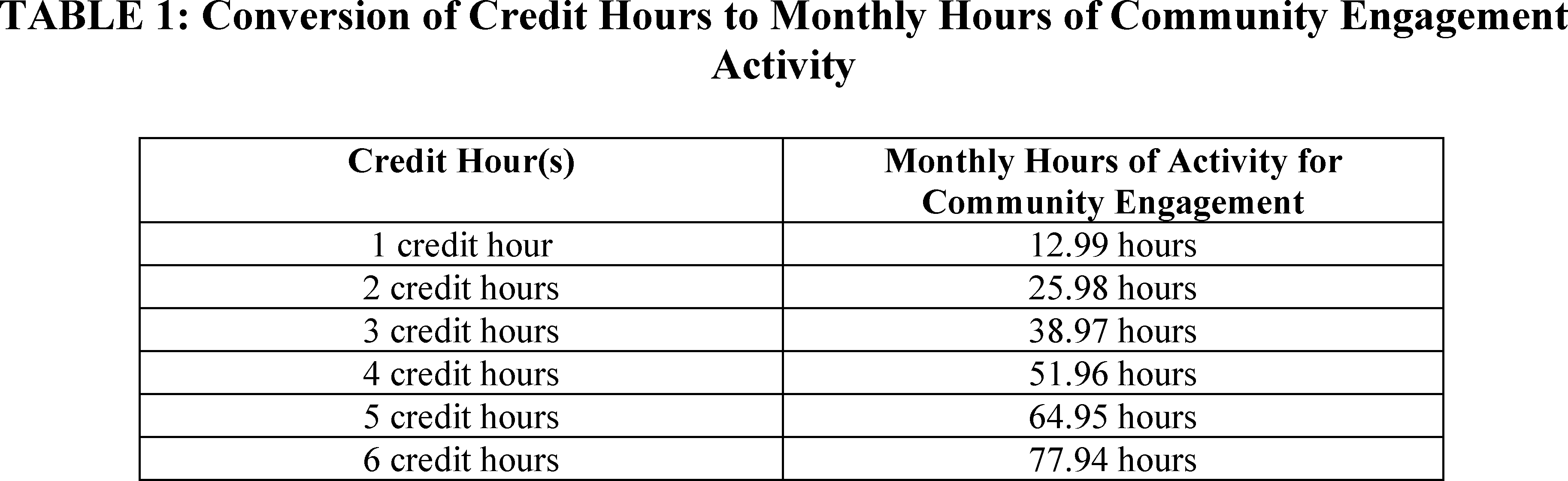
As stated in new § 435.552(d), when a school determines that an applicable individual is enrolled less than half-time in an educational program that uses credit hours, then 1 credit hour counts as 3 education hours per week during the individual's enrollment. For example, 1 credit hour equals 1 hour of instruction, and we expect students to spend 2 hours on out-of-class work for a total of 3 hours of time spent in the educational program for the week. To calculate the time spent in the educational program for a 1 credit hour course during a 1-month period, this would be 3 hours a week multiplied by 4.33 weeks (in a month) [33]
for a total of 12.99 hours in a month. This new standard is based on the Carnegie Unit, which defines 1 unit of credit as equal to 3 hours of student work per week (1 hour of lecture plus 2 hours of homework).[34]
The Carnegie Unit is used in the credit hour definition at 34 CFR 600.2. As noted in ED guidance provided to institutions and accrediting agencies regarding the credit hour, “A credit hour for Federal purposes is an institutionally established equivalency that reasonably approximates some minimum amount of student work reflective of the amount of work expected in a Carnegie unit: key phrases being “institutionally established,” “equivalency,” “reasonably approximates,” and “minimum amount.” [35]
Under the definitions at 34 CFR 600.2, a credit hour must reasonably approximate not less than 1 hour of classroom or direct faculty instruction and a minimum of 2 hours of out-of-class student work each week, or at least an equivalent amount of work for other academic activities as established by the institution.[36]
We decided upon this credit hour standard because it allows for consistency across schools and programs and provides a straightforward way to account for instructional time and student work. This standard is also
( printed page 33359)
consistent with the ED standards described here. For example, ED provides standards that institutions can use to determine full-time and half-time student status for purposes of participation in financial assistance programs. The following ED standards are illustrative. The full-time student standard for a program that measures progress in credit hours is 12 semester hours for an academic term (see full-time student definition at 34 CFR 668.2(b)). A half-time student should have a workload, as determined by the institution, that amounts to half of the workload of the applicable minimum requirement of a full-time student (see half-time student definition at 34 CFR 668.2(b)). This means that, as determined by the institution, 6 semester hours for an academic term could be sufficient for half-time enrollment, and would suffice to demonstrate community engagement under § 435.552(a)(4).
However, if an individual's institution determines that 6 credit/semester hours is insufficient for half-time enrollment, a State would use our standard to convert that 6 credit/semester hours to monthly hours of educational activity. Under our standard, 6 credit hours converts to 77.94 hours of monthly activity for community engagement (6 credit hours × 3 × 4.33 = 77.94), which is close to, but slightly less than, the 80 hours of activity needed to demonstrate community engagement for a month. This would be an appropriate outcome for a student with a less than half-time course load. We therefore believe that our standard is reasonable and is a fair measurement of time spent on instruction and independent study hours. This standard applies to all educational programs that use credit hours included in the definition at § 435.552(b). We considered adopting a different standard for high school and high school equivalency programs. However, we believe doing so would introduce additional administrative complexity without meaningful benefits for States or individuals. High school and high school equivalency students are developing academic skills for independent learning, and counting the hours they need to do so towards their community engagement hours is consistent with the purpose of the community engagement requirement.
To summarize the standard introduced in this IFC, in cases where the educational institution considers 6 credit/semester hours or fewer to be less than half-time enrollment, multiplying the number of credit hours by 3 to provide the weekly number of hours of educational activity, and then by 4.33 to determine an average monthly number produces the following:
For educational programs that do not use credit hours, if an individual is enrolled less than half-time, then the hours spent attending class and participating in educational activities will count towards meeting the requirement. For example, 1 hour of instruction will count as 1 hour of activity, 2 hours of hands-on training will count as 2 hours of activity, 3 hours of lab work will count as 3 hours of activity, 4 hours of clinical activity will count as 4 hours of activity, and so forth. We believe that this standard will primarily apply to educational programs that train individuals for industry certifications and require individuals to learn and practice technical skills, such as welding, phlebotomy, cosmetology, and precision machining. We decided upon this standard because these types of educational programs generally require a specific number of training hours for certification, so the time spent training is an appropriate way to count the educational program hours. Also, SNAP and TANF use similar standards under their respective work requirements.[37]
SNAP's time limit work requirements specify at 7 CFR 273.24(a)(1) that fulfilling the work requirement can mean participating in and complying with the requirements of a work program for 20 hours per week. A work program at 7 CFR 273.24(a)(3) includes an employment and training program under 7 CFR 273.7(e), which includes allowable educational program activities such as courses or programs of study. According to 7 CFR 273.7(e)(4)(i), the time spent in an employment and training program component is determined by the State agency. States can specify participation hours in their FNS SNAP E&T State Plan, for example specifying for an educational component that participants engage in a 5-day training, for 4 hours per day.[38]
TANF's definitions at 45 CFR 261.2(i) through (l) include hours spent participating in vocational educational training, job skills training directly related to employment, education directly related to employment, and satisfactory attendance at a secondary school or course of study leading to a certificate of general equivalence. For TANF, States submit a Work Verification Plan detailing how they verify and document work participation hours and activities. TANF's Work Verification Plan Guide [39]
also includes examples of work activity descriptions that would be approved for each countable work activity. For example, for vocational educational training, the
( printed page 33360)
Work Verification Plan Guide specifies that “Actual hours spent in class as well as time spent performing clinical requirements, lab work or other ancillary activities required for approved vocational educational training programs are considered to be a part of the primary activity for which it is required and is countable.” [40]
To be clear, when individuals are enrolled less than half-time in an educational program that uses credit hours, States should apply the credit hour standard. However, if the educational program does not use credit hours, then the hours spent attending class and participating in educational activities count towards meeting community engagement. We considered having States convert attendance and participation into credit hours so that there would only be one way to count hours for less than half-time enrollment. However, this would be more burdensome for States, with little meaningful difference for individuals. We welcome comments on any other reasonable approaches.
7. Combination of Activities
Under section 1902(xx)(2)(E) of the Act, an applicable individual demonstrates community engagement if the individual engages in any combination of work, community service, participation in a work program, and enrollment in an educational program less than half-time. The combined hours for the activities must be a total of not less than 80 hours for such month.
As specified at new § 435.552(e)(1), a State would only need to combine an individual's educational program hours with hours spent performing other activities if the individual is enrolled in the educational program less than half-time. If the applicable individual were enrolled in an educational program at least half-time, then that individual would already have demonstrated community engagement as specified at § 435.552(a)(4). At new § 435.552(e)(2), we specify that the hours for work, community service, and participating in a work program must be determined separately and based on the time spent performing those activities in such month. As specified at new § 435.552(e)(3), States must calculate the hours for less than half-time enrollment in an educational program as described in § 435.552(d).
New § 435.552(e)(4) specifies that once the State determines an individual's hours for work, completing community service, participating in a work program, and less than half-time enrollment in an educational program in such month, the State must add these hours together to obtain the total hours for all activities. The combined time for all activities must be a total of not less than 80 hours for an applicable individual to meet the community engagement requirement as described at § 435.552(e). However, the State might not need to determine an applicable individual's total number of hours for all types of community engagement activity if the applicable individual demonstrates they met the 80-hour requirement through any combination of activities. For example, consider an applicable individual who is enrolled in community college for 4 credit hours, which converts to 51.96 hours of activity, works for pay for 30 hours, and participates in community service. Because the individual's education and work activity totals 81.96 hours for the month, in the interest of efficiency, we encourage a State to conclude that the individual has met their community engagement requirement for the month and not consider the individual's community service activity, as it is not necessary to meet the community engagement requirement.
8. Monthly Income and Average Monthly Income for Seasonal Workers
Under section 1902(xx)(2)(F) of the Act, an applicable individual demonstrates community engagement for a month if “the individual has a monthly income that is not less than the applicable minimum wage requirement under section 6 of the Fair Labor Standards Act of 1938 (FLSA), multiplied by 80 hours.” We implement this provision at new § 435.552(f)(1). In 2026, the Federal minimum wage is $7.25 per hour,[41]
which multiplied by 80 equals $580. We interpret the “applicable” minimum wage to mean the Federal minimum wage under section 6 of the FLSA (29 U.S.C. 206(a)(1)(C)) that is in effect at the time a State applies the monthly income threshold to assess compliance with the community engagement requirement in case of future amendments to section 6 of the FLSA. As discussed further below, we do not use alternative minimum wage amounts in the FLSA for the purpose of identifying the monthly income threshold for demonstrating compliance with the community engagement requirement. Under section 3(m) of the FLSA,[42]
employers may pay certain “tipped employee[s]” a lower wage, provided the wage plus earned tips is at least equal to the minimum wage under section 6 of such Act. This provision is outside of section 6 of the FLSA, and thus States may not use a tipped wage (regardless of the industry or type of work) to identify the income threshold for demonstrating community engagement based on monthly income.
Another lower wage that is in section 6(g) of the FLSA is a minimum wage of $4.25 per hour for individuals under age 20 who are in their first 90 consecutive calendar days of employment, which could be relevant to a 19-year-old applicable individual. However, to the extent that employers avail themselves of this lower introductory wage, we believe it would be extremely difficult in practice for a State Medicaid agency to identify to whom this lower wage requirement would apply and to adjust the monthly income threshold only for those individuals. Moreover, this lower introductory wage is temporary—for only the first 90 calendar days of employment—making it even less likely that a State will encounter an affected individual at the point of evaluating compliance with community engagement. Therefore, for simplicity of administration of this provision, we interpret the Federal minimum wage to be the single, general minimum wage at section 6(a)(1)(C) of the FLSA for all applicable individuals. In addition, as discussed in section II.I.6. of this IFC, States must first attempt to verify community engagement on an
ex parte
basis, including hours worked, regardless of the existence of a lower introductory wage in a State.
We further recognize that individual States may have a generally applicable State minimum wage that is higher than the Federal minimum wage (or in limited circumstances lower or no minimum wage). Because section 1902(xx)(2)(F) of the Act references only section 6 of the FLSA (that is, the Federal minimum wage) and does not provide for the use of alternative State minimum wages, States may not use such State-specific minimum wages in place of the applicable Federal minimum wage to calculate the monthly income threshold for individuals to demonstrate compliance with community engagement under § 435.552(f)(1).
Under section 1902(xx)(2)(G) of the Act, an applicable individual demonstrates compliance with community engagement for a month if the individual is a seasonal worker as described in section 45R(d)(5)(B) of the Code and has an average monthly income over the preceding 6 months that is not less than the applicable
( printed page 33361)
Federal minimum wage requirement under section 6 of the FLSA multiplied by 80 hours. Section 45R(d)(5)(B) of the Code defines a seasonal worker as a worker who performs labor or services on a seasonal basis as defined by the Secretary of Labor, including workers whose “employment pertains to or is of the kind exclusively performed at certain seasons or periods of the year and which, from its nature, may not be continuous or carried on throughout the year” (29 CFR 500.20(s)(1)) and retail workers employed exclusively during holiday seasons. We implement these provisions at new § 435.552(g)(1) and (2). As with monthly income under § 435.552(f), States must use the Federal minimum wage in making this calculation.
The statute at section 1902(xx)(2)(F) and (G) of the Act refers to an individual's “monthly income” and “average monthly income,” but does not further define how States should calculate monthly income for these purposes. For the calculation of an applicable individual's monthly income under new § 435.552(f) and average monthly income under new § 435.552(g), we define “monthly income” to be the same as the individual's household income used for financial eligibility for Medicaid. Most applicable individuals are eligible for or enrolled in the adult group under § 435.119, which is a group that has an income standard based on MAGI using the MAGI-based methodologies at § 435.603. Similarly, most section 1115 demonstrations that have applicable individuals (as discussed in section II.B. of this IFC) have an income standard based on MAGI and use MAGI-based methodologies for the relevant demonstration population.
We considered using different interpretations of “monthly income” for the calculation. For example, we considered counting only earned income because it could align with the other work-related ways to demonstrate compliance. However, using only earned income for this purpose would be inconsistent with how “income” is defined elsewhere in the Medicaid statute. Specifically, section 1902(e)(14)(A) of the Act dictates that “[n]otwithstanding. . .any other provision of this title, except as provided in subparagraph (D), for purposes of determining income eligibility for medical assistance under the State plan or under any waiver of such plan
and for any other purpose applicable under the plan or waiver for which a determination of income is required. . . , a State shall use the modified adjusted gross income of an individual and, in the case of an individual in a family greater than one, the household income of such family.” (Emphasis added.) Section 1902(e)(14)(D) of the Act, which lists the exceptions to the mandatory use of MAGI-based household income, does not include an exception relating to the determination of income for applicable individuals for the purposes of assessing community engagement. Additionally, neither section 1902(xx) of the Act nor section 71119 of the WFTC legislation specifies that section 1902(xx) supersedes section 1902(e)(14) of the Act, nor does section 1902(xx) of the Act contain its own definition of “monthly income” or mandate that a particular methodology be used to calculate “monthly income.” Nothing in section 1902(xx) of the Act or section 71119 of the WFTC legislation suggests that section 1902(e)(14) of the Act should not apply when determining income for purposes of section 1902(xx).
Under new § 435.552(f)(2) and (g)(3), we establish that States must use the MAGI-based methodologies at § 435.603 when making income determinations for demonstrating community engagement. A contrary reading of the statute would require that States, after determining an individual income-eligible for the adult group, apply a
separate and distinct
income determination for such individuals in evaluating their demonstration of community engagement. There is no indication in section 1902(xx)(2) of the Act or elsewhere that the MAGI-based income provisions of section 1902(e)(14)(A) of the Act should not apply to the calculations under section 1902(xx)(2)(F) and (G) of the Act. Therefore, under § 435.552, we are interpreting section 1902(xx)(2)(F) and (G) of the Act in a manner that is consistent with section 1902(e)(14) of the Act. We specify that States must use the individual's MAGI-based income as defined at § 435.603 in assessing an individual's monthly income for the purpose of determining if an individual demonstrates community engagement under § 435.552(f) or (g).
The use of MAGI-based methodologies is required under § 435.552(f) and (g) for all applicable individuals, including those whose eligibility or enrollment is under a section 1115 demonstration rather than the State plan. Even if a State does not have an income test or uses a non-MAGI methodology for determining financial eligibility for a population of applicable individuals eligible only under section 1115 demonstration authority, we nevertheless require States to use MAGI-based methodologies for the purpose of determining income under § 435.552(f) and (g). We believe that establishing a uniform methodology is necessary for the consistent and fair treatment of all applicable individuals across States, regardless of whether they are eligible for or enrolled in the State plan or a section 1115 demonstration. We recognize that requiring the use of MAGI-based methodologies for section 1115 demonstration populations that do not use such methodologies for underlying financial eligibility could present an administrative burden for affected States. However, sections 1902(xx)(2)(F) and (G) of the Act require income counting, and we believe any additional State burden from using MAGI-based methodologies in these situations is outweighed by the benefits of requiring consistent methodologies within and across States, rather than creating different methodologies to count income for the community engagement requirement for each of the implicated section 1115 demonstrations.
Thus, States must use the individual's MAGI-based income, as defined under § 435.603(e), for their MAGI-based household as defined under § 435.603(d) and (f), for purposes of § 435.552(f) and (g). The countable income under § 435.603(e) generally includes earned income as well as countable unearned income, meaning that States must take into account all of this income for purposes of § 435.552(f) and (g). Under § 435.603(d) and (f), household income is the total income of everyone in the individual's household. Although sections 1902(xx)(2)(F) and (G) of the Act refer to the income of “the individual,” all Medicaid applicants and beneficiaries have their eligibility determined on an individual basis, and, under § 435.603(d), States must determine individuals' Medicaid financial eligibility using household income, which includes the income of every individual included in the individual's household.
Finally, under § 435.603(h), Medicaid financial eligibility is generally based on the current month at the point when eligibility for Medicaid is being determined, with certain options available to States (including the use of a reasonably predictable changes methodology under § 435.603(h)(3), as discussed further in this IFC). For the purposes of demonstrating community engagement under § 435.552(f) and (g), we decided to apply the requirement to use “current monthly household income and family size” in § 435.603(h) to the month that the State is evaluating for the purpose of community engagement, rather than to the month of application or renewal. That is, States generally
( printed page 33362)
must evaluate the monthly income for the month or months of the review period, as defined in section II.H. of this IFC, to determine whether an applicable individual is demonstrating community engagement in that month. We believe this is the most appropriate and logical application of the income counting methodology for States to use for the community engagement requirement. We implement this requirement at § 435.552(f)(2) and (g)(2).
As a general example, if the State conducts financial eligibility for an applicant and determines that the individual appears to be an applicable individual eligible for the State plan adult group and has a monthly household MAGI-based income of $650 (which is verified through information available to the State) in the required number of months of the review period, as defined in section II.H. of this IFC, then the State would use the verified $650 income, which is greater than $580 (applicable Federal minimum wage multiplied by 80), to determine that the individual demonstrated community engagement under § 435.552(f).
In addition, our intent is for States to use data sources and programming logic readily available to them rather than create new methodologies and systems specific to community engagement. We believe it will be more efficient for States to implement calculations based on existing methodologies, rather than applying one income methodology for determining financial eligibility and a different methodology to determine monthly or average monthly income as a condition of eligibility under community engagement.
We have received questions regarding States' options when averaging seasonal workers' monthly income under section 1902(xx)(2)(G) of the Act. States have an existing option to use a “reasonably predictable changes” methodology when using MAGI-based methodologies to determine household income, which, as discussed earlier in this section of this IFC, is the income used for demonstrating compliance under § 435.552(f) and (g). Specifically, § 435.603(h)(3) permits States to adopt (through a State plan election) a reasonable method to account for reasonably predictable increases or decreases (or both) in future income to determine monthly income. This option can help make income determinations for applicants and beneficiaries more accurate over a period of time and is particularly useful for averaging seasonal worker income over a period of up to 12 months. A reasonably predictable changes methodology takes predictable
future
changes into account by including a prorated portion of reasonably predictable future income in the individual's monthly income to smooth out predictable fluctuations in income.
For example, suppose an individual in a State with a 12-month reasonably predictable changes in income methodology expects to have steady monthly income of $500 and expects (based on the previous year) to have $400 per month in additional countable income in the months of October through December, for a total of $1,200 of additional countable income. Suppose further that the State is determining monthly income for August for the purpose of the community engagement requirement. The State prorates the total seasonal income to equal $100 ($1,200/12 = $100) in additional monthly income for August (and in each of the 12 months). The monthly income is determined to be $600 ($500 steady income plus $100 prorated seasonal income). Note that because the State uses a 12-month methodology, this calculation would be the same in any month of the year. Thus, while the prorated amount is based on expected
future
income, the methodology is used to determine the monthly income for each month in that 12-month period, including the month(s) of the review period (as defined in section II.H. of this IFC) the State is assessing to determine community engagement compliance. Such a reasonably predictable changes methodology, in States that elect it, is an integral part of their MAGI-based methodologies, and therefore States must use their reasonably predictable changes methodology to determine monthly income when an individual has fluctuating income that is subject to the State's methodology.
For the purpose of the community engagement requirement, States with a MAGI-based reasonably predictable changes methodology for seasonal workers include a prorated portion of reasonably predictable future income in monthly income added to stable or non-fluctuating income (if any), and this total average monthly income will effectively be the monthly income used to assess community engagement under section 1902(xx)(2)(G) of the Act. As another example, consider an individual who is employed from April through September, earning $1,500 per month, and unemployed with no income for the remaining 6 months of the year. If the individual applies for Medicaid in December, and the State has elected reasonably predictable increases and decreases in income over 12 months, the State will use the prorated MAGI-based monthly income to determine financial eligibility and also to determine compliance with the community engagement requirement. In this case, the individual's calculated monthly income is $750 ($1,500 multiplied by 6, then divided by 12) in December for financial eligibility and $750 in November (or in the months of the relevant review period, as defined in section II.H. of this IFC) for demonstrating community engagement. The average monthly income over the previous 6 months would also be $750. Alternatively, if the individual applies in July when earning income, and the other facts were the same (including that the State takes into consideration reasonably predictable future decreases in income), the outcome would still be a calculated monthly income of $750 for financial eligibility and for demonstrating community engagement using average monthly income.
Most States currently elect the option to use a reasonable method to account for reasonably predictable changes, and among those States, most elect both reasonably predictable increases and decreases in future income. Some States only account for reasonably predictable future decreases. Because accounting only for reasonably predictable future decreases generally decreases countable household income, it may result in some seasonal workers not reaching the $580 per month (Federal minimum wage multiplied by 80) threshold under section 1902(xx)(2)(G) of the Act. We further note that a MAGI-based reasonably predictable changes methodology applies broadly to all MAGI-based eligibility determinations, including for the adult group and applicable section 1115 demonstrations, and must be used consistently and in the same manner for financial eligibility and for compliance with the community engagement requirement for applicable individuals.
If a State does not use a reasonably predictable changes methodology, then for the purpose of demonstrating community engagement for seasonal workers, the State would use the individual's average income over the preceding 6 months, as provided at section 1902(xx)(2)(G) of the Act. The “preceding 6 months” verified by the State would be the 6 months preceding a month of the review period for which the State is assessing compliance with the community engagement requirement. Consider the facts of the previous example, except that the State does not elect a reasonably predictable changes methodology, and the State requires an applicable individual to demonstrate community engagement for
( printed page 33363)
1 month at application. The seasonal worker applies in July and is an applicable individual, so the relevant review period to demonstrate community engagement is the month of June. The State will average the income from December through May to determine if the individual demonstrates community engagement in June, the month before application. In this case, the individual has 2 months of seasonal employment, which averaged over 6 months equals $500 (2 months at $1,500 per month, then divided by 6). Because $500 is below $580, this individual is not considered to be demonstrating community engagement in June based on the 6-month average monthly income for seasonal workers. This outcome contrasts with the prior example using an income counting methodology that accounts for reasonably predictable changes.
Similarly, at renewal, the State will average the income for the 6 months preceding the month being assessed for compliance. Thus, if a seasonal worker who is an applicable individual has a review period that spans from July through December, the average income from January to June is used to assess compliance in July, from February to July to assess compliance in August, from March to August to assess compliance in September, etc. The State will continue assessing each month in the review period until the State either verifies compliance for the required number of months (including verifying if the applicable individual demonstrated community engagement on a different basis, that is, through an activity or combination of activities, or is deemed to have demonstrated community engagement because of an exception) or has assessed all the months in the review period.
We have also received several questions regarding situations in which an individual's monthly income falls short of the amount required to meet the community engagement requirement under the monthly or average monthly income criteria. For example, we have been asked whether, if the State verifies $380 in monthly income for the individual (which is short of the $580/month requirements at § 435.552(f) and (g) assuming a minimum wage of $7.25/hour), the State could use that income towards meeting an individual's community engagement requirement. Section 1902(xx)(2) of the Act does not address this scenario but does provide the Secretary with the authority to establish criteria for determining whether an applicable individual meets the conditions for demonstrating community engagement. Section 1902(xx)(2)(A) of the Act includes work as a community engagement activity. Consistent with our statutory authority to establish the criteria for demonstrating community engagement, at new § 435.552(e)(2)(i) and (ii) we permit income to be used as a proxy for calculating work hours because many income verification data sources, such as quarterly wage data, include individual earned income and thus can be used to derive the number of hours worked under § 435.552(a)(1). If the individual's verified income is below the Federal minimum wage multiplied by 80 hours, and if the State does not have information regarding the number of hours worked, then it would be reasonable for States to have the option to use income to calculate a number of hours worked by dividing the income for the month by the applicable Federal minimum wage. Thus, if the State verifies $380 in monthly income, then using the current Federal minimum wage of $7.25, the individual can be credited with having worked 52 hours for the month ($380 divided by $7.25). The individual would then need to participate in an additional 28 hours (80−52 = 28) of community engagement activities to meet the requirement for the month.
We recognize that States will be using the individual's MAGI-based income for their MAGI-based household when converting monthly income to hours worked. While we are providing States with the option to use income to determine hours worked, this option must only be used when the monthly income is less than the applicable Federal minimum wage multiplied by 80 hours and the State does not have information regarding the number of hours worked. In these circumstances, the State must use a reasonable method to allocate hours, between members of the household. Providing States flexibility to convert monthly income to hours worked for purposes of calculating an applicable individual's work hours is reasonable because the concept underlying the monthly income and average monthly income criteria at sections 1902(xx)(2)(F) and (G) of the Act is that monthly income can be a proxy for hours worked. We do not see a basis for prohibiting States from using a similar methodology to determine hours worked if an individual has monthly income below the amount that equates to 80 hours at minimum wage, the State has no documentation regarding number of hours worked and uses a reasonable methodology to allocate hours, as necessary. Additionally, some States already use monthly income to determine self-employment work hours when verifying compliance with SNAP work requirements. We reiterate that when this proxy approach results in the work hours calculated as less than 80, those hours would then have to be combined with hours from another activity to meet the community engagement requirement.
Please see section II.I.6.f. of this IFC for information about verification of the monthly income and average monthly income requirements.
D. Mandatory Exceptions for Certain Individuals
Section 1902(xx)(3)(A) of the Act establishes mandatory exceptions from demonstrating community engagement via the pathways described in § 435.552(a) (see section II.C. of this IFC for more information regarding demonstrating compliance) for certain applicable individuals. States must deem an applicable individual compliant for a month if the individual meets the mandatory exception criteria (which are further described in this section of this IFC). New § 435.553 implements and interprets the mandatory exceptions in section 1902(xx)(3)(A) of the Act.
New § 435.553(a) implements section 1902(xx)(3)(A)(i) of the Act, which establishes mandatory exceptions for applicable individuals if, for part or all of a month, the individual was: (1) under the age of 19; (2) entitled to, or enrolled for benefits under Medicare part A, or enrolled for benefits under Medicare part B; (3) described in any of the mandatory eligibility groups in section 1902(a)(10)(A)(i)(I) through (VII) of the Act; or (4) a specified excluded individual as defined in section 1902(xx)(9)(A)(ii) of the Act (see section II.E. of this IFC for an explanation of specified excluded individuals, and section II.F. of this IFC for a discussion of the similarities and differences between mandatory exceptions and specified excluded individuals). States must determine whether an applicable individual met exception criteria for part or all of a relevant month. We interpret the statutory references to “a month” and “such month” to refer to any month in the State's review period (described further in section II.H. of this IFC). This could be a month during the State's review period when determining eligibility at application, a month during an individual's eligibility period at renewal, and, at State option, a month during the relevant alternative review period during which the State elects to conduct more frequent verifications of
( printed page 33364)
community engagement compliance (as described in section II.H. of this IFC).
Because compliance with community engagement is assessed for a time period that predates an individual's application or renewal date (as described in more detail in section II.H.1 of this IFC), the mandatory exceptions provide protections, for example, for beneficiaries who were previously excluded from the requirement to demonstrate community engagement but whose exclusion ends, or who were enrolled in another eligibility group and, following a redetermination, transition to an eligibility group consisting of applicable individuals. These exceptions can allow such beneficiaries time to understand their rights and responsibilities and demonstrate compliance with community engagement as it was not a condition of their Medicaid eligibility previously.
For example, a beneficiary enrolled in the adult group has been excluded from the community engagement requirement because they have a dependent child who is age 13, but their child turns 14 during the individual's eligibility period. During the beneficiary's renewal, the State determines the individual is now an applicable individual subject to the community engagement requirement. The State requires beneficiaries to demonstrate 1 month of community engagement activity at renewal. Because the beneficiary was a specified excluded individual as a result of having a dependent child under the age of 14 for part or all of at least 1 month during the review period, which aligns with the eligibility period in this scenario, they meet the mandatory exception criteria for at least 1 month during the review period (see section II.H.3. of this IFC) and thus are deemed compliant with community engagement during the review period at renewal. Their eligibility would be renewed with proper notice of the determination consistent with § 435.917(b)(1); this notice would be accompanied by the outreach notice content described at new § 435.561(c) which includes information on how to comply with the requirement to demonstrate community engagement and the consequences of noncompliance, consistent with § 435.561(b) (described in section II.L. of this IFC). Going forward, the individual would be subject to the community engagement requirement.
New § 435.553(b) implements section 1902(xx)(3)(A)(ii) of the Act, which establishes an exception for incarcerated individuals.[43]
Under the exception, an applicable individual is deemed compliant with community engagement for a month if “at any point during the 3-month period ending on the first day of such month, the individual was an inmate of a public institution.” Unlike the other mandatory exceptions, which require the State to deem an applicable individual as demonstrating community engagement in a month if the individual meets the exception in that month, the exception for individuals who were previously inmates of a public institution applies to a 3-month period prior to the month in which the State reviews the individual for compliance with community engagement. We believe that the 3-month timeframe for this exception reflects the significance of the transition from a public institution to a community setting. This policy aligns with Congress' recent efforts to support individuals in attaining self-sufficiency during the transition period following incarceration.[44]
In addition to this mandatory exception, inmates of a public institution are defined as “specified excluded individuals” at section 1902(xx)(9)(A)(ii)(VIII) of the Act, discussed further in section II.E.8. of this IFC.
When a State assesses whether it can deem compliance with community engagement for a month for someone who was previously incarcerated, it will need to determine when an individual's incarceration ended in relation to the month(s) for which the State is determining compliance. For example, an individual was an inmate of a public institution and was released on March 15. The individual applies for Medicaid on June 1 in a State that has a 1-month review period for community engagement at application (see section II.H.1. of this IFC for further discussion of the review period). The State determines the individual is eligible in the adult group and is an applicable individual, so must assess whether the individual met or is deemed to have met the community engagement requirement in May (the month prior to the month of application). To apply the exception for incarcerated individuals, the State would assess whether the individual was an inmate at any point in the 3-month period prior to May 1. Accordingly, the State would determine whether the individual was an inmate in February, March, or April. Because the individual was an inmate in March, the State would deem the individual to have met the community engagement requirement and would enroll the individual in the adult group.
We note that an applicable individual can be deemed compliant only for the month(s) in which the individual meets the mandatory exception criteria. States that require applicable individuals to demonstrate compliance with community engagement for more than 1 month during the review period will need to verify that an applicable individual is excepted, demonstrates community engagement, or meets a combination of these community engagement criteria for the total number of months specified by the State in the review period.
E. Specified Excluded Individuals
Section 1902(xx)(9)(A)(ii) of the Act lists nine categories of individuals meeting the definition of a “specified excluded individual.” These individuals are excluded from the definition of “applicable individual” at section 1902(xx)(9)(A)(i) of the Act; therefore, for the nine categories of specified excluded individuals, community engagement is not a condition of eligibility, and such individuals do not need to demonstrate community engagement to qualify for the State plan adult group or for eligibility under an applicable section 1115 demonstration. New § 435.554 implements the statutory definition of specified excluded individuals, as further discussed in this section. If a State determines someone to be a specified excluded individual at application, renewal, or, if elected by the State, at the time of a more frequent verification of community engagement compliance, it must not determine whether that person met the community engagement requirement during the applicable community engagement review period (see section II.H.1. of this IFC for more information). Similarly, while States must deem an applicable individual compliant with the community engagement requirement for a month if during any part of that month that person was a specified excluded individual, this deeming requirement does not apply if a State has already determined that the person is a specified excluded individual at application, renewal, or at the time of a more frequent verification, because only an applicable individual must
( printed page 33365)
demonstrate community engagement. Therefore, States must not deem specified excluded individuals compliant with the community engagement requirement. We explain the distinction between mandatory exceptions and specified excluded individuals in more detail in section II.F. of this IFC.
Several groups of specified excluded individuals are, by definition, not usually eligible under the State plan adult group, described at section 1902(a)(10)(A)(i)(VIII) of the Act, and many may be eligible through a separate eligibility group (for example, the pregnant women group, described at § 435.116) for which community engagement does not apply. However, these exclusions are necessary for individuals who may be eligible to enroll or are enrolled in the State plan adult group or an applicable section 1115 demonstration, as described in section II.B. of this IFC, but still meet the exclusion criteria.
New § 435.554 implements and interprets section 1902(xx)(9)(A)(ii) of the Act. We intend to apply existing Medicaid definitions where possible to align with existing eligibility systems and structures. Where terms used to describe specified excluded individuals do not have precedent in Medicaid, or our interpretation of the statutory language differs from existing Medicaid definitions, we establish definitions through this IFC. Section II.I.7. of this IFC addresses verification requirements regarding specified excluded individuals.
1. Former Foster Care Children
Section 1902(xx)(9)(A)(ii)(I) of the Act provides that an individual “who is described in” section 1902(a)(10)(A)(i)(IX) of the Act, which refers to the eligibility group serving former foster care children (FFCC group), is a specified excluded individual. The FFCC group generally serves individuals who were enrolled in Medicaid while in foster care, then exited foster care (or “aged out”) without an adoption or other permanency, and are under age 26. The FFCC group was originally limited to individuals who had been in foster care in the State in which they subsequently sought Medicaid coverage and were not described in any other mandatory eligibility groups under section 1902(a)(10)(A)(i)(I) through (VII) of the Act. Section 1002(a) of the Substance Use Disorder Prevention that Promotes Opioid Recovery and Treatment for Patients and Communities Act (SUPPORT Act; Pub. L. 115-271) modified the original eligibility criteria for the FFCC group in section 1902(a)(10)(A)(i)(IX) of the Act to expand eligibility in the group to individuals who had been in foster care in other States and who may be otherwise described in a separate mandatory eligibility group under section 1902(a)(10)(A)(i)(I) through (VII) of the Act (so long as they are not enrolled in such other group). However, the amendment was effective exclusively for those individuals who turn age 18 on or after January 1, 2023. This means that, under the State plan requirements, slightly different eligibility criteria for the FFCC group apply to individuals under age 26 who turned age 18 on or before December 31, 2022, and those who turn age 18 on or after January 1, 2023.[45]
We have considered whether the reference in section 1902(xx)(9)(A)(ii)(I) of the Act to the FFCC group encompasses both the original version and SUPPORT Act version of section 1902(a)(10)(A)(i)(IX) of the Act, or if it is specific only to the latter one. We are interpreting section 1902(xx)(9)(A)(ii)(I) of the Act to apply the exclusion to individuals who meet the eligibility criteria under the SUPPORT Act, regardless of when they turned age 18, for the following reasons.
The phrase “described in” could be read to exactly mirror the phased-in implementation of the eligibility criteria in section 1902(a)(10)(A)(i)(IX) of the Act and apply the relevant criteria to individuals based on when they turned age 18 for the purpose of the specified excluded individual category. That means, in reference to youth formerly in foster care, an individual under age 26 who turned age 18 before January 1, 2023, would only be a specified excluded individual if he or she meets the original criteria for the FFCC group (specifically: in the same State and not eligible for another group). Someone under age 26 who turned age 18 on or after January 1, 2023, would be a specified excluded individual if he or she meets the expanded criteria for the FFCC group under the SUPPORT Act.
However, we do not believe this is the best reading of section 1902(xx)(9)(A)(ii)(I) of the Act, because the Act directs an eligibility hierarchy for the FFCC group. That means that a strict reading of the exclusion is likely to create an empty exclusion category. Clause (XVII) in the language following section 1902(a)(10)(G) of the Act provides that, “. . . if an individual is described in subclause (IX) of subparagraph (A)(i) and is also described in subclause (VIII) of that subparagraph, the medical assistance shall be made available to the individual through subclause (IX) instead of through subclause (VIII).” This language means that individuals eligible for both the adult group and the FFCC group must be enrolled in the FFCC group. This eligibility hierarchy means that a strict reading of “described in” in section 1902(xx)(9)(A)(ii)(I) of the Act that is equivalent to “eligible for” the FFCC group per the SUPPORT Act phase-in of the eligibility criteria by age would render the exclusion meaningless as a null set of individuals. Under that reading, by operation of the language following section 1902(a)(10)(G) of the Act, all the individuals who are eligible for the FFCC group would by definition not be in the adult group and thus never would be applicable individuals to whom the exclusion category might apply.
Because a strict reading of the reference to section 1902(a)(10)(A)(i)(IX) of the Act in section 1902(xx)(9)(A)(ii)(I) would render that exclusion category a nullity, we interpret the exclusion to apply to persons meeting the current SUPPORT Act definition of the FFCC group, even in circumstances where they would not qualify for eligibility under section 1902(a)(10)(A)(i)(IX) of the Act due to when they turned 18.
This interpretation also furthers administrative simplicity. The population of individuals formerly in foster care is relatively small; and the population of individuals formerly in foster care who do not meet the State plan requirements is even smaller. For example, some States operating section 1115 demonstrations to apply the SUPPORT Act criteria to eligible individuals who turned 18 before January 1, 2023, report very low enrollment numbers (sometimes in the single digits). The administrative work for States to identify and apply the correct eligibility criteria to the population is high compared to the small size of the population. We implement this definition at new § 435.554(c)(1).
This policy means that States must use a single set of eligibility criteria, under the SUPPORT Act changes to the FFCC group, for this category of specified excluded individual, regardless of whether the individual turned age 18 on or after January 1, 2023. Thus, an individual in the adult group or an applicable section 1115 demonstration may be a specified excluded individual as long as he or she meets the criteria for an individual
( printed page 33366)
described in the FFCC group: (1) is under age 26; (2) is not enrolled in an eligibility group described in section 1902(a)(10)(A)(i)(I) through (VII) of the Act, even if they meet the eligibility requirements for such group; (3) was in foster care under the responsibility of any State upon attaining age 18 (or such higher age as the State has elected in its title IV-E plan); and (4) was enrolled in Medicaid in any State while in such foster care. For example, suppose an individual ages out of foster care (while enrolled in Medicaid) at age 21 in State A in 2024 and subsequently moves to State B. Because this individual turned age 18 in 2021, the SUPPORT Act rules for the FFCC group do not apply to the individual. State B covers the adult group but does not have a section 1115 demonstration to cover former foster care youth from other States. When the individual applies for Medicaid in State B, he meets the eligibility requirements for the adult group, and the State enrolls him in that group. In 2027, the individual is in the adult group and still under age 26. Because the individual meets the current description of the FFCC group, despite not being enrolled in the group, the individual is a specified excluded individual and not subject to the community engagement requirement.
2. American Indians
Section 1902(xx)(9)(A)(ii)(II) of the Act defines as specified excluded individuals an individual “who: (aa) is an Indian or Urban Indian (as such terms are defined in paragraphs (13) and (28) of section 4 of the Indian Health Care Improvement Act; (bb) is a California Indian described in section 809(a) of such Act; or (cc) has otherwise been determined eligible as an Indian for the Indian Health Service under regulations issued by the Secretary.” CMS has previously issued regulations that define “Indian” to implement various protections for individual Indians, Indian tribes, and tribal organizations as it relates to Medicaid premiums and cost sharing, as required by sections 1916(j), 1916A(b)(3)(A)(vii), and 1916A(b)(3)(B)(x) of the Act.[46]
The existing definition at § 447.51 incorporates each of the specific groups listed in section 1902(xx)(9)(A)(ii)(II)(aa) through (cc) of the Act; therefore, we adopt the existing definition of “Indian” at § 447.51 for the community engagement exclusion at the new § 435.554(c)(2). In other places throughout this IFC, we refer to this population as American Indians. We believe adopting this definition will promote alignment with existing Medicaid protections for American Indians and will allow States to use existing data used for cost sharing to effectuate this community engagement exclusion. Notably, unlike other exclusions which may change from month to month or be time-limited, States will not be required to (and may not) reverify someone's status as an American Indian for exclusion from the community engagement requirement.
3. Parent, Guardian, Caretaker Relative, or Family Caregiver of a Dependent Child 13 Years of Age and Under or a Disabled Individual
Section 1902(xx)(9)(A)(ii)(III) of the Act establishes an exclusion for parents, guardians, caretaker relatives, and family caregivers (as defined in section 2 of the Recognize, Assist, Include, Support, and Engage Family Caregivers Act of 2017 (RAISE Family Caregivers Act; Pub. L. 115-119), of a dependent child 13 years of age and under or a disabled individual. The terms “caretaker relative” and “dependent child” are existing Medicaid terms defined in regulation that we are building upon for purposes of this exclusion. The terms parent, guardian, family caregiver, and disabled individual are either new to Medicaid, or are not defined in regulation to determine Medicaid eligibility. Each category of excluded individuals established by section 1902(xx)(9)(A)(ii)(III) of the Act is defined in relation to a dependent child aged 13 and under or a disabled individual. We define the terms caretaker relative, dependent child, disabled individual, family caregiver, guardian and parent at § 435.554(a). For example, as we describe in more detail below, for purposes of the exclusion at 1902(xx)(9)(A)(ii)(III) of the Act, we are defining dependent child at § 435.554(a) to mean “a child 13 years of age or under who relies on another individual for care” and all specified excluded individual-related references to dependent child throughout the remainder of this preamble reflect this regulatory definition. Additionally, to qualify as a specified excluded individual, those meeting the definition of family caregiver at § 435.554(a) must also meet certain criteria specified at new § 435.554(c)(3)(i).
a. Definition of Caretaker Relative
Current CMS regulations define a caretaker relative at § 435.4. The “caretaker relative” definition generally implements section 1905(a)(ii) of the Act (“relatives specified in section 406(b)(1) with whom a child is living if such child is (or would, if needy, be) a dependent child under part A of title IV.”). Such references to title IV-A of the Act are to the former Aid to Families with Dependent Children (AFDC) program, as it existed on July 16, 1996. AFDC was replaced with the TANF block grant by PRWORA. In de-linking receipt of cash assistance from Medicaid, PRWORA also established categorical eligibility for low-income families under section 1931 of the Act. The definition of caretaker relative is used for the population of categorically needy parents and other caretaker relatives that is now implemented in regulations at § 435.110. Section 435.4 defines a caretaker relative as a parent or other relative (related by blood, adoption, or marriage) living with a dependent child, who assumes primary responsibility for the dependent child's care. Section 435.4 specifies who qualifies as a relative for such purposes, and includes a child's father, mother, grandfather, grandmother, brother, sister, stepfather, stepmother, stepbrother, stepsister, aunt, uncle, first cousin, nephew, niece, or the spouse of such parent or relative, even after the marriage is terminated by death or divorce. The definition also provides States the option to include other adults: additional relatives of the child by blood (including those of half-blood), adoption, or marriage; a domestic partner of the parent or other caretaker relative; or any adult with whom the child is living and who assumes primary responsibility for the child's care.
Use of the term “caretaker relative” in our regulations describes a specific relationship with a child that defines the categorical Medicaid eligibility group at § 435.110.[47]
Because States have experience implementing the § 435.110 eligibility group and associated policies based on the existing definition in § 435.4, we believe it is appropriate to align the definition of “caretaker relative” in section 1902(xx)(9)(A)(ii)(II) of the Act with that definition. However, we acknowledge that, in addition to a dependent child age 13 or under, the exclusion also applies to caretaker relatives of a “disabled individual” (defined later in this section). Therefore, if we were to use the existing definition at § 435.4 without any changes, the definition would not align with the exclusion in
( printed page 33367)
the statute. As such, for purposes of this exclusion from the community engagement requirement, at a new § 435.554(a) we establish a definition of caretaker relative, based on the relationships listed in the existing definition at § 435.4, to apply the definition to caretaker relatives of both dependent children and disabled individuals, as established in section 1902(xx)(9)(A)(ii)(III) of the Act. We also specify additional relationships (husband, wife, son, daughter, stepson, stepdaughter, grandson, granddaughter) under which individuals could qualify as a caretaker relative of a disabled individual (these additional relationships are not relevant for dependent children age 13 and under because of their age). Like the definition in § 435.4, the new definition requires that the caretaker relative assume primary responsibility for the dependent child's or disabled individual's care and live with the dependent child or disabled individual who is receiving the care.
If a State has elected to expand the definition of “caretaker relative” to additional relatives under paragraph (3) of the caretaker relative definition at § 435.4, the State must apply the same elections when determining whether an individual is a “caretaker relative” of a dependent child or a disabled individual for purposes of the exclusion described at section 1902(xx)(9)(A)(ii)(III) of the Act. We believe that aligning the elections of additional relatives across the eligibility group for parents and other caretaker relatives at § 435.110 and this community engagement exclusion would prevent beneficiary confusion and potential disruption of coverage for certain caretakers who transition between the parent and caretaker relative group and a group consisting of applicable individuals. We also believe alignment will create administrative simplicity for States and better understanding of the policy for beneficiaries.
For example, suppose a beneficiary is the second cousin of, and lives with, a 10-year-old child who is dependent on the beneficiary for care. Because their State elected the option under paragraph (3) of the caretaker relative definition at § 435.4, the beneficiary is eligible for the “parents and other caretaker relatives” eligibility group. The beneficiary subsequently experiences an increase in unearned income and is determined ineligible for the “parents and other caretaker relatives” group and is then determined eligible for the adult group. If the State uses a consistent definition of relationships for caretaker relative, the State would determine the individual to be a specified excluded individual under the exclusion described at section 1902(xx)(9)(A)(ii)(III) of the Act. The beneficiary would not be subject to the community engagement requirement, and the State would not need to determine whether the individual demonstrated compliance, which is consistent with the beneficiary's previous status as a caretaker relative. However, if the State used a different relationship election for the exclusion, the State would need to conduct a separate analysis of the relationship between the adult and the dependent child, adding to the complexity of the redetermination process for the State and potentially resulting in confusion or a disruption of coverage for the caretaker relative.
b. Definition of Parent
Because the statute separately lists “parent” in addition to “caretaker relative” in section 1902(xx)(9)(A)(ii)(III) of the Act, we interpret “parent” to mean something different from a “caretaker relative.” Section 1902(xx)(9)(A)(ii)(III) of the Act does not define “parent,” and parenthood is generally governed by State law. Therefore, at new § 435.554(a), we define for purposes of section 1902(xx)(9)(A)(ii)(III) of the Act to mean an individual with the legal status of a mother or father, including by adoption, in accordance with applicable State law, to another individual, which is consistent with common definitions of the term.[48]
Consistent with other groups listed in the exclusion established at section 1902(xx)(9)(A)(ii)(III) of the Act, the parent must provide some level of care to the dependent child or disabled individual for whom they are a parent. For example, an estranged parent without a relationship with their child would not be considered a specified excluded individual under the category of parent. We recognize that many parents who live with and are primarily responsible for their dependent child or adult disabled child will also meet the definition in this regulation of “caretaker relative.” This definition of parent provides for parents who do not meet the definition of “caretaker relative” but who meet this definition of “parent” to be considered a specified excluded individual.
c. Definition of Guardian
Section 1902(xx)(9)(A)(ii)(III) of the Act also separately lists a “guardian,” which is not defined under section 1902(xx) of the Act or defined elsewhere in the Act or CMS regulations. At § 435.554(a), we define “guardian” for purposes of section 1902(xx)(9)(A)(ii)(III) of the Act to mean an adult appointed by a court to care for and make personal decisions on behalf of an individual who cannot care for themselves, which is consistent with the common meaning of the term.[49]
Because guardianship is governed by State law, we considered how other Federal agencies refer to or define guardianship when developing our definition. The Department of Justice (DOJ) describes guardianship as the appointment by a court of a person or entity to make personal, property decisions, or both for an individual whom the court finds cannot make decisions for themselves.[50]
DOJ also explains that each State has its own set of guardianship laws, and terminology may vary.[51]
In the definition of “guardian” we establish in § 435.554(a), an individual has the legal status of a “guardian” when the individual is appointed by a court. DOJ's description also refers to personal and/or financial responsibilities. For the definition established at § 435.554(a), we specify that a guardian has been appointed by a court to care for and make personal decisions for an individual who cannot care for themselves. We believe that guardianship as it relates to the responsibility for another person's care, rather than financial responsibilities, is more aligned with the purposes of the exclusion.
d. Definition of Family Caregiver
Section 1902(xx)(9)(A)(ii)(III) of the Act includes a “family caregiver (as defined in section 2 of the RAISE Family Caregivers Act) of a dependent child 13 years of age and under or a disabled individual” as a specified excluded individual.
The RAISE Family Caregivers Act directed the Secretary of the U.S. Department of Health and Human Services (HHS) to develop and make
( printed page 33368)
publicly available a family caregiving strategy that identified recommended actions for recognizing and supporting family caregivers. To guide the development of this strategy, Section 2 of the RAISE Family Caregivers Act defined “family caregiver” as an adult family member or other individual who has a significant relationship with, and who provides a broad range of assistance to, an individual with a chronic or other health condition, disability, or functional limitation. This definition encompasses a broad range of caregiver relationships and assistance provided to capture the full landscape of caregiving in the U.S. to inform the national caregiving strategy.
Section 1902(xx)(9)(A)(ii)(III) of the Act requires CMS to use the RAISE Family Caregivers Act definition of family caregiver when determining whether an individual qualifies as a specified excluded individual, but it also limits care recipients to “a dependent child 13 years of age and under or a disabled individual” (both of which are defined later in this section). Because the care recipients specified in section 1902(xx)(9)(A)(ii)(III) of the Act differ from those referenced in the RAISE Family Caregivers Act definition, it is necessary to establish a definition of “family caregiver” for purposes of identifying specified excluded individuals that incorporates applicable components of the RAISE Family Caregivers Act definition while aligning with the care recipients specified in 1902(xx)(9)(A)(ii)(III) of the Act. As such, at new § 435.554(a), we define family caregiver as an adult family member or other individual who has a significant relationship with, and who provides care within a broad range of assistance to, a dependent child or a disabled individual. This definition of family caregiver largely aligns with the RAISE Family Caregivers Act definition but includes modifications to support implementation of section 1902(xx)(9)(A)(ii)(III) of the Act, as further discussed below.
We are generally incorporating the significant relationship and activity-based components of the RAISE Family Caregivers Act definition into the definition of family caregiver at § 435.554(a), recognizing that a family caregiver is not limited to legally recognized relatives or members of the same household and that providing a “broad range of assistance” (as specified in the RAISE Family Caregivers Act definition) to an individual may consist of any number of activities necessitated by individual health status. However, the RAISE Family Caregivers Act definition encompasses caregiving for a broad range of individuals including those with a chronic health condition, disability, or functional limitation while section 1902(xx)(9)(A)(ii)(III) of the Act expressly limits the exclusion to family caregivers “of a dependent child age 13 years and under or a disabled individual.” We do not interpret the statutory cross-reference to the RAISE Family Caregivers Act definition of family caregiver in section 1902(xx)(9)(A)(ii)(III) of the Act as authorizing expansion of the community engagement exclusion beyond the care recipient populations expressly specified in that section of the Act. In addition, because “a dependent child 13 years of age and under” is specified in section 1902(xx)(9)(A)(ii)(III) but is not referenced in the RAISE Family Caregivers Act definition, we are adding this cohort of individual to the set of care recipients included in our definition of family caregiver at § 435.554(a).
Together, these modifications appropriately harmonize the RAISE Family Caregivers Act definition of family caregiver with the scope of care recipients specified at section 1902(xx)(9)(A)(ii)(III) of the Act and ensure that the exclusion is applied only to family caregivers who provide assistance to a dependent child or a disabled individual. (Notably, as outlined further in this section, there is no upper age limit for the “disabled individual” referenced in section 1902(xx)(9)(A)(ii)(III) of the Act, meaning that individuals of any age with a disability would qualify under that term.)
Additionally, to reflect the varied and individualized nature of caregiving arrangements, we opted to modify the RAISE Family Caregivers Act definition slightly in § 435.554(a) to refer to “
care within
a broad range of assistance” to ensure that States do not require that a family caregiver provide
multiple
forms of assistance to a dependent child or a disabled individual to qualify as a specified excluded individual. For additional details about the criteria a family caregiver must meet to qualify as a specific excluded individual, see section II.E.3.h. of this IFC.
e. Definition of Dependent Child
Section 1902(xx)(9)(A)(ii)(III) of the Act provides an exclusion from the community engagement requirement for an individual who is a parent, guardian, caretaker relative, or family caregiver of a “dependent child 13 years of age and under.” In § 435.554(a), we define dependent child to mean a child 13 years of age or under who relies on another individual for care.
“Dependent child” already has a specific Medicaid definition; in developing definitions for this community engagement exclusion, we considered whether it is appropriate to apply the existing definition of dependent child, and decided it is not, for the reasons discussed below.
In 2012, we established a definition of a “dependent child” in § 435.4,[52]
noting that our definition was grounded in section 1931 of the Act. (“Consistent with section 1931 of the Act, we propose Medicaid definitions of `caretaker relative' and `dependent child' at § 435.4”).[53]
In implementing the mandate under subsections (a) and (b) of section 1931 of the Act to apply the eligibility requirements of the former AFDC program (as it existed on July 16, 1996) to low-income families, the definition of “dependent child” in § 435.4 incorporates each State's choice with regard to the AFDC “deprivation” requirement. A dependent child under § 435.4 must be “deprived of parental support by reason of the death, absence from the home, physical or mental incapacity, or unemployment of at least one parent, unless the State has elected in its State plan to eliminate such deprivation requirement.” When we implemented the final rule defining “caretaker relative” in 2012, we noted that many States had elected to eliminate the deprivation requirement from their definition of “dependent child,” applying only an age standard to the term. In addition, section 1902(xx)(9)(A)(ii)(III) of the Act provides an exclusion from the community engagement requirement for an individual who is a parent of a dependent child 13 years of age and under, which is in conflict with the deprivation requirement. Because section 1902(xx)(9)(A)(ii)(III) of the Act does not refer to section 1931 of the Act and is in conflict with the deprivation requirement in § 435.4, and because most States have eliminated the deprivation requirement, we decided against adopting the existing definition of dependent child at § 435.4 for purposes of section 1902(xx)(9)(A)(ii)(III) of the Act.
In establishing a definition of dependent child for purposes of exclusion from the community
( printed page 33369)
engagement requirement, we also considered how “dependent” is defined as it relates to the work requirements in the SNAP program. Notably, the WFTC legislation made changes to the exemptions for the SNAP time limit work requirement that align with the exclusion established at section 1902(xx)(9)(A)(ii)(III) of the Act. Section 10102 of the WFTC legislation amended section 6(o) of the Food and Nutrition Act of 2008 to apply an exemption from the time limit work requirement to “a parent or other member of a household with responsibility for a dependent child under 14 years of age” (the exemption previously applied to those responsible for a dependent under 18 years of age). Unlike the existing definition in Medicaid, SNAP does not apply a deprivation requirement for a child 13 years of age and under to be considered a dependent.
While we determined it was not appropriate to apply the deprivation requirement to the new definition of “dependent child” at § 435.554(a) for the reasons we discuss in the preceding paragraphs, we recognize that dependent children still rely on adults for care (for example, housing, food, medical care, education, etc.). Therefore, we include a child's reliance on another individual for care in the new definition. Because most States have removed their deprivation requirement for dependent children under Medicaid and to align policy with SNAP (as was done in the WFTC legislation that aligned the age limits for dependent children for community engagement exclusions in Medicaid and time-limit work requirement exemptions in SNAP), we establish a new definition of “dependent child” at § 435.554(a) to mean a child 13 years of age or under who relies on another individual for care, and only for the purpose of determining if a person is a specified excluded individual under section 1902(xx)(9)(A)(ii)(III) of the Act.
f. Definition of Disabled Individual
Section 1902(xx)(9)(A)(ii)(III) of the Act provides an exclusion from the community engagement requirement for an individual who is a parent, guardian, caretaker relative, or family caregiver of a disabled individual. The statute does not define the term “disabled” or “disabled individual,” nor does it include a cross-reference to an existing statutory or regulatory definition of disability. Instead, Section 1902(xx)(9)(A)(ii)(III) of the Act focuses on the caregiver and that person's relationship to the care recipient, not on whether the care recipient has previously been determined disabled by the Social Security Administration (SSA) or been identified as disabled within the Medicaid program or by other eligibility criteria established by Federal law.
In developing a regulatory definition, we considered several possible approaches. First, we considered adopting the SSA definition of disability used for purposes of Supplemental Security Income (SSI) and Social Security Disability Insurance (SSDI). That definition generally requires that a person be unable to engage in substantial gainful activity due to a medically determinable impairment expected to last at least 12 months or result in death. We determined that this standard is closely tied to cash assistance eligibility and work incapacity determinations and may not be well aligned with the structure or purpose of this caregiver exclusion. Section 1902(xx)(9)(A)(ii)(III) of the Act does not require that the disabled individual be unable to work, nor does it condition the exclusion on the disabled individual's receipt of SSI or SSDI. Limiting the exclusion to disabled individuals with a formal SSA disability determination could exclude individuals who provide assistance to disabled individuals with a broad range of functional limitations whom the statute appears to encompass.
Second, we considered other disability definitions used in Federal statutes and programs, including the definition of “individual with a disability” under the Rehabilitation Act of 1973 and the Americans with Disabilities Act (ADA). These statutes are generally aligned in that an individual has a disability if the individual has a physical or mental impairment that substantially limits one or more major life activities, has a record of such an impairment, or is regarded as having such an impairment. These definitions are not tied to work incapacity or eligibility for cash assistance and instead focus on functional limitation. The ADA definition is also a well-established Federal standard that applies across a wide range of programs and contexts and is familiar to States and interested parties.
Finally, we considered permitting States to define “disabled individual” for purposes of the exclusion. However, the absence of a Federal standard could lead to inconsistent application across States and uncertainty for beneficiaries.
After considering these options, we are adopting a definition of disabled individual at new § 435.554(a) that aligns with the ADA definition of “disability” at 28 CFR 35.108. Under this definition, disabled individual means an individual who meets the ADA definition of disability at 28 CFR 35.108. An individual need not be eligible for Medicaid or other Federal programs on the basis of a disability to be a disabled individual under this definition.
As previously stated, section 1902(xx)(9)(A)(ii)(III) of the Act does not specify an upper age limit when referencing a “disabled individual.” This term could, therefore, include an older adult who requires assistance of varying scope in performing activities of daily living (ADLs) (bathing, dressing, toileting, eating, etc.) or other activities that keep older adults living at home and participating in community life. We encourage States to ensure that educational materials on this community engagement exclusion are sufficiently clear so that individuals providing supports to older adults understand that they could qualify as a specified excluded individual through the family caregiver component at section 1902(xx)(9)(A)(ii)(III) of the Act. We also acknowledge that there is no lower age limit to “disabled individual,” meaning that the term could apply to individuals from birth, although we note that there is overlap through the age of 13 with references in this same exclusion category to “dependent child 13 years of age and under.”
g. Applicability of Parent, Caretaker Relative, Guardian, or Family Caregiver Exclusion to Multiple Individuals in a Residence
Interested parties requested that we explain how the exclusion under section 1902(xx)(9)(A)(ii)(III) of the Act will apply in homes with multiple individuals who may be a parent, caretaker relative, guardian, or family caregiver. We considered limiting the exclusion to one person per residence or allowing multiple individuals who reside together to qualify for the exclusion. In Medicaid, there is no precedent for limiting the number of individuals who reside together and are eligible for an exclusion to the application of a policy (for example, cost sharing exemptions, outlined at § 447.56), as most existing exclusions/exceptions in Medicaid are established based on an individual's eligibility factors, not (like this exclusion) their relation to another individual. Further, the statutory language at section 1902(xx)(9)(A)(ii)(III) does not specify that to qualify as a specified excluded individual there must be a one-to-one ratio of the individual to the person receiving care.
( printed page 33370)
We also considered how FNS within USDA implements similar exemptions for SNAP work requirements. The time limit work requirement under SNAP exempts individuals who have someone under age 14 in their SNAP household.[54]
In SNAP, a household is defined as everyone who lives together and purchases and prepares meals together.[55]
Although the SNAP terminology for a household is slightly different from the Medicaid terminology we describe in this section, FNS does not limit these exemptions from SNAP work requirements to a single person in a household. Instead, the time limit exemption applies to everyone living in the SNAP household with someone 13 years of age and under. This approach does not require SNAP programs to determine if there are other caregivers caring for the same dependent child when determining exemptions from the time limit work requirement.
We acknowledge that multiple individuals who could qualify for this exclusion may reside together. Consistent with our interpretation of the statute and existing SNAP policy, we are promulgating at new § 435.554(c)(3)(ii) a policy that allows multiple parents, caretaker relatives, guardians, and/or family caregivers in a single residence to qualify for the exclusion, provided that they meet the definitions and criteria discussed in this section. CMS believes that this policy closely aligns with what is allowed under SNAP and is consistent with section 1902(xx) of the Act, while minimizing administrative burden for States and beneficiaries.
h. Criteria for the Family Caregiver Exclusion
We interpret the inclusion of family caregivers as a component of the exclusions at section 1902(xx)(9)(A)(ii)(III) of the Act as recognizing not only the critical role family caregivers play, but also that these caregiving responsibilities, when regularly occurring and not solely incidental in nature, meaningfully limit a family caregiver's ability to participate in work or other community engagement activities. This interpretation is supported by the cross-reference to the RAISE Family Caregivers Act's definition of family caregiver, which emphasizes the significant relationship between the caregiver and the care recipient and recognizes that caregiving involves the provision of a broad range of assistance.
In implementing this provision, we considered whether to adopt a specific, uniform definition of “significant relationship” but opted not to do so as we recognize that caregiving relationships and the assistance provided varies widely. However, to give practical effect to the significant relationship element of the RAISE Family Caregivers Act definition of family caregiver while avoiding an overbroad application of the exclusion, we are establishing criteria to ensure the caregiving relationship is significant enough to justify exclusion from the community engagement requirement. States must apply these criteria to identify caregiving relationships that are sufficiently significant to qualify the family caregiver as a specified excluded individual through section 1902(xx)(9)(A)(ii)(III) of the Act. These criteria do not redefine who a family caregiver is but instead should be applied when States determine if an individual who meets the family caregiver definition at § 435.554(a) qualifies as a specified excluded individual. These criteria apply to all family caregivers regardless of whether the individual is a paid or an unpaid family caregiver, as the purpose of the exclusion is to recognize the time and responsibility associated with being a family caregiver, regardless of compensation.
To simplify State administration and reduce beneficiary confusion, the criteria that pertain to a “relative,” as described below, are structured to align with the relationships recognized under the caretaker relative definition as discussed earlier in this section and defined at § 435.554(a). Given that section 1902(xx)(9)(A)(ii)(III) of the Act lists family caregivers and caretaker relatives as separate and distinct groups subject to the exclusion, we are not requiring that a family caregiver reside with or assume primary responsibility for the care of the dependent child or disabled individual. This reflects the varied and individualized nature of family caregiving arrangements and ensures the family caregiver exclusion operates separately and apart from the caretaker relative exclusion while allowing States to build on existing administrative infrastructure and relationship determinations.
As implemented at a new § 435.554(c)(3)(i), an individual who is a family caregiver as defined at § 435.554(a) is a specified excluded individual if he or she meets one of the following criteria:
1. The individual primarily resides with a dependent child or disabled individual, as these terms are defined earlier, for whom he or she provides assistance that occurs on a regular basis and is not solely incidental in nature;
2. The individual is a relative (as specified in the “caretaker relative” definition at § 435.554(a) without regard to the requirements to live with and to assume primary responsibility) of a dependent child or disabled individual, as these terms are defined earlier, for whom he or she provides assistance that occurs on a regular basis and is not solely incidental in nature, and with whom he or she does not reside; or
3. The individual does not reside with and is not a relative (as specified in the “caretaker relative” definition at § 435.554(a) without regard to the requirements to live with and to assume primary responsibility) of a dependent child or disabled individual, as these terms are defined earlier, for whom he or she provides not less than 80 hours of assistance that is not solely incidental in nature per month.
We view shared residence with the care recipient and familial relationship to the care recipient as consistent with ongoing caregiving responsibility and as strong evidence of the “significant relationship” specified in the RAISE Family Caregivers Act definition of family caregiver. According to Pew Research Center, 10 percent of all U.S. adults say they are a caregiver for a parent age 65 or older.[56]
The full extent of the care provided by family caregivers to individuals with whom they live or to whom they are related is difficult to fully quantify, as often this care and support is unrecognized and unpaid. Family caregivers who live with the recipient of that care are more likely to be involved in daily, more intensive, round-the-clock care, assistance, or supervision. Relatives of care recipients are also often called upon to provide extensive support at all hours, particularly if they live close to the care recipient. Caring for relatives occurs both within and across households, and with more older adults choosing to remain in their own homes and communities, the prevalence of long-distance caregivers has increased to approximately 15 percent (5 to 7 million) of all family caregivers.[57]
( printed page 33371)
For these reasons, we believe that co-residence and familial relationship are sufficient indicators to establish an ongoing significant caregiving relationship, particularly given the often personal and intense nature of the care provided by family caregivers who live with or are related to the care recipient, the regularly occurring provision of that care, and the impact of that care to the care recipient. As such, family caregivers who live with or are related to a dependent child or a disabled individual for whom they provide assistance that occurs on a regular basis and is not solely incidental in nature are not required to demonstrate provision of a minimum number of caregiving hours under this regulation. As described in section II.I.7.c. of this IFC, States are required to obtain sufficient information, including documentation when applicable, to verify an individual's status as a specified excluded individual through the family caregiver component of section 1902(xx)(9)(A)(ii)(III) of the Act.
We also recognize that some individuals provide caregiving supports to non-relatives with whom they do not reside. While the majority of family caregivers provide care for a relative, 11 percent care for a friend, neighbor, or other nonrelative.[58]
The intensity of care provided in these situations varies widely from limited, episodic, or incidental assistance to substantial, ongoing hands-on support. While we recognize that even limited assistance may help an individual with a disability remain in their own home, as noted at the beginning of this section, we interpret the inclusion of family caregivers as a component of the exclusions at section 1902(xx)(9)(A)(ii)(III) of the Act as recognizing individuals whose caregiving responsibilities meaningfully limit their ability to participate in work or other community engagement activities. As such, we believe it is necessary to establish a clear and practical standard for family caregivers who do not live with, and are not related to, the recipient of the care he or she provides.
The 80-hour per month threshold reflects a sustained and regular commitment of time providing care, roughly equivalent to an average of 20 hours per week. This level of caregiving demonstrates a significant relationship with the care recipient and indicates an active caregiving role comparable to part-time employment, job training, or other community activities that would otherwise satisfy the community engagement requirement. The threshold also serves a program integrity function by reducing the likelihood that an individual will qualify as a specified excluded individual under the family caregiver component at section 1902(xx)(9)(A)(ii)(III) of the Act based on informal or sporadic assistance, helping ensure the exclusion is reserved for individuals with caregiving responsibilities that are significant enough to justify exclusion from the community engagement requirement.
We also considered State administration of these requirements, and the 80-hour threshold also provides a clear, objective benchmark that States can administer consistently. Without a defined minimum threshold of caregiving, States would be required to make subjective judgements about the sufficiency of caregiving activities, increasing the risk of inconsistent decisions and uneven application across States. This standard reduces subjectivity, supports more uniform implementation across States, and promotes more predictable outcomes for States and beneficiaries.
We recognize that a person who meets the family caregiver definition in § 435.554(a) might provide significant and meaningful caregiving to a dependent child or a disabled individual to whom he or she is neither related nor resides with, but that he or she might not qualify as a specified excluded individual because the hours of assistance provided do not reach the 80-hour per month threshold. Such a person would be an applicable individual unless eligible for other exclusions. However, as noted earlier in section II.C.1. of this IFC, the hours of assistance provided by such an individual would count as unpaid work under § 435.552(b) and the individual would only need to engage in additional activities sufficient to reach the 80-hour threshold to comply with the community engagement requirement. For example, if an individual provides 55 hours per month of assistance to a non-relative who he or she does not live with, those 55 hours would count towards compliance with the community engagement requirement, and the family caregiver would need 25 additional hours a month of the activities listed in section 1902(xx)(2) of the Act, such as community service or participation in an educational program, to demonstrate compliance.
To summarize, we are implementing at new § 435.554(c)(3)(i) the family caregiver component of the exclusion at section 1902(xx)(9)(A)(ii)(III) of the Act by considering the following to be specified excluded individuals: individuals who meet the definition of a family caregiver at § 435.554(a) who reside with or are a relative (as specified in the caretaker relative definition at § 435.554(a) without regard to the requirements to live with or to assume primary responsibility) of a dependent child or a disabled individual for whom he or she provides assistance that occurs on a regular basis and is not solely incidental in nature, or who provide not less than 80 hours of assistance that is not solely incidental in nature per month to a dependent child or a disabled individual to whom they are not related and with whom they do not reside. We believe this approach allows us to give practical effect to the “significant relationship” element of the RAISE Family Caregivers Act without constraining States to a single definition and that the criteria are reliable indicators that a caregiving relationship is ongoing, meaningful, and not merely incidental or episodic. Co-residency and familial relationship generally reflect an inherent level of connection and responsibility, while the minimum hours threshold for family caregivers who do not live with and are not related to a dependent child or disabled individual ensures that the family caregiver exclusion applies where there is a demonstrable and sustained caregiving role. The criteria also provide clear standards while recognizing and preserving the varied and individualized nature of caregiving arrangements.
Finally, as States implement the family caregiver component of the exclusion at section 1902(xx)(9)(A)(ii)(III) of the Act, they must ensure that they are conducting outreach consistent with the Medicaid outreach requirements at § 435.561. We also encourage States to consider general public outreach efforts to complement the required outreach so the public can clearly understand which individuals may qualify as a specified excluded individual under the family caregiver component. Individuals who are family caregivers may not realize that they qualify for an exclusion to the community engagement requirement and will need clear, consumer friendly information to help them understand whether they are excluded. For more information on Medicaid outreach requirements, see § 435.561 and the related discussion in section II.L. of this IFC.
( printed page 33372)
4. Veteran With a Disability Rated as Total
Section 1902(xx)(9)(A)(ii)(IV) of the Act creates an exclusion for veterans with a total disability rating. The statute references 38 U.S.C. 1155, which provides VA the authority to create a schedule for rating disabilities. VA assigns disability ratings based on the severity of a veteran's service-connected condition(s), which is stated as a percentage. For purposes of community engagement, a total, or 100 percent, disability rating from VA is necessary to qualify for the exclusion. VA may assign total disability ratings that are permanent or temporary; either would qualify an individual for the exclusion, if rated at 100 percent. New § 435.554(c)(4) adopts this “veteran with a disability rated as total” definition for purposes of the community engagement exclusion at section 1902(xx)(9)(A)(ii)(IV) of the Act.
Some veterans receive total disability based on individual unemployability (TDIU), which allows veterans with service-connected disabilities to receive 100 percent compensation if they cannot secure or maintain “substantial gainful employment,” even if their combined rating is below 100 percent. These veterans, due to receipt of 100 percent compensation, must be treated by States in the same manner as all other veterans who have a combined disability rating of 100 percent, thus meeting the exclusion.
Some veterans will receive a permanent and total (P&T) disability which means that a veteran has a 100 percent (total) disability rating, and their condition is considered static (permanent) with no expectation of improvement. While a veteran only needs a total (100 percent) VA disability rating to meet the exclusion, States are not permitted to reverify a permanent disability determination. Conversely, temporary disabilities assigned by the VA, which are sometimes time-limited or are expected to improve over time, will require reverification at least once every 12 months. For more information about verification requirements and recommended data sources for veterans with total disability ratings, see section II.I.7.d. of this IFC.
5. An Individual Who is Medically Frail or Otherwise has Special Medical Needs
a. Background
The definition of a specified excluded individual at section 1902(xx)(9)(A)(ii)(V) of the Act includes an individual who is medically frail or otherwise has special medical needs (henceforth referred to as medically frail). Specifically, section 1902(xx)(9)(A)(ii)(V) of the Act provides that specified excluded individuals must include an individual, “(V) who is medically frail or otherwise has special medical needs (as defined by the Secretary), including an individual—(aa) who is blind or disabled (as defined in section 1614 of the Act); (bb) with a substance use disorder (SUD); (cc) with a disabling mental disorder; (dd) with a physical, intellectual or developmental disability that significantly impairs their ability to perform 1 or more ADLs; or (ee) with a serious or complex medical condition.” We are defining medically frail individuals as individuals who meet one or more of the five categories identified at section 1902(xx)(9)(A)(ii)(V) of the Act. As described in more detail in section II.E.5.b. of this IFC, at § 435.554(c)(5) we define medically frail individuals for the purposes of the community engagement exclusion.
The community engagement requirement has the potential to empower Medicaid beneficiaries through employment, education, or volunteer service so they can escape isolation and dependency, build confidence, achieve self-sufficiency and prosperity, and improve health. However, this mandatory exclusion from the community engagement requirement protects access to necessary health care services for individuals who are medically frail and may have physical or behavioral health conditions that significantly impair their ability to consistently work or participate in other community engagement activities defined at § 435.552.
Section 1937(a)(2)(B)(vi) of the Act exempts individuals who are medically frail, including individuals eligible under the State plan adult group, from mandatory enrollment in a benchmark or benchmark-equivalent benefit package (which we refer to as an alternative benefit plan (ABP)), that does not offer all services at the same or higher amount, duration, and scope covered under the State's traditional Medicaid State plan. We are not adopting the ABP medically frail definition for purposes of the community engagement medically frail exclusion for the reasons stated in this section of the preamble. While the medically frail exclusions for purposes of ABP and community engagement both apply to individuals eligible under the adult group, they are distinct from each other in that they are in two different sections of the statute that apply to different aspects of the Medicaid program. The medically frail exclusion for the ABP only impacts an individual's Medicaid benefit package selection, while the medically frail exclusion under the community engagement requirement determines if an individual needs to demonstrate community engagement to maintain Medicaid eligibility.
Section 1937(a)(2)(B)(vi) of the Act provides that individuals who are medically frail should be identified in accordance with regulations issued by the Secretary. That regulation, § 440.315(f), provides that States must identify individuals who are medically frail for purposes of the ABP requirements, and that the State's definition for that purpose must at least include those individuals described in § 438.50(d)(3), individuals with disabling mental disorders (including children with serious emotional disturbances and adults with serious mental illness), individuals with chronic SUDs, individuals with serious and complex medical conditions, individuals with a physical, intellectual or developmental disability that significantly impairs their ability to perform one or more ADLs, or individuals with a disability determination based on Social Security criteria or in States that apply more restrictive criteria than the SSI [59]
program, the State plan criteria.[60]
The ABP definition of medically frail at § 440.315(f) is very similar to the community engagement medically frail definition at section 1902(xx)(9)(A)(ii)(V) of the Act. However, unlike the definition at § 440.315(f), the community engagement medically frail definition specifically includes blind individuals; uses the term “or” instead of “and” for individuals with serious or complex medical conditions; does not include children under the age of 19 described at § 438.50(d)(3); does not make reference to children with serious emotional disturbances and adults with serious mental illness to further describe individuals with disabling mental disorders; does not use the term “chronic” for individuals with SUDs; and does not include individuals with a disability determination based on
( printed page 33373)
more restrictive criteria than the SSI program under a State plan.
We are not changing the ABP definition of medically frail and are specifying at § 435.554(c)(5) a separate but similar definition of medically frail for community engagement purposes in this IFC. States continue to have the discretion to include categories of individuals who are not described at § 440.315(f) in their definition of medically frail for purposes of benefit package selection.
Section 1902(xx)(9)(A)(ii)(V) of the Act provides the Secretary with the authority to define the term medically frail for community engagement purposes (as long as the definition includes the five categories specified at section 1902(xx)(9)(A)(ii)(V) of the Act). We are not using our authority at section 1902(xx)(9)(A)(ii)(V) of the Act to add additional categories to the definition of medically frail, as we have not identified any other populations that we believe could reasonably be considered medically frail outside of the five categories identified at section 1902(xx)(9)(A)(ii)(V) of the Act.
Further, unlike medical frailty implemented in ABPs, we are not providing States with the option to add additional categories of people to the definition of medical frailty for community engagement purposes. We considered doing so; however, as we state in the prior paragraph, we are not aware of a category of people that could not reasonably fall under one of the five categories identified at section 1902(xx)(9)(A)(ii)(V) of the Act. We are concerned that there may be more of an incentive for some States to include individuals who would not reasonably be considered medically frail, if we provided States with the option to add additional categories of people to the community engagement medically frail definition. For example, we do not believe it would be reasonable for States to consider an individual who is homeless as medically frail solely on the basis that the individual is homeless, as that circumstance is not a medical condition. However, individuals who are homeless may have a medical condition, such as an SUD or disabling mental disorder, that could qualify them for the medically frail exclusion. Furthermore, we believe that having a standard medically frail definition provides States with a more streamlined approach to medical frailty that will be easier to implement. If we permitted States to add additional categories to the definition of medically frail beyond those identified in the statute, then we would need to establish a process for review and approval of such categories, which would create burden for both CMS and States. We therefore do not believe limiting the definition of medically frail for community engagement purposes to the five categories identified in the statute will lead to a meaningful difference in the number of individuals who are subject to the community engagement requirement that cannot also meet such requirements.
b. Medically Frail Definition
As noted in section II.E.5.a. of this IFC, consistent with our statutory authority at section 1902(xx)(9)(A)(ii)(V) of the Act, we are defining a medically frail individual at § 435.554(c)(5) as an individual whose physical, mental, or other behavioral health condition significantly impairs the individual's ability to comply with the community engagement requirement in this subpart and who is blind or disabled (as defined at section 1614 of the Act); with an SUD; with a disabling mental disorder; with a physical, intellectual, or developmental disability that significantly impairs their ability to perform one or more ADLs; or with a serious or complex medical condition. Individuals only need to fit within one of these categories to qualify for the medically frail exclusion to the community engagement requirement.
The best reading of the statutory phrase “medically frail or otherwise has special medical needs” is one that considers not only the presence of a particular diagnosis or condition, but also the extent to which the condition impairs an individual's ability to engage in community engagement activities (including but not limited to work) or otherwise comply with the statutory requirements in section 1902(xx) of the Act. Reading the statute to require automatic classification as medically frail or otherwise having special medical needs based solely on diagnosis or condition would risk sweeping in individuals whose conditions do not significantly impair their functional capacity, meaning that they are able to perform 80 hours per month of qualifying activities, and thus would fail to give full meaning to the term “medically frail or who otherwise has special medical needs.” The phrase “medically frail or who otherwise has special medical needs” connotes diminished functional capacity that significantly impairs an individual's ability to meet ordinary demands. In this context, the relevant demand is meeting the community engagement requirement. Accordingly, we interpret the statute to require consideration of the severity of an individual's condition as relevant to whether that individual is capable of meeting the community engagement requirement. An individual who lacks the capacity to meet the community engagement requirement may properly be determined to be medically frail or otherwise to have special medical needs. But, if a person is able to demonstrate community engagement by performing 80 hours per month of qualifying community engagement activities, notwithstanding their physical, mental, or other behavioral health condition, they would not qualify as medically frail and would not be a specified excluded individual.
The statute also expressly delegates definitional authority to the Secretary by providing that individuals who are “medically frail” or “otherwise ha[ve] special medical needs” are those “as defined by the Secretary.” This language demonstrates Congress's intent to afford the Secretary discretion to establish standards governing the scope and application of this term in the context of administering the statute. Of note, section 1902(xx)(9)(A)(ii)(V), setting forth the exclusion for individuals who are medically frail or otherwise have special medical needs, is the only item in the statutory list of specified excluded individual categories that includes this express grant of definitional authority, which indicates that Congress specifically intended to authorize the Secretary to place parameters around which individuals will qualify for this exclusion.
Additionally, we are not aligning the definition of the medically frail categories for an individual who is disabled; with a disabling mental disorder; or with a physical, intellectual, or developmental disability that significantly impairs their ability to perform one or more ADL, with our definition of a disabled individual at § 435.554(a) or the veteran disability standard we describe in section II.E.4. of this IFC. We do not believe it would be appropriate to apply these definitions to these medically frail exclusion categories as the exclusion at section 1902(xx)(9)(A)(ii)(V)(aa) of the Act is expressly tied to the definition of a disabled individual at section 1614 of the Act, and it would be difficult to set one standard that appropriately defines individuals with disabling mental disorders or with a physical, intellectual, or developmental disability that significantly impairs their ability to perform one or more ADLs.
For the first medically frail exclusion, we are specifying at § 435.554(c)(5)(i)(A) that an individual who is blind or disabled (as defined in section 1614 of the Act) and who otherwise meets the
( printed page 33374)
criteria at § 435.554(c)(5)(i) is medically frail, consistent with section 1902(xx)(9)(A)(ii)(V)(aa) of the Act. Under section 1614 of the Act, a person is blind if they have central visual acuity of 20/200 or less in the better eye with use of a correcting lens. Under section 1614 of the Act, a person is disabled if they are unable to engage in any substantial gainful activity by reason of any medically determinable physical or mental impairment which can be expected to result in death or which has lasted or can be expected to last for a continuous period of not less than twelve months.
For the second medically frail exclusion, we are specifying at § 435.554(c)(5)(i)(B) that an individual with an SUD and who otherwise meets the criteria at § 435.554(c)(5)(i) is medically frail, consistent with section 1902(xx)(9)(A)(ii)(V)(bb) of the Act, excluding individuals who are in stable recovery (which means, in recovery for 5 or more years). As we describe in more detail in the paragraph after next, we are excluding individuals in stable recovery from this definition since their SUDs are unlikely to significantly impair their ability to comply with the community engagement requirement. We decline to further define the term SUD in regulation, with the exception of excluding individuals who are in stable recovery, as there are numerous definitions of an SUD. While we are not further defining the term SUD, except for excluding individuals who are in stable recovery, it is our understanding that the Diagnostic and Statistical Manual of Mental Disorders (DSM-5) [61]
and International Classification of Diseases and Related Health Problems, Tenth Revision (ICD-10) [62]
are most commonly used to define and classify SUDs, and States may find the DSM-5 and ICD-10 to be useful resources for setting criteria to identify individuals with SUDs. We also believe it would be reasonable for States to consider certain conditions as SUDs, including alcohol use disorder, opioid use disorder, and stimulant use disorder provided an individual's SUD significantly impairs their ability to comply with the community engagement requirement. We note that this is a list of examples, and not an exhaustive list.
SUDs are characterized by cognitive, behavioral, and physiological symptoms indicating that an individual continues using a substance (for example, alcohol, opioids, hallucinogens, etc.) despite significant substance-related problems that impact the individual's life.[63]
In addition, SUDs have different clinical levels: mild, moderate, and severe. It is our understanding that under current clinical standards SUDs are chronic diseases and that individuals in recovery are considered to have an SUD.[64]
However, there are stages of recovery that are generally based on the length of recovery: early recovery, sustained recovery, and stable recovery. Generally, individuals in early recovery have been in recovery for less than 12 months, individuals in sustained recovery have been in recovery for 1 to less than 5 years, and individuals in stable recovery have been in recovery for 5 years or longer.[65]
We interpret the statutory reference to this medically frail category to apply to individuals with an SUD regardless of whether they are in an active treatment program. We believe our interpretation is supported by the statute, which does not include language limiting this exclusion only to individuals in an active treatment program. We also interpret the statutory reference to individuals with an SUD to include individuals who are in recovery from an SUD, including individuals who are in early or sustained recovery. However, we believe that it is inappropriate to include individuals with an SUD who are in stable recovery (which means individuals who are in recovery for 5 or more years) in the medically frail exclusion. The risk of SUD recurrence for an individual in stable recovery is approximately the same as the general population.[66]
Therefore, we believe that such individuals are better able to participate in community engagement activities than an individual who is in active treatment or early or sustained recovery. In addition, we believe that participating in community engagement activities, such as employment, has the potential to help these individuals maintain their recovery by helping them escape isolation and dependency, build confidence, achieve self-sufficiency and prosperity, and improve health. As noted in section II.E.5.a. and preceding paragraphs in this section of this IFC, section 1902(xx)(9)(A)(ii)(V) of the Act provides the Secretary with the authority to define an individual who is medically frail, so we believe it is consistent with our statutory authority to exclude individuals who are in stable recovery from the definition of an individual with an SUD as we are defining the term. States must ensure that they have reasonable processes and criteria in place for individuals to identify themselves as meeting the SUD medically frail exclusion, including for individuals who have a relapse.
We note that for community engagement purposes the medically frail exclusion for individuals with an SUD is a distinct exclusion from the exclusion at section 1902(xx)(9)(A)(ii)(VII) of the Act for individuals participating in a drug addiction or alcoholic treatment and rehabilitation program (as defined in section 3(h) of the Food and Nutrition Act of 2008), described further in section II.E.7. of this IFC. While we acknowledge that individuals participating in a drug addiction or alcoholic treatment and rehabilitation program generally have SUDs, as we stated in the previous paragraph, we interpret the medically frail exclusion for individuals with SUDs at section 1902(xx)(9)(A)(ii)(V)(bb) of the Act as not limited to individuals in an active treatment program.
For the third medically frail exclusion, we are specifying in our regulation at § 435.554(c)(5)(i)(C) that an individual with a disabling mental disorder and who otherwise meets the criteria at § 435.554(c)(5)(i) is medically frail, consistent with section 1902(xx)(9)(A)(ii)(V)(cc) of the Act. There are numerous definitions of disabling mental disorders. The American Psychiatric Association defines mental disorders as conditions that impact an individual's thinking, emotion, or behavior and may impact an individual's functioning.[67]
Further, a disabling mental disorder may significantly impair an individual's ability to complete major life activities, such as their ability to work or
( printed page 33375)
volunteer [68]
and can be either permanent or temporary.[69]
The statute specifically requires the mental disorder to be disabling, so an individual with a non-disabling mental disorder would not qualify for this exclusion. We decline to further define disabling mental disorder in our regulation, as it would be incredibly difficult to set one standard that appropriately defines individuals with disabling mental disorders, and we instead direct States to consider whether the disabling mental disorder significantly impairs an individual's ability to comply with the community engagement requirement. However, it is our understanding that the Interdepartmental Serious Mental Illness Coordinating Committee (ISMICC), DSM-5, and ICD-10 criteria for serious mental illness (SMIs) are commonly used to define and classify disabling mental disorders, and States may find the ISMICC, DSM-5, and ICD-10 to be useful resources for setting criteria to identify individuals with disabling mental disorders. We also believe it would be reasonable for States to consider certain conditions, when such conditions are disabling and significantly impair an individual's ability to comply with the community engagement requirement, as disabling mental disorders, including schizophrenia, schizotypal disorder, delusional disorder, other non-mood psychotic disorders, moderate or severe bipolar disorder, major depressive disorder, and panic disorder. We note that this is a list of examples, not an exhaustive list.
For the fourth medically frail exclusion, we are specifying in our regulation at § 435.554(c)(5)(i)(D) that an individual with a physical, intellectual, or developmental disability that significantly impairs their ability to perform one or more ADLs and who otherwise meets the criteria at § 435.554(c)(5)(i) is medically frail, consistent with section 1902(xx)(9)(A)(ii)(V)(dd) of the Act. There are numerous definitions of a physical, intellectual, or developmental disability. Processes used to determine that an individual has a physical, intellectual, or developmental disability are also generally dependent on an individual's functional status and the severity of their condition, which is consistent with our criteria at § 435.554(c)(5)(i) that an individual's physical, mental, or behavioral health condition must significantly impair their ability to comply with the community engagement requirement. The Eunice Kennedy Shriver National Institute for Child Health and Human Development has indicated that physical disabilities either temporarily or permanently impact an individual's physical function, intellectual disabilities generally permanent and impact an individual's intellectual functioning and adaptive behavior, and developmental disabilities are generally permanent and can impair physical or intellectual functioning, or both.[70]
ADLs are activities related to personal care including bathing or showering, dressing, getting in and out of bed or a chair, walking, using the toilet, and eating. Instrumental activities of daily living (IADLs) are activities that allow an individual to live independently in the community (for example, shopping, meal preparation, etc.).[71]
The statute specifically requires that the individual's physical, intellectual, or developmental disability significantly impair their ability to perform one or more ADLs. An individual with such a disability that does not significantly impair their ability to perform one or more ADLs would not qualify for this exclusion. We interpret the statute as requiring an individual's physical, intellectual, or developmental disability to significantly impair their ability to perform one or more ADLs, but not IADLs, as IADLs are different from ADLs and the statute makes no reference to IADLs. We decline to further define a physical, intellectual, or developmental disability that significantly impairs an individual's ability to perform one or more ADLs in our regulation, as it would be incredibly difficult to set one standard that appropriately defines individuals who would qualify for such an exclusion, and instead direct States to consider the effect of the physical, intellectual, or developmental disability on an individual's ability to comply with the community engagement requirement. We believe it would be reasonable for States to consider certain conditions as physical, intellectual, or developmental disabilities for purposes of this exclusion, when such disabilities significantly impair an individual's ability to perform one or more ADLs and comply with the community engagement requirement, including muscular dystrophy, cerebral palsy, cystic fibrosis, spina bifida, impairments resulting from injuries (for example, spinal cord injury, brain injury, and amputation), Down syndrome, Fragile X syndrome, and Prader-Willi syndrome. We note that this is a list of examples, not an exhaustive list.
For the final medically frail exclusion, we are specifying at § 435.554(c)(5)(i)(E) that an individual with a serious or complex medical condition who otherwise meets the criteria in § 435.554(c)(5)(i) is medically frail, consistent with section 1902(xx)(9)(A)(ii)(V)(ee) of the Act. Since the statute uses the term “or,” we interpret this exclusion as applying to individuals with a serious medical condition, a complex medical condition, or a medical condition that is both serious and complex. We considered including specific conditions within our definition of a serious or complex medical condition, including human immunodeficiency virus and acquired immunodeficiency syndrome (HIV/AIDS), end stage renal disease (ESRD), cancer, and sickle cell disease (SCD) but, for reasons stated in a later paragraph, we do not believe it is reasonable to categorically consider conditions as serious or complex without factoring in criteria such as the severity of the condition.
In 1999, the Institute of Medicine,[72]
in response to a request from the Health Care Financing Administration (now CMS), authored the report “Definition of Serious and Complex Medical Conditions.” [73]
The report detailed difficulties with defining patient populations with “serious and complex” medical conditions but included the following criteria that could be used to describe medical conditions as serious and complex”: conditions that are life threatening, conditions that cause serious disability without necessarily being life threatening, conditions that cause significant pain or discomfort that can cause serious interruptions to life activities, conditions that require major commitments of time and effort from caregivers for a substantial period of time, conditions that may require frequent monitoring, conditions that predict or are associated with severe
( printed page 33376)
consequences, conditions associated with negative consequences for someone else, conditions that affect multiple organ systems, conditions that require management to tight physiological parameters, conditions whose management requires coordination of multiple specialties, conditions whose treatment carries a risk of serious complications, and conditions requiring adjustment in a nonmedical environment.[74]
As the Institute of Medicine's report states: “It is important to recognize that these conditions may be serious and complex for some patients at some points during the course of their disease or disability. The conditions will not necessarily be serious and complex for all patients at all times.” This approach is relevant to our criteria at § 435.554(c)(5)(i), as an individual with a serious or complex condition must have their ability to comply with the community engagement requirement significantly impaired by their condition to be determined medically frail. We understand that, as discussed in the Institute of Medicine's report, the acuity of patients with serious or complex medical conditions can, and does, improve. An individual with a well-managed serious or complex medical condition that does not significantly impair their ability to meet the community engagement requirement should not be determined medically frail. We therefore expect States to evaluate an individual's serious or complex medical condition according to the serious or complex medical condition's impact on the individual's ability to comply with the community engagement requirement.
Based on the Institute of Medicine's list of possible criteria that could be used to identify a “serious and complex medical condition,” we are specifying at § 435.554(c)(5)(i)(E) that a serious or complex medical condition is a medical condition that is life threatening, seriously disabling without necessarily being life threatening, causing significant pain or discomfort that can cause serious interruptions to life activities, requiring a major time or effort commitment from caregivers for a substantial period of time, requiring frequent monitoring, associated with severe consequences or negative consequences for someone else, affecting multiple organ systems, requiring management to tight physiological parameters, requiring coordination of multiple specialties, requiring treatment that carries a risk of serious complications, or requiring adjustment in non-medical environments. States will need to ensure fidelity to the definition at § 435.554(c)(5)(i)(E) and our criteria at § 435.554(c)(5)(i) that an individual's physical, mental, or other behavioral health condition significantly impair their ability to comply with the community engagement requirement, when determining if an individual has a serious or complex medical condition for purposes of the community engagement exclusion.
We do not believe it would be appropriate to include an exhaustive list of conditions in regulation. However, we believe it would be reasonable for States to consider certain conditions as serious or complex, when such conditions significantly impair an individual's ability to comply with the community engagement requirement, including cancer, ESRD, viral hepatitis, SCD, chronic obstructive pulmonary disease, HIV/AIDS, sarcoidosis, cognitive impairment, heart disease, amyotrophic lateral sclerosis, Parkinson's disease, Huntington's disease, cystic fibrosis, multiple sclerosis, spinocerebellar ataxias, muscular dystrophy, hemophilia, trauma disorders, and Thalassemia major. Examples of conditions that we would not typically expect to significantly impair an individual's ability to meet the community engagement requirement include asthma, hypertension, anemia, generalized pain, pre-diabetes, Type I or II diabetes, obesity, psoriasis, headaches, and Attention-Deficit/Hyperactivity Disorder.
We note that these are not exhaustive lists. As previously stated, according to the Institute of Medicine's report, “It is important to recognize that these conditions may be serious and complex for some patients at some points during their disease or disability. The conditions will not necessarily be serious and complex for all patients at all times.” [75]
We further note that, in line with our approach to defining an individual who is medically frail at § 435.554(c)(5)(i), as discussed in a preceding paragraph, we do not believe that it is reasonable for States to categorically exclude individuals with certain serious or complex medical conditions from the community engagement requirement without considering whether their condition significantly impairs their ability to comply with the community engagement requirement. Whether a person with a serious or complex medical condition qualifies as a specified excluded individual on the basis of medical frailty will depend on the condition significantly impairing their ability to comply with the community engagement requirement. For example, individuals with HIV/AIDS are medically frail if they are determined to have a serious or complex medical condition that significantly impairs the individual's ability to comply with the community engagement requirement, which is less likely to be the case if the acuity of their condition is not severe. We recognize that the acuity may change over time. For example, individuals with pressure ulcers, pneumonia, or fractures that heal would likely be able to comply with the community engagement requirement in relatively short order as their condition would likely no longer be determined as a serious or complex medical condition that significantly impairs their ability to do so. In addition, we believe that if individuals with a serious or complex medical condition do not have significantly impaired ability to comply with the community engagement requirement participating in community engagement activities, such as employment, could potentially help them escape isolation and dependency, build confidence, achieve self-sufficiency and prosperity, and improve health.
Except as discussed in the preceding paragraphs, we decline to further define in regulation an individual with an SUD; with a disabling mental disorder; with a physical, intellectual or developmental disability that significantly impairs their ability to perform one or more ADLs; or with a serious or complex medical condition. As we specify at § 435.554(c)(5)(ii), States must use lists of diseases, diagnoses, disorders, or other health conditions to help define these categories and identify individuals who might potentially qualify as medically frail if they also meet the standard in § 435.554(c)(5)(i). The lists must be auditable, justifiable, and consistent with the definitions established at § 435.554(c)(5)(i)(A) through (E). We anticipate these lists will generally take the form of health care code sets (for example, ICD-10 codes, etc.). Further, such lists must be revised on a regular basis to add or remove diseases, diagnoses, disorders, or health conditions (as applicable) based on States' implementation experiences. For
( printed page 33377)
example, States may determine that health conditions no longer need to be included on their lists because of advancements in treatment or that health conditions need to be added that are rare and were missed during their initial implementation of the community engagement requirement. In addition, if an individual does not have a disease, diagnosis, disorder, or health condition on the State's list, the State must have reasonable processes and criteria in place for such individuals to request consideration for the medically frail exclusion. We expect that individuals will request consideration on an infrequent basis as we believe such lists are likely to capture the breadth of diseases, diagnoses, disorders, or other health conditions that could be reasonably considered to meet the definitions at § 435.554(c)(5)(i)(A) through (E).
We note that any lists of diseases, diagnoses, disorders, or health conditions or other processes that States use to identify medically frail individuals must be shared with us upon request as part of our oversight and data monitoring activities. If through Payment Error Rate Measurement Program (PERM) audits and reporting, or any other CMS audits, we determine that States determined that an individual is medically frail in a manner inconsistent with § 435.554(c)(5)(i) (meaning there is frequent approval of individuals as medically frail with little to no support for the conclusion that their physical, mental, or other behavioral health condition significantly impairs their ability to comply with the community engagement requirement), States would not be in compliance with the regulation. Over time and with advances in treatment, we expect that the number of individuals who are determined to be medically frail by States will decline and then stabilize.
As States develop their lists and implement the medically frail exclusion, they must ensure that they are conducting outreach consistent with the Medicaid outreach requirements at § 435.561. We also encourage States to consider general public outreach efforts to complement the outreach required at § 435.561, so the public can clearly understand in which circumstances individuals might qualify as medically frail. In particular, individuals who are medically frail might not realize that they qualify for an exclusion from the community engagement requirement and will need clear, consumer-friendly information to help them understand if they are excluded. Additional information on Medicaid outreach requirements is found in section II.L. of this IFC.
6. Individuals Compliant With TANF Work Requirements and Individuals Not Exempt From SNAP Work Requirements
Section 1902(xx)(9)(A)(ii)(VI) of the Act creates an exclusion that references existing work requirements in other jointly administered Federal-State programs. Specifically, clause (ii)(VI)(aa) references the TANF block grants, and clause (ii)(VI)(bb) references SNAP. While the TANF [76]
and SNAP [77]
statutes both use the terminology “work requirements,” the term is inclusive of work and activities other than work, such as education, job training, community service, volunteering, etc.
Section 1902(xx)(9)(A)(ii)(VI)(aa) of the Act excludes individuals who are “in compliance with any requirements imposed by the State under section 407 of the Act” from having to meet the Medicaid community engagement requirement. Section 407 of the Act establishes mandatory work requirements and performance standards for the TANF program. Unlike other work requirements that apply to individuals, these Federal requirements establish performance standards that States must achieve; States have flexibility in how they implement work requirements placed on individuals to meet the performance standards outlined in section 407 of the Act.[78]
We adopt the language of section 1902(xx)(9)(A)(ii)(VI)(aa) of the Act in new regulation at § 435.554(c)(6). Because States may define compliance with TANF work requirements differently, we are not prescribing a uniform definition of compliance with TANF work requirements for the purposes of this exclusion. Instead, when determining whether an individual is eligible for the TANF exclusion from the Medicaid community engagement requirement, the State Medicaid agency should assess whether the individual is compliant with the specific TANF work requirements established by the State. Consistent with section II.I.7.f. of this IFC, State Medicaid agencies should work closely with the State agency that administers TANF to determine which individuals are eligible for this TANF-based exclusion. To implement this exclusion, States should not rely on or require reporting from the individual. We also note that most potentially applicable individuals who receive TANF will fall under other exclusions, such as those for parent, guardian, or caretaker relative of a child age 13 or younger, described at 435.554(c)(3).
Section 1902(xx)(9)(A)(ii)(VI)(bb) of the Act, implemented at new § 435.554(c)(7), creates an exclusion for an individual who “is a member of a household that receives [SNAP] benefits . . . and is not exempt from a work requirement under the Food and Nutrition Act of 2008.” Based on the plain language of the statute, we interpret the use of “not exempt from” in this provision to mean “subject to” a work requirement under the Food and Nutrition Act of 2008. If an individual is in a household that receives SNAP benefits and is subject to a work requirement under the SNAP program, they meet the definition of a specified excluded individual and are therefore not an applicable individual subject to the Medicaid community engagement requirement.
Unlike the TANF exclusion from community engagement, which requires the State to ensure the individual is compliant with TANF work requirements to meet the definition for the exclusion, for the SNAP exclusion, States only need to determine that the individual is not exempt from SNAP work requirements and is in a household that receives SNAP benefits; the State does not need to confirm that the individual is in fact compliant with SNAP work requirements. CMS is aware that SNAP has two types of work requirements: general work requirements, defined in section (6)(d)(1) of the Food and Nutrition Act of 2008, and the time limit work requirement, defined in section (6)(o) of such Act. Because section 1902(xx) of the Act does not specify which SNAP work requirements apply to this exclusion, we interpret the statute to mean that both requirements apply. Therefore, an individual would be considered a specified excluded individual if they were a member of a household receiving SNAP benefits, and were not exempt from the general work requirement, time limit work requirement, or both—meaning they were subject to at least one of the SNAP work requirements. Consistent with section II.I.7.f. of this IFC, State Medicaid agencies should work closely with the State agency that administers SNAP to determine which individuals are eligible for this exclusion.
Both TANF and SNAP have long-standing work requirements for adults, with some exceptions, as a condition of
( printed page 33378)
receiving benefits. Using national data from 2019, the Office of the Assistant Secretary for Planning and Evaluation in HHS, estimated that approximately 40 percent of Medicaid beneficiaries nationally were also enrolled in SNAP, and 4 percent were also enrolled in TANF.[79]
This exclusion ensures that Medicaid beneficiaries do not need to also meet the Medicaid community engagement requirement if they are already subject to SNAP and/or meeting TANF requirements. Because of the population overlap between these programs, this exclusion can reduce the burden on beneficiaries who may be eligible for and receiving benefits from multiple programs and allows States to use information regarding an individual from these programs to verify their exclusion or need to demonstrate Medicaid community engagement.
7. Participant in a Drug or Alcohol Rehabilitation or Treatment Program
Section 1902(xx)(9)(A)(ii)(VII) of the Act establishes an exclusion for individuals “participating in a drug addiction or alcoholic treatment and rehabilitation program (as defined in section 3(h) of the Food and Nutrition Act of 2008).” Section 3(h) of such Act defines “drug addiction or alcoholic treatment and rehabilitation program” to mean any such program conducted by a private non-profit organization or institution, or a publicly operated community mental health center under part B of title XIX of the Public Health Service Act to provide treatment that can lead to the rehabilitation of drug addicts or alcoholics. States will need to determine which rehabilitation and treatment programs meet this definition for purposes of this exclusion. To qualify for this exclusion, the statute requires an individual to “participate” in a rehabilitation or treatment program. We are not establishing a minimum time commitment requirement, such as a minimum number of hours or days of services, that would qualify as participation for this exclusion; instead, States may establish a minimum standard for participation for such purposes, consistent with appropriate clinical guidelines. We implement this definition of “participating in a drug addiction or alcoholic treatment and rehabilitation program” for the community engagement exclusion at the new § 435.554(c)(8).
We acknowledge that individuals participating in an addiction treatment or rehabilitation program will, by definition, have an SUD. The statutory definition of medical frailty at section 1902(xx)(9)(A)(ii)(V) of the Act (discussed in more detail in section II.E.5. of this IFC) includes individuals with an SUD. Additionally, States must ensure that any data sharing used to implement both SUD-related exclusions is aligned with 42 CFR part 2, the Federal regulation protecting the confidentiality of SUD treatment records. This is addressed in more detail in section II.I.7.e. of this IFC.
8. Inmate of a Public Institution
Section 1902(xx)(9)(A)(ii)(VIII) of the Act provides an exclusion from the community engagement requirement for individuals who are inmates of a public institution. Medicaid has a long-standing definition of “inmate of a public institution” and “public institution” at § 435.1010, which we reference in new § 435.554(c)(9). We consider an individual to be an inmate of a public institution if the individual is in custody and held involuntarily through operation of law enforcement.[80]
Public institutions do not include educational or vocational training institutions; child care institutions; or medical institutions, including institutions for mental diseases (IMDs). Inmates of public institutions include individuals in correctional institutions such as State or Federal prisons, local jails, detention facilities, or other penal settings. Recent legislative changes [81]
and CMS guidance have required or provided flexibility to States to provide certain Medicaid-covered services to eligible individuals during periods of incarceration. Because States are required to suspend rather than terminate eligibility during periods of incarceration,[82]
States should have systems and processes already in place to identify this population, including an individual's date of release. We believe that applying the existing Medicaid definitions to this exclusion ensures consistency and will promote administrative efficiency, as States will be able to use information from existing eligibility and data systems when effectuating this exclusion. We adopt the existing definition of “inmate of a public institution” at § 435.1010 for the community engagement exclusion at the new § 435.554(c)(9).
9. Pregnant or Entitled to Postpartum Coverage
Section 1902(xx)(9)(A)(ii)(IX) of the Act establishes an exclusion for pregnant and postpartum women who are entitled to medical assistance under section 1902(e)(5) or (16) of the Act. While pregnant women are generally not eligible for the adult group under § 435.119, and so most often would not be subject to community engagement, we also recognize that individuals enrolled in the adult group can become pregnant and remain in the adult group.[83]
Also, it is possible that a section 1115(a)(2) demonstration population determined to include applicable individuals may have pregnant women enrolled in it. Therefore, it is important to specify that a pregnant woman is a specified excluded individual.
Section 1902(e)(5) of the Act, implemented at § 435.170, establishes mandatory State plan continuous eligibility during pregnancy and through the end of the month in which the 60-day postpartum period following the end of pregnancy concludes, regardless of a change in income. Section 1902(e)(16) of the Act provides the State option, effective beginning April 1, 2022, for continuous and extended coverage for women during pregnancy and for 12 months after the end of the pregnancy.[84]
As of May 2026, 48 States, the District of Columbia, and U.S. Virgin Islands have elected the option to provide 12-month extended postpartum coverage in Medicaid (and CHIP). This State plan option means that a pregnant woman enrolled in Medicaid is continuously eligible for 12 months after the end of pregnancy,
( printed page 33379)
regardless of the eligibility group in which she is enrolled. As a result, any woman who is receiving Medicaid under either the mandatory postpartum period (§ 435.170) or the 12-month postpartum extension while in the State plan adult group or a relevant section 1115(a)(2) demonstration population is a specified excluded individual during the relevant postpartum period. We implement this definition at the new § 435.554(c)(10).
F. Mandatory Exceptions vs. Specified Excluded Individuals
In describing individuals who are not required to meet the community engagement requirement at section 1902(xx)(2), section 1902(xx)(3)(A) of the Act establishes the term “mandatory exceptions for certain individuals” and section 1902(xx)(9)(A)(ii) of the Act establishes the term “specified excluded individual.” The difference between these terms stems from the definition of “applicable individual” at section 1902(xx)(9)(A)(i) of the Act, which defines applicable individual as individuals “other than specified excluded individuals (as defined in clause (ii)).” As discussed in section II.B. of this IFC, section 1902(xx)(1) of the Act establishes community engagement as a condition of eligibility for “applicable individuals,” and section 1902(xx)(9)(A)(i) of the Act expressly excludes “specified excluded individuals” from the definition of “applicable individuals.” Therefore, community engagement is not a condition of eligibility for specified excluded individuals. Conversely, the mandatory exceptions described at section 1902(xx)(3)(A) of the Act apply to “applicable individuals” who are otherwise subject to the community engagement requirement in a given month, but who meet criteria for a mandatory exception for part or all of that month, which results in the State deeming them compliant. Therefore, individuals who meet the criteria for a mandatory exception are still, by definition, considered applicable individuals, while specified excluded individuals are not.
This distinction becomes important when determining whether someone is subject to the community engagement requirement. The threshold question for States when they begin to process an application or a renewal is whether someone is an applicable individual or a specified excluded individual. If the State determines that the individual is a specified excluded individual in the month of application or when the State processes the renewal, it must not determine whether the individual met the community engagement requirement or met criteria for one of the mandatory exceptions in the prior month(s), as required at § 435.556(c); accordingly, States are prohibited from requiring specified excluded individuals to demonstrate community engagement or be deemed to have demonstrated community engagement as a condition of eligibility. If the individual is an applicable individual in the month of application or when the State processes the renewal, the State would need to continue to analyze whether the individual meets criteria for any of the mandatory exceptions and deem compliance, or, if they are not excepted, determine whether the individual is compliant with the community engagement requirement during the appropriate timeframe. We further describe how States assess compliance, including when they determine if someone is a specified excluded individual or applicable individual, in section II.H. of this IFC.
We explain the distinction between mandatory exceptions and specified excluded individuals because of the reference to “specified excluded individuals” in the list of mandatory exceptions at section 1902(xx)(3)(A)(i)(I) of the Act. A State that is assessing compliance in a review period, as defined in section II.H.3. of this IFC, must have first determined that the individual is not a specified excluded individual. However, a State may find that this individual, although no longer a specified excluded individual, previously was a specified excluded individual in part or all of 1 or more months during the review period. If so, the individual would meet the criteria for the mandatory exception in those months.
For example, for a renewal that is due in September, a State that requires individuals to demonstrate community engagement in 2 months considers whether an individual met any of the mandatory exception criteria during the review period of April through September (the individual's 6-month eligibility period in this example). For part of this review period, the State's records show that the individual met the exclusion criteria as a parent of a dependent child 13 years of age or under. However, their child (who does not have a disability) turned 14 years old in June. Thus, at the time of the renewal due in September, the parent is no longer a specified excluded individual but is now an applicable individual subject to the community engagement requirement. In this scenario, the parent would be “deemed” to demonstrate community engagement in 3 of the 6 months in the review period (April, May, and June), because the individual met the exclusion criteria as a parent of a dependent child who was under age 14 for part or all of those months; this meets the State's requirement for the individual to be compliant for 2 months since their last renewal.
As previously discussed, community engagement is not a condition of eligibility for specified excluded individuals, so such individuals are not subject to the community engagement requirement. Conversely, compliance with the community engagement requirement is a condition of eligibility for applicable individuals. Applicable individuals who meet a mandatory exception are subject to the community engagement requirement, but they are deemed to demonstrate community engagement for any month the exception applies during the review period.
G. Short-Term Hardship Exceptions
States have the option under section 1902(xx)(3)(B) of the Act to include in their State plans a “short-term hardship” exception to the community engagement requirement for applicable individuals. States electing this option must, under procedures established by the State, in accordance with standards specified by the Secretary, deem applicable individuals to have demonstrated community engagement during a month in which they meet the criteria for one of the circumstances described in the statute's definition of a “short-term hardship event.” A “short-term hardship event” exists under section 1902(xx)(3)(B) of the Act when the criteria for any of the following circumstances are met for all or part of a month:
As described in section 1902(xx)(3)(B)(ii)(I) of the Act, an applicable individual receives inpatient hospital services, nursing facility services, services in an intermediate care facility for individuals with intellectual disabilities (ICF/IID), inpatient psychiatric hospital services, or such other services of similar acuity (including outpatient care relating to the preceding institutional services) as the Secretary determines appropriate;
An applicable individual resides in a county (or equivalent unit of local government) in which, as described in section 1902(xx)(3)(B)(ii)(II)(aa) of the Act, there exists an emergency or disaster declared by the President under the National Emergencies Act (NEA) or the Robert T. Stafford Disaster Relief and Emergency Assistance Act (the Stafford Act); or, as described in section
( printed page 33380)
1902(xx)(3)(B)(ii)(II)(bb) of the Act, the unemployment rate is at or above the lesser of 8 percent or 1.5 times the national unemployment rate; or
As described in section 1902(xx)(3)(B)(ii)(III) of the Act, an applicable individual, or the dependent of the applicable individual, must travel outside of their community for an extended period of time to receive medical services necessary to treat a serious or complex medical condition (as described in section 1902(xx)(9)(A)(ii)(V)(ee) of the Act) that are not available within their community of residence.
For the circumstance described in section 1902(xx)(3)(B)(ii)(II)(bb) of the Act (relating to an area with a particular unemployment rate percentage), the State must make a request to the Secretary, in such form, at such time, and containing such information as the Secretary may require, for the short-term hardship to be available. Under section 1902(xx)(3)(B)(i) of the Act, the applicable individual must request of the State a short-term hardship exception for the circumstances described in section 1902(xx)(3)(B)(ii)(I) or (III) of the Act (relating, respectively, to the receipt of certain institutional services or services of similar acuity or where the individual or individual's dependent must travel outside their community for necessary medical treatment for an extended period of time).
We are implementing this State option at new § 435.555.
1. Scope of the Election and Certain Notice Requirements
While the short-term hardship exception in section 1902(xx)(3)(B) of the Act is optional for States, the statute does not offer States an option to select one or only some of the circumstances described in section 1902(xx)(3)(B)(ii) of the Act to be the exclusive basis for granting a short-term hardship exception. For example, a State may not limit the short-term hardship exception only to individuals who reside in a county (or equivalent unit of local government) in which there exists an emergency or disaster declared by the President under the NEA or the Stafford Act. We therefore specify at § 435.555(a) that States electing the short-term hardship exception must deem an applicable individual to have demonstrated community engagement when the individual experiences
any one of the
short-term hardship events described in section 1902(xx)(3)(B)(ii) of the Act and implemented at new § 435.555(d). (We note, however, that certain short-term hardship events include in their criteria a State request to effectuate them, as described below.)
States that elect the short-term hardship option must confirm that they are doing so in their State plans. We expect that States will be able to make the election in the initial material, currently under development, that they will be required to submit to CMS confirming their compliance with section 1902(xx) of the Act. If a State does not initially elect the short-term hardship option, it may do so through a State plan amendment at a later time. A State that elects the short-term hardship option will be permitted to deselect the option through a State plan amendment.
New § 435.561(b)(3)(ii) and (iii) require the State to conduct outreach as implemented at new § 435.561 whenever a State: (a) elects the short-term hardship exception in its State plan under § 435.555(a); and (b) on each occasion in which a short-term hardship exception relating to an event described in § 435.555(d)(2) (for NEA-declared or Stafford Act-declared emergencies or disaster) becomes available to applicable individuals, or the State effectuates the short-term hardship event described in § 435.555(d)(3) (relating to a county or equivalent unit of local government having an unemployment rate at or above a certain level). It is possible that a State, upon electing the short-term hardship exception through a State plan amendment, will simultaneously submit a request to CMS to effectuate the short-term hardship circumstance relating to a county or other locality experiencing a certain level of unemployment (the procedure for this request is described below and would be separate from the State plan amendment). The State's request to CMS to effectuate the unemployment-related short-term hardship circumstance would not be a component of the State plan amendment, and it would necessarily be approved by CMS after approval of the State plan amendment proposing to elect the short-term hardship exception, although the approval of the former may closely follow in time the approval of the letter. The State would still be required to conduct outreach upon both occasions, consistent with § 435.561(b)(3)(ii) and (iii).
We consider both deselection of the short-term hardship exception option from a State plan and the expiration of a short-term hardship event to be an “action” under § 431.201, because the former reduces eligibility by removing the availability of an exception from the State plan while the latter ends the availability of an exception currently in use. Therefore, whenever a State deselects the short-term hardship option from the State plan or upon an anticipated expiration of a short-term hardship event, the State must provide all impacted beneficiaries with a minimum of 10 days advance notice with fair hearing rights consistent with §§ 435.917 through 435.918 and 42 CFR part 431 subpart E. Consistent with new § 435.561(b)(3)(iv)(A) and (B), the advance notice in these circumstances must include the outreach content in new § 435.561(c).
2. Procedures for Implementing Short-Term Hardship Exceptions
Section 1902(xx)(3)(B)(i) of the Act directs that State determinations of short-term hardship be made “under procedures established by the State (in accordance with standards specified by the Secretary).” This language is nearly identical to the “undue hardship” language in section 1917(b)(3)(A) of the Act (relating to the estate-recovery rules), section 1917(c)(2)(D) of the Act (relating to the asset-transfer rules), and section 1917(d)(5) of the Act (relating to the trust rules).[85]
We consider our policies implementing these other provisions of the Act to provide a familiar model for implementing the short-term hardship procedures for community engagement.
For the procedures relating to the estate recovery undue hardship provision, we have instructed States as follows: “These procedures must, at a minimum, provide for advance notice of any proposed recovery. They must also specify the method for applying for a[n] [undue hardship] waiver, the hearing and appeal rights, and the time frames involved.” CMS State Medicaid Manual, Section 3810(D).
For the procedures relating to the asset transfer and trust undue hardship provisions, CMS has historically
( printed page 33381)
instructed States as follows: “[Y]our undue hardship provision must, at a minimum, provide for: Notice to recipients that an undue hardship exception exists; A timely process for determining whether an undue hardship waiver will be granted; [and] A process under which an adverse determination can be appealed.” CMS State Medicaid Manual, Section 3258.10(C)(5) and 3259.8(C).[86 87]
Sections 1917(b)(3)(A), (c)(2)(D), and (d)(5) of the Act are mandatory, and CMS established the policies implementing them in 1994.[88]
We expect that States are experienced in applying hardship-related exceptions consistent with these standards. Thus, given the similarities in the statutory language, and the authority in section 1902(xx)(3)(B)(i) of the Act for the Secretary to specify the procedural standards for the short-term hardship exception, we are generally adopting in regulation for the short-term hardship exception the policies that apply under the undue hardship provisions, except for one difference discussed below.
One significant difference between the evaluation of
undue
hardship in the various provisions described in section 1917 of the Act and
short-term
hardship under section 1902(xx)(3)(B) of the Act is that, in the latter circumstance, the hardship will generally have an end date. For example, a short-term hardship exception for an inpatient hospital stay (which is a short-term hardship circumstance under section 1902(xx)(3)(B)(ii)(I) of the Act) will generally last through the end of the month in which the inpatient hospitalization of an applicable individual ends (as such an applicable individual would be deemed to meet community engagement under section 1902(xx)(3)(B) of the Act if the individual is only hospitalized for a part of a month). By contrast, an individual who, for example, transfers an asset for less than fair market value during the period described in section 1917(c)(B)(i) of the Act but who establishes undue hardship per section 1917(c)(2)(D) of the Act will not be ineligible (that is, not subject to a “penalty period”) for medical assistance for nursing facility services or other services (as described in section 1917(c)(1)(C) of the Act). The exception to the penalty period will not have a beginning or end date; the penalty will simply not apply to the asset transfer.
Our policies relating to the undue hardship provisions of section 1917 of the Act have not had to account for a fixed duration of the exceptions. For the community engagement requirement, we address this by requiring that States notify applicable individuals of their determination that a short-term hardship exception will or will not apply, and, if determining that it will, the date on which the exception will end. We understand that the actual calendar date may not be known to the State at the time of its determination that the exception will apply. It would be sufficient for a State to advise the applicable individual of the event that would result in the end of the exception. In the example of an applicable individual who requests a short-term hardship exception on the basis of inpatient hospitalization, it would be sufficient for the State to notify the individual, upon informing the individual that the exception will apply, that it will end on the last day of the month in which the applicable individual's inpatient hospitalization ends. Once the specific date on which the State intends to end the hardship exception for an individual or individuals is known, the State must, as explained above, provide advance notice to the individual(s) consistent with §§ 435.917 through 435.918 and 42 CFR part 431 subpart E.
We thus direct at § 435.555(c) that States electing the short-term hardship exception must provide notice informing applicable individuals that a short-term hardship exception exists and its anticipated end date for circumstances in which an applicable individual need not request an exception. For circumstances in which the applicable individual or an individual acting on their behalf must request an exception, the State must also provide: notice of the method by which an applicable individual (or individual acting on their behalf) may request a short-term hardship exception; notice of the timeframe for requesting the exception; a timely process for determining whether a short-term hardship exception will be granted; notice to an applicable individual of the State's determination that a short-term hardship exception will or will not apply, and, if the State determines that the exception will apply, the anticipated end date of the exception; and a process under which an adverse determination can be appealed.
States must comply with the notice requirement, described in § 435.555(c)(1), as part of their conformity with the noncompliance procedures in this rule. Under § 435.558(c)(1)(vii), relating to the mandatory content of a notice of noncompliance with the community engagement requirement, such a notice must include, in States that have adopted the short-term hardship exception, “the information about short-term hardships described in § 435.555(c).” We note that States electing the short-term hardship option will also provide notification of the availability of the exception when they comply with § 435.561 (relating to State outreach requirements for community engagement). Under § 435.561, States must notify individuals of the community engagement requirement, including an explanation of the exceptions to the requirement, when the State provides an individual enrolled in the adult group at § 435.119 or an applicable section 1115 demonstration an eligibility determination notice at application or renewal of eligibility, or when moving into one of these groups based on a change in circumstances. Under § 435.561(c)(1)(i), the outreach notice must include an “explanation of the exceptions to such requirement under § 435.553, including short-term hardship exceptions under § 435.555, if elected by the State[.]” In States that have elected the short-term hardship exception, such notices would therefore necessarily include information on the existence of the short-term hardship exception. Additionally, as explained previously, § 435.561(b)(3)(ii) and (iii) require that States notify applicable individuals when the State elects the short-term hardship exception and when certain short-term hardship circumstances become available or are effectuated.
In circumstances in which an applicable individual must request an exception based on a short-term hardship event (as described in section II.G.4. and II.G.7. of this IFC), States must accept the request from any of the individuals described in § 435.907(a): the applicable individual; an adult in the applicable individual's household, as defined in § 435.603(f), or family, as defined in section 36B(d)(1) of the Code; an authorized representative of the applicable individual; or, if the
( printed page 33382)
applicable individual is a minor (in a State in which an individual 19 or older is a minor) or incapacitated, someone acting responsibly on the applicable individual's behalf. Section 435.907(a) requires that States accept from the particular individuals described in that regulation “any documentation required to establish eligibility.” As described above, compliance with community engagement is a condition of eligibility, which means that a request for a short-term hardship exception to the community engagement requirement helps an applicable individual establish or maintain Medicaid eligibility. We therefore believe that States must accept requests for short-term hardship exceptions from the individuals described in § 435.907(a), which we specify at § 435.555(b)(2), (c), and (d).
3. Definition of a Short-Term Hardship Event
Section 1902(xx)(3)(B)(ii) of the Act defines a “short-term hardship event” to be, in summary, one of the following circumstances: an applicable individual receives certain institutional (or comparable) services; an applicable individual resides in an area in which an emergency or disaster under certain Federal authorities has been declared or in an area of comparatively high unemployment; or an applicable individual, or the dependent of the applicable individual, must travel outside of their community for an extended period of time for necessary medical care for certain conditions. An applicable individual will be deemed to have met community engagement if the individual meets the criteria for any of these circumstances for all or part of a month. We implement the definition of a short-term hardship event at § 435.555(d). We address each of the circumstances in the following sections.
4. Applicable Individuals in Certain Medical Institutions or Receiving Outpatient Services
The first short-term hardship event is described in section 1902(xx)(3)(B)(ii)(I) of the Act and pertains to applicable individuals who are receiving inpatient hospital services, nursing facility services, services in an ICF/IID, inpatient psychiatric hospital services, or such other services of similar acuity (including outpatient care relating to other services specified in this subclause) as the Secretary determines appropriate.
We note first that an individual who receives any of the services described in section 1902(xx)(3)(B)(ii)(I) of the Act may be a specified excluded individual based on being medically frail or otherwise having special medical needs under § 435.554(c)(5). For example, an individual who for all or part of a month receives services in an ICF/IID may be medically frail under § 435.554(c)(5)(i)(A) (relating to individuals who are blind or disabled as defined in section 1614 of the Act) or § 435.554(c)(5)(i)(D) (relating to individuals with a physical, intellectual, or developmental disability that significantly impairs their ability to perform one or more ADLs) if their physical, mental, or behavioral health condition significantly impair their ability to comply with the community engagement requirement. As we explain in II.F. of this IFC, if a State determines that an individual is a specified excluded individual in the month of application or when the State processes the renewal, it must not determine whether the individual meets the community engagement requirement or meets the criteria for a mandatory exception. The same outcomes described in II.F. of this IFC would apply in the context of the optional short-term hardship exception; that is, if a State that has elected the short-term hardship exception determines an individual to be a specified excluded individual in the month of application or when the State processes the renewal, it must not determine whether the individual met the community engagement requirement or met the optional short-term hardship exception. We implement this requirement at § 435.555(f).
“Inpatient hospital services” are defined for purposes of Medicaid State plan coverage in section 1905(a)(1) of the Act and § 440.10, and this definition specifically excludes services in an institution for mental diseases (IMD). Similarly, section 1905(a)(4)(A) of the Act and § 440.155 define “nursing facility services” for purposes of Medicaid State plan coverage and this definition excludes services in an IMD. In addition, services in an ICF/IID are defined for purposes of State plan coverage in section 1905(a)(15) of the Act and § 440.150 and this definition also excludes services in an IMD. IMDs are defined in section 1905(i) of the Act to mean “a hospital, nursing facility, or other institution of more than 16 beds, that is primarily engaged in providing diagnosis, treatment, or care of persons with mental diseases, including medical attention, nursing care, and related services.”
Because section 1905(a) of the Act and our implementing regulations define “inpatient hospital services,” “nursing facility services,” and “ICF/IID services” States must recognize services meeting the “inpatient hospital services,” “nursing facility services,” and “ICF/IID services” definitions at §§ 440.10, 440.155, and 440.150, respectively, for purposes of the short-term hardship exception at section 1902(xx)(3)(B)(ii)(I) of the Act. Applicable individuals who receive “inpatient hospital services” as defined at § 440.10, “nursing facility services” as defined at § 440.155, and “ICF/IID services” as defined at § 440.150 for part or all of a month must be deemed to have met the community engagement requirement for such month if the individual's State has adopted the short-term hardship exception. We have included receipt of “inpatient hospital services” as defined at § 440.10, “nursing facility services” as defined at § 440.155, and “ICF/IID services” as defined at § 440.150 as a short-term hardship event in our regulation at § 435.555(d)(1)(i).
We do not define “inpatient psychiatric hospital services” for all age groups. However, “inpatient psychiatric hospital services under age 21” are defined for purposes of Medicaid State plan coverage in section 1905(a)(16) of the Act and at § 440.160. In the absence of a definition of “inpatient psychiatric hospital services” for individuals of all ages in title XIX of the Act, we believe it is reasonable for States to consider our “inpatient psychiatric hospital services under age 21” definition at § 440.160 in the context of defining “inpatient psychiatric hospital services” for purposes of the short-term hardship exception. However, given that our definition at § 440.160 does not apply to all age groups, we do not believe it would be reasonable for States to solely use that definition in the context of section 1902(xx)(3)(B)(ii)(I) of the Act. It is also our understanding that some States define “inpatient psychiatric hospital services” under State law or follow “inpatient psychiatric hospital services” definitions used in universal coding constructs. In addition, many “inpatient psychiatric hospital services” are not coverable in Medicaid due to the IMD payment exclusion even though it would be reasonable for a State to consider such services as “inpatient psychiatric hospital services.” We believe it would be reasonable for States to follow definitions of “inpatient psychiatric hospital services” described in State law or universal coding even for services that are not otherwise coverable under the State plan. For these reasons we are defining “inpatient psychiatric hospital services” at § 435.555(d)(1)(i) as “inpatient psychiatric hospital services including the services defined at
( printed page 33383)
§ 440.160 for individuals under the age of 21 without regard to whether such services are in an institution for mental diseases” for purposes of the short-term hardship exception at section 1902(xx)(3)(B)(ii)(I) of the Act.
As previously noted, section 1902(xx)(3)(B)(ii)(I) of the Act also references “such other services of similar acuity (including outpatient care relating to other services specified in this subclause) as the Secretary determines appropriate.” We are interpreting and implementing this language at § 435.555(d)(1)(ii), as described below.
We recognize that individuals may receive inpatient services that do not meet our benefit definitions for “inpatient hospital services,” “nursing facility services,” “ICF/IID services,” and “inpatient psychiatric hospital services.” Specifically, an individual may receive Medicaid-covered inpatient services in a critical access hospital (CAH) consistent with § 440.170(g) or an emergency hospital consistent with § 440.170(e), respectively, in States that cover such services. Further, an individual may receive inpatient services in an IMD or in other facilities that are not covered under section 1905(a) of the Act as inpatient services. We believe an exception would be warranted for an individual receiving inpatient services furnished in a CAH consistent with § 440.170(g), inpatient services furnished in an emergency hospital consistent with § 440.170(e), services in an IMD, and inpatient services furnished by other facilities that are not covered under Medicaid but are otherwise recognized by the State as “other services of similar acuity” for purposes of this short-term hardship exception. We believe that this is warranted, because an individual that is an inpatient in such facilities would be equally unable to meet the community engagement requirement as an individual receiving services in one of the facilities identified in section 1902(xx)(3)(B)(ii)(I) of the Act. Further, the inpatient services furnished by such facilities can be nearly identical to the services furnished by an inpatient hospital, nursing facility, ICD/IID, or inpatient psychiatric hospital.
For example, inpatient services provided by a VA medical facility do not meet the “inpatient hospital services” definition at § 440.10, as such facilities are not certified as a hospital under the Medicare Conditions of Participation requirements at 42 CFR part 482 and do not participate in Medicaid, but the services provided by such facilities can be nearly identical to Medicaid-covered “inpatient hospital services.” We note that under section 1905(a) of the Act there is a general prohibition on Medicaid payment for any services provided to an individual in an IMD. While Medicaid payment cannot generally be made for services provided to an individual in an IMD, we believe it is reasonable to consider such services as “other services of similar acuity,” when the services are provided to an inpatient, since such an individual's Medicaid eligibility is not terminated on the basis that they receive inpatient services in an IMD, they are unable to meet the community engagement requirement while receiving such services, and the inpatient services provided by an IMD can be nearly identical to “inpatient hospital services,” “nursing facility services,” or “ICF/IID services.” We are specifying at § 435.555(d)(1)(ii)(A) through (D) that “other services of similar acuity” includes inpatient services furnished in a CAH consistent with § 440.170(g), inpatient services furnished in an emergency hospital consistent with § 440.170(e), inpatient services furnished in an IMD, and inpatient services furnished by other facilities that are not covered under Medicaid but are otherwise recognized by the State in an IMD, and inpatient services furnished by other facilities that are not covered under Medicaid but are otherwise recognized by the State.
Regulations at § 440.2 define an “inpatient” for purposes of coverage of services under the State plan to be, among other things, an individual who “(1) Receives room, board and professional services in the institution for a 24 hour period or longer, or (2) Is expected by the institution to receive room, board and professional services in the institution for a 24 hour period or longer even though it later develops that the patient dies, is discharged or is transferred to another facility and does not actually stay in the institution for 24 hours.” States would use this definition when an applicable individual qualifies for a section 1902(xx)(3)(B)(ii)(I) exception because they are receiving the types of Medicaid-covered services to which this exception applies. States must also use the inpatient definition at § 440.2 when an applicable individual has an exception under section 1902(xx)(3)(B)(ii)(I) of the Act based on “inpatient” services that are not Medicaid-covered services. We recognize that States might not follow our “inpatient” definition at § 440.2 with respect to non-Medicaid-covered inpatient services. However, we believe that the “inpatient” definition at § 440.2 is a standard that non-Medicaid-covered inpatient services should reasonably be able to meet and that for purposes of this short-term hardship exception it would be more administratively simple to apply one definition of “inpatient” services. For these reasons, we are providing at § 435.555(d)(1)(iii) that States must use the definition of “inpatient” at § 440.2 for any of the inpatient services described in the preceding paragraphs for purposes of the short-term hardship exception at section 1902(xx)(3)(B)(ii)(I) of the Act.
The statutory language addressing other services of similar acuity also specifies that those services include “outpatient care relating to other services specified” in section 1902(xx)(3)(B)(ii)(I) of the Act. We noted that the services specifically identified in section 1902(xx)(3)(B)(ii)(I) of the Act, and the ones we are adding to § 435.555(d)(1)(ii)(A) through (D), as described above, are exclusively provided in institution-based settings. We want to acknowledge the growing availability of services provided in the community as an alternative to institutional placement. When appropriate, such services have the potential to divert the need for the higher-cost institutional based services by treating certain conditions in a community setting or in an individual's home. There are a wide range of medical and non-available in non-institutional settings.[89]
Indeed, States have actively increased and continue to increase the availability of community that individuals have the choice to receive services in settings other than institutions.[90]
Thus, we believe that limiting the short-term hardship exception described in section 1902(xx)(3)(B)(ii)(I) of the Act to individuals receiving services in institutions and not allowing it to be available to individuals receiving services of similar acuity outside of institutions would fail to account for the realities of current service delivery methods and place favor on institutional-based care in a way that is
( printed page 33384)
inconsistent with our efforts and policies with regard to individual choice. We also believe that individuals with service needs similar in acuity to an institutional stay, but who choose to receive their services in the community, would be similarly challenged in their ability to demonstrate community engagement compared to individuals receiving services in institutions. Therefore, we are interpreting “other services of similar acuity” to include certain noninstitutional services.
We have considered which noninstitutional services may qualify as “other services of similar acuity” as compared to the specific institutional-based services described in section 1902(xx)(3)(B)(ii)(I) of the Act. We believe it is clear that section 1902(xx)(3)(B)(ii)(I) of the Act requires that there be a connection between the specific institutional services described therein and any “services of similar acuity” included as part of this short-term hardship event. Section 1902(xx)(3)(B)(ii)(I) also refers to “outpatient care” relating to the other services specified in that subclause. In light of this language in section 1902(xx)(3)(B)(ii)(I) of the Act and in alignment with our position that the short-term hardship authorized under this provision should allow for noninstitutional services, at § 435.555(d)(1)(ii)(E) we are adding to the definition of this short-term hardship event noninstitutional services that an applicable individual receives that, but for the receipt of such services, would likely result in the individual receiving services provided in an inpatient hospital, nursing facility, ICF/IID, inpatient psychiatric hospital or other inpatient institutional settings of similar acuity (that is, services specified in section 1902 (xx)(3)(B)(ii)(I) of the Act and § 435.555(d)(1)(i) and (ii)(A) through (D)).
We believe it may sometimes be possible for States to identify these noninstitutional services on a categorical basis. We considered whether there are noninstitutional services that in all circumstances are delivered to an individual who has an acuity level similar to that of an individual who receives services from one of the specified institutions. We concluded that it is difficult to identify a complete list of such services, as many services, for example, that are authorized for section 1915(c) waivers (which serve individuals who, but for the receipt of such authorized services, would be treated in hospitals, nursing facilities, or ICF-IIDs) are also available under Medicaid to people who do not have such a clinical need.
However, a scenario that could meet the specified criteria would be an individual whose hospital discharge care plan prescribes services that could be provided in either one of the institutions specified or in the individual's home or other noninstitutional setting and who elects the noninstitutional services. In this circumstance, the prescribed institutional services would clearly reflect that the individual would likely need such services in the absence of the individual's election of the noninstitutional services. While the individual would still have to request the exception, the State could make the categorical determination of the individual's need for “other services of similar acuity” without additional review of the individual's acuity.
States could identify other circumstances in which an individual receives certain noninstitutional services that, matched with discrete circumstances, could lead to the categorical determination that, but for the individual's noninstitutional services, the individual would likely require services in one of the institutions specified in § 435.555(d)(1)(i) and (ii)(A) through (D). Under § 435.555(d)(1)(ii)(E), a State could provide the short-term hardship exception for noninstitutional services in these circumstances.
States could also make individual evaluations for all applicable individuals who assert having services needs that, but for their receipt of noninstitutional services, would likely require that they be in one of the institutions specified in § 435.555(d)(1)(i) and (ii)(A) through (D). When making such individualized determinations, the State would have to identify the
particular
noninstitutional services that the individual receives that help the individual avoid the likelihood of requiring one of the institutional services described in § 435.555(d)(1)(i) and (ii)(A) through (D), as the provision is limited to individuals who, if not receiving one of the specified services, receive “other
services
of similar acuity.”
5. Emergency and Disaster Areas
The definition of a “short-term hardship event” includes the circumstance of an individual residing in a county or equivalent unit of local government in which there exists an emergency or disaster that has been declared by the President under the NEA or the Stafford Act. We implement these parts of the short-term hardship exception at § 435.555(d)(2).
The National Emergencies Act (NEA) (Pub. L. 94-412), codified at 50 U.S.C. 1621et seq.,
authorizes the President to proclaim a national emergency. Such a Presidential Declaration must be immediately transmitted to Congress and published in the
Federal Register
. Various provisions of Federal law authorize special presidential powers when a national emergency has been proclaimed by the President. Unlike declared disasters, national emergencies are generally not declared for discrete areas of the country and are at times declared for situations that, while affecting the United States, are external to its borders. For example, recent emergency declarations have been declared for the “southern border” and “northern border,” in which neither specific States nor discrete areas of the States are identified,[91]
while, a separate 2022 emergency is still in effect regarding United States nationals held hostage abroad.[92]
Additionally, such emergencies typically do not contain a specific calendar end date.[93]
Emergencies or disaster declared by the President pursuant to the NEA, however, are included in section 1902(xx)(3)(B)(ii)(II)(aa) of the Act.
Using the example of the emergencies declared under the NEA for the “southern border” and “northern border,” we have considered that one possible interpretation of section 1902(xx)(3)(B)(ii)(II)(aa) of the Act would be that all States that border Canada and Mexico are, in their entireties, subject to a national emergency (given that the declarations pertaining to them did not specify discrete localities in those States), and that any such State that adopts the short-term hardship exception will have its entire applicable individual population excepted from community engagement unless and until such disaster is declared over.
( printed page 33385)
We are concerned, however, that this interpretation would in effect nullify the community engagement requirement for an indefinite period of time in such States, and would be inconsistent with the concept of a
short-term
hardship. Section 1902(xx)(3)(B)(ii)(II) of the Act lists three short-term hardship circumstances that, generally, relate to emergencies, disasters, and comparatively high unemployment. Because applicable individuals in States that elect the short-term hardship option are deemed to be in compliance with community engagement when residing in one of the areas described in section 1902(xx)(3)(B)(ii)(II) of the Act, we believe it is reasonable to interpret section 1902(xx)(3)(B)(ii)(II) of the Act as describing circumstances that affect an individual's ability to demonstrate community engagement.
This interpretation is also supported by the example of other emergencies declared pursuant to the NEA. For example, in “Declaring a National Energy Emergency,” Executive Order 14156, Section 1, January 20, 2025, 90 FR 8433 (January 29, 2025), it is declared that “[t]he energy and critical minerals (“energy”) identification, leasing, development, production, transportation, refining, and generation capacity of the United States are all far too inadequate to meet our Nation's needs,” and that the problems giving rise to this issue are “most pronounced in our Nation's Northeast and West Coast.” For purposes of the short-term hardship exception, it is unclear whether this means that these areas may be properly classified as areas in which “there exists an emergency,” as required by section 1902(xx)(3)(B)(ii)(II)(aa) of the Act, or if this
national
emergency is based on a sum total of energy-related problems throughout the country in which the Northeast and West Coast weigh heaviest but which are not themselves experiencing an emergency.
For these reasons, we therefore believe that it is appropriate to further define the scope of a short-term hardship exception in NEA-related circumstances. Consistent with our authority to specify standards for the procedures established by States for short-term hardship under section 1902(xx)(3)(B)(i) of the Act, we specify at § 435.555(d)(2)(i) that a short-term hardship based on an NEA-declared emergency exists when the emergency affects the ability of applicable individuals to demonstrate community engagement in a particular county (or equivalent unit of local government), multiple counties, or statewide. Information that will be relevant to determining whether this is the case would be the barriers to demonstrating community engagement that the NEA-declared emergency presents, how businesses are impacted by the NEA-declared emergency, and other information tending to show an adverse impact on the ability of applicable individuals to demonstrate community engagement. To ensure compliance with this definition, we are also requiring at § 435.555(d)(2)(iii) that a State notify CMS timely of its plan to effectuate a short-term hardship exception based on an emergency declared pursuant to the National Emergencies Act, and are providing at § 435.555(d)(2)(iv) that CMS will review States' use and implementation of these exceptions.
Section 1902(xx)(3)(B)(ii)(II)(aa) also includes a reference to emergencies and disasters declared by the President pursuant to the Stafford Act. The Stafford Act (Pub. L. 100-707), codified at 42 U.S.C. 5122, is intended to “provide an orderly and continuing means of assistance by the Federal Government to State and local governments in carrying out their responsibilities to alleviate the suffering and damage which result from . . . disasters.” The assistance is triggered by a presidential declaration and applies in cases of hurricanes, tornados, earthquakes, floods, fires, and other circumstances.
Presidential declarations made under the Stafford Act are published in the
Federal Register
. Ordinarily, the declaration identifies the State in which the emergency or disaster has occurred, the particular areas adversely affected by the event, and the “incident period” during which the disaster-causing event occurred. Typically, the duration of the incident period has expired at the time of the declaration, sometimes by several months (for example, “Presidential Declaration of a Major Disaster for Public Assistance Only for the State of Alaska,” 89 FR 91866, November 20, 2024 (relating to landslides), identifying the incident date as August 25, 2024, and the presidential declaration November 13, 2024). The declaration itself then initiates the authority for assistance intended to alleviate damages and losses sustained as a result of the disaster or emergency.
The declarations, however, do not expire, nor do the statutory or regulatory authorities for the assistance dictate an established duration. “For example, Federal Emergency Management Agency (FEMA) may designate a hurricane's incident period as the sequence of 5 days during which winds and flooding caused injuries and damages. FEMA may then provide assistance (often over the course of months or years) to cover the costs of losses, damages, and injuries sustained during those 5 days.” [94]
This means that at the time of a Stafford Act declaration, the incident giving rise to the declaration may be over, and the assistance thus authorized by the declaration will be indefinite. Because section 1902(xx)(3)(B)(ii)(II)(aa) of the Act requires that applicable individuals be deemed to have met community engagement in a month in which “there exists an emergency or disaster declared by the President under . . . [the Stafford Act],” we have considered when such an emergency or disaster “exists” for purposes of the Stafford Act-related exception and address this topic at § 435.555(d)(2)(iv).
We have determined that at a minimum, applicable individuals residing in the designated area identified in a Stafford Act declaration must be deemed to have demonstrated community engagement for the month (or months) during which the identified incident period occurred. For example, if the President issues a Stafford Act declaration on May 1st and identifies March 25th through March 30th as the incident period, applicable individuals residing in the area in which the disaster or emergency occurred must be deemed to have met community engagement for at least the month of March (in States that have elected the option for a short-term hardship exception).
For purposes of the months following the end of the month in which the incident period occurred (in the prior example, the months of April and beyond), we note that section 1902(xx)(3)(B)(ii)(II)(aa) of the Act does not limit the duration of the exception for a Stafford Act disaster to its incident period. Thus, we would consider it reasonable for a State to extend the exception, given that the effects of a disaster invariably extend in time beyond the discrete time period in which a disaster actually occurred.
We therefore grant States the option to seek CMS approval for an exception period beyond the incident period, based on submission of information showing that barriers to demonstrating the community engagement requirement in § 435.552 in the relevant area persist. In these circumstances, we anticipate that States will regularly communicate with CMS. The information we would expect of States that would support the continued applicability of the exception due to ongoing barriers to demonstrating
( printed page 33386)
the community engagement requirement in § 435.552 in the relevant area might, for example, relate to the extent to which businesses have not reopened, transportation has been hampered, or temporary housing or relocation of individuals in the community has become necessary. Other information could also be relevant to support a State's request. We implement the short-term hardship event for emergencies and disasters declared by the President pursuant to the Stafford Act definition at § 435.555(d)(2)(iv).
6. Areas With Certain Levels of Unemployment
Section 1902(xx)(3)(ii)(II) of the Act also includes in the definition of a “short-term hardship” event the circumstance of an applicable individual residing in a county or equivalent unit of local government that has an unemployment rate that is at or above the lesser of 8 percent or 1.5 times the national unemployment rate. To implement a short-term hardship exception in this circumstance a State first must seek CMS approval. We implement this component of the short-term hardship event definition at § 435.555(d)(3).
Notably, Section 1902(xx)(3)(B)(ii)(II)(bb) of the Act does not specify a source that States or CMS must use to determine whether a county or equivalent unit of local government has an unemployment rate that has reached one of the thresholds described therein. The U.S. Bureau of Labor Statistics (BLS) is the Federal government's primary source for unemployment information [95]
and maintains statistics for 7,500 different areas in the U.S., including, but not limited to, States, small labor market areas, and counties and county equivalents.[96]
The “Local Area Unemployment Statistics” program (“LAUS” program) that is maintained by the BLS is a Federal-State cooperative effort, and both Federal programs and State and local governments use LAUS information for various purposes.[97]
(References herein to “BLS information” include the LAUS information.)
Because the BLS information is well-known and utilized by both States and the Federal government, CMS considers it appropriate to make the BLS information the standard for evaluating whether a State's request to apply the short-term hardship exception in this circumstance is consistent with § 435.555(d)(3); for example, if a State requests the unemployment-related undue hardship exception on the basis that an unemployment rate in a particular county (or counties) is at or above 8 percent, we will consult the unemployment rate in the county or counties using the BLS statistics, presume the accuracy of such information, and use it to determine (subject to a State's rebuttal, as described below) whether the particular county's (or counties') unemployment rate is at or above 8 percent.
We understand, however, that a State might believe that the available BLS information does not reflect the actual circumstances in a particular county or other unit of local government For example, as available BLS data is commonly based on data from previous months, the BLS adjustment of a county's unemployment rate in a county that experiences widespread layoffs from a major employer may take multiple months. To account for such a situation, for any month for which the available BLS data is based on data from previous months, a State may submit preliminary data from a reliable source (such as a State labor department) reflecting the unemployment rate in a county pending the BLS adjustment (if an adjustment is necessary) of the county's figure. We will review the preliminary data and will approve a State's request to implement this exception if we determine its data persuasive. If we determine the State's preliminary data persuasive and the BLS data, when updated, conflicts with the State's data and indicates an unemployment rate below the thresholds in section 1902(xx)(3)(B)(ii)(II)(bb) of the Act, we will not require revision of short-term hardship exceptions that were applied based on our approval of the State's preliminary data but will take the updated data into consideration.
As noted in section 1902(xx)(3)(B)(ii)(II)(bb) of the Act, the unemployment-related short-term hardship exception is subject to a State submitting a request to the Secretary “made in such form, at such time, and containing such information as the Secretary may require.” We will consider it sufficient if a State submits a request to CMS, in either electronic or hard-copy form, to apply the unemployment-related short-term hardship exception and identifies the particular county or counties, or equivalent unit(s) of local government, in which the State alleges the unemployment rate to have reached the lesser of the two thresholds described in § 435.555(d)(3). The State must also provide information from BLS or another reliable source to demonstrate that the unemployment rate has reached the appropriate threshold. We note that while the unemployment-related short-term hardship exception is contingent on a State submitting a request to the Secretary, section 1902(xx)(3)(B) of the Act does not mandate that a State make the request even if it believes one of the relevant unemployment thresholds has been reached; that is, a State that has elected the short-term hardship exception is not required to implement the unemployment-related exception when conditions are present in the State that would support it. In effect, implementing the unemployment-related short-term hardship event is optional for States that elect the short-term hardship exception.
We further note that, distinct from the short-term hardship events relating to applicable individuals who receive services in certain medical institutions (or receiving services of similar acuity) or needing to travel outside of their community for an extended period of time to receive medical services (as described in section II.G.7. of this IFC), section 1902(xx)(3)(B) of the Act does not require an applicable individual (or individual acting on the applicable individual's behalf) to request a short-term hardship exception in the circumstances described in section 1902(xx)(3)(B)(ii)(II) of the Act. The events described in section 1902(xx)(3)(B)(ii)(II) of the Act are broadly impactful in their nature and, especially in the case of disasters and emergencies, can hamper the ability of both local governments and individuals to function in a routine manner. We consider it reasonable to require that, for applicable individuals in States that have elected the short-term hardship exception and who are residing in areas in which a disaster has been declared under the Stafford Act or an emergency under the NEA (and in which, in the latter circumstance, CMS has approved the designation of a short-term hardship, as described previously), or in areas that are experiencing comparatively high unemployment, a State agency must apply an automatic short-term hardship exception to such applicable individuals for the duration of the particular circumstances; that is, a State would deem all applicable individuals residing in the affected areas to have demonstrated community engagement for the relevant months, without requiring applicable individuals to make such a request,
( printed page 33387)
requesting any verification relating to these events from such individuals, or conducting any evaluation of the extent to which any such applicable individuals are affected by the circumstances.
7. Applicable Individual or Dependent Must Travel Outside of Their Community for an Extended Period of Time To Receive Medical Services Necessary for a Serious or Complex Medical Condition
Section 1902(xx)(3)(B)(ii)(III) of the Act provides that, in States that adopt the short-term hardship exception, applicable individuals are excepted from demonstrating community engagement when, for all or part of a month, they or their dependent must travel outside of their community for an extended period of time to receive medical services necessary to treat a serious or complex medical condition (as described in section 1902(xx)(9)(A)(ii)(V)(ee) of the Act) that are not available within their community of residence. We implement this component of the short-term hardship event definition at § 435.555(d)(4). We provide the following explanation for its elements.
Section 1902(xx) of the Act does not define “dependent.” Section 1902(xx)(9)(ii)(III) of the Act refers to a “dependent child” within the definition of a “specified excluded individual,” and we define “dependent child” for that purpose at § 435.554(a). Because the “dependent” reference in section 1902(xx)(3)(B)(ii)(III) of the Act is not similarly limited to a “child,” we do not believe our analysis above (section II.E.3.e. of this IFC), relating to specified excluded individuals who are parents, guardians, caretaker relatives, or family caregivers to
dependent children,
is warranted here.
We are defining a “dependent” at § 435.555(b)(1), for the purposes of the short-term hardship circumstance described in section 1902(xx)(3)(B)(ii)(III) of the Act, as: a minor (as defined under State law) child of the applicable individual who is living with the applicable individual; a tax dependent of the applicable individual (whether or not the tax dependent is a minor child of the individual or residing with the applicable individual); or an individual for whom the applicable individual has been appointed a guardian by a court. We believe that the dependent relationship in each of these cases can be reasonably considered categorical and represents common uses of the term “dependent.” [98]
We note that the statute does not require that the applicable individual travel with the dependent for purposes of the exception.
We have considered, however, that the circumstance described in section 1902(xx)(3)(B)(ii)(III) of the Act is that of an applicable individual being deemed to have demonstrated community engagement when a dependent of that individual must travel outside of their community for necessary medical care, and we believe it is reasonable to conclude that the statute contemplates that the need for the dependent to travel for necessary medical care will significantly impact the applicable individual. If the applicable individual is not actually traveling with their dependent, we believe that the applicable individual could be impacted by the dependent's need to travel for medical care by needing to take leave from employment or to be absent from other scheduled community engagement activities for reasons related to the dependent's condition or travel, being responsible for managing the logistics of the medical appointment or the travel, needing to take the dependent to local medical appointments related to the condition that requires the travel, or needing to be available to communicate with medical providers.
Even though we are not interpreting section 1902(xx)(3)(B)(ii)(III) of the Act to impose a travel requirement on the applicable individual when it is the dependent of such individual who must travel for the relevant medical care, we recognize that this circumstance offers the applicable individual a short-term
hardship
exception to the community engagement requirement. To reflect the absence of a co-travel requirement in section 1902(xx)(3)(B)(ii)(III) of the Act while giving meaning to the statutory reference to a
hardship
that an applicable individual will sustain in the absence of actually traveling with their dependent, we believe it is reasonable for an applicable individual who is not traveling with the dependent to verify that they have experienced a short-term hardship in order to qualify for the exception.
Accordingly, at § 435.555(d)(4)(i), we require an applicable individual who does not travel with their dependent for the necessary medical treatment to verify their efforts on behalf of the dependent that are directly related to the dependent's travel or medical condition that gives rise to the need for the travel. Specifically, the applicable individual must demonstrate having to take leave from employment or having to absent themselves from other community engagement activities for reasons related to the dependent's condition or travel. Examples of reasons related to the dependent's condition or travel could be taking the dependent to local medical appointments related to or in preparation for the medical appointment that requires the travel; conducting logistical activities relating to the travel; and maintaining primary responsibility for communicating with the dependent's medical providers.
Under section 1902(xx)(3)(B)(ii) of the Act, the short-term hardship exception only applies during a month in which, for part or all of such month, the applicable individual, or the applicable individual's dependent, must travel outside of their community. This means that, whether the applicable individual travels with the dependent or not, the exception only applies in the month in which the dependent travels. Thus, if an applicable individual must take leave from work or leave or be absent from other community engagement activities in the month preceding the dependent's travel, a short-term hardship exception will not apply because the dependent is not traveling. Additionally, the leave from employment or leave or absence from other community engagement activities must occur in the month in which the dependent travels in order for the applicable individual who is not traveling with the dependent to receive the exception.
The definition at § 435.554(c)(5)(i)(E) of a “serious or complex medical condition” would also apply to the short-term hardship event for travel outside of the community to receive medical services necessary to treat a serious or complex medical condition.
We have considered whether and how other terms and phrases in section 1902(xx)(3)(B)(ii)(III) of the Act should be defined where section 1902(xx) of the Act does not define them. We consider the phrase “community” to be subject to several different interpretations. While numerous uses of “community” exist in title XIX of the Act, the term is generally not defined by itself within it (“home and
community
-based services” are described in section 1915(c) and (i) of the Act, for example, and section 1924 of the Act essentially defines a “
community
spouse” as an individual who is not in a medical institution or nursing facility).
What is considered a “community” will typically vary from one State to another, such as between predominantly rural States and others with numerous
( printed page 33388)
urban areas, or even within a State. Therefore, we are not defining this term for purposes of this rule and are instead providing States with the discretion to determine what would count as a “community” for purposes of the short-term hardship exception. A State could reasonably define “community” to align with political subdivisions; that is, that when an applicable individual (or the dependent of such individual) must leave their political subdivision, they will have left their “community.” Alternatively, a State could reasonably define community based on proximity to the individual's residence; for example, that an individual leaves their community when needing to travel more than 25 miles or a certain number of hours (or has to stay overnight). Other definitions of “community” may be reasonable, although we remind States that the exception is for a short-term
hardship.
As we have instructed States in the context of the undue hardship exceptions to the application of the asset-transfer and trust rules (as described in section II.G.2. of this IFC), the mere causation of inconvenience is insufficient to establish a
hardship.[99]
States should therefore develop standards for a “community” that make leaving it pose some measurable complication for applicable individuals and their dependents while at the same time not creating a standard that is too onerous. (For example, a State should not define a “community” to be an entire State such that only when applicable individuals or their dependents have to leave the State does the short-term hardship apply.)
“Period of time” is also used in title XIX of the Act as a general, undefined phrase (for example, in section 1902(a)(44), (v), and (ee)(3)(A)(iii) of the Act)) and these other uses do not contain a modifier such as “extended,” as is used in section 1902(xx)(3)(B)(ii)(III) of the Act. We are not defining “extended period of time” in this rule and are thus providing States discretion to create a definition and standard for “extended period of time,” consistent with the nature of the short-term hardship exception. Section 1902(xx)(3)(B)(ii) of the Act directs that the short-term hardship circumstances described therein exist when, for “part or all of [a] month,” all of the criteria for one of the circumstances is met. “Part” of a month is therefore sufficient for purposes of any of the short-term hardship circumstances, which means that “extended period of time” could be less than a full month, and States are not permitted to require that it be at least a full month or longer.
Finally, under section 1902(xx)(3)(B)(ii)(III) of the Act, the medical services requiring the travel described in that section must be ones that “are not available within” the applicable individual's or dependent's “community of residence.” We do not interpret “community of residence” to have a distinct meaning from “community” within section 1902(xx)(3)(B)(ii)(III) of the Act. For purposes of evaluating the unavailability of the services within such community, we again believe that States should have the discretion to develop the standards to evaluate this, subject again to the “hardship” concept that is central to this exception.
States may find helpful their processes for determining if a Medicaid eligible individual needs related travel expenses [100]
(in particular meals, lodging, and attendants) for non-emergency medical transportation (NEMT) or out-of-State services as described at § 431.52, when designing a process to determine if an individual must travel outside of their community under the short-term hardship exception at section 1902(xx)(3)(B)(ii)(III) of the Act. State processes for NEMT-related travel expenses and out-of-State services are often different, so States could look to one or both processes in implementing this short-term hardship exception. While States must pay for NEMT-related travel expenses when it is necessary for a beneficiary to secure covered services, States have flexibility to determine the processes to determine if a beneficiary requires NEMT to secure covered services and if related travel expenses are necessary for that NEMT trip. Under § 431.52 States must cover out-of-State services when medical services are needed because of a medical emergency; medical services are needed and the beneficiary's health would be endangered if they were required to travel to their State of residence; the State determines, on the basis of medical advice, that the needed medical services, or necessary supplementary resources, are more readily available in the other State; or it is general practice for beneficiaries in a particular locality to use medical resources in another State. However, States have the flexibility to establish the process to determine if an out-of-State service meets one of the required criteria under § 431.52. It is our understanding that the State processes for determining the necessity of NEMT-related travel expenses and out-of-State services typically factor in an individual's medical condition, their need for medical services, the availability of a medical service in the individual's geographic area (for example, number of providers in their particular geographic area who accept Medicaid and can furnish the relevant medical services, time and distance to providers who are able to furnish services if closer providers are unavailable, provider acceptance of new patients, that the medical services are more readily available in a different geographic area, etc.), and the impact a lack of the medical services would have on the individual. Thus, either of these State-established processes might be used by a State as a starting point for identifying when an applicable individual can receive this exception.
H. Assessing Compliance With the Community Engagement Requirement
This section of the IFC discusses how States must assess compliance with the community engagement requirement in the context of applications, renewals, certain redeterminations in connection with changes in circumstances, and, at State option, more frequent verifications between renewals.
Section 1902(xx)(1) of the Act, as implemented in new § 435.556, provides that States must require applicable individuals to demonstrate community engagement as a condition of eligibility for medical assistance at application and renewal. Section 1902(xx)(4) of the Act provides States the option to conduct more frequent verifications of compliance with the community engagement requirement. Section II.K. of this IFC describes when States must first implement the community engagement requirement.
Subject to certain limitations, section 1902(xx)(1) of the Act allows States to determine the number of months for which applicable individuals must demonstrate community engagement. Generally, the specific months for which an applicable individual must demonstrate community engagement differ for those who are applying for medical assistance under the State plan (or a waiver of such plan) and those who are already enrolled and receiving medical assistance under the State plan (or a waiver of such plan). However, in both cases, we use the term “review period” to reference the time period under consideration, during which an applicable individual must demonstrate the required number of months of
( printed page 33389)
community engagement (or be deemed to being doing so through an exception) to fulfill the requirement.
1. Assessing Applicability of the Community Engagement Requirement
As a threshold matter, the State must first confirm whether an applicant or beneficiary is an applicable individual as defined at § 435.551. This means the State must determine whether the applicant or beneficiary is a specified excluded individual as defined at § 435.554 before determining whether they have demonstrated or are deemed to have demonstrated community engagement. Because a specified excluded individual, as described at § 435.554, is not an applicable individual who must demonstrate or be deemed to demonstrate community engagement during the review period, the State determines if someone is a specified excluded individual or an applicable individual at application based on the month of application, as a State does when evaluating other factors of Medicaid eligibility. At renewal, this means the State determines if someone is a specified excluded individual or an applicable individual when processing the renewal. As further described in section II.E. of this IFC, specified excluded individuals are not applicable individuals and are therefore not required to demonstrate community engagement as a condition of eligibility. Thus, the general process for assessing compliance as described in this section would not apply to a specified excluded individual. See section II.H.3.d. “Processing Certain Changes in Circumstance,” at the end of this section for a discussion of how to address an individual who becomes an applicable individual after being a specified excluded individual or when moving from an eligibility group that does not include applicable individuals to the adult group or a section 1115 demonstration that does.
2. Assessing Compliance for Applicants
At new § 435.556(a)(1), we implement the requirement under section 1902(xx)(1)(A) of the Act that, for an applicable individual, the State must require the individual to demonstrate community engagement as a condition of eligibility at application. Specifically, the State must require an applicable individual who files an application for medical assistance under the State plan (or a waiver of such plan) to demonstrate community engagement for at least 1 but not more than 3 consecutive months, as specified by the State, immediately preceding the month of application. At application, the review period is the State-specified number of months prior to the month of application for which someone must demonstrate community engagement. We interpret the requirement to mean that at a minimum, States must require applicable individuals to demonstrate community engagement in the 1 month prior to the month of application. However, States may elect to extend this review period to 2 or 3 consecutive months prior to the month of application. An applicable individual who files an application is considered to have successfully met the requirement if they demonstrate community engagement for all of the months elected by the State. States must specify the number of consecutive months for which an applicable individual must demonstrate community engagement prior to the month of application in the State plan.
We acknowledge that assessing compliance with the community engagement requirement will necessitate changes to existing application processes and procedures. As States consider the changes that are necessary to implement this requirement, States may need to consider how these changes affect the application process, including the paper and online applications, overall timelines, and workflows. States will need to make the necessary adjustments to ensure efficient eligibility and enrollment operations and compliance with processes for all Medicaid populations.
3. Assessing Compliance for Enrolled Beneficiaries
At new § 435.556(a)(2), we implement the requirement under section 1902(xx)(1)(B) of the Act that the State must require an applicable individual who is enrolled and receiving medical assistance to demonstrate community engagement as a condition of eligibility.
Section 1902(xx)(1)(B) of the Act specifies that States must require an applicable individual who is enrolled and receiving medical assistance to demonstrate community engagement “for 1 or more months, as specified by the State, whether or not consecutive” at renewal or, at State option, more frequently. We interpret this to mean that a State must specify the number of months for which the enrolled applicable individual must demonstrate community engagement either between renewals or, if elected by the State, between more frequent verifications of community engagement. The State must specify a minimum of 1 month and may elect to require that individuals demonstrate more than 1 month of compliance with the community engagement requirement during the review period. The State must consider a beneficiary who is an applicable individual to have successfully met the requirement if during any part of the review period under consideration (either between renewals or between more frequent verifications, if elected by the State), the beneficiary demonstrates or is deemed to demonstrate community engagement for the number of months specified by the State. The statute does not specify the maximum length of the review period. To ensure that a State does not require an individual to demonstrate community engagement outside of the review period, at § 435.556(b), we prohibit States from requiring an applicable individual to demonstrate community engagement for a number of months that exceeds the applicable review period.
Section 1902(xx)(a)(1)(B) of the Act provides that, at renewal or at more frequent verification, if elected by the State, an applicable individual must demonstrate community engagement for 1 or more months “whether or not consecutive.” Although the statute leaves to the State's discretion the number of months for which a beneficiary who is an applicable individual must demonstrate community engagement, the clause, “whether or not consecutive” is not modified by a grant of discretion to the State. We therefore interpret it not to permit the State to require a beneficiary to demonstrate community engagement for consecutive months, if the State elects to require more than 1 month, or to dictate the specific month(s) for which an applicable individual must demonstrate community engagement during the review period between renewals or more frequent verifications, if elected by the State.
We will discuss next how the review period is defined for beneficiaries and how States must assess compliance at renewal or at more frequent verifications. We also address requirements for States that elect to conduct more frequent verifications of community engagement, beyond the minimum required verification as part of a beneficiary's regular renewal.
a. Assessing Compliance at Renewal if the State Does Not Elect To Conduct More Frequent Verifications of Compliance With the Community Engagement Requirement
To implement section 1902(xx)(a)(1)(B)(i) of the Act, at § 435.556(a)(2)(i), we require States that do not opt to conduct more frequent verifications of compliance with the
( printed page 33390)
community engagement requirement to assess an applicable individual's compliance during the period between such individual's most recent determination or redetermination of eligibility and the date the individual's renewal is due, consistent with section 1902(e)(14)(L) of the Act and § 435.916. The period of time between the effective date of the individual's last determination or redetermination of eligibility and the date the renewal is due is also referred to as the individual's “eligibility period.” For beneficiaries, their eligibility period is the “review period” at renewal when States do not conduct more frequent verifications of compliance with the community engagement requirement. As part of the renewal process, a State must verify that a beneficiary who is an applicable individual demonstrated or is deemed to have demonstrated community engagement for the required number of months during the review period (which is the same period of time as the eligibility period).
In this context, we interpret “redetermination of eligibility” to mean the redetermination conducted during the individual's periodic renewal of eligibility under section 1902(e)(14)(L) of the Act and § 435.916(a), rather than as a result of a change in circumstances following the redetermination procedures at § 435.916(d). We considered whether to interpret “redetermination of eligibility” to also include redeterminations based on instances when the State only evaluates the eligibility factor for which the individual experienced a change in accordance with § 435.916(d)(1)(i). However, we did not choose to include such redeterminations because they are limited in nature and could shorten an individual's review period based on a change unrelated to community engagement.
At renewal, States must require a beneficiary who is an applicable individual to demonstrate at least 1 month of community engagement during the review period. When considering whether to require applicable individuals to demonstrate more than 1 month of community engagement at renewal, a State should consider how long its renewal process currently takes in relation to the length of the eligibility period. We remind States that most individuals required to demonstrate community engagement are also subject to the new 6-month renewal requirement under section 1902(e)(14)(L) of the Act. Because most States currently take between 60 and 90 days to complete all steps in the renewal process for a cohort, an individual subject to renewals once every 6 months may only have been enrolled in their current eligibility period for approximately 3 months when the State initiates the next renewal and begins checking reliable information available to the State. As such, in electing the number of months during the review period for which a beneficiary must demonstrate community engagement at renewal, a State should consider its ability to access timely data to verify compliance with community engagement and otherwise renew eligibility, consistent with the community engagement
ex parte
verification requirements in section 1902(xx)(5) of the Act, this IFC, and existing Federal renewal requirements at § 435.916(a).
b. Assessing Compliance When the State Conducts More Frequent Verifications of Compliance With the Community Engagement Requirement
To implement section 1902(xx)(a)(1)(B)(ii) of the Act, at § 435.556(a)(2)(ii), we specify that, if a State elects to verify compliance more frequently than at a beneficiary's renewal, the State must require a beneficiary who is an applicable individual to demonstrate community engagement during the period between the most recent verification of community engagement and the date the next verification is due, consistent with § 435.557(d). As such, States must evaluate whether an applicable individual demonstrated or is deemed to have demonstrated community engagement for the number of months specified under § 435.556(a)(2), during the period between the date of the beneficiary's last verification of community engagement and the date the next scheduled verification of community engagement is due. The next scheduled verification of community engagement may be either the next more frequent verification of compliance with community engagement that occurs during the eligibility period or the verification that occurs during the individual's next renewal. In the context of a State that elects more frequent verifications, the review period is the time between each verification of community engagement, including the verification that occurs as part of the regular renewal.
As an illustrative example, consider a State that elects to verify community engagement more frequently than at regularly scheduled renewals and does so in the third month of a 6-month eligibility period. The State requires an applicable individual to demonstrate community engagement for 1 month at each verification of community engagement. Prior to assessing compliance, the State must first confirm the beneficiary is still an applicable individual and is not a specified excluded individual, as defined at § 435.554. If the beneficiary remains an applicable individual, then, to conduct a verification of community engagement in the third month of eligibility, the State will check information available, including information from data sources, to determine whether the applicable individual demonstrated community engagement, including by meeting an exception under § 435.553 or, if applicable, § 435.555, for at least 1 month since the last verification of community engagement. In this specific scenario, the review period would consist of the first, second, and third months of the eligibility period, and the applicable individual could meet the requirement by demonstrating community engagement (including by being deemed as demonstrating community engagement) in any one of these 3 months. If the State is unable to verify the applicable individual's demonstration of community engagement, then the State would follow the noncompliance procedures described in section II.J. of this IFC and § 435.558. If the State is able to verify the applicable individual's demonstration of community engagement, the individual's eligibility period continues. Then, at renewal, the State will again verify whether the individual is a specified excluded individual and, if not, verify whether the applicable individual demonstrated 1 month of community engagement between the fourth month of the eligibility period and the end of the eligibility period.
States that verify community engagement more frequently than at each renewal will need to consider the timing of the additional verifications, the frequency of renewals for applicable individuals, and the time it takes the State to process renewals for a cohort. Doing so will help minimize concurrent verifications that create additional administrative burden for the State and individual, which could occur when conducting a more frequent verification overlaps with the time period the individual's renewal is in progress. For example, if a State conducts the more frequent verification of community engagement in month 3 of a 6-month eligibility period, it is possible the State is still processing the verification, including following applicable noncompliance procedures, into month 4 of an individual's eligibility period,
( printed page 33391)
while at the same time the State's system is initiating the individual's renewal that must be completed by the end of the 6-month eligibility period.
Additionally, we remind States of the requirement at § 435.916(d) to promptly redetermine eligibility if they receive information about a change in a beneficiary's circumstances that may affect eligibility. States that elect to conduct more frequent verifications of community engagement compliance may receive information that may affect other factors of eligibility, such as changes in income, and the State must take prompt action to redetermine eligibility based on such information when it is received.
c. Prohibition on Assessing Compliance With Community Engagement for Specified Excluded Individuals
At new § 435.556(c), we specify that States may not apply the requirements under § 435.556(a) to specified excluded individuals defined at § 435.554. Because specified excluded individuals are not applicable individuals, States may not require such individuals to demonstrate or be deemed as demonstrating community engagement for the otherwise applicable number of months at application, renewal, or, if applicable, more frequent verification. If a State identifies that an applicable individual meets an exclusion, the person becomes a specified excluded individual and is no longer subject to the requirements at § 435.556(a). This could be identified during the renewal process, as part of a more frequent verification of community engagement (if elected by the State), identified through information that becomes available to the State, or due to the individual reporting a change in their status to the Medicaid agency. Section II.I.7. of this IFC addresses how States must verify whether an individual is a specified excluded individual.
d. Processing Certain Changes in Circumstances
As a reminder, States are required to have procedures in place to ensure individuals make timely and accurate reports of any changes that may affect eligibility, in accordance with § 435.916(c). As described in section II.L. of this IFC, individuals who are enrolled in an eligibility group subject to the community engagement requirement must receive outreach about the community engagement requirement, including information on how to report changes. In accordance with § 435.916(d), the State must promptly act on any changes in circumstances that may affect eligibility, and if a State has information about anticipated changes in a beneficiary's circumstances that may affect their eligibility, the State must redetermine eligibility at the appropriate time based on such changes. We note that not all changes related to an individual's status as a specified excluded individual or demonstration or deemed demonstration of community engagement will affect a person's Medicaid eligibility. State decisions on how many months individuals must demonstrate compliance with community engagement in the review period and the individual's circumstances will influence whether a change related to community engagement is material to the individual's Medicaid eligibility. However, States should ensure they have procedures for beneficiaries to report such changes, as the individual may not know whether a change may affect their eligibility. In addition, States have an obligation to notify individuals of changes to eligibility requirements and rights and responsibilities, such as losing their specified excluded status, which is described further in this section of the IFC.
(1) Changes in Circumstances for Beneficiaries Enrolled on Another Basis Who Become Eligible for a Group Subject to the Community Engagement Requirement
States will encounter instances when a beneficiary enrolled in an eligibility group that is not subject to the community engagement requirement experiences a change in circumstance and becomes potentially eligible for an eligibility group for which community engagement is a factor of eligibility, such as the adult group or an applicable section 1115 demonstration described at § 435.551. When redetermining eligibility based on the change and considering eligibility on other bases, a State must evaluate whether the beneficiary is potentially eligible in the adult group or in an applicable section 1115 demonstration. If so, the State must evaluate whether the beneficiary would be an applicable individual. If the beneficiary is determined to be an applicable individual, the State must then determine whether the beneficiary meets or is deemed to meet the community engagement requirement. Only after these steps may the State complete its determination of eligibility and, if appropriate, move the beneficiary into the new eligibility group or applicable section 1115 demonstration.
Section 1902(xx)(3)(A) of the Act provides that anyone described in section 1902(a)(10)(A)(i)(I) through (VII) of the Act for part or all of a month is deemed to have demonstrated community engagement for that month. At § 435.556(a)(2)(iii), we specify that in the case of a beneficiary who becomes an applicable individual during their eligibility period, the review period is the period between the effective date of such individual's most recent determination or redetermination at renewal, as applicable, and the end of the month prior to the month in which the individual enrolls in coverage in a group or an applicable section 1115 demonstration subject to community engagement. The end date of this review period ensures that the beneficiary's compliance is not assessed for any month for which the beneficiary did not have the entire month to demonstrate community engagement. In assessing compliance within this review period, the State would need to determine whether the beneficiary demonstrated or is deemed to have demonstrated community engagement for the lesser of the number of months the State elects under § 435.556(a)(2) or, consistent with the requirement at § 435.556(b), the number of months in the review period. This means the State will assess compliance with community engagement during a change in circumstances for the same number of months it requires at renewal except in situations when the number of months the State assesses compliance at renewal exceeds the number of months in the review period.
We note that most beneficiaries enrolled on another basis who become applicable individuals when the State acts on a change in circumstances will be deemed to have demonstrated community engagement for all months in the relevant review period because they meet one or more mandatory exceptions (as described in section II.D. of this IFC). There may be limited circumstances in which such deeming is not applicable, depending on the optional groups a State elects to cover and/or the section 1115 demonstrations a State has implemented.
(2) Changes in an Individual's Status as a Specified Excluded Individual
States will also encounter instances in which an individual who was previously determined to be a specified excluded individual loses that status during their eligibility period. The change in status may be identified outside of the regularly scheduled renewal process and could be a beneficiary-reported change in status, a change identified by the State, or an anticipated change, such as when a
( printed page 33392)
parent's dependent child turns age 14, causing the parent to no longer be a specified excluded individual on the basis of being the parent of a dependent child as defined at § 435.554(a). Unless the individual is a specified excluded individual on another basis specified at § 435.554, the individual becomes an applicable individual who is subject to the community engagement requirement.
As with the case of someone previously enrolled in an eligibility group or section 1115 demonstration not subject to community engagement newly becoming an applicable individual, when a State determines that an individual is no longer a specified excluded individual and has become an applicable individual, the State must ensure the individual demonstrates community engagement or is deemed to have demonstrated community engagement during the period specified at § 435.556(a)(2)(iii). In assessing compliance within this review period, a State must consider an applicable individual compliant with the community engagement requirement if they demonstrated or are deemed to have demonstrated community engagement for the lesser of the number of months the State elects under § 435.556(a)(2) or, consistent with the requirement in § 435.556(b), the number of months in the review period.
It is important to note that having been a specified excluded individual is a mandatory exception, as specified at § 435.553(a)(4), that results in the applicable individual being deemed to have demonstrated community engagement in a month for which the applicable individual was a specified excluded individual for all or part of the month. As such, the State must deem an applicable individual to have demonstrated community engagement in all month(s) of the review period in which they were a specified excluded individual. Because of this deeming, in most cases, a person will continue to be eligible for Medicaid at the time they lose their status as a specified excluded individual.
e. Notifying Individuals About Eligibility Decisions and Changes in Eligibility Requirements
States are required to provide all applicants and beneficiaries with “timely and adequate written notice of any decision affecting their eligibility” (§ 435.917(a)), which includes eligibility approvals, denials, and terminations. In the case of eligibility terminations, such notice must be provided at least 10 days in advance of the date of action (§§ 431.201, 431.211). Further, States must provide individuals with information on their eligibility requirements and rights and responsibilities (§ 435.905). Eligibility determination notices must include a clear statement of the basis of eligibility, consistent with § 435.917(b)(1)(i), or a statement of the State's intended action and the specific reasons for the action, consistent with § 431.210(a) and (b), as applicable.
In the context of eligibility under § 435.119 or a section 1115 demonstration that includes applicable individuals as specified at § 435.556(d), the State must inform applicants and beneficiaries of the State's eligibility determination. The notice must address whether the individual meets the criteria as a specified excluded individual as defined at § 435.554. If the individual does not meet the criteria for a specified excluded individual and is an applicable individual as defined at § 435.551, the notice must also address if the individual demonstrates community engagement under § 435.552, including if the individual meets the criteria for an exception under § 435.553 or, if applicable, § 435.555, to be deemed as demonstrating community engagement, for the month(s) specified under § 435.556(a). Applicants and beneficiaries have the right to request a fair hearing to appeal the State's decision that an individual meets the criteria to be a specified excluded individual and their compliance with the community engagement requirement (including meeting the criteria for an exception), consistent with § 431.220(a)(1).
We also consider the loss of a beneficiary's status as a specified excluded individual and becoming an applicable individual to be an “action” under § 431.201. This change reduces eligibility because it adds new eligibility requirement that the individual must meet to maintain their eligibility. Therefore, the State must provide a beneficiary who is losing their specified excluded individual status with a minimum of 10 days advance notice and fair hearing rights consistent with §§ 435.917 through 435.918 and part 431 subpart E. The advance notice must include the outreach material at § 435.561(c), consistent with § 435.561(b)(3)(iv)(C).
I. Verification of Compliance With and Exceptions and Exclusions From the Community Engagement Requirement
In this section, we discuss requirements and State options we are implementing at new § 435.557 for States to verify: (1) that an applicable individual is compliant with the community engagement requirement in section 1902(xx)(2) of the Act; (2) that an applicable individual is deemed compliant for a month in which the individual was, for part or all of the month, in a mandatory or optional excepted status described in section 1902(xx)(3) of the Act, and (3) that an individual is a “specified excluded individual” defined in section 1902(xx)(9)(A)(ii) of the Act to whom the community engagement requirement does not apply. We also discuss the requirement in section 1902(xx)(5) of the Act that States conduct
ex parte
verifications by maximizing reliance on electronic data sources when verifying compliance with the community engagement requirement, including deemed compliance, or when determining that an individual is a specified excluded individual. Additionally, we address the circumstances under which States may require individuals to provide documentation or other additional information. In this section, we discuss the data sources that States will be required to use and considerations regarding use of other data sources. We also discuss verification options when there is no data source available to verify an individual's compliance, deemed compliance, or status as a specified excluded individual, or when the data available are not reasonably compatible with information provided by, or on behalf of, an individual.
1. Requirement To Conduct Ex Parte Verification
Section 1902(xx)(5) of the Act, implemented at § 435.557(b), requires States to conduct
ex parte
verification of compliance and deemed compliance with the community engagement requirement, and qualification as a specified excluded individual. In the context of community engagement,
ex parte
verification is not specific to the renewal process but instead refers to the requirement that States first attempt to verify compliance with, or exception or exclusion from, the community engagement requirement using reliable information available to the State, without requiring additional information from an applicant or beneficiary. Specifically, the statute requires that “[f]or purposes of verifying that an applicable individual has met the requirement to demonstrate community engagement under [section 1902(xx)(1)], or determining such individual to be deemed to have demonstrated community engagement under [section 1902(xx)(3)], or that an individual is a specified excluded individual under [section
( printed page 33393)
1902(xx)(9)(A)(ii)], the State shall . . . establish processes and use reliable information available to the State . . . without requiring, where possible, the applicable individual to submit additional information.” The language in the statute neither limits the information the State must attempt to obtain (beyond that it be reliable and available to the State) nor the points in the process when the State must seek these data (for example, the
ex parte
verification requirements are not limited to renewals). Thus, we interpret section 1902(xx)(5) to require that States attempt to verify on an
ex parte
basis that an individual is a specified excluded individual or meets the community engagement requirement (either via compliance or deemed compliance via an exception) every time the State verifies compliance.
We also remind States that, as further discussed in section II.H.1. of this IFC, before assessing compliance, the State must first attempt to confirm that the individual is an applicable individual as defined at § 435.551. This means that the State must first attempt, where possible, to determine whether the applicant or beneficiary is a specified excluded individual defined at § 435.554, because specified excluded individuals are not applicable individuals and are therefore not subject to the community engagement requirement. As such, to the extent possible, the State must first attempt to verify an individual's specified excluded individual status based on reliable information available to the State and, if the State cannot verify that the individual is a specified excluded individual, proceed to check reliable information available to the State to verify the individual has demonstrated community engagement or was deemed to have demonstrated community engagement based on a mandatory or optional exception (if applicable). However, we recognize that, depending on the State's procedures for checking reliable information available to the State, the State may practically collect all reliable information available to the State at once. In addition, the State may be able to more quickly obtain reliable information about certain criteria (such as income) than other criteria (for example, regarding an individual's specified excluded individual status based on medical frailty). In general, we are not requiring States to change their existing procedures for verifying other factors of eligibility not related to community engagement in order to implement the community engagement verification requirements or to implement a specific hierarchy when checking reliable information available to the State to verify an individual's specified excluded individual status or compliance or deemed compliance with the community engagement requirement. However, we note that States must make every effort to ensure they do not seek information to verify compliance or deemed compliance with community engagement for a specified excluded individual.
We remind States that in implementing
ex parte
processes for obtaining and using reliable information available to the State for the purposes of verifying community engagement, States must comply with all applicable data sharing and privacy laws. States must also ensure they do not violate the civil rights protections under the ADA, section 504 of the Rehabilitation Act (section 504), section 1557 of the Affordable Care Act (section 1557), or any other applicable Federal or State civil rights laws.
2. Requirement To Use Reliable Information Available to the State
At § 435.557(a), we define reliable information available to the State for the purpose of verifying an individual's status as a specified excluded individual or an individual's compliance or deemed compliance with the community engagement requirement. We explain that reliable information available to the State means information necessary for determining eligibility to which the State has access or should have access. This includes information from electronic data sources that the agency has determined effective consistent with § 435.557(b)(1)(ii), and as documented in the agency's verification plan in accordance with § 435.557(b)(1)(iii); information from other State or local agencies; information related to community engagement from Federal agencies or other data sources provided through the electronic service established by the Secretary (The Federal Data Services Hub, “the Hub”); information in the State's eligibility system; information in the individual's case record; payroll data; claims(s) relevant to the individual that have been adjudicated in the preceding 12 months, including those that have been paid, pended or denied (hereinafter referred to as “adjudicated claims”); and encounter data, as relevant to the individual, from the preceding 12 months. States must have a process to obtain the information defined as reliable information available to the State without seeking information from the individual. The process may be automated, such as through an Application Programming Interface (API) or other electronic interface or could require a worker to manually obtain the information from its source.
We further specify that reliable information available to the State includes information from electronic data sources that States have determined to be effective, consistent with § 435.557(b)(1)(ii), as documented in the State's verification plan in accordance with § 435.557(b)(1)(iii). Accordingly, wherever possible, States must use existing data sources the State relies upon to verify other eligibility criteria (for example, income data sources) to verify compliance with the community engagement requirement and connect to other data sources (in addition to those specifically enumerated) when doing so is effective, as described in further detail later in this section. We also consider data from other State and local agencies that is needed to determine eligibility to be reliable information available to the State for the purpose of verifying compliance or deemed compliance with the community engagement requirement or that an individual is a specified excluded individual, and, as such, are requiring States to obtain and use information from other State agencies. For example, States must require information from SNAP and TANF agencies and incarceration data from State, county or other local correctional facilities to verify if an individual meets certain specified excluded individual criteria or the mandatory exception for individuals who were inmates of a public institution. To the extent allowable under applicable data sharing and privacy laws, States must also use education information from State colleges or other educational institutions such as community colleges, high school equivalency programs, and high schools, among others, to verify if an individual is meeting the community engagement requirement based on at least half-time enrollment status in an educational program. States must use all available information from other State and local agencies to the extent such information is relevant to verifying compliance or deemed compliance with the community engagement requirement or an individual's specified excluded individual status and may need to establish connections to these sources or implement manual procedures to access and use the reliable information contained in other State and local agencies' systems.
We additionally specify that reliable information available to the State includes information from Federal
( printed page 33394)
agencies and other data sources related to community engagement provided through the Federal Data Services Hub (the Hub). As discussed in detail later in this section, we expect to provide States information related to community engagement through the Hub and/or another Federally operated electronic service. Once those data sources are established, States will be required to access that information through the Hub or another Federal service, unless the State has approval to use an alternative mechanism.
In addition, we specify that information in the State's eligibility system and an individual's case record is reliable information available to the State. As described throughout this section, States are required to obtain information that may be relevant to verifying compliance or deemed compliance with the community engagement requirement or status as a specified excluded individual for other purposes, such as verifying other factors of eligibility. For example, States collect information pertaining to pregnancy to determine whether continuous eligibility applies and collect an individual's American Indian status to determine exemptions from cost sharing requirements. When possible, States must use this information collected and stored in an individual's record or other information available in the State's eligibility system to verify an individual demonstrated or was deemed to demonstrate community engagement, or their status a specified excluded individual.
States are also required to use payroll data available to the State, such as payments for caregiver services or other State employee payroll information. Additionally, States must use adjudicated claims data relevant to an individual's medical condition from the last 12 months. Because reimbursement is not provided for all claims submitted for payment, we have included a broader category of adjudicated claims data as reliable information available to the State to also account for pended or denied claims data, in addition to paid claims, from within the last 12 months, so long as the underlying claims data are useful in verifying an exclusion or exception to the community engagement requirement. Additionally, States must use encounter data from the last 12 months as relevant to the individual as a source of reliable information available to the State. Adjudicated claims and encounter data are State Medicaid agency records and are useful verification sources in establishing qualification for certain exceptions to the community engagement requirement and certain specified exclusions, including medical frailty or otherwise having special medical needs, participation in a drug addiction or alcoholic treatment and rehabilitation program, or other criteria such as hospitalization. Because such adjudicated claims and encounter data are records contained in State Medicaid agency systems, we have determined these data are available to the State, and States are required to access this information, even if this requires system builds or other process enhancements to obtain or translate the data for verifying compliance with or exception or exclusion from the community engagement requirement.
States must also request and use data from other sources that provide reliable information that is relevant to determining eligibility, to the extent that establishing a connection or process to obtain information from the source would be effective. Section 1902(xx)(5) of the Act requires States to use reliable information available to the State without requiring information from an individual, where possible, to verify compliance or deemed compliance with the community engagement requirement or an individual's specified excluded status. As such, to comply with the statutory requirement, States must identify data sources (in addition to those specifically enumerated at § 435.557(a)) that provide reliable information and request and use information from such data sources to the extent that establishing a connection or process to obtain the information would be effective. The regulation at § 435.557(b)(1)(ii) provides that in determining whether connecting to and obtaining and using information from a data source would be effective, the State must consider such factors as the administrative costs associated with establishing and using the data match compared with the administrative costs associated with relying on documentation, and on program integrity in terms of the potential for ineligible individuals to be enrolled and for eligible individuals to be denied coverage. States should exercise reasonable judgment in determining that establishing a data match with a data source would not be effective, considering such factors as the accuracy of the information, the timeliness of the information returned, the complexity of accessing the data or data source, the age of the records, the comprehensiveness of the data, any limitations imposed by the owner of the data on its use, as well as other relevant factors, including the impact on program integrity.
The regulation at § 435.945(j) requires States to “develop, and update as modified, and submit to the Secretary, upon request, a verification plan describing the verification policies and procedures adopted by the State agency to implement the provisions set forth in §§ 435.940 through 435.956,” which relate to the verification of income, assets and citizenship status, amongst other eligibility criteria. At § 435.557(b)(1)(iii), we incorporate this requirement for the purpose of verifying that an individual has met, is deemed to have met, or is excluded from the community engagement requirement. As such, we have updated the MAGI verification plan to include a supplement specific to community engagement. Each State must document in its verification plan supplement the policies and procedures the State will implement to verify compliance or deemed compliance with the community engagement requirement or an individual's specified excluded status. In addition to data sources included in the definition of “reliable information available to the State,” States must also document any other data sources the State has determined to be effective (in accordance with factors described at § 435.557(b)(1)(ii)) and will use for community engagement verification as well as when the identified data sources will be used (for example, at application, renewal or both). To effectuate this requirement, we are also making a technical amendment to § 435.945(j) to cross-reference the community engagement verification requirements set forth in § 435.557.
We recognize that State systems evolve over time, and as new data sources become available to verify compliance with the community engagement requirement, or exception or exclusion from it, we may require States to use additional data sources in the future. While this IFC includes the requirement that States obtain and use reliable information available to the State and connect to new data sources that may become available through the Hub within 12 months of the new data source's first availability through that service, subject to the waiver process under § 435.945(k), any other new requirement to connect to additional electronic data sources would be proposed through notice and comment rulemaking.
( printed page 33395)
3. Requesting Additional Information From Applicants and Beneficiaries To Verify Compliance With, and Exceptions and Exclusions From, the Community Engagement Requirement
At § 435.557(b)(2) and (3), we describe the State's obligations when the State is unable to verify an applicant's or beneficiary's compliance or deemed compliance with the community engagement requirement or status as a specified excluded individual using reliable information available to the State. In general, when there is no reliable information available to the State, or the reliable information available to the State is not reasonably compatible with the information provided by or on behalf the individual, the State must seek additional information from the individual to verify compliance or deemed compliance with the community engagement requirement or the individual's status as a specified excluded individual. In this section, we describe the requirements States must implement by January 1, 2028, and the options for States leading up to that date.
Community engagement is an entirely new factor of eligibility, and as such, States must consider criteria that were not previously applicable to Medicaid eligibility and establish new policies and procedures for verifying whether an individual meets those criteria. In addition, there are myriad ways in which an applicant or beneficiary may be excluded from or meet or be deemed to meet the community engagement requirement. Thus, States do not need to establish policies and procedures for verifying one piece of information as is the case for some other factors of eligibility (for example, income), but rather for all the ways in which an individual may qualify as a specified excluded individual, demonstrate community engagement, or be deemed to demonstrate community engagement, most of which do not currently exist in the context of Medicaid eligibility. As such, we have detailed sources of reliable information available to the State that States must use in verifying compliance or deemed compliance with the community engagement requirement or an individual's specified excluded individual status. However, we recognize there will be instances in which there is no reliable information available to the State. We anticipate that, for the new community engagement criteria, there will generally be documentation reasonably available for individuals to verify their compliance or deemed compliance or status as a specified excluded individual. Examples of reasonably available documentation include paystubs to verify work hours or income, a document from a community service organization that demonstrates the number of hours an individual volunteered, transcripts or class schedules as proof of half-time enrollment in an educational program, a document from VA showing disability status and approval notices from SNAP or TANF, to name a few. Accordingly, we expect that seeking documentation to verify eligibility generally should impose minimal burden while also furthering our goal of ensuring only eligible individuals are determined eligible and/or remain enrolled.
Thus, beginning on January 1, 2028, when there is no reliable information available to the State, or the reliable information available to the State is not reasonably compatible with the information provided by or on behalf of the individual, the State must generally require documentation to verify that an individual demonstrated community engagement, is deemed to have demonstrated community engagement, or is a specified excluded individual, if such documentation is reasonably available. We implement this requirement at § 435.557(b)(2)(ii). However, there will be circumstances in which no documentation exists, or documentation is not reasonably available. For example, an individual who lives with and provides regular assistance to their disabled parents may qualify for an exclusion on the basis of being a family caregiver. Because of the personal nature of this type of assistance, it often occurs outside of an employer/employee or other contractual relationship. As such, an individual is unlikely to have documentation to provide that demonstrates qualification for the exclusion. Individuals may also experience exceptional circumstances that prevent them from accessing or result in the loss of documentation, such as a housefire or flood.
States may not deny or terminate eligibility based on reliable information available to the State without first providing the individual with the opportunity to dispute the information available to the State and furnish information to verify their eligibility. Thus, as implemented at § 435.557(b)(2)(iii), States must accept other information when no documentation is reasonably available to verify that an individual demonstrated community engagement, is deemed to have demonstrated community engagement or is a specified excluded individual. States must determine what information is considered sufficient to verify a given activity or other basis for demonstrating community engagement or exception or exclusion when such cannot be verified using reliable information available to the State and documentation is not reasonably available. States should document their policies regarding what documentation is required and what information is sufficient in the absence of reasonably available documentation in policy manuals, standard operating procedures, or other relevant documents internal to the State for training and audit purposes.
While most States require documentation for other factors of eligibility when there is no reliable information available to the State or the information is not reasonably compatible with the information provided by or on behalf of the individual, we recognize that some States may need to make system and process changes to implement these documentation requirements for community engagement. Accordingly, as provided in § 435.557(b)(2)(i), States may require documentation or accept other information (even if documentation is reasonably available) to verify an individual's compliance or deemed compliance with the community engagement requirement or status as a specified excluded individual through December 31, 2027.
Finally, there are two exceptions to the policies described in this section. The first exception applies to verifying an individual's specified excluded individual status on the basis of being medically frail or otherwise having special medical needs and the second exception applies to mandatory exceptions. Refer to section II.I.7.e. of this IFC for further information about verifying medical frailty and section II.I.8. of this IFC for further information about verifying mandatory exceptions.
a. Requirement To Accept Information From Applicants and Beneficiaries
The regulation at § 435.557(b)(3) specifies that the State must comply with the requirements at §§ 435.558 and 435.952(d) and provide individuals the opportunity to furnish information and documentation required to verify that the individual has demonstrated community engagement or is deemed to have demonstrated community engagement for a required month, or is a specified excluded individual, before terminating or denying eligibility based on reliable information available to the State. We also provide at § 435.557(b)(4) that the State must allow the individual, an adult who is in the individual's
( printed page 33396)
household, as defined in § 435.603(f), or family, as defined in section 36B(d)(1) of the Code, an authorized representative, or, if the individual is incapacitated, someone acting responsibly for the individual to submit any required information using any of the modalities through which States are required to accept applications, including online, by phone, by mail, in person, or via other commonly available electronic means, in accordance with § 435.907(a).
4. Verifying Community Engagement at Application, Renewal and More Frequent Verifications
At § 435.557(c), we implement the requirement that the State verify an applicable individual has demonstrated or is to deemed to have demonstrated community engagement for the period specified at § 435.556(a) and described in section II.H. of this IFC. The State must first attempt to complete the verification on an
ex parte
basis and, as described at § 435.557(c)(1), may not limit the reliable information available to the State that is checked to specific activities or other means of demonstrating community engagement or being deemed to have demonstrated community engagement, or to specific excluded statuses. As specified at § 435.557(c)(1)(i), the State must attempt to verify an individual's specified excluded individual status or that the individual demonstrated or was deemed to have demonstrated community engagement using all reliable information available to the State for all relevant months and may only request additional information or initiate noncompliance procedures under § 435.558 if, after reviewing the reliable information available to the State, the State lacks sufficient information to confirm that the individual is a specified excluded individual or that the applicable individual demonstrated or was deemed to have demonstrated community engagement based on a mandatory or optional exception (if applicable) for the required number of months during the review period.
As an example, consider an enrolled, applicable individual who demonstrated community engagement at application on the basis of working 80 hours per month. At renewal, after confirming the individual is not a specified excluded individual, the State checks the data sources relied upon to verify work hours but does not locate information in the data sources sufficient to verify continued compliance on this basis. Before requesting information from the individual, the State must also check available information to determine if the individual meets an exception under §§ 435.553 or 435.555, if applicable, and to verify whether the individual met the community engagement requirement in another way provided at § 435.552 (for example, participation in an educational program, participation in a work program, community service, or income sufficient to meet the standard at § 435.552(a)(6) or (7)). Only after completing these steps, if still unable to verify that the individual has demonstrated community engagement, is deemed to have demonstrated community engagement, or is a specified excluded individual, may the State send the renewal form to request information from the individual or initiate the noncompliance process concurrently with the renewal form, consistent with § 435.558(b).
We note that, as provided at § 435.557(c)(1)(ii), the State is not generally required to check additional sources of reliable information available to the State after the State verifies compliance, deemed compliance, or that the individual is a specified excluded individual. For example, if the State confirms an applicable individual has a monthly income equal to the Federal minimum wage multiplied by 80 hours for the required number of months in the review period, the State does not need to check any additional reliable information available to the State to verify other qualifying activities or exceptions, because the State has already confirmed the individual demonstrated community engagement. The only exception is when the State has information (for example, information provided on the application) indicating the individual may also qualify for an exclusion. As implemented at § 435.557(c)(2), the State must always determine an individual to be a specified excluded individual when the State has sufficient information to make such determination. This requirement stems from the fact that specified excluded individuals are not applicable individuals and therefore not required to demonstrate community engagement as a condition of eligibility. Thus, as described throughout this IFC, States must confirm an individual is subject to the community engagement requirement prior to assessing their compliance. As a result, the exclusion takes precedence even if the State has also verified an individual demonstrates community engagement or meets the criteria for an exception.
However, we recognize that in some cases, it may appear that an individual could qualify for an exclusion, but the State may need more information to verify the individual's specified excluded individual status. If the State has enough information to determine that the individual demonstrates compliance or meets the criteria for an exception without requesting additional information, the State may not delay the individual's enrollment solely to complete the verification of the individual's qualification for the exclusion. As implemented at § 435.557(c)(3), the State must enroll the individual promptly based on the information available (for example, income verifying compliance), provided all other eligibility criteria are satisfied, and then proceed to verify post-enrollment whether the individual meets the criteria for the exclusion (for example, an exclusion based on the individual's status as a veteran with a total disability rating) consistent with the requirements at § 435.557(b)(2).
We also encourage States to design their process in such a manner to reduce administrative burden. States should consider prioritizing categories under which an individual may be excluded or, in the case of applicable individuals, excepted for a longer period of time over those that require more frequent verification based on the State's verification policies. For example, if an individual qualifies for an exclusion on the basis of being an American Indian as well as being a parent to a dependent child 13 years of age or under, we encourage the State to apply the exclusion based on their American Indian status because American Indian status is not subject to change and therefore does not need to be reverified. In developing their process, States may also wish to consider factors such as the availability of reliable information and reasonably available documentation in the absence of reliable information available to the State, as well as how the number of months for which an individual must demonstrate or be deemed to demonstrate community engagement and the State's election with respect to conducting more frequent verifications may impact the level of administrative burden.
a. Verifying Community Engagement Information Provided on an Application, Renewal Form, or Reported Between Regular Renewals
States must include questions on their applications and renewal and other supplemental forms allowing applicants and beneficiaries an opportunity to provide information demonstrating compliance with the community engagement requirement, deemed compliance, and status as a specified
( printed page 33397)
excluded individual. When States receive this information at application, renewal, or based on a reported change between regular renewals, States must begin the verification process by checking the reliable information available to the State, including information obtained electronically, to verify the information. If there is no reliable information available to the State, or the information provided by or on behalf of the individual is not reasonably compatible with reliable information available to the State, the State must seek additional information from the individual, in accordance with § 435.557(b)(2), or other additional information relevant to verifying compliance or deemed compliance with the community engagement requirement or an individual's specified excluded status that cannot be verified using reliable information available to the State. As specified at § 435.557(c)(1)(i)(B), an individual must not be required to provide documentation or other additional information unless information needed by the agency could not be verified using reliable information available to the State, including when there is no reliable information available to the State or the reliable information is not reasonably compatible with the information provided by or on behalf of the individual.
b. Verifying Community Engagement When Conducting More Frequent Verifications Between Regularly Scheduled Redeterminations
Importantly, States that elect to verify compliance between regular renewals as provided at § 435.557(d) must comply with all
ex parte
verification requirements under section 1902(xx)(5) of the Act, as implemented in this IFC. As specified at § 435.557(d)(1), States that elect this option may not conduct a more limited verification between renewals but must instead comply with all the requirements described in this section. In accordance with § 435.557(d)(2), the State must first check all reliable information available to the State to confirm the individual is not a specified excluded individual. After verifying the individual is not excluded, § 435.557(d)(3) requires that the State must attempt to verify that the individual demonstrated community engagement or was deemed to have demonstrated community engagement using all reliable information available to the State for all relevant months before requesting initiating noncompliance procedures. In other words, the agency must attempt to verify compliance or deemed compliance in the same manner that it would when verifying eligibility at application or renewal, regardless of the basis on which the individual was determined to be in compliance with the community engagement requirement at enrollment or the last verification, before requesting information from the individual or initiating noncompliance procedures in accordance with § 435.558. We also stress that, while the State must confirm whether an individual is a specified excluded individual as part of the more frequent verification process, more frequent verifications are specific to applicable individuals. Thus, consistent with § 435.557(d)(4), individuals identified as specified excluded individuals during their most recent verification are not subject to more frequent verifications, unless the State has information indicating the individual is no longer a specified excluded individual, or that the individual may be losing their status as a specified excluded individual due to an anticipated change, such as turning age 19, as further discussed in section II.H.d.2. of this IFC.
When a State cannot verify that an applicable individual has demonstrated or is deemed to have demonstrated community engagement for a required month using reliable information available to the State, the State must comply with the requirements at § 435.557(b)(2) and seek additional information from the individual to verify their continued eligibility.
5. The Federal Data Services Hub or Other Electronic Service
The Federal Data Services Hub, operated by CMS, is an electronic service through which States can access a number of data sources for use in verifying Medicaid eligibility. Existing regulations in § 435.949 require that to the extent that information related to eligibility for Medicaid is available through the Hub, States must access the information through that service to obtain information from Federal agencies and other data sources, including the SSA, the Department of the Treasury, and the Department of Homeland Security, except as provided in § 435.945(k). We expect to establish connections to additional data sources and provide States information through the Hub and/or another Federally operated electronic service to verify certain factors that could impact whether someone is subject to the community engagement requirement, and if so, whether they demonstrate or are deemed to have demonstrated community engagement, including additional sources related to qualifying activities under § 435.552, mandatory exceptions under § 435.553, optional short-term hardship exceptions under § 435.555, and specified excluded individual criteria under § 435.554. Examples of these additional data sources include the National Student Clearinghouse and the VA. We are also establishing other Federal services, such as the Eligibility Made Easy (Emmy) tool, through which States can access information specific to community engagement. Once those data sources are established and reliable information relevant to verifying compliance with the community engagement requirement becomes available through the Hub, § 435.557(e) requires States to access the data available via connection to the Hub as soon as practicable, but no later than 12 months after their initial availability through the Hub. We are also establishing other Federal services, such as the Eligibility Made Easy (Emmy) tool, through which States can access information specific to community engagement.
A State may obtain approval under § 435.945(k) to establish a direct connection to access information available through the Hub through an alternative source or mechanism as soon as practicable, but no later than 12 months after the information relevant to verifying compliance with the community engagement requirement becomes available through the Hub. The 12-month period allows States time for planning and implementation, including the system development and changes States will need to make for their eligibility systems to ingest and use information from newly available electronic data sources. Section 435.557(e)(1) provides that we may determine a Hub waiver as described at § 435.945(k) is not required if the State establishes a connection to access information available through the Hub from certain alternative Federal electronic services, such as the Emmy API
,
should such services become available, that provide reliable and relevant information. We would make such a determination that a waiver is not required in circumstances where it is likely that a direct connection to or alternative mechanism for accessing information from the new data source would be likely to satisfy the criteria in § 435.945(k).
6. Verifying Compliance With Community Engagement Activities
As implemented at § 435.552 and discussed in detail in section II.C. of this IFC, applicable individuals subject to the community engagement requirement can meet the requirement
( printed page 33398)
through engaging in a minimum of 80 hours per month of work, community service, or participation in a work program; being enrolled in an educational program at least half-time; or a combination thereof. Individuals also can demonstrate community engagement by having a monthly income that is not less than the applicable Federal minimum wage multiplied by 80 hours. Seasonal workers may demonstrate community engagement by having an average monthly income over the preceding 6 months that is not less than the applicable Federal minimum wage multiplied by 80 hours.
Section 1902(xx)(1)(A) of the Act and implementing regulations at § 435.556 provide that States must require applicable individuals who are applying for Medicaid to demonstrate that they meet the community engagement requirement for the 1 month (or, at State option, the 2 or 3 consecutive months) preceding the month of application. Section 1902(xx)(1)(B)(i) of the Act provides that States must require applicable individuals who are enrolled beneficiaries to demonstrate that they meet the community engagement requirement for 1 or, at State option, more months between the individual's most recent eligibility determination and their next renewal. Where demonstrating community engagement for more than 1 month is required, the State may not require that the months be consecutive under section 1902(xx)(1)(B) of the Act (for example, a State that requires 2 months may not require that those 2 months be consecutive). See section II.H. of this IFC for more information about assessing compliance.
Section 1902(xx)(4) of the Act provides States with the option to verify compliance with the community engagement requirement between an applicable individual's regular renewals. States that elect this option have the option to determine the frequency with which to verify compliance. In States that elect to conduct more frequent verification of compliance with the community engagement requirement, under section 1902(xx)(1)(B)(ii) of the Act, the State must verify that applicable individuals met the community engagement requirement for 1 or more months (at State option), whether or not consecutive, between the most recent verification of compliance and the current verification. As described in section II.H.1. of this IFC, prior to verifying compliance with the community engagement requirement, the State must first confirm the individual is an applicable individual subject to the community engagement requirement and not a specified excluded individual.
We remind States that effective January 1, 2027, most of the population required to demonstrate community engagement is also subject to a new 6-month renewal requirement for the adult group under section 1902(e)(14)(L) of the Act. The 6-month renewal requirement does not apply to American Indians or to individuals enrolled in section 1115 demonstrations (except for those that cover certain adults eligible under a section 1115 demonstration that provides MEC to all individuals who would be eligible if the State provided coverage to the adult group under the State plan); for these individuals, eligibility must be renewed every 12 months. States are advised to consider the more frequent renewal requirement when determining whether to verify community engagement compliance between renewals (in general, that is, more frequently than every 6 months) and when determining the number of months for which an applicable individual must demonstrate compliance between verifications. Specifically, if electing more frequent verification, States may wish to consider the timing of the renewal process, particularly how far in advance the State initiates the renewals in relation to the end of the eligibility period, and the State's ability to access timely data to verify compliance and otherwise renew eligibility when determining the verification frequency and number of months.
Later in this section, we discuss verification requirements and options for verifying that an individual has demonstrated or is deemed as having demonstrated community engagement for the required month(s) at application, renewal, or between renewals (if applicable). As noted in section II.I.1. of this IFC, under section 1902(xx)(5) of the Act and § 435.557(b), States must first attempt to verify that applicable individuals who are applicants or beneficiaries have met the community engagement requirement using reliable information available to the State before requesting additional information from the individual, in accordance with requirements at § 435.557(b)(2), or initiating noncompliance procedures as discussed in section II.J.2. of this IFC and implemented at § 435.558. States may request documentation or additional information only if there is no reliable information available to the State to verify compliance or the reliable information is not reasonably compatible with information provided by or on behalf of the individual.
a. Verifying Hours of Work
As further discussed in section II.C. of this IFC, and specified in section 1902(xx)(2)(A) of the Act and § 435.552(a)(1), an applicable individual demonstrates community engagement for a month if the individual works for not less than 80 hours in that month, which includes work in exchange for money, work in exchange for goods or services (“in-kind” work), unpaid work other than community service, and any combination of the three. Under the requirement in section 1902(xx)(5) of the Act, States must attempt to verify community engagement compliance on an
ex parte
basis. To comply with this requirement, States must, at a minimum, attempt to verify compliance using the reliable information available to the State that the State relies upon to verify income to the extent these data sources provide information about hours worked. However, not all types of work can be verified using currently available financial data sources and, in some instances, the data returned may not include information regarding the number of hours worked. As such, States should also consider whether there are other available data sources that provide information pertaining to hours worked, including paid, unpaid, or in-kind hours and, if so, establish a connection with said data source(s) (unless doing so is not effective) in accordance with § 435.557(b)(1).
As explained in section II.C.8. of this IFC, if the monthly income is less than the applicable Federal minimum wage multiplied by 80 hours and the State does not have information regarding the number of hours worked, States have the option to apply an equivalency standard that allows the State to calculate the number of work hours for a month by dividing the individual's monthly income by the Federal minimum wage. For example, where the State is not able to verify that the applicable individual worked for at least 80 hours during the relevant month or had monthly income equivalent to working at least that number of hours for the month, the State may derive the number of hours worked from the monthly income and use the calculated estimate to combine with other qualifying hours to demonstrate community engagement under section 1902(xx)(2)(E) of the Act and § 435.552(e). We recognize that States will be using the individual's MAGI-based income for their MAGI-based household when converting monthly income to hours worked. In these
( printed page 33399)
circumstances, the State must use a reasonable method to allocate hours between members of the household. In addition, this option must only be used when the monthly income is less than the applicable Federal minimum wage multiplied by 80 hours and the State does not have information regarding the number of hours worked by an applicable individual.
If the State cannot verify work hours using reliable information available to the State (including, at State option, using the equivalency standard described in the preceding paragraph) or the reliable information available to the State is not reasonably compatible with the information provided by an applicable individual, the State must seek information from the individual to verify work hours. Beginning on January 1, 2028, when States are unable to verify work hours using reliable information available to the State, States must require documentation when such documentation is reasonably available, and must establish a process to accept other information when there is no reasonably available documentation, as described in section II.I.3. of this IFC.
(1) Verifying Hours for Certain Caregivers
States will also need to consider how to verify hours for certain caregivers who provide assistance to a dependent child or disabled individual. (Please refer to § 435.554(a) and sections II.E.3.e. and f. of this IFC for the definitions of dependent child and disabled individual for the purpose of community engagement.) Consistent with section 1902(xx)(9)(A)(ii)(III) of the Act, as implemented at § 435.554(c)(3), a family caregiver as defined at § 435.554(a) is a specified excluded individual if he or she meets one of the following implementing criteria established at § 435.554(c)(3)(i)(A) through (C): (1) the individual primarily resides with a dependent child or disabled individual for whom he or she provides assistance that occurs on a regular basis and is not solely incidental in nature, (2) the individual is a relative (as specified in the “caretaker relative” definition at § 435.554(a), without regard to the requirements to live with or to assume primary responsibility) of a dependent child or disabled individual for whom he or she provides assistance that occurs on a regular basis and is not solely incidental in nature, or (3) the individual does not reside with and is not a relative (as specified in the “caretaker relative” definition at § 435.554(a), without regard to the requirements to live with and to assume primary responsibility) of a dependent child or disabled individual for whom he or she provides not less than 80 hours of assistance that is not solely incidental in nature per month. This means that States must verify the number of hours of care provided if the family caregiver does not reside with and is not related to the dependent child or disabled individual for whom he or she provides assistance to determine whether that individual is a specified excluded individual under the family caregiver component of section 1902(xx)(9)(A)(ii)(III) of the Act.
If the family caregiver does not live with and is not related to the dependent child or the disabled individual for whom he or she provides assistance, and provides less than 80 hours of care per month, the family caregiver does not meet the criteria for the exclusion and must demonstrate or be deemed to demonstrate community engagement (provided they are not a specified excluded individual on another basis). However, the hours of assistance by such an individual would count as unpaid work under § 435.552(b) and the individual would only need to engage in additional activities sufficient to reach the 80-hour threshold to demonstrate community engagement, as permitted under § 435.552(a)(5). For example, if the family caregiver provides 55 hours per month of assistance to a non-relative whom he or she does not live with, those 55 hours would count towards compliance with the community engagement requirement, and the caregiver would need 25 additional hours of engagement in the activities listed at § 435.552(a)(1) through (4), including but not limited to other paid, unpaid, or in-kind work, to demonstrate community engagement. The applicable individual could also demonstrate community engagement on the basis of income, as specified at § 435.552(a)(6) and (7). See section II.I.6.e. of this IFC and § 435.552(e) for further details about the requirement to aggregate hours of engagement in different qualifying activities.
Where possible, States must use reliable information available to the State to verify hours of assistance provided by a family caregiver. (See section II.I.7.c. of this IFC for more discussion about using reliable information available to the State to verify an individual's status as a specified excluded individual under the family caregiver component of the exclusion at section 1902(xx)(9)(A)(ii)(III) of the Act.) However, we recognize that caregiving of this nature is unique and unlikely to be reflected in reliable information available to the State. In the absence of reliable information available to the State, the State must seek information from the individual to verify caregiving hours, including the number of hours of assistance provided by a family caregiver and any other information needed to substantiate the State's determination regarding the individual's status as a family caregiver, status as a specified excluded individual under the family caregiver exclusion, or number of caregiving hours counted as work. Beginning on January 1, 2028, when States are unable to verify family caregiver status or hours using reliable information available to the State, or the reliable information is not reasonably compatible with the information provided by or on behalf of the individual, States must require documentation if documentation is reasonably available. In the absence of reasonably available documentation, the State must accept other information that is sufficient to verify eligibility, as described in section II.I.3. of this IFC.
b. Verifying Community Service
An applicable individual may also demonstrate community engagement by completing not less than 80 hours of community service through a structured program that is completed for the direct benefit of the community under the auspices of a public or nonprofit organization in a month, consistent with section 1902(xx)(2)(B) of the Act and § 435.552(a)(2) and (b). In addition, section II.C.2. of this IFC explains that, because community service needs vary by State and locality, the types of activities considered qualifying community service may also differ between States. As such, we believe States are in the best position to identify sources of reliable information available to the State that will be effective in verifying community service hours. Where possible, we recommend that States work with organizations through which an individual may participate in qualifying community service to establish data exchanges that will assist with this verification.
We also understand that there will be many instances in which there is no reliable information available to the State, and developing a process to exchange or obtain information electronically from potential data sources would be ineffective or infeasible. In the absence of reliable information available to the State, or when the reliable information available to the State is not reasonably compatible with the information provided by or on behalf of an applicable individual, the State must have procedures in place to verify hours of community service in an
( printed page 33400)
auditable manner (that is, a manner that yields records that can be produced for audit or other review purposes). States must ensure the individual's case record contains sufficient information (including documentation when applicable) to support the State's determination of eligibility, including with respect to community engagement. For the purpose of verifying community service hours, examples of the information that would support a determination may include documentation containing details about the general nature of the program; the dates and hours of community service completed; a description of the community service activity; the organization's name and address; and the name and contact information (such as phone number and/or email address) of a point of contact at the organization who can confirm the hours completed. As described in section II.I.3. of this IFC, beginning on January 1, 2028, the State must require documentation if documentation is reasonably available when there is no reliable information available to the State or the reliable information is not reasonably compatible with the information provided by or on behalf of the individual. If documentation demonstrating participation in community service is not reasonably available, the State must have a process to accept other information sufficient (as determined by the State) to verify community service participation.
c. Verifying Participation in a Work Program
In addition, as specified in section 1902(xx)(2)(C) of the Act, an applicable individual may demonstrate community engagement for a month by participating in a work program for at least 80 hours in such month, which we implement at § 435.552(a)(3). The definition of work program as defined at § 435.552(b) includes different types of work programs, as discussed in section II.C.3. of this IFC; thus, the specific qualifying work programs available to applicable individuals will vary by State. Because of this variance, we believe States are best positioned to identify available sources of reliable information about work program participation. However, we note that section 1902(xx)(9)(D) specifies that “work program” has the same meaning given to such term in section 6(o)(1) of the Food and Nutrition Act of 2008 and therefore aligns with SNAP work program requirements. We encourage State Medicaid agencies to consult the SNAP program in their State to identify any data sources SNAP relies on to verify participation in a work program and leverage those data sources where possible. For instances in which the State is unable to verify 80 hours of participation in a work program using reliable information available to the State, the State must seek information from the individual to verify hours that the individual participated in a work program. Beginning on January 1, 2028, if States are unable to verify 80 hours of participation in a work program using reliable information available to the State, States must require documentation when such documentation is reasonably available and must establish a process to accept other information when documentation is not reasonably available, as described in section II.I.3. of this IFC. States must also ensure the procedures implemented to verify work program participation hours produce an auditable record supporting the State's eligibility determination.
d. Verifying Enrollment in an Educational Program
As detailed in sections II.C.4. and II.C.5. of this IFC and specified in section 1902(xx)(2)(D) of the Act and § 435.552(a)(4), (b), and (c), an applicable individual demonstrates community engagement if the individual is enrolled in an educational program at least half-time, as determined by the school or institution. States may consider establishing data exchanges with their State university system and/or other educational settings, and/or they may purchase data from a third-party entity such as the National Student Clearinghouse, provided the State complies with all applicable privacy and data sharing laws. We are exploring options to make educational data available through the Hub. When such data become available through the Hub, States will need to access that information through the relevant service in accordance with §§ 435.949 and 435.557(e),except as provided at §§ 435.945(k) and 435.557(e)(1) and (2) (for example, if the State wishes to establish a direct connection with the National Student Clearinghouse or other data source provided through the Hub, or use an alternate data source or mechanism to obtain educational program participation information). As with the other activities discussed in this section, States must also identify and establish connections to other sources of reliable information to verify educational status and request and use information from those sources, unless doing so would not be effective, as provided at § 435.557(b)(1)(ii). The identification of additional sources of reliable information is particularly important for educational programs that might not be reflected in the National Student Clearinghouse data, such as community colleges, high school equivalency programs, high schools, and technical or vocational schools.
Additionally, as further discussed in section II.C.7. of this IFC, an applicable individual may satisfy the community engagement requirement using hours from a combination of activities. Accordingly, States must have procedures to calculate the number of hours an applicable individual who is enrolled for less than half-time participates in an educational program, as specified at § 435.552(d). If the State does not have a data source that provides credit hours or participation hours for students enrolled for less than half-time, the State must seek information from the individual to determine the number of hours the individual participated in the educational program based on the number of credit or instruction hours. As discussed in section II.C.6. of this IFC, we are using the Carnegie Unit standard to calculate the time spent in an educational program for a 1-month period. This means that 1 credit hour equals 1 hour of instruction plus 2 hours of out-of-class work per week. Thus, using this methodology, 1 credit hour equates to 3 hours of student work for the week. The total number of hours for a given month is calculated by multiplying the number of credit hours by 3 to provide the weekly hours spent in the educational activity and then multiplying this number by 4.33 to determine the monthly hours (see section II.C.6. of this IFC for an example of this calculation). For educational programs that do not use credit hours, if an individual is enrolled less than half-time as defined by the school or institution, then the hours spent attending class and participating in educational activities will count towards meeting the requirement. See section II.C.6. of this IFC for further information about calculating hours of participation in an educational program for individuals enrolled less than half-time.
States must attempt to verify an applicable individual's half-time enrollment status or, if the individual is enrolled less than half-time, the number of hours or participation in an education program, using reliable information available to the State. If there is no reliable information available to the State, or the reliable information is not reasonably compatible with the information provided by or on behalf of the individual, the State must seek
( printed page 33401)
information from the individual to verify compliance. Beginning on January 1, 2028, when there is no reliable information available to the State or the reliable information is not reasonably compatible with the information provided by or on behalf of the individual, the State must require documentation to verify half-time enrollment status or educational hours if documentation is reasonably available. In the absence of reasonably available documentation, the State must comply with the requirement at § 435.557(b)(2)(iii) to accept information other than documentation.
e. Verifying Compliance Using a Combination of Activities
In accordance with section 1902(xx)(2)(E) of the Act, implemented at § 435.552(a)(5), an applicable individual may demonstrate compliance by completing a combination of work, community service, participation in a work program, or participation in an educational program. To verify compliance using a combination of activities, States must verify hours for each activity separately, as described in sections II.C.1. through II.C.3. and II.C.6. of this IFC, and then add the number of hours for each of the four activities to calculate the total number of qualifying community engagement hours for the month.
As noted in section II.C.6. of this IFC, States may have to calculate the number of hours an applicable individual who is enrolled less than half-time participated in an educational program by multiplying each credit hour by three to get the weekly total and then multiplying the weekly total by 4.33 for the monthly total. In addition, as discussed in section II.C.8. and II.I.6.a. of this IFC, when the monthly income is less than the applicable Federal minimum wage multiplied by 80 hours and the State does not have information regarding the number of hours worked. States may divide the verified monthly income by the Federal minimum wage to determine the number of work hours. For example, if the State verifies an individual has $380 in monthly income, the State may divide the monthly income by the current Federal minimum wage of $7.25 and credit the individual with having worked 52 hours for the month ($380 divided by $7.25). We also remind States that some individuals who meet the definition of a family caregiver will not qualify as a specified excluded individual under the family caregiver component of section 1902(xx)(9)(A)(ii)(III) of the Act, because they are not related to and do not live with the individual for whom they provide assistance, and they provide such assistance for fewer than 80 hours per month. States must ensure any hours of assistance provided by these applicable individuals are accounted for in the individual's monthly work hour total prior to combining those hours with all hours of other qualifying activities. See section II.I.6.a. of this IFC for more information about calculating work hours for family caregivers who do not qualify as specified excluded individuals.
After determining the number of hours an individual spent engaging in work, community service, a work program, and/or an educational program in a given month, the State must have procedures in place to aggregate those hours and must not request that the applicable individual provide documentation or other information when the sum of the hours of qualifying activities as reflected in reliable information available to the State is sufficient to verify the individual demonstrated community engagement for the relevant month. The State must also make sure that, when additional information is required for one or more categories of qualifying activity hours, the State considers the total number of hours across these activities, as reflected in the reliable information available to the State combined with the hours verified by documentation or other information provided by the applicable individual.
For example, an individual reports on their application that they worked and volunteered for 40 hours each in the prior month, for a total of 80 qualifying hours. The State verifies the individual worked for 40 hours in prior month using reliable information available to the State but needs more information to verify the community service hours. The State sends a request for information seeking documentation regarding the individual's participation in community service. In response, the individual submits documents that demonstrate the individual completed 42 hours of community service in the prior month. The State must combine the 40 hours of work that was verified using the reliable information available to the State with the 42 hours of community service reflected in the documentation for a total of 82 qualifying hours and determine the individual demonstrated community engagement in that month.
f. Verifying Compliance Based on Monthly Income
The statute provides two additional pathways for an individual to demonstrate community engagement: (1) Section 1902(xx)(2)(F) of the Act specifies that an applicable individual demonstrates community engagement if they have a monthly income that is not less than the applicable Federal minimum wage requirement under section 6 of the FLSA multiplied by 80 hours, and (2) Section 1902(xx)(2)(G) of the Act specifies that a seasonal worker described in section 45R(d)(5)(B) of the Code demonstrates community engagement if they have an average monthly income over the preceding 6 months that is not less than the applicable Federal minimum wage requirement multiplied by 80 hours. See section II.C.8. of this IFC for further details about who qualifies as a seasonal worker.
As described in section II.C.8. of this IFC and implemented at § 435.552(f), the determination of “monthly income” for the purpose of demonstrating community engagement refers to the same MAGI-based methodologies used for financial eligibility under § 435.603. States generally do not need to establish separate data sources to verify that an applicable individual demonstrated community engagement based on their monthly income or average monthly income. Rather, to verify community engagement on this basis, States should use the same data sources they use to verify financial eligibility. We note that, for seasonal workers, an average income for the preceding 6 months must be calculated for each month in which an applicable individual is required to demonstrate community engagement, if the State does not elect to use a reasonable predictable changes methodology. Please see section II.C.8. of this IFC for more information about averaging income for seasonal workers, including an example of how the 6-month average is constructed for a given month of the review period.
For a State that has elected a reasonably predictable changes methodology as part of its MAGI-based methodologies (as discussed earlier in section II.C.8. of this IFC), we expect the monthly income in each of the preceding 6 months to be relatively stable because the income determination will have considered a prorated portion of the household's fluctuating income.
7. Verifying Status as a Specified Excluded Individual
Specified excluded individuals, defined in Section 1902(xx)(9)(A)(ii) of the Act and implemented at § 435.554, are carved out from the definition of an applicable individual, as defined in section 1902(xx)(9)(A)(i) of the Act and implemented at § 435.551. As such, specified excluded individuals are not
( printed page 33402)
subject to the requirement to demonstrate community engagement. Consistent with section 1902(xx)(5) of the Act, States must establish processes and use reliable information available to the State without requiring, where possible, additional information to verify that an individual meets the definition of a specified excluded individual at application and renewal. We note that, because specified excluded individuals are not applicable individuals, the requirement in section 1902(xx)(1) of the Act to verify an applicable individual met the requirement in the 1 or more months prior to the month of application, or 1 or more months during the review period assessed at the regular renewal or when redetermining eligibility based on a change in circumstances, does not apply to specified excluded individuals. In other words, there is no requirement that an individual who is a specified excluded individual meet that definition for the required number of months during the review period (as defined in section II.H. of this IFC). Rather, as is discussed in greater detail in this section, States will verify if an individual meets the definition of a specified excluded individual at the time of application or renewal or if the State receives information indicating a change in circumstances for the individual that may affect eligibility, similar to when States verify other factors of eligibility (for example, income).
In addition, the option in section 1902(xx)(4) of the Act to verify applicable individuals' compliance with the community engagement requirement more frequently than at each regular renewal does not apply to specified excluded individuals. Thus, States may not reverify a specified excluded individual's status as such between regular scheduled renewals as part of the more frequent verification process (if elected by the State), unless the State has information indicating the individual's status has changed. However, we remind States that when assessing compliance, including when conducting a more frequent verification, the State must first confirm the individual is an applicable individual and is not a specified excluded individual using reliable information available to the State. In other words, when conducting more frequent verifications, the State must not conduct a more frequent verification for a specified excluded individual but must begin the verification process by confirming that beneficiaries who have been applicable individuals have not become specified excluded individuals.
Section 1902(xx)(9)(A)(ii) of the Act identifies nine categories of specified excluded individuals: individuals who are described in section 1902(a)(10)(A)(i)(IX) of the Act (the FFCC group); certain American Indians; parents, guardians, caretaker relatives, or family caregivers of a dependent child or a disabled individual; veterans with a permanent or temporary total disability; individuals who are medically frail or otherwise have special medical needs (as defined by the Secretary); individuals who are compliant with TANF work requirements and individuals who are members of a household that receives SNAP benefits and must comply with SNAP work requirements; individuals who are participating in a drug addiction or alcoholic treatment and rehabilitation program; inmates of a public institution; and individuals who are pregnant or entitled to postpartum medical assistance under section 1902(e)(5) or (16) of the Act. See section II.E. of this IFC and the implementing regulations at § 435.554 for additional discussion of the definition of specified excluded individuals. The verification process a State implements when verifying if an individual is a specified excluded individual will depend on the reliable information available to the State. We note that in some instances, the process will differ at application and renewal based on available data and that there will likely be some categories of specified excluded individuals for which there is no reliable information available to the State for verification.
For many of the categories of specified excluded individuals, States may have information available to verify the status; for example, from the State's own records, claims, payment, and encounter data to verify medical frailty or participation in a drug addiction or alcoholic treatment and rehabilitation program. States may also have information from the records of another Federal, State, or local agency, that can be used, for example, to verify veteran disability status, that an individual is meeting TANF work requirements, or that an individual is or recently was in a county carceral facility. Additionally, for certain categories of specified excluded individuals, information needed to verify the individual's status may already have been verified as part of determining other factors of eligibility in Medicaid; therefore, no additional verification would be needed, such as for pregnancy or American Indian status. There are certain categories of specified excluded individuals for which no reliable information may be available to the State. Beginning on January 1, 2028, when there is no reliable information available to the State or the reliable information is not reasonably compatible with the information provided by or on behalf of the individual, States must generally require that the individual provide documentation when such documentation is reasonably available to verify that the individual meets the definition of a specified excluded individual under the relevant category. We discuss the requirements for States in verifying the different specified excluded individual statuses based on reliable information available to the State; the available reliable information; and the requirements when no reliable information is available to the State to verify an individual's qualification as a specified excluded individual.
a. Former Foster Care Children
As further described in section II.E.1. of this IFC, section 1902(xx)(9)(A)(ii)(I) of the Act provides that an individual “who is described in” section 1902(a)(10)(A)(i)(IX) of the Act, which refers to the eligibility group serving the FFCC group, is a specified excluded individual. Collecting information to determine if an individual is excluded based on eligibility for the FFCC group described at § 435.150 is part of a State's eligibility screening and determination process. This means that State Medicaid applications include questions to determine if an individual (1) is under age 26; (2) is not enrolled in an eligibility group described in section 1902(a)(10)(A)(i)(I) through (VII) of the Act, even if they meet the eligibility requirements for such group; (3) was in foster care under the responsibility of any State upon attaining age 18 (or such higher age as the State has elected in its title IV-E plan); and (4) was enrolled in Medicaid in any State while in such foster care. State Medicaid applications contain questions related to FFCC status to determine eligibility for this group and States should use these existing data in the State's eligibility system to verify an individual's status as a specified excluded individual under this category. Because States screen for eligibility in the FFCC group as a part of eligibility and enrollment processes, we expect States to find only a small number of FFCC in the adult group, and it is possible that some individuals described in the FFCC group will be enrolled in a section 1115 demonstration that provides MEC. States should identify if individuals in the adult group or in a section 1115 demonstration that provides MEC meet
( printed page 33403)
the criteria for eligibility in the FFCC group, and if so, move them to the FFCC group, if eligible, or determine that they are specified excluded individuals under this category. Consistent with existing verification policy with respect to information not subject to change, States do not have to reverify someone's status as an FFCC for exclusion from the community engagement requirement until the individual turns age 26, which is an anticipated change in circumstances known to the State.
b. American Indians
Section 1902(xx)(9)(A)(ii)(II) of the Act establishes a broad exclusion for American Indians. For purposes of this exclusion, we are adopting the existing definition of “Indian” at § 447.51 for the specified excluded individual category at § 435.554(c)(2). Under existing eligibility rules, certain American Indians are exempt from cost sharing in Medicaid and CHIP and may receive special types of income that are not included in the MAGI calculation. They may also be eligible for special enrollment periods and cost sharing reductions for qualified health plans purchased on the Health Insurance Exchange. State Medicaid applications ask questions to identify who might be eligible for these protections (that is, cost sharing exemptions and deductions from income for Medicaid and CHIP and special enrollment periods and cost sharing reductions on the Health Insurance Exchange). The application also requests information about American Indian status as part of the race question, which is optional.
States should use these existing data collected on the application and follow their existing verification policies to verify that an individual qualifies as a specified excluded individual in this category. Notably, unlike some other exclusions which may be time limited or based on conditions that are subject to change, once verified, States do not need to reverify someone's status as an American Indian or qualification as a specified excluded individual on this basis, consistent with existing verification policy related to information not subject to change.
c. Parent, Guardian, Caretaker Relative, or Family Caregiver of a Dependent Child or a Disabled Individual
Section 1902(xx)(9)(A)(ii)(III) of the Act (implemented at § 435.554(c)(3)) establishes a category of specified excluded individuals for “parents, guardians, caretaker relatives, and family caregivers (as defined in section 2 of the RAISE Family Caregivers Act) of a dependent child 13 years of age and under or a disabled individual.” Because each of these subcategories of individuals has different definitions and requirements, the information needed to verify an individual's status as a parent, a guardian, a caretaker relative, or a family caregiver for the purpose of this exclusion, and the reliable information available to the State to do so, varies. For all subcategories, States must design reasonable procedures and use reliable information available to the State to ensure qualifying parents, guardians, caretaker relatives, and family caregivers are identified promptly and determined to be specified excluded individuals excluded from the community engagement requirement. If there is no reliable information available to the State, or the reliable information is not reasonably compatible with the information provided by or on behalf of the individual, the State must seek information from the individual to verify their specified excluded status. Beginning on January 1, 2028, when the State is unable to verify the specified excluded status using reliable information available to the State, or the reliable information is not reasonably compatible with the information provided by or on behalf of the individual, the State must require documentation if documentation is reasonably available. If there is no reasonably available documentation, the State must accept other information sufficient (as determined by the State) to verify eligibility, consistent with § 435.557(b)(2)(iii).
In all instances, the State must verify that the individual receiving care is either a dependent child or a disabled individual, as both of these terms are defined at § 435.554(a) (Please refer to sections II.E.3.e. and f. of this IFC for further information regarding the who is considered a dependent child or disabled individual for the purpose of community engagement and § 435.554(a) for the definition of those terms as they apply to community engagement.) To verify the child's age, States should rely to the greatest extent possible on the household composition data available in their eligibility system. If the age of the individual receiving care is not available in the case record or eligibility system, the State must obtain that information from the applicant or beneficiary.
To verify the disability status of the individual receiving assistance as further discussed in section II.E.3.f. of this IFC, States must attempt to use reliable information available to the State, to the extent the State has consent to access the information of the individual receiving care. Where there is no reliable information available to the State, including if the State does not have consent to access the information of the individual receiving care and the information is therefore unavailable, the State must seek information from the applicant or beneficiary to verify the disability status of the individual receiving care. The State must collect sufficient information to substantiate that the individual receiving care meets the definition of a disabled individual at § 435.554(a). We note that while the State may require that the applicant or beneficiary provide a minimum amount of information necessary to determine that the individual to whom the applicant or beneficiary provides assistance meets the definition of a disabled individual, the State may not require the name of the individual receiving care or other identifying information, and may not determine that an individual does not qualify for the exclusion only because the applicant or beneficiary declines to identify the disabled individual to whom the applicant or beneficiary is providing assistance. If the applicant or beneficiary does not have the disabled individual's consent to release their identifying information to the State, the State must require information from the applicant or beneficiary in the form of a statement or screening tool sufficient to verify the person receiving care meets the definition of a disabled individual.
As described in further detail in this section, States may also need to obtain other information to verify an applicant's or beneficiary's specified excluded individual status, such as the number of hours of care provided. States may use screening questions to identify individuals who may qualify as a specified excluded individual based on their caregiver status and follow up with those who are identified through the screening process to obtain additional information, including documentation (if applicable). However, whenever States have information indicating the individual may qualify for this exclusion, States should attempt to obtain all additional information needed to sufficiently verify an individual's caregiver status in a single request, rather than requiring the individual to fill out numerous forms or respond to multiple requests for additional information. For example, if the State needs information to verify the number of hours of assistance the family caregiver provided in a given month and that the individual to whom the family caregiver provided assistance is disabled, the State should send one request for information seeking
( printed page 33404)
documentation (or other needed information in the absence of reasonably available documentation) to verify both criteria whenever possible.
The State must also verify the individual's relationship to the dependent child or disabled individual to confirm the individual is the dependent child's or disabled individual's parent, guardian, caretaker relative, or family caregiver (as defined at § 435.554(a) and implemented at § 435.554(c)(3)). We define guardian to mean an adult appointed by a court to care for and make personal decisions on behalf of an individual who cannot care for themselves, as further detailed in II.E.3.c. of this IFC. Because the definition is dependent on the legal status as determined by a court, the State must require a court order or other legal instrument in accordance with applicable State law to verify an individual's status as a guardian. States should rely on household composition information collected at application and available in their eligibility system to verify an individual is a parent or a caretaker relative whenever possible. However, States should be mindful that the terms “parent” and “caretaker relative” assume a slightly different meaning (defined at § 435.554(a)) for purposes of community engagement than they do for general Medicaid eligibility purposes.
Family caregiver as defined at § 435.554(a) means an adult family member or other individual who has a significant relationship with, and who provides care within a broad range of assistance, to a dependent child or a disabled individual. An individual who is a family caregiver as defined at § 435.554(a) is a specified excluded individual if he or she meets one of the following implementing criteria established at § 435.554(c)(3)(i)(A) through (C): (1) the individual primarily resides with a dependent child or disabled individual, as these terms are defined in section II.E.3. of this IFC, for whom he or she provides assistance that occurs on a regular basis and is not solely incidental in nature, (2) the individual is a relative (as specified in the “caretaker relative” definition at § 435.554(a), without regard to the requirements to live with and to assume primary responsibility requirement) of a dependent child or disabled individual as defined earlier for whom he or she provides assistance that occurs on a regular basis and is not solely incidental in nature, and with whom he or she does not reside, or (3) the individual does not reside with and is not a relative (as specified in the “caretaker relative” definition at § 435.554(a), without regard to the requirements to live with or to assume primary responsibility requirement) of the dependent child or the disabled individual, as defined earlier, for whom he or she provides not less than 80 hours of assistance that is not solely incidental in nature per month. We explain in section II.E.3. of this IFC that we view shared residence with or familial relationship to the care recipient as consistent with ongoing caregiving responsibility and as strong evidence of the “significant relationship” specified in the RAISE Family Caregivers Act definition of family caregiver. Thus, individuals meeting either of those criteria are not required to demonstrate provision of a minimum number of caregiving hours but are required to demonstrate that they provide assistance that occurs on a regular basis that is not solely incidental in nature (as described in section II.E.3.h. of this IFC). As such, verifying whether an individual resides with or is related to the dependent child or disabled individual for whom he or she provides assistance is critical to determining if an individual meets the definition of a family caregiver at § 435.554(a) and qualifies as a specified excluded individual under the family caregiver component of section 1902(xx)(9)(A)(ii)(III) of the Act as implemented at § 435.554(c)(3)(i). States should rely on household composition and relationship data collected during the application process and stored in the eligibility system to verify the shared residence or familial relationship when possible. States should only seek additional information from the applicant or beneficiary to verify relationship to or co-residence with the dependent child or disabled individual if the information is not available in the State's system. If the applicant or beneficiary meets the definition of a family caregiver at § 435.554(a) and resides with or is related to the dependent child or disabled individual to whom he or she provides assistance, the State must collect information necessary to verify that the assistance provided by the applicant or beneficiary is provided on a regular basis and is not solely incidental in nature. If the State determines an individual meets the definition of a family caregiver at § 435.554(a) and does not live with and is not related to a dependent child or disabled individual for whom they are providing assistance that is not solely incidental in nature, the State is required also to verify the number of hours of assistance provided and may only determine the individual is a specified excluded individual under the family caregiver component of the exclusion at section 1902(xx)(9)(A)(ii)(III) of the Act if the individual provides no less than 80 hours of assistance in a month. For individuals whose family caregiver status and specified excluded individual status cannot be automatically established through reliable information available to the State, States must obtain sufficient information from the applicant or beneficiary to verify their status as a specified excluded individual under the family caregiver component of the exclusion at section 1902(xx)(9)(A)(ii)(III) of the Act. States must determine what information is sufficient to verify an individual is a family caregiver, but the information must substantiate the State's determination that an individual does or does not satisfy the criteria to be a specified excluded individual on this basis. We also note that, if the individual is ineligible for the exclusion because they provided care for less than the required number of hours, the hours spent providing care are considered unpaid work and must count as such toward the 80 hours required to demonstrate community engagement on the basis of work or a combination of qualifying hour types. See section II.I.6.a. of this IFC for more information about verifying work hours.
In addition to using reliable information available to the State to identify family caregivers who could be specified excluded individuals, screening questions and tools can reduce administrative barriers and speed identification and processing for applicants and beneficiaries who may be specified excluded individuals. States should consider incorporating plain language screening questions in Medicaid applications and other program applications and forms to help identify family caregivers and to help family caregivers identify themselves as being a family caregiver. Many family caregivers do not automatically identify themselves as caregivers or recognize themselves in the role of a family caregiver for a variety of reasons. As such, States will need to craft plain language questions that are understandable and help individuals see themselves in that role, as appropriate. The questions must be sufficiently detailed for the State to determine eligibility based on an individual's responses. The report “Caregiving in the US” (2025)
[101]
( printed page 33405)
includes examples of screening questions used to identify those caring for a child with disabilities or a serious medical condition, and unpaid caregivers of adults. Additional examples are included in a free Caregiver Communications and Marketing Toolkit created by the National Academy of State Health Policy (NASHP) [102]
and the Centers for Disease Control and Prevention's Behavioral Risk Factor Surveillance System (BRFSS) Caregiver Module [103]
used by several States to gather information about family caregivers.
d. Veterans with a Disability Rating as Total
Section 1902(xx)(9)(A)(ii)(IV) of the Act and implementing regulations at § 435.554(c)(4) create a specified excluded individual status for veterans with a total disability rating. VA assigns disability ratings, which can be permanent or temporary, based on the severity of a veteran's service-connected condition(s), which is stated as a percentage. For purposes of community engagement, a total, or 100 percent, disability rating—either temporary or permanent—from VA is necessary to qualify for the exclusion. An exception to this exists for veterans with a total disability based on individual unemployability (TDIU) which allows veterans with service-connected disabilities to receive 100 percent disability compensation if they cannot secure or maintain “substantial gainful employment,” even if their combined disability rating is below 100 percent. We believe it is reasonable to regard these veterans, who receive 100 percent disability compensation, as having a total disability, in the same manner as all other veterans who have a combined disability rating of 100 percent and also receive 100 percent disability compensation.
Accordingly, to verify that an individual qualifies as a specified excluded individual as a veteran with a total disability rating, if the State does not have an established data connection to VA to verify an individual's status, the State must request documentation from the individual demonstrating the veteran's permanent or temporary disability rating of 100 percent (or the veteran's status as TDIU even if their combined disability rating is below 100 percent). We understand that documentation of a disabled veteran's disability rating is readily available through the VA and that veterans may access information related to their disability designation through the VA website at
https://www.va.gov/.
States must reverify a veteran's temporary total disability status at least once every 12 months because the VA's determination of temporary conditions indicates they are subject to change and likely to improve. States may reverify temporary total disability status as determined by the VA at each renewal, but they may not verify more frequently than each renewal. For permanent disability status determinations, States must rely on the VA's determination that the condition is not likely to improve and, once such status has been verified, States must not reverify an individual's permanent disability status.
We are assessing the availability of data from VA and whether we can make it available through the Hub to verify a veteran's total disability rating (100 percent and/or TDIU). If this data source becomes available to States, we will require States to establish a connection to the Hub to verify this information or request a waiver requesting authority to establish connections to data sources or mechanisms as provided at §§ 435.945(k) and 435.557(e) within 12 months of their first availability through the Hub to verify veteran disability status.
e. Individuals Who Are Medically Frail or Otherwise Have Special Medical Needs
The statute establishes a specified excluded individual status for individuals who are medically frail or otherwise have special medical needs in section 1902(xx)(9)(A)(ii)(V) of the Act. Section 435.554(c)(5)(i) defines medical frailty to include an individual: who is blind or disabled (as defined in section 1614 of the Act); with an SUD, with a disabling mental disorder; with a physical, intellectual, or developmental disability that significantly impairs their ability to perform one or more ADL; or with a serious or complex medical condition (which is defined at § 435.554(c)(5)(i)(E)). We are further defining a medically frail individual at § 435.554(c)(5)(i) as an individual whose physical, mental, or other behavioral health condition significantly impairs the individual's ability to comply with the community engagement requirement in this subpart. Accordingly, when determining whether an individual qualifies as a specified excluded individual on the basis of being medically frail or having other special medical needs, the State must verify both the presence of a condition or diagnosis that meets the criteria described at § 435.554(c)(5)(i)(A) through (E) and that the condition or diagnosis significantly impairs the individual's ability to comply with the community engagement requirement.
In accordance with requirements in section 1902(xx)(5) of the Act, States must, where possible, verify medical frailty or other special medical needs on an
ex parte
basis using reliable information available to the State without requiring the individual to submit additional information. To comply with this requirement, at § 435.557(f)(1), we provide that the State must attempt to verify that an individual is a specified excluded individual on the basis that the individual is medically frail or has other special medical needs as defined at § 435.554(c)(5) using reliable information available to the State, including adjudicated claims or encounter data, as relevant to the individual, from the preceding 12 months. States may not consider information older than 12 months when verifying medical frailty or other special medical needs, because older information may not reflect the individual's current condition.
States must identify individuals who are medically frail or who otherwise have special medical needs and exclude them from the community engagement requirement. States should consider incorporating plain language screening questions in Medicaid applications and other program applications and forms for use at application and renewal to identify individuals who may be medically frail or otherwise have special medical needs, including to identify beneficiaries who were previously applicable individuals and who may newly qualify for an exclusion on the basis of medical frailty or otherwise having other special medical needs. The questions should be as concise as reasonably possible and presented in plain language. If an individual is identified as potentially medically frail or otherwise having other special medical needs based on the initial screening questions, the State must attempt to verify medical frailty using reliable information available to the State prior to seeking documentation or other information from the individual to determine whether the individual is a specified excluded individual on this basis, as specified in § 435.557(f).
Information gathered by States to verify medical frailty or otherwise
( printed page 33406)
having special medical needs should include multiple domains to be effective in identifying individuals who meet this exclusion, including their condition(s), utilization of services (for example, inpatient hospital services, intensive outpatient services, SUD services, etc.), and their level of impairment (for example, need for assistance with one or more ADLs, etc.). We have also reviewed examples of State processes for identifying individuals who are medically frail or otherwise have special medical needs through algorithms using administrative claims data that assign acuity scores to individuals, which potentially could be used to make a determination of medical frailty or otherwise having special medical needs (for example, a score over a specified threshold could be used to determine an individual is medically frail). States may use an approach that relies on lists of qualifying diagnosis codes combined with utilization data and other factors, such as severity of conditions, to determine medical frailty or otherwise having other special medical needs. However, in some cases, reliable claims information may not be available to the State for individuals who are medically frail or otherwise have other special medical needs, particularly in cases where an individual recently obtained a diagnosis and medical services, but the claims data are lagging. For this reason, the absence of adjudicated claims or encounter data altogether, as well as the absence of particular claims or types of claims in available adjudicated claims data, may not be used to determine ineligibility for the exclusion based on medical frailty or other special medical needs. For example, an individual may not be determined not to be medically frail only because their condition or utilization relates to one or more non-listed diagnosis codes. States must provide an individual with the opportunity to provide documentation or other information demonstrating medical frailty or otherwise having other special medical needs status when the State is unable to verify the excluded status using information available to the State, as provided in § 435.557(f).
Some individuals may not identify themselves as having a condition that could qualify them as a specified excluded individual on this basis for several reasons, even upon completing a screener, but their status as medically frail or otherwise having special medical needs may be apparent based on other documentation or information provided by the individual. States may accept provider documentation from many types of practitioners, including physicians, nurse practitioners, physician assistants, psychologists, counselors and therapists, clinical social workers, and other practitioners credentialed by the State, that are qualified to determine that an individual's condition qualifies them as medically frail or having other special medical needs under State scope of practice laws. We note that States' lists of practitioners qualified to determine that an individual's condition qualifies them as medically frail or having other special medical needs must be shared with us upon request as part of our oversight and data monitoring activities.
We recognize that for individuals who are newly applying for Medicaid, and for enrolled beneficiaries who are newly attesting to specified excluded individual status based on medical frailty or otherwise having special medical needs, there may not be reliable information available to the State. This may be especially true if the individual has not received medical services due to prior lack of health coverage, or for enrolled beneficiaries, because the condition is new and the individual has not yet received medical care for the new condition. For beneficiaries who have received medical care, the services received may not yet be reflected in reliable information available to the State due to claims lag. For such individuals, the State would not have reliable information, such as adjudicated claims or encounter data from the last 12 months, to verify that an individual qualifies as a specified excluded individual on this basis.
At § 435.557(f)(1)(ii), we explain the verification requirements when no reliable information is available to the State to verify medical frailty, or when the reliable information available is not reasonably compatible with the information provided by or on behalf of the individual. Beginning on January 1, 2028, States may only use a statement or other information provided under penalty of perjury one time during an individual's period of enrollment,) to verify eligibility as a specified excluded individual on the basis of medical frailty or having other special medical needs. We define an individual's period of enrollment defined at § 435.557(a) as a continuous period of enrollment in coverage under the State plan or waiver without the individual being disenrolled, regardless of the number of consecutive eligibility periods, of redeterminations or renewals, or of transitions between eligibility groups). Once a statement or other information provided under penalty of perjury has been used on or after January 1, 2028, to verify eligibility for an exclusion based on being medically frail or having other special medical needs, at the next regularly scheduled renewal, in the absence of available information, the State must require the individual provide documentation demonstrating the individual's current medical frailty status.
For example, if the State accepts a statement provided under penalty of perjury to verify a new applicant is medically frail because there is no reliable information available to the State in February 2028, the State must verify that person's medical frailty status using reliable information available to the State or documentation submitted by or on behalf of the individual when renewing their eligibility in August. If the individual remains continuously enrolled and later declares medical frailty status on another basis, the State may not accept the individual's statement or other information of provided under penalty of perjury as verification that the individual is medically frail since the individual's prior status was verified using a statement provided under penalty of perjury. To verify the individual's medical frailty status on this new basis, the State must use reliable information available to the State or documentation submitted by or on behalf of the individual.
We believe that requiring verification of medical frailty to confirm an individual's specified excluded status using data or other documentation after the State has verified that exclusion using a statement or other information provided under penalty of perjury (such as a screening tool) will motivate individuals to access care. Requiring States to verify an individual's medically frail status using reliable information available to the State or, beginning on January 1, 2028, documentation after the State has verified that exclusion using a statement or other information provided under penalty of perjury (such as using a screening tool) is reasonable, because once an individual is enrolled in coverage or once an enrolled beneficiary experiences a new or worsening condition that could result in qualifying for the medical frailty exclusion, the beneficiary is able to receive covered services to address their health condition. We encourage beneficiaries in this situation to access appropriate services for which they are entitled to coverage, which is in beneficiaries' best interest and may lower future, downstream costs to Medicaid that could result from delaying receipt of necessary care. When beneficiaries
( printed page 33407)
access covered services, their receipt of services will appear (with some degree of lag) in adjudicated claims or encounter data (as applicable), which constitutes reliable information available to the State. Thus, once a beneficiary has enrolled in coverage and started receiving covered services to address their health condition, we expect States will be able to reverify their continued qualification for the medical frailty exclusion (as applicable) on an
ex parte
basis using information contained in State systems.
While we believe requiring documentation when there is no reliable information available after previously verifying an individual's medical frailty status using a statement or other information provided under penalty is reasonable, we recognize that some States may need to make system and process changes to implement these documentation requirements. As such, as provided in § 435.557(f)(1)(i), States may require documentation or accept other information (even if documentation is reasonably available) to verify an individual's medical frailty status through December 31, 2027.
States must reverify that an individual is medically frail or otherwise has other special medical needs at least every 12 months, although States may reverify more frequently, such as at each renewal.. For individuals who were enrolled or last verified based on information provided under penalty of perjury, such as responses to questions in a screening tool, without additional verification (such as reliable information available to the State or documentation provided by the individual), § 435.557(f)(1)(ii)(A) requires, beginning January 1, 2028, that the individual's medical frailty status must be reverified at the next regular renewal, which could be 6 months from the individual's last verification even in a State that otherwise elects to reverify medical frailty status every 12 months. States must attempt this verification and each verification thereafter using adjudicated claims or encounter data as relevant to the individual for the preceding 12 months, before requesting documentation from the individual. We expect that after individuals are enrolled and gain access to coverage, States generally will be able to reverify on an
ex parte
basis using reliable information available to the State. We therefore believe requiring reverification at least once every 12 months balances the goal of promoting continued coverage for vulnerable populations with the importance of community engagement in achieving the program's goals, as well as the need to maintain program integrity. Moreover, standardizing the timeframe simplifies the administration of the requirement.
Finally, CMS recognizes that processes for the identification and verification of individuals who may be medically frail or otherwise have special medical needs intersect with Federal privacy requirements; in particular, we recognize the intersection of 42 CFR part 2 and the medically frail exclusion for individuals with SUDs. It is critical that Federal civil rights requirements for individuals with disabilities, as well as Federal privacy protections, be observed in this and all contexts related to the implementation of the community engagement requirement. States must ensure that they take appropriate steps to safeguard Medicaid beneficiary and applicant information used in the specified excluded individual identification and verification processes discussed in this section of the rule, and that the information is accessed, stored, and handled consistent with all applicable Federal requirements, including section 1902(a)(7) of the Act; 42 CFR 431, subpart F; the Health Insurance Portability and Accountability Act of 1996 (HIPAA); 42 CFR part 2; [104]
and any other applicable Federal privacy laws, as well as applicable State laws. The Department of Health and Human Services Office for Civil Rights (OCR) enforces the requirements of 42 CFR part 2. We will work with OCR to provide States with technical assistance on the intersection of 42 CFR part 2 and the community engagement requirement. Further, applicable individuals who meet the definition of a person with a disability under section 504, section 1557, or the ADA but do not qualify for an exclusion or exception may require reasonable modifications to comply with the community engagement requirement. We remind States that they are required to provide such reasonable modifications in implementing the community engagement requirement where necessary to avoid discrimination on the basis of disability under section 504, section 1557, and the ADA. In addition, States must comply with notice requirements at § 435.917(a) and must provide assistance to individuals seeking help with the application or renewal process in accordance with § 435.908(a).
f. Individuals Compliant With TANF Work Requirements and Individuals Not Exempt From SNAP Work Requirements
Section 1902(xx)(9)(A)(ii)(VI) of the Act and implementing regulations at § 435.554(c)(6) and (7) describe categories of specified excluded individuals that reference existing work requirements in other jointly administered Federal-State programs. Specifically, clause (ii)(VI)(aa) references TANF and clause (ii)(VI)(bb) references SNAP. Section 1902(xx)(9)(A)(ii)(VI)(aa) of the Act and implementing regulations at § 435.554(c)(6) create an exclusion from the community engagement requirement for individuals who comply with the work requirements imposed by the State under section 407 of the Act as a condition of eligibility for TANF. Section 1902(xx)(9)(A)(ii)(VI)(bb) of the Act and the implementing regulations in § 435.554(c)(7) create an exclusion for an individual who is a member of a household that receives SNAP benefits and is not exempt from a work requirement under the Food and Nutrition Act of 2008.
As such, States must have a process to obtain information from the TANF agency and from the SNAP agency to determine whether an individual meets either of these criteria. If so, then the individual meets the definition of a specified excluded individual and therefore is not an applicable individual subject to the Medicaid community engagement requirement.
Our understanding is that many States already use TANF or SNAP (or both) agency systems as reliable sources of information available to the State for purposes of verifying other factors of eligibility or maintain shared eligibility systems with those programs. These States already have access to information to verify that an individual is a specified excluded individual under these categories based on the individual's most recent TANF work requirement compliance status or SNAP household eligibility and work requirement exemption and exception status. However, if the State does not yet have means to obtain these data from the TANF and the SNAP agency, the State must establish a process to obtain all the information needed from both programs to determine if an individual is a specified excluded individual under either of these categories to comply with the requirement at § 435.557(b)(1).
If there is no reliable information available to the State (for example, no information about the individual is returned from SNAP or TANF), or the reliable information is not reasonably
( printed page 33408)
compatible with the information provided by or on behalf of the individual, the State must seek information from the individual to verify their specified excluded status. Beginning on January 1, 2028, when there is no reliable information available to the State or the reliable information is not reasonably compatible with the information provided by or on behalf of the individual, the State must require documentation if documentation is reasonably available. If there is no reasonably available documentation, the State must have a process to accept other information to verify eligibility, consistent with § 435.557(b)(2)(iii).
g. Participants in Drug Addiction or Alcoholic Treatment and Rehabilitation Programs
Section 1902(xx)(9)(A)(ii)(VII) of the Act establishes an exclusion for individuals “participating in a drug addiction or alcoholic treatment and rehabilitation program (as defined in section 3(h) of the Food and Nutrition Act of 2008).” The statute establishes an exclusion for active participants in certain drug addiction or alcoholic treatment and rehabilitation programs, which we implement at § 435.554(c)(8). In accordance with requirements under section 1902(xx)(5) of the Act to verify an individual is a specified excluded individual on an
ex parte
basis using reliable information available to the State without requiring the individual to submit additional information, States must attempt to verify participation in drug addiction or alcoholic treatment and rehabilitation programs using adjudicated claims, payment and encounter data, and other relevant information available to the State to attempt to verify an individual's qualification for the exclusion.
In the absence of reliable information available to the State or if the reliable information available to the State is not reasonably compatible with the information provided by or on behalf of the individual, States must obtain sufficient to verify the individual's current participation in a drug addiction or alcoholic treatment and rehabilitation program. Beginning on January 1, 2028, when there is no reliable information available to the State or the reliable information is not reasonably compatible with the information provided by or on behalf of the individual, the State must require documentation if documentation is reasonably available. If there is no reasonably available documentation, § 435.557(b)(2)(iii) requires that the State accept other information sufficient (as determined by the State) to verify eligibility.
h. Inmate of a Public Institution
Section 1902(xx)(9)(A)(ii)(VIII) of the Act provides an exclusion from the community engagement requirement for individuals who are inmates of a public institution. As implemented at § 435.554(c)(9), “inmate of a public institution” has the meaning given the term at § 435.1010 and includes individuals in correctional institutions such as State or Federal prisons, county or local jails, detention facilities, or other carceral settings. States must ensure they have procedures to obtain data showing whether an individual is an inmate of a public institution to determine if the individual is a specified excluded individual on this basis. States must use reliable information available to the State to the extent possible to determine whether an individual is (or was at any point in the prior 3 months for the purpose of verifying the exception at § 435.553(b)) an inmate of a public institution. To access these data, including from jails and prisons, States should use existing connections with other State agencies and local governments that were established to implement requirements under division G, title I, section 205 of the Consolidated Appropriations Act, 2024 (CAA, 2024; Pub. L. 118-42) (concerning the prohibition on termination of enrollment due to incarceration). States may also wish to consider employing processes developed through section 1115 demonstrations serving incarcerated or formerly incarcerated populations reentering the community to support verification of qualification as a specified excluded individual on this basis. If the State does not have a process to obtain reliable information identifying an individual as a current or recent former inmate, the State must establish a process to obtain this information to comply with the requirement at § 435.557(b)(1). When there is no reliable information available to the State, including prior to establishing a process to obtain data showing whether an individual is or recently was an inmate of a public institution, or the reliable information is not reasonably compatible with the information provided by or on behalf of the individual, the State must obtain sufficient documentation (if it is reasonably available) or other information from the individual to verify qualification as a specified excluded individual on this basis. As specified at § 435.557(b)(2), beginning on January 1, 2028, when there is no reliable information available to the State or the reliable information is not reasonably compatible with the information provided by or on behalf of the individual, the State must require documentation if reasonably available and may accept other information only in the absence of reasonably available documentation (and must have a process to do so in cases where documentation does not exist or is not reasonably available).
i. Pregnant or Eligible for Postpartum Coverage
Section 1902(xx)(9)(A)(ii)(IX) of the Act establishes an exclusion for pregnant and postpartum women who are entitled to medical assistance under section 1902(e)(5) or (16) of the Act. Consistent with existing requirements under § 435.956(e), the State must accept an attestation of pregnancy or entitlement to postpartum medical assistance unless the State has information that is not reasonably compatible with such attestation. Individuals may report pregnancy at application, post-enrollment as a change in circumstance (including in connection with a verification of compliance with the community engagement requirement more frequently than at renewal, if elected by the State), or at renewal. States should use this information from their eligibility system or the individual's case record, including their application forms, to verify qualification as a specified excluded individual on this basis. In addition, when checking data sources to determine whether a beneficiary who was previously identified as an applicable individual is now newly excluded during a more frequent verification or at renewal. States may identify pregnancy or postpartum status based on claims data, encounter data, health records, or other reliable information available to the State. Consistent with the requirement at section 1902(xx)(5) of the Act to use reliable information available to the State to verify an individual's specified excluded status, the State must use such information to determine whether an individual qualifies as a specified excluded individual on the basis of pregnancy or eligibility for postpartum coverage without requiring information from the individual.
8. Mandatory Exceptions
States must deem applicable individuals as having demonstrated community engagement for a month if, for all or part of a month, they fall into a mandatory exception specified in
( printed page 33409)
section 1902(xx)(3)(A) of the Act and implemented at § 435.553.
Mandatorily excepted individuals are: specified excluded individuals as defined at § 435.554 and discussed in section II.E. of this IFC, individuals under age 19, individuals entitled to or enrolled in Medicare part A or enrolled in Medicare part B, individuals described in a mandatory eligibility group under section 1902(a)(10)(A)(i)(I) through (VII) of the Act, and individuals who were an inmate of a public institution at any point during the prior 3 months ending on the first day of a month in which the individual is otherwise subject to the requirement to demonstrate community engagement.
Many of the mandatory exceptions include individuals for whom the State's eligibility system is likely to have existing information on which the State must rely to verify that an applicable individual qualifies for a mandatory exception. For example, as part of the eligibility determination, a State would generally screen for and have information on individuals who were under the age of 19, entitled to or enrolled for Medicare benefits under part A or B, or described in any mandatory eligibility group in section 1902(a)(10)(A)(i)(I) through (VII) of the Act. Because States are already required to obtain this information as a part of the eligibility determination, we believe the verification of these elements should be straightforward based on information already contained and readily available in the State's enrollment and eligibility system. In addition, States must establish connections with other State or local agencies that provide reliable information relevant to an individual's status as an inmate of a public institution at any point during the 3-month period before any month for which the applicable individual otherwise would be required to demonstrate community engagement, as discussed in preamble section II.I.7.h. of this IFC.
When verifying an applicable individual qualifies for a mandatory exception, the requirement to use reliable information available to the State applies, as implemented at § 435.557(g)(1). Section 1902(xx)(3)(A) of the Act permits the State to deem an individual to have demonstrated community engagement for a month without further verification “of the information resulting in such deeming” if the individual meets the criteria for a mandatory exception for all or part of that month. We interpret this requirement to allow a State to deem an applicable individual to have demonstrated community engagement without requiring documentation or other information in the absence of reasonably available documentation only if the individual provided information on an application, renewal or other State form, or when reporting a change in circumstances in accordance with § 435.557(b)(4) indicating they qualify for an exception and there is no reliable information available to the State to verify the information the individual provided. If reliable information available to the State is inconsistent with information provided by the applicable individual, beginning on January 1, 2028, the State must require documentation or other information if documentation is not reasonably available. This documentation or other information is not required for the purpose of verifying the underlying information resulting in the deeming of compliance but rather to resolve the inconsistency. We also stress that not requiring documentation or other information to verify an applicable individual meets the criteria for an exception is a State option under the statute but States may require documentation (if it is reasonably available) in the absence of reliable information available to the State and are encouraged to do so in the interest of program integrity.
9. Verifying Optional Short-Term Exceptions
Section 1902(xx)(3)(B) of the Act, implemented at § 435.555 and discussed in section II.G. of this IFC, provides States with the option to implement exceptions from the community engagement requirement for specific short-term hardship events. States that elect to implement these optional exceptions must deem applicable individuals experiencing a short-term hardship event for a given month as having demonstrated community engagement for that month.
a. Applicable Individuals in Certain Medical Institutions or Receiving Outpatient Services
As specified at § 435.555(d)(1), in a State that elects to offer exceptions for short-term hardships, an applicable individual experiences a short-term hardship if they receive inpatient hospital services, nursing facility services, services in an ICF/IID, inpatient psychiatric hospital services, or such other services of similar acuity as discussed in section II.G.4. of this IFC. Consistent with existing verification policy and § 435.557(g)(2)(i), the State must attempt to verify that an applicable individual has received these services using reliable information available to the State before requesting information from the individual. As defined at § 435.557(a), reliable information available to the State includes, but is not limited to, adjudicated claims and encounter data as relevant to the individual for the preceding 12 months (as applicable). However, States may not have these data available, or there may be a lag in receipt of such data. In the absence of reliable information available to the State, States must seek additional information to verify qualification for the short-term hardship exception. Beginning on January 1, 2028, when there is no reliable information available to the State or the reliable information is not reasonably compatible with the information provided by or on behalf of the individual, the State must require documentation (for example, from a provider, a medical bill or admission or discharge paperwork) if documentation is reasonably available, or other information, as required at § 435.557(b)(2) if no documentation exists or is reasonably available. The State must ensure that the eligibility record includes sufficient information to substantiate the State's eligibility determination for the short-term hardship exception.
b. Applicable Individual or Dependent Must Travel Outside of Their Community for an Extended Period of Time To Receive Medical Services Necessary for a Serious or Complex Medical Condition
As specified at § 435.555(d)(4), an applicable individual experiences a short-term hardship if the applicable individual or their dependent must travel outside of their community of residence for an extended period of time to receive medical services necessary to treat a serious or complex medical condition, as defined at § 435.554(c)(5)(i)(E), that are not available within their community of residence. States must first attempt to verify the serious or complex condition and receipt of medical services, including the location where and the date(s) on which the services were received, using reliable information available to the State, including adjudicated claims or encounter data as relevant to the individual for the preceding 12 months and information from other electronic data sources (as applicable) However, we anticipate there will be instances in which no reliable information is available to the State, particularly when the applicable individual's dependent, and not the applicable individual, needed to travel outside of their community of residence
( printed page 33410)
to receive care. Beginning on January 1, 2028, when no reliable information is available to the State, the State must require documentation if documentation is reasonably available, such as medical records providing the dates and location of services. The State must also establish procedures to accept other information in the absence or reasonably available documentation.
In addition, the State must verify the relationship to the individual who received care, if that individual was the applicable individual's dependent. To the extent possible, the State must use information available in the applicable individual's case record or the State's eligibility system, such as household composition data collected at application, to verify the relationship. If the information is not available in the case record or eligibility system or using other reliable information available to the State, the State must seek additional information to verify the relationship. Beginning January 1, 2028, the State must obtain documentation if such is reasonably available. If documentation is not reasonably available, the State must have procedures in place to accept other information sufficient to verify the individual's eligibility (as determined by the State). We note that the latitude described in section II.I.3. of this IFC allowing States to accept other information even if documentation is reasonably available through January 31, 2027, does not apply to verifying guardianship status. If the applicable individual is the dependent's legal guardian, a court order or other legal instrument is required to verify the relationship.
While an applicable individual is not required to travel with their dependent for necessary medical treatment, for such an applicable individual to receive this short-term hardship exception, the State must verify that the applicable individual had to take leave from employment or had to absent themselves from other community engagement activities for reasons related to the dependent's condition or travel. Section II.G.7. of this IFC provides examples of reasons related to the dependent's condition or travel.
c. Emergency and Disaster Declarations and High Unemployment Rate
As specified at § 435.555(d)(2) and further described in section II.G.5. of this IFC, an applicable individual residing in a county or equivalent unit of local government in which an emergency or disaster exists as declared by the President under the Stafford Act or the NEA, meets the short-term hardship exception, if their State elects to offer short-term hardship exceptions. Similarly, an applicable individual meets the criteria for a short-term hardship if they reside in a county or equivalent unit of local government in which the unemployment rate is at or above 8 percent or 1.5 times the national unemployment rate (whichever is less) provided the State demonstrates the unemployment rate meets the threshold in a request to CMS, consistent with requirements described in section II.G.6. of this IFC. At § 435.557(g)(2)(ii), we implement the requirement that States electing to offer short-term hardship exceptions apply an automatic short-term hardship exception to applicable individuals residing in these affected locations without requesting any verification relating to these circumstances from such individuals. States must store and be able to produce records supporting verification of such emergency, disaster, or high unemployment rate upon request, for an audit or other review.
J. Noncompliance Procedures
Section 1902(xx)(6) of the Act, which we implement at § 435.558, specifies the requirements for States when they are unable to verify that an applicable individual has demonstrated community engagement or is deemed to have demonstrated community engagement under § 435.553, or if applicable, § 435.555, during the review period specified at § 435.556(a). When a State is unable to verify compliance, section 1902(xx)(6)(A)(i) and (ii) of the Act requires the State to provide the applicant or beneficiary with a notice of noncompliance and 30 calendar days from the date the notice is received for the individual to make a satisfactory showing that they met the community engagement requirement or that such requirement does not apply. Section 1902(xx)(6)(A)(ii)(II) of the Act requires the State to continue to provide coverage to beneficiaries during the 30-calendar day period, and the regulations at § 435.930(b) require that a State maintain coverage for beneficiaries unless and until they are determined ineligible for medical assistance. If the individual fails to make a satisfactory showing during the 30-calendar day period, section 1902(xx)(6)(A)(iii) requires the State to deny the application, or if applicable, disenroll the beneficiary from coverage no later than the end of the month following the month in which the 30-calendar day period ends. Section 1902(xx)(6)(A)(iii)(I) of the Act and regulations in §§ 435.911(c)(2) and 435.916(f) require the State to first consider if there is another basis of eligibility for which the individual qualifies before denying the application for coverage or disenrolling the beneficiary from coverage.
Sections 1902(a)(3) and 1902(xx)(6)(A)(iii)(II) of the Act and §§ 435.917 through 435.918 and 42 CFR part 431, subpart E require States to provide written notice of an eligibility determination (including at least 10 days advance notice in the case of an eligibility termination or reduction) and the opportunity for a fair hearing to applicants and beneficiaries.
Section 1902(xx)(6)(B) of the Act requires the notice of noncompliance to include information on how the individual may make a satisfactory showing and how the individual may reapply for coverage.
While the statute uses the word “noncompliance” to describe the procedures that States must follow when they are unable to verify an individual's compliance with the community engagement requirement, the notice of noncompliance serves a similar purpose to that of a request for information in States' existing eligibility verification processes. The initiation of the noncompliance procedures described in section 1902(xx)(6) of the Act does not mean the State has made a final determination of noncompliance with the community engagement requirement or a determination of ineligibility for Medicaid. Rather, these procedures must be initiated when the State is unable to confirm, based on available information, that the individual has demonstrated community engagement, is deemed to have demonstrated community engagement, or is not an applicable individual (including those who meet the criteria for a specified excluded individual). Only after the individual receives the 30-calendar day opportunity to make a satisfactory showing can the State determine if the individual demonstrated or is deemed to have demonstrated community engagement or is excluded from the requirement and make a final determination of Medicaid eligibility.
1. Providing a Notice of Noncompliance
At § 435.558(a)(1), we implement the requirement in section 1902(xx)(6)(A)(i) of the Act that a State must provide applicable individuals with a notice of noncompliance when it is unable to verify that an individual has met the requirement to demonstrate community engagement prior to determining the individual is ineligible. At § 435.558(a)(2), we implement the requirement that the State provide such individuals with 30 calendar days
( printed page 33411)
beginning on the date such notice is received to make a satisfactory showing of their compliance with the community engagement requirement or that such requirement does not apply. Because individuals are provided a notice of noncompliance when the State is unable to verify their compliance with community engagement, we interpret the phrase “satisfactory showing” of compliance to mean the individual provides sufficient information or documentation to allow the State to verify compliance with the community engagement requirement for the review period in accordance with the verification procedures discussed in section II.I. of this IFC.
At § 435.558(a)(3), we specify that States must continue to furnish Medicaid to enrolled beneficiaries until an individual is determined ineligible consistent with long-standing regulations at § 435.930(b). As such, States are not permitted to terminate coverage for an individual who is sent a notice of noncompliance during the 30-calendar day response period as required under section 1902(xx)(6)(A)(ii)(II) of the Act or until the State determines the individual is ineligible (including because the individual has failed to provide information or documentation necessary to verify compliance with the community engagement requirement), whichever is later.
2. Defining “Unable To Verify” Compliance With the Community Engagement Requirement
We specify in § 435.558(b) when a State is considered to be unable to verify that an applicable individual has met the requirement to demonstrate community engagement at application and renewal.
a. Defining “Unable To Verify” at Application
At § 435.558(b)(1), we specify when a State is considered to be unable to verify that an applicant has met the requirement to demonstrate community engagement at application. Specifically, a State is considered unable to verify compliance when after reviewing the information provided on the application and any reliable information available to the State as defined at § 435.557(a), the State still lacks sufficient information to determine whether the individual has demonstrated or is deemed to have demonstrated community engagement for the number of months required under the State plan. A State is considered to have insufficient information at application if: (1) the information provided by the applicant is not reasonably compatible with the reliable information available to the State, or (2) the individual did not provide the additional information or documentation requested by the State to verify that they met or are deemed to have met the community engagement requirement in accordance with the processes described in section II.I. of this IFC. States may follow long-standing policy to accept an applicant's declaration under penalty of perjury on the application that demonstrates they do not meet eligibility criteria without conducting additional verification to refute the information provided by the applicant. As such, a State may accept the declaration on the application without further verification and be considered to have verified the applicant's noncompliance with the community engagement requirement when an applicable individual provides information on the application that they do not meet the requirement during the review period under § 435.556(a)(1).
b. Defining “Unable To Verify” at Renewal
In § 435.558(b)(2), we provide States with two options to determine when they are unable to verify that a beneficiary has met the requirement to demonstrate community engagement during a renewal of eligibility. The State must document its selected option in the State plan.
Option 1
Under the option defined at § 435.558(b)(2)(i), a State must consider that it is unable to verify an applicable individual's compliance with the community engagement requirement when the reliable information available to the State accessed at renewal, consistent with § 435.916(a)(2), is not sufficient to verify compliance with the community engagement requirement. This situation could arise when sources of reliable information available to the State either: (1) do not return information to indicate the individual demonstrated community engagement or qualified for an exception to the community engagement requirement, or that the individual is a specified excluded individual; or (2) return information that suggests that the individual did not demonstrate compliance with or an exception to the community engagement requirement for the number of months considered under the review period defined under § 435.556(a)(2) (for example, the reliable information indicates the individual worked less than 80 hours and no other information is identified about other qualifying activities for a required month). When this occurs, the State is considered unable to verify compliance with the community engagement requirement and must provide the beneficiary the notice of noncompliance under § 435.558(c) concurrently with the pre-populated renewal form provided under § 435.916(a)(3).
We note that the regulations at § 435.916(a)(3)(B) require the State to provide MAGI beneficiaries with a minimum of 30 days to respond to a renewal form, but States are permitted to provide more time. Under this option, States that provide beneficiaries more than 30 days to return their renewal form may want to consider adjusting their response timeframe so it aligns with the 30-calendar day period to respond to a notice of noncompliance under section 1902(xx)(6)(A) of the Act. The 30-calendar day timeframe for the notice of noncompliance cannot be extended to align with a longer period for beneficiaries to return their renewal form. Aligning the response timeframe for the renewal form and notice of noncompliance can help a State gather as much information as possible if it needs to consider eligibility on other bases or for other insurance affordability programs timely. A State may also avoid sending beneficiaries multiple requests for information with different deadlines, which could be potentially confusing to beneficiaries.
Option 2
Under the second option we define at § 435.558(b)(2)(ii), a State is unable to verify an applicable individual's compliance with the community engagement requirement only after providing the pre-populated renewal form in accordance with § 435.916(a)(3) to a beneficiary whose eligibility cannot be renewed based on reliable information in accordance with § 435.916(a)(2). Specifically, a State would consider that it is “unable to verify” an individual's compliance if either: (1) the returned renewal form does not provide sufficient information to demonstrate the beneficiary's compliance with or exception from the community engagement requirement, or to demonstrate that the requirement does not apply; or (2) the beneficiary does not return their renewal form when the only information needed to redetermine eligibility is related to demonstrating compliance with the community engagement requirement. The State is then considered unable to verify compliance with the community engagement requirement and must provide the beneficiary the notice of noncompliance under § 435.558(c).
( printed page 33412)
This option differs from option 1 because the State would send the notice of noncompliance to the beneficiary after the time allotted by the State under § 435.916(a)(3) to return the renewal form or, if earlier, after the individual has returned their renewal form without sufficient information to verify that the individual demonstrated community engagement, met an exception, or is excluded from the requirement.
We note that under this second option, the State is only required to send the notice of noncompliance if compliance with the community engagement requirement is the only factor of eligibility that remains to be verified after the time allotted for the beneficiary to return the renewal form has elapsed. A State does not need to send the noncompliance notice in instances where the State must request information on the pre-populated renewal form related to multiple factors of eligibility, and the individual does not return their form or returns their form without all the necessary information for eligibility criteria other than community engagement. In this case, the State must provide notice and fair hearing rights consistent with § 435.917(b) and part 431 Subpart E before disenrolling the individual for procedural reasons. States should also inform such individuals that, if they later return their renewal form, during the reconsideration period under § 435.916(a)(3)(iii), their eligibility may be reconsidered and how the individual may demonstrate community engagement during the reconsideration period.
We outline two scenarios under Option 2 when an individual does not return the renewal form to illustrate when the State needs to send the notice of noncompliance.
Option 2—Scenario 1:
After checking reliable information available to the State during the
ex parte
process, the State has reliable information available to verify continued eligibility for all factors of eligibility for an applicable individual except community engagement. The State sends the applicable individual a pre-populated renewal form that requests information related to community engagement. If the applicable individual does not return their renewal form requesting information related to community engagement, the State must follow the community engagement noncompliance procedures at § 435.558(a), beginning with sending the noncompliance notice.
Option 2—Scenario 2:
After checking reliable information available to the State during the
ex parte
process, the State does not have sufficient reliable information to complete the renewal for State residency or community engagement and sends the applicable individual a pre-populated renewal form that requests information needed to complete the renewal. If the applicable individual does not return the renewal form with requested information on residency, the community engagement noncompliance procedures at § 435.558(a) do not apply in this scenario because the State does not have sufficient information to determine the individual's continued eligibility for Medicaid. The State must provide notice and fair hearing rights consistent with § 435.917(b) and Part 431 Subpart E and disenroll the individual from coverage for procedural reasons at the end of the individual's eligibility period.
The second option could result in the State needing to send the notice of noncompliance to fewer individuals, as States are expected to collect the information needed to renew eligibility on the renewal form, including information related to community engagement. However, a State selecting this option would need to account for the additional time it would take to complete renewals, because the State is providing two separate periods of at least 30-calendar days for the individual to provide information with the pre-populated renewal form and the noncompliance notice. States must complete the entire renewal process, including the noncompliance procedures, by the end of the beneficiary's eligibility period.
We believe that providing States with these two options allows them the ability to operationalize the noncompliance procedures within the context of the existing renewal process, without creating unnecessary confusion for the beneficiary or disruptions to State operations, in the manner the State determines most appropriate for its circumstances.
If a State receives a completed renewal form and any requested information or documentation after the timeframe provided by the State, but prior to the end of an individual's eligibility period, the State must act on this information by promptly redetermining eligibility and must have a mechanism in place to ensure that eligibility and coverage continue, consistent with § 435.930(b), until the information received is evaluated and a final redetermination is made.[105]
c. Defining “Unable To Verify” During More Frequent Verifications of Compliance With Community Engagement
At § 435.558(b)(3), we specify that, for States electing to conduct more frequent verifications of community engagement for applicable individuals under § 435.557(d), the State may select one of two options, similar to those provided at renewal, to determine when it is considered unable to verify that an applicable individual has satisfied the requirement to demonstrate community engagement during a renewal of eligibility.
Option 1
Under the option we define at § 435.558(b)(3)(i), a State is considered unable to verify compliance with the community engagement requirement when, at the time of the more frequent verification, the reliable information available to the State is insufficient to determine that the individual is a specified excluded individual or that the individual has demonstrated or is deemed to have demonstrated community engagement for the number of months required under the State plan. When this occurs, the State is considered unable to verify compliance with the community engagement requirement and must provide the beneficiary the notice of noncompliance under § 435.558(c). The associated 30-calendar day period for the beneficiary to make a satisfactory showing of compliance with the community engagement requirement fulfills the requirement in § 435.952(d) to seek additional information from an individual before terminating eligibility on the basis of reliable information received by the State. The State does not need to send a separate request for information prior to sending the notice of noncompliance under this option.
Option 2
Under the second option we define at § 435.558(b)(3)(ii), a State may only be considered unable to verify an applicable individual's compliance with the community engagement requirement after determining that reliable information available to the State is insufficient to verify compliance and following the State's existing procedures under § 435.952(d) to request information from the individual. If the beneficiary does not respond to this request for information or does not provide sufficient information to demonstrate compliance with community engagement, the State must send the notice of noncompliance to the
( printed page 33413)
beneficiary and provide the associated 30-calendar period for the beneficiary to make a satisfactory showing.
At application, renewal, or, if applicable, during a more frequent verification of compliance, verifying compliance with the community engagement requirement and the associated noncompliance procedures represent significant changes to existing eligibility and enrollment processes. States may wish to consider how these changes affect overall timelines and associated workflows at application and at renewal for all beneficiaries and make the necessary adjustments to ensure efficient eligibility and enrollment operations.
3. Content and Timing of the Noncompliance Notice
In § 435.558(c), we specify the content States must include in the notice of noncompliance. Section 1902(xx)(6)(B) of the Act specifies that the notice of noncompliance must include information on how an applicable individual may make a satisfactory showing of compliance with the community engagement requirement or that such requirement does not apply and how the individual may reapply for Medicaid if eligibility is denied or the individual is disenrolled from coverage. In implementing these notice requirements, we are also specifying additional content that must be included in the noncompliance notice to ensure that the individual fully understands the noncompliance process and the consequences of failure to respond. We specify in § 435.558(c)(1)(i) through (vii) that the notice of noncompliance must include clear statements containing the following information:
How to make a satisfactory showing of compliance with the community engagement requirement, including:
Which month(s) will be assessed by the State in accordance with § 435.556(a);
How to show the individual demonstrated community engagement under § 435.552; and
How to show the individual should be deemed to have demonstrated community engagement as specified in § 435.553 or, if applicable, § 435.555;
How to make a satisfactory showing that the community engagement requirement does not apply to the individual on the basis that the individual does not meet the definition of an applicable individual in § 435.551, including because the individual meets the criteria for one or more of the categories of a specified excluded individual under § 435.554;
The deadline for providing the information under §§ 435.558(c)(1)(i) or (c)(1)(ii) to the State;
A description of how the information under §§ 435.558(c)(1)(i) or (c)(1)(ii) may be submitted to the State through any of the modalities described in § 435.907(a);
A description of the consequences of noncompliance with the community engagement requirement and failure to respond to the notice of noncompliance for Medicaid eligibility and eligibility for advance payments of the premium tax credit (APTC) and the premium tax credit (PTC) used to pay for coverage through a Health Insurance Exchange, as provided in section 1903(xx)(7)(B) of the Act;
How such individual may reapply for medical assistance under the State plan (or a waiver of such plan) if the individual's application is denied or the individual is disenrolled from coverage under the State plan or waiver, as applicable; and
For States that have elected to provide the short-term hardship exception under § 435.555, the information about short-term hardships described in § 435.555(c).
For consistency with other eligibility-related notices and forms, we specify that the notice of noncompliance must be provided consistent with § 435.905(b) in § 435.558(c)(2), and we further specify that, if provided in electronic format, the notice must comply with § 435.918(b) in § 435.558(c)(3).
In § 435.558(c)(4), we specify when an individual is considered to have received notice of noncompliance for the purpose of determining when the 30-calendar day period begins. We recognize that many individuals receive notices from the Medicaid agency via mail through the U.S. Postal Service, and States may not know when an individual receives a notice as mail delivery times vary or circumstances may prevent an individual from receiving their delivered mail. We consider the notice of noncompliance to be received 5 days after the date on the notice, unless the applicant or beneficiary shows that he or she did not receive the notice within the 5-day period. For example, an individual might not receive the notice in this timeframe if the individual is hospitalized, the individual's mail is on hold, or the individual was away from home. This is consistent with established timelines for receipt of a notice of action (in § 431.231(c)(2)) and of an adverse local evidentiary hearing decision (in § 431.232(b)).
4. State Responsibilities When There Is No Satisfactory Showing of Compliance
In § 435.558(d), we describe States' responsibilities when an applicable individual does not make a satisfactory showing of compliance with the community engagement requirement after receiving the notice of noncompliance, consistent with section 1902(xx)(6)(A)(iii)(I) of the Act. We specify at § 435.558(d)(1) that the State must consider all bases of eligibility prior to determining an applicable individual is ineligible consistent with §§ 435.911 and 435.916(f). Federal regulations in § 435.911(c)(2) and (d)(1), in turn, require that if a State has any information that indicates the individual is potentially eligible for a non-MAGI eligibility group, the State must collect the needed additional information to determine eligibility for Medicaid on any non-MAGI basis. If the State determines the individual is eligible on another basis, the State must enroll the individual in such group. Thus, consistent with these existing requirements, as part of the community engagement noncompliance procedures, States must evaluate an individual's eligibility for Medicaid on all bases before making a determination that an individual is ineligible for Medicaid.
At § 435.558(d)(2), we specify that States must deny eligibility or disenroll an applicable individual from coverage when the individual does not make a satisfactory showing to demonstrate compliance with the community engagement requirement. As with other decisions affecting an individual's eligibility, the State must provide written notice (including at least 10 days advance notice in the case of an eligibility termination or reduction) and grant the individual an opportunity for a fair hearing in accordance with §§ 435.917 through 435.918 and 42 CFR part 431, subpart E. For applicants, we specify at § 435.558(d)(2)(i) that States must deny the individual's application and provide written notice and fair hearing rights consistent with §§ 435.917 through 435.918 and 42 CFR part 431, subpart E. For beneficiaries, at § 435.558(d)(2)(ii), we implement the requirement in section 1902(xx)(6)(A) of the Act to disenroll individuals from coverage who are determined ineligible under the State plan (or waiver of such plan) on all bases not later than the end of the month following the month in which the 30-calendar day period ends and after the provision of advance notice and fair hearing rights consistent with §§ 435.917 through 435.918 and 42 CFR part 431, subpart E. While § 435.558(d)(2)(ii) sets an outer bound
( printed page 33414)
for when an individual who does not make a satisfactory showing must be disenrolled, it does not change the requirement for States to conduct periodic renewals of eligibility consistent with section 1902(e)(14)(L) of the Act and § 435.916, and therefore, the time frame to complete the disenrollment should not be used as a waiting period to provide coverage beyond the end of an individual's eligibility period.
In § 435.558(d)(2)(iii), we require that the notice under § 435.558(d)(2)(i) and (ii) must include a clear statement of the specific reasons supporting the denial or disenrollment, as appropriate, which explains that the applicant or beneficiary failed to:
Make a satisfactory showing of compliance with the community engagement requirement under § 435.552, including by meeting the criteria for an exception to be deemed as demonstrating community engagement under § 435.553 or, if applicable, § 435.555, for the month(s) specified in accordance with § 435.556(a); and
Make a satisfactory showing that the community engagement requirement does not apply to the individual on the basis that the individual does not meet the definition of applicable individual in § 435.551, including failure to demonstrate the individual meets the criteria for one or more of the categories of a specified excluded individual under § 435.554.
For both applicants whose application is denied and beneficiaries who are disenrolled from coverage, we specify in § 435.558(d)(2)(iv) that the State must determine the individual's potential eligibility for other insurance affordability programs in accordance with § 435.1200(e).
5. Reenrollment and Reconsideration Periods
Section 1902(xx)(6) of the Act does not change the requirements related to an individual's ability to reapply for coverage or the steps States must take when processing applications under § 435.907 and renewals under § 435.916. As such, in § 435.558(e), we provide that States must not impose any restriction on an applicable individual's ability to re-apply for coverage or their ability to receive coverage if determined eligible upon reapplication based on the applicable individual's prior denial of eligibility or disenrollment for noncompliance under § 435.558. Consistent with sections 1902(a)(8) and (a)(10) of the Act, States must also furnish benefits to eligible applicable individuals with reasonable promptness and in accordance with the State plan (or waiver of such plan), regardless of a prior denial of eligibility or disenrollment for noncompliance under § 435.558. States must not impose a “waiting period” or “lock-out period” following the denial or disenrollment for noncompliance with the community engagement requirement, as such practices would impermissibly prevent applicable individuals from applying for coverage or from receiving coverage for which they are eligible, and therefore violate these statutory requirements.
We also recognize that, as with the renewal form, some beneficiaries may not return information requested in the notice of noncompliance. We specify in § 435.558(f) that States must provide a reconsideration period consistent with § 435.916(a)(3)(iii) for individuals enrolled on a MAGI basis who were disenrolled for failure to submit information requested in the notice of noncompliance and subsequently submit the requested information during the reconsideration period. States have the option to provide a reconsideration period to individuals enrolled on a basis other than MAGI. During the reconsideration period, the information or documentation requested in the notice of noncompliance is treated as an application, and the date on which the individual returns the requested information or documentation is considered the date of application.[106]
For individuals subject to community engagement who return their renewal form or information requested in the notice of noncompliance during the reconsideration period, States must follow procedures for assessing compliance with community engagement at application, as provided in § 435.556(a)(1). Such applicable individuals are required to have demonstrated or be deemed to have demonstrated community engagement in the month prior to the date of the application, or additional consecutive months, as elected by the State under § 435.556(a)(1).
6. Noncompliance Procedures and Ensuring Timely Eligibility Determinations at Application
Federal regulations in § 435.912 require States to complete eligibility determinations for Medicaid promptly and without undue delay. In general, the determination of eligibility for any individual may not exceed 90 days for applicants who apply on the basis of disability and 45 days for all other applicants, which includes individuals whose eligibility is being determined based on MAGI. The regulations specify that the timeliness standards cover the period from the date of application or transfer from another insurance affordability program to the date the State notifies the applicant of its decision.
New § 435.558(a) imposes an additional requirement on States to provide notice of noncompliance to an applicable individual who the State is unable to verify as being compliant with the community engagement requirement and to afford such individual 30 calendar days from the date they receive the notice to demonstrate community engagement or that they should be deemed to demonstrate community engagement, or establish that they do not meet the definition of an applicable individual, which States must account for when making determinations of eligibility.
We believe the 45-day timeliness standard under § 435.912 for MAGI beneficiaries is necessary to prevent delays in applicants' eligibility determinations. We also recognize that the 30-calendar day period that must be provided to individuals who receive a notice of noncompliance may make it difficult for States to comply with such timeliness standard requirements. For example, instances may arise where the 30-calendar day period that must be provided to applicable individuals following the receipt of a notice of noncompliance at application extends beyond the 45-day timeframe even if the State acts promptly to process the application. Based on anecdotal information through our work with States, we believe States ordinarily provide less than 30 days for the applicant to respond to any requests for information in order to meet the 45-day timeliness standard to make determinations of eligibility for applicants. Therefore, we are adding § 435.912(e)(3) to provide a new exception to the timeliness standard at § 435.912(c)(3)(ii) for applicants who receive the notice of noncompliance under § 435.558(a) and when the State is unable to meet the 45-day timeliness standard due to the required 30-calendar day period discussed in this section of this IFC. When a State uses this exception, it must do so on a case-by-case basis and document the reason for the delay in the applicant's case record as required by § 435.912(f).
We acknowledge that depending on States' systems and operational capacities, as well as the timing of an individual's response, the required 30-
( printed page 33415)
calendar day period for applicants to return information related to community engagement will not always result in a delay in completing a determination of eligibility for an applicable individual who is sent a notice of noncompliance at application. States that can make a timely determination of eligibility for applicants who are sent a notice of noncompliance must do so within the timeliness standards. However, we understand that not all applicants will respond to the notice early in the 30-calendar day period, and that when the applicant has not responded to verify compliance with the community engagement requirement until the end of the 30-calendar day period, States may be unable to notify the applicant of an eligibility decision within the 45-day timeliness standard. We believe the exception at § 435.912(e)(3) is necessary to prevent States from being subject to compliance action for failure to meet the regulatory timeliness standard as a result of complying with section 1902(xx) of the Act. We also seek to ensure that States take necessary steps to continue to make timely and accurate determinations of eligibility to the greatest extent possible.
Consistent with existing requirements in § 435.912(g)(1), we expect States to complete their initial eligibility determinations as quickly as possible and not use the maximum period available under the timeliness standard to delay the initiation of coverage for individuals who would otherwise be determined eligible and enrolled more quickly. We expect States to use the new exception in those cases where the State would have made the determination within the timeliness standard at § 435.912(c)(3)(ii) but was unable to do so because the State was required to give the individual the full 30-calendar day period at § 435.558(a)(2), and the individual did not respond to the notice sufficiently early in this 30-calendar day period to enable the State to meet the timeliness standard.
The new exception is only available if a State is unable to process an application timely for applicants to whom the State is required to send the notice of noncompliance because the State is unable to verify whether such individual is a specified excluded individual or whether the individual demonstrated or should be deemed to demonstrate community engagement. The exception may not be used when a State sends a request for information that is not related to the notice of noncompliance, such as for Medicaid applications for applicants who are not applicable individuals or for CHIP or BHP applications. As such, we make corresponding revisions to §§ 457.340(d)(1) and 600.320(b) to specify that the exception added by this IFC in § 435.912(e)(3) does not apply to CHIP and BHP applications.
7. Impact of Noncompliance and Eligibility for Financial Assistance for Coverage on a Health Insurance Exchange
Section 1902(xx)(7)(B) of the Act specifies the effect of noncompliance with the community engagement requirement as it relates to eligibility for financial assistance for coverage on a Health Insurance Exchange. An individual who is eligible for Medicaid coverage that provides MEC is generally not eligible for advance payments of the premium tax credits (APTC) and the premium tax credit (PTC) used to pay for coverage through a Health Insurance Exchange. Under section 1902(xx)(7)(B) of the Act, for purposes of section 36B(c)(2)(B) of the Code, an individual is deemed to be eligible for MEC for a month if the individual would have been eligible for Medicaid but for their failure to meet the community engagement requirement. As such, an applicable individual who does not demonstrate community engagement or is not deemed to have done so, who would otherwise be eligible for Medicaid coverage under the State plan (or waiver), is precluded from eligibility for APTC and PTC. We expect to issue operational guidance regarding how States should coordinate with exchanges, to ensure proper implementation of this provision.
K. Implementation Timing
Section 1902(xx) of the Act requires States to establish a community engagement requirement for certain individuals enrolled in or applying for Medicaid. Section 1902(xx)(1) of the Act requires that beginning no later than January 1, 2027, unless granted a good faith effort exemption under section 1902(xx)(11) of the Act and § 435.560, State Medicaid agencies must require “applicable individuals,” defined in detail in section II.B. of this IFC and § 435.551, to demonstrate community engagement or be deemed to have demonstrated community engagement as a condition of eligibility. A State has the option to implement the community engagement requirement before January 1, 2027, either under the State plan or a section 1115 demonstration. These requirements apply to both individuals applying for Medicaid and individuals enrolled in Medicaid, as discussed in section II.H of this IFC. This section of the preamble discusses what is required for States to successfully implement the community engagement requirement in a timely manner, including the systems and capabilities needed to operationalize the community engagement requirement. New § 435.559 implements and interprets the implementation timing of section 1902(xx)(1) of the Act.
1. Implementation Date
We consider a State's “implementation date” to be the date on which fulfilling the community engagement requirement becomes a condition of eligibility for applicable individuals. As such, applicable individuals who submit an application for medical assistance on or after the implementation date must be required to demonstrate or be deemed to demonstrate community engagement as a condition of eligibility. Beginning on the implementation date, enrolled beneficiaries must demonstrate or be deemed to have demonstrated community engagement as part of periodic renewals of eligibility, or more frequently, if elected by the State. As required at § 435.561(b)(1), States must notify certain individuals of the requirement to demonstrate community engagement before the State's implementation date. See Table 2 in section II.L of this IFC for a visual representation of outreach timing relative to the implementation date and discussion of the requirement for States to provide certain individuals with notice of the community engagement requirement prior to requiring their compliance therewith.
2. Special Considerations at Implementation
a. Pending Applications and Implementation of the Community Engagement Requirement
Upon implementation, a State will have applications that were submitted before implementation of the community engagement requirement and for which eligibility determinations have not yet been made. These pending applications must be adjudicated according to the policies in place on the date the application was submitted, consistent with § 435.915, which provides that the effective date of Medicaid coverage is based on the date an application is submitted. If applicable individuals included on such an application are determined eligible and enrolled, the State must then apply the new community engagement requirement to these individuals in accordance with requirements for
( printed page 33416)
enrolled beneficiaries discussed in the next section.
As an illustrative example, consider a State that has an implementation date of January 1, 2027. The State requires that an applicable individual demonstrate community engagement in the month before the month of application and does not elect to conduct more frequent verifications of community engagement. An application for medical assistance that is submitted on December 15, 2026, must be adjudicated based on the eligibility rules in place on December 15, 2026, even if an eligibility determination is not made until January 15, 2027 (after the implementation date). Since the community engagement requirement was not in place at the time of application, the State must not evaluate whether the individual is an applicable individual and whether the individual demonstrated community engagement in November 2026, the month before the month of application. If the person is determined eligible and enrolled in Medicaid, then the applicability of the community engagement requirement and the individual's compliance with the requirement will be evaluated as part of the person's next scheduled periodic renewal of eligibility. However, the individual must be notified of the community engagement requirement when they enroll in coverage, in accordance with the outreach requirements in section II.L. of this IFC and § 435.561.
b. Community Engagement Requirement for Enrolled Beneficiaries at Implementation
The requirement for States to consider community engagement compliance as a condition of eligibility no later than January 1, 2027, applies to applicable individuals already enrolled in the State's Medicaid program as of that date, as well as to those newly applying on or after that date who enroll. Further, section 1902(xx)(1)(B) of the Act provides that States must require applicable individuals enrolled in Medicaid to demonstrate community engagement for 1 or more months during the period between the individual's most recent determination of eligibility and their next regularly scheduled redetermination of eligibility. However, the statute does not explicitly state when States must first verify compliance with the community engagement requirement for individuals already enrolled in the State's Medicaid program as of January 1, 2027 (or the earlier implementation date selected by the State). On any given date, a portion of the State's Medicaid population will be in the process of having their eligibility redetermined as part of required periodic renewals of Medicaid eligibility. As such, all States will have some renewals in progress on the State's community engagement implementation date.
Section 1902(xx)(a)(1) of the Act requires that States “provide, as a condition of eligibility for medical assistance for an applicable individual, that such individual is required to demonstrate community engagement . . . as part of such regularly scheduled redetermination.” The language in the statute is ambiguous for eligibility periods that began prior to a State's implementation date and for which the renewal process is under way on the State's community engagement implementation date. Consistent with other guidance provided to States when applying a change in policy that affects renewals,[107]
we interpret section 1902(xx)(a)(1)(B) of the Act to allow States to begin verifying an applicable individual's compliance with community engagement at the first renewal initiated on or after the State's implementation date. A renewal is considered initiated when the State begins reviewing reliable information available to the State in an effort to complete a beneficiary's renewal without requiring a renewal form or other information from the beneficiary in accordance with § 435.916(a)(2) (
ex parte
renewal). We considered whether States should be required to first assess compliance with the community engagement requirement based on the end date of the beneficiary's eligibility period, rather than when the renewal process is initiated; that is; first verifying compliance with community engagement if the end date of the eligibility period occurs on or after the State's implementation date. However, based on discussion with State systems and operational staff, many States have a renewal process that takes between 60 to 90 days. As such, if a State were required to begin verifying compliance for applicable individuals with a renewal due on January 31, 2027, many States would be required to apply the community engagement requirement at renewals initiated as early as November 2026. This would require States to request information about community engagement activity prior to the State's implementation date. We conclude it is a reasonable approach to base the first required verification of an enrolled beneficiary's compliance with the community engagement requirement on when a renewal is initiated in relation to the State's implementation date.
3. Systems Changes Needed To Implement Community Engagement
To successfully meet the community engagement requirement, States will need to implement multiple interrelated changes to their Medicaid Enterprise Systems (MES), including but not limited to the eligibility and enrollment (E&E) systems (as defined in § 433.111(b)(2)). CMS expects States to continue to enhance their systems after the State's implementation date by expanding the use of electronic data sources to verify qualifying activities, exceptions, and exclusions, automating manual processes, and incorporating operational lessons learned from initial implementation. Additionally, we will engage with States through regular implementation oversight processes, which will include review of monthly project status reports, milestone tracking, technical assistance discussions, regular demonstrations of functionality, and other monitoring activities designed to assess progress toward timely implementation. In particular, we will focus on whether States are making meaningful progress towards systems readiness, identifying and escalating implementation risks in a timely manner, and seeking technical assistance to ensure operational readiness. We will use information obtained through these oversight activities to inform our understanding of State progress, implementation challenges, and whether a State is making continued good-faith efforts toward compliance. We intend to publish more detailed expectations for the features and functionalities, testing, systems demonstrations, and reporting of CMS-required outcomes and metrics in separate forthcoming guidance, as well as discuss monitoring of State progress in implementing the systems changes needed to operationalize the community engagement requirement.
Enhancements, as defined at 45 CFR 95.605,[108]
to existing E&E systems and the addition of new connections to electronic data sources to implement the community engagement requirement may trigger periodic review and systems approval or reapproval. In the May 24,
( printed page 33417)
2023, CMCS Informational Bulletin,[109]
we explained that the streamlined modular certification framework for MES is structured around conditions for enhanced funding, outcomes, and metrics, and expressly described outcomes and metrics as applying to “a new module or enhancement to an existing module.” In the context of community engagement implementation, States will need to enhance existing eligibility and enrollment functionality, which may include the need to incorporate connections to additional electronic data sources into the existing system.
Under § 433.119, we established a periodic review and reapproval framework focused on continued compliance of the operational system [110]
initially approved under §§ 433.114 and 433.116 for 75 percent FFP for ongoing operations. Continued compliance refers to confirmation that the system in operation continues to meet applicable Federal requirements and the conditions for enhanced Federal matching rates, as evidenced through operational reports, metric data, and other supporting documentation. We use this framework to assess ongoing system performance and compliance, which does not necessitate a reapproval each time a State enhances an existing CMS-approved system, adds an interface, or incorporates a new data source.[111]
However, based on our assessment of ongoing system performance and compliance, we may determine a need to review and reapprove a State's entire MES, a particular module or solution, or discrete components of a system to validate whether the system is operating in alignment with applicable Federal requirements.112
As a result, CMS does not require systems to be reapproved because they were modified or enhanced unless indicated by declines in system performance.
Accordingly, where a State modifies an already approved operational system to implement the community engagement requirement, the relevant question for purposes of 75 percent FFP for operations is whether the system, as modified, continues to satisfy the applicable conditions for enhanced operational funding and remains compliant with Federal requirements. Such changes do not, by themselves, require a separate reapproval solely because existing approved functionality has been enhanced. At the same time, the system remains subject to CMS's periodic review and reapproval authority under § 433.119, and we may review the system, module, or discrete components, as appropriate, to assess continued compliance. We interpret this framework to apply to enhancements like the incorporation of additional electronic data sources, interfaces, and exchanges that support implementation of the community engagement requirement within an already-approved MES.
Under § 433.116, 75 percent FFP is available for operation of an approved MES module or component when the system meets the applicable operational conditions. Those conditions include, through § 433.116(i), the reporting condition incorporated from § 433.112(b)(15), which requires the production of transaction data, reports, and performance information that contribute to program evaluation, continuous improvement in business operations, and transparency and accountability. CMS explained in the 2023 CIB [113]
that States must submit operational reports containing metric data, verification of compliance with the conditions for enhanced Federal matching rates required under §§ 433.112 and 433.116, and other evidence that MES modules meet all applicable requirements for the State's claimed Federal matching funds. CMS further explained that operational reporting enables monitoring of system performance and functionality and provides ongoing demonstration of continuous achievement of required outcomes.
CMS applies this same requirement to community engagement-related systems changes. In many cases, implementation of community engagement will require States to adjust existing system logic, add reporting and tracking functions, support new beneficiary-facing processes, and establish or refine data exchanges with other entities. Where those changes are made within an existing approved MES module or solution, we interpret the applicable regulations to require the State to continue its operational reporting and metrics in a manner that demonstrates that the system, as modified, remains compliant with the conditions for enhanced funding and continues to operate successfully. We remind States that FFP may be available for systems changes necessary to implement the community engagement requirement, in addition to the funding provided under the government efficiency grants authorized under WFTC legislation. Accordingly, to the extent a State must design, develop, or install new or enhanced E&E systems (as defined at § 433.111(b)(2)) to implement the community engagement requirement, such activities may be eligible for 90 percent FFP, consistent with § 433.112. To receive enhanced FFP, the State must obtain CMS approval of the applicable advance planning document (APD) prior to incurring expenditures, and the project must meet the conditions of 42 CFR part 433, subpart C and other applicable Federal requirements.
Lastly, we remind States and their vendors to pursue implementation of community engagement-related systems changes in a manner that is timely, operationally practical, and cost-effective in alignment with § 433.112(b)(1). Vendors supporting these efforts should provide best possible pricing, facilitate robust coordination with States, support integration with existing Medicaid Enterprise Systems, and avoid unnecessary customization or other practices that could result in avoidable cost increases or implementation delays. We expect solutions to be scalable, transparent, and designed to promote efficient implementation. States remain responsible for ensuring that procured systems solutions are appropriately scoped, reasonably priced, and aligned with applicable Federal requirements.
4. Good Faith Effort Exemption
As described in section II.K.1. and 2. of this IFC and § 435.559, States must implement the community engagement requirement beginning January 1, 2027, although States may elect an earlier implementation date via a section 1115 demonstration or through a State plan amendment. Section 1902(xx)(11)(A) of the Act provides the Secretary of HHS with the authority to grant States a temporary good faith effort exemption from compliance with timely implementation of the community engagement requirement. Section 1902(xx)(11)(B) of the Act outlines the process for determining whether a State has demonstrated a good faith effort towards compliance with timely implementation, including the criteria that must be considered in the evaluation. Section 1902(xx)(11)(C) of the Act describes the duration of the good faith effort exemption, if granted, along with conditions that may warrant early termination. Section 1902(xx)(11)(D) of the Act includes reporting requirements associated with
( printed page 33418)
an approved good faith effort exemption.
This section of this IFC discusses how a State may request a good faith effort exemption, the criteria by which CMS will evaluate such requests, and the duration and reporting requirements of such exemptions, if granted. New § 435.560 implements and interprets section 1902(xx)(11) of the Act.
a. Process and Timing of Requests
Section 1902(xx)(11)(A)(i) of the Act provides CMS with the ability to specify the form and timing of States' requests for a good faith effort exemption. We expect to issue a template for States to use to submit such requests.
b. Criteria for Good Faith Effort Determination
Section 1902(xx)(11)(B) of the Act outlines the criteria CMS will consider when determining whether a State has demonstrated a good faith effort towards implementing the community engagement requirement. These criteria, which must be addressed in the State's request, include:
1. Any actions taken by the State toward compliance with the requirements of implementing community engagement;
2. Any significant barriers to, or challenges in, meeting such requirements, including related to funding, design, development, procurement, or installation of necessary systems or resources;
3. The State's detailed plan and timeline for achieving full compliance with such requirements, including any milestones of such plan (as defined by the Secretary); and
4. Any other criteria determined appropriate by the Secretary.
Generally, when addressing these criteria, we encourage States to demonstrate the use of standardized and industry accepted project management principles and accountability.
At § 435.560(b)(1), we implement the first criterion, which requires the State to provide any actions it has taken to date towards compliance with timely implementation of the community engagement requirement. We are primarily interested in actions that demonstrate consistent effort and progress towards implementation across multiple overarching domains, such as procurement, policy development, and operational preparations. Examples of actions that fall under these domains may include, but are not limited to, efforts towards: securing funding not already available to the State; passage of State legislation necessary to implement community engagement; developing necessary State-level guidance, regulations, policies, and procedures; procuring vendors for necessary system and operational changes, as described in section II.K.3 of this IFC (
Systems Changes Needed to Implement Community Engagement); making preparations to ensure sufficient staffing and training for such staff; establishing a communication plan for beneficiaries and other external interested parties; and engaging in and making use of technical assistance opportunities and resources. We encourage States to provide data on or otherwise quantify the scope of their actions.
In addition to these aforementioned domains and examples, it is also important for a State to identify any actions it has already taken towards identifying risks, notifying CMS of such risks and seeking technical assistance from CMS, if needed, as soon as practicable, developing a risk mitigation plan, and implementing such mitigations.
At § 435.560(b)(2), we implement the second criterion, which requires the State to identify significant barriers or challenges the State has faced towards implementing the community engagement requirement. We recognize the timeframe for implementing the community engagement requirement is limited. Section 1902(xx)(11)(B)(ii) of the Act specifically notes an interest in “significant barriers or challenges related to the funding, design, development, procurement, or installation of necessary systems or resources.” In describing barriers or challenges related to necessary systems or resources, a State should reference specific elements in section II.K.3 of this IFC (
Systems Changes Needed to Implement Community Engagement). To support our understanding of the scope of the barriers and challenges, a State should, where possible, provide data or otherwise quantify the noted barriers and challenges.
At § 435.560(b)(3), we implement the third criterion, which requires the State to provide a detailed plan and timeline for fully implementing the community engagement requirement. The plan and timeline must, at a minimum, include key milestones towards full compliance and planned steps to address any challenges identified by the State as part of its request. The plan and timeline must also provide sufficient detail to allow CMS to meaningfully assess the State's progress over time.
The statute's fourth criterion permits CMS to identify additional criteria for assessing whether a State has demonstrated a good faith effort to implement the community engagement requirement. At § 435.560(b)(4), we add an additional criterion, that permits CMS to take into consideration any exigent circumstances that States might encounter, such as when there is an administrative or other emergency beyond the State's control, like a cybersecurity incident or natural disaster.
Good faith effort exemptions will be considered on a case-by-case basis and will be approved for States that demonstrate they have a detailed work plan and have been diligently making demonstrable progress on that work plan throughout 2026. In general, as part of any request for a good faith effort exemption, we anticipate providing technical assistance on a State's detailed plan and timeline for achieving full compliance. Additionally, we expect that approvals of good faith effort exemptions will be limited to States that demonstrate meaningful effort towards implementation and experience extraordinary, severe, or unexpected issues that hinder their progress.
c. Duration of Exemption
At § 435.560(c), we implement section 1902(xx)(11)(C), which requires that good faith effort exemptions expire no later than December 31, 2028.
CMS will evaluate each request individually, and if an exemption is granted, determine an appropriate end date for the exemption based on the specific circumstances of the State, as reflected in the State's request and subsequent communication between CMS and the State. The duration of a good faith effort exemption is intended to be short-term in nature, as we expect States to have already made good faith efforts towards timely implementation of community engagement by the time a State submits a request for a good faith effort exemption. Reflecting these considerations, at § 435.560(c)(1), we note that CMS expects to approve initial requests for no longer than 6 months. However, we may grant extensions, until no later than December 31, 2028, provided that the State continues to demonstrate a good faith effort to meet all applicable requirements. We will rely on information reported in accordance with § 435.560(d) to determine if the duration of the good faith effort exemption warrants an extension.
At § 435.560(c)(4), we emphasize that CMS may end an exemption if a State does not meet reporting requirements described at § 435.560(d) or the State no longer demonstrates a good faith effort towards implementing the community engagement requirement.
( printed page 33419)
For the duration of the good faith effort exemption, if granted, CMS will not deem a State to be noncompliant with the requirements of section 1902(xx) of the Act, nor subject the State to corrective actions under section 1904 of the Act, as long as the State meets the reporting requirements and continues to make good faith efforts towards compliance, including by demonstrating continued and consistent progress towards implementation.
d. Reporting Requirements for States Granted Good Faith Effort Exemptions
As a condition of receiving a good faith effort exemption, States must meet reporting requirements described at § 435.560(d), which implements section 1902(xx)(11)(D) of the Act. These reporting requirements have two components: (1) quarterly reports on the status of the milestones the State provided on the detailed plan and timeline for achieving full compliance, per § 435.560(b)(3); and (2) information on specific risks or newly identified barriers or challenges to full compliance, including the State's plan to mitigate such risks, barriers, and challenges. For the first component, we anticipate establishing a deadline for quarterly reporting submissions in future guidance. We interpret that the second reporting component encompasses information the State wishes to make CMS aware of as well as information that CMS requests. The details, form, and cadence of these information requests will be specific to the State's circumstances, and could include requests for data, operational details, and reporting on a more frequent basis. If a State that receives a good faith effort exemption fails to meet these reporting requirements, CMS may end the exemption in accordance with § 435.560(c)(4), and the State may be subject to corrective action under section 1904 of the Act, based on findings that the State failed to comply substantially with section 1902 of the Act in the administration of the State plan.
L. Outreach
Section 1902(xx)(8) of the Act, which we implement at new § 435.561 of the regulation, requires States, to notify enrolled applicable individuals of the requirement to demonstrate community engagement in accordance with standards specified by the Secretary. States must begin this outreach “not later than the date that precedes December 31, 2026, or, if the State elects to specify an earlier date, such earlier date, by the number of months specified by the State at section 1902(xx)(1)(A) of the Act plus 3 months, and periodically thereafter.” Such notices must include information on: (1) how to comply with the community engagement requirement, including an explanation of the exceptions under section 1902(xx)(3) of the Act and the definition of the term “applicable individual” under section 1902(xx)(9)(A)(i) of the Act; (2) the consequences of noncompliance; and (3) how to report to the State any changes to the individual's status that could result in the applicability or end the applicability of an exception under section 1902(xx)(3) of the Act or the individual qualifying as a specified excluded individual defined at section 1902(xx)(9)(A)(ii) of the Act. The outreach notice must be provided through at least two modalities: regular mail (or, if elected by the individual, in an electronic format) and in one or more additional modalities, which may include telephone, text message, an internet website, other commonly available electronic means, and other forms as the Secretary determines appropriate.
The regulations at § 435.905(a) require States to furnish information to all applicants and other individuals who request it about the eligibility requirements, available Medicaid services, and the rights and responsibilities of applicants and beneficiaries. States must furnish this program information in electronic and paper formats, and orally as appropriate. The regulations at § 435.1200(f) also require States to make available to current and prospective Medicaid applicants and beneficiaries a website that supports applicant and beneficiary activities, including accessing information on insurance programs available in the State.
In this section, we establish new § 435.561 to implement section 1902(xx)(8) of the Act. We discuss which individuals the State must notify of the community engagement requirement, how frequently States must conduct outreach, the modalities States must use to provide outreach notices, and how States may coordinate the outreach notice with other notices.
We require States at § 435.561 to notify individuals who are eligible to enroll or are enrolled under § 435.119 of the requirements to demonstrate or be deemed to demonstrate community engagement as required under section 1902(xx) of the Act. In addition to such individuals, States must also notify individuals who otherwise are eligible to enroll or are enrolled in coverage under an applicable section 1115 demonstration. While section 1902(xx)(8)(A) of the Act requires States to notify enrolled applicable individuals of the community engagement requirement, we believe it is necessary and appropriate to require that the initial and periodic outreach notification be provided to all individuals enrolled in the adult group described at § 435.119 or in an applicable section 1115 demonstration, rather than only to applicable individuals defined at § 435.551, since the status of an individual can change and render one subject to the community engagement requirement. We believe that the required outreach notification and the content of the outreach notification required by section 1902(xx)(8) of the Act contains information relevant to applicable individuals described at § 435.551 and specified excluded individuals described at § 435.554. In addition, we believe States would not be able to determine which enrolled beneficiaries meet the definition of an “applicable individual” at section 1902(xx)(9)(A)(i) of the Act to target the initial outreach notices to such individuals prior to the effective date of the community engagement requirement in the State. We, therefore, did not limit the outreach requirements at § 435.561 to applicable individuals described at § 435.551. However, as we explain below in our discussion of the content of the outreach notice, not every individual who receives an outreach notice will be required to comply with the community engagement requirement. States will need to include clear, consumer-friendly information in the outreach notice to help individuals understand who qualifies for an exception or is a specified excluded individual and that additional actions would not be needed by such individuals to demonstrate compliance.
Under § 435.905(a), States must provide applicants and all other individuals who request it, information on eligibility requirements and the rights and responsibilities of applicants and beneficiaries, which will now include information on complying with the community engagement requirement as a component of the eligibility information. To satisfy this requirement, we also interpret the community engagement outreach requirement at § 435.561(a) to require outreach notices be provided to the affected individual. Section 1902(xx)(8)(A) of the Act states that “the State shall notify applicable individuals enrolled under a State plan (or waiver) under this title of the requirement to demonstrate community engagement.” We interpret such requirements to mean that States must
( printed page 33420)
direct the content in the outreach notice specifically to the individuals who must receive the notice rather than to the general public. A general, public notice, such as a web page about the community engagement requirement, would not satisfy the outreach requirement at § 435.561. This targeted approach ensures that affected individuals are aware of the applicability of the community engagement requirement. States must also provide information on eligibility requirements, including community engagement, to all other individuals who request it per § 435.905(a).
We recognize that the general public may not be aware of the forthcoming community engagement requirement in Medicaid, which may affect eligibility for future applicants. States must make program information available on their public website described at § 435.1200(f), which must include information related to community engagement. While we are not requiring States to engage in additional public outreach efforts, we encourage States to consider general public outreach as part of their efforts to implement the community engagement requirement. These additional public outreach efforts can complement the required outreach notices and raise broader community awareness of the new community engagement requirement. We also encourage States to use existing tools and to partner with interested parties and networks to disseminate resources and offer multiple channels to individuals to learn about and navigate the requirement. These may include but are not limited to aging and disability networks, hospitals, Federally qualified health centers, rural health clinics, provider networks, schools, churches and other religious institutions, managed care plans, and other community-based organizations.
We require States at § 435.561(b)(1) to conduct outreach prior to January 1, 2027, or an earlier implementation date specified by the State in accordance with § 435.559. States that later elect to implement the adult group under § 435.119 must also conduct outreach about the community engagement requirement prior to the effective date of the adult group in the State plan. Similarly, States that implement the community engagement requirement in a section 1115(a)(2) demonstration project under section 1902(xx)(9)(A)(i)(II) of the Act must conduct outreach prior to the implementation date of the demonstration project expenditure authority. We interpret the statute to require outreach notices to be provided 3 months prior to the date the community engagement requirement becomes effective in the State plus the number of months specified by the State for applicants to demonstrate compliance with the community engagement requirement under § 435.556(a)(1). This will result in States needing to send outreach notices to beneficiaries in the fourth, fifth, or sixth month prior to the date in which the community engagement requirement becomes effective. For example, in States with effective dates of January 1, 2027, States will need to send initial outreach notices in July 2026, August 2026, or September 2026, depending on whether the State elects for applicants to demonstrate they meet the community engagement requirement in the 3 months before, 2 months before, or 1 month before the month in which application is made. Table 2 depicts this and additional examples.
New § 435.561(b)(1) and (b)(2) require States to send notices to beneficiaries 4, 5, or 6 months prior to the community engagement requirement becoming effective in the State and to send the notices to beneficiaries who apply and enroll after the initial outreach notice is sent but before the community engagement requirement becomes effective in the State. This will ensure beneficiaries who newly enroll in the adult group described at § 435.119 or an applicable section 1115 demonstration will be made aware of the requirement. We also require States to notify all individuals described at § 435.561(a) on a periodic basis thereafter and outline when States must provide outreach notices through at least two modalities on an ongoing basis at § 435.561(d). Under the authority given to the Secretary to specify standards for outreach notices, we define “periodic basis thereafter” to mean that for individuals described at § 435.561(a), outreach notices must be provided: (1) following a determination or redetermination of eligibility at application, at renewal described at section 1902(e)(14)(L) of the Act and § 435.916, and based on a change in circumstances; (2) when the State elects the short-term hardship exception in the State plan under § 435.555(a); (3) each time a short-term hardship exception relating to an event described at § 435.555(d)(2) becomes available to applicable individuals or the State effectuates the short-term hardship event described at § 435.555(d)(3); (4) when the State reduces a beneficiary's eligibility and sends advance notice for: the deselection of the short-term hardship exception under § 435.555(a); the anticipated expiration of a short-term hardship event described at § 435.555(d)(2) and (3); and the loss of a beneficiary's specified excluded individual status under § 435.554; and (6) upon request by CMS, if State-reported monitoring data described at § 435.562 or other information indicates a need for increased outreach or a potential compliance issue with §§ 435.550 through 435.562, consistent with § 435.562(e). We believe this will allow States to align outreach notices with eligibility determination notices under § 435.917, since States must already provide information to individuals about their eligibility and rights and responsibilities. For example, States may align such notices by
( printed page 33421)
combining the content of the outreach notice with the eligibility determination notice or send a separate outreach notice when an eligibility determination notice is issued. We also believe this approach will allow States to keep individuals updated about changes in the State's short-term hardship exception policy with less burden by utilizing the outreach process already required by section 1902(xx)(8) of the Act. Finally, we believe that this will allow States to provide additional outreach, if requested by us, when States' community engagement monitoring data indicate potential problems or concerning trends, such as if a State is experiencing large shifts in month-over-month determination and redetermination outcomes, or greater disenrollments for procedural denials compared to other States. For more information about the monitoring data States must submit and about our approach to identifying potential compliance issues that could result in additional outreach, see section II.O. of this IFC. While we are requiring States to conduct ongoing, periodic outreach each time an individual described at § 435.561(a) is provided an eligibility determination notice, States may choose to conduct additional outreach to individuals on an ad hoc or routine basis.
We considered defining outreach on a “periodic basis thereafter” to mean that States must conduct outreach upon enrollment for applicants determined eligible and at least every 6 or every 12 months thereafter for beneficiaries described at § 435.561(a) to provide a consistent time frame for all beneficiaries to receive outreach. While such a definition would provide consistency for all individuals and across all States, we recognize this could result in outreach that may not be meaningful as it was not necessarily aligned with the timing of the eligibility information that must already be provided when someone receives an eligibility determination notice. We also considered specifying when States should conduct periodic outreach in 2027 and 2028 or the first two years of implementation and then later permitting States to determine how frequently periodic outreach should occur after the first few years of implementation. While this would allow States to determine when it would be most effective to conduct outreach, we were concerned that this may increase the likelihood that CMS would need to request additional outreach based on monitoring data if States did not conduct outreach frequently enough. We seek public comment on whether CMS should establish a different frequency for periodic outreach. We also seek public comment on whether we should allow States to define what it means to conduct outreach on a “periodic basis” in the future.
At § 435.561(c), we require that outreach notices must be provided in a manner consistent with § 435.905(b), to align with requirements for all other program information and notices. To align with section 1902(xx)(8)(A) of the Act and ensure that individuals are notified of their rights and responsibilities in accordance with § 435.905(a), we also specify that the notice content must inform individuals of the following three types of information:
1. How to comply with the requirement to demonstrate community engagement as described at § 435.561(c)(1). This includes: (1) an explanation of the exceptions, including short-term hardship exceptions, if elected by the State; (2) who is an applicable individual, including an explanation of exclusions from such definition under § 435.554; (3) the number of months an applicable individual is required to demonstrate community engagement during the review period at renewal; and (4) if elected by the State, how frequently the State will periodically verify community engagement in between renewals.
2. The consequences of noncompliance with the community engagement requirement on eligibility for Medicaid and for APTC and PTC used to pay for coverage on a Health Insurance Exchange.
3. How to report to the State any change in the individual's status that could result in someone qualifying or no longer qualifying for an exception, short-term hardship, or being considered a specified excluded individual described at § 435.554.
As part of describing how to comply with the community engagement requirement, States must include information about how an applicable individual may demonstrate compliance with community engagement as required under Section 1902(xx)(2) of the Act and described further in section II.C. of this IFC. This includes providing information on the types of activities that demonstrate community engagement, such as types of community service activities that count towards the community engagement requirement. The outreach notices must provide clear, consumer-friendly information to help individuals understand if they qualify for an exception to the community engagement requirement (which means they will be deemed compliant) or if they are a specified excluded individual (in which case, they would not be required to demonstrate compliance). Some individuals, particularly family caregivers or those who are medically frail, may not identify themselves as meeting an exception or exclusion if the State does not provide clear communication about how the exceptions and exclusions are defined. For individuals who qualify as specified excluded individuals, States will also need to clearly communicate that for such individuals, additional actions to demonstrate compliance are not required at that time.
Additionally, we remind States that while the outreach notice must inform individuals how to report changes in their status, a change is not necessarily a change in circumstances that may affect the individual's eligibility, as discussed in section II.H.3.d. of this IFC. States must accept updated information from beneficiaries the same way they would accept other information reported by the beneficiary even if it does not impact eligibility, such as a change of an in-State address.
We require States at § 435.561(d)(1) to provide the outreach notice by regular mail or, if elected by the individual, in an electronic format consistent with § 435.918. If an individual has elected to receive notices and communications electronically, the State must post the outreach notice described at § 435.561(d)(1) via the individual's preferred electronic format. We specify at § 435.561(d)(2) that outreach notices must also be provided in at least one or more additional modalities, which means the individual must receive their outreach notification via at least two different modalities, including via the individual's electronic account, by telephone, by text message, or through other commonly available electronic means. For an individual who elected to receive electronic notices and communications consistent with § 435.918, the State cannot use that same electronic modality as the additional modality to satisfy the requirement at § 435.561(d)(2). For example, if a State posts the outreach notice to an individual's electronic account consistent with § 435.561(d)(1) and as elected by the individual, the additional modality for the additional notice at § 435.561(d)(2) cannot also be the individual's electronic account. At this time, we have not identified any specific commonly available electronic means through which States may send
( printed page 33422)
an outreach notice, nor do we prescribe any additional modalities for States in this IFC.
We interpret the “internet website” modality at section 1902(xx)(8)(B)(ii) to mean the individual's electronic account available through an internet website, as opposed to the State agency's public facing website. As stated earlier in this section, we interpret that the outreach notices required by section 1902(xx)(8) of the Act must be targeted to the individual rather than the general public. For individuals who do not have an electronic account, the State must use a different modality to satisfy the requirement at § 435.561(d)(2), which may include telephone, text message, or other commonly available electronic means. States are reminded that general program information, including the community engagement requirement, must be separately posted to the State agency's websites in accordance with § 435.905(a).
Section 1902(xx)(8) of the Act does not preclude States from including the outreach notice described in this section or incorporating the content of the outreach notice in another notice or communication that the State provides to the individual. For example, States may include the outreach notice content with the eligibility determination notice provided when an individual is redetermined eligible at renewal. This would meet the State's requirement for periodically notifying an individual of the community engagement requirement when an individual redetermined eligible at renewal. As such, we specify at § 435.561(e)(1) that States may include the outreach notice required at § 435.561(a) with an eligibility determination notice described at § 435.917 or with other communication from the State to the individual.
Section 1902(xx)(8) of the Act does not limit State flexibility to use managed care plans [114]
to assist in the administrative activity of providing an outreach notice “in one or more additional forms.” In 2024, over 80 percent of all Medicaid beneficiaries received some or all of their covered services through a managed care plan.[115]
To ensure that the outreach notices are provided timely and consistently, we believe that States may find it beneficial to utilize their managed care plans to assist with providing the periodic outreach notices in one or more of the additional modalities specified at § 435.561(d)(2). We permit States at § 435.561(e)(2) to utilize managed care plans to provide the outreach notice periodically, consistent with § 435.561, through one or more of the modalities described in paragraph § 435.561(d)(2). States that elect to do this are expected to direct their managed care plans on which individuals must receive the outreach notice, how frequently such individuals must receive such notice, and the exact content of such notice as required under § 435.561. Section II.M. of this IFC provides additional information about the roles managed care plans can play in helping States accurately implement and ensure compliance with the community engagement requirement, as well as the activities that managed care plans are prohibited from participating in.
M. Managed Care Implications
As discussed in section II.L. of this IFC, managed care plans can play an important role in helping States accurately implement and ensure compliance with the community engagement requirement. States may elect to utilize their managed care plans to provide or enhance certain activities that leverage their plans' relationship with their enrollees to maximize the effectiveness and timeliness of the activity. For example, States could use their managed care plans to conduct outreach and educate Medicaid managed care enrollees on the community engagement requirement or to share data they possess about enrollees with the State to inform States' determination of the applicability of the community engagement requirement to specific enrollees. We believe data sharing will be particularly critical for ensuring that States have the most current information on enrollees' circumstances such as medically frail status or drug addiction or alcoholic treatment and rehabilitation program participation.
States can also allow managed care plans to refer or provide Medicaid managed care enrollees with additional services and assistance, although many such services and assistance (including all the examples included in this paragraph) cannot be considered in the development of capitation rates. For example, managed care plans could refer managed care enrollees to work programs sponsored by States or Federal government agencies that are administered at American Job Centers. As discussed in section II.C.3. of this preamble, our regulation at § 435.552(b) defines a “work program” as one that meets the definition in section 6(o)(1) of the Food and Nutrition Act of 2008. Foror an employment and training program under subsection (d)(4) of the Food and Nutrition Act of 2008, supervised job search or job search training is permitted as a subsidiary activity, as long as the job search activity is less than half of the required hours. Generally, Medicaid-covered employment services are not work programs that meet this definition. We believe that some managed care plans may undertake a variety of enrollee outreach and education processes. For example, managed care plans could provide education on work program appointment preparation and document collection, establish feedback loops with work programs to enable managed care plans to follow up with enrollees. We encourage managed care plans to ensure that any activities or services provided align with the community engagement requirement and meaningfully help enrollees who are applicable individuals meet the community engagement requirement. While the costs for these types of activities cannot be included in the development of capitation rates nor counted as value-added services, if plans voluntarily elect to provide services that meet the definition of a value-added service under § 438.3(e)(1), the services could be included in the medical loss ratio (MLR) numerator as incurred claims.[116]
Many States may expand existing work programs or develop new ones that comply with our definition at § 435.552(b), which incorporates the definition in section 6(o)(1) of the Food and Nutrition Act of 2008, to help enrollees meet the community engagement requirement. Many States may also be working with institutions of higher education to develop new, high-quality, short-term training programs that may be eligible for Pell grants under the newly expanded program pursuant to title VIII, subtitle D of the WFTC legislation. We encourage managed care plans to collaborate with States to determine what role they could play to support States' efforts. At a minimum, managed care plans should ensure that any activities or services that they implement related to community engagement are consistent with and promote work programs that comply with our definition at § 435.552(b).
While partnering with managed care plans to enhance a State's
( printed page 33423)
implementation of the community engagement requirement may be an effective mechanism, certain Federal requirements (including § 438.5(e)) limit what can be included in the non-benefit component of capitation rates. When costs for administrative activities are included within a capitation payment, expenditures are matched at the Federal Medical Assistance Percentage (FMAP),[117]
which is typically higher than the Federal match rate for State administrative activities in support of the State plan. States cannot delegate activities to managed care plans that are unrelated to the provision of Medicaid-covered services, in accordance with the contract established between the State and managed care plan that is reviewed and approved by CMS under § 438.3(a), or other activities that would be unreasonable to include in capitation rates that are eligible for FMAP. For example, States cannot delegate activities to conduct tracking or information gathering that are not related to the provision of Medicaid-covered services, such as the collection of information on work, community service, or education activities. States would also not be able to use their managed care plans to issue formal notifications to Medicaid beneficiaries regarding noncompliance with the community engagement requirement. States and their actuaries must ensure that any costs associated with the non-benefit component of a capitation rate complies with all Federal requirements, including §§ 438.4 and 438.5.
Section 71119(c) of the WFTC legislation provides a conflict-of-interest safeguard that explicitly prohibits States from using certain entities, including Medicaid managed care entities,[118]
to determine enrollee compliance with the community engagement requirement. To implement this prohibition, we are amending § 438.58. We redesignate the current text at § 438.58 as paragraph (a) and add a new paragraph (b). In new paragraph (b), we specify that a State may not use an MCO, PIHP, PAHP, or other contractor to determine beneficiary compliance with the community engagement requirement in part 435, subpart F of this title, unless the entity is not, and has no direct or indirect financial relationship with, an MCO, PIHP, or PAHP that is responsible for providing or arranging for covered services for individuals enrolled with it under its contract with the State. This provision is consistent with conflict-of-interest protections applied to enrollment brokers and their subcontractors as specified at § 438.810(b)(2)(i). We believe this prohibition is an important safeguard to prevent program integrity concerns in the implementation of the community engagement requirement. Additionally, we remind States that under sections 1902(a)(4) and (a)(5) of the Act and implementing regulations in § 431.10, determining Medicaid eligibility may be delegated only to governmental agencies that maintain personnel standards on a merit basis.
N. Additional Considerations
1. Implications of Community Engagement on Presumptive Eligibility and Presumptive Eligibility Determined by Hospitals
Sections 1920, 1920A, 1920B, and 1920C of the Act provide States with the option to designate “qualified entities” who are able to make presumptive eligibility (PE) determinations for pregnant women, children, certain breast and cervical cancer patients, and family planning services. States that have adopted this policy for children or pregnant women have the option to extend it to certain other groups covered under the State plan, including the adult group, under section 1920(e) of the Act (implemented at § 435.1103(b)).
Section 1902(a)(47)(B) of the Act provides that all hospitals enrolled as a Medicaid provider may elect to be a qualified entity able to determine PE for Medicaid, subject to the same procedures and requirements as are applied to determinations by qualified entities of PE for pregnant women, children, or certain breast and cervical cancer patients, whether or not the State has elected to designate qualified entities to make PE determinations for any such individuals. We refer to the option provided to hospitals as “hospital presumptive eligibility” (HPE). States that cover the adult group in the State plan must allow HPE for this group (§ 435.1110(c)(1)).[119]
States may allow hospitals to determine PE for other groups approved under the State plan, or those whose eligibility is established by section 1115 demonstration authority (§ 435.1110(c)(2)).
Section 1902(xx)(1) of the Act establishes a new condition of eligibility for applicable individuals in the State plan adult group or those eligible for or enrolled under a waiver of such plan. Specifically, a State shall provide, as a condition of eligibility for medical assistance for an applicable individual, that such individual is required to demonstrate or be deemed as demonstrating community engagement. Section 1902(xx)(2) of the Act, implemented at § 435.552, sets out the qualifying activities that an applicable individual can use to meet the community engagement requirement. Section 1902(xx)(3)(A) of the Act establishes mandatory exceptions for certain applicable individuals implemented at § 435.553. Section 1902(xx)(3)(B) of the Act provides States the option to offer short-term hardship exceptions, implemented at § 435.555. Both mandatory and optional short-term hardship exceptions would deem an applicable individual as demonstrating community engagement. Section 1902(xx)(9) of the Act defines specified excluded individuals, who are not applicable individuals and are not subject to the community engagement requirement, implemented at § 435.554.
The community engagement requirement applies when an individual completes a full Medicaid application and when an individual applies for PE and HPE and appears to be eligible in the adult group. If a State has elected to cover a section 1115 demonstration population in HPE, and that population includes applicable individuals, the community engagement requirement applies to those HPE determinations as well. Therefore, all HPE programs in States that have adopted the adult group, that have elected the option to cover a section 1115 demonstration population that includes applicable individuals, and that have elected optional PE programs for the adult group will need to include the community engagement requirement as a factor of eligibility in the PE determination. For those individuals who appear to be eligible in the adult group or in an applicable section 1115 demonstration population, qualified entities must assess and obtain an attestation as to whether the individual appears to be a specified excluded individual (at § 435.554), an applicable individual, or meets a mandatory or optional exception (at §§ 435.553 or 435.555, respectively). The State determines if someone is a specified excluded individual or an applicable individual based on the month of application, as a State does when evaluating other factors of eligibility (§ 435.554). If the applicant is an
( printed page 33424)
applicable individual (thus does not meet any specified excluded individual criteria) and does not qualify for a mandatory or, if applicable, optional exception, the qualified entity must assess whether the applicant demonstrated community engagement prior to the month of application for the number of months elected by the State, as specified in the State plan and defined at § 435.556.
The new requirement to condition Medicaid eligibility on demonstrating community engagement or being deemed as demonstrating community engagement because of an exception only applies to applicable individuals, and not to those who are specified excluded individuals. As described in detail at § 435.556, applicable individuals must demonstrate or be deemed as demonstrating community engagement at least 1 but not more than 3 consecutive months, as specified by the State, immediately preceding the month of application. Therefore, an applicable individual who applies for PE or HPE must attest they demonstrate community engagement, at a minimum for the month prior to the PE or HPE application, and up to 3 consecutive months prior at State option or qualify for an exception for those month(s) which deems them as demonstrating community engagement. Those that meet the criteria to be a specified excluded individual are demonstrated in the month of application.
Due to the new requirement, States will need to update PE and HPE training materials, train qualified entities on the requirement, and update PE and HPE application materials, including eligibility determination notices, to capture this information. These updates should include information on how providers can assess who is an applicable individual and who is a specified excluded individual. Once that is determined, providers will need to determine if an applicable individual meets exception criteria. In addition, applicable individuals who do not qualify for an exception must then be screened to identify the ways in which they may have demonstrated community engagement. The new questions should only be requested of those who appear eligible in the adult group or, if applicable, a section 1115 demonstration population that includes applicable individuals in a State that has elected to cover that group in HPE, and who could be considered an applicable individual. Determinations of PE and HPE, including whether an individual is a specified excluded individual or demonstrates or is deemed to have demonstrated the community engagement requirement, must continue to be based on attested information from the applicant per sections 1920, 1920A, 1920B, 1920C, and 1902(a)(47)(B) of the Act.
2. Additional Considerations for Section 1115 Demonstrations
As further described in section II.B. of this IFC, populations eligible for or enrolled in specific demonstration coverage authorized by an expenditure authority under section 1115(a)(2) of the Act that provides MEC to individuals who are at least 19 and under 65 years of age, are not pregnant, are not entitled to or enrolled for benefits under Medicare part A or part B, and are not otherwise eligible to enroll under the State plan, may qualify as applicable individuals and would be subject to the community engagement requirement (unless they are specified excluded individuals). Section 1902(xx)(10) of the Act further specifies that waiving the community engagement requirement under section 1115(a) of the Act is prohibited. We will not approve a section 1115 demonstration project that waives, in whole or in part, the new community engagement provisions of section 1902(xx) of the Act. Furthermore, any State seeking to implement the community engagement provisions of section 1902(xx) of the Act through section 1115 demonstration authority must ensure compliance with each of the requirements of section 1902(xx) of the Act. These limitations are implemented at § 435.563.
O. Monitoring
Section 1902(a)(6) of the Act and implementing regulations at § 431.16 require States to submit all reports required by the Secretary, in such form and containing such information as instructed by the Secretary, and to comply with provisions necessary to assure the correctness and verification of such reports. In addition, section 1902(a)(75) of the Act requires States to submit a report that contains any other data reporting determined necessary by the Secretary to monitor enrollment and retention of individuals eligible for medical assistance under the State plan or under a waiver of the plan. Under section 1904 of the Act, the Secretary may take corrective action to limit Federal payments, after reasonable notice and opportunity for hearing, based on findings that the State failed to comply substantially with section 1902 of the Act in the administration of the plan. We interpret the statutory requirements in sections 1902(a)(6) and (a)(75) of the Act to provide authority to require States to submit data that allow for monitoring of their eligibility and enrollment processes. Under these authorities, States already routinely submit eligibility and enrollment data to CMS on a monthly, basis through three established data collection efforts: the Medicaid and CHIP Performance Indicator (PI) data, the Medicaid and CHIP Eligibility Processing (EP) data, and the Transformed Medicaid Statistical Information System (T-MSIS) data. These data sets provide CMS, States, and the public increased insight and transparency into State Medicaid and CHIP eligibility and enrollment operations, and the data allow CMS to identify potential compliance or program integrity issues to rapidly engage with State agencies.
As described in this IFC, the community engagement requirement under section 1902(xx) of the Act will impact eligibility and enrollment for those subject to it, and we believe that States' processing of eligibility and enrollment actions for all other applicants and beneficiaries may be indirectly impacted as States implement requirements in this IFC to verify that an individual demonstrates or is deemed as demonstrating community engagement or is a specified excluded individual. Under authority in sections 1902(a)(6) and (a)(75) of the Act, we are requiring in this IFC at § 435.562 that States submit timely, complete, and accurate data (data of sufficient quality) to support monitoring of State eligibility and enrollment operations concerning the implementation and impact of the community engagement requirement. This data reporting will assist CMS to maintain high levels of program integrity to ensure States implement the community engagement requirement under section 1902(xx) of the Act and maintain timely and accurate determinations and redeterminations of eligibility for all applicants and beneficiaries.
To the extent possible, we will develop a community engagement report using existing data elements reported by States through the PI, EP, and T-MSIS data collection efforts, and States will use the same submission portals currently used for any modified or new data collection gathered through the PI, EP, and T-MSIS data sets. We anticipate that there will be a need to modify existing data elements in these data sets or create new, additional data elements in key categories described further in this section to capture data that reflect activities associated with implementation of and the impact of the community engagement requirement. While this IFC outlines the requirement for States to submit data for monitoring
( printed page 33425)
of the community engagement requirement, we will notify States of any specific updates to existing data elements or new data elements through existing PI, EP, and T-MSIS communications for these data collection efforts and related data dictionaries or technical specifications documents. In addition, any modified or new data elements to these existing data collection efforts will be subject to public review and comment processes established under the Paperwork Reduction Act.
We expect States to report timely, complete, and accurate data to monitor community engagement, and in this IFC at § 435.562(b), we define terms that describe how States must submit data and ensure the quality of data collected that will be used to monitor community engagement under section 1902(xx) of the Act. We define the term “timely,” at § 435.562(b)(1) to mean that all data for community engagement monitoring are submitted according to the cadence and not later than the deadline specified by CMS. We define the term “complete” at § 435.562(b)(2) to mean that all required community engagement data are reported by the State. We define the term “sufficient quality” at § 435.562(b)(3) to mean that all required data elements are reported in a form and manner that adheres to specifications prescribed by CMS.
In § 435.562(c), we establish that States must provide timely and complete data that is of sufficient quality to monitor enrollment, retention and eligibility processes for community engagement activities that begin January 1, 2027, (or earlier date specified by the State). In § 435.562(d), we require that States submit data elements for applicants and beneficiaries applying for and receiving medical assistance, including individuals subject to the requirements of section 1902(xx) of the Act through five specified categories. These five specified categories are: (1) enrollment totals of individuals applying for and receiving medical assistance; (2) application and renewal processing, timeliness, and backlogs; (3) outcomes of determinations and redeterminations eligibility; (4) populations subject to and their compliance with the requirements of section 1902(xx) of the Act; and (5) other such data specified by CMS in regulation, guidance, or technical specifications to monitor implementation and the impact of community engagement.
We also notify States in § 435.562(e) that failure to submit data or submission of data that indicate compliance issues may result in corrective action under section 1904 of the Act, additional data collection, or additional outreach noticing as described at § 435.561(b). In § 435.562(e)(1) and (2), States may be subject to such actions if reported data are not timely, complete, or of sufficient quality (as defined in this section), if reported monitoring data indicate a failure to comply substantially with section 1902(xx) of the Act, or determination and redetermination outcomes indicate a need for increased outreach. This includes when data indicate program integrity issues, such as determination outcomes in a State that would make them an outlier, like large percentages of individuals who are excluded or meet a particular exclusion or exception. When reviewing data for evidence of compliance issues, we will review data trends within a State month-over-month as well as how a State's data compare to analogous data from other States to determine whether additional information from the State is needed to understand and interpret the data. We will assess whether further outreach or compliance action may be necessary based on findings identified through this data-driven, interactive process with the State and will provide reasonable notice and opportunity for hearing before any financial withholding is taken under section 1904 of the Act. We will also assess the monitoring data and determine if additional beneficiary outreach is necessary in a State that reports outcome data, such as higher numbers of procedural terminations at renewal compared to other States, that suggest such action may be needed to ensure beneficiaries understand how to demonstrate community engagement.
III. Good Cause for Proceeding With an Interim Final Rule With Comment Period
For the reasons described in this section, we have determined that an IFC is the appropriate mechanism to implement section 1902(xx) of the Act. Although this IFC is effective in 60 days, comments are solicited from interested members of the public on all aspects of the IFC. We will consider these comments in deciding the next steps following this IFC.
Under the Administrative Procedure Act (APA) (5 U.S.C. 553(b)(B)), CMS may forgo notice-and-comment rulemaking when it finds, for good cause, that such procedures are impracticable, unnecessary, or contrary to the public interest.
Section 71119(d) of the WFTC legislation directs that not later than June 1, 2026, the Secretary of HHS shall issue an interim final rule for purposes of implementing section 71119 of the WFTC legislation, related to community engagement for certain adults. It also explicitly notes that any action taken to implement section 71119 of the WFTC legislation is not subject to the provisions of 5 U.S.C. 533, which generally requires Federal agencies to follow notice and comment of proposed rulemaking procedures. We also recognize that States must implement the community engagement requirement no later than January 1, 2027, and therefore need time to understand the requirements and expectations and build systems and operations to ensure timely compliance. We find that there is good cause based on the totality of these circumstances to forgo notice-and-comment rulemaking. The express exemption from the provisions of 5 U.S.C. 553 and the need to provide States with time to implement the community engagement requirement by January 1, 2027, demonstrate that undergoing notice-and-comment rulemaking is impracticable, unnecessary, and would be contrary to the public interest. Restoring the regulations affected by the section 71102 moratorium until October 1, 2034, also aligns with the directive in section 71119(d) of the WFTC legislation, which explicitly notes that any action taken to implement section 71119 of the WFTC legislation is not subject to the provisions of 5 U.S.C. 533. As noted in section II.A. of this IFC, the restoration of the regulations in this IFC while the moratorium is in effect is necessary to establish an enforceable community engagement requirement. As such, notice-and-comment rulemaking is impracticable and unnecessary simply to restore eligibility and enrollment policies relied on by the regulations implementing section 71119 for the duration of the moratorium.
While under these specific circumstances we find good cause for issuing this IFC prior to a public comment period, we are committed to considering public input. We invite comments on this IFC and future rulemaking. Comments received by the date specified in the
DATES
section of this IFC will be considered.
IV. Collection of Information Requirements
Under the Paperwork Reduction Act of 1995 (PRA), 44 U.S.C. 3501-3521, we are required to provide notice in the
Federal Register
and solicit public comment before a “collection of information” requirement is submitted to the Office of Management and Budget (OMB) for review and approval. The term, collection of information, is
( printed page 33426)
defined under 5 CFR 1320.3(c) of the PRA's implementing regulations. To fairly evaluate whether an information collection should be approved by OMB, 44 U.S.C. 3506(c)(2)(A) requires that we solicit comment on the following issues:
The need for the information collection and its usefulness in carrying out the proper functions of our agency.
The accuracy of our estimate of the information collection burden.
The quality, utility, and clarity of the information to be collected.
Recommendations to minimize the information collection burden on the affected public, including automated collection techniques.
We are soliciting public comment on each of these issues for the following sections of this rule that contain confirmed or potential information collection requirements.
A. Wage Estimates
1. States and the Private Sector
To derive average costs, we used data from BLS' May 2024 National Occupational Employment and Wage Estimates for all salary estimates (
https://www.bls.gov/oes/tables.htm). In this regard, Table 3 presents BLS' mean hourly wage, our estimated cost of fringe benefits and other indirect costs (calculated at 100 percent of salary), and our adjusted hourly wage.
For States and the private sector, the employee hourly wage estimates have been adjusted by a factor of 100 percent. This is a rough adjustment, because both fringe benefits and other indirect costs vary significantly across all employers, and because methods of estimating these costs vary widely across studies. Nonetheless, we believe that doubling the hourly wage to estimate the total cost is a reasonably accurate method.
2. Beneficiaries
To calculate the costs for beneficiaries undertaking administrative and other tasks on their own time we use the opportunity cost of time. Following the White House Council of Economic Advisers (2019) [120]
, we estimate the gap between the marginal product of labor (MPL) and the opportunity cost of time as 48 percent of the MPL. That is, we use an opportunity cost of time of $12.92 per hour (= $24.84 * (1 − 0.48)). We adopt this as our estimate of the hourly value of time for changes in time use for unpaid activities. Unlike our State and private sector wage adjustments, we are not adjusting beneficiary costs for fringe benefits and other indirect costs since the individuals' activities, if any, would occur outside the scope of their employment.
B. Adjustment to State Cost Estimates
To estimate the financial burden on States, it was important to consider the Federal government's contribution to the cost of administering the Medicaid program. For Medicaid, all States receive a 50 percent Federal matching rate for most administration expenditures. States also receive higher Federal Financial Participation (FFP) rates of 90 percent for the design, development, and implementation and 75 percent for the operations and maintenance of Medicaid IT systems. After taking into account the Federal contribution to the costs of administering the Medicaid programs for purposes of estimating State burden for the collection of information, we are estimating that States will contribute 25 percent of the costs for Medicaid Information Technology (IT) system updates and 50 percent of all other costs, even though the burden will likely be smaller.
C. Information Collection Requirements (ICRs)
The implementation of section 1902(xx) of the Act through this IFC will require States (and, where applicable, their contractors, in compliance with statutory single State agency requirements and conflict-of-interest limitations) to collect, verify, maintain, and report information to administer the community engagement requirement for “applicable individuals,” including the operation of exceptions and exclusions,
( printed page 33427)
ex parte
verification processes, notices, and noncompliance procedures.
CMS and States will use the collected information to:
Determine whether an individual is a specified excluded individual as defined in 1902(xx)(9)(A)(ii) of the Act, has demonstrated compliance with the community engagement requirement in the month as required by section 1902(xx)(1) and (2) of the Act, or is deemed to have demonstrated compliance in the month under a mandatory or optional exception in section 1902(xx)(3) of the Act.
Conduct required verifications at application and redetermination and, at State option, more frequently, as permitted by section 1902(xx)(4) of the Act.
Support requiredex parte
verification processes using reliable information available to the State (for example, payroll or other administrative data) and minimize requests to individuals, consistent with section 1902(xx)(5) of the Act.
Implement procedural protections when compliance cannot be verified, including issuance of notices, the 30-day response period, continued coverage during the response period for enrolled individuals, and fair hearing rights, consistent with section 1902(xx)(6) of the Act.
Conduct required outreach and periodic notifications to inform enrolled individuals about requirements, exceptions, exclusions, consequences of noncompliance, and how to report changes, consistent with section 1902(xx)(8) of the Act.
Oversee State implementation and, where applicable, monitor progress under any statutory implementation exemption through quarterly progress reports and risk/mitigation updates, consistent with section 1902(xx)(11)(D) of the Act.
1. ICRs Regarding State Requirements To Submit Data for Monitoring Community Engagement (§ 435.562)
The following changes will be submitted to OMB for approval under control numbers 0938-1148 (CMS-10398 #35), 0938-1188 (CMS-10434 #66), and 0938-0345 (CMS-R-284).
Sections 1902(a)(6) and (a)(75) of the Act provide CMS with the authority to require States to submit data that allows CMS to monitor State eligibility and enrollment processes. Under these existing statutory authorities, States submit monthly Medicaid and CHIP eligibility and enrollment information to CMS through the Medicaid and CHIP Performance Indicator data via CMS-10398 #35, the Medicaid and CHIP Eligibility Processing data via CMS-10434 #66, and T-MSIS data submissions via CMS-R-284. These established data collections support program transparency and oversight by enabling CMS, States, and the public to monitor eligibility and enrollment operations and by allowing CMS to identify potential compliance and program integrity concerns and to initiate timely engagement with State agencies.
As discussed in section II.O. of this IFC preamble and codified at § 435.562, CMS will require State submissions of monitoring and program operations data related to community engagement implementation and outcomes according to the cadence and not later than the deadline specified by us, including (as applicable) reporting through existing Medicaid data systems identified above and below in Table 5. Under CMS-10398 #35, CMS-10434 #66, and CMS-R-284, States must submit data for the following data elements for applicants and beneficiaries applying for and receiving medical assistance, including individuals subject to the requirements of section 1902(xx) of the Act or § 435.562, or must make system and reporting changes to enable the collection of these data elements:
Enrollment totals of individuals applying for and receiving medical assistance.
Application and renewal processing timeliness, and backlogs.
Outcomes determinations and redeterminations of eligibility.
Population counts of individuals subject to and their compliance with the requirements of section 1902(xx) of the Act (or §§ 435.550 through 435.563).
Any other data specified by CMS to monitor State implementation of §§ 435.550 through 435.563.
For reporting community engagement monitoring data, a State is defined as any of the 50 States and the District of Columbia that provides medical assistance that is subject to the requirements at section 1902(xx) of the Act. We estimate that 44 jurisdictions meet this definition (43 States and the District of Columbia) and that they will need to assess their inputs and develop the necessary data outputs for submission to CMS to support compliance with the community engagement reporting requirements. For the purpose of estimating burden, we assume these jurisdictions will need to submit the community engagement data to CMS monthly. However, CMS may specify a different, less frequent cadence, at a later date.
a. Performance Indicator Data (Annual Reporting for Monitoring Community Engagement)
The burden associated with the performance indicator (PI) data report consists of the initial, one-time system and process changes by jurisdictions to the PI data reporting to be able to pull the new data collection and report to CMS. The burden also consists of the time and effort for the State to pull and analyze data for accuracy and completeness and to submit data through the designated reporting mechanism. CMS estimates that 44 jurisdictions will need to report six new data metrics and update the data of a previously submitted PI data report on an ongoing monthly basis.
For the one-time system and process updates, CMS estimates 44 jurisdictions will spend 162 hours to make changes for a total of 7,128 hours (44 jurisdictions × 162 hr = 7,128 hr). CMS estimates it will take a Computer and Information Analyst 160 hours at $111.66/hr to review existing eligibility and enrollment data and organize these data appropriately to submit to CMS to meet the PI reporting requirements of § 435.562. In addition, we estimate it will take a General and Operations Manager 2 hours at $128.00/hr to review the data and approve the submission of the data to CMS. In total, we estimate a total one-time cost of $797,350 [44 × (160 hr × $111.66/hr) + (2 hr × $128.00/hr)]. Assuming a Federal administrative match of 75 percent, the estimated State share is $199,338 ($797,350 × 0.25).
For the ongoing monthly reporting and updates of PI data, CMS estimates 44 jurisdictions will submit 2 reports each with existing metrics and new community engagement metrics on up to a monthly basis or, 1056 responses on an annual basis (44 jurisdictions × 2 reports × 12 months = 1056 responses/year). CMS estimates it will take a Computer and Information Analyst 3 hours (0.50 hours each for 6 metrics) at $111.66/hr to conduct the ongoing monthly reporting and updates for new community engagement measures. In addition, we estimate it will take a General and Operations Manager 1 hour (10 minutes each for six metrics) at $128.00/hr to review the data and approve the submission of the community engagement data to CMS. The corresponding total annual cost is $488,907 [1,056 × (3 hr × $111.66/hr) + (1 hr × $128.00/hr)]. Assuming a Federal administrative match of 75 percent, the estimated State share is $122,227 ($488,907 × 0.25).
( printed page 33428)
b. Eligibility Processing Data (Annual Reporting for Monitoring Community Engagement)
For the one-time system and process updates, CMS estimates 44 jurisdictions will spend 162 hours to make changes for a total of 7,128 hours (44 jurisdictions × 162 hr = 7,128 hours). CMS estimates it will take a Computer and Information Analyst 160 hr at $111.66/hr to review existing eligibility and enrollment data and organize these data appropriately to submit to CMS to meet the Eligibility Processing (EP) reporting requirements of § 435.562. In addition, we estimate it will take a General and Operations Manager 2 hours at $128.00/hr to review the data and approve the submission of the data to CMS. In total, we estimate a total one-time cost of $797,350 [44 × (160 hr × $111.66/hr) + (2 hr × $128.00/hr)]. Assuming a Federal administrative match of 75 percent, the estimated State share is $199,338 ($797,350 × 0.25).
For the ongoing monthly reporting and updates of EP data, CMS estimates 44 jurisdictions will submit 2 reports each with existing metrics and new community engagement metrics on up to a monthly basis or, 1056 responses on an annual basis (44 jurisdictions × 2 reports × 12 months = 1056 responses/year). CMS estimates it will take a Computer and Information Analyst 3 hours (0.60 hours each for 5 metrics) at $111.66/hr to conduct the ongoing monthly reporting and updates for new community engagement measures. In addition, we estimate it will take a General and Operations Manager 1 hour (0.20 hours each for five metrics) at $128.00/hr to review the data and approve the submission of the community engagement data to CMS. The corresponding total annual cost is $488,907 [1,056 × (3 hr × $111.66/hr) + (1 hr × $128.00/hr)]. Assuming a Federal administrative match of 75 percent, the estimated State share is $122,227 ($488,907 × 0.25).
c. T-MSIS Data
For one-time system and process changes, CMS estimates 44 jurisdictions will spend 250 to 500 hours to implement the T-MSIS reporting changes for a total of 11,000 and 22,000 hours (250-500 hr × 44 respondents). CMS estimates it will take a Medical and Health Services Manager 250 to 500 hours at $132.44/hr. to implement the changes. The corresponding total annual cost is between $1,456,840 and $2,913,680 (11,000−22,000 hr × $132.44/hr). Assuming a Federal administrative match of 75 percent, the State share is between $364,210 and $728,420. To avoid underestimating our burden analysis, we use the high end of our burden estimate to score the PRA-related impact related to the one-time system and process changes required to implement these T-MSIS reporting changes.
Annual operational costs are not expected to increase above current T-MSIS reporting burden once the one-time T-MSIS file changes are implemented due to the automated nature of T-MSIS file submissions. The one-time implementation costs will allow the States to automate and integrate community engagement data collection into their ongoing T-MSIS file submissions.
( printed page 33429)
2. ICRs Regarding Good Faith Effort Exemptions and Quarterly Reporting (§ 435.560)
The following changes will be submitted to OMB for approval under control number 0938-1148 (CMS-10398 #100).
As stated in section II.K. of this IFC, States must implement the community engagement requirement (such as the demonstration or deemed demonstration of community engagement by certain individuals) beginning January 1, 2027, although States may elect an earlier implementation date.
Section 1902(xx)(11) of the Act provides the Secretary of HHS with the authority to provide States with a temporary good faith effort exemption from timely implementation of the community engagement requirement and outlines the criteria that must be considered when evaluating whether a State has demonstrated a good faith effort towards implementation.
Section 1902(xx)(11)(B) of the Act, codified at § 435.560, outlines the criteria CMS must consider when determining whether a State has demonstrated a good faith effort towards implementing the community engagement requirement. Section 1902(xx)(11)(A)(i) of the Act provides CMS with the ability to specify the form and timing of States' requests for a good faith effort exemption. Good faith effort exemptions will be considered on a case-by-case basis and will be approved only for States that demonstrate they have a work plan, have been diligently making progress on the work plan every month in 2026, and were only limited by circumstances beyond the control of the State.
States that cannot meet the statutory effective date and seek additional time will be required to submit a good faith effort exemption request, and, if granted an exemption, submit quarterly progress reports. Collections include:
Exemption request submission, including milestones and plan to implement the requirement.
Quarterly reports on progress toward milestones.
Quarterly (or as-needed) reporting on newly identified risks/barriers and mitigation plans.
As of May 2026, 43 States and the District of Columbia (44 jurisdictions) cover populations subject to the community engagement requirement at section 1902(xx) of the Act. To date, several of the 44 jurisdictions have been preparing for, or have previously implemented, a similar community engagement requirement, thus reducing the need for a potential good faith exemption request. CMS will work with each State to support compliance by the January 1, 2027, statutory effective date to reduce the need for a good faith exemption and to assist States in addressing any unforeseen challenges. Ultimately, we estimate that approximately 10 States will need to prepare and submit a good faith exemption request.
For the development and submission of the good faith effort exemptions, we estimate that it will take approximately 24 hours at $87.52/hr for a Business Operations Specialist to develop the exemption request, which includes documenting the State's efforts to date, challenges and barriers the State faces, and a work plan to document progress toward fully implementing the community engagement requirement. We also estimate that it will take 4 hours at $128.00/hr for General and Operations Managers to review and provide oversight prior to submission to CMS. In aggregate, we estimate a one-time burden of 280 hours (28 hr × 10 States) at a cost of $26,125 [(240 hr × $87.52/hr) + (40 hr × $128.00/hr)]. Accounting for the Federal administrative match of 50 percent, the requirement will cost States $13,063 ($26,125 × 0.50).
( printed page 33430)
Each good faith effort exemption request will be reviewed and adjudicated on its own merits. For the purposes of this burden estimate we estimate that of the approximately 10 States that we expect to apply, we will approve approximately 2 States for a good faith effort exemption. These estimated two States will need to develop and submit quarterly reports to document their implementation progress. States will be eligible to submit quarterly reports for a maximum of 2 years; for burden purposes, we assume both States will submit quarterly reports in the first year, but that only 1 State will require an ongoing exemption and will continue to submit quarterly reports in the second year. In total we estimate that 12 quarterly reports will be submitted [(2 States × 4 reports in year 1) + (1 State × 4 reports in year 2)]. We estimate that each quarterly report will take approximately 12 hours at $87.52/hr for a Business Operations Specialist to prepare. The burden relates to the quarterly reports on: (1) the status of the milestones the State provided on the detailed plan and timeline for achieving full compliance, per § 435.560(b)(3); and (2) information on specific risks or newly identified barriers or challenges to full compliance, including the State's plan to mitigate such risks, barriers, and challenges. We also estimate that it would take General and Operations Managers 0.5 hours at $128.00/hr to review and provide oversight prior to submission to CMS. In aggregate, we estimate a total burden of 150 hours (12.5 hr/report × 12 quarterly reports) at a cost of $13,371 [(144 hr × $87.52/hr) + (6 hr × $128.00/hr)]. Accounting for the Federal administrative match of 50 percent, the requirement will cost States $6,686 ($13,371 × 0.50).
We have summarized the total burden associated with good faith effort exemptions under § 435.560 in Table 8.
( printed page 33431)
3. ICRs Regarding State Plan Amendment (SPA) Submissions To Implement and Confirm Compliance (§ 430.10)
The following changes will be submitted to OMB for approval under control number 0938-1188 (CMS-10434 #15).
Section 1902(a) of the Act requires that States have a State plan for medical assistance that meets certain Federal requirements that set forth a framework for the State program. States will be required to submit a SPA (and any associated attachments) using a new, CMS-provided template to implement the community engagement requirement consistent with section 1902(xx) and CMS implementing regulations at § 430.10.
SPA submissions will describe State policies and operational approaches, including notices, exceptions, exclusions, and compliance procedures, and will be updated as needed when State approaches change. As noted in section H.2. of this IFC, States must specify the number of consecutive months an applicable individual must demonstrate community engagement prior to the month of application in the State plan.
To develop the SPA, States will need to describe the process they are using to implement community engagement standards, including the processes to confirm and document an applicant's or beneficiary's compliance with the community engagement requirement.
We estimate that it will take approximately 44 hours per jurisdiction for this one-time activity. States will have to document their processes, identify and compile all necessary information, and amend their State Plans. Of the 44 hours, we estimate that it will take 40 hours at $87.52/hr for a Business Operations Specialist to prepare and submit the SPA and 4 hours at $128.00/hr for a General and Operations Manager to review the data and submit the SPA. In aggregate, we estimate a one-time burden of 1,936 hours (44 hr × 44 jurisdictions) at a cost of $176,563 ((44 jurisdictions × (40 hr × $87.52/hr) + (4 hr × $128.00/hr)). Accounting for the Federal administrative match of 50 percent, we estimate a State cost of $88,282 ($176,563 × 0.50). We have summarized the total burden in Table 9.
4. ICRs Regarding Verification Plan Submission and Updates (§ 435.557)
The following changes will be submitted to OMB for approval under control number 0938-1148 (CMS-10398 #11).
In section II.I. of this IFC, States are required to verify compliance, deemed compliance or status as a specified excluded individual for certain adults who are eligible for, or are enrolled in, Medicaid. Specifically, States must verify whether an applicant or beneficiary demonstrated community engagement, is deemed to have demonstrated community engagement for all or part of a month that the individual was in a mandatory or optional excepted status, or is a “specified excluded individual” to whom the community engagement requirement does not apply. Additionally, States are required to conduct
ex parte
verifications by maximizing reliance on electronic data sources in verifying compliance with the community engagement requirement, including deemed compliance, or that an individual is a “specified excluded individual” and in
( printed page 33432)
what circumstances States may require individuals to provide additional information.
The regulation in § 435.945(j) requires States to “develop, and update as modified, and submit to the Secretary, upon request, a verification plan describing the verification policies and procedures adopted by the State agency to implement the provisions set forth in §§ 435.940 through 435.956,” which relate to the verification of income, assets and citizenship status, amongst other eligibility criteria. In this IFC, we incorporate this requirement for the purpose of verifying that an individual has met or is excluded from the community engagement requirement. As such, CMS has updated the MAGI verification plan to include a supplement specific to community engagement. States will be required to document and submit to CMS their verification plans describing how, consistent with Federal standards, the State will determine and verify:
Demonstration of compliance with the community engagement requirement.
Mandatory exceptions for deemed compliance.
Status as a specified excluded individual.
Optional exceptions for short-term hardship events for deemed compliance.
Use ofex parte
processes and use of reliable data sources at both application and renewal, and more frequently at State option, including when the State will request information from individuals.
Controls to ensure consistency, timeliness, and proper documentation of determinations.
Section 1902(xx)(5) of the Act requires States to conduct
ex parte
verification of the community engagement requirement, directing States to verify compliance with, or exception (for deemed compliance) or exclusion from, the community engagement requirement using reliable information available to the State, including information in the individual's record and more recent information obtained from electronic data sources without requiring additional information from an applicant or a beneficiary. States must use reliable information available to the State to verify compliance with the community engagement requirement, which includes, but is not limited to, their existing data sources, the Federal Data Services Hub, or other data sources to determine income and other eligibility criteria. A State's own case records, claims systems or payments, or encounter data are also reliable information available to the State for purposes of verification requirements under Section 1902(xx)(5) of the Act.
To comply with the requirements for the verification plan, we estimate that each of the 43 States and the District of Columbia have a one-time burden of 124 hours to develop the verification plan. Of the 124 hours, we estimate that it will take 60 hours at $87.52/hr for a Business Operations Specialists to prepare the verification plan, 60 hours at $95.32/hr for an Operations Research Analyst to prepare and review the data, and 4 hours at $128.00/hr for a General and Operations Manager to review the data and submit the verification plan. In aggregate, we estimate a one-time burden of 5,456 hours (124 hr × 44 jurisdictions) at a cost of $505,226 (44 × [(60 hr × $87.52/hr) + (60 hr × $95.32/hr) + (4 hr × $128.00/hr)]). Accounting for the Federal administrative match of 50 percent, the requirement will cost States $252,613 ($505,226 × 0.50). We have summarized the total burden in Table 10.
Additionally, we assume recurring burden associated with updating and maintaining the initial verification plan supplement submission. We estimate 5 States per year will make verification plan updates. For each of these States, we estimate it will take 5 hours at $87.52/hr for a Business Operations Specialist and 5 hours at $95.32/hr for an Operations Research Analyst to update their verification plan. We also estimate that it will take 1 hour at $128.00/hr for General and Operations Managers to review the data and submit the verification plan. In aggregate, we estimate an annual burden of 55 hours (11 hr/response × 5 jurisdictions) at a cost of $5,211 (5 × [(5 hr × $87.52/hr) + (5 hr × $95.32/hr) + (1 hr × $128.00/hr)]). Accounting for the Federal administrative match of 50 percent, the requirement will cost States $2,606 ($5,211 × 0.50). We have summarized the total burden in Table 11.
( printed page 33433)
We have summarized the total burden for the verification plan submission and annual updates in Table 12.
5. ICRs Regarding Beneficiary Application Updates (Single Streamlined and Presumptive Eligibility Applications) (§§ 435.912, 435.556, and 435.557)
The following changes will be submitted to OMB for approval under control number 0938-1147 (CMS-10410).
Section 1902(xx) of the Act requires that “applicable individuals” demonstrate as a condition of their Medicaid eligibility, “community engagement” for a minimum period of time preceding their application month and during their enrollment. Section 1902(xx)(9)(A)(i) of the Act defines the term “applicable individual” to mean “an individual . . . who is eligible to enroll (or is enrolled) under the State plan under subsection (a)(10)(A)(i)(VIII), or who is otherwise eligible to enroll (or is enrolled) under a waiver of such plan . . .” and is not a “specified excluded individual.” These requirements will necessitate updates by States to their single, streamlined application; alternative single, streamlined application; associated instructions; and/or renewal-related materials, as applicable, to reflect community engagement-related information that must be communicated and collected consistent with section 1902(xx) of the Act and implementing regulations.
For these updates, we estimate that each of the 43 States and the District of Columbia will need to implement changes to their websites, required at § 435.1200(f), including updates to the online and electronic versions of their applications, instructions, forms, notices, templates, and postings. We estimate a one-time burden of 116 hours per State to accomplish these tasks. States will need to incorporate the requirements of the terms “applicable individuals” and “specified excluded individuals” into their eligibility processes and documents. Of the 116 hours, we estimate it will take 80 hours at $90.08/hr for a Business and Financial Operations Occupation to perform this task, 32 hours at $99.66/hr for a Computer Programmer to implement the technical changes to the associated website, and 4 hours at $128.00/hr for a General and Operations Manager to review and provide oversight prior to submission and implementation. In aggregate, we estimate a one-time burden of 5,104 hours (116 hr × 44 jurisdictions) at a cost of $479,931 (44 × [(80 hr × $90.08/hr) + (32 hr × $99.66/hr) + (4 hr × $128.00/hr)]). Accounting for the Federal administrative match of 75 percent, the requirement will cost States $119,983 ($479,931 × 0.25). We have summarized the total burden in Table 13.
In addition to the single, streamlined applications and associated instructions and renewal-related material updates, States will need to make updates to their hospital presumptive eligibility and/or presumptive eligibility applications and provider training materials, including eligibility determination notices. The updates to hospital presumptive eligibility materials are applicable to those States that cover the adult group in their State plan, and for optional presumptive eligibility, to those States that have elected to provide presumptive eligibility to the adult group. For the updates to presumptive eligibility and hospital presumptive eligibility, we estimate that 38 States and the District of Columbia (39 jurisdictions) will need to incorporate the regulatory requirements into their provider training materials, eligibility notices, and application materials.
For these updates, we estimate that each of the 39 jurisdictions will need to incorporate the regulatory requirements into their application process and make updates to their hospital presumptive eligibility and/or presumptive eligibility
( printed page 33434)
applications and provider training materials. States will also need to update any electronic hospital presumptive eligibility and/or presumptive eligibility forms, templates, and notice-generation artifacts, as applicable. We estimate a one-time burden of 64 hours per State consisting of 36 hours at $90.08/hr for a Business and Financial Operations Occupation to perform this task, 24 hours at $99.66/hr for a Computer Programmer to conduct the technical tasks, and 4 hours at $128.00/hr for a General and Operations Manager to review and provide oversight prior to submission. In aggregate, we estimate a one-time burden of 2,496 hours (64 hr × 39 jurisdictions) at a cost of $239,722 (39 × [(36 hr × $90.08/hr) + (24 hr × $99.66/hr) + (4 hr × $128.00/hr)]. Accounting for the Federal administrative match of 75 percent, the requirement will cost States $59,931 ($239,722 × 0.25). We have summarized the total burden in Table 14.
In addition, Medicaid applicants and beneficiaries may be required to provide additional information or documentation to verify their status as excepted or excluded from the community engagement requirement, including their status as an individual that is medically frail or has other special medical needs as defined at § 435.554(c)(5), or to provide information to the State to demonstrate how they satisfied the community engagement requirement. Beneficiaries will have to submit documentation or other information if the State cannot verify compliance based on available information, including data sources.
Based on State-reported renewal data from calendar year 2025, we estimate that approximately 56 percent of the approximately 20 million total applicable individuals that will be due for renewal will have their compliance with, or exception or exclusion from, the community engagement requirement verified
ex parte,
and that the remaining 44 percent, or 8.8 million beneficiaries, will need to provide information to the State.[121]
We also estimate, on average, it will take 2 hours at $12.92/hr for a beneficiary to document and submit their information or documentation regarding community engagement to the State every 6 months. We acknowledge the options at § 435.557(d) for States to conduct more frequent verifications for applicable individuals. We also note that some applicable individuals enrolled in Medicaid under an 1115 demonstration will continue to have their eligibility renewed once every 12 months instead of every 6 months. Further, as described at § 435.557(f)(1)(iii), States may elect to reverify continued medical frailty status once every 12 months for individuals whose specified excluded status on the basis of being medically frail or otherwise have special medical needs was initially verified based on available information or documentation. However, on balance, we believe that for the purpose of estimating burden, the vast majority of States will verify compliance with, or exception or exclusion from, the community engagement requirement, and that certain adults may be required to submit information to verify their compliance, every 6 months.
In aggregate, we estimate an annual burden of 35.2 million hours (8.8 million beneficiaries providing information to the State × 2 hr/response × 2 responses/year) at a cost of $454,784,000 (35.2 million hr × $12.92/hr). We have summarized the total burden in Table 15.
Additionally, we estimate that 3.75 million new applicants will have to submit their information to the State to demonstrate compliance with the requirements. This estimate of new applicants is an approximation. State-reported data published by CMS shows that 30.6 million applications for Medicaid and CHIP were received in 2025.[122]
If we assume 10 percent are CHIP applications, that would leave approximately 27.5 million Medicaid applications. However, this same dataset notes that many of the data reported by States include renewals and/or redeterminations, the burden for which is captured in Table 15. Therefore, we assume that only 15 million of these will be new Medicaid applications, of which 25 percent, or 3.75 million, will be subject to the community engagement requirement and required to submit information to demonstrate their compliance. We
( printed page 33435)
estimate, on average, it will take 2 hours at $12.92/hr for a new applicant to document and submit their information or documentation regarding community engagement to the State at the time of application. In aggregate, we estimate an annual burden of 7,500,000 hours (3,750,000 beneficiaries providing information to the State × 2 hr/response) at a cost of $96,900,000 (7,500,000 hr × $12.92/hr).
We have summarized the annual burden for applicants in Table 16, and the total burden associated with beneficiary applications (single streamlined applications, presumptive eligibility applications, and hospital presumptive eligibility applications) in Table 17.
The following changes will be submitted to OMB for approval under control number 0938-1148 (CMS-10398 #101).
Section II.G. of this IFC discusses the State option to deem an individual to have demonstrated community engagement for a month when the individual experiences one of the short-term hardship circumstances described in section 1902(xx)(3)(B)(ii) of the Act and codified at § 435.555(d) during such month. As exceptions at § 435.555 are optional, we acknowledge that not all States may elect to grant them. However, given uncertainty at this time and so as not to underestimate, our burden estimations described below assume that all 44 jurisdictions subject to the community engagement requirement will elect to make short-term hardship exceptions available under circumstances described at section 1902(xx)(3)(B)(ii) of the Act and § 435.555(d). Generally, these circumstances are as follows: an individual receives for all or part of a month certain hospital or institutional services (or other services of “similar acuity” as the Secretary determines appropriate); subject to a request by the State, an individual resides in a county or equivalent unit of local government in which there has been declared by the President a Federal emergency or disaster, or, in which the unemployment rate is equal or greater than a particular threshold; or the individual or the individual's dependent must travel outside of their community for an extended period of time for treatment of a serious or complex medical condition.
Section 1902(xx)(3)(B)(i) of the Act and § 435.555(c) direct that determinations of short-term hardship be made under procedures established by the State. States electing to allow short-term hardship exceptions will be required to establish and document processes and procedures and make any corresponding technical edits to relevant systems (for example, eligibility and enrollment systems) necessary to effectuate short-term hardship exceptions described at § 435.555(d). Required processes and procedures include the method and timeframe by which an applicable individual or an individual acting on behalf of the
( printed page 33436)
applicable individual may request a short-term hardship exception under § 435.555(d)(1) and (4) and the timely process by which the State will determine whether such requests will be granted. We estimate a one-time burden of 116 hours per jurisdiction to accomplish these tasks. Of the 116 hours, we estimate it will take 80 hours at $90.08/hr for a Business and Financial Operations analyst to perform this task, 32 hours at $99.66/hr for a Computer Programmer to implement the technical changes to the associated system, and 4 hours at $128.00/hr for a General and Operations Manager to review and provide oversight. In aggregate we estimate a one-time burden of 5,104 hours (116 hours × 44 jurisdictions) at a cost of $479,931 (44 × [(80 hr × $90.08/hr) + (32 hr × $99.66/hr) + (4 hr × $128.00/hr)]). Accounting for the Federal administrative match of 75 percent, the requirement will cost States $119,983 ($479,931 × 0.25). We have summarized the burden associated with establishing and documenting short-term hardship exceptions in Table 18.
As directed at § 435.555(c)(1), States electing the option for short-term hardship requests must provide notice informing applicable individuals that the State offers short-term hardship exceptions available under the circumstances described at § 435.555(d)(2) and (3), and the anticipated end date of the exception. Separately, § 435.555(c)(2) directs States to provide notice informing applicable individuals of short-term hardship exceptions available under the circumstances described at § 435.555(d)(1) and (4) and the method by which such exceptions may be requested.
States electing to allow short-term hardship exception requests will need to develop notices, as described above, to inform beneficiaries of the various circumstances under which short-term hardship exceptions are available under § 435.555(d), and to describe associated processes. These States will also need to establish or update the associated operational workflows to ensure individuals are notified about short-term hardships and to support required delivery modalities to individuals who receive paper notices, which is the default modality for agency communications to applicants and beneficiaries unless an individual elects to receive electronic notices as described in § 435.918 and cross-referenced in §§ 435.561(d) and 435.555(c) for communications related to community engagement. Because the mailing of paper notices is the default modality, we estimate that 75 percent of beneficiaries do not currently elect to receive electronic notices.
To comply with these requirements, we estimate that it will take a one-time burden of 80 hours at $87.52/hr for a Business Operations Specialist to develop or update the notice templates and update the associated workflows as necessary, 8 hours at $128.00/hr for a General and Operations Manager to review and approve the updated notice templates and workflows, and 24 hours at $99.66/hr for a Computer Programmer to conduct the technical changes to the associated State systems required to generate electronic notices. In aggregate, we estimate a one-time burden of 4,928 hours (112 hr × 44 jurisdictions) at a cost of $458,367 (44 × [(80 hr × $87.52/hr) + (24 hr × $99.66/hr) + (8 hr × $128.00/hr)]). Accounting for the Federal administrative match of 75 percent, the requirement will cost States $114,592 ($458,367 × 0.25). We have summarized the initial burden associated with developing short-term hardship exception notices in Table 19.
We also estimate it will take 1 minute (0.017 hr) at $38.66/hr for a Mail Clerk to mail each of the 2 short-term hardship exception notices to 75 percent of the applicable beneficiaries (20 million total applicable beneficiaries). This results in 30 million outreach notices (20,000,000 applicable beneficiaries × 0.75 that will not elect electronic delivery × 2 notices) in the initial year. In aggregate, we estimate a one-time burden of 510,000 hours (30,000,000 total mailings × 0.017 hr per mailing) for Mail Clerks to complete all mailings at a cost of $19,716,600 (510,000 × $38.66/hr). Accounting for the Federal administrative match of 50 percent, the labor burden of this requirement will cost States $9,858,300 ($19,716,600 × 0.50).
In addition, the mailing of the initial notices will add ancillary non-labor costs. We assume these costs include paper, toner, envelopes, and postage (envelope weight is normally considered negligible when citing these rates and is not included) for hard-copy mailings:
Paper:
$3.50 for a ream of 500 sheets. The cost for one page is $0.007 ($3.50/500 sheets).
( printed page 33437)
Toner:
$70 for 10,000 pages. The toner cost per page is $0.007 ($70/10,000 pages).
Envelope:
Bulk envelope costs are $440 for 10,000 envelopes or $0.044 per envelope.
Postage:
The cost of first-class metered mail is $0.73 per letter up to 1 ounce. We estimate that a sheet of paper weighs 0.16 ounces (10.0 lb/1,000 sheets × 16 oz/lb), and do not anticipate additional postage for mailings in excess of 1 ounce.
We estimate the aggregate cost per mailed notice is $0.802 [($0.007 for paper * 2 pages) + ($0.007 for toner * 2 pages) + $0.73 for postage + $0.044 per envelope]. Assuming 30 million initial mailings in the initial year, we assume non-labor ancillary costs of $24,060,000 (30,000,000 × $0.802). Accounting for the Federal administrative match of 50 percent, the non-labor burden of this requirement will cost States $12,030,000 ($24,060,000 × 0.50). We have summarized the initial burden associated with mailing short-term hardship exception notices in Table 20.
States will also need to conduct ongoing annual maintenance of short-term hardship exception notice templates and the associated operational workflows to ensure continued compliance with required delivery modalities and timing. We estimate this ongoing annual activity will require approximately 28 hours per State (one-quarter of the 112-hour one-time effort) to review, update, and implement minor policy, operational, and technical changes to notices and delivery workflows. Of the 28 hours, this includes 20 hours at $87.52/hr for a Business Operations Specialist to update notices and workflows, 2 hours at $128.00/hr for a General and Operations Manager to review and approve updates, and 6 hours at $99.66/hr for a Computer Programmer to make necessary technical adjustments to the State's electronic data collection methods.
In aggregate, we estimate an annual burden of 1,232 hours (28 hr × 44 jurisdictions) at a cost of $114,592 (44 × [(20 hr × $87.52/hr) + (6 hr × $99.66/hr) + (2 hr × $128.00/hr)]). Accounting for the Federal administrative match of 75 percent, the requirement will cost States $28,648 ($114,592 × 0.25). We have summarized the ongoing burden associated with maintaining short-term hardship exception notices in Table 21.
In addition, we continue to estimate 1 minute (0.017 hr) at $38.66/hr for a Mail Clerk to process and mail each beneficiary notice. We assume that the initial estimate of 15 million beneficiaries that receive paper notices will be moderately reduced in subsequent years as more beneficiaries opt to receive their notices electronically. On an ongoing basis we assume that 11.25 million beneficiaries (0.75 × 11,250,000) will need to be mailed 2 paper short-term hardship exception notices. For the combined 22.5 million beneficiary notices (11,250,000 × 2), this equals 382,500 hours annually (22,500,000 mailings × 0.017 mailings/hr) at an annual cost of $14,787,450 (382,500 hours × $38.66/hr). Accounting for the Federal administrative match of 50 percent, the annual labor cost to States is $7,393,725 ($14,787,450 × 0.50).
In addition, the ongoing mailing of the notices will add ancillary annual non-labor costs associated with paper, toner, envelopes, and postage. Assuming 22.5 million mailings annually at a cost of $0.802 [($0.007 for paper × 2 pages) + ($0.007 for toner × 2 pages) + $0.73 for postage + $0.044 per envelope], we estimate an additional
( printed page 33438)
aggregate annual non-labor cost of $18,045,000 (22,500,000 × $0.802). Accounting for the Federal administrative match of 50 percent, the non-labor burden of this requirement will cost States $9,022,500 ($18,045,000 × 0.50). We have summarized the ongoing State burden associated with mailing short-term hardship exception notices in Table 22.
Beyond notices, States will also have additional burden associated with requesting short-term hardships as described at § 435.555(d)(2) and (3).
Emergency or Disaster Exception:
The emergency or disaster-related exception, codified at § 435.555(d)(2) exists when an emergency or disaster is declared by the President under the National Emergencies Act or the Robert T. Stafford Disaster and Emergency Assistance Act. For emergencies declared under the National Emergencies Act (NEA), States must notify CMS timely of its plan to effectuate a short-term hardship exception at § 435.555(d)(2)(ii) in which the State identifies its inclusion in the scope of an NEA-declared emergency, how the emergency affects the ability of applicable individuals to demonstrate community engagement, either in a particular county (or equivalent unit of local government), multiple counties, or statewide, and the anticipated duration of this effect on applicable individuals. Moreover, for Robert T. Stafford Disaster and Emergency Assistance Act (Stafford Act)-related declarations, in the event States would like extension of the exception beyond the duration described at § 435.555(d)(2)(iv), States must submit a notification to provide information in support of such extension.
In 2025, the 44 jurisdictions with populations subject to community engagement experienced nine NEA declarations and 44 Stafford Act Major Disaster or Emergency declarations.[123 124]
Of the 44 Stafford Act declarations, we estimate that approximately 11, or 25 percent, may result in a State requesting an extension of the short-term hardship exception. In total, we estimate that there will be 20 emergency or disaster declarations (nine NEA declarations + 11 Stafford Act declarations) annually that would require a State to submit a request to CMS for either an exception or an extension.
We estimate it will require 22 hours annually to compile the necessary information and to request each emergency or disaster-related short-term hardship exception or exception extension to CMS. We estimate that it will take 20 hours at $87.52/hr for a Business Operations Specialist to perform the task and 2 hours at $128.00/hr for a General and Operations Manager to review the data and submit the short-term hardship requests. We estimate a total burden of 440 hours (22 hr/response × 20 responses) at a cost of $40,128 (20 responses × [(20 hr/response × $87.52/hr) + (2 hr/response × $128.00/hr)]). Accounting for the Federal administrative match of 50 percent, we estimate that this requirement will cost States $20,064 ($40,128 × 0.50). We have summarized the total burden in Table 23.
( printed page 33439)
Unemployment Hardship Exception:
The unemployment-related short-term hardship exception, implemented at § 435.555(d)(3), exists when the unemployment rate in a county or equivalent unit of local government is at or above the lesser of 8 percent or 1.5 times the national unemployment rate. As noted, this short-term hardship exception is contingent on a State first making a request of CMS relating to this circumstance.
To submit the necessary documentation to support the unemployment-related short-term hardship exception, we expect that a State will have to assess the circumstances within a county or equivalent unit of local government and then compile the necessary information to submit to CMS. Based on an analysis of 2024 county-level unemployment statistics, and by using BLS' 2024 average unemployment rate of 4.0 percent, we assume that around 23 of the applicable States will have at least one county that.[125 126]
Not all potentially eligible States will decide to request such an exception from CMS, whereas some States with multiple counties meeting an unemployment threshold may submit more. In total, we estimate that annually there would be 40 unemployment-related short-term hardship exception requests across 20 State respondents.
It will require between 84 and 104 hours annually to compile the necessary information and to report each unemployment-related short-term hardship exception to CMS. Of that range, we estimate that it will take between 80 and 100 hours at $87.52/hr for a Business Operations Specialist to perform the task and 4 hours at $128.00/hr for a General and Operations Manager to review the data and submit the short-term hardship requests. To avoid underestimating our burden analysis, we are using the high end of our estimates to score the PRA-related impact of the reporting requirements. In this regard we estimate a total burden of 4,160 hours (104 hr/response × 40 responses) at a cost of $370,560 (40 responses × [(100 hr/response × $87.52/hr) + (4 hr/response × $128.00/hr)]). Accounting for the Federal administrative match of 50 percent, we estimate that this requirement will cost States $185,280 ($370,560 × 0.50). We have summarized the total burden in Table 24.
( printed page 33440)
Other Hardship Exceptions:
For short-term hardship exceptions related to circumstances in which the individual alleges hardship due to the receipt of institutional/hospital services or other services, or in cases in which an individual alleges he or she (or a dependent) must travel outside of the individual's community for treatment of a medical condition, CMS directs under § 435.555(c)(2) that States electing the short-term hardship exception must notify applicable individuals of the method by which a short-term hardship exception may be requested. These methods will be variable across States, but we estimate, on average, it would take 1 hour at $12.92/hr for an applicable individual, or an individual acting on behalf of an applicable individual, to document and submit their short-term hardship exception request to a State. Calculating the burden for the applicable individuals that will request short-term hardship exceptions available under § 435.555(d)(1) and (4) is subject to significant approximation. In 2022 there were approximately 8.8 million non-COVID acute inpatient or ICU stays in Medicaid expansion States.[127]
We assume that approximately 25 percent or 2.2 million (8.8 million × .25) of those stays were for Medicaid expansion adults subject to community engagement. Further, using Healthcare Cost and Utilization Project data, we see that the mean Medicaid length of stay (LOS) in 2023 was 5 days.[128]
Hospital LOS data is typically right-skewed,129
meaning that fewer than half of stays have an LOS longer than the mean. Therefore, we assume that only 25 percent of stays for applicable individuals, or 550,000 (2.2 million × .25) will be of a duration that may lead an applicable individual to consider requesting a short-term hardship exception. Of those 550,000 stays, we estimate that 300,000 will result in a short-term hardship exception being requested. We further assume this number includes those individuals that may need to travel outside their community for treatment of a medical condition. In aggregate, we estimate an annual burden of 300,000 hours (300,000 short-term hardship exception requests × 1 hr per request) at a cost of $3,876,000 (300,000 hr × $12.92/hr) for an applicable individual, or an individual acting on behalf of an applicable individual, to request short-term hardship exception requests. We have summarized the total burden in Table 25.
As required at §§ 435.561(b)(3)(iv)(A)-(B), States will also need to send periodic outreach notices to beneficiaries when a hardship exception under § 435.555(a) is deselected and to provide notice of the anticipated expiration of a short-term hardship event described at § 435.555(d)(2) and (3). We previously estimated in this ICR that all 44 jurisdictions will elect to include in their SPAs the short-term hardship exception to the community engagement requirement. Because we have no reliable way of estimating how many jurisdictions will deselect the hardship exception in a given year and thus will need to send notices to beneficiaries informing them of the deselection of the hardship exception, we are not estimating burden for this requirement. To estimate the number of jurisdictions that will need to provide notice of the anticipated expiration of a short-term hardship event described at § 435.555(d)(2) and (3), we rely on our previous estimate earlier in this ICR that 20 jurisdictions will request an emergency or disaster exception and 20 jurisdictions will request a high unemployment exception.
For the purpose of burden estimation, we estimate that there will be no overlap in the jurisdictions that request an emergency or disaster exception and a high unemployment exception, although it is possible that the same jurisdiction could request both exceptions. As such, we estimate 40 jurisdictions will need to send notices to beneficiaries to inform them of the anticipated expiration of a short-term hardship event described at § 435.555(d)(2) and (3). We estimate that the 20 million beneficiaries that will receive notices of the potential availability of a short-term hardship exception cited earlier in this ICR are equally divided amongst the jurisdictions, and thus 18.2 million beneficiaries ((20 million beneficiaries/44 jurisdictions) × 40 jurisdictions) will reside in the 40 jurisdictions that will need to send notices of the anticipated expiration of a short-term hardship event described at § 435.555(d)(2) and (3). We estimate it will take 1 minute (0.017 hr) at $38.66/hr for a Mail Clerk to mail the notice of anticipated expiration of a short-term hardship event described at § 435.555(d)(2) and (3) to 18.2 million beneficiaries. In aggregate, we estimate an annual burden of 309,400 hours (18,200,000 notices × 0.017 hr per mailing) for Mail Clerks to complete all mailings at a cost of $11,961,404 (309,400 hr × $38.66/hr). Accounting for the Federal administrative match of 50 percent, the labor burden of this requirement will cost States $5,980,702 ($11,961,404 × 0.50).
In addition, the mailing of notices about the anticipated expiration of a short-term hardship event described at § 435.555(d)(2) and (3), will add ancillary annual non-labor costs associated with paper, toner, envelopes, and postage. Assuming 18.2 million mailings annually at a cost of $0.802 [($0.007 for paper × 2 pages) + ($0.007 for toner × 2 pages) + $0.73 for postage + $0.044 per envelope], we estimate an additional aggregate annual non-labor cost of $14,596,400 (18,200,000 mailings
( printed page 33441)
× $0.802). Accounting for the Federal administrative match of 50 percent, the non-labor burden of this requirement will cost States $7,298,200 ($14,596,400 × 0.50). We have summarized the ongoing State burden associated with mailing notices about the anticipated expiration of a short-term hardship event described at § 435.555(d)(2) and (3) in Table 26.
7. ICRs Regarding State Requirements for Outreach (§ 435.561) and Noncompliance (§ 435.558).
The following changes will be submitted to OMB for approval under control number 0938-1147 (CMS-10410).
As discussed in section II.L. of this IFC, State Medicaid agencies are required to develop (or update) and disseminate standardized, targeted communications notices to certain individuals about the requirement to demonstrate community engagement under section 1902(xx) of the Act. States must also implement the operational processes needed to deliver those communications in a timely manner. Among the communications, under new § 435.561, States must provide outreach notices to individuals eligible for or enrolled under § 435.119 and to certain individuals covered through specified section 1115 demonstrations. While CMS will not be providing States with templates for these notices, States must send outreach at the times specified at § 435.561(b), include the content required by § 435.561(c), and deliver outreach notices through at least two modalities as required by § 435.561(d) (regular mail or, if elected by the individual, electronic delivery consistent with § 435.918, plus at least one additional modality such as an electronic account, telephone, text message, or other commonly available electronic means), consistent with the plain language and accessibility standards at § 435.905(b). States may also coordinate outreach with other beneficiary communications, such as eligibility determination notices under § 435.917.
In addition, under new § 435.558, when a State cannot verify compliance with, or an exception (for deemed compliance), or exclusion from the community engagement requirement, the State must issue a notice of noncompliance, in the form and manner outlined at § 435.558(c), that provides at least 30 calendar days for the individual to demonstrate compliance or an exception/exclusion. This requirement will likely create additional information collection activities related to preparing and sending the notice, tracking the response period, and documenting outcomes prior to any denial or disenrollment, including advance notice and fair hearing rights. At renewal, States may choose when to send the noncompliance notice relative to the pre-populated renewal form but must still generate and issue the notice and track responses.
These requirements also leverage existing State communication infrastructure, including online accounts and portals. In particular, § 435.561(d)(2)(i) (delivery through the individual's electronic account) extends State's Medicaid website obligations under § 435.1200(f), including accessibility consistent with § 435.905(b).
States will need to develop or update outreach and noncompliance notice templates and establish or update the associated operational workflows to support required delivery modalities and timing. For both outreach and noncompliance notices, these operational workflows will include mailing paper copies to the subset of individuals who receive paper notices. Since mailing paper notices is the default modality under § 435.561(d), we estimate that 75 percent of beneficiaries do not elect to use electronic notices.
To comply with these requirements, we estimate that it will take a one-time burden of 80 hours at $87.52/hr for a Business Operations Specialist to develop or update the notice templates and update the associated workflows as necessary, 8 hours at $128.00/hr for a General and Operations Manager to review and approve the updated notice templates and workflows, and 24 hours at $99.66/hr for a Computer Programmer to conduct the technical changes to the State electronic data collection means. In aggregate, we estimate a one-time burden of 4,928 hours (112 hr × 44 jurisdictions) at a cost of $458,367 (44 × [(80 hr × $87.52/hr) + (24 hr × $99.66/hr) + (8 hr × $128.00/hr)]). Accounting for the Federal administrative match of 75 percent, the requirement will cost States $114,592 ($458,367 × 0.25). We have summarized the initial State outreach and noncompliance notice burden in Table 27.
( printed page 33442)
We also estimate it will take 1 minute (0.017 hr) at $38.66/hr for a Mail Clerk to mail paper materials to 75 percent of the applicable beneficiaries (20 million total applicable beneficiaries). This results in 15 million outreach notices (20,000,000 applicable beneficiaries × 0.75 that will not elect electronic delivery), as well as 6 million noncompliance notices (0.75 × the 8,000,000 applicable individuals whose eligibility could not be verified
ex parte), or 21 million mailings in the initial year. In aggregate, we estimate a one-time burden of 357,000 hours (21,000,000 total mailings × 0.017 hr per mailing) for Mail Clerks to complete all mailings at a cost of $13,801,620 (357,000 hr × $38.66/hr). Accounting for the Federal administrative match of 50 percent, the labor burden of this requirement will cost States $6,900,810 ($13,801,620 × 0.50).
In addition, the mailing of the initial notices will add ancillary non-labor costs. We assume these costs include paper, toner, envelopes, and postage (envelope weight is normally considered negligible when citing these rates and is not included) for hard-copy mailings. Using the same assumptions as described for mailing short-term hardship request notices in ICR 6, we estimate the aggregate cost per mailed notice is $0.802 [($0.007 for paper × 2 pages) + ($0.007 for toner × 2 pages) + $0.73 for postage + $0.044 per envelope]. Assuming 21 million initial mailings in the initial year, we assume non-labor ancillary costs of $16,842,000 (21,000,000 × $0.802). Accounting for the Federal administrative match of 50 percent, the non-labor burden of this requirement will cost States $8,421,000 ($16,842,000 × 0.50). We have summarized the ongoing, total State outreach and noncompliance notice burden in Table 28.
States will also need to conduct ongoing annual maintenance of outreach and noncompliance notice templates and the associated operational workflows to ensure continued compliance with required outreach delivery modalities and timing. We estimate this ongoing annual activity will require approximately 28 hours per State (one-quarter of the 112-hour one-time effort) to review, update, and implement minor policy, operational, and technical changes to notices and delivery workflows. Of the 28 hours, this includes 20 hours at $87.52/hr for a Business Operations Specialist to update notices and workflows, 2 hours at $128.00/hr for a General and Operations Manager to review and approve updates, and 6 hours at $99.66/hr for a Computer Programmer to make necessary technical adjustments to the State's electronic data collection methods.
In aggregate, we estimate an annual burden of 1,232 hours (28 hr × 44 jurisdictions) at a cost of $114,592 (44 × [(20 hr × $87.52/hr) + (6 hr × $99.66/hr) + (2 hr × $128.00/hr)]). Accounting for the Federal administrative match of 75 percent, the requirement will cost States $28,648 ($114,592 × 0.25). We have summarized the ongoing burden for State maintenance of outreach and noncompliance notices in Table 29.
( printed page 33443)
In addition, we continue to estimate 1 minute (0.017 hr) at $38.66/hr for a Mail Clerk to process and mail each beneficiary notice. We assume that the initial estimate of 15 million beneficiaries that receive paper notices will be moderately reduced in subsequent years as more beneficiaries opt to receive their notices electronically. On an ongoing basis we assume that 11.25 million beneficiaries (0.75 × 15,000,000) will need to be mailed paper outreach notices, and that 4.50 million beneficiaries (0.75 × 6,000,000) will need to be mailed noncompliance notices on an ongoing basis. For the combined 15.750 million beneficiary notices (11,250,000 + 4,500,000), this equals 267,750hours annually (15,750,000 mailings × 0.017 mailings/hr) at an annual cost of $10,351,215 (267,750 hours × $38.66/hr). Accounting for the Federal administrative match of 50 percent, the annual labor cost to States is $5,175,608.
In addition, the ongoing mailing of the notices will add ancillary annual non-labor costs associated with paper, toner, envelopes, and postage. Assuming 15.75 million mailings annually at a cost of $0.802 [($0.007 for paper × 2 pages) + ($0.007 for toner × 2 pages) + $0.73 for postage + $0.044 per envelope], we estimate an additional aggregate annual non-labor cost of $12,631,500. Accounting for the Federal administrative match of 50 percent, the non-labor burden of this requirement will cost States $6,315,750 ($12,631,500 × 0.50). We have summarized the ongoing, annual State outreach burden in Table 30.
States will also need to send notices to beneficiaries to inform them of the loss of a beneficiary's status as a specified excluded individual under § 435.554. We estimate 44 jurisdictions will need to send notices to beneficiaries to inform them of the loss of a beneficiary's status as a specified excluded individual under § 435.554. Per data from our “Medicaid and CHIP Leavers and Coverage Transitions” report, 3.02 million adult non-expansion beneficiaries left Medicaid between March 31, 2023, and December 31, 2023.[130]
We therefore use 3.02 million beneficiaries as a proxy for the number of beneficiaries that will need to be informed of the loss of a beneficiary's status as a specified excluded individual under § 435.554 in a given year, but acknowledge that this number may be higher than the actual number of adult beneficiaries who may lose their status as a specified excluded individual in a given year, given the population differences between these two groups. We estimate it will take 1 minute (0.017 hr) at $38.66/hr for a Mail Clerk to mail the notice of the loss of a beneficiary's status as a specified excluded individual under § 435.554 to 3.02 million beneficiaries. In aggregate, we estimate an annual burden of 51,340 hours (3,020,000 notices × 0.017 hr per mailing) for Mail Clerks to complete all mailings at a cost of $1,984,804 (51,340 hr × $38.66/hr). Accounting for the Federal administrative match of 50 percent, the labor burden of this requirement will cost States $992,402 ($1,984,804 × 0.50).
In addition, the mailing of notices to beneficiaries to inform them of the loss of a beneficiary's status as a specified excluded individual under § 435.554 will add ancillary annual non-labor costs associated with paper, toner, envelopes, and postage. Assuming 3.02 million mailings annually at a cost of $0.802 [($0.007 for paper × 2 pages) + ($0.007 for toner × 2 pages) + $0.73 for postage + $0.044 per envelope], we estimate an additional aggregate annual non-labor cost of $2,422,040 (3,020,000 mailings × $0.802). Accounting for the Federal administrative match of 50 percent, the non-labor burden of this requirement will cost States $1,211,020 ($2,422,040 × 0.50). We have summarized the ongoing State burden associated with mailing notices to beneficiaries to inform them of the loss of a beneficiary's status as a specified excluded individual under § 435.554 in Table 31.
( printed page 33444)
D. Burden Summary
Table 32 summarizes the PRA-related burden associated with this rule's community engagement requirement.
( printed page 33445)
( printed page 33446)
( printed page 33447)
( printed page 33448)
( printed page 33449)
E. Submission of PRA-Related Comments
We have submitted a copy of this IFC to OMB for its review of the rule's information collection requirements. The requirements are not effective until they have been approved by OMB.
We invite public comments on these potential information collection requirements. If you wish to comment, please submit your comments electronically as specified in the
DATES
and
ADDRESSES
sections of this IFC and identify the rule (CMS-2454-IFC), the ICR's CFR citation, and OMB control number.
V. Regulatory Impact Analysis
A. Statement of Need
The changes in this IFC are necessary to align the Code of Federal Regulations (CFR) with statutory requirements set forth by section 1902(xx) of the Act as added by section 71119 (Requirement For States To Establish Medicaid Community Engagement Requirements For Certain Individuals) of the WFTC legislation, which adds a new community engagement requirement for certain adults in Medicaid.
( printed page 33450)
The community engagement requirement has the potential to empower Medicaid beneficiaries through employment, education, or community service so they can escape isolation and dependency, build confidence, and achieve self-sufficiency and independence. States will be responsible for implementing and administering the new requirement in a manner that complies with this rule. CMS will provide oversight and monitor States' implementation of the new requirement, as well as outcomes related to community engagement.
This IFC specifies and explains:
Changes to the CFR to revert certain eligibility and enrollment regulatory provisions that were suspended due to the section 71102 moratorium and are needed to implement community engagement until October 1, 2034, with the provisions in effect prior to the 2024 Eligibility and Enrollment final rule as well as conforming amendments due to the restoration of the previous CFR;
Requirements for Medicaid applicants and beneficiaries who must demonstrate community engagement as a condition of their eligibility;
The types of qualifying activities that satisfy the community engagement requirement and the criteria to meet an exception (be deemed compliant) or specified exclusion from the requirement;
The steps States must take when they are unable to verify an applicable individual has met the community engagement requirement at application, renewal, or a more frequent periodic verification of compliance;
The notice of noncompliance States must use to inform the individual how they may make a satisfactory showing to demonstrate or be deemed as demonstrating compliance or that the individual should not be subject to the requirement, as well as how the individual can reapply for coverage if they are disenrolled;
When and how States must verify an applicable individual's compliance with the community engagement requirement and whether an individual meets an exception (for deemed compliance) or exclusion from the requirements, and the outreach and notice requirements for States;
Where States will have options in implementing the community engagement requirement; and,
Additional considerations for States and implications of the community engagement requirement for other existing ways that enable enrollment, such as presumptive eligibility, as well as demonstration projects authorized under section 1115 of the Act.
The IFC also describes implementation timing and establishes new State reporting requirements.
B. Overall Impact
We have examined the impacts of this rule as required by Executive Order (E.O.) 12866, “Regulatory Planning and Review”; E.O. 13132, “Federalism”; E.O 13563, “Improving Regulation and Regulatory Review”; E.O. 14192, “Unleashing Prosperity Through Deregulation”; the Regulatory Flexibility Act (RFA) (Pub. L. 96354); section 1102(b) of the Act; section 202 of the Unfunded Mandates Reform Act of 1995 (Pub. L. 104-4); and the Congressional Review Act (5 U.S.C. 804(2)).
E.O. 12866 and E.O. 13563 direct agencies to assess all costs and benefits of available regulatory alternatives and, if regulation is necessary, to select those regulatory approaches that maximize net benefits (including potential economic, environmental, public health and safety, and other advantages; distributive impacts.). Section 3(f) of E.O. 12866 defines a “significant regulatory action” as any regulatory action that is likely to result in a rule that may: (1) have an annual effect on the economy of $100 million or more or adversely affect in a material way the economy, a sector of the economy, productivity, competition, jobs, the environment, public health or safety, or State, local, or tribal governments or communities; (2) create a serious inconsistency or otherwise interfere with an action taken or planned by another agency; (3) materially alter the budgetary impact of entitlements, grants, user fees, or loan programs or the rights and obligations of recipients thereof; or (4) raise novel legal or policy issues arising out of legal mandates, or the President's priorities.
A regulatory impact analysis (RIA) must be prepared for a regulatory action that is significant under section 3(f)(1) of E.O. 12866. Based on our estimates, this IFC does meet that criterion as the aggregate amount of benefits and costs may exceed the $100 million threshold in at least 1 year. OIRA has determined this rulemaking is significant per section 3(f)(1). Pursuant to Subtitle E of the Small Business Regulatory Enforcement Fairness Act of 1996 (also known as the Congressional Review Act), OIRA has also determined that this rule is major as it meets the criteria set forth in 5 U.S.C. 804(2).
C. Detailed Economic Analysis
1. Benefits
We are specifying regulatory changes at 42 CFR parts 431, 435, 438, 457, and 600 to establish a community engagement requirement for certain adults applying for or enrolled in Medicaid, and corresponding requirements added by the WFTC legislation. This IFC provides a regulatory framework that specifies the requirements for States to implement the new community engagement requirement in an efficient, feasible, and cost-effective manner.
We believe the new community engagement requirement could have the potential to produce a range of benefits across multiple stakeholders. This section examines the anticipated benefits for three principal parties implicated by the new requirement: Medicaid applicants and beneficiaries subject to the community engagement requirement, States, and the Federal government.
The bulk of the benefits and costs are associated with the change in time allocation of program participants. The White House Council of Economic Advisers (2025) found that, among able-bodied adults aged 19-64 participating in Medicaid in 2024, 49.6 percent did no work for pay at any time during the calendar year.[134]
CMS invites comment on the estimation of the number of adults moved to engagement as a result of the IFC. If those with zero work are more likely to participate in Medicaid for the full calendar year than the other able-bodied adults aged 19-64, then more than 49.6 percent of able-bodied adults aged 19-64 on Medicaid in any given month did no work for pay at all during the calendar year, and even more did no work during that month. Under this IFC, such adults would either (a) not participate in Medicaid, (b) work to earn at least $580 per month (= $7.25 × 80 hours), (c) satisfy community engagement in another way, or (d) a combination of each. In the benefits and costs subsections of this economic analysis, we quantify benefits and costs per additional hour of work. The aggregate time allocation section multiplies dollar amounts per hour by our estimates of aggregate hours of time allocated to work as a result of the IFC.
( printed page 33451)
a. Medicaid Applicants and Beneficiaries Subject to the Community Engagement Requirement
Employment is recognized as an important factor in long-term beneficiary health and welfare. Existing research indicates obtaining and maintaining stable employment provides individuals with reliable income and financial stability, which in turn supports access to safe housing, nutritious food, and other resources necessary for maintaining health.[135 136]
Additionally, research suggests the relationship between health and employment is intrinsic—and bidirectional in nature, so
negative
benefits may be experienced by some coverage-losing individuals—as mentioned earlier in section I.B.[137 138 139 140]
We believe a well-designed community engagement requirement may benefit individuals so that they are not dependent, demoralized, or stuck in situations that hinder their economic, physical, and mental state.
Work also creates value in the marketplace by adding to the aggregate production of goods and services, which is why employers pay for it. On an hourly basis, the value is described as the hourly marginal product of labor (MPL). MPL is often proxied by average hourly worker compensation before taxes and fringe benefits are subtracted, although MPL can exceed hourly compensation to the extent that labor or product markets are not competitive. That is, average hourly compensation has a tendency toward underestimating the expected benefit of an additional hour of work in the form of valuable goods and services produced.
Recognizing that most adults do not participate in Medicaid, and that Medicaid participants likely have earning potential below the population average and median, our estimate begins with measurement of the 25th percentile weekly earnings of full-time wage and salary workers of $838 in the first quarter of 2026.[141 142]
We divide this weekly rate by 40 hours to calculate an hourly pre-tax pre-benefit wage rate of $20.95. We then scale up by a factor of 1.186 to account for fringe benefits not already included in the $838, arriving at an hourly MPL of $24.84.[143]
This is intended to represent the productivity of the average Medicaid beneficiary induced to work, rather than the average or median worker working for a company, non-profit, or government agency that may spend time on clerical aspects of this rule.
Some of the beneficiaries are expected to fulfill the community engagement requirement by community service, work program participation, or an educational program (often expected to enhance pay in the future) rather than paid work. The fact that such activities may not be paid does not negate their social benefit. Indeed, they could be more valuable than work for those who select them. This RIA values each hour of non-paid community engagement activities at the same $24.84 as paid work.
2. Costs
The following discussion builds on costs to States, the Federal government, and Medicaid applicants and beneficiaries that are summarized in Table 32. Costs associated with the collection of information are described in detail under section IV. of this IFC. As outlined in section IV. of this IFC, the provisions in this IFC are expected to impose additional costs given the significant eligibility changes to Medicaid. Demonstrating community engagement as a condition of Medicaid eligibility is not an entirely new policy for the Medicaid program; however, the scope and structure in this rule represents a significant expansion of such requirements. Given the expedited effective date of this rule following the passage of the WFTC legislation, we focus the cost analysis on three central parties to these changes: the Federal government, States, and Medicaid applicants and beneficiaries. We acknowledge that as these provisions are implemented and additional data become available, further cost implications may be identified that are not fully captured in this analysis. Moreover, the estimated costs of these provisions are not expected to be uniform. We expect these costs will vary based on differences among States' existing State Medicaid agency program operations and systems infrastructure, including payment delivery structures, State-specific policies, and the demographic composition of each State's Medicaid population. Additionally, these costs are expected to evolve over time as States gain implementation experience, applicant and beneficiary compliance patterns emerge, and the broader effects of the community engagement requirement become better understood.
a. State and Federal Costs
States will need to make changes to their Medicaid eligibility systems to comply with the new community engagement requirement, and we expect that this will result in costs to the Federal government and States. Section 71119(e) of the WFTC legislation provides $200 million for States to establish systems necessary to carry section 71119 and other sections of the WFTC legislation, title VII, subtitle B, chapter 1 related to conducting eligibility determinations or redeterminations, which is expected to be spent in 2026. We expect States may have additional costs to upgrade their Medicaid eligibility systems to comply with this section; however, there is limited information on how much States will invest in these systems. To estimate State costs, we reviewed State-submitted Advanced Planning Documents (APDs) from 21 States that contain information on expected spending on eligibility system changes related to community engagement. For these 21 States, we estimate that the average cost reported in the APD is $12.2 million, ranging from $1 million to $47 million. Additionally, based on
( printed page 33452)
discussions with the States on their estimated systems costs, we estimate the average cost is between $9 million and $21 million. Additionally, we estimate that a one-time cost for States to upgrade eligibility systems would be $15 million per State, which results in a total estimate of $660 million ($15 million multiplied by 44 States). We expect these costs to occur in 2026. We also project that there will be annual costs to maintain these systems, and we assume that those costs will be 10 percent of implementation costs ($66 million annually). In our estimates, we assume that FFP is available at a 90 percent match rate for design, development, and implementation costs States would be responsible for the remaining 10 percent, consistent with 42 CFR part 433, subpart C; for ongoing maintenance, the Federal government would pay 75 percent of costs, and the States would pay 25 percent.[144]
We project that total spending on systems upgrades will be $1.52 billion from 2026 through 2036, with the Federal government paying $1.289 billion and the States paying $231 million. The estimated annual impacts are shown in Table 33.
We note that actual costs may differ from these estimates. Data are very limited and there is a wide range of expected costs across States. Additionally, roughly half of all States have not reported any community engagement system costs in their APDs. States may have additional costs beyond those already requested in the APDs. Moreover, we do not have data on how much States expect to spend beyond implementation. Thus, actual costs may be higher or lower than we estimated.
We also estimate the costs for State systems updates to comply with the new community engagement requirement. We estimate that States' costs will be $231 million from 2026 through 2036, as shown in Table 33. Additionally, this IFC outlines requirements for States (and, where applicable, their contractors, in compliance with statutory single State agency requirements and conflict-of-interest limitations) to collect, verify, maintain, and, in certain instances, report specified information to CMS on the community engagement requirement. Included in this list are requirements related to applicable individuals (§§ 435.551, 435.552), exceptions and specified exclusions (§§ 435.553, 435.554, 435.555), assessing and verifying compliance and noncompliance procedures (§§ 435.556, 435.557, 435.558, 435.912),
ex parte
verification processes (§ 435.557), and outreach to beneficiaries (§ 435.561). The quantitative costs are reflected in section IV. of this IFC. For ease of reference, and for projection purposes, we include a summary of total costs for the Federal government and States in Table 34 and note that the FFP match rate varies by row. For additional details, see section IV. of this IFC.
( printed page 33453)
( printed page 33454)
b. Costs to Medicaid Beneficiaries
The reallocation of the time of Medicaid participants toward work also has an opportunity cost according to the value of the activities foregone while working, such as leisure time or work done in the home. Labor market participants are expected to supply labor up to the point where their marginal opportunity cost equals the benefit of work net of taxes (including income, payroll, sales and excise taxes) and forgone government assistance. For consistency with the benefit section of this economic analysis, we take the hourly benefit before subtracting taxes to be the MPL of $24.84. For individuals potentially eligible for Medicaid, the foregone government assistance (including State and local assistance) can be substantial, and sometimes exceeds the MPL. Following the White House Council of Economic Advisers (2019), we estimate the gap between the MPL and the opportunity cost of time as 48 percent of the MPL.[145]
That is, we use an opportunity cost of time of $12.92 per hour (= $24.84 * (1−0.48)).
Some of the beneficiaries are expected to fulfill the community engagement requirement by community service, work program participation, or an educational program rather than paid work. This RIA estimates the hourly opportunity cost of these non-paid community engagement activities at the same $12.92 as paid work.
Notably, the MPL exceeds the opportunity cost of work for the economy as a whole, even when they are equal from the worker's perspective. This is known in labor economics, public economics, and macroeconomics as “the labor wedge” and is one of the most quantitatively significant features of labor markets.[146 147]
The increase in the nation's labor supply due to this IFC may affect the wages and employment decisions of workers and employers that are not part of the Medicaid program. These market equilibrium effects are reasonably approximated as neither aggregate costs nor benefits and do not need to be assessed here.[148]
As specified at § 435.552, an applicable individual demonstrates community engagement for a month if they work, complete community service, or participate in a work program for not less than 80 hours; enroll in an educational program at least half-time; or have monthly income, or average monthly income over the preceding 6 months as a seasonal worker, that is not less than the Federal minimum wage multiplied by 80 hours. Individuals can also demonstrate community engagement through a combination of qualifying activities. The combined time
( printed page 33455)
for all activities must be a total of not less than 80 hours per month. At § 435.553, we specify that States must deem any individual for a month as having demonstrated community engagement, if: (1) for all or part of a month, the individual was under the age of 19, entitled to or enrolled for Medicare benefits under Part A or enrolled for benefits under Part B, described in any of the mandatory eligibility groups in subclauses (I) through (VII) of section 1902(a)(10)(A)(i) of the Act, or a specified excluded individual; or (2) at any point during the 3 months prior to the month in question, the individual was an inmate of a public institution. Moreover, we specify that specified excluded individuals defined at § 435.554 are excluded from the definition of applicable individual; therefore, community engagement is not a condition of their eligibility. Additionally, section 1902(xx)(3)(A) of the Act establishes mandatory exceptions from demonstrating community engagement via the pathways described in § 435.552(a) (see section II.C. of this IFC for more information regarding demonstrating compliance) for certain applicable individuals. States must deem an applicable individual compliant for a month if the individual meets the mandatory exception criteria (which are further described in this section of this IFC). New § 435.553 implements and interprets the mandatory exceptions in section 1902(xx)(3)(A) of the Act.
We anticipate some Medicaid beneficiaries and applicants will be required to provide additional information or documentation to verify that they demonstrated community engagement, should be deemed as having demonstrated community engagement through an exception, or be excluded from the community engagement requirement as a specified excluded individual. Applicants and beneficiaries may have to submit documentation if the State cannot verify compliance or deem compliance with the community engagement requirement or an individual's specified excluded status based on data sources or other available information to the State. Applicable beneficiaries may also need to document, track, and submit information to a State about their short-term hardship exception related to receipt of institutional or inpatient services or other services of similar acuity or when they or a dependent must travel outside of their community to receive certain medical services.
These quantified costs align with and are reflected in section IV. of this IFC. For ease of reference, and for projection purposes, we include a summary of total costs for new Medicaid applicants and Medicaid beneficiaries in Table 35.
3. Transfers
a. Impacts on Medicaid Enrollment and Benefit Expenditures
This IFC implements the statutory definition of applicable individuals at §§ 435.119 and 435.551 to describe Medicaid applicants and beneficiaries who must demonstrate community engagement as a condition of their Medicaid eligibility. With certain exclusions specified at § 435.554, applicable individuals include those who are eligible for, or enrolled under, the State plan adult group described in section 1902(a)(10)(A)(i)(VIII) of the Act and § 435.119, and individuals eligible for or enrolled in coverage under section 1115(a)(2) expenditure authority providing MEC who meet the other criteria in statute.
This IFC specifies the steps States must take to assess and verify compliance, established at §§ 435.556 and 435.557, with the community engagement requirement at application and renewal; renewals for most beneficiaries who are subject to the community engagement requirement occur once every 6 months. At § 435.556, the IFC describes the statutory requirement that, as a condition of eligibility at renewal, States must require applicable individuals to demonstrate or be deemed to demonstrate community engagement for at least 1 month since the individual's most recent eligibility determination or redetermination, though States may elect to conduct more frequent verifications and/or require more than 1 month of compliance or deemed compliance.
To assess the impact of the new community engagement requirement on Medicaid enrollment and benefit expenditures, we estimate these impacts based on the President's Fiscal Year 2027 Budget (PB 2027) Medicaid enrollment and expenditure projections, with FY 2023 as the base year for actual observed data and exclude the impact of any Medicaid provisions of the WFTC legislation. Several provisions of the
( printed page 33456)
WFTC legislation are expected to have effects on Medicaid enrollment and expenditures. We have excluded those other effects from this analysis to present clearly the anticipated impacts of the community engagement requirement on Medicaid. Projected national total Medicaid enrollment and expenditures for the adult group, which includes both newly eligible and not-newly eligible subgroups, are as follows in Table 36. We project enrollment will increase at an average rate of 0.7 percent per year and expenditures will increase at an average rate of 6.6 percent per year.
The community engagement requirement established by section 71119 of the WFTC legislation has not previously been implemented as a condition of receiving coverage under the Medicaid State plan. Prior to this IFC, States could only impose such requirements through section 1115 demonstrations. The limited section 1115 demonstration experience that exists involved different implementation patterns, including reinstatements following terminations of eligibility and self-selected enrollment populations, that are not directly applicable to estimating the impact of mandatory requirements applied to an existing State plan enrollment. We have not relied on these previous demonstrations for data or assumptions used in this analysis. Accordingly, there is no direct historical experience from which to derive empirical estimates of how many enrollees will not meet the requirement, the community engagement implementation policies States will adopt, or how verification systems will perform in practice.
The primary data challenge in developing these estimates is that the characteristics most relevant to this analysis—work status, educational enrollment, disability status, caretaker responsibilities, and incarceration history—are not currently captured in Medicaid administrative data. As a result, we relied on a combination of external survey data, Medicaid administrative data, and published research to develop the key assumptions underlying these estimates. Each of these sources has limitations that are discussed further in the limitations and caveats section below.
A second source of uncertainty is that the estimates depend heavily on State implementation choices that are not yet known. For example, the statute establishes minimum requirements for compliance checks at application and renewal, with at least 1 month of demonstrated compliance between redeterminations, but it gives States discretion to require more frequent verifications and more months for beneficiaries to demonstrate compliance. These choices will affect both the noncompliance and procedural disenrollment rates. Similarly, States have discretion over whether to adopt the option to consider short-term hardship events, described at § 435.555, and the extent of adoption will affect the share of enrollees subject to the requirement at a given time. We model a range of scenarios to reflect this uncertainty, but the actual distribution of State choices is unknown.
Finally, the estimates in this section do not capture potential behavioral responses, such as increased workforce participation or educational enrollment in response to the requirements, or the extent to which individuals who lose Medicaid coverage may obtain alternative coverage. Both factors could partially offset the projected coverage losses, but neither is quantifiable with available data.
Enrollment and per-enrollee expenditure projections are drawn from PB 2027, as described previously. Total computable and Federal per-enrollee expenditures are trended separately. Federal per-enrollee figures reflect current law FMAP rates throughout the
( printed page 33457)
projection period. For purposes of the underlying cost model, the adult group is separated into newly eligible and non-newly eligible subgroups. The FMAP differs for these subgroups; projecting expenditures separately allows the projections to apply the appropriate average FMAP to each subgroup. The distinction between newly eligible and non-newly eligible adult group drives the Federal and State cost split. All other assumptions in the analysis are identical for newly eligible and non-newly eligible adult group.
We do not assume any change to the average per-enrollee costs for the remaining enrolled population relative to current projections. There are some reasons per-enrollee costs for the remaining population may be lower than for those that lose coverage. Individuals meeting the community engagement requirement may be healthier on average than those that lose coverage, as individuals not working or active in community engagement may have poorer health, making it harder to participate. In addition, younger individuals are more likely to meet the requirement based on already established activities, such as being enrolled in a full-time education program. If a higher proportion of younger individuals meet the community engagement requirement and, as a result, remain enrolled than the proportion of older individuals that maintain coverage, that may contribute to lower average costs per enrollee. However, there are also some reasons that the costs of those remaining could be higher. Most notably, individuals experiencing a short-term medical hardship (including inpatient hospital or nursing facility care) and those determined medically frail likely have substantially higher health care costs than others in this eligibility group, and they would remain covered in Medicaid under this new requirement. Given the factors that could lead to lower or higher per-enrollee costs, and the uncertainty of their relative magnitude, we made no adjustment to the average per enrollee cost for those losing coverage or retaining coverage under section 71119 of the WFTC legislation.
To develop this analysis, we started by determining how many enrollees may be subject to the community engagement requirement under this rule. We started with the projection of the number of enrollees who would be: (1) a newly eligible adult made eligible under 1902(a)(10)(A)(i)(VIII); (2) a non-newly eligible adult otherwise not eligible under 1902(a)(10)(A)(i)(I) through (VII); and (3) an adult eligible under a section 1115 demonstration who would otherwise be eligible under 1902(a)(10)(A)(VIII). Those projections are shown in Table 34.
Several groups of enrollees would have mandatory exceptions from the community engagement requirement, which include individuals under age 19, individuals also entitled to or enrolled in Medicare Part A and/or Part B, and those described in another mandatory categorically needy eligibility group in sections 1902(a)(10)(A)(i)(I) through (VII). Those individuals are not included in our analysis.
For the purposes of these estimates, we estimated how many people would be excluded from or meet the community engagement requirement in two steps. In the first step, we developed assumptions for the percentage of individuals that would not be subject to the community engagement requirement because they qualify for certain specified exclusions. In the second step, we made assumptions for the percentage of remaining individuals who would meet the community engagement requirement. This group would also include individuals who would be eligible for other specific exclusions, including those currently enrolled in TANF and/or SNAP and meeting the work requirements for those programs. Generally, we assumed that if an individual would meet the Medicaid community engagement requirement (for example, by meeting the employment or education requirements described in this IFC), then they were also likely to meet those requirements for TANF and/or SNAP (if they were enrolled in those programs). Therefore, we did not separately estimate how many individuals would qualify as specified excluded individuals on the basis of meeting or not being exempt from the work requirements of other programs.
There are also several categories under which an individual may qualify as a specified excluded individual and as such would not be subject to the community engagement requirement. As described in the preceding paragraph, in the first step we developed assumptions about how many people would qualify as a specified excluded individual under a subset of the exclusions in the statute. This subset includes: American Indians and Alaska Natives; pregnant women or individuals entitled to postpartum medical assistance; a parent, guardian, caretaker relative, or family caregiver of a dependent child 13 years of age and under or a disabled individual; inmates of a public institution; and individuals who are medically frail or otherwise have special medical needs. Individuals who have been an inmate at any point in the previous 3 months are mandatorily excepted from the community engagement requirement and are deemed to have demonstrated community engagement in each of the 3 months following their release. We have combined the impact of the mandatory exception and the specific exclusion for current inmates together in this analysis. We estimate that about 24 percent of applicable individuals would be specifically excluded under one or more of these categories and therefore not subject to the community engagement requirement. This estimate is derived by applying these exclusions and reflects the combined effect of removing American Indian and Alaska Native specified excluded individuals (2.5 percent) and applying the other 4 listed exclusion categories additively (21.7 percent combined). (There may be some overlap between these categories—for example, someone could be both pregnant and a parent of a child under age 13. Calculating the impact of these exclusions multiplicatively instead of additively to account for potential overlap could lead to a lower percentage of those estimated to receive specific exclusions; however, we believe the differences would be small (less than 1 percent) and that the 21.7 percent assumption is a reasonable estimate of the percentage of individuals who would be specifically excluded under one of these criteria.)
The combined impact of these 5 specific exclusions is 24 percent; that is, we estimate 24 percent of applicable individuals would meet one or more of these 5 specific exclusions. The assumptions for each specific exclusion and sources for those assumptions are shown in the following Table 37.
( printed page 33458)
We also estimated the effect of short-term hardship exceptions, which we estimate would be equal to 3.45 percent of applicable individuals. States electing the optional exception must adopt all qualifying circumstances listed as short-term hardship events. We assume that 75 percent of States will adopt the optional exception for short-term hardship events. The assumptions for the short-term hardship exceptions are described in Table 38.
( printed page 33459)
Combining the impacts of the subgroup of specified exclusions and the short-term exceptions, we estimate that 26 percent of applicable individuals would either have a specific exclusion (as listed in Table 37) or a short-term hardship exception (as listed in Table 38), and the other 74 percent of applicable individuals would either need to demonstrate compliance or be deemed to demonstrate compliance (via a mandatory exception) with the community engagement requirement or receive one of the other specified exclusions.
States are required to implement the community engagement requirement on or before January 1, 2027. States may elect to implement early, and the statute provides for delayed implementation for States demonstrating good-faith compliance efforts. We assume that the majority of States will implement the requirements effective January 1, 2027. Nebraska began implementing the community engagement requirement on May 1, 2026, and other States may also start later in 2026.
Because enrollment impacts depend heavily on State implementation choices that are not yet known, we modeled four scenarios representing a range of possible State policies. The scenarios vary by verification frequency (semi-annual or quarterly) and the number of months within each review period during which an applicable individual must demonstrate compliance.
We assigned scenario weights based on our actuarial judgment about the distribution of likely State implementation approaches, with 50 percent of enrollees assumed to be in States adopting the minimum statutory requirement of semi-annual verification with 1 month of compliance required between verifications, and the remaining 50 percent in States adopting more frequent verifications and/or longer compliance periods.
( printed page 33460)
From these scenarios, we derive two distinct disenrollment rates. First, we estimate that 12 percent of applicable individuals subject to the requirement will not meet them and lose coverage. This estimate reflects a scenario-weighted average. Scenario-specific noncompliance rates are derived from KFF work status data for Medicaid adults,[149]
reflecting the share of enrollees who are not working, not in school, and do not otherwise meet the community engagement threshold under each scenario's compliance rules. We assume that all individuals who report working full time would meet the community engagement requirement in each of the four scenarios. The portion of individuals that report working or attending school part-time who are assumed to meet the community engagement requirement varies from 100 percent to 75 percent depending on the scenario. This is because part-time work or school attendance may be subject to seasonal variation or other variations in either the number of work (or school) hours that are offered or that the individual is able to work (or attend school), and these variations may mean that the individual is not able to meet the community engagement requirement in every month of the year. Individuals who report not working for reasons other than caretaking, illness, or disability are assumed not to meet the community engagement requirement in any scenario. Taken together, these assumptions result in 81 percent of enrollees meeting the community engagement requirement in the lowest impact scenario and 75 percent of enrollees meeting the community engagement requirement in the highest impact scenario.
In addition, we estimate that 7 percent of applicable individuals who may be working, enrolled in school, or otherwise performing activities in line with community engagement requirement, or qualify for a mandatory exception or short-term hardship exception that deems them as demonstrating community engagement, would lose coverage due to administrative or procedural reasons (or in the case of a new applicant, may have their application denied and thus not enroll). These potential reasons for loss of coverage include, for example, not responding to verification requests or submitting insufficient documentation. The reasons individuals may not respond or submit insufficient documentation are manifold. This could include scenarios in which the required documentation was not received by the individual in a timely manner due to mail delivery delays or the individual had difficulty understanding or completing the required paperwork. Those fraudulently or improperly enrolled in the program or attempting to enroll in the program are unlikely to furnish documentation or respond to verification requests. Additionally, individuals with access to employer coverage or other forms of coverage may not complete documentation or respond to verification requests. Coverage losses may also be attributable, in part, to procedural processing errors at the State level. The gross procedural disenrollment rate is a scenario-weighted average anchored to post-unwinding (of the continuous enrollment condition related to the COVID-19 Public Health Emergency) Medicaid renewal data, which shows an average procedural disenrollment rate of about 12 percent for annual redeterminations over the most recent 12 months.[150]
The procedural disenrollment rate may include non-responses by individuals who no longer meet requirements to qualify for Medicaid, documentation errors or non-responses by individuals who do meet requirements to qualify for Medicaid, or other factors. We assume that about half of those with procedural disenrollments (about 5.5 percent) are due to documentation errors or non-responses by individuals who do meet program requirements, a population which is more closely related to applicable individuals who either demonstrate community engagement or are deemed to demonstrate community engagement via an exception. Where redeterminations take place more than once a year, we assume that this procedural disenrollment rate applies at each redetermination, resulting in a 12 percent procedural disenrollment rate for scenarios with semi-annual renewals and a 20 percent rate for scenarios with quarterly verifications. The gross rate is then reduced by 50 percent to exclude baseline renewal attrition that would occur regardless of the community engagement requirement. The reduction accounts for the share of procedural disenrollments that would occur at routine renewal regardless of the community engagement requirement, which should not be attributed to this policy.
The 12 percent noncompliance rate is applied to the 74 percent of adult group enrollees estimated to be applicable individuals who are not receiving a specific exclusion nor excepted under a short-term hardship. The 7 percent net procedural disenrollment rate is applied to both the applicable individuals deemed compliant due to a mandatory exception or short-term hardship exception and to the applicable individuals subject to and meeting the requirements. Together, they yield a combined estimated disenrollment rate of approximately 15 percent of total adult group enrollment.
( printed page 33461)
These rates are applied as full annual rates beginning in FY 2027, the first year of implementation. Because we assume implementation is effective January 1, 2027, the impacts in FY 2027 reflect 75 percent of the full-year impact.
The estimated enrollment impact is the estimated number of enrollees (1) who would be subject to the community engagement requirement and not meet the requirement, or (2) would meet the requirement or qualify for an exception, and would not successfully demonstrate their compliance or exception, developed based on the assumptions described above. The estimated impact on expenditures is the enrollment impact multiplied by the average per-enrollee expenditures.
We project that enrollment would be reduced by 2.3 million individuals in FY 2027 (accounting for implementation occurring in the second quarter of the fiscal year) and by between 3.1 to 3.3 million individuals in subsequent years. We project Federal Medicaid spending would be reduced by $350.3 billion over the next 10 years and State Medicaid spending would be reduced by $41.6 billion over the same time period. The impacts are shown in Table 41.
These estimates are subject to uncertainty. The disenrollment estimates reflect a weighted average of four implementation scenarios, and the actual distribution of State choices regarding verification frequency, compliance period length, adoption of short-term hardship exceptions, and implementation timing is unknown and could produce outcomes materially different from the central estimate. Additionally, assumptions are based on annual or average annual data; the timing of an enrollee's work or school hours relative to the timing of their redetermination may cause individual-level variation not captured in the aggregate estimates. The estimate for the incarceration mandatory exception is based on November 2025 Eligibility Operations and Enrollment Snapshot data [151]
and does not capture individuals recently released from incarceration who remain covered by the 3-month review provision.
This analysis does none of the following: (1) estimate the extent to which individuals who lose Medicaid coverage may obtain alternative coverage, and (2) model interactions with other provisions of Public Law 119-21. We assume both of these factors could partially offset or modify the projected coverage losses. Per-enrollee cost projections extend 10 years into the future and are subject to uncertainty inherent in long-range medical cost forecasting.
4. Aggregate Time Allocation and Additional Effects on the Federal Deficit
The estimates in this section do not introduce an independent forecast of induced work; they monetize the time-allocation implications of the scenario assumptions in Table 39. As noted, at least 50 percent of able-bodied adults enrolled in Medicaid did not work. If, say, 80 percent are to work when the IFC is in effect (see Table 39), then at least 30 percent of those who would participate absent the IFC must have their time allocation affected by the IFC. An applicable individual demonstrates community engagement through employment by either working not less than 80 hours or the income alternative
( printed page 33462)
of having a monthly income not less than $580 (applicable Federal minimum wage multiplied by 80). Table 42 shows this bound separately for the four scenarios introduced in Table 39.
Table 43 shows the annual hours added to the labor market for each scenario, assuming baseline adult group enrollment of 20.4 million, 75 percent of which are subject to the community engagement requirement. The high-impact scenario (scenario 2 requires $580 dollars of earnings, which would be about 27 hours per month for a worker with hourly wage at the 25th percentile. CMS expects, in that scenario, 3.8 million to meet such a requirement who would not have worked. Another 0.6 million would be in unpaid community engagement, for a total of 4.4 million moving to engagement, as shown in the table. As shown in the low-impact scenario, a weaker requirement of just 1 of the past 6 months is expected to be met by an additional 1.0 million beneficiaries. The table's first aggregate hours row shows what the added hours would be if all 5.4 million met the requirement only at the minimum. The next “additional months” row assumes that the 4.4 million in scenario 2, who would meet the “maximum” requirement (all months at $580 income), instead would work at a level halfway between the minimum and maximum while they are enrolled in Medicaid. An accurate forecast requires an “additional months row” because working in 1 month involves the acquisition of knowledge, relationships, and other experiences that increase the net benefit to work in adjacent months.
Note that Table 43 otherwise has a tendency toward underestimation in that it (a) it ignores those who work due to exiting the Medicaid program, (b) it assumes that all those exempt or noncompliant are neither working under the IFC nor in the baseline, and (c) that workers meet the requirement by earning $580 for the month rather than working 80 hours.[152]
Additional underestimation of Table 43's cost entries (thus generating a tendency toward overestimation of net benefits) is possible if $12.92 were a lower bound on affected individuals' opportunity cost of time.
Tables 44 and 45 show the costs and benefits associated with the IFC's change in time allocation using annual discount rates of 7 percent and 3 percent, respectively. The dollar
( printed page 33463)
amounts in the top part of the tables are annualized. For beneficiary engagement, aggregate dollar amounts are obtained by multiplying the aggregate annual hours of Medicaid beneficiaries from Table 43, including the bare-minimum hours as well as the additional hours, by the hourly MPL of $24.84 or the opportunity cost of $12.92.
( printed page 33464)
A substantial fraction of adults on Medicaid during 1 calendar year would no longer be enrolled in Medicaid the following year. Individuals who move to work and satisfy the community engagement requirement while participating in Medicaid acquire knowledge, relationships, habits, and health increase the net benefit to work even after they leave Medicaid. In other words, working encourages human capital investment, which itself feeds back to encourage additional work hours. The human capital perspective suggests that some fraction of beneficiaries would continue to work in months after the requirement ended. Based on (a) Card and Hyslop's (2005) finding that the additional earnings resulting from participation in a welfare demonstration project persisted over time but decayed at 3 percent per month after exit from the program, (b) an able-bodied engagement-compliant adult Medicaid annual exit rate of 43 percent, and (c) a 29 percent annual reentry rate of former beneficiaries, we estimate the effect of the community engagement requirement on engagement after Medicaid exit.[153 154 155]
Because these are effects in the future, the corresponding “ex-beneficiary” benefit and cost rows in Tables 44 and 45 depend on the assumed discount rate for future benefits and costs. The ex-beneficiary rows are about 45 percent of, and in addition to, the current beneficiary rows.
The total annual expected net benefit (averaging across scenarios) from the time reallocation effects of the IFC is about $52 billion. The final entry in each table is the net present value (NPV) of time allocation benefits minus time allocation costs, calculated as an expectation by weighting each scenario value according to the scenario weight. The NPV is $459 billion at a 3 percent annual discount rate and $388 billion at a 7 percent rate.
An important reason for the labor wedge-adjacent societal welfare gain—the gap between the aggregate benefit of an hour of market work and the worker's opportunity cost at the margin—is that work (and the spending it enables) generates revenue for government treasuries in the form of taxes on income, payroll, sales, and excise.[156]
(Work also tends to move workers off safety net programs, or at least phase out some of their benefits. Either way, the work reduces deficits.)
Table 46 uses the most recent marginal tax rate calculations posted at the National Bureau of Economic Research website in
The Redistribution Recession
that focuses on measuring the labor wedge and its fiscal components.[157]
The components include Federal revenue items, such as payroll taxes, State tax items, as well as Federal and State safety-net spending items. The Federal savings as additional work results in Medicaid exits is excluded from Table 46 in order to avoid double-counting savings calculated in previous tables. The Table's marginal tax rate (MTR) column is the part of the 48.0 percent labor wedge that reflects the contributions to the indicated segment of society to which the benefits accrue.[158]
( printed page 33465)
After the MTR column, each entry in Table 46 is in billions of dollars. Each is calculated in two steps. First, we refer to the scenario-specific time allocation aggregate benefits from Table 44 (7 percent discount rate) or Table 45 (3 percent discount rate) but eliminate unpaid volunteer time because that does not generate tax revenue. We estimate the unpaid volunteer time from Table 33 as half of the non-work part of community engagement. The remaining aggregate benefits can be understood as the MPL applied to non-volunteer community engagement hours. These remaining aggregate benefits are multiplied by the corresponding MTR from Table 46. The final column of Table 46combines the four scenarios into a single weighted average using the weights from Table 39.
Overall, the time-reallocation effects of the IFC are expected to reduce annual government deficits by about $35 billion. This is economically substantial, although somewhat less than the fiscal effects of reducing enrollment in Medicaid.
5. Regulatory Review Cost Estimation
If regulations impose administrative costs on private entities, such as the time needed to read and interpret this IFC, we should estimate the cost associated with regulatory review. There is uncertainty involved with accurately quantifying the number of entities that will review the IFC. However, for the purposes of this IFC we assume that on average, each of the 44 affected jurisdictions will have two contractors per State to review this IFC. This average assumes that some State Medicaid agencies may use the same contractor, others may use multiple contractors to address the various provisions within this IFC, and some State Medicaid agencies may perform the review in-house. We also assume that each of the affected managed care plans (estimated to be 417 managed care plans) will review the IFC. Lastly, we assume that an average of two advocacy or interest group representatives from each State will review this IFC. In total, we estimate that 593 entities (88 State Contractors + 417 Managed Care Plans + 88 Advocacy and Interest Groups) will review this IFC. We acknowledge that this assumption may understate or overstate the costs of reviewing this IFC.
Using the wage information from BLS for medical and health service managers (Code 11-9111), we estimate that the cost of reviewing this IFC is $113.42 per hour, including overhead and fringe benefits (
https://www.bls.gov/oes/current/oes_nat.htm). Assuming the average reading speed of 250 words per minute, we estimate that it would take approximately 3.1 hours for staff to review half of this IFC ([93,000 words × 0.5]/250 words per minute/60 minutes per hour). For each entity that reviews the rule, the estimated cost is $351.60 (3.1 hours × $113.42). Therefore, we estimate that the total cost of reviewing this regulation is $208,498.80 ($351.60 per individual review × 593 reviewers).
D. Alternatives Considered
When considering alternatives, we reviewed existing statutory and regulatory definitions and frameworks from Medicaid and other Federal benefit programs, adopting them to the extent possible, where we determined additional information in this IFC was necessary. Recognizing that States vary considerably in their administrative capacity, eligibility system infrastructure, and prior experience with the community engagement requirement, we provide targeted flexibilities, where permitted by the WFTC legislation, to allow States to implement these requirements in a manner tailored to their specific needs. Given the detail and breadth of the provisions in this IFC, we present illustrative examples of alternatives considered, organized under three categories: Compliance and Verification Provisions, State Implementation, and Monitoring and Reporting.
1. Compliance and Verification Provisions
Section 1902(xx) of the Act prescribes specific requirements for how applicable individuals demonstrate compliance with the community engagement requirement (section 1902(xx)(2) of the Act). We aligned definitions of compliance activities as closely as possible with existing statutory and regulatory requirements across Medicaid and/or other Federal benefit programs to minimize disruption of States' existing eligibility systems and operational capacities. For instance, the
( printed page 33466)
statute at section 1902(xx)(2)(F) and (G) of the Act refers to an individual's “monthly income” and “average monthly income,” but does not further define how States should calculate monthly income for these purposes. For the calculation of an applicable individual's monthly income under new § 435.552(f) and average monthly income under new § 435.552(g), we define “monthly income” to have the same meaning as the individual's household income used for financial eligibility for Medicaid. Most applicable individuals are eligible for or enrolled in the adult group under § 435.119, which is a group that has an income standard based on MAGI using MAGI-based methodologies, as described in § 435.603. Similarly, most section 1115 demonstrations that have applicable individuals (as discussed in section II.B. of this IFC) have an income standard based on MAGI and use MAGI-based methodologies for the relevant demonstration population.
In some instances, we considered alternative approaches for operationalizing a new requirement in light of existing Medicaid eligibility and enrollment rules. For example, timeliness standards for Medicaid eligibility determinations at § 435.912 [159]
as implemented in this IFC require States to complete Medicaid eligibility determinations promptly and without undue delay. In general, the determination of eligibility for any individual may not exceed 90 days for applicants who apply on the basis of disability and 45 days for all other applicants, which includes individuals whose eligibility is being determined based on MAGI.
While we believe the 45-day timeliness standard under § 435.912 for MAGI beneficiaries is necessary to prevent delays in applicants' eligibility determinations and access to coverage, we recognized that the new provision may impose an additional requirement on States. Specifically, § 435.558(a) would require States to provide notice of noncompliance to an applicable individual whom the State is unable to verify as being compliant with the community engagement requirement. Upon receiving such notice, the individual would have 30 calendar days from the date they receive the notice to demonstrate community engagement, establish that they should be deemed to have demonstrated community engagement, or show that they do not meet the definition of an applicable individual. States must account for this process when making eligibility determinations.
We considered taking no action in this IFC since depending on States' existing eligibility systems and operational capacities, the required 30-calendar day period for applicants to return information will not always result in a delay in completing a determination of eligibility for an applicable individual who receives notice of noncompliance at application. States that can make an eligibility determination for applicants who receive a notice of noncompliance must do so within the timeliness standard. However, we considered that not all applicants will respond to the notice early in the 30-calendar day period, and States are unable to notify the individual of an eligibility decision for failure to respond prior to the 30-calendar day period. We believe an exception is necessary to prevent States from being subject to compliance action for failure to meet the regulatory timeliness standard as a result of complying with section 1902(xx) of the Act. Therefore, we are adding § 435.912(e)(3) to provide a new exception to the timeliness standard at § 435.912(c)(3)(ii) for applicants who receive the notice of noncompliance under § 435.558(a) and when the State is unable to meet the 45-day timeliness standard due to the required 30-calendar day period discussed in this section of this IFC. When a State uses this exception, it must do so on a case-by-case basis and document the reason for the delay in the applicant's case record as required by § 435.912(f).
2. State Implementation
The WFTC legislation establishes specific requirements for State implementation of community engagement. These requirements include addressing the timing and standards for the implementation date, outreach processes, demonstration of good-faith effort, and conflict of interest safeguards with manage care plans. While this IFC aligns accordingly with these requirements, we believe that additional explanation is necessary for certain provisions to assist States in implementing them more efficiently.
Section 435.561(b)(1) and (2) newly requires States to send notices to beneficiaries 4, 5, or 6 months prior to the community engagement requirement becoming effective in the State and to beneficiaries who apply and enroll after the initial outreach notice is sent, but before the community engagement requirement becomes effective in the State. This will ensure beneficiaries who newly enroll in the adult group described at § 435.119 or an applicable section 1115 demonstration will be made aware of the requirement.
We also require States to notify all individuals described in § 435.561(a) on a periodic basis thereafter and outline when States must provide outreach notices through at least two modalities on an ongoing basis at § 435.561(d). Under the authority given to the Secretary to specify standards for outreach notices, we define “periodic basis thereafter” to mean that for individuals described in § 435.561(a) outreach notices must be provided: (1) following a determination or redetermination of eligibility at application, at renewal described at section 1902(e)(14)(L) of the Act and § 435.916, and based on a change in circumstances; (2) when the State elects the short-term hardship exception in the State plan under § 435.555(a) and each time the State effectuates a short-term hardship event described in § 435.555(d)(2) and (3) (except for an occasion included as part of the State plan election) and (3) upon request by CMS, if State reported monitoring data described at § 435.562 or other information indicate a potential compliance issue with §§ 435.550 through 435.562. We believe this will allow States to align outreach notices with eligibility determination notices under § 435.917, since States must already provide information to individuals about their eligibility and rights and responsibilities. For example, States may align such notices by combining the content of the outreach notice with the eligibility determination notice or send a separate outreach notice when an eligibility determination notice is issued. We also believe this approach will allow States to keep individuals updated about changes in the State's short-term hardship exception policy with less burden by utilizing the outreach process already required by section 1902(xx)(8) of the Act. Finally, we believe that this will allow States to provide additional outreach, if requested by CMS, when States' community engagement monitoring data indicate potential problems or concerning trends, such as if a State is experiencing large shifts in month-over-month determination and redetermination outcomes, or greater disenrollments for procedural denials compared to other States. For more information about monitoring data States must submit and our approach to identify potential compliance issues
( printed page 33467)
that could result in additional outreach, see section II.O. of this IFC. While we are requiring States to conduct ongoing, periodic outreach each time an individual described at § 435.561(a) is provided an eligibility determination notice, States may choose to conduct additional outreach to individuals on an ad hoc or routine basis.
We considered defining outreach on a “periodic basis thereafter” to mean that States must conduct outreach upon enrollment for applicants determined eligible and at least every 6 or every 12 months thereafter for beneficiaries described at § 435.561(a) to provide a consistent time frame for all beneficiaries to receive outreach. While such a definition would provide consistency for all individuals and across all States, we recognize this could result in outreach that may not be meaningful as it was not necessarily aligned with the timing of the eligibility information that must already be provided when someone receives an eligibility determination notice. We also considered specifying when States should conduct periodic outreach in 2027 and 2028 or the first 2 years of implementation and then later permitting States to determine how frequently periodic outreach should occur after the first few years of implementation. While this would allow States to determine when it would be most effective to conduct outreach, we were concerned that this may increase the likelihood that CMS would need to request additional outreach based on monitoring data if States did not conduct outreach frequently enough.
3. Monitoring and Reporting
We considered not including State data reporting requirements since section 71119 of the WFTC legislation does not prescribe new State reporting requirements specific to community engagement. However, we decided to require at § 435.562 that States submit data that is timely, complete, and of sufficient quality to support monitoring of State eligibility and enrollment operations concerning the implementation and impact of the community engagement requirement. While States already submit a considerable amount of data to CMS for monitoring and oversight of State eligibility operations and enrollment, these new data will assist CMS to maintain high levels of program integrity to ensure States implement the community engagement requirement under section 1902(xx) of the Act and maintain timely and accurate determinations and redeterminations of eligibility for all applicants and beneficiaries. As a result, at § 435.562(d), we require that States submit data elements for applicants and beneficiaries applying for and receiving medical assistance, including individuals subject to the requirements of section 1902(xx) of the Act through five specified categories. We also outline at § 435.562(e) that failure to submit data or data that indicate compliance issues may be subject to corrective action under section 1904 of the Act, additional data collection, or additional outreach noticing as described at § 435.561(b). We believe these additional reporting requirements will support the agency's oversight obligations, public transparency, and accountability of the State Medicaid agencies.
E. Accounting Statement
Consistent with the Office of Management and Budget (OMB) Circular A-4 (available at
https://www.whitehouse.gov/wp-content/uploads/2025/08/CircularA-4.pdf), we have prepared an accounting statement (Table 47) showing the classification of the impact associated with the provisions of this IFC. The costs displayed in Table 47 include the one-time regulatory review costs, as well as the aggregate savings, costs, and transfers, adjusted for inflation through 2036 and then discounted to the base year (2026) at 3 percent and 7 percent, respectively. The costs in the accounting statement include both the one-time and annual estimates.
( printed page 33468)
F. Regulatory Flexibility Act (RFA)
The RFA requires agencies to analyze options for regulatory relief of small entities, if a rule has a significant impact on a substantial number of small entities. Section 71119(d) of the WFTC legislation directs that not later than June 1, 2026, the Secretary of HHS shall promulgate an IFC for purposes of implementing section 1902(xx)(11)(d) of the Act, related to community engagement for certain adults. It also explicitly notes that any action taken to implement this section of the Act is not subject to section 533 of the Administrative Procedures Act (5 U.S. Code 553), which generally requires Federal agencies to follow notice of proposed rulemaking procedures. Because this IFC is not preceded by a general notice of proposed rulemaking, the Regulatory Flexibility Act (RFA) does not apply to this IFC.
G. Unfunded Mandates Reform Act (UMRA)
Section 202 of the Unfunded Mandates Reform Act of 1995 (UMRA) also requires that agencies assess anticipated costs and benefits before issuing any rule whose mandates require spending in any 1 year of $100 million in 1995 dollars, updated annually for inflation. In 2026, that threshold is approximately $193 million. Because this IFC is not proceeded by a general notice of proposed rulemaking, the UMRA does not apply to this IFC.
We have not calculated an additional financial impact on States, local or Tribal governments beyond what is reflected in the Collection of Information (section IV.) and the Regulatory Impact Analysis (this section, section V. of the IFC.)
( printed page 33469)
H. Federalism
E.O. 13132 establishes certain requirements that an agency must meet when it promulgates a proposed rule (and subsequent final rule) that imposes substantial direct requirement costs on State and local governments, preempts State law, or otherwise has Federalism implications.
The provisions in this IFC impose substantial direct requirement costs on States. As mentioned in previous sections of this rule, the additional costs to States are attributable to necessary administrative and technical activities that will ensure high levels of program integrity in eligibility operations and data verification systems, in keeping with the cooperative Federalism that is central to the Medicaid program.
I. E.O. 14192, “Unleashing Prosperity Through Deregulation”
E.O. 14192, entitled “Unleashing Prosperity Through Deregulation” was issued on January 31, 2025, and requires that “any new incremental costs associated with new regulations shall, to the extent permitted by law, be offset by the elimination of existing costs associated with at least 10 prior regulations.” This rule, as finalized, is expected to be exempt from otherwise applicable requirements under E.O. 14192, per footnote 1 of OMB's Accounting Methods.[160]
This final regulation is subject to the Congressional Review Act provisions of the Small Business Regulatory Enforcement Fairness Act of 1996 (5 U.S.C. 801et seq.) and has been transmitted to the Congress and the Comptroller General for review.
J. Conclusion
The policies in this IFC are expected to enable more efficient and cost-effective implementation of Public Law 119-21.
Mehmet Oz, Administrator of CMS, approved this document on May 27, 2026.
(d) The beneficiary's whereabouts are unknown and the post office returns agency mail directed to him indicating no forwarding address (see § 431.231(d) for procedure if the beneficiary's whereabouts become known). The provisions of this paragraph (d) sunset on October 1, 2034. CMS will follow applicable rulemaking procedures to ensure that policies governing whereabouts unknown are implemented and effective on October 1, 2034, replacing the policies scheduled to sunset on that date;
* * * * *
3. Section 431.231 is amended by adding paragraph (d) to read as follows:
(d) If a beneficiary's whereabouts are unknown, as indicated by the return of unforwardable agency mail directed to him, any discontinued services must be reinstated if his whereabouts become known during the time he is eligible for services. The provisions of this paragraph (d) sunset on October 1, 2034. CMS will follow applicable rulemaking procedures to ensure that policies governing when a beneficiary's whereabouts become known are implemented and effective on October 1, 2034, replacing the policies scheduled to sunset on that date.
PART 435—ELIGIBILITY IN THE STATES, DISTRICT OF COLUMBIA, THE NORTHERN MARIANA ISLANDS, AND AMERICAN SAMOA
4. The authority citation for part 435 continues to read as follows:
Coverage for individuals age 19 or older and under age 65 at or below 133 percent FPL.
* * * * *
(d)
Community engagement.
As of the implementation date in accordance with § 435.559, the 50 States and the District of Columbia must provide that eligibility under this section is subject to the community engagement requirement described at §§ 435.550 through 435.563.
7. Add §§ 435.550 through 435.563 under the undesignated center heading “Community Engagement Requirement” to read as follows:
Sections 435.550 through 435.563 implement section 1902(xx) of the Act and apply to the 50 States and the District of Columbia. These sections do not apply to the territories.
An applicable individual is an individual who is not a specified excluded individual as defined at § 435.554 and who is—
(a) Eligible to enroll or is enrolled under the State plan under § 435.119; or
(b) Otherwise eligible to enroll or is enrolled in a demonstration project under section 1115(a)(2) of the Act that provides coverage that meets minimum essential coverage requirements as defined under § 435.4, and who is:
(1) At least 19 and under 65 years of age;
(2) Not pregnant;
(3) Not entitled to or enrolled for benefits under part A of title XVIII or enrolled for benefits under part B of title XVIII; and
(4) Not otherwise eligible to enroll under the State plan.
(a)
General rule.
An applicable individual demonstrates community engagement for a month if the individual meets one or more of the following conditions:
(1) The individual works not less than 80 hours.
(2) The individual completes not less than 80 hours of community service.
(3) The individual participates in a work program for not less than 80 hours.
(4) The individual is enrolled in an educational program at least half-time.
(5) The individual engages in any combination of the activities described in paragraphs (a)(1) through (4) of this section, for a total of not less than 80 hours; however, States are not permitted to combine educational program hours with another activity if the individual is enrolled in an educational program at least half-time.
(6) The individual has a monthly income that is not less than the applicable minimum wage requirement under section 6 of the Fair Labor Standards Act of 1938 (29 U.S.C. 206(a)(1)(C)), multiplied by 80 hours.
(7) The individual had an average monthly income over the preceding 6 months that is not less than the applicable minimum wage requirement under 29 U.S.C. 206(a)(1)(C) multiplied by 80 hours, and is a seasonal worker, as described in section 45R(d)(5)(B) of the Internal Revenue Code of 1986 (26 U.S.C. 45R(d)(5)(B)).
(b)
Definitions.
For purposes of this section—
Community service
means unpaid work, completed voluntarily or because of a mandate by court order, with a structured program that is completed for the direct benefit of the community under the auspices of public or nonprofit organizations (including embedded activities of the program that allow an individual to develop skills necessary to complete community service). The public or nonprofit organizations:
(i) Include organizations described in section 501(c)(3) of the Internal Revenue Code of 1986 (26 U.S.C. 501(c)(3)) and other organizations.
(ii) Must provide oversight of the activity, which must not serve a partisan purpose, and have a process in place to track the community service completed by individuals, including the type of community service activity, dates and hours the community service is completed, and a point of contact who can confirm the hours completed.
Educational program
means a program that is one of the following:
(i) An institution of higher education as defined in section 101 of the Higher Education Act of 1965 (20 U.S.C. 1001);
(ii) A program of career and technical education as defined in section 3(5) of the Carl D. Perkins Career and Technical Education Act of 2006 (20 U.S.C. 2302(5));
(iii) A high school as defined in title VIII of the Elementary and Secondary Education Act (20 U.S.C. 7801et seq.); and
(iv) A State-approved program of study leading to a certificate of high school equivalence for an applicable individual who has not received a high school diploma.
Work
means:
(i) Work in exchange for money;
(ii) Work in exchange for goods or services (“in-kind” work); and
(iii) Unpaid work (other than community service as defined in this paragraph (b)).
Work program
means a program that is one of the following:
(i) A program under title I of the Workforce Innovation and Opportunity Act (WIOA) (Pub. L. 113-128) (29 U.S.C. 3111et seq.);
(ii) A program under section 236 of the Trade Act of 1974 (19 U.S.C. 2296);
(iii) A program of employment and training operated or supervised by a State or political subdivision of a State that meets standards approved by the Governor of the State, including a program under subsection (d)(4) of section 6 of the Food and Nutrition Act of 2008 (7 U.S.C. 2015(d)(4)), other than a supervised job search program or job search training program. However, a program under this subsection may include supervised job search or job search training as subsidiary activities as long as such activity is less than half the required hours of the program;
(iv) A program of employment and training for veterans operated by the Department of Labor or the Department of Veterans Affairs. For the purposes of this paragraph, any employment and training program of the Department of Labor or Veterans Affairs that serves veterans must be an approved work program; and
(v) A workforce partnership under subsection (d)(4)(N) of section 6 of the Food and Nutrition Act of 2008 (7 U.S.C. 2015(d)(4)(N)).
(c)
Enrollment in an educational program.
An applicable individual's enrollment status in an educational program (full-time, half-time, less than half-time) is determined by the school or institution.
(1) The enrollment status of the individual begins on the first day of the school term for the educational program.
(2) The enrollment status will continue through normal periods of attendance, vacation, and recess. During periods of vacation and recess, the enrollment status shall be based on the individual's status just prior to the school break.
(3) The enrollment status will end at the end of the month that the student is expelled, withdraws, completes the school term and is not registered for the next school term (excluding optional terms such as winter or summer sessions), or graduates (unless the student is enrolled in another educational program).
(d)
Less than half-time enrollment in an educational program.
If an applicable individual is enrolled in an educational program for less than half-time as determined by the school, the educational program hours shall be the following:
(1) For educational programs that use credit hours:
(i) Multiply the number of each one credit hour of instruction by 3 to get the total of education hours in a week.
(ii) Multiply the weekly total as determined under paragraph (d)(1)(i) of this section by 4.33 weeks to get total hours in a 1-month period.
(2) For educational programs that do not use credit hours, the hours spent
( printed page 33471)
attending class and participating in educational activities will count towards meeting this requirement.
(e)
Combination of activities.
An applicable individual may demonstrate community engagement for a month if the individual engages in any combination of activities described in paragraphs (a)(1) through (4) of this section for a total of not less than 80 hours.
(1) The hours for work under paragraph (a)(1) of this section, community service under paragraph (a)(2) of this section, and participating in a work program under paragraph (a)(3) of this section, need only be combined with educational program hours if the individual is enrolled in an educational program less than half-time.
(2) The hours for work under paragraph (a)(1) of this section, community service under paragraph (a)(2) of this section, and participating in a work program under paragraph (a)(3) of this section must be determined separately and based on the time spent on the specific activity in such month.
(i) If the monthly income is less than the applicable Federal minimum wage requirement under 29 U.S.C. 206(a)(1)(C) multiplied by 80 hours, and the agency does not have documentation regarding the number of hours worked, the agency may calculate the hours for work under paragraph (a)(1) of this section based on the monthly income as determined under paragraph (f)(2) of this section provided that the agency must use a reasonable method to allocate work hours between members of the household.
(ii) If the agency uses the option under paragraph (e)(2)(i) of this section, the agency must calculate the hours for work by dividing the monthly income as determined under paragraph (f)(2) of this section by the applicable Federal minimum wage requirement under 29 U.S.C. 206(a)(1)(C).
(3) The hours for less than half-time enrollment in an educational program must be calculated as provided in paragraph (d) of this section.
(4) After the agency determines an applicable individual's hours for work, completing community service, participating in a work program, and less than half-time enrollment in an educational program, the hours must be added together. Adding the hours will provide the total hours for the combined activities.
(f)
Monthly income.
(1) An applicable individual demonstrates community engagement for a month if the individual has a monthly income that is not less than the applicable Federal minimum wage requirement under 29 U.S.C. 206(a)(1)(C) multiplied by 80 hours.
(2) The agency must determine the monthly income based on the individual's MAGI-based income, for their MAGI-based household, as defined at § 435.603, and applied to a month in the period under § 435.556(a), as applicable for demonstrating community engagement.
(g)
Average monthly income for seasonal workers.
(1) An applicable individual demonstrates community engagement for a month if the individual is a seasonal worker as described in 26 U.S.C. 45R(d)(5)(B) and had an average monthly income over the preceding six months that is not less than the applicable Federal minimum wage requirement under 29 U.S.C. 206(a)(1)(C) multiplied by 80 hours.
(2) The agency must determine the average monthly income based on the individual's MAGI-based income, for their MAGI-based household, as defined at § 435.603, and applied to a month in the period under § 435.556(a), as applicable for demonstrating community engagement.
Mandatory exceptions for certain applicable individuals.
A State must deem an applicable individual to have demonstrated community engagement under § 435.552 for a month if—
(a) For part or all of that month, the individual was:
(1) Under the age of 19 years;
(2) Entitled to or enrolled for Medicare benefits under part A or enrolled for benefits under part B of title XVIII of the Act;
(3) Described in any mandatory coverage groups in subclauses (I) through (VII) of section 1902(a)(10)(A)(i) of the Act under the Medicaid State plan; or,
(4) A specified excluded individual as defined at § 435.554.
(b) At any point during the 3-month period ending on the first day of that month, the individual was an inmate of a public institution.
Caretaker relative
means a relative of a dependent child or a disabled individual, as those terms are defined in this section, by blood, adoption, or marriage with whom the child or disabled individual is living, who assumes primary responsibility for the dependent child's or disabled individual's care, and who is one of the following—
(i) The dependent child's or disabled individual's father, mother, grandfather, grandmother, brother, sister, stepfather, stepmother, stepbrother, stepsister, uncle, aunt, first cousin, nephew, or niece.
(ii) The disabled individual's husband, wife, son, daughter, stepson, stepdaughter, grandson, or granddaughter.
(iii) The spouse of such parent or relative, even after the marriage is terminated by death or divorce.
(iv) At State option, another relative of the dependent child or disabled individual based on blood (including those of half-blood), adoption, or marriage; the domestic partner of the parent or other caretaker relative; or an adult with whom the dependent child or disabled individual is living and who assumes the primary responsibility for the dependent child or disabled individual's care. To the extent a State has elected to include any of these relationships for the purpose of eligibility for the group at § 435.110, the same elections shall apply for this definition for such State.
Dependent child
means a child 13 years of age or under who relies on another individual for care.
Disabled individual
means an individual who meets the Americans with Disabilities Act definition of disability at 28 CFR 35.108. An individual need not be eligible for Medicaid or other Federal programs on the basis of a disability to be a disabled individual under this definition.
Family caregiver
means an adult family member or other individual who has a significant relationship with, and who provides care within a broad range of assistance to, a dependent child or a disabled individual as both terms are defined in this section.
Guardian
means an adult appointed by a court to care for and make personal decisions for a dependent child or disabled individual, as defined in this section, who cannot care for themselves, in accordance with applicable State law.
Parent
means an individual with the legal status of a mother or father, including by adoption, in accordance with applicable State law, who provides some level of care to a dependent child or disabled individual, as defined in this section.
(b) An individual who meets the criteria for one or more of the categories described in paragraph (c) of this section is excluded from the definition of an applicable individual as defined at § 435.551. Community engagement is not a condition of eligibility for specified excluded individuals.
(c) An individual is a specified excluded individual if he or she meets one of the following:
( printed page 33472)
(1) The individual meets the definition of the eligibility group serving former foster care children, described at section 1902(a)(10)(A)(i)(IX) of the Act as amended by Public Law 115-271, regardless of whether the individual turned age 18 on or after January 1, 2023.
(2) The individual meets the definition of Indian at § 447.51 of this subchapter.
(3) The individual is a parent, guardian, caretaker relative, or family caregiver, as each is defined in this section, and for family caregivers, meets one of the criteria identified at paragraphs (c)(1)(i)(A) through (C) of this section. For purposes of this exclusion:
(i) An individual who is a family caregiver as defined in this section is a specified excluded individual if he or she meets one of the following criteria:
(A) The individual primarily resides with a dependent child or disabled individual, as these terms are defined in this section, for whom he or she provides assistance that occurs on a regular basis and is not solely incidental in nature.
(B) The individual is a relative (as specified in the “caretaker relative” definition in this section, without regard to the requirements to live with and to assume primary responsibility) of a dependent child or disabled individual, as these terms are defined in this section, for whom he or she provides assistance that occurs on a regular basis and is not solely incidental in nature, and with whom he or she does not reside.
(C) The individual does not reside with and is not a relative (as specified in the “caretaker relative” definition in this section, without regard to the requirements to live with and to assume primary responsibility) of a dependent child or disabled individual, as these terms are defined in this section, for whom he or she provides not less than 80 hours of assistance that is not solely incidental in nature per month.
(ii) In residences with more than one parent, guardian, caretaker relative, or family caregiver, multiple individuals who meet the relevant definitions at paragraph (a) of this section may qualify as a specified excluded individual as described in this section.
(4) The individual is a veteran with a temporary or permanent disability from the Department of Veterans Affairs, rated as 100 percent (total) under 38 U.S.C. 1155.
(5) The individual is medically frail or otherwise has special medical needs. For purposes of this exclusion:
(i) An individual who is medically frail or otherwise has special medical needs is defined as an individual whose physical, mental, or other behavioral health condition significantly impairs the individual's ability to comply with the community engagement requirement in this subpart and is an individual:
(A) Who is blind or disabled (as defined in section 1614 of the Social Security Act);
(B) With a substance use disorder, excluding an individual in stable recovery (which means, an individual who is in recovery for 5 or more years);
(C) With a disabling mental disorder;
(D) With a physical, intellectual, or developmental disability that significantly impairs their ability to perform one or more activities of daily living; or
(E) With a serious or complex medical condition which is a medical condition that is life threatening, seriously disabling without necessarily being life threatening, causing significant pain or discomfort that can cause serious interruptions to life activities, requiring a major time or effort commitment from caregivers for a substantial period of time, requiring frequent monitoring, associated with severe consequences or negative consequences for someone else, affecting multiple organ systems, requiring management to tight physiological parameters, requiring coordination of multiple specialties, requiring treatment that carries a risk of serious complications, or requiring adjustment in non-medical environments.
(ii) The State must develop a list of diseases, diagnoses, disorders, or other health conditions to identify individuals who meet the criteria in paragraphs (a)(5)(i)(A) through (E) of this section.
(A) The list must be auditable, justifiable, and consistent with the definitions established in paragraphs (a)(5)(i)(A) through (E) of this section.
(B) The State must revise this list on a regular basis to add or remove diseases, diagnoses, disorders, or health conditions based on the State's experience applying this exclusion.
(C) If an individual does not have a disease, diagnosis, disorder, or health condition on this list, the State must have reasonable processes and criteria in place for such individual to request consideration for the exclusion for individuals who are medically frail or otherwise have special medical needs.
(6) The individual is compliant with any requirements imposed by the State, in accordance with section 407 of the Act.
(7) The individual is a member of a household that receives Supplemental Nutrition Assistance Program (SNAP) benefits under 7 U.S.C. 2015 and is not exempt from a work requirement under such Act.
(8) The individual is participating in a drug addiction or alcoholic treatment and rehabilitation program, as defined in section 3(h) of the Food and Nutrition Act of 2008 (7 U.S.C. 2012(h)). States may establish a minimum time commitment, consistent with appropriate clinical guidelines, for participation in such a program.
(9) The individual is an inmate of a public institution, as defined at § 435.1010.
(10) The individual is pregnant or entitled to postpartum medical assistance under section 1902(e)(5) or (16) of the Act.
Optional exception for short-term hardship events.
(a)
Scope.
At State option, the agency may provide that an applicable individual, as defined at § 435.551, is deemed to have demonstrated community engagement, as defined at § 435.552, for a month in which, for all or part of such month, the individual experiences any one of the short-term hardship events described in paragraph (d) of this section.
(b)
Definitions.
For purposes of this section—
(1)
Dependent
means an individual who is:
(i) The minor (as defined under State law) child of an applicable individual who is living with the applicable individual;
(ii) The tax dependent of an applicable individual (whether or not the tax dependent is a minor child of the applicable individual or residing with the applicable individual); or
(iii) An individual for whom the applicable individual has been appointed a guardian by a court.
(2)
Individual acting on behalf of the applicable individual
means any individual from whom a State is required to accept an application under § 435.907(a).
(c)
Procedures.
If the agency elects the option described in paragraph (a) of this section, it must provide, including as part of the noncompliance procedures at § 435.558(c)(1):
(1) Notice, as described under § 435.561(b)(3)(ii), informing applicable individuals that the State offers a short-term hardship exception from the community engagement requirement, and, for the circumstances in paragraphs (d)(2) and (3) of this section, the anticipated end date of the exception;
(2) For the circumstances in paragraphs (d)(1) and (4) of this section, the State must also provide:
( printed page 33473)
(i) Notice of the method by which an applicable individual or an individual acting on behalf of the applicable individual may request a short-term hardship exception;
(ii) Notice of the timeframe for requesting a short-term hardship exception;
(iii) A timely process for determining whether a request for a short-term hardship exception will be granted;
(iv) Notice to the applicable individual of the State's determination, which shall include the anticipated end date of the exception (if granted); and
(v) A process under which the applicable individual or an individual acting on behalf of the applicable individual can appeal an adverse determination.
(d)
Short-term hardship event.
A short-term hardship event exists when, for all or part of a month, and subject to a request in the circumstances described in paragraphs (d)(1) and (4) of this section by an applicable individual or an individual acting on behalf of the applicable individual, the criteria for any of the following circumstances are met:
(1) The applicable individual receives:
(i) Inpatient hospital services as defined at § 440.10 of this subchapter, nursing facility services as defined at § 440.155 of this subchapter, services in an intermediate care facility for individuals with intellectual disabilities as defined at § 440.150 of this subchapter, or inpatient psychiatric hospital services including the services defined at § 440.160 of this subchapter for individuals under the age of 21 without regard to whether such services are in an institution for mental diseases; or
(ii) Other services of similar acuity, including:
(A) Inpatient services furnished in a critical access hospital consistent with § 440.170(g) of this subchapter;
(B) Inpatient services furnished in an emergency hospital consistent with § 440.170(e) of this subchapter;
(C) Inpatient services furnished in an institution for mental diseases;
(D) Inpatient services furnished by other facilities that are not covered under Medicaid but are otherwise recognized by the State; and,
(E) Noninstitutional services that an applicable individual receives that, but for the receipt of such services, would likely result in the applicable individual receiving services specified in paragraphs (d)(1)(i) and (d)(1)(ii)(A) through (D) of this section, regardless of whether they are received in an institutional setting.
(iii) States must use the definition of “inpatient” at § 440.2 of this subchapter for any inpatient services described in paragraphs (d)(1)(i) and (ii) of this section.
(2) The applicable individual resides in a county or equivalent unit of local government in which there exists an emergency or disaster declared by the President pursuant to the National Emergencies Act (50 U.S.C. 1601et seq.) or the Robert T. Stafford Disaster and Emergency Assistance Act (42 U.S.C. 5121et seq.).
(i) A short-term hardship exception based on an emergency declared pursuant to the National Emergencies Act (50 U.S.C. 1601et seq.) exists when the emergency affects the ability of applicable individuals to demonstrate community engagement in a particular county or other equivalent unit of local government, or multiple counties, or statewide.
(ii) A State must timely notify CMS of its plan to effectuate a short-term hardship exception based on an emergency declared pursuant to the National Emergencies Act.
(iii) CMS will review States' use and implementation of a short-term hardship exception based on an emergency declared pursuant to the National Emergencies Act to ensure compliance with paragraph (d)(2)(i) of this section.
(iv) The duration of an exception for an emergency or disaster declared by the President pursuant to the Robert T. Stafford Disaster and Emergency Assistance Act (42 U.S.C. 5121et seq.) will be the first month in which the incident period begins and through at least the end of the month in which the incident period ends, and may extend beyond such month if approved by CMS upon request of the State, based on information the State provides in support of an extended period. The State must base its request for a longer duration on information showing that barriers to demonstrating the community engagement requirement under § 435.552 in the relevant area persist.
(3) Through a request from the State to CMS made in an electronic or hard-copy format, the State demonstrates and CMS determines, based on data from the U.S. Bureau of Labor Statistics or another reliable source such as a State labor department, that the applicable individual resides in a county or equivalent unit of local government in which the unemployment rate is at or above the lesser of—
(i) 8 percent; or
(ii) 1.5 times the national unemployment rate.
(4) The applicable individual, or the dependent of such individual, must travel outside of their community of residence for an extended period of time (which could be for part or all of a month or longer) to receive medical services necessary to treat a serious or complex medical condition, as defined at § 435.554(c)(5)(i)(E), that are not available within their community of residence.
(i) If the applicable individual does not travel with the dependent, then, during the month or months in which the dependent must travel, the applicable individual must demonstrate having taken leave from employment or having absented themselves from other community engagement activities for reasons related to the dependent's condition or travel, such as, but not limited to:
(A) Taking the dependent to local medical appointments related to or in preparation for the medical appointment that requires the travel;
(B) Conducting logistical activities relating to the travel;
(C) Maintaining primary responsibility for communicating with the dependent's medical providers.
(ii) [Reserved]
(e)
Request from applicable individual not required.
A State must not require an applicable individual, or an individual acting on behalf of the applicable individual, to make a request for the circumstances described in paragraphs (d)(2) and (3) of this section.
(f)
Excluded individuals.
A State must not apply paragraph (a) of this section to a specified excluded individual defined at § 435.554.
Assessing compliance with the community engagement requirement.
(a) A State must require applicable individuals, as defined at § 435.551, to demonstrate community engagement under § 435.552, or be deemed to demonstrate community engagement under § 435.553 or, if applicable, § 435.555, as a condition of eligibility for medical assistance. The State must require—
(1) For an applicable individual who files an application for medical assistance under a State plan, or a waiver of such plan, demonstration of community engagement for at least one, but not more than 3 consecutive months, as specified in the State plan, immediately preceding the month of application.
(2) For an applicable individual who is enrolled and receiving medical assistance under a State plan, or waiver of such plan, demonstration of community engagement for 1 or more
( printed page 33474)
months, as specified in the State plan and subject to paragraph (b) of this section, whether or not consecutive—
(i) During the period between the effective date of such individual's most recent determination or redetermination at renewal, as applicable, and the date the individual's renewal is due, consistent with section 1902(e)(14)(L) of the Act and § 435.916, as applicable, if the State has not opted to conduct more frequent verifications of community engagement compliance under § 435.557(d);
(ii) During the period between the most recent demonstration of community engagement and the date the individual's next demonstration of community engagement is due, consistent with § 435.557(d), if the State has opted to conduct more frequent verifications of community engagement compliance as provided in § 435.557(d); or
(iii) During the period between the effective date of such individual's most recent determination or redetermination at renewal, as applicable, and the end of the month prior to the month in which the individual becomes an applicable individual as a result of a redetermination based on a change in circumstances in accordance with § 435.916(d).
(b) A State must not require an applicable individual to demonstrate community engagement for a period that exceeds the period specified in paragraph (a)(2)(i), (ii), or (iii) of this section, as applicable.
(c) A State may not apply the requirements in paragraph (a) of this section to a specified excluded individual defined at § 435.554.
(d) A State must inform applicants and beneficiaries of the State's eligibility determination consistent with §§ 435.917 and 435.918 and part 431, subpart E of this subchapter, which includes a clear statement of the basis of eligibility consistent with § 435.917(b)(1)(i), or a statement of the State's intended action and the specific reasons for the action consistent with § 431.210(a) and (b) of this subchapter, as applicable, which must specify whether the individual:
(1) Meets the criteria as a specified excluded individual as defined in § 435.554; or
(2) Is determined to be an applicable individual as defined at § 435.551, and whether the individual demonstrates community engagement under § 435.552 or is deemed to have demonstrated community engagement under § 435.553 or, if applicable, § 435.555, for the month(s) specified in accordance with paragraph (a) of this section.
Verifying compliance with or exception or exclusion from the community engagement requirement.
(a)
Definitions.
For purposes of this section
—
Period of enrollment
means a continuous period of enrollment in coverage under the State plan or waiver without the individual being disenrolled, regardless of the number of consecutive eligibility periods, of redeterminations or renewals, or of transitions between eligibility groups.
Reliable information available to the State
means, for purposes of verifying compliance, deemed compliance or exclusion from the community engagement requirement in accordance with §§ 435.550 through 435.563, information necessary for determining eligibility to which the agency has access or should have access including, but not limited to:
(i) Information from electronic data sources that the agency has determined to be effective consistent with paragraph (b)(1)(ii) of this section, as documented in the agency's verification plan in accordance with paragraph (b)(1)(iii) of this section;
(ii) Information from other State or local agencies;
(iii) Information related to community engagement from Federal agencies and other data sources provided through the electronic service established by the Secretary, in accordance with § 435.949;
(iv) Information in the State's eligibility system;
(v) Information in the individual's case record;
(vi) Payroll data;
(vii) Claim(s) relevant to the individual that have been adjudicated in the preceding 12 months, including those that have been paid, pended or denied; and
(viii) Encounter data, as relevant to the individual, for the preceding 12 months.
(b)
Requirement to verify eligibility.
The agency must establish processes to use reliable information available to the State to verify that an applicable individual has demonstrated community engagement in accordance with §§ 435.552 and 435.556, or was deemed to have demonstrated community engagement under § 435.553 or, if applicable, § 435.555, or that an individual is a specified excluded individual under § 435.554, before requesting additional information from the individual.
(1) The agency—
(i) Must identify data sources that provide reliable information relevant to verifying that that an applicable individual demonstrated or is deemed to have demonstrated community engagement or that an individual is a specified excluded individual.
(ii) May determine that establishing a connection to or process to obtain information from a data source would not be effective, but the agency must consider such factors as the administrative costs associated with establishing and using the data match compared with the administrative costs associated with relying on documentation and the impact on program integrity in terms of the potential for ineligible individuals to be enrolled and for eligible individuals to be denied coverage.
(iii) Must document in its verification plan under § 435.945(j) its policies and procedures for verifying compliance with the community engagement requirement under this subpart, including an identification of the electronic data sources that the agency uses consistent with paragraph (b)(1)(i) of this section.
(iv) Must request and use information from the data sources identified and documented in its verification plan consistent with paragraphs (b)(1)(i) and (iii) of this section.
(2) Except with respect to verifying an individual is a specified excluded individual on the basis of being medically frail or otherwise having special medical needs as defined at § 435.554(c)(5), subject to paragraph (g)(1) of this section, when there is no reliable information available to the State or the reliable information available to the State is not reasonably compatible with the information provided by or on behalf of the individual, the agency must seek additional information from the individual to verify the individual has demonstrated or is deemed to have demonstrated community engagement or that the individual is a specified excluded individual, in accordance with the following rules:
(i) Before January 1, 2028, the agency may require documentation or accept other information as provided in § 435.952(c) when there is no reliable information available to the State or the reliable information is not reasonably compatible with the information provided by or on behalf of the individual.
(ii) Beginning on January 1, 2028, when there is no reliable information available to the State or the reliable information is not reasonably compatible with the information provided by or on behalf of the individual, the agency must require documentation whenever documentation is reasonably available.
( printed page 33475)
(iii) The agency must:
(A) Accept information other than documentation to verify an individual's eligibility when there is no reasonably available documentation; and
(B) May not deny or terminate eligibility solely because the individual is unable to produce documentation where none exists or is reasonably available but may establish criteria for requiring the individual to provide specific information considered sufficient to verify the individual's eligibility in the absence of reasonably available documentation.
(3) The agency must comply with the requirements at §§ 435.558 and 435.952(d) and provide individuals with the opportunity to furnish information and documentation required to verify that the individual has demonstrated community engagement or is deemed to have demonstrated community engagement in accordance with §§ 435.552 and 435.556, or § 435.553 or, if applicable, § 435.555, or is a specified excluded individual as defined at § 435.554, before terminating or denying eligibility based on reliable information available to the State.
(4) The agency must accept information and documentation related to the community engagement requirement under this subpart from the individuals and via the modalities specified at § 435.907(a).
(c)
Verification at application and renewal.
The State must verify that an applicable individual has demonstrated or is deemed to have demonstrated community engagement for the period specified at § 435.556.
(1)
Requirement to check all reliable information available to the State.
The State may not limit the reliable information available to the State that is checked to specific activities or other means of demonstrating community engagement under § 435.552, or to specific means of being deemed to have demonstrated community engagement under § 435.553 or, if applicable, § 435.555, or to specific specified excluded individual statuses under § 435.554, but must continue to check reliable information available to the State until the agency verifies whether an individual who appears to be an applicable individual has demonstrated community engagement, is deemed to have demonstrated community engagement, or is not an applicable individual because they are a specified excluded individual.
(i) The agency must attempt to verify the individual's specified excluded individual status or that the individual demonstrated community engagement or was deemed to have demonstrated community engagement using all reliable information available to the State for all relevant months before requesting additional information from the individual.
(A) Only after checking all reliable information available to the State without successfully verifying compliance, deemed compliance, or specified excluded individual status may the agency request additional information from the individual and initiate the noncompliance procedures under § 435.558, as appropriate.
(B) An individual must not be required to provide documentation or other additional information unless information needed by the agency could not be verified using reliable information available to the State, including when there is no reliable information available to the State or the reliable information is not reasonably compatible with the information provided by or on behalf of the individual.
(ii) The agency is not required to continue checking reliable information available to the State after the agency verifies compliance, deemed compliance, or status as a specified excluded individual, unless the agency has information indicating an individual whom the agency verified demonstrated or is deemed to have demonstrated community engagement may qualify as a specified excluded individual, as described in paragraph (c)(2) of this section.
(2)
Requirement to apply exclusions.
The agency must determine that an individual is a specified excluded individual whenever the agency has sufficient information to determine the individual qualifies as such, regardless of whether the individual also demonstrates community engagement in accordance with §§ 435.552 and 435.556 or meets the criteria for an exception under § 435.553 or, if applicable, § 435.555.
(3)
Requirement to enroll eligible individuals and verify potential exclusion post-enrollment.
If the agency has sufficient information to verify an individual meets or is deemed to meet the community engagement requirement and has information that suggests, but needs more information to verify that the individual is a specified excluded individual, the agency must enroll the individual promptly using the verified information and attempt to verify eligibility for the exclusion post-enrollment or, if the individual is already enrolled, following the redetermination of eligibility.
(d)
State option to conduct more frequent verifications.
States may verify that an applicable individual has met the requirement to demonstrate community engagement more frequently than each regularly scheduled redetermination, consistent with § 435.556(a)(2)(ii).
(1) States electing to verify that an applicable individual has met the requirement to demonstrate community engagement between regularly scheduled redeterminations must comply with the requirements of this subpart to verify, consistent with this section, that an applicable individual met the requirement to demonstrate community engagement in accordance with §§ 435.552 and 435.556 or was deemed to have demonstrated community engagement under § 435.553 or, if applicable, § 435.555.
(2) For beneficiaries who were determined to be applicable individuals at their last determination or redetermination of eligibility, the agency must check all reliable information available to the State to determine if the individual newly qualifies as a specified excluded individual prior to assessing compliance or deemed compliance with the community engagement requirement each time the state conducts a more frequent verification.
(3) If the individual continues to be an applicable individual, the agency must attempt to verify that the individual demonstrated community engagement in accordance with §§ 435.552 and 435.556, or was deemed to have demonstrated community engagement, under § 435.553 or, if applicable, § 435.555, using all reliable information available to the State for all relevant months, before requesting additional information and documentation from the individual consistent with this section and initiating the noncompliance procedures under § 435.558.
(4) The agency may not reverify the specified excluded status of an individual between regularly scheduled redeterminations if the individual was determined to be a specified excluded individual at their last determination or redetermination of eligibility or during a more frequent verification of community engagement under this section unless the agency has information indicating the individual's specified excluded individual status has changed.
(e)
Requirement to use the electronic service established by the Secretary.
The agency must obtain information regarding compliance with or exception or exclusion from the community engagement requirement through the electronic data service established by
( printed page 33476)
the Secretary to the extent the information is available through such service, consistent with §§ 435.945 and 435.949, except as provided for in § 435.945(k) and paragraph (e)(2) of this section.
(1) If information from a new data source becomes available through the electronic data service established by the Secretary that contains reliable information relevant to verifying the community engagement requirement in this subpart, the State must establish a connection though such service, or establish a direct connection to or implement an alternative data source or mechanism if approved for flexibility under § 435.945(k), to obtain such information from that data source as soon as practicable, but no later than 12 months after information from the data source first becomes available through the service established by the Secretary.
(2) For the purposes of verifying compliance or deemed compliance with, or exclusion from, the community engagement requirement, the Secretary may determine a waiver as described in § 435.945(k) is not required for the State to establish a direct connection or use an alternative mechanism to access information available from a Federal data source that is accessible through the service established by the Secretary, if the Secretary determines that such direct connection or alternative mechanism is likely to satisfy the criteria in § 435.945(k). In the event the State does not access the Federal data source through the service established by the Secretary and the Secretary determines that a waiver as described in § 435.945(k) is not necessary, the State must establish a direct connection or alternative mechanism within the timeframe specified in paragraph (e)(1) of this section.
(f)
Verification of medical frailty and privacy requirements for certain populations.
(1) The agency must attempt to verify that an individual is a specified excluded individual on the basis that the individual is medically frail or otherwise has special medical needs as defined at § 435.554(c)(5) using reliable information available to the State, including claim(s) relevant to the individual that have been adjudicated in the preceding 12 months, including those that have been paid, pended or denied, and encounter data, as relevant to the individual.
(i) Before January 1, 2028, when there is no reliable information available to the State or the reliable information is not reasonably compatible with the information provided by or on behalf of the individual, the agency may require documentation or accept a statement or other information under penalty of perjury that provides sufficient information, as determined by the State, to verify an applicant or beneficiary is medically frail or otherwise has special medical needs, each time the State verifies an individual's medical frailty.
(ii) Beginning on January 1, 2028, the agency may accept a statement or other information provided under penalty of perjury that provides sufficient information, as determined by the State, to verify qualification for the exclusion only once during the beneficiary's period of enrollment defined at paragraph (a) of this section when there is no reliable information available to the State or the reliable information available to the State is not reasonably compatible with the information provided by or on behalf of the individual.
(A) At the individual's first regularly scheduled redetermination after such status was determined using the individual's statement provided under penalty of perjury or other information as described in this paragraph (f)(1)(ii), the agency must verify that the individual is medically frail or otherwise has special medical needs using reliable information available to the State, or, if reliable information available to the State is not sufficient for verification, using documentation submitted by or on behalf of the individual.
(2) States that elect to provide an optional exception for short-term hardships under § 435.555 must—
(i) Attempt to use reliable information available to the State before seeking additional information from the individual to verify whether, for part or all of a month for which an applicable individual is required to demonstrate community engagement, the applicable individual received care specified at § 435.555(d)(1) or the applicable individual or their dependent had to travel outside of their community of residence for an extended period of time to receive medical services specified at § 435.555(d)(4).
(ii) Apply an automatic short-term hardship exception to applicable individuals if, for part or all of a month for which such applicable individuals are required to demonstrate community engagement, the individuals reside in a county or equivalent unit of local government in which there exists an emergency or disaster as specified at § 435.555(d)(2) or for which the Secretary has approved an unemployment-based short-term hardship exception as specified at § 435.555(d)(3), without requesting any additional information from such applicable individuals.
(a)
Provision of notice of noncompliance.
If a State is unable to verify that an applicable individual has met the requirement to demonstrate community engagement under §§ 435.552 and 435.556, or is deemed compliant under § 435.553 or, if applicable, § 435.555, as specified in paragraph (b) of this section, the State must:
(1) Provide such individual with the notice of noncompliance described in paragraph (c) of this section;
(2) Provide such individual with a period of 30 calendar days beginning on the date on which such notice of noncompliance is received by the individual consistent with paragraph (c)(4) of this section, to make a satisfactory showing to the agency—
(i) Of compliance with such requirement (including, as applicable, by showing that such medically frail or otherwise has special medical needs using reliable information available to the State, or, if reliable information available to the State is not sufficient for vertification, using documentation submitted by or on behalf of the individual.
(B) If an enrollee declares specified excluded individual status on the basis of being medically frail or otherwise having special medical needs after having sought such status on or after January 1, 2028, on the basis of a statement provided under penalty of perjury or other information described in this paragraph (f)(1)(ii) during the same period of enrollment defined at paragraph (a) of this section, the agency must verify that status using reliable information available to the State, or, if reliable information available to the State is not sufficient for verification, using documentation submitted by or on behalf of the individual.
(iii) After verifying an individual's specified excluded individual status on the basis of being medically frail or otherwise having special medical needs using reliable information available to the State or documentation submitted by or on behalf of the individual, the agency must reverify this status at least every 12 months.
(2) The agency must comply with all applicable Federal privacy requirements including section 1902(a)(7) of the Act; part 431, subpart F of this subchapter; the Health Insurance Portability and Accountability Act of 1996 (42 U.S.C. 1320det seq.); part 2 of this title; and any other applicable Federal privacy laws when accessing, storing, and
( printed page 33477)
handling data obtained to verify that an individual is medically frail or otherwise has special medical needs or is participating in a drug addiction or alcoholic treatment and rehabilitation program.
(g)
Verification of mandatory and optional exceptions.
(1) States must comply with the requirements in paragraph (b)(2) of this section when verifying qualification for a mandatory exception under § 435.553 except that if the individual provided information on an application, renewal or other State form, or when reporting a change in circumstances in accordance with paragraph (b)(4) of this section indicating they qualify for an exception and there is no reliable information available to the State, the State may elect the option under section 1902(xx)(3)(A) of the Act not to seek further information from the applicable individual demonstrated or should be deemed to have demonstrated community engagement under § 435.553 or, if applicable, § 435.555, for each month required under the State plan); or
(ii) That such requirement does not apply to such individual on the basis that such individual does not meet the definition of applicable individual under § 435.551, including by meeting the criteria for one or more of the categories of a specified excluded individual as defined at § 435.554.
(3) Continue to furnish Medicaid for an enrolled beneficiary until the individual is determined ineligible consistent with § 435.930(b).
(b)
Defining “unable to verify” community engagement.
The agency is considered to be unable to verify that an applicable individual is compliant with the requirement to demonstrate community engagement as follows:
(1) At application, the agency is unable to verify compliance with community engagement when it does not have sufficient information after reviewing the information provided by the individual at application and the reliable information available to the State to determine that the individual has demonstrated or is deemed to have demonstrated community engagement for the number of months required under the State plan.
(2) As part of a renewal under section 1902(e)(14)(L) of the Act and § 435.916, the agency is unable to verify compliance with community engagement when it does not have sufficient information to determine that the individual has demonstrated or is deemed to have demonstrated community engagement for the number of months required under the State plan, after—
(i) Reliable information available to the State accessed at renewal consistent with § 435.916(a)(2) are not sufficient to verify compliance with the community engagement requirement; or
(ii) The renewal form provided to the beneficiary in accordance with § 435.916(a)(3) for those whose eligibility cannot be renewed based on reliable information under § 435.916(a)(2) is not returned or the information returned on the renewal form is not sufficient to verify compliance with community engagement.
(3) If applicable, as part of the more frequent verification of compliance under § 435.557(d), the agency is unable to verify compliance with the community engagement requirement when it does not have sufficient information to determine that the individual has demonstrated or is deemed to have demonstrated community engagement for the number of months required under the State plan after—
(i) Accessing reliable information in accordance with § 435.557(d) and information is not sufficient; or
(ii) Accessing reliable information in accordance with § 435.557(d) and following the State's procedures under § 435.952(d) to request information from the individual, when the requested information is not returned or the information returned is not sufficient.
(c)
Content and form of noncompliance notice.
A notice of noncompliance—
(1) Must include clear statements containing the following information—
(i) How to make a satisfactory showing of compliance with the community engagement requirement, including:
(A) Which month(s) will be assessed by the State in accordance with § 435.556(a);
(B) How to show the individual demonstrated community engagement under § 435.552; and
(C) How to show the individual should be deemed to have demonstrated community engagement as specified at § 435.553 or, if applicable, § 435.555;
(ii) How to make a satisfactory showing that the community engagement requirement does not apply to the individual on the basis that the individual does not meet the definition of an applicable individual at § 435.551, including because the individual meets the criteria for one or more of the categories of a specified excluded individual under § 435.554;
(iii) The deadline for providing the information under paragraph (c)(1)(i) or (ii) of this section to the State;
(iv) A description of how the information under paragraph (c)(1)(i) or (ii) of this section may be submitted to the State through any of the modalities described in § 435.907(a);
(v) A description of the consequences of noncompliance with the community engagement requirement and failure to respond to the notice of noncompliance for Medicaid eligibility and eligibility for advance payments of the premium tax credit (APTC) and the premium tax credit (PTC) used to pay for coverage through a Health Insurance Exchange;
(vi) How such individual may reapply for medical assistance under the State plan (or a waiver of such plan) if the individual's application is denied or the individual is disenrolled from coverage under the State plan or waiver, as applicable; and
(vii) For States that have elected to provide the short-term hardship exception under § 435.555, the information about short-term hardship events described in § 435.555(c).
(2) Must be provided in a manner consistent with § 435.905(b).
(3) Must, if provided in electronic format, comply with § 435.918(b).
(4) Is considered to be received 5 days after the date on the notice, unless the applicant or beneficiary shows that he or she did not receive the notice within the 5-day period.
(d)
State responsibilities in the event of no satisfactory showing.
If no satisfactory showing is made after the 30-calendar day period consistent with paragraph (a)(2) of this section, the State must—
(1) Consider all other bases of eligibility for medical assistance under the State plan (or waiver of such plan) in accordance with §§ 435.911 and 435.916(f) prior to denying coverage at application or determining that an individual is ineligible;
(2) For individuals determined ineligible under the State plan (or waiver of such plan) after considering all bases of eligibility, as applicable:
(i) Deny such individual's application and provide written notice and fair hearing rights consistent with §§ 435.917 and 435.918 and part 431, subpart E of this subchapter;
(ii) Disenroll such beneficiary not later than the end of the month following the month in which the 30-calendar day period under paragraph (a)(2) of this section ends and after the provision of advance written notice and fair hearing rights consistent with §§ 435.917 through 435.918 and part 431, subpart E of this subchapter prior to the disenrollment;
(iii) Include in the clear statement of the specific reasons supporting the
( printed page 33478)
intended action under § 431.210(b) of this subchapter that the individual failed to:
(A) Make a satisfactory showing of compliance with the community engagement requirement under § 435.552, including by meeting the criteria for an exception to be deemed as having demonstrated community engagement under § 435.553 or, if applicable, § 435.555, for the month(s) specified in accordance with § 435.556(a); and
(B) Make a satisfactory showing that the community engagement requirement does not apply to the individual on the basis that the individual does not meet the definition of applicable individual at § 435.551, including failure to demonstrate the individual meets the criteria for one or more of the categories of a specified excluded individual under § 435.554; and
(iv) Determine the individual's or beneficiary's potential eligibility for other insurance affordability programs in accordance with § 435.1200(e).
(e)
Prohibition on restrictions to re-applying for coverage.
An agency must not impose any restriction on an applicable individual's ability to re-apply for coverage or their ability to receive coverage if determined eligible upon reapplication based on a prior denial of eligibility or disenrollment for noncompliance under this section.
(f)
Reconsideration period.
A State must reconsider eligibility consistent with § 435.916(a)(3)(iii), if an individual, who was enrolled with eligibility based on MAGI, was disenrolled for failure to submit information requested in a notice of noncompliance and submits the information during the reconsideration period described in § 435.916(a)(3)(iii).
Implementation timing for the community engagement requirement.
(a) Unless granted an exemption under § 435.560, the agency must require applicable individuals, as defined at § 435.551, to comply with the requirement to demonstrate community engagement under §§ 435.552 and 435.556, or be deemed to have demonstrated community engagement under § 435.553 or, if applicable, § 435.555, as a condition of eligibility for medical assistance furnished on or after January 1, 2027.
(b) The agency may elect to implement §§ 435.550 through 435.563 before January 1, 2027, under the State plan or a demonstration project under section 1115 of the Act.
(c) For a beneficiary who is enrolled as of the State's implementation date, the agency must verify compliance with the community engagement requirement at the applicable individual's first renewal initiated on or after the implementation date.
(a)
General.
CMS temporarily may exempt a State from the requirement to implement §§ 435.550 through 435.559 and 435.561 through 435.563 in accordance with § 435.559 if—
(1) A State submits a request that includes information on all of the criteria specified in paragraph (b) of this section; and
(2) CMS determines that, based on the information submitted, the State is demonstrating a good faith effort to comply with the implementing the requirements of §§ 435.550 through 435.559 and 435.561 through 435.563.
(b)
Criteria for good faith effort determination.
CMS will consider the following criteria when determining whether a State is demonstrating a good faith effort:
(1) Any actions taken by the State toward implementing the community engagement requirement;
(2) Any significant barriers to or challenges in meeting such requirements, including those related to funding, design, development, procurement, or installation of necessary systems or resources;
(3) The State's detailed plan and timeline and milestones for fully implementing the community engagements requirement; and
(4) Any exigent circumstances, such as an administrative or other emergency beyond the agency's control, impacting the State's ability to implement the community engagement requirement consistent with § 435.559.
(c)
Duration of exemption.
An exemption granted under paragraph (a) of this section shall expire no later than December 31, 2028, and may not be renewed beyond such date.
(1) CMS will approve initial good faith effort exemptions for a period not to exceed 6 months.
(2) CMS may grant one or more extensions of an exemption if the State continues to demonstrate a good faith effort toward full implementation of §§ 435.550 through 435.559 and 435.561 through 435.563.
(3) The length of any extension granted under paragraph (c)(2) of this section shall be determined by CMS based on its assessment of the State's progress and review of an updated implementation timeline and additional information submitted by the State in accordance with paragraph (d) of this section.
(4) CMS may terminate an exemption granted under paragraph (a) of this section prior to the expiration date of such exemption, if CMS determines that the State has—
(i) Failed to comply with the reporting requirements described in paragraph (d) of this section; or
(ii) Based on the information provided pursuant to paragraph (d) of this section, failed to make a continued good faith effort toward implementing §§ 435.550 through 435.559 and 435.561 through 435.563.
(d)
Reporting requirements.
A State granted an exemption under paragraph (a) of this section must submit to CMS—
(1) A quarterly report on the State's status in achieving the milestones toward fully implementing §§ 435.550 through 435.562 and 435.564 through 435.563; and
(2) Information on specific risks or newly identified barriers or challenges to fully implementing the community engagement requirement, including the State's plan to mitigate such risks, barriers, or challenges and any additional details as requested in a form and cadence as specified by CMS.
(a)
Outreach.
The agency must provide notice, in a manner and frequency described in this section, of the requirement to demonstrate community engagement under this subpart to individuals who are—
(1) Eligible to enroll or are enrolled under § 435.119; or
(2) Otherwise eligible to enroll or are enrolled in a demonstration project under section 1115(a)(2) of the Act that provides coverage equivalent to minimum essential coverage requirements as defined under § 435.4, and are—
(i) At least 19 and under 65 years of age;
(ii) Not pregnant;
(iii) Not entitled to or enrolled for benefits under part A of title XVIII or enrolled for benefits under part B of title XVIII; and
(iv) Not otherwise eligible to enroll under the State plan.
(b)
Frequency of outreach.
The agency must notify individuals described in paragraph (a) of this section of the requirement to demonstrate community engagement—
(1) Three months plus the number of months specified by the State under § 435.556(a)(1)—
(i) Prior to January 1, 2027, or, if applicable, prior to the State's earlier implementation date as elected by the state under § 435.559(b); or
(ii) For States that later elect to implement the eligibility group described at § 435.119, or a section 1115
( printed page 33479)
demonstration project described in paragraph (a)(2) of this section, prior to the effective date of such eligibility expansion;
(2) Upon enrollment, during the period of time between the initial outreach notice and implementation of the community engagement requirement described in paragraph (b)(1) of this section; and
(3) Periodically as follows—
(i) When such individual is determined or redetermined eligible at application, at renewal described at section 1902(e)(14)(L) of the Act and § 435.916, or based on a change in circumstances;
(ii) When the State elects the short-term hardship exception under § 435.555(a);
(iii) On each occasion on which a short-term hardship exception relating to an event described in § 435.555(d)(2) becomes available to applicable individuals or the State effectuates the short-term hardship event described in § 435.555(d)(3);
(iv) When the State reduces a beneficiary's eligibility and sends the advance notice described in § 431.211 of this subchapter for:
(A) The deselection of the short-term hardship exception under § 435.555(a);
(B) The anticipated expiration of a short-term hardship event described in § 435.555(d)(2) and (3); and
(C) The loss of a beneficiary's status as a specified excluded individual under § 435.554; and
(v) Upon request by CMS, if State-reported monitoring data under § 435.562 or other information indicate a need for increased outreach or a potential compliance issue with §§ 435.550 through 435.562, consistent with § 435.562(e)(2).
(c)
Content of outreach notice.
The notice required under paragraph (a) of this section must be provided in a manner consistent with § 435.905(b) and include information on—
(1) How to comply with the requirement to demonstrate community engagement under 1902(xx) of the Act, including—
(i) An explanation of the exceptions to such requirement under § 435.553, including short-term hardship exceptions under § 435.555, if elected by the State;
(ii) Who is an applicable individual as defined at § 435.551, including an explanation of exclusions from such definition under § 435.554;
(iii) The number of months an applicable individual is required to demonstrate community engagement at renewal under § 435.556(a)(2)(i); and
(iv) How often the State will verify compliance with the community engagement requirement between renewals if the State elects to conduct more frequent verifications consistent with § 435.556(a)(2)(ii);
(2) The consequences of noncompliance with the community engagement requirement on Medicaid eligibility and eligibility for advance payments of the premium tax credit (APTC) and the premium tax credit (PTC) used to pay for coverage through a Health Insurance Exchange; and
(3) How to report to the State any change in the individual's status that could result in the individual qualifying or no longer qualifying—
(i) For an exception under § 435.553;
(ii) For a short-term hardship exception under § 435.555, if elected by the State; or
(iii) As a specified excluded individual under § 435.554.
(d)
Modalities for delivering outreach notice.
The notice must be provided to the individual—
(1) By regular mail, or, if elected by the individual, in an electronic format consistent with § 435.918; and
(2) In one or more of the following additional modalities:
(i) The individual's electronic account;
(ii) Telephone;
(iii) Text message; or
(iv) Other commonly available electronic means.
(e)
Coordination of outreach and other notices.
The agency may—
(1) Provide the outreach notice described in this section with an eligibility determination notice described in § 435.917 or other communication from the agency to the individual.
(2) Utilize managed care organizations (MCOs), prepaid inpatient health plans (PIHPs), prepaid ambulatory health plans (PAHPs), primary care case managers (PCCMs), and PCCM entities, as defined at § 438.2 of this subchapter, to notify their enrollees of the requirement to demonstrate community engagement consistent with this section through one or more of the modalities described in paragraph (d)(2) of this section.
Requirements for States to submit data for monitoring community engagement.
(a)
Basis.
This section implements section 1902(a)(6) and (a)(75) of the Act.
(b)
Definitions.
As used in this section—
(1)
Timely
means that all data for required data elements are submitted according to the cadence and not later than the deadline specified by CMS.
(2)
Complete
means that all data for required data elements are reported.
(3)
Sufficient quality
means that all data for required data elements are reported in a form and manner that adheres to specifications prescribed by CMS.
(c)
Reporting requirement.
For data about activities described in §§ 435.550 through 435.563 occurring on or after the State's implementation date under § 435.559, each State must submit to CMS the required data for the data elements described in paragraph (d) of this section to monitor enrollment, retention, and eligibility processes. Such data must be timely, complete, and of sufficient quality.
(d)
Required data elements.
States must submit data for the following categories for individuals who apply for and are receiving medical assistance, including individuals subject to the requirements of §§ 435.550 through 435.563:
(1) Enrollment totals of individuals receiving medical assistance.
(2) Application and renewal processing and timeliness, including information, if relevant, about pending applications and renewals that exceed the timeliness standards.
(3) Outcomes of determinations and redeterminations of eligibility.
(4) Population counts of individuals subject to and their compliance with the requirements of §§ 435.550 through 435.563, including their manner of compliance.
(5) Any other data specified by CMS to monitor State implementation of §§ 435.550 through 435.563.
(e)
Corrective action and additional outreach notices.
The agency may be subject to corrective action under section 1904 of the Act, additional data collection, or a requirement to send additional outreach notices under § 435.561(b)(3)(v), when—
(1) Reported data are not timely, complete, or of sufficient quality; or
(2) Reported data or other available information indicate a failure to comply substantially with §§ 435.550 through 435.562, or determination and/or redetermination outcomes indicate a need for increased outreach.
Prohibition of waivers of the community engagement requirement.
(a) CMS will not approve a section 1115 demonstration project that waives, in whole or in part, the community engagement provisions of section 1902(xx) of the Act.
(b) A State implementing the community engagement provisions of section 1902(xx) of the Act through section 1115 demonstration authority must ensure compliance with each of the requirements of section 1902(xx) of the Act.
( printed page 33480)
(d)
Prohibition on requiring in-person interviews.
The agency may not require an in-person interview as part of the application process for a determination of eligibility using MAGI-based income. This paragraph (d) sunsets on October 1, 2034. CMS will follow applicable rulemaking procedures to ensure that policy governing in-person interviews are implemented and effective on October 1, 2034, replacing the policy scheduled to sunset on that date for the period until October 1, 2034.
* * * * *
9. Section 435.911 is amended by revising paragraph (c) introductory text and adding paragraph (c)(4) to read as follows:
(c) For each individual who has submitted an application described in § 435.907 or whose eligibility is being renewed in accordance with § 435.916 and who meets the non-financial requirements for eligibility (or for whom the agency is providing a reasonable opportunity to verify citizenship or immigration status in accordance with § 435.956(b)), the State Medicaid agency must comply with the following—
* * * * *
(4) The provisions of this paragraph (c) sunset on October 1, 2034. CMS will follow applicable rulemaking procedures to ensure that policy governing determinations of eligibility are implemented and effective on October 1, 2034, replacing the policy scheduled to sunset on that date for the period until October 1, 2034.
* * * * *
10. Section 435.912 is revised to read as follows:
(1) Timeliness standards refer to the maximum period of time in which every applicant is entitled to a determination of eligibility, subject to the exceptions in paragraph (e) of this section.
(2) Performance standards are overall standards for determining eligibility in an efficient and timely manner across a pool of applicants, and include standards for accuracy and consumer satisfaction, but do not include standards for an individual applicant's determination of eligibility.
(b) Consistent with guidance issued by the Secretary, the agency must establish in its State plan timeliness and performance standards for promptly and without undue delay—
(1) Determining eligibility for Medicaid for individuals who submit applications to the single State agency or its designee.
(2) Determining potential eligibility for, and transferring individuals' electronic accounts to, other insurance affordability programs pursuant to § 435.1200(e).
(3) Determining eligibility for Medicaid for individuals whose accounts are transferred from other insurance affordability programs, including at initial application as well as at a regularly-scheduled renewal or due to a change in circumstances.
(c)(1) The timeliness and performance standards adopted by the agency under paragraph (b) of this section must cover the period from the date of application or transfer from another insurance affordability program to the date the agency notifies the applicant of its decision or the date the agency transfers the individual to another insurance affordability program in accordance with § 435.1200(e) and must comply with the requirements of paragraph (c)(2) of this section, subject to additional guidance issued by the Secretary to promote accountability and consistency of high quality consumer experience among States and between insurance affordability programs.
(2) Timeliness and performance standards included in the State plan must account for—
(i) The capabilities and cost of generally available systems and technologies;
(ii) The general availability of electronic data matching and ease of connections to electronic sources of authoritative information to determine and verify eligibility;
(iii) The demonstrated performance and timeliness experience of State Medicaid, CHIP and other insurance affordability programs, as reflected in data reported to the Secretary or otherwise available; and
(iv) The needs of applicants, including applicant preferences for mode of application (such as through an internet website, telephone, mail, in-person, or other commonly available electronic means), as well as the relative complexity of adjudicating the eligibility determination based on household, income or other relevant information.
(3) Except as provided in paragraph (e) of this section, the determination of eligibility for any applicant may not exceed—
(i) 90 days for applicants who apply for Medicaid on the basis of disability; and
(ii) 45 days for all other applicants.
(d) The agency must inform applicants of the timeliness standards adopted in accordance with this section.
(e) The agency must determine eligibility within the standards except in unusual circumstances, for example—
(1) When the agency cannot reach a decision because the applicant or an examining physician delays or fails to take a required action; or
(2) When there is an administrative or other emergency beyond the agency's control.
(3) When the agency is unable to meet the standards for applicants who are provided a notice of noncompliance to demonstrate community engagement due to the 30-calendar day period that States must provide for the individual to respond to such notice at § 435.558.
(f) The agency must document the reasons for delay in the applicant's case record.
(g) The agency must not use the time standards—
(1) As a waiting period before determining eligibility; or
(2) As a reason for denying eligibility (because it has not determined eligibility within the time standards).
(h) The provisions of this section sunset on October 1, 2034. CMS will follow applicable rulemaking procedures to ensure that policies governing timeliness standards for Medicaid eligibility are implemented and effective on October 1, 2034, replacing the policies scheduled to sunset on that date.
11. Section 435.916 is revised to read as follows:
(a)
Renewal of individuals whose Medicaid eligibility is based on modified adjusted gross income methods (MAGI).
(1) Except as provided in paragraph (d) of this section, the eligibility of Medicaid beneficiaries whose financial eligibility is determined using MAGI-based income must be renewed once every 12 months, and no more frequently than once every 12 months.
(2) Renewal on basis of information available to agency. The agency must make a redetermination of eligibility without requiring information from the individual if able to do so based on reliable information contained in the individual's account or other more
( printed page 33481)
current information available to the agency, including but not limited to information accessed through any data bases accessed by the agency under §§ 435.948, 435.949, and 435.956. If the agency is able to renew eligibility based on such information, the agency must, consistent with the requirements of this subpart and part 431, subpart E of this subchapter, and notify the individual—
(i) Of the eligibility determination, and basis; and
(ii) That the individual must inform the agency, through any of the modes permitted for submission of applications under § 435.907(a), if any of the information contained in such notice is inaccurate, but that the individual is not required to sign and return such notice if all information provided on such notice is accurate.
(3) Use of a pre-populated renewal form. If the agency cannot renew eligibility in accordance with paragraph (a)(2) of this section, the agency must—
(i) Provide the individual with—
(A) A renewal form containing information, as specified by the Secretary, available to the agency that is needed to renew eligibility.
(B) At least 30 days from the date of the renewal form to respond and provide any necessary information through any of the modes of submission specified in § 435.907(a), and to sign the renewal form in a manner consistent with § 435.907(f);
(C) Notice of the agency's decision concerning the renewal of eligibility in accordance with part 431, subpart E of this subchapter;
(ii) Verify any information provided by the beneficiary in accordance with §§ 435.945 through 435.956;
(iii) Reconsider in a timely manner the eligibility of an individual who is terminated for failure to submit the renewal form or necessary information, if the individual subsequently submits the renewal form within 90 days after the date of termination, or a longer period elected by the State, without requiring a new application; and
(iv) Not require an individual to complete an in-person interview as part of the renewal process.
(b)
Redetermination of individuals whose Medicaid eligibility is determined on a basis other than modified adjusted gross income.
The agency must redetermine the eligibility of Medicaid beneficiaries excepted from modified adjusted gross income under § 435.603(j), or circumstances that may change, at least every 12 months. The agency must make a redetermination of eligibility in accordance with the provisions of paragraph (a)(2) of this section, if sufficient information is available to do so. The agency may adopt the procedures described at paragraph (a)(3) of this section for individuals whose eligibility cannot be renewed in accordance with paragraph (a)(2) of this section.
(1) The agency may consider blindness as continuing until the reviewing physician under § 435.531 determines that a beneficiary's vision has improved beyond the definition of blindness contained in the plan; and
(2) The agency may consider disability as continuing until the review team, under § 435.541, determines that a beneficiary's disability no longer meets the definition of disability contained in the plan.
(c)
Procedures for reporting changes.
The agency must have procedures designed to ensure that beneficiaries make timely and accurate reports of any change in circumstances that may affect their eligibility and that such changes may be reported through any of the modes for submission of applications described in § 435.907(a).
(d)
Agency action on information about changes.
(1) Consistent with the requirements of § 435.952, the agency must promptly redetermine eligibility between regular renewals of eligibility described in paragraphs (b) and (c) of this section whenever it receives information about a change in a beneficiary's circumstances that may affect eligibility.
(i) For renewals of Medicaid beneficiaries whose financial eligibility is determined using MAGI-based income, the agency must limit any requests for additional information from the individual to information relating to such change in circumstance.
(ii) If the agency has enough information available to it to renew eligibility with respect to all eligibility criteria, the agency may begin a new 12-month renewal period under paragraph (a) or (b) of this section.
(2) If the agency has information about anticipated changes in a beneficiary's circumstances that may affect his or her eligibility, it must redetermine eligibility at the appropriate time based on such changes.
(e)
Information requests.
The agency may request from beneficiaries only the information needed to renew eligibility. Requests for non-applicant information must be conducted in accordance with § 435.907(e).
(f)
Consideration for other bases of eligibility and other insurance affordability programs.
Determination of ineligibility and transmission of data pertaining to individuals no longer eligible for Medicaid.
(1) Prior to making a determination of ineligibility, the agency must consider all bases of eligibility, consistent with § 435.911.
(2) For individuals determined ineligible for Medicaid, the agency must determine potential eligibility for other insurance affordability programs and comply with the procedures set forth in § 435.1200(e).
(g)
Renewal form and notice format.
Any renewal form or notice must be accessible to persons who are limited English proficient and persons with disabilities, consistent with § 435.905(b).
(h)
Sunset date.
The provisions of this section sunset on October 1, 2034. CMS will follow applicable rulemaking procedures to ensure that policies governing the periodic renewals of Medicaid eligibility and redeterminations based on changes in circumstances are implemented and effective on October 1, 2034, replacing the policies scheduled to sunset on that date.
13. Section 435.945 is amended in paragraph (j) by removing the phrase “provisions set forth in §§ 435.940 through 435.956 of this subpart” and adding in its place “provisions set forth in § 435.557 and §§ 435.940 through 435.956”.
14. Section 435.1200 is amended in paragraph (e)(1) introductory text by removing the phrase “(regarding regularly-scheduled renewals of eligibility) or § 435.919 (regarding changes in circumstances)”.
PART 438—MANAGED CARE
15. The authority citation for part 438 continues to read as follows:
(a) As a condition for contracting with MCOs, PIHPs, or PAHPs, a State must have in effect safeguards against conflict of interest on the part of State and local officers and employees and agents of the State who have responsibilities relating to the MCO, PIHP, or PAHP contracts or the enrollment processes specified in § 438.54(b). These safeguards must be at least as effective as the safeguards specified in chapter 21 of the Office of
( printed page 33482)
Federal Procurement Policy Act (41 U.S.C. 2101-2107).
(b) A State may not use an MCO, PIHP, PAHP, or other contractor to determine beneficiary compliance with the community engagement requirement in part 435, subpart F of this subchapter, unless the entity is not, and has no direct or indirect financial relationship with, an MCO, PIHP, or PAHP that is responsible for providing or arranging for covered services for individuals enrolled with it under its contract with the State.
PART 457—ALLOTMENTS AND GRANTS TO STATES
17. The authority citation for part 457 continues to read as follows:
(d)
Timely determination of eligibility.
(1) The terms in § 435.912 of this chapter, exclusive of § 435.912(e)(3), apply equally to CHIP, except that standards for transferring electronic accounts to other insurance affordability programs are pursuant to § 457.350 and the standards for receiving applications from other insurance affordability programs are pursuant to § 457.348. The provisions of this paragraph (d)(1) sunset on October 1, 2034. CMS will follow applicable rulemaking procedures to ensure that policies governing timely determinations of CHIP eligibility are implemented and effective on October 1, 2034, replacing the policies scheduled to sunset on that date.
Reporting changes in eligibility and redetermining eligibility.
If the State requires reporting of changes in circumstances that may affect the enrollee's eligibility for child health assistance, the State must—
(a) Establish procedures to ensure that enrollees make timely and accurate reports of any such change; and
(b) Promptly redetermine eligibility when the State has information about these changes.
(c) This section sunsets on October 1, 2034. CMS will follow applicable rulemaking procedures to ensure that policy governing changes in circumstances and redeterminations of CHIP eligibility are implemented and effective on October 1, 2034, replacing the policy scheduled to sunset on that date for the period until October 1, 2034.
PART 600—ADMINISTRATION, ELIGIBILITY, ESSENTIAL HEALTH BENEFITS, PERFORMANCE STANDARDS, SERVICE DELIVERY REQUIREMENTS, PREMIUM AND COST SHARING, ALLOTMENTS, AND RECONCILIATION
21. The authority citation for part 600 is revised to read as follows:
Determination of eligibility for and enrollment in a standard health plan.
* * * * *
(b)
Timely determinations.
The terms of § 435.912 of this chapter (relating to timely determinations of eligibility under the Medicaid program) apply to eligibility determinations for enrollment in a standard health plan exclusive of § 435.912(c)(3)(i) and (e)(3). The standards established by the State must be included in the BHP Blueprint.
* * * * *
Robert F. Kennedy, Jr.,
Secretary, Department of Health and Human Services.
3.
While the ACA established the adult group as a mandatory eligibility group, the U.S. Supreme Court decision,
National Federation of Independent Business
v.
Sebelius,
567 U.S. 519 (2012), effectively made coverage of this eligibility group voluntary for States.
5.
NOTE: This document contains links to non-United States Government websites. We are providing these links because they contain additional information relevant to the topic(s) discussed in this document or that otherwise may be useful to the reader. We cannot attest to the accuracy of information provided on the cited third-party websites or any other linked third-party site. We are providing these links for reference only; linking to a non-United States Government website does not constitute an endorsement by CMS, HHS, or any of their employees of the sponsors or the information and/or any products presented on the website. Also, please be aware that the privacy protections generally provided by United States Government websites do not apply to third-party sites.
7.
Bruce LD, Wu JS, Lustig SL, Russell DW, Nemecek DA. Loneliness in the United States: A 2018 National Panel Survey of Demographic, Structural, Cognitive, and Behavioral Characteristics. Am J Health Promot. 2019;33(8):1123-1133. doi: 10.1177/0890117119856551. Epub 2019 Jun 16. PMID: 31203639; PMCID: PMC7323762.
8.
Shovestul B, Han J, Germine L, Dodell-Feder D. Risk factors for loneliness: The high relative importance of age versus other factors. PLOS ONE. 2020;15. doi: 10.1371/journal.pone.0229087. PMID: 32045467; PMCID: PMC7012443.
9.
Buecker S, Mund M, Chwastek S, Sostmann M, Luhmann M. Is loneliness in emerging adults increasing over time? A preregistered cross-temporal meta-analysis and systematic review. Psychological Bulletin. 2021;147(8):787. doi: 10.1037/bul0000332. PMID: 34898234.
10.
Holt-Lunstad J, Robles TF, Sbarra DA. Advancing social connection as a public health priority in the United States. Am Psychol. 2017;72(6):517-530. doi: 10.1037/amp0000103. PMID: 28880099; PMCID: PMC5598785.
11.
Zafar, Q., M.A. Khan, A.Z. Warsi, and L. Iqbal. (2024). “Economic Strain and Recovery Trajectories in Mental Health: The Role of Financial Stability in Mental Health Outcomes.”
Review of Applied Management and Social Sciences,
7(4): 345-358.
https://doi.org/10.47067/ramss.v7i4.385.
12.
R. Gerdes, T.D. Jackson, R. Roberts, et al. (2026). “Associations Between Employment and Health Outcomes: A Systematic Review of Reviews.”
Journal of Occupational Rehabilitation. https://doi.org/10.1007/s10926-025-10357-5.
13.
R. Chetty, M. Stepner, S. Abraham, et al. (2016) “The association between income and life expectancy in the United States, 2001-2014.”
JAMA.
315(16):1750-1766.
https://doi:10.1001/jama.2016.4226.
14.
Schoufour, J., E. A.L. de Jonge, J. C. Kiefte-de Jong, et al. (2018). “Socio-economic indicators and diet quality in an older population”
Maturitas,
Volume 107: 71-77, ISSN 0378-5122,
https://doi.org/10.1016/j.maturitas.2017.10.010.
15.
Kim, S., B. Lee, M. Park, et al. (2016) “Prevalence of chronic disease and its controlled status according to income level.”
Medicine
95(44):p e5286,
https://doi.org/10.1097/MD.0000000000005286.
16.
Brownell, N., Z. Boback, J. Nicholas, et al. (2024). “Trends in Income Inequities in Cardiovascular Health Among US Adults, 1988-2018”
American Heart Association Journals.
17(5).
https://doi.org/10.1161/CIRCOUTCOMES.123.010111.
18.
Virtanen M, Kivimäki M, Joensuu M, Virtanen P, Elovainio M, Vahtera J. Temporary employment and health: a review. Int J Epidemiol. 2005 Jun;34(3):610-22. doi: 10.1093/ije/dyi024. Epub 2005 Feb 28. PMID: 15737968.
19.
Kim TJ, von dem Knesebeck O. Perceived job insecurity, unemployment and depressive symptoms: a systematic review and meta-analysis of prospective observational studies. Int Arch Occup Environ Health. 2016 May;89(4):561-73. doi: 10.1007/s00420-015-1107-1. Epub 2015 Dec 29. PMID: 26715495.
20.
Gerdes R, Jackson TD, Roberts R, Lytvyak E, Deibert D, Dennett L, Burton AK, Gross DP, Els C, Doroshenko A, Hagtvedt R, Straube S. Associations Between Employment and Health Outcomes: A Systematic Review of Reviews. J Occup Rehabil. 2026 Jan 6. doi: 10.1007/s10926-025-10357-5. Epub ahead of print. PMID: 41493509.
22.
Centers for Medicare & Medicaid Services (CMS). (2025, December 8). Requirements for states to establish Medicaid community engagement requirements for certain individuals (CMCS Informational Bulletin: Section 71119 of the Working Families Tax Cut Legislation, P.L. 119-21).
https://www.medicaid.gov/federal-policy-guidance/downloads/cib12082025.pdf.
26.
NOTE: This document contains links to non-United States Government websites. We are providing these links because they contain additional information relevant to the topic(s) discussed in this document or that otherwise may be useful to the reader. We cannot attest to the accuracy of information provided on the cited third-party websites or any other linked third-party site. We are providing these links for reference only; linking to a non-United States Government website does not constitute an endorsement by CMS, HHS, or any of their employees of the sponsors or the information and/or any products presented on the website. Also, please be aware that the privacy protections generally provided by United States Government websites do not apply to third-party sites.”
27.
For more information on the section 71102 moratorium and how to interpret regulations that remain impacted, see the November 18, 2025, CMCS Informational Bulletin, “ “Working Families Tax Cut” Legislation, Public Law 119-21: Summary of Medicaid and Children's Health Insurance Program (CHIP) Related Provisions,” available at
https://www.medicaid.gov/federal-policy-guidance/downloads/cib11182025.pdf.
28.
MEC is defined in section 1902(xx)(9)(A)(i)(II)(aa) of the Act as follows: “as described in section 5000A(f)(1)(A) of the Internal Revenue Code of 1986 and as determined in accordance with standards prescribed by the Secretary in regulations.” CMS does not read the provision in the statute to in any way change the current process for determining whether Medicaid coverage in section 1115 demonstrations is MEC.
29.
FNS's definition of unpaid work states that the unpaid work must be verified under standards established by the State agency. Our definition does not include this verification language because Medicaid has its own specific verification requirements that must be followed for community engagement. Section II.I.6.a. of this IFC includes information about verification requirements for unpaid work.
30.
While the Administration for Children and Families (ACF) definition of community service program uses the term “work”, ACF states in the preamble of the 2006 Reauthorization of the Temporary Assistance for Needy Families Program Interim final rule with request for comments, that community service programs are an unpaid work activity when discussing documentation requirements for unpaid work activities: “[o]ther unpaid work activities, including work experience, community service programs. . .”. See: Reauthorization of the Temporary Assistance for Needy Families Program, Medicaid Program; Premiums and Cost Sharing 71 FR 37468 (June 29, 2006).
https://www.federalregister.gov/d/06-5743.
31.
Wroblewska K, Steigelman C, J, et al. (2022). “The Use of Supervised Job Search, Job Search Training, and Integrated Job Search in SNAP E&T: Three Cases Studies.” U.S. Department of Agriculture, Food and Nutrition Service. Prepared by Insight Policy Research, Inc.
https://fns-prod.azureedge.us/sites/default/files/resource-files/SNAPETJobSearch.pdf.
32.
A secondary school is further defined at 20 U.S.C. 7801(45) as a nonprofit institutional day or residential school, including a public secondary charter school, that provides secondary education, as determined under State law, except that the term does not include any education beyond grade 12.
33.
On average, there are 4.33 weeks in a month. This is calculated by dividing the total number of weeks in a year (52), by the total number of months (12).
36.
The regulation further provides that this is for “approximately fifteen weeks for one semester or trimester hour of credit, or 10 to 12 weeks for one quarter hour of credit, or the equivalent amount of work over a different period of time.”
37.
Under SNAP or TANF, individuals receiving benefits may be enrolled in educational programs that use credit hours but still have their time counted based on hours in class or participation. As explained above, we developed the credit hour standard for educational programs that use credit hours to account more fully for the educational process typical in such programs.
44.
Section 1902(a)(84)(A), as amended by Division G, Title I, Section 205 of the CAA, 2024 requires States to suspend rather than terminate Medicaid eligibility during periods of incarceration for all Medicaid-eligible individuals; Section 1002 of the SUPPORT Act directed the Secretary of HHS to develop guidance on how section 1115 demonstrations can be used to support incarcerated individuals transitioning to the community.
60.
The community engagement requirement does not apply to children under the age of 19 and therefore is not applicable to the individuals described in § 438.50(d)(3) or children with serious emotional disturbances. The regulation at § 438.50(d)(3) includes children under the age of 19 eligible for SSI under Title XVI of the Act; eligible under section 1902(e)(3) of the Act; in foster care or other out-of-home placement; receiving foster care or adoption assistance; or receiving services through a family-centered, community-based, coordinated care system that receives grant funds under section 501(a)(1)(D) of Title V of the Act, and is defined by the State in terms of either program participation or special health care needs.
62.
“International Statistical Classification of Diseases and Related Health Problems 10th Revision,” World Health Organization, accessed February 27, 2026,
https://icd.who.int/browse10/2019/en.
65.
Frone MR, Chosewood LC, Osborne JC, and Howard JJ. (2022). “Workplace Supported Recovery from Substance Use Disorders: Defining the Construct, Developing a Model, and Proposing an Agenda for Future Research.”
Occupational Health Science 6
(4): 475-511.
https://doi.org/10.1007/s41542-022-00123-x.
73.
CMS notes that the term used in this report is different from the “serious or complex” medical condition used in the community engagement statute but has determined the framework in the report to be sufficiently broad to implement this medical frailty exclusion.
74.
Chrvala CA, Sharfstein SS, Institute of Medicine (U.S.). Committee On Serious and Complex Medical Conditions, and Inc Netlibrary. 1999. Definition of Serious and Complex Medical Conditions. Washington, DC: National Academy Press.
https://www.ncbi.nlm.nih.gov/books/NBK224968/.
78.
Falk G. (2026). “Temporary Assistance for Needy Families (TANF) Block Grant: A Primer.” U.S. Library of Congress. Congressional Research Service, R48413.
https://www.congress.gov/crs-product/R48413.
81.
Including, but not limited to, section 1001 of the SUPPORT Act (Pub. L. 115-271), Section 5121 of the Consolidated Appropriations Act, 2023 (Pub. L. 117-328), and Section 205 of the Consolidated Appropriations Act, 2024 (Pub. L. 118-24). These legislative changes established, and then further amended section 1902(a)(84) of the Act.
83.
The Office of the Assistant Secretary for Planning and Evaluation found that, in 2018, 8.2% of enrollees with Medicaid/CHIP financed births were enrolled in the adult group. Gordon SH, Whitman A, Buchmueller T, et al., “Medicaid Eligibility Category Among Enrollees with Medicaid-Paid Births in 2018,” Health Services Research 61(1) (2026): e70053,
https://doi.org/10.1111/1475-6773.70053.
85.
Section 1917(b)(3)(A) of the Act reads: “The State shall establish procedures (in accordance with standards specified by the Secretary) under which the agency shall waive the application of this subsection . . . if such application would work an undue hardship as determined on the basis of criteria established by the Secretary.” Section 1917(c)(2) of the Act reads: “An individual shall not be ineligible for medical assistance by reason of [the asset transfer rules] to the extent that—(D) the State determines, under procedures established by the State (in accordance with standards specified by the Secretary) that the denial of eligibility would work an undue hardship as determined on the basis of criteria established by the Secretary.” Section 1917(d)(5) of the Act reads: “The State shall establish procedures (in accordance with standards specified by the Secretary) under which the agency waives the application of this subsection for an individual if the individual establishes that such application would work an undue hardship on the individual as determined on the basis of criteria established by the Secretary.”
87.
We note the very slight difference in the prefatory language to the notice requirements described in Section 3258.10(C)(5) (relating to asset-transfers) and Section 3259.8, in that Section 3258.10(C)(5) instructs that a State's undue hardship procedure must “provide for
and discuss the following administrative requirements.”
(Emphasis added.) The notice requirement elements described above, however, are identical, and CMS does not consider the distinction in the prefatory language in these two provisions to be meaningful.
88.
After CMS established its policy for the undue hardship-related notice, request process, and appeal requirements for asset-transfers, the Deficit Reduction Act of 2005, Public Law 109-171, at section 6011(d)(2), incorporated them into Federal law. See 42 U.S.C. 1396p note.
90.
“The Centers for Medicare & Medicaid Services (CMS) is committed to supporting States with strengthening and enhancing their LTSS systems and helping to ensure that Medicaid beneficiaries receive high quality, cost-effective, person-centered services in the setting of their choice.” CMS. (2020). “Long Term Services and Supports Rebalancing Toolkit,” pg. 3.
https://www.medicaid.gov/medicaid/long-term-services-supports/downloads/ltss-rebalancing-toolkit.pdf.
94.
Horn DP, Lee E, Webster E. (2023). “Closing the Incident Period for the Stafford Act Declaration for the COVID-19 Pandemic,” Congressional Research Service, pg. 1.
https://www.congress.gov/crs-product/IN12106.
96.
See generally, “About the U.S. Bureau of Labor Statistics,” U.S. Bureau of Labor Statistics, last modified February 28, 2025,
https://www.bls.gov/bls/about-bls.htm.
104.
For more information about the 42 CFR part 2 requirements regarding confidentiality of SUD patient records, see: “Understanding Confidentiality of Substance Use Disorder (SUD) Patient Records or “Part 2”,” OCR, last updated February 13, 2026,
https://www.hhs.gov/hipaa/part-2/index.html.
108.
Under 45 CFR 95.605, enhancements are defined as “modifications which change the functions of software and hardware beyond their original purposes, not just to correct errors or deficiencies which may have been present in the software or hardware, or to improve the operational performance of the software or hardware.”
114.
As used in this document, “managed care plan” means a managed care organization (MCO), prepaid inpatient health plan (PIHP), or prepaid ambulatory health plan (PAHP), as defined in § 438.2.
119.
States may allow hospitals to determine presumptive eligibility for other groups, such as those whose eligibility is established by section 1115 demonstration authority. If the population in the section 1115 demonstration includes applicable individuals and the State elects to cover PE/HPE for this demonstration population in the State plan; the State must follow the same guidance as laid out in this section as it relates to the adult expansion population and PE/HPE.
127.
Acute Care Services Provided to the Medicaid and CHIP Population, January 5, 2024. Acute Care Services Provided to the Medicaid and CHIP Population.
128.
Agency for Healthcare Research and Quality (AHRQ), Healthcare Cost and Utilization Project (HCUP) Fast Stats, National Hospital Utilization & Costs, 2023. HCUP Fast Stats Data Tools—Healthcare Cost and Utilization Project (HCUP) Fast Stats.
135.
Zafar, Q., M.A. Khan, A.Z. Warsi, and L. Iqbal. (2024). “Economic Strain and Recovery Trajectories in Mental Health: The Role of Financial Stability in Mental Health Outcomes.”
Review of Applied Management and Social Sciences,
7(4): 345-358.
https://doi.org/10.47067/ramss.v7i4.385.
136.
R. Gerdes, T.D. Jackson, R. Roberts, et al. (2026). “Associations Between Employment and Health Outcomes: A Systematic Review of Reviews.”
Journal of Occupational Rehabilitation. https://doi.org/10.1007/s10926-025-10357-5.
138.
Virtanen M, Kivimäki M, Joensuu M, Virtanen P, Elovainio M, Vahtera J. Temporary employment and health: a review. Int J Epidemiol. 2005 Jun;34(3):610-22. doi: 10.1093/ije/dyi024. Epub 2005 Feb 28. PMID: 15737968.
139.
Kim TJ von dem Knesebeck O. Perceived job insecurity, unemployment and depressive symptoms: a systematic review and meta-analysis of prospective observational studies. Int Arch Occup Environ Health. 2016 May; 89(4):561-73. doi: 10.1007/s00420-015-1107-1. Epub 2015 Dec 29. PMID: 26715495.
140.
Gerdes R. Jackson T.D. Roberts R. Lytvyak E. Deibert D, Dennett L, Burton AK, Gross DP, Els C, Doroshenko A, Hagtvedt R, Straube S. Associations Between Employment and Health Outcomes: A Systematic Review of Reviews. J Occup Rehabil. 2026 Jan 6. doi: 10.1007/s10926-025-10357-5. Epub ahead of print. PMID: 41493509.
141.
Baxter JR, Robinson LA, and Hammitt JK. (June 2017). “Valuing Time in U.S. Department of Health and Human Services Regulatory Impact Analyses: Conceptual Framework and Best Practices.” Department of Health and Human Services, Office of the Assistant Secretary for Planning and Evaluation (ASPE).
https://aspe.hhs.gov/sites/default/files/migrated_legacy_files//176806/VOT.pdf.
142.
“Quartiles and selected deciles of usual weekly earnings of full-time wage and salary workers by selected characteristics,” US Bureau of Labor Statistics, last modified April 16, 2026.
https://www.bls.gov/news.release/wkyeng.t05.htm..
143.
ASPE estimates that fringe benefits are 45.6 percent of wages. We assume that the $838 from BLS reflects half of the fringe benefits, so that the scaling factor is 0.5 * 0.456/(1+0.5 * 0.456) + 1 = 1.186.
146.
Hall RE. (1997) “Macroeconomic Fluctuations and the Allocation of Time,”
Journal of Labor Economics
15, no. 1, Part 2: S223-S250.
https://doi.org/10.1086/209862.
147.
Hall RE. (2009). “Reconciling Cyclical Movements in the Marginal Value of Time and the Marginal Product of Labor,”
Journal of Political Economy
117, no. 2: 281-323.
https://doi.org/10.1086/599022.
148.
Induced changes in wages and employer profits are sometimes known as “pecuniary externalities,” which are transfers rather than an externality in the usual sense.
152.
Regarding possible effects of Medicaid participation on work, see Garthwaite C., Gross T., and Notowidigdo M.J. “Public Health Insurance, Labor Supply, and Employment Lock,”
Quarterly Journal of Economics
129, no. 2 (2014): 653-696.
https://doi.org/10.1093/qje/qju005.
153.
Card D. and Hyslop D.R. (2005). “Estimating the Effects of a Time-Limited Earnings Subsidy for Welfare-Leavers.”
Econometrica
73, no. 6: 1723-1770.
https://doi.org/10.1111/j.1468-0262.2005.00637.x.\.
154.
Sommers B.D. (2009). “Loss of Health Insurance Among Non-Elderly Adults in Medicaid.”
Journal of General Internal Medicine
24, no.1: 1-7.
https://doi.org/10.1007/s11606-008-0792-9
estimates a 43 percent annual exit rate.
155.
A 29 percent reentry rate is required for the steady-state number of ex-beneficiaries to outnumber current beneficiaries by a factor of 1.5-to-1. Other studies have demonstrated that interventions designed to increase employment and earnings among populations eligible for or receiving welfare benefits can persist over time. For example, a large-scale randomized control study of the Subsidized and Transitional Employment Demonstration, launched by HHS in 2010, found that earnings improved more than three years after enrollment, with earnings increases for three of the seven interventions maintained for six years after enrollment. HHS's Health Profession Opportunity Grants Program (HPOG)—the original 1.0 study launched in 2010, and the 2.0 study launched in 2015—found persistent increases in employment in the health care profession, though the interventions did not identify earnings increases. In particular, HPOG 1.0 found employment gains in health care by 5 percentage points six years after enrollment. The Pathways for Advancing Careers and Education project studied a number of interventions and found that one resulted in large earnings (around $1,900) gains after six years.
159.
While § 435.912 is subject to the section 71102 moratorium, the requirements for states to make eligibility determinations promptly and without undue delay and to process applications within 45 or 90 days was not amended by the 2024 Eligibility and Enrollment final rule.
Use this for formal legal and research references to the published document.
91 FR 33348
Web Citation
Suggested Web Citation
Use this when citing the archival web version of the document.
“Medicaid Program; Community Engagement Requirement for Certain Individuals,” thefederalregister.org (June 3, 2026), https://thefederalregister.org/documents/2026-11094/medicaid-program-community-engagement-requirement-for-certain-individuals.