The Securities and Exchange Commission ("Commission") proposes to rescind amendments to its rules under the Securities Act of 1933 ("Securities Act") and Securities Exchange Act...
The Securities and Exchange Commission (“Commission”) proposes to rescind amendments to its rules under the Securities Act of 1933 (“Securities Act”) and Securities Exchange Act of 1934 (“Exchange Act”) that require registrants to provide certain climate-related information in their registration statements and annual reports.
DATES:
Comments should be received on or before August 3, 2026.
ADDRESSES:
Comments may be submitted by any of the following methods:
Send an email torule-comments@sec.gov.
Please include File Number S7-2026-19 on the subject line.
Paper Comments
Send paper comments to Vanessa A. Countryman, Secretary, Securities and Exchange Commission, 100 F Street NE, Washington, DC 20549-1090.
All submissions should refer to File Number S7-2026-19. This file number should be included on the subject line if email is used. To help the Commission process and review your comments more efficiently, please use only one method of submission. The Commission will post all comments on the Commission's website (
https://www.sec.gov/rules-regulations/public-comments/s7-2026-19). Do not include personally identifiable information in submissions; you should submit only information that you wish to make available publicly. The Commission may redact in part or withhold entirely from publication submitted material that is obscene or subject to copyright protection.
Studies, memoranda, or other substantive items may be added by the Commission or staff to the comment file during this rulemaking. A notification of the inclusion in the comment file of any such materials will be made available on the Commission's website. To ensure direct electronic receipt of such notifications, sign up through the “Stay Connected” option at
www.sec.gov
to receive notifications by email.
David Russo, Senior Counsel, in the Office of the General Counsel, at 202-551-5100, U.S. Securities and Exchange Commission, 100 F Street NE, Washington, DC 20549.
SUPPLEMENTARY INFORMATION:
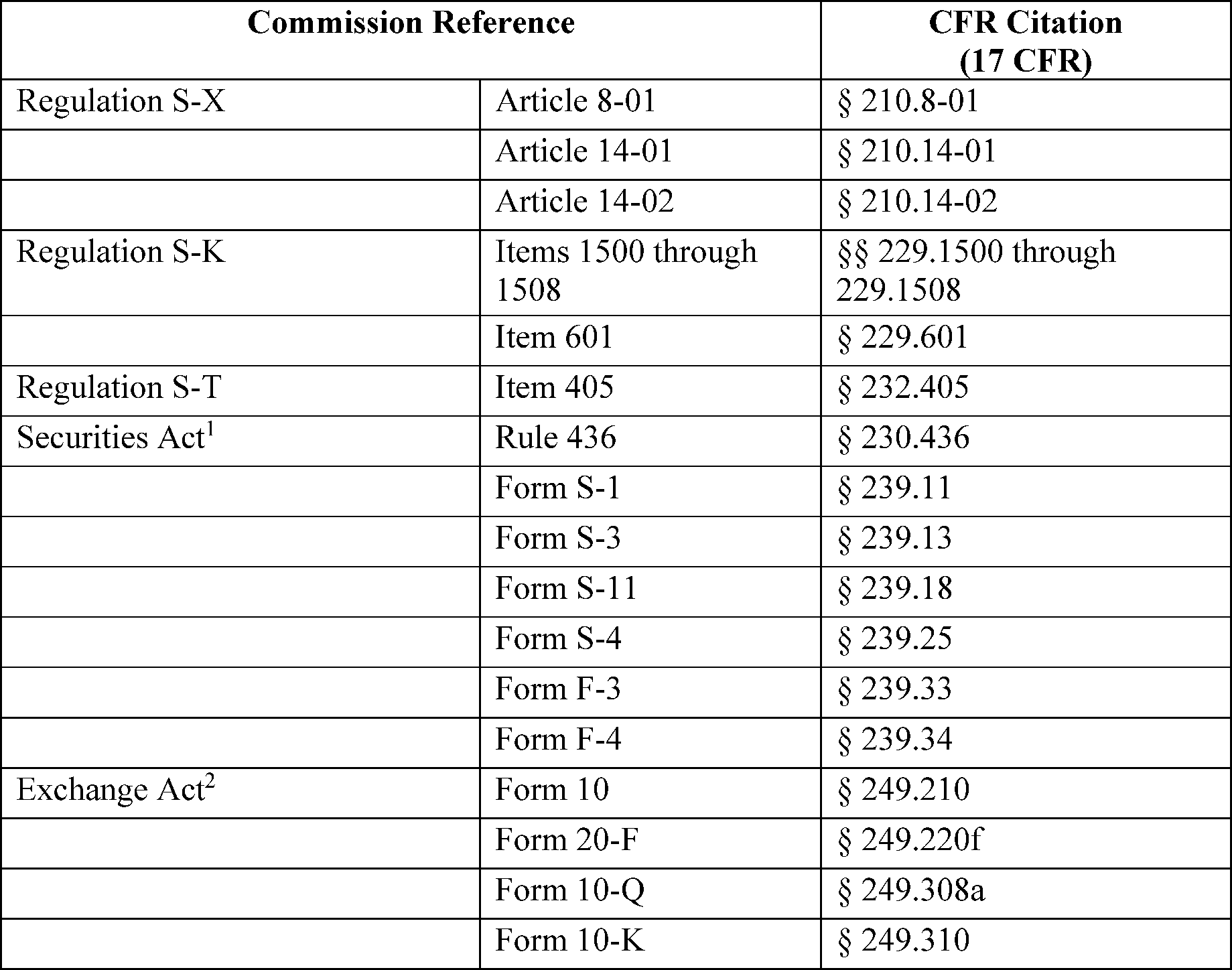
The Commission is proposing to withdraw certain previously adopted but not yet effective amendments to the following rules and forms:
( printed page 33297)
I. Overview
II. Adoption of The Final Rules And Subsequent Litigation
III. Discussion of Proposed Rescission
A. Overview of Basis for Rescission: Lack of Authority and Reevaluation of Policy Grounds
B. The Final Rules Exceed the Commission's Statutory Authority
1. Scope of the Commission's Disclosure Authority
2. The Final Rules Exceed the Limitations on Mandatory Disclosures
3. The Final Rules Should Be Rescinded in Their Entirety
C. Policy Reasons for Rescinding the Final Rules
1. The Final Rules Are Unnecessary and Inconsistent With a Registrant-Specific, Materiality-Based Approach to Disclosure That Best Serves the Interests of Registrants and Investors
2. The Final Rules Stray Well Beyond the Policy Concerns of the Federal Securities Laws
3. The Final Rules Impose Significant Costs on Public Companies and Their Shareholders That Are Not Justified by the Informational Benefits They Provide to Some Investors
4. The High Costs of the Final Rules Are at Odds With the Commission's Policy Objectives of Facilitating Capital Formation and Promoting Public Company Status
IV. Economic Analysis
A. Introduction
B. Economic Baseline
1. Affected Parties
2. Current Regulatory Framework
3. Current Market Practices
C. Benefits and Costs
1. Benefits
2. Costs
3. Aggregate Monetized Benefits and Costs
D. Anticipated Effects on Efficiency, Competition, and Capital Formation
E. Reasonable Alternatives
F. Request for Comment
V. Paperwork Reduction Act
VI. Initial Regulatory Flexibility Act Analysis
A. Reasons for, and Objectives of, the Proposed Action
B. Legal Basis
C. Small Entities Subject to the Proposed Amendments
D. Projected Reporting, Recordkeeping, and Other Compliance Requirements
E. Duplicative, Overlapping, or Conflicting Federal Rules
F. Significant Alternatives
G. Request for Comment
VII. Congressional Review Act
VIII. Other Matters
Statutory Authority
I. Overview
We propose to rescind the climate-related disclosure rules adopted by the Commission in 2024 (“Final Rules”).[3]
Congress gave the Commission certain specific powers within the Federal securities laws. Among those powers, the Commission's governing statutes authorize the agency to except from or add to the mandatory items of disclosure specified in the Securities Act and the Exchange Act.[4]
This authority, however, is limited by the text and context of these statutes. Furthermore, even when acting pursuant to an explicit grant of authority, it is incumbent on the Commission to implement a disclosure regime that elicits material information
( printed page 33298)
for investors while being mindful of the costs imposed on registrants to collect and disclose that information. When the Commission loses sight of these considerations, it risks not only imposing undue costs on registrants [5]
and impeding capital formation, but also harming the very investors it seeks to protect.
The Final Rules were a dramatic overreach of the Commission's statutory authority and, independently, unsound as a matter of policy. Based on an incorrect view of the scope of its authority, the Commission determined that it was appropriate to prescribe dozens of pages of highly specific disclosure rules solely about climate-related matters [6]
and apply the bulk of those rules to virtually all public companies, regardless of size, industry, or specific circumstances.
The Final Rules also discounted the role of market forces in the flow of information between registrants and investors. Disclosures mandated by the Commission are only some of the information registrants provide to the marketplace. Investors and analysts often demand additional information about a wide range of topics depending on their particular investment strategies or non-investment interests. Registrants in turn may voluntarily provide such information depending on the nature of their business and the investor base they wish to attract. We expect this market-driven flow of information will continue following a rescission of the Final Rules, but it is not the Commission's role to require disclosure of particular information because it is useful for any one investment strategy or desired by some political interests for the purpose of influencing business practices. Rather, in exercising its authority to
mandate
disclosure within the statutory limits imposed by Congress, the Commission should seek to adopt rules that elicit information pursuant to the standard of materiality established by the Supreme Court: information that a reasonable investor would consider important in buying or selling securities.[7]
Accordingly, as discussed in more detail in the sections that follow, we propose to rescind the Final Rules in their entirety because they exceed the statutory limits on the Commission's disclosure authority. Furthermore, even if the Commission had authority to adopt the Final Rules, several independent policy reasons support their rescission, including that:
The Final Rules are unnecessary and inconsistent with a registrant-specific, materiality-based approach to disclosure;
The Final Rules stray well beyond the policy concerns of the Federal securities laws;
The Final Rules impose substantial costs that are not justified by the informational benefits they may provide to some investors; and
The Final Rules are at odds with the Commission's policy objectives of facilitating capital formation and promoting public company status.
II. Adoption of the Final Rules and Subsequent Litigation
On March 21, 2022, the Commission proposed rules that would require registrants to include extensive new climate-related disclosures in their registration statements and periodic reports, including detailed information about the impact and management of climate-related risks, GHG emissions, scenario analysis, internal carbon prices, and certain climate-related financial statement effects.[8]
The Proposing Release was highly contentious,[9]
and in response, the Commission received a large number of comments from a variety of market participants, environmental lobbying groups, and members of the public expressing starkly divergent views about the proposed rules.[10]
Some commenters supported the proposed rules, stating that climate-related risks can have material impacts on a company's financial position or performance.[11]
Commenters in support of the proposed rules indicated, among other things, that adoption of mandatory, climate-related disclosure rules would improve the timeliness, quality, and reliability of climate-related information, which would facilitate investors' cross-company comparisons of climate-related risks and lead to more accurate securities valuations.[12]
Many other commenters opposed the proposed rules and requested either that the Commission not adopt the proposal or make significant revisions in the Final Rules.[13]
Some commenters asserted that the Commission lacked statutory authority to adopt the proposed rules.[14]
Others stated that existing voluntary reporting practices were sufficient to serve the needs of investors and markets such that the proposed rules were unnecessary.[15]
Opposing commenters further stated that the proposed rules were overly prescriptive, that they were not bound in every instance by a materiality qualifier, that their adoption would result in the disclosure of a large volume of immaterial information that would be confusing to investors, and that mandating such disclosure requirements would impose a significant burden on registrants while resulting in few additional benefits for investors.[16]
On March 6, 2024, the Commission approved the Final Rules by a 3-2 vote. While the Final Rules included changes from the proposal in response to commenter concerns, the adopted regulations continued to include numerous, highly prescriptive disclosure requirements. To house the extensive new disclosure requirements, the Final Rules created a new subpart 1500 of Regulation S-K [17]
and a new Article 14 of Regulation S-X.[18]
Among other things, the Final Rules require a registrant to consider and possibly disclose the following detailed items:
If a registrant is a large accelerated filer (“LAF”), or an accelerated filer (“AF”) that is not otherwise exempted, and its Scope 1 emissions and/or its Scope 2 emissions metrics [19]
are material, certain disclosure about those emissions, including:
The volume of the emissions disclosed separately and each expressed
( printed page 33299)
in the aggregate, in terms of CO2
e [20]
and, if any constituent gas of the disclosed emissions is individually material, such constituent gas disaggregated from other gases;
Scope 1 emissions and/or Scope 2 emissions in gross terms by excluding the impact of any purchased or generated offsets;
The methodology, significant inputs, and significant assumptions used to calculate the GHG emissions;
The organizational boundaries used when calculating the registrant's disclosed GHG emissions, including the method used to determine those boundaries;
The operational boundaries used, including the approach to categorization of emissions and emissions sources; and
The protocol or standard used to report the GHG emissions, including the calculation approach, the type and source of any emission factors used, and any calculation tools used to calculate the GHG emissions; [21]
If a registrant's use of internal carbon pricing is material, the price per metric ton of CO2
e and the total price, including how the total price is estimated to change over certain time periods; [22]
Any climate-related risks that have materially impacted or are reasonably likely to have a material impact on the registrant, including on its strategy, results of operations, or financial condition; [23]
Any oversight by the board of directors of climate-related risks, regardless of the materiality of those risks, and any role by management in assessing and managing the registrant's material climate-related risks; [24]
Any processes the registrant has for identifying, assessing, and managing material climate-related risks and, if the registrant is managing those risks, whether and how any such processes are integrated into the registrant's overall risk management system or processes; [25]
and
If a registrant has set a climate-related target or goal that has materially affected or is reasonably likely to materially affect the registrant's business, results of operations, or financial condition, certain disclosures about such target or goal, including material expenditures and material impacts on financial estimates and assumptions as a direct result of the target or goal or actions taken to make progress toward meeting such target or goal.[26]
With respect to financial statement disclosures:
The capitalized costs, expenditures expensed, charges, and losses incurred as a result of severe weather events and other natural conditions, such as hurricanes, tornadoes, flooding, drought, wildfires, extreme temperatures, and sea level rise, subject to applicable one percent and de minimis disclosure thresholds; [27]
The capitalized costs, expenditures expensed, and losses related to carbon offsets and renewable energy credits or certificates (“RECs”) if used as a material component of a registrant's plans to achieve its disclosed climate-related targets or goals; [28]
and
If the estimates and assumptions a registrant uses to produce the financial statements were materially impacted by risks and uncertainties associated with severe weather events and other natural conditions, such as hurricanes, tornadoes, flooding, drought, wildfires, extreme temperatures, and sea level rise, or any disclosed climate-related targets or transition plans, a qualitative description of how the development of such estimates and assumptions was impacted.[29]
In addition, registrants that are required to disclose Scopes 1 and/or 2 emissions must file an attestation report of those emissions subject to phased-in compliance dates.[30]
Further, the Final Rules require a registrant that is not required to disclose its GHG emissions or to include a GHG emissions attestation report pursuant to the Final Rules to disclose certain information if the registrant voluntarily discloses its GHG emissions in a Commission filing and voluntarily subjects those disclosures to third-party assurance.[31]
The Final Rules exempt certain registrants from disclosure in limited circumstances.[32]
Outside these limited circumstances, the Final Rules require almost every registrant to comply with the vast majority of the new disclosure requirements after a transition period.[33]
As the Adopting Release noted, nearly every registrant will be required to start complying with the Final Rules by the fiscal year beginning in 2027.[34]
Within 60 days of the Commission's adoption of the Final Rules on March 6, 2024, various parties petitioned for judicial review in multiple Federal courts of appeals.[35]
On March 19, 2024, the Commission filed a Notice of Multicircuit Petitions for Review with the Judicial Panel on Multidistrict Litigation (“JPML”), and on March 21, 2024, the JPML issued an order consolidating the petitions for review in the U.S. Court of Appeals for the Eighth Circuit (“Eighth Circuit”).[36]
On April 4, 2024, the Commission, citing its authority pursuant to the Exchange Act [37]
and the Administrative Procedure Act,[38]
entered a stay of the Final Rules and ordered that “the Final Rules [would be] stayed pending the completion of judicial review of the consolidated Eighth Circuit petitions.” [39]
On March 27, 2025, the Commission voted to end its defense of the rules. The Commission staff sent a letter to the court stating that the Commission withdraws its defense of the rules and that Commission counsel are no longer authorized to advance the arguments in the brief the Commission had filed. Thereafter, on September 12, 2025, the Eighth Circuit issued an Order holding the consolidated petitions for review in abeyance “until such time as the . . . Commission reconsiders the challenged Final Rules by notice-and-comment
( printed page 33300)
rulemaking or renews its defense of the Final Rules.” [40]
The Eighth Circuit explained that it is the Commission's “responsibility to determine whether its Final Rules will be rescinded, repealed, modified, or defended in litigation.” [41]
As a result of the current procedural posture, the Final Rules remain stayed. The court has not made any decision on the merits of any arguments presented by any petition for review of the Final Rules.
III. Discussion of Proposed Rescission
A. Overview of Basis for Rescission: Lack of Authority and Reevaluation of Policy Grounds
As noted above, we are proposing to rescind the Final Rules in their entirety because they exceed the scope of the Commission's statutory authority. In addition, even if a court were to find that the Commission had authority to adopt the Final Rules, we have independent, compelling policy reasons to rescind the rules in their entirety. The Final Rules are unnecessary and inconsistent with a registrant-specific, materiality-based approach to disclosure that best serves the interests of registrants and investors; stray well beyond the policy concerns of the Federal securities laws; impose substantial costs on public companies and their shareholders that are not justified by the informational benefits they may provide to some investors; and are at odds with the Commission's policy objectives of facilitating capital formation and promoting public company status.
B. The Final Rules Exceed the Commission's Statutory Authority
A fundamental principle of constitutional and administrative law is that an administrative agency must act within its statutory authority.[42]
An agency acts unlawfully when it exercises power beyond its authority.[43]
Agencies must respond to their own unlawful acts; as the Supreme Court recently put it, illegal agency action “presumably requires remedial action of some sort.” [44]
The proper remedy for the Commission's lack of statutory authority to adopt the Final Rules is rescission.
An agency's rulemaking power is determined by examining the text and context of the relevant statutory provisions. Statutory provisions are not read in isolation; courts look to their place in the overall statutory scheme.[45]
Courts also apply the major questions doctrine to determine the lawfulness of agency action.[46]
In the Federal securities laws, Congress required specific disclosures for registrants conducting public offerings in the United States or registering securities for trading on U.S. exchanges. When enacting the Securities Act and the Exchange Act, Congress explicitly called for disclosures of items central to an understanding of a registrant's business, operation and performance, financial condition, directors, management and control, capital structure, the rights of security holders, and the terms of a registered offering.[47]
These disclosures provide investors with operational and financial information particular to the circumstances of the registrant.
Congress also granted the Commission authority to adopt rules eliminating, substituting, or adding certain disclosures. When adopting such a rule, the Commission must follow the directives and guardrails in the text and context of the governing statutes, as discussed below.
When the Commission exercises its legal authority to adopt a disclosure rule under the statutes discussed below, in certain instances it must also determine whether the action is necessary or appropriate in the public interest.[48]
When making such a public interest determination, the Commission must “consider, in addition to the protection of investors, whether the action will promote efficiency, competition, and capital formation.” [49]
These considerations are constraints on the exercise of authority, not sources of authority.
Courts have also recognized that federalism limits the Commission's rulemaking authority in areas of corporate governance regulated by State law.[50]
Congress has traditionally left
( printed page 33301)
corporate governance to the States to regulate, and it has spoken clearly on the rare occasions when it has shifted that balance.[51]
As discussed below, the Final Rules do not satisfy the statutory criteria for adopting additional disclosure provisions under the Securities Act or Exchange Act. The disclosures compelled by the Final Rules are not within the scope of the categories of disclosures Congress required and do not comport with the directives Congress set for excepting from, substituting, or adding to those disclosures. They also improperly intrude on State corporate law without a statutory directive. Accordingly, we propose to rescind the Final Rules in their entirety.
1. Scope of the Commission's Disclosure Authority
We first examine the text and context of Congress's directions on mandatory disclosures and then consider the Commission's ability to make changes to them. The main statutory provisions discussed in the Adopting Release were sections 7(a)(1) [52]
and 19(a) [53]
of the Securities Act and sections 12,[54]
13 [55]
and 23(a)(1) [56]
of the Exchange Act.[57]
a. Text of the Disclosure Rulemaking Statutes in the Securities Act and Exchange Act
Section 7(a)(1) of the Securities Act establishes that Schedule A [58]
is the base disclosure for a registration statement and also permits the Commission to except from or add to the disclosure requirements enumerated in Schedule A. Section 7(a)(1) provides that a registration statement for a public offering “shall contain the information” and documents “specified in Schedule A” of the Securities Act.[59]
Schedule A contains 32 disclosure items, such as the business of the company, its capital structure, use of proceeds from the sale of securities, director and officer compensation, material contracts, the terms of the offering and detailed balance sheet and profit or loss statements.
Section 7(a)(1) gives the Commission the authority to except from or add to Schedule A's required disclosures in certain circumstances. The Commission may by rule provide that a class of issuers does not need to include information listed in Schedule A if the Commission finds that the information is not applicable to that class “and that disclosure fully adequate for the protection of investors is otherwise required to be included within the registration statement.” Section 7(a)(1) concludes with a provision authorizing the Commission to add disclosure requirements to Schedule A: “Any such registration statement shall contain such other information, and be accompanied by such other documents, as the Commission may by rules or regulations require as being necessary or appropriate in the public interest or for the protection of investors.” [60]
Section 12 of the Exchange Act similarly requires certain categories of disclosures while allowing the Commission to prescribe the level of detail and to alter the requirements under specified conditions. Section 12 stipulates the information to be filed and made public by a company registering a class of securities on a national securities exchange or that is required to register a class of equity securities under the Exchange Act. Section 12(b)(1) provides that a registration statement must contain 12 enumerated categories of information, such as the financial structure and nature of the business, the terms of classes of securities, the financial interests of directors and officers in the company, certain material contracts, and certain financial statements.[61]
Within those 12 categories, the Commission may require a registration statement to include “[s]uch information, in such detail,” as to the issuer and any control persons “as necessary or appropriate in the public interest or for the protection of investors . . . .” [62]
Section 12(c) gives the Commission the authority to determine that an item listed in section 12(b) is not applicable to a class of issuers. If it does, “the Commission shall require in lieu thereof the submission of such other information of comparable character as it may deem applicable to such class of issuers.” [63]
Unlike section 7(a)(1) of the Securities Act, section 12 of the Exchange Act does not otherwise permit the Commission to add to the list of disclosure items in section 12(b).
Section 13(a) of the Exchange Act provides the Commission with authority to prescribe periodic disclosure rules for issuers with securities registered under section 12.[64]
The Commission shall require such an issuer “to keep reasonably current the information and documents required to be included in or filed with” an application or registration statement [65]
and may require the issuer to file annual and quarterly reports.[66]
Any rules promulgated under section 13 must be “necessary or appropriate for the proper protection of investors and to insure fair dealing in the security.” [67]
As with section 12(c), section 13(c) instructs that if the Commission concludes “any report required under subsection (a) in inapplicable to any specified class or classes of issuers, the Commission shall require in lieu thereof the submission of such reports of comparable character as it may deem applicable . . . .” [68]
( printed page 33302)
These statutory provisions establish the Commission's power to compel disclosures in public offerings and by companies registering securities for public trading. Congress restricted the information an issuer or reporting company must disclose to items central to an understanding of the company's business or financial characteristics. These categories of information are fundamental to valuing the risks and returns of an investment in the registrant's securities.
b. The Commission's Authority To Change Mandatory Disclosures
As noted above, Congress permitted the Commission to make changes to the mandatory disclosures within certain limits. In this way, Congress contemplated developments in mandatory disclosure requirements but gave context and guidance for them in the governing statutes.
The relevant part of section 7(a)(1) of the Securities Act states that the Commission may require the disclosure of “such other information” not adequately covered by Schedule A if such item is “necessary or appropriate in the public interest or for the protection of investors.” [69]
Section 7(a)(1) also provides that the Commission may exclude from or adopt a substitute for an item in Schedule A for a class of issuers if it finds the item is not applicable and “that disclosure fully adequate for the protection of investors is otherwise required to be included within the registration statement.” [70]
Section 12(b)(1) of the Exchange Act authorizes the Commission to determine the “detail” for the twelve enumerated categories of disclosures listed by Congress for applications to register securities on an exchange or in certain other circumstances.[71]
And if one of those enumerated categories “is inapplicable to any specified class or classes of issuers,” the Commission “shall require in lieu thereof the submission of such other information of comparable character as it may deem applicable to such class of issuers,” [72]
closely tying the Commission's power to modify the required disclosures to Congress's original specifications. Under section 13(a) of the Exchange Act, the Commission has authority to prescribe rules requiring issuers with securities registered under section 12 “to keep reasonably current” the information and documents required by section 12(b)(1) for the registration statement and to file annual and quarterly reports.
The Securities Act and Exchange Act work together in certain circumstances. Experience with disclosures of reporting companies under section 12 of the Exchange Act may inform the Commission about the need for or inapplicability of disclosures under section 7(a)(1) of the Securities Act. Detailed disclosures or disclosures of comparable character or current information added under section 12 for reporting companies may also guide the Commission's determination about disclosures necessary for the protection of investors in a registration statement required by the Securities Act. This interrelationship between statutory provisions provides the foundation for the Commission's existing integrated disclosure system.
The Commission's rulemaking with respect to disclosures must be “channel[ed]” by and comparable to the kinds of disclosures recited in the statutes,[73]
which refer to a registrant's business or financial characteristics. This follows from the text of the Commission's enabling statutes. As previously discussed, section 12 of the Exchange Act authorizes the Commission to specify the “detail[s]” surrounding Congress's chosen topics [74]
and to substitute those topics with others for certain issuers—provided (among other things) that those substitute disclosures are “in lieu of” Congress's specified fields and “of comparable character.” [75]
Other requirements in sections 7(a)(1), 12(b)(1), and 13(a) also guide the Commission in exercising its authority to adopt disclosure rules. The Commission must determine that a rule is “necessary or appropriate in the public interest or for the protection of investors.” That public interest determination also requires consideration of efficiency, competition, and capital formation.[76]
To be necessary, an addition to required disclosures should cover information not adequately elicited by an existing mandatory disclosure. To be appropriate, the additional disclosures must elicit information comparable to that elicited by the disclosures specified by Congress.
Courts have consistently held that the inclusion of the “words ‘public interest’ in a regulatory statute is not a broad license to promote the general public welfare. Rather, the words take meaning from the purposes of the regulatory legislation.” [77]
The purposes, in turn, are discerned from the text and context of a statute, which limits the scope of what is necessary or appropriate.[78]
For mandatory disclosures in public offerings or periodic reports, this means that any additional, substitute, or more detailed disclosure requirements must be related to the registrant's business or financial characteristics.[79]
Congress did not license the agency to act as a “roving commission to inquire into [the] evils” of corporate behavior “and upon discovery correct them.” [80]
Indeed, the
( printed page 33303)
fact that Congress required the Commission to consider efficiency, competition, and capital formation when making a public interest determination further illustrates that “public interest” was not intended to be construed in some vague, open-ended sense but rather in terms of the public interest in well-functioning securities markets.
Likewise, the words “protection of investors” do not empower the Commission to mandate any disclosure that an investor may find useful or desirable.[81]
In the Adopting Release, the Commission made general assertions that climate-related information was “important” to investors [82]
and that the Final Rules would make the disclosures more consistent, comparable, and reliable.[83]
Those considerations may play a role in the Commission's assessment of whether a potential disclosure obligation is necessary or appropriate or promotes efficiency and capital formation, but they are not a freestanding statutory authorization to expand disclosure beyond the types of information Congress specified. If they were, there would be no meaningful limits on the Commission's statutory authority.[84]
Under such a reading, the Commission could mandate disclosure about virtually any topic, however contentious, esoteric, or parochial, provided that some subset of investors may find the information relevant to their decisions to buy or sell the registrant's securities.
Expansive notions of the public interest and protection of investors do not provide a basis for straying beyond the types of business or financial characteristics that Congress specified. Generalized invocations of “importance to” and “interests of” investors or “investor demand” [85]
are not adequately grounded in the text, context, and limitations of the law to provide a basis for rulemaking. The statutes also do not mention consistency or comparability as a basis for a disclosure rule. Notwithstanding the Commission's assertions in the Adopting Release, these justifications do not authorize the Commission to “update and build on” the disclosures specified in the Federal securities laws “by requiring additional disclosures of information.” [86]
Materiality is also a key part of the Commission's application of legal authority when it adopts disclosure rules. Information is material if there is a substantial likelihood that a reasonable investor would consider it important or significant in deciding whether to buy or sell a security.[87]
The common interest of reasonable investors is in information regarding the financial performance of a company, the pricing of securities, and the prospect for economic and financial return from the disclosing company.[88]
Accordingly, materiality is a concept inherently rooted in financial considerations.
While “materiality” is not referenced in the statutory provisions that were relied upon to promulgate the Final Rules and does not itself provide a separate basis for a disclosure obligation, this concept bears directly on the Commission's consideration of investor protection, efficiency, and capital formation. Immaterial disclosures do not further the “public interest” or “protection of investors”—indeed, they are likely to frustrate such objectives. The materiality standard filters out information that a reasonable investor would not consider important, protects investors from being buried in an avalanche of trivial information, and prevents the registrant from having to collect and disclose every minor detail about its operations.[89]
Therefore, assuring that mandatory disclosures elicit material information is frequently part of the Commission's required determination that such disclosures advance the goals of investor protection, efficiency, and capital formation.
The Commission's accepted past practices illustrate these limits on its authority in operation. Current Regulation S-K, for example, contains instances of the Commission exercising its authority to adopt disclosure rules based on enumerated items of disclosure in Schedule A of the Securities Act and section 12(b)(1) of the Exchange Act. For example, Schedule A requires disclosures about securities held by officers, directors, promoters, and large shareholders and their intention to subscribe to purchases under the registration statement (paragraph 7) and the purposes for which the offered securities will supply funds (paragraph 13), but Schedule A does not explicitly require disclosures about shareholders intending to sell securities pursuant to the registration statement. Item 507 of Regulation S-K [90]
requires disclosures about the names of selling shareholders, their material relationships with the issuer, and the amount they plan to sell, but these disclosures are “channel[ed]” by the kinds of disclosures recited in paragraphs 7 and 13 of Schedule A.[91]
As another example, to address concerns with managerial self-dealing, paragraphs 14, 20, 22, and 24 of Schedule A and section 12(b)(1)(D) through (F) require disclosures of remuneration to officers, directors, underwriters, and “other persons” over certain dollar amounts and the interests of directors, officers, and large shareholders in the securities of the issuer and material contracts they have with the issuer. Item 404 of Regulation S-K,[92]
which requires disclosure about
( printed page 33304)
transactions with related persons, is not identical to the enumerated items in Schedule A, but it is channeled by Schedule A's disclosures concerning managerial self-dealing. Similarly, Item 404 spells out certain details related to the section 12(b)(1) disclosures.[93]
The ability to require substitute or added disclosures also enables the Commission to adapt current disclosure rules for novel financial assets or transaction structures that qualify as securities or securities transactions, subject to the same directives and guardrails discussed above. For example, instead of remuneration or payments to officers, directors, and promoters, the Commission could substitute “information of comparable character.” [94]
When read in the context of the mandatory disclosures in sections 7(a)(1) and 12(b)(1), it is clear that these statutes do not authorize the Commission to mandate any and all information that it deems desirable. Nor does section 13(a) give the Commission a general, freestanding power to mandate ongoing disclosures.[95]
Rather, disclosure rules adopted by the Commission must be “channel[ed]” by [96]
and comparable to the disclosures Congress specified in the Acts, which concern the registrant's business or financial characteristics. Despite suggestions to the contrary in the Adopting Release, the Commission is not free to construct a new disclosure regime out of whole cloth. In adopting the Final Rules, the Commission did not sufficiently adhere to these limits or determine the best interpretation of the relevant statutes.[97]
Instead, the Commission relied on an impermissibly broad reading of its statutory authority.
2. The Final Rules Exceed the Limitations on Mandatory Disclosures
The Final Rules did not respect the limitations on the Commission's authority and are fundamentally different from the types of enumerated disclosures found in the Commission's governing statutes. Those enumerated disclosures refer to a company's business or financial characteristics. By contrast, the Final Rules mandate highly specific and granular information on the sole topic of climate-related matters, such as operational and governance practices and internal metrics (including GHG emissions) that many registrants may not track or use for business purposes.[98]
These disclosure obligations do not fit within the powers conferred by the statutes discussed above. While the Commission in certain other circumstances has required disclosures that are tailored to specific risks facing the disclosing company in a particular industry,[99]
no prior example comes close to the breadth of disclosures required by the Final Rules, which apply across the board. The Final Rules are not comparable to the disclosures called for by the Commission's governing statutes, which refer to a company's business or financial characteristics.
The subject of each new disclosure mandated by the Final Rules, by contrast, was climate-related risks and strategies for managing those risks, as well as the financial statement effects of severe weather events and other natural conditions. Many of these disclosures were only secondarily or remotely about the past or immediate effects of climate-related matters on the operations, revenue, expenses, capital structure, liquidity, management or controlling shareholders of the registrant. For example, the Final Rules require disclosure about climate-related impacts on third parties (such as suppliers, purchasers, or counterparties to material contracts) [100]
as well as transition risks—defined expansively to include, among other things, “the actual or potential negative impacts on a registrant's business . . . attributable to regulatory, technological, and market changes, . . . changes in law or policy, reduced market demand for carbon intensive products, . . . [and] competitive pressures associated with the adoption of new technologies, and reputational impacts . . . .” [101]
The Final Rules also require the disclosure of internal analysis and metrics, such as scenario analysis [102]
and internal carbon prices.[103]
As discussed above, the Commission's disclosure authority under its governing statutes must be construed in light of the text and context of the surrounding statutory provisions. Nothing in these provisions expressly empowers the agency to burden public companies and their shareholders with such detailed (and costly) disclosures about one particular topic. Indeed, the scope of the Final Rules stands in stark contrast to the more limited and targeted disclosures the Commission has previously required on environmental matters, as discussed in section III.C.1.a.
Nor does the inclusion of materiality qualifiers salvage the Final Rules from their legal defects. While the Adopting Release claimed that such qualifiers would limit the scope, and therefore the burdens, of the Final Rules, as discussed in more detail in section III.C.3, the use of such qualifiers in such a complex, interconnected, and highly prescriptive set of disclosure requirements does not adequately cabin those requirements within the bounds of the Commission's authority. In particular, while the requirement to disclose Scope 1 and Scope 2 GHG emissions is qualified by materiality,[104]
it nonetheless requires covered registrants to devote significant time and resources to measure their emissions and determine whether they are material, including establishing organizational boundaries and operational boundaries and adopting a specific reporting protocol or standard.[105]
Only after it has invested potentially significant resources to perform this exercise can a registrant make a determination about whether such metrics are material and therefore must be disclosed.[106]
Rather than limiting the costs and burdens of the Commission's emissions reporting requirements, the rule's materiality qualifier effectively compels covered registrants to track and evaluate a metric
( printed page 33305)
they may not otherwise use for business purposes.
Similarly, invoking the impact of climate-related risks on a registrant's business, results of operations, or financial condition is not sufficient, in itself, to justify the Final Rule's myriad highly specific disclosure requirements. For example, the Final Rules require registrants to provide disclosures regarding their use of transition plans,[107]
scenario analysis,[108]
and internal carbon prices, if material.[109]
The Adopting Release repeatedly asserted that such disclosures were necessary to value a registrant's securities or evaluate its financial performance,[110]
but the exceedingly granular nature of the information required by the Final Rules goes well beyond what must be disclosed in respect of the many other factors that may affect the valuation of a registrant's securities. As noted above, to be necessary, an addition to required disclosures should cover material information not adequately elicited by an existing mandatory disclosure. When climate change or other environmental issues, including transition risk, have materially affected the operations or financial performance of a specific company, existing disclosure rules require discussion of the effects. Indeed, the Commission's
Guidance Regarding Disclosure Related to Climate Change[111]
lists a variety of specific existing disclosure obligations that, depending on the particular circumstances of a company, could require disclosure of climate change matters. For example, Item 303 of Regulation S-K requires, among other things, a company to disclose and discuss any known trend or uncertainty that has had a material positive or negative consequence for the company's results of operations.[112]
The fact that existing disclosure obligations already serve to provide investors with material information about climate-related matters reinforces the conclusion that the Final Rules are not “necessary” to protect investors.[113]
Indeed, they may even serve to harm investors by eliciting information about climate-related matters that goes well beyond what a reasonable investor needs to make an informed investment decision.[114]
In addition to creating a disclosure regime far beyond the kind authorized by the Commission's enabling statutes, the Final Rules also intrude on State authority over core matters of corporate governance. “No principle of corporation law and practice is more firmly established than a State's authority to regulate domestic corporations.” [115]
Although the Final Rules purport to require issuers only to
disclose
information, the effect of their requirements is to impermissibly regulate issuers' internal affairs. The many “ifs” in the Final Rules are telling in this regard. While framed in terms of risks to and impacts on the registrant, the disclosure mandates in the Final Rules effectively provide an aspirational framework for how public companies should manage climate-related matters.
The Commission's existing rules typically require disclosure of ongoing compliance or legal matters when they are material—they do not pressure or require registrants to create and maintain dedicated risk management systems that prioritize one category of risks above all others.[116]
By contrast, the Final Rules create a highly detailed and prescriptive regime focused on a single category of risk.[117]
For example, the Final Rules require disclosure of the board of directors' role in managing climate-related risks, which overlaps with existing disclosure requirements related to the role of the registrant's board in risk oversight.[118]
In addition, while materiality qualifiers were added at the adopting stage, given the detailed nature of the requirements, the Final Rules effectively require many registrants to conduct new analyses or gather new data for the sole purpose of determining
whether
they have a disclosure obligation.[119]
To house these extensive new reporting requirements, the Commission created a new subpart 1500 of Regulation S-K as well as a new Article 14 of Regulation S-X. Each of these regulations contain detailed line item requirements related to such varied matters as transition plans,[120]
scenario analysis,[121]
internal carbon prices,[122]
GHG emissions,[123]
and the aggregate amount of carbon offsets and RECs expensed.[124]
Most of these items apply equally across all types of registrants. The anticipated response of registrants to the creation of such a detailed regime dedicated to a single category of risks is clear: all registrants will pay attention to climate-related matters and dedicate significant board, executive, and employee resources to manage them. This broad mandate interferes with the management of companies and trenches
( printed page 33306)
upon the traditional role of States in regulating corporations.[125]
On the rare occasions when Congress has intervened in corporate governance, it has given explicit direction for the Commission to do so.[126]
Congress has not done so with respect to management of climate-related matters. Such a conduct-altering regime, unrelated to managerial self-dealing,[127]
simply was not contemplated by Congress when it specified the fundamental disclosures that a registrant should provide when conducting a public offering in the United States or trading in U.S. markets. This effort to regulate corporate management interferes with the role of the States in regulating corporate governance and contravenes the “clear statement” rule that the Supreme Court applies when regulatory actions raise federalism concerns.[128]
The past practices the Commission cited in the Adopting Release also do not justify the Final Rules. According to the Supreme Court, “[i]t is telling” when an agency that “has never before adopted a broad . . . regulation” over many decades now seeks to do so, suggesting “that the mandate extends beyond the agency's legitimate reach.” [129]
Until the Final Rules, the Commission had never before adopted a sweeping set of disclosure requirements on climate-related issues; indeed, in prior years, it specifically declined to do so.
In adopting the Final Rules, the Commission pointed as precedent to environmental disclosure requirements first adopted in the 1970s, asserting that “the Commission for the last fifty years has also required disclosure about various environmental matters.” [130]
But a complete and balanced reading of the record from the 1970s about environmental disclosures tells a different story. The dominant themes from the Commission at the time were doubts about its powers and how investors would use Commission-mandated environmental disclosures.[131]
The narrow disclosures adopted in the 1970s were in response to a specific congressional directive contained in the National Environmental Policy Act of 1969 (“NEPA”),[132]
which required the Commission and other Federal agencies to develop procedures to consider environmental values in decision-making. In 1975, in considering its obligations under NEPA, the Commission noted that “it is generally not authorized to consider the promotion of social goals unrelated to the objectives of the Federal securities laws.” [133]
It further observed that “the discretion vested in the Commission under the Securities Act and the Securities Exchange Act to require disclosure which is necessary or appropriate `in the public interest' does not generally permit the Commission to require disclosure for the sole purpose of promoting social goals unrelated to those underlying these Acts.” [134]
Rather, disclosure mandates under the Federal securities laws had to relate to the financial condition of, and matters of economic significance to, the disclosing company.[135]
The Commission therefore proposed and ultimately adopted a small number of narrow rules generally consistent with the disclosure framework in the Federal securities laws. For example, under the 1975 amendments, a reporting company must disclose material effects on capital expenditures, earnings, and competitive position from compliance with government environmental regulation.[136]
The 1975 rules did not include disclosure about environmental strategies or plans or board oversight of environmental risks; nor did they include expansive requirements that companies track and assess the environmental impact of their operations.
As recently as 2016, the Commission reconsidered its authority to require disclosures on environmental and social issues as part of a concept release on the business and financial disclosure requirements in Regulation S-K.[137]
Summarizing its 1975 conclusion on lack of statutory authority, the Commission observed that, in 1975, following extensive proceedings on these topics, the Commission concluded that it “generally is not authorized to consider the promotion of goals unrelated to the objectives of the federal securities laws when promulgating disclosure requirements, although such considerations would be appropriate to further a specific congressional mandate.” [138]
The Commission also observed that, since 1975, Congress had not given new statutory authority for disclosures in these areas.[139]
While the
( printed page 33307)
Commission in 2016 stated that the “role of sustainability and public policy information in investors' voting and investment decisions may be evolving” and solicited comment on the need for new sustainability and social disclosures, it also noted concerns about such disclosures and ultimately determined in 2020 to revise, but not significantly expand upon, the provisions adopted in 1975.[140]
In sum, until the Final Rules, the Commission has consistently declined to use its statutory authority to mandate expansive environmental disclosures; instead, the Commission has required certain targeted disclosures about regulatory compliance and legal liability that directly bear on the financial condition of the disclosing company. The rulemaking in the 1970s does not support the Commission's statutory authority to issue the Final Rules, which stray beyond those limits. It is precedent against that authority.
Finally, and for similar reasons, the major questions doctrine further demonstrates that the Commission lacked authority to promulgate the Final Rules. The Supreme Court has held that agencies must have clear authorization from Congress when embarking on a new and expansive regulation of a substantial policy area of “vast economic and political significance.” [141]
Political controversies are for Congress to resolve, not administrative agencies with limited delegated authority.[142]
In addition, when “agencies assert[ ] highly consequential power beyond what Congress could reasonably be understood to have granted,” or “claim[ ] to discover in a long-extant statute an unheralded power representing a transformative expansion [of] . . . regulatory authority,” “there is every reason to hesitate before concluding that Congress meant to confer” the power claimed.[143]
Moreover, “[w]hen an agency has no comparative expertise in making certain policy judgments, . . . Congress presumably would not task it with doing so.” [144]
Finally, an intrusion “into an area that is the particular domain of State law,” [145]
also provides a strong indicator that, “absent a clear statement” from Congress, a Federal agency has exceeded its statutory authority.[146]
These indicia that the Commission transgressed the limits of its statutory authority under the major questions doctrine are all present here. Whether and how public companies should respond to the perceived causes and effects of climate change is unquestionably of “vast economic and political significance”; [147]
answering those questions, even with respect to disclosure, requires “balancing the many vital considerations of national policy implicated in how Americans will get their energy.” [148]
And as explained above, while the Final Rules purport to require only disclosure, the effect of their requirements is to impermissibly regulate issuers' internal affairs. In this regard, the Final Rules stray into areas far beyond the Commission's comparative expertise. Moreover, by effectively mandating certain risk management practices, the Final Rules intrude on an area—corporate governance—traditionally governed by State law. Thus, the major questions doctrine applies to the Final Rules, but as explained in the preceding section, the Commission's authorizing statutes do not provide the needed clarity to justify such a dramatic expansion of regulatory authority.
The assertion of regulatory power under the Final Rules represents a “transformative expansion in [the Commission's] regulatory authority.” [149]
For example, the Final Rules require LAFs and AFs to disclose their Scope 1 emissions and/or Scope 2 emissions, if material, separately, each expressed in the aggregate, in terms of CO2
e.[150]
In addition, the Final Rules require registrants to provide disclosures regarding their use of transition plans,[151]
scenario analysis,[152]
and internal carbon prices, if material,[153]
as well as descriptions of their board of directors' oversight of climate-related risks, regardless of materiality.[154]
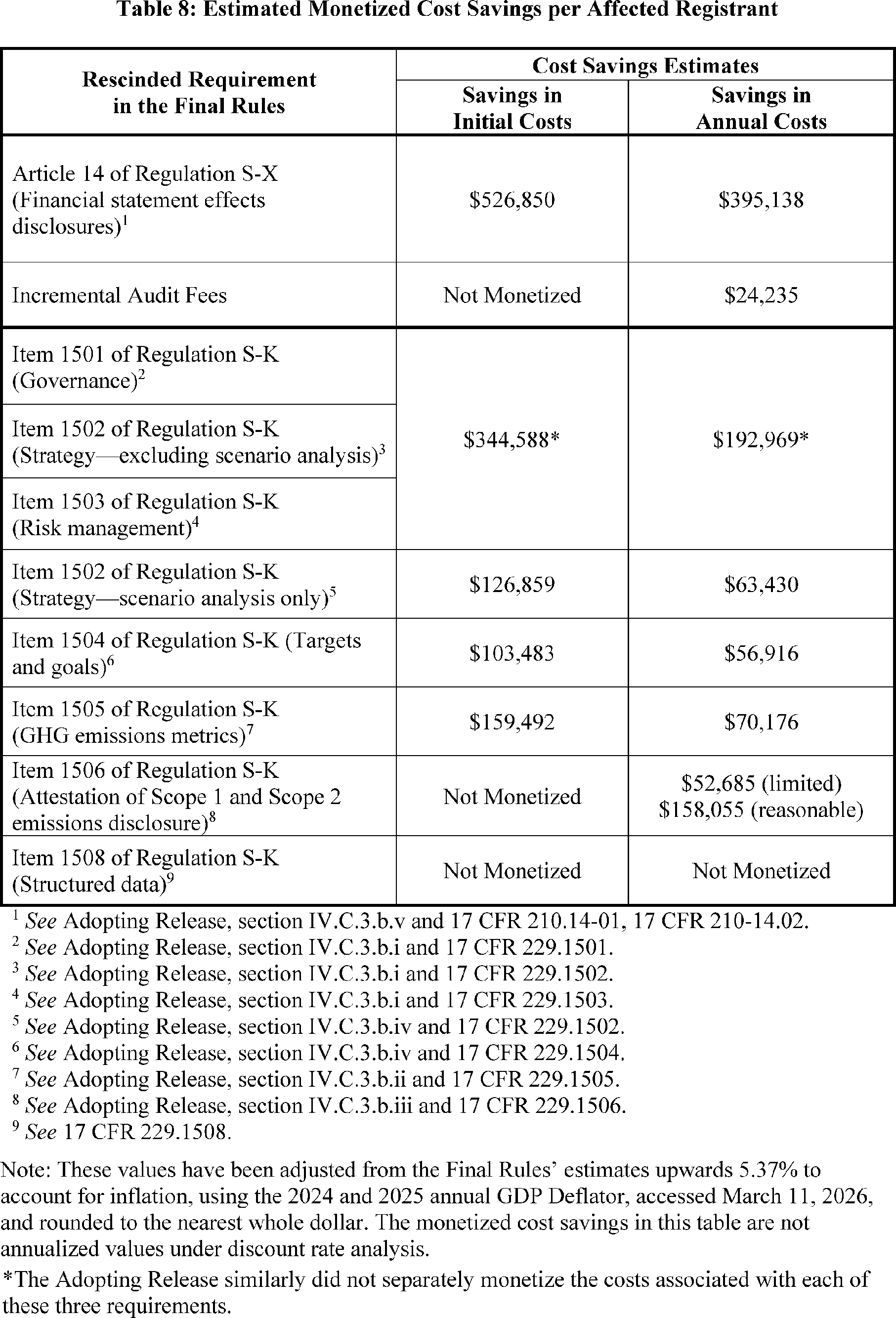
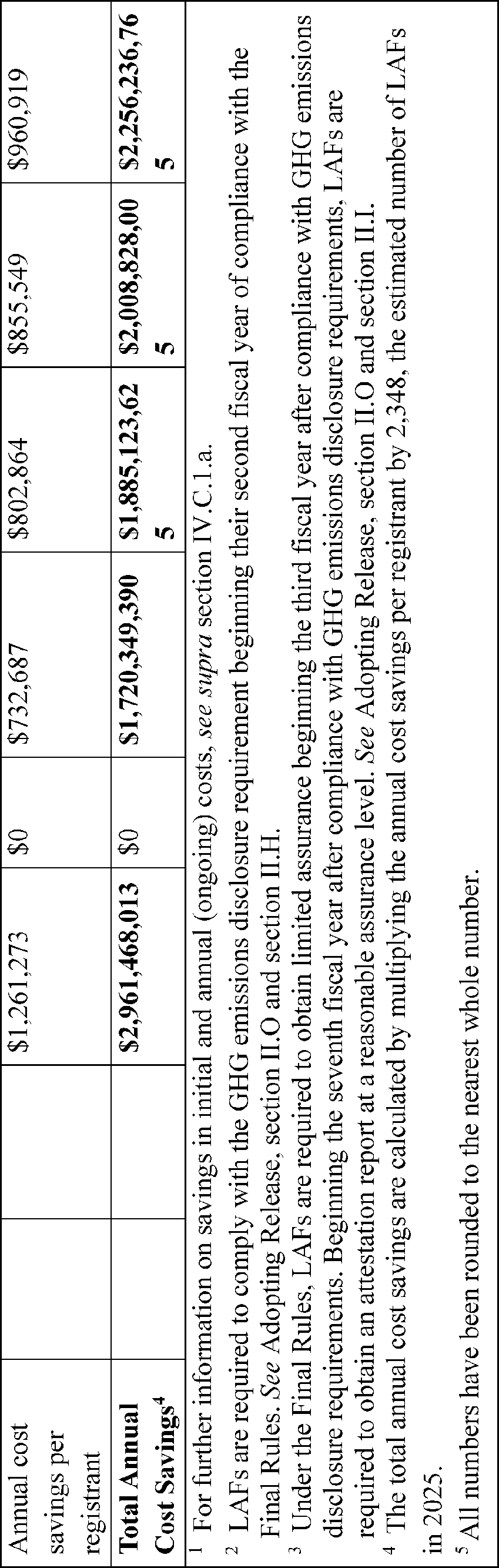
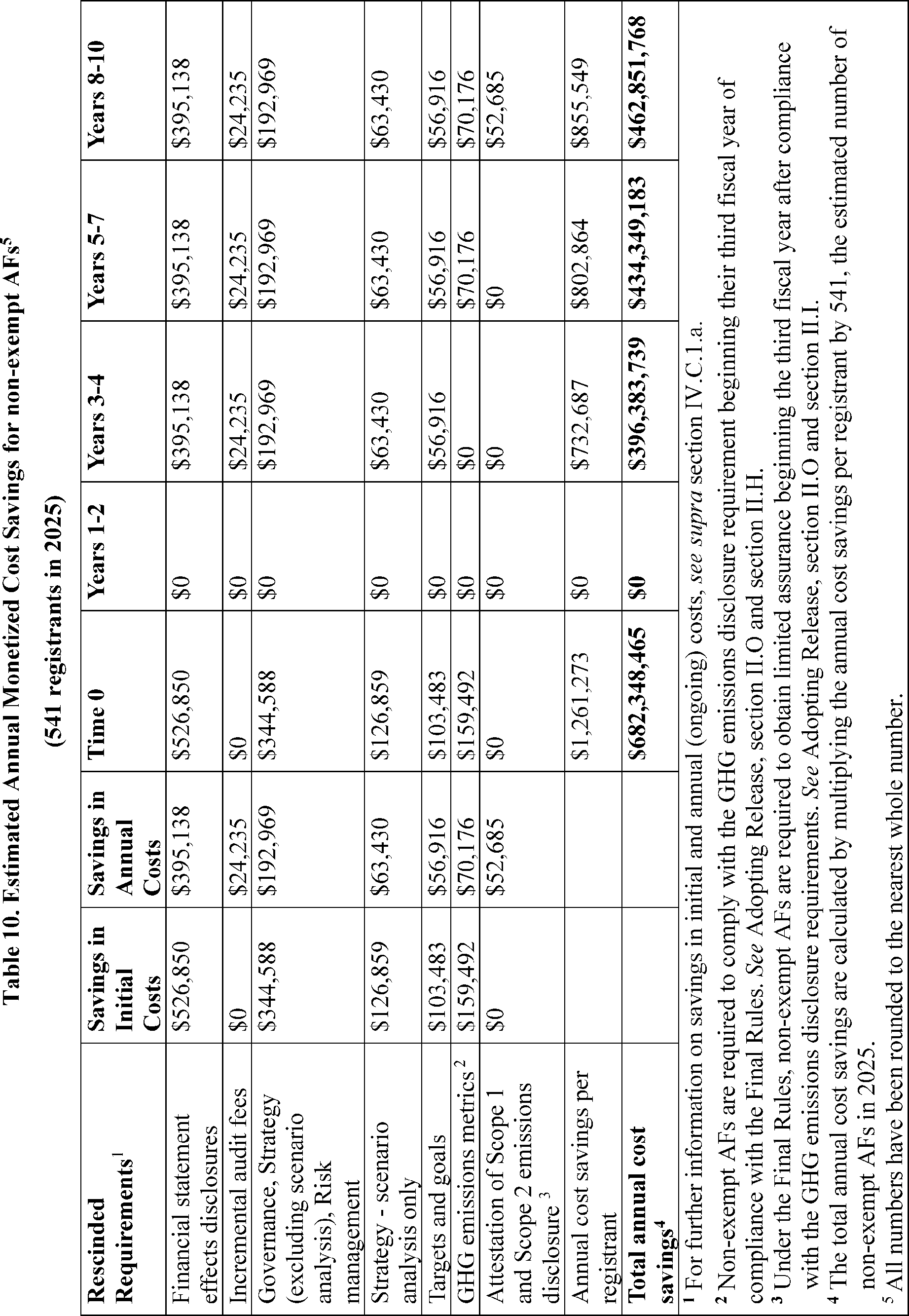
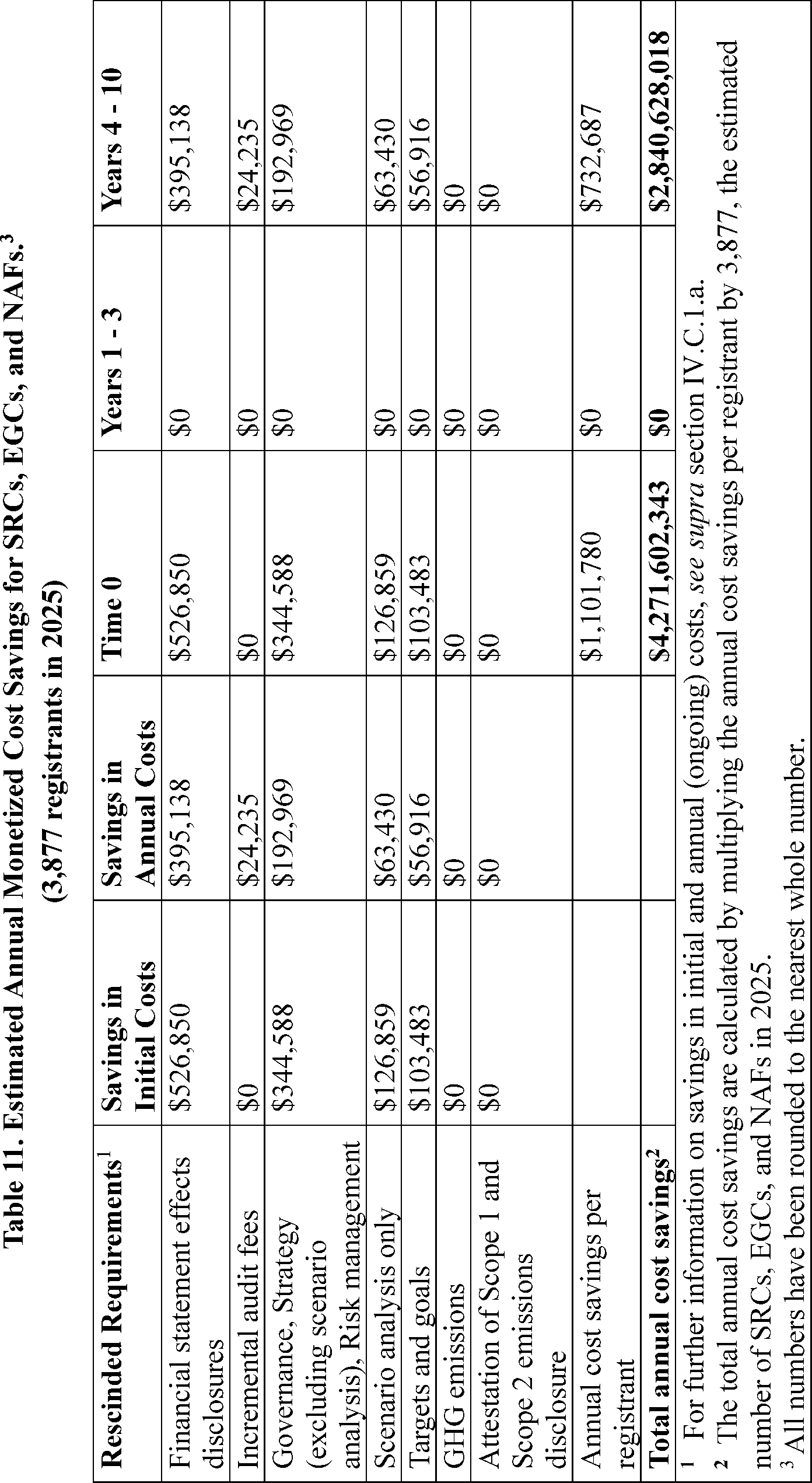
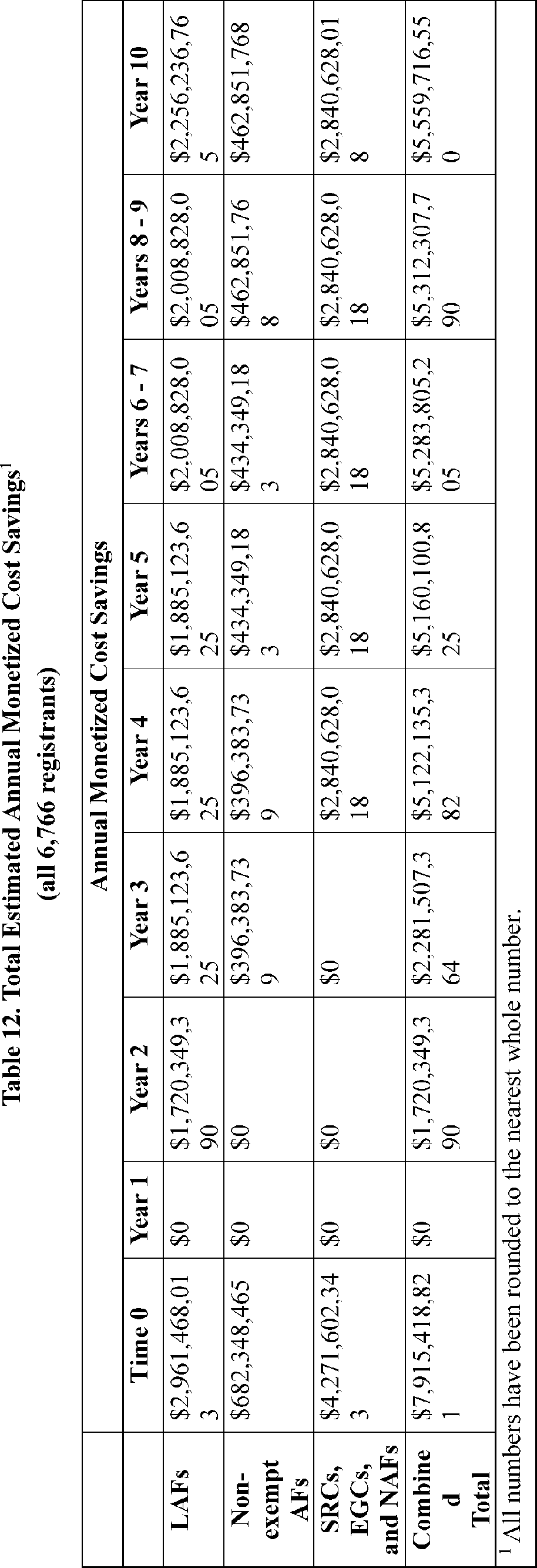
The scope of that expansion is reflected in the costs that the Commission estimated the Final Rules will impose on registrants. The Commission estimated that annual compliance costs per registrant averaged over the first ten years of compliance could range from less than $197,000 to over $739,000.[155]
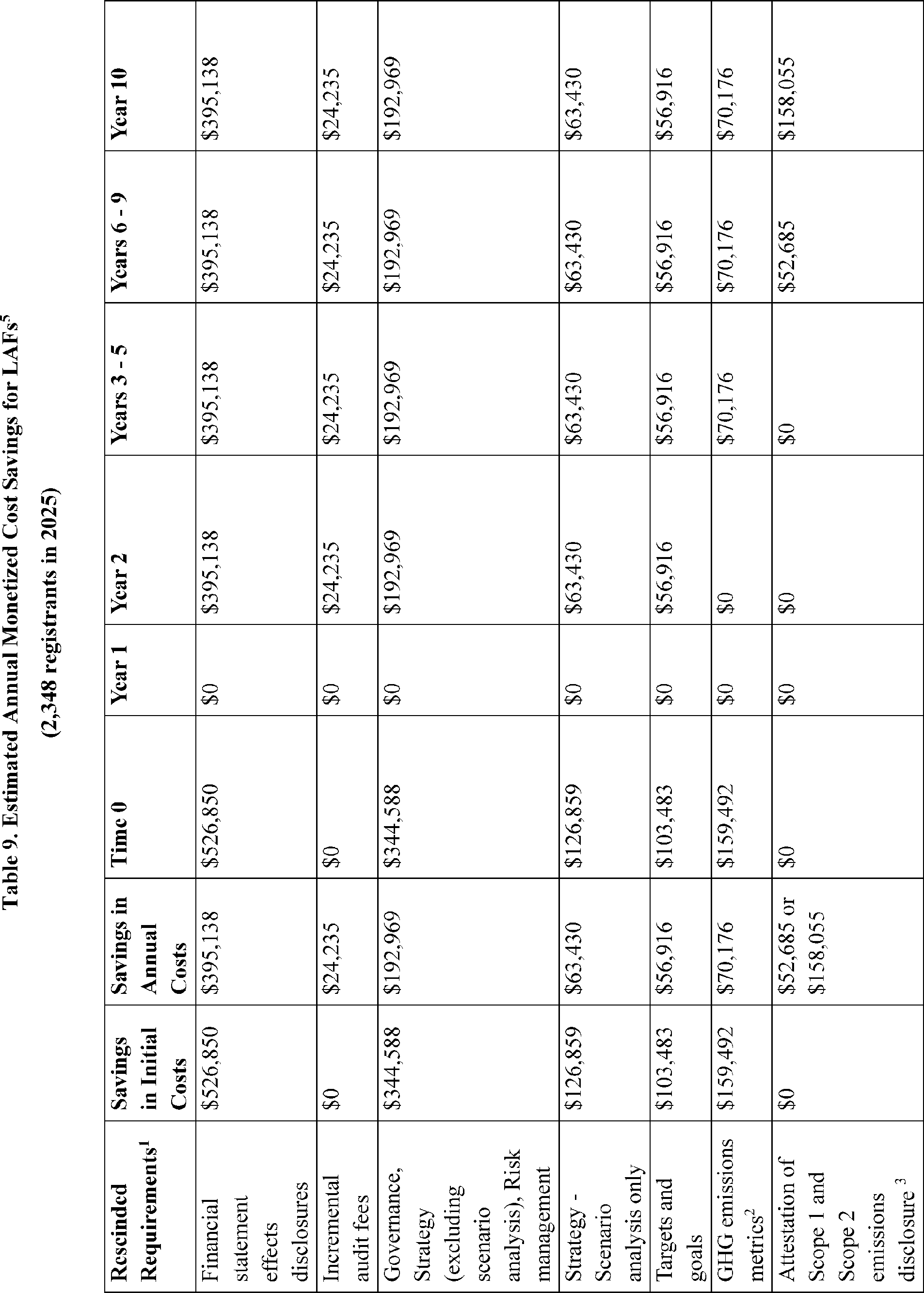
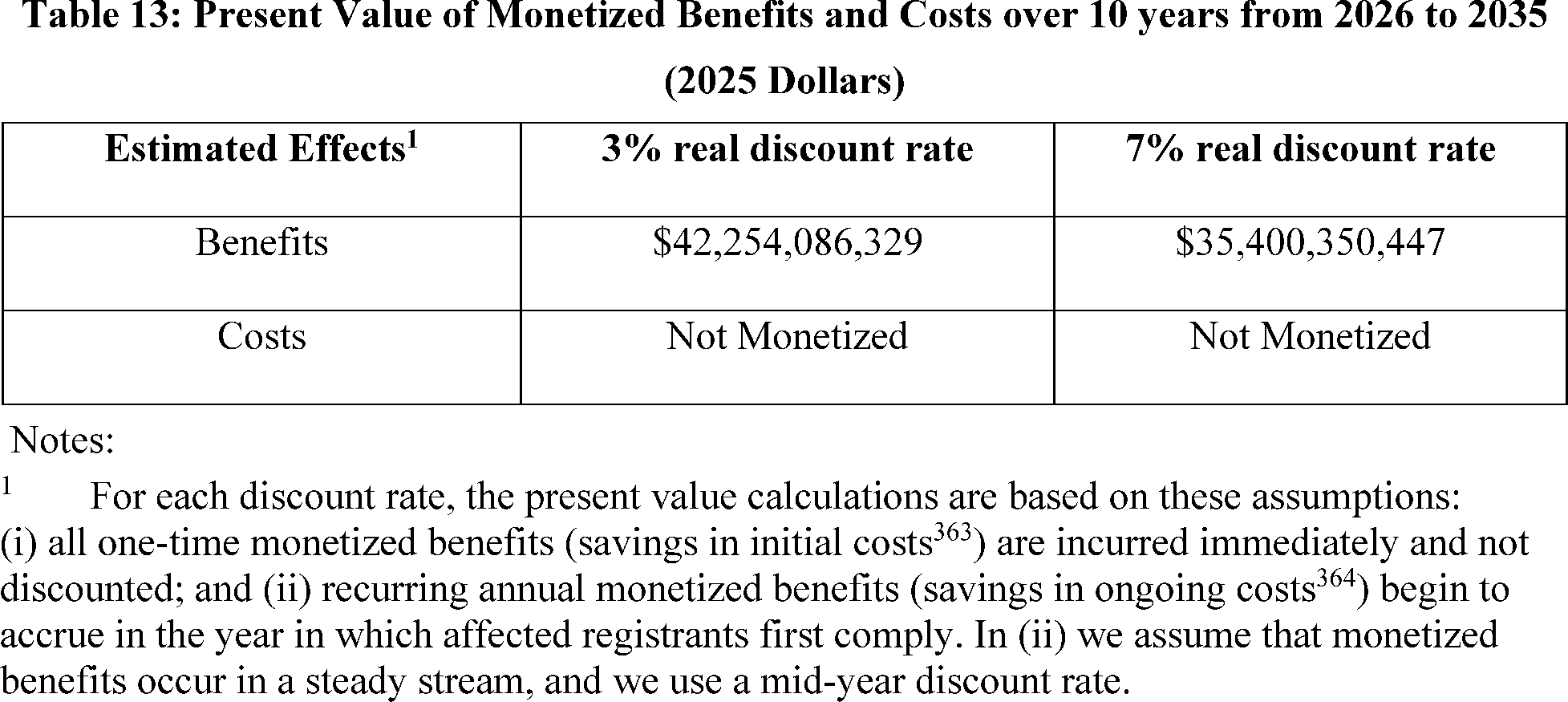
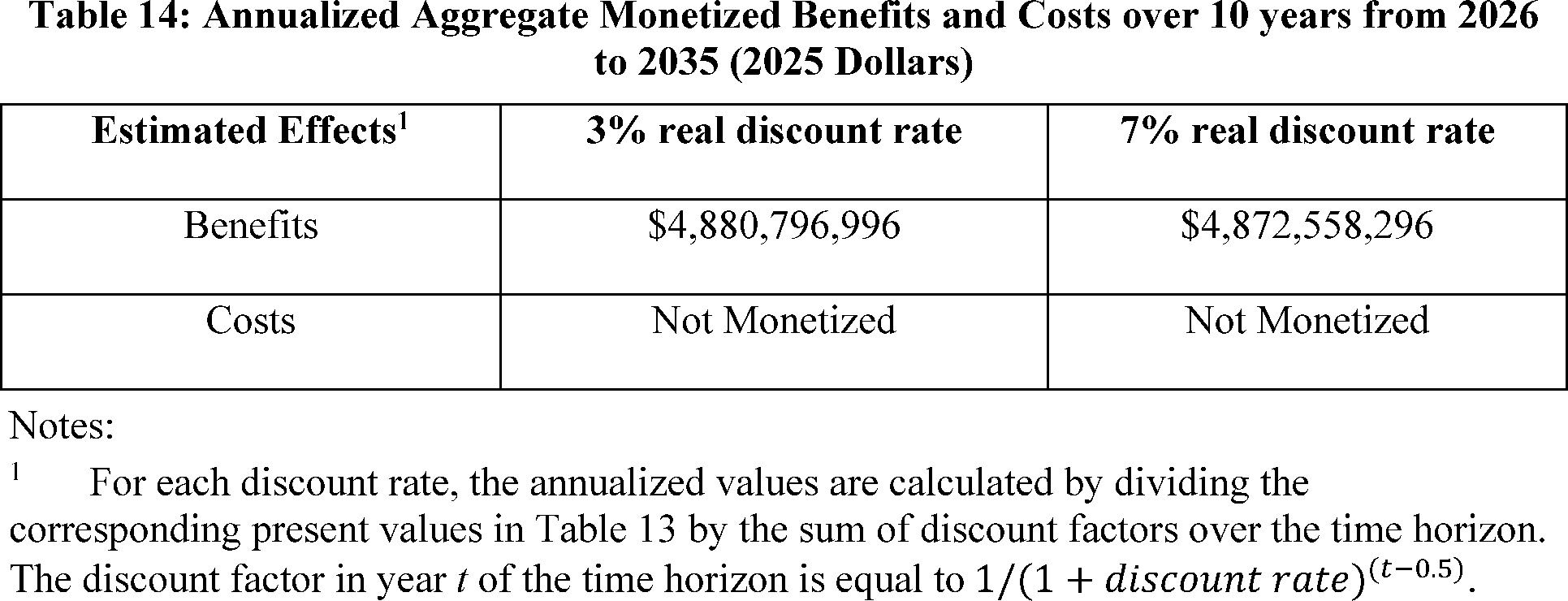
Updating these figures for inflation and aggregating them across all affected registrants, we estimate that rescinding the Final Rules could generate annualized savings of about $4.9 billion
( printed page 33308)
per year over the next 10 years for all affected registrants.[156]
As discussed in section III.B.1 and section III.B.2, Congress has not given the Commission power to write regulations requiring such detailed and extensive disclosure of climate-related information, let alone to essentially regulate issuers' internal affairs through onerous disclosure requirements. To the contrary, questions about the country's response to climate change generally and about climate-related disclosures by public companies specifically continue to be important and contentious. Congress is clearly aware of the potential and claimed risks posed by climate change, yet it has not legislated directly nor instructed the Commission to adopt regulations in response.[157]
Instead, Congress has declined to enact climate-related disclosure legislation.[158]
In evaluating an agency's assertion of statutory authority, the Supreme Court has instructed that courts “must be guided to a degree by common sense as to the manner in which Congress is likely to delegate a policy decision of such economic and political magnitude to an administrative agency.” [159]
Common sense would say that the Securities and Exchange Commission is not the right agency to deal with the question of how public companies can or should respond to climate change and related matters. The Commission clearly has no expertise, scientific or otherwise, related to climate-related risks or the criteria or analytical frameworks to be used in evaluating such risks.[160]
Congress has created an agency—the Environmental Protection Agency—and tasked that agency with collecting reports from major emissions sources and making them available to the public.[161]
In adopting the Final Rules, the Commission acted well “outside its wheelhouse.” [162]
Common sense suggests that Congress would not allocate authority over climate change and related matters to the Commission.
In light of the controversy, costs, and intrusions into the operations of public companies that would be generated by mandatory climate-related disclosure rules, this is a choice for Congress, not the Commission, to make. That conclusion is reinforced by the mismatch between the Commission's area of expertise and the subject matter of climate change. Further, Congress has not authorized the Commission to interfere in the corporate governance of registrants with respect to climate change. Congress has continued to leave such corporate governance matters to the States. The Commission's asserted basis for the Final Rules does not satisfy the clear evidence of congressional authorization required by the major questions doctrine. “Agencies have only those powers given to them by Congress, and `enabling legislation' is generally not an `open book to which the agency [may] add pages and change the plot line.' ” [163]
3. The Final Rules Should Be Rescinded in Their Entirety
Even if the Commission had authority to adopt some of the Final Rules, the Final Rules should nevertheless be rescinded in their entirety. Although the Commission stated in the Adopting Release that it intended for the Final Rules to operate independently,[164]
upon reconsideration, we now conclude that the individual items of disclosure in the Final Rules are pieces of a larger whole and cannot operate sensibly without the others. For example, the text of the Final Rules sometimes explicitly connects one part of the rules to others.[165]
In addition, parts of the Adopting Release demonstrate the functional inter-relationship between different disclosure requirements. For example, the Adopting Release states that the financial statement disclosures “facilitate investors' assessment of particular types of” climate-related risk and that there is “significant overlap” between the narrative and financial statement disclosures.[166]
As another example, Rule 14-02(e)(1) requires disclosure of costs, expenditures, and losses for carbon offsets and RECs.[167]
The Adopting Release states that these disclosures are directly connected to “a registrant's plans to achieve its disclosed climate-related targets or goals”[168]
and “will complement the disclosures required by the amendments to Regulation S-K and will anchor the disclosures required outside the financial statements to those required within the financial statements.” [169]
As a result, disclosure under these items is unlikely to be sensible to investors in the absence of the other disclosures mandated by the Final Rules.
C. Policy Reasons for Rescinding the Final Rules
In addition to (and independent of) the legal authority defects discussed above, there are strong policy arguments for rescinding the Final Rules in their entirety. As the Supreme Court has stated, “[a]gencies are free to change their existing policies as long as they provide a reasoned explanation for the change.” [170]
On reconsideration, we have determined that the Adopting Release gave inappropriate weight to several of the main justifications for adopting the Final Rules, and we now reach a different policy judgment regarding the need for, and appropriateness of, the Final Rules. Consequently, we propose to rescind the Final Rules in their entirety.
Several independent policy judgments support a rescission of the Final Rules. First, the Final Rules deviate from the Commission's “long-standing commitment to a principles-based, registrant-specific approach to disclosure” that is “rooted in materiality and facilitate[s] an understanding of a
( printed page 33309)
registrant's business, financial condition and prospects[.]” [171]
The Final Rules' sharp departure from these important tenets provides investors, at great cost, with an avalanche of information that is unlikely to be material to the decision-making of a reasonable investor. Second, the Final Rules require registrants to provide costly and lengthy disclosures about climate-related matters, a divisive social and political issue that is well outside the policy concerns of the Federal securities laws. In so doing, the Final Rules inappropriately intrude on corporate decision-making. Third, the Final Rules impose substantial costs on public companies and their shareholders that are not justified by the informational benefits they may provide to some investors. Finally, imposing those same high costs on registrants is at odds with the Commission's policy objectives of facilitating capital formation and promoting public company status.
As discussed more fully below, a responsible approach to public company disclosure demands that the Final Rules be rescinded in their entirety.[172]
1. The Final Rules Are Unnecessary and Inconsistent With a Registrant-Specific, Materiality-Based Approach To Disclosure That Best Serves the Interests of Registrants and Investors
The Final Rules are unnecessary because existing disclosure requirements already elicit information about the material effects of climate-related matters. Furthermore, the Final Rules prioritize one potential factor over others that may materially affect a registrant's operations and financial condition. Finally, recent events, such as the European Union's efforts to narrow the coverage and scope of recently adopted sustainability and due diligence directives and extend their implementation deadlines, have highlighted the flaws in mandating such highly prescriptive disclosure for an evolving area, such as climate-related matters, as in the Final Rules.
a. Existing Disclosure Obligations and Anti-Fraud Provisions Already Elicit Information About the Material Effects of Climate-Related Matters
The Final Rules should be rescinded because the Commission's existing disclosure requirements and anti-fraud provisions already elicit information about the effects of climate-related matters in a way that is tailored to reflect registrants' particular circumstances, is focused on material information for investors, and does not impose upon registrants the additional costs and burdens of the Final Rules.[173]
As the Commission highlighted in the 2010 Guidance, various disclosure requirements apply to climate-related matters when they are material to a particular company. In particular, the 2010 Guidance highlighted Regulation S-K items related to description of business, legal proceedings, risk factors, and management's discussion and analysis. The 2010 Guidance also noted that registrants must consider any financial statement implications in accordance with applicable accounting standards. As the Commission acknowledged in the Adopting Release, even prior to the adoption of the Final Rules, registrants had an obligation to consider material impacts on the financial statements regardless of whether a material impact was driven by climate-related matters.[174]
In addition to existing line item and financial statement disclosure requirements, the liability provisions of the Federal securities laws, including the anti-fraud provisions, serve to protect investors from materially misleading or incomplete disclosures about climate-related matters. For example, Sections 11 [175]
and 12 [176]
of the Securities Act impose liability for material misstatements or omissions made in connection with registered offerings conducted under the Securities Act,[177]
and Exchange Act Section 10(b) [178]
and Rule 10b-5 broadly prohibit fraudulent and deceptive practices and untrue statements or omissions of material facts in connection with the purchase or sale of any security.[179]
We recognize that the Commission previously stated that it adopted the Final Rules because of a “need to improve the consistency, comparability, and reliability of climate-related disclosures for investors.” [180]
We disagree, however, that these purported benefits justify adoption of the Final Rules. As an initial matter, any assertions about the benefits of the consistency and comparability of the disclosures elicited by the Final Rules should be discounted because those benefits are substantially compromised by the inconsistent, variable, and often speculative assumptions necessary to make many of those disclosures.[181]
As a result, the type of information elicited by the Final Rules would vary across even similarly-situated registrants, depending on, for instance, whether they engage in certain practices, how they choose to report certain information, how they determine which expenditures to include, what methodologies they use, and how they exercise judgment in assessing which financial disclosures to make.[182]
Moreover, as noted above, prior to adoption of the Final Rules, registrants were already required to disclose information about the material effects of climate-related matters in a manner better tailored to reflect registrants' particular circumstances. The benefits of more tailored and effective disclosure in this context justify any potential loss in comparability because they allow for more particularized insight into a
( printed page 33310)
registrant's management, operations and financial condition, which can contribute to better risk and return assessments by investors. By contrast, the Final Rules are more apt to create information overload for investors, including through disclosure of immaterial information, while imposing significant new costs for registrants.
In light of existing disclosure obligations, the Final Rules serve insufficient additional purpose in informing investors about the material effects of climate-related matters. Indeed, in our view, the Final Rules are likely to result in the disclosure of immaterial information, at great cost to investors.
b. The Final Rules Prioritize the Effects of Climate-Related Matters Over Other Factors That May Materially Affect a Registrant's Operations and Financial Condition
In adopting the Final Rules, the Commission departed from its existing, generally principles-based approach to disclosure that for decades has elicited information about matters, including climate-related matters, that materially affect a registrant's operations or financial condition. In our view, a disclosure regime that prioritizes a single potential factor above any other that may affect the registrant and requires disclosure at the level of granularity called for by the Final Rules is inferior to the Commission's existing approach to disclosure that already applies with equal force to climate-related matters.
The Final Rules impose a myriad of highly prescriptive regulations that mandate granular disclosures focused exclusively on climate-related matters. For example, with respect to climate-related risks only, registrants under the Final Rules would need to consider and possibly disclose: (i) how a registrant's board oversees and is informed of climate risk, regardless of materiality; [183]
(ii) how a registrant's management assesses and manages material climate risk; [184]
(iii) which management positions manage climate risk and the associated expertise of the individuals serving in those roles; [185]
(iv) the geographic location of physical climate risk; [186]
and (v) how climate risks affect items like a registrant's products or services, suppliers, climate mitigation activities, and expenditures for research and development.[187]
Similarly, the financial statement requirements prioritize the effects of severe weather events and other natural conditions by imposing relatively low percentage thresholds for when such effects must be separately reported in the notes to the financial statements. Specifically, the Final Rules require disclosure in the income statement of expenditures expensed as incurred and losses if such amounts (in the aggregate) equal or exceed one percent of the absolute value of income or loss before income tax expense or benefit (subject to a $100,000 de minimis threshold) [188]
and require disclosure of capitalized costs and charges recognized on the balance sheet if the absolute value of such amounts (in the aggregate) equals or exceeds one percent of the absolute value of stockholders' equity or deficit (subject to a $500,000 de minimis threshold).[189]
These examples, including the specified thresholds, make clear that the Final Rules cannot be justified as eliciting disclosure of
material
information. Given their exceedingly granular requirements, the Final Rules would inevitably result in the disclosure of
immaterial
information about climate-related matters.[190]
Requiring such granular disclosures about a single type of risk, trend or event is at odds with a disclosure system that is intended to elicit information about the most significant factors affecting a registrant's operations and financial condition.[191]
The Commission's disclosure regime generally does not require this level of detailed disclosure for other factors affecting a registrant's business.[192]
Requiring such attention by registrants on climate-related matters, specifically, may lead to registrants devoting an inappropriate amount of attention to managing and reporting on such matters, which may not be among the most significant factors affecting the registrant's business. The Final Rules' misplaced focus, however, is not limited to impacts on a registrant's allocation of resources. The sheer volume of disclosures responsive to the Final Rules may hurt investors' abilities to ascertain relevant information about the other factors affecting a registrant because the climate-related disclosures could overshadow material disclosures about those other factors.
Moreover, as discussed in section III.C.3, the Commission's attempt to mitigate the burdensome granularity of the adopted requirements by adding materiality qualifiers throughout the Final Rules fails to adequately mitigate their distorting effects on registrant disclosures. Given the complexity of making the materiality determinations required by the Final Rules, many registrants may err on the side of over-disclosure, burdening both investors and registrants with an avalanche of climate-related information.
Thus, in our view, the Final Rules are inconsistent with and inferior to the Commission's long-standing, registrant-specific approach to disclosure of factors materially affecting a registrant's operations and financial condition and therefore should be rescinded.
c. Recent Developments Underscore Why a Flexible, Materiality-Based Approach Is Preferable
Recent efforts to scale back, set aside, or otherwise revise various climate reporting regimes at the international level further underscore why the Commission was misguided in adopting costly and prescriptive requirements built around shifting investor preferences and reporting trends. Investors are not monolithic and have differing risk appetites, investment strategies, and analytical methods—and in some cases non-financial interests—that affect their particular investment decisions. In designing a disclosure regime, the Commission should not seek to cater to the specific informational needs of every subset of investors about each emergent topic. Rather, as the
( printed page 33311)
Supreme Court directed when delineating a materiality standard for the Federal securities laws,[193]
the Commission should look to whether the
reasonable
investor would consider the information important in buying or selling securities—and as discussed above, the common interests of reasonable investors is in information regarding the financial performance of a company, the pricing of securities, and the prospect for economic and financial return from the disclosing company.[194]
Moreover, investors generally are better served by regulatory requirements that can be adapted to registrants' specific circumstances. Such bespoke disclosures are more likely to provide material information than the one-size-fits-all disclosure approach of the Final Rules. If, over time, market forces lead to coalescence around certain disclosure practices, such practices are likely to be more responsive to the changing needs of investors than the top-down prescriptive approach of the Final Rules.
The soundness of these basic principles is well illustrated by the challenges faced by other climate-risk reporting regimes since the Final Rules were adopted. In adopting the Final Rules, the Commission observed several ongoing developments related to climate-risk reporting, which included, at the time, announcements by several jurisdictions to adopt, apply, or otherwise be informed by the International Sustainability Standards Board (“ISSB”) standards.[195]
The Adopting Release also highlighted the European Union's (“EU”) adoption of the Corporate Sustainability Reporting Directive (“CSRD”), which requires certain large and listed companies and other entities, including non-EU entities, to report on sustainability-related issues in line with the European Sustainability Reporting Standards.[196]
In taking note of such developments, the Commission acknowledged that these laws could reduce the compliance burden of the Final Rules to the extent they impose similar requirements on registrants subject to them.[197]
Since the adoption of the Final Rules only two years ago, there has been a noticeable effort to step back from these initiatives, calling into question the Commission's decision to follow them with its own highly prescriptive approach. These developments also undermine the assumption that the emergence of other reporting regimes would help to mitigate the significant costs of the Final Rules. For example, entities that set international standards for climate-risk reporting regimes, such as the ISSB and the EU, have revised their climate-related disclosure standards, having found them to be burdensome, overly complex, and/or duplicative. The ISSB has recently amended IFRS to “reduce complexity, the risk of duplicative reporting and the cost of applying specific greenhouse gas emissions disclosure requirements.” [198]
In February 2026, the EU adopted legislation revising the CSRD and the Corporate Sustainability Due Diligence Directive (“CSDDD”) to simplify rules on sustainable finance reporting and decrease compliance burdens.[199]
Specifically, the EU removed around 80% of previously covered companies from the scope of the CSRD, narrowed the scope of the CSDDD, and postponed the implementation timelines of both Directives, among other changes.[200]
These developments reinforce our determination that highly prescriptive disclosure requirements based on shifting investor preferences and reporting trends are inferior to a registrant-specific, materiality-based reporting regime focused on the information a reasonable investor would consider important in making an investment decision.
2. The Final Rules Stray Well Beyond the Policy Concerns of the Federal Securities Laws
An additional policy reason for rescinding the Final Rules is that they do not respond to a gap in investor protection in the securities disclosure regime; rather, they concern the divisive and unsettled political and social issue of climate regulation. The Commission's role is to protect investors; maintain fair, orderly, and efficient markets; and facilitate capital formation. It is not to regulate how public companies manage the effects of climate-related matters or to hijack the public company reporting regime to further social policies unrelated to the aims of the Federal securities laws. The Commission's disclosure requirements should inform investors about a registrant's operations and finances; it is not the province of the Commission to drive changes in those operations absent specific direction from Congress.[201]
The Final Rules, with their granular and highly prescriptive requirements, inappropriately put a thumb on the scale with respect to registrants' decisions about whether and how to manage those effects. Indeed, under the Final Rules, even registrants for which the effects of climate-related matters may have little to no direct relevance to their particular facts and circumstances must consider specific aspects of climate-related matters on at least an annual basis to determine whether they are required to disclose anything. For example, in order to comply with Item 1505, most, if not all, LAFs and AFs that are not EGCs or SRCs will, to some extent, need to adopt controls and procedures to assess the materiality of their Scope 1 and 2 emissions and determine whether disclosure is required if they do not already have them in place.[202]
Such conduct-altering effects demonstrate that the Final Rules are different in kind from existing disclosure obligations and stray well beyond what is required in order to inform and protect the reasonable investor.
Separate and apart from the question of whether the Commission has legal authority to promulgate the Final Rules discussed in section III.B, as a policy matter, the Commission does not view disclosure rules focused solely on
( printed page 33312)
climate-related matters as an appropriate exercise of agency rulemaking authority. The Commission has no interest in pushing the limits of its regulatory authority. Whether and to what extent companies should be generally required to disclose intrusive climate-related information is a matter of significant political and practical importance. Absent a clear statutory directive to the contrary, those matters belong to the People's elected representatives, not agency officials, to decide.
As discussed above, more than fifty years ago, the Commission stated that it does not have discretion under the Securities Act or the Exchange Act to require disclosure for the sole purpose of promoting social goals unrelated to those underlying these Acts.[203]
We agree with the sentiments in the Commission's 1975 statement and with the dissenting views expressed at the time of the Adopting Release by Commissioners Hester M. Peirce and Mark T. Uyeda.[204]
The Final Rules stray well beyond the policy concerns of the Federal securities laws and should be rescinded in their entirety.
3. The Final Rules Impose Significant Costs on Public Companies and Their Shareholders That Are Not Justified by the Informational Benefits They Provide to Some Investors
The significant costs of the Final Rules provide a separate, compelling reason to rescind them in their entirety. In imposing new disclosure obligations, the Commission should assess whether the benefits of the information required to be disclosed—considered from the perspective of the reasonable investor—justify the costs of providing the disclosure. The Final Rules fall well short of this standard. By eliminating the costly disclosure requirements in the Final Rules, the proposed rescission would broadly benefit market efficiency, competition, and capital formation.
By the Commission's own estimation, the Final Rules will significantly increase the costs associated with public company disclosures. Indeed, the Commission estimated that depending on the registrant, annual compliance costs (averaged over the first ten years of compliance) could range from less than $197,000 to over $739,000.[205]
Updating these figures for inflation and aggregating them across all affected registrants, we estimate that rescinding the Final Rules could generate annualized savings of about $4.9 billion per year over the next 10 years for all affected registrants.[206]
In the Adopting Release, the Commission acknowledged the significant additional burdens that the Final Rules will impose on registrants but nonetheless asserted that “those burdens are justified by the informational benefits of the disclosures to investors.” [207]
We disagree with the Commission's determination that such a significant imposition of costs is warranted in order to increase the disclosures across registrants about a single type of risk that some registrants may face. This conclusion is bolstered by the fact that, to the extent this risk is material, information about that risk should be elicited by existing disclosure requirements, as discussed in section III.C.1.a. Thus, any marginal or theoretical informational benefits to be derived from the Final Rules do not and cannot justify the substantial burdens they impose on public companies and their shareholders.
We recognize that some commenters to the Proposing Release indicated that investors have faced and may continue to face costs associated with obtaining or verifying information related to a registrant's climate-related risks or management thereof.[208]
However, we do not agree that it is appropriate to burden all shareholders of almost all public companies with the high costs of the Final Rules in order to subsidize the informational demands of certain investors who choose to focus their investment strategies on climate-related matters or who have interests other than the pursuit of a financial return that are driving their informational demands. There are multitudes of investment strategies, and investors bear all sorts of costs to search for and verify information based on their chosen strategy. They should be free to do so. Similarly, individual registrants may want to attract climate-focused investors and choose to provide additional information. They should be free to do so as well. But the entire market should not be forced to bear the costs of providing more particularized information than what the reasonable investor needs for an investment decision. Market-based solutions to demands for particular information are more appropriate. Therefore, notwithstanding that some investors will not receive some of the informational benefits described in the Adopting Release,[209]
we have determined that the proposed rescission is the appropriate course of action for a disclosure regime focused on providing material information to reasonable investors.
Furthermore, despite the Commission's repeated assertions in the Adopting Release, the layering of materiality qualifiers throughout the Final Rules fails to adequately mitigate the overall burdens imposed on registrants in the context of the Final Rules' highly prescriptive disclosure requirements.[210]
For example, the Final Rules require certain registrants to disclose Scope 1 and Scope 2 GHG emissions,
if material.[211]
The Adopting Release estimated that the compliance costs to a registrant for these disclosures would be $151,000 in the first year of compliance and $67,000 annually in subsequent years.[212]
Moreover, as the Adopting Release acknowledges, the costs of assessing and monitoring the materiality of a registrant's emission “could be significant” even in situations where the registrant ultimately determines that they do not need to provide disclosure.[213]
The Adopting Release did not separately quantify
( printed page 33313)
these particular costs, which would arise from the efforts of a registrant to measure its Scope 1 and Scope 2 emissions, including establishing organizational boundaries and operational boundaries and adopting a specific reporting protocol or standard.[214]
Only then, after it has invested potentially significant resources to perform this exercise, can a registrant make a determination about whether such metrics are material.[215]
Thus, the Final Rules also require a complicated analysis even to determine whether disclosure is required,[216]
saddling every covered registrant with the costs of collecting the necessary information and calculating emissions.
The difficulty of making materiality determinations under the Final Rules is further compounded by the complex and overlapping nature of the required disclosures. For example, the Final Rules would require registrants to disclose any climate-related target or goal if such target or goal has materially affected or is reasonably likely to materially affect the registrant's business, results of operations, or financial condition.[217]
The Commission asserted that investors “need detailed information about a registrant's climate-related targets or goals in order to understand and assess the registrant's transition risk strategy and how the registrant is managing the material impacts of its identified climate-related risks.” [218]
The Commission adopted this requirement notwithstanding the fact that, elsewhere in the Final Rules, a registrant is required to describe any climate-related risks that have materially impacted or are reasonably likely to have a material impact on the registrant, including on its strategy, results of operations, or financial condition.[219]
In addition, if a registrant has adopted a transition plan to manage a material transition risk, it must describe the plan and update its annual report disclosure about the transition plan each fiscal year by describing any actions taken during the year under the plan.[220]
The use of materiality qualifiers in such a complex, interconnected, and highly prescriptive set of disclosure requirements does not adequately mitigate the overall burdens of producing those disclosures.
Because the error cost of miscalculating a disclosure obligation includes a potential enforcement action by the Commission or a securities fraud class action, registrants are left with the difficult choice of either making their best judgments about materiality and risking being subject to liability for coming to the wrong conclusion or disclosing information that may not be material in an effort to avoid liability. Investors do not benefit if “management's fear of exposing itself to substantial liability may cause it simply to bury the shareholders in an avalanche of trivial information—a result that is hardly conducive to informed decisionmaking.” [221]
As these examples show, the Commission's use of materiality qualifiers does not adequately mitigate the burdens of the climate-related disclosure requirements. Moreover, in the context of the complex and overlapping nature of the Final Rules' disclosure obligations, such materiality qualifiers do not meaningfully limit the information that a registrant feels compelled to disclose, burying investors in disclosures of limited value. Indeed, the numerous materiality determinations required by the Final Rules merely mask how the rules reached well beyond what a reasonable investor would consider important in buying or selling securities.
We similarly disagree that the informational benefits of the Final Rules justify the significant costs they would impose. The Adopting Release asserts several benefits of the Final Rules, such as: (1) that the information will enable investors to better assess material risks in climate-related reporting and facilitate comparisons across firms and over time; (2) the information is relevant to ensuring that the risk is correctly priced into the securities; (3) the use of a standardized disclosure framework will “mitigate agency problems arising from registrants being able to selectively disclose . . . information, which reduces transparency and impairs investors' ability to effectively assess the potential financial impacts of a registrant's climate-related risks”; and (4) providing “better information” will reduce information asymmetries between managers and investors as well as amongst investors, which “will improve liquidity and reduce transaction costs for investors . . . , and may lower firms' cost of capital.” [222]
Although we acknowledge that the Commission may consider these kinds of benefits when adopting new disclosure rules, we disagree that these policy goals should be pursued at such significant costs.
As discussed in section III.B.2, any assertions about the benefits of the consistency and comparability of the disclosures elicited by the Final Rules should be discounted because those benefits are substantially compromised by the inconsistent, variable, and often speculative assumptions necessary to make many of those disclosures. Also, it is far from clear that these “standardized” disclosures would serve the informational needs of investors and the marketplace better than existing principles-based requirements that allow for more particularized insight into a registrant's management, operations, and financial condition.
In crafting a fit-for-purpose disclosure regime, the Commission should consider not only the informational benefits to be derived from the required disclosures but also the costs to produce those disclosures, which are ultimately borne by investors themselves. In doing so, the Commission should take into account whether the required disclosures benefit existing and potential investors in most companies, or only those with particularized investment strategies or informational needs. In our evaluation, as we assess these factors, any informational benefits to be derived from the Final Rules cannot justify the significant costs they would impose on public companies and their shareholders.
( printed page 33314)
4. The High Costs of the Final Rules Are at Odds With the Commission's Policy Objectives of Facilitating Capital Formation and Promoting Public Company Status
The Commission's current agenda is focused on restoring the vigor of public securities markets and encouraging companies to go public and stay public.[223]
The number of public companies has diminished significantly since 2000,[224]
with some observers pointing to the cost of public company disclosure as one deterrent.[225]
As discussed in section III.C.3, the Final Rules add substantially to the cost and complexity of public disclosures by issuing and reporting companies. If the Final Rules were to go into effect, they would be in direct contravention of the Commission's current policy objectives of promoting public company status and facilitating capital formation.
The Final Rules increase the overall costs associated with accessing and participating in capital markets. This increase in costs has a deterrent effect on such participation, thereby reducing market liquidity and depth, which ultimately hinders, rather than facilitates, capital formation. Costly regulation can also divert registrants' resources that could otherwise be spent on production, investment, or innovation. In addition, it can reduce the incentives of registrants to implement otherwise efficient business strategies, transition plans, or goals because of direct and indirect costs of disclosing them. Such disclosure requirements may disproportionately affect smaller firms with resource constraints and limit their ability to grow and compete.
Regulatory costs can also influence the size of the public markets, if companies decide to exit the markets or remain privately held to avoid regulatory costs. This avoidance strategy widens the transparency gap between public and private companies, negatively affecting competition between public and private companies as well as capital markets' information efficiency. Depending on market conditions and other factors, registrants may also pass on their compliance costs to third parties, such as consumers and workers. Beyond the desire to avoid direct compliance costs, some companies may avoid going public if they fear they will have to provide disclosure about an array of socially and politically contentious issues. Such effects, taken together, reduce overall productivity, constrain growth opportunities, and depress economic efficiency, thus reducing future cash flows, earnings expectations, and shareholder returns.
The high costs imposed by the Final Rules and related adverse effects undermine the Commission's goals of facilitating capital formation and improving the accessibility and attractiveness of public company status. The Commission declines to impose such burdens on registrants and therefore proposes to rescind the Final Rules in their entirety.
Request for Comment
(1) Should we rescind the Final Rules in their entirety as proposed? Why or why not?
(2) Are there aspects of the Final Rules that remain within the Commission's statutory authority and should be retained? If so, how would these items of disclosure be able to operate sensibly without the rescinded portions of the Final Rules?
(3) Are there alternatives to outright rescission that we should consider? For example, should we amend the Final Rules so that they apply to a smaller subset of registrants or in more limited circumstances? Alternatively, should we propose to replace the Final Rules with less prescriptive and less costly disclosures about climate-related matters? If so, how would such disclosures improve upon the information already elicited by existing disclosure obligations? What information about climate-related matters does a reasonable investor need to make informed investment decisions?
(4) Does the proposed rescission negatively affect any reasonable reliance interests that market participants may have had in the operation of the Final Rules, notwithstanding that the rules were stayed prior to effectiveness? Have any costs been incurred in preparing to comply with the Final Rules, even though the Final Rules have been stayed? If so, please explain why and describe the type and magnitude of those costs.
(5) Do existing disclosure requirements serve to elicit adequate disclosure about climate-related matters, when material to a specific registrant? Why or why not? Should we revise the 2010 Guidance to provide updated guidance about how existing disclosure obligations may elicit information about climate-related matters?
(6) Have recent developments in climate reporting practices affected the rationale for the Final Rules? If so, how?
(7) If the Final Rules were to go into effect, to what extent would they impact firm decisions about whether to become or remain a public company?
IV. Economic Analysis
A. Introduction
We are mindful of the costs imposed by, and the benefits obtained from, our rules. Securities Act section 2(b) and Exchange Act section 3(f) require us, when engaging in rulemaking where the Commission is required to consider or determine whether an action is necessary or appropriate in the public interest, to consider, in addition to the protection of investors, whether the action will promote efficiency, competition, and capital formation.[226]
In addition, Exchange Act section 23(a)(2) requires the Commission to consider the effects on competition of any rules that the Commission adopts under the Exchange Act and prohibits the Commission from adopting any rule that would impose a burden on competition not necessary or appropriate in furtherance of the purposes of the Exchange Act.[227]
We are likewise sensitive to the economic effects of rescinding our existing rules, which may involve the reconsideration of the benefits, costs, and impacts on efficiency, competition, and capital formation that were assessed when adopting those rules.
( printed page 33315)
We are proposing to rescind the Final Rules in their entirety for the reasons articulated in section III. The proposed rescission would significantly reduce regulatory compliance costs for registrants affected by the Final Rules.
We consider below the potential benefits and costs of the proposed rescission and the likely effects of rescission on efficiency, competition, and capital formation. Many of the benefits and costs are impracticable to quantify or estimate with any degree of certainty. Where we are unable to quantify the economic effects of the proposed rescission, we provide a qualitative assessment of the potential effects and encourage commenters to provide data and information that would help quantify the benefits and costs of the proposed rescission, and the potential impacts of the proposed rescission on efficiency, competition, and capital formation.
B. Economic Baseline
The baseline against which the benefits and costs and the effects on efficiency, competition, and capital formation of the proposed rescission are measured consists of current requirements for climate-related disclosures and current market practices that relate to such disclosures.[228]
For purposes of defining the baseline for this Economic Analysis, we treat the Final Rules as if they are in effect even though the Commission has stayed their implementation. Below we describe the parties who are likely to be affected by the Final Rules and therefore the proposed rescission, as well as existing rules or laws that require or elicit climate-related disclosures and the current market practice related to reporting on climate-related matters.
1. Affected Parties
The proposed rescission of the Final Rules would apply to registrants filing Securities Act and Exchange Act registration statements as well as Exchange Act annual and quarterly reports. The Adopting Release identifies several parties likely to be affected by the Final Rules, and they would be the same parties affected by a rescission of the Final Rules. The parties likely to be affected are: registrants subject to the disclosure requirements imposed by the Final Rules, as detailed below; users of information about climate-related matters, such as investors, analysts, and other market participants; and third-party service providers who may collect, review, and process this information, including assurance providers and ratings providers.[229]
In particular, the Final Rules require both domestic registrants and foreign private issuers affected by the Final Rules to disclose highly granular information on climate-related matters in a standardized and centralized format in Commission filings. The affected parties that directly benefit from the Final Rules include specific subgroups: those investors who would use this information as part of their particular investment strategies; financial intermediaries who act on behalf of investors (
e.g.,
asset managers, investment advisers, pension fund managers) to the extent they incorporate climate-related risks when constructing investment portfolios and evaluating registrants' risk profiles; and stakeholders who would use the expanded climate disclosures for advocacy or political purposes.[230]
The affected parties that incur direct costs from the Final Rules include all aforementioned registrants and by extension their shareholders—broadly speaking all investors in these registrants, which is a class of investors broader than the subgroup of investors directly benefiting from the Final Rules.
The Final Rules affect both domestic registrants and foreign private issuers filing registration statements and periodic reports with the Commission, but they would not apply to Canadian registrants that use the Multijurisdictional Disclosure System and file their Exchange Act registration statements and annual reports on Form 40-F.[231]
We estimate that during calendar year 2025, excluding asset-backed securities issuers, there were 6,766 registrants that filed on domestic forms and on Form 20-F.[232]
We also estimate that 2,348 of these registrants were LAFs, 541 were AFs that are not SRCs or EGCs (non-exempt AFs) and 3,877 were all other registrants (AFs that were SRCs or EGCs, and non-accelerated filers (“NAFs”)).
Out of these registrants, there were approximately 5,703 registrants that filed on domestic forms, and approximately 1,063 foreign private issuers that filed on Form 20-F. Among registrants that filed on domestic forms, approximately 36 percent were LAFs, 7 percent were non-exempt AFs, and 56 percent were AFs that were SRCs or EGCs, and NAFs. In addition, we estimate that among the foreign private issuers that filed on Form 20-F approximately 27 percent were LAFs, 11 percent were non-exempt AFs, and 62 percent were AFs that were SRCs or EGCs, and NAFs.
The Final Rules would also require disclosures in registered offerings, except with respect to business combination transactions involving a company not subject to the reporting requirements of section 13(a) or 15(d) of the Exchange Act. In many cases, registrants would be able to meet these requirements by incorporating by reference from their periodic reports. Registrants that have not previously filed periodic reports, such as companies conducting initial public offerings, would not have previously filed such reports to incorporate by reference. In 2025, there were approximately 810 such companies that conducted registered offerings on Form S-1 or F-1.[233]
( printed page 33316)
2. Current Regulatory Framework
a. Commission Disclosure Requirements
1. 2010 Guidance and Existing Rules
Apart from the Final Rules, existing Commission disclosure requirements may, depending on the circumstances, require or elicit disclosure of certain climate-related matters.[234]
The 2010 Guidance emphasizes that certain existing disclosure requirements in Regulation S-K and Regulation S-X may require disclosure about climate-related matters.[235]
With respect to the most pertinent non-financial statement disclosure rules, we note that: Item 101 of Regulation S-K (Description of business) expressly requires disclosure regarding certain material costs and effects of compliance with environmental regulations; [236]
Item 103 of Regulation S-K (Legal proceedings) requires disclosure regarding any material pending legal proceeding to which a registrant or any of its subsidiaries is a party or of which any of their property is the subject; Item 105 of Regulation S-K (Risk factors) requires, where appropriate, a discussion of the material factors that make an investment in a registrant or an offering speculative or risky; [237]
and Item 303 of Regulation S-K (management's discussion and analysis of financial condition and results of operation) requires material historical and prospective narrative disclosure to help investors assess the financial condition and results of operations of a registrant.[238]
Registrants are currently required to provide disclosure about climate-related matters to the extent they are responsive to existing disclosure requirements, such as those highlighted in the 2010 Guidance.
2. The Final Rules
In March 2024, the Commission adopted the Final Rules. The Final Rules require registrants to disclose certain climate-related information in their registration statements and annual reports.[239]
Among other things, the Final Rules require public companies to disclose detailed information about the impact and management of climate-related risks, GHG emissions, scenario analysis, internal carbon prices and certain climate-related financial statement effects.[240]
As discussed in section II, the Final Rules have not gone into effect.
3. Recently Proposed Rules
The Commission recently proposed amendments to streamline filer statuses for Exchange Act reporting companies into two primary categories: LAFs and NAFs.[241]
The proposed amendments would, among other things, raise the public float threshold and seasoning requirements for qualification as a LAF and extend certain existing accommodations and scaled disclosures currently reserved for SRCs, EGCs and/or NAFs to all NAFs under the proposed amendments, while continuing to require compliance with non-scaled disclosure from LAFs. Because the Final Rules also scaled disclosures based on filer status, if adopted, the proposed amendments in the Filer Status Proposing Release would affect which companies are subject to which requirements under the Final Rules.
b. Existing State and Other Federal Laws
Existing State and other Federal laws require certain climate-related disclosures and reporting. As a result of these reporting requirements, some registrants subject to the Final Rules may already be disclosing certain information about climate-related matters or may be developing processes and systems to track and disclose such matters.
For instance, within the insurance industry, there are requirements for mandatory climate risk disclosures for any domestic insurers that write more than $100 million in annual net written premium.[242]
For reporting year 2023, 1,700 companies provided climate risk disclosures in response to the NAIC survey.[243]
Federal and State reporting requirements related to GHG emissions also exist.[244]
Since the adoption of the Final Rules, officials have proposed amendments to eliminate or reduce the climate-related disclosure obligations of some of these programs, or these disclosure obligations have been challenged in courts. Notably, at the Federal level, with respect to the Greenhouse Gas Reporting Program, which requires that each facility that directly emits more than 25,000 metric tons of CO2
e per year to report its direct emissions to the EPA,[245]
the EPA proposed amendments in September
( printed page 33317)
2025 to largely end the reporting program.[246]
The proposed amendments, if adopted would eliminate program obligations to disclose GHG emissions for most source categories (
e.g.,
power plants, cement and steel) in addition to delaying the requirement to report GHG emissions for the remaining source categories until 2034.[247]
In the Adopting Release, the Commission also discussed the climate-related reporting requirements set forth in California's Climate-Related Financial Risk Act (“Senate Bill 261”) and Climate Corporate Data Accountability Act (“Senate Bill 253”).[248]
In November 2025, the Ninth Circuit granted a motion to enjoin enforcement of Senate Bill 261 and denied a motion to enjoin enforcement of Senate Bill 253.[249]
As a result, although litigation remains ongoing, companies subject to Senate Bill 253 will be required to disclose their Scope 1 and Scope 2 emissions beginning in 2026 [250]
and their Scope 3 emissions beginning in 2027.[251]
But companies subject to Senate Bill 261 will not be required to begin reporting their climate-related financial risks and measures in 2026 as Senate Bill 261 originally required unless the litigation concludes and the Ninth Circuit upholds Senate Bill 261.[252]
c. International Disclosure Requirements
Registrants that are listed or operate in jurisdictions outside the United States may also be subject to those jurisdictions' disclosure and reporting requirements. As a result, some registrants subject to the Final Rules may have in place, or be developing, processes and systems to track and disclose information about climate-related matters. For example, in the Adopting Release, the Commission discussed the TCFD's framework for climate-related financial reporting and the plan for several jurisdictions to support or adopt climate disclosure requirements consistent with the TCFD recommendations.[253]
In the Adopting Release, the Commission further discussed the ISSB's climate-related disclosure standards and the fact that several jurisdictions had announced plans to adopt, apply, or otherwise be informed by the ISSB standards.[254]
In December 2025, the ISSB issued amendments to IFRS S2 to, among other things, reduce complexity, the risk of duplicative reporting and the cost of applying specific GHG emissions disclosure requirements by clarifying the Scope 3 reporting requirements and excluding the requirement to disclose certain emissions.[255]
The ISSB stated that the amendments were aimed to reduce complexity, the risk of duplicative reporting and the cost of applying specific GHG emissions disclosure requirements in IFRS S2, while not significantly reducing the usefulness of information for users of general purpose financial reports.[256]
In the Adopting Release, the Commission also discussed the reporting requirements for certain companies to disclose their GHG emissions under the CSRD.[257]
In February 2026, the EU adopted legislation revising the CSRD and CSDDD to, among other things, narrow the scope of covered companies under the CSRD and postpone the implementation timelines of relevant Directives.[258]
3. Current Market Practices
This section updates staff analyses in the Adopting Release that described then current market practices with regard to several types of climate-related disclosures, including those made in Commission filings and in other contexts. These practices display variation over time and across several dimensions, such as by disclosure type, by status as an LAF, AF, NAF, EGC and/or SRC (“filer status”), by industry, or with respect to their use of third-party assurance. In addition, this section describes recent changes in selected third-party climate disclosure frameworks that may influence the disclosures described above.
a. Climate-Related Disclosures in Commission Filings
In the absence of the Final Rules' implementation, the SEC's existing disclosure obligations elicit disclosure about material climate-related matters. Registrants may also voluntarily choose to disclose climate-related information. To help inform on current disclosure practices, Commission staff updated the analysis included in the Adopting Release regarding climate-related disclosures in Commission filings.[259]
Commission staff reviewed 87,865 annual reports (Forms 10-K and 20-F) submitted from January 1, 2016, to December 31, 2025, to determine the number containing any of these climate-related keywords: “climate change,” “climate risk,” “global warming,” “greenhouse gas(es)” or “GHG emission(s).” [260]
As in the Adopting Release, the staff assumed that the presence of any of these climate-related keywords in any part of the annual report indicates disclosure of some climate-related information, but this keyword analysis is not meant to capture the substantive depth or quality of climate-related disclosure. This analysis also does not purport to identify causality, such as the extent to which observed market practices result from specific market events, policies, or regulations (including the Commission's development and adoption of the Final Rules). We include this analysis because it is a useful descriptive statistic for characterizing current market practices and is consistent with prior Commission analysis in the Adopting Release. This analysis, which is empirical evidence on existing disclosure practices under the 2010 Guidance, helps provide a more complete picture of the current baseline for the purpose of evaluating the incremental effects of the proposed rescission.
Table 1 summarizes the incidence of any of the aforementioned climate-
( printed page 33318)
related keywords in Forms 10-K and 20-F filed from January 1, 2024, to December 31, 2025. The data show that about 47 percent of all filings submitted in 2024 and 2025 contained at least one climate-related keyword. The proportion is greater, about 52 percent, among foreign private issuers filing on Form 20-F.[261]
Figure 1 shows that the percentage of Form 10-K and Form 20-F filings that contain climate-related keywords has increased between 2016 and 2025, particularly as of 2021.
( printed page 33319)
Table 2 shows the breakdown of annual filings with any of the climate-related keywords by filer status in 2024 and 2025. In both years, the share of filings with climate-related keywords submitted by LAFs and AFs was significantly greater than the share of filings with climate-related keywords submitted by NAFs. For example, in 2024 and 2025, 79 and 81 percent of filings submitted by LAFs contained climate-related keywords, compared to 33 percent of those submitted by NAFs. Relatedly, one report finds that 84 percent of S&P 500 companies disclosed climate change as a risk factor in 2024.[262]
( printed page 33320)
Table 3 presents the analysis of climate-related keywords in Commission filings, broken down by SRC and EGC status. The share of filings with climate-related keywords is generally lower for issuers that are either SRCs, EGCs, or both, as compared to issuers that are neither SRCs nor EGCs.
( printed page 33321)
Table 4 provides a breakdown of the recent filings by industry and shows that the industries with the highest percentage of annual reports containing climate-related keywords include transportation and utilities (
i.e.,
communications, electric, gas, and sanitary services), mining, and construction.
( printed page 33322)
Other sources also report variation in climate-related disclosures across industries. For example, one report finds that, as of 2024, most public companies across the Russell 3000 and S&P 500 disclose their exposure to climate risk, especially in certain industries, such as utilities, energy, and real estate, materials and consumer staples.[263]
To help inform on the context in which registrants may use climate-related keywords in their 10-K and 20-F filings, Commission staff conducted additional analysis. Commission staff examined those filings containing any of the climate-related keywords for the presence of additional economics-related keywords within the vicinity of a climate-related keyword.[264]
Figure 2 shows that, in every year from 2016 to 2025, at least 70 percent of filings with a climate-related keyword also contained an economics-related keyword in the vicinity of a climate-related keyword.
( printed page 33323)
For those filings that contain any of the climate-related keywords over the period 2024-2025, Table 5 provides a breakdown by industry and shows which industries have the highest percentage of filings with an economics-related keyword.[265]
The data show that filings containing an economics-related keyword were more prevalent in industries such as mining, construction, transportation and utilities, and retail trade.
( printed page 33324)
b. GHG Emissions
Commission staff also updated the analysis included in the Adopting Release regarding GHG emissions reporting.[266]
Commission staff analyzed London Stock Exchange Group (“LSEG”) data on Scope 1 and Scope 2 emissions [267]
disclosed by Commission registrants.[268]
LSEG compiles these data from companies' annual filings, sustainability reports, and other public disclosures.[269]
Companies in the LSEG data we analyzed were matched to Commission data on Commission registrants, and the LSEG data we analyzed covers 5,391 Commission registrants.[270]
Table 6 shows that, in fiscal year 2022, 21 percent of these registrants (1,152 out of 5,391) reported their Scope 1 or Scope 2 emissions. LAFs had the highest disclosure rate (51 percent), while SRCs and EGCs had the lowest disclosure rate (1 percent). Table 6 also shows that about 23 percent of all registrants disclosed their Scope 1 or Scope 2 emissions in fiscal year 2023, with about 55 percent of LAFs disclosing either their Scope 1 or Scope 2 emissions.[271]
( printed page 33325)
Other sources report on corporate disclosures relating to GHG emissions. One report finds that, in 2024, more than 50 percent of Russell 3000 companies disclosed each of Scope 1 and Scope 2 emissions, while the percentages of S&P 500 companies making these disclosures exceeded 90 percent.[272]
Another report, based on a 2024 survey of 300 executives at companies with annual revenues of at least $500 million, finds that most of these firms are reporting on Scope 1 and Scope 2 emissions and also documents heterogeneity across industries with respect to emissions reporting.[273]
c. Disclosures of Climate-Related Targets
To update the discussion in the Adopting Release,[274]
Commission staff reviewed current information about disclosures of climate-related targets. One report shows that the share of companies disclosing a climate-related target in the Russell 3000 almost doubled from 2021 to 2024, increasing from 22 percent to 41 percent.[275]
This report shows an even greater proportion of S&P 500 companies setting targets, with 73 percent in 2021 growing to 87 percent in 2024.[276]
In addition, this report shows heterogeneity across industries with respect to climate-related targets. In 2024, disclosure rates for climate-related targets were highest among Russell 3000 companies in the Utilities (85 percent), Materials (73 percent), Consumer Staples (64 percent), Real Estate (57 percent) and Energy (55 percent) industries.[277]
( printed page 33326)
Commission staff also updated analysis in the Adopting Release that examined the Bloomberg ESG database, which is focused on registrants listed on NYSE and Nasdaq. This database reports Bloomberg analysis on counts of registrants with climate-related targets and goals. The updated results, which are based on 2024 data, are reported in Table 7 below. The results are generally consistent with data from the sources discussed above.
d. Third-Party Frameworks for Disclosure
To update the discussion in the Adopting Release regarding third-party climate disclosure frameworks, Commission staff reviewed current information about third-party disclosure frameworks, which were discussed in the Adopting Release.[278]
Such frameworks, which were developed with the aim of helping firms and investors identify, measure, and communicate climate-related information and incorporate that information into business practices, continue to take diverse approaches to disclosure [279]
and to evolve.[280]
For
( printed page 33327)
example, the TCFD disbanded in 2023, and its responsibilities were assumed by the ISSB in 2024. The ISSB has developed sustainability disclosure standards that not only build on the recommendations of the TCFD but also integrate parts of other frameworks and standards, to include the SASB standards, the Integrated Reporting Framework, the Climate Disclosure Standards Board (CDSB) Framework application guidance, certain requirements and definitions used by the International Accounting Standards board, and the Greenhouse Gas Protocol.[281]
Corporate climate disclosures and practices have evolved alongside these frameworks. One report finds that, over time, climate-related “[d]isclosures have . . . become more structured and aligned with the [TCFD].” [282]
e. Third-Party Assurance
To update the discussion in the Adopting Release regarding third-party assurance, Commission staff reviewed recent trends in third-party assurance for ESG reporting. Several reports document growth in the use of external assurance in sustainability reporting.[283]
One report on trends in sustainability reporting by Russell 1000 companies shows an increase in these companies' use of external assurance in every year from 2020 to 2024, with 51 percent using external assurance in 2024.[284]
Another report shows an increase in the use of external assurance by S&P 500 companies that reported sustainability information, from 70 percent in 2022 to 73 percent in 2023.[285]
This report also states that S&P 500 companies reporting on sustainability obtained external assurance mostly for reporting on their GHG emissions, but that the scope of all activities subject to assurance has become broader over time. At least two other reports document growth in companies' use of external assurance for emissions data in particular.[286]
Commission staff analyzed Bloomberg ESG data, which focuses on registrants listed on the NYSE and Nasdaq, for information as to whether environmental policies and data were subject to an independent assessment. In 2024, 19 percent of registrants in the Bloomberg ESG data disclosed their use of external assurance. More than 91 percent of these registrants were LAFs, and almost none of the registrants were SRCs or EGCs.
C. Benefits and Costs
We are proposing to rescind the Final Rules in their entirety. We discuss below the benefits and costs of the proposed rescission. We estimate monetized benefits and costs per affected registrant where possible, and we present aggregate measures of the monetized effects.
1. Benefits
a. Direct Benefits
The principal benefits of rescinding the Final Rules would be in the form of cost savings to registrants from not having to comply with the Final Rules' requirements. Reductions in compliance costs decrease the resources that registrants must devote to compliance activities. As a result, registrants may experience lower operating expenses and increased cash flow, holding other factors constant. Registrants may allocate these savings toward capital investment or other productive uses, which may improve capital allocation efficiency and expected future cash flows.[287]
The extent of these impacts is influenced by factors such as the availability of positive net present value investment opportunities, managerial incentives, and market conditions. When compliance cost savings increase a registrant's profitability or free cash flow, investors may benefit through higher expected returns, including potential increases in dividends, share repurchases, or firm valuation. Also, shareholder value may increase for registrants when reductions in compliance costs result in higher expected future cash flows.[288]
To estimate cost savings from the proposed rescission, we started with the cost estimates provided in the Adopting Release and updated these estimates to account for inflation since the Final Rules were adopted in March 2024.[289]
The cost estimates in the Adopting Release were informed, in part, by public comment letters. Commenters offered a wide range of cost estimates, suggesting that there was significant variance in expected compliance costs among registrants.[290]
More generally, the nature of the cost information used to derive these estimates ranged from survey results, estimates directly from identifiable companies, estimates from anonymous companies, and general estimates, either based on industry experience, fees for related services, or derived as part of similar rulemaking processes in other jurisdictions.[291]
In the Adopting Release, Commission staff was unable to quantify all direct and indirect costs of the Final Rules.[292]
Similarly, as discussed below, our quantified estimates of the cost savings from the rescission of the Final Rules do not include all direct and indirect cost savings.
In Table 8, for those cost savings we can monetize, we report estimates of the initial cost savings and the annual costs savings per affected registrant that are associated with the rescission of each of the principal requirements of the Final Rules. The savings in initial costs represent compliance cost savings from registrants not incurring one-time implementation costs. We assume that, given the Commission's stay of the Final Rules, registrants have not incurred the initial costs associated with the Final
( printed page 33328)
Rules' implementation.[293]
The savings in annual costs represent recurring annual cost savings from registrants not having to comply annually with the Final Rules' requirements.
In Table 8, across individual requirements, an affected registrant may benefit from savings in initial costs that range from $103,483 (Targets and goals) to $526,850 (Financial statement effects disclosures) and savings in annual costs that range from $56,916 (Attestation of Scope 1 and Scope 2 emissions disclosure at the limited assurance level) to $395,138 (Financial statement effects disclosures). The largest cost savings are associated with the proposed rescission of the amendments to Regulation S-X (Financial statement effects disclosures). With regard to these amendments to Regulation S-X, an affected registrant would also save an estimated $24,235 in incremental annual audit fees under the proposed rescission.[294]
A registrant's actual cost savings could vary significantly from those reported in Table 8 depending on company characteristics, such as company size, industry, business model, the complexity of the company's corporate structure, existing climate-related disclosure practices, and internal expertise.[295]
For instance, a registrant's cost savings from the proposed rescission could be lower if it already provides disclosures that are similar to those required by the Final Rules.[296]
Even registrants for which climate-related risks may have little to no direct relevance to their particular facts and circumstances would experience cost savings under the proposed rescission, as the Final Rules require them to consider specific aspects of climate-related risk management on at least an annual basis in order to make a determination about whether they will be required to disclose anything under the Final Rules.
( printed page 33329)
( printed page 33330)
b. Indirect Benefits
In addition to the direct benefits described above, the proposed rescission would yield indirect benefits for registrants, investors, and other third parties by eliminating indirect costs of the Final Rules.
1. Indirect Benefits to Registrants
The proposed rescission would reduce the risk of competitive harm to registrants by eliminating the prescriptive disclosure requirements in the Final Rules. Several commenters to the Proposing Release expressed concerns that the disclosure requirements could elicit too much information and could provide competitors with insights into a company's business model, cost structure, supply chain vulnerabilities, or future strategic plans.[297]
As a result, a registrant could be placed at a competitive disadvantage if rivals used this information to adjust their own strategies, target vulnerable areas, or replicate innovative approaches. Even with certain adjustments made in the Final Rules—such as adding materiality qualifiers and allowing flexibility in the level of detail that must be provided [298]
—the Final Rules could still elicit competitively sensitive or proprietary information that competitors could exploit or otherwise use to gain a competitive advantage. For example, the Final Rules' requirement to disclose scenario analysis assumptions and inputs as well as information about internal carbon prices, could reveal competitively sensitive information, such as asset allocation decisions.[299]
The proposed rescission would also remove potential disincentives for registrants to implement strategies and undertake certain actions to manage climate-related risks where it would be beneficial to do so but for the costs of having to disclose such actions (which could include potentially confidential or proprietary information) under the Final Rules.[300]
Faced with the detailed disclosure requirements in the Final Rules, registrants might alter their business strategies as they relate to climate-related risks—not just to comply with the requirements of the Final Rules, but to manage the risks of legal liability, litigation defense costs, and reputational impacts. For example, registrants might choose to abandon climate-related targets and goals to avoid associated disclosure obligations or change their risk management strategies in ways that are less than optimal for the sake of achieving what they perceive to be more favorable climate-related disclosure.[301]
Additionally, registrants might be less willing to voluntarily develop or pilot new climate strategies, scenario analyses, or transition plans if doing so would require detailed public disclosure of sensitive forward-looking information, potentially exposing them to competitive risks or litigation.[302]
Although the Final Rules attempted to address these concerns by adding materiality qualifiers and providing some flexibility in how registrants can satisfy the adopted requirements, the potential remains that the Final Rules might discourage voluntary climate initiatives and innovation, especially where registrants perceive that disclosures required under the Final Rules to increase their exposure to risk, criticism, or litigation.
Also, the proposed rescission would eliminate the additional litigation risk associated with the Final Rules' disclosure requirements.[303]
Under the Final Rules, any new disclosures provided by the registrant would be deemed “filed,” and thus subject to liability under the Securities Act and the Exchange Act.[304]
Although the Final Rules include safe harbor provisions for certain forward-looking statements,[305]
the required disclosures called for by the Final Rules would result in additional litigation risk for registrants. For example, the Final Rules require that any registrant that is not required to include a GHG emissions attestation report pursuant to Item 1506(a) disclose certain information if the registrant's GHG emissions disclosure is voluntarily subjected to third-party assurance.[306]
Including these disclosures in Commission filings would expose registrants to additional liability and accompanying litigation risk that could deter some registrants from voluntarily obtaining assurance, particularly if they have lower confidence in the quality of the services performed.[307]
To the extent that a registrant could have been deterred or disincentivized from voluntarily obtaining third-party assurance due to these concerns, the proposed rescission would remove this deterrent.[308]
Commenters to the Proposing Release also raised concerns that the additional litigation risks associated with the proposed rules could lead to an increase in audit costs (to the extent auditors were also subject to increased litigation risk) and higher insurance costs for registrants and auditors.[309]
By rescinding the Final Rules and eliminating the additional litigation risk associated with increased Commission disclosures, the proposed rescission would eliminate these potential costs.[310]
Additionally, the Final Rules required certain registrants—specifically LAFs and non-exempt AFs—to obtain third-party assurance over their GHG emissions disclosures. Commenters to the Proposing Release stated that there was a limited supply of climate-related experts and/or third-party assurance providers.[311]
Consequently, an assurance requirement would cause an increase in demand for such third parties, which could result in these experts and assurance providers charging higher fees to registrants, at least in the short term.[312]
The proposed rescission would eliminate these potential adverse consequences of the Final Rules, thus benefiting registrants.
2. Indirect Benefits to Investors and Other Third Parties
The proposed rescission would eliminate the risk of investor confusion or information overload due to the volume and scope of the disclosures required by the Final Rules.[313]
For example, some commenters to the Proposing Release stated that the highly detailed disclosures required under the proposed rules would confuse investors by causing them to believe that climate-related risks are more important than other disclosed risks that are presented in less detail.[314]
Other commenters
( printed page 33331)
expressed concern about specific disclosures such as the disclosure of scenario analysis, stating that the results could confuse investors to the extent that they inadvertently suggest that the chance of a loss occurring due to a rare event is more likely.[315]
Others stated that the financial statement disclosures could confuse or distract investors from other factors that have more significant impacts on the financial statements.[316]
In response to these concerns, the Final Rules included materiality qualifiers for certain required disclosures and quantitative thresholds for financial statement disclosures. The Final Rules' structured data requirements could also serve to mitigate these concerns by providing a means for certain investors to organize and process the required disclosures. Nonetheless, the possibility remains that the volume and scope of information required to be disclosed under the Final Rules could unduly emphasize one particular type of risk that a registrant may face or reduce the practical utility of the disclosures for investors.
The proposed rescission would also eliminate the risk that registrants could pass on their compliance costs to third parties, such as consumers, workers, and shareholders. The Commission acknowledged in the Adopting Release that third parties could bear some of the increased costs of compliance arising from the Final Rules and that this effect may be more pronounced in certain industries than in others.[317]
Although the Commission made certain changes in the Final Rules to mitigate these effects, the Final Rules would nevertheless impose significant new compliance costs on registrants, which could be passed on to third parties.[318]
By eliminating the Final Rules' compliance costs, the proposed rescission would eliminate these potential pass through effects, thereby benefiting these third parties. Relatedly, certain of the Final Rules' disclosure requirements could result in registrants seeking input from third-parties, such as the requirement to disclose material impacts from climate-related risks on purchasers, suppliers, or other counterparties to material contracts with registrants.[319]
The Final Rules sought to limit the compliance burden of this requirement by limiting information that is required to be disclosed to that which is “known or reasonably available.” However, this requirement could still impose costs on third parties whose relationship with the registrant is most likely to materially impact the registrant's strategy, business model and outlook, as well as third parties from whom the registrant might be best positioned to request information. The proposed rescission would eliminate these costs.
Lastly, the proposed rescission could benefit certain third parties, such as ESG information providers, third-party framework providers, specialty investment research providers, and environmental investing groups, as the increased disclosures in the Final Rules could have reduced institutional investors' reliance on these information providers, which could have hurt these providers.[320]
2. Costs
a. Direct Costs
The proposed rescission would eliminate the requirements in the Final Rules that registrants disclose highly granular information on climate-related matters in a standardized and centralized format in Commission filings. The direct costs of the proposed rescission would be borne by those subgroups of affected parties (including certain investors, financial intermediaries, and other stakeholders) who would use this information as part of their particular strategies (
e.g.,
investment, advocacy).[321]
The proposed rescission could make it more difficult for those affected parties to incorporate climate-related information into their valuation of registrants' securities and to make informed investment decisions.
We discuss below the direct effects of the proposed rescission on the scope, standardization, and centralization of climate-related information, including factors that could mitigate the magnitude of those effects.
1. Scope
The proposed rescission could reduce the scope of climate-related information—in terms of how much and what types of information must be disclosed—available to those investors who would use this information as part of their investment strategies. In the absence of the Final Rules, the SEC's existing disclosure requirements elicit disclosure of information about material climate-related matters and would continue to do so should the Final Rules be rescinded.[322]
Many registrants, including in industries with higher carbon footprint (
e.g.,
transportation and utilities, mining, construction), are providing climate-related information in their annual reports on Form 10-K or 20-F absent the requirement to comply with the Final Rules.[323]
Where climate-related matters are material, the SEC's existing disclosure requirements give registrants flexibility to determine the specific information about those risks to provide investors. In contrast, the Final Rules specify an extensive list of disclosures that registrants must provide, such as disclosures under Item 1502 (Strategy) and, for registrants that are LAFs and non-exempt AFs, Item 1505 (GHG emission metrics) of Regulation S-K.[324]
Also, the Final Rules require some disclosures regardless of materiality, such as certain disclosures under Item 1501 (Governance) and Item 1503 (Risk management) of Regulation S-K.[325]
In addition, the Final Rules create Article 14 to Regulation S-X, which requires registrants to disclose, in a note to their audited financial statements, a series of climate-related financial statement effects and provide contextual information describing how each specified effect was derived, including a description of significant inputs and assumptions used, significant judgments made, and other information that is important to understand the effect.[326]
The impact of the reduction in scope of climate-related information under the proposed rescission could be partially mitigated, however. As discussed in section IV.B.3.d, as it relates to climate-related matters, disclosure frameworks and methodologies for measuring the economic impacts of these risks continue to evolve.[327]
In this context, and as the Adopting Release acknowledged, the Final Rules' granular approach to disclosures could increasingly result in disclosure of less useful information to those subgroups of affected parties who would use climate-related information as part of their particular strategies.[328]
Also, existing
( printed page 33332)
State, Federal and international disclosure requirements could elicit climate-related disclosure from registrants that would otherwise have been required to provide disclosure under the Final Rules.[329]
Registrants may also be subject to disclosure regimes in other jurisdictions that elicit climate-related information, and registrants may choose to voluntarily disclose climate-related information to address investor interest.
2. Standardization
To facilitate comparability across registrants, the Final Rules mandate the disclosure of climate-related information in a standardized format by creating a structured set of disclosure categories and requiring registrants to use consistent definitions, terminology, and measurement units. The Final Rules create new Subpart 1500 of Regulation S-K (Items 1500-1506), whose provisions define certain climate-related concepts and establish consistent disclosure categories for registrants to use when describing climate-related risks. These disclosure categories require registrants to describe, using consistent definitions and terminology,[330]
the nature and time-horizon of climate-related risks and how these risks have affected, or are reasonably likely to affect, their strategy, results of operations, or financial condition.[331]
All registrants are required to disclose consistent information about how their board of directors oversee climate-related risks and how management identifies and manages those risks.[332]
Additionally, the Final Rules seek to normalize the disclosure of certain quantitative metrics related to GHG emissions using standardized units and recognized measurement frameworks.[333]
Companies that adopt climate-related targets or goals, transition plans, or used scenario analysis to manage climate-risks, are also required to disclose standardized information about those commitments, including the baseline year, the scope of emissions covered, the time horizon for achieving targets, and progress toward the goal.[334]
The impact of the proposed rescission on the comparability of certain climate-related information would be mitigated to the extent that similar information is provided in a comparable format absent the Final Rules.[335]
When climate matters including transition risk, materially affect or threaten the operations or financial performance of a registrant, various existing Commission disclosure rules already require the registrant to discuss these effects in specific disclosure categories. Such rules include disclosure requirements in Regulation S-K related to the description of business (Item 101), legal proceedings (Item 103), risk factors (Item 105), and management's discussion and analysis of financial condition and results of operation (Item 303).[336]
The 2010 Guidance also noted that registrants must consider any financial statement implications in accordance with applicable accounting standards.
Although the Final Rules are intended to improve comparability overall, certain provisions of the Final Rules result in variation in how registrants report certain climate-related information, expenditures, and impacts, thus lessening the overall effects of the proposed rescission on comparability. The Final Rules include conditional disclosure requirements that apply only when companies engage in certain climate-related practices. For example, disclosures regarding climate target or goals, transition plans, or internal carbon pricing are required only if a company had adopted these practices.[337]
Registrants that actively manage climate risks through formal targets or transition planning would thus disclose substantially more information than registrants that do not, even if the underlying risks they face are comparable. Consequently, differences in corporate practice rather than differences in climate-related exposure might drive variation in disclosures.
Also, the Final Rules require that registrants describe quantitatively and qualitatively the material expenditures incurred and material impacts on financial estimates and assumptions as a direct result of transition activities. The Adopting Release acknowledges that registrants may take different approaches in their determination of which expenditures to include and whether to quantitatively or qualitatively identify portions of expenditures specifically tied to these activities, which would diminish the comparability benefits of the disclosures.[338]
Similarly, under the Final Rules, registrants retain discretion in emissions measurement methodology.[339]
Within existing frameworks, registrants can use different operational boundaries, estimation techniques, or data sources depending on their business activities and data availability. These methodological differences could lead to variation in reported emission levels, potentially limiting the ability of interested investors to compare emission metrics directly across registrants or industries.[340]
A similar comparability challenge arises with respect to the Final Rules' climate-related financial statement disclosures. Although these disclosures must follow prescribed standards, certain elements of the process for determining whether disclosures would be required would involve registrants exercising judgment or discretion. For example, the Final Rules would have required registrants to determine what constitutes a “severe weather event or other natural condition” based on the registrant's particular risks and other factors such as a registrant's historical experience. The Final Rules also would have required registrants to exercise judgment in assessing whether severe weather events or other natural conditions were a “significant contributing factor” in incurring costs, expenditures, charges, losses, or recoveries. Firms may have implemented these aspects of the Final Rules differently depending upon the methodologies or internal data systems they use, how these events and activities interact with other economic factors, and the industries and geographic environments in which the registrants operate. As a result, similar events and activities could be reflected differently in registrants' financial statement disclosures. Moreover, the financial statement disclosures would have involved estimation uncertainties that would be driven by the application of judgments and assumptions that might lead to variation in reported climate-related disclosures across firms. Investors might thus face difficulties in interpreting differences in reported disclosures, as those differences might reflect methodological choices rather
( printed page 33333)
than underlying economic exposure to climate-related risks.
3. Centralization
Lastly, the Final Rules centralize climate-related information within Commission filings. The Final Rules require specific climate-related disclosures to appear in annual reports and registration statements, and they require the reporting of specific climate-related financial statement effects in the notes to the audited financial statements. Centralizing this information in Commission filings would allow it to be readily accessed from one source rather than having to be compiled from multiple different sources. Centralization in Commission filings would also subject the information to potential liability under the Securities Act and Exchange Act, thereby potentially increasing its reliability. In addition, the Final Rules require that the climate-related disclosures included in Commission filings be tagged in the Inline XBRL structured data language (on a phased in basis), for the purpose of making those disclosures more readily available for aggregation, comparison, filtering, and other enhanced analytical methods.[341]
Under the proposed rescission, these requirements would no longer apply, thus reducing the benefits of centralization. The 2010 Guidance emphasizes that certain disclosure requirements in Regulation S-K and Regulation S-X may require disclosure about climate-related matters, and such disclosures are typically discussed within broader sections, such as Item 105 of Regulation S-K (Risk factors) or Item 303 of Regulation S-K (management's discussion and analysis of financial condition and results of operation).[342]
With certain exceptions, disclosure responsive to such provisions would be required to be tagged in the Inline XBRL structured data language.[343]
Nonetheless, the proposed rescission could increase information search costs for those subgroups of affected parties who would use climate-related information as part of their particular strategies. Those affected parties might need to devote more resources and time to collect and reconcile climate-related information from multiple sources outside of Commission filings, some of which may not be structured, thus likely increasing the costs of their investment analyses.
b. Indirect Costs
The proposed rescission could have indirect costs for third parties such as ESG data providers, climate analytics firms, environmental consulting firms, and other professional advisory services. These entities often process and analyze corporate disclosures to produce research reports, ratings, or datasets used by other affected parties, and they may use climate-related disclosures as part of their risk assessment or analytical activities. The proposed rescission could raise these entities' costs of collecting and analyzing corporate climate-related data.
The Final Rules were expected to boost demand for climate-related data, analytics, and advisory services. As registrants collect and disclose climate information—such as GHG emissions, governance practices, and climate-related risk assessments—the demand for specialized third-party services that support measurement, verification, and interpretation of these disclosures was expected to increase. Firms that provide emissions accounting tools, climate risk modeling, ESG analytics, and environmental consulting would thus benefit from increased demand for their services. This higher demand could also allow these firms to benefit by charging higher service fees to registrants, at least in the short term.[344]
The proposed rescission would eliminate these effects of the Final Rules.
The proposed rescission could also affect assurance providers and professional service firms. Under the Final Rules, certain registrants would eventually be required to obtain third-party assurance for GHG emissions disclosures. Even in cases where assurance was not required, companies might voluntarily seek external verification to enhance the credibility of their disclosures. This could create new business opportunities for accounting firms, environmental consultants, and verification specialists to provide assurance services related to climate data, emissions measurements, and risk assessments. Increased demand for assurance providers and, more generally, third parties with climate-related expertise, could also lead these providers and third parties to benefit by charging higher fees to registrants, at least in the short term.[345]
The proposed rescission would also eliminate these effects of the Final Rules.
3. Aggregate Monetized Benefits and Costs
Throughout this economic analysis, we have estimated monetized benefits and costs per affected registrant, where possible. In this section, we present aggregate measures of these monetized effects. These totals include only benefits and costs that are monetized in the economic analysis and thus do not encompass all of the proposed rescission's benefits and costs.
a. Initial and Annual Aggregate Monetized Benefits and Costs
Tables 9, 10, 11, and 12 report initial and annual benefits that are monetized in this economic analysis, aggregated across affected registrants by registrants' filer statuses (Tables 9, 10, and 11) and across all affected registrants (Table 12).[346]
Because it was not practicable to monetize the costs of the proposed rescission, we do not report aggregate monetized costs. To aggregate the monetized benefits, we use estimates of the numbers of affected registrants for three groups of registrants: (1) LAFs, (2) non-exempt AFs, and (3) SRCs, EGCs, and NAFs.[347]
For the purpose of calculating aggregate monetized benefits, we assume that all affected registrants within a group of registrants would incur the same cost savings (
i.e.,
benefits).[348]
In each of Tables 9, 10, and 11, we report savings in initial costs and savings in annual (recurring) costs per affected entity, which we first presented in Table 8.[349]
We assume that, given the Commission's stay of the Final Rules, registrants have not incurred the initial costs associated with the Final Rules'
( printed page 33334)
implementation.[350]
Hence, for the purpose of estimating the initial cost savings from the proposed rescission, we assume for all affected registrants that the expected savings in initial costs accrue immediately upon rescission of the Final Rules (
i.e.,
at Time 0).[351]
For savings in annual costs, we consider a 10-year horizon that starts upon the rescission (Years 1-10).[352]
This time horizon represents the period over which the principal benefits and costs that are monetized in the economic analysis are expected to accrue.[353]
For each type of affected entity, for each provision, savings in annual costs start as of that provision's compliance date under the Final Rules. Hence, within each of Tables 9, 10, and 11, the year-by-year breakdown of the savings in annual costs reflects the staggered compliance dates for the different provisions under the Final Rules. For example, as we show in Table 9, LAFs need to comply with most of the provisions in Year 2 but do not need to comply with the Scope 1 and Scope 2 requirements until Year 3 and with the attestation requirement until Year 6. Hence, across all provisions, the expected cost savings for LAFs in Year 1 of the 10-year time horizon is $0.
As we show in Table 10, non-exempt AFs are required to comply with the Final Rules one year after compliance is required for LAFs (
i.e.,
in Year 3).[354]
Thus, for non-exempt AFs, the expected cost savings in Year 1 and Year 2 of the 10-year time horizon are $0. Lastly, as shown in Table 11, SRCs, EGCs, and NAFs are required to comply with the Final Rules one year after compliance is required for non-exempt AFs (
i.e.,
in Year 4).[355]
As a result, the expected cost savings for SRCs, EGCs, and NAFs are $0 in Year 1, Year 2, and Year 3 of the 10-year time horizon. Similarly, Tables 9 and 10 incorporate the phase-in for the Scope 1 and Scope 2 emissions disclosure requirement and the attestation requirement that applies to LAFs and non-exempt AFs under the Final Rules.[356]
In each of Tables 9, 10, and 11, for each year, we sum the cost estimates per affected entity across all provisions to obtain an estimate of the “annual cost savings per registrant” for Time 0 and each of the years in the 10-year time horizon. In Table 9, which applies to registrants with LAF filer status, the estimated annual cost savings per registrant range from $0 in Year 1 to $960,919 in Year 10. In Table 10, which applies to registrants classified as non-exempt AFs, the estimated annual cost savings per registrant range from $0 in Year 1 to $855,549 in Years 8 to 10. In Table 11, which applies to registrants classified as SRCs, EGCs, and NAFs, the estimated annual cost savings per registrant range from $0 in Year 1 to $732,687 in Years 4 to 10.
Within each table, we then multiply the “annual cost savings per registrant” by the number of affected registrants to obtain an estimate of “total annual cost savings” for Time 0 and each of the years in the 10-year time horizon, across all provisions and all affected registrants in that table. We then aggregate these data in Table 12, which lists our estimates of combined total annual cost savings for Time 0 and each year, summed across all three groups of registrants. Across all three groups of affected registrants combined, we estimate a total cost savings of $7,915,418,821 at Time 0 and total cost savings that range from $1,720,349,390 to $5,559,716,550 across Year 2 through Year 10. The estimated total annual cost savings are relatively lower in Years 2 and 3 due to non-exempt AFs, SRCs, EGCs, and NAFs having extended compliance periods under the Final Rules.
In sum, we estimate that the proposed rescission would significantly reduce regulatory compliance costs for domestic registrants and foreign private issuers affected by the Final Rules. We caution that we have developed these estimates under certain assumptions. In particular, we assume that: (1) due to the Commission's stay order, registrants have yet to incur any initial implementation costs, and (2) the cost savings estimate per affected entity reported in Table 8 in section IV.C.1.a applies to all registrants. As we noted in that section, actual cost savings could vary significantly across registrants based on a number of factors.357
Also, as we have highlighted throughout this economic analysis, our monetized estimates of the cost savings from the rescission of the Final Rules do not include all direct and indirect cost savings.
( printed page 33335)
( printed page 33336)
( printed page 33337)
( printed page 33338)
( printed page 33339)
( printed page 33340)
b. Present Values and Annualized Values of Aggregate Monetized Benefits and Costs
Consistent with the requirements of Executive Order 12866, the Commission reports estimated total monetized benefits for all affected entities in two additional ways specified in OMB Circular A-4.[358]
The two presentations are intended to address the fact that the various benefits and costs of the proposed rescission would not accrue at the same point in time; rather, benefits and costs that accrue sooner are generally more valuable than those that occur later in time.[359]
As discussed above, we are not able to monetize costs, and as a result we cannot calculate values for total monetized costs in these presentations.
We report (1) the present values of expected benefits that are monetized in our economic analysis over a 10-year time horizon, starting in 2026, as well as (2) the annualized values over the same time horizon that are derived from the present values.[360]
The present values and annualized values account for the timing of the benefits through discounting, which is a procedure that accounts for the time value of money.[361]
Table 13 reports the present values of the aggregate monetized benefits from Table 12, combining initial and annual monetized benefits. The analysis uses annual real discount rates of 3 percent and 7 percent over a 10-year time horizon, starting in 2026.[362]
We estimate that the present value of total monetized benefits is $42,254,086,329 using a 3 percent discount rate and $35,400,350,447 using a 7 percent discount rate.
Table 14 reports annualized monetized benefits using real discount rates of 3 percent and 7 percent over a 10-year horizon.[365]
The lump sum present values of monetized benefits reported in Table 13 are converted in Table 14 into a constant stream of annualized benefits over a 10-year time horizon, starting in 2026.[366]
Annualized benefits may differ from the recurring monetized annual benefits discussed earlier in this Economic Analysis because they incorporate the timing of benefits, through discounting, and combine one-time and recurring benefits.[367]
As shown in Table 14, we estimate that annualized total monetized benefits are $4,880,796,996 per year using a 3 percent discount rate and
( printed page 33341)
$4,872,558,296 per year using a 7 percent discount rate. Because the annualized benefits are discounted and include both initial and annual benefits, they should not be compared directly to the aggregate annual monetized benefits in Table 12.
D. Anticipated Effects on Efficiency, Competition, and Capital Formation
The proposed rescission would eliminate the significant compliance costs of the Final Rules for all affected registrants. This is expected to promote the efficiency of capital allocation by reducing the resources that firms devote to compliance activities and allowing those resources to be reallocated toward productive uses that increase firm productivity and long-term growth, such as capital investment, research and development, or operational improvements.[368]
The magnitude of these efficiency gains would depend in part on the extent to which the proposed rescission would reduce disclosures that provide benefits to investors. For those investors and financial intermediaries who would use climate-related information as part of their investment strategies, the proposed rescission could affect their ability to incorporate such information in their valuation of asset prices and to make informed decisions about whether to buy or sell securities. This could offset some of the efficiency gains associated with the elimination of the Final Rules' compliance costs.
The proposed rescission is expected to affect competition. Compliance costs may function as fixed costs associated with being a public company. Despite the staggered compliance dates and differential requirements, the Final Rules impose on different registrant types, these costs might not necessarily scale proportionally to firm size and thus could impose relatively greater burdens on smaller firms or firms with fewer resources. By reducing compliance costs, the proposed rescission is expected to lower barriers to entry into public capital markets and reduce the relative disadvantage faced by SRCs or EGCs in accessing public markets. As a result, the proposed rescission could encourage additional firms to become or remain public. The proposed rescission would also reduce the impact of Commission regulations on the market for climate-related third-party services.
The proposed rescission is also expected to affect capital formation by reducing the overall costs associated with accessing and participating in public capital markets. Increased participation in public capital markets may expand the set of investment opportunities available to investors and improve the functioning of capital markets by increasing market liquidity and depth. Increased competition among firms seeking investment may encourage these firms to operate more efficiently, improve corporate governance, and pursue growth opportunities in order to attract investors. Such effects would contribute to more efficient capital allocation and greater capital formation. Investors and financial intermediaries who would use climate-related information as part of their investment strategies could, however, require greater compensation for increased uncertainty or information asymmetries about climate-related matters, which could increase some registrants' cost of capital.
E. Reasonable Alternatives
We considered whether a reasonable alternative would be rescinding only some of the Final Rules, or amending them so that they apply to a smaller subset of registrants or in more limited circumstances. We preliminarily concluded that these approaches would not be reasonable due to concerns regarding lack of legal authority, the interconnectedness of the Final Rules, and the inappropriateness and burden of the Commission issuing disclosure rules focused specifically on climate-related matters, as discussed in further detail in sections III.B and III.C. To the extent we were to retain some aspects of the Final Rules and/or narrow their scope, there would be a reduction in potential benefits (in the form of cost savings) for registrants as compared to the benefits of fully rescinding the Final Rules. Similarly, there would be a reduction in potential costs (in the form of less comprehensive, standardized, and centralized climate-related disclosure) compared to the costs of fully rescinding the Final Rules for those investors who would use this information as part of their investment strategies. We invite comment on possible reasonable alternatives that would achieve the goals identified in this release.
F. Request for Comment
We request comment on all aspects of our economic analysis, including the potential costs and benefits of the proposed rescission of the Final Rules, and whether the proposed rescission, if adopted, would promote efficiency, competition, and capital formation or have an impact on investor protection. Commenters are requested to provide empirical data, estimation methodologies, and other factual
( printed page 33342)
support for their views, in particular, on costs and benefits estimates. Specifically, we seek comment with respect to the following questions:
Are there any costs and benefits to any entity that are not identified or mischaracterized in the above analysis?
Are there any effects on efficiency, competition, and capital formation that are not identified or mischaracterized in the above analysis?
Are there any sources of data that could provide a more precise estimation of the potential cost savings that may accrue to registrants if the Final Rules are rescinded as proposed?
Are there any sources of data available that could be used to quantify investors' costs of not having access to the standardized and centralized climate-related disclosures upon the rescission of Final Rules?
We assume in the above analysis of aggregate monetized benefits and costs that due to the Commission's stay order registrants have yet to incur any initial costs of complying with the Final Rules. Is this characterization correct? If registrants have already incurred some of the implementation costs, what would these costs be? Please provide supportive data to the extent available.
We calculate total annual costs savings assuming that the annual cost savings per affected registrant apply to all registrants. We also note that actual cost savings could vary significantly across registrants based on a number of factors, such as a registrant's size, industry, business model, the complexity of the company's corporate structure, existing climate-related disclosure practices, and internal expertise.[369]
Is this characterization correct? We would be interested in receiving estimates and data concerning these factors.
Would any data sources allow these cost savings estimates to be apportioned to separate provisions? Furthermore, how would these cost savings estimates vary across time horizons? For example, the first year of implementation may come with higher start-up costs while subsequent years may come with lower costs.
V. Paperwork Reduction Act
In the Adopting Release,[370]
the Commission noted that certain provisions of our rules and forms that would be affected by the Final Rules contain “collection of information” requirements within the meaning of the Paperwork Reduction Act of 1995 (“PRA”).[371]
The titles for the affected collections of information are:
Form S-1 (OMB Control No. 3235-0065);
Form F-1 (OMB Control No. 3235-0258);
Form S-4 (OMB Control No. 3235-0324);
Form F-4 (OMB Control No. 3235-0325);
Form S-11 (OMB Control No. 3235-0067);
Form 10 (OMB Control No. 3235-0064);
Form 20-F (OMB Control No. 3235-0288); and
Form 10-K (OMB Control No. 3235-0063).
The Commission further estimated incremental and aggregate increases in paperwork burden resulting from the Final Rules and set forth the requested change in paperwork burden with respect to each of the above collections of information that it intended to submit to OMB for review in accordance with the PRA.[372]
Because the proposed amendments would rescind the Final Rules in their entirety, we expect that the proposed amendments would reduce the paperwork burdens with respect to each of the above collections of information by the same amount that the Commission estimated they would increase under the Final Rules. The following PRA Table 1 replicates the requested change in paperwork burden from the Adopting Release:
( printed page 33343)
( printed page 33344)
As noted above, however, on April 4, 2024, the Commission issued an order staying the effectiveness of the Final Rules pending the completion of judicial review (“Stay Order”),[373]
and as a result the Final Rules have never gone into effect and will remain stayed at least until final disposition of the litigation in the Eighth Circuit. In light of the Stay Order, the Commission did not submit to OMB the change in paperwork burden that it estimated in the Adopting Release with respect to the above collections of information. The current OMB inventory for the above collections of information, therefore, does not reflect the change in paperwork burden that the Commission estimated in the Adopting Release. As a result, we also do not plan to publish a notice requesting comment on, or submitting to OMB for review, any changes to these collections of information in connection with the proposed rescission. Instead, if the proposed rescission is finalized, the current OMB inventory with respect to the above collections of information will remain accurate, as it will not reflect any changes as a result of the Final Rules. If we do not adopt the proposed rescission and the Stay Order is lifted and the Final Rules become effective, then we will submit to OMB the change in paperwork burden that the Commission estimated in the Adopting Release with respect to the above collections of information.
VI. Initial Regulatory Flexibility Act Analysis
The Regulatory Flexibility Act (“RFA”) [374]
requires the Commission, in promulgating rules under section 553 of the Administrative Procedure Act, to consider the impact of those rules on small entities. We have prepared, and made available for public comment, this Initial Regulatory Flexibility Analysis (“IRFA”) in accordance with section 603 of the RFA.[375]
This IRFA relates to proposed rescission of the Final Rules, which is described in section III above.
A. Reasons for, and Objectives of, the Proposed Action
We are proposing to rescind the Final Rules in their entirety such that registrants would not be required to provide certain climate-related information in their registration statements and annual reports, including certain information about climate-related financial risks and certain climate-related financial statements effects. As noted above, we are proposing to rescind the Final Rules because they exceed the scope of the Commission's statutory authority. In addition, we are proposing to rescind the Final Rules because they are unnecessary and inconsistent with a registrant-specific, materiality-based approach to risk disclosure that best serves the interests of registrants and investors; stray from the Commission's area of regulatory responsibility; impose substantial costs on public companies and their shareholders that are not justified by the informational benefits that may provide to some investors; and are at odds with the Commission's policy objectives of facilitating capital formation and promoting public company status. The reasons for, and objectives of, the proposed rescission are discussed in more detail in section III.
B. Legal Basis
We are proposing to rescind the Final Rules under the authority set forth in sections 7, 10, 19(a), and 28 of the Securities Act, as amended, and sections 3(b), 12, 13, 15, 23(a), and 36 of the Exchange Act, as amended.
C. Small Entities Subject to the Proposed Amendments
The proposed rescission would affect some issuers that are small entities. The RFA defines “small entity” to mean “small business,” “small organization,” or “small governmental jurisdiction.” [376]
For purposes of the RFA, under 17 CFR 240.0-10(a), an issuer, other than an investment company, is a “small business” or “small organization” if it had total assets of $5 million or less on the last day of its most recent fiscal year and, under 17 CFR 230.157, is also engaged or proposing to engage in an offering of securities that does not exceed $5 million.[377]
An investment company, including a business development company,[378]
is considered to be a “small business” if it, together with other investment companies in the same group of related investment companies, has net assets of $50 million or less as of the end of its most recent fiscal year.[379]
The proposed rescission would apply to a registrant when filing a Securities Act or Exchange Act registration statement or an Exchange Act annual or other periodic report. We estimate that there were approximately 707 issuers [380]
and 5 business development companies [381]
that may be considered small entities that would be subject to the proposed rescission of the Final Rules.[382]
D. Projected Reporting, Recordkeeping, and Other Compliance Requirements
The proposed rescission would not impose any reporting, recordkeeping or other compliance requirements on registrants, including any small entities. The proposed rescission would eliminate any and all reporting, recordkeeping and other compliance requirements under the Final Rules. In the Final Regulatory Flexibility Act analysis included in the Adopting Release, the Commission discussed the economic impact of the Final Rules on smaller entities, stating that smaller entities “may face costs that are proportionally greater as [they] may be less able to bear such costs relative to larger entities” but also noting that it is “difficult to project the economic impact on small entities with precision” given that the impact could vary based on, among other factors, the nature and conduct of their businesses.[383]
As noted
( printed page 33345)
above, certain of the Final Rules impose costs that might not scale proportionally to firm size and thus could impose relatively greater burdens on smaller firms, including those with resource constraints.[384]
As such, to the extent the costs of the Final Rules are generally fixed across entities, they would be proportionally more costly for smaller entities subject to them.[385]
Accordingly, rescinding the Final Rules could result in cost savings for smaller firms that are proportionately greater than such savings for larger firms. We expect the majority of the estimated 712 small entities that would be affected by the proposed rescission to be either an SRC, an EGC or a NAF. In section IV, we estimate that the one-time costs savings per registrant for SRCs, EGCs and NAFs from the proposed rescission would be $1,101,780 and the annual cost savings per such registrant would be $0 in Years 1 to 3 and $732,687 in Years 4 to 10.[386]
The proposed rescission is discussed in detail in section III above. We discuss the economic impact, including the estimated reduction in compliance costs and burdens, of the proposed rescission in sections IV and V above.
E. Duplicative, Overlapping, or Conflicting Federal Rules
The proposed rescission does not duplicate or conflict with other existing Federal rules.
F. Significant Alternatives
The RFA directs us to consider alternatives that would accomplish our stated objectives, while minimizing any significant economic impact on small entities. As we are proposing to rescind the Final Rules in their entirety, we do not believe there are any alternatives that would further minimize the compliance and reporting requirements of small entities subject to the Final Rules. Nor is there a need to exempt any small entities subject to the Final Rules or provide them with alternative compliance timetables. The proposed rescission would mark a return to the Commission's generally principles-based approach to disclosure of climate-related matters, which uses performance standards based on the concept of materiality.
G. Request for Comment
We encourage the submission of comments with respect to any aspect of this IRFA. In particular, we request comments regarding:
The number of small entities that may be affected by the proposed rescission;
The existence or nature of the potential impact of the proposed rescission on small entities discussed in the analysis;
How the proposed rescission could further lower the burden on small entities; and
How to quantify the impact of the proposed rescission.
Commenters are asked to describe the nature of any impact and provide empirical data supporting the extent of the impact. Comments will be considered in the preparation of the Final Regulatory Flexibility Analysis, if the proposed rescission is adopted, and will be placed in the same public file as comments on the proposed rescission.
VII. Congressional Review Act
For purposes of Subtitle E of the Small Business Regulatory Enforcement Fairness Act of 1996 (also known as the Congressional Review Act),[387]
the Commission must seek OMB's determination as to whether a final regulation constitutes a “major rule.” Under the Congressional Review Act, a rule is considered “major” where, if adopted, it results in or is likely to result in:
An annual effect on the economy of $100 million or more;
A major increase in costs or prices for consumers or individual industries; or
Significant adverse effects on competition, investment, or innovation.[388]
To help inform OMB's determination as to whether any rescission that results from the proposal would be a “major rule,” the Commission solicits comment and data on:
The potential effect on the U.S. economy on an annual basis;
Any potential increase in costs or prices for consumers or individual industries; and
Any potential effect on competition, investment, or innovation.
Commenters are requested to provide empirical data and other factual support for their views to the extent possible.
VIII. Other Matters
This action is an economically significant regulatory action under section 3(f)(1) of Executive Order 12866, and has been reviewed by OMB. This action, if finalized as proposed, is expected to be an Executive Order 14192 deregulatory action.
Statutory Authority
Sections 7, 10, 19(a), and 28 of the Securities Act, as amended, and sections 3(b), 12, 13, 15, 23(a), and 36 of the Exchange Act, as amended.
3.
See The Enhancement and Standardization of Climate-Related Disclosures for Investors,
Release No. 33-11275 (Mar. 6, 2024) [89 FR 21668 (Mar. 28, 2024)] (“Adopting Release”). Terms not defined in this release are used as defined in the Adopting Release. Because the Final Rules were never codified in the Code of Federal Regulations (“CFR”) as a consequence of being stayed,
see infra
note 39, the proposed rescission of the Final Rules would not require any amendments to the CFR. References herein to the CFR citations of the Final Rules reflect what those citations would have been upon effectiveness, as set forth in the Adopting Release.
6.
As discussed below, the Final Rules require disclosure about, among other things, greenhouse gas (“GHG”) emissions, the management of climate-related risks, and the financial statement effects of severe weather events.
See infra
section II. We refer to these and related disclosure topics throughout this release as “climate-related matters.”
8.
See The Enhancement and Standardization of Climate-Related Disclosures for Investors,
Release No. 33-11042 (Mar. 21, 2022) [87 FR 21334 (Apr. 11, 2022)] (“Proposing Release”);
see also The Enhancement and Standardization of Climate-Related Disclosures for Investors,
Release No. 33-11061 (May 9, 2022) [87 FR 29059 (May 12, 2022)] (extension of comment period for Proposing Release);
Resubmission of Comments and Reopening of Comment Periods for Several Rulemaking Releases Due to a Technological Error in Receiving Certain Comments,
Release No. 33-11117 (Oct. 7, 2022) [87 FR 63016 (Oct. 18, 2022)] (reopening of comment period for Proposing Release).
19.
Under the GHG Protocol, Scope 1 emissions are direct GHG emissions that occur from sources owned or controlled by the company. Scope 2 emissions are those emissions primarily resulting from the generation of electricity purchased and consumed by the company.
See
Proposing Release, section I.D.2.
20.
17 CFR 229.1500. “Carbon dioxide equivalent” or “CO2
e” means the common unit of measurement to indicate the global warming potential (“GWP”) of each greenhouse gas, expressed in terms of the GWP of one unit of carbon dioxide.
See id.
30.
17 CFR 229.1506. Pursuant to the Final Rules, an AF must file an attestation report at the limited assurance level beginning the third fiscal year after the compliance date for disclosure of GHG emissions while an LAF must file an attestation report at the limited assurance level beginning the third fiscal year after the compliance date for disclosure of GHG emissions, and then file an attestation report at the reasonable assurance level beginning the seventh fiscal year after the compliance date for disclosure of GHG emissions.
Id.
32.
For example, the Commission exempted smaller reporting companies (each an “SRC”) and emerging growth companies (each an “EGC”) from the requirement to disclose GHG emissions data, and the Commission completely exempted from the Final Rules private companies that are parties to business combination transactions involving a securities offering registered on Form S-4 or F-4.
See
Adopting Release at 21733, 21744.
36.
Consolidation Order,
In re Securities and Exchange Commission, The Enhancement and Standardization of Climate-Related Disclosures for Investors,
MCP No. 180 (J.P.M.L. Mar. 21, 2024).
39.
The Enhancement and Standardization of Climate-Related Disclosures for Investors; Delay of Effective Date,
Release No. 33-11280 (Apr. 4, 2024) [89 FR 25804 (Apr. 12, 2024)];
see also
Sec. & Exch. Comm'n,
In the Matter of the Enhancement and Standardization of Climate-Related Disclosures for Investors (Order Issuing Stay),
Release No. 33-11280 (Apr. 4, 2024) (order staying Final Rules).
40.
Order,
Iowa
v.
SEC,
No. 24-1522 (8th Cir. Sept. 12, 2025). The Eighth Circuit's decision to hold the consolidated petitions for review in abeyance was made after (1) the Commission's filing with the Eighth Circuit dated Mar. 27, 2025, notifying the court and the parties in the litigation that the Commission had “determined that it wishe[d] to withdraw its defense of the [Final] Rules” and (2) a status report that the Commission filed with the Eighth Circuit on July 23, 2025, wherein the Commission notified the Eighth Circuit that it did not intend to review or reconsider the Final Rules at that time and requested that the court proceed to decide the petitions for review.
42.
See, e.g., Bd. of Governors of Fed. Rsrv. Sys.
v.
Dimension Fin. Corp.,
474 U.S. 361, 373 n.6 (1986) (holding that an administrative agency, in this case the Federal Reserve Board, only has the power “to police within the boundaries of the [relevant authorizing statute]” and not “to expand its jurisdiction beyond the boundaries established by Congress”).
43.
See West Virginia
v.
EPA,
597 U.S. 697, 723 (2022) (“Agencies have only those powers given to them by Congress”);
Util. Air Regul. Grp.
v.
EPA,
573 U.S. 302, 327-328 (2014) (stating that to avoid “a severe blow to the Constitution's separation of powers,” an agency must act within the bounds established by Congress and may not rewrite statutory terms “to suit its own sense of how [a] statute should operate”);
City of Arlington
v.
FCC,
569 U.S. 290, 297 (2013) (“No matter how it is framed, the question a court faces when confronted with an agency's interpretation of a statute it administers is always, simply,
whether the agency has stayed within the bounds of its statutory authority.”) (italics in original);
K Mart Corp.
v.
Cartier, Inc.,
486 U.S. 281, 291 (1988) (“In determining whether a challenged regulation is valid, a reviewing court must first determine if the regulation is consistent with the language of the statute.”);
Stark
v.
Wickard,
321 U.S. 288, 309 (1944) (“When Congress passes an Act empowering administrative agencies to carry on governmental activities, the power of those agencies is circumscribed by the authority granted.”);
Cal. Indep. Sys. Operator Corp.
v.
FERC,
372 F.3d 395, 398 (D.C. Cir. 2004) (stating that a Federal agency is a creature of statute, has no constitutional or common law existence or authority, and has “
only
those authorities conferred upon it by Congress”) (italics in original) (citation omitted).
44.
Dep't of Homeland Sec.
v.
Regents of Univ. of Calif.,
591 U.S. 1, 22 (2020);
see also id.
at 46, 54 (Thomas, J., concurring in the judgment in part and dissenting in part) (reasoning for three justices that an agency should rescind an unlawful action rather than “continue acting unlawfully [by] carr[ying] the program forward”). The majority held that the Department of Homeland Security's rescission of a program was arbitrary and capricious in violation of the Administrative Procedure Act because the government did not adequately consider possible alternatives or reliance interests.
Id.
at 24-33. This release considers those issues.
45.
See FDA
v.
Brown & Williamson Tobacco Corp.,
529 U.S. 120, 132-33 (2000);
West Virginia
v.
EPA,
597 U.S. at 721;
Nat'l Fed'n of Indep. Bus.
v.
Dep't of Lab., Occupational Safety & Health Admin.,
595 U.S. 109 (2022);
Ala. Ass'n of Realtors
v.
Dep't of Health & Hum. Servs.,
594 U.S. 758 (2021) (on application to vacate stay);
AMG Cap. Mgmt., LLC
v.
FTC,
593 U.S. 67 (2021);
Util. Air Regul. Grp.
v.
EPA,
573 U.S. at 318-21;
Texas
v.
United States,
809 F.3d 134 (5th Cir. 2015).
46.
See Learning Res., Inc.
v.
Trump,
146 S.Ct. 628, 638-639 (2026);
Biden
v.
Nebraska,
600 U.S. 477, 502-07 (2023);
West Virginia
v.
EPA,
597 U.S. at 721-24 (need for clear congressional authorization for assertions of extravagant statutory power over the national economy);
see also FCC
v.
Consumers' Rsch.,
606 U.S. 656, 705-06 (2025) (Kavanaugh, J., concurring) (“[W]hen interpreting a statute and determining the limits of the statutory text, courts presume that Congress . . . has not delegated authority to the President to issue major rules—that is, rules of great political and economic significance—unless Congress clearly says as much. Courts presume that Congress intends to make major policy decisions itself, not leave those decisions to agencies . . . . Congress does not usually ‘hide elephants in mouseholes’ when granting authority to the President.” (citations omitted)).
47.
See 15 U.S.C. 77aa; 15 U.S.C. 78l
(b)(1). In this release, we refer to the disclosure items that Congress enumerated in the foregoing provisions collectively as “business or financial characteristics.”
49.
15 U.S.C. 77b(b); 15 U.S.C. 78c(f);
see also15 U.S.C. 78w(a)(2) (requiring the Commission to consider the effects on competition of any rules that the Commission adopts under the Exchange Act and prohibiting the Commission from adopting any rule that would impose a burden on competition not necessary or appropriate in furtherance of the purposes of the Exchange Act).
50.
See Bus. Roundtable
v.
SEC,
905 F.2d 406, 412 (D.C. Cir. 1990) (“As the Supreme Court has said,
‘[c]orporations are creatures of state law, and investors commit their funds to corporate directors on the understanding that, except where federal law
expressly
requires certain responsibilities of directors with respect to stockholders, state law will govern the internal affairs of the corporation.’ ” (citing
Santa Fe Indus.
v.
Green,
430 U.S. 462, 479 (1977)) (emphasis in original));
see also id.
at 408 (“[W]e find that the Exchange Act cannot be understood to include regulation of an issue that is so far beyond matters of disclosure . . . and that is concededly a part of corporate governance traditionally left to the states.”).
57.
The Adopting Release also cites sections 10 and 28 of the Securities Act [15 U.S.C. 77j and 15 U.S.C. 77z-3], and sections 3(b), 15, and 36 of the Exchange Act [15 U.S.C. 78c, 15 U.S.C. 78o, and 15 U.S.C. 78mm] as sources of statutory authority.
See, e.g.,
Adopting Release at 21912. For the same reasons as discussed herein with respect to the main statutory provisions, the Commission does not view any of these additional provisions as providing authority for the Final Rules.
59.
Section 7(a)(1) states that a registration statement “shall contain” the information in Schedule A, not that the Commission is “authorized” to require it, as the Adopting Release claimed.
Contra
Adopting Release at 21683.
60.
15 U.S.C. 77g(a)(1). Section 19(a) of the Securities Act similarly empowers the Commission to “prescribe . . . the items or details to be shown” in a registrant's “balance sheet and earning statement.” 15 U.S.C. 77s(a).
63.
15 U.S.C. 78l
(c) (“section 12(c)”) (“If in the judgment of the Commission any information required under subsection (b) . . . is inapplicable to any specified class or classes of issuers, the Commission shall require in lieu thereof the submission of such other information of comparable character as it may deem applicable to such class of issuers.”).
64.
15 U.S.C. 78m(a) (“section 13(a)”). The Commission may require an issuer meeting the terms of section 15(d)(1) of the Exchange Act, 15 U.S.C. 78o
(d)(1), to file information and documents required pursuant to section 13 in respect of a security registered pursuant to section 12.
67.
15 U.S.C. 78m(a). 15 U.S.C. 78m(b)(1) provides that rules “in regard to reports” may prescribe the form of the reports and certain accounting items, such as the details for a balance sheet and valuation methods for, among other things, assets, liabilities, and depreciation. Section 19(a) of the Securities Act similarly provides the Commission with authority to prescribe disclosure of the same list of accounting items and details.
68.
15 U.S.C. 78m(c). Section 23(a)(1) of the Exchange Act—the other main provision of the Exchange Act cited in the Adopting Release—empowers the Commission to “make such rules and
regulations as may be necessary or appropriate to implement the provisions of this chapter for which [it] [is] responsible or for the execution of functions vested in [it] by this chapter, and may for such purposes classify persons, securities, transactions, statements, applications, reports, and other matters within [its] . . . jurisdiction[ ], and prescribe greater, lesser, or different requirements for different classes thereof.” 15 U.S.C. 78w(a)(1). This provision's general terms do not affect the specific disclosure-related authority discussed above.
69.
15 U.S.C. 77g(a)(1);
see also15 U.S.C. 77s (allowing the Commission to prescribe “the items or details to be shown in the balance sheet and earning statement” as part of its authority to prescribe “such rules and regulations as may be necessary to carry out the provisions of this title, including rules and regulations governing registration statements and prospectuses”).
71.
15 U.S.C. 78l
(b)(1) (the application “shall contain” “[s]uch information, in such detail . . . as the Commission may by rules and regulations require, as necessary or appropriate in the public interest or for the protection of investors, in respect of” those enumerated categories).
73.
FCC
v.
Consumers' Rsch.,
606 U.S. 656, 690 (2025);
see also Circuit City Stores, Inc.
v.
Adams,
532 U.S. 105, 115 (2001) (open-ended terms in a statutory provision should be “controlled and defined by reference to the enumerated categories” in that provision, covering only objects “similar in nature” to those enumerated categories).
75.
15 U.S.C. 78l
(c). In keeping with these limitations, courts have struck down attempts to impose disclosures that expand beyond those targeting the Exchange Act's core concerns—guarding against, among other things, “speculation, manipulation, fraud, [and] anticompetitive exchange behavior”—as exemplified by Congress's enumerated categories of information.
Alliance for Fair Board Recruitment
v.
SEC,
125 F.4th 159, 164, 178 (5th Cir. 2024) (en banc) (invalidating SEC approval of Nasdaq rules requiring Nasdaq-listed companies to “disclose information about the racial, gender, and sexual characteristics of their directors”).
77.
NAACP
v.
Fed. Power Comm'n,
425 U.S. 662, 669 (1976);
see also Bus. Roundtable
v.
SEC,
905 F.2d 406, 413 (D.C. Cir. 1990) (explaining that statutory language about the “public interest” “must be limited to ‘the purposes Congress had in mind when it enacted [the] legislation’ ” (quoting
NAACP,
425 U.S. at 670);
see generally Consumers' Rsch.,
606 U.S. at 690 (explaining that the Supreme Court has “long held that ‘the words ‘public interest’ in a regulatory statute do not encompass ‘the general public welfare’ but rather ‘take meaning from the purposes of the regulatory legislation’ ”) (quoting
NAACP,
425 U.S. at 669).
78.
See Davis
v.
Mich. Dep't of Treasury,
489 U.S. 803, 809 (1989) (explaining that “statutory language cannot be construed in a vacuum,” but rather “the words of a statute must be read in their context and with a view to their place in the overall statutory scheme”).
80.
Nat'l Fed'n of Indep. Bus.
v.
Dep't of Lab., Occupational Safety & Health Admin.,
595 U.S. 109, 126 (2022) (Gorsuch, J. concurring) (quoting
A.L.A. Schechter Poultry Corp.
v.
United States,
295 U.S. 495, 551 (1935) (Cardozo, J, concurring)).
82.
The Adopting Release used an expansive notion of “investor,” defining that term to include not only retail and institutional investors but also “other market participants (such as financial analysts, investment advisers, and portfolio managers) that use disclosures in Commission filings as part of their analysis to help investors.” Adopting Release at 21671 n.26.
84.
Indeed, the Supreme Court recently rejected an authority analysis similar to the one used to support the Final Rules.
See Ala. Ass'n of Realtors
v.
Dep't of Health & Hum. Servs.,
594 U.S. 758, 763-765 (2021). In that case, in an action seeking to vacate the stay of a district court judgment, the Court examined whether the CDC exceeded its authority by issuing a moratorium on evictions during the COVID-19 pandemic. The Court concluded that the CDC likely exceeded its authority by instituting the eviction moratorium because the CDC interpreted the Public Health Service Act too broadly. The Court explained that statutory language should be read in context and succeeding sentences in a statute can inform grants of authority that appear in prior sentences.
87.
See 17 CFR 230.405 (“material” means “those matters to which there is a substantial likelihood that a reasonable investor would attach importance in determining whether to purchase the security registered”); 17 CFR 240.12b-2 (“material” means “those matters to which there is a substantial likelihood that a reasonable investor would attach importance in determining whether to buy or sell the securities registered”);
see also Basic Inc.
v.
Levinson,
485 U.S. 224 (1988).
88.
See
Sean J. Griffith,
What's “Controversial” About ESG? A Theory of Compelled Commercial Speech Under the First Amendment,
101 Neb. L. Rev. 876, 881 (2023) (“[F]ocusing on
investors qua investors
reveals a common core—specifically, concern for the financial return of an investment.” (emphasis in original)); Eric C. Chaffee,
The New Old SEC,
85 Maryland L. Rev. 468, 492-493 (2026) (“[Each of the Commission's governing statutes is] focused on providing investors with the truthful material information necessary to make informed investment decisions, rather than attempting to protect investors in their day-to-day lives or in other contexts”); Comm'r Elad Roisman,
Can the SEC Make ESG Rules that are Sustainable?
(June 22, 2021), available at
https://www.sec.gov/newsroom/speeches-statements/can-sec-make-esg-rules-are-sustainable
(“[W]hile any given shareholder may have bought securities for reasons other than or in addition to making money, it seems clear that a `reasonable investor' is someone whose interest is in a financial return on an investment.”).
89.
See Basic Inc.,
485 U.S. at 231-32, 234, 238;
see also Matrixx Initiatives, Inc.
v.
Siracusano,
563 U.S. 27 (2011) (explaining and applying the
Basic Inc.
standard of materiality);
TSC Indus., Inc.
v.
Northway, Inc.,
426 U.S. 438, 448-49 (1976) (adopting a standard of materiality under Exchange Act Rule 14a-9).
93.
In formulating a substitute disclosure, the Commission frequently must consider materiality as part of its evaluation of efficiency, competition, capital formation, and the protection of investors, as discussed below.
95.
Contra
Adopting Release at 21683 n.177 and accompanying text (quoting Exchange Act section 13(a) [15 U.S.C. 78m(a)]). Section 19(a) of the Securities Act and section 23(a)(1) of the Exchange Act confer general rulemaking authority. General rulemaking authority remains subject to statutory context and cannot be read to expand the Commission's authority to adopt disclosure regulations beyond the limitations set forth in the federal securities laws. By their terms, sections 19(a) and 23(a)(1) may be used as necessary “to carry out” or “to implement” other provisions in the Securities Act or the Exchange Act and, therefore, for purposes of disclosure in a registration statement or periodic report, do not extend beyond the more specific terms in the previously discussed statutory provisions.
See New York Stock Exch. LLC
v.
SEC,
962 F.3d 541, 556 (D.C. Cir. 2020) (“[A] ‘necessary or appropriate’ provision in an agency's authorizing statute does not necessarily empower the agency to pursue rulemaking that is not otherwise authorized.”). Thus, the Commission could not have relied on its general rulemaking power in Securities Act section 19(a) and Exchange Act section 23(a)(1) to adopt the Final Rules.
97.
See Loper Bright Enterprises
v.
Raimondo,
603 U.S. 369, 400 (2024) (explaining that “[i]n the business of statutory interpretation, if it is not the best [interpretation], it is not permissible”).
113.
See 15 U.S.C. 77g(a)(1); 15 U.S.C. 78l
(b)(1);
see also15 U.S.C. 78m(a) (requiring every issuer of a security registered pursuant to section 12 to file certain reports with the Commission in accordance with such rules and regulations “as the Commission may prescribe as necessary or appropriate for the proper protection of investors and to insure fair dealing in the security”).
115.
CTS Corp.
v.
Dynamics Corp. of Am.,
481 U.S. 69, 89 (1987);
see also Burks
v.
Lasker,
441 U.S. 471, 478 (1979) (“[T]he first place one must look to determine the powers of corporate directors is in the relevant State's corporation law.”).
116.
See, e.g.,Disclosures Pertaining to Matters Involving the Environment and Civil Rights,
Release No. 33-5170 (July 19, 1971) [36 FR 13989 (July 29, 1971)] (interpreting Commission rules and forms to require disclosure about “compliance with statutory requirements with respect to environmental quality” when such compliance efforts “may necessitate significant capital outlays,” “may materially affect the earning power of the business,” or “cause material changes in [the] registrant's business”);
Disclosure with Respect to Compliance with Environmental Requirements and Other Matters,
Release No. 33-5386 (Apr. 20, 1973) [38 FR 12100 (May 9, 1973) at 12100-01] (adopting amendments requiring registrants to disclose material effects of compliance with environmental laws on the capital expenditures, earnings, and competitive position of the registrant and administrative or judicial proceedings arising under environmental laws if “material to the business or financial condition of the registrant” or relating to certain claims exceeding 10% of assets);
see also17 CFR 229.101(c)(2)(i), (h)(4)(xi) (requiring disclosure of certain material effects of compliance with environmental regulations).
117.
Similarly, the Final Rules contrast with the approach taken by the Commission in the 2010 Guidance, when it explained that, in certain circumstances and for some companies, regulatory, legislative, and other developments related to climate change “could have a significant effect on operating and financial decisions.” 2010 Guidance at 6291. As such, the Commission's existing disclosure requirements—like those that require disclosure of a registrant's description of its business, legal proceedings, risk factors, and management's discussion and analysis—might apply to climate-related issues. In contrast to the Final Rules, these prior initiatives are consistent with the Commission's long-held recognition that types of information “which are of importance only in certain circumstances have generally not been made the subject of specific disclosure requirements.” Environmental and Social Disclosure Release,
infra
note 131.
118.
See 17 CFR 229.407(h) (“[D]isclose the extent of the board's role in the risk oversight of the registrant, such as how the board administers its oversight function, and the effect that this has on the board's leadership structure.”).
119.
See, e.g.,17 CFR 229.1505 (GHG emissions metrics). The Adopting Release acknowledges that in order to comply with 17 CFR 229.1505, most, if not all, LAFs and AFs that are not EGCs or SRCs will need to assess or estimate their Scope 1 and 2 emissions to reach a materiality determination. As a result, these registrants will, to some extent, need to adopt controls and procedures to assess the materiality of their Scope 1 and 2 emissions and determine whether disclosure is required if they do not already have them in place. Adopting Release at 21859.
125.
Cf. Bus. Roundtable
v.
SEC,
905 F.2d 406, 411-412 (D.C. Cir. 1990) (rejecting effort by Commission “to establish a federal corporate law by using access to national capital markets as its enforcement mechanism”).
126.
See, e.g.,
Exchange Act section 10A(m) (directing the Commission to adopt rules requiring national securities exchanges to prohibit the listing of any security of an issuer that does not meet certain specified requirements related to audit committee procedures and independence) [15 U.S.C. 78j-1(m)]; Exchange Act section 10C(f) (directing the Commission to adopt rules to direct national securities exchanges and national securities associations to prohibit the listing of any security of an issuer that is not in compliance with specified requirements related to compensation committees) [15 U.S.C. 78j-3(f)]; Exchange Act section 14B (directing the Commission to adopt rules requiring disclosure of the reasons why the issuer has chosen the same person to serve as chairman of the board of directors and chief executive officer or different individuals to serve as chairman of the board of directors and chief executive officer) [15 U.S.C. 78n-2]. Around the same time that Congress enacted the Securities Act and Exchange Act, it also enacted the Public Utilities Holding Company Act of 1935 [15 U.S.C. 79et seq.
(repealed 2005)] (“PUHCA”). Although now repealed, PUHCA provided the Commission with extensive power to refashion the structure and business practices of an entire industry.
See, e.g., Am. Power & Light Co.
v.
SEC,
329 U.S. 90 (1946) (upholding the Commission's authority under PUHCA to require that each registered holding company, and each subsidiary company thereof, take such steps as the Commission shall find necessary to ensure that the corporate structure or continued existence of any company in the holding-company system does not unduly or unnecessarily complicate the structure, or unfairly or inequitably distribute voting power among security holders, of such holding-company system). PUHCA thus stood in sharp contrast to the two prior federal securities laws, which focused on disclosure. The history of PUHCA demonstrates that Congress knows how to empower the agency to intervene in internal corporate affairs when it wishes to do so.
128.
Ala. Ass'n of Realtors
v.
Dep't of Health & Hum. Servs.,
594 U.S. 758, 764 (2021) (“Our precedents require Congress to enact exceedingly clear language if it wishes to significantly alter the balance between federal and state power . . . .”) (quoting
U.S. Forest Serv.
v.
Cowpasture River Pres. Ass'n,
590 U.S. 604, 621-622 (2020)).
131.
See, e.g., Environmental and Social Disclosure,
Release No. 33-5627 (Oct. 14, 1975) [40 FR 51656 (Nov. 6, 1975)] (“Environmental and Social Disclosure Release”). In the Environmental and Social Disclosure Release, the Commission discussed commenters' interest in registrants' disclosures of the environmental impact of their activities.
Id.
at 51663. The Commission noted that those “who supported social disclosure were virtually unanimous in stating that . . . environmental, . . . or other social information is in fact economically significant.”
Id.
at 51664. The Commission noted that the “majority” of investors who commented indicated that such information might play a role in how they voted on shareholder proposals, while a “lesser number” indicated that they would take this data into account in determining what securities to purchase, hold, or sell, and that many of the religious institutions that commented stated they would use such information in deciding whether to engage with management to “change some policy.”
Id.
The Commission concluded that “[a]t this time, therefore, it appears that those investors who are interested in social disclosures would use this information more in making voting rather than investment decisions.”
Id.
at 51665.
139.
Id.
(“The current statutory framework for adopting disclosure requirements remains generally
consistent with the framework that the Commission considered in 1975.”).
140.
Specifically, the Commission: (i) refocused the regulatory compliance disclosure requirement by including as a topic all material government regulations, not just environmental laws; and (ii) implemented a modified disclosure threshold that increased the existing quantitative threshold for disclosure of environmental proceedings to which the government is a party from $100,000 to $300,000, but that also affords a registrant the flexibility to select a different threshold that it determines is reasonably designed to result in disclosure of material environmental proceedings, provided that the threshold does not exceed the lesser of $1 million or one percent of the current assets of the registrant and its subsidiaries on a consolidated basis.
See Modernization of Regulation S-K, Items 101, 103, and 105,
Release No. 33-10825 (Aug. 26, 2020) [85 FR 63726 (Oct. 8, 2020)].
141.
Util. Air Regul. Grp.
v.
EPA,
573 U.S. 302, 324 (2014) (quoting
FDA
v.
Brown & Williamson Tobacco Corp.,
529 U.S. 120, 160 (2000)) (quotation marks omitted).
142.
West Virginia
v.
EPA,
597 U.S. 697, 723 (2022) (“We presume that Congress intends to make major policy decisions itself, not leave those decisions to agencies.” (citation and quotation marks omitted)).
144.
Id.
at 729 (citation, quotation marks, and brackets omitted);
see also Biden
v.
Nebraska,
600 U.S. 477, 518 (2023) (Barrett, J., concurring) (“Another telltale sign that an agency may have transgressed its statutory authority is when it regulates outside its wheelhouse.”).
145.
Ala. Ass'n of Realtors
v.
Dep't of Health & Hum. Servs.,
594 U.S. 758, 764 (2021);
see also Santa Fe Indus., Inc.
v.
Green,
430 U.S. 462, 479 (1977) (rejecting an interpretation of 17 CFR 240.10b-5 (“Rule 10b-5”) that “would overlap and quite possibly interfere with state corporate law”);
Bus. Roundtable
v.
SEC,
905 F.2d 406, 408 (D.C. Cir. 1990) (“[T]he Exchange Act cannot be understood to include regulation of an issue that is so far beyond matters of disclosure . . . and that is concededly a part of corporate governance traditionally left to the states.”);
All. for Fair Bd. Recruitment
v.
SEC,
125 F.4th 159, 180 (5th Cir. 2024) (stating that “no part of the Exchange Act even hints at SEC's purported power to remake corporate boards using diversity factors”); Environmental and Social Disclosure Release at 51660 (“Although disclosure requirements may have some indirect effect on corporate conduct, the Commission may not require disclosure solely for this purpose.”). We discuss how the Final Rules reflect an impermissible intrusion into the domain of State corporate law earlier in this section.
147.
See
Michael Jones-Correa,
Idea #23, Climate Change as a Political Problem,
Impact, Value & Sustainable Bus. Initiative, Wharton Sch., Univ. of Penn. (Aug. 16, 2019), available at
https://impact.wharton.upenn.edu/climate-center/climate-change-as-a-political-problem/
(stating that “climate change is as much a political problem as it is a scientific or technical one”); Elaine Kamarck,
The Challenging Politics of Climate Change, Brookings Inst. (Sept. 23, 2019), available at
https://www.brookings.edu/articles/the-challenging-politics-of-climate-change/
(stating that “climate change remains the toughest, most intractable political issue we, as a society, have ever faced”);
see also
Cong. Budget Off.,
The Risks of Climate Change to the United States in the 21st Century
(Dec. 2024), available at
https://www.cbo.gov/publication/61146
(setting forth how climate change could affect, among other things, GDP, real estate and financial markets, and the Federal budget).
149.
Util. Air Regul. Grp.
v.
EPA,
573 U.S. 302, 324 (2014);
see id.
(“The power to require permits for the construction and modification of tens of thousands, and the operation of millions, of small sources nationwide falls comfortably within the class of authorizations that we have been reluctant to read into ambiguous statutory text.”).
157.
See, e.g.,
Letter from United States Senators Pat Toomey, Richard Shelby, Mike Crapo, Tim Scott, M. Michael Rounds, Thom Tillis, John Kennedy, Bill Hagerty, Cynthia Lummis, Jerry Moran, Kevin Cramer & Steve Daines (Jun. 15, 2022),
https://www.sec.gov/comments/s7-10-22/s71022-20133994-303877.pdf
(“Addressing matters like global warming requires political decisions involving tradeoffs. In a democratic society, those tradeoffs must be made by elected representatives, who are accountable to the American people, not unelected financial regulators.”).
160.
See West Virginia
v.
EPA,
597 U.S. 697, 729 (2022) (“When an agency has no comparative expertise in making certain policy judgments, we have said, Congress presumably would not task it with doing so.” (citations and quotation marks omitted).
161.
42 U.S.C. 7414;
see also Am. Elec. Power Co.
v.
Connecticut,
564 U.S. 410, 426 (2011) (Congress delegated to the Environmental Protection Agency “the decision whether and how to regulate carbon-dioxide emissions from power plants”).
164.
See
Adopting Release at 21829. Courts give varying amounts of weight to such agency statements.
See Nasdaq Stock Mkt. LLC
v.
SEC,
38 F.4th 1126,1145 (D.C. Cir. 2022);
Nat'l Ass'n. Mfrs.
v.
SEC,
105 F.4th 802, 815-816 (5th Cir. 2024).
165.
See 17 CFR 210.14-01(a) (providing that Article 14 disclosures are required in filings that are required to include disclosure pursuant to subpart 1500 of Regulation S-K);
see also
Adopting Release at 21779 n.1744 (referencing 17 CFR 210.14-01(a)).
170.
Encino Motorcars, LLC
v.
Navarro,
579 U.S. 211, 221 (2016). The Court in
Encino Motorcars
further noted that “[w]hen an agency changes its existing position, it `need not always provide a more detailed justification than what would suffice for a new policy created on a blank slate.' . . . But the agency must at least `display awareness that it is changing position' and `show that there are good reasons for the new policy.' . . . In explaining its changed position, an agency must also be cognizant that longstanding policies may have `engendered serious reliance interests that must be taken into account.' ”
Id.
at 221-22 (citing
FCC
v.
Fox Television Stations, Inc.,
556 U.S. 502, 515 (2009)).
172.
We note that, because the effectiveness of the Final Rules has been stayed and the Final Rules have never become effective, we do not expect that the proposed rescission would implicate any reasonable reliance interests that market participants may have had in the operation of the rules.
174.
Adopting Release at 21797-98 n.2068 and accompanying text (explaining that although U.S. GAAP and International Financial Reporting Standards (“IFRS”) Accounting Standards do not refer explicitly to climate-related matters, registrants have an obligation to consider material impacts when applying, for example, Financial Accounting Standards Board (“FASB”) Accounting Standards Codification (“ASC”) Topic 330
Inventory
(IAS 2
Inventories) and FASB ASC Topic 360
Property, Plant, and Equipment
(IAS 36
Impairment of Assets)).
177.
See also17 CFR 230.408 (in addition to the information expressly required to be included in a registration statement, there shall be added such further material information, if any, as may be necessary to make the required statements, in the light of the circumstances under which they are made, not misleading).
179.
See also17 CFR 240.12b-20 (in addition to the information expressly required to be included in a statement or report, there shall be added such further material information, if any, as may be necessary to make the required statements, in the light of the circumstances under which they are made not misleading).
181.
See, e.g.,
Adopting Release at 21810 (“The financial statement disclosures we are adopting may involve estimation uncertainties that are driven by the application of judgments and assumptions”) and 21734-35 (“[T]he final rule will require a registrant to describe the methodology, significant inputs, and significant assumptions used to calculate the registrant's disclosed GHG emissions . . . [and] will require a registrant to disclose whether it calculated its GHG emissions metrics using an approach pursuant to the GHG Protocol's Corporate Accounting and Reporting Standard, an EPA regulation, an applicable ISO standard, or another standard.”).
190.
This becomes evident when one considers that, prior to the adoption of the Final Rules, registrants already had an obligation to consider material impacts on the financial statements, including those that may be driven by climate-related matters.
See, e.g.,
2010 Guidance at 6295 n.69 (stating that “registrants must also consider any financial statement implications of climate change issues in accordance with applicable accounting standards, including [FASB] [ASC] Topic 450, Contingencies, and FASB [ASC] Topic 275, Risks and Uncertainties”).
191.
Registrants face a litany of risks in their operations. However, as the Commission has previously stated, disclosure of risks should be focused on the “most significant” or “principal” factors that make a registrant's securities speculative or risky.
See Modernization of Regulation S-K, Items 101, 103, and 105,
Release No. 33-10825 (Aug. 26, 2020) [85 FR 63726 (Oct. 8, 2020)].
192.
While the Commission does require specialized disclosure for certain types of offerings and transaction structures and for particular industries such as oil and gas, these requirements are not focused on a specific type of risk, trend or event and, unlike the Final Rules, do not require virtually every registrant to devote time and resources to determining whether it may have a disclosure obligation under these regulations.
See, e.g.,17 CFR 229.901 through 229.915 (roll-up transactions); 17 CFR 229.1601 through 229.1610 (special purpose acquisition companies); 17 CFR 229.1000 through 229.1016 (mergers and acquisitions); 17 CFR 229.1201 through 229.1208 (registrants engaged in oil and gas producing activities).
195.
As noted in the Adopting Release, the IFRS Foundation formed the ISSB in November 2021, and in June 2023, the ISSB issued General Requirements for Disclosure of Sustainability-related Financial Information and Climate-related Disclosures (“IFRS S2”). Adopting Release at 21680. The Adopting Release also observed that several jurisdictions, including Australia, Brazil, Canada, Hong Kong, Japan, Malaysia, Nigeria, Singapore, and the United Kingdom, had announced plans to “adopt, apply, or otherwise be informed by the ISSB standards.”
Id.
198.
ISSB, Amendments to IFRS S2, IFRS Sustainability Disclosure Standard,
Amendments to Greenhouse Gas Emissions Disclosures
(Dec. 2025),
https://www.ifrs.org/content/dam/ifrs/publications/amendments/english/2025/issb-2025-1-amendments-ifrs-s2.pdf.
This IFRS Sustainability Disclosure Standard indicates that the climate-related disclosure requirements were amended in response to “challenges entities face in implementing IFRS S2 when applying specific greenhouse gas emissions disclosure requirements.”
Id.,
paragraph BC80A.
201.
See supra
section III.B.2 for further discussion of how the Final Rules intrude on State control over corporate governance by effectively regulating issuers' internal affairs.
204.
Commissioner Hester Peirce dissented from the adoption of the Final Rules, saying that they promise “to spam investors with details about the Commission's pet topic of the day—climate.” Comm'r Hester M. Peirce,
Green Regs and Spam: Statement on the Enhancement and Standardization of Climate-Related Disclosures for Investors
(Mar. 6, 2024), available at
https://www.sec.gov/newsroom/speeches-statements/peirce-statement-mandatory-climate-risk-disclosures-030624.
Commissioner Mark Uyeda made similar points, saying that the Final Rules are “climate regulation promulgated under the Commission's seal” and “the culmination of efforts by various interests to hijack and use the Federal securities laws for their climate-related goals.” Comm'r Mark T. Uyeda,
A Climate Regulation under the Commission's Seal: Dissenting Statement on The Enhancement and Standardization of Climate-Related Disclosures for Investors
(Mar. 6, 2024), available at
https://www.sec.gov/newsroom/speeches-statements/uyeda-statement-mandatory-climate-risk-disclosures-030624.
208.
See id.
at 21678, n.113;
see also id.
at 21853 (“Commenters noted that with the limitations to the currently available climate-related disclosures, extensive costs in the form of data gathering, research and analysis are needed to process them and to fill data gaps where possible in forming investment decisions.” (citation omitted)).
210.
Adopting Release at 21698 (explaining that the Commission added an explicit materiality qualifier to Item 1502(b) to help address concerns that the proposed rule could be “unduly burdensome for registrants”).
See id.
at 21700-01 (stating that subjecting Item 1502(d) to “materiality” would “help to mitigate the compliance burden”).
211.
17 CFR 229.1505(a)(1). As a tacit acknowledgement of the difficulty of making materiality determinations in the context of emissions metrics, the Adopting Release provided guidance and several detailed examples of when GHG emissions could be considered “material.”
See
Adopting Release at 21733.
214.
Id.
at 21875 (“While commenters provided estimates of the overall costs of measuring and assessing GHG emissions and making disclosure under [the Task Force on Climate-Related Disclosures (“TCFD”)] disclosure frameworks, they did not provide a level of detail that would enable us to reliably disaggregate the materiality determination from the costs of disclosure more broadly.”).
215.
Id.
(“While [the Commission has] not provided a standalone cost estimate of making such materiality determinations, [the Commission's] estimates of the costs of governance disclosure, disclosure regarding the impacts of climate-related risks on strategy, business model, and outlook, and risk management disclosure begin with TCFD disclosure as a starting point. Thus, to the extent that a materiality or similar assessment is included in the TCFD disclosure, this cost is reflected in the Commission's compliance cost estimates with respect to [these] disclosure items.” (citation omitted).
216.
Id.
at 21733-21734. In either scenario, a registrant must first assume the burden of calculating its Scope 1 and 2 emissions in order to determine whether such emissions fit within the Commission's vague notion of materiality in this context, or are “reasonably likely,” to be material at some future date.
Id.
225.
See, e.g.,
Michael Dambra, Laura Casares Field & Matthew Gustafson,
The JOBS Act and IPO Volume: Evidence that Disclosure Costs Affect the IPO Decision,
116 J. Fin. Econ. 121 (2015), which suggests regulatory burden is an important consideration in the going-public decision.
228.
See, e.g., Nasdaq Stock Mkt. LLC
v.
SEC,
34 F.4th 1105, 1111-14 (D.C. Cir. 2022). This approach also follows SEC staff guidance on economic analysis for rulemaking.
See
SEC Staff,
Current Guidance on Economic Analysis in SEC Rulemakings
(Mar. 16, 2012), available at
https://www.sec.gov/divisions/riskfin/rsfi_guidance_econ_analy_secrulemaking.pdf
(“The economic consequences of proposed rules (potential costs and benefits including effects on efficiency, competition, and capital formation) should be measured against a baseline, which is the best assessment of how the world would look in the absence of the proposed action.”);
id.
at 7 (“The baseline includes both the economic attributes of the relevant market and the existing regulatory structure”).
230.
See
Adopting Release, at 21683 n.172. Such purposes could include promoting particular conceptions of acceptable corporate behavior, compelling corporations and officials to regularly speak on climate-related issues, or initiating progressively broader or more frequent disclosure demands that could significantly increase the burden of making disclosures. S
ee, e.g.,
Hans B. Christensen, Luzi Hail & Christian Leuz,
Mandatory CSR and Sustainability Reporting: Economic Analysis and Literature Review,
26 Rev. Acct. Stud. 1176 (2021).
231.
The number of domestic registrants and foreign private issuers that would be affected by the Final Rules, if they go into effect, is estimated as the number of companies, identified by Central Index Key (“CIK”), that filed a unique Form 10-K, Form 10-KT, Form 20-F, or amendments to these forms, during calendar year 2025, excluding asset-backed securities issuers. The estimates for SRCs, EGCs, AFs, LAFs, and NAFs are based on data obtained by Commission staff using a computer program that analyzes Commission XBRL filings and manual review of filings by Commission staff.
232.
There were 15 issuers with filer status missing among Form 10-K filers and one issuer with filer status missing among Form 20-F filers in 2025. These registrants are not included into the total registrants count.
233.
This estimate was calculated by searching EDGAR for all registrants who filed a Form S-1 or F-1 in the year 2025. If multiple registration statements were filed in 2025 by the same registrant, the earliest was used. This list of registrants was then compared to a list of periodic reports (Forms 10-K, 10-Q, 20-F, and 8-K) filed on EDGAR since 2018. Approximately 810 registrants filed registration statements in 2025 that had not previously filed a Form 10-K, 10-Q, 20-F, or 8-K. Of those, approximately 340 did not subsequently file a Form 10-K, 10-Q, 20-F, or 8-K in 2025 or in the first calendar quarter of 2026, for example by operation of 17 CFR 240.12h-5 or 12h-7, indicating
that they may incur lower or zero cost of ongoing compliance because they are exempt from ongoing Exchange Act reporting obligations.
234.
See supra
section III.C.1.a for discussion of how existing disclosure obligations already elicit disclosure of material climate-related matters. The Commission considers the current disclosure of climate-related matters as part of the baseline against which the benefits and costs of the proposed rescission are measured.
235.
For example, the 2010 Guidance discusses disclosure obligations under 17 CFR 229.101, 17 CFR 229.103, and 17 CFR 229.303. For an overview of how climate change matters may be required to be disclosed under existing rules, primarily Regulation S-K and Regulation S-X, see 2010 Guidance, section III.
236.
17 CFR 229.101(c)(2)(i) (for non-SRCs), (h)(4)(xi) (for SRCs). Item 101 of Regulation S-K was amended in 2020. When the 2010 Guidance was issued, Item 101(c)(1)(xii) required disclosure of the material effects of compliance with environmental laws, and thereafter, in 2020, the item was amended to reference the material effects of compliance with all material government regulations, not just environmental laws.
See Modernization of Regulation S-K, Items 101, 103, and 105,
Release No. 33-10825 (Aug. 26, 2020) [85 FR 63726 (Oct. 8, 2020)].
237.
17 CFR 229.105. Risk factors disclosure was addressed in Item 503(c) of Regulation S-K at the time of the 2010 Guidance.
See 17 CFR 229.503(c) (2009). This rule provision was revised and relocated to Item 105 of Regulation S-K in 2019.
See FAST Act Modernization and Simplification of Regulation S-K,
Release No. 33-10618 (Mar. 20, 2019) [84 FR 12674 (Apr. 2, 2019)].
238.
17 CFR 229.303. The 2010 Guidance also discusses corollary provisions applicable to foreign private issuers not filing on domestic forms. The 2010 Guidance further states that, in addition to the Regulation S-K items discussed therein, registrants must also consider any financial statement implications of climate-related matters in accordance with applicable accounting standards, including FASB ASC Topic 450, Contingencies, and FASB ASC Topic 275, Risks and Uncertainties. Finally, the 2010 Guidance notes the applicability of Securities Act Rule 408 and Exchange Act Rule 12b-20, which require a registrant to disclose, in addition to the information expressly required to be included in a statement or report, “such further material information, if any, as may be necessary to make the required statements, in light of the circumstances under which they are made, not misleading.” 17 CFR 230.408(a); 17 CFR 240.12b-20.
241.
See Enhancement of Emerging Growth Company Accommodations and Simplification of Filer Status for Reporting Companies,
Release No. 33-11419 (May 19, 2026) [91 FR 30086 (May 21, 2026)] (“Filer Status Proposing Release”).
242.
See
Adopting Release, section IV.A.3;
see also
Nat'l Ass'n of Ins. Comm'rs (“NAIC”),
Redesigned State Climate Risk Disclosure Survey
(adopted Apr. 6, 2022), available at
https://www.insurance.ca.gov/0250-insurers/0300-insurers/0100-applications/ClimateSurvey/upload/2022RevisedStateClimateRiskSurvey.pdf
(describing the scope and intent of the climate risk disclosure survey and providing guidance on the applicability of the survey). As of 2024, 24 States and the District of Columbia require these domestic insurers to disclose their climate-related risk assessment and strategy via the NAIC Climate Risk Disclosure Survey. The 24 States are Arizona, California, Colorado, Connecticut, Delaware, Hawaii, Illinois, Maine, Maryland, Massachusetts, Michigan, Minnesota, Nevada, New Hampshire, New Jersey, New Mexico, New York, Oregon, Pennsylvania, Rhode Island, Vermont, Virginia, Washington and Wisconsin. Cal. Dep't of Ins., NAIC Climate Risk Disclosure Survey Results—Home, available at
https://interactive.web.insurance.ca.gov/apex_extprd/f?p=201:1
(last visited April 6, 2026).
243.
This estimate is based on Form 20-F and Form 10-K filings in calendar year 2023 and 2023 NAIC survey results. Cal. Dep't of Ins., Climate Risk Disclosure Survey Database, available at
https://interactive.web.insurance.ca.gov/apex_extprd/f?p=201:1
(last visited March. 13, 2026).
244.
See
Adopting Release, section IV.A.3. for a discussion of Federal and State GHG reporting programs that were in existence at the time of the adoption of the Final Rules.
260.
This section of the release refers to these keywords collectively as “climate-related keywords.” The selection of climate-related keywords is a combination of keywords used in the Final Rules and those identified in Christine Chou, Robin Clark & Steven O. Kimbrough,
What Do Firms Say in Reporting on Impacts of Climate Change? An Approach to Monitoring ESG Actions and Environmental Policy,
30 Corp. Soc. Resp. & Env't Mgmt. 2671 (2023).
261.
Foreign private issuers who elected to file their annual report on Form 10-K would be classified as domestic filers for the purposes of this analysis of climate-related keywords.
264.
We analyzed text within a 300-character neighborhood of each identified climate-related keyword for the presence or absence of any of the following keywords related to economic effects: “cost*,” “demand,” “sales,” “price*,” “revenue*,” “profit*,” “liability,” “litig*,” “competiti*,” “reputation*,” “customer*,” “consumer*,” and “counterpart*.”
265.
Filings are grouped by industry based on the industry identified by Standard Industrial Classification (SIC) Division Structure of the registrant that made the filing.
See
SIC Manual.
268.
This analysis is based on currently available LSEG data on Scope 1 and Scope 2 emissions and thus does not necessarily reflect information on Scope 1 and Scope 2 emissions that are required to be disclosed under the Final Rules.
269.
There are caveats to the LSEG data. To the extent that LSEG is not able to fully track all emissions disclosures, the disclosure rates calculated from LSEG data may understate the average disclosure rates for all Commission registrants. Conversely, to the extent that LSEG's coverage universe (
i.e.,
the Russell 3000) excludes smaller registrants that are less likely to report on emissions disclosures, the disclosure rates calculated from LSEG data may overstate the average disclosure rates for all Commission registrants.
270.
Companies in the LSEG database were matched to Commission data on Commission registrants by ISIN, CUSIP, or ticker symbol. Overall, 5,391 registrants were matched to companies in the LSEG database. The final matched sample of 5,391 registrants comprises 2,713 registrants that are either SRCs or EGCs, along with 2,668 other registrants that disclosed their filer status and 10 registrants that did not disclose their filer status.
271.
Because data collection of GHG emissions disclosure can lag by 18 months or longer, FY 2022 and FY 2023 are the most recent years for which data are largely complete.
279.
See, e.g.,
Inst. of Corp. Resp. & Sustainability,
Key ESG Reporting Frameworks
(Jan. 2024), available at
https://icrs.info/media/ykfoj5ib/key-esg-reporting-frameworks-january-2024.pdf
(identifying 16 distinct third-party disclosure frameworks, some of which were not discussed in the Adopting Release). The frameworks discussed in the report include six regulatory disclosure requirements and standards, six sustainability reporting frameworks and indices, and four reporting disclosure frameworks and standards that are characterized as forthcoming within three years.
280.
See, e.g., supra
section IV.B.2.c (discussing developments in international disclosure
requirements for climate-related matters since the adoption of the Adopting Release).
287.
See, e.g.,
Craig Lewis & Joshua White,
Deregulating Innovation Capital: The Effects of the JOBS Act on Biotech Startups,
12 Rev. Corp. Fin. Stud. 240 (2023);
see also
Michael Dambra & Matthew Gustafson,
Do the Burdens to Being Public Affect the Investment and Innovation of Newly Public Firms?,
67 Mgmt. Sci. 594 (2021) (finding that the JOBS Act exemptions led to more efficient investment for newly public companies with the elimination of certain disclosure, auditing, and governance requirements for a subset of newly public firms).
288.
Shareholder value would also be affected to the extent that regulatory changes lessen transparency and weaken investor protection. This issue is discussed in further detail
infra
section IV.C.2.
289.
See
Adopting Release, section IV.C.3.b. These cost savings estimates do not reflect anticipated changes to the filer statuses of certain affected parties if the Filer Status Proposing Release is adopted as proposed. Registrants that would be newly eligible for NAF status under the proposal would benefit from reduced compliance costs under the Final Rules if the Final Rules were to go into effect. Consequently, the cost savings from the proposed rescission would be smaller than estimated here.
294.
See
Adopting Release, section IV.C.3.b. As explained below, we have updated the Adopting Release's estimates of the costs of the Final Rules' requirements for inflation.
295.
See id.,
section IV.C.3. A registrant's compliance costs under the Final Rules may be lower if, for example, it does not conduct scenario analysis, does not have material Scope 1 and 2 emissions, has no climate-related target or goal, and has no applicable expenditures or financial statement effects that require disclosure, thereby avoiding the corresponding costs of the aforementioned disclosure items.
296.
If a registrant's current disclosures are similar to those required under the Final Rules, then the registrant could already have incurred some costs for preparing these disclosures and thus its incremental costs to comply with the Final Rules could be lower.
308.
See id.
The proposed rescission also would rescind the amendments to 17 CFR 230.436 included in the Final Rules. Without these amendments, which serve to limit section 11 liability for third-party assurance providers, registrants that wish to voluntarily obtain third-party assurance may find it more difficult to obtain that assurance or refer to assurance reports in their Securities Act registration statements.
312.
See id.,
section IV.C.1.b. The Adopting Release stated that over time the supply of third parties with climate-related expertise would likely have adjusted to correspond with the increased demand, bringing some downward pressure on these third parties' fees. Also, the Adopting Release discusses this indirect effect separately from its estimates of the compliance costs associated with 17 CFR 229.1505. We cannot rule out, however, that these estimated compliance costs could have accounted for a potential increase in audit fees under the Final Rules.
323.
See supra
section IV.B.3 for a detailed discussion of current market practice and the rate of climate-related disclosure among registrants, absent the Final Rules.
327.
The Commission previously acknowledged the uncertainty, complexity, and multidimensional nature of climate-related risks, compounded by the evolving nature of the science and methodologies measuring their economic impacts;
see
Proposing Release, section IV.B.2.b; s
ee also
Adopting Release at 21690 n.289.
328.
See
Adopting Release, section II.A.1.a and section II.A.3. Further, to the extent climate-related information required to be disclosed under the Final Rules subject to an applicable materiality
threshold does not (or would not in the future) meet that materiality threshold, the rescission of those requirements may ultimately result in minimal information loss.
343.
For example, interactive data files are not typically required for initial public offerings other than those conducted by special purpose acquisition companies.
Compare17 CFR 229.601(b)(101)(i)(A) (providing that registrants conducting initial public offerings are not obligated to tag any disclosures until they file their first post-initial public offering periodic report on Form 10-Q, Form 20-F, or Form 40-F),
with17 CFR 229.601(b)(101)(i)(D) (requiring the tagging of information disclosed pursuant to subpart 1600 of Regulation S-K [17 CFR 229] in Inline XBRL for initial public offerings conducted by special purpose acquisition companies).
344.
Over time, additional firms could enter the markets for providing emissions accounting tools, climate risk modeling, ESG analytics, and environmental consulting. The entry of these firms could introduce some downward pressure on the fees charged to registrants in these markets.
348.
As we acknowledge above, cost savings could vary across registrants depending on company characteristics, such as company size, industry, business model, the complexity of the company's corporate structure, existing climate-related disclosure practices, and internal expertise. A registrant's cost savings from the proposed rescission could be lower if the registrant already provides disclosures that are similar to those required by the Final Rules and continues to do so.
See supra
notes 295 and 296.
350.
This assumption is reasonable given the Commission's stay of the Final Rules less than one month after the adoption of the Final Rules. To the extent that registrants have incurred initial costs associated with the Final Rules' implementation, then the initial cost savings from the proposed rescission—and by extension the cost savings of the proposed rescission—would be lower than we estimate.
353.
See
OMB, Circular A-4, at 31 (stating that “[t]he ending point should be far enough in the future to encompass all the significant benefits and costs likely to result from the rule”).
356.
The Final Rules provide a phase-in for another set of information—the material expenditures disclosure requirement, which will be provided pursuant to either Item 1502, as part of a registrant's strategy disclosure, or Item 1504 of Regulation S-K, as part of a registrant's targets and goals disclosure. All three groups of registrants must comply with the material expenditures disclosure requirement in the fiscal year immediately following the fiscal year of their initial compliance date for the Final Rules based on their filer status. We assume that costs for the material expenditures disclosure were included in the quantified cost estimates considered for strategy or targets and goals disclosure. Because the material expenditures disclosure will make up only part of a registrant's strategy or targets and goals disclosure and because most of the disclosure requirements pursuant to Item 1502 and Item 1504 are not subject to a phase-in under the Final Rules, the tables below do not account for the material expenditures phase-in.
See
Adopting Release, section II.O.
358.
See E.O. No. 12866,
Regulatory Planning and Review
(Sept. 30, 1993) [58 FR 51735, 51741 (Oct. 4, 1993)] (requiring agencies to provide an analysis of benefits, costs, and regulatory alternatives to OIRA for significant regulatory actions); OMB, Circular A-4, at 31-34, 45 (Sept. 17, 2003) (providing guidance to agencies regarding compliance with E.O. 12866);
see alsoE.O. No. 14215,
Ensuring Accountability for All Agencies
(Feb. 18, 2025) [90 FR 10447, 10448 (Feb. 24, 2025)] (requiring independent regulatory agencies to comply with E.O. No. 12866). In addition, E.O. 14192 requires agencies to provide their best approximation of the total costs or savings associated with each new regulation or repealed regulation consistent with the analyses required by E.O. 12866.
See E.O. No. 14192,
Unleashing Prosperity Through Deregulation
(Jan. 31, 2025) [90 FR 9065, 9066 (Feb. 6, 2025)].
360.
As explained above, this time horizon represents the period over which the principal benefits and costs that are monetized in the economic analysis are expected to accrue. For the purposes of this analysis, we assume the effective date of the proposed rescissions, as well as the start year for the analysis's time horizon, is the present year. The analysis uses calendar years and accounts for the compliance periods included in the release.
361.
See
Circular A-4 at 32 (“The Rationale for Discounting”) & 45 (“Treatment of Benefits and Costs over Time”);
see also
OIRA, Regulatory Impact Analysis: A Primer, at 11 (Aug. 15, 2011), available at
https://www.reginfo.gov/public/jsp/Utilities/circular-a-4_regulatory-impact-analysis-a-primer.pdf
(“To provide an accurate assessment of benefits and costs that occur at different points in time or over different time horizons, an agency should use discounting. Agencies should provide benefit and cost estimates using both 3 percent and 7 percent annual discount rates expressed as a present value as well as annualized.”); Harvey S. Rosen & Ted Gayer, Public Finance 151 (8th ed. 2008) (defining present value as “the value today of a given amount of money to be paid or received in the future”).
362.
This approach is consistent with Circular A-4.
See
Circular A-4, at 31-34 (stating that, “[f]or regulatory analysis, [agencies] should provide estimates of net benefits using both 3 percent and 7 percent” discount rates and discussing why those rates are reasonable default rates).
365.
This approach is consistent with the recommended treatment of benefits and costs over time in Circular A-4.
See
Circular A-4 at 45 (“You should present annualized benefits and costs using real discount rates of 3 and 7 percent”).
366.
For each discount rate, the annualized monetized benefits in Table 14 represent the constant annual stream of benefits whose present value over the 10-year horizon equates the corresponding present value in Table 13.
367.
The annualized benefits present these values over the 10-year time horizon, starting in the present year, even if recurring annual benefits would actually start to be incurred at a later date due to compliance periods.
373.
Sec. & Exch. Comm'n,
In the Matter of the Enhancement and Standardization of Climate-Related Disclosures for Investors (Order Issuing Stay),
Release No. 33-11280 (Apr. 4, 2024);
see also The Enhancement and Standardization of Climate-Related Disclosures for Investors; Delay of Effective Date,
Release No. 33-11280 (Apr. 4, 2024) [89 FR 25804 (Apr. 12, 2024)] (Commission release announcing delay of effective date).
377.
See 17 CFR 240.0-10(a) and 17 CFR 230.157(a). The Commission has pending proposals addressing the definition of “small organization” and “small business” under the Securities Act, the Exchange Act, and the Investment Company Act of 1940 (“Investment Company Act”) for purposes of the RFA. The Commission encourages commenters to review these proposals to determine whether the proposals might affect their comments on this IRFA.
See
Filer Status Proposing Release (proposing definitions of these terms under the Securities Act and the Exchange Act);
Amendments to the “Small Business” and “Small Organization” Definitions for Investment Companies and Investment Advisers for Purposes of the Regulatory Flexibility Act,
Investment Company Act Release No. 35864 (Jan. 7, 2026) [91 FR 1107 (Jan. 12, 2026)] (proposing definitions under the Investment Company Act).
378.
Business development companies are a category of closed-end investment company that are not registered under the Investment Company Act [15 U.S.C. 80a-2(a)(48)].
379.
17 CFR 270.0-10(a). See
supra
note 377 with respect to proposal addressing the definition of “small organization” and “small business” under the Investment Company Act.
380.
This issuer estimate is based on staff analysis of issuers that filed an annual report (
i.e.,
Form 10-K or Form 20-F), excluding BDCs and issuers of asset-backed securities, in calendar year 2025 and had total assets of $5 million or less on the last day of the fiscal year covered in that annual report.
382.
These estimates are based on staff analysis of issuers potentially subject to the proposed rescission of the Final Rule, excluding co-registrants, during calendar year 2025. This analysis is based on data from Commission XBRL filings and manual review of filings submitted to the Commission.