The Department of Homeland Security (DHS) proposes to adjust the fees that U.S. Citizenship and Immigration Services (USCIS) charges for Form N-400, and Form N-336, to end both ...
U.S. Citizenship and Immigration Services, Department of Homeland Security.
ACTION:
Notice of proposed rulemaking.
SUMMARY:
The Department of Homeland Security (DHS) proposes to adjust the fees that U.S. Citizenship and Immigration Services (USCIS) charges for Form N-400, and Form N-336, to end both the reduced fee option for Form N-400, and the availability of fee waivers for both forms. Current and former armed forces service members would remain exempt from paying the fees when filing for naturalization under statutes for members of the armed forces. The proposed rule is intended to align these fees with the relative costs to adjudicate these forms.
DATES:
Submission of Public Comments:
Written comments must be submitted on or before August 24, 2026. The electronic Federal Docket Management System will accept comments prior to midnight ET at the end of that day.
ADDRESSES:
You may submit comments on the entirety of this proposed rulemaking package, identified by DHS Docket No. USCIS-2026-0265, through the Federal eRulemaking Portal:
www.regulations.gov.
Follow the website instructions for submitting comments.
Comments must be submitted in English, or an English translation must be provided. Comments that will provide the most assistance to USCIS in implementing these changes will reference a specific portion of the proposed rule, explain the reason for any recommended change, and include data, information, or authority that support such recommended change. Comments submitted in a manner other than through the Federal eRulemaking Portal, including emails or letters sent to DHS or USCIS officials, will not be considered comments on the proposed rule and may not receive a response from DHS. Please note that DHS and USCIS cannot accept any comments that are hand-delivered or couriered. In addition, USCIS cannot accept comments contained on any form of digital media storage devices, such as CDs/DVDs and USB drives. USCIS is also not accepting mailed comments at this time. If you cannot submit your comment by using
www.regulations.gov,
please contact the Regulatory Coordination Division, Office of Policy and Strategy, U.S. Citizenship and Immigration Services, Department of Homeland Security, by telephone at (240) 721-3000 for alternate instructions.
FOR FURTHER INFORMATION CONTACT:
Office of Policy and Strategy, U.S. Citizenship and Immigration Services, Department of Homeland Security, 5900 Capital Gateway Drive, Camp Springs, MD 20746; telephone (240) 721-3000. Individuals with hearing or speech impairments may access the telephone number above via TTY by calling the toll-free Federal Information Relay Service at 711.
SUPPLEMENTARY INFORMATION:
Table of Contents
I. Public Participation
II. Executive Summary
A. Purpose of the Regulatory Action
B. Legal Authority
C. Summary of Major Provisions of the Regulatory Action
D. Costs and Benefits
III. Background and Purpose
A. Legal Authority and Immigration Examination Fee Account
B. Full Cost Recovery
C. Screening and Vetting
D. Activity-Based Costing Methodology
E. Beneficiary-Pays Principle
F. Background on Naturalization
G. Background on Fee Waivers
H. Recent History of Form N-400 and Form N-336 Fees
1. General Fees
2. Form N-400 Reduced Fee
3. Fee Waivers for Form N-400 and Form N-336
I. Review of Form N-400 and Form N-336 Fees and Calculations of Proposed Fees
1. Volume
2. Cost Projections
3. Revenue Forecast
4. Results of Form N-400 and Form N-336 Fee Review
IV. Discussion of Proposed Rule
A. Full Cost Recovery for Form N-400 and Form N-336 Fees
B. Remove Form N-400 Reduced Fee
C. End Fee Waiver Eligibility for Form N-400 and Form N-336
D. Impact of the Proposed Changes
E. Retain Fee Exemptions for Armed Forces Service Members
F. Scope and Timing of Proposed Changes
G. Related Rulemakings
H. Severability
V. Statutory and Regulatory Requirements
A. Executive Orders 12866 (Regulatory Planning and Review), 13563 (Improving Regulation and Regulatory Review), and 14192 (Unleashing Prosperity Through Deregulation)
1. Summary
2. Background and Purpose
3. Population
4. Fee Adjustments
5. Amendments
6. Total Quantified Cost Savings and Transfer Payments
G. Executive Order 13175 (Consultation and Coordination With Indian Tribal Governments)
H. National Environmental Policy Act
I. Paperwork Reduction Act
1. USCIS Form I-912
2. USCIS Form N-336
3. USCIS Form N-400
Table of Abbreviations
ABC Activity-Based Costing
BLS Bureau of Labor Statistics
CFO Chief Financial Officer
CPI-U Consumer Price Index for All Urban Consumers
DHS Department of Homeland Security
DOL Department of Labor
DOW Department of War (also known as the Department of Defense)
E.O. Executive Order
FASAB Federal Accounting Standards Advisory Board
FDNS Fraud Detection and National Security Directorate
FPG Federal Poverty Guidelines
FY Fiscal Year
GAO Government Accountability Office
GMC Good Moral Character
HHS Department of Health and Human Services
HSA Homeland Security Act of 2002
IEFA Immigration Examinations Fee Account
INA Immigration and Nationality Act of 1952
IOAA Independent Offices Appropriations Act
IRFA Initial Regulatory Flexibility Analysis
LPR Lawful Permanent Resident
MTB Means-Tested Benefit
NEPA National Environmental Policy Act
NPRM Notice of Proposed Rulemaking
OBBBA One Big Beautiful Bill Act
OMB Office of Management and Budget
OPQ Office of Performance and Quality
PRA Paperwork Reduction Act
RFA Regulatory Flexibility Analysis
RIA Regulatory Impact Analysis
SAM Staffing Allocation Model
SBREFA Small Business Regulatory Enforcement Fairness Act of 1996
SIJ Special Immigrant Juvenile
SIV Special Immigrant Visa
TPS Temporary Protected Status
TVPRA Trafficking Victims Protection Reauthorization Act of 2008
UMRA Unfunded Mandates Reform Act of 1995
USCIS U.S. Citizenship and Immigration Services
VAWA Violence Against Women Act
VPC Volume Projection Committee
( printed page 37501)
I. Public Participation
DHS invites all interested parties to participate in this rulemaking by submitting written data, views, comments, and arguments on all aspects of this proposed rule. DHS also invites comments that relate to the economic, environmental, or federalism effects that might result from this proposed rule. Comments must be submitted in English, or an English translation must be provided. Comments that will provide the most assistance to USCIS in implementing these changes will reference a specific portion of the proposed rule, explain the reason for any recommended change, and include data, information, or authority that support such recommended change. Comments submitted in a manner other than through the Federal eRulemaking Portal, including emails or letters sent to DHS or USCIS officials, will not be considered comments on the proposed rule and may not receive a response from DHS.
Instructions:
If you submit a comment, you must include the agency name (U.S. Citizenship and Immigration Services) and the DHS Docket No. USCIS-2026-0265 for this rulemaking. Regardless of the method used for submitting comments or material, all submissions will be posted, without change, to the Federal eRulemaking Portal at
www.regulations.gov,
and will include any personal information you provide. Therefore, submitting this information makes it public. You may wish to consider limiting the amount of personal information that you provide in any voluntary public comment submission you make to DHS. DHS may withhold information provided in comments from public viewing that it determines may impact the privacy of an individual or is offensive. For additional information, please read the Privacy and Security Notice at
www.regulations.gov.
Docket:
For access to the docket and to read background documents or comments received, go to
www.regulations.gov,
referencing DHS Docket No. USCIS-2026-0265. You may also sign up for email alerts on the online docket to be notified when comments are posted or a final rule is published.
II. Executive Summary
DHS proposes to adjust the fees for Form N-400, Application for Naturalization, and Form N-336, Request for a Hearing on a Decision in Naturalization Proceedings Under Section 336, in the USCIS Fee Schedule.[1]
DHS's last comprehensive adjustment to the USCIS fee schedule occurred on January 31, 2024, and took effect on April 1, 2024.
See89 FR 6194 (Jan. 31, 2024) (2024 Fee Rule).[2]
USCIS is primarily funded by immigration and naturalization benefit request fees charged to applicants and petitioners. Fees collected from individuals and entities filing immigration benefit requests are deposited into the Immigration Examinations Fee Account (IEFA). These fee collections fund the cost of fairly and efficiently adjudicating immigration benefit requests, including those provided without charge to certain benefit requestors.
The proposed fees for Form N-400 and Form N-336 would recover the full costs associated with adjudicating these forms according to the beneficiary-pays principle. This proposed rule also would eliminate fee waivers for both forms and the reduced fee for aliens and U.S. nationals [3]
filing Form N-400. Qualified current and former armed forces service members would still be exempt from paying the fees for Form N-400 and Form N-336 because these fee exemptions are required by statute.
See
INA sec. 328(b)(4), 8 U.S.C. 1439(b)(4); INA sec. 329(b)(4), 8 U.S.C. 1440(b)(4).
A. Purpose of the Regulatory Action
The purpose of this proposed rule is to adjust the fees for Form N-400 and Form N-336, including eliminating fee waivers and reduced fees for these forms, so that their fees recover the full cost of their adjudication, according to the beneficiary-pays approach to fee setting. These proposed changes aim to align the fees for Form N-400 and Form N-336 with the costs of processing those forms, while maintaining statutory compliance and supporting USCIS' financial sustainability. USCIS continually works to improve the integrity of the U.S. naturalization system and ensure full compliance with current naturalization laws. The current fees for Form N-400 and Form N-336 do not recover the full cost of thoroughly adjudicating applications for naturalization, including necessary screening and vetting checks, which USCIS is continuously enhancing consistent with the President's Executive Orders.
On January 20, 2025, the President signed multiple Executive Orders related to immigration and naturalization policy. Executive Order (E.O.) 14161, Protecting the United States From Foreign Terrorists and Other National Security and Public Safety Threats, section 2, instructs DHS to coordinate with the Secretary of State to “vet and screen to the maximum degree possible” all aliens who are already in the United States, and identify all resources that may be used to do so.
See90 FR 8451, 8451 (Jan. 30, 2025). Section 3(f) of E.O. 14161 also instructs DHS to coordinate with the Secretary of State to “recommend any additional measures to be taken that promote a unified American identity and attachment to the Constitution, laws, and founding principles of the United States.” 90 FR 8451, 8452. In addition, E.O. 14159, Protecting the American People Against Invasion, 90 FR 8443 (Jan. 29, 2025), revoked E.O. 14012, Restoring Faith in Our Legal Immigration Systems and Strengthening Integration and Inclusion Efforts for New Americans, 86 FR 8277 (Feb. 5, 2021), and instructs DHS to take all appropriate action to promptly revoke all policies that were issued based on E.O. 14012.[4]
On March 25, 2025, the President signed E.O. 14248, Preserving and Protecting the Integrity of American Elections, to prioritize vetting voters' citizenship and imposing actions against aliens who falsely claim U.S. citizenship to register or vote.
See90 FR 14005 (Mar. 28, 2025). On August 25, 2025, the President signed E.O. 14341, Prosecuting Burning of the American Flag, 90 FR 42127 (Aug. 28, 2025). Section 2(d) of the E.O. instructs DHS to deny naturalization proceedings when a foreign national has engaged in American Flag-desecration activity under circumstances that permit the exercise of such remedies pursuant to Federal law.
See90 FR 42127, 42127-42128. As discussed further in Section IV.F of this preamble, DHS has already
( printed page 37502)
announced various changes to the naturalization process, which are expected to require additional resources for USCIS to process Form N-400 and Form N-336.
The proposed fee changes would align the fees for processing Form N-400 and Form N-336 with the current, known, projected costs of processing Form N-400 and Form N-336. Fees that do not fully recover the adjudicative costs, combined with the availability of fee waivers for Form N-400 and Form N-336, have led DHS to raise fees for other benefit requests to make up the difference.[5]
Increasing fees and eliminating fee waivers for Form N-400 and Form N-336 would close the cost/revenue gap from these forms that is currently filled by fees charged to other benefit requestors.
Although DHS has historically limited the fees for Form N-400 and Form N-336 to fulfill previous administrations' priorities of encouraging naturalization (
see88 FR 402, 485-489 (Jan. 4, 2023) (2023 Proposed Fee Rule); 89 FR 6194, 6300-6301 (2024 Fee Rule)), DHS no longer believes naturalization benefit requests should get lower fees at the potential expense of other immigration benefits, as discussed in Section IV.A of this preamble.
C. Summary of the Major Provisions of the Regulatory Action
DHS proposes the following changes to the fees for Form N-400 and Form N-336:
Adjust the fee for Form N-400 to $1,330 (paper filings) and $1,280 (online filings) [6]
to recover the full cost of adjudicating the form while maintaining the fee exemptions for military service members applying under section 328 or 329 of the INA, 8 U.S.C. 1439, 1440.
See
proposed 8 CFR 106.2(b)(3);
Adjust the fee for Form N-336 to $1,475 (paper filings) and $1,425 (online filings) to recover the full cost of adjudicating the form while maintaining fee exemptions for military service members applying for naturalization under section 328 or 329 of the INA,8 U.S.C. 1439, 1440.
See
proposed 8 CFR 106.2(b)(2);
Eliminate the reduced fee for Form N-400 for aliens whose household income is less than or equal to 400 percent of the Federal Poverty Guidelines (FPG).See
proposed 8 CFR 106.2(b)(3); and
Eliminate eligibility for fee waivers for aliens filing Form N-400 or Form N-336.See
proposed 8 CFR 106.3(a)(3)(i).
D. Costs and Benefits
Fee increases for Form N-400 and Form N-336 would result in annualized transfer payments from current full fee-paying alien applicants to USCIS of approximately $430,049,505 (primary estimate, discounted at 3 and 7 percent). The total 10-year transfer payments from current full fee-paying alien applicants to USCIS would be $3,668,409,508 (primary estimate) at a 3 percent discount rate and $3,020,487,765 (primary estimate) at a 7 percent discount rate.
The fee waiver amendments for Form N-400 and Form N-336 would result in annualized transfer payments from current fee-waiver eligible aliens to USCIS of approximately $196,353,305 (primary estimate, discounted at 3 and 7 percent). The total 10-year transfer payments from current fee-waiver eligible aliens to USCIS would be $1,674,933,519 (primary estimate) at a 3 percent discount rate and $1,379,103,448 (primary estimate) at a 7 percent discount rate.
The reduced fee amendment for Form N-400 would result in annualized transfer payments from current reduced
( printed page 37503)
fee eligible aliens to USCIS of approximately $16,730,450 (primary estimate, discounted at 3 and 7 percent). The total 10-year transfer payments from current reduced fee eligible aliens to USCIS would be $142,714,132 (primary estimate) at a 3 percent discount rate and $117,507,680 (primary estimate) at a 7 percent discount rate.
The fee waiver and reduced fee amendments for Form N-400 and Form N-336 would result in opportunity cost savings for aliens who are no longer eligible for the waived or reduced fees and do not need to fill out Form I-912 or Part 10 of Form N-400 of approximately $3,514,895 (primary estimate, discounted at 3 and 7 percent). The total 10-year cost savings for aliens would be $29,982,767 (primary estimate) at a 3 percent discount rate and $24,687,152 (primary estimate) at a 7 percent discount rate.
This proposed rule would set the fees for Form N-400 and Form N-336 to recover the cost of adjudicating and processing both forms, including performing screening and vetting checks which USCIS is continuously enhancing, allowing USCIS to improve the integrity of the U.S. naturalization system and ensure full compliance with current naturalization laws and the President's Executive Orders. DHS anticipates this proposed rule would produce a qualitative benefit for USCIS by substantially reducing resources that would have been expended on adjudicating and processing fee waiver and reduced fee requests. Qualitatively, the proposed rule would also reduce administrative costs to adjudicate Forms I-912, N-400, and N-336 that are submitted by aliens ineligible for naturalization or a fee waiver, and who may know they are not eligible, but who file the application anyway because it would potentially be free if USCIS ultimately approved the fee waiver.[7]
Additionally, it reduces the administrative costs of adjudicating reduced fee requests that are submitted by aliens who are ineligible for naturalization or a reduced fee, and may know they are not eligible, but file the request anyway. On the other hand, increasing general fees and eliminating fee waivers and reduced fees might cause certain aliens who are eligible to become naturalized U.S. citizens to delay applying and paying the increased fee. This could result in additional lawful permanent resident (LPR) requests in the future for renewal of their Permanent Resident Cards (“Green” Card) which would be an added burden to applicants and USCIS.
III. Background and Purpose
A. Legal Authority and Immigration Examination Fee Account
The Secretary's authority for the regulatory amendments made in this proposed rule are found in various sections of the INA, 8 U.S.C. 1101,
et seq.,
and the Homeland Security Act of 2002 (HSA), Public Law 107-296, 116 Stat. 2135 (codified in part at 6 U.S.C. 101et seq.). General authority for issuing regulations is found in section 103(a) of the INA, 8 U.S.C. 1103(a), which authorizes the Secretary to administer and enforce the immigration and nationality laws and establish such regulations as the Secretary deems necessary for carrying out such authority, as well as section 102 of the HSA, 6 U.S.C. 112, which vests all of the functions of DHS in the Secretary and authorizes the Secretary to issue regulations.[8]
Section 286(m) of the INA, 8 U.S.C. 1356(m), authorizes the Secretary to set “fees for providing adjudication and naturalization services . . . at a level that will ensure recovery of the full costs of providing all such services, including the costs of similar services provided without charge to asylum applicants or other immigrants.” [9]
Section 286(j) of the INA, 8 U.S.C. 1356(j), provides specific authority for the Secretary to prescribe rules and regulations as may be necessary to carry out the fee provisions of section 286 of the INA, 8 U.S.C. 1356. Section 344 of the INA, 8 U.S.C. 1455, requires the Secretary to charge and collect fees related to naturalizations, consistent with the principles outlined in 31 U.S.C. 9701.[10]
Section 344(c) of the INA further specifies that, with a few exceptions, the fees collected related to naturalization must be deposited in the IEFA under section 286(m) of the INA, 8 U.S.C. 1356(m). Moreover, 31 U.S.C. 9701 provides broad authority to the head of each agency (except a mixed-ownership Government corporation) to prescribe regulations establishing the charge for a service or thing of value provided by the agency and stipulates that these regulations prescribed by the heads of executive agencies are subject to policies prescribed by the President and shall be as uniform as practicable. It further prescribes that the charge shall be fair and based on the costs to the Government, the value of the service or thing to the recipient, public policy or interest served, and other relevant facts (
see31 U.S.C. 9701(b)), in accordance with the sense of Congress that each service or thing of value provided by an agency to a person is to be self-sustaining to the extent possible.
The CFO Act, 31 U.S.C. 901-03, requires USCIS' Chief Financial Officer (CFO), among other things, to review on a biennial basis the fees imposed by the agency for services it provides and to recommend changes to its fees. The CFO Act's biennial review requirement is the minimum frequency required by a fee-
( printed page 37504)
funded agency, so it permits DHS to adjust USCIS fees more often than biennially as needed.[11]
Furthermore, the CFO Act requires the CFO to direct, manage, and provide policy guidance and oversight of agency financial management, personnel, activities, and operations.
See31 U.S.C. 902(a)(5).
USCIS is primarily funded by fees charged to applicants, petitioners, and requestors for immigration and naturalization benefit requests. USCIS manages the following four fee accounts:
The IEFA, which includes premium processing revenues (INA sec. 286(m), (n), (t), and (u);8 U.S.C. 1356(m), (n), (t), and (u));
In 1988, Congress established the IEFA in the Treasury of the United States.
See
Public Law 100-459, sec. 209, 102 Stat. 2186 (Oct. 1, 1988) (codified as amended at INA sec. 286(m) and (n), 8 U.S.C. 1356(m) and (n)). Fees deposited into the IEFA fund adjudication and naturalization services. In subsequent legislation, Congress directed that the IEFA fund the full costs of providing all such services, including services provided to immigrants at no charge.
See
Public Law 101-515, sec. 210(d)(1) and (2), 104 Stat. 2101, 2121 (Nov. 5, 1990). Consequently, the immigration benefit fees were increased to recover these additional costs.
See59 FR 30520 (June 14, 1994).
In FY 2024, the IEFA accounted for approximately 94 percent of total funding for USCIS, or $5.9 billion out of the $6.3 billion in total USCIS funding. The remaining USCIS funding came from appropriations (approximately 5 percent or $0.3 billion) or other fee accounts (approximately 1 percent or $0.1 billion) in FY 2024.[12]
The Fraud Prevention and Detection Account [13]
and H-1B Nonimmigrant Petitioner Account [14]
are both funded by fees for which the dollar amount is set by statute. DHS has no authority to adjust the fees for these accounts. The EB-5 Integrity Fund, a new fee account established in FY 2023, uses initial fees set by statute.
B. Full Cost Recovery
USCIS receives millions of requests each year for immigration benefits,[15]
including nearly one million Form N-400 submissions and thousands of Form N-336 submissions.[16]
These benefits are funded, generally, by charging fees for USCIS services. However, the costs incurred by USCIS for processing Form N-400 and Form N-336 exceed the fee revenue generated from the filing of these forms.
See
Section III.H and I.
DHS is authorized to charge fees that ensure the full recovery of the costs associated with providing immigration and naturalization services, either for select immigration benefits,[17]
or the general costs associated with providing all adjudication and naturalization services. As explained more fully below, USCIS is primarily fee-funded, so it must also ensure that it maintains a sufficient carryover balance [18]
to continue operating. “[F]ull costs” in section 286(m) of the INA, 8 U.S.C. 1356(m), necessarily includes support costs, such as physical overhead, information technology, management and oversight, human resources, national security vetting and investigations, accounting and budgeting, and legal, for example. USCIS revenue carryover provides financial flexibility to manage the unpredictable nature of immigration service demand while maintaining accountability through congressional oversight.[19]
Unlike most Federal agencies, USCIS is allowed to retain unspent fee revenue from one fiscal year for use in future years.[20]
To set fees for immigration benefit requests, DHS generally relies on OMB Circular A-25,[21]
which advises that each service provided by an agency should be self-sustaining and charges for benefits should be at least as great as the costs to the Government of providing them.[22]
OMB Circular A-25 also specifies that, when the Government is supplying a special benefit to an identifiable recipient that also provides an incidental benefit to the public, the agency need not allocate costs to the public and should seek to recover from the recipient the full cost
( printed page 37505)
of providing the benefit, as applicable.[23]
In addition, DHS adheres to the Statement of Federal Financial Accounting Standards 4 in assessing USCIS' full costs.[24]
C. Screening and Vetting
DHS notes that the work to perform screening and vetting, background checks, site visits, and investigations is needed to properly perform adjudication and naturalization services, and therefore may be recovered as part of full cost recovery. The Secretary, in Homeland Security Delegation No. 0150.1, delegated USCIS the authority to investigate alleged civil and criminal violations of the immigration laws, including but not limited to alleged fraud with respect to applications or determinations by USCIS and to make recommendations for prosecutions, or other appropriate action when deemed advisable. The activities of the Fraud Detection and National Security (FDNS) Directorate fall squarely within this delegation.[25]
Conducting anti-fraud, law enforcement, and background checks on every applicant, beneficiary, and petitioner before granting immigration benefits fulfills the USCIS mission of enhancing both national security and the integrity of the legal immigration system. These pre-approval and post-approval screening and vetting activities are sufficiently related to adjudication services to allow their funding from IEFA fees.
D. Activity-Based Costing Methodology
To determine the fees necessary to recover the full costs of adjudication and naturalization services, USCIS employs an Activity-Based Costing (ABC) methodology. This cost accounting method assigns resource costs to operational activities and allocates them to specific immigration benefit requests, including biometric services. USCIS uses commercially available ABC software [26]
to create financial models that calculate the cost of each major step in processing benefit requests. This methodology, used in the last fee reviews, forms the basis of the current fee structure and ensures fees recover the full costs of providing services, consistent with 286(m) of the INA, 8 U.S.C. 1356(m).[27]
Building on this foundation, USCIS identifies all major steps involved in processing immigration benefit requests, including intake, biometrics collection, background checks, adjudication, and notification of decisions.[28]
Each activity is analyzed to determine the resources consumed, such as personnel time, technology infrastructure, and physical overhead. These resources are then allocated to specific forms and services based on their proportional workload required to deliver the USCIS mission. Furthermore, this methodology accounts for cost drivers that influence the overall expense of processing benefit requests, including application volumes and trends, the complexity of adjudication, inflationary pressures on labor and technology, and policy changes that require operational adjustments. Overhead costs, such as management and oversight, information technology systems, human resources, and legal and regulatory compliance, are also incorporated into the cost model and distributed across all forms and services.
In addition to analyzing operational activities, USCIS conducts a detailed analysis of each form to determine its unique cost structure. Form N-400 involves the following:
Biometric Services and Identity Verification:
USCIS collects, stores, uses, and reuses biometric data for aliens seeking naturalization. Biometric services support background checks conducted by the Federal Bureau of Investigation (FBI) and identity verification of aliens applying for naturalization.[29]
Extensive background checks and national security vetting:
In addition to FBI fingerprint checks, USCIS runs checks on aliens seeking naturalization through the FBI's National Name Check Program (NNCP). This searches against the FBI's Universal Index (UNI), which contains personnel, administrative, applicant, and criminal files compiled for law enforcement purposes.[30]
Background checks also include TECS checks, which compare information on aliens seeking naturalization against various Federal Government systems.[31]
Not only does USCIS conduct background checks during adjudication of Form N-400, but also prior to an alien taking the oath of allegiance.[32]
FDNS develops policies, procedures, and programs designed to detect, deter, and administratively investigate naturalization fraud; develops and implements security screening policies, programs, and procedures for aliens seeking naturalization; establishes guidance and oversees processes for identifying, reviewing, vetting, and adjudicating cases involving national security concerns; and serves as USCIS' primary conduit for information sharing and collaboration with law enforcement and the Intelligence Community.[33]
( printed page 37506)
Interviews:
USCIS conducts at least one in-person interview of every alien applying for naturalization, which typically includes administering the English and civics test.[34]
Form N-400 adjudications routinely involve multiple interviews by USCIS, such as when the alien fails any portion of the English or civics tests during the first interview,[35]
or when the officer needs to take a sworn statement, which may be particularly important in complex cases, such as those involving national security or fraud concerns.[36]
Complicated Adjudication Process:
Adjudication of Form N-400 typically includes a full review of the alien's entire immigration history [37]
and international travel history during the applicable statutory period (usually 5 years),[38]
and an evaluation of the alien's character to ensure that he or she is a person of good moral character (GMC), attached to the U.S. Constitution, and well disposed to the good order and happiness of the United States.[39]
Additional adjudication activities can include making and recording adjudicative decisions, requesting and reviewing additional evidence, consulting with supervisors or legal counsel, and researching applicable laws and decisions for non-routine cases. For more on the legal requirements for naturalization, see Section III.F., Background on Naturalization.
Public Oath Ceremony:
Most aliens who meet the eligibility requirements for naturalization acquire their citizenship at a public ceremony where they take the oath of allegiance to the United States.[40]
USCIS also completes additional background checks before an Oath Ceremony. USCIS conducts ceremonies in such a manner as to preserve the dignity and significance of the occasion.[41]
All of these activities contribute to the processing costs for Form N-400. Form N-336 includes many of the same cost activities, including biometric services and identity verification,[42]
and additional background checks and national security vetting.[43]
The adjudication process for Form N-336 builds on the complex adjudication process required for Form N-400, since the officer determines whether to conduct a: (1)
de novo
(
i.e.,
new and full) review of Form N-400, or (2) use a less formal review procedure based on the record, the complexity of issues to be reviewed or determined, and upon the necessity of conducting further examinations with respect to essential naturalization requirements.[44]
The officer conducting the review administers any portions of the English or civics tests that the alien previously failed.[45]
In addition to reviewing the evidence submitted for the underlying Form N-400, the reviewing officer may receive additional evidence and accept new testimony.[46]
To ensure fees are aligned with costs, USCIS uses the ABC methodology to evaluate whether current fees recover the full proportional costs of adjudicating each form. This process involves collecting historical data on processing times, resource use, and application volumes; developing financial models using commercially available ABC software to simulate the cost of processing each form; comparing estimated costs to revenue projections using current fees to identify gaps in cost recovery; and adjusting fees as necessary to ensure full cost recovery. After the ABC model generates cost outputs for every USCIS form, DHS considers adjusting certain fees based on value judgments and public policy reasons consistent with its statutory authority, including sections 286(m) and 344 of the INA, 8 U.S.C. 1356(m) and 1455, and statutory fee exemptions.[47]
For example, statutory exemptions for military applicants filing Form N-400 are factored into the fee-setting process to comply with legal requirements.
E. Beneficiary-Pays Principle
The U.S. Government Accountability Office (GAO), an independent, nonpartisan agency that works for Congress, describes the equity of Federal user fees as a balancing act between two principles: beneficiary-pays and ability-to-pay.[48]
Under the beneficiary-pays principle, the beneficiaries of a service pay the cost of providing that service.[49]
Under the ability-to-pay principle, those who are more capable of bearing the burden of fees pay more for the service than those with less ability to pay.[50]
Fee exemptions, fee waivers, and reduced fees for low-income households are based on the ability-to-pay principle. In its 2020 Fee Rule, DHS chose to emphasize the beneficiary-pays
( printed page 37507)
principle.
See84 FR 62280, 62298-62299 (Nov. 14, 2019) (2019 Proposed Fee Rule);
see also85 FR 46788 (Aug. 3, 2020).[51]
In its 2024 Fee Rule, DHS chose to reverse its approach and shift more toward the ability-to-pay principle.
See88 FR 402, 424-426;
see also89 FR 6194, 6206, 6240-6243. In this rulemaking, DHS proposes to shift toward the beneficiary-pays principle in setting the fees for Form N-400 and Form N-336 because DHS believes it is not only consistent with Congressional intent, but promotes fairness, and is better suited to achieving the President's policy goals regarding naturalization. In addition, the value of naturalization does not justify shifting the cost burden onto other individuals and firms who pay USCIS fees. For full discussion, see section IV.A.
Congress has indicated that the beneficiary-pays principle is appropriate in setting fees for services provided by U.S. government agencies.
See31 U.S.C. 9701(a) (“It is the sense of Congress that each service or thing of value provided by an agency . . . to a person . . . is to be self-sustaining to the extent possible.”).[52]
The GAO has found that the beneficiary-pays principle helps promote equity by assigning costs to those who both use and benefit from services.[53]
The GAO has also noted that the beneficiary-pays principle promotes economic efficiency by ensuring that resources are allocated to the most highly valued user, and that setting a fee too low can induce overuse of agency resources and services.[54]
In past USCIS fee rules, DHS has acknowledged that the ability-to-pay principle necessarily requires DHS to shift costs and charge other benefit requestors higher fees so that total fee collections cover total program costs.
See88 FR 402, 426. DHS notes that the proposed changes in this rule would not impact the statutorily mandated fee exemptions for Form N-400 and Form N-336 related to military applicants.
See
INA secs. 328(b)(4) and 329(b)(4), 8 U.S.C. 1439(b)(4) and 1440(b)(4).
F. Background on Naturalization
U.S. citizenship confers rights, privileges, and responsibilities that are vital to the security and safety of the United States, a common American identity, and the welfare of the American people. DHS views naturalization as the most meaningful immigration benefit the United States can bestow on an alien.
Under sections 312 and 316 of the INA, 8 U.S.C. 1423 and 1427, and implementing regulations at 8 CFR parts 312 and 316, an alien seeking to become a U.S. citizen must generally:
Be at least 18 years of age;
Be lawfully admitted as a permanent resident of the United States;
Have resided continuously within the United States for a period of at least five years after having been lawfully admitted for permanent residence;
Have been physically present in the United States for at least 30 months of the five years preceding the date of filing the application;
Have lived within the state or USCIS district with jurisdiction over the alien's place of residence for at least 3 months prior to the date of filing, or date of the examination if filing early; [55]
Have resided continuously within the United States from the date of application for naturalization up to the time of admission to citizenship;
For all relevant time periods mentioned, have been and continue to be a person of GMC, attached to the principles of the Constitution of the United States, and favorably disposed toward the good order and happiness of the United States;
Demonstrate an understanding of the English language, including an ability to read, write, and speak words in ordinary usage in the English language; and
Demonstrate a knowledge and understanding of the fundamentals of the history, and of the principles and form of government of the United States.
Congress has enacted additional statutory provisions regarding naturalization requirements for spouses of U.S. citizens, certain employees of U.S. nonprofits working abroad, and current and former armed forces service members and their families.
See
INA secs. 319, 328, and 329, 8 U.S.C. 1430, 1439, and 1440. The vast majority of aliens apply for naturalization by filing Form N-400 with USCIS.[56]
If USCIS denies an alien's application for naturalization, the alien may file Form N-336 within 30 days of receipt of the denial to seek a hearing on the denial of the naturalization application before a USCIS officer.[57]
Aliens seeking naturalization bear the burden of establishing by a preponderance of the evidence that they meet all the requirements for naturalization, including the GMC requirement.
See8 CFR 316.2(b), 316.10(a)(1). In accordance with section 101(f) of the Act, 8 U.S.C. 1101(f), USCIS evaluates claims of GMC on a case-by-case basis taking into account the elements listed at 8 CFR 316.10, and the standards of the average citizen in the community of residence. 8 CFR 316.10(a)(2). Many factors can affect a GMC determination,
see8 CFR 316.10(b), including false claims to U.S. citizenship.[58]
False claims to U.S. citizenship are serious violations of immigration law and can bar an alien from naturalization.
See
sections 101(f), and 316(a) of the Act, 8 U.S.C. 1101(f) and 1427(a). Individuals who falsely represent themselves as U.S. citizens, whether for voting, employment, or any other purpose, are generally ineligible to obtain LPR status,
see
section INA 212(a)(6)(C)(ii) of the Act, 8 U.S.C. 1182(a)(6)(C)(ii), which is generally needed to naturalize as a U.S. citizen.
See
section 316(a) of the Act, 8 U.S.C.
( printed page 37508)
1427(a). Such actions may lead to removal proceedings and other severe immigration consequences.
See
sections 237(a)(3)(D), (6) of the Act, 8 U.S.C. 1227(a)(3)(D), (6). Additionally, an alien may be subject to federal criminal consequences, including a fine, imprisonment, or both.
See18 U.S.C. 611, 1015(e), and 1015(f).
G. Background on Fee Waivers
USCIS' authority to waive its filing fees comes from section 286(m) of the INA, 8 U.S.C. 1356(m), which states that “fees for providing adjudication and naturalization services may be set at a level that will ensure recovery of the full costs of providing all such services, including the costs of similar services provided without charge to asylum applicants or other immigrants.” The Trafficking Victims Protection Reauthorization Act of 2008 (TVPRA) requires that USCIS permit certain categories of applicants to apply for fee waivers through final adjudication of adjustment of status.[59]
However, neither statute requires USCIS to permit aliens to request fee waivers for Form N-400 or Form N-336. The TVPRA fee waiver requirements only apply “through final adjudication of the adjustment of status,” INA sec. 245(l)(7), 8 U.S.C. 1255(l)(7), so the Act does not specifically require fee waivers for naturalization.
In general, only forms listed at 8 CFR 106.3(a)(3) are eligible for fee waivers, and DHS designates these forms through regulation.[60]
An alien requesting a fee waiver must submit Form I-912, Request for Fee Waiver, or a written request for a fee waiver.
See8 CFR 106.3(a)(2); 89 FR 6194, 6233. Currently, to establish eligibility for a fee waiver, an alien must demonstrate that he or she is unable to pay the fee through one of three criteria: (1) receipt of a means-tested benefit, (2) household income at or below 150 percent of the FPG, or (3) extreme financial hardship.
See8 CFR 106.3(a)(1).
H. Recent History of Form N-400 and Form N-336 Fees
1. General Fees
The most recent USCIS Fee Rules, including those that took effect in 2010, 2016, and 2024, have emphasized keeping naturalization fees at levels below cost.
See75 FR 33446, 33461-33462 (June 11, 2010) (2010 Proposed Fee Rule); 81 FR 26904, 26915-26916 (May 4, 2016) (2016 Proposed Fee Rule); 88 FR 402, 486-487 (Jan. 4, 2023) (2023 Proposed Fee Rule). DHS has justified these low fees due to the: (1) unique nature of naturalization to the alien; (2) significant public benefit to the United States of newly naturalized citizens; and (3) United States' tradition of welcoming new citizens.
See75 FR 33446, 33461; 81 FR 26904, 26915-26916; 88 FR 402, 487 (citing 2010 Proposed Fee Rule and 2016 Proposed Fee Rule). DHS has also acknowledged public comments stating that cost can be a prohibitive barrier for naturalization applicants.
See88 FR 402, 487. Lower naturalization fees have also been consistent with prior administrations' efforts to promote citizenship and integration.
See75 FR 33446, 33461; 81 FR 26904, 26916; 86 FR 8277, 8277; 88 FR 402, 487. Nevertheless, in prior fee rules, DHS acknowledged that limiting naturalization fees leads to the “subsidization of naturalization by other fee-paying applicants,” who must pay higher fees so that USCIS can achieve full cost recovery.
See75 FR 33446, 33461; 88 FR 402, 487. Table III.1 lays out the current differences in the 2024 Fee Rule's ABC model output costs for the two forms, compared with the current fees.
( printed page 37509)
2. Form N-400 Reduced Fee
In its 2016 Fee Rule, DHS created a reduced fee for Form N-400 for low-income aliens who do not qualify for a fee waiver. Originally, to qualify for the reduced fee, the alien's household income had to fall between 150-200 percent of the FPG.
See81 FR 73292, 73331 (Oct. 24, 2016) (2016 Fee Rule); 8 CFR 103.7(b)(1)(i)(
1) (2017). DHS explained that the reduced fee was designed “to limit potential economic disincentives some eligible applicants may face when deciding whether or not to apply for naturalization,” and the reduced fee supported its priorities of promoting citizenship and integration.
See81 FR 26904, 26916. As with lower fees for naturalization in general, DHS acknowledged that “other fee payers would be required to bear the cost of the reduced fee,” but asserted that “the importance of naturalization justifies this slight shift of burden.”
Id.
In the 2023 Proposed Fee Rule, DHS proposed to maintain the same income requirements for the reduced fee Form N-400 in its proposed fee schedule.
See88 FR 402, 487. However, DHS's 2024 Fee Rule significantly expanded eligibility for the reduced fee by raising the household income ceiling from the proposed 200 percent to 400 percent of the FPG.
See8 CFR 106.2(b)(3)(ii). In the 2024 Fee Rule, DHS explained that it was expanding the income requirements due to: public comments and additional stakeholder feedback; the financial gains immigrants obtain with naturalization; and the benefits that the United States obtains from new naturalized citizens (including civic involvement and tax revenues).
See89 FR 6194, 6236;
id.
at 6301. DHS further asserted that this change would provide additional relief to longtime residents who struggle to pay naturalization fees without requiring further fee increases for other forms to offset the cost.
See89 FR 6194, 6236. As shown in Table V.4, receipts of reduced fee Form N-400s were infrequent prior to the effective date of the 2024 Fee Rule. For FY 2019-23, the 5-year annual average of reduced fees constituted only 0.3 percent of total Form N-400 receipts.[61]
While receipts of the reduced fee Form N-400 remain a small portion of total Form N-400 filings, reduced fee filings increased substantially after the 2024 Fee Rule took effect. During the 1-year period after the fee rule's effective date (April 2024-March 2025), reduced fee Form N-400 receipts increased to 3.2 percent of total Form N-400 receipts during that period.[62]
Currently, to qualify for a reduced fee Form N-400, an alien must complete Part 10 of Form N-400 and submit a copy of each household member's most recent Federal tax return.[63]
Form N-400 provides alternate methods of substantiating income for household members who do not file Federal tax returns, or whose tax returns do not
( printed page 37510)
properly reflect their income.[64]
Currently, a reduced fee Form N-400 can be filed only through paper submission.
3. Fee Waivers for Form N-400 and Form N-336
Historically, forms related to citizenship and naturalization (including Form N-400 and Form N-336) have been eligible for fee waivers.
See, e.g.,8 CFR 103.7(c) (1997). In its most recent comprehensive fee rule, DHS maintained the availability of fee waivers for Form N-400 and Form N-336. 8 CFR 106.3(a)(3)(iii)(H) and (I). Table III.3 below shows the annual cost/revenue gap resulting from fee waivers for Form N-400 and Form N-336, in comparison to the current general fees and the 2024 Fee Rule ABC model outputs for both forms.
( printed page 37511)
I. Review of Form N-400 and Form N-336 Fees and Calculation of Proposed Fees
DHS and USCIS use the biennial fee review process to capture any changes in operating costs and non-premium form fees across the USCIS enterprise. When conducting a fee review to determine whether current immigration and naturalization benefit fees will generate sufficient revenue to fund the anticipated operating costs associated with administering the nation's legal immigration system, USCIS usually assesses its recent operating environment to determine the appropriate method to assign costs to immigration benefit requests. For this proposed rule, USCIS is leveraging the FY 2026/2027 IEFA Fee Review (completed November 24, 2025) to propose updated fees for Form N-400 and Form N-336 that better reflect the agency's latest cost projections.
USCIS has reviewed recent Form N-400 and Form N-336 revenue collections of fee-paying receipts and compared them to their estimated costs based on the ABC model output unit costs from the 2024 Fee Rule. The results were localized average shortfalls of −$336.6 million and −$1.6 million annually, respectively. In the 2024 Fee Rule, DHS decided to limit the fee increases for these forms to 19 percent for paper and 11 percent for online filings, while continuing to hold the fees below their estimated cost. 89 FR 6194, 6203-6204 (Table 1).
( printed page 37512)
Based on these observed revenue shortfalls and the likelihood that the costs for Form N-400 and Form N-336 will continue to grow as explained in Section IV.F of this proposed rule, USCIS expects the cost/revenue gap to continue widening if not addressed soon.
To calculate the proposed fees for Form N-400 and Form N-336, DHS relied on projected volumes estimated by the USCIS Volume Projection Committee (VPC), the projected cost data from its FY 2026/2027 biennial review, updated completion rates, and the results from the ABC model.
1. Volume
USCIS generally uses two types of volume data to conduct fee reviews: workload and fee-paying volume. Workload volume is a projection of the total number of immigration benefit requests that USCIS would receive in a fiscal year. Fee-paying volume, on the other hand, is a projection of the number of benefit requestors that would pay a fee when filing requests for immigration benefits.
The workload volume forecasts are agreed upon by USCIS' VPC. The mission of the VPC is to facilitate workload and fee projection, data stakeholder collaboration, communication, and coordination of critical business decisions about projected workload. All relevant USCIS directorates and program offices are represented in the VPC. This intra-agency group provides a forum for making enterprise-wide decisions about projected workload supported by input from knowledgeable subject matter experts from within USCIS, and information provided by other governmental agencies. At VPC meetings, the committee members deliberate on the provided workload forecast, consider alternatives and recent events that may not yet be reflected in the projections, and agree to a workload forecast by group consensus. The scope of authority of the VPC includes but is not limited to:
Assessing and documenting current USCIS workload projection methodologies;
Benchmarking and documenting workload projection methodologies, assumptions, or projection methodologies applied to similar entities in use by other government agencies and the private sector;
Comparing VPC projections versus actual figures to determine what factors may account for material variances and to better refine its forecasting approach;
Vetting each identified projection methodology through legacy USCIS workload data to determine its efficacy for use in developing workload projections up to 7 years in the future; and
Initiating and maintaining biannual meetings to update workload forecasts.
The VPC estimates USCIS annual workload volumes using historical and recent volume trends, statistical forecasts, and subject-matter expertise from various USCIS directorates and program offices, including USCIS service centers, the National Benefits Center, and regional, district, and field offices. Workload volume is a key element used to determine the USCIS resources needed to process immigration benefit requests, such as Form N-400 and Form N-336. Workload volume is the primary cost driver for assigning activity costs to immigration benefit requests. Table III.5 shows the projected average annual volumes for Form N-400 and Form N-336:
( printed page 37513)
USCIS generally projects fee-paying volumes by applying a historical and form-specific fee-paying rate to the projected volumes. In some cases, USCIS may modify the projected fee-paying rate to address certain policy changes that could affect the number of fee-paying receipts in the future. As previously stated, USCIS is proposing to eliminate all fee waivers for Form N-400 and Form N-336 but keeping the fee exemptions for military eligible under section 328 or 329 of the INA, 8 U.S.C. 1439, 1440, applicants in this rule. Thus, the fee-paying volume for these forms is now expected to be closer to a 100-percent rate. Fee-paying receipts under the current assumptions from the 2024 Fee Rule are shown in Table III.7 in the Revenue Forecast section.
2. Cost Projections
DHS used updated cost projections for the FY 2026/2027 biennial period for this rule. In developing this biennial cost projection, all IEFA non-premium costs were considered, accounting for payroll and non-payroll for on-board and new staff, inflation, resource requirements or adjustments, and the removal of costs associated with temporary programs. USCIS started with its general FY 2025 Operating Plan, which was slightly adjusted for some Return to Workplace costs estimated for the remainder of the fiscal year. USCIS then made the following adjustments in this review:
Added staffing based on the FY 2026 and FY 2027 Staffing Allocation Model (SAM) enhancements and a non-SAM enhancement request for FDNS, for a total of 6,045 new positions across most USCIS offices by the end of FY 2027. The SAM enhancements incorporate the effect of recent Executive Orders, as well as the most recent agency completion rate estimates. The FDNS non-SAM enhancement of 167 positions in FY 2025 was approved to start ramping up hiring in response to Executive Orders 14157 and 14161,[65]
with the overall goal to enhance USCIS' vetting and screening capabilities and an average cost of $35.4 million per year. The FDNS SAM includes 574 positions with an average cost of $93.8 million per year over the biennial period to continue the implementation of those Executive Orders;
Accounted for pay inflation and promotions/within-grade increases, which includes annual Federal employee pay and cost of living adjustments. The assumed inflation rate was 3 percent for FY 2026 and FY 2027; and
Considered net additional costs, such as the costs of additional budget items. For example, USCIS added the cost of fully taking over lockbox operations during the biennial period ($231.1 million), the building of the new National Records Center ($114.7 million), and the new Voter Verification System ($75.3 million).
Table III.6 is a summary from the FY 2025 IEFA non-premium annual operating plan to the FY 2026/2027 annual average cost projection. The FY 2026/2027 annual average cost projection is estimated to be $6,659.1 million.
3. Revenue Forecast
As previously mentioned, USCIS uses the final volume projections from the VPC to predict future revenue collections for all fee-paying immigration benefit requests. Then, USCIS applies the forecast fee-paying rate to calculate fee-paying receipts, which are then multiplied by the current fees to arrive at the final revenue forecast by form.
USCIS is leveraging the average of its final FY 2026 and preliminary FY 2027 Revenue Forecasts for this Form N-400 and Form N-336 fee review. The forecast uses a fee-paying rate of 77 percent for Form N-400, and a 100-
( printed page 37514)
percent rate for the Form N-400 Reduced Fee, which reflects the effect of the 2024 Fee Rule, as well as current fee waiver and fee exemption policies. Form N-336's fee-paying rate is 80 percent using the same assumptions. Table III.7 has the resulting fee-paying receipts after applying those fee-paying rates to the VPC's volumes [66]
for Form N-400 and Form N-336 as well as the FY 2026/2027 biennial average revenue projections. The revenue forecast for Form N-400 totals $471.9 million and $2.2 million for Form N-336.
4. Results of Form N-400 and Form N-336 Fee Review
USCIS determined that, at current fee levels, projected costs for Form N-400 and Form N-336 workloads in this fee review far exceed projected revenue.
After resource costs are identified, the ABC model distributes them to USCIS' primary processing activities. See the supporting documentation in the docket of this rulemaking for more information on the ABC model, activities, and results described in this section. Next, the ABC model distributes activity costs to immigration benefit requests. Each total cost result is based on the resources, activities, and various drivers that contribute to the estimated cost of its completion. The ABC model estimates total cost before calculating unit costs.
DHS determined the FY 2026/2027 ABC model cost estimates for Form N-400 and Form N-336, which include the cost of military filings under section 328 or 329 of the INA, 8 U.S.C. 1439, 1440. DHS expects the overall cost of military naturalizations to exceed DOW's annual reimbursement of $7.5 million for the FY 2026/2027 biennial period.
See10 U.S.C. 1790. Therefore, DHS is accounting for the full cost of all Form N-400 receipts, including military naturalizations, but reducing the total Form N-400's ABC model output cost by $7.5 million to account for the annual reimbursement. By doing this, non-military Form N-400 applicants would cover the additional cost not reimbursed for current and former military applications qualified under section 328 or 329 of the INA, 8 U.S.C. 1439, 1440. Similarly, DHS would continue to grant a fee exemption for current and former military applicants for Form N-336. The ABC model output cost for Form N-336 accounts for the full cost of all Form N-336 receipts. Apart from these cost reallocations, DHS did not reallocate any other costs to the proposed fees for Form N-400 and Form N-336 from other non-fee paying USCIS workloads or from forms with fees held below cost at this time.
See89 FR 6194, 6227-6232 (Table 5C).
To focus the ABC model and fee review results on the Form N-400 and Form N-336 workloads specifically, DHS developed Table III.8 of this preamble. The table compares the new total ABC model's projected costs for each form to their respective revenue forecasts, which are based on current IEFA fees and fee waiver policies as previously mentioned. The total FY 2026/2027 biennial average ABC Model output cost for Form N-400 is $1,107.9 million and $5.1 million for Form N-336. When comparing those costs to the current FY 2026/2027 average revenue projections, the result is a projected shortfall of −$636.0 million or -135 percent for Form N-400 and −$2.8 million or -126 percent for Form N-336 under the current fee structure.
( printed page 37515)
IV. Discussion of Proposed Rule
With this rulemaking, DHS proposes three regulatory changes:
(1) Adjust the fees for Form N-400 and Form N-336; [67]
(2) Remove the option of requesting a reduced fee for aliens who seek to file a Form N-400; [68]
and
(3) Remove the availability of fee waivers for both Form N-400 and Form N-336.[69]
A. Full Cost Recovery for Form N-400 and Form N-336 Fees
DHS proposes to increase the general paper filing fee for Form N-400 from $760 to $1,330, a $570 or 75-percent increase.[70]
DHS also proposes to increase the general paper filing fee for Form N-336 from $830 to $1,475, a $645 or 77.7-percent increase.
See
proposed 8 CFR 106.2(b)(2) and (3). DHS is not proposing to change the current $50 discount for filing Form N-400 and Form N-336 online.[71]
The online filing fee for Form N-400 would increase from $710 to 1,280, a $570 or 80-percent increase. The online filing fee for Form N-336 would increase from $780 to $1,425, a $645 or 83-percent increase. Consistent with the beneficiary-pays principle, this proposed rule would set the fees for Form N-400 and Form N-336 at levels that recover their full costs, including the increasing cost of processing both forms since USCIS' FY 2022/23 IEFA Fee Rule. The fee increase for Form N-400 also would cover the difference between DOW's reimbursement for military Form N-400 applications,
see10 U.S.C. 1790, and the projected cost of the military Form N-400 filings, while the fee increase for Form N-336 would cover the projected cost of military N-336 filings.
Prior fee rules, including the 2024 Fee Rule,
see
Section III.H, set the fees for Form N-400 and Form N-336 below the ABC model output costs for both forms for policy reasons.[72]
Lower fees for Form N-400 and Form N-336 deviate from the general principle that each agency service should be self-sustaining,
see31 U.S.C. 9701(a), and they require USCIS to raise fees for other benefit requests to make up the difference, as acknowledged in prior rulemakings.
See84 FR 62280, 62316; 88 FR 402, 487;
see also
Section III.H, Table III.1. Here, DHS proposes to align the fees for Form N-400 and Form N-336 with the relative burden on USCIS of processing them and recover the costs directly from the adjudications that cause those costs to be incurred. The fees proposed for Form N-400 and Form N-336 in this rule would further ensure full cost recovery as authorized by law and may limit
( printed page 37516)
increases to other USCIS forms in future, comprehensive, fee rules.
The fees proposed in this rule are consistent with DHS's statutory authorities in section 286(m) and 344 of the INA, 8 U.S.C. 1356(m) and 1455, and longstanding guidance of OMB Circular A-25, which directs agencies to recover their full costs. In past rules, DHS maintained lower fees for Form N-400 and Form N-336 and provided for fee waivers using its broad discretionary authority to set and adjust fees for the services that USCIS provides.
See
INA sec. 286(m) and 344, 8 U.S.C. 1356(m) and 1455.[73]
Similarly, while section 344 of the INA, 8 U.S.C. 1455, requires the Secretary to charge a fee and requires DHS to deposit the fee in accordance with section 286(m) of the INA, 8 U.S.C. 1356(m), it specifies that the prescribed fee should be set in accordance with the principles outlined in 31 U.S.C. 9701, including that they are “subject to policies prescribed by the President” and that each charge shall be “fair; and based on—the costs to the Government; the value of the service . . . ; public policy or interest served; and other relevant facts.”
See31 U.S.C. 9701.[74]
Furthermore, Congress, in section 103 of the INA, 8 U.S.C. 1103, delegated to DHS general, broad authority to administer and enforce immigration laws in title 8 of the United States Code, which includes section 286(m) of the INA, 8 U.S.C. 1356(m). Thus, DHS believes the proposed fee adjustments are permissible by statute.
DHS proposes new fees for Form N-400 and Form N-336 that are set in accordance with the beneficiary-pays principle because, as explained in this rule, DHS believes the beneficiary-pays principle is consistent with congressional intent, promotes fairness in comparison to other USCIS filings fees, and is better suited to achieving the President's policy goals regarding naturalization.
The beneficiary-pays principle is consistent with section 286(m), which allows for full cost recovery, and 344 of the Act, 8 U.S.C. 1455, which (via reference to 31 U.S.C. 9701) also allows self-sustaining cost recovery and service fee uniformity.[75]
While the IOAA instructs DHS to consider other factors when setting fees, including “public policy or interest served,” 31 U.S.C. 9701(b)(2)(C), and the INA allows DHS to charge reduced fees or no fees for certain benefits, such as asylum, 286(m) of the INA, 8 U.S.C. 1356(m), neither statute requires DHS to adhere to the ability-to-pay principle. Thus, DHS believes the beneficiary-pays approach for setting fees is consistent with the IOAA by setting fees at a level needed to be self-sustaining, while also consistent with the INA by basing fees on the authority to recover the costs of operating USCIS. In past fee rulemakings, when DHS set certain fees below costs (such as Form N-400), it provided justification for departing from the beneficiary-pays principle, but when those same rules adhered to the ABC total cost recovery model to set fees, DHS did not explain that by doing so it was using the beneficiary-pays principle.[76]
DHS believes that the INA and the IOAA taken together support setting naturalization application fees based on the concept that those who receive the benefit should pay the cost of the services that they require, and those who do not use a service should not be obligated to pay for it. Thus, using the beneficiary-pays principle for setting USCIS fees is permitted by statute.
Having reexamined whether or not DHS should continue charging lower fees for Form N-400 and Form N-336 and shifting those costs to other benefit requests, DHS now believes aliens filing these forms should pay the full cost of adjudication. As stated previously, U.S. citizenship is the most meaningful immigration benefit the United States can bestow on an alien. However, keeping the fees for Form N-400 and Form N-336 below cost requires DHS to shift the costs not covered by those fees to the fees paid for other forms. DHS no longer believes that the importance of naturalization sufficiently justifies funding naturalization from the fees paid for other immigration benefits. Upon reconsideration, DHS now believes that the great value of citizenship is why naturalization application fees should be set at the amount needed for total cost recovery using ABC.
In prior rulemakings, DHS explained that the act of requesting and obtaining U.S. citizenship deserves special consideration given the unique nature of this benefit to the individual applicant, the significant public benefit to the Nation, and the Nation's proud tradition of welcoming new citizens.
See75 FR 33446, 33461; 81 FR 26904, 26915-26916; 88 FR 402, 487 (citing 2010 Proposed Fee Rule and 2016 Proposed Fee Rule). DHS stated that keeping the naturalization fee at lower levels would allow more immigrants to fully participate in civic life and would help promote citizenship and immigrant integration.
See88 FR 402, 487. DHS reasoned that setting the Form N-400 fee at an amount less than its estimated costs and shifting those costs to other fee payers was appropriate and rational considering the significant value that the United States obtains from the naturalization of new citizens.
Id.
Although DHS still believes naturalization is the most meaningful immigration benefit the United States can bestow on an alien, and it provides significant benefits to new U.S. citizens,[77]
DHS also believes other benefit requests provide significant benefits to alien applicants and
( printed page 37517)
beneficiaries; [78]
these aliens should not have to pay higher fees to subsidize naturalization. While newly naturalized citizens may provide benefits to the United States,[79]
so do the recipients of other immigration benefits, such as immigrant and nonimmigrant visas.[80]
U.S. citizens who file family-based visa petitions benefit directly from their ability to reunite with alien relatives, while employment-based petitioners benefit directly from their new employees. In contrast, the benefits of naturalization, such as increased civic participation or tax revenue (
see89 FR 6194, 6300) may be less immediate, more uncertain, and more dispersed. Furthermore, while the United States has a history of accepting new citizens, it also has a history of accepting lawful immigrant and nonimmigrant aliens.
See generally
INA secs. 201 and 214, 8 U.S.C. 1151 and 1184. Some of the forms that are currently subject to fees substantially higher than their ABC model outputs include:
Form I-129F, Petition for Alien Fiancé(e),
Form I-130, Petition for Alien Relative,
Form I-131, Application for Travel Documents, Parole Documents, and Arrival/Departure Records,
Form I-140, Immigrant Petition for Alien Workers,
Form I-485, Application to Register Permanent Residence or Adjust Status,
Form I-765, Application for Employment Authorization.[81]
DHS further recognizes that the lower fees for Form N-400 and Form N-336 shift some costs from present naturalization applicants to future naturalization applicants.[82]
That is, some of the resulting fee increases are borne by future Form N-400 applicants and their families, which impacts their ability to save for future naturalization fees. As articulated by one public comment on the 2023 Proposed Fee Rule:
[T]he NPRM asserts that the naturalization fee is being set “at an amount less than its estimated costs,” arguing that “shifting those costs to other fee payers was appropriate in order to promote naturalization and immigrant integration.” This stance gets the principle of immigrant integration backward. Given that a green card is a prerequisite to naturalization, and a nonimmigrant visa is often a de facto prerequisite for a green card in many cases, raising fees for these categories prevents immigrant integration. USCIS should prioritize getting immigrants in a position where they are eligible to naturalize if it cares about integration. Other applicants should not have to bear the cost of naturalization when it is more pressing for them to receive green cards or other statuses in the United States.
So, while lower naturalization application fees may temporarily support naturalization efforts, due to USCIS' funding structure, there is no evidence that they result in a sustained increase in naturalization rates in comparison to fees that reflect the actual cost of adjudication.
As explained further in Section V.A.7 (Price Elasticity), while increasing naturalization fees may temporarily decrease naturalization application rates for some aliens, past fee increases have not led to long-term declines in overall naturalization application rates.
See also
Supporting and Related Material, N-400 Receipts by Fiscal Year and Effective Dates of New Fee Schedules FY 2006-FY 2025 (through August 30, 2025).[83]
As the timeline of USCIS fee schedules shows, increases in fees for Form N-400 have not typically been followed by declines in Form N-400 filings. While USCIS did temporarily see a sharp decline in filings in Q1 of FY 2008 following the 80-percent increase to the Form N-400 fee that took effect on July 30, 2007, DHS believes that short-term, steep decline was the recoil effect from the surge of applications submitted during the leadup to the fee increase, which was announced on February 1, 2007.[84]
Furthermore, some of the ensuing drop off was likely due to LPRs' diminishing economic prospects during the Great Recession, which began a few months after the Form N-400 fee increased.[85]
Within approximately 2 years after the Form N-400 fee increased, Form N-400 filing rates returned to their historical levels.
In addition because aliens applying for naturalization must possess LPR status (unless applying under a fee-exempt military statute), they already possess the ability to live and work in the United States indefinitely. While naturalization brings additional privileges (for example, the ability to vote in Federal elections and serve on juries), these benefits are not as critical to the immediate wellbeing of aliens as other immigration benefits, such as those bestowing humanitarian or protection-based status. DHS now believes that, because the need to naturalize is generally less immediate in comparison to other benefit requestors who face potential removal due to lack of lawful status (
see
INA sec. 237(a)(1)(B), 8 U.S.C. 1227(a)(1)(B)) or lack authorization to seek employment (
see
INA sec. 274A, 8 U.S.C. 1324a), below-cost fees are generally less necessary for filing for naturalization.
Finally, although DHS proposes to shift away from the ability-to-pay principle in this proposed rule, DHS notes that lower fees for Form N-400 and Form N-336 are not supported by the ability-to-pay principle either.[86]
The general eligibility requirements for naturalization under section 316 of the INA, 8 U.S.C. 1427, require aliens to have continuously resided in the United States for 5 years after lawful admission for permanent residence,[87]
during which they are authorized to accept employment.
See8 CFR 274a.12(a)(1). Having continuously resided in the United States with employment
( printed page 37518)
authorization before applying for naturalization, these naturalization applicants should have more financial stability, on average, than other categories of aliens, most of whom have not lived in the United States or possessed unrestricted employment authorization for as long.[88]
Naturalization applicants should generally possess as much or greater ability to pay than the applicants and petitioners who submit other benefit requests, and therefore, lower naturalization fees represent a departure from the ability-to-pay principle (
i.e.
those who are more capable of bearing the burden of fees should pay more for the service than those with less ability to pay).
DHS agrees that naturalization provides a matchless benefit to aliens but does not believe that this justifies underpriced naturalization fees that fail to recover the cost of adjudicating such a valuable benefit. DHS believes that the unique privilege of becoming a U.S. citizen must be safeguarded through proper screening and vetting,
see
Section III.C., which necessarily increases the overall cost of naturalization. For these reasons, DHS is proposing to adjust the Form N-400 and Form N-336 fees to levels consistent with the cost of processing both forms.
See
proposed 8 CFR 106.2(b)(2) and (3).
B. Remove Form N-400 Reduced Fee
In addition to raising the fee for Form N-400, DHS proposes to remove the reduced fee option for those naturalization applicants with household incomes not more than 400 percent of the FPG, which is currently codified at 8 CFR 106.2(b)(3)(ii).
See
proposed 8 CFR 106.2(b)(3). Currently, qualifying aliens applying for naturalization applicants pay a reduced fee of $380.
In support of the proposed change, DHS reasserts the fee calculation and rationale given for setting the fee for Form N-400 at a level that achieves full cost recovery.
See
Section IV.A earlier in this preamble. Specifically, eliminating the reduced fee for Form N-400 would:
Align the fee for Form N-400 with the cost of adjudicating the form;
Ensure that USCIS has sufficient revenue to cover the cost of Form N-400 as costs of properly screening and vetting and adjudicating such applications increase; and
Align with the beneficiary-pays principle and Congressional intent of section 344 of the INA,8 U.S.C. 1455, and 31 U.S.C. 9701.
For the same reasons discussed earlier in this preamble regarding the existing Form N-400 and Form N-336 fees, DHS believes there is insufficient justification for the Form N-400 reduced fee. While naturalization is a unique benefit, so are other benefit categories and the potential benefits to and from newly naturalized citizens do not justify burdening other benefit requestors with higher fees to subsidize the reduced fee Form N-400.[89]
Furthermore, DHS notes that the reduced fee for Form N-400 is a stark anomaly in the USCIS Fee Schedule, which would require compelling justification to maintain. While DHS does set prices for some other USCIS benefits below cost and provides fee waivers for other forms,
see8 CFR 106.3(a), it does not provide a reduced fee for any other USCIS benefit when the requestor's household income falls within a specific income range.
See8 CFR 106.2. Maintaining this unique privilege for Form N-400 results in cost reallocations to other benefits. Additionally, the current income ceiling for the reduced fee for Form N-400 (at or below 400 percent of the FPG) is extraordinarily high. Table IV.2 illustrates that difference between the income ceiling for the reduced fee and median household income in the United States.
( printed page 37519)
As seen in Table IV.2, aliens who qualify for a reduced Form N-400 fee may have household income above (and in some cases, well above) U.S. median household income. For example, based on the 2025 FPGs, an alien living in the lower 48 States in a four-person household would qualify for a reduced fee if his or her annual household income was at or below $128,600 per year. Aliens in the 200-400 percent FPG range should be less price sensitive than those in the pre-existing 150-200 percent range. If aliens at this income level choose not to apply for naturalization in the absence of a reduced fee, this may not reflect a difficulty in paying the filing fee, but a choice to not file for naturalization.
In addition, DHS notes that eliminating the reduced fee for Form N-400 would mitigate the proposed increase to the general fee for Form N-400. By eliminating the cost/revenue gap caused by the reduced fee, DHS reduces the cost reallocations to the general Form N-400 fee that would be proposed. Also, ending the reduced fee would simplify the fee structure for Form N-400, and thereby simplify intake procedures for USCIS. Furthermore, the general Form N-400 fee, and the Form N-400 reduced fee were previously held below cost, which resulted in cost reallocations to other USCIS forms in prior fee rules.[90]
So, eliminating the reduced fee and increasing the general Form N-400 fee could potentially enable DHS to limit increases to other USCIS forms in subsequent fee rules. Moreover, as discussed in Section IV.C, the reduced fee for Form N-400 incentivizes ineligible aliens to apply for naturalization, which unnecessarily consumes USCIS resources and forces eligible aliens to wait longer to naturalize.
Reduced fee Form N-400s constitute a small portion of total Form N-400 filings, as discussed in Section III.H.2. Prior to the effective date of the income ceiling increase (from 200 percent to 400 percent), reduced fee Form N-400s were a mere 0.3 percent of total non-military Form N-400 receipts. Even after the drastic increase in the income ceiling, reduced fee Form N-400s only make up 3.2 percent of total non-military Form N-400 receipts. So, while eliminating the reduced fee for Form N-400 might cause certain aliens to delay applying for naturalization, DHS does not believe that this proposed change would affect the vast majority of aliens who wish to pursue naturalization.
C. End Fee Waiver Eligibility for Form N-400 and Form N-336
DHS proposes to end fee waiver eligibility for Form N-400 and Form N-336, which is currently codified at 8 CFR 106.3(a)(3)(i)(H) through (I).
See
proposed 8 CFR 106.3(a)(3)(i).[91]
As previously stated, DHS's legal authorities related to the setting of naturalization fees, including section 286(m) of the INA, 8 U.S.C. 1356(m), authorize USCIS to waive the fees for certain benefit request, but do not require it to do so. Although the TVPRA requires USCIS to allow aliens filing certain benefit requests to request fee waivers, this requirement only extends “through final adjudication of the adjustment of status.”
See
INA sec. 245(l)(7), 8 U.S.C. 1255(l)(7). Thus, the TVPRA's fee waiver requirements do not extend to Form N-400 or Form N-336.
DHS now proposes to eliminate fee waivers for Form N-400 and Form N-336 in order to:
Mitigate the proposed fee increases to Form N-400 and Form N-336 by increasing the percentage of fee-paying filers;
Improve USCIS processing efficiency for Form N-400 and Form N-336 by simplifying intake procedures and reducing adverse incentives for ineligible aliens to file; and
Align with the beneficiary-pays principle and be consistent with section 344 of the INA,8 U.S.C. 1455, as well as 31 U.S.C. 9701.
First, as explained with regard to the reduced fee for Form N-400 in Section IV.B, eliminating fee waivers for Form N-400 and Form N-336 would mitigate the proposed increases to the general fees for both forms. Because DHS seeks to ensure that the fees for Form N-400 and Form N-336 are self-sustaining and recover the full cost of their own adjudication, the costs of maintaining these fee waiver requests would be covered through increased fees for Form N-400 and Form N-336 applicants. DHS estimates that maintaining fee waivers for both these forms while proposing new fees would result in an extra $85-$120 per form, as displayed in Table IV.3, than it would if the proposed change to eliminate fee waivers is implemented.
( printed page 37520)
While an additional fee increase of $85-$120 may not be significant to certain households, USCIS recognizes that this may impose further financial burden on other households who are subject to the proposed fees. To limit the proposed fee increases, DHS has proposed to end the availability for fee waivers for these forms.
Second, DHS now believes that eliminating fee waivers for Form N-400 and Form N-336 would significantly improve USCIS processing of Form N-400 and Form N-336. As with the reduced fee for Form N-400, ending fee waivers for Form N-400 and Form N-336 would simplify intake procedures for USCIS, and allow USCIS to substantially reduce the resources spent on adjudicating fee waiver requests. Furthermore, DHS now believes that fee waiver eligibility for Form N-400 and Form N-336 (like the Form N-400 reduced fee) creates adverse incentives for aliens to apply for naturalization. In general, DHS believes that free filing or inexpensive fees may encourage aliens who know or suspect that they are ineligible for naturalization to apply anyway on the off chance that they may be approved.[92]
As shown in Table IV.4 and Table IV.5, this incentive appears to have a notable effect on the filing of Form N-400 and Form N-336. This may be because a negative decision on an N-form does not typically result in enforcement action against the alien, who is typically an LPR, and because the ability of certain aliens to pass the English and civics test can depend on their “luck of the draw” of test questions.[93]
( printed page 37521)
Tables IV.3 and IV.4 reveal statistically significant differences in denial rates between Form N-400 and Form N-336 applicants who pay the full fee, receive a fee waiver, or receive a reduced fee (Form N-400 only).[94]
In FYs 2020-2024, the Form N-400 approval rate was 93 percent for those with no reduced fee or fee waiver, but 90 percent for those with a reduced fee and only 83 percent for those who received a fee waiver. While the failure rate on the English/civics test (INA 312 denial) was 3 percent for those with no reduced fee or fee waiver, the INA 312 denial rate was 6 percent for applicants who received a reduced fee and 12 percent for applicants who received a fee waiver. This indicates that aliens who are unprepared for the English/civics exam but eligible for a fee waiver or reduced fee could be incentivized to apply for naturalization prematurely, rather than waiting to master the exam content. Table IV.5 reveals a similar effect for Form N-336: While the approval rate for most requests was 62 percent, the approval rate is only 52 percent for fee-waived requests. By removing the incentive to file Form N-400 prematurely, ending fee waivers could help reduce the inefficient use of USCIS resources on ineligible naturalization cases and improve USCIS processing of eligible Form N-400 cases.
Finally, DHS notes that eliminating fee waivers would be consistent with the beneficiary-pays principle and with section 344 of the INA, 8 U.S.C. 1455, as well as 31 U.S.C. 9701. As discussed further in Section IV.D., Impact of Proposed Changes, DHS acknowledges that elimination of fee waivers for Form N-400 and Form N-336 may prevent certain aliens from applying for naturalization in the short term, but notes that these aliens could apply for naturalization in the future. Eligibility for a fee waiver means that USCIS has determined that the alien currently lacks the ability to pay,
see8 CFR 106.3(a)(1), not that the alien is permanently unable to pay for Form N-400 and Form N-336.[95]
For these reasons, DHS believes that the benefits of eliminating fee waivers (which could reduce fee increases for Form N-400 and Form N-336 applicants and improve processing for both forms) outweighs the potential burdens to certain aliens who may currently lack the ability to pay.
D. Impact of the Proposed Changes
DHS understands that some studies conclude that higher naturalization fees would prevent some LPRs from applying for naturalization, but does not believe that the level of impact is as great as these studies have attributed to fee increases.[96]
Despite DHS's decision to maintain low fees for naturalization and broaden eligibility for the reduced fee Form N-400 in the 2024 Fee Rule, that rule's Regulatory Impact Analysis (RIA) found Form N-400 to be an inelastic good,[97]
meaning that the quantity demanded does not change substantially in response to changes in price. In this proposed rule, DHS maintains the position that Form N-400, or the citizenship benefit that it confers, is an inelastic good.
See
Section V.7. Consistent with this conclusion, DHS notes that one study has acknowledged that increases and subsequent drops in Form N-400 receipts surrounding significant fee increases in 1999 (137-percent fee increase) and 2007 (80-percent increase) [98]
partially reflect a front-running of the fee changes by naturalization applicants,[99]
and that other factors likely contributed to the rises and declines in naturalization filings surrounding these fee increases.[100]
Furthermore, DHS notes that one study found some substitution effect for fee waivers—meaning that some aliens who obtain fee waivers for Form N-400 are able and willing to pay the full naturalization fee anyway.[101]
Therefore, studies, including those cited by courts in challenges to past fee rules, do not demonstrate that naturalization is an elastic good, or that the proposed fee changes would result in long-term declines in naturalization application rates.[102]
DHS also notes that approval of a fee waiver request represents a finding by USCIS that the alien is currently unable to pay the fee for Form N-400 or Form N-336,
see8 CFR 106.3(a)(1), not that the alien will permanently be unable to pay the fee.[103]
An alien must only establish inability to pay by a preponderance of the evidence to obtain
( printed page 37522)
a fee waiver.[104]
While new fee waiver polices for all USCIS requests are not being proposed as part of this rulemaking, the current fee waiver eligibility criteria and policies allow fee waivers without requiring the applicant (depending on the fee waiver eligibility criteria) to account for all their financial resources, such as personal savings and other forms of wealth. Therefore, an alien who would have been approved for a fee waiver may still be currently able to pay the filing fee.[105]
Furthermore, even if naturalization were a more elastic good, DHS does not believe that a possible decrease in naturalization rates by low-income aliens should determine the appropriate fees for Form N-400 and Form N-336. Price elasticity (the impact that changes in price have on the amount demanded) is not a strong justification for DHS to maintain lower fees and fee waivers.[106]
As noted in one study cited by a court, the demand for naturalization may be more elastic than that for other immigration benefits because “[t]hose who file the other forms do so out of necessity.” [107]
In other words, aliens are more willing to pay higher fees for benefits that they need, but may choose not to pay the fee for naturalization because they have the reasonable option of continuing to live in the United States as an LPR instead.[108]
The study's authors reach the conclusion that, therefore, naturalization fees should be kept low (possibly subsidized by other immigration benefits), but it is possible to reach the opposite conclusion. As discussed in Section IV.A earlier in this preamble, DHS believes that it makes less sense to provide below-cost naturalization fees for aliens who possess reasonable alternatives to naturalization (such as choosing to remain an LPR for additional years), than for aliens who must pay a fee to live and work in the United States. Aliens who possess other reasonable alternatives can choose to avoid or delay the potential hardship imposed by a high fee, whereas those without reasonable alternatives are forced to endure the hardship of a high fee. This rationale and result is more consistent with the fee waiver options required by the TVPRA, which requires USCIS to allow fee waivers for certain protection-based categories of immigration benefits, up to and including an application for adjustment of status but does not extend the requirement to naturalization applications. INA sec. 245(l)(7), 8 U.S.C. 1255(l)(7). Therefore, DHS now believes that for certain forms like Form N-400 and Form N-336, price elasticity would indicate that reduced fees and fee waivers are inappropriate.
Finally, as further discussed in Section V. (Statutory and Regulatory Requirements), DHS acknowledges that increasing fees would result in a higher financial burden and might cause certain aliens to delay applying for naturalization or forgo certain expenses to afford the fees. Additionally, in response to the 2019 Proposed Fee Rule, commenters also stated, that possible harms stemming from increased immigration and naturalization fees could include reduced wages, broken families, and increased vulnerability to domestic violence.[109]
DHS has considered that increasing naturalization fees, while ending fee reductions and waivers, could possibly contribute to the financial stresses that a low-income alien and his or her family already experience on account of general costs of living. However, because USCIS receives most of its operating revenue from the fees that it charges for its services, lower fees and fee waivers for naturalization do not reduce these social problems overall. Instead, preferencing naturalization applications with lower fees merely
shifts
these problems onto other populations—who may be in a worse position to cope with them than naturalization applicants because they must pay the resulting higher fees or leave the United States. Because LPR status is generally a requirement for naturalization, aliens considering filing Form N-400 already may live and work in the United States indefinitely, and, therefore, should generally have more financial flexibility to delay applying for naturalization and save up for the fee.[110]
On the other hand, aliens applying for other immigration benefits will, in general, tend to have a more immediate need to acquire their status so they can seek lawful employment and avoid unlawful status in the United States.
The choice to naturalize does not differ from the choices that most people face when tasked with prioritizing essential over non-essential expenses. DHS acknowledges that an alien who wishes to pursue naturalization might have to prioritize expenses related to naturalization over other expenses. Some might need to borrow, save, or use credit to pay the fees (for immigration benefits generally or naturalization). DHS also notes that it could be possible that some potential naturalization applicants might lack access to credit in the short term.
DHS also considered that the fee changes proposed in this rule might have some short-term impact on nonprofit legal service providers who serve low-income aliens. DHS does not expect this effect to be long-term based on its elasticity analysis.
See
Section IV.A.7 later in this preamble. DHS understands that certain legal service providers have client bases that qualify for fee waivers and reduced fees more frequently than most aliens. Just as some low-income aliens might have to delay filing for naturalization due to these proposed changes, nonprofit legal service providers might experience a temporary decrease in clients that they can assist in applying for naturalization. However, based on its elasticity analysis, DHS believes that these aliens would eventually be able to apply for naturalization, and therefore the proposed fee changes should not result in a long-term client shortage for nonprofit legal service providers.
U.S. citizenship is the most meaningful immigration benefit the United States can bestow on an alien. As explained earlier in this rulemaking, Congress has given DHS broad authority to set immigration fees, including the fees associated with the adjudication of
( printed page 37523)
naturalization. Most importantly, Congress directed DHS to do so in a manner that covers the costs of the government service provided, which includes the costs of the adjudication of a naturalization application (including screening and vetting) to keep the United States safe. U.S. citizenship confers rights, privileges, and responsibilities that are vital to the security and safety of the United States. For the reasons articulated in Section IV of this preamble, DHS believes that any negative impacts of the proposed fees on aliens, their representatives, or the public at large are outweighed by the government's interest in collecting the full fee in support of its efforts to thoroughly and efficiently adjudicate Form N-400s and Form N-336s.
E. Retain Fee Exemptions for Qualified Current and Former Armed Forces Service Members
DHS does not propose to change the current fee exemptions for Form N-400 and Form N-336 for applicants who apply under section 328 or 329 of the INA, 8 U.S.C. 1439, 1440.
See8 CFR 106.2(b)(2) and (3)(i). These fee exemptions are required by statute, so DHS cannot remove them through regulation.
See
INA sec. 328(b)(4), 8 U.S.C. 1439(b)(4); INA sec. 329(b)(4), 8 U.S.C. 1440(b)(4). In addition, the DOW reimburses USCIS for up to $7,500,000 of these fees, so USCIS already recovers some of their cost. 10 U.S.C. 1790.
F. Scope and Timing of Proposed Changes
DHS has decided to propose adjusting the fees for Form N-400 and Form N-336 in a separate rule rather than waiting to adjust those fees as part of a comprehensive change to USCIS' Fee Schedule. In the 2024 Fee Rule, DHS reallocated costs to other forms to make up for the cost/revenue gap that resulted from artificially maintaining lower fees for Form N-400 and Form N-336, the reduced fee Form N-400, and fee waivers for both forms. Were DHS to propose this rule as part of a comprehensive revision to the USCIS Fee Schedule, it would be possible to consider reductions to the fees for other immigration fees based on the adjustments to the fees for Form N-400 and Form N-336.[111]
However, DHS has decided to propose fee changes for the Form N-400 and Form N-336 in a separate rule for multiple reasons. First, the primary purpose of a comprehensive fee rule is to adjust the fees based on the increased overall costs to USCIS using an ABC total cost recovery model; not to implement policy goals. The changes proposed in this rule, on the other hand, are necessary to align the fees for Form N-400 and Form N-336 with USCIS' recent policy initiatives related to naturalization, which are designed to ensure the integrity of the naturalization benefit. The need for a thorough explanation of the rational basis for these proposed fee changes as well as the prominence of the Form N-400 fee, fee waivers, and reduced fees in past fee rules and related litigation, make it prudent for DHS to propose these fee changes in a rule separate from a comprehensive USCIS fee schedule.
In furtherance and support of the policies outlined in E.O. 14159, E.O. 14161, and E.O. 14341, DHS and USCIS have already undertaken various changes:
DHS proposed multiple revisions to Form N-400 to collect additional information to enhance identity verification, assessment of eligibility, vetting, and national security and public safety screening during adjudication of Form N-400.See90 FR 11054 (Mar. 3, 2025); 90 FR 11324 (Mar. 5, 2025); 90 FR 22750 (May 29, 2025); 90 FR 42604 (Sept. 3, 2025); 90 FR 44693 (Sept. 16, 2025); 90 FR 47318 (Oct. 1, 2025).[112]
DHS estimates that collecting, reviewing, and adjudicating Form N-400 based on the new information to be collected would increase the cost of adjudicating Form N-400 and require additional resources.
USCIS announced that it will use a totality of the circumstances approach when assessing whether an alien meets the Good Moral Character (GMC) requirement for naturalization at section 316(a)(3) of the INA,8 U.S.C. 1427(a)(3).[113]
DHS anticipates that restoring this holistic approach to assessing GMC will increase interview and adjudication times.
USCIS announced that it will resume personal investigations of aliens applying for naturalization in accordance with section 335(a) of the INA,8 U.S.C. 1446(a).[114]
Based on all the changes related to naturalization, USCIS expects that it will require additional time for investigations, screening and vetting, interviews, and case review, and that it may also need to hire additional employees.
USCIS implemented a new Naturalization Civics Test (the 2025 Naturalization Civics Test), first introduced in 2020, which includes a larger bank of possible test questions for each individual test, and requires aliens to correctly answer twelve out of twenty civics questions, instead of the previous six out of ten questions.[115]
DHS expects that administering a longer civics test will increase the duration of naturalization interviews.
USCIS is still in the early stages of implementing changes to its policies regarding naturalization, so DHS is unable to accurately estimate the resource expenditure impacts of USCIS' initiatives on processing naturalization applications. Additionally, Form N-400 may undergo more changes based on public comments received, and additional needed changes based on priorities. Therefore, DHS did not consider these policy changes when deriving the ABC model output costs for the Form N-400 and Form N-336 fees proposed in this rule.[116]
While these recent initiatives relating to naturalization do not directly impact the fees in this proposed rule, they are reasons why DHS is taking these steps to increase the fees associated with the Form N-400 and the Form N-336 at this time, in advance of a comprehensive fee rule. DHS welcomes public comments on the new initiatives and how they may impact costs and fees. The new USCIS initiatives are likely to increase the cost of processing Form N-400 and Form N-336, which may require DHS to adjust the fees by a different amount in the final rule than what was proposed, or raise USCIS fees again in the future.[117]
Furthermore, DHS expects that these initiatives may cause the costs for processing Form N-400 and Form
( printed page 37524)
N-336 to rise at faster rates than the costs of processing other forms. DHS believes that increasing the fees for Form N-400 and Form N-336 now based on current cost data would (a) reduce the risk of needing to fund the costs of new initiatives by reducing the carryover balance, and (b) result in a more gradual increase in the fees for both forms. In its next comprehensive fee rule, DHS may assess the impact of its new naturalization fees on overall cost recovery, and the continuing need for cost reallocations assigned to other USCIS benefits.
G. Related Rulemakings
DHS is engaging in multiple rulemaking actions that are in various stages of development.[118]
DHS has considered and analyzed each of these rules for peripheral, overlapping, and interrelated effects on this rule and has incorporated their effects, if any, into the supporting documentation, fee calculations, policies, and regulatory text for this proposed rule. DHS has also, to the extent possible, considered the effects, if any, of possible policy changes of which USCIS is aware. DHS, however, does not and cannot assert that it knows and has considered every policy change that is planned and that may occur at all levels and agencies of the U.S. government that may directly or indirectly affect this rule. DHS believes that it has examined and considered all relevant aspects of the problems that this rulemaking proposes to solve and articulated satisfactory analysis and reasoned explanations for each proposed change. DHS, however, invites the public to submit comments during the 60-day comment period regarding anticipated interaction with related rules and policy changes.
H. Severability
It is DHS's intention that the proposed rule's various provisions, once finalized, be considered severable from one another to the greatest extent possible. For instance, if a court of competent jurisdiction were to prohibit USCIS from collecting any new fee for Form N-400 for any reason or ending the practice of providing fee waivers or reduced fee options for a particular population, DHS would intend for the court to leave the remainder of the rule in place with respect to the other aspects, circumstances, and covered persons. The same is true for the proposed new fee for Form N-336 and the proposal to end fee waivers for this form. DHS believes that the measures proposed in this rule, once finalized, are structured so that a stay, injunction, or vacatur of any of the fees or measures proposed could be narrowly tailored to remedy the specific harm that a court may determine exists at that time. Thus, USCIS would be able to continue implementing the remaining provisions of the rule until DHS could either engage in new rulemaking to address the fees or otherwise correct the deficiencies that resulted in the court's order. DHS prefers a narrowly tailored measure over invalidation of the entire rule, which generally results in great disruption and deterioration of USCIS operations. DHS's overarching goal is to align fees for Form N-400 and Form N-336 with the relative adjudication and administrative burden they place on USCIS.
V. Statutory and Regulatory Requirements
A. Executive Orders 12866 (Regulatory Planning and Review), 13563 (Improving Regulation and Regulatory Review), and 14192 (Unleashing Prosperity Through Deregulation)
E.O.s 12866 and 13563 direct agencies to assess the costs and benefits of available regulatory alternatives and, if regulation is necessary, to select regulatory approaches that maximize net benefits. E.O. 13563 emphasizes the importance of quantifying costs and benefits, reducing costs, harmonizing rules, and promoting flexibility. E.O. 14192 directs agencies to significantly reduce the private expenditures required to comply with Federal regulations and provides that “any new incremental costs associated with the new regulations shall, to the extent permitted by law, be offset by the elimination of existing costs associated with at least 10 prior regulations.”
OMB has designated this rule a “significant regulatory action” that is economically significant, as defined under section 3(f)(1) of E.O. 12866, because its annual effects on the economy exceed $100 million in any year of the analysis. Accordingly, the proposed rule has been reviewed by OMB.
Additionally, this proposed rule is not an E.O. 14192 regulatory action because it is being issued with respect to an immigration-related function of the United States. The rule's primary direct purpose is to implement or interpret the immigration laws of the United States (as described in INA sec. 101(a)(17), 8 U.S.C. 1101(a)(17)) or any other function performed by the U.S. Federal Government with respect to aliens.
See
OMB Memorandum M-25-20, “Guidance Implementing Section 3 of Executive Order 14192, titled `Unleashing Prosperity Through Deregulation'” (Mar. 26, 2025).
1. Summary
Fee increases for Form N-400 and Form N-336 would result in annualized transfer payments from current full fee-paying alien applicants to USCIS of approximately $430,049,505 (primary estimate, discounted at 3 and 7 percent). The total 10-year transfer payments from current full fee-paying alien applicants to USCIS would be $3,668,409,508 (primary estimate) at a 3 percent discount rate and $3,020,487,765 (primary estimate) at a 7 percent discount rate.
The fee waiver amendments for Form N-400 and Form N-336 would result in annualized transfer payments from current fee-waiver eligible aliens to USCIS of approximately $196,353,305 (primary estimate, discounted at 3 and 7 percent). The total 10-year transfer payments from current fee-waiver eligible aliens to USCIS would be $1,674,933,519 (primary estimate) at a 3 percent discount rate and $1,379,103,448 (primary estimate) at a 7 percent discount rate.
The reduced fee amendment for Form N-400 would result in annualized transfer payments from current reduced fee eligible aliens to USCIS of approximately $16,730,450 (primary estimate, discounted at 3 and 7 percent). The total 10-year transfer payments from current reduced fee eligible aliens to USCIS would be $142,714,132 (primary estimate) at a 3 percent discount rate and $117,507,680 (primary estimate) at a 7 percent discount rate.
The fee waiver and reduced fee amendments for Form N-400 and Form N-336 would result in opportunity cost savings for aliens who are no longer eligible for the waived or reduced fees and do not need to fill out Form I-912 or Part 10 of Form N-400 of approximately $3,514,895 (primary estimate, discounted at 3 and 7 percent). The total 10-year cost savings for aliens would be $29,982,767 (primary estimate) at a 3-percent discount rate and $24,687,152 (primary estimate) at a 7 percent discount rate.
This proposed rule would set the fees for Form N-400 and Form N-336 to recover the cost of adjudicating and processing both forms, including performing screening and vetting checks which USCIS is continuously enhancing, allowing USCIS to improve the integrity of the U.S. naturalization system and ensure full compliance with
( printed page 37525)
current naturalization laws and the President's Executive Orders. DHS anticipates this proposed rule would produce a qualitative benefit for USCIS by substantially reducing resources that would have been expended on adjudicating and processing fee waiver and reduced fee requests. Qualitatively, the proposed rule would also reduce administrative costs to adjudicate Forms I-912, N-400, and N-336 that are submitted by aliens ineligible for naturalization or a fee waiver, and who may know they are not eligible, but file the application anyway because it would potentially be free if USCIS ultimately approved the fee waiver.[119]
Additionally, it reduces the administrative costs of adjudicating reduced fee requests that are submitted by aliens who are ineligible for naturalization or a reduced fee, and may know they are not eligible, but file the request anyway. On the other hand, increasing general fees and eliminating fee waivers and reduced fees might cause certain aliens who are eligible to become naturalized U.S. citizens to delay applying and paying the increased fee. This could result in additional LPR requests in the future for renewal of their Permanent Resident Cards (“Green” Card) which would be an added burden to applicants and USCIS.
Table V.1 shows the summary of impacts of the proposed regulatory changes and the associated estimated benefits, costs, cost savings, and transfers.
( printed page 37526)
( printed page 37527)
( printed page 37528)
Table V.2 presents the prepared accounting statement, as required by OMB Circular A-4, showing the costs associated with this proposed regulation.[120]
Note that under costs and transfers, the primary estimates provided in the accounting statement are calculated from the median between the estimated populations before and after the 2024 Fee Rule went into effect on April 1, 2024.
See89 FR 6194. The median accounts for the variability between the populations before and after the 2024 Fee Rule went into effect, as there were noticeable changes in filing behavior between the two periods even though population data are currently limited for the time period after the 2024 Fee Rule went into effect.
( printed page 37529)
( printed page 37530)
2. Background and Purpose
USCIS administers the nation's lawful immigration system, through which hundreds of thousands of individuals file applications each year to become naturalized citizens of the United States. USCIS is funded, in part, by naturalization benefit request fees charged to applicants. Fees collected from naturalization benefit requests are deposited into the IEFA and are adjusted periodically to ensure that they are adequate to cover USCIS' costs associated with processing and adjudicating applications. Currently, the costs of processing and adjudicating Forms N-400 and N-336 are not fully covered by their associated fees; therefore, other form fee revenues are reallocated to make up for the cost/revenue gap. Form N-400 and Form N-336 fees are codified in 8 CFR part 106, which also provides eligibility for fee waivers and a reduced fee for Form N-400 to any alien who has a family income at or under 400 percent of the FPG.
So that the fees for Form N-400 and Form N-336 fully recover the cost of processing and adjudicating those benefit requests, this NPRM proposes to increase the fees listed at 8 CFR 106.2(b) for Form N-400, Application and Naturalization, and Form N-336, Request for a Hearing on a Decision in Naturalization Proceedings Under Section 336. Secondly, this rule also proposes to amend 8 CFR 106.3(a) to end the availability of fee waivers for Form N-400 and Form N-336 and reduced fees for Form N-400. Lastly, this NPRM will not propose to eliminate the fee exemption for aliens who meet the requirements of INA sections 328 or 329 of the INA, 8 U.S.C. 1439, 1440, with respect to qualified current and former armed forces service members. Although USCIS does not charge a fee to military naturalization aliens, the DOW reimburses USCIS for costs related to such applications, up to $7.5 million annually or about 38 percent of these costs.[121]
The purpose of this proposed rule is to adjust the fees for Form N-400 and Form N-336, including eliminating fee waivers and reduced fees for these forms, so that their fees recover the full cost of their adjudication, according to the beneficiary-pays approach to fee setting.
3. Population
Population counts are used to estimate the economic impacts of the proposed provisions of this rule. This analysis presents populations from before and after the 2024 Fee Rule became effective on April 1, 2024. The 2024 Fee Rule promulgated changes in fees for Form N-400 and Form N-336, maintained the availability of fee waivers for Form N-400 and Form N-336, and expanded the reduced fee available for Form N-400 to any alien who has a family income at or under 400 percent of the FPG.
The time periods used in the population counts are FY 2019 through FY 2023 (prior to the 2024 Fee Rule) and April 2024 through March 2025 (after the 2024 Fee Rule). Full-year data for FY 2025 is currently not available at the time of this analysis, so one calendar
( printed page 37531)
year of data is used. Breaking out and presenting the data into two time periods will fully account for impacted populations and provide a range of estimated economic impacts discussed in the following sections.
a. Form N-400
Table V.3 shows total receipts (paper and online) of Form N-400 for military and non-military aliens for FY 2019 through FY 2023 and April 2024 through March 2025.
Table V.4 shows the total paper receipts (Column A), total approved fee waivers (Column B), the total approved reduced fees (Column C), and the net total paper receipts (Column D) for non-military Form N-400 applicants for FY 2019 through FY 2023 and April 2024 through March 2025. The net total paper receipts will be used later in this analysis to estimate the economic impact of the fee increase for Form N-400 from estimated populations that did not have the fee waived or reduced.
b. Form N-336
Table V.5 shows total receipts (paper and online) of Form N-336 for military and non-military aliens for FY 2019 through FY 2023 and April 2024 through March 2025.
( printed page 37532)
Table V.6 shows the total paper receipts (Column A), total approved fee waivers (Column B), and the net total paper receipts (Column C) for non-military Form N-336 applicants for FY 2019 through FY 2023 and April 2024 through March 2025. The net total paper receipts will be used later in this analysis to estimate the economic impact of the fee increase for Form N-336 from estimated populations that did not have the fee waived.
4. Fee Adjustments
USCIS employs an ABC methodology to determine the fees necessary to recover the full costs of adjudication and naturalization services. This approach assigns resource costs to operational activities and allocates them to specific immigration benefit requests, including biometric services. USCIS identified all the major steps and determined the resources consumed in processing Form N-400 and Form N-336. The methodology accounts for cost drivers that influence the overall expense of processing Form N-400 and Form N-336. USCIS also conducted a detailed analysis of each form to determine its cost structure. USCIS then used the costing methodology to evaluate whether current fees recover the full costs of adjudicating each form. Further, USCIS used the beneficiary-pays principle in setting the proposed fees for Form N-400 and Form N-336. Under the beneficiary-pays principle, the beneficiaries of a service pay the cost of receiving that service.[122]
Table V.7 shows the current fees and proposed fees for Form N-400 and Form N-336.[123]
DHS is not proposing to change the $50 discount for filing Form N-400 and Form N-336 online. This proposed rulemaking would also eliminate the reduced fee for aliens applying for Form N-400 whose household income is greater than 150 percent of the FPG but less than or equal
( printed page 37533)
to 400 percent of the FPG (indicated by N/A in the table).[124]
The populations impacted by the fee change would include aliens who submit Form N-400 and Form N-336. DHS uses receipts of Form N-400 and Form N-336 that did not have the fee waived or reduced (Table V.4 and Table V.6) to estimate the impact on populations affected by the proposed fee changes. Economic impacts are estimated using populations by time period, FY 2019 through FY 2023 and April 2024 through March 2025, then a median between the populations of the two periods is used to calculate a primary estimate.[125]
Table V.8 shows the economic impacts of fee adjustments for Form N-400. DHS estimates that the number of receipts of Form N-400 from non-military aliens who would be impacted by the fee increase to Form N-400 would range between 697,124 [126]
(annual average, FY 2019 through FY 2023) and 802,553 [127]
(annual, April 2024 through March 2025); the median between these two time periods would be 749,839.[128]
The estimated annual transfer payments from current full fee-paying applicants to USCIS for Form N-400 would range between $397,360,680 [129]
and $457,455,210; [130]
the estimated median annual transfer payment would be $427,408,230 (primary estimate).[131]
As shown in Table V.8, the estimated number of receipts of Form N-400 from military members and veteran aliens would range between 9,670 (annual average, FY 2019 through FY 2023) and 19,360 (annual, April 2024 through March 2025); [132]
the median between these two periods would be 14,515. The estimated annual transfer payments from DOW to USCIS for Form N-400 would range between $5,511,900 and $11,035,200; the estimated median annual transfer payment would be $8,273,550 (primary estimate).[133]
However, the annual transfer payments from DOW to USCIS (reimbursement) cannot exceed $7,500,000 in one year (
see10 U.S.C. 1790) and the current cost of military naturalizations goes beyond the amount of funds allocated by Congress. As mentioned in the preamble of this proposed rule, the estimated total cost of military Form N-400 applications was about $20 million in FY 2024.[134]
As a result, the remainder would be paid for by other non-military Form N-400 applicants in the form of higher fees.[135]
This has been accounted for in setting the proposed fee for Form N-400, therefore the remainder estimated transfer payment is from non-military fee-paying applicants to USCIS and is already captured. Since the $20 million already exceeds the annual $7.5 million limit, there would be no new transfers from DOW to USCIS as a result of this proposed rule and would not be accounted for as an additional economic impact.
( printed page 37534)
Table V.9 shows the economic impacts of fee adjustments for Form N-336. The estimated number of receipts of Form N-336 from non-military aliens who would be impacted by the fee increase to Form N-336 would range between 4,690 [136]
(annual average, FY 2019 through FY 2023) and 3,377 [137]
(annual, April 2024 through March 2025); the median between these two periods would be 4,034.[138]
The estimated annual transfer payments from current full fee-paying applicants to USCIS for Form N-336 would range between $3,025,050 [139]
and $2,178,165; [140]
the estimated median annual transfer payment would be $2,601,930 (primary estimate).[141]
As shown in Table V.9, the estimated number of receipts of Form N-336 from military members and veteran aliens would range between 58 (annual average, FY 2019 through FY 2023) and 63 (annual, April 2024 through March 2025); [142]
the median between these two periods is 61. The DOW does not reimburse USCIS for the fee from military members and veteran aliens for Form N-336, therefore the transfer payment would be from fee-paying applicants to USCIS. The estimated annual transfer payments from current full fee-paying applicants to USCIS for Form N-336 would range between $37,410 and $40,635; the estimated median annual transfer payment would be $39,345 (primary estimate).
The estimated total receipts of Form N-336 from aliens who would be impacted by the fee increase to Form N-336 would range between 4,748 [143]
(annual average, FY 2019 through FY 2023) and 3,440 [144]
(annual, April 2024 through March 2025); the median between these two periods would be 4,095.[145]
The total estimated transfer payments from current full fee-paying applicants to USCIS accounting for non-military and military aliens for Form N-336 would range between $3,062,460 [146]
and $2,218,800; [147]
the estimated median transfer payment would be $2,641,275.[148]
( printed page 37535)
DHS has proposed fees for the adjudication and processing of Form N-400 and Form N-336 so that the form fees would recover the full cost of providing those services, as well as performing screening and vetting checks which USCIS is continuously enhancing, allowing USCIS to improve the integrity of the U.S. naturalization system and ensure full compliance with current naturalization laws. DHS acknowledges that increasing fees might adversely affect some applicants' ability to apply for naturalization benefits. Yet, as described elsewhere in this rule, DHS believes that a naturalization benefit is an inelastic good and that most aliens would ultimately pay the fees and/or only some would briefly defer applying for a request. DHS does not have any data indicating that the proposed fee changes would deter many aliens from applying for naturalization.
5. Amendments
a. Fee Waivers
DHS proposes to amend 8 CFR 106.3(a)(3) to end the availability of fee waivers for aliens applying for Form N-400 and Form N-336. Currently an alien can request a fee waiver. An alien establishes an inability to pay the fee by meeting at least one of the following criteria:
Had a household income at or below 150 percent of the FPG; [149]
The alien or a qualifying household family member currently receives a means-tested benefit;
Is experiencing extreme financial hardship, such as unexpected medical bills or emergencies.[150]
With this rule, DHS intends to require aliens applying for Form N-400 and Form N-336 to pay the full proposed fee regardless of their ability to pay the fee.[151]
DHS would continue to provide fee exemptions for aliens applying under sections 328 or 329 of the INA, 8 U.S.C. 1439, 1440, with respect to military service, as these fee exemptions are required by statute and DOW provides partial funding for these applications.
The populations impacted by the elimination of fee waivers would include aliens who would request a fee waiver that accompanies the benefit request (Form N-400 or Form N-336). DHS uses approved fee waiver requests (Table V.4 and Table V.6) to estimate the impact on populations affected by the proposed elimination of fee waivers.[152]
Economic impacts are estimated using populations by time period, FY 2019 through FY 2023 and April 2024 through March 2025, then a median between the populations of two periods is used to calculate a primary estimate.[153]
Table V.10 shows the economic impacts of the elimination of fee waivers for Form N-400 and Form N-336. DHS estimates that the number of approved fee waivers for Form N-400 from non-military aliens who would be impacted by the elimination of fee waivers would range between 136,314 (annual average, FY 2019 through FY 2023) and 157,488 (annual, April 2024 through March 2025); [154]
the median between these two time periods would be 146,901. The estimated annual transfer payments from current non-military fee-waiver eligible aliens to USCIS for Form N-400 would range between $181,297,620 and $209,459,040; the estimated median
( printed page 37536)
annual transfer payment would be $195,378,330 (primary estimate).
As shown in Table V.10, the estimated number of approved fee waivers for Form N-336 from non-military aliens who would be impacted by the elimination of fee waivers would range between 794 (annual average, FY 2019 through FY 2023) and 527 (annual, April 2024 through March 2025); [155]
the median between these two time periods would be 661. The estimated annual transfer payments from current non-military fee-waiver eligible aliens to USCIS for Form N-336 would range between $1,171,150 and $777,325; the estimated median annual transfer payment would be $974,975 (primary estimate).
Aliens can request a fee waiver by submitting Form I-912 or by a written request.[156]
Because DHS proposes to eliminate eligibility for fee waivers for Form N-400 and Form N-336, there would no longer be a time burden for completing Form I-912. DHS estimates the time burden for completing Form I-912 is 1.095 hours.[157]
The opportunity cost of time would be a cost savings for non-military aliens who are no longer eligible for fee waivers.
Because aliens approved for fee waivers would have demonstrated an inability to pay the fee, we would not expect many of them to earn “high-tier” wages. The Federal minimum wage is currently $7.25 per hour,[158]
but many States have implemented higher minimum wage rates.[159]
However, the Federal Government does not track a nationwide population-weighted minimum wage estimate. Aliens in the populations of interest could be located anywhere within the United States and may be subject to a range of minimum wage rates depending on the State or city in which the alien lives.
Consistent with other rules, DHS uses the 10th percentile hourly wage from the Bureau of Labor Statistics (BLS) National Occupational Employment and Wage Estimates for all occupations as a reasonable proxy for the effective minimum wage for individuals who are likely to earn an entry-level wage. BLS estimates account for changes in wages across the United States labor market, which is updated annually and will thus reflect any changes to State minimum wage rates. The 10th percentile hourly wage estimate for all occupations is currently $14.42, not accounting for worker benefits.[160]
DHS accounts for worker benefits when estimating the opportunity cost of time by calculating a benefits-to-wage multiplier using the most recent BLS report detailing average total employee compensation for all civilian American workers.[161]
DHS estimates the benefits-to-wage multiplier to be 1.46, which incorporates employee wages and salaries and the full cost of benefits, such as paid leave, insurance, and retirement.[162]
Therefore, using the benefits-to-wage multiplier, DHS calculates the total rate of compensation as $21.05 per hour, where the 10th percentile hourly wage estimate is $14.42 per hour and the average benefits are $6.63 per hour.[163]
Using the time burden for completing Form I-912 and the total rate of compensation, DHS estimates the opportunity cost of time for completing and submitting Form I-912 would be $23.05 per fee waiver request.[164]
The total opportunity cost of time is calculated by applying the opportunity cost of time per fee waiver request to the approvals shown in Table V.4 and Table V.6 for FY 2019 through FY 2023, April 2024 through March 2025, and the median approvals between the two time periods.[165]
The total opportunity cost of time would be a cost savings for non-
( printed page 37537)
military aliens who would no longer have the option to apply for fee waivers.
Table V.11 shows the total opportunity cost of time (cost savings) for fee waiver requests for Form N-400 and Form N-336. DHS estimates that the number of approved fee waivers for Form N-400 from non-military aliens impacted by the elimination of fee waivers would range between 136,314 (annual average, FY 2019 through FY 2023) and 157,488 (annual, April 2024 through March 2025); [166]
the median between these two time periods would be 146,901. The estimated annual cost savings for non-military aliens who would no longer be eligible for fee waivers for Form N-400 would range between $3,142,038 and $3,630,098; the estimated annual median cost savings would be $3,386,068 (primary estimate).
The estimated number of approved fee waivers for Form N-336 from non-military aliens impacted by the elimination of fee waivers would range between 794 (annual average, FY 2019 through FY 2023) and 527 (annual, April 2024 through March 2025); [167]
the median between these two time periods would be 661. The estimated annual cost savings for non-military aliens who would no longer be eligible for fee waivers for Form N-336 would range between $18,302 and $12,147; the estimated median annual median cost savings would be $15,236 (primary estimate).
DHS does not anticipate any costs to USCIS operations that would result from the elimination of fee waivers as described in this proposed rule. DHS acknowledges that limiting fee waivers might adversely affect some applicants' ability to apply for naturalization benefits.
DHS anticipates this proposed rule would produce a qualitative benefit for USCIS by allowing resources that would have been expended on adjudicating and processing fee waiver requests to instead be devoted to other tasks or product lines. The proposed rule would also reduce administrative costs to adjudicate Forms I-912, N-400 and N-336 that are submitted by aliens who are ineligible for naturalization or a fee waiver, and may know they are not eligible, but they file the application anyway because it would potentially be free if USCIS ultimately approved the fee waiver. USCIS also would recover the cost of adjudicating and processing Form N-400 and Form N-336 from those who receive the benefit. However, eliminating fee waivers might cause certain aliens who are eligible to become naturalized U.S. citizens to defer applying and paying the increased fee. This could result in additional lawful permanent resident (LPR) requests in the future for renewal of their Permanent Resident Cards (“Green” Card) which would be an added burden to applicants and USCIS.
b. Reduced Fees
DHS proposes to amend 8 CFR 106.2(b)(3) to end the availability of reduced fees for aliens applying for Form N-400. Currently an alien is eligible for a reduced fee if the applicant has a documented household income that is less than or equal to 400 percent of the FPG. DHS proposes to require aliens submitting Form N-400 to pay the full fee.
The populations impacted by the proposed elimination of reduced fees include aliens who would request reduced fees using Form N-400.[168]
DHS uses approved requests for reduced fees (Table V.4) to estimate the impact on populations affected by the proposed elimination of reduced fees.[169]
Economic impacts are estimated using populations by time period, FY 2019 through FY 2023 and April 2024 through March 2025, then a median between the populations of two periods is used to calculate a primary estimate.[170]
Table V.12 shows the transfers that could result from the elimination of reduced fees for Form N-400. DHS estimates that the number of approved reduced fee requests for Form N-400 from non-military aliens who would be impacted by the elimination of reduced fees would range between 2,878 (annual average, FY 2019 through FY 2023) and 32,344 (annual, April 2024 through March 2025); [171]
the median between these two time periods would be 17,611. The estimated annual transfer payments from current non-military reduced fee eligible aliens to USCIS for Form N-400 would range between $2,734,100 and $30,726,800; the estimated median annual transfer payment would be $16,730,450 (primary estimate).
( printed page 37538)
Aliens requesting a reduced fee must complete Part 10 of Form N-400. DHS estimates the current time burden for completing Part 10 of Form N-400 is 0.25 hours.[172]
Because DHS proposes to eliminate eligibility for reduced fees for Form N-400, Part 10 would be removed from the form. As a result, applicants would no longer spend time completing this section. The decrease in time burden would be a cost savings for aliens who could no longer request a reduced fee.
Because aliens approved for reduced fees would have demonstrated they qualified based on their income as compared to the FPG, we would not expect many of them to earn “high-tier” wages, however we would expect this population to earn higher wages than the population requesting fee waivers. Therefore, DHS uses the 25th percentile hourly wage from the BLS National Occupational Employment and Wage Estimates for all occupations as a reasonable proxy for the effective minimum wage for individuals in this population. The 25th percentile hourly wage estimate for all occupations is currently $17.66, not accounting for worker benefits.[173]
Again, DHS accounts for worker benefits when estimating the opportunity cost of time by calculating a benefits-to-wage multiplier using the most recent BLS report detailing average total employee compensation for all civilian American workers.[174]
DHS estimates the benefits-to-wage multiplier to be 1.46, which incorporates employee wages and salaries and the full cost of benefits, such as paid leave, insurance, and retirement.[175]
Therefore, using the benefits-to-wage multiplier, DHS calculates the total rate of compensation as $25.78 per hour, where the 25th percentile hourly wage estimate is $17.66 per hour and the average benefits are $8.12 per hour.[176]
Using the estimated time burden for completing Part 10 of Form N-400 and the total rate of compensation, DHS estimates the opportunity cost of time for completing and submitting Part 10 of Form N-400 would be $6.45 per fee reduction request.[177]
The total opportunity cost of time is calculated by applying the opportunity cost of time per fee reduction request to the approvals shown in Table V.4 for FY 2019 through FY 2023, April 2024 through March 2025, and the median approvals between the two time periods.[178]
The total opportunity cost of time would be a cost savings for non-military aliens who would no longer be eligible for reduced fees.
Table V.13 shows the total opportunity cost of time (cost savings) for reduced fee requests for Form N-400. DHS estimates that the number of approved reduced fee requests for Form N-400 from non-military aliens who would be impacted by the elimination of reduced fees would range between 2,878 (annual average, FY 2019 through FY 2023) and 32,344 (annual, April 2024 through March 2025); [179]
the median between these two time periods would be 17,611. The estimated annual cost savings for non-military aliens who would no longer be able to apply for reduced fees for Form N-400 would range between $18,563 and $208,619; the estimated median annual cost savings would be $113,591 (primary estimate).
( printed page 37539)
DHS is proposing fees for the adjudication and processing of Form N-400 in order to recover full costs of providing naturalization services from those forms. DHS does not anticipate any additional costs to USCIS operations that would result from the elimination of reduced fees as described in this proposed rule. DHS acknowledges that eliminating reduced fees might adversely affect some applicants' ability to apply for naturalization benefits.
DHS anticipates this rule would produce a qualitative benefit for USCIS by allowing resources that would have been expended on adjudicating and processing reduced fee requests to instead be devoted to other tasks or product lines. Additionally, USCIS would recover the full cost of adjudicating and processing Form N-400. However, eliminating reduced fees might cause certain aliens who are eligible to become naturalized U.S. citizens to defer applying and paying the increased fee. This could result in additional lawful permanent resident (LPR) requests in the future for renewal of their Permanent Resident Cards (“Green” Card) which would be an added burden to applicants and USCIS.
6. Total Quantified Cost Savings and Transfer Payments
Table V.14 shows the undiscounted annual cost savings and transfer payments for the relevant provisions.
( printed page 37540)
( printed page 37541)
a. Discounted Cost Savings
Table V.15 shows the estimated discounted opportunity cost of time savings to aliens who would no longer be eligible for fee waivers or reduced fees.
b. Discounted Transfer Payments
Table V.16 shows the estimated discounted transfer payments from current full fee-paying aliens to USCIS due to the general fee increases for Form N-400 and Form N-336.
( printed page 37542)
Table V.17 shows the estimated discounted transfer payments from current aliens who would no longer be able to obtain fee waivers to USCIS.
Table V.18 shows the estimated discounted transfer payments from current aliens who would no longer be able to obtain reduced fees to USCIS.
7. Price Elasticity
The 2024 Fee Rule provided a detailed analysis of the price response to Form N-400 from FY 1989 through FY 2022. The analysis illustrates that past increases in the Form N-400 fee have not led to aggregate reductions in the number of Form N-400 applications filed over time and that overall demand did not decrease in response to the previous ten increases in the Form N-400 fee. It also showed that significant changes in the number of Form N-400 applications filed occurred even in years with no changes to the fee. Correspondingly, the 2024 Fee Rule described the Form N-400, or the
( printed page 37543)
citizenship benefit that it confers, as an inelastic good.
Further, the application and associated fee for Form N-400 is a non-discretionary step for aliens seeking citizenship, meaning there is no substitute form for eligible aliens to apply for naturalization. USCIS sets the fee for Form N-400. The fee is not set by open-market forces of supply and demand that can be intensified by the availability or lack of substitutes. If aliens are willing and eligible to seek U.S. citizenship, there is no other alternative process or cheaper option, so if they pursue citizenship they ultimately pay the one-time filing fee regardless of any Form N-400 fee increases.
DHS acknowledges that for some aliens the Form N-400 fee might be a financial burden as may be evidenced by the number of approved fee waivers and reduced fees shown in Table V.4. However, these aliens had to complete a fee waiver request, either by using Form I-912 or submitting a separate fee waiver request, or in the case of the fee reduction completing a separate part of Form N-400, and submit required evidence of eligibility for the waived or reduced fee. This requirement demonstrates that fee waivers and reduced fees are not simply available to anyone who wants to pay less, but only to those who can prove they meet the current eligibility criteria for the waived or reduced fee. Therefore, demand for fee waivers and reduced fees exists independently of general demand for lower fees; it is driven by eligibility based on financial limitations, not the existence of a cheaper option. Demand for fee relief comes from those who believe they qualify for relief, not those who do not qualify.
The 2024 Fee Rule maintained the availability of fee waivers for Form N-400 and did not change the criteria for being eligible.[180]
Table V.4 shows a 16 percent increase in approved fee waivers for April 2024 through March 2025 (157,488) from the 5-year average of FY 2019 through FY 2023 (136,314).[181]
More aliens who applied for naturalization met the criteria for fee waivers during April 2024 through March 2025 which resulted in increases in Form N-400 receipts. The 2024 Fee Rule also expanded the reduced fee available for Form N-400 to any alien who has a household income at or under 400 percent of the FPG.[182]
Table V.4 shows there was a 1,024 percent increase in approved reduced fees for April 2024 through March 2025 (32,344) from the 5-year average of FY 2019 through FY 2023 (2,878).[183]
More aliens met the criteria for reduced fees during April 2024 through March 2025, thus the expanded eligibility criteria for the reduced fees likely acted as the catalyst for increased N-400 receipts. These aliens applied for fee waivers and reduced fees because of the expectation of being approved due to financial circumstances, which was the cheaper option.
DHS reviewed and considered research on naturalization rates of low-income immigrants by Hainmueller, Lawrence, Gest, Hotard, Koslowski, and Laitin (2018) as well as Yasenov, Hotard, Lawrence, and Laitin (2019), as these papers were also reviewed in the 2024 Fee Rule.[184] [185]
Hainmueller et al. suggest “[t]o reduce fees for all low-income immigrants while covering the full cost of administrative services, USCIS could introduce a multitiered fee structure in which wealthier applicants pay higher fees” to lower the financial barrier to naturalization. Yasenov
et al.
find that “high application fees and difficulties accessing the fee waiver are barriers to citizenship for low-income LPRs.” As described in this preamble, more aliens met the criteria for fee waivers during the calendar year after the 2024 Fee Rule but there were no changes in the fee ($0) or change in eligibility criteria. DHS reiterates in this proposed rule, as was stated in the 2024 Fee Rule, an observed increase in response to lowering or keeping fees at $0 cannot be directly extrapolated to yield price or income elasticity for an increase in fees. Demand for fee waivers exists independently from demand for Form N-400 at full price. Demand for fee relief comes from those who believe they qualify for relief, not those who do not qualify. For these reasons and the others described earlier in this preamble, DHS maintains that Form N-400, or the citizenship benefit that it confers, is an inelastic good.
The proposed changes in this rule would impact only Form N-400 and Form N-336, and USCIS uses the ABC methodology to evaluate whether current fees recover the full proportional costs of adjudicating each form. The two studies mentioned earlier in this preamble suggest more of an ability-to-pay principle to promote citizenship for low-income immigrants. However, it is not the intent of this proposed rule to have certain higher-income immigrant populations endure higher fees to subsidize naturalization for lower-income populations. This rule proposes to return the focus of DHS fee-setting for these forms to the beneficiary-pays principle. As described in the preamble, the beneficiary-pays principle promotes economic efficiency; therefore, setting a fee too low can induce overuse of agency resources and services.
8. Alternatives
DHS considered the possibility of maintaining the current fee for Form N-400 and the current fee for Form N-336. However, the annual cost/revenue gap for keeping the current general fees for Form N-400 of $760 (paper) and $710 (online) is estimated at $82.4 million (paper) and $232.2 million (online). The annual cost/revenue gap for keeping the current general fees for Form N-336 of $830 (paper) and $780 (online) is estimated at $0.6 million (paper) and $1.1 million (online).[186]
DHS could allow non-military alien applicants to remain eligible for fee waivers for Form N-400 and Form N-336. However, DHS notes that the estimated annual cost/revenue gap from fee waivers versus the current general fee for Form N-400 is $109.2 million and for Form N-336 is $0.5 million (Table III.3). The estimated cost/revenue gap from fee waivers versus the 2024 Fee Rule ABC model output for Form N-400 is $166.6 million and for Form N-336 is $0.74 million.
DHS could also allow non-military alien applicants to remain eligible for a reduced fee for Form N-400. The estimated annual cost/revenue gap from reduced fees versus the current general fee for Form N-400 is $4.3 million from paper filings and $5.9 million for online filings (Table III.2). The estimated cost/revenue gap from reduced fees versus the 2024 Fee Rule ABC model output for
( printed page 37544)
Form N-400 is $8.5 million for paper filings and $12.8 million for online filings.
DHS decided against the alternative of maintaining the current fee structure. The proposed fees would recover the full cost of their adjudication, according to the beneficiary-pays approach to fee setting. These proposed changes aim to align the fees for Form N-400 and Form N-336 with the costs of processing those forms, while maintaining statutory compliance and supporting USCIS' financial sustainability.
B. Regulatory Flexibility Act
The Regulatory Flexibility Act of 1980, 5 U.S.C. 601-612, as amended by the Small Business Regulatory Enforcement Fairness Act of 1996 (SBREFA), Public Law 104-121 (Mar. 29, 1996), requires Federal agencies to consider the potential impact of regulations on small businesses, small governmental jurisdictions, and small organizations during the development of their rules. The term “small entities” comprises small businesses, not-for-profit organizations that are independently owned and operated and are not dominant in their fields, or governmental jurisdictions with populations of less than 50,000.[187]
DHS proposes to adjust the fees for Form N-400 and Form N-336 and eliminate fee waivers for both forms and the reduced fee for aliens and U.S. nationals filing Form N-400. The populations impacted by this rule would include aliens who submit Form N-400 or Form N-336 or request a fee waiver.
This proposed rule does not directly regulate small entities and is not expected to have a direct effect on small entities. Rather, this proposed rule directly regulates and impacts aliens requesting naturalization benefits, and individuals are not considered “small entities” under the Regulatory Flexibility Act. Based on the evidence presented in this analysis and throughout this preamble, DHS certifies that this proposed rule would not have a significant economic impact on a substantial number of small entities.
C. Unfunded Mandates Reform Act of 1995
The Unfunded Mandates Reform Act of 1995 (UMRA) is intended, among other things, to curb the practice of imposing unfunded Federal mandates on State, local, and Tribal governments.[188]
Title II of UMRA requires each Federal agency to prepare a written statement assessing the effects of any Federal mandate in a proposed rule, or final rule for which the agency published a proposed rule, which includes any Federal mandate that may result in a $100 million or more expenditure (adjusted annually for inflation) in any one year by State, local, and Tribal governments, in the aggregate, or by the private sector.
See2 U.S.C. 1532(a). The inflation adjusted value of $100 million in 1995 is approximately $213 million in 2025 based on the Consumer Price Index for All Urban Consumers (CPI-U).[189]
This proposed rule does not contain such a mandate, because it would not impose any enforceable duty upon any other level of government or private sector entity. Rather, there might be some private-public partnership investment projects and beneficial downstream effects to State or local governments because the rule would codify the set aside for infrastructure projects. Any downstream effects on such entities would arise solely due to their voluntary choices, and the voluntary choices of others, and would not be a consequence of an enforceable duty imposed by this rule. Similarly, any costs or transfer effects on State and local governments would not result from a Federal mandate as that term is defined under UMRA. The requirements of title II of UMRA, therefore, do not apply, and DHS has not prepared a statement under UMRA. DHS has, however, analyzed many of the potential effects of this proposed action in the RIA in Section V.A of this preamble.
This proposed rule would not have substantial direct effects on the States, on the relationship between the National Government and the States, or on the distribution of power and responsibilities among the various levels of government. Therefore, in accordance with section 6 of E.O. 13132, Federalism, it is determined that this proposed rule does not have sufficient federalism implications to warrant the preparation of a federalism summary impact statement.
This proposed rule is drafted and reviewed in accordance with E.O. 12988, Civil Justice Reform. This proposed rule was written to provide a clear legal standard for affected conduct and was reviewed carefully to eliminate drafting errors and ambiguities, so as to minimize litigation and undue burden on the Federal Court system. DHS has determined that this proposed rule meets the applicable standards provided in section 3 of E.O. 12988.
F. Family Assessment
DHS has reviewed this rule in line with the requirements of section 654 of the Treasury and General Appropriations Act, 1999,[190]
enacted as part of the Omnibus Consolidated and Emergency Supplemental Appropriations Act, 1999.[191]
DHS has systematically reviewed the criteria specified in section 654(c) of the Treasury and General Appropriations Act by evaluating whether this regulatory action: (1) impacts the stability or safety of the family, particularly in terms of marital commitment; (2) impacts the authority of parents in the education, nurture, and supervision of their children; (3) helps the family perform its functions or substitutes governmental activity for the function; (4) affects disposable income or poverty of families and children; (5) only financially impacts families, if at all, to the extent such impacts are justified; (6) may be carried out by State or local government or by the family; or (7) establishes a policy concerning the relationship between the behavior and personal responsibility of youth and the norms of society. If the agency determines a regulation may negatively affect family well-being, then the agency must provide an adequate rationale for its implementation.
DHS proposes to adjust the fees that USCIS charges for Form N-400 and Form N-336, eliminate the reduced fee option for Form N-400, and eliminate the availability of fee waivers for both forms. By increasing the Form N-400 and the Form N-336 fees, this
( printed page 37545)
regulatory action may impose a higher financial burden on some families whose members may seek to naturalize or request a hearing due to the denial of a family member's naturalization application. Therefore, this rule could potentially affect disposable income of some families and children of aliens intending to naturalize or require those aliens to defer naturalization. Both scenarios could impact aliens' families financially. However, DHS believes that those potential adverse impacts would be justified by the goal of aligning fees for USCIS forms with costs of adjudicating those forms in line with the statutes that authorize the fees. The fee increases would be limited to Form N-400 and Form N-336 and would comply with sections 286(m) and 344 of the INA, 8 U.S.C. 1356(m) and 1455, as well as 31 U.S.C. 9701. DHS would retain fee exemptions for service members of the armed forces and the $50 discount for online filers. DHS believes that the benefits of the increased fees in this proposed rule, once finalized, would provide sufficient justification for the financial impact on some families. DHS has also determined that this rulemaking would not otherwise have an impact on the autonomy or integrity of the family as an institution.
G. Executive Order 13175 (Consultation and Coordination With Indian Tribal Governments)
This proposed rule would not have Tribal implications under Executive Order 13175, Consultation and Coordination with Indian Tribal Governments, because it would not have a substantial direct effect on one or more Indian Tribes, on the relationship between the Federal Government and Indian Tribes, or on the distribution of power and responsibilities between the Federal Government and Indian Tribes.
H. National Environmental Policy Act
DHS and its components analyze proposed regulatory actions to determine whether the National Environmental Policy Act (NEPA), 42 U.S.C. 4321,
et seq.,
applies and, if so, what degree of analysis is required. DHS Directive 023-01 Rev. 01 “Implementing the National Environmental Policy Act” (Dir. 023- 01 Rev. 01) and Instruction Manual 023-01-001-01 Rev. 01 (Instruction Manual) [192]
establish the policies and procedures that DHS and its components use to comply with NEPA.
NEPA allows Federal agencies to establish, in their NEPA implementing procedures, categories of actions (“categorical exclusions”) that experience has shown do not, individually or cumulatively, have a significant effect on the human environment and, therefore, do not require an environmental assessment or environmental impact statement.[193]
The Instruction Manual, Appendix A lists the DHS Categorical Exclusions.[194]
Under DHS NEPA implementing procedures, for an action to be categorically excluded, it must satisfy each of the following three conditions: (1) The entire action clearly fits within one or more of the categorical exclusions; (2) the action is not a piece of a larger action; and (3) no extraordinary circumstances exist that create the potential for a significant environmental effect.[195]
This proposed rule is limited to adjusting the fees for Form N-400 and Form N-336, including eliminating fee waivers and reduced fees for these forms, so that their fees recover the full cost of the adjudication, according to the beneficiary-pays approach to the fee setting. These proposed changes, once finalized, aim to align fees with the costs of processing Form N-400 and Form N-336 while maintaining statutory compliance and supporting USCIS' financial sustainability. As such, this proposed rule is only amending existing DHS regulations governing the USCIS fee schedule. DHS has reviewed this proposed rule and finds that no significant impact on the environment, or any change in environmental effect, will result from the amendments being promulgated in this proposed rule.
Accordingly, DHS finds that the promulgation of this proposed rule's amendments to current regulations clearly fits within categorical exclusion A3 established in DHS's NEPA implementing procedures as an administrative change with no change in environmental effect, is not part of a larger Federal action, and does not present extraordinary circumstances that create the potential for a significant environmental effect. Therefore, the proposed regulatory amendments are categorically excluded from further NEPA review.
I. Paperwork Reduction Act
Under the Paperwork Reduction Act of 1995 (PRA), 44 U.S.C. 3501-3512, DHS must submit to OMB for review and approval any reporting requirements inherent in a rule, unless they are exempt. Please see the accompanying PRA documentation for the full analysis. Table V.19, Information Collections, lists the information collections that are part of this rulemaking.
Table V.19. Information Collections
( printed page 37546)
1. USCIS Form I-912
Overview of information collection:
(1)
Type of Information Collection:
Revision of a Currently Approved Collection.
(2)
Title of the Form/Collection:
Request for Fee Waiver.
(3)
Agency form number, if any, and the applicable component of the DHS sponsoring the collection:
I-912; USCIS.
(4)
Affected public who will be asked or required to respond, as well as a brief abstract: Primary:
Individuals or households. USCIS uses the data collected on this form to verify that the applicant is unable to pay for the immigration benefit being requested. USCIS will consider waiving a fee for an application or petition when the applicant or petitioner clearly demonstrates he or she is eligible based on 8 CFR 106.3. Form I-912 standardizes the collection and analysis of statements and supporting documentation provided by the applicant with the fee waiver request. Form I-912 also streamlines and expedites USCIS' approval or rejection of the fee waiver request by clearly laying out the most salient data and evidence necessary for the determination of inability to pay. Officers evaluate all information and evidence supplied in support of a fee waiver request when making a final determination. Each case is unique and is considered on its own merits. If the fee waiver is granted, the application will be processed. If the fee waiver is not granted, USCIS will notify the applicant and instruct him or her to file a new application with the appropriate fee.
(5)
An estimate of the total number of respondents and the amount of time estimated for an average respondent to respond:
The estimated total number of respondents for the information collection Form I-912 (paper) is 380,181 and the estimated hour burden per response is 1.095 hours; the estimated total number of respondents for the information collection Form I-912 (PDFi) is 65,742 and the estimated hour burden per response is 1 hour; the estimated total number of respondents for the information collection non-form request for fee waiver (paper) is 7,470 and the estimated hour burden per response is 1.095 hours; the estimated total number of respondents for the information collection non-form request for fee waiver (PDFi) is 930 and the estimated hour burden per response is 1 hour; and the estimated total number of respondents for the information collection 8 CFR 103.7(d) Director's exception request is 128 and the estimated hour burden per response is 1.095 hours.
(6)
An estimate of the total public burden (in hours) associated with the collection:
The total estimated annual hour burden associated with this collection is 491,290 hours.
(7)
An estimate of the total public burden (in cost) associated with the collection:
The estimated total annual cost burden associated with this collection of information is $1,453,691.
2. USCIS Form N-336
DHS and USCIS invite the general public and other Federal agencies to comment on the impact to the proposed collection of information. In accordance with the PRA, the information collection notice is published in the
Federal Register
to obtain comments regarding the proposed edits to the information collection instrument.
Comments are encouraged and will be accepted for 60 days from the publication date of the proposed rule. All submissions received must include the OMB Control Number 1615-0050 in the body of the letter and the agency name. Comments on this information collection should address one or more of the following four points:
(1) Evaluate whether the collection of information is necessary for the proper performance of the functions of the agency, including whether the information will have practical utility;
(2) Evaluate the accuracy of the agency's estimate of the burden of the collection of information, including the validity of the methodology and assumptions used;
(3) Enhance the quality, utility, and clarity of the information to be collected; and
( printed page 37547)
(4) Minimize the burden of the collection of information on those who are to respond, including through the use of appropriate automated, electronic, mechanical, or other technological collection techniques or other forms of information technology, for example, permitting electronic submission of responses.
Overview of information collection:
(1)
Type of Information Collection:
Revision of a Currently Approved Collection.
(2)
Title of the Form/Collection:
Request for a Hearing on a Decision in Naturalization Proceedings Under Section 336.
(3)
Agency form number, if any, and the applicable component of DHS sponsoring the collection:
N-336; USCIS.
3. USCIS Form N-400
DHS and USCIS invite the general public and other Federal agencies to comment on the impact to the proposed collection of information. In accordance with the PRA, the information collection notice is published in the
Federal Register
to obtain comments regarding the proposed edits to the information collection instrument.
Comments are encouraged and will be accepted for 60 days from the publication date of the proposed rule. All submissions received must include the OMB Control Number 1615-0052 in the body of the letter and the agency name. Comments on this information collection should address one or more of the following four points:
(1) Evaluate whether the collection of information is necessary for the proper performance of the functions of the agency, including whether the information will have practical utility;
(2) Evaluate the accuracy of the agency's estimate of the burden of the collection of information, including the validity of the methodology and assumptions used;
(3) Enhance the quality, utility, and clarity of the information to be collected; and
(4) Minimize the burden of the collection of information on those who are to respond, including through the use of appropriate automated, electronic, mechanical, or other technological collection techniques or other forms of information technology, for example, permitting electronic submission of responses.
Overview of information collection:
(1)
Type of Information Collection:
Revision of a Currently Approved Collection.
(2)
Title of the Form/Collection:
Application for Naturalization.
(3)
Agency form number, if any, and the applicable component of DHS sponsoring the collection:
N-400; USCIS.
(4)
Affected public who will be asked or required to respond, as well as a brief abstract: Primary:
Individuals or households. Form N-400, Application for Naturalization, allows USCIS to fulfill its mission of fairly adjudicating naturalization applications and only naturalizing statutorily eligible individuals. Naturalization is the process by which U.S. citizenship is granted to an alien after fulfilling the requirements established by Congress in the Act.
(5)
An estimate of the total number of respondents and the amount of time estimated for an average respondent to respond:
The estimated total number of respondents for the information collection Form N-400 (paper filed) is 454,850 and the estimated hour burden per response is 8.547 hours; the estimated total number of respondents for the information collection Form N-400 (online filed) is 454,850 and the estimated hour burden per response is 3.92 hours; the estimated total number of respondents for the information collection biometrics submission is 909,700 and the estimated hour burden per response is 1.17 hours.
(6)
An estimate of the total public burden (in hours) associated with the collection:
The total estimated annual hour burden associated with this collection is 6,734,964 hours.
(7)
An estimate of the total public burden (in cost) associated with the collection:
The estimated total annual cost burden associated with this collection of information is $421,645,950.
(2)
Request for a Hearing on a Decision in Naturalization Proceedings Under Section 336, Form N-336.
To request a hearing before an immigration officer on the denial of Form N-400, Application for Naturalization. $1,475. There is no fee for an applicant who has filed an Application for Naturalization under section 328 or 329 of the Act with respect to military service and whose application has been denied.
(3)
Application for Naturalization, Form N-400.
To apply for U.S. citizenship. $1,330. No fee is charged an applicant who meets the requirements of section 328 or 329 of the Act with respect to military service.
3.
An alien is defined as a person not a citizen or national of the United States.
See
Immigration and Nationality Act (INA) sec. 101(a)(3), 8 U.S.C. 1101(a)(3). However, nationals of the United States who are not citizens may also apply for naturalization under the INA. The INA defines a national of the United States as either a U.S. citizen or “a person who, though not a citizen of the United States, owes permanent allegiance to the United States.”
See
INA sec. 101(a)(22), 8 U.S.C. 1101(a)(22). For ease of reading this preamble, the preamble will refer to “alien” or “applicant,” although the descriptions equally apply to U.S. nationals who are not U.S. citizens.
4.
See also90 FR 8237 (Jan. 28, 2025) (also revoking E.O. 14012). Section 5, Promoting Naturalization, of E.O. 14012 instructed DHS to develop a plan to make the naturalization process more accessible to all eligible individuals, including through a potential reduction of the naturalization fee and restoration of the fee waiver process.
See 86 FR 8277.
7.
Form I-912, or a fee waiver request, must be submitted together with Form N-400 or with Form N-336. Form I-912 is adjudicated before the Form N-400 or Form N-336 is adjudicated. If the Form I-912 is approved, USCIS will issue a receipt notice for the Form N-400 or Form N-336 and proceed with adjudicating Form N-400 or Form N-336. If the Form I-912 is denied, the entire application package will be returned to the applicant.
See
USCIS, Form I-912, “Instructions for Request for Fee Waiver,”
www.uscis.gov/sites/default/files/document/forms/i-912instr.pdf
(July 22, 2025 ed.).
8.
As of March 1, 2003, the former Immigration and Naturalization Service (INS) ceased to exist as an agency within the United States Department of Justice (DOJ) and its functions regarding the applications for immigration benefits and naturalizations were transferred to the United States Citizenship and Immigration Services in the United States Department of Homeland Security.
See
HSA secs. 451(b) and 471, 6 U.S.C. 271(b), 291. Although several provisions of the INA discussed in this proposed rule refer exclusively to the “Attorney General,” such provisions are now to be read as referring to the Secretary of Homeland Security by operation of the HSA.
See, e.g.,
INA secs. 103(a)(1), 286, 344, 8 U.S.C. 1103(a)(1), 1356, 1455;
Nielsen
v.
Preap,
139 S. Ct. 954, 959 n.2 (2019).
9.
The longstanding interpretation of DHS is that the “including” clause in INA sec. 286(m), 8 U.S.C. 1356(m), does not constrain DHS's fee authority under the statute. The “including” clause offers only a non-exhaustive list of some of the costs that DHS may consider part of the full costs of providing adjudication and naturalization services.
See
INA sec. 286(m), 8 U.S.C. 1356(m); 84 FR 23930, 23932 n.1 (May 23, 2019); 81 FR 26904, 26906 n.10.
10.
Consistent with prior rulemakings DHS does not interpret 31 U.S.C. 9701 as providing independent authority for DHS to set USCIS fees.
See 89 FR 6194, 6246 (Jan. 31, 2024). Most U.S. government agencies that charge fees do so under the Independent Offices Appropriations Act (IOAA), codified at 31 U.S.C. 9701 (providing,
inter alia,
that “[e]ach charge shall be . . . based on . . . the costs to the Government [and] the value of the service or thing to the recipient”). However, in lieu of appropriations, Congress has directed that immigration benefits be funded with fees.
See
Depts. of Commerce, Justice, and State, the Judiciary, and Related Agencies Appropriations Act for 1989, Public Law 100-459, sec. 209, 102 Stat. 2186 (1988) (codified at INA sec. 286(m), 8 U.S.C. 1356(m)). However, INA sec. 344(a), 8 U.S.C. 1455, incorporates the guidance in 31 U.S.C. 9701 by reference. On October 24, 1988, Congress amended INA sec. 344(a), 8 U.S.C. 1455, by inserting the reference to 31 U.S.C. 9701.
See
Public Law 100-525, sec. 9(ff), 102 Stat. 2609 (1988). In 1990, without modifying section 344 of the INA, 8 U.S.C. 1455, Congress amended INA sec. 286(m), 8 U.S.C. 1356(m) and directed that the Immigration Examinations Fee Account (IEFA) fund the full costs of providing “adjudication and naturalization services,” including services provided to immigrants at no charge,
see
Public Law 101-515, sec. 210(d)(1) and (2), 104 Stat. 2101, 2121 (Nov. 5, 1990), thereby providing broad statutory authority to consider all factors enumerated in INA secs. 286(m) and 344, 8 U.S.C. 1356 and 1455, as well as 31 U.S.C. 9701.
11.
See 31 U.S.C. 902(a)(8) (“An Agency Chief Financial Officer shall . . . review, on a biennial basis, the fees, royalties, rents and other charges imposed by the agency for services and things of value it provides . . .”).
13.
The Fraud Prevention and Detection fees charged to certain employers petitioning for nonimmigrant workers in the H-1B, H-2B, and L-1 visa classifications are set by statute. Revenue is used for activities related to preventing and detecting fraud in immigration benefit requests.
See
INA sec. 286(v)(2)(B), 8 U.S.C. 1356(v)(2)(B). Revenue is shared equally among USCIS, Department of State, and Department of Labor. Effective July 25, 2018, USCIS also collects and retains the $50 Commonwealth of the Northern Mariana Islands fraud fee.
See 48 U.S.C. 1806(a)(6)(iv). DHS interprets Fraud Prevention and Detection Account authority as providing supplemental funding to cover activities related to fraud prevention and detection and not prescribing that only those funds may be used for that purpose. The Fraud Detection and National Security Directorate (FDNS) is funded out of both the IEFA and the Fraud Prevention and Detection Account.
14.
Certain H-1B fees are required by other laws. Revenue is shared among USCIS, DOL, and the National Science Foundation. USCIS receives 5 percent of these funds. USCIS uses the H-1B Nonimmigrant Petitioner Account as supplemental funding for the limited H-1B petition and petition for immigrant worker adjudication activities authorized by statute.
See
INA sec. 286(s)(5), 8 U.S.C. 1356(s)(5). The H-1B Nonimmigrant Petitioner Account does not fully fund the H-1B program at USCIS. As such, USCIS also uses IEFA fees to administer the program. IEFA fees are not required for those limited purposes authorized or required by INA sec. 286(s)(5), 8 U.S.C. 1356(s)(5).
15.
Benefit request means any application, petition, motion, appeal, or other request relating to an immigration or naturalization benefit, whether such benefit is filed on paper form or submitted in an electronic format, provided such request is submitted in a manner prescribed by DHS for such purpose.
See 8 CFR 1.2.
17.
USCIS has in the past set fees on a small or individual basis, instead of comprehensively based on all USCIS services.
See, e.g.,
“Registration Fee Requirement for Petitioners Seeking To File H-1B Petitions on Behalf of Cap Subject Aliens,” 84 FR 46460 (Sept. 4, 2019) (proposed rule); “International Entrepreneur Rule,” 81 FR 60130 (Aug. 31, 2016) (proposed rule); “Provisional Unlawful Presence Waivers of Inadmissibility for Certain Immediate Relatives,” 77 FR 19902 (Apr. 2, 2012) (proposed rule).
19.
DHS must submit annual statements of financial condition of the IEFA Account to Congress, including information on carryover balances, revenues, withdrawals, and projections for the ensuing fiscal year. INA sec. 286(o), 8 U.S.C. 1356(o).
21.
See
OMB Circular A-25, “User Charges,” 58 FR 38142 (July 15, 1993) (revising Federal policy guidance regarding fees assessed by Federal agencies for Government services).
22.
See
OMB Circular A-25, section 5(a) and (b). The primary objective of OMB Circular A-25 is to ensure that Federal agencies recover the full cost of providing specific services to users and associated cost.
See
OMB Circular A-25, 58 FR 38142, 38144. Full costs include, but are not limited to: (1) Direct and indirect personnel costs, including salaries and fringe benefits, such as medical insurance and retirement; (2) Physical overhead, consulting, and other indirect costs, including material and supply costs, utilities, insurance, travel, and rents or imputed rents on land, building, and equipment; (3) Management and supervisory costs; and (4) Cost of enforcement, collection, research, and establishment of standards and regulations.
See id.,
section 6, 58 FR 38142, 38145.
23.
See
OMB Circular A-25, section 6(a)(3), 58 FR 38142, 38145. OMB Circular A-25 specifies that market price is to be used in situations when the Government is not acting as sovereign, which is not the case for immigration benefit requests.
24.
See
FASAB, Federal Accounting Standards Advisory Board Handbook, Version 23 (09/24), “Statement of Federal Financial Accounting Standards 4: Managerial Cost Accounting Standards and Concepts,” SFFAS 4 (July 31, 1995),
files.fasab.gov/pdffiles/handbook_sffas_4.pdf
(generally describing cost accounting concepts and standards, and defining “full cost” to mean the sum of direct and indirect costs that contribute to the output, including the costs of supporting services provided by other segments and entities);
see also id.
at 49-66 (identifying various classifications of costs to be included and recommending various methods of cost assignment).
25.
DHS, Delegation 00150.1, Delegation to the Bureau of Citizenship and Immigration Services, June 5, 2003, on file with USCIS;
see also
DHS, Delegation 15006, Delegation to Director, USCIS, To Order Expedited Removal and to Enforce Immigration Laws, May 2, 2025, on file with USCIS (delegating authority to investigate alleged civil and criminal violations of the immigration laws within the jurisdiction of USCIS).
26.
USCIS uses CostPerform. For information from the vendor on this commercial, off-the-shelf application, visit
www.costperform.com
(last visited Oct. 7, 2025).
27.
Two of the last eight fee reviews did not result in fee changes. However, DHS revised USCIS fees five times based on fee review results that used similar methodology to this one.
See 72 FR 29851 (May 30, 2007); 75 FR 58962 (Sept. 24, 2010); 81 FR 73292 (Oct. 24, 2016); 85 FR 46788 (Aug. 3, 2020); 89 FR 6194 (Jan. 31, 2024).
28.
DHS summarizes the fee-setting inputs, process, and calculations in this proposed rule and provides detailed analysis of the proposed fees for Form N-400 and Form N-336 in the supporting documentation, which is available in the rulemaking docket for the affected public to read and comment.
See
N-336 and N-400 Fee Review Supporting Documentation, Naturalization Application Fee Adjustments Rule, Notice of Proposed Rulemaking, in the DHS Docket No. USCIS-2026-0265.
32.
See
INA sec. 337, 8 U.S.C. 1448; USCIS, DHS, “USCIS Policy Manual,” Vol. 12, Citizenship and Naturalization, Part J, Oath of Allegiance, Chp. 4, General Considerations for All Oath Ceremonies, Section B. Derogatory Information Received before Oath or Failure to Appear,
www.uscis.gov/policy-manual/volume-12-part-j-chapter-4
(last updated Dec. 22, 2025).
33.
USCIS established FDNS in 2004 in response to a Congressional recommendation to establish an organization “responsible for developing, implementing, directing, and overseeing the joint USCIS-Immigration and Customs Enforcement (ICE) anti-fraud initiative and conducting law enforcement/background checks on every applicant, beneficiary, and petitioner prior to granting immigration benefits.” Conference Report to accompany H.R. 4567 [Report 108-774], “Making Appropriations for the Department of Homeland Security for the Fiscal Year Ending September 30, 2005,” p. 74,
www.gpo.gov/fdsys/pkg/CRPT-108hrpt774/pdf/CRPT-108hrpt774.pdf; see also
USCIS, DHS, “Fraud Detection and Nat'l Security Directorate,”
www.uscis.gov/about-us/organization/directorates-and-program-offices/
fraud-detection-and-national-security-directorate
(last updated May 28, 2025); USCIS, “Fraud Detection and Nat'l Security Directorate (FDNS),” May 2022,
www.uscis.gov/sites/default/files/document/brochures/FDNS_Brochure_Web_V2_508.pdf.
36.
See
USCIS, DHS, “USCIS Policy Manual,” Vol. 1, General Policies and Procedures, Part E, Adjudication, Chp. 6, Evidence, Sec. D, Types of Evidence, Subsec. 2, Testimonial Evidence,
www.uscis.gov/policy-manual/volume-1-part-e-chapter-6
(last updated Dec. 22, 2025).
41.
See
INA sec. 337, 8 U.S.C. 1448; USCIS, DHS, “USCIS Policy Manual,” Vol. 12, Citizenship and Naturalization, Part J, Oath of Allegiance, Chp. 4, General Considerations for All Oath Ceremonies,
www.uscis.gov/policy-manual/volume-12-part-j-chapter-4
(last updated Dec. 22, 2025).
42.
See 8 CFR 103.2(b)(9); USCIS, Form N-336, “Instructions for Request for Hearing on a Decision in Naturalization Proceedings Under Section 336,”
www.uscis.gov/n-336
(Apr. 1, 2024 ed.).
43.
See 8 CFR 103.2(b)(9); USCIS, Form N-336, “Instructions for Request for Hearing on a Decision in Naturalization Proceedings Under Section 336,”
www.uscis.gov/n-336
(Apr. 1, 2024 ed.).
47.
DHS may adjust fees and fee methodologies, including based on policy preferences and value judgments, so long as it acts within its statutory authority and provides a reasoned explanation of the adjustment.
See, e.g., FCC
v.
Fox Television Stations, Inc.,
556 U.S. 502, 513-16 (2009) (“the agency may change policy if it acknowledges the change, offers a rational explanation, and considers any serious reliance interests);
Motor Vehicle Mfrs. Ass'n
v.
State Farm Mut. Auto. Ins. Co.,
463 U.S. 29, 43 (1983) (“the agency must examine relevant data and articulate a satisfactory explanation showing a rational connection between the facts found and the choice made”) (internal quotations omitted).
51.
The 2019 Proposed and the 2020 Final Fee Rule would have ended the availability of fee waivers for Form N-336, and limited fee waiver availability for Form N-400 to aliens covered by the TVPRA, Special Immigrant Juveniles (SIJs), and Afghan or Iraqi Special Immigrant Visa (SIV) beneficiaries.
See 85 FR 46788. Although the rule was codified in the CFR, the rule was enjoined by courts before it could take effect.
See Immigrant Legal Res. Ctr.
v.
Wolf,
491 F. Supp. 3d 520 (N.D. Cal. 2020) (“
ILRC
”);
see also Nw. Immigrant Rts. Project
v.
U.S. Citizenship & Immigr. Servs.,
496 F. Supp. 3d 31 (D.D.C. 2020) (“
NWIRP
”). The DHS 2024 Fee Rule published on January 4, 2024, and replaced the enjoined regulation.
52.
For purposes of setting fees under subchapter III of title 8, sec. 344, 8 U.S.C. 1455 directs DHS specifically to consider the principles of section 9701 of title 31, in addition to principles governing fee determinations pursuant to section 286(m) of the INA, 8 U.S.C. 1356(m).
54.
See
GAO, GAO-08-386SP, “Federal User Fees: A Design Guide” (May 29, 2008),
www.gao.gov/products/gao-08-386sp;
GAO, GAO-10-560T, “Federal User Fees,” Testimony Before the Subcommittee on Immigration, Citizenship, Refugees, Border Security, and Int'l Law, Comm. on the Judiciary, U.S. House of Representatives, Statement of Susan J. Irving (Mar. 23, 2010),
www.gao.gov/assets/gao-10-560t.pdf.
56.
See
USCIS, Form N-400, “Application for Naturalization,”
www.uscis.gov/n-400
(Jan. 20, 2025 ed.). In addition, the child of a U.S. citizen living abroad who does not acquire citizenship automatically under INA sec. 320, 8 U.S.C. 1431, may file Form N-600K, “Application for Citizenship and Issuance of Certificate Under Section 322.”
See
INA sec. 322, 8 U.S.C. 1433; USCIS, Form N-600K, “Application for Citizenship and Issuance of Certificate Under Section 322,”
www.uscis.gov/n-600k
(Jan. 20, 2025 ed.).
57.
See
INA sec. 336, 8 U.S.C. 1447; 8 CFR 336.2(a); USCIS, Form N-336, “Request for a Hearing on a Decision in Naturalization Proceedings Under Section 336,”
www.uscis.gov/n-336
(Apr. 1, 2024 ed.).
58.
See
INA sec. 101(f), 8 U.S.C. 1101(f); USCIS Policy Manual,” Vol. 12, Citizenship and Naturalization, Part F, Good Moral Character, Chp. 5, Conditional Bars for Acts in Statutory Period, Sec. M, False Claim to U.S. Citizenship, Unlawful Voter Registration, and Unlawful Voting,
www.uscis.gov/policy-manual/volume-12-part-f-chapter-5
(last updated Dec. 22, 2025). For a general overview of the GMC requirement for naturalization, see USCIS Policy Manual,” Vol. 12, Citizenship and Naturalization, Part F, Good Moral Character,
www.uscis.gov/policy-manual/volume-12-part-f
(last updated Dec. 22, 2025).
59.
These include Violence Against Women Act (VAWA) self-petitioners; T and U nonimmigrants; spouses of A, E-3, G, or H nonimmigrants who were battered or subject to extreme cruelty; applicants for VAWA cancellation of removal; and applicants for or aliens who possess temporary protected status (TPS).
See
INA sec. 245(l)(7), 8 U.S.C. 1255(l)(7).
61.
FY 2019-2023 5-Year Average of Reduced Fee N-400s = 2,878.
See
Table V.4 in this preamble. FY 2019-2023 5-Year Average of Forms N-400 = 845,986.
See
Table V.3 in this preamble. 2,878 / 845,986 = 0.003 or 0.3 percent.
62.
April 2024-March 2025 Total Reduced Fees = 32,344.
See
Table V.4 in this preamble. April 2024-March 2025 Total N-400 receipts = 1,011,745.
See
Table V.3 in this preamble. 32,344 / 1,011,745 = 0.032 or 3.2 percent.
66.
The VPC does not forecast volumes by filing method (paper or online), nor for the Form N-400 Reduced Fee. USCIS applies an estimated ratio based on historical receipts to split online and paper volumes and applies a ratio of Form N-400 Reduced Fee's fee-paying receipts to total Form N-400 fee-paying receipts to calculate the N-400 Reduced Fee volume.
67.
See
proposed 8 CFR 106.2(b)(2) and (3). Form N-400 and Form N-336 will remain fee exempt ($0) for members of the U.S. armed forces seeking to naturalize under INA sec. 328 or 329, 8 U.S.C. 1339 or 1440.
70.
DHS does not propose to modify the fee for Form N-600K, Application for Citizenship and Issuance of Certificate Under Section 322, at this time. Although INA sec. 322, 8 U.S.C. 1433, is also a naturalization statute, the Form N-600K was not priced below the cost of processing the form in the previous fee rule (89 FR 6194 (Jan. 31, 2024)).
Compare8 CFR 106.2(b)(8),
with
USCIS, DHS, “Immigration Examinations Fee Account, Fee Review Supporting Documentation with Addendum” (Nov. 2023),
www.regulations.gov/document/USCIS-2021-0010-8176.
72.
The 2010 Fee Rule established a fee of $595 for Form N-400 but would have had to raise the fee to $655 to recover the full cost.
See 75 FR 33446, 33462-33463 (June 11, 2010). The 2016 Fee Rule established a fee of $640 for Form N-400, but would have had to charge, together with the biometric services fee, $946 to cover the full cost.
See 81 FR 73292, 73307 (Oct. 24, 2016) (2016 Fee Rule). In the 2024 Fee Rule, the fee was $760, although the full costs assessed was $1,135 based on paper filings.
Compare8 CFR 106.2(b)(3),
with
USCIS, DHS, “Immigration Examinations Fee Account, Fee Review Supporting Documentation with Addendum” (Nov. 2023),
www.regulations.gov/document/USCIS-2021-0010-8176.
73.
“[F]ees for providing adjudication and naturalization services
may
be set at a level that
will
ensure recovery of the full costs of providing all such services, including the costs of similar services provided without charge to asylum applicants or other immigrants. Such fees
may
also be set at a level that will recover any additional costs associated with the administration of the fees collected.” INA sec. 286(m), 8 U.S.C. 1356(m) (emphasis added). “In a case involving an agency, of course, the statute's meaning may well be that the agency is authorized to exercise a degree of discretion. For example, some statutes `expressly delegate' to an agency the authority to give meaning to a particular statutory term. Others empower an agency to prescribe rules to `fill up the details' of a statutory scheme, or to regulate subject to the limits imposed by a term or phrase that `leaves agencies with flexibility,' such as `appropriate' or `reasonable.' ”
Loper Bright Enterprises
v.
Raimondo,
144 S. Ct. 2244, 2263 (2024) (internal citations omitted);
see also Paz
v.
Mayorkas,
767 F. Supp. 3d 368, 378 (E.D. Tex. 2025) (“§ 1356(m) uses the word `may' twice, and this word is understood to have a discretionary import.”) (citing to
Kucana
v.
Holder,558 U.S.C. 233 (2010)).
74.
The Independent Offices Appropriations Act (IOAA) codified at 31 U.S.C. 9701, grants Federal agencies authority to assess user fees. The fees collected under the IOAA are generally deposited in the general fund of the U.S. Treasury and are not directly available to the agency; however, INA sec. 344, 8 U.S.C. 1455, requires DHS to deposit the fees in the IEFA, which is available for use by USCIS until expended.
75.
See 31 U.S.C. 9701;
see also
Public Law 97-258 (HR 6128), sec. 9701(a) (1982). The House Report indicates that the general purpose of the bill was to restate in comprehensive form, without substantive change, certain general and permanent laws related to money and finance.
See
H.R. Rep. 97-651, 1 (July 21, 1982).
76.
Compare75 FR 33446, 33461-33462 (explaining why “the act of requesting and obtaining U.S. citizenship deserves special consideration,” and therefore the Form N-400 fee should be set a level below the ABC model output),
with id.
at 33472-33478 (generally not addressing whether to depart from the beneficiary-pays principle for most other forms);
compare88 FR 402, 485-487 (explaining why DHS proposed to limit the fee increase to Form N-400 and shift costs to other fee payers),
with id.
at 517-530 (generally not addressing whether to depart from the beneficiary-pays principle for most other forms).
77.
See, e.g.,
Madeleine Sumption & Sarah Flamm, “The Economic Value of Citizenship for Immigrants in the United States,” Migration Policy Institute (Sept. 2012),
www.migrationpolicy.org/sites/default/files/publications/citizenship-premium.pdf.
However, research has noted that some of the apparent economic benefits of naturalization are due to other factors: “naturalized immigrants have higher levels of education, better language skills, and more work experience in the United States.”
Id. at 1.
79.
See, e.g.,
Holly Straut-Eppsteiner, Cong. Research Serv., R43366, “U.S. Naturalization Policy” (Apr. 15, 2024),
www.congress.gov/crs-product/R43366?s=1&r=77
(Outcomes for the United States).
80.
See, e.g.,
Sarah Donovan et al., Cong. Research Serv., R47164, “U.S. Employment-Based Immigration Policy” (Nov. 19, 2024),
www.congress.gov/crs-product/R47164?s=1&r=48
(“Several studies identify positive contributions of foreign-born workers—particularly highly skilled immigrants—to the U.S. economy.”); Julia Gelatt, “Explainer: Immigrants and the U.S. Economy,” Migration Policy Institute (Oct. 2024),
www.migrationpolicy.org/content/explainer-immigrants-and-us-economy.
84.
See 72 FR 4888, 4908 (Feb. 1, 2007) (Table 12); Manuel Pastor et al., “Nurturing Naturalization: Could Lowering the Fee Help?,” National Partnership for New Americans (Feb. 2013),
dornsife.usc.edu/eri/wp-content/uploads/sites/41/2023/01/2013_Nurturing_Naturalization_CSII.pdf
(hereinafter, Pastor, “Nurturing Naturalization”) (“This all suggests that there was a `sticker shock' effect in which demand tried to race ahead of the planned price increase, then fell.”).
87.
Cf.
INA sec. 334, 8 U.S.C. 1445 (“[T]he application for naturalization may be filed up to 3 months before the date the applicant would first otherwise meet such continuous residence requirement.”).
88.
See, e.g.,
Josefina F. Morales, “Financial Security and Immigrants' Legal Status: An Analysis of Net Worth in the United States,” Retirement & Disability Research Center (2019), Table 2,
rdrc.wisc.edu/publications/working-paper/jsit19-04
(comparing wealth indicators of those in “Precarious/Undocumented” status versus those in LPR status);
see also
Mohamad Moslimani, “Key facts about the wealth of immigrant households during the COVID-19 pandemic,” Pew Research Center (Dec. 4, 2023),
www.pewresearch.org/short-reads/2023/12/04/key-facts-about-the-wealth-of-immigrant-households-during-the-covid-19-pandemic/
(Finding 3: “The longer an immigrant has been in the U.S., the more wealth their household typically has.”).
89.
Although DHS stated in its 2024 Fee Rule final rule that the broader eligibility requirements for Form N-400 would not require further fee increases to other forms to offset the costs, 89 FR 6194, 6236, this was achieved through revisions to the USCIS budget and transferring costs to premium processing revenue.
Id.
at 6206-6208. Had DHS left the income ceiling for the reduced fee Form N-400 at its prior level of 200 percent of the FPGs, this would have allowed DHS to further limit the fee increases to other forms.
See id.
at 6198-6204 (Table 1).
91.
DHS does not propose to modify 8 CFR 106.3(c), which authorizes the Director of USCIS to waive or exempt fees that are not otherwise waivable or exempt under the fee schedule regulation at 8 CFR part 106, and does not propose to modify the availability of fee waivers for any other forms as part of this rulemaking.
92.
See
GAO, GAO-08-386SP, “Federal User Fees: A Design Guide” (May 2008), p. 10,
www.gao.gov/products/gao-08-386sp
(“[S]etting the fee too low induces overuse of agency resources and services.”).
94.
Based on a Z-test of proportion, the differences in denial rate between Form N-400 subgroups and Form N-336 subgroups are statistically significant at a 0.1 percent level.
95.
See
USCIS, Form I-912, “Instructions for Request for Waiver,” p. 6,
www.uscis.gov/i-912
(July 22, 2025 ed.) (requiring that the means-tested benefit is currently being received);
id.
at 7 (requiring copy of “most recent Federal tax return, if available” or pay statements for the past month); USCIS, DHS, “USCIS Policy Manual,” Vol. 1, Part B, Ch. 4, Fee Waivers and Fee Exemptions,
www.uscis.gov/policy-manual/volume-1-part-b-chapter-4
(last updated Nov. 3, 2025) (“Extreme financial hardship occurs when a requestor requires substantially all of their current income and liquid assets to meet current ordinary and necessary living expenses.”).
96.
See
Pastor, “Nurturing Naturalization”; Hainmueller et al., “A randomized controlled design reveals barriers to citizenship for low-income immigrants,” PNAS 115(5), 939-44 (Jan. 30, 2018),
www.pnas.org/doi/epdf/10.1073/pnas.1714254115
(hereinafter, Hainmueller, “Barriers to Citizenship”); Gonzalez-Barrera et al., “The Path Not Taken: Two-thirds of Legal Mexican Immigrants are not U.S. Citizens,” Pew Research Center (Feb. 4, 2013),
www.pewresearch.org/race-and-ethnicity/2013/02/04/the-path-not-taken/
(hereinafter, Gonzalez-Barrera, “The Path Not Taken”); Vasil Yasenov et al., “Standardizing the fee-waiver application increased naturalization rates of low-income immigrants,” PNAS 116(34), 16768-16772 (Aug. 6, 2019),
www.pnas.org/doi/10.1073/pnas.1905904116
(hereinafter, Yasenov, “Standardizing the fee-waiver application”).
100.
See id.
at 7. Notably, the latter decrease in filings took place during the Great Recession (December 2007-June 2009).
See
Federal Reserve History, “The Great Recession” (Nov. 22, 2013),
www.federalreservehistory.org/essays/great-recession-of-200709.
103.
See
USCIS, Form I-912, “Instructions for Request for Waiver,” p. 6,
www.uscis.gov/i-912
(July 22, 2025 ed.) (requiring that the means-tested benefit is currently being received);
id.
at 7 (requiring copy of “most recent Federal tax return, if available” or pay statements for the past month); USCIS, DHS, “USCIS Policy Manual,” Vol. 1, Part B, Ch. 4, Fee Waivers and Fee Exemptions,
www.uscis.gov/policy-manual/volume-1-part-b-chapter-4
(last updated Nov. 3, 2025) (“Extreme financial hardship occurs when a requestor requires substantially all of their current income and liquid assets to meet current ordinary and necessary living expenses.”).
106.
Price elasticity is not a factor that Congress required DHS to consider when providing DHS with broad authority to set fees related to the adjudication of naturalization applications.
See
INA sec. 286(m), 344, 8 U.S.C. 1356(m), 1455, 31 U.S.C. 9701.
108.
Id.
(“After all, those immigrants who have the option to become citizens and do not do so can still remain legal permanent residents and garner the base benefits of lawful residency, including the ability to work legally.”).
109.
See 85 FR 46788, 46881;
NWIRP,
496 F. Supp. 3d at 76 (“Confronted with calls to `account for the harm posed by increased naturalization fees such as reduced wages, broken families, and increased vulnerability to domestic violence,' . . . DHS did `acknowledge that some individuals will need to save, borrow, or use a credit card in order to pay fees,' . . . but it failed to consider that burden in weighing the costs and benefits of the Rule and failed to consider the impact the Rule would have on those unable to borrow the necessary funds. Instead, without analysis or support, it merely `disagree[d] that the fees will result in the negative effects' suggested by comments.”).
110.
DHS acknowledges that aliens must also pay a fee to renew their Form I-551, Permanent Resident Card, by filing Form I-90, Application to Replace Permanent Resident Card.
See 8 CFR 106.2(a)(1). However, that fee ($465) is significantly lower than the proposed fees for Form N-400 and Form N-336, and Form I-551 typically must be renewed every 10 years, which gives most LPRs time to save up for the filing fee.
See
USCIS, DHS, “USCIS Policy Manual,” Volume 11, Travel and Identity Documents, Part B, Permanent Resident Cards, Chp. 1, Purpose and Background,
www.uscis.gov/policy-manual/volume-11-part-b-chapter-1
(last updated Feb. 3, 2026).
111.
DHS has recently proposed reducing the fees for several forms related to fifth preference employment-based (EB-5) visas.
See 90 FR 48516 (Oct. 23, 2025).
116.
If this NPRM is finalized, that final rule will consider any additional costs that are known before it is published if the additional costs represent a logical outgrowth from this rule. Any additional costs DHS considers would be clearly identified and discussed in the preamble of a final rule.
117.
If a further fee increase is needed, DHS will announce such a fee increase in a future regulatory action in compliance with the Administrative Procedure Act, 5 U.S.C. 551-557.
118.
See
Office of Information and Regulatory Affairs, “Spring 2025 Unified Agenda of Regulatory and Deregulatory Actions,”
www.reginfo.gov/public/do/eAgendaMain
(last visited Feb. 2, 2026).
119.
Form I-912, or a fee waiver request, must be submitted together with Form N-400 or with Form N-336. Form I-912 is adjudicated before the Form N-400 or Form N-336 is adjudicated. If the Form I-912 is approved, USCIS will issue a receipt notice for the Form N-400 or Form N-336 and proceed with adjudicating Form N-400 or Form N-336. If the Form I-912 is denied, the entire application package will be returned to the applicant.
See
USCIS, Form I-912, “Instructions for Request for Fee Waiver,”
www.uscis.gov/sites/default/files/document/forms/i-912instr.pdf
(July 22, 2025 ed.).
121.
As discussed later, any costs that exceed the $7.5 million annual limit (10 U.S.C. 1790) would be paid for by other non-military Form N-400 alien applicants in the form of higher fees. In FY 2024, fees related to naturalization for aliens in the military cost around $20 million. Thus, about 38 percent of these funds are reimbursed by DOW ($7.5 million ÷ $20 million = 38 percent (rounded)).
124.
The 2024 Fee Rule changed the reduced fee eligibility for Form N-400 applicants whose household income is greater than 150 percent of the FPG and is at or under 400 percent of the FPG from applicants whose household income is greater than 150 percent of the FPG and not more than 200 percent of the FPG.
125.
The median accounts for the variability between the populations before and after the 2024 Fee Rule went into effect as there were noticeable changes in filing behavior between the two periods even though population data are currently limited for the time period after the 2024 Fee Rule went into effect.
129.
Calculation: $397,360,680 = $228,357,390 (Form N-400 non-military online filing transfer payment for FY 2019 through FY 2023) + $169,003,290 (Form N-400 non-military net paper filing transfer payment for FY 2019 through FY 2023).
130.
Calculation: $457,455,210 = $343,059,630 (Form N-400 non-military online filing transfer payment for April 2024 through March 2025) + $114,395,580 (Form N-400 non-military net paper filing transfer payment for April 2024 through March 2025).
131.
Calculation: $427,408,230 = $285,708,510 (Form N-400 non-military online filing median transfer payment) + $141,699,720 (Form N-400 non-military net paper filing median transfer payment).
133.
Although qualified current and former military members and veterans will remain exempt from paying the Form N-400 filing fee, the current baseline fee of $760 is used in the transfer payment calculation to show the impact of the fee adjustments to the form and the transfer payment from DOW to USCIS.
135.
Since DOW covers about 38 percent of military naturalization fees ($7.5 million ÷ $20 million = 38 percent (rounded)), non-military applicants would be covering more than the cost of their Form N-400 adjudication.
139.
Calculation: $3,025,050 = $1,200,345 (Form N-336 non-military online filing transfer payment for FY 2019 through FY 2023) + $1,824,705 (Form N-336 non-military net paper filing transfer payment for FY 2019 through FY 2023).
140.
Calculation: $2,178,165 = $1,422,870 (Form N-336 non-military online filing transfer payment for April 2024 through March 2025) + $755,295 (Form N-336 non-military net paper filing transfer payment for April 2024 through March 2025).
141.
Calculation: $2,601,930 = $1,311,930 (Form N-336 non-military online filing median transfer payment) + $1,290,000 (Form N-336 non-military net paper filing transfer payment).
143.
Calculation: 4,748 = 4,690 (Form N-336 non-military total receipts for FY 2019 through FY 2023) + 58 (Form N-336 military receipts for FY 2019 through FY 2023).
144.
Calculation: 3,440 = 3,377 (Form N-336 non-military total receipts for April 2024 through March 2025) + 63 (Form N-336 military receipts for April 2024 through March 2025).
146.
Calculation: $3,062,460 = $3,025,050 (Form N-336 non-military total transfer payment for FY 2019 through FY 2023) + $37,410 (Form N-336 military transfer payment for FY 2019 through FY 2023).
147.
Calculation: $2,218,800 = $2,178,165 (Form N-336 non-military total transfer payment for April 2024 through March 2025) + $40,635 (Form N-336 military transfer payment for April 2024 through March 2025).
148.
Calculation: $2,641,275 = $2,601,930 (Form N-336 non-military total median transfer payment) + $39,345 (Form N-336 military median transfer payment.
149.
The Secretary of the Department of Health and Human Services (HHS), Office of the Assistant Secretary for Planning and Evaluation, establishes the FPG annually. The 2025 HHS Poverty Guidelines can be found at 90 FR 5917 (Jan. 17, 2025).
150.
This may include, but is not limited to, medical expenses of family members, unemployment, eviction, and homelessness as described on Form I-912 instructions.
152.
The population estimates in this analysis are based only on approved fee waiver requests. The data does not include all fee waiver requests or requests that were denied. Therefore, the total population may be underestimated. DHS recognizes that aliens who requested a fee waiver but were denied would also be affected by the proposed removal of fee waivers. These individuals may save time under the new policy, but DHS does not have data about them. Some aliens may review Form I-912 and decide on their own that they do not qualify for a fee waiver. These applicants do not complete Form I-912. They may also save time, but DHS cannot estimate how many people this would affect.
153.
The median accounts for the variability between the populations before and after the 2024 Fee Rule went into effect as there were noticeable changes in filing behavior between the two periods even though data are currently limited for the time period after the 2024 Fee Rule went into effect.
156.
Although fee waiver requests are mainly submitted using Form I-912, a recent survey of approved fee waiver requests during July 2025 by USCIS Office of Intake and Document Production indicated that 1 out of 268 Form N-400 fee waiver approvals (0.4 percent) were submitted not using Form I-912.
157.
See
Paperwork Reduction Act (PRA) Supporting Statement for USCIS Form I-912 Instructions (OMB control number 1615-0016). The PRA Supporting Statement can be found at p. 12 of the form instructions,
www.uscis.gov/sites/default/files/document/forms/i-912instr.pdf
(expires Mar. 31, 2027).
162.
The benefits-to-wage multiplier is calculated as follows: (Total Employee Compensation per hour) ÷ (Wages and Salaries per hour) = $47.92 ÷ $32.92 = 1.46 (rounded).
See
BLS, Economic News Release, “Employer Costs for Employee Compensation—March 2025,” Table 1. Employer costs for employer compensation by ownership, p. 4 (June 13, 2025),
www.bls.gov/news.release/archives/ecec_06132025.pdf.
163.
The calculation of the benefits-weighted 10th percentile hourly wage estimate: $14.42 per hour × 1.46 benefits-to-wage multiplier = $21.05 per hour.
165.
The estimates for opportunity cost of time are for approvals only because the population data provided does not include total fee waiver requests and is not inclusive of any requests that may have been denied. Therefore, the opportunity cost of time may be underestimated in this analysis.
169.
The population estimates in this analysis are based only on approved fee reduction requests. The data does not include all fee reduction requests, nor does it include requests that were denied. As a result, the total population may be underestimated. DHS understands that people who requested reduced fees but were denied would also be affected by the proposed removal of reduced fees. These individuals may save time under the new policy. However, DHS does not have data about these individuals. Additionally, some aliens may review Part 10 of Form N-400 and decide themselves that they do not qualify for a reduced fee. These applicants do not complete Part 10. They may also save time, but DHS cannot estimate how many people this would affect.
170.
The median accounts for the variability between the populations before and after the 2024 Fee Rule went into effect as there were noticeable changes in filing behavior between the two periods even though data are currently limited for the time period after the 2024 Fee Rule went into effect.
172.
USCIS estimates the time burden for a N-400 respondent to read the instructions and complete the current Part 10 of the form is about 15 minutes (0.25 hours). Because the respondent population for reduced fees is relatively small (approximately 3 percent of the overall population), USCIS would not modify the time burden for the other unaffected 97 percent.
175.
The benefits-to-wage multiplier is calculated as follows: (Total Employee Compensation per hour) ÷ (Wages and Salaries per hour) = $47.92 ÷ $32.92 = 1.46 (rounded).
See
BLS, Economic News Release, “Employer Costs for Employee Compensation—March 2025,” Table 1. Employer costs for employer compensation by ownership, p. 4 (June 13, 2025),
www.bls.gov/news.release/archives/ecec_06132025.pdf.
176.
The calculation of the benefits-weighted 25th percentile hourly wage estimate: $17.66 per hour × 1.46 benefits-to-wage multiplier = $25.78 per hour.
178.
The estimates for opportunity cost of time are for approvals only because the population data provided does not include total fee reduction requests and is not inclusive of any requests that may have been denied. Therefore, the opportunity cost of time may be underestimated in this analysis.
180.
These criteria include: (1) a household income at or below 150 percent of the FPG; (2) the alien or a qualifying household family member currently receives a means-tested benefit; and (3) is experiencing extreme financial hardship, such as unexpected medical bills or emergencies.
182.
The 2024 Fee Rule changed the reduced fee eligibility for Form N-400 applicants whose household income is greater than 150 percent of the FPG and is at or under 400 percent of the FPG from applicants whose household income is greater than 150 percent of the FPG and not more than 200 percent of the FPG.
187.
A small business is defined as any independently owned and operated business not dominant in its field of operation that qualifies as a small business per the Small Business Act, 15 U.S.C. 632.
189.
See
BLS, “Historical Consumer Price Index for All Urban Consumers (CPI-U): U.S. city average, all items, by month,”
data.bls.gov/pdq/SurveyOutputServlet
(last visited Feb. 3, 2026). Calculation of inflation: (1) Calculate the average monthly CPI-U for the reference year (1995) and the current year (2025); (2) Subtract reference year CPI-U from current year CPI-U; (3) Divide the difference of the reference year CPI-U and current year CPI-U by the reference year CPI-U; (4) Multiply by 100 = [(Average monthly CPI-U for 2025−Average monthly CPI-U for 1995) ÷ (Average monthly CPI-U for 1995)] × 100 = [(324.054−152.383) ÷ 152.383] = (171.671 ÷ 152.383) = 1.126 × 100 = 112.6 percent = 113 percent (rounded). Calculation of inflation-adjusted value: $100 million in 1995 dollars × 2.13 = $213 million in 2025 dollars.
192.
The Instruction Manual contains DHS's procedures for implementing NEPA and was issued on November 6, 2014,
www.dhs.gov/ocrso/eed/epb/nepa
(last updated July 29, 2025).
 www.regulations.gov
 8 U.S.C. 1439(b)(4)
 8 CFR 106.2(b)(3)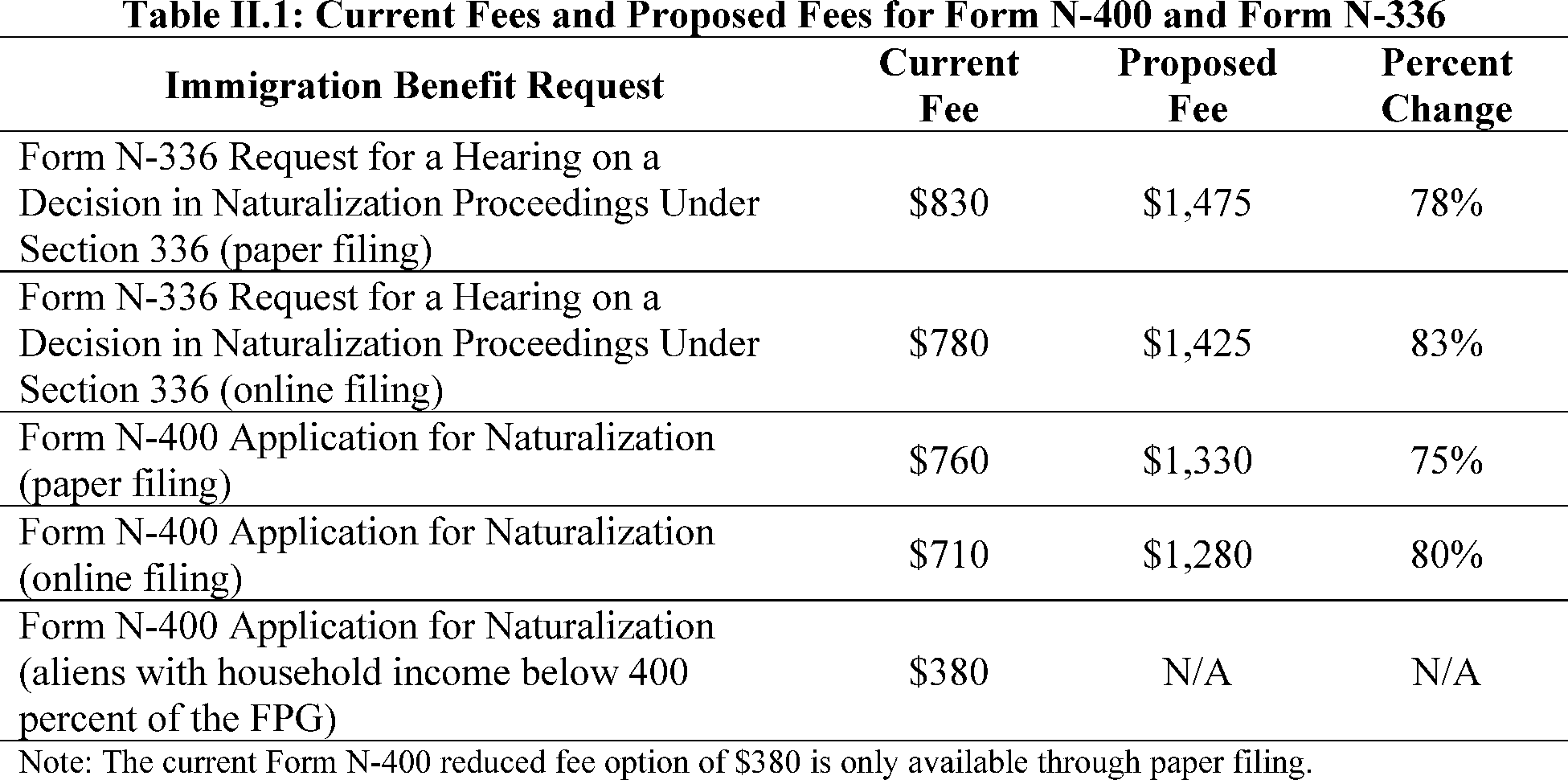
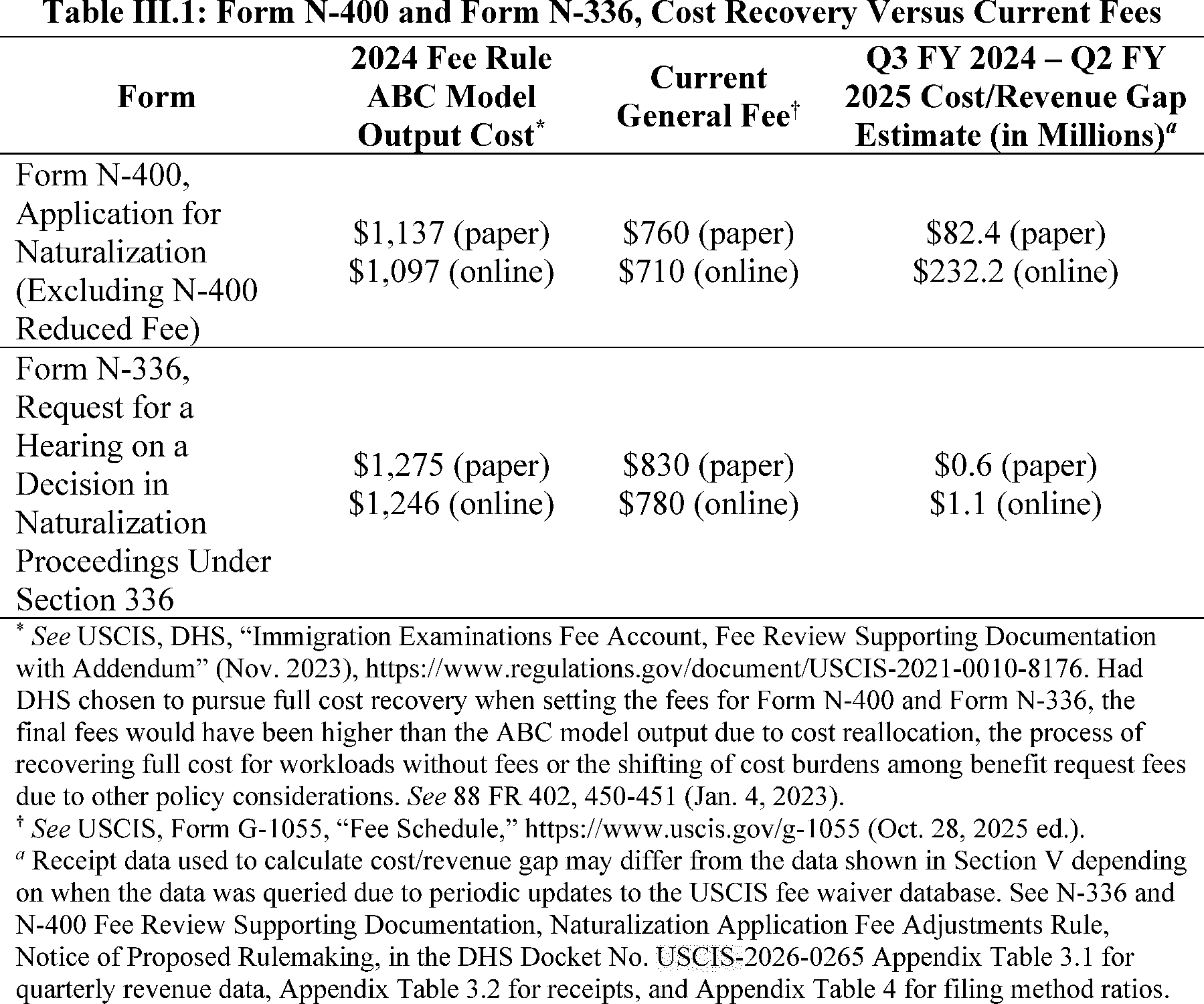
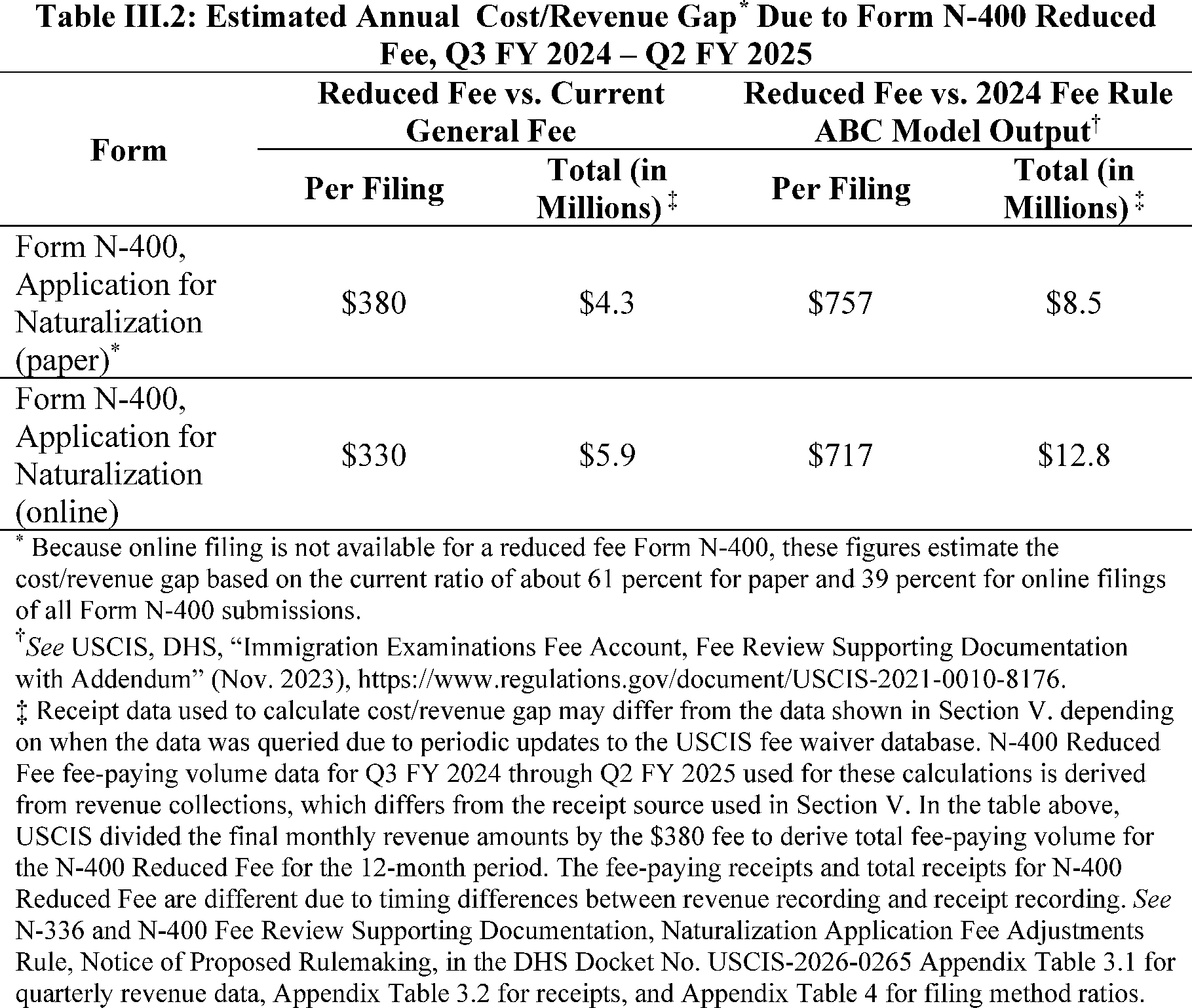
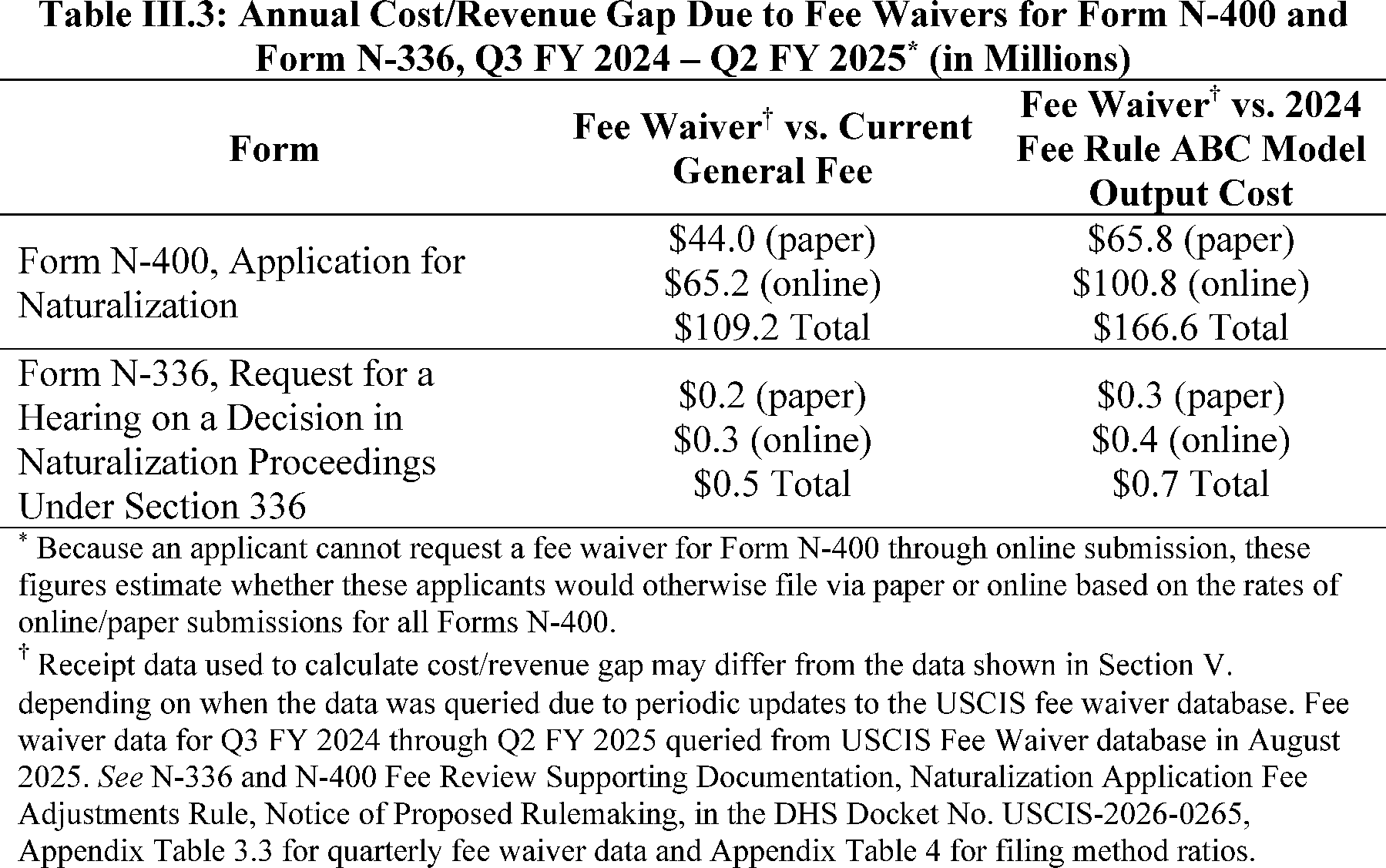
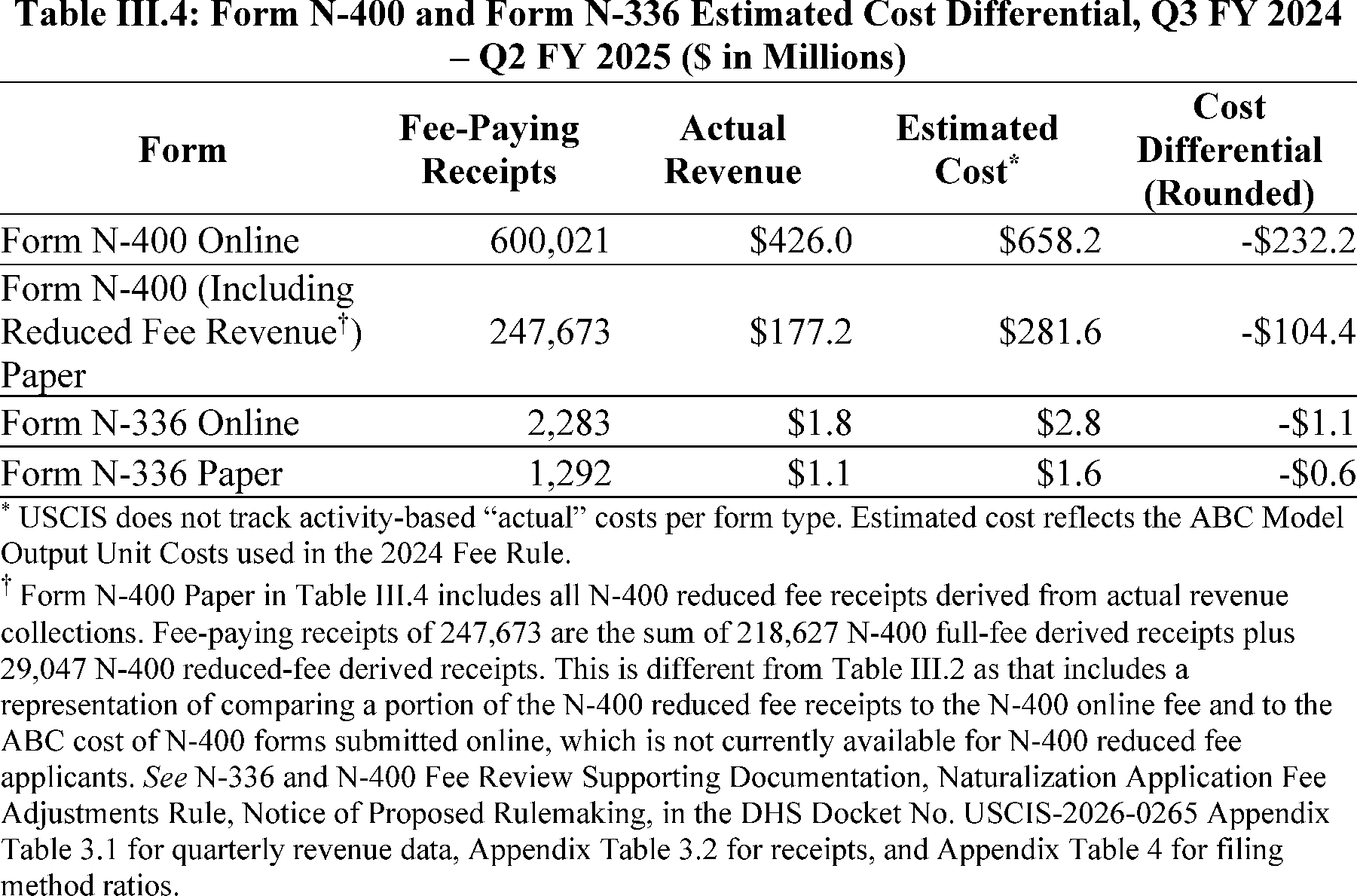
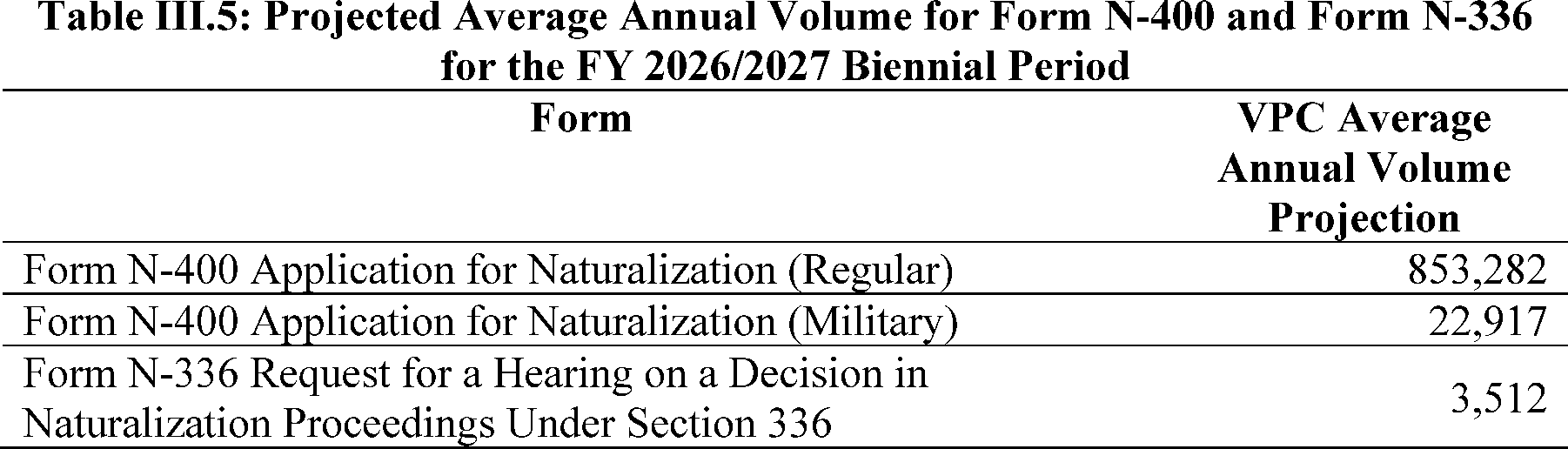
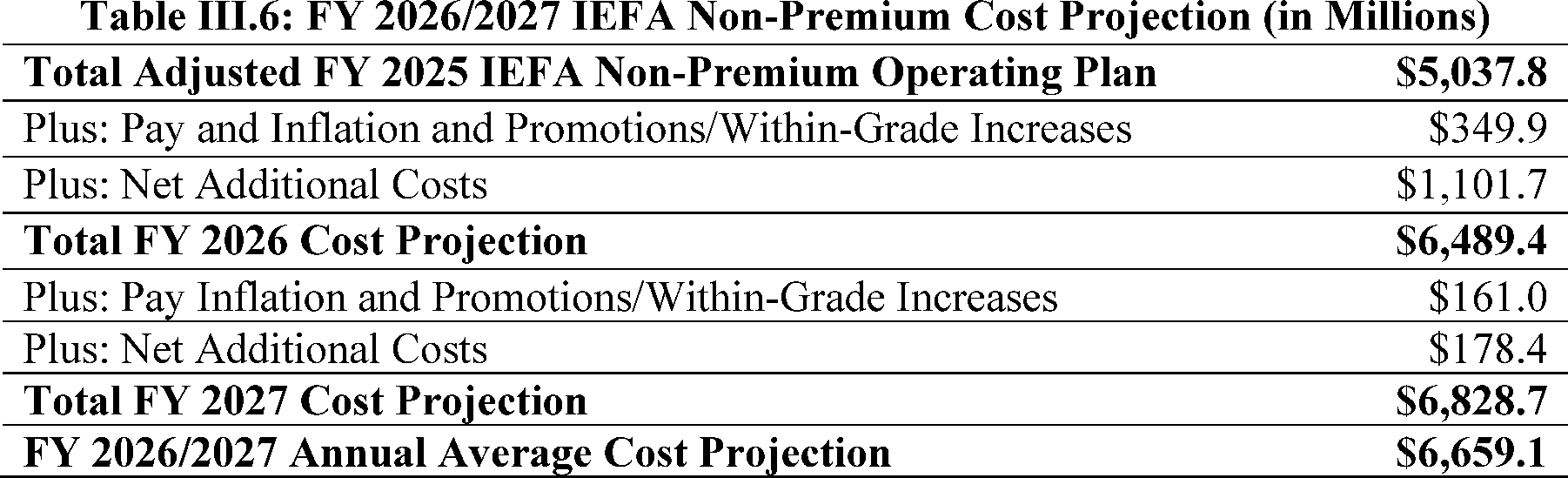
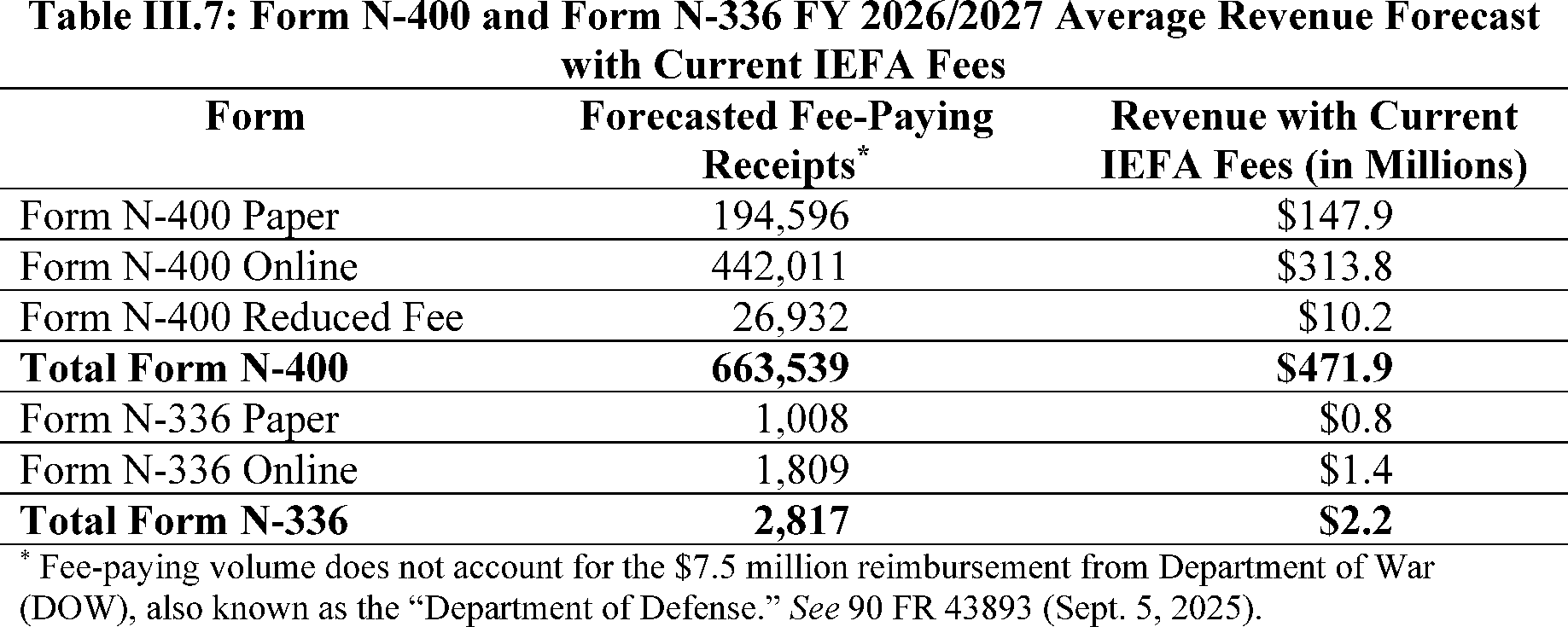
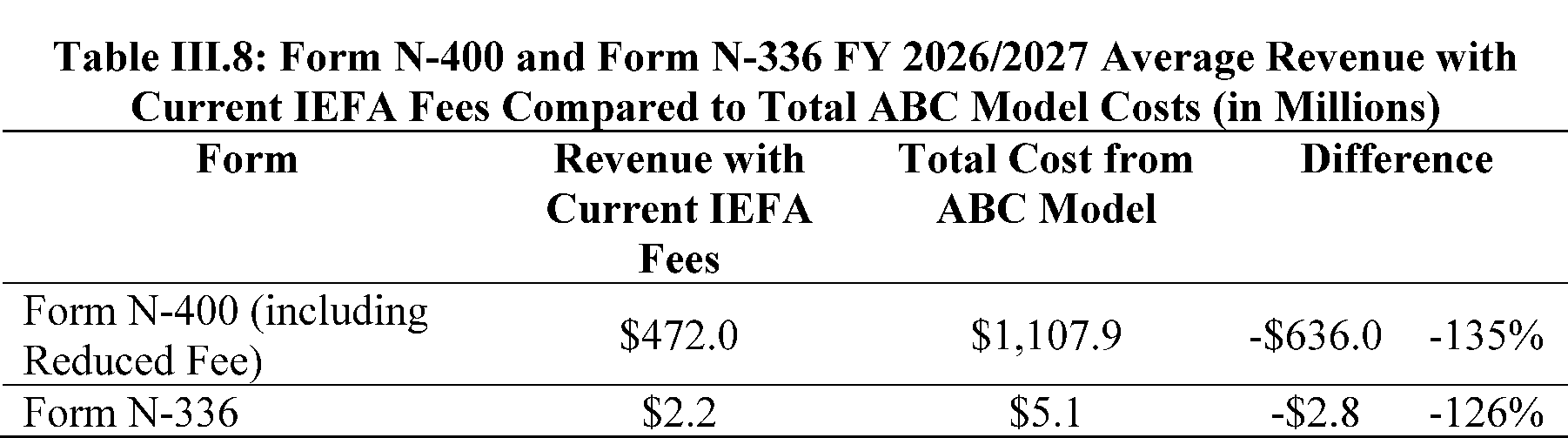
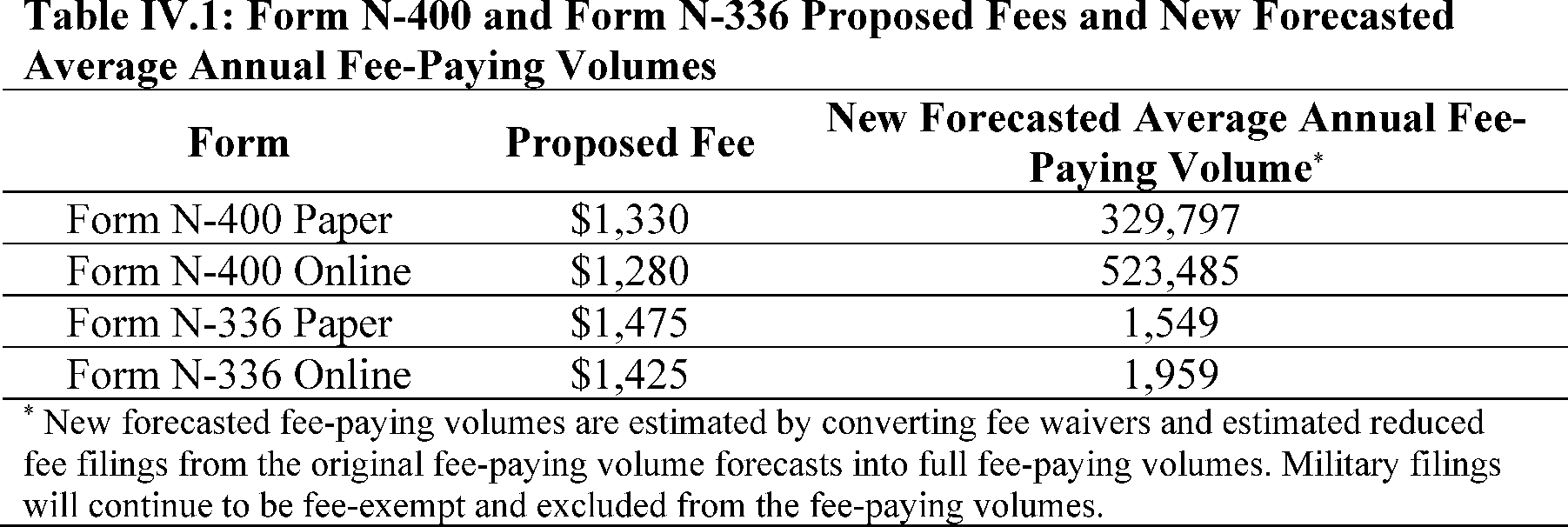
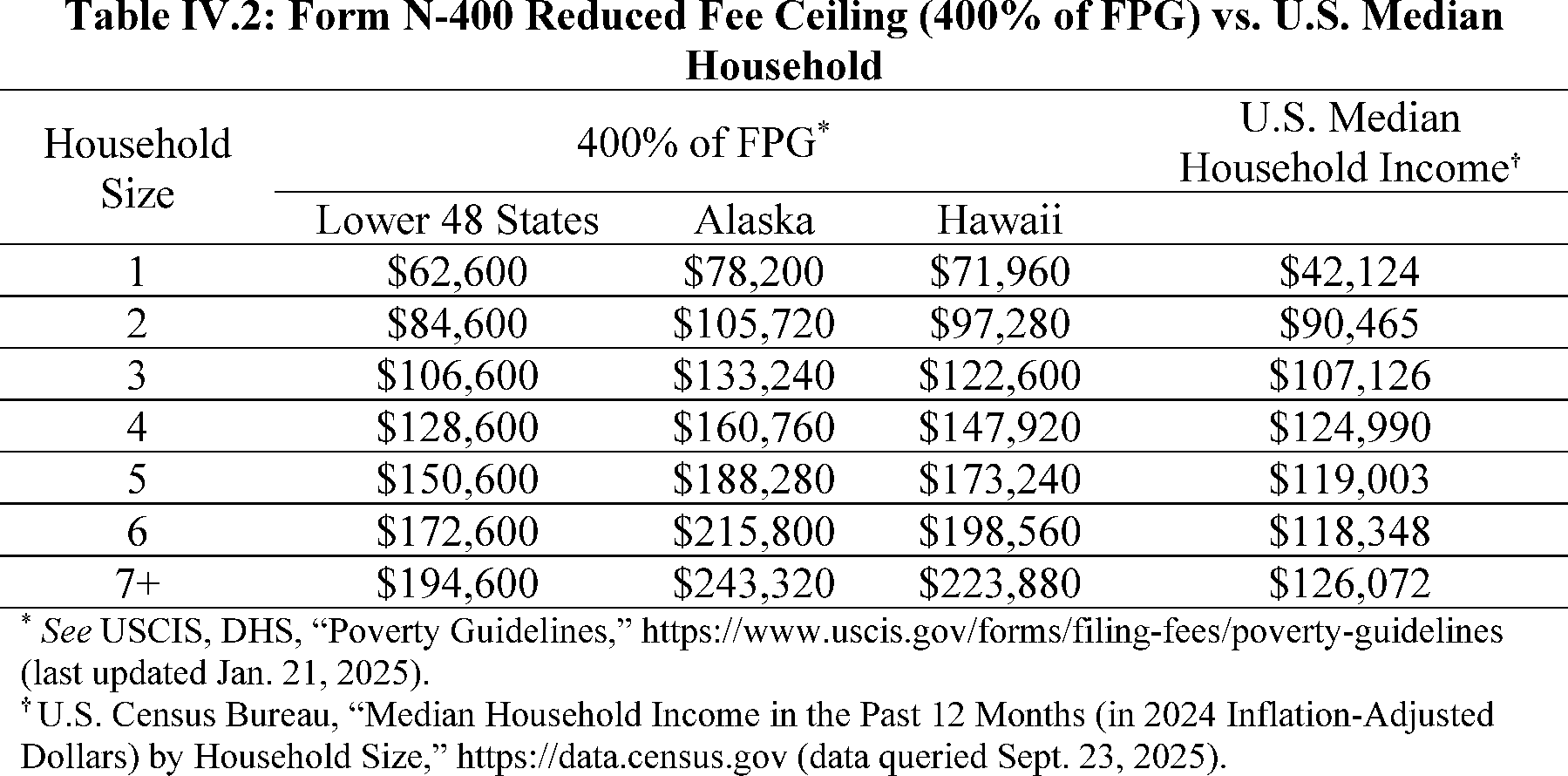
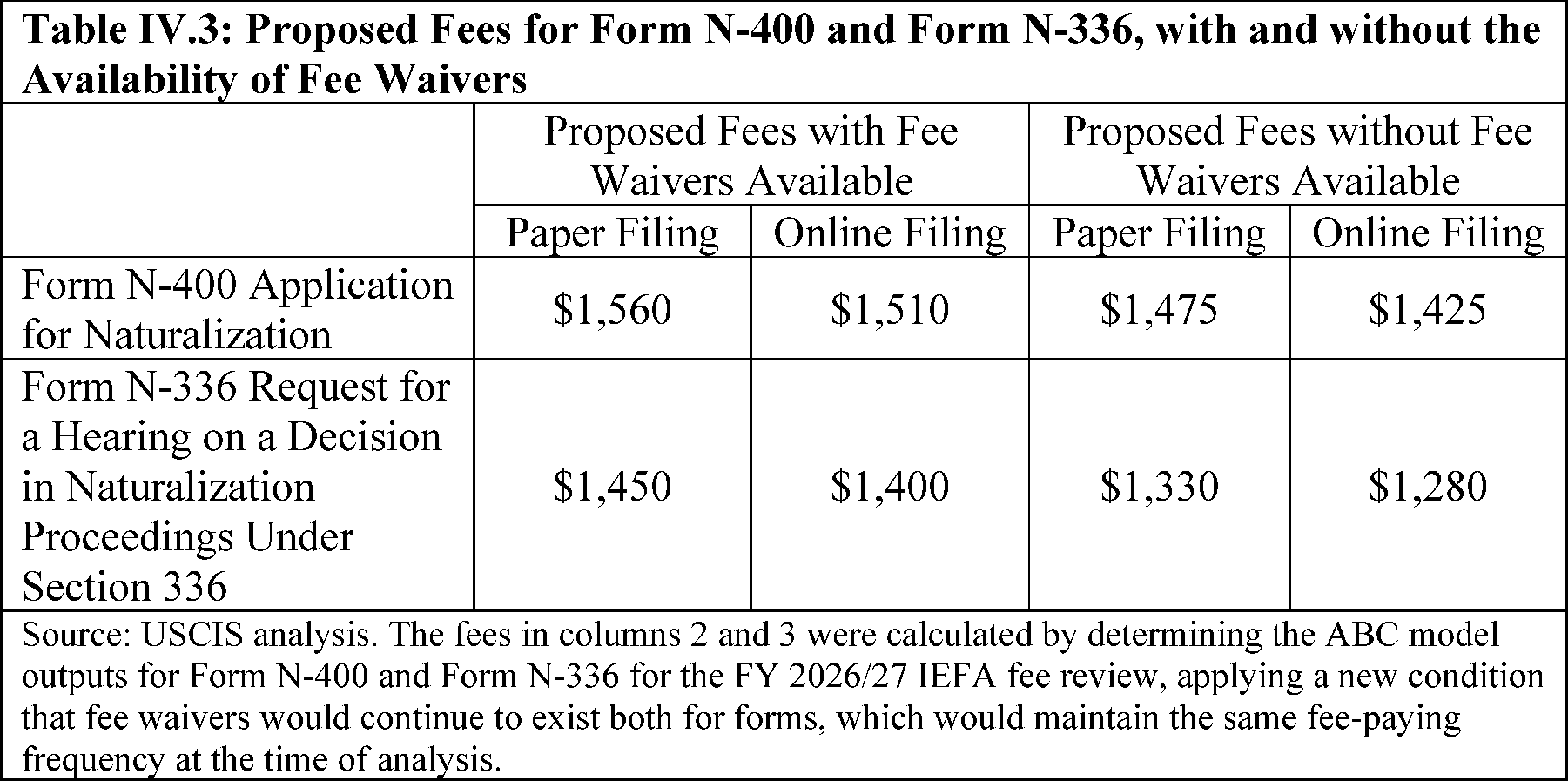
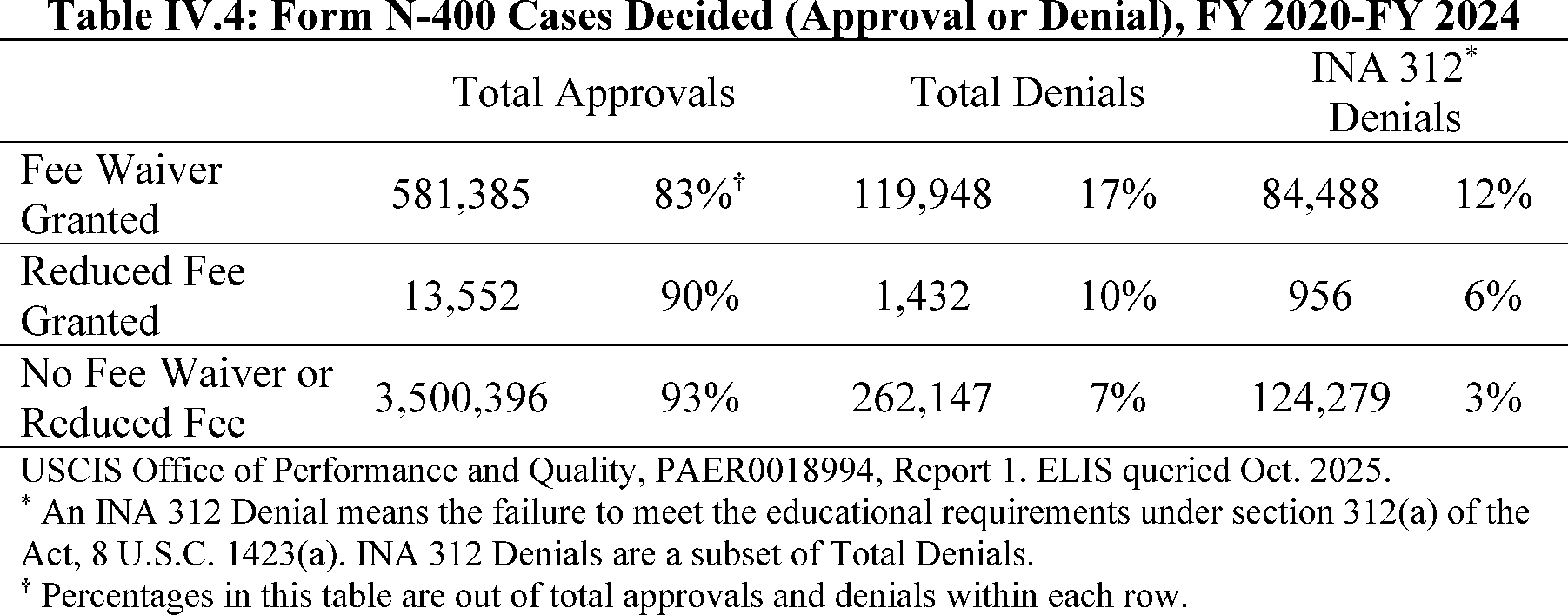

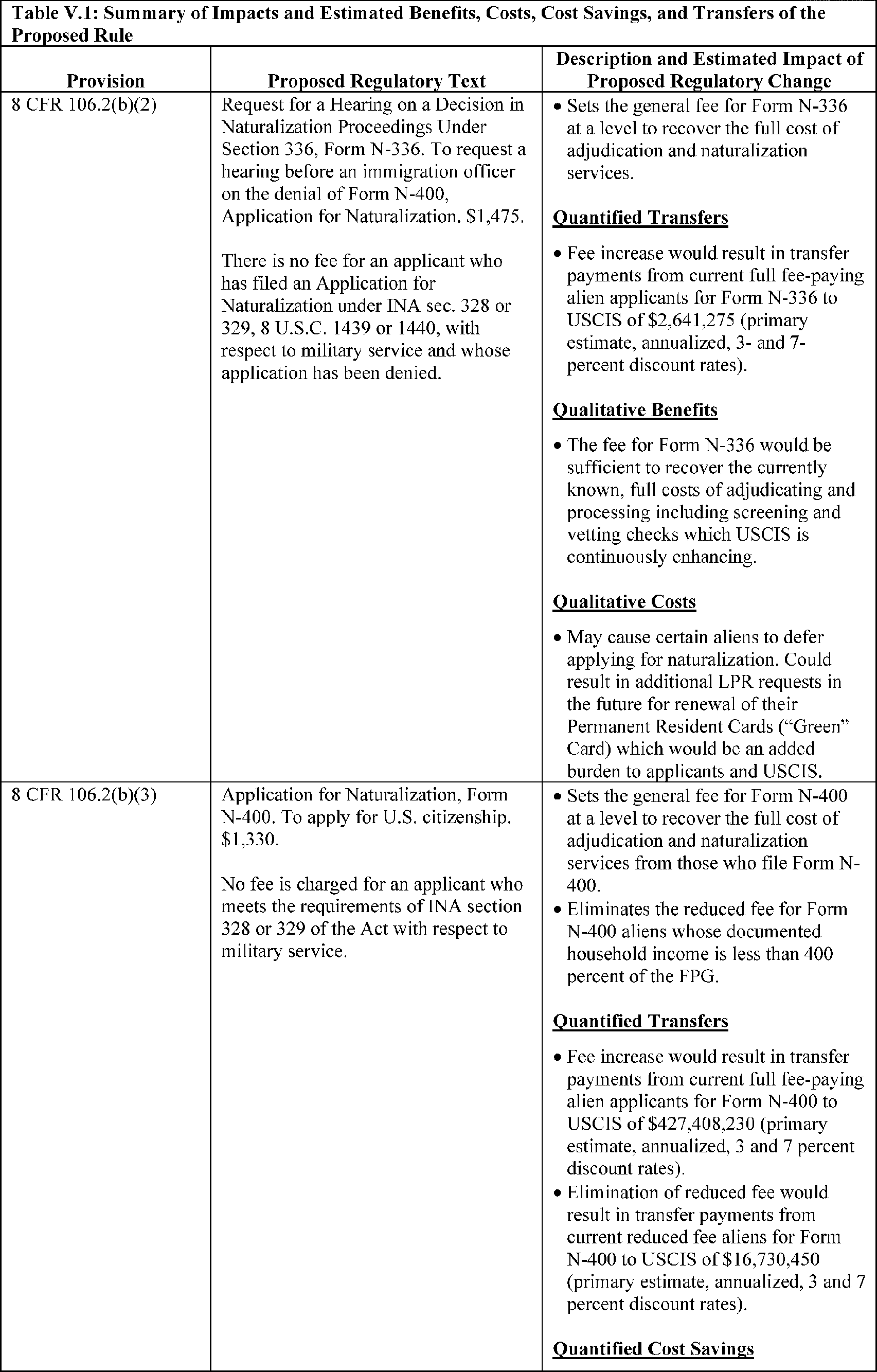
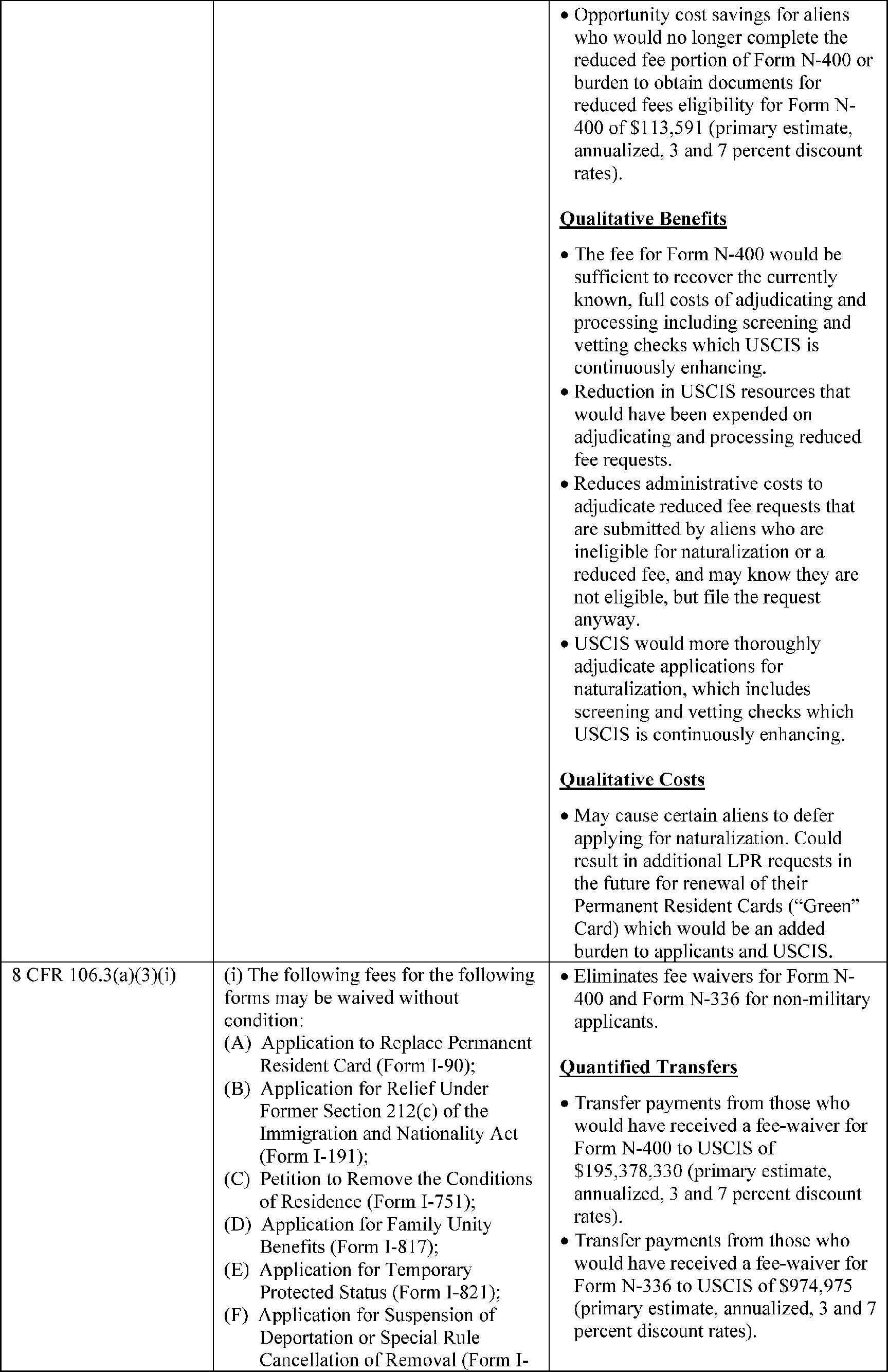
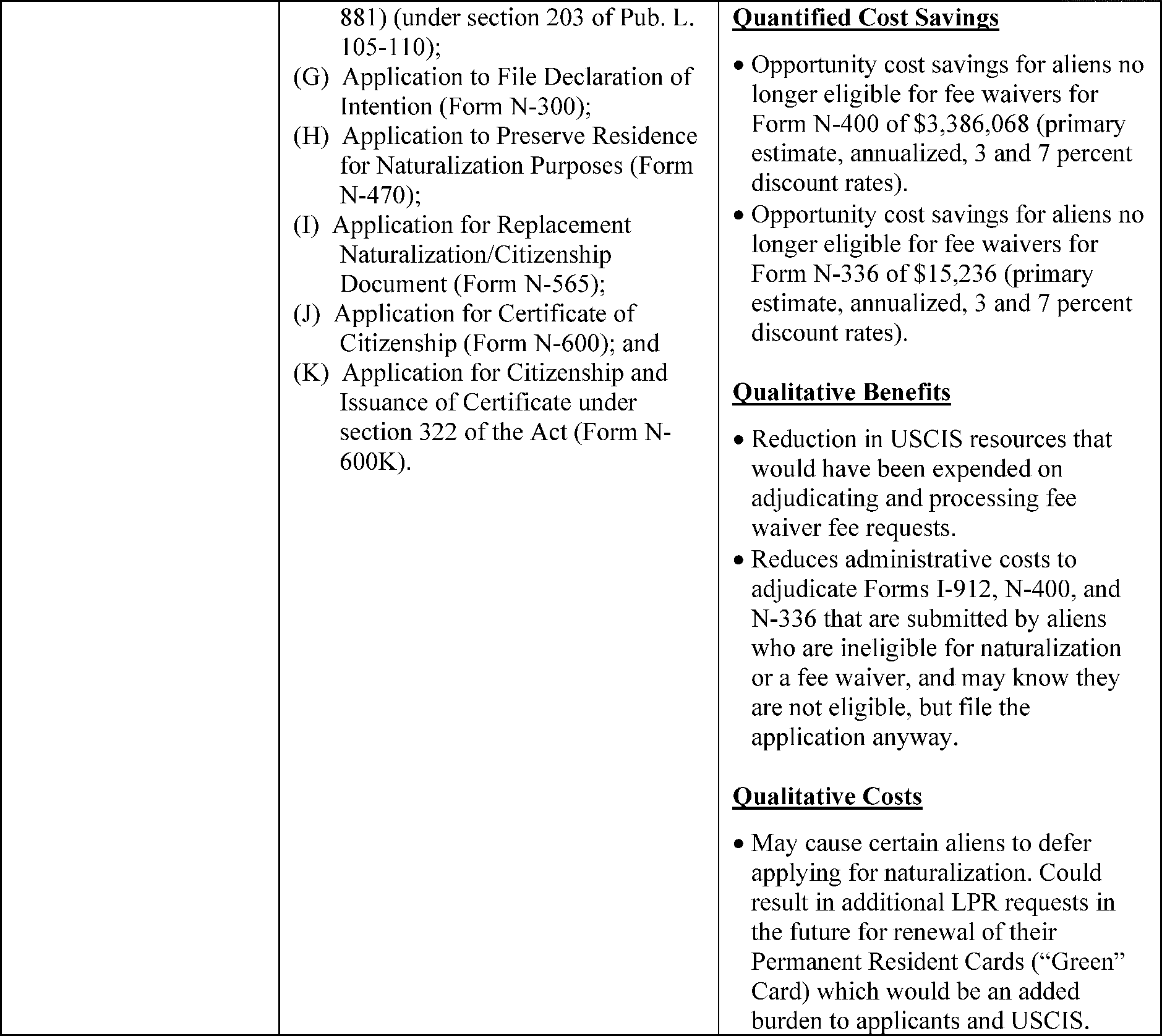
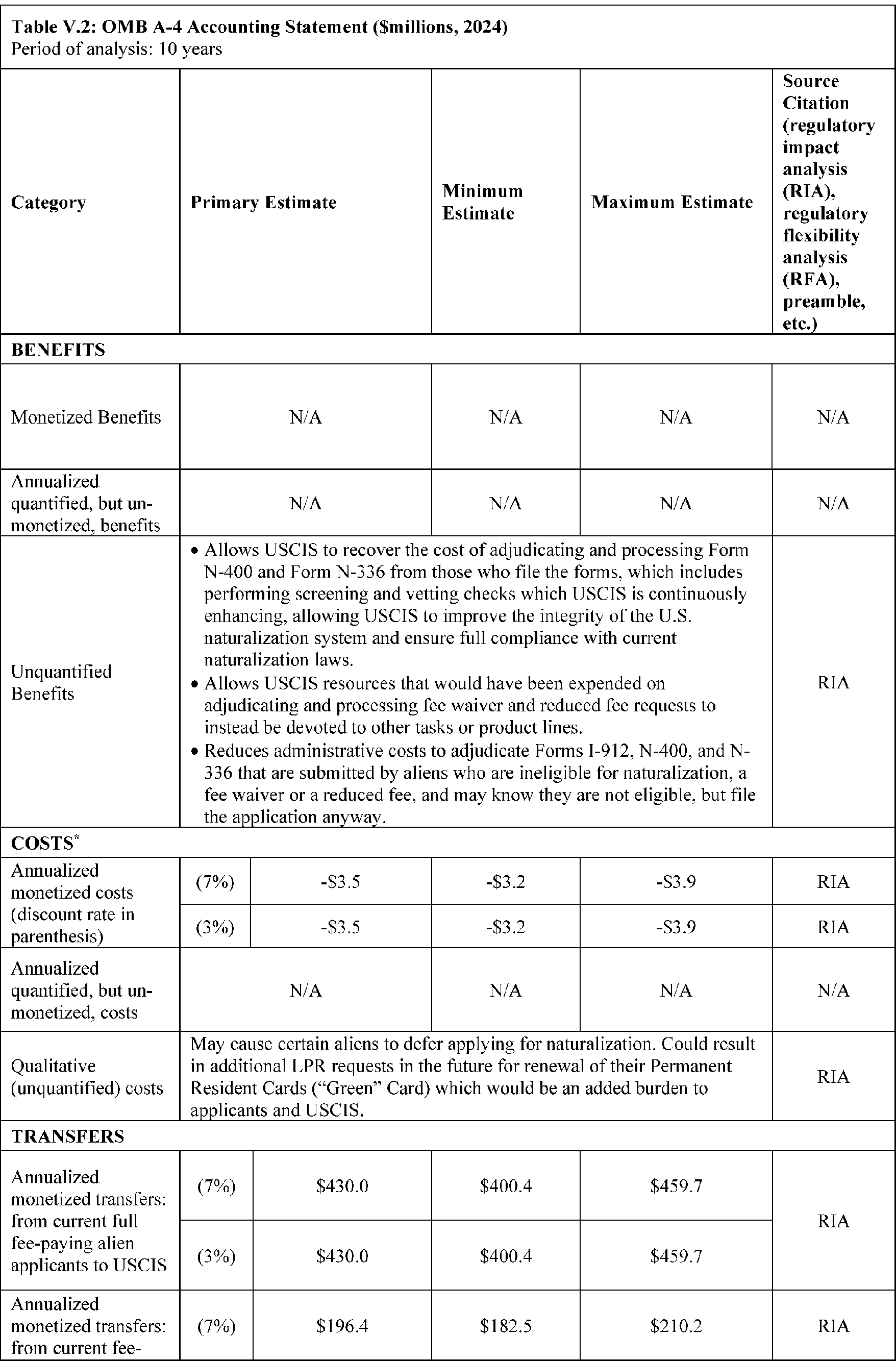
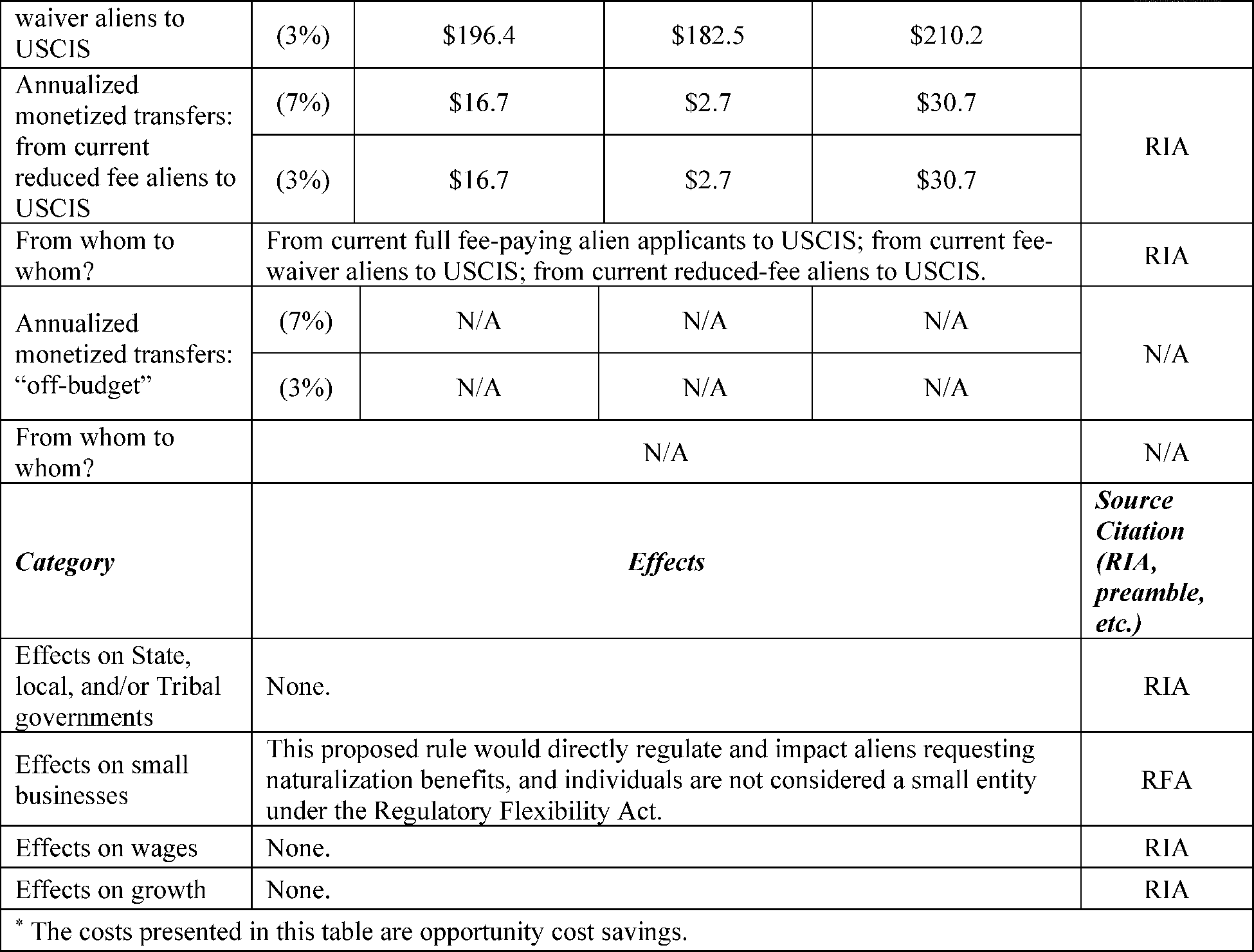
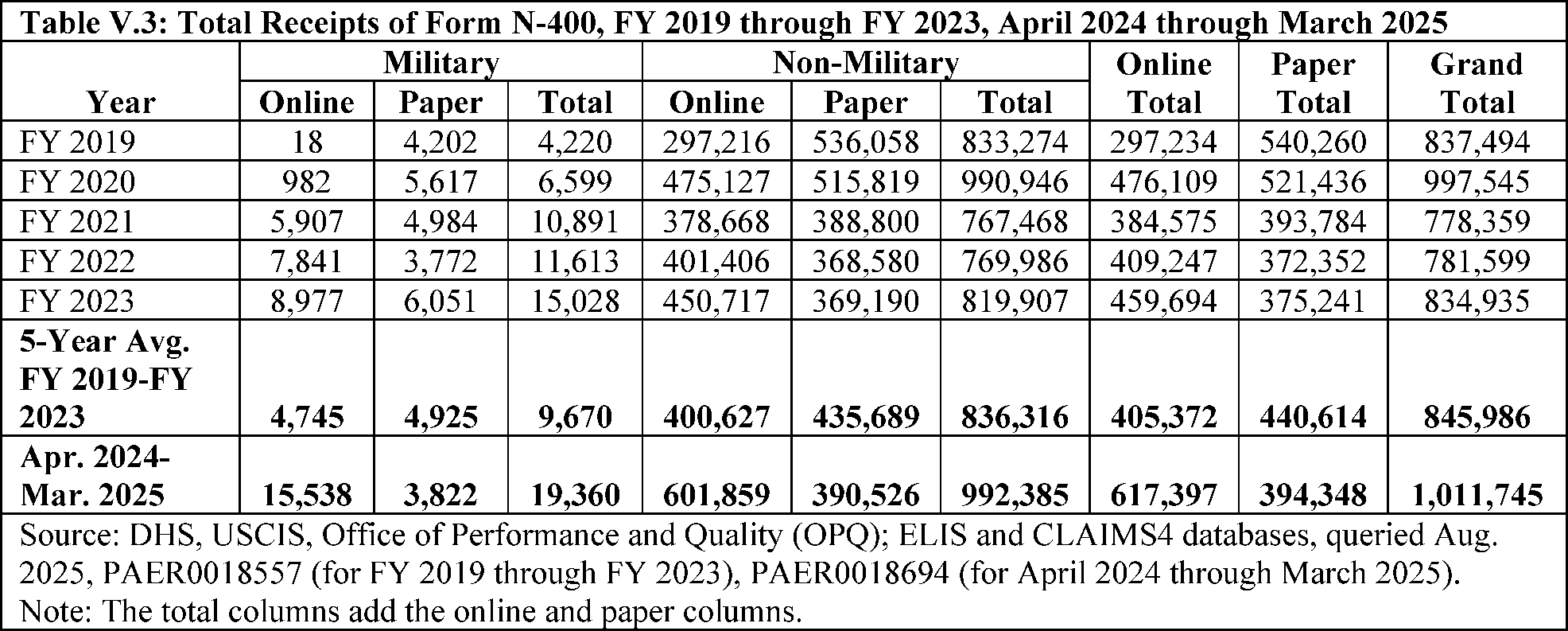
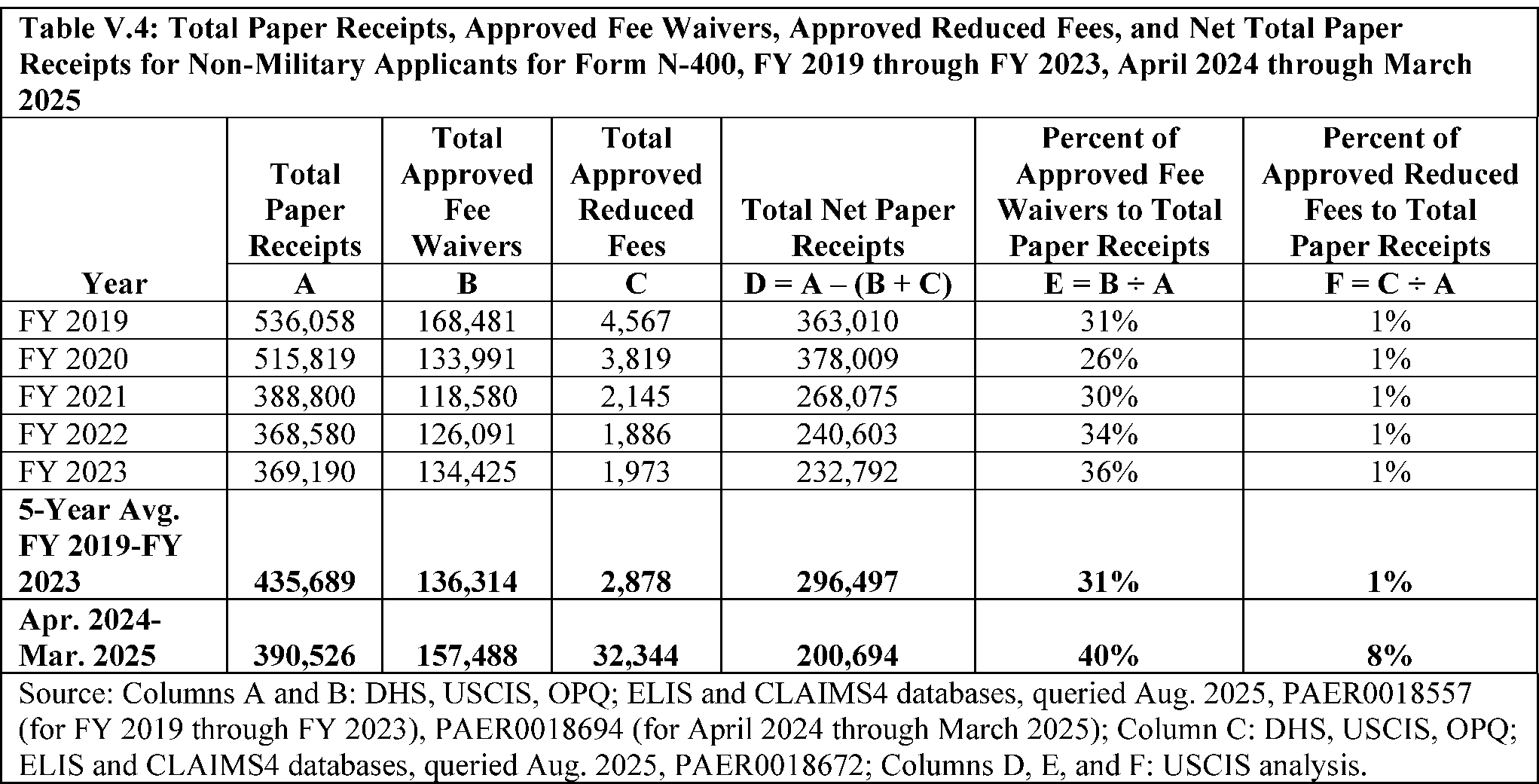
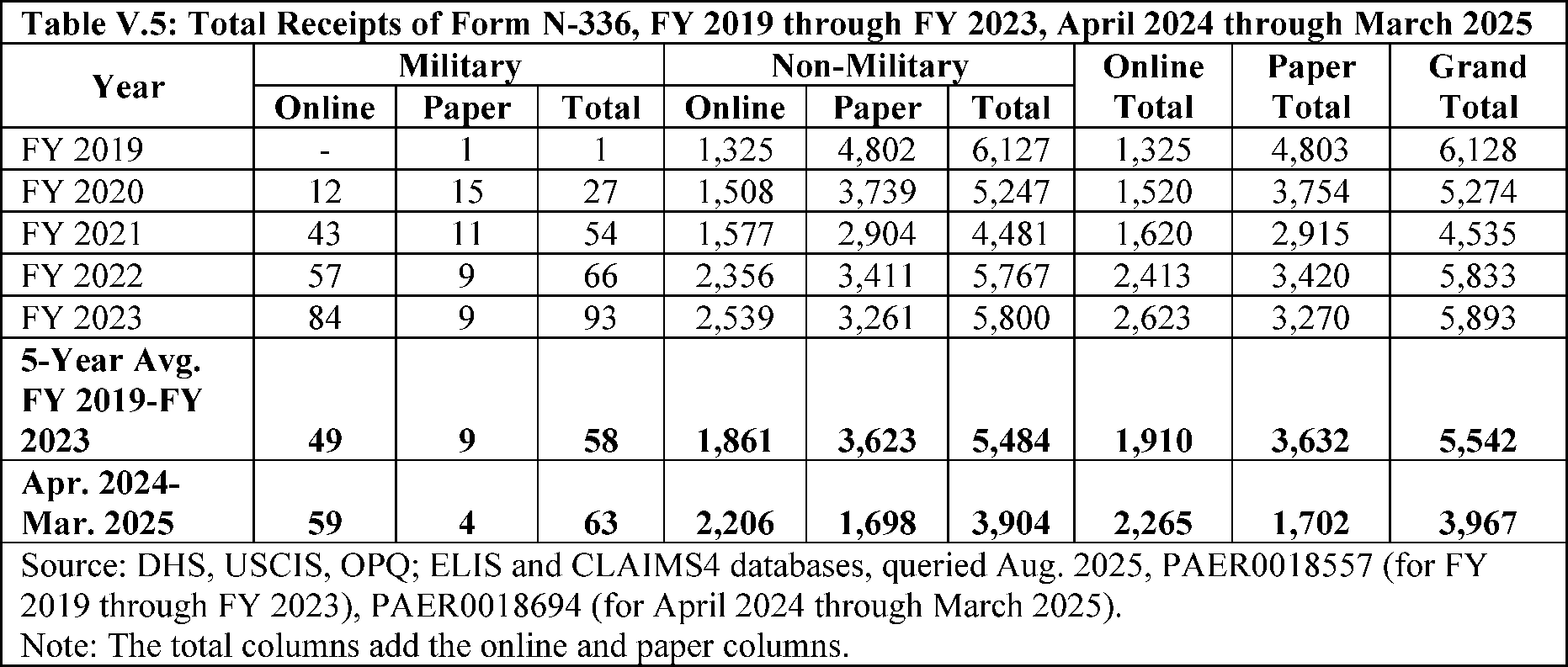
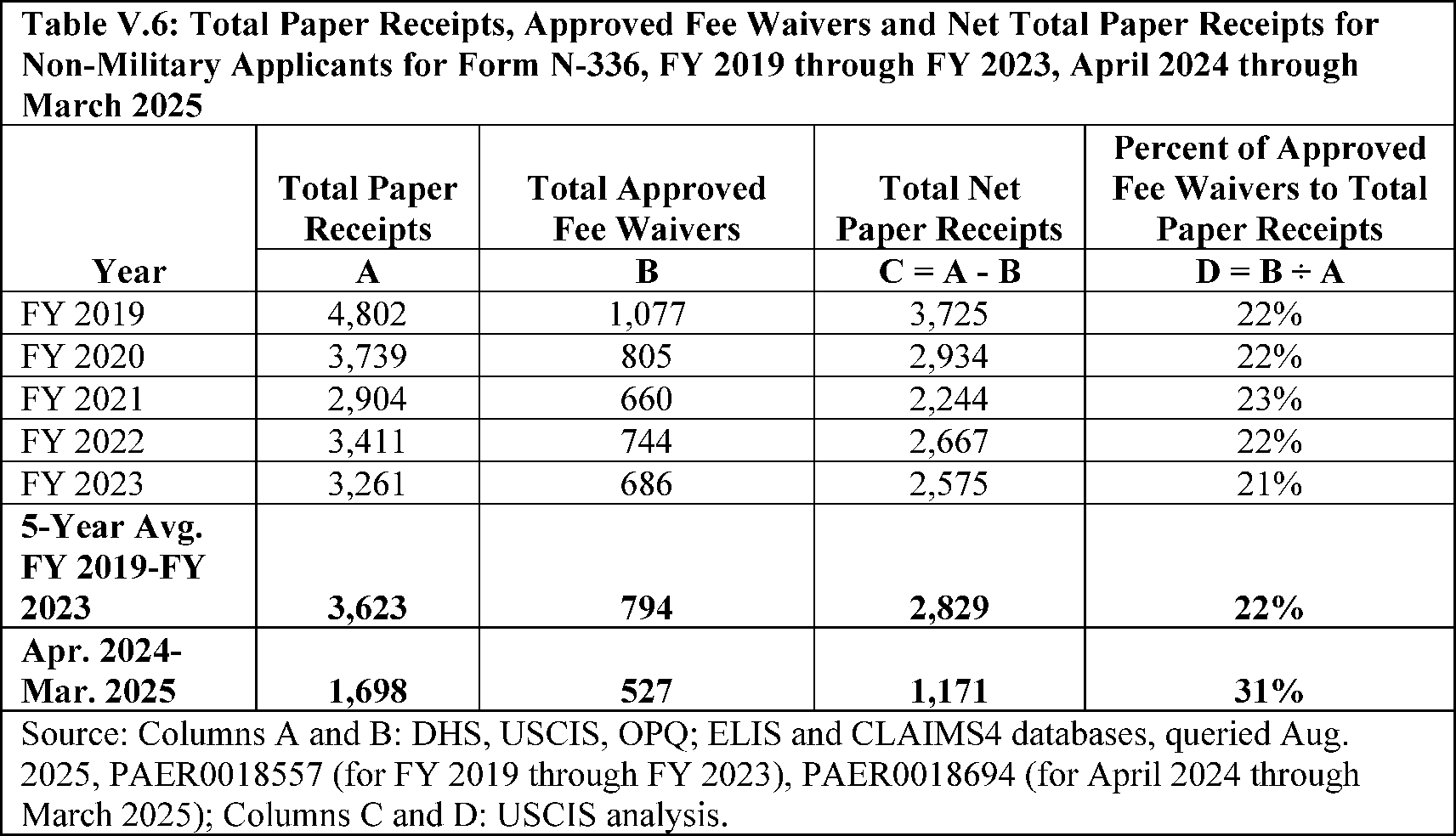
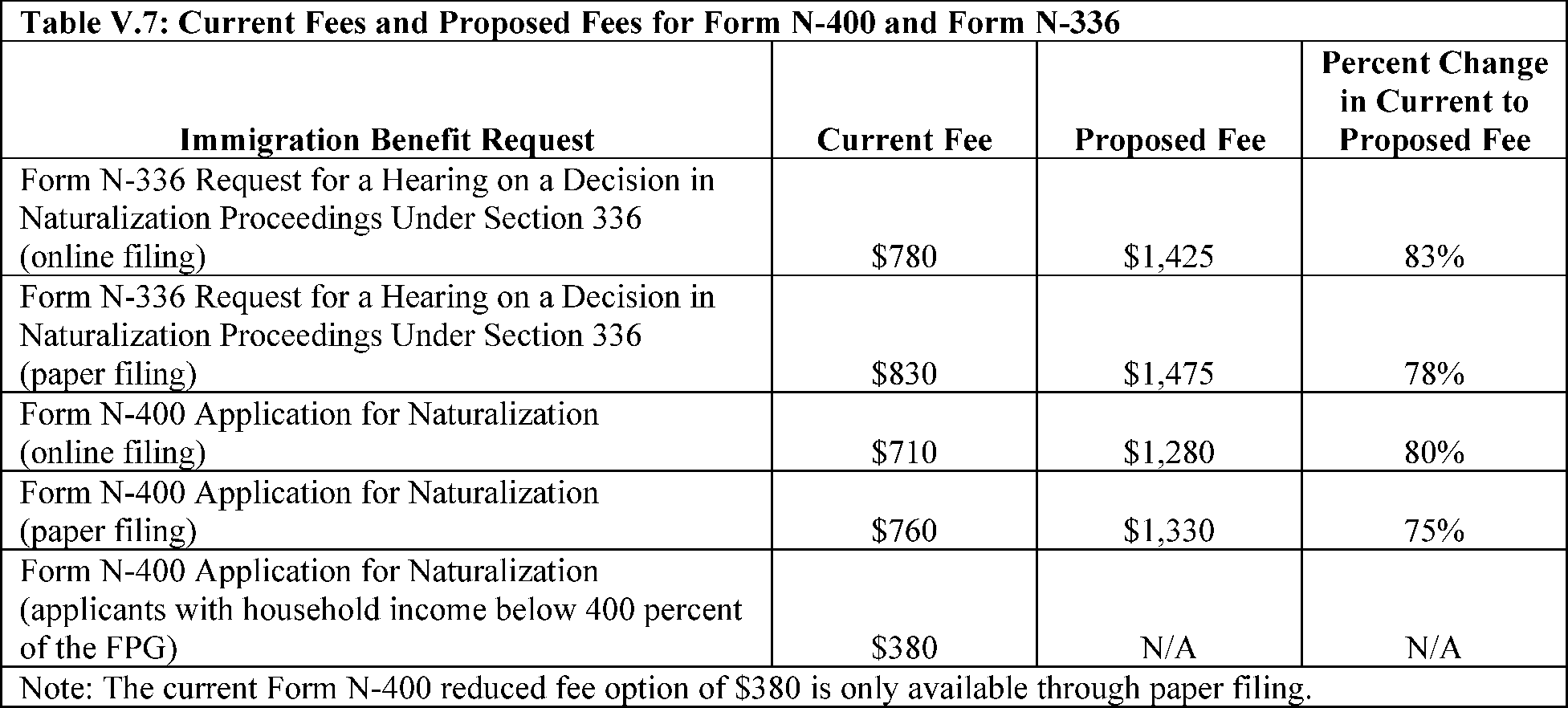
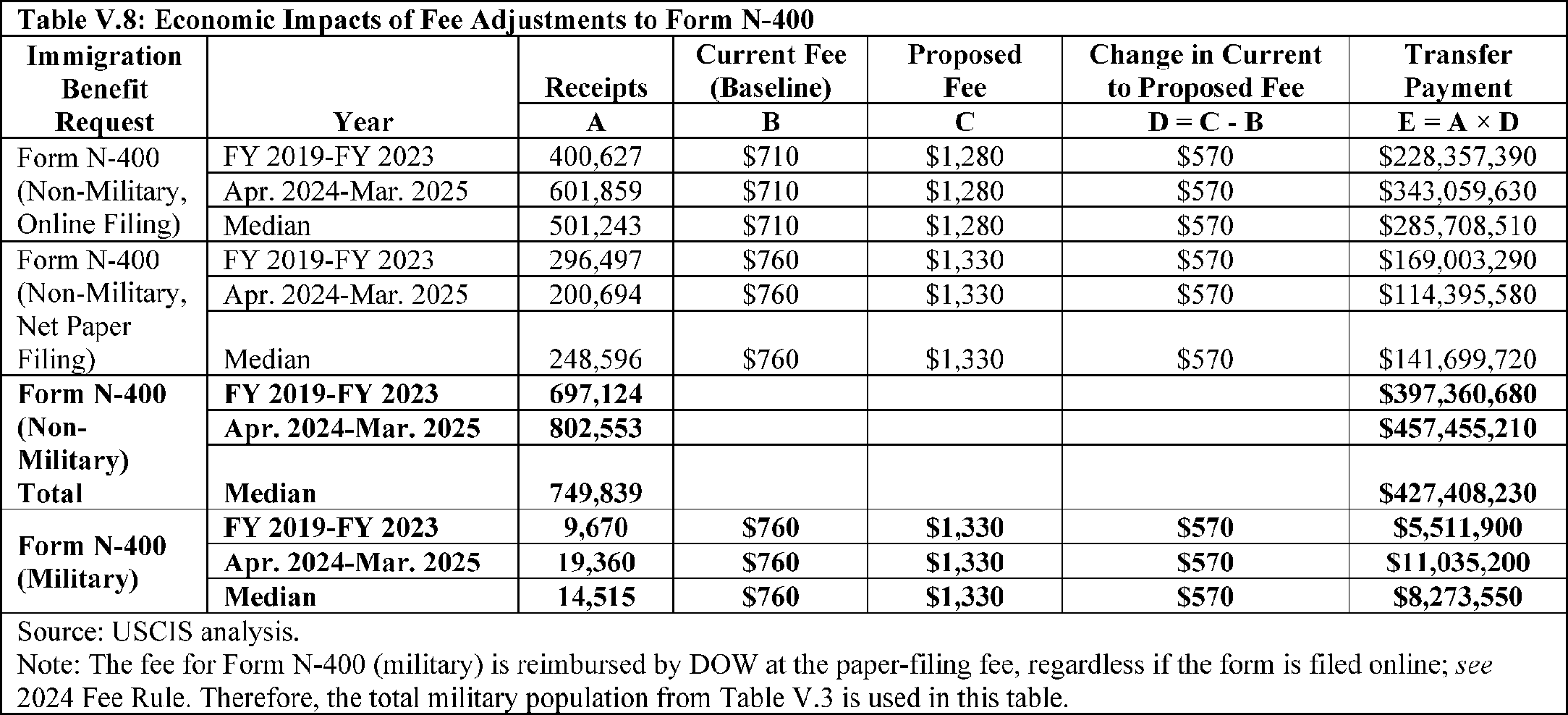
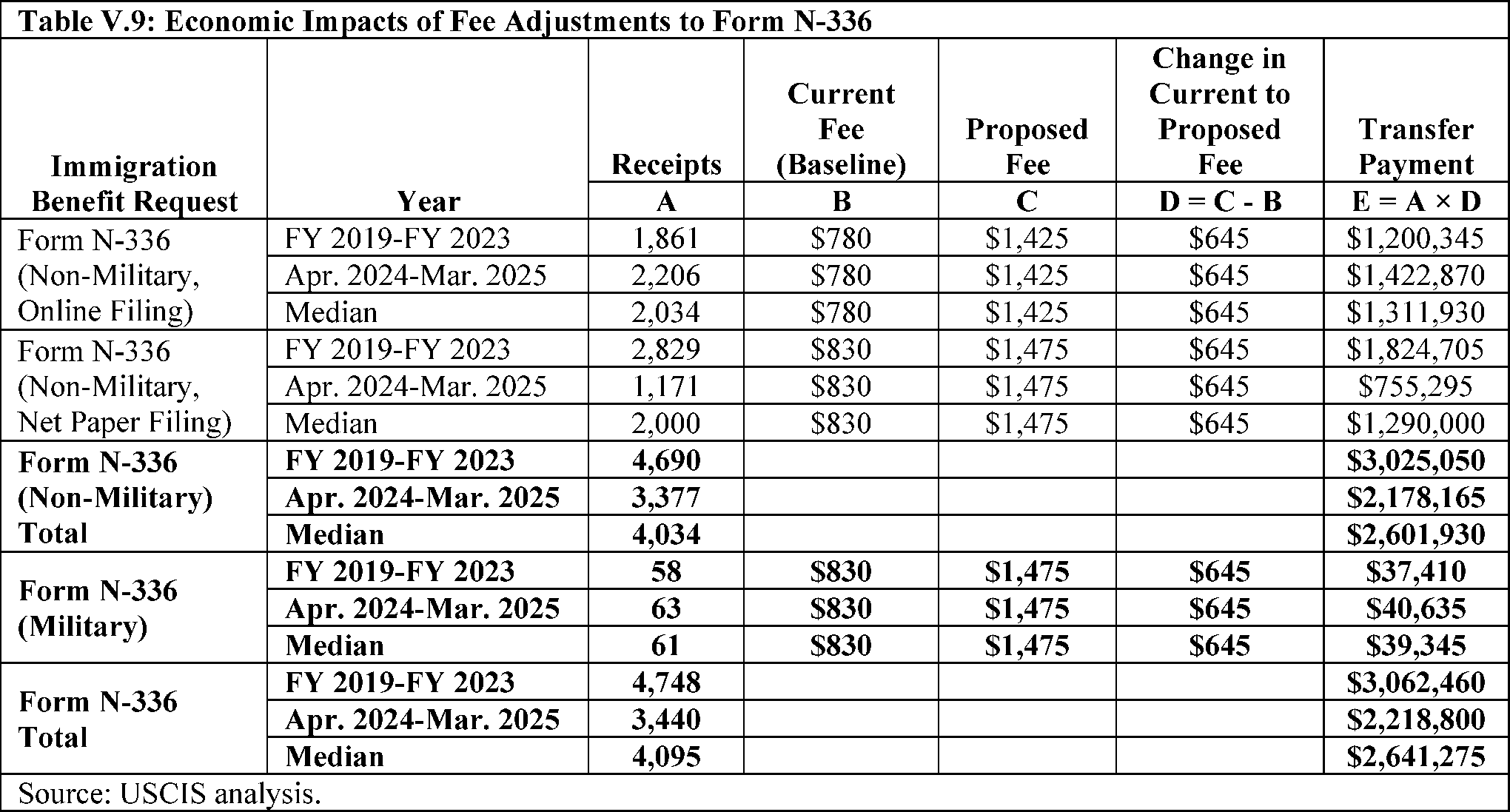
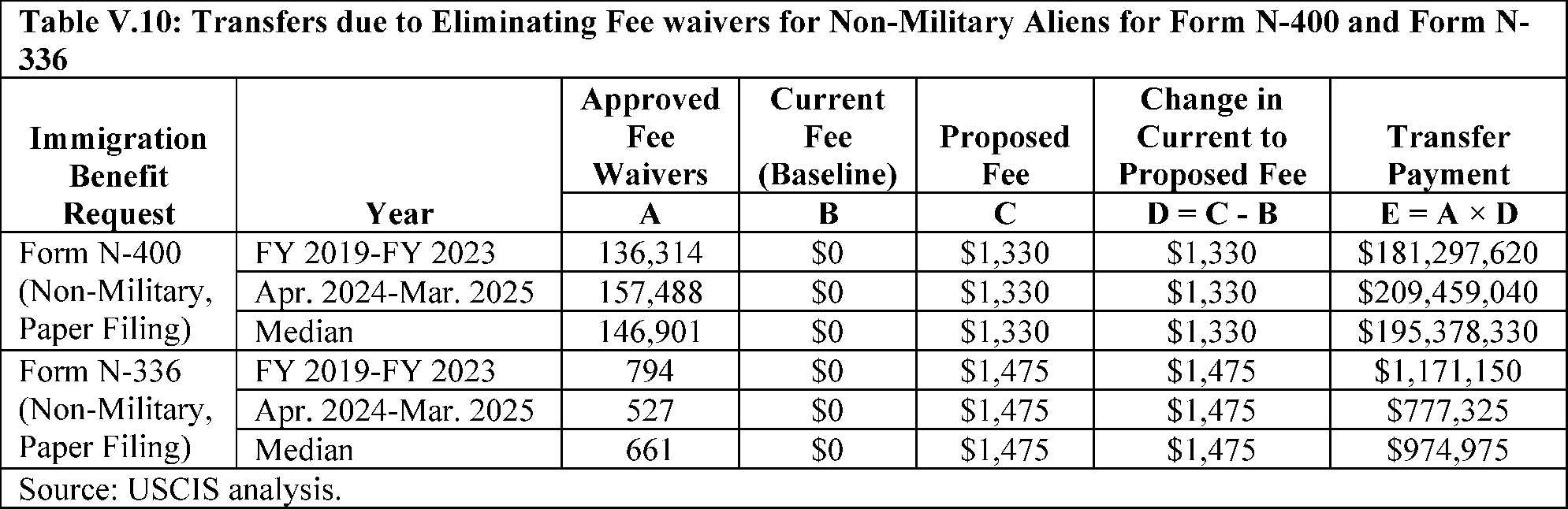
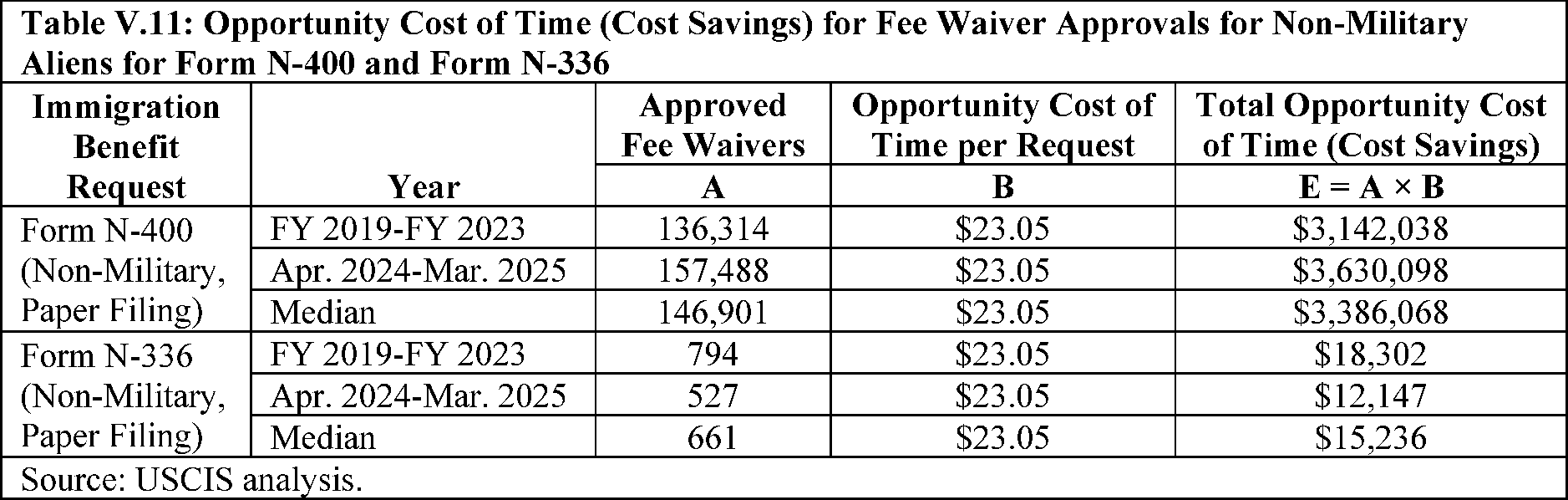
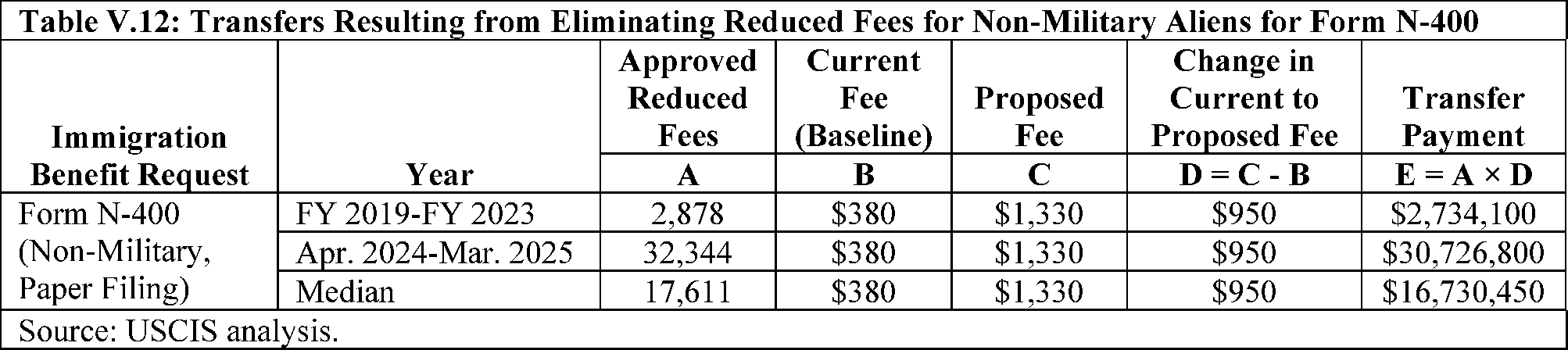
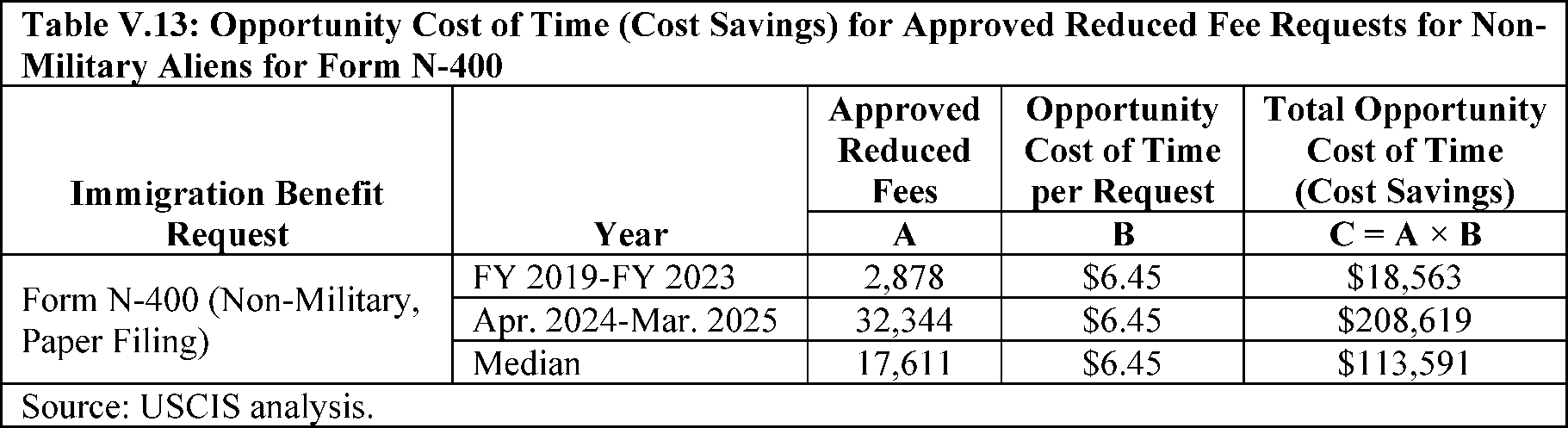
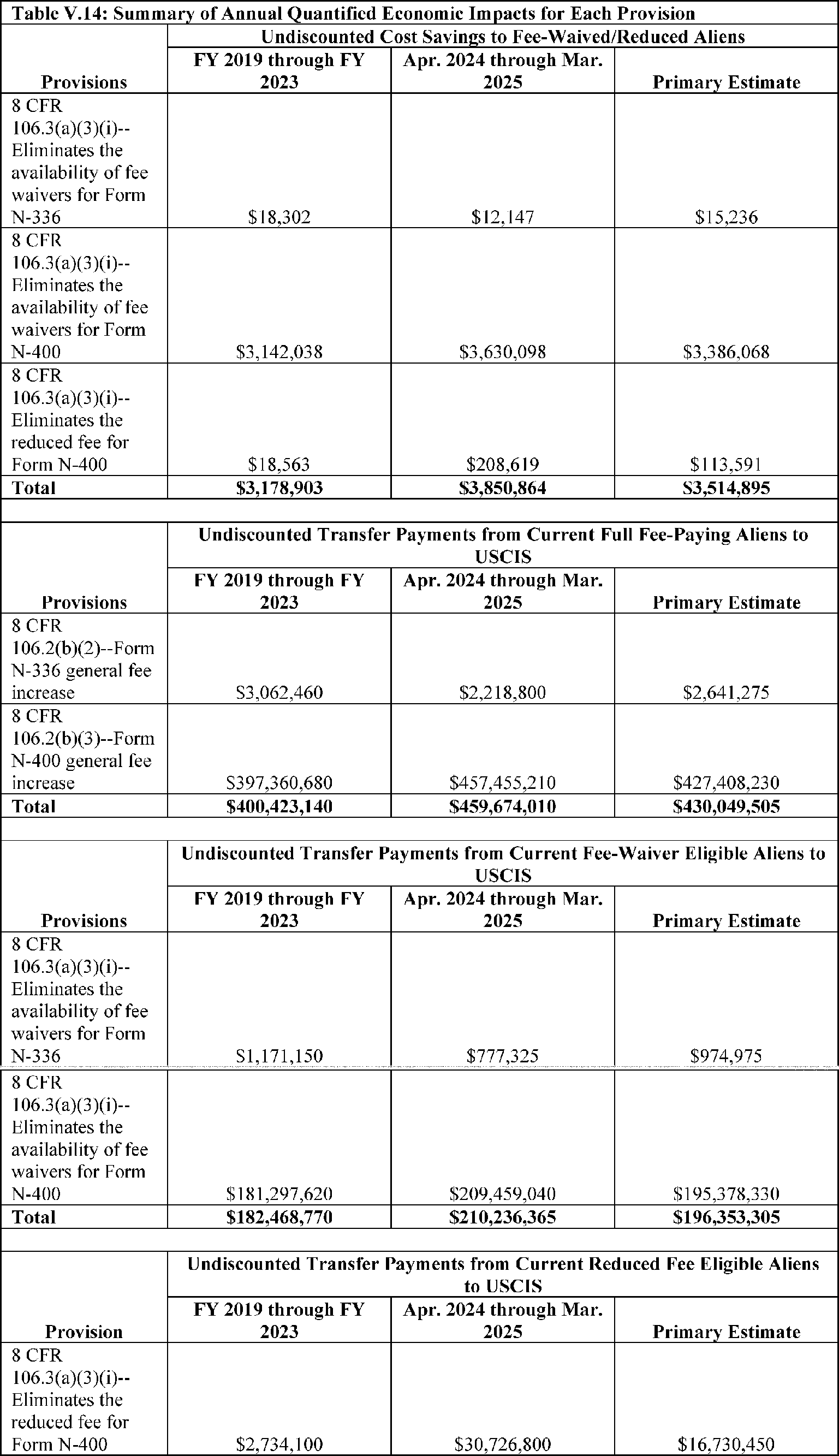
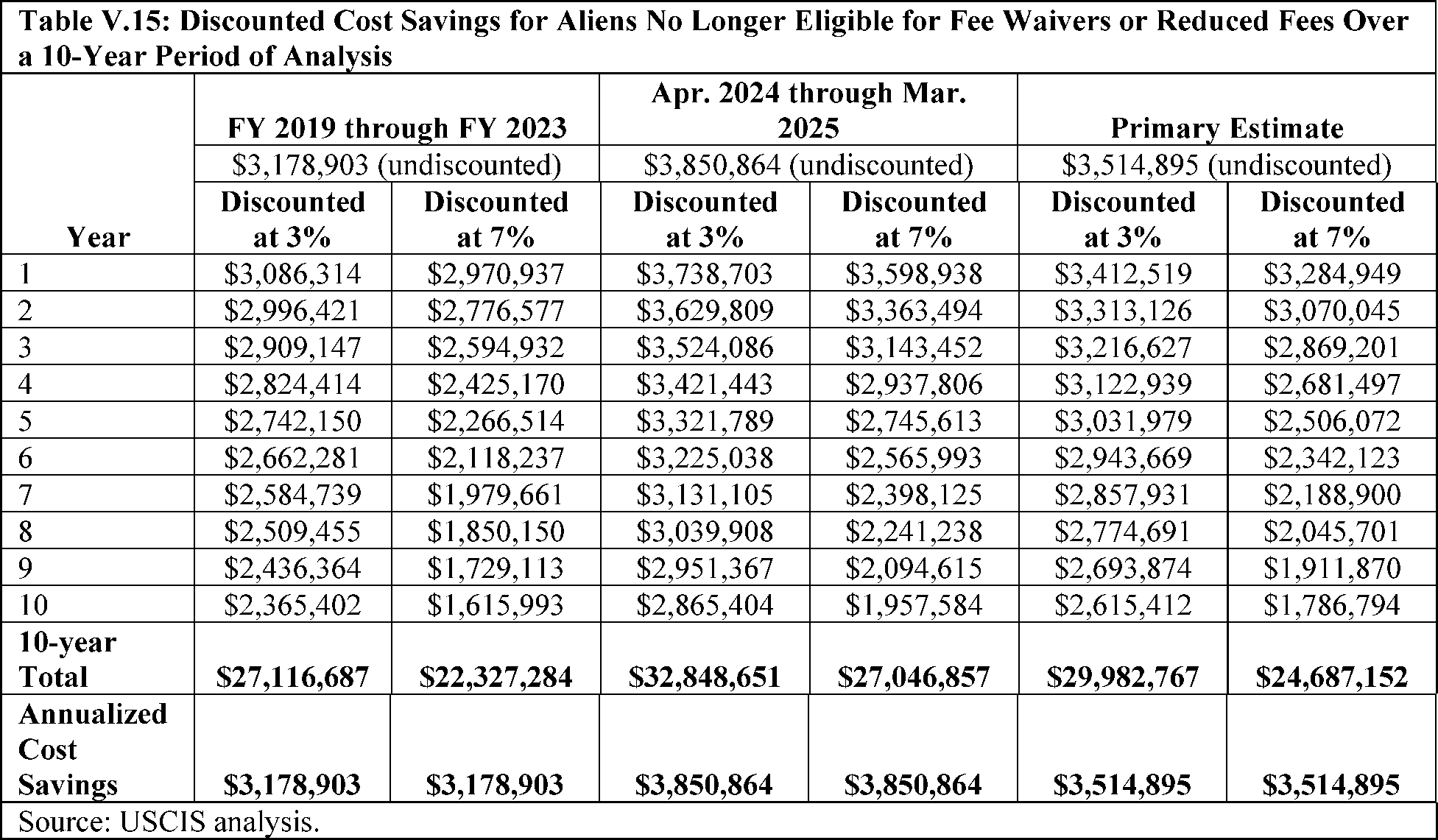
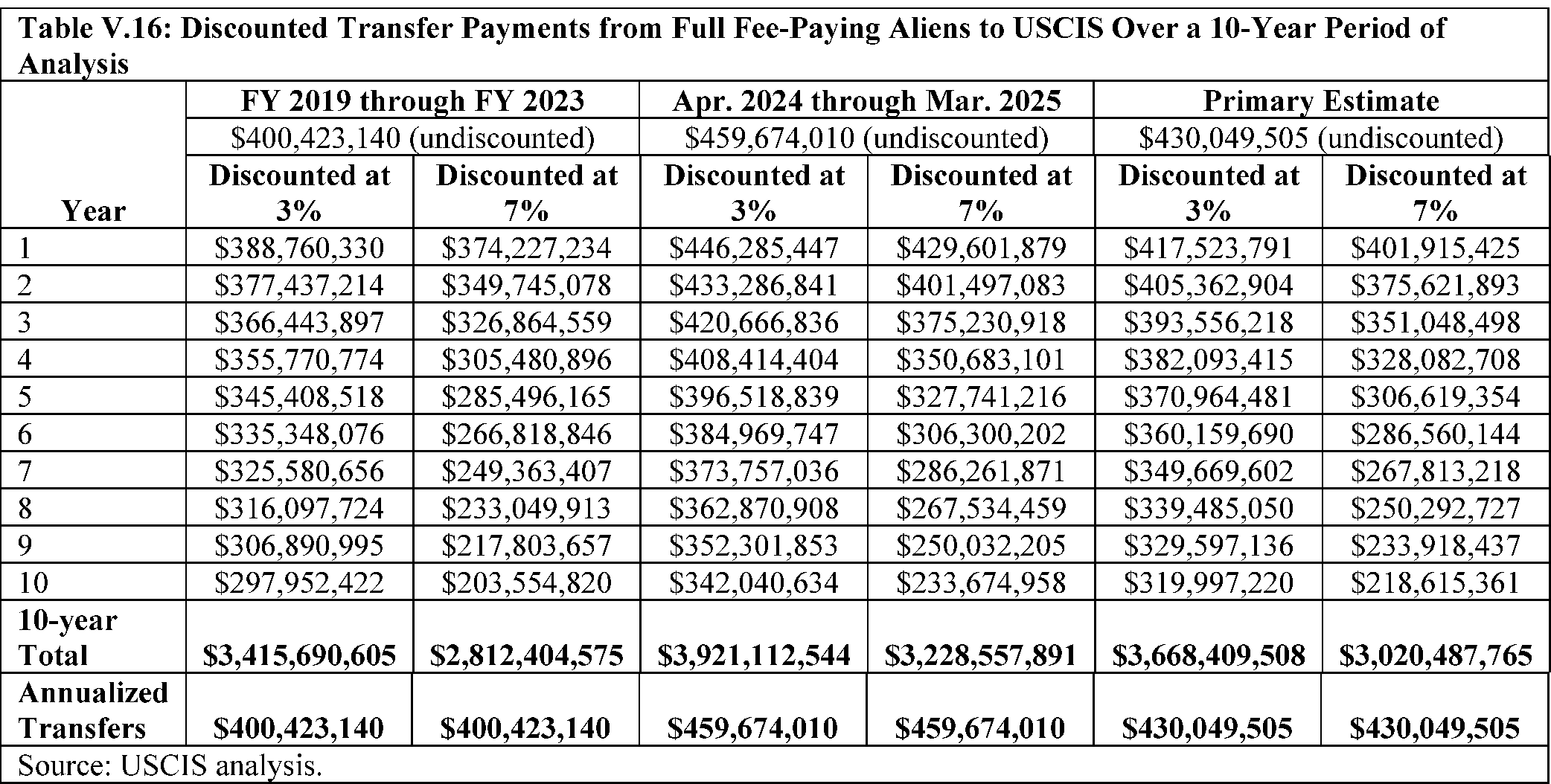
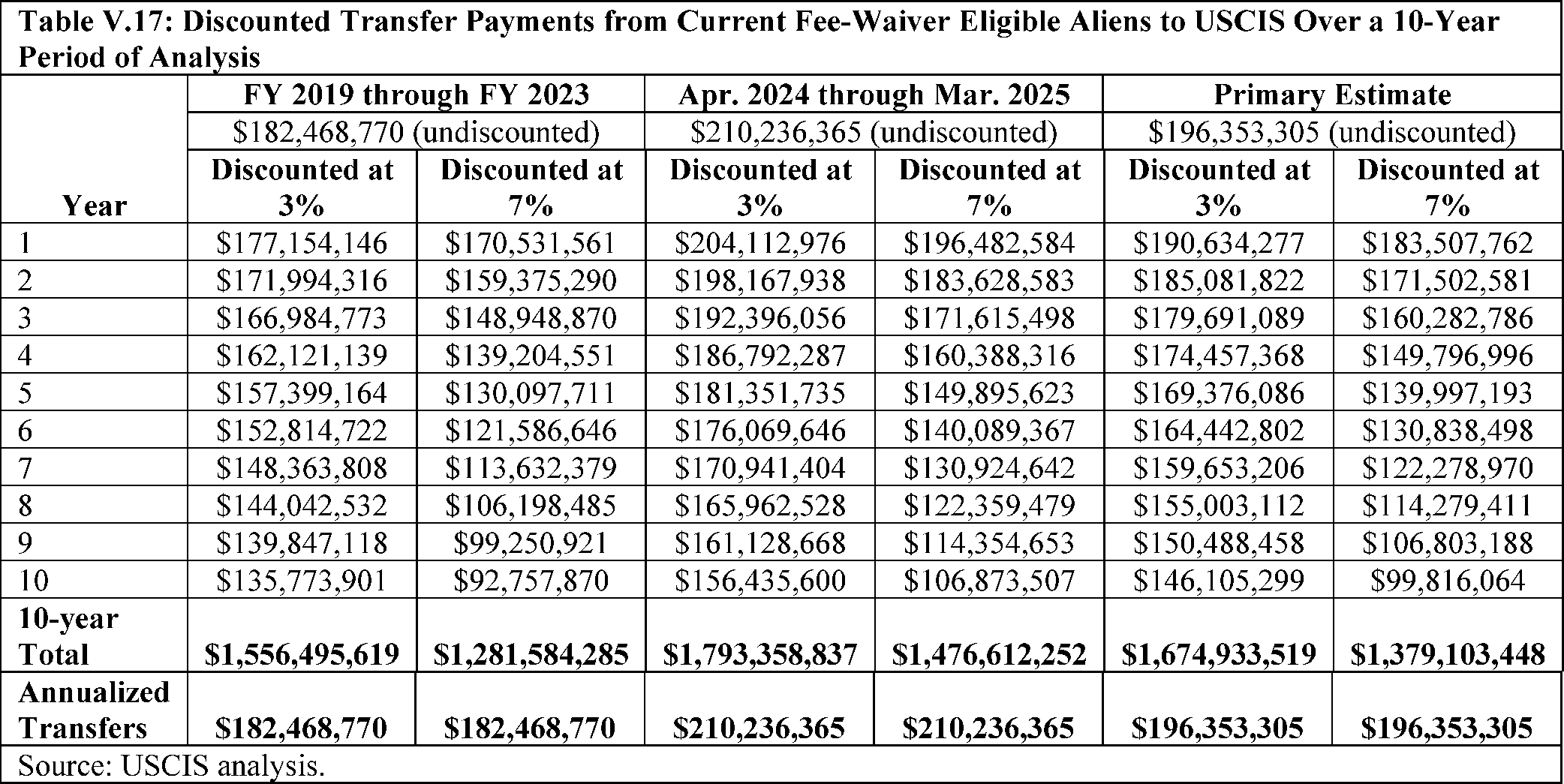
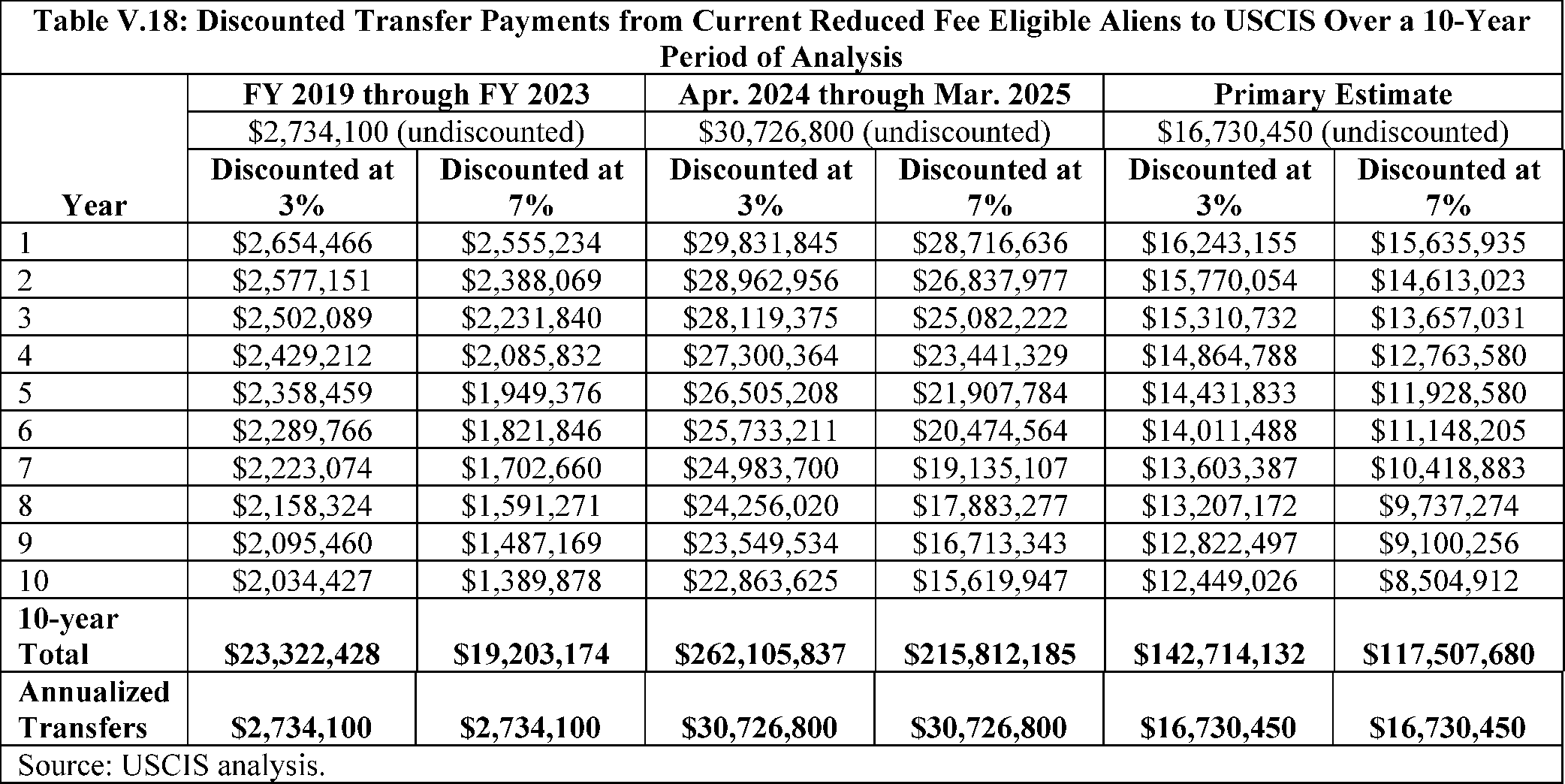
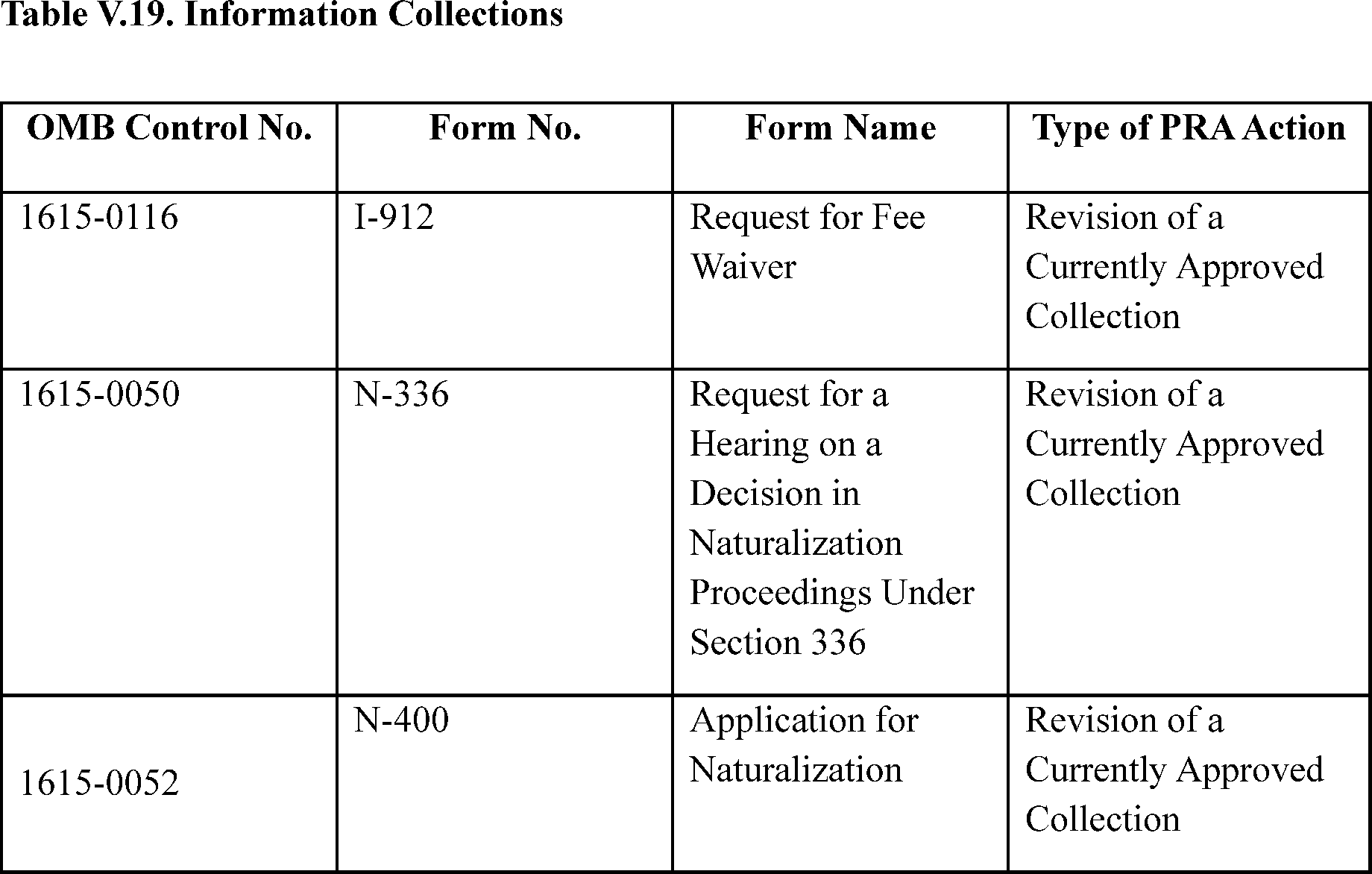
 www.uscis.gov/g-1055
 www.dhs.gov/sites/default/files/2024-04/2024_0415_uscis_use_of_fee_waivers_q4_0.pdf
 files.fasab.gov/pdffiles/handbook_sffas_4.pdf
 www.costperform.com
 www.gpo.gov/fdsys/pkg/CRPT-108hrpt774/pdf/CRPT-108hrpt774.pdf
 www.gao.gov/products/gao-08-386sp
 www.migrationpolicy.org/sites/default/files/publications/citizenship-premium.pdf
 www.sciencedirect.com/science/article/abs/pii/S0927537114001328
 www.congress.gov/crs-product/R43366?s=1&r=77
 dornsife.usc.edu/eri/wp-content/uploads/sites/41/2023/01/2013_Nurturing_Naturalization_CSII.pdf
 www.federalreservehistory.org/essays/great-recession-of-200709
 rdrc.wisc.edu/publications/working-paper/jsit19-04
 www.pewresearch.org/short-reads/2023/12/04/key-facts-about-the-wealth-of-immigrant-households-during-the-covid-19-pandemic/
 www.pnas.org/doi/epdf/10.1073/pnas.1714254115
 www.reginfo.gov/public/do/eAgendaMain
 www.dol.gov/general/topic/wages/minimumwage
 www.bls.gov/oes/tables.htm
 data.bls.gov/oes/#/industry/000000