DHS is rescinding the 2022 public charge ground of inadmissibility regulations ("2022 Final Rule"). The 2022 Final Rule was not the best implementation of the statute. It was in...
U.S. Citizenship and Immigration Services (“USCIS”), Department of Homeland Security (“DHS”).
ACTION:
Final rule.
SUMMARY:
DHS is rescinding the 2022 public charge ground of inadmissibility regulations (“2022 Final Rule”). The 2022 Final Rule was not the best implementation of the statute. It was inconsistent with congressional intent, unduly restrictive, and hampered DHS's ability to make accurate, precise, and reliable determinations of whether certain aliens are likely at any time to become a public charge. Rescission restores broader discretion for DHS officers to evaluate all pertinent facts and aligns with long-standing policy that aliens in the United States should be self-reliant and government benefits should not incentivize immigration. This rule also revises the breach and cancellation of public charge bonds regulations.
DATES:
The final rule is effective on September 18, 2026. This rule applies to applications for admission made on or after September 18, 2026 or applications for adjustment of status postmarked or electronically submitted on or after September 18, 2026. Receipt of means-tested public benefits before September 18, 2026 will be considered consistently with the 2022 Final Rule.
FOR FURTHER INFORMATION CONTACT:
U.S. Citizenship and Immigration Services (USCIS), DHS, 5900 Capital Gateway Drive, Camp Springs, MD 20746; telephone (240) 721-3000 (not a toll-free call).
SUPPLEMENTARY INFORMATION:
Table of Contents
I. Executive Summary
A. Purpose of the Regulatory Action
B. Legal Authority
C. Summary of the Proposed Rule
D. Implementation
E. Costs and Benefits
II. Background
A. Legal Authority
B. Grounds of Inadmissibility Generally
C. Public Charge Ground of Inadmissibility
III. Response to Public Comments on the Proposed Rule
A. Summary of Public Comments
B. Comments Expressing General Support for the Proposed Rule
C. Comments Expressing General Opposition to the Proposed Rule
D. Comments Regarding Legal Authority and Statutory Provisions
1. Statutory Authority
2. Congressional Intent and Historical Application
3. Administrative Law Concerns
4. Constitutional Concerns
5. Prospective Application of the Final Rule and Retroactivity Concerns
E. Negative Impacts on DHS and Immigration Policy Objectives
1. Concerns About Immigration Officer Discretion
2. Lack of Replacement Language or Framework
3. Immigration System Impacts, Operational Burdens, and Processing Delays
4. Misalignment With Longstanding Immigration Policies or U.S. Values
F. Negative Impacts on Applicants, Petitioners, Beneficiaries, and Support Systems
1. Chilling Effects on Benefit Usage
2. Concerns About Clarity and Discrimination
G. Negative Impacts on U.S. Economy, Businesses, and Communities
1. Workforce Impacts
2. Impacts of Reduced Consumer Spending
3. Concerns About U.S. Demographics
4. Impacts on Housing
5. Impacts to Innovation
6. Other Economic Effects
7. Impacts on the Military and Veterans
H. DHS's Rationale and Justification for the Rule
1. Insufficient Evidence or Reasoned Justification To Change Policy
2. Insufficient Connection Between Receipt and Dependency on the Government
3. Would Not Accomplish Stated Goal To Reduce Public Expenditures
4. Agreement With Stated Need for Proposed Rule
I. Amendments to Cancellation and Breach of Public Charge Bond Provisions
J. Removal of 8 CFR 212.20, “Applicability of Public Charge Inadmissibility”
K. Removal of the Public Charge Regulatory Definitions
1. General Comments
2. Definition of “Likely at Any Time To Become a Public Charge”
3. Definition of “Public Benefits”
4. Definition of “Receipt (of Public Benefits)”
5. Definitions of “Government” and “Household”
L. Removal of the Public Charge Inadmissibility Determination Framework
1. Minimum Factors
2. Consideration of the Affidavit of Support
3. Consideration of Current and/or Past Receipt of Public Benefits
4. Disability Alone Is Not Sufficient
5. Totality of the Circumstances
6. Written Denial Requirement
7. Receipt of Public Benefits While an Alien Is in an Immigration Category Exempt From the Public Charge Ground of Inadmissibility, or of Benefits Available to Refugees
M. Elimination of List of Exemptions and Waivers (8 CFR 212.23)
1. General Opposition to Removal
2. General Support for Removal
3. Certain Cubans and Haitians
4. Commonwealth of the Northern Mariana Islands
N. Comments Unrelated to Specific Regulatory Sections
1. General Comments
2. Comments on the Development of Future Public Charge Inadmissibility Policy Interpretive Tool
3. Privacy and Personal Data Concerns
4. Recommendations for Public Charge Inadmissibility Regulations or Subregulatory Guidance
5. Recommendations for Implementation
6. Severability
7. Other Comments
O. Statutory and Regulatory Requirements
1. Costs, Benefits, and Transfer Payments
2. Regulatory Flexibility Act
3. Paperwork Reduction Act (PRA)
4. Other Statutory and Regulatory Requirements
P. Out-of-Scope
1. Support for Immigration and Opposition to Restrictive Immigration Policies
2. Opposition to Immigration Generally
3. Miscellaneous
IV. Statutory and Regulatory Requirements
A. Executive Order 12866 (Regulatory Planning and Review) and Executive Order 13563 (Improving Regulation and Regulatory Review), and 14192 (Unleashing Prosperity Through Deregulation)
1. Summary of Changes From the Notice of Proposed Rulemaking to the Final Rule
2. Summary of the Regulatory Changes
3. Background and Purpose
4. Population
5. Cost-Benefit Analysis
B. Regulatory Flexibility Act
C. Unfunded Mandates Reform Act of 1995
D. Small Business Enforcement Fairness Act of 1996 (Congressional Review Act)
H. Executive Order 13175 (Consultation and Coordination With Indian Tribal Governments)
I. National Environmental Policy Act
J. Paperwork Reduction Act
Table of Abbreviations
APA—Administrative Procedure Act
ASC—Application Support Center
BIA—Board of Immigration Appeals
CCBG—Child Care and Development Block Grant
CBO—Congressional Budget Office
CBP—U.S. Customs and Border Protection
CFR—Code of Federal Regulations
CHIP—Children's Health Insurance Program
CMS—Centers for Medicare & Medicaid Services
CNMI—Commonwealth of the Northern Mariana Islands
COVID-19—Coronavirus Disease 2019
CPI-U—Consumer Price Index for All Urban Consumers
( printed page 45325)
CPS—Current Population Survey
CTC—Child Tax Credit
DHS—U.S. Department of Homeland Security
DOJ—Department of Justice
DOS—U.S. Department of State
EAD—Employment Authorization Document
eFMAP—Enhanced Federal Medical Assistance Percentage
EITC—Earned Income Tax Credit
E.O.—Executive Order
FAM—Department of State Foreign Affairs Manual
FAS—Freely Associated States
FFP—Federal Financial Participation
FMAP—Federal Medical Assistance Percentage
FOIA—Freedom of Information Act
FR—Federal Register
FY—Fiscal Year
GW—George Washington University
HCV—Housing Choice Voucher
HHS—U.S. Department of Health and Human Services
HSA—Homeland Security Act
HUD—U.S. Department of Housing and Urban Development
ICE—U.S. Immigration and Customs Enforcement
ICR—Information Collection Request
IIRIRA—Illegal Immigration Reform and Immigrant Responsibility Act of 1996
IMF—International Monetary Fund
INA—Immigration and Nationality Act
INS—Immigration and Naturalization Service
IRCA—Immigration Reform and Control Act
KFF—Kaiser Family Foundation
LPR—Lawful Permanent Resident
NDAA—National Defense Authorization Act
NEPA—National Environmental Policy Act
NHTSA—U.S. National Highway Traffic Safety Administration
NOID—Notice of Intent to Deny
NPRM—Notice of Proposed Rulemaking
NTA—Notice to Appear
NTMVS Act—National Traffic and Motor Vehicle Safety Act of 1966
OBBBA—One Big Beautiful Bill Act
OHP—Oregon Health Plan
OMB—Office of Management and Budget
PII—Personally Identifiable Information
PRA—Paperwork Reduction Act
PRWORA—Personal Responsibility and Work Opportunity Reconciliation Act of 1996
RFA—Regulatory Flexibility Act of 1980
RFE—Request for Evidence
RIA—Regulatory Impact Analysis
SNAP—Supplemental Nutrition Assistance Program
SSA—Social Security Administration
SSI—Supplemental Security Income
TANF—Temporary Assistance for Needy Families
TPS—Temporary Protected Status
UBI—Universal Basic Income
UMRA—Unfunded Mandates Reform Act of 1995
U.S.C.—United States Code
USCIS—U.S. Citizenship and Immigration Services
USDA—U.S. Department of Agriculture
VAWA—Violence Against Women Act
WIC—Special Supplemental Nutrition Program for Women, Infants, and Children
I. Executive Summary
A. Purpose of the Regulatory Action
The purpose of this rule is to remove from the Code of Federal Regulations the public charge inadmissibility provisions promulgated by the Public Charge Ground of Inadmissibility final rule (2022 Final Rule),[1]
as these provisions straitjacket DHS officers' ability to make public charge inadmissibility determinations that are consistent with Congress's express national policy on welfare and immigration enacted in the Personal Responsibility and Work Opportunity Reconciliation Act of 1996 (PRWORA).
SeePublic Law 104-193, section 400, 110 Stat. 2105, 2260 (codified at 8 U.S.C. 1601). The 2022 Final Rule imposed narrow definitions of statutory terms and minimum factors as well as limited the public benefits that DHS could consider in a public charge inadmissibility determination. Indeed, the 2022 Final Rule created a framework under which officers were directed to consider seven factors (five of those required by statute) rather than being explicitly empowered to consider any other factors or information relevant to determining an alien's likelihood at any time of becoming a public charge in the totality of the alien's circumstances.[2]
DHS is moving away from a bright line primary dependence standard. By removing most [3]
of the regulatory provisions in the 2022 Final Rule, DHS can implement policy and interpretive tools guiding officers in making individualized, fact-specific public charge inadmissibility determinations, based on a totality of the alien's circumstances, consistent with the statute, congressional intent, and precedent.[4]
These tools will guide public charge inadmissibility determinations while empowering officers to consider: (1) the mandatory statutory factors in section 212(a)(4)(B) of the Immigration and Nationality Act (INA), 8 U.S.C. 1182(a)(4)(B); (2) the alien's receipt of means-tested public benefits; (3) any other individualized case-specific factors and circumstances relevant to an alien's case; and (4) any empirical data relevant to an alien's self-sufficiency. Using good judgment and discretion, officers will more accurately assess an alien's likelihood at any time of becoming a public charge, in the totality of the circumstances, as Congress intended.
DHS reviewed and considered the feedback and recommendations submitted in response to the notice of proposed rulemaking (NPRM).
B. Legal Authority
The authority of the Secretary of Homeland Security (Secretary) for the rescissions and regulatory amendments is found in section 212(a)(4) of the INA, 8 U.S.C. 1182(a)(4), (public charge inadmissibility determinations); section 235 of the INA, 8 U.S.C. 1225, (applicants for admission); and section 245 of the INA, 8 U.S.C. 1255, (eligibility criteria for applications for adjustment of status). In addition, section 103(a)(3) of the INA, 8 U.S.C. 1103(a)(3), authorizes the Secretary to establish such regulations as deemed necessary for carrying out the Secretary's authority under the INA.
C. Summary of the Proposed Rule
On November 19, 2025, DHS published an NPRM titled Public Charge Ground of Inadmissibility. 90 FR 52168 (Nov. 19, 2025). In the NPRM, DHS proposed the following changes:
Amend8 CFR 103.6(c), Cancellation and breach—Clarifying that receipt of any means-tested public benefit, or being otherwise noncompliant with any condition of the public charge bond, results in a breach of that bond and eliminating language stating that “USCIS may cancel a public charge bond at any time after determining that the alien is not likely at any time to become a public charge.”
Remove8 CFR 212.20, Applicability of public charge inadmissibility—Removal in its entirety of the language defining the categories
( printed page 45326)
of aliens subject to the public charge ground of inadmissibility.
Remove8 CFR 212.21, Definitions—Removal of the definitions, including the definitions of “likely at any time to become a public charge,” “receipt (of public benefits),” “public cash assistance for income maintenance,” and “long-term institutionalization at government expense.”
Remove8 CFR 212.22, Public charge inadmissibility determination—Removal of the overly restrictive language relating to an alien's current and/or past receipt of means-tested public benefits, the totality of the circumstances analysis, and receipt of public benefits by an alien in an exempt category.
Remove8 CFR 212.23, Exemptions and waivers for public charge ground of inadmissibility—Removal of the language listing exemptions and waivers to the public charge ground of inadmissibility.
DHS received 8,846 [5]
comments on the proposed rule, the majority of which opposed the rule. Following careful consideration of public comments received, DHS is issuing this final rule as proposed. The preamble to this final rule includes summaries of significant issues raised by the comments and includes responsive explanations for policy changes.
D. Implementation
DHS will begin implementing this final rule on its effective date. This final rule will apply to applications for adjustment of status that are postmarked or electronically submitted on or after the effective date and applications for admission made on or after the effective date. On or before the effective date, USCIS will issue subregulatory guidance to inform, but not prescribe, the outcome of USCIS officers' public charge inadmissibility determinations made under this final rule in the totality of the circumstances. In addition, DHS will only consider the receipt of public cash assistance for income maintenance and long-term institutionalization at government expense before the effective date of this final rule and will consider the receipt of any means tested public benefits on or after that date.
E. Costs and Benefits
DHS is removing most of the 2022 Final Rule provisions to allow DHS to better implement the public charge ground of inadmissibility. The final rule is expected to impose new benefits and transfers. To assess the impacts of the rule, DHS considers the potential impacts of the rule relative to a no-action baseline, which reflects the current state of the world absent this regulatory action.
The primary source of unquantified benefits of this rule is the removal of overly restrictive provisions promulgated in the 2022 Final Rule that hinder officers in making public charge inadmissibility determinations. By removing rigid regulatory definitions and standards, this rule ensures that officers can make highly individualized, fact-specific, case-by-case public charge inadmissibility decisions based on the totality of each alien's individual circumstances. This approach will prevent the application of overly restrictive criteria that straitjackets DHS officers' ability to make public charge inadmissibility determinations.
The rule will also result in a reduction in transfer payments from Federal and State governments to individuals who may choose to disenroll from or forgo enrollment in a public benefits program. Individuals who might choose to disenroll from or forgo future enrollment in a public benefits program include aliens as well as U.S. citizens who are members of mixed-status households. DHS estimates that the total reduction in transfer payments from the Federal and State governments could be approximately $13.05 billion annually due to disenrollment or forgone enrollment in public benefits programs by members of households that include aliens who may be receiving public benefits. DHS estimates that the 10-year discounted Federal and State transfer payments reduction of this rule could be approximately $111.28 billion at a 3-percent discount rate and about $91.62 billion at a 7-percent discount rate. This total includes DHS's estimate that Federal transfer payments could decrease by approximately $65.76 billion at a 3-percent discount rate and about $54.14 billion at a 7-percent discount rate. Using the average Federal Medical Assistance Percentage (FMAP), DHS further estimates that State transfer payments could decrease by approximately $45.52 billion at a 3-percent discount rate and approximately $37.48 billion at a 7-percent discount rate. DHS notes there may be additional reductions in transfer payments that we are unable to quantify. DHS also recognizes that the estimated reductions in transfer payments are approximations and could be influenced by external factors unrelated to this rule. For example, the recent changes to Medicaid and the Supplemental Nutrition Assistance Program (SNAP) included in H.R. 1 are expected to impact enrollment rates, adding complexity to quantification efforts.[6]
DHS anticipates that disenrollment or forgone enrollment rates may fluctuate independently of this rule, potentially affecting the transfer payment estimates presented. However, those external factors are separate and independent of this rule.
Finally, DHS recognizes that reductions in Federal and State transfers under Federal benefits programs may have downstream and upstream impacts on State and local economies, large and small businesses, and individuals. For example, the rule might result in reduced revenues for healthcare providers, such as hospitals and nonprofits, participating in Medicaid, companies that manufacture medical supplies or pharmaceuticals, grocery retailers participating in SNAP, agricultural producers who grow foods that are eligible for purchase using SNAP benefits. Landlords participating in federally funded housing programs may also experience financial strain, such as increased tenant turnover and higher administrative costs.
Table I.1 provides a detailed summary of the regulatory changes and the estimated costs, benefits, and transfers associated with the expected impacts.7
( printed page 45327)
( printed page 45328)
( printed page 45329)
II. Background
A. Legal Authority
The Secretary's authority for issuing this rule is found in various sections of the INA, 8 U.S.C. 1101et seq.,
and the Homeland Security Act of 2002 (HSA).[8]
Section 102 of the HSA, 6 U.S.C. 112, and section 103 of the INA, 8 U.S.C. 1103, charge the Secretary with the administration and enforcement of the immigration laws of the United States. Section 101 of the HSA, 6 U.S.C. 111, establishes that part of DHS's primary mission is to ensure that efforts, activities, and programs aimed at securing the homeland do not diminish either the overall economic security of the United States or the civil rights and civil liberties of persons.
In addition to establishing the Secretary's general authority for the administration and enforcement of immigration laws, section 103 of the INA, 8 U.S.C. 1103, enumerates various related authorities, including the Secretary's authority to establish such regulations, prescribe such forms of bond, issue such instructions, and perform such other acts as the Secretary deems necessary for carrying out such authority.
Section 212(a)(4) of the INA, 8 U.S.C. 1182(a)(4), provides that any alien who applies for a visa, admission, or adjustment of status is inadmissible if he or she is likely at any time to become a public charge. In general, under section 213 of the INA, 8 U.S.C. 1183, the Secretary has the discretion to admit into the United States an alien who is determined to be inadmissible based only on the public charge ground upon the giving of a suitable and proper bond or undertaking approved by the Secretary.
Under section 213A of the INA, 8 U.S.C. 1183a, certain aliens are required to submit a sufficient Affidavit of Support Under Section 213A of the INA (Form I-864) executed by a sponsor who agrees to provide support to maintain the sponsored alien at an annual income that is not less than 125 percent of the Federal poverty line [9]
during the period in which the affidavit is enforceable. The Form I-864 is intended to ensure that an intending immigrant has adequate means of financial support and is not likely to rely on the U.S. Government for financial support.
Section 235 of the INA, 8 U.S.C. 1225, addresses the inspection of applicants for admission, including inadmissibility determinations of such aliens.
Section 245 of the INA, 8 U.S.C. 1255, generally establishes eligibility criteria for adjustment of status to that of a lawful permanent resident (LPR).
B. Grounds of Inadmissibility Generally
The United States has a long history of permitting aliens to enter the United States, whether permanently or on a temporary basis. At the same time, Congress has excluded aliens who pose a threat to the safety or general welfare of the country or who seek to violate immigration laws.[10]
Congress has exercised this authority in part by establishing the concepts of admission [11]
and inadmissibility in the INA.[12]
Aliens are inadmissible due to a range of acts, conditions, and conduct.[13]
If an alien is inadmissible that alien is ineligible to be admitted to the United States and ineligible to receive a visa, unless he or she applies for and receives a waiver of inadmissibility or other form of relief. Congress extended the applicability of the inadmissibility grounds beyond the context of applications for admission and visas by making admissibility an eligibility requirement for certain immigration benefits, including adjustment of status to that of an LPR.[14]
If an alien is inadmissible, that alien is also ineligible for those benefits unless the alien is eligible to apply for and received waiver of inadmissibility or other form of relief, where available and appropriate.[15]
( printed page 45330)
C. Public Charge Ground of Inadmissibility
Section 212(a)(4) of the INA, 8 U.S.C. 1182(a)(4), states any alien who applies for a visa, admission, or adjustment of status is inadmissible if in the opinion of the consular officer or immigration officer, as applicable, the alien is likely at any time to become a public charge. The public charge ground of inadmissibility, therefore, applies to aliens applying for a visa to come to the United States temporarily or permanently, for admission at or between ports of entry,[16]
and for adjustment of status to that of an LPR.[17]
Under the statute, some categories of aliens are exempt from the public charge ground of inadmissibility, while others, if found inadmissible under the public charge ground, may apply for a waiver of the public charge ground of inadmissibility or may be invited to submit a public charge bond.[18]
The INA does not define the terms “public charge” or “likely at any time to become a public charge.” However, it does specify that when determining whether an alien is likely at any time to become a public charge, consular officers and immigration officers must,
at a minimum,
consider the alien's age; health; family status; assets, resources, and financial status; and education and skills.
See
INA sec. 212(a)(4)(B)(i), 8 U.S.C. 1182(a)(4)(B)(i) (emphasis added). Section 212(a)(4)(B)(ii) of the INA, 8 U.S.C. 1182(a)(4)(B)(ii), permits consular officers or immigration officers to consider any Form I-864 submitted on the alien's behalf, when determining whether the alien is likely at any time to become a public charge.[19]
In fact, with very limited exceptions, most aliens seeking family-based immigrant visas and adjustment of status, and certain aliens seeking employment-based immigrant visas or adjustment of status, must submit a sufficient Form I-864 in order to avoid being found inadmissible as likely at any time to become a public charge.
See
INA sec. 212(a)(4)(C) and (D), 8 U.S.C. 1182(a)(4)(C) and (D).
In general, under section 213 of the INA, 8 U.S.C. 1183, the Secretary has the discretion to admit into the United States an alien who is determined to be inadmissible only on the public charge ground upon the giving of a suitable and proper bond or undertaking approved by the Secretary.
See
INA sec. 213, 8 U.S.C. 1183.
D. Current Rulemaking
On November 19, 2025, DHS published the NPRM, Public Charge Ground of Inadmissibility, 90 FR 52168 (Nov. 19, 2025). The public comment period on the NPRM closed on December 19, 2025, and the public comment period on the associated information collection closed on January 20, 2026.[20]
Following careful consideration of public comments received, DHS is issuing this final rule as proposed. The following section of the preamble includes a detailed summary and analysis of public comments received. Comments received may be reviewed at the Federal Docket Management System (FDMS) at
www.regulations.gov,
docket number USCIS-2025-0304.
For a detailed description of the history of the public charge ground of inadmissibility, public benefits under PRWORA, and prior public charge rulemakings, please refer to the NPRM.
E. Severability
DHS intends the changes to 8 CFR 103.6(c) to be severable from the full rescission of regulatory provisions in 8 CFR part 212. To the extent a court finds this final rule rescinding the public charge inadmissibility regulations in 8 CFR 212.20 through 212.23 is invalid or unenforceable, DHS intends that certain changes to 8 CFR 103.6(c) nevertheless be construed so as to continue to give the maximum effect to those provision(s) permitted by law, unless they are also held to be wholly invalid and unenforceable. Specifically, DHS intends to continue to give effect to the removal of the ground for cancellation 8 CFR 103.6(c)(1) stating that DHS can cancel a public charge bond at any time if it determines “that the alien is not likely at any time to become a public charge” because, as discussed in the NPRM, the rationale for the proposed removal of that ground of cancellation is based on the practical infeasibility of applying it rather than the broader justification for rescinding 8 CFR 212.20 through 212.23. 90 FR 52168, 52185 (Nov. 19, 2025). Similarly, if not separately invalidated or deemed unenforceable, DHS intends to keep the revised restructuring of 8 CFR 103.6(c)(1), separating the cancelation and breach provisions into paragraphs (c)(1)(i) and (c)(1)(ii) for clarity.
III. Response to Public Comments on the Proposed Rule
A. Summary of Public Comments
On November 19, 2025, DHS published an NPRM titled Public Charge Ground of Inadmissibility. 90 FR 52168 (Nov. 19, 2025). DHS received 8,846 comments on the proposed rule, the majority of which opposed the rule. Most of the comment submissions were from individual or anonymous commenters, including attorneys and academic researchers. Other commenters included healthcare providers, legal service providers, research and religious organizations, advocacy groups, social and community organizations, professional associations, State and local government agencies and elected officials, trade and business organizations, unions, schools and universities, and a foreign government entity.
B. Comments Expressing General Support for the Proposed Rule
Comment:
Several commenters were generally in favor of the proposed rule. Some of the commenters who supported the proposal stated that public benefit programs are intended for Americans and that the government should put America first.
Many commenters who supported the rule expressed concern about the burden of benefit use by immigrants on available resources, stating the government should not allow immigrants to burden the benefit systems for Americans. Several commenters stated that the United
( printed page 45331)
States should eliminate the potential for aliens to be incentivized to immigrate for public benefits, with some commenters referencing aliens' fraud and abuse of public benefit programs, taking advantage of the United States, draining resources, or disproportionately benefiting from assistance at taxpayer expense. One commenter stated that resources for new immigrants should be limited, with another stating that when conditions for U.S. citizens in America improve immigrants can be helped. One commenter expressed their belief that supplemental programs are meant to be a temporary aid but that there are insufficient regulations to prevent such aid from becoming a lifestyle. Other commenters expressed support for the rule, remarking that immigrants should demonstrate advanced education, personal savings, and value provided to the United States upon admission.
Response:
DHS agrees that aliens applying for admission and adjustment of status who are subject to the public charge ground of inadmissibility should be self-sufficient and should not depend on the government to meet their needs. DHS also agrees that the availability of public benefits should not constitute an incentive for immigration to the United States, as Congress indicated in PRWORA.[21]
This rulemaking seeks to align public charge inadmissibility determinations with those concepts. DHS firmly believes that this was Congress's intent in enacting section 212(a)(4) of the INA, 8 U.S.C. 1182(a)(4).
This rulemaking will empower officers to consider not only the mandatory statutory factors and an alien's receipt of means-tested public benefits, but also all relevant evidence and information in the record specific to the alien as the officers determine whether the alien is likely at any time to become a public charge. This will restore a public charge inadmissibility determination that relies on DHS officers' good judgment and sound discretion as envisioned by Congress.
DHS emphasizes neither the public charge ground of inadmissibility nor this final rule govern eligibility for means-tested public benefits; rather they govern which aliens are inadmissible and, therefore, ineligible for admission and adjustment of status. This final rule does not address the government's responsibility to care for aliens or which aliens are, or should be, eligible to receive means-tested public benefits.
C. Comments Expressing General Opposition to the Proposed Rule
Comment:
Many commenters expressed general opposition to the rule. Some stated that the rule is unfair, cruel and inhumane or barbaric, that previous poverty is not a reason to penalize a person today, and that every human deserves to be cared for and treated respectfully. Some disagreed with the basis of the rule, commenting that the rule is not right for the country. One commenter called the rule pointless, with another stating the rule is unnecessary and would negatively impact children.
Response:
DHS strongly disagrees that the rule is pointless, unnecessary, or unfair. The purpose of this rule is to remove the public charge inadmissibility provisions promulgated by the 2022 Final Rule, 87 FR 55472 (Sept. 9, 2022), as these provisions straitjacketed DHS officers' ability to make public charge inadmissibility determinations that are consistent with Congress's express national policy on welfare and immigration enacted in the PRWORA.[22]
The 2022 Final Rule imposed narrow definitions of statutory terms and minimum factors as well as limited the public benefits that DHS could consider in a public charge inadmissibility determination, preventing officers from considering all factors and information relevant to an alien's likelihood at any time of becoming a public charge, as Congress intended. See 90 FR 52168, 52185 (Nov. 19, 2025). Rescission of the 2022 Final Rule allows officers to more accurately assess an alien's likelihood at any time of becoming a public charge using good judgment and discretion, consider the mandatory statutory factors in section 212(a)(4)(B) of the INA, 8 U.S.C. 1182(a)(4)(B), the alien's receipt of means-tested public benefits, all individualized case-specific factors and circumstances relevant to an alien's case, and any empirical data relevant to an alien's self-sufficiency.
Comment:
A commenter wrote that the proposed rule is not practical and instead driven by a desire to resurrect a punitive approach that was widely rejected by public health experts, State and local governments, and advocates.
Response:
DHS rejects the suggestion that it is resurrecting the public charge ground of inadmissibility approach found in the 2019 Final Rule, 84 FR 41292 (Aug. 14, 2019). As it made clear in the NPRM, previous regulations relating to the public charge ground of inadmissibility were overly restrictive.[23]
By removing (not replacing or amending) the rigid definitions and factors, this final rule will allow officers to consider all case-specific factors and circumstances relevant to the public charge inadmissibility determination, in the totality of the circumstances. This in turn enables officers to more accurately assess an alien's likelihood at any time of becoming a public charge. DHS is not implementing the provisions of the 2019 Final Rule in this final rule.
D. Comments Regarding Legal Authority and Statutory Provisions
1. Statutory Authority
Comment:
One commenter stated that this rule is intended to reduce immigration to the United States, which only Congress can do via statute.
Response:
While it is possible this rule may decrease the number of aliens who will be admitted into or granted adjustment of status in the United States, as explained elsewhere in this final rule, DHS is unable to quantify those impacts due to the nature of the individualized case-by-case determination required by statute. DHS strongly disagrees that it is aiming to reduce immigration in excess of its statutory authority. While Congress established annual numerical limitations for certain immigrant and nonimmigrant visa classifications, Congress has not mandated, nor would it be practical to mandate, that these limits be fully utilized given specific eligibility criteria and other congressionally imposed restrictions, such as specific grounds of inadmissibility.
See e.g.,
INA secs. 202, 203, 212 and 214; 8 U.S.C. 1152, 1153, 1182, and 1184. In fact, Congress provided for the rollover or reallocation of immigrant visas in certain circumstances.
See e.g.,
INA sec. 201, 203, and 206, 8 U.S.C. 1151, 1153, and 1156.
The very purpose of the public charge ground of inadmissibility is to prevent the admission and adjustment of status of aliens who are determined by an officer to be likely at any time to become a public charge. Indeed, since 1882, Congress has clearly decided to limit the admission of such aliens.[24]
To the extent the commenter does not like that this ground of inadmissibility prevents the admission and adjustment of status of certain aliens, the complaint is for Congress, not DHS. More than 70 years ago Congress recognized that setting the parameters for determining whether an
( printed page 45332)
alien is likely at any time to become a public charge is best left to the judgment and interpretation of the executive branch and the courts because the elements constituting public charge are so varied.[25]
If Congress wanted to conclusively define what it means to be “likely at any time to become a public charge” it would have done so when enacting immigration statutes in 1882,[26]
1891,[27]
1903,[28]
1907,[29]
1917,[30]
1952,[31]
1990,[32]
or 1996.[33]
However, Congress, at no point during the history of the public charge inadmissibility ground, limited the manner in which the executive branch made public charge inadmissibility determinations save providing a non-exhaustive list of factors that must be considered, in 1996.
As referenced in the NPRM and this final rule, with the rescission of the 2022 Final Rule DHS is eliminating a rigid regulatory framework and restoring broader officer discretion, which ensures that aliens whom DHS has determined are likely at any time to become a public charge are not admitted or granted adjustment of status, as Congress intended.
Comment:
Several commenters said this rulemaking overreached the powers granted in the statute by Congress. Another said removal of the 2022 Final Rule is unlawful.
Response:
DHS strongly disagrees that the removal of the 2022 Final Rule is unlawful or goes beyond the powers granted to DHS by Congress. The Secretary's authority for issuing this rule is found in various sections of the INA, 8 U.S.C. 1101et seq.,
and the HSA. Section 102 of the HSA, 6 U.S.C. 112, and section 103 of the INA, 8 U.S.C. 1103, charge the Secretary with the administration and enforcement of the immigration laws of the United States. Indeed, this rulemaking is within DHS's express authority to enforce and administer the immigration laws of the United States, section 103(a)(1) of the INA, 8 U.S.C. 1103(a)(1), including the public charge ground of inadmissibility, section 212(a)(4) of the INA, 8 U.S.C. 1182(a)(4). For these reasons as well as those discussed previously, the rescission of the 2022 Final Rule does not exceed the Secretary's authority.
The removal of the 2022 Final Rule in favor of a broader exercise of discretion on a case-by-case basis is a permissible implementation of the public charge inadmissibility statute enacted by Congress.
See
INA sec. 212(a)(4), 8 U.S.C. 1182(a)(4). DHS believes that the express language of sections 212(a)(4)(A) and (B) of the INA, 8 U.S.C. 1182(a)(4)(A) and (B), the longstanding national policy on immigration and welfare, and the precedent decisions that have guided public charge inadmissibility determinations for decades provide sufficient guidance for DHS officers to make public charge inadmissibility determinations.
Comment:
Some commenters stated that section 212(a)(4) of the INA, 8 U.S.C. 1182(a)(4), does not authorize DHS to consider the past or present receipt of non-cash public benefits, and added that such consideration would constitute an impermissible expansion of the statutory criteria and undermine the intent of section 212(a)(4) of the INA, 8 U.S.C. 1182(a)(4). Another commenter similarly stated that the expansion of the public charge definition to include non-cash benefits lacks a clear basis in section 212(a)(4) of the INA, 8 U.S.C. 1182(a)(4), or precedent decisions.
Response:
DHS is neither promulgating definitions for the terms “public charge” or “public benefits” through this rulemaking. As proposed in the NPRM, DHS believes that retaining regulations that disregard receipt of certain means-tested public benefits, when such receipt is relevant to assessing an alien's likelihood of becoming a public charge, is not the best reading of the statute. DHS is therefore removing the rigid provisions in the 2022 Final Rule, including limitations on what public benefits may be considered in a public charge inadmissibility determination, which prevented officers from making public charge inadmissibility determinations consistent with the clear self-sufficiency goals articulated by Congress in PRWORA. Consideration of non-cash public benefits in a public charge inadmissibility determination is neither precluded by section 212(a)(4) of the INA, 8 U.S.C. 1182(a)(4), nor inconsistent with precedent decisions.[34]
In fact, when passing the Illegal Immigration Reform and Immigrant Responsibility Act of 1996 (IIRIRA), Congress added a list of minimum, but not exclusive, factors to consider in public charge inadmissibility determinations but did not preclude consideration of any other factors including the alien's receipt of non-cash public benefits. INA sec. 212(a)(4)(B), 8 U.S.C. 1182(a)(4)(B). Moreover, DHS disagrees that Congress intended to exclude consideration of non-cash benefits when it enacted section 212(a)(4) of the INA, 8 U.S.C. 1182(a)(4). Congress does not mention public benefits at all in section 212(a)(4), 8 U.S.C. 1182(a)(4), leaving it to the agencies administering the public charge ground of inadmissibility [35]
to specify how public benefits should be considered in a public charge inadmissibility determination. However, Congress did prohibit consideration of any public benefits under 8 U.S.C. 1641(c) for certain battered aliens, without reference to cash versus non-cash benefits, which strongly suggests Congress understood and accepted DHS's consideration of past receipt of any public benefits—cash and non-cash alike—in all other circumstances. INA sec. 212(s), 8 U.S.C. 1182(s). DHS further disagrees that precedent decisions preclude consideration of non-cash benefits. On the contrary, as concluded in past precedent decisions that have informed public charge inadmissibility determinations for decades, receipt of public support of any kind is an appropriate consideration in a public charge inadmissibility determination.[36]
Comment:
A commenter stated removal of 2022 Final Rule contradicts DHS's statutory obligation to administer immigration laws fairly, equitably, and without discrimination.
Response:
DHS disagrees. As noted above, DHS has the authority to enforce
( printed page 45333)
and administer the immigration laws of the United States, including the public charge ground of inadmissibility and to prescribe regulations necessary to carry out that authority. INA sec. 103(a)(1), 8 U.S.C. 1103(a)(1), INA sec. 103(a)(3), 8 U.S.C. 1103(a)(3). By removing regulations that the Secretary determined are rigid, overly-restrictive, and not the best implementation of the statute, DHS is returning the administration of the public charge ground of inadmissibility to a broader exercise of discretion on a case-by-case basis, consistent with Congress's express national policy on immigration and welfare and in line with the spirit of section 212(a)(4) of the INA, 8 U.S.C. 1182(a)(4). With this rulemaking, DHS returns to a standard which permits DHS officers to consider any and all factors, in the totality of the circumstances, relevant to each individual alien's likelihood at any time of becoming a public charge.[37]
As discussed in other comment responses, DHS disagrees any changes in this final rule risk inviting discriminatory decision-making.
Comment:
One commenter, citing
Loper Bright
v.
Raimondo
,[38]
stated that “legal interpretation” of statutes—even statutes Congress expressly authorized agencies to implement, like section 212(a)(4) of the INA, 8 U.S.C. 1182(a)(4)—is a judicial function driven by “traditional tools of statutory interpretation,” not the “policy preferences” of the Executive, adding the statute has a fixed, single best meaning which courts (and not the Supreme Court alone) must interpret and agencies must implement. The commenter said DHS mistakenly treats statutory meaning merely as a regulatory choice and mischaracterizes “primary dependence on the government for subsistence” as a “bright-line . . . standard” rather than acknowledging it is the statute's single best meaning. Another commenter indicated the rule suffers from the same defects which led courts to enjoin the 2019 Final Rule under the more deferential
Chevron[39]
framework, adding that
Loper Bright
requires agencies to adopt a statute's best reading and asserted the existing regulatory framework reflects a better, if not the best reading. Another cited to
Loper Bright,
stating the Administration is not entitled to any deference when interpreting a statute in a way that is contrary to its plain meaning, history, and tradition. Another commenter said DHS does not have unchecked power, authority, or flexibility in defining the term public charge contrary to congressional intent.
Response:
The Supreme Court in
Loper Bright
held that courts are no longer required to defer to an agency's “reasonable” interpretations of ambiguous statutes. DHS strongly disagrees with the commenters' suggestion that rescission of the 2022 Final Rule is simply a policy decision. On the contrary, it is a direct result of the Secretary's determination that the 2022 Final Rule is not the best reading of the statute, as well as congressional intent on immigration and welfare. As noted in the NPRM, DHS is removing the 2022 Final Rule to restore the longstanding case-by-case and inherently discretionary nature of public charge inadmissibility determinations expressly intended by Congress when mandating officers make these determinations in their opinion considering certain enumerated non-exhaustive factors at a minimum. 90 FR 52168, 52189 (Nov. 19, 2025). INA sec. 212(a)(4)(B), 8 U.S.C. 1182(a)(4)(B). The Secretary determined rescission of the 2022 Final Rule is appropriate to ensure officers are making public charge inadmissibility determinations in line with the statute and relevant precedent. 90 FR 52168, 52186-87 (Nov. 19, 2025). DHS believes relevant precedent decisions that guided public charge inadmissibility determinations for decades and, where applicable, recent circuit case law will provide officers with sufficient guidance to conduct individualized determinations based on the specific facts and circumstances of each alien's case. DHS believes this approach falls within the explicit discretionary authority Congress delegated to the Secretary.[40]
Therefore, DHS's rescission of the 2022 Final Rule, and subsequent administration of the public charge ground of inadmissibility consistent with the statute and applicable precedent, is well within the Secretary's authority. It is also consistent with Congress's express national policy on welfare and immigration enacted in PRWORA.
See8 U.S.C. 1601. Therefore, this final rule does not reflect an exercise of unchecked power or unauthorized flexibility contrary to congressional intent.
Finally, DHS disagrees that it is interpreting the term “public charge” in this final rule, or that any such interpretation is contrary to its plain meaning, history, or tradition. As proposed and discussed previously, this final rule is putting forth no definition of the term “public charge.” As discussed in the NPRM, there is no single settled meaning of the term and courts have differed in their positions regarding what the term encompasses, as well as what DHS can consider when making public charge inadmissibility determinations.[41]
DHS does not dispute that the Supreme Court has tasked courts with ascertaining the best meaning of ambiguous statutes or that a number of federal courts found different meanings for the term. DHS, in operating the national immigration system, is not precluded from eliminating regulatory definitions and rigid frameworks that have not been definitively or uniformly endorsed as reflecting the best meaning of statutory terms, particularly where Congress delegated broad discretion to DHS over immigration and the public charge
( printed page 45334)
ground of inadmissibility. DHS is returning the administration of the public charge ground of inadmissibility to decades of agency practice, consistent with statute and binding precedent.
Comment:
A commenter stated that the “extraordinary breadth” of authority DHS exerts with the proposed rule, coupled with the economic significance of the action, also opens the proposed rule to major questions doctrine concerns under
West Virginia
v.
EPA.[42]
The commenter warned that courts would be skeptical to conclude Congress meant to confer this level of political and economic authority to DHS, writing that “reliance on Executive Orders to enact policy unmoored from statutory text and agency discretion has given rise to claims during this Administration that agency action is preordained.”
Response:
DHS disagrees that this final rule implicates the major questions doctrine as articulated in
West Virgina
v.
EPA.
The major questions doctrine is triggered when the agency claims regulatory authority of vast economic and political significance, and the asserted authority lacks clear congressional authorization.[43]
First, DHS has clear congressional authorization for this final rule. As discussed throughout this preamble, the INA provides that an alien is inadmissible if, “in the opinion of the consular officer or the Attorney General” (now the Secretary of Homeland Security), the alien is likely at any time to become a public charge. INA sec. 212(a)(4)(A), 8 U.S.C. 1182(a)(4)(A). The statutory text does not define public charge or likely at any time to become a public charge and only requires officers to consider a non-exhaustive list of specified minimum factors. The Supreme Court has long recognized that the political branches possess plenary authority over admission of aliens.[44]
And the Board of Immigration Appeals (BIA) repeatedly recognized the inherently discretionary nature of the public charge inadmissibility determinations.[45]
This statutory structure reflects an express delegation from Congress to the Secretary, explicit discretionary language (“in the opinion of”), and mandatory but non-exhaustive factors. Unlike the statutes at issue in
West Virgina
v.
EPA,
or
Biden
v.
Nebraska
,[46]
Congress did not assign a narrow, technical function that DHS has transformed into sweeping economic regulation. Congress instead gave DHS broad discretion in an immigration inadmissibility context. Unlike cases where agencies argued for an expansion of authority or claimed transformative new regulatory powers, in this final rule DHS is doing the opposite: it is rescinding rigid regulatory definitions adopted in 2022; restoring individualized, discretionary adjudications that track the plain language of the statute; and returning to long-standing totality of the circumstances analysis. This administrative calibration is within the precise domain Congress delegated: immigration admissibility.
Furthermore, the economic impact of this final rule does not alone trigger the major questions doctrine. The Regulatory Impact Analysis (RIA) estimates potential transfer effects related to public benefits disenrollment, which is an indirect impact of the final rule. But the Supreme Court has made clear economic impact alone does not trigger the doctrine. In
West Virginia
v.
EPA,
the Court emphasized the doctrine applies when agencies claim the power to make decisions of “vast economic and political significance” in a manner inconsistent with their statutory design.[47]
Admissibility determinations, which could impact aliens' decisions to disenroll from public benefits programs, are squarely within DHS's statutory domain. Importantly, this final rule does not purport to regulate public benefit eligibility; rather, public benefits eligibility remains governed by PRWORA and other statutes. Any economic effects are incidental to admissibility determinations Congress explicitly authorized DHS to make. Finally, immigration is an area of heightened executive authority given that the Supreme Court repeatedly emphasized the political branches' broad authority over admission and exclusion.[48]
This final rule pertains to admission eligibility and adjustment of status, but it does not more broadly regulate aliens' or citizens' conduct or restructure domestic industries.
Finally, this final rule does not reflect a transformative expansion of agency power, it simply implicates existing delegated authority that DHS is tailoring to more closely reflect the plain language of the statute, national policy on self-sufficiency of aliens, and longstanding agency practice.
Comment:
Citing section 103(a)(3) of the INA, 8 U.S.C. 1103(a)(3), a commenter remarked DHS's choice to rescind the public charge regulations without promulgating a replacement regulation is inconsistent with the INA, which explicitly provides that the Secretary “shall establish such regulations . . . as he deems necessary for carrying out his authority under the provisions of this chapter.”
Response:
DHS disagrees that it is required to promulgate a regulation to replace the rescinded 2022 Final Rule and notes this rulemaking is a permissible change in the manner in which DHS makes public charge inadmissibility determinations given prior interpretations of the statute were not the best interpretation. 90 FR 52168, 52185 (Nov. 19, 2025). On the contrary, while the Administrative Procedure Act (APA) mandates the process agencies must follow when issuing, amending, and rescinding regulations, it does not require agencies to replace a rescinded regulation. 5 U.S.C. 551et seq.
Indeed, an agency may change or rescind regulations as long as it provides a reasoned justification,[49]
but it is not required to replace a rescinded regulation unless required by law. There is nothing in the express language of section 212(a)(4) of the INA, 8 U.S.C. 1182(a)(4), requiring DHS to replace the rescinded 2022 Final Rule with a new rule. Further, DHS notes there were no regulations governing public charge inadmissibility determinations from 1882 until the 2019 Final Rule.
Although this is a change from the frameworks established since 1999, DHS emphasizes that it provided a reasoned justification for the rescission of the 2022 Final Rule in the NPRM and throughout this final rule, as well as an explanation as to why prior frameworks were lacking.[50]
This position aligns with the plain language of section 103(a)(3) of the INA, 8 U.S.C. 1103(a)(3), which the commenter cites—which by incorporating the phrase “as he deems necessary for carrying out his authority” grants the Secretary both authority and discretion over issuing regulations. In this case, the Secretary has determined that issuing replacement regulations is not necessary for carrying out his authority. Therefore, DHS will not issue a replacement rule.
Comment:
Some commenters said DHS's emphasis on the subjective nature of the public charge inadmissibility determination contradicts the INA, which vests
( printed page 45335)
discretionary authority with the Attorney General, not DHS. Specifically, the commenter suggests that it is only the opinion of the Attorney General, not the opinion of an individual DHS officer, that is relevant to public charge inadmissibility determinations.
Response:
DHS disagrees with the commenters' interpretations of DHS' statutory authority. On March 1, 2003, functions of the Immigration and Naturalization Service (INS) were transferred from the Department of Justice (DOJ) to DHS.[51]
Although several provisions of the INA discussed in this final rule refer exclusively to the “Attorney General,” such provisions are now read as referring to the Secretary by operation of the HSA.[52]
DHS rejects the suggestion that only the Attorney General's (now, the Secretary's) opinion is relevant in the context of a public charge inadmissibility determination when an alien applies for admission or adjustment of status. Congress understood that the Attorney General and Secretary delegate authorities throughout the INA to officials serving under them.[53]
DHS notes that no ground of inadmissibility in section 212(a) of the INA, 8 U.S.C. 1182(a), contains language referencing DHS or DOJ officers; throughout the section, Congress referred to consular officers, the Attorney General, or the Secretary. DHS also notes that section 245(a) of the INA, 8 U.S.C. 1255(a), states that the status of an alien “may be adjusted by the Attorney General, in his discretion” to that of an LPR. Congress knew that the Attorney General would not personally make millions of admissibility, adjustment of status, admission, and deportation decisions annually.
Comment:
One commenter suggested that the rule is unjustified because DHS does not identify relevant post-1999 or post-2022 laws, data, or experience not already considered by INS, USCIS, or any other component or predecessor of DHS that would justify this change. The commenter requested that DHS identify and describe the legal authorities and other information, apart from those that predated the 1999 Interim Field Guidance and the 2022 Final Rule, that DHS relied on in developing a new framework.
Response:
DHS's rescission of the 2022 Final Rule and return to a broader exercise of case-by-case discretion is based on the same statutes, authorities, and other resources that served as the basis and justification for the 2022 Final Rule. DHS rejects this commenter's suggestion that DHS cannot rely on previously considered authorities.
On the contrary, DHS may rely on the same authorities underlying the now rescinded 2022 Final Rule so long as DHS provides a reasoned explanation for coming to a different conclusion, which it has, and as long as the new approach is consistent with the plain language of section 212(a)(4) of the INA, 8 U.S.C. 1182(a)(4).[54]
DHS explained the change and why DHS believes it to be a better reading of the statute. As explained in other comment responses, DHS has the express authority to enforce and administer the immigration laws of the United States, including the public charge ground of inadmissibility, and finds support for this rule in the express language of section 212(a)(4) of the INA, 8 U.S.C. 1182(a)(4), the national statements of immigration policy and welfare in PRWORA, and the sources listed in the NPRM. See 90 FR 52168, 52181-82 (Nov. 19, 2025).
Comment:
Commenters stated that DHS's reliance on section 212(s) of the INA, 8 U.S.C. 1182(s), to support its argument that Congress intended consideration of past benefit receipt in all contexts outside of certain battered aliens is flawed. One commenter said the Violence Against Women Act (VAWA) provisions speak broadly about benefits but do not support DHS's contention that Congress intended DHS to consider receipt of benefits beyond those considered in the 1999 Interim Field Guidance. Another commenter said the language in section 212(s) of the INA, 8 U.S.C. 1182(s), is not an express command to consider all means-tested public benefits, calling the proposal “particularly dubious” because Congress repeatedly expanded public benefit programs for certain aliens.
Response:
DHS disagrees that section 212(s) of the INA, 8 U.S.C. 1182(s), does not support considering the alien's receipt of any means-tested public benefit in public charge inadmissibility determinations made under this final rule. Section 212(s) of the INA, 8 U.S.C. 1182(s),[55]
prohibits considering the receipt of benefits by certain victims of violence and trafficking in applications for immigrant visas and adjustment of status and was codified to ensure they could access the full range of support services necessary for recovery and cooperation with law enforcement, including healthcare, housing, food assistance, and other non-cash benefits.[56]
The fact that Congress expressly precluded the consideration of receipt of benefits by this population strongly suggests that, absent such an exception, Congress intended DHS to consider the receipt of benefits when other aliens applied for immigrant visas and adjustment of status. “`Where Congress includes particular language in one section of a statute but omits it in another section of the same Act, it is generally presumed that Congress acts intentionally and purposely in the disparate inclusion or exclusion.' ” [57]
Similarly, when Congress creates a specific exception to a general rule, it is presumed that Congress intended the general rule to apply in all other circumstances.[58]
Accordingly, section 212(s) of the INA, 8 U.S.C. 1182(s), reflects that Congress understood that unless expressly exempted, an alien's receipt of any means-tested public benefits would be considered in all other applications for immigrant visas and adjustment of status.
As noted in the NPRM, the term benefits in section 212(s) of the INA, 8 U.S.C. 1182(s), is properly interpreted as
( printed page 45336)
including both cash means-tested public benefits and non-cash means-tested public benefits since Congress did not limit benefits to cash assistance for income maintenance as the commenters suggest; it used the broad term “benefits.” 90 FR 52168, 52187 (Nov. 19, 2025). Additionally, Congress cross-referenced 8 U.S.C. 1641(c), which defines Federal public benefits as “any grant, contract, loan, professional license, or commercial license provided by an agency of the United States or by appropriated funds of the United States; and . . . any retirement, welfare, health, disability, public or assisted housing, postsecondary education, food assistance, unemployment benefit, or any other similar benefit for which payments or assistance are provided to an individual, household, or family eligibility unit by an agency of the United States or by appropriated funds of the United States,” clearly including both cash and non-cash benefits. 8 U.S.C. 1611 and 1641(c). The absence of limiting language, combined with Congress's intent to provide comprehensive support to victims, demonstrates that the exemption applies to all forms of public assistance, not just cash benefits. As Congress's prohibition on consideration of benefits for these victims is properly interpreted to include both cash and non-cash means-tested public benefits, DHS believes that it is proper to consider the receipt of both cash and non-cash means-tested public benefits for all other cases as part of the public charge inadmissibility determination under this final rule.
Comment:
A commenter expressed concern that DHS is relying on a series of decades-old immigration statutes originating from the 1882 Immigration Act to justify stricter policies, stating that this represents an unjustifiable regression that conflicts with Congress's tailored framework in section 212(a)(4) of the INA, 8 U.S.C. 1182(a)(4).
Response:
DHS disagrees that it is impermissibly relying on decades-old immigration statutes to justify this final rule. DHS notes that the public charge ground of inadmissibility as it exists today has deep roots in the earliest immigration laws, as explained in detail in the NPRM. 90 FR 52168, 52174-52180 (Nov. 19, 2025). DHS's interpretation and application of the public charge inadmissibility ground in this rulemaking is properly guided by the more than centuries-old history of this provision, the current statutory language at section 212(a)(4) of the INA, 8 U.S.C. 1182(a)(4), relevant case law, and Congress's express statements of national policy with respect to immigration and welfare. Where Congress has not materially altered the statutory framework, DHS is tasked with implementing the statute as written. Reliance on the historical and current statutory framework for the public charge ground of inadmissibility is legally appropriate.
2. Congressional Intent and Historical Application
Comment:
Commenters expressed support for the proposed rule, stating that the rule better reflects congressional intent. In particular, one commenter stated that the definitions in the 2022 Final Rule were too rigid, artificially narrowed categories of public benefits considered, and frustrated Congress's intent that immigration policy discourage dependence on public resources. Another commenter stated that the rule returns the decision-making process to a more balanced, common-sense approach where the totality of the circumstances, not just one or two factors, may be considered.
Response:
DHS notes that the 2022 Final Rule emphasized seven factors that must be considered, not one or two factors as the commenter indicated. However, DHS agrees otherwise with these commenters; this final rule better reflects congressional intent. First, the commenter is correct that the 2022 Final Rule unduly limited DHS officers' ability to make public charge inadmissibility determinations consistent with Congress's express national policy on welfare and immigration enacted in PRWORA.
See8 U.S.C. 1601. Second, DHS agrees that the 2022 Final Rule prevented DHS officers from considering all factors and information relevant to an alien's likelihood at any time of becoming a public charge, as Congress intended. Indeed, the 2022 Final Rule created a framework under which officers were limited to considering seven factors (five required by statute) rather than being explicitly empowered to consider any other factors or information relevant to determining an alien's likelihood at any time of becoming a public charge in the totality of the alien's circumstances.[59]
As a result, DHS agrees that it is essential to remove these limiting regulations in order to follow congressional intent.[60]
DHS also agrees that while Congress identified five minimum factors officers must consider, Congress intended, and the courts have endorsed, that the totality of an individual alien's circumstances, not a rigid number of regulatory factors, should be taken into consideration when determining an alien's likelihood at any time of becoming a public charge. Although the statute does not expressly include a totality of the circumstances test, this test “has been developed in several Service, BIA, and Attorney General decisions and has been codified in the Service regulations implementing the legalization provisions of the Immigration Reform and Control Act of 1986.” [61]
Federal courts have also endorsed this “totality of the circumstances” test.[62]
As a result, officers had made public charge inadmissibility determinations considering all facts and circumstances in the totality prior to the 2019 Final Rule and 2022 Final Rule. DHS will continue to do so, consistent with past precedent decisions, under this final rule.[63]
( printed page 45337)
Comment:
One commenter said that the proposed rule ignores decades of practice and contradicts congressional intent. Another wrote that Congress did not intend for the public charge ground of inadmissibility to punish people for using temporary or supplemental assistance while others opined that Congress did not intend for officers to consider an infinite set of factors. One asserts that Congress's silence as to whether additional factors can or should be considered was not intended to permit consideration of infinite factors and that Congress did not intend the statute to include a “catch-all” provision. In their view, the language “at a minimum” in the statute does not imply contemplation of factors not listed because the must-consider factors are complemented by one additional item that may be considered—the Form I-864.
Response:
DHS disagrees that this rule ignores or contradicts congressional intent. In fact, Congress made clear in PRWORA that aliens within the nation's borders should be self-sufficient and not dependent on public resources to meet their needs. As set forth in section 212(a)(4) of the INA, 8 U.S.C. 1182(a)(4), aliens who are likely at any time to become a public charge are inadmissible to the United States unless a statutory exception applies. While DHS agrees that the broader discretionary approach to public charge inadmissibility determinations resulting from this rule is a departure from the 1999, 2019, and 2022 public charge efforts, it notes Congress authorized the Secretary to determine how to implement this provision. The Secretary determined, as he is authorized to do, that DHS needs to make public charge inadmissibility determinations that reflect Congress's intent when it enacted section 212(a)(4) of the INA, 8 U.S.C. 1182(a)(4), and PRWORA. Indeed, with this rulemaking, DHS returns to a standard permitting officers to consider any and all factors relevant to an individual alien's likelihood at any time of becoming a public charge, consistent with precedent.[64]
Additionally, DHS agrees Congress made clear that officers must consider certain factors; however, we disagree that those factors are a limited, structured framework with defined parameters. The statute lists the five factors DHS officers must consider “at a minimum,” language that clearly does not preclude the consideration of other factors. INA sec. 212(a)(4)(B), 8 U.S.C. 1182(a)(4)(B). Congress created the broad, non-exhaustive, and discretionary framework DHS will follow upon rescission of the unduly rigid 2022 Final Rule. As discussed thoroughly in the NPRM, the Secretary determined the 2022 Final Rule is overly restrictive and prevents DHS officers from making public charge inadmissibility determinations that align with the longstanding national policy set by Congress. 90 FR 52168, 52189 (Nov. 19, 2025). DHS also disagrees that rescission of the 2022 Final Rule will lead to potential consideration of infinite factors, as DHS will limit consideration to only relevant factors;
i.e.,
factors bearing on an alien's ability or potential ability to be self-supporting, consistent with precedent decisions.[65]
3. Administrative Law Concerns
a. Request To Extend the Comment Period
Comment:
Several commenters requested an extended comment period on the proposed rule, noting the 30-day comment period overlapping with a significant Federal holiday and arguing that that is not consistent with Federal law and the APA in particular, and stating the time provided was insufficient to respond to a rule of significant scope, lack of clarity, and potential impacts. A commenter remarked that the apparently rushed approach, combined with the lack of a replacement framework, suggests the rulemaking is driven by predetermined policy preferences not careful consideration of statutory requirements and practical implementation, while another asserted the compressed timeframe was an effort to curtail negative comments.
Commenters referenced longer public comment periods in DHS's past rulemaking efforts, including past public charge rules, as support for an extension and various comments requested between an additional 120 and 150 days (some for a total of 180 days) to enable sufficient time for all stakeholders, discussion and consideration of the data, and to provide comment on the potential impacts of the proposed rule. One commenter cited caselaw to support the insufficiency of a 30-day comment period, stating the purposes of “notice and comment requirements are `(1) to ensure that agency regulations are tested via exposure to diverse public comment, (2) to ensure fairness to affected parties, and (3) to give affected parties an opportunity to develop evidence in the record to support their objections to the rule and thereby enhance the quality of judicial review.' ” [66]
Response:
DHS believes the 30-day comment period provided an adequate opportunity for public input and declines to extend the comment period. DHS agrees with commenters regarding the purpose of notice-and-comment rulemaking in that the APA is silent regarding the duration of public comment periods, and neither it nor relevant caselaw establish a minimum duration applicable in all cases. 5 U.S.C. 553. Often, agencies, including DHS in the past, provide a 60-day comment period consistent with the recommendation in Executive Order (E.O.) 12866, particularly when the rulemaking is broad, includes new policies not previously considered by the regulated public or has significant impacts on the regulated public. DHS emphasizes this final rule is not broad but narrow in scope since it only covers a single ground of inadmissibility. Further, it does not include new policies not previously considered by the regulated public since DHS is returning the administration of the public charge ground of inadmissibility to the approach that guided public charge inadmissibility determinations for decades before the 1999 Interim Field Guidance. While a 30-day comment period was shorter than the 60 days recommended in E.O. 12866, DHS believes in this instance 30 days was sufficient for the public to review, consider, and comment on the proposed rescission of the 2022 Final Rule. DHS
( printed page 45338)
notes that it received 5,882 public comments during the 30-day comment period,[67]
including substantive, high-quality comments from attorneys, Federal, State, and local elected officials, and advocacy organizations who provided detailed information and, in some instances, raised significant issues to which DHS is responding in this final rule. As such, an extension of the comment period would not have been helpful or necessary.
As stated in the NPRM, DHS believes it is in the best interest of the United States and its citizens to ensure public benefits do not create an incentive for immigration contrary to the INA and PRWORA. In acting expeditiously to remove regulations requiring officers to ignore the receipt of a large swath of public benefits when making public charge inadmissibility determinations, DHS is returning the public charge ground of inadmissibility to the congressional intent underlying the INA, IIRIRA, and PRWORA.
Finally, DHS strongly disagrees it provided a shorter comment period to curtail negative public comments or failed to adequately consider practical impacts of the rulemaking in favor of predetermined policy preferences. As discussed in this preamble, during the comment period, DHS received a number of comments opposing the proposed rule. In addition to carefully explaining and addressing the anticipated impacts of the rescission of the 2022 Final Rule in the NPRM, DHS has carefully considered and here responds to public comments in this final rule.
DHS agrees with commenters, however, that every agency rulemaking reflects the policy objectives of the administration which initiated the rulemaking and reflects the will of the American people who elected the public officials heading a particular administration. So too, in this case, this rulemaking reflects current policy objectives. DHS published a proposed rule, carefully considered the public comments received, and provided substantive responses, in full compliance with the APA.
b. Future Guidance and Compliance With the APA
Comment:
Several commenters requested DHS commit to developing future public charge inadmissibility standards through transparent notice-and-comment rulemaking, not solely through subregulatory policy tools. Several commenters stated, if DHS decides to develop an alternative rule, it must be open to full public notice and comment along with any guidance or tools created to direct officers' decisions. Multiple commenters said asking for open-ended feedback and recommendations on what to include in such tools is not a substitute for notice and comment.
Response:
As indicated in the NPRM and other comment responses, DHS is not issuing regulations governing public charge inadmissibility determinations. DHS is removing regulatory provisions that unduly hampered officers when making inadmissibility determinations. USCIS will issue nonbinding subregulatory guidance that will go into effect on the effective date of this final rule. This guidance will be a general statement of policy that will not have the force and effect of law and will thus be exempt from notice and comment rulemaking. USCIS plans to include the new guidance in the USCIS Policy Manual, which is available on the USCIS website, is transparent to the public, and will replace the existing guidance reflecting the 2022 Final Rule. If regulations are needed or would be helpful to the administration of the public charge ground of inadmissibility in the future, DHS will comply with the APA requirements in issuing any such regulations.
Comment:
Several commenters objected to eliminating regulatory standards in favor of undefined policy and interpretive tools without notice-and-comment rulemaking, arguing it denies the public a meaningful opportunity to review the adjudication standards and likely violates the APA. The commenters cited
Perez
v.
Mortgage Bankers Association[68]
and
Mendoza
v.
Perez[69]
to warn subregulatory guidance cannot create new substantive standards, alter statutory requirements, or expand adjudicator discretion in ways that affect rights. They stated that public charge inadmissibility determinations require clear, publicly vetted regulations, not internal guidance, and warned relying on future guidance would invite inconsistent, arbitrary USCIS decisions across offices, leave families uncertain which programs are safe to use, and chill participation in health, nutrition, and housing supports. Commenters urged DHS to withdraw the rulemaking or clarify its intentions, develop the rule internally, and reissue a more detailed proposed rule or a new NPRM if substantive changes are intended, noting that bypassing the APA would allow continual policy shifts without public input and create ongoing uncertainty.
Response:
DHS disagrees that this rule will lead to arbitrary outcomes and that any future guidance will alter statutory requirements or conflict with the APA and related case law. DHS will not withdraw the NPRM, and is issuing this final rule to conclude the rescission of the 2022 Final Rule. DHS also disagrees that any clarification of its intentions is needed. The NPRM was explicit about rescinding the 2022 Final Rule and freeing officers from arbitrary and undue limitations on the exercise of congressionally-authorized discretion. DHS is committed to following the law, including the APA, and does not intend to issue regulations or promulgate substantive rules through subregulatory guidance without notice and comment rulemaking.
As discussed in other comment responses, the subregulatory guidance USCIS publishes in the USCIS Policy Manual will guide, but not prescribe, public charge inadmissibility determinations made under this final rule in the context of adjustment of status applications. This guidance will explain how officers will be able to consider the receipt of any means-tested public benefits by the alien and will ensure officers fully consider this and any other factors or information relevant to determining an alien's likelihood at any time of becoming a public charge in the totality of the alien's circumstances, as Congress intended.
Comment:
Commenters supported the creation of appropriate interpretive tools, but said these should supplement, not supplant, Federal regulations, requesting regulations not be removed until after such tools are developed and any timeline appropriately reflect a period for soliciting and incorporating public input on these tools before they are finalized. Another commenter said instead of including details of the policies or interpretative tools in the NPRM, DHS elected to issue a “vague” NPRM and issue the tools later, which likely violates the APA at 5 U.S.C. 533 because the public is entitled to notice and comment rulemaking on impactful matters, especially those implicating the potential use of public benefits. Commenters asserted DHS should withdraw the NPRM because it cannot radically expand the definition of “public charge” without explicitly proposing a new public charge rule subject to notice and comment. Commenters stated that interpretive tools must undergo the full notice-and-
( printed page 45339)
comment process, citing
Appalachian Power Co.
v.
EPA[70]
and
General Electric Co.
v.
EPA,[71]
noting soliciting feedback is not a substitute for notice and comment. They claimed that without clearer guidance, it would be very difficult to advise clients on the potential public charge implications of certain public benefits.
Other commenters said the 2025 NPRM explicitly seeks a return to policies similar to the 2019 Final Rule, while attempting an end-run around the APA's notice-and-comment requirements, noting to justify a new substantive public charge rule, DHS must go through the full APA-mandated process, as the first Trump Administration did in 2018-2019 and the Biden Administration did in 2022. The commenters warned simply rescinding the 2022 Final Rule and replacing it with “appropriate policy and interpretive tools” (
i.e.,
not a “legislative rule” under the APA) would be a clear violation of statute with no purpose other than haste and avoidance of public comment. A few commenters requested DHS use the full notice-and-comment process for any policy or tools in public charge determinations, clearly reaffirm any changes would apply only prospectively (in acknowledgement of the reliance interests) and not penalize individuals who relied in good faith on prior rules.
Response:
As indicated in the responses above, DHS disagrees with these commenters because the NPRM was not vague; rather, it clearly explained the changes DHS was considering and the reasoning behind them. DHS will not issue substantive rules without notice and comment rulemaking. Further, DHS is not making an “end run” around the APA's notice and comment requirements. As explained in the NPRM and elsewhere in this final rule, there are some substantive differences between the 2019 Final Rule and this final rule. For example, the 2019 Final Rule limited officer discretion. Specifically, the 2019 final rule included strict definitions, such as the term “likely at any time to become a public charge.” This definition included a new dependence threshold. The 2019 Final Rule also included regular and heavily weighted factors to be considered in the totality of the circumstances, and specific exclusions from consideration of certain public benefits (when such benefits were received by certain populations). DHS now finds this limited discretion is not aligned with Congressional intent. USCIS will issue guidance for officers to consider when making individualized public charge inadmissibility determinations, consistent with the INA and established precedent. The APA's notice and comment requirements apply to legislative rules but not to interpretative rules or general statements of policy.
See5 U.S.C. 553(b)(A). The Supreme Court has long recognized the distinction.[72]
Interpretive rules or general statements of policy are lawful so long as they do not impose new rights or obligations or bind agency decisionmakers.[73]
DHS disagrees that the guidance and interpretive tools it plans to issue would fail under
Appalachian Power
or
General Electric
because in those cases the guidance used mandatory language, left no room for agency discretion, imposed concrete regulatory obligations, the regulated parties reasonably believed that noncompliance would trigger enforcement, and they had no realistic alternative but compliance.[74]
DHS has determined regulations are unnecessary for the effective implementation of the public charge ground of inadmissibility and will not issue replacement regulations at this time. DHS believes the statute and applicable precedent decisions that guided the public charge inadmissibility determinations for decades provide sufficient guideposts for determining whether an alien is likely at any time to become a public charge. DHS also disagrees that it would be possible or appropriate to delay the rescission of the 2022 Final Rule pending the issuance of new agency guidance because absent a rescission of existing regulations, USCIS would be bound by the prior administration's policies reflected in that regulatory framework when issuing subregulatory guidance to officers. By removing the 2022 Final Rule, DHS is reestablishing officer discretion within the existing statutory and precedential framework. Any guidance that USCIS issues will not amount to a binding rule but rather guide USCIS officer discretion in the context of adjustment of status applications without limiting it or prescribing adjudicatory outcomes.
Comment:
A commenter warned DHS cannot lawfully rescind binding regulations and substitute undisclosed subregulatory guidance to effect substantive policy changes while avoiding public participation and judicial review, noting that a November 6, 2025, Department of State (DOS) cable to consular posts broadened the public charge factors and evidence for visa adjudications. The commenter said the cable reportedly directs officers to deny visas unless applicants affirmatively show they will never become a public charge; treats non-cash benefits, charitable aid, and other lawful support as potential evidence of inadmissibility; and deepens financial scrutiny (previewing Foreign Affairs Manual (FAM) updates) forcing applicants to produce extensive financial documentation and imposing disproportionate burdens on low-income, credit-thin, intermittently employed, or unstably housed individuals, an outcome the commenter contended plainly violates the APA.
Response:
DHS refers commenters to DOS on the issue of the DOS cable and the FAM. With respect to the evidentiary burden applicable to aliens seeking adjustment of status with USCIS after the rescission of the 2022 Final Rule, DHS has proposed changes to the Form I-485 and disclosed the relevant paperwork burden estimate on which the public was invited to comment in conjunction with this rulemaking during the applicable 60-day comment period consistent with the Paperwork Reduction Act of 1995 (PRA) and implementing regulations. 44 U.S.C. 3501et seq.,5 CFR part 1320. As with all other adjudications, should USCIS officers require more evidence or clarification of information or evidence included with the Form I-485, USCIS may issue Requests for Evidence (RFEs) or Notices of Intent to Deny (NOIDs).
c. Good Cause To Forgo Notice and Comment Rulemaking
Comment:
One commenter stated if DHS invoked the APA's good-cause exception to bypass notice-and-comment or the 30-day delayed effective date, it is improper for a rule of this scope absent a genuine, immediate emergency, since courts construe good cause narrowly; administrative convenience or policy urgency does not suffice.
Response:
When issuing this final rule, DHS did not invoke the good cause exception to the APA's notice and comment requirements but rather published a proposed rule with a 30-day
( printed page 45340)
comment period, and is publishing this final rule with a 60-day effective date, as required by the Congressional Review Act and in compliance with the APA which requires a minimum of 30 days.
See5 U.S.C. 553 and 5 U.S.C. 801-808.
d. Rule Is Arbitrary and Capricious
i. Lack of Reasoned Justification
Comment:
Multiple commenters asserted the NPRM should be struck down under 5 U.S.C. 706(2)(A) because the APA requires a reasoned explanation for rescinding or changing an existing rule beyond just a new administration. Some commenters asserted the rule is arbitrary and capricious due to the lack of a sufficient justification for DHS's changed position, the likelihood of inconsistent agency interpretations, and the failure to consider reliance interests stemming from prior rules and guidance. Citing to the litigation on the 2019 Final Rule, the commenters added the rule would also be inconsistent with the INA and it departs from the well-settled meaning of public charge. Another commenter stated, under basic principles of administrative law, “reasoned decision making” requires agencies to rely on expertise and coherent standards, not unguided intuition.
Response:
DHS disagrees with commenters that the NPRM or this final rule is arbitrary and capricious. Importantly, DHS is not providing a definition for public charge in this final rule. Moreover, there is no single well-settled meaning of the term public charge that definitively includes the consideration of some public benefits but not others, notwithstanding the caselaw commenters cite.[75]
As discussed in the NPRM, the INA does not define “public charge” or “likely at any time to become a public charge.” Instead, Congress provided a framework of non-exhaustive minimum factors for consideration (age, health, family status, assets, resources, and financial status, and education and skills and left it to the agency's discretion to determine whether an alien is inadmissible under the ground.
See
INA sec. 212(a)(4)(A) and (B), 8 U.S.C. 1182(a)(4)(A) and (B); 90 FR 52168, 52186, 52187-88, 52175 (Nov. 19, 2025).
Administrative and judicial precedent decisions have consistently recognized the public charge inadmissibility determination is inherently subjective and discretionary and must be made on a case-by-case basis, considering the totality of the alien's circumstances. DHS notes these precedent decisions predate both the 1999 Interim Field Guidance and the regulatory definitions promulgated in 2019 and 2022. As indicated in
Matter of Harutunian,
the elements constituting likelihood of an alien becoming a public charge are varied; they are not defined by statute but rather are determined administratively upon consideration of all the factors bearing on the alien's ability or potential ability to be self-supporting. 14 I&N Dec. 583, 588 (BIA 1974). Similarly, as stated in
Matter of Martinez-Lopez,
the statute “requires more than a showing of a possibility that the alien will require public support. Some specific circumstance . . . must be present.” 10 I&N Dec. 409, 421-22 (BIA 1962; Att'y Gen. 1964). Finally, as stated in
Matter of A-,
the “traditional test . . . is `a prediction based on the totality of the alien's circumstances' as presented in the individual case.” 19 I&N Dec. 867, 869 (BIA 1988) (citation omitted).
As DHS noted in the NPRM, there has never been a single, uniform, or “well settled” definition of public charge. 90 FR 52168, 52174 (Nov. 19, 2025). Instead, the meaning evolved over time and has been subject to varying administrative interpretations. For example, the Senate Judiciary Committee in 1950 noted: “[s]ince the elements constituting likelihood of becoming a public charge are varied, there should be no attempt to define the term in the law, but rather to establish the specific qualification that the determination . . . rests within the discretion of the consular officers or [INS].” 90 FR 52168, 52181 (Nov. 19, 2025). Certain circuit courts recognized the statute grants the executive “extensive and ultimate discretion” and the term “public charge” does not have a fixed historical meaning.[76]
Finally, as stated in the NPRM, past agency guidance and practice in place before the 2019 Final Rule, including the 1999 Interim Field Guidance and prior administrative decisions, have always emphasized a flexible, fact-specific approach, not a rigid or narrow definition. Congress, in enacting PRWORA and IIRIRA, did not codify a specific definition but instead reinforced the officer's discretion to consider all relevant evidence. 90 FR 52168, 52182-83, 52188-89 (Nov. 19, 2025). For these reasons, rescinding the 2022 Final Rule and restoring broader officer discretion is not arbitrary and capricious; it is not contrary to a well-settled meaning of public charge, because no such settled meaning exists.
In addition, DHS disagrees this rule is arbitrary and capricious because it lacks justification or a reasoned explanation. DHS agrees that, under
FCC
v.
Fox Television Stations, Inc.,
556 U.S. 502 (2009), a change in agency regulations requires a reasoned explanation: the agency must acknowledge the change, provide good reasons for it, and indicate why it believes the new position is better. DHS satisfied these requirements in the NPRM and in this final rule.
DHS explicitly acknowledged it was proposing to rescind the 2022 public charge ground of inadmissibility regulations established by the 2022 Final Rule and consistently provided good reasons for the proposed rescission.[77]
DHS provided detailed, reasoned explanations for the change, including explaining the 2022 Final Rule is not the best implementation of the statute, is inconsistent with congressional intent, is unduly restrictive, and hampers DHS's ability to make accurate, precise, and reliable determinations. 90 FR 52168 (Nov. 19, 2025). While rescinding the 2022 Final Rule is a departure—in varying degrees—from the three prior efforts over the last 27 years related to the public charge ground of inadmissibility, DHS is not required to retain any of the prior regulations and policy guidance the Secretary determined, upon a review of guidance and public-facing information dating back to 1946, are not the best way to implement the expansive, fact-specific, totality of the circumstances, and discretionary public charge inadmissibility determination Congress put into place.
See90 FR 52168, 52181-82 (Nov. 19, 2025).
The NPRM further stated the 2022 Final Rule straitjackets DHS officers' ability to make public charge inadmissibility determinations that are
( printed page 45341)
consistent with Congress's express national policy on welfare and immigration enacted in the PRWORA by limiting what public benefits DHS can consider in the totality of the circumstances and by precluding officers from considering factors beyond the seven factors outlined in the regulations. 90 FR 52168, 52169-52170 (Nov. 19, 2025). DHS also explained that both the 2019 and 2022 rules provided a finite list of factors officers are required to consider without providing officers the authority to consider other factors relevant in any individual case, which is inconsistent with the discretionary and case-specific framework Congress intended. 90 FR 52168, 52180-52181 (Nov. 19, 2025).
DHS also explained why it believes that public charge inadmissibility determinations after the rescission of the 2022 Final Rule will be more consistent with congressional intent. Specifically, DHS noted that officers will be able to use good judgment and discretion to make highly individualized, fact-specific, case-by-case public charge inadmissibility decisions based on the totality of each alien's individual circumstances, rather than being limited by rigid regulatory definitions and standards. 90 FR 52168, 52194 (Nov. 19, 2025). Crucially, DHS explained that the 2022 Final Rule's approach including the primary dependence standard may have resulted in USCIS finding aliens eligible for adjustment of status even when their past receipt of means-tested public benefits may have demonstrated they lacked self-sufficiency and were likely at any time to become a public charge, due to officers' inability to consider all benefits the alien depended on and any other relevant case-specific factor that has bearing on the inadmissibility determination. 90 FR 52168, 52180 (Nov. 19, 2025). In fact, DHS provided multiple reasons to support the rescission of the 2022 Final Rule. 90 FR 52168, 52180-81, 52186 (Nov. 19, 2025).
DHS also discussed the underlying reasons for past policies, including their limitations in the NPRM. Specifically, DHS noted that both the 2019 Final Rule and 2022 Final Rule attempted to provide clarity and predictability by specifying a finite list of factors and benefits to be considered in public charge determinations, however in so doing these rules “severely and unduly limited the factors that DHS could consider in making a public charge inadmissibility determination,” which is inconsistent with the broad, discretionary standard Congress intended. 90 FR 52168, 52180-81 (Nov. 19, 2025).
DHS also discussed the 2019 Final Rule in various parts of the NPRM and determined that it was not a truly viable alternative, because, while closer to congressional intent behind section 212(a)(4) of the INA, 8 U.S.C. 1182(a)(4), and PRWORA, that rule also prescribed a rigid and complex regulatory scheme that unnecessarily constrained officer discretion.
Furthermore, in proposing the rescission of the 2022 Final Rule, DHS also provided a thorough review of statutory history, prior administrative practice, and case law, and explained the new approach is grounded in the agency's expertise and longstanding precedent.[78]
Finally, DHS acknowledged the existence of reliance interests and specifically requested comments on what aspects of the 2022 Final Rule might have engendered such reliance interests, and how DHS should best address such reliance interests given its stated policy objectives. 90 FR 52168, 52193 (Nov. 19, 2025). In this final rule, DHS is responding to public comments raising specific reliance interests and has made clarifications in this final rule to further address those interests.
For all of these reasons, DHS has established why the rescission of the 2022 Final Rule is reasonable given the broad congressional delegation, and the fact that there is no settled meaning of public charge. DHS has provided a detailed, reasoned explanation for the change, identified the deficiencies in the prior rules, explained why the new approach is preferable, and addressed reliance interests and the need for coherent, expertise-driven discretionary determinations.
Comment:
Some commenters stated expanding the public charge inadmissibility framework so broadly—to potentially encompass working U.S. citizens with income—lacks historical or rational support and would be arbitrary and capricious. Citing the Supreme Court's requirement in
FCC
v.
Fox Television
that agencies justify disregarding prior facts and reliance interests, commenters noted the proposal offers no evidence the 2022 Rule is unworkable or inconsistent with the INA, identifies no enforcement problems or data, and fails to account for the chilling effects on immigrants, domestic violence- survivors, and nonprofit service providers. One commenter stated the Supreme Court addressed the very issue of rescinding automobile safety standards without promulgating new regulations in the
Motor Vehicle Manufacturers Ass'n of the United States, Inc.
v.
State Farm Mut. Auto. Ins. Co.,
463 U.S. 29 (1983) (“
State Farm
”), finding it to be arbitrary and capricious. Several commenters warned DHS has not provided the necessary justification for abandoning longstanding interpretations or for why the codified provisions of the 2022 Final Rule could not instead be modified in response to H.R.1.
Response:
DHS disagrees that the rescission of the 2022 Final Rule is arbitrary and capricious or lacks a reasonable basis or sufficient explanation. As detailed above, DHS provided an ample reasonable basis for removing the 2022 Final Rule, explained removing the rule restores officer discretion, and aligns the administration of the public charge ground of inadmissibility closer to the congressional intent. Neither
State Farm[79]
nor
FCC
v.
Fox Television[80]
requires DHS to establish the 2022 Final Rule is unworkable or that it is inconsistent with the INA. The Supreme Court in
FCC
v.
Fox Television
held an agency does not need to show its prior policy or interpretation is unworkable to justify a change, explaining an agency may change its policy as long as it provides a reasoned explanation for the change, acknowledges the shift, and addresses any reliance interests.[81]
The Court specifically rejected the requirement for heightened justification, stating an agency “need not demonstrate. . .that the reasons for the new policy are better than the reasons for the old one.” [82]
Instead, the agency must simply explain the new policy and why it believes it is preferable.[83]
This principle allows agencies flexibility to adapt and revise policies without being constrained by the workability or enforceability of previous approaches.[84]
All of this being said, DHS believes it established in the NPRM the 2022 Final Rule was not the best interpretation of the statute and not fully consistent with congressional intent.
Similarly, DHS is not required to establish the 2022 Final Rule was
( printed page 45342)
unenforceable, although DHS clearly stated in the NPRM the approach taken in the 2022 Final Rule (as also reflected in the 1999 Interim Field Guidance) inappropriately required officers to ignore a large swath of means-tested public benefits in public charge inadmissibility determinations and exclude the possibility of future dependence on such benefits as part of the overall framework. DHS strongly disagrees that it ignored reliance interests or facts underlying the promulgation of the 2022 Final Rule.
As articulated in the NPRM, DHS grappled with prior factual findings underlying the 2022 Final Rule particularly as it pertains to self-sufficiency and whether considering receipt of means-tested public benefits can be indicative of a lack of self-sufficiency, as well as collateral impacts of the rulemaking, such as chilling effects. 90 FR at 52183, 52208-10. To that end, DHS provided an adequate legal and policy justification for changing course given its interests to further the statutory purpose behind the public charge ground of inadmissibility and PRWORA by reducing the incentive for aliens who are not self-sufficient and are likely to become dependent on the government to enter or remain in the United States. Congress has established multiple statutory tools to reduce such dependence. PRWORA and other statutes significantly restricted the eligibility of aliens for public benefits. The public charge grounds of inadmissibility and deportability are other tools Congress created to advance these national policy objectives regarding aliens' self-sufficiency. Though an alien may be eligible to receive public benefits, Congress established consequences for such receipt by those aliens. If they become a public charge within 5 years after entry, they may be removed from the United States. INA sec. 237(a)(5), 8 U.S.C. 1227(a)(5). Congress clearly intended these immigration consequences to disincentivize the receipt of public benefits by aliens.
This rule advances the clear national policy concerning welfare and immigration by making it possible for officers to more accurately assess whether, in their opinion, an alien is likely at any time to become a public charge.
While this policy objective differs from the prior administration's objectives, DHS has permissibly reevaluated the relevant facts and provided a reasoned explanation for its new policy. DHS therefore disagrees that the rule is arbitrary and capricious.[85]
In addition, DHS finds the specific circumstances in
State Farm
to be distinguishable. Congress granted the Secretary broad discretion to administer the public charge ground of inadmissibility, provided only certain mandatory factors for consideration in individual cases, and at no point directed the Secretary to engage in rulemaking or establish binding standards to govern the public charge ground of inadmissibility. In contrast, Congress when wishing to improve motor vehicle and traffic safety by enacting the National Traffic and Motor Vehicle Safety Act of 1966, (NTMVS Act), 15 U.S.C. 1381et seq.
(1976 and Supp. IV 1980) directed the Secretary of Transportation or his delegate to issue motor vehicle safety standards and also mandated those standards be practicable, meet the need for motor vehicle safety, and be stated in objective terms. 15 U.S.C. 1392(a).[86]
Congress also directed that in issuing these standards, the Secretary must consider relevant available motor vehicle safety data, whether the proposed standard is reasonable, practicable and appropriate for the particular type of motor vehicle, and the “extent to which such standards will contribute to carrying out the purposes” of the NTMVS Act. 15 U.S.C. 1392(f)(1), (3), (4).[87] See State Farm,
463 U.S. 29 (1983). Therefore, when the Secretary of Transportation rescinded the seatbelt regulation without requiring either the use of airbags or seat belts, or considering alternatives, the court determined this approach was arbitrary and capricious because National Highway Traffic Safety Administration (NHTSA) ignored the statutory requirement to enhance safety and failed to consider reasonable alternatives.
Id.
at 46-57.
In the case of this rescission of the 2022 Final Rule, while DHS has the statutory authority to issue regulations or guidance (or both) to administer the public charge ground of inadmissibility in its discretion, it is not required by statute to issue regulations or guidance. INA sec. 103(a)(3), 8 U.S.C. 1103(a)(3). Furthermore, in the NPRM and this final rule, DHS has made it clear that USCIS will administer the ground of inadmissibility consistent with the statute and applicable precedent, and any USCIS guidance will guide but not prescribe officer discretion. This approach is consistent with INS' approach for most of the time this ground of inadmissibility existed. DHS only opted to issue binding regulations for the first time in 2019. As discussed in the NPRM and this final rule, DHS explained why retaining the 2022 Final Rule or returning to the 2019 Final Rule would not accomplish its objectives, and explained why DHS believes this rule is better, is more aligned with congressional intent and purpose, and fulfills its policy objective. 90 FR at 52180. Therefore, the rescission of the 2022 Final Rule is distinguishable from the rescission of the vehicle and traffic safety standards by the NHTSA in
State Farm.
With respect to comments stating DHS did not explain why the regulations could not be modified in response to H.R. 1, DHS is unclear what the commenters meant. While H.R. 1 narrowed eligibility for SNAP and imposed limits on federal matching payments for full Medicaid benefits, subject to certain exceptions,[88]
it is unclear how or why DHS should have considered amending public charge regulations in line with H.R. 1.
ii. Failing To Define Undefined Terms
Comment:
A commenter said DHS acted arbitrarily and capriciously by refusing to define vague statutory terms that it would be applying in individual cases, by transgressing the “fundamental norm of administrative procedure [that] requires an agency to treat like cases alike,” and by postponing guidance indefinitely and leaving individual DHS officers with no objective standard to follow. Another commenter agreed and said the NPRM's complete lack of guidance is arbitrary and capricious because it is vague, precludes individuals from knowing how to comply, while asserting the following terms are used multiple times throughout the NPRM without providing definitions: means-tested public benefit, public benefits, public benefit program, benefits, and public resources.
Response:
DHS disagrees that this final rule is arbitrary and capricious because it does not codify definitions of certain terms implicated in making
( printed page 45343)
public charge inadmissibility determinations. DHS does not believe it is necessary to define the terms referenced, noting prior to the 2019 Final Rule officers successfully applied the 1999 Interim Field Guidance; and prior to 1999, officers similarly applied the statute, precedent decisions, and applicable agency guidance to make reasonable case-by-case public charge inadmissibility decisions without binding regulatory definitions. In fact, there were no codified definitions governing the public charge inadmissibility determination from 1882 until the 2019 Final Rule. As noted in other responses, USCIS will issue subregulatory guidance that will go into effect on the effective date of this final rule to assist officers with applying the public charge ground of inadmissibility.
DHS agrees it used certain terms interchangeably in the NPRM and agrees consistent use of terms is preferable. When referring to public benefits and/or resources, DHS in all cases meant means-tested public benefits and when referring to public benefit programs, DHS intended to refer to Federal, State, territorial, Tribal, and local programs that provide means-tested public benefits. DHS does not believe that codifying a definition of means-tested public benefits is necessary as that term is generally understood to refer to a government program or benefit where eligibility is based on an individual's or family's income and/or assets falling below a specific threshold.[89]
iii. Consideration of All Means-Tested Public Benefits
Comment:
Commenters said the NPRM is arbitrary and capricious because it fails to cogently explain why participation in public benefit programs that improve health, educational, and financial stability, or are otherwise supplemental not necessary for subsistence or not indicative of a lack of self-sufficiency, is relevant to the public charge inadmissibility determination. One commenter said DHS ignores the data and evidence relied on in promulgating the 2022 Rule showing receipt of supplemental benefits is associated with increased employment and self-sufficiency. The other commenter indicated that the Seventh Circuit reached a similar conclusion, observing many covered benefits are supplemental rather than primary resources. The commenter wrote that both courts recognized a crucial distinction between using benefits to supplement one's life and using them due to lack of self-sufficiency, and asserted the NPRM made no such distinction as PRWORA requires, leaving DHS unable to “show that there are good reasons” for the policy and risking another arbitrary and capricious ruling.
Response:
DHS disagrees it failed to explain how participation in certain public benefit programs is relevant to public charge inadmissibility determinations or failed to consider the evidence or policy considerations underlying the 2022 Final Rule. While DHS did not directly address the data and evidence from the 2022 Final Rule about the relationship between receipt of certain benefits and employment and self-sufficiency referenced by commenters in the NPRM, DHS's underlying rationale for this rulemaking makes such discussion superfluous because DHS is not promulgating a dependence threshold or making an alien inadmissible exclusively based on the receipt of one or more public benefits. Similarly, DHS is not drawing distinctions between public benefits based on whether they merely subsidize an alien's life or provide for the alien's basic needs, nor is DHS disputing the fact that some means-tested public benefits assist aliens on the path to self-sufficiency. Rather, DHS is engaging in this rulemaking to bring the public charge ground of inadmissibility in line with congressional intent and purpose and to ensure that all inadmissibility determinations are made by officers in the totality of the alien's circumstances and that officers are empowered to consider all relevant information and evidence, including the full universe of benefits aliens may have received and the circumstances surrounding such receipt. In administering the public charge ground of inadmissibility DHS must ensure that it does not permit aliens who are likely at any time to become a public charge to be admitted or adjust their status to that of an LPR. In the NPRM, DHS referenced precedent and recent court opinions providing support for the premise that receiving means-tested public benefits is relevant to public charge inadmissibility determinations.
See90 FR 52168, 52186-87 (Nov. 19, 2025). Furthermore, DHS believes that officers will consider the relative importance of the alien's receipt of any particular means-tested public benefit in the totality of the circumstances and will provide training and guidance to support accurate adjudications. With the 2022 Final Rule removed, officers will be able to consider whether the alien: received means-tested public benefits for only a short period of time, received small dollar amounts of assistance, received any particular public benefit rendering the alien dependent on the benefit, received means-tested public benefits permanently or temporarily, and has good overall prospects for being and remaining self-sufficient.
DHS disagrees that PRWORA created a distinction in the context of public charge inadmissibility determinations between means-tested public benefits denoting a lack of self-sufficiency and benefits merely supplementing an alien's lifestyle. PRWORA outlined the national policy objectives for the role of public benefits and eligibility for the same, specifying eligibility rules based on public benefit types and an alien's immigration status, including establishing exceptions from such eligibility rules. 8 U.S.C. 1601,
et seq.
DHS agrees the Seventh Circuit in
Cook County
v.
Wolf
found it failed to explain why it changed its longstanding policy of excluding non-cash benefits from the public charge inadmissibility determination, but the Seventh Circuit did not hold the consideration of such benefits was
de facto
arbitrary and capricious.[90]
Similarly, the Second Circuit in
Make the Road New York
v.
Cuccinelli
also focused on DHS's explanation for considering non-cash public benefits rather than finding such consideration was
de facto
unreasonable.[91]
DHS believes these cases are distinguishable from this rule. The 2019 Final Rule approach treated the receipt of any included public benefits as having the same consequences as long as the durational threshold (12 months or more) was met. The 2019 Final Rule not only provided for the consideration of non-cash benefits but also prescribed heavy weight in the totality of the circumstances to certain circumstances surrounding the receipt of any one
( printed page 45344)
public benefit (regardless of type); this Final Rule does not do that.
Comment:
A commenter said the proposed rule offers no evidence to support DHS's “belie[f] that any prior receipt of means-tested public benefits is a key gauge to determining the likelihood of future dependence on the government for subsistence” and the fundamental flaw of DHS's justification is it does not provide any factual basis for this belief. The commenter reasoned the goals and eligibility criteria of these benefits programs belie DHS's assumption and show these programs are designed to provide supplemental support to a broad swath of the population, as INS recognized in 1999.
Response:
DHS believes the commenter misunderstood DHS's proposal to remove the 2022 Final Rule and the impact on public charge inadmissibility determinations in expanding the consideration of a broader universe of public benefits. The NPRM did not state that considering a broader universe of public benefits would result in aliens
de facto
being found inadmissible under the public charge ground or the removal of the 2022 Final Rule would elevate the importance of receipt of means-tested public benefits in public charge inadmissibility determinations. To the contrary, DHS cited to precedent decisions holding receipt of public benefits is not in itself outcome determinative [92]
and highlighted that the past receipt of means-tested public benefits is one consideration in the totality of the circumstances.[93]
As discussed in other comment responses, USCIS will issue subregulatory guidance to help its officers determine how to best consider the alien's current and past receipt of means-tested public benefits in the totality of the circumstances.
iv. Lack of Replacement Framework or Guidance
Comment:
One commenter said by proposing to remove regulatory guidance related to public charge inadmissibility, DHS undermines a shared understanding of the law and its meaning. The commenter stated that the adjudicatory standards DHS proposes to erase are necessary to fair, transparent, and consistent application of law, and warned that all stakeholders must understand when and to whom the public charge rule does and does not apply, yet DHS proposes to remove the regulations explaining applicability, exemptions, and waivers.
Response:
DHS agrees the regulated public should understand how and to whom the public charge ground of inadmissibility applies. As explained in the NPRM and other responses to comments, DHS believes the statute and applicable precedent decisions that guided the public charge inadmissibility determinations for decades provide sufficient guideposts for determining whether an alien is likely at any time to become a public charge. However, to ensure transparency and consistent adjudications, USCIS will issue subregulatory guidance that will explain how officers, under this final rule, will be able to consider the alien's receipt of any means-tested public benefits and will ensure officers fully consider this and any other factors or information relevant to determining an alien's likelihood at any time of becoming a public charge in the totality of the alien's circumstances, as Congress intended.
With respect to concerns that the removal from DHS regulations of the list of exemptions and waivers is arbitrary and capricious, as stated in the NPRM, these exemptions are statutory and will not be impacted by the removal of the regulations. 90 FR 52168, 52192 (Nov. 19, 2025). In order to provide a convenient reference point for the regulated public as to the exemptions and waivers, DHS will retain the list on the USCIS website, in the USCIS Policy Manual, and on the Form I-485.
v. Reliance Interests
Comment:
Some commenters responded to DHS's request regarding which aspects of the 2022 Final Rule engendered reliance interests. Commenters identified key elements that engendered reliance interests:
That no benefits would be considered other than cash assistance for income maintenance and long-term institutionalization at government expense;
That applications for or receipt of benefits by family members would not be considered;
That receipt of public benefits while the alien was in an immigration status that is not subject to the public charge ground of inadmissibility would not be considered; and
That information on applications for non-cash benefits would not be shared or used for immigration purposes.
Response:
DHS thanks the commenters for these specific examples. While DHS is adopting the proposed rescission of the regulations promulgated by the 2022 Final Rule without change, DHS has provided clarifications in this final rule in response to public comments to address some of these potential reliance interests. This approach is consistent with DHS' understanding of Congress's national policy objectives. DHS notes that given the regulatory changes since 2019, and subsequent litigation challenging the 2019 and 2022 Final Rules, the current reliance interests of the regulated public are not as significant as the reliance interests of the regulated public at the time the 1999 Interim Field Guidance was superseded with the 2019 Final Rule because the regulated public was placed on notice by recurring rulemakings and litigation of the significant differences in policy objectives and approaches among administrations when it comes to the public charge ground of inadmissibility.[94]
For reliance interests engendered by the 2022 Final Rule's limitations on the consideration of benefits outside of public cash assistance for income maintenance and long-term institutionalization at government's expense, DHS clarified that once this final rule goes into effect, there will be no limit on which means-tested public benefits officers can consider for benefits received on or after the effective date of the rule. However, with the exception of Medicaid-funded services for long-term institutionalization, officers will not consider non-cash public benefits received before the effective date of this final rule (including any information in the record that the alien applied for, was certified or approved to receive public benefits before the effective date of this final rule). However, where the evidence reflects that the alien has been approved or certified to receive benefits for a
( printed page 45345)
period that extends beyond the effective date of this final rule, if the alien does not provide evidence of disenrollment from such benefits or that he or she withdrew such application or notified the relevant agencies he or she no longer wanted to receive the benefits, DHS would consider the application, certification, and receipt of such benefits in the totality of the circumstances that occurs on or after the effective date of the final rule. For a more detailed discussion of the prospective application of this rule, please see section III.D.5. of this final rule's preamble.
For the definition of receipt and the statement that applications for, or receipt of benefits by family members should not be considered in a public charge inadmissibility determination, DHS did not propose nor does this final rule direct officers to consider information about an alien's family member's receipt of public benefits, unless that family member is applying for admission or adjustment of status and is subject to the public charge ground of inadmissibility. As such, DHS will generally not consider the application for, certification or approval to receive, or receipt of public benefits by the alien's family members. As discussed in other comment responses, DHS considers the alien's income as part of the mandatory assets, resources, and financial status factor, and if there is evidence in the record the alien's family members whom the alien is legally obligated to support receive means-tested public benefits based on the alien's income falling below the designated threshold, DHS would consider that fact as part of the alien's assets, resources, and financial status in the totality of the circumstances. Given the alien must exclude any income received from means-tested public benefits from household income information provided on the Form I-485, the inclusion of amounts received from means-tested public benefits by others in the household as household income may lead to an inadmissibility finding under section 212(a)(6)(C)(i) of the INA, 8 U.S.C. 1182(a)(6)(C)(i).
For comments expressing concern regarding the consideration of means-tested public benefits while in a status not subject to the public charge ground of inadmissibility, DHS believes these reliance interests are at least partially addressed by clarifying means-tested public benefits not previously considered under the 2022 Final Rule will also not be considered if received before the effective date of this final rule. DHS notes many aliens who received means-tested public benefits while in categories exempt from the public charge ground of inadmissibility are also able to adjust their status to that of LPR in a category similarly exempt from the public charge ground of inadmissibility (
e.g.,
T and U nonimmigrants and VAWA beneficiaries). For aliens who adjust under a different category, or aliens who cannot adjust under an exempt category, DHS notes, without the unduly rigid framework of the 2022 Final Rule, officers can consider the specific circumstances in which public benefits were received. Officers may give limited weight to the receipt of such benefits, examining any public policy considerations underlying the alien's eligibility for them, along with other factors officers normally consider in the totality of the circumstances; such as (but not limited to) duration or amount of receipt, whether circumstances leading to receipt were temporary or permanent, alien's age, health, family status, work prospects, etc.
Finally, DHS notes that prior to the 2019 Final Rule, under the 1999 Interim Field Guidance, there was no limitation on the consideration of means-tested public benefits received while in an exempt category. If an alien received public cash assistance or long-term institutionalization at government's expense while in a status exempt from public charge and subsequently sought to adjust status to an LPR in a category subject to public charge, such receipt could be considered in the totality of the circumstances. Therefore, the approach DHS is taking now is consistent with past agency practice, and DHS's interest in taking a consistent approach across immigration categories outweighs any remaining reliance interests from the 2022 Final Rule.
The last element of reliance identified—that information included on non-cash benefits applications would not be shared or used for immigration purposes—DHS notes that the 2022 Final Rule excluded from consideration the applications, approval or certification to receive, or receipt of non-cash benefits, but it did not address information sharing between benefit providing agencies and DHS in this context. DHS did not propose nor does this final rule address any information sharing between agencies. Therefore, this portion of the comment is out of scope.
Comment:
Commenters said the NPRM disregarded reliance interests, noting families, advocacy groups, and service providers relied on the 2022 Final Rule's clarity when enrolling in health, nutrition, and housing programs. Commenters stated that unclear Federal direction undermines federalism and State reliance interests, disrupts extensive State and local networks, and risks worsening public health and fiscal outcomes by deterring use of programs like Medicaid, SNAP, and early childhood supports. These commenters stated that agencies failing to account for reliance interests raises serious concerns about retroactivity, arbitrary decision-making, and unequal treatment of applicants. Another commenter agreed and said that DHS must not only identify reliance interests or invite public input on them but it must meaningfully consider and weigh the reliance interests when reversing prior policy and explain why they do not want a different policy outcome. Commenters stated that merely soliciting comments about reliance after announcing wholesale rescission of the operative framework is not the “reasoned explanation” with “awareness” of reliance interests required by the Supreme Court. Commenters cited
Department of Homeland Security
v.
Regents of the University of California,
where the Supreme Court emphasized agencies must consider the “reliance interests” fostered in changing policy, and found that failure to do so can render an action arbitrary and capricious under the APA.
Response:
DHS disagrees that the NPRM disregarded any reliance interests or that the NPRM or this final rule reflects unclear Federal direction. In the NPRM, DHS specifically described prior rulemakings and requested feedback regarding specific reliance interests. DHS considered comments and supporting information provided, including narrative explanations from aliens, immigration service providers, State and local governments, etc., consistent with Supreme Court precedent.[95]
DHS disagrees that rescission of the 2022 Final Rule adversely impacts federalism or disrupts State reliance interests. While DHS agrees aliens may have relied on the 2022 Final Rule when enrolling in certain means-tested public benefit programs, DHS addressed those
( printed page 45346)
reliance interests by clarifying previously excluded benefits are excluded from consideration if received before the effective date of this rule (including any information in the record that the alien applied for, was certified or approved to receive public benefits before the effective date of this final rule) where the alien can provide evidence he or she disenrolled from such benefits, or in the case of application, certification or approval to receive means-tested public benefits, the alien withdrew such application or notified the relevant agencies he or she no longer wanted to receive the benefits. For a more detailed discussion of the prospective application of this rule, please see section III.D.5. of this final rule's preamble. DHS also repeatedly stated the receipt of means-tested public benefits alone is not outcome determinative in public charge inadmissibility determinations and explained in the NPRM and throughout this final rule that the nature of the discretionary determination after this final rule goes into effect takes into consideration all evidence relevant to an alien's case including the circumstances surrounding benefit receipt.
DHS also disagrees rescission of the 2022 Final Rule will disrupt extensive State and local networks' dependence on Federal policy or risks worsening public health and fiscal outcomes because few aliens are both subject to the public charge ground of inadmissibility and eligible to receive means-tested public benefits like Medicaid, SNAP, and early childhood supports. However, DHS agrees that the change in the public charge inadmissibility determinations will require reevaluation for aliens, organizations providing immigration services to aliens, as well as Federal, State, and local benefit and service providers. DHS also agrees removing regulations constraining officer discretion and expanding the universe of means-tested public benefits in the totality of the circumstances may cause aliens to exercise caution when applying for or receiving Medicaid and benefits from the Children's Health Insurance Program (CHIP), as well as food, housing, and other means-tested public benefits previously excluded from public charge inadmissibility determinations.
DHS acknowledges that immigration services providers, and Federal, State, local, and other public benefits providing agencies may have relied on information, services, and outreach to inform them of immigration consequences associated with receipt of means-tested public benefits; and DHS understands that such entities will need to update their practices and procedures consistent with this rulemaking. DHS believes that any new burden this may impose on aliens, immigration services providers, and public benefits providing agencies is outweighed by the need to conform to the statutory requirements, congressional intent, and the policy goals explained throughout this rule.
DHS is not promulgating a new, stricter standard, but rather is simply returning to decades of practice where officers will be able to consider all relevant factors, including the consideration of the alien's receipt of any means-tested public benefits, including the receipt of previously excluded means-tested public benefits received on or after the effective date of this final rule, as only one aspect of one factor in the totality of the circumstances. Under this approach and using governing precedent, officers have the discretion to logically determine how much such receipt should matter in the case of any specific alien. This approach is more likely to bring stability and accuracy to the administration of public charge inadmissibility.
Furthermore, DHS believes even expanding the public charge inadmissibility determination to consider previously excluded means-tested public benefits if received on or after the effective date of this final rule, as DHS is doing, would not meaningfully affect reliance interests. This is because, as DHS has noted, few aliens are both subject to the public charge ground of inadmissibility and eligible to receive means-tested public benefits.[96]
DHS agrees the direct outreach conducted by the prior administration regarding excluding non-cash benefits could have strengthened certain reliance interests. As is the case with all its regulatory initiatives, DHS will notify the public via the DHS and USCIS websites and social media of changes that will result from the removal of the 2022 Final Rule, in addition to USCIS' planned subregulatory guidance to guide adjudications under this final rule. DHS intends this outreach, together with excluding consideration of non-cash public benefits received before the effective date of this final rule, will address concerns about reliance interests and assist aliens in understanding how DHS will administer section 212(a)(4) of the INA, 8 U.S.C. 1182(a)(4).
DHS has a statutory responsibility to remove incentives for immigration stemming from availability of public benefits and ensure aliens seeking to remain in the United States permanently do not become dependent on the public for their support.
See8 U.S.C. 1601. Therefore, DHS considered the reliance on the 2022 Final Rule, while balancing its interests in applying the public charge ground of inadmissibility to more closely reflect congressional intent and determined that when making public charge inadmissibility determinations under this final rule, DHS will not consider previously excluded means-tested public benefits if received before the effective date of this final rule.
Comment:
Raising reliance interests commenters had advised clients regarding receipt of public benefits based on the 1999 Interim Field Guidance and reflected in the 2022 Final Rule that receipt of non-cash benefits would not be considered; some were concerned about the accuracy of their legal advice to clients, including ethical and malpractice implications. Commenters requested DHS either exempt non-cash benefits received before the effective date of the final rule or ensure such receipt is given little to no weight in the totality of the circumstances analysis.
Response:
DHS acknowledges concerns regarding advice provided to clients based on previously effective DHS regulations and guidance and agrees that receipt of previously excluded means-tested public benefits should not be considered in the totality of the circumstances if such benefits were received before the effective date of this final rule. DHS explicitly stated this final rule will apply prospectively, and in the context of adjustment applications, DHS made conforming changes to the Form I-485 instructions to clarify which means-tested benefits should be reported and for what period.
( printed page 45347)
4. Constitutional Concerns
Comment:
Several commenters said the rule is unconstitutional and suggested the rule is intended to prevent people of certain races from coming to the United States without any further explanation.
Response:
DHS notes in removing the 2022 Final Rule, DHS returned to public charge inadmissibility determinations that are a faithful execution of the public charge inadmissibility statute and are consistent with national policy on immigration and welfare as set forth in PRWORA,[97]
and therefore, congressional intent. DHS disagrees with the suggestion the public charge determinations DHS will make now are unconstitutional or intended to bar certain races from the United States. On the contrary, the statute does not direct DHS to consider an alien's race [98]
and DHS does not, through this or any other action, target aliens of a particular race. While DHS cannot rule out the possibility of disproportionate impacts on certain racial groups, DHS is committed to applying the public charge ground of inadmissibility by considering the statutory mandatory factors, the alien's receipt of means-tested public benefits, and any other specific fact or circumstance the officer determines is relevant to assessing the individual alien's likelihood at any time of becoming a public charge.
Comment:
Multiple commenters stated the proposed rule violates the Fifth Amendment's due process clause because it fails to provide fair notice of the standards with which individuals must comply and invites arbitrary and discriminatory enforcement due to the lack of standards governing the exercise of discretion thereby depriving applicants of procedural due process. Commenters also raised concerns that this rule violates the Fifth Amendment's equal protection guarantees by targeting individuals for discriminatory treatment based on their race, ethnicity, and/or national origin, gender or disability, and indicated that nonwhite immigrants will be disproportionately harmed by it because it will not be applied equally and is likely to be applied on the basis of protected characteristics.
Response:
DHS strongly disagrees that officers will make public charge inadmissibility determinations in a manner that violates the due process clause of the Fifth Amendment. As a preliminary matter in the NPRM and this final rule, DHS provided the regulated public with sufficient notice that officers will apply the statute, binding precedent decisions, and subregulatory guidance which USCIS will publish in advance of the effective date of this final rule when making public charge inadmissibility determinations. DHS identified the factors, including the receipt of any means-tested public benefit, to be considered in public charge determinations in both the NPRM and this final rule, and also explained that while it was removing regulatory text, exceptions from the public charge ground of inadmissibility are statutory. These factors will also remain on the USCIS website and in the Form I-485 instructions for ease of reference. As a result, the public will be on notice regarding what officers will consider when making public charge inadmissibility determinations, and thus the public will have fair notice of the standards officers will use when making admissibility determinations. Section 212(a)(4) of the INA, 8 U.S.C. 1182(a)(4), is clear that it applies to aliens seeking admission, visa, or adjustment of status, and establishes the minimum factors DHS is required to consider, and precedent decisions discussed in the NPRM and this final rule provide examples and establish certain parameters regarding the application of this ground of inadmissibility. Future USCIS guidance will provide further insight regarding relevant considerations.
In particular, and as discussed elsewhere in this final rule, USCIS revised the Form I-485, Application to Register Permanent Residence or Adjust Status, and its instructions to clarify aliens must provide information relevant to the factors considered in public charge inadmissibility determination. For instance, instructions include questions about family status,[99]
receipt of any means-tested public benefits, including the dates and amount of receipt, and an explanation as to why those benefits were received,[100]
and any education and skills they have. Additionally, aliens required to undergo an immigration medical examination must submit a Form I-693, Report of Immigration Medical Examination, which USCIS considers as part of the mandatory health factor, in the totality of the circumstances. Insofar as this rule makes clear officers consider any other factors relevant to determining whether an alien is likely at any time to become a public charge, aliens may submit any other evidence they believe relevant to this determination. While not specific to public charge inadmissibility determinations, USCIS notifies applicants of deficiencies in their applications with respect to any ineligibility in accordance with 8 CFR 103.2 and USCIS policy on RFEs, NOIDs, and denials.[101]
Similarly, DHS disagrees its public charge inadmissibility determinations will discriminate against aliens from certain races, ethnicities, or countries. DHS must consider, at a minimum, an applicant's age, health, family status, assets, resources and financial status, and education and skills. DHS officers will also consider the alien's receipt of means-tested public benefits and any other factors they determine are relevant to determining whether any individual alien is likely at any time to become a public charge, as Congress intended. INA secs. 212(a)(4)(B) and (s), 8 U.S.C. 1182(a)(4)(B) and (s).
While aliens present in the United States are protected by the due process clause of the Fifth Amendment,[102]
which requires that immigration proceedings be conducted fairly and without discrimination or bias,[103]
DHS' public charge determinations are neither facially discriminatory nor intended to have a discriminatory effect based on race, ethnicity, national origin, or any other protected classifications. The Supreme Court determined that immigration decisions made by DHS, specifically pertaining to which aliens are permitted to enter or remain in the United States, are subjected to a “narrow standard of
review. . . .” [104]
( printed page 45348)
Any due process or equal protection claim regarding this rulemaking would be subject to rational basis scrutiny.[105 106]
Generally, laws, regulations, and policies that neither involve fundamental rights nor include suspect classifications are reviewed under rational basis scrutiny, under which the person challenging the law must show the government has no legitimate interest in the law or policy or there is no rational link between the interest and the challenged law or regulation.[107]
DHS believes that this rulemaking would survive rational basis scrutiny because it is rationally related to DHS's statutory authority: to determine which aliens seeking admission and adjustment of status are inadmissible under section 212(a)(4) of the INA, 8 U.S.C. 1182(a)(4), that aliens present in the United States are self-sufficient and do not rely on public resources, and to minimize incentives for aliens to immigrate to the United States due to public benefits, 8 U.S.C. 1601.[108]
Further, the public charge inadmissibility determinations DHS will make under this final rule, clearly reflect a rational link to the government's interest in ensuring that aliens in the United States are self-sufficient and do not rely on the public assistance to meet their needs. While this rule does not limit officer discretion, it contemplates that officers will exercise that discretion rationally and fairly, and in addition to the mandatory statutory factors, will consider only facts and circumstances that are relevant to any public charge inadmissibility determination. So, while it is possible that these determinations may in some instances result in more aliens from a protected classification (
e.g.,
a racial or ethnic group, specific sex, etc.) being found inadmissible under the public charge ground, that does not mean that this rule or individual public charge inadmissibility determinations made after the rescission of the 2022 Final Rule will violate the equal protection guarantee of the Fifth Amendment. Furthermore, neither this rule nor the individual inadmissibility determinations officers will make under the public charge ground of inadmissibility are facially discriminatory or have a discriminatory purpose.[109]
Comment:
A commenter stated the proposed rule conflicts with the Tenth and Eleventh Amendments and undermines federalism by potentially penalizing State public benefit programs because: the Supreme Court recognized federalism prohibits Congress and the Executive from intruding on State sovereignty and powers reserved to the States, even if otherwise authorized under an enumerated power which stems from federal constitutional structure in the Tenth and Eleventh Amendments prohibiting the Federal government from commandeering a State to implement Federal commands.
Response:
DHS public charge inadmissibility determinations under this rulemaking neither implicate the Tenth or Eleventh Amendments nor have federalism implications. First, it is not clear from the comment how this rule could even theoretically implicate the Eleventh Amendment [110]
which pertains to judicial powers and not the power of the Executive Branch. Second, pertaining to the Tenth Amendment reservation clause,[111]
nothing in this rule purports to take away power that was Constitutionally reserved for the States. While the NPRM and this final rule acknowledge some indirect impacts on States, the rule does not regulate State, local, or Tribal functions. This rule simply exercises the Secretary's lawfully delegated authority over immigration [112]
and the public charge inadmissibility. INA secs. 103(a) and 212(a)(4), 8 U.S.C. 1103(a) and 1182(a)(4). The commenter did not cite caselaw or explain how this final rule can be viewed to commandeer States and DHS strongly disagrees with that sentiment. Furthermore, this rule does not violate Federalism principles because it does not substantially impact States, the relationship between the Federal Government and the States, or the distribution of power and responsibilities among the various levels of government. Although this rulemaking will expand the universe of means-tested public benefits that DHS will consider in public charge inadmissibility determinations, to include benefits that may be fully or partially funded or administered by State, local, or Tribal governments, DHS is neither regulating which aliens may receive such benefits nor how States, local, and Tribal governments administer such programs. Consequently, DHS does not expect that this final rule will impose substantial direct compliance costs on State, local, or Tribal governments, or preempt State law.
Comment:
A commenter wrote rescission is unconstitutional under the “void for vagueness doctrine” and unlawful pursuant to section 706(2)(c) of the APA, reasoning the rescission fails to provide, and deliberately obscures, any fair notice to those potentially affected, of the conduct encompassed by the public charge ground of inadmissibility resulting in a
( printed page 45349)
total lack of standards for assessing inadmissibility under public charge and virtually guarantees arbitrary and discriminatory enforcement by immigration officers, citing
Sessions
v.
Dimaya.[113]
Response:
DHS disagrees that either the proposed rule or this final rule is vague. As discussed earlier in this preamble, DHS believes its approach in this rule falls within the explicit discretionary authority Congress delegated to the Secretary regarding public charge inadmissibility determinations. Thus, DHS's rescission of the 2022 Final Rule, and subsequent administration of the public charge ground of inadmissibility as outlined in this final rule are consistent with the statute and applicable precedent is well within the Secretary's authority. It is also consistent with Congress's express national policy on welfare and immigration enacted in PRWORA.
See8 U.S.C. 1601. DHS notes it is Congress that established the public charge ground of inadmissibility and, in delegating discretion to DHS, identified a nonexclusive list of factors to be considered when making public charge determinations. Congress did not prescribe how this discretion should be exercised,
i.e.,
how these factors should be applied, precluded consideration of other factors, nor provided a prescriptive roadmap for agencies to follow when making public charge inadmissibility determinations. Congress left to INS and DHS, how to interpret and apply those factors, including how to incorporate a consideration of public benefit receipt the public charge inadmissibility determinations. Prior to the issuance of the 1999 Interim Field Guidance and promulgation of agency regulations in 2019 and 2022, the public charge ground of inadmissibility was successfully applied in adjudications and certain precedential decisions developed from that discretionary application. By rescinding the 2022 Final Rule, DHS is returning to the pre-1999 application of officer discretion consistent with the statute and applicable precedent. Furthermore, the NPRM and this final rule have been explicit about considering all information and evidence relevant to assessing whether an alien is likely at any time to become a public charge will be considered in the totality of the circumstances.
While DHS generally agrees that the constitutional vagueness doctrine applies to regulations (in addition to statutes), particularly those regulating criminal conduct or imposing penalties, DHS disagrees that the vagueness doctrine applies to the rescission of an agency regulation because no replacement regulation was proposed in the NPRM or adopted by this final rule. In addition, to the extent the vagueness doctrine would apply to future subregulatory guidance, DHS does not intend that guidance to be vague.
Even if removal of the 2022 Final Rule is subject to challenge under the vagueness doctrine, DHS believes
Sessions
v.
Dimaya,
584 U.S. 148 (2018), is distinguishable because that case dealt with the Federal criminal code's incorporation of the definition of “crime of violence” into the INA, and application of the same in the removal context, rather than a civil statute that specifically authorizes broad discretion in subjective determinations and prohibits no conduct.[114]
Comment:
Citing the Supreme Court's 1982 decision in
Plyler
v.
Doe,[115]
some commenters said this rule violates the principles set forth in
Plyler
because it discriminates against children by making predictions and assumptions about receipt of public benefits based on their parents' decisions and using a child's lawful access to food or medical care as evidence against a parent applying for admission or adjustment of status which inverts that principle entirely risking equal protection guarantees meant to shield children.
Response:
DHS disagrees that removal of the 2022 Final Rule is inconsistent with
Plyler
v.
Doe.
In
Plyler,
the Supreme Court held States cannot discriminate against children on the basis of undocumented status. As courts have recognized,
Plyler
relates to distinctions made by States rather than the Federal government and therefore does not apply to DHS or this rulemaking.[116]
Even if
Plyler
applies to the Federal government on the theory that the equal protection protections applicable to States through the Fourteenth Amendment to the U.S. Constitution are extended to the Federal Government by virtue of the due process clause of the Fifth Amendment,[117]
DHS believes that
Plyler
would still be distinguishable. First, the Supreme Court recognized that Federal alienage classifications are subject to rational-basis review because immigration regulation is entrusted to the political branches.[118]
Therefore, the standard of review would be different than in
Plyer.[119]
Secondly, unlike in
Plyler,
where State action categorically deprived children of education based on their immigration status, in this case DHS is not depriving alien children of any right. The rescission of the 2022 Final Rule does not categorically exclude anyone from any government benefit program; it merely returns public charge inadmissibility determinations to the historical practice of applying the statute and relevant precedent, in which receipt of means-tested public benefits is but one consideration in the totality of the circumstances. While this rule may disincentivize some parents from applying for means-tested public benefits on their children's behalf, it does so consistent with our national policy that such benefits not provide an incentive for immigration.
See8 U.S.C. 1601. Furthermore, the rule in no way prevents alien children from receiving means-tested public benefits for which they are eligible and under this rule, the receipt of such benefits alone, including where parents applied on their behalf, is not outcome determinative in a public charge inadmissibility determination. Therefore, DHS strongly disagrees that this final rule violates the principles of
Plyler.
Furthermore, this final rule does not render children per se inadmissible under the public charge ground due to the receipt of means-tested public benefits that their parents applied for on their behalf. As is the case with any alien seeking admission or adjustment
( printed page 45350)
of status, as required by the statute, DHS considers that child's age, health, family status, assets and resources, financial status, education, and skills, along with receipt of means-tested public benefits in the totality of the circumstances. Under this final rule, DHS can also consider, for instance, the length, recency, and amount of receipt of those benefits, the fact that the child's parent sought the benefits on the child's behalf, and that the child is not likely to receive such benefits once they reach the age of maturity.
With respect to the suggestion DHS is impermissibly considering the receipt of means-tested public benefits by an alien's child, DHS notes as reflected in the changes to the adjustment of status application, USCIS is only collecting information about the receipt of any means-tested public benefits by the alien applying for adjustment.[120]
DHS further notes the receipt of means-tested public benefits by an alien's children would only be relevant to the alien's public charge determination to the extent either the means-tested public benefits received by the alien's child are the alien's source of financial support or the alien is legally obligated to support the child who is receiving the means-tested public benefits. In both cases, receipt of means-tested public benefits by the alien's child would be relevant to the alien's assets, resources, and financial status and would be considered in the totality of the circumstances.
DHS has discussed in other comment responses how this rule does not violate the equal protection clause and incorporates those responses here. However, even if the rule did place additional restrictions on aliens, the Supreme Court, even prior to PRWORA, determined the equal protection analysis of Federal action that differentiates between citizens and aliens in the immigration context is different from the equal protection analysis of State actions that differentiate between citizens of another State and citizens of another country.[121]
Comment:
One commenter stated the proposed rule undermines U.S. human rights obligations under the International Covenant on Economic, Social, and Cultural Rights in 1977,[122]
including the right to adequate housing and obligation to implement it without discrimination.
Response:
DHS rejects the assertion this rule violates the United States' treaty obligations under the International Covenant on Economic, Social, and Cultural Rights. DHS notes the United States has not ratified this covenant and therefore has no associated treaty obligations. Separately, DHS notes its public charge determinations under this final rule are not inconsistent with this treaty, which “recognize[s] the right of everyone to an adequate standard of living for himself and his family, including adequate food, clothing and housing, and to the continuous improvement of living conditions.” [123]
Simply put, in making public charge inadmissibility determinations under this final rule, DHS officers will consider the statutory minimum factors, receipt of any means-tested public benefits, and any other factor an officer, in his or her discretion, determines is relevant to assessing the alien's likelihood at any time of becoming a public charge. Consideration of these factors does not prevent any alien subject to the public charge ground of inadmissibility from applying for and receiving any means-tested public benefits for which they are eligible, including benefits related to food, clothing, or housing. As was the case prior to the 1999 Interim Field Guidance, DHS will now consider any receipt of means-tested public benefits in the totality of the circumstances, as such receipt bears on an alien's self-sufficiency and likelihood at any time of becoming a public charge but receipt of means-tested public benefits alone is not outcome determinative.[124]
5. Prospective Application of the Final Rule and Retroactivity Concerns
Comment:
Many commenters expressed concerns the new rule would apply retroactively to aliens who received means-tested public benefits previously excluded from consideration, as grounds to deny permanent residence, unfairly penalizing decisions made in good faith under existing guidance. One commenter, citing caselaw, stated unless expressly authorized by Congress, a rule may not take away vested rights under existing laws, or create a new obligation, impose a new duty, or attach a new disability with respect to concluded transactions or considerations and DHS impermissibly relied on INA sec. 212(s), 8 U.S.C. 1182(s), to consider past use of previously excluded public benefits, concluding the NPRM was impermissibly retroactive. Other commenters wrote in contrast to the 2019 and 2022 rules, the proposed rule does not clearly state it only applies prospectively and to honor these reliance interests and uphold basic principles of administrative law, DHS must explicitly state any policy changes will apply only prospectively, ensuring families are not retroactively penalized for accessing the healthcare and nutrition benefits essential to their health under protections relied upon in the 2022 Final Rule. Another similarly remarked retroactively implementing more stringent rules would undermine the Federal Government's credibility and people's ability to rely on its policies. Another requested a transition policy preventing retroactive penalization for benefit use during the period in which the 2022 Final Rule was in effect and explaining how reliance interests will be weighed for pending/near-term filings. Other commenters requested a clause in the final rule stating receipt of benefits that were excluded prior to the rule's publication will not be considered or would be considered consistently with the 2022 Final Rule. Several of these commenters noted that such a clear statement was included in both the 2018
( printed page 45351)
NPRM and the 2019 Final Rule, and its omission from this proposal was deeply alarming. In addition to a non-retroactivity clause, one commenter asked DHS to clarify that aliens do not need to report benefits received prior to the final rule's effective date and that the use of State-funded programs based on reliance of prior DHS policies would be excluded. Another urged DHS not to treat past use of the Oregon Health Plan (OHP) or similar Medicaid coverage, obtained while the 2022 Final Rule is in effect, as a negative factor in any public charge determination stating families should not be retroactively harmed for relying on clear government messaging.
Response:
DHS did not claim an express grant of retroactive rulemaking authority nor specifically relied on INA sec. 212(s), 8 U.S.C. 1182(s), for that authority. DHS also did not propose to find aliens inadmissible under the public charge ground and therefore ineligible for adjustment of status based on the past receipt of public benefits previously excluded from consideration under the 2022 Final Rule. In general, DHS applies its regulations prospectively. DHS agrees the U.S. Supreme Court held “statutory grants of rulemaking authority will not be understood to encompass the power to promulgate retroactive rules unless that power is conveyed by express terms” [125]
and retroactive rules alter the past legal consequences of past actions.[126]
DHS also recognizes a rule operates retroactively if it takes away or impairs vested rights.[127]
In addition, DHS recognizes if a new rule is “substantively inconsistent” with a prior agency practice and attaches new legal consequences to events completed before its enactment, it operates retroactively.[128]
However, an agency rule altering future effect, not the past legal consequences of an action, or that upsets expectations based on prior law (which may be characterized as secondary retroactivity), is not necessarily impermissibly retroactive. Finally, “[a] rule that has unreasonable secondary retroactivity—for example, altering future regulation in a manner that makes worthless substantial past investment incurred in reliance upon the prior rule—may for that reason be `arbitrary' or `capricious.' ” [129]
This final rule makes clear that it is not altering the past consequences of past actions or imposing new adverse consequences for past actions taken in reliance on prior agency regulations, and therefore would not be impermissibly retroactive or arbitrary and capricious for having an unjustified secondary retroactive effect.
While DHS does not agree the NPRM was impermissibly retroactive, DHS recognizes some aliens may have relied on the 2022 Final Rule, including the outreach, when making decisions on previously excluded means-tested public benefits. Therefore, DHS will not consider the receipt of previously excluded means-tested public benefits if such benefits were received before the effective date of this final rule. However, if the alien continues to receive these benefits on or after the effective date of this final rule, DHS will consider that receipt in the totality of the circumstances.
DHS also agrees it is helpful to state explicitly in this final rule how the rule will be implemented. DHS included an Implementation section in this preamble that clarified that this final rule will apply to applications for admission made on or after the effective date of this final rule and applications for adjustment of status postmarked or electronically submitted on or after that date and accepted by USCIS pursuant to 8 CFR 103.2(a)(1) and (a)(2).[130]
To determine whether a case was postmarked before the effective date of the rule, DHS will consider the postmark date for the application or petition currently before USCIS, not the postmark date for any previously-filed application or petition USCIS rejected pursuant to 8 CFR 103.2(a)(7)(ii). Similarly, DHS clarified it will consider the receipt of means-tested public benefits received before the effective date of this final rule consistently with the 2022 Final Rule,
i.e.,
DHS will only consider the alien's receipt of Supplemental Security Income (SSI), Temporary Assistance for Needy Families (TANF), State, Tribal, territorial, and local public cash assistance for income maintenance and long-term institutionalization at government expense received. DHS also clarified in the Form I-485 instructions that with respect to means-tested public benefits that were received before the effective date of this final rule, DHS will only collect information about the receipt of SSI, TANF, State, Tribal, territorial, and local public cash assistance for income maintenance, and long-term institutionalization at government expense. With respect to the OHP or Medicaid received before the effective date of this final rule, DHS will treat such receipt consistently with the 2022 Final Rule and only consider receipt in the context of long-term institutionalization at government expense limited to institutional services under section 1905(a) of the Social Security Act, 42 U.S.C. 1396d(a), when received by a beneficiary, including in a nursing facility or mental health institution.
As discussed in other comment responses, this rule does not direct or require aliens to disenroll from means-tested public benefits. However, when making a public charge inadmissibility determination under this final rule, where there is evidence in the record of any past receipt of means-tested public benefits, USCIS may request the alien clarify whether he or she is continuing to receive means-tested public benefits, or has disenrolled. USCIS will consider any evidence the alien provides demonstrating that he or she has disenrolled.
Comment:
A commenter stated the resistance to retroactive penalization is a matter of basic civil liberties, not just administrative law, and retroactive application of the new public charge rule runs afoul of 6 U.S.C. 111(b)(1)(G), which the proposed rule cites as a source of DHS's legal authority.
Response:
DHS disagrees it violated 6 U.S.C. 111(b)(1)(G) regarding the civil rights and civil liberties of persons or economic security of the United States because, as explained in the immediately preceding comment response, this final rule does not operate retroactively and DHS included clarifications to ensure there is no confusion among the regulated public or officers administering public charge. DHS explained in other comment responses this final rule does not discriminate on the basis of race, national origin, or any other protected class, nor otherwise violate aliens' civil rights or civil liberties, and that DHS is well within its authority to consider all factors mandated by Congress. Consistent with 6 U.S.C. 111(b), this rule promotes the economic security of the United States by ensuring aliens who lack self-sufficiency are not
( printed page 45352)
admitted or granted adjustment of status.
E. Negative Impacts on DHS and Immigration Policy Objectives
1. Concerns About Immigration Officer Discretion
Comment:
Numerous commenters opposed the proposed rule due to concerns about officer discretion in the absence of clear guidelines for making public charge determinations, and lack of any discernible framework, raising concerns about “excessive,” “broad,” “unbounded,” “unchecked,” or “too much” discretion. Others expressed concern it would lead to unfair, arbitrary, inconsistent, erroneous, and possibly discriminatory outcomes. Other commenters agreed and wrote that the NPRM failed to consider how “unfettered” discretion will result in inconsistent decisions reflecting adjudicator-level variability including different treatment among field offices, officers, or adjudicatory culture leading to inconsistency and reduced trust in the immigration system. Several commenters remarked while the INA assigns the public charge assessment to the “opinion of the Attorney General,” the degree to which the NPRM centers adjudicative discretion is an inaccurate reading of the statute, suggesting the lack of guidance would create a system “in which applicants face radically different outcomes depending on who reviews their case.” A form letter campaign expressed concern that the expanded criteria would give officers independent discretion, allowing them to make high-stakes immigration decisions based on broad, loosely defined factors. Others wrote that the proposed rule fails to identify why this kind of broad authority for officers is necessary.
Response:
DHS disagrees with the premise of these comments. DHS is restoring the decades-old practice of broad officer discretion, which ensures that aliens who, in the opinion of a DHS officer, are likely at any time to become a public charge are refused admission or denied adjustment of status. Similarly, DHS disagrees with the commenter's suggestion that all standards for public charge inadmissibility determinations have been removed with the rescission of the 2022 Final Rule. 87 FR 55472 (Sept. 9, 2022). Section 212(a)(4)(A) of the INA, 8 U.S.C. 1182(a)(4)(A), states “any alien who, in the opinion of the consular officer at the time of application for a visa, or in the opinion of the [immigration officer] at the time of application for admission or adjustment of status, is likely at any time to become a public charge is inadmissible.” Section 212(a)(4)(B) of the INA, 8 U.S.C. 1182(a)(4)(B), lists the minimum, non-exhaustive factors the consular officer or immigration officer must consider when making a public charge determination: the alien's age; health; family status; assets, resources, and financial status; and education and skills. In addition to those five factors, the consular officer or immigration officer may also consider any Form I-864 when making a public charge inadmissibility determination.
Trusting in the judgment of officers to make reasonable adjudicative decisions consistent with the statute and binding precedent will not lead to arbitrary, inconsistent, discriminatory, or erroneous outcomes. With respect to commenters' related concern about the potential for variability among discretionary decisions, DHS notes the statute explicitly accounts for variability by using the language “in the opinion of” and “at a minimum.” USCIS will issue policy and interpretive tools applicable to USCIS' adjustment of status adjudications, which will guide officers in making public charge inadmissibility determinations consistent with the law and based on a consideration of all relevant evidence and information. Such subregulatory guidance will be published in advance of or on the effective date of this final rule, will not be a legislative rule, will comply with the APA, and have a reasonable basis generally informed by the comments on this NPRM.
Adjudicative discretion is built into most aspects of the U.S. immigration system. Congress, in passing the INA and other immigration statutes and amending them over the years, explicitly stated in statutory text that many immigration benefits are discretionary.[131]
Very few types of immigration benefit requests are not discretionary, though notable examples include applications for naturalization and most types of immigrant visa petitions. Congress has also frequently included language stating that determinations made in connection with immigration benefit requests or enforcement activity are discretionary. Section 212(a) of the INA, 8 U.S.C. 1182(a), is replete with examples of such explicit language regarding the discretionary nature of certain inadmissibility determinations, for example when assessing involvement in controlled substance trafficking; [132]
aiding, abetting, assisting, or conspiring, or colluding with someone involved in human trafficking; [133]
money laundering; [134]
or seeking to enter the United States to engage solely, principally, or incidentally in espionage, evasion of export control laws, unlawful activity, or activities intended to oppose, control, or overthrow our government by force, violence, or other unlawful means; [135]
officers make the determination if they know or have reason to believe the alien has engaged in such conduct. The same “knows, or has reasonable ground to believe” discretionary standard appears in relation to determining whether aliens engaging in or likely to engage in terrorist activity after entry are inadmissible.[136]
Other broad discretionary language, “has reasonable ground to believe,” is used to assess whether an alien is inadmissible because his or her entry or proposed activities in the United States would have potentially serious adverse foreign policy consequences.[137]
Additionally, an exception to one of the terrorism-related inadmissibility grounds is available when “the consular officer or Attorney General has reasonable grounds to believe” an alien has renounced a family member's terrorist activity. INA sec. 212(a)(3)(B)(ii)(II), 8 U.S.C. 1182(a)(3)(B)(ii)(II).
The discretionary “in the opinion of” language used in section 212(a)(4) of the INA, 8 U.S.C. 1182(a)(4), is not unusual within immigration laws granting broad discretion to the Executive Branch. Congress established that “[a]ny alien who,
in the opinion of
the consular officer at the time of application for a visa, or
in the opinion of
the Attorney General at the time of application for admission or adjustment of status, is likely at any time to become a public charge is inadmissible” (emphasis added). Congress went on to state in making such a determination, “the
( printed page 45353)
consular officer or the Attorney General shall
at a minimum
consider” (emphasis added) five statutory factors, and “
may also consider
any affidavit of support” (emphasis added) under section 213A of the INA, 8 U.S.C. 1183a. Congress's use of “in the opinion of” in the public charge statute is arguably the broadest discretionary language used in connection with an inadmissibility determination under section 212(a) of the INA, 8 U.S.C. 1182(a). While Congress required officers to consider five specific factors, it described these as “minimum” factors to be considered. This language shows Congress clearly intended officers to consider case-specific additional factors and information relevant to the public charge inadmissibility determination.
While broad, the discretion granted by Congress to officers making public charge inadmissibility determinations is not “excessive, unbounded, or unchecked” as stated by various commenters. Officers make public charge inadmissibility determinations within the statutory framework, considering at a minimum the five factors required by Congress, and, consistent with binding precedent, any other factor relevant to assessing an alien's likelihood at any time of becoming a public charge, including the alien's receipt of means-tested public benefits. As noted previously, DHS and legacy INS officers successfully and reasonably applied public charge long before DHS codified the public charge ground of inadmissibility in regulation with no trouble applying statute, precedent, and agency guidance.[138]
With this final rule, DHS restores officers' ability to appropriately consider all pertinent facts and circumstances relevant to an alien's likelihood at any time of becoming a public charge, rather than forcing them to ignore relevant evidence and information falling outside the narrow parameters of the current regulation. This is consistent with the implicit trust Congress placed in officers' judgment and discretion in this area of law.
Comment:
Another commenter wrote the proposed rule would turn the public charge inadmissibility determination from one governed by “ex-ante” determinations,
i.e.
predictive and forward-looking, to one driven by “ex-post” determinations, which focus on events that have already occurred.
Response:
DHS disagrees that the public charge inadmissibility determinations under the final rule would be driven by “ex-post” determinations. Under the statute, this final rule, and any subsequent subregulatory guidance, public charge inadmissibility determinations will remain forward-looking, prospective determinations based on the totality of the circumstances, just as Congress intended. In making a forward-looking determination, officers must rely on the information available to them at the time of the adjudication. Such information will necessarily reflect both current and past events and circumstances. However, such information is only relevant to the extent it provides a basis for the officer's forward-looking determination that, in the officer's opinion, the alien is likely at any time to become a public charge. Having received means-tested public benefits in the past is not outcome-determinative but merely informs the prospective determination in the totality of the circumstances.[139]
Comment:
Commenters suggested that the proposed rule would disadvantage officers as they would apply their discretion with a lack of any discernible framework, falling short of the stated goal of creating a precise and accurate process. A commenter wrote that DHS officers are accustomed to adjudicating applications under the 1999 Interim Field Guidance and similar 2022 Final Rule, and that eliminating key elements of that guidance and rule without establishing a detailed framework in their place would result in inconsistency and confusion in the application of the public charge ground of inadmissibility. Another commenter noted that removal of the clear list of factors would, in practice, result in officers, who are not licensed physicians, actuaries, or financial professionals, evaluating complex medical records and prognoses; interpreting insurance and public benefits eligibility rules under Federal and state law; analyzing tax transcripts, assets, liabilities, and income projections to make a predictive determination. The commenter stated the NPRM neither describes a corresponding requirement that such officers hold any professional licensure or specialized training in medicine, accounting, finance, or actuarial science, nor established an external review mechanism to correct technical errors.
Response:
Our immigration laws are replete with examples of Congress placing explicit trust in officers' opinion and judgment without requiring DHS or DOJ to implement regulations on those topics. DHS has generally not published regulations guiding officers' implementation of the grounds of inadmissibility.[140]
The establishment of detailed regulations regarding public charge inadmissibility determinations in 2019 and 2022 makes this inadmissibility ground an outlier. DHS notes that there are no regulations at all relating to the deportation grounds of section 237(a) of the INA, 8 U.S.C. 1227. A lack of regulations in this or any other area of immigration law will not disadvantage officers or result in less accurate decisions.
DHS disagrees with commenters that officers need expertise in various fields beyond normal adjudication training DHS provides any time it changes or modifies agency policy. DHS and legacy INS officers successfully and reasonably applied the public charge ground of inadmissibility long before DHS codified the public charge ground of inadmissibility in regulation based on the statute, precedent, and agency guidance. DHS is confident that officers will be able to continue performing these functions with competence and integrity and exercise their best judgment when considering the statutory mandatory factors, the alien's receipt of means-tested public benefits, and all other evidence relevant to assessing the individual alien's likelihood at any time of becoming a public charge.
As for officers being familiar with the framework established by the 1999 Interim Field Guidance and generally included in the 2022 Final Rule, and unfamiliar with applying the public charge ground of inadmissibility after the removal of most of the 2022 Final Rule from 8 CFR part 212, this is not unusual. Whenever the agency amends its regulations or policies, or Congress amends a statute, officers must familiarize themselves with adjudicating consistent with the new context. USCIS will provide guidance and training to officers to aid them in
( printed page 45354)
the transition, as it generally does in such situations.
Comment:
Multiple commenters warned a lack of guidance would create a void resulting in confusion and uncertainty. Conversely, another wrote the prior public charge framework is proven, easier to apply, and avoids unpredictable outcomes, maintaining fairness, transparency, and predictability in immigration decisions. A commenter remarked that existing guidance allowed their organization to provide clients with clear information on what types of programs are safe to access. Another stated the effects of the proposed rule cannot be ascertained, creating difficulty for governments and organizations to advise people who seek assistance.
Response:
DHS disagrees with commenters' suggestions that this final rule creates a void or results in confusion or uncertainty, or that the 2022 Final Rule is “proven” (in the sense that it results in outcomes consistent with congressional intent). DHS believes the statute and the relevant precedent decisions that guided public charge determinations for decades, as well as recent circuit case law, provide these organizations with sufficient guidance to advise aliens concerning this ground of inadmissibility. DHS has explained how this final rule is more consistent with congressional intent and noted that the rule ensures officers are able to use good judgment and discretion to make highly individualized, fact-specific, case-by-case public charge inadmissibility decisions based on the totality of each alien's circumstances, rather than being limited by rigid regulatory definitions and standards. 90 FR 52168, 52194 (Nov. 19, 2025). DHS also explained that prior regulatory approaches may have resulted in DHS finding aliens eligible for adjustment of status or admission even when their past receipt of means-tested public benefits would have demonstrated that they were likely at any time to become a public charge, due to officers' inability to consider all benefits relevant to the case-specific factors and information bearing on the inadmissibility determination. 90 FR 52168, 52180 (Nov. 19, 2025).
DHS again notes, with one limited exception relating to elements of section 212(a)(7) of the INA, 8 U.S.C. 1182(a)(7), there are no regulations relating to the application of other grounds of inadmissibility that governments, service providers, attorneys, or community organizations can reference when providing advice to aliens. It is the current rigid and restrictive public charge regulations which are the outlier in this area of law. As described in other comment responses, USCIS will formulate and publish appropriate policy and interpretive tools that will go into effect on the effective date of this Final Rule to guide officers, and inform the public, about public charge inadmissibility determinations.
Comment:
A commenter stated immigration officers do not make sound public charge inadmissibility determinations, citing research that demonstrated between 2015 and 2024, approximately 70.5 percent of public charge inadmissibility determinations were later dismissed.
Response:
The commenter referenced an analysis conducted by researchers at George Washington University, based on a table in the Annual Reports of the Visa Office (of DOS, Bureau of Consular Affairs) for Fiscal Year (FY) 2015-2024.[141]
However, the researchers fundamentally misunderstood DOS processes and how to interpret the data. Even if they understood how to properly interpret the data, DOS consular officers make visa refusal decisions under different regulations and policies than USCIS officers, with significantly different levels of administrative review.
DHS notes an alien can apply for adjustment of status with USCIS, submit all the required initial evidence, and appear for an interview, without establishing eligibility for the benefit. After reviewing the information provided on the application or in the interview, the officer may determine whether he or she needs additional information or evidence. In such situations, USCIS may issue a NOID or RFE. This provides the alien with the opportunity to address USCIS' determination they failed to meet their burden of proof in demonstrating eligibility. The adjustment of status application remains pending and USCIS completes the adjudication based on the response received, if any.
DOS lacks a similar procedural mechanism. If a consular officer finds an alien failed to demonstrate he or she is admissible to the United States as an immigrant under section 212(a)(4) of the INA, 8 U.S.C. 1182(a)(4), because of a missing piece of evidence or some conflicting information that needs to be resolved, the consular officer cannot leave the immigrant visa application pending and issue the alien a NOID or RFE. Instead, the consular officer refuses the visa which is equivalent to a denial by USCIS. The alien may attempt to overcome the reason for the refusal by providing DOS with additional information or arguments. DOS may choose to find the alien overcame the reason for the refusal and issue the visa.
It is a critical misunderstanding of DOS procedures to interpret a visa refusal listed in that table of the Annual Report of the Visa Office as a definitive finding that the alien was inadmissible under the specified ground of inadmissibility, and an even greater error to interpret an “ineligibility overcome” as evidence of some definitive finding of inadmissibility that was later dismissed. The equivalent at USCIS would be, as noted, the issuance of an RFE or NOID followed by a satisfactory response and an approval of the adjustment of status application. There is a significant difference between what these data show (generally, an alien failed to fully meet his or her burden—something was missing or needed to be further explained) and what the researchers claim (consular officers, with all applicable information and evidence in front of them and no paperwork errors on the part of the alien, made a finding of inadmissibility).
These were not inadmissibility findings that were “dismissed.” These were, generally, situations in which the initial evidence and information provided by the alien was insufficient. After being notified of the deficiency, the alien provided what was previously lacking and DOS issued the visa. DHS directs the commenters' attention to visa refusals under the health-related grounds of inadmissibility in section 212(a)(1) of the INA, 8 U.S.C. 1182(a)(1). In FY 2024, there were 191 refusals for a communicable disease of public health significance, and 228 initial refusals were overcome. It would be equally inaccurate for the commenters to suggest there was a 119 percent “dismissal” rate because of erroneous initial determinations by consular officers under this provision.[142]
The figures should instead be interpreted as indicating that aliens who were refused visas because they were sick at the time of the initial medical screening either were re-screened and cleared or received treatment. Just because an alien eventually overcomes the basis for the refusal of the visa due to changed circumstances, the provision of
( printed page 45355)
additional evidence, or a persuasive legal argument does not mean that the initial decision of the consular officer was in error or was “dismissed.”
Finally, during the time period covered by the DOS data included in the commenter's analysis, USCIS issued tens of thousands of RFEs and NOIDs relating to section 212(a)(4) of the INA, 8 U.S.C. 1182(a)(4). Almost all of them related to deficiencies with Form I-864. If the alien provided a response to the RFE or NOID demonstrating he or she had a Form I-864 meeting the requirements of section 213A of the INA, 8 U.S.C. 1183a, and the application was otherwise approvable (including that a favorable exercise of discretion was warranted, if applicable), USCIS then approved the application. Otherwise, USCIS denied the adjustment application. It did so, and continues to do so, without engaging in any of the analysis under discussion related to this rule, as failure to provide a sufficient Form I-864, if one is required, is grounds for automatic denial without determining whether an alien “is likely at any time to become a public charge” based on the minimum factors and the totality of the circumstances. See INA sec. 212(a)(4)(C), (D) and 213A(a)(1), 8 U.S.C. 1182(a)(4)(C), (D) and 1183a(a)(1).
Comment:
A commenter wrote past experiences with immigration enforcement by local law enforcement officers in Arizona demonstrated allowing too much discretion to officials can be harmful. Some commenters noted expanding officer discretion will disproportionately hurt vulnerable groups, especially Cuban and Haitian parolees who used public benefits legally and exactly as the government instructed.
Response:
Regarding concerns relating to past abuses of discretion by local police in Arizona who engaged in racial profiling in traffic stops for immigration enforcement, the relevance to this rulemaking or public charge inadmissibility determinations is unclear. DHS officers make public charge inadmissibility determinations when an alien affirmatively applies for admission or adjustment of status. This inadmissibility ground applies to all aliens applying for admission as immigrants and applying for adjustment of status, regardless of their race or country of origin, and DHS does not have authority to ignore the ground when applicable. Moreover, DHS does not target certain populations on the basis of race when applying any ground of inadmissibility.
DHS notes many Cubans and Haitians present in the United States who have received means-tested public benefits would be exempt from the public charge ground of inadmissibility when applying for certain immigration benefits, minimizing any impact from the consideration of any receipt of means-tested public benefits. For example, eligible aliens applying for adjustment of status under the Cuban Adjustment Act, under section 902 of the Haitian Refugee Immigration Fairness Act of 1998, and under section 202 of the Immigration Reform and Control Act of 1986 (IRCA) are exempt from the public charge ground of inadmissibility.[143]
Comment:
A commenter stated the proposal would turn decisions into subjective judgments based on an undefined “totality of the circumstances” while another wrote that the proposed reliance on past precedent and the “totality of the circumstances” approach could introduce a degree of subjectivity leading to inconsistent determinations, further stating that clarity and consistent application of these principles is crucial to ensure fairness and predictability. Another wrote the proposed rule relies on a “totality of the circumstances” test without identifying how immigration officers will weigh household benefit use and guardrails to prevent treating household benefit use as presumptively indicative of future dependence.
Response:
Public charge inadmissibility determinations are necessarily subjective because they are prospective and based on the opinion of the officer. As discussed elsewhere in this preamble, DHS is committed to ensuring officers have the necessary resources to timely and efficiently adjudicate applications for immigration benefits. USCIS will provide guidance and training to officers in the transition, as it generally does in such situations, ameliorating commenters' concerns. Furthermore, to ensure consistency and quality control, USCIS will monitor adjudications and apply its general quality control processes. USCIS will continually assess and improve the adjudication processes, procedures, and training as needed to ensure consistency.
While commenters may object to the totality of the circumstances, this approach to public charge inadmissibility has been recognized as the proper framework for many decades. DHS suggests that commenters review those portions of the NPRM relating to the history of this framework in public charge determinations. 90 FR 52168, 52174-52175 (Nov. 19, 2025). Regarding receipt of benefits by members of the alien's household, the public charge inadmissibility determination focuses on the facts and circumstances bearing on the likelihood at any time that the alien applying for a visa, admission, or adjustment of status will become a public charge, not the likelihood of his or her family members becoming a public charge. As explained in other comment responses, the receipt of means-tested public benefits by members of the alien's household would only be relevant to the public charge inadmissibility determination to the extent either those benefits are the alien's source of financial support or the household member who is receiving the means-tested public benefits is someone the alien is legally obligated to support. DHS would consider that fact as part of the alien's assets, resources, and financial status in the totality of the circumstances.[144]
Comment:
A commenter expressed concern with the discretion provided to immigration officers under the proposed rule, writing that under the 2022 Final Rule officers only considered whether an alien is likely to become primarily dependent on cash-assistance or long-term institutionalization, an approach previously enshrined by INS in the 1999 Interim Field Guidance to simplify the public charge inadmissibility determination. Another commenter stated INS initially developed the 1999 Interim Field Guidance due to widespread concern over confusion surrounding how use of benefits impacted public charge determinations as well as the associated public health consequences.
Response:
DHS disagrees with the premise of these comments. Requiring officers be willfully blind to the past, current, or likely future receipt of all other types of means-tested public benefits may be “simple” but inconsistent with both section 212(a)(4) of the INA, 8 U.S.C. 1182(a)(4), and Congress's statement of national policy concerning public benefits and immigration in 8 U.S.C. 1601(2). While certain categories of aliens may be
( printed page 45356)
eligible for some public benefits, Congress established immigration consequences for aliens choosing to receive those benefits in sections 212(a)(4) and 237(a)(5) of the INA, 8 U.S.C. 1182(a)(4) and 1227(a)(5). Congress explicitly enumerated the instances where certain aliens receiving public benefits do not have that receipt considered as part of the public charge inadmissibility determination.
See
INA sec. 212(s), 8 U.S.C. 1182(s).
Comment:
Another commenter said while they appreciated allowing officers greater discretion in evaluating inadmissibility, they were concerned that removing the existing framework could lead to a less consistent and potentially more restrictive application of the law, inadvertently creating new barriers for deserving individuals. The commenter urged DHS to consider the long-term implications of the proposed change and prioritize clarity, fairness, and a nuanced understanding of individual circumstances in future policies and interpretive tools.
Response:
DHS agrees it is critical public charge inadmissibility determinations reflect a nuanced understanding of an alien's individual circumstances
i.e.,
a consideration of all relevant information and evidence in the totality of the circumstances. Faithful implementation of the public charge ground of inadmissibility requires allowing officers to consider all such relevant information and evidence. This may increase the information collection burden for adjustment applicants and may result in more aliens properly being found inadmissible in accordance with the statute. However, it is Congress who established the statutes governing who is, and is not, eligible to receive the important benefit of status as an LPR, and DHS's responsibility, with other agencies that administer this ground, to identify those aliens who fail to meet the criteria. Additionally, DHS notes that USCIS will issue policy and interpretive tools applicable to USCIS' adjustment of status adjudications under this final rule, which will guide officers in making public charge inadmissibility determinations consistent with the law and based on a consideration of all relevant evidence and information.
Comment:
A commenter stated while they supported preventing aliens from accessing means-tested public benefits, the proposed rule was excessive in allowing a public charge inadmissibility determination based on “mere conjectures” about future receipt of means-tested public benefits. A commenter wrote it is unlikely immigration officers are able to make reasonable assessments of the future economic and social trajectory of immigrants, reasoning that research suggests immigrants at first typically have lower than average income, but climb the income ladder and eventually need less public assistance than native-born U.S. citizens.
Response:
The public charge ground of inadmissibility is a prospective determination made in the opinion of the officer. In contrast and with limited exceptions,[145]
aliens are inadmissible under other grounds because of something that occurred in the past or is true at the time of adjudication. These fundamental differences between inadmissibility grounds, that some are prospective while others are not, and that some are based on belief or opinion while others are not, were established by Congress. For public charge, this has been the case since 1891, when Congress codified the provision that persons likely to become a public charge were excludable from the United States. While commenters may object to an inadmissibility ground based on a prospective determination made in the opinion of DHS officers, this is an objection to the statute, not this final rule. DHS is committed to ensuring that officers are well prepared to consistently implement the public charge ground of inadmissibility under this final rule by, among other things, USCIS issuing subregulatory guidance and providing training to its officers.
Comment:
A commenter wrote the content in DHS social media posts advertising job openings for immigration officers, as well as other posts by the Secretary, suggest that DHS is encouraging employees to go beyond the bounds of the INA in looking for pretexts under the guise of discretion to deny applicants for immigration services.
Response:
DHS disagrees with any suggestion that it is encouraging or instructing employees to go beyond statutory language. DHS is committed to the faithful implementation of our immigration laws, even those long ignored by previous administrations and systematically violated by categories of aliens. This final rule seeks to restore the use of the full bounds of the statute.
2. Lack of Replacement Language or Framework
Comment:
Multiple commenters expressed concerns that rescinding the 2022 Final Rule without offering any replacement language or guidance creates uncertainty, fear, and avoidance of applying for or receiving benefits. Several commenters expressed concern that rolling back the 2022 Final Rule without a full and clear replacement would plunge immigrant communities, legal service providers, State and local agencies, and community organizations into a state of prolonged uncertainty, preventing them from reliably advising aliens on public charge inadmissibility. A commenter wrote that the lack of clear standards will create uncertainty for many of the same groups, and specifically Members of Congress would be unable to provide constituent services and provide actionable information. Another commenter said future guidance affecting immigrant communities must be publicly released so families and advocates understand the rules and in the absence of clear regulations, USCIS should be limited to applying the statute, relevant case law, and long-established practices, not making discretionary judgments. One commenter stated allowing DHS to make substantive policy decisions without public input would undermine transparency, public accountability, and regulatory consistency. The commenter noted policies with such significant implications for immigrant communities and public health should be subject to full public scrutiny and not internal administrative discretion.
Another commenter wrote that rescinding the 2022 Final Rule without replacing it with a clear framework is not a neutral act; rather, it invites arbitrary, inconsistent, and discriminatory decision-making and undermines the fairness of the immigration system.
Response:
DHS disagrees that rescinding the 2022 Final Rule without regulatory replacement creates uncertainty, inconsistency, or discrimination. In fact, we believe the opposite is true. The regulations implemented by the 2022 Final Rule were inconsistent with the national policy contained in E.O. 14218 and PRWORA and the spirit of the broad statutory text in section 212(a)(4) of the INA, 8 U.S.C. 1182(a)(4), by severely and unduly limiting the factors and relevant evidence DHS officers could consider in making public charge inadmissibility determinations, undermining the accuracy of such determinations. DHS agrees that officers should apply the statute, relevant case law, and any subregulatory guidance, however, public charge inadmissibility determinations necessarily rely on an officer's discretion according to the
( printed page 45357)
statute. Thus, DHS completely removed the public charge inadmissibility framework established by the 2022 Final Rule (with exception of the bond provisions) to better align with PRWORA's directive that aliens are self-sufficient and to comply with section 212(a)(4)(A) of the INA, 8 U.S.C. 1182(a)(4)(A), which directs DHS to deny admission and adjustment of status to aliens likely at any time to become a public charge. Indeed, DHS believes the 2022 Final Rule did not faithfully implement PRWORA and section 212(a)(4)(A) of the INA, 8 U.S.C. 1182(a)(4)(A), insofar as they straitjacket DHS officers by limiting what public benefits DHS can consider in the totality of the circumstances and by precluding officers from considering factors beyond the seven factors outlined in the regulations.
DHS notes that while it has removed the public charge inadmissibility regulations in the short-term, in advance of or on the effective date of this final rule USCIS will publish appropriate policy and interpretive tools to guide public charge inadmissibility determinations while empowering officers to consider the mandatory statutory factors in section 212(a)(4)(B) of the INA, 8 U.S.C. 1182(a)(4)(B) and all individualized case-specific factors and circumstances relevant to an alien's application, as Congress intended.[146]
3. Immigration System Impacts, Operational Burdens, and Processing Delays
Comment:
Commenters expressed concerns the proposed rule is an attack on the lawful immigration system, and that such an attack would undermine, destabilize, and destroy it. Another wrote that the proposed rule would negatively impact first-generation immigrant families who rely heavily on family-based immigration to reunite families because most humanitarian pathways are exempt and because of the diminished weight given to a Form I-864 under this rule. The commenter expressed their concern that public charge inadmissibility determinations under the new approach would focus on an alien's past and current financial status, discounting studies showing that even family-based immigrants thrive economically in the United States after adjustment of status or admission. Other commenters stated that removal of the 2022 Final Rule undermines humanitarian programs.
Response:
DHS disagrees. Simply put, removal of the 2022 Final Rule empowers DHS officers to make public charge inadmissibility determinations consistent with the statute, congressional intent expressed in PRWORA, and precedent decisions, and does not prevent aliens who are subject to the public charge ground of inadmissibility from applying for or obtaining any immigration benefit for which they demonstrate eligibility. INA sec. 291, 8 U.S.C. 1361. This rule does not alter eligibility for means-tested benefits or family-based immigration. Aliens who are beneficiaries of approved family-based immigrant petitions will still be able to apply for admission and for adjustment of status, which DHS may grant if they have demonstrated eligibility. DHS does not believe Congress intended for DHS to administer section 212(a)(4) of the INA, 8 U.S.C. 1182(a)(4), in a manner that fails to account for aliens' receipt of food, medical, and housing benefits to help aliens become self-sufficient. DHS believes that rescission of the 2022 Final Rule will ultimately strengthen the legal immigration system by ensuring that aliens who are likely at any time to become a public charge are refused admission or denied adjustment of status.
As for humanitarian programs,[147]
Congress exempted aliens applying for many of these humanitarian benefits from the public charge ground of inadmissibility.[148]
Therefore, DHS rejects the idea that modifying how DHS officers make public charge inadmissibility determinations will impact, much less undermine, humanitarian programs to which the public charge ground does not even apply.
Comment:
One commenter stated removing the 2022 public charge inadmissibility regulations would force USCIS into deeper backlogs hurting immigrants and U.S. citizens alike, while other commenters voiced concern with increased operational burdens, processing delays and longer processing times, and backlogs resulting from the proposed rule. A commenter said this rule is a waste of time, resources, and public money, while others stated the lack of clear guidance and case-by-base public charge inadmissibility decisions would increase administrative burdens on USCIS, adjudications, and legal challenges, reducing efficiency.
Other commenters stated that the increased discretion afforded to immigration officers under the proposed rule would result in longer and less reliable adjudications. Another commenter warned that the expanded evidentiary requirements under the proposed rule could lead to longer processing times, increased case backlogs, and higher operational costs. The commenter said, in turn, these burdens could negatively impact families, employers, and community institutions that depend on predictable and efficient immigration processing.
A commenter requested that DHS implement a new framework that avoids creating new burdens. Some commenters stated that the rule would impose a substantial new workload on USCIS, which is already backlogged in adjudicating applications, the cost analysis in the rule addresses only the costs to the public, not the administrative costs to USCIS of implementing the rule, and that officers would be required to parse through details of public benefits programs,
( printed page 45358)
which is outside of their job description, and analyze more voluminous records, which increases time and resource burdens.
Response:
DHS disagrees that removing the regulatory framework and relying on the statute and binding precedent, is more burdensome than the 2022 Final Rule's framework. Now that the 2022 Final Rule has been rescinded and removed, DHS has restored a broad public charge inadmissibility determination in which officers consider the statutorily mandated factors, the alien's receipt of any means-tested public benefits, and any other factor(s) an officer determines, in his or her discretion, is relevant to assessing an alien's likelihood at any time of becoming a public charge. As was the case prior to the rescission, DHS will make public charge inadmissibility determinations based on information collected on the alien's Form I-485, Form I-693, information from DHS's systems, and any other supporting information submitted or obtained during adjudication. DHS acknowledges that it has revised Form I-485 to require additional information that officers will consider in the totality of the circumstances but believes that public charge inadmissibility determinations under this final rule will not result in a significant increase in the information collection burden.
To the extent this rule could initially cause backlogs, DHS believes any resource burdens associated with removal of the 2022 Final Rule are justified. In removing the rigid regulations that straitjacketed USCIS officers' ability to apply the public charge statute as Congress intended, DHS officers will ensure aliens in the United States are truly self-sufficient,[149]
not dependent on public resources,[150]
and that aliens who are likely at any time to become a public charge are neither admitted nor permitted to adjust their status, as Congress intended. While implementation of the rule may initially increase USCIS processing times, such is the burden of robust enforcement of the laws that Congress set in PRWORA and IIRIRA. DHS is committed to ensuring officers have the necessary resources to timely and efficiently adjudicate applications for immigration benefits. USCIS will provide guidance and training to officers in the transition, as it generally does in such situations, ameliorating commenters' concerns. Furthermore, to ensure consistency and quality control, USCIS will monitor adjudications and apply its general quality control processes. USCIS will continually assess and improve the adjudication processes, procedures, and training.
Comment:
One commenter noted that this rule would be less predictable and therefore lead to more requests for evidence, appeals, and legal challenges. This commenter stated that this rule would lead to more discretionary denials, which results in more follow-up filings and delays, which adds months or years to processing times and to delays. A commenter stated that the rule would significantly increase the paperwork burden on officers and would lead to inconsistent adjudication that could increase litigation, and cause delays in processing, creating larger backlogs in immigration processing. One commenter said the operational burden associated with the removal of the 2022 Final Rule could negatively impact families, employers, and community institutions that depend on predictable and efficient immigration processing.
Response:
DHS disagrees that removal of the 2022 Final Rule results in an unpredictable approach to public charge inadmissibility determinations that will lead to the issuance of more requests for evidence or increased “paperwork burden” on officers. As noted in the NPRM, in adjudicating adjustment of status applications, USCIS will consider the statutory minimum factors, the alien's receipt of means-tested public benefits, and all other information relevant to assessing the alien's likelihood at any time of becoming a public charge in the totality of the circumstances, consistent with governing precedent. 90 FR 52168, 52188 (Nov. 19, 2025). INA secs. 212(a)(4)(B) and 212(s), 8 U.S.C. 1182(a)(4)(B) and 1182(s). For example, USCIS will continue to use information from the alien's Form I-693, Report of Immigration Medical Examination and Vaccination Record, and Form I-485, Application to Register Permanent Residence or Adjust Status, as well as any information obtained during an interview to assess the alien's age, health, family status, assets, resources, and financial status, education and skills, receipt of any means-tested public benefits. And as is true in with any immigration benefit USCIS adjudicates, officers may request additional evidence relating to the statutorily mandated factors or any other factor the officer determines is relevant to assessing whether the alien is likely at any time to become a public charge. 90 FR 52168, 52188 (Nov. 19, 2025).
See also8 CFR 103.2(b)(8).
Furthermore, DHS believes that the statute and the governing precedent decisions pertaining to public charge inadmissibility determinations provide officers with sufficient guidance. These authorities as well as the relevant information collections similarly provide adequate notice to the aliens applying for adjustment of status about what information USCIS will consider when conducting public charge inadmissibility determinations. Aliens applying for adjustment of status may need to become familiar with these authorities and the information collections and instructions to understand what evidence they need to submit to demonstrate that they are not likely at any time to become a public charge. USCIS will also issue subregulatory guidance, which will go into effect on the effective date of this final rule.
Aliens applying for adjustment of status should expect to fully complete their Form I-485 and provide any required supporting evidence, as well as provide any evidence in their possession that pertains to their self-sufficiency and likelihood of becoming a public charge. So long as aliens provide this information, DHS disagrees with the commenter's characterization that the return to a faithful public charge inadmissibility determination will result in more RFEs or subsequent filings.
With respect to the commenter's claim the rulemaking will result in more appeals or legal challenges, DHS notes a denial of an application for admission or adjustment of status generally cannot be appealed.[151]
Upon denial of an alien's application for adjustment of status, if removable, USCIS can issue a Notice to Appear (NTA) and place the alien in removal proceedings.[152]
In removal proceedings, the alien can challenge the basis for removal and, if found removable, file the application for adjustment with the Immigration Judge.
See
INA secs. 240(c)(3) and (4), 8 U.S.C. 1229a(c)(3) and (4). With respect to litigation, this final rule was carefully developed to reflect a faithful interpretation of section 212(a)(4) of the INA, 8 U.S.C. 1182(a)(4), PRWORA, and congressional intent. DHS also considered statutes, precedent
( printed page 45359)
decisions, decades-long agency practices, and legislative materials to ensure the final rule is consistent with congressional objectives. DHS recognizes certain individuals and groups may object to any faithful implementation of our country's immigration laws and may raise their objections in court. However, we expect the rule's reasonable standards will support effective implementation and enforcement, consistent with the statutory framework established by Congress.
As to the commenter's suggestion that this final rule could negatively impact families, employers, and community institutions because it would result in inefficiency in immigration processing, while implementation of the rule may initially increase USCIS processing times, such is the burden of robust enforcement of the laws that Congress established in PRWORA and IIRIRA. DHS is committed to ensuring officers have the necessary resources to timely and efficiently adjudicate applications for immigration benefits. USCIS will provide guidance and training to officers in the transition, as it generally does in such situations, ameliorating commenters' concerns.
Comment:
A commenter stated numerous Federal documents frequently cite the regulations in question and updating those documents would waste resources.
Response:
DHS recognizes Federal agencies have numerous documents and resources citing to or referencing regulations promulgated in the now-rescinded 2022 Final Rule. DHS further recognizes Federal agencies will need to expend resources to update agency guidance and informational resources for any regulatory change. DHS does not anticipate a substantial expenditure of resources unique to this final rule and will ensure it employs efficient strategies to update its documents and resources to reflect rescission of the 2022 Final Rule. Should DHS, particularly USCIS, be unable to recover the full costs associated with implementing this final rule, the agency will propose to adjust the associated form fees in a subsequent fee rule. USCIS establishes its fees by assigning costs to an adjudication based on its relative adjudication burden and the use of resources. Additionally, DHS will work with other Federal agencies to ensure awareness of the rescission and assist them as needed with updating their materials.
Comment:
A commenter wrote that the rule removes language excluding nonimmigrants from the public charge ground of inadmissibility, impacting international students and scholars. The commenter reasoned that subjecting these individuals to a public charge determination would be a waste of DHS's resources as international students must provide evidence of sufficient funds to support themselves throughout their course of study. Another commenter requested that F and J categories of visas be excluded from the proposed rule since international students and scholars already have to provide proof of financial self-sufficiency. Another commenter said broad officer discretion could lead to negative consequences for international students, including scrutiny of legitimate funding sources like scholarships, stipends, or assistantships, negative impacts on dependents, and uncertainty affecting future benefits for the student such as Optional Practical Training (OPT), H-1B, or adjustment of status.
Response:
DHS believes the first commenter misunderstood the scope of the 2022 Final Rule which did not exclude nonimmigrants, including international students and scholars, from the public charge ground of inadmissibility. Under the plain language of the statute, the public charge ground of inadmissibility applies to applicants for visas (immigrant and nonimmigrant), admission, or adjustment of status unless expressly exempt in statute. Categorically excluding individuals seeking admission under the F and J categories would be contrary to the statute.[153]
Therefore, public charge inadmissibility determinations established by this rulemaking necessarily apply to nonimmigrants seeking admission at a port of entry, unless the alien is exempt from this ground of inadmissibility. However, this final rule does not regulate universities nor the eligibility for, or amount of, financial aid awards or the availability of internships or other work experience. The requirement for students to support themselves during studies is evaluated by consular officers at Department of State prior to issuing the nonimmigrant visa and, while possible, it is unlikely a CBP officer would later find the alien inadmissible at a port of entry under section 212(a)(4) of the INA, 8 U.S.C. 1182(a)(4), barring additional information or changed circumstances.
4. Misalignment With Longstanding Immigration Policies or U.S. Values
Comment:
Commenters expressed concerns: the rulemaking is against our values (including fairness and opportunity), founding principles, and is intended to punish poor immigrants and deter them from entering the United States. Another warned that proposed changes would shift the immigration system toward a model that prioritizes evaluating immigrants on wealth, over other traditional markers of successful assimilation, such as potential, character, and contributions. A commenter said the rule disproportionately burdens low-income individuals, people with disabilities, caregivers, and marginalized communities without a legitimate governmental justification, and wealth-based exclusion mechanisms have consistently been viewed with constitutional skepticism. A commenter stated that the uncertainty and individual discretion in immigration decisions resulting from the proposed rule would run contrary to democratic values.
Response:
DHS strongly disagrees this rule is intended to punish anyone, including marginalized communities, or is inconsistent with American values. DHS, in fact, notes this rule is consistent with statutory language and longstanding national policy since the earliest immigration laws that aliens within the United States are self-sufficient and not dependent on public resources to meet their needs.
See8 U.S.C. 1601(2)(A) and (5). Congress first created immigration restrictions based on an alien's likelihood of becoming a public charge in the Immigration Act of 1882, which authorized exclusion of “any person unable to take care of himself or herself without becoming a public charge.” [154]
Congress expanded on this point in 1996 when enacting PRWORA by stating aliens generally should not depend on public resources and the availability of public benefits should not constitute an incentive for immigration to the United States.
SeePublic Law 104-193, sec. 400, 110 Stat. 2105, 2260 (codified at 8 U.S.C. 1601). Further, DHS does not believe this final rule is contrary to democratic values. DHS's interpretation and application of the public charge inadmissibility ground in this rulemaking is properly guided by the more than a century-old history of this provision, the current statutory language at section 212(a)(4) of the INA, 8 U.S.C. 1182(a)(4), relevant case law, and Congress's express statements of national policy with respect to immigration and welfare.
As noted previously, to the extent that public charge inadmissibility determinations disproportionately affect
( printed page 45360)
aliens with lower incomes, DHS notes it is Congress, not DHS, that mandated consideration of an alien's assets, resources, and financial status in public charge inadmissibility determinations.
See
INA sec. 212(a)(4)(B)(i)(IV), 8 U.S.C. 1182(a)(4)(B)(i)(IV). Therefore, in following the express language of the statute, DHS will continue to consider an alien's assets, resources, and financial status, the other statutorily-mandated factors, the alien's receipt of means-tested public benefits, as well as any other case-specific factor that is relevant, in the officer's discretion, to assessing whether an alien is likely at any time to become a public charge in the totality of the circumstances.
An officer would not conclude that an alien is inadmissible as likely at any time to become a public charge solely because that alien is low income.[155]
Indeed, to deny an alien admission or adjustment of status solely because the alien has lower income would be inconsistent with statutory language and longstanding binding precedent that DHS will continue to follow.[156]
Instead, as reflected in the NPRM,[157]
officers would make public charge inadmissibility determinations considering all relevant factors, including the statutorily mandated factors, the alien's receipt of means-tested public benefits, and any other relevant factor, in the totality of the circumstances.[158]
Comment:
Another commenter said this rule is contrary to family unity goals of section 201(b) of the INA, 8 U.S.C. 1151. Another commenter stated that DHS should retain the 2022 Final Rule because unlike the framework DHS proposed in the NPRM, the 2022 Final Rule protects family unity.
Response:
DHS strongly disagrees that this rule seeks to undermine opportunity, fairness, or family unity. DHS acknowledges that the INA provides certain aliens with the opportunity to come to and remain in the United States temporarily and permanently in furtherance of such ideals as family unity.[159]
However, DHS must emphasize that this rule does not and cannot alter the process and requirements for obtaining immediate relative, family-sponsored, employment-based, diversity, or nonimmigrant visas, or humanitarian relief as provided for in the statute; aliens will still be able to apply for any benefit for which they are eligible and DHS will continue to grant immigration benefits to aliens who have demonstrated eligibility for such benefits.[160]
Importantly, the INA precludes certain aliens from obtaining those family unity and humanitarian benefits. For example, unless an exception applies or a waiver is available, aliens seeking admission and adjustment of status as family-based immigrants are inadmissible and ineligible if they have committed certain criminal offenses, have been diagnosed with a communicable disease of public health significance, and, as important here, are likely at any time to become a public charge.[161]
These grounds of inadmissibility are valid exercises of congressional authority, notwithstanding that such grounds of inadmissibility may prevent aliens from obtaining these family-based benefits that Congress has made available.
Because Congress has for over a century determined that aliens who are likely to become a public charge should be precluded from obtaining certain immigration benefits, including those intending to promote family unity, DHS is required to enforce this basis for inadmissibility when determining which aliens to admit or adjust their status to that of a lawful permanent resident. Through this rule, DHS is exercising its statutory authority to administer the public charge ground of inadmissibility in the manner that Congress intended. To the extent that commenters are concerned about this rule's impact on aliens' ability to obtain immigration benefits provided under the INA, DHS also notes that the public charge inadmissibility ground does not apply to all aliens who are seeking a visa, admission, or adjustment of status. Congress specifically exempted certain groups,
e.g.,
refugees and asylees at the time of admission and adjustment of status. INA secs. 207(c)(3) and 209(c), 8 U.S.C. 1157(c)(3) and 1159(c).
Comment:
Commenters stated it is contrary to the spirit of U.S. immigration law to treat short-term, lawful benefit use as a negative factor in a public charge inadmissibility determination. Others expressed concern that the proposed rule is an abandonment of longstanding immigration policy and severely harms aliens who rely on social safety services to contribute to the country over the course of their lives. Two others wrote that this rule would unravel decades of sound and settled public policy clearly outlining which public benefits may be used without causing negative immigration consequences.
Response:
DHS disagrees that considering an alien's receipt of means-tested public benefits in a public charge inadmissibility determination is contrary to the spirit of longstanding immigration policy. An alien's receipt of public benefits has been a consideration in public charge inadmissibility determinations dating back to the earliest immigration laws.[162]
Further, DHS considers the factors in the totality of the circumstances, where receipt of any means-tested public benefits by an alien is considered but not outcome determinative.[163]
DHS would not conclude an alien is inadmissible under the public charge ground simply because that alien received a means-tested public benefit. 90 FR 52168, 52188 (Nov. 19, 2025). Instead, as noted in the NPRM and following past precedent, DHS officers would look at the circumstances surrounding the alien's receipt,
e.g.,
nature of the benefit, whether it is the type of benefit that alone or in combination with other benefits meets the alien's basic needs, the recency, duration, and amount of receipt, the reason for the receipt, and whether the
( printed page 45361)
reason has or is likely to persist, etc. 90 FR 52168, 52188 (Nov. 19, 2025).
Comment:
Commenters expressed concern that the proposed rule is a departure from the United States' historic commitment to welcoming immigrants and recognition of immigrant contributions, in that a narrow and punitive interpretation of “public charge” fails to reflect the nation's historical understanding of immigrants as long-term contributors to the economy and society. A commenter expressed concern that the proposed changes would radically reshape the legal immigration system and redefine who is “worthy” of being a U.S. citizen, along with what the country looks like.
Response:
DHS disagrees. DHS acknowledges immigrants have made and continue to make critical contributions to the U.S. economy and workforce. Immigrants, taken as a whole, are a net positive for the U.S. economy as well as government budgets, filling critical gaps in the U.S. labor market. However, Congress determined which aliens should be admitted into the United States or granted adjustment of status and which aliens are inadmissible and, therefore, ineligible for admission and adjustment of status. The faithful application of the statutory provisions rendering aliens inadmissible to the United States is critical to ensuring that immigration continues to serve as a positive force for our economy and country as a whole.
Aliens likely at any time to become a public charge are among those categories of aliens whom Congress determined should not be admitted or permitted to adjust their status. Furthermore, it is our longstanding national policy on immigration and welfare that aliens within the United States should not depend on public resources to meet their needs but rather rely on their own capabilities and the resources of their families, their sponsors, and private organizations. The public charge ground of inadmissibility is an important tool established by Congress to minimize the presence in the United States of aliens who lack self-sufficiency and are likely to rely on the government to meet their needs. It is Congress, not DHS, who has established the eligibility criteria determining who is “worthy” to be admitted to the United States or to adjust their status. By faithfully implementing the public charge ground of inadmissibility, DHS helps ensure aliens admitted to the United States or granted adjustment of status are the aliens who would contribute to the economy and workforce.
F. Negative Impacts on Applicants, Petitioners, Beneficiaries, and Support Systems
1. Chilling Effects on Benefit Usage
a. General Concerns About Chilling Effects
Comment:
Numerous commenters expressed concern that the proposed rule's perceived ambiguity around which forms of assistance may be considered and whether receiving public benefits on behalf of family members could negatively affect an applicant would lead to a “chilling effect” that would discourage immigrants from accessing essential health, nutrition, and housing services, despite being legally eligible to receive them. Citing studies and research, many commenters asserted that the chilling effect will increase hunger, food insecurity, homelessness and poverty, create uncertainty or fear among immigrants, leading them to forego benefits or programs they help fund through taxes, and discourage families from accessing essential services to avoid risking their immigration status or the status of family members. Another commenter quoted the NPRM, that the “elimination of certain definitions may lead to public confusion or misunderstanding of the proposed rule, which could result in decreased participation in public benefit programs by individuals who are not subject to the public charge ground of inadmissibility.”
Response:
With respect to the rule's potential “chilling effects”, DHS points to our national policy on welfare and immigration as set forth in PRWORA as a sufficient basis to move forward with this final rule.
SeePublic Law 104-193, sec. 400, 110 Stat. 2105, 2260 (codified at 8 U.S.C. 1601).
DHS acknowledges the final rule may indeed produce indirect effects on the receipt of means-tested public benefits. Moreover, individuals who might choose to disenroll from or forgo future enrollment in a public benefits program may include aliens as well as U.S. citizen members of mixed-status households. However, as stated in the NPRM, DHS believes the regulations implemented by the 2022 Final Rule are inconsistent with the national policy contained in E.O. 14218, PRWORA, and both the language and spirit of the broad statutory text in section 212(a)(4) of the INA, 8 U.S.C. 1182(a)(4), because it severely and unduly limited the factors DHS could consider in making a public charge inadmissibility determination. The 2022 Final Rule, at best, discouraged and, at worst, prevented DHS officers from considering relevant evidence essential to making an accurate and valid public charge inadmissibility determination consistent with the statute, the spirit of PRWORA, and past precedent decisions.
Although individuals may reconsider their receipt of public benefits in light of future immigration consequences, this rule does not prohibit an alien from obtaining any public benefit for which he or she is eligible. To the extent that aliens subject to the public charge ground of inadmissibility decide to forego means-tested public benefits on behalf of their U.S. citizen children or to the extent that aliens' family members disenroll from means-tested public family members for which they are eligible, such choices would be unreasonable where DHS has communicated in this rule, and will communicate in future guidance, that such receipt will not be considered except in limited circumstances. Regardless, DHS declines to limit the effect of the rulemaking to avoid the possibility that aliens subject to this rule may disenroll or choose not to enroll in public benefit programs as confirming self-sufficiency is the rule's ultimate aim. DHS also declines to limit the effect of the rule to avoid the possibility that individuals who are not subject to the public charge ground of inadmissibility will choose not to receive means-tested public benefits, as DHS believes that this risk is outweighed by the benefits of the rule.
However, DHS notes that the subregulatory guidance that USCIS will issue in the USCIS Policy Manual, which will apply to USCIS adjudications of adjustment of status applications, will provide the regulated public with sufficient information to understand whose benefits will and will not be considered in an alien's public charge inadmissibility determination. Sharing this information is intended to help individuals who are not subject to the public charge ground of inadmissibility understand that it does not apply to them, allowing them to make informed decisions. Additionally, DHS encourages nonprofit organizations that assist aliens to also provide information and disseminate the guidance that USCIS will issue to help aliens and their families understand how public charge inadmissibility determinations will be made under this final rule.
Comment:
Another commenter reasoned that recent policy shifts eliminated automatic extensions for numerous Employment Authorization Document (EAD) categories, shortened validity periods, led to longer
( printed page 45362)
processing times, and resulted in periods of unemployment, forcing many aliens to depend on public benefits to meet their families' basic needs, despite being ready, willing, and able to legally work. Yet, the commenter said, immigrants may be discouraged from applying for these benefits under the proposed rule, risking food insecurity, housing instability, and other serious harms to protect their immigration status.
Response:
DHS acknowledges that aliens with gaps in employment due to difficulties obtaining EADs may experience periods of financial need during which aliens need to rely on resources other than their own to meet their needs. However, consistent with PRWORA, aliens should not depend on public resources to meet their needs, but rather rely on their families, their sponsors, and private organizations during those times.
See8 U.S.C. 1601. DHS will consider the alien's receipt of means-tested public benefits in the totality of the circumstances. DHS emphasizes under applicable precedent and as discussed in the NPRM, the fact that an alien received means-tested public benefits is not by itself outcome determinative.[164]
DHS will also consider the type of benefit received, the circumstances under which the alien received those benefits, the duration and amount of receipt, as well as the statutory factors and any other factor the officer determines, in his or her discretion, is relevant to assessing the alien's likelihood of at any time becoming a public charge, including prior employment history.
b. Impact on Public Health and Healthcare Access
Comment:
Many commenters expressed concern that the rule is counterproductive, cruel, not aligned with public health stewardship, and adversely impacts public health, requested the rule explicitly exclude health and nutrition programs from the public charge inadmissibility determination to protect public health and food security as healthcare is a basic and fundamental need, and pointed out the need for clarity that existed in the previous regulations to prevent widespread fear, harm, and confusion. Several commenters were concerned about the rule undermining the trust in public healthcare systems. A commenter noted that programs like Medicaid are not signs of dependency but are rather essential supports promoting public health, child development, workforce participation, and community well-being. Commenters listed negative consequences for removing the regulations that they claimed provided clarity and excluded consideration of the receipt of Medicaid from a public charge inadmissibility determination, including a higher prevalence of communicable diseases due to lower vaccination rates and increased spread of preventable illness, lower rates of seeking regular health checks or necessary care, poorer long-term health outcomes, declination of lifesaving services or necessary prescriptions, an increase in the prevalence of obesity and malnutrition, decreased use of or increased barriers to mental health treatment, and increased deaths due to avoidance of emergency treatment. Many commenters stated the rule would also exacerbate food insecurity, housing instability, and poverty, linking those to long-term health conditions like diabetes, obesity, hypertension, chronic kidney disease, and depression that would impact overall U.S. public health. Others noted some aliens pay taxes and should be allowed to access tax-funded healthcare.
Commenters stated that lawfully present families are already losing or avoiding health coverage because of policy uncertainty and cited the Kaiser Family Foundation (KFF)/New York Times 2025 Survey of Immigrants [165]
to point to the number of lawfully present immigrants who are now uninsured, or who have said they are delaying needed care because of immigration concerns. Some commenters stated the rule would harm people living with HIV and undermines the Ending the HIV Epidemic in the U.S. federal initiative by deterring people living with and vulnerable to HIV from accessing health insurance and vital public programs designed to allow individuals to stay in care, sustain viral suppression, and be self-sufficient. They stated that these programs are important to end the HIV epidemic, improve quality of life for people living with HIV, and that the rule would ultimately lead to treatment interruptions, increased transmission rates, preventable deaths, and increased healthcare costs.
Response:
DHS disagrees the rule is not aligned with American values or is counterproductive or cruel. As reflected in E.O. 14218, the Trump Administration is taking steps to “uphold the rule of law, defend against the waste of hard-earned taxpayer resources, and protect benefits for American citizens in need, including individuals with disabilities and veterans.”
See90 FR 10581, 10581 (Feb. 25, 2025). Through this rule, DHS ensures aliens are self-sufficient and not admitted or granted adjustment if they are likely at any time to become a public charge. 8 U.S.C. 1601.
DHS also disagrees that the rule will undermine the trust in public healthcare systems. This rule in no way restricts access to medical treatment or vaccines for children or adults, and this rule is not intended to discourage individuals from obtaining necessary healthcare to prevent communicable diseases.
Additionally, this rulemaking does not prevent aliens from obtaining any means-tested public benefits for which they are eligible under PRWORA. Although DHS acknowledges that the final rule, once effective, may lead individuals to disenroll or choose to forgo enrollment from public benefits for which they are eligible, the rule does not change eligibility requirements for any public benefits. The rule only clarifies how officers will determine whether an alien seeking admission or adjustment of status is inadmissible, which is a separate determination Congress has authorized DHS to make.
Comment:
Some commenters stated the rule undermines the goals of the Make America Healthy Again initiative, and one commenter added it contradicts the U.S. Department of Health and Human Services' (HHS) work to increase access to affordable coverage and attain better health outcomes. One commenter stated the rule reverses progress made on health equity among different populations. Similarly, one commenter was concerned about the rule resulting in increased risk of communicable disease spread in dense urban areas and another raised the risk of detrimental effects on healthcare in rural areas.
Response:
DHS disagrees the rule undermines the goals of Make America Healthy Again initiative. E.O. 14212 establishes the Make America Healthy Again Commission to aggressively
( printed page 45363)
combat the critical health challenges facing our citizens in the United States. This rule does not regulate eligibility for, or access to, public benefits. DHS reiterates that this rule does not prevent individuals who are eligible for public benefits from receiving these benefits and therefore does not undermine the public health goals set forth in the Make America Healthy Again initiative, nor does this rule contradict the work of HHS to enact such policy.
This rule is consistent with the Government's interest and congressional intent, as set forth in PRWORA, to: (1) minimize the incentive of aliens to immigrate to the United States due to the availability of public benefits; and (2) promote the self-sufficiency of aliens within the United States.
See8 U.S.C. 1601. DHS acknowledges that aliens subject to this rule may decline to enroll in, or may choose to disenroll from, means-tested public benefits for which they may be eligible under PRWORA, in order to avoid negative consequences as a result of this final rule. However, DHS has authority to take past, current, and likely future receipt of means-tested public benefits into account, even where it may ultimately result in discouraging aliens from receiving those benefits.[166]
Additionally, DHS disagrees that this rule will cause an increased risk of communicable disease among aliens to whom this rule applies. Aliens applying for adjustment of status are required to obtain an immigration medical examination and establish that they are not inadmissible under section 212(a)(1) of the INA, 8 U.S.C. 1182(a)(1). Therefore, DHS believes that these aliens would still take preventive measures against and/or seek proper treatment of communicable diseases, regardless of means-tested public benefit disenrollment, in order to remain admissible to the United States. For these reasons, DHS declines to limit the effect of the rulemaking to avoid the possibility that individuals subject to this rule may disenroll or choose not to enroll because self-sufficiency is the rule's goal.
c. Impacts on Children and Mixed-Status Families
i. Disenrollment and Fear of Enrolling Impacts on Children
Comment:
Many commenters expressed concerns about disenrollment effects on immigrant children, saying that disenrollment from Medicaid would increase children's rates of hunger, housing insecurity, poor health outcomes, and reduce access to routine check-ups, vision and oral care, and treatment for chronic conditions, while others said disenrollment would harm children's educational attainment, long-term success, overall well-being and development, and vaccination rates. One commenter said that Medicaid coverage is associated with lower rates of asthma among children. Others remarked that Medicaid is critical for providing behavioral health services to children. Some said the chilling effects would increase childhood stressors and trauma, while introducing new behavioral challenges and social deficits, with one commenter stating that fear of seeking assistance and consequent material hardship would raise stress for parents, harming parent-child relationships and, in turn, child development. Many commenters cited studies and expressed concern that health coverage and care avoidance would harm immigrant children, with some stating that disenrollment and care avoidance would decrease the frequency of children's primary and preventive care visits. Commenters remarked that public health insurance coverage has a positive relationship with children's educational attainment and children with health coverage have higher survival rates during emergencies. Commenters expressed concerns that the rule would lead to avoidance of energy assistance programs among immigrant populations and described the importance of those programs for family health outcomes and child development. Commenters cited studies discussing how childhood programs improved early cognitive development, social skills, behavior programs, health, language skills, math and English-language achievements, lifetime educational attainment, and employment outcomes and income in adulthood. Commenters stated that childhood Medicaid enrollment reduces hospitalizations and development of chronic adult health issues, delinquency and crime, and diagnoses of attention disorders and developmental delays. They also cited studies that found an association between Medicaid enrollment and lowered chances of developing high blood pressure, having difficulty walking, and experiencing early mortality as adults.
Response:
DHS recognizes that many of the public benefit programs aim to better future economic and health outcomes for children and parents may decide to disenroll their children from these programs to avoid negative immigration consequences. However, this rule is aimed at ensuring that public charge inadmissibility determinations are consistent with Congress's intent in the INA, IIRIRA, and PRWORA. This rule restores broader discretion to evaluate all relevant facts and circumstances in assessing an alien's likelihood at any time of becoming a public charge and aligns with long-standing policy that aliens should be self-reliant and government benefits should not incentivize immigration.
See8 U.S.C. 1601. This rule does not prevent any individual, including a child, who is eligible for health or nutrition programs from applying for or receiving benefits, but rather faithfully implements the statute after rescission of the overly-restrictive 2022 Final Rule. DHS is implementing the above-referenced congressional directive in PRWORA. DHS believes that the 2022 Final Rule did not faithfully implement PRWORA and section 212(a)(4)(A) of the INA, 8 U.S.C. 1182(a)(4)(A), insofar as it straitjacketed officers by limiting which public benefits considered in the totality of the circumstances and by precluding officers from considering factors beyond the seven factors outlined in the regulations.
DHS also notes that the public charge inadmissibility ground does not apply to all applicants who are seeking a visa, admission, or adjustment of status. Congress specifically exempted certain groups from this ground of inadmissibility,
e.g.,
refugees and asylees at the time of admission and adjustment of status, pursuant to sections 207(c)(3) and 209(c) of the INA, 8 U.S.C. 1157(c)(3) and 1159(c). To the extent that these commenters are concerned with the application of the public charge inadmissibility ground to children, DHS notes that Congress did not exclude children from the public charge ground of inadmissibility unless the child is applying for admission or adjustment of status under a category Congress expressly exempted from public charge inadmissibility. Moreover, Congress specifically required that DHS consider an applicant's age in the public charge inadmissibility determination. Additionally, as discussed in other comment responses, DHS notes it will only consider receipt of means-tested public benefits by family members to the extent there is evidence in the record an alien's family member whom the alien is legally obligated to support applied for, was approved or certified to receive, or has received or is currently receiving means-tested public benefits due to the alien's income falling below
( printed page 45364)
a certain threshold.[167]
In such cases, DHS would consider the alien's financial status that led to his or her family member needing to apply for or receive those benefits as part of DHS' consideration of the alien's assets, resources, and financial status in the totality of the circumstances.[168]
Comment:
A few commenters expressed concerns regarding how homelessness and housing instability impacts children and remarked housing stability is a significant predictor of academic achievement, with one commenter reasoning that housing instability interferes with children's ability to attend school, complete homework, and build connections with educators and peers. A few commenters added that children whose families receive housing assistance are more likely to have a healthy weight, improved mental health outcomes, educational gains in math and language arts, and higher earning and educational attainment, along with a lower chance of incarceration in adulthood. Some referenced a study that found that in households where caregivers reported receipt of heat or energy assistance, children had healthier weights and lower rates of acute hospitalization.
Response:
To the extent the commenters believe this rule would be responsible for housing instability and homelessness, DHS notes the rule does not instruct aliens to forgo applying for or receiving means-tested public benefits that address housing instability and homelessness for which they are eligible. If an alien received such means-tested public benefits, it is because the alien applied for and was determined eligible for those benefits by the benefit providing agency.
Additionally, as discussed in the NPRM, DHS assessed the rule's effect on children and determined that the rule may negatively impact the health and education opportunities for children, including U.S. citizen children. DHS believes that some of these potential impacts could be mitigated by clear communication regarding the application of the final rule and how the public charge inadmissibility determinations work in the totality of the circumstances. Ultimately, however, DHS continues to believe that any impact on children is outweighed by the compelling legal and policy reasons associated with this rulemaking, including but not limited to, better ensuring self-sufficiency. DHS's intent is to implement Congress's mandate to assess whether an alien has met his or her burden to demonstrate that he or she is not likely at any time to become a public charge under section 212(a)(4)(A) of the INA, 8 U.S.C. 1182(a)(4)(A), given the congressional policy to ensure those coming to the United States should be self-sufficient and not rely on the government for assistance to meet their needs.
DHS also notes Congress, not DHS, both permitted certain limited categories of aliens to receive means-tested public benefits and subjected the same aliens to the public charge ground of inadmissibility. Although aliens may reconsider receiving means-tested public benefits for which they are eligible due to how it impacts their eligibility for immigration benefits, this rule does not prohibit aliens from receiving any public benefit for which Congress made them eligible.
As noted in the NPRM, in determining whether an alien applying for admission or adjustment of status is likely at any time to become a public charge, DHS considers the statutory minimum factors and all other information relevant to assessing an applicant's likelihood at any time of becoming a public charge in the totality of the circumstances, including the alien's receipt of means-tested public benefits, consistent with governing precedent. 90 FR 52168, 52188 (Nov. 19, 2025). INA secs. 212(a)(4)(B) and 212(s), 8 U.S.C. 1182(a)(4)(B) and 1182(s).
Comment:
A few commenters expressed concern that parents would withdraw children from early childhood education programs such as Head Start for fear of jeopardizing immigration status. Others remarked that early education and child care programs support child development and improve school readiness and academic performance while supporting parents who work and pursue education. Further describing the benefits of Head Start, a few commenters remarked Head Start participants have improved educational attainment, are less likely to be incarcerated, and less likely to depend on public assistance as adults. One commenter described the importance of programs such as the Child Care and Development Block Grant (CCDBG), saying that CCDBG helps parents afford quality child care, and without access to these services, families face difficult decisions about participating in the workforce or leaving children in suboptimal care settings, anticipating that many families would forgo care through the CCDBG, despite their U.S. citizen children being eligible. One organization commented the rule would be detrimental because poverty-related conditions, including untreated health and mental health needs, may be mischaracterized as neglect by child welfare agencies.
A few commenters expressed concerns the rule would reduce families' willingness and ability to use early intervention (EI) programs because it was unclear if enrollment in EI services would be included in the scope of a public charge inadmissibility determination. Others expressed concerns of confusion regarding whether State-based financial aid could be considered in the scope of a public charge inadmissibility determination, warning that this would deter immigrants or U.S. citizen children from pursuing higher education.
A professional healthcare organization expressed concern that the proposed rule would lead to uncertainty and confusion, deterring families from accessing critical medical care needed for children with kidney disease.
Multiple commenters described the long-term economic and health benefits of programs supporting children. A form letter campaign and a commenter stated nutrition programs are an investment in the health, well-being, and development of communities, with every $1 spent on Special Supplemental Nutrition Program for Women, Infants, and Children (WIC) generating an estimated $2.48 in medical, educational, and productivity savings, concluding “the proposed rule would reverse decades of progress in reducing hunger and poverty, leading to a hungrier, sicker, and poorer nation.”
Commenters cited research showing children's access to public health insurance and Medicaid improved health outcomes and reduced government costs, including a study showing that access to food stamps in early childhood produced significant improvements in education, income, home ownership, neighborhood quality, and life expectancy, with every dollar invested generating $62 in societal benefits. A different commenter explained that early education programs such as Head Start result in reduced
( printed page 45365)
delinquency and crime. Another wrote that with fewer students enrolled in Medicaid, the amount of funding schools receive to pay for health services and staff decreases. One commenter stated that State expenditures would increase due to the need to provide services to children without medical care or access to food assistance, and more spending on special education services and school nurses.
Commenters remarked that early education programs operate on thin margins and rely on enrollment to stay open, retain staff, and maintain quality, with one suggesting the rule would discourage families from accessing these resources, reduce enrollment, destabilize funding, and accelerate program closures. Others wrote that the rule would negatively impact children's ability to learn in the classroom. Different commenters stated that higher participation in school food programs strengthens program finances by increasing Federal revenues, generating economies of scale that reduce the cost of preparing and serving meals. Others stated the use of direct certification for eligibility in nutrition support programs in schools reduce individual family paperwork, unpaid meal debt, and the need to count and document each meal served to determine what tier of reimbursement they qualify for and in turn saves local and Federal resources.
Response:
This rule restores broad discretion to evaluate all pertinent facts and aligns with long-standing policy that aliens in the United States should be self-reliant and government benefits should not incentivize immigration. It does not prevent any alien eligible for means-tested public benefits from applying for or receiving benefits. DHS is implementing the congressional directive in PRWORA that aliens in the United States should not depend on public resources to meet their needs. DHS believes the 2022 Final Rule did not faithfully implement PRWORA and section 212(a)(4)(A) of the INA, 8 U.S.C. 1182(a)(4)(A), insofar as they straitjacketed DHS officers by limiting what public benefits DHS can consider in the totality of the circumstances and by precluding officers from considering factors beyond the seven outlined in the rule. Through this final rule, DHS seeks to better ensure applicants are self-sufficient. DHS also notes that the public charge inadmissibility ground does not apply to all applicants who are seeking a visa, admission, or adjustment of status. Congress specifically exempted certain groups,
e.g.,
refugees and asylees at the time of admission and adjustment of status, pursuant to sections 207(c)(3) and 209(c) of the INA, 8 U.S.C. 1157(c)(3), 1159(c).
ii. Impacts on Mixed Status Families
Comment:
Commenters described general impacts the proposed rule's disenrollment effect would have on immigrant communities, including increased rates of poverty, housing instability, hunger, and poor health outcomes. Others stated that the rule would foster fear, confusion, or uncertainty in mixed-status households and deter access to benefits among eligible U.S. citizens and LPRs. Another noted that exempt populations may live with non-exempt immigrants and avoid public services out of fear of jeopardizing others' immigration status. Numerous commenters, stated the proposed rule would cause families to worry that services and benefits received by family members, including U.S. citizen children, would be held against them in a public charge assessment, leading families to forgo benefits and care. A few commenters reasoned that the chilling effect of the proposed rule would fall hardest on U.S. citizen children, since, as citizens, they are currently eligible for the widest range of public services.
Commenters stated removing the explicit clarification that benefits on behalf of family members was not considered “receipt,” leaves immigrants unable to determine whether the use of benefits by family members would harm them when seeking LPR status, and providers are less able to offer them meaningful advice or reassurance. They referenced participation in programs like SNAP, Medicaid, CHIP, and WIC, which declined at much higher rates for citizen children with aliens parents than for households with only U.S. citizens in 2019. Citing survey results from the Urban Institute, commenters remarked that during that time, nearly three quarters of adults in immigrant families with children did not understand that their children's participation in public benefits programs would not be considered in parents' public charge inadmissibility determinations.
While discussing concerns with the removal of the definition of “receipt,” many commenters cited research, studies, or anecdotal evidence describing potential chilling effects associated with the removal. Commenters shared evidence of chilling effects after the publication of the 2019 Final Rule on healthcare, SNAP, Medicaid, CHIP, and WIC receipt among eligible individuals, including U.S. citizen children with disabilities. Commenters also articulated concerns on chilling impacts for individuals with chronic diseases, people with disabilities, older adults, caregivers, and care workers, with outcomes running counter to public health goals. They stated that immigrant caregivers may be concerned their eligible family member's use of Medicaid home and community based services (HCBS) would be considered receipt of public benefits for the caregiver themselves. Commenters cautioned removing the definition of “receipt” would create a level of ambiguity that would lead families with mixed immigration status to self-evict from federally subsidized homes, leading to increased instability and poor outcomes in health, education, and employment. Commenters requested DHS provide explicit assurances in the regulations and guidance use of public benefits by a family member will not be held against applicants in a public charge inadmissibility determination or receipt of such benefits carry less weight than if the applicant received them.
Response:
DHS thanks the commenters for expressing concerns about how the elimination of the definition of “receipt (of public benefits)” may increase disenrollment or foregone enrollment by individuals eligible to receive public benefits. This rule does not apply to U.S. citizens and aliens exempt from the public charge ground of inadmissibility. DHS acknowledges aliens subject to the public charge ground of inadmissibility who have U.S. citizen children may decline to enroll their children in means-tested public benefit programs for which their children are eligible in order to avoid negative consequences as a result of this final rule. However, DHS declines to retain this or any other definition from the 2022 Final Rule. DHS also acknowledges the chilling effects of the 2019 Final Rule but, while closer to congressional intent behind section 212(a)(4) of the INA, 8 U.S.C. 1182(a)(4), and PRWORA, that rule also prescribed a rigid and complex regulatory scheme that unnecessarily constrained officer discretion. DHS is publishing a clean rescission of all elements of the 2022 Final Rule other than the public charge bond provisions, which it is amending in this rule.
This rule neither alters eligibility to receive means-tested public benefits, nor states that an individual who is eligible for those benefits should not receive those benefits. If an alien has received means-tested public benefits, it is because the alien applied for and was determined eligible for those benefits by the benefit providing agency. Congress, not DHS, created a framework where certain aliens are both eligible for
( printed page 45366)
means-tested public benefits and subject to the public charge ground of inadmissibility.
As noted in the NPRM, in determining whether an alien is likely at any time to become a public charge, DHS will consider the statutory minimum factors and all other information relevant to assessing an applicant's likelihood at any time of becoming a public charge in the totality of the circumstances, including any receipt of means-tested public benefits, consistent with governing precedent. 90 FR 52168, 52188 (Nov. 19, 2025). INA secs. 212(a)(4)(B) and 212(s), 8 U.S.C. 1182(a)(4)(B) and 1182(s).
As discussed in other comment responses, a public charge inadmissibility determination is made on an individualized, fact-specific, and case-by-case basis, focused on the alien applying for a visa, admission, or adjustment of status, not his or her family members. DHS notes that it will consider receipt of these benefits by family members, including children, to the extent there is evidence in the record that an alien's family member whom the alien is legally obligated to support applied for, was approved or certified to receive, or has received or is currently receiving means-tested public benefits due to the alien's income falling below a certain threshold.[169]
In such cases, DHS would consider the alien's financial status that led to his or her family member needing to apply for or receive those benefits as part of DHS' consideration of the alien's assets, resources, and financial status in the totality of the circumstances.[170]
Comment:
Several commenters said SNAP disenrollment would harm immigrant children, citing research showing SNAP participation reduces food insecurity in children by one third and access to SNAP for the first 5 years of a child's life is associated with improvements in lifelong educational attainment, income, and life expectancy. Several commenters referenced studies showing immigrant children who participate in SNAP are more likely to be in good health, food secure, and reside in stable housing. Commenters expressed concern about the effects that food and nutrition benefit avoidance would have on children, including increased rates of hunger/malnutrition, harm to long-term health outcomes, increased childhood obesity, harm to long-term development, including educational attainment; and increased number of children left unattended due to parents having to take on additional work to financially compensate for the loss of food aid. Several commenters remarked that reduced childhood nutrition is associated with lower concentration, ability to retain knowledge, participation in school, while another mentioned how malnutrition affects emotional regulation. Commenters cited the effects of past policy changes, noting that following the passage of the PRWORA, more than half of U.S. citizen children in mixed-status households dropped SNAP benefits and, following the 2019 Final Rule, SNAP enrollment for U.S. citizen children living in mixed status households dropped 37 percent.
Response:
This rule restores broad discretion to evaluate all facts and circumstances relevant to assessing an alien's likelihood at any time of becoming a public charge and align with long-standing policy that aliens in the United States should be self-reliant and that the availability of public benefits should not incentivize immigration. 8 U.S.C. 1601. This rule does not prevent any individual who is eligible for health or nutrition programs from applying for or receiving these benefits, but rather faithfully implements the statute regarding the inadmissibility of aliens who are likely at any time to become a public charge, as Congress intended in PRWORA, as well as in section 212(a)(4) of the INA, 8 U.S.C. 1182(a)(4). DHS is implementing the congressional directive in PRWORA that aliens not depend on public resources to meet their needs.
Comment:
Commenters expressed concern that infants in immigrant households would lose access to specialized formulas currently covered by WIC potentially causing severe malnutrition and even death, particularly for infants already facing health problems.
Several commenters expressed concerns the proposed rule would lead to decreased utilization of school meal programs, with one referencing a study from the Urban Institute wherein 13 percent of immigrant families reported avoiding free and reduced school meals programs out of fear of jeopardizing their immigration status. Commenters remarked that decreased school meal participation would compromise immigrant children's development and overall health.
Commenters expressed concerns regarding how avoidance of health care and coverage would specifically impact U.S. citizen children living in mixed-status households. A few commenters wrote that when the public charge rule was expanded in 2019, Medicaid and CHIP enrollment fell over twice as fast for children with an immigrant parent than it did for other children. Citing a KFF study,[171]
a few commenters said that Medicaid and CHIP disenrollment for U.S. citizen children could be much higher than the proposed rule projects, ranging from 600,000 to 1.8 million cases of foregone enrollment.
Response:
The public charge inadmissibility determination is squarely focused on aliens applying for admission or adjustment of status and the likelihood such an alien will at any time become a public charge. Therefore, DHS officers will not consider the receipt of means-tested public benefits by the alien's household members when making a public charge inadmissibility determination. However, as discussed in previous comment responses, because DHS considers the alien's assets, resources, and financial status, to the extent that there is evidence in the record that an alien's family member whom the alien is legally obligated to support applied for, was approved or certified to receive, or has received or is currently receiving means-tested public benefits due to the alien's income falling below a certain threshold, DHS will consider the alien's financial status that lead to his or her family member needing to apply for or receive those benefits as part the alien's assets, resources, and financial status in the totality of the circumstances. USCIS subregulatory guidance will clarify that officers who adjudicate adjustment of status applications should only consider the receipt of means-tested public benefits by the alien as outlined above.
DHS recognizes this final rule may have indirect impacts on public health. However, the benefits of this policy outweigh the costs of this rule by ensuring that DHS faithfully applies the
( printed page 45367)
public charge ground of inadmissibility in a manner that is consistent with Congress's intent that aliens are self-sufficient and are relying on their own capabilities and resources of their family, sponsor, and private organizations, rather than depending on public resources. 8 U.S.C. 1601.
d. Impact on Pregnant Women
Comment:
Many commenters expressed concern about the impact of chilling effects on pregnant women, stating pregnant and post-partum mothers may be less likely to claim benefits under the proposed changes, leading to adverse birth outcomes. Commenters said that expanded Medicaid coverage for pregnant immigrant populations increases the use of prenatal care and, in turn, improves birth outcomes. They stated that disenrollment from public benefits programs is associated with increased prevalence of malnutrition and obesity among pregnant or breastfeeding women.
Many commenters highlighted public policy concerns and stated that the rule would result in decreased access to prenatal programs, leading to worsened infant and maternal health outcomes and higher maternal and infant mortality rates. One commenter cited reports of women returning breast pumps out of fear of jeopardizing their immigration status. Commenters said that WIC offers vital services for low-income communities, including food assistance, support with breastfeeding, and improved access to prenatal care, and that WIC participation reduces infant mortality by one third.
Commenters discussed the negative health outcomes that disenrollment from health insurance and, in turn, decreased access to prenatal care results in upticks in gestational diabetes, increased kidney infections, higher blood pressure, worsened birth outcomes, increased number of preterm births, lowered birth weights, increased instances of hypoglycemia at birth, increased rates of infant neurodevelopmental disorders, and increased cases of anemia in newborns. One commenter anticipated additional spending in State budgets to address higher rates of emergency room use, increased infectious diseases, and costly illness and injury caused by Medicaid disenrollment and decreased access to prenatal care, as well as additional spending to provide formula. Referencing multiple studies, commenters wrote that, following the initial leak of the public charge rule in 2017, Medicaid saw significant drops in prenatal Medicaid enrollment from immigrant women, resulting in drops in birth weights among newborn immigrant babies.
A few commenters expressed concern that under the proposed rule, immigrant women would avoid contraceptive services. Commenters remarked that access to contraception is critical for women's health outcomes, adding that immigrant women in the United States are already less likely to have coverage for and use sexual and reproductive health services than U.S.-born women.
Response:
DHS agrees prenatal care, including through Medicaid as well as other means-tested healthcare programs, provides important benefits to expectant mothers (and gestating children) who receive it and has positive impacts on both individual and public health. However, Congress instructed DHS to minimize the incentive for aliens who attempt to immigrate or adjust status in the United States due to the availability of public benefits and promote the self-sufficiency of aliens within the United States, in accordance with PRWORA.
See8 U.S.C. 1601. As discussed in other comment responses, this rule neither changes the eligibility requirements for means-tested public benefits nor precludes individuals from applying for or receiving any means-tested public benefit for which they are eligible. While DHS recognizes that this final rule may have indirect impacts on pregnant women, DHS believes that the benefits of this policy outweigh any such indirect impacts on certain populations because this rule, consistent with congressional intent, ensures that aliens applying for admission or adjustment of status who are subject to the public charge ground of inadmissibility, are denied if they fail to demonstrate that they are relying on their own capabilities and resources of their family, sponsor, and private organizations, rather than depending on public resources to meet their needs. DHS does not agree receipt of means-tested public benefits by pregnant women should not be considered in a public charge determination. Similar to children, Congress did not exclude pregnant women from the public charge ground of inadmissibility and DHS must apply the ground unless the alien is seeking admission or adjustment of status in an exempt classification.
Therefore, when determining whether an alien is inadmissible, DHS will consider the alien's receipt of any means-tested public benefits that provide prenatal care, including through Medicaid, as well as other means-tested healthcare programs for expectant mothers and gestating children as outlined throughout this rule.[172]
However, DHS will consider the fact that these benefits are related to a temporary condition—pregnancy—when considering the alien's receipt in the totality of the circumstances. DHS will also consider amount and recency of receipt of these benefits, including whether participation in the program was isolated, along with all other information relevant to the aliens' specific circumstances in the totality of the circumstances, including the statutory minimum factors.
To the extent that these commenters suggest this final rule will result in women not accessing certain benefits related to their health due to the impact on their alien family members' applications for immigration benefits, DHS notes that it will only consider receipt of these benefits by family members to the extent that there is evidence in the record that an alien's family member whom the alien is legally obligated to support applied for, was approved or certified to receive, or has received or is currently receiving means-tested public benefits due to the alien's income falling below a certain threshold. As discussed in previous comment responses, DHS will consider the alien's financial status that led to his or her family member needing to apply for or receive those benefits as part of DHS' consideration of the alien's assets, resources, and financial status in the totality of the circumstances.[173]
e. Impact on People With Disabilities
Comment:
Commenters expressed concern about the effects of the rule on caregivers of family members with a disability or chronic condition, citing the unnecessary fear the rule would create for immigrants applying for disability benefits for family members, even when those family members are U.S. citizens. One commenter pointed out that parents of children with disabilities, even those with medical insurance who earn middle class incomes, may rely on public benefits for medical, educational, and therapeutic supports for health and wellbeing for children with a disability due to the high cost of services such as In-Home
( printed page 45368)
Supportive Services and Independent Living Services. Others said some caregivers must leave the workforce to care for their family member and that these families should not have to also decline necessary disability services. Commenters raised possible caregiver burnout due to the additional stresses resulting from the rule. One of these commenters said that when disabled family members lose access to services they need, or withdraw from programs out of fear, the burden shifts to unpaid caregivers who are often parents, spouses, or extended family members. The commenter emphasized the impact on specific communities, adding caregivers are disproportionately women of color and would be most affected.
One commenter identified the lack of clarity in the rule or exceptions for benefits received by individuals with a disability or chronic condition would force families to choose between staying together and accessing vital services due to immigration consequences. Another said the rule would result in reduced access to personal care and home and community-based services, which is essential for individuals with a disability and the well-being of entire family systems.
Response:
This rule returns DHS to faithfully applying the statute and intent of Congress regarding public charge inadmissibility determinations and does not prevent individuals from applying for or obtaining benefits for which they are eligible. DHS disagrees this rule prevents U.S. citizens from obtaining benefits for which they are eligible. As discussed in other comment responses, DHS acknowledges aliens subject to this rule may decline to enroll their children in, or may choose to disenroll their children from, means-tested public benefits for which their children are eligible under PRWORA, in order to avoid negative consequences as a result of this final rule. DHS will only take into consideration the receipt of means-tested public benefits by U.S. citizens who are part of the alien's household to the extent that there is evidence in the record that an alien's family member whom the alien is legally obligated to support applied for, was approved or certified to receive, or has received or is currently receiving means-tested public benefits due to the alien's income falling below a certain threshold. In such cases, DHS would consider the alien's financial status that led to his or her family member needing to apply for or receive those benefits as part of DHS' consideration of the alien's assets, resources, and financial status in the totality of the circumstances.[174]
DHS believes it would be unwarranted for U.S. citizens and aliens exempt from public charge inadmissibility to disenroll from a public benefit program or forgo enrollment in response to this rule when such individuals are not subject to this rule. DHS is responsible for faithfully applying the and the public charge ground of inadmissibility in a manner consistent with Congress's intent that aliens are self-sufficient and rely on their own capabilities and the resources of their families, their sponsors, and private organizations. 8 U.S.C. 1601(2)(A). DHS is prohibited under section 504 of the Rehabilitation Act from discrimination against a qualified individual with a disability solely on the basis of that disability under any program or activity receiving Federal financial assistance or under any federally conducted program or activity. As noted in the NPRM, in the context of any disability, officers will comply with existing law and consider whether or to what extent an alien's disability is likely to impact his or her ability to be self-sufficient, ensuring that disability is not used as the sole determinant of an alien's likelihood at any time of becoming a public charge.
See90 FR 52168, 52188 (Nov. 19, 2025).
DHS appreciates the commenters' concern about access to home and community-based services. DHS notes that in considering an alien's application for, approval or certification for receipt, or current and/or past receipt of any means-tested public benefits, DHS considers the nature of the benefit along with the surrounding circumstances for receipt, such as the recency, duration, amount of receipt, reason for receipt, and whether the reason has likelihood to persist. When considering the receipt of home and community-based services intended to meet the needs of beneficiaries at a fraction of the cost of long-term institutional care,[175]
DHS also considers the fact that such services are less costly in the totality of the circumstances.
DHS reiterates, however, that this rule is intended to follow PRWORA's directive that aliens should be self-sufficient and not be dependent on public resources and therefore, DHS declines to limit the effect of the rulemaking to avoid the possibility that individuals subject to this rule may disenroll or choose not to enroll in means-tested public benefits. DHS will make public charge inadmissibility determinations on an individualized basis and cannot ensure an alien will not be found inadmissible under the public charge ground if he or she applied for, has been approved or certified to receive, or has received or is currently receiving any means-tested public benefits.
DHS also appreciates the potential effects of confusion regarding the rule's scope and effect. While DHS cannot completely eliminate the possibility that public charge inadmissibility determinations under this final rule will, in practice, negatively impact some groups more than others, USCIS will provide training to officers and issue guidance on all aspects of public charge inadmissibility determinations made under this final rule, to support accuracy, consistency, and reliability in individual determinations. As to the comment regarding racial and gender disparities, DHS addresses concerns about bias and discrimination more fully elsewhere in this rule.
Comment:
Many commenters were concerned about the effects of the rule on children with disabilities who rely on medical, education, and therapeutic supports for their health and well-being and that parents are already declining these supports for fear of immigration consequences. Commenters stated children will miss early identification and intervention windows for autism and developmental delays. One commenter pointed out that special education services under the Individuals with Disabilities Education Act are available to any child with a disability who qualifies, regardless of income.
Response:
DHS believes it must minimize the incentive for aliens to seek to immigrate to, or adjust status in, the United States due to the availability of public benefits and promote the self-sufficiency of aliens within the United States, in accordance with PRWORA.
See8 U.S.C. 1601. DHS acknowledges that aliens subject to this rule may decline to enroll in, or may choose to
( printed page 45369)
disenroll from, public benefits for which they may be eligible under PRWORA, in order to avoid negative consequences as a result of this final rule. However, DHS has authority to consider applications for, approval or certification for receipt, and current and/or past receipt of means-tested public benefits when assessing an alien's likelihood at any time of becoming a public charge, even where such actions may ultimately result in discouraging aliens from receiving means-tested public benefits for which they are eligible, and DHS believes the benefits of doing so, as described throughout this rule, outweigh any negative indirect effects to children if parents choose to decline available supports. Although individuals may reconsider their receipt of means-tested public benefits in light of future immigration consequences, this rule does not prohibit an alien from obtaining any means-tested public benefit for which he or she is eligible.
To address the concerns about receipt of public benefits whose eligibility is not based on an alien's income or assets and instead are available to every individual regardless of their income, as stated elsewhere in this final rule, those benefits would not be considered because they are not means-tested.
Comment:
One commenter stated that the exclusion of people with disabilities from non-cash assistance programs such as Low Income Home Energy Assistance Program would directly target people who require electricity to support medical equipment, such as ventilators and power wheelchairs, pointing out that many such households include members with serious medical conditions.
Response:
DHS disagrees the rule directly targets individuals who receive non-cash benefits related to their health or medical conditions. DHS determined considering applications for, approval or certification for receipt, or any current or past receipt of means-tested public benefits is consistent with Congress's intent that aliens inside the United States are self-sufficient and rely on their own capabilities and the resources of their families, sponsors, and private organizations.
See8 U.S.C. 1601. As discussed previously, when considering an alien's applications for, approval or certification for receipt, or any current or past receipt of means-tested public benefits, DHS will consider the nature of the benefit as well as the circumstances surrounding receipt, such as the recency, duration, amount of receipt, reason for receipt, and whether the reason has likelihood to persist. However, nothing in this rule directs aliens to disenroll from any means-tested public benefit.
Comment:
One organization commented that institutionalization should not be considered as a potential negative factor given longstanding institutional bias and expressed concern that the rule would increase the risk of hospitalization or institutional placement for individuals with a disability or chronic condition.
This organization added that Medicaid and disability service systems have historically made institutional care easier to access and more consistently funded than home- and community-based services, so placement in institutions is often driven by system constraints rather than individual choice or need. Fear of immigration consequences may result in individuals avoiding community-based services and increases in the likelihood that preventable health supports or gaps escalate into crises that result in institutional placement, and undermines autonomy, safety, and quality of life. They pointed out that institutionalization would result in higher costs for States if individuals avoid or are not able to take advantage of community-based supports due to fear.
Response:
DHS acknowledges that when patients lose medical coverage, overall costs to State or local governments may increase, and there may be long-term consequences for patients and their families and communities. However, DHS has determined that, like other means-tested public benefits, long-term institutionalization at government expense is indicative of an alien's lack of self-sufficiency and dependence on the government to meet his or her needs. DHS does not have data to assess how many aliens are both subject to the public charge ground of inadmissibility and are institutionalized on a long-term basis at government expense, including when such services are covered by Medicaid, and as a result, is unable to quantify the impact of retaining this long-standing policy in the final rule. However, DHS believes the impact is small. DHS notes that in considering an alien's receipt of means-tested public benefits, DHS considers the nature of the benefit along with the circumstances surrounding the alien's receipt, such as the recency, duration, amount of receipt, reason for receipt, and whether the reason has likelihood to persist.
As to the comments about home and community-based services, DHS acknowledges that these services meet the needs of beneficiaries at a fraction of the cost of long-term institutional care.[176]
When considering the receipt of home and community-based services, DHS considers the purpose of these benefits as well as the fact that these benefits are less costly than long-term institutionalization. However, DHS reiterates that Congress's intent has consistently been that aliens are self-sufficient, and DHS declines to make changes to the rule based on this comment in order to faithfully apply the law.
f. Impact on Survivors of Violence and Trafficking
Comment:
Commenters stated the rule would risk the safety and stability of survivors of violence, causing survivors to withdraw from shelters and crisis programs or seek other help due to fear of immigration consequences and increasing the risk of survivors of violence returning to their abusers for financial security. One commenter emphasized even U.S. citizen survivors may be afraid of seeking assistance if they have a family member who may seek admission or another immigration benefit in the future.
Several commenters stated the rule reinforces structural conditions abusers use to isolate and control survivors of violence, and empowers those abusers while trapping survivors in dangerous situations, putting their lives at risk, and deterring them from reporting crimes or seeking help. Two commenters provided the example that the rule would permit DHS to deny LPR status to a survivor of domestic violence because she reported her abuser to the police and received victim services through the local police department to ensure her safety and that of her children.
Response:
DHS strongly disagrees that the rule risks safety and stability of survivors of violence, reinforces structural conditions that benefit abusers, or empowers abusers. As mandated by Congress under section 212(a)(4) of the INA, 8 U.S.C. 1182(a)(4), any alien applying for admission to the United States is inadmissible if he or she is likely at any time to become a public charge. Survivors of domestic violence adjusting status as self-
( printed page 45370)
petitioners under VAWA [177]
are exempt from the public charge ground of inadmissibility. Therefore, any receipt of means-tested public benefits or other victim services will not be considered when adjudicating their application for adjustment of status. Survivors of domestic violence adjusting status under a category that is subject to the public charge ground of inadmissibility are not prevented from receiving means-tested public benefits or other services under this rule. But, DHS will consider receipt of any means-tested public benefits, as well as any evidence in the record that the alien applied for or has been approved or certified to receive any means-tested public benefits, in the totality of alien's circumstances, including the nature of the benefit, the recency, duration, and amount of receipt, the reason for the receipt, and whether the reason has or is likely to persist. 90 FR 52168, 52188 (Nov. 19, 2025).
Comment:
A commenter said the rule deters survivors seeking U and T nonimmigrant visas from seeking help and undermines the purpose of the statutes, risks being declared unlawful under the APA and established principles of statutory interpretation, and urged DHS to preserve protections for survivors of violence and trafficking. Another commenter requested DHS withdraw the rule for similar reasons.
Response:
DHS strongly disagrees that the Final Rule deters survivors of crime or trafficking from seeking help or undermines the statute. Aliens seeking T and U nonimmigrant status are exempt from the public charge ground of inadmissibility. Similarly, aliens with prima facie applications for T or U nonimmigrant status, or who were granted T or U nonimmigrant status who are applying to adjust status under sections 245(a), (l), or (m) of the INA, 8 U.S.C. 1255(a), (l), or (m), are exempt from the public charge ground of inadmissibility.[178]
Finally, certain battered aliens who are “qualified aliens” under PRWORA are similarly exempt from the public charge ground of inadmissibility.[179]
Because these aliens are not subject to the public charge ground of inadmissibility, their receipt of means-tested public benefits will not be considered when adjudicating their applications for adjustment.
g. Impact on Child Care Workers
Comment:
Commenters voiced concern about the proposed rule's potential impact on child care workers. Given 22 percent of child care workers are immigrants, one commenter suggested that ambiguity in the proposed rule would discourage early education immigrant workers, some of whom rely on public benefits due to low wages, from utilizing public benefits, exacerbating staffing shortages, noting in part due to recent U.S Immigration and Customs Enforcement (ICE) arrests, since January 2025, there are 39,000 fewer immigrant women in the child care workforce and 77,000 fewer American mothers of preschool-age children in the workforce.
Response:
DHS disagrees the final rule is ambiguous or that the removal of the 2022 Final Rule will cause child care workers to drop out of the workforce. As noted in other comment responses, DHS was clear in the NPRM and is clear in this final rule, after rescission of the 2022 Final Rule officers will be able to consider the receipt of all means-tested public benefits received by aliens subject to the public charge ground of inadmissibility. DHS is clarifying that previously excluded means-tested public benefits will not be considered if received before the effective date of this final rule and that means-tested public benefits received by the alien's family members are only considered in certain circumstances related to the alien's assets, resources, and financial status. Finally, the receipt of means-tested public benefits by child care workers is one consideration in the totality of the circumstances and officers have full discretion to consider all other information and evidence relevant to public charge inadmissibility determinations. DHS neither disputes the argument that low wage child care workers receive means-tested public benefits, nor that child care workers serve an important role in the labor force. However, while this rule may cause certain aliens to forgo receiving means-tested public benefits, DHS disagrees that this rule will cause alien child care workers to drop out of the workforce; if these aliens remain in the United States, they will need to continue working in order to support themselves and their families. In addition, rather than relying on government programs to meet their needs, these aliens should rely on their own resources as well as those of their relatives, friends, or private organizations to help supplement their income. See 8 U.S.C. 1601(2)(A). Finally, DHS notes that the studies cited by the commenter concerning the child care workforce, while suggestive, do not directly support the claims made by the commenter. Specifically, the study on the percentage of immigrants in the early care and education workforce, based on American Community Survey (ACS) data, cannot distinguish between aliens who are LPRs (and therefore not subject to the public charge ground of inadmissibility) and aliens who are not LPRs and may in the future seek to adjust status or be admitted to the United States (who are affected by this rule).[180]
The study cited by the commenter for the claim that “43 percent of child care workers used public assistance” included assistance received by family or household members (“public safety net household participation”), not just the child care workers themselves, and did not distinguish between U.S. citizens and aliens in the workforce.[181]
Since aliens who are not LPRs are generally ineligible for the means-tested public benefit programs included in the survey, it is reasonable to assume that even if the child care workers responding to the survey received those benefits themselves, they were either U.S. citizens or, less likely, LPRs. The studies show that there are many aliens in the child care workforce and that many households containing child care workers receive at least one means-tested public benefit. The studies do not show that alien child care workers subject to the public charge ground of inadmissibility receive those benefits and would choose to disenroll or forego enrollment. Regarding ICE arrests of unauthorized aliens, this is outside the scope of this rulemaking.
2. Concerns About Clarity and Discrimination
a. Lack of Clear Definitions and Standards
Comment:
A commenter asked whether any interim standard would govern decisions made by DHS between
( printed page 45371)
rescission of the 2022 Final Rule and implementation of any new policy.
Response:
No, DHS is not implementing an interim standard. The statute requires DHS to consider an applicant's age, health, family status, assets, resources and financial status, and education and skills. DHS also believes Congress intended officers to consider any receipt of means-tested public benefits by the alien applying for admission or adjustment of status. Precedent decisions that have guided public charge inadmissibility determinations for decades and remain good law today dictate that DHS officers consider as well as any other factors and information they find relevant to determining whether the alien is likely at any time to become a public charge in the totality of the circumstances, as Congress intended.[182]
Therefore, aliens seeking admission as immigrants and nonimmigrants and aliens applying for adjustment of status should expect any fact or circumstance present in their case that is relevant to their likelihood of becoming a public charge will be considered by DHS.
Comment:
One commenter recommended DHS provide more details on characteristics that would lead one to be considered “likely at any time to become a public charge,” and outline those treated as weaker or contextual factors.
Response:
DHS declines to attach specific weight to any particular factor because the public charge inadmissibility determination is a subjective, discretionary, and case-specific determination. In every case, DHS will make a determination based on assessing the alien's age, health, family status, assets, resources, and financial status, and education and skills, the alien's receipt of any means-tested public benefits, and any other factors the DHS officer determines are relevant to assessing that individual alien's likelihood at any time of becoming a public charge. DHS believes it would be inconsistent with precedent decisions to provide a narrow outline detailing what makes an alien likely at any time to become a public charge given it varies depending on the facts of an individual alien's case.[183]
DHS declines to prescribe value or attribute weight to any factors or circumstances relevant to public charge inadmissibility determinations given DHS's interest in preserving officer discretion and the highly fact-specific nature of such determinations.
If the commenter's concern is about an alien's ability to provide the information needed for adjudication, DHS notes that aliens may provide any information they believe relevant in demonstrating they are not likely at any time to become a public charge. Furthermore, officers may issue an RFE or NOID when appropriate.
Comment:
Commenters stated DHS is replacing transparent regulations with vague language and standards, with one suggesting DHS expand the factors officers can consider under 8 CFR 212.22(a) to address the concerns identified in the NPRM, rather than leaving the application of the statute vague and undefined for officers while others stated there would be a lack of clear definitions and standards.
Response:
DHS is not replacing the 2022 Final Rule. Rather, DHS rescinded and removed the problematic 2022 Final Rule, which ensures DHS officers make public charge inadmissibility determinations consistent with section 212(a)(4) of the INA, 8 U.S.C. 1182 (a)(4), PRWORA, and past precedent decisions that have guided public charge inadmissibility determinations for decades. 90 FR 52168, 52184 (Nov. 19, 2025). Removing regulations enables DHS officers to make accurate and precise public charge inadmissibility determinations, consistent with congressional intent. 90 FR 52168, 52168 (Nov. 19, 2025). Under this rule, DHS officers will be empowered to consider not only mandatory statutory factors, receipt of means-tested public benefits, and any evidence in the record the alien applied for or has been approved or certified to receive any means-tested public benefits, but also any other case-specific evidence that the officer determines is relevant to assessing an individual alien's likelihood at any time of becoming a public charge. This restores a public charge inadmissibility determination that trusts in and relies on DHS officers' sound judgment and discretion, as envisioned by Congress when it enacted section 212(a)(4) of the INA, 8 U.S.C. 1182(a)(4).
DHS notes aliens applying for adjustment of status may submit any evidence they feel is relevant to assessing their self-sufficiency and likelihood at any time of becoming a public charge. As such, aliens will have ample opportunity to provide USCIS with the full context surrounding their likelihood at any time of becoming a public charge.
DHS does not believe that following congressional intent, as set forth in section 212(a)(4) of the INA, 8 U.S.C. 1182(a)(4), and PRWORA, leads to a vague public charge inadmissibility policy because the statute and decades of precedent are clear that officers must apply the totality of the circumstances approach. To the extent that the statute includes a requirement to consider a non-exhaustive list of factors in public charge inadmissibility determinations, DHS believes that this is evidence that Congress intended to leave room for officer discretion in each individual determination. INA sec. 212(a)(4)(B), 8 U.S.C. 1182(a)(4)(B).
b. Concerns About Bias and Discrimination
Comment:
Commenters stated that rescinding the 2022 Final Rule and restoring broad undefined public charge inadmissibility determinations increases the risk of bias or discrimination influencing decisions about immigration benefits. Another commenter stated that discretionary standards frequently result in unequal treatment and
( printed page 45372)
discrimination. A commenter expressed concern that public charge inadmissibility determinations are “necessarily subjective,” writing such an approach is untenable as it opens the door to bias and abuse.
Response:
These commenters failed to explain how public charge inadmissibility determinations under this final rule will result in discriminatory or unequal application. Regardless, DHS disagrees that the final rule increases the risk that bias or discrimination will influence public charge inadmissibility determinations. Additionally, as noted in previous comment responses, DHS strongly disagrees that the rule is vague or will result in discrimination or unequal treatment to any specific group.
The public charge inadmissibility determination has always been inherently discretionary and necessarily subjective due to its prospective nature. DHS believes that the precedent decisions that have guided public charge inadmissibility determinations for decades, as well as applicable recent circuit case law, provide officers with sufficient guidance to make individualized, case-specific public charge inadmissibility determinations that are not biased or discriminatory. Under this rulemaking, DHS officers will consider the statutorily-mandated factors as well as any other factors relevant to determining whether any individual alien is likely at any time to become a public charge, including the alien's applications, approvals or certifications to receive, or receipt of means-tested public benefits, in the totality of the circumstances as Congress intended. While officers will be able to consider any individualized, case-specific factors, circumstances, and empirical data rather than being forced to ignore evidence that falls outside of the narrow regulatory requirements, such factors, circumstances, and data must be
relevant
to the prospective public charge inadmissibility determination. The evidence considered by USCIS may be different from that which is considered by CBP, due to operational limitations at and between ports of entry. Factors and information that are irrelevant to the determination or that relate to protected classes are not to be considered by officers. Explicit regulatory language is not required to prevent officers from considering these factors and such language was never a part of public charge regulations.
As to the research one commenter points to suggesting that discretion in public benefits programs frequently results in unequal treatment and discrimination, this commenter did not cite any authorities or studies in support of the contention. Separately, DHS notes the commenter did not include examples of public charge inadmissibility being applied unequally or in a discriminatory fashion.
Comment:
Many commenters stated that the proposed rule is broad and vague, which will risk or result in a discriminatory and biased application of the ground of inadmissibility. Another commenter wrote that the removal of existing regulatory content relating to the statutory minimum factors found in 8 CFR 212.22(a)(1) would lead to discriminatory, arbitrary, and capricious results. Other commenters noted that expanding discretion without clear standards invites implicit bias by officers making racialized assumptions about self-sufficiency, resulting in unequal treatment. Another commenter noted that the NPRM's broad discretionary model effectively resurrects policy tools historically used to exclude, stigmatize, and marginalize immigrant communities, which is out of step with USCIS' obligations to administer immigration law fairly, equitably, and without discrimination. A commenter stated that research on the implementation of other public programs demonstrates that discretionary standards frequently result in unequal treatment and discrimination. One commenter wrote that in the requirement for officers to conduct a “totality of the circumstances” test, weighing factors such as age, health, and financial status, grants broad discretion could lead to subjective and potentially discriminatory outcomes, thereby undermining the principle of fair and uniform application of immigration law.
Response:
It is unclear how these commenters believe public charge inadmissibility determinations under this rule will result in discriminatory or unequal application, to whom this rule will be biased against, and what assumptions will be made about self-sufficiency. However, DHS strongly disagrees that this rule is vague or will result in discrimination or unequal treatment to any specific group. The Federal Government is responsible for “regulating the relationship between the United States and our alien visitors,” which includes regulating the manner and conditions of entry, as well as the residence of aliens.[184]
DHS is the Federal agency with the authority to establish regulations regarding the admission, and therefore, admissibility of aliens.[185]
Section 212(a) of the INA, 8 U.S.C. 1182(a), sets forth the aliens who are inadmissible and therefore ineligible for visas, admission, or adjustment of status. Section 212(a)(4) of the INA, 8 U.S.C. 1182(a)(4), sets forth the aliens who are inadmissible under the public charge ground of inadmissibility and the minimum factors DHS is required to consider in the public charge inadmissibility analysis. DHS must consider an applicant's age, health, family status, assets, resources and financial status, and education and skills. Under this rulemaking, DHS officers will consider any other factors they determine are relevant to determining whether any individual alien is self-sufficient, as Congress intended,[186]
and whether the alien is likely at any time to become a public charge in the totality of the circumstances.
DHS also notes that to the extent these commenters are concerned that the focus on self-sufficiency will disproportionately impact low-income aliens, DHS notes that an alien's income is not outcome-determinative. As dictated by the statute and binding precedent decisions that have guided these determinations for decades, DHS will consider all relevant factors in the totality of the circumstances. Under this determination, aliens seeking admission as immigrants and nonimmigrants and aliens applying for adjustment of status should expect that any fact present in their case that is relevant to their self-sufficiency and likelihood of becoming a public charge will be considered by DHS.
While DHS cannot completely eliminate the possibility of officer bias or racialized assumptions about self-sufficiency, USCIS will provide training to officers and will issue guidance on all aspects of these determinations, which should help ameliorate any concerns that the public charge inadmissibility ground would be unequally applied to different groups of aliens. Additionally, with respect to adjustment of status applications adjudicated by USCIS, in order to ensure that USCIS officers are making clear, fair, and consistent public charge inadmissibility determinations, as required in existing regulations, USCIS officers will issue written decisions that reflect every factor considered and articulate the reasons for the officer's determination. 8 CFR 103.3(a)(1)(i).
Comment:
Some commenters stated that this rule is being used to push a
( printed page 45373)
racist, xenophobic, and anti-immigration agenda with one commenter stating it is part of a “racist, xenophobic, [w]hite supremacist” plan to eliminate all immigration, legal and otherwise, to the United States. The commenter stated that the United States needs more immigrants, not fewer, and urged DHS to keep the 1999 Interim Field Guidance and reject the proposed change in its entirety.
Response:
DHS disagrees that public charge inadmissibility determinations that will be made under this final rule are discriminatory, anti-immigration, or racially motivated. The purpose of the public charge ground of inadmissibility is not to ensure that more aliens are able to be admitted to the United States or adjust status to that of an LPR, but rather, like all grounds of inadmissibility, to prevent certain aliens from entering or remaining in the United States.[187]
To the extent that public charge inadmissibility determinations under this final rule may result in more aliens being found inadmissible, this is a natural byproduct of robust enforcement of immigration laws that are meant to minimize the incentive of aliens to immigrate to the United States due to the availability of public benefits and to promote the self-sufficiency of aliens within the United States. 8 U.S.C. 1601(1) and (2). However, if rescission of the 2022 Final Rule impacts certain groups more than others, that simply is not DHS's intent. Rather, this rule is intended to ensure that DHS officers make highly individualized, fact-specific, case-by-case public charge inadmissibility decisions based on the totality of each alien's individual circumstances, as intended by Congress. USCIS will ensure that it provides specialized training to its officers to minimize any impacts that might result from implementing this rule.
Comment:
A commenter wrote that research suggests there are significant disparities in naturalization approvals based on the applicant's race, gender, and religion, and this is likely to be reflected in the proposed rule's public charge inadmissibility adjudication process. One commenter noted that the proposed rule would result in bias in visa and green card denials. Another commenter, citing multiple studies, discussed historic evidence of inconsistent, discriminatory outcomes in immigration decisions such as differences in approval rates among applicants from Mexico, El Salvador, Honduras, and the Dominican Republic, and evidence that naturalization outcomes closely tracked English fluency and educational attainment.
Response:
DHS is familiar with the study that concluded that disparities in approval of naturalization approvals are rooted in discrimination. However, DHS strongly disagrees with the conclusions drawn from the study. The authors only had access to information requested under the Freedom of Information Act (FOIA), 5 U.S.C. 552, and failed to frame their request in a way that would generate the most relevant and useful information. Further, the authors' conclusions rested on significant assumptions that they made either because of the flaws in their FOIA requests or because DHS systems simply lacked the data necessary to complete their analysis in the way that they had hoped,
e.g.
the specific reason(s) for the denial of the naturalization applications was unavailable. At best, the study only has utility as evidence of a correlation between certain characteristics available in DHS data and denial rates for naturalization.
As for the fact that naturalization outcomes closely track English fluency and educational attainment, DHS notes that this is a necessary by-product of the laws established by Congress, which tend to favor those with higher levels of educational attainment. Congress requires applicants for naturalization to demonstrate an understanding of the English language, and a knowledge and understanding of the fundamentals of the history, and of the principles and form of government of the United States. The fact that those with stronger English language skills and more knowledge of our country's history and form of government are more likely to be approved for naturalization is to be expected. This is not evidence of discrimination in the application of the immigration laws but rather a reflection of the criteria established by Congress for naturalization.
DHS cannot address the commenter's claim that “USCIS's 2025
Annual Immigration Statistics Yearbook
documented sharp differences in approval and denial patterns among applicants from Mexico, El Salvador, Honduras, and the Dominican Republic” in the context of family-based adjustment of status applications. There is no such document as the “USCIS 2025
Annual Immigration Statistics Yearbook.”
USCIS only published data through the third quarter of FY 2025,[188]
and publicly available USCIS data does not contain denial rates for adjustment of status applications by country of birth or nationality/citizenship. There is a DHS
Yearbook of Immigration Statistics
(Yearbook) published by the Office of Homeland Security Statistics (OHSS), but only certain data tables relating to refugees were published for FY 2024.[189]
No portion of the FY 2025 Yearbook has been published. While the data tables in the Yearbook [190]
for LPRs include some data broken out by country of birth,
e.g.,
for example, Tables 3 and 10, the tables do not include any information about USCIS denials of adjustment of status applications. While the commenter provided a list of works cited, following the link provided by the commenter shows no document or report labeled the “Annual Immigration Statistics Yearbook” or any report or study documenting adjustment of status approval and denial rates by country.
Regarding bias in visa and green card denials, DHS notes this final rule only applies to aliens seeking admission into the United States as immigrants and nonimmigrants at or between ports of entry and aliens who apply for adjustment of status who are subject to the public charge ground of inadmissibility. Even if inadmissibility determinations made under this final rule will result in more denials of admission or adjustment of status, the purpose of all grounds of inadmissibility—including public charge—is to prevent certain aliens from entering or remaining in the United States. This rule does not apply to visa determinations made by the Department of State and therefore DHS will not address that part of the comment.
G. Negative Impacts on U.S. Economy, Businesses, and Communities
1. Workforce Impacts
Comment:
Many commenters, including a form letter campaign, remarked on the economic contributions of immigrants to the U.S. economy and workforce and expressed concern about negative impacts on the U.S. workforce in key industries including: agriculture; caregiving services; construction; technology; manufacturing; transportation, and healthcare. One commenter referenced the Congressional Budget Office (CBO) and other Federal agencies that conclude immigrants provide a net economic
( printed page 45374)
benefit and are essential to industries. Another elaborated by referencing research showing that immigrants' share of total U.S. economic output was 18 percent in 2023, amounting to $2.1 trillion in 2024 dollars, which is larger than their proportion of the total population. A few commenters stated that immigrants have high business ownership and entrepreneurship rates compared to nonimmigrants.
Response:
DHS acknowledges immigrants make critical contributions to the U.S. economy and workforce. They have high rates of business ownership and entrepreneurship compared to persons born in the United States, and DHS acknowledges that the CBO found that immigrants, as a whole, reduce the Federal deficit because they contribute more in revenue than they consume in Federal public benefits or other Federal expenditures. DHS also acknowledges the research showing that immigrants' share of total U.S. economic output is greater than their proportion of the total population.
Immigrants, taken as a whole, are a net positive for the U.S. economy as well as government budgets. Many immigrants fill critical gaps in the U.S. labor market, and our great country is strengthened by them residing and working here. However, Congress determined which aliens should be welcomed to the United States and which aliens are unwelcome. The faithful application of these statutes is critical to ensuring that immigration continues to serve as a positive force for our economy and our country as a whole. Aliens likely at any time to become a public charge are among those categories of aliens whom Congress has determined should not be admitted or granted adjustment of status. It is our national policy that aliens within the United States should not depend on public resources to meet their needs but rather rely on their own capabilities and the resources of their families, their sponsors, and private organizations.
See8 U.S.C. 1601.
Due to the challenges inherent in immigrating to another country and the other laws Congress has enacted to help narrow the flow of immigrants to those who will strengthen rather than harm our country, most immigrants otherwise eligible for adjustment of status or admission are unlikely to become a public charge. However, the public charge ground of inadmissibility is a critical tool established by Congress to help winnow out aliens who are unlikely to be self-sufficient. By faithfully implementing this statutory provision, DHS helps ensure that current and future immigrants continue to make the many contributions noted.
Comment:
Commenters stated the proposed rule would cause uncertainty for American businesses employing temporary workers by increasing the frequency of RFEs and causing processing delays in time-sensitive adjudications which destabilizes local labor markets.
Response:
This rule has no direct effect on the employment-based nonimmigrant petition process, as the grounds of inadmissibility do not apply at that stage. Moreover, this rule does not apply to nonimmigrant visa application decisions by DOS. Therefore, employers should not expect delays for processing nonimmigrant visa petitions as a result of this final rule. DHS also notes public charge inadmissibility does not apply to applications for change of status or extension of stay for nonimmigrants within the United States.[191]
This final rule, however, will affect the processing of most employment-based adjustment of status applications insofar as these aliens will be subject to the public charge ground of inadmissibility unless Congress exempted them. Therefore, under this rule, DHS will consider the mandatory statutory factors, the alien's applications for, approval or certification to receive, or receipt of any means-tested public benefits, as well as any other factor relevant to the public charge inadmissibility determination. However, DHS notes that under longstanding precedent decision, a healthy person in the prime of life who is already employed in the United States or who has prospective employment generally would not be found likely at any time to become a public charge.[192]
DHS anticipates that most employment-based adjustment of status applicants would see little change in the processing of their applications under this final rule, apart from the minor revisions to information collection on Form I-485.
Comment:
Commenters noted that evidence from the International Monetary Fund (IMF) shows that social support provisions led to higher workforce engagement and societal contributions while restrictions led to reduced economic productivity. Similarly, another commenter, referencing economic and public health studies, remarked that the proposed rule ignores evidence demonstrating the positive impacts of access to preventive care and nutritional assistance such as improved labor participation and long-term tax contributions.
Response:
The commenter referencing the IMF report failed to cite a report or study to support the claims. The other commenter references National Academies of Sciences, Engineering, and Medicine and the year 2017, but also fails to cite a particular report or study. DHS could not identify either publication from the limited information provided by commenters and, therefore, is unable to address the comments. Even accepting that access to means-tested public benefits improves workforce engagement and long-term tax contributions, this would not change DHS's obligation to apply the public charge ground of inadmissibility in a manner that is faithful to the statute and Congress's intent in PRWORA.
Comment:
A commenter referenced an analysis, stating that restricting access to benefits or legal status could reduce labor income by more than $90 billion a year. Another commenter estimated the NPRM would destabilize major industries and provided Michigan-specific data: 8.2 percent of natural resources and mining workers (≉6,526 people), 1.0 percent in manufacturing (≉8,494), and 0.5 percent in construction (≉1,508) would be affected and added that Michigan's $90+ billion agriculture industry already faces severe labor shortages.
Response:
The first commenter cited the “2025 New American Economy analysis published by the American Immigration Council” but failed to provide sufficient information for DHS to identify the analysis, and a search of the organization's website using that title and various key words or concepts from the comment failed to produce a relevant result. DHS further notes that nothing in this final rule restricts the eligibility of aliens or other persons for means-tested public benefits or the eligibility of aliens to engage in employment in the United States.
The commenter focused on the Michigan economy documents the importance of immigrants within the overall labor force and within certain major industries, asserting if finalized, the NPRM would encourage or force “workers to leave or go underground.” Nothing in this final rule encourages or forces workers to “leave or go
( printed page 45375)
underground.” Aliens gainfully employed in Michigan or anywhere in the United States who are already relying on their own capabilities rather than public resources to meet their needs are exactly those aliens Congress favorably identified in its statement of national policy concerning welfare and immigration, found in 8 U.S.C. 1601(2). If such an alien were to apply for admission or adjustment of status, their current employment and income would be a favorable consideration in the totality. Nothing in this final rule affects the eligibility of aliens already employed in the United States to continue employment, nor does DHS believe this rule will encourage such aliens to depart the workforce.
Comment:
A commenter stated that while foreign labor sustains their industry, migrant workers cannot pay taxes or contribute to the economy without access to basic resources like food and clothing, and concluded that without migrant workers, the United States cannot economically outpace China.
Response:
The commenter appears to be confused about the contents of this final rule. Nothing in this final rule affects an alien's eligibility to receive means-tested public benefits. Congress sets the eligibility requirements for Federal means-tested public benefits, just as States, territories, Tribes, and localities do for their programs.
Comment:
Commenters remarked that in some places, immigrant labor force participation exceeds participation from U.S.-born workers with one citing research finding that an average recent immigrant without a high school degree has a lifetime positive net fiscal balance of $128,000, and when including the expected children and grandchildren, the lifetime positive net fiscal effect is $326,000. Another commenter referenced a paper by the Cato Institute, writing that “the net fiscal impact of immigrants is more positive than it is for native-born Americans.”
Response:
DHS agrees immigrants, as a whole, are more likely to participate in the labor force than their native-born counterparts.[193]
Similarly, as stated previously, DHS notes there are studies and analyses finding that the average immigrant, or immigrants as a whole, make a positive net fiscal impact in the United States. There are also other studies which find that immigrants have a negative fiscal impact. However, the public charge ground of inadmissibility and this final rule are not focused on the average immigrant or the net impact of all immigrants. Congress is focused precisely on immigrants who bring down the average because they end up reliant on public benefits and consuming significantly more public resources than they provide in taxes. Most immigrants who are otherwise eligible for admission or adjustment of status are not likely to become public charges. Congress and DHS welcome such self-sufficient immigrants, and the public charge ground of inadmissibility should not prevent their admission or adjustment of status. However, our country has had statutes excluding, or finding inadmissible, aliens likely to become a public charge and not be self-sufficient for most of its history.
Comment:
Two commenters stated that the proposed rule would impact the ability of farmworkers to participate in training or development programs, as many aliens with lawful status rely on public benefits to support themselves and their families while participating in these programs. One of these commenters remarked that this would undermine State and local government policies, stating that more than 40 States have established goals for postsecondary credential attainment and may not be able to reach this goal without immigrant participation.
Response:
It is unclear how nonimmigrant farm workers accessing services to improve their skills and transition into more stable employment are eligible to receive means-tested public benefits while engaged in such programs, as they would generally be ineligible for Federal benefits. If such aliens were eligible to receive State, local, Tribal, or territorial means-tested benefits and chose to do so in order to support themselves, DHS would consider that past or present receipt of benefits in making a public charge inadmissibility determination. However, the DHS officer would also consider the type of benefits received as well as the circumstances surrounding the receipt, such as the nature of the benefit, whether it is the type of benefit that alone or in combination with other benefits meets the alien's basic needs, the recency, duration, and amount of receipt, the reason for the receipt, and whether the reason has or is likely to persist.[194]
For states that have established goals for the percentage of residents who have earned a college degree or other post-secondary credential, the best way for the immigration system to contribute to those goals is to facilitate the immigration of highly skilled and highly educated aliens.
Comment:
A commenter expressed concern about damage to children and families, reasoning that the preparation of the next generation into skilled participants in society relies on childhood conditions conducive to learning and development. They argue that the “chilling effects” on benefit use by persons not directly affected by the rule would undermine healthy learning and development.
Response:
DHS acknowledges that some individuals who are not subject to the public charge ground of inadmissibility, including U.S. citizens and children, may choose to disenroll or forgo enrollment in public benefits because they believe that their receipt of benefits might affect a family or household member's immigration status. This would weaken the intended effects of public benefit programs utilized by children and potentially undermine healthy learning and development. DHS has estimated the disenrollment or foregone enrollment effects of this final rule and determined that the rule's overriding consideration—the Government's interest as set forth in 8 U.S.C. 1601(2)—is a sufficient basis to move forward. This rule is rationally related to that PRWORA interest to: (1) minimize the incentive for aliens to immigrate to United States due to the availability of public benefits; and (2) promote the self-sufficiency of aliens within the United States.
See8 U.S.C. 1601.
However, as noted previously, the subregulatory guidance that USCIS will issue in the USCIS Policy Manual, which will apply to USCIS adjudications of adjustment of status applications, will provide the regulated public with sufficient information to understand whose benefits will and will not be considered in an alien's public charge inadmissibility determination. This should address any disenrollment impacts on individuals who are not subject to the public charge ground of inadmissibility. Additionally, DHS encourages nonprofit organizations that assist aliens to also provide information and disseminate the guidance that USCIS will issue to assist individuals to understand how public charge
( printed page 45376)
inadmissibility determinations are made under this final rule.
Comment:
Children's health organizations stated that the rule would negatively impact children because it will make it more difficult for children's hospitals to attract international students to study, train, and conduct research in pediatrics due to fear of additional scrutiny on themselves due to the new policy. They also state that the rule would deter international professionals from coming to or remaining in the United States to fill critical pediatric workforce gaps. This in turn would compromise children's health and overall well-being, as well as delay new therapies and cures for children, slow the pace of innovation, and weaken the nation's longstanding leadership in biomedical research.
Response:
DHS disagrees with the suggestions by commenters that this rule will harm the United States' leadership in biomedical research or compromise children's health due to a shortage of skilled pediatric medical professionals. With regard to nonimmigrant students or fellowship participants in medicine or biology, this final rule does not affect the adjudication of F and J nonimmigrant visa applications by the Department of State. Consular officers will evaluate the aliens' ability to support themselves during their studies or exchange program as a part of that process. While possible, it is unlikely a CBP officer would later find the alien inadmissible at a port of entry under section 212(a)(4) of the INA, 8 U.S.C. 1182(a)(4), barring additional information or changed circumstances. The same is true for adjudication of H-1B nonimmigrant visa applications and subsequent applications for admission for medical professionals and researchers. Further, this rule does not apply to the adjudication of H-1B nonimmigrant visa petitions by USCIS.
F, J, and H nonimmigrants are generally ineligible for Federal means-tested public benefits and only visiting the United States for a specific purpose, or period of time, which is a favorable consideration in the totality of the circumstances analysis. DHS expects hospitals and research institutions, or the overseas sending institution, will adequately support those international medical graduates participating in fellowships. Similarly, given the statutory and regulatory requirements of the H-1B program DHS expects that such employers would compensate medical professionals and researchers at a level sufficient to allay any concerns that their prospective employees would become a public charge after admission.
When considering adjustment of status and immigrant visa applications filed by international medical professionals based on petitions from hospitals and research institutions, DHS again expects that such aliens should generally be offered sufficient compensation to allay concerns about becoming a public charge when considered in the totality of the circumstances.
2. Impacts of Reduced Consumer Spending
Comment:
Multiple commenters said that reduced enrollment and participation in benefits programs such as SNAP, WIC, SSI, TANF, CHIP, etc., would lead to decreased spending in the economy. Some remarked that such reduced spending would diminish local business revenue, decrease Federal funding to State programs, reduce jobs, and weaken small businesses. Commenters suggested that spending in the economy has direct impacts and multiplier effects ripple throughout the economy.
Response:
DHS agrees that disenrollment or foregone enrollment could lead to decreased spending in the economy, with effects on State and local budgets and businesses. As noted in Office of Management and Budget (OMB) Circular A-4, “[b]enefit and cost estimates should reflect real resource use. Transfer payments are monetary payments from one group to another that do not affect total resources available to society.” [195]
The transfer payments described in the economic analysis and discussed in more detail in section III.O.1.ii.a. of this final rule result from individuals who choose to disenroll or forgo enrollment in public benefit programs and represent reduced payments from Federal and State governments to certain individuals who would otherwise receive public benefits, which is not a loss of Federal funding to State and local governments.
As stated in previous responses, to the extent practicable, DHS estimated the disenrollment or foregone enrollment effects of this final rule and determined that the rule's overriding consideration—the Government's interest as set forth in 8 U.S.C. 1601(2)—is a sufficient basis to move forward. This rule is rationally related to PRWORA.
See8 U.S.C. 1601.
Comment:
A commenter stated that decreased spending in grocery stores would increase costs for food and could lead to the closure of grocery stores.
Response:
The article cited by this commenter is related to potential impacts to SNAP benefits caused by a government shutdown and decisions about how to fund SNAP during shutdown and, therefore, is unrelated to this rule. The potential effects cited in the article differed in both scope and duration such that it does not clearly support the commenter's concerns. DHS acknowledges this rule could have indirect effects on small businesses and nonprofits in the form of decreased sales for grocery retailers participating in SNAP. However, DHS is unable to quantify these effects.
3. Concerns About U.S. Demographics
Comment:
Commenters stated the importance of immigrants in sustaining population growth because Social Security and Medicare benefits are funded by taxes, the burden of supporting these programs will be carried by the working population and most immigrants and their descendants are of working age and will be important in helping to offset the United States' general shift toward an older non-working population. A few other commenters raised the issue of the aging U.S. population, stating that immigrant workers represent a large portion of the elderly care workforce.
Response:
DHS acknowledges that, according to government estimates, population growth in the United States is predominantly due to immigration and as soon as 2030, the CBO estimates that all population growth will come from immigration. Even for FY 2026, CBO estimates that two thirds of the projected 0.3 percent increase in our population will come from net immigration.[196]
DHS agrees that a decline in the working age population and increase in the older, non-working population is a significant threat to the continued viability of critical programs. DHS acknowledges the important role immigrants play in the caregiving population, including home health aides, personal care aides, and nursing assistants. However, none of this is relevant to the final rule, as the public charge ground of inadmissibility implemented in this final rule will not have a significant effect on the population of aliens in the United States. For the purpose of comparison, during a year (1920) when the public charge ground of exclusion was by far the most frequent reason for rejecting a potential immigrant, only 0.08 percent of aliens applying for admission were
( printed page 45377)
rejected on that basis.[197]
As DHS noted elsewhere in response to public comments, under longstanding precedent, a healthy person in the prime of life who is already employed in the United States or who has prospective employment cannot ordinarily be considered likely to become a public charge.[198]
At its core, the public charge ground of inadmissibility is not intended as a barrier to the immigration of healthy, working age aliens who are or will be employed and will be self-sufficient.
Comment:
A commenter raised concerns that the proposed rule poses a serious threat to the accuracy and integrity of the census and other government surveys, because aliens and their households would be afraid to respond to the Census and because the Census Bureau utilizes public benefits data to count nonresponsive households.
Response:
Under 13 U.S.C. 9, the Census Bureau is prohibited from using census data for law enforcement or immigration enforcement purposes or to determine eligibility for government benefits, among other things. Census data is only used to produce statistics. While DHS can understand why aliens, particularly those amenable to removal, and their household members would be hesitant to provide information to the government in light of potential immigration consequences, there is no reason for them to avoid responding to the Census given the express statutory limitations on use of Census data.
The Census Bureau used this administrative data in the 2020 Census to enumerate some people and households when the Census Bureau received neither a self-response nor a response collected by an interview during the census field operation.[199]
Using the administrative data allowed the Census Bureau to reduce its “imputation rate” for such households in the 2020 Census.[200]
However, utilizing administrative records in this way does not necessarily make a significant difference for enumeration. It is better to think of it as a new and potentially more accurate tool used by the Census Bureau both to correct overall counts and to fill in certain characteristics before the Census Bureau uses its imputation methodology. It is highly likely that even without the use of administrative data, the household would still be enumerated for the purpose of apportionment and the distribution of resources.
4. Impacts on Housing
Comment:
Multiple commenters suggested the proposed rule would negatively impact housing market dynamics with one stating that housing market disruption is particularly relevant in communities recovering from disasters, because reluctance on the part of aliens to access assistance will result in fewer homes being repaired, straining the available housing stock.
Response:
As discussed in other responses, DHS acknowledges that aliens subject to this final rule, particularly those in mixed-status households, as well as aliens and U.S. citizens not subject to this final rule, may face increased poverty and housing instability due to their decisions to disenroll from or forgo receiving Federal housing benefits for which they are eligible to avoid immigration consequences. Disenrollment or foregone enrollment in Federal housing programs may lead to financial challenges for landlords in those programs. Additionally, it is possible that individuals may avoid accessing programs to assist them with rebuilding or repairing their homes after disasters, which might result in a reduction in housing supply and an increase in cost.
DHS has estimated the disenrollment or foregone enrollment effects of this final rule and determined the rule's overriding consideration—the Government's congressionally mandated interest in promoting the self-sufficiency of aliens within the United States and disincentivizing immigration due to the availability of public benefits—is a sufficient basis to move forward.
See8 U.S.C. 1601.
Comment:
A commenter stated that mixed status families in public housing pay much higher rents since the ineligible household member does not qualify for Federal assistance and that those higher rents subsidize operations and maintenance, ensuring low-income units remain occupied. A commenter expressed concern about the impacts on Public Housing Authorities such as destabilized program participation and challenges in administrative operations.
Response:
DHS acknowledges that under current regulations and policies ineligible aliens may live in mixed-status households with eligible people receiving Federal housing assistance or live in public housing, so long as the ineligible aliens receive no assistance and the family pays a greater portion of the rent.
See generally24 CFR part 5.[201]
DHS notes that President Trump has directed agencies to “adopt policies to ensure that only eligible persons receive benefits and enforce all relevant laws providing that aliens who are not otherwise qualified and eligible may not receive benefits.” [202]
The President also ordered agencies to enhance eligibility verification systems to ensure that taxpayer-funded benefits exclude any ineligible alien.[203]
The fact that ineligible aliens living with eligible family members in public housing pay much higher rents is unrelated to this rule and is outside of DHS' purview.
To the extent these commenters are concerned that DHS will consider an alien's residence in a household with family members who receive Federal housing assistance as part of the alien's public charge inadmissibility determination, as is the case with any means-tested public benefit received by family members whom the alien is legally obligated to support, if such family members receive Federal housing assistance based on the alien's income falling below the designated threshold, DHS would consider the fact that the alien's income falls below that threshold as part of the alien's assets, resources, and financial status in the totality of the circumstances.
Comment:
A commenter stated that programs pairing affordable housing and supportive services may reduce costs by shortening stays in hospitals, residential substance abuse programs, nursing homes, and prisons, noting States using Medicaid's housing-related services show significant savings 1 year after moving people into affordable housing with supportive services.
Response:
DHS agrees that housing is foundational for wellbeing and families in a stable housing situation are less likely to utilize public benefits and, generally, experience better outcomes. By contrast, homelessness or housing instability results in worse health
( printed page 45378)
outcomes, interferes with employment, and disrupts the education and development of children. DHS considered the effects of the disenrollment or foregone enrollment that are likely to result from this final rule and determined that the rule's overriding consideration—the Government's congressionally-mandated interest in promoting the self-sufficiency of aliens within the United States and disincentivizing immigration due to the availability of public benefits—is a sufficient basis to move forward.
See8 U.S.C. 1601.
5. Impacts to Innovation
Comment:
Commenters stated that the proposed rule would discourage international students from studying in the United States, leading to brain drain and preventing international students from contributing to U.S. innovation.
Response:
As a general matter, under PRWORA, F, J, and M nonimmigrants students are ineligible for Federal means-tested public benefits.[204]
If these students truly are the “best and the brightest from around the world” and critical to innovation at our colleges and universities, the institutions inviting them to study and conduct research should financially support them, rather than allowing the students to rely on taxpayer-funded public benefits programs to meet their needs. To the extent States, territories, Tribes, or localities make means-tested public benefits available to such students and those students choose to receive those benefits, DHS will consider this receipt in the totality of the circumstances when those nonimmigrants apply for admission or adjustment of status, along with the statutorily mandated factors, and any other factor relevant to assessing their likelihood at any time of becoming a public charge, such as their unique talents and abilities.
DHS believes the best and brightest from around the world will be drawn to the United States and its dynamic economy notwithstanding the manner in which DHS makes public charge inadmissibility determinations under this rule.
Comment:
A different commenter remarked that the chilling effects of the proposed rule would decrease the number of young people (U.S. citizens in mixed-status families, LPRs, and illegal immigrants) who are able to complete college degrees, which undermines U.S. global competitiveness because a highly educated workforce spurs economic growth and strengthens State and local economies.
Response:
Nothing in this rule prevents U.S. citizens or eligible aliens from receiving any means-tested public benefits related to higher education for which they are eligible. Further, the receipt of means-tested public benefits by an alien's family member is not considered during the public charge inadmissibility determination. However, because DHS considers the alien's income as part of the mandatory assets, resources, and financial status factor in a public charge inadmissibility determination, to the extent the alien's family members whom the alien is legally obligated to support receive means-tested public benefits based on the alien's income falling below the designated threshold, DHS would consider the fact that the alien's income falls below that threshold as part of the alien's assets, resources, and financial status in the totality of the circumstances. Even in such a situation, consideration of the alien's income falling below a certain threshold such that a family member must receive means-tested public benefits to meet their needs is not outcome determinative.
If the alien applying for admission or adjustment of status received State, local, or Tribal means-tested public benefits related to higher education, DHS will consider that receipt, including the nature of the benefit and whether it is the type of benefit that alone or in combination with other benefits meets the alien's basic needs, the recency, duration, and amount of receipt, the reason for the receipt, whether the reason has or is likely to persist, in the totality of the circumstances. If the receipt of means-tested public benefits was tied to the need for support while completing an academic program, and the alien has since completed that program and is no longer relying on support, the officer would consider these facts in the totality of the circumstances.
Comment:
Another commenter stated that international artists would be discouraged from coming to the United States due to inconsistent adjudications by officers during the O-1, O-2, and P nonimmigrant visa processes, and that “the rule will likely result in [DOS] more frequently denying visas to artists who are unable to prove that they personally have sufficient wealth.”
Response:
DHS disagrees. Addressing the latter concern first, this rule applies only to aliens applying for admission and adjustment of status with DHS. It has no effect on adjudications of nonimmigrant or immigrant visa applications by DOS consular officers. Regarding concerns about inconsistent adjudications by DHS in the nonimmigrant visa process for these visas, the public charge ground of inadmissibility does not apply to nonimmigrant visa petitions (or immigrant visa petitions, for that matter). DHS officers do not consider inadmissibility grounds when making decisions on nonimmigrant visa petitions for performers because Congress has not tied eligibility for approval of such petitions to admissibility.
6. Other Economic Effects
Comment:
A commenter expressed concern that the U.S. economy would suffer as potential tourists would be unable to visit due to discrimination on the basis of health or race, requesting the budgetary and economic implications of this rule be studied.
Response:
DHS notes that the very purpose of the public charge ground of inadmissibility, as enacted by Congress, is to prevent the admission and adjustment of status of aliens who are determined by an officer to be likely at any time to become a public charge. With respect to commenters' concerns that this final rule will impede temporary visits and tourism, DHS notes that after the effective date of this final rule, officers will have more and not less discretion to consider all relevant factors when determining whether an alien is likely at any time to become a public charge. This would include considering the purpose and duration of the alien's proposed stay in the United States. As to these commenters' concerns with the factors considered by DHS in this final rule, DHS further notes that nothing in this final rule, when compared to the 2022 Final Rule, invites discrimination on the basis of health, race, or any other factors. DHS officers must consider an alien's health in making a public charge determination due to the express language in section 212(a)(4)(B) of the INA, 8 U.S.C. 1182(a)(4)(B), but an alien's race is entirely irrelevant to whether an alien is likely at any time to become a public charge and will never be considered. The NPRM, and this final rule, include an assessment of the financial impacts of this rulemaking.
7. Impacts on the Military and Veterans
Comment:
Commenters expressed concern that increased burdens on military families would impact military readiness and economic and civic strength, including within the military. One commenter wrote that foreign-born service members and their families should not be threatened with immigration consequences for applying
( printed page 45379)
for government aid. They noted that some military spouses cannot work because the service members must relocate frequently or because the spouses handle household responsibilities without support, concluding that public benefits should be plentiful and unencumbered for service members and their families.
Multiple commenters requested DHS add explicit exemptions in the regulatory language for military and veteran families, for active duty members, Guard and Reserve members, and immediate family members, as well as veterans and their immediate family members. A commenter requested that DHS exclude military-related and family-support programs from consideration, and another wrote that the NPRM should be heavily revised or scrapped given the lack of an exemption for military families. A commenter reasoned that extending exemptions to veterans and their immediate family members would be consistent with the PRWORA exemption at 8 U.S.C. 1613(b)(2). A different commenter suggested that the availability of parole in place for parents of military members demonstrate the need for exemptions for military members, veterans, and their parents. Another commenter recommended exemptions for military families receiving subsidies.
Response:
DHS shares these concerns for military families, veterans, and military readiness. In regard to military readiness, DHS notes that aliens must generally be LPRs [205]
in order to join the United States military and LPRs only are subject to the public charge ground of inadmissibility in limited circumstances.[206]
Further, under section 329 of the INA, 8 U.S.C. 1440, all aliens honorably serving in the U.S. military during a designated period of hostilities may be eligible to naturalize without first spending a specific period of time as an LPR or having been lawfully admitted for permanent residence if they meet the other eligibility requirements.[207]
DHS notes that Congress neither exempted current or former servicemembers from the public charge ground of inadmissibility, nor exempted families of servicemembers except for the limited exemption for qualifying surviving family members.[208]
DHS lacks authority to create exemptions to any ground of inadmissibility. However, DHS will address concerns about the impact of public benefit use by members of the military and their families, in subsequent guidance issued in conjunction with this final rule.
H. DHS's Rationale and Justification for the Rule
1. Insufficient Evidence or Reasoned Justification To Change Policy
Comment:
Many commenters wrote that DHS failed to provide evidence or a reasoned justification for the elimination of the current public charge inadmissibility policy, leading some to urge DHS to withdraw the NPRM. One expressed concern with dismantling what was a functioning, clear, and trusted framework without compelling evidence. Commenters wrote that DHS did not cite research or other evidence in the NPRM showing the 2022 Final Rule incentivized immigration due to the availability of benefits, and claimed that DHS did not cite any evidence to support its claims regarding congressional intent.
Response:
DHS did not fail to provide a compelling justification for this rule. As noted in the NPRM and throughout this preamble, the purpose of this rule is to remove the overly-restrictive framework established by the 2022 Final Rule and ensure that DHS's implementation of the public charge ground of inadmissibility is consistent with administration policy and congressional intent. This final rule establishes a policy better implementing the public charge ground of inadmissibility and the broader policy that aliens should be self-sufficient,
i.e.,
rely on their own capabilities and resources of their family, sponsors, and private organizations, rather than depending on public resources.
See8 U.S.C. 1601. DHS provided both quantitative and qualitative analysis discussing the rule's impacts, consistent with E.O. 12866 and Circular A-4, which require quantification where possible and qualitative analysis where quantification is not feasible.
The Secretary determined that removal of the 2022 Final Rule is necessary to ensure DHS officers make public charge inadmissibility determinations that align with the statute, relevant circuit precedent, and established precedent decisions. 90 FR 52168, 52186-87 (Nov. 19, 2025). Public charge inadmissibility determinations made under this rule better implement the statute enacted by Congress.
See
INA sec. 212(a)(4), 8 U.S.C. 1182(a)(4). DHS finds that the express language of section 212(a)(4)(A) and (B) of the INA, 8 U.S.C. 1182(a)(4)(A) and (B), the longstanding national policy on immigration and welfare, as set forth in 8 U.S.C. 1601, and precedent decisions that guided such determinations for decades provide sufficient guidance for officers to make public charge inadmissibility determinations.
Furthermore, DHS disagrees that this rule ignores or contradicts congressional intent. In fact, Congress made clear in PRWORA that aliens within the nation's borders should be self-sufficient and not dependent on public resources to meet their needs, and further made clear in section 212(a)(4) of the INA, 8 U.S.C. 1182(a)(4), that aliens who are likely at any time to become a public charge are not admitted or granted adjustment of status unless a statutory exception applies.
DHS believes that the statute, PRWORA, and the governing precedent provide sufficient guidance to officers to consider all relevant case-specific circumstances in their discretion while USCIS formulates appropriate policy and interpretive tools that will guide officers in making individualized, fact-specific public charge inadmissibility determinations, based on a totality of the alien's circumstances, that are consistent with the statute and congressional intent and comply with past precedent.[209]
As described in other comment responses, USCIS will issue subregulatory guidance in advance of or
( printed page 45380)
on the effective date of this Final Rule that will inform, but not dictate the outcome of, the totality of the circumstances determinations.
2. Insufficient Connection Between Benefit Receipt and Dependency on the Government
Comment:
Many commenters expressed concerns that the proposed rule asserts that the receipt of public benefits is relevant to a public charge assessment without support, including that the proposed rule neither provides a logical argument nor offers data to support such a claim and that the proposed rule fails to demonstrate how expanding the public charge inadmissibility determination advances self-sufficiency. Another wrote that public benefits are received by a wide range of families and individuals, further citing research finding that non-native households used benefits at rates lower than native households. Finally, a commenter wrote that since the implementation of the 2022 Final Rule, DHS has collected detailed data on public benefit use by adjustment of status applicants and such data is readily available in USCIS case management systems. The commenter goes on to state that the USCIS website says that few aliens are both subject to the public charge ground of inadmissibility and eligible to receive public benefits and speculated that DHS withholds the data to conceal low public benefit use among those subject to this inadmissibility ground.
Further, multiple commenters provided analysis of public benefits as supports for self-sufficiency rather than indicators of future dependency, referencing a study finding that more than half of all U.S.-born citizens could be considered a public charge under the 2019 Final Rule definitions. A commenter stated that access to and use of critical services often strengthen long-term self-sufficiency. Another commenter discussed benefits, other than cash assistance for income maintenance and long-term institutionalization, as supplemental supports, stating that public benefit programs are used by millions of families with incomes well above the poverty level. One commenter referenced studies on housing benefits and remarked that many self-sufficient immigrants receive housing assistance to provide needed stability, particularly in urban areas because wages have not kept pace with housing costs, making housing affordability increasingly unattainable for many Americans regardless of immigration status.
Commenters stated that DHS acknowledged that public benefits are significant aids for individuals to work, attend school, and remain healthy, with a community organization elaborating that disenrollment from benefits due to fear undermines these outcomes. A commenter stated that the rule runs directly counter to evidence regarding the relationship between public benefits and workforce participation. Specifically, they allege that while DHS claims to be concerned about workforce participation (
i.e.
self-sufficiency) of aliens, the public benefits targeted by this rule (
e.g.,
Medicaid) support workforce participation, claiming that most recipients of Medicaid are employed.
Response:
DHS disagrees that receipt of means-tested public benefits is not relevant to a public charge inadmissibility determination. The receipt of public benefits has been a part of public charge inadmissibility determinations since the earliest immigration laws. It was addressed in the NPRM and precedent decisions that preceded the 1999 Interim Field Guidance and subsequent DHS regulations codified in 2019 and 2022.[210]
DHS does not assume that aliens rely disproportionately on means-tested public benefits. As outlined in the NPRM and this final rule, Congress clearly declared in its statement of national policy in PRWORA that self-sufficiency has been a basic principle of United States immigration law since this country's earliest immigration statutes and it should continue to be a governing principle in the United States.
See8 U.S.C. 1601. Congress maintained the public charge ground of inadmissibility in law since 1882. DHS believes that aliens who apply for admission and adjustment of status who are subject to the public charge ground of inadmissibility should be self-sufficient and not depend on the government to meet their needs. DHS firmly believes this was Congress's intent in enacting section 212(a)(4) of the INA, 8 U.S.C. 1182(a)(4), amending it as recently as 1996.[211]
Furthermore, DHS recognizes that means-tested public benefits programs provide food and nutrition, housing, and healthcare, and other benefits meeting individual needs, serving the public interest, and helping people become productive members of society. The relevant inquiry this final rule aims to address, however, is whether an alien subject to the public charge ground of inadmissibility is likely at any time to become a public charge. When considering all relevant factors and information in the totality of circumstances to determine if an alien will be likely at any time to become a public charge, it is reasonable for an officer to consider whether an alien has applied for, been approved or certified for, received, or will likely receive means-tested public benefits. Such information is clearly relevant to whether an alien may lack self-sufficiency by being unable to meet basic living needs. DHS is also aware that individuals, even those who are not subject to this rule, may reconsider receipt of means-tested public benefits in light of future immigration consequences; despite the rule not preventing eligible individuals from applying for or receiving any means-tested public benefits.
Moreover, even if DHS were to accept that access to means-tested public benefits improves a person's workforce engagement and long-term tax contributions, this does not change the fact that Congress was clear that aliens should be self-sufficient and that aliens likely at any time to become a public charge will be denied admission or adjustment of status.
3. Would Not Accomplish Stated Goal To Reduce Public Expenditures
Comment:
A commenter expressed concern regarding DHS cutting access to
( printed page 45381)
benefit programs to reduce public expenditures, writing the proposed rule would discourage families from accessing basic supports essential for economic stability. Highlighting reducing public expenditures, another commenter said the proposed rule would not accomplish its goal and shift costs to emergency systems undermining long-term economic stability and community integration.
Response:
DHS recognizes this final rule may have impacts on public health, including increased use of emergency rooms for primary care. DHS disagrees that the rule does not show benefits outweighing costs and that it would reduce public expenditures. As noted in the NPRM, the rule removes overly restrictive language established by the 2022 Final Rule, to ensure that DHS is faithfully implementing the public charge ground of inadmissibility consistent with statutory language and congressional intent. DHS assesses that the benefits of this policy outweigh the costs of this rule by ensuring that applicants for adjustment of status to lawful permanent resident who are subject to the public charge ground of inadmissibility, are self-sufficient,
i.e.,
relying on their own capabilities and resources of their family, sponsor, and private organizations, rather than depending on public resources.
DHS provided both quantitative and qualitative analysis in the NPRM and this final rule, discussing the impacts of this rule, consistent with E.O. 12866 and Circular A-4, requiring quantification where possible and qualitative analysis where quantification is not feasible. As noted in Office of Management and Budget (OMB) Circular A-4, “[b]enefit and cost estimates should reflect real resource use. Transfer payments are monetary payments from one group to another that do not affect total resources available to society.” [212]
The transfer payments described in the economic analysis result from individuals who choose to disenroll or forgo enrollment in public benefit programs and represent reduced payments from Federal and State governments to certain individuals who would otherwise receive public benefits, which is not a loss of Federal funding to State and local governments. The reduction in transfer payments is quantified in the transfer payments section of the economic analysis, not in the cost-saving section as the commenter asserted.
4. Agreement With Stated Need for Proposed Rule
Comment:
Without providing further discussion, one commenter stated that the proposed changes are needed and cover the issues addressed, while another supported DHS's stated justification, referencing research on recent increases in immigration, welfare enrollment, food stamp spending, as well as high rates of welfare and other means-tested usage in immigrant households, particularly those with young children, and concluding receipt of government benefits is a strong indicator of potential future reliance on public support.
Response:
DHS agrees with the commenters expressing support for the justification underlying this rule. As stated in both the NPRM and throughout this final rule, aliens applying for admission and adjustment of status who are subject to the public charge ground of inadmissibility should be self-sufficient and not depend on the government to meet their needs. DHS firmly believes this was Congress's intent in enacting section 212(a)(4) of the INA, 8 U.S.C. 1182(a)(4), and this rule will faithfully implement that intent.
This final rule restores a public charge inadmissibility determination that trusts in and relies on officers' good judgment and sound discretion as envisioned by Congress. DHS also agrees the availability of public benefits should not constitute an incentive for immigration to the United States, as Congress stated in PRWORA.
See8 U.S.C. 1601.
I. Amendments to Cancellation and Breach of Public Charge Bond Provisions
Comment:
A commenter appreciated that public charge bonds submitted and accepted prior to the enactment of the proposed rule would be held to the 2022 Final Rule regulatory standards and recommended the effective date of this rule be at least 90 days after publication.
Response:
DHS appreciates the comment and reiterates that the regulatory standards in the 2022 Final Rule will be applied to an alien who submitted his or her public charge bond before the effective date of this final rule, and whose bond is accepted by USCIS. In addition, cancellation of a public charge bond submitted and accepted prior to the effective date of this final rule would be decided under the version of 8 CFR 103.6 established by the 2022 Final Rule.
DHS considered the request for the effective date of this final rule to be at least 90 days after publication of the rule and determined the final rule will be effective 60 days after publication in the
Federal Register
. While the standard effective date for most final rules is 30 days from publication, DHS determined that a 60-day effective date is appropriate for this final rule, as is the standard for major rules.
Comment:
Numerous commenters expressed concerns about the proposed revisions to public charge bond provisions. Several questioned the rationale or necessity of the proposed public charge bond provisions, while a few stated that the proposed public charge bond provisions would exacerbate or reinforce the harms of the rule. Others specifically opposed the proposed provisions in 8 CFR 103.6(c)(1)(ii) related to breach of public charge bonds after receipt of any means-tested public benefits. One commenter stated the significant changes to the administration of public charge bonds would create uncertainty in the immigration system, invite arbitrary enforcement, and impose substantial financial burden on States. That commenter stated DHS now proposes to dramatically loosen the constraints on bond cancellation and breach by explicitly stating that receipt of “any means-tested benefit” by an alien, without regard to duration, severity, or causation, will constitute a breach of the bond, regardless of whether the benefit bears any actual relation to long-term dependence or financial self-sufficiency. They also asserted that “single benefit use = breach” proposal means that accessing short-term Medicaid, enrolling a child in CHIP, or using temporary food assistance during a period of unemployment would breach a bond, adding that the rule does not specify for which benefits receipt will constitute breach, the proposed bond structure is arbitrary, and could vary from State to State because States differ in how they structure, fund, and classify public benefit programs. A different commenter described the proposed bond provisions as a “radical expansion” of benefits that could result in bond breach and urged DHS to withdraw the rule. Additionally, commenters expressed concerns that the proposed provisions are retroactive and/or punitive.
Response:
DHS disagrees. DHS determined it must revise the bond provisions codified in the 2022 Final Rule to conform with the manner in which public charge inadmissibility determinations will be made now that the 2022 Final Rule has been rescinded.
( printed page 45382)
Not making these changes would result in material inconsistencies between public charge inadmissibility determinations under the final rule and the public charge bond provisions. The changes to the regulatory text for public charge bonds clearly and transparently communicates to the regulated public when public charge bonds will be breached or cancelled. DHS disagrees with commenters stating otherwise. There is no ambiguity in the bond provisions. DHS is replacing the language prohibiting cancellation of a public charge bond if the bonded alien received public cash assistance for income maintenance or long-term institutionalization at government expense with clear language prohibiting cancellation if the bonded alien breached the bond by receiving any means-tested public benefits or is otherwise noncompliant with any conditions of the bond. This amendment is intended to ensure that the government [213]
is held harmless if a bonded alien breaches his or her public charge bond, as required by the statute.
See
INA sec. 213, 8 U.S.C. 1183.
DHS disagrees that forfeiture of the full bond amount in the event of breach by receipt of any means tested public benefit is unfair, unjust, or unlawful. The face value of the bond constitutes liquidated damages for a breach of the bond conditions. Liquidated damages are an appropriate remedy in situations such as the public charge bond, where the total damages to the government are difficult, if not impossible to calculate. Additionally, these damages go beyond the simple amount of the benefits received, encompassing not only the monetary value of the benefits received but also the overhead of the benefit agency in administering the benefit.
A public charge bond is offered to allow aliens who are otherwise inadmissible due to being found likely at any time to become a public charge to nonetheless be admitted. The conditions that constitute breach of a public charge bond are delineated fully in 8 CFR 103.6(c) and on the public charge bond itself, and any alien offered a public charge bond has ample opportunity to review them before agreeing to the terms. Whether the public charge bond is punitive is a matter for Congress; however, under the express language of the statute, the public charge bond's purpose is to hold the United States, and all States, territories, counties, towns and municipalities and districts harmless against bonded aliens becoming public charges.
See
INA sec. 213, 8 U.S.C. 1183.
As discussed in previous comment responses, an alien who submitted his or her public charge bond before the effective date of this final rule, and whose bond is accepted by USCIS, would be held to the regulatory standards from the 2022 Final Rule, a standard that is also reflected on the bond form, which is a contract with the United States. In addition, cancellation of that bond submitted and accepted by USCIS prior to the effective date of this rule would be based on the version of 8 CFR 103.6 established by the 2022 Final Rule.
Further, the changes to this provision make explicit that final bond breach determinations are appealable by sureties under 8 CFR 103.6(f), and by aliens under 8 CFR 103.3, which are safeguards built into the regulations. The public charge bond cannot be compared to criminal bonds as they are different kinds of bonds. The public charge bond is an agreement guaranteeing the alien will not become a public charge. It is a financial contract ensuring the government is reimbursed if the alien receives means-tested public benefits. A criminal bond is a bond guaranteeing an individual's personal appearance in court if released from custody. The bonds differ significantly in terms of purpose and legal context. This is neither punitive nor retroactive. This change complies with the congressional mandate to hold the government harmless against the alien becoming a public charge as set forth in section 213 of the INA, 8 U.S.C. 1183.
Comment:
A commenter stated public charge bonds are a remnant of immigration laws from the early 20th century, before intending immigrants were required to be sponsored by a close family member or employer, has been deemed generally unnecessary, and that even DHS acknowledges these facts in its assumptions about the proposed rule's information collection. Other commenters stated because public charge bond decisions are discretionary, some applicants would not have the chance to post a bond. Another commenter wrote public charge bonds would allow families with resources to move forward while disproportionately harming those without. A commenter wrote that removal of 8 CFR 103.6(c)(1) permitting public charge bond cancellation at any time was unnecessary because “DHS retains full authority to maintain such bond and is under no obligation to cancel a bond other than as regards the enumerated reasons.” Additionally, a commenter questioned how the proposed amendments to public charge bonds would impact the integrity of the immigration system and the responsible allocation of public resources. Another stated public charge bonds replicate the problems seen in criminal cash bail and cited an article from the U.S. Commission of Civil Rights that cash bail has resulted in stark racial and gender disparities.
Response:
DHS disagrees with commenters' assertion that the public bond provisions are a relic of the past, not necessary after the existence of the Form I-864, and are unfair. Congress gave DHS authority under section 213 of the INA, 8 U.S.C. 1183, to consider whether to exercise discretion on a case-by-case basis to admit aliens who are inadmissible only under section 212(a)(4) of the INA, 8 U.S.C. 1182(a)(4), upon the submission of a suitable and proper public charge bond. Congress acknowledged the existence of the Form I-864 in the plain language of the public charge bond statute, making clear the availability of public charge bonds continues notwithstanding the requirement to submit a Form I-864.[214]
DHS disagrees with the assertion that the changes to the public charge bond provisions are unnecessary or overly burdensome. DHS is modifying the provisions relating to public charge bonds to align with the removal of the other provisions and for clarity. Under 8 CFR 103.6(c)(1)(i), a public charge bond posted for an alien will continue to be cancelled when the alien dies, departs permanently from the United States, or is naturalized, provided the alien did not breach the bond as described in proposed 8 CFR 103.6(c)(1)(ii). However, under 8 CFR 103.6(c)(1)(ii), a public charge bond submitted on or after the effective date of this rule would be breached if the bonded alien were to receive any means-tested public benefits prior to death, permanent departure, or naturalization, or otherwise violate a condition of the bond.
( printed page 45383)
As discussed in another response, the changes are necessary to conform the bond regulations with the removal of the overly-restrictive 2022 Final Rule. This amendment is intended to ensure that the government [215]
is held harmless if a bonded alien breaches his or her public charge bond, as required by the statute.
See
INA sec. 213, 8 U.S.C. 1183.
DHS disagrees that the bond provisions disproportionately harm those without financial resources or result in racial or gender disparities. Bond provisions allow aliens found to be inadmissible under the public charge ground of inadmissibility, when invited at the discretion of DHS, to post a bond and be admitted as an LPR. The public charge bond affords an opportunity for aliens who are likely at any time to become a public charge to nonetheless obtain LPR status, when invited to do so at the discretion of DHS. USCIS will provide officers with guidance and training to ensure this discretionary authority is exercised in a fair, efficient, and consistent manner.
DHS also disagrees that the removal of 8 CFR 103.6(c)(1) is unnecessary. The existing regulatory language is misleading and unfeasible. In stating that DHS may cancel a public charge bond at any time it determines “that the alien is not likely to become a public charge,” the regulatory language suggested USCIS periodically reviews and reconsiders its previous public charge inadmissibility determinations and may cancel the public charge bond, or that aliens who submitted a public charge bond may request such a review. However, neither of these suggestions are accurate.[216]
Once USCIS determines an alien is inadmissible under the public charge ground but adjusts the alien's status after a suitable and proper bond is accepted, DHS would not cancel the bond except as otherwise noted in proposed 8 CFR 103.6(c). The removal of 8 CFR 103.6(c)(1) clearly and transparently communicates to the regulated public about circumstances under which a public charge bond may be cancelled.
Comment:
Commenters stated there is no evidence public charge bonds prevent people from becoming dependent on government assistance and the bonds may have the opposite effect—depleting families of resources. A commenter said widening the scope of what is considered a bond violation heightens the risk families will avoid essential programs to avoid triggering a breach. Another commenter stated these provisions and expanded discretion would intensify health disparities, worsen preventable illness, and destabilize mixed-status families and urged DHS to instead maintain a clear, narrow, and humane public charge standard that protects access to essential services for the most vulnerable patients. Joint commenters wrote: the proposed rule offers no explanation for the removal of “depending on the government for subsistence” (as included in the 1999 Interim Field Guidance and the 2022 Final Rule) in favor of enforcement triggered by
de minimis
welfare use, did not offer procedural protection for individuals subject to bond breach or a basis for recipients to learn in advance which public benefits might affect an alien's status, or how DHS will interpret household benefit use in the context of bonds. While stating that the proposed provisions are arbitrary, the commenter noted that because States differ in how they structure, fund, and classify public benefit programs, households with identical income, family size, and immigration status may be treated differently for bond purposes depending solely on State of residence. Finally, the commenters noted that DHS asserts that it does not anticipate an increase in bonds cancelled or breached while making breach automatic and removing all mitigating factors.
Response:
Congress created discretionary public charge bonds, and DHS therefore must consider whether to exercise its discretion on a case-by-case basis to admit aliens who are inadmissible only under section 212(a)(4) of the INA, 8 U.S.C. 1182(a)(4), upon the submission of a suitable and proper public charge bond. This rule leaves intact the public charge bond regulations with modification of certain provisions as necessary to conform with removal of the overly-restrictive 2022 Final Rule. The regulations promulgated concerning public charge bonds previously, and in this rule, ensure the regulated public is aware of how DHS will exercise discretion.
Contrary to commenter assertions, public charge bond provisions at section 213 of the INA, 8 U.S.C. 1183, do not state they are intended to prevent people from becoming dependent on government for assistance, but rather to hold the United States and all States, territories, counties, towns, municipalities, and districts thereof harmless against the alien becoming a public charge. The statute states “suit may be brought thereon in the name and by the proper law officers of the United States for the use of the United States, or of any State, territory, district, county, town, or municipality in which such alien becomes a public charge, irrespective of whether a demand for payment of public expenses has been made.”
This rule also provides DHS with greater flexibility to adapt to changing circumstances, such as Federal and State changes to aliens' eligibility for means-tested public benefits and to the value of those benefits, as occurred with the enactment of H.R.1, Public Law 119-21, 139 Stat. 72 (“HR-1”). The amendments to the cancellation and breach of public charge bonds also establish a policy that aligns more closely with the broader policy of the United States that aliens be self-sufficient and not reliant on public resources.
See8 U.S.C. 1601.
Comment:
One commenter recommended clarifying public charge bond provisions with precise definitions, disclosure requirements, due process rights, and opportunities for appeal.
Response:
DHS agrees with the commenter that public charge bond regulations are important to inform the regulated public about the various stages of the public charge bond process. DHS notes that public charge bond regulations together with general regulations concerning immigration in 8 CFR include explanations of the procedural rights of applicants and obligors. Specifically, appeal rights are included in the regulations at 8 CFR 103.3 and apply to breach determinations made by DHS.
Comment:
A commenter stated that the proposed rule's reliance on public charge bonds raises concerns previously identified in litigation by Oregon and other U.S. States.
Response:
DHS is not certain what the commenter refers to in regard to “reliance” on public charge bonds. The commenter referenced previous concerns raised in litigation by the State of Oregon and other States, but did not cite litigation or reference what that litigation concerned. DHS is unable to respond to the commenter's other
( printed page 45384)
arguments as they lack specificity and context.
Comment:
A commenter said DHS should maintain a workable bond process only to be used in rare situations involving immigrants who are subject to public charge, are not employment-based immigrants, or for whom a Form I-864 is not required. The commenter opposed the bond provision changes related to clarification of receipt of means-tested benefits resulting in breaches of bonds and cancellation of bonds, declaring these changes unnecessary and overly burdensome, and not that processes exist for government agencies to follow to avoid harm if an LPR receives a public benefit. Another suggested DHS avoid or strictly target bonds to rare, well-justified cases.
Response:
DHS disagrees that it should limit the bond process to aliens whose application for adjustment of status is not employment-based and for whom a Form I-864 is not required. Congress created section 213 of the INA, 8 U.S.C. 1183, to permit DHS to admit aliens who are inadmissible only under the public charge ground without limiting the availability of bonds to certain classifications, and DHS must consider whether to exercise its discretion on a case-by-case basis to admit any alien found inadmissible only under section 212(a)(4) of the INA, 8 U.S.C. 1182(a)(4), upon the submission of a suitable and proper public charge bond. While one commenter suggested avoiding bonds or strictly targeting bonds to rare, well-justified cases as a proposed “reasonable alternative” to “reduce . . . administrative burden while achieving policy goals,” this is not a regulatory alternative as drafted. If the commenter intended to suggest that DHS should discourage officers from providing aliens the opportunity to submit public charge bonds or establish regulatory criteria significantly restricting the discretion of officers, DHS declines to do so, as this would not be a reasonable interpretation of the statute.
DHS also disagrees that the changes to 8 CFR 103.6 are unnecessary or overly burdensome. As stated above, DHS believes the changes to 8 CFR 103.6 are in fact necessary because the bond regulations must conform to removal of the overly restrictive 2022 Final Rule. Since DHS proposes to remove references to public cash assistance for income maintenance or long-term institutionalization at government expense from the public charge inadmissibility regulations, DHS relatedly must amend that same language prohibiting the cancellation of a public charge bond if the bonded alien has received public cash assistance for income maintenance or long-term institutionalization at government expense. This amendment is intended to ensure that the government [217]
is held harmless if a bonded alien breaches his or her public charge bond, as required by the statute.
See
INA sec. 213, 8 U.S.C. 1183. Furthermore, this provision is not superfluous to other provisions created by Congress concerning processes for the government to avoid harm if a sponsored alien receives a public benefit, such as section 213A of the INA, 8 U.S.C. 1183a.
Comment:
Regarding bonds posted after rule finalization, the commenter questioned if “any means-tested public benefit” would include time-limited, crisis-driven, or medically necessary assistance and if DHS would include exceptions to minimize perverse incentives to avoid care.
Response:
Under this final rule, pursuant to 8 CFR 103.6(c)(1)(ii), a public charge bond submitted on or after the effective date of the rule would be breached if the bonded alien were to receive any means-tested public benefits prior to death, permanent departure, or naturalization, or otherwise violate a condition of the bond. Similarly, under this final rule, pursuant to 8 CFR 103.6(c)(1) if an alien files a Form I-356, Request for Cancellation of Public Charge Bond, USCIS may cancel the bond if USCIS determines the alien did not breach the bond by receiving any means-tested public benefit or otherwise being noncompliant with the conditions of the bond. As stated in the NPRM, DHS believes that it is any receipt of a means-tested public benefit to meet the alien's needs that Congress intended to address with the public charge ground of inadmissibility as it has existed since IIRIRA.
J. Removal of 8 CFR 212.20, “Applicability of Public Charge Inadmissibility”
Comment:
One commenter disagreed with DHS's statement that “retaining 8 CFR 212.20 in its current, or even an amended form, would serve no purpose.”
Response:
DHS disagrees and notes the commenter failed to explain why they disagreed with the proposal. 8 CFR 212.20 is an introductory regulatory provision. Retaining it when the subsequent three sections which it introduces are eliminated, would serve no purpose.
K. Removal of the Public Charge Regulatory Definitions
1. General Comments
Comment:
Numerous commenters expressed concern about removal of specific definitions or failure to define key terms, with many concluding it would lead to uncertainty and confusion for immigrants, benefit-granting agencies, service providers, and USCIS officers. Commenters expressed several concerns: that DHS proposes to remove the framework and definitions operationalizing public charge inadmissibility determinations, restoring broad discretion to USCIS officers; the absence of defined terms may complicate decision-making for families, leading to avoidance of essential benefits and care; and that removing the definitions creates significant risk that officers would rely on factors Congress has not authorized, contrary to both section 212(a)(4) of the INA, 8 U.S.C. 1182(a)(4) and long-established precedent underscoring DHS's intent to expand officer discretion beyond statutory language. Another commenter stated that the clearly defined factors in the 2022 Final Rule provided the public with a consistent national standard whereas in the totality of the circumstances test and the weight of each factor can vary depending on the officer's determination and the court to which a case is appealed. Another commenter wrote that the clear adjudicatory standards and definitions being erased are necessary to fair, transparent, and consistent application of law that is not arbitrary or capricious and that DHS should withdraw the rule since common understandings of law and policy are necessary for clear guidance and government accountability. Another commenter criticized DHS's justification, reasoning that the 2022 Final Rule already allows officers to consider the totality of the circumstances without restricting their discretion and the existing, clearly defined factors offer sufficient flexibility while ensuring a consistent national standard, rather than leaving determinations to the subjective judgment of individual officers.
Multiple commenters provided general recommendations for defining key terms related to public charge inadmissibility determinations. A few commenters endorsed clear, objective, publicly available definitions in line with longstanding statutory interpretation and established practices. Another commenter said the removal of specific definitions should be balanced with the potential for confusion about
( printed page 45385)
which benefits would be considered under the final rule. Similarly, a commenter wrote that the Department must establish standardized definitions to ensure transparency, protect vulnerable populations, and promote consistent implementation across agencies, reasoning that failure to do so would not only undermine the practical application of the rule but would also run counter to basic principles of administrative law, which require that regulations provide clear notice and avoid arbitrary enforcement. Another suggested that any new framework should remain less restrictive, uphold self-sufficiency, and avoid creating new burdens.
Response:
DHS disagrees removing the regulatory definitions from the 2022 Final Rule without replacement will create uncertainty, inconsistency, or discrimination.[218]
In fact, we believe the opposite is true. The regulatory definitions implemented by the 2022 Final Rule are inconsistent with the national policy contained E.O. 14218 and PRWORA and the spirit of the broad statutory text in section 212(a)(4) of the INA, 8 U.S.C. 1182(a)(4), in that the definitions severely and unduly limited the factors that officers consider in making public charge inadmissibility determinations. This, at minimum, discouraged officers from considering relevant evidence essential to making an accurate public charge inadmissibility determination consistent with the statute, the spirit of PRWORA, and past precedent decisions that have governed these determinations for decades. Thus, DHS believes it must completely remove the regulatory definitions established by the 2022 Final Rule in order to be more consistent with PRWORA's directive that aliens not depend on public resources to meet their needs as well as with section 212(a)(4)(A) of the INA, 8 U.S.C. 1182(a)(4)(A), which directs DHS to deny admission and adjustment of status to aliens who are likely at any time to become a public charge.
As discussed earlier in this preamble, DHS's very purpose in rescinding the 2022 Final Rule is to restore the case-by-case and inherently discretionary nature of the determination intended by Congress without constraining officers from considering information and evidence relevant to assessing an alien's likelihood at any time of becoming a public charge. DHS believes relevant precedent decisions and recent circuit case law provide officers with sufficient guidance to conduct subjective individualized determinations based on the specific facts and circumstances of each alien's case. DHS believes this approach falls within the explicit discretionary authority Congress delegated to the Secretary regarding public charge inadmissibility determinations.[219]
Additionally, while DHS is removing the regulatory definitions, DHS will publish appropriate policy and interpretive tools in advance of or on the effective date of this final rule to guide public charge inadmissibility determinations, empowering officers to consider the mandatory statutory factors in section 212(a)(4)(B) of the INA, 8 U.S.C. 1182(a)(4)(B), any applications, approval and certification to receive, and receipt of means-tested public benefits, and any other case-specific factors and circumstances the officer determines is relevant to an alien's likelihood at any time of becoming a public charge.[220]
Comment:
Several commenters oppose expanding the types of benefits considered in public charge inadmissibility determinations through the removal of definitions. One recommended defining clearer limits to the benefits considered in public charge inadmissibility determinations. Another expressed concern that DHS is rescinding the 2022 regulations without implementing a new definition of “public charge,” stating that by refusing to define public charge DHS is shifting its “public charge” policy beyond the rulemaking process's reach and denying the public an opportunity to comment on what its policy would actually be. Another commenter said DHS must retain a clear, easy to understand definition for public charge, reasoning the long-standing definition provided by INS and codified by the 2022 Final Rule offers clarity for officers and civilians alike, and ensures low-income, lawfully present immigrants can access programs that support their health and economic well-being.
Response:
DHS disagrees that a regulatory definition for “public charge” is necessary for officers to make a public charge inadmissibility determination. Section 212(a)(4)(B) of the INA, 8 U.S.C. 1182(a)(4)(B), states officers “shall at a minimum” consider these five factors, so Congress clearly intended officers to consider case-specific additional factors and information relevant to the public charge inadmissibility determination, including the alien's receipt of means-tested public benefits as explained more fully elsewhere in this final rule.
See
INA sec. 212(s), 8 U.S.C. 1182(s). Thus, there is simply no need to spell out which means-tested public benefits DHS will consider when DHS will consider all public benefits funded by the government for which eligibility is determined by assessing whether the alien's means are below the specified level, in the totality of the circumstances.
2. Definition of “Likely At Any Time To Become a Public Charge”
a. General Opposition to Removal
Comment:
Commenters opposed the removal of the definition “likely at any time to become a public charge.” A commenter noted the definition in the 2022 Final Rule, provided clarity and consistency in public charge inadmissibility determinations and that
( printed page 45386)
removing the definition without guidance, accountability, or uniformity would lead to arbitrary denials and permit officers to issue
ex post facto
rationales for decisions that do not comply with the law. Another commenter opposed replacing the definition with the “gauziest of generalities”.
Response:
As discussed throughout this final rule, DHS agrees the 2022 Final Rule provided an administrable standard but believes removal is necessary because it constrained officers and failed to give full effect to congressional intent given the overall statutory scheme and purpose, in that it prevented officers from assessing whether an alien is self-sufficient and likely to depend on his or her own capabilities and the resources of his or her families, sponsors, and private organizations to meet their needs. DHS disagrees its officers will be left without an implementable standard or guidance to make public charge inadmissibility determinations or that the absence of definitions will lead to arbitrary or unlawful decisions. In the NPRM and final rule, DHS repeatedly emphasized USCIS officers will apply the statute, governing precedent, and any subregulatory guidance USCIS issues to help guide, but not prescribe, public charge inadmissibility determinations made in the context of adjustment of status applications.
See8 U.S.C. 1601(2)(A). 90 FR 52168, 52185 (Nov. 19, 2025). DHS notes prior to the 2019 Final Rule, the public charge ground of inadmissibility was administered without regulations or binding definitions, and officers were able to successfully and reasonably apply guidance and precedent decisions and issue lawful and reasoned decisions. They will continue to do so now under this final rule.
With respect to reasoning behind individual decisions, the APA and DHS regulations require officers to issue written denial decisions and explain the specific reasons for denial. 5 U.S.C. 555(e); 8 CFR 103.3(a)(1)(i).
Comment:
A commenter said removing the definition for public charge without proposing a formal replacement would create widespread uncertainty, prevent lawfully present aliens from accessing life-saving Federal benefits, and introduce bias leading to arbitrary variation in public charge determinations.
Response:
DHS disagrees that removal of the definition for likely at any time to become a public charge will lead to confusion or uncertainty. As noted previously in this final rule, DHS believes the statute and the relevant precedent decisions that have guided public charge inadmissibility determinations for decades, as well as recent circuit case law, provide officers with sufficient guidance to make public charge inadmissibility determinations. DHS has specifically articulated how this final rule is more consistent with congressional intent and noted that the rule ensures officers are able to use their good judgment and discretion to make highly individualized, fact-specific, case-by-case public charge inadmissibility decisions based on the totality of each alien's circumstances.
b. Primarily Dependent Standard
Comment:
Commenters encouraged DHS to retain the definition of public charge, and expressed concern at departing from the primarily dependent standard in the 2022 Final Rule which defines likely at any time to become a public charge to mean “significantly more likely than not” to become a public charge, noting existing restrictions on benefits' use by certain aliens is a better way to limit aliens' impact on government finances, rather than imposing an “arbitrary and capricious” regulatory scheme on the public. One commenter reasoned the primarily dependent standard distinguishes supplemental benefit use from true dependence on the government and the proposed rule allows for even broader benefit use considerations than the 2019 Final Rule, despite such use not actually indicating dependence. Another commenter expressed concern that in overturning the definition of public charge, the rule would apply to any use of public benefits and cited studies and suggested examples that found focusing on primary dependence is the only reasonable standard, particularly for working families relying on public benefits to supplement earned incomes. Another commenter elaborated, stating that benefits—including means-tested—were historically recognized as supplemental, as they are designed to support working families with low and moderate incomes to meet crucial needs such as health care, stable housing, or child care; however, under the proposed rule, supplemental benefits are no longer clearly acceptable.
Response:
DHS disagrees that the primary dependent standard is the only reasonable standard applicable to public charge inadmissibility determinations. As discussed in previous comment responses, DHS acknowledges the primarily dependent standard articulated in the 1999 Interim Field Guidance and subsequently in the 2022 Final Rule is administrable because it provides a bright line, eliminating the standard in favor of a more comprehensive examination of dependence on the government is more reasonable and more consistent with congressional intent and the overall statutory scheme. DHS disagrees that administering the public charge ground of inadmissibility under the 2022 Final Rule (where officers were prohibited from considering an entire universe of public benefits and the fiscal impact of aliens receiving such benefits) is better than removing these unnecessary restrictions and permitting officers to make reasonable determinations taking into account all relevant information and evidence and the congressional intent and purpose. DHS especially believes that assessing self-sufficiency without looking at likelihood the alien may receive benefits outside of public cash assistance for income maintenance and long-term institutionalization at government's expense ignores the fact Congress did not intend the availability of public benefits to become an incentive for immigration. Given that the number of immigrant visas is limited, the United States can reasonably exclude aliens who need government assistance for full or partial support and prioritize admitting and granting adjustment to aliens who do not need such support. As explained in the NPRM, neither the statute nor case law prescribe the degree to which an alien must receive public benefits to be considered likely at any time to become a public charge. As concluded in past precedent, an alien who is incapable of earning a livelihood, who does not have sufficient funds in the United States for support, who has no person in the United States willing and able to ensure the alien will not need public support, and who, in fact, receives such public support generally is inadmissible as likely to become a public charge.[221]
By
( printed page 45387)
removing unnecessarily restrictive definitions from the regulations, DHS officers will be able to make public charge inadmissibility determinations consistent with the self-sufficiency goals of PRWORA and the totality of the circumstances framework established in IIRIRA in section 212(a)(4) of the INA, 8 U.S.C. 1182(a)(4).
3. Definition of “Public Benefits”
Comment:
Multiple commenters expressed concern that the public and officers would be disadvantaged with the removal of definitions for what public benefits are considered in public charge inadmissibility determinations. Commenters opined that DHS has created confusion by using a variety of terms to describe programs that will be considered. These commenters also expressed concern that officers lack expertise in public benefit programs, cannot be expected to understand thousands of programs, and do not have adequate time, training, or resources to parse through details of public benefits programs for each adjudication. Other commenters opposed expanding the types of benefits that are considered in public charge inadmissibility determinations, and urged DHS not to consider all means-tested public benefits. These commenters further urged DHS to reject any definition that includes non-cash or short-term benefits, including Medicaid, SNAP, CHIP, Head Start, child care subsidies, including Military Child Care Subsidy Programs, State-facilitated universal pre-K programs, housing assistance, future means-tested benefits and disaster and non-disaster emergency shelter, housing, and food or temporary benefits offered to ameliorate the Coronavirus Disease 2019 (COVID-19) pandemic.
One commenter expressed concern that DHS is removing limitations on the types of public benefits considered in public charge inadmissibility determinations and recommended defining clearer limits. Another commenter acknowledged that while DHS's proposed rule is intended to align with congressional intent and previous procedures, removal of key definitions should be balanced with the potential for confusion. A commenter questioned whether DHS actually intended to include all benefits. Another commenter claimed not specifying which non-cash public benefits will be considered gave DHS the authority to create internal policies later without public comment or transparency, creating inconsistency and bias.
Response:
DHS disagrees that it needed to provide a comprehensive list of the means-tested public benefits that will be considered in public charge inadmissibility determinations or a definition for means-tested public because under this final rule, DHS considers any and all public benefits funded by the government for which eligibility is determined by assessing whether the alien's means are below a specified level. Public benefits that do not have such a means test, or earned benefits such as Title II Social Security benefits, government pension benefits, unemployment insurance payments, and veterans' benefits, are not considered. In the context of adjustment of status, USCIS revised the Form I-485 to make it clear aliens must include receipt of any and all means-tested public benefits if received after the effective date of this final rule. If an alien applying for adjustment of status has ever received any means-tested public benefit, they must include that information on Form I-485 and USCIS will consider that receipt. DHS clarified that it will consider the application for, approval or certification to receive, and receipt of any means-tested public benefit by the alien applying for admission or adjustment of status, and aliens should expect any such receipt on their part will be considered as part of the public charge inadmissibility determination.
DHS's officers do not need to become experts on every specific means-tested public benefit programs to determine whether an alien's application for, approval or certification to receive, or receipt of a means-tested public benefit would be considered in the totality of the circumstances. DHS officers undergo an extensive training program that provides them with the skills and knowledge to perform their jobs. While they may not have specific knowledge regarding every means-tested public benefit, they have resources to obtain information about unfamiliar public benefit programs and experience to consider all evidence relevant to assessing the alien's likelihood at any time of becoming a public charge, including the circumstances surrounding benefit receipt.
When an alien is seeking admission or adjustment, it is always the alien's burden to demonstrate he or she is admissible and, when subject to the public charge ground of inadmissibility, that he or she is not likely at any time to become a public charge. See INA sec. 291 and 212(a)(4)(A), 8 U.S.C. 1361 and 1182(a)(4)(A). If an alien has applied for, been approved or certified to receive, or has received
any
means-tested public benefits, the alien is required, under this final rule, to provide that information to DHS. Given that any application for, approval or certification to receive, or receipt of means-tested public benefits by the alien applying for admission or adjustment will be identified by the alien, an officer need only consider those specific means-tested public benefits in making the public charge inadmissibility determination. As discussed previously, in the context of adjustment of status applications, USCIS will provide officers with training, internal guidance, and reference materials ensuring officers consider all relevant factors including the benefit the alien received, the circumstances surrounding the receipt, the nature of the benefit and whether it is the type of benefit that alone or in combination with other benefits meets the alien's basic needs, and the recency, duration, and amount of receipt, and whether the reason has or is likely to persist, in the totality of the circumstances.[222]
To the extent that commenters are concerned that DHS would conclude an alien is inadmissible as likely at any time to become a public charge simply because that alien applied for, was approved or certified to receive, or received any means-tested public benefits, that is neither the case under the plain language of the statute nor under binding precedent DHS will continue to follow.[223]
As reflected in the NPRM, DHS officers would make public charge inadmissibility determinations considering all relevant factors, including the statutorily mandated factors and the alien's application for, approval or certification to receive, or receipt of means-tested public benefits, in the totality of the circumstances. And as the ground of inadmissibility operates prospectively, the alien's application for, approval or certification to receive, or receipt of previously-excluded means-tested public benefits will only be considered
( printed page 45388)
or given weight in the totality of the circumstances if received on or after the effective date of this final rule.
Regarding requests to completely exclude from consideration the receipt of means-tested public benefits or exclude non-cash or short-term benefits from consideration, DHS strongly disagrees as outlined throughout this rule and will not implement this suggestion. Had Congress intended for DHS to exclude consideration of the receipt of public benefits or to only consider a certain subset of public benefits, Congress would have expressly done so in section 212(a)(4) of the INA, 8 U.S.C. 1182(a)(4). Congress did not do so, and instead, implicitly recognized that an alien's past receipt of
any
means-tested public benefits can be considered in determining his or her likelihood at any time of becoming a public charge when Congress prohibited consideration of benefits that were authorized under 8 U.S.C. 1641(c) for “certain battered aliens.” [224]
Not considering an alien's receipt of publicly-funded benefits available to aliens with income under a certain threshold would be contrary to PRWORA's requirement that aliens be self-sufficient and not depend on public resources and that availability of public benefits not constitute an incentive for immigration to the United States. Ignoring an alien's receipt of means-tested public benefits would be inconsistent with the public charge inadmissibility ground and PRWORA, as well as with provisions in the INA that suggest receipt of means-tested public benefits is a proper consideration except where Congress expressly precludes it.[225]
Comment:
A commenter stated that DHS should exclude consideration of public benefits related to public health functions such as emergency response and immunization and State-funded programs and food banks as was done in the 2019 Final Rule, as inclusion could result considering treatment for infectious diseases, screening for chronic conditions, prenatal care, oral health care, behavioral health care, using an ambulance in an emergency, and receiving a free vaccine as part of a public health initiative to stop the spread of infection during the COVID pandemic. Commenters noted that under this rule, officers would consider benefits that are widely available, including means-tested cash emergency assistance from fire departments, public playgrounds, or community centers. A commenter wrote that under the proposed rule, DHS officers could conceivably consider educational and financial aid programs in public charge inadmissibility determinations. Another commenter expressed concern that expanding benefits considered might lead DHS to consider an alien's participation in the National Farmworker Jobs Program even though the program is designed to reduce long-term reliance on public benefits by helping with skill development, workforce advancement, and economic stability.
Response:
DHS will not exclude from consideration any means-tested public benefits related to public health, prenatal care, other health-related issues, or workforce development. While DHS recognizes that these programs are intended to improve public health and economic outcomes, Congress mandated aliens be self-sufficient and not depend on public resources to meet their needs, and further mandated DHS deny admission and adjustment of status to aliens who are likely at any time to become a public charge. DHS does not believe it can ignore the longstanding self-sufficiency goals set forth by Congress or admit or grant adjustment of status to aliens who are likely at any time to become a public charge. DHS further cannot administer section 212(a)(4) of the INA, 8 U.S.C. 1182(a)(4), in a manner that fails to consider for aliens' receipt of means-tested public benefits when assessing their likelihood at any time of becoming public charges.
Importantly, as explained in more detail in other parts of this preamble and in the NPRM, the fact Congress expressly precluded the consideration of receipt of public benefits by certain victims of violence and trafficking in section 212(s) of the INA, 8 U.S.C. 1182(s), strongly suggests, absent such an exception, Congress intended DHS to consider the receipt of all means-tested public benefits when other aliens applied for immigrants visas and adjustment of status.[226]
Congress's use of the term benefits in section 212(s) of the INA, 8 U.S.C. 1182(s), is properly interpreted as including both cash means-tested public benefits and non-cash means-tested public benefits, because Congress does not limit “public benefits” to cash assistance; it uses the broad term “public benefits.” Additionally, and as described in other comment responses, in this provision, Congress cross-referenced 8 U.S.C. 1641(c) which refers to Federal public benefits and provides a specific definition [227]
clearly including both cash and non-cash benefits. DHS believes the absence of limiting language, combined with Congress's intent to provide comprehensive support to victims, demonstrates that exemption applies to all forms of public assistance, not just cash benefits. As Congress's prohibition on consideration of public benefits for certain victims of violence and trafficking is properly interpreted to include both cash and non-cash means-tested public benefits, DHS believes it is proper to consider the receipt of both cash and non-cash means-tested public benefits for all other cases. DHS notes that relevant precedent decisions do not prescribe dependence based on a narrow and specific list of public benefits either.[228]
DHS will therefore consider the alien's receipt of public benefits related to public health, prenatal care, other health-related issues, and workforce development if these benefits are means-tested. However, DHS officers will consider the circumstances surrounding the receipt, the nature of the benefit and whether it is the type of benefit that alone or in combination with other benefits meets the alien's basic needs, the recency, duration, and amount of receipt, the reason for the receipt and whether that reason has or is likely to persist, in the totality of the circumstances.[229]
( printed page 45389)
As to the commenters' concerns that DHS will consider an alien's receipt of a free vaccine or fire department services, or the alien's use of public playgrounds and community centers under this rule, DHS notes that it will not consider such benefits unless they are means-tested. If the alien receives or uses benefits funded by the government that are available to any individual regardless of income, such receipt would not be considered in the public charge inadmissibility determination under this final rule.
4. Definition of “Receipt (of Public Benefits)”
a. Removal of the Definition and Consideration of Receipt of Public Benefits by Family Members
Comment:
While some commenters suggested that DHS should consider the receipt of means-tested public benefits by the alien's family members, reasoning this is relevant to the public charge inadmissibility determination, other commenters suggested that if DHS is considering the receipt of benefits by an alien's family member, then DHS should afford less weight to that receipt.230
Numerous other commenters, including form letter campaigns, expressed concern that removing the definition receipt of public benefits, will result in officers considering receipt of means-tested public benefits by family members who are not subject to this rule. Many of these commenters expressed particular concern that the removal appears to expand public charge inadmissibility determinations to include consideration of the receipt of means-tested benefits by family members who are not seeking to adjust their status, even years after such benefits were received. Commenters wrote the change departs from historic public charge policy. Specifically, commenters noted that in removing this definition, DHS fails to address that DHS will not consider receipt of means-tested public benefits by family members in public charge inadmissibility determinations, unlike the 2019 Final Rule and 2022 Final Rule, which will cause undue fear and confusion among mixed status families and service providers, and disenrollment by family members not subject to the rule. Commenters expressed concern that in removing the explicit clarification that applying for or receiving benefits on behalf of family members is not considered “receipt,” immigrants would not be able to determine whether the receipt of benefits by family members would harm them when they seek to obtain LPR status, or for service providers to offer them meaningful advice or reassurance.
Many commenters, including a form letter campaign, wrote that DHS's removal of clarifying language from the regulations “sends a message that is far stronger than if such exclusion had never been part of the regulations.” Commenters added that DHS provided no justification for the removal. Another commenter remarked the NPRM “sub silentio” appears to permit officers to consider benefits used by family members who are not seeking to adjust their status, without explanation, justification, addressing the ramifications, or providing assurance that benefits received by family members would not be considered.
Response:
DHS disagrees that rescission of the 2022 Final Rule's definition for receipt (of public benefits) creates a public charge inadmissibility determination that moves away from individualized determinations. As stated in the NPRM and this final rule, the rescission of the 2022 Final Rule does the opposite—restoring broader officer discretion in case-by-case public charge inadmissibility determinations. As discussed throughout this final rule, DHS will determine whether an alien is inadmissible under the public charge ground in the totality of the circumstances based on consideration of the statutorily mandated factors, any application for, approval or certification to receive, or receipt of means-tested public benefits by the alien applying for admission or adjustment of status, and any other factors that an officer, in his or her discretion, determines are relevant to assessing the individual alien's likelihood at any time of becoming a public charge. See INA sec. 212(a)(4), 8 U.S.C. 1182(a)(4).
DHS also disagrees that it failed to explain how the receipt of means-tested public benefits by an alien's family or household members will be considered under the final rule. On the contrary, DHS has explained throughout this final rule that it does not apply to U.S. citizens or aliens exempt from the public charge ground of inadmissibility. While the removal of the definition for receipt (of public benefits) could result in the alien's family members disenrolling from or declining to enroll in means-tested public benefit programs for which they are eligible in order to avoid negative immigration consequences to the alien as a result of this final rule, such disenrollment or forgone enrollment would be unreasonable given that DHS generally will not consider the receipt of means-tested public benefits by the alien's family or household members when making a public charge inadmissibility determination. Specifically in the context of adjustment of status applications adjudicated by USCIS, USCIS does not collect information about the receipt of public benefits by anyone other than the alien applying for adjustment. Instead, under this final rule, DHS officers only consider evidence in the record that the alien himself or herself has applied for, been approved or certified to receive, or has received or is currently receiving, any means-tested public benefits. DHS has been clear that the public charge inadmissibility determination is a prospective and individualized determination in which the officer is squarely focused on assessing the likelihood at any time that the alien who is applying for admission or adjustment of status will become a public charge. However, as discussed in other comment responses, because DHS considers the alien's income as part of the mandatory assets, resources, and financial status factor—to the extent the alien's family members whom the alien is legally obligated to support receive means-tested public benefits based on the alien's income falling below the designated threshold—DHS would consider the fact that the alien's income falls below that threshold as part of the alien's assets, resources, and financial status in the totality of the circumstances. Moreover, where there is evidence in the record that the means-tested public benefits that the alien's family member received are the source of the alien's financial support, DHS will consider that fact in the totality of the circumstances.
Comment:
Some commenters noted that consideration of the receipt of means-tested public benefits by an alien's family member in the alien's public charge inadmissibility determination, where benefits received by U.S. citizen children are “impermissibly attached” to aliens applying for admission and adjustment of status, is contrary to the statute. One commenter concluded that considering the receipt of benefits by family members would trigger large scale disenrollment in mixed status households, and warned—citing
New York
v.
United States Dep't of Homeland Sec.,
969 F.3d 42, 82 (2d Cir. 2020)—that it would be contrary to congressional intent to view receipt of public benefits as incompatible with self-sufficiency. The commenter warned that failure to exclude the receipt of public benefits by an alien's dependents or U.S. citizen family members is contrary to the text of the statute, as
( printed page 45390)
both 8 U.S.C. 1182 and 8 U.S.C. 1227 are concerned with the alien seeking admission or adjustment of status or the alien in and admitted to the United States respectively, not their U.S. citizen family members.
Response:
Notwithstanding the removal of the definition of receipt (of public benefits), as noted above, DHS neither proposed nor will consider public benefits received by the alien's family members except in the limited circumstances outlined above.
b. Concerns That Removal of the Definition Will Result in Adverse Impacts to Specific Groups
i. U.S. Citizen and LPR Children in Mixed-Status Families
Comment:
Many commenters expressed particular concern that removal of the definition of receipt would lead to adverse impacts for U.S. citizen and LPR children in mixed-status families, including the avoidance or disenrollment from essential programs such as Medicaid/CHIP, WIC, and SNAP, and exacerbating disparities in access to health and nutrition programs and supports. Multiple commenters described the prevalence of and advantages associated with benefit programs and stabilizing supports for children, families, and their communities, with several citing research and studies. One commenter wrote that 90 percent of children in Illinois with one immigrant parent are U.S. citizens, and chilling effects on essential programs cause long-term impacts on children's health and development by reducing access to nutritious food, essential healthcare, and developmental support during critical early years, while also leading to food insecurity, untreated medical conditions, and delayed growth and learning.
Citing numerous studies and anecdotal accounts surrounding the benefits of TANF, SNAP, Section 8 housing, emergency shelter services, and public health insurance for children in mixed-status families, another commenter described the impacts on children were those children or their families to forgo these benefits. A submission from joint commenters emphasized the scale of the potential harms on U.S. citizen children in mixed-status families, citing a 2023 study finding: more than 1 in 4 U.S. children—more than 18 million—lived with at least one immigrant parent, about 75 percent of whom were in the United States for more than a decade, about 6.3 million of these children lived in families where neither parent is a U.S. citizen, but the vast majority—almost 90 percent—are citizens. The commenters concluded that caring for these children is a matter of morality, justice, and securing the future of the United States. A different commenter expressed opposition to the rule's interpretation of “receipt,” reasoning that public benefits received by U.S. citizen minors reflect the child's individual eligibility, State policies, and temporary household conditions, and thus cannot be a reliable indicator of the alien's self-sufficiency. A commenter also wrote children's health and stability is intertwined with their parents', and forcing families to choose between lawful status and a child's care harms children and increases the risk of family separation.
Commenters voiced concerns regarding inclusion of housing assistance in public charge inadmissibility determinations for mixed-status families noting that families with U.S. citizen minor children reside in U.S. Department of Housing and Urban Development (HUD) subsidized housing on a prorated basis, with only the eligible members receiving housing assistance. A commenter warned that families may forgo assistance despite qualifying and risk living in uninhabitable settings or facing homelessness out of concern for a family member's immigration status.
Response:
DHS considered the concerns for U.S. citizen and LPR children of alien parents in mixed status families. DHS clarifies that this rule does not contain an interpretation of “receipt (of public benefits)” in the context of public charge inadmissibility determinations or public charge bond determinations. DHS is publishing a clean rescission of all elements of the 2022 Final Rule other than the bond provisions, which it is amending in this rule. As a result, it cannot retain a definition of “receipt” in the regulatory text, as there will be no regulatory text. DHS therefore declines to retain the regulatory definition of “receipt (of public benefits)” or any similar clarifying provisions.
As discussed in previous responses, DHS does not plan to consider prior receipt of means-tested public benefits by U.S. citizen or LPR children, as they are not the applicant for adjustment of status. Taking into consideration the statutory language, historical approach to public charge inadmissibility determinations, and case law, USCIS will clarify in subregulatory guidance that officers should only consider evidence in the record that the adjustment of status applicant received or is currently receiving, has applied for, or was approved or certified to receive any means-tested public benefits. DHS would only consider the alien's child's receipt of means-tested public benefits under this final rule if the alien is legally obligated to support the child and the child's receipt of the means-tested public benefits is based on the alien's income falling below the designated threshold. In such cases, DHS would consider the fact that the alien's income falls below that threshold as part of the alien's assets, resources, and financial status in the totality of the circumstances. DHS would also consider the child's receipt of means-tested public benefits if there is information in the record that these benefits are the alien's source of financial support. DHS will continue to consider the totality of an alien's circumstances when making a public charge inadmissibility determination consistent with past precedent decisions. The public charge inadmissibility determination is squarely focused on the mandate from Congress that the alien not be likely at any time to become a public charge.
DHS similarly considered the comments about availability for HUD-subsidized housing for U.S. citizen minor children from mixed-status families. Regarding the scope of housing assistance considered, DHS considers all government provided, paid, or subsidized housing assistance for which the
alien
is a beneficiary so long as it is means-tested. As stated throughout this final rule, DHS is taking into consideration statutory language, the historical approach to public charge inadmissibility determinations, and case law, and does not plan to consider receipt of means-tested public benefits, such as prorated housing assistance, by U.S. citizen or LPR children.
DHS acknowledges the rescission of the 2022 Final Rule, without replacement regulatory text, may increase disenrollment for means-tested public benefits by individuals who are not subject to the public charge ground of inadmissibility. However, DHS notes that the subregulatory guidance that USCIS will issue in the USCIS Policy Manual, which will apply to USCIS adjudications of adjustment of status applications, will provide the regulated public with sufficient information to understand whose benefits will and will not be considered in an alien's public charge inadmissibility determination. Sharing this information is intended to help individuals who are not subject to the public charge ground of inadmissibility understand that it does not apply to them, allowing them to make informed decisions. Additionally,
( printed page 45391)
DHS encourages nonprofit organizations that assist aliens to also provide information and disseminate the guidance that USCIS will issue to help aliens and their families understand how public charge inadmissibility determinations will be made under this final rule.
ii. U.S. Citizen Spouses
Comment:
A commenter stated they did not believe it was fair or accurate to assume an immigrant would become dependent on the government based solely on benefits the U.S. citizen spouse may have needed in the past, reasoning that a marriage creates a new combined household, often stronger financially than either person alone, and that many couples have two incomes, shared responsibilities, and mutual support. They warned that the proposed rule harms working-class families, single parents, survivors of hardship, and anyone who relied on temporary support, while jeopardizing family unity. Finally, they concluded that DHS failed to demonstrate that past benefit receipt by a U.S. citizen spouse reliably predicts future dependence by the alien.
Response:
DHS did not propose and does not plan to consider receipt of means-tested public benefits by an alien's U.S. citizen spouse. Taking into consideration the statutory language, historical approach to public charge inadmissibility determinations, and case law, USCIS will clarify in its subregulatory guidance that officers only consider evidence in the record that the alien him or herself received or is currently receiving, applied for, or was approved or certified to receive any means-tested public benefits. The public charge inadmissibility determination is squarely focused on the alien and the likelihood that he or she will at any time become a public charge. The receipt of means-tested public benefits by persons other than the alien is generally not relevant. However, while DHS is not proactively collecting information about U.S. citizen spouse's receipt of public benefits as part of the alien's Form I-485, if there is evidence in the record that the alien's source of support is means-tested public benefits received by the alien's spouse, this information may be taken into consideration in the totality of the circumstances as part of the consideration of the alien's assets, resources, and financial status. If the alien claims income or assets obtained through means-tested public benefits on Form I-485, contrary to the form instructions, the alien may be inadmissible under section 212(a)(6)(C)(i) of the INA, 8 U.S.C. 1182(a)(6)(C)(i).[231]
iii. Other Populations
Comment:
One commenter warned that the removal of the “receipt (of public benefits)” definition would reduce benefit receipt by individuals not subject to the public charge ground of inadmissibility, including LPRs, refugees and asylees, and other humanitarian categories such as victims of crime and human trafficking, for whom access to benefits is critical to overcome and escape abuse and would create additional barriers to programs intended to improve health, safety, and stability.
Response:
DHS disagrees insofar as this rule does not prohibit, reduce, or otherwise discourage individuals who are not subject to the public charge ground of inadmissibility from receiving any public benefits for which they are eligible. DHS believes it would be unwarranted for aliens who are exempt from the public charge ground of inadmissibility to forgo or disenroll from benefits programs for which they are eligible in response to this rule when they are not subject to this rule.
5. Definitions of “Government” and “Household”
Comment:
Commenters remarked on the removal of definitions for “government” and “household.” One noted “government” could mean Federal, State, or local governments, and “household” does not have a common meaning for USCIS officers to apply absent additional guidance. Another stated that the rule removes the definition of “household” with the justification that this term is self-explanatory and that the “ordinary meaning” would be sufficient guidance for USCIS officers and challenged this justification, saying the rule does not provide a logical explanation as to why the removal is necessary for the public interest. Another commenter said that using an ordinary meaning of household would not be sufficient to conduct determinations and would negatively impact gay families. Another suggested a narrow definition of household including only traditional, physically residing dependents (
e.g.,
spouses and children), removing the provision that includes any individual listed on an alien's Federal income tax return, because it creates opportunities for manipulation in financial assessments or shielding financial dependency of non-traditional household members from meaningful scrutiny.
Response:
DHS disagrees that regulatory definitions for the terms “government” and “household” are needed. In light of the rescission of all other regulatory definitions from the 2022 Final Rule, no purpose would be served in retaining the definitions for “government” or “household” found in 8 CFR 212.21(e) and (f). DHS believes the ordinary meaning of various terms (
e.g.,
government, household) relevant to public charge determinations are sufficient for officers to conduct determinations. USCIS will provide officers with training, internal guidance, and reference materials that address the ordinary meaning of these terms.
L. Removal of the Public Charge Inadmissibility Determination Framework
1. Minimum Factors
Comment:
Some commenters disagreed with the removal of the regulations at 8 CFR 212.22(a)(1) that reference the statutory minimum factors, with one stating the final rule assumes applicants and reviewers will understand the statute's requirements without regulatory text. A commenter recommended DHS revert to something similar to the 2019 Final Rule, describing factors to consider as the “minimum” and implying that other factors should be considered. A different commenter stated that the assertion that adding additional factors would improve public charge inadmissibility determinations is statistically unsupported, citing an article and the 2018 NPRM.
Response:
DHS disagrees that it needs to retain an enumerated list of factors in a regulation. DHS further disagrees that it failed to support considering factors beyond the statutory minimum factors. While enumerating the minimum factors to be considered in a public charge inadmissibility determination, as was done in the 2022 Final Rule, was a permissible use of DHS's rulemaking authority, listing specific factors without including a “catch-all provision,” restricted public charge inadmissibility determinations in a way that contravened clear congressional
( printed page 45392)
intent.[232]
To ensure officers retain their statutorily-mandated authority to determine, in their opinion, whether an alien is likely at any time to become a public charge by considering the statutorily-mandated factors as well as any other factor the officer determines is relevant to assessing the alien's likelihood at any time of becoming a public charge, DHS removed regulations failing to explicitly permit officers to consider any case-specific factors or information that bear on that determination.
Comment:
A commenter disagreed with the continued collection of information by DHS pertinent to the statutory minimum factors and relevant considerations, and with allowing officers to request additional evidence, which could be used as an indefinite delaying tactic or form of intimidation. The commenter further suggested that once someone is admitted, their benefit use should not be surveilled.
Response:
It is unclear what language in the NPRM the commenter believes indicates that DHS will engage in indefinite intimidation or surveillance of aliens pertaining to the public charge ground of inadmissibility. Congress created section 212(a)(4)(B) of the INA, 8 U.S.C. 1182(a)(4)(B), which lists the minimum, non-exhaustive factors an officer must consider when making a public charge inadmissibility determination: the alien's age; health; family status; assets, resources, and financial status; and education and skills. In addition to those five factors, the immigration officer may also consider any Form I-864 when making a public charge inadmissibility determination. Requesting information from the alien concerning those factors as well as other factors relevant to the public charge inadmissibility determination is not surveillance, a delay tactic, or intimidation, but rather a necessary part of the adjudication of the alien's application for adjustment of status. Public charge inadmissibility determinations are inherently subjective in nature given the express wording of section 212(a)(4)(A) of the INA, 8 U.S.C. 1182(a)(4), stating that such determination is “in the opinion of” DHS. The burden of proof to establish admissibility when seeking adjustment of status is always on the applicant. Section 291 of the INA, 8 U.S.C. 1361. The burden never shifts to the government during the adjudication process.[233]
Comment:
A commenter urged DHS to replace 8 CFR 212.22(a)(1)(v), concerning the education and skills factor, with provisions prioritizing vocational utility over degree attainment, noting that a more rigorous analysis of economic utility is needed. The commenter also recommended that DHS eliminate the “totality of the circumstances” framework in order to emphasize labor market utility over other considerations.
Response:
DHS agrees our immigration system should effectively bolster national productivity. DHS also agrees officers should be empowered to conduct a more rigorous analysis of the alien's economic utility and this is why DHS rescinded and removed the problematic 2022 Final Rule. The removal of 8 CFR 212.22(a)(1)(v), which limited the congressionally mandated economic education and skills factor, allows DHS to consider a wider range of credentials and certificates. DHS disagrees, however, that it should discard the “totality of the circumstances” analysis. DHS will make public charge determinations consistent with section 212(a)(4) of the INA, 8 U.S.C. 1182 (a)(4), PRWORA, and past precedent decisions that have guided public charge inadmissibility determinations for decades and which call for a “totality of circumstances” analysis. 90 FR 52168, 52184 (Nov. 19, 2025). Officers will be empowered to consider not only the mandatory statutory factors, but also any case-specific evidence that the officer determines is relevant to assessing an individual alien's likelihood at any time of becoming a public charge. Aliens seeking admission as immigrants and nonimmigrants and aliens applying for adjustment of status should expect any fact or circumstance present in their case relevant to their self-sufficiency and likelihood of becoming a public charge will be considered by DHS, restoring a public charge inadmissibility determination that trusts in and relies on officers' judgment and sound discretion, as envisioned by Congress when it enacted section 212(a)(4) of the INA, 8 U.S.C. 1182(a)(4).
Comment:
A commenter expressed concern that without the 2022 Final Rule, officers would circumvent requirements for medical examinations, allowing DHS officers to act as unqualified medical experts, while another suggested that officers will make arbitrary assessments involving complex medical information without formal medical training.
Response:
DHS disagrees that in making public charge inadmissibility determinations under this rule, officers will make medical diagnoses. On the contrary, as noted in the NPRM, in the context of adjustment of status, DHS will continue to obtain information pertaining to an alien's health from the Report of Immigration Medical Examination and Vaccination Record, Form I-693, or any Department of State health form completed by a panel physician in the alien's record. Civil surgeons and panel physicians complete immigration medical examinations, assess whether aliens have any Class A and Class B conditions, and report their findings on the Form I-693 or Department of State health forms, respectively, as directed by the CDC Technical Instructions. Officers rely on and consider the civil surgeons' or panel physicians' diagnoses in the totality of the circumstances. However, DHS also takes into consideration any additional medical records or related information provided by the alien to clarify medical conditions included on the medical form or other information that may outweigh any negative factors. Such documentation may include, for instance, a licensed doctor's attestation of prognosis and treatment of a medical condition.
2. Consideration of the Affidavit of Support
a. Opposition To Removal of Required Favorable Consideration of Affidavit of Support
Comment:
Commenters opposed the proposed removal of 8 CFR 212.22(a)(2) stating: it would discourage the submission of Form I-864, which is enforceable in any State or Federal court, thereby increasing the risk of immigrants becoming public charges, rather than decreasing it; weaken the value of legally binding affidavits of support which undermines family unity, discourages legal pathways, and create barriers for those already contributing to the economy and their communities, and indicated that considering affidavits without any standards would result in bias, stereotypes, ableism, and discrimination.
A commenter remarked the change disregards congressional intent under section 213A of the INA, 8 U.S.C. 1183a, citing H.R. Rep. No. 104-469(I), 143-44 (1996), Congress wanted to recognize and enshrine the longstanding use of affidavits of support for immigrants who may otherwise be considered a public
( printed page 45393)
charge, and urged DHS to retain the 2022 Final Rule, stating the proposed changes would result in increased denials. Another stated use of the word “may” to discuss officer consideration of Form I-864 implies officers could
not
consider an affidavit of support and noted, affidavits of support were used to demonstrate an applicant will not become a public charge since public charge inadmissibility was enacted.
Response:
DHS believes these comments reflect misconceptions about the NPRM and this final rule. DHS did not, and could not, propose to eliminate the Form I-864 requirement, which is statutory and applies to most family-based and some employment-based immigrants.
See
INA sec. 212(a)(4)(C) and (D), 8 U.S.C. 1182(a)(4)(C) and (D). As was the case under the 2022 Final Rule and now that the 2022 Final Rule is rescinded, if an alien fails to submit a sufficient Form I-864 where required, the alien will be found inadmissible under section 212(a)(4)(C) or (D) of the INA, 8 U.S.C. 1182(a)(4)(C) and (D), depending on the alien's classification. DHS proposed to eliminate the presumptive positive consideration of a sufficient Form I-864, where one is required, in the totality of the circumstances. As indicated in the NPRM, DHS believes this approach reflects the plain language of the statute as articulated in section 212(a)(4)(B)(ii) of the INA, 8 U.S.C. 1182(a)(4)(B)(ii) and the congressional intent and purpose to grant officers discretion to decide consideration is warranted. Eliminating the presumptive positive consideration has no bearing on the enforceability of the Form I-864, including the responsibility of benefit providing agencies to seek reimbursement if a sponsored alien receives public benefits. DHS does not anticipate this change will impact the willingness to serve as joint sponsors as certain aliens continue to be statutorily required to submit them. With respect to comments regarding congressional intent and the binding nature of the Form I-864, DHS agrees. Nothing in the NPRM or this final rule changes the binding nature of Form I-864.
DHS also disagrees that officer decisions regarding whether, when, and how they consider Form I-864 will reflect implicit or explicit biases and lead to discriminatory outcomes. Before the 2022 Final Rule, DHS did not have regulations making Form I-864 presumptively positive, although DHS is aware officers often gave positive weight to a sufficient Form I-864. DHS believes there may be circumstances where it might be appropriate to consider the Form I-864 as a positive consideration in the totality of the circumstances, but DHS does not believe it appropriate to require officers to consider Form I-864 or pre-determine how to consider it, in the totality of the circumstances, especially given Congress gave officers discretion to consider it or not. In rescinding the 2022 Final Rule, DHS is aligning consideration of the Form I-864 with the plain language of the statute. DHS agrees with the commenters that plain language of the statute gives officers discretion to consider a Form I-864 and, therefore, officers may opt not to consider it based on specific facts of a case. As indicated in other parts of this final rule, subregulatory guidance will assist USCIS officers in making public charge inadmissibility determinations, including identifying considerations relevant to such determinations
—
for example, how consideration of the Form I-864 might be helpful to the overall inadmissibility determination depending on the presence or absence of other positive or negative factors in an individual case such as the relationship between the alien and the sponsor, whether the sponsor is sponsoring other aliens, etc.
b. Support for Removal of Required Favorable Consideration of Affidavit of Support Under Section 213A of the INA
Comment:
A commenter agreed with removal of 8 CFR 212.22(a)(2), noting a Form I-864 provides little probative evidence on whether an alien is likely at any time to become a public charge, recommending language guiding officer discretion in assigning appropriate weight to Form I-864, which should be adjusted according to the strength of the agreement considering the sponsor's annual income, assets, resources, financial status, relationship to the applicant, and the likelihood the sponsor would actually provide financial support and limiting affidavits from sponsors who have already submitted one for another alien. In addition, the commenter recommended that DHS include language that clarifies that the presence of a Form I-864 is not sufficient and should be considered with all other relevant factors.
Response:
DHS appreciates these suggestions. With respect to limiting who can serve as a sponsor and how many aliens a sponsor might be permitted to sponsor, those suggestions go beyond the scope of the proposed rule and would require a separate notice and comment rulemaking to modify. Regarding recommendations USCIS identify considerations like relevance and weight of a sufficient Form I-864, DHS agrees that such guidance would be helpful to officers and that Form I-864 will be considered with all other factors. USCIS will consider suggestions raised when developing the subregulatory guidance discussed above.
3. Consideration of Current and/or Past Receipt of Public Benefits
a. General Concerns
Comment:
Numerous commenters expressed opposition about potential elimination of bright line rules for receipt of public cash assistance for income maintenance and long-term institutionalization at government expense in public charge assessments. Some commenters: elaborated that the 2022 Final Rule allowed them to provide guidance on which benefits are safe, expressed concern with the rule's lack of specifications on which programs may be considered in public charge determinations undermining statutory purposes around public benefits and imposing barriers for those seeking LPR status who receive non-cash benefits even if working, concluding that many programs and services could fall under “public benefit” but this may not be DHS's intent, stated the rejection of clear thresholds for public benefit use from the 2022 Final Rule could lead to punishing immigrants for experiencing ordinary setbacks rather than promoting self-sufficiency. A few commenters explained that the proposed rule suggests that the administration would consider any receipt of any type of means-tested benefits received or applied for by aliens, at any time and for any duration.
Response:
As discussed in the NPRM and throughout this final rule, DHS is eliminating the primary dependence standard and the distinction between cash and non-cash benefits as all benefits received have bearing on whether an alien is likely at any time to become a public charge. Going forward officers will consider the alien's receipt of any means-tested public benefits so long as they are received after the effective date of this final rule. With respect to benefits previously excluded from consideration, DHS will not consider them if received before the effective date of this final rule and made changes to the Form I-485 instructions to clarify aliens need not report such receipt.
This approach creates sufficient clarity for aliens and officers making public charge inadmissibility determinations as well as brings the administration of the public charge ground of inadmissibility more in line
( printed page 45394)
with the congressional intent and purpose because it ensures officers are not artificially prohibited from looking at the entirety of the facts and circumstances bearing on whether an alien is likely at any time to become a public charge. When electing whether to admit or adjust an alien, it is reasonable for DHS to prioritize aliens who are self-sufficient over aliens who require public support given Congress's clear directive aliens be self-sufficient and not dependent on public benefits.
See8 U.S.C. 1601. DHS acknowledges the 2019 Final Rule created an alternative regulatory framework where certain benefits would not be considered. DHS believes the elimination of public charge regulations in their entirety is the best approach to the administration of the statute and restores broad discretionary authority to officers. While officers will not have a list of “excluded” benefits to consider, officers will have the authority and discretion to consider all circumstances surrounding receipt of any one or more public benefits and determine whether the alien is inadmissible as likely at any time to become a public charge taking into account the statutory factors and applicable precedent. The receipt of public benefits is but one consideration in the totality of the circumstances.
Comment:
A commenter stated the NPRM would significantly expand who is likely at any time to become a public charge, allowing for U.S. workers relying on public programs to be deemed public charges, describing the “radical” expansion, they cited data showing while only 1 percent of U.S. workers would meet the public charge standard currently and 14 percent would under the 2019 Final Rule, as many as 32 percent could be counted under the 2025 NPRM, and determined expansion would contradict the intent of public charge policy and create unreasonable harms. Similarly, a few commenters stated the “sense of overreach” can be demonstrated through an analysis of the 2018 proposed rule finding more than half of all U.S.-born citizens would have been at risk of being labeled a public charge if applied to them.
Response:
The public charge ground of inadmissibility applies to aliens and not U.S. citizens and, further, only to aliens subject to that ground of inadmissibility. While DHS appreciates the comments citing statistics regarding the receipt of public benefits by U.S. citizens, the very purpose of the public charge ground of inadmissibility is to ensure aliens applying for admission or adjustment of status are not likely at any time to become a public charge. Similarly, the national policy of the United States as stated in PRWORA focuses on public benefits not creating an incentive for immigration. 8 U.S.C. 1601. While DHS agrees with commenters that the practical impact of this rule would be an expansion of the universe of public benefits considered in the totality of the circumstances, DHS disagrees with the size of the impact this change will produce. As indicated in the NPRM, over a period of 5 years, which included the period during which the 2019 Final Rule was in effect, public charge inadmissibility denials constituted 0.0087 percent of the Form I-485 applicant population and the only public charge denials that were sustained focused on a missing or insufficient Form I-864. 90 FR 52168, 52206 (Nov. 19, 2025).
Comment:
Some commenters said considering a broader array of public benefits would include State and local benefits, one warned State and local benefits could be counted against applicants, by referring to “means-tested public benefits” rather than “Federal means-tested public benefits” and another reasoned State and local governments create programs to meet the needs of their residents and considering these programs would undercut the democratic process through which State and local governments make such decisions. Additionally, commenters voiced concern about potential to allow the consideration of application for public benefits, regardless of receipt, in public charge determination.
Response:
DHS confirms, as proposed in the NPRM, the practical consequence of the removal of the 2022 Final Rule is an alien's receipt, as well as application, approval, or certification to receive, any means-tested public benefits will be considered in the totality of the circumstances, including, State, Tribal, territorial, and local means-tested public benefits. To the extent any benefit was previously excluded from consideration, it will only be considered if received, applied for, or approved or certified to receive on or after the effective date of this final rule. Similarly, only means-tested public benefits received by the alien applying for admission or adjustment are considered in a public charge inadmissibility determination except in the limited circumstances discussed previously in this final rule.
Even under the 2022 Final Rule, DHS would have considered receipt by the alien applying for admission or adjustment of public cash assistance for income maintenance, whether Federal, State, territorial, or Tribal. DHS, however, disagrees the removal of the 2022 Final Rule in any way cuts against the democratic process or impedes the ability of non-Federal-government actors to create or provide benefits to their residents. The public charge ground of inadmissibility does not regulate the availability or eligibility criteria for means tested public benefits, including those created by State and local governments. It solely directs officers to consider whether an alien applying for admission or adjustment of status is likely at any time to become a public charge based on the evidence of each individual case.
Comment:
Another commenter claimed the rule could rewrite the terms of citizenship, denying taxpayers access to taxpayer-funded benefits, including programs they helped fund through their taxes. A different commenter said granting officers discretion to consider receipt of any means-tested public benefit goes against the current administration lobbying for stricter regulations and recommended clear rules without discretion or possibility of bias or abuse of power.
Response:
DHS disagrees this rule denies taxpayers access to taxpayer-funded benefits or changes requirements for citizenship. Nothing in the NPRM or this final rule pertains to citizenship or naturalization. Similarly, this rule in no way alters access to or eligibility for means-tested public benefits. DHS disagrees this final rule contradicts the Trump administration's objective to more strictly regulate, or that restoring discretion to officers renders public charge inadmissibility more lax or subject to abuse of power. By removing the 2022 Final Rule's provisions, DHS ensures officers will consider any means-tested benefit and all information relevant to the public charge ground of inadmissibility, consistent with the statute and binding precedent. DHS is confident officers will continue to make public charge inadmissibility determinations in a fair and consistent manner as they have since the ground of inadmissibility was first enacted by Congress in 1882, Immigration Act of 1882, 22 Stat. 214 (Aug. 3, 1882), and before the first public charge regulations were codified by DHS in 2019. 84 FR 41292 (Aug. 14, 2019). Subregulatory guidance will assist USCIS officers in exercising discretion in line with statute and governing precedent.
Comment:
Commenters opposed “removal of consideration of current and/or past public benefits,” reasoning it allows immigration officers to make speculative decisions regarding which applicants may need benefits in the future, rather than basing their determinations on concrete evidence of
( printed page 45395)
current or past receipt; voiced concern that any past or current receipt of benefits could be weighed in a public charge determination; remarked the proposed rule creates fear that “even brief or long-ago” received benefits could be counted against applicants, disproportionately impacting pregnant women, parents, and children, with greater need for benefits or for a longer period of time (
e.g.,
most TANF recipients are children and, of the adults, most of those are mothers), and remarked on the importance of housing, nutrition, and healthcare programs for victims of violence and exploitation, expressing concern that treating the past receipt of benefits as evidence of future dependence misunderstands use of public benefits following abuse which is crisis-driven rather than reliance-driven.
In the context of family-based immigration, a commenter stated the NPRM is misguided in its treatment of past benefit use, as, by statute, public charge is a forward-looking assessment to determine the likelihood of a person becoming primarily dependent on the government in the future; it ignores newly arrived family-based immigrants begin with lower earnings before experiencing rapid mobility citing a study finding earnings increased by 76 percent over 12 years for immigrants from countries where family sponsorship is the primary pathway, compared to 23 percent for similarly aged U.S.-born workers.
Response:
Consideration of public benefit use has been part and parcel of public charge as discussed in precedent decisions, the NPRM, and throughout this final rule. Even under the 2022 Final Rule, officers considered an alien's current and past receipt of certain public benefits for public charge inadmissibility. 8 CFR 212.22(a)(3). This includes TANF, the program highlighted by the commenter for past and current receipt of means-tested public benefits by children and women. Since there is no change in officer consideration of TANF as raised in the comment compared to the 2022 Final Rule, DHS disagrees there will be a disproportionate impact with regards to TANF resulting from this rulemaking. While DHS will consider both past and current receipt of means-tested public benefits, the weight accorded such receipt will entirely depend on the circumstances of a specific case. As was the case with the 2022 Final Rule, relevant considerations include recency and duration of receipt, the amount of receipt (if applicable with respect to benefits to provide cash), whether the alien is receiving only one benefit or a combination of benefits, the circumstances surrounding the receipt, and a variety of other factors that officers will have discretion to take into consideration in the totality of the alien's circumstances. With respect to victims of violence, abuse, trafficking referenced by commenters, those individuals are generally exempt from the public charge ground of inadmissibility when adjusting status. However, if those individuals opt not to adjust under an exempt category, officers have discretion to consider all the circumstances leading to the receipt of means-tested public benefits. Officers will also consider all statutory factors, precedent decisions, and any subregulatory guidance issued to guide, but not prescribe, their decisions. DHS also notes that most aliens are not eligible for public benefits before becoming LPRs or may be subject to waiting periods.
b. General Recommendations
i. Support for Expansion of Benefits Considered
Comment:
A commenter recommended DHS add language requiring officers consider receipt of public benefits when making a public charge inadmissibility determination, reasoning current or past receipt reflects challenges with self-sufficiency; is a predictor of future reliance; aligns with case law and the totality of the-circumstances test; and is consistent with Congress's intent that immigrants be self-supportive. Another commenter recommended non-cash benefits such as SNAP, Medicaid, and benefits received by dependents should count in public charge determinations, asking DHS to expand the scope of “receipt” to include all means-tested benefits regardless of whether they are cash-based or received by a household member.
Response:
Through this final rule, DHS is rescinding the 2022 Final Rule with the exception of certain bond provisions being amended. DHS disagrees with adding requested regulatory provisions. DHS agrees with the commenter that past and current receipt of means-tested public benefits is indicative of challenges with self-sufficiency and can be a predictor of future dependence, and that considering the application for or receipt of means-tested public benefits in the totality of the circumstances is consistent with congressional purpose and intent. DHS particularly agrees the 2022 Final Rule was too narrow and previously excluded benefits, like SNAP and Medicaid, should be considered when making public charge inadmissibility determinations.
However, DHS disagrees that receipt of means-tested public benefits by family members should be considered as benefits received by the alien and notes it neither proposed such consideration nor is it collecting information regarding family members' receipt of such benefits. As discussed in other responses, to the extent there is evidence in the record the alien's family members whom the alien is legally obligated to support receive means-tested public benefits based on the alien's income falling below the designated threshold, DHS would consider the fact the alien's income falls below that threshold as part of the alien's assets, resources, and financial status in the totality of the circumstances. Moreover, where DHS learns that the means-tested public benefits that the alien's family member received are the source of the alien's financial support, DHS will consider that fact. Additionally, given that the alien is supposed to exclude any income received from means-tested public benefits from the income information provided on the Form I-485, inclusion of amounts received from means-tested public benefits as income may lead to an inadmissibility finding under section 212(a)(6)(C)(i) of the INA, 8 U.S.C. 1182(a)(6)(C)(i).
ii. Opposition to Expansion of Benefits Considered and Requests for Clarity
Comment:
A commenter urged DHS to withdraw the rule stating DHS must preserve objective regulatory definitions, narrow “public charge” to exclude non-cash benefits from consideration, and/or limit consideration to cash assistance for income maintenance and long-term institutionalization at government expense to ensure public charge inadmissibility determinations cannot rely on vague, subjective interpretations. One such commenter reasoned preserving access to basic supports is not only humane, but strengthens immigrant integration and stability, which benefits all.
Response:
DHS declines to withdraw the NPRM and is finalizing rescission of the 2022 Final Rule as proposed. DHS is not codifying replacement regulatory provisions or creating exclusions from consideration of any means-tested public benefits and similarly declines to limit considerations to only public cash assistance for income maintenance and long-term institutionalization at government expense. DHS disagrees this final rule impacts access to basic supports. Rather, this rule simply permits officers in their discretion to consider applications for, approval or
( printed page 45396)
certification to receive, or receipt of means-tested public benefits in the totality of the circumstances when making prospective determinations regarding the aliens' likelihood at any time of becoming a public charge.
c. Program-Specific Concerns and Requests for Inclusion or Exclusion
i. Healthcare Programs
Medicaid
Comment:
Many commenters, including form letter campaigns, expressed opposition to including Medicaid or other healthcare benefits in public charge determinations, indicating that consideration of Medicaid and other health programs directly harms public health and contradicts the purpose of these benefits. Another indicated the 2022 Final Rule appropriately excluded Medicaid from public charge inadmissibility determinations, the benefits and adverse impacts of having access to Medicaid or health coverage in general, and chilling effects on Medicare enrollment and Medi-Cal. A commenter suggested the rule would negatively impact healthcare workers, many of whom are immigrant women receiving Medicaid themselves, thus destabilizing the care system during workforce shortages and demographic shifts.
Response:
DHS believes Medicaid and other healthcare programs provide important benefits to individuals receiving them and positively impact individual and public health. However, as indicated throughout this final rule, DHS is not codifying replacement regulations for the 2022 Final Rule or excluding any means-tested public benefits from consideration, including Medicaid. Officers will have discretion to consider the relevance of any means-tested public benefits in the totality of the circumstances and appropriately determine its impact on the likelihood that an alien will become a public charge in the totality of the aliens' circumstances, taking into consideration the aliens' age, health, family status, assets, resources and financial status, education and skills, and any other relevant factor. Receiving Medicaid or other means-tested benefits is not outcome determinative, but rather, one consideration in the totality of the circumstances. As stated throughout this final rule, DHS believes Medicaid and other healthcare programs should not serve as an incentive to immigration. DHS notes Medicaid and other previously excluded means-tested public benefits will only be considered if received (or applied for) on or after the effective date of this final rule. Chilling effects are addressed in a previous section of this final rule.
Comment:
A commenter stated Medicaid usage as an indicator of lack of self-sufficiency was rejected by the Second Circuit in
New York
v.
U.S. Department of Homeland Security
969 F.3d 42 (2d. Cir. 2020), noting that excluding children, older adults, and people with disabilities, 60 percent of Medicaid beneficiaries are employed; referencing several more studies, Medicaid improves ability to work and concluded it would be unnecessary to include Medicaid in public charge determinations because (1) full-scope Medicaid for non-pregnant adults is restricted to U.S. citizens and a subset of LPRs who meet certain income and waiting period requirements; (2) the One Big Beautiful Bill Act (OBBBA) “will further tighten Medicaid eligibility ” beginning October 2026; and (3) considering Medicaid would not meaningfully affect public charge determinations.
Response:
DHS acknowledges the U.S. Court of Appeals for the Second Circuit affirmed, in part, and geographically limited a preliminary injunction against the 2019 Public Charge Final Rule (to New York, Connecticut, and Vermont) finding the rule was likely unlawful under the INA and the APA.[234]
In reaching this conclusion, the court found that DHS impermissibly expanded the definition of public charge beyond settled meaning moving beyond dependency and creating a possibility aliens could be found inadmissible for mere receipt of public benefits, even those previously considered to be supplemental or received for a short period of time.[235]
The court similarly found the rule likely to be arbitrary and capricious because DHS did not provide a sufficient reasonable basis for including in the definitions supplemental benefits, including Medicaid.[236]
The Supreme Court granted a stay of this decision [237]
and subsequently, this litigation was dismissed and no final decision on the merits issued.[238]
Further, the Supreme Court never issued a decision on the merits on the 2019 Final Rule, nor is there a single judicially established definition of the term public charge. The circumstances underlying that case are quite distinguishable from those in this final rule. First, DHS has not proposed nor is it finalizing any definition of the term public charge or substituting the concept of dependence with the concept of receipt. DHS is not creating a regulatory scheme for the consideration of public benefits or departing from statute or controlling precedent. DHS is removing the 2022 Final Rule in favor of individual discretionary determinations officers will make in line with congressionally granted discretion, statutory language, and binding precedent decisions. This necessarily includes consideration of the receipt of any means-tested public benefits, including Medicaid, if received on or after the effective date of the rule, but officers will have the opportunity to consider the probative value of an alien receiving Medicaid in the totality of the alien's circumstances, including whether the alien is employed, the alien's age, health, the timing and duration of receipt, whether the alien is receiving or received other benefits, and all other relevant considerations bearing on the alien at any time becoming a public charge. This consideration may include whether the receipt of Medicaid can be viewed as supplemental in nature or contributing to overall dependence on the government. This approach is also informed by the fact that very few aliens are eligible for Medicaid when applying for admission or adjustment of status.
Comment:
Commenters said few immigrants are eligible for public programs and even fewer would be under the OBBBA, the proposed changes have outsized negative impacts, such as discriminating against people with chronic conditions or preventing healthcare access, for only a small subset of people to be subject to public charge determination and it was unreasonable to expect new immigrants not to receive Medicaid through U.S. States, noting healthcare with a good job was still expensive and receiving Medicaid and contributing to the economy are not contradictory.
( printed page 45397)
Response:
DHS agrees Medicaid eligibility among aliens is limited, and the availability of federal matching payments for full Medicaid benefits for aliens, subject to exceptions, will be limited to the groups enumerated in section 1903(v)(5) of the Social Security Act, beginning October 1, 2026, pursuant to the statutory changes made by section 71109 of Public Law 119-21 . Both the NPRM and this final rule are clear the public charge ground of inadmissibility applies to aliens seeking admission or adjustment. While DHS acknowledged chilling effects may indirectly result from the rescission of the rule, DHS is not regulating eligibility for Medicaid or access to Medicaid for U.S. citizens or aliens; removal of the 2022 Final Rule exclusively impacts whether DHS can consider receipt of Medicaid as a part of one consideration in the totality of the circumstances in the context of individual public charge inadmissibility determinations. Rescission of the 2022 Final Rule does not apply to U.S. citizens or aliens exempt from public charge. Finally, consideration of means-tested public benefits applied for, approved or certified to receive by aliens who are both eligible for Medicaid and subject to the ground of inadmissibility will apply to the aliens and not family members except as outlined elsewhere in this final rule.
Comment:
Commenters recommended protecting access to healthcare for vulnerable groups, such as children and pregnant people, and ensure using Medicaid/Oregon Health Plan (OHP) for basic and preventive care is not treated like long-term institutionalization at government expense; requested usage of State-funded public health programs not be counted; detailed the negative impacts of restricting Emergency Medicaid access and stated that Emergency Medicaid cannot be considered in public charge inadmissibility determinations; urged protections against considering short-term or emergency assistance; urged DHS to exclude from consideration non-emergency Medicaid and Medicaid Expansion in public charge inadmissibility determinations, and generally opposed inclusion of Medicaid and Medicare part D subsidies in the rule.
Several commenters stated Community Health Centers (CHCs), Qualified Healthcare Centers (FQHCs), vaccination programs, and Premium Tax Credits (PTCs), which many Medicaid and Marketplace enrollees receive are good examples of programs that should be excluded from public charge assessments, as they are not a reflection of lack of self-sufficiency but are intended to fill healthcare gaps in underserved areas. Another commenter similarly requested PTCs and Cost-Sharing Reductions (CSRs) be exempt from public charge determinations.
Response:
DHS declines to exempt any means-tested public benefits from consideration as it rescinding the 2022 Final Rule as proposed, and is not codifying any replacement regulations, including any new exemptions or exclusions. Healthcare services aliens pay for without government subsidization would not be considered. With the 2022 Final Rule rescinded, officers have discretion to consider all facts and circumstances in an individual case, which could also include circumstances surrounding receipt of government provided or subsidized healthcare
—
whether CHCs, FQHCs, or PTCs relied on by the alien. DHS will consider all means-tested public benefits, including Medicaid and State-funded healthcare in the totality of the circumstances, also taking into consideration all other factors and considerations relevant to such determination described in previous responses. This may include the consideration of the fact that some healthcare services are community-based benefits for all residents and bridge care gaps in a particular community. As indicated throughout this final rule, the receipt of public benefits is not alone outcome determinative in public charge inadmissibility determinations.
Comment:
A commenter requested information be provided regarding immigration policies, so people do not mistakenly forgo Medicaid participation.
Response:
This final rule will be published in the
Federal Register
and DHS will employ normal public communication and engagement strategies when issuing a final rule which typically includes a news release and social media postings. In addition, and as discussed previously, DHS will be issuing subregulatory guidance that will inform both those subject to the public charge rule and those not subject to the rule about how this ground of inadmissibility applies and how means-tested public benefits, including Medicaid, will be considered. DHS agrees that clear communication regarding impacts of this rule is helpful and may be crucial in minimizing unnecessary chilling effects such as disenrollment from means-tested public benefits by U.S. citizens or aliens not subject to the public charge ground of inadmissibility.
Comment:
Another commenter requested DHS ensure Medicaid use by a U.S. citizen spouse or sponsor does not count against an applicant, including potential retroactive consideration of Medicaid use; another suggested DHS require an immigrant to wait a certain period of time or have a grace period before receiving government assistance—or implement some similar policy—to ensure the beneficiary would not be a public charge or allow the U.S. citizen to cancel their Medicaid coverage.
Response:
DHS will not consider means-tested public benefits, including Medicaid, received by the alien's family members unless there is evidence in the record the alien's family members whom the alien is legally obligated to support receive means-tested public benefits based on the alien's income falling below the designated threshold or where DHS learns the means-tested public benefits the alien's family member received are the source of the alien's financial support. In both cases, DHS would only consider this receipt as part of the consideration of the alien's assets, resources, and financial status in the totality of the circumstances. DHS intends this final rule to apply prospectively and clarified it will not consider receipt of previously excluded means-tested public benefits if applied for, approved or certified, or received before the effective date of this final rule. For Medicaid or any other means-tested healthcare benefits, that means DHS will not consider means-tested healthcare benefits except long-term institutionalization at government expense if applied for, approved or certified to receive, or received before the effective date of this final rule. Further, receipt of Medicaid or other means-tested benefits is but one consideration in the totality of the circumstances. With respect to mandating waiting periods to enroll in Medicaid, DHS notes that portion of the comment is out of scope of this rulemaking and beyond DHS's authority. Eligibility rules and waiting periods applicable to aliens receiving Federal public benefits are governed by PRWORA and public benefit agencies. That said, aliens decide whether or when to enroll in Medicaid.
CHIP and Children's Healthcare Coverage
Comment:
Several commenters expressed concern about including CHIP or children's healthcare coverage in public charge determinations and recommended exempting CHIP and other State funded children healthcare programs, or withdraw the rule entirely.
( printed page 45398)
One commenter requested that accessible information is provided regarding immigration policies so people do not mistakenly forgo CHIP. Commenters discussed the benefits of children having health coverage, and stated that the inclusion of CHIP in a public charge inadmissibility determination contradicts Congress's intent in enacting the Children's Health Insurance Program Reauthorization Act, as well as congressional intent to protect access to these programs.
Response:
DHS agrees that CHIP and other healthcare programs received by children provide important benefits and have positive impacts on individual and public health. However, as indicated throughout this final rule, DHS is not codifying replacement regulations for the 2022 Final Rule and is not excluding the consideration of any means-tested public benefits from consideration, including CHIP when received by the alien. As stated throughout this final rule, DHS believes CHIP or other healthcare programs should not serve as an incentive to immigration. Officers will have discretion to consider the relevance of means-tested healthcare coverage, including CHIP, and appropriately determine its relevance in the totality of an alien's circumstances. This includes taking into consideration the alien's age which, for children, may include consideration of the benefits of CHIP such as better health outcomes as the child grows and that, as an adult, he or she may have better earning capacity as a result of having had health coverage as a child. The consideration of CHIP and other means-tested healthcare programs is but one consideration in the totality of the circumstances and is not alone determinative.
Prenatal Healthcare Coverage
Comment:
A few commenters requested that contraception and prenatal care be protected or exempted from consideration in public charge inadmissibility determinations while others remarked on the benefits of Medicaid access during pregnancy. Commenters also detailed the negative impacts of forgoing prenatal healthcare. A commenter stated that selected States provide pregnancy care benefits to women in the adjustment of status process because pregnancy is short term and not an indication of ongoing dependence on public benefits, noting that considering such benefits counters the goal of limiting long-term dependency by creating greater long-term economic costs in reduced health for women and children. Another commenter wrote that because Congress has recognized the importance of providing prenatal care, deterring access to it would be at odds with other policies enacted by Congress. The commenter also wrote that the proposed rule would contradict the intent of Congress to protect access to pregnancy and postpartum Medicaid.
Response:
DHS does not disagree that prenatal care including through Medicaid, as well as other means-tested healthcare programs, provides benefits to expectant mothers who receive them and that it has positive impacts on individual and public health. DHS disagrees that this final rule deters access to these programs, as this final rule is not regulating eligibility for them. However, as indicated throughout this final rule, DHS is not codifying replacement regulations for the 2022 Final Rule and is not excluding the consideration of any means-tested public benefits from consideration in a public charge inadmissibility determination. DHS notes, however, that officers will have discretion to consider the relevance of means-tested healthcare coverage, including when used short term for pre and postnatal care to appropriately determine its relevance in the totality of the aliens' circumstances, also taking into consideration the temporary nature of receipt, as well as that Congress made these benefits available to pregnant women without the 5-year waiting period.[239]
The considerations may also take into account better health and employment prospects (for mothers and children who receive such care), age, health, family status, assets resources, and financial status, and education and skills. The consideration of means-tested public healthcare received during and post pregnancy is just one consideration in the totality of the circumstances, and USCIS officers will follow the statute, binding precedent, and USCIS subregulatory guidance in the context of adjustment of status applications to make reasoned and fair decisions.
ii. Nutrition Programs
SNAP
Comment:
Numerous commenters, including a form letter campaign, expressed concern about considering SNAP in public charge determinations. Commenters made broad statements regarding food benefits such as: requesting DHS support food assistance for all; not change rules to consider people's food benefits or do anything to impact people receiving SNAP benefits; not include SNAP or other food benefits in the definition of public charge; and exclude core nutrition programs, such as SNAP, summer and school meals, and Summer Electronic Benefits Transfer, from public charge determinations. Commenters discussed negative impacts of including SNAP in public charge, as well as the negative impacts of forgoing SNAP benefits. Rationale also addressed concerns about the economic and community impacts of reduced SNAP participation, including lost economic activity in the form of SNAP dollars spent at local stores, direct and downstream benefits of SNAP participation, that receiving SNAP benefits would make someone a public charge is contrary to the program, and as the median length of SNAP participation is 12 months, receipt of SNAP is not evidence of a likelihood to become a public charge. Echoing these sentiments, an Illinois-based commenter remarked the rule misunderstands low-wage work by treating workers and benefit users as distinct groups when many full-time workers in Illinois rely on public benefits because low wages do not provide enough to survive. Another commenter wrote most people participate in SNAP for a short amount of time and often in response to financial hardship, natural disasters, or macroeconomic events that impact entire communities and recognized protecting American people but remarked anti-hunger and poverty programs make the United States safer and more prosperous. The commenter also stated that the parameters to participate in SNAP are clearly defined in PRWORA and OBBBA and are already upheld during eligibility screening and affirmed by Congress.
Response:
DHS does not dispute that SNAP has some positive impacts nor does DHS misunderstand the nature of low-wage work. As indicated throughout this final rule, DHS is not codifying replacement regulations for the 2022 Final Rule and declines to exclude any means-tested public benefits from consideration in a public charge inadmissibility determination, including SNAP, as all are potentially relevant to a determining whether an alien is likely at any time to become a public charge. As stated throughout this final rule, DHS believes that means-tested public benefits including SNAP or other nutrition programs should not serve as an incentive to immigration. DHS disagrees the final rule regulates eligibility for SNAP or makes receipt of
( printed page 45399)
SNAP outcome determinative in the totality of the circumstances in a public charge inadmissibility determination. Officers will have discretion to consider the relevance of SNAP if received (or applied for) on or after the effective date of this final rule, including whether used short term or long term and appropriately determine its relevance in the totality of the aliens' circumstances, also taking into consideration the recency of receipt, whether SNAP was received alone or in combination with other benefits, alien's employment, age, health, family status, assets, resources, and financial status, education and skills, along with any other information in the totality of the aliens' specific circumstances, which could also include consideration of long-term outcomes for program participants if relevant to the alien's specific circumstances. The consideration of SNAP is but one consideration in the totality of the circumstances. DHS agrees that eligibility for SNAP among aliens subject to the public charge ground of inadmissibility is narrow and was further narrowed by OBBBA.
WIC
Comment:
Numerous commenters, discussing WIC's positive impacts, expressed concern about the potential inclusion in public charge determinations, emphasized benefits make recipients more, not less, likely to work, remarked on potential negative impacts of including WIC in public charge inadmissibility determination, and noted that consideration contradicted WIC's mission and urged exclusion of WIC from public charge determinations.
Response:
DHS does not dispute the positive impacts of WIC. However, as indicated throughout this final rule, DHS is not codifying replacement regulations for the 2022 Final Rule and declines to exclude any means-tested public benefits from consideration in a public charge inadmissibility determination, including WIC, as all are potentially relevant to determining whether an alien is likely at any time to become a public charge. DHS disagrees considering WIC in public charge determinations is contrary to WIC's purpose since DHS is not changing eligibility rules or prohibiting eligible individuals from applying or receiving WIC. Officers will have discretion to consider the nature of WIC as a means-tested public benefit, if received (or applied for) on or after the effective date of this final rule, and appropriately determine its relevance in the totality of the aliens' circumstances, taking into consideration age, whether it was received alone or in combination with other means-tested public benefits, alien's health, family status, assets, resources, and financial status, education and skills, employment and employment prospects, along with any other information relevant to the aliens' specific circumstances such as recency, duration and/or frequency of receipt. Officers will also have the discretion to consider relevant statistics such as those a commenter cited regarding long-term outcomes for program participants and impacts on health, employment and employability. The receipt of WIC is just one consideration in the totality of the circumstances.
School Lunch Programs
Comment:
Commenters expressed concern about impacts on school lunch program administration, stating the rule would result in children going hungry at school and explained lower direct certification rates affect entire communities as schools may lose qualifications for Community Eligibility Provision, allowing free meals for all students, ultimately requesting exclusion of all school nutrition programs from public charge determinations. Another commenter requested Federal nutrition programs, such as the Summer Food Service Program, be excluded from the rule.
Response:
DHS does not dispute the positive impacts of school lunch and summer food service programs and disagrees that this rule impairs access to these programs or causes children to go hungry. This rule does not, and cannot, change the eligibility requirements for these programs. DHS similarly disagrees that this rule impacts direct certification rates. As explained repeatedly, this rule removes regulations governing public charge inadmissibility which does not even apply to all aliens. There is a narrow population of aliens who are subject to the public charge ground and eligible to receive means-tested public benefits, including for school lunch and summer food service programs by virtue of their SNAP or Medicaid participation. However, as indicated throughout this final rule, DHS is not codifying replacement regulations for the 2022 Final Rule and declines to exclude any means-tested public benefits from consideration in a public charge inadmissibility determination, as all are potentially relevant to determining whether an alien is likely at any time to become a public charge. Officers will have discretion to consider participation in these programs, if received (or applied for) on or after the effective date of this final rule, and appropriately determine relevance in the totality of the aliens' circumstances, also taking into consideration age, whether participation in the program was isolated or whether the alien also received other means-tested public benefits, the alien's health, family status, assets, resources, and financial status, education and skills, employment and employment prospects, along with any other information relevant to the aliens' specific circumstances such as recency, duration and/or frequency of receipt. For example, officers could take into consideration whether an alien participated in a school lunch or summer food program by virtue of a school's certification and availability of meals to all students or because the alien is also enrolled in Medicaid and/or SNAP. Officers will also have the discretion to consider relevant statistics regarding long-term outcomes for program participants and impacts on health, employment and employability. The receipt of school lunch and summer food service programs is just one aspect of one consideration in the totality of the circumstances.
iii. Housing Assistance
Comment:
A number of commenters expressed concern about considering housing assistance programs in public charge determinations due to the effects on child development, the detrimental impacts of housing instability, the positive effects of housing assistance and importance of rental or housing assistance, the benefits of home energy assistance, how the proposed rule undermines existing policies, and because receipt of benefits decreases future reliance on benefits and receipt by children. Another said because Latinos comprise 85 percent of people in mixed-status families, restricting housing assistance access would primarily impact Latino, U.S. citizen children.
One comment asserted HUD housing programs should be excluded from public charge inadmissibility determinations because, as DHS acknowledged in the 2018 proposed rule, alien participation in the Public Housing, Housing Choice Voucher (HCV), and Section 8 Project-Based Rental Assistance programs is relatively low. DHS previously referenced the 2008 Panel of the Survey of Income and Program Participation, finding only 0.2 percent and 0.4 percent of aliens lived in Section 8 housing and housing subsidized through other government programs, respectively.[240]
Additionally,
( printed page 45400)
given Congress and HUD already protect Federal dollars from use by non-eligible aliens, the commenter concluded there is “no fiscally responsible reason” for DHS to continue. Commenters suggested use of housing benefits is not an accurate indicator of dependence on the government as HUD housing assistance does not meet the “primarily dependent” standard, while another noted median length of participation in Federal rental programs is 4 to 5 years with 80 percent utilizing it for a single episode. A commenter expressed concerns about difficulty in defining scope of housing assistance as it takes many forms including: community development grants, tax credits, COVID-19 Emergency Rental Assistance Program, disaster housing assistance, emergency housing vouchers for domestic violence survivors, housing assistance for active military, and U.S. Department of Agriculture (USDA) Farm Labor Housing. Given the historical exclusion of housing assistance from public charge determinations and that eligibility for housing programs already require lawful immigration status under PRWORA, a commenter requested DHS clarify that current participant or otherwise eligible persons not be subject to the rule.
Response:
DHS does not dispute the positive impacts of housing programs and subsidies on individuals, including children, and disagrees this final rule impairs access to these programs as it is not regulating eligibility or prohibiting participation. As discussed previously, DHS will not consider the receipt of previously excluded means-tested benefits, including housing benefits, if received before the effective date of this final rule as this rule operates prospectively. However, if such benefits were certified or approved for receipt for a period that extends to or beyond the effective date of this final rule, DHS would consider this receipt unless the alien withdrew such application or notified the relevant agencies he or she no longer wanted to receive the benefits.
DHS is also clarifying it is only considering means-tested public benefits received by the alien, and not the alien's family members, such as U.S. citizen children, unless, as discussed more fully elsewhere in this final rule, the alien is legally obligated to support those family members and the receipt by those family members is based on the alien's income falling below a certain threshold, or the alien's means of support stems from the receipt of means-tested public benefits by the family member. In such cases, DHS would consider this as part of the alien's assets, resources, and financial status. While mixed-status families, including those with U.S. citizen children, may choose to disenroll from or forgo enrollment in housing programs, such actions are voluntary and not directed by this final rule.
With respect to scope, DHS is considering all government provided, paid, or subsidized housing assistance so long as it is means-tested. While there is a narrow population of aliens who are subject to the public charge ground of inadmissibility and eligible to receive means-tested public benefits, including public housing or housing subsidies, DHS still finds considering receipt of such benefits is relevant in individual public charge inadmissibility determinations, and is therefore declining to exclude means-tested public housing programs and subsidies.
As discussed elsewhere in comment responses, officers will have discretion to consider participation in means-tested housing programs and appropriately determine its relevance in the totality of the aliens' circumstances, also taking into consideration the specific nature of the housing program. Officers could also consider whether the need for means-tested government funded/subsidized housing is related to specific temporary circumstances like job loss or domestic violence, (assuming the alien is not exempt from the public charge ground of inadmissibility based on being a VAWA self-petitioner).
See
INA sec. 212(a)(4)(E)(i), 8 U.S.C. 1182(a)(4)(E)(i). While the removal of the 2022 Final Rule is also eliminating the primary dependence standard, officers would continue to evaluate dependence insofar as DHS will consider the amount and duration of receipt as well as the recency of receipt, including whether participation in the program was isolated along with all other information relevant to the aliens' specific circumstances in the totality of the circumstances, including the statutory minimum factors. For example, officers could take into consideration any relevant statistics regarding long-term impacts on participants in means-tested housing programs such as health, education, employment and employability outcomes, so long as they are relevant in the aliens' specific case. Participation in housing programs/subsidies is just one aspect of one consideration in the totality of the circumstances.
iv. Tax Credits
Comment:
Commenters expressed concern about inclusion of tax credits, including the Earned Income Tax Credit (EITC), Child Tax Credit (CTC), and the American Opportunity Tax Credit and discussed immediate and long-term impacts of families forgoing the same. A commenter urged DHS to: maintain the historical exclusion of tax credits from public charge and clearly state filing accurate tax returns and lawfully claiming tax credits will never be negatively considered in immigration adjudications; provided in-depth examples and reasoning that allowing “weaponization of tax credits” would significantly depart from precedent, contradict congressional intent and Federal tax law; create administrative and enforcement burdens, and in conjunction with the OBBBA, significantly harm millions of tax-paying mixed-status families and U.S. citizen children, and reported the Treasury Department is considering reclassifying refundable tax credits as Federal public benefits. Another commenter noted tax credits should not be considered because they are fundamentally different from means-tested public benefits.
Another commenter opposed DHS's considering government support programs in public charge determinations and stated inclusion of refundable tax credits as a Federal benefit would challenge bipartisan precedent requiring action from Congress to change tax credit eligibility based on immigration status.
Response:
As background, DHS notes EITC is designed to provide a tax break to low- and moderate-income workers.[241]
The purpose of CTC is to help families with children reduce tax liability, but the credit amount depends on income.[242]
The American Opportunity Tax Credit [243]
provides a tax credit for certain students to encourage the pursuit of education, but the credit amount depends on income and filers with income over a certain amount may not claim the credit.
DHS disagrees this final rule weaponizes tax credits, significantly departs from precedent; contradicts congressional intent and Federal tax law; creates administrative and enforcement burdens, or harms tax-paying mixed-status families and U.S. citizen children. This final rule removes regulations governing public charge inadmissibility, which does not even apply to all aliens. There is a narrow
( printed page 45401)
population of aliens who are subject to the public charge ground and eligible to receive means-tested public benefits, including any means-tested tax credits. DHS believes that considering receipt of means-tested tax credits is relevant in public charge inadmissibility determinations and is not codifying replacement regulations to exclude them from consideration, or adopting binding definitions, including classifications of tax credits by other agencies, such as the Treasury Department. Officers will have discretion to consider any evidence in the record the alien received means-tested tax credits, if received (or applied for) on or after the effective date of this final rule, and appropriately determine relevance in the totality of the aliens' circumstances, also taking into consideration the specific nature of the tax credit program, as well as other factors related to the receipt of the tax credit.
In considering such tax credits, DHS is mindful that many means-tested tax credits are available to both low- and middle-income individuals and families and may not always be indicative of a lack of self-sufficiency. Specifically, the probative value of tax credits will depend on the alien's specific circumstances and whether the alien would be self-sufficient without relying on such tax credits. When assessing whether an alien is likely at any time to become a public charge, officers would also consider whether in addition to tax credits the alien also received means-tested public benefits, and will consider the alien's age, health, family status, assets, resources, and financial status, education and skills, employment and/or employment prospects, along with any other information relevant to the alien's specific circumstances. For example, if relevant in an individual case, officers could take into consideration any relevant statistics regarding long-term impacts on claimants of tax credits such as employment and employability outcomes. Consideration of tax credits is just one aspect of one consideration in the totality of the circumstances.
v. Early Education, Development, and Child Care Programs
Comment:
Commenters expressed concerns about consideration of child development programs in public charge inadmissibility determinations, including the lack of clarity on whether early development and learning will be considered in public charge, based on the explicit connection the NPRM makes to PRWORA and recent proposals to expand the interpretation of Federal public benefits under PRWORA, (
e.g.,
Listing Maternal, Infant, and Early Childhood Home Visiting, Early Head Start, Head Start, and Family First Preventive Services) the commenter stated consideration would be misaligned with the intent of public charge inadmissibility determinations as such programs are meant to support self-sufficiency. Another commenter similarly expressed concern about programs such as Head Start, child care subsidies, home visiting, and other early education programs being included in the proposed rule even if they are not explicitly mentioned. Commenters were concerned about including child care program usage in the rule, detailed various benefits of child care programs and discussed potential negative impacts of forgoing them.
Commenters addressed impacts of potentially including Head Start in public charge, detailing the benefits of Head Start chilling effects on Head Start enrollment and Early Intervention (EI) programs/services, noting EI funding comes from a combination of local, State, and Federal resources, including Medicaid, it is not possible to identify funding sources which could lead DHS to make inconsistent decisions on counting EI services in public charge discouraging families from accessing services they are entitled to under the Individuals with Disabilities Education Act (IDEA). Another commenter similarly expressed concern about what counts as a “public charge” and allowing the consideration of programs beyond those that are means-tested, the proposed rule would consider any publicly funded service or accommodation, including educational supports for children with disabilities under IDEA and disability accommodations provided under Section 504 of the Rehabilitation Act and the Americans with Disabilities Act (ADA) in public schools.
Commenters voiced opposition to the HHS recent classification of Head Start as a public benefit program. If confusion over whether DHS will consider Head Start in public charge inadmissibility determinations leads parents and caregivers to miss work or quit their jobs due to disenrollment by their children in these programs, the proposed rule would undermine self-sufficiency and negatively impacts the economy, as immigrant women workers make up large shares of the workforce in agriculture, home health assistance, and early education.
Response:
DHS is clarifying after the rescission of the 2022 Final Rule there is no binding limitation of means-tested public benefit programs, meaning DHS will consider the participation in means-tested child care, child development, and child education programs, including Head Start, and EI services, funded by the government when received by alien children subject to the public charge ground of inadmissibility. Additionally, when the alien children's parents apply for admission or adjustment of status, DHS will also consider the children's receipt of such benefits as part of the parents' assets, resources, and financial status, if the children's eligibility for the benefits is based on the parents' income falling below a certain threshold. DHS is further clarifying that in either case, DHS would only consider the receipt of such benefits on or after the effective date of this final rule. If such benefits were certified or approved for receipt for a period that extends to or beyond the effective date of this final rule, DHS would consider this receipt unless the alien withdrew such application or notified the relevant agencies he or she no longer wanted to receive the benefits. DHS does not dispute the positive impacts of means-tested child care, child development, and child education programs and early intervention services, but disagrees rescission of the 2022 Final Rule affects eligibility for these programs, impacts access, or requires aliens to disenroll.
Officers will have discretion to consider the relevance of participation in these programs and appropriately determine relevance in the totality of the aliens' circumstances, also taking into consideration age, whether participation in the program was isolated or whether the alien also received other means-tested public benefits, the alien's health, family status, assets, resources, and financial status, education and skills, employment and employment prospects, along with any other information relevant to the aliens' specific circumstances such as recency, duration and/or frequency of receipt. For example, officers could take into consideration relevant statistics regarding long-term outcomes for program participants and impacts on health, educational attainment, employment and employability, including among children with disabilities, to the extent relevant in a particular case. The participation in means-tested child care, child development, and child education programs is just one aspect of one consideration in the totality of the circumstances. Comments pertaining to chilling effects related to the consideration of all means-tested public
( printed page 45402)
benefits are addressed in section III.F.1. of this final rule. Comments pertaining to HHS' classifications of Head Start under PRWORA are outside the scope of this rulemaking.
DHS agrees that the disenrollment of children from Head Start could lead parents to struggle to find care for their children, resulting in those parents withdrawing from the labor force or missing work. From the context of the comment, and the data provided to support their statements, the commenter was particularly concerned that alien women worried about being found inadmissible under the public charge ground may withdraw from the labor force due to the disenrollment of their children from Head Start. However, the data they provided in support of their assertion that such withdrawal would “have broader economic consequences” is not directly connected to this population. They cite three analyses based on ACS 1-year estimates to support their claims of consequences in the home health aide, early education, and agricultural sectors.[244]
However, those analyses included foreign-born women who were already U.S. citizens in their population estimates. In addition, DHS notes that the ACS data does not distinguish between those born outside the United States who are already LPRs and those aliens who may in the future seek to become LPRs and reasonably be concerned about the public charge ground of inadmissibility. Many of the female foreign-born but not U.S. citizen workers included in the ACS data are already LPRs.[245]
The analyses supporting the commenter's claims do not provide estimates of the population of female parents who may choose to disenroll their children from Head Start and consequently withdraw from the labor force in these industries. As a result, the analyses do not demonstrate that there would be an impact on the labor force in those industries or broader impacts on the economy.
vi. Universal Basic Income (UBI)
Comment:
A commenter requested DHS clarify if UBI programs, proliferating as pilot programs across the country, received from a public or private entity are considered in the totality-of-circumstances analysis noting they serve as a primary means of support and may bear on whether an individual is likely to become a public charge.
Response:
If a UBI program, also known as guaranteed basic income, is provided or funded by the government, and is means-tested, officers will be able to consider the receipt of UBI in the totality of the circumstances, if received (or applied for) on or after the effective date of this final rule, because with the removal of the 2022 Final Rule there are no exclusions. Even under the 1999 Interim Field Guidance and the 2022 Final Rule, UBI could have been considered if it qualified as cash assistance for income maintenance. Note that officers will also take into consideration all statutory factors, and all other information relevant to the alien's specific case, including whether this is the only means-tested public benefit received, recency, duration, and amount of receipt.
4. Disability Alone Is Not Sufficient
Comment:
Many commenters opposed the removal of the regulation that disability alone is not sufficient to determine whether the alien is likely at any time to become a public charge. Several commenters stated that the NPRM did not provide a sufficient explanation for removing the explicit safeguard for individuals with disabilities, which DHS had deemed necessary in the 2022 Final Rule. Commenters said that removal of the 2022 Final Rule represents “a massive step backward” from the passing of the ADA [246]
and its commitment to human rights, noting the ADA requires protection and equal treatment of people with disabilities and ensures that people with disabilities are able to have full participation in American public life (including medical care and employment opportunities), equal opportunity in economic and political spheres, economic self-sufficiency, and equal opportunity to live independently. Commenters stated clear regulatory protections are needed or disability and disability-related needs will be misread as indicators of risk and will become a penalty subject to officer interpretation and implicit biases rather than neutral factors in a public charge inadmissibility determination, and that removal of such protections risks unlawful discrimination. One commenter pointed out that section 504 of the Rehabilitation Act prohibits both intentional and unintentional discrimination, and requires affirmative measures, such as reasonable accommodations and modifications that would allow the person to overcome limitations and challenges arising from their disability. Several commenters stated the importance of reminding officers of the provisions and restrictions in nondiscrimination laws and their applicability to the actions officers may take.
Commenters were concerned the rule's rescission of standards, guidance, or limitations governing public charge inadmissibility determinations would encourage immigration officers to exclude individuals with significant or visible disabilities from the United States, with one commenter stating immigrants with disabilities come to the United States to access medical care or specific technologies, and restricting entry or adjustment of status prevents them from pursuing treatment and living safer, healthier lives. Commenters stated that immigration officers lack expertise in discrimination laws and that disabled applicants would face heighted risk of discriminatory treatment based on ambiguity over how officers consider “health” and assumptions that necessary medical interventions mean an individual is unhealthy or that a disability would result in future institutionalization or benefit need.
Commenters stated the rule did not provide any guidance or policy for review and comment, so it was unclear how officers will consider a disability in an assessment, particularly given that the same diagnosis can result in a range of abilities and cannot accurately predict a person's ability to live or work in the United States, and that this will result in arbitrary and capricious decisions. They commented that having a disability does not predict a person's ability to contribute to a community, work, or live independently and should not be a deciding factor as to whether an alien would be inadmissible to the United States. One of these commenters suggested DHS engage trained medical professionals to provide input on the impact of an individual's health-related or medical condition on matters that may be of specific relevance to the likelihood that an individual will become a public charge for conditions not indicated pursuant to a medical exam by a civil surgeon or panel physician.
( printed page 45403)
Response:
DHS appreciates the commenter's concern but disagrees that DHS did not sufficiently explain its rescission. The ADA and section 504 of the Rehabilitation Act prohibit discrimination against individuals based on their disabilities.[247] See29 U.S.C. 794(a). The ADA requires, among other things, that employers provide reasonable accommodations for individuals with disabilities who need them to apply for a job, perform a job's essential functions, or enjoy equal benefits and privileges of employment, absent undue hardship (
i.e.,
significant difficulty or expense).[248]
Additionally, DHS is specifically prohibited from discriminating against individuals with disabilities and otherwise preventing them from participating in benefits programs.[249]
Congress has noted that “[d]isability is a natural part of the human experience and in no way diminishes the right of individuals to. . . contribute to society; pursue meaningful careers; and enjoy full inclusion and integration in the economic, political, social, cultural, and educational mainstream of American society.”
See29 U.S.C. 701(3). DHS determined it is duplicative to restate the already binding prohibition on relying solely on an alien's disability to determine an alien is likely at any time to become a public charge.
That said, Congress expressly requires DHS to consider an alien's health when making a public charge inadmissibility determination.
See
INA sec. 212(a)(4)(B)(i)(II), 8 U.S.C. 1182(a)(4)(B)(i)(II). Moreover, longstanding precedent decisions are clear that an alien's disability may be relevant to assessing his or her likelihood at any time of becoming a public charge.[250]
Therefore, consistent with these decisions and clear congressional intent, DHS considers the effects of an alien's disability as part of the health factor to the extent that such disability, in the context of the alien's individual circumstances, impacts the alien's self-sufficiency and therefore his or her likelihood of becoming a public charge in the totality of the circumstances. Simply put, it would be inconsistent with the statutory language to ignore anything related to an alien's health that impacts his or her self-sufficiency and likelihood at any time of becoming a public charge.
DHS notes that in considering an alien's disability as part of the statutorily-mandated health factor, DHS is neither singling out the alien's disability nor treating the alien differently as a result of the disability. Within the broad totality of the circumstances framework that DHS will operate under, the effects of an alien's disability potentially contributes to one factor among many required and any other relevant factors DHS will consider, where no one factor is outcome determinative. There is no presumption under the statute that having a disability in and of itself means that the alien is in poor health or is likely at any time to become a public charge. DHS will not, under this final rule, deny admission or adjustment of status to an alien solely because of a disability. As with any fact considered in a public charge inadmissibility determination, DHS will consider the effects of the alien's disability in the totality of the circumstances. DHS officers will not make their own medical diagnoses; information pertaining to the health factor will continue to be obtained from the Report of Immigration Medical Examination and Vaccination Record, Form I-693, and USCIS will continue to use the Application to Register Permanent Residence or Adjust Status, Form I-485, and information obtained during the interview, if any, to collect information about the alien's age; family status; assets, resources, and financial status; education and skills; and receipt of means-tested public benefits. USCIS will provide training to officers and issue guidance on all aspects of the public charge inadmissibility determination to ensure consistency in adjudication of applications for adjustment of status. Furthermore, to ensure consistency and quality control, USCIS will monitor adjudications and apply its general quality control processes. USCIS will continually assess and improve the adjudication processes, procedures, and training as needed.
Comment:
Many commenters recommended withdrawing the rule and retaining the regulations established in 2022. Some of these commenters stated that the 2022 Final Rule provides the clarity and guidance families need to make informed decisions and access to needed benefits, and provides true equity, fairness, and flexibility, while this rule would resurrect discriminatory policies the current rule corrected, reinstate the previous treatment of disability as a per se negative factor in public charge inadmissibility determinations, or recreate the violations of section 504 of the Rehabilitation Act of the 2019 Final Rule by denying Federal benefits on the basis of disability and denying reasonable accommodation. Several commenters stated the rule facilitates use of disability as a proxy for a public charge finding, with two of those commenters stating that the NPRM expressly favored applicants without a disability by stating that a healthy individual of working age with no significant health conditions or disabilities impacting his or her ability to be self-sufficient is unlikely to be inadmissible as likely at any time to become a public charge.
Many commenters stated that programs like Medicaid, SNAP, and housing supports are not indicators of dependency but rather fill gaps created by disability-related needs, limited access to employer-sponsored insurance, and persistent barriers to employment. Commenters stated that people who are disabled use these services, including the use of Home and Community-Based Services or Long-Term Care Services and Supports that are not generally covered by most private insurance, to participate in community life and avoid institutionalization, and that the purpose of the programs is to enable individuals to earn a livelihood. One of the commenters pointed out that individuals with disabilities often rely on services that have historically never been considered in public charge determinations, such as case
( printed page 45404)
management services, reasonable accommodations, and day programs, but could now be treated as negative factors. Commenters pointed out that emphasizing factors closely tied to disability allows disability-related characteristics to be counted repeatedly as adverse factors and effectively penalize disability itself. One commenter stated that individuals with weakened immune systems, such as people with leukemia, HIV/AIDS, and those living with organ transplants would be similarly negatively affected.
Response:
DHS has determined that it is duplicative to restate the already binding prohibition on relying solely on an alien's disability to determine that the alien is likely at any time to become a public charge, and disagrees that not providing a replacement regulation would reinstate treatment of disability as a per se negative factor or recreate violations of the Rehabilitation Act that resulted from the 2019 Final Rule. During the time that the 2019 Final Rule was in effect, of the 47,555 applications for adjustment of status to which the rule was applied, DHS issued only three denials (which were subsequently reopened and approved) and two Notices of Intent to Deny (which were ultimately rescinded, after which the applications were approved) based on the totality of the circumstances of a public charge inadmissibility determination under section 212(a)(4)(A) and (B) of the INA, 8 U.S.C. 1182(a)(4)(A) and (B). The lack of final denials based on the 2019 Final Rule does not reflect biases against aliens with a disability or violations of the Rehabilitation Act that form the basis for the commenters' concern. DHS again maintains that it is already precluded from treating an alien's disability alone as outcome determinative [251]
and to include this in a regulation would be duplicative.
DHS in no way stated or suggested that aliens diagnosed with a disability or chronic illness do not contribute to American society in the NPRM. Further, DHS did not propose to find aliens diagnosed with a disability or chronic illness inadmissible under the public charge ground solely due to their diagnosis. DHS is required by statute to consider the alien's health, and, like all of the mandatory factors and any other factor DHS considers, it is considered in the totality of the alien's circumstances. For example, an alien may have been diagnosed with a health condition that does not impact the alien's ability to work or secure employment or constitute a drain on the alien's financial resources, and therefore such health condition would not make the alien likely to become a public charge. Similarly, an alien may have been diagnosed with a health condition that if unmanaged would affect the alien's ability to work, but if successfully managed would not impact the alien's ability to work or find employment or constitute a drain on the alien's financial resources. In those cases, DHS would consider whether the alien has or is likely to obtain private health insurance or any other means to pay for medical treatment. Finally, even if an alien has a health condition that precludes employment, if the alien has the financial means to pay for medical treatment and is able to be self-sufficient without working, then the alien may not be likely at any time to become a public charge.
In neither the NPRM nor this final rule is DHS designating any factors to be more heavily weighted than others in a public charge inadmissibility determination. Rather, DHS officers will consider the mandatory statutory factors in section 212(a)(4)(B) of the INA, 8 U.S.C. 1182(a)(4)(B), all individualized case-specific factors and circumstances relevant to an alien's case, and any empirical data relevant to an alien's self-sufficiency in the totality of the circumstances. This individualized approach will allow officers to make public charge inadmissibility determinations that are consistent with the statute and congressional intent and comply with past precedent. DHS will not retain the public charge inadmissibility regulations promulgated in the 2022 Final Rule. DHS believes that removing those regulations provides DHS greater flexibility to adapt to changing circumstances, such as Federal and State changes to aliens' eligibility for means-tested public benefits as well as changes to the value of those benefits, as occurred with the enactment of H.R. 1.[252]
DHS's assertion that a healthy individual of working age with no significant health conditions or disabilities impacting his or her ability to be self-sufficient is unlikely to be inadmissible as likely at any time to become a public charge is a statement derived from past precedent as an example of an individual who, in the totality of the circumstances, is likely to not be inadmissible under the public charge ground.[253]
However, it does not automatically disfavor those applicants whose case displays some factors that would weigh negatively in an inadmissibility determination. Past precedent has consistently maintained a totality of the circumstances approach when making a public charge inadmissibility determination.[254]
This rule will restore an inadmissibility determination process that trusts in and relies on DHS officers' good judgment and sound discretion as envisioned by Congress.
Comment:
One commenter was similarly concerned about a health condition affecting an alien's admissibility in more than one way and stated that Class A or B tuberculosis is already addressed under a separate ground of inadmissibility, so allowing disability to influence public charge inadmissibility determinations without guidance risks duplicating existing health-based factors and confusing the purpose of the public charge determination.
Response:
DHS notes that Congress explicitly listed health-related grounds of inadmissibility and health as a factor to consider in a public charge inadmissibility determination within section 212(a) of the INA, 8 U.S.C. 1182(a), as separate inadmissibility grounds. If DHS excluded a health condition listed in the health-related grounds of inadmissibility from a public charge inadmissibility determination, DHS would not be faithfully executing the statute at section 212(a)(4) of the INA, 8 U.S.C. 1182(a)(4). The statute does not narrow the definition of health,
( printed page 45405)
so exclusion of any Class A or B condition would ignore the potential impact of such a condition on the totality of the alien's circumstances, such as his or her ability to work and/or his or her past, present, or potential future use of means-tested public benefits.
5. Totality of the Circumstances
Comment:
Several commenters disagreed with removing the totality of circumstances provision in 8 CFR 212.22(b) and opined that DHS should retain a provision requiring a totality of the circumstances analysis. One commenter disagreed with DHS's argument that 8 CFR 212.22(b) is unnecessary because past precedent decisions require the totality of circumstances analysis. Another commenter suggested that any totality framework is flawed because some circumstances (
e.g.,
giving birth to a child with a disability or an adult becoming disabled) cannot be predicted.
Response:
DHS clarifies the public charge inadmissibility determination established by this rulemaking is specifically designed to consider all relevant information bearing on an alien's likelihood at any time of becoming a public charge in the totality of the circumstances. This includes not only the statutory minimum factors and the alien's receipt of means-tested public benefits, but also any other individual factor or circumstances the officer determines relevant to assessing the alien's likelihood at any time of becoming a public charge. If the alien presents evidence of changed circumstances that bear on their likelihood at any time of becoming a public charge, DHS will consider those changed circumstances in the totality of the circumstances.
Comment:
Although one commenter agreed with DHS's emphasis on retaining a totality of the circumstances framework, the commenter strongly recommended DHS expressly authorize officers to consider all relevant information when determining whether an alien is likely at any time to become a public charge in regulatory text to strengthen legal defensibility, improve program integrity, ensure uniformity, and satisfy core administrative law principles. The same commenter said DHS should explicitly state in a regulation that an alien would be found inadmissible if the negative factors outweighed the positive but would not be found inadmissible if the positive factors outweighed the negative factors. This commenter also recommended retaining 8 CFR 212.22(b) with clarifications to guard against arbitrary or inconsistent adjudications. A different commenter recommended retaining 8 CFR 212.22 while adding additional factors DHS wants officers to consider, such as “the alien's household size, alien's income, assets, and liabilities, alien's education level and any skills, and whether the alien has or is receiving means-tested public benefits.” Another commenter, citing their own research for support, said the alien's education and income level should be the most heavily-weighted factors in the totality of circumstances because they are the most predictive of an alien's likelihood at any time to become a public charge.
One commenter remarked that totality of the circumstances determinations that are not guided by regulatory language will be unpredictable and may lead to bias or misconceptions. A different commenter expressed concern with eliminating the enumerated factors in the 2022 Final Rule, noting that, historically, the factors considered and the weight given would vary depending on the officer who adjudicated the application or the court to which the alien's application is appealed.
Response:
DHS disagrees that it needs to retain and supplement regulatory language expressly authorizing DHS officers to consider all relevant information in the alien's record when making public charge inadmissibility determinations, as DHS officers are already required to do this by the statute and binding precedent that have guided these decisions for decades.[255]
To ensure officers make subjective and discretionary determinations as mandated by statute and binding precedent decisions, DHS removed the unduly narrow 2022 Final Rule and will make public charge inadmissibility determinations as Congress intended, where an officer may, in his or her discretion, determine what factors other than the statutory minimum factors and receipt of means-tested public benefits are relevant to any individual case.
DHS determined that listing specific, exhaustive factors—including education and income level—would create another rigid framework, which DHS has already determined is problematic and restricts the broad public charge inadmissibility determination Congress intended when it enacted section 212(a)(4) of the INA, 8 U.S.C. 1182(a)(4). Instead, under this final rule, DHS officers will consider the five statutory factors and any other fact or circumstance the officer determines is relevant to assessing an individual alien's likelihood at any time of becoming a public charge, including the alien's applications for, approval or certifications to receive, and receipt of means-tested public benefits in the totality of the circumstances, though the relevant factors in any alien's individual case may vary.[256]
As discussed throughout this preamble, USCIS will issue policy and interpretive tools applicable to USCIS' adjustment of status adjudications, which will guide officers in making public charge inadmissibility determinations consistent with the law and based on a consideration of all relevant evidence and information.
Comment:
A commenter expressed disagreement with DHS' assertions in the NPRM that DHS officers could not consider all relevant factors under the 2022 Final Rule.
Response:
As noted in the NPRM and in this final rule, unlike the 2019 Final
( printed page 45406)
Rule, which included an express provision permitting officers to consider any relevant factor beyond the enumerated factors, the 2022 Final Rule did not include such a provision. 90 FR 52168, 52180-81 (Nov. 19, 2025). This resulted in a framework where officers were restricted from considering all relevant factors in the totality of the circumstances as Congress intended. Therefore, to ensure officers retain statutorily-mandated discretion to determine, in their opinion, whether an alien is likely at any time to become a public charge, DHS rescinded the 2022 Final Rule and will make public charge inadmissibility determinations aligned with statute, precedent decisions, and any subregulatory guidance. But in any event, even if this commenter were correct, it would not provide any basis for taking different action.
6. Written Denial Requirement
Comment:
Multiple commenters opposed the removal of 8 CFR 212.22(c), with some expressing the view that without the provision officers may consider improper factors in public charge assessments or the factors considered would not be transparent to the applicant. A commenter stated that it is never redundant to remind officers to ensure that applicants receive due process under the law and a basic principle of due process is to provide notice; another agreed, writing that the rule would eviscerate an alien's procedural due process rights in applications involving public charge determinations and that aliens would be expected to understand not only the provisions of the INA but how Federal laws interact with the INA. A commenter recommended that DHS require a written, factor-by-factor template to explain which evidence was considered to support procedural fairness and consistency.
Response:
DHS disagrees that the removal of 8 CFR 212.22(c) would eviscerate due process rights, lead officers to consider improper factors, or decrease transparency. Regulations require USCIS officers to “explain in writing the specific reasons for denial.”
See8 CFR 103.3(a)(1)(i). This requirement applies to all applications, petitions, and requests adjudicated by USCIS, including adjustment of status denials based on inadmissibility under the public charge ground.
Id.
Because existing regulations and policy already require USCIS officers to specify, in writing, the basis for the denial,[257]
DHS does not believe a separate provision requiring denials to include a discussion of the factors considered in a public charge inadmissibility determination is necessary. DHS will continue to issue written denials consistent with 8 CFR 103.3(a)(1)(i), which complies with notice and due process requirements for aliens. As to the suggestion that DHS require a written, factor-by-factor template, DHS notes that the 8 CFR 103.3(a)(1)(i) requirements, as well as guidance USCIS will issue in the USCIS Policy Manual, will provide officers with appropriate policy and interpretive tools to guide them in making individualized, fact-specific public charge inadmissibility determinations, based on a totality of the alien's circumstances, consistent with statute, congressional intent, and binding precedent.[258]
7. Receipt of Public Benefits While an Alien is in an Immigration Category Exempt From the Public Charge Ground of Inadmissibility, or of Benefits Available to Refugees
Comment:
Commenters opposed rescission of 8 CFR 212.22(d), stating that it would discourage individuals from seeking benefits for which they are legally eligible and punish individuals for using such benefits. Others stated that benefits for humanitarian programs are generally time-limited and not designed for long-term use, noting that benefits for a T-visa applicant frequently do not cover the T-visa determination waiting period, which was on average 25.5 months in December 2025. One commenter stated that protections for individuals receiving benefits in an exempt category should remain in regulation to ensure affected individuals have an opportunity to review and comment on proposed changes to a regulatory provision they substantially relied on is taken away.
Response:
DHS appreciates the concerns for individuals using benefits based on classification in a humanitarian program. DHS disagrees, however, that the removal of the 2022 regulations will undermine humanitarian programs. DHS notes that individuals in a status under such programs, such as asylees, crime victims, victims of domestic violence, and T nonimmigrants, are generally exempted by statute from the public charge ground of inadmissibility.[259]
Congress, not DHS, has the authority to specify which aliens are exempt from the public charge ground of inadmissibility and DHS does not believe it is necessary to include a regulation to repeat any exemptions set in the statute by Congress. In fact, while Congress created many humanitarian-based immigration benefits that permit aliens to come to and remain in the United States throughout the INA,[260]
Congress also exempted aliens who are applying for many of these humanitarian benefits from the public charge ground of inadmissibility.[261]
Therefore, DHS rejects the idea that modifying how officers make public charge inadmissibility determinations will impact, much less undermine, these humanitarian programs.
Moreover, DHS notes that Congress did not exempt aliens who had previously been in a category that is exempt from the public charge ground of inadmissibility from the ground if they subsequently applied for a benefit that is subject to the public charge ground of inadmissibility. Furthermore, Congress did not prohibit DHS from considering benefits received while in an exempt category when making a public charge inadmissibility determination. Therefore, as noted previously throughout this final rule, if an alien who received means-tested public benefits while in a category that is exempt from the public charge ground
( printed page 45407)
of inadmissibility applies for admission or adjustment of status in a category that is not exempt from the ground, DHS will consider the receipt of those benefits as outlined in this rule. That receipt, however, is not outcome determinative. Moreover, in considering the alien's receipt of means-tested public benefits, DHS will also consider the type of benefit received, the circumstances under which the alien received those benefits, the duration and amount of receipt, as well as the statutory factors and any other factor the officer determines, in his or her discretion, is relevant to assessing the alien's likelihood of at any time becoming a public charge.
Comment:
One commenter stated that rescinding 8 CFR 212.22(d) increases the likelihood of confusion and misapplication of the law among similarly situated applicants and survivors whose immigration histories include multiple status changes.
Response:
DHS disagrees that rescinding the previous regulations will result in confusion and misapplication of the law. This rule is changing which benefits may be considered in a public charge inadmissibility determination, but it is not changing officers' responsibility to adjudicate benefit applications for aliens with complex immigration histories. On or before the effective date of this final rule, USCIS will provide training and issue subregulatory guidance to inform, but not prescribe, the outcome of USCIS officers' public charge inadmissibility determinations made under this final rule to ensure consistency in adjudications.
Comment:
Commenters stated that the removal directly contradicts congressional intent because Congress has authorized the use of public benefits for individuals who are in specific humanitarian categories. Commenters also stated that considering receipt of public benefits while an alien is in an exempt category undermines the statutory exemption that was established by Congress in the Trafficking Victims Protection Act of 2000 (TVPA). Several commenters specifically pointed out that trafficking is rooted in financial exploitation and access to public benefits creates a stopgap for survivors to seek economic stability and be able to assist law enforcement; removing the regulatory protection for these survivors would devastate anti-trafficking efforts. One commenter stated that instituting a penalty for individuals who qualify for humanitarian statuses and corresponding benefits without congressional authority would be arbitrary and capricious and impose an agency directive that exceeds its authority under Federal law.
Response:
DHS disagrees that this rule contradicts congressional intent or is arbitrary and capricious. DHS does not believe that limiting the types of benefits and the time frame of receipt of such benefits in determining an alien's likelihood of becoming a public charge, as was done in the 2019 Final Rule, or a bright line primary dependence on the government for subsistence standard, as was done in the 2022 Final Rule, is the best implementation of the public charge inadmissibility statute given Congress's clear statement in PRWORA that aliens should be self-sufficient and not depend on public resources.[262]
The rule does not change the PRWORA exceptions for “qualified aliens” to meet the needs of vulnerable populations, and therefore does not prevent such aliens from accessing public benefits for which they are legally eligible.[263]
This change would not affect those categories of aliens who are exempt from the public charge ground of inadmissibility and who then pursue adjustment of status in an exempt category using the humanitarian path set out by Congress. For example, if an alien is granted T-nonimmigrant status and subsequently adjusts his or her status under section 254(l) of the INA, 8 U.S.C. 1255(l), he or she would not be subject to a public charge inadmissibility determination and, thus, any public benefit use congressionally authorized on the basis of such status would not affect his or her ability to adjust status. DHS is not introducing any penalty for aliens who qualify for humanitarian statuses and who then pursue adjustment of status using the humanitarian path set out by Congress.
As noted above, while DHS will not exclude from consideration an alien's receipt of means-tested public benefits received while the alien was in an exempt category when making a public charge inadmissibility determination, DHS will consider the type of benefit received, the circumstances under which the alien received those benefits, and the duration and amount of receipt in the totality of the circumstances.
Comment:
Several commenters stated that rescinding 8 CFR 212.22(d) would lock people into longer or more challenging adjustment pathways because they would need to remain in a status exempt from public charge inadmissibility to be approved.
Response:
DHS acknowledges that aliens who are in categories exempt from the public charge ground of inadmissibility and then choose to pursue adjustment of status in a non-exempt category become subject to a public charge inadmissibility determination. Congress did not specifically exempt aliens who previously held an exempt classification from section 212(a)(4) of the INA, 8 U.S.C. 1182(a)(4), at the time of adjustment. Therefore, if these aliens seek adjustment of status in a category that is not exempt from public charge ground inadmissibility, it is reasonable and aligned with the statute for DHS to consider any current and/or past receipt of means-tested public benefits by these aliens in the totality of the circumstances. As noted throughout this rule, in considering any receipt of means-tested benefits, DHS will consider the type of benefit received and the circumstances under which the alien received those benefits, as well as the recency, the duration, and amount of receipt in the totality of the circumstances. However, as noted throughout this preamble, DHS will not consider the receipt of previously excluded means-tested public benefits if such benefits were received before the effective date of this final rule.
Comment:
One commenter supported rescinding 8 CFR 212.22(d), stating that nothing in the INA suggests that Congress intended prior receipt of public benefits—a highly probative factor—to become irrelevant because it occurred when the alien was in a category exempt from public charge inadmissibility, finding the regulation undermines the weight of past, present, and forward looking, predictive purpose of the public charge inadmissibility ground and removes probative evidence Congress intended officers to weigh when assessing an alien's ability maintain self-sufficiency.
Response:
DHS appreciates this comment and agrees that the consideration of all relevant factors, including the receipt of means-tested public benefits, is important when determining if an alien is likely at any time to become a public charge. Congress clearly signaled that public charge inadmissibility determinations must be subjective, individualized, and case-specific based on consideration of all relevant factors rather than an enumerated, finite set of factors.
M. Elimination of List of Exemptions and Waivers (8 CFR 212.23)
1. General Opposition To Removal
Comment:
Commenters opposed both the removal of 8 CFR 212.23 and DHS's stated reasons for removing the
( printed page 45408)
provision, stating it reduces clarity. Another commenter encouraged DHS to maintain 8 CFR 212.23 to avoid suggesting that groups are no longer exempt or that statutory protections no longer apply. One commenter recommended that DHS issue detailed, public-facing guidance addressing applicable exemptions for survivors of domestic violence, sexual assault, human trafficking, and stalking, including clear explanations of applicable statutory exemptions and exclusions. The commenter stated that providers assisting these populations rely on the Code of Federal Regulations as a stable, authoritative reference when advising survivors under time-sensitive and high-risk conditions and further added that policy manuals do not carry the same legal weight as regulations and make it difficult for advocates to provide clear guidance.
Response:
DHS disagrees that rescinding 8 CFR 212.23 reduces clarity. This rule changes which public benefits are considered in a public charge inadmissibility determination, not which aliens are exempt from the public charge ground of inadmissibility. While DHS acknowledges publishing a list of exemptions and waivers may be useful for the public and officers, DHS is removing the list from regulation because it is redundant. First, DHS already publishes the same exemptions and waivers in the USCIS Policy Manual [264]
which is easily updated to reflect any statutory changes Congress may make while regulatory text is more burdensome to update. Second, DHS publishes the list within USCIS' Form I-485 (Part 9, Item Number 56, in the current version). The USCIS Policy Manual and Form I-485 are accessible to officers and the general public through the USCIS website and provide the information regarding the statutory exemptions in the same clear and comprehensive manner as the regulation USCIS is removing. For example, the Form I-485, sets out the list in a manner specifically designed to help aliens understand if the public charge ground of inadmissibility applies to them as they complete the form. As a result, DHS believes there is no need to continue to include the same list in its regulations.
2. General Support for Removal
Comment:
One commenter stated that 8 CFR 212.23 is at odds with the statute and it relies on regulation that is contrary or at odds with statutory authority. The commenter states that a regulation cannot overcome a statute, which illustrates the illegality of the 2022 Final Rule and is a strong reason to adopt the NPRM.
Response:
Although DHS appreciates the commenter's support for removal of 8 CFR 212.23, DHS disagrees with the commenter's other assertions. The first two paragraphs of 8 CFR 212.23 enumerate the categories of aliens to whom the public charge ground of inadmissibility does not apply under the INA or other laws. For example, Congress established in section 209(c) of the INA, 8 U.S.C. 1159(c), that the public charge ground of inadmissibility does not apply to refugees or asylees seeking adjustment of status under that section of law. Similarly, Congress exempted aliens applying for adjustment of status under the Cuban Adjustment Act.[265]
The third paragraph of the section outlines the existing waivers of the public charge ground of inadmissibility.
DHS, and former INS, included a similar list of exemptions and waivers in the 1999 Interim Field Guidance, 1999 NPRM, and 2019 Final Rule. As discussed in other comment responses, DHS is removing this language not because it the inclusion is unlawful, as asserted by the commenter, but because the regulatory text is redundant to several other publicly available sources, such as the United States Code, the USCIS Policy Manual,[266]
and Form I-485 (Part 9, Item Number 56, in the current edition). As a result, DHS believes there is no need to continue to include the same list in its regulations.
3. Certain Cubans and Haitians
Comment:
A commenter suggested that exemptions for both Cubans and Haitians should be maintained. Others stated that applicants adjusting status pursuant to the Cuban Adjustment Act of 1966, are not subject to the public charge ground of inadmissibility and because the exemption is statutory, not discretionary, it must be preserved in any regulation or guidance concerning the public charge ground. A few commenters stated the rule would unfairly punish Cubans who arrived in vulnerable situations.
Response:
Although DHS is removing the regulation listing exemptions, the statutory exemptions created by Congress for certain Cuban [267]
and Haitian [268]
applicants for adjustment of status continue to exist.[269]
DHS is not required to list these statutory exemptions in its regulations. USCIS will provide training and guidance to its officers, including information about which aliens are statutorily exempt from the public charge ground of inadmissibility, in the context of adjustment applications.
4. Commonwealth of the Northern Mariana Islands (CNMI)
Comment:
Commenters suggested DHS terminate all CNMI-specific exemptions related to public charge inadmissibility, immigration, and benefits-eligibility rules stating that the CNMI is a hub of immigration fraud undermining public charge enforcement.
Response:
While no such exemptions exist, DHS appreciates the commenters' suggestion to terminate all CNMI-specific exemptions. Congress did not create an exemption to the public charge ground of inadmissibility for citizens of the CNMI, and DHS cannot create an exemption by regulation.
N. Comments Unrelated to Specific Regulatory Sections
1. General Comments
Comment:
One commenter stated that the rule places too much reliance on arbitrary decision-making processes, data, and tools, and only serves to harm immigrants. Similarly, many commenters pointed out that data DHS plans to collect from other agencies as part of the public charge inadmissibility determination may be inaccurate or out of date and may result in erroneous public charge decisions.
Response:
DHS disagrees that the rule relies on arbitrary decision-making,
( printed page 45409)
data, or tools, or that it serves to harm immigrants. The rule removes the public charge inadmissibility provisions promulgated in the 2022 Final Rule, 87 FR 55472 (Sept. 9, 2022), and allows officers to make public charge inadmissibility determinations consistent with Congress's express national policy on welfare and immigration enacted in PRWORA, decades of precedent decisions, and past agency practice, while considering all factors relevant to an alien's likelihood at any time of becoming a public charge, as Congress intended.
DHS disagrees that data sharing will result in additional errors in public charge inadmissibility determinations. In addition to the information collected on the revised Form I-485, the integration of immigration records with records from Federal benefit-granting agencies will inform a more flexible and adaptive policy, allowing public charge inadmissibility determinations that fully consider an alien's past [270]
or current use of means-tested public benefits, as well as allowing a more informed prediction of the likelihood of an alien becoming a public charge in the future.
Comment:
One commenter stated that public charge was never designed to prevent immigration of low- and moderate-income families eligible for broader public programs that support their ability to continue working and contribute to economic growth and requested DHS consider overall circumstances, not just receipt of public benefits.
Response:
DHS strongly disagrees that the public charge ground of inadmissibility was never designed to prevent immigration of aliens who would be eligible for public benefits. As discussed in depth in the NPRM, the United States has denied admission to aliens based on public charge grounds since at least 1882.[271]
DHS agrees it should consider the alien's overall circumstances. Congress has specified that officers must, at a minimum, consider certain factors when making a public charge inadmissibility determination, including the alien's age; health; family status; assets, resources, and financial status; and education and skills. Additionally, DHS may consider any Form I-864 submitted on behalf of the alien. DHS will consider all relevant, case-specific information to make public charge inadmissibility determinations in the totality of the circumstances.
Comment:
A commenter opposed the rule, stating that frequent regulatory changes contribute to confusion, undermine trust, and promote avoidance behavior. Another commenter stated that implementation of the rule creates new challenges and imposes burdens on State and local agencies that administer public benefit programs, so DHS should delay implementation, or not implement the rule.
Response:
DHS acknowledges potential for confusion regarding the rule's scope and effect, possible chilling effects, and increased burdens on State and local agencies. DHS also acknowledges the confusion that may result from another rule relating to the public charge ground of inadmissibility, following two rules published in 2019 and 2022.
DHS will provide interpretive and policy tools to guide public charge inadmissibility determinations, balancing the need to conform implementation of the public charge ground of inadmissibility with the clear congressional intent that aliens be self-sufficient and that the availability of public benefits not create an incentive for immigration, fortify officer discretion, and support accuracy, consistency, and reliability in individual determinations.
As discussed in other responses, DHS declines to delay implementation of this rule. Per the “Dates” section of this final rule, this rule becomes effective 60 days after publication and applies to aliens applying for admission or adjustment of status on or after that date. For further discussion of impacts on States and localities, please see III.O Statutory and Regulatory Requirements, where DHS responds to comments on this topic.
Comment:
One commenter stated that credit history, including credit reports and credit scores, should not be considered in public charge inadmissibility determinations because of their limited utility and questionable accuracy.
Response:
Consistent with the statute and past precedent decisions, DHS considers the mandatory statutory factors, as well as all relevant evidence and information specific to the alien and relevant to determining an alien's likelihood of becoming a public charge. USCIS will provide training to officers and issue guidance for adjudication of adjustment of status applications. Due to the case-by-case and individualized determinations required to apply the public charge ground of inadmissibility, DHS will not indicate specific pieces of required evidence but instead rely on officers' discretion to determine which evidence is required to reach a final inadmissibility determination.
2. Comments on the Development of Future Public Charge Inadmissibility Policy Interpretive Tool
Comment:
Many commenters opposed the potential use of an interpretive tool for public charge inadmissibility determinations, with one stating it is against statutory intent to outsource adjudications to computerized data systems and that information provided by a computerized tool cannot supersede information provided by applicants or supplant the role of an adjudicator to conduct a determination based on the totality of the circumstances. Another said that a new interpretive tool could result in standards with no basis in law and would change immigration policy in a manner requiring congressional action.
Similarly, commenters stated that if DHS used an automated decision-support tool, the public would be unable to access the logic behind findings, identify data and biases in computer generative tools, or hold DHS accountable without knowing what data is being input and how the tool works.
Response:
DHS did not indicate in the NPRM it had, and in fact it has not, developed any computerized or automated decision-support tool for public charge inadmissibility determinations. DHS generally disagrees that the integration of technology with data analysis to assist officers in considering mandatory statutory factors and other relevant information in the totality of the circumstances would be against statutory intent or change immigration policy in a way that is contrary to law. Rather, DHS indicated it will formulate appropriate policy and interpretive tools, which at present include reference materials or operational guidance, to help officers use their sound judgment as they
( printed page 45410)
faithfully apply the public charge ground of inadmissibility as envisioned by Congress. DHS has no intention of “outsourcing the adjudication process” and will continue to depend on officers to make adjudicative decisions.
3. Privacy and Personal Data Concerns
Comment:
Many commenters stated that DHS's efforts to collect data from other agencies to assist in making public charge inadmissibility determinations violate privacy laws, specifically that DHS has not explained how it will comply with the Privacy Act of 1974, and break promises of the government that a participant's information will only be used to determine eligibility for the program and not have immigration consequences. One commenter also stated that data sharing risks revealing information regarding the receipt of programs that are not relevant or regarding family members who are not seeking an immigration benefit and for parties who have not consented to disclosure.
Many commenters were also concerned about data security and identity theft related to DHS's uses of personal information collected from other agencies like the Social Security Administration (SSA) and Centers for Medicare & Medicaid Services (CMS), citing a lack of clarity on how data would be used, shared, or stored, particularly given reports of use of health care data to target immigrants. One commenter remarked that DHS should commit to data minimization, error correction, notice to applicants, and published privacy documentation before using external benefit records in adverse determinations.
Response:
DHS disagrees that the final rule raises data and privacy concerns or violates privacy laws. In order to determine if an alien is likely at any time to become a public charge, DHS considers the totality of the alien's circumstances and relies on inter-agency cooperation and data-sharing to verify, as Congress intended, that an alien is self-sufficient. USCIS complies with the Privacy Act of 1974 (Privacy Act) [272]
in safeguarding information in the applicable systems of records. Data collected is kept in an alien's administrative record consistent with the Privacy Act [273]
and the System of Records Notice (SORN), which identifies the purpose for which Personally Identifiable Information (PII) is collected, from whom and what type of PII is collected, how the PII is shared externally (routine uses), and how to access and correct any PII information maintained by DHS.[274]
DHS recognizes, among other things, the concept of data minimization and notes that is already one of DHS's Fair Information Practice Principles (FIPPs).[275]
4. Recommendations for Public Charge Inadmissibility Regulations or Subregulatory Guidance
Comment:
Numerous commenters urged DHS to withdraw the rule entirely or not proceed with finalizing it. One reasoned that withdrawing the proposed rule would protect immigrants, their families, health, and community stability. Another commenter wrote that DHS should withdraw the rule in recognition that restrictive public charge policies act as exclusionary barriers to immigration, with harmful economic effects. Many encouraged DHS to maintain the 2022 Final Rule, reasoning that it codified clear, narrow, or workable standards consistent with statute and longstanding policy. One commenter said that the existing regulations ensure transparency and that families are not penalized for accessing health care, nutrition, housing, or other essential supports.
Instead of implementing the proposed rule, numerous commenters urged DHS to dedicate efforts to advancing policies that strengthen, rather than undermine, the ability of immigrants to support themselves, their families, and their communities; promote work, health, and family stability, while avoiding shifting costs to State and local taxpayers, health care providers, and businesses; support family stability, community health, and fair administration of immigration law; and allow immigrants to access public benefits to support their families consistent with congressional intent and statute.
Other commenters urged DHS to pursue policy changes through narrowly tailored regulations that adhere to statutory limits, administrative precedent, and constitutional principles. Another commenter advocated clear standards to reduce uncertainty-related behavioral responses, limit downstream system costs, and support the efficient operation of public benefit and healthcare delivery systems, consistent with statutory intent of the public charge provision. Commenters recommended DHS protect children's access to early education and prevent avoidance of essential services, and adopt a human-development centered approach that distinguishes between temporary vulnerability and sustained dependence, evaluates social contribution holistically, ensures proportionality, due process, and transparency, mitigates chilling effects, and recognizes integration as a social investment for the United States. Another commenter wrote that public charge evaluations should be reserved for more advanced stages of the immigration process, such as naturalization, to ensure fairer treatment and promote a more equitable process. One commenter expressed concern about the impact of changes to public charge rules on immigrants suggested that DHS establish a rule where immigrants can only access assistance after 15 years. Another stated that the issuance of Green Cards should be based on “the quality of humanity and morality of the applicant,” rather than the usage of public benefits. A commenter reasoned that a more sensible solution to prevent immigrants from becoming public charges would be to increase EAD access.
Response:
DHS disagrees with commenters who do not want this rule to be finalized or argue for keeping the 2022 Final Rule. The 2022 Final Rule is inconsistent with the national policy contained E.O. 14218 and PRWORA and the spirit of the broad statutory text in section 212(a)(4) of the INA, 8 U.S.C. 1182(a)(4), in that the 2022 Final Rule unduly limited the factors that DHS could consider in making a public charge inadmissibility determination. Further, DHS does not believe statutory language or intent provide for “narrow standards” or a “human-development centered approach” to the public charge inadmissibility determination.
As discussed in other comment responses, section 212(a)(4)(A) of the INA, 8 U.S.C. 1182(a)(4)(A), states “any alien who, in the opinion of the consular officer at the time of application for a visa, or in the opinion of the [immigration officer] at the time of application for admission or adjustment of status, is likely at any
( printed page 45411)
time to become a public charge is inadmissible.” Section 212(a)(4)(B) of the INA, 8 U.S.C. 1182(a)(4)(B), lists the minimum, non-exhaustive list of factors officers must consider when making a public charge determination: the alien's age; health; family status; assets, resources, and financial status; and education and skills. In addition to those five factors, the officer may also consider any affidavit of support when making a public charge inadmissibility determination.
While section 212(a)(4)(B) of the INA, 8 U.S.C. 1182(a)(4)(B), clearly lists the minimum and non-exhaustive factors that officers must consider when making inadmissibility determinations, the 2022 Final Rule unduly restricts officers primarily to these five factors plus two additional factors, leaving little opportunity for discretion or deviation from considering these seven factors in the totality of the circumstances. Indeed, the 2022 Final Rule did not provide officers with a way to consider any other factors than the express factors listed in the regulation. To ensure that officers retain their statutorily-mandated ability to determine, in their opinion, whether an alien is likely at any time to become a public charge, DHS has removed regulations that fail to explicitly permit officers to consider any case-specific factors that bear on an alien's likelihood of becoming a public charge at any time in the future.
Regarding suggestions that evaluations of dependency on government programs should be reserved for more advanced stages of the immigration process such as at the time of naturalization, DHS will not issue any policies or make changes to this rule to defer a public charge inadmissibility determination to a later stage in the immigration process. In order to be admitted to the United States or granted adjustment of status, aliens must establish that they are admissible to the United States, which includes establishing that they are not likely at any time to become a public charge.
This rule does not in any way regulate the eligibility of aliens seeking public benefits, nor does it regulate the eligibility of an alien seeking employment authorization. Certain aliens automatically obtain employment authorization by virtue of their immigration status, while others are authorized based on their immigration status or circumstances. Congress did not include any provisions in section 212(a)(4) of the INA, 8 U.S.C. 1182(a)(4), that impact an alien's eligibility for employment authorization, and the statute does not provide any basis under which any category of alien should be authorized employment in the United States in order to prevent him or her from becoming a public charge.
Additionally, Congress intended that aliens be self-sufficient, and that the receipt of public benefits should not be an incentive to come to the United States, and this rule aligns DHS's administration of the INA to those principles.
Comment:
Some commenters expressed general support for strict public charge standards, advocating that only completely self-sufficient aliens should be able to come to the United States.
Response:
DHS agrees that aliens subject to the public charge ground of inadmissibility should be self-sufficient and not depend on the government to meet their needs. This rule seeks to better ensure self-sufficiency. DHS firmly believes this was Congress's intent in enacting section 212(a)(4) of the INA, 8 U.S.C. 1182(a)(4), and that this rule will empower officers to consider the mandatory statutory factors and all evidence and information specific to the alien and relevant to the public charge ground of inadmissibility in determining whether the alien is likely at any time to become a public charge.
Comment:
Commenters recommended DHS list which benefits are considered in public charge determinations under the rule to bring clarity that would promote compliance, reduce litigation, and support efficient adjudication.
Response:
As stated in previous responses, DHS disagrees it must list means-tested public benefits that will be considered in public charge inadmissibility determination for clarity. There is no need to spell out which benefits DHS will consider when DHS considers any means-tested public benefit for which eligibility is determined by assessing whether the alien's means are below the specified level. In the context of adjustment of status, USCIS revised the Application to Register Permanent Residence or Adjust Status to clarify that aliens must include their receipt of any and all means-tested public benefits. DHS believes that Congress intended that DHS could consider in its discretion any receipt of means-tested public benefits by the alien who is applying for admission or adjustment of status be included in the public charge inadmissibility determination or Congress would have expressly excluded such consideration in section 212(a)(4) of the INA, 8 U.S.C. 1182(a)(4).
Comment:
A commenter requested that DHS withdraw the proposed rule and adopt a public charge framework that includes identifying all statutory exemptions and exceptions. The commenter believes this would enhance survivor safety and healing rather than penalize survivors for the violence that was inflicted on them, which would allow these victims to heal and not be re-traumatized without fear of immigration-related consequences.
Response:
With respect to survivors of violence and trafficking being exempt from this rule, DHS notes that such individuals are generally exempted by statute [276]
from public charge inadmissibility determinations whether they are expressly identified in the rule or not. DHS will not, and cannot, exempt other classes of aliens unless these exemptions are created by Congress. While DHS is sympathetic to the healing of these survivors, it does not believe that this rule will act to penalize or retraumatize this vulnerable population since it does not change or remove any exemptions or exceptions that exist in the law.
5. Recommendations for Implementation
a. Public Education and Engagement
Comment:
Several commenters requested public education and engagement to address potential confusion, uncertainty, or fear under the proposed rule, mitigate chilling effects, and protect child health, if finalized. Some proposed multilingual communications and support for community-based organizations to counteract misinformation and chilling effects. Other commenters recommended that DHS withdraw the rule to assess the real-world impacts on local governments, families, and communities before proposing any future regulatory or policy changes relating to the public charge ground of inadmissibility in a more comprehensive and collaborative evaluation with public health experts and community organizations. Others requested amplifying public education and outreach, including multilingual, plain-language materials that: (1) explicitly state that benefits used by U.S. citizen children or other family members do not count against an alien relative; (2) clearly explain that many common benefits are not considered for public charge; and (3) are shared through trusted community partners, clinics, schools, and legal services organizations. One commenter said DHS should clarify that the lawful use of
( printed page 45412)
benefits by U.S. citizens and immigrants with satisfactory immigration status would not negatively impact family members' immigration status.
Response:
DHS appreciates the suggestions but declines to provide funding for community-based organizations to assist with outreach efforts relating to eligibility for public benefits. DHS also does not intend to partner with community organizations, clinics, schools, or legal services organizations for public communication or engagement, including State and local public health agencies. At this time, DHS does not intend to use its resources for public engagements or educational efforts and declines to withdraw the rule. However, DHS will publish communication materials typical for publication of a Final Rule of this significance, and the communication materials posted on
uscis.gov
are generally posted in Spanish as well as English. The subregulatory guidance will be published in the USCIS Policy Manual in English only, consistent with E.O. 14224, Designating English as the Official Language of The United States, 90 FR 11363 (Mar. 6, 2025).
As previously noted, USCIS intends to clarify, in its subregulatory guidance, that its officers consider evidence in the record the alien him or herself has received or is currently receiving, has applied for, or has been approved or certified to receive any means-tested public benefits. The public charge inadmissibility determination is squarely focused on the alien and the likelihood that he or she will at any time become a public charge. The receipt of means-tested public benefits by persons other than the alien is generally not relevant except in the circumstances noted in other comment responses throughout this final rule. USCIS will not establish, in subregulatory guidance, an exhaustive list of which public benefits are considered “means-tested public benefits” for the purpose of its implementation of the public charge ground of inadmissibility and bonds, nor establish an exhaustive list of benefits that are
not
considered “means-tested public benefits” for such purposes. However, it may choose to publish examples or non-exhaustive lists for either or both of these categories.
b. Officer Training and Guidance
Comment:
Commenters noted the importance of clear guidance for officers concerning the factors and information they should consider when making public charge inadmissibility determinations, to address the potential risk of bias and uncertainty. One commenter recommended training USCIS officers and other staff to ensure public charge determinations are made consistently and narrowly and so that staff can accurately answer questions from the public without overstating potential risks. Another commenter said DHS should allow for a transition period to educate DHS officers on new requirements.
Response:
DHS is committed to taking necessary steps to ensure consistent implementation of the public charge ground of inadmissibility and fair adjudications by, among other things, the issuance of subregulatory guidance and providing training to officers. DHS declines to share its plans for training or pre- and post-adjudicative review. As for a transition period, this rule will be effective 60 days after it is published in the
Federal Register
, as is the standard for major rules.
Comment:
Another commenter urged DHS to establish clear, transparent policies ensuring that public charge determinations are fair, consistent, nondiscriminatory, and not arbitrary. They stated that guidance should define evidentiary standards, permissible factors, and officer discretion, include standardized notices and written rationales, and provide mechanisms for review or reconsideration. Another commenter recommended DHS require transparent decision rationales and maintain adjudication standards limiting subjective, discretionary determinations.
Response:
DHS thanks the commenters for sharing their concerns. USCIS will formulate and publish appropriate policy and interpretive tools in advance of or on the effective date of this final rule to guide officers in making public charge inadmissibility determinations consistent with the law and based on a consideration of all relevant evidence and information. This subregulatory guidance will not be a legislative rule, will comply with the APA, and will have a reasonable basis generally informed by the comments on this NPRM. It will not limit the factors or information officers will consider to a rigid list. While USCIS may explain evidentiary standards in subregulatory guidance, it does not establish them using that tool (generally, form instructions or regulations are the tools used to establish evidentiary requirements or standards). This guidance will also not provide mechanisms for review or reconsideration. Independent of this rulemaking, there are already well-established procedures and appellate rights associated with adjustment of status decisions. DHS regulations already require officers “explain in writing the specific reasons for denial.”
See8 CFR 103.3(a)(1)(i).
Comment:
A commenter proposed that DHS require mandatory, trauma-informed training for personnel on statutory exemptions, exceptions, and waivers applicable to survivors and other humanitarian populations, with an emphasis on consistent application. The commenter also proposed that DHS incorporate survivor-specific examples and hypotheticals into implementation guidance and training materials addressing cases involving abuse, economic coercion, or trauma-related physical or mental health conditions. They also encouraged supervisory review of public charge determinations involving survivors or other humanitarian categories to promote consistency and reduce error. Finally, the commenter suggested that DHS establish mechanisms to monitor and correct the misapplication of the public charge framework in cases involving survivors and humanitarian populations, including the issuance of corrective guidance where patterns of error emerge.
Response:
DHS is committed to taking necessary steps to ensure consistent implementation of the public charge ground of inadmissibility and fair adjudication, including through USCIS' issuance of subregulatory guidance and by training its officers. Both the subregulatory guidance and training will emphasize the statutory exemptions, exceptions, and waivers. Given the unique nature in which the public charge inadmissibility ground interacts with statutes relating to survivors and humanitarian populations (for example, certain aliens may be exempt from the public charge ground of inadmissibility but still required to submit a Form I-864), the training USCIS provides will address these populations. USCIS will institute supervisory review of denials based on public charge inadmissibility determinations, as appropriate, to ensure consistency and legal sufficiency, but such review policies are not tied to a particular narrow fact pattern as the commenter proposes. As with every statute USCIS implements, it will engage in post-decisional quality review relating to the public charge inadmissibility, as appropriate. Based on that review, USCIS will update and modify its training, guidance, and procedures to correct any misapplication of the statute.
( printed page 45413)
c. Implementation Timeframe
Comment:
One commenter requested that DHS publish new guidelines and tools before rescinding the 2022 Final Rule and provide for a transition period to educate officers on the new requirements. Another recommended creating appropriate interpretive tools that “supplement, not supplant Federal regulations” asserting the regulations should be removed only after such tools are developed according to a timeline that allows for the receipt and consideration of public input. Another commenter urged DHS to develop and propose new guidelines and regulations before proceeding with rescinding the current public charge framework and regulations. While acknowledging the merits of DHS's desire to develop adaptive policies using new data, the commenter said that repealing the current regulations before such policies and regulations are developed and finalized would lead to uncertainty and confusion, with downstream effects on access to health care. Another commenter requested that the proposed rule be put on hold until there is a research-based replacement rule, and that the understanding of public charge not be left to individual adjudicators. An association of State directors of adult education similarly urged USCIS to promulgate regulations and guidance in advance of removing existing policy, to allow programs to communicate and implement any new guidance in an orderly and consistent manner. The commenter reasoned that federally funded, State-administered programs like adult education rely on clear guidance to meet negotiated performance targets, fulfill statutory missions, and comply with Federal and State regulations. For this reason, rescinding the 2022 regulations through the current process and promulgating new guidance through a future process would force these programs to operate with potentially confusing and inaccurate interpretations of regulations, placing individuals at risk of noncompliance.
Response:
USCIS intends to formulate and publish appropriate policy and interpretive tools in advance of or on the effective date of this final rule to guide USCIS officers in making public charge inadmissibility determinations consistent with the law and based on a consideration of all relevant evidence and information. Such subregulatory guidance will not be a legislative rule and will have a reasonable basis that may be generally informed by comments on the NPRM. These policies and interpretive tools are not subject to the notice and comment requirements of the APA and DHS declines to accede to the suggestions of these commenters. DHS does not intend to engage in further rulemaking on this topic and will not pause rescission of the 2022 regulations. Rescission restores broader discretion to evaluate all pertinent facts and aligns with long-standing policy that aliens in the United States should be self-reliant and government benefits should not incentivize immigration.
DHS fails to see any legitimate concerns about compliance for professionals involved in federally-funded adult education efforts under this rule or, quite frankly, any preceding rules or policies relating to the public charge ground of inadmissibility. Nothing about the public charge ground of inadmissibility has any impact on program requirements, eligibility for participation in adult education programs, or anything else about such programs. The only potential interaction between such programs and this ground of inadmissibility would arise in the unlikely event that an alien subject to this ground of inadmissibility participates in such a means-tested program. In such a case, the officer will consider the means test associated with the benefit as well as the circumstances surrounding the receipt, such as the nature of the benefit and whether it is the type of benefit that alone or in combination with other benefits meets the alien's basic needs. They will also consider the recency, duration, and amount of receipt, the reason for the receipt, and whether the reason has persisted or is likely to persist.[277]
However, this unlikely interaction does not in any way present a compliance risk for federally-funded, State-administered adult education programs.
Comment:
Another commenter stated that the earliest effective date of the proposed rule should be 2099 or later, or it should otherwise not be implemented.
Response:
DHS declines to accept the recommendation. This final rule's 60-day effective date complies with both the Congressional Review Act and the APA (which requires a minimum of 30 days).
See5 U.S.C. 553(d) and 5 U.S.C. 801(a)(3).
Comment:
Administrators of a state health insurance marketplace expressed concerns about the timing of the rulemaking, noting they were already halfway through Open Enrollment and that the issuance of the final rule would not give them time to conduct appropriate outreach to affected households enrolled in coverage for the upcoming year. They urged DHS to delay the rule to allow State-based marketplaces to appropriately adapt their services to the final rule.
Response:
As stated in the “Dates” section of this final rule, this rule is effective 60 days after publication. The consideration of statutory factors, receipt of any means-tested public benefits, and any other factor an officer determines is relevant to assessing the alien's likelihood at any time of becoming a public charge will apply to applications for admission made on or after that date and applications for adjustment of status filed with USCIS that are postmarked (or if applicable, electronically submitted) on or after that date. Applications for admission made before that date and applications for adjustment of status filed with USCIS that were postmarked (or electronically filed) before the effective date and accepted by USCIS pursuant to 8 CFR 103.2(a)(1) and (a)(2), and are pending on the effective date will be adjudicated under the criteria set forth in the 2022 Final Rule.[278]
For the purposes of determining whether a case was postmarked before the effective date of the rule, DHS will consider the postmark date for the application or petition currently before USCS, not the postmark date for any previously-filed application or petition that USCIS rejected pursuant to 8 CFR 103.2(a)(7)(ii). DHS will not further delay the effective date of this final rule.
USCIS revised Form I-485 to make it clear aliens must include information about the receipt of any and all means-tested public benefits. It is unclear what additional outreach is needed because DHS clarified what benefits are being considered, and by whom, and aliens should expect any such receipt on their part will be considered as part of the public charge inadmissibility determination. DHS reiterates receipt of any means-tested public benefit is but one factor [279]
and officers make a determination considering all relevant
( printed page 45414)
factors,[280]
including the statutorily mandated factors, in the totality of the circumstances.
d. Monitoring and Reporting on Adjudicative Outcomes, Bonds, and Chilling Effects
Comment:
Commenters provided recommendations regarding monitoring and oversight of public charge inadmissibility determinations, including: robust and rigorous tracking and oversight efforts, as well as the publication of disenrollment, denial outcomes, and bond enforcement data to assess broken out by age, disability, family status, and household composition. Another commenter recommended that DHS monitor and publicly report on chilling effects, including data and research on benefit disenrollment or non-enrollment among eligible immigrants and mixed-status families, and use that information to guide further clarification and outreach.
Response:
DHS appreciates the suggestions relating to monitoring and reporting. DHS already collects adjudication information as a matter of course and USCIS systems reflect adjudicative outcomes. However, barriers in the data remain in identifying the specific reason for a denial. For example, while an officer adjudicating an adjustment of status application may indicate a denial was based on section 212(a)(4) of the INA, 8 U.S.C. 1182(a)(4), this reason encompasses both denials based on an insufficient Form I-864 and denials based on an officer's determination, in the totality of the circumstances, that the alien was likely at any time to become a public charge. Officers may also select from a few generic denial reasons in the system that do not allow identifying the specific reason under section 212(a)(4) of the INA, 8 U.S.C. 1182(a)(4), for the denial in its data. DHS does not currently intend to publish data on adjudicative outcomes specific to the public charge ground of inadmissibility or granular data breaking down outcomes of public charge inadmissibility determinations based on certain characteristics.
DHS has no method and no ability to track or publish information relating to aliens, or others, who are not subject to the public charge ground of inadmissibility but nevertheless choose to disenroll or forgo enrollment in means-tested public benefits as a result of this rule. The data relevant to evaluating the effectiveness of the rule is different from an analysis of chilling effects. Of most importance to DHS for evaluation is data concerning receipt of means-tested public benefits by aliens admitted as immigrants or who adjusted status after an officer determined they were not likely to become a public charge. The receipt of means-tested public benefits by such individuals will inform future policy efforts in this area.
6. Severability
Comment:
A commenter disagreed with DHS's proposed changes to 8 CFR 103.6(c) being severable from the full rescission of regulatory provisions in 8 CFR part 212, expressing concern with the statement if “a court finds that such rescission is invalid or unenforceable . . . nevertheless be construed so as to continue to give the maximum effect,” and disagreed DHS could cancel a public charge bond at any time.
Response:
The commenters did not provide reasons for disagreeing with the severability discussion in the NPRM, so DHS is unclear regarding the basis of the disagreement but believes the commenter might have misunderstood DHS's proposal with respect to severability of the bond provision(s). Unlike the remainder of the 2022 Final Rule, DHS opted to retain the bond provisions with certain changes, as these provisions predate both the 2019 and the 2022 Final Rules and do not raise the same policy and legal concerns. The purpose of addressing severability was to express a clear intent in the event of litigation on this final rule should a court not separately find those provisions invalid, such provision should remain valid and enforceable and not be inadvertently swept up in an adverse decision. However, if a court found these provisions invalid, or not excluded from any adverse ruling, notwithstanding DHS's clear intent they remain valid, DHS would comply with the terms of any such court order with respect to those provisions.
7. Other Comments
Comment:
One commenter stated that the NPRM alleges the rule does not affect naturalization, but that the NPRM also includes a footnote stating DHS will revisit whether LPR status previously granted should have been denied on public charge grounds.
Response:
DHS disagrees with this comment. The purpose of this rule is to rescind the regulations implemented by the 2022 Final Rule related to the public charge ground of inadmissibility at section 212(a)(4) of the INA, 8 U.S.C. 1182(a)(4).[281]
This rule does not interpret or change DHS's application of the public charge ground of deportability at section 237(a)(5) of the INA, 8 U.S.C. 1227(a)(5).
DHS acknowledges that in the context of naturalization USCIS may, in assessing whether an alien was lawfully admitted for permanent residence, evaluate whether the alien was admissible at the time of admission or adjustment of status. Section 318 of the INA, 8 U.S.C. 1429, requires naturalization applicants show they were lawfully admitted to the United States for permanent residence in accordance with all applicable provisions of the INA in effect at the time of admission or adjustment of status, including that they were not inadmissible on public charge grounds at the time of lawful admission for permanent residence.
Comment:
One commenter opposed the NPRM's use of “alien” instead of the word “immigrant.”
Response:
DHS uses the term “alien” as defined in section 101(a)(3) of the INA, 8 U.S.C. 1101(a)(3), to refer to “any person not a citizen or national of the United States.” The term “immigrant” has a different statutory definition and is not interchangeable with “alien.” [282]
Comment:
A commenter suggested DHS implement streamlined evidentiary showings, including standardized attestations rather than extensive third-party documentation.
Response:
DHS appreciates the recommendation but has not changed evidentiary requirements associated with the public charge ground of inadmissibility in this rule. The current regulation, this final rule, and the proposed changes to Form I-485 (apart from the information collected on the form itself) that accompany this rule do not address evidence.
O. Statutory and Regulatory Requirements
1. Costs, Benefits, and Transfer Payments
a. Methodology
Comment:
Commenters stated that the proposed rule understates its scope, fails to justify replacing current effective regulations, and does not show that its benefits outweigh widespread harms—
( printed page 45415)
such as increased poverty, hunger, and forgone medical care. One commenter remarked that the economic analysis used to justify the proposed rule is “defective,” and provides no rational basis for concluding that a shift to individualized decision-making would result in more exclusions, an assumption DHS relies on to project increased government savings. Another commenter agreed that the proposed rule is an “economically significant” regulatory action but disagreed with DHS's conclusion that its benefits outweigh its costs. A separate commenter noted that DHS provided no analysis to support its cost-benefit conclusions, remarking that DHS must demonstrate reasoned policy decisions and that the public is unable to comment on a proposed rule without such detailed analysis.
Response:
DHS disagrees that the rule understates scope, fails to justify its purpose, and does not show benefits outweigh costs. As noted in the NPRM, the purpose of this rule is to remove overly restrictive language established by the 2022 Final Rule, improving implementation of the public charge ground of inadmissibility consistent with statute, congressional intent, and binding precedent.
DHS provided both quantitative and qualitative analysis in the NPRM and this final rule, discussing the impacts of this rule, which is consistent with the requirements of E.O. 12866 and Circular A-4, which call for quantification where possible and qualitative analysis where quantification is not feasible.
Furthermore, DHS notes that the “government savings” referenced by a commenter are actually the estimated transfer payments identified in the economic analysis; no government savings were quantified in the NPRM or in this final rule. The analysis follows the guidelines set forth in OMB Circular A-4, which provides guidance for conducting cost-benefit analyses and, in this case, a discussion on the distinction between cost and/or benefits and transfer payments. As noted in OMB Circular A-4, “[b]enefit and cost estimates should reflect real resource use. Transfer payments are monetary payments from one group to another that do not affect total resources available to society.” [283]
As such, the reduction in transfer payments is quantified in the transfer payments section of the economic analysis, not in a cost savings or benefits section, in accordance with OMB's Circular A-4.
Comment:
A commenter stated that DHS failed to analyze what families would lose as a result of reductions in public benefits. Specifically noting that OMB Circular A-4 instructs that reductions in transfer payments do not by themselves represent net social benefits or costs and should be accompanied by an assessment of their distributional effects, and the proposed rule does not quantify household welfare loss, health impacts, increased uncompensated care or child poverty effects.
Another commenter requested that DHS publish a supplemental RIA specifically quantifying the chilling effects, health outcomes, administrative costs, and transfers with uncertainty bounds and sensitivity analysis, and that DHS solicit public comment on this analysis prior to rule finalization. Others said the rule failed to analyze economic costs on state and local economies; housing, family law, and other critical life services; survivors of domestic violence and human trafficking; nonprofit organizations; the economic role of immigrants; impacts on labor supply, tax revenue, housing markets, and municipal costs; effects on WIC or school meals; and chilling effects on groups such as citizen children or in areas such as infant health and uncompensated care. Another commenter criticized the NPRM for acknowledging that it would cause “serious harm” without adequately analyzing those harms, particularly due to the chilling effect on benefit use.
Response:
DHS appreciates the comments regarding the economic analysis and the requirements under OMB Circular A-4. DHS disagrees that it failed to adequately analyze the transfer payments and their distributional effects in response to a reduction in transfer payments. As discussed in previous responses, the economic analysis for this final rule was conducted based on the guidelines set forth in OMB Circular A-4, which provides guidance to agencies for conducting cost-benefit analyses and, in this case, a discussion on the distinction between costs and/or benefits and transfer payments. To the extent possible the reduction in transfer payments is quantified in the transfer payments section of the economic analysis of this rule, in accordance with OMB Circular A-4.[284]
Furthermore, DHS recognizes that reductions in Federal and State transfers under Federal benefits programs may have downstream and upstream impacts on State and local economies, large and small businesses, and individuals, and discussed these impacts qualitatively. Where feasible, the analysis qualitatively discusses these potential impacts. However, quantifying such effects presents significant methodological challenges due to limited data and uncertainty regarding the magnitude and scope of behavioral change across diverse populations and jurisdictions. DHS requested comments on methodologies for quantifying these non-monetized potential impacts but did not receive any information that would allow USCIS to further quantify the chilling effects, and therefore the final rule contains a qualitative analysis, which includes children and uncompensated care. This approach is consistent with the requirements of E.O. 12866 and OMB Circular A-4. In the final rule, DHS has also expanded the economic analysis to include Medicaid enrollment data for children and WIC in response to similar concerns.
Comment:
A commenter wrote that the proposed rule would have greater impacts than DHS acknowledged and found it impossible to fully estimate its impact because its provisions are too broad.
Response:
DHS disagrees that the economic analysis did not acknowledge the impacts of this rule. DHS quantified the indirect impacts, and where quantification was not possible, the economic analysis provided a qualitative discussion of the indirect impacts that might result due to this rule. Due to variations in public benefit programs across States and differences in eligibility criteria, DHS could not quantify the number of individuals affected across all means-tested public benefit programs. Therefore, DHS focused its economic analysis on Medicaid, which was expanded in this final rule to include child enrollment. The economic analysis also covered CHIP, SNAP, TANF, SSI, Federal Rental Assistance, and WIC, which was newly included in the economic analysis.
b. Population
Comment:
A commenter objected to DHS basing its analysis on the population of individuals subject to a public charge review, reasoning that impacts of the proposed rule would extend to others who are not subject, but who would choose to disenroll or forgo enrollment from benefits for which they are eligible.
( printed page 45416)
Response:
DHS appreciates these comments. While the intent of this proposed rule is to allow DHS to better apply the public charge ground of inadmissibility consistent with congressional intent, as noted in the economic analysis, the elimination of certain definitions may lead to public confusion or misunderstanding, which could result in decreased participation in public benefit programs by individuals who are not subject to public charge. DHS acknowledges in the economic analysis that some individuals may disenroll from or forgo enrollment in public benefit programs beyond those included in the estimates of this analysis, particularly among populations that are not subject to the final rule such as U.S. citizen children in mixed-status households, longtime LPRs, and aliens in categories exempt from public charge. However, DHS did not propose in the NPRM to, in any way, regulate or circumscribe the ability to offer public benefits to immigrants. Similarly, this final rule does not prohibit public benefits providing agencies from providing benefits to immigrants or prohibit any immigrants from receiving benefits for which they are eligible. Aliens entitled to public benefits under Federal, State or local law may elect to receive such benefits and this rule does not, and cannot, change that.
Comment:
A commenter stated that DHS failed to estimate the number of public charge denials as a result of the rule and the number of false positives or individuals inaccurately labeled a public charge because of removing the current regulations. Another stated DHS would deny a higher proportion of Form I-485 applications, curb the growth of a population that constitutes the workforce in some localities, while a separate commenter requested that DHS analyze patterns in denials of applications to adjust status. Finally, a commenter remarked that an analysis found that if applied to U.S. citizens, the 2019 Final Rule would have found as many as half to be public charges.
Response:
DHS appreciates the comment regarding denial rates of aliens who apply to adjust status. As noted in the economic analysis, an applicant can be denied on public charge grounds after a full analysis of the totality of circumstances; however, an applicant can also be automatically denied on public charge grounds if the required Form I-864, Affidavit of Support Under Section 213A of the INA, is missing or insufficient. DHS highlighted Form I-485 annual receipts, denials (overall), and denials based on public charge grounds from FY 2020 through FY 2024. On average, denials for public charge accounted for an average of 0.0958 percent adjustment of status denials. Relative to the entire Form I-485 applicant population, such denials represented only 0.0087 percent.
Furthermore, a review of the data under the 2019 Final Rule and the 2022 Final Rule indicated many denials were due to a missing or insufficient Form I-864, and not because of a totality of circumstances discretionary analysis. During the 2019 Final Rule, approximately 88 adjustment of status applications were denied on public charge grounds; only three denials and two Notices of Intent to Deny were based on the totality of circumstances, all later reopened or rescinded and approved. Therefore, no aliens were found inadmissible on the public charge ground in the totality of the circumstances analysis under the 2019 and the 2022 Final Rules. DHS clarified in the economic analysis of this final rule that the historical annual average total Form I-485 denial population is 68,072, and the annual average denied on public charge grounds is 65. Additionally, several variables hinder DHS's ability to estimate an overall denial population. For example, this final rule applies only to all Form I-485 applications filed on or after the effective date, and receipt of previously excluded means-tested public benefits will not be considered if such benefits were only received before the effective date of this final rule. Therefore, even if DHS were to consider past patterns and trends, those would not produce an accurate depiction of future trends.
DHS also appreciates the reference to the Center on Budget and Policy Priorities [285]
article discussing the impacts of the 2018 NPRM which led to the 2019 Final Rule. DHS finds the data discussed in the article unfit to ascertain the number of denials under the 2019 Final Rule regulatory framework. The data presented cannot be applied here because this final rule is not replacing the 2022 Final Rule's regulatory framework, rather it is returning to public charge inadmissibility determinations that do not present a standardized list of benefits that can be considered, arbitrary limitations on the exercise of discretion, or rigid definitions and heavily weighted negative factors. Furthermore, the cited analysis applied the 2019 Final Rule to the U.S.-born population to determine that more than half of U.S.-born citizens would be considered a public charge. Public charge inadmissibility determinations are not made on U.S. citizens and are instead made on aliens who are applying for admission and adjustment of status. DHS notes that aliens, particularly aliens who are not LPRs or are not exempt from the public charge ground of inadmissibility, face strict limitations on eligibility for many public benefits. For this and other reasons, there are documented differences in public benefits usage when comparing U.S. citizens and aliens. Therefore, DHS is unable to project future denial populations as discussed in section IV.A.4.d of the economic analysis. Finally, DHS disagrees that this rule would curb the growth of a population that constitutes the workforce. Its purpose is to improve implementation of the public charge ground of inadmissibility, not to impede or reduce the number of available workers in any given locality. As discussed in Section G.3 of this final rule, the public charge ground of inadmissibility determination implemented in this final rule will not have a significant effect on the population of aliens in the United States.
Comment:
A commenter remarked that DHS likely underestimated the proportion of foreign-born population in the U.S. population by using Census data; citing another survey finding this population could be as high as 53.3 million individuals.
Response:
DHS disagrees it underestimated the proportion of foreign-born noncitizens in the U.S. population because it utilized Census data. The cited study refers back to a Center for Immigration Studies report utilizing the Current Population Survey (CPS) and states, “the foreign-born population as defined by the Census Bureau includes all persons who were not U.S. citizens at birth—mainly naturalized citizens, LPRs, long-term temporary visitors, and illegal immigrants.” [286]
This study encompasses the entire foreign-born population, which includes naturalized citizens who are not subject to public charge and do not submit Form I-485. Therefore, they are not considered an affected population within this analysis. DHS focused solely on the category “Foreign born; Not a U.S. Citizen”
( printed page 45417)
within Census data. Finally, DHS chose to use the ACS rather than the CPS because the ACS is a cross-sectional survey that uses a larger random sample of the population each year including current immigration classifications.
Comment:
A commenter said DHS's approach to estimating the number of immigrants receiving public benefits is unsound, because it incorrectly assumes random distribution of beneficiaries across households, equates person-level immigrant shares with household-level probabilities, and treats all members of immigrant households as foreign-born benefit recipients; finding it would be more appropriate to rely on person- or household-level microdata to directly identify households with immigrant members receiving public benefits.
Response:
DHS appreciates the comment regarding the estimation on the number of immigrants receiving public benefits. While DHS acknowledges that person- or household-level microdata, such as the ACS or CPS, can be used for this stated population, these sources have shown underreporting, misreporting, and non-response of public benefit usage by detailed immigrant status. Given these constraints and the uncertainty on disenrollment or forgone enrollment rates in public benefit programs, DHS uses a range of rates to estimate the change in disenrollment or forgone enrollment. The lower bound of 3.3 percent and the upper bound of 17.3 percent are based on available data and reflect the uncertainties surrounding aliens who may choose to disenroll or forgo enrollment, an indirect impact of this rule. Within the economic analysis, DHS acknowledges the lower bound could represent an underestimate due to documented chilling effects on other segments of the alien and U.S. citizen populations. The upper bound could be an underestimate because many of the studies reviewed did not include, or focused less on, WIC, SSI, and TANF. Conversely, the upper bound may result in an overestimate due to variations in the populations studied, which led to higher reported percentages and observed populations that are not the intended focus of this analysis. Additionally, differences in methodologies, such as data collection, inclusion or exclusion criteria, and analysis across studies may have introduced observed changes not found in a longitudinal study with consistent methods. Therefore, DHS believes presenting a range of estimates is a reasonable approach to reflect the indirect effects of this rule.
Comment:
Another commenter suggested the rule's population estimates are flawed and do not account for other DHS actions, such as the December 2, 2025, asylum application pause, which pushes some migrants into immigration statuses subject to public charge.
Response:
DHS acknowledges additional factors not related to this rule may affect the estimated population, as noted in the economic analysis. However, DHS disagrees that the December 2, 2025, asylum pause is a relevant factor.[287]
The memo placed a temporary hold on Form I-589, Application for Asylum and for Withholding of Removal, to conduct a comprehensive re-review of approved benefit requests for aliens from specific countries listed who entered the United States on or after January 20, 2021. The memo does not prohibit the filing of asylum applications and as stated in previous comment responses, asylees and refugees are not subject to the public charge ground. Aliens who believe they are eligible to apply for asylum are still able to and will receive a proper adjudication.
c. Costs and Impacts
i. General Comments on Costs and DHS's Analysis
Comment:
Many commenters, including a form letter campaign, stated that the proposed rule would have negative downstream effects, including: worse health outcomes and higher prevalence of communicable diseases; increased rates of uncompensated care and lower revenues for healthcare providers participating in Medicaid; increased poverty, housing instability, reduced productivity, and lower educational attainment; reduced income for companies manufacturing medical supplies or pharmaceuticals; decreased sales for grocery retailers and agricultural producers supplying SNAP-eligible foods; and financial strain on landlords participating in federally funded housing programs.
Response:
DHS appreciates the comments and agrees that reductions in Federal and State transfers under Federal benefits programs may have downstream and upstream impacts on State and local economies, large and small businesses, and individuals, as explained in the economic analysis. DHS discusses these impacts qualitatively in the economic analysis. DHS notes that these negative downstream effects are primarily due to disenrollment or forgone enrollment in public benefits programs due to fear or confusion by otherwise legally eligible beneficiaries. However, quantifying such effects presents significant methodological challenges due to limited data and uncertainty regarding the magnitude and scope of behavioral change across diverse populations and jurisdictions.
Comment:
Commenters expressed concern that DHS's cost-benefit analysis in the proposed rule is inadequate and fails to account for many significant costs and requested that DHS publish more robust impact analyses; criticized the rule's impact analysis, stating that it included no or insufficient analysis of its potential impacts on particular benefit programs, types of entities, or other aspects of society, including: WIC and other child nutrition programs; public health; healthcare providers (
e.g.,
uncompensated care and other reduced revenues); community stability; survivors of domestic violence and trafficking (including that abusers will be able to prove to their victims that they could be deported for seeking help); nonprofit organizations; USCIS' administration of the rule and other immigration benefits; State and local governments; public schools (
i.e.,
a free public benefit provided at the State and local level); vulnerable populations; immigrants' willingness to file taxes; State and local programs, such as school meals, public pre-K, child care subsidies, and housing programs; and the workforce.
Response:
DHS disagrees that the economic analysis is inadequate, failed to account for costs related to this rule, or did not discuss the impacts of the rule at great lengths. DHS quantified the indirect impacts of this rule, and where quantification was not possible, the economic analysis provided a qualitative discussion of the impacts that might result due to this rule, which is consistent with the requirements of E.O. 12866 and Circular A-4, which call for quantification where possible and qualitative analysis where quantification is not feasible. DHS also disagrees that it did not include analysis on particular benefit programs. Due to variations in public benefit programs across States and differences in eligibility criteria, DHS could not quantify the number of individuals affected across all means-tested public benefits programs. Therefore, DHS focused on Medicaid, which has been expanded in this final rule to include child enrollment, CHIP, SNAP, TANF, SSI, Federal Rental Assistance, and
( printed page 45418)
WIC, which was newly included in the economic analysis.
Finally, DHS disagrees that the analysis did not account for downstream effects. The economic analysis qualitatively discusses how reduced access to public benefit programs by eligible individuals, including aliens and U.S. citizens in mixed-status households, may lead to downstream effects on public health, community stability, and resilience. DHS also recognizes that reductions in enrollment of public benefit programs may also affect State and local economies, businesses, and individuals. While not all potential impacts could be quantified, to the extent practicable, DHS provided a comprehensive analysis of the rule's anticipated effects.
ii. Indirect Economic Impacts
a. General Economic Impacts
Comment:
Some commenters generally warned that reducing benefits would reduce broader economic activity, ultimately leading to reduced tax receipts. Several commenters cited an economic analysis by George Washington University researchers that found that State economies could lose about $27.4 billion in 2026 due to the proposed rule, approximately one-third more than the direct loss of Federal funds, and that about 212,000 jobs would be lost that year because of the ripple effects of the rule, particularly in the healthcare sector due to the loss of Medicaid and CHIP coverage. One of the commenters also provided upper and lower bound impact estimates, with $13.7 billion and 106,000 jobs lost at the lower end, and $41.2 billion and 318,000 jobs on the upper end, while adding the economic impact would translate into $2 billion in lost State and local tax revenue, and explained the mechanisms by which the losses would be incurred: reduced Medicaid and CHIP benefits would reduce revenue to healthcare providers; those businesses would then have less money to pay for staff, equipment, and facilities; the healthcare providers and their suppliers would then be forced to lay off employees; and laid off employees would spend less on consumer goods and other needs.
A commenter cited an analysis of the 2019 NPRM by the Fiscal Policy Institute that estimated it would have led to a reduction of gross domestic product (GDP) by $24 billion and the loss of 164,000 jobs nationally. A commenter stated that economic analysis of the ACA Medicaid expansion in Colorado showed that expanding Medicaid added more than 31,000 jobs, increased economic activity by $3.8 billion, and raised household earnings by $643, and that for every alien disenrolled from Medicaid, Colorado loses $3,277 in state GDP, $1,214 in household earnings, and leads to employment loss of 0.02.
A commenter stated that DHS failed to estimate the key costs from lost tax revenues and foreseeable reductions in immigration. The commenter cited the National Academies of Sciences estimate that recent immigrants contribute substantially more in tax revenue than they receive in benefits—approximately $150,000 in net present value per immigrant over a lifetime. Another commenter similarly remarked that DHS needs to account for the economic benefits, produced by immigrant families, that would be lost as a result of the rule.
Response:
DHS appreciates the concerns regarding lost revenue and broader economic impacts. DHS recognizes the studies cited by the commenters that reference the loss of Federal funds to State and local economies. However, this final rule does not appropriate or rescind funding for public benefits programs, nor does it change eligibility requirements for those who are eligible. The transfer payments described in the economic analysis result from individuals who choose to disenroll or forgo enrollment in public benefit programs and represent reduced payments from Federal and State governments to certain individuals who would otherwise receive public benefits, which is not a loss of Federal funding to State and local governments.
DHS also recognizes the studies cited by the commenters and agrees that reductions in transfer payments could have downstream effects, such as reduced productivity, and lower revenues for healthcare providers participating in Medicaid, all of which could lead to job loss as described by the commenters. DHS provides a more extensive list of the primary non-monetized potential consequences of the final rule in the economic analysis.
Additionally, DHS agrees that there is potential for reduced economic activity, and consequently lower tax revenue, as a result of decreased participation in public benefit programs. As noted in the NPRM, reduced access to public benefit programs by eligible individuals, including aliens and U.S. citizens in mixed-status households, may lead to impacts on State and local economies, businesses, and individuals. Reductions in transfer payments may also have a disproportionately larger impact on low-income individuals and households, who tend to have a higher marginal propensity to consume and a higher marginal utility of consumption. As a result, reductions in their payments can lead to decreased spending, lower total welfare, and overall reduced economic activity.
This rule also does not in any way regulate or circumscribe the eligibility of aliens seeking public benefits. Similarly, this final rule neither prohibits public benefits providing agencies from providing benefits to immigrants nor prohibits any category of immigrants from receiving any benefits for which they are eligible.
b. Healthcare System Impacts
Comment:
Commenters expressed concern about significant economic impacts on healthcare systems resulting from the proposed rule. Specifically, they highlighted the rule's potential to cause disenrollment from Medicaid, warning that reductions in Medicaid utilization would shift costs to emergency departments and uncompensated care, thereby creating financial strain on the healthcare system. Commenters cited a Manatt Health analysis of the 2018 NPRM, which estimated that the rule put $17 billion in payments to hospitals at risk, and reference research finding that each newly uninsured person is associated with a $900 increase in uncompensated care annually. One commenter noted that federal courts found the 2019 Final Rule was likely to cause substantial fiscal and public health harms due to disenrollment and uncompensated care. Additionally, research was cited finding that, contrary to DHS's assertion that immigrants' disenrollment from public health insurance would lead to a reduction in government expenditure, cost savings from limiting Medicaid are outweighed by the resulting costs of uncompensated care. Another analysis of the 2019 Final Rule estimated that safety net clinics and hospitals were at risk of losing $346 to $624 million, while others raised concerns about negative impacts on community health centers (CHCs). From a local business context, a commenter wrote that medical offices and hospitals would be impacted by reduced usage.
Response:
DHS appreciates the concerns regarding costs on the healthcare system as a result of this rule and the concerns regarding the impacts on community health centers, and medical offices and hospitals. DHS also recognizes the studies cited by the commenters and agrees that reductions in transfer payments could have downstream effects that lead to increased use of emergency rooms for primary care due to delayed treatment,
( printed page 45419)
and increased rates of uncompensated care, where treatments or services are not paid for by insurers or patients. As noted in the NPRM, reduced access to public benefit programs by eligible individuals, including aliens and U.S. citizens in mixed-status households, may lead to downstream effects on public health, community stability, and resilience, and may also affect State and local economies, businesses, and individuals.
DHS also acknowledges the estimates cited by the commenters recognize that some entities, such as hospitals, may experience higher administrative costs as eligible individuals and families cycle on and off public benefit programs more frequently by enrolling during times of need and disenrolling due to fear or confusion. These potential impacts are discussed qualitatively because DHS is unable to determine the entities that will choose to make administrative changes to their business processes. However, the NPRM did not propose in any way to regulate or circumscribe the eligibility of aliens seeking public benefits. Similarly, this final rule neither prohibits public benefits providing agencies from providing benefits to immigrants nor prohibits any category of immigrants from receiving any benefits for which they are eligible. While these indirect impacts are recognized and discussed qualitatively to the extent possible in the economic analysis for this final rule, DHS is generally not able to estimate all the additional indirect costs that would likely be incurred because of follow-on economic effects of the initial indirect costs identified in the rule due to the wide range of these costs.
Comment:
One commenter mentioned that there are significant economic costs associated with the public health consequences of individuals forgoing medical treatment, such as increases in the spread of communicable diseases (
e.g.,
citing a studying finding that the flu costs the United States more than $87 billion annually). Another cited a study finding that public charge immigration requirements have made immigrants less likely to receive free immunization services, while another similarly stated that DHS failed to account for the costs associated with a potential increase of communicable disease. A commenter expressed particular concern about this occurring due to an increase in the number of unvaccinated children and recommended that DHS incorporate a comprehensive analysis of downstream impacts on population health, communicable disease prevention, maternal and child health, and health equity into the final rule.
Response:
DHS appreciates the commenters' concern regarding the spread of communicable diseases. DHS acknowledges in the economic analysis various indirect effects that could occur because of follow-on effects of the reduction in transfer payments identified in the final rule. DHS provides a list of the primary non-monetized potential consequences of the final rule where disenrollment or forgoing enrollment in public benefits programs by aliens who are otherwise eligible could lead to issues such as higher prevalence of communicable diseases, including among U.S. citizens who are not vaccinated.
Due to data limitations, DHS is generally not able to estimate all the additional indirect costs that would likely be incurred because of follow-on economic effects of the initial indirect costs identified in the rule due to the wide range of these costs. Although commenters provided studies on the costs of potential public health consequences, the studies cited lacked sufficient information to quantify these costs. For example, one study estimated the annual cost of the flu in the United States at $87 billion, but did not provide data on the number of aliens or vaccine cost breakdowns. Another study addressed immigrant use of immunization services but focused only on undocumented immigrants, which is not the population covered by this final rule. Therefore, since DHS did not receive adequate methodologies for quantifying these non-monetized potential impacts, the final rule contains a qualitative analysis. This approach is consistent with the requirements of E.O. 12866 and OMB Circular A-4, which call for quantification where possible and qualitative analysis where quantification is not feasible.[288]
DHS reiterates this rule is not purporting to regulate which aliens may receive public benefits, nor is it regulating who may choose to receive a vaccine. Furthermore, this rule does not apply to U.S. citizens or aliens exempt from the public charge ground of inadmissibility. Finally, consideration of means-tested public benefits applied for, approved or certified to be received by aliens who are both eligible for a public benefit and subject to the ground of inadmissibility will apply to the aliens and not family members except as outlined elsewhere in this rule.
Comment:
A commenter stated that immigrants make up a significant share of the health care workforce that the system cannot afford to lose, with approximately 2.8 million immigrant health care workers in the United States comprising more than 17 percent of all people working in health and medicine.
Response:
DHS appreciates the concern regarding the immigrant workers who make up a portion of the healthcare workforce. DHS acknowledges in the economic analysis that various indirect effects could occur as a result of reductions in transfer payments identified in the final rule, such as lower revenues for healthcare providers participating in Medicaid. However, this rule does not target or restrict employment for immigration health care workers. DHS reiterates the purpose of this rule ensures that applicants for adjustment of status to LPR who are subject to the public charge ground of inadmissibility, are self-sufficient,
i.e.,
relying on their own capabilities and resources of their family, sponsor, and private organizations, rather than depending on public resources.
c. Nutrition Program Impacts and Related Downstream Effects
Comment:
A commenter remarked that the United States faces substantial annual costs, estimated to be $178 billion in 2014, in avoidable healthcare costs attributable to hunger, and that SNAP disenrollments would exacerbate this problem. Several commenters cited USDA estimates that every dollar in SNAP benefits generates between $1.54 and $1.80 in local economic activity, meaning that reduced SNAP participation would have a negative multiplier effect throughout local economies. Another commenter similarly expressed concern that a reduction in SNAP enrollment would have negative ripple effects across the economy. Finally, another commenter said that DHS overlooked benefits programs that provide significant economic stimulus (
e.g.,
the Department of Agriculture in 2019 estimates that every $1 of SNAP benefits yields $1.54 in economic activity).
Response:
DHS appreciates concerns about the healthcare costs attributable to hunger that could result from disenrollment from SNAP. As noted in the NPRM, reduced access to public benefit programs by eligible individuals, including aliens and U.S. citizens in mixed-status households, may lead to downstream effects on public health, community stability, and resilience, and may also affect State and local economies, businesses, and individuals.
( printed page 45420)
However, DHS did not in any way propose in the NPRM to regulate or circumscribe the eligibility of aliens seeking public benefits. Similarly, this final rule neither prohibits public benefits providing agencies from providing benefits to immigrants nor prohibits any category of immigrants from receiving any benefits for which they are eligible. While these indirect impacts are recognized and discussed qualitatively to the extent possible in the economic analysis for this final rule, DHS is generally not able to estimate all the additional indirect costs that would likely be incurred because of follow-on economic effects of the initial indirect costs identified in the rule due to the wide range of these costs.
Furthermore, DHS recognizes USDA's report in 2019 that for every $1 of SNAP benefits can generate $1.50 or more in economic activity during an economic downturn. However, DHS disagrees that these effects were overlooked. As stated in the economic analysis, where quantification was not possible, DHS provided a qualitative discussion of these broader economic impacts, including the potential for reduced economic activity as a result of decreased participation in public benefit programs. DHS acknowledges that reductions in transfer payments may have a disproportionately large impact on low-income individuals and households, who tend to have a higher marginal propensity to consume and a higher marginal utility of consumption. However, DHS notes that unlike direct costs, which involve a consumption of resources (like labor or materials), transfers move money from one group to another, such as from taxpayers to beneficiaries, without a direct change in aggregate social welfare.
d. School and Education System Impacts
Comment:
Commenters expressed concern about the economic impacts on schools and educational systems, raising burdens to local school districts through loss of Medicaid reimbursement for special education services and reduced participation in school meal programs. Other commenters expressed concern that the impacts to mixed status families would extend beyond immigrant families experiencing poverty, affecting program viability and its ability to serve all eligible children, and criticized the NPRM for not analyzing this effect. Finally, another commenter stated that losing economies of scale due to immigrant children disenrolling would make it more difficult for the program to serve other eligible children.
Response:
DHS appreciates concerns about the impacts on schools and educational systems. As noted in the NPRM, reduced access to public benefit programs by eligible individuals, including aliens and U.S. citizens in mixed-status households, may lead to downstream effects on public health, community stability, and resilience, and may also affect State and local economies, businesses, and individuals. DHS is not able to quantify these impacts due to uncertainty and availability of data. DHS discussed these impacts qualitatively to the extent possible in the economic analysis for this final rule.
However, DHS did not in any way propose in the NPRM to regulate or circumscribe the eligibility of aliens seeking public benefits. Similarly, this final rule neither prohibits public benefits providing agencies from providing benefits to immigrants nor prohibits any category of immigrants from receiving any benefits for which they are eligible. While these indirect impacts are recognized and discussed qualitatively to the extent possible in the economic analysis for this final rule, DHS is not able to estimate all the additional indirect costs that would likely be incurred because of follow-on economic effects of the initial indirect costs identified in the rule due to the wide range of these costs.
e. Denial of Entry or Adjustment of Status
Comment:
A commenter expressed concern that DHS fails to acknowledge the denial of entry for “hundreds of thousands of immigrants” as a cost of removing structured application review in favor of subjective determinations by consular officers further stating that the proposed rule would prevent many citizens from living with their relatives and would have a “life-changing impact” on U.S. citizens. Another commenter noted the proposal does not adequately capture qualitative impacts on “dignity, equity, and fairness,” and reasoned its inclusion would exacerbate the chilling effect impacting eligible groups such as U.S. citizen children.
Response:
DHS appreciates the comments but notes this final rule stems from a DHS proposal to remove the DHS 2022 Final Rule and addresses the administration of the public charge ground of inadmissibility only by DHS, not by DOS. As noted in the NPRM, the estimation of costs and benefits for this rule focuses on individuals applying for adjustment of status with USCIS using Form I-485, although the 2022 Final Rule also generally governed inadmissibility determinations made by CBP. Aliens apply for adjustment of status from within the United States, rather than applying for a visa from a DOS consular officer at a U.S. embassy or consulate abroad. DOS consular officers are responsible for applying the public charge ground of inadmissibility as part of the visa application process. This rule does not revise DOS standards or processes. In addition, as stated in the NPRM, DHS acknowledges that aliens at or between ports of entry seeking admission to the United States with CBP are generally subject to the public charge ground of inadmissibility, though some may be exempt by law. However, DHS cannot quantify the number of aliens who would appear to be inadmissible to CBP under this final rule due to uncertainty regarding the number of aliens who would be encountered at or between ports of entry, as well as the discretionary authority officers and agents have in determining whether an alien appears to be a public charge. For this reason, DHS qualitatively acknowledges the potential impact. Furthermore, this rule does not prevent U.S. citizens from living with their relatives but ensures that applicants for adjustment of status to that of an LPR who are subject to the public charge ground of inadmissibility, are self-sufficient.
DHS also recognizes that E.O. 12866 and E.O. 13563 direct agencies to consider regulatory approaches that maximize net benefits, including consideration of values that are difficult or impossible to quantify, such as equity, human dignity, and fairness. However, DHS disagrees this rule did not adequately capture impacts on “dignity, equity, and fairness.” DHS did not propose in the NPRM to, in any way, regulate or circumscribe the ability of states to offer public benefits to immigrants. Similarly, this final rule neither prohibits states from providing benefits to immigrants nor prohibits any category of immigrants from receiving any state or local benefits for which they are eligible. Aliens eligible for means-tested public benefits under Federal, Tribal, State, territorial, or local law may elect to receive such benefits. However, DHS believes the receipt of public benefits should not be an incentive to come to the United States and aligns DHS's administration of the INA to those principles.
iii. Administrative Burdens and Costs
a. Rule Familiarization
Comment:
A commenter said the 2018 NPRM, which the commenter characterized as “far narrower” in scope than the 2025 NPRM, estimated that
( printed page 45421)
familiarization would take 8 to 10 hours; the commenter reasoned the current rulemaking would require significantly greater time and resources to understand and implement. Similarly, another commenter stated that DHS estimates that it will take an individual 2 to 3 hours to read the proposed rule in its entirety and understand its application to themselves, is an unreasonable expectation for families struggling to make a daily living and DHS's estimate of an opportunity cost of $96.10 to $144.15 per individual is an underestimate, not accounting for the time spent with service providers determining eligibility for public benefits, consultations with immigration attorneys, or time spent navigating the nation's complex immigration laws.
Response:
DHS appreciates the concerns regarding the familiarization costs in the economic analysis but disagrees that familiarization costs are underestimated. These costs involve the time spent reviewing a rule to familiarize themselves with it, not the time spent determining eligibility for public benefits programs or consulting with an attorney about immigration law. An alien might review the rule to determine whether they are subject to the rule. To the extent an individual who is directly regulated by the rule incurs familiarization costs, those familiarization costs are a cost of the rule. Other entities or individuals who choose to read the rule such as immigration lawyers, immigration advocacy groups, benefits providing agencies, nonprofit organizations, non-governmental organizations, and religious organizations, among others, would be considered costs of this rule as well. However, DHS recognizes they would incur the same opportunity cost of time.
As stated in the NPRM, DHS assumes the average professional reads technical documents at a rate of about 250 to 300 words per minute. Based on the approximate word count of the NPRM, DHS estimated for the NPRM it will take approximately 2 to 3 hours per person to read the rule. The 2019 NPRM was a much longer document, containing 183 pages, whereas this rule's NPRM was 57 pages. DHS applied the same methodology as was conducted in the 2019 Final Rule.
DHS requested public comments on appropriate methodologies for quantifying the number of individuals who would choose to familiarize themselves with this rule but did not receive any comments. Therefore, DHS uses the same methodology in this final rule, to update the familiarization costs. Using the average total rate of compensation as $48.05 per hour for all occupations, DHS estimates the time necessary to read this final rule is approximately 8 to 9 hours, with an opportunity cost of time ranging from about $384.40 to $432.45 per individual who must read and review the final rule. Due to data limitations, DHS is unable to estimate or quantify the number of individuals who will familiarize themselves with this rule.
Comment:
A commenter cited a study and expressed concern about the high administrative burden, such as the compliance costs, from restrictive public benefits rules and the impact on children's access to benefits. Another commenter generally expressed concern that the proposed rule would add significant administrative burden to “an already strained system.”
Response:
DHS appreciates the concerns regarding the administrative and compliance costs expressed by the commenters. DHS agrees that some entities, such as public benefits providing agencies, may incur an increase in familiarization and regulatory costs as described in the economic analysis. However, DHS considers these costs as qualitative, unquantified effects of the final rule.
Furthermore, DHS disagrees that this rule would impact children's access to public benefits. DHS reiterates this rule is not purporting to regulate who may receive public benefits and any individual, including children, who are entitled to public benefits may elect to receive such benefits.
b. State and Local Government Administrative Costs
Comment:
Commenters stated the proposed rule would increase “churn” in benefit programs, as consumers disenroll and then re-enroll when circumstances become dire, resulting in duplicative work for agencies. One of these commenters cited a study of health insurance-related churn found the costs averaged between $400 to $600 for each instance of churn that requires a new application. Another commenter cited a study of SNAP-related churn found the costs averaged $80 for each instance of churn that requires a new application. Additionally, many commenters specifically stated fear-based disenrollment and other confusion about the impacts of the proposed rule will significantly increase hospital administrative burdens and long-term costs, impacting patient care for everyone. A different commenter expressed concern that State and local agencies would be unable to handle the additional burden of facilitating mass disenrollment and confusion, stating agencies would have to redesign benefits systems to ensure individuals are not at public charge risk. Finally, a separate commenter concluded the withdrawal of individuals from Federal benefits programs and resulting increased reliance on State, county, and municipal governments would, among other impacts, increase administrative workloads for States.
Response:
DHS appreciates receiving comments regarding the potential for increased “churn” in benefit programs and the associated administrative costs. DHS recognized in the NPRM that some entities may experience increased churn, where eligible individuals and families cycle on and off public benefit programs more frequently enrolling during times of need and disenrolling due to fear or confusion. This churn may result in higher administrative costs for states and agencies. DHS discusses these potential impacts qualitatively in the analysis of this final rule. However, DHS is unable to determine the entities that will choose to make administrative changes to their business processes or how extensive those changes would be.
Comment:
Many commenters remarked that the proposed rule would increase costs and administrative burdens on State and local governments and agencies, requiring significant resources for staff training, updating forms and notices, revising guidance materials, and responding to increased inquiries from confused residents. Commenters asserted that DHS incorrectly assumed these would be one-time costs. Commenters stated that increased costs and burdens are compounded during times of disaster. Several commenters emphasized that the pressure on State and local governments to fund public programs comes at a time when States are already facing significant Federal disinvestment in core public benefits, citing changes to SNAP under the July 4, 2025, budget reconciliation law (H.R. 1), and expressed concern about compounding effects and exacerbated impacts given the significant changes to Medicaid and SNAP. Similarly, commenters expressed concern that the NPRM ignored the fact that many benefit programs are jointly financed between the States and the Federal Government, which would require States to backfill coverage with their own funds and absorb costs. Commenters provided annual estimates of $500 million in California and $400 million in New York. A commenter from Illinois estimated that 1 hour of training for caseworkers would require more than 3,300 person-hours and over
( printed page 45422)
$140,000, and that caseworkers would need to advise and support individuals seeking to disenroll from benefits, which could cost up to $5.6 million in staff time.
Many commenters stated immigrant populations contribute significantly to local and State taxes, helping municipalities fund public programs that benefit all residents. Another commenter noted that in States such as Massachusetts, local governments operate health systems and will require increased State and local revenue to serve a greater number of uninsured individuals as a result of the rule.
Response:
DHS appreciates concerns about the potential increase in costs and administrative burdens to State and local governments and agencies. DHS agrees that some State and local governments and agencies may incur costs related to changes that commenters identified, such as an increase in familiarization and regulatory costs, as discussed in the economic analysis. However, DHS considers these costs as qualitative, unquantified effects of the final rule since it is unclear how many entities will choose to make administrative changes to their business processes as a result of this rule. Any downstream effects on State and local governments and agencies specific to this rule would arise solely due to their voluntary choices and would not be a consequence of an enforceable duty imposed by this rule. Additionally, DHS has updated the economic analysis in this final rule to make it clearer that these administrative costs could be ongoing for entities who chose to make changes to their business practices.
Furthermore, DHS disagrees with the commenter's assertion that every reduction in Federal transfer payments requires State and local governments to adjust and/or increase their budgets and absorb additional costs. This final rule does not add or take away funding for public benefits programs, meaning that States are not required to change how they contribute funds to these programs. The transfer payments described in the economic analysis are about individuals who choose to disenroll or forgo enrollment in public benefit programs and represent fewer payments from Federal and State governments to those individuals who choose to no longer enroll in these programs. Furthermore, this rule does not regulate how State and local governments administer such programs, and any changes that they choose to make to their budgets would not arise as a result of this rule.
DHS also appreciates concerns about the potential additional strain on State and local governments and other public benefits providing agencies, such as healthcare facilities. DHS recognizes external factors unrelated to this rule, such as H.R. 1, are expected to indirectly impact State and local governments and other entities that administer public benefits due to recent changes to Medicaid and SNAP.[289]
However, it is too early to assess the impact of these policies, particularly regarding public benefit usage, and consequently, overall impacts.
Finally, DHS acknowledges the comments regarding local and State taxes and agrees there is potential for reduced economic activity, and consequently lower tax revenue, as a result of decreased participation in public benefit programs. As noted in the NPRM, reduced access to public benefit programs by eligible individuals, including aliens and U.S. citizens in mixed-status households, may lead to impacts on State and local economies, businesses, and individuals. Reductions in transfer payments may also have a disproportionately larger impact on low-income individuals and households, who tend to have a higher marginal propensity to consume and a higher marginal utility of consumption. As a result, reductions in their payments can lead to decreased spending, lower total welfare, and overall reduced economic activity. USCIS has qualitatively discussed these potential impacts in the 12866 section but is unable to quantify them. DHS notes that this rule does not in any way regulate or circumscribe the eligibility of aliens seeking public benefits. Similarly, this final rule neither prohibits public benefits providing agencies from providing benefits to immigrants nor prohibits any category of immigrants from receiving any benefits for which they are eligible.
c. Housing Provider Administrative Costs
Comment:
Commenters expressed concern about administrative burdens and costs the proposed rule would impose on housing providers and public housing authorities, including: answering consumer questions about the rule; more bureaucratic procedures and costs from increased call volumes, updates to forms and notices, increased tenant turnover, leading to reduced quality of services; and needing to provide immigrants with documentation regarding their history of benefit receipt, creating additional administrative costs for affordable housing providers that are not equipped financially nor have the capacity to respond to these queries; all of which lead to immigrants forgoing housing assistance, increased tenant turnover, and increased homelessness. Specifically, one of these commenters noted, in San Francisco, this could lead to tens of millions in additional costs to provide re-housing services locally.
Response:
DHS appreciates receiving comments regarding the potential administrative burden and associated costs. As noted in the NPRM, DHS recognizes that some entities may experience administrative costs associated with familiarization with the provisions of the rule. These costs include the opportunity cost of time to read the proposed rule and subsequently determine applicability of the rule's provisions. DHS estimates the time to read this final rule in its entirety would be 8 to 9 hours per individual. DHS estimates that the opportunity cost of time will range from about $384.40 to $432.45 per individual who must read and review the proposed rule. However, DHS cannot determine the number of individuals who will read the proposed rule, nor determine the entities that will choose to make administrative changes to their business processes.
DHS also appreciates concerns about the risk of homelessness. As noted in the NPRM, reduced access to public benefit programs by eligible individuals, including aliens and U.S. citizens in mixed-status households, may lead to downstream effects on public health, community stability, and resilience, and may also affect State and local economies, businesses, and individuals. These are discussed in the economic analysis, but DHS is generally not able to quantify these impacts due to uncertainty and availability of data. Further, DHS did not propose in any way in the NPRM or this final rule to regulate or circumscribe the eligibility of aliens seeking public benefits. Similarly, this final rule neither prohibits public benefits providing agencies from providing benefits to immigrants nor prohibits any category of immigrants from receiving any benefits.
d. Federal Agency Administrative Costs
Comment:
Commenters expressed concern about the administrative costs the proposed rule would impose on Federal agencies, particularly USCIS. Commenters stated the cost analysis in the rule addresses only the costs to the public, not the administrative costs to USCIS of implementing the rule.
Response:
DHS acknowledges concerns about potential future costs to USCIS; however, DHS sets the fees
( printed page 45423)
associated with requesting immigration benefits as necessary to recover the full operating costs associated with administering the nation's lawful immigration system, safeguarding its integrity, and adjudicating immigration benefit requests efficiently and fairly. Nonetheless, should DHS determine the fees set for the relevant forms related to the public charge review process are not sufficient to cover the full cost of the associated services adjudicating immigration benefit requests, the agency will propose to adjust these form fees in a subsequent fee rule.
Comment:
A commenter stated the proposed rule would reduce revenue for USCIS because it would deprive USCIS of filing fees associated with non-victim-based applications for adjustment of status and the cost-benefit analysis for the proposed rule does not account for this. The commenter stated that failure to consider the costs of a proposed rule while only considering the rule's financial benefits violates the APA.
Response:
DHS disagrees that the rule deprives USCIS of revenue. As shown in the NPRM, the number of receipts for Form I-485 remained relatively steady over a six-year period from FY 2019 to FY 2024. DHS did see a period of low applications in FY 2020, due to external factors, such as the COVID-19 pandemic. During this time, USCIS closed Application Support Centers (ASCs), and those that remained open operated at reduced capacity. Due to the relative stable receipts over the prior six-year period DHS estimates the projected annual average total population of aliens filing Form I-485 is 727,192. Therefore, the economic analysis does not consider a significant loss of revenue.
iv. Failure To Meet Impact Analysis Requirements
Comment:
Commenters stated the proposed rule fails to meet the requirements of E.O. 13563, which directs agencies to propose or adopt a regulation only upon a reasoned determination that its benefits justify its costs; the regulation is tailored to impose the least burden on society, consistent with achieving the regulatory objectives; and in choosing among alternative regulatory approaches, DHS selected those approaches that maximize net benefits. Other commenters generally remarked the NPRM's analysis of impacts is insufficient to the point of violating E.O. 12866 and E.O. 13563, while one commenter stated DHS failed to consider the benefits of individuals receiving the public benefits subject to the rule, writing that Congress has stated those benefits advance social strength, public health, and self-sufficiency.
Another commenter wrote the cost-benefit analysis presents an incomplete and potentially misleading picture of the NPRM's true economic consequences, as it treats lower enrollment and lower spending on low-income families as a positive effect of the rule without assessing the associated losses to low-income families, including those with U.S. citizen children. Joint commenters wrote DHS should carefully weigh all the attendant costs and benefits of the proposed rule, stating the public is unable to comment on whether DHS appropriately weighed the costs and benefits since DHS has not offered any analysis. Providing detailed remarks, they said their work on behalf of low-income individuals suggests there will be costly implications of the proposed rule that go far beyond access to benefits. Another commenter wrote the negative impacts resulting from a lack of access to basic services harm the health of both immigrants and U.S. citizens and would likely cost more in the long-term than the immediate savings in Federal and State budgets made by the NPRM.
Additionally, another commenter wrote that the RIA omits or understates the downstream costs of the predictable chilling effects, failing to comply with E.O. 12866, which requires transparent and evidence-backed assessments of the need for the proposed rule and its quantified costs and benefits. The commenter stated the proposed rule does not comply with OMB Circular A-4, which explicitly requires agencies to articulate indirect effects such as health impacts and distributional consequences, and referenced several studies and DHS's own 2022 Final Rule highlighting the substantial costs of the chilling effects. Costs mentioned include but are not limited to “additional administrative frictions at State agencies” that lead to loss of resources and uncompensated care absorbed by hospitals and State and local governments. The commenter requested the RIA present which groups (
e.g.,
U.S.-born children, State and local taxpayers, safety-net providers) bear the calculated costs and forgone benefits, as per Circular A-4 directions.
Response:
DHS disagrees that the economic analysis is insufficient. As noted in the NPRM, due to data limitations, DHS is generally not able to estimate all the additional indirect costs that would likely be incurred because of follow-on economic effects of the initial indirect costs identified in the rule due to the wide range of these costs. DHS provides a list of the primary non-monetized potential consequences of the final rule, where disenrollment or forgoing enrollment in public benefits programs by aliens who are otherwise eligible could lead to issues such as those described by the commenters. The economic analysis describes, to the extent possible, the populations that could be affected as a result of a decrease in public benefit participation. These are all considered non-monetized impacts of the final rule and are discussed qualitatively. This approach is consistent with the requirements of E.O. 12866 and OMB Circular A-4, which call for quantification where possible and qualitative analysis where quantification is not feasible. Furthermore, DHS notes the “savings” that a commenter refers to are actually the estimated transfer payments of the rule as shown in the economic analysis. The reduction in transfer payments is quantified in the transfer payments section of the economic analysis of this rule, not in a cost savings or benefits section, in accordance with OMB's Circular A-4.
DHS also disagrees that the analysis associates lower public benefits enrollment and lower spending on low-income families as a positive effect. As noted in the NPRM, reduced access to public benefits programs by eligible individuals, including aliens and U.S. citizens in mixed-status households, may lead to impacts on State and local economies, businesses, and individuals. Reductions in transfer payments may also have a disproportionately larger impact on low-income individuals and households, who tend to have a higher marginal propensity to consume and a higher marginal utility of consumption. As a result, reductions in their payments can lead to decreased spending, lower total welfare, and overall reduced economic activity.
Additionally, DHS recognizes that E.O. 13563 directs agencies to consider regulatory approaches that maximize net benefits, including consideration of values that are difficult or impossible to quantify, such as equity, human dignity, and fairness. DHS updated the economic analysis to reflect this additional indirect impact qualitatively.
Furthermore, DHS believes the benefits of this policy outweigh the costs of this rule. As discussed throughout this preamble, the purpose of this rule is to remove overly restrictive language established by the 2022 Final Rule to improve implementation of the public charge ground of inadmissibility consistent with statute and congressional intent
( printed page 45424)
which DHS anticipates will ensure that fewer individuals who are likely at any time to become a public charge will be granted admission into or adjustment of status in the United States. While most aliens are not immediately eligible for means-tested public benefits, they may eventually become eligible for public benefits. Therefore, giving adjudicators more discretion to consider both the alien's current circumstances and the likelihood that the alien may use a broader range of available means-tested public benefits in the future may reduce the pressure on a broader range of public benefit programs over time, and better align the public charge ground of inadmissibility with congressional intent. DHS is making this change to better adhere to the statute's requirement that aliens not be likely to become a public charge at any time, consistent with Congress' goal that aliens be self-sufficient and not rely on public benefits into the future. This final rule better implements the statute governing public charge inadmissibility and the broader policy that aliens should be self-sufficient.
Comment:
A few commenters said the proposed rule failed to evaluate alternatives, such as adjustments to current regulations, and did not contemplate any alternatives that are less burdensome and instead puts forth an even more burdensome and vague proposal. One of these commenters, without identifying such an alternative, indicated DHS failed to evaluate a likely alternative, violating the APA, while another stated DHS did not provide any thoughts on alternative pathways to reduce the grave and potentially expansive chilling impacts of the rescission of the current public charge regulation. Specifically, DHS did not consider keeping or instituting certain guardrails, like defining the term public charge, even while acknowledging that these terms are undefined in the INA and prior immigration law dating back to 1882. Other commenters criticized the NPRM for not considering mechanisms that could be implemented to mitigate the rule's costs.
Response:
DHS disagrees alternatives were not considered. As discussed in the NPRM, DHS considered retaining the 2022 Final Rule and the implications of implementing the 2019 Final Rule. However, the Secretary has determined this rulemaking would be the most consistent with the national policies contained in E.O. 14218[290]
and PRWORA, insofar as prior rules limited the factors and information that DHS could consider in making a public charge inadmissibility determination. To varying degrees, the 2019 and 2022 rules prevented officers from considering relevant evidence essential to making accurate and valid public charge inadmissibility determinations that are consistent with the statute and congressional intent. While commenters indicated that as an alternative to rescinding the 2022 Final Rule in its entirety, DHS could define the term “public charge” or modify rather than rescind the 2022 Final Rule, these commenters do not take into consideration DHS's clear underlying rationale for the rescission as needing to align public charge inadmissibility determinations with congressional intent, which such modifications would not accomplish. DHS believes this final rule is consistent with congressional intent, as set forth in the PRWORA. By considering an alien's receipt of means-tested public benefits and how such receipt reflects on self-sufficiency in the totality of the circumstances, DHS is ensuring that it is faithfully administering the public charge ground of inadmissibility and ensuring that the availability of public benefits is not an incentive for aliens to immigrate to the United States. This rule aligns DHS's administration of the INA to those principles and ensures that applicants requesting adjustment of status to LPR who are subject to the public charge ground of inadmissibility are self-sufficient.
Furthermore, the costs the commenters are referring to are not costs of the rule but instead transfer payments. The economic analysis for this final rule was conducted based on the guidelines set forth in OMB Circular A-4, which provides guidance to agencies for conducting cost-benefit analyses and, in this case, a discussion on the distinction between cost and/or benefits and transfer payments. As noted in OMB Circular A-4, “[b]enefit and cost estimates should reflect real resource use. Transfer payments are monetary payments from one group to another that do not affect total resources available to society.” [291]
The reduction in transfer payments is quantified in the transfer payments section of the economic analysis of this rule, in accordance with OMB's Circular A-4. A reduction in transfer payments is not quantified in the costs section of this rule.
Comment:
Commenters stated that even if deterring immigrants and their families from benefits is not the intent of the regulation, this is a likely outcome because of ambiguities in the rule; the commenters reasoned that DHS must take this possibility into account in its analysis and that DHS is required to show that it cannot achieve its goals in an alternative way that causes less harm.
Response:
DHS appreciates the concerns regarding immigrants who may disenroll or forgo enrollment in public benefits programs. DHS disagrees that decreased participation was not considered within the economic analysis. While the intent of this rule is to allow DHS to better apply the public charge ground of inadmissibility consistent with the administration's objectives and congressional intent, DHS recognizes this rule may lead to public confusion or misunderstanding, which could result in decreased participation in public benefits programs. This potential impact is discussed extensively in the transfer payments section of the economic analysis.
DHS believes that the benefits of this policy outweigh the costs and that this rule is the best way to achieve regulatory objectives with the least harm. The rule is meant to ensure that applicants for adjustment of status to lawful permanent resident who are subject to the public charge ground of inadmissibility are self-sufficient,
i.e.,
relying on their own capabilities and resources of their family, sponsor, and private organizations, rather than depending on public resources.
Comment:
A commenter criticized DHS's rationale and evidence for the proposed rule as inadequate. The commenter remarked that the rule conflates one immigration statute for another and treats officer discretion as paramount, while creating “enormous” costs by penalizing aliens for receiving supplemental benefits for which they are legally eligible and the receipt of which does not truly show a burden of supporting the alien will be cast on the public.
Response:
DHS disagrees with the commenter's assertion that the rationale and evidence for the rule is inadequate. As discussed in the NPRM, this rule removes the overly restrictive language established by the 2022 Final Rule to improve the implementation of the public charge ground of inadmissibility consistent with congressional intent. Regarding the claim that the rule conflates PRWORA and IIRIRA, DHS disagrees. This rule, and section 212(a)(4) of the INA, 8 U.S.C. 1182(a)(4), do not change the eligibility requirements for public benefit
( printed page 45425)
programs and do not intend to change those eligibility requirements. DHS also notes just because the statement of national policy concerning welfare and immigration was contained within PRWORA does not mean that the only statutory tools that our country has historically used or continues to use to achieve those goals were contained within PRWORA. To the contrary, PRWORA itself references “this country's earliest immigration statutes” when describing how self-sufficiency has long “been a basic principle of United States immigration law.” This reference in PRWORA clearly points to the initial exclusion ground from 1882, of which the public charge ground of inadmissibility is the direct descendant. The public charge ground of inadmissibility has always been one of the tools used by Congress to encourage self-sufficiency. PRWORA merely approached the same issue from another perspective, adding new eligibility limitations for certain public benefits. IIRIRA added another such tool, the legally enforceable affidavit of support (Form I-864).
Finally, DHS disagrees this rule would create “enormous” costs by penalizing aliens for receiving public benefits. The rule does not eliminate or bar aliens from accessing public benefits. DHS did not propose in the NPRM or in this final rule, in any way, to regulate or circumscribe the ability of public benefits providing agencies to offer public benefits to immigrants. Aliens entitled to public benefits under Federal, State or local law may elect to receive such benefits. However, DHS believes the consideration of an alien's receipt of designated public benefits is consistent with congressional intent, as set forth in PRWORA, that the receipt of public benefits should not be an incentive to come to the United States, and aligns DHS's administration of the INA to those principles. The rule ensures that applicants for adjustment of status to LPR who are subject to the public charge ground of inadmissibility are self-sufficient.
Comment:
A commenter wrote DHS did not indicate it sought Federal interagency review, which would have helped DHS consider the acknowledged consequences of forgone lawful benefit use.
Response:
DHS does not agree that the Federal interagency review process was not followed. As stated in the NPRM and this final rule, this rule has been designated a “significant regulatory action” that is economically significant, under section 3(f)(1) of E.O. 12866. Accordingly, the rule has been reviewed by the OMB, who conducts the Federal interagency review.
Comment:
A commenter said DHS has failed to consider the financial costs and administrative burdens the proposed rule would impose on State and local governments, as required by the APA, asserting the failure is especially perplexing because DHS was presented with reams of relevant social science research, comments, briefings, court decisions, and declarations filed in litigation underscoring the magnitude of State and local government costs associated with changes to DHS's implementation of the public charge ground of inadmissibility. The commenter requested that DHS review and consider the commenter's December 10, 2018, submission from the 2019 rulemaking and the declarations constituting the evidentiary record in the ensuing litigation of the costs and harms the 2019 Rule imposed on the commenter's organization.
Response:
DHS disagrees financial costs and administrative burdens were not considered. DHS agrees that some State and local governments and agencies may incur an increase in administrative costs as described in the economic analysis. However, DHS was unable to quantify these costs and provides a qualitative discussion of the effects of the final rule instead. DHS has considered comments relevant to the rescission of the 2022 Final Rule but declines to consider comments submitted on a different rulemaking that reflected a comprehensive regulatory scheme that differs from this final rule. That said, as discussed throughout this final rule, DHS has considered the impacts of this rulemaking and adequately addressed indirect impacts of the rulemaking.
d. Transfer Payments
i. DHS's Estimates of the Chilling Effects Rate
a. The Rule's Chilling Effect in the Broader Current Environment
Comment:
Commenters wrote that even without the proposed rule, immigrant use of benefits is being chilled in the current immigration environment, citing a survey from fall 2025 finding that 18 percent of immigrant parents said they already avoided applying for safety net programs due to their immigration status. Another commenter wrote that before the rule was proposed, as of 2023, nearly three-quarters of immigrant adults reported either uncertainty about how use of non-cash assistance programs impacts immigration status or incorrectly believed that use may reduce the chances of getting a Green Card in the future.
Response:
DHS agrees external factors unrelated to this rule may cause aliens to disenroll or forgo enrollment in public benefits programs. As noted within the economic analysis, DHS anticipates disenrollment or forgone enrollment rates may fluctuate independently of this rule. However, it is too early to assess the impact of these external factors on public benefit usage, and consequently, on overall impact.
Comment:
A commenter stated the economic analysis cited in the NPRM found the rule would cause hundreds of thousands of eligible people to forgo enrollment in public benefits programs out of fear, with 10 percent of households including legal immigrants disenrolling from benefits, removing almost $5.2 billion from the economy. The same commenter asserted the proposed rule punishes residents for accessing safety nets they are legally eligible to use.
Response:
DHS disagrees that the rule will remove $5.2 billion from the economy. The estimate the commenter is referencing is the Federal share of the transfer payments presented in the economic analysis. DHS estimates that the total reduction in transfer payments from the Federal Government could be approximately $7.71 billion annually due to disenrollment or forgone enrollment in public benefits programs by members of households that include aliens who may be receiving public benefits. This is an increase from the estimate in the NPRM because the analysis was expanded in this final rule to include Medicaid child enrollment data and the WIC program in response to public comments.
As discussed in other responses, the economic analysis for this final rule was conducted based on the guidelines set forth in OMB Circular A-4, which provides guidance to agencies for conducting cost-benefit analyses and, in this case, a discussion on the distinction between cost and/or benefits and transfer payments. As noted in OMB Circular A-4, “[b]enefit and cost estimates should reflect real resource use. Transfer payments are monetary payments from one group to another that do not affect total resources available to society.” [292]
The transfer payments described in the economic analysis result from individuals who choose to disenroll or forgo enrollment in public benefit programs, and represent reduced payments from
( printed page 45426)
Federal and State governments to certain individuals who would otherwise receive public benefits, which is not considered a method of moving money out of the economy as asserted by the commenter. Instead, the rule affects the distribution of resources (
e.g.,
such as participation in public benefits), which are classified as transfers because they reallocate resources rather than create a net loss to the overall economy. While these transfers may have meaningful distributional consequences, they are not counted as costs in the primary economic analysis.
DHS also disagrees that this rule is barring eligible aliens from accessing public benefits. DHS did not propose in the NPRM to regulate or circumscribe the ability of states to offer public benefits to immigrants. Similarly, this final rule neither prohibits states from providing benefits to immigrants nor prohibits any category of immigrants from receiving any state or local benefits for which they are eligible. Aliens entitled to public benefits under Federal, State or local law may elect to receive such benefits and this rule does not, and cannot, change that fact. However, DHS believes that the consideration of an alien's receipt of designated public benefits is consistent with congressional intent, as set forth in PRWORA, that the receipt of public benefits should not be an incentive to come to the United States, and aligns DHS's administration of the INA to those principles.
ii. Historical Evidence of Chilling Effects
a. 2018 NPRM and 2019 Final Rule
Comment:
A commenter cited research finding the 2018 NPRM was associated with a nationwide childhood enrollment decrease of approximately 260,000 in Medicaid, 149,000 in SNAP, and 21,000 in WIC. Another commenter stated between 2016 and 2019, which covers the period during which changes to public charge were previously proposed, participation in SNAP and TANF fell by 36 percent while Medicaid participation fell by 18 percent among immigrant families.
A commenter cited a study finding that the 2019 Final Rule led to one in seven adults in immigrant families avoiding public benefit programs because of Green Card concerns. Commenters cited multiple studies finding after the 2019 Final Rule, a quarter of mixed status households avoided participating in non-cash benefits programs like Medicaid, SNAP, and housing subsidies. Several commenters stated participation in Medicaid and CHIP among low income U.S. citizen children with an alien in the household fell twice as fast as among children in citizen-only households following the 2019 Final Rule.
A commenter wrote analyses predicted that the 2019 Final Rule could have led to a 20- to 60-percent decline in immigrant use of benefits and impacted up to 26 million people (immigrants and U.S. citizens in mixed households).
Response:
DHS appreciates the comments citing research on the chilling effects of the 2019 Public Charge Rule. DHS acknowledges studies conducted between 2016 and 2020 have shown reductions in enrollment due to “chilling effects,” ranging from 4.1 percent to 48 percent.[293 294]
For the purposes of its economic analysis, DHS utilized a range of 3.3 percent and 17.3 percent to estimate potential disenrollment or forgone enrollment in public benefits programs, including Medicaid, CHIP, TANF, SSI, Federal Rental Assistance, and WIC. DHS recognizes decreased participation in public benefit programs may include those not subject to the public charge ground of inadmissibility, such as children in mixed-status households, longtime LPRs, and aliens in categories exempt from public charge. However, this rule does not change eligibility for public benefits programs. Instead, it ensures applicants requesting adjustment of status to LPR who are subject to the public charge ground of inadmissibility, are self-sufficient.
b. 2022 Final Rule
Comment:
A commenter criticized DHS's analysis for not considering how chilling effects arose or were mitigated by the 2022 Final Rule, reasoning that when considering a significant change to the regulatory framework through rescission of existing regulations, it is necessary to review the impacts of current regulations in the new rulemaking.
Response:
DHS disagrees that the economic analysis did not consider how chilling effects arose or were mitigated by the 2022 Public Charge Rule. As noted in the NPRM, since the publication of the 2022 Final Rule, studies highlighted the broad chilling effect public charge policy changes have had on enrollment rates across public benefit programs, including Medicaid, SNAP, TANF, and housing assistance. DHS discussed studies that aligned with the affected populations in the economic analysis and used an average of the disenrollment and forgone enrollment rates from those studies to develop the upper bound disenrollment rate of 17.3 percent, which was applied throughout the analysis.
c. PRWORA
Comment:
Several commenters stated studies following PRWORA showed significant disenrollment among eligible populations. A commenter wrote that USDA found between 1994 and 1998, food stamp usage fell by 53 percent among eligible U.S. citizen children in families with an alien parent—and by 60 percent among refugees—even though the law did not restrict their eligibility; for Medicaid, the drop was 17 percent among citizen children in families with an alien parent and 39 percent among refugees.
Commenters stated that DHS cited evidence of a disenrollment rate between 21 to 54 percent following the passage of PRWORA in the 1990s. Another commenter stated that DHS dismissed estimates disenrollment rates of 21 to 54 percent following the passage of PRWORA because those rates were not observed, finding this reasoning as flawed because the 2019 Final Rule was immediately enjoined and it ignores the chilling effect of immigration today.
Response:
DHS appreciates the commenters' concern regarding disenrollment rates related to PRWORA. While DHS acknowledges comments referencing disenrollment as high as 54 percent, as stated in the NPRM, DHS does not believe observed disenrollment or forgone enrollment rates will be this high as a direct result of this final rule. DHS referenced a number of independent and peer-reviewed studies, that observed disenrollment rates between 2016 and 2025, none of which reported rates as high as 54 percent as a direct result of a public charge rule.[295]
DHS uses the average of these same studies, focusing only on studies conducted between 2022 and 2025, in this final rule, as it represents the
( printed page 45427)
uncertainty in disenrollment and forgone enrollment of the specific population discussed in this rule.[296]
iii. DHS's Disenrollment Estimates
a. Underestimation or Mischaracterization of Affected Populations
Comment:
Many commenters stated that DHS underestimated the population to which the chilling rate should be applied. Commenters cited KFF's analysis of American Community Survey data finding that approximately 13.4 million Medicaid or CHIP enrollees live in households with at least one alien, compared to DHS's estimate of 3.5 million Medicaid enrollees and 570,000 CHIP enrollees. One commenter remarked that the population data used by KFF was more accurate than the data used by DHS in its regulatory analysis. Many of the commenters also stated that KFF's analysis identified nearly 1.8 million uninsured people, who are eligible for but not enrolled in Medicaid or CHIP, living in households with at least one alien and who could thus be deterred from applying.
Several commenters stated that one in four children in the United States—19 million children—have at least one immigrant parent, the majority of these children are U.S. citizens, and only about 3 percent of children in the United States are themselves aliens. Additionally, a few commenters remarked that DHS underestimated the proposed rule's chilling effect on health care and referenced KFF's analysis found that of the 13.4 million Medicaid or CHIP enrollees who live in a household with at least one alien, 5.9 million are U.S. citizen children that would likely be impacted.
Finally, a commenter stated that various literature shows that uncertainty leads many immigrants and their families to disenroll or forgo enrolling in public benefit programs and the estimates in the impact analysis may be underestimated due to the proposed rule's vagueness and broader scope.
Response:
DHS appreciates the concern regarding the estimated population to which the disenrollment or forgone rates should be applied to in the economic analysis. The cited study from KFF was published on December 2, 2025, after the NPRM was published on November 19, 2025, making it impossible for DHS to consider including this study within the NPRM's economic analysis, and instead DHS utilized several independent and peer-reviewed studies available including earlier KFF reports published in May 2022 [297]
and January 2025.[298]
The December 2025 KFF study was not integrated into the analysis in the final rule because it focuses on 1-year data from the 2023 ACS for public benefit enrollment figures, whereas DHS uses the average enrollment numbers from FY 2019 through FY 2024 for each public benefits program analyzed to develop an overall estimated enrollment population. For example, this difference causes KFF to have an affected population of 13.4 million for Medicaid and CHIP, whereas DHS estimated affected population is 6.7 million for the same programs. The study also explicitly explains the methodology differences between their analysis and the analysis DHS presented regarding the affected population. DHS deems it reasonable to use the average of the prior six years, as explained in the economic analysis, to smooth out any fluctuations in the data.
Finally, due to the uncertainty of the rate of disenrollment or forgone enrollment in public benefits programs, DHS recognizes that estimates provided could be an underestimate or, in some cases, an overestimate. DHS used the best available data and methods at the time of the analysis and deems this analysis reasonable to use for this final rule because a multi-year approach helps account for year-to-year variability and isolates the rule's effects providing a more stable and reliable estimate than relying on a single year of data, which can be influenced by other factors unrelated to the policy changes made by this rule.
Comment:
A commenter stated that DHS's analysis excluded Medicaid child enrollment from the modeled disenrollment base, understating forgone Medicaid enrollment and associated long-term social costs. The commenter remarked that children are more likely to be eligible for and enrolled in Medicaid or CHIP due to higher income thresholds, and they are far more likely to be U.S. citizens even in households with alien adults. The commenter also wrote that DHS misinterpreted the KFF estimate by describing affected individuals as “alien” Medicaid and CHIP enrollees, while the KFF analysis refers to “noncitizens or citizens living in a family with a noncitizen,” meaning the estimate includes U.S. citizen children in mixed-status households who are not aliens under the INA definition; the commenter reasoned that this mischaracterization narrows the group and obscures the documented chilling effects on eligible U.S. citizen children.
Response:
DHS appreciates the concern regarding children enrolled in Medicaid and CHIP. DHS has expanded the economic analysis in this final rule to include child enrollment within the Medicaid estimates that are presented. DHS has also clarified the cited study within the analysis. However, as stated in the NPRM, the reduction in transfer payments from the Federal and State Governments to individuals who may choose to disenroll from or forgo enrollment in a public benefits program includes aliens as well as U.S. citizens who are members of mixed-status households.
Comment:
A commenter stated that DHS's estimates of households receiving Federal rental assistance failed to provide an accurate picture of the rule's impact, noting that it was unclear how DHS's calculations resulted in 340,000 households, expressing concern that DHS may have conflated households and individuals and only considered a subset of Federal rental assistance programs.
Response:
DHS disagrees that it did not provide a sufficient analysis of the impact on Federal rental assistance. DHS notes that the supplemental economic analysis accompanying both the NPRM and this final rule, which can be found in the rule docket at
www.regulations.gov,
provides additional information and further details about the estimates presented.[299]
The supplemental analysis provides a detailed explanation of where and how DHS derived the enrollment and expenditure figures for Federal rental assistance and clarifies that these estimates are at the household level.
DHS estimated that 5,189,000 households may be receiving benefits. To estimate the number of benefits-receiving households with at least one alien, DHS multiplied the estimated number of households receiving benefits in the United States by 6.61 percent,
( printed page 45428)
which is the foreign-born noncitizen population as a percentage of the U.S. total population using U.S. Census Bureau population estimates. The analysis also clarifies that the figures presented include HUD Section 8 Project-based Rental Assistance, HUD Section 8 HCVs, HUD Public Housing, HUD Section 202/811, and USDA Section 521, and would apply to the number used throughout the analysis.
DHS understands the numbers for Federal rental assistance may be overestimated. However, as explained in the NPRM, due to the uncertainty of the rate of disenrollment or forgone enrollment in public benefits programs, DHS recognizes that estimates provided could be an underestimate or, in some cases, an overestimate, and therefore used a range from 3.3 percent to 17.3 percent, with a midpoint of 10.3 percent to present disenrollment and forgone enrollment figures. DHS used the best available data and methods at the time of the analysis and deems this analysis reasonable to use for this final rule.
b. Disenrollment Figures and Aggregate Financial Impacts
Comment:
Many commenters expressed concern about harm that would result from the program disenrollment as estimated by DHS, including approximately 447,000 people from SNAP, 364,000 from Medicaid, 64,000 from SSI, 59,000 from CHIP, and 16,000 from cash assistance under TANF. A couple of commenters addressed DHS's $9 billion estimation of reduced annual government spending on benefit programs, with one concluding that it is a clear demonstration of chilling effects that would harm families and communities, primarily U.S. citizens and LPRs. Another commenter stated that in Pennsylvania alone, there are 223,723 individuals in Medicaid households that include at least one alien, indicating that DHS's broader estimate of 3.5 million nationally is a significant underestimate, and estimated that the NPRM's chilling effects would result in a $1.55 billion financial loss, at minimum, in the State of Pennsylvania alone.
Response:
DHS appreciates the concern regarding the potential disenrollment or forgone enrollment of the public benefits programs explored in the economic analysis. DHS acknowledges in the analysis various indirect effects that could occur because of follow-on effects of the reduction in transfer payments from Federal and State governments to individuals, to include aliens as well as U.S. citizens who are members of mixed-status households, who may choose to disenroll from or forgo enrollment in a public benefits program.
DHS also acknowledges that some States or local governments may choose to change their policies in response to this rule, and considers these costs as qualitative, unquantified indirect effects of the final rule. Any downstream effects on State and local governments specific to this final rule would arise solely due to their voluntary choices and would not be a consequence of an enforceable duty imposed by this rule. However, DHS reiterates this rule is not purporting to regulate which aliens may receive public benefits and any alien entitled to public benefits may elect to receive such benefits.
Comment:
Many commenters stated that DHS significantly underestimated the chilling effect that would result from the proposed rule. Commenters expressed that DHS's primary estimate of a 10.3 percent disenrollment or forgone enrollment rate was not based on any specific estimate of chilling effect but was rather the mathematical midpoint between a 3.3 percent estimate rate (based on the share of all aliens who adjust status each year) and a 17.3 percent estimated rate. Some of these commenters criticized DHS for not explaining how it arrived at this estimate. Many of the commenters cited a KFF analysis that estimated disenrollment rates would range from 10 to 30 percent, with 20 percent as a more plausible midpoint estimate, meaning, for example, 1.3 to 4 million people would be disenrolled from Medicaid or CHIP. A couple of commenters also stated that KFF estimated that between 1.3 million and 4.0 million people could disenroll from Medicaid or CHIP, including nearly 600,000 to about 1.8 million citizen children. One of these commenters added that between about 200,000 to 500,000 uninsured people could forgo enrolling in Medicaid or CHIP despite being eligible, including over 50,000 to more than 150,000 citizen children. Similarly another commenter added that one quarter of U.S. citizen children have at least one immigrant parent and many U.S. citizens and LPR's would lose coverage. Another commenter added that the KFF estimated rate was more accurate because it was based on “a 2025 nationally representative survey of immigrants conducted by KFF and the New York Times and a similar 2023 KFF/Los Angeles Times survey that queried immigrants about their willingness to use public benefits.”
Additionally, another commenter stated that even DHS's upper estimate of 17.3 percent disenrollment rate was likely an underestimate, citing evidence of disenrollment rates between 15 and 35 percent after the 2019 Final Rule; the commenter added that in the 2019 NPRM, DHS conceded that its methodology for estimating the impacted population may result in underestimates if aliens disenroll from benefits years before they apply for adjustment of status. Another commenter remarked that DHS has admitted that it underestimated the chilling effects of the 2019 Final Rule, but that it has not offered improved analysis or mitigation for the present rulemaking.
Finally, a commenter provided a comparison of the KFF, George Washington University (GW), and DHS analyses and produced estimates of the rule's chilling effect. The comparison found 3.7 million members of immigrant households could lose benefits (with a range of 1.85 to 5.56 million), leading to $21.3 billion cost in Federal benefits lost in 2026 (with estimates ranging from $10.5 billion to $32.0 billion) and commented that DHS's analysis underestimated the rule's impact by about three-quarters. The commenter said that the cause of the difference in results from DHS's analysis was that the other studies used a 20 percent chilling effect rate, used more up-to-date data on Medicaid and CHIP participation, and used more accurate information related to program costs (FY 2026 estimates from the CBO). The commenter said the other studies are more consistent with earlier analyses about the chilling effects caused by public charge rules, such as those based on research by the Urban Institute. The commenter concluded that DHS's estimates of the chilling effect and its impact are about three quarters too low based on the figures of the KFF and GW studies. Another commenter wrote in support of this commenter's analysis, while another commenter urged DHS to rely on independent, peer-reviewed economic and public health analyses such as the analysis conducted by researchers at GW.
Response:
DHS appreciates the concern regarding the disenrollment and forgone enrollment estimates used in the transfer payments of the economic analysis. DHS disagrees that it did not explain how the estimates were derived, and notes there are various methodology differences between the DHS, KFF, and GW analyses. As stated in the NPRM, DHS estimated the 3.3 percent disenrollment/forgone enrollment rate by dividing the annual number of approved aliens who adjusted status by the estimated alien
( printed page 45429)
population of the United States. For the upper bound estimate of 17.3 percent rate, DHS discussed numerous studies that observed differing disenrollment/forgone enrollment rates and assumed an average disenrollment rate from the studies conducted between 2022 and 2025.
The cited study from KFF was published on December 2, 2025, after the NPRM was published on November 19, 2025, making it impossible for DHS to consider including this study within the economic analysis for the NPRM. The December KFF study was not integrated into the analysis of the final rule because the study relies on survey data from 2025 to estimate its midpoint and a single year (2023) of ACS data to estimate its enrollment population, whereas DHS' approach reflects a broader and more methodologically robust analysis. DHS estimates data across multiple years, informed by the observed impacts of the two prior rules, and derives a midpoint based on the average of estimated low- and high-end effects over that period. This multi-year approach helps account for year-to-year variability and better isolates the effects attributable to the rule itself. Accordingly, DHS's methodology provides a more stable and reliable basis for estimating impacts than a single year snapshot.
Furthermore, the cited study from KFF states that the upper bound estimate of 30 percent, “accounts for potential increased effects relative to the experiences reported in the survey due to subsequent policy changes, including the public charge proposal and CMS notice of plans to share Medicaid data with ICE, that were released after the survey was fielded as well as ongoing public enforcement activity, which may further deter participation,” [300]
indicating that the study is including external factors in their disenrollment/forgone enrollment rates, not solely as a result of this rule. DHS agrees that external factors unrelated to this rule may cause aliens to disenroll or forgo enrollment in public benefit programs. However, those external factors are separate and independent of this rule.
Additionally, the cited study from GW was submitted alongside the public comments, making it impossible for DHS to consider it in the economic analysis for the NPRM.[301]
The December GW study was not integrated into the analysis in the final rule because their analysis applied estimates of Medicaid, CHIP, SNAP and SSI costs per participant for FY 2026 from the Congressional Budget Office baseline projections, which does not represent final expenditures. Whereas the DHS estimates used the total annual average public benefits payments to calculate a 6-year average using historical data. DHS deems it reasonable to use the average of the prior six years, as explained in the economic analysis, to smooth out any short-term fluctuations in the data to estimate the disenrollment and forgone enrollment and corresponding reduction in transfer payments. Importantly, this multi-year approach also helps minimize the influence of other contemporaneous factors affecting enrollment over time (
e.g.,
a change in the job market or inflation), reducing the risk that estimates are driven by any single year's conditions.
The GW study also used visa processing determinations by DOS to develop their affected population, whereas DHS used data based on individuals applying for adjustment of status using Form I-485. As noted in the NPRM and in this final rule, this rule addresses the administration of the public charge ground of inadmissibility only by DHS, not by DOS. While DOS consular officers are responsible for applying the public charge ground of inadmissibility as part of the visa application process, this rule does not revise DOS standards or processes, and therefore DHS does not find it reasonable to base the affected population of this rule on DOS data. While DHS recognizes these other approaches, DHS used the best available data and methods for the analysis and deems this analysis reasonable to use for this final rule.
Finally, the commenter who provided a comparative analysis based on a comparison of the DHS, KFF, and GW estimates failed to recognize the methodological differences between the three that would result in differing outcomes. DHS recognizes the methodology used in both the KFF and GW analyses, which, as explained above, differs from the DHS analysis. DHS also disagrees with the commenters' assertion that independent peer-review analyses was not considered. DHS utilized several independent and peer-reviewed studies available at the time, as discussed in the economic analysis. Furthermore, DHS cited and used a range of disenrollment estimates observed between 2022 and 2025 by other organizations within its estimates of transfer payments.[302]
DHS uses the average of these same studies in this final rule, as it represents the uncertainty in disenrollment and forgone enrollment of the specific population this rule discusses.
Comment:
A commenter stated that DHS's analysis does not take into account the hundreds of thousands of U.S. citizens who would be impacted by the proposed rule, and that of the 950,124 individuals who DHS calculates will either disenroll from or forgo enrollment into public benefits, 645,715 will be either U.S. citizens or other categories of aliens not subject to the public charge rule.
Response:
DHS appreciates the concerns regarding U.S. citizens who may be indirectly impacted by the rule. However, DHS disagrees that the 3.3 percent disenrollment and forgone enrollment rate represents aliens, and the 10.3 percent rate represents U.S. citizens. As explained in the NPRM, due to the uncertainty of the rate of disenrollment or forgone enrollment in public benefits programs, DHS used a range from 3.3 percent to 17.3 percent, with a midpoint of 10.3 percent to present disenrollment and forgone enrollment figures. These figures represent individuals who might choose to disenroll from or forgo future enrollment in a public benefits program who may be aliens as well as U.S. citizens who are members of mixed-status households. Due to data limitations, it is unclear how many aliens or U.S. citizens would disenroll or forgo enrollment at the 3.3 percent, 10.3 percent, or 17.3 percent rates.
iv. Specific Impacts From Disenrollment
a. Impacts on Families, Children, Pregnant Women, and Health Care
Comment:
A commenter cited research finding that public benefits for children promote healthy development and are associated with numerous positive outcomes, such as higher overall health, lower incidences of high blood pressure, lower obesity rates,
( printed page 45430)
fewer emergency room visits, better high school graduation rates, college attendance, and higher income prospects as adults; while harms from benefit disenrollment linger, with long-lasting harm still impacting children as a result of the 2019 Final Rule. Other commenters echoed concerns the rule would increase hardship for children and urged DHS to quantify the downstream impacts of disenrollment on child health outcomes and providing a plan to mitigate avoidable harms.
Another commenter cited economic research finding that children's access to public health insurance improved health outcomes and lowered government expenditures by a factor of 4 to 1, and when the lifetime benefits to children were factored into this analysis, the benefit-cost ratio rose to 12.66 to 1. Others cited research that improved access to Medicaid and WIC significantly increased use of prenatal care and support more regular prenatal visits, ameliorated nutritional deficits in infants, improved infant weight, lowered the risks of preterm birth and low birth weight, and promoted breastfeeding, resulting in improved pregnancies and birth outcomes (
e.g.,
average gestational length and birthweight).
Several commenters stated the proposed rule would shift care to the most expensive setting, as patients avoid primary and preventive care due to immigration-related fears and delay seeking treatment until conditions become acute and present to the emergency department. Other commenters similarly wrote that healthcare providers would experience reduced willingness among patients to enroll in or maintain Medicaid, higher levels of uninsured visits and uncompensated care, lower utilization of preventive and chronic disease services, higher utilization of emergency care, and more patients presenting with advanced or unmanaged conditions resulting in adverse effects on hospitals. One commenter specifically cited research to detail the health benefits of health insurance enrollment, including for children, better health, educational, and employment outcomes, lower mortality rates, and reduced hospitalizations and emergency visits; and reduced adverse birth outcomes for pregnant women. Additionally, another commenter cited research finding that the 2019 Final Rule led to immigrants avoiding health care settings altogether.
A commenter stated when the 2019 Final Rule was issued, researchers estimated that Medicaid disenrollments associated with the chilling effect could lead to as many as 4,000 excess deaths every year and after disenrolling from Medicaid or CHIP, most do not transition to and retain other coverage, resulting in people forgoing necessary preventive services, medications, and continuous care for chronic illnesses. The commenter also cited research finding that Medicaid participation was associated with a 0.132 percentage-point reduction in the annual mortality rate. The commenter concluded that the proposed rule would cause 2.7 million individuals to lose Medicaid or CHIP health coverage, and could therefore lead to approximately 3,500 additional premature deaths per year (with a range of 1,800 to 5,300 additional deaths).
Response:
DHS appreciates the concerns regarding pregnant women and children using public benefits and healthcare facilities and providers. DHS acknowledges in the economic analysis various indirect effects that could occur because of follow-on effects of the reduction in transfer payments identified in the final rule. DHS provides a list of the primary non-monetized potential consequences of the final rule where disenrollment or forgoing enrollment in public benefits programs by aliens who are otherwise eligible could lead to issues such as worse health outcomes, such as increased prevalence of obesity and malnutrition (especially among pregnant or breastfeeding women, infants, and children), reduced prescription adherence, increased use of emergency rooms for primary care due to delayed treatment, increased rates of uncompensated care, where treatments or services are not paid for by insurers or patients, and lower revenues for healthcare providers participating in Medicaid.
DHS recognizes the research cited discussing positive outcomes for pregnant women and children on public benefit programs, such as Medicaid and WIC, as well as research discussing “chilling effects” from disenrolling or forgoing enrollment in public benefit programs such as Medicaid, including the potential impacts on health outcomes and mortality. DHS notes the economic analysis in the final rule includes analysis on Medicaid, which has been expanded in this final rule to include child enrollment, and CHIP, and the analysis was further expanded to include WIC in response to these concerns. Finally, DHS reiterates this rule is not purporting to regulate which aliens may receive public benefits and any alien entitled to public benefits may elect to receive such benefits.
b. Impacts on State and Local Governments
Comment:
Several commenters stated the proposed rule causes a substantial cost shift to States and localities, as the financial responsibility for food, housing, and health care shifts to State, county, and municipal governments, which must fill gaps previously covered by Federal funds. Separately, another commenter stated the rule leads to an unsustainable burden and diversion of resources for State, county, and municipal governments. One noted the rule would shift costs to States and coincide with shifts in Federal spending as a result of H.R. 1 passed earlier in the year, which would require States to pay 75 percent of administrative costs associated with their SNAP programs (up from about 50 percent currently) starting in FY 2027. Another commenter wrote the rule undermines State and local investments in public health infrastructure, disease prevention, and maternal and child health services. Additionally, another commenter stated imposing immigration consequences on State residents who receive essential health care benefits effectively denies States the ability to extend program eligibility as permitted by Congress.
Response:
DHS disagrees that this rule shifts costs from the Federal Government to State and local governments. This final rule does not appropriate or rescind funding for public benefits programs, nor does it change eligibility requirements for those who are eligible. The transfer payments described in the economic analysis result from individuals who choose to disenroll or forgo enrollment in public benefit programs and represent reduced payments from Federal and State governments to certain individuals who would otherwise receive public benefits.
Furthermore, DHS disagrees that this rule imposes consequences on residents of States or denies States the ability to offer public benefits programs to aliens. This rule is not purporting to regulate which aliens may receive public benefits or how states and local governments administer benefits programs. DHS acknowledges that some States or local governments may choose to change their policies in response to this rule, and considers these costs as qualitative, unquantified effects of the final rule. Any downstream effects on State and local governments would arise solely due to their voluntary choices and would not be a consequence of an enforceable duty imposed by this rule. DHS also notes that any cost shifting resulting from external factors, such as H.R. 1, are outside the scope of this rule.
( printed page 45431)
c. Other General Impacts
Comment:
Other commenters criticized the NPRM for not sufficiently analyzing disenrollment or forgone enrollment effects on particular populations, benefit programs, and other aspects of society, including: child nutrition and related assistance programs like WIC or School meals (
e.g.,
endangering healthy child diets, sufficient nutrient intake, mental health, and academic achievement); education programs, like Head Start; child care subsidies; pregnant people; downstream public health and administrative costs, any transfers or distributional impacts on States and local governments, real administrative, transactional, and resource costs incurred by State, local agencies, and impacted service providers; demand in State and local economies and tax receipts (particularly during recessions); housing security, housing assistance entities, and homeless people; individuals' ability to obtain and maintain employment; trust in government (
e.g.,
penalizing individuals for using benefits previously said to be safe reduces trust in government, in turn reducing tax compliance, participation in the Census, etc.), disaster-related programs (
e.g.,
Federal Emergency Management Agency, D-SNAP, and Disaster Unemployment Assistance); economic stability and mobility; Asian American, Black, Latino, Pacific Islander, and immigrant U.S. communities; TANF and SSI; and The Affordable Care Act. Additionally, another commenter noted, the chilling effect of the current proposed rule will likely result in even more devastation not only resulting in fewer individuals applying for programs that they are eligible for, but also deterring individuals who continue to have coverage from seeking routine and preventive health care, and the impact is inadequately reflected in the analysis, but is required by E.O. 12866 and OMB Circular A-4. Some other commenters expressed particular concern about the rule causing families to disenroll from multiple benefits simultaneously, compounding the rule's negative impacts on them.
Response:
DHS appreciates the concerns regarding the analysis on these populations, benefit programs, and other aspects of society, along with the requirements of E.O. 12866 and OMB Circular A-4. However, DHS disagrees that the economic analysis did not sufficiently address the potential direct and indirect effects of this rule. As stated in the NPRM and consistent with E.O. 12866 and Circular A-4, DHS quantified the indirect impacts of this rule, and where quantification was not possible, the economic analysis provided a qualitative discussion of the indirect impacts that might result due to this rule. The method and calculation of the estimated transfer payments is shown as clearly as possible in the economic analysis of the rule.
Due to variations in programs across States and differences in eligibility criteria, DHS cannot quantify the number of individuals affected across all means-tested public benefits programs. Therefore, DHS focused on Medicaid, which was expanded in this final rule to include child enrollment, CHIP, SNAP, TANF, SSI, Federal Rental Assistance, and WIC, which was newly included in the economic analysis. It also acknowledges that while other programs may be impacted, DHS is unable to provide a comprehensive quantified analysis of all means-tested benefit programs and thus recognizes this qualitatively. Therefore, as stated within the economic analysis, the primary sources of the reduction in transfer payments from the Federal and State governments of this final rule are the disenrollment or foregone enrollment of individuals in public benefits programs. DHS estimates that the total reduction in transfer payments from the Federal and State governments could be approximately $13.05 billion annually due to disenrollment or forgone enrollment in public benefits programs by members of households that include aliens who may be receiving public benefits, affecting an estimated 1,265,993 individuals and 35,294 households across the public benefits programs examined in the economic analysis. This is an increase from the NPRM, because of the changes in the analysis referenced earlier.
Furthermore, DHS recognizes that reductions in Federal and State transfers under Federal benefits programs may have downstream and upstream impacts on State and local economies, large and small businesses, and individuals, and discussed these impacts qualitatively. For example, the rule might result in reduced revenues for healthcare providers, such as hospitals and nonprofits participating in Medicaid, companies that manufacture medical supplies or pharmaceuticals, grocery retailers participating in SNAP, agricultural producers who grow foods that are eligible for purchase using SNAP benefits, or landlords participating in federally funded housing programs. However, any downstream effects on such entities would be considered an indirect effect and arise solely due to their voluntary choices and would not be a consequence of an enforceable duty imposed by this rule. This approach is consistent with the requirements of E.O. 12866 and Circular A-4, which call for quantification where possible and qualitative analysis where quantification is not feasible.
v. DHS's Characterization of Cost Savings and Benefits From Disenrollment
Comment:
Commenters stated that DHS improperly characterized the rule's chilling effect—including the harm caused to U.S. citizen children due to the reduced enrollment and disenrollment from public benefits—as a “cost savings benefit” resulting from the NPRM. One commenter criticized DHS's analysis for not distinguishing reduced transfer payments from reduced enrollment as a result of restricted eligibility versus reducing enrollment through fear or misunderstanding. Another said dissuading LPRs from using benefits for which they are eligible is not a “government saving”.
Response:
DHS appreciates the comments regarding transfer payments; however, DHS disagrees that it improperly characterized the transfer payments as a “government saving” or the chilling effects as a “cost savings.” DHS notes that the savings the commenters are referring to are actually the estimated transfer payments. The economic analysis for this final rule was conducted based on the guidelines set forth in OMB Circular A-4, which provides guidance to agencies for conducting cost-benefit analyses and, in this case, the distinction between cost and/or benefits and transfer payments. As noted in OMB Circular A-4, “[b]enefit and cost estimates should reflect real resource use. Transfer payments are monetary payments from one group to another that do not affect total resources available to society.” [303]
As such, the reduction in transfer payments is quantified in the transfer payments section, not in a cost saving or benefit section, of the economic analysis of this rule.
DHS appreciates the comment regarding the difference between disenrollment or forgone enrollment due to restricted eligibility versus fear or misunderstanding. DHS acknowledged external factors, such as H.R. 1, could impact disenrollment and forgone enrollment due to changing eligibility requirements, but those are outside the scope of the rulemaking. DHS recognizes elimination of certain
( printed page 45432)
definitions may lead to public confusion or misunderstanding of the rule, which could result in disenrollment in public benefit programs by those not subject to public charge. In this rule, those are individuals and/or households who disenroll or forgo enrollment due to confusion or misunderstanding of the rule.
Furthermore, the NPRM did not dissuade LPRs from using any public benefits for which they are eligible. DHS is not purporting to regulate which aliens may receive public benefits or how such programs are administered. Aliens entitled to public benefits under Federal, State or local law may elect to receive such benefits.
Comment:
A commenter stated that DHS's estimate of $8.97 billion in annual benefit savings is comprised of approximately $5.29 billion in forgone Federal payments and $3.68 billion in forgone State payments, representing a “devastating” cost to vulnerable families and shifts the cost of unmet health care, food, and housing needs for immigrants and their U.S. citizen children to State and local emergency systems. This commenter reasoned these reductions in transfer payments would be better understood as a combination of lost Federal revenue for States and shifted costs.
Similarly, commenters wrote that DHS's characterization of the reduction of transfer payments as positive is not the intent of PRWORA and does not account for consequent increased emergency and crisis costs, harms to U.S. citizens who lose benefits to which they are entitled, and broader economic impacts to businesses.
Response:
DHS appreciates the comments regarding transfer payments. DHS disagrees that this rule would result in a loss of Federal revenue to States or shift costs to States. This final rule does not appropriate or rescind funding for public benefits programs nor does it change the eligibility requirement to obtain public benefits for aliens who are eligible. The transfer payments described in the economic analysis result from individuals who choose to disenroll or forgo enrollment in public benefit programs and represent reduced payments from Federal and State governments to certain individuals who would otherwise receive them.
DHS recognizes that this final rule may have indirect impacts on public health, such as increased use of emergency rooms for primary care and housing instability. However, DHS believes that the benefits of this policy outweigh the costs of this rule by ensuring that applicants for adjustment of status to LPR, who are subject to the public charge ground of inadmissibility, are self-sufficient. Finally, reductions in transfer payments are not characterized as a positive outcome but are reported in accordance with OMB Circular A-4.
vi. Other Analytical Comments and Recommendations for DHS
Comment:
A commenter criticized DHS's impact analysis as incomplete and, because the rule does not limit the set of public benefits that officers can consider when making a public charge determination, they stated the impact analysis must consider the full range of potentially impacted benefit programs.
Response:
DHS disagrees that the economic analysis is incomplete. As noted in the NPRM, due to variations in public benefit programs across States and differences in eligibility criteria, DHS could not quantify the number of individuals affected across all means-tested public benefits programs. Therefore, DHS focused on Medicaid, which was expanded in this final rule to include child enrollment, CHIP, SNAP, TANF, SSI, Federal Rental Assistance, and WIC, which was newly included in the economic analysis. While other programs may be impacted, DHS is unable to provide a comprehensive quantified analysis of all means-tested benefit programs and thus recognizes this qualitatively.
Comment:
A commenter wrote that DHS's analysis applies inconsistent valuation approaches across public benefit programs, using median per-capita costs to estimate Medicaid impacts and average annual per-recipient payments for other programs, without explaining why CHIP is not treated similarly, despite comparable State-level variation. The commenter also remarked that DHS applied a uniform 59-percent FMAP to both Medicaid and CHIP, even though CHIP's federal matching rate is substantially higher under statute, distorting the distribution of costs between the Federal Government and State governments and introducing bias into the estimated reductions in transfer payments.
Response:
DHS appreciates the comments regarding valuation methods and matching rates. For each benefit, except Medicaid, the average benefit per person is calculated for each public benefit program by dividing the average annual program payments for one public benefit by the average annual total number of recipients. For Medicaid, DHS uses CMS' median per capita expenditure estimate across all States for calendar year 2022, which is the most recent year of data available. For CHIP, data was available that allowed for the average per-recipient payment to maintain consistency with all the other non-Medicaid programs.
Furthermore, DHS acknowledges that Federal Financial Participation (FFP) varies by State for CHIP, and the share is determined by the Enhanced Federal Medical Assistance Percentage (eFMAP), which uses a higher average rate of 71 percent, However, CHIP expenditures are significantly lower than Medicaid expenditures. For example, in FY 2023, Federal expenditures for CHIP were less than 3 percent of Federal Medicaid spending, indicating that applying the eFMAP rate to CHIP would have a negligible impact on overall estimates. Therefore, DHS finds it reasonable to use the FMAP percentage of 59 for both Medicaid and CHIP, as explained in the NPRM and this final rule.
Comment:
A commenter requested that DHS disaggregate the projected transfer-payment reductions by State and clarify how projected reductions would be allocated across States. Similarly, another commenter recommended that DHS provide a State-by-State analysis of projected disenrollment effects on businesses, service providers, and housing markets as well as identify methods to mitigate avoidable local harms.
Response:
DHS declines to project or allocate the payment reductions by State or disenrollment effects by State. As explained in the NPRM and this final rule, FFP varies by State, DHS uses an average FMAP of 59 percent across all States and U.S. territories to estimate a combined reduction in transfer payments for Medicaid and CHIP. See 87 FR 74429 (Dec. 5, 2022).[304]
DHS acknowledges that the average FMAP percentage of 59 in recent fiscal years is lower than the percentage provided to States and U.S. territories due to the enhanced FMAP for State expenditures on the adult group covered under the Affordable Care Act's Medicaid expansion and the additional FMAP increases from the Families First Coronavirus Response Act, which ended in 2023. While DHS recognizes this could result in an underestimate DHS deems it reasonable to use an average of the FMAP to estimate the total annual transfer payments from State
( printed page 45433)
governments to public benefits recipients.
DHS recognizes that the reductions in Federal and State transfers under Federal benefits programs may have downstream and upstream impacts on State and local economies, large and small businesses, and individuals, as explained in the economic analysis. Additionally, this rule does not directly regulate State and local governments and does not require them to make changes to their business processes or programs. Therefore, DHS declines to estimate projected disenrollment effects on businesses, service providers, and housing markets. These costs are considered indirect qualitative, unquantified effects of the final rule since it is unclear how many State and local governments will choose to make administrative changes to their business processes and the cost of making such changes.
vii. Other Comments on the Rule's Chilling Effects
Comment:
One commenter criticized the proposed rule for not estimating the chilling effect separately for families with children, stating that these families have experienced higher chilling effects than others. Another commenter wrote that the chilling effect of the changes to public charge determination processes would be compounded by new restrictions on access to safety net programs, and expanded data sharing between Federal agencies to support enforcement priorities.
Response:
DHS appreciates the concern regarding estimating the “chilling effect” on families with children separately. DHS recognizes households, whether single or married with or without children, may experience different indirect effects. However, due to data limitations DHS is unable to quantify the transfer payments separately for families with children and instead provides estimates at the individual or household level for each benefit program that was analyzed in the economic analysis.
DHS appreciates the concern regarding compounded effects on public benefit programs due to external factors. However, this rule does not impose any new restrictions on an alien's access to public benefit programs for which they are eligible. This rule also does not expand data sharing with other Federal Government agencies. While DHS acknowledges that the elimination of certain definitions in this rule may lead to public confusion or misunderstanding, which could result in decreased participation in public benefit programs, the intent of this rule is to allow DHS to better apply the public charge ground of inadmissibility consistent with congressional intent.
e. Cost-Benefit Comparison
Comment:
A commenter warned that costs, related to undermining individuals' well-being and economic opportunities, would greatly exceed the benefits described in the rule, and expressed concern that the rule would reduce education access and eventually decrease economic activity and tax revenue. While acknowledging that DHS recognizes various anticipated costs, a commenter concluded “such steep costs are not worth the allowance of discretion for individual officers.” Another wrote that the NPRM fails to explain how savings from disenrollments would outweigh the costs those disenrollments impose on the benefit recipients and to the broader economy. Similarly, another commenter stated there is no attempt to reduce harm or justify how the rule's benefits will outweigh the costs, specifically related to public health.
A commenter acknowledged that DHS anticipated qualitative benefits associated with the proposed rule but said that many organizations have provided quantitative impacts. Regarding costs and benefits, they noted that areas such as health, nutrition, and housing would be negatively impacted and disagreed that the rule would produce benefits.
Response:
DHS disagrees that this rule would undermine an individual's well-being or their corresponding economic opportunities. DHS also disagrees that this rule would reduce education access and, thus, decrease economic activity and tax revenues. As noted in the NPRM, the removal of overly restrictive language established by the 2022 Final Rule is intended to improve implementation of the public charge ground of inadmissibility consistent with statute and congressional intent. This final rule better implements the statute governing public charge inadmissibility and the broader policy that aliens should be self-sufficient.
DHS notes the concern regarding the quantitative impacts provided by other organizations; however, the commenter did not specify which organizations or studies they were referring to. The commenter cited various articles, including the KFF study, for which DHS has already explained the methodological differences in other comment responses, and noted that DHS does quantify disenrollment or forgone enrollment as the KFF study did but using different methodology and estimates. The commenter also referenced anecdotal articles on Medicaid, SNAP, and WIC making it unclear what specific quantitative impacts are being referred to, as DHS has addressed potential impacts and quantified them in the transfer payments section of the economic analysis. DHS reviewed available studies submitted by other commenters discussing impacts of individuals who may choose to disenroll or forgo enrollment in public benefits programs. As discussed in previous comment responses, DHS quantified the indirect impacts of this rule, and where quantification was not possible, the economic analysis provided a qualitative discussion of the indirect impacts that might result due to this rule. DHS determined that disenrollment or forgone enrollment would be the primary sources of the reduction in transfer payments from the Federal and State governments of this final rule. DHS also recognizes that reductions in Federal and State transfers under Federal benefits programs may have downstream and upstream impacts on State and local economies, large and small businesses, and individuals and discussed it qualitatively. However, any downstream effects on such entities would be considered an indirect effect and arise solely due to their voluntary choices and would not be a consequence of an enforceable duty imposed by this rule.
Despite the reduction in transfer payments and the corresponding indirect effects, DHS believes that the benefits of this policy outweigh the costs of this rule.
2. Regulatory Flexibility Act (RFA)
Comment:
A commenter acknowledged the proposed rule would “not have a significant economic impact on a substantial number of small entities.”
Response:
DHS agrees that this final rule would not have a direct impact on small entities. This final rule requires an individual seeking admission at the port of entry or adjusting status to establish that he or she is not likely at any time in the future to become a public charge. This rule's regulatory changes do not fall under the RFA because they directly regulate individuals who are not, for purposes of the RFA, within the definition of small entities established by 5 U.S.C. 601(6).
Comment:
A commenter said DHS could not rely on a conclusory certification that the proposed rule would have no significant impact, without factual basis. The commenter discussed small entities (
e.g.,
civil surgeons and panel physicians that
( printed page 45434)
operate small medical practices; small business surety companies and agents; small nonprofit legal and social service providers) that would incur direct compliance obligations and recommended DHS prepare an Initial Regulatory Flexibility Analysis (IRFA) and Final Regulatory Flexibility Analysis (FRFA) identifying impacted small entities, quantifying impacts, and analyzing less burdensome alternatives. Another commenter similarly wrote the RFA requires DHS to withdraw its blanket certification and prepare a regulatory flexibility analysis or to provide evidence that the rule would have no significant small entity impacts.
Response:
DHS disagrees with these comments because this final rule does not have direct effects on small entities. The RFA requires Federal agencies to consider the potential impact of regulations on small businesses, small governmental jurisdictions, and small organizations during the development of their rules. The term “small entities” comprises small businesses, not-for-profit organizations that are independently owned and operated and are not dominant in their fields, and governmental jurisdictions with populations of less than 50,000. This final rule does not mandate any actions or requirements for small entities in the process of an individual applying for adjustment of status, and an individual is not defined as a small entity. DHS is not purporting to regulate which aliens may receive public benefits or how programs are administered by small entities such as hospital systems and other organizations that provide public assistance to aliens and their household. Consequently, indirect impacts from a rule on small entities are not considered as costs for RFA purposes. Therefore, in accordance with the RFA, this rule requires no further agency action or analysis.
3. Paperwork Reduction Act (PRA)
Comment:
A commenter said DHS substantially underestimated the rule's implementation costs reasoning of the 500,000 to 700,000 adjustment of status applications USCIS adjudicates annually, approximately 250,000 to 350,000 would likely be affected by the proposed rule; the rule would require an additional 4 to 8 hours to gather documentation per affected applicant; and translates to an additional 1.8 million hours annually; and therefore, at a $40 per hour loaded cost, the rule would create an annual cost of $72 million.
Response:
Regarding the population estimate, DHS notes the population figures suggested by the commenter are lower than those used by DHS in the NPRM and this final rule. Specifically, the commenters used an annual adjustment of status application volume of 500,000 to 700,000, and a population of adjustment of status applicants subject to public charge inadmissibility of 250,000 to 350,000. DHS, meanwhile, is using a 6-year average of 727,192 aliens annually applying for adjustment of status, 587,706 of whom, on average, are subject to public charge inadmissibility. However, being subject to the public charge ground of inadmissibility does not easily or categorically translate into implementation costs. For example, DHS notes under longstanding precedent decision a healthy person in the prime of life who is already employed in the United States or who has prospective employment may be subject to public charge but generally would not be found likely at any time to become a public charge.[305]
As such, DHS does not anticipate USCIS would issue 250,000 to 350,000 RFEs or NOIDs annually based on the public charge ground of inadmissibility. Similarly, regarding the commenter's suggestion “the rule's new documentation requirements (
e.g.,
assembling detailed asset/liability records, health insurance proofs, education/skills evidence, translations) would require an estimated addition 4-8 hours per applicant, in addition to existing I-485/I-864 burdens,” DHS strongly disagrees. The commenter appears to have manufactured, without evidence, their claim of “new documentation requirements.” The regulatory and information collection changes finalized in this rule impose no new documentation requirements for applicants for adjustment of status or admission. There are no changes to Form I-864 as a result of this rule, and only minor changes with no increase in burden to Form I-485.[306]
DHS emphasizes that by limiting consideration to cash assistance and long-term institutionalization in the 2022 Final Rule, the Form I-485 burden increased rather than decreased. Thus, it is consistent that this rule rescinding this limiting language should not result in an increase in respondent burden.[307]
Furthermore, in analysis of this rule's impacts, DHS projected a potential reduction in transfer payments from Federal and State governments due to disenrollment or foregone enrollment in public benefit programs by members of households that include aliens.
See90 FR 52220 (Nov. 19, 2025). DHS believes the population of aliens who are both subject to the public charge ground of inadmissibility and eligible to receive means-tested public benefits before becoming LPRs is small. This rule is expected to result in disenrollment or foregone enrollment by alien members of this already-small population. It should be apparent that this rule cannot reasonably result in both substantial foregone enrollment from public benefits and a larger population of aliens expending 4 to 8 additional hours (a 58%-117% increase of existing burden) reporting these benefits. This is particularly true in light of the changes to the Form I-485 instructions directing applicants to only report the receipt of SSI, TANF, State, Tribal, territorial, and local public cash assistance for income maintenance, and long-term institutionalization at government expense, if received before the effective date of this final rule. While some aliens may spend more time gathering the information necessary to respond to these questions on Form I-485 as a result of this rule, DHS believes this will represent a negligible percentage of all respondents. It is plausible that there will be more aliens who disenroll from public benefits and have nothing to report than aliens who spend numerous hours gathering this information. While DHS has not estimated a burden reduction resulting from fewer applicants having any means-tested public benefit receipt to report, the
( printed page 45435)
balance of evidence leans toward lower or unchanged rather than increased burden.
Finally, DHS discusses the challenges to accurately estimate public benefits reductions from this rule in Section IV.A.5.b. and contemplated a broad range of possible chilling effect magnitudes. The burden to report past public benefit use is constrained by the magnitude of these chilling effects, which is itself constrained by factors external to this rule, such as H.R. 1's restrictions on Medicaid and SNAP, as well as chilling effects from the 2019 rule, the 2022 rule, and other prior policy changes over the past several decades. More succinctly, an alien cannot disenroll or forgo enrollment from public benefits as a direct result of this rule if they had already avoided that public benefit due to a prior rule or external factor. As a result, DHS rejects the commenter's suggestion. The current estimated time burden for Form I-485 is 6 hours and 51 minutes, exclusive of familiarization costs to aliens and associated households, discussed in the RIA. This includes the time for reviewing instructions, gathering the required documentation and information, completing the form, preparing statements, attaching necessary documentation, and submitting the form. USCIS reports this information collection has been revised to reflect changes made by this final rule, but there is no change to the annual estimated time and cost burden to respondents for information collection.
Comment:
A commenter generally expressed opposition to the revisions proposed to Form I-485, Form I-356, and Form I-945 in the NPRM, adding consideration of means-tested public benefits to both the public charge inadmissibility and the public charge bond process.
Response:
DHS must update USCIS forms to reflect changes to agency regulations to ensure they accurately reflect current regulatory requirements. This process is governed by the PRA, 44 U.S.C. 3501et seq., and PRA implementing regulations at 5 CFR part 1320, which set forth the procedures that agencies must follow when making changes to information collections associated with proposed rules. The regulatory changes reflected in Form I-485, Form I-356, and Form I-945 are themselves governed by the APA and result from the notice and comment process that is culminating in this final rule. 5 U.S.C. 553. Therefore, DHS is modifying all impacted USCIS forms to reflect these changes and collect information necessary to effectuate the removal of the 2022 Final Rule.
Comment:
A commenter remarked the proposed rule undermines the PRA by imposing “extensive new documentation requirements” and the “potentially unlimited range of records . . . undermines the PRA's core mandate.” A commenter wrote the proposed expansion of the “totality of circumstances” test without specifying required documentation would create an unacknowledged paperwork burden and DHS must demonstrate the utility of broad data collection under the PRA, and without clear definitions, the rule leads to arbitrary data collection excessively burdening applicants and sponsors.
Response:
DHS disagrees that this rule imposes extensive documentation requirements or requests an unlimited range of records. On the contrary, in compliance with the PRA, DHS has modified the relevant information collections to ensure that these forms reflect rescission of the 2022 Final Rule and provide DHS with the information it needs to make public charge inadmissibility determinations consistent with the statute and binding precent, as well as to make decisions regarding breach and cancellation of public charge bonds. Specifically, DHS has updated Form I-485 to collect information pertaining to the alien's receipt of any means-tested public benefits, including the reason for receipt of the benefit. The changes made to Form I-945 are necessary to ensure the bonded alien is aware that any receipt of means-tested public benefits while the public charge bond is in effect will result in a breach of the bond and will preclude cancellation of the bond. The changes made to Form I-356 are necessary to ascertain whether the bonded alien has received means-tested public benefits while the public charge bond is in effect, resulting in denial of the cancellation request due to the breach of the bond.
DHS notes that all new changes reflected in the revised information collections are subject to review and approval by the OMB, including an assessment of their necessity, practical utility, and burden. Where possible, DHS has made necessary changes that are the least burdensome for DHS to make public charge inadmissibility determinations and bond breach, and cancellation determinations consistent with this rulemaking.
See5 CFR 1320.5(d).
Comment:
A commenter expressed concern that the proposed rule would further complicate Form I-485, which is already complex, leading to more applicant mistakes. A commenter similarly stated that, without the 2022 Final Rule's specificity, applicants would be burdened and left uncertain about necessary documentation resulting in incomplete submissions, delays, or incorrect denials. The commenter also suggested that applicants may over-document their history because of the increased reliance on discretion that would inevitably vary across USCIS sites, which would increase time, cost, and stress in completing forms such as Form I-485. Another commenter similarly stated that the removal of clear guidance for completing Form I-485, Form I-356, and Form I-945 as well as the NPRM's “regulatory silence” on future tools to guide determinations would require more supplementary documentation, increasing information collection burdens on applicants and USCIS.
Response:
DHS notes that the revisions to Form I-485 made as a part of this rulemaking project shorten the form while requesting almost the same information relating to the public charge ground of inadmissibility. DHS acknowledges that the current version of Form I-485 requests information only about the receipt of certain public benefits (SSI, TANF, or State, Tribal, territorial, or local cash benefit programs for income maintenance, and long-term institutionalization at government expense) because under the 2022 Final Rule those were the benefits considered by officers when making a public charge inadmissibility determination. Under this final rule, however, this limitation from the 2022 Final Rule is rescinded. The information collected on Form I-485 has been updated to reflect the change. Instead of collecting information tied to the rescinded 2022 Final Rule, the form now collects information relevant to public charge inadmissibility determinations under this final rule, specifically, in the context of past or current receipt of any means-tested public benefit.
DHS acknowledges that this question is broader and the lack of a regulatory definition of means-tested public benefit may present a challenge to some applicants. However, as described in previous comment responses USCIS will formulate and publish appropriate policy and interpretive tools in advance of the effective date of the final rule to guide USCIS officers in making public charge inadmissibility determinations. Such guidance will also help inform aliens about the public charge ground of inadmissibility and lessen any potential confusion related to the lack of a definition in regulation.
( printed page 45436)
DHS acknowledges that some aliens applying for adjustment of status may provide significant amounts of evidence not required at the time of filing due to uncertainty and fear. However, this was true before the publication of this final rule and will remain true in the future. DHS cannot control what documents applicants for adjustment of status submit or prevent them from submitting superfluous evidence. DHS has not updated Form I-485 to require any additional initial evidence in connection with this final rule and it is neither required nor able to estimate the time/burden associated with any information applicants chose to submit but which is not collected or referenced on USCIS forms.
Comment:
A commenter said that the proposed rule's information collection revisions include PRA deficiencies and large unaccounted burdens, recommending that DHS identify each affected collection, enumerate burden changes, and publish the Information Collection Request (ICR)(s), including draft forms, instructions, and supporting statements for at least 60 days of public comment, refrain from enforcing any new or revised collection until OMB has approved and assigned control numbers; and if emergency clearance is sought under 5 CFR 1320.13, provide the required written determination of the emergency, demonstrate that normal clearance is impracticable, and limit approval to the statutory period while concurrently pursuing the regular clearance route.
Response:
USCIS complied with the PRA and its implementing regulations at 5 CFR 1320.11 and has not sought emergency clearance under 5 CFR 1320.13, for the affected information collections. The affected information collections (Form I-485, Form I-356, and Form I-945) proposed drafts were made available in the NPRM docket at
Regulations.gov
for a 60-day public comment period, along with table-of-changes documents highlighting the proposed revisions and estimated time burden. USCIS will not seek emergency clearance. USCIS anticipates that OMB will approve the revised information collections in advance of this final rule's effective date at which time they will be implemented, but not prior to such approval.
Comment:
A commenter stated that DHS is obligated to simultaneously submit the ICR to OMB; publish a summary burden estimate; describe the need and utility of the collection; and solicit PRA-specific comments. The commenter added that the
Federal Register
Notice for the proposed rule should have specified: each new or revised information collection request, and whether it is covered by an existing OMB Control number or requires a new number; the annual number of respondents, responses, hours per response, and total burden hours and costs; and, where to send PRA-specific comments, including the OMB Desk Officer address. The commenter concluded that because the notice does not include these items, DHS must submit the ICR(s) now, publish the PRA summary, and reopen the comment period for at least 60 days on the specific instruments and burdens.
Response:
DHS disagrees that it must take any additional actions to comply with the PRA given that USCIS already complied with the requirements of 5 CFR 1320.11. The revised draft information collection documents were sent to OMB Office of Information and Regulatory Affairs (OIRA) for review prior to the publication of the NPRM. All the required information about the three associated information collections (Form I-485, Form I-356, and Form I-945) based on this NPRM was made available to the public in the NPRM publication, including a table identifying each impacted information collection and associated OMB control numbers, and an overview of each information collection. 90 FR 52168, 52222-24 (Nov. 19, 2025). The NPRM specifically solicited public comments for a period of 60 days and included instructions for the public submitting such comments. The draft form documents, and the table of changes documents, were also published along with the proposed rule and were available to the public in the rulemaking docket on
www.regulations.gov
under the DHS Docket No. USCIS-2025-0304.
Comment:
A commenter expressed concern about whether interpretive tools were to entail additional information collection comparable to what was proposed by DOS in 2019,[308]
it would impact the U.S. economy by having a chilling effect on the artist visa applicant pool and making the United States a less desirable destination for international touring musicians and performing artists.
Response:
DHS notes that it, and not DOS, determines the information necessary for the administration of the public charge ground of inadmissibility by DHS components. The information collection referenced by the commenter appears related to the DOS changes to the public charge ground of inadmissibility, which, together with a later published Interim Final Rule (IFR), reflect similar policies as the 2019 Final Rule. DHS proposed no such additional information collection in the NPRM. This final rule similarly contains no additional information collection comparable to the one referenced by the commenter. Rather, the information collection request associated with this final rule adapts the existing information collection requirements to account for the rescission of the 2022 Final Rule. In addition, DHS notes this final rule does not apply to DOS public charge determinations and none of the three information collections associated with this rulemaking project have any relevance to aliens seeking admission as nonimmigrant touring musicians and performing artists.
Comment:
A commenter suggested DHS revise Form I-485 and its instructions to state that aliens should not provide information relating to the receipt of means-tested public benefits (other than cash assistance for income maintenance and long-term institutionalization at government expense) prior to the effective date of the Final Rule. Another commenter urged DHS to clarify the data related to financial status, employment history, and public benefits usage that would replace the quantitative thresholds being eliminated. The commenter also wrote that if DHS intends to mandate that applicants submit previously excluded information such as the receipt of public benefits by household members of the applicant, it must provide explicitly detailed instructions for Forms I-485, I-945, and I-356. A commenter questioned which expanded data elements would be added to Forms I-485, I-945, and I-356 as well as how DHS would minimize burden and barriers while maintaining decision quality.
Response:
DHS agrees with the suggestion about the collection of information from adjustment of status applicants regarding their receipt of means-tested public benefits (other than public cash assistance for income maintenance or long-term institutionalization at government expense) prior to the effective date of this final rule. DHS has updated the Dates section of this rule to state that the receipt of previously excluded means-tested public benefits will be considered consistently with the 2022 Final Rule, meaning only public cash assistance for income maintenance and long-term institutionalization at government expense will be considered. In addition, USCIS has added text to the Form I-485 instructions to clarify that applicants
( printed page 45437)
who received means-tested public benefits before the effective date of this Final Rule should only report the receipt of public cash assistance for income maintenance and long-term institutionalization at government expense. DHS published, as a part of this rulemaking project, revised versions of Forms I-485, I-945, and I-356 for public comment. There was no proposed elimination of any “quantitative thresholds” in these information collections, and there were no “quantitative thresholds” under the 2022 Final Rule. The revised version of Form I-485 contains questions explicitly establishing what information “related to financial status, employment history, and public benefits usage” is required from applicants for adjustment of status. DHS has not updated Form I-485 to request that applicants submit information on the past or current receipt of public benefits by household members of the applicant and therefore need not provide instructions relating to information it is not collecting. As stated in this final rule, DHS is neither collecting nor attributing the receipt of public benefits by the alien's family members to the alien. Regarding expanded data elements, DHS again notes that the versions of Forms I-485, I-945, and I-356 published for public comment clearly show what information DHS intends to collect on these forms.
a. Form I-485
Comment:
A commenter remarked that because any blank or inconsistent information on an alien's Form I-485 is grounds for application denial, additional staff time will be required from benefit-granting agencies to ensure completeness. A local government agency reasoned that the proposed information collection requirements would increase administrative burden for State and local benefits providing agencies.
Response:
DHS disagrees that this rule imposes additional burdens on benefit providing agencies. It is the alien, not the benefit providing agencies, who completes and signs the Form I-485. The alien must provide information that is complete, true, and correct about his or her receipt of means-tested public benefits, including the dates or receipt, the amount of receipt, and the reason for receipt, on Form I-485.
Comment:
A commenter noted that “Part 9 item 56, the second-to-last item, says, `Spouse, Child, or Parent of a U.S. Active-Duty Service Member in the Armed Forces under the National Defense Authorization Act (NDAA) (Form I-130 or Form I-360).' It may be unclear to the applicant what provision this is referring to, since there is an NDAA every fiscal year, and this does not clarify which fiscal year's NDAA and which section of that NDAA it is referring to.”
Response:
DHS thanks the commenter for their careful review of Form I-485. This comment, while helpful, does not relate to this rule or the proposed form revision. DHS may clarify that this refers to the NDAA for Fiscal Year 2004, Public Law 108-136, in a future form revision.
Comment:
The same commenter noted that Page 5 contains a section `Acknowledgement of Selective Service,' which says, 'Review the Selective Service Acknowledgement in Part 10.' However, there is no Selective Service acknowledgement in Part 10 of the Form I-485, nor anywhere else on the form.”
Response:
DHS thanks the commenter for their careful review of Form I-485. This comment, while helpful, does not relate to this rule or the proposed form revision. DHS was already aware that the Selective Service acknowledgement was erroneously deleted during a recent form revision and intends to correct the error soon.
Comment:
The same commenter noted that Part 2 item 3.a, under “Immediate relative of a U.S. citizen, Form I-130, I-129F, or I-360 (select your specific category below):”, has checkboxes for “Spouse of a U.S. Citizen,” “Unmarried child under 21 years of age of a U.S. citizen”, and “Person admitted to the United States as a fiancé(e) or child of a fiancé(e) of a U.S. citizen (K-1/K-2 Nonimmigrant).” They suggested that the form should be clarified, either by separating the boxes for Forms I-130, I-129F, and I-360 under separate headings, or explicitly specifying that the first two boxes are only for those with Form I-130.
Response:
This comment does not relate to this rule or the proposed form revision. DHS will not update the form as recommended as a part of this rulemaking.
Comment:
Another commenter similarly provided detailed comments regarding the proposed changes to Form I-485, including: The proposed changes would cause confusion and potentially increase the chilling effects of the rule because while the revised form will collect information on past or current use of “means-tested public benefits” by the applicant, and require the applicant to exclude income from “means-tested public benefits” from their household income, neither the form nor the rule define “means-tested public benefits.” Another commenter discussed in detail Form I-485 and its instructions, stating: “Neither the form nor the instructions define a 'means-tested public benefit,' nor do the instructions refer the applicant to a regulation or other place to find the definition.”
Response:
The exclusion of income from means-tested public benefits considered during the public charge inadmissibility determination is a consistent approach taken by the agency in recent years. The information collections associated with both the 2019 and 2022 Final Rules instructed applicants to exclude any income from public benefits considered under those rules. As DHS is rescinding the regulatory text referencing cash assistance for income maintenance and long-term institutionalization at government expense, it must also update its form instructions to reflect this change. There is no need to spell out which benefits DHS will consider when DHS will consider any and all public benefits funded by the government for which eligibility is determined by assessing whether the alien's means are below the specified level. DHS believes it has made it clear what benefits are being considered and therefore what sources of income should be excluded from the alien's reported household income.
Comment.
The same commenter asserted that DHS did not provide a statutory or regulatory basis for requesting additional information from applicants on Form I-485.
Response:
DHS disagrees with the commenter's assertion. The current version of Form I-485 contains four questions relating to the receipt of certain public benefits. The form collects information about those benefits (SSI, TANF, or State, Tribal, territorial, or local cash benefit programs for income maintenance, and long-term institutionalization at government expense) because under the 2022 Final Rule those were the benefits considered by officers when making a public charge inadmissibility determination. Under this final rule, however, this limitation from the 2022 Final Rule is rescinded. The information collected on Form I-485 has been updated to reflect the change in the regulation; this rule is the basis for the form change. Instead of collecting information (using four questions) tied to the now-rescinded 2022 Final Rule, the form now collects information (using two questions nearly identical to the previous questions) relevant to public charge determinations in this new context. The rescission drives the need for form change. It would make no sense to collect information tied to the narrow understanding of public charge
( printed page 45438)
contained in the 2022 Final Rule once that rule has been rescinded.
Comment:
The same commenter, as well as some others, wrote that when considering the proposed changes to Form I-485 in conjunction with the new Notice to Appear guidance, it is far more likely that an alien whose application for adjustment of status is denied due to a public charge inadmissibility determination will face enforcement action. Further, they wrote that nonimmigrants who fail to maintain their lawful status while their application for adjustment of status is pending would be placed into removal proceedings. The alien would, upon denial, also lose their EAD.
Response:
This is not actually a comment about the revisions to Form I-485 but rather a general comment on the rule itself. DHS is committed to faithfully implementing the immigration laws established by Congress. USCIS will issue an NTA to a removable alien upon the denial of his or her application for adjustment of status. If such alien was in a lawful nonimmigrant status at the time of applying for adjustment of status, and chooses to fail to maintain that nonimmigrant status while the application for adjustment of status is pending, the alien has violated U.S. immigration laws and is removable under section 237(a)(1)(C) of the INA, 8 U.S.C. 1227(a)(1)(C). The alien is removable because he or she violated immigration laws, not because of this rule. The harms described by the commenter are the normal consequences faced by removable aliens when DHS faithfully implements our immigration laws.
Comment:
A commenter urged DHS to maintain Form I-485 in its current form. The commenter expressed opposition to the proposed revisions, particularly the replacement of the explicit list of public benefits with the open-ended prompt mandating applicants list all means-tested benefits. The commenter's rationale included that:
The collection of information relating to the receipt of undefined “means-tested public benefits” is unnecessary for agency functionality and would result in the collection of information with reduced practical utility, quality, and clarity;
Such an open-ended question would undermine fairness, efficiency, and public confidence in the adjustment of status process and increase administrative burdens for USCIS;
The proposed form revisions are accompanied by inaccurate burden estimates because aliens will need to engage in open-ended legal determinations and contact many public benefits providing agencies to obtain the required information;
The revisions fail the PRA standard to minimize respondent burden by shifting administrative complexity to the public; and
The form revisions would have inequitable impacts on certain populations such as low-income immigrants or those with limited English proficiency, further contravening the PRA mandate to minimize respondent burden and undermining fairness in Federal administrative processes.
Response:
While this comment was submitted after the comment period on the rule had closed, and while DHS was only accepting comments on the form revisions at that time, most of this comment expresses opposition to the NPRM rather than the related form updates. DHS cannot maintain the current version of Form I-485 while rescinding the 2022 Final Rule. Certain elements of the current form are directly connected to the now-rescinded definitions and that rule's approach to public charge inadmissibility determinations. For aliens to provide relevant and useful information to adjudicators that will allow the aliens to meet their burden of proof in demonstrating eligibility for adjustment of status, DHS had to update Form I-485 and its instructions to reflect the rescission.
There is no need to specify which benefits DHS will consider when DHS will consider any and all means-tested public benefits funded by the government for which eligibility is determined by assessing whether the alien's means are below the specified level. DHS believes it has made it clear what benefits are being considered.
The current estimated time burden for Form I-485 is 6 hours and 51 minutes. This includes the time for reviewing instructions, gathering the required documentation and information, completing the form, preparing statements, attaching necessary documentation, and submitting the form. USCIS is reporting that this information collection has been revised to reflect changes proposed by the Public Charge Ground of Inadmissibility NPRM, however, there is no change to the annual estimated time and cost burden to respondents for this information collection as a result of this change. DHS disagrees with the commenter's statement that this estimate is inaccurate because applicants will be required to spend significantly more time pondering whether a particular public benefit they received is “means-tested” and contacting public benefits agencies to obtain detailed information about when they received benefits and in what amount. As previously noted, if it is a benefit funded by the government for which eligibility is determined by assessing whether the alien's means are below a specified level, it is a means-tested public benefit. If an alien received a public benefit for which income, resources, or financial need played no role in determining either eligibility for the benefit or the amount of the benefit, it is not a means-tested public benefit.
The commenter further states that DHS should “minimize respondent burden” by “preserving a closed, clearly defined list of benefits aligned with current law.” DHS declines to do so, and notes that there is no such “clearly defined list of benefits aligned with current law.” No statute or court has ever created such a list, and Congress has clearly indicated that its concerns regarding self-sufficiency are not tied to a few specific public benefits but rather public benefits as a whole. DHS believes that requiring aliens to report on their current or past use of any means-tested public benefits and considering such use in the totality of the circumstances when making a public charge inadmissibility determination is the approach most consistent with the law.
Finally, DHS disagrees with the commenter's assertion that the form revisions will have a disparate and inequitable impact on certain vulnerable populations. It declines to make the recommended changes to Form I-485, which would be inconsistent with the rescission of the 2022 Final Rule.
Comment:
Other commenters expressed further concerns that the revised Form I-485 contains overly broad and unclear language that creates difficulties for immigration attorneys and legal service providers to issue precise guidance.
Response:
As previously stated, DHS believes it has been clear about what benefits are being considered. If it is a benefit directly provided or funded by the government for which eligibility is determined by assessing whether the alien's means are below a specified level, it is a means-tested public benefit. If an alien received a public benefit for which income, resources, or financial need played no role in determining either eligibility for the benefit or the amount of the benefit, it is not a means-tested public benefit. Attorneys and legal services providers should take this plain language approach to understanding “means-tested public benefit.”
( printed page 45439)
Comment:
A commenter expressed concern about uncertainties and inconsistencies in how adjudicators will review public charge assessments based on the proposed changes to Form I-485 and recommended that forms and instructions are clear and minimally burdensome as per the PRA. The commenter also made the following specific recommendations:
Readjust the estimated burdens for completing Form I-485 given its growing length and complexity;
Ensure clarity in Form I-485 and its instructions, particularly for Items 57, 58, 59, 60, 61, and 62 in Part 9, General Eligibility and Inadmissibility Grounds; and
Address ambiguity concerns about other Form I-485 areas including Part 3; Items 23, 26, 27, 28, 29, and 40 of Part 9; and Part 12.
Response:
DHS thanks the commenter for their review and feedback. We acknowledge their comments about the increase in the length of Form I-485 over the past 10 years, the increase in the information collected, and the commenter's suggestion that DHS revisit the burden estimate, which they suggest does not reflect the changes over that decade. The current estimated time burden for Form I-485 is 6 hours and 51 minutes. This includes the time for reviewing instructions, gathering the required documentation and information, completing the form, preparing statements, attaching necessary documentation, and submitting the form. DHS believes this estimate is accurate and reflects all considerations required by OMB.
Regarding the commenter's detailed suggestions for how DHS should amend its form and instructions relating to family status (Form I-485 Part 9, Item 57), DHS declines to make the recommended changes. As the commenter notes, “family status” is not defined in the INA. Because DHS proposed to remove the 2022 Final Rule in its entirety, and not define any of the statutory terms, DHS cannot create a binding definition of “family status” for purposes of the public charge ground of inadmissibility without including it in regulatory text that was previously proposed for public comment. The full rescission of all public charge inadmissibility regulations, leaving only the amended bond previsions, precludes DHS from doing so. While USCIS intends to provide additional subregulatory guidance to officers and the public as to its understanding of “family status,” it will not do so in regulatory text or the form instructions. DHS also declines to remove the question from Form I-485, as it must collect information relating to this mandatory statutory factor. DHS notes that “family status” has been consistently understood under both the 2019 and 2022 Final Rules as “household size” and suggests that this is a reasonable approach for applicants to take when completing Form I-485.
DHS disagrees with the commenter's assertion that the lack of a clear definition of “family status” makes it difficult to determine household income, assets, or liabilities (Form I-485 Part 9, Items 58-60). The elimination of the regulatory definition of “household” (former 8 CFR 212.21(f)) could have such an effect, but not the lack of a definition for “family status.” USCIS will provide guidance to its officers and the public that will suggest which individuals may be considered members of an applicant's household in an adjustment of status adjudication, though not a binding definition. In the absence of a binding definition, officers will be able to consider the plain meaning of the term including whether the alien is single, married, cohabiting with family members, and the impact of family status on other aspects of a public charge inadmissibility determination, such as whether and how any other individuals in the alien's life make them less likely to become a public charge.
DHS declines to provide additional guidance in its form instructions relating to educational systems in other countries and how to map those onto the options available for Form I-485 Part 9, Item 61. DHS agrees that aliens should provide their best understanding of an appropriate answer based on different systems of education.
As for the commenter's concerns regarding the collection of information relating to an alien's skills (Form I-485 Part 9, Item 63), DHS declines to amend the form in response to those concerns. DHS notes that the change in the question is minor. The previous version of Form I-485 stated “[l]ist your certifications, licenses, skills obtained through work experience, and educational certificates” followed by a small one-column table. The revised version associated with this Final Rule instead states “[l]ist your skills (for example, certifications, licenses, skills obtained through work experience, and educational certificates).” This is again followed by the same one-column table.
DHS amended the form to align with the statutory text, which directs officers to consider the alien's “skills.” DHS continues to believe that certifications, licenses, skills obtained through work experience, and educational certificates are representative of an alien's skills. However, DHS has rescinded former 8 CFR 212.22(a)(1)(v), which specifically stated that DHS would consider an alien's “skills, as evidence by the alien's . . . certifications, licenses, skills obtained through work experience . . ., and educational certificates.” Without that regulatory text to support it, the previous phrasing of the question was too limiting to continue unrevised. Applicants are strongly encouraged to continue listing their certifications, licenses, skills obtained through work experience, and educational certificates in response to this question, as well as any other information relating to skills that they possess.
As the commenter noted, it took this opportunity to provide comments on sections of the form unrelated to this rulemaking project and form revisions. While DHS appreciates the commenter's thoroughness, these are outside of the scope of this project and DHS declines to amend the form or provide substantive responses to those comments.
b. Form I-356
Comment:
Another commenter urged DHS to incorporate two additional grounds that would make immigrants eligible to request public charge bond cancellation: (1) having or being credited with 40 qualifying quarters of work and (2) readjusting status in removal proceedings. The commenter reasoned that 40 qualifying quarters of work serves as the threshold for exemption or discontinuation of sponsor support under other regulations, indicating that this standard is indicative an immigrant is unlikely to become a public charge. Similarly, the commenter wrote that under other forms and regulations, a second adjustment of status can serve as grounds for ceasing support obligations. The commenter concluded that failure to include these provisions would be arbitrary, capricious, and contrary to law.
Response:
This comment was submitted on January 20, 2026, well after the end of the NPRM comment period on December 19, 2025. While the commenter wrote their comment as if it related to Form I-356, the changes they suggest for the form would require regulatory changes to 8 CFR 103.6, relating to the cancellation of public charge bonds. Form I-356 merely reflects the permissible bond cancellation scenarios outlined in 8 CFR 103.6(c)(1)(i)(A) through(C). DHS cannot add new bases for cancellation to the form without amending the regulation. As for the suggestion that this would be permissible because the regulation permits USCIS to “cancel a public
( printed page 45440)
charge bond at any time after determining that the alien is not likely at any time to become a public charge,” the commenter should have known from the NPRM that DHS was proposing to remove this regulatory language. DHS has done so in this final rule. Since the suggestion that Form I-356 be updated to include two new bond cancellation scenarios is in truth a suggestion that DHS amend 8 CFR 103.6(c)(1), this portion of the comment was untimely.
Comment:
A commenter recommended the following changes to Form I-356:
Part 4, Item 3:
include a checkbox for each of the various ways in which an alien can depart permanently from the United States, instead of the current approach of merely asking if they have permanently departed followed by the collection of certain applicable details.
Part 4, Item 6:
provide a clear definition of “means-tested public benefit” through regulations, the form, or its instructions and an itemized list of the benefit in the form with corresponding checkboxes.
Response:
DHS thanks the commenter for their recommendations. Regarding the questions about permanent departure, DHS declines to make the recommended edits to the form. DHS believes that the current form is sufficiently clear, particularly as the instructions for Form I-356 outline what constitutes a permanent departure for the purpose of cancellation of the bond and what evidence is required to demonstrate such departure. The USCIS Policy Manual also contains detailed information for officers and the public on the topic, in Volume 8, Part G.
Regarding the suggestion about means-tested public benefits, DHS will not provide a definition in the regulation, on the form, or in the form instructions. Given the many means-tested public benefits that an LPR may be eligible for while a bond is in effect, from all levels of government, providing a comprehensive itemized list, complete with checkboxes, would be impossible.
c. Form I-945
Comment:
A commenter recommended the following changes to Form I-945:
Part 2, Item 12:
revise the language relating to Form G-28 as follows: “If the attorney or accredited representative does not submit Form G-28 for this Form I-945, U.S. Citizenship and Immigration Services (USCIS) will not be able to communicate with the attorney or accredited representative on behalf of the bonded alien regarding the bond.”;
Part 3:
provide additional guidance on the conditions and riders that may be attached to a public charge bond;
Part 3, Item 3:
provide a definition of “means-tested public benefit” and make it available in Form I-945 and its instructions; and
Part 3, Item 5:
provide a more specific definition for the term “permanent,” as it relates to the phrase “permanent departure of the alien.”
Response:
DHS thanks the commenter for their recommendations concerning Form I-945. Regarding the recommended clarifying language for Part 2, Item 12, DHS agrees that the addition of “regarding the bond” would be helpful and has made this adjustment on the form. DHS will make a similar minor clarifying update to the instructions. Regarding the bond conditions and riders in Part 3 of the form, DHS declines to provide guidance or details about what such conditions or riders might be on Form I-945 or in its instructions. Congress has granted the Secretary of Homeland Security the authority to include any “such conditions as he may prescribe.” This authority, and the open-ended nature of this portion of the bond form, is common across the various types of immigration bonds. USCIS will provide subregulatory guidance to its officers and the public on public charge bonds.
DHS declines to provide a definition of “means-tested public benefit” in regulation or on Form I-945 or its instructions. Regarding the recommendation that DHS cross-reference or include in the form instructions the clarification of “permanent” (in the context of “permanent departure”) provided in Volume 8, Part G of the USCIS Policy Manual, DHS declines to do so. As the commenter notes, the language comes directly from the statute. The form used for cancellation of public charge bonds, Form I-356, includes sufficient detail for aliens who have submitted public charge bonds to understand when they may be cancelled due to permanent departure. Finally, DHS intends to continue providing additional clarification about permanent departure in the USCIS Policy Manual.
4. Other Statutory and Regulatory Requirements
a. National Environmental Policy Act
Comment:
A commenter stated that while it agreed that the NPRM and this final rule do not have significant environmental impact, it found DHS's implementation process of the National Environmental Policy Act (NEPA) to be lacking. Specifically, the commenter found the statement in the NPRM NEPA discussion that DHS has “reviewed this proposed rule” and determined it has “no significant impact,” implied DHS conducted an environmental analysis, though, in the commenter's view, DHS had not. The commenter suggested DHS's conclusion regarding no significant environmental impact of the final rule and invocation of the categorical exclusion A3 would stand on firmer ground if DHS stated the rule is strictly administrative and procedural before concluding that it fits within categorical exclusion A3. The commenter noted, however, that DHS's NEPA implementing procedures do not define what is strictly administrative and procedural, and commented broadly about the appropriateness of DHS's reliance on this categorical exclusion across immigration regulations particularly if those regulations increase immigration population. The commenter recommended DHS, in line with E.O. 13154, Unleashing American Energy, take the opportunity to adopt new NEPA procedures and, if appropriate, develop categorical exclusions relating to immigration specifically to further immigration enforcement efforts. Another commenter acknowledged the proposed rule would have no significant impact on the environment.
Response:
DHS appreciates these comments and agrees the final rule will have no significant impact on the environment and affirms there will be no change in environmental effect resulting from the amendments being made by this final rule. Regarding the commenters' suggestion to strengthen the NEPA discussion as related to this rulemaking, DHS notes it did first review the rule to determine it is administrative and procedural and explained its conclusion—the rule removes regulatory provisions from existing DHS regulations leaving officers to administer the public charge ground of inadmissibility consistently with the statute, controlling precedent, and any guidance DHS issues to guide their determinations. This approach reflects what officers did for decades leading up to the 2019 Final Rule, and subsequently the 2022 Final Rule regulations it is now removing (with the exception of the bond provisions). Only then did DHS indicate that the rule clearly fits within the categorical exclusion A3. With respect to commenters' concerns regarding rules that increase populations, nothing in the NPRM or this final rule suggests it will increase the immigrant population.
DHS also appreciates the comment making detailed recommendations for
( printed page 45441)
improving DHS's NEPA compliance but notes the commenter's recommendations go beyond the scope of this rulemaking.
b. Unfunded Mandates Reform Act (UMRA)
Comment:
Without providing a specific analysis, a commenter acknowledged the proposed rule does not contain a Federal mandate as defined under UMRA.
Response:
DHS agrees that this final rule does not contain a Federal mandate as defined under UMRA. Therefore, in accordance with UMRA, this rule requires no further agency action or analysis.
Comment:
Commenters wrote that the proposed rule would trigger significant private-sector expenditures, into the tens of millions of dollars annually, and cause material State and local expenditures from increased uncompensated care, public hospital subsidies, and administrative processing related to disenrollment and re-enrollment. The commenters stated DHS should prepare and publish the UMRA statement or provide detailed, evidence-based explanation of why UMRA does not apply, including quantitative estimates showing the threshold is not met.
Response:
DHS disagrees with these comments as this final rule does not contain a Federal mandate under UMRA. The term “Federal mandate” means a Federal intergovernmental mandate or a Federal private sector mandate.
See2 U.S.C. 1502(1), 658(6). The term “Federal intergovernmental mandate” means, in relevant part, a provision that would impose an enforceable duty upon State, local, or Tribal governments (except as a condition of Federal assistance or a duty arising from participation in a voluntary Federal program). 2 U.S.C. 658(5). The term “Federal private sector mandate” means, in relevant part, a provision that would impose an enforceable duty upon the private sector (except as a condition of Federal assistance or a duty arising from participation in a voluntary Federal program). 2 U.S.C. 658(7). This final rule does not contain such mandates, because it is not purporting to regulate which aliens may receive public benefits or how states and local governments administer such programs. Therefore, this rule does not impose any enforceable duty upon any other level of government or private sector entity and any costs or transfer effects on States and local governments would not result from a Federal mandate as defined under UMRA.
c. Federalism
Comment:
Without providing additional rationale, a commenter remarked the proposed rule does not have sufficient federalism implications.
Response:
DHS agrees that this final rule does not have federalism implications because it does not have substantial direct effects on the States, or on the distribution of power and responsibilities among the various levels of government. Therefore, in accordance with section 6 of E.O. 13132, this rule requires no further agency action or analysis.
Comment:
Several commenters remarked that DHS is obligated to prepare a federalism impacts analysis, reasoning that the proposed rule disregards States' congressional authorization to provide benefits to aliens, infringes on State and local sovereign authority by penalizing provision of benefits, and imposes costs on States and localities. One of these commenters provided data indicating the money saved by their State investing in preventative care benefits, which they said would be threatened by the proposed rule. Another commenter encouraged DHS to ensure the final rule respects State sovereignty, particularly in the realm of public benefits. A commenter elaborated that DHS appears to have avoided conducting a federalism impacts analysis by “delineating between direct and indirect effects”; the commenter expressed disagreement with this delineation, stating that effects considered by DHS to be indirect would be direct effects upon implementation (
e.g.,
eliminating the current prohibition on counting benefit use by dependents, including U.S. citizen children, from counting towards public charge determinations).
Response:
DHS disagrees with these comments. This final rule does not have federalism implications because it does not have substantial direct effects on the States, or on the distribution of power and responsibilities among the various levels of government. Although this rule removes 8 CFR 212.21 and 212.22, the core elements of the 2022 Final Rule and may cause some aliens to disenroll from or forgo enrollment in public benefit programs, DHS is not regulating which aliens may receive public benefits or how states and local governments administer such programs. DHS does not expect this final rule will impose substantial direct compliance costs on State and local governments, or preempt State law. Accordingly, in accordance with section 6 of E.O. 13132, this rule requires no further agency action or analysis.
Comment:
Commenters addressed federalism and stated the proposed rule undermines State programs by creating uncertainty for state Medicaid agencies; causing people to withdraw from State-supported programs, which disrupts State health planning; increasing State healthcare expenditures due to preventable medical emergencies; and burdening State-level social services and public health departments.
Another commenter stated the absence of clear Federal guidance undermines federalism. The commenter provided examples of lawful State public health benefits provided by the State of Oregon, reasoning that if families avoid accessing these benefits for preventative care out of fear and confusion of the proposed rule, these families would ultimately seek emergency care instead, imposing costs to hospitals, schools, nonprofits, and taxpayers. Another commenter, a legal services provider, provided several examples of clients who received public medical benefits in their state, remarking that the proposed rule would infringe on the State's ability to provide these benefits and the commenter's ability to support these clients.
Response:
DHS disagrees that this rule undermines State programs that provide healthcare services. This final rule rescinds the regulations implemented by the 2022 Final Rule related to the public charge ground of inadmissibility at section 212(a)(4) of the INA, 8 U.S.C. 1182(a)(4), in which DHS too narrowly defined the relevant terms in section 212(a)(4) of the INA, 8 U.S.C. 1182(a)(4), resulting in the inability of DHS to apply the public charge ground of inadmissibility consistent with statute and congressional intent. DHS did not propose in the NPRM to, in any way, regulate or circumscribe the ability of states to offer public benefits to intending immigrants. Similarly, this final rule neither prohibits states from providing benefits to immigrants nor prohibits any category of immigrants from receiving any state or local benefits for which they are eligible.
DHS appreciates the comment regarding the effects on State health care planning and expenditures. DHS agrees that some entities, such as State and local governments may incur costs related to the rescission of the 2022 Public Charge rule. However, these costs are indirect costs of the rule since this rule does not directly regulate State and local governments and does not require them to make changes to their business processes or programs. Therefore, DHS considers these indirect costs as qualitative, unquantified effects of the final rule since it is unclear how many
( printed page 45442)
State and local governments will choose to make administrative changes to their business processes and the cost of making such changes.
Comment:
One commenter said the rulemaking process lacked meaningful consultation with State and local officials and requested that DHS conduct additional outreach to develop collaborative approaches with jurisdictions responsible for on-the-ground implementation, while another requested confirmation on whether DHS consulted with State human services agencies. Another commenter wrote DHS did not indicate that they sought State, local, or Tribal feedback on the costs attendant to its proposed policy's serious impacts on individuals lawfully eligible for benefits, the economy, and public health, declaring feedback would have helped DHS consider the proposed rule's acknowledged consequences of forgone lawful benefit use to adequately and reasonably assess the costs of chilling effects and the downstream consequences of their proposed deviation from a framework generally in place since 1999.
Response:.
DHS solicited public comments through the NPRM, a standard method for gathering input, which included receiving feedback from State and local governments. DHS does not expect that this final rule will impose substantial direct compliance costs on State and local governments and therefore does not need their consultation. DHS also declines to consult, beyond soliciting public comments, with State human service agencies because this rule does not regulate which aliens may receive public benefits or how states and local governments administer such programs. Any downstream effects on State and local governments and human service agencies specific to this final rule would arise solely due to voluntary choices and would not be a consequence of an enforceable duty imposed by this rule. While DHS agrees that some entities, such as State and local governments may incur costs related to the rescission of the 2022 Public Charge rule, these costs are considered to be indirect costs of the rule since this rule does not directly regulate State and local governments and does not require them to make changes to their business processes or programs. Therefore, DHS considers these indirect costs as qualitative, unquantified effects of the final rule since it is unclear how many State and local governments will choose to make administrative changes to their business processes and the cost of making such changes.
d. Civil Justice Reform
Comment:
Without providing additional rationale, a commenter disagreed with DHS's statement that the proposed rule meets the applicable Civil Justice Reform standards. A different commenter said the rule would not comply with E.O. 12988, Civil Justice Reform, because the rule is contrary to congressional intent in enacting certain tax credits. The commenter reasoned that DHS relied on or would rely on the Memorandum Opinion issued by the Department of Justice to the General Counsel of the Department of the Treasury [309]
and any future Treasury Department regulations to include EITC and CTC as means tested public benefits which would result in extensive litigation were DHS to consider tax credits as means-tested public benefits.
Response:
DHS strongly disagrees with commenters. Both the NPRM and this final rule were drafted in accordance with E.O. 12988[310]
to provide a clear legal standard for affected conduct. Both were reviewed carefully to eliminate drafting errors and ambiguities to minimize litigation and undue burden on the Federal court system. Both describe and explain in clear terms the effect of the 2022 Final Rule rescission on future public charge inadmissibility determinations, including that they will be governed by the statute, binding precedent, and any guidance the agency issues to guide but not prescribe officer discretion. To provide additional clarity, this final rule states that the rule applies prospectively to applications for admission made and adjustment of status applications filed on or after the effective date and that previously excluded means-tested public benefits received before the rule's effective date will be treated consistently with the 2022 Final Rule. While the NPRM did not propose and this final rule does not codify regulatory provisions, including binding key definitions, it relies on commonly understood terms that are described in binding precedent, and which officers have successfully applied for decades. Finally, both the NPRM and this final rule were reviewed and approved by the Department of Justice and the Office and Management and Budget for clarity and general draftsmanship. For these reasons, both the NPRM and this final rule comply with E.O. 12988.
DHS disagrees that consideration of EITC and CTC will result in extensive litigation in contrast to E.O. 12988's objectives. This final rule clarifies that these tax credits will be considered in the totality of the circumstances. However, given they are generally available to both low income and middle income families, their probative value in the totality of the circumstances analysis will depend on whether the alien is otherwise determined to be self-sufficient, and could elect to either receive or not receive such tax credits based on the alien's employment, income, assets and all other relevant considerations in the totality of the circumstances. DHS believes the clarifications eliminate any ambiguity regarding the consideration of these tax credits. DHS also clarifies for the purpose of this rulemaking it did not rely on any recommended classification by the Department of Justice of EITC and CTC regarding whether these tax credits, if received by aliens, can be considered in public charge ground of inadmissibility determinations.
e. Family Assessment
Comment:
Several commenters stated the proposed rule would affect family well-being, reasoning that the proposed rule would negatively affect families by leading to poverty, loss of healthcare, or impacts to family stability and education. Commenters stated that the proposed rule would harm families with mixed immigration status, in violation of Section 654 of the Treasury and General Government Appropriations Act, 1999, criticized DHS's family assessment from the NPRM as inadequate, and encouraged DHS to conduct a Family Policymaking Assessment consistent with the statute in order to fully understand the impact of the proposed rule on the well-being of American families, including families of alien parents with U.S. citizen children. Another commenter further elaborated that the family assessment included by DHS in the NPRM does not cover all the required topics under that law, addressing only one (whether the financial impacts on families are justified) while ignoring the requirement to address the other 6 issues included in the law.
A commenter found the proposed rule's family assessment inadequate, reasoning the proposed rule would limit aliens' routes to U.S. citizenship, thus impacting family autonomy (because citizens have more rights and access to benefits, so autonomy would be lessened if aliens were prevented from becoming citizens). They also stated that the absence of a U.S. citizen in a family
( printed page 45443)
would limit the autonomy of the family unit, adding that the NPRM's predicted disenrollment effects would also be negatively impacted, such as by illness, food insecurity, or lack of housing.
Another commenter stated their view that there is clear evidence that discouraging families from accessing Medicaid and CHIP will undermine child and maternal health, as well as household financial stability. Another provided specific details on the potential negative effects of the proposed rule on children and families, citing evidence of positive health outcomes for children with access to means-tested public benefits and pointing to the rise in children without health insurance.
Response:
DHS disagrees with the commenters' assertions that it did not engage in an adequate assessment under Section 654 of the Treasury and General Government Appropriations Act, 1999.[311]
Section 654 requires Federal agencies to issue a Family Policymaking Assessment for any rule that may affect family well-being. Agencies must assess whether: (1) The action strengthens or erodes the stability or safety of the family and, particularly, the marital commitment; (2) the action strengthens or erodes the authority and rights of parents in the education, nurture, and supervision of their children; (3) the action helps the family perform its functions, or substitutes governmental activity for the function; (4) the action increases or decreases disposable income or poverty of families and children; (5) the proposed benefits of the action justify the financial impact on the family; (6) the action may be carried out by State or local government or by the family; and whether (7) the action establishes an implicit or explicit policy concerning the relationship between the behavior and personal responsibility of youth, and the norms of society.
As discussed in the NPRM, DHS assessed the rule's effect on family well-being and determined that the rule may decrease disposable income and increase the poverty of certain families and children, including U.S. citizen children, although DHS believes at least some of these potential impacts could be mitigated by clear communication regarding the application of the final rule and how the public charge inadmissibility determinations work in the totality of the circumstances, such as the guidance USCIS intends to publish on or before the effective date of this rule. Ultimately, however, DHS continues to believe that the financial impact on the family is justified. Given the compelling legal and policy reasons associated with this rulemaking, including but not limited to, better ensuring self-sufficiency among those aliens Congress has determined should be subject to the public charge ground of inadmissibility, DHS determined that this rulemaking's impact is justified and no further actions are required. DHS disagrees with commenters that this rule would have an impact on avenues for immigration or family autonomy. DHS also determined that this final rule will not have any impact on the autonomy or integrity of the family as an institution and disagrees with commenters on that point. Furthermore, with this rulemaking, DHS does not intend to separate families. DHS's intent is to implement Congress's mandate to assess whether an alien has met his or her burden to demonstrate that he or she is not likely at any time to become a public charge under section 212(a)(4)(A) of the INA, 8 U.S.C. 1182(a)(4), given the congressional policy to ensure those coming to the United States should be self-sufficient and not rely on the government for assistance to meet their needs. DHS agrees that family unity is a significant tenet of the family-based immigration system. As indicated above, the rule does not alter eligibility criteria for a family-based immigrant petition, although it could have some impact on the ultimate outcome of such petitions.
With respect to comments discussing family stability and impacts on the rule on Medicaid and CHIP enrollment, DHS recognized the beneficial impacts of these programs and clearly explained that the receipt of Medicaid and/or CHIP will be considered only as received by the individual alien subject to the public charge ground of inadmissibility and also considered along with any other relevant information in the totality of the circumstances.
Finally, DHS has taken steps to mitigate the effects of this rule on families. Like all other applicants for admission or adjustment of status who are subject to the public charge or any other ground of inadmissibility, aliens are not guaranteed admission or adjustment of status merely by virtue of their relationship to a U.S. citizen or LPR. As discussed previously, DHS clarified both in the NPRM and in this final rule that receipt of public benefits is not alone outcome determinative and has ensured that this final rule will be applied prospectively only to applications filed on or after the effective date of the final rule. In the same vein, DHS has also clarified that previously excluded means-tested public benefits received before the effective date of this final rule will not be considered. In addition, DHS has clarified in this final rule that it will not attribute U.S. citizen children's receipt of public benefits to their parents who are subject to the public charge inadmissibility ground, however, DHS may consider the parents' legal obligation to support the children in the totality of the circumstances. As stated elsewhere in this final rule, USCIS will issue subregulatory guidance to assist its officers adjudicating adjustment of status applications in exercising their discretion, including ascertaining relevance of receipt of public benefits depending on the interplay of various factors that are in their discretion to consider. DHS believes that these explanations and clarifications will help mitigate some of the impacts of this rule and believes that any such impacts are justified.
P. Out-of-Scope
1. Support for Immigration and Opposition to Restrictive Immigration Policies
Comment:
Multiple comments expressed general support for immigration, including support for immigrants and immigration into the United States, and stated that the United States is made up of immigrants. Multiple commenters made remarks about the positive contributions immigrants make to society and the economy. Some of the comments included positive anecdotal experiences with immigrants.
Response:
Comments regarding generalized support for immigration to the United States and immigrants are outside the scope of the rule.
Comment:
Several commenters expressed opposition to what they perceived as aggressive, harmful, inhumane, or discriminatory immigration enforcement that instills fear. One commenter generally disagreed with the policies of the U.S. immigration system, and another thought efforts should be redirected to other issues that require more attention and that there is a long list of more important things to fix in the United States and in the U.S. immigration system.
Response:
All comments opposing generalized restrictive immigration policies are outside the scope of the rule.
Comment:
One commenter was concerned that the benefit eligibility for Afghan nationals and Ukrainians has expired and they can no longer receive
( printed page 45444)
benefits, because some Afghan nationals risked their lives to help the U.S. in wartime and the Ukrainians are still at war.
Response:
To the extent that the comment seeks changes in U.S. policy concerning benefit eligibility for Afghans and Ukrainians, it is outside the scope of the rulemaking.
2. Opposition to Immigration Generally
Comment:
Some comments expressed general opposition to immigration and urged ending all immigration into the United States. Multiple commenters expressed concerns about immigrants receiving public benefits, some remarked on culture and demographic shifts related to immigration, and others urged the reversal of the Hart-Celler Act. Some commenters included anecdotal experiences about the negative economic impacts of immigration. A commenter urged the enforcement and penalties against immigrants.
Response:
Comments regarding generalized opposition for immigration to the United States and immigrants are outside the scope of the rule.
3. Miscellaneous
Comment:
One commenter expressed opposition to changes to the regulations due to fear of the impact on LPRs, stating that there is no practical reason to deny health benefits to LPRs because the government already vetted and fully accepted these LPRs into the country.
Response:
To the extent that this commenter is concerned that DHS is changing eligibility requirements for means-tested public benefits, this comment is outside the scope of this rulemaking. This rule does not affect eligibility criteria for means-tested public benefits or create bars to LPRs qualifying for health benefits. If the commenter is concerned with deportability under the public charge ground at section 237(a)(5) of the INA, 8 U.S.C. 1227(a)(5), this comment is also out of scope because this rule does not interpret or change DHS's application of this ground.
DHS notes an alien who is already an LPR already underwent a public charge inadmissibility determination at the time he or she applied for their immigrant visa and/or at the time of admission as an immigrant or when the alien applied for adjustment of status unless she or he was exempt from such a determination. The LPR would not undergo another public charge inadmissibility determination unless upon the LPR's return from a trip abroad, CBP determines that he or she is an applicant for admission based on one of the criteria set forth in section 101(a)(13)(C) of the INA, 8 U.S.C. 1101(a)(13)(C).
Comment:
Several commenters said their submissions include numerous citations supporting research and relevant documents, including direct links for the benefit of DHS's review. The commenters requested that the full text of each of the items cited, along with the full text of their comment, be considered part of the administrative record in this matter for purposes of the APA.
Response:
Comments such as these are outside of the scope of this rulemaking. The comment does not raise significant issues relevant to the content of the proposed rule but rather purports to direct DHS on how it must comply with its obligations under the APA.
Comment:
Multiple commenters expressed criticism of specific political figures or administrations. These comments included general disapproval of policies, leadership, or perceived political motivations, as well as opposition to fascism.
Response:
The comments are outside the scope of the rulemaking.
Comment:
One commenter recommended protected status for Syrian people who have been allowed to enter the United States. Another commenter requested assistance with their immigration application, specifically, to address the breach and cancellation of their public charge bond, assistance with updating USCIS records, and an exemption from the alien sponsorship requirement.
Response:
The comments involving other aspects of the immigration system are outside the scope of the rulemaking.
Comment:
Without mentioning immigration or the public charge ground specifically, some commenters provided remarks outside the scope of the rulemaking including: concerns about equality, diversity, and compassion; general concerns about the U.S. economy, governing, and U.S. citizen rights; general discussions about public benefit programs, such as SNAP and WIC; general concerns about veterans and service members, and detailed comments on disaster recovery assistance.
Response:
While DHS appreciates the comments, they are outside the scope of this rulemaking. Through this rulemaking, DHS is exercising its authority to rescind regulations implementing the public charge ground of inadmissibility and to modify the public charge bond regulations.
Comment:
A commenter wrote that the proposed rule must be read in conjunction with HUD's November 26, 2025, Notice, titled “PRWORA; Interpretation of `Federal Public Benefit,' ” which was issued just one week after publication of the proposed rule. The commenter stated it is not coincidental that HUD's notice interprets the term “Federal public benefit” to include “all HUD programs related to public or assisted housing.” The commenter criticized HUD's pronouncement as conclusory and failing to satisfy the heightened review standards required of significant and impactful policy changes, particularly where substantial reliance interests are at stake.
Response:
This comment relates to the application of the definition of “Federal public benefit” under 8 U.S.C. 1611(c) by Federal benefits-granting agencies in connection with their implementation of PRWORA. HUD, as well as a number of other agencies, published
Federal Register
Notices on the topic in 2025. The issue is under active litigation and is outside of the scope of this rulemaking. As for the commenter's assertion that the NPRM “must be read in conjunction with” HUD's
Federal Register
Notice, DHS disagrees. The efforts are independent and any temporal correlation in publication date was mere happenstance.
Comment:
A commenter requested a technical correction to the proposed rule regarding citizens of the Freely Associated States (FAS). The commenter remarked that on page 52176 of the proposed rule, DHS lists Micronesians and citizens of the two other FAS as being subject to the waiting period applicable to other foreign nationalities. The commenter remarked that under the U.S. Federated States of Micronesia, Compact of Free Association (COFA), and under relevant U.S. law, Micronesian citizens do not have a five-year waiting period before they are eligible for public benefits. The commenter requested a footnote be added to the list regarding this exception.
Response:
DHS thanks the Embassy of the Federated States of Micronesia for their comment. DHS will not amend the already-published NPRM, but appreciates the correction provided by the embassy regarding the effects of section 209(f) (“Compact Impact Fairness Act”) of the Consolidated Appropriations Act of 2024, Public Law 118-42, on the eligibility of certain citizens of the Federated States of Micronesia, the Republic of the Marshall Islands, and the Republic of Palau, for Federal public benefits without a waiting period.
Comment:
One commenter suggested that enlisted pay for the active military
( printed page 45445)
be raised enough as not to require families to rely on benefits.
Response:
While DHS appreciates the suggestion, it is outside the scope of DHS's rulemaking.
IV. Statutory and Regulatory Requirements
A. Executive Order 12866 (Regulatory Planning and Review), Executive Order 13563 (Improving Regulation and Regulatory Review), and 14192 (Unleashing Prosperity Through Deregulation)
E.O. 12866 (Regulatory Planning and Review) and E.O. 13563 (Improving Regulation and Regulatory Review) direct agencies to assess the costs and benefits of available regulatory alternatives and, if regulation is necessary, to select regulatory approaches that maximize net benefits. E.O. 13563 emphasizes the importance of quantifying both costs and benefits, of reducing costs, of harmonizing rules, and of promoting flexibility. E.O. 14192 (Unleashing Prosperity Through Deregulation) directs agencies to significantly reduce the private expenditures required to comply with Federal regulations and provides that “any new incremental costs associated with new regulations shall, to the extent permitted by law, be offset by the elimination of existing costs associated with at least 10 prior regulations.”
This rule has been designated a “significant regulatory action” that is economically significant, under section 3(f)(1) of E.O. 12866. Accordingly, the rule has been reviewed by the OMB.
This rule is not an E.O. 14192 regulatory action because it is being issued with respect to an immigration-related function of the United States. The rule's primary direct purpose is to implement or interpret the immigration laws of the United States (as described in INA sec. 101(a)(17), 8 U.S.C. 1101(a)(17)) or any other function performed by the U.S. Federal Government with respect to aliens.
See
Office of Management and Budget Memorandum M-25-20, “Guidance Implementing Section 3 of E.O. 14192, titled `Unleashing Prosperity Through Deregulation' ” (Mar. 26, 2025).
1. Summary of Changes From the Notice of Proposed Rulemaking to the Final Rule
In this final rule, the estimated 10-year total transfers are 45.51 percent higher than in the NPRM. DHS received several comments regarding the various public benefits programs that could be impacted as a result of this final rule, with a particular concern on the impacts to children and the WIC program. Therefore, DHS has expanded the analysis in this final rule to include child enrollment data for Medicaid and WIC, in the disenrollment and forgone enrollment estimates. Table IV.9 through Table IV.16 have been updated to reflect these data changes and overall estimates may differ from the NPRM. Table IV.1 summarizes the changes in estimated undiscounted and annualized discounted impacts from the proposed rule to the final rule.
2. Summary of the Regulatory Changes
DHS is removing most of the 2022 Final Rule provisions to allow DHS to better implement the public charge ground of inadmissibility. The final rule is expected to impose new benefits and transfers. To assess the impacts of the rule, DHS considers the potential impacts of the rule relative to a no-action baseline, which reflects the current state of the world absent this regulatory action.
The primary source of unquantified benefits of this rule is the removal of overly restrictive provisions promulgated in the 2022 Final Rule that hinder officers in making public charge inadmissibility determinations. By removing rigid regulatory definitions and standards, this rule ensures that officers can make highly individualized, fact-specific, case-by-case public charge inadmissibility decisions based on the totality of each alien's individual circumstances. This approach will prevent the application of overly restrictive criteria that straitjackets DHS officers' ability to make public charge inadmissibility determinations.
The rule will also result in a reduction in transfer payments from Federal and State governments to individuals who may choose to disenroll from or forgo enrollment in a public benefits program. Individuals who might choose to disenroll from or forgo future enrollment in a public benefits program include aliens as well as U.S. citizens who are members of mixed-status households. DHS estimates that the total reduction in transfer payments from the Federal and State governments could be approximately $13.05 billion annually due to disenrollment or forgone enrollment in public benefits programs by members of households that include aliens who may be receiving public benefits. DHS estimates that the 10-year discounted Federal and State transfer payments reduction of this rule could be approximately $111.28 billion at a 3-percent discount rate and about $91.62 billion at a 7-percent discount rate. This total includes DHS's estimate that Federal transfer payments could decrease by approximately $65.76
( printed page 45446)
billion at a 3-percent discount rate and about $54.14 billion at a 7-percent discount rate. Using the average FMAP, DHS further estimates that State transfer payments could decrease by approximately $45.52 billion at a 3-percent discount rate and approximately $37.48 billion at a 7-percent discount rate. DHS notes there may be additional reductions in transfer payments that we are unable to quantify. DHS also recognizes that the estimated reductions in transfer payments are approximations and could be influenced by external factors unrelated to this rule. For example, the recent changes to Medicaid and SNAP included in H.R. 1 are expected to impact enrollment rates, adding complexity to quantification efforts.[312]
DHS anticipates that disenrollment or forgone enrollment rates may fluctuate independently of this rule, potentially affecting the transfer payment estimates presented. However, those external factors are separate and independent of this rule.
Finally, DHS recognizes that reductions in Federal and State transfers under Federal benefits programs may have downstream and upstream impacts on State and local economies, large and small businesses, and individuals. For example, the rule might result in reduced revenues for healthcare providers, such as hospitals and nonprofits, participating in Medicaid, companies that manufacture medical supplies or pharmaceuticals, grocery retailers participating in SNAP, agricultural producers who grow foods
that are eligible for purchase using SNAP benefits. Landlords participating in federally funded housing programs may also experience financial strain, such as increased tenant turnover and higher administrative costs.
Table IV.2 provides a detailed summary of the regulatory changes and the estimated costs, benefits, and transfers associated with the expected impacts.313
( printed page 45447)
( printed page 45448)
( printed page 45449)
( printed page 45450)
( printed page 45451)
( printed page 45452)
3. Background and Purpose
As discussed in the preamble, DHS seeks to ensure the appropriate application of the public charge ground of inadmissibility by amending the regulations implemented in the 2022 Final Rule under section 212(a)(4) of the INA, 8 U.S.C. 1182(a)(4). Under the INA, an alien who, at the time of applying for a visa, admission, or adjustment of status, is deemed likely at any time to become a public charge is inadmissible to the United States. While the INA does not define public charge, Congress has specified that consular and DHS officers must, at a minimum, consider certain factors when making this determination. These factors include the alien's age; health; family status; assets, resources, and financial status; and education and skills. Additionally, DHS may consider any Form I-864 submitted under section 213A of the INA, 8 U.S.C. 1183a, on behalf of the alien. For most family-based and some employment-based immigrant visas or adjustment of status applications, a sufficient Form I-864 is required by statute; without it, applicants will be found inadmissible as likely to become a public charge.
DHS has determined that the 2022 Final Rule's consideration of a set number of factors—the alien's age; health; family status; assets, resources, and financial status education and skills; sufficient Form I-864 (if one was required); and any current and/or past receipt of public cash assistance for income maintenance and long-term institutionalization at government expense—prevented DHS officers from considering other evidence that might be in DHS records or systems that bears on an alien's likelihood of becoming a public charge. Thus, DHS removes or amends provisions related to public charge definitions, public charge inadmissibility determinations, public charge bonds, and other aspects outlined in the preamble. This rule would align public charge inadmissibility determinations with the national policy contained in E.O. 14218, PRWORA, and the spirit of the broad statutory text in INA sec. 212(a)(4), 8 U.S.C. 1182(a)(4). By removing restrictive provisions, DHS ensures that officers will be able to make a comprehensive evaluation of an alien's inadmissibility under the public charge ground in the totality of the circumstances.
With this rule DHS officers will be able to make public charge inadmissibility determinations that focus on aliens' self-sufficiency and reliance “on their own capabilities and the resources of their families, their sponsors, and private organizations” rather than depending on the government to meet their needs.
See8 U.S.C. 1601(2). DHS officers will continue to assess statutory minimum factors, such as age; health; family status; assets, resources, and financial status; education and skills; and any Form I-864; and DHS will continue to collect this information through the submission and adjudication of Form I-485, Application to Register Permanent Residence or Adjust Status, and Form I-693, Report of Immigration Medical Examination and Vaccination Record. Officers will also continue to consider additional evidence on a case-by-case basis.
This rule, through removal of certain provisions from the 2022 Final Rule, removes the limitations on considering only past and current receipt of public cash assistance for income maintenance or long-term institutionalization at government expense. It also removes the current limitation on DHS officers' forward-looking public charge inadmissibility determination, which only allowed them to consider the future use of those two limited benefit types. Additionally, DHS amends public charge bond provisions to state that the receipt of any means-tested public benefit during the effective period of the bond, or otherwise being noncompliant with the conditions of the bond, will result in the breach of the public charge bond.
This rule also provides DHS with greater flexibility to adapt to changing circumstances, such as Federal and State changes to aliens' eligibility for means-tested public benefits as well as changes to the value of those benefits, as occurred with the enactment of H.R.1.
The estimation of costs and benefits for this rule focuses on individuals applying for adjustment of status with USCIS using Form I-485, Application to Register Permanent Residence or Adjust Status. Such individuals apply from within the United States, rather than apply for a visa from a DOS consular officer at a U.S. embassy or consulate abroad. This analysis does not account for aliens arriving at or between ports of entry seeking admission with CBP. However, DHS acknowledges that aliens at ports of entry seeking admission to the United States are generally subject to the public charge ground of inadmissibility, though some may be exempt by law. Moreover, DHS notes that CBP may incur costs pursuant to this rule, but it is unable to determine this potential cost due to data limitations. For example, CBP officers and agents spend time examining aliens arriving at or between ports of entry seeking admission, which may be pursuant to a previously issued visa, as a traveler for whom visa requirements have been waived, or an entry without inspection, and determining if they are likely at any time to become a public charge. However, DHS is not able to quantify the number of aliens who would appear to be inadmissible by CBP based on a public charge inadmissibility determination as a consequence of this rule due to uncertainty regarding the number of aliens who would be encountered at or between ports of entry, as well as the discretionary authority officers and agents have in determining whether an alien appears to be a public charge. For this reason, DHS qualitatively acknowledges the potential impact.
4. Population
The population affected by USCIS' implementation of this rule consists of aliens who are present in the United States and apply for adjustment of status to that of an LPR.[315]
By statute, an alien
( printed page 45453)
who seeks adjustment of status and is at any time likely to become a public charge is ineligible to adjust their status, unless the alien is exempt from or has received a waiver of the public charge ground of inadmissibility.
See
INA sec. 212(a)(4), 8 U.S.C. 1182(a)(4). The grounds of inadmissibility set forth in section 212 of the INA, 8 U.S.C. 1182, also apply when certain aliens seek admission to the United States, whether for a temporary purpose or permanently. However, the public charge inadmissibility ground (including ineligibility for adjustment of status) does not apply to all applicants since Congress has expressly exempted various categories of applicants from the public charge inadmissibility ground. This rule will affect aliens who apply for adjustment of status, as these individuals will be subject to a determination of inadmissibility based on public charge grounds as long as the visa classification of an alien is not exempt from such a determination. DHS reiterates that the population estimates in this analysis are based on aliens present in the United States who are applying for adjustment of status and does not include aliens seeking admission at a port of entry.
In this analysis, DHS uses historical filing data of Form I-485 to estimate the population seeking an adjustment of status. Specifically, DHS uses a 6-year average to estimate the annual total population seeking an adjustment of status. These population estimates are used in the “Cost-Benefit Analysis” section to estimate the economic impact of the rule.
a. Population Seeking Adjustment of Status
DHS estimates the affected population based on historical data from FY 2019 through FY 2024. Table IV.4 shows the annual Form I-485 receipts and approvals from FY 2019 through FY 2024.
The number of receipts from aliens seeking an adjustment of status over the period FY 2019 through FY 2024 decreased from 600,104 in FY 2019 to a period low of 577,972 in FY 2020 before increasing to a period high of 983,241 in FY 2024. In addition, the number of approvals over the same 6-year period decreased from 581,623 in FY 2019 to a period low of 442,764 in FY 2020, before increasing to a period high of 787,331 in FY 2024. DHS believes the decrease observed in 2020 was likely due to external factors, such as the COVID-19 pandemic. During this time, USCIS closed Application Support Centers (ASCs), and those that remained open operated at reduced capacity. The increases observed in the data after 2020 reflect recovery from these same factors.[316]
These trends are evident in this population estimate and the estimates discussed further in this analysis. DHS estimates the projected annual average total population of aliens filing a Form I-485 is 727,192.[317]
( printed page 45454)
b. Exemptions From Determinations of Inadmissibility Based on Public Charge
Certain classes of admission of aliens are exempt from being subject to a determination of inadmissibility based on the public charge ground. Table IV.5 shows the classes of applicants for admission, adjustment of status, or registry according to statute or regulation that are exempt from inadmissibility based on the public charge ground.
( printed page 45455)
( printed page 45456)
To estimate the annual total population of aliens seeking to adjust status who are subject to review for inadmissibility based on the public charge ground, DHS examined the annual total population of aliens who applied for adjustment of status for FY
( printed page 45457)
2019 through FY 2024. DHS uses a 6-year average for this analysis.
For each fiscal year, DHS removed aliens from the population whose class of admission is exempt from review for inadmissibility on the public charge ground (see Table IV.6), where the remaining total population would be subject to public charge review. DHS estimates the total population subject to a public charge review of inadmissibility based on historical data from FY 2019 through FY 2024.
DHS estimates the projected annual average total population of aliens seeking an adjustment of status that would be subject to review for inadmissibility on the public charge ground is 587,706.[318]
This estimate is based on the 6-year average of the annual estimated total population subject to review for inadmissibility on the public charge ground from FY 2019 through FY 2024. Over the 6-year period, the estimated population of individuals who applied for adjustment of status subject to review for inadmissibility on the public charge ground ranged from a low of 464,028 in FY 2019 to a high of 719,790 in FY 2024. DHS notes that the population estimates are based on aliens present in the United States who are applying for adjustment of status, rather than aliens who apply for an immigrant visa through consular processing at a DOS consulate or embassy abroad or aliens seeking admission to the United States with CBP.
c. Requirement To Submit an Affidavit of Support Under Section 213A of the INA
Certain aliens seeking immigrant visas or adjustment of status are required to submit a Form I-864, Affidavit of Support Under Section 213A of the INA, executed by a sponsor on their behalf. This requirement applies to most family-sponsored immigrants and some employment-based immigrants.
See
INA sec. 212(a)(4)(C) and (D), 8 U.S.C. 1182(a)(4)(C) and (D). A failure to meet the requirement for a sufficient Form I-864 will result in the alien being found inadmissible under the public charge ground of inadmissibility without review of the statutory minimum factors.[319]
When a sponsor executes a Form I-864 on behalf of an applicant, the sponsor establishes a legally enforceable contract between the sponsor and the U.S. Government with an obligation to financially support the applicant and, if the sponsored alien receives means-tested public benefits during the period of enforceability, to
( printed page 45458)
reimburse the appropriate benefit providing agency.
See
INA sec. 213A(a) and (b), 8 U.S.C. 1183a(a) and (b).
d. Total Denials of Form I-485, Application To Register Permanent Residence or Adjust Status, Including Denials With Public Charge as the Denial Reason
DHS estimates the denial population based on historical data from FY 2020 through FY 2024.[320]
Table IV.8 shows the annual receipts, denials (overall), and denials based on public charge grounds for Form I-485 from FY 2020 through FY 2024. Over the 5-year period, the estimated total population of aliens denied on public charge grounds ranged from a low of 41 in FY 2022 to a high of 95 in FY 2023.
On average, denials on public charge grounds accounted for 0.0958 percent of adjustment of status denials. Relative to the entire Form I-485 applicant population, such denials represented only 0.0087 percent. While DHS estimates the historical annual average total denial population for Form I-485 is 68,072, and the average annual number of Form I-485 denials on the public charge ground of inadmissibility is 65, DHS is unable to project the future number of denials due to data limitations.
A review of the data under the 2019 Final Rule and the 2022 Final Rule indicated that many denials were due to a missing or insufficient Form I-864 rather than a totality of circumstances analysis. During the effective period of the 2019 Final Rule (October 15, 2019, through March 21, 2021), covering FY 2020 and FY 2021, approximately 88 adjustment of status applications were denied on public charge grounds. Of these, only three denials (later reopened and approved) and two Notices of Intent to Deny (later rescinded, with applications subsequently approved) were based on the totality of circumstances public charge inadmissibility determination under section 212(a)(4)(A) and (B) of the INA, 8 U.S.C. 1182(a)(4)(A) and (B), as outlined in the 2019 Final Rule. Therefore, no aliens were found inadmissible on the public charge ground totality of the circumstances analysis under the 2019 and the 2022 Final Rules, and DHS is unable to use historical data to project an estimated population who would be denied on public charge grounds under section 212(a)(4)(A) of the INA, 8 U.S.C. 1182(a)(4).
Additionally, several variables hinder DHS's ability to estimate an overall denial population. This final rule expands the number of means-tested public benefits considered under a public charge inadmissibility determination compared to the 2022 Final Rule (and also compared to the 2019 Final Rule), introducing new benefits that make historical data obsolete when projecting a future estimate. This final rule applies to all Form I-485 applications filed on or after the effective date, and receipt of previously excluded means-tested public benefits will not be considered if such benefits were only received before the effective date of this final rule, (
i.e.,
of the benefits received by an alien prior
( printed page 45459)
to the effective date of this final rule, DHS will only consider public cash assistance for income maintenance and long-term institutionalization at government expense). Therefore, even if DHS were to consider past patterns and trends of benefit receipt, those would not produce an accurate depiction of future trends. Public charge determinations are also based on highly individualized and fact-specific information and as DHS has stated throughout this final rule, receipt of means-tested public benefits is not alone outcome determinative. However, even if an alien were found likely at any time to become a public charge, in some cases, an officer may use discretion to offer a public charge bond, and approve Form I-485 upon receipt of a suitable and proper bond, which further complicates quantification efforts. DHS anticipates these variables could affect the denial population; however, it is too early to assess the overall impact these variables will have.
5. Cost-Benefit Analysis
DHS expects this rule to produce costs and benefits associated with the procedures for conducting reviews of aliens on the public charge ground of inadmissibility. DHS estimates the potential impacts relative to the no-action baseline. Each section of the cost-benefit analysis lays out the assumptions and estimates used in calculating any costs and benefits of this rule. The no-action baseline represents the current state of the world absent regulatory action. The no-action baseline for this rule includes how DHS applies the public charge ground of inadmissibility consistent with the 2022 Final Rule. For this rule, DHS estimates the no-action baseline according to current operations and requirements and compares the estimated costs and benefits of the provisions set forth in this rule to the baseline.
a. Benefits of the Regulatory Changes
DHS anticipates this rule will produce benefits but is limited to providing a qualitative analysis. The primary benefit of the rule is the removal of overly restrictive provisions promulgated in the 2022 Final Rule that hinders officers in making public charge inadmissibility determinations. By removing rigid regulatory definitions and standards, this rule ensures that officers will be able to make highly individualized, fact-specific, case-by-case public charge inadmissibility decisions based on the totality of each alien's individual circumstances. This approach prevents the application of overly restrictive criteria that unnecessarily limits DHS officers' ability to make public charge inadmissibility determinations.
The removal of overly restrictive provisions codified in the 2022 Final Rule will allow DHS to more accurately, precisely, and reliably assess public charge inadmissibility, leading to fewer inadmissible aliens entering the United States and, as a result, leading to fewer aliens entering or remaining in the United States who are likely to receive public benefits. DHS is unable to quantify this benefit due to data limitations; however, DHS believes that over time this policy change will result in a quantifiable benefit that reflects a reduction in the number of inadmissible aliens who enter the United States and a reduction in the number of aliens who rely on public benefits programs.
The amendments to the cancellation and breach of public charge bonds also establishes a policy that aligns more closely with the broader policy of the United States that aliens should be self-sufficient and not reliant on public resources.
( printed page 45460)
b. Transfer Payments and Indirect Impacts of the Regulatory Change
i. Transfer Payments
DHS has analyzed the potential effects of the regulatory changes on transfer payments from Federal, State, Tribal, territorial, and local governments to individuals receiving public benefits. As stated in the preamble, this rule eliminates restrictive criteria from the 2022 Final Rule, such as the definitions of “likely at any time to become a public charge” and “receipt (of public benefits).” This rule also removes the limitations on considering only public cash assistance for income maintenance or long-term institutionalization at government expense when making public charge inadmissibility determinations. While the intent of this rule is to allow DHS to better apply the public charge ground of inadmissibility consistent with congressional intent, as noted above, the elimination of certain definitions may lead to public confusion or misunderstanding of the rule, which could result in decreased participation in public benefit programs by individuals who are not subject to the public charge ground of inadmissibility. Therefore, transfer payments from Federal and State governments to certain individuals who receive public benefits may decrease.
DHS acknowledges the estimated reduction in transfer payments may have a disproportionally larger impact on the individuals and households discussed in this analysis because they are more likely to be low-income. Low-income households tend to have a higher marginal propensity to consume because they allocate a larger percentage of their income towards essential goods and services to meet basic needs. A reduction in payments to these households could have a negative impact on the economy by their reduced spending. Additionally, these households tend to have a higher marginal utility of consumption because increases in disposable income tend to be allocated toward fulfilling unmet needs, thus leading to a decrease in total welfare.
DHS recognizes that the removal of 8 CFR 212.21 and 212.22, the core elements of the 2022 Final Rule, may cause some aliens to disenroll from or forgo enrollment in public benefit programs beyond those included in the estimates of this analysis. DHS received several comments regarding the various public benefits programs that could be impacted as a result of this final rule, with a particular concern on the impacts on children and the WIC program. Therefore, DHS expanded the analysis in this final rule to include child enrollment data for Medicaid and the WIC program.
Due to variations in programs across States and differences in eligibility criteria, DHS cannot quantify the number of individuals affected across all means-tested public benefits programs. For this analysis, DHS focuses on Medicaid—inclusive of adult and child enrollment data—CHIP, WIC, SNAP, TANF, SSI, and Federal Rental Assistance.
The 2019 Final Rule described and analyzed expected indirect effects, particularly among populations that were not subject to the 2019 Final Rule such as U.S. citizen children in mixed-status households, longtime LPRs, and aliens in a category exempt from public charge considerations.
See84 FR 41292 (Aug. 14, 2019), as amended by 84 FR 52357 (Oct. 2, 2019).[321]
With the elimination of the definitions and other core elements of the 2022 Final Rule, individuals both directly and indirectly affected by this rule may have a misunderstanding regarding the scope of the rule and how DHS will apply the public charge ground of inadmissibility. Therefore, DHS assumes similar transfer payments and indirect effects may occur under this rule, as was discussed in the 2019 Final Rule. DHS estimates that the total annual transfer payments from the Federal Government to public benefits recipients who are members of households that include aliens could potentially be reduced by approximately $7.71 billion. DHS also estimates that the total annual transfer payments from the State government to public benefits recipients could be reduced by approximately $5.34 billion.[322]
DHS notes that as a formal matter, the estimated reduction in annual transfer payments is a transfer, which is a monetary payment from one group to another that does not affect total resources available to society. In addition, the transfers estimated in this analysis relate predominantly to enrollment decisions made by those who are not subject to the public charge ground of inadmissibility. The consequences of reductions in transfer payments represent significantly broader effects than any disenrollment that would result among people regulated by this rule.
As noted below, DHS is unable to estimate the downstream effects that would result from such decreases. DHS expects that in some cases, a decrease in transfers associated with one program or service would include an increase in transfers associated with other programs or services, such as programs or services delivered by nonprofits or hospitals.
In the 2019 Final Rule, DHS estimated the reduction in transfer payments by multiplying a disenrollment/forgone enrollment rate of 2.5 percent by an estimate of the number of public benefits recipients who are members of households that include aliens (
i.e.,
the population that may disenroll) and then multiplying the estimated population by an estimate of the average annual benefit received per person or household for the covered benefits. The 2022 Final Rule followed this same methodology and used a disenrollment/forgone enrollment rate of 3.1 percent. 87 FR 55472 (Sept. 9, 2022).
In both the 2019 and 2022 Final Rules, DHS estimated the 2.5 percent and 3.1 percent disenrollment/forgone enrollment rate by dividing the annual number of approved aliens who adjusted status annually by the estimated alien population of the United States. 84 FR 41292, 41463 (Aug. 14, 2019), 87 FR 55472 (Sept. 9, 2022). DHS estimated the disenrollment rate as the 5-year average annual number of persons adjusting status as a percentage of the estimated alien population in the United States. The estimate reflects an assumption that 100 percent of such aliens and their household members are either enrolled in or eligible for public benefits and will be sufficiently concerned about the potential consequences of the policies in the prior final rules to disenroll or forgo enrollment in public benefits. Consequently, the resulting transfer estimates would therefore likely tend towards overestimation, particularly regarding the population directly regulated by the 2019 Final Rule. DHS applies this same assumption as a low estimate for this rule.
In the 2019 Final Rule, DHS assumed that the population most likely to disenroll from or forgo enrollment in public benefits programs in any year would be public benefits recipients who were members of households (or, in the case of rental assistance, households as
( printed page 45461)
a unit) including aliens, adjusting their immigration status annually. However, this approach may have resulted in an underestimate due to the documented chilling effects of the 2019 Final Rule on other segments of the alien and citizen populations, including those not classified as adjustment applicants, members of households of adjustment applicants, or other aliens outside the adjustment applicant category. Despite this, the methodology remained consistent in the 2022 Final Rule, and DHS assumes the same underestimation applies to this rule. For the low estimate, DHS uses the same methodology, but with updated data, to estimate that the low rate of disenrollment or forgone enrollment due to the rule would be 3.3 percent.[323 324 325]
Studies conducted between 2016 and 2020 have shown reductions in enrollment due to a “chilling effect,” ranging from 4.1 percent to 48 percent.[326 327]
The largest disenrollment occurred between 2018 and 2019,[328]
coinciding with the publication and implementation of the 2019 Final Rule. Since the publication of the 2022 Final Rule, studies have highlighted the broad chilling effect public charge policy changes have had on enrollment rates across public benefit programs, including Medicaid, SNAP, TANF, and housing assistance. The KFF Kaiser Family Research (2022) found that the 2019 Final Rule, along with other immigration policy changes, heightened fears among immigrant families about participating in programs and seeking services, such as health coverage and care.[329]
These fears led to significant disenrollment, with an estimated 2.0 to 4.7 million Medicaid and CHIP enrollees, comprised of aliens or U.S. citizens living in a family with an alien, opting out (disenrollment rates of 15 percent to 35 percent). Many families reported confusion about the 2022 rule changes or concerns about future changes to the public charge rule, prompting them to forgo services. In an updated January 2025 study, KFF Kaiser Family Research found that fears persisted, with 27 percent of likely illegal alien adults and 8 percent of lawfully present immigrant adults avoiding food, housing, or health care assistance due to immigration-related concerns.[330]
Similarly, the Urban Institute (2022) reported that many adults in immigrant families avoided applying for safety net programs because of immigration-related fears.[331]
In 2021, 20.6 percent avoided non-cash programs due to concerns about green card eligibility, 16.3 percent due to worries about immigration status or enforcement, 13.8 percent due to uncertainty about eligibility, and 11.3 percent because they were asked to provide proof of citizenship or immigration status. An updated 2023 study found that 13 percent of adults in immigrant families avoided non-cash government benefits like Medicaid, SNAP, or housing subsidies in 2022 due to green card concerns.[332 333]
Adults in mixed-status families (25 percent) were more likely to report chilling effects than those in green card and citizen families (13 percent) or all-citizen families (7 percent).[334]
Given the range of disenrollment estimates observed, DHS assumes an average disenrollment rate of 17.3 percent. This average is derived from studies conducted between 2022 and 2025 (as discussed above).[335]
Due to the uncertainty of the rate of disenrollment or forgone enrollment in public benefits programs related to the prior 2019 and 2022 Final Rules, DHS uses a range of rates to estimate the change in Federal Government transfer payments that would be associated with this rule. For estimating the lower bound of the range, DHS uses a 3.3 percent rate of disenrollment or forgone enrollment in public benefits programs based on the estimation methodology from the 2019 and the 2022 Final Rule (as discussed above).
DHS bases the upper bound of the range on the results of studies that were discussed earlier in the economic analysis, which provided an average of 17.3 percent rate of disenrollment or forgone enrollment in public benefits programs. As with the lower estimate discussed above, DHS acknowledges that this upper estimate could be an underestimate or an overestimate. The upper bound estimate of 17.3 percent may result in an underestimate because many of the studies reviewed did not include WIC, SSI, and TANF or focused less on these programs. Conversely, this estimate may result in an overestimate due to variations in the populations studied, which led to higher reported percentages and observed populations that are not the intended focus of this analysis. Additionally, differences in methodologies, such as data collection, inclusion or exclusion criteria, and analysis, across studies may have
( printed page 45462)
introduced observed changes that would not appear in a true longitudinal study with consistent methods.
DHS uses 10.3 percent as the primary estimate to estimate the annual reduction in Federal Government transfer payments associated with this rule, which is the midpoint between the lower estimate (3.3 percent) and the upper estimate (17.3 percent) of disenrollment or forgone enrollment in public benefits programs. DHS chooses to provide a range due to the difficulty in estimating the effect on various populations. DHS requested comments on the estimation of the disenrollment or forgone enrollment rate used in this analysis and received comments comparing DHS's estimates to KFF [336]
and GW.[337]
The study from KFF develops their midpoint estimate of 20 percent based on experiences reported in their 2025 Survey of Immigrants. Whereas DHS's uses the average annual receipts of Form I-485 against the estimated alien population to develop a low estimate, and an average of disenrollment estimate from a review of studies between 2022 and 2025 to develop the high estimate, creating the midpoint. The cited study from KFF also states that the upper bound estimate of 30 percent, “accounts for potential increased effects relative to the experiences reported in the survey due to subsequent policy changes, including the public charge proposal and CMS notice of plans to share Medicaid data with ICE, that were released after the survey was fielded as well as ongoing public enforcement activity, which may further deter participation,” [338]
indicating that the study includes external factors in the disenrollment and forgone enrollment rates. While DHS agrees that external factors unrelated to this rule may cause aliens to disenroll or forgo enrollment in public benefits programs, it is not reasonable to include these factors in the economic impact analysis. These external factors do not represent an individual choosing to disenroll or forgo enrollment as a direct result of this final rule.
Additionally, the GW study used the same disenrollment and forgone enrollment rates as KFF. However, GW furthered their analysis by applying estimates of Medicaid, CHIP, SNAP and SSI costs per participant for FY 2026 from the Congressional Budget Office baseline projections, whereas DHS estimates relied on the total annual average public benefits payments to calculate a 6-year average using historical data. DHS deems it reasonable to use the average of the prior six years to smooth out any short-term fluctuations in the data. Furthermore, the GW study based its affected population on visa processing determinations by DOS, while DHS used data based on individuals applying for adjustment of status using Form I-485. While DOS consular officers are responsible for applying the public charge ground of inadmissibility as part of the visa application process, this rule does not revise DOS standards or processes, and therefore DHS does not find it reasonable to base the affected population of this rule on DOS data. While DHS recognizes these approaches, for the reasons stated above, DHS does not find it reasonable to use the methods in these studies to estimate disenrollment and forgone enrollment rates, the affected population, or the corresponding reduction in transfer payments. Therefore, the analysis remains unchanged for this final rule.
Using the primary estimate rate of disenrollment or forgone enrollment in public benefits programs of 10.3 percent, DHS estimates that the total annual reduction in transfer payments from the Federal Government to individuals who may choose to disenroll from or forgo enrollment in public benefits programs. Based on the data presented below, DHS estimates that the total annual reduction in transfer payments paid by the Federal Government to individuals who may choose to disenroll from or forgo enrollment in public benefits programs could be approximately $7.71 billion for an estimated 1,265,993 individuals and 35,294 households across the public benefits programs examined.
To estimate the reduction in transfer payments under this rule, DHS must multiply the estimated disenrollment/forgone enrollment rate of 10.3 percent by: (1) the population of analysis (
i.e.,
those who may disenroll from or forgo enrollment in Medicaid, CHIP, WIC, SNAP, TANF, SSI, and Federal Rental Assistance); [339]
and (2) the value of the forgone benefits.
Table IV.9 shows the estimated population of public benefits recipients who are members of households that include aliens. DHS assumes that this is the population of individuals who may disenroll from or forgo enrollment in public benefits under this rule. The table also shows estimates of the number of households with at least one alien family member that may have received public benefits.[340 341]
Based on the number of households with at least one alien family member, DHS estimates the number of public benefits recipients who are members of households that include at least one alien who may have received benefits using the U.S. Census Bureau's estimated average household size for foreign-born households.[342 343]
( printed page 45463)
In order to estimate the population of public benefits recipients who are members of households that include at least one alien, DHS uses a 6-year average of public benefit recipients' data from FY 2019 through FY 2024 to remain consistent with the averages that were used earlier in the economic analysis.
Consistent with the approach DHS took in the 2019 and 2022 Final Rules, DHS's methodology was as follows. First, for most of the public benefits programs analyzed, DHS estimated the number of households with at least one person receiving such benefits by dividing the number of people that received public benefits by the U.S. Census Bureau's estimated average household size of 2.54 for the U.S. total population.344 345
Second, DHS estimated the number of such households with at least one alien resident. According to the U.S. Census Bureau population estimates, the alien population is 6.61 percent of the U.S. total population.[346]
While there may be some variation in the percentage of aliens who receive public benefits, including depending on which public benefits program one considers, DHS assumes in this economic analysis that the percentage holds across the populations of the various public benefits programs. Therefore, to estimate the number of households with at least one alien who receives public benefits, DHS multiplies the estimated number of households for each public benefits program by 6.61 percent. This step may introduce uncertainty into the estimate because the percentage of households with at least one alien may differ from the percentage of aliens in the population.
However, if aliens tend to be grouped together in households, then an overestimation of households that include at least one alien is more likely.
DHS then estimates the number of aliens who received benefits by multiplying the estimated number of households with at least one alien who receives public benefits by the U.S. Census Bureau's estimated average household size of 3.12 for those who are foreign-born.347
( printed page 45464)
( printed page 45465)
To estimate the economic impact of disenrollment or forgone enrollment from public benefits programs, it is necessary to estimate the typical annual public benefits a person receives for each public benefits program included in this economic analysis. DHS estimated the average annual benefit received per person for each public benefit program in Table IV.10. For each benefit, except for Medicaid, the average benefit per person is calculated for each public benefit program by dividing the average annual program payments for one public benefit by the average annual total number of recipients.[348]
For Medicaid, DHS uses CMS' median per capita expenditure estimate across all States for calendar year 2022, which is the most recent year of data available. To the extent that data are available, these estimates are based on 6-year annual averages between FY 2019 and FY 2024.
( printed page 45466)
As discussed earlier, using the midpoint reduction rate of 10.3 percent, Table IV.11 shows the estimated population that may disenroll or forgo enrollment in a federally funded public benefits program under this rule.
( printed page 45467)
Table IV.12 shows the estimated population that would be likely to disenroll from or forgo enrollment in federally funded public benefits programs due to this rule's indirect chilling effect. The table also presents the previously estimated average annual benefit per person who received benefits for each of the public benefits programs.[349]
Multiplying the estimated population that would be likely to disenroll from or forgo enrollment in public benefit programs due to this rule by the average annual benefit per person who received benefits for each of the public benefit programs, DHS estimates that the total annual reduction in transfer payments paid by the Federal Government to individuals who may choose to disenroll from or forgo enrollment in public benefits programs
( printed page 45468)
would be approximately $7.71 billion for an estimated 1,265,993 individuals and 35,294 households across the public benefits programs examined. As these estimates reflect only Federal financial participation in programs whose costs are shared by U.S. States, there may also be additional reductions in transfer payments from U.S. States to individuals who may choose to disenroll from or forgo enrollment in a public benefits program.
Since the Federal share of FFP varies by State, DHS uses an average FMAP of 59 percent across all States and U.S. territories to estimate a combined reduction in transfer payments for Medicaid and CHIP (
See87 FR 74429 (Dec. 5, 2022)).[350]
DHS acknowledges that the average FMAP percentage of 59 in recent fiscal years is lower than the percentage provided to States and U.S. territories due to the enhanced FMAP for State expenditures on the adult group covered under the Affordable Care Act's Medicaid expansion and the additional FMAP increases from the Families First Coronavirus Response Act, which ended in 2023. This may result in an underestimate. However, DHS deems it reasonable to use an average of the FMAP to estimate the total annual transfer payments from State governments to public benefits recipients. Table IV.12 shows that Federal annual transfer payments for Medicaid and CHIP would be reduced by about $5.82 billion under this rule.[351]
From this amount and the average FMAP 59 percent, DHS calculates the total reduction in transfer payments from Federal and State governments to individuals to be about $9.87 billion.[352]
From that total amount, DHS estimates State annual transfer payments would be reduced by approximately $4.05 billion due to the disenrollment or forgone enrollment of aliens and their households from Medicaid and CHIP.[353]
For this analysis, DHS conservatively assumes that the Federal Government pays 100 percent of benefits values for SNAP [354]
and Federal Rental Assistance. With regards to TANF, DHS recognizes states must spend a minimum amount of their own funds, known as maintenance of effort (MOE), but DHS's analysis was limited to Federally-funded TANF basic assistance, and did not account for families who receive TANF basic assistance funded with MOE dollars. DHS also recognizes that WIC is a federal program that is fully funded by the Federal Government and States are not required to match a share of the funds. Therefore, Table IV.11 shows the Federal share of annual transfer payments would be about $1.41 billion for WIC, SNAP, TANF, and Federal Rental Assistance.[355]
For SSI, the maximum Federal benefit changes yearly. Effective January 1, 2025, the maximum Federal benefit was $967 monthly for an individual and $1,450 monthly for a couple.[356]
Some States supplement the Federal SSI benefit with additional payments, which make the total SSI benefit levels higher in those States.[357]
Moreover, the estimates of expenditures for Federal Rental Assistance relate to purely Federal funds, although housing programs are administered by State and local public housing authorities, which may supplement program funding. However, DHS is unable to quantify the State portion of the transfer payment due to a lack of data related to State-level administration of these public benefit programs.
DHS requested public comments on data related to the State contributions and share of costs of these public benefit programs and received comments regarding the use of eFMAP for the CHIP program. While DHS acknowledges that the FFP varies by States for CHIP, and the share is determined by the eFMAP, which uses a higher average rate of 71 percent, CHIP expenditures are significantly lower than Medicaid expenditures. For example, in FY 2023, Federal expenditures for CHIP were less than 3 percent of Medicaid spending, indicating that applying the eFMAP rate to CHIP would have a negligible impact on overall estimates. Therefore, DHS finds it reasonable to use the FMAP percentage of 59 for both Medicaid and CHIP to estimate the reduction in transfer payments to State governments, which remains unchanged for this final rule.
( printed page 45469)
As shown in Table IV.13, applying the same calculations using the low estimate of 3.3 percent, DHS estimates that the total annual reduction in transfer payments paid by the Federal Government to individuals who may choose to disenroll from or forgo enrollment in public benefits programs would be approximately $2.48 billion for an estimated 407,128 individuals and 11,350 households across the public benefits programs examined. For the high estimate of 17.3 percent DHS estimates that the total annual reduction in transfer payments paid by the Federal Government to individuals who may choose to disenroll from or forgo enrollment in public benefits programs would be approximately $12.94 billion for an estimated 2,124,753 individuals and 59,235 households across the public benefits programs examined.
( printed page 45470)
DHS acknowledges prior studies that examine disenrollment or forgone enrollment due to public charge regulatory effects, which reported higher disenrollment rates. Particularly the 2019 Final Rule referenced studies on the impact of PRWORA in 1996 that observed a reduction in enrollment from 21 to 54 percent. DHS also appreciates the concern expressed in public comments regarding not using a disenrollment rate as high as 54 percent in the disenrollment and forgone enrollment rates described in this analysis. However, while these studies estimated a reduction in public benefits usage, as stated in the NPRM, it was unclear how many individuals would disenroll from or forgo enrollment in public benefits programs as a direct result of the 2019 Final Rule.
Furthermore, DHS does not believe observed disenrollment or forgone enrollment rates will be this high as a direct result of this final rule. DHS referenced a number of independent and peer-reviewed studies that observed disenrollment rates between 2016 and 2025, none of which reported rates as high as 54 percent as a direct result of a public charge rule.[358]
Therefore, DHS uses the average of these same studies, focusing only on studies conducted between 2022 and 2025, in this final rule, as it represents the uncertainty in disenrollment and forgone enrollment of the specific population discussed in this rule.[359]
Finally, DHS recognizes that the estimated reductions in transfer payments are approximations and could be influenced by external factors unrelated to this rule. For example, the recent changes to Medicaid and SNAP included in H.R. 1 are expected to impact enrollment rates, adding complexity to quantification efforts.[360]
DHS anticipates that disenrollment or forgone enrollment rates may fluctuate independently of this rule, potentially affecting the transfer payment estimates presented in this analysis. While DHS appreciates the concern regarding these external factors expressed in public comments, any enrollment changes as a result of H.R. 1 are attributable to the bill, not this rule. These external factors are separate and independent of this rule.
ii. Indirect Impacts of the Regulatory Changes
DHS notes that, as described in the 2019 and 2022 Final Rules, the rule may produce indirect effects. For example, a reduction in transfer payments from the
( printed page 45471)
Federal Government to individuals who receive public benefits due to increased disenrollment or forgone enrollment in public benefit programs may have indirect effects. DHS is generally not able to estimate all the additional indirect costs that would likely be incurred because of follow-on economic effects of the initial indirect costs identified in the rule due to the wide range of these costs. DHS requested comments on other possible indirect impacts of the rule and appropriate methodologies for quantifying these non-monetized potential impacts but did not receive any comments on how to quantify these potential impacts. However, DHS did receive additional qualitative impacts and have expanded the list of potential qualitative impacts in this analysis.
A likely impact of the rule relative to the baseline is that various individuals and other entities will incur costs associated with familiarization with the provisions of the rule. Familiarization costs involve the time spent reviewing a rule. An alien might review the rule to determine whether they are subject to the rule. To the extent an individual who is directly regulated by the rule incurs familiarization costs, those familiarization costs are a direct cost of the rule.
In addition to those being directly regulated by the rule, a wide variety of other entities would likely choose to read the rule and incur familiarization costs. For example, immigration lawyers, immigration advocacy groups, benefits providing agencies, nonprofit organizations, non-governmental organizations, and religious organizations, among others, may want to become familiar with the provisions of this rule. DHS believes such nonprofit organizations and other advocacy groups might choose to read the rule to provide information to aliens and associated households who may be subject to the rule. Familiarization costs incurred by those not directly regulated are indirect costs. Indirect impacts are borne by entities that are not specifically regulated by this rule but may incur costs due to changes in behavior related to this rule.
DHS estimates that the time necessary to read the rule is approximately 8 to 9 hours per person, resulting in opportunity costs of time. DHS assumes the average professional reads technical documents at a rate of about 250 to 300 words per minute. An entity, such as a nonprofit or advocacy group, may have more than one person who reads the rule. Using the average total rate of compensation as $48.05 per hour for all occupations, DHS estimates that the opportunity cost of time will range from about $384.40 to $432.45 per individual who must read and review the rule.[361]
Due to data limitations, DHS is unable to estimate or quantify the number of individuals who will familiarize themselves with this rule. DHS requested comments on appropriate methodologies for quantifying the number of individuals who would choose to familiarize themselves with this rule and did not receive any comments regarding this matter. Therefore, the analysis remains unchanged in this final rule.
Another source of indirect costs of the rule would be costs to various entities associated with familiarization of and compliance with the provisions of the rule, such as for hospitals or state Medicaid agencies. Regulatory compliance costs are all the costs entities incur in order to ensure they are aware of and follow all applicable government regulations. Compliance costs may include salaries of employees who monitor current and potential regulations, opportunity costs of time related to understanding the requirements of regulations, disseminating information to the rest of an organization (
e.g.,
training sessions), and developing or modifying information technology (IT) systems as needed. For example, health systems, hospitals, and post-acute care (PAC) providers in the U.S. may choose to become familiar with the provisions of this rule. In response to comments received, DHS further clarifies that these familiarization and administrative costs could be ongoing rather than a one-time cost for entities who chose to make changes to their business practices on a continuing basis.
Additionally, reduced access to public benefit programs by eligible individuals, including aliens and U.S. citizens in mixed-status households, may lead to downstream effects on public health, community stability, and resilience, to include:
Worse health outcomes, such as increased prevalence of obesity and malnutrition (especially among pregnant or breastfeeding women, infants, and children), reduced prescription adherence, and increased use of emergency rooms for primary care due to delayed treatment.
Higher prevalence of communicable diseases, including among U.S. citizens who are not vaccinated.
Increased rates of uncompensated care, where treatments or services are not paid for by insurers or patients.
Increased poverty, food insecurity and hunger, housing instability and homelessness, reduced productivity, lower educational attainment, and reduced participation in school meal programs.
DHS recognizes that reductions in Federal and State transfers under public benefit programs may also affect State and local economies, businesses, and individuals. For example, reduced enrollment in programs like Medicaid and SNAP could lead to: [362]
Lower revenues for healthcare providers participating in Medicaid, to include hospitals, medical providers, and pharmacies, and/or loss of Medicaid reimbursement for special education services.
Reduced income for companies manufacturing medical supplies or pharmaceuticals.
Decreased sales for grocery retailers participating in SNAP, to include farmer's markets, and agricultural producers.
Economic impacts on agricultural producers supplying SNAP-eligible foods.
Financial strain on landlords participating in federally funded housing programs, such as increased tenant turnover and higher administrative costs.
In the 2019 Final Rule, DHS acknowledged that reduced disposable income and increased poverty could disproportionately affect certain families and children, including U.S. citizen children. 84 FR 41292, 41493 (Aug. 14, 2019). One academic provided an estimate in a court filing that as many as 3.2 million fewer individuals might receive Medicaid due to fear and confusion surrounding the 2019 Final Rule, potentially leading to 4,000 excess
( printed page 45472)
deaths annually.363
Another academic projected in a court filing that 1.8 million fewer people would use SNAP benefits, many of whom are U.S. citizens.364
Loss of Federal housing security could further exacerbate health issues and reliance on other social safety net programs.
Furthermore, during the notice and comment period of the 2022 Public Charge Rule, DHS received comments from several states highlighting the administrative costs associated with the 2019 Final Rule. These disruptions led to increased “churn,” where eligible individuals and families cycle on and off public benefit programs more frequently enrolling during times of need and disenrolling due to fear or confusion. This churn increased administrative costs for states, which allocated resources for outreach and education to address misconceptions about the Public Charge rule. Outreach efforts often require materials in individuals' native languages and dissemination through social networks. States also reported dedicating hundreds of hours to planning and training caseworkers and call center staff to address issues stemming from the 2019 Final Rule. DHS anticipates similar administrative costs under this rule but cannot precisely estimate the burden states will face due to increased churn.
Finally, DHS appreciates concerns expressed in public comments we received about the negative impacts that are associated with a reduction in public benefits enrollment and recognizes that the final rule could produce various other unanticipated consequences and indirect costs not described within this economic analysis. However, DHS reiterates that this final rule does not regulate or circumscribe the ability to offer public benefits to immigrants. Similarly, this final rule neither prohibits public benefits providing agencies from providing benefits to immigrants nor prohibits any category of immigrants from receiving any benefits for which they are eligible. Aliens entitled to public benefits under Federal, State, or local law may elect to receive such benefits.
c. Estimated Reduced Transfer Payments
To compare costs over time, DHS applied a 3- and a 7-percent discount rate to the total estimated costs associated with the rule. DHS presents the total estimated quantified reduction in transfer payments from the Federal Government, the State Governments, and a combined reduction in Tables IV.14, VI.15, and VI.16, respectively. The total estimated costs are presented in undiscounted dollars, at 3- and 7-percent discount rates.
Table IV.14 shows the Federal share of the total estimated amount of transfer payments of the rule. The 10-year undiscounted amount of Federal transfer payments based on the provisions of this rule is about $7.71 billion annually. The 10-year discounted amount of Federal transfer payments based on the provisions of this rule is approximately $65.76 billion at a 3-percent discount rate and about $54.14 billion at a 7-percent discount rate.
In addition, since the State share of FFP varies from State to State, DHS uses the average of the FMAP across all States and U.S. territories of 59 percent [365]
to estimate the amount of State transfer payments.
See87 FR 74429 (Dec. 5, 2022). Table IV.15 shows the State share of the total estimated amount of transfer payments of the rule.
( printed page 45473)
The 10-year undiscounted amount of State transfer payments based on the provisions of this rule is about $5.34 billion annually. The 10-year discounted amount of State transfer payments based on the provisions of this rule is approximately $45.52 billion at a 3-percent discount rate and about $37.48 billion at a 7-percent discount rate.
Finally, DHS presents the combined total estimated quantified reduction in transfer payments from the Federal and State governments of the rule in Table IV.16.
Over the first 10 years of implementation, DHS estimates the total quantified reduction in transfer payments from the Federal and State governments to members of households that include aliens could be about $130.45 billion (undiscounted). In addition, DHS estimates that the 10-year discounted transfers of this rule are approximately $111.28 billion at a 3-percent discount rate and about $91.62 billion at a 7-percent discount rate due
( printed page 45474)
to disenrollment or forgone enrollment in various Federal public benefits programs.[366]
Disenrollment or forgone enrollment in public benefits programs could occur whether or not such aliens are directly affected by the provisions of the rule, however, DHS was unable to determine the exact percentage of individuals who would disenroll or forgo enrollment. DHS also reiterates that removal of 8 CFR 212.21 and 212.22, the core elements of the 2022 Final Rule may cause some aliens to disenroll from or forgo enrollment in public benefit programs beyond those included in the estimates of this analysis. However, DHS cannot quantify the number of individuals affected across all programs.
B. Regulatory Flexibility Act
The Regulatory Flexibility Act of 1980 (RFA), as amended by the Small Business Regulatory Enforcement Fairness Act of 1996, requires Federal agencies to consider the potential impact of regulations on small businesses, small governmental jurisdictions, and small organizations during the development of their rules. The term “small entities” comprises small businesses, not-for-profit organizations that are independently owned and operated and are not dominant in their fields, and governmental jurisdictions with populations of less than 50,000.[367]
The rule does not directly regulate small entities and is not expected to have a direct effect on small entities. It does not mandate any actions or requirements for small entities in the process of an alien applying for adjustment of status. Rather, this rule regulates individuals, and individuals are not defined as “small entities” by the RFA. While some employers could experience costs or transfer effects, these impacts would be indirect. DHS recognizes these indirect effects to various entities that this rule does not regulate, such as to hospital systems, and other organizations that provide public assistance to aliens and their households. However, based on the evidence presented in this analysis and throughout this preamble, DHS certifies that this rule would not have a significant economic impact on a substantial number of small entities.
C. Unfunded Mandates Reform Act of 1995
The Unfunded Mandates Reform Act of 1995 (UMRA) is intended, among other things, to curb the practice of imposing unfunded Federal mandates on State, local, and Tribal governments. Title II of UMRA requires each Federal agency to prepare a written statement assessing the effects of any Federal mandate in a proposed rule, or final rule for which the agency published a proposed rule, that includes any Federal mandate that may result in a $100 million or more expenditure (adjusted annually for inflation) in any one year by State, local, and Tribal governments, in the aggregate, or by the private sector.
See2 U.S.C. 1532(a). The inflation adjusted value of $100 million in 1995 is approximately $213 million in 2025 based on the Consumer Price Index for All Urban Consumers (CPI-U).[368]
This final rule does not contain a Federal mandate as the term is defined under UMRA as it does not impose any enforceable duty upon any other level of government or private sector entity.[369]
Any downstream effects on such entities would arise solely due to their voluntary choices and would not be a consequence of an enforceable duty imposed by this rule. Similarly, any costs or transfer effects on State and local governments would not result from a federal mandate as that term is defined under UMRA.[370]
The requirements of title II of UMRA, therefore, do not apply, and DHS has not prepared a statement under UMRA. DHS has, however, analyzed many of the potential effects of this action in the RIA above.
D. Small Business Enforcement Fairness Act of 1996 (Congressional Review Act)
The Congressional Review Act was included as part of SBREFA by section 804 of SBREFA, Public Law 104-121, 110 Stat. 847, 868,
et seq.
This final rule would be a major rule as defined by section 804 of SBREFA because it is expected to result in an annual effect on the economy of $100 million or more.
See5 U.S.C. 804(2)(A). Accordingly, this final rule will be effective at least 60 days after the date on which Congress receives a report submitted by DHS as required by 5 U.S.C. 801(a)(1).
This final rule would not have substantial direct effects on the States, on the relationship between the National Government and the States, or on the distribution of power and responsibilities among the various levels of government. Therefore, in accordance with section 6 of E.O. 13132, it is determined that this rule does not have sufficient federalism implications to warrant the preparation of a federalism summary impact statement.
This final rule was drafted and reviewed in accordance with E.O. 12988, Civil Justice Reform. This rule was written to provide a clear legal standard for affected conduct and was reviewed carefully to eliminate drafting errors and ambiguities, so as to minimize litigation and undue burden on the Federal court system. DHS has determined that this rule meets the applicable standards provided in section 3 of E.O. 12988.
G. Family Assessment
Section 654 of the Treasury and General Government Appropriations Act, 1999 (Pub. L. 105-277) requires Federal agencies to issue a Family Policymaking Assessment for any rule that may affect family well-being. Agencies must assess whether the regulatory action: (1) impacts the stability or safety of the family, particularly in terms of marital commitment; (2) impacts the authority of parents in the education, nurture, and supervision of their children; (3) helps the family perform its functions; (4) affects disposable income or poverty of families and children; (5) if the regulatory action financially impacts families, are justified; (6) may be carried out by State or local government or by the family; and (7) establishes a policy concerning the relationship between the behavior and personal responsibility of youth and the norms of society. If the
( printed page 45475)
determination is affirmative, then the Agency must prepare an impact assessment to address criteria specified in the law. DHS has determined that this final rule may decrease disposable income and increase the poverty of certain families and children, including U.S. citizen children. DHS continues to believe that the benefits of the action justify the financial impact on the family. Additionally, because the final rule will result in DHS officers considering public benefits for purposes of the inadmissibility determination that were not considered under the 2022 Final Rule, DHS has determined that the aliens found inadmissible under section 212(a)(4) of the INA, 8 U.S.C. 1182(a)(4), will likely increase over time. However, this potential impact is mitigated by two factors. First, as discussed elsewhere in this rule, Congress, through Public Law 119-21 has further limited immigration-status-based eligibility for certain public benefits that would be considered under this rule but were excluded from consideration under the 2022 Final Rule. Second, given the compelling need for this rulemaking, including but not limited to ensuring self-sufficiency and minimizing the incentive to immigrate based on the U.S. social safety net, DHS determined that this rulemaking's impact is justified and no further actions are required. DHS also determined that this rule will not have any impact on the autonomy or integrity of the family as an institution.
H. Executive Order 13175 (Consultation and Coordination With Indian Tribal Governments)
This final rule will not have Tribal implications under E.O. 13175, Consultation and Coordination with Indian Tribal Governments, because it will not have a substantial direct effect on one or more Indian Tribes, on the relationship between the Federal Government and Indian Tribes, or on the distribution of power and responsibilities between the Federal Government and Indian Tribes.
I. National Environmental Policy Act
DHS and its components analyze regulatory actions to determine whether NEPA, 42 U.S.C. 4321et seq.,
applies and, if so, what degree of analysis is required. DHS Directive 023-01 Rev. 01 “Implementing the National Environmental Policy Act” (Dir. 023-01 Rev. 01) and Instruction Manual 023-01-001-01 Rev. 01 (Instruction Manual) [371]
establish the policies and procedures that DHS and its components use to comply with NEPA.
NEPA allows Federal agencies to establish, in their NEPA implementing procedures, categories of actions (“categorical exclusions”) that experience has shown do not, individually or cumulatively, have a significant effect on the human environment and, therefore, do not require an environmental assessment or environmental impact statement.
See42 U.S.C. 4336(a)(2), 4336e(1). The Instruction Manual, Appendix A lists the DHS Categorical Exclusions.[372]
Under DHS NEPA implementing procedures, for an action to be categorically excluded, it must satisfy each of the following three conditions: (1) the entire action clearly fits within one or more of the categorical exclusions; (2) the action is not a piece of a larger action; and (3) no extraordinary circumstances exist that create the potential for a significant environmental effect.[373]
This final rule is limited to removing existing regulatory criteria pertaining to public charge inadmissibility determinations. This rule is strictly administrative and procedural and will amend DHS's existing regulations to remove most of the provisions put into place by the 2022 Final Rule, however, DHS officers will continue to make public charge inadmissibility determinations governed by existing law. DHS has reviewed this rule and finds no significant impact on the environment, or any change in environmental effect would result from the amendments in this rule.
Accordingly, DHS finds that this rule's amendments to current regulations clearly fit within categorical exclusion A3 established in DHS's NEPA implementing procedures as an administrative change with no change in environmental effect, is not part of a larger Federal action, and does not present extraordinary circumstances that create the potential for a significant environmental effect.
J. Paperwork Reduction Act
Under the PRA, 44 U.S.C. 3501-3512, DHS must submit to OMB for review and approval, any reporting requirements inherent in a rule, unless they are exempt. Please see the accompanying PRA documentation for the full analysis. Table IV.17 lists the information collections that are part of this rulemaking. In compliance with the PRA, DHS published a notice of proposed rulemaking on Nov 19, 2025 (90 FR 52168), in which comments on the revisions to the information collections associated with this rulemaking were requested. DHS responded to those comments in section III. O. 3 of this final rule.
(c)
Cancellation and breach—
(1)
Public charge bonds
—(i)
Cancellation.
A public charge bond may be cancelled after the proper filing of a request for cancellation of a public charge bond on a form designated by USCIS for that purpose. The public charge bond will remain in effect until the form is filed and USCIS reviews the evidence supporting the basis for cancellation and renders a decision regarding the breach of the bond, or a decision to cancel the bond. The following are the bases for the cancellation of a public charge bond:
(A) A public charge bond posted for an alien will be cancelled when the alien dies, departs permanently from the United States, or is naturalized, provided the alien did not breach such bond pursuant to paragraph (c)(1)(ii) of this section.
(B) A public charge bond may also be cancelled in order to allow substitution of another bond.
(C) A public charge bond will be cancelled by USCIS upon review following the fifth anniversary of the admission or adjustment of status of the alien, provided that the alien has filed a request for cancellation of public charge bond on a form designated by USCIS for that purpose, has complied with all conditions on the bond, and USCIS finds that the alien did not breach the bond, as set forth in paragraph (c)(1)(ii) of this section.
(ii)
Breach.
A public charge bond submitted on or after September 18, 2026 is breached if the bonded alien receives any means-tested public benefit prior to death, permanent departure, or naturalization, or is otherwise noncompliant with any conditions of the public charge bond. A public charge bond submitted before September 18, 2026 is breached if the bonded alien receives public cash assistance for income maintenance or long-term institutionalization at government expense, or is otherwise noncompliant with any condition of the public charge bond. A final public charge bond breach determination may be appealed by a surety under paragraph (f) of this section or by an alien under § 103.3.
* * * * *
( printed page 45477)
PART 212—DOCUMENTARY REQUIREMENTS: NONIMMIGRANTS; WAIVERS; ADMISSION OF CERTAIN INADMISSIBLE ALIENS; PAROLE
3. The authority citation for part 212 continues to read as follows:
2.
The Fourth Circuit emphasized the provision indicates the executive has extensive and ultimate discretion over the relevant determination, especially since Congress embedded discretion into the statutory scheme such as by identifying minimum, but not exclusive, factors for consideration.
See CASA de Maryland, Inc.
v.
Trump,
971 F.3d 220, 243-244 (4th Cir. 2020) (request for rehearing
en banc
granted on December 3, 2020, but the appeal was later dismissed). DHS believes this rescission is more consistent with congressional intent as it restores ultimate discretion for officers to consider not just the minimum statutory factors but also any other information the officer deems relevant to a public charge inadmissibility determination.
4.
See
Matter of Vindman,
16 I&N Dec. 131, 132 (BIA 1977) (“The elements constituting likelihood of an alien becoming a public charge are varied. They are not defined by statute, but rather are determined administratively upon consideration of
all the factors bearing on the alien's ability or potential ability to be self-supporting.
”) (emphasis added);
Matter of Harutunian,
14 I&N Dec. 583, 588 (BIA 1974) (“Since the elements constituting likelihood of becoming a public charge are varied, there should be no attempt to define the term in the law, but rather to establish the specific qualification that the determination of whether an alien falls into that category rests within the discretion of the consular officers or the Commissioner.”).
5.
DHS received 5,882 comments during the 30-day comment period applicable to the rule, and 2,964 during the overlapping 60-day comment period applicable to the associated information collection.
9.
Sponsors on active duty (other than active duty for training) in the Armed Forces of the United States who are petitioning for the admission of their spouse or child only need to demonstrate the means to maintain an annual income equal to at least 100 percent of the Federal poverty line.
10.
See Fiallo
v.
Bell,
430 U.S. 787, 787 (1977) (The Supreme Court has “long recognized [that] the power to expel or exclude aliens [i]s a fundamental sovereign attribute exercised by the Government's political departments largely immune from judicial control”).
11.
Admission is defined as “the lawful entry of the alien into the United States after inspection and authorization by an immigration officer.”
See
INA sec. 101(a)(13)(A), 8 U.S.C. 1101(a)(13)(A).
15.
See, e.g.,
INA sec. 212(a)(9)(B)(v), 8 U.S.C. 1182(a)(9)(B)(v); INA sec. 212(h), 8 U.S.C. 1182(h); INA sec. 212(i), 8 U.S.C. 1182(i); INA sec. 212(a)(9)(A)(iii), 8 U.S.C. 1182(a)(9)(A)(iii);
see also
USCIS Policy Manual, Volume 9, Waivers and Other Forms of Relief,
www.uscis.gov/policy-manual/volume-9
(last updated Feb. 3, 2026). DHS has the discretion to waive certain grounds of inadmissibility as designated by Congress. Where an alien is seeking an immigration benefit that is subject to a ground of inadmissibility, DHS cannot approve the immigration benefit being sought if a waiver of that ground is unavailable under the INA, the alien does not meet the statutory and regulatory requirements for the waiver, or the alien does not warrant the waiver in any authorized exercise of discretion.
16.
DHS notes that due to differences in the information collected from aliens and operational limitations at and between the ports of entry, the information and evidence considered in the totality of the circumstances by USCIS may be different from that which is considered by U.S. Customs and Border Protection (CBP).
17.
See
INA sec. 212(a)(4), 8 U.S.C. 1182(a)(4). Three different agencies are responsible for applying the public charge ground of inadmissibility, each in a different context or contexts. DHS primarily applies the public charge ground of inadmissibility to applicants for admission at or between ports of entry and when adjudicating certain applications for adjustment of status. DOS consular officers are responsible for applying the public charge ground of inadmissibility as part of the visa application process and for determining whether a visa applicant is ineligible for a visa on public charge grounds at the time of application for a visa. This rule does not revise DOS standards or processes. DOJ is responsible for applying the public charge ground of inadmissibility with respect to aliens in Immigration Court. Immigration Judges adjudicate matters in removal proceedings, and the Board of Immigration Appeals, and, in some cases, the Attorney General, adjudicate appeals arising from such proceedings. This rule does not revise DOJ standards or processes.
19.
See
INA sec. 212(a)(4)(B)(ii), 8 U.S.C. 1182(a)(4)(B)(ii). When required, the applicant must submit an Affidavit of Support Under Section 213A of the INA (Form I-864 or Form I-864EZ).
20.
DHS received 5,882 comments during the first comment period, and 2,964 during the second comment period. Comments on the NPRM were to be submitted during the first comment period. Comments on the information collection described in the Paperwork Reduction Act section could be submitted during both comment periods.
33.
IIRIRA,
See, e.g., Cyan, Inc.
v.
Beaver Cty. Emp. Ret. Fund,
138 S. Ct. 1061, 1070 (2018) (explaining that, if Congress had wanted to deprive State courts of jurisdiction over certain class actions, it could have easily done so by inserting a provision).
34.
See
Matter of Vindman,
16 I&N Dec. 131, 132 (BIA 1977) (considering receipt of cash benefits and other public funds as part of a public charge inadmissibility determination);
Matter of M-,
2 I&N Dec. 131, 131 (BIA 1944) (considering alien's receipt of public aid as part of public charge inadmissibility determination).
36.
See,
e.g., Matter of Vindman,
16 I&N Dec. 131 (Reg'l Comm's 1977) (consideration of past public benefits in determining the likelihood of becoming a public charge in the future);
Matter of Harutunian,
14 I&N Dec. 583, 589 (Reg'l Comm'r 1974) (“Congress intends that an applicant for a visa be excluded who is without sufficient funds to support himself, who has no one under any obligation to support him and who, being older, has an increasing chance of
becoming dependent,
disabled and sick.”) (emphasis added).
37.
See
Matter of Vindman,
16 I&N Dec. 131, 132 (BIA 1977) (“The elements constituting likelihood of an alien becoming a public charge are varied. They are not defined by statute, but rather are determined administratively upon consideration of
all the factors bearing on the alien's ability or potential ability to be self-supporting.”) (emphasis added);
Matter of Harutunian,
14 I&N Dec. 583, 588 (BIA 1974) (“Since the elements constituting likelihood of becoming a public charge are varied, there should be no attempt to define the term in the law, but rather to establish the specific qualification that the determination of whether an alien falls into that category rests within the discretion of the consular officers or the Commissioner.”).
40.
See Loper Bright Enterprises
v.
Raimondo,
603 U.S. 369, 394-395 (2024) (explaining that in some cases, a statute may authorize an agency to exercise discretion, such as by expressly delegating authority to define a particular statutory term, by empowering an agency to prescribe rules to fill up the details of a statutory scheme, or by authorizing an agency to regulate, subject to certain limits).
41.
The U.S. Courts of Appeal for the Second, Fourth, Seventh, and Ninth Circuits opined on the plain language of the statute as well as the historical/traditional meaning of the term public charge but did not reach mutually consistent decisions. The Fourth Circuit, for example, disagreed that the primarily dependent standard is embedded into the text of the statute, as well as that the term has a fixed historical meaning and emphasized that instead the statute grants the executive extensive and ultimate discretion over inadmissibility determinations, including the consideration of a non-finite list of factors.
See, CASA de Maryland, Inc.
v.
Trump,
971 F.3d 220, 242-244 (4th Cir. 2020) (rehearing
en banc
granted but the case was subsequently voluntarily dismissed). Other circuits focused on identifying limitations on the meaning of the term, and ensuring that the term public charge is not defined in such a way that would deem someone receiving a small amount of supplemental benefits for a short period of time inadmissible under the ground.
See, e.g., New York
v.
DHS,
969 F.3d 42, 78 (2nd Cir. 2020);
City and Cnty. of San Francisco
v.
United States Citizenship and Immigration Services,
981 F.3d 742, 759 (9th Cir. 2020);
Cook County
v.
Wolf,
962 F.3d 208, 229, 246 (7th Cir. 2020). The Seventh Circuit held that the term “public charge” has a “floor inherent in the words,” which requires a degree of dependence that goes beyond temporary receipt of supplemental in-kind benefits from any type of public agency.
Id.
53.
Specifically, section 102(b) of the HSA, 6 U.S.C. 112(b), states that the Secretary “. . . may delegate any of the Secretary's functions to any officer, employee, or organization unit of the Department.” In addition, section 103(a)(4) of the INA, 8 U.S.C. 1103(a)(4), states that “[the Secretary] may authorize any employee of the Service or the Department of Justice to perform or exercise any of the powers, privileges, or duties conferred or imposed by this chapter. . .” See also, DHS Delegation No. 0150.1 (Jun. 5, 2003); DHS Delegation 07010.3 Rev. 03.2 (May 11, 2005).
54.
FCC
v.
Fox Television Stations, Inc.,
556 U.S. 502, 515-16, 129 S. Ct. 1800, 1811, 173 L. Ed. 2d 738 (2009) (holding that an agency “need not demonstrate to a court's satisfaction that the reasons for the new policy are
better
than the reasons for the old one; it suffices that the new policy is permissible under the statute, that there are good reasons for it, and that the agency
believes
it to be better, which the conscious change of course adequately indicates. This means that the agency need not always provide a more detailed justification than what would suffice for a new policy created on a blank slate. Sometimes it must—when, for example, its new policy rests upon factual findings that contradict those which underlay its prior policy; or when its prior policy has engendered serious reliance interests that must be taken into account. It would be arbitrary or capricious to ignore such matters. In such cases it is not that further justification is demanded by the mere fact of policy change; but that a reasoned explanation is needed for disregarding facts and circumstances that underlay or were engendered by the prior policy.”).
58.
See TRW Inc.
v.
Andrews,
534 U.S. 19, 28 (2001) (“ `Where Congress explicitly enumerates certain exceptions to a general prohibition, additional exceptions are not to be implied, in the absence of evidence of a contrary legislative intent.' ”) (internal citations omitted).
59.
For example, when considering the challenge to the 2019 Final Rule, the Fourth Circuit emphasized that the language in the provision indicates that the executive has extensive and ultimate discretion over the relevant determination, especially since Congress embedded discretion into the statutory scheme such as by identifying minimum, but not exclusive, factors for consideration.
See CASA de Maryland, Inc.
v.
Trump,
971 F.3d 220, 242-244 (4th Cir. 2020) (request for rehearing
en banc
granted on December 3, 2020, but the appeal was later dismissed). DHS believes that this rescission will be more consistent with congressional intent as it would restore ultimate discretion for officers to consider not just the minimum statutory factors but also any other information the officer deems relevant to a public charge inadmissibility determination.
60.
See
Matter of Vindman,
16 I&N Dec. 131, 132 (BIA 1977) (“The elements constituting likelihood of an alien becoming a public charge are varied. They are not defined by statute, but rather are determined administratively upon consideration of
all the factors bearing on the alien's ability or potential ability to be self-supporting.
”) (emphasis added);
Matter of Harutunian,
14 I&N Dec. 583, 588 (BIA 1974) (“Since the elements constituting likelihood of becoming a public charge are varied, there should be no attempt to define the term in the law, but rather to establish the specific qualification that the determination of whether an alien falls into that category rests within the discretion of the consular officers or the Commissioner.”).
63.
Matter of A-,
19 I&N Dec. 867, 869 (BIA 1988) (“The traditional test applied by the Service to determine whether an alien is likely to become a public charge is “a prediction based on the totality of the alien's circumstances” as presented in the individual case.”);
Matter of Perez,
15 I&N Dec. 136, 137 (BIA 1974) (“The determination of whether an alien is likely to become a public charge under section 212(a)(15) is a prediction based upon the totality of the alien's circumstances at the time he or she applies for an immigrant visa or admission to the United States.”);
Matter of Martinez-Lopez,
10 I&N Dec. 409, 421-22 (BIA 1962; Att'y Gen. 1964) (in determining whether a person is likely to become a public charge, factors to consider include age, health, and physical condition, physical or mental defects which might affect earning capacity, vocation, past record of employment, current
employment, offer of employment, number of dependents, existing conditions in the United States, sufficient funds or assurances of support by relatives or friends in the United States, bond or undertaking, or any specific circumstances reasonably tending to show that the burden of supporting the alien is likely to be cast on the public.).
64.
See
Matter of Vindman,
16 I&N Dec. 131, 132 (BIA 1977) (“The elements constituting likelihood of an alien becoming a public charge are varied. They are not defined by statute, but rather are determined administratively upon consideration of
all the factors bearing on the alien's ability or potential ability to be self-supporting.”) (emphasis added);
Matter of Harutunian,
14 I&N Dec. 583, 588 (BIA 1974) (“Since the elements constituting likelihood of becoming a public charge are varied, there should be no attempt to define the term in the law, but rather to establish the specific qualification that the determination of whether an alien falls into that category rests within the discretion of the consular officers or the Commissioner.”).
66.
See Prometheus Radio Project
v.
FCC,
652 F.3d 431, 449 (3d Cir. 2011) (quoting
Int'l Union, United Mine Workers of Am.
v.
Mine Safety & Health Admin.,
407 F.3d 1250, 1259 (D.C. Cir. 2005));
see also Connecticut Light & Power Co.
v.
Nuclear Regulatory Comm'n,
673 F.2d 525, 530 (D.C. Cir. 1982) (“The purpose of the comment period is to allow interested members of the public to communicate information, concerns, and criticisms to the agency during the rule-making process.”)
67.
As discussed elsewhere in this final rule, an additional 2,964 public comments were received during the second part of the comment period applicable only to the associated information collections.
72.
See Perez
v.
Mortgage Bankers Association,
575 U.S. 92, 96 (2015 (“Interpretive rules do not have the force and effect of law and are not accorded that weight in the adjudicatory process.”);
Shalala
v.
Guernsey Memorial Hospital,
514 U.S. 87, 99 (1995) (interpretive rules may be issued without notice and comment).
73.
See, e.g., Pacific Gas & Electric Co.
v.
Federal Power Commission,
506 F.2d 33, 38 (D.C. Cir. 1974);
National Mining Association
v.
McCarthy,
758 F.3d 243, 251-52 (D.C. Cir. 2014).
75.
DHS acknowledges that there is a general understanding as reflected in certain dictionary definitions that public charge is generally a person in economic distress who is dependent on the government for his or her support. However, neither Congress nor the Supreme Court have defined the term in statute or through case law. While there had been early 20th century Supreme Court precedent which found an alien inadmissible under the totality of the circumstances approach focusing on the labor market where the alien was headed and which seemed to consider the term narrowly to mean something akin to a pauper (
i.e.,
someone destitute and unable to work), the case was overridden by Congress.
See CASA de Maryland
v.
Trump,
971 F.3d 220 (4th Cir. 2020) (“In all events, there is considerable doubt as to
Gegiow's
[v.
Uhl's,
239 U.S. 3 (1915)] continued relevance, as Congress amended the Immigration Act two years later to nullify
Gegiow's
restrictive interpretation of the statute.”) (internal citations omitted).
77.
See 90 FR 52168, 52169-52170 (Nov. 19, 2025) (“DHS proposes to rescind the 2022 public charge ground of inadmissibility regulations . . . Rescission would restore broader discretion to evaluate all pertinent facts and align with long-standing policy . . .”).
78.
See, e.g.,90 FR 52168, 52182-52187 (Nov. 19, 2025) (discussing the totality of the circumstances test and relevant BIA/Attorney General decisions).
84.
See
also Nat'l Cable & Telecomms. Ass'n
v.
Brand X internet Servs.,
545 U.S. 967, 981-982 (2005) (“An agency is not required to adopt a new interpretation of a statute on the ground that its previous interpretation is unwise or outdated. Rather, the agency must merely provide a reasoned explanation for its change of position.”).
85.
Chamber of Com. of United States
v.
Sec. & Exch. Comm'n,
115 F.4th 740 (6th Cir. 2024) (examination of the same 2021 SEC rescission found that the SEC had not acted arbitrarily and capriciously because its reevaluation of old facts in “precisely the same record” reached new policy conclusions that were reasonably explained).
87.
This is a historical reference cited in
State Farm.
The relevant provisions have since been revised and re-codified at 49 U.S.C. 30111(b)(1), (3), and (4).
89.
See, e.g.,
Institute for Research On Poverty, University of Wisconsin-Madison, Means -Tested Programs,
www.irp.wisc.edu/research/economic-support/means-tested-programs/
(last visited Feb. 11, 2026) (“Means-tested programs limit eligibility to individuals and families whose incomes and or assets fall below a pre-determined threshold (means test). They are generally financed by tax revenues and may take the form of entitlements (
e.g.,
Medicaid, SNAP/Food Stamps) or have spending caps (
e.g.,
State Child Health Insurance Program, housing subsidies, TANF)”).
90.
Cook County
v.
Wolf,
962 F.3d 208, 226 (7th Cir. 2020) (“DHS did not adequately explain why it changed its longstanding policy of excluding non-cash benefits from the public charge determination.”).
91.
62 F.3d 612, 638-39 (2d Cir. 2020) (The court held that DHS failed to adequately consider the evidence before it and to explain why it was changing course from the agency's longstanding interpretation, as well as to adequately explain why non-cash benefits which are designed to promote self-sufficiency should be considered evidence that an alien is likely to become a public charge.).
92.
See Matter of Perez,
15 I&N Dec. 136, 137 (BIA 1974) (“The fact that an alien has been on welfare does not, by itself, establish that he or she is likely to become a public charge.”);
Matter of Martinez- Lopez,
10 I&N Dec. 409, 421 (BIA 1962) (“the statute requires more than a showing of a possibility that the alien will require public support.”);
Matter of A-,
19 I&N Dec. 867 (BIA 1974) (BIA considered that the alien was a mother of a small child, there were few jobs in the area where she lived, and that she was now employed despite receiving public benefits previously for 4 years to find her not likely to become a public charge).
93.
90 FR at 52188 (“For example, following past precedent, an officer would not conclude that an alien is inadmissible as likely at any time to become a public charge simply because that alien received a means-tested public benefit.”)
94.
The Supreme Court in
Regents
and
Encino Motorcars
emphasized that reliance interests are tied to the duration and stability of a prior policy—not rather than whether the agency has changed its position in the past. If a policy was longstanding and people relied on it, those reliance interests must be considered when the agency changes course.
See, Department of Homeland Security
v.
Regents of the University of California,
140 S. Ct. 1891, 1913 (2020);
Encino Motorcars, LLC
v.
Navarro,
579 U.S. 211, 222 (2016).
95.
Department of Homeland Security
v.
Regents of the University of California,
140 S. Ct. 1891, 1913-15 (2020) (holding that the agency “failed to consider the conspicuous issues of whether to retain forbearance and what if anything to do about the hardship to DACA recipients,”
i.e.,
whether there was legitimate reliance on the DACA policy, including not just DACA recipients but also their employers and states and local governments. The Court explained that agencies must assess reliance interests broadly, including those of parties not directly regulated, when those interests are substantial and foreseeable);
Encino Motorcars, LLC
v.
Navarro,
579 U.S. 211, 222 (2016) (agencies must consider reliance interests when changing policies, and failure to do so is arbitrary and capricious).
101.
DHS notes that the failure to submit a completed Form I-693 and Form I-864 with the Form I-485, when required, may result in a rejection or a denial of the Form I-485 without a prior RFE or NOID.
See 8 CFR 103.2(a)(7), (b)(8)(ii).
102.
Although the Equal Protection Clause of the Fourteenth Amendment does not apply to the Federal government, the Supreme Court in
Bolling
v.
Sharpe,
347 U.S. 497, 500 (1954), held that while “`equal protection of the laws' is a more explicit safeguard of prohibited unfairness than `due process of law,' . . . discrimination may be so unjustifiable as to be violative of due process.” In the case of racial discrimination in DC public schools, the Court found that no lesser Constitutional protections apply to the Federal government through the application of the Due Process Clause in the Fifth Amendment than by application of the Equal Protection Clause of the Fourteenth Amendment.
103.
See Zadvydas
v.
Davis,
533 U.S. 678, 693 (2001) (“[O]nce an alien enters the country, the legal circumstance changes, for the Due Process Clause applies to all `persons' within the United States, including aliens, whether their presence here is lawful, unlawful, temporary, or permanent.”).
104.
See Mathews
v.
Diaz,
426 U.S. 67, 81-2 (1976) (“For reasons long recognized as valid, the responsibility for regulating the relationship between the United States and our alien visitors has been committed to the political branches of the
Federal Government. Since decisions in these matters may implicate our relations with foreign powers, and since a wide variety of classifications must be defined in the light of changing political and economic circumstances, such decisions are frequently of a character more appropriate to either the Legislature or the Executive than to the Judiciary . . . The reasons that preclude judicial review of political questions also dictate a narrow standard of review of decisions made by the Congress or the President in the area of immigration and naturalization.”).
105.
See Mathews
v.
Diaz,
426 U.S. 67, 81 n.17 (1976) (“For reasons long recognized as valid, the responsibility for regulating the relationship between the United States and our alien visitors has been committed to the political branches of the Federal Government.”).
106.
Korab
v.
Fink,
797 F.3d 572, 577-79 (9th Cir. 2014) (“[F]ederal statutes regulating alien classifications are subject to the easier-to-satisfy rational-basis review . . . Although aliens are protected by the Due Process and Equal Protection Clauses, this protection does not prevent Congress from creating legitimate distinctions either between citizens and aliens or among categories of aliens and allocating benefits on that basis . . . The difference between state and federal distinctions based on alienage is the difference between the limits that the Fourteenth Amendment places on discrimination by states and the power the Constitution grants to the federal government over immigration.”) (internal citations omitted);
Lewis
v.
Thompson,
252 F.3d 567, 582 (2d Cir. 2001), (“We have recently recognized that a `highly deferential' standard is appropriate in matters of immigration . . . .”) (internal citations omitted);
Brooks
v.
Ashcroft,
283 F.3d 1268, 1274 (11th Cir. 2002) (“Classifications that distinguish among groups of aliens are subject to rational basis review, and will be found valid if not arbitrary or unreasonable”).
108.
The Secretary's authority for issuing this rule is found in various sections of the INA. See INA secs. 101
et seq.,8 U.S.C. 1101et seq.,
section 102 of the HSA, 6 U.S.C. 112, and section 103 of the INA, 8 U.S.C. 1103. Section 101 of the HSA, 6 U.S.C. 111, establishes that part of DHS's primary mission is to ensure that efforts, activities, and programs aimed at securing the homeland do not diminish either the overall economic security of the United States.
109.
See generally Pers. Adm'r of Mass.
v.
Feeney,
442 U.S. 256, 279 (1979) (“Discriminatory purpose, however, implies more than intent as volition or intent as awareness of consequences. It implies that the decisionmaker, in this case a state legislature, selected or reaffirmed a particular course of action at least in part “because of,” not merely “in spite of,” its adverse effects upon an identifiable group”) (internal citations omitted).
110.
U.S. Const. amend. XI “The Judicial power of the United States shall not be construed to extend to any suit in law or equity, commenced or prosecuted against one of the United States by Citizens of another State, or by Citizens or Subjects of any Foreign State.”
111.
U.S. Const. amend. X “The powers not delegated to the United States by the Constitution, nor prohibited by it to the States, are reserved to the States respectively, or to the people.”
112.
See Arizona
v.
United States,
567 U.S. 387, 394-5 (2012) (holding that the federal government has “broad, undoubted power over the subject of immigration and the status of aliens” which is derived from the Constitution's grant of authority over naturalization and the federal government's sovereign authority in foreign affairs.)
114.
584 U.S. 148, 155-56 (“The prohibition of vagueness in criminal statutes is an essential due process required by both ordinary notions of fair play and settled rules of law . . . [because] it guarantees that ordinary people have fair notice of the conduct a statute proscribes,” (internal citations omitted)).
116.
See, e.g., Aleman
v.
Glickman,
217 F.3d 1191, 1198 (9th Cir. 2000) (“
Plyler
[is] inapposite, however, because [it] involve[s]
state
classifications of aliens.”) (emphasis in the original);
Rodriguez ex rel. Rodriguez
v.
U.S.,
169 F.3d 1342, 1350 (11th Cir. 1999) (“
Plyler
is inapposite because it deals with a Fourteenth Amendment challenge to a
state's
classification of aliens.”) (emphasis in the original).
117.
See, e.g., Bolling
v.
Sharpe,
347 U.S. 497, 499 (1954) (holding that equal protection principles constrain Federal action through the Fifth Amendment).
118.
Matthews
v.
Diaz,
426 U.S. 67, 79-80 (1976).
See also Trump
v.
Hawaii,
585 U.S. 667, 702 (2018) (recognizing that courts apply a highly deferential review in the admission context.)
119.
Plyler
v.
Doe,
457 U.S. at 216-17 (1982) (“But we would not be faithful to our obligations under the Fourteenth Amendment if we applied so deferential a standard to every classification. The Equal Protection Clause was intended as a restriction on state legislative action inconsistent with elemental constitutional premises. Thus, we have treated as presumptively invidious those classifications that disadvantage a `suspect class,' or that impinge upon the exercise of a `fundamental right.' With respect to such classifications, it is appropriate to enforce the mandate of equal protection by requiring the State to demonstrate that its classification has been precisely tailored to serve a compelling governmental interest.”).
121.
In
Mathews
v.
Diaz,
the Supreme Court specifically distinguished between State statutes that deny welfare benefits to resident aliens, or aliens not meeting duration residence requirements, from similar actions taken by the political branches of the Federal Government that are specifically empowered to regulate the conditions of entry and residence of aliens finding the enforcement of a 5-year residency requirement against aliens applying for a supplemental medical insurance program did not deprive the aliens of life, liberty or property without due process of law under the Due Process Clause of the Fifth Amendment
See
426 U.S. 67, 79-80, 85-86 (1976). (“The fact that all persons, aliens and citizens alike, are protected by the Due Process Clause does not lead to the further conclusion that all aliens are entitled to enjoy all the advantages of citizenship. . . .”).
124.
See Matter of A-,
19 I&N Dec. 867, 869 (BIA 1988) (acknowledging consideration of evidence of receipt of any prior public assistance as a factor in making the public charge inadmissibility determination);
Matter of Vindman,
16 I&N Dec. 131, 132 (BIA 1977) (finding that aliens who are receiving SSI and public funds from the New York Department of Social Services “fall clearly within the confines of section 212(a)(15) of the [INA] and are excludable as public charges.”);
Matter of M-,
2 I&N Dec. 131, 131 (BIA 1944) (considering alien's receipt of public aid as part of public charge inadmissibility determination).
Matter of Perez,
15 I&N Dec. 136, 137 (BIA 1974) (“the statute . . . requires more than a showing of a possibility that the alien will require public support. Some specific circumstance, such as mental or physical disability, advanced age, or other fact reasonably tending to show
that the burden of supporting the alien is likely to be cast on the public,
must be present.”) (emphasis added);
Matter of Martinez-Lopez,
10 I&N Dec. 409, 421 (BIA 1962) (“the statute requires more than a showing of a possibility that the alien will require public support.”).
127.
See Nat'l Mining Ass'n
v.
U.S. Dep't of the Interior,
177 F.3d 1, 8 (D.C. Cir. 1999) (
National Mining I) (quoting
Ass'n of Accredited Cosmetology Sch.
v.
Alexander,
979 F.2d 859, 864 (D.C. Cir. 1992)).
128.
See Arkema Inc.
v.
EPA,
618 F.3d (D.C. Cir. 2010) (vacating an EPA rule in part on impermissible retroactivity grounds because the rule attached new legal consequences to events completed before its enactment) (quoting
Nat'l Mining Ass'n
v.
Dep't of Labor,
292 F.3d 849, 860 (D.C. Cir. 2002));
see also Mobile Relay Assocs.
v.
FCC,
457 F.3d 1, 11 (D.C. Cir. 2006) (explaining “[r]etroactive rules `alter[ ] the past legal consequences of past actions' ” (quoting
Bowen,
488 U.S. at 219 (Scalia, J., concurring)).
130.
Note, however, that applications filed prior to the effective date of the 2022 Final Rule would still be adjudicated under the 1999 Interim Field Guidance.
131.
See e.g.
INA sec. 245(a), 8 U.S.C. 1255(a) (“the Attorney General may adjust the status. . .”); sec. 212(a)(4), 8 U.S.C. 1182(a)(4) (“in the opinion of”); INA sec. 240A, 8 U.S.C. 1229b(b)(1) (“The Attorney General may cancel removal of, and adjust to the status . . .”). Congress also recognized discretionary immigration decisions in the judicial review statute. See 8 U.S.C. 1252(a)(2)(B). With respect to adjustment of status, in particular, the Supreme Court has recognized it as a discretionary form of relief.
See generally, Patel
v.
Garland,
596 U.S. 328 (2022) (holding that federal courts lack jurisdiction to review factual findings made by immigration officials found as part of discretionary-relief proceedings under the INA provision allowing for adjustment of status and other provisions enumerated in the INA, for example discretionary relief from removal).
138.
See Matter of Harutunian,
14 I&N Dec. 583, 588 (Reg'l Cmm'r 1974) (“[T]he determination of whether an alien falls into that category [as likely to become a public charge] rests within the discretion of the consular officers or the Commissioner . . . .” (citation omitted));
Matter of Martinez-Lopez,
10 I&N Dec. 409, 421 (BIA 1962; Att'y Gen. 1964) (“[U]nder the statutory language the question for visa purposes seems to depend entirely on the consular officer's subjective opinion.”).
139.
See e.g. Matter of Perez,
15 I&N Dec. 136, 137 (BIA 1974) (“the statute . . . requires more than a showing of a possibility that the alien will require public support. Some specific circumstance, such as mental or physical disability, advanced age, or other fact reasonably tending to show
that the burden of supporting the alien is likely to be cast on the public,
must be present.”) (emphasis added).
140.
8 CFR part 212. Arguably the only regulations concerning the application of section 212(a) of the INA, 8 U.S.C. 1182(a), relate to INA sec. 212(a)(7), 8 U.S.C. 1182(a)(7) (documentation requirements).
141.
Ku L, Krips M, Silverman H., The George Washington University, Economic and Mortality Analyses of the DHS Proposed Rule: Public Charge Ground of Inadmissibility, Appendix 1 at 3 (Dec. 2025).
142.
DHS shares two notes from the DOS Annual Report of the Visa Office. Aliens may be refused a visa in one fiscal year and overcome it in a subsequent fiscal year, resulting in a higher figure of “ineligibilities overcome” than ineligibility findings. In addition, a visa application can be refused on more than one of the listed bases.
144.
Given the alien is supposed to exclude any income received from means-tested public benefits from income information provided on the Form I-485, the inclusion of amounts received from means-tested public benefits by others in the household as income may lead to an inadmissibility finding under section 212(a)(6)(C)(i) of the INA, 8 U.S.C. 1182(a)(6)(C)(i).
146.
See, e.g., Matter of Harutunian,
14 I&N Dec. 583, 588 (Reg'l Cmm'r 1974) (“[T]he determination of whether an alien falls into that category [as likely to become a public charge] rests within the discretion of the consular officers or the Commissioner . . . Congress inserted the words `in the opinion of' (the consul or the Attorney General) with the manifest intention of putting borderline adverse determinations beyond the reach of judicial review.” (citation omitted));
Matter of Martinez-Lopez,
10 I&N Dec. 409, 421-22 (Att'y Gen. 1962) ((in determining whether a person is likely to become a public charge, factors to consider include age, health, and physical condition, physical or mental defects which might affect earning capacity, vocation, past record of employment, current employment, offer of employment, number of dependents, existing conditions in the United States, sufficient funds or assurances of support by relatives or friends in the United States, bond or undertaking, or any specific circumstances reasonably tending to show that the burden of supporting he alien is likely to be case on the public.);
see also Matter of A-,
19 I&N Dec. 867, 869 (Comm'r 1988) (applying “[t]he traditional test . . . to determine whether an alien is likely to become a public charge . . . `based on the totality of the alien's circumstances' as presented in the individual case.”) (citations omitted);
Matter of Perez,
15 I&N Dec. 136, 137 (BIA 1974) (“the statute . . . requires more than a showing of a possibility that the alien will require public support. Some specific circumstance, such as mental or physical disability, advanced age, or other fact reasonably tending to show
that the burden of supporting the alien is likely to be cast on the public,
must be present.”) (emphasis added).
147.
See, e.g.,
INA sec. 245(h), 8 U.S.C. 1255(h) (adjustment of status for special immigrant juveniles). INA sec. 207, 8 U.S.C. 1157 (refugee admission); INA sec. 208, 8 U.S.C. 1158 (asylum provisions); INA sec. 244, 8 U.S.C. 1254a (TPS provisions).
148.
See, e.g.,
INA sec. 212(a)(4)(A), 8 U.S.C. 1182(a)(4)(A) (applying the ground only to aliens who are applicants for visas, admission, or adjustment of status); INA sec. 245(h)(2), 8 U.S.C. 1255(h)(2) (exempting special immigrant juveniles applying for adjustment of status from the public charge inadmissibility ground). INA sec. 209(c), 8 U.S.C. 1159(c) (exempting refugees and asylees adjusting status from the public charge inadmissibility ground). INA sec. 244(c)(2)(A)(ii), 8 U.S.C. 1254a(c)(2)(A)(ii) (exempting aliens applying for or reregistering for TPS, who must demonstrate they are admissible as immigrants, from the public charge ground of inadmissibility).
151.
See 8 CFR 245.2(a)(5)(ii) (“No appeal lies from the denial of an application by the director, but the applicant, if not an arriving alien, retains the right to renew his or her application in proceedings under 8 CFR part 240. Also, an applicant who is a parolee and meets the two conditions described in section 245.2(a)(1) may renew a denied application in proceedings under 8 CFR part 240 to determine admissibility.”).
155.
See
Matter of Perez,
15 I&N Dec. 136, 137 (BIA 1974) (“The fact that an alien has been on welfare does not, by itself, establish that he or she is likely to become a public charge.”);
Matter of Martinez-Lopez,
10 I&N Dec. 409, 421 (BIA 1962) (“the statute requires more than a showing of a possibility that the alien will require public support.”).
156.
See
Matter of Perez,
15 I&N Dec. 136, 137 (BIA 1974) (“The fact that an alien has been on welfare does not, by itself, establish that he or she is likely to become a public charge.”);
Matter of Martinez-Lopez,
10 I&N Dec. 409, 421 (BIA 1962) (“the statute requires more than a showing of a possibility that the alien will require public support.”).
158.
See, e.g., Matter of A-,
19 I&N Dec. 867 (BIA 1974) (BIA considered that the alien was a mother of a small child and found it legitimate that she may be temporarily out of the workforce to care for her children, they also looked at the fact that there were few jobs in the area where she lived, and that she was now employed despite receiving public benefits previously for 4 years).
162.
See Matter of A-,
19 I&N Dec. 867, 869 (BIA 1988) (acknowledging consideration of evidence of receipt of any prior public assistance as a factor in making the public charge inadmissibility determination);
Matter of Vindman,
16 I&N Dec. 131, 132 (BIA 1977) (finding that aliens who are receiving SSI and public funds from the New York Department of Social Services “fall clearly within the confines of section 212(a)(15) of the [INA] and are excludable as public charges.”);
Matter of M-,
2 I&N Dec. 131, 131 (BIA 1944) (considering alien's receipt of public aid as part of public charge inadmissibility determination).
163.
See Matter of A-,
19 I&N Dec. 867, 869 (BIA 1988) (acknowledging consideration of evidence of receipt of any prior public assistance as a factor in making the public charge inadmissibility determination);
Matter of Vindman,
16 I&N Dec. 131, 132 (BIA 1977) (finding that aliens who are receiving SSI and public funds from the New York Department of Social Services “fall clearly within the confines of section 212(a)(15) of the [INA] and are excludable as public charges.”);
Matter of M-,
2 I&N Dec. 131, 131 (BIA 1944) (considering alien's receipt of public aid as part of public charge inadmissibility determination).
164.
See
Matter of Perez,
15 I&N Dec. 136, 137 (BIA 1974) (“The fact that an alien has been on welfare does not, by itself, establish that he or she is likely to become a public charge.”);
Matter of Martinez-Lopez,
10 I&N Dec. 409, 421 (BIA 1962) (“the statute requires more than a showing of a possibility that the alien will require public support.”).
Matter of A-,
19 I&N Dec. 867 (BIA 1974) (BIA considered that the alien was a mother of a small child and found it legitimate that she may be temporarily out of the workforce to care for her children. The BIA also looked at the fact that there were few jobs in the area where she lived, and that she was now employed despite receiving public benefits previously for 4 years).
166.
Note, however, as explained throughout this final rule, with respect to benefits previously excluded from consideration under the 2022 Final Rule, DHS will not consider them if received before the effective date of this final rule.
167.
See generally, www.regulations.gov/document/USCIS-2025-0304-0003
(Form I-485 Instructions—proposed revision) (last visited Feb. 13, 2026). (“For Part 9., Item Number 58., please select the appropriate box for your household's annual income. You may include income provided to your household from sources who are not members of your household, including but not limited to alimony or child support. You must exclude any income from means-tested public benefits. You must also exclude any income from illegal activities or sources such as proceeds from illegal gambling or drug sales.”)
168.
See, e.g., Matter of A-,
19 I&N Dec. 867 (BIA 1974) (BIA considered that the alien was a mother of a small child and found it legitimate that she may be temporarily out of the workforce to care for her children, they also looked at the fact that there were few jobs in the area where she lived, and that she was now employed despite receiving public benefits previously for 4 years).
169.
See generally, www.regulations.gov/document/USCIS-2025-0304-0003
(Form I-485 Instructions—proposed revision) (last visited Feb. 13, 2026). (“For Part 9., Item Number 58., please select the appropriate box for your household's annual income. You may include income provided to your household from sources who are not members of your household, including but not limited to alimony or child support. You must exclude any income from means-tested public benefits. You must also exclude any income from illegal activities or sources such as proceeds from illegal gambling or drug sales.”)
170.
See, e.g., Matter of A-,
19 I&N Dec. 867 (BIA 1974) (BIA considered that the alien was a mother of a small child and found it legitimate that she may be temporarily out of the workforce to care for her children, they also looked at the fact that there were few jobs in the area where she lived, and that she was now employed despite receiving public benefits previously for 4 years).
172.
As explained throughout this final rule, with respect to these benefits, which were previously excluded from consideration under the 2022 Final Rule, DHS will not consider them if received before the effective date of this final rule.
173.
See, e.g., Matter of A-,
19 I&N Dec. 867 (BIA 1974) (BIA considered that the alien was a mother of a small child and found it legitimate that she may be temporarily out of the workforce to care for her children, they also looked at the fact that there were few jobs in the area where she lived, and that she was now employed despite receiving public benefits previously for 4 years).
174.
See, e.g., Matter of A-,
19 I&N Dec. 867 (BIA 1974) (BIA considered that the alien was a mother of a small child and found it legitimate that she may be temporarily out of the workforce to care for her children, they also looked at the fact that there were few jobs in the area where she lived, and that she was now employed despite receiving public benefits previously for 4 years).
175.
See, e.g.,
HHS, Report to the President and Congress: The Money Follows the Person Rebalancing Demonstration (June 2017),
www.medicaid.gov/sites/default/files/2019-12/mfp-rtc.pdf
(“On average, per beneficiary per-month expenditures . . . declined by $1,840 (23 percent) among older adults transitioning from nursing homes . . . which translates to average cost savings for Medicaid and Medicare programs of $22,080 during the first year after the transition to home and community-based LTSS.”).
176.
See, e.g.,
HHS, Report to the President and Congress: The Money Follows the Person Rebalancing Demonstration (June 2017),
www.medicaid.gov/sites/default/files/2019-12/mfp-rtc.pdf
(“On average, per beneficiary per-month expenditures . . . declined by $1,840 (23 percent) among older adults transitioning from nursing homes . . . which translates to average cost savings for Medicaid and Medicare programs of $22,080 during the first year after the transition to home and community-based LTSS.”).
179.
See INA sec. 212(a)(4)(E)(iii), 8 U.S.C. 1182(a)(4)(E)(iii). See Section 804 of the Violence Against Women Reauthorization Act of 2013, Public Law 113-4 (PDF), 127 Stat. 54, 111 (March 7, 2013). See Section 431(c) of Public Law 104-193 (PDF), 110 Stat. 2105, 2274 (August 22, 1996). See 8 U.S.C. 1641(c).
181.
McLean, C., Austin, L.J.E., Powell, A., Jaggi, S., Kim, Y., Knight, J., Muñoz, S., & Schlieber, M. (2024). Early Childhood Workforce Index—2024. Center for the Study of Child Care Employment, University of California, Berkeley.
cscce.berkeley.edu/workforce-index-2024/
(last visited May 1, 2026).
182.
See, e.g., Matter of Harutunian,
14 I&N Dec. 583, 588 (Reg'l Cmm'r 1974) (“[T]he determination of whether an alien falls into that category [as likely to become a public charge] rests within the discretion of the consular officers or the Commissioner . . . Congress inserted the words `in the opinion of' (the consul or the Attorney General) with the manifest intention of putting borderline adverse determinations beyond the reach of judicial review.” (citation omitted));
Matter of Martinez- Lopez,
10 I&N Dec. 409, 421-22 (Att'y Gen. 1962) ((in determining whether a person is likely to become a public charge, factors to consider include age, health, and physical condition, physical or mental defects which might affect earning capacity, vocation, past record of employment, current employment, offer of employment, number of dependents, existing conditions in the United States, sufficient funds or assurances of support by relatives or friends in the United States, bond or undertaking, or any specific circumstances reasonably tending to show that the burden of supporting he alien is likely to be case on the public.);
see also Matter of A-,
19 I&N Dec. 867, 869 (Comm'r 1988) (applying “[t]he traditional test . . . to determine whether an alien is likely to become a public charge . . . `based on the totality of the alien's circumstances' as presented in the individual case.”) (citations omitted);
Matter of Perez,
15 I&N Dec. 136, 137 (BIA 1974) (“the statute . . . requires more than a showing of a possibility that the alien will require public support. Some specific circumstance, such as mental or physical disability, advanced age, or other fact reasonably tending to show
that the burden of supporting the alien is likely to be cast on the public,
must be present.”) (emphasis added).
183.
See, e.g., Matter of Martinez-Lopez,
10 I&N Dec. 409, 421-22 (Att'y Gen. 1962) (in determining whether a person is likely to become a public charge, factors to consider include age, health, and physical condition, physical or mental defects which might affect earning capacity, vocation, past record of employment, current employment, offer of employment, number of dependents, existing conditions in the United States, sufficient funds or assurances of support by relatives or friends in the United States, bond or undertaking, or any specific circumstances reasonably tending to show that the burden of supporting he alien is likely to be case on the public.);
see also Matter of A-,
19 I&N Dec. 867, 869 (Comm'r 1988) (applying “[t]he traditional test . . . to determine whether an alien is likely to become a public charge . . . `based on the totality of the alien's circumstances' as presented in the individual case.”) (citations omitted).
187.
See
INA sec. 212(a), 8 U.S.C. 1182(a) (listing classes of aliens who are “ineligible to receive visas and ineligible to be admitted to the United States”).
191.
It is limited to aliens applying for a visa, admission, or adjustment of status. Aliens applying for change of status or extension of stay were not included by Congress in sec. 212(a)(4) of the INA, 8 U.S.C. 1182(a)(4).
192.
See Matter of Perez,
15 I&N Dec. 136, 137 (BIA 1974) (“A healthy person in the prime of life cannot ordinarily be considered likely to become a public charge, especially where he has friends or relatives in the United States who have indicated their ability and willingness to come to his assistance in case of emergency.”) (citing
Matter of Martinez-Lopez,
10 I&N Dec. 409, 421-22 (BIA 1962; A.G.1964)).
194.
See, e.g., Matter of A-,
19 I&N Dec. 867 (BIA 1974) (BIA considered that the alien was a mother of a small child and found it legitimate that she may be temporarily out of the workforce to care for her children; they also looked at the fact that there were few jobs in the area where she lived, and that she was then employed despite receiving public benefits for the prior 4 years.)
198.
Matter of Perez, 15 I&N Dec. 136, 137 (BIA 1974)) (“A healthy person in the prime of life cannot ordinarily be considered likely to become a public charge, especially where he has friends or relatives in the United States who have indicated their ability and willingness to come to his assistance in case of emergency.”) (citing
Matter of Martinez-Lopez,
10 I&N Dec. 409, 421-22 (BIA 1962; A.G.1964)).
201.
HUD published a Notice of Proposed Rulemaking on February 20, 2026,
Housing and Community Development Act of 1980: Verification of Eligible Status,
that would change this policy. S
ee91 FR 8151 (Feb. 20, 2026).
202.
See E.O. 13828,
Reducing Poverty in America by Promoting Opportunity and Economic Mobility,
(Apr. 10, 2018, as reinstated on Jan. 20, 2025, by the revocation of E.O. 14018).
205.
See USA.gov, Requirements to Join the U.S. Military,
www.usa.gov/join-military
(last updated Aug. 27, 2025). However, under the Military Accessions Vital to National Interest (MAVNI) program, certain aliens who were asylees, refugees, TPS beneficiaries, deferred action beneficiaries, or nonimmigrants in certain categories could enlist. The recruitment of service members through the MAVNI program ceased in 2016.
206.
LPRs are generally not considered to be applicants for admission when they return from a trip abroad. However, in certain limited circumstances, an LPR will be considered an applicant for admission and subject to an inadmissibility determination upon their return to the United States.
See
INA sec. 101(a)(13)(C), 8 U.S.C. 1101(a)(13)(C).
207.
See
USCIS Policy Manual, Vol. 12, Citizenship and Naturalization, Part I, Military Members and Their Families, Ch. 3, Military Service during Hostilities (INA 329),
www.uscis.gov/policy-manual/volume-12-part-i-chapter-3
(last updated Feb. 3, 2026).
208.
See Section 1703 of the National Defense Authorization Act, Public Law 108-136, 117 Stat. 1392 (November 24, 2003) (posthumous benefits to surviving spouses, children, and parents).
209.
See Matter of Harutunian,
14 I&N Dec. 583, 588 (Reg'l Cmm'r 1974) (“[T]he determination of whether an alien falls into that category [as likely to become a public charge] rests within the discretion of the consular officers or the Commissioner . . . Congress inserted the words `in the opinion of' (the consul or the Attorney General) with the manifest intention of putting borderline adverse determinations beyond the reach of judicial review.” (citation omitted));
Matter of Martinez-Lopez,
10 I&N Dec. 409, 421 (BIA 1962; Att'y Gen. 1964) (“[U]nder the statutory language the question for visa purposes seems to depend entirely on the consular officer's subjective opinion.”).
210.
90 FR 52168, 52187 (Nov. 19, 2025).
See also Matter of A
-, 19 I&N Dec. 867, 869 (BIA 1988) (acknowledging consideration of evidence of receipt of any prior public assistance as a factor in making the public charge inadmissibility determination);
Matter of Vindman,
16 I&N Dec. 131, 132 (BIA 1977) (finding that aliens who are receiving SSI and public funds from the New York Department of Social Services “fall clearly within the confines of section 212(a)(15) of the [INA] and are excludable as public charges.”).;
Matter of Perez,
15 I&N Dec. 136, 137 (BIA 1974) (“the statute . . . requires more than a showing of a possibility that the alien will require public support. Some specific circumstance, such as mental or physical disability, advanced age, or other fact reasonably tending to show
that the burden of supporting the alien is likely to be cast on the public,
must be present.”) (emphasis added);
Matter of Martinez-Lopez,
10 I&N Dec. 409, 421 (BIA 1962) (“the statute requires more than a showing of a possibility that the alien will require public support.”).
Matter of M-,
2 I&N Dec. 131, 131 (BIA 1944) (considering alien's receipt of public aid as part of public charge inadmissibility determination). Note that Congress implicitly recognized that past receipt of any public benefit can be considered in determining the alien's likelihood of becoming a public charge when it prohibited consideration of the receipt of any public benefit that is authorized under 8 U.S.C. 1641(c) for certain battered aliens. See INA sec. 212(s), 8 U.S.C. 1182(s).
211.
See
IIRIRA, Public Law 104-208, div. C, sec. 531, 110 Stat. 3009-546, 3009-674 (Sept. 30, 1996) (amending INA sec. 212(a)(4), 8 U.S.C. 1182(a)(4)); H.R. Rep. No. 104-828 at 240-41 (1996) (Conf. Rep.) (“This section amends INA sec. 212(a)(4) to expand the public charge ground of inadmissibility. . . . Self-reliance is one of the most fundamental principles of immigration law.”).
213.
Under section 213 of the INA, 8 U.S.C. 1183, “the United States and all States, territories, counties, towns, municipalities, and districts thereof.”
214.
INA 213, 8 U.S.C. 1183 (“which states that “[a]n alien inadmissible under [section 212(a)(4) of the INA] may, if otherwise admissible, be admitted in the discretion of [the Secretary of DHS] (subject to the affidavit of support requirement and attribution of sponsor's income and resources under section [213A of the INA] upon the giving of a suitable and proper bond undertaking approved by [the Secretary of DHS] in such amount and containing such conditions as he may prescribe, to the United States, and to all States, territories, counties, towns, municipalities, and districts thereof holding the United States and all States, territories, counties, towns, municipalities, and districts thereof harmless against such alien becoming a public charge”).
216.
DHS notes that in general, once it makes an inadmissibility determination and grants admission as an LPR at a POE or approves an alien's application to adjust status to that of an LPR, it does not reevaluate inadmissibility. The exception to this general rule is if the LPR becomes an applicant for admission through the operation of INA 101(a)(13)(C), 8 U.S.C. 1101(a)(13)(C), for example, if the LPR abandoned his or her LPR status, has been absent from the United States for more than 180 days, etc. However, in the context of naturalization, for example, USCIS may, in assessing whether an applicant was lawfully admitted for permanent residence, evaluate whether the alien was admissible at the time of admission or adjustment of status.
See
INA sec. 316, 8 U.S.C. 1427; INA sec. 245(a)(2), 8 U.S.C. 1255(a)(2).
218.
Note however that DHS acknowledged in the regulatory impact analysis in the NPRM and this final rule that while the intent of this proposed rule is to allow DHS to better apply the public charge ground of inadmissibility consistent with congressional intent which as indicated above this rule does, the elimination of certain definitions may nonetheless cause misunderstanding and confusion for some members of the regulated public, which could result in decreased participation in public benefit programs by individuals who are not subject to the public charge ground of inadmissibility.
See
90 FR at 52208, and sections III.O.1. d.vii. and IV.A.
219.
See
Loper Bright Enters.
v.
Raimondo,
144 S. Ct. 2244, 2263 (2024) (“In a case involving an agency, of course, the statute's meaning may well be that the agency is authorized to exercise a degree of discretion. Congress has often enacted such statutes. For example, some statutes expressly delegate to an agency the authority to give meaning to a particular statutory term. Others empower an agency to prescribe rules to fill up the details of a statutory scheme, or to regulate subject to the limits imposed by a term or phrase that leaves agencies with flexibility, such as `appropriate' or `reasonable.' ” (cleaned up)).
220.
See, e.g., Matter of Harutunian,
14 I&N Dec. 583, 588 (Reg'l Cmm'r 1974) (“[T]he determination of whether an alien falls into that category [as likely to become a public charge] rests within the discretion of the consular officers or the Commissioner . . . Congress inserted the words `in the opinion of' (the consul or the Attorney General) with the manifest intention of putting borderline adverse determinations beyond the reach of judicial review.” (citation omitted));
Matter of Martinez-Lopez,
10 I&N Dec. 409, 421-22 (Att'y Gen. 1962) ((in determining whether a person is likely to become a public charge, factors to consider include age, health, and physical condition, physical or mental defects which might affect earning capacity, vocation, past record of employment, current employment, offer of employment, number of dependents, existing conditions in the United States, sufficient funds or assurances of support by relatives or friends in the United States, bond or undertaking, or any specific circumstances reasonably tending to show that the burden of supporting he alien is likely to be case on the public.);
see also Matter of A-,
19 I&N Dec. 867, 869 (Comm'r 1988) (applying “[t]he traditional test . . . to determine whether an alien is likely to become a public charge . . . `based on the totality of the alien's circumstances' as presented in the individual case.”) (citations omitted);
Matter of Perez,
15 I&N Dec. 136, 137 (BIA 1974) (“the statute . . . requires more than a showing of a possibility that the alien will require public support. Some specific circumstance, such as mental or physical disability, advanced age, or other fact reasonably tending to show
that the burden of supporting the alien is likely to be cast on the public,
must be present.”) (emphasis added).
221.
See,
e.g., Matter of Vindman,
16 I&N Dec. 131, 132 (Reg'l Comm'r 1977) (Congress intends that an applicant for a visa be excluded who is without sufficient funds to support himself, who has no one under any obligation to support him, and whose chances of becoming self-supporting decrease as time passes.”);
Matter of Harutunian,
14 I&N Dec. 583, 589 (Reg'l Comm'r 1974) (“Congress intends that an applicant for a visa be excluded who is without sufficient funds to support himself, who has no one under any obligation to support him and who, being older, has an increasing chance of becoming dependent, disabled and sick.”) (emphasis added);
Matter of Martinez-Lopez,
10 I&N Dec. 409, 421-22 (BIA 1962; Att'y Gen. 1964) (“the general tenor of the holdings is that the statute requires more than a showing of a possibility that the alien will require public support. Some specific circumstance, such as mental or physical disability, advanced age, or other fact reasonably tending to show that the burden of supporting the alien is likely to be cast on the public, must be present. A healthy person in the prime of life cannot ordinarily
be considered likely to become a public charge, especially where he has friends or relatives in the United States who have indicated their ability and willingness to come to his assistance in case of emergency.”).
222.
See, e.g., Matter of A-,
19 I&N Dec. 867 (BIA 1974) (BIA considered that the alien was a mother of a small child and found it legitimate that she may be temporarily out of the workforce to care for her children; they also looked at the fact that there were few jobs in the area where she lived, and that she was then employed despite receiving public benefits for the prior 4 years.)
223.
See
Matter of Perez,
15 I&N Dec. 136, 137 (BIA 1974) (“The fact that an alien has been on welfare does not, by itself, establish that he or she is likely to become a public charge.”);
Matter of Martinez-Lopez,
10 I&N Dec. 409, 421 (BIA 1962) (“the statute requires more than a showing of a possibility that the alien will require public support.”).
225.
INA sec. 212(s), 8 U.S.C. 1182(s) (“In determining whether an alien described in subsection (a)(4)(C)(i) is inadmissible under subsection (a)(4) or ineligible to receive an immigrant visa or otherwise to adjust to the status of permanent resident by reason of subsection (a)(4), the consular officer or the Attorney General shall not consider any benefits the alien may have received that were authorized under section 1641(c) of this title.”).
226.
Russello
v.
United States,
464 U.S. 16, 23 (1983). See
TRW Inc.
v.
Andrews,
534 U.S. 19, 28 (2001) (“ `Where Congress explicitly enumerates certain exceptions to a general prohibition, additional exceptions are not to be implied, in the absence of evidence of a contrary legislative intent.' ”) (internal citations omitted).
228.
See Matter of A-,
19 I&N Dec. 867, 869 (BIA 1988) (acknowledging consideration of evidence of receipt of any prior public assistance as a factor in making the public charge inadmissibility determination);
Matter of Vindman,
16 I&N Dec. 131, 132 (BIA 1977) (finding that aliens who are receiving SSI and public funds from the New York Department of Social Services “fall clearly within the confines of section 212(a)(15) of the [INA] and are excludable as public charges.”). Note that Congress implicitly recognized that past receipt of any public benefit can be considered in determining the alien's likelihood of becoming a public charge when it prohibited consideration of the receipt of any public benefit that is authorized under 8 U.S.C. 1641(c) for certain battered aliens.
See
INA sec. 212(s), 8 U.S.C. 1182(s).
229.
See, e.g., Matter of A-,
19 I&N Dec. 867 (BIA 1974) (BIA considered that the alien was a mother of a small child and found it legitimate that she may be temporarily out of the workforce to care for her children; they also looked at the fact that there were few jobs in the area where she lived, and that she was then employed despite receiving public benefits for the prior 4 years.)
231.
See, www.regulations.gov/document/USCIS-2025-0304-0003
(Form I-485 Instructions—proposed revision) (last visited Feb. 13, 2026). (“For Part 9., Item Number 58., please select the appropriate box for your household's annual income. You may include income provided to your household from sources who are not members of your household, including but not limited to alimony or child support. You must exclude any income from means-tested public benefits. You must also exclude any income from illegal activities or sources such as proceeds from illegal gambling or drug sales.”)
232.
Even if the 2022 Final Rule could be construed to implicitly contain a catch-all provision, DHS would still propose to rescind it, because the 2022 Final Rule contains other unnecessary restrictions on officers' inadmissibility determinations.
236.
Id. at 83-4, 86 (“Of course, DHS is free to change its interpretation . . . [b]ut what DHS may not do is rest its changed interpretation on unsupported speculation, particularly when its categorical assumptions run counter to the realities of the non-cash benefits at issue. The goals and eligibility criteria of these benefits programs belie DHS's assumption and show that these programs are designed to provide supplemental support, rather than subsistence, to a broad swath of the population—as INS recognized in 1999. . . . Agencies are free to change their existing policies as long as they provide a reasoned explanation for the change. When an agency changes its existing position, it need not always provide a more detailed justification than what would suffice for a new policy created on a blank slate. But the agency must at least . . . show that there are good reasons for the new policy. DHS has failed to do so.”).
239.
Children's Health Insurance Program Reauthorization Act of 2009, Public Law 111-3, section 214, 123 Stat. 8, 56 (Feb. 4, 2009) (Permitting States to Ensure Coverage Without a 5-Year Delay of Certain Children and Pregnant Women Under the Medicaid Program and CHIP) (codified as amended at 42 U.S.C. 1396B(v)(4)).
249.
See 6 CFR 15.30(b)(1)(i) (“The Department, in providing any aid, benefit, or service, may not directly or through contractual, licensing, or other arrangements, on the basis of disability . . . [d]eny a qualified individual with a disability the opportunity to participate in or benefit from the aid, benefit, or service . . . .”); 6 CFR 15.30(b)(4) (“The Department may not, directly or through contractual or other arrangements, utilize criteria or methods of administration the purpose or effect of which would [s]ubject qualified individuals with a disability to discrimination on the basis of disability; or [d]efeat or substantially impair accomplishment of the objectives of a program or activity with respect to individuals with a disability.”).
250.
See Matter of Harutunian,
14 I&N Dec. 583, 588 (BIA 1974) (“the alien's physical and mental condition, as it affects ability to earn a living, is of major significance.”); Matter of Martinez-Lopez, 10 I&N Dec. 409, 421 (AG 1964) (finding “mental or physical disability” as relevant considerations in public charge inadmissibility determinations);
Matter of Mesa,
12 I&N Dec. 432, 434 (BIA 1967) (“It is well settled that aliens who are likely to be, or who are, supported at the expense of the public because of poverty or some physical handicap come within the [public charge provision].”);
Matter of Gaglioti,
14 I&N Dec. 677, 677-78 (BIA 1974) (considering disability in the context of a public charge inadmissibility determination);
Matter of T-,
3 I&N Dec. 641, 644 (BIA 1949) (“In order to sustain the ground of exclusion urged against them, there must be substantial evidence that these aliens are likely to be supported at the expense of the public because of poverty or some physical handicap.”).
253.
See Matter of Martinez-Lopez,
10 I&N Dec. 409, 421-423 (BIA 1962; Att'y Gen. 1962) (A public charge inadmissibility determination “requires more than a showing of a possibility that the alien will require public support. Some specific circumstance, such as mental or physical disability, advanced age, or other fact showing that the burden of supporting the alien is likely to be cast on the public, must be present.
A healthy person in the prime of life cannot ordinarily be considered likely to become a public charge,
especially where he has friends or relatives in the United States who have indicated their ability and willingness to come to his assistance in case of emergency.”) (emphasis added).
254.
See Matter of Vindman,
16 I&N Dec. 131, 132 (BIA 1977) (“The elements constituting likelihood of an alien becoming a public charge are varied. They are not defined by statute, but rather are determined administratively upon consideration of
all the factors bearing on the alien's ability or potential ability to be self-supporting.”) (emphasis added);
Matter of Harutunian,
14 I&N Dec. 583, 588 (BIA 1974) (“Since the elements constituting likelihood of becoming a public charge are varied, there should be no attempt to define the term in the law, but rather to establish the specific qualification that the determination of whether an alien falls into that category rests within the discretion of the consular officers or the Commissioner.”);
Matter of Perez,
15 I&N Dec. 136, 137 (BIA 1974) (“The determination of whether an alien is likely to become a public charge . . . is a prediction based upon the totality of the alien's circumstances at the time he or she applies for an immigrant visa or admission to the United States. The fact that an alien has been on welfare does not, by itself, establish that he or she is likely to become a public charge.”).
255.
See, e.g., Matter of Harutunian,
14 I&N Dec. 583, 588 (Reg'l Cmm'r 1974) (“[T]he determination of whether an alien falls into that category [as likely to become a public charge] rests within the discretion of the consular officers or the Commissioner . . . Congress inserted the words `in the opinion of' (the consul or the Attorney General) with the manifest intention of putting borderline adverse determinations beyond the reach of judicial review.” (citation omitted));
Matter of Martinez-Lopez,
10 I&N Dec. 409, 421-22 (Att'y Gen. 1962) (in determining whether a person is likely to become a public charge, factors to consider include age, health, and physical condition, physical or mental defects which might affect earning capacity, vocation, past record of employment, current employment, offer of employment, number of dependents, existing conditions in the United States, sufficient funds or assurances of support by relatives or friends in the United States, bond or undertaking, or any specific circumstances reasonably tending to show that the burden of supporting he alien is likely to be case on the public.);
see also Matter of A-,
19 I&N Dec. 867, 869 (Comm'r 1988) (applying “[t]he traditional test . . . to determine whether an alien is likely to become a public charge . . . `based on the totality of the alien's circumstances' as presented in the individual case.”) (citations omitted);
Matter of Perez,
15 I&N Dec. 136, 137 (BIA 1974) (“the statute. . . requires more than a showing of a possibility that the alien will require public support. Some specific circumstance, such as mental or physical disability, advanced age, or other fact reasonably tending to show
that the burden of supporting the alien is likely to be cast on the public,
must be present.”) (emphasis added).
256.
See, e.g., Matter of Martinez-Lopez,
10 I&N Dec. 409, 421-22 (Att'y Gen. 1962) (in determining whether a person is likely to become a public charge, factors to consider include age, health, and physical condition, physical or mental defects which might affect earning capacity, vocation, past record of employment, current employment, offer of employment, number of dependents, existing conditions in the United States, sufficient funds or assurances of support by relatives or friends in the United States, bond or undertaking, or any specific circumstances reasonably tending to show that the burden of supporting he alien is likely to be case on the public.);
see also Matter of A-,
19 I&N Dec. 867, 869 (Comm'r 1988) (applying “[t]he traditional test . . . to determine whether an alien is likely to become a public charge . . . `based on the totality of the alien's circumstances' as presented in the individual case.”) (citations omitted).
258.
See Matter of Vindman,
16 I&N Dec. 131, 132 (BIA 1977) (“The elements constituting likelihood of an alien becoming a public charge are varied. They are not defined by statute, but rather are determined administratively upon consideration of
all the factors bearing on the alien's ability or potential ability to be self-supporting.”) (emphasis added);
Matter of Harutunian,
14 I&N Dec. 583, 588 (BIA 1974) (“Since the elements constituting likelihood of becoming a public charge are varied, there should be no attempt to define the term in the law, but rather to establish the specific qualification that the determination of whether an alien falls into that category rests within the discretion of the consular officers or the Commissioner.”).
259.
However, DHS notes that T nonimmigrants are not excluded from public charge inadmissibility when applying for employment-based adjustment of status.
See
INA sec. 212(a)(4)(E), 8 U.S.C. 1182(a)(4)(E).
260.
See, e.g.,
INA sec. 245(h), 8 U.S.C. 1255(h) (adjustment of status for special immigrant juveniles). INA sec. 207, 8 U.S.C. 1157 (refugee admission); INA sec. 208, 8 U.S.C. 1158 (asylum provisions); INA sec. 244, 8 U.S.C. 1254a (TPS provisions).
261.
See, e.g.,
INA sec. 212(a)(4)(A), 8 U.S.C. 1182(a)(4)(A) (applying the ground only to aliens who are applicants for visas, admission, or adjustment of status; INA sec. 245(h)(2), 8 U.S.C. 1255(h)(2) (exempting special immigrant juveniles applying for adjustment of status from the public charge inadmissibility ground). INA sec. 209(c), 8 U.S.C. 1159(c) (exempting refugees and asylees adjusting status from the public charge inadmissibility ground). INA sec. 244(c)(2)(A)(ii), 8 U.S.C. 1254a(c)(2)(A)(ii) (exempting aliens applying for or reregistering for TPS, who must demonstrate they are admissible as immigrants, from the public charge ground of inadmissibility).
268.
See
section 902 of the Haitian Refugee Immigration Fairness Act of 1998,
Public Law 105-277 (PDF),
112 Stat. 2681, 2681-538 (October 21, 1998), as amended.
269.
See
section 202 of the Immigration Reform and Control Act of 1986 (IRCA),
Public Law 99-603 (PDF),
100 Stat. 3359, 3404 (November 6, 1986), as amended.
270.
DHS will not consider the receipt of previously excluded means-tested public benefits if such benefits were received before the effective date of this final rule. However, if the alien continues to receive these benefits on or after the effective date of this final rule, DHS will consider that receipt in the totality of the circumstances.
271.
See
Immigration Act of 1882, ch. 376, secs. 1-2, 22 Stat. 214, 214. Section 11 of the Act also provided that an alien who became a public charge within 1 year of arrival in the United States from causes that existed prior to their landing was deemed to be in violation of law and was to be returned at the expense of the person or persons, vessel, transportation, company, or corporation who brought the alien into the United States.
See also
Immigration Act of 1891, ch. 551, 26 Stat. 1084, 1084; Immigration Act of 1907, ch. 1134, 34 Stat. 898, 899; Immigration Act of 1917, ch. 29, sec. 3, 39 Stat. 874, 876; INA of 1952, ch. 477, sec. 212(a)(15), 66 Stat. 163, 183; Illegal Immigration Reform and Immigrant Responsibility Act, Public Law 104-208, sec. 531(a), 110 Stat. 3009-546, 3009-674-75 (1996); Violence Against Women Reauthorization Act of 2013, Public Law 113-4, 127 Stat. 54.
274.
See, generally,
Notice of Modified Privacy Act System of Records, 82 FR 43556, 43564 (Sept. 18, 2017) (“DHS/USCIS safeguards records in this system according to applicable rules and policies, including all applicable DHS automated systems security and access policies. USCIS has imposed strict controls to minimize the risk of compromising the information that is being stored.”).
275.
The FIPPs form the basis of the Department's privacy compliance policies and procedures governing the use of personally identifiable information (PII). These principles are Transparency, Individual Participation, Purpose Specification, Data Minimization, Use Limitation, Data Quality and Integrity, Security, and Accountability and Auditing.
See
DHS Privacy Policy Guidance Memorandum No. 2008-01/Privacy Policy Directive 140-06, The Fair Information Practice Principles: Framework for Privacy Policy at the Department of Homeland Security, available at
www.dhs.gov/privacy.
277.
See, e.g., Matter of A-,
19 I&N Dec. 867 (BIA 1974) (BIA considered that the alien was a mother of a small child and found it legitimate that she may be temporarily out of the workforce to care for her children; they also looked at the fact that there were few jobs in the area where she lived, and that she was then employed despite receiving public benefits for the prior 4 years.)
278.
Note, however, that applications filed prior to the effective date of the 2022 Final Rule would still be adjudicated under the 1999 Interim Field Guidance.
279.
See Matter of Perez,
15 I&N Dec. 136, 137 (BIA 1974) (“The fact that an alien has been on welfare does not, by itself, establish that he or she is likely to become a public charge.”);
Matter of Martinez-Lopez,
10 I&N Dec. 409, 421 (BIA 1962) (“the statute requires more than a showing of a possibility that the alien will require public support.”).
280.
See, e.g., Matter of A-,
19 I&N Dec. 867 (BIA 1974) (BIA considered that the alien was a mother of a small child and found it legitimate that she may be temporarily out of the workforce to care for her children, they also looked at the fact that there were few jobs in the area where she lived, and that she was now employed despite receiving public benefits previously for 4 years).
281.
See 87 FR 55472 (Sept. 9, 2022). This rule does not rescind or amend certain elements of the 2022 Final Rule: regulations at 8 CFR 213.1 related to admission after submitting a public charge bond, and technical updates related to adjustment of status by T nonimmigrants at 8 CFR 212.18 and 8 CFR 245.23.
285.
Danilo Trisi, Trump Administration's Overbroad Public Charge Definition Could Deny Those Without Substantial Means a Chance to Come to or Stay in the U.S. Center on Budget and Policy Priorities, 2019.
www.cbpp.org/sites/default/files/atoms/files/5-30-19pov.pdf.
295.
Capps et al. (2020); Bernstein et al. (2021); Pillai et al. (2022); KFF (2025); Bernstein, Gonzalez et al. (2022); Gonzalez et al. (2023); and Gonzalez, Bernstein et al. (2023).
299.
Department of Homeland Security. [CIS No. 2836-25; DHS Docket No.USCIS-2025-0304]; RIN 1615-AD06. Notice of Proposed Rulemaking: Public Charge Ground of Inadmissibility Economic Analysis Supplemental Information for Analysis of Public Benefits Programs Examined in the Transfer Payments and Indirect Impacts of the Regulatory Change.
304.
DHS acknowledges that FFP varies by State for CHIP, and the share is determined by the Enhanced Federal Medical Assistance Percentage (eFMAP), which uses a higher average rate of 71 percent. However, CHIP expenditures are significantly lower than Medicaid expenditures. For example, in FY 2023, Federal expenditures for CHIP were less than 3 percent of Medicaid spending. Therefore, DHS finds it reasonable to use the FMAP percentage of 59 for both Medicaid and CHIP.
305.
See Matter of Perez,
15 I&N Dec. 136, 137 (BIA 1974) (“A healthy person in the prime of life cannot ordinarily be considered likely to become a public charge, especially where he has friends or relatives in the United States who have indicated their ability and willingness to come to his assistance in case of emergency.” (citing
Matter of Martinez-Lopez,
10 I&N Dec. 409, 421-22 (BIA 1962; A.G.1964)).
306.
While DHS acknowledges that the removal of the 2022 Final Rule expands the universe of means-tested public benefits that may be considered in the totality of the circumstances, DHS believes that the population of aliens who are both subject to the public charge ground of inadmissibility and eligible to receive means-tested public benefits before becoming LPRs is small. Furthermore, in clarifying the prospective application of this final rule, DHS has clarified on the instruction to Form I-485 that aliens should only report the receipt of SSI, TANF, State, Tribal, territorial, local public cash assistance for income maintenance, and long-term institutionalization at government expense, if received before the effective date of this rule.
307.
This burden increase for Form I-485 under the 2022 Final Rule was mostly attributable to the expansion of the public charge information collection on the Form I-485 itself. While in the 2022 Final Rule DHS significantly scaled back the overall information collection pertaining to the public charge ground of inadmissibility by not reviving Form I-944, Declaration of Self Sufficiency, DHS added the streamlined data collection to the Form I-485, thus increasing the burden associated with that form. With the exception of the expanded universe of means-tested public benefits that will be considered after this final rule is in effect, the information collected is generally the same as under the 2022 Final Rule.
315.
DHS recognizes the memorandum,
Adjustment of Status is a Matter of Discretion and Administrative Grace, and an Extraordinary Relief that Permits Applicants to Dispense with the
Ordinary Consular Visa Process,
published on May 21, 2026, which reminds officers that adjustment of status is a discretionary action and is not intended to replace the ordinary consular process for immigrant visas. The data presented in this analysis represents historical data of aliens who are present in the United States and requested adjustment of status using Form I-485. DHS acknowledges, under this memo, some of these aliens might have been impacted (had their applications been denied, or had they decided not to apply with USCIS in the first instance) and been directed to proceed with their application through consular services overseas. Therefore, using historical data could overestimate the population presented in this analysis.
316.
In March 2020, USCIS suspended in-person services at its field offices, asylum offices and ASCs as a result of the COVID-19 pandemic. During the suspension of services, USCIS provided limited emergency services and rescheduled many appointments and naturalization ceremonies impacted by the closures. USCIS did not reopen offices until June 2020.
See,
USCIS, USCIS Temporarily Closing Offices to the Public March 18-April 1 (Mar. 17, 2020),
www.uscis.gov/archive/uscis-temporarily-closing-offices-to-the-public-march-18-april-1. See also,
USCIS, USCIS Offices Preparing to Reopen on June 4 (Apr. 24, 2020),
www.uscis.gov/archive/uscis-offices-preparing-to-reopen-on-june-4.
317.
DHS recognizes the memorandum, Adjustment of Status is a Matter of Discretion and Administrative Grace, and an Extraordinary Relief that Permits Applicants to Dispense with the Ordinary Consular Visa Process, published on May 21, 2026, which reminds officers that adjustment of status is a discretionary action and is not intended to replace the ordinary consular process for immigrant visas. The data presented in this analysis represents historical data of aliens who are present in the United States and requested adjustment of status using Form I-485. DHS acknowledges, under this memo, some of these aliens might have been impacted (had their applications been denied, or had they decided not to apply with USCIS in the first instance) and been directed to proceed with their application through consular services overseas. Therefore, using historical data could overestimate the population presented in this analysis.
318.
DHS reiterates that the population estimates do not include aliens seeking admission to the United States at a port of entry. This results in an underestimation in the number of aliens subject to review for inadmissibility on the public charge ground, and an underestimation in the number of aliens who could be deemed inadmissible based on public charge inadmissibility determinations.
322.
Total annual Federal and State reduction in transfer payment = (Estimated Reduction in Transfer Payments to Medicaid, CHIP, SNAP, TANF, SSI and Federal Rental Assistance based on the Federal Government from Table IV.12)/(average FMAP across all States and U.S. territories) = $7,678,846,837/0.59 = $13.01 billion (rounded). The State portion of reduction in transfer payments is Total annual Federal and State reduction in transfer payment minus the Federal portion. Calculation: $13.01 billion (rounded)—$7.71 billion (rounded) = $5,336,147,802. DHS recognizes that WIC is a Federal program that is fully funded by the Federal Government and States are not required to match a share of the funds. Therefore, WIC is not included in the calculations of the State transfer payments.
323.
Calculation, based on 6-year averages over the period fiscal year 2019-2024: (727,192 receipts for I-485, adjustments of status/21,975,173 estimated alien population) × 100 = 3.3 percent (rounded). U.S. Census Bureau American Database, S0501: Selected Characteristics of the Native and Foreign-born Populations 2023: American Community Survey (ACS) 5-year Estimates,
data.census.gov/cedsci
(last visited July 22, 2025).
324.
In the 2019 Final Rule, the rate of disenrollment or forgone enrollment was calculated using number of I-485 approvals rather than receipts. For this analysis DHS elected to use I-485 receipts because the public charge inadmissibility ground is applied to all those who file the application for adjustment of status not just those who are approved.
325.
Using the projected annual average total population of aliens filing Form I-485 (727,192) may overestimate the low end transfer payment due to the memorandum,
Adjustment of Status is a Matter of Discretion and Administrative Grace, and an Extraordinary Relief that Permits Applicants to Dispense with the Ordinary Consular Visa Process,
published on May 21, 2026. However, decreased participation in public benefit programs includes individuals who are not subject to the public charge ground of inadmissibility, such as certain aliens and U.S. citizens in mixed-status holds. The foreign-born population used to generate this estimate represents a substantially larger group compared to those applying for adjustment of status. Therefore, DHS considers the low rate of disenrollment or forgone enrollment of 3.3 percent to be a reasonable percentage for estimating the number of individuals who may choose to disenroll or foregone enrollment in a public benefits program, given the mixed nature of the population.
339.
DHS recognizes that the rule would create a similar disincentive to receive TANF and SSI by certain aliens, and the fact that these benefits have been considered in public charge inadmissibility determinations since 1999.
340.
See
U.S. Census Bureau, “American Community Survey 2023 Subject Definitions,”
www2.census.gov/programs-surveys/acs/tech_docs/subject_definitions/2023_ACSSubjectDefinitions.pdf
(last visited Aug. 19, 2025). The foreign-born population includes anyone who was not a U.S. citizen or a U.S. national at birth, which includes respondents who indicated they were a U.S. citizen by naturalization or not a U.S. citizen. The American Community Survey (ACS) questionnaires do not ask about immigration status but uses responses to determine the U.S. citizen and non-U.S. citizen populations as well as to determine the native and foreign-born populations. The population surveyed includes all people who indicated that the United States was their usual place of residence on the survey date. The foreign-born population includes naturalized U.S. citizens, LPRs, aliens with a nonimmigrant status (
e.g.,
foreign students), aliens with a humanitarian status (
e.g.,
refugees), and aliens present without a lawful immigration status.
341.
To estimate the number of households with at least one alien family member that have received public benefits, DHS calculated the overall percentage of total U.S. households that are aliens as 6.61 percent. Calculation: [21,975,173 (Foreign-born noncitizens)/332,387,540 (Total U.S. population)] × 100 = 6.61 percent.
See
U.S. Census Bureau, S0501: Selected Characteristics of the Native and Foreign-born Populations 2023: American Community Survey (ACS) 5-year Estimates,
data.census.gov/cedsci
(last visited July 22, 2025).
342.
See
U.S. Census Bureau, S0501: Selected Characteristics of the Native and Foreign-born Populations 2023: American Community Survey (ACS) 5-year Estimates,
data.census.gov/cedsci
(last visited July 22, 2025). The average foreign-born household size is reported as 3.12 persons. DHS multiplied this figure by the estimated number of benefits-receiving households with at least one foreign-born person receiving
benefits to estimate the population living in benefits-receiving households that include an alien.
343.
In this analysis, DHS uses the American Community Survey (ACS) to develop population estimates along with beneficiary data from each of the benefits program. DHS notes that the ACS data were used for the purposes of this analysis because it provided a cross-sectional survey based on a random sample of the population each year including current immigration classifications. Both surveys reflect use by aliens of the public benefits included in this analysis.
344.
U.S. Census Bureau, S0501: Selected Characteristics of the Native and Foreign-born Populations 2023: American Community Survey (ACS) 5-year Estimates,
data.census.gov/cedsci
(last visited July 22, 2025).
345.
DHS uses the average household size from the “2023: ACS 5-Year Estimates Subject Tables” because data for 2024 were not available. DHS also opted to use the 5-year estimates over the average of the “ACS 1-Year Estimates Subject Tables” for the years 2019 through 2024 because the 1-year estimates were not available for 2020 and 2024.
346.
See
U.S. Census Bureau, S0501: Selected Characteristics of the Native and Foreign-born Populations 2023: American Community Survey (ACS) 5-year Estimates,
data.census.gov/cedsci
(last visited July 22, 2025). Calculation: [21,975,173 (Foreign-born noncitizens)/332,387,540 (Total U.S. population)] × 100 = 6.61 percent.
347.
See
U.S. Census Bureau, S0501: Selected Characteristics of the Native and Foreign-born Populations 2023: American Community Survey (ACS) 5-year Estimates,
data.census.gov/cedsci
(last visited July 22, 2025).
348.
DHS notes that the amounts presented may not account for overhead costs associated with administering each of these public benefits programs. The costs presented are based on amounts recipients have received in benefits as reported by benefits-granting agencies.
349.
As previously noted, the average annual benefits per person amounts presented may not account for overhead costs associated with administering each of these public benefits programs since they are based on amounts recipients have received in benefits as reported by benefits-granting agencies. Therefore, the costs presented may underestimate the total amount of transfer payments to the Federal Government.
350.
DHS acknowledges that FFP varies by State for CHIP, and the share is determined by the Enhanced Federal Medical Assistance Percentage (eFMAP), which uses a higher average rate of 71 percent. However, CHIP expenditures are significantly lower than Medicaid expenditures. For example, in FY 2023, Federal expenditures for CHIP were less than 3 percent of Medicaid spending. Therefore, DHS finds it reasonable to use the FMAP percentage of 59 for both Medicaid and CHIP.
351.
Total annual Federal and State reduction in transfer payment for Medicaid and CHIP = (Estimated Reduction in Transfer Payments Based on a 10.3% Rate of Disenrollment or Forgone Enrollment for Medicaid) + (Estimated Reduction in Transfer Payments Based on a 10.3% Rate of Disenrollment or Forgone Enrollment for CHIP) = $5,704,886,880 + $116,377,807 = $5,821,264,687.
352.
Total annual Federal and State reduction in transfer payment for Medicaid and CHIP = (Estimated Reduction in Transfer Payments Based on a 10.3% Rate of Disenrollment or Forgone Enrollment for Medicaid and CHIP from Table IV.12)/(average FMAP across all States and U.S. territories) = $5,821,264,687/0.59 = $9.87 billion (rounded).
353.
State annual reduction in transfer payment for Medicaid and CHIP =Total annual Federal and State reduction in transfer payment for Medicaid and CHIP—Federal annual reduction in transfer payment for Medicaid = $9.87 billion−$5.82 billion = $4.05 billion (rounded).
354.
DHS recognizes that the estimated reductions in transfer payments are approximations and could be influenced by external factors unrelated to this final rule. For example, the recent changes to SNAP in the H.R. 1 Reconciliation Bill are expected to impact the share of Federal Government payments of SNAP benefits, adding complexity to quantification efforts. DHS also notes that H.R. 1 changed the benefit cost sharing between States and the Federal Government. Beginning in FFY 2028, States with high payment error rates will be required to share the cost of SNAP benefits and the Federal Government will no longer pay 100 percent of benefit values for SNAP.
355.
From Table IV.12, transfer payment reduction for WIC is $30,072,620, for SNAP is $1,018,393,920, for TANF is $27,449,190, and for Federal Rental Assistance is $329,787,136. Calculation of the sum: $1,405,702,866.
358.
Capps et al. (2020); Bernstein et al. (2021); Pillai et al. (2022); KFF (2025); Bernstein, Gonzalez et al. (2022); Gonzalez et al. (2023); and Gonzalez, Bernstein et al. (2023).
361.
Calculation: (Average total compensation for all occupations) * (Time to read rule − lower bound) = (Opportunity cost of time [OCT] to read rule) = $48.05 * 8 hours = $384.40 OCT per individual to read rule, 8 hours (rounded) = (approximately 138,348 words/300)/60.
Calculation: (Average total compensation for all occupations) * (Time to read rule − upper bound) = (Opportunity cost of time [OCT] to read rule) = $48.05 * 9 hours = $432.45 OCT per individual to read rule, 10 hours = (approximately 138,348 words/250)/60.
Average total compensation for all occupations ($48.05):
See
BLS, Economic News Release, “Employer Cost for Employee Compensation (June 2025),” Table 1. Employer costs per hour worked for employee compensation and costs as a percent of total compensation: Civilian workers, by major occupational and industry group,
www.bls.gov/news.release/archives/ecec_09122025.pdf
(last updated Sept. 12, 2025).
365.
Under section 1905(b) of the Social Security Act, 42 U.S.C. 1396d(b), FMAP is calculated as “100 per centum less the State percentage.” In other words, the FMAP is the Federal Government's share of Medicaid expenditures.
366.
DHS reiterates that the estimated reductions in transfer payments are approximations and could be influenced by external factors unrelated to this rule. DHS anticipates that disenrollment or forgone enrollment rates may fluctuate independently of this rule, potentially affecting the transfer payment estimates presented in this analysis.
367.
A small business is defined as any independently owned and operated business not dominant in its field of operation that qualifies as a small business per the Small Business Act, 15 U.S.C. 632.
368.
See
DOL Bureau of Labor Statistics, “Historical Consumer Price Index for All Urban Consumers (CPI-U): U.S. city average, all items, by month,”
data.bls.gov/timeseries/CUUR0000SA0?years_option=all_years
(last visited Feb. 6, 2026). Calculation of inflation: (1) Calculate the average monthly CPI-U for the reference year (1995) and the current year (2025); (2) Subtract reference year CPI-U from current year CPI-U; (3) Divide the difference of the reference year CPI-U and current year CPI-U by the reference year CPI-U; (4) Multiply by 100 = [(Average monthly CPI-U for 2025 − Average monthly CPI-U for 1995) ÷ (Average monthly CPI-U for 1995)] × 100 = [(324.054 − 152.383) ÷ 152.383] = (171.671/152.383) = 1.127 × 100 = 112.7 percent = 113 percent. Calculation of inflation-adjusted value: $100 million in 1995 dollars × 2.13 = $213 million in 2025 dollars.
 8 CFR 212.20
 Public Law 104-193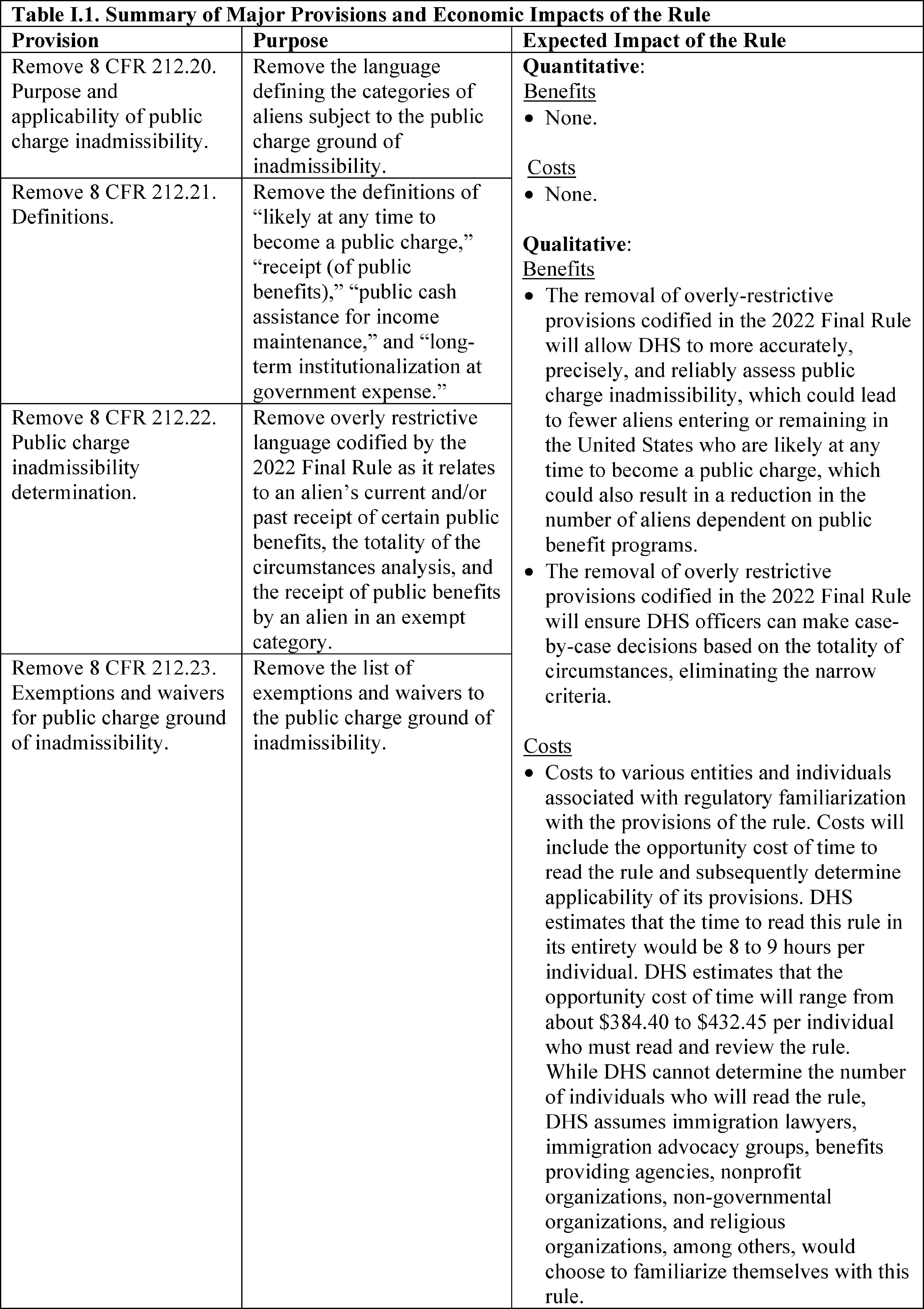
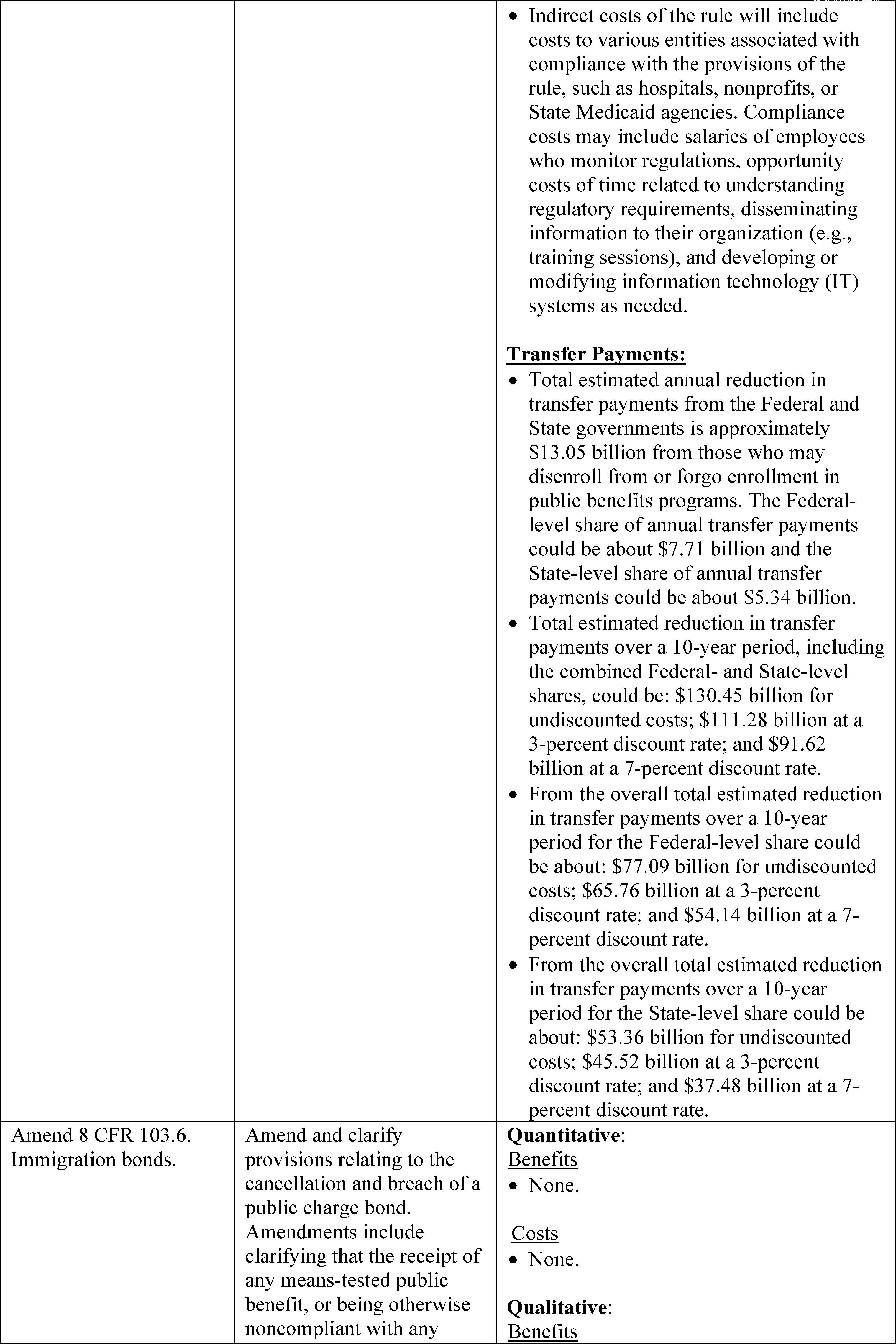
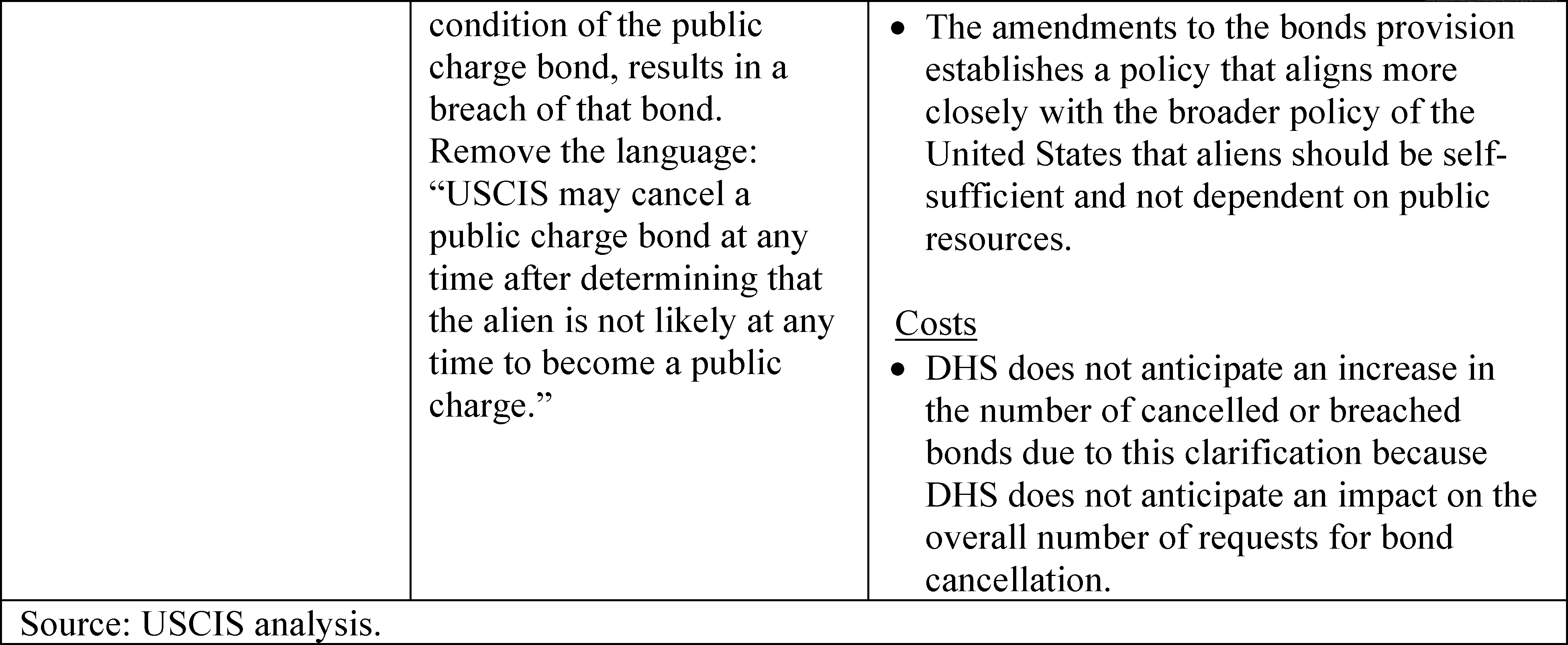
 www.regulations.gov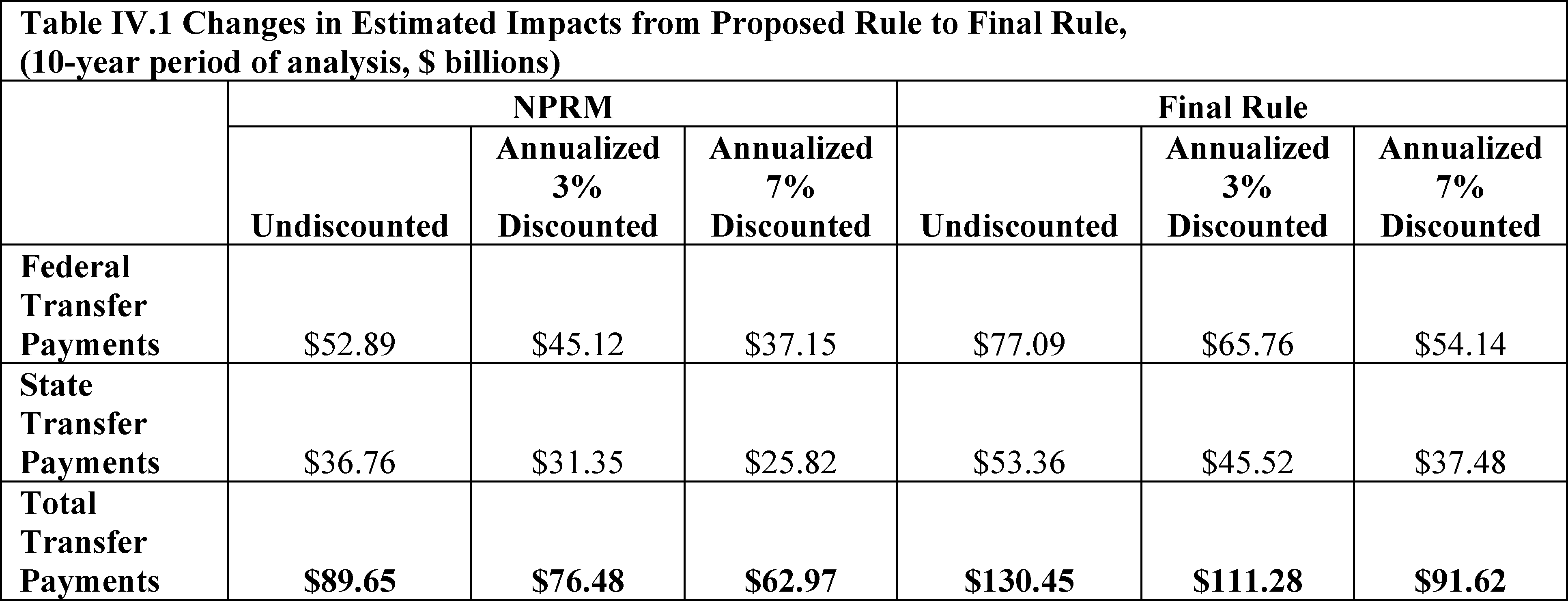
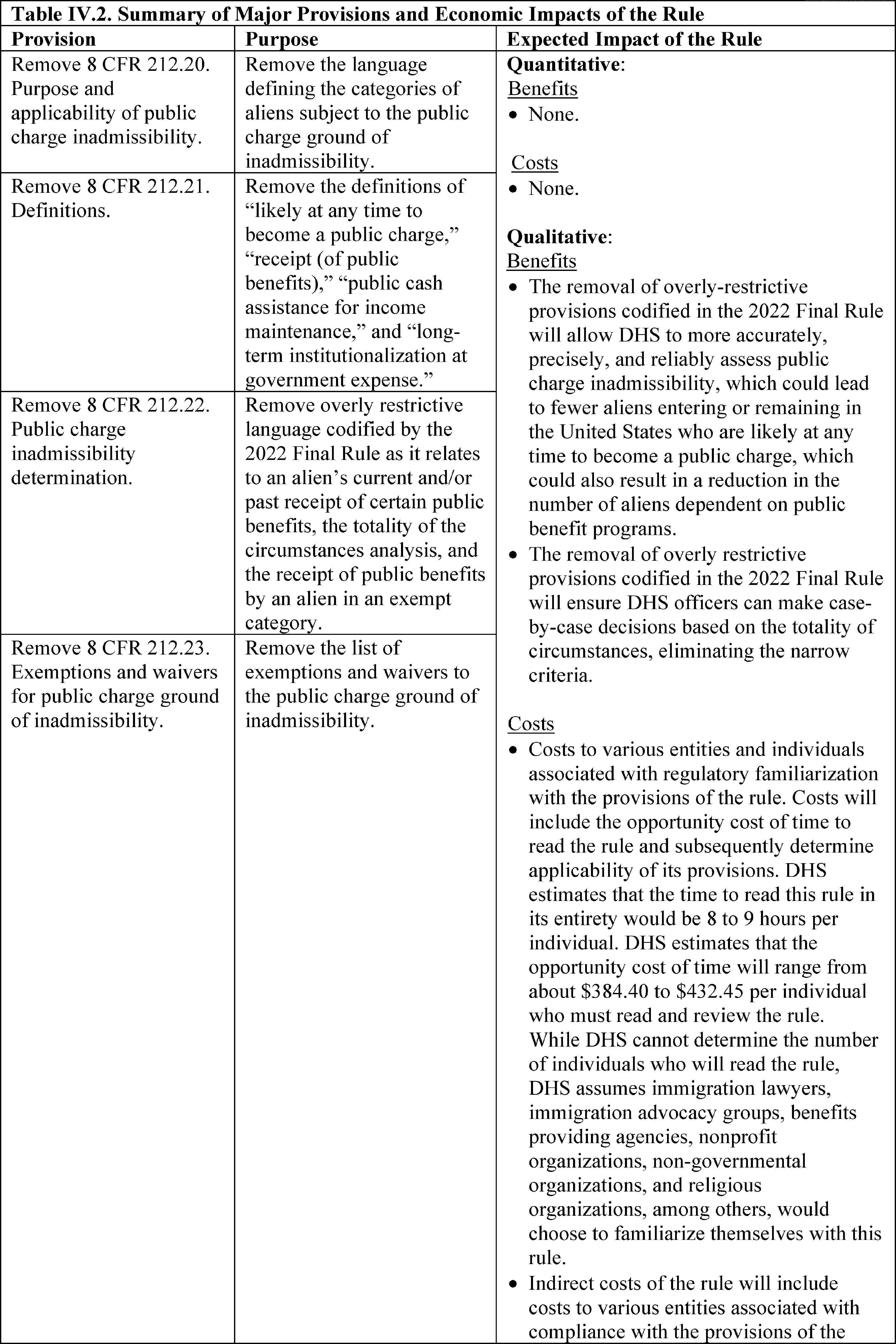
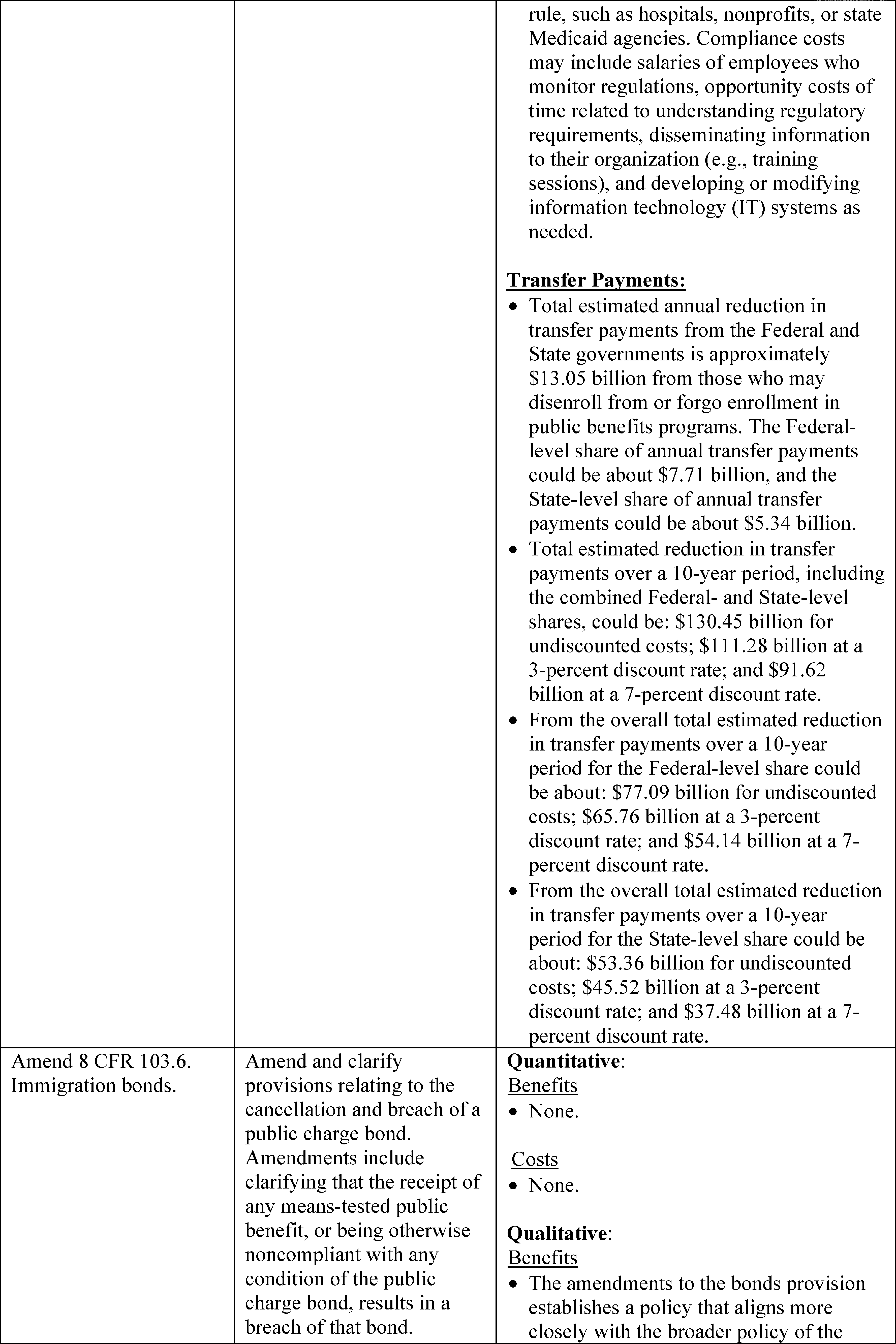
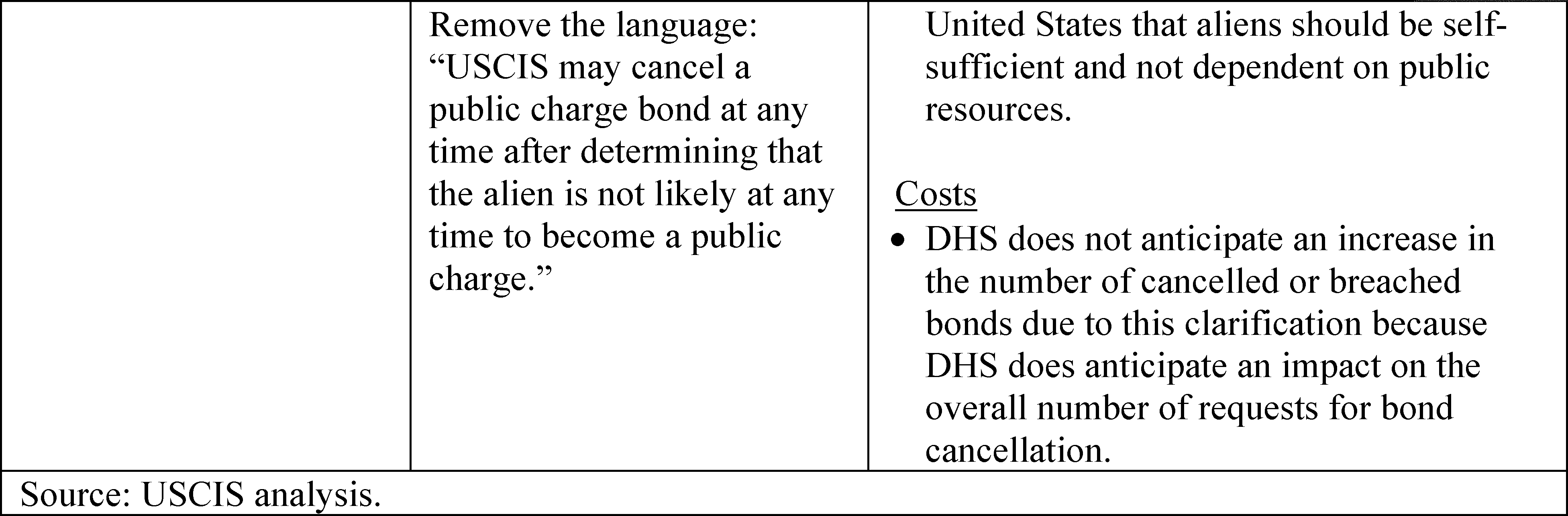
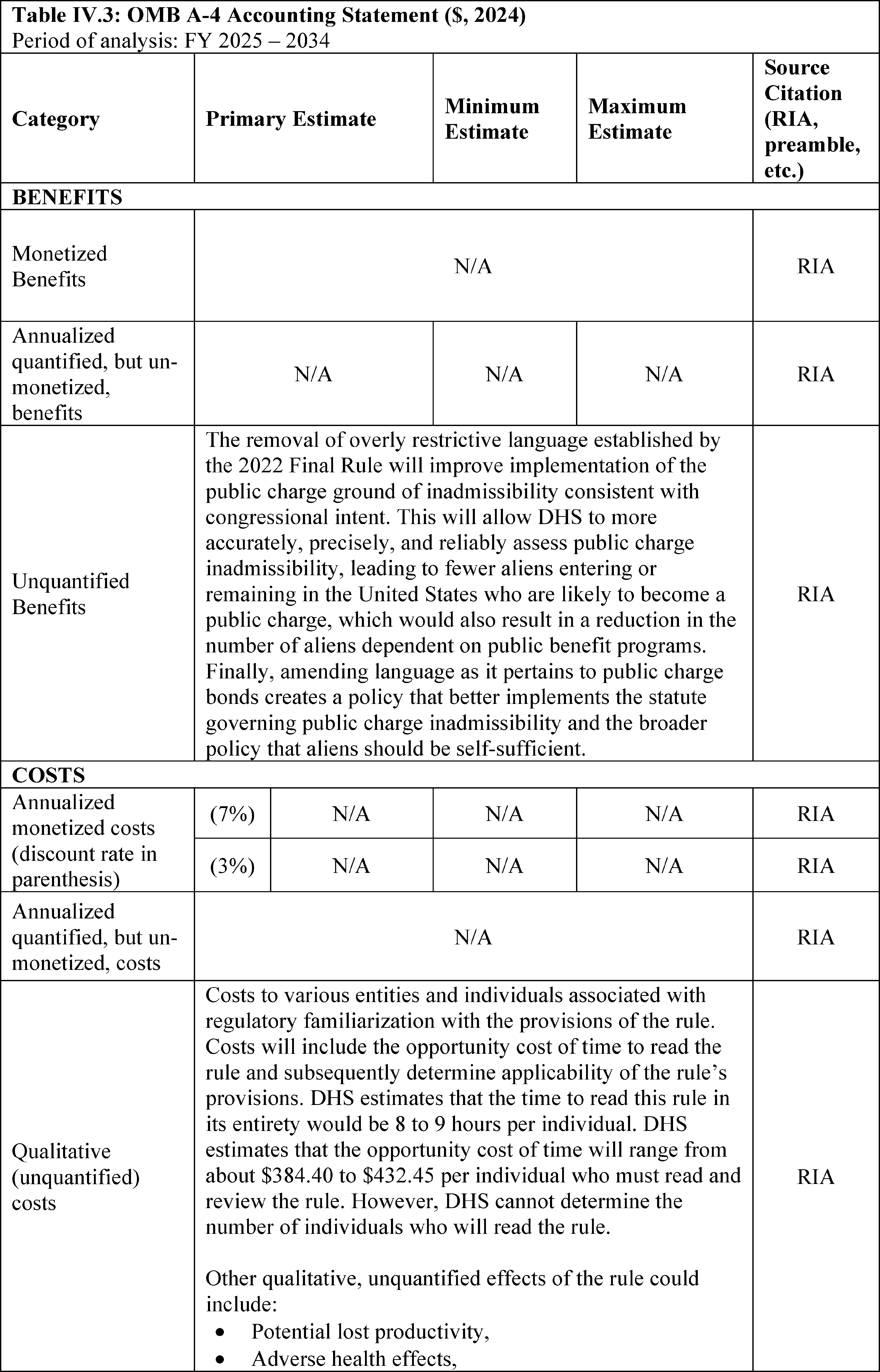
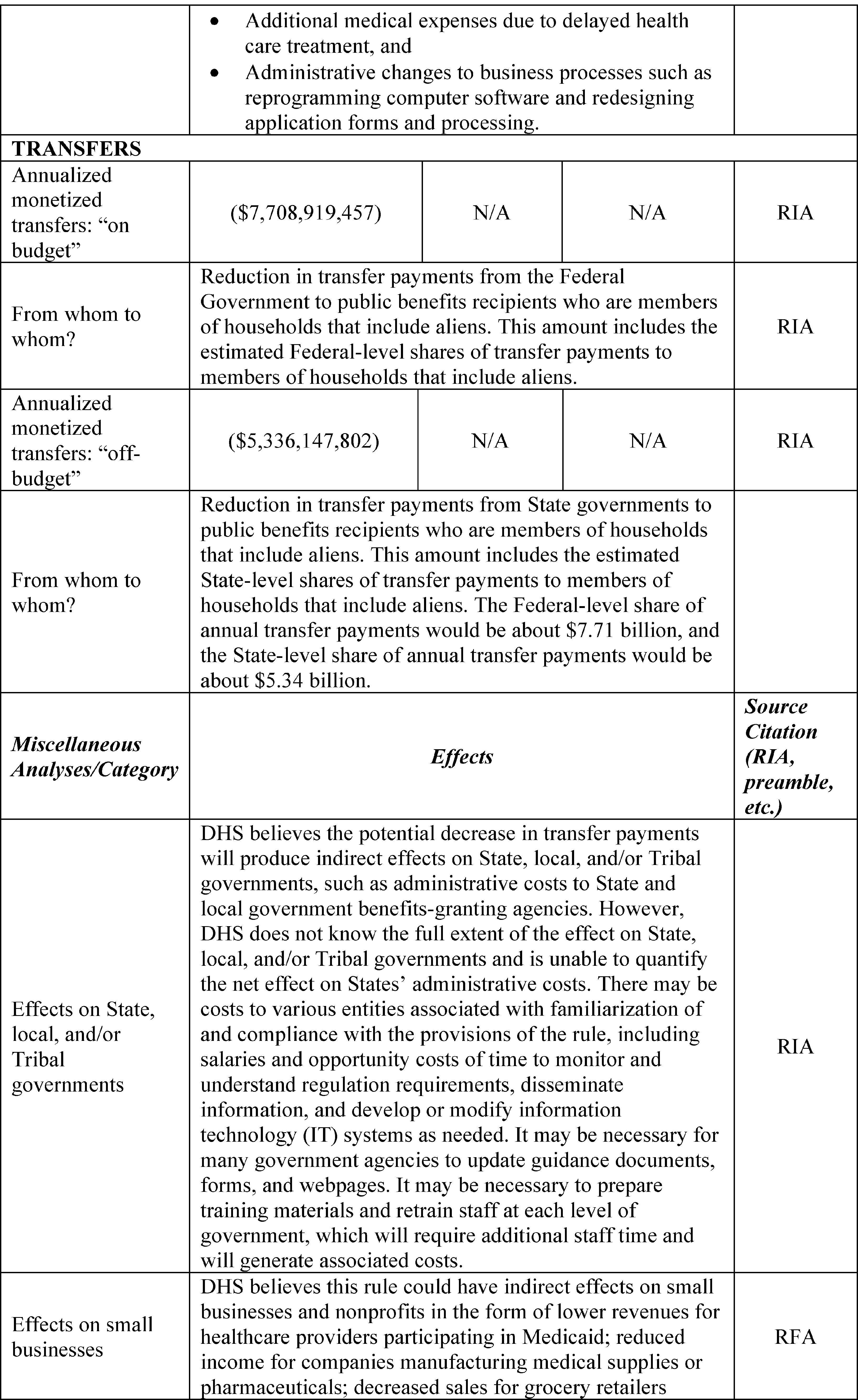
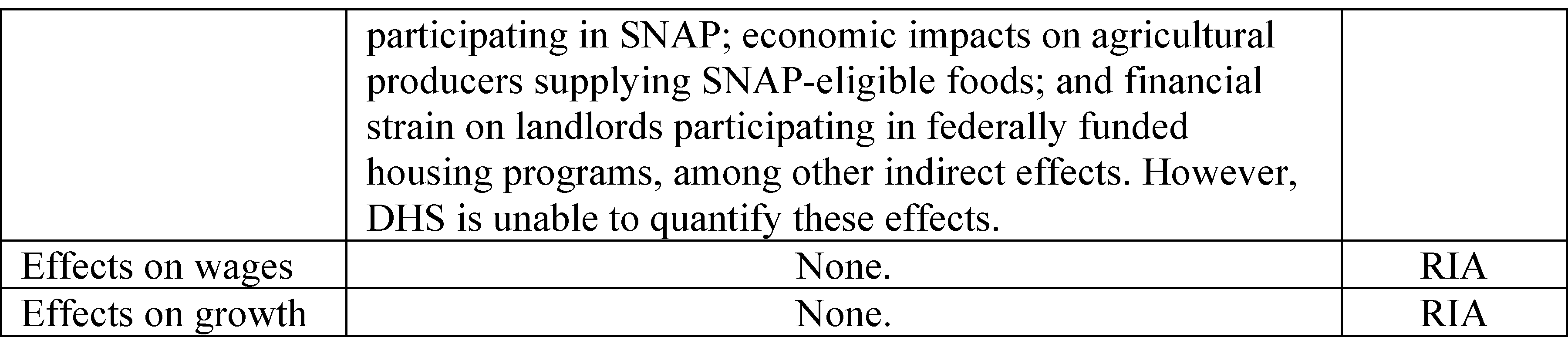
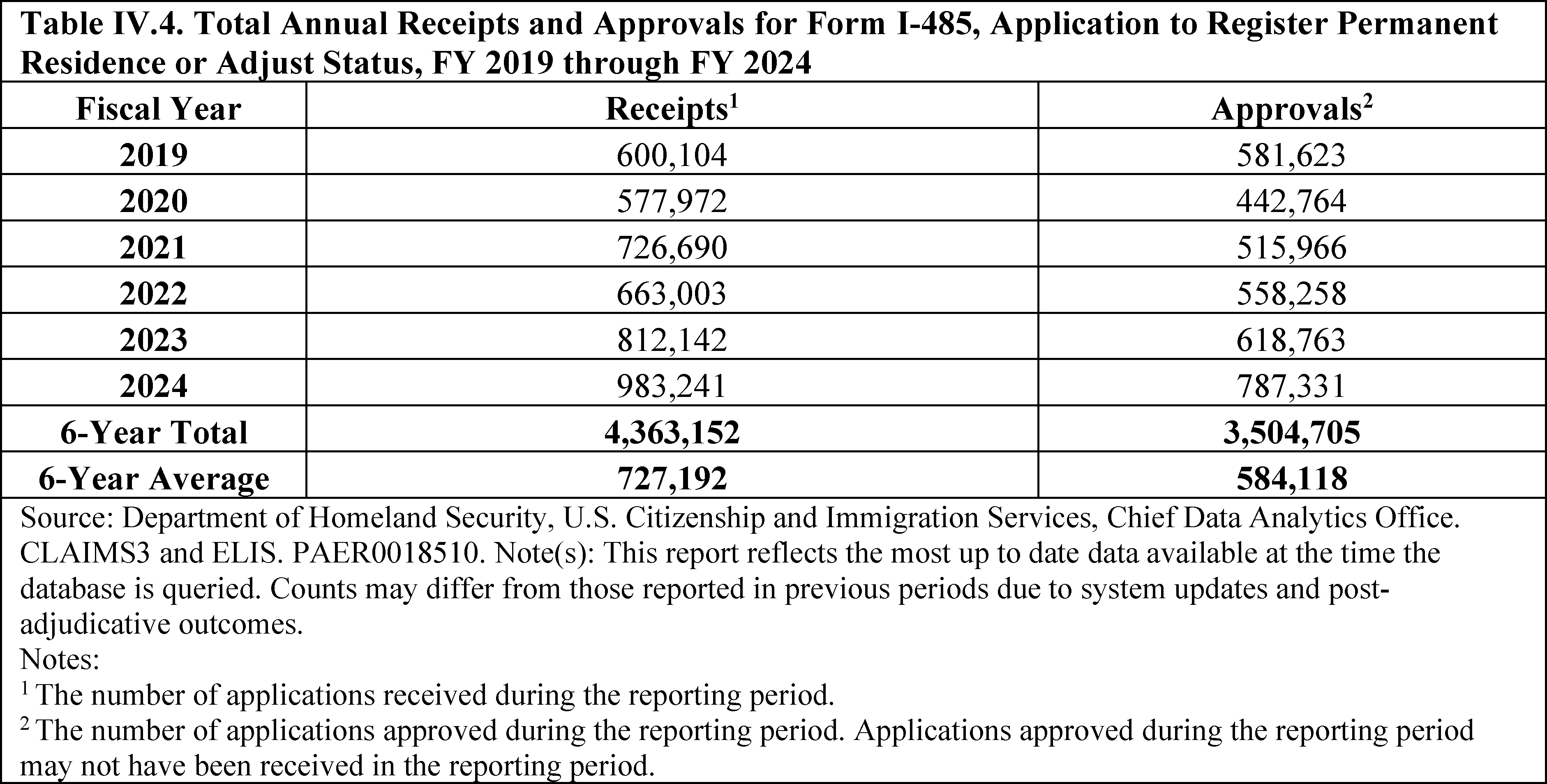
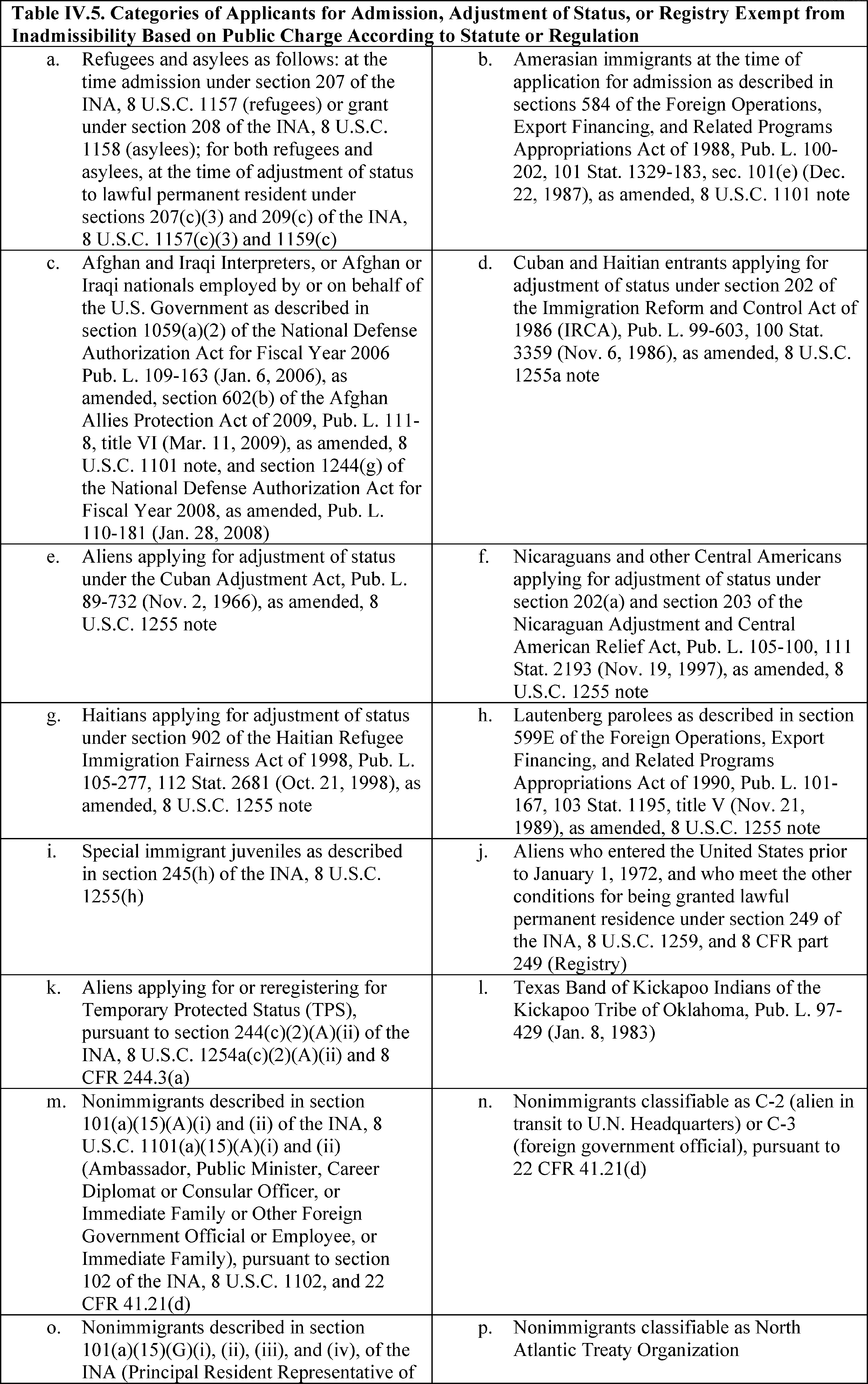
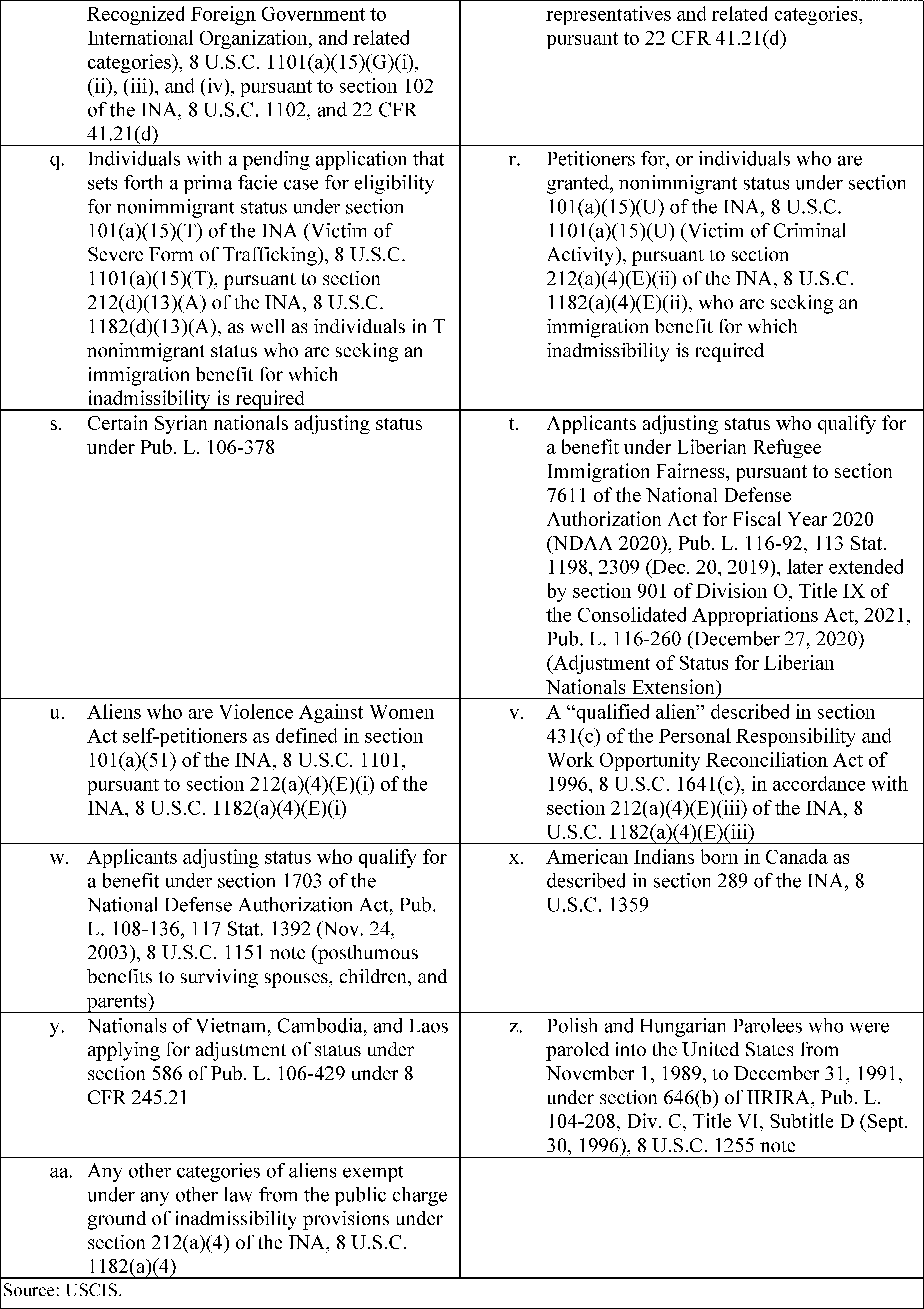
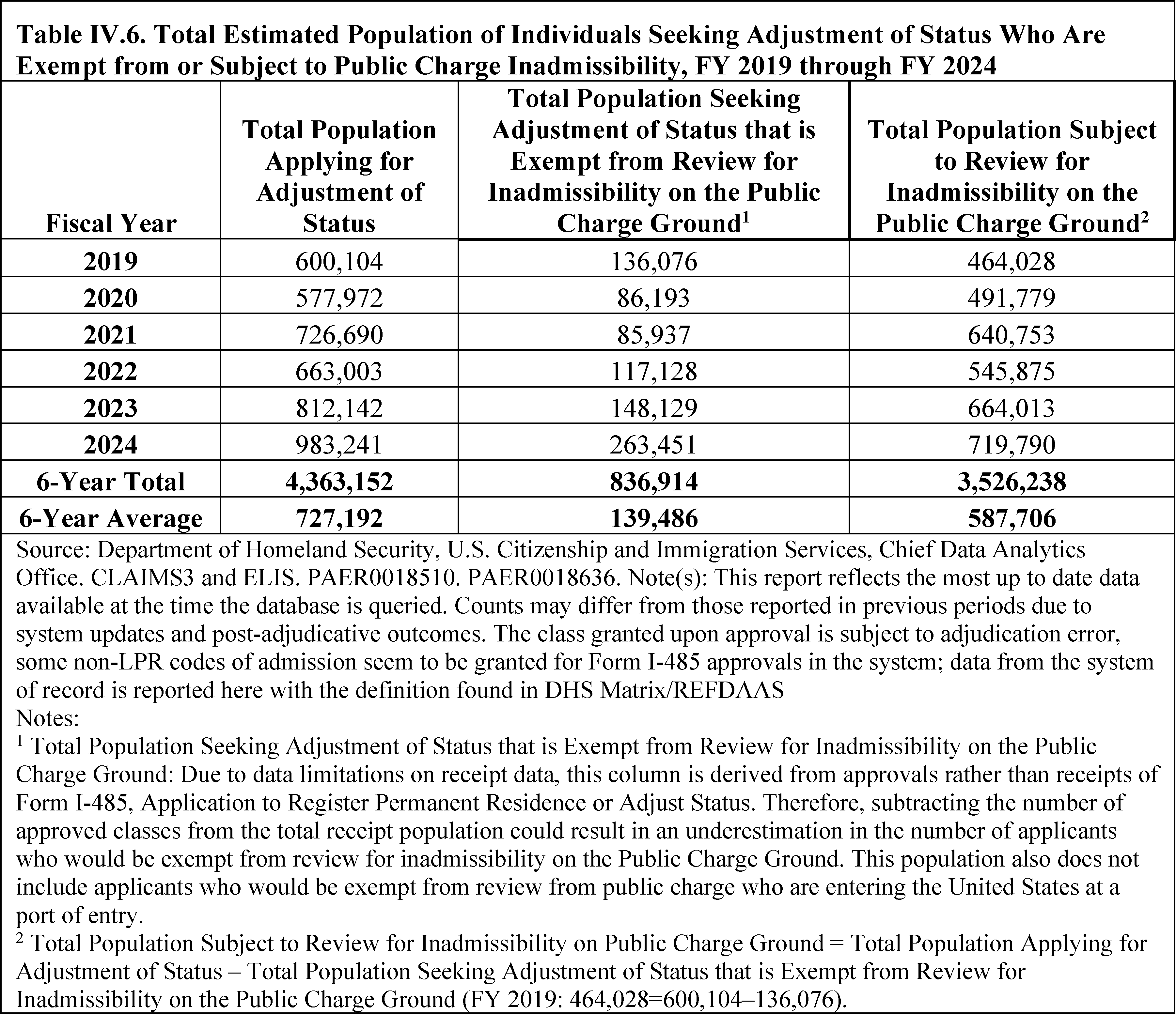
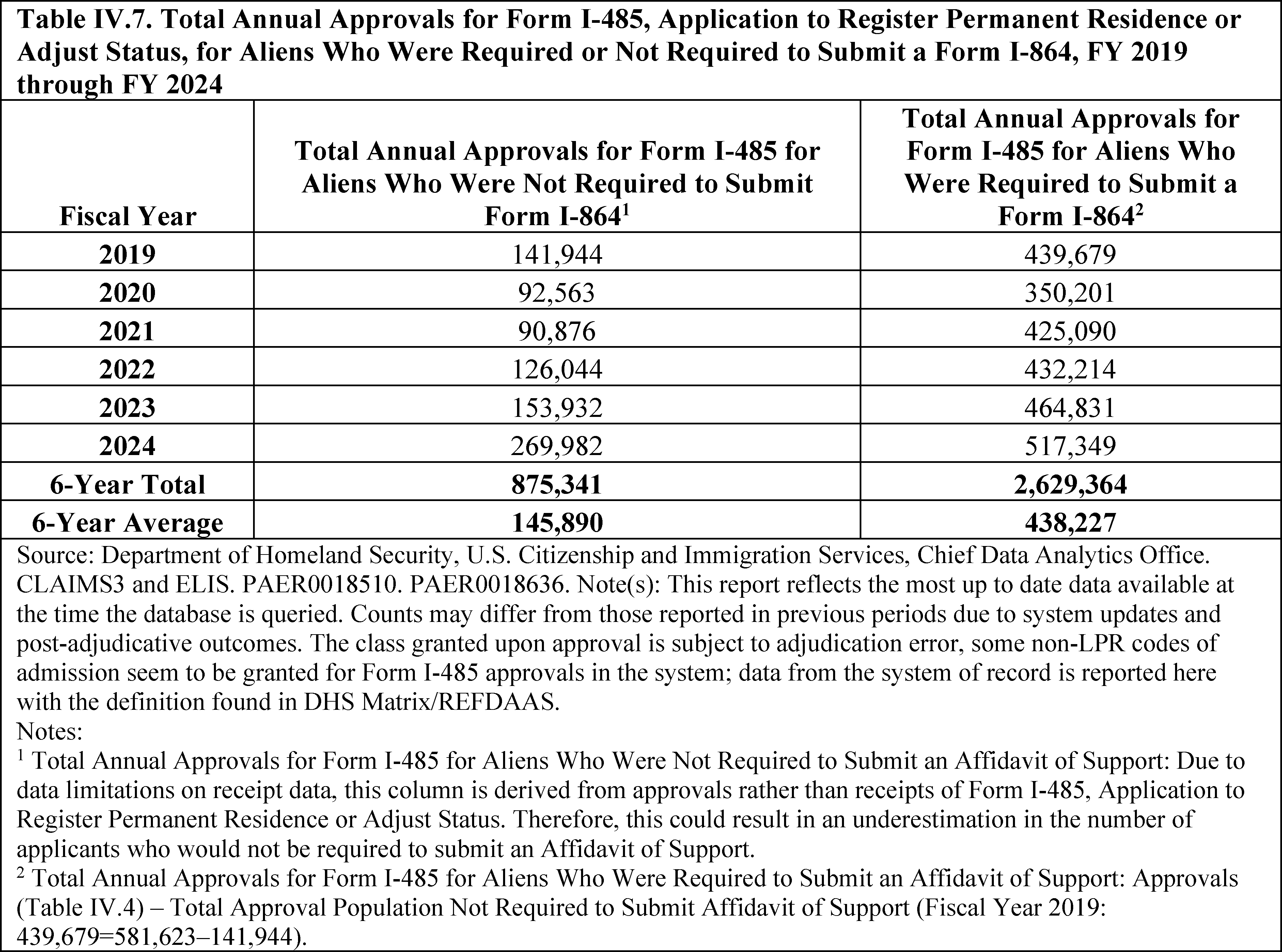
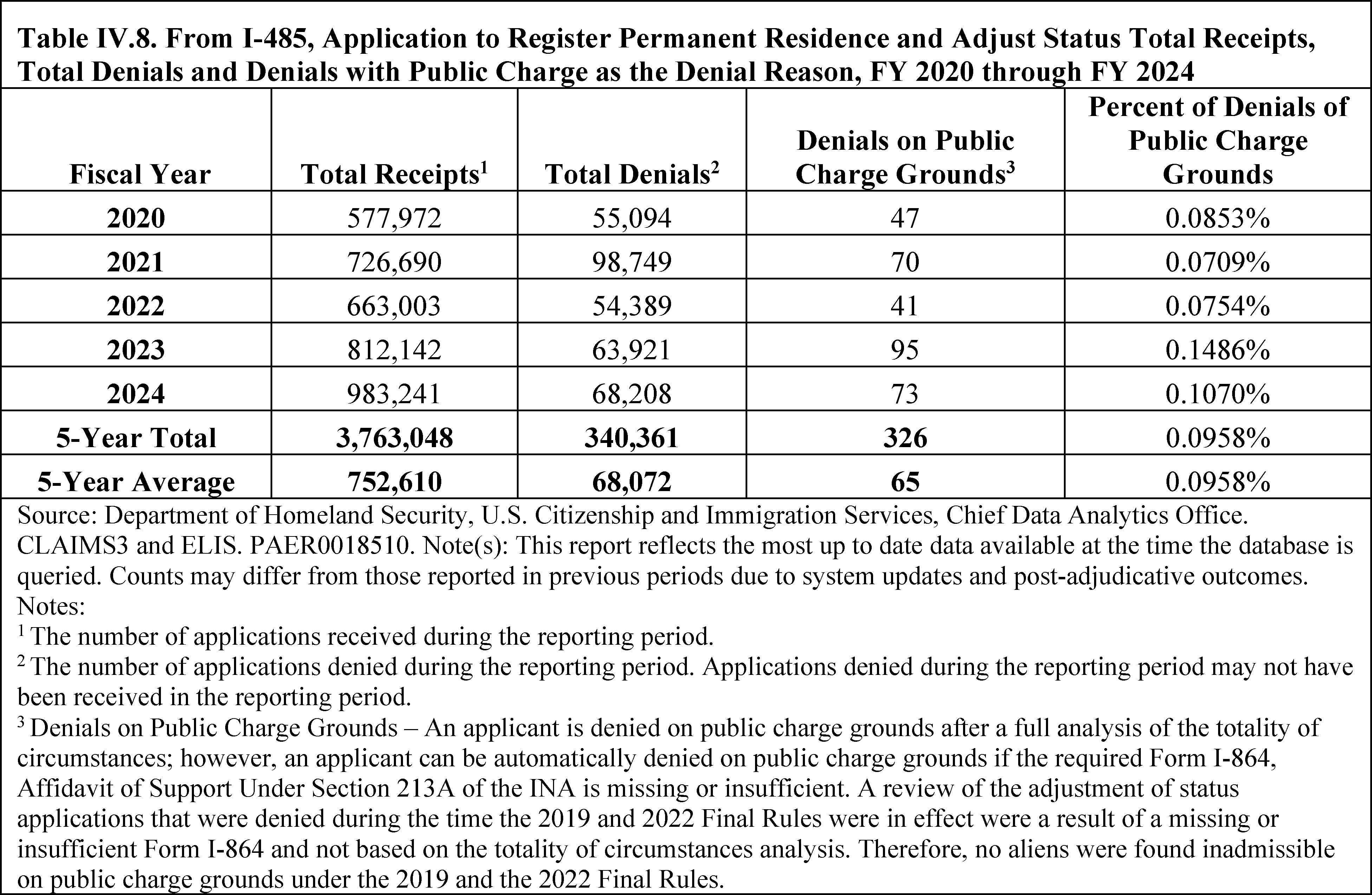
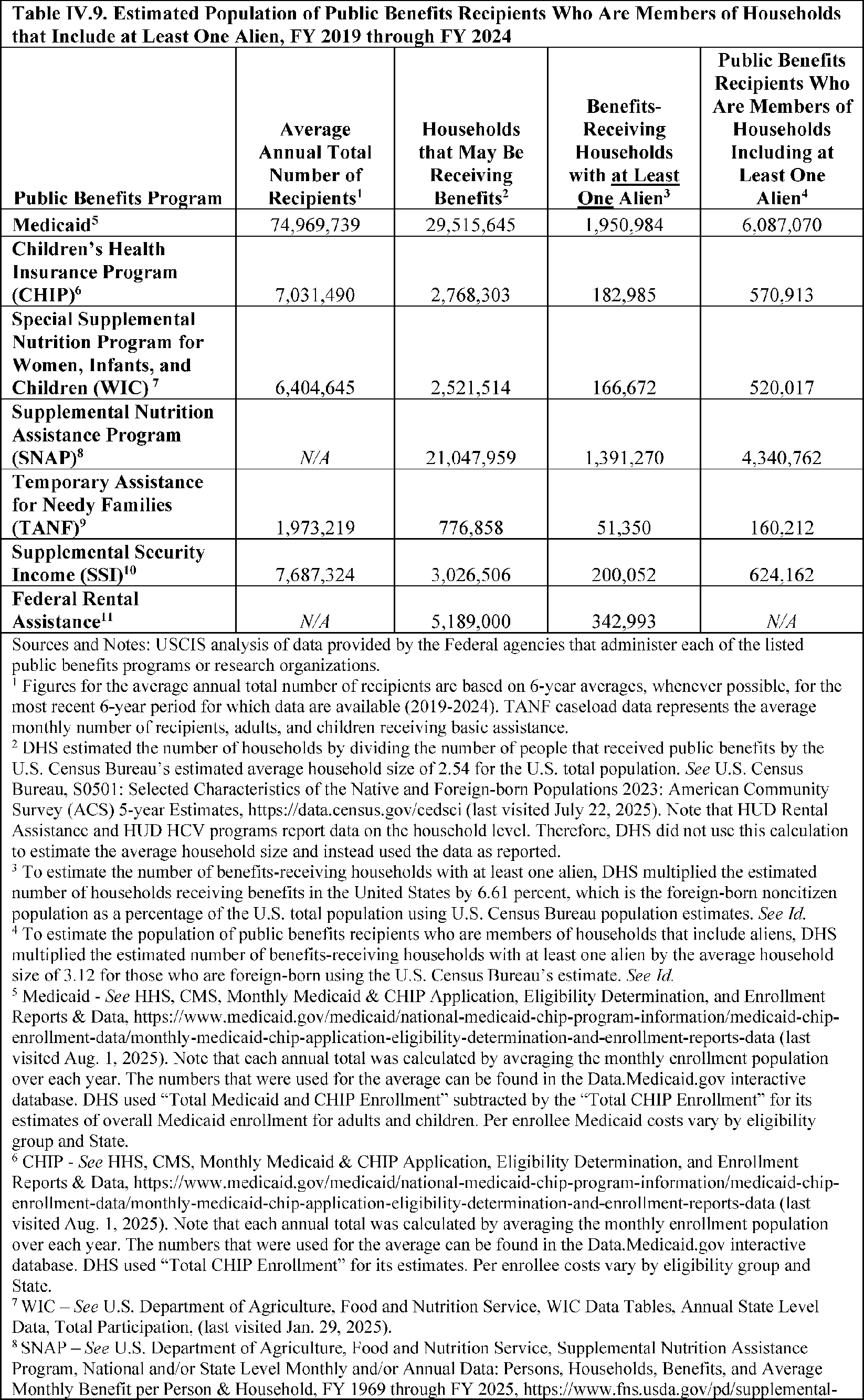
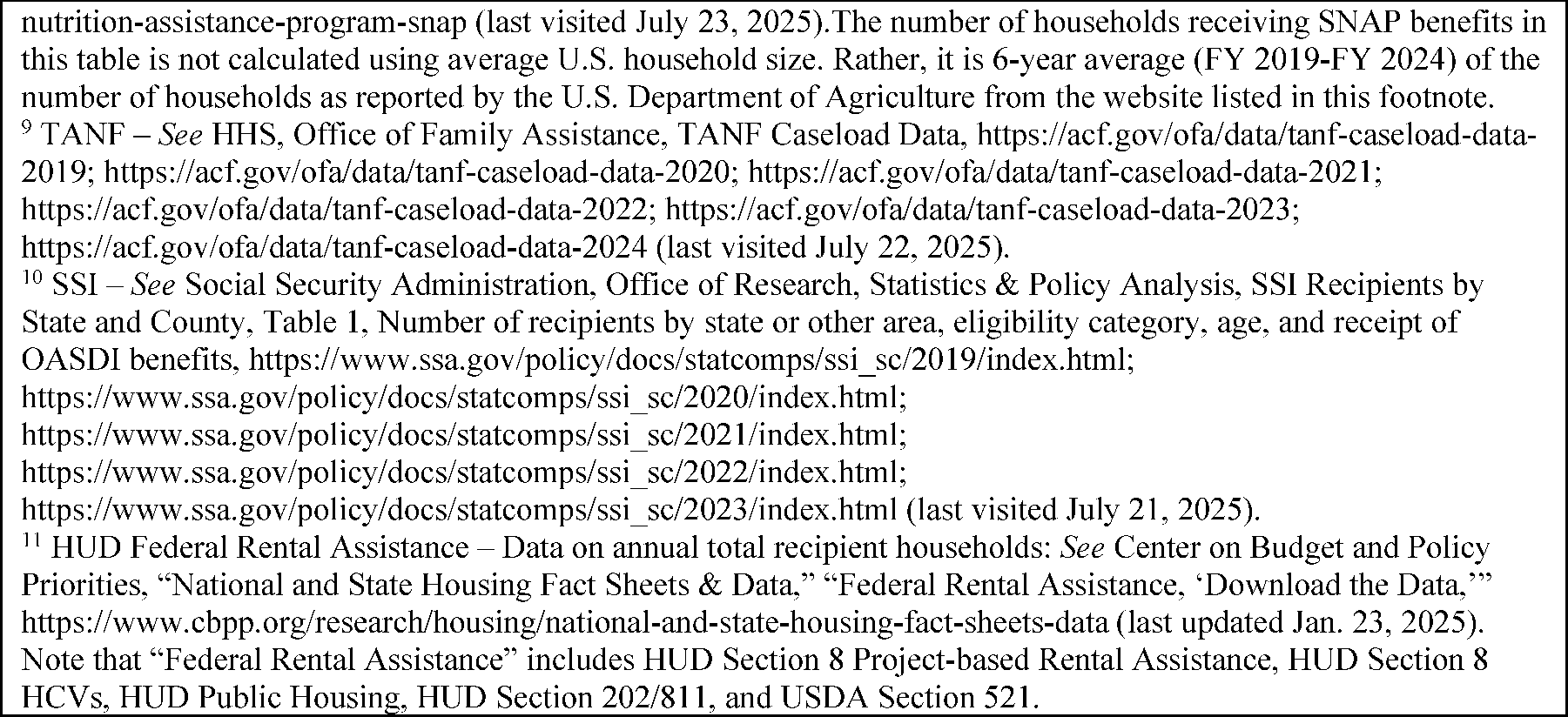
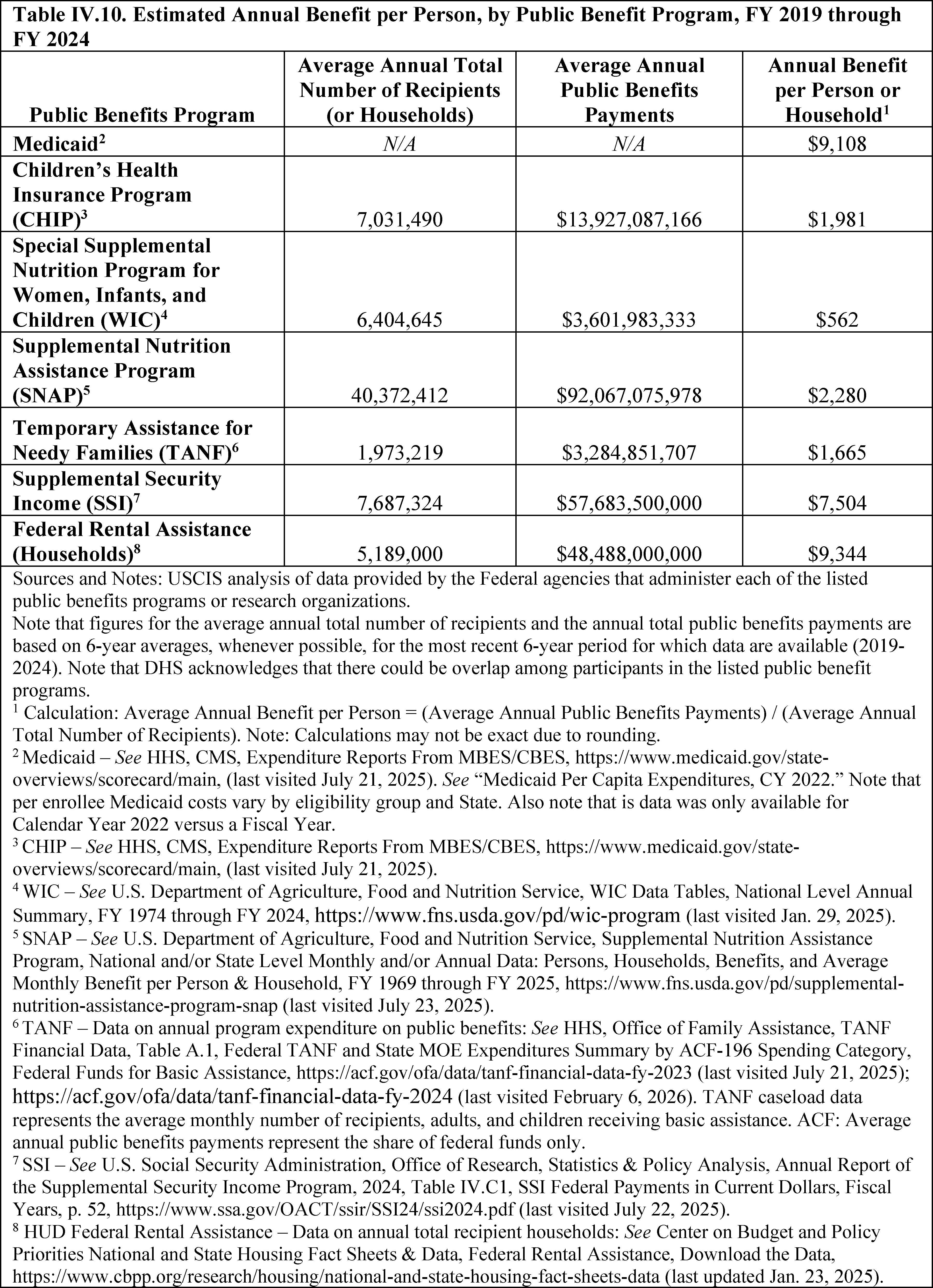
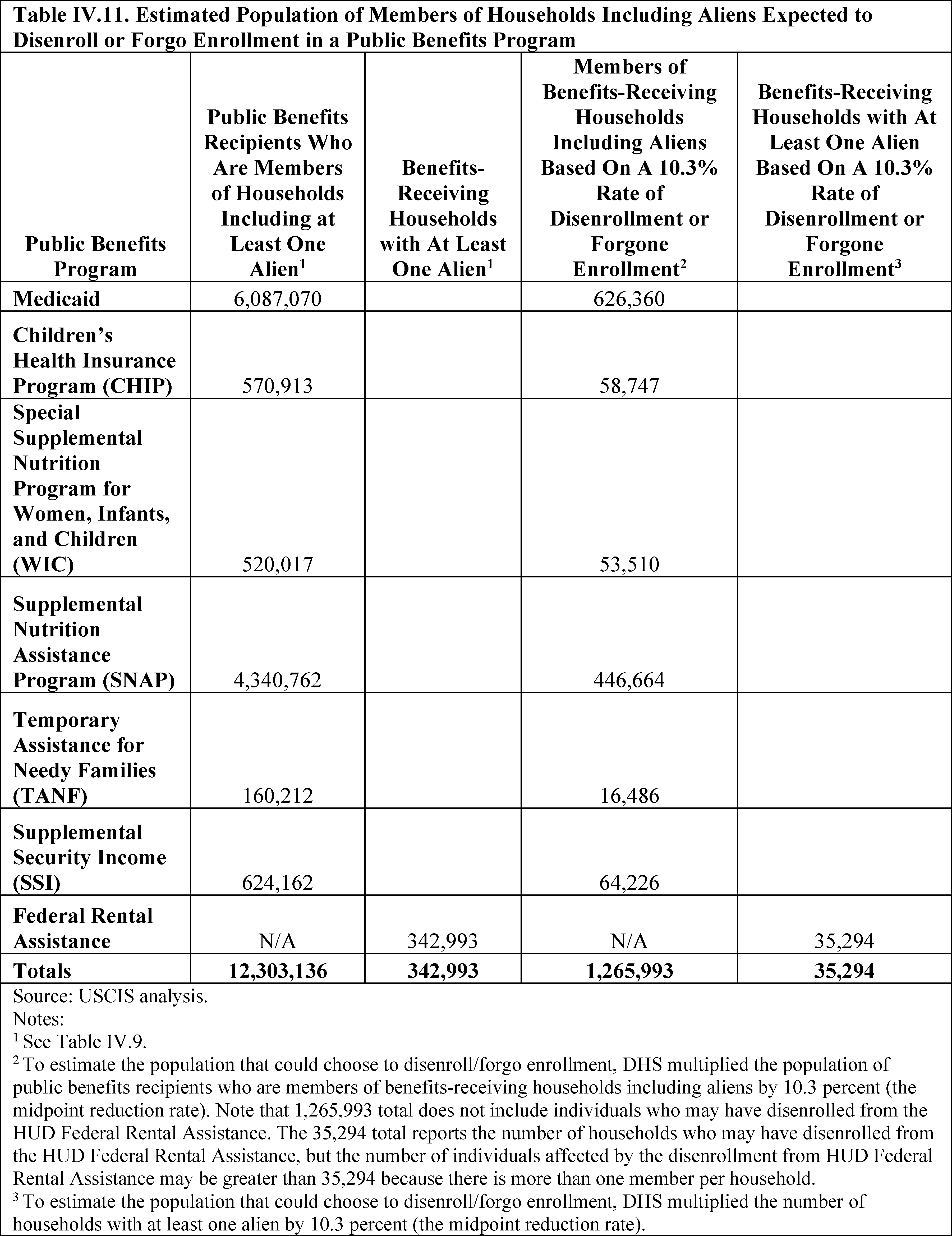
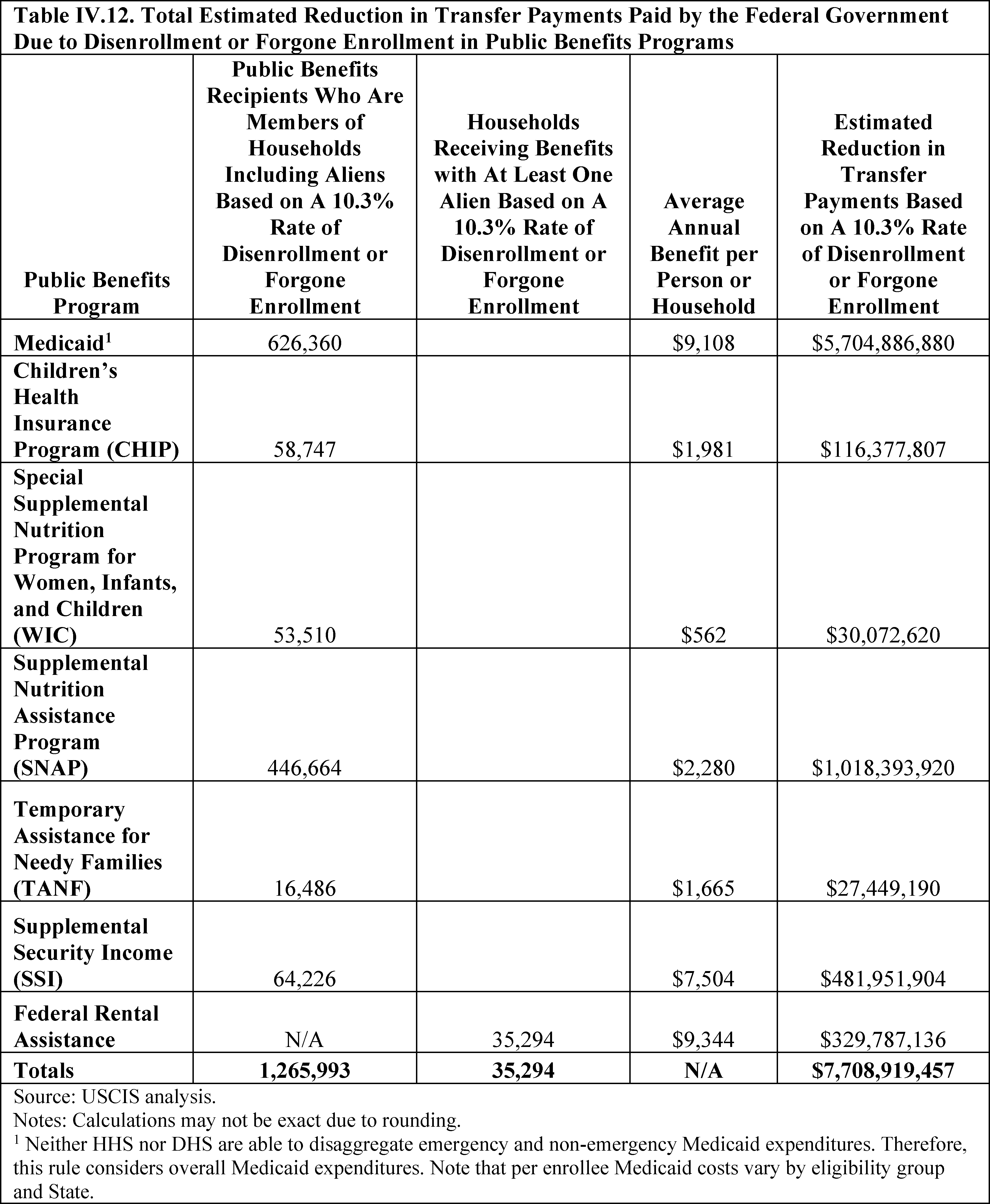
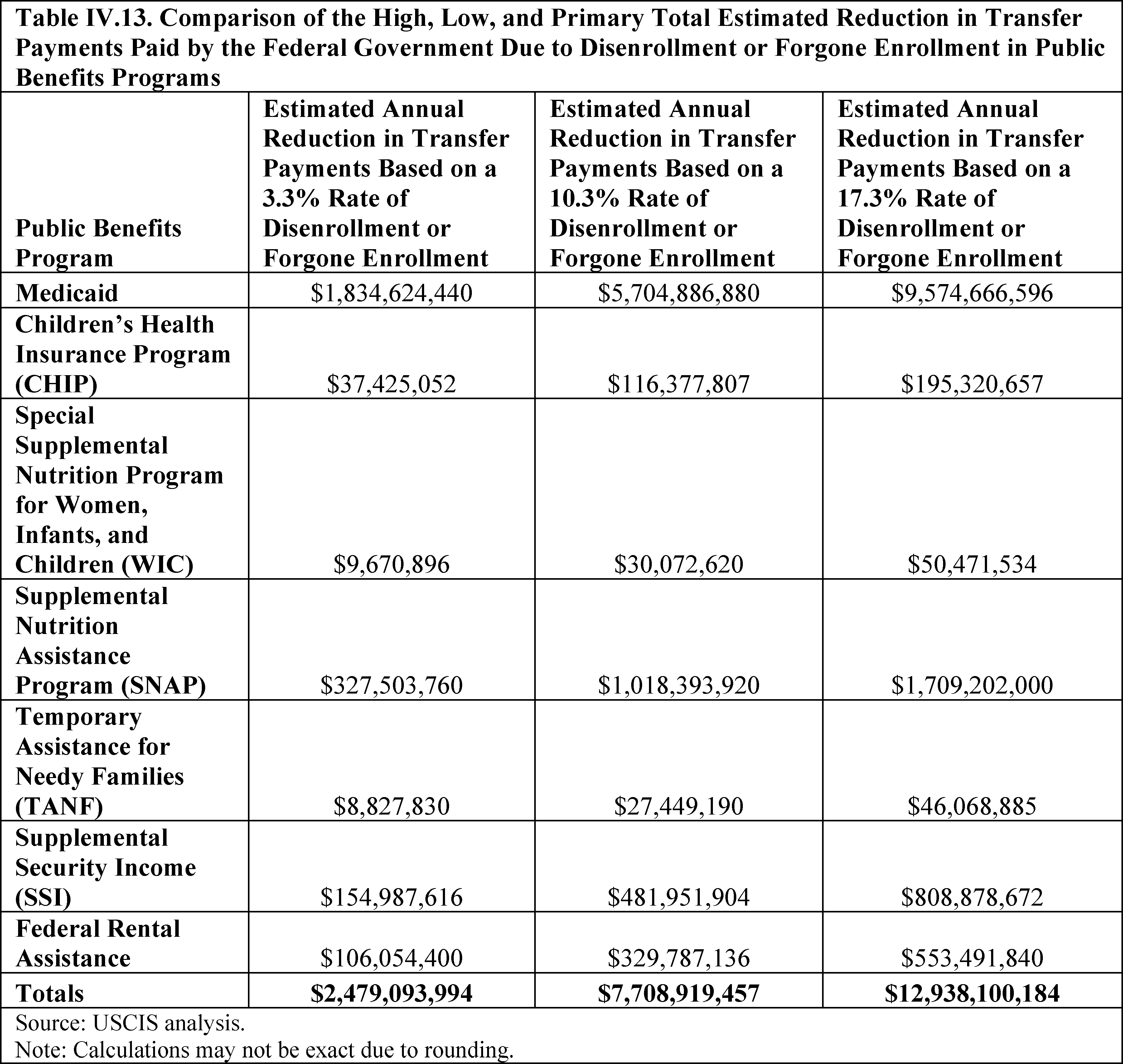
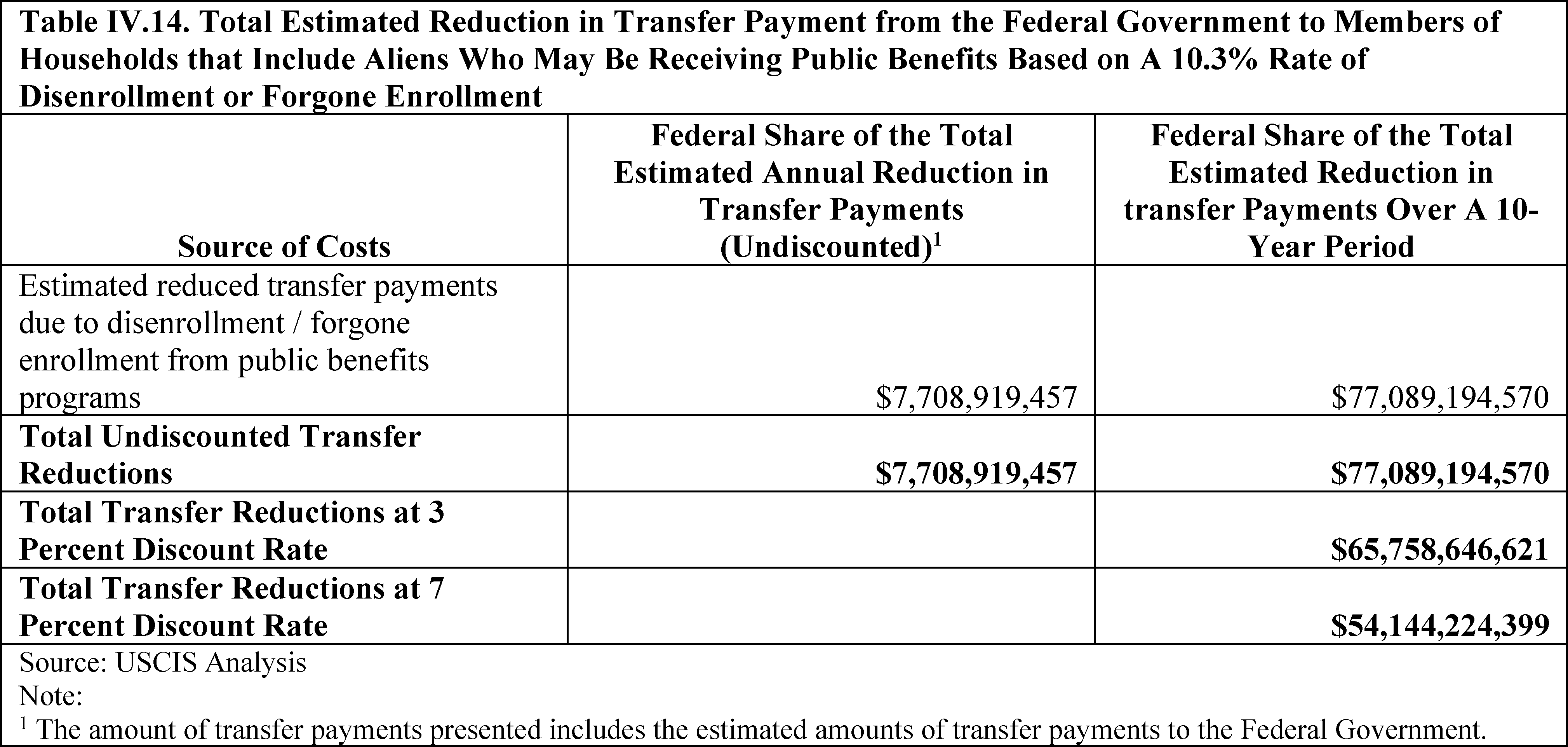
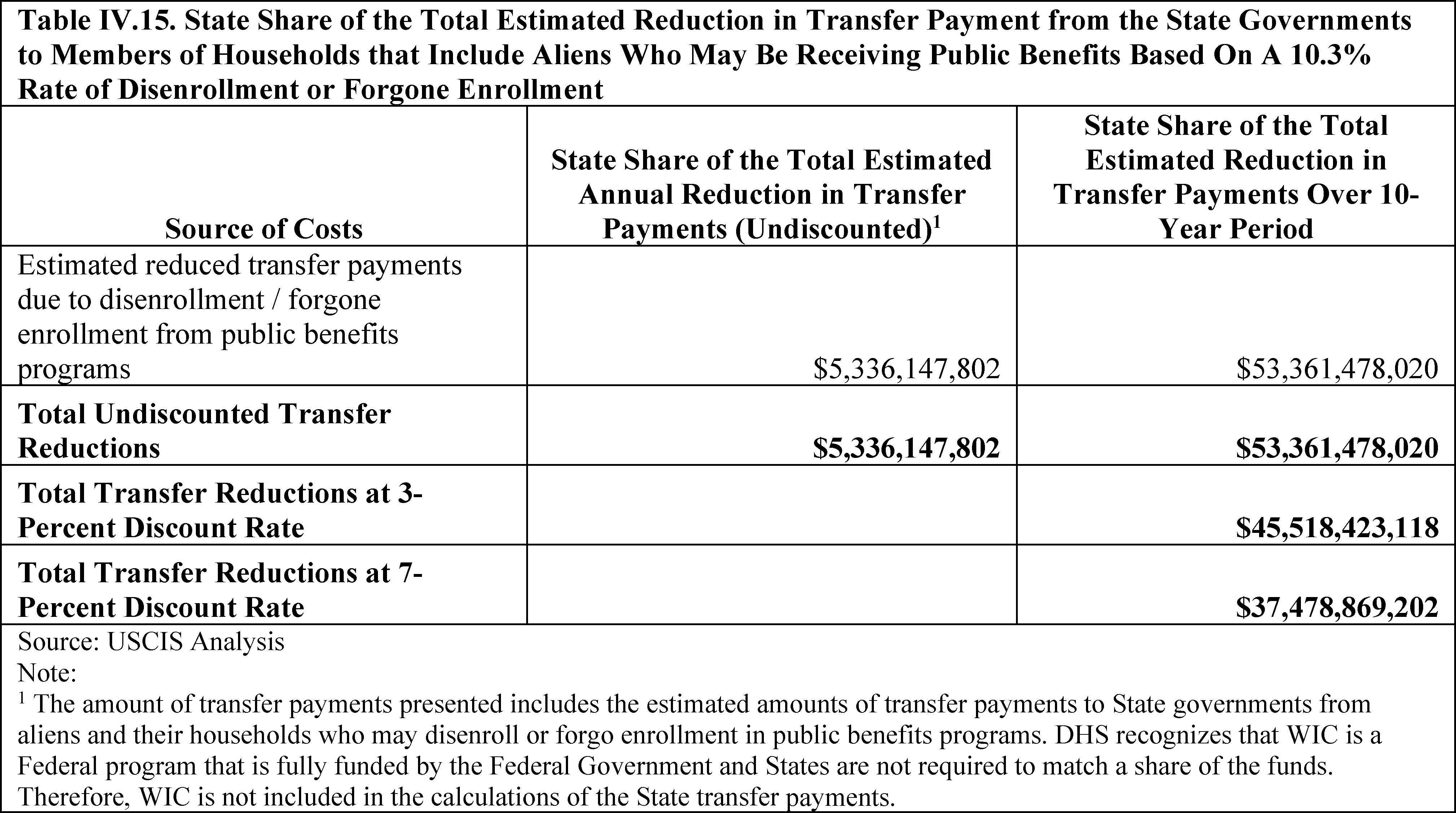
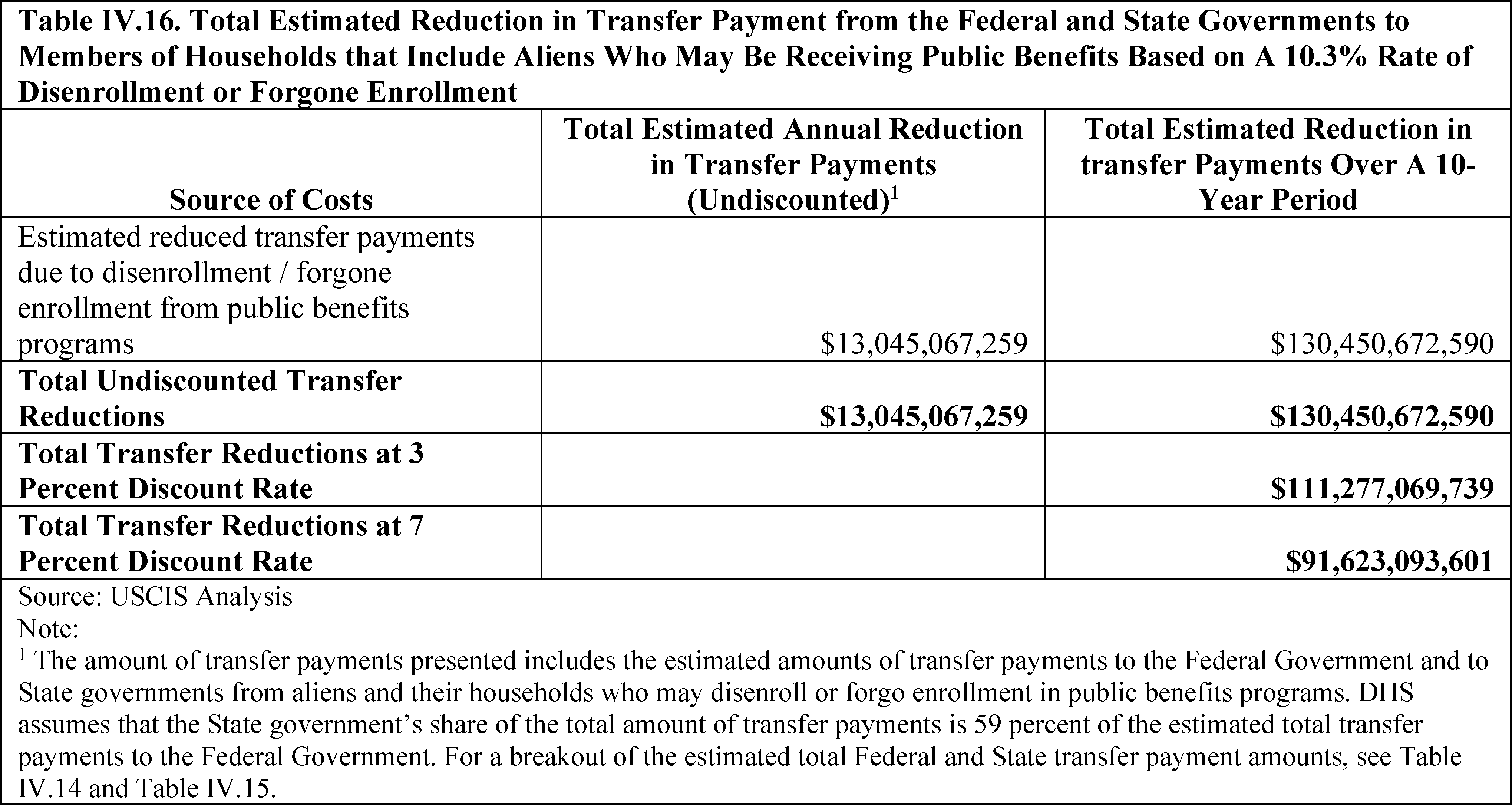
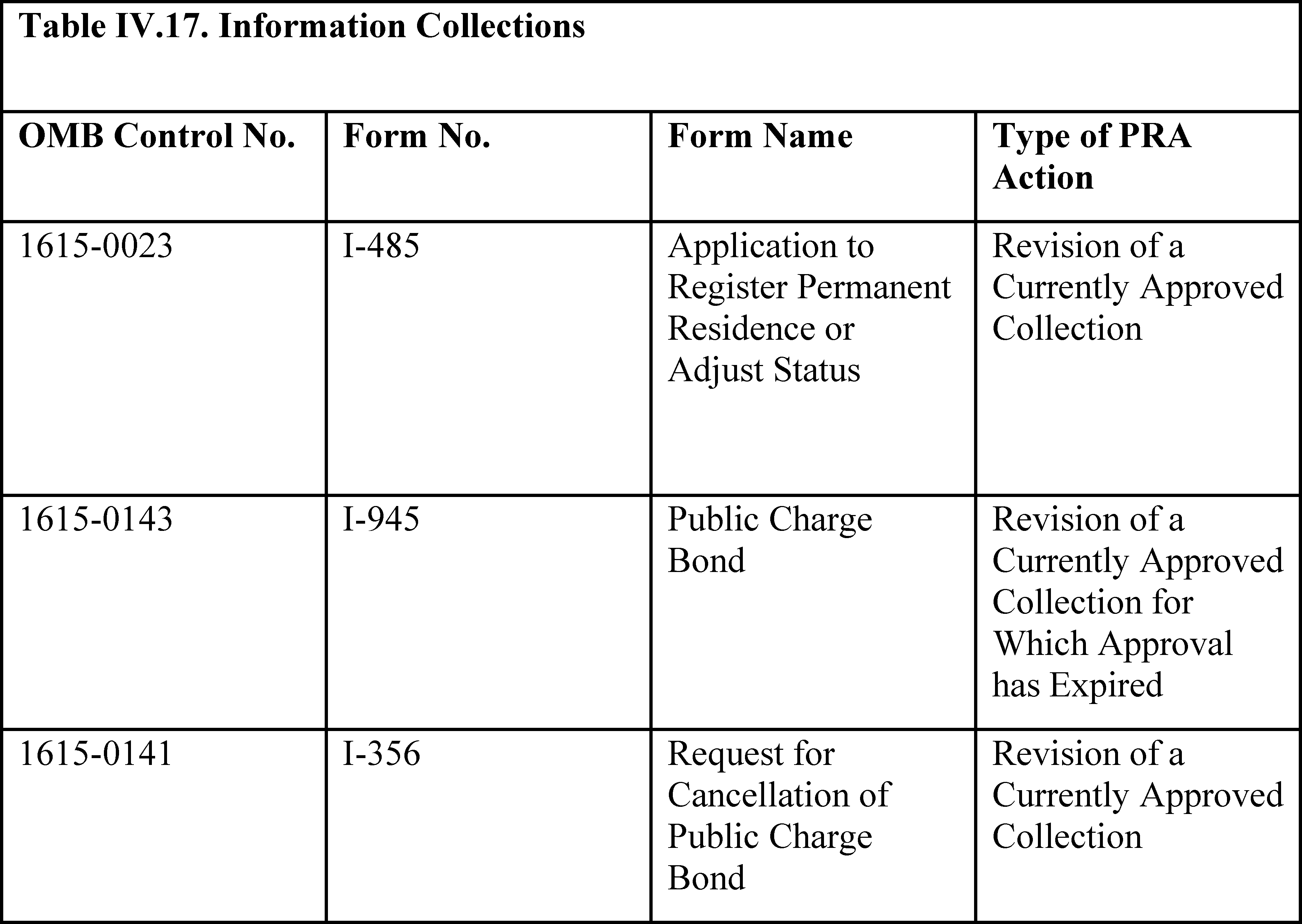
 www.uscis.gov/policy-manual/volume-9
 www.irp.wisc.edu/research/economic-support/means-tested-programs/
 www.migrationpolicy.org/news/mpi-estimates-non-citizens-ineligible-green-cards-based-current-benefit-use#:~:text=March%205%2C%202020-,MPI%20Estimates%20No%20More%20than%20167%2C000%20Non%2DCitizens%20Could%20Be,that%20took%20effect%20February%2024
 www.ohchr.org/en/instruments-mechanisms/instruments/international-covenant-economic-social-and-cultural-rights
 www.kff.org/immigrant-health/kff-new-york-times-2025-survey-of-immigrants-health-and-health-care-experiences-during-the-second-trump-administration/
 www.medicaid.gov/sites/default/files/2019-12/mfp-rtc.pdf
 cscce.berkeley.edu/publications/blog/nearly-half-a-million-early-childhood-educators-are-immigrants/
 ohss.dhs.gov/topics/immigration/yearbook#A-available-yearbooks
 www.bls.gov/news.release/pdf/forbrn.pdf#:~:text=Foreign%2Dborn%20men%20continued%20to%20participate%20in%20the,percent%20for%20native%2Dborn%20women.%20(See%20table%201
 www.whitehouse.gov/wp-content/uploads/2025/08/CircularA-4.pdf
 www.cbo.gov/publication/61879
 www2.census.gov/library/working-papers/2025/adrm/csrm/RRS2025-02.pdf
 www.usa.gov/join-military
 www.irs.gov/credits-deductions/individuals/earned-income-tax-credit-eitc
 nwlc.org/wp-content/uploads/2025/05/Immigrant-Workers-FS-5.9.25v1.pdf
 www.pewresearch.org/short-reads/2025/08/21/key-findings-about-us-immigrants/
 www.dhs.gov/privacy
 www.cbpp.org/sites/default/files/atoms/files/5-30-19pov.pdf
 cis.org/Report/ForeignBorn-Number-and-Share-US-Population-AllTime-Highs-January-2025
 www.archives.gov/files/federal-register/executive-orders/pdf/12866.pdf
 www.urban.org/research/publication/immigrant-families-continued-avoiding-safety-net-during-covid-19-crisis
 hpmmatters.publichealth.gwu.edu/sites/g/files/zaxdzs6671/files/2025-12/Public%20Charge%20NPRM%202025_FINAL_121825.pdf
 www.justice.gov/olc/media/1419131/dl
 www.federalregister.gov/documents/1996/02/07/96-2755/civil-justice-reform
 data.census.gov/cedsci
 www.ssa.gov/ssi/amount
 www.healthaffairs.org/do/10.1377/hblog20191008.70483/full
 data.bls.gov/timeseries/CUUR0000SA0?years_option=all_years