Endangered and Threatened Wildlife and Plants; Endangered Species Status for Florida Keys Mole Skink
We, the U.S. Fish and Wildlife Service (Service), list the Florida Keys mole skink (Plestiodon egregius egregius), a lizard subspecies from the Florida Keys, Florida, as an enda...
We, the U.S. Fish and Wildlife Service (Service), list the Florida Keys mole skink (
Plestiodon egregius egregius), a lizard subspecies from the Florida Keys, Florida, as an endangered species under the Endangered Species Act of 1973 (Act), as amended. This rule extends the protections of the Act to this species.
DATES:
This rule is effective August 20, 2026.
ADDRESSES:
This final rule is available on the internet at
www.regulations.gov.
Comments and materials we received are available for public inspection at
www.regulations.gov
at Docket No. FWS-R4-ES-2022-0104.
Availability of supporting materials:
Supporting materials we used in preparing this rule, such as the species status assessment report, are available at
www.regulations.gov
at Docket No. FWS-R4-ES-2022-0104.
FOR FURTHER INFORMATION CONTACT:
Nikki Colangelo, Division Manager, Classification and Recovery, Florida Ecological Services Field Office; 772-226-8138
nikki_colangelo@fws.gov.
Individuals in the United States who are deaf, deafblind, hard of hearing, or have a speech disability may dial 711 (TTY, TDD, or TeleBraille) to access telecommunications relay services. Individuals outside the United States should use the relay services offered within their country to make international calls to the point-of-contact in the United States.
SUPPLEMENTARY INFORMATION:
Executive Summary
Why we need to publish a rule.
Under the Act (16 U.S.C. 1531et seq.), a species warrants listing if it meets the definition of an endangered species (in danger of extinction throughout all or a significant portion of its range) or a threatened species (likely to become an endangered species within the foreseeable future throughout all or a significant portion of its range). If we determine that a species warrants listing, we must list the species promptly and designate the species' critical habitat to the maximum extent prudent and determinable. We have determined that the Florida Keys mole skink meets the Act's definition of an endangered species; therefore, we are listing it as such. Listing a species as an endangered or threatened species can be completed only by issuing a rule through the Administrative Procedure Act rulemaking process (5 U.S.C. 551et seq.).
What this document does.
This rule lists the Florida Keys mole skink as an endangered species under the Act.
The basis for our action.
Under the Act, we may determine that a species is an endangered or threatened species because of any of five factors: (A) The present or threatened destruction, modification, or curtailment of its habitat or range; (B) overutilization for commercial, recreational, scientific, or educational purposes; (C) disease or predation; (D) the inadequacy of existing regulatory mechanisms; or (E) other natural or manmade factors affecting its continued existence. We have determined that the Florida Keys mole skink is endangered due to threats associated with sea level rise, increased high tide flooding, and increased-intensity storm events (Factor E), as well as threats due to habitat loss and degradation that result from development and habitat disturbance (Factor A).
Previous Federal Actions
Please refer to the proposed listing and critical habitat rule for the Florida Keys mole skink published on September 27, 2022 (87 FR 58648), for a detailed description of previous Federal actions concerning this species. That document proposed to list the Florida Keys mole skink as a threatened species with regulatory provisions under section 4(d) of the Act (“a 4(d) rule”) and to designate critical habitat.
Peer Review
A species status assessment (SSA) team prepared an SSA report for the Florida Keys mole skink. The SSA team was composed of Service biologists, in consultation with other species experts. The SSA report represents a compilation of the best scientific and commercial data available concerning the status of the species, including the impacts of past, present, and future factors (both negative and beneficial) affecting the species.
In accordance with our joint policy with the National Marine Fisheries Service (NMFS) on peer review that published in the
Federal Register
on July 1, 1994 (59 FR 34270), and our August 22, 2016, memorandum updating and clarifying the role of peer review in listing and recovery actions under the Act (
www.fws.gov/sites/default/files/documents/peer-review-policy-directors-memo-2016-08-22.pdf), we solicited independent scientific review of the information contained in the Florida Keys mole skink SSA report. As discussed in the proposed rule, we sent the SSA report to nine independent peer reviewers and received two responses. The peer reviews can be found at
www.regulations.gov.
In preparing the proposed rule, we incorporated the results of these reviews, as appropriate, into the SSA report, which was the foundation for the proposed rule and
( printed page 45684)
this final rule. A summary of the peer review comments and our responses can be found in the Summary of Comments and Recommendations below.
Summary of Changes From the Proposed Rule
The final rule incorporates changes to our proposed listing rule and SSA report based on the comments we received, as discussed below in the Summary of Comments and Recommendations. Based on updated data and our further consideration of the overall low numbers of Florida Keys mole skink on most islands, we determined the risk from sea level rise and high tide flooding is higher (see Determination of Florida Keys Mole Skink Status, below) than characterized in our proposal to list the Florida Keys mole skink as a threatened species (87 FR 58648; September 27, 2022). We reassessed our analysis, including new sea level rise data (Sweet et al. 2022, entire) and new updated National Oceanic and Atmospheric Administration (NOAA) inundation data layers that were used to determine habitat effects (NOAA 2024a, unpaginated), and found that the Florida Keys mole skink is at a higher risk to threats from sea level rise throughout its range. We have updated our analysis with these data and information in our SSA report and in this final rule. Thus, after evaluating the best available information, we determined that the Florida Keys mole skink is currently in danger of extinction because of the magnitude and immediacy of the threats it faces, as compounded by the species' likely inherently low numbers. Because we determined that the Florida Keys mole skink meets the definition of an endangered species, a 4(d) rule is inapplicable; consequently, we have removed the regulatory provisions under the authority of section 4(d) of the Act from this final rule. Lastly, we made minor editorial and nonsubstantive corrections throughout the SSA report and this final rule.
Summary of Comments and Recommendations
In the proposed rule published on September 27, 2022 (87 FR 58648), we requested that all interested parties submit written comments on the proposal by November 28, 2022. Due to the impact of Hurricane Ian, we extended the public comment period to January 12, 2023, in order to allow all interested parties time to comment (see 87 FR 72958). We also contacted appropriate Federal and State agencies, Tribal entities, scientific experts and organizations, and other interested parties and invited them to comment on the proposal. Newspaper notices inviting general public comment were published in the Key West Citizen Newspaper and the Miami Herald Newspaper. We did not receive any requests for a public hearing. All substantive information received during the comment periods has either been incorporated directly into this final determination or is addressed below.
Peer Reviewer Comments
As discussed in Peer Review, above, we received comments from two peer reviewers on the draft SSA report. We reviewed all comments we received from the peer reviewers for substantive issues and new information regarding the contents of the SSA report. Peer reviewer comments are addressed in the following summary. As discussed above, because we conducted this peer review prior to the publication of our proposed rule, we had already incorporated all applicable peer review comments into version 2.0 of the SSA report, which was the foundation for the proposed rule and this final rule.
(1) Comment:
One peer reviewer commented that our use of the term “analysis of comparative population resiliency” was misleading because an analysis was not performed.
Our response:
We reviewed that section of the SSA report and changed the word “analysis” to “assessment” as we did not perform a quantitative analysis to determine current population resiliency. Instead, current population resiliency was based on a comparative assessment between islands regarding the number of individual Florida Keys mole skinks and the number of locations of skinks documented for each island.
Public Comments
(2) Comment:
One commenter indicated that our current population resiliency estimates were too optimistic given the lack of available data regarding population trends, structure, or demographics—and the absence of abundance data. This commenter stated that an estimate of the extent and quality of occupied suitable habitat is a better proxy for current and future status of the species.
Our response:
In the SSA report and the proposed rule, we describe our current population resiliency assessment as comparative among populations. Current population resiliency is based on time passed since the last detection and the number of distinct locations (separated by 100 meters (m) (328 feet (ft)) or more) where current detections were recorded on an island (Service 2024, p. 49). Thus, an island with a greater number of Florida Keys mole skinks found at multiple locations on an island is considered to have higher resiliency than an island with only one or two detections from the same location.
For the Florida Keys mole skink, we define suitable habitat as beach and dune, coastal berm, rockland hammock, and pine rockland habitats that provide ground cover in the form of leaf litter and wrack material. As outlined in the SSA report (Service 2024, p. 53), we are not able to calculate the full extent of Florida Keys mole skink suitable habitat for all islands that are considered occupied. Furthermore, even when suitable habitat exists, it does not necessarily mean Florida Keys mole skinks are present. For example, Ohio Key is regularly surveyed by Service Refuge staff and despite available high-quality suitable habitat and numerous searches, no Florida Keys mole skinks have been located there (Service 2024, pp. 19, 34, 48). Additionally, Florida Keys mole skink have been found in urban areas that appear to lack suitable habitat such as parking lots, cemeteries, residential yards, and golf courses, though we lack an understanding of how these inland urban areas are used (Service 2024, p. 36). Thus, the existence of suitable habitat does not mean that the species is present, and the absence of suitable habitat does not mean that the species is absent. We used the best available science in the form of actual detection data and the number of individual Florida Keys mole skinks to help inform population resiliency. However, for our overall evaluation of current condition, we took into consideration not only the population resiliency assessment, but also how threats have impacted the availability of Florida Keys mole skink habitat.
(3) Comment:
One commenter thought that we must consider impacts of sea level rise beyond 2060 and suggested that the Florida Keys mole skink should be listed as endangered rather than threatened, based on the future potential for widespread loss of habitat due to climate change impacts. Additionally, another commenter stated that our decision to limit the sea level rise analysis to 2060 is arbitrarily inconsistent with our treatment of other species impacted by sea level rise and that are proposed for listing as endangered species.
Our response:
In the SSA report, we include evaluation of sea level rise impacts on Florida Keys mole skink habitat to 2100 (years 2020-2100; Service 2024 pp. 56-65, appendices D
( printed page 45685)
and E). As outlined in our proposed rule (87 FR 58648, September 27, 2022), we determined that consideration of sea level rise impacts beyond 2060 was unnecessary for our proposed threatened species determination because widespread habitat loss is expected to occur by that time. However, for our final rule we incorporated new sea level rise data (Sweet et al. 2022, entire) and new data layers that were used to determine habitat effects (NOAA 2024a, unpaginated) and we found that the Florida Keys mole skink is at imminent risk from the impacts of sea level rise throughout its range. As a result, for this final rule we focus on current impacts to the species and changes in the near term (by 2040) because loss of skink habitat is already occurring. Four Florida Keys mole skink populations (including moderate and high-resiliency populations) are projected to be extirpated by 2040, and up to 75 percent of Florida Keys mole skink habitat is projected to be lost by 2040. Accordingly, after further analysis, we have determined that the species meets the Act's definition of an endangered species (see Determination of Florida Keys Mole Skink Status section of this final rule), given the current and near-term threats from sea level rise, increased high tide flooding, and increased-intensity storm events (Factor E).
(4) Comment:
One commenter referenced our use of Sweet et al. (2017, entire), a study that projects sea level rise scenarios specifically for the Florida Keys and pointed out that we did not include impacts of sea level rise from ice sheet melting, which would make sea level rise significantly higher. This commenter also provided the Sweet et al. (2022, entire) publication, which is an update to the 2017 study.
Our response:
The sea level rise models projected by Sweet et al. (2017, entire) incorporate the impacts from ice sheet melting in the sea level rise projections, and thus, this information was accounted for in our projections. The Sweet et al. (2022, entire) publication was made publicly available after we had completed our SSA report, version 2.0. However, we compared the Sweet et al. (2017, entire) sea level rise projections to the new updated Sweet et al. (2022, entire) projections and added this comparison summary as an appendix to the SSA report (Service 2024, appendix E). We have updated our analysis with these data and information in our SSA report and in this final rule.
(5) Comment:
One commenter suggested that we include a more detailed evaluation of the impacts of saltwater intrusion on the root zone of an islands upland vegetation because freshwater-dependent habitats such as upland hammocks and rocklands could be impacted by saltwater intrusion, and Florida Keys mole skinks have been found in these habitats.
Our response:
In the SSA report, we provided a more detailed discussion of how the inundation of soils from storm surges and sea level rise can cause saltwater intrusion, compaction of sand, and the inability or difficulty for Florida Keys mole skinks to dig nests and burrow (Service 2024, pp. 30, 32). We also indicated that vegetation is expected to increasingly convert to tidal and salt-tolerant species within inland areas that can contain suitable habitats for Florida Keys mole skink including rockland hammock and pine rockland habitats. These habitats are used by Florida Keys mole skink, and changes to the quality and availability of these habitats as a result of saltwater intrusion could have negative impacts on Florida Keys mole skink (Service 2024, p. 26). We added an additional discussion in the threats section of the SSA report that, over time, vegetation succession (from root zone salinization) will result in a transition from fresh-water-dependent pine rocklands and rockland hammock into saltwater-tolerant habitats, initially in the Lower and Middle Keys in the forthcoming decades. In this final rule, we also include saltwater intrusion in our discussion of additional threats that were considered cumulatively for their effects to the Florida Keys mole skink viability.
(6) Comment:
One commenter indicated that our conclusion in the proposed rule that new development will not pose a substantive threat to the Florida Keys mole skink is inconsistent with our finding in the SSA report that skinks inhabit the same beaches, coastal berm, and hammock habitat that is desirable for residential and commercial development.
Our response:
We understand how our statement in the proposed rule that new development will not likely pose a substantive threat to the Florida Keys mole skink could be perceived as being in tension with some of the information in the SSA report as well as information elsewhere in the proposed rule. In the SSA report and the proposed rule, we indicated that very little new development is projected within the Florida Keys. Land development ordinances are in place to guide any new development away from environmentally sensitive areas. However, we recognize that any new development, including the effects of development of the remaining platted parcels in the Florida Keys, has the potential to further reduce habitat and impact individual survival of Florida Keys mole skinks and, therefore, may decrease population resiliency. Resiliency may be further reduced due to loss of habitat connectivity and a decrease of dispersal of individuals within populations as habitat becomes increasingly fragmented. Although we do not have data available to model projected impacts of development on the Florida Keys mole skink, in our assessment of the species' current condition, we considered how potential new development (although projected to be low) would impact the species. In this final rule, we determined that the Florida Keys mole skink is an endangered species due primarily to threats associated with sea level rise, increased high tide flooding, and increased-intensity storm events.
I. Final Listing Determination
Background
A thorough review of the taxonomy, life history, and ecology of the Florida Keys mole skink (
Plestiodon egregius egregius)
is presented in the SSA report (Service 2024, pp. 10-22). The Florida Keys mole skink is one of five distinct subspecies of mole skinks in Florida, all in the genus
Plestiodon
(previously
Eumeces) (Brandley et al. 2005, pp. 387-388) and is endemic to the Florida Keys. The Florida Keys mole skink is a small, slender lizard with a long, brilliantly colored tail (color variation from orange and red to faded pink) and short legs. Adults reach a total length of approximately 12.7 centimeters (cm) (5 inches (in)) (Florida Natural Areas Inventory (FNAI) 2001, p. 1). The age at first reproduction is estimated at 2 years, and generation time is approximately 4 years (McCoy 2010, p. 641).
The Florida Keys mole skink is semi-fossorial (adapted to digging and living underground) and cryptic in nature. The Florida Keys mole skink moves through sand and soil using a swimming motion and prefers loose soils that allow for easy mobility. Loose soils are also conducive for burrowing and nesting (Christman 1992, p. 179). Ground cover, such as leaf litter, debris, and tidal wrack (organic material and other debris deposited at high tide) provide shelter and a food resource (insects and arthropods that live under ground cover) for the Florida Keys mole skink. Florida Keys mole skinks are found on low-lying islands with preferred habitats consisting of beaches, dunes,
( printed page 45686)
coastal berms, rockland hammocks, and pine rocklands. However, individuals have been detected in developed areas such as cemeteries, vacant lots, backyards, along roads, and golf courses (Mays and Enge 2016, p. 10; Emerick 2017a, pers. comm.; iNaturalist 2020, entire). Home range distances for the Florida Keys mole skink are estimated at a maximum 328 ft (100 m) (Gianopulos 2001, p. 81; Mushinsky et al. 2001, p. 54; McCoy et al. 2020, p. 8), and dispersal between islands is limited (Mercier 2018, pp. 18-21).
The Florida Keys are a low-lying chain of small ancient coral reef islands extending 125 miles (mi) (201 kilometers (km)) southwest from the southeastern tip of the Florida peninsula. The Florida Keys are primarily mangrove islands composed of predominantly limestone substrate (ancient coral reef). The average elevation of the Florida Keys is less than 4.0 (ft) (1.2 m) above sea level (Service 2024, p. 13). Florida Keys mole skinks have been documented on 23 islands throughout the Florida Keys (see figure, below). Fifteen of these islands have had detections in the last two decades (years 2000 to 2021); four islands have had relatively recent detections (years 1970 to 1999); and four islands have had historical detections (before 1970). Systematic surveys have not been conducted for the Florida Keys mole skink across all of the Florida Keys; therefore, the true spatial distribution of populations throughout the Florida Keys is unknown. Consequently, Florida Keys mole skinks may occur on Florida Keys other than those reported.
Regulatory and Analytical Framework
Regulatory Framework
Section 4 of the Act (16 U.S.C. 1533) and the implementing regulations in title 50 of the Code of Federal Regulations set forth the procedures for determining whether a species is an endangered species or a threatened species, issuing protective regulations for threatened species, and designating critical habitat for endangered and threatened species. On April 5, 2024, jointly with the National Marine Fisheries Service, we issued a final rule that revised the regulations in 50 CFR part 424 regarding how we add, remove, and reclassify endangered and threatened species and what criteria we apply when designating listed species' critical habitat (89 FR 24300). On the same day, we published a final rule revising our protections for endangered species and threatened species at 50 CFR part 17 (89 FR 23919). These final rules are now in effect and are incorporated into the current regulations. Our analysis for this final decision applied our current regulations. Given that we proposed listing for this species under our prior regulations (revised in 2019), we have also undertaken an analysis of whether our decision would be different if we had continued to apply the 2019 regulations; we concluded that the decision would be the same. The analyses under both the regulations currently in effect and the 2019 regulations are available on
www.regulations.gov.
The Act defines an “endangered species” as a species that is in danger of extinction throughout all or a significant portion of its range, and a
( printed page 45687)
“threatened species” as a species that is likely to become an endangered species within the foreseeable future throughout all or a significant portion of its range. The Act requires that we determine whether any species is an endangered species or a threatened species because of any of the following factors:
(A) The present or threatened destruction, modification, or curtailment of its habitat or range;
(B) Overutilization for commercial, recreational, scientific, or educational purposes;
(C) Disease or predation;
(D) The inadequacy of existing regulatory mechanisms; or
(E) Other natural or manmade factors affecting its continued existence.
These factors represent broad categories of natural or human-caused actions or conditions that could have an effect on a species' continued existence. In evaluating these actions and conditions, we look for those that may have a negative effect on individuals of the species, as well as other actions or conditions that may ameliorate any negative effects or may have positive effects.
We use the term “threat” to refer in general to actions or conditions that are known to or are reasonably likely to negatively affect individuals of a species. The term “threat” includes actions or conditions that have a direct impact on individuals (direct impacts), as well as those that affect individuals through alteration of their habitat or required resources (stressors). The term “threat” may encompass—either together or separately—the source of the action or condition or the action or condition itself.
However, the mere identification of any threat(s) does not necessarily mean that the species meets the statutory definition of an “endangered species” or a “threatened species.” In determining whether a species meets either definition, we must evaluate all identified threats by considering the species' expected response and the effects of the threats—in light of those actions and conditions that will ameliorate the threats—on an individual, population, and species level. We evaluate each threat and its expected effects on the species, then analyze the cumulative effect of all of the threats on the species as a whole. We also consider the cumulative effect of the threats in light of those actions and conditions that will have positive effects on the species, such as any existing regulatory mechanisms or conservation efforts. The Secretary determines whether the species meets the definition of an “endangered species” or a “threatened species” only after conducting this cumulative analysis and describing the expected effect on the species.
The Act does not define the term “foreseeable future,” which appears in the statutory definition of “threatened species.” Our implementing regulations at 50 CFR 424.11(d) set forth a framework for evaluating the foreseeable future on a case-by-case basis, which is further described in the 2009 Memorandum Opinion on the foreseeable future from the Department of the Interior, Office of the Solicitor (M-37021, January 16, 2009; “M-Opinion,” available online at
www.doi.gov/sites/doi.opengov.ibmcloud.com/files/uploads/M-37021.pdf). The foreseeable future extends as far into the future as the U.S. Fish and Wildlife Service and NMFS (hereafter, the Services) can make reasonably reliable predictions about the threats to the species and the species' responses to those threats. We need not identify the foreseeable future in terms of a specific period of time. We will describe the foreseeable future on a case-by-case basis, using the best available data and taking into account considerations such as the species' life-history characteristics, threat-projection timeframes, and environmental variability. In other words, the foreseeable future is the period of time over which we can make reasonably reliable predictions. “Reliable” does not mean “certain”; it means sufficient to provide a reasonable degree of confidence in the prediction, in light of the conservation purposes of the Act.
Analytical Framework
The SSA report documents the results of our comprehensive biological review of the best scientific and commercial data regarding the status of the species, including an assessment of the potential threats to the species. The SSA report does not represent our decision on whether the species should be listed as an endangered or threatened species under the Act. However, it does provide the scientific basis that informs our regulatory decisions, which involve the further application of standards within the Act and its implementing regulations and policies.
To assess Florida Keys mole skink viability, we used the three conservation biology principles of resiliency, redundancy, and representation (Shaffer and Stein 2000, pp. 306-310). Briefly, resiliency is the ability of the species to withstand environmental and demographic stochasticity (for example, wet or dry, warm or cold years); redundancy is the ability of the species to withstand catastrophic events (for example, droughts, large pollution events), and representation is the ability of the species to adapt to both near-term and long-term changes in its physical and biological environment (for example, climate conditions, pathogens). In general, species viability will increase with increases in resiliency, redundancy, and representation (Smith et al. 2018, p. 306). Using these principles, we identified the species' ecological requirements for survival and reproduction at the individual, population, and species levels, and described the beneficial and risk factors influencing the species' viability.
The SSA process can be categorized into three sequential stages. During the first stage, we evaluated the individual species' life-history needs. The next stage involved an assessment of the historical and current condition of the species' demographics and habitat characteristics, including an explanation of how the species arrived at its current condition. The final stage of the SSA involved making predictions about the species' responses to positive and negative environmental and anthropogenic influences. Throughout all of these stages, we used the best scientific and commercial data available to characterize viability as the ability of a species to sustain populations in the wild over time, which we then used to inform our regulatory decision.
The following is a summary of the key results and conclusions from the SSA report; the full SSA report can be found at Docket FWS-R4-ES-2022-0104 on
www.regulations.gov.
Summary of Biological Status and Threats
In this discussion, we review the biological condition of the species and its resources, and the threats that influence the species' current and future condition, in order to assess the species' overall viability and the risks to that viability.
Species Needs
The SSA report contains a detailed discussion of the Florida Keys mole skink individual and population requirements (Service 2024, pp. 10-22); we provide a summary here. Based upon the best available scientific and commercial information, and acknowledging existing ecological uncertainties, the resource and demographic needs for breeding, feeding, sheltering, and dispersal of the Florida Keys mole skink are characterized as:
( printed page 45688)
Beach and dune, coastal berm, rockland hammock, and pine rockland habitats that provide ground cover in the form of leaf litter and wrack material that Florida Keys mole skinks need for nesting, arthropod and insect food sources, and cover;
Dry, loose, sandy, permeable, or friable (crumbly in texture) soils for digging of nest cavities and for their swimming movement;
Ground cover such as leaf litter, debris, or tidal wrack for thermoregulation, food sources, cover from predators, and breeding; and
Arthropod and insect food sources (found within the ground cover and wrack).
Florida key mole skink abundance, distribution, and life history behaviors (nesting, breeding) are limited by the availability of these resources in the areas of beach and dune, coastal berm, rockland hammock, and pine rockland habitats. While ground cover and insect food sources appear sufficient and occur in adequate amounts, no ecological or quantitative studies have been completed on these factors.
Threats
Sea level rise, more frequent tidal flooding (increase of tides above the mean high tide), and increasing intensity of storm events (such as hurricanes) are the predominant threats to the Florida Keys mole skink and its habitat. Other threats to the Florida Keys mole skink include habitat loss and degradation that result from development and habitat disturbance. We also evaluated existing regulatory mechanisms and ongoing conservation measures. In the SSA report, we considered additional threats: overutilization due to recreational, educational, and scientific use; disease; oil spills; saltwater intrusion; and nonnative species. We concluded that, as indicated by the best available scientific and commercial information, these additional threats are currently having little to no impact on the Florida Keys mole skink, and thus their overall effect now and into the future is expected to be minimal. For full descriptions of all threats and how they impact the Florida Keys mole skink, please see the SSA report (Service 2024, pp. 25-46).
Effects of Sea Level Rise, High Tide Flooding, and Storm Events
The predominant threats currently affecting the Florida Keys mole skink and its habitat are sea level rise, more frequent high tide flooding, and increased intensity of storm events.
Sea level rise—Within Florida, sea level rise is increasing at a faster rate than the global average, making this species especially vulnerable to impacts from sea level rise across its entire range (Carter et al. 2014, pp. 401-403; Park and Sweet 2015, entire; Sweet et al. 2017, p. 25, Sweet et al. 2022, p. 14). Global sea level has increased by 20 to 23 cm (8 to 9 in) since 1880, with approximately 8 cm (3 in) occurring in the last couple of decades (NOAA 2017, pp. 1-10). At Key West tidal gauge, the total average increase in sea level rise between 2000-2023 was approximately 15 cm (6 in) or approximately 0.25 cm per year (0.09 in per year) (NOAA 2019, unpaginated; Southeast Florida Regional Climate Change Compact 2023, p. 3). On Vaca Key, sea levels rose approximately 17 cm (7 in) between 1971 and 2018 or 0.14 in (0.36 cm) per year (NOAA 2019, unpaginated; Southeast Florida Regional Climate Change Compact 2023, p. 4). Globally, the average sea level rise is projected to be approximately 24 cm (9 in) by 2050, whereas in Florida the average sea level rise is projected to be approximately 41-46 cm (16-18 in) by 2050 (Sweet et al. 2022, pp. 20-21). Accelerated sea level rise in Florida is attributed to shifts in the Florida Current due to added ocean mass brought on by the melting Antarctic and Greenland ice packs and thermal expansion from warming oceans (Park and Sweet 2015, entire; Rahmstorf et al. 2015, entire; Deconto and Pollard 2016, p. 596; Sweet et al. 2022, p. 14).
A majority of the Florida Keys are low-lying (average elevation less than 4.0 ft (1.2 m)) (Service 2020, p. 9), making them highly susceptible to flooding, and at risk of inundation and saltwater intrusion (Florida Department of Environmental Protection (FDEP) 2012, p. 12; U.S. Geological Survey (USGS) 2017, n.p.). Because the Florida Keys mole skink inhabits low-lying islands, the species is especially vulnerable to sea level rise across its entire range.
As a result of sea level rise, higher tidal surges, coastal and inland flooding, and saltwater intrusion further degrade and remove habitat (Carter et al. 2014, pp. 398-400, 403; Wadlow 2016, entire). Across the Florida Keys, the impacts of sea level rise (to date) have resulted in erosion and loss of beach habitats (Southeast Florida Regional Climate Change Compact 2019, pp. 5, 34-35). Additionally, as a result of sea level rise and salt-water intrusion, a decline in pine trees and pine forest ecosystems has been documented throughout the Florida Keys (Ross et al. 1994, entire).
High Tide Flooding—One of the most noticeable impacts from sea level rise is the increased frequency of high tide flooding (Sweet et al. 2022, pp. 28-42). High tide flooding events have increased over the past several decades and are projected to continue to increase (Sweet et al. 2021, entire). High tide flooding data at Key West from 1965-1974 was approximately 5 flood days, from 1995-2004 was approximately 20 flood days, and from 2005-2014 was approximately 25-30 coastal flood days (NOAA 2017, p. 50). High tide flooding begins when coastal water levels exceed the mean higher high-water level (increase of tides above the mean high tide) (Sweet et al. 2014, entire). Florida Keys mole skinks require dry, sandy soils for all their life history needs. Thus, when frequent flooding above the high tide line occurs, flooded areas become unusable to the Florida Keys mole skink. In flooded areas, skinks cannot easily move through wet sand and individuals or nests may be washed away. When high tide flooding and storm surge flooding occurs frequently, habitat could be highly degraded or eliminated prior to sea level rise inundation. Even infrequent high tide or surge flooding will cause Florida Keys mole skink habitat to experience vegetation shifts triggered by hydrological changes to a wetter environment, higher salinity levels, and beach erosion and salinization of soils (Saha et al. 2011a, pp. 181-182; Saha et al. 2011b, pp. 82-84; Sweet et al. 2020, pp. 1-4). Thus, high tide flooding is likely to result in continued loss of habitat, displacement of individuals landward, and loss of individuals due to drowning.
Storm Events—Habitat for the Florida Keys mole skink can be degraded or removed by extreme storm events such as hurricanes, storm surges, and floods. Although storms and hurricanes are part of this tropical island system, storms and hurricane activity have been above normal since the Atlantic Multi-Decadal Oscillation (the natural variability of the sea surface temperature in the Atlantic Ocean) went into its warm phase around 1992 (NOAA 2019, p. 1). Currently, while the incidence of tropical storms in southeast Florida (including the Florida Keys) is above normal, this frequency is expected to decrease over time, but the intensity of storms is expected to increase (Service 2017, p. 7; NOAA 2024b, entire). The increased intensity could result in larger tidal storm surges, flood events, and greater destruction than historically documented (Service 2017, p. 7). Higher intensity storms can kill skinks directly and destroy habitat and thereby reduce population
( printed page 45689)
resiliency and overall species' redundancy.
Long-term monitoring of the Florida Keys mole skink species and information on strong storm impacts to this species are lacking. However, information does exist on the impacts to habitat from hurricanes and other strong storms that have occurred in the region that can provide insight to the potential damage and loss of Florida Keys mole skink habitat. Storm events can disturb and reduce the quantity and quality of Florida Keys mole skink resources (food, cover, nesting beach) and may do so significantly depending upon the severity and proximity of the storm center. This is particularly the case of storm surges which bring in nutrient-rich sediment that exacerbate soil accretion, deposit salt, and damage vegetation (Dingler al. 1995, p. 296; Jackson et al. 1995, p. 321; Enge et al. 2017).
In the last several decades, hurricanes and other strong storms have occurred throughout the Florida Keys and have negatively impacted Florida Keys mole skink habitat. For example, in 2005, Hurricane Wilma (Category 3) passed just north of the Florida Keys causing maximum storm tides 5.0 ft to 6.0 ft (1.5 m to 1.8 m) above mean sea level in Key West and flooding in approximately 60 percent of the city, causing severe beach erosion (Kasper 2007, p. 6; FDEP 2025, pp. 46-47). On Boca Chica and Big Pine Key, Hurricane Wilma caused a storm surge of 5.0 ft to 8.0 ft (1.5 m to 2.4 m) (Kasper 2007, p. 9) and resulted in significant erosion to beach habitat on those islands (FDEP 2025, p. 46). In September of 2017, Hurricane Irma (Category 4) caused a storm surge of up to 7.8 ft (2.4 m) in the Lower Keys and Middle Keys (NOAA 2018, pp. 3-4). Hurricane Irma altered whole dune ecosystems, removing sand, vegetation, and litter from these areas via wind and storm surge forces and uprooting many of the maritime hammock ecosystems (Emerick 2017b, p. 6). As a result of Hurricane Irma, beach habitat on Big Pine Key, Boca Chica, and Key West, islands where Florida Keys mole skink have been documented, are considered to be critically eroded (FDEP 2025, pp. 46-47). After Hurricane Irma, Florida Keys mole skink surveys found low numbers of skinks on Sawyer Key in 2018, Content Key in 2020, Big Pine Key in 2018, and Long Key in 2018 (Zambrano 2021, pers. comm.). However, long-term survey efforts were not in place prior to Hurricane Irma, and we are not able to determine trends or how skinks may have been directly impacted by this hurricane.
Additionally, Ohio Key experienced significant impacts from both Hurricane Wilma and Hurricane Irma and was surveyed between 2015 and 2017 for Florida Keys mole skinks. Despite available high-quality suitable habitat and numerous searches, no Florida Keys mole skinks were located (Emerick 2017b, pers. comm.). We do not know if Ohio Key had Florida Keys mole skinks prior to Hurricane Wilma or Hurricane Irma; it is possible that although the island contains suitable habitat, Florida Keys mole skinks were never present on the island.
In summary, these collective impacts have reduced the survival of the Florida Keys mole skink at the individual, population, and species level. Sea level rise is degrading existing habitat that supports the Florida Keys mole skink, reducing the habitat features that the species needs, and thus reducing population resiliency. Increased high tide flooding and increased intensity of storm events have further degraded Florida Keys mole skink habitat. Increased high tide flooding and storm events also have the potential to kill skinks directly or to reduce individual survival, which could result in reduced resiliency and redundancy. An increase in the intensity of storms or a direct hit from a strong hurricane could reduce species abundance (reducing population resiliency), and potentially extirpate populations (limiting redundancy), making the Florida Keys mole skink more vulnerable to all other threats. There are no regulatory mechanisms or conservation measures that address the impacts of sea level rise, high tide flooding, or increased intensity of storm events on the Florida Keys mole skink.
Development
Within the Florida Keys, human population growth and development has occurred at a high rate and much of the land available for development has been developed (Zwick and Carr 2006, p. 15; Carr and Zwick 2016, entire). The April 2020 human population census of Monroe County, Florida, was 82,874 individuals (U.S. Census Bureau 2021, n.p.), which is already higher than the 2060 population estimate of 77,038 individuals (Carr and Zwick 2016, p. 28). An assessment of the Florida Keys assumed that the size of the human population is directly related to remaining land area (Hoegh-Guldberg 2010, p. 14). Consequently, as land area is further reduced due to coastal flooding, erosion, and sea level rise, the human population in the Florida Keys is expected to decline in order to accommodate the loss of land and consequential negative effects on property values and the economy (Zhang et al. 2011, pp. 9-17; Hino et al. 2017, entire).
The Florida Keys were designated as an Area of Critical State Concern in 1974 by the Florida Legislature (§ 380.0552 Florida Statutes) and local ordinances have been adopted to control development growth based on the Florida Keys' carrying capacity related to hurricane evacuation clearance time and to protect the natural environment (FDEO 2020, p. 1). A rate of growth ordinance has been adopted by Monroe County (MC-LDC Chapter 138), and building permit allocation system ordinances have been adopted by the municipalities within the Florida Keys: City of Key West (KW-Code of Ordinances Ch. 108, Art. X), Village of Islamorada (Islamorada-Code of Ordinances Chapter 30, Art. IV, Div. 11), and City of Marathon (CM-LDC Chapter 107, Art. 1). These ordinances were adopted in order to provide for the safety of residents in the event of a hurricane evacuation, to protect the significant natural resources, and to acquire environmentally sensitive lands as guided by the State of Florida's Area of Critical State Concern designation. These ordinances guide new development toward areas with infrastructure and away from flood zones and environmentally sensitive areas such as habitat for threatened or endangered species. It is projected that carrying capacity will be reached in 2023 within the municipalities (FDEO 2020, p. 4) and 2026 in the unincorporated Monroe County (MCCPLA 2020, p. 8) and at such a time new building permits will no longer be issued as dictated by the State of Florida's Area of Critical State Concern designation.
In addition to direct impacts from loss of habitat, disturbance to these habitats can reduce groundcover that provides shelter and supports food resources. Additionally, loss of habitat connectivity can impact the Florida Keys mole skink's ability to find mates and disperse to new locations. Roads and humanmade structures fragment habitat and Florida Keys mole skink populations, leading to a reduction in population health (resiliency) and genetic differentiation (representation) (Jochimsen et al. 2004, p. 40). Although past development activities have reduced Florida Keys mole skink habitat, individual skinks show some tolerance to habitat alteration and have been documented in developed areas (Mays and Enge 2016, p. 10; Emerick 2017a, pers. comm.).
The effects of development have the potential to continue to reduce habitat
( printed page 45690)
and individual survival of Florida Keys mole skinks and, therefore, may result in a decline in population resiliency. Resiliency may be further reduced due to loss of habitat connectivity and declining dispersal of individuals within populations as habitat becomes fragmented.
Habitat Disturbance From Recreational Activities
The Florida Keys are well known for outdoor recreational activities, particularly waterfront and beachfront activities, which directly overlap with the habitats used by Florida Keys mole skinks. Hiking, camping, beach combing, and other activities in beach and dune, coastal berm, rockland hammock, and pine rockland habitats can cause direct disturbances to behavior and habitat of the Florida Keys mole skink. Beach cleaning directly removes wrack and vegetative material that act as shelter and a food resource for the Florida Keys mole skink. The behaviors (feeding, movement, and nesting) of individual skinks are likely disturbed by these recreational activities.
Increased road traffic is a direct consequence of visitors and tourists as is the need for parking. Off-road parking sites, gravel lots, and boat trailer parking can disturb the dry soils and other areas used by Florida Keys mole skinks. Smaller off-road vehicles and golf carts are also sometimes used in communities to get around locally. These small vehicles use non-paved areas that can displace, disturb, or cause direct mortality of individual skinks.
Summary of Threats
The primary threats impacting the Florida Keys mole skink and its habitat are sea level rise, increased high tide flooding, and increased intensity of storm events. The effects of sea level rise, increased high tide flooding, and an increased intensity of storm events can degrade existing habitat that supports the Florida Keys mole skink, leading to reductions in habitat that the species needs, and thus to population resiliency. Individual skinks could also be lost during high tide floods or strong storms. Ongoing habitat degradation and loss associated with development and recreational activities will also continue to reduce available habitat for the Florida Keys mole skink, thus decreasing population resiliency.
Even minor threats that impact just a few individuals in a population need to be considered for their additive effects. For example, threats such as collection, disease, pesticides, oil spills, nonnative species, and saltwater intrusion may have low impacts on their own, but combined with impacts of other threats, they could further reduce the relatively low numbers of Florida Keys mole skinks. These minor threats (collection, disease, pesticides, oil spills, nonnative species, and saltwater intrusion) were considered cumulatively for their effects to the Florida Keys mole skink, and, while they may impact individuals, we currently do not consider these minor threats to have negative effects at the population level (Service 2024, pp. 39-45).
The severity of threats may also be exacerbated by the Florida Keys mole skink's limited distribution and low numbers on most islands. Currently, the existing regulatory mechanisms do not address the threats to the Florida Keys mole skink from sea level rise, high tide flooding, and increased intensity of storm events. However, regulatory mechanisms that address development provide some protections, and conservation lands that overlap with some Florida Keys mole skink habitat provide a conservation benefit to the species (see
Conservation Efforts and Regulatory Mechanisms).
Conservation Efforts and Regulatory Mechanisms
State Protections
The Florida Keys mole skink species was State listed as threatened by Florida in 1974 but was changed to a State of Florida species of concern in 1978. In 2010, after a species status review by the Florida Fish and Wildlife Conservation Commission (FWC), the Florida Keys mole skink was again found warranted for listing as a State threatened species. A Florida Keys Mole Skink State Action Plan was developed in 2013 (FWC 2013, entire). The goal of the plan is to secure the Florida Keys mole skink within its historical range (FWC 2013, pp. 8-19).
As a threatened species under State law, intentional take and some forms of incidental take of the Florida Keys mole skink are prohibited. The FWC lists several measures to avoid and minimize take during development and habitat management activities, including avoiding and minimizing impacts to coastal strand, coastal dune, pine rockland, and tropical hardwood hammock habitats within the range of the Florida Keys mole skink (FWC 2016, p. 5). Specifically, these measures recommend avoiding the removal of microhabitat features and the prevention of activities that cause soil compaction. Some of these land management activities may be beneficial (
e.g.,
beach habitat restoration activities) to the long-term quality of the natural habitats for the Florida Keys mole skink but can also result in local disturbance or direct mortality of individual skinks.
The Florida Coastal Management Plan designates the Florida Keys as an Area of Critical Concern (FDEP 2014, p. 25). Through the Florida Forever program (and the previous State of Florida Conservation and Recreation Lands and Preservation 2000 Programs), the Monroe County Land Authority and the State of Florida have purchased 12,862 acres (ac) (5,205 hectares (ha)) of Florida Keys land for the protection of natural resources (Florida Department of Economic Opportunity 2020, p. 1, and FDEP 2020, pp. 199, 289). The protection of these lands overlaps with occurrences of Florida Keys mole skinks, primarily on Big Pine Key and No Name Key and provide direct and indirect conservation benefits for the Florida Keys mole skink.
Several local government plans provide indirect conservation benefits to the species. The Village of Islamorada, the City of Marathon, Monroe County, and the City of Key West have comprehensive plans that incorporate native habitat and species protections (City of Marathon 2013, entire; City of Key West, 2013, entire; Monroe County 2016a, entire; Village of Islamorada 2017, entire). Although they do not mention the Florida Keys mole skink specifically these protections can benefit the Florida Keys mole skink indirectly by protecting habitats that skinks use and protecting other species that co-occur with Florida Keys mole skink.
The Florida Keys mole skink occurs within numerous State Parks, including Zachary Taylor State Park (Key West), the Florida Keys Overseas Heritage Trail (Key West, Big Pine Key, Vaca Key, Long Key, Lower Matecumbe Key, Key Largo), Bahia Honda State Park (Bahia Honda Key), Long Key State Park (Long Key), Lignumvitae Key Botanical State Park (Lower Matecumbe Key), John Pennekamp Coral Reef State Park (Key Largo), and Dagny Johnson Key Largo Hammock Botanical State Park (Key Largo). Active management of these State Parks provides indirect benefits to the Florida Keys mole skink by protecting and providing habitat through management of beach restoration and nourishment and providing nonnative plant and animal control.
National Wildlife Refuges and National Park Service Lands
The Florida Keys mole skink occurs within multiple National Wildlife Refuges including the National Key Deer Refuge on Content Key and Big Pine
( printed page 45691)
Key, the Key West National Wildlife Refuge on Marquesas Key and Boca Grande Key, the Crocodile Lake National Wildlife Refuge on Key Largo, and the Great White Heron National Wildlife Refuge on Sawyer Key and Content Key. The Florida Keys mole skink also occurs within Dry Tortugas National Park on Loggerhead Key in the Dry Tortugas. Specific management or conservation objectives for the Florida Keys mole skink are not identified in the management plans for these National Wildlife Refuges and National Park Service lands; however, ongoing management activities including habitat restoration and nonnative species control provide benefits to the Florida Keys mole skink and its habitat.
Department of Defense Integrated Natural Resources Management Plans
The Sikes Act Improvement Act (1997) led to Department of Defense (DoD) guidance regarding development of Integrated Natural Resources Management Plans (INRMPs) for promoting environmental conservation on military installations. There are occurrence records of Florida Keys mole skinks on lands owned and managed by the DoD as part of the Naval Air Station Key West, on Boca Chica and Key West. The Naval Air Station Key West has a current and completed INRMP, covering land owned by the DoD on Boca Chica Key and Key West (Department of the Navy 2020). Although the Florida Keys mole skink is not specifically mentioned, the INRMP provides conservation and habitat management measures applicable to the species, such as preventative measures to reduce damage caused by flooding and maintenance and expansion of living shorelines.
Cumulative Effects
We note that, by using the SSA framework to guide our analysis of the scientific information documented in the SSA report, we have analyzed the cumulative effects of identified threats and conservation actions on the species. To assess the current and future condition of the species, we evaluate the effects of all the relevant factors that may be influencing the species, including threats and conservation efforts. Because the SSA framework considers not just the presence of the factors, but to what degree they collectively influence risk to the entire species, our assessment integrates the cumulative effects of the factors and replaces a standalone cumulative effects analysis.
Current Condition
For the purposes of this assessment, we divided the Florida Keys into four geographically representative units: the Upper Keys, Middle Keys, Lower Keys, and Distal Sand Keys. The average elevation for the Upper Keys is 4.8 ft (1.5 m); for the Middle Keys, is 4.29 ft (1.3 m); and for the Lower Keys, is 3.17 ft (1.0 m) (Monroe County 2022b, p. 1). The Distal Sand Keys are low-lying (average less than 4.0 ft (1.2 m)) sand islands and mangrove islands with the exception of Loggerhead Key, which has a peak elevation of 10.0 ft (3.0 m) (Monroe County 2022b, p. 1). Range-wide, the majority of islands within the Florida Keys are low-lying with an average elevation less than 4.0 ft (1.2 m) (Service 2020, p. 9). We note that the Upper Keys island of Key Largo has an average elevation of 7.0 ft (2.1 m), and the ridge forming the spine of the island peaks at 15.0 ft (4.6 m) and is 33 mi (53 km) long.
The current condition of the Florida Keys mole skink is described in terms of population resiliency, redundancy, and representation across the species. The analysis of these conservation principles to understand the species' current viability is described in more detail in the Florida Keys mole skink SSA report (Service 2024, pp. 46-54).
Current Resiliency
Islands contain genetically distinct lineages of the Florida Keys mole skink species (Mercier 2018, pp. 18-21). Thus, to assess the species' resiliency, we delineated populations of Florida Keys mole skink by islands, where all detections on the same island represent a population (or groups of interbreeding individuals). We considered Key Largo to represent two different populations, based on the length of the island and distance between detection locations (greater than 4 mi (6.4 km)) that are separated by U.S. Route 1 highway (which acts as a barrier to dispersal). Therefore, for our assessment of population resiliency, we considered everything north of U.S. Route 1 as the North Key Largo population and everything south of U.S. Route 1 as the Key Largo population.
Due to the semi-fossorial and cryptic nature of the Florida Keys mole skink, abundance data are lacking, and no population trend data exist for this species. There are also no data available regarding the population structure of the Florida Keys mole skink. Therefore, we assessed resiliency based on the number of individuals detected on an island (multiple individuals indicate a larger population), and the number of locations within an area (greater than 328 ft (100 m) apart) where individual Florida Keys mole skinks were observed (table 1). We chose the 328-ft (100-m) distance based on the estimated dispersal distance of individuals within other skink species populations (Gianopulos 2001, p. 81; Mushinsky et al. 2001, p. 54; McCoy et al. 2020, p. 8; table 1).
Table 1—Metrics Used for Population Resiliency Classifications for the Florida Keys Mole Skink
[For current populations, the number of individuals detected and the number of locations (>100 meters apart) factor into whether the population is considered to have a low, moderate, high, or very high current resiliency.]
Number of individuals detected
Locations
(>100 meters apart)
Resiliency
1
1
Low.
>1 and ≤10
1 or >1
Moderate.
>10
1
Moderate.
>10
>1
High.
>50
>1
Very high.
Florida Keys mole skinks have been documented on 23 islands throughout the Florida Keys. Four populations are considered historical (no detections since 1970), four are considered relatively recent (skinks were detected between 1970 and 1999), and 15 are considered current (skinks were detected between 2000 and 2021) (Service 2024, pp. 16-20). Of the four historical populations none of the islands have been resurveyed for skinks
( printed page 45692)
since 1970. Of the four relatively recent populations, only one island (Scout Key) has been surveyed since 1999, and no skinks were found during those surveys (surveys were conducted between 2016 and 2017). For our current resiliency analysis, we include only populations that have had skink detections since 2000 and refer to these populations as current populations. In the SSA, we provide more detailed information about the islands that have historical and relatively recent populations (Service 2024, entire).
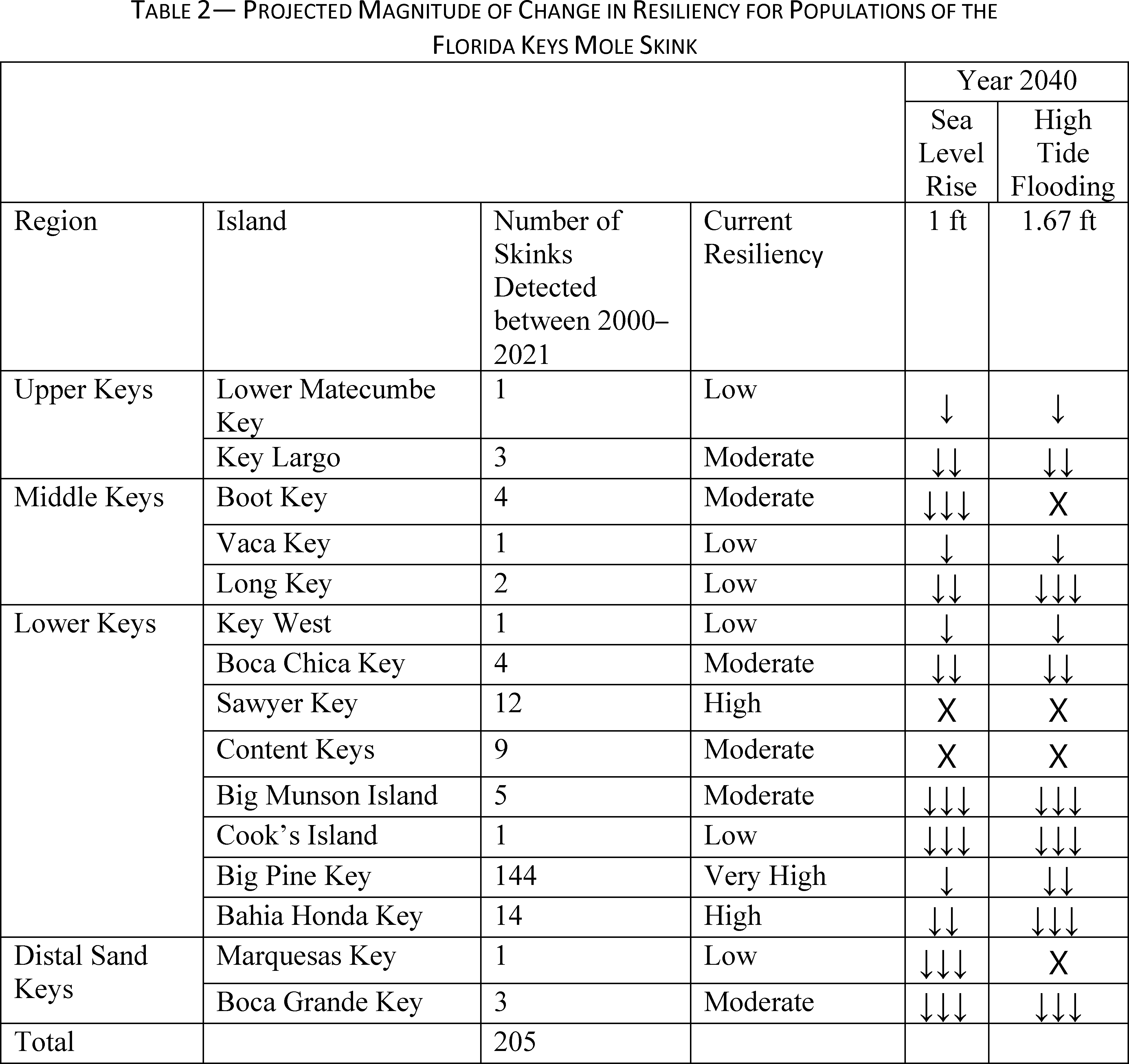
Of the 15 current populations, 2 are in the Upper Keys, 3 are in the Middle Keys, 8 are in the Lower Keys, and 2 are in the Distal Sand Keys (table 2). Based on the parameters outlined above (table 1), one current population is considered to have very high resiliency, and two current populations are considered to have high resiliency. Six current populations are determined to be moderately resilient, and six current populations are considered to have low resiliency (Service 2024, p. 50; table 2). Since 2000, 205 individual Florida Keys mole skinks have been detected across these 15 islands (Service 2024, p. 17). Big Pine Key in the Lower Keys has the majority of the skink detections (144 Florida Keys mole skinks, or 70 percent of all skinks documented since 2000; Service 2024, p. 17).
Habitat Impacts
To date, sea level rise has resulted in the direct loss of habitat, as beaches have become inundated for long periods of time, resulting in erosion and loss of beach habitat. Repeated high tide flooding has resulted in additional loss of habitat as frequently flooded areas become unusable to the Florida Keys mole skink (individuals cannot easily move through wet sand; individuals or nests are washed away). While our SSA predicts the impacts of sea level rise out to 2100 (Service 2024 pp. 56-65, appendix D and E), the majority of impacts are projected to be realized by the species in the near-term (by 2040). Accordingly, given the magnitude and immediacy of the impacts of sea level rise on the Florida Keys mole skink and its habitat, we evaluate current and near-term impacts as part of our current condition assessment.
To understand the near-term impacts (prior to 2040) from sea level rise, we considered our updated evaluation of (Service 2024, appendix E) modeled projections of sea level rise (Sweet et al. 2022, pp. 6-27) and high tide flooding (Sweet et al. 2022, pp. 28-31). We used a suite of scenarios that describe the bounds of a range of plausible near-term and future conditions (intermediate, intermediate-high, and high), which are aligned with emissions-based, conditional probabilistic and global model projections of mean sea level rise (Sweet et al. 2022, p. 27). We used the nearest local scenarios for specific sea level rise height values within the Florida Keys. Near-term and future sea level rise projections account for normal high tides (mean high tide for a given local station) (NOAA 2017, entire; Sweet et al. 2022, entire). In addition to normal high tides, minor, moderate, and major flood events are also projected to increase in the near-term (Sweet et al. 2022, p. xiii). Minor high tide flooding is defined as more disruptive than damaging and currently can be expected about 2 days per year (Sweet et al. 2018, p. 11). Minor high tide flooding is likely to increase to 7 to 15 days per year by 2030, and to 25 to 75 days per year by 2050, (Sweet et al. 2017, p. 37; Sweet et al. 2021, pp. v-vi). To account for flooding events in the near-term, we included minor and moderate high tide flooding threshold values from local gauges in the Florida Keys. Detailed descriptions of sea level rise and high tide flooding data are available in the SSA report (Service 2024, pp. 25-26, 31-32, 56-58; appendices D and E).
Areas that have frequently occurring high tide flooding events to have negative impacts on Florida Keys mole skink habitat. Repeated high tide flooding events are likely to degrade habitat (by moving the wrack line, rendering habitat unsuitable until waters recede) even before sea level is high enough to inundate habitat. Repeated habitat disturbance by high tide flooding reduces the chance for an area to become repopulated by skinks following disturbance.
To assess the amount of Florida Keys mole skink habitat that would be lost or degraded due to sea level rise and high tide flooding by year 2040, we evaluated the total potential habitat for each island with a current population. In the SSA report, we also provide total potential habitat estimates for relatively recent and historical populations (Service 2024, pp. 58-60). Because Florida Keys mole skinks have been documented in habitats away from the beach, we calculated total potential habitat as the entire island area subtracting areas not considered to be suitable habitat for Florida Keys mole skink, including freshwater, water, and impervious cover areas (Monroe County 2016b, entire). For each foot of sea level rise and high tide flooding threshold, we calculated the percent area that would be inundated or degraded for each island with a current, recent, or historical population. We provide detailed descriptions of our methods and results in the SSA report, and we also provide calculations for some islands with data available for preferred habitats (including beach berm, coastal hammock, and preferred soils) (Monroe County 2016b, entire; Service 2024, pp. 62-63; appendices D and E).
Within the near term (by 2040 or sooner), sea level rise and the effects of high tide flooding are projected to be between 1.0 ft and 1.67 ft, respectively (0.3 m and 0.5 m) above the current mean high-water line. Even under the lowest sea level rise scenario (1.0 ft (0.3 m)), 9 of the 15 current populations are projected to lose 50 to 90 percent of habitat, and two populations are projected to be extirpated (table 2). The greatest impacts from sea level rise are projected within the Lower Keys, where more than 70 percent of the current populations are found and where all highly resilient populations currently occur (table 2). When considering the effects of sea level rise by 2040, along with the current and near-term impacts of inundation prior to complete habitat loss from sea level rise, we expect the resiliency for all populations to decline.
Table 2, below, provides a summary of the projected magnitude of change in resiliency for populations of the Florida Keys mole skink for sea level rise and high tide flooding scenarios in the year 2040. In the “Year 2040” column, we use symbols as follows:
↓ means a slight decrease in population resiliency (more than 10 percent but less than or equal to 50 percent);
↓↓ means a moderate decrease in population resiliency (more than 50 percent but less than or equal to 75 percent);
↓↓↓ means a large decrease in population resiliency (more than 75 percent but less than or equal to 90 percent); and
X means extirpated, based on more than 90 percent of the potential habitat being impacted.
( printed page 45693)
Current Redundancy
Redundancy is the ability of a species to withstand catastrophic events. In the Florida Keys, tropical storms and hurricanes are regular and common events. However, catastrophic events may include particularly strong or intense hurricanes or storms and the resulting winds, waves, and storm surges associated with these events. Increased frequency of such storms could further reduce the ability of Florida Keys mole skink populations to recover and could cause catastrophic impact to the species.
For the Florida Keys mole skink to withstand catastrophic events such as hurricanes, it needs to have multiple, sufficiently resilient populations across its range. Of the 15 currently known populations of Florida Keys mole skink, one population is considered to have very high resiliency, two populations are considered to have high resiliency, and all three of these populations are found on islands in the Lower Keys (table 2). Furthermore, 70 percent of all current detections (144 of 205 skink detections since 2000) occur on Big Pine Key where the majority of the detections have been found at low elevation (Service 2024, pp. 67-69). By 2040, with just sea level rise impacts alone (1.0 ft (0.3 m) of sea level rise), one moderate-resiliency population and one high-resiliency population are projected to be extirpated in the Lower Keys. With the added impacts of high tide flooding (1.67 ft (0.5 m) of sea level rise), two more populations are projected to be extirpated, one moderate-resiliency population in the Middle Keys and one low-resiliency population in the Distal Sand Keys (table 2). In addition, when considering the near-term impacts of inundation occurring and reducing the available habitat for the species prior to complete habitat loss, this species is at high risk from impacts prior to 2040.
Because the Florida Keys mole skink is endemic to the Florida Keys, losing even a few populations (or reduced resiliency in even a few populations) would result in a significant reduction in redundancy. With the projected continued loss of habitat by 2040, especially in the Lower Keys where the majority of current populations are located, and where all high resiliency populations are located, redundancy for the species is expected to be severely reduced. Although a severe hurricane is unlikely to inundate all populations at once, if a hurricane were to extirpate
( printed page 45694)
some populations, especially those with lower numbers of skinks, the remaining populations of Florida Keys mole skink would be more vulnerable to other threats. With the continued loss or degradation of Florida Keys mole skink habitat, we expect loss of island populations, thereby further reducing the species' ability to withstand catastrophic events such as hurricanes.
Given the current impacts of sea level rise, high tide flooding, and hurricanes, and given the limited available habitat, the relatively low number of individuals documented, and the potential for repeated catastrophic storm events, the overall redundancy of the Florida Keys mole skink is considered low.
Current Representation
Representation describes the ability of a species to adapt to changing environmental conditions and is measured by the breadth of genetic or environmental diversity within and among populations. Overall, the genetic and environmental diversity of the Florida Keys mole skink is low, with no sign of morphological or behavioral differences between skinks on different islands (Branch et al. 2003, pp. 202-205; Technical Team Working Group 2016, pers. comm.; Mercier 2017, pers. comm.).
The species occurs on several islands across a narrow geographic and ecological range; there is little variation in habitat types across distance or elevation as occurs in wider ranging and more abundant species. The entire species is represented within the same tropical system. The amount of coastal sandy substrate and hammock habitat is limited and distributed in patches throughout the Florida Keys. Furthermore, island to island dispersal is considered rare and likely occurs as a result of stochastic events (storms, hurricanes, flooding) where individuals may be passively carried by floating debris and seaweed wrack to new locations (Adler et al. 1995, pp. 535-537; Branch et al. p. 2003 p. 207; Losos and Ricklefs 2010, p. 360). Within the narrow ecological range in which the Florida Keys mole skink occurs, there are some differences in the substrates and habitat types available, specifically between the Upper Keys and Lower Keys regions, but overall representation of the Florida Keys mole skink is considered to be relatively low.
Future Condition
As part of the SSA, we developed sea level rise and high tide flooding future condition scenarios projected out until the year 2100. Our scenarios included intermediate, intermediate-high, and high scenarios, which are aligned with emissions-based, conditional probabilistic and global model projections of global mean sea level rise (Service 2024, p. 42). Because we determined that the current condition of the Florida Keys mole skink is consistent with an endangered species (see Determination of Florida Keys Mole Skink's Status, below), we are not presenting the detailed results of the future scenarios in this final rule and only present future projection results to 2040 (See
Current Condition
section above). Please refer to the SSA report (Service 2024, pp. 41-50, appendix E) for the full analysis of future scenarios.
Determination of Florida Keys Mole Skink's Status
Section 4 of the Act (16 U.S.C. 1533) and its implementing regulations (50 CFR part 424) set forth the procedures for determining whether a species meets the definition of an endangered species or a threatened species. The Act defines an “endangered species” as a species in danger of extinction throughout all or a significant portion of its range, and a “threatened species” as a species likely to become an endangered species within the foreseeable future throughout all or a significant portion of its range. The Act requires that we determine whether a species meets the definition of endangered species or threatened species because of any of the following factors: (A) The present or threatened destruction, modification, or curtailment of its habitat or range; (B) Overutilization for commercial, recreational, scientific, or educational purposes; (C) Disease or predation; (D) The inadequacy of existing regulatory mechanisms; or (E) Other natural or manmade factors affecting its continued existence.
Status Throughout All of Its Range
After evaluating threats to the species and assessing the cumulative effect of the threats under the Act's section 4(a)(1) factors, we found that impacts from sea level rise, high tide flooding, and storm events present the most substantial threat to the Florida Keys mole skink's viability. Sea level rise and repeated high tide flooding have resulted in the direct loss of habitat. Over the last several decades, hurricanes have had a significant impact on Florida Keys mole skink habitat causing erosion and loss of beach habitat. Given the historical and current impacts from sea level rise, high tide flooding, and storm events, habitat for the Florida Keys mole skink is limited. Threats associated with sea level rise, high tide flooding, and storm events are already being observed in the Florida Keys, and these threats will continue to increase in magnitude. Further, before the effects of complete habitat loss from inundation due to sea level rise are fully realized, higher water levels and flooding will create wetted sand environments, which are unsuitable for the Florida Keys mole skink.
Since 2000, only 205 skinks have been documented on 15 islands; 70 percent of individuals have been documented on Big Pine Key in the Lower Keys. We assessed the current population resiliency of Florida Keys mole skink using a comparative assessment of detections. We assessed that one population has very high resiliency, two populations have high resiliency, six populations have moderate resiliency, and six populations have low resiliency. However, ongoing and near-term impacts from sea level rise were not accounted for in this comparative assessment of population resiliency. Given the magnitude and immediacy (including the ongoing nature) of these threats, we determined the species is more susceptible and at high risk from sea level rise, given the ongoing sea level rise, inundation, and loss of habitat in the near term (prior to 2040). As mentioned previously, the species will experience impacts from inundation, even if temporary, prior to complete habitat loss from sea level rise. In addition, populations in the Lower Keys, specifically Big Pine Key, although assessed to have higher resiliency based on detections since 2000, are at higher risk from inundation and loss of habitat given the low elevation of the islands. Further, more frequent and intense high tide flooding and storm events will accelerate habitat loss, may kill individual skinks, and will reduce overall population resiliency and species redundancy and representation. Acting together, these threats will continue to cause irreversible habitat degradation and loss.
Due to its narrow endemic range, the species has inherently low redundancy (historically and currently). Surveys have documented low numbers of individuals across its range. Despite some redundancy provided by the fact that discrete populations exist on multiple islands, large-scale impacts from catastrophic events (
e.g.,
hurricanes or storm surges) could affect the entire Florida Keys archipelago, leaving the entire species vulnerable to the timing and intensity of impacts. Similarly, this species occurs across a narrow geographic and ecological range; there is little variation in habitat types
( printed page 45695)
across distance or elevation as occurs in wider ranging and more abundant species. Thus, representation for this species is thought to be inherently low.
Because of the Florida Keys mole skink's low redundancy and limited representation, the species is vulnerable to catastrophic storm events. Although a severe hurricane is unlikely to inundate all populations at once, if a hurricane were to extirpate some populations, especially those with lower numbers of skinks, the remaining populations of Florida Keys mole skink would be more vulnerable to other threats. We also considered the effects of development, habitat disturbance, and minor threats including overutilization due to recreational, educational, and scientific use, disease, oil spills, saltwater intrusion, and nonnative species for their cumulative effects. Given that the Florida Keys mole skink is experiencing impacts from these threats currently and its resiliency, redundancy, and representation are projected to continue to decline in the near-term, we find that a threatened species status throughout all of its range is not appropriate. Thus, after assessing the best available information, we conclude that the Florida Keys mole skink is in danger of extinction throughout all of its range.
Status Throughout a Significant Portion of Its Range
Under the Act and our implementing regulations, a species may warrant listing if it is in danger of extinction or likely to become so in the foreseeable future throughout all or a significant portion of its range. We have determined that the Florida Keys mole skink is in danger of extinction throughout all of its range and accordingly did not undertake an analysis of any significant portions of its range. Because the Florida Keys mole skink warrants listing as endangered throughout all of its range, our determination does not conflict with the decision in
Center for Biological Diversity
v.
Everson,
435 F. Supp. 3d 69 (D.D.C. 2020), because that decision related to significant portion of the range analyses for species that warrant listing as threatened, not endangered, throughout all of their range.
Determination of Status
Based on the best scientific and commercial data available, we determine that the Florida Keys mole skink meets the Act's definition of an endangered species. Therefore, we are listing the Florida Keys mole skink as an endangered species in accordance with sections 3(6) and 4(a)(1) of the Act.
Available Conservation Measures
Conservation measures provided to species listed as endangered or threatened species under the Act include recognition as a listed species, planning and implementation of recovery actions, requirements for Federal protection, and prohibitions against certain practices. Recognition through listing results in public awareness, and conservation by Federal, State, Tribal, and local agencies, foreign governments, private organizations, and individuals. The Act encourages cooperation with the States and other countries and calls for recovery actions to be carried out for listed species. The protection required by Federal agencies, including the Service, and the prohibitions against certain activities are discussed, in part, below.
The primary purpose of the Act is the conservation of endangered and threatened species and the ecosystems upon which they depend. The ultimate goal of such conservation efforts is the recovery of these listed species, so that they no longer need the protective measures of the Act. Section 4(f) of the Act calls for the Service to develop and implement recovery plans for the conservation and survival of endangered and threatened species unless we determine that such a plan will not promote the conservation of the species. Under section 4(f)(1)(B)(ii), recovery plans must, to the maximum extent practicable, include objective, measurable criteria which, when met, would result in a determination, in accordance with the provisions of section 4 of the Act, that the species be removed from the Lists of Endangered and Threatened Wildlife and Plants.
Recovery plans provide a roadmap for us and our partners on methods of enhancing conservation and minimizing threats to listed species, as well as measurable criteria against which to evaluate progress towards recovery and assess the species' likely future condition. However, they are not regulatory documents and do not substitute for the determinations and promulgation of regulations required under section 4(a)(1) of the Act. A decision to revise the status of a species, or to delist a species, is ultimately based on an analysis of the best scientific and commercial data available to determine whether a species is no longer an endangered species or a threatened species, regardless of whether that information differs from the recovery plan.
The recovery planning process begins with development of a recovery outline made available to the public soon after a final listing determination. The recovery outline guides the immediate implementation of urgent recovery actions while a recovery plan is being developed. Recovery teams (composed of species and other experts, including those from Federal and State agencies, Tribes, the academic community, or nongovernmental organizations) may be established to develop or implement recovery plans. The recovery outline, draft recovery plan, final recovery plan, and any revisions will be available on our website as they are completed (
www.fws.gov/program/endangered-species) or from our Florida Ecological Services Field Office (see
FOR FURTHER INFORMATION CONTACT
).
Implementation of recovery actions generally requires the participation of a broad range of partners, including other Federal agencies, States, Tribes, nongovernmental organizations, businesses, and private landowners. Examples of recovery actions include habitat restoration (
e.g.,
restoration of native vegetation), research, captive propagation and reintroduction, and outreach and education. The recovery of many listed species cannot be accomplished solely on Federal lands because their range may occur primarily or solely on non-Federal lands. Recovery of these species requires cooperative conservation efforts on private, State, and Tribal lands.
Once this species is listed, funding for recovery actions may be available from a variety of sources, including Federal budgets, State programs, and cost-share grants for non-Federal landowners, the academic community, and nongovernmental organizations. In addition, pursuant to section 6 of the Act, the State of Florida will be eligible for Federal funds to implement management actions that promote the protection or recovery of the Florida Keys mole skink. Information on our grant programs that are available to aid species recovery can be found at:
www.fws.gov/service/financial-assistance.
Please let us know if you are interested in participating in recovery efforts for the Florida Keys mole skink. Additionally, we invite you to submit any new information on this species whenever it becomes available and any information you may have for recovery planning purposes (see
FOR FURTHER INFORMATION CONTACT
).
Section 7 of the Act is titled, “Interagency Cooperation,” and it mandates all Federal action agencies to use their existing authorities to further the conservation purposes of the Act and to ensure that their actions are not likely to jeopardize the continued
( printed page 45696)
existence of listed species or adversely modify critical habitat. Regulations implementing section 7 are codified at 50 CFR part 402.
Section 7(a)(2) states that each Federal action agency shall, in consultation with the Secretary, ensure that any action they authorize, fund, or carry out is not likely to jeopardize the continued existence of a listed species or result in the destruction or adverse modification of designated critical habitat. Each Federal agency shall review its action at the earliest possible time to determine whether it may affect listed species or critical habitat. If a determination is made that the action may affect listed species or critical habitat, formal consultation is required (50 CFR 402.14(a)), unless the Service concurs in writing that the action is not likely to adversely affect listed species or critical habitat. At the end of a formal consultation, the Service issues a biological opinion, containing its determination of whether the Federal action is likely to result in jeopardy or adverse modification.
Examples of discretionary actions for the Florida Keys mole skink that may be subject to consultation procedures under section 7 are management of Federal lands administered by the Service and the National Park Service, as well as actions that require a Federal permit (such as a permit from the U.S. Army Corps of Engineers under section 404 of the Clean Water Act (33 U.S.C. 1251et seq.)) or actions funded by Federal agencies such as the Federal Highway Administration, Federal Aviation Administration, or the Federal Emergency Management Agency. Federal actions not affecting listed species or critical habitat—and actions on State, Tribal, local, or private lands that are not federally funded, authorized, or carried out by a Federal agency—do not require section 7 consultation. Federal agencies should coordinate with the local Service Field Office (see
FOR FURTHER INFORMATION CONTACT
) with any specific questions on section 7 consultation and conference requirements.
The Act and its implementing regulations set forth a series of prohibitions and exceptions that apply to endangered wildlife. The prohibitions of section 9(a)(1) of the Act, and the Service's implementing regulations codified at 50 CFR 17.21, make it illegal for any person subject to the jurisdiction of the United States to commit, to attempt to commit, to solicit another to commit or to cause to be committed any of the following acts with regard to any endangered wildlife: (1) import into, or export from, the United States; (2) take (which includes harass, harm, pursue, hunt, shoot, wound, kill, trap, capture, or collect) within the United States, within the territorial sea of the United States, or on the high seas; (3) possess, sell, deliver, carry, transport, or ship, by any means whatsoever, any such wildlife that has been taken illegally; (4) deliver, receive, carry, transport, or ship in interstate or foreign commerce, by any means whatsoever and in the course of commercial activity; or (5) sell or offer for sale in interstate or foreign commerce. Certain exceptions to these prohibitions apply to employees or agents of the Service, the National Marine Fisheries Service, other Federal land management agencies, and State conservation agencies.
We may issue permits to carry out otherwise prohibited activities involving endangered wildlife under certain circumstances. Regulations governing permits for endangered wildlife are codified at 50 CFR 17.22, and general Service permitting regulations are codified at 50 CFR part 13. With regard to endangered wildlife, a permit may be issued: for scientific purposes, for enhancing the propagation or survival of the species, or for take incidental to otherwise lawful activities. The statute also contains certain exemptions from the prohibitions, which are found in sections 9 and 10 of the Act.
It is the policy of the Services, as published in the
Federal Register
on July 1, 1994 (59 FR 34272), to identify, to the extent known at the time a species is listed, specific activities that will not be considered likely to result in violation of section 9 of the Act. To the extent possible, activities that will be considered likely to result in violation will also be identified in as specific a manner as possible. The intent of this policy is to increase public awareness of the effect of a listing on proposed and ongoing activities within the range of the species.
At this time, we are unable to identify specific activities that will not be considered likely to result in a violation of section 9 of the Act beyond what is already clear from the descriptions of prohibitions or already excepted through our regulations at 50 CFR 17.21 (
e.g.,
any person may take endangered wildlife in defense of his own life or the lives of others). Also, as discussed above, certain activities that are prohibited under section 9 may be permitted under section 10 of the Act.
At this time, we are unable to identify specific activities that will be considered likely to result in a violation of section 9 of the Act beyond what is already clear from the descriptions of the prohibitions at 50 CFR 17.21. Questions regarding whether specific activities would constitute a violation of section 9 of the Act should be directed to the Florida Ecological Services Field Office (see
FOR FURTHER INFORMATION CONTACT
).
Required Determinations
Government-to-Government Relationship With Tribes
In accordance with the President's memorandum of April 29, 1994 (Government-to-Government Relations with Native American Tribal Governments; 59 FR 22951, May 4, 1994), Executive Order 13175 (Consultation and Coordination with Indian Tribal Governments), the President's memorandum of November 30, 2022 (Uniform Standards for Tribal Consultation; 87 FR 74479, December 5, 2022), and the Department of the Interior's manual at 512 DM 2, we readily acknowledge our responsibility to communicate meaningfully with federally recognized Tribes and Alaska Native Corporations (ANCs) on a government-to-government basis. In accordance with Secretaries' Order 3206 of June 5, 1997 (American Indian Tribal Rights, Federal-Tribal Trust Responsibilities, and the Endangered Species Act), we readily acknowledge our responsibilities to work directly with Tribes in developing programs for healthy ecosystems, to acknowledge that Tribal lands are not subject to the same controls as Federal public lands, to remain sensitive to Indian culture, and to make information available to Tribes. No Tribal lands overlap with the range of the Florida Keys mole skink.
References Cited
A complete list of references cited in this rulemaking is available on the internet at
www.regulations.gov
and upon request from the Florida Ecological Services Field Office (see
FOR FURTHER INFORMATION CONTACT
).
Authors
The primary authors of this rule are the staff members of the Fish and Wildlife Service's Species Assessment Team and the Florida Ecological Services Field Office.
Accordingly, we amend part 17, subchapter B of chapter I, title 50 of the
( printed page 45697)
Code of Federal Regulations, as set forth below:
PART 17—ENDANGERED AND THREATENED WILDLIFE AND PLANTS
1. The authority citation for part 17 continues to read as follows:
Authority:16 U.S.C. 1361-1407; 1531-1544; and 4201-4245, unless otherwise noted.
2. Amend § 17.11 in paragraph (h) by adding an entry for “Skink, Florida Keys mole” to the List of Endangered and Threatened Wildlife in alphabetical order under REPTILES to read as follows:
Use this for formal legal and research references to the published document.
91 FR 45683
Web Citation
Suggested Web Citation
Use this when citing the archival web version of the document.
“Endangered and Threatened Wildlife and Plants; Endangered Species Status for Florida Keys Mole Skink,” thefederalregister.org (July 21, 2026), https://thefederalregister.org/documents/2026-14636/endangered-and-threatened-wildlife-and-plants-endangered-species-status-for-florida-keys-mole-skink.
 www.regulations.gov
 16 U.S.C. 1531
 www.fws.gov/sites/default/files/documents/peer-review-policy-directors-memo-2016-08-22.pdf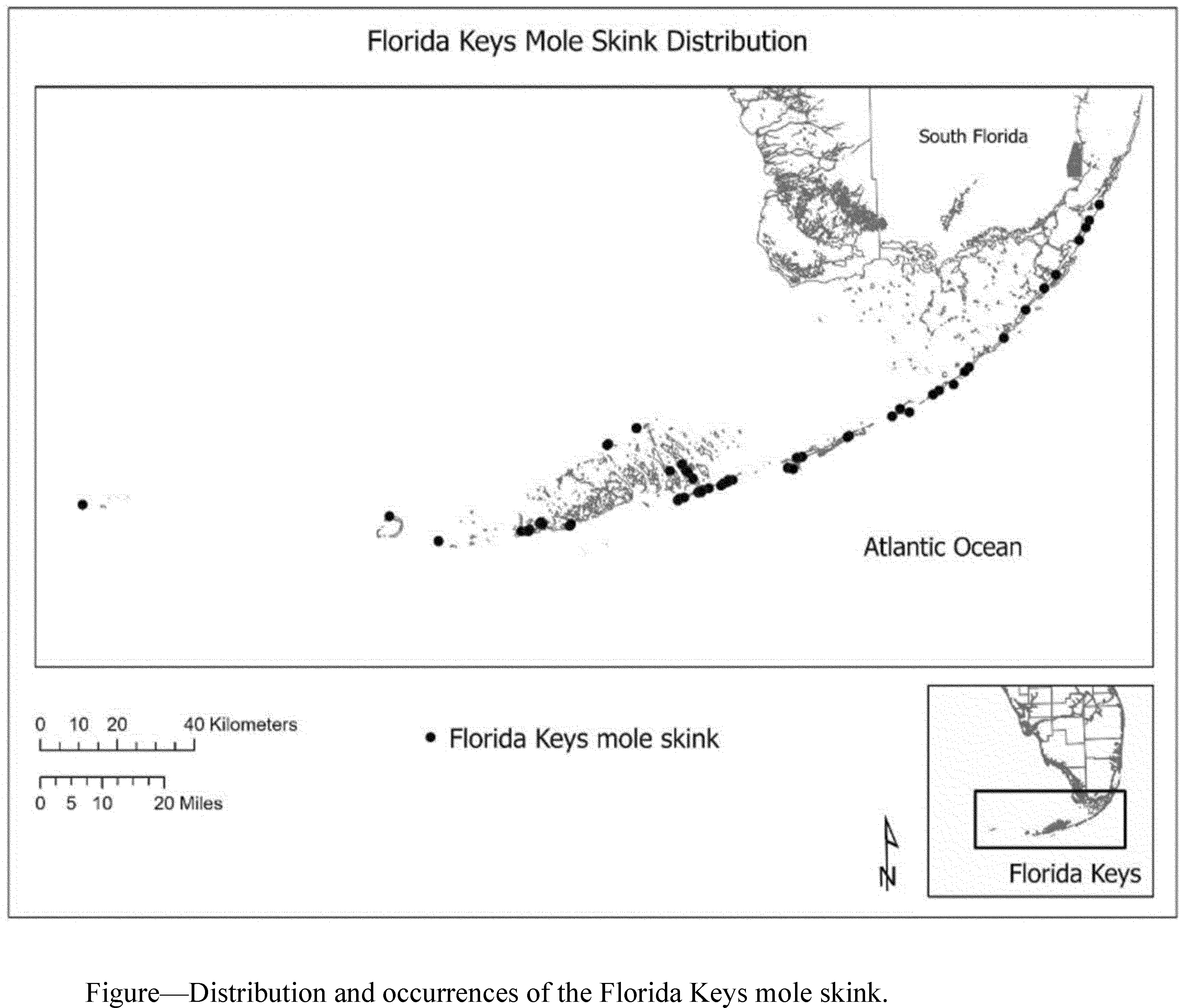
 title 50 of the Code of Federal Regulations
 www.doi.gov/sites/doi.opengov.ibmcloud.com/files/uploads/M-37021.pdf