Takes of Marine Mammals Incidental to Specified Activities; Taking Marine Mammals Incidental to U.S. Navy Operations of Surveillance Towed Array Sensor System Low Frequency Active Sonar in the Western and Central North Pacific Ocean and Eastern Indian Ocean
NMFS, upon request from the U.S. Department of the Navy (Navy), issues these regulations pursuant to the Marine Mammal Protection Act (MMPA) to govern the taking of marine mamma...
National Marine Fisheries Service (NMFS), National Oceanic and Atmospheric Administration (NOAA), Commerce.
ACTION:
Final rule; notification of issuance of Letter of Authorization.
SUMMARY:
NMFS, upon request from the U.S. Department of the Navy (Navy), issues these regulations pursuant to the Marine Mammal Protection Act (MMPA) to govern the taking of marine mammals incidental to training and testing activities using Surveillance Towed Array Sensor System (SURTASS) Low Frequency Active (LFA) sonar systems in the western and central North Pacific and eastern Indian oceans over the course of 7 years from August 2026 through August 2033. These regulations allow for the issuance of a letter of authorization (LOA) for the incidental take of marine mammals during specified activities and timeframes, prescribe the permissible methods of taking and other means of effecting the least practicable adverse impact on marine mammal species and their habitat, and establish requirements pertaining to the monitoring and reporting of such taking. The Navy's activities are considered military readiness activities pursuant to the MMPA, as amended by the National Defense Authorization Act for Fiscal Year 2004 (2004 NDAA) and the NDAA for Fiscal Year 2019 (2019 NDAA).
DATES:
Effective from August 12, 2026, through August 11, 2033.
Alyssa Clevenstine, Office of Protected Resources, NMFS, (301) 427-8401.
SUPPLEMENTARY INFORMATION:
Purpose and Need for Regulatory Action
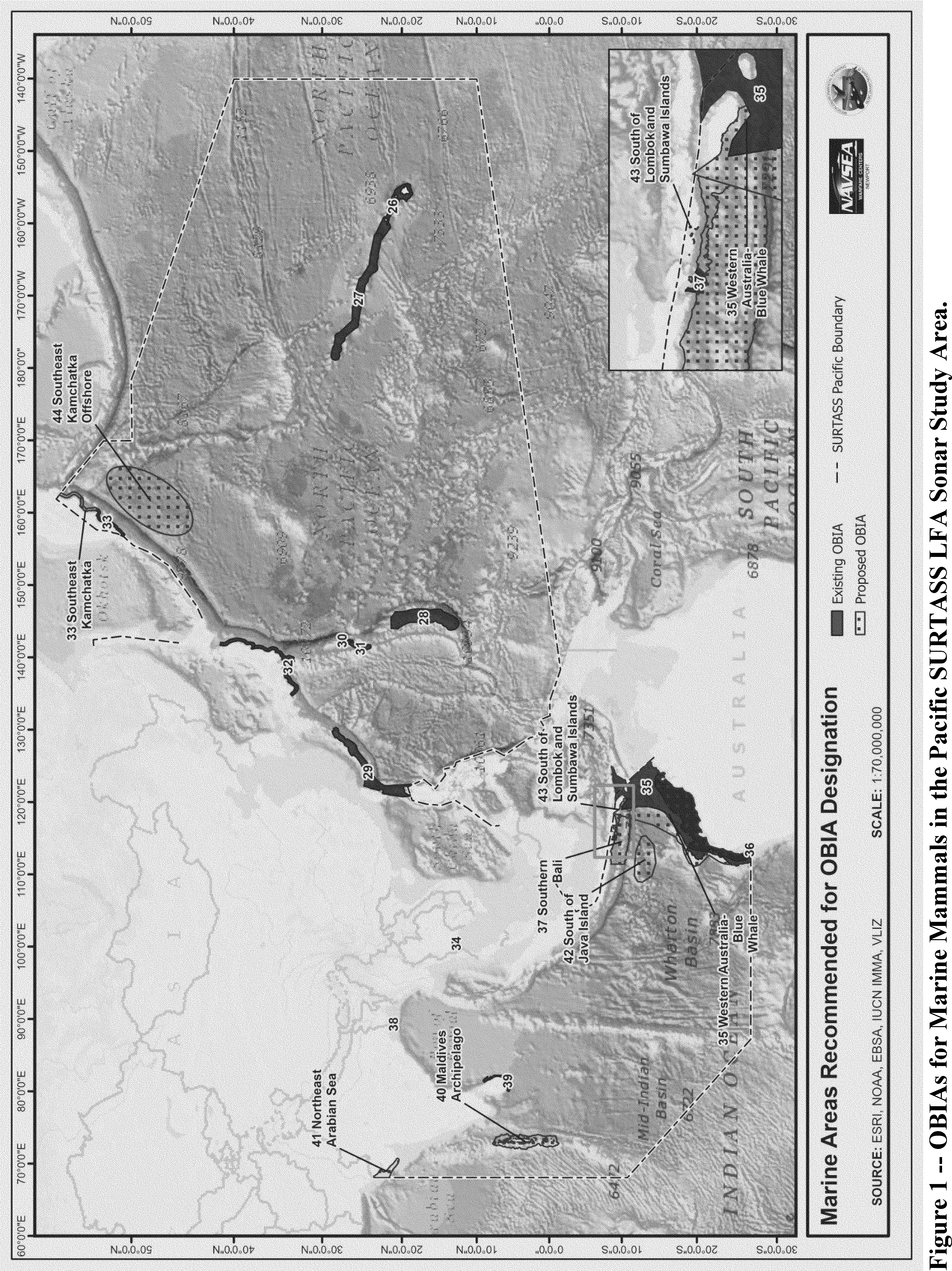
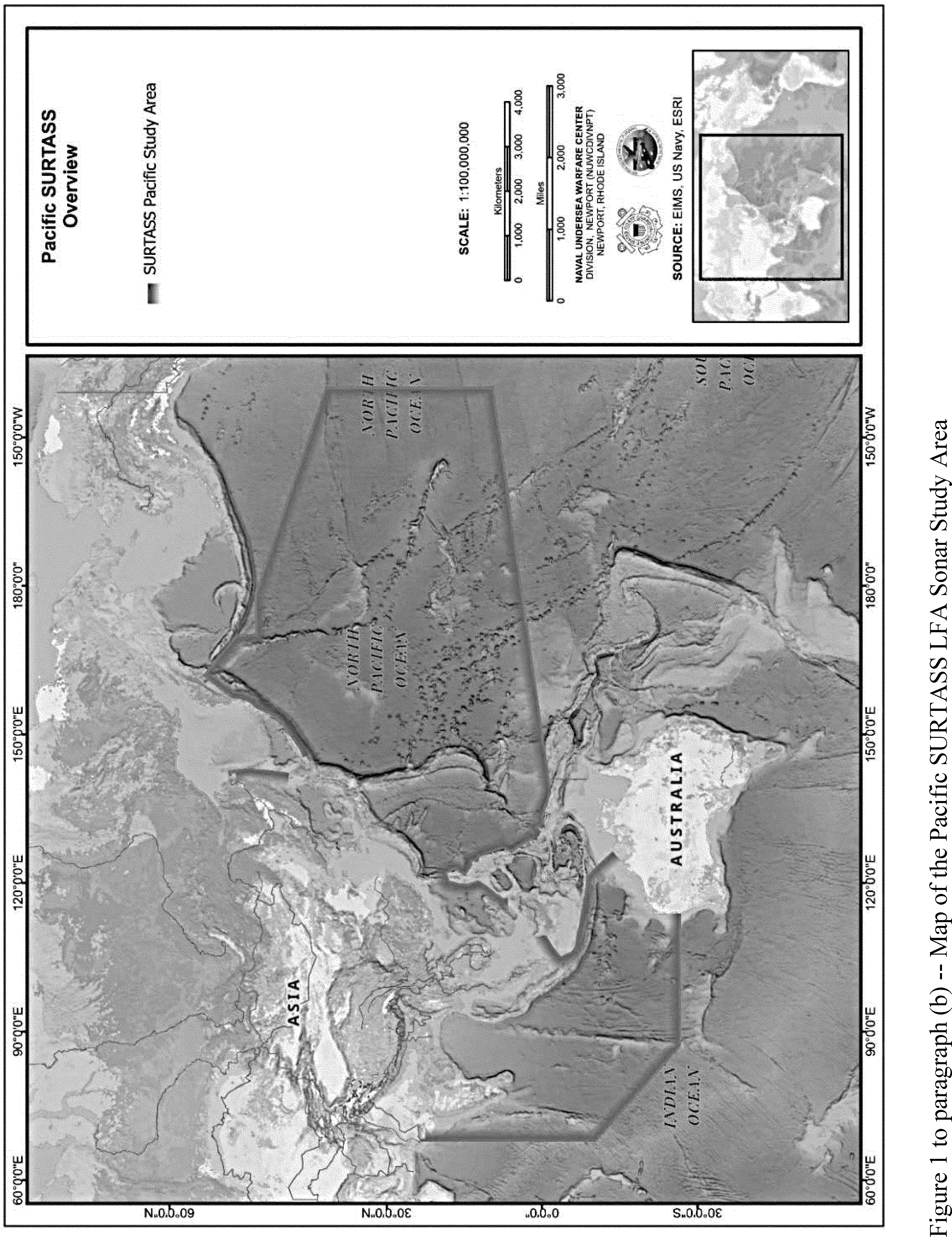
These regulations, issued under the authority of the MMPA (16 U.S.C. 1361et seq.), allow for the authorization of take of marine mammals incidental to the Navy's training and testing activities (which qualify as military readiness activities) using SURTASS LFA sonar in the western and central North Pacific Ocean and eastern Indian Ocean (see figure 2-1 of this notice and LOA application (hereafter referred to as the application)). Please see the Legal Authority for the Final Action section for relevant definitions.
Legal Authority for the Final Action
The MMPA prohibits the “take” of marine mammals, with certain exceptions. Section 101(a)(5)(A) of the MMPA (16 U.S.C. 1361et seq.) directs the Secretary of Commerce (as delegated to NMFS) to allow, upon request, the incidental, but not intentional, taking of small numbers of marine mammals by U.S. citizens who engage in a specified activity (other than commercial fishing) within a specified geographical region if certain findings are made and either regulations are proposed or, if the taking is limited to harassment, a notice of a proposed authorization is provided to the public for review and the opportunity to submit comment.
Authorization for incidental takings shall be granted if NMFS finds that the taking will have a negligible impact on the species or stock(s) and will not have an unmitigable adverse impact on the availability of the species or stock(s) for taking for subsistence uses (where relevant). Further, NMFS must prescribe the permissible methods of taking; other “means of effecting the least practicable adverse impact” on the affected species or stocks and their habitat, paying particular attention to rookeries, mating grounds, and areas of similar significance, and on the availability of the species or stocks for taking for certain subsistence uses (collectively referred to as “mitigation”); and requirements pertaining to the monitoring and reporting of the takings. The MMPA defines “take” to mean to harass, hunt, capture, or kill, or attempt to harass, hunt, capture, or kill any marine mammal (16 U.S.C. 1362). The Analysis and Negligible Impact Determination section discusses the definition of “negligible impact.”
The 2004 NDAA (Pub. L. 108-136) amended section 101(a)(5) of the MMPA to remove the “small numbers” and “specified geographical region” provisions (16 U.S.C. 1371(a)(5)(F)), and amended the definition of “harassment” in section 3(18)(B) of the MMPA as applied to a “military readiness activity” to read as follows: “(i) any act that injures or has the significant potential to injure a marine mammal or marine mammal stock in the wild [Level A Harassment]; or (ii) any act that disturbs or is likely to disturb a marine mammal or marine mammal stock in the wild by causing disruption of natural behavioral patterns, including, but not limited to, migration, surfacing, nursing, breeding, feeding, or sheltering, to a point where such behavioral patterns are abandoned or significantly altered [Level B Harassment]” (16 U.S.C. 1362(18)(B)). The 2004 NDAA also amended the MMPA to establish in section 101(a)(5)(A)(iii) that “[f]or a military readiness activity . . . , a determination of `least practicable adverse impact' . . . shall include consideration of personnel safety, practicality of implementation, and impact on the effectiveness of the military readiness activity” (16 U.S.C. 1371(a)(5)(A)(iii)). On August 13, 2018, the 2019 NDAA (Pub. L. 115-232) amended the MMPA to allow incidental take regulations (ITRs) for military readiness activities to be issued for up to 7 years (16 U.S.C. 1371(a)(5)(A)(ii)).
Summary of Major Provisions Within the Final Rule
The major provisions of this final rule are:
Take of marine mammals by Level A harassment and Level B harassment;
Use of visual, passive acoustic, and active acoustic monitoring mitigation;
Implementation of geographic activity limitations including within 22 kilometers (km) (12 nautical miles (nmi)) of any emergent land and in certain offshore areas and times that are biologically important (i.e.,
for foraging, migration, reproduction) for marine mammals;
Implementation of a Notification and Reporting Plan (for dead, live stranded, or marine mammals struck by any vessel engaged in military readiness activities); and
Implementation of a robust monitoring plan to improve our understanding of the environmental effects resulting from the Navy's training and testing activities.
This rule includes an adaptive management component (
i.e.,
the authority to modify the LOA's mitigation, monitoring, and reporting
( printed page 47665)
measures, consistent with the regulations).
Summary of Request
On April 6, 2025, NMFS received an application from the Navy requesting authorization to take marine mammals, by Level A and Level B harassment, incidental to training and testing activities (characterized as military readiness activities) using SURTASS LFA sonar in the western and central North Pacific Ocean and eastern Indian Ocean. The Navy requested one 7-year LOA for training and testing activities. In response to our comments and following an information exchange, the Navy submitted a revised application, deemed adequate and complete on July 1, 2025. On July 11, 2025, NMFS published a notice of receipt (NOR) of application in the
Federal Register
(90 FR 30877), requesting comments and information related to the Navy's request. During the 30-day public comment period, NMFS received one public comment from Turtle Island Restoration Network requesting that NMFS deny the Navy's ITA request and consider alternatives that prioritize avoiding critical habitats, reducing sonar intensity, or limiting operational time frames. On March 10, 2026, NMFS published a proposed rule (91 FR 11618) (hereafter proposed rule) and requested comments and information related to the Navy's request for 30 days. All relevant comments received during the NOR and the proposed rulemaking comment periods were considered in this final rule. Comments received on the proposed rule are addressed in this final rule in the Comments and Responses section.
NMFS previously promulgated ITRs pursuant to the MMPA relating to similar military readiness activities using SURTASS LFA sonar. NMFS published the first rule effective August 15, 2002, through August 15, 2007 (67 FR 46712, July 16, 2002); the second rule effective from August 16, 2007, through August 15, 2012 (72 FR 46846, August 21, 2007); the third rule effective from August 15, 2012, through August 15, 2017 (77 FR 50290, August 20, 2012); and the fourth rule effective from August 12, 2019, through August 11, 2026 (84 FR 40132, August 13, 2019). For the period August 16, 2017, through August 11, 2019, all military readiness activities that use SURTASS LFA sonar were exempted from compliance with the requirements of the MMPA under a National Defense Exemption invoked by the Secretary of War [1]
under MMPA section 101(a)(5)(f). For this rulemaking, the Navy plans to conduct substantially similar training and testing activities using SURTASS LFA sonar that were conducted under previous rules.
The Navy's application reflects the most up-to-date compilation of training and testing activities deemed necessary to accomplish military readiness requirements. The types and numbers of activities included in this rule account for interannual variability in training and testing to meet evolving or emergent military readiness requirements. In this rule, we have undertaken a comprehensive assessment of the impacts of all SURTASS LFA sonar training and testing activities on marine mammals likely to be present within the entire range of the Study Area.
Description of Specified Activity
The Navy requested authorization to take marine mammals incidental to conducting military readiness activities. The Navy has determined that acoustic stressors are likely to result in take of marine mammals in the form of Level A and Level B harassment. Descriptions of these activities are provided in the Navy's application (
www.fisheries.noaa.gov/action/incidental-take-authorization-united-states-navys-surveillance-towed-array-sensor-system-low), with additional detail provided in chapter 2 and appendix F of the 2026 SURTASS Supplemental Environmental Impact Statement/Overseas Environmental Impact Statement (2026 SURTASS SEIS/OEIS) (
www.nepa.navy.mil/surtass-lfa/).
The SURTASS LFA sonar transmission hours, which are classified as military readiness activities pursuant to the section 315(f) of Public Law 101-314 (16 U.S.C. 703), represent a distribution across three activities that include:
Training (i.e.,
contractor crew proficiency training, military crew proficiency training, active training);
Maintenance and upgrade (i.e.,
equipment maintenance checks and performance evaluations, LFA/CLFA maintenance/performance testing, and other maintenance/testing); and
Exercises (e.g.,
Valiant Shield, Rim of the Pacific (RIMPAC)).
A detailed description of the specified activities was provided in the proposed rule. NMFS hereby refers to the information and analysis provided in the proposed rule which continue to apply to this final rule. Since that time, no changes have been made to the planned activities. Therefore, a detailed description is not provided here. Please refer to the proposed rule for the complete description of the specified activities.
Comments and Responses
We published a proposed rule in the
Federal Register
on March 10, 2026 (91 FR 11618), with a 30-day comment period. In that proposed rule, we requested public input on our analyses, our preliminary findings, and the proposed regulations, and requested that interested persons submit relevant information and comments. During the 30-day comment period, we received seven comments. Of this total, one submission was from Lincoln Land Community Partners, and the remaining comments were from private citizens. NMFS has reviewed and considered all relevant public comments received on the proposed rule and issuance of the LOA. All substantive, relevant comments and our responses are described below.
Comment 1:
Lincoln Land Community Partners object to the rule under three general categories: (1) absence of lawful authority; (2) risks of harm to marine life; and (3) moral and ethical implications. As to the first category, the commenter asserts that: (1) the rule violates Article I Section 8 of the Constitution, which grants Congress to make Rules for the Government and Regulation of the land and naval Forces, because the rule impermissibly delegates that authority to the Navy to regulate itself, or to a “secondary agency” (
i.e.,
NMFS) to authorize exceptions to the “laws of nations”; (2) the rule violates Article I Section 8, which grants Congress the power to “define and punish [. . .] Offences against the Law of Nations” because SURTASS LFA sonar activity inflicts auditory trauma and permanent injury on marine life, a violation of the “laws of nations” and moral standards Congress is sworn to uphold; (3) Navy and NMFS are attempting to bypass the “Two-Year Appropriation limit” on raising and supporting Armies and the duty to provide and maintain a Navy, which requires active governance and frequent and direct congressional oversight of the Navy, through a 7-year authorization for SURTASS LFA sonar activities; (4) the rule hides behind a department or agency, removing executive accountability of the President as the Commander in Chief and insulating the President from the moral and legal consequences of a direct command that harms marine life; and (5) the Navy is instigating the very
( printed page 47666)
conflicts it seeks to prevent by conducting testing and readiness activities in the backyards of other nations, and absent consent of the people to use power to harm wildlife, Navy should instead protect people, land, waters, and wildlife by demonstrating equality, respect, and courtesy.
Regarding risk of harm to marine life category, the commenter expresses concern over: (1) the “massive” geographic scope of the rule in the western and central North Pacific Ocean and eastern Indian Ocean, with mobile sources moving through migratory corridors and feeding grounds; (2) the potential for physical and auditory damage (Level A harassment) to affect animals that rely on echolocation and cause physical trauma to ears; (3) the potential for Level B harassment that can lead to separation of mothers and calves, cessation of feeding, and strandings; (4) the vast distances that LFA sonar can travel, reducing the “quiet world these animals need to survive”; (5) the 7-year duration of the activity, representing a sustained increase in “acoustic stress” for marine populations on top of climate change, vessel strikes, and plastic pollution; (6) the adaptive management component as being reactive rather than proactive; and (7) the impacts on endangered and threatened species.
In the third category, the commenter asserts there are moral and ethical implications to the Navy's and NMFS' actions, stating that: (1) governments have a heightened duty of stewardship to animals that cannot consent to be governed; (2) the Navy is affecting the “livelihoods and the liberty of citizens” by bypassing their vote through a closed bureaucratic loop that overlooks the impact on national waters and all living things; (3) the LFA sonar testing and training is an escalation rather than true military readiness, which prevents and diffuses tension; and (4) the negligible impact standard ignores the unintended unforeseen consequences of disrupting marine consciousness.
Response:
The comment from Lincoln Land Community Partners raises a number of constitutional and legal assertions but does not provide supporting authority and, in several respects, reflects a misunderstanding of the provisions cited. We disagree with the commenter's basic points as follows. We do not agree that our rule is an improper delegation of Congress's authority. Through the MMPA, Congress prohibited the take of marine mammals by any person, vessel, or other conveyance subject to the jurisdiction of the United States, including by government entities such as the Navy, except under certain enumerated circumstances. Under section 101(a)(5)(A), Congress has delegated to NMFS (through the Secretary of Commerce) authority to allow the take of marine mammals incidental to a specified activity, provided that we make certain findings and issue regulations after notice and comment. Importantly, the statute lays out several intelligible principles that guide and limit our exercise of discretion (see
FCC
v.
Consumers' Research,
606 U.S. 656, 673-675 (2025) (discussing intelligible principle standard for delegation)). This includes the requirement that we find the total taking for the period in question will have a negligible impact on the affected species or stocks of marine mammals, and that we must prescribe measures to effect the least practicable adverse impact on the species or stocks and their habitats as well as monitoring and reporting requirements. Likewise, Congress through the MMPA exercised its judgment as to the appropriate balance between the conduct of human activities, including military readiness activities, in waters under the jurisdiction of the United States and the impact of those activities on marine mammals. Further, we do not agree that the Law of Nations or international law (see
Jesner
v.
Arab Bank, PLC,
584 U.S. 241 (2018) (discussing Law of Nations as international law)) is implicated by our administration of the MMPA. We disagree that the 7-year incidental take rule undermines Congress's appropriations cycles for funding or oversight of the Navy or removes any accountability by the Commander in Chief; in fact, the rule demonstrates the Navy's compliance with applicable law. Finally, we decline to address the comment regarding the wisdom of the Navy's military readiness training and testing because it is outside the scope of NMFS' statutory purview.
Regarding adaptive management, this final rule includes the potential for proactive modifications, as appropriate. Regarding the stated objection to the rulemaking based on risk of harm to marine life, as stated in the Legal Authority for the Final Action section, authorization for incidental takings shall be granted if NMFS finds that the taking will have a negligible impact on the species or stock(s) and will not have an unmitigable adverse impact on the availability of the species or stock(s) for taking for subsistence uses (where relevant). NMFS has made the required findings, and therefore, has appropriately authorized take, by Level A and Level B harassment, incidental to the Navy's SURTASS LFA sonar activities.
As stated by the commenter, the Navy's SURTASS LFA sonar activities will occur over a broad geographic region, including in or near areas that are known to be important for marine mammals; however, the activity includes a limited maximum annual number of hours of sonar spread across four vessels and a large geographic area, and the training and testing occurs far from shore (>22 km) and outside of known areas of concentration of LFA sonar-sensitive species (OBIAs). Over the last 25 years, there has been no scientific evidence that SURTASS LFA sonar has led to chronic stress or population-level impacts to any species of marine mammals. The concentration of sound in the same location would be limited, and the effects to specific regional populations would be temporary and transitory. NMFS fully analyzed and considered the potential effects from the Navy's specified activities and has applied a reasoned and comprehensive approach to evaluating the effects of these activities on marine mammal species and their habitat. This analysis is detailed in the Preliminary Analysis and Negligible Impact Determination section of the proposed rule and in the Analysis and Negligible Impact Determination section herein. The commenter offers no recommendations for NMFS to consider and no information that would help inform NMFS' analysis of the Navy's activities and our determination.
Finally, NMFS acknowledges the commenter's broad moral and ethical concerns. However, the MMPA and other applicable laws reflect policy judgments made through the legislative process regarding conservation and protection of marine mammals and direct NMFS to evaluate specific statutory factors, which do not include independent consideration of generalized moral or ethical principles. Beyond that, the Navy's actions are outside the scope of NMFS' purview.
Comment 2:
A commenter recommended that NMFS take into consideration the following four impacts to marine mammals: (1) behavioral disruption; (2) physiological stress and distress on growing mammals; (3) informational and auditory masking; and (4) risk of death and stranding.
Response:
NMFS concurs with the commenter's recommendation and took all of the impacts raised by the commenter into consideration in promulgation of its proposed rule and this final rule, as seemingly referenced
( printed page 47667)
in the comment. The Potential Effects of Specified Activities on Marine Mammals and Their Habitat section of the proposed rule described, in detail, potential behavioral disruption, physiological stress and distress (including on young, growing animals), informational and auditory masking, as well as stranding and mortality.
Comment 3:
A commenter recommended that NMFS require the Navy to shut down activity upon a confirmed marine mammal detection within 2,000 yards (yd) (1.8 km) of the source. The commenter states that resumption should occur only after 15 minutes without visual or acoustic detections and after Passive Acoustic Monitoring (PAM) metrics indicate detections are below the operational threshold and recommends that NMFS include criteria in the regulatory text.
The commenter stated NMFS should require all protected species observers (PSOs) and PAM operators to be independent, third-party personnel and that PAM data should be accessible to NMFS in near-real-time. The commenter stated that PAM should operate continuously during transmissions, with minimum specifications identified explicitly in a monitoring plan.
Response:
The proposed rule and this final rule include a mitigation and monitoring requirement consistent with that recommended in the comment, including in the regulatory text. The rule requires the Navy to begin PAM 30 minutes before the SURTASS LFA sonar begins to transmit and continue until 15 minutes after SURTASS LFA sonar transmissions cease. The rule further requires that if a marine mammal is detected during visual or acoustic monitoring, within or about to enter within 1.8 km of the SURTASS LFA source (
i.e.,
the LFA mitigation zone), the Navy must immediately delay or suspend SURTASS LFA sonar transmissions. The Navy must not recommence SURTASS LFA sonar transmissions until 15 minutes after all marine mammals have left the area of the LFA sonar mitigation zone and there is no further detection of any marine mammal within the 1.8 km LFA sonar mitigation zone as determined by the visual, passive acoustic, and active acoustic high frequency monitoring.
Regarding PSOs and PAM operators, the availability and deployment feasibility of independent, third-party personnel is often limited by factors such as cost, logistics, safety, security, and operational constraints. As such, this rule requires the use of trained Lookouts to conduct visual monitoring for marine mammals. A marine mammal biologist qualified in conducting at-sea visual monitoring of marine mammals from surface vessels will train and qualify designated personnel aboard the Auxiliary General Ocean Surveillance (T-AGOS) vessels to conduct at-sea visual monitoring for marine mammals and sea turtles. Training of the civilian ship personnel will include effective and swift communication within the observer's command structure to facilitate quick execution of protective measures if marine mammals or other marine species are observed at the sea surface. In addition, the Navy routinely conducts training of the military crews stationed aboard T-AGOS vessels to augment their sonar detection capabilities. Further, senior marine acousticians and a senior marine biologist conduct passive acoustic training of the military crews to increase their ability as sonar operators to distinguish biological sounds from those of mission-directed sounds.
Regarding the recommendation that PAM data be accessible to NMFS in near-real-time, security and practicability concerns prevent such accessibility. There are two sources of PAM data collected by the Navy. One source is from detections from seafloor-mounted Navy hydrophones at key locations in the Atlantic and Pacific oceans and the other is PAM data collected by T-AGOS vessels. The Annual Pacific SURTASS LFA Study Area Marine Species Monitoring Report provides detections and other analysis from both ship-based SURTASS LFA sonar and seafloor-mounted sensors. Given the sensitive nature of the material, it is controlled unclassified information and may be reviewed by only Navy and NMFS. The classified Annual Pacific SURTASS LFA Training and Testing Report contains the quantity of usage from only ship-based SURTASS LFA sonar. These data are highly classified because public release would compromise national security by revealing sensor and other operational capabilities. Further, while the commenter asserts that providing NMFS with near-real-time access to PAM data would strengthen adaptive management, the commenter did not recommend how NMFS would apply such data. The real-time PAM data allows Navy personnel to respond promptly to potential marine mammal presence and implement mitigation measures when necessary. Finally, regarding the recommendation that minimum PAM operating specifications be identified explicitly in a monitoring plan, additional details on system performance and calibration are classified.
Comment 4:
A commenter stated PAM performance should be defined in measurable terms, including detection probability by range and species, false-positive/false-negative rates, and minimum signal-to-noise ratio thresholds, and that routine calibration tests and quality assurance/quality control (QA/QC) procedures should be included in monitoring reports. In a related comment, a commenter stated that if the Navy's request for an ITA is granted, it is imperative that the monitoring systems used by the Navy for marine life are functional and up-to-date on maintenance, adhering to specific “PMCS” procedures.
Response:
As stated in response to
Comment 3, additional details on PAM system performance and calibration are classified. Therefore, Navy cannot define PAM performance QA/QC procedures in monitoring reports, as recommended by the commenter.
NMFS concurs with the commenter's recommendation that Navy's monitoring systems should be functional and up-to-date. The commenter does not define PMCS, but NMFS presumes the commenter is referring to the common military term “Preventative Maintenance Checks and Services.” Since 1963, all Navy assets, equipment, and sensors fall under a Maintenance and Material Management (3M) System, which ensures correct periodic maintenance is performed at the most appropriate interval for each item. The 3M program would also apply to the SURTASS equipment (cables, sensors, software,
etc.). This program includes daily through quarterly equipment maintenance procedures. In addition, there are longer in-port maintenance periods for updates, major repairs, and additional calibration. This is standard for the Navy for all equipment.
Comment 5:
A commenter stated that NMFS should require standardized monitoring reports within 90 days of mission completion and raw PAM and observer data archived to NOAA's designated repository within 6 months. The commenter asserted that redactions should be limited to security concerns and subject to NMFS review.
Response:
In order to issue an ITA for an activity, section 101(a)(5)(A) of the MMPA states that NMFS must set forth requirements pertaining to the monitoring and reporting of such taking. Effective reporting is critical for both monitoring compliance as well as ensuring that the most value is obtained from the required monitoring. The proposed rule and this final rule include requirements to submit Annual Study Area Marine Species Monitoring Reports and Annual SURTASS LFA Training and Testing Reports, and to notify NMFS of injured, live stranded,
( printed page 47668)
or dead marine mammals. Data collection for the Annual Study Area Marine Species Monitoring Reports must adhere to methods that allow for comparison to other range complexes and Study Areas in different geographic regions, which appears consistent with the commenter's recommendation that NMFS require “standardized” reports. While the proposed rule did not explicitly state a due date for these reports, the LOA requires that the annual report must be submitted to NMFS annually within 3 months of the 1-year anniversary of the date of the issuance of the LOA, as recommended by the commenter, and consistent with the requirements for other Navy training and testing study areas. The unclassified report will not include information that could pose a security risk, though, if warranted, NMFS staff with the appropriate security clearance may review such material.
NMFS is not requiring the Navy to submit raw PAM and observer data to a designated NOAA repository within 6 months, and the commenter's recommendation does not state why such a requirement is necessary. All information and data under the SURTASS monitoring program are highly classified and stored at secure Navy shore facilities or on-ship. Public release of SURTASS data would compromise national security by revealing sensor and other operational capabilities.
Comment 6:
A commenter stated NMFS should specify corrective actions for monitoring failures, and cites independent audits, temporary suspension of transmissions, and LOA modification as examples. The commenter states that these corrective actions would ensure the LOA holder retains responsibility for mitigation and monitoring and should include contract language ensuring subcontractors adhere to all conditions.
Response:
NMFS appreciates the commenter's concern for appropriate implementation of mitigation and monitoring measures for this activity and partially concurs with the recommendations. The Navy is responsible for complying with the regulations and LOA. The regulations state that the Navy is authorized to take marine mammals only if “the activity is in compliance with all terms, conditions, and requirements of [the regulations] and the applicable LOA” (50 CFR 218.232(a)). This includes mitigation and monitoring requirements as well as reporting to NMFS. Should the Navy subcontract any work conducted under the LOA, it is responsible for ensuring that such contractors adhere to all requirements. As such, NMFS declines to include contract language in its regulations or LOA.
It is unclear what the commenter means by monitoring failures or what the commenter recommends regarding independent audits and what such audits would entail. However, the regulations include a provision stating that under certain circumstances, at the request of the Navy or NMFS' own initiative, NMFS may modify the mitigation, monitoring, or reporting measures in an LOA, consistent with the measures in the regulations.
In some cases, NMFS may advise the Navy of the need to implement shutdown procedures for all permitted active acoustic sources within 50 km (27 nmi) of a stranding or near-shore atypical milling event, as outlined in the Notification and Reporting Plan. Following this initial shutdown, NMFS would communicate with the Navy to determine if circumstances support any modification of the shutdown zone. The Navy may decline to implement all or part of the shutdown if the holder of the LOA, or his/her designee, determines that continuation of the military readiness activities is necessary for national security. However, these shutdowns are not tied to “monitoring failures” cited by the commenter, and it is unclear from the comment what such monitoring failures would entail.
Comment 7:
A commenter recommended that NMFS include numeric triggers for adaptive management, such as takes exceeding 10 percent of modeled annual takes for any stock or three confirmed detections within an Offshore Biologically Important Area (OBIA) during a closed season. If a trigger is met, the commenter stated that transmissions should be suspended, followed by a technical review within 30 days and public reporting of required mitigation changes. According to the commenter, a 10 percent exceedance threshold would function as an early-warning indicator that modeled assumptions may be diverging from observed conditions. The commenter further asserted that multiple confirmed detections in a closed OBIA indicate elevated risk and warrant immediate review.
Response:
NMFS disagrees with the recommended concept (
i.e.,
that there should be a “trigger” based on detections within an OBIA). OBIAs by definition are areas known to have biological importance to the relevant species for which they are identified. As such, three detections of a given species would not indicate unanticipated impacts. Moreover, the Navy did not propose to conduct, nor is NMFS requiring, continuous monitoring for marine mammals in the OBIAs, such that marine mammal detections independent of SURTASS LFA sonar would occur (although PAM during SURTASS LFA sonar activities may detect marine mammals within OBIAs during the effective period). Mitigation for OBIAs requires that the received level of SURTASS LFA sonar transmissions not exceed 180 decibels referenced to 1 microPascal (dB re 1 μPa) root-mean-square (RMS) sound pressure level (SPL) at a distance of 1 km seaward of the outer perimeter of any OBIA in the Study Area during the effective period specified (table 11). Further, no more than 25 percent of the sound source amount analyzed (
i.e.,
no more than 275 hours in a given year) of SURTASS LFA sonar for training and testing will be used within 18.5 km of any single OBIA during any year, unless national security presents such a requirement (see table 12). NMFS has not adopted the quantitative triggers recommended by the commenter. Rather than apply a single generic numeric trigger (
e.g.,
10 percent) as an indication that modeled assumptions may be diverging from observed conditions without regard to the species or stock, as suggested by the commenter, NMFS will consider situation-specific circumstances in determining whether an LOA needs to be modified.
Comment 8:
A commenter recommended that NMFS disclose spatial density inputs, model descriptions, and uncertainty metrics used in take estimation to strengthen the administrative record supporting negligible impact and small numbers determinations. If full public release is prohibited for security reasons, the commenter recommends that NMFS provide redacted spatial products and sensitivity analyses including conservative upper-bound scenarios.
Response:
NMFS provided a description of the model and density inputs, including uncertainty, in the Navy Acoustics Effects Model section and the Marine Mammal Density section, respectively, of the proposed rule. These analyses are further described in the “U.S. Navy Marine Species Density Database for the Surveillance Towed Array Sensor System (SURTASS) Low Frequency Active (LFA) Sonar Systems” (U.S. Department of the Navy, 2024a), hereafter referred to as the Density Technical Report, and the “Quantifying Acoustic Impacts on Marine Mammals and Sea Turtles: Methods and Analytical Approach for Phase IV Training and Testing” (U.S. Department
( printed page 47669)
of the Navy, 2024b), hereafter referred to as the Acoustic Impacts Technical Report.
As explained earlier in the Legal Authority for the Final Action section, the 2004 NDAA (Pub. L. 108-136) amended section 101(a)(5) of the MMPA to remove the “small numbers” provisions (16 U.S.C. 1371(a)(5)(F)). As such, this rule does not include a small numbers determination.
Comment 9:
A commenter stated that NMFS should clearly articulate the biological basis for its negligible impact determinations for each affected stock, including an explanation of how modeled take estimates compare to stock abundance, potential biological removal (PBR), and the uncertainty ranges reported in the most recent Stock Assessment Reports (SARs). The commenter also stated that NMFS should describe how uncertainty in density estimates, detection probabilities, and behavioral response assumptions is incorporated into the negligible impact analysis.
Response:
The Preliminary Analysis and Negligible Impact Determination section of the proposed rule and the Analysis and Negligible Impact Determination section of this final rule describe our analysis and determination for the affected species and stocks of marine mammals. NMFS has relied on the best available scientific information in its negligible impact analyses and determinations to evaluate the impacts of the taking from the specified activity. Although some amount of uncertainty is inherent, we believe the information available is sufficient to enable us to make the required findings.
Table 13 of this rule includes a column that indicates the maximum annual instances of take as a percentage of stock abundance, where available, consistent with the commenter's recommendation. Regarding how modeled take estimates compare to PBR, no serious injury or mortality is anticipated or authorized here. PBR and annual mortality and serious injury (M/SI) from anthropogenic sources were included in table 1 of the proposed rule and this final rule as gross indicators of the status of the species or stocks and other threats.
The commenter appears to recommend that NMFS consider the uncertainty associated with the SARs, presumably using the coefficient of variation provided for abundance estimates in the SARs; however, the commenter has not recommended how NMFS should utilize that information. Similarly, the commenter did not provide specific recommendations for how it suggests NMFS consider uncertainty in the density estimates and behavioral response assumptions. NMFS acknowledges that there is uncertainty associated with data in the SARs, density estimates, and behavioral response functions. However, NMFS is required to use the best available science in its analyses as it has done herein, which has enabled us to make the required findings.
For additional information about the behavioral response functions and underlying assumptions, please see the Navy's “Criteria and Thresholds for U.S. Navy Acoustic and Explosive Effects Analysis (Phase 4)” (U.S. Department of the Navy, 2025), hereafter referred to as the Criteria and Thresholds Technical Report. The “U.S. Navy Marine Species Density Database for the Surveillance Towed Array Sensor System (SURTASS) Low Frequency Active (LFA) Sonar Systems” technical report (U.S. Department of the Navy, 2024), hereafter referred to as the Density Technical Report, includes additional information about the marine mammal densities relied upon including associated uncertainty.
Regarding detection probabilities, NMFS' negligible impact determination is based upon the anticipated impacts to marine mammals from the specified activity. NMFS appropriately analyzed the model-predicted take estimates, without any reductions due to activity-based mitigation. As such, while NMFS qualitatively considers that activity-based mitigation is expected to further reduce higher-level impacts (for example, past results of the HF/M3 system tests provide confirmation that the system has a demonstrated probability of single-ping detection of 95 percent or greater for single marine mammals that are 10 m in length or larger, and a probability approaching 100 percent for multiple pings of any sized marine mammal (see chapter 4 of the 2026 SURTASS SEIS/OEIS)), the negligible impact determination is not dependent upon a reduction of impacts from activity-based mitigation, and detection probability does not affect the determination. While the take estimation process does incorporate geographic mitigation, the effectiveness of such mitigation does not rely on marine mammal detection, as these measures will be implemented regardless of marine mammal occurrence or detection. Therefore, detection probability is not discussed in the negligible impact analysis.
Comment 10:
A commenter indicated NMFS should describe the process it uses to evaluate inputs that are considered classified by the Navy and stated NMFS should ensure that the public administrative record remains sufficient for meaningful review, including a summary of the types of information withheld, the criteria NMFS applies when reviewing classified material, and how NMFS ensures that key assumptions, uncertainty ranges, and model outputs are adequately documented in the public record.
Response:
The exact sonar source levels, operational frequencies, acoustic properties, and capabilities of SURTASS LFA sonar are classified and cannot be shared with the public; however, the Navy uses standardized unclassified nomenclature to assist with scientific review and validation, to include analysis of assumptions, model outputs, and uncertainties. Unclassified, general information about U.S. Navy sonar is available at
www.nepa.navy.mil/sots/at-sea/us-navy-sonar/.
Additionally, publicly releasable information on criteria development, density derivation, and the Navy Acoustic Effects Model (NAEMO) is available on the Navy's SURTASS LFA website at
www.nepa.navy.mil/surtass-lfa/.
Comment 11:
A commenter stated that NMFS should clearly describe how cumulative effects were evaluated in the negligible impact determination because SURTASS LFA sonar occurs alongside other Navy training and testing activities, vessel traffic, and additional incidental take authorizations.
Response:
The MMPA requires that NMFS issue an ITA, provided the necessary findings are made for the specified activity put forth in the application and appropriate mitigation, monitoring, and reporting measures are set forth, as described in the Legal Authority for the Final Action section. As described in the proposed rule and this final rule, the preamble for NMFS' implementing regulations under section 101(a)(5) (54 FR 40338, September 29, 1989) explains that the impacts from other past and ongoing anthropogenic activities are incorporated into the negligible impact analysis via their impacts on the environmental baseline. Consistent with that direction, NMFS has factored into its negligible impact analyses the impacts of other past and ongoing anthropogenic activities via their impacts on the baseline (
e.g.,
as reflected in the density/distribution and status of the species, population size and growth rate, and other relevant stressors such as unusual mortality events (UMEs)). See the Analysis and Negligible Impact Determination section.
The cumulative effects of the incremental impact of the proposed action when added to other past,
( printed page 47670)
present, and reasonably foreseeable future actions (as well as the effects of ocean pollution and ecosystem alteration trends) were evaluated against the appropriate resources and regulatory baselines under NEPA in the Navy's 2026 SURTASS SEIS/OEIS (see table 3-14). The best available science and a comprehensive review of past, present, and reasonably foreseeable actions (including maritime traffic, commercial fishing, ecosystem alteration trends, and other activities for which incidental take of marine mammals may occur) was used to develop the Cumulative Impacts analysis. This analysis is contained in chapter 3 of the 2026 SURTASS SEIS/OEIS. As required under NEPA, the level and scope of the analysis is commensurate with the scope of potential impacts of the action and the extent and character of the potentially-impacted resources (
e.g.,
the geographic boundaries for cumulative impacts analysis for some resources are expanded to include activities outside the Study Area that might impact migratory or wide-ranging animals), as reflected in the resource-specific discussions in chapter 3 (Affected Environment, Environmental Consequences) of the 2026 SURTASS SEIS/OEIS. The 2026 SURTASS SEIS/OEIS considered the proposed training activities alongside other actions in the region whose impacts may be additive to those of the proposed training. Past and present actions are also included in the analytical process as part of the affected environmental baseline conditions presented in chapter 3 of the 2026 SURTASS SEIS/OEIS.
Cumulative effects on ESA-listed species from the specified activity in combination with other activities are analyzed in the ESA biological opinion. This analysis is contained in section 7 (Cumulative Effects). The opinion states that it assumes effects in the future would be similar to those in the past and, therefore, are reflected in the anticipated trends described in the Status of the Species for Further Analysis and Environmental Baseline sections of the biological opinion (sections 4.2 and 5, respectively).
Changes From the Proposed Rule to the Final Rule
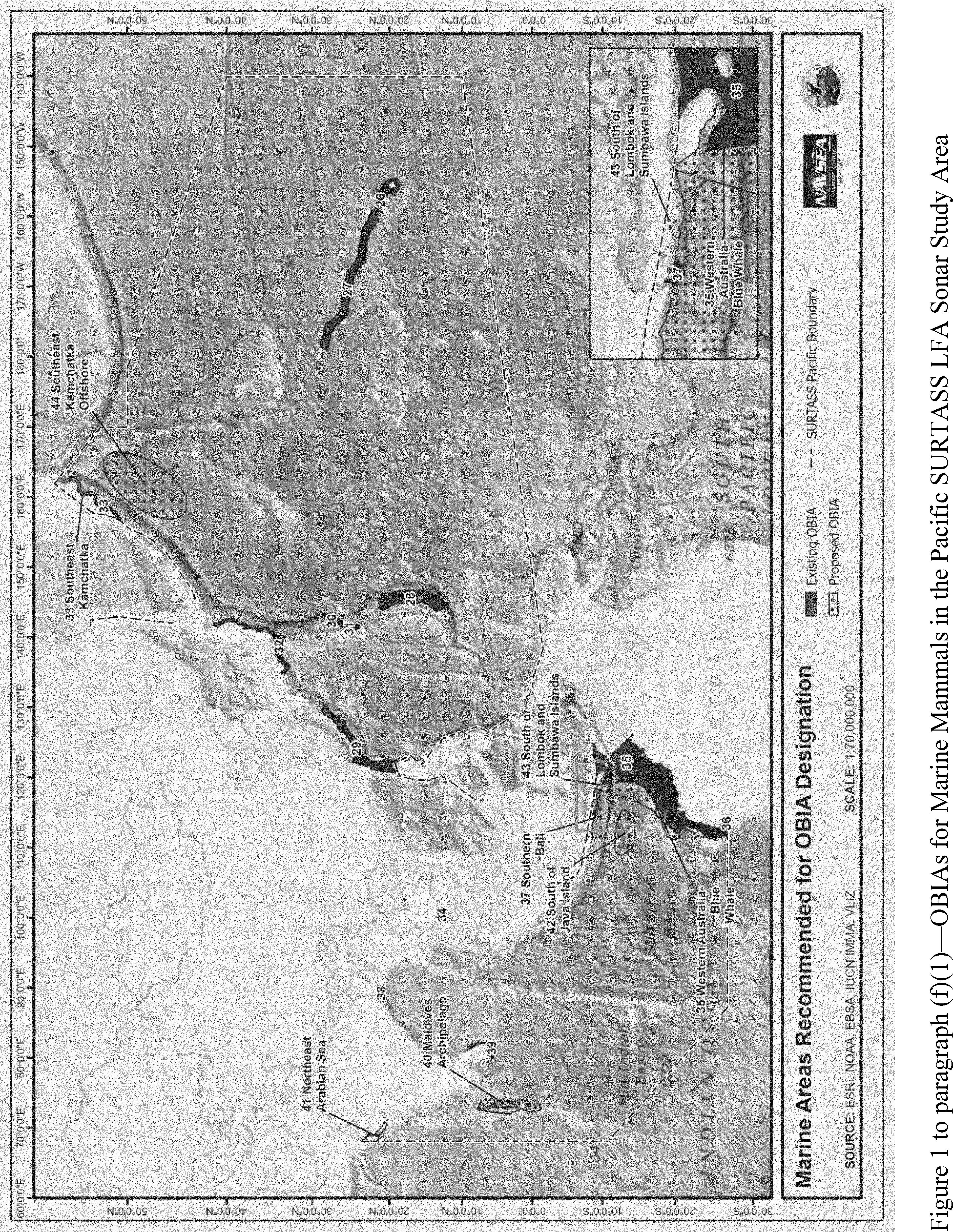
Relative to the proposed rule, this final rule includes new geographic mitigation measures and modifications to existing geographic measures added as a result of coordination between NMFS and the Navy. The Navy has agreed that all of the following modifications and additions to geographic mitigations are practicable:
OBIA #28 (Mariana Islands) is now effective from December through May (previously February through April);
OBIA #33 (Southeast Kamchatka) is now effective year-round (previously June through September) and has been spatially expanded northward along the eastern side of the Kamchatka Peninsula to meet the northern boundary of the Study Area;
OBIA #37 (Southern Bali) is now effective August through November (previously October through November) and has been spatially expanded to minimize impacts to pygmy blue whales participating in reproductive and foraging activities in this area; and
OBIA #44 (Southeast Kamchatka Offshore) is a new OBIA for North Pacific right whales (NPRW) offshore of Southeast Kamchatka, effective from April through October;
Additionally, this final rule corrects errors in the effective period of two OBIAs, making them consistent with the periods identified in the 2026 SURTASS SEIS/OEIS: OBIA #42 (South of Java Island) is effective from May through November and OBIA #43 (South of Lombok Sumbawa Islands) is effective May through November (not October through November as stated in the Geographic Mitigation section of the proposed rule).
This final rule also includes revised language regarding adaptive management to streamline the regulatory text and better reflect the potential for modifications to the LOA. This final rule clarifies that, at the request of the Navy or on NMFS' own initiative, NMFS may modify the mitigation, monitoring, or reporting measures in an LOA, consistent with the measures in the regulations, if: (1) the anticipated effects of the modified measure are the same as those described and analyzed for this subpart; (2) the modified measure has a reasonable likelihood of effectiveness; (3) NMFS determines the modified measure does not change the findings made for this subpart; and (4) Navy concurs with the modified measure and that, where applicable, it meets the Navy's practicability standards in the context of personnel safety, practicality of implementation, and impacts on the effectiveness of the Navy's military readiness activities.
Finally, this final rule does not include take of the Beringia Distinct Population Segment (DPS) of bearded seals (
Erignathus barbatus) as a result of consultation with NMFS Endangered Species Division. The proposed rule included take, by Level B harassment, of one bearded seal annually and across the 7-year period of the LOA. While the range of this DPS occurs primarily outside of the Study Area, occasional sightings of vagrants within the Study Area have been reported in nearshore areas around Kamchatka, the Sea of Japan, and Tokyo Bay (Naito, 1979). Bearded seals inhabit shallow continental shelf waters that are restricted to seasonal sea ice, and this species is typically found in extremely low densities close to the shoreline; therefore, any adverse effects from SURTASS LFA sonar are unlikely due to the implementation of a Coastal Standoff Range (CSR) of 22 km from any emergent land, including offshore islands. Based on the best available information on this species' distribution and abundance, take of bearded seals (Beringia DPS) is neither anticipated nor authorized incidental to SURTASS LFA sonar activities in the Study Area.
Description of Marine Mammals and Their Habitat in the Area of Specified Activities
Marine mammal species and their associated stocks that have the potential to occur in the Study Area are presented in table 1 along with each stock's ESA and MMPA status, abundance estimate and associated coefficient of variation (CV) value, minimum abundance estimate, PBR, annual M/SI, as applicable, and potential occurrence in the Study Area. The Navy anticipates take of 43 species by Level B harassment and, for a subset of those species (9 species), Level A harassment, incidental to the use of SURTASS LFA sonar in the Study Area. Of note, based on improvements to the Navy's density research since the 2019 SURTASS LFA Final Rule (84 FR 40132, August 13, 2019), seven additional species were modeled for this rulemaking. Of those seven, the Navy's application includes estimated take of four species from the proposed activity that were not included in the 2019 final rule: (1) bearded seal; (2) ringed seal; (3) harbor seal; and (4) Steller sea lion. Multiple stocks of some species are affected, and independent assessments are conducted to make the necessary findings and determinations for each of these.
There are 34 stocks under NMFS' jurisdiction with confirmed or possible occurrence in the Study Area, of which 11 are listed as endangered or threatened under the ESA (including bearded seal, of which take is neither anticipated nor authorized, as discussed in the Changes from the Proposed Rule to the Final Rule section) (16 U.S.C. 1531et seq.). Currently, the false killer whale (Main Hawaiian Islands Insular DPS) and Hawaiian monk seal have critical habitat designated under the
( printed page 47671)
ESA in the Study Area (see
Critical Habitat
section below). The remaining species in the Central and Western Pacific and Eastern Indian Oceans have no stock designation (NSD) under the MMPA.
The proposed rule included additional information about the species in this final rule, marine mammal species for which take is not authorized, marine mammal species which could occur in the area but are not managed by NMFS, marine mammal hearing, and National Marine Sanctuaries, all of which remains valid and applicable but has not been reprinted in this final rule. NMFS hereby refers to the information and analysis provided in the proposed rule, which continue to apply to this final rule.
Further, as discussed in the Changes from the Proposed Rule to the Final Rule section, this final rule does not include take of bearded seals (Beringia DPS). The proposed rule included take, by Level B harassment, of one bearded seal annually and across the 7-year period of the LOA. While the range of this DPS occurs primarily outside of the Study Area, occasional sightings of vagrants within the Study Area have been reported in nearshore areas around Kamchatka, the Sea of Japan, and Tokyo Bay (Naito, 1979). Bearded seals inhabit shallow continental shelf waters that are restricted to seasonal sea ice, and this species is typically found in extremely low densities close to the shoreline and, therefore, any adverse effects from SURTASS LFA sonar are unlikely due to the implementation of a CSR. Based on the best available information on this species' distribution and abundance, take of bearded seals (Beringia DPS) is neither anticipated nor authorized incidental to SURTASS LFA sonar activities in the Study Area and, as such, bearded seals are not discussed further.
Information on the status and trends, distribution and habitat preferences, and behavior and life history of the potentially affected species may be found in sections 3 and 4 and appendix A (Marine Mammal Species Supplemental Information) of the application. NMFS reviewed this information and found it to be accurate and complete. Additional information on the general biology and ecology of marine mammals is included in the 2026 SURTASS SEIS/OEIS. Table 1 incorporates the best available science, including data from the 2024 Pacific and Alaska Marine Mammal SARs (Carretta
et al.,
2026; Young
et al.,
2026) (see
www.fisheries.noaa.gov/national/marine-mammal-protection/marine-mammal-stock-assessments) as well as monitoring data from the Navy's marine mammal research efforts. NMFS has also reviewed new scientific literature since publication of the proposed rule and determined that none of these nor any other new information available changes our determination of which species have the potential to be affected by the Navy's activities or the information pertinent to status, distribution, abundance, population trends, habitat, or ecology of the species in this final rulemaking.
Table 1—Marine Mammal Occurrence Within the Pacific SURTASS LFA Sonar Study Area 1
Common name
Scientific name
Stock
ESA/MMPA
status;
Strategic
(Y/N) 2
Stock abundance (CV, N
min
, most recent abundance survey) 3
PBR
Annual M/SI 4
Order Artiodactyla—Cetacea—Mysticeti (baleen whales)
Family Balaenidae:
North Pacific right whale
Eubalaena japonica
NSD
E, N/A, N/A
UNK
UNK.
Family Balaenopteridae (rorquals):
Blue whale
Balaenoptera musculus
NSD
E, N/A, N/A
UNK
UNK.
Blue whale
Balaenoptera musculus
Central North Pacific
E, D, Y
133 (1.09, 63, 2010)
0.1
0.
Bryde's whale
Balaenoptera edeni
NSD
, N/A, N/A
UNK
UNK.
Bryde's whale
Balaenoptera edeni
Hawaii
, -, N
791 (0.29, 623, 2020)
6.2
0.
Fin whale
Balaenoptera physalus
NSD
E, N/A, N/A
UNK
UNK.
Fin whale
Balaenoptera physalus
Hawaii
E, D, Y
203 (0.99, 101, 2017)
0.2
0.
Humpback whale
Megaptera novaeangliae
NSD
5
, N/A, N/A
UNK
UNK.
Humpback whale
Megaptera novaeangliae
Hawaii
, -, N
11,278 (0.56, 7,265, 2020)
127
27.09.
Humpback whale
Megaptera novaeangliae
Western North Pacific
E, D, Y
1,084 (0.088, 1,007, 2006)
3.4
5.82.
Antarctic minke whale
Balaenoptera bonaerensis
NSD
, N/A, N/A
UNK
UNK.
Minke whale
Balaenoptera acutorostrata
NSD
, N/A, N/A
UNK
UNK.
Minke whale
Balaenoptera acutorostrata
Hawaii
, -, N
438 (1.05, 212, 2017)
2.1
0.
Omura's whale
Balaenoptera omurai
NSD
, N/A, N/A
UNK
UNK.
Sei whale
Balaenoptera borealis
NSD
E, N/A, N/A
UNK
UNK.
Sei whale
Balaenoptera borealis
Hawaii
E, D, Y
391 (0.9, 204, 2010)
0.4
0.2.
Odontoceti (toothed whales, dolphins, and porpoises)
Family Physeteridae:
Sperm whale
Physeter macrocephalus
NSD
E, N/A, N/A
UNK
UNK.
Sperm whale
Physeter macrocephalus
North Pacific
E, D, Y
UND (UND, UND, 2015)
UND
3.5.
Sperm whale
Physeter macrocephalus
Hawaii
E, D, Y
5,707 (0.23, 4,486, 2017)
18
0.
Family Kogiidae:
Dwarf sperm whale
Kogia sima
NSD
, N/A, N/A
UNK
UNK.
Dwarf sperm whale
Kogia sima
Hawaii
, -, N
UNK (UNK, UNK, 2017)
UND
0.
Pygmy sperm whale
Kogia breviceps
NSD
, N/A, N/A
UNK
UNK.
Pygmy sperm whale
Kogia breviceps
Hawaii
, -, N
42,083 (0.64, 25,695, 2017)
257
0.
Family Ziphiidae (beaked whales):
Baird's beaked whale
Berardius bairdii
NSD
, N/A, N/A
UNK
UNK.
( printed page 47672)
Blainville's beaked whale
Mesoplodon densirostris
NSD
, N/A, N/A
UNK
UNK.
Blainville's beaked whale
Mesoplodon densirostris
Hawaii
, -, N
1,132 (0.99, 564, 2017)
5.6
0.
Deraniyagala's beaked whale
Mesoplodon hotaula
NSD
, N/A, N/A
UNK
UNK.
Ginkgo-toothed beaked whale
Mesoplodon ginkgodens
NSD
, N/A, N/A
UNK
UNK.
Goose-beaked whale
Ziphius cavirostris
NSD
, N/A, N/A
UNK
UNK.
Goose-beaked whale
Ziphius cavirostris
Hawaii
, -, N
4,431 (0.41, 3,180, 2017)
32
0.
Hubbs' beaked whale
Mesoplodon carlshubbi
NSD
, N/A, N/A
UNK
UNK.
Longman's beaked whale
Indopacetus pacificus
NSD
, N/A, N/A
UNK
UNK.
Longman's beaked whale
Indopacetus pacificus
Hawaii
, -, N
2,550 (0.67, 1,527, 2017)
15
0.
Stejneger's beaked whale
Mesoplodon stejnegeri
NSD
, N/A, N/A
UNK
UNK.
Family Delphinidae:
False killer whale
Pseudorca crassidens
NSD
, N/A, N/A
UNK
UNK.
False killer whale
Pseudorca crassidens
Main Hawaiian Islands Insular
E, D, Y
138 (0.08, 129, 2015)
0.26
0.3.
False killer whale
Pseudorca crassidens
Hawaii Pelagic
, -, Y
5,528 (0.35, 4,152, 2017)
33
47.
Killer whale
Orcinus orca
NSD
, N/A, N/A
UNK
UNK.
Killer whale
Orcinus orca
Hawaii
, -, N
161 (1.06, 78, 2017)
0.8
0.
Melon-headed whale
Peponocephala electra
NSD
, N/A, N/A
UNK
UNK.
Melon-headed whale
Peponocephala electra
Hawaiian Islands
, -, N
40,647 (0.74, 23,301 2017)
233
0.
Pygmy killer whale
Feresa attenuata
NSD
, N/A, N/A
UNK
UNK.
Pygmy killer whale
Feresa attenuata
Hawaii
, -, N
10,328 (0.75, 5,885, 2017)
59
0.
Short-finned pilot whale
Globicephala macrorhynchus
NSD
, N/A, N/A
UNK
UNK.
Short-finned pilot whale
Globicephala macrorhynchus
Hawaii
, -, N
19,242 (0.23, 15,894, 2020)
159
0.2.
Bottlenose dolphin
Tursiops truncatus
NSD
, N/A, N/A
UNK
UNK.
Bottlenose dolphin
Tursiops truncatus
Hawaii Pelagic
, -, N
24,669 (0.57, 15,783, 2020)
158
0.
Common dolphin
Delphinus delphis
NSD
, N/A, N/A
UNK
UNK.
Fraser's dolphin
Lagenodelphis hosei
NSD
, N/A, N/A
UNK
UNK.
Fraser's dolphin
Lagenodelphis hosei
Hawaii
, -, N
40,960 (0.7, 24,068, 2017)
241
0.
Northern right whale dolphin
Lissodelphis borealis
NSD
, N/A, N/A
UNK
UNK.
Pacific white-sided dolphin
Aethalodelphis obliquidens
North Pacific
, -, N
26,880 (N/A, N/A, 1990)
UND
0.
Pantropical spotted dolphin
Stenella attenuata
NSD
, N/A, N/A
UNK
UNK.
Pantropical spotted dolphin
Stenella attenuata
Hawaii Pelagic
, -, N
67,313 (0.27, 53,839, 2020)
538
0.
Risso's dolphin
Grampus griseus
NSD
, N/A, N/A
UNK
UNK.
Risso's dolphin
Grampus griseus
Hawaii
, -, N
6,979 (0.29, 5,283, 2020)
53
0.
Rough-toothed dolphin
Steno bredanensis
NSD
, N/A, N/A
UNK
UNK.
Rough-toothed dolphin
Steno bredanensis
Hawaii
, -, N
83,915 (0.49, 56,782, 2017)
511
3.2.
Spinner dolphin
Stenella longirostris
NSD
, N/A, N/A
UNK
UNK.
Spinner dolphin
Stenella longirostris
Hawaii Pelagic
, -, N
UNK (UNK, UNK, 2010)
UND
0.
Striped dolphin
Stenella coeruleoalba
NSD
, N/A, N/A
UNK
UNK.
Striped dolphin
Stenella coeruleoalba
Hawaii Pelagic
, -, N
64,343 (0.28, 51,055, 2020)
511
0.
Family Phocoenidae (porpoises):
Dall's porpoise
Phocoenoides dalli
NSD
, N/A, N/A
UNK
UNK.
Order Carnivora—Pinnipedia
Family Otariidae (eared seals and sea lions):
Northern fur seal
Callorhinus ursinus
NSD
, N/A, N/A
UNK
UNK.
Steller sea lion
Eumetopias jubatus
Western
E, D, Y
49,837 (N/A, 49,837, 2022)
299
267.
Family Phocidae (earless seals):
Harbor seal
Phoca vitulina
California
, -, N
30,968 (N/A, 27,348, 2012)
1,641
43.
Ribbon seal
Histriophoca fasciata
NSD
, N/A, N/A
UNK
UNK.
Hawaiian monk seal
Neomonachus schauinslandi
Hawaii
E, D, Y
1,605 (0.05, 1,508, 2022)
5.3
≥4.8.
Ringed seal
Pusa hispida
NSD
5
, N/A, N/A
UNK
UNK.
Spotted seal
Phoca largha
Bering
, -, N
461,625 (N/A, 423,237, 2013)
25,394
5,254.
Note:
NSD = No Stock Designation, N/A = Not Applicable, UND = Undetermined, UNK = Unknown. A species or stock listed as `NSD' is not a designated stock under the MMPA and, therefore, does not have a SAR or any SAR-specific information.
2
Endangered Species Act (ESA) status: Endangered (E), Threatened (T)/MMPA status: Depleted (D). A dash (-) indicates that the species is not listed under the ESA or designated as depleted under the MMPA. Under the MMPA, a strategic stock is one for which the level of direct human-caused mortality exceeds PBR or which is determined to be declining and likely to be listed under the ESA within the foreseeable future. Any species or stock listed under the ESA is automatically designated under the MMPA as depleted and as a strategic stock. MMPA status information is N/A to species for which no stock is designated.
4
These values, found in NMFS's SARs, represent annual levels of human-caused mortality plus serious injury from all sources combined (
e.g.,
commercial fisheries, vessel strike). Annual M/SI often cannot be determined precisely and is in some cases presented as a minimum value or range. A CV associated with estimated mortality due to commercial fisheries is presented in some cases.
5
Only designated DPSs are ESA-listed.
Below, we consider additional information about the marine mammals in the area of the specified activities that informs our analysis, such as identifying known areas of important habitat or behaviors, or where UMEs have been designated.
Critical Habitat
Currently, the false killer whale (Main Hawaiian Islands Insular DPS) and Hawaiian monk seal have ESA-designated critical habitat in the Study Area.
False Killer Whale (Main Hawaiian Island Insular DPS)
Critical habitat for the ESA-listed Main Hawaiian Islands insular false killer whale DPS was finalized in July 2018 (83 FR 35062, July 24, 2018) designating waters from the 45 m depth contour to the 3,200 m depth contour around the main Hawaiian Islands from Ni'ihau east to Hawaii. This designation does not include most bays, harbors, or coastal in-water structures. NMFS excluded 14 areas. The total area designated was approximately 45,504 square kilometers (km2
) (13,267 square nautical miles (nmi2
)) of marine habitat. Critical habitat for the main Hawaiian Islands insular DPS of false killer whale overlaps the Study Area.
Main Hawaiian Islands insular false killer whales are island-associated whales that rely entirely on the productive submerged habitat of the main Hawaiian Islands to support all of their life-history stages. Island-associated marine habitat for Main Hawaiian Islands insular false killer whale is the only essential feature of the critical habitat. The following characteristics of this habitat support insular false killer whales' ability to travel, forage, communicate, and move freely around and among the waters surrounding the main Hawaiian Islands: (1) adequate space for movement and use within shelf and slope habitat; (2) prey species of sufficient quantity, quality, and availability to support individual growth, reproduction, and development, as well as overall population growth; (3) waters free of pollutants of a type and amount harmful to Main Hawaiian Islands insular false killer whales; and (4) sound levels that would not significantly impair false killer whales' use or occupancy.
Hawaiian Monk Seal
Critical habitat for Hawaiian monk seals was designated in 1986 (51 FR 16047, April 30, 1986) and later revised in 1988 (53 FR 18988, May 26, 1988) and in 2015 (80 FR 50925, August 21, 2015). In the Northwestern Hawaiian Islands Hawaiian monk seal critical habitat includes all beach areas, sand spits, and islets, including all beach crest vegetation, to its deepest extent inland as well as the seafloor and marine habitat 10 m in height above the seafloor from the shoreline out to the 200 m depth contour around Kure Atoll (Hōlanikū), Midway Atoll (Kuaihelani), Pearl and Hermes Reef (Manawai), Lisianski Island (Kapou), Laysan Island (Kamole), Maro Reef (Kamokuokamohoali`i), Gardner Pinnacles ('Ōnūnui), French Frigate Shoals (Lalo), Necker Island (Mokumanamana) and Nihoa Island. In the main Hawaiian Islands, Hawaiian monk seal critical habitat includes the seafloor and marine habitat to 10 m above the seafloor from the 200 m depth contour through the shoreline and extending into terrestrial habitat 5 m inland from the shoreline between identified boundary points around Kaula Island (includes marine habitat only), Ni'ihau (includes marine habitat from 10 to 200 m in depth), Kaua'i, O'ahu, Maui Nui (including Kaho'olawe, Lāna'i, Maui, and Moloka'i), and Hawaii Island. Critical habitat for the Hawaiian monk seal overlaps the Study Area.
The essential features of Hawaiian monk seal critical habitat are: (1) terrestrial areas and adjacent shallow, sheltered aquatic areas with characteristics preferred by monk seals for pupping and nursing; (2) marine areas from 0 to 200 m in depth that support adequate prey quality and quantity for juvenile and adult monk seal foraging; and (3) significant areas used by monk seals for hauling out, resting, or molting.
Biologically Important Areas
Ferguson
et al.
(2015) identified BIAs within U.S. waters, which represent areas and times in which cetaceans are known to concentrate for reproduction, feeding, and migration, or areas where small and resident populations are known to occur. Harrison
et al.
(2023) identified a new scoring system, described below, and the BIAs in Hawaiian waters were updated (Kratofil
et al.,
2023). Unlike ESA critical habitat, BIAs are not formally designated pursuant to any statute or law but are a compilation of the best available science intended to inform impact and mitigation analyses. An interactive map of the BIAs is available at:
oceannoise.noaa.gov/biologically-important-areas.
A summary of all of the BIAs in the Study Area is included below.
Kratofil
et al.
(2023) delineates and scores BIAs for cetaceans in the Hawaii region following standardized protocols. Experts identified an overall Importance Score for each BIA that considers: (1) “Intensity,” meaning the intensity and characteristics underlying an area's identification as a BIA; and (2) “Data Support,” meaning the quantity, quality, and type of information, and associated uncertainties, upon which the BIA delineation and scoring depend. Importance Scores range from 1 to 3, with a higher score representing an area of higher intensity and data support. Each BIA is also scored for boundary uncertainty and spatiotemporal variability (dynamic, ephemeral, or static). Additionally, hierarchical BIAs are identified for some species and stocks where a higher intensity score is appropriate for a smaller core area(s) (child BIA) within a larger BIA unit (parent BIA).
The Study Area overlaps BIAs in Hawaii for small and resident populations of the following species: spinner dolphin, short-finned pilot whale, rough-toothed dolphin, pygmy killer whale, pantropical spotted dolphin, melon-headed whale, false killer whale, dwarf sperm whale, goose-beaked whale, common bottlenose dolphin, and Blainville's beaked whale, and the updated BIAs for humpback whale reproduction (Kratofil
et al.,
2023). Table 2 describes each BIA that overlaps the Study Area and the scores for the above criteria. We note that the BIAs for small and resident populations of spinner dolphin, melon-headed whale, and dwarf sperm whale are all fully contained within OBIAs. The BIAs for small and resident populations of short-finned pilot whale, rough-toothed
( printed page 47674)
dolphin, pygmy killer whale, goose-beaked whale, and common bottlenose dolphin, and the reproductive BIA for humpback whale, are mostly contained within the OBIAs. The BIAs for small and resident populations of pantropical spotted dolphin, false killer whale, and Blainville's beaked whale are partially contained within the OBIAs described in the
Geographic Mitigation
section and required for implementation in this rule.
( printed page 47675)
Table 2—BIAs Overlapping the Pacific SURTASS LFA Sonar Study Area
Species
BIA type
Parent/child
non-hierarchical
BIA
name
Effective
months
BIA area
(km2
)
Importance
score
Intensity
score
Data
support score
Boundary
certainty
Spatiotemporal
variability
Transboundary
across
Hawaii Study Area (Kratofil et al., 2023)
Humpback whale
Reproductive
Parent
Main Hawaiian Islands—Parent
December through May
23,041
2
2
2
2
Static
None.
Humpback whale
Reproductive
Child
Main Hawaiian Islands—Child
December through May
6,676
3
3
3
3
Static
None.
False killer whale
Small and Resident Population
Parent
Main Hawaiian Islands Insular Stock—Parent
Year-round
94,217
1
1
3
3
Static
None.
False killer whale
Small and Resident Population
Child
Main Hawaiian Islands Insular Stock—Child
Year-round
7,775
3
3
3
3
Static
None.
False killer whale
Small and Resident Population
Non-hierarchical
Northwestern Hawaiian Islands Insular Stock
Year-round
138,001
1
1
2
2
Static
None.
Dwarf sperm whale
Small and Resident Population
Parent
Hawaii Island—Parent
Year-round
1,341
3
3
2
2
Static
None.
Dwarf sperm whale
Small and Resident Population
Child
Hawaii Island—Child
Year-round
457
3
3
2
2
Static
None.
Pygmy killer whale
Small and Resident Population
Non-hierarchical
O'ahu-Maui Nui
Year-round
7,416
3
3
2
2
Static
None.
Pygmy killer whale
Small and Resident Population
Non-hierarchical
Hawaii Island
Year-round
5,201
2
2
2
2
Static
None.
Short-finned pilot whale
Small and Resident Population
Parent
Main Hawaiian Islands—Parent
Year-round
51,280
1
1
3
3
Static
None.
Short-finned pilot whale
Small and Resident Population
Child
Main Hawaiian Islands—Child (Western Community Core Range)
Year-round
4,040
3
3
3
3
Static
None.
Short-finned pilot whale
Small and Resident Population
Child
Main Hawaiian Islands—Child (Central Community Core Range)
Year-round
2,427
3
3
3
3
Static
None.
Short-finned pilot whale
Small and Resident Population
Child
Main Hawaiian Islands—Child (Eastern Community Core Range)
A UME is defined under section 410(9) of the MMPA as a stranding that is unexpected; involves a significant die-off of any marine mammal population; and demands immediate response (16 U.S.C. 1421h(9)). There are no active UMEs in the Study Area.
Potential Effects of Specified Activities on Marine Mammals and Their Habitat
We provided a detailed discussion of the potential effects of the specified activities on marine mammals and their habitat in our proposed rule. NMFS hereby refers to the information and analysis provided in the proposed rule, which continues to apply to this final rule. In the Potential Effects of Specified Activities on Marine Mammals and Their Habitat section of the proposed rule, NMFS provided a description of the ways marine mammals may be affected by these activities in the form of, among other things, sensory impairment (auditory injury, temporary threshold shift, and acoustic masking), physiological responses, behavioral disturbance, or habitat effects. All of this information remains valid and applicable. Therefore, we do not reprint the information here and refer the reader to that document.
NMFS has also reviewed new relevant information from the scientific literature since publication of the proposed rule. Summaries of the new key scientific literature reviewed since publication of the proposed rule are presented below.
Dunlop
et al.
(2026) used a behavioral observation audiometry (BOA) in wild humpback whales to predict minimum response levels (MRLs), which serves as a surrogate for determining the shape of this species' masked audiogram (
i.e.,
MRLs are not equivalent to an audiogram). These data were compared to a hearing curve derived from anatomical models and the authors found the BOAs to indicate the humpback whale hearing range extends at least as low as approximately 80 Hz and at least as high as approximately 22 kHz. These data predicted more sensitivity at higher frequencies than the anatomically-based curve, indicating humpback whale hearing may be more sensitive than previously thought.
Fournet and Schulze (2026) used underwater acoustic monitoring and land-based visual surveys to evaluate the probability of humpback whale breaching behavior with increasing low-frequency (50-1,500 Hz) ambient noise levels in the foraging grounds of Glacier Bay National Park and Preserve. Likelihood of breaching was found to increase with higher ambient noise levels, with results correlated with total ambient levels and not the proximity of vessels. The authors hypothesize that breaching is a compensatory communication strategy when vocal signals are masked. These results were consistent with other observations of surface-active behaviors in humpback whales, but the authors found the source of the noise (
e.g.,
vessel, rain) associated with this study did not affect the results (
i.e.,
humpback whales respond to both anthropogenic and natural sources equally).
Gao
et al.
(2026) compared ambient noise in the northern South China Sea, focusing on differences in noise properties between the continental slope and deep-water environments. The authors reported continental slope spectrum levels (50 Hz-10 kHz) were consistently higher than those measured in the deep-water environment. Below 4 kHz, elevated ambient noise levels in the continental slope environment result from shipping activity and other anthropogenic activities, while above 4 kHz, wind-generated noise dominated in both environments. These findings provide valuable insights for noise modeling in dynamic and complex slope environments, as well as sonar performance simulation and evaluation.
Houser
et al.
(2026) reviewed studies of baleen whale hearing conducted over the past 30 years and generally compared the variety of methods used to estimate hearing, including extrapolation from a species' vocalization, behavioral methods, anatomically-based predictions, and electrophysiological hearing tests. Notably, the authors included a discussion of how auditory evoked potential (AEP) tests on adolescent common minke whales (Kleivane
et al.,
2024; Houser
et al.,
2024) support the notion that some baleen whales have a much higher upper-frequency hearing limit than previously thought using the other methods of estimating hearing. The Navy was given access to pre-published data on the 2023-2024 minke whale field season and was able to incorporate these data into their Phase IV acoustic criteria (noting that the 2023 field season data was published in November 2024). In their Phase IV criteria, the Navy separated very low-frequency (VLF) cetaceans (
i.e.,
blue, fin, right, and bowhead whales) from LF cetaceans (all other mysticetes), thus acknowledging differences among mysticetes species. Data from the 2024 field season are not yet published.
Maciel
et al.
(2026) assessed the impacts of seismic surveys in Brazil on vocal behavior of humpback whales and pantropical spotted dolphins from 2020 to 2024. The authors reported that exposure to seismic surveys reduced the call frequency and duration of humpback whales but increased the call frequency and duration of pantropical spotted dolphins. The authors hypothesized that the difference in vocal responses of each species may be related to physiological limitations in sound modulation.
Madrigal
et al.
(2026) tagged four false killer whales from the Main Hawaiian Islands insular population to learn about their acoustic communication. False killer whales are known for their complex group behavior, and the small population of Main Hawaiian Islands insular false killer whales consists of at least four social clusters that are distinct genetically and use habitat variably. The authors used biologgers with built-in hydrophones and found variable call rates (call rates decreased with increasing swim speeds) and types across dive state (probability of calling was greater when animals were closer to the bottom compared to the surface) by individual, highlighting vocal diversity even amongst this small population.
A review of laboratory-based studies by Reichmuth and Sills (2026) described what is currently known about direct measures of hearing sensitivity of marine mammals to low-frequency sounds below 100 Hz. The authors describe low-frequency sensitivity increasing from the least low-frequency-sensitive group studied, odontocetes, to sirenians, then otariid carnivores, and finally phocid carnivores, which have the most sensitive low-frequency hearing of any marine mammal studied to date. This study does not provide new data.
Southall
et al.
(2026) describes a controlled exposure experiment (CEE) in which blue whales (the predominant species in CEE) and fin whales were exposed to simulated and operational marine vibrators (MV), a low-frequency source (5-100 Hz) associated with seismic surveys. The authors found that while simulated playbacks resulted in “mild and temporary avoidance responses” by whales that were travelling or feeding in low-density prey fields, whales feeding in concentrated prey fields did not respond to the operational MV source.
Having considered the new information, along with information provided in public comments on the proposed rule, we have determined that there is no new information that substantively affects our analysis of potential impacts on marine mammals and their habitat that appeared in the proposed rule, all of which remains applicable and valid for our assessment
( printed page 47678)
of the effects of the Navy's activities during the 7-year period of this rule.
Estimated Take of Marine Mammals
This section indicates the number of takes that NMFS is authorizing, which is based on the amount of take that NMFS anticipates is reasonably likely to occur. NMFS coordinated closely with the Navy in the development of their incidental take application and agrees that: (1) the methods the Navy has put forth described herein to estimate take (including the model, thresholds, and density estimates); and (2) the resulting take estimates are based on the best available science and appropriate for authorization.
The 2026 SURTASS SEIS/OEIS considered all SURTASS LFA sonar activities planned to occur in the Study Area that have the potential to result in the take of marine mammals. The Navy determined that the only stressors that could result in the incidental taking of marine mammals are acoustic (
i.e.,
sonars). NMFS has reviewed the Navy's data and analysis and determined that it is complete and accurate and agrees that acoustic stressors have the potential to result in take by harassment of marine mammals from the specified activities. The estimated take discussed herein would be in the form of harassment only and would result primarily from marine mammal exposure to SURTASS LFA sonar given the slower attenuation and long distance that the sound would propagate in comparison to the active high-frequency marine mammal monitoring (HF/M3) sonar that would operate simultaneously.
For this military readiness activity, the MMPA defines “harassment” as: (1) any act that injures or has the significant potential to injure a marine mammal or marine mammal stock in the wild (Level A harassment); or (2) any act that disturbs or is likely to disturb a marine mammal or marine mammal stock in the wild by causing disruption of natural behavioral patterns, including, but not limited to, migration, surfacing, nursing, breeding, feeding, or sheltering, to a point where the behavioral patterns are abandoned or significantly altered (Level B harassment) (16 U.S.C. 1362(18)(B)).
Authorized takes are primarily in the form of Level B harassment, as use of the acoustic sources is most likely to result in disruption of natural behavioral patterns to a point where they are abandoned or significantly altered (as defined specifically at the beginning of this section, but referred to generally as behavioral disturbance) for marine mammals, either via direct behavioral disturbance or temporary threshold shift (TTS). There is also the potential for Level A harassment, in the form of auditory injury to result from exposure to SURTASS LFA sonar. Although we analyze the impacts of the potential harassment takes that are authorized, the required mitigation and monitoring measures are expected to minimize the severity of these takes.
Generally speaking, NMFS estimates the amount and type of harassment from acoustic sources by considering: (1) acoustic thresholds above which NMFS believes the best available science indicates marine mammals would experience behavioral disturbance or incur some degree of temporary or permanent hearing impairment; (2) the area or volume of water that would be ensonified above these levels in a day or event; (3) the density or occurrence of marine mammals within these ensonified areas; and (4) the number of days of activities.
It is important to note that for this SURTASS LFA sonar rule, the Navy, in coordination with NMFS, elected to change both the acoustic thresholds and the take estimation methodology used to better reflect the best available science and also better align with the analytical methods used in other Navy training and testing rules. Specifically, all of the acoustic thresholds and take calculation methods used here are referred to as “Phase IV” and described in the Criteria and Thresholds Technical Report, mirroring those used in analyses supporting the Phase IV AFTT (90 FR 50504, November 7, 2025) and HCTT (90 FR 58810, December 17, 2025) training and testing ITRs (in the previous SURTASS LFA sonar rule (84 FR 40132, August 13, 2019), Phase III thresholds were used for acoustic injury prediction, a SURTASS-specific threshold was used to predict behavioral disturbance, and different SURTASS-specific methods and modeling were used in the calculation of take).
We provided a detailed discussion of the acoustic thresholds, acoustic effects modeling and estimation, range to effects, and marine mammal density information in our proposed rule. NMFS hereby refers to the information and analysis provided in the proposed rule, which continue to apply to this final rule. In the Estimated Take of Marine Mammals section of the proposed rule, we identified the subset of potential effects that would be expected to rise to the level of takes both annually and over the 7-year period covered by the rule, then identified the maximum number of takes we believe are reasonably expected to occur (by Level A and/or Level B harassment) based on the methods described. All of this information remains valid and applicable; therefore, we do not repeat the information here but refer the reader to the proposed rule.
Estimated Take From Acoustic Stressors
The Navy is authorized to take marine mammals incidental to 1,100 hours of SURTASS LFA sonar training per year, which is an increase from the 592 hours considered for the 2019 regulations; however, this increase does not reflect new or additional training requirements. Instead, it is the result of a change in how the Navy counts an “hour” of transmission. Previously, SURTASS LFA sonar hours were calculated by adding the portions of time a sonar emits sound during its “duty cycle” (ratio of time the signal is on compared to off). Other Navy sonar systems, such as mid-frequency and high-frequency active sonar, calculate hours based on total “duration” time (total time the source is active, including silent periods between pings). To bring SURTASS LFA sonar in line with these other sonar systems, the Navy developed a conversion method that considers various factors including LFA sonar pings, wave trains, and other classified considerations. As a result, the 1,100 hours of annual SURTASS LFA training requested are equivalent to the 592 hours considered under the previous counting method.
The quantitative analysis process used for the 2026 SURTASS SEIS/OEIS and the application to estimate potential exposures of marine mammals resulting from acoustic stressors is detailed in the Acoustic Impacts Technical Report.
Regarding how avoidance of loud sources is considered in the take estimation, NAEMO does not simulate horizontal animat (
i.e.,
a virtual animal) movement during an event. However, NAEMO approximates marine mammal avoidance of high sound levels due to exposure to sonars in a one-dimensional calculation that scales how far an animat would be from a sound source based on sensitivity to disturbance, swim speed, and avoidance duration. This process reduces the SEL, defined as the accumulation for a given animat, by reducing the received SPL of individual exposures based on a spherical spreading calculation from sources on each unique platform in an event. The onset of avoidance was based on the behavioral response functions (BRFs). Avoidance speeds and durations were informed by a review of available exposure and baseline data. This method captures a more accurate representation of avoidance by using the received sound levels, distance to
( printed page 47679)
platform, and species-specific criteria to calculate potential avoidance for each animat than the previous approach for SURTASS LFA sonar modeling using the Acoustic Integration Model. However, this method may underestimate avoidance of long-duration sources with lower sound levels because it triggers avoidance calculations based on the highest modeled SPL received level exceeding p(0.5) on the BRF, rather than on cumulative exposure. This is because initiation of the avoidance calculation is based on the highest modeled SPL received level over p(0.5) on the BRF. Please see section 4.4.2.2 of the Acoustic Impacts Technical Report.
The ability of marine mammals to reduce cumulative SEL through avoidance depends on susceptibility to auditory effects, sensitivity to behavioral disturbance, and characteristics of the sonar source including duty cycle, source level, and frequency. Table 2-2 of appendix B to the application shows the percentage reduction of auditory injury (AUD INJ) across the modeled activities in this analysis due to avoidance. The reduction in AUD INJ due to avoidance differs across the planned action and between auditory and behavioral groups. Groups that are relatively less sensitive to behavioral disturbance compared to susceptibility to auditory effects are less likely to avoid AUD INJ, which include the mysticete and odontocete behavioral groups. Groups that are relatively more sensitive to behavioral disturbance compared to susceptibility to auditory effects are more likely to avoid AUD INJ, which include the Sensitive Species and Pinniped behavioral groups. The reduction in AUD INJ for most groups is less than assumed in prior analyses. Avoidance was able to be applied only for pinnipeds. It is likely that no reduction of AUD INJ could be applied to any other hearing group due to the high source level and low frequency of the SURTASS LFA.
Regarding the consideration of mitigation effectiveness in the take estimation, this quantitative analysis does not reduce model-estimated impacts to account for activity-based mitigation. While the activity-based mitigation is not quantitatively included in the take estimates (which, of note, would result in a reduction in the number of takes), section 2.3.2 of appendix B of the application indicates the percentage of the instances of take where an animal's closest point of approach was within a mitigation zone and, therefore, AUD INJ could potentially be mitigated. Only mysticetes in the VLF and LF hearing groups have at least one model-predicted AUD INJ. Five percent and 8 percent of the modeled instances of AUD INJ for VLF and LF cetaceans occurred within the mitigation zone, respectively, thus mitigation could potentially avoid up to 5 or 8 percent of instances of AUD INJ. Note that these percentages do not account for other factors, such as the sightability of a given species or viewing conditions.
For additional information on the quantitative analysis process, refer to the Acoustic Impacts Technical Report and appendices B and C of the application.
As a general matter, NMFS does not prescribe the methods for estimating take for any applicant, but we review and ensure that applicants use the best available science and methodologies that are logical and technically sound. Applicants may use different methods of calculating take (especially when using models) and still get to a result that is representative of the best available science and that allows for a rigorous and accurate evaluation of the effects on marine mammals. There are multiple pieces of the Navy's take estimation methods (
e.g.,
propagation models, animat movement models, and behavioral thresholds). NMFS evaluates the acceptability of these pieces as they evolve and are used in different rules and impact analyses. Some of the pieces of the Navy's take estimation process have been used in Navy incidental take rules since 2009 and have undergone multiple public comment processes. All of them have undergone extensive internal Navy review and comprehensive review by NMFS, which has sometimes resulted in modifications to methods or models.
The Navy uses rigorous review processes (
i.e.,
verification, validation, and accreditation processes; peer and public review) to ensure the data and methodology it uses represent the best available science. For instance, NAEMO is the result of a NMFS-led Center for Independent Experts review of the components used in earlier models. The acoustic propagation component of NAEMO (titled CASS/GRAB) is accredited by the Oceanographic and Atmospheric Master Library (OAML), and many of the environmental variables used in NAEMO come from approved OAML databases and are based on in-situ data collection. The animal density components of NAEMO are base products of the NMSDD, which include animal density components that have been validated and reviewed by a variety of scientists from NMFS Science Centers and academic institutions. Several components of the model, for example, habitat-based density model results for species off Hawaii and California, have been published in several peer-reviewed journals (Becker
et al.,
2020; Becker
et al.,
2021; Becker
et al.,
2022a; Becker
et al.,
2022b). Additionally, NAEMO simulation components underwent quality assurance and quality control (QA/QC) review and validation for model parts (scenario builder, acoustic builder, scenario simulator,
etc.) conducted by qualified statisticians and modelers to ensure accuracy. Other models and methodologies have gone through similar review processes.
In summary, we believe the Navy's methods, including the method for incorporating avoidance, are the most appropriate methods for predicting AUD INJ, non-auditory injury, TTS, and behavioral disturbance. But even with the consideration of avoidance, given some of the more conservative components of the methodology (
e.g.,
the thresholds do not consider ear recovery between pulses), we would describe the application of these methods as identifying the maximum number of instances in which marine mammals would be reasonably expected to be taken through AUD INJ, non-auditory injury, TTS, or behavioral disturbance.
The Navy does not expect physical or non-auditory injury or mortality to any of the marine mammal species in the Study Area due to the specified activities; therefore, those effects are not further discussed. Additionally, masking effects from vessel noise during the operation of T-AGOS vessels are not expected to qualify as take due to the relative movement of the vessels in the Study Area (no more than four vessels traversing an ocean basin at greater than 22 km from shore (away from where marine mammal densities are higher)), resulting in a very low likelihood of any meaningful masking resulting from the noise of the vessels themselves.
Based on the methods discussed in the previous sections and NAEMO, the Navy provided their take estimates and request for authorization of takes incidental to the use of acoustic sources for military readiness activities annually (based on the maximum number of activities that could occur per 12-month period) and over the 7-year period. NMFS agrees that the estimates for incidental takes by harassment from SURTASS LFA sonar sources requested for authorization are the maximum number of instances in which marine mammals are reasonably expected to be taken.
( printed page 47680)
Table 3 summarizes the maximum annual and 7-year total amount and type of Level A harassment and Level B harassment that NMFS concurs is reasonably expected to occur by species or stock for SURTASS training and testing activities.
Table 3—Total Annual and 7-year Incidental Take Authorized by Species or Stock by Harassment Type
Species
Stock
Maximum
annual
Level B
harassment
Maximum
annual
Level A
harassment
7-year total
Level B
harassment
7-year total
Level A
harassment
North Pacific right whale
NSD
325
2
2,271
11
Blue whale
NSD
1,062
3
7,426
21
Blue whale
Central North Pacific
13
83
Bryde's whale
NSD
816
1
5,708
5
Bryde's whale
Hawaii
7
41
Fin whale
NSD
5,738
32
40,165
218
Fin whale
Hawaii
16
111
Humpback whale
NSD
3
13
Humpback whale
Hawaii
13
79
Humpback whale
Western North Pacific
1,133
4
7,926
24
Antarctic minke whale
NSD
48
327
Minke whale
NSD
3,020
6
21,135
42
Minke whale
Hawaii
3
15
Omura's whale
NSD
217
1
1,513
3
Sei whale
NSD
2,021
9
14,140
58
Sei whale
Hawaii
5
1
30
1
Sperm whale
NSD
37
253
Sperm whale
North Pacific
225
1,569
Sperm whale
Hawaii
15
101
Dwarf sperm whale
NSD
719
5,025
Dwarf sperm whale
Hawaii
151
1,056
Pygmy sperm whale
NSD
864
6,039
Pygmy sperm whale
Hawaii
152
1,058
Baird's beaked whale
NSD
64,875
454,121
Blainville's beaked whale
NSD
61,964
433,748
Blainville's beaked whale
Hawaii
2,073
14,511
Deraniyagala's beaked whale
NSD
9,448
66,130
Ginkgo-toothed beaked whale
NSD
30,342
212,384
Goose-beaked whale
NSD
111,485
780,389
Goose-beaked whale
Hawaii
9,185
64,291
Hubbs' beaked whale
NSD
25,289
177,021
Longman's beaked whale
NSD
69,988
489,908
Longman's beaked whale
Hawaii
5,017
35,116
Stejneger's beaked whale
NSD
37,258
260,803
False killer whale
NSD
60
420
False killer whale
Main Hawaiian Islands Insular
1
1
False killer whale
Hawaii Pelagic
7
49
Killer whale
NSD
173
1,206
Killer whale
Hawaii
1
4
Melon-headed whale
NSD
537
3,749
Melon-headed whale
Hawaiian Islands
107
749
Pygmy killer whale
NSD
318
2,214
Pygmy killer whale
Hawaii
32
218
Short-finned pilot whale
NSD
1,083
7,579
Short-finned pilot whale
Hawaii
76
528
Bottlenose dolphin
NSD
1,901
13,299
Bottlenose dolphin
Hawaii Pelagic
32
215
Common dolphin
NSD
1,713
11,987
Fraser's dolphin
NSD
465
3,247
Fraser's dolphin
Hawaii
152
1,056
Northern right whale dolphin
NSD
10
67
Pacific white-sided dolphin
North Pacific
49
342
Pantropical spotted dolphin
NSD
2,785
19,490
Pantropical spotted dolphin
Hawaii Pelagic
233
1,626
Risso's dolphin
NSD
1,575
11,015
Risso's dolphin
Hawaii
38
262
Rough-toothed dolphin
NSD
508
3,555
Rough-toothed dolphin
Hawaii
299
2,092
Spinner dolphin
NSD
276
1,924
Spinner dolphin
Hawaii Pelagic
15
98
Striped dolphin
NSD
4,327
30,277
Striped dolphin
Hawaii Pelagic
200
1,393
Dall's porpoise
NSD
3,020
21,130
Northern fur seal
NSD
1,296
9,067
Steller sea lion
Western
1
2
( printed page 47681)
Harbor seal
California
1
1
Ribbon seal
NSD
37,650
1
263,550
2
Hawaiian monk seal
Hawaii
1
7
Ringed seal
NSD
25
165
Spotted seal
Bering
71
487
Note:
A stock or population listed as NSD is not a designated stock under the MMPA. Zero (0) impacts indicate total less than 0.5 and a dash (-) is a true zero. In some cases where the estimated take within a cell is equal to 1, that value has been rounded up from a value that is less than 0.5 to avoid underestimating potential impacts to a species or stock based on the 7-year rounding rules discussed in section 2.4 of appendix B (PAC SURTASS LFA Acoustic Analysis Report) of the application.
Table 4 provides estimated take by effect type from sonar (with most take from LFA sonar), including the comparative amounts of TTS and behavioral disturbance for each species or stock annually, noting that if an animat was modeled as “taken” through exposure to both TTS and behavioral disturbance in the model, it was recorded as a TTS because predicted exposures above TTS thresholds, characterized as TTS takes, could also include direct behavioral disturbance. Of note, a higher proportion of the takes by Level B harassment of mysticetes include the potential for TTS (as compared to other taxa and prior rules) due to a combination of the fact that mysticetes are relatively less sensitive to direct behavioral disturbance and the number of auditory impacts from sonar (both TTS and AUD INJ) have increased for some species since the previous analysis (84 FR 40132, August 13, 2019), largely due to changes in both the acoustic criteria and the modeling approach. The discussion of behavioral impacts in the Analysis and Negligible Impact Determination section considers the total quantified TTS and direct behavioral disturbance takes.
Additionally, the updated Phase IV HF cetacean criteria reflect greater susceptibility to auditory effects at low and mid-frequencies than previously analyzed for the 2019 SURTASS final rule. Consequently, the predicted auditory effects due to sources under 10 kHz, including SURTASS LFA sonar, are substantially greater for this auditory group than in prior analyses of the same activities. Thus, some modeled exposures that would previously have been categorized as significant behavioral responses may now instead be counted as auditory effects (TTS and AUD INJ). For VHF cetaceans, susceptibility to auditory effects has not changed substantially since the prior analysis.
Table 4—Annual and 7-Year Estimated Take of Marine Mammal Species or Stock by Effect Type
Species
Stock
Maximum
annual
behavioral
Maximum
annual
TTS
Maximum
annual
AUD INJ
Maximum
7-year
behavioral
Maximum
7-year
TTS
Maximum
7-year
AUD INJ
North Pacific right whale
NSD
0
325
2
0
2,271
11
Blue whale
NSD
1
1,061
3
4
7,422
21
Blue whale
Central North Pacific
1
12
1
82
Bryde's whale
NSD
17
799
1
115
5,593
5
Bryde's whale
Hawaii
1
6
5
36
Fin whale
NSD
2
5,736
32
13
40,152
218
Fin whale
Hawaii
0
16
0
111
Humpback whale
NSD
1
2
1
12
Humpback whale
Hawaii
2
11
8
71
Humpback whale
Western North Pacific
5
1,128
4
34
7,892
24
Antarctic minke whale
NSD
4
44
22
305
Minke whale
NSD
53
2,967
6
371
20,764
42
Minke whale
Hawaii
1
2
3
12
Omura's whale
NSD
1
216
1
7
1,506
3
Sei whale
NSD
5
2,016
9
34
14,106
58
Sei whale
Hawaii
1
4
1
2
28
1
Sperm whale
NSD
37
253
Sperm whale
North Pacific
224
1
1,568
1
Sperm whale
Hawaii
15
101
Dwarf sperm whale
NSD
718
1
5,024
1
Dwarf sperm whale
Hawaii
151
1,056
Pygmy sperm whale
NSD
863
1
6,037
2
Pygmy sperm whale
Hawaii
151
1
1,057
1
Baird's beaked whale
NSD
64,875
0
454,121
0
Blainville's beaked whale
NSD
61,964
433,748
Blainville's beaked whale
Hawaii
2,073
14,511
( printed page 47682)
Deraniyagala's beaked whale
NSD
9,448
66,130
Ginkgo-toothed beaked whale
NSD
30,341
1
212,383
1
Goose-beaked whale
NSD
111,484
1
780,388
1
Goose-beaked whale
Hawaii
9,185
64,291
Hubbs' beaked whale
NSD
25,289
177,021
Longman's beaked whale
NSD
69,987
1
489,906
2
Longman's beaked whale
Hawaii
5,017
35,116
Stejneger's beaked whale
NSD
37,258
260,803
False killer whale
NSD
60
420
False killer whale
Main Hawaiian Islands Insular
1
1
False killer whale
Hawaii Pelagic
7
49
Killer whale
NSD
172
1
1,200
6
Killer whale
Hawaii
1
4
Melon-headed whale
NSD
536
1
3,747
2
Melon-headed whale
Hawaiian Islands
107
749
Pygmy killer whale
NSD
317
1
2,213
1
Pygmy killer whale
Hawaii
32
218
Short-finned pilot whale
NSD
1,081
2
7,567
12
Short-finned pilot whale
Hawaii
76
528
Bottlenose dolphin
NSD
1,897
4
13,276
23
Bottlenose dolphin
Hawaii Pelagic
31
1
213
2
Common dolphin
NSD
1,712
1
11,984
3
Fraser's dolphin
NSD
464
1
3,244
3
Fraser's dolphin
Hawaii
151
1
1,054
2
Northern right whale dolphin
NSD
10
67
Pacific white-sided dolphin
North Pacific
49
342
Pantropical spotted dolphin
NSD
2,784
1
19,485
5
Pantropical spotted dolphin
Hawaii Pelagic
233
1,626
Risso's dolphin
NSD
1,574
1
11,013
2
Risso's dolphin
Hawaii
38
262
Rough-toothed dolphin
NSD
508
3,555
Rough-toothed dolphin
Hawaii
299
2,092
Spinner dolphin
NSD
275
1
1,923
1
Spinner dolphin
Hawaii Pelagic
14
1
97
1
Striped dolphin
NSD
4,325
2
30,269
8
Striped dolphin
Hawaii Pelagic
199
1
1,391
2
Dall's porpoise
NSD
3,019
1
21,128
2
Northern fur seal
NSD
1,296
0
9,067
0
Steller sea lion
Western
1
2
Harbor seal
California
1
1
Ribbon seal
NSD
3,376
34,274
1
23,632
239,918
2
Hawaiian monk seal
Hawaii
1
7
Ringed seal
NSD
24
1
164
1
Spotted seal
Bering
70
1
486
1
Note:
A stock or population listed as NSD is not a designated stock under the MMPA. Zero (0) impacts indicate total less than 0.5 and a dash (-) is a true zero. In some cases where the estimated take within a cell is equal to 1, that value has been rounded up from a value that is less than 0.5 to avoid underestimating potential impacts to a species or stock based on the 7-year rounding rules discussed in section 2.4 of appendix B (PAC SURTASS LFA Acoustic Analysis Report) of the application.
Mitigation Measures
Under section 101(a)(5)(A) of the MMPA, NMFS must set forth the permissible methods of taking pursuant to the activity, and other means of effecting the least practicable adverse impact on the species or stocks and their habitat, paying particular attention to rookeries, mating grounds, and areas of similar significance, and on the availability of the species or stocks for subsistence uses (“least practicable adverse impact”). NMFS does not have a regulatory definition for least
( printed page 47683)
practicable adverse impact. The 2004 NDAA amended the MMPA as it relates to military readiness activities and the ITA process such that a determination of “least practicable adverse impact” shall include consideration of personnel safety, practicality of implementation, and impact on the effectiveness of the military readiness activity. For additional discussion of NMFS' interpretation of the least practicable adverse impact standard, see the Mitigation Measures section of the Gulf of Alaska Study Area final rule (88 FR 604, January 4, 2023).
NMFS' implementing regulations require applicants for incidental take authorizations to include information about the availability and feasibility (economic and technological) of equipment, methods, and manner of conducting the activity or other means of effecting the least practicable adverse impact on the affected species or stocks and their habitat (50 CFR 216.104(a)(11). The measures described in the following section were proposed by the Navy in their adequate and complete application or are the result of subsequent coordination between NMFS and the Navy. Pursuant to the 2004 NDAA, NMFS coordinated with the Navy, and the Navy has agreed that all of the mitigation measures are practicable. NMFS has fully reviewed the measures under the least practicable adverse impact standard and has determined they are appropriate. NMFS describes these below as mitigation requirements and has included them in the final regulations.
As noted in the Changes from the Proposed Rule to the Final Rule section, this final rule includes new geographic mitigation measures and modifications to existing geographic measures added as a result of coordination between NMFS and the Navy. The Navy has agreed that all of the following modifications and additions to geographic mitigations are practicable. These changes are described in detail in the sections below. Besides these changes, the required measures remain the same as those described in the proposed rule.
Implementation of Least Practicable Adverse Impact Standard
Here, we discuss how we determine whether a measure or set of measures meets the “least practicable adverse impact” standard. Our separate analysis of whether the take anticipated to result from the Navy's activities meets the “negligible impact” standard appears in the Analysis and Negligible Impact Determination section below.
Our evaluation of potential mitigation measures includes consideration of two primary factors:
1. The manner in which, and the degree to which, implementation of the potential measure(s) is expected to reduce adverse impacts to marine mammal species or stocks, their habitat, or their availability for subsistence uses (where relevant). This analysis considers such things as the nature of the potential adverse impact (
e.g.,
likelihood, scope, and range), the likelihood that the measure will be effective if implemented, and the likelihood of successful implementation.
2. The practicability of the measure(s) for applicant implementation. Practicability of implementation may consider such things as cost, impact on activities, and, in the case of a military readiness activity, specifically considers personnel safety, practicality of implementation, and impact on the effectiveness of the military readiness activity.
While the language of the least practicable adverse impact standard calls for minimizing impacts to affected species or stocks, we recognize that the reduction of impacts to those species or stocks accrues through the application of mitigation measures that limit impacts to individual animals. Accordingly, NMFS' analysis focuses on measures that are designed to avoid or minimize impacts on individual marine mammals that are more likely to increase the probability or severity of population-level effects.
While direct evidence of impacts to species or stocks from a specified activity is rarely available, and additional study is still needed to understand how specific disturbance events affect the fitness of individuals of certain species, there have been improvements in understanding the process by which disturbance effects are translated to the population. With recent scientific advancements (both marine mammal energetic research and the development of energetic frameworks), the relative likelihood or degree of impacts on species or stocks may often be inferred given a detailed understanding of the activity, the environment, and the affected species or stocks—and the best available science has been used here. This same information is used in the development of mitigation measures and helps us understand how mitigation measures contribute to lessening effects (or the risk thereof) to species or stocks.
In the evaluation of specific measures, the details of the specified activity will necessarily inform each of the two primary factors discussed above (expected reduction of impacts and practicability) and are carefully considered to determine the types of mitigation that are appropriate under the least practicable adverse impact standard. Analysis of how a potential mitigation measure may reduce adverse impacts on a marine mammal stock or species, consideration of personnel safety, practicality of implementation, and consideration of the impact on effectiveness of military readiness activities are not issues that can be meaningfully evaluated through a yes/no lens. The manner in which, and the degree to which, implementation of a measure is expected to reduce impacts, as well as its practicability in terms of these considerations, can vary widely. For example, a time/area restriction could be of very high value for decreasing population-level impacts (
e.g.,
avoiding disturbance of feeding females in an area of established biological importance) or it could be of lower value (
e.g.,
decreased disturbance in an area of high productivity but of less biological importance). Regarding practicability, for example, a measure might involve restrictions in an area or time that impede the Navy's ability to certify a ship (higher impact on mission effectiveness), or it could mean delaying an event by 30 minutes to avoid exposure of a marine mammal to injurious levels of sound (
i.e.,
lower impact). A responsible evaluation of “least practicable adverse impact” will consider the factors along these realistic scales. Accordingly, the greater the likelihood that a measure will contribute to reducing the probability or severity of adverse impacts to the species or stock or its habitat, the greater the weight that measure is given when considered in combination with practicability to determine the appropriateness of the mitigation measure, and vice versa. We discuss consideration of these factors in greater detail below.
Reduction of Adverse Impacts to Marine Mammal Species or Stocks and Their Habitat
The emphasis given to a measure's ability to reduce the impacts on a species or stock considers the degree, likelihood, and context of the anticipated reduction of impacts to individuals (and how many individuals) as well as the status of the species or stock.
The ultimate impact on any individual from a disturbance event (which informs the likelihood of adverse species- or stock-level effects) is dependent on the circumstances and
( printed page 47684)
associated contextual factors, such as duration of exposure to stressors. Though any proposed mitigation needs to be evaluated in the context of the specific activity and the species or stocks affected, measures with the following types of effects have greater value in reducing the likelihood or severity of adverse species- or stock-level impacts: (1) avoiding or minimizing injury or mortality; (2) limiting interruption of known feeding, breeding, mother/young, or resting behaviors; (3) minimizing the abandonment of important habitat (temporally and spatially); (4) minimizing the number of individuals subjected to these types of disruptions; and (5) limiting degradation of habitat. Mitigating these types of effects is intended to reduce the likelihood that the activity will result in energetic or other types of impacts that are more likely to result in reduced reproductive success or survivorship. It is also important to consider the degree of impacts expected in the absence of mitigation in order to assess the added value of any potential measures. Finally, because the least practicable adverse impact standard gives NMFS discretion to weigh a variety of factors when determining appropriate mitigation measures and because the focus of the standard is on reducing impacts at the species or stock level, the least practicable adverse impact standard does not compel mitigation for every kind of take, or for every individual taken, if that mitigation is unlikely to meaningfully contribute to the reduction of adverse impacts on the species or stock and its habitat, even when practicable for implementation by the applicant.
The status of the species or stock is also relevant in evaluating the appropriateness of potential mitigation measures in the context of least practicable adverse impact. The following are examples of factors that may, alone or in combination, result in greater emphasis on the importance of a mitigation measure in reducing impacts on a species or stock: (1) the stock is known to be decreasing or status is unknown, but believed to be declining; (2) the known annual mortality (from any source) is approaching or exceeding the PBR level (as defined in MMPA section 3(20)); (3) the affected species or stock is a small, resident population; or (4) the stock is involved in a UME or has other known vulnerabilities (
e.g.,
recovering from an oil spill).
Habitat mitigation, particularly as it relates to rookeries, mating grounds, and areas of similar significance, is also relevant to achieving the standard and can include measures such as reducing impacts of the activity on known prey utilized in the activity area or reducing impacts on physical habitat. As with species- or stock-related mitigation, the emphasis given to a measure's ability to reduce impacts on a species or stock's habitat considers the degree, likelihood, and context of the anticipated reduction of impacts to habitat. Because habitat value is informed by marine mammal presence and use, in some cases there may be overlap in measures for the species or stock and for use of habitat.
We consider available information indicating the likelihood of any measure to accomplish its objective. If evidence shows that a measure has not typically been effective nor successful, then either that measure should be modified or the potential value of the measure to reduce effects should be lowered.
Practicability
Factors considered may include cost, impact on activities, and, in the case of a military readiness activity, will include personnel safety, practicality of implementation, and impact on the effectiveness of the military readiness activity (see 16 U.S.C. 1371(a)(5)(A)(iii)).
Assessment of Mitigation Measures for the Study Area
NMFS has fully reviewed the specified activities and the mitigation measures included in the application and the 2026 SURTASS SEIS/OEIS to determine if the mitigation measures would result in the least practicable adverse impact on marine mammals and their habitat. NMFS worked with the Navy in the development of their initially proposed measures, which are informed by years of implementation and monitoring. A complete discussion of the Navy's evaluation process used to develop, assess, and select mitigation measures, which was informed by input from NMFS, can be found in chapter 4 (Mitigation, Monitoring, and Reporting) and appendix F (Marine Mammal Offshore Biologically Important Area (OBIA) Analysis) of the 2026 SURTASS SEIS/OEIS. The process described in these sections of the 2026 SURTASS SEIS/OEIS supported NMFS' independent evaluation of whether the mitigation measures would meet the least practicable adverse impact standard. The Navy is required to implement the mitigation measures identified in this final rule for the full 7 years to avoid or reduce potential impacts from acoustic stressors on marine mammals.
As a general matter, where an applicant proposes measures that are likely to reduce impacts to marine mammals, the fact that they are included in the application indicates that the measures are practicable, and it is not necessary for NMFS to conduct a detailed analysis of the measures the applicant proposed (rather, they are simply included). However, it is still necessary for NMFS to consider whether there are additional practicable measures that would meaningfully reduce the probability or severity of impacts that could affect reproductive success or survivorship or habitat.
Since publication of the proposed rule, additional mitigation requirements have been added that will further reduce the likelihood and/or severity of adverse impacts on marine mammals and their habitat. Pursuant to the 2004 NDAA, NMFS coordinated with the Navy, and the Navy has agreed the additional mitigation measures are practicable for implementation, as previously described in the Changes from the Proposed Rule to the Final Rule section. Below we describe the measures that the Navy must implement and explain the manner in which they are expected to reduce the likelihood or severity of adverse impacts on marine mammals and their habitats.
The Navy has agreed to mitigation measures that would reduce the probability and/or severity of impacts expected to result from acute exposure to acoustic sources and impacts to marine mammal habitat. Specifically, the Navy must use a combination of delayed starts, sonar ramp-ups, and shutdowns to minimize the likelihood or severity of AUD INJ and reduce instances of TTS or more severe behavioral disturbance typically caused by exposure to higher received sound levels from acoustic sources. The Navy must implement the following primary mitigation measures, which are described in more detail below:
Mitigation Monitoring: Use of a comprehensive suite of mitigation monitoring methods to support activity-based mitigation, including the use of visual monitoring, passive acoustic monitoring, and active acoustic monitoring using the HF/M3 system described below.
Activity-Based Measures: Use of a combination of real-time measures to minimize the likelihood or severity of AUD INJ and reduce instances of TTS or more severe behavioral disturbance typically caused by exposure to higher received sound levels from acoustic sources, including delayed starts and shutdowns of the LFA sonar source, as well as ramp-ups of the HF/M3 system.
Geographic Measures: Application of multiple time/area restrictions, including a year-round, 22-km CSR and
( printed page 47685)
avoiding identified OBIAs for marine mammals in areas or at times where they are known to engage in important behaviors (
e.g.,
calving), to reduce impacts on reproduction or survival of individuals that could lead to population-level impacts.
The Navy assessed the practicability of the proposed measures in the context of personnel safety, practicality of implementation, and their impacts on the Navy's ability to meet their congressionally mandated requirements and found that the measures are supportable. As described in more detail below, NMFS has independently evaluated the measures the Navy proposed in the manner described earlier in this section (
i.e.,
in consideration of their ability to reduce adverse impacts on marine mammal species and their habitat and their practicability for implementation). We have determined that the measures would significantly minimize impacts on the affected marine mammal species and stocks and their habitat and, further, be practicable for implementation by the Navy.
The Navy also evaluated numerous measures in the 2026 SURTASS SEIS/OEIS that were not included in the application, and NMFS independently reviewed and concurs with the Navy's analysis that their inclusion was not appropriate under the least practicable adverse impact standard based on our assessment. The Navy considered these additional potential mitigation measures in the context of the potential benefits to marine mammals and whether they are practical or impractical. This included eight recommendations from NMFS, five of which the Navy concurred met its Practicability Criteria and Sufficiently Beneficial requirements and are included in this final rule. Three of the recommendations did not meet these criteria as described below. The modifications and additions deemed practicable by the Navy and included in this final rule include: (1) extension of the effective period of OBIA #28 Mariana Islands; (2) extension of the effective period of OBIA #33 Southeast Kamchatka; (3) northward expansion of OBIA #33 Southeast Kamchatka; (4) spatial and temporal expansion of OBIA #37 Southern Bali; and (5) designation of a new OBIA for NPRW. The Navy determined that the remaining three recommendations were not practicable: (1) the northward expansion of OBIA #29 Ryukyu-Philippines; (2) designation of a new OBIA for migratory humpback whales along the Izu-Ogasawara and Mariana Trenches from November through May; and (3) designation of a new year-round OBIA for migrating whales along the Emperor Seamount Chain and Northern Hawaiian Ridge (North Pacific Transition Zone). The Navy determined the acceptance of these three recommendations would negatively impact SURTASS training and testing and rejected them based on the need to train and test in each region due to specific bathymetric and oceanographic conditions difficult to replicate accurately elsewhere in the Study Area. All three areas are also critical locations for several real-world military considerations that might influence training and testing in each area. NMFS concurs with the Navy's assessment that these OBIAs are impracticable, as described in more detail below.
Regarding designation of a new Izu-Ogasawara and Mariana Trenches OBIA, the Navy cited a lack of scientific evidence of Western North Pacific DPS humpback whale migratory paths, whether along the Izu-Ogasawara and Mariana Trenches or directly from breeding areas to foraging grounds, bypassing the area recommended for OBIA designation. Data from Mate
et al.
(2018) and Palacios
et al.
(2020) on the Central Pacific DPS of humpback whales suggest the animals generally straight-line migrate from Hawaiian breeding grounds to foraging grounds.
Regarding the Emperor Seamount Chain and Northern Hawaiian Ridge (North Pacific Transition Zone), the Navy noted that Garrigue
et al.
(2015) provided evidence that southern hemisphere humpback whales were resident to specific seamounts for periods of a few days to a few weeks, and not resident to every seamount for extended periods of time. Regarding other large whale species, Konishi
et al.
(2024) tagged 55 sei whales with tag durations of 6-145 days (representing 2-40 percent of their annual movements) and found only a few tagged animals passed through the southern Emperor Seamount Chain. The Navy further stated that, unlike breeding or foraging areas, training and testing impacts on large whale movements are not expected to result in significant behavioral responses to transiting whales such that they abandon their migration. The limited number of T-AGOS vessels and relatively limited time training and testing across the entire Study Area is not expected to result in continued year-round usage near the seamount chain recommended for inclusion as an OBIA.
Section 4.6 (Mitigation and Monitoring Measures Considered but Eliminated) of chapter 4 of the 2026 SURTASS SEIS/OEIS includes an analysis of an array of different types of mitigation that have been recommended over the years by non-governmental organizations or the public, through scoping or public comment on environmental compliance documents. These recommendations generally fall into three categories, discussed below: (1) reduction of activity; (2) activity-based operational measures; and (3) time/area limitations.
As described in section 4.6 of the 2026 SURTASS SEIS/OEIS, the Navy considered reducing the overall amount of training and testing activities, longer suspension or delay period (clearance time), restricting transmission to daylight hours, increased CSR, and expanded geographic sound field operational constraints. Many of these mitigation measures could potentially reduce the number of marine mammals taken via direct reduction of the activities or amount of sound energy put in the water. However, as described in chapter 4 of the 2026 SURTASS SEIS/OEIS, the Navy needs to train in the conditions in which they fight. These types of modifications fundamentally change the activity in a manner that would not support the purpose and need for the training (
i.e.,
are entirely impracticable) and therefore are not considered further. NMFS finds the Navy's explanation of why adoption of these recommendations would unacceptably undermine the purpose of the training persuasive. After independent review, NMFS finds the Navy's judgment on the impacts of these potential mitigation measures to personnel safety, practicality of implementation, and the effectiveness of training persuasive, and for these reasons, NMFS finds that these measures do not meet the least practicable adverse impact standard because they are not practicable.
Lastly, chapter 4 and appendix F of the 2026 SURTASS SEIS/OEIS also describe a comprehensive analysis of potential geographic mitigation that includes consideration of both a biological assessment of how the potential time/area limitation would benefit the species and its habitat (
e.g.,
is a key area of biological importance or would result in avoidance or reduction of impacts) in the context of the stressors of concern in the specific area and an operational assessment of the practicability of implementation (
e.g.,
including an assessment of the specific importance of an area for training, considering proximity to training ranges and emergency landing fields and other issues). In some cases, potential benefits to marine mammals were non-existent, while in others the consequences on mission effectiveness were too great.
( printed page 47686)
NMFS has reviewed the Navy's analyses in the application and chapter 4 and appendix F of the 2026 SURTASS SEIS/OEIS, which considers the same factors that NMFS considers to satisfy the least practicable adverse impact standard, and concurs with the analysis and conclusions. Therefore, NMFS is not requiring any of the measures that the Navy ruled out in the 2026 SURTASS SEIS/OEIS. Below are the mitigation measures that NMFS has determined would ensure the least practicable adverse impact on all affected species and their habitat, including the specific considerations for military readiness activities.
The following sections describe the mitigation measures that must be implemented in association with the activities analyzed in this document. The mitigation measures are discussed in three sections: (1) mitigation monitoring methods; (2) activity-based mitigation; (3) and geographic mitigation. Table 5 describes the information designed to aid Lookouts and other applicable personnel with their observation, environmental compliance, and reporting responsibilities.
Table 5—Environmental Awareness and Education
Stressor or activity: all training and testing activities, as applicable
Requirements: Navy personnel (including civilian personnel) involved in mitigation and training or testing activity reporting under the specified activities must complete one or more modules of the U.S. Navy Afloat Environmental Compliance Training Series, as identified in their career path training plan. Modules include:
• Introduction to Afloat Environmental Compliance Training Series. The introductory module provides information on environmental laws (
e.g.,
ESA, MMPA) and the corresponding responsibilities that are relevant to military readiness activities. The material explains why environmental compliance is important in supporting the Navy's commitment to environmental stewardship.
• Marine Species Awareness Training. In 2021, the Navy developed a new SURTASS-specific Marine Species Awareness Training module. The module was developed by civilian marine biologists and approved by NMFS. This video-based training provides information on marine species sighting cues, visual observation tools and techniques for SURTASS vessels, and sighting notification procedures. It is designed as a complement to the U.S. Navy Lookout Training Handbook adapted to SURTASS vessel training and testing. The module is required for ship masters, bridge watchstanders, and lookout personnel.
Note:
T-AGOS vessels have an onboard computer system that the Navy must use to implement CSR and OBIA mitigation measures, including real-time acoustic propagation prediction mapping. Similar mitigation is implemented using Protective Measures Assessment Protocol (PMAP) and Sonar Positional Reporting System (SPORTS) onboard vessels in other Study Areas. The Navy intends for future T-AGOS vessels to use PMAP and SPORTS; however, use of these specific programs is not proposed herein to provide flexibility for existing T-AGOS vessels that may not be able to operate those systems at this time.
Additionally, in the event of a live stranding (or near-shore atypical milling) event within the Study Area or within 50 km of the boundary of the Study Area, where the stranding network is engaged in herding or other interventions to return animals to the water, NMFS OPR will advise the Navy of the need to implement shutdown procedures for SURTASS LFA sonar within 50 km of the stranding or near-shore atypical milling event. Following this initial shutdown, NMFS will communicate with the Navy to determine if circumstances support any modification of the shutdown zone. The Navy may decline to implement all or part of the shutdown if it determines that continuation of the military readiness activities is necessary for national security. Shutdown procedures for live stranding or milling cetaceans include the following:
If at any time, the marine mammal(s) die or are euthanized, or if herding/intervention efforts are stopped, NMFS will immediately advise that the shutdown around the animals' location is no longer needed;
Otherwise, shutdown procedures will remain in effect until NMFS determines and advises that all live animals involved have left the area (either of their own volition or following an intervention); and
If further observations of the marine mammals indicate the potential for re-stranding, additional coordination will be required to determine what measures are necessary to minimize that likelihood (e.g.,
extending the shutdown or moving operations farther away) and to implement those measures as appropriate.
Mitigation Monitoring
The Navy must use a comprehensive three-part monitoring program to support the implementation of real-time, activity-based mitigation measures described in the next section. The combined use of all three types of monitoring (
i.e.,
visual monitoring, passive acoustic monitoring, and active acoustic monitoring) increases the likelihood of marine mammal detection and, thereby, the effectiveness of the mitigation measures. The mitigation monitoring measures are provided in table 6.
Table 6—Mitigation Monitoring
Monitoring method
Requirements
Visual Monitoring
Visual observations must be conducted by trained Lookouts on the vessel's bridge using standard binoculars (7x) and the naked eye. Pedestal-mounted `Big Eye' (20 x 110 millimeter (mm)) binoculars (if installed) must be used to assist in the detection of marine mammals in the vicinity of the vessel.
Lookouts must conduct visual monitoring from the vessel's bridge during all daylight hours (30 minutes before sunrise until 30 minutes after sunset).
During training and testing activities that employ SURTASS LFA sonar in the active mode, Lookouts must conduct visual monitoring beginning 30 minutes before sunrise or 30 minutes before SURTASS LFA sonar begins to transmit and continue until 30 minutes after sunset or until 15 minutes after the SURTASS LFA sonar transmissions cease.
Lookouts must log all detections of marine mammals during SURTASS LFA sonar transmissions.
Lookouts must record the number, identification, bearing, and range of observed marine mammals and must identify marine mammals to the lowest taxonomic level possible.
( printed page 47687)
Lookouts must continue visual observations until 15 minutes have passed since the last detection of the marine mammal.
Passive Acoustic Monitoring
Navy passive acoustic sonar technicians must conduct passive acoustic monitoring using the SURTASS towed horizontal line array to detect vocalizing marine mammals. Passive acoustic sonar technicians are trained to identify detected vocalizations to marine mammal species whenever possible.
Passive acoustic monitoring must begin 30 minutes before the SURTASS LFA sonar begins to transmit and continue until 15 minutes after SURTASS LFA sonar transmissions cease.
If a detected sound is estimated to be from a vocalizing marine mammal, the sonar technician will notify the senior military member-in-charge, who must alert the HF/M3 sonar operator and Lookouts (during daylight).
Active Acoustic (HF/M3) Monitoring
Active acoustic mitigation uses the HF/M3 sonar to detect, locate, and track marine mammals in relation to the SURTASS LFA sonar array and the LFA mitigation zone.
HF/M3 sonar monitoring must begin 30 minutes before the SURTASS LFA sonar begins to transmit and continue until 15 minutes after SURTASS LFA sonar transmissions cease.
If a marine mammal is detected during HF/M3 monitoring within the SURTASS LFA mitigation zone, the sonar operator must notify the senior military member-in-charge.
Note:
Effectiveness of the HF/M3 sonar system as a mitigation tool to detect marine mammals has been described in the Navy's 2001 Final Overseas Environmental Impact Statement/Environmental Impact Statement (OEIS/EIS) (section 2 and section 4) for SURTASS LFA sonar (U.S. Department of the Navy, 2001) in addition to the technical report by Ellison and Stein (1999). To summarize the effectiveness of the HF/M3 sonar system, the Navy's testing and analysis of the HF/M3 sonar system's capabilities indicated the system: (1) substantially increased probability of detecting marine mammals within the LFA mitigation zone; (2) provided a superior mitigation capability, especially for medium- to large-sized marine mammals to a distance of 2-2.5 km from the system; (3) would result in detections of a marine mammal before it even entered the LFA mitigation zone—based on the scan rate of the HF/M3 sonar system, most animals would receive at least eight pings from the sonar (
i.e.,
eight sonar returns or detections) before entering the LFA mitigation zone; (4) based on scan rate, probability of any marine mammal being detected prior to entering the LFA mitigation zone approached 100 percent (Ellison and Stein, 1999); (5) the probability of HF/M3 sonar system detecting a medium- to large-sized (approximately 10-30 m) marine mammal (humpback to blue whale) swimming towards the system in the LFA mitigation zone with only one HF/M3 ping would be near 100 percent (Ellison and Stein, 1999); (6) for small (approximately 2.5 m) marine mammals such as a dolphin, detection probability is 55 percent from one HF/M3 ping when the sonar is located at a distance of 800-930 m from the marine mammal, while detection probability increased to 90 percent for four HF/M3 pings; and (7) may result in higher detection probabilities in a typical at-sea operating environment—during HF/M3 testing, analysts noted that in expected at-sea conditions of reduced clutter interference in the open ocean and small marine mammals traveling in their typical group configurations (
i.e.,
in pods), the detection rate would be higher (Ellison and Stein, 1999). Also, we note that the underwater conditions during which the HF/M3 data on detection distances were collected were extremely challenging (
i.e.,
poor sea state and weather conditions).
Activity-Based Mitigation
The primary objective of activity-based mitigation is to reduce overlap of marine mammals with stressors that have the potential to cause mortality/serious injury, Level A harassment (AUD INJ and non-auditory injury), or more severe Level B harassment (including TTS) in real time. The Navy customizes mitigation for each applicable activity category or stressor. Activity-based mitigation generally involves: (1) the use of one or more trained Lookouts to diligently observe for marine mammals within a mitigation zone; (2) requirements for Lookouts to immediately communicate sightings of marine mammals to the appropriate watch station for information dissemination; and (3) requirements for the watch station to implement mitigation (
e.g.,
halt an activity) until certain recommencement conditions have been met.
For SURTASS LFA sonar, the Navy must implement the activity-based mitigation measures described below (manned surface vessel mitigation (table 7), ramp up of HF/M3 sonar (table 8), and the SURTASS LFA mitigation zone and suspension/delay (table 9)), as appropriate, in response to an applicable detection within, or entering into, the relevant mitigation zone.
Table 7—Manned Surface Vessel Mitigation
Mitigation requirements
Mitigation benefits
Manned surface vessel mitigation, which applies to T-AGOS vessels underway, will be implemented to the maximum extent practical based on the prevailing circumstances, including consideration of safety of vessels, towing platforms, and crews, as well as maneuverability restrictions.
Immediately prior to getting underway and while underway, the Lookouts will observe for marine mammals. While underway Navy personnel must maneuver the manned surface vessels (which may include reducing speed) to maintain a distance of at least 457.2 m around observed whales and 182.9 m around all other marine mammals (except bow- or wake-riding dolphins), providing it is safe to do so. No further action is necessary if a dolphin continues to approach the vessel after it has made one course and/or speed change.
This mitigation is intended to minimize the already low likelihood of vessel strike of a marine mammal.
Pedestal-mounted `Big Eye' (20 × 110 mm) binoculars (if installed) shall be used to assist in the detection of marine mammals in the vicinity of the vessel. If the presence of marine mammals is detected acoustically, Lookouts posted on the vessel shall increase the vigilance of their visual observation.
Manned surface vessel mitigation will not be implemented (1) when dolphins are determined to be intentionally swimming at the bow, alongside the vessel or vehicle, or directly behind the vessel or vehicle (
e.g.,
to bow-ride or wake-ride), (2) when the vessel's safety is threatened, or (3) when impractical based on mission requirements (
e.g.,
restricted ability to maneuver during towing activities).
( printed page 47688)
Table 8—Ramp-Up of High Frequency Marine Mammal Monitoring (HF/M3) Sonar
Mitigation requirements
Mitigation benefits
Prior to full-power use, Navy personnel must ramp up the HF/M3 sonar power level beginning at a maximum SL of 180 dB re 1 μPa at 1 m RMS SPL in 10 dB increments to full operating level (if required) over a period of no less than 5 minutes.
Navy personnel must implement this ramp-up procedure at least 30 minutes prior to any SURTASS LFA sonar transmissions and any time after the HF/M3 sonar has been powered down for more than 2 minutes.
Navy personnel must not increase the HF/M3 active sonar system's SPL once a marine mammal is detected. The ramp-up may recommence once marine mammals are no longer detected by all of the monitoring methods.
A ramp-up procedure for the HF/M3 sonar system is intended to prevent inadvertent exposures of marine mammals to higher received levels more likely to result in AUD INJ or more severe behavioral responses if an animal were to occur in close proximity to the HF/M3 sonar system when it is turned on.
Table 9—SURTASS LFA Mitigation Zone and Suspension/Delay
Mitigation requirements
Mitigation benefits
The Navy has established a single, fixed mitigation zone of 1.8 km for use with the suspension and delay measures described below. At 1.8 km, modeling shows that the sound field would be about 174.75 dB. Utilizing a single, fixed mitigation zone for SURTASS LFA sonar training and testing activities standardizes and thus simplifies mitigation implementation while continuing to ensure protection of marine mammals in real time by limiting the potential for marine mammals to be exposed to received levels more likely to result in AUD INJ or more severe behavioral responses.
If a marine mammal is detected during visual or acoustic monitoring within the LFA mitigation zone, the sonar operator must notify the senior military member-in-charge, who must order the immediate delay or suspension of LFA sonar transmissions. During the delay/suspension, active acoustic, visual, and passive acoustic monitoring for marine mammals would continue.
This mitigation is designed to reduce exposure of marine mammals to levels of sound that have the potential to cause AUD INJ or more severe behavioral impacts.
If visual monitoring detects a marine mammal outside the LFA mitigation zone, the bridge officer will notify the senior military member-in-charge of the estimated range and bearing of the observed marine mammal. For possible visual or acoustic marine mammal observations outside of the zone, the sonar operator must verify (in the case of a visual observation) or determine (in the case of an acoustic detection) the range and projected track of the marine mammal and notify the senior military member-in-charge that a detected animal is likely to pass within the LFA mitigation zone. The senior military member-in-charge must notify the bridge and passive sonar operator of the potential presence of a marine animal projected to enter the mitigation zone. The senior military member-in-charge must order the delay or suspension of LFA sonar transmissions only when the marine mammal enters the LFA mitigation zone.
Navy personnel must not commence or recommence SURTASS LFA sonar transmissions earlier than 15 minutes after all marine mammals have left the LFA mitigation zone and there is no further detection of marine mammals within the LFA mitigation zone by visual, active acoustic (HF/M3 sonar), or passive acoustic mitigation.
Geographic Mitigation
In addition to activity-based mitigation, the Navy must implement geographic mitigation measures to avoid or minimize potential impacts on marine mammals, including a CSR and activity limitations around OBIAs. A full technical analysis of the geographic mitigation that the Navy considered for marine mammals is provided in section 4.6 and appendix F of the 2026 SURTASS SEIS/OEIS. The Navy took into account public comments received on the 2025 SURTASS Draft SEIS/OEIS, 2019 SURTASS SEIS/OEIS, the best available science, and the practicability of implementing additional mitigation measures and has enhanced its mitigation areas and mitigation measures beyond those that were included in the 2019-2026 regulations to further reduce impacts to marine mammals.
NMFS conducted an independent analysis of the geographic mitigation measures that the Navy proposed, which are described below, with a few modifications resulting from coordination between NMFS and the Navy. NMFS' analysis indicates that the measures in these mitigation areas are both practicable and will reduce the likelihood, magnitude, or severity of adverse impacts to marine mammals or their habitat in the manner described in the Navy's analysis and this rule. NMFS is heavily reliant on the Navy's description of operational practicability, since the Navy is best equipped to describe the degree to which a given mitigation measure affects personnel safety or mission effectiveness, and how practical it is to implement. The Navy considers the required measures in this rule to be practicable, and NMFS concurs. We further discuss the manner in which the geographic mitigations will reduce the likelihood, magnitude, or severity of adverse impacts to marine mammal species or their habitat in the Analysis and Negligible Impact Determination section.
Table 10 details geographic mitigation related to the implementation of a CSR.
( printed page 47689)
Table 10—Coastal Standoff Range
Mitigation requirements
Mitigation benefits
The received level of SURTASS LFA sonar transmissions will not exceed 180 dB re 1 μPa RMS SPL within 22 km (12 nmi) from any emergent land, including offshore islands.
SURTASS LFA sonar activities will not occur within the territorial seas of foreign nations, which are areas from 0 to 22 km (0-12 nmi) from shore.
Many areas of biological importance to, and with higher density of, marine mammals occur in coastal waters. The CSR would lower the risk to many marine mammals which aggregate in coastal waters. In a review of existing and proposed marine protected areas, approximately 80 percent were found to be located in the CSR. Coastal waters are heavily used seasonally for biologically important behaviors such as calving, foraging, and migrating.
Offshore Biologically Important Areas for SURTASS LFA Sonar
Given the unique transmission characteristics of SURTASS LFA sonar and recognizing that certain areas of biological importance lie outside of the CSR (
i.e.,
more than 22 km from any emergent land), Navy and NMFS developed the concept of marine mammal OBIAs for SURTASS LFA sonar. OBIAs for SURTASS LFA sonar are not intended to apply to any other Navy activities and were established solely as a mitigation measure to reduce incidental harassment of marine mammals associated with the use of SURTASS LFA sonar (77 FR 50290, August 20, 2012). OBIAs pertain to only species considered more sensitive to SURTASS LFA sonar, including marine mammals in the VLF and LF groups, as well as sperm whales and elephant seals, since the potential for impacts to other protected marine species from exposure to SURTASS LFA sonar transmissions would be low to moderate, necessitating no additional preventative measures for these taxa beyond those already established for SURTASS LFA sonar. Table 11 lists the identified OBIAs (figure 1 herein) within the Study Area, and table 12 describes the mitigation requirements within OBIAs.
Appendix F of the 2026 SURTASS SEIS/OEIS describes the selection criteria and stepwise analysis Navy used to identify OBIAs. In summary, the comprehensive assessment of marine areas as OBIA candidates included a thorough review of the Important Marine Mammal Areas (IMMAs), Ecologically or Biologically Significant Marine Areas (EBSAs), areas listed in the World Database of Protected Areas (WDPA), Mission Blue Hope Spots, Pew Bertarelli Ocean Legacy Sites, High Seas Alliance Hot Spots, NOAA NMSs, NMFS ESA Critical Habitat, and areas previously included on the OBIA Watch List or that otherwise previously received full assessment for potential OBIA designation. The OBIA Watch List includes potential marine areas already identified and reviewed by the Navy and NMFS but for which documentation on the importance of the area to marine mammals has not been established or is lacking in detail. A total of 418 candidate marine areas in the Pacific and Indian Oceans were identified and added to a database for recordkeeping and analysis.
While the BIAs identified by Kratofil
et al.
(2023) and discussed in the
Biologically Important Areas
section of this rule were not considered in the OBIA selection criteria, NMFS considered BIAs in this rulemaking. Humpback whale is the only LF cetacean species for which Kratofil
et al.
(2023) identified a BIA, and this BIA fully overlaps identified OBIAs or the CSR, and therefore, mitigation will be implemented within the BIA. All other BIAs identified in the Pacific SURTASS LFA Study Area fully or partially overlap identified OBIAs or the CSR, as described in the
Biologically Important Areas
section. NMFS and the Navy also reviewed additional literature that led to the recommended OBIA modifications and addition in this final rule, as described below.
The process for selection of OBIAs for SURTASS LFA sonar, from the candidate list, includes a stepwise analysis based on four criteria: (1) geographic; (2) presence of LF-Hearing cetaceans; (3) biological importance; and (4) Navy practicability:
Criterion 1: Geographic
A marine area must be located at least partly in the Study Area and partly outside of the CSR (
i.e.,
the area within 22 km of any emergent land including islands or island systems) for OBIA consideration. The CSR already receives the same protection as OBIAs, and therefore marine areas entirely within the CSR are not considered for further OBIA analysis.
Criterion 2: LF-Hearing Cetaceans
A marine area must have evidence of the presence of cetaceans that specialize in LF-hearing, such as all baleen whales, or marine mammals that have demonstrated sensitivity to LF sounds, such as sperm whales and elephant seals. SURTASS LFA sonar transmissions are well below the range of best hearing sensitivity for most other odontocetes and pinnipeds based on the measured hearing thresholds (U.S. Department of the Navy, 2025; Houser
et al.,
2008; Houser
et al.,
2024; Kastelein
et al.,
2009; NMFS, 2024). The intent of OBIAs is to protect those marine mammal species most likely to hear and be affected by SURTASS LFA sonar transmissions and to provide the animal additional protections during periods when they are conducting biologically significant activities. Thus, the primary focus of the OBIA mitigation measures is on LF-hearing sensitive species.
Criterion 3: Biological Importance
If a marine area meets Criteria 1 and 2, it must also have known biological importance to the relevant species present. As such, the marine area must meet at least one of the following biological sub-criteria to be considered as an OBIA: (1) have a presence of small, distinct populations with limited distributions; (2) have a presence of particularly high densities; (3) be a known breeding/calving ground(s); (4) be a known foraging ground(s); (5) be a known migration route(s); or (6) be a Critical Habitat as designated under the ESA. When direct data relevant to one of the biological subcriteria are limited, other available data and information may be used if those data and information, either alone or in combination with the limited direct data, are sufficient to establish that the biological criteria are met.
Criterion 4: Navy Practicability
If an area meets the (1) geographic, (2) presence of LF-Hearing cetaceans, and (3) biological importance criteria, it is considered a candidate OBIA, and the Navy conducts a practicability assessment (
e.g.,
consideration of personnel safety, practicality of implementation, and impacts on the effectiveness of SURTASS LFA sonar training and testing activities). If the candidate area passes the practicability assessment, then the marine area is considered to meet all criteria for designation as a SURTASS LFA sonar
( printed page 47690)
OBIA for marine mammals. If the Navy determines that it is not practicable to designate the area as an OBIA, the Navy will identify the concerns that lead to this conclusion and discuss with NMFS whether modifications could be made to the proposed OBIA to alleviate the Navy's practicability concerns.
Of the 38 marine areas assessed, the Navy and NMFS' analysis resulted in the recommendation of 5 new OBIAs since publication of the 2019 SURTASS final rule (84 FR 40132, August 13, 2019), pending Navy review for practicability. One OBIA is an expansion of an existing OBIA (OBIA #35, Western Australia—Blue Whale), to include the entirety of the Indian Ocean Blue Whale Migratory Route Important Marine Mammal Area (a designation by the International Union for Conservation of Nature). A second OBIA (OBIA #43, South of Lombok and Sumbawa Islands) represents an area that connects an existing OBIA (OBIA #37, Southern Bali) to the newly expanded OBIA #35, Western Australia-Blue Whale. The remaining three OBIAs are standalone areas (OBIA #40, #41, #42), disconnected from any existing OBIAs in the Study Area.
The five candidate OBIAs underwent Navy practicability review. The Navy determined that the identification of the five candidate OBIAs in the Study Area and the relevant seasonal effectiveness periods would not impede the effectiveness of SURTASS LFA sonar training and testing activities, would be practicable to implement as a geographic mitigation measure, and would not impact personnel safety. As a result, five new marine mammal OBIAs for SURTASS LFA sonar have been identified: OBIA #35 (expansion), #40, #41, #42, and #43 (table 11).
Further, since publication of the proposed rule, NMFS and the Navy identified a new OBIA and modifications to several OBIAs identified in the proposed rule. The new OBIA #44 (Southeast Kamchatka Offshore) will minimize impacts to Western NPRWs in an identified high use foraging area offshore of Southeast Kamchatka. Ovsyanikova
et al.
(2015) found NPRWs utilize deep, pelagic waters southeast of Kamchatka, an area that could serve as a primary summer foraging grounds and Matsuoka
et al.
(2021) described two main high-density areas, including one offshore southeast of Kamchatka Peninsula, between latitudes 45 °N and 51 °N, and longitudes 158 °E and 168 °E, which is within the Study Area. Additionally, this final rule includes the following modifications to OBIAs identified in the proposed rule to further minimize adverse impacts to marine mammal populations from SURTASS LFA sonar:
OBIA #28 (Mariana Islands) is now effective from December through May (previously February through April). This extension is supported by information from Olesonet al.
(2015), Hill
et al.
(2016), Hill
et al.
(2020), and Deakos
et al.
(2021) showing humpback whales have been regularly sighted in the Mariana Islands from January-March and acoustic detections have been recorded from December-April with the highest level of acoustic activity occurring in January in some areas (Allen
et al.,
2021);
OBIA #33 (Southeast Kamchatka) is now effective year-round (previously June through September) and has been spatially expanded northward along the eastern side of the Kamchatka Peninsula to meet the northern boundary of the Study Area. The temporal expansion is supported by data from the NMSDD, which included the highest predicted densities of NPRWs in the area of OBIA #33 Southeast Kamchatka (and throughout the entire Study Area) are anticipated in the winter and spring (December-May). The Southeast Kamchatka Coastal Waters Marine EBSA, as determined by the Conference of the Parties to the Convention on Biological Diversity, includes the migratory route for large whales which, in addition to data on NPRW sightings off Cape Kozlova and the western Aleutian Islands (Ovsyanikovaet al.,
2015), supports the northward expansion of this OBIA; and
OBIA #37 (Southern Bali) is now effective August through November (previously October through November) and has been spatially expanded to minimize impacts to pygmy blue whales participating in reproductive and foraging activities in this area. Sahriet al.
(2022) developed a pygmy blue whale habitat suitability model that predicted this area as moderately suitable habitat. Further, a satellite tracking study of pygmy blue whales by Möller
et al.
(2020) confirmed the use of the proposed expanded area south of Bali. In Indonesian waters, whales mostly showed a high probability of being in area restricted search behavior, which is possibly associated with breeding and/or foraging (Möller
et al.,
2020).
Additionally, this final rule corrects errors in the effective period of two OBIAs: OBIA #42 South of Java Island is effective from May through November and OBIA #43 South of Lombok Sumbawa Islands is effective May through November.
Table 11—Identified OBIAs in the Study Area
OBIA No.
Name
Location/water body
Relevant marine
mammal species
Effective period
26
Main Hawaiian Islands
Central North Pacific Ocean
Humpback whale
November through April.
27
Northwestern Hawaiian Islands
Central North Pacific Ocean
Humpback whale
December through April.
28 **
Mariana Islands
Western North Pacific Ocean
Humpback whale
December through May.
29
Ryukyu-Philippines
Western North Pacific Ocean
Humpback whale
January through April.
30
Ogasawara—Sperm whale
Western North Pacific Ocean
Sperm whale
June through September.
31
Ogasawara-Kazin—Humpback whale
Western North Pacific Ocean
Humpback whale
December through May.
32
Honshu
Western North Pacific Ocean
Gray whale
January through May.
33 **
Southeast Kamchatka
Western North Pacific Ocean
Fin, gray (Western North Pacific stock), humpback, and North Pacific right whale
Year-round.
34
Gulf of Thailand
Eastern Indian Ocean
Bryde's whale
April through November.
35 *
Western Australia—Blue whale
Eastern Indian Ocean
Blue (pygmy) whale
May through November.
36
Western Australia—Humpback whale
Eastern Indian Ocean
Humpback whale
May through December.
37 **
Southern Bali
Eastern Indian Ocean
Blue (pygmy), Bryde's, humpback, Omura's, sei, and sperm whale
August through November.
38
Swatch-of-No-Ground (SoNG)
Northern Bay of Bengal
Bryde's whale
Year-round.
39
Sri Lanka
Eastern Indian Ocean
Blue (pygmy) and sperm whale
October through April.
40 *
Maldives Archipelago
Central Indian Ocean
Blue (pygmy), Bryde's, humpback, and sperm whale
October through May.
( printed page 47691)
41 *
Northeast Arabian Sea
Arabian Sea
Blue, Bryde's, and humpback (Arabian Sea stock) whale
Year-round.
42 *
South of Java Island
East Indian Ocean
Blue (pygmy) whale
May through November.
43 *
South of Lombok Sumbawa Islands
East Indian Ocean
Blue (pygmy) whale
May through November.
44 **
Southeast Kamchatka Offshore
Western North Pacific Ocean
North Pacific right whale
April through October.
Note:
This final rule corrects the effective period of OBIA #42 South of Java Island and OBIA #43 South of Lombok Sumbawa Islands.
* New or expanded OBIAs since the 2019 SURTASS final rule (84 FR 40132, August 13, 2019).
** New or expanded OBIA since the proposed rule.
Table 12—OBIA Mitigation Requirements
Mitigation requirements
Mitigation benefits
The received level of SURTASS LFA sonar transmissions will not exceed 180 dB re 1 μPa RMS SPL at a distance of 1 km (0.5 nmi) seaward of the outer perimeter of any OBIA in the SURTASS LFA Study Area during the effective period 1
specified. OBIAs and the related effective periods are listed in (table 11) or may be subsequently identified through the adaptive management process.2
OBIAs would protect species considered more sensitive to SURTASS LFA sonar (including marine mammals in the VLF and LF groups, as well as sperm whales and elephant seals) from receiving injurious effects (
i.e.,
AUD INJ) and more severe behavioral impacts from SURTASS LFA transmissions.
No more than 25 percent of the sound source amount analyzed (
i.e.,
no more than 275 hours in a given year) of SURTASS LFA sonar for training and testing will be conducted within 18.5 km of any single OBIA during any year.3
1
OBIAs are active only during the specific time of year when biologically significant activities are potentially occurring within that area.
2
Although it is difficult to compare SPL and SEL based metrics since SEL accumulates with increasing exposure time, auditory injury thresholds are well above 180 dB, even without considering frequency weighting of the received sound levels, except for VHF cetaceans. However, VHF cetaceans do not hear well at the low frequencies associated with SURTASS LFA, so it is expected that the received level at these frequencies would be greatly reduced.
3
Should national security present a requirement to conduct more than 25 percent of the analyzed hours of SURTASS LFA sonar within 18.5 km of any single OBIA during any year, personnel conducting the activity would be required to obtain approval through the chain of command prior to commencement of the activity. The Navy must provide NMFS with notification as soon as is practicable and include the information (
e.g.,
sonar hours in exceedance of 25 percent) in its annual activity reports submitted to NMFS.
( printed page 47692)
Mitigation Conclusions
NMFS has carefully evaluated the Navy's proposed mitigation measures—many of which were developed with NMFS' input during the previous phases of SURTASS LFA sonar activities—and considered a range of other measures (
i.e.,
the measures considered but eliminated in the 2026 SURTASS SEIS/OEIS, which reflect many of the comments that have arisen from public input or through discussion with NMFS in past years) in the context of ensuring that NMFS prescribes the means of effecting the least practicable adverse impact on the affected marine
( printed page 47693)
mammal species and their habitat. Our evaluation of potential measures included consideration of the following factors in relation to one another: (1) the manner in which, and the degree to which, the successful implementation of the mitigation measures is expected to reduce the likelihood and/or magnitude of adverse impacts to marine mammal species and their habitat; (2) the proven or likely efficacy of the measures; and (3) the practicability of the measures for applicant implementation, including consideration of personnel safety, practicality of implementation, and impact on the effectiveness of the military readiness activity.
Based on our evaluation of the Navy's proposed measures, as well as other measures considered by the Navy and NMFS (see section 4.6 of the 2026 SURTASS SEIS/OEIS), NMFS has determined that these mitigation measures are appropriate means of effecting the least practicable adverse impact on marine mammal species and their habitat, paying particular attention to rookeries, mating grounds, and areas of similar significance, and considering specifically personnel safety, practicality of implementation, and impact on the effectiveness of the military readiness activity. Thus, NMFS concludes that the mitigation measures outlined in this final rule satisfy the statutory standard.
Monitoring
Section 101(a)(5)(A) of the MMPA states that in order to authorize incidental take for an activity, NMFS must set forth requirements pertaining to the monitoring and reporting of such taking. The MMPA implementing regulations at 50 CFR 216.104(a)(13) indicate that requests for ITAs must include the suggested means of accomplishing the necessary monitoring and reporting that will result in increased knowledge of the species and of the level of taking or impacts on populations of marine mammals that are expected to be present.
We provided a detailed discussion of monitoring in our proposed rule. In the Proposed Monitoring section of the proposed rule, NMFS provided a description of the Marine Mammal Monitoring Program and an ongoing two-phase SURTASS LFA sonar BRS in the Study Area. All of this information remains valid and applicable and is not repeated here.
Future monitoring efforts by the Navy in the Study Area are anticipated to continue along the same objectives to inform: (1) our understanding of the occurrence of marine mammals in the Study Area; (2) the likely exposure of marine mammals to stressors in the Study Area; (3) the response of marine mammals to exposures to stressors; (4) the consequences of a particular marine mammal response to their individual fitness and, ultimately, populations; and (5) the effectiveness of implemented mitigation measures.
Reporting
In order to issue an ITA for an activity, section 101(a)(5)(A) of the MMPA states that NMFS must set forth requirements pertaining to the monitoring and reporting of such taking. Effective reporting is critical both to compliance as well as ensuring that the most value is obtained from the required monitoring.
We provided a detailed discussion of reporting in our proposed rule. In the Proposed Reporting section of the proposed rule, NMFS provided descriptions of: the Notification and Reporting Plan for injured, live stranded, or dead marine mammals; annual Study Area marine species monitoring report (Annual Pacific SURTASS LFA Study Area Marine Species Monitoring Report); annual SURTASS LFA training and testing report (Annual Pacific SURTASS LFA Training and Testing Report); and other reporting and coordination. All of this information remains valid and applicable and is not repeated here.
Analysis and Negligible Impact Determination
Introduction
NMFS has defined negligible impact as an impact resulting from the specified activity that cannot be reasonably expected to, and is not reasonably likely to, adversely affect the species or stock through effects on annual rates of recruitment or survival (50 CFR 216.103). A negligible impact finding is based on the lack of likely adverse effects on annual rates of recruitment or survival (
i.e.,
population-level effects). An estimate of the number of takes alone is not enough information on which to base an impact determination. In addition to considering estimates of the number of marine mammals that might be taken by Level A harassment or Level B harassment (as presented in table 3), NMFS considers other factors, such as the likely nature of any responses (
e.g.,
intensity, duration) and the context of any responses (
e.g.,
critical reproductive time or location, migration), as well as effects on habitat and the likely effectiveness of the mitigation. We also assess the number, intensity, and context of estimated takes by evaluating this information relative to population status. Consistent with the 1989 preamble for NMFS' implementing regulations (54 FR 40338, September 29, 1989), the impacts from other past and ongoing anthropogenic activities are incorporated into this analysis via their impacts on the environmental baseline (
e.g.,
as reflected in the regulatory status of the species, population size and growth rate where known, other ongoing sources of human-caused mortality, and ambient noise levels).
In the Estimated Take of Marine Mammals section, we identified the subset of potential effects that would be expected to qualify as take under the MMPA both annually and over the 7-year period covered by this rule and then identified the maximum number of takes we believe are reasonably expected to occur (harassment) based on the methods described. The impact that any given take will have is dependent on many case-specific factors that need to be considered in the negligible impact analysis (
e.g.,
the context of behavioral exposures such as duration or intensity of a disturbance, the health of impacted animals, the status of a species that incurs fitness-level impacts on individuals). For this rule we evaluated the likely impacts of the enumerated maximum number of harassment takes that are authorized and reasonably expected to occur, in the context of the specific circumstances surrounding these predicted takes. Last, we collectively evaluated this information, as well as mitigation measure effectiveness, that supports our negligible impact conclusions for each stock or species. To avoid repetition, the discussion of our analysis applies to all the species listed in table 1, given that the anticipated effects of this activity on these different marine mammal species or stocks are expected to be similar. There is little information about the nature or severity of the impacts, or the size, status, or structure of any of these species or stocks that would lead to a different analysis for this activity.
Analysis
In this section, we discuss multiple factors in the context of the Navy's activity, including the calculation of take by harassment, direct behavioral disturbance, the diel cycle, assessing the number of individuals taken and the likelihood of repeated takes, physiological stress responses, TTS, masking, AUD INJ, impacts on marine mammal habitat, and the required mitigation measures, and how they are considered in the negligible impact analysis.
( printed page 47694)
Harassment
The specified activities reflect best estimates of the number of hours the Navy will conduct SURTASS LFA training and testing activities. The Description of the Specified Activity section describes annual activities. There may be some flexibility in the exact number of transmission hours from year to year, but it will not exceed the annual total of 1,100 transmission hours for all vessels and take totals would not exceed the maximum annual total and 7-year total indicated in table 3. We base our analysis and negligible impact determination on the maximum number of takes that would be reasonably expected to occur annually and are authorized, although, as stated before, the number of takes is only one part of the analysis, which includes qualitative consideration of other contextual factors that influence the degree of impact of the takes on the affected individuals.
The Navy's harassment take request was calculated using a model (NAEMO) for acoustic stressors, which NMFS reviewed and concurs does appropriately estimate the maximum amount of harassment that is reasonably likely to occur based on the maximum number of hours and equal distribution of hours across the 15 geographic modeling areas. As described in more detail in the Navy Acoustic Effects Model section of the proposed rule, NAEMO calculates: (1) sound energy propagation from SURTASS LFA sonar during military readiness activities; (2) the sound received by animat dosimeters representing marine mammals distributed in the area around the modeled activity; and (3) whether the sound received by a marine mammal exceeds the thresholds for effects. Assumptions in the Navy models intentionally err on the side of overestimation when there are unknowns. The effects of the specified activities are modeled as though they would occur regardless of proximity to marine mammals, meaning that no activity-based mitigation is considered (
e.g.,
no power down or shut down). However, the modeling does quantitatively consider the possibility that marine mammals would avoid continued or repeated sound exposures to some degree, based on a species' sensitivity to behavioral disturbance. NMFS provided input to, independently reviewed, and concurred with the Navy on this process. The Navy's analysis, which is described in detail in appendix B of the application, was used to quantify harassment takes for this rule.
The Navy and NMFS anticipate more severe effects from takes resulting from exposure to higher received levels and less severe effects from takes resulting from exposure to lower received levels (though this is in no way a strictly linear relationship for behavioral effects throughout species, individuals, or circumstances). However, there is also growing evidence of the importance of distance in predicting marine mammal behavioral response to sound (
i.e.,
sounds of a similar level emanating from a more distant source have been shown to be less likely to elicit a response of equal magnitude) (DeRuiter
et al.,
2013b). The estimated number of takes by Level A harassment and Level B harassment does not always equate to the number of individual animals the Navy expects to harass (which is lower for some species), but rather represents the instances of take (
i.e.,
exposures above the Level A harassment and Level B harassment threshold) that are anticipated to occur over the 7-year period. These instances may represent either brief exposures (
i.e.,
seconds or minutes) or, in some cases, longer durations of exposure within a day (though no more than 8 hours, which is the maximum amount Navy plans to transmit in 1 day). In some cases, an animal that incurs a single take by AUD INJ or TTS may also experience a direct behavioral harassment from the same exposure.
Direct Behavioral Disturbance
The estimates calculated using the BRF do not differentiate between the different types of behavioral responses that qualify as Level B harassment. As described in the application, the Navy identified, with NMFS' input, that moderate behavioral responses, as characterized in Southall
et al.
(2021), would be considered a take. The behavioral responses predicted by the BRFs are assumed to be moderate severity exposures (
e.g.,
altered migration paths or dive profiles, interrupted nursing, breeding or feeding, or avoidance) that may last for the duration of an exposure. The Navy then compiled the available data indicating received levels and distances at which those responses have occurred and used the indicated literature to build biphasic behavioral response curves and cut-off conditions that are used to predict how many instances of Level B behavioral harassment occur in a day (see the Criteria and Thresholds Technical Report). Take estimates alone do not provide information regarding the potential fitness or other biological consequences of the responses on the affected individuals. We therefore consider the available activity-specific, environmental, and species-specific information to determine the likely nature of the modeled behavioral responses and the potential fitness consequences for affected individuals.
The use of SURTASS LFA sonar in a given region would generally be considered transient and temporary; however, we note the comparatively large ensonified areas generated by the higher-power LF source. In the range of potential behavioral effects that might be expected as part of a response that qualifies as an instance of Level B harassment (which, by nature of the way it is modeled/counted, occurs within 1 day), the less severe end might include exposure to comparatively lower levels of a sound, at a detectably greater distance from the animal, for a few or several minutes to multiple hours within the day of the exposure (though not more than 8 hours, which is the maximum transmission time planned for any single day), which could result in a behavioral response such as avoiding an area that an animal would otherwise have chosen to move through or feed in for some amount of time or breaking off one or a few feeding bouts. More severe effects could occur when the animal is close enough to the SURTASS LFA sonar source to receive a comparatively higher level or is exposed continuously to one source for a longer time. Such effects might result in an animal having a more severe flight response and leaving a larger area for a day or more or potentially losing feeding opportunities for a day. However, such severe behavioral effects are expected to occur infrequently. Of note, monitoring reports indicate that there have been no apparent avoidance responses observed since use of SURTASS LFA sonar training and testing activities began in the Study Area in 2002.
To help assess this, for SURTASS LFA sonar used in the Study Area, the Navy provided information estimating the instances of take by Level B harassment by behavioral disturbance under each BRF that would occur within 6-dB increments, and by distance in 5-km bins in section 2.3.3 of appendix A of the application. As mentioned above, all else being equal, an animal's exposure to a higher received level is more likely to result in a behavioral disturbance that could more likely accumulate to impacts on reproductive success or survivorship of the animal, but other contextual factors (
e.g.,
distance, duration of exposure, and behavioral state of the animals) are also important (Di Clemente
et al.,
2018; Ellison
et al.,
2012; Moore and Barlow,
( printed page 47695)
2013; Southall
et al.,
2019c; Wensveen
et al.,
2017,
etc.). The majority of takes by Level B harassment are expected to be comparatively milder responses (
i.e.,
lower-level exposures that still qualify as take under the MMPA but would likely be less severe along the continuum of responses that qualify as take). We anticipate more severe effects from takes when animals are exposed to higher received levels of sound or at closer proximity to the source, or for longer durations. Specifically, given a range of behavioral responses that may be classified as Level B harassment, to the degree that higher received levels of sound are expected to result in more severe behavioral responses, only a smaller percentage of the anticipated Level B harassment from the specified activities might result in more severe responses. As discussed in the Behavioral Responses section of the proposed rule, behavioral response is likely variable across species (especially considering the reduced sensitivity of HF and VHF species to the SURTASS LFA sonar signal) and individuals within a species and depending on the context of the exposure. Further, the mitigation measures (described in detail in the Mitigation Measures section) are anticipated to reduce the exposure of marine mammals to received levels of SURTASS LFA sonar or HF/M3 sonar that would result in more severe behavioral responses.
Diel Cycle
Many animals perform vital functions, such as feeding, resting, traveling, and socializing on a diel cycle (24-hour cycle). Behavioral responses to noise exposure, when taking place in a biologically important context (
e.g.,
disruption of critical life functions, displacement, or avoidance of important habitat) are more likely to be significant if they last more than one diel cycle or recur on subsequent days (Southall
et al.,
2007). Henderson
et al.
(2016) found that ongoing smaller scale MFAS events, for example, had little to no impact on foraging dives for Blainville's beaked whale, while multi-day training events may decrease foraging behavior for Blainville's beaked whale (Manzano-Roth
et al.,
2016). Consequently, a behavioral response lasting less than 1 day and not recurring on subsequent days is not considered severe unless it could directly affect reproduction or survival (Southall
et al.,
2007). Note that there is a difference between multiple-day substantive behavioral responses and multiple-day anthropogenic activities. SURTASS LFA sonar activities generally cover large areas that are relatively far from shore (typically more than 22 km from shore) and in generally deep waters. Marine mammals are moving as well, which would make it unlikely that the same animal could remain in the immediate vicinity of the ship for the entire duration of the activity. Further, as noted previously, SURTASS LFA sonar is not planned to be used for more than 8 hours in a single day.
Assessing the Number of Individuals Taken and the Likelihood of Repeated Takes
As described previously, Navy modeling uses the best available science to predict the instances of exposure above certain acoustic thresholds, which are equated, as appropriate, to harassment takes. As further noted, for active acoustics it is typically challenging to parse out the number of individuals taken by Level B harassment and the number of times those individuals are taken from this larger number of instances, though factors such as movement ecology (
e.g.,
is the species resident and more likely to remain in closer proximity to ongoing activities, versus nomadic or migratory; Keen
et al.
(2021)) or whether there are known areas where animals are known to congregate and overlap with activities can help inform this. One method that NMFS uses to help better understand the overall scope of the impacts is to compare these total instances of take against the abundance of that species (or stock if applicable). For example, if there are 100 harassment takes in a population of 100, the possibilities include either that every individual was exposed above acoustic thresholds once per year, or that some smaller number were exposed a few times per year while a few were not exposed at all. Where the instances of take exceed 100 percent of the population, multiple takes of some individuals are predicted and expected to occur within a year. Generally speaking, the higher the number of takes as compared to the population abundance, the more multiple takes of individuals are likely, and the higher the actual percentage of individuals in the population that are likely taken at least once in a year. We look at this comparative metric to give us a relative sense of where larger portions of the species are being taken by the Navy's SURTASS LFA sonar activities and where there is a higher likelihood that the same individuals are being taken across multiple days and where that number of days might be higher. It also provides a relative picture of the scale of impacts on each species.
For SURTASS LFA sonar, given the limited maximum annual number of hours of sonar spread across four vessels and a large geographic area, the fact that the training and testing occurs far from shore (>22 km) and outside of known areas of concentration of LFA sonar-sensitive species (OBIAs), and considering the predicted take numbers as compared to known stock abundances (with the exception of beaked whales and the Western North Pacific stock of humpback whales (take as a percentage of stock abundance ranges from 104-207 percent)), it is unlikely that the individuals of most species or stocks are taken on multiple days (<1 percent for most, 1-10 percent for three stocks). Further, takes of single stocks are expected across multiple regions. All beaked whale stocks and species have comparatively higher numbers of takes and percentages as compared to known abundances. These higher numbers are driven by the BRF for sensitive species, which appropriately reflects the known higher sensitivity of beaked whales to acoustic stressors. However, we note that the BRFs used to predict takes from active acoustic sources do not take into account how loud the animal may perceive the sonar signal to be based on the frequency of the sonar versus the animal's hearing range and, as noted previously, HF hearing specialists (
e.g.,
beaked whales) have significantly reduced hearing sensitivity in the 100-500-Hz range of SURTASS LFA sonar (17-40-dB reduced sensitivity), which means that the effects of these exposures may be comparatively less severe than those from higher-frequency active sonar. For these stocks, and for all beaked whale species, we expect the total anticipated takes represent exposures of a smaller number of individuals of which some could be exposed multiple times. However, based on the nature of the Navy's SURTASS LFA sonar activities and the movement patterns of marine mammals, it is highly unlikely that any particular subset would be taken over more than several consecutive days (with a few possible exceptions discussed in the
Negligible Impact Summary and Determinations
section).
When calculating the proportion of a population taken (
e.g.,
the number of takes divided by population abundance), which can also be helpful in estimating the number of days over which some individuals may be taken, it is important to choose an appropriate population estimate against which to make the comparison. Herein, NMFS considers the abundance estimates from the SARs, where available and applicable. The SARs, where available
( printed page 47696)
and applicable, provide the official population estimate for a given species or stock in U.S. waters in a given year. These estimates are typically generated from the most recent shipboard and/or aerial surveys conducted, and in some cases, the estimates show substantial year-to-year variability. When the stock is known to range well outside of U.S. Exclusive Economic Zone (EEZ) boundaries, population estimates based on surveys conducted only within the U.S. EEZ are known to be underestimates. The SAR abundance estimate is included in table 1 for U.S. stocks. This rule authorizes take of populations of the following species where there is no U.S. stock designated, as indicated in table 3: NPRW, blue whale, Bryde's whale, fin whale, humpback whale, Antarctic minke whale, minke whale, Omura's whale, sei whale, sperm whale, dwarf sperm whale, pygmy sperm whale, Baird's beaked whale, Blainville's beaked whale, Deraniyagala's beaked whale, ginkgo-toothed beaked whale, goose-beaked whale, Hubbs' beaked whale, Longman's beaked whale, Stejneger's beaked whale, false killer whale, killer whale, melon-headed whale, pygmy killer whale, short-finned pilot whale, bottlenose dolphin, common dolphin, Fraser's dolphin, Northern right whale dolphin, pantropical spotted dolphin, Risso's dolphin, rough-toothed dolphin, spinner dolphin, striped dolphin, Dall's porpoise, northern fur seal, ribbon seal, and ringed seal. For species for which no stock is designated, and no abundance estimate is available, it is not possible to calculate the proportion of the species taken. However, there is no reason to expect that these percentages would be higher than the U.S. stock percentages.
Physiological Stress Response
Some of the lower level physiological stress responses (
e.g.,
orientation or startle response, change in respiration, change in heart rate) discussed in the Potential Effects of Underwater Sound on Marine Mammals section of the proposed rule, would likely co-occur with the predicted harassments, although these responses are more difficult to detect and fewer data exist relating these responses to specific received levels of sound. Takes by Level B harassment, then, may have a stress-related physiological component as well; however, given the limited maximum number of total SURTASS LFA sonar hours in a year (1,100) and the fact that they are shared across four vessels and spread across an ocean basin, we would not expect SURTASS LFA sonar to create conditions of long-term continuous noise leading to long-term physiological stress responses in marine mammals that could affect reproduction or survival.
Temporary Threshold Shift (TTS)
NMFS and the Navy have estimated that 29 species of marine mammals may incur some level of TTS from SURTASS LFA sonar. As mentioned previously, in general, TTS can last from a few minutes to days, be of varying degree, and occur across various frequency bandwidths, all of which determine the severity of the impacts on the affected individual, which can range from minor to more severe. Table 4 indicates the number of takes by TTS that may be incurred by different species from exposure to active sonar. The TTS incurred by an animal is primarily characterized by three characteristics:
1. Frequency. Available data suggest that most TTS occurs in the frequency range of the source up to one octave higher than the source (with the maximum TTS at one-half octave above) (Finneran, 2015; Southall
et al.,
2019). TTS from SURTASS LFA sonar would occur below 2 kHz, which is in the range where many mysticetes communicate and also where other auditory cues are located (
e.g.,
waves, snapping shrimp, fish prey), and out of the range of the majority of most odontocete communication and all echolocation. Pinnipeds communicate across a broad range, generally including low frequency grunts (in the tens of Hz), but sometimes ranging to high frequency whistles (above 20 kHz), depending on the species and context. Also of note, SURTASS LFA sonar occupies a narrow frequency band (between 100 and 500 Hz), meaning that the TTS incurred would also be across a narrower band (
i.e.,
it would not affect more than a small portion of any affected marine mammal's hearing range).
2. Degree of the shift (
i.e.,
by how many dB the sensitivity of hearing is reduced). Generally, both the degree and the duration of TTS will be greater if the marine mammal is exposed to a higher level of energy (which would occur when the peak SPL is higher or the duration is longer). The threshold for the onset of TTS was discussed in the Hearing Loss and Auditory Injury section of the proposed rule. Animals would have to approach closer to the source or remain in the vicinity of the sound source appreciably longer to increase the received SEL, which would be unlikely for most taxa considering the Lookouts and the relative motion between the sonar vessel and the animal but, given the large ensonified zone, could happen for some mysticetes, which is reflected in their higher TTS numbers. In the TTS studies discussed in the Potential Effects of Specified Activities on Marine Mammals and Their Habitat section of the proposed rule (some using exposures of almost an hour in duration or up to 217 SEL), most of the TTS induced was 15 dB or less, though Finneran
et al.
(2007) induced 43 dB of TTS in bottlenose dolphins with a 64-second exposure to a 20 kHz source measured via auditory steady-state response (auditory evoked potential measurement). In general, there is a higher potential for TTS associated with sources with higher duty cycles, like continuous hull-mounted sonars, compared to those sources that are intermittent or have lower duty cycles (Kastelein
et al.,
2015a).
In short, given the anticipated duration and levels of sound exposure, we do not expect marine mammals to incur more than low levels of TTS in most cases for sonar exposure, with potentially occasional moderate levels for some mysticete individuals. To add context to this degree of TTS, individual marine mammals may regularly experience variations of 6 dB differences in hearing sensitivity in their lifetime (Finneran
et al.,
2000; Finneran
et al.,
2002; Schlundt
et al.,
2000).
3. Duration of TTS (recovery time). As discussed in the Potential Effects of Specified Activities on Marine Mammals and Their Habitat section of the proposed rule, in TTS laboratory studies using exposures of up to an hour in duration or up to 217 dB SEL, most individuals recovered within 1 day (or less, often in minutes) (Kastelein, 2020b). One study resulted in a recovery that took 4 days (Finneran
et al.,
2015; Southall
et al.,
2019). However, there is evidence that repeated exposures resulting in TTS could potentially lead to residual threshold shifts that persist for longer durations and can result in PTS (Reichmuth
et al.,
2019).
Compared to laboratory studies, marine mammals are likely to experience lower SELs from SURTASS LFA sonar in the Study Area due to movement of the source and animals and the duty cycle of SURTASS LFA sonar, though the larger ensonified area may result in longer exposures than some other sonar sources. Also, for the same reasons discussed in the Diel Cycle section of the Analysis and Negligible Impact Determination section, and because of the short distance between the source and animals needed to reach high SELs, it is unlikely that marine mammals would be
( printed page 47697)
exposed to the levels necessary to induce TTS in subsequent time periods such that hearing recovery is impeded. Additionally, though the frequency range of TTS that marine mammals might incur would overlap with some of the frequency ranges of their vocalization types, the frequency range of TTS from SURTASS LFA sonar does not span the entire frequency range of one vocalization type, much less span all types of vocalizations or other critical auditory cues.
As described above, we expect the majority of TTS takes to be in the form of milder, relatively short-term (minutes to hours) TTS. This means that for one to several times per year, for several minutes, maybe a few hours, or at most in limited circumstances a few days, a taken individual will have diminished hearing sensitivity (
i.e.,
more than natural variation, but nowhere near total deafness). Any such exposure would occur within a narrower low-frequency band that may overlap part (but not all) of the communication range of some mysticetes or pinnipeds, a limited part of the odontocete communication range, and no overlap with echolocation or predator sounds. It may overlap some low frequency environmental sounds, such as those that marine mammals use to navigate or find prey. The significance of TTS is also related to the auditory cues that are germane within the time period that the animal incurs the TTS. For example, if a mysticete has TTS at frequencies that inhibits its detection of prey but incurs it at night when it is resting and not feeding, it may not be as impactful. In short, the expected results of any one of these limited number of mild TTS occurrences could be that: (1) it does not overlap signals that are pertinent to that animal in the given time period; (2) it overlaps parts of signals that are important to the animal, but not in a manner that impairs interpretation; or (3) it reduces detectability of an important signal to a small degree for a short amount of time—in which case the animal may be aware and able to compensate (but there may be slight energetic cost), or the animal may have some reduced opportunities (
e.g.,
to detect prey) or reduced capabilities to react with maximum effectiveness (
e.g.,
to detect a predator or navigate optimally). However, it is unlikely that individuals would experience repeated or high degree TTS overlapping in frequency and time with signals critical for behaviors in a manner that would impact overall fitness.
Auditory Masking or Communication Impairment
The ultimate potential impacts of masking (
i.e.,
when a sound interferes with or masks the ability of an animal to detect a signal of interest that is above the absolute hearing threshold) on an individual (if it were to occur) are similar to those discussed for TTS, but an important difference is that masking occurs only during the time of the signal, versus TTS, which continues beyond the duration of the signal. Inherent in the concept of masking is the fact that the potential for the effect is present only during the times that the animal and the source are in close enough proximity for the effect to occur (and further, this time period would need to coincide with a time that the animal was utilizing sounds at the masked frequency). As our analysis has indicated, because of the relative movement of vessels and the sound sources primarily involved in this rule, as well as the fact that the Navy plans a maximum of 8 hours of SURTASS LFA sonar transmission per day, we do not expect the exposures with the potential for masking to be of a long duration.
Masking is fundamentally more of a concern with low-frequency signals because they propagate significantly farther than higher frequencies and are more likely to overlap both the narrower LF calls of mysticetes and pinnipeds and many non-communication cues (
e.g.,
fish and invertebrate prey, and geologic sounds that inform navigation). Masking is more of a concern from continuous sources where there is no quiet time between pulses, making detection and interpretation of auditory signals likely more challenging. While SURTASS LFA sonar has comparatively long pings or wavetrains (6-100 seconds) and there are opportunities for reflection and reverberation in the deep ocean, there are also between 6- and 15-minute periods between each ping. Limiting the hours of total annual LFA sonar transmission further reduces the likelihood of long exposure for any given individual. For these reasons, short-term exposure to the SURTASS LFA sonar is not expected to result in a meaningful amount of masking, and it is not occurring in amounts that would be expected to have the potential to affect reproductive success or survival.
In conclusion, the bandwidth of a given SURTASS LFA sonar signal is limited (100-500 Hz), the average pulse length is 60 seconds, the signals do not remain at a single frequency for more than 10 seconds, and the system is silent nominally 90-92.5 percent of the time during at-sea training activities. With the nominal duty cycle of 7.5-10 percent, masking by SURTASS LFA sonar would occur only over a very small temporal scale. Masking is more likely to occur in the presence of broadband, relatively continuous noise sources such as from vessels; however, masking effects from vessel noise during the operation of T-AGOS vessels are not expected to rise to the level of take. The duration of temporal and spatial overlap with any individual marine mammal and the SURTASS LFA sonar would not be expected to result in more than short-term, low impact masking that would not significantly impact marine mammals or affect reproduction or survival.
Auditory Injury
Table 4 indicates the number of takes of each species by Level A harassment in the form of auditory injury resulting from exposure to active sonar that are estimated to occur, and table 3 indicates the total number of takes across all SURTASS LFA sonar activities. The number of takes estimated to result from auditory injury annually from sonar for each species or stock ranges from 0 (for 35 species) to 32 (1-9 AUD INJ takes for 9 species or stocks, and 32 for fin whales with no stock designation (NSD)). As described previously, the Navy's model likely overestimates the number of injurious takes. Nonetheless, these Level A harassment take numbers represent the maximum number of instances in which marine mammals would be reasonably expected to incur auditory injury, and we have analyzed them accordingly.
As discussed previously in relation to TTS, the likely consequences to the health of an individual that incurs auditory injury can range from mild to more serious and is dependent upon the degree of auditory injury and the frequency band associated with auditory injury. The majority of any auditory injury incurred as a result of exposure to SURTASS LFA sonar would be expected to be in the 100-500 Hz range and could overlap a small portion of the hearing and communication frequency range of mysticetes and some pinnipeds. The SURTASS frequency range is higher than the typical pelagic large whale main foraging and communication range (
e.g.,
blue, fin, sei whales are in the 20-40 Hz range). SURTASS frequency range is also lower than the most sensitive (
i.e.,
ability to perceive without significant loudness) range of many odontocetes and pinnipeds. Permanent loss of some degree of hearing is a normal occurrence for older animals, and many animals are able to
( printed page 47698)
compensate for the shift, both in old age or at younger ages as the result of stressor exposure. While a small loss of hearing sensitivity may include some degree of energetic costs for compensating or may mean some small loss of opportunities or detection capabilities, at the expected scale it would be unlikely to impact behaviors, opportunities, or detection capabilities to a degree that would interfere with reproductive success or survival.
The Navy implements mitigation measures (described in the Mitigation Measures section) during SURTASS LFA sonar activities that are expected to minimize the severity of any AUD INJ accrued. This includes visual, active acoustic, and passive acoustic monitoring (the combination of which has been shown to be over 98 percent effective at detecting marine mammals) to support delaying initial sonar transmissions and suspending ongoing transmission when a marine mammal is observed in the shutdown zone (1.8 km around the LFA sonar array and T-AGOS vessel). Monitoring for marine mammals during the SURTASS LFA sonar activities must also include active (HF/M3) and passive acoustic detection methods before the activity begins and continue until 15 minutes after LFA sonar transmissions are terminated, in order to cover the mitigation zone. These mitigation measures are considered nearly 100 percent effective in avoiding exposures within the 1.8 km mitigation zone and reduce the severity of any auditory injury exposures (if incurred).
It is unlikely that any of the limited number of auditory injuries accrued to any one species would result in reduced reproductive success of any individuals, and auditory injury of the low severity anticipated here is not expected to affect the survival of any individual marine mammals.
Impacts to Marine Mammal Habitat
As described in the Marine Mammal Habitat section of the proposed rule, the planned training and testing activities have the potential to affect marine mammal habitat through impacts on the prey species of marine mammals, as well as the acoustic habitat of marine mammals (see masking discussion in the proposed rule). Impacts to habitat would be expected to be localized around the T-AGOS vessel transmitting sonar, and long-term consequences to fish or invertebrate populations would not be expected based on the low level and short duration (at most 8 hours per day) of potential exposure to SURTASS LFA sonar. Most fish species can hear low-frequency sounds and would be expected to be able to hear the LF sonar associated with the planned activities. The most likely effects on fishes exposed to low-frequency sounds are behavioral responses. While there would be no probability for mortality or physical injury from low-frequency sonar, there is the potential for minor, temporary changes in behavior among fish, including increased swimming rate, avoidance of the sound source, or changes in orientation to the sound source. Marine invertebrate prey would be expected to detect nearby low-frequency sounds in most cases, which could, in some cases, cause behavioral effects. The most likely impacts for most prey species in a given area would be temporary avoidance of the area and long-term consequences to marine invertebrate populations would not be expected as a result of exposure to sounds or vessels in the Study Area.
Any anthropogenic noise attributed to SURTASS LFA sonar training and testing activities in the Study Area would be temporary and the ambient noise levels of the affected area would be expected to immediately return to its original state when these activities cease. The planned activities would add sound to the ambient ocean environment, and water quality may potentially be affected should pollutants be discharged from T-AGOS vessels into oceanic waters. However, no impacts to the sediment or benthic environment would be expected because all equipment would be deployed in the marine water column.
The planned SURTASS LFA sonar activities would not affect the physical characteristics of marine mammal habitats. Unless the sound source is stationary and/or continuous over a long duration in one area (noting the 8-hour daily maximum for SURTASS LFA sonar), the effects of the introduction of sound into the environment are generally considered to have a less severe impact on marine mammal habitat than actions involving physical alteration of the habitat. Marine mammals may be temporarily displaced from areas where SURTASS LFA training and testing activities are occurring to avoid noise exposure (
i.e.,
due to impacts on acoustic habitat), but the habitat will not be physically altered and will likely be available for use again after the activities have ceased or moved out of the area. In addition, pings from SURTASS LFA sonar are very sporadic and are not generally repeated in the exact same area. SURTASS LFA training and testing activities would not result in the deposition of materials, change bathymetry, strike or modify features, or cause any physical alterations to marine mammal habitat.
NMFS does not expect any short- or long-term effects to marine mammal food resources from SURTASS LFA sonar training and testing activities. It is unlikely that the activities of the T-AGOS vessels transmitting LFA sonar at any place in the Study Area over the course of a year would implicate all of the areas for a given species or stock in any year. It is anticipated that ample similar nearby habitat areas are available for species/stocks in the event that portions of preferred areas are ensonified. Further, in areas of known or likely biological importance for marine mammal functions (feeding, reproduction,
etc.) effects are mitigated by the Coastal Standoff Range (CSR) and OBIAs.
Mitigation
As described in the Mitigation Measures section, this final rule includes mitigation measures that will reduce the probability and/or severity of impacts expected to result from acute exposure to acoustic sources and impacts to marine mammal habitat. Specifically, the Navy will use a comprehensive suite of mitigation monitoring methods to support activity-specific mitigation, including the use of visual monitoring, passive acoustic monitoring, and active acoustic monitoring using the HF/M3 system. Real-time activity specific measures will include a combination of delayed starts, sonar ramp-ups, and shutdowns to minimize the likelihood or severity of AUD INJ and reduce instances of TTS or more severe behavioral disturbance caused by acoustic sources. The Navy will also apply time/area restrictions, including a 22-km CSR and OBIAs for marine mammals. The CSR and OBIA geographic restrictions on SURTASS LFA sonar training and testing activities are expected to minimize the likelihood of disruption of marine mammals in areas where important behavior patterns (
e.g.,
migration, calving, breeding, feeding, or sheltering) occur or in areas with small resident populations or higher densities of marine mammals. As a result, the takes that occur are less likely to result in energetic effects or disturbances of other important behaviors that would reduce reproductive success or survivorship.
In examining the results of the mitigation monitoring procedures over the previous 22 years of SURTASS LFA sonar activities, NMFS has concluded that the mitigation and monitoring measures for initiating shutdowns of the LFA sonar system have been implemented properly and have
( printed page 47699)
successfully minimized the potential adverse effects of SURTASS LFA sonar to marine mammals in the 1.8 km LFA sonar mitigation zone around the vessel.
Negligible Impact Summary and Determinations
As described above and in detail in table 13, NMFS has estimated and authorized the take, by Level B harassment, of 43 species of marine mammals, including 33 stocks identified pursuant to the MMPA. A subset of nine species could also be taken by Level A harassment over the course of the 7-year period. For reasons stated previously, no mortalities or serious injuries are anticipated to occur as a result of the Navy's planned SURTASS LFA sonar training and testing activities, and none are authorized by NMFS.
Table 13—Annual Estimated Take by Level B Harassment and Level A Harassment and Related Information for Marine Mammals in the Study Area
Marine mammal species
Stock
SAR
abundance
Maximum
annual
Level B
harassment
(BEH + TTS)
Maximum
annual
Level A
harassment
(AUD INJ)
Maximum
annual take
Maximum
annual
take as
percentage
of SAR
abundance
(Level A and
Level B only)
North Pacific right whale
NSD
N/A
325
2
327
N/A
Blue whale
NSD
N/A
1,062
3
1,065
N/A
Blue whale
Central North Pacific
133
13
0
13
9.77
Bryde's whale
NSD
N/A
816
1
817
N/A
Bryde's whale
Hawaii
791
7
0
7
0.88
Fin whale
NSD
N/A
5,738
32
5,770
N/A
Fin whale
Hawaii
203
16
0
16
7.88
Humpback whale
NSD
N/A
3
0
3
N/A
Humpback whale
Hawaii
11,278
13
0
13
0.12
Humpback whale
Western North Pacific
1,084
1,133
4
1,137
104.89
Antarctic minke whale
NSD
N/A
48
0
48
N/A
Minke whale
NSD
N/A
3,020
6
3,026
N/A
Minke whale
Hawaii
438
3
0
3
0.68
Omura's whale
NSD
N/A
217
1
218
N/A
Sei whale
NSD
N/A
2,021
9
2,030
N/A
Sei whale
Hawaii
391
5
1
6
1.53
Sperm whale
NSD
N/A
37
0
37
N/A
Sperm whale
North Pacific
UNK
225
0
225
UND
Sperm whale
Hawaii
5,707
15
0
15
0.26
Dwarf sperm whale
NSD
N/A
719
0
719
N/A
Dwarf sperm whale
Hawaii
UNK
151
0
151
N/A
Pygmy sperm whale
NSD
N/A
864
0
864
N/A
Pygmy sperm whale
Hawaii
42,083
152
0
152
0.36
Baird's beaked whale
NSD
N/A
64,875
0
64,875
N/A
Blainville's beaked whale
NSD
N/A
61,964
0
61,964
N/A
Blainville's beaked whale
Hawaii
1,132
2,073
0
2,073
183.13
Deraniyagala's beaked whale
NSD
N/A
9,448
0
9,448
N/A
Ginkgo-toothed beaked whale
NSD
N/A
30,342
0
30,342
N/A
Goose-beaked whale
NSD
N/A
111,485
0
111,485
N/A
Goose-beaked whale
Hawaii
4,431
9,185
0
9,185
207.29
Hubbs' beaked whale
NSD
N/A
25,289
0
25,289
N/A
Longman's beaked whale
NSD
N/A
69,988
0
69,988
N/A
Longman's beaked whale
Hawaii
2,550
5,017
0
5,017
196.75
Stejneger's beaked whale
NSD
N/A
37,258
0
37,258
N/A
False killer whale
NSD
N/A
60
0
60
N/A
False killer whale
Main Hawaiian Islands Insular
138
1
0
1
0.72
False killer whale
Hawaii Pelagic
5,528
7
0
7
0.13
Killer whale
NSD
N/A
173
0
173
N/A
Killer whale
Hawaii
161
1
0
1
0.62
Melon-headed whale
NSD
N/A
537
0
537
N/A
Melon-headed whale
Hawaiian Islands
40,647
107
0
107
0.26
Pygmy killer whale
NSD
N/A
318
0
318
N/A
Pygmy killer whale
Hawaii
10,328
32
0
32
0.31
Short-finned pilot whale
NSD
N/A
1,083
0
1,083
N/A
Short-finned pilot whale
Hawaii
19,242
76
0
76
0.39
Bottlenose dolphin
NSD
N/A
1,901
0
1,901
N/A
Bottlenose dolphin
Hawaii Pelagic
24,669
32
0
32
0.13
Common dolphin
NSD
N/A
1,713
0
1,713
N/A
Fraser's dolphin
NSD
N/A
465
0
465
N/A
Fraser's dolphin
Hawaii
40,960
152
0
152
0.37
Northern right whale dolphin
NSD
N/A
10
0
10
N/A
Pacific white-sided dolphin
North Pacific
26,880
49
0
49
0.18
Pantropical spotted dolphin
NSD
N/A
2,785
0
2,785
N/A
Pantropical spotted dolphin
Hawaii Pelagic
67,313
233
0
233
0.35
Risso's dolphin
NSD
N/A
1,575
0
1,575
N/A
Risso's dolphin
Hawaii
6,979
38
0
38
0.54
Rough-toothed dolphin
NSD
N/A
508
0
508
N/A
Rough-toothed dolphin
Hawaii
83,915
299
0
299
0.36
Spinner dolphin
NSD
N/A
276
0
276
N/A
Spinner dolphin
Hawaii Pelagic
N/A
15
0
15
N/A
( printed page 47700)
Striped dolphin
NSD
N/A
4,327
0
4,327
N/A
Striped dolphin
Hawaii Pelagic
64,343
200
0
200
0.31
Dall's porpoise
NSD
N/A
3,020
0
3,020
N/A
Northern fur seal
NSD
N/A
1,296
0
1,296
N/A
Steller sea lion
Western
49,837
1
0
1
0.00
Harbor seal
California
30,968
1
0
1
0.00
Ribbon seal
NSD
N/A
37,650
1
37,651
N/A
Hawaiian monk seal
Hawaii
1,605
1
0
1
0.06
Ringed seal
NSD
N/A
25
0
25
N/A
Spotted seal
Bering
461,625
71
0
71
0.02
Note:
A stock or population listed as `NSD' is not a designated stock under the MMPA. N/A = Not Applicable, UND = Undetermined, UNK = Unknown.
For the following summarized reasons, based on the analysis and information in this rule, as well as the referenced supporting documentation, NMFS finds that the total take from SURTASS LFA sonar training and testing activities will have a negligible impact on all affected marine mammal species or stocks based on the following:
No mortality is anticipated or authorized, nor is any non-auditory injury. Neither stranding nor vessel strikes are expected to result from SURTASS LFA sonar training and testing. There is no empirical evidence of strandings or vessel strikes of marine mammals associated spatially or temporally with the use of SURTASS LFA sonar. Moreover, the sonar system acoustic characteristics differ between LFA sonar and MFA sonars that have been associated with strandings.
The maximum annual allowable instances of take under this rule by Level A harassment (AUD INJ only) range from 0 to 32 (fin whales with NSD).
Regarding authorized takes associated with auditory impairment, as described in the Temporary Threshold Shift (TTS) section, any takes in the form of TTS are expected to be lower-level and of short duration. Any associated lost opportunities or capabilities that individuals might experience as a result of TTS would not be at a level or duration that would be expected to impact reproductive success or survival. For similar reasons, as discussed in the Auditory Injury section, while auditory injury impacts last longer, the low anticipated levels of AUD INJ that could be reasonably expected to result from these activities, should they occur, are unlikely to have any effect on fitness.
The operational characteristics of the specified activities, including the limited maximum annual number of hours of SURTASS LFA sonar (1,100) shared across multiple vessels (likely not in close proximity to one another) and spread over the entire western and central North Pacific Ocean and eastern Indian Ocean (including multiple smaller and separated seas for some species), as well as the 8-hour maximum daily transmission, thus minimize the likelihood of multi-day or long-duration exposures for any individual marine mammals. Further, and as noted above, the context of exposures is important in evaluating the ultimate impacts of Level B harassment on individuals, and in the case of SURTASS LFA sonar, the approaching sound source would be moving through the open ocean at low speeds, so concerns of noise exposure are somewhat lessened in this context compared to situations where animals may not be as able to avoid strong or rapidly approaching sound sources.
Regarding the authorized takes associated with behavioral disturbance, as described in the Potential Effects of Specified Activities on Marine Mammals and Their Habitat section of the proposed rule, behavioral disturbance from SURTASS LFA sonar activities in a given region would generally be considered transient and temporary, though the ensonified area generated by the LF source is comparatively large. Behavioral disturbance is likely variable across species and individuals within a species, and depends on the context of the exposure, and responses are likely to range from less severe (e.g.,
an animal avoiding an area that it would otherwise have chosen to move through or feed in for some amount of time) to more severe (
e.g.,
an animal having a more severe flight response and leaving a larger area for a day or more). Such severe behavioral effects are expected to occur infrequently due to the implementation of the mitigation measures (
e.g.,
the SURTASS LFA mitigation zone, which is designed to ensure that most marine mammal takes are limited to lower-level Level B harassment, the CSR, and OBIAs).
Previous reports indicate that the HF/M3 active sonar system has proven to be the most effective of the mitigation monitoring measures to detect possible marine mammals in proximity to the transmitting LFA sonar array, and the use of this system substantially increases the probability of detecting marine mammals within the mitigation zone. Because the HF/M3 system is able to monitor marine mammals out to an effective range of 2-2.5 km from the vessel, it is unlikely that the SURTASS LFA sonar operations would expose marine mammals to an SPL greater than about 174 dB re 1 μPa. Past results of the HF/M3 system tests provide confirmation that the system has a demonstrated probability of single-ping detection of 95 percent or greater for single marine mammals that are 10 m in length or larger, and a probability approaching 100 percent for multiple pings of any sized marine mammal (see chapter 4 of the 2026 SURTASS SEIS/OEIS).
In areas of known or likely biological importance for functions such as feeding or reproduction, effects are mitigated by the CSR and mitigation in the OBIAs for species sensitive to LF sound. The sound field generated by SURTASS LFA sonar will not exceed 180 dB re 1 μPa RMS SPL within 22 km from any emergent land. Further, no
( printed page 47701)
more than 25 percent (275 hours) of SURTASS LFA sonar will be used for training activities within 18.5 km of any single OBIA during any year. These measures are expected to minimize the likelihood of disruption of marine mammals in areas where important behavior patterns (
e.g.,
migration, calving, breeding, feeding, or sheltering) occur or in areas with small resident populations or higher densities of marine mammals. As a result, any takes that occur are less likely to result in energetic effects or disturbances of other important behaviors that would be more likely to reduce reproductive success or survivorship.
Based on the information in the Marine Mammal Habitat section of the proposed rule, and the supporting information included in the 2026 SURTASS SEIS/OEIS, NMFS has determined that the planned training and testing activities will not have adverse or long-term impacts on marine mammal habitat.
As noted above, there is a higher likelihood that some number of individual beaked whales (of all species and stocks) and humpback whales (Western North Pacific stock) may be taken on up to several days within a year, considering annual take maxima and the total across 7 years. However, as described, given the magnitude and severity of the potential take (especially noting the reduced sensitivity of beaked whales to SURTASS LFA sonar signal), and in consideration of the required mitigation measures and other information presented, the Navy's activities are not expected to result in impacts on the reproduction or survival of any individuals, much less affect annual rates of recruitment or survival at the species or stock level.
Determination
Based on the analysis contained herein of the likely effects of the specified activities on marine mammals and their habitat, and taking into consideration the implementation of the monitoring and mitigation measures, NMFS finds that the total marine mammal take from the specified activity will have a negligible impact on all affected marine mammal species or stocks.
Unmitigable Adverse Impact Analysis and Determination
The Navy will not operate SURTASS LFA sonar in Arctic waters nor in the Gulf of Alaska, or off the Aleutian Island chain where subsistence uses of marine mammals protected through sections 101(a)(5)(A) of the MMPA occur. Therefore, there are no relevant subsistence uses of the affected marine mammal stocks or species implicated by this action. As such, there will be no impact on subsistence hunting, nor will SURTASS LFA sonar cause abandonment of any harvest/hunting locations, displace any subsistence users, or place physical barriers between marine mammals and the hunters. NMFS has determined that the total taking of affected species or stocks will not have an unmitigable adverse impact on the availability of such species or stocks for taking for subsistence purposes.
Adaptive Management and Modifications of Letters of Authorization
The regulations governing the take of marine mammals incidental to military readiness activities in the Study Area contain an adaptive management component (
i.e.,
the authority to modify the LOA's mitigation, monitoring, and reporting measures, consistent with the regulations, based on either the Navy's request or NMFS' initiative in light of new information). In order for NMFS to modify an LOA measure, the modified measure must have the same anticipated effects as the original measure, it must have a reasonable likelihood of effectiveness, NMFS must determine it does not change the findings made for promulgation of the regulations, and the Navy must concur with the measure and affirm that it meets the Navy's practicability standards in the context of personnel safety, practicality of implementation, and impacts on the effectiveness of the Navy's military readiness activity.
The reporting requirements associated with this rule are designed to provide NMFS with monitoring data from the previous year to allow it to consider whether any changes to existing mitigation and monitoring requirements are appropriate. The use of adaptive management allows NMFS to consider new information from different sources to determine (with input from the Navy regarding practicability) on an annual or biennial basis if mitigation or monitoring measures should be modified. Mitigation measures could be modified if new data suggests that such modifications would have a reasonable likelihood of more effectively accomplishing the goals of the mitigation and monitoring and if the measures are practicable. If the modifications to the mitigation, monitoring, or reporting measures are substantial, NMFS would publish a notice in the
Federal Register
and solicit public comment.
The following are some of the possible sources of applicable data to be considered through the adaptive management process: (1) results from monitoring and exercise reports, as required by MMPA authorizations; (2) compiled results of Navy-funded research and development studies; (3) results from specific stranding investigations; (4) results from general marine mammal and sound research; and (5) any information which reveals that marine mammals may have been taken in a manner, extent, or number not authorized under these regulations and LOA.
Classification
Endangered Species Act (ESA)
There are 10 marine mammal species under NMFS jurisdiction that are listed as endangered or threatened under the ESA with confirmed or possible occurrence in the Study Area for which take is authorized: (1) blue whale; (2) fin whale; (3) humpback whale (Western North Pacific DPS); (4) NPRW; (5) sei whale; (6) sperm whale; (7) false killer whale (Main Hawaiian Islands DPS); (8) Hawaiian monk seal; (9) Steller sea lion (Western DPS); and (10) ringed seal (Okhotsk subspecies). The humpback whale (86 FR 21082, April 21, 2021), false killer whale (83 FR 35062, July 24, 2018), and Hawaiian monk seal (51 FR 16047, April 30, 1986; revised in 1988 (53 FR 18988, May 26, 1988) and in 2015 (80 FR 50925, August 21, 2015)) have critical habitat designated under the ESA in the Study Area.
The Navy consulted with NMFS pursuant to section 7 of the ESA for the Study Area activities, and NMFS also consulted internally on the promulgation of this rule and the issuance of an LOA under section 101(a)(5)(A) of the MMPA and the implementing regulations. NMFS issued a biological and conference opinion concluding that the promulgation of the rule and issuance of a subsequent LOA are not likely to jeopardize the continued existence of threatened and endangered species under NMFS' jurisdiction and are not likely to result in the destruction or adverse modification of designated or proposed critical habitat in the Study Area. The biological and conference opinion is available at:
www.fisheries.noaa.gov/national/marine-mammal-protection/incidental-take-authorizations-military-readiness-activities.
National Marine Sanctuaries Act
Under section 304(d) of the National Marine Sanctuaries Act (NMSA), federal
( printed page 47702)
agencies are required to consult with NOAA's Office of National Marine Sanctuaries on activities that are likely to destroy, cause the loss of, or injure any sanctuary resource, unless it is determined that consultation is not required. Based on NMFS' assessment of its action of authorizing incidental take through MMPA regulations and an LOA for these activities, NMFS determined that consultation under the NMSA is not required.
National Environmental Policy Act
To comply with the National Environmental Policy Act of 1969 (NEPA) (42 U.S.C. 4321et seq.) and NOAA Administrative Order (NAO) 216-6A, NMFS must review its proposed actions with respect to potential impacts on the human environment. NMFS participated as a cooperating agency on the 2026 SURTASS SEIS/OEIS, which was made available to the public on May 8, 2026 (91 FR 25357), and is available at:
www.nepa.navy.mil/surtass-lfa/.
NMFS independently reviewed and evaluated the 2026 SURTASS SEIS/OEIS and determined that it is adequate and sufficient to meet our responsibilities under NEPA for the issuance of this rule and associated LOA. NOAA, therefore, has relied on the 2026 SURTASS SEIS/OEIS. NMFS has prepared a separate Record of Decision. NMFS' Record of Decision for reliance on the 2026 SURTASS SEIS/OEIS and issuance of this final rule and subsequent LOA can be found at:
www.fisheries.noaa.gov/national/marine-mammal-protection/incidental-take-authorizations-military-readiness-activities.
Regulatory Flexibility Act
Pursuant to the Regulatory Flexibility Act (RFA), the Chief Counsel for Regulation of the Department of Commerce has certified to the Chief Counsel for Advocacy of the Small Business Administration during the proposed rule stage that this action would not have a significant economic impact on a substantial number of small entities. The factual basis for the certification was published in the proposed rule and is not repeated here. No comments were received regarding this certification. As a result, a final regulatory flexibility analysis was not required and none was prepared.
Paperwork Reduction Act
This action does not contain any collection of information requirements for purposes of the Paperwork Reduction Act of 1980 (44 U.S.C. 3501et seq.).
The Assistant Administrator for Fisheries has determined that he Administrative Procedure Act's (APA) 30-day delay in the effective date requirement does not apply to this final rule because it relieves a restriction and because there is good cause for the rule to take effect on August 12, 2026. Section 553 of the APA provides that the required publication or service of a substantive rule shall be made not less than 30 days before its effective date with certain exceptions, including (1) for a substantive rule that relieves a restriction or (2) when the agency finds and provides good cause for foregoing delayed effectiveness (5 U.S.C. 553(d)(1) and (d)(3)).
This final rule is a substantive action that relieves the statutory prohibition on the taking of marine mammals, specifically, the incidental taking of marine mammals associated with the Navy's specified activities. Without this rule in place, the Navy would not have incidental take coverage for the specified activities in this rule absent a national security exemption under section 101(f) of the MMPA.
The Assistant Administrator has also determined that there is good cause under the APA to waive the 30-day delay in the effective date of this final rule. No individual or entity, other than the Navy, is affected by the provisions of these regulations, and the Navy does not require 30 days to prepare for implementation of the regulations. The Navy has been conducting SURTASS LFA sonar training and testing in the Study Area for over 20 years and take of marine mammals from these activities was most recently authorized under an LOA that is effective from August 12, 2019, through August 11, 2026, with similar requirements to those promulgated herein (
www.fisheries.noaa.gov/action/incidental-take-authorization-us-navys-surveillance-towed-array-sensor-system-low-frequency). The Navy has requested that this final rule take effect on or before August 12, 2026, to accommodate issuance of an LOA to be in effect when the Navy's existing LOA expires on August 11, 2026, so as to not cause a disruption in training and testing activities. The final rule taking effect on August 12, 2026, will ensure that the MMPA final rule and LOA are in place by the time the previous authorization expires. Any delay in effectiveness of the final rule would result in either: (1) a suspension of planned naval training and testing, which would disrupt vital training and testing essential to national security; or (2) the Navy's non-compliance with the MMPA (should the Navy conduct training and testing without an LOA), thereby resulting in the potential for unauthorized takes of marine mammals. Moreover, the Navy is ready to implement the regulations immediately. For these reasons, NMFS finds that the 30-day delay requirement does not apply to this final rule.
Subpart X—Taking and Importing Marine Mammals; U.S. Navy Surveillance Towed Array Sensor System Low Frequency Active (SURTASS LFA) Sonar Training and Testing in the Central and Western North Pacific and Eastern Indian Oceans
(a) Regulations in this subpart apply only to the U.S. Navy (Navy) for the taking of marine mammals that occurs in the area described in paragraph (b) of this section and that occurs incidental to the activities listed in paragraph (c) of this section. Requirements imposed on the Navy must be implemented by those persons they authorize or fund to conduct activities on their behalf.
(b) The taking of marine mammals by the Navy under this subpart may be authorized in a letter of authorization (LOA) only if it occurs within the Pacific Surveillance Towed Array Sensor System Low Frequency Active (SURTASS LFA) Sonar Study Area. The Pacific SURTASS LFA Sonar Study Area is delineated in Figure 1 to this paragraph (b) and includes the western and central North Pacific Ocean and eastern Indian Ocean, not including the western Indian Ocean or Sea of Okhotsk.
( printed page 47704)
(c) The taking of marine mammals by the Navy is authorized only if it occurs incidental to the Navy conducting military readiness activities, including those in the following categories:
(a) Under LOAs issued pursuant to § 216.106 of this chapter and this subpart, the Navy may incidentally, but not intentionally, take marine mammals within the area described in
( printed page 47705)
§ 218.230(b) by Level A harassment and Level B harassment associated with the use of SURTASS LFA sonar during activities listed in § 218.230(c), provided the activity is in compliance with all terms, conditions, and requirements of this subpart and the applicable LOA.
(b) The incidental take of marine mammals by the activities listed in § 218.230(c) is limited to the following species:
Except incidental take described in § 218.232 and authorized by an LOA issued under § 216.106 of this chapter and this subpart, it shall be unlawful for any person to do the following in connection with the activities described in this subpart:
(a) Violate, or fail to comply with, the terms, conditions, and requirements of this subpart or an LOA issued under § 216.106 of this chapter and this subpart;
(b) Take any marine mammal not specified in § 218.232(b);
(c) Take any marine mammal specified in § 218.232(b) in any manner other than as specified in the LOA;
(d) Take a marine mammal specified in § 218.232(b) after NMFS determines such taking results in more than a negligible impact on the species or stock of such marine mammal; or
(e) Take a marine mammal specified in § 218.232(b) after NMFS determines such taking is having, or may have, an unmitigable adverse impact on the availability of the species or stock for taking for subsistence uses.
When conducting the activities identified in § 218.230(c), the mitigation measures contained in this section and any LOA issued under § 216.106 of this chapter and this subpart must be implemented by Navy personnel or contractors who are trained according to the requirements in the LOA. If Navy contractors are serving on behalf of Navy personnel, Navy contractors must follow the mitigation applicable to Navy personnel. These mitigation measures include, but are not limited to:
(a)
General operating procedures.
Prior to SURTASS LFA sonar activities, the Navy must promulgate executive guidance for the administration and execution of and compliance with the regulations in this subpart and LOA.
(b)
Manned surface vessel mitigation.
Manned surface vessel mitigation applies to Auxiliary General Ocean Surveillance (T-AGOS) vessels underway and must be implemented to the maximum extent practical based on the prevailing circumstances, including consideration of safety of vessels, towing platforms, and crews, as well as maneuverability restrictions, consistent with the following:
(1) Immediately prior to getting underway and while underway, Lookouts will observe for marine mammals;
(2) While underway, Navy personnel must maneuver the manned surface vessels (which may include reducing speed) to maintain a distance of at least 457.2 meters (m) (500 yards (yd)) around observed whales and 182.9 m (200 yd) around all other marine mammals (except bow- or wake-riding dolphins), providing it is safe to do so. No further action is necessary if a dolphin continues to approach the vessel after the vessel has made one course and/or speed change.
(3) Pedestal-mounted `Big Eye' (20 x 110 millimeter (mm)) binoculars (if installed) shall be used to assist in the detection of marine mammals in the vicinity of the vessel. If the presence of marine mammals is detected acoustically, Lookouts posted on the vessel shall increase the vigilance of their visual observation.
(4) Manned surface vessel mitigation will not be implemented if one or more of the following conditions applies:
(i) Dolphins are determined to be intentionally swimming at the bow, alongside the vessel or vehicle, or directly behind the vessel or vehicle (
e.g.,
to bow-ride or wake-ride);
(ii) The vessel's safety is threatened; or
(iii) Doing so is impractical based on mission requirements (
e.g.,
restricted ability to maneuver during towing activities).
(c)
SURTASS LFA sonar mitigation zone; suspension and delay.
If a marine mammal is detected, through monitoring required under § 218.235, within or about to enter within 2,000 yd (1.8 kilometers (km)) of the SURTASS LFA source (
i.e.,
the LFA mitigation zone), Navy personnel must immediately delay or suspend SURTASS LFA sonar transmissions.
(d)
Recommencement of SURTASS LFA sonar transmissions.
The following requirements for commencement or recommencement of SURTASS LFA sonar transmissions apply:
(1) Navy personnel must not commence or recommence SURTASS LFA sonar transmissions earlier than 15 minutes after:
(i) All marine mammals have left the area of the 2,000-yd (1.8 km) LFA sonar mitigation zone; and
(ii) There is no further detection of any marine mammal within the 2,000-yd (1.8 km) LFA sonar mitigation zone as determined by the visual, passive acoustic, and active acoustic high frequency monitoring described in § 218.235.
(2) [Reserved]
(e)
Ramp-up of the high-frequency/marine mammal monitoring (HF/M3) active sonar.
The following requirements for ramp-up procedures for the HF/M3 active sonar apply:
(1) Prior to full-power use, Navy personnel must ramp up the HF/M3 active sonar power level beginning at a maximum source sound pressure level of 180 decibels referenced to 1 microPascal (dB re 1 μPa) root-mean-square (RMS) sound pressure level (SPL) in 10-dB increments to full operating levels over a period of no less than 5 minutes. Navy personnel must implement this ramp-up procedure:
(i) At least 30 minutes prior to any SURTASS LFA sonar transmissions; and
(ii) Any time after the HF/M3 source has been powered down for more than 2 minutes.
(2) Navy personnel must not increase the HF/M3 SPL once a marine mammal is detected; and
(3) Ramp-up may recommence once marine mammals are no longer detected by all of the monitoring methods.
(f)
Geographic mitigation.
The Navy must implement the geographic mitigation requirements described in paragraphs (f)(1) through (f)(3) of this section.
(1) The activities specified in § 218.230(c) must be conducted such that:
(i) The received level of SURTASS LFA sonar transmissions will not exceed 180 dB re 1 μPa RMS SPL within 22 km (12 nautical miles (nmi)) from any emergent land, including offshore islands;
(ii) The received level of SURTASS LFA sonar transmissions will not exceed 180 dB re 1 μPa RMS SPL at a distance of 1 km (0.5 nmi) seaward of the outer perimeter of any Offshore Biologically Important Area (OBIA) in
( printed page 47707)
the SURTASS LFA Study Area during the effective period specified. OBIAs and the related effective periods are listed in paragraph (f)(2) of this section or may be subsequently identified through the adaptive management process specified in § 218.237(c)(1). The boundaries and effective periods of the OBIAs will be kept on file in NMFS' Office of Protected Resources (OPR) and on its website.
(iii) No more than 25 percent of the sound source amount analyzed (no more than 275 hours in a given year) of SURTASS LFA sonar for training and testing will be conducted within 18.5 km (10 nmi) of any single OBIA during any year; and
(iv) SURTASS LFA sonar activities will not occur within territorial seas of foreign nations, which are areas from 0-22 km (0-12 nmi) from shore.
(2) Figure 1 to this paragraph (f)(1) shows the location of the OBIAs. Table 1 to paragraph (f)(1) shows the specified timeframes when the requirements from paragraph (f)(1) apply.
( printed page 47708)
( printed page 47709)
Table 1 to Paragraph (
f
)(1)—OBIAs for Marine Mammals in the Pacific SURTASS LFA Sonar Study Area
OBIA No.
Name
Location/water body
Relevant marine mammal species
Effective
period
26
Main Hawaiian Islands
Central North Pacific Ocean
Humpback whale
November through April.
27
Northwestern Hawaiian Islands
Central North Pacific Ocean
Humpback whale
December through April.
28
Mariana Islands
Western North Pacific Ocean
Humpback whale
December through May.
29
Ryukyu-Philippines
Western North Pacific Ocean
Humpback whale
January through April.
30
Ogasawara—Sperm whale
Western North Pacific Ocean
Sperm whale
June through September.
31
Ogasawara-Kazin—Humpback whale
Western North Pacific Ocean
Humpback whale
December through May.
32
Honshu
Western North Pacific Ocean
Gray whale
January through May.
33
Southeast Kamchatka
Western North Pacific Ocean
Fin, gray (Western North Pacific stock), humpback, and North Pacific right whale
Year-round.
34
Gulf of Thailand
Eastern Indian Ocean
Bryde's whale
April through November.
35
Western Australia—Blue whale
Eastern Indian Ocean
Blue (pygmy) whale
May through November.
36
Western Australia—Humpback whale
Eastern Indian Ocean
Humpback whale
May through December.
37
Southern Bali
Eastern Indian Ocean
Blue (pygmy), Bryde's, humpback, Omura's, sei, and sperm whale
August through November.
38
Swatch-of-No-Ground (SoNG)
Northern Bay of Bengal
Bryde's whale
Year-round.
39
Sri Lanka
Eastern Indian Ocean
Blue (pygmy) and sperm whale
October through April.
40
Maldives Archipelago
Central Indian Ocean
Blue (pygmy), Bryde's, humpback, and sperm whale
October through May.
41
Northeast Arabian Sea
Arabian Sea
Blue, Bryde's, and humpback (Arabian Sea stock) whale
Year-round.
42
South of Java Island
East Indian Ocean
Blue (pygmy) whale
May through November.
43
South of Lombok Sumbawa Islands
East Indian Ocean
Blue (pygmy) whale
May through November.
44
Southeast Kamchatka Offshore
Western North Pacific Ocean
North Pacific right whale
April through October.
(3) Should national security require the Navy to exceed a requirement in paragraph (f)(1)(iii) of this section, personnel conducting the activity are required to obtain approval through the chain of command prior to commencement of the activity. The Navy must provide NMFS with notification as soon as is practicable and include the information (
e.g.,
sonar hours in exceedance of 25 percent) in its annual activity reports submitted to NMFS.
(g)
Cetacean live stranding.
In the event of a cetacean live stranding (or near-shore atypical milling) event within the Study Area or within 50 km (27 nmi) of the boundary of the Study Area, where the NMFS Marine Mammal Stranding Network is engaged in herding or other interventions to return animals to the water, NMFS OPR will advise the Navy of the need to implement shutdown procedures for all active acoustic sources within 50 km of the stranding. Following this initial shutdown, NMFS will communicate with the Navy to determine whether circumstances support modification of the shutdown zone. The Navy may decline to implement all or part of the shutdown if the holder of the LOA, or his/her designee, determines that it is necessary for national security. Shutdown procedures for live stranding or milling cetaceans include the following:
(1)
Shutdown no longer needed.
If at any time, the marine mammal(s) die or are euthanized, or if herding/intervention efforts are stopped, NMFS will immediately advise that the shutdown around the animals' location is no longer needed;
(2)
Shutdown procedures remain in effect.
Otherwise, shutdown procedures must remain in effect until NMFS determines and advises that all live animals involved have left the area (either of their own volition or following an intervention); and
(3)
Further observations.
If further observations of the marine mammals indicate the potential for re-stranding, additional coordination with NMFS will be required to determine what measures are necessary to minimize that likelihood (
e.g.,
extending the shutdown or moving operations farther away) and to implement those measures as appropriate.
The Navy must implement the following monitoring and reporting requirements when conducting the specified activities:
(a)
Notification of take.
If the Navy reasonably believes that the specified activity identified in § 218.230 resulted in the mortality or serious injury of any marine mammals, or in any Level A harassment or Level B harassment of marine mammals not identified in this subpart, then the Navy must notify NMFS immediately or as soon as operational security considerations allow.
(b)
Monitoring and reporting under the LOA.
The Navy must conduct all monitoring and reporting required under the LOA.
(d)
Mitigation monitoring.
The Navy must conduct all monitoring required under the LOA, including:
(1)
Visual Observations.
Visual observations must be conducted by trained Lookouts on the vessel's bridge using standard binoculars (7x) and the naked eye. Pedestal-mounted `Big Eye' (20 x 110 mm) binoculars (if installed) must be used to assist in the detection of marine mammals in the vicinity of the vessel.
(i) Lookouts must conduct visual monitoring from the vessel's bridge during all daylight hours (30 minutes before sunrise until 30 minutes after sunset);
(ii) During training and testing activities that employ SURTASS LFA sonar in the active mode, Lookouts must
( printed page 47710)
conduct visual monitoring beginning 30 minutes before sunrise or 30 minutes before SURTASS LFA sonar begins to transmit and continue until 30 minutes after sunset or until 15 minutes after the SURTASS LFA sonar transmissions cease;
(iii) Lookouts must log all detections of marine mammals during SURTASS LFA sonar transmissions during training and testing activities;
(iv) Lookouts must record the number, identification, bearing, and range of observed marine mammals during training and testing activities, and must identify marine mammals to the lowest taxonomic level possible; and
(v) Lookouts must continue visual observations until 15 minutes have passed since the last detection of the marine mammal.
(2)
Passive Acoustic Monitoring.
During activities specified in § 218.230(c) that employ SURTASS LFA sonar in the active mode, Navy personnel must conduct passive acoustic monitoring using the SURTASS towed horizontal line array to detect vocalizing marine mammals.
(i) Passive acoustic monitoring must begin 30 minutes before the SURTASS LFA sonar begins to transmit and continue until 15 minutes after SURTASS LFA sonar transmissions cease; and
(ii) If a detected sound is estimated to be from a vocalizing marine mammal, the sonar technician must notify the senior military member-in-charge, who must alert the HF/M3 sonar operator and Lookouts (during daylight).
(3)
Active Acoustic (HF/M3) Monitoring.
During activities specified in § 218.230(c) that employ SURTASS LFA sonar in the active mode, Navy personnel must use the HF/M3 sonar to detect, locate, and track marine mammals in relation to the SURTASS LFA sonar array and the LFA mitigation zone, subject to the ramp-up requirements in § 218.234(e).
(i) HF/M3 sonar monitoring must begin 30 minutes before the SURTASS LFA sonar begins to transmit and continue until 15 minutes after SURTASS LFA sonar transmissions cease; and
(ii) If a marine mammal is detected during HF/M3 monitoring within the SURTASS LFA mitigation zone, the sonar operator must notify the senior military member-in-charge.
(4)
Cessation of Monitoring.
Navy personnel must continue monitoring either for at least 15 minutes after completion of the SURTASS LFA sonar training and testing transmission or, if marine mammals are exhibiting unusual changes in behavioral patterns, until behavior patterns return to normal or conditions prevent continued observations.
(e)
Designation of qualified individuals.
The Navy must designate qualified on-site individuals to conduct the mitigation, monitoring, and reporting activities specified in these regulations and LOA issued under §§ 216.106 of this chapter and 218.236.
(f)
Marine Mammal Monitoring Program.
The Navy must continue to assess data from the Marine Mammal Monitoring Program and work toward making some portion of that data, after appropriate security reviews, available to scientists with appropriate clearances. Any portions of the analyses conducted by these scientists based on these data that are determined to be unclassified after appropriate security reviews will be made publicly available.
(g)
Annual Pacific SURTASS LFA Study Area marine species monitoring report.
The Navy must submit an unclassified annual report (Annual Pacific SURTASS LFA Study Area Marine Species Monitoring Report) of the Study Area marine species monitoring describing the implementation and results from the previous calendar year. Data collection methods will be standardized across range complexes and the Study Area to allow for comparison in different geographic locations. The draft report must be submitted annually to the Director, Office of Protected Resources, NMFS. NMFS will submit any comments or questions on the report within 3 months of receipt. The report will be considered final after the Navy has addressed NMFS' comments, or 3 months after submittal of the draft if NMFS does not provide comments on the draft report. The report must describe progress of knowledge made with respect to new or continuing scientific knowledge of marine mammals.
(h)
Quick look reports.
In the event that the sound source amount analyzed in the preambles of the Marine Mammal Protection Act (MMPA) proposed rule (91 FR 11618, March 10, 2026) and this final rule are exceeded within a given reporting year, the Navy must submit a preliminary report detailing the exceedance within 21 days after the anniversary date of issuance of the LOA.
(i)
Annual Pacific SURTASS LFA training and testing report.
The Navy must submit a classified and unclassified report (Annual Pacific SURTASS LFA Training and Testing Report) to the Director, Office of Protected Resources, NMFS, annually within 3 months of the 1-year anniversary of the date of the issuance of the LOA. For the final reporting year, the Navy must submit a final/close-out (year 7) Annual Pacific SURTASS LFA Training and Testing Report. NMFS will submit any comments or questions on the report within 1 month of receipt. The report will be considered final after the Navy has addressed NMFS' comments, or 1 month after submittal of the drafts if NMFS does not provide comments on the draft report.
(1)
Annual Reports.
The Annual Pacific SURTASS LFA Training and Testing Report must include elements listed below. The analysis in the report must be based on the data from the current year's report and data collected from previous annual reports.
(i) Dates, times, and locations of each vessel during each training and testing activity;
(ii) Information on sonar transmissions during each training and testing activity, including:
(A) Total annual hours or quantity of each bin of sonar used in all training and testing events,
(B) Cumulative sonar use quantity from previous years' reports through the current year, and
(C) Records of any sonar delays or suspensions due to the presence of marine mammals.
(iii) Marine mammal detection information during specified activities where mitigation was implemented:
(A) Date, time, and location of sighting;
(B) Species (if not possible, indication of whale/dolphin/pinniped);
(E) Indication of specific type of platform observation was made from (including, for example, what type of surface vessel or testing platform);
(F) Length of time observers maintained visual contact with marine mammal;
(G) Sea state;
(H) Visibility;
(I) Sound source in use at the time of sighting;
(J) Indication of whether animal was less than 200 yd (182.9 m), 200 to 500 yd (182.9 to 457.2 m), 500 to 1,000 yd (457.2 to 914.4 m), 1,000 to 2,000 yd (914.4 m to 1.8 km), or greater than 2,000 yd (1.8 km) from sonar source;
(K) Whether operation of sonar sensor was delayed, or sonar was powered or shut down, and the length of delay;
(L) Bearing and range from the vessel; and
(M) For visual observations, Lookouts must report the observed behavior of the animal(s) in plain language and without trying to categorize in any way (such as
( printed page 47711)
animal closing to bow ride, paralleling course/speed, floating on surface and not swimming,
etc.) and if any calves were present.
(iv) Delays or suspensions of LFA sonar transmissions due to mitigation monitoring protocol. Information on marine mammal detections would include marine mammal type (
i.e.,
whales, dolphins) and/or species identifications, number of marine mammals detected, time of detections, type of detection (visual, passive acoustic, HF/M3 sonar), bearing and range from the vessel, abnormal behavior (if any), and remarks or narrative as necessary.
(v) An evaluation (based on data gathered during the reporting year) of the effectiveness of mitigation measures designed to minimize the received level to which marine mammals may be exposed. This evaluation must identify the specific observations that support any conclusions the Navy reaches about the effectiveness of the mitigation.
(2)
Final/close-out report.
The final/close-out report at the conclusion of the authorization period (year 7) will also serve as the comprehensive close-out report and provide the annual totals for each sound source bin with a comparison to the annual amount analyzed and the 7-year total for each sound source bin with a comparison to the 7-year amount analyzed.
(j)
National security requirement.
If the Navy invokes the national security requirement described in § 218.234(f)(3), Navy personnel must include information about the event in its Annual Pacific SURTASS LFA Training and Testing Report.
(a) To incidentally take marine mammals pursuant to this subpart, the Navy must apply for and obtain an LOA.
(b) An LOA, unless suspended or revoked, may be effective for a period of time not to exceed the expiration date of this subpart.
(c) The LOA will set forth:
(1) Permissible methods of incidental taking;
(2) Geographic areas for incidental taking;
(3) Means of effecting the least practicable adverse impact (
i.e.,
mitigation) on the species and stocks of marine mammals and their habitat; and
(4) Requirements for monitoring and reporting.
(d) Issuance of the LOA must be based on a determination that the level of taking is consistent with the findings made for the total taking allowable under the regulations of this subpart.
(e) Notice of issuance, modification, or denial of the LOA will be published in the
Federal Register
within 30 days of a determination.
(f) In the event of projected changes to mitigation, monitoring, or reporting measures required by an LOA, the Navy must apply for and obtain a modification of the LOA under § 218.237.
(a) NMFS may modify the mitigation, monitoring, or reporting measures in a LOA issued under §§ 216.106 of this chapter and 218.236 of this subpart at the request of the Navy or NMFS' own initiative if:
(1) The anticipated effects of the modified measure are the same as those described and analyzed for this subpart;
(2) The modified measure has a reasonable likelihood of effectiveness;
(3) NMFS determines the modified measure does not change the findings made for this subpart; and
(4) Navy concurs with the modified measure and that, where applicable, it is practicable for the Navy in the context of personnel safety, practicality of implementation, and impacts on the effectiveness of the military readiness activity.
(b) If modifications to the mitigation, monitoring, or reporting measures are substantial NMFS will publish a notice of the proposed LOA modification in the
Federal Register
and solicit public comment.
1.
Pursuant to Executive Order 14347, “
Restoring the United States Department of War,”
(90 FR 43893), as of September 5, 2025, the “Secretary of Defense” is authorized to use the additional secondary title of “Secretary of War.”
Use this for formal legal and research references to the published document.
91 FR 47664
Web Citation
Suggested Web Citation
Use this when citing the archival web version of the document.
“Takes of Marine Mammals Incidental to Specified Activities; Taking Marine Mammals Incidental to U.S. Navy Operations of Surveillance Towed Array Sensor System Low Frequency Active Sonar in the Western and Central North Pacific Ocean and Eastern Indian Ocean,” thefederalregister.org (July 28, 2026), https://thefederalregister.org/documents/2026-15206/takes-of-marine-mammals-incidental-to-specified-activities-taking-marine-mammals-incidental-to-u-s-navy-operations-of-su.
 www.fisheries.noaa.gov/national/marine-mammal-protection/incidental-take-authorizations-military-readiness-activities
 16 U.S.C. 1361
 www.nepa.navy.mil/surtass-lfa/
 50 CFR 218.232(a)
 marinemammalscience.org/science-and-publications/list-marine-mammal-species-subspecies/
 oceannoise.noaa.gov/biologically-important-areas