Upper C-Band (3.98-4.2 GHz); Expanding Flexible Use of the 3.7 to 4.2 GHz Band
In this document, the Federal Communications Commission (Commission) adopted a Report and Order, Order of Proposed Modification, and Order on Reconsideration (Order), that expan...
[GN Docket Nos. 18-122 and 25-59; FCC 26-46; FR ID 359523]
( printed page 48700)
AGENCY:
Federal Communications Commission.
ACTION:
Final rule.
SUMMARY:
In this document, the Federal Communications Commission (Commission) adopted a Report and Order, Order of Proposed Modification, and Order on Reconsideration (
Order), that expands the ecosystem for next-generation wireless services in the 3.7-4.2 GHz band (C-band) by making 160 megahertz of the 3.98-4.2 GHz band (Upper C-band) available for terrestrial wireless flexible use. This action is pursuant to Congress' direction in the One Big Beautiful Bill Act to complete a system of competitive bidding by July 4, 2027, for at least 100 megahertz of spectrum in the 3.98-4.2 GHz band. The
Order
creates a single 3.7 GHz Service that spans 3.7-4.14 GHz and adopts competitive bidding procedures for an auction. The
Order
largely applies the current Lower C-band licensing and operating rules to the Upper C-band, but it imposes more forward-leaning performance requirements. The Commission also generally adopts the Lower C-band technical rules for the Upper C-band, with certain modifications designed to reinforce a successful coexistence environment with adjacent band radio altimeters. The
Order
requires new licensees in the Upper C-band, as a condition of their licenses, to reimburse defined incumbent Fixed Satellite Service (FSS) licensees for reasonable and necessary costs associated with migrating FSS operations out of the reconfigured portion of the Upper C-band, consistent with the Commission's
Emerging Technologies
precedent. The
Order
also provides incentives to eligible space station operators that meet their clearing obligations by specified transition deadlines. Finally, new Upper C-band licensees must provide rebates for defined classes of eligible aircraft owners and operators to facilitate compliance with the FAA's radio altimeter retrofit requirements, which are designed to promote successful coexistence between Upper C-band licensees and radio altimeters in the 4.2-4.4 GHz band.
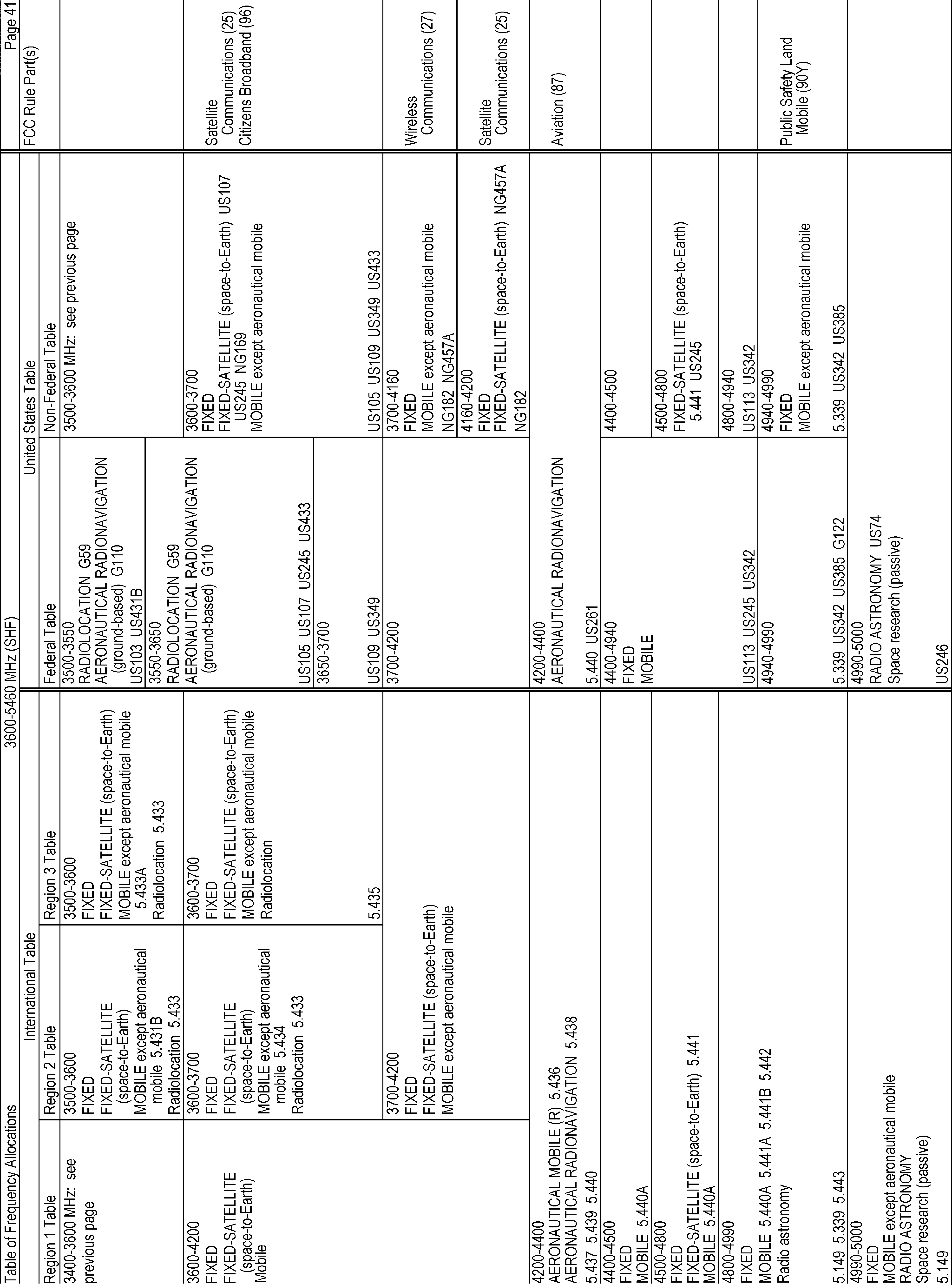
DATES:
The rules are effective September 29, 2026, except for instruction 7 (§§ 25.138(a) and (b)); instruction 8 (§ 25.147); instruction 17 § (27.14(x)(3)); instruction 26 (§ 27.1412(b), (c), (e), and (g); instruction 28 (§ 27.1413(a)(3), (c)(1), (c)(9), (e) and (f)); instruction 30 (§ 27.1414(e)); instruction 31 (§ 27.1415); instruction 32 (§ 27.1416); instruction 33 (§ 27.1417); instruction 35 (§ 27.1419); instruction 37 (§ 27.1421); instruction 39 (§ 27.1422(c)); and instruction 41 § 27.1424 of the Commission's rules, which contain new or modified information collection requirements that require review by the Office of Management and Budget (OMB) under the Paperwork Reduction Act and will not become effective until the effective date for those information collections is announced in a document published in the
Federal Register
after the Commission receives OMB approval. The Federal Communications Commission will publish a document in the
Federal Register
announcing the effective date of these rule sections.
ADDRESSES:
Federal Communications Commission, 45 L Street NE, Washington, DC 20554.
FOR FURTHER INFORMATION CONTACT:
Andrew McArdell of the Wireless Telecommunications Bureau, at
Andrew.McArdell@fcc.gov
or 202-418-1576.
SUPPLEMENTARY INFORMATION:
This is a summary of the Commission's Report and Order, Order of Proposed Modification, and Order on Reconsideration (
Order) in GN Docket Nos. 18-122 and 25-59, FCC 26-46, adopted on July 22, 2026 and released on July 24, 2026. The full text of this document is available for public inspection and can be downloaded at
docs.fcc.gov/public/attachments/FCC-26-46A1.pdf.
Synopsis
I. Background
A. Current Allocation and Use of the Upper C-Band and Adjacent Bands
1.
Upper C-band.
The 4.0-4.2 GHz portion of the Upper C-band is currently allocated for non-Federal use on a primary basis for FSS and Fixed Service (FS) links throughout the United States, but FS operations were sunset in the contiguous United States across the entire C-band as part of the Lower C-band transition. Space station operators use 4.0-4.2 GHz nationwide to provide space-to-Earth (
i.e.,
downlink) signals of various bandwidths to licensed transmit-receive, registered receive-only, and unregistered receive-only earth stations nationwide. These signals primarily deliver programming content to television and radio broadcasters throughout the country, as well as telephone, data, and satellite communications services to customers, including federal users, on a contractual basis. FS links only remain in use in 4.0-4.2 GHz outside of the contiguous United States.
2. The 3.98-4.0 GHz portion of the Upper C-band was reallocated as part of the Lower C-band transition in the contiguous United States, and it is reserved as a guard band to protect adjacent incumbent operations in the remainder of the Upper C-band from potential harmful interference. Outside of the contiguous United States, 3.98-4.0 GHz is allocated for and used by FSS and FS services.
3.
Lower C-band.
The adjacent Lower C-band (3.7-3.98 GHz) is allocated on a primary basis for non-Federal Fixed and Mobile, except aeronautical mobile, services in addition to FS service within the contiguous United States, although as a practical matter only flexible-use terrestrial wireless operations remain, given the earlier sunset of FS uses. Outside of the contiguous United States, the Lower C-band remains allocated for and used by FSS and FS.
4.
4.2-4.4 GHz.
The adjacent 4.2-4.4 GHz band is allocated in the United States on a primary basis for Federal and non-Federal Aeronautical Radionavigation Services for radio altimeters, which are aeronautical safety systems primarily used at altitudes under 2500 feet above ground level to measure aircraft height above terrain and obstacles in all phases of flight. The band is also allocated worldwide on a co-primary basis for wireless avionics intra-communications systems. These systems provide communications over short distances between points on a single aircraft and are not intended to provide air-to-ground communications or communications between two or more aircraft.
B. Procedural History
1. Lower C-Band
5. In the
2020 C-band R&O,
the Commission authorized flexible use terrestrial operations in the newly established 3.7 GHz Service in 3.7-3.98 GHz, reserved 3.98-4.0 GHz as a guard band, and migrated incumbent FSS operations into 4.0-4.2 GHz throughout the contiguous United States. To effectuate this transition and clear incumbent operations in the lower portion of the band, the Commission modified the licenses and market access authorizations of incumbent FSS
( printed page 48701)
operators, transmit-receive earth station licensees, and FS licensees. The Commission also assigned overlay licenses for the 3.7 GHz Service through an auction, and adopted service rules requiring those licensees to comply with certain part 27 licensing, operating, and technical rules to encourage efficient use of the spectrum and protect incumbent users both in-band and in adjacent bands.
6. The
2020 C-band R&O
required Lower C-band licensees to reimburse the reasonable relocation costs of eligible FSS space station operators, incumbent FSS earth station operators, and incumbent FS licensees, with a third-party Relocation Payment Clearinghouse (Clearinghouse) overseeing the cost-related aspects of the transition. The practical aspects of the FSS transition were managed by the eligible space station operators that were required to submit public transition plans and work with a Relocation Coordinator to ensure a timely and orderly process. The Commission established an ultimate deadline of December 5, 2025, by which the eligible space station operators were to have completed transitioning FSS operations to the upper portion of the band, and also provided incentives for an accelerated clearing process by allowing eligible space station operators to voluntarily commit to relocate on a two-phased accelerated schedule, with a Phase I deadline of December 5, 2021, and a Phase II deadline of December 5, 2023.
7. All five eligible space station operators elected accelerated relocation, subsequently met the respective Phase I and II deadlines, and became eligible for the designated accelerated relocation payments. As a result, the practical work of the transition was completed in 2023 and, subject to temporary, voluntary commitments on certain technical parameters that support the coexistence environment with adjacent band radio altimeters, Lower C-band licensees are now providing 5G service using these frequencies in markets throughout the contiguous United States. Residual cost-related aspects of the transition were effectively completed by June 2025, and the relocation cost reimbursement program officially ended as of August 21, 2025.
2. 2025 Upper C-Band Notice of Inquiry
8. In February 2025, the Commission issued the
Upper C-band NOI,
which outlined the successful lower band transition, the current state of allocations and services across the C-band, and the Commission's interest in exploring the potential for new services in the Upper C-band. The Commission solicited feedback on the appropriate parameters for additional opportunities for robust connectivity in the Upper C-band and asked commenters to identify how much spectrum in the Upper C-band could be repurposed for new uses. The Commission also sought comment on whether and how to amend the U.S. Table of Frequency Allocations to facilitate new opportunities in the band, either by aligning the Upper C-band's allocations with those in the Lower C-band or by taking a different approach. The
Upper C-band NOI
asked questions about the structure and mechanics of a potential transition to new operations in the Upper C-band, including whether to utilize some or all of the aspects of the Lower C-band transition, as a means to manage the practical and financial aspects of any new transition effort. The Commission also sought input on the appropriate service and technical rules for any new operations in the Upper C-band.
9. The
Upper C-band NOI
asked Upper C-band incumbents—including FSS space and earth station operators, content providers, and other contractual customers (including federal users) that rely on FSS services—about how the introduction of new services might affect their current and future operations in the band. The
Upper C-band NOI
also noted the proximity and sensitivity of the radio altimeter operations in 4.2-4.4 GHz, the steps that were taken to protect those operations in the
2020 C-band R&O,
and the technical work that has been undertaken in the years since that action. Recognizing the successful coexistence environment that has been fostered between the 3.7 GHz Service and radio altimeters at 4.2-4.4 GHz, the Commission requested further information regarding advancements in radio altimeter resiliency and sought comment on appropriate technical and service rules that would further promote coexistence in light of potential new operations in the Upper C-band. The Commission also sought comment on steps it could consider to promote connectivity in historically underserved areas, such as through a Tribal licensing window. The
Upper C-band NOI
generated a wide array of responsive comments from incumbent FSS operators, terrestrial wireless licensees in the Lower C-band, other wireless providers, content providers and other FSS customers, and aviation interests with adjacent band equities.
3. The One Big Beautiful Bill Act
10. Subsequent to the record closing in the
Upper C-band NOI
in July 2025, as part of the OBBB Act, Congress reinstituted the Commission's general authority to grant licenses through systems of competitive bidding through September 2034 and established a path forward for the eventual repurposing of 800 megahertz to be licensed through competitive bidding, including at least 500 megahertz for full-power commercial licensed use cases. The OBBB Act also specifically directed the Commission to “grant licenses through systems of competitive bidding, before the expiration of the general auction authority[,] . . . for not less than 300 megahertz, including by completing a system of competitive bidding not later than 2 years after the date of enactment of this Act for not less than 100 megahertz in the band between 3.98 gigahertz and 4.2 gigahertz.”
4. The Upper C-Band Notice of Proposed Rulemaking
11. In November 2025, the Commission issued the
Upper C-band NPRM,90 FR 56076, to fulfill the directive in the OBBB Act to auction licenses for terrestrial wireless flexible use of not less than 100 megahertz of the Upper C-band. Specifically, the Commission sought comment on options for reconfiguring some portion of the Upper C-band in the contiguous United States, ranging from 180 megahertz (3.98-4.16 GHz) to the congressionally mandated minimum of 100 megahertz (3.98-4.08 GHz) for terrestrial wireless use.
12. In doing so, the Commission noted that the maximum amount of spectrum to be reconfigured will depend on a number of factors, including how much Upper C-band spectrum could be repurposed by incumbent FSS space station operators; the economic benefits and costs of repurposing spectrum for terrestrial wireless; how that value could be affected by the amount of spectrum that is ultimately repurposed; the spectrum clearing timeline; and the capabilities of adjacent band radio altimeters that are expected to undergo upgrades to further enhance their signal rejection capabilities and bolster the existing successful spectral co-existence environment.
13. The
Upper C-band NPRM
indicated that, under any of the reconfiguration options, the baseline proposition is that the Commission would apply the existing Lower C-band rules to any newly authorized terrestrial wireless operations in Upper C-band. Any other rules and requirements, including those relating to the Upper C-band transition process, would be modeled to the greatest extent possible on those that applied to the Lower C-band transition. The Commission
( printed page 48702)
recognized, however, that certain modifications may be necessary in light of our experiences with the Lower C-band transition, along with the unique parameters of the Upper C-band and the band reconfiguration option that is ultimately adopted. The Commission sought comment on reconfiguration options generally, and specifically on a range of issues associated with repurposing some portion of the Upper C-band, including: (1) reallocation of the 4.0-4.2 GHz band; (2) competitive bidding procedures for an eventual auction; (3) licensing, operating, and technical rules for any new terrestrial wireless services; (4) the mechanism and process for transitioning incumbent FSS operations, including the use of an independent, third-party clearinghouse and a Relocation Coordinator; and (5) promoting co-existence with adjacent band radio altimeters. The Commission also sought comment on the feasibility of conducting a pre-auction or concurrent Tribal licensing window while satisfying our legal requirement under the OBBB Act to assign licenses in the Upper C-band through a system of competitive bidding by July 4, 2027.
14. In response to the
Upper C-band NPRM,
the Commission received 58 comments and 48 reply comments. As issues raised in responsive filings to the
Upper C-band NPRM
also implicated certain pending petitions for reconsideration of the
2020 C-band R&O,
the Wireless Telecommunications Bureau (WTB) subsequently sought to refresh the record for those petitions in light of the related Upper C-band submissions. Seven comments were received in response to the
Record Refresh PN.
II. Report and Order and Order of Proposed Modification
15. We conclude that auctioning licenses for 160 megahertz of the Upper C-band in 3.98-4.14 GHz for terrestrial wireless use in the contiguous United States best serves our congressional mandate under the OBBB Act, the public interest, and our policy goals. The OBBB Act reflects Congress' intent that we repurpose and clear “not less” than a minimum of 100 megahertz while potentially repurposing and clearing more. The record in this proceeding establishes that: (1) mid-band spectrum can help meet increasing demand for wireless data as well as support U.S. leadership in wireless connectivity; and, (2) as discussed in detail
infra,
incumbent FSS operators can clear more than 100 megahertz of the Upper C-band as part of an appropriately structured transition while maintaining substantially the same service. We agree. Given our continued belief that licensing C-band spectrum for terrestrial flexible use will lead to substantial economic gains, we will auction licenses for 160 megahertz in the Upper C-band, exceeding the OBBB Act's required minimum.
16. To introduce terrestrial wireless use in the Upper C-band, we add a primary non-Federal mobile, except aeronautical mobile, allocation to the 4.0-4.16 GHz band nationwide and remove the band's FSS allocation within the contiguous United States. We also adopt appropriate licensing and technical rules to govern these new terrestrial wireless operations, which will generally align the Lower and Upper C-bands and fold them into a single 3.7 GHz Service. Additionally, we establish a framework to relocate impacted incumbent FSS operations within the contiguous United States and, similar to the
2020 C-band R&O,
rely on the Commission's
Emerging Technologies
framework to require that Upper C-band licensees reimburse eligible FSS incumbents' reasonable and necessary transition costs and incentivize a timely FSS-operator led transition that corresponds with adjacent band radio altimeter retrofits required by FAA. Finally, in furtherance of FAA's radio altimeter retrofit requirement, and to ensure that new Upper C-band licensees may deploy on a predictable timeline, we establish rebates to support defined classes of eligible aircraft owners and operators with retrofitting their existing radio altimeters.
A. Reconfiguration and Allocation of the Upper C-Band
17. In the
Upper C-band NPRM,
the Commission sought comment on a range of options for reconfiguring a portion of the Upper C-band for terrestrial wireless services in the contiguous United States pursuant to our statutory remit under the OBBB Act. Those options ranged from the congressionally mandated minimum of 100 megahertz up to 180 megahertz, inclusive of all amounts in between. Some commenters ask specifically that we reconfigure 180 megahertz of spectrum; others encourage us to reconfigure as much as is technologically feasible. The incumbent space station operators that represent the vast majority of existing FSS C-band operations endorse the feasibility of reconfiguring 160 megahertz. Specifically, SES contends that reconfiguring no more than 160 megahertz is in the public interest by simplifying the transition, reducing the number of satellites required and services that need to be relocated, and enabling continued support for some C-band satellite downlink services. Eutelsat similarly notes it can support more fulsome repurposing options and still meet the needs of its customers. Others argue that we should reconfigure substantially less spectrum, in some cases asking that we auction licenses for no more than the statutory minimum of 100 megahertz, in deference to ongoing use of the Upper C-band by FSS customers, particularly for video content distribution.
18. Upon review of the record, we find that reconfiguring 160 megahertz of Upper C-band spectrum for terrestrial wireless uses in 3.98-4.14 GHz, plus a 20-megahertz guard band in 4.14-4.16 GHz, best serves our congressional mandate, the public interest, and our policy goals. Specifically, we find that reconfiguring this amount of spectrum strikes an effective balance between Congress' mandate that we auction licenses for no less than 100 megahertz of the Upper C-band with requests that we reserve sufficient C-band spectrum for incumbent FSS operations. As noted above, SES submits that reserving at least 40 megahertz in the Upper C-band for FSS downlink operations will serve the public interest by ensuring that meaningful C-band satellite services can continue to be provided, and Eutelsat believes that it can repurpose a similar amount of spectrum while continuing to meet its customers' needs. We discuss in greater detail
infra
the anticipated impacts that this reconfiguration will have on incumbent FSS C-band services and how, pursuant to our
Emerging Technologies
framework, we establish a transition process that will enable the continued provision of “substantially the same service” whether those services are further repacked within the Upper C-band or, as the largest eligible space station operators have proposed, certain services or links are migrated in whole or in part to other spectrum, such as the Ku-band. The Ku-band, also known as the “conventional” Ku-band, refers to the 11.7-12.2 GHz (space-to-Earth) and 14.0-14.5 GHz (Earth-to-space) bands. The extended Ku-band refers to the 10.95-11.2 GHz (space-to-Earth), 11.45-11.7 GHz (space-to-Earth), and 13.75-14.0 GHz (Earth-to-space) bands. Our reconfiguration approach is also sensitive to the importance of coexistence between advanced wireless services in the Upper C-band and nearby radio altimeters operating in the 4.2-4.4 GHz band by providing meaningful spectral separation between those operations. We therefore find that maintaining 60 megahertz of separation between new terrestrial wireless
( printed page 48703)
operations and the radio altimeter band will promote the efficient and predictable use of spectrum by supporting coexistence after the radio altimeter retrofit process is complete. This approach—along with other technical measures we adopt herein—will thus enable the rapid deployment of terrestrial wireless services in the Upper C-band. In this context we emphasize that making more mid-band spectrum available for advanced wireless services serves the public interest, all things being equal. Given our statutory mandate under the OBBB Act to make no less than 300 megahertz of non-federal spectrum available through competitive bidding by July 2034, we must be as aggressive as possible to meet that goal in a timely manner. We also recognize the synergistic value of aligning the Lower and Upper C-bands into a larger 3.7 GHz Service, which through channel aggregation will further amplify the value of every megahertz that we repurpose. In sum, we find that making an additional 160 megahertz of Upper C-band spectrum available for terrestrial wireless use in the contiguous United States will satisfy our congressional mandate, uphold the public interest, and meet our policy goals for the efficient use of spectrum.
19. Some commenters ask that we also reconfigure and auction Upper C-band spectrum outside of the contiguous United States. We decline to do so at this time, for reasons similar to those offered by commenting parties that oppose such expansion. Namely, as the Commission observed in the Lower C-band proceeding, “[l]ocations outside of the contiguous United States have a greater need for C-band services, particularly for the provision of services necessary for the protection of life and property—including telehealth, E911, and education services.” In light of the record, we find that this earlier determination remains true. We nonetheless recognize the disparity in mid-band spectrum available for terrestrial wireless services in the contiguous United States and outside of the contiguous United States, and we will continue to assess opportunities to address this gap after the Upper C-band auction.
20. Due to the complexity of the Upper C-band transition, at this time we defer consideration of proposals to add further advanced satellite operations to the C-band. We find that deferring consideration is prudent, in the public interest, and best serves our objective to swiftly enable a stable ecosystem of advanced wireless services across a wider swath of the C-band.
21. To implement our planned reconfiguration of the Upper C-band, we adopt rules that will enable terrestrial wireless operations in the contiguous United States throughout 3.98-4.14 GHz. Specifically, we add a primary non-Federal mobile, except aeronautical mobile, allocation to the 4.0-4.16 GHz band nationwide and remove the FSS allocation within the contiguous United States. We designate a 20-megahertz guard band at 4.14-4.16 GHz to foster coexistence with FSS operations that are repacked and remain in 4.16-4.2 GHz; this is in lieu of the guard band that previously occupied 3.98-4.0 GHz. While 4.14-4.16 GHz is now allocated to mobile services, except aeronautical, for flexible use, we decline to establish service rules in favor of its function as a guard band. We also decline to add a mobile allocation to the 4.16-4.2 GHz band reserved for primary FSS use at this time. The rules that we adopt today preserve the status quo outside of the contiguous United States. Figures 1 and 2 below demonstrate the post-transition allocations throughout the entire C-band in the contiguous United States and the rest of the United States, respectively.
Figure 1: Post-Transition 3.7-4.2 GHz Band Allocations in the Contiguous United States
Figure 2: Post-Transition 3.7-4.2 GHz Band Allocations Outside the Contiguous United States
22. As the Commission did in the
2020 C-band R&O,
we also modify footnote NG457A of the U.S. Table of Frequency Allocations, which describes the status of earth stations on vessels (ESVs) in the entire C-band, in order keep it consistent with our new band plan. NG457A will now limit the band where ESVs may be coordinated for up to 180 days to 4.16-4.2 GHz, rather than 4.0-4.2 GHz, because FSS will no longer have primary status below 4.16 GHz. As before, the addition of mobile services to and the deletion of FSS from 4.0-4.16 GHz in the contiguous United States make this update necessary.
( printed page 48704)
B. Auction of Upper C-Band Spectrum for Flexible Use
23. Similar to the
2020 C-band R&O,
we will hold an auction of licenses for 160 megahertz of the Upper C-band. Given the OBBB Act's requirement that we complete competitive bidding to grant licenses for spectrum in the Upper C-band by July 4, 2027, we find it appropriate to rely on established Commission auction rules and mechanisms to assign mid-band spectrum to the applicant that values it most highly to encourage the highest-value use of the spectrum, pursuant to statutory criteria that promote competition and other public interest goals.
1. Competitive Bidding Procedures
24. The Communications Act of 1934, as amended (Act) requires that we resolve any mutually exclusive applications for new flexible-use licenses in the Upper C-band through a system of competitive bidding. Given our experience successfully conducting auctions pursuant to the general competitive bidding rules set forth in part 1, subpart Q, of the Commission's rules, the
Upper C-band NPRM
proposed to conduct an auction for licenses in this band in conformity with those rules. The commenters that address this issue generally support the proposal, and we adopt it now. Specifically, we will use the part 1 rules governing competitive bidding design, designated entity preferences, unjust enrichment, application and certification procedures, payment procedures, reporting requirements, and the prohibition on certain communications between auction applicants. These rules provide a framework for the auction process and allow for the subsequent determination of specific auction procedures in the pre-auction process. Should the Commission subsequently modify its part 1 general competitive bidding rules, the modifications would apply here as well.
25.
Designated Entity Provisions.
In the
Upper C-band NPRM,
the Commission sought comment on whether to offer bidding credits to designated entities (DEs)—
i.e.,
small businesses and rural service providers—in any auction of licenses in the Upper C-band. Congress mandated that the Commission consider a number of objectives when adopting competitive bidding rules and ensure that DEs have the opportunity to participate in the provision of spectrum-based services, in part by considering the use of bidding preferences, such as bidding credits. Based on the Commission's prior experience using bidding credits in spectrum license auctions, we find that they are an effective tool to further this statutory objective.
26. We are not persuaded by arguments made by some commenters that the Commission's use of bidding credits in previous spectrum license auctions has been ineffective in achieving this mandate. Publicly available auction results from the past 10 years demonstrate that the Commission's DE rules offer
bona fide
DEs opportunities to participate in auctions, and therefore provide the opportunity for such entities to provide spectrum-based services. Specifically, in every spectrum license auction conducted since the Commission modified its generally applicable part 1 competitive bidding rules in 2015, the percentage of applicants qualifying to bid that were DEs has approached or exceeded 50%. The same is true for the percentage of winning bidders that were DEs. Notably, in three of those auctions, Auctions 1002, 105, and 108, the percentage of DEs among winning bidders approached 80%. These data demonstrate that, consistent with the Commission's statutory mandate, the Commission's use of bidding credits effectively ensures that small businesses and rural service providers are given the opportunity to participate in the provision of spectrum-based services. The opportunity these levels of participation demonstrate is not refuted by the number or price of the licenses won by small businesses and rural service providers. The bidding credit program seeks to ensure that the Commission promotes opportunities for such applicants, not to guarantee auction results for them.
27.
Small Businesses.
In the
Competitive Bidding Second Memorandum Opinion and Order,
the Commission stated that it would define eligibility requirements for small businesses on a service-specific basis, taking into account the capital requirements and other characteristics of each particular service in establishing the appropriate threshold. The Commission later reaffirmed this approach in the
Part 1 Third Report and Order
and again in the
Updating Part 1 Report and Order.
28. Consistent with the decision to consolidate the Upper and Lower C-bands into a single 3.7 GHz Service, we will apply § 27.1402(a) of the Commission's rules to any auction of Upper C-band licenses and use the same small business size standards and bidding credit percentages adopted for the Lower C-band. As such, for purposes of bidding credit eligibility in an auction of Upper C-band licenses: (1) a small business is defined as an entity that, together with its affiliates, its controlling interests and the affiliates of its controlling interests, has average gross revenues that are not more than $55 million for the preceding five years; and (2) a very small business is defined as an entity that, together with its affiliates, its controlling interests and the affiliates of its controlling interests, has average gross revenues that are not more than $20 million for the preceding five years.
29. Two commenters urge the Commission to adjust the gross revenue thresholds to account for inflation since their adoption in 2015. Those commenters do not provide a data-driven justification for why auctions of licenses for Upper C-band spectrum should be treated differently from other auctions for licenses likely to be used to provide 5G services. Based on the Commission's prior experience with bidding credits in spectrum auctions and the lack of sufficient justification in the record for using any proposed alternative approach, we are not persuaded that we should adopt small business size standards for Upper C-band spectrum that differ from those used in auctions for other 5G-ready services.
30. We will similarly apply the same bidding credit amounts that were used for the Lower C-band, providing qualifying “small businesses” with a bidding credit of 15% and qualifying “very small businesses” with a bidding credit of 25%, consistent with the standardized schedule in part 1 of our rules. This proposal, supported by RWA and WISPA, was modeled on the small business size standards and associated bidding credits that the Commission adopted for the Lower C-band and a range of other services. We believe that this two-tiered approach, which has been successful in the past, will provide small businesses with a simple, consistent, and predictable avenue for facilitating access to capital, thereby increasing participation and competition in an Upper C-band auction. Furthermore, this approach is consistent with our decision to align the Upper and Lower C-bands and consolidate them within a single, cohesive 3.7 GHz Service.
31. Finally, we decline to include the 35% bidding credit from our part 1 standardized schedule of bidding credits for entities with not more than $4 million in average annual gross revenues for the preceding five years. When determining the amount of bidding credits and who should be
( printed page 48705)
eligible for them, we take care to avoid “expanding the scope of DE benefits to a level that may incentivize gamesmanship.” The Commission's consistent use of the two largest DE business size standards and associated bidding credits outlined in its part 1 rules has facilitated the successful participation of many eligible small businesses in Commission auctions over the last decade, and has provided uniformity and predictability for DEs and other bidders as well. We are not persuaded by the limited record before us that Upper C-band spectrum is different in a way that warrants deviating from the rule frameworks that have governed previous auctions.
32. In all auctions of licenses likely to be used to provide 5G services in a variety of bands since the part 1 schedule of bidding credits was updated in 2015, the Commission has consistently used the small business size standards that we adopt today. The results from these auctions demonstrate that using the two larger size standards to assign bidding credits has provided a real opportunity for bidders claiming eligibility as small businesses to win licenses at auction to provide spectrum-based services. By adopting average annual gross revenue thresholds that are not too high, and thus not overly inclusive, we preserve the effectiveness of DE benefits for the
bona fide
small businesses that are intended to benefit from our DE rules.
33.
Rural Service Providers.
In the
Upper C-band NPRM,
the Commission also sought comment on a proposal to offer a bidding credit for rural service providers. The rural service provider bidding credit awards a 15% bidding credit to those that service predominantly rural areas and that have fewer than 250,000 combined wireless, wireline, broadband and cable subscribers.
34. Consistent with the Commission's findings in the
Updating Part 1 Report and Order
and its approach in the Lower C-band and other bands where spectrum is likely to be used to provide 5G services, we adopt our proposal to offer a 15% bidding credit to a rural service provider, as defined in § 1.2110(f)(4)(i) of the Commission's rules and subject to the bidding credit cap defined in § 1.2110(f)(4)(ii) of the Commission's rules. Those commenters that addressed this proposal generally supported extending bidding credits to rural service providers in an auction for licenses in the Upper C-band. Permitting bidders to claim a rural service provider bidding credit in an auction in this band will allow a wide range of service providers to compete more effectively for spectrum licenses in rural areas, and in doing so, will potentially increase the availability of 5G service in rural areas. Moreover, by offering a rural service provider bidding credit in the Upper C-band auction, we ensure that bidders across the entire 3.7 GHz Service are treated consistently, promoting equitable participation opportunities throughout both the Upper and Lower C-bands.
35. Some commenters propose increasing the bidding credit percentage for rural service providers, with one proponent specifically suggesting a 50% bidding credit. Another commenter proposes that instead of relying solely on bidding credits, the Commission should conduct a “reserve auction” for rural counties, either contemporaneously with the auction of 160 megahertz of repurposed spectrum or as a separate and distinct auction in late 2027. These commenters assert that recent Commission auctions have failed to assign spectrum licenses to rural service providers in a manner that satisfies the Commission's statutory mandate, and they argue that a 15% bidding credit does not provide rural service providers a meaningful opportunity to compete against nationwide wireless carriers with greater financial resources for high value mid-band spectrum.
36. We are not persuaded by these arguments. The Commission consistently has determined that § 309(j) of the Act does not require it to provide entities with generalized economic assistance or a path to assured success, but rather with the responsibility and the discretion to provide opportunities for small businesses and rural service providers, while preventing the unjust enrichment of ineligible entities. Accordingly, we find that the data provided by some commenters concerning the number of licenses rural service providers won in prior auctions is not indicative of whether the Commission is providing DEs with genuine opportunities to provide spectrum-based services. The statutory goal that requires the Commission to promote economic opportunity and competition by a wide dissemination of licenses cited by some commenters is “subject to a variety of reasonable interpretations,” and must be balanced against a number of competing statutory objectives, including the efficient and intensive use of spectrum. In striking that balance, the Commission must decide how much weight to grant particular policies when several are implicated in a single decision.
37. Following adoption of the rural service provider bidding credit in 2015, the Commission has uniformly offered it in all auctions of spectrum licenses likely to be used to provide 5G services. Significantly, the results from these auctions indicate that the bidding credit helps give rural service providers opportunities to participate in the provision of spectrum-based services. Moreover, the commenters advocating for an increase in the bidding credit percentage for rural service providers fail to demonstrate that the specific circumstances and characteristics of licenses in the Upper C-band warrant increasing the 15% bidding credit. Therefore, we are not persuaded by the sparse data in the record that Upper C-band services warrant a larger rural service provider bidding credit.
38. For the same reasons, we similarly decline to conduct CRWC's proposed rural “reserve auction” in lieu of just offering bidding credits. As discussed above, the Commission's experience demonstrates that offering the rural service provider bidding credit is a proven and efficient means of promoting rural participation in spectrum license auctions and enabling genuine competition while maintaining the integrity of the auction process. In contrast, CRWC's proposed “reserve auction” would introduce significant complexity and risk delay in the assignment of valuable mid-band spectrum. Moreover, offering a bidding credit enables rural service providers to compete fairly with all other participants, fostering competition in the auction and ensuring that spectrum is awarded to those who value it most, rather than conferring an exclusive advantage or guaranteed outcome to any class of bidder. Additionally, conducting a rural “reserve auction” would reduce the efficiency of the auction and could lead to fragmented, non-contiguous license areas that would complicate network deployment, increase coordination costs, and may conflict with the Commission's band plan and technical rules for the expanded 3.7 GHz Service. We are not persuaded by the record that conducting a “reserve auction” would benefit the public interest in any way that merits assuming the foregoing associated risks, especially given historical data demonstrating that the bidding credit enables rural service providers to effectively compete for spectrum licenses. Thus, we will apply the part 1 rural service provider bidding credit standard for the auction of licenses of Upper C-band spectrum as proposed in the
Upper C-band NPRM.
39.
Tribal Licensing Window.
Recognizing our legislative remit under the OBBB Act to assign licenses in the
( printed page 48706)
Upper C-band through a system of competitive bidding by July 2027, and mindful of our baseline proposition to mirror the Lower C-band transition to the greatest extent possible, we nonetheless sought comment on the viability of a pre-auction or concurrent Tribal licensing window in the
Upper C-band NPRM.
In so doing, we specifically noted key differences between the Upper C-band context and that in the 2.5 GHz band, where an earlier Tribal licensing window was held. For example, in the 2.5 GHz proceeding there was unassigned spectrum available in Alaska and Hawaii, and a pre-existing, mature equipment ecosystem to facilitate Tribal licensee deployments and use of that spectrum in the near term, neither of which exists in the Upper C-band.
40. In response, comments by the Navajo Nation and later filings by Tribal and other non-profit groups point to the 2.5 GHz band as a model for how a Tribal licensing window could be conducted concurrently with an auction and suggest that it would minimally affect an Upper C-band auction while at the same time allowing Tribes to deploy quickly. While we remain committed to exploring opportunities that promote connectivity in historically unserved or underserved areas including Tribal lands, we ultimately do not find that a Tribal licensing window is viable in the instant context as it differs from the 2.5 GHz band in several key respects.
41. First, in the 2.5 GHz proceeding there was no statutory mandate requiring the issuance of licenses through a system of competitive bidding, nor was there a set deadline for completing an auction. This flexibility afforded substantial time—specifically, 14 months—to prepare for and fully complete a Tribal licensing window pre-auction in the 2.5 GHz band, which was essential to finalize the scope of inventory available for competitive bidding and identify any potential encumbrances for potential bidders. In contrast, the OBBB Act requires us to issue licenses in the Upper C-band through a competitive bidding process, which a Tribal licensing window would largely not entail. Further, based on the Commission's experience in the 2.5 GHz proceeding, sufficient time does not exist here to enable completion of both a pre-auction Tribal licensing window and a system of competitive bidding by the July 4, 2027, statutory deadline, neither of which can commence until the instant rulemaking process is concluded. We also note that, because available spectrum inventory and potential encumbrances must be clearly established pre-auction to provide bidders with notice, and cannot fluctuate while the auction is underway, a Tribal licensing window that runs concurrently with a system of competitive bidding is not achievable in any context.
42. Another critical distinction between the 2.5 GHz and Upper C-band contexts involves our use here of the
Emerging Technologies
framework to facilitate the transition of incumbent FSS operations. This framework is predicated on incoming licensees paying for the reasonable and necessary transition costs of the incumbent services required to clear the relevant spectrum band, a requirement that we imposed in the Lower C-band transition as license conditions on new terrestrial wireless licensees based on each licensee's
pro rata
share of gross winning bids in the underlying auction. Modernization of the 2.5 GHz band did not require a similar clearing or cost allocation—the incumbents retained their existing licenses and the only spectrum available for the rural Tribal licensing window and eventual auction was that which was unassigned at the time. As set forth
infra,
pursuant to the
Emerging Technologies
framework and our prior Lower C-band transition precedent, we are once again requiring new Upper C-band terrestrial wireless licensees to cover their
pro rata
share of in-band transition costs, including on a PEA basis for incumbent earth stations. Were we to also adopt a Tribal licensing window for the Upper C-band, we note that it would present novel and complex questions on how to equitably allocate incumbent transition costs for PEAs where some or all of the service area was licensed to an entity that did not participate in the forthcoming auction. Those issues would be further compounded by the radio altimeter retrofit rebates that we also adopt
infra
in connection with the Upper C-band transition.
43. In addition to facing these challenges, the potential benefits of a Tribal licensing window in the Upper C-band would also differ significantly from, and be more modest than, the 2.5 GHz band. As noted in the
Upper C-band NPRM,
due to the importance of continued FSS satellite operations in Alaska and Hawaii, the exclusion of those areas from our Upper C-band reconfiguration to terrestrial wireless services would mean that unassigned spectrum over Tribal lands in those states would not be part of any Tribal licensing window, as was the case in the 2.5 GHz band. The exclusion of these areas—particularly Alaska, where nearly 50% of federally recognized Tribes are located—would greatly reduce the scope, scale, and number of potential participants in any such opportunity in the Upper C-band. While we acknowledge some potential benefit in a Tribal licensing window to Tribes in the contiguous United States, that benefit would be meaningfully diminished given the likelihood of deployment and operational challenges for both auction winners and potential Tribal licensees. While Public Knowledge suggests that Tribal lands would represent a small amount of the PEAs to be ultimately auctioned, we note that federally recognized Tribes have approximately 326 reservations across 25 states in the contiguous United States, in addition to numerous trust lands, many of which involve checkerboard and other non-contiguous land areas that can vary greatly in size. Excluding those land areas from the PEAs available at auction would create significant operational complications and potential encumbrances for both Tribal licensees and auction winners in terms of coordinating their operations. In states with significant Tribal land areas, such as Oklahoma, it could potentially exclude large portions of the state and certain PEAs from the auction in their entirety. In contrast, the 2.5 GHz band was already highly fragmented due to historic licensing policies and incumbencies, making a pre-auction Tribal licensing window less impactful for the overlay licenses available in Auction 108 which were already significantly encumbered.
44. We similarly recognize that an important consideration in favor of a Tribal licensing window in the 2.5 GHz band was the existence of a pre-existing, mature equipment ecosystem that eased the cost and difficulty of Tribal licensee deployments and enabled their use of the spectrum in the near term. That type of equipment ecosystem does not exist in the Upper C-band.
45. In sum, while the 2.5 GHz band Tribal licensing window reflected a novel approach to further expand Tribal access to licensed wireless spectrum, it was largely predicated on the unique circumstances present in that band at the time. In light of these distinguishing factors, as well as the statutory deadline and licensing requirements in the OBBB Act, we thus decline to adopt a Tribal licensing window in the Upper C-band. We nonetheless remain committed to exploring options and alternatives for increasing connectivity to Tribal and other unserved or underserved lands.
2. Licensing and Operating Rules
46. As proposed in the
Upper C-band NPRM,
we adopt licensing and operating rules that largely align new
( printed page 48707)
licenses in the Upper C-band with existing ones in the Lower C-band, which are already governed by part 27 of the Commission's rules. We find that this approach will harmonize terrestrial wireless operations across the entire C-band to create a single 3.7 GHz Service and help to facilitate rapid deployment of advanced wireless services nationwide. Commenters generally support this approach. As discussed
infra,
we generally extend rules that are applicable to part 27 services to the Upper C-band, including those relating to the assignment of licenses by competitive bidding, flexible use, regulatory status, foreign ownership reporting, compliance with construction notification requirements, renewal criteria, permanent discontinuance of operations, partitioning and disaggregation, and spectrum leasing. We likewise generally extend service-specific rules that already apply to terrestrial wireless operations in the Lower C-band, including eligibility, license term, and other licensing and operating rules, to the Upper C-band. With respect to performance requirements, we adopt a more forward-leaning approach in keeping with the accelerated timelines for all stakeholders involved in the Upper C-band transition.
a. Band Plan
47.
Block Size.
Consistent with our proposal in the
Upper C-band NPRM,
we adopt a block size of 20 megahertz. The record reflects broad support for 20-megahertz blocks. In particular, commenters note that a block size of 20 megahertz will match the Lower C-band's block size, thereby enhancing licensees' flexibility to tailor deployments across the entire C-band and supporting the broader equipment ecosystem. We agree and therefore decline to adopt a mix of block sizes, as some commenters propose. Accordingly, we will license eight 20-megahertz blocks—for a total of 160 megahertz—in 3.98-4.14 GHz based on the following channel plan:
48.
Spectrum Block Configuration.
We adopt our proposal for an unpaired spectrum block configuration based on record support as it will ensure continuity, spectral efficiency, and maximum flexibility for licensees across the entire C-band. It also is technology-neutral, enabling Time-Division Duplex (TDD) operations that have become increasingly prevalent in deployments of digital broadband networks. We therefore will auction licenses for the Upper C-band spectrum as unpaired 20-megahertz blocks, consistent with the band plan
supra.
49.
Use of Geographic Licensing.
As we have previously stated, geographic-area licensing provides flexibility to licensees, promotes efficient spectrum use, and facilitates the rapid assignment of licenses, utilizing competitive bidding when necessary. Many commenters expressly support the use of exclusive, geographic-area licensing in the instant context. Others broadly support harmonizing the licensing approach across the entire C-band, which by extension would include the use of exclusive, geographic-area licensing. We therefore will auction licenses for the Upper C-band spectrum using exclusive, geographic-area licenses.
50.
Geographic License Area.
Consistent with our proposal in the
Upper C-band NPRM,
we adopt Partial Economic Areas (PEAs) as the geographic license area for new Upper C-band licenses and will issue such licenses in the contiguous United States and District of Columbia. Many commenters agree that licensing by PEA will increase spectrum aggregation opportunities for advanced wireless services through a harmonized approach across the entire C-band. We agree, and decline to adopt smaller geographic license areas for the Upper C-band (or portions thereof) suggested by some commenters. Instead, consistent with the
2020 C-band R&O,
we continue to find that PEAs appropriately balance licensees' ability to provide service on a smaller, more localized basis or on a much larger geographic scale. The record supports this finding. Finally, while some commenters support licensing the Upper C-band in areas outside of the contiguous United States and District of Columbia, for the reasons explained
supra,
we decline to issue licenses outside of the contiguous United States. Therefore, we will license the Upper C-band only within the contiguous United States and the District of Columbia, consistent with our approach in the Lower C-band.
b. Application Requirements and Eligibility
51. Licensees in the Upper C-band must comply with the Commission's general application requirements. As proposed in the
Upper C-band NPRM,
we also adopt an open eligibility standard for licenses in the Upper C-band. CTIA contends that this approach will help “encourage auction participation to support 5G and beyond.” We agree, and find—as in the Lower C-band and other services—that open eligibility appropriately relies on market forces and will help to ensure efficient use of this spectrum. The open eligibility standard that we adopt does not affect citizenship, character, or other generally applicable qualifications that, under our rules, may apply to licenses for flexible use of the Upper C-band. Further, any person who has been, for reasons of national security, barred by any agency of the federal government from bidding on a contract, participating in an auction, or receiving a grant is ineligible to hold a license in the Upper C-band.
c. Mobile Spectrum Holdings
52. Consistent with our proposal in the
Upper C-band NPRM,
we will incorporate the 160 megahertz of spectrum that we make available in the 3.98-4.14 GHz range into our spectrum screen for case-by-case review of spectrum aggregation in secondary market transactions and post-auction license applications. We will add this 160 megahertz of spectrum to the screen once the Upper C-band auction closes.
53. In making this determination, we find that this spectrum is both suitable and available in the near term for mobile services. As discussed above, we are modifying the U.S. Table of Frequency Allocations so that mobile services will be permitted throughout this spectrum, and we find that this
( printed page 48708)
spectrum will be critical for the deployment of mobile and other advanced services. With respect to availability in the near term, while we acknowledge that licensees must clear incumbents from the band following the auction, we find it is “fairly certain” that the spectrum “will meet the criteria for suitable spectrum in the near term” once the auction closes given our transition schedule.
54. We decline to adopt a pre-auction spectrum aggregation limit for this band. Although OTI, Public Knowledge, and WISPA advocate for the adoption of such a limit based on prior Commission action in the 3.45 GHz band and the CBRS band, as well as general competitive concerns, we find, similar to the Commission's approach in the
2020 C-band R&O,
that, “[g]enerally, bright-line, pre-auction limits may restrict unnecessarily the ability of entities to participate in and acquire spectrum in an auction, and we are not inclined to adopt such limits on auction participation absent a clear indication that they are necessary to address a specific competitive concern.” OTI, Public Knowledge, and WISPA have not adequately raised a specific competitive concern to justify the imposition of pre-auction limits for this band. We agree with commenters that a post-auction, case-by-case approach will allow the Commission to review any spectrum aggregation concerns without unnecessarily restricting entities from acquiring spectrum to deploy advanced wireless services. Indeed, this case-by-case approach will allow the Commission to evaluate competitive effects based on actual auction outcomes rather than speculative assumptions. The Commission will conduct this case-by-case post-auction review to capture lessons learned from this auction and ensure that our auction policy decisions enhance market competition. We also agree with commenters that harmonizing the regulatory framework for the entire C-band may facilitate the rapid commercialization and deployment of this spectrum.
55. We will perform case-by-case review of the long form applications of the Upper C-band spectrum following the auction. We will use the same case-by-case review as we do for secondary market transactions, updated to account for the additional Upper C-band spectrum. We find that this review will create sufficient bidder certainty for the auction, consistent with section 309(j)(3)(E) of the Act.
d. License Term
56. As proposed in the
Upper C-band NPRM,
we adopt a 15-year license term from the date of issuance or renewal. Commenters that addressed this proposal support it, noting that a 15-year license term would promote consistency between the Lower and Upper C-band. We agree and, consistent with the
2020 C-band R&O
and
Upper C-band NPRM,
find that a 15-year license term will promote investment in the Upper C-band, given the clearing and relocation that must occur before terrestrial wireless operations can commence.
e. Performance Requirements; Renewal
57. Performance requirements play a critical role in ensuring that licensed spectrum does not lie fallow, and they are required for licenses that are issued through competitive bidding. The performance requirements that we adopt for the Upper C-band, as described
infra,
align with the overall rapid transition process we establish herein for this band and will ensure that licensees begin providing service to consumers in a timely manner. Given mid-band spectrum's critical role in today's spectral environment, we find that our approach will promote the public interest through an efficient deployment of new terrestrial wireless services in the Upper C-band.
58.
Performance Requirements.
We conclude that Upper C-band licensees must provide reliable signal coverage and offer service to at least: (1) 45% of the population in each license area no later than two years after the relevant Transition Deadline; and (2) 80% of the population in each license area no later than six years after the relevant Transition Deadline. These population-based coverage metrics match the Lower C-band's requirements for mobile and point-to-multipoint services. While the performance deadlines we adopt herein to meet these coverage metrics differ from those adopted for the Lower C-band and proposed in the
Upper C-band NPRM,
the Lower C-band performance deadlines ran from license grant and were designed to anticipate a lengthy transition to clear incumbent FSS operations before terrestrial wireless operations could commence. We observe that in practice the rapid speed of Lower C-band deployments reflects that a different, more forward-leaning approach is merited here. As proposed by wireless industry commenters, for Upper C-band the relevant performance timeframe will start at the relevant Transition Deadline, which is when Upper C-band licensees are able to access the reconfigured and cleared spectrum in that PEA. In light of the transition timeline prior to those dates, there is no need for a lengthy lead time prior to the interim performance deadline, particularly as many new Upper C-band licensees are likely to have existing Lower C-band deployments which can be leveraged in this context. Given the expected desirability of Upper C-band spectrum, we anticipate that new Upper C-band licensees will begin deploying facilities and constructing their networks in advance during the transition process, as was the case during the Lower C-band transition, so that they can commence operations as soon as possible after the relevant Transition Deadline.
59. We expect robust and meaningful utilization of the Upper C-band that is commensurate with significant efforts by the U.S. government, aviation industry, and FSS stakeholders to repurpose the spectrum, and consistent with the Commission's ongoing efforts to ensure that spectrum is deployed promptly for the benefit of American consumers. In the Lower C-band context, carrier deployments have largely focused on the provision of 5G and other advanced mobile broadband services to consumers and enterprises. For these reasons, for the Upper C-band we decline to adopt alternative performance requirements for Internet of Things or fixed point-to-point operations, nor will we consider private internal operations in demonstrating buildout compliance. Under our flexible-use policies, licensees may still conduct these types of operations in the Upper C-band, but they will not be options for meeting a licensee's performance requirements as they were in the
2020 C-band R&O.
We find that the performance requirements we adopt herein will provide certainty for licensees, ensure investment, and encourage timely deployment of services that best serve the public interest, in furtherance of the United States' wireless policy goals.
60.
Penalty for Failure to Meet Performance Requirements.
We adopt meaningful, enforceable penalties for licensees that fail to meet the performance requirements. Specifically, if a licensee fails to meet the first performance benchmark (
i.e.,
providing reliable signal coverage and offering service to at least 45% of the population in the license area no later than one year after the relevant Transition Deadline), it will accelerate its second performance benchmark by one year. If a licensee fails to meet the second performance benchmark (
i.e.,
providing reliable
( printed page 48709)
signal coverage and offering service to at least 80% of the population in the license area no later than five years after the relevant Transition Deadline) in any license area, its authorization for that particular license area will terminate automatically without Commission action. Although the penalty for missing the first performance benchmark differs from what the Commission adopted in the
2020 C-band R&O
and proposed in the
Upper C-band NPRM,
we reiterate that the performance requirement deadlines are tied to the relevant Transition Deadline, as wireless interests request. We therefore expect that Upper C-band licensees will work and plan in advance to commence their operations as soon as possible after the transition, and the penalties that we adopt reflect that expectation.
61.
Compliance Procedures.
For both performance benchmarks, we will require all Upper C-band licensees to follow the compliance procedures applicable to all part 27 licensees, including the filing of electronic coverage maps and supporting documents. As part of these requirements, we adopt our proposals that electronic coverage maps must accurately depict: (1) the boundaries of each license area and the coverage boundaries of the actual areas to which the licensee provides service; and (2) if a licensee does not provide reliable signal coverage to its entire license area, the boundaries of the area(s) within each license area not being served. Supporting documentation must include the assumptions used to create the coverage maps, including the propagation model and signal strength necessary to provide reliable coverage and offer service with the licensee's technology. No commenters opposed these requirements, and we find that these compliance procedures will encourage timely, robust deployment of Upper C-band spectrum, consistent with our goals in this proceeding.
62.
License Renewal.
As proposed, and with record support, we will apply the general renewal requirements applicable to all Wireless Radio Services (WRS) licensees to Upper C-band licensees. We find that applying these requirements will promote consistency across the Upper and Lower C-band as well as other WRS.
63.
Renewal Term Construction Obligation.
In applying our general WRS renewal requirements, each Upper C-band licensee will be required to comply with § 1.949 of our rules by demonstrating that, over the course of its license term, it provided and continues to provide service to the public. Licensees can demonstrate compliance either through the renewal showing in § 1.949(f) or the relevant safe harbor in § 1.949(e)(2). Absent record feedback to the contrary, we find that applying these requirements to the Upper C-band will help promote the continued deployment of next-generation wireless technologies.
3. Technical Rules
64. We find that the technical rules we adopt herein will encourage maximum potential use of the Upper C-band for next-generation wireless technologies, encourage efficient use of spectrum resources, and promote investment in the Upper C-band while protecting any residual incumbent users in the band and promoting coexistence with operations in adjacent bands. Consistent with our proposals in the
Upper C-band NPRM,
the technical rules are generally aligned with the rules applicable to the Lower C-band with a view towards the creation of a single 3.7 GHz Service, although we make certain modifications herein that are applicable across the entire C-band to reinforce a successful co-existence environment with adjacent band radio altimeters. We believe that this approach will produce significant economies of scale, improve affordability for consumers, encourage rapid operational expansion, and facilitate deployment of high-powered terrestrial wireless networks in the band. As described in greater detail below, we deviate from this approach only with regard to antenna height limits due to specific technical and operational considerations unique to the Upper C-band.
a. Power Levels
65.
Power Limits for Fixed and Base Stations.
As proposed in the
Upper C-band NPRM,
we will allow fixed or base stations in non-rural areas to operate at power levels up to 1640 watts per megahertz EIRP and base stations in rural areas to operate at power levels up to 3280 watts per megahertz EIRP. We therefore apply §§ 27.50(j)(1)-(2) and (4)-(5) of the Commission's rules to both fixed and base stations operating in the Upper C-band. This approach is consistent with the power limits adopted by the Commission for the Lower C-band and other broadband mobile services in nearby bands (3.45 GHz, AWS-1, AWS-3, AWS-4, and PCS). The record supports our proposed approach for this reason and also reflects that these power limits will align with adjacent band radio altimeter operations. We agree and find that these power limits will: (1) provide licensees with the ability to optimize their system designs to provide wide area coverage without sacrificing the flexibility needed to address coexistence issues with FSS operations; and (2) promote investment in the Upper C-band, thereby facilitating the rapid and robust deployment of next-generation wireless networks, including 5G. Finally, because advanced antenna systems often have multiple radiating elements in the same sector, we clarify that the power limits we adopt apply to the aggregate power of all antenna elements in any given sector of a fixed or base station.
66.
Power Limits for Mobile and Portable Devices.
While the
Upper C-band NPRM
proposed a power limit of 1 Watt EIRP for all mobile devices, commenters note that a 4 Watt power limit will improve user equipment (UE) coverage and throughput for fixed wireless services (
e.g.,
in-home broadband). Additional comments in response to the
Record Refresh PN
reinforce this support, suggesting that a modest increase in UE power levels to 4 Watt EIRP across the entire C-band will expand competitive fixed wireless offerings and align C-band UE devices with other existing in-home UEs. These comments note that handsets would not be impacted, as all C-band mobile and portable devices “must employ a means for limiting power to the minimum necessary for successful communications” and must independently comply with the Commission's radiofrequency (RF) exposure limits. Cable and other fixed wireless providers using spectrum below the 3.7 GHz band edge have recently expressed inchoate concerns about the potential for interference to Citizens Broadband Radio Service (CBRS) client devices near the band edge from higher-powered UE in the Lower C-band. In response, CTIA disputes any potential degradation to CBRS and notes that the operational parameters of existing CBRS indoor base stations permit equivalent transmit power to the 4 Watt mobile EIRP. Also, CTIA provides that extension of the existing OOBE limit applicable to the C-band effectively negates any potential for interference.
67. We find that an increased power limit for mobiles and portables across the C-band would facilitate more innovative, efficient uses of valuable mid-band spectrum and align C-band UE devices with other existing in-home UEs that operate within similar parameters, given the shifts in consumer uses and technology advancements since adoption of the
2020 C-band R&O.
The detailed record in the instant proceeding reflects a shift both in
( printed page 48710)
expanded consumer use of, and need for, more extensive fixed wireless uses, as well as a disparity between the operational parameters of existing C-band UEs and other types of in-home UE devices, such as Wi-Fi routers. We reiterate that, as a practical matter, this will not impact the existing operation of handsets, which like all C-band mobile and portable devices must limit power to the minimum level necessary for successful communications and adhere to our radiofrequency exposure limits. While cable and other CBRS stakeholders have been active participants in this proceeding since the initial comment stage, to date they have not outlined detailed concerns with, or presented any specific analysis of, the potential impacts on CBRS operations of an increased power limit for UEs in the adjacent Lower C-band. To the extent that their recent advocacy has focused on CBRS operational issues, it explores pre-existing uplink performance issues without any causal linkage to Lower C-band UE devices (
i.e.,
that could be caused by other factors, including in-band interference from 3.5 GHz Service PAL licensees given the use of non-3GPP compliant devices by CBRS operators). Nonetheless, out of an abundance of caution, we will proceed with a more incremental increase in the power limit for mobile and portable devices in the Upper C Band—from 1 Watt EIRP to 2 Watt EIRP—to support these specific types of in-home UE. To create consistency between the Upper and Lower C-band, as indicated in the
Record Refresh PN,
we will apply the same power limits throughout the 3.7-4.14 GHz band. For the reasons explained
infra,
we also retain the applicable OOBE limit governing all mobile and portable devices.
b. Out-of-Band Emissions
68.
Fixed and Base Station Out-of-Band Emissions.
Based on the totality of the record before us, we adopt fixed and base station out-of-band emission (OOBE) requirements for the Upper and Lower C-band that differ from those previously adopted in the
2020 C-band R&O.
We observe that the record in response to the
Upper C-band NPRM
and the
Record Refresh PN
reflects a variety of views on whether OOBE limits throughout the C-band should be set using an equivalent isotropically radiated power (EIRP)-based standard or a conducted power limit, as was previously adopted for the Lower C-band. Further, since 2023 wireless licensees in the Lower C-band have voluntarily adhered to a conducted limit on spurious emissions into 4.2-4.4 GHz of −48 dBm/MHz. Subsequent to the
Record Refresh PN,
CTIA proposed a compromise OOBE limit into the 4.2-4.4 GHz band of either an EIRP level of −28.4 dBm/MHz, or a conducted power level of −46 dBm/MHz applicable to both Lower and Upper C-band wireless operations.
69. We adopt the option-driven approach advocated by CTIA to OOBE compliance for emissions into the adjacent 4.2-4.4 GHz band, which we will harmonize for both Upper and Lower C-band terrestrial wireless operations. Wireless licensees in both the Lower and Upper C-band may comply with an OOBE limit into the 4.2-4.4 GHz band of
either
an EIRP level of −28.4 dBm/MHz, or a conducted power level of −46 dBm/MHz. Given that existing Lower C-band deployments have voluntarily complied with a −48 dBm/MHz conducted limit since 2023, we anticipate that application of this new rule will have no practical impact on such deployments, effectively grandfathering them. As with our technical rules generally, this “either or” framework for OOBE compliance reflects close coordination with complementary decisions adopted by FAA, and aligns with assumptions made in the FAA's safety analysis for adjacent band radio altimeter operations. The relevant OOBE limit into other spectrum bands will remain at a conducted power level of −13 dBm/MHz. We find that adoption of these alternative OOBE requirements across the C-band will promote ongoing coexistence with post-retrofit radio altimeters without any additional measures in place.
70.
Mobile and Portable Out-of-Band Emissions.
As proposed in the
Upper C-band NPRM,
we adopt a mobile and portable OOBE limit that is consistent with the service rules adopted for the Lower C-band. Commenters that addressed this proposal generally support its extension to new operations in the Upper C-band. As noted by CTIA, this is a well-established limit that we have previously found to be “widely accepted as being adequate for reducing unwanted emissions into adjacent bands.” Specifically, we will require mobile and portable units to suppress their conducted emissions to no more than −13 dBm/MHz outside their authorized frequency band,
i.e.,
at the authorized channel edge as measured at the antenna terminals. We also adopt the same measurement procedure as we adopted for the Lower C-band where a narrower resolution bandwidth can be used to measure the OOBE limits in the spectrum immediately adjacent to the channel edge. For emissions within 1 megahertz from the channel edge, the minimum resolution bandwidth would be either one percent of the emission bandwidth of the fundamental emission of the transmitter or 350 kilohertz. In the bands between one and five megahertz removed from the licensee's authorized frequency block, the minimum resolution bandwidth would be 500 kilohertz. We find that this approach will promote consistency between mobile 5G deployments in C-band as well as various other bands and will not increase the potential for OOBE to cause harmful interference.
71.
Other OOBE Limit Issues.
We adopt our proposal to otherwise model our approach to OOBE issues based on that used in the Lower C-band transition, subject to the OOBE emissions limits adopted herein. No commenting party opposes this approach. In specific, we extend § 27.53(i) to the Upper C-band, which provides that the Commission may, in its discretion, require greater attenuation than specified in the rules if an emission outside of the authorized bandwidth causes harmful interference. We find that this approach will further harmonize wireless operations across the entire C-band.
c. Antenna Height Limits
72. Based on the record received in response to the
Upper C-band NPRM,
we adopt an antenna height limit for 3.98-4.14 GHz wireless operations of no greater than 450 feet above ground level. In order to foster coexistence between radio altimeters operating at 4.2-4.4 GHz and terrestrial wireless operations in the Upper C-band, aviation and wireless industry stakeholders submitted a number of filings to the record explaining that they have reached a cross-industry consensus on this antenna height limit for such wireless operations. No commenting party opposes this consensus limit. We therefore depart from the Commission's proposal not to impose restrictions on antenna heights for Upper C-band operations. Rather, we find that an antenna height limit of 450 feet above ground level for Upper C-band wireless operations is reasonable, supported by the record before us, and in the public interest.
d. Service Area Boundary Limit
73. As proposed in the
Upper C-band NPRM,
we adopt the −76 dBm/m2
/MHz power flux density (PFD) limit at a height of 1.5 meters above ground at the border of the licensees' service area boundaries. We also permit licensees operating in adjacent geographic areas to voluntarily agree to higher levels at their common boundaries. Commenters that addressed these proposals,
( printed page 48711)
including AT&T, CTIA, Ericsson, and Verizon, support the −76 dBm/m2
/MHz PFD limit in this context given that it currently applies to operations in both the Lower C-band and Upper Microwave Flexible Use Service bands. Commenters further indicate that it is sufficient to protect geographically adjacent licensees from co-channel interference in the Upper C-band as well. We agree and also note that this metric is straightforward to calculate or measure and also scales with channel bandwidth to provide licensees flexibility for demonstrating compliance.
e. International Boundary Requirements
74. We adopt our proposal to apply § 27.57(c) of our rules, which requires all part 27 operations—including those in the Lower C-band—to comply with international agreements for operations near the Mexican and Canadian borders. Commenters that specifically address this proposal support its extension to new operations in the Upper C-band. We concur, recognizing that under this provision, new operations in the Upper C-band must not cause harmful interference across the border, consistent with the terms of the agreements currently in force. We note that modification of the existing rules might be necessary in order to comply with any future agreements with Canada and Mexico regarding the use of any subject bands.
f. Other Part 27 Rules
75. As proposed in the
Upper C-band NPRM,
we will apply several additional technical rules that are currently applicable to all part 27 services, including § 27.51 (Equipment authorization) and part 1, subpart BB of the Commission's rules (Disturbance of AM Broadcast Station Antenna Patterns), for new terrestrial wireless operations in the Upper C-band. We find that these rules implement important safeguards for all wireless services to ensure that devices meet RF safety limits, minimize the potential for causing harmful interference to other operations, and create consistency with the Lower C-band. Commenters that addressed this issue support this approach.
76. As the Commission has done for other part 27 services since 2014, we also require that new client devices be capable of operating across the entire C-band. Specifically, we extend § 27.75 to include 3.98-4.14 GHz, which requires mobile and portable stations operating in certain AWS-3 bands, the 600 MHz band, the Lower C-band, and 3.45 GHz band to be capable of operating across each relevant band using the same air interfaces that the equipment uses on any frequency in the relevant band. This requirement does not require licensees to use any particular industry standard. The record in response to the
Upper C-band NPRM
supports this approach, with the proviso that Lower C-band mobile and portable stations that cannot be upgraded to operate in the 3.98-4.14 GHz band are grandfathered. We agree that this requirement will be prospective in nature, and that Lower C-band mobile and portable stations that have received equipment authorization prior to December 31, 2030, but that cannot be upgraded to operate in the 3.98-4.14 GHz band will be permitted to remain in service for the remainder of their useful life without a requirement to operate in the 3.98-4.14 GHz band. Thus, starting December 31, 2030, all new mobile and portable stations (other than pre-December 31, 2030, devices that cannot be upgraded) must be interoperable across the entire band. Although the deadline is December 31, 2030, interoperable equipment will be eligible for equipment authorization as of the effective date of these rules.
g. Protection of Incumbent FSS Earth Stations
77. As proposed in the
Upper C-band NPRM,
for post-transition FSS operations that remain in 4.16-4.2 GHz, we will incorporate and extend the incumbent protection measures that govern terrestrial wireless operations in the Lower C-band to new terrestrial wireless operations in the Upper C-band. Commenters that address this proposal support it. Therefore, to protect incumbent earth stations from out-of-band emissions, we require that all emissions from fixed stations, base stations, and mobile and portable stations operating in the C-band comply with a PFD limit of −124 dBW/m2
/MHz in 4.16-4.2 GHz, as measured at the incumbent earth station antenna. In order to protect incumbent earth stations from receiver blocking, we will also extend the PFD limit of −16 dBW/m2
/MHz to emissions within 3.98-4.14 GHz, as measured at the incumbent earth station antenna. Once the instant transition is complete, all remaining incumbent earth stations will operate above 4.16 GHz, and we will allow full band/full arc use of their authorized band of operation.
h. Protection of TT&C Earth Stations
78. Based on the record received in response to the
Upper C-band NPRM,
we adopt our proposals to maintain and apply existing co-channel and adjacent channel protection measures to safeguard existing Telemetry, Tracking, and Command (TT&C) operations throughout the C-band. During the Lower C-band transition, incumbent space station operators were required to identify and consolidate their TT&C operations within the contiguous United States by December 5, 2021, and the Commission determined that it would not authorize any new TT&C operations elsewhere in the contiguous United States, except to facilitate that consolidation. TT&C operations are protected at the consolidated locations until December 5, 2030; after that date TT&C operations may continue in the C-band on an unprotected basis until the satellites they are communicating with cease operation. The Commission also authorized negotiated agreements for longer operation and private negotiation of TT&C sites between TT&C station operators and new terrestrial wireless licensees, either to permit early entry of wireless operations or to prolong TT&C operations in instances where these operations are designed to coexist. Earth stations located at the consolidated TT&C sites are also allowed to use the 3.7-4.0 GHz band for international gateway and other purposes on an unprotected basis until 2030, or longer if agreements can be negotiated with terrestrial wireless operators, so long as they do not cause harmful interference to terrestrial deployments in the band.
79. The record received in response to the
Upper C-band NPRM
reflects ongoing support for the existing TT&C protection measures at the consolidated locations until December 5, 2030, which will remain in place until that time, and does not identify any additional TT&C sites that are active in the Upper C-band. Several parties nonetheless advocate for the Commission to adopt new safeguards for unprotected fixed earth stations at the designated TT&C locations, non-TT&C gateways, and teleports in other locations, or to extend TT&C protections beyond 2030. Based on the record before us, we see no reason to modify the Commission's earlier decisions with respect to unprotected gateway and other fixed earth stations at the consolidated TT&C sites, particularly given their remote locations, or to extend the TT&C protection timeline, and accordingly we find once again that coordination and negotiation between the relevant FSS operators and wireless licensees on this issue best serves the public interest for potential operations beyond the 2030 timeframe. We also decline to adopt new protections for teleport or gateway sites in locations apart from the consolidated TT&C locations, which
( printed page 48712)
would disrupt existing and future wireless deployments and run counter to the Commission's earlier decision to consolidate TT&C sites and limit protections to those necessary to facilitate the Lower C-band transition.
80.
Co-channel Protection Criteria.
As proposed in the
Upper C-band NPRM,
we will maintain and apply the existing co-channel protection criteria to protect TT&C sites throughout the C-band. Commenters who address this proposal generally support it. Co-channel operations are defined as when any of the terrestrial licensee's authorized frequencies are separated from the center frequency of the TT&C earth stations by less than 150% of the maximum emission bandwidth in use by the TT&C operation. In the
2020 C-band R&O,
the Commission required that new terrestrial wireless licensees ensure that the aggregated power from their operations met an interference to noise ratio (I/N) of −6 dB as received by the TT&C earth station. The Commission also required new terrestrial wireless licensees to coordinate their co-channel operations with incumbent TT&C earth stations within a 70 km radius. Terrestrial wireless licensees with base stations located within the coordination distance must provide upon request an engineering analysis to the TT&C operator to demonstrate their ability to comply with the I/N requirement. The protection criteria only apply to the frequencies, bandwidths, and look angles in use at each TT&C site, not full band or full arc.
81.
Adjacent Channel Protection Criteria.
Consistent with the proposals in the
Upper C-band NPRM,
we will also extend in this context the existing criteria to protect TT&C sites from adjacent channel interference due to out-of-band emissions. Specifically, aggregated power from adjacent terrestrial wireless operations must meet a −6 dB I/N ratio, and the limit will apply to all emissions removed from the TT&C earth station's center frequency by more than 150% of the TT&C's necessary emission bandwidth. In addition, while new terrestrial wireless licensees and TT&C earth station operators need not engage in prior coordination, they are expected to cooperate in good faith and make reasonable efforts to anticipate and resolve technical problems that may inhibit effective and efficient use of the spectrum. TT&C earth station operators are also expected to make available pertinent technical information about their systems upon request by new terrestrial wireless licensees, and licensees of stations suffering or causing harmful interference are expected to cooperate and resolve the problem by mutually satisfactory arrangements.
82. In addition, as proposed in the
Upper C-band NPRM,
we require a PFD limit of −16 dBW/m2
/MHz, as measured at the TT&C earth station antenna, to protect against potential receiver overload. This blocking limit applies to all emissions within the new terrestrial wireless licensee's authorized band of operation. All TT&C earth stations will be protected based on the assumption that robust filters have been installed at the facilities, like other incumbent FSS earth stations. TT&C filter quality must provide a minimum of 60 dB of rejection, and the frequency at which the filter must meet this 60 dB of rejection will vary with the bandwidth. TT&C filters must meet 60 dB of rejection for all frequencies removed from the center frequency by more than 150% of the TT&C's emission bandwidth, both above and below the channel, and the filter must provide 70 dB of rejection for all frequencies removed from the TT&C's center frequency by more than 250% of the TT&C's emission bandwidth, both above and below the channel. In the event of a claim of harmful interference, the earth station operator must demonstrate that they have installed a filter that complies with the mask described above, and if they have not installed such a filter or are unable to make such a demonstration, and the new terrestrial wireless licensee can confirm it meets the PFD, the TT&C operator would have to accept the interference.
i. Other Matters
83. In the
Upper C-band NPRM,
we noted earlier comments filed by NTIA detailing radio astronomy sites that conduct observations in the C-band. These radio astronomy sites carry out their observations on an opportunistic basis (
i.e.,
with no primary allocation); they therefore enjoy no protection from harmful interference. We nevertheless observe that certain coordination processes do presently apply to new or modified fixed stations within the National Radio Quiet Zone, which is home to some radio astronomy operations. Several commenters characterize other radio astronomy sites as small in number and situated in remote locations where their isolation mitigates interference. As such, we decline to adopt formal protections or coordination procedures designed to protect radio astronomy service operations.
C. The Transition of FSS Operations
84. Consistent with our long-standing precedent, and as proposed in the
Upper C-band NPRM,
we will again use our
Emerging Technologies
framework to facilitate the swift transition of an additional 160 megahertz of spectrum for terrestrial wireless use in the contiguous United States in furtherance of the OBBB Act's mandate. While we broadly model the forthcoming transition of incumbent FSS operations in 4.0-4.16 GHz on the framework used in the
2020 C-band R&O,
we also refine and tailor our approach based on input from stakeholders that were involved in the Lower C-band transition, as well as the specific Upper C-band transition proposals advanced in the instant record.
1. Definition of Incumbent FSS Operations
85. In order to promote a timely and efficient transition process, we adopt our proposals in the
Upper C-band NPRM
to employ the same definitions used in the
2020 C-band R&O
to establish the scope of incumbent FSS space station and earth station operations for the Upper C-band transition. The relevant classes of incumbents will be eligible for reimbursement of their reasonable and necessary FSS C-band transition costs consistent with our
Emerging Technologies
precedent, as well as interference protection for those incumbent earth stations that remain in the Upper C-band. Identification of these incumbent FSS operations is once again intended to provide clarity about the transition process and inform auction bidders about the costs they will incur as a condition of their license. While we recognize that certain commenters seek a broader interpretation of incumbency, we find such an expansion to be unnecessary given we are mirroring the Lower C-band transition, in which eligible space station operators led the process, and the result was an efficient and effective transition.
86.
Incumbent Space Station Operators.
As a general matter, for purposes of the Upper C-band transition, we proposed to use the same baseline definition of incumbent space station operators as for the Lower C-band, while accounting for any changes in the legal or operational status of those entities in the intervening time period. The Commission determined in the Lower C-band context that “incumbent space station operators” whose authorizations would be impacted generally include all space station
( printed page 48713)
operators authorized to provide C-band service to any part of the contiguous United States pursuant to a Commission-issued license or grant of market access as of June 21, 2018. That was the date on which certain new space station applications in the C-band were frozen to preserve the landscape of authorized operations in the 3.7-4.2 GHz band. Today, the remaining entities that qualify under this definition are: Empresa, Eutelsat, Hispasat, SES, and Telesat.
87. More specifically for transition cost reimbursement purposes, the
Upper C-band NPRM
sought comment on repurposing the Lower C-band definition of an “eligible space station operator” as an incumbent space station operator that has demonstrated as of February 1, 2020, that it has an existing relationship to provide service via C-band satellite transmission to one or more incumbent earth stations in the contiguous United States. Today, the remaining entities that qualify under this definition and continue to provide service to one or more incumbent earth stations within the contiguous United States are: Eutelsat, SES, and Telesat. In light of record support, we adopt our proposed repurposing of the Lower C-band definitions for incumbent and eligible space station operators in the instant context.
88.
Incumbent Earth Stations.
The
Upper C-band NPRM
also sought to employ the earlier Lower C-band definition of incumbent earth stations, using the most recently released incumbent earth station list from the Lower C-band transition as the baseline going forward. The Commission previously defined “incumbent earth stations” in the Lower C-band context to include fixed and temporary fixed earth stations that were operational as of April 19, 2018, and that: (1) continue to be operational; (2) were licensed or registered in the IBFS (now ICFS) database on November 7, 2018; and (3) timely certified the accuracy of the information on file with the Commission by May 28, 2019. As with space stations, a freeze on the filing of new or modified earth station applications throughout the entire C-band was issued on April 19, 2018—the qualifying date for incumbency—and the freeze remains in place. During and subsequent to the Lower C-band transition, Commission staff periodically updated its list of incumbent earth stations found to qualify under these criteria, the most recent of which was issued on November 19, 2025.
89. Although the vast majority of earth station operators successfully registered with the Commission and satisfied our requirements to qualify as eligible incumbents for purposes of the Lower C-band transition, some earth station operators, whose C-band earth stations are unregistered or were otherwise previously found ineligible as incumbents for Lower C-band purposes, seek a lift of the freeze or other relief to qualify those facilities as incumbents for the Upper C-band transition. In addition, other earth station operators seek incumbent status for earth stations that have been expanded or relocated since the Lower C-band transition. On balance, however, we find that the public interest benefits of continuity and administrative efficiency that result from restarting where the Lower C-band transition left off in terms of the relevant scope of incumbent earth stations outweighs any potential change in course at this point in time. Both before and after the Lower C-band proceeding, the Commission's process for establishing incumbency and determining the list of incumbent earth stations—including providing notice to interested parties, establishing (and later, extending) the filing window to register, providing opportunity to review and correct the preliminary list with more than 17,000 entries, and resolving waiver requests—was a lengthy process that involved significant Commission resources. We find that reopening the list of eligible earth stations is inconsistent with our statutory requirement to complete an Upper C-band auction less than a year from today and the myriad procedural steps that will be needed to give potential bidders in the forthcoming auction short-term clarity about the costs they will incur as a condition of their licenses pursuant to our
Emerging Technologies
precedent. In a similar vein, we also recognize that the three eligible space station operators involved in the Upper C-transition need to quickly ascertain the scale and scope of any required work in order to finalize their Transition Plans. This certainty can be most rapidly achieved by repurposing the Lower C-band definitional standard and incumbent earth station list for Upper C-band purposes, as any reopening of incumbent earth station eligibility would take time to adjudicate, and thus inject uncertainty into the auction and transition planning process.
90. With this goal in mind, we reiterate our earlier finding in the
2020 C-band R&O
that “[e]arth station operators [were] provided ample opportunity to register their earth stations with the Commission.” Ineligible earth station operators that filed petitions for reconsideration and/or sought waivers in light of their specific circumstances had those matters addressed on the merits during the Lower C-band transition. Further, with a freeze continuously in place since 2018 on the filing of new or modified earth station applications, any operators opting to deploy new C-band earth stations since that time were on notice of: (1) the evolving environment in the band; and (2) that any deployments at that time came with risk and no present ability to register their facilities with the Commission, which in turn meant no expectation of incumbent rights. In the
Upper C-band NPRM,
Commission specifically noted the freeze remains in place, reemphasizing an intent to preserve the stability of the spectral environment. Reopening these issues years later would unsettle longstanding expectations and introduce cost and schedule uncertainty to the detriment of prospective bidders. We therefore adopt our proposal to utilize the Lower C-band incumbent earth station operator definition in the Upper C-band transition, with the most recently released incumbent earth station list from the Lower C-band transition serving as the baseline going forward. We will also maintain the earth station application freeze throughout the Upper C-band transition in order to maintain a stable spectrum environment.
2. Clearing FSS Operations in the Upper C-band
91. At the outset, we reiterate that the OBBB Act directs the Commission to grant licenses through a system of competitive bidding for “at least” 100 megahertz of the Upper C-band, which requires repurposing and clearing that baseline amount, at a minimum. The statutory language also reflects Congress' intent for the Commission to explore transitioning spectrum above and beyond that floor. And by requiring an auction of the Upper C-band, in full awareness of the record-breaking Lower C-band auction that occurred years earlier, congressional action is best understood as ratifying the nature and types of regulatory mechanisms the Commission employed to clear the band and remunerate affected parties following the Lower C-band auction. As detailed
supra,
we find that repurposing 160 megahertz for terrestrial wireless use, plus a 20 megahertz guard band, best serves our Congressional mandate, the public interest, and our policy goals. Consistent with the
Upper C-band NPRM,
the
2020 C-band R&O,
and transition proposals advanced by
( printed page 48714)
incumbent space station operators representing the vast majority of existing FSS C-band operations, we therefore exercise our authority under section 316 of the Act to propose to modify, as needed, the existing licenses, market access authorizations, and registrations currently held by FSS C-band incumbents to clear 4.0-4.16 GHz. Below we detail our exercise of this authority, and address arguments relevant to existing FSS C-band incumbents' continued ability to provide substantially the same service during and after the transition.
a. Clearing Space Station Operations
92. Pursuant to our authority under section 316 of the Act, we hereby modify the authorizations of all C-band incumbent space station operators to limit FSS operations to 4.16-4.2 GHz in the contiguous United States. This includes the authorizations of all FSS C-band incumbent space station operators as defined
supra,
including but not limited to the eligible space station operators. Section 316 vests the Commission with broad authority to modify licenses “if in the judgement of the Commission such action will promote the public interest, convenience, and necessity.” We find that modifying the authorizations of all C-band incumbent space station operators to clear 4.0-4.16 GHz and confining any remaining FSS C-band operations to 4.16-4.2 GHz within the contiguous United States is within the Commission's statutory authority, is consistent with prior Commission practice, and will promote the public interest, convenience, and necessity. As in the Lower C-band context, we recognize that space-to-Earth transmissions from space station operators directed to locations outside of the contiguous United States and other countries may incidentally transmit to earth stations in the contiguous United States. These incidental transmissions will be allowed as they present no risk of harmful interference to terrestrial wireless operations.
93. As noted in the
2020 C-band R&O,
the Commission has long relied on section 316 to change or reduce the frequencies used by a licensed service where it has found that doing so would be in the public interest. The Commission has also relied on its section 316 authority to “rearrang[e] licenses within a spectrum band.” And as part of the
Spectrum Frontiers
incentive auction, the Commission modified the authorizations of incumbent licensees by altering their assigned frequencies and, in many cases, their geographic service areas, in a way that ensured that the spectrum usage rights under the modified licenses were comparable to those under originally configured licenses.
94. Further, the Commission's modification authority under section 316 does not require the consent of licensees. As the United States Court of Appeals for the District of Columbia Circuit has stressed, “if modification of licenses were entirely dependent upon the wishes of existing licensees, a large part of the regulatory power of the Commission would be nullified.” Indeed, that court has reiterated that Congress broadened the Commission discretion by adding section 316, which “provides the FCC with the authority to modify licenses without the approval of their holders.” Rather, the Commission need only find, as we do here, that the modification “serves the public interest, convenience, and necessity.” Further, the courts have consistently held that the Commission may exercise its license modification authority as part of a rulemaking proceeding, as we do here.
95. Commenters responding to the
Upper C-band NPRM
generally acknowledge the applicability of this framework, although they differ on what constitutes a permissible modification of incumbent space station operations in the current context. For example, SES and Eutelsat both anticipate that, as in the Lower C-band, transitions associated with reasonable relocation cost reimbursement and an appropriate incentive structure, which together enable them to maintain substantially the same service both during and after the transition, would align with the Commission's modification authority under section 316. They also acknowledge that clearing 160 megahertz would allow them to maintain one C-band transponder for critical services, and they indicate that they can otherwise provide their customers with substantially the same service by migrating them to a hybrid solution that, in part, uses the Ku-band, notwithstanding the Ku-band's greater susceptibility to rain fade. In keeping with the Lower C-band transition, both eligible space station operators who have commented seek to design and lead service transition efforts for their own and their customers' operations with a view towards addressing the additional complexities present with a potential migration of some services or links to the Ku-band.
96. SES and Eutelsat both specify that they will need to coordinate closely with customers to provide continuity of substantially the same service. SES proposes a number of specific measures designed to ensure that any future services or links in the Ku-band would be substantially the same as existing ones in the C-band, such as: (1) the procurement and launch of new satellites to provide sufficient Ku-band downlink capacity that ensures similar link availability; (2) having optimized Ku-band beam designs in which the beam power can be concentrated; (3) cross-strapping the Ku-band downlink (11.7-12.2 GHz) with existing C-band uplink (5850-6425 MHz) to minimize the impact of rain fade on the uplink; (4) retrofitting existing C-band antennas with Ku-band feeds for added gain; and (5) implementation of a terrestrial recovery network to fill in lost packets due to any sort of fade or interference. Eutelsat similarly points to Ku-band satellite acquisition and launch, alternative terrestrial distribution technologies, and the reconfiguration of ground-based infrastructure, as elements it proposes to use in meeting the needs of its existing customers.
97. By contrast, media interests emphasize the ongoing use of FSS C-band services provided by the eligible space station operators for programming contribution and distribution, and raise concerns about the potential impacts on those operations as a result of any comprehensive reconfiguration of the Upper C-band. Content providers, broadcasters, multichannel video programming distributors (MVPDs), and other downstream customers of the eligible space station operators note Ku-band satellite coverage and differences in rain fade susceptibility, along with recent changes in the applicable Equivalent Power Flux Density (EPFD) limits, as diminishing the Ku-band's suitability as an alternative to existing FSS C-band satellite services, which they characterize as extremely reliable and affording a high quality of service. As such, some members of the media sector argue that any migration of existing FSS C-band services to the Ku-band is unlikely to result in “substantially the same service” and thus constitutes an impermissible fundamental license change.
98. We concur with SES and Eutelsat and find that an appropriately structured transition of existing FSS C-band services is achievable in the instant context to enable the eligible space station operators to continue providing “substantially the same” service during and after the transition. As set forth
infra,
we establish an FSS transition cost reimbursement program modeled on that from the Lower C-band transition to ensure that all reasonable and necessary steps to relocate existing FSS C-band operations from 4.0-4.16
( printed page 48715)
GHz in the contiguous United States will be compensated for, in addition to setting forth an appropriate incentive structure in recognition of the eligible space station operators' role developing and managing comprehensive Transition Plans for the services used by their customers. SES and Eutelsat—the eligible space station operators responsible for the vast majority of existing FSS C-band operations—have also both indicated that with sufficient reserved capacity in the Upper C-band for essential services they will be able to offer their customer base “substantially the same” service both for repacked services in the C-band and migrated services and/or links in the Ku-band post-transition. To that end, and as proposed by SES, our reallocation of 160 megahertz for terrestrial wireless services will allow for the possibility of maintaining a residual transponder of FSS C-band service for each eligible space station operator.
99. While we acknowledge the concerns raised by various segments of the media industry about the potential migration to the Ku-band of many FSS services and links currently received in the C-band as part of a hybrid delivery approach, we ultimately disagree with the view that this proposed relocation would result in a fundamental license change. The relevant standard is “substantially the same” or “essentially the same,” not “exactly the same.” As such, post-transition services need only be comparable in nature to the pre-transition ones. While in the
2020 C-band R&O
we found that use of the upper 200 megahertz in the Upper C-band was sufficient to continue providing the same services previously provided over the entire 500 megahertz of C-band, that finding does not require us to follow precisely the same path based on present circumstances and the record before us today. Likewise, the D.C. Circuit's subsequent reference to the Commission's determination reflects its assessment that the Commission did not exceed its modification authority, given that it found essentially the same services could be delivered post-transition through different means. Contrary to the suggestion of some commenters, this does not mean that we must maintain 200 megahertz of C-band spectrum for FSS services (setting aside the congressional mandate that we reconfigure at least 100 megahertz). Indeed, since the
2020 C-band R&O
incumbent FSS uses of the C-band have continued to wane. While the record reflects that the media sector continues to make meaningful, albeit diminished, use of FSS C-band services today, we find that these same content acquisition and distribution services can be delivered through different means as proposed by the eligible space station operators, namely a hybrid delivery approach that involves C-band, Ku-band, and a terrestrial recovery network in certain locations. We make the same finding with respect to other FSS C-band data and communications services that eligible space station operators also provide.
100. A key element of this hybrid delivery approach, as proposed by the eligible space station operators, involves migrating some existing FSS C-band services and/or links to the Ku-band with a terrestrial recovery network in relevant locations to mitigate any packet loss due to rain fade or other outages. Commenters underscore the viability of such a hybrid delivery approach, and emphasize that in the aggregate it addresses limitations with each individual transmission technology. Specifically, in detailing the various measures it is proposing as part of its hybrid approach, including a supplemental terrestrial recovery network, SES concludes that it “will be able to mitigate the inherent differences between C-band and Ku-band spectrum and provide its media customers with substantially the same level of service in Ku-band as they enjoy today in the Upper C-band. Data provided by NAB confirms that the various measures advanced by SES to bolster any Ku-band downlinks can offset any technical differences from C-band downlinks, except in the locations most susceptible to rain fade, which we believe a terrestrial recovery network can otherwise address. Given the multiple technical measures proposed by the eligible space station operators in this hybrid delivery approach, including the potential retention of certain uplink services in the C-band and use of a terrestrial recovery network in specific locations, we believe that the risk of rain fade or other signal disruption historically attributed to Ku-band service alone will be sufficiently offset to constitute “substantially the same service” in comparison with those services currently delivered in the C-band. We reiterate that these services need only be substantially the same in nature to meet the requirements of section 316, and that the Commission's technical and licensing rules do not guarantee any particular quality of service standard.
101. In this context, we also address concerns raised by commenters with respect to recent changes in the EPFD limits applicable to the Ku-band for GSO links. The framework recently adopted by the Commission will ensure the protection of Ku-band systems by extending our time-tested good-faith coordination model that allows non-geostationary orbit (NGSO) and geostationary orbit (GSO) operators to negotiate for appropriate interference protections through voluntary, private agreements. As a backstop where coordination is not reached, the Commission adopted different metrics based on whether the GSO link uses Adaptive Coding and Modulation (ACM), among other protections. For video distribution satellite systems that typically do not employ ACM, we believe that the relevant interference-to-noise limit and the limitation on the absolute increase in link unavailability will address potential interference concerns, in addition to other measures that the GSOs could adopt, some of which have been identified by SES as part of its tentative transition proposal in the instant proceeding. We note that in developing more formal Transition Plans, the eligible space station operators also have the ability to plan for adequate spectrum to implement any necessary measures that may require additional spectrum, such as error detection and correction coding. We thus conclude that concerns about our recent EPFD changes with respect to the Ku-band are unavailing and will in no way diminish the Ku-band's suitability as part of a hybrid delivery system that will provide substantially the same service as existing FSS C-band service.
102. In sum, we find that modifying the authorizations of all incumbent space station operators to clear 4.0-4.16 GHz and confining their operations to 4.16-4.2 GHz in the contiguous United States is within the Commission's statutory authority, consistent with prior Commission practice, and will promote the public interest, convenience, and necessity by enabling the reconfiguration of the Upper C-band for expanded terrestrial wireless use as required by the OBBB Act. We also determine that the potential migration of certain incumbent FSS C-band satellite operations to a hybrid delivery approach involving the Ku-band will meet the “substantially the same” standard for permissible license modifications under section 316 of the Act. As detailed
infra,
we also establish an FSS transition cost reimbursement regime and appropriate incentives for the eligible space station operators consistent with our
Emerging Technologies
framework to facilitate the clearing and relocation process.
( printed page 48716)
b. Clearing Earth Station Operations
103. Our rationale for clearing incumbent earth station operations from the Upper C-band mirrors that relating to incumbent space station operations. However, we reiterate that earth station registrants are not Commission licensees and thus have neither “transmission” authority nor any corresponding licensed spectrum usage rights. On this basis, past regulatory actions involving receive-only earth stations has been based on our Title I ancillary authority as part of “other regulatory responsibilities to maximize effective use of satellite communications” over which the Commission has express Title III authority. The Commission utilized this authority in the
2020 C-band R&O
to modify the frequencies on which earth station registrations received interference protection to comply with the broader Lower C-band reconfiguration. We take similar action here to limit those frequencies with interference protection to 4.16-4.20 GHz.
104. While a relatively small subset of earth stations in the C-band today are licensed to operate on other frequencies, they have no licensed spectrum usage rights in 4.0-4.2 GHz. Notwithstanding those licenses to transmit in other frequency bands, we continue to believe we have ample authority to modify their authorizations and interference protection rights in the Upper C-band once incumbent satellite operations are modified consistent with section 316. As with our clearing of incumbent space station operations, this proposed modification does not effect a fundamental change because incumbent earth stations will continue to receive and provide similar service (whether in 4.16-4.2 GHz or, as proposed, in the Ku-band) as before the modification of their registration or license. We emphasize that we are not modifying the transmit licensed spectrum usage rights of these entities. While certain holders of these transmit-receive authorizations cite limited availability of the paired uplink spectrum at 5850-6425 MHz, those issues fall outside the scope of the instant proceeding.
3. Transition Schedule
105. Consistent with the approach taken in the
2020 C-band R&O,
we once again believe that a mix of carrots and sticks will best facilitate a rapid and predictable transition of incumbent FSS services in the Upper C-band, subject to certain modifications reflecting the instant transition's unique traits. We establish a Primary Transition Deadline of December 30, 2030, for the relocation of all incumbent FSS operations in the top 75 PEAs in the contiguous United States that will align with the FAA's first radio altimeter retrofit deadline. Our intent in aligning these two deadlines is to provide certainty to potential bidders in the forthcoming auction—and among them the eventual new Upper C-band terrestrial wireless licensees—of when they will be able to start operations across the full 160 megahertz of repurposed Upper C-band spectrum in markets representing approximately 70% of the United States population. To this end, we specify that Upper C-band terrestrial wireless operations may begin in those PEAs subject to the Primary Transition Deadline as of December 31, 2030. We also establish a Final Transition Deadline of June 30, 2031 for the entire 160 megahertz in all remaining PEAs in the contiguous United States. Terrestrial wireless operations may begin in PEAs subject to the Final Transition Deadline as of July 1, 2031 or once all eligible space station operators have had their Certifications of Completion for those PEAs validated and the associated incentive payments have been made by the Upper C-band wireless licensees, as discussed
infra.
We delegate broad authority to WTB to oversee this transition process, and take such measures as are necessary to ensure the timely and efficient transition of the Upper C-band.
106. From an incumbent FSS perspective, we note that both SES and Eutelsat have voluntarily indicated that, assuming cost reimbursement and an appropriate incentive structure, they will be able to clear all of their existing Upper C-band operations in the relevant markets by those dates. Specifically, SES believes it can clear all of its existing Upper C-band operations in accordance with this schedule while still providing substantially the same service. Eutelsat likewise indicates that it can migrate all 160 megahertz in a similar timeframe while meeting the needs of its customers. While we anticipate that the eligible space station operators will refine their planning and schedules through the formal Transition Plan process, we find that sufficient alignment exists in these projected timelines to establish these Transition Deadlines for purposes of the Upper C-band transition. We recognize that this differs from the structure employed in the Lower C-band transition, where the Commission established a final relocation deadline, and allowed eligible space station operators to elect to comply with two earlier accelerated relocation dates. On balance, we find that the circumstances present in the instant transition are sufficiently distinct from those in the Lower C-band that the complexity of that earlier transition structure and schedule is unnecessary. For example, in light of the FAA's parallel efforts to improve the performance of adjacent band radio altimeters, alignment between those efforts and the FSS transition is necessary to provide certainty to auction bidders on when wireless operations can commence in the Upper C-band. Further, we recognize that with fewer eligible space station operators remaining in the Upper C-band, a formal election process for acceleration is unnecessary given SES and Eutelsat's voluntary statements and could be counterproductive in setting a timely and predictable transition timeline. For these reasons, we will authorize new Upper C-band terrestrial wireless licensees to commence operations and provide service to the vast majority of the United States population starting December 31, 2030, with all remaining markets to follow soon thereafter no later than July 1, 2031.
107. In terms of carrots and sticks, we establish
infra
an appropriate incentive structure that recognizes the primary role that the eligible space station operators will play in designing and leading service transition efforts for their and their customers' operations, as well as the additional complexities present in the instant context (
e.g.,
a potential migration of some services or links to the Ku-band and alignment with the FAA's first radio altimeter retrofit deadline). These equities differ from those involved in the Lower C-band transition, which involved the clearing of a larger amount of spectrum through an in-band repack, and the revised incentive structure we adopt herein accounts for those additional variables. We find that this revised incentive structure will best serve our policy goals and the public interest by incentivizing the eligible space station operators to make a substantial amount of Upper C-band spectrum available for terrestrial wireless use on a unified and predictable schedule while at the same time meeting the needs of their customers. To further reinforce this outcome, the relevant penalties for failure to meet the Final Transition Deadline will mirror those from the Lower C-band transition. Specifically, eligible space station operators will lose the right to transition cost reimbursement and incentives and be subject to potential penalties for any unauthorized transmissions in the 4.0-4.16 GHz band after the Final Transition
( printed page 48717)
Deadline based on violations of section 301 of the Act.
4. Transition Cost Reimbursement
108. Pursuant to our
Emerging Technologies
framework, new Upper C-band terrestrial wireless licensees will be required to reimburse eligible incumbents for the reasonable and necessary costs of transitioning existing FSS C-band services out of 4.0-4.16 GHz in the contiguous United States. While we intend to follow our Lower C-band transition precedent where applicable, certain aspects of the Upper C-band transition cost reimbursement regime will necessarily differ in light of our clearing target and the specific transition steps that the eligible space station operators have proposed in this context. Below we detail our authority to require Upper C-band licensees to cover the reasonable and necessary transition costs of eligible FSS incumbents, provide general guidance on what will constitute a compensable transition cost for purposes of clearing existing FSS C-band services from 4.0-4.16 GHz in the contiguous United States, and identify our overall estimates for the FSS transition cost reimbursement program.
109.
Authority to Require Reimbursement Payments.
As with the Lower C-band transition, we will once again employ our broad spectrum management and licensing authority under section 303 of the Act to condition the grant of new terrestrial wireless licenses in the Upper C-band on the payment of all reasonable and necessary transition costs incurred by eligible space station and incumbent earth station operators to clear existing FSS C-band services from 4.0-4.16 GHz in the contiguous United States. The Commission specified in the Lower C-band context that it has “repeatedly used this authority to impose conditions on new licensees, including buildout conditions, public safety obligations, and obligations to facilitate the transition of incumbents out of the spectrum at issue before commencing operations.” Since 1992, the
Emerging Technologies
framework has formed the basis of different cost sharing mechanisms to enable new licensees in a band to facilitate the relocation of incumbents. Further, courts have upheld the Commission's use of this authority. The record in the instant proceeding evidences widespread support for the application of the
Emerging Technologies
framework to the in-band transition of 4.0-4.16 GHz and, as such, we will structure the Upper C-band transition cost reimbursement program with this authority and precedent in mind.
110.
Compensable Transition Costs.
Consistent with Commission precedent, eligible space station operators and incumbent earth station operators may seek reimbursement of reasonable transition costs involved in clearing existing FSS C-band services out of 4.0-4.16 GHz in the contiguous United States that are necessary for such operators to provide substantially the same service after the transition as they did before. These costs will include all reasonable engineering, equipment, site and FCC fees, as well as other reasonable and necessary additional costs that eligible space station operators and incumbent space station operators incur in connection with the transition of existing FSS C-band operations out of 4.0-4.16 GHz in the contiguous United States. We recognize that the specific transition activities that eligible incumbents undertake will differ depending on whether the relevant service and/or link is being repacked within 4.16-4.2 GHz or migrated to the Ku-band, and provide general guidance
infra
on the parameters of what constitutes a compensable transition cost in each scenario for purposes of the Upper C-band transition. We also establish an alternative lump sum reimbursement path for incumbent earth station operators that seek to opt out of the formal transition process led by the eligible space station operators. This lump sum mechanism will provide incumbent earth station operators the option to: (1) perform their own transition work to maintain FSS service; (2) migrate to an alternative distribution technology; or (3) discontinue service altogether.
111. For existing FSS C-band services being repacked within 4.16-4.2 GHz in the contiguous United States, the record reflects that no new C-band only satellites will be necessary. The eligible space station operators may nonetheless need to install compression and modulation equipment at their terrestrial facilities to make more efficient use of spectrum resources. For incumbent earth station operators, we again anticipate that earth station migration and filtering will be necessary. Our expectation remains that incumbents will obtain the equipment that most closely replaces their existing equipment or, as needed, provides the targeted technology upgrades necessary to clear 4.0-4.16 GHz, so long as those costs are reasonable. This may include, for example, video compression, modulation/coding, and HD to SD down-conversion at downlink locations to the extent necessary to accomplish efficient clearing and so long as they are reasonable in cost.
112. In contrast, the migration of existing FSS C-band services and/or links to a hybrid delivery approach involving the Ku-band may require different transition tasks and thus incur compensable costs distinct from those involved in the Lower C-band transition which in this case may also vary from operator to operator. We reiterate that all such costs must be both reasonable and necessary to migrate existing FSS C-band services to a hybrid/Ku-band delivery approach for purposes of the Upper C-band transition in the contiguous United States, and recognize that each of the eligible space station operators, in coordination with their customers, may choose to implement this migration in different ways. For example, SES proposes to construct new hybrid satellites with “cross-strapped” C-band uplink (5850-6425 MHz) and optimized Ku-band downlink (11.7-12.2 GHz) designed to compensate for rain fade. SES also indicates that its customers may need to use lower modulation and coding schemes in Ku-band than in C-band to maintain quality and availability in all weather conditions. For its part, Eutelsat proposes that it would need to procure new Ku-band satellites. For incumbent earth stations, SES says that some existing C-band antennas could be retrofitted with Ku-band feeds, resulting in larger dishes with higher gain to further compensate for the effect of precipitation at higher frequencies. In other cases, SES notes that new Ku-band antennas may be appropriate where retrofit is not technically feasible, or to point at additional orbital locations to continue to receive the same programming. To re-transmit and recover any data potentially lost in transmission, SES further proposes to establish a terrestrial recovery network in parts of the United States with the most substantial risk of rain fade, which it says will require coordination with customers and involve developing new equipment. Eutelsat likewise suggests that it would need to migrate its customers, reconfigure ground-based infrastructure, and implement alternative terrestrial distribution technologies.
113. In order to accommodate the migration of existing C-band downlinks to the Ku-band, SES believes that certain existing Ku-band aeronautical and maritime customers may in turn need to be moved to the extended Ku-band to make room for the inbound C-band services. SES indicates that this would entail the addition of extended
( printed page 48718)
Ku-band capacity on any newly launched Ku-band satellites, and new extended Ku-band gateway equipment for repacked existing Ku-band customers. Finally, SES says that it may also need to use extended C-band uplink spectrum (from 5850-5925 MHz) as part of its “cross strapped” approach which it suggests may require some feed modifications to enable existing uplink antennas to transmit in the lower frequencies.
114. We emphasize that our recitation of these preliminary proposals is not intended to prejudge the submission of formal Transition Plans by the eligible space station operators. Further, our description of these proposals is not meant to signal any pre-approval thereof in terms of the specific technology choices made, individual transition steps involved, or the compensability of certain costs. We also do not intend for this recitation to be interpreted as circumscribing the Upper C-band Clearinghouse's ability to assess and determine the reasonableness and necessity of actual cost reimbursement claims in the first instance. We describe these proposed steps by the eligible space station operators to illustrate that the Upper C-band transition's complexity will differ from that in the Lower C-band transition. As such, eligible incumbents may incur different compensable transition costs.
115. In this context, we note that the eligible space station operators will publicly file formal Transition Plans that articulate in detail their proposed transition steps, and will be subject to stakeholder input. We caution the eligible space station operators that they must describe with specificity any transition steps for which they intend to seek cost reimbursement in their Transition Plans, particularly those that diverge from transition actions taken in the Lower C-band. At the same time, we delegate authority to WTB to develop a Cost Catalog to provide guidance to both eligible FSS incumbents and potential auction bidders about a range of presumptively reasonable transition costs, as detailed
infra,
which will be expanded to include transition actions related to the migration of existing FSS C-band services and/or links to the Ku-band. As in the Lower C-band transition, the Upper C-band Cost Catalog will establish a range of estimated costs that may be presumed reasonable, but eligible incumbents will not be precluded from obtaining reimbursement for their actual costs that exceed the amounts in the Cost Catalog so long as such costs are reasonably necessary to the instant transition and incumbents provide justification to the clearinghouse. We anticipate that the Transition Plan and Cost Catalog processes will afford stakeholders and the clearinghouse additional insights and guidance about proposed transition actions, compensable items, and presumptively reasonable cost ranges for purposes of the Upper C-band transition cost reimbursement program.
116. No matter what specific transition activities an eligible incumbent ultimately undertakes, we clarify that certain topline principles from the
2020 C-band R&O
will continue to inform the Upper C-band transition cost reimbursement program. For example, the incremental costs of equipment upgrades beyond what is necessary to clear existing FSS C-band services from 4.0-4.16 GHz in the contiguous United States will be reasonably allocated to and borne by the incumbent operator. Incumbents may not “gold-plate” their systems and will not receive more reimbursement than is necessary and reasonable. If a particular expenditure is unreasonable, the incumbent will only be reimbursed for the reasonable costs it would have incurred had it made a more prudent decision. While we believe that so-called “soft costs,” which are legitimate and prudent transaction expenses directly attributable to the transition, should be reimbursable in some cases, we will set a rebuttable presumption cap of 2% of hard costs consistent with past Commission practice. We recognize concerns from stakeholders about the scope of soft costs during the Lower C-band transition, notably financing charges and interest, but do not believe a firm cap on soft costs affords sufficient flexibility as part of the claims review and true up process. We believe it is appropriate for the Upper C-band Clearinghouse to consider whether financing acquisition is part of the ordinary course of business in assessing soft costs that exceed the 2% rebuttable presumption cap, consistent with the approach in the Lower C-band transition.
117. In terms of cost-related issues raised during the Lower C-band transition, we reiterate that only existing incumbent earth stations that remain operational in the C-band in the contiguous United States will be considered eligible incumbents for the Upper C-band transition and its corresponding transition cost reimbursement program. That said, existing FSS C-band earth stations outside of the contiguous United States but within the United States may be eligible for reimbursement of transition costs where they “demonstrate that they were required to make the system modifications for which they seek reimbursement as a direct result of the transition in the contiguous United States.” However, no FSS C-band facilities outside of the United States will be eligible for any reimbursement of transition costs, independent of any arguable relationship to the transition in the contiguous United States.
118. We also delineate broad categories that fall squarely outside the scope of permissible transition-related costs. Consistent with established Commission precedent, including the Lower C-band transition, we find that it would not serve the public interest to reimburse eligible incumbents for the speculative value of business opportunities that they claim will be lost as a result of the Upper C-band transition. Similarly, claims for “lost revenues” are not compensable as we find that the eligible space station operators will be able to continue providing substantially the same service to that which they provide today throughout and after the transition. We also decline to consider ongoing operational expenses as reimbursable transition-related costs, as they are routine business expenses for any distribution technology, including existing FSS C-band service for which eligible incumbents hold direct responsibility today, and thus are not “reasonably necessary to complete the transition in a timely manner.” Other recurring charges that eligible incumbents may potentially incur shall not be compensable past the Final Transition Deadline, given all relevant transition-related tasks must be completed by that date. Finally, in light of the multiple mitigation steps proposed by the eligible space station operators to offset rain fade and other differences between existing C-band and Ku-band service, which includes a terrestrial recovery system where needed, we find that the separate adoption of multiple distribution technologies or other redundancies (
e.g.,
new internet or fiber connections) directly by incumbent earth station operators themselves would constitute an optional upgrade in excess of what would be considered a reasonable and necessary transition cost. While the goal of the in-band FSS transition cost reimbursement program is to enable eligible incumbents to provide substantially the same service during and after the transition, that service need not be exactly the same as it was pre-transition, nor does it guarantee a specific quality of service level. In keeping with our long standing precedent, eligible incumbents opting
( printed page 48719)
for actual cost reimbursement will receive all necessary and reasonable FSS transition costs to clear 4.0-4.16 GHz, but will not be allowed to “gold-plate” and/or seek compensation beyond that threshold.
119.
Lump Sum Reimbursement Option.
Based on record support, we will once again give incumbent earth station operators flexibility to make efficient decisions to better accommodate their needs through a lump sum reimbursement option. This lump sum mechanism will afford incumbent earth station operators in the contiguous United States the option to: (1) perform their own transition work to maintain FSS service; (2) migrate to an alternative distribution technology such as an IP-delivered service; or (3) discontinue service altogether. While the decision to opt for the lump sum payment in lieu of actual cost reimbursement is again irrevocable, we will allow incumbent earth station operators to elect lump sum payments on a per site basis to enable operators with a mix of facilities in urban and rural areas to opt for the type of transition that best meets their long term needs. Any incumbent earth station operators electing the lump sum will be responsible for their own transition work for the relevant sites from that point forward, and must comply with the relevant Transition Deadline for the PEA where they are located.
120. We delegate to WTB the authority to determine the appropriate amounts and procedures for lump sum elections by various classes of incumbent earth station operations as part of its Cost Catalog process. Consistent with past practice, the lump sum amounts will be based on the average estimated, reasonable costs of transitioning existing FSS C-band service out of 4.0-4.16 GHz, but for purposes of the Upper C-band transition this shall include costs related to the potential migration of service or links to the Ku-band which we expect will be greater than those costs associated with a repack within the Upper C-band. This will ensure that lump sum electees receive ample compensation to transition to a comparable service, but not for any optional upgrades that would exceed those costs by an order of magnitude. Electees will need to make their irrevocable choice no later than 60 days after release of the Cost Catalog, and specify for each site whether it will be performing its own FSS transition work, migrating to a new distribution technology, or discontinuing service altogether.
121.
Estimated Cost of FSS Transition.
We recognize that providing potential auction bidders with an estimate of their estimated transition cost reimbursement obligations associated with the Upper C-band transition is more challenging than in the Lower C-band context in light of the multiple ways in which eligible FSS C-band incumbents may opt to relocate their services. More granular transition cost information will be available in connection with the Transition Plan process. As an initial estimate, we anticipate total, aggregate FSS C-band transition clearing costs to range from $4-$5 billion. We again caution that this is an estimate only, and new terrestrial wireless licensees in the Upper C-band will be responsible for the entire allowed costs of relocation, including those costs that exceed this estimated range.
122.
Allocating Payment Obligations Among Upper C-Band Licensees.
As a general matter, we allocate the financial responsibilities that each Upper C-band licensee will incur as part of the FSS transition along the same lines as in the
2020 C-band R&O.
Specifically, we find it is reasonable to base the share for each Upper C-band licensee on that licensee's
pro rata
share of gross winning bids. For eligible space station operator transition and clearinghouse costs, and in the event WTB selects a Relocation Coordinator, Relocation Coordinator costs, the
pro rata
share for each Upper C-band licensee will be the sum of the final clock phase prices (
P) for the set of all license blocks (
I) that a bidder wins divided by the total final clock phase prices for all
N
license blocks sold in the auction. To determine a licensee's reimbursement obligation (
RO), that pro rata share would then be multiplied by the total eligible relocation costs (
RC). Mathematically, this is represented as:
123. For incumbent earth station transition costs, an Upper C-band licensee's
pro rata
share will be determined on a PEA-specific basis, based on the final clock phase prices for the license blocks it won in each PEA. To calculate the
pro rata
share for incumbent earth station transition costs in a given PEA, the same formula above will be used except now
I
will be the set of licenses a bidder won in the PEA,
N
will be the total blocks sold in the PEA, and
RC
will be the PEA-specific earth station relocation costs.
5. Incentives
124. Beyond establishing a transition cost reimbursement regime for all eligible FSS incumbents, we believe that an appropriate incentive structure for eligible space station operators that is tailored to these specific circumstances will recognize their unique role in this process and align with our exercise of our license modification authority under section 316 of the Act. To this end, we will require new Upper C-band licensees to make incentive payments to eligible space station operators as a license condition in the event that those operators meet their clearing obligations by the relevant Transition Deadlines.
125.
Authority to Require Incentive Payments.
Our authority to require Upper C-band licensees to make incentive payments to eligible space station operators as a license condition derives from the
Emerging Technologies
framework and the same statutory underpinnings as our authority to require reimbursement payments. We previously found accelerated relocation payments to be in the public interest in connection with the Lower C-band transition, which was an outgrowth of earlier transitions where similar mechanisms were employed as an incentive to expedite clearing above and beyond transition cost reimbursements. As in the case of such reimbursements, there is also widespread record support for using the
Emerging Technologies
framework to incentivize eligible space station operators to expedite the clearing of existing FSS C-band services from 4.0-4.16 GHz in the contiguous United States. On this basis, we opt to utilize a modified incentive structure based on our Lower C-band precedent, but designed with the specific parameters of the Upper C-band transition in mind.
126. At the outset, we observe that the current record before us reflects general input on the scope of incentives suggesting that they be “appropriate” and modeled on our Lower C-band precedent. In specific, CTIA advocates for any incentives to be “relative to the amount of spectrum repurposed, any restrictions or limitations imposed on terrestrial wireless use of the band, and the speed with which the spectrum is made available for commercial terrestrial wireless use.” We agree in concept with these principles and, in recognition of the more streamlined transition structure we are adopting for the Upper C-band, modify the Commission's earlier approach in the Lower C-band accordingly.
127. For purposes of the Lower C-band transition, the Commission adopted an ultimate transition deadline of 69 months from adoption of the
2020 C-band R&O,
with the option for eligible space station operators to elect clearing
( printed page 48720)
by two accelerated relocation deadlines which, if met, made them eligible for accelerated relocation payments. As noted
supra,
all five eligible space station operators at the time elected accelerated relocation, subsequently met the respective accelerated deadlines, and became eligible for the designated accelerated relocation payments. The Commission established the amount of those accelerated relocation payments based on several factors, including an estimate of the price that potential Lower C-band licensees would willingly pay for an earlier transition, assuming any free-rider and holdout problems could be overcome.
128. As discussed
supra,
a key distinguishing factor between the Lower and Upper C-band transitions is the need to align the instant FSS transition deadlines with the initial deadline established by the FAA for its radio altimeter retrofit requirements in order to provide certainty for Upper C-band wireless licensees on when they can commence service. We further recognize the voluntary statements by SES and Eutelsat in the record that with transition cost reimbursements and an appropriate incentive structure in place, they can clear FSS C-band operations from 4.0-4.16 GHz and maintain substantially the same service by the Transition Deadlines we establish herein. Absent those measures, both SES and Eutelsat indicate that it would take up to ten years to effectuate the clearing process. While we are not persuaded that a ten year baseline is an appropriate measure of the clearing efforts that the eligible space station operators have proposed to undertake, we recognize that the underlying record here reflects an expected higher level of complexity as compared with that experienced in the Lower C-band transition. We thus believe that absent an incentive structure, the Upper C-band transition would implicate at least a similar schedule to that established for Lower C-band (
i.e.,
69 months after adoption of the
2020 C-band R&O), if not longer. On this basis, we find that December 2032 (or 78 months after adoption of this
Report and Order, Order of Proposed Modification, and Order on Reconsideration) is an appropriate baseline upon which to establish an incentive structure designed to expedite the FSS transition to align with the FAA's first radio altimeter retrofit deadline. While we do not establish December 2032 as a formal transition deadline in order to avoid the administrative complexities involved with the accelerated relocation election process used in the Lower C-band transition, the incentive structure we set forth
infra
is based on the estimated value of earlier access to the cleared Upper C-band spectrum for winning bidders in the forthcoming auction, and takes into account the voluntary statements of SES and Eutelsat with respect to their ability to meet the Transition Deadlines.
129. In estimating the value of this earlier spectrum access, we use the Lower C-band auction results and an assumed 8.5% discount rate in order to calibrate a $/MHz-pop auction price of $.70 if the full 160 megahertz of reconfigured Upper C-band spectrum in the contiguous United States were not available until December 30, 2032. The resulting benefit of acceleration to the Transition Deadlines for bidders would be $6.3 billion, of which 78% is attributable to the PEAs subject to the Primary Transition Deadline. We find that an incentive structure of $6.3 billion is reasonable and would serve the public interest and that $4.914 billion of this amount should be allocated to clearing the Primary Transition Deadline PEAs and the remaining $1.386 billion should be allocated to the Final Transition Deadline PEAs.
130. As in the Lower C-band transition, we find it necessary to specify the amount of incentive payment for which each eligible space station operator may qualify, and again conclude that the most appropriate basis on which to allocate these payments is to estimate the relative contribution each eligible space station operator is likely to make towards transitioning the band to flexible use, assuming all other operators clear. In the
2020 C-band R&O,
the Commission estimated the relative contributions of each operator based on: (1) a private market agreement signed by the members of the C-band Alliance that determined the share of any proceeds that each C-Band Alliance member would receive as a result of the proceeding; (2) C-band transponder usage data; and (3) each eligible space station operator's coverage of the contiguous United States with its C-band satellites. However, other than C-band coverage of the contiguous United States, these measures are not available in the Upper C-band context, so we are unable to follow the previously adopted methodology to calculate relative contributions.
131. In this proceeding, Eutelsat and SES have both put forth various proposals for allocating the incentive payments, but we find that none of these provides an appropriate estimate of the likely relative contributions of each operator in transitioning the band to flexible use. Eutelsat submits a report by Analysys Mason that evaluates three potential methodologies for allocating eligible space station operator incentive payments, each of which to differing degrees relies on a public data source that tracks the number of C-band video and radio channels of each operator. In so far as these proposals base their allocations on measures of utilization derived from that data, we reject them given they: (1) appear to treat television and radio services as equivalent, even though the latter occupy only a small fraction of the spectral capacity of the former; (2) do not account for non-media uses of FSS C-band spectrum, such as data services; (3) rely upon data that is not systematically collected or scientifically verified; and (4) lack sufficient detail to adequately assess how the calculated shares were achieved. One of Eutelsat's proposals is more specifically predicated on whether an operator has
any
services within each block of spectrum using this same data, a concept which we also reject as it is not an appropriate measure of the relative contribution of any single operator. SES similarly relies on the same public video channel data as one basis for its allocation proposals, which we likewise find unpersuasive. SES also proposes that the number of customers or earth stations transitioned in the Lower C-band proceeding could also serve as the basis for determining the split of incentive payments among eligible space station operators. However, we believe that this metric alone is more appropriately viewed as a proxy for the transition costs that will be incurred by each eligible space station operator in providing a turnkey transition plan for all its FSS C-band services, and not for the relative contribution each operator will provide in making spectrum available for flexible use.
132. To recognize the unique role of each eligible space station operator in making Upper C-band spectrum available for flexible use, we find that the most appropriate measure of each operator's relative contribution is the value of the spectrum an operator would encumber should it not coordinate timely clearing, assuming all other eligible space station operators do coordinate clearing in a timely manner. To construct our measure of the value of spectrum that each operator would encumber should it not transition expeditiously, we use the location of each incumbent earth station antenna claimed by or assigned to the eligible space station operators as identified by the Lower C-band Relocation
( printed page 48721)
Coordinator. We further assume that should the incumbent earth station antenna not be cleared in the forthcoming transition, the relevant Upper C-band wireless licensee(s) would, on average, be unable to serve customers using the repurposed spectrum within an 8 km radius of each such incumbent earth station antenna in order to prevent any harmful interference. We then calculate the potential population encumbered within each PEA under this assumption. To estimate the value of the spectrum that would be encumbered in each case assuming the other eligible space station operators transitioned all incumbent earth station antennas receiving their services, as well as the value of encumbered spectrum by all eligible space station operators combined, we use the dollar per MHz-pop Lower C-band final clock prices for the B and C blocks. To determine the appropriate shares attributable to Eutelsat and Telesat, we divide the value that each of these operators would hypothetically encumber by the value of the spectrum encumbered by all three eligible space station operators, and then use the share attributable to each operator as the basis for their share of incentive payments. We then allocate the remaining share of incentive payments to SES. As shown in the table below, based on this methodology we find that an appropriate allocation of incentive payments based on the relative contribution of each operator in making spectrum available for flexible use is 89% to SES, 8% to Eutelsat, and 3% to Telesat, which more closely aligns with each operator's overall market share than other proposals in the instant record:
Allocation of
incentive payments
(%)
Total incentive
payment
amount
Primary deadline
incentive
amount
Final deadline
incentive>
amount
SES
89
$5,607,000,000
$4,373,460,000
$1,233,540,000
Eutelsat
8
504,000,000
393,120,000
110,880,000
Telesat
3
189,000,000
147,420,000
41,580,000
133. Assuming the eligible space station operators meet each relevant Transition Deadline, they will be eligible for the incentive amounts set forth
supra.
However, in the event that they do not meet the Primary Transition Deadline, we establish an incremental reduction plan for the Primary Deadline incentive payment based on that used in the Lower C-band transition to enable the receipt of reduced inventive payments associated with that deadline based upon a sliding scale as set forth below:
Date of completion
Incremental
reduction
(%)
Incentive
payment
percentage
By Deadline
0
100
1-30 days late
7.5
92.5
31-60 days late
15
85
61-90 days late
22.5
77.5
91-120 days late
30
70
121-150 days late
37.5
62.5
151-180 days late
45
55
181+ days late
100
0
To the extent that an eligible space station operator fails to meet the Final Transition Deadline, they will not receive any Final Deadline incentive payment, and may be subject to any applicable reductions in the Primary Deadline incentive payment set forth
supra,
as well as the loss of further transition cost reimbursement and potential penalties for any unauthorized transmissions.
134. We model our certification procedures for incentive payments on those used in the Lower C-band transition. Each eligible space station operator's satisfaction of the Transition Deadlines and eligibility to receive incentives will be determined by the timely filing, no later than each Transition Deadline, of a Certification of Completion with the Commission demonstrating in good faith that the eligible space station operator has completed all necessary clearing actions pursuant to its Transition Plan. We clarify that each eligible space station operator's satisfaction of the certification requirement and their clearing responsibilities will be determined on an individual basis. An eligible space station operator shall not be held responsible for transition delays due to circumstances beyond their control. We direct WTB to establish any necessary procedures or guidance for this certification process, which must include a public comment cycle to allow relevant stakeholders to challenge the validity of the certification. If credible challenges as to an eligible space station operator's satisfaction of the relevant Transition Deadline are made, WTB shall issue a public notice identifying such challenges and will render a final decision as to the validity of the certification no later than 60 days from its filing. Absent notice from WTB of any such deficiencies within 30 days of filing of the certification, the Certification of Completion will be deemed validated.
135. An eligible space station operator that meets either of the Transition Deadlines and has its corresponding Certification of Completion subsequently validated may request the relevant incentives be disbursed. The Upper C-band Clearinghouse will collect and distribute the incentives after promptly notifying the Upper C-band wireless licensees of the certification validation. The Upper C-band wireless licensees shall pay the incentives to the clearinghouse within 60 days of the validation notification. The clearinghouse will in turn disburse the incentives to the relevant eligible space station operators within seven days of receipt from the Upper C-band wireless licensees. While no wireless operations may commence in the Upper C-band prior to the Primary Transition
( printed page 48722)
Deadline, to the extent that all three eligible space station operators clear the entire 160 megahertz throughout the contiguous United States prior to the Final Transition Deadline and have their Certifications of Completion validated, the Upper C-band wireless licensees may start wireless operations following payment of any required incentive amounts.
6. Upper C-Band Clearinghouse
136. In light of the successful Lower C-band transition as well as the record received in response to the
Upper C-band NPRM,
we will again employ an independent, third-party clearinghouse to oversee the cost-related aspects of the in-band FSS transition. While we largely model the selection process and define the clearinghouse's duties along the lines of those in the
2020 C-band R&O,
we also modify certain aspects of those existing rules with a view towards greater efficiencies while maintaining protections to prevent fraud, waste, and abuse in the reimbursement program. The existence of an independent third party for this purpose, subject to the Commission's rules and oversight, is consistent with our past practice and will once again serve the public interest and ensure fairness and transparency in the handling of the in-band reimbursement obligations associated with the Upper C-band transition. We anticipate the same clearinghouse will also administer the adjacent band radio altimeter retrofit rebates and separately address that topic in section III.D
infra.
a. Duties of the Clearinghouse
137. In the
Upper C-band NPRM,
we proposed that in keeping with the Lower C-band precedent, an independent, third-party clearinghouse would carry out four categories of essential duties in connection with overseeing the financial aspects of the forthcoming transition: claims processing, cost apportionment, dispute resolution, and reporting obligations. Stakeholders associated with the in-band FSS transition broadly support this structure and delineation of duties, although individual commenters advocate for various refinements designed to promote efficiency with claims processing, fiscal discipline in administrative costs, and greater transparency in terms of reporting and oversight. We concur that an independent, third-party clearinghouse is best suited to oversee the financial aspects of the Upper C-band transition and charge it with largely the same responsibilities as proposed in the
Upper C-band NPRM,
subject to specific modifications described in greater detail
infra,
as well as the integration of specific selection committee criteria from the Lower C-band transition as affirmative duties of the Upper C-band Clearinghouse. We also agree that an updated Cost Catalog will provide both the clearinghouse and stakeholders with a list and estimated range of presumptively reasonable transition costs to help guide auction bidding strategy, transition planning, and the transition cost reimbursement program.
138.
Claims Processing.
As in the Lower C-band transition, and given broad stakeholder support in the record, the Upper C-band Clearinghouse will again be directly responsible for the initial receipt, review, and disposition of all reimbursement claims (whether actual cost or lump sum) based on their reasonableness as filed by eligible FSS incumbents. Claimants must justify and document all of their claims and, where relevant, any actual transition-related costs to the clearinghouse, make all relevant documentation available to the clearinghouse upon its request, cooperate with the clearinghouse during the claims submission and review process, and may be subject to audit in the clearinghouse's discretion. In order to provide clarity for all stakeholders, and in keeping with past practice from the Lower C-band transition, we direct the clearinghouse to establish, within six months of the Commission's approval of its selection, a public-facing website with information and resources to assist eligible FSS incumbents with claims submission and processing. These resources should include a claims processing handbook specifying the relevant registration and submission procedures, target timelines for the processing of complete claims, and examples of supporting materials and other information needed from eligible incumbents as part of their reimbursement claims. Claimants shall once again have a reasonable opportunity to supplement any claims that the clearinghouse finds deficient with additional information and documentation, and are directed to respond to requests for additional information from the clearinghouse in a timely manner. In the event that a claimant is not responsive to such requests in a timely manner, the clearinghouse may, consistent with earlier guidance provided during the Lower C-band transition, either process any related claims on the basis of information previously submitted by that claimant or, alternatively, dismiss the claim subject to any appropriate procedures or limits the clearinghouse may establish in its claims processing handbook on the refiling of claims.
139. While we generally decline at this time to set firm deadlines or service-level requirements related to claimant registration, claims submission, or their subsequent disposition to avoid delays due to timing disputes, we again delegate to WTB broad oversight over the clearinghouse and its transition cost reimbursement program generally, as well as specific authority to establish those and any other deadlines, guidance, or policies that may be in WTB's judgement necessary to ensure the successful and efficient administration of the program. We will require enhanced transparency by the Upper C-band Clearinghouse both in terms of providing target timelines for the processing of complete claims in its claims processing handbook, and on the pendency of claims as part of its quarterly status reports discussed
infra.
However, we caution claimants that our expectation is they will submit all claims expeditiously and actual cost claims as soon as possible after they are incurred, constructively work with the clearinghouse as the initial decision maker on all claims and, along with the new terrestrial wireless licensees ultimately responsible for paying those claims, duly engage in the dispute resolution process established by the clearinghouse. This structured approach aligns with the clearinghouse's role as initial decision maker and the Commission's appellate role in the dispute resolution process; as such, we decline to establish a direct path for claimants to escalate pending claims or interpretative issues to another adjudicatory body. To ensure a timely conclusion to this program, however, we do establish a final and binding claims submission deadline for all FSS transition cost reimbursement claims (whether actual cost or lump sum) no later than six months after the Final Transition Deadline. This final claims submission deadline is intended to serve as an outward boundary for the claims submission process, and is without prejudice to any earlier deadlines that WTB may determine are necessary pursuant to its delegated authority.
140. With respect to various proposals to expedite the clearinghouse's processing of claims, we take a measured approach consistent with earlier guidance provided in the Lower C-band transition, as we do not wish to require specific process measures that may unnecessarily limit the clearinghouse in its duties and its responsibility to prevent fraud, waste,
( printed page 48723)
and abuse. That said, we strongly encourage the Upper C-band Clearinghouse to voluntarily adopt streamlined processing practices where, in its discretion, such practices will appropriately expedite claims processing (or any given category thereof, such as low-value claims) without sacrificing the integrity of the transition cost reimbursement program. For example, these practices may include, as appropriate, batch processing, sampling, auditing, cost-averaging, and certifications. The clearinghouse may also, in coordination with the eligible space station operators and new Upper C-band wireless licensees, explore the viability of advance funding or partial approval of some or all of certain significant capital costs (
e.g.,
new satellite milestone payments and launch-related items) to help minimize financing costs, with the proviso that any such arrangements must appropriately protect the cost reimbursement program from unforeseen contingencies such as a claimant's bankruptcy, balance the financial equities of new Upper C-band wireless licensees who must separately bear their own financing costs as part of the auction, and will require documentation supporting the reasonableness and necessity of the underlying claim, and be subject to a later true up. In order to reduce potential financing costs, the Commission encourages the clearinghouse to explore the feasibility of such arrangements in coordination with eligible space station operators and new Upper C-band wireless licensees, and at a minimum to process payments in an expedited fashion upon receipt of any necessary claims documentation from the relevant eligible space station operator.
141. In terms of substantive guidance that may inform the claims review process beyond the instant
Report and Order, Order of Proposed Modification, and Order on Reconsideration,
the clearinghouse is instructed to take notice of the Cost Catalog that will be developed and issued by WTB, as detailed
infra.
As with the Lower C-band transition, any claims that fall within the estimated range of costs for a given category shall be presumed reasonable. Also consistent with the Lower C-band transition, the Upper C-band Clearinghouse may consider the Transition Plans submitted by the eligible space station operators, as well as any public comments submitted in response thereto, as part of its review of the reasonableness and necessity of an actual cost reimbursement claim. While we continue to believe that the eligible space station operators are best positioned to assume responsibility for their own space station transition process and the migration of incumbent earth stations belonging to customers who wish to continue satellite service, were the clearinghouse to defer entirely to eligible space station operators and their Transition Plans, it would undermine the clearinghouse's ability to make determinations about the reasonableness and necessity of actual cost reimbursement claims, and to prevent fraud, waste, and abuse. As such, we reiterate the Commission's earlier statement from the
2020 C-band R&O
that “we decline to make a finding that technology choices that space station operators include in their transition plans automatically will be deemed presumptively reasonable.” Finally, we will not pre-emptively recognize previous claims decisions by the Lower C-band Clearinghouse as precedent in this context as such decisions are inherently fact-specific, may not be relevant to the instant transition, and in most cases, neither the underlying claims record nor the final decisional memoranda have been presented before the Commission. Claimants may, however, include any relevant final decisional memoranda from the Lower C-band Clearinghouse along with their claims submissions for the Upper C-band, and we clarify that the Upper C-band Clearinghouse will have discretion to consider those decisions to the extent they are relevant to any claims pending before it.
142.
Cost Apportionment.
In keeping with the Lower C-band precedent, and recognizing general support in the record to use that precedent as a model in the instant context, as proposed the Upper C-band Clearinghouse will again be tasked with apportioning costs among the new terrestrial wireless licensees in the band and distributing payments to claimants including eligible space station operators, incumbent earth station operators, and appropriate surrogates of those parties that incurred compensable costs. Each eligible space station operator will be responsible for payment of its own satellite transition costs and the administrative costs of the clearinghouse until the Commission has awarded licenses to the new Upper C-band wireless licensees, at which time those administrative costs will be repaid to those eligible space station operators.
143. After the forthcoming auction is complete, the clearinghouse shall calculate each new Upper C-band wireless licensee's estimated share of the eventual relocation costs, as well as an estimate of total costs from before the auction through the first three months after its completion. The Upper C-band wireless licensees shall each pay their share of the initial cost estimate into the clearinghouse reimbursement fund shortly after the auction is complete and replenish the fund on a going-forward basis at three-month intervals until the reimbursement program is complete, and the clearinghouse will draw from that fund to reimburse approved, invoiced claims. The clearinghouse shall calculate the estimated total program costs for every three-month period until the transition is complete, notify the Upper C-band wireless licensees of their amounts owed to replenish the reimbursement fund at least 30 days before every three-month payment deadline, and reimburse approved claims within 30 days of invoice submission.
144. The clearinghouse is directed to include its own costs in its three-month estimates and invoice its actual, reasonable costs to the Upper C-band wireless licensees at appropriate intervals. The clearinghouse may withdraw and reimburse its costs from the reimbursement fund 30 days after each invoice submission, absent a timely objection filed by one of the Upper C-band wireless licensees pursuant to the clearinghouse's dispute resolution plan, discussed
infra.
The clearinghouse shall also include its costs in an annual financial audit of the program and its operations submitted to the Office of the Managing Director (OMD) and WTB.
145.
Dispute Resolution.
While only two formal disputes arose during the Lower C-band transition, and there are limited comments on this topic in the instant record, as proposed in the
Upper C-band NPRM,
we direct the clearinghouse to, as needed, act as a special master and either mediate disputes related to cost estimates or payments, or refer the parties to alternative dispute resolution fora. Parties disputing a cost estimate, invoice, payment, or sharing obligation will again be required to first file an objection with the clearinghouse. The Upper C-band Clearinghouse shall establish a path to refer disputing parties to expedited non-binding arbitration, with costs shared by those parties. As per past practice, these dispute resolution mechanisms and procedures shall be detailed in a written dispute resolution plan that the clearinghouse shall make publicly available at its website.
146. Once disputing parties have exhausted all avenues established in the clearinghouse dispute resolution plan,
( printed page 48724)
they may seek
de novo
review in the first instance by WTB, with the opportunity for further
de novo
review on appeal to the Commission. In order to expedite resolution of the appeals process and ensure an orderly completion of the transition cost reimbursement program, going forward we will not designate such matters for an evidentiary hearing before an Administrative Law Judge. We direct WTB to again establish any necessary procedures governing such
de novo
appeals, which as per prior practice shall be considered restricted proceedings. We also reiterate guidance from the Lower C-band transition that appealing parties bear responsibility for their costs associated with an appeal, none of which will be reimbursable transition expenses.
147.
Reporting Obligations.
While commenters generally support reinstituting a quarterly information and progress reports requirement in order to ensure proper oversight of the clearinghouse program, some stakeholders seek additional detail in those reports, particularly on the number of claims awaiting disposition and the length of their pendency before the clearinghouse. As such, we require the Upper C-band Clearinghouse to file public quarterly status reports with the Commission, including an overview of pending claims awaiting disposition, information related to available funds for reimbursement, payments issued, amounts collected from licensees, incumbents' certifications, funds spent on the transition, and description of any disputes and their resolutions. This reporting obligation will start the first quarter after a clearinghouse selectee is confirmed by WTB to meet the selection criteria. Notwithstanding this enhanced transparency, these reports and any audit documentation, or additional information provided upon request to WTB and OMD, shall protect any commercially sensitive and security-related information.
148.
Cost Catalog.
In light of record support, we once again direct WTB to establish a Cost Catalog to provide guidance to both eligible FSS incumbents and potential auction bidders about a range of reasonable transition costs. The Cost Catalog shall also detail the process and relevant categories for incumbent earth station operators seeking a lump sum payment by choosing to opt out of the formal transition or otherwise transition to an alternative distribution technology. Consistent with this past approach, actual cost reimbursement claims that fall within the applicable range in the new Cost Catalog will be presumed reasonable. We delegate to WTB broad discretion to formulate an appropriate Cost Catalog for the Upper C-band transition, including the ability to retain or adjust any portions of the Lower C-band Cost Catalog that remain relevant and/or develop any new categories as necessary for the Upper C-band transition. WTB is directed to seek public comment on its proposed Cost Catalog and finalize it no later than six months after release of this
Report and Order, Order of Proposed Modification, and Order on Reconsideration.
b. Selecting the Clearinghouse
149. Based on the record received in response to the
Upper C-band NPRM,
we adopt our proposal to mirror the clearinghouse selection process used in the Lower C-band transition, with certain modifications detailed herein. As noted
supra,
commenters with equities in the in-band FSS transition broadly support repurposing the Lower C-band Clearinghouse model, with proposed changes to the selection process focused on the composition of the new selection committee and expanding its remit to include an ongoing oversight role. While we agree that the Lower C-band transition serves as a useful predicate and should include organizations with direct experience in that earlier framework on the selection committee, we decline to create an ongoing supervisory role for the committee that might conflict with the Upper C-band Clearinghouse's independence and the Commission's own oversight role over this cost reimbursement program. Instead, we will require the clearinghouse to brief key stakeholders at regular intervals with a view towards greater transparency about its claims processing status and operational costs.
150. The selection committee will include seven members chosen by six organizations reflecting the breadth of stakeholder equities in the Upper C-band transition: SES, Eutelsat, CTIA (2 members), CCA, NAB, and NCTA. By including organizations who can select individual committee members with direct experience with the Lower C-band Clearinghouse, our intent is for the committee as a whole to benefit from their insights. As proposed, the selection committee's membership will be balanced among in-band FSS transition stakeholders including eligible space station operators, current Lower C-band and potential Upper C-band terrestrial wireless licensees, and organizations with incumbent earth station operator members. We also include in the selection committee two aviation organizations—A4A and Aircraft Owners and Pilots Association (AOPA)—who can each designate an individual member with equities in the separate adjacent band radio altimeter retrofit rebates, which will also be administered by the same clearinghouse. The nine-member total committee shall once again proceed by consensus. However, should a vote be required to select the clearinghouse, it shall be by a majority vote. To facilitate deliberations among the selection committee members and maintain a balance among the stakeholder interests involved, we decline to expand its membership further, but encourage other impacted stakeholders with an interest to engage with the clearinghouse once it is selected as part of its regular briefing of key stakeholders, as discussed
infra.
151. In order to quickly identify a clearinghouse selectee and determine whether it meets the requisite selection criteria, we will require the selection committee to convene no later than 60 days after publication of this
Report and Order, Order of Proposed Modification, and Order on Reconsideration
in the
Federal Register
. As proposed in the
Upper C-band NPRM,
to further streamline the search process, the selection committee shall employ selection criteria based upon the clearinghouse's revised duties discussed
supra.
The selection committee shall notify the Commission of its detailed selection criteria no later than 30 days after its first meeting, after which WTB is directed to issue a public notice notifying the public of the criteria, outlining the submission requirements, and providing the closing dates for candidate submissions. The selection committee shall inform the Commission of its choice no later than December 15, 2026. Upon the selection of a clearinghouse, WTB is directed to issue a public notice seeking comment on whether that entity satisfies the selection criteria and to issue a final order announcing whether the selection criteria has been satisfied. After release of a final order by WTB confirming the clearinghouse's selection, the selection committee will be dissolved without further action by the Commission.
152. In the absence of feedback from commenters, we will utilize a modified, hybrid version of the various failsafe mechanisms established for the Lower C-band transition in the event the selection committee is unsuccessful in its task. In the event the selection committee fails to select a clearinghouse and notify the Commission by December 15, 2026, the selection committee must drop two members, as determined by a majority vote of the original members,
( printed page 48725)
and the remaining members shall select a clearinghouse by majority vote by January 15, 2027. Should the selection committee subsequently fail to select a clearinghouse by January 15, 2027, the selection committee will be dissolved without further action by the Commission. In that event, OMD is directed to initiate a procurement process, and WTB is directed to take other necessary actions, in order to establish a clearinghouse for the Upper C-band transition.
153. Certain commenters advocate that the selection committee maintain a level of oversight over the clearinghouse's operations throughout the transition, including ongoing contractual or third-party beneficiary rights and the ability to select a new clearinghouse in the event the selected entity fails to satisfy its duties. We decline, as these proposals could conflict with the clearinghouse's independence and impinge on the Commission's own direct oversight role. As discussed
supra,
we delegate broad authority to WTB to oversee the clearinghouse and the transition cost reimbursement program and more generally direct WTB to take such measures as are necessary to ensure the timely and efficient transition of the Upper C-band, including but not limited to addressing any failures by the clearinghouse to fulfill its duties. To promote greater transparency about the clearinghouse's claims processing status and operational costs, we instead require the clearinghouse to brief key stakeholders—including key claimants and Upper C-band licensees underwriting the transition cost reimbursement program—at regular six-month intervals from the date the clearinghouse's satisfaction of the selection criteria is determined by WTB in its final order.
154. At the conclusion of the in-band FSS transition cost reimbursement program and radio altimeter retrofit rebates, WTB is specifically directed to issue a public notice upon receipt of a request from the clearinghouse to wind down and suspend operations. If no material issues are raised within 15 days of release of such public notice, WTB may grant the clearinghouse's request to suspend operations on a specific date. The Upper C-band terrestrial wireless licensees must complete payment of all their cost obligations prior to the date set forth in the public notice.
7. The Logistics of Relocation
155. In keeping with our Lower C-band precedent, we will structure the logistics of clearing FSS operations from 4.0-4.16 GHz around an eligible space station operator-led process, which will be facilitated by a Relocation Coordinator. As detailed
infra,
and in light of record support, we adopt our proposals from the
Upper C-band NPRM
to require the eligible space station operators to prepare and submit formal Transition Plans by November 5, 2026, which will be subject to public review and input along with opportunities for eligible space station operators to periodically update the plans as necessary. These Transition Plans must address various topics relevant to the instant transition, with implementation progress to be documented through quarterly status reports publicly filed by the eligible space station operators. The Relocation Coordinator, upon its selection by a committee of relevant stakeholders, will utilize its expertise to track and supplement these transition efforts across all eligible space station operators to ensure a timely and coordinated relocation process.
156.
Transition Plans.
We believe that the Commission's previous finding that the eligible space station operators possess the technical and operational expertise required to facilitate the anticipated relocation of FSS services remains valid for purposes of the current transition. Each eligible space station operator shall be responsible for coordinating with its customers and determining all appropriate relocation tasks. Such relocation tasks include those applicable to all incumbent earth stations that currently receive the eligible space station operator's C-band services within the contiguous United States, apart from the incumbent earth station operators that elect the lump sum payment and thus assume responsibility for their own transitions. Each eligible space station operator shall publicly file a formal Transition Plan detailing all relocation steps and estimated costs necessary to clear 4.0-4.16 GHz. Each eligible space station operator must plan, coordinate, and perform (or contract for the performance of) all tasks identified in its Transition Plan to migrate any incumbent earth station that receives or sends signals to a space station owned by that operator, whether the eligible satellite service provider is in direct privity of contract with the incumbent earth station operator or indirectly through another entity. Should multiple eligible space station operators wish to file a joint Transition Plan, they may do so as long as it contains all required elements detailed herein regarding to each eligible space station operator.
157. All eligible space station operators must publicly file initial Transition Plans no later than November 5, 2026, after which interested stakeholders may review the plans and provide input. We direct WTB to establish a dedicated Electronic Comment Filing System (ECFS) docket for such purposes, and to issue a public notice seeking input on the initial Transition Plans shortly after their submission into such docket. As a general matter, each initial Transition Plan must specify which incumbent services are being retained and repacked within the C-band, as well as those services or links being migrated to the Ku-band. To the extent that an eligible space station operator determines that it must migrate any existing Ku-band services or links to the extended Ku-band (or any other service it provides) to accommodate the underlying migration of C-band services, it shall describe those plans with sufficient specificity to demonstrate both: (1) the necessity and reasonableness of such relocations in connection with the Upper C-band transition; and (2) how incumbent services that are moved to the extended Ku-band or other post-transition location will be protected.
158. Specifically, each initial Transition Plan shall also detail all necessary transition steps and estimated costs that the eligible space station operator proposes for the Upper C-band transition, including but not limited to: (1) descriptions of all existing space stations with operations that will need to be repacked; (2) the number of new satellites, if any, the operator will need to launch to maintain sufficient capacity after the transition and a detailed description of why they are necessary; (3) a specific grooming plan for migrating services into the new spectrum, including the pre- and post-transition frequencies that each customer will occupy; (4) any necessary technology upgrades or other solutions that the operator intends to implement; (5) the number and location of incumbent earth station antennas currently receiving the eligible space station operator's transmissions that would need to be transitioned; (6) an estimate of the number of incumbent earth station antennas that will require returning, repointing, or other modifications to receive content on new transponder frequencies after the transition; and (7) the specific timeline for implementing the actions described in (2) through (6). Estimated cost information shall be specified with appropriate itemization to allow reasonable review by potential auction bidders, the clearinghouse, and the Commission.
159. Following the public review and input period, the eligible space station
( printed page 48726)
operators will have an opportunity to amend their Transition Plans in response to stakeholder input and in order to remove any incumbent earth station antennas registered to operators that have subsequently opted to elect a lump sum payment and will therefore not take part in the formal transition process. We clarify that once an incumbent earth station operator elects to take a lump sum payment as described
supra,
it has irrevocably decided to not take part in the formal transition process and the relevant eligible space station operator(s) shall no longer be responsible for transitioning said operator's facilities. That said, to the extent that a lump sum electee seeks to perform its own satellite-based transition work and is not discontinuing satellite service, it will be responsible from the point of election going forward for coordinating with the eligible space station operator(s) from which it receives service and complying with the Transition Deadlines set forth
supra.
WTB is further delegated authority to issue a public notice opening and establishing procedures for this amendment window, which shall close prior to the start of auction bidding, as well as any other amendment windows that may be appropriate throughout the transition process. We caution the eligible space station operators that, after this initial amendment window, their Transition Plans will be considered final as to any critical elements. Any subsequent amendments must be targeted in nature, such as to update the list of associated incumbent earth station antennas based upon new information received during the performance of transition related work. Further, we require that any such amendments are clearly summarized and explained.
160. While we believe that affording transparency for all stakeholders through these Transition Plans is important and will serve the public interest, particularly for potential auction bidders who will ultimately be responsible for related transition cost reimbursements, we do not agree with proposals for the Commission to formally approve these Transition Plans. As in the Lower C-band transition, we decline to find that technology choices made by the eligible space station operators and included in the Transition Plans are deemed presumptively reasonable. We do not wish to prejudge the public review and input process, nor do we seek to unnecessarily constrain the clearinghouse in its independent review of the reasonableness and necessity of specific transition costs. As described
supra,
the Upper C-band Clearinghouse may nonetheless consider the Transition Plans submitted by the eligible space station operators, as well as any public comments submitted in response thereto, as part of its review of the reasonableness and necessity of an actual cost reimbursement claim.
161.
Status Reports.
In order to provide visibility into the progress of the eligible space station operators in implementing their Transition Plans, we will once again require them to file public quarterly status reports starting at the end of the first quarter of 2027. These reports shall be filed in the same dedicated docket created by WTB for the Transition Plans; we delegate to WTB the authority to establish any other necessary procedures to facilitate the submission of these reports. We also clarify that while the goal of these quarterly status reports is to provide transparency into the eligible space station operators' implementation progress, they are not a surrogate for any formal Transition Plan updates, which must occur during one of the amendment windows established by WTB.
162.
Relocation Coordinator.
Based on record support, and our public interest finding in the Lower C-band context, we opt once again to utilize a Relocation Coordinator to coordinate among the eligible space station operators and to help ensure that the formal FSS transition process is completed in a timely manner. Given that incumbent earth station operators electing the lump sum payment will be responsible for their own transition work and must independently comply with our Transition Deadlines—whether they opt to retain satellite service in some form, move to terrestrial delivery options, or discontinue service altogether—we find that it is unnecessary for the Relocation Coordinator to be a neutral third-party or to track the progress of lump sum electees once they have filed their election notice with the Commission. Instead, we believe that a Relocation Coordinator with similar qualifications and responsibilities to those established in the Lower C-band context will appropriately coordinate the transition activities of, and resolve any disputes among, the eligible space station operators and incumbent earth station operators, and serve as a liaison with the Commission and clearinghouse. That said, we emphasize that the Commission retains its oversight functions over the Relocation Coordinator and transition process overall, and thus direct: (1) WTB to perform any functions needed to establish the selection process and ensure the eventual Relocation Coordinator meets its responsibilities to ensure a timely transition described
infra;
and (2) SB to update and maintain the accuracy of the Incumbent Earth Station List based on any findings that the Relocation Coordinator makes during the course of its work.
163. We recognize that in light of the different relocation activities involved in the Upper C-band transition, the duties and expertise required of the Relocation Coordinator may vary somewhat from those in the Lower C-band transition. As such, the Upper C-band Relocation Coordinator must be able to demonstrate that it has the requisite expertise to perform the duties required in this context, which broadly include: (1) coordinating the schedule for clearing the band; (2) performing engineering analysis, as necessary, to determine necessary earth station migration actions; (3) assigning obligations, as necessary, for earth station migrations; (4) coordinating with the Upper C-band licensees throughout the transition process; (5) assessing and tracking the completion of the transition in each PEA and determining the Upper C-band wireless licensees' ability to commence operations; and (6) mediating scheduling disputes. These duties selection criteria shall be used by a selection committee in evaluating potential Relocation Coordinator candidates.
164. Each eligible space station operator is eligible to identify one representative to take part in the selection committee, which will convene no later than October 1, 2026. The selection committee will work by consensus to the extent possible, or by majority vote to the extent consensus cannot be reached, to identify a selectee that meets these criteria. If a selectee is identified, then WTB shall issue a public notice seeking comment on whether such entity satisfies the selection criteria. Following the comment period, WTB shall issue a final order determining whether the selection criteria have been satisfied. If the selectee meets the criteria, each eligible space station operator will be responsible for paying the Relocation Coordinator's costs based on its
pro rata
share of the total amount of incentives detailed
supra.
In the event the selection criteria are not met, the selection committee will restart its evaluation process and identify a new proposed entity that will be subject to the same public comment and review process by WTB. Should the selection committee fail to identify a Relocation
( printed page 48727)
Coordinator that meets the selection criteria by January 1, 2027, OMD is delegated authority to initiate a procurement process and WTB shall take all other necessary actions to meet the Transition Deadlines. In such case, the new Upper C-band licensees will be responsible for the Relocation Coordinator's reasonable costs, which shall be submitted to the clearinghouse for allocation on a
pro rata
basis in the same manner as the clearinghouse's own costs, as described
supra.
165. Once selected, the Relocation Coordinator shall fulfill its duties through a broad range of responsibilities modeled on those involved in the Lower C-band transition. For example, the Relocation Coordinator may review the Transition Plans submitted by the eligible space station operators and recommend any changes that may be necessary to ensure a timely transition. To this end, it may also establish a timeline and take actions necessary to help migrate incumbent earth stations (other than those electing the lump sum payment) to ensure uninterrupted service during and following the transition. To the extent that an incumbent earth station is not accounted for in a Transition Plan, the Relocation Coordinator may assign responsibility for its transition to an eligible space station operator or ensure that migration steps and timelines are outlined in an individualized Earth Station Transition Plan as needed. We specify that all eligible space station operators and incumbent earth station operators must cooperate in good faith with the Relocation Coordinator, and vice versa, throughout the transition. The Relocation Coordinator will also be responsible for receiving notice from incumbent earth station operators or other satellite customers of any disputes related to the comparability of facilities, workmanship, or preservation of service during the transition and shall notify WTB of the dispute and provide recommendations for resolution.
166. To provide transparency about its transition efforts, the Relocation Coordinator shall file its own public quarterly status reports on the overall status of clearing efforts in light of information provided by the eligible space station operators, as well as based on its independent observations through the course of its work. This reporting obligation will start the first quarter after a Relocation Coordinator selectee is confirmed by WTB to meet the selection criteria. We clarify that the submission deadline for the Relocation Coordinator's reports shall be two weeks after the eligible space station operators submit their individual reports for each quarter. The Relocation Coordinator shall also participate in regular status meetings to update WTB, SB, and other relevant Commission staff on its progress, and provide additional financial or other information requested by staff to satisfy the Commission's oversight responsibilities and/or reporting obligations, whether agency-specific or government-wide. Upon conclusion of the FSS transition, or at the earlier request of Commission staff, the Relocation Coordinator shall provide public written notice of its plans to discontinue its work on a date certain.
D. Coexistence With Adjacent Band Radio Altimeters
167. In the
Upper C-band NPRM,
the Commission recognized the importance of robust participation from interested stakeholders, as well as continued dialogue and close coordination with NTIA and FAA, among other federal partners, to promote a successful spectral co-existence environment supporting the rapid deployment of terrestrial wireless services in the Upper C-band. The Commission also noted the OBBB Act's direction to repurpose and auction Upper C-band spectrum, and its focus on improving safety in the national airspace. In furtherance of these goals, FAA subsequently issued its own proposed rule seeking to improve the performance of adjacent band radio altimeters in parallel with the instant Commission proceeding. The resulting discourse has reflected significant progress in achieving agreement on key issues, while some differences in perspective and approach remain. The record also contains certain gaps with respect to future equipment designs that remain subject to finalization and regulatory approvals, which impacts the precise analysis of certain elements of the anticipated operational environment. As a result, we recognize that certain decisions that we and our FAA colleagues must make at this juncture are necessarily premised on the best information available today and grounded in analysis and assumptions aligned with each agency's purview and statutory remit. We appreciate this inter-agency collaboration and believe it will enable stable spectral co-existence and a rapid deployment of terrestrial wireless services in the Upper C-band in furtherance of the OBBB Act's near-term requirements. At the same time, we anticipate that new technical data may become available in the future that could enable us to refine certain assumptions and analyses going forward. We thus welcome an open dialogue with both industry and federal stakeholders as technology evolves in furtherance of the successful spectrum co-existence environment that we reinforce with today's action.
168.
Technical Issues.
Since the Lower C-band transition, government and industry stakeholders have engaged in significant technical work to ensure successful coexistence between wireless operations in the C-band and adjacent band radio altimeters. In conjunction with these efforts, the Commission sought comment in the
Upper C-band NPRM
on the current state of radio altimeter performance, the timing of future radio altimeter upgrades, and the expected level of the upgraded altimeters' performance. At the same time, the
FAA NPRM
sought to adopt an Interference Tolerance Mask (ITM) requirement for radio altimeters to enhance their signal rejection capabilities. The FAA has proposed that all aircraft with radio altimeters operating in the contiguous United States under part 121 (U.S.-registered air carriers), part 129 (foreign-registered air carriers), and part 91 (including aircraft operating under parts 125, 133, 135, 136, 137, and 194) must be retrofit to comply with this new capability by one of two different deadlines.
169. The technical rules that we adopt today are intended to align with FAA's independent safety-based decisions and promote a harmonious spectral environment between terrestrial wireless operations throughout the entire C-band and adjacent band radio altimeters. As discussed
supra,
the key technical provisions include: (1) modified OOBE limits into the 4.2-4.4 GHz band; (2) a 450-foot antenna height limit; and (3) base station power limits. These rules will take effect as of our Primary Transition Deadline, which corresponds with FAA's first radio altimeter retrofit deadline on December 30, 2030. After this date, new terrestrial wireless operations may commence in the Upper C-band in the PEAs subject to the Primary Transition Date.
170.
Retrofit Timing.
The Commission solicited stakeholder input in the
Upper C-band NPRM
on the timing of the radio altimeter retrofit process, which is also the subject of the
FAA NPRM.
In specific, the Commission noted the OBBB Act's deadline to complete a system of competitive bidding for at least 100 megahertz of the Upper C-band by July 4, 2027, and the corresponding need to assure bidders as to when they will be able to use the spectrum they purchase at auction. The
FAA NPRM
estimated that the first group of radio altimeter upgrades (involving part 121 and larger part 129 aircraft) could be completed at some point between 2029
( printed page 48728)
and 2032. The
FAA NPRM
proposed that part 129 aircraft with 30 or more passenger seats or a payload capacity of more than 7,500 pounds would be subject to this first FAA retrofit deadline, with any remaining part 129 aircraft subject to the second retrofit deadline. More recently, aviation interests jointly provided an updated timeline for those specific fleets. The updated timeline projects that in-service retrofits for the vast majority of these aircraft—which are performed as part of routine, overnight maintenance—could be complete in the last quarter of 2029 while a smaller number of regional aircraft that necessitate a new design transceiver could be done by the third quarter of 2030. Based on these revised projections, FAA's first retrofit deadline will be December 30, 2030. All other aircraft subject to the FAA's retrofit requirement would fall under its second deadline, October 31, 2034.
171.
Radio Altimeter Retrofit Rebates.
In addition to seeking more granular technical and operational information about future radio altimeter improvements in the
Upper C-band NPRM,
we also inquired about how compliance with the FAA's requirements could be facilitated. We specifically note that our
Emerging Technologies
framework has never been used to address adjacent band equities. The aviation sector strongly advocates for support for the retrofits, and offers various legal justifications and proposals for structuring such support, largely predicated on our
Emerging Technologies
precedent and the in-band relocation reimbursement program for FSS incumbents that was used in the Lower C-band transition. Wireless interests assert that the
Emerging Technologies
framework is unsuitable and impractical to apply to radio altimeter upgrades.
172. We believe that the radio altimeter retrofits mandated by FAA in its companion rulemaking will facilitate both a stable coexistence environment and the launch of Upper C-band wireless deployments on a predictable timeline. These efforts, which have been expedited in light of the OBBB Act's statutory deadline for an Upper C-band auction, will entail a substantial time and economic commitment by the aviation industry to further improve the signal rejection capability of radio altimeters by rapidly retrofitting a broad range of aircraft that fly in the contiguous United States, closely following on an earlier, more targeted retrofit process in 2023. In light of these factors, and the need to closely coordinate implementation efforts between the FAA and FCC and their respective regulatees in order to carry out a successful and timely repurposing of the adjacent Upper C-band for terrestrial wireless use, we find that it is in the public interest given the unique circumstances present in this context to provide rebates to adjacent band stakeholders to support their efforts to comply with the FAA's radio altimeter retrofit deadlines.
173. We recognize that these rebates do not strictly fall within the
Emerging Technologies
framework, which centers on relocations of in-band incumbents whose licenses are being modified. Radio altimeters are in the adjacent band, are not being relocated, and their Commission authorizations are, contrary to the suggestion of some commenters, not being modified. We nonetheless believe that the same statutory authority underpinning the
Emerging Technologies
framework can be adapted here to suit the current circumstances.
174. We therefore rely on our broad Title III spectrum management and licensing authority to condition the grant of new terrestrial wireless licenses in the Upper C-band on providing rebates to defined classes of eligible aircraft owners and operators to facilitate their compliance with the FAA's radio altimeter retrofit requirements. We have frequently relied on this authority, including section 303 of the Act, to impose conditions on new wireless licensees and do so again here to ensure that our repurposing and subsequent auction of Upper C-band spectrum pursuant to the OBBB Act occurs on a certain and predictable timeframe in light of the unique adjacent band equities involving radio altimeters and the FAA's companion retrofit requirement. The record in the instant proceeding evidences general support for rebates to the aviation sector to support the FAA retrofit requirements.
175. In shaping an appropriate structure for these rebates, we consider the scope and scale of the FAA's retrofit requirement. The
FAA Final Rule
forecasts 43,562 aircraft with 62,810 radio altimeters across all categories that would be subject to its two proposed retrofit deadlines. The first retrofit deadline, after which terrestrial wireless operations in the Upper C-band could start from an FAA perspective, will in part cover all aircraft operating in the contiguous United States under part 121, or 8,662 aircraft with 18,423 radio altimeters. The scale and scope of overall rebates in this context would thus be significant and present meaningful administrative burdens and operational costs for any entity charged with its oversight. We are also mindful that these rebates are being designed for adjacent band stakeholders that do not hold spectrum licenses for a service with an allocation in the band being repurposed. As such, they are in a distinct posture compared with in-band incumbents whose licenses are being modified and whose operations are being relocated. For this reason, and given the large scope of potential claims, we do not believe that an actual cost framework, for which some commenters advocate, is either appropriate or practicable in this instance. We instead opt for a rebate structure that will establish set amounts for different categories of aircraft based on the number of radio altimeters involved in each upgrade, the general level of efforts involved in each type of retrofit, and other reasonable and necessary factors involved in accomplishing each category of retrofit, including timing considerations such as the relevant deadline for compliance. In recognition of the multiple variables to consider in establishing rebates, we defer to the forthcoming public comment process in formulating the rebate categories and amounts. Aside from these rebates, we will not impose any additional conditions on winning auction bidders with respect to radio altimeter retrofits (such as actual cost reimbursement). Our intent in structuring the retrofit rebates in this way is to streamline the overall process to make support available more quickly for the retrofits, with targeted documentation requirements to prevent fraud, waste, or abuse. We anticipate this structure will minimize both the operational costs of the Upper C-band Clearinghouse in administering the rebates and the number of disputes that must be referred to, and adjudicated by, the Commission on appeal. While our expectation is that the Upper C-band Clearinghouse will process all rebate claims expeditiously upon receipt of complete claims and supporting documentation from eligible claimants, in recognition of the different FAA retrofit deadlines, the clearinghouse shall, as part of its rebate claims processing guidelines, prioritize the disposition of claims related to the first FAA retrofit deadline through June 30, 2031.
176. We thus delegate broad authority to WTB to determine the appropriate rebate categories, dollar amounts, documentation requirements, and any other relevant procedures that may be necessary for the Upper C-band Clearinghouse to administer the rebates in an equitable and expeditious manner. As in the case of reimbursement and
( printed page 48729)
lump sum claims related to the in-band FSS transition, we also establish for the radio altimeter retrofit rebates final and binding claims submission deadlines for all rebate claims of no later than six months after the relevant FAA retrofit deadline established in either 14 CFR 91.220 or 14 CFR 121.326, meaning April 30, 2035, and June 30, 2031, respectively. WTB is directed to seek public comment on its draft proposals no later than October 6, 2026, and issue a public notice finalizing them as soon as feasible thereafter. In conjunction with this process, we specify that the eligible entities and aircraft for rebates related to the first FAA retrofit deadline will be aircraft operators that hold a U.S. air carrier or operating certificate under 14 CFR part 119 and aircraft with one or more radio altimeters installed and an original certificate of airworthiness or original export certificate of airworthiness issued before April 1, 2030, which operate in the contiguous United States pursuant to 14 CFR part 121 and that are subject to the first FAA retrofit deadline. The eligible entities and aircraft for rebates related to the second FAA retrofit deadline will be aircraft owners as determined by FAA's Aircraft Registry, and aircraft with one or more radio altimeters installed and an original certificate of airworthiness or original export certificate of airworthiness before July 1, 2031, which operate in the contiguous United States pursuant to 14 CFR part 91 (including aircraft operating under parts 125, 133, 135, 136, 137, and 194) and that are subject to the second FAA retrofit deadline. We also specify that the rebates apply only to the retrofit of radio altimeters already installed in eligible aircraft once the retrofit work is complete, and not to any spare inventory that aircraft operators or owners may opt to maintain as an elective practice, which is not required by FAA. We further find that it would not be in the public interest to offer rebates to foreign-registered aircraft operators and owners given the fluid and itinerant nature of their operations in the airspace of the contiguous United States. Relative to federal stakeholders, we noted in the
Upper C-band NPRM
that with respect to the in-band FSS transition, the Antideficiency Act and the Miscellaneous Receipts Act may limit federal entities from receiving reimbursements from third party, non-governmental entities. We anticipate similar limitations in the instant context, and have structured the radio altimeter retrofit rebate eligibility requirements described
supra
with these constraints in mind. We also decline to extend eligibility for rebates to other entities in the aviation sector, including radio altimeter manufacturers, many of which will already benefit from the rebates indirectly through operation of the relevant supply chain. As a practical matter and from a timing perspective, we conclude that this is not feasible. Until an auction of Upper C-band licenses occurs, and winning bidders apply for and receive their Commission licenses subject to the conditions adopted herein, there will be no responsible entities who would be legally obligated to provide rebates in connection with the Upper C-band transition. That said, the establishment of these rebates is intended to facilitate compliance with the FAA's retrofit requirements through the entities that must undertake compliance efforts, namely the eligible aircraft owners and operators identified
supra.
177. Based upon information supplied in response to both the
Upper C-band NPRM
and the
FAA NPRM,
we estimate the total rebate costs will be between $3.83-$5.71 billion, with approximately $2.21 billion attributable to aircraft subject to the first FAA retrofit deadline, and a maximum of $3.5 billion for those aircraft subject to the second FAA retrofit deadline. In recognition of the significantly larger universe of potential claimants subject to the second FAA retrofit deadline, we adopt a cap on the total amount of rebates available for this group in anticipation that the final amount will in practice be less. We note this cap is based on estimates set forth in the
FAA Final Rule.
Given the more finite universe of potential claimants subject to the first FAA retrofit deadline, we opt not to adopt a cap applicable to the total amount of rebates available for this group. As in the case of the in-band FSS transition cost reimbursement program, here we find it is reasonable to base the retrofit rebates share for each Upper C-band licensee on that licensee's
pro rata
share of gross winning bids. For each eligible aircraft operator's or owner's rebate amount, the
pro rata
share for each Upper C-band licensee will be the sum of the final clock phase prices (
P) for the set of all license blocks (
I) that a bidder wins divided by the total final clock phase prices for all
N
license blocks sold in the auction. To determine an Upper C-band licensee's reimbursement obligation (
RO), that pro rata share would then be multiplied by the total eligible relocation costs (
RC). Mathematically, this is represented as:
E. Next Steps
178. We intend that bidding in the Upper C-band auction will close by July 2027, pursuant to the OBBB Act's requirements. Before the auction begins, a number of actions will be taken on delegated authority by WTB, SB, and the Office of Economics and Analytics (OEA), modeled after our pre-auction processes in Lower C-band. Although these steps are noted throughout the instant item, we broadly summarize them here in the interest of transparency and accessibility for the benefit of interested parties. This summary is provided for the convenience of interested parties and is not intended to modify any of long-form discussions and decisions by the Commission detailed throughout the instant item. Relevant deadlines associated with these steps will be announced as the information becomes available and, in light of the tight timeline pre-auction, extensions will not be considered. Given our mandate to complete the auction expeditiously, interested parties are expected to stay apprised of relevant deadlines and developments prior to auction.
179. In terms of implementation, WTB will undertake several initiatives to provide prospective bidders a greater measure of certainty on the scope of any financial obligations, both in terms of FSS transition costs and radio altimeter retrofit rebates. These workstreams will also inform the Upper C-band Clearinghouse's work, and provide interested stakeholders with guidance on compensable FSS transition costs and rebate categories and amounts. As an initial matter, the clearinghouse selection committee must convene no later than 60 days after publication of the instant
Report and Order, Order of Proposed Modification, and Order on Reconsideration
in the
Federal Register
and notify the Commission of its detailed selection criteria no later than 30 days after its first meeting. Following public notice from WTB on this criteria, outlining the submission requirements, and providing the closing dates for candidate submissions, the selection committee shall inform the Commission of its choice no later than December 15, 2026. After seeking comment on whether the clearinghouse selectee satisfies the selection criteria, WTB will issue a final order announcing whether the selection criteria has been satisfied. While the Upper C-band Clearinghouse selection process is ongoing, a similar process will be undertaken for the Relocation Coordinator.
180. Meanwhile, as the clearinghouse and Relocation Coordinator selection
( printed page 48730)
processes run, WTB will develop and issue the Cost Catalog, which will be finalized pre-auction. As in the Lower C-band transition, WTB will first solicit input on a preliminary Cost Catalog and Lump Sum public notice and finalize it no later than six months after release of the instant
Report and Order, Order of Proposed Modification, and Order on Reconsideration.
Once Lump Sum categories, amounts, and procedures are finalized, SB will open a 60-day election window via public notice for incumbent earth station operators who wish to opt out of the formal transition process. After review of those elections, SB will identify the relevant universe of electing operators and relevant sites in a final public notice. SB will also update the existing incumbent earth station list as necessary. Separately, WTB will open a docket to facilitate the filing of eligible space station operator Transition Plans on November 5, 2026, which will be subject to public input and a subsequent amendment window. In parallel with these FSS-transition related items, WTB will seek comment on radio altimeter retrofit rebate categories and amounts, documentation requirements, and any relevant procedures. WTB will release a public notice with its draft proposals no later than October 6, 2026, and issue a second public notice finalizing them as soon as feasible thereafter.
181. To prepare for the auction itself, OEA, in conjunction with WTB, will release a public notice on delegated authority seeking comment on proposed auction procedures, including auction format, minimum opening bids, and upfront payments. Final auction procedures will be adopted in a subsequent public notice, which will also announce dates for the short-form application window. The start-date of bidding in the Upper C-band auction will be announced in the public notice accompanying final auction procedures. As with the Lower C-band, we anticipate that OEA will issue various educational and informational materials prior to the action to assist prospective bidders in submitting applications and using the Commission's bidding system.
III. Order on Reconsideration
182. In connection with our harmonization of various rules across the entire C-band to create a unified 3.7 GHz Service to the greatest extent practicable, and the anticipated expiration of the Lower C-band voluntary commitments in December 2030, we seek to bring closure to all other outstanding matters from our earlier Lower C-band transition. Six petitions were filed after adoption of the
2020 C-band R&O
seeking reconsideration, and in some cases clarification, of the Commission's determinations therein. On April 10, 2026, WTB released the
Record Refresh PN
to update the record on these petitions, especially with regard to technical proposals in the
Upper C-band NPRM
that correspond with similar ones raised in the petitions in the Lower C-band context on how to promote coexistence with radio altimeters in the 4.2-4.4 GHz band. In specific, the AIA Petition asks that the Commission take “appropriate mitigation measures . . . including limitations on technical parameters,” with regard to terrestrial wireless operations in the Lower C-band in recognition of radio altimeter operations in the 4.2-4.4 GHz band.
183. Certain of these petitions have already been addressed
supra
as part of our resolution of the
Upper C-band NPRM.
For example, we grant in part the AIA Petition through our adoption of harmonized OOBE limits applicable to terrestrial wireless operations across the entire C-band that are tailored to ensure coexistence with radio altimeter operations in the 4.2-4.4 GHz band. We deny the requests in the Intelsat Petition and the ITSO Petition related to the protection timeframe of TT&C operations and the protection of international gateway operations throughout the C-band at the consolidated TT&C sites established after the
2020 C-band R&O.
For the reasons explained
supra,
TT&C operations will be protected—and international gateway operations may continue unprotected—at the consolidated sites until 2030.
184. Other petitions have either been rendered moot over time, or were previously addressed by the Commission in the
2020 C-band R&O.
For example, given the Lower C-band transition is complete, we dismiss as moot the requests in the Eutelsat Petition, Raytheon Petition, Intelsat Petition, and ITSO Petition that seek reconsideration or clarification of Commission determinations related to that transition, or of other deadlines that have since passed. The Charter Petition asks the Commission to reconsider requiring Lower C-band licensees to provide TDD synchronization with operations in the Citizens Broadband Radio Service in the 3.55-3.7 GHz band (3.5 GHz band). In the
2020 C-band R&O,
the Commission fully considered the coexistence implications for Lower C-band wireless operations and those at the upper end of the 3.5 GHz band and declined to impose coordination requirements of the sort that Charter requests. Instead, the Commission “encourage[d] parties to explore synchronization of TDD operations to minimize interference between these adjacent services.” Because the Commission fully considered and rejected the arguments that Charter presents in its Petition, and in the absence of intervening developments necessitating TDD synchronization between Lower C-band and 3.5 GHz band operations, we deny the Charter Petition.
IV. Procedural Matters
185.
Paperwork Reduction Act of 1995 Analysis:
This
Report and Order, Order of Proposed Modification, and Order on Reconsideration
may contain new or modified information collection requirements subject to the Paperwork Reduction Act of 1995 (PRA), Public Law 104-13. All such requirements will be submitted to the Office of Management and Budget (OMB) for review under section 3507(d) of the PRA. OMB, the general public, and other federal agencies will be invited to comment on any new or modified information collection requirements contained in this proceeding. In addition, we note that, pursuant to the Small Business Paperwork Relief Act of 2002, Public Law 107-198, see 44 U.S.C. 3506(c)(4), we previously sought specific comment on how the Commission might further reduce the information collection burden for small business concerns with fewer than 25 employees.
186.
Regulatory Flexibility Act Analysis:
The Regulatory Flexibility Act of 1980, as amended (RFA) requires that an agency prepare a regulatory flexibility analysis for notice and comment rulemakings, unless the agency certifies that “the rule will not, if promulgated, have a significant economic impact on a substantial number of small entities.” Accordingly, the Commission has prepared a Final Regulatory Flexibility Analysis (FRFA) concerning the possible impact of the rule and policy changes contained in this
Report and Order, Order of Proposed Modification, and Order on Reconsideration
on small entities.
187.
Congressional Review Act:
The Commission has determined, and the Administrator of the Office of Information and Regulatory Affairs, Office of Management and Budget, concurs, that this rule is major under the Congressional Review Act, 5 U.S.C. 804(2). The Commission will send a copy of this
Report and Order, Order of Proposed Modification, and Order on Reconsideration
to Congress and the Government Accountability Office pursuant to 5 U.S.C. 801(a)(1)(A).
( printed page 48731)
V. Final Regulatory Flexibility Analysis
188. As required by the Regulatory Flexibility Act of 1980, as amended (RFA), the Federal Communications Commission (Commission) incorporated an Initial Regulatory Flexibility Analysis (IRFA) in the
Upper C-band (3.98 to 4.2 GHz) Notice of Proposed Rulemaking
(
NPRM), released in November 2025. The Commission sought written public comment on the proposals in the
NPRM,
including comment on the IRFA. While no comments were filed in response to the
NPRM
specifically addressing the IRFA, comments were filed regarding potential impacts of the proposed rules on small entities. The comments received are addressed below. This Final Regulatory Flexibility Analysis (FRFA) conforms to the RFA.
A. Need for, and Objectives of, the Rules
189. With today's
Report and Order, Order of Proposed Modification, and Order on Reconsideration
(
Report and Order), the Commission adopts rules to expand next-generation wireless services in the 3.7-4.2 GHz band (C-band). As a means of furthering its objective of optimizing use of the C-band's versatile coverage, capacity, and propagation characteristics, the Commission in 2020 repurposed the 3.7-3.98 GHz portion of the band (Lower C-band) for flexible use in the contiguous United States. As a result of that effort, newly deployed operations brought wireless services to countless communities, including rural, remote, and underserved areas. Building on the Lower C-band transition, the
Report and Order
takes another step by putting vital mid-band spectrum to more intensive, flexible use that will support robust connectivity, spur economic growth, and advance American security interests, in furtherance of the One Big Beautiful Bill Act (OBBB Act).
190. The
Report and Order
adopts rules that will enable terrestrial wireless operations in the 3.98-4.14 GHz portion of the C-band (Upper C-band) in the contiguous United States and will generally apply the part 27 licensing and operating rules that presently govern wireless operations in the Lower C-band to new, full-power commercial operations in the Upper C-band. In July 2025, as part of the OBBB Act, Congress reinstituted the Commission's general authority to grant licenses through systems of competitive bidding through September 2034 and established a path forward for the eventual repurposing of 800 megahertz to be licensed through competitive bidding, including at least 500 megahertz for full-power commercial licensed use cases. The OBBB Act also specifically directed the Commission to “grant licenses through systems of competitive bidding, before the expiration of the general auction authority[,] . . . for not less than 300 megahertz, including by completing a system of competitive bidding not later than 2 years after the date of enactment of this Act for not less than 100 megahertz in the band between 3.98 gigahertz and 4.2 gigahertz.”
191. Pursuant to this statutory directive, the
Report and Order
adopts rules that reconfigure 160 megahertz of the Upper C-band for terrestrial wireless uses and transitions in-band incumbent Fixed Satellite Service (FSS) operations in the contiguous United States. The
Report and Order
also takes into account ongoing technical advancements with adjacent band radio altimeters that will further enhance their signal rejection capabilities and bolster the existing successful spectral co-existence environment. We will generally apply the existing Lower C-band Service rules to any newly authorized terrestrial wireless operations, although we make certain modifications that are applicable across the entire C-band to reinforce a successful co-existence environment with adjacent band radio altimeters. As discussed in further detail below, any other rules and requirements, including those relating to the transition process, are modeled to the extent possible on those that applied to the Lower C-band transition, with some modifications to account for the unique characteristics of the Upper C-band.
192. Thus, the
Report and Order
will enable more intensive flexible use of key mid-band spectrum for small and other entities by retaining many elements of the successful Lower C-band transition, and, where appropriate, leveraging the lessons learned from that process by adopting an improved process for transitioning the Upper C-band.
B. Summary of Significant Issues Raised by Public Comments in Response to the IRFA
193. Comments regarding the impact of the
Report and Order
on small entities were filed by the Competitive Carriers Association (CCA) and WISPA—The Association for Broadband Without Boundaries (WISPA). CCA contends that the existing bidding credit thresholds and caps are outdated due to subsequent inflation and changed market conditions. WISPA similarly asks the Commission to increase the caps on bidding credits in order to account for inflation.
C. Response to Comments by the Chief Counsel for Advocacy of the Small Business Administration
194. Pursuant to the Small Business Jobs Act of 2010, which amended the RFA, the Commission is required to respond to any comments filed by the Chief Counsel for the Small Business Administration (SBA) Office of Advocacy, and also provide a detailed statement of any change made to the proposed rules as a result of those comments. The Chief Counsel did not file any comments in response to the proposed rules in this proceeding.
D. Description and Estimate of the Number of Small Entities To Which the Rules Will Apply
195. The RFA directs agencies to provide a description of, and where feasible, an estimate of the number of small entities that may be affected by the adopted rules. The RFA generally defines the term “small entity” as having the same meaning as the terms “small business,” “small organization,” and “small governmental jurisdiction.” In addition, the term “small business” has the same meaning as the term “small business concern” under the Small Business Act. A “small business concern” is one which: (1) is independently owned and operated; (2) is not dominant in its field of operation; and (3) satisfies any additional criteria established by the SBA. The SBA establishes small business size standards that agencies are required to use when promulgating regulations relating to small businesses; agencies may establish alternative size standards for use in such programs, but must consult and obtain approval from SBA before doing so.
196. Our actions, over time, may affect small entities that are not easily categorized at present. We therefore describe three broad groups of small entities that could be directly affected by our actions. In general, a small business is an independent business having fewer than 500 employees. These types of small businesses represent 99.9% of all businesses in the United States, which translates to 34.75 million businesses. Next, “small organizations” are not-for-profit enterprises that are independently owned and operated and are not dominant in their field. While we do not have data regarding the number of non-profits that meet that criteria, over 99 percent of nonprofits have fewer than 500 employees. Finally, “small governmental jurisdictions” are defined as cities, counties, towns, townships, villages, school districts, or special districts with populations of less
( printed page 48732)
than fifty thousand. Based on the 2022 U.S. Census of Governments data, we estimate that at least 48,724 out of 90,835 local government jurisdictions have a population of less than 50,000.
197. The rules adopted in the
Report and Order
will apply to small entities in the industries identified in the chart below by their six-digit North American Industry Classification System (NAICS) codes and corresponding SBA size standard. Based on currently available U.S. Census data regarding the estimated number of small firms in the identified industry, we conclude that the adopted rules will impact a substantial number of small entities. Where available, we also provide additional information regarding the number of potentially affected entities in the identified industries below.
Table 1—2022 U.S. Census Bureau Data by NAICS Code
Regulated industry (footnotes specify potentially
affected entities within a regulated industry
where applicable)
E. Description of Projected Reporting, Recordkeeping, and Other Compliance Requirements for Small Entities
198. The RFA directs agencies to describe the economic impact of adopted rules on small entities, as well as projected reporting, recordkeeping and other compliance requirements, including an estimate of the classes of small entities which will be subject to the requirement and the type of professional skills necessary for preparation of the report or record.
199. The rules adopted in the
Report and Order
may require small entities to hire attorneys, engineers, consultants, or other professionals to comply. Although the Commission cannot quantify the cost of compliance, we note that several of the adopted rules are consistent with and mirror existing policies and requirements used for other part 27 flexible-use licenses. Therefore, small entities with existing licenses in other bands may already be familiar with such policies and requirements and may already have the processes and procedures in place to facilitate compliance, resulting in minimal incremental costs to comply with our requirements for the Upper C-band. Below is an overview of areas discussed in the
Report and Order
that may lead to modified or additional compliance requirements for small entities.
200.
Reconfiguration and Allocation of the Upper C-band.
The
Report and Order
reconfigures 160 megahertz of the Upper C-band for terrestrial wireless uses in 3.98-4.14 GHz in the contiguous United States. Correspondingly, the
Report and Order
reserves 40 megahertz of the Upper C-band for repacked FSS operations in 4.16-4.20 GHz, with a 20-megahertz guard band in 4.14-4.16 GHz. The
Report and Order
finds that making an additional 160 megahertz of Upper C-band spectrum available for terrestrial wireless use in the contiguous United States will satisfy our Congressional mandate, uphold the public interest, and meet the Commission's policy goals for the efficient use of spectrum.
201. Additionally, the
Report and Order
adds a primary, non-Federal mobile, except aeronautical mobile, allocation to the reconfigured 4.0-4.16 GHz band in the contiguous United States. This approach harmonizes the allocations in the Upper C-band with those in 3.7-4.0 GHz and thus makes a wider band of contiguous mid-band spectrum available for next-generation wireless services. The
Report and Order
also retains exclusive non-Federal allocations for FSS and Fixed Service (FS) in the portion of the Upper C-band that is not repurposed for terrestrial commercial wireless use in the contiguous United States, recognizing that FS operations have been sunset in those areas, and preserves the status quo regarding FSS and FS allocations and operations outside of the contiguous United States. Our reconfiguration approach is also sensitive to the importance of coexistence between advanced wireless services in the Upper C-band and nearby radio altimeters operating in the 4.2-4.4 GHz band by providing meaningful spectral separation between those operations. We therefore find that maintaining 60 megahertz of separation between new terrestrial wireless operations and the radio altimeter band will promote the efficient and predictable use of spectrum by supporting coexistence after the radio altimeter retrofit process is complete.
202.
Competitive Bidding Procedures.
The
Report and Order
will make 160 megahertz of spectrum available by conducting an auction of licenses in the Upper C-band in conformity with the general competitive bidding rules set forth in part 1, subpart Q, of the Commission's rules. As we have in all recent previous Commission spectrum auctions, we will employ the part 1 rules governing competitive bidding design, designated entity preferences, unjust enrichment, application and certification procedures, payment procedures, reporting requirements, and the prohibition on certain communications between auction applicants. Should the Commission subsequently modify its part 1 general competitive bidding rules, those modifications would apply here, as well.
203. The
Report and Order
applies the two small business definitions with higher average gross revenue thresholds for bidding credit eligibility, as we have consistently done in all auctions of licenses likely to be used to provide 5G services in a variety of bands since the part 1 schedule of bidding credits was updated in 2015. We believe that this two-tiered approach, which has been
( printed page 48733)
successful in the past, will provide small businesses with a simple, consistent, and predictable avenue for facilitating access to capital, thereby increasing participation and competition in an Upper C-band auction. Furthermore, this approach is consistent with our decision to align the Upper and Lower C-bands and consolidate them within a single, cohesive 3.7 GHz Service. Two commenters urge the Commission to adjust the gross revenue thresholds to account for inflation since their adoption in 2015. The
Report and Order
noted that those commenters do not provide a data-driven justification for why auctions of licenses for Upper C-band spectrum should be treated differently from other auctions for licenses likely to be used to provide 5G services. Based on the Commission's prior experience with bidding credits in spectrum auctions and the lack of sufficient justification in the record for using any proposed alternative approach, the
Report and Order
declined to adopt small business size standards for Upper C-band spectrum that differ from those used in auctions for other 5G-ready services. Further, the
Report and Order
will offer rural service providers a designated entity bidding credit for Upper C-band licenses. While we remain committed to exploring opportunities which promote connectivity in historically unserved or underserved areas including Tribal lands, we ultimately do not believe that a Tribal licensing window is viable in this context given how the Upper C-band differs from the 2.5 GHz band in several key respects, including the statutory deadline and licensing requirements in the OBBB Act, as well as the use here of the
Emerging Technologies
framework to facilitate the transition of incumbent FSS operations.
204.
The Transition of FSS Operations.
While the
Report and Order
adopts many of the Lower C-band transition framework elements for the Upper C-band transition of incumbent FSS operations, we also refine and tailor our approach based on input from stakeholders that were involved in the Lower C-band transition, as well as the specific Upper C-band transition proposals advanced in the instant record. First, the
Report and Order
finds that “incumbent space station operators” whose authorizations would be impacted will generally include all space station operators authorized to provide C-band service to any part of the contiguous United States pursuant to a Commission-issued license or grant of market access as of June 21, 2018. The
Report and Order
also defines an “eligible space station operator” as an incumbent space station operator that, as of February 1, 2020, has demonstrated that it has an existing relationship to provide service via C-band satellite transmission to one or more incumbent earth stations in the contiguous United States. Today, the remaining entities that qualify under this definition and continue to provide service to one or more incumbent earth stations within the contiguous United States are: Eutelsat, SES, and Telesat. In addition, the
Report and Order
defines “incumbent earth stations” for the Upper C-band transition to include fixed and temporary fixed earth stations that were operational as of April 19, 2018, and that: (1) continue to be operational; (2) were licensed or registered in the IBFS (now ICFS) database on November 7, 2018; and (3) timely certified the accuracy of the information on file with the Commission by May 28, 2019.
205. A freeze on the filing of new or modified earth station applications throughout the entire C-band was issued on April 19, 2018—the qualifying date for incumbency—and the freeze remains in place. The vast majority of earth station operators successfully registered with the Commission and satisfied our requirements to qualify as eligible incumbents for purposes of the Lower C-band transition. Some earth station operators, whose C-band earth stations are unregistered or were otherwise previously found ineligible as incumbents for Lower C-band purposes, seek a lift of the freeze or other relief to qualify those facilities as incumbents for the Upper C-band transition. We find that the public interest benefits of continuity and administrative efficiency that result from restarting where the Lower C-band transition left off in terms of the relevant scope of incumbent earth stations outweighs any potential change in course at this point in time. We therefore find that reopening the list of eligible earth stations would be inconsistent with our statutory requirement to complete an Upper C-band auction less than a year from today and the myriad procedural steps that will be needed to give potential bidders in the forthcoming auction short-term clarity about the costs they will incur as a condition of their licenses pursuant to our Emerging Technologies precedent. In a similar vein, we also recognize that the three eligible space station operators involved in the Upper C-band transition need to quickly ascertain the scale and scope of any required work in order to finalize their Transition Plans. This certainty can be most rapidly achieved by repurposing the Lower C-band definitional standard and incumbent earth station list for Upper C-band purposes, as any reopening of incumbent earth station eligibility would take time to adjudicate, and thus inject uncertainty into the auction and transition planning process. We will also maintain the earth station application freeze throughout the Upper C-band transition in order to maintain a stable spectrum environment.
206. The
Report and Order
also exercises our authority under section 316 of the Communications Act, as amended (Act) to modify, as needed, the existing licenses, market access authorizations, and registrations currently held by FSS C-band incumbents to clear 4.0-4.16 GHz. Specifically, we modify the authorizations of all C-band incumbent space station operators to limit FSS operations to 4.16-4.2 GHz in the contiguous United States. We find that modifying the authorizations of all C-band incumbent space station operators to clear 4.0-4.16 GHz and confining any FSS operations to 4.16-4.2 GHz within the contiguous United States is within the Commission's statutory authority, consistent with prior Commission practice, and will promote the public interest, convenience, and necessity. The
Report and Order's
decision aligns with the clearing approach that the Commission took in carrying out the Lower C-band transition.
207. Regarding the transition schedule, the
Report and Order
sets specific transition deadlines to ensure that all incumbent FSS operations are cleared in a timely manner to facilitate the introduction of terrestrial wireless services in the Upper C-band, and to provide potential auction bidders with some certainty as to when they will be able to obtain access to Upper C-band spectrum. Specifically, the Report and Order finds that a Primary Transition Deadline of December 30, 2030, for the relocation of all incumbent FSS operations in the top 75 PEAs in the contiguous United States—PEAs 1-41 and 43-76—that will align with the FAA's first radio altimeter retrofit deadline, is appropriate here. The
Report and Order
also deems appropriate a Final Transition Deadline of June 30, 2031, for all remaining PEAs in the contiguous United States—PEAs 77-211, 213-63, 265-97, 299-359, and 361-411.
208. As with the Lower C-band transition, the
Report and Order
requires new terrestrial wireless licensees in the Upper C-band to reimburse the reasonable transition
( printed page 48734)
costs incurred by eligible FSS space station and incumbent earth station operators and to allocate the responsibility for those costs among the new terrestrial wireless licensees on a pro rata basis. As with the Lower C-band transition, we will once again employ our broad spectrum management and licensing authority under section 303 of the Act to condition the grant of new terrestrial wireless licenses in the Upper C-band on the payment of all reasonable and necessary transition costs incurred by eligible space station and incumbent earth station operators to clear existing FSS C-band services from 4.0-4.16 GHz in the contiguous United States. We again offer incumbent earth station operators the choice of either accepting reimbursement for their actual reasonable transition costs or accepting a lump sum reimbursement for all of their incumbent earth stations based on the average, estimated cost of transitioning those facilities. This lump sum mechanism will provide incumbent space station operators the option to either: (1) perform their own transition work to maintain FSS service; (2) migrate to an alternative distribution technology; or (3) discontinue service altogether. Any incumbent earth station operators electing the lump sum will be responsible for their own transition work for the relevant sites from that point forward, and must comply with the relevant Transition Deadline for the PEA where they are located.
209. Consistent with the Lower C-band approach, the
Report and Order
requires all actual transition costs needed to clear existing Upper C-band operations in the contiguous United States to be both reasonable and necessary in order to qualify for reimbursement, and we will not permit reimbursement for equipment upgrades beyond what is necessary to clear the band. Incumbents may not “gold-plate” their systems and will not receive more reimbursement than is necessary and reasonable. The
Report and Order
also states that incumbents will not be reimbursed for the speculative value of any business opportunities they claim they would lose as a result of the transition. Similarly, claims for “lost revenues” are not compensable, as we find that the eligible space station operators will be able to continue providing substantially the same service to that which they provide today throughout and after the transition. The
Report and Order
also finds that any “soft costs” (
e.g.,
transactional expenses directly attributable to relocation) would again be subject to a rebuttable presumption for a cap of 2% of the hard costs involved in the transition, consistent with past Commission practice. We do not believe a firm cap on soft costs affords sufficient flexibility as part of the claims review and true up process. We therefore believe it is appropriate for the clearinghouse that will administer the financial aspects of the transition to consider whether financing acquisition is part of the ordinary course of business in assessing soft costs that exceed the 2% rebuttable presumption cap, consistent with the approach in the Lower C-band transition.
210. To allocate the transition-related financial responsibilities of new Upper C-band wireless licensees, the
Report and Order
again generally bases the share for each Upper C-band wireless licensee on that licensee's pro rata share of gross winning bids in the underlying auction, with specific allocation formulas governing each type of payment obligation. The
Report and Order
also adopts a modified incentive structure that is based on our Lower C-band precedent to facilitate expeditious clearing of the Upper C-band, but tailored to suit the specific parameters of the Upper C-band transition. The modified incentive structure is based on the estimated value of earlier access to the cleared Upper C-band spectrum for winning bidders in the forthcoming auction, and takes into account space station operators' voluntary statements with respect to their ability to meet the Transition Deadlines. In the event that eligible space station operators do not meet the Primary Transition Deadline, we establish an incremental reduction plan based on that used in the Lower C-band transition to enable the receipt of reduced inventive payments associated with that deadline based upon a sliding scale. To the extent that an eligible space station operator fails to meet the Final Transition Deadline, they will not receive any incentive payment associated with that deadline and may be subject to penalties. Each eligible space station operator's satisfaction of the Transition Deadlines and eligibility to receive incentives will be determined by the timely filing with the Commission, no later than each Transition Deadline, of a Certification of Completion demonstrating in good faith that the eligible space station operator has completed all necessary clearing actions pursuant to its Transition Plan. These certification procedures are modeled on those used in the Lower C-band transition.
211. In order to carry out a successful and timely repurposing of the Upper C-band for terrestrial wireless use, the
Report and Order
finds that it is in the public interest, given the unique circumstances present here, to provide rebates to adjacent band stakeholders to support their efforts to comply with the FAA's radio altimeter retrofit deadlines. Specifically, we rely on our broad Title III spectrum management and licensing authority to condition the grant of new terrestrial wireless licenses in the Upper C-band on providing rebates to defined classes of eligible aircraft owners and operators to facilitate their compliance with the FAA's radio altimeter retrofit requirements. The
Report and Order
delegates broad authority to the Wireless Telecommunications Bureau (WTB) to determine the appropriate rebate categories, dollar amounts, documentation requirements, and any other relevant procedures that may be necessary to administer the rebates.
212. In light of the successful Lower C-band transition, as well as the record received in response to the
Upper C-band NPRM,
the Commission will once again employ an independent, third-party clearinghouse to oversee the cost-related aspects of the in-band FSS transition, using a similar selection process and imposing the same broad responsibilities as in the Lower C-band transition. While we largely model the selection process and define the clearinghouse's duties along the lines of those in the Lower C-band transition, we also modify certain aspects of those existing rules with a view towards greater efficiencies while maintaining protections to prevent fraud, waste, and abuse in the reimbursement program. The
Report and Order
establishes a search committee that will use selection criteria based upon the clearinghouse's duties, rather than asking the committee to establish those criteria itself. For the Upper C-band transition, we also adopt a process broadly similar to that used to select the clearinghouse for the Lower C-band transition, with some modifications. Additionally, we will again use an updated Cost Catalog to establish ranges of presumptively reasonable transition costs. We again delegate to the WTB broad oversight over the clearinghouse and its transition cost reimbursement program generally, as well as specific authority to establish those and any other deadlines, guidance, or policies that may be, in WTB's judgment, necessary to ensure the successful and efficient administration of the program. We will also require enhanced transparency by the Upper C-band Clearinghouse both in terms of providing target timelines for the processing of complete claims in its claims processing handbook, and on the
( printed page 48735)
pendency of claims as part of its quarterly status reports
213. In order to relocate incumbent FSS operations out of the reconfigured portion of the Upper C-band, the
Report and Order
adopts requirements similar to those that governed the transition of FSS operations out of the Lower C-band. These requirements include that eligible space station operators must prepare and submit their own Transition Plans by a set deadline and also submit quarterly status reports on their efforts. While we believe that affording transparency for all stakeholders through these Transition Plans is important and will serve the public interest, particularly for potential auction bidders who will ultimately be responsible for related transition cost reimbursements, we do not agree with proposals for the Commission to formally approve these Transition Plans. As in the Lower C-band transition, we decline to find that technology choices made by the eligible space station operators and included in the Transition Plans are deemed presumptively reasonable. We do not wish to prejudge the public review and input process, nor do we seek to unnecessarily constrain the clearinghouse in its independent review of the reasonableness and necessity of specific transition costs. We will again establish a Relocation Coordinator to oversee the FSS transition and utilize its expertise to track and supplement these transition efforts across all eligible space station operators to ensure a timely and coordinated relocation process.
214. The
Report and Order's
treatment of the FSS transition may impact a second class of small Satellite Telecommunications entities (NAICS 517410) in addition to eligible space station operators and incumbent earth station operators meeting the definitions set forth above. The second class comprises earth station operators with facilities that receive C-band downlink frequencies in the contiguous United States but do not meet the definition of “incumbent earth station.” These include operators whose earth stations were not operational as of April 19, 2018, were not licensed or registered in the IBFS (now ICFS) database as of November 7, 2018, or did not timely certify the accuracy of their on-file information by May 28, 2019. Some of these operators may hold a related license for uplink transmissions in another band. These operators are not eligible for reimbursement. However, they must relocate those C-band downlinks by the applicable Transition Deadline once eligible space station operators are no longer authorized to transmit on those frequencies. Although the eligible space station operators performed the relevant transition work and directly incurred many of the applicable relocation costs on behalf of unregistered earth stations during the earlier Lower C-band transition, the Commission acknowledges that some earth station operators in this second class may incur costs to relocate their downlinks as part of the Upper C-band transition, which may represent a net economic impact on the small entities among them.
215. The Commission observes that all C-band earth station operators had prior opportunities to establish their eligibility for incumbent status and the associated reimbursement program during the Lower C-band incumbent earth station registration and certification process that concluded in 2019. They were also on notice from the Commission's 2018 freeze on new and modified C-band earth station applications and subsequent actions that continued use of C-band downlink frequencies were not protected against repurposing for flexible terrestrial wireless use. The earth station application freeze, which the Commission has maintained throughout the Lower C-band transition and Upper C-band proceeding, further placed operators on notice that new or expanded earth stations using C-band downlinks did not have and would not receive incumbent status.
216. The Commission finds that the number of these operators that qualify as small entities cannot be reliably estimated, as most of these entities operate without a registration. That number is likely some fraction of the195 small Satellite Telecommunications firms identified in Table 1 above.
217. The per-station cost of relocating these downlinks cannot be determined and is likely to be highly variable based on the individual operator and the number and type of C-band earth stations in use. However, the Commission notes several factors that mitigate any potential impact. Any relocation obligation is not immediate, as eligible space station operators have until the applicable Transition Deadline, December 30, 2030 for PEAs 1-41 and 43-76, and June 30, 2031 for the remaining PEAs, to complete their transition work. Small non-incumbent earth station operators are thus afforded a multi-year period to plan, budget for, and effectuate any necessary changes and to seek ways to mitigate the costs of the broader FSS transition. The reconfiguration also preserves 40 megahertz of C-band downlink spectrum at 4.16-4.20 GHz, into which some affected operations may be repacked, and the availability of a coordinated transition managed by the eligible space station operators may reduce per-earth station costs through standardization and economies of scale.
218.
Band Plan.
As with the Lower C-band, the
Report and Order
will license the Upper C-band in 20-megahertz blocks using an unpaired spectrum block configuration, and on an exclusive, Partial Economic Area (PEA) basis. We will license the Upper C-band only within the contiguous United States and the District of Columbia, consistent with our approach in the Lower C-band.
219.
Licensing and Operating Rules.
The
Report and Order
adopts licensing and operating rules that largely align new licenses in the Upper C-band with existing licenses in the Lower C-band, which are already governed by part 27 of the Commission's rules. We find that this approach will harmonize terrestrial wireless operations across the entire C-band to create a single 3.7 GHz Service and help facilitate rapid deployment of advanced wireless services nationwide. Specifically, we extend to the Upper C-band rules that are applicable to all part 27 services, including those relating to the assignment of licenses by competitive bidding, flexible use, regulatory status, foreign ownership reporting, compliance with construction notification requirements, renewal criteria, permanent discontinuance of operations, partitioning and disaggregation, and spectrum leasing. We likewise generally extend service-specific rules that already apply to terrestrial wireless operations in the Lower C-band, including eligibility, license term, and other licensing and operating rules, to the Upper C-band. With respect to performance requirements, we adopt a more forward-leaning approach consistent with the accelerated timelines for all stakeholders involved in the Upper C-band transition. We adopt a 15-year license term for Upper C-band and find that a 15-year license term will, given the clearing and relocation that must occur before terrestrial wireless operations can commence, promote investment in the Upper C-band.
220. In addition, the
Report and Order
adopts an open eligibility standard for Upper C-band licenses. We find—as in the Lower C-band and other services—that open eligibility appropriately relies on market forces and will help to ensure efficient use of this spectrum. The open eligibility standard that we adopt does not affect citizenship, character, or other generally applicable qualifications that may apply, under our rules, to licenses
( printed page 48736)
for flexible use of the Upper C-band. Further, any person who has been, for reasons of national security, barred by any agency of the federal government from bidding on a contract, participating in an auction, or receiving a grant is ineligible to hold a license in the Upper C-band.
221. Regarding mobile spectrum holding policies, the
Report and Order
finds that it is in the public interest to apply a post-auction, case-by-case review of mobile spectrum holdings we make available through auction in the Upper C-band when applications for initial licenses are filed with the Commission. We will incorporate into the spectrum screen the 160 megahertz of spectrum that we make available in the Upper C-band and will perform post-auction, case-by-case review of the long-form license applications filed as a result of the auction. We find that it is not in the public interest to impose a pre-auction bright-line limit on acquisitions of spectrum in the Upper C-band.
222.
Performance Requirements.
The
Report and Order
concludes that Upper C-band licensees must provide reliable signal coverage and offer service to at least: (1) 45% of the population in each license area no later than two years after the relevant Transition Deadline; and (2) 80% of the population in each license area no later than six years after the relevant Transition Deadline. These population-based coverage metrics match the Lower C-band's requirements for mobile and point-to-multipoint services. While the performance deadlines we adopt differ from those adopted for the Lower C-band and proposed in the
Upper C-band NPRM,
the Lower C-band performance deadlines ran from license grant and were designed to anticipate a lengthy transition to clear incumbent FSS operations before terrestrial wireless operations could commence. We observe that in practice the rapid speed of Lower C-band deployments reflects that a different, more forward-leaning approach is merited here. For the Upper C-band, the relevant performance timeframe will start at the relevant Transition Deadline, which is when Upper C-band licensees are able to access the reconfigured and cleared spectrum in a given PEA. In light of the transition timeline prior to those dates, there is no need for a lengthy lead time prior to the interim deadline. Given the expected desirability of Upper C-band spectrum, we nonetheless anticipate that new Upper C-band licensees will begin deploying facilities and constructing their networks in advance during the transition process, as was the case during the Lower C-band transition, so that they can commence operations as soon as possible after the relevant Transition Deadline.
223. We expect robust and meaningful utilization of the Upper C-band that is commensurate with significant efforts by the U.S. government, aviation industry, and FSS stakeholders to repurpose the spectrum, and consistent with the Commission's ongoing efforts to ensure that spectrum is deployed promptly for the benefit of American consumers. In the Lower C-band context, carrier deployments have largely focused on the provision of 5G and other advanced mobile broadband services to consumers and enterprises. For these reasons, for the Upper C-band, the
Report and Order
declines to adopt alternative performance requirements for Internet of Things or fixed point-to-point operations, nor will we consider private internal operations in demonstrating buildout compliance. Under our flexible-use policies, licensees may still conduct these types of operations in the Upper C-band, but they will not be options for meeting a licensee's performance requirements, as they were in the 2020 C-band R&O. We find that the performance requirements we adopt herein will provide certainty for licensees, ensure investment, and encourage timely deployment of services that best serve the public interest, in furtherance of the United States' wireless policy goals.
224. Regarding penalties for failure to meet performance requirements, we adopt a rule requiring that, in the event a licensee fails to meet the first performance benchmark (
i.e.,
providing reliable signal coverage and offering service to at least 45% of the population in the license area no later than two years after the relevant Transition Deadline), its second performance benchmark will be accelerated by one year. In the event a licensee fails to meet the second performance benchmark (
i.e.,
providing reliable signal coverage and offering service to at least 80% of the population in the license area no later than six years after the relevant Transition Deadline) in any license area, its authorization for that particular license area will terminate automatically without Commission action. Although the penalty for missing the first performance benchmark differs from what the Commission adopted in the 2020 C-band R&O and proposed in the
Upper C-band NPRM,
we reiterate that the performance requirement deadlines are tied to the relevant Transition Deadline. We therefore expect that Upper C-band licensees will work and plan in advance to commence their operations as soon as possible after the transition, and the penalties we adopt reflect that expectation.
225.
Compliance Procedures.
In addition to the compliance procedures applicable to all part 27 licensees, including the filing of electronic coverage maps and supporting documentation, the
Report and Order
requires that the electronic coverage maps must accurately depict: (1) the boundaries of each license area and the coverage boundaries of the actual areas to which the licensee provides service; and (2) if a licensee does not provide reliable signal coverage to its entire license area, the boundaries of the area(s) within each license area not being served. Supporting documentation must include the assumptions used to create the coverage maps, including the propagation model and signal strength necessary to provide reliable coverage and offer service with the licensee's technology. We find that these compliance procedures will encourage timely, robust deployment of Upper C-band spectrum, consistent with our goals in this proceeding.
226.
License Renewal and Renewal Term Construction Obligations.
We will apply the general renewal requirements applicable to all Wireless Radio Services (WRS) licensees to licensees in the Upper C-band. In applying our general part 27 renewal requirements, each Upper C-band licensee will be required to comply with § 1.949 of our rules by demonstrating that, over the course of its license term, it provided and continues to provide service to the public. Licensees can demonstrate compliance either through the renewal showing in § 1.949(f) or the relevant safe harbor in § 1.949(e)(2). We find that applying these part 27 requirements to the Upper C-band will promote consistency across the Upper and Lower C-band as well as other WRS and help promote the continued deployment of next-generation wireless technologies.
227.
Technical Rules.
The
Report and Order
finds that the technical rules we adopt will encourage maximum potential use of the Upper C-band for next-generation wireless technologies, encourage efficient use of spectrum resources, and promote investment in the Upper C-band while protecting any residual incumbent users in the band and promoting coexistence with operations in adjacent bands. We adopt technical rules that are generally aligned with the rules applicable to the Lower C-band with a view towards creation of a single 3.7 GHz Service, although we make certain modifications that are applicable across the entire C-band to reinforce a successful co-existence
( printed page 48737)
environment with adjacent band radio altimeters. We believe that this approach will produce significant economies of scale, improve affordability for consumers, encourage rapid operational expansion, and facilitate deployment of high-powered terrestrial wireless networks in the band. As described in greater detail below, we deviated from this approach only with regard to antenna height limits due to specific technical and operational considerations unique to the Upper C-band.
228. The
Report and Order
permits fixed and base stations in non-rural areas to operate at power levels up to 1640 watts per megahertz EIRP and base stations in rural areas to operate at power limits up to 3280 watts per megahertz EIRP. The
Report and Order
will therefore apply § 27.50(j)(1)-(2) and (4)-(5) of the Commission's rules to both fixed and base stations operating in the Upper C-band. The
Report and Order
also adopts a 2 Watt EIRP power limit for mobile and portable devices. To create consistency between the Lower and Upper C-bands, we apply this limit to the Lower C-band so that the same power limits apply throughout the 3.7-4.14 GHz band.
229. For base station out-of-band emissions (OOBE), the
Report and Order
requires fixed and base stations to suppress their emissions beyond the edge of their authorization to wireless licensees in both the Lower and Upper C-band to comply with an OOBE limit into the 4.2-4.4 GHz band of either an EIRP level of −28.4 dBm/MHz or a conducted power level of −46 dBm/MHz. As with our technical rules generally, this “either or” framework for OOBE compliance reflects close coordination with complementary decisions adopted by FAA, and aligns with assumptions made in the FAA's safety analysis for adjacent band radio altimeter operations. The relevant OOBE limit into other spectrum bands will remain at a conducted power level of −13 dBm/MHz. For mobile and portable units, the
Report and Order
requires that operators suppress their conducted emissions to no more than −13 dBm/MHz outside their authorized frequency band,
i.e.,
at the authorized channel edge as measured at the antenna terminals. This requirement is consistent with the mobile OOBE limit that governs the Lower C-band, as is the requirement to adopt a relaxation of the emission limit within the first five megahertz of the channel edge by varying the resolution bandwidth used when measuring the emission. For emissions within 1 megahertz from the channel edge, the minimum resolution bandwidth would be either one percent of the emission bandwidth of the fundamental emission of the transmitter or 350 kilohertz. In the bands between one and five megahertz removed from the licensee's authorized frequency block, the minimum resolution bandwidth would be 500 kilohertz. Finally, the
Report and Order
adopts our proposal to otherwise model our approach to OOBE issues based on that used in the Lower C-band transition, subject to the adopted OOBE emissions limits, and to extend § 27.53(i) to the Upper C-band, which provides that the Commission may, in its discretion, require greater attenuation than specified in the rules if an emission outside of the authorized bandwidth causes harmful interference. We find that this approach will further harmonize wireless operations across the entire C-band.
230. Based on the record received, the
Report and Order
adopts an antenna height limit for 3.98-4.14 GHz wireless operations of no greater than 450 feet above ground level. To foster coexistence between radio altimeters operating at 4.2-4.4 GHz and terrestrial wireless operations in the Upper C-band, aviation and wireless industry stakeholders report reaching cross-industry consensus on this antenna height limit for wireless operations. As with the Lower C-band, the
Report and Order
also adopts a −76 dBm/m2/MHz power flux density (PFD) limit at a height of 1.5 meters above ground at the border of the licensees' service area boundaries.
231. In addition, the
Report and Order
will apply § 27.57(c) of the Commission's rules to terrestrial licensees in the Upper C-band; this rule requires all part 27 operations to comply with international agreements for operations near the Mexican and Canadian borders. Consistent with our Lower C-band approach, the
Report and Order
also adopts several additional technical rules that apply to all part 27 services, including § 27.51 (Equipment authorization), and part 1, subpart BB, of the Commission's rules (Disturbance of AM Broadcast Station Antenna Patterns) for new terrestrial commercial wireless operations in the Upper C-band.
232. As the Commission has done for other part 27 services since 2014, we also require that new client devices be capable of operating across the entire C-band. Specifically, we extend § 27.75 to include 3.98-4.14 GHz, which requires mobile and portable stations operating in certain AWS-3 bands, the 600 MHz band, the Lower C-band, and 3.45 GHz band to be capable of operating across each relevant band using the same air interfaces that the equipment uses on any frequency in the relevant band. This requirement does not require licensees to use any particular industry standard. This requirement will be prospective in nature, and Lower C-band mobile and portable stations that have received equipment authorization prior to December 31, 2030, but that cannot be upgraded to operate in the 3.98-4.14 GHz band will be permitted to remain in service for the remainder of their useful life without a requirement to operate in the 3.98-4.14 GHz band. Thus, starting December 31, 2030, all new mobile and portable stations (other than pre-December 31, 2030, devices that cannot be upgraded) must be interoperable across the entire band.
233. To safeguard incumbent FSS earth stations that remain in 4.16-4.2 GHz post-transition, the
Report and Order
adopts a PFD limit of −124 dBW/m2/MHz in 4.16-4.2 GHz, as measured at the incumbent earth station antenna; this PFD limit is consistent with the Lower C-band and would apply to all emissions within the earth station's authorized band of operation from fixed stations, base stations, and mobile and portable stations. To protect incumbent earth stations from receiver blocking, we will require a PFD limit of −16 dBW/m2/MHz to emissions within 3.98-4.14 GHz, as measured at the registered incumbent earth station antenna. Finally, the
Report and Order
states that once the instant transition is complete, all remaining incumbent earth stations will operate above 4.16 GHz, and we will allow full band/full arc use of their authorized band of operation.
234. Based on the record, we see no reason to modify the Commission's earlier decisions with respect to unprotected gateway and other fixed earth stations at the consolidated Telemetry, Tracking, and Command (TT&C) sites, particularly given their remote locations, or to extend the TT&C protection timeline. We accordingly find once again that coordination and negotiation between the relevant FSS operators and wireless licensees best serves the public interest for potential operations beyond the 2030 timeframe. We also decline to adopt new protections for teleport or gateway sites in locations apart from the consolidated TT&C locations, which would disrupt existing and future wireless deployments and run counter to the Commission's earlier decision to consolidate TT&C sites and limit protections to those necessary to facilitate the Lower C-band transition. In order to protect TT&C operations against co-channel interference, the
Report and
( printed page 48738)
Order
requires new terrestrial licensees to ensure that the aggregated power from their operations meet an interference-to-noise ratio (I/N) of −6 dB as received by the TT&C earth station, and that they coordinate their co-channel operations within 70 km of TT&C earth stations that continue to operate in the Upper C-band. The
Report and Order
also extends protections against adjacent channel interference, including: (1) aggregated power from adjacent 3.7 GHz Service operations must meet a −6 dB I/N ratio, and the limit applies to all emissions removed from the TT&C's center frequency by more than 150% of the TT&C's necessary emission bandwidth; (2) we do not require prior coordination between adjacent operations, but new terrestrial wireless licensees and TT&C earth station operators are expected to cooperate in good faith and make reasonable efforts to anticipate and resolve technical problems that may inhibit effective and efficient use of the spectrum; and (3) TT&C operators are expected to make available pertinent technical information about their systems upon request by the new terrestrial wireless licensees, and licensees of stations suffering or causing harmful interference are expected to cooperate and resolve the problem by mutually satisfactory arrangements. In addition, we require a PFD limit of −16 dBW/m2
/MHz, as measured at the TT&C earth station antenna, to protect against potential receiver overload. This blocking limit applies to all emissions within the new terrestrial wireless licensee's authorized band of operation. All TT&C earth stations will be protected based on the assumption that robust filters have been installed at the facilities, like other incumbent FSS earth stations. TT&C filter quality must provide a minimum of 60 dB of rejection, and the frequency at which the filter must meet this 60 dB of rejection will vary with the bandwidth. TT&C filters must meet 60 dB of rejection for all frequencies removed from the center frequency by more than 150% of the TT&C's emission bandwidth, both above and below the channel, and the filter must provide 70 dB of rejection for all frequencies removed from the TT&C's center frequency by more than 250% of the TT&C's emission bandwidth, both above and below the channel.
F. Discussion of Steps Taken To Minimize the Significant Economic Impact on Small Entities, and Significant Alternatives Considered
235. The RFA requires an agency to provide “a description of the steps the agency has taken to minimize the significant economic impact on small entities . . . including a statement of the factual, policy, and legal reasons for selecting the alternative adopted in the final rule and why each one of the other significant alternatives to the rule considered by the agency which affect the impact on small entities was rejected.”
236. In the
Report and Order,
the Commission broadly reconfigures the Upper C-band for more intensive, next-generation wireless use by generally deploying the procedures used in—and the lessons learned from—the successful, similar transition of the Lower C-band. Throughout that proceeding, the Commission contemplated how its adopted rules would uniquely affect small entities and calibrated its determinations accordingly. The approach taken towards considering the effect of our rules on small entities in that proceeding largely informs our process in this one. For example, we considered the potential economic hardship or compliance burdens on small entities with respect to the information collection, such as whether they would require certain accommodations or additional time to comply. We also considered whether small entities face any special or unique concerns regarding this issue, such as disparate economic hardship in relation to their larger counterparts. Similarly, in adopting its proposals, the Commission considered the effect of making modifications to our rules regarding administrative processes that would reduce the economic impacts of adopted rules on small entities. In addition, the Commission also considered the approach that would be most cost-effective and minimize the economic impact on small entities while also fulfilling the Commission's statutory mandate.
237. Specifically, the
Report and Order
adopts 15-year license terms for new licenses in the Upper C-band. Such terms provide small entities with the benefit of long-term operational certainty as well as a longer period to develop and deploy innovative wireless services. The
Report and Order
also anticipates potential issues that small entities might encounter in meeting the performance requirements for new Upper C-band licensees. To that end, similar to its approach to information collection, the
Report and Order
considered whether our coverage and service benchmarks might necessitate that we grant small entities certain accommodations or additional time to comply. Similarly, the
Report and Order
considered offering small entities additional time to fulfill compliance procedures. Finally, the competitive bidding procedures implement familiar designated entity preferences in an auction of Upper C-band licenses. The
Report and Order
adopts bidding credits for small and very small businesses, as well as a rural service provider credit. This approach will potentially benefit small entities by providing such entities with meaningful opportunities to participate in spectrum auctions and promote competition in the provisioning of various wireless services.
238. The Commission finds an overriding public interest in encouraging investment in wireless networks, facilitating access to scarce spectrum resources, and promoting the rapid development of mobile services to Americans. All licensees, including small entities, play a crucial role in achieving these goals. Therefore, the
Report and Order
considered alternative obligations, timing for implementation, and other measures that would accommodate the needs and resources of small entities. The Commission carefully considered the effects of its proposals on small entities before adopting final rules in this proceeding.
G. Report to Congress
239. The Commission will send a copy of the
Report and Order,
including this Final Regulatory Flexibility Analysis, in a report to Congress pursuant to the Congressional Review Act. In addition, the Commission will send a copy of the
Report and Order,
including this Final Regulatory Flexibility Analysis, to the Chief Counsel for the SBA Office of Advocacy and will publish a copy of the
Report and Order,
and this Final Regulatory Flexibility Analysis (or summaries thereof) in the
Federal Register
.
VI. Ordering Clauses
240.
It is ordered, pursuant to sections 1, 2, 4(i), 301, 302(a), 303, 304, 307, 309, 316, and 403 of the Communications Act of 1934, as amended, 47 U.S.C. 151, 152, 154(i), 301, 302a(a), 303, 304, 307, 309, 316 and 403, and by section 40002 of the OBBB Act, that this
Report and Order, Order of Proposed Modification, and Order on ReconsiderationIs hereby adopted.
241.
It is further ordered
that the rules and requirements as adopted herein
are adopted, effective sixty (60) days after publication in the
Federal Register
, and that the
Order of Proposed Modification
is effective as of the date of publication in the
Federal Register
; provided, however, that §§ 25.138(a)-(b);
( printed page 48739)
25.147(a)-(c); 27.14(x)(3); 27.1412(b)-(c); 27.1412(e); 27.1412(g); 27.1413(a)(3); 27.1413(c)(1); 27.1413(c)(9); 27.1413(e)-(f); 27.1414(e); 27.1415; 27.1416; 27.1417; 27.1419; 27.1421; 27.1422(c); 27.1424 of the Commission's rules, which contain new or modified information collection requirements that require review by the Office of Management and Budget (OMB) under the Paperwork Reduction Act, will not become effective until the effective date for those information collections is announced in a document published in the
Federal Register
after the Commission receives OMB approval. The Commission directs the Bureau to issue such document and to cause §§ 25.138(a) and (b); 25.147(a) through (c); 27.14(x)(3); 27.1412(b) and (c); 27.1412(e); 27.1412(g); 27.1413(a)(3); 27.1413(c)(1); 27.1413(c)(9); 27.1413(e)-(f); 27.1414(e); 27.1415; 27.1416; 27.1417; 27.1419; 27.1421; 27.1422(c); 27.1424 to be revised accordingly.
242.
It is further ordered
that, pursuant to sections 309 and 316 of the Communications Act of 1934, as amended, 47 U.S.C. 309 and 316, in the
Order of Proposed Modification
the Commission proposes that the licenses and authorizations of all 4.0-4.2 GHz FSS licensees and market access holders and all transmit-receive earth station licenses will be modified pursuant to the conditions specified in this
Report and Order, Order of Proposed Modification, and Order on Reconsideration
at paragraphs 97-110, these modification conditions will be effective 60 days after publication of this
Report and Order, Order of Proposed Modification, and Order on Reconsideration
in the
Federal Register
, provided, however, that in the event any FSS licensee, transmit-receive licensee, or any other licensee or permittee who believes that its license or permit would be modified by this proposed action, seeks to protest this proposed modification and its accompanying timetable, the proposed license modifications specified in this
Report and Order, Order of Proposed Modification, and Order on Reconsideration
and contested by the licensee or permittee shall not be made final as to such licensee or permittee unless and until the Commission orders otherwise. Pursuant to section 316(a)(1) of the Communications Act of 1934, as amended, 47 U.S.C. 316(a)(1), publication of this
Report and Order, Order of Proposed Modification, and Order on Reconsideration
shall constitute notification in writing of our
Order of Proposed Modification
proposing the modification of the 4.0-4.2 GHz FCC licenses and transmit-receive earth station licenses, and of the grounds and reasons therefore, and those licensees and any other party seeking to file a protest pursuant to section 316 shall have 30 days from the date of such publication to protest such
Order of Proposed Modification.
243.
It is further ordered, pursuant to sections 309 and 316 of the Communications Act of 1934, as amended, 47 U.S.C. 309 and 316, that following the final modification of each FSS license and transmit-receive earth station license, the Space Bureau shall further modify such licenses as are necessary in order to implement the specific band reconfiguration in the manner specified in this
Report and Order, Order of Proposed Modification, and Order on Reconsideration.
244.
It is further ordered
that the Petition for Partial Reconsideration filed by the Aerospace Industries Association et al. with respect to the
2020 C-band R&O
in GN Docket No. 18-122 is
Granted
as indicated herein, and the Petitions for Reconsideration filed by Eutelsat S.A., Intelsat License LLC, the International Telecommunications Satellite Organization, Charter Communications, Inc., and Raytheon Technologies Corporation with respect to the
2020 C-band R&O
in GN Docket No. 18-122 are
Dismissed
or
Denied, as indicated herein.
245.
It is further ordered
that the Commission's Office of the Secretary,
shall send
a copy of this
Report and Order, Order of Proposed Modification, and Order on Reconsideration,
including the Final Regulatory Flexibility Analysis, to the Chief Counsel for the Small Business Administration (SBA) Office of Advocacy.
246.
It is further ordered
that the Office of the Managing Director, Performance Program Management,
Shall Send
a copy of this
Report and Order, Order of Proposed Modification, and Order on Reconsideration
in a report to be sent to Congress and the Government Accountability Office pursuant to the Congressional Review Act, see 5 U.S.C. 801(a)(1)(A).
247. It is our intention in adopting these rules that, if any provision of the
Report and Order, Order of Proposed Modification, and Order on Reconsideration
or the rules, or the application thereof to any person or circumstance, is held to be unlawful, the remaining portions of such
Report and Order, Order of Proposed Modification, and Order on Reconsideration
and the rules not deemed unlawful, and the application of the
Report and Order, Order of Proposed Modification, and Order on Reconsideration
and the rules to other persons or circumstances, shall remain in effect to the fullest extent permitted by law.
(i) Except as provided in paragraph (d)(182)(iii)(A) of this section, any
( printed page 48741)
currently authorized space stations serving the contiguous United States may continue to operate on a primary basis, but no applications for new space station authorizations or new petitions for market access shall be accepted for filing after June 21, 2018. Applications for extension, cancellation, replacement, or modification of existing space station authorizations in the band will continue to be accepted and processed normally.
(ii) In areas outside the contiguous United States, the band 3700-4160 MHz is also allocated to the fixed-satellite service (space-to-Earth) on a primary basis.
(iii) * * *
(A) Incumbent use of the fixed-satellite service (space-to-Earth) in the band 3700-4160 MHz is subject to the provisions of §§ 25.138, 25.147, 25.203(n) and part 27, subpart O of this chapter.
* * * * *
(C) In the band 4140-4160 MHz, no new fixed or mobile operations will be permitted until specified by Commission rule, order, or notice.
* * * * *
(457) * * *
(i) In the band 3700-4200 MHz, ESVs may be authorized to receive FSS signals from geostationary satellites. ESVs in motion are subject to the condition that these earth stations may not claim protection from transmissions of non-Federal stations in the fixed and mobile except aeronautical mobile services. While docked, ESVs receiving in the band 4160-4200 MHz may be coordinated for up to 180 days, renewable. Paragraph d(182) of this section applies to incumbent licensees that provide service to ESVs in the band 3700-4160 MHz.
* * * * *
PART 25—SATELLITE COMMUNICATIONS
5. The authority citation for part 25 continues to read as follows:
(c) Fixed and temporary fixed earth stations operating in the 3.7-4.16 GHz portion of the band within CONUS will be protected from interference by licensees in the 3.7 GHz Service subject to the deadlines set forth in § 27.1412 of this chapter and are eligible for transition so long as they:
(1) Were operational as of April 19, 2018 and continue to be operational;
(2) Were licensed or registered (or had a pending application for license or registration) in the IBFS (now ICFS) database on November 7, 2018; and
(3) Timely certified the accuracy of the information on file with the Commission by May 28, 2019.
(d) Fixed and temporary earth station licenses and registrations that meet the criteria in paragraph (c) of this section may be renewed or modified to maintain operations in the 4.16-4.2 GHz band.
(e) Applications for new, modified, or renewed licenses and registrations for earth stations outside CONUS operating in the 3.7-4.2 GHz band will continue to be accepted.
7. Delayed indefinitely, amend § 25.138 by adding paragraphs (a) and (b) to read as follows:
(a) Applications for new, modified, or renewed earth station licenses and registrations in the 3.7-4.16 GHz portion of the band in CONUS are no longer accepted.
(b) Applications for new earth station licenses or registrations within CONUS in the 4.16-4.2 GHz portion of the band will not be accepted until the transition of the 4.0-4.16 GHz portion of the band is completed and upon announcement by the Space Bureau via Public Notice that applications may be filed.
* * * * *
8. Delayed indefinitely § 25.147 is revised to read as follows:
The 4.0-4.16 GHz portion of the band is being transitioned in CONUS from FSS GSO (space-to-Earth) to the 3.7 GHz Service.
(a) New applications for space station licenses and petitions for market access concerning space-to-Earth operations in the 3.7-4.16 GHz portion of the band within CONUS will no longer be accepted.
(b) Applications for new or modified space station licenses or petitions for market access in the 4.16-4.2 GHz portion of the band within CONUS will not be accepted during the transition except by existing operators in the band to implement an efficient transition.
(c) Applications for new or modified space station licenses or petitions for market access for space-to-Earth operations in the 3.7-4.2 GHz band outside CONUS will continue to be accepted.
9. Section 25.203 is amended by revising paragraph (n) to read as follows:
(n) From December 5, 2021, until December 5, 2030, consolidated telemetry, tracking, and control (TT&C) operations at no more than four locations may be authorized on a primary basis to support space station operations, and no other TT&C operations shall be entitled to interference protection in the 3.7-4.16 GHz band.
PART 27—MISCELLANEOUS WIRELESS COMMUNICATIONS SERVICES
10. The authority citation for part 27 continues to read as follows:
(m)
3700-4140 MHz band.
The 3.7 GHz Service is comprised of Block A (3700-3800 MHz); Block B (3800-3900 MHz); Block C (3900-4000 MHz); Block D (4000-4100 MHz); and Block E (4100-4140 MHz). These blocks are licensed as 22 individual 20-megahertz sub-blocks available for assignment in the contiguous United States on a Partial Economic Area basis,
see
§ 27.6(m), as follows:
Figure 1 to Paragraph (m)
( printed page 48742)
* * * * *
13. Section 27.6 is amended by revising paragraph (m) to read as follows:
(m)
3700-4140 MHz Band.
Service areas in the 3.7 GHz Service are based on Partial Economic Areas (PEAs) as defined by appendix A to this subpart (
see Wireless Telecommunications Bureau Provides Details About Partial Economic Areas,
DA 14-759, Public Notice, released June 2, 2014, for more information). The 3.7 GHz Service will be licensed in the contiguous United States,
i.e.,
the contiguous 48 states and the District of Columbia as defined by Partial Economic Areas Nos. 1-41, 43-211, 213-263, 265-297, 299-359, and 361-411. The service areas of PEAs that border the U.S. coastline of the Gulf of Mexico extend 12 nautical miles from the U.S. Gulf coastline. The 3.7 GHz Service will not be licensed for the following PEAs:
Table 3 to Paragraph (
m
)
PEA No.
PEA name
42
Honolulu, HI.
212
Anchorage, AK.
264
Kodiak, AK.
298
Fairbanks, AK.
360
Juneau, AK.
412
Puerto Rico.
413
Guam-Northern Mariana Islands.
414
US Virgin Islands.
415
American Samoa.
14. Section 27.11 is amended by revising paragraph (l) to read as follows:
(l)
3700-4140 MHz band.
Authorizations for licenses in the 3.7 GHz Service will be based on Partial Economic Areas (PEAs), as specified in § 27.6(m), and the frequency sub-blocks specified in § 27.5(m).
* * * * *
15. Section 27.13 is amended by revising paragraph (m) to read as follows:
(m)
3700-4140 MHz band.
Authorizations for licenses in the 3.7 GHz Service in the 3700-4140 MHz band will have a term not to exceed 15 years from the date of issuance or renewal.
* * * * *
16. Section 27.14 is amended by revising the first sentence of paragraph (a) and by adding paragraph (x) to read as follows:
(a) AWS and WCS licensees, with the exception of WCS licensees holding authorizations for the 600 MHz band, Block A in the 698-704 MHz and 728-734 MHz bands, Block B in the 704-710 MHz and 734-740 MHz bands, Block E in the 722-728 MHz band, Block C, C1 or C2 in the 746-757 MHz and 776-787 MHz bands, Block A in the 2305-2310 MHz and 2350-2355 MHz bands, Block B in the 2310-2315 MHz and 2355-2360 MHz bands, Block C in the 2315-2320 MHz band, Block D in the 2345-2350 MHz band, in the 3450-3550 MHz band, and in the 3700-4140 MHz band, and with the exception of licensees holding AWS authorizations in the 1915-1920 MHz and 1995-2000 MHz bands, the 2000-2020 MHz and 2180-2200 MHz bands, or 1695-1710 MHz, 1755-1780 MHz and 2155-2180 MHz bands, must, as a performance requirement, make a showing of “substantial service” in their license area within the prescribed license term set forth in § 27.13. * * *
* * * * *
(x) The following provisions apply to any WCS licensee holding an authorization in the 3980-4140 MHz band:
(1) Licensee shall provide reliable signal coverage and offer service within two (2) years from the relevant Transition Deadline as specified in § 27.1412(a), to at least forty-five (45) percent of the population in each of its license areas (“First Buildout Requirement”). Licensees shall provide reliable signal coverage and offer service within six (6) years from the relevant Transition Deadline as specified in § 27.1412(a), to at least eighty (80) percent of the population in each of its license areas (“Second Buildout Requirement”).
(2) If a licensee fails to establish that it meets the First Buildout Requirement for a particular license area, the deadline for its Second Buildout Requirement shall be accelerated by one year.
(3) [Reserved]
(4) To demonstrate compliance with the First Buildout Requirement and Second Buildout Requirement, licensees shall use the most recently available decennial U.S. Census Data at the time of measurement and shall base their measurements of population served on areas no larger than the Census Tract level. The population within a specific Census Tract (or other acceptable identifier) will be deemed served by the licensee only if it provides reliable signal coverage to and offers service within the specific Census Tract (or other acceptable identifier). To the extent the Census Tract (or other acceptable identifier) extends beyond the boundaries of a license area, a licensee with authorizations for such areas may include only the population within the Census Tract (or other acceptable identifier) towards meeting the performance requirement of a single, individual license. If a licensee does not provide reliable signal coverage to an entire license area, the license must provide a map that accurately depicts the boundaries of the area or areas within each license area not being served. Each licensee also must file supporting documentation certifying the type of service it is providing for each licensed area within its service territory and the type of technology used to provide such service. Supporting documentation must include the assumptions used to create the coverage maps, including the propagation model and the signal strength necessary to provide reliable service with the licensee's technology.
17. Delayed indefinitely, amend § 27.14 by adding paragraph (x)(3) to read as follows:
(3) If a licensee fails to establish that it meets the Second Buildout Requirement for a particular license area, its authorization for each license area in which it fails to meet the Second Buildout Requirement shall terminate automatically without Commission action, and the licensee will be ineligible to regain it if the Commission
( printed page 48743)
makes the license available at a later date
* * * * *
18. Section 27.50 is amended by revising the introductory text of paragraph (j) and paragraphs (j)(1) through (3) to read as follows:
(j) The following power requirements apply to stations transmitting in the 3700-4140 MHz band:
(1) The power of each fixed or base station transmitting in the 3700-4140 MHz band and located in any county with a population density of 100 or fewer persons per square mile, based upon the most recently available population statistics from the Bureau of the Census, is limited to an equivalent isotropically radiated power (EIRP) of 3280 Watts/MHz. This limit applies to the aggregate power of all antenna elements in any given sector of a base station.
(2) The power of each fixed or base station transmitting in the 3700-4140 MHz band and situated in any geographic location other than that described in paragraph (j)(1) of this section is limited to an EIRP of 1640 Watts/MHz. This limit applies to the aggregate power of all antenna elements in any given sector of a base station.
(3) Mobile and portable stations transmitting in the 3700-4140 MHz band are limited to 2 Watts EIRP. Mobile and portable stations operating in this band must employ a means for limiting power to the minimum necessary for successful communications.
* * * * *
19. Section 27.53 is amended by revising paragraph (l) to read as follows:
(l)
3.7 GHz Service.
The following emission limits apply to stations transmitting in the 3700-4140 MHz band:
(1) For any fixed and base station operations in the 3700-4140 MHz band, either the conducted power of any emission into the 4200-4400 MHz band shall not exceed −46 dBm/MHz, or the equivalent isotropically radiated power (EIRP) of any emission into the 4200-4400 MHz band shall not exceed −28.4 dBm/MHz. The conducted power of all other emissions outside of the licensee's authorized bandwidth shall not exceed −13 dBm/MHz. Compliance with this paragraph (l)(1) is based on the use of measurement instrumentation employing a resolution bandwidth of 1 megahertz or greater. However, in the 1 megahertz bands immediately outside and adjacent to the licensee's frequency block, a resolution bandwidth of at least one percent of the emission bandwidth of the fundamental emission of the transmitter may be employed. The emission bandwidth is defined as the width of the signal between two points, one below the carrier center frequency and one above the carrier center frequency, outside of which all emissions are attenuated at least 26 dB below the transmitter power.
(2) For any mobile or portable operations in the 3700-4140 MHz band, the conducted power of any emission outside the licensee's authorized bandwidth shall not exceed −13 dBm/MHz. Compliance with this paragraph (l)(2) is based on the use of measurement instrumentation employing a resolution bandwidth of 1 megahertz or greater. However, in the 1 megahertz band immediately outside and adjacent to the licensee's frequency block, the minimum resolution bandwidth for the measurement shall be either one percent of the emission bandwidth of the fundamental emission of the transmitter or 350 kHz. In the bands between 1 and 5 MHz removed from the licensee's frequency block, the minimum resolution bandwidth for the measurement shall be 500 kHz. The emission bandwidth is defined as the width of the signal between two points, one below the carrier center frequency and one above the carrier center frequency, outside of which all emissions are attenuated at least 26 dB below the transmitter power.
(3) For any fixed and base stations operating in the 3980-4140 MHz band, the height of the transmitting antenna must not exceed 450 feet above ground level.
* * * * *
20. Section 27.55 is amended by revising paragraph (d) to read as follows:
(d)
Power flux density for stations operating in the 3700-4140 MHz band.
For fixed and base stations operating in the 3700-4140 MHz band in accordance with the provisions of § 27.50(j), the power flux density (PFD) at any location on the geographical border of a licensee's service area shall not exceed −76 dBm/m2
/MHz. This power flux density will be measured at 1.5 meters above ground. Licensees in adjacent geographic areas may voluntarily agree to operate under a higher PFD at their common boundary.
* * * * *
21. Section 27.57 is amended by revising paragraph (c) to read as follows:
(c) Operation in the 1695-1710 MHz, 1710-1755 MHz, 1755-1780 MHz, 1915-1920 MHz, 1995-2000 MHz, 2000-2020 MHz, 2110-2155 MHz, 2155-2180 MHz, 2180-2200 MHz, 3450-3550 MHz, and 3700-4140 MHz bands is subject to international agreements with Mexico and Canada.
22. Section 27.75 is amended by revising paragraph (a)(3) to read as follows:
(i) Prior to December 31, 2030, mobile and portable stations that operate on any portion of frequencies in the 3700-3980 MHz band must be capable of operating on all frequencies in the 3700-3980 MHz band using the same air interfaces that the equipment utilizes on any frequencies in the 3700-3980 MHz band.
(ii) Starting December 31, 2030, mobile and portable stations that operate on any portion of frequencies in the 3700-4140 MHz band must be capable of operating on all frequencies in the 3700-4140 MHz band using the same air interfaces that the equipment utilizes on any frequencies in the 3700-4140 MHz band.
(iii) Mobile and portable stations that receive equipment authorization before December 31, 2030, and operate on any portion of frequencies in the 3700-3980 MHz band but cannot be upgraded to be capable of operating on all frequencies in the 3700-4140 MHz band using the same air interfaces that the equipment utilizes on any frequencies in the 3700-4140 MHz band can remain in service for the remainder of their useful life.
* * * * *
23. Revise the heading for subpart O to read as follows:
Subpart O—3.7 GHz Service (3700-4140 MHz)
24. Section 27.1411 is revised to read as follows:
(a)
Transition of the 3980-4160 MHz Band.
The 3980-4140 MHz band is being transitioned in the lower 48 contiguous states and the District of Columbia to the 3.7 GHz Service. The
( printed page 48744)
4140-4160 MHz band is being transitioned in the lower 48 contiguous states and the District of Columbia to a guard band.
(b)
Definitions
-(1)
Incumbent space station operator.
An incumbent space station operator is defined as a space station operator authorized to provide C-band service to any part of the contiguous United States pursuant to an FCC-issued license or grant of market access as of June 21, 2018.
(2)
Eligible space station operator.
An eligible space station operator may receive reimbursement for relocation costs incurred as a result of the transition of FSS operations out of the 4000-4160 MHz band. An eligible space station operator is defined as an incumbent space station operator that has demonstrated as of February 1, 2020, that it has an existing relationship to provide service via C-band satellite transmission to one or more incumbent earth stations in the contiguous United States. Such existing relationships may be directly with the incumbent earth station, or indirectly through content distributors or other entities, so long as the relationship requires the provision of C-band satellite services to one or more specific incumbent earth stations in the contiguous United States.
(3)
Incumbent earth station.
An incumbent earth station for this subpart O is defined as an earth station that is entitled to interference protection pursuant to § 25.138(c) of this chapter. An incumbent earth station must transition out of the 4000-4160 MHz band pursuant to this subpart O. An incumbent earth station will be able to continue receiving uninterrupted service both during and after the transition.
(4)
Earth station migration and filtering.
Earth station migration includes any necessary changes that allow the uninterrupted reception of service by an incumbent earth station migrating out of the 4000-4160 MHz band. For any incumbent earth station remaining in the 4160-4200 MHz band, a passband filter must be installed at the site at the same time or after it has been migrated to new frequencies to block signals from adjacent channels and to prevent harmful interference from licensees in the 3.7 GHz Service, so long as all affected incumbent earth stations in a given Partial Economic Area and surrounding areas are filtered prior to the relevant transition deadline pursuant to § 27.1412(a).
(5)
Eligible Aircraft.
For purposes of the adjacent band radio altimeter retrofit rebates, an Eligible Aircraft is defined as:
(i) An aircraft with one or more radio altimeters installed and an original certificate of airworthiness issued before April 1, 2030, which operates in the contiguous United States pursuant to 14 CFR part 121, and is required by the Federal Aviation Administration to retrofit such altimeters by December 30, 2030; or
(ii) An aircraft with one or more radio altimeters installed and an original certificate of airworthiness issued before July 1, 2031, and registered in the United States pursuant to 14 CFR part 47, which operates in the contiguous United States pursuant to 14 CFR part 91 and is required by the Federal Aviation Administration to retrofit such altimeters by October 31, 2034.
(6)
Eligible Aircraft Owner or Operator.
For purposes of the adjacent band radio altimeter retrofit rebates, an eligible entity is defined as:
(i) An eligible aircraft operator that holds a U.S. air carrier or operating certificate under 14 CFR part 119 and operates an Eligible Aircraft; or
(ii) An eligible aircraft owner that is identified on the Federal Aviation Administration's Aircraft Registry and owns an Eligible Aircraft.
(7)
Contiguous United States
(CONUS). For the purposes of the rules established in this subpart O, contiguous United States consists of the contiguous 48 states and the District of Columbia as defined by Partial Economic Areas Nos. 1-41, 43-211, 213-263, 265-297, 299-359, and 361-411, which includes areas within 12 nautical miles of the U.S. Gulf coastline (
see
§ 27.6(m)). In this context, the rest of the United States includes the Honolulu, Anchorage, Kodiak, Fairbanks, Juneau, Puerto Rico, Guam-Northern Mariana Islands, U.S. Virgin Islands, American Samoa, and the Gulf of Mexico PEAs.
(8)
Upper C-band Clearinghouse.
An Upper C-band Clearinghouse is a neutral, independent third-party to administer the cost management for the transition of the 3980-4160 MHz band and the adjacent band radio altimeter retrofit rebates.
(9)
Relocation Coordinator.
A Relocation Coordinator is a third party that will ensure that all incumbent space station operators are relocating in a timely matter, and that is selected consistent with § 27.1413. The Relocation Coordinator will have technical experience and an understanding of transition work to be performed on earth stations.
(a)
Transition deadlines.
Eligible space station operators are responsible for all necessary actions to clear their transponders from the 4000-4160 MHz band and to migrate the existing services of incumbent earth stations in CONUS out of the 4000-4160 MHz band (unless the incumbent earth station opts out of the formal relocation process, per paragraph (f) of this section), in Partial Economic Areas 1-41 and 43-76 as of the Primary Transition Deadline, which is December 30, 2030. Terrestrial wireless operations may commence in the Partial Economic Areas subject to the Primary Transition Deadline as of December 31, 2030. For Partial Economic Areas 77-211, 213-263, 265-297, 299-359, and 361-411, the relevant transition deadline for eligible space station operators to clear their transponders from the 4000-4160 MHz band and to migrate the existing services of incumbent earth stations in CONUS out of the 4000-4160 MHz band (unless the incumbent earth station opts out of the formal relocation process, per paragraph (f) of this section) is the Final Transition Deadline, which is June 30, 2031. Terrestrial wireless operations may commence in the Partial Economic Areas subject to the Final Transition Deadline as of July 1, 2031, or as of the date that all eligible space station operators have had Certifications of Completion for the Final Transition Deadline validated and related incentive payments are made by the 3.7 GHz Service licensees in the 3980-4140 MHz band, whichever is sooner. Eligible space station operators that fail to clear by the Final Transition Deadline will be in violation of the conditions of their license authorization and potentially subject to forfeitures and other sanctions.
(b) [Reserved]
(c) [Reserved]
(d)
Responsibility for meeting Transition Deadlines.
An eligible space station operator's satisfaction of the relevant Transition Deadline shall be determined on an individual basis.
(e) [Reserved]
(f)
Incumbent earth station opt-out.
An incumbent earth station within the contiguous United States may opt out of the formal relocation process and accept a lump sum payment equal to the average estimated, reasonable costs of transitioning existing FSS C-band service out of 4000-4160 MHz, as determined by the Wireless Telecommunications Bureau, in lieu of actual relocation costs. An incumbent earth station that accepts a lump sum payment is responsible for coordinating with the relevant space station
( printed page 48745)
operator(s) as necessary and performing all relocation actions on its own, including switching to a new distribution technology. An incumbent earth station that accepts a lump sum payment will not receive further reimbursement for any costs exceeding the lump sum payment.
(g) [Reserved]
(h)
Delegated authority.
The Wireless Telecommunications Bureau is delegated the role of providing clarifications or interpretations to eligible space station operators and other transition stakeholders of the Commission's orders for all aspects of the transition, overseeing the Upper C-band Clearinghouse and the FSS transition cost reimbursement program and radio altimeter rebates, and taking such measures as are necessary to ensure the timely and efficient transition of the Upper C-band.
26. Delayed indefinitely, amend 27.1412 by adding paragraphs (b), (c), (e), and (g) to read as follows:
(b)
Incentive payments.
An eligible space station operator shall qualify for an incentive payment if it clears its transponders from the 4000-4160 MHz band and migrates all associated incumbent earth stations in CONUS no later than the relevant Transition Deadline. Each eligible space station operator must file a timely Certification of Completion that certifies it has completed the necessary clearing actions to satisfy the relevant Transition Deadline. The certification must be filed once the eligible space station operator completes its obligations but no later than the relevant Transition Deadline referenced in paragraph (a) of this section. The Wireless Telecommunication Bureau will prescribe the form of such certification.
(1) The Wireless Telecommunications Bureau, Upper C-band Clearinghouse, and relevant stakeholders will have the opportunity to review the Certification of Completion and identify potential deficiencies. The Wireless Telecommunications Bureau will prescribe the form of any challenges by relevant stakeholders as to the validity of the certification.
(2) If credible challenges as to the eligible space station operator's satisfaction of the relevant Transition Deadline are made, the Wireless Telecommunications Bureau will issue a public notice identifying such challenges and render a final decision as to the validity of the Certification of Completion no later than 60 days from its filing. Absent notice from the Wireless Telecommunications Bureau of any such deficiencies within 30 days of the filing of the Certification of Completion, the Certification of Completion will be deemed validated.
(c)
Transition delays.
An eligible space station operator shall not be held responsible for transition delays due to circumstances beyond its control. An eligible space station operator must submit a notice of any incumbent earth station transition delays to the Wireless Telecommunications Bureau within seven days of discovering an inability to accomplish the assigned earth station transition task. Such a request must include supporting documentation to allow for resolution as soon as practicable and must be submitted before the relevant Transition Deadline.
* * * * *
(e)
Transition Plan.
Eligible space station operators must publicly file with the Commission no later than November 5, 2026, a Transition Plan that describes the actions that must be taken to clear 4000-4160 MHz and to migrate associated earth stations. Eligible space station operators shall have an opportunity to make any necessary updates or resolve any deficiencies in their individual Transition Plans.
(1) The Transition Plan must detail the eligible space station operator's individual timeline and necessary actions for clearing 4000-4160 MHz, including:
(i) All existing space stations with operations that will need to be repacked;
(ii) The number of new satellites, if any, that the space station operator will need to launch to maintain sufficient capacity post-transition, including detailed descriptions of why such new satellites are necessary;
(iii) The specific grooming plan for migrating existing services into new spectrum, including the pre- and post-transition frequencies that each customer will occupy;
(iv) Any necessary technology upgrades or other solutions that the space station operator intends to implement;
(v) The number and location of incumbent earth station antennas currently receiving the eligible space station operator's transmissions that will need to be transitioned;
(vi) An estimate of the number of incumbent earth station antennas that will require retuning, repointing, or other modifications to receive content on new transponder frequencies post-transition; and
(vii) The specific timeline by which the space station operator will implement the actions described in its plan.
(2) To the extent that incumbent earth stations are not accounted for in eligible space station operators' Transition Plans, the Relocation Coordinator may assign responsibility for their transition to an eligible space station operator or ensure that migration steps and timelines are outlined in an individualized Earth Station Transition Plan as needed.
* * * * *
(g)
Space station status reports.
On a quarterly basis, beginning March 31, 2027: Each eligible space station operator must provide a status report of its clearing efforts. Eligible space station operators may file joint status reports.
* * * * *
27. Section 27.1413 is revised to read as follows:
(a)
Selection committee and selection process.
Each eligible space station operator shall be eligible to appoint one member to a selection committee that will seek proposals for a third party with technical experience in understanding and working on earth stations to serve as a Relocation Coordinator and to manage the transition of incumbent earth stations.
(1) The selection committee should proceed by consensus; however, if a vote on selection of a Relocation Coordinator is required, it shall be by a majority.
(i) The selection committee shall notify the Commission of its choice of Relocation Coordinator.
(ii) The Wireless Telecommunications Bureau shall issue a Public Notice inviting comment on whether the entity selected satisfies the selection criteria established in paragraph (b) of this section and issue a final order announcing whether the selection criteria has been satisfied;
(iii) Should the Wireless Telecommunications Bureau be unable to find that the selection criteria have been satisfied, the search process will start over and the selection committee will submit a new proposed entity.
(2) In the event that the selection committee fails to select a Relocation Coordinator and to notify the Commission by January 1, 2027:
(i) The selection committee will be dissolved without further action by the Commission.
(ii) The Commission will initiate a procurement of a Relocation Coordinator to facilitate the transition. Specifically, the Office of the Managing Director will initiate the procurement,
( printed page 48746)
and the Wireless Telecommunications Bureau will take all other necessary actions to meet the relocation deadline.
(3) [Reserved]
(b)
Relocation Coordinator selection criteria.
The Relocation Coordinator must be able to demonstrate that it has the requisite expertise to perform the duties required, per paragraph (c) of this section.
(c)
Relocation Coordinator duties.
The Relocation Coordinator shall:
(1) [Reserved]
(2) Assign responsibility to an eligible space station operator, or include incumbent earth stations in individualized Transition Plans, to the extent that such incumbent earth stations are not accounted for in the eligible space station operators' Transition Plans.
(3) Coordinate the schedule for clearing the 4000-4160 MHz band;
(4) Perform engineering analysis, as necessary, to determine necessary earth station migration actions;
(5) Assign obligations, as necessary, for earth station migrations;
(6) Coordinate with the Upper C-band licensees throughout the transition process;
(7) Assess and track the completion of the transition in each PEA and determine the Upper C-band wireless licensees' ability to commence operations;
(8) Mediate scheduling disputes;
(9) [Reserved]
(10) Disclose in real time the content of, timing of, and parties to any communications from or to applicants to participate in the competitive bidding, as defined by § 1.2105(c)(5)(i) of this chapter whenever the prohibition in § 1.2105(c) of this chapter applies to competitive bidding for licenses in the 3.7 GHz Service.
(d)
Cooperation with the Relocation Coordinator.
Eligible space station operators and incumbent earth station operators must cooperate in good faith with the Relocation Coordinator and vice versa throughout the transition.
28. Delayed indefinitely, amend 27.1413 by adding paragraphs (a)(3), (c)(1) and (9), to read as follows:
(3) If the eligible space station operators select a Relocation Coordinator, they shall be responsible for paying its costs on a pro rata basis based on the total amount of incentives detailed in § 27.1422(b). In the case that the Wireless Telecommunications Bureau selects the Relocation Coordinator via procurement, the 3.7 GHz Service licensees in the 3980-4140 MHz band will, collectively, pay for the reasonable costs of the Relocation Coordinator and its staff. The Relocation Coordinator shall submit its own reasonable costs to the Relocation Payment Clearinghouse, who will then collect payments from the 3.7 GHz Service licensees in the 3980-4140 MHz band. The Relocation Coordinator shall also provide additional financial information as requested by the Wireless Telecommunications Bureau to satisfy the Commission's oversight responsibilities and/or agency specific/government-wide reporting obligations.
* * * * *
(c)
(1) Review the Transition Plans filed by all eligible space station operators and recommend any changes to those plans to the Commission to the extent needed to ensure a timely transition;
* * * * *
(9) Be responsible for receiving notice from earth station operators or other satellite customers of any disputes related to the comparability of facilities, workmanship, or preservation of service during the transition, for subsequently notifying the Wireless Telecommunications Bureau of the dispute, and for providing recommendations for resolution; and
* * * * *
(e)
Status reports.
On a quarterly basis, beginning after its selection is confirmed by the Wireless Telecommunications Bureau, the Relocation Coordinator must provide a report on the overall status of clearing efforts.
(f)
Information requests.
The Relocation Coordinator shall provide to the Wireless Telecommunications Bureau additional information upon request.
29. Section 27.1414 is revised to read as follows:
(a)
Selection committee and selection process.
Representatives of the following seven entities shall be eligible to appoint one member to a selection committee for the Upper C-band Clearinghouse: Airlines for America, Aircraft Owners and Pilots Association, Competitive Carriers Association, Eutelsat, National Association of Broadcasters, NCTA, and SES. Representatives of CTIA shall be eligible to appoint two members to a selection committee for the Upper C-band Clearinghouse. The selection committee will seek proposals for a third-party clearinghouse to administer the cost-related aspects of the Upper C-band transition and the adjacent band radio altimeter retrofit rebates in a fair, transparent manner, pursuant to Commission rules and oversight, to mitigate financial disputes among stakeholders, and to collect and distribute payments in a timely manner.
(1) The selection committee shall convene no later than September 29, 2026 and shall notify the Commission of the specific selection process and criteria it has established no later than 30 days after the date of the selection committee's first meeting. The selection criteria must be consistent with that established in paragraph (b) of this section. The Wireless Telecommunications Bureau is directed, on delegated authority, to issue a Public Notice notifying the public that the selection committee has established a selection process and criteria, outlining submission requirements, and providing the closing dates for the submission of applications and the source (
i.e.,
web page).
(2) The selection committee should proceed by consensus; however, if a vote on selection of a Upper C-band Clearinghouse is required, it shall be by a majority.
(i) The selection committee shall notify the Commission of its choice of Upper C-band Clearinghouse.
(ii) The Wireless Telecommunications Bureau shall issue a Public Notice inviting comment on whether the entity selected satisfies the selection criteria in paragraph (b) of this section and issue a final order announcing whether the selection criteria have been satisfied.
(iii) Should the Wireless Telecommunications Bureau be unable to find that the selection criteria have been satisfied, the search process will start over, and the search committee will submit a new proposed entity.
(3) In the event that the selection committee fails to select an Upper C-band Clearinghouse and to notify the Commission by December 15, 2026:
(i) The selection committee must drop two members, as determined by a majority vote of the original members, and the remaining members shall select a Clearinghouse by majority vote by January 17, 2027.
(ii) Should the selection committee subsequently fail to select a Clearinghouse and to notify the Commission by January 17, 2027, the search committee will be dissolved without further action by the Commission.
(iii) The Commission will then initiate a procurement of an Upper C-band Clearinghouse to facilitate the transition. Specifically, the Office of the Managing Director will initiate the procurement, and the Wireless
( printed page 48747)
Telecommunications Bureau will take all other necessary actions to meet the relocation deadline.
(iv) During the course of the Upper C-band Clearinghouse's tenure, the Commission will take such measures as are necessary to ensure the Upper C-band Clearinghouse's timely compliance with its duties, including, should it become necessary, issuing subsequent public notices to select a new Upper C-band Clearinghouse(s).
(4) The costs of the Upper C-band Clearinghouse shall be allocated pursuant to § 27.1418.
(b)
Upper C-band Clearinghouse selection criteria.
The Upper C-band Clearinghouse must be able to demonstrate that it has the requisite expertise to perform the duties required, per paragraph (c) of this section.
(c)
Upper C-band Clearinghouse duties.
The Upper C-band Clearinghouse shall:
(1) Be a neutral, independent entity with no conflicts of interest (organizational or personal) on the part of the organization or its offices, directors, employees, contractors, or significant subcontractors.
(i) Organizational conflicts of interest means that because of other activities or relationships with other entities, the Upper C-band Clearinghouse, its contractors, or significant subcontractors are unable or potentially unable to render impartial services, assistance, or advice; the Upper C-band Clearinghouse's objectivity in performing its functions is or might be otherwise impaired; or the Upper C-band Clearinghouse might gain an unfair competitive advantage.
(ii) Personal conflicts of interest means a situation in which an employee, officer, or director of the Upper C-band Clearinghouse, the Upper C-band Clearinghouse's contractors or significant subcontractors has a financial interest, personal activity, or relationship that could impair that person's ability to act impartially and in the best interest of the transition when performing their assigned role, or is engaged in self-dealing.
(2) Have the requisite expertise to perform the duties required, which will include: determining reimbursable costs; processing reimbursement, lump sum, and rebate claims; administering reimbursement and rebate funds; collecting and distributing all required payment obligations as well as auditing incoming and outgoing estimates; mitigating cost disputes among parties; and generally acting as a clearinghouse.
(3) Meet relevant best practices and standards in its operations to ensure an effective and efficient transition. In administering the transition, it shall:
(i) Engage in strategic planning and adopt goals and metrics to evaluate its performance;
(iv) Use best practices to protect against improper payments and to prevent fraud, waste, and abuse in its handling of funds; and
(v) Create written procedures for its operations, using the Government Accountability Office's Green Book to serve as a guide in satisfying such requirements.
(4) Adopt robust privacy and data security best practices in its operations, given that it will receive and process information critical to ensuring a successful and expeditious transition, including:
(i) When the prohibition in § 1.2105(c) of this chapter applies to competitive bidding for licenses in the 3.7 GHz Service, the Upper C-band Clearinghouse must disclose in real time the content of, timing of, and the parties to and communications from or to applicants to participate in the competitive bidding, as defined by § 1.2105(c)(5)(i) of this chapter.
(ii) The Upper C-band Clearinghouse shall comply with, on an ongoing basis, all applicable laws and Federal Government guidance on privacy and information security requirements such as relevant provisions in the Federal Information Security Management Act, National Institute of Standards and Technology publications, and Office of Management and Budget guidance.
(iii) The Upper C-band Clearinghouse must hire a third-party firm to independently audit and verify, on an annual basis, the Upper C-band Clearinghouse's compliance with privacy and information security requirements, to provide recommendations based on any audit findings, to correct any negative audit findings, and to adopt any additional practices suggested by the auditor.
(d)
Cooperation with the Upper C-band Clearinghouse.
Claimants seeking payments from the Upper C-band Clearinghouse must comply with § 27.1415 and cooperate in good faith with the Upper C-band Clearinghouse during the claims submission and review process.
30. Delayed indefinitely amend § 27.1414 by adding paragraph (e) to read as follows:
(e)
Reports and information requests.
(1) The Upper C-band Clearinghouse must provide quarterly reports that detail the status of reimbursement funds available for clearing obligations, the relocation payments issued, and the amounts collected from the 3.7 GHz Service licensees in the 3980-4140 MHz band. Such reports shall also detail similar information for the adjacent band radio altimeter retrofit rebates. The reports must account for all funds spent in both contexts, including the Upper C-band Clearinghouse's own expenses,
e.g.,
salaries and fees paid to law firms, accounting firms, and other consultants. The reports shall include descriptions of any disputes and the manner in which they were resolved.
(2) The Upper C-band Clearinghouse shall provide to the Office of the Managing Director and Wireless Telecommunications Bureau, by March 1 of each year, an audited statement of funds expended to date, including salaries and expenses of the Upper C-band Clearinghouse.
(3) The Upper C-band Clearinghouse shall report the results of the annual third-party information security audit required in paragraph (c)(4)(iii) of this section to the Wireless Telecommunications Bureau.
(4) The Upper C-band Clearinghouse shall provide to the Wireless Telecommunications Bureau additional information upon request.
31. Delayed indefinitely, § 27.1415 is revised to read as follows:
Parties submitting reimbursement, lump sum, or rebate claims to the Upper C-band Clearinghouse must document their claims, including where appropriate actual expenses, and the Upper C-band Clearinghouse, or a third-party on behalf of the Upper C-band Clearinghouse, may conduct audits related to such claims. Entities submitting claims must make available all relevant documentation upon request from the Upper C-band clearinghouse or its contractor.
32. Delayed indefinitely, § 27.1416 is revised to read as follows:
(a)
Processing actual cost claims and determining reimbursable costs.
The Upper C-band Clearinghouse shall review actual cost reimbursement claims related to the clearing of the 3980-4160 MHz band to determine whether they are reasonable and to ensure they comply with the requirements adopted in this sub-part O.
( printed page 48748)
Reimbursement claims that fall within the estimated range of costs in the cost catalog schedule issued by the Wireless Telecommunications Bureau shall be presumed reasonable. If the Upper C-band Clearinghouse determines that the amount sought for reimbursement is unreasonable, it shall notify the party of the amount it deems eligible for reimbursement. The Wireless Telecommunications Bureau shall make further determinations related to reimbursable costs, as necessary, throughout the transition process. All actual cost reimbursement claims must be submitted to the Upper C-band Clearinghouse no later than six months after the Final Transition Deadline, unless otherwise established by the Wireless Telecommunications Bureau.
(b)
Processing lump sum claims.
The Upper C-band Clearinghouse shall review lump sum claims related to the clearing of the 3980-4160 MHz band made by incumbent earth station operators that elect the lump sum to determine whether such claims comply with the requirements adopted in this sub-part O and the cost catalog schedule issued by the Wireless Telecommunications Bureau. All lump sum claims must be submitted to the Upper C-band Clearinghouse no later than six months after the Final Transition Deadline, unless otherwise established by the Wireless Telecommunications Bureau.
(c)
Processing radio altimeter retrofit rebate claims.
The Upper C-band Clearinghouse shall review rebate claims related to the retrofits of radio altimeters in the 4200-4400 MHz band made by eligible entities to determine whether such claims comply with the requirements adopted in this sub-part O and the public notice on rebates issued by the Wireless Telecommunications Bureau. All rebate claims must be submitted to the Upper C-band Clearinghouse no later than six months after the relevant deadline established in either 14 CFR 91.220 or 14 CFR 121.326, unless otherwise established by the Wireless Telecommunications Bureau.
(d)
Payment procedures.
Following a determination on a reimbursement, lump sum, or rebate claim, the Upper C-band Clearinghouse shall incorporate approved claims into invoices, which it shall issue to each relevant licensee in the 3980-4140 GHz portion of the 3.7 GHz Service. The Upper C-band Clearinghouse shall pay approved claims within 30 days of invoice submission. The Upper C-band Clearinghouse shall also include its own reasonable costs in invoices to licensees in the 3980-4140 GHz portion of the 3.7 GHz Service indicating the amount to be paid.
33. Delayed indefinitely, § 27.1417 is revised to read as follows:
After an auction for licenses in the 3980-4140 MHz portion of the 3.7 GHz Service concludes, the Upper C-band Clearinghouse will establish and administer separate accounts to fund both the in-band transition of incumbent services out of the 3980-4160 MHz band and the adjacent band radio altimeter retrofit rebates. Licensees in the 3980-4140 MHz portion of the 3.7 GHz Service shall pay their
pro rata
share of three months' worth of estimated costs into each account administered by the Upper C-band Clearinghouse shortly after grant of their licenses and then every three months until completion of the reimbursements and rebates. The Upper C-band Clearinghouse shall draw from each account to pay approved, invoiced claims consistent with § 27.1416. If either account does not have sufficient funds to pay approved claims before a three-month replenishment, the Upper C-band Clearinghouse shall provide licensees in the 3980-4140 MHz portion of the 3.7 GHz Service with 30 days' notice of the additional
pro rata
shares they must contribute. At the end of the reimbursements and rebates, the Upper C-band Clearinghouse shall refund any unused amounts in each fund to licensees in the 3980-4140 MHz portion of the 3.7 GHz Service according to their
pro rata
share.
34. Section 27.1418 is revised to read as follows:
(a) Each eligible space station operator is responsible for the payment of its own satellite transition costs until the auction winners have been announced.
(b) Pursuant to the cost sharing formulas in § 27.1420, licensees in the 3980-4140 GHz portion of the 3.7 GHz Service shall pay their
pro rata
share of:
(1) The reasonable costs of the Upper C-band Clearinghouse and, in the event the Wireless Telecommunications Bureau selects the Relocation Coordinator, the services of the Relocation Coordinator and its staff;
(2) The actual relocation costs, provided that they are not unreasonable, for eligible space station operators; and the actual transition costs, provided they are not unreasonable, associated with the necessary migration of incumbent earth stations;
(3) Any lump sum payments, if elected by incumbent earth station operators in lieu of actual relocation costs;
(4) Any adjacent band radio altimeter retrofit rebates for Eligible Aircraft to Eligible Aircraft Owners or Operators; and
(5) Specified incentive payments for space station operators that clear by the Transition Deadlines in § 27.1412(a).
(c) If a license in the 3980-4140 MHz portion of the 3.7 GHz Service is relinquished to the Commission prior to all relocation cost reimbursements, lump sums, rebate claims, and incentive payments being paid, the remaining payments will be distributed among other similarly situated licensees in 3980-4140 MHz portion of the 3.7 GHz Service. If a new license is issued for the previously relinquished rights prior to final payments becoming due, the new licensee in the 3980-4140 MHz portion of 3.7 GHz Service will be responsible for the same
pro rata
share of relocation costs, lump sums, rebate claims, and incentive payments as the initial licensee in the 3980-4140 MHz portion of 3.7 GHz Service. If a licensee in the 3980-4140 MHz portion of 3.7 GHz Service sells its rights on the secondary market, the new licensee in the 3980-4140 MHz portion of 3.7 GHz Service will be obligated to fulfill all payment obligations associated with the license.
35. Delayed indefinitely, § 27.1419 is revised to read as follows:
Lump sum payment for incumbent earth station opt out.
The Wireless Telecommunications Bureau shall announce a lump sum that will be available per each incumbent earth station that elects to opt out from the formal relocation process as well as the process for electing lump sum payments. Incumbent earth station owners must make the lump sum payment election no later than 60 days after the Bureau announces the lump sum payment amounts, and must indicate whether each incumbent earth station for which it elects the lump sum payment will retain fixed satellite services or will discontinue such services.
36. Section 27.1420 is revised to read as follows:
(a) For eligible space station transition and Upper C-band Clearinghouse costs, eligible space station operator incentive payments, adjacent band radio altimeter retrofit rebates, and in the event the Wireless Telecommunications Bureau selects a Relocation Coordinator pursuant to § 27.1413(a), Relocation Coordinator costs, the
pro rata
share of each flexible-use licensee will be the
( printed page 48749)
sum of the final clock phase prices (
P) for the set of all license blocks that a bidder wins divided by the total final clock phase prices for all
N
license blocks sold in the auction. To determine a licensee's reimbursement obligation (
RO), that
pro rata
share would then be multiplied by the total eligible reimbursement costs (
RC). Mathematically, this is represented as:
Equation 1 to Paragraph (a)
(b) For incumbent earth station transition costs, a flexible-use licensee's
pro rata
share will be determined on a PEA-specific basis, based on the final clock phase prices for the license blocks it won in each PEA. To calculate the
pro rata
share for incumbent earth station transition costs in a given PEA, the same formula identified in paragraph (a) of this section will be used, except
I
is the set of licenses a bidder won in the PEA,
N
is the total blocks sold in the PEA and
RC
is the PEA-specific earth station and fixed service relocation costs.
37. Delayed indefinitely, § 27.1421 is revised to read as follows:
(a) Parties disputing a cost estimate, approved claim invoice, or payment or cost-sharing obligation, including with respect to the Upper C-band Clearinghouse's own costs, must file an objection with the Upper C-band Clearinghouse.
(b) The Upper C-band Clearinghouse shall establish procedures for the resolution of such objections. The Upper C-band Clearinghouse may mediate any third-party disputes regarding cost estimates or approved claim invoices, or refer the disputant parties to alternative dispute resolution fora.
(1) Any dispute submitted to the Upper C-band Clearinghouse, or other mediator, shall be decided within 30 days after the Upper C-band Clearinghouse has received a submission by one party and a response from the other party.
(2) Thereafter, any party may seek expedited non-binding arbitration, which must be completed within 30 days of the recommended decision or advice of the Upper C-band Clearinghouse or other mediator.
(3) The parties will share the cost of the non-binding arbitration if it is before the Upper C-band Clearinghouse.
(c) Should any issues still remain unresolved, they may be referred to the Wireless Telecommunications Bureau within ten days of the recommended decision or advice of the Upper C-band Clearinghouse or other mediator and any decision of the Upper C-band Clearinghouse can be appealed to the Chief of the Wireless Telecommunications Bureau.
(1) When referring an unresolved issue to the Wireless Telecommunications Bureau, the Upper C-band Clearinghouse shall forward the entire record on any disputed issues, including such dispositions thereof that the Upper C-band Clearinghouse has considered.
(2) Upon receipt of such record and advice, the Wireless Telecommunications Bureau will decide the disputed issues based on the record submitted. Any party to the dispute wishing to appeal the Wireless Telecommunications Bureau decision may do so by filing with the Commission, within ten days of the effective date of the initial decision, a petition for
de novo
review.
(3) Parties seeking
de novo
review of a decision by the Wireless Telecommunications Bureau are advised that the Commission may require complete documentation relevant to any disputed matters and, where necessary, require expert engineering, economic or other reports or testimony. Parties may therefore wish to consider possibly less burdensome and expensive resolution of their disputes through means of alternative dispute resolution.
38. Section 27.1422 is revised to read as follows:
(a) Eligible space station operators that meet the Transition Deadlines in § 27.1412(a), as confirmed in their Certifications of Completion set forth in § 27.1412(b), will be eligible for their respective incentive payments.
(b) The Upper C-band Clearinghouse will distribute the incentive payments accordingly:
Table 1 to Paragraph (
b
)
Allocation of
incentive
payments
(%)
Total incentive
payment amount
Primary deadline
incentive amount
Final deadline
incentive amount
SES
89
$5,607,000,000
$4,373,460,000
$1,233,540,000
Eutelsat
8
504,000,000
393,120,000
110,880,000
Telesat
3
189,000,000
147,420,000
41,580,000
(c) [Reserved].
(d) For eligible space station operators that fail to meet the Primary Transition Deadline in § 27.1412(a), the incentive will be reduced according to the following schedule of declining incentives for the six months following the Primary Transition Deadline:
Table 1 to Paragraph (
d
)
Date of completion
Incremental
reduction
(%)
Incentive
payment
percentage
By Deadline
0
100
1-30 days late
7.5
92.5
31-60 days late
15
85
61-90 days late
22.5
77.5
91-120 days late
30
70
121-150 days late
37.55
62.5
( printed page 48750)
151-180 days late
45
55
181+ days late
100
0
39. Delayed indefinitely, amend § 27.1422 by adding paragraph (c) to read as follows:
(c) The Upper C-band Clearinghouse shall promptly notify licensees in the 3980-4140 GHz portion of the 3.7 GHz Service following validation of the Certification of Completion as set forth in § 27.1412(b). Licensees in the 3980-4140 GHz portion of the 3.7 GHz Service shall pay the incentive payments to the Clearinghouse within 60 days of the notice that eligible space station operators have met their clearing benchmark. The Clearinghouse shall disburse incentive payments to relevant space station operators within seven days of receiving the payment from the licensees in the 3980-4140 GHz portion of the 3.7 GHz Service.
* * * * *
40. Section 27.1423 is amended by revising paragraphs (a), (b), and (e) to read as follows:
(a) To protect incumbent earth stations from out-of-band emissions from fixed stations, base stations, and mobile and portable stations, the power flux density (PFD) of any emissions within the 4160-4200 MHz band must not exceed −124 dBW/m2
/MHz as measured at the earth station antenna.
(b) To protect incumbent earth stations from blocking, the power flux density (PFD) of any emissions within the 3700-4140 MHz band must not exceed −16 dBW/m2
/MHz as measured at the earth station antenna.
* * * * *
(e) To protect incumbent TT&C earth stations from blocking, the power flux density (PFD) of any emissions within the 3700-4140 MHz band must not exceed −16 dBW/m2
/MHz as measured at the TT&C earth station antenna.
41. Delayed indefinitely, § 27.1424 is revised to read as follows:
Agreements between 3.7 GHz Service licensees and C-Band earth station operators.
The PFD limits in § 27.1423 may be modified by the private agreement of licensees of the 3.7 GHz Service and entities operating earth stations in the 4160-4200 MHz band or TT&C operations in the 3700-4140 MHz band. A licensee of the 3.7 GHz Service who is a party to such an agreement must maintain a copy of the agreement in its station files and disclose it, upon request, to prospective license assignees, transferees, or spectrum lessees, and to the Commission.
Use this for formal legal and research references to the published document.
91 FR 48700
Web Citation
Suggested Web Citation
Use this when citing the archival web version of the document.
“Upper C-Band (3.98-4.2 GHz); Expanding Flexible Use of the 3.7 to 4.2 GHz Band,” thefederalregister.org (July 31, 2026), https://thefederalregister.org/documents/2026-15598/upper-c-band-3-98-4-2-ghz-expanding-flexible-use-of-the-3-7-to-4-2-ghz-band.
 docs.fcc.gov/public/attachments/FCC-26-46A1.pdf


 14 CFR 91.220
 Public Law 104-13