Requirements for Interference-Tolerant Radio Altimeter Systems
In July 2025, President Trump signed the One Big Beautiful Bill Act. Section 40002 of that law re-institutes the Federal Communications Commission's general auction authority an...
[Docket No.: FAA-2025-5666; Amdt Nos. 91-384, 121-396 and 129-56]
RIN 2120-AM21
( printed page 48656)
AGENCY:
Federal Aviation Administration (FAA), Department of Transportation (DOT).
ACTION:
Final rule.
SUMMARY:
In July 2025, President Trump signed the One Big Beautiful Bill Act. Section 40002 of that law re-institutes the Federal Communications Commission's general auction authority and specifically directs the Commission to complete a system of competitive bidding for not less than 100 megahertz in the 3.98-4.2 gigahertz band (Upper C-band). This final rule supports the Federal Communications Commission's July 2026 Report and Order that makes 160 megahertz of the Upper C-band available for terrestrial wireless flexible use via a system of competitive bidding. To ensure safe, efficient, and reliable aviation operations in the presence of wireless signals in the C-band, the Federal Aviation Administration is issuing new regulations that require all radio altimeters to meet specific minimum performance requirements. These new radio altimeters must withstand interference from wireless signals in neighboring spectrum bands and continue to provide accurate altitude readings to both pilots and integrated aircraft safety systems. These regulations require all aircraft equipped with radio altimeters operating under part 121 and those aircraft with radio altimeters operating under part 129 with 30 or more passenger seats or a payload capacity of more than 7,500 pounds to comply with the minimum performance requirements by December 30, 2030, which is prior to the date the Federal Communications Commission authorizes the use of the Upper C-band for new wireless services, as stated in its Report and Order. All other aircraft equipped with radio altimeters that are required to comply with part 91, including aircraft operating under parts 125, 133, 135, 136, 137, 194, and all other aircraft operating under part 129 that are not subject to the initial deadline, must comply with the same minimum performance requirements on or before October 31, 2034.
DATES:
Effective date:
Effective September 29, 2026.
Compliance date:
The compliance date for the requirements in title 14 of the Code of Federal Regulations (14 CFR) sections 121.326 and 129.16(a) in this final rule is December 30, 2030, and the compliance date for the requirements in 14 CFR 91.220(a) and 129.16(b) is October 31, 2034.
ADDRESSES:
For information on where to obtain copies of rulemaking documents and other information related to this final rule, see “Additional Information” in the
SUPPLEMENTARY INFORMATION
section of this document.
FOR FURTHER INFORMATION CONTACT:
Mark Fox, Flight Technologies and Procedures Division, AFS-400, Federal Aviation Administration, 6500 S MacArthur Blvd., Building 26, Suite 217, Oklahoma City, OK 73169; telephone (847) 294-7546; email
mark.e.fox@faa.gov.
SUPPLEMENTARY INFORMATION:
List of Abbreviations and Acronyms Frequently Used in This Document
A4A—Airlines for America
AAAE—American Association of Airport Executives
AAS—Active Antenna System
AC—Advisory Circular
AD—Airworthiness Directive
ADS-B—Automatic Dependent Surveillance—Broadcast
AGL—Above Ground Level
AIA—Aerospace Industries Association
AMOC—Alternative Method of Compliance
ASRI—Aviation Spectrum Resources, Inc.
BLS—Bureau of Labor Statistics
CAA—Civil Aviation Authority
CAT—Category (CAT II, CAT III)
C-band—3.7-4.2 GHz frequency band
CFIT—Controlled Flight Into Terrain
CFR—Code of Federal Regulations
CPI-U— Consumer Price Index for All Urban Consumers
dB—Decibel
dBm—Decibel-milliwatts
dBm/MHz—Decibel-milliwatts per megahertz
dBW/m2/MHz—Decibel-watts per square meter per megahertz
DOT—Department of Transportation
DOW—Department of War
EA—Environmental Assessment
EASA—European Union (EU) Aviation Safety Agency
EFVS—Enhanced Flight Vision Systems
EIRP—Effective Isotropic Radiated Power
EIS—Environmental Impact Statement
E.O.—Executive Order
EUROCAE—European Organisation for Civil Aviation Equipment
FAA—Federal Aviation Administration
FCC—Federal Communications Commission
FRFA—Final Regulatory Flexibility Analysis
GA—General Aviation
GAMA—General Aviation Manufacturers Association
GHz—Gigahertz
IBA—International Bureau of Aviation
ICAO—International Civil Aviation Organization
IRFA—Initial Regulatory Flexibility Analysis
ITM—Interference Tolerance Mask
JAC—Joint Aviation Community
JCAB—Japan Civil Aviation Bureau
Lower C-band—3.70-3.98 GHz frequency band
MHz—Megahertz
MOPS—Minimum Operating Performance Standards
MSD—Minimum Separation Distance
NAICS—North American Industrial Classification System
NAS—National Airspace System
NM—Nautical Mile
NOTAM—Notice to Airmen
NPRM—Notice of Proposed Rulemaking
NTIA—National Telecommunications and Information Administration
NVG—Night Vision Goggles
OBBBA—One Big Beautiful Bill Act of 2025
OEM—Original Equipment Manufacturer
OMB—Office of Management and Budget
R&O—Report and Order
RA—Radio Altimeter (also known as Radar Altimeter)
RAA—Regional Airline Association
RA Band—4.2-4.4 GHz frequency band
RFA—Regulatory Flexibility Act
RFI—Radio Frequency Interference
RIA—Regulatory Impact Analysis
SA CAT—Special Authorization Category (SA CAT I, SA CAT II)
SB—Service Bulletin
SBA—Small Business Administration
SC-239—RTCA Special Committee 239
STC—Supplemental Type Certificate
TAWS—Terrain Awareness and Warning System
TC—Type Certificate
TCAS—Traffic Collision Avoidance System
TSO—Technical Standard Order
TSOA—Technical Standard Order Authorization
UAS—Unmanned Aircraft Systems
Upper C-band—3.98-4.2 GHz frequency band
VSL—Value of a Statistical Life
WG-119—EUROCAE Working Group 119
Table of Contents
I. Executive Summary
A. Purpose of the Regulatory Action
B. Changes Made in This Final Rule
C. Summary of the Costs and Benefits
II. Authority for This Rulemaking
III. Background
A. Summary of the NPRM
B. Future Spectrum Environment
C. Overview of Comments Received
IV. Discussion of Comments and the Final Rule
A. RA Performance Requirements
1. ITM At or Below 500 ft AGL
2. Performance Requirements Above 500 ft AGL
3. Safety Margin
4. Single Retrofit Solution
5. External RFI
6. RA Antenna Characteristics
7. Relationship With Draft RTCA/EUROCAE Standards
8. International Harmonization
B. Safety Analysis and Assuring Safety in the New Spectrum Environment
C. Lower C-band Coexistence
( printed page 48657)
D. Applicability
1. Aircraft Applicability
2. Geographic Applicability
E. RA Compliance Deadlines
1. Aligning FAA and FCC Deadlines
2. Summary of Schedule Considerations
3. Operations After the Applicable Deadlines
4. Monitoring Schedule Risk
F. Streamlining the Compliance Process
G. Operating Limitations After the Initial Compliance Date
H. Impacts on Small Operators
I. Impacts on State Aircraft
J. Other FAA Policy Considerations
V. Regulatory Notices and Analyses
A. Regulatory Impact Analysis
1. Response to Public Comments on the RIA
2. Changes From the NPRM RIA to the Final RIA
3. Need for the Regulation
4. Summary of the Final Rule
5. Baseline for Analysis
6. Benefits
7. Costs
8. Transfers
9. Threshold Analysis
10. Regulatory Alternatives
11. Summary
B. Regulatory Flexibility Act
1. Need for and Objectives of the Rule
2. Significant Issues Raised in Public Comments
3. Response to SBA Comments
4. Small Entities to Which the Rule Will Apply
5. Projected Reporting, Recordkeeping, and Other Compliance Requirements
6. Significant Alternatives Considered
C. International Trade Impact Assessment
D. Unfunded Mandates Assessment
E. Paperwork Reduction Act
F. International Compatibility
G. Environmental Analysis
H. Regulations Affecting Intrastate Aviation in Alaska
B. E.O. 13175, Consultation and Coordination With Indian Tribal Governments
C. E.O. 13211, Regulations That Significantly Affect Energy Supply, Distribution, or Use
D. E.O. 13609, Promoting International Regulatory Cooperation
E. E.O. 14192, Unleashing Prosperity Through Deregulation
VII. Additional Information
A. Electronic Access and Filing
B. Small Business Regulatory Enforcement Fairness Act
VIII. The Amendment
I. Executive Summary
A. Purpose of the Regulatory Action
The Federal Aviation Administration (FAA) is adopting new regulations that will require all radio (also known as radar) altimeter (RA) systems on aircraft operating under 14 CFR part 91 in the airspace of the 48 contiguous United States and the District of Columbia to meet minimum performance requirements necessary to withstand interference from wireless services licensed in the 3.7-4.2 gigahertz (GHz) frequency band (C-band), which is immediately adjacent to the RA frequency band. RAs on aircraft operating in this airspace must meet these minimum RA performance requirements by one of two different compliance dates based on the type of operation being performed. RA systems on aircraft operating under 14 CFR part 121, and on aircraft operating under 14 CFR part 129 with 30 or more passenger seats or a payload capacity of more than 7,500 pounds, must meet the new minimum performance requirements by December 30, 2030. This compliance date is one day before the date the Federal Communications Commission's (FCC) Report and Order (R&O) [1]
authorizes new wireless service in the 3.98-4.2 GHz band (Upper C-band). All RA systems on other aircraft subject to part 91 operating rules in the airspace of the 48 contiguous United States and the District of Columbia are required to meet the new minimum performance requirements by October 31, 2034. These final regulations require the installation of new or upgraded RA systems for all aircraft currently equipped with RA operating under part 121; the majority of aircraft operating under part 91, subpart K, as well as parts 125, 129, 135, and 194; aircraft with an RA installed operating under parts 133, 136, and 137; and a minority of general aviation (GA) aircraft operating under part 91. This regulation does not affect aircraft that are currently not equipped with an RA system.
B. Changes Made in This Final Rule
This final rule adopts the minimum performance requirements proposed in the Notice of Proposed Rulemaking (NPRM) [2]
with three minor changes to the remaining regulatory text. First, this final rule adds the specific compliance deadlines applicable to each type of operator. These deadlines fall within the schedule window that was proposed in the NPRM, which was an initial compliance date between 2029 and 2032 for aircraft operating under part 121 and aircraft operating under part 129 with 30 or more seats or a payload capacity of more than 7,500 pounds, and a final compliance date two years later for all remaining aircraft with RAs subject to part 91. This final rule adopts December 30, 2030 as the initial compliance date and October 31, 2034 as the final compliance date. In doing so, FAA aligned the initial compliance date with the date on which FCC's R&O authorizes transmission in the Upper C-band, December 31, 2030, and extended the gap between the initial and final compliance deadlines from two to four years due to comments received on the NPRM.
Second, the final rule adds language to §§ 91.220, 121.326, and 129.16 that allows the Administrator to authorize an operator to continue to fly with an RA system that does not meet the minimum performance requirements adopted in this final rule after an applicable compliance date, subject to appropriate limitations. FAA does not anticipate the use of such authorizations to become routine; rather, FAA added this provision to provide an efficient mechanism to address limited and unique situations that may preclude an operator from replacing or upgrading its RA system on schedule.
Third, this final rule adopts the interference tolerance mask (ITM) as proposed in the NPRM for aircraft at and below 500 ft above ground level (AGL), but with one change: adding a new requirement for the 4170 ≤ f < 4180 range to Table 1 in § 91.220.
C. Summary of the Costs and Benefits
RA systems are integral to aviation safety by providing altitude information directly to pilots and to safety systems that require accurate information to function properly. Aside from the importance of pilots having accurate height over terrain information in low visibility conditions, RA data is vital for the proper functioning of safety systems such as Traffic Collision Avoidance Systems (TCAS), Terrain Awareness and Warning Systems (TAWS), and other aircraft-specific functions, which historically have reduced the risk of airline crashes in the United States significantly. Upgrading to new interference-tolerant RA systems allows RAs and their dependent safety systems to continue to play their important role in ensuring safe aircraft operations in the National Airspace System (NAS).
FAA is mandating two dates for RA compliance. FAA considered several factors in adopting a staggered compliance schedule, including the economic impact of the likely operational restrictions, the expected level of safety, and the expected availability of RA units. The December 30, 2030 initial RA compliance date applies to all aircraft utilizing an RA operating in the airspace of the 48 contiguous United States and the
( printed page 48658)
District of Columbia under part 121 and under part 129 with an aircraft with 30 or more passenger seats or a payload capacity of more than 7,500 pounds. FAA determined that an initial compliance date earlier than for other aircraft operations is necessary because they constitute flights by the major domestic and international airlines that affect the flying public, have the highest public expectation of safety, perform a significant majority of low-visibility operations that would otherwise be restricted to protect from hazardous interference, and are the most critical to the national economy. This initial compliance date is prior to the date FCC authorizes the use of the Upper C-band for new wireless services.
All other aircraft operating in the airspace of the 48 contiguous United States and the District of Columbia equipped with an RA are required to retrofit with an RA system that meets the performance requirements by October 31, 2034. There are several airworthiness directives (AD) [3]
in place to address the unsafe condition in the current spectrum environment. FAA may supersede these ADs to impose operating limitations on the use of RAs that do not meet the performance requirements between December 31, 2030 and the time the RA system is replaced. The superseding ADs would address all RA-equipped operators, including those who have already upgraded to a Lower C-band (3.7-3.98 GHz) interference-tolerant RA in compliance with current ADs, but do not upgrade to an RA system that is resistant to Upper C-band signals by the initial compliance date of December 30, 2030 (see section IV.G).
In order to properly evaluate a regulation, agencies must measure its costs and benefits against a baseline. Office of Management and Budget (OMB) Circular A-4 defines the “no-action” baseline as “the best assessment of the way the world would look absent the proposed action.” FAA considers the primary baseline for this final rule analysis to be a no-action baseline in which FAA does not issue a rule requiring new interference-tolerant RAs, and as a result FCC completes the spectrum auction as required by Public Law 119-21 but receives no bids and therefore realizes no value from the planned spectrum reallocation. If FAA takes no action to mandate minimum RA system performance, there would not only be uncertainty for aviation stakeholders, but in the wireless industry as well due to the increased likelihood that the wireless companies would not reap the full economic benefit of the spectrum. That is, the value of the spectrum license would decrease significantly because auction winners would have little confidence that they could initiate new wireless service on the dates designated by the FCC R&O, given what happened after the 2020 Lower C-band auction.[4]
Wireless stakeholders would have to consider the risk of service delays and the required overhead cost for new Upper C-band license holders to fund the RA retrofit rebate program, as well as relocation and incentive payments for current Upper C-band license holders, in addition to the separate cost of the auction bid.
Therefore, without FAA's RA mandate, wireless companies will have little confidence that they can produce sufficient revenue to cover the overhead cost of funding RA system rebates and license bids. If there are no bidders, there would be no resulting changes in the spectrum environment, and FAA would not need to issue superseding ADs to maintain safety in the NAS. The potential for interference from the Lower C-band would persist, so FAA assumes the wireless voluntary commitments would need to be extended indefinitely, and operating restrictions in the current ADs would remain in effect. Therefore, because the resiliency provided by the new RA systems would allow FAA to remove the operational restrictions of the ADs, this rule will ensure the FCC auction can meet its full, expected value and will continue the broader economic and operational benefits of enabling safe coexistence of full aviation operations with Upper C-band spectrum usage.
The range of total costs to replace RAs across the civil fleet can be found in Table 1. For domestic operators, this burden is minimized with the RA replacement cost transferred to the spectrum auction winners via the FCC RA retrofit rebate program (see section III.B). While foreign operators are not covered under FCC's RA retrofit rebate program and therefore bear the full burden of replacement, some may be able to reduce their total costs by only replacing RAs in a subsection of aircraft designated for U.S. operations instead of replacing the RAs for all their aircraft. The low end of the range estimated assumes the new airplane equipment costs, including labor to install, of $80,000 per radar altimeter, while the high end of the range estimated assumes a cost of $120,000 per radar altimeter.[5]
( printed page 48659)
II. Authority for This Rulemaking
FAA's authority to issue rules on aviation safety is found in Title 49 of the United States Code. Subtitle I, section 106 describes the authority of the FAA Administrator. Subtitle VII, Aviation Programs, describes in more detail the scope of FAA's authority.
This rulemaking is issued under the authority described in 49 U.S.C. 106(f), which establishes the authority of the Administrator to promulgate and revise regulations and rules related to aviation safety. This rulemaking is also issued under the authority described in Subtitle VII, part A, Subpart III, section 44701: General requirements. Under that section, FAA is charged with prescribing regulations promoting safe flight of civil aircraft in air commerce by prescribing regulations for practices, methods, and procedures the Administrator finds necessary for safety in air commerce.
This regulation is within the scope of this authority. This final rule will ensure continued safety after completion of FCC's auction of spectrum immediately adjacent to the RA band, which Pub. L. 119-21 requires to be completed by July 4, 2027, and the implementation of the associated rules related to the use of the Upper C-band as well as any revisions to the Lower C-band licensing as prescribed in FCC's R&O.
III. Background
A. Summary of the NPRM
FAA proposed new regulations [6]
that would require all RA systems [7]
on aircraft operating under 14 CFR part 91 in the airspace of the 48 contiguous United States and the District of Columbia to meet minimum performance requirements necessary to withstand interference from new wireless services in the Upper C-band, which is immediately adjacent to the RA frequency band. FAA proposed two separate compliance dates. FAA proposed RA systems on aircraft operating under 14 CFR part 121, and on aircraft operating under 14 CFR part 129 with 30 or more passenger seats or a payload capacity of more than 7,500 pounds, meet the new minimum performance requirements by the date FCC's R&O authorizes wireless service in the Upper C-band. FAA expected the initial RA compliance deadline to be achievable between 2029 and 2032, based on a variety of factors discussed in the NPRM. FAA proposed that all RA systems on other aircraft operating under part 91 in the airspace of the 48 contiguous United States and the District of Columbia meet the new minimum performance requirements two years later. The proposed timeline for this retrofit was intended to accommodate the urgency of expanding next-generation wireless services while allowing sufficient time for the development of equipment that meets the RA performance requirement and the retrofit with an acceptable schedule risk.
Aircraft rely on RA systems to measure height above terrain and obstacles in all phases of flight. The RA provides this information to the pilot and to the aircraft's interconnected navigation and safety systems to support
( printed page 48660)
functions such as low-visibility approaches and landings, terrain awareness and alerting,[8]
windshear detection and recovery,[9]
aircraft collision avoidance,[10]
automated rotorcraft systems, and other flight control systems. The safety and efficiency of flight depend heavily on RAs providing accurate inputs to these systems. For example, automatic and manual flight guidance systems on airplanes rely on RA data to facilitate low-visibility operations such as autoland, Category (CAT) II, CAT III, Special Authorization (SA) CAT I, SA CAT II, and Enhanced Flight Vision Systems (EFVS) operations. These inputs determine when and where the pilot or automation system flares for landing (
i.e.,
raising the aircraft's nose just before landing to smooth touchdown), when power reductions are made for landing, and when other control inputs are made. On helicopters, automatic and/or manual flight guidance systems rely on accurate RA height data to facilitate low-visibility operations such as Category A and Category B takeoff operations.
Accurate RA readings are critical for all these applications. Inaccurate altitude information from an RA experiencing signal interference from higher-powered wireless services in neighboring frequency bands may give the pilot a false sense of the aircraft's height above terrain and can cause missing or erroneous (anomalous) RA inputs to navigation and safety systems, potentially resulting in catastrophic consequences. For example, automated safety systems reading erroneous altitude information can cause the aircraft to make unexpected or hazardous maneuvers during the final stages of approach and landing, or prevent ground collision alerting technology from functioning properly. Importantly, the pilot might not be able to detect the error or adjust the flight path in time to maintain safe flight and landing, which could result in an accident with fatalities or injuries.
RA systems work by emitting and then detecting low-powered signals returning from the ground or other obstacles, similar to how radar works. The 4.2-4.4 GHz frequency band (RA band) is allocated for RA operational use in the U.S. and worldwide. Before 2020, satellite operators and other low-powered sources used the neighboring frequency bands, and their signals in-band and out-of-band did not interfere with RAs. This changed when FCC reallocated the Lower C-band to permit high-powered commercial wireless services.[11]
This significant increase in signal power can interfere with the RA's ability to receive the low-power signal reflected off the ground or other obstacles. As a result, the RA can register incorrect data (or no data at all) unless the RA system has the means to block or otherwise filter out this interference from neighboring spectrum bands and their unwanted emissions into the RA band. To help mitigate this problem, before July 1, 2023, Verizon, AT&T, and the other 19 Lower C-band license holders voluntarily committed to coordinate power levels and limit emissions into the RA band to minimize the disruption to air carrier operations until January 1, 2028. However, the RA equipment installed in aircraft today cannot withstand interference from wireless signals at the limits prescribed by the initial Lower C-band rules if the initial wireless voluntary commitments expire. The RA equipment installed in aircraft today also cannot withstand interference from new wireless signals in the Upper C-band.
The minimum interference tolerance requirements proposed by FAA reflect the best achievable interference rejection using current technology without compromising the RA system performance. These new RA systems must provide accurate altitude readings to pilots and integrated safety systems in the presence of the defined interference environment. The goal of the proposed regulations was to minimize the impact on the safety, efficiency, and reliability of aviation operations as a result of the Presidential [12]
and Congressional goals of increased wireless and broadband access for the American people.
B. Future Spectrum Environment
The OBBBA, signed on July 4, 2025, requires FCC to auction at least 100 megahertz (MHz) in the Upper C-band by July 4, 2027. Pursuant to the OBBBA requirement, the FCC R&O [13]
provides the timelines and technical requirements for wireless operators to support a system of competitive bidding to reallocate Upper C-band spectrum between 3980 and 4140 MHz for terrestrial wireless services, with a guard band of 20 MHz from 4140 to 4160 MHz and the remainder of the Upper C-band (4160 to 4200 MHz) repacked for fixed satellite services. This reallocation applies only within the 48 contiguous United States and the District of Columbia and does not seek to introduce new wireless service in other geographic areas, such as Alaska, Hawaii, or U.S. territories. Though the auction must be completed by July 4, 2027, the FCC R&O sets December 31, 2030 as the earliest date to initiate new terrestrial wireless service in the Upper C-band.
The FCC R&O also sets technical requirements for Upper C-band wireless base stations, which affect the safety analysis for next-generation RA systems. The wireless technical requirements critical to the RA are the band designated for this new service (3980-4140 MHz), maximum Effective Isotropic Radiated Power (EIRP) permitted for wireless base stations (65 dBm/MHz), maximum base station transmitter height of 450 ft AGL, and out-of-band emissions no greater than -28.4 dBm/MHz dual-polarization EIRP or -46 dBm/MHz conducted power into the RA band. The FCC R&O also reduces the out-of-band emissions from the Lower C-band into the RA band from the limit of -13 dBm/MHz conducted power in the R&O FCC issued in 2020 [14]
to a new limit of -28.4 dBm/MHz dual-polarization EIRP or -46 dBm/MHz conducted power. Section IV.B discusses the compatibility of the ITM with these limits.
The FCC R&O also creates an RA retrofit rebate program for eligible U.S. civil aircraft owners and operators. These rebates are expected to be funded within 6-12 months of the completion of the Upper C-band auction, which the OBBBA requires to be complete by July 4, 2027. Once funding is available, domestic aircraft owners who install
( printed page 48661)
compliant next-generation RA equipment can obtain a lump-sum payment to defray the cost of an RA transceiver and the aircraft alteration cost. In accordance with FCC's R&O, the RA retrofit rebate program is not available to foreign operators.
As discussed in section IV and section V, FAA considered the technical requirements and RA retrofit rebate program established in FCC's R&O when adopting this final rule, and accordingly, FAA's minimum performance standard and compliance schedule are harmonized and aligned with FCC's rule.
C. Overview of Comments Received
During the comment period (which closed on March 9, 2026), FAA received 50 comments on the NPRM on a broad range of topics. FAA received many comments on coordination with FCC, with commenters generally supporting FAA's action to coordinate with FCC to ensure that new wireless signals and RA systems would be compatible. Numerous commenters from the aviation and wireless industries strongly supported continued coordination between FAA and FCC to align technical requirements and timelines to ensure the full functionality of radio altimeters in the presence of expanded wireless services. Airlines for America (A4A) stressed that FAA and FCC must continue with concurrent and coordinated rulemakings. Airports Council International-North America (ACI-NA) noted that collaboration worked well to implement new wireless service without compromising aviation safety. The Joint Aviation Community (JAC) as a group,[15]
and many of their individual members' such as A4A, the Air Line Pilots Association, International (ALPA), Boeing, the Regional Airline Association (RAA), strongly recommended that FAA and FCC coordinate the timing and technical requirements of each final rule to ensure consistency and avoid regulatory gaps or conflicts, and stressed that aviation safety is best maintained by final rules that codify and control rather than make references or assumptions.
FAA also received some comments on the safety justification for the rule. An individual commenter questioned whether the proposed rule is necessary or proportionate, suggesting that no systemic interference or unsafe behavior has occurred, and that current Lower C-band voluntary wireless commitments and ADs have preserved safe operations without requiring equipment replacement. ATR suggested mitigation measures from both aviation and wireless to ensure compatibility for both industries, such as improved RA system performance and improved base station design. Gulfstream Aerospace Corporation (Gulfstream) recommended low-pass filters on wireless base stations to prevent spurious outputs into the RA band.
Nearly all commenters supported the general goal of a single RA system upgrade to support long-term interference tolerance and safe coexistence with current and future wireless transmissions in neighboring spectrum bands. Nearly all commenters generally supported the proposed rule for safe coexistence between aviation operations and wireless transmissions in neighboring spectrum bands. The JAC supported the goals of the NPRM to maintain the full functionality of RA systems in the presence of next-generation wireless services in neighboring spectrum bands, recognizing that this is essential to aviation safety, and that the proposed rule establishes a sound technical and regulatory framework. ALPA supported an RA performance requirement rather than reliance on ADs, operational limitations, and voluntary agreements. Boeing agreed that no existing RA systems are compatible with expanded commercial wireless service in the Upper C-band and expressed support for a mandate to ensure continued operational safety under all conditions. Lockheed Martin welcomed the rulemaking initiative to safeguard aviation operations in a spectrum environment where out-of-band emissions from wireless networks are expected to threaten flight safety. Honeywell supported the goal of a singular definitive solution suitable to address current and future spectrum rulemaking near the RA band and agreed that no current RA will meet the proposed performance requirements. Freeflight Systems expressed full support for preserving RA performance in the presence of current and future signals in adjacent bands by establishing clear RA performance requirements. The Competitive Carriers Association (CCA) noted that a performance-based standard is preferable to continued reliance on temporary restrictions or voluntary mitigations. It asked FAA to avoid delays that could affect the availability of adjacent spectrum for wireless use.
Some commenters also stated that they have already completed RA retrofits to comply with current ADs related to the introduction of commercial wireless services in the Lower C-band. Gulfstream stated that the industry needs assurance that this is the last time the Upper C-band is auctioned, and that meeting the proposed requirements in FAA's rule will address this spectrum reallocation. It noted that spectrum changes requiring RA upgrade or replacement are too costly and disruptive to the industry and the safety of the flying public.
No commenters proposed any changes to the ITM below 500 ft AGL as proposed in the NPRM. Nearly all aviation commenters agreed that extending the current voluntary wireless commitments until a suitable RA compliance deadline is critical for continued safe coexistence with Lower C-band wireless signals.
FAA asked for comments on an initial RA compliance deadline between 2029 and 2032, with a second deadline two years later, and FAA received many comments addressing the feasibility of a compliance date within this range. Some commenters, such as the JAC, suggested an initial compliance deadline for part 121 and 129 operators in 2032 is feasible, but also stated that this compliance timeline could be significantly expedited by financial incentive payments. Another commenter stated that compliance by 2029 did not realistically reflect production and installation rates and recommended the earliest compliance timeline begin in 2030. In addition, a significant group of aviation stakeholders [16]
submitted a public letter to FCC's docket stating that, if rebate payments are available to help expedite RA upgrades, the vast majority of the in-service mainline fleet and a significant portion of the regional fleet could be accelerated and completed by the end of
( printed page 48662)
2029, and thus an initial compliance deadline of late 2030 is achievable. Many commenters to FAA's docket also agreed that small operators and out-of-production aircraft would have the biggest challenge meeting any required deadlines due to increased cost, complexity, and time required to upgrade to a suitable RA system.
Many commenters were concerned about the costs to aviation stakeholders and the implementation risks associated with the expedited timelines necessary to support the OBBBA. Commenters identified various potential factors that could impact the timeline for compliance, such as a delay in completing the new RTCA/European Organisation for Civil Aviation Equipment (EUROCAE) minimum operating performance standards (MOPS), supply chain risks for critical parts, RA system or aircraft certification delays, and demand for new RA systems that meet performance requirements. Many commenters suggested factors that could accelerate or delay the potential implementation timelines, including proposed changes to related FAA policy and guidance. Section V discusses comments on costs, and section IV discusses comments received on other topics in greater detail.
IV. Discussion of Comments and the Final Rule
A. RA Performance Requirements
In the NPRM, FAA proposed an RA performance requirement that reflects the best achievable interference rejection using current technology and without compromising RA system performance. Table 1 in § 91.220 describes this required RA performance as an ITM with different RA performance requirements relevant to the expected interference environment in specific frequency ranges. The ITM defines the maximum amount of radio frequency interference (RFI) that the RA system must safely tolerate at the surface of the RA antenna and includes a safety margin above the expected interference environment. RA systems have the lowest tolerance within the RA band (constant power flux density across 4.2-4.4 GHz), with increasing tolerance capability at frequencies further from the RA band edges. This proposal was informed by briefings from existing RA suppliers and various industry forums that have discussed performance collectively. In the NPRM, FAA explained that next-generation RA systems could be developed that are compliant with the ITM without requiring or waiting for a new industry standard that is being developed jointly by U.S. and European consensus bodies through RTCA Special Committee 239 (SC-239) [17]
and EUROCAE Working Group 119 (WG-119).[18]
Nearly all commenters agreed that the proposed RA system performance requirements are necessary to support long-term, safe coexistence between aviation and wireless operations, and many stressed the importance of ensuring that no further upgrades will be needed. The American Association of Airport Executives (AAAE) supported FAA efforts with industry stakeholders towards a permanent solution for safe coexistence with no negative operational impacts on airports. CCA and CTIA supported efforts to establish long-term RA performance requirements to help ensure safe coexistence between aviation and wireless. CCA suggested that FAA rules should not hinder wireless deployment, require additional voluntary wireless commitments, or introduce uncertainty that could impact the required Upper C-band auction.
1. ITM At or Below 500 ft AGL
The proposed rule effectively defined an interference environment within which the intended RA system functions and performance are achieved. FAA did not propose changes to the intended function or performance requirements of RA systems, which may also include requirements derived by the aircraft design approval holder for each RA application. No commenters requested changes to the ITM below 500 ft AGL as proposed in the NPRM. Many commenters agreed that an ITM solution is appropriate due to the need for quick wireless access and the timelines required by the OBBBA.
The JAC supported the proposed ITM, noting that it reflects the best achievable interference rejection using current technology without compromising RA system performance. In joint and individual comments, the JAC agreed that the ITM was developed with input from all five RA original equipment manufacturers (OEM) and reflects the designs currently under development, while also noting that any updates as a result of ongoing validation efforts would be shared with FAA. Freeflight Systems agreed with the use of an ITM to define the interference environment and applicable RA performance, noting that this provides a testable compliance target and a consistent basis for certification and approval. The RAA noted that efforts to mitigate potential Lower C-band interference focused on major hub airports and that regional airlines serve airports where terrain, weather, and wireless deployments may differ compared to major hub airports. It urged FAA to maintain the NPRM approach to establish universal performance requirements protecting all airports equally, rather than measures that are more airport specific.
After the comment period closed, Honeywell requested a change to part of the ITM. As a result of recent RA test data as part of the RTCA/EUROCAE MOPS validation process, Honeywell stated it identified an issue with the feasibility of FAA's proposed ITM in the 4170-4180 MHz frequency range. Honeywell recommended reducing the ITM from-1 dBW/m2
/MHz to-7 dBW/m2
/MHz between 4170 MHz and 4180 MHZ.
This range is above the Upper C-band range authorized in the FCC R&O and does not impact compatibility with wireless services. Based on Honeywell's testing, retaining the proposed requirement could delay the availability of next-generation RA systems. Therefore, in this final rule, FAA adopts the ITM as proposed in the NPRM for aircraft at and below 500 ft AGL, but with one change, adding a new requirement for the 4170 ≤ f < 4180 range to Table 1 in § 91.220.
2. Performance Requirements Above 500 ft AGL
In the NPRM, FAA did not propose RA performance requirements when operating at altitudes above 500 ft AGL.
Several commenters requested that FAA add a requirement to address RA performance above 500 ft AGL. The JAC, ALPA, Aviation Spectrum Resources, Inc. (ASRI), and Boeing stated concern about the lack of specific RA performance requirements above 500 ft AGL in the proposed regulation. These commenters recommended that the ITM be defined throughout the entire RA operational envelope to establish the basis for spectrum compatibility beyond Upper C-band wireless services with proposed 450 ft AGL emitter height limitations. They noted potential safety impacts at higher altitudes, such as erroneous ground proximity warnings. These commenters pointed out that RA systems have a decreased interference tolerance with increasing altitude due to required sensitivity characteristics, and that an ITM for the full RA operational envelope would align more closely with the RTCA/EUROCAE MOPS in development. The JAC and ASRI recommended expanding the ITM requirement up to RA operational limits, because RA data continues to influence flight crew decision-making or
( printed page 48663)
integrated systems logic, and included information and tables as a potential addition to § 91.220 to address this recommendation.
The JAC noted that the actual interference would decrease above 500 ft AGL, provided wireless base stations are limited to less than 500 ft AGL height, and recommended a 450 ft AGL limit for wireless transmitters. It provided an example of rooftop heliports for consideration, as transmitters are often sited on tall buildings that may also have a heliport in very close proximity. ALPA disagreed with the NPRM statement that interference is less likely above 500 ft AGL and that the consequences are reduced because there is more time to recover. It referred to Turkish Airlines flight 1951, where a faulty RA triggered hazardous automation behavior, and suggested that automation malfunctions well above 500 ft AGL can create failures that only become apparent at lower altitudes, eroding the time to recover.
The JAC and others suggested a baseline for future compatibility with other signals and recommended two new requirements for altitudes above 500 ft AGL: one for interference more than 200 MHz from the band edge, and a second for in-band and near-band interference. For example, they recommended that the interference levels for in-band and near-band interference be reduced as altitude increases, because the RA signal return (returning from the ground) becomes weaker and more difficult to detect. Above 5000 ft AGL, they recommended that the in-band and near-band interference remain constant. For interference more than 200 MHz from the band edge, the achievable interference tolerance is not affected by the receiver sensitivity, so the achievable performance at 500 ft AGL can also be achieved at 5000 ft AGL.
FAA agrees that RA functionality above 500 ft AGL should be maintained. However, the purpose of this final rule is to resolve the safety issues associated with wireless signals in the adjacent bands as a result of FCC's upcoming spectrum auction in the Upper C-band and its revisions to the Lower C-band technical requirements. The JAC acknowledged that the proposal in the NPRM was pragmatic for assuring compatibility with terrestrial wireless base stations, particularly if the maximum height is bounded. FAA notes that FCC adopted a height restriction for wireless base stations of 450 ft AGL. Therefore, the interference environment experienced by aircraft at higher altitudes will be lower than that which can be achieved at 500 ft AGL due to the additional free-space path loss. In addition, FAA reevaluated the terrain surrounding the existing Lower C-band antennas after the NPRM was proposed in order to explore the sensitivity of aircraft altitude and antenna altitude (as they may be horizontally displaced). FAA confirmed that the terrain variation within the horizontal minimum separation distance (MSD) of the existing antennas is minimal, so the additional free-space path loss will dominate in all realistic scenarios.
Therefore, since this regulation addresses adjacent wireless transmitters and the requirement at 500 ft AGL is adequate for that purpose, FAA is not adopting a new requirement for altitudes above 500 ft AGL in this final rule.
3. Safety Margin
When evaluating the proposed ITM, FAA used a six decibel (dB) safety margin between the maximum interference environment based on the FCC Lower and Upper C-band R&Os' technical requirements for wireless base stations and the proposed RA performance. The six dB safety margin accounts for uncertainties in the design and implementation of adjacent-band wireless base stations that do not have to meet aviation safety standards and addresses the risk from unforeseen factors. The JAC recommended reducing the ITM by the six dB safety margin so the requirement would align with the maximum authorized interference environment and incorporating the six dB safety margin into policy and guidance documents concerning RA performance. ALPA made a similar recommendation that the published ITM be expressed to describe the spectrum environment due to concern that stakeholders outside aviation may view the ITM as a published limit on their emissions and negate the safety margin. ASRI also recommended improving clarity concerning the maximum safely tolerable RFI environment and the required RA performance in that environment, including application of the six dB safety margin.
While FAA agrees with the need for the safety margin, FAA's authority is to regulate the aircraft and its operation; regulating the interference environment is outside of FAA's authority. FAA is specifying the aircraft interference tolerance and not the interference environment. It is essential that aircraft comply with the interference tolerance proposed in the NPRM, and FAA cannot incorporate a performance requirement into its guidance material that is more stringent than the regulation itself.
For these reasons, FAA is retaining the safety margin in the safety analysis and is not revising the ITM in this final rule.
4. Single Retrofit Solution
The JAC and several other commenters, including AAAE, Dassault Aviation, the Lufthansa Group (Lufthansa),[19]
and Virgin Atlantic stressed the importance of a “one and done” strategy, requiring a single retrofit or replacement RA system to address the upcoming Upper C-band auction, the future expiration of voluntary wireless commitments in the Lower C-band, and any future reallocation of spectrum near the RA band. Commenters noted that a phased approach involving multiple retrofits would impose significant additional costs on the aviation industry, increase demand on manufacturers in a way that would extend the overall timeline, and divert resources from the development and certification of next-generation RAs. Dassault Aviation asked for RA performance requirements to be suitable for future expansions, such as potential expansion in the 4.4-4.8 GHz band, and asked FAA to state that these RA performance standards will fully address exposure in the Upper C-band.
The RAA noted that regional carriers are highly affected by indirect costs, such as aircraft downtime, scheduling disruptions, and diverted maintenance labor, and suggested that additional retrofit requirements could be devastating for some regional operators. An anonymous commenter noted their company's recent RA upgrades to support U.S. operations and stressed that it is critical to implement a long-term solution to prevent the need for additional upgrades to RA systems in the future.
FAA agrees with these commenters. A single retrofit of RA systems meeting the performance requirements in this final rule can address long-term compatibility with wireless in both the Lower and Upper C-band. Aligned with the goals of the RTCA/EUROCAE MOPS development efforts, the ITM in § 91.220(b) is intended to allow for future spectrum reallocation near the RA band without creating new interference risks or the need for a subsequent retrofit.
In this final rule, FAA retains the ITM requirements proposed in the NPRM, which include requirements in the 4.4 to 5.6 GHz band (which is above the 4.2-4.4 GHz band used by RAs), to
( printed page 48664)
provide a basis for compatibility with potential wireless services at those frequencies. FAA notes, however, that as no specific proposals have been adopted for potential spectrum reallocation in the 4.4-4.8 GHz band mentioned by Dassault Aviation, FAA cannot guarantee compatibility with the ITM.
5. External RFI
ASRI recommended FAA change proposed § 91.220(b) to add a definition for External Radio Frequency Interference to mean RFI originating from systems operating outside the RA band. ASRI stated this would distinguish RFI from RA-to-RA interactions, which are not applicable to the proposed ITM. No other commenters raised this concern.
FAA agrees RA-to-RA interactions between aircraft systems are not applicable to the proposed ITM; however, the proposed rule must be met in the presence of signals from all RA systems on the same aircraft (
i.e.,
dual or triple RA system installations), which may impact performance against the ITM. Therefore, external RFI would not be appropriate in this context, and FAA finds that no changes to the regulation are necessary.
6. RA Antenna Characteristics
Gulfstream suggested that the interference issue seems to be viewed as an RA system issue without addressing the impact of antenna polarization and noise rejection. It recommended adding antenna performance standards to permit antenna tuning compliance solutions in addition to other RA changes, which may be a feasible alternative for RA systems that are close to meeting the required performance requirements.
FAA notes that the ITM requirements in this final rule apply to the entire RA system performance and allow for industry to consider the effects of antenna signal rejection and transceiver noise rejection. The impact of antenna polarization is directly addressed in the final rule, as the defined interference tolerance is a single polarization at any orientation at the phase center of the antenna. An RA system may demonstrate compliance through a combination of improved antenna performance and the noise rejection of the RA transceiver.
7. Relationship With Draft RTCA/EUROCAE Standards
Many commenters addressed the relationship between the NPRM and the industry standard being developed by RTCA and EUROCAE. Many commenters were concerned that a delay in completing the new RTCA/EUROCAE MOPS would delay implementation. ATR suggested that any delay in RTCA/EUROCAE publication of the new MOPS would lead to a delay in Technical Standard Order Authorization (TSOA) approval. It asked FAA to reiterate that the new MOPS are expected by March 2027. The CCA recommended FAA address the potential for delay by requiring standards finalization on a more accelerated timeline. The Cargo Airline Association supported moving forward with these new RA requirements while industry standards are being completed due to the accelerated timeline. Honeywell agreed with the proposed approach to define ITM requirements and allow for more than one means of compliance, such as a future Technical Standard Order (TSO) TSO-C221 or ITM compliance demonstrations under legacy TSO-C87. Lufthansa recommended RA systems that meet the proposed ITM are most suitable for retrofit of existing aircraft to expedite the replacement schedule, and RA systems that will meet the full MOPS are the most suitable for new production aircraft.
The European Union (EU) Aviation Safety Agency (EASA) stated that the ITM portion of RA systems performance cannot be addressed completely separately from other parts of the MOPS that are currently being validated due to interdependencies between different requirements. EASA noted that it intends to reference the new RTCA/EUROCAE MOPS in future amendments to its aviation regulations, and the MOPS will also be an input to spectrum compatibility studies to ensure safe coexistence between wireless and aviation in the EU. It suggested that the non-standardized approach of RA systems that meet the ITM requirements does not have the benefits and efficiency of the standardized approach using the new MOPS, which may add a significant burden for platform-level integration or require additional specifications similar to MOPS requirements. It also suggested that meeting the ITM requirements alone would expose the aviation industry to further retrofits in the future if EASA or other civil aviation authorities (CAA) require RA systems and equipment developed according to the new standards.
EASA suggested that imposing ITM requirements before completion of the validation process (scheduled for September 2026) for the RTCA/EUROCAE MOPS would introduce a risk for this final rule. EASA invited FAA to consider issuing the final ITM requirements after that validation process is complete, to increase confidence that the validated MOPS will be an acceptable means of compliance. One commenter suggested that FAA should wait until the completion of the new RTCA/EUROCAE MOPS for new RA systems before introducing new RA performance requirements.
FAA declines to delay finalizing the proposed RA performance requirement until completion of the new RTCA/EUROCAE standards, which FAA confirms are scheduled to be published in March 2027, as such a delay would introduce unacceptable costs, limitations, and risks to completing equipage for the part 121 and 129 fleets subject to the first compliance date of December 30, 2030. The RA suppliers performing the technical work to validate the MOPS have all indicated, via submissions in response to the NPRM from the JAC and individual comments, that they support the ITM as proposed in the NPRM below 500 ft. None indicated any risk that the standard is not achievable. Therefore, FAA does not agree that MOPS validation issues present a reasonable risk to the ITM requirements in this rule.
In this final rule, FAA is not adopting the new industry standard as a requirement. The holder of a type certificate (TC) or supplemental type certificate (STC) for an aircraft design, including an RA system, has the responsibility to define the RA system requirements, regardless of any design approval for the equipment itself under a TSO. For this reason, FAA agrees with Lufthansa that operators may comply with the final rule using equipment that meets aircraft OEM requirements and the ITM without meeting the planned industry standard. Operators may also comply with the final rule using equipment that meets the planned industry standard, the aircraft OEM requirements, and the ITM. The tradeoff between using an RA system that complies with legacy RA system requirements (
e.g.,
TSO-C87) or the new industry standard is a market consideration. FAA does not view this trade-off as a regulatory consideration because both options will ensure safe operations in the presence of wireless signals. FAA does not have a regulatory basis to discriminate among these market selections.
FAA plans to support the industry segment that chooses to comply with the new industry standard when it is available. FAA plans to recognize the industry standard with a new TSO for
( printed page 48665)
RA transceivers and a new TSO for RA antennas. These TSOs will provide one means for obtaining FAA design and production approval for compliant equipment to facilitate aircraft equipage. To ensure authorization of compliant equipment, the ITM in the new RA transceiver TSO will conform to the FAA final rule regardless of the ITM in the industry standard; however, FAA does not anticipate any differences between the ITM of the industry standard and this final rule.
8. International Harmonization
ALPA and the JAC emphasized the need for international harmonization due to the global nature of RA equipment and aircraft operations, as well as the work of the RTCA SC-239 and EUROCAE WG-119 joint committee, and requested FAA seek alignment with EASA and other CAAs on RA performance requirements and test methods to simplify global certification of new RA systems. The JAC also recommended that FAA work with the International Civil Aviation Organization (ICAO) to ensure the final rule aligns with any new Standards and Recommended Practices (SARPs) and supports international recognition of U.S. compliance to avoid duplicative certification requirements. Lockheed Martin requested that FAA coordinate an international interference-tolerance standard with ICAO, EASA, and EUROCAE WG-119 prior to the compliance mandate or provide a temporary exemption for foreign-registered aircraft if necessary. The General Aviation Manufacturers Association (GAMA) recommended that FAA work with other CAAs to facilitate methods of RA performance compliance when operating in the U.S., including U.S. state of design aircraft that must be validated by other CAAs for operations under part 129 into the U.S. and foreign state of design aircraft that must be validated by FAA for delivery to U.S. operators. GAMA stated that foreign aircraft OEMs have experienced different flight test requirements for past RA certifications for Lower C-band interference tolerance. GAMA further noted that foreign aircraft OEMs may be subject to a more rigorous validation process because there is no foreign equivalent to this final rule.
FAA seeks to prevent future differences between U.S. aviation standards and those of other CAAs by adopting new RA system performance standards that are based on the best achievable interference rejection. FAA is also providing the safety analysis in section IV.B below to preserve the full functionality of RA systems, which can be used by other countries seeking to expand wireless services. FAA is not proposing any changes to aircraft certification rules or procedures affecting the installation approval for RA systems and will work with other CAAs to facilitate methods of RA performance compliance.
B. Safety Analysis and Assuring Safety in the New Spectrum Environment
In the NPRM, FAA explained the purpose of the proposed rule is to achieve the full functionality of RAs in the presence of next-generation wireless services in the adjacent C-band. FAA explained the safety analysis for the proposed requirements, which considers the operational uses of RA systems, the anticipated interference environment, the ITM, and supporting analysis. The safety analysis in the NPRM assumed there would be no siting constraints on the wireless base stations, while also considering a potential interference environment generally aligned with Lower C-band technical rules (to the extent practicable) as was contemplated by the FCC NPRM.
Several commenters had comments and recommendations about the safety case considerations, including aircraft MSD from wireless base stations, aggregation of signal due to multiple base stations in very close proximity, assumed aircraft bank angle, and wireless base station antenna patterns. CTIA noted that the aviation and wireless industries had reached consensus on nearly all relevant technical issues concerning Upper C-band wireless operations and aligned with the FAA coexistence analysis, including maximum fundamental base station power (up to 65 dBm/MHz total EIRP) up to 4160 MHz, with emitter height limits of 450 ft AGL and half of fundamental and spurious power in each polarization. CTIA referred to a range of reports that analyzed the characteristics and coexistence between RAs and wireless signals in the adjacent spectrum, such as the RTCA 2020 report,[20]
the Joint Interagency 5G Radar Altimeter Interference program,[21]
and the Electronic Communications Committee studies,[22]
noting that recent studies show that existing filters are working better than anticipated to facilitate safe coexistence.
The JAC supported FAA's safety analysis, noting that the analysis is sufficient to cover the broad range of safety-critical systems dependent on RA data, such as TAWS, TCAS, autoland, windshear alerting, helicopter automation modes, Night Vision Goggles (NVG) operations, and emergency flight phases. ALPA stated that the NPRM presented appropriate conservative assumptions to evaluate catastrophic severity hazards and was consistent with the interference susceptibility envelope in the RTCA SC-239 assessment. It also noted that failure to align RA performance requirements with FCC Upper C-band service rules will make it difficult for either industry to plan with confidence.
Many commenters reiterated that external signals into the RA band must be constrained because RAs cannot filter out interference within the RA band. The JAC and other commenters recommended FCC implement EIRP-based limits on out-of-band emissions to capture the total radiated power at the point of emission, citing concerns that active antenna system (AAS) emissions and directivity performance are not validated and that conducted power limits alone do not account for base station antenna gain. Commenters further suggested that an EIRP limit eliminates the need to document and validate the characteristics of all AAS configurations within the compressed timeline while preserving design choices for wireless licensees and providing compatibility assurance for RA systems.
FAA has updated its safety case in consideration of comments received and to align with the interference environment defined by FCC's Upper C-band R&O [23]
(discussed in section III.B). This section addresses the comments received on specific parameters in the safety analysis and presents FAA's final analysis for RA systems compliant with the ITM operating safely in the spectrum environment authorized by FCC.
In developing the final safety analysis, FAA considered the worst-case configuration of wireless base stations that are compliant with FCC requirements. The average or typical conditions are not the dominant consideration in the safety case, as FAA does not allow for safety to be traded off among various geographic locations. A single critical location, such as one or more wireless base stations under a
( printed page 48666)
flight path and very near an airport or heliport, would increase the risk of hazardous interference for all operations at that location. The FCC Upper C-band R&O limits new wireless base stations to no greater than 450 ft AGL but does not place any other applicable restrictions on wireless base stations, including no limitations on transmissions above the horizon, under flight routes, or near airports.
FAA proposed to protect all aeronautical applications of RA systems, including those for low-visibility operations, TCAS, TAWS, aids to helicopter and airplane pilots to know their height above ground, and various aircraft-specific applications. No commenters proposed additional applications or identified applications that should not be protected.
Due to the wide range of applications for the RA system and the variety of aircraft equipped with RAs, FAA's methodology was based on the RA functioning reliably at 35 ft MSD from any wireless base station when the aircraft is 500 ft AGL or lower. This was also necessary to address the assumption that there would be no siting constraints on wireless base stations, such as those in the current wireless voluntary commitments for the Lower C-band. MSD was defined as a sphere with a 35-ft radius centered on the wireless base station antenna phase center. FAA used this MSD to support the continued safe function of the RA and integrated safety systems in all nominal, off-nominal, and emergency operations.
The JAC, in several separate comments as well as group comments, supported FAA's methodology using 35 ft MSD from any wireless base station, noting that it is appropriate to preserve the operational integrity of the RA and integrated safety systems across all nominal, off-nominal, and emergency operational scenarios, except those scenarios where the risk of collision with the base station and structural mount are greater than the risk of interference.
Wireless industry group CTIA recommended that FAA instead consider a 300 ft horizontal MSD, based on the recommendation in FAA Advisory Circular (AC) 120-91A,
Airport Obstacle Analysis,
for aircraft with one engine inoperative (OEI) to maintain at least 300 ft of lateral separation from obstacles outside of the airport boundary. CTIA also recommended a 50 ft vertical MSD, referencing EASA OEI vertical separation requirements and MSD assumptions used in previous Lower C-band coexistence assessments. Embraer noted that Brazil's Agência Nacional de Aviação Civil (ANAC) considered 35 ft MSD to be too conservative during a previous safety assessment. Lockheed Martin recommended using a more conservative MSD, noting that 35 ft is smaller than the wingspan of many transport category aircraft, and that unmanned aircraft systems (UAS) could fly within 10 ft of a wireless base station.
In this final rule, FAA is retaining use of the 35 ft MSD in its methodology to encompass the diversity of operations identified in the NPRM. FAA notes that the EASA OEI vertical separation requirements are not directly applicable for flight in U.S. airspace. FAA OEI obstacle clearance requirements in §§ 121.189, 135.379, and 135.398 require 35 ft of vertical clearance. The safety assessments for the Lower C-band considered other limiting characteristics of the Lower C-band wireless base stations in the voluntary commitments, such as limits on out-of-band emissions and signal power above the horizon. The Lower C-band and ANAC safety assessments addressed a subset of operations where misleading RA information would create a safety hazard and did not address the safety benefits of an RA as a mitigation against other failures or operational errors. For example, RAs reduce controlled flight into terrain (CFIT) accidents by providing the pilot with a direct reference of the height above the ground, alerting pilots if the rate of closure to the ground or proximity to the ground is too low, and affecting the functionality of traffic alerting systems. The standards for terrain warning require the RA to function to 50 ft AGL, whereas wireless base stations may be up to 450 ft AGL. The takeoff and touchdown use cases should provide accurate data to zero ft AGL, and both airplanes and helicopters could transit over wireless base stations during takeoff and landing operations. With respect to spurious emissions, the Lower C-band analysis provided adequate protection for a vertical MSD of 25 ft. By using an MSD of 35 ft in its methodology, FAA assures the proper functioning of this equipment except in those circumstances where the structure that the base station is sited on is a physical hazard in and of itself.
In this final rule, FAA is not increasing the horizontal MSD in its methodology. While CTIA cited a 300 ft horizontal separation recommendation in AC 120-91A for OEI operations, that applies to obstacles outside the airport boundary. AC 120-91A recommends a lateral separation of 200 ft for obstacles within the airport boundary, which could include wireless base stations. The terrain warning system application has no defined horizontal distance, as the purpose of the system is to alert when the aircraft is being flown at a location and altitude it is not otherwise supposed to be. For this application, it is not necessary to protect the RA (located near the center of the aircraft) if the aircraft were to hit the antenna itself, so aircraft half-wingspan provides an appropriate lower bound on where the RA system should be able to operate. The smallest transport category airplanes certificated under 14 CFR part 25 have wingspans greater than 35 ft (and half-wingspans of approximately 35 ft), and most helicopters required to be equipped with RA have an overall length of 35 ft or more. FAA heliport design guidance [24]
also defines obstacle-free areas based on the largest helicopter supported at the heliport, allowing immediately adjacent buildings or antennas as close as 45 ft from the heliport center for smaller RA-equipped helicopter types commonly used by multiple operators.
The JAC concurred with the application of a six dB safety margin to account for uncertainties in the design and implementation of adjacent band base stations that are not required to meet aviation safety design assurance standards, noting this is consistent with ICAO recommendations for aeronautical safety systems. No commenters proposed changes to the six dB safety margin.
FAA agrees with commenters regarding the need for margins sufficient for safety applications. The safety analysis for this final rule continues to apply a six dB safety margin above the expected interference environment to account for unknown issues that could impact the safe operation of the RA. This is consistent with ICAO recommendations in ICAO Doc 9718, the Handbook on Radio Frequency Spectrum Requirements for Civil Aviation,[25]
which indicates applying a safety margin of six to 10 dB for aeronautical safety systems.
CTIA recommended updating the safety case to account for the aircraft RA antenna rolloff from the vertical to horizontal aircraft body axis and to assume no greater than a 25-degree bank angle. However, FAA did not consider the aircraft antenna rolloff or the bank angle when conducting its safety analysis. These factors are not relevant
( printed page 48667)
because the FCC limit on EIRP does not have any directional constraint, and the ITM adopted in this rule applies to signals with any angle of arrival. Though wireless base stations and RA antennas have directional antenna gain, FCC and FAA regulations do not directly define or constrain those characteristics to support inclusion in this analysis. Accounting for bank angle and associated RA antenna patterns would necessitate additional information and potentially lead to requirements in the ITM concerning aircraft antenna characteristics. FAA would have to consider bank angles achieved in a variety of operations, which are not accounted for in the proposal made by CTIA. These considerations are not relevant or critical because the RA performance requirements adopted in this final rule support compatibility with signals in neighboring spectrum bands that meet FCC R&O technical requirements, regardless of antenna rolloff or aircraft bank angle.
CTIA also suggested that an aggregation factor is not required in the safety case concerning wireless out-of-band emissions into the RA band. It noted that multiple wireless base stations are rarely co-located on the same structure. In support, CTIA submitted data from a recent survey of nearly 12,500 locations by a leading tower management company showing that there is one wireless base station on over 88% of those towers, with two base stations on over 11 percent of those towers, and three base stations on a single tower. It also noted that multiple base stations on the same tower must be vertically separated to prevent interference, limiting the potential for interference above the tower structure when some base stations are lower on the tower.
FAA disagrees with the recommendation to disregard the potential for aggregation of spurious emissions into the RA band. The CTIA data confirms that there are sites with three base stations at the same location. In addition, FAA evaluated the Lower C-band base stations submitted as part of previous and current wireless commitments and identified over 230 locations with three unique wireless transmitters at each location. FAA agrees that vertical separation of base stations on an antenna or other structure supports the assumption of reduced aggregation above the antenna, but that argument does not apply when considering an aircraft adjacent to the antenna. In the NPRM, FAA also explained that the aggregation factor was intended to provide an allowance for a potentially much larger number of interference sources at greater distances. FAA has updated the six dB aggregation assumption used in the NPRM and instead adopted an aggregation of five dB, recognizing that interference from other wireless sources at greater distances would not aggregate to the same power as a base station at 35 ft.
In conclusion, FAA finds that the ITM in this final rule is fully compatible with the power levels of next-generation wireless services in both the Lower and Upper C-band as authorized in their respective FCC R&Os. FAA considered MSD and safety margins to conclude that wireless transmissions in the adjacent band do not exceed the ITM adopted in this final rule, as shown in Table 2. The adjacent band analysis applies the ITM at 4140 MHz, the highest frequency authorized for wireless base stations.
The FCC R&O also allows for a conducted spurious emissions limit of -46 dBm, rather than the -28.4 dBm/MHz EIRP shown in Table 2. This conducted limit allows for an antenna gain in the RA band of up to 17.6 dBi. That antenna gain is consistent with the proposal in the NPRM and FAA received no comments on that proposal. Additional discussion of the compatibility with the Lower C-band is provided in section IV.C.
C. Lower C-band Coexistence
Many commenters expressed significant concern about out-of-band emissions from wireless signals into the RA band, including recommendations for FCC to update the technical requirements for Lower C-band licensees to ensure they are aligned with new Upper C-band requirements and compatible with FAA's RA performance requirements. The JAC explained the need for consistency between the out-of-band emissions limits applicable to Lower C-band and Upper C-band licensees and highlighted the viability of the current voluntary wireless commitment, which limits conducted spurious emissions to -48 dBm/MHz. GAMA noted that the National Telecommunications and Information Administration (NTIA) submitted comments [26]
on the FCC Upper C-band NPRM that stated “[u]pdating the appropriate wireless service limits for transmissions in the [L]ower C-band (3.7-3.98 GHz) may be necessary for long-term safe wireless and aviation coexistence.”
FAA agrees with commenters that it is critical for aviation and wireless timelines to align and for the spectrum environment defined by FCC to be compatible with the RA performance requirements adopted by this rule to best support long-term safe coexistence. The FCC R&O adopts a new requirement on spurious emissions from Lower C-band wireless base stations into the RA band of -28.4 dBm/MHz EIRP or -46 dBm/MHz conducted power that conforms to the Upper C-band
( printed page 48668)
requirement. This is consistent with the assumptions FAA used to formulate and adopt its ITM, as explained in the safety analysis in section IV.B for the Upper C-band. The conducted spurious limit is also compatible with the voluntary commitment made by the wireless carriers.
Aviation industry commenters agreed that the best method to address interference risks from Lower C-band base stations is to extend the current wireless voluntary commitments to provide sufficient time for aviation operators to equip with RA systems that meet the final performance requirements. Boeing noted that the expiration of these agreements would leave existing RAs and the safety systems that depend upon them unprotected, jeopardizing aviation safety and current fleet operational capabilities. The RAA recognized that FAA would be forced to reimpose restrictive operational limitations. Embraer suggested that the wireless voluntary commitments be extended until the final RA compliance deadline to protect part 91 operators. All Nippon Airways suggested interim voluntary agreements to address the Upper C-band if part 121 and 129 aircraft will be operationally impacted by not meeting the initial RA compliance deadline.
A4A noted that these voluntary commitments are the primary mitigation for legacy RAs before the new performance standards, associated technical authorizations, and next-generation equipment are developed, approved, and widely deployed. The JAC stressed that many aircraft currently equipped with Lower C-band tolerant RAs have already completed one RA retrofit at their own expense to address the current ADs to address Lower C-band interference, and the RA performance requirements in the proposed rule represent a second modification to the same system within a relatively short period. When considering the need for an extension of the voluntary wireless commitments, the CCA suggested that it is unacceptable to place the burden of the aviation industry's delay on wireless carriers and urged FAA to accelerate aviation industry compliance so extensions and new mitigations are not necessary. No commenters provided specific information regarding burdens that wireless operators experience due to the current voluntary commitments.
With an initial RA compliance deadline on December 30, 2030, aligned with the FCC R&O that permits new Upper C-band signals beginning the next day, FAA agrees with aviation commenters that an extension of the wireless voluntary commitments until that date is critical to protect current RA systems and support safe coexistence with Lower C-band signals. FAA notes that, in response to FCC's request for comments on proposed revisions to the Lower C-band R&O,[27]
AT&T, T-Mobile, and Verizon stated that they “are prepared to extend the voluntary commitments until the FCC's initial date for licensees' access to Upper C-Band spectrum.” [28]
ASRI supported FAA's initiative to encourage, track, and analyze reports of potential spectrum interference and recommended continuing this initiative beyond the RA compliance deadlines to monitor long-term effectiveness. To ensure the safe transition, FAA plans to continue to track and analyze reports of potential spectrum interference.
D. Applicability
1. Aircraft Applicability
To maintain the safety advantages provided by reliable, accurate RA data, FAA proposed that all aircraft equipped with RA must be equipped with an RA system that can operate in the future interference environment. Many aircraft rely on accurate RA data to support safety systems required by other regulations, and RA systems must function properly to provide the safety benefits that justify these equipment requirements. There are also aircraft that have voluntarily been equipped with an RA for safety and operational reasons. The intended function of that equipment is to provide accurate altitude data, and FAA proposed to preserve that capability in the future operating environment.
GAMA noted that the current ADs are a limited regulatory action compared to the scope of the proposed RA performance requirements, as fewer aircraft types are affected by the current ADs while the NPRM proposed a new minimum aviation safety basis for all aircraft equipped with an RA system. A couple of commenters, including ATR, recommended clarification concerning operations under parts other than 91, 121, and 129 that would be bound by the requirements of § 91.220, specifically referencing operations under parts 125, 135, and 194. One commenter asked FAA to clarify whether the RA performance requirements will apply to all RAs on board the aircraft. Another commenter suggested that new regulations be a forward-fit requirement for new aircraft and should be addressed to aircraft manufacturers rather than operators, because operators have no control over the process necessary to meet these requirements.
FAA clarifies that the requirements in this final rule apply to all aircraft operations subject to part 91, as identified in the applicability provisions in § 91.1. This includes aircraft operations that are also subject to parts 121, 125, 129, 133, 135, 136, 137, and 194. While the current ADs issued for the Lower C-band had a narrower applicability, they only addressed those RA applications where interference created an unsafe condition. This final rule also addresses RA applications that require accurate RA data for a safety enhancement, which affects the entire fleet. For an aircraft with more than one RA system, the requirement applies to all RA systems. This requirement must apply equally to all aircraft operating after the applicable compliance date, including previously manufactured and new aircraft, as the interference can affect these aircraft in identical ways.
This final rule does not address operations that are not subject to part 91, in accordance with the applicability provisions in § 91.1, and therefore does not apply to UAS operating under part 107, operating under the proposed part 108,[29]
or conducting limited recreational operations under 49 U.S.C. 44809.[30]
RA systems are not currently integrated into these aircraft, and integrating them is challenging due to size restrictions. Any future use of RAs by UAS should consider the radio frequency environment of their operation, and the performance requirements for such equipment should be handled through the appropriate aircraft or operational qualification process. The final rule also does not address operations under part 101 or 103, as ultralights, balloons, and
( printed page 48669)
other aircraft covered under these parts generally do not have RA systems.
FAA proposed specific RA regulations for part 91, 121, and 129. ATR requested clarification of the proposed requirements for part 129 and suggested that FAA issue specific regulatory requirements for parts 125, 135, and 194. While part 91 applies to operations in parts 121, 125, 129, 133, 135, 136, 137, and 194, FAA proposed specific regulations in parts 121 and 129 to make compliance dates easier to identify by the affected operators. That is, the earlier compliance date for operators under parts 121 and for certain part 129 operators is intended to ensure early equipage for aircraft with greater seating and payload capacity. The later compliance date in part 91 is intended to apply to all remaining operators. Even though the part 91 requirement and compliance date are the same as the requirement and compliance date in § 129.16(b) that is applicable to the remaining part 129 fleet, FAA will be retaining § 129.16(b) to ensure clarity for part 129 operators. To summarize, § 129.16(a) applies to foreign air carrier operations conducted under part 129 on or after December 30, 2030, of aircraft with 30 or more passenger seats or a payload capacity of more than 7,500 pounds in the airspace of the 48 contiguous United States and the District of Columbia with a radio altimeter. This is the same date as the RA compliance deadline for part 121 operators in § 121.326 because these operations are the most critical to the national economy, have the highest expected level of safety, perform a significant majority of low-visibility operations that would otherwise be restricted to protect from hazardous interference, and are most economically impacted by operational limitations that are required when the risk of interference is too great, making them a priority. Section 129.16(b) requirements align with the § 91.220(b) compliance date of October 31, 2034, which is applicable to part 135 operators, among others, because of the similar economic impact and expected level of safety for those kinds of operations.
2. Geographic Applicability
The JAC, in group and individual comments, expressed support for aligning FAA and FCC regulations regarding requirements outside the 48 contiguous United States and the District of Columbia. The JAC also supported the proposal not to extend RA performance requirements to the three to 12 nautical mile (nm) offshore zone, noting that aircraft operating to and from the 48 contiguous states would be subject to these requirements. Lockheed Martin expressed concern about mixed-fleet management and operational constraints due to the different geographic scope of the proposed RA performance requirements and suggested the proposal undermined the “uniform safety standards” principle in 49 U.S.C. 44701. It further suggested that the proposal was inconsistent with the practice of issuing RA standards nationwide and that there may be safety implications for operations outside of the 48 contiguous states. CTIA noted that it is encouraging FCC to license the Lower and Upper C-band outside of CONUS, as such areas are underserved today by mid-band spectrum. An individual commenter suggested that there may be operators that do not routinely operate near wireless transmissions and may not be subject to levels of interference enough to justify the expense of an RA system upgrade.
While FAA agrees that specific RA performance is not required for operators that do not operate near the source of wireless transmissions, that is only the case for operators that do not fly in the 48 contiguous United States and the District of Columbia. Wireless service providers have already deployed tens of thousands of Lower C-band base stations throughout the 48 contiguous United States and the District of Columbia, and FAA expects a similar broad geographic deployment of Upper C-band base stations. The FCC R&O only authorizes wireless base stations in the contiguous United States. Outside of the contiguous United States, the interference environment is not changing, and aircraft with existing RA systems can continue to operate safely.
Therefore, the RA performance requirement in the final rule does not apply to operations in the airspace over the State of Alaska, the State of Hawaii, Puerto Rico, and other U.S. territories and possessions, including territorial waters. Aircraft that are only operated in the airspace where this rule does not apply are not required to be equipped with RA systems that meet these RA performance requirements.
As proposed in the NPRM, the final RA performance requirements do not extend into the airspace overlying the waters between three and 12 nm from the coast of the U.S. The final RA performance requirements are applicable to aircraft operating in offshore airspace if they arrive, depart, or otherwise operate in the airspace within three nm of the coast of the 48 contiguous United States in accordance with § 91.1(a).
E. RA Compliance Deadlines
In the NPRM, FAA proposed an initial compliance deadline for operations under part 121 and operations under part 129 conducted with aircraft with 30 or more passenger seats or a payload capacity of more than 7,500 pounds sometime between 2029 and 2032, and proposed a final compliance deadline two years later for all remaining aircraft with RAs subject to part 91. The NPRM noted that a variety of factors would influence the deadlines and sought comments to help balance the urgency as a result of expanding wireless services in the Upper C-band with the development of next-generation RA systems with acceptable schedule risk. At the time of the NPRM's publication, FAA did not have sufficient data to determine specific dates in the NPRM and requested comments on the feasibility and factors that would affect the compliance timeline.
The commenters who addressed the inclusion of two different deadlines supported the distinction. Lockheed Martin suggested that the compressed timeline is unrealistic and suggested a more phased approach to account for differences in requirements for different aircraft fleets. Boeing and GAMA noted that there are limited engineering and production resources within the industry. These are critical resources for the aircraft relevant to the initial and final RA compliance deadlines. Many commenters noted that the achievable schedule for the GA fleet would be considerably longer than the schedule for the air carrier community. Accordingly, and as discussed in this section, this final rule retains two different compliance dates.
1. Aligning FAA and FCC Deadlines
FAA explained in the NPRM that it would align the initial RA compliance date with the date FCC authorizes wireless signals in the Upper C-band. The initial RA compliance deadline applies to the operations that are the most critical to the national economy, have the highest expected level of safety, perform a significant majority of low-visibility operations that would otherwise be restricted to protect from hazardous interference, and are most economically impacted by operational limitations that are required when the risk of interference is too great, making them a priority. The FCC R&O, which was issued after the NPRM, authorizes these services beginning on December 31, 2030. These future wireless signals are likely to cause interference to current RA systems that do not meet the
( printed page 48670)
performance requirements adopted by this final rule.
Many commenters supported aligning the initial RA compliance deadline with the date FCC authorizes new Upper C-band wireless services to commence, including signatories of the JAC jointly and in separate comments. Lufthansa asked for no Upper C-band activation or power increases until retrofits are complete for part 121 and part 129 operators. Many commenters, including the JAC, the RAA, Boeing, AIA, GAMA, and the Cargo Airline Association, referenced NTIA comments to the FCC NPRM that also recommended aligning these timelines. An individual commenter was concerned that the NPRM tied proposed RA compliance deadlines to the date FCC authorizes wireless services in the Upper C-band rather than setting a specific date.
FAA is adopting an initial compliance date of December 30, 2030, aligned with FCC authorization of wireless service in the Upper C-band the next day. Aligning the dates provides for safe and efficient operations conducted under part 121 and with large aircraft under part 129. FAA also considered the feasibility of achieving this compliance date. As noted in the NPRM, FAA proposed that an initial RA compliance deadline between 2029 and 2032 would be feasible and asked for comments to better inform that decision. As discussed in the following section, IV.E.2, FAA considered comments from aviation stakeholders to support its determination that a compliance date of December 30, 2030, is achievable for operators subject to the initial deadline.
2. Summary of Schedule Considerations
To confirm that an initial RA compliance date of December 30, 2030 is achievable for aviation stakeholders, and to determine a suitable final RA compliance date, FAA considered numerous comments on estimated schedules and factors that could accelerate or delay implementation. AIA, Airbus, A4A, Collins Aerospace, Embraer, Honeywell, RAA, Thales Group, and Boeing jointly submitted a supplemental comment to the FCC docket [31]
indicating a coordinated initial compliance date at the end of 2030. These organizations represent the RA suppliers, aircraft OEMs, and operators associated with the initial deadline. In its initial comments, the JAC noted that the typical timeline for an equipment retrofit of this magnitude would normally extend to at least 2035, and this represents an “unprecedented acceleration” to support the expansion of wireless service for the American public. It also noted that its timeline is based on several assumptions, including simplifying the draft AC 20-199 [32]
guidance to show compliance, no additional competing equipment mandates, and no resource conflicts due to military aircraft retrofit that would significantly impact their estimated schedule.
The JAC and numerous commenters expressed support for FCC's consideration of financial incentive mechanisms and noted the potential to meaningfully accelerate the retrofit schedule, potentially enabling earlier fleet-wide compliance and reducing equipment costs. They also suggested that incentives would be very useful for small operators who may face disproportionate costs per aircraft or have more difficulty absorbing the cost of the RA system upgrade. In its initial comments to the FCC NPRM, A4A stated that the initial 2032 deadline suggested by the JAC is reasonable for part 121 operators, but incentives and rebates could speed this upgrade to 2030. It noted that incentives and accelerated upgrade payments would enable quicker operator installations by supporting greater availability of new RA systems and reinforcing manufacturing capacity, supply lines, and maintenance capacity, as airline-induced market pressures facilitate growth in RA supply. The updated JAC comments to FCC also stressed that completion by the end of 2030 would be contingent upon rebates for the reasonable cost of upgrade being available to aircraft operators. Singapore Airlines, All Nippon Airways, and KLM Royal Dutch Airlines (KLM) each noted that financial incentives are critical to support an accelerated timeline.
FAA agrees that rebates and incentives are an effective means to reduce schedule risk. The FCC R&O creates an RA retrofit rebate program to defray the costs to civil aircraft owners and operators to enable the wireless authorizations between 3980 and 4140 MHz. The FCC RA retrofit rebate program is expected to be funded within six to 12 months of the completion of the Upper C-band auction, which the OBBBA requires to be complete by July 4, 2027. Once funding is available, domestic aircraft owners who install compliant next-generation RA equipment can obtain a lump-sum payment to defray the cost of an RA system and the aircraft alteration cost, subject to the terms and conditions established by FCC in its R&O.
In its initial comments on FAA's NPRM, JAC proposed that an initial RA compliance deadline in 2032 and a final compliance deadline in 2034 would be achievable by all aviation industry stakeholders, considering the scope, complexities associated with out-of-production (but still in service) aircraft and RA models, and resource constraints, while balancing the urgency of enabling new commercial wireless spectrum. The JAC provided a graphic showing late 2033 completion for aircraft operating under part 91 and part 135. Garmin International stated that its estimates for RA system replacement were incorporated into the JAC timelines.
Lockheed Martin stated that an initial RA compliance deadline of 2029 is not realistic, considering production and installation rates for the volume of aircraft and RA units required to upgrade, and suggested an initial date of 2030 or later. The Cargo Airline Association suggested that an initial deadline of mid-2032 would be a genuine achievement of compressed design, certification, manufacture, and installation. Boeing estimated that certification for the vast majority of the Boeing fleet could be completed within 12-18 months of a TSOA and receipt of testable RA units, to support the aircraft upgrades necessary after that certification. Bombardier Aerospace recommended a buffer in the timeline to identify and address potential issues during certification testing.
ATR proposed an initial compliance date at the end of 2036, with a 2038 deadline for all other RA-equipped aircraft. In their initial comments, Embraer stated that a normal avionics development and replacement timeline would result in certification in 2031, impacted by potential testing and demonstration requirements, so a 2032 initial RA compliance deadline and 2034 final compliance deadline would be more realistic and achievable than 2029 and 2031. The Japan Civil Aviation Bureau (JCAB) and AAAE both encouraged FAA to set reasonable deadlines to ensure that new RAs are sufficiently available for retrofit. CTIA urged FAA to adopt an initial RA compliance deadline in 2029 and noted the critical nature of timely access to spectrum for future wireless licensees.
Turkish Airlines, Inc. stated it completed previous retrofits at a rate of 45 aircraft per year when addressing Lower C-band compatibility but noted that this timeline will likely be longer due to increased complexity. It recommended providing clear and
( printed page 48671)
stable final technical requirements. Cathay Pacific Airways estimated that it will take two years and nine months to complete RA upgrades for a fleet of 48 airplanes, assuming normal turnaround times and sufficient RA units to speed replacement. Emirates Airlines requested that RA compliance deadlines ensure that large aircraft operators have at least two years to comply after suitable RA systems are certified and available for aircraft. Lufthansa also suggested that an additional two years are required for operators once sufficient replacement units are available. Based on previous, recent retrofit times, Singapore Airlines noted that it will take three to four years to upgrade the entire fleet. All Nippon Airways recommended that RA compliance deadlines be set to avoid operational impacts and suggested that several months be allowed after the necessary parts are available to modify all affected aircraft.
In addition to the recommendation for incentives and rebates, the commenters identified several activities and decisions that could accelerate the achievable implementation date. GAMA suggested expediting the new RA performance standard would help accelerate the timeline, along with expedited publication of the new TSO and updating TSO-C87a to include the new requirements. Many commenters, including the JAC (jointly and separately), Dassault Aviation, and Embraer, made similar recommendations to leverage the TSO process to the greatest extent possible and streamline the requirements for ITM compliance, such as by requiring compliance with the ITM rather than all of the proposed guidance in the draft AC 20-199. Singapore Airlines, All Nippon Airways, and KLM each recommended retrofit via service bulletin (SB) rather than supplemental type certification to minimize potential delays and noted that parts supply and seed RA units from OEMs are critical to support an accelerated timeline. KLM suggested that aircraft OEMs fully support and authorize hardware modifications performed by maintenance repair and overhaul (MRO) facilities. Freeflight Systems recommended final ITM consistent with the NPRM and associated safety analysis, as well as clear means of compliance in AC 20-199, timely FAA response to certification efforts, and recognizing § 91.220 compliance as a means of compliance for existing ADs. It also stated that it will apply to amend its STCs for RA retrofit installations quickly to meet the proposed ITM and the critical deadlines. CTIA suggested FAA issue a draft TSO before the new RA industry standards are finalized to help expedite the timeline and noted that the ITM and proposed rule provide RA OEMs a clear roadmap to move forward with design, development, and manufacturing.
The commenters also identified several factors that could delay the completion of retrofits in the fleet. Several commenters suggested the proposed deadlines could create scheduling problems at maintenance facilities, increase aircraft time out of service, and impact parts availability. Some of those commenters also noted that this burden may have a greater impact on small operators. Many commenters pointed out the risk of certification delays, late delivery of parts, and other supply chain issues throughout the retrofit process. Lockheed Martin noted current supply chain constraints, such as semiconductor availability and rare earth element inventory, and suggested that some GA operators may delay implementation if there is not a general need for that aircraft to undergo scheduled heavy maintenance at the appropriate time. RAA expressed concern about worsening the current strain on the global avionics supply chain, which is already impacted by post-pandemic disruptions, labor shortages, and competing demands from new aircraft in production.
Many commenters also pointed out the risk of delay because the RTCA/EUROCAE MOPS are not yet complete, and further risk if completion of those MOPS is delayed. Dassault Aviation recommended FAA allocate sufficient time after MOPS finalization to facilitate equipment design, certification, production, and fleet implementation. Gulfstream remarked that using filters within existing RA systems may be difficult due to the proximity to new Upper C-band wireless services, which may require complete system upgrades and replacements. Embraer stated that compressing processes to meet an expedited timeline increases the risk of design or integration errors that would need to be addressed for safe implementation. Pilatus Aircraft suggested there is a significant risk that industry production capacity will not be sufficient to meet the proposed mandate, and the design, qualification, and certification timelines are highly compressed and likely unachievable.
The JAC outlined several interdependent tasks that risk delaying implementation of new RA systems, such as engineering releases, supply chain activities, contract approvals, and maintenance planning. It noted the difference between an overnight maintenance activity for an RA transceiver replacement compared to the potential for multiple days removed from revenue service for complex installations to replace antennas or cabling, complete operational checks, and resolve installation issues when necessary. It also highlighted potential complications for aircraft operating under parts 91 and 135 that rely on specialized avionics maintenance facilities with limited capacity, complicating coordination and timing, with potential for disruption from limited hangar space, workforce availability, increased overtime, fleet management, and supply chain constraints. The JAC also noted the potential for delays due to the need for military aircraft to upgrade RA systems and increased international demand if other nations implement similar mandates aligned with this final rule or the new industry standard.
A4A stressed that operators have limited influence over many steps of a fleet-wide retrofit that can be affected by delays in any stage of a multi-step process that includes completing industry standards, issuing new TSOs, completing aircraft-specific certification, ramping up production of suitable RA systems, and executing installation across diverse fleets operating on tight maintenance and utilization schedules. The Cargo Airline Association stated that the retrofit rate will depend heavily on the available solutions for each specific airframe, and GAMA stressed that implementation requirements will vary widely across aircraft types and configurations. Lufthansa and Virgin Atlantic expressed concern that delays at any stage of the implementation process would further compress the schedule. For example, operators are dependent on aircraft OEM SBs or STCs, vendor contracts, available maintenance capacity, seed RA units from OEMs with appropriate turnaround times for additional RA units, and planning retrofits across multiple fleets without impacting operations. GAMA and Bombardier Aerospace suggested that large part 91 and part 135 operators will seek to upgrade before the first deadline to preserve all operational capabilities, increasing demand on RA system OEMs and the supply chain.
Bombardier Aerospace noted that reviewing all necessary supplier documentation for TSO approval may delay approvals because multiple suppliers and units will seek approval in the same timeframe. Boeing also pointed out that certification times will
( printed page 48672)
be dependent on available resources to support the large number of simultaneous certification activities for many different aircraft-RA combinations, as well as potential risks from competing equipment mandates over the next five to seven years, some of which may leverage the same personnel. It suggested FAA consider a risk-based certification approach, leveraging applicant safety and compliance assurance systems. Boeing and GAMA recommended that FAA use designees and Organization Designation Authorizations to the maximum extent possible to reduce strain on FAA resources. These commenters also asked FAA to consider designating a special aircraft certification team to manage all RA-related certification projects for consistency and expediency. GAMA estimated two to four years to complete RA retrofit/replacement work based on individual projects without full consideration of numerous simultaneous projects. GAMA stated that retrofits will be more complicated and diverse for operators impacted by the final RA compliance deadline due to the wider distribution of aircraft among many operators, greater dependence on specialized avionics maintenance facilities, and larger variations in aircraft configuration, avionics architecture, and unique engineering and certification approvals.
The JAC stated the aviation industry considered the Automatic Dependent Surveillance—Broadcast (ADS-B) Out mandate timeline to be the most relevant comparison when considering the historical equipment mandates in the NPRM, noting that both are broad, fleet-wide mandates to meet national program objectives. The Cargo Airline Association and GAMA also agreed that the ADS-B Out mandate is the most relevant comparison, noting that the proposed timeline for RA compliance is shorter and currently lacks a published performance standard. CTIA stated that this RA performance mandate is dramatically less complex than the ADS-B Out mandate and suggested that the more comparable mandates are those with shorter timelines, like the TCAS and TAWS mandates.
The JAC agreed with FAA's assumption in the NPRM that it may be more costly and complex to upgrade RAs in older aircraft models due to reduced OEM support for out-of-production units and potential compatibility issues with older integrated systems. It further noted that similar issues will apply to many part 91 and part 135 operators, who may have less support from the aircraft OEM, and many more impacted small operators.
Pilatus Aircraft recommended that FAA consider extending the compliance window for part 91 and part 135 operators to help preserve the entire schedule in the event of delays in earlier stages of RA system development, certification, and retrofit. GAMA suggested that business and GA aircraft will be less likely to have a simple in-service upgrade option compared to commercial air transport aircraft and that those aircraft will also be more likely to require other system modifications, such as replacing cables and antennas. ATR noted that a full replacement RA system is more difficult to develop, certify, and support for out-of-production aircraft and recommended providing an additional two years after the initial RA compliance deadline for operators of those aircraft, aligned with the part 91 compliance deadline. Freeflight Systems expected its current RAs to be suitable for an ITM-compliant upgrade, but a more complex RA system replacement would be required for aircraft equipped with older RAs. Another commenter noted the practical constraints faced by small operators and suggested providing additional compliance time while maintaining the same RA performance requirements.
Based on these comments, FAA concludes that the initial compliance date of December 30, 2030 is achievable, considering the RA retrofit rebate program for U.S. operators defined in the FCC R&O, updates to the FAA guidance for installing replacement RA equipment as discussed in section IV.F, and the decision of FAA to extend the second compliance date for the remainder of the fleet from two years to four years after the first compliance date to enable the industry to prioritize the parts 121 and 129 community. FAA also concludes that this initial compliance date is feasible for applicable part 129 aircraft, which are not eligible for the RA retrofit rebate program. The jointly submitted supplemental letter to the FCC docket [33]
includes the RA suppliers and aircraft OEMs that are most critical to supporting part 129 operators and indicates that these aircraft can meet the initial deadline. Some part 129 operators may be able to expedite their schedules by upgrading the RA systems on a subset of their existing fleet sufficient to ensure compliance for all flights to the U.S. For unique situations in which an aircraft cannot meet the initial compliance date, this final rule also includes a mechanism for the Administrator to authorize continued operations, subject to restrictions to prevent unsafe conditions and mitigate the loss of safety enhancements for the RA, as discussed in section IV.E.3 below.
Considering comments recommending that GA and similar operators be provided as much time as possible, FAA is adopting a final compliance date of October 31, 2034, which aligns with the expected date for final compliance discussed by FAA in the NPRM. The NPRM proposed that the second compliance date would be two years after an initial date, which, in the preamble, FAA explained would likely occur between 2029 and 2032. However, the diversity and size of the GA fleet support extending that two-year time to minimize conflicting resource demands for operators who must meet the initial deadline of December 30, 2030. This will help to account for unique market factors in GA and to reduce stress on supply chains, manufacturing, and installation. The final deadline applies to over two-thirds of the aircraft affected by this final rule, providing additional time for the GA fleet to procure parts and schedule RA replacements while minimizing the impact on their operations.
3. Operations After the Applicable Deadlines
The commenters also indicated that, for some small number of aircraft, the range of compliance dates in the proposed rule may not be achieved due to factors outside of the control of the aircraft owner or operator. The commenters noted a strong relationship between the approval processes and the risks associated with meeting these schedules. Several commenters, including the RAA and the JAC, suggested that FAA maintain flexibility to adjust deadlines if global demand has a significant impact on the supply of suitable RA systems. ACI-NA also urged FAA and FCC to remain flexible and develop contingency plans to address potential delays. The commenters also indicated that the risk of achieving this schedule is affected by other factors outside of FAA control.
In response to commenters' concerns, FAA recognizes there may be external factors and unique circumstances that prevent an operator from meeting the compliance date. However, FAA does not agree with the comments that the
( printed page 48673)
deadline be flexible. For the part 121 and applicable part 129 operators, failure to equip by the first deadline would result in significant disruptions to air commerce and create conflict with the expansion of wireless services. The remainder of the affected aircraft must be equipped by October 2034 to restore the safety benefits of RA systems. The NPRM only contemplated the degradation of those safety systems through 2034. Extending that date would increase the likelihood of controlled flight into terrain or mid-air collisions where the safety systems fail to alert.
However, for rare circumstances, FAA is adopting, in this final rule, a mechanism for the Administrator to authorize the continued operation of an aircraft after the compliance date, subject to restrictions to prevent unsafe conditions and mitigate the loss of safety enhancements for the RA. Those restrictions are further addressed in section IV.G, but will include, at a minimum, a prohibition on conducting certain low-visibility approach and landing operations, including CAT II and III approaches, SA CAT I and II approaches, EFVS to touchdown, autoland, use of a Head Up Display to touchdown, rotorcraft Category A and Category B takeoff operations, search and rescue autopilot modes, hover autopilot modes, and certain rotorcraft procedures that require RA minima.
4. Monitoring Schedule Risk
Commenters also addressed the interdependencies among the industry stakeholders: TC holders are dependent on RA suppliers, operators are dependent on both RA suppliers and TC holders, and RA suppliers can only estimate the orders that will be placed for their units when planning production cycles. GAMA noted the positive collaboration between FAA and aviation stakeholders on the Equip 2020 working group, which was tasked with addressing challenges with the implementation of the ADS-B Out mandate, and recommended FAA create a similar collaboration forum to address RA system upgrades. That initiative gathered the aviation community together regularly to review progress towards fleet equipage and identify and address systemic challenges.
Recognizing that the initial compliance deadline cannot be extended in order to align with FCC's date for authorizing full use of the auctioned spectrum, FAA plans to convene RA transition meetings to gather industry representatives and track progress toward equipage. FAA plans to ask part 121 and 129 operators to voluntarily submit equipage plans for their fleets to their respective certification management offices by the end of 2026 and to maintain those plans through the transition.
F. Streamlining the Compliance Process
To facilitate the demonstration of compliance with the proposed rule and to streamline equipment certification, the NPRM noted that FAA planned to recognize the industry standard with a new TSO for next-generation RA transceivers and a separate TSO for RA antennas. FAA also explained that previously installed antennas would not be subject to requalification or evaluation if the RA transceiver demonstrates the frequency selectivity of the ITM. In tandem with the NPRM, FAA also solicited comments on draft AC 20-199, Installation of an Airborne Low-Range Radio Altimeter System, which addresses the installation of RA systems in aircraft.
Several commenters were concerned that the planned early 2027 publication of the RTCA/EUROCAE MOPS, the requirement for TSO publication or amendment to incorporate those MOPS, and the subsequent certification and implementation work dependent on those steps would jeopardize the industry's ability to meet the compliance date. ATR asked FAA to clarify plans for TSOs, including which type of MOPS and TSOs will be available, to verify that there will be a TSO that aligns the final industry standard to the required RA performance, and to clarify how to meet these requirements. The RAA asked FAA to ensure TSOs address all RA configurations in the regional airline fleet and provide a path to certification for complex retrofits.
Several commenters had suggestions to help streamline the certification process and minimize risk to the compliance timeline. The JAC asked FAA to provide clarity concerning RA in-service upgrades, such as potential solutions under a change to the TSO-C87 authorization for current RA units by demonstrating interference tolerance compliance, as opposed to the complete means of compliance prescribed in FAA's draft AC 20-199, to help expedite approvals where practicable. It further stated that longer timelines will be required for a new full replacement RA development under a new TSOA due to the requirement to complete design, development, testing, and documentation to demonstrate compliance. GAMA asked FAA to provide clear direction to FAA personnel while leveraging designees to support the required certification work and suggested reinforcing that the RA systems upgrade should be considered a “minor” change to type design under § 21.93(a). Freeflight Systems suggested a minor/major design change approval under TSO-C87a as an option in addition to the planned TSO-C221 compliance option. Boeing recommended allowing aircraft OEMs to leverage TSOAs directly for aircraft-level certification without the need for additional compliance demonstrations, as long as the baseline RA was already certified on that platform, the modification was limited to hardware and software modifications necessary to meet the ITM, and the TSOA package included aircraft-level electromagnetic interference and environmental qualification data. Boeing further recommended FAA provide a similar process for STC approvals to minimize redundant compliance efforts.
Dassault Aviation asked for clarification about any changes to specific RA requirements for Category I/II/III Instrument Landing System approaches, automatic landing operations, and whether the aircraft OEM will be required to perform flight testing or whether the RA OEM's compliance demonstration will be sufficient.
Many commenters referenced comments submitted on draft AC 20-199 that accompanied the NPRM, including comments on the AC from the JAC. Boeing suggested that the AC requires additional refinement and clarification to ensure consistency and remove ambiguity, and that the AC appears to have requirements beyond what is necessary to demonstrate compliance with the proposed RA performance requirements. For example, it noted new or expanded expectations for aircraft-level certification, system performance demonstrations, and testing activities unrelated to interference mitigation. It suggested an in-service RA would need only an ITM compliance demonstration for existing and modified aircraft installations and asked FAA to provide greater clarity on the requirements for retrofit programs. Embraer suggested that following the full certification process proposed in draft AC 20-199 would further compress the implementation timeline.
Garmin International and GAMA stated that draft AC 20-199 proposed a burdensome approval path that is not efficient for minor changes to existing RAs or for installation of new RA systems, suggesting it contains unnecessary analysis and testing requirements for existing RAs and unnecessary limitations on the re-use of equipment-level compliance data
( printed page 48674)
relating to aircraft certification. Garmin International proposed that the AC focus on only the necessary installation and testing guidance for existing RAs. It also proposed using the AC for installation guidance of new RA systems, supplemented by equipment-level minimum performance standards in a new or updated RA TSO based on the current TSO-C87a and expanded as needed. It suggested this will decouple the completion of future MOPS, which can later be referenced in a new or updated TSO, while providing a TSO path for new RA systems, and made specific suggestions concerning the placement of existing AC materials aligned with their comments.
GAMA noted that RA manufacturers normally complete flight tests as part of a TSO authorization, which has been acceptable in the past for aircraft manufacturers and the certification process, when appropriate. It emphasized the importance of continuing to work with aviation stakeholders to address concerns with draft AC 20-199 and asked FAA to provide the ability to expedite the process of showing compliance with the final rule. GAMA further recommended that FAA specify terrain characteristics or suitable surveyed test locations, similar to test sites for TAWS evaluations, also noting that the intent of the AC is sound but flight test requirements in the draft are simultaneously too broad and insufficiently defined. Bombardier Aerospace also asked FAA to provide clear instructions on required testing and locations. Lockheed Martin noted that AC 20-199 must be finalized before the initial RA compliance deadline to minimize uncertainty for aviation stakeholders.
FAA recognizes the importance of efficient installation approvals. To facilitate efficient aircraft equipage, operators of aircraft with a standard airworthiness certificate can accomplish compliance with the regulation through several methods. RA suppliers may alter equipment with an existing RA TSO authorization, may obtain a new TSO authorization under TSO-C87a, or may obtain a new TSO authorization to the new industry standard once it becomes available.
While not a requirement, FAA expects the majority of RA OEMs to demonstrate the performance of their next-generation RA transceiver in conjunction with a TSO authorization. For RA suppliers who are modifying an RA design that is authorized under TSO-C87 or TSO-C87a, the new design would be a minor change under the existing TSO authorization if the scope of the change is not extensive enough to require a substantially complete investigation into the compliance with the requirements of the applicable TSO. Data establishing compliance with the ITM, or with transceiver-related requirements related to the ITM, are considered related data approved under the TSOA and do not affect the eligibility of the change as a minor change. In this case, the RA supplier should also identify any changes to the performance of its RA, other than the demonstrated interference tolerance, to support TC and STC holders assessing the impact when replacing the original RA with the modified design.
For RA suppliers with new designs, or significantly modified designs that require a substantially complete investigation into compliance with the requirements of the TSO, the supplier may apply for authorization under TSO-C87a or under the new TSO-C221 when it becomes available. FAA plans to publish TSO-C221 immediately after the new industry consensus standard is published. RA suppliers may also design and manufacture RA systems under the authority of a TC or STC holder, addressed below.
Regardless of the compliance standard used for the RA transceiver (
i.e.,
TSO-C87, TSO-C87a, TSO-C221, or under the authority of a TC or STC holder), the RA system must perform its intended function(s) as integrated into the aircraft. New RA designs can be incorporated as amendments to an existing TC or STC, or can be approved through a new STC, in accordance with §§ 21.93 and 21.95 or 21.97, as applicable. FAA encourages RA suppliers to work closely with TC and STC holders to ensure that the data developed under the TSOA is sufficient to address RA transceiver performance for the TC or STC.
The approval of a change under the TC, or an amended TC or STC, considers the extent to which the modification of the previously approved RA transceiver affects the performance of the transceiver as installed in accordance with § 21.93. If the RA supplier approves a minor change under a previously issued TSOA and demonstrates that the ITM-related alterations do not have an appreciable effect on other performance parameters, the replacement of the RA can also be considered a minor change to the type design. For new RA systems, or if the ITM-related alterations to existing RA systems do appreciably affect other performance parameters, the effect of those changes must be assessed and compliance demonstrated for any areas that are affected as a major change to type design, in accordance with § 21.97.
In demonstrating compliance with the ITM under a TC or STC, the TC or STC holder/applicant should consider the supporting data and assumptions from the RA supplier. If the installation is within the parameters defined by the RA supplier and the RA supplier has demonstrated compliance with the ITM, an additional aircraft-level showing of compliance is not necessary. If the installation is outside the parameters defined by the RA supplier, those parameters must be addressed, and ITM compliance demonstrated as appropriate.
When approving an aircraft design, or design change, that complies with the ITM, FAA recommends that the compliance is stated in the flight manual. That provides the pilot, and operator as applicable, with the assurance that they can operate in compliance with the regulation. This guidance on requirements and procedures for replacing RA systems is also included in the final version of AC 20-199, which will be published to support implementation of this rule.
FAA has also considered the applicability of the rule to aircraft operations under a special airworthiness certificate. Pilots or operators of aircraft with a special airworthiness certificate with an installed RA should evaluate the RA and determine if it is compliant with the ITM. If the RA meets the performance requirements of this final rule, no separate or specific FAA design approval is required.
If an RA system is not compliant with the ITM, or compliance has not yet been determined, this final rule adds language to the regulatory text that allows the Administrator to authorize a deviation from this requirement when appropriate. For example, if the purpose of an experimental airworthiness certificate includes showing compliance with the interference tolerance, the authorization to operate can be documented in conjunction with the experimental certificate or flight test.
Commenters also questioned the role of designees and delegation. FAA agrees that RA systems are not new or novel and approval of RA systems as compliant with this final rule is eligible for delegation if the designee or Organization Designation Authorization is authorized for that function.
G. Operating Limitations After the Initial Compliance Date
In the NPRM, FAA explained that ITM-compliant RA systems would be recognized as an alternative method of compliance (AMOC) with the existing
( printed page 48675)
ADs related to interference from Lower C-band wireless. The JAC, in both group and separate comments, supported FAA's plan to recognize compliance with the RA performance requirements adopted by this rule as an AMOC with all existing Lower C-band ADs and any future relevant superseding ADs. The JAC also supported FAA's plan to authorize foreign air carriers to operate without additional related restrictions if the aircraft complies with this final rule. The JAC also agreed that current ADs must remain in full effect until the initial RA compliance deadline, and agreed with the need to supersede the current ADs after the initial RA compliance deadline to address operations by aircraft that have not yet been equipped with suitable RA systems, as well as the plan to remove ADs after the final RA compliance deadline when appropriate.
GAMA, Honeywell, Gulfstream, Lockheed Martin, and RAA stated that the NPRM was not clear about operational restrictions that are likely to be in any superseding ADs for aircraft not yet equipped with a suitable RA system after the initial compliance deadline but before the final compliance deadline. They recommended FAA clearly explain the anticipated impact to those operators, if there will be any additional operational limitations beyond those that are in the current ADs, and if operators will be allowed to choose to accept the additional safety risks, such as erroneous or no alerts from RA-dependent safety systems (
e.g.,
TAWS or TCAS) due to nearby spectrum interference. Honeywell suggested that future operational limitations be aligned with the limitations in the current ADs. Lockheed Martin suggested FAA issue a superseding AD that expressly rescinds or amends the existing ADs upon compliance with the new ITM. RAA requested aircraft type-specific guidance on the nature of future AD restrictions well in advance of the initial RA compliance deadline. ATR and Bombardier Aerospace asked FAA to clarify how existing and potential superseding ADs, including operational limitations, will apply to compliance dates and actual RA replacement. ALPA recommended that the final rule preamble include a clear map of which ADs and policies will be superseded or canceled relative to RA compliance and the compliance deadlines in the final rule.
Virgin Atlantic noted that any ADs imposed would increase the risk of diversions and cancellations for aircraft that are not yet equipped with suitable RA systems, especially during low-visibility procedures. Lufthansa expressed similar concerns, noting the large volume of part 129 flights that are at risk and the need for equitable treatment. It recommended adopting program gates to prevent disruptions as retrofits proceed. Many commenters stated concerns about the potential impact on low-visibility operations. JCAB suggested it may be necessary to prohibit operations requiring RA in U.S. airspace if completing the initial RA compliance deadline proves difficult.
CTIA agreed with FAA's plan for ADs and other policy and suggested that any burdens associated with missing applicable RA compliance deadlines should be borne solely by aviation operators without impacting wireless licensees. CTIA believed that is consistent with Congress's direction to auction the Upper C-band quickly and that flexibility for aircraft operators should not impact wireless services.
FAA confirms that it intends to use the transition activities as proposed in the NPRM. FAA will approve next-generation RA systems that meet the performance requirements in § 91.220 as an AMOC with current ADs [34]
that were issued to assure safety in the presence of Lower C-band wireless signals for transport and commuter category airplanes. FAA will withdraw Policy Statement PS-AIR-600-39-01, Demonstration of Radio Altimeter Tolerant Aircraft,[35]
when it is no longer required to support current ADs, as it will no longer be sufficient after the initial RA compliance deadline.
The voluntary commitments lapse on December 31, 2030 and FAA has already found that Lower C-band wireless signals cause unsafe conditions for certain aircraft. The addition of Upper C-band wireless base stations will further increase those risks. FAA plans to issue superseding ADs for transport and commuter category airplanes not otherwise shown to be compliant with the ITM to prohibit operators from conducting low-visibility approach and landing operations after December 30, 2030 until the aircraft becomes ITM-compliant. This includes CAT II and III approaches, SA CAT I and II approaches, EFVS to touchdown, autoland, and use of a Head Up Display to touchdown. FAA does not expect much operational impact from these ADs, as there are currently only a few operators authorized for low-visibility approaches who are not subject to the first RA compliance deadline. The superseding ADs that address interference susceptibility would be in effect as described below. FAA does not plan to track or evaluate specific airports or locations for Upper C-band interference after December 31, 2030.
For aircraft operated by all other part 129 operators, who are not subject to FAA ADs because their aircraft are not U.S.-registered, any authorizations that allow operations with non-compliant RAs beyond the applicable RA compliance deadline will contain the same operating limitations that restrict low-visibility approach and landing operations as contained in the ADs. Authorization will be granted through the issuance of Operations Specifications or another applicable deviation authority, depending on the type of operator.
FAA also issued ADs applicable to helicopters,[36]
where the interference from Lower C-band wireless services posed an unsafe condition. FAA plans to supersede the current helicopter AD for helicopters not equipped with RA systems that meet the new performance requirements in this final rule as of December 31, 2030. FAA evaluated the additional risk to helicopter operators from Upper C-band wireless services and determined that the limitations in the original helicopter AD would adequately address any unsafe condition until the final RA compliance deadline. Specifically, helicopters without an ITM-compliant RA system would be prohibited from performing takeoffs and landings in accordance with any procedure that requires the use of RA data (Category A, Category B, or by Performance Class in the Rotorcraft Flight Manual or Operations Specifications), engaging search and rescue autopilot modes, engaging hover
( printed page 48676)
autopilot modes, and performing certain procedures that require RA minima. As FAA does not intend to track the locations for Upper C-band wireless base stations, these restrictions would apply throughout the 48 contiguous United States and the District of Columbia. For NVG operations under § 91.205, an FAA exemption would be required for aircraft not equipped with RA systems that meet the new performance requirements.
ATR asked for clarification on the duration of exemptions mentioned in the NPRM, specifically concerning NVG operations requirements in § 91.205(h)(7). FAA notes it has granted several exemptions providing relief from the § 91.205(h)(7) requirement for RA to support NVG operations, which will continue to be necessary for aircraft not equipped with RA systems that meet the new performance requirements. Most of the exemptions issued to date are valid for two years after issuance. FAA will monitor the availability of RA retrofits within the helicopter NVG community when considering future petitions for exemption.
In addition, FAA plans to supersede the airplane-model specific ADs that impose additional restrictions to address unique safety issues for those airplanes.[37]
The unsafe conditions addressed by these ADs would exist again for airplanes not equipped with RA systems that meet the new performance requirements. These unsafe conditions include erroneous activation of tail-strike prevention systems, which push the nose down if the RA indicates a tail-strike is imminent; erroneous flight director pitch guidance; erroneous activation or loss of automatic flare at low altitudes; and erroneous loss of automatic throttle low-speed protection at low altitudes. Some airplanes use RA data to verify that the airplane is on the ground, enabling automatic throttle power reduction and the safe deployment of thrust reversers and ground spoilers after landing or during an aborted takeoff, and preventing inadvertent deployment of those systems while in the air. RA data that erroneously show the airplane is above the ground will increase the required stopping distance and increase the risk of overrunning the runway. In certain airplanes, accurate RA altitude data also prevents inadvertent inhibition of failure messages and alerts that require a timely crew response, such as when the RA altitude indication is erroneously lower than the actual aircraft altitude.
FAA recognizes that there is a temporary reduction in safety system performance for the remainder of the aircraft with an RA system that is not compliant with this final rule as of December 31, 2030. Operators that are not equipped may experience erroneous or no alerts from RA-dependent safety systems due to nearby spectrum interference. FAA has found that the time-limited reduction in performance of these safety systems (TCAS, TAWS, predictive windshear alerting) does not create an unsafe condition. Operators of these aircraft have been advised of the potential for interference and for erroneous RA height measurements since 2021, when FAA first issued SAFO 21007 to advise operators of the potential for erroneous or degraded RA output as it relates to those operations. This SAFO will remain in effect until October 31, 2034.
After October 31, 2034, FAA expects that the entire fleet will be equipped with an RA system that complies with the performance requirements in § 91.220 (b) of this final rule. In light of the comments received on the diversity of the aircraft fleet, FAA has introduced a mechanism to authorize unique aircraft configurations that are unable to complete the upgrade by the applicable compliance deadline. Applications for this authorization will be considered on a case-by-case basis and approved only for rare circumstances. FAA expects that authorization will be granted through the issuance of Operations Specifications, Management Specifications, Letters of Authorization, or another applicable deviation authority, depending on the type of operator. However, FAA does not intend to authorize the use of non-compliant RA systems for any aircraft operations that require an RA, including TAWS, TCAS (or ACAS), predictive windshear alerting systems, and use in NVG. After the final RA compliance deadline on October 31, 2034, FAA may elect to remove all ADs as they would be made obsolete by the RA requirements adopted by this final rule.
Cathay Pacific Airways suggested that aging aircraft flying in other regions of the world without flying to the 48 contiguous United States should be permitted a single flight, such as a ferry flight, to return to the U.S. without meeting the RA performance requirements when those airframes are retired from service. FAA notes that special flight permits under § 21.197 and special flight authorizations under § 91.715 are generally applicable to aircraft that do not meet airworthiness requirements and do not authorize deviations from an operational regulation, such as the one adopted by this final rule. However, the mechanism introduced in this final rule to authorize operations without a compliant RA after an applicable compliance deadline could be used to address rare circumstances, such as the one raised by Cathay Pacific, through an Operations Specification or another applicable deviation authority. FAA further notes that minimum equipment list (MEL) allowances for RA systems are not affected by this final rule, as the rule does not require that the RA system be operable for a given flight.
H. Impacts on Small Operators
In the NPRM, FAA proposed a compliance deadline for part 129 operators of aircraft with less than 30 passenger seats and a payload capacity of 7,500 pounds or less, and for all other aircraft operating under 14 CFR part 91—including GA, rotorcraft, other commercial aircraft, and public aircraft—that was two years after the initial RA compliance date. Some of these operators currently have AD-mandated restrictions on their operations that depend on accurate RA data due to Lower C-band wireless services, which must continue until a retrofit is completed to address both Lower and Upper C-band compatibility. Many of these operators are accepting the risks associated with localized interference that could disrupt TAWS, TCAS, and other RA applications.
GAMA stated that many older and smaller aircraft have an RA solely for situational awareness, but regulations do not require an RA or an aircraft safety system dependent on it. It recommended that FAA consider and state the anticipated safety impact of removing the RA from these aircraft. Regarding these RAs that are used only for situational awareness, FAA expects an overall safety improvement for aircraft that remove an RA that does not meet the new performance requirements due to the increased risk of interference, hazardously misleading altitude information, and pilots' subsequent loss of trust in the reliability of their RA data.
The RAA noted that many regional aircraft have RAs that may not be addressed in early avionics standards
( printed page 48677)
development, and smaller operators have less leverage with OEMs, which could result in prioritization of larger aircraft and operators when manufacturing resources are constrained. It noted that large expenditures could impact the financial viability of some carriers and requested that FAA ensure regional airline operators are not deprioritized in production allocations. Lufthansa noted that foreign air carriers are a significant percentage of U.S. operations and requested that FAA mandate non-discrimination in vendor allocation and delivery of replacement systems to preserve neutrality. FAA disagrees with these requests, as preserving competitive neutrality between private companies concerning parts access and allocation is not within the scope of FAA authority.
The JAC agreed with the FAA NPRM assumption that it may be more costly and complex to upgrade RAs in older aircraft models due to reduced OEM support for out-of-production units and potential compatibility issues with older integrated systems, with development, installation design, and system integration work being performed by certificated repair stations and avionics engineering organizations rather than the original OEMs. It agreed that some of these operators may need to decide whether to upgrade to RA systems or retire those airplanes from service. The JAC encouraged FAA to maintain regulatory flexibility for these stakeholders due to the likely increase in time required to develop these solutions for specific aircraft or specific fleets. It further noted that similar issues will apply to many part 91 and part 135 operators who may have less support from the aircraft OEM, and many more impacted small operators.
To provide additional flexibility for these operators, this final rule provides four years between the initial and final RA compliance deadlines. Operators may also seek Administrator authorization to continue operating with non-compliant RAs beyond the applicable RA compliance deadline. FAA expects that such authorizations for part 129 operators would require the operator to operate in accordance with AD limitations applicable at that time and any other operational limitations the Administrator finds necessary to ensure the safety of the operation. Section IV.G discusses in greater detail current FAA expectations for operational limitations that may be imposed.
I. Impacts on State Aircraft
FAA proposed that these regulations would apply to public aircraft operations, including military aircraft that are equipped with RA when operating in the airspace of the 48 contiguous United States and the District of Columbia. Military aircraft have unique use cases for their RA systems, but the safety case described in this final rule is expected to be sufficient for their operations. Many military aircraft use RA technology that is different than the civil fleet and is more robust in the presence of interference.
Several companies commented concerning military aircraft and operations. Honeywell recognized that the same interference risk applies to military and civil aircraft and noted that military RA systems tend to be less standardized than the civilian fleet due to a broad array of platform and mission requirements. It suggested that these RA performance requirements apply to both military and civil aircraft, but that the compliance deadline for military aircraft should be set after the second RA compliance deadline. Boeing noted that the NPRM timeline did not address military aircraft, and the aviation industry is awaiting direction from the Department of War (DOW). Lockheed Martin provided estimated costs to equip Lockheed Martin military platforms, excluding UAS and classified platforms, which are discussed in section V.
The RA is important equipment for public aircraft operations for the same reasons as civil aircraft, and its functionality must be assured. Therefore, the RA performance requirements in this final rule apply to all aircraft, both civil and public, operating in the airspace of the 48 contiguous United States and the District of Columbia.
J. Other FAA Policy Considerations
In the NPRM, FAA stated it would evaluate if frequencies in the Lower and Upper C-band should be added to the Colo Void Policy [38]
after the final RA compliance deadline. The Colo Void Policy identifies frequencies that do not need to provide notice to FAA for construction or alteration under part 77 because FAA has studied any potential impacts and found that the frequency is not a hazard to aviation safety. CTIA recommended that FAA add C-band frequencies to the current Colo Void policy, which enables wireless providers to add new frequencies to existing structures without requiring FAA notification and safety review.
FAA will not consider adding Lower C-band frequencies to the list of exempted frequencies until after the initial RA compliance deadline on December 30, 2030. FAA will monitor operators' AMOCs with current and future ADs, as well as authorizations to operate beyond the initial compliance deadline, to determine when Lower C-band base station information is no longer required after that date. Lower C-band frequencies cannot be added to the list of exempted frequencies until wireless base station locations are no longer required to support aircraft-specific AMOCs.[39]
Because Upper C-band frequencies should not be required to support AMOCs or airport-specific evaluation or tracking, FAA will consider adding Upper C-band frequencies to the list of exempted frequencies before the initial RA compliance deadline on December 30, 2030.
An FAA policy memo [40]
that requires a Lower C-band assessment for specific new or amended CAT II/III and SA CAT I/II instrument approach procedures will also be canceled on or before December 30, 2030. This policy memo currently impacts the development of new procedures at airports that are not on the list of 188 C-band Mitigation Airports (CMA) at which Lower C-band licensees are limiting base station power, when necessary, at the request of FAA in accordance with the voluntary wireless commitments. These 188 CMAs are the airports that would be most impacted by AD prohibitions on specific operations due to a number of factors, such as passenger traffic, cargo volume, very low-visibility approach procedures, historic weather information, or a combination of these factors.
V. Regulatory Notices and Analyses
A. Regulatory Impact Analysis
E.O. 12866 (“Regulatory Planning and Review”) and E.O. 13563 (“Improving
( printed page 48678)
Regulation and Regulatory Review”) require agencies to regulate in the “most cost-effective manner,” to make a “reasoned determination that the benefits of the intended regulation justify its costs,” and to develop regulations that “impose the least burden on society.” The Office of Management and Budget has determined this rulemaking is a significant regulatory action as defined in Section 3(f)(1) of E.O. 12866.
1. Response to Public Comments on the RIA
FAA received 50 comments on the NPRM, of which 14 concerned some aspects of the economic analysis.
There were nine comments regarding the initial FAA cost estimates of $80,000 for each airplane RA replacement and the resulting total cost to the civil fleet. Emirates Airlines commented that it expected compliance costs to be similar to the costs of meeting the Lower C-band ADs. ATR and Lufthansa commented that the cost was likely higher than the FAA estimate. Lufthansa claimed the cost could potentially be four to five times higher but did not provide exact estimates in its response. The Air Transport Services Group (ATSG) commented that it expects the cost of a compliant RA unit to be closer to $96,950. Deep Blue Avionics commented that it had a cost of $100,000 per aircraft for private customers and $5 million for air transport customers to meet the Lower C-band ADs and expected similar costs under the proposed rule. The JAC suggested that the cost for commercial RA replacement could range up to $120,000. This estimate was also cited in comments made by A4A, the Cargo Airline Association, and the RAA. An individual commenter further supported this figure by providing FAA with confidential pricing information that showed current RA units costing more than $100,000 when including tariffs and other surcharges.
Based on the received pricing data and comments, FAA agrees that some RA units may be purchased at a higher price point than the $80,000 estimated in the NPRM and has incorporated the $120,000 estimate into its final analysis to represent the high end of the range, while retaining the $80,000 estimate as the low end.
Lockheed Martin suggested that retrofits with an external bandpass filter may be more expensive in the long-term than RA replacement if there is a need for additional recertification, aircraft alteration, and aircraft downtime. It noted that a replacement RA would include integrated filtering, monitoring, and digital signal-processing units and would not require additional hardware, brackets, and cabling.
FAA agrees that an interim solution, such as an external bypass filter, would likely be more expensive for the listed reasons. FAA's analysis assumes operators would do a more cost-effective “one and done” RA replacement by swapping the unit during regular maintenance.
The RAA requested FAA develop refined, aircraft type-specific cost estimates in collaboration with operators and manufacturers and update the final RIA with these values.
FAA agrees that aircraft and RA unit-specific cost estimates would improve the accuracy of its cost estimates. However, FAA only received public comments consisting of cost estimates up to $120,000 and no submissions from operators or RA unit manufacturers on potential variance across aircraft types. As a result, FAA uses the cost estimates provided in public comments for the final analysis but acknowledges that there will likely be a variance within the cost range across aircraft in the fleet.
Lockheed Martin commented that the cost estimates should cover additional categories of affected aircraft, including UAS, aircraft owned by the military, and Federal, State, and local fleets used for public safety operations such as law enforcement, wildland firefighting, and medivac helicopters. It estimated the cost to replace radio altimeters for non-UAS military aircraft it manufactures to be around $2.77 billion at an average of $100,000 per aircraft.
FAA agrees that costs to the military and Federal law enforcement are important to assess the total impact of the rule. DOW has provided a preliminary estimate of $3 to $4 billion to retrofit its tactical fleet to FAA to include in the final RIA, which is similar to the Lockheed Martin estimate. Civil UAS are not included in the analysis as they operate under part 107 or will operate under the proposed part 108 and are therefore not subject to this rule. FAA notes that Federal civil registered, State, and local government aircraft are present in the MITRE dataset used to estimate the affected fleet.
A4A and ATSG suggested FAA include the cost of additional RA units that operators will maintain as spares in its analysis. A4A also commented that it believed part 121 operators would need roughly 1,500 spare RA units to accomplish the fleet-wide upgrade.
While FAA acknowledges that operators will naturally incur costs when replacing existing spare inventory with newer, compliant RA units, these expenses are not attributable to the regulatory impact of this final rule. FAA regulations do not mandate the procurement or maintenance of spare RA units; rather, the decision to carry back-up inventory is an elective practice by operators to mitigate potential operational delays and to return aircraft to service more promptly in cases of equipment failure. Because the choice to hold spares remains a discretionary operator decision to ensure a timely return to service, rather than a direct compliance requirement, the associated costs of purchasing or replacing spare RA units fall outside the scope of the rule's economic burden and are therefore not included in the analysis. While not accounted for under the rule, FAA expects that operators will have time prior to the compliance deadline to draw down their current inventory of spare RA units through normal replacements or sales to operators that do not operate in the 48 contiguous states.
Lockheed Martin commented that FAA should incorporate additional factors into the RIA for a more holistic understanding of the economic impact, including the safety benefits of RA-dependent systems using the Value of a Statistical Life (VSL) methodology, compliance costs, indirect costs, and environmental analysis. The RAA also commented that FAA's analysis does not adequately account for the indirect costs of operational restrictions during the transition period, including revenue losses from cancellations, diversions, and schedule disruptions attributable to RA limitations.
FAA agrees that a safety benefits analysis can be useful for stakeholders by comparing the cost of the rule against the safety outcomes resulting from preventing accidents by ensuring accurate RA information in the Upper C-band spectrum environment, and thus has added a threshold analysis to the final analysis. In terms of the various additional costs Lockheed Martin cited, FAA does not agree that the other listed costs should be included in the analysis, for the following reasons. Regarding Lockheed Martin's assertion that compliance costs would arise from a mixed-fleet environment due to potential supply chain constraints or operator delays, FAA believes the RA operating rules and ADs are clear, are understood by the aviation industry, and will not disrupt the safety environment or air traffic management before total fleet replacement is achieved. While FAA agrees with Lockheed Martin and the RAA that the potential for operational disruptions for aircraft that do not equip by the initial compliance deadline may be significant,
( printed page 48679)
as detailed in the regulatory alternatives section of this analysis, FAA expects that operators will complete the retrofit by the required date and preclude any such disruptions. As the timing of individual operator compliance and the severity of supply chain issues are highly variable and uncertain, the resulting extent of these disruptions and their associated costs remain too speculative for quantification within the RIA.
On the indirect component, FAA does not agree that costs such as additional downtime during C-checks or for software updates to integrated systems are likely to be notable enough to include in its analysis. As the upgrade is expected to replace the transceiver unit for most aircraft, retrofits would be “plug-and-play” type replacements, completable during overnight checks and without disruption to the service schedule. It is possible that some older out-of-production aircraft may require additional time to replace the RA, but FAA is not able to estimate which models would be affected or the additional time it would take. Regarding the costs for potential loss of resale value or the early retirement of airframes due to this rule, such impacts are too speculative and driven by private business decisions involving a multitude of market variables beyond RA replacement to be included in the analysis. Finally, FAA maintains that the environmental costs cited, including material consumption, hazardous-substance handling, and disposal, are not significant enough to warrant incorporation in the RIA. The replacements required by this rule involve standard aviation components that are managed through existing, well-established industry disposal and recycling protocols, and the incremental increase in the waste stream resulting from these retrofits does not reach a threshold of material significance that would necessitate a formal environmental cost-benefit analysis.
The RAA and an individual commenter expressed concerns about the impact of the rule on small operators or entities. RAA noted the impact on smaller operators or businesses is outsized, as they typically operate with lower revenue per aircraft than larger carriers or operators, but must comply with the same equipment requirements. The individual commenter also expressed concern about the fairness of the distributional impact on small entities and requested further options for reducing their burden.
FAA agrees that smaller operators are likely to face a higher proportional impact to comply with the rule. As discussed in the initial regulatory flexibility analysis in the NPRM, FAA acknowledges that an operator's total cost is related to the size of its fleet and the resulting number of RA units that must be replaced, but smaller entities often have less working capital and lower revenue streams and therefore face a higher relative burden to replace their RAs. With the establishment of the FCC RA retrofit rebate program, FAA expects the burden on these entities to be minimized. They will still have to make a payment up front for RA replacement but will receive a lump-sum payment rebate to defray their cost. FAA is not currently aware of any less expensive alternative for small commercial entities that meet the safety requirements of this rule.
A4A commented on the alternative scenario where no FAA action is taken as discussed in the NPRM. It stated that if, in that scenario, aircraft cannot operate under ADs due to unresolved interference issues, it would create substantial economic costs. Operators would face immediate revenue losses from grounded flights while continuing to incur significant fixed costs, such as ownership and lease payments, wages, airport fees, corporate overhead, and compliance expenses. It also highlighted the negative cascading effects on other industries due to the critical role of reliable air transportation to move high-value and time-sensitive goods, as well as impacts on professional services and local economies that rely on passenger and cargo transportation. The RAA also commented that disruptions to air operations under ADs would have significant impacts for the flying public if interference-tolerant RAs are not available or upgraded in a timely manner, because regional airlines service the majority of airports in the country.
FAA agrees that the economic burdens associated with operational disruptions would impose significant costs on the aviation industry and broader U.S. economy and discusses this further in the regulatory alternatives section.
Some commenters, including the RAA, the Cargo Airline Association, and an individual commenter, stressed that meeting these RA performance requirements is an uncompensated cost to the aviation industry to solve an interference issue created by spectrum reallocation that provides benefits to the wireless industry. They recommended exploring ways for aviation operators to offset this burden, preventing aviation from bearing the burden of another industry's beneficial expansion. The individual commenter also requested publicly describing the coordination between FAA and FCC on potential rebate programs to alleviate this burden.
Further comments regarding rebates included a comment from the Cargo Airline Association strongly supporting any incentive or compensation program, who suggested that rebates reflecting the full costs borne by aviation stakeholders is necessary to meet the compressed timeline. A4A provided the comments it submitted to the FCC NPRM, suggesting rebates to operators for the cost of RA upgrade and acceleration payments as an incentive to upgrade more quickly and potentially accelerate part 121 operators to complete replacement by 2030, with a reimbursement deadline of 6 years. ATSG asked FAA and FCC to develop incentives or rebates to offset retrofit costs and facilitate timely implementation. KLM, Lufthansa, and Virgin Atlantic requested that any financial incentives also be available to part 129 foreign air carriers. Bombardier Aerospace suggested that it will be difficult for incentive payments to motivate operators to upgrade to new RA systems earlier unless RA manufacturers can increase their production and delivery rates of suitable RA systems. An individual commenter also requested FAA clearly describe its burden-sharing approaches, such as incentives, rebates, or auction-related funding programs, as they could help reduce any disproportionate impacts on small aviation entities.
FAA agrees that the spectrum auction generates an externality for the aviation industry and discusses this concept in the need for regulation section of both the initial and final RIA. FAA agrees that rebate payments will likely aid domestic operators in meeting the timeline and alleviate some of the concerns about the disproportionate impact on smaller entities. The existence of such payments should significantly reduce capital allocation concerns for domestic operators, improving the ability of smaller entities to afford RA replacement and the aviation industry as a whole to increase the pace of RA replacement, as they will not have to spread the financial burden over a longer period. The JAC supplemental comment to the FCC docket indicated that with this reimbursement, aviation stakeholders (including RA manufacturers) believe the retrofits of RA systems on the vast majority of the in-service mainline fleet and a significant portion of the regional fleet could be accelerated and completed ahead of the 2030
( printed page 48680)
compliance deadline.[41]
For additional details on the RA retrofit rebate program to offset the previously uncompensated costs, FAA points to the FCC R&O.
One commenter asked FAA to clarify the presentation of two baseline cost estimates (
i.e.,
a “pre-C-band utilization” baseline and a “no-action” baseline).
FAA presented two baselines to demonstrate the scope of the potential impacts of the rule on operators and the flying public. The “no-action” baseline in the NPRM reflected FAA's understanding of how the world would exist in the absence of the proposed rule. This approach compares the cost of the RA retrofits mandated by this rule with the cost under current and potential future ADs to address risks from wireless use of the Upper C-band spectrum. As noted in the proposed rule's analysis and further discussed in the comment by A4A, it is likely that the cost of disruptions under ADSs would be extremely high but difficult to measure, as the total extent of the impact is dependent on many variables. For commercial operators, the recurring cost of disruptions due to restrictions to operations under ADs would likely exceed the cost of RA retrofits within a short period. Therefore, FAA assumed for the proposed rule that operators would choose to replace their RA units, which would result in cost savings relative to the expenses they would incur without the proposed rule. Without the ability to predict the total extent or cost of the disruptions, FAA is unable to quantify the exact level of cost savings for operators.
However, since simply treating the net effect of the rule as an unknown total of cost savings would not help operators or the flying public to understand the cost and burden for retrofitting, FAA also presented the “pre-C-band utilization baseline” in the proposed rule. This baseline assumes part 121 and 129 operators achieve full fleet retrofit of RA systems before any action by FCC to change the spectrum environment, negating the need for operational limitations, so the cost of RA retrofit can be presented standalone. FAA notes the need for this rule is urgent under both baselines presented in the proposed rule, with the “no-action” covering the total impact of the rule, and the “pre-C-band utilization” baseline isolating the cost of retrofitting RA units to help operators and the public understand that burden.
For this final rule RIA, the underlying assumptions of the baseline have changed, resulting in a single baseline being used (see V.A.5), as FCC and FAA have agreed to the implementation schedule, technical requirements, and the establishment of the rebate program, linking the two rules as a joint effort to achieve the goals of the spectrum auction while maintaining aviation safety. As a result, the “no-action” baseline has been adjusted to reflect how the world would exist in the absence of the FAA final rule, in which FCC completes the auction as required by Public Law 119-21, but is unable to realize any value because FAA has taken no action to require all RAs to meet specific minimum performance requirements. Without these requirements, potential auction bidders would face uncertainty as to when, or even if, they will be able to safely utilize their purchased spectrum, which would affect their willingness to commit capital to the auction if they are not able to get a return on their investment. Given the resiliency provided in the new RA systems under the FAA rule's requirements, this rule will help the FCC auction meet its full, expected value by ensuring Upper C-band spectrum can be utilized. Further, given the FCC RA retrofit rebate program further incentivizing replacement and reducing costs for domestic operators, FAA now expects the likelihood of the high costs of disruptions under the ADs to be low. With this updated understanding, FAA has made related changes to the “no-action baseline” and removed the “pre-C-band utilization” baseline from the final RIA to streamline the presentation of the analysis.
2. Changes From the NPRM RIA to the Final RIA
In response to comments on the estimated cost of RA replacement, FAA has updated the analysis to account for a potential cost range for airplanes from the $80,000 estimate in the NPRM up to the $120,000 per unit (inclusive of labor) cited by some commenters. The rotorcraft replacement costs remain at $40,000 per unit, as FAA did not receive any comments or new data to make an update. FAA updated part 91 totals to include foreign-registered aircraft that do not operate under part 129, and segmented them to distinguish those costs from the costs to U.S. operators eligible for the FCC RA retrofit rebate program. Estimated current base fleet, RA, and operator totals for all operational parts were updated to only include aircraft that have operated in the airspace of the 48 contiguous United States and the District of Columbia. FAA also updated the estimates for the number of RA units to include aircraft manufactured after the effective date of this rule and before the latest estimated completion of aircraft certification applicable to each RA compliance deadline. Aviation industry comments to the FCC NPRM estimated that this aircraft certification would be completed by January 1, 2030 for aircraft that must meet the initial RA compliance deadline, and the JAC comments to the FAA NPRM estimated a July 1, 2031 date for all other aircraft. Aircraft manufactured and certified after those dates are assumed to be equipped with compliant RA systems that would not require an upgrade, while some aircraft manufactured and certified before those dates may be required to replace their RA units. FAA updated the baseline section and added a transfer section in response to the establishment of the FCC RA retrofit rebate program for domestic aviation operators. In response to public comments, a threshold analysis was also added to the final RIA.
3. Need for the Regulation
FCC is required by Public Law 119-21 to complete an auction of at least 100 MHz in the Upper C-band, and FAA has found that FCC's subsequent authorization for wireless operators to use the auctioned spectrum would cause existing RAs to experience interference and cause unsafe conditions. The upcoming auction would create an externality, defined as a market failure in OMB Circular A-4, occurring when one party's actions impose uncompensated benefits or costs on another party.[42]
The utilization of Upper C-band spectrum directly imposes uncompensated safety costs (increased risk of accidents) to aircraft operators and the flying public. To maintain safety and regularity of flight, operators must incur costs to replace the RAs in their aircraft with new equipment that can tolerate the wireless signals, with the FCC RA retrofit rebate program minimizing the burden for domestic operators by transferring these costs to the spectrum auction winners.
4. Summary of the Final Rule
To address the safety risks associated with radio signal interference and ensure that RA units continue to provide accurate altitude readings, FAA is requiring all existing RA systems to meet the new interference tolerance performance standards for aircraft operating under part 91 in the airspace of the 48 contiguous United States and
( printed page 48681)
the District of Columbia. FAA is adopting RA performance requirements that reflect the best achievable interference rejection without compromising RA system performance. These requirements are effective on December 30, 2030 for all aircraft with an RA operating under part 121 and all aircraft with an RA operating under part 129 with 30 or more passenger seats or a payload capacity of more than 7,500 pounds, which have the highest expected level of safety and are the most critical to the national economy. All other aircraft operations subject to part 91 in the airspace of the 48 contiguous United States and the District of Columbia, and equipped with RAs, have until October 31, 2034 to replace any RAs with units that meet the new performance requirements.
5. Baseline for Analysis
To properly evaluate regulations, agencies must weigh the costs and benefits against a baseline. OMB Circular A-4 defines the “no-action” baseline as “the best assessment of the way the world would look absent the proposed action.” It also specifies that the baseline “should incorporate the agency's best forecast of how the world will change in the future,” absent the regulation. In this world, FAA's final rule and FCC's final rule and Upper C-band auction are inextricably intertwined. For the U.S. to reap the benefits of expanded wireless services as a result of FCC's auction, FAA must first mandate RA system improvements. If FAA foregoes this rule, equipage would be voluntary and a significant number of aircraft owners could choose not to equip, or equip on a different schedule. Voluntary equipage would create significant uncertainty for the wireless industry due to the likelihood that the wireless companies would be forced to implement mitigation measures to limit interference with RAs. Given the events after the 2020 Lower C-band auction, FAA expects that the value of the spectrum licenses would decrease significantly because auction winners would have little confidence that they could initiate new wireless services on the dates designated by the FCC R&O, resulting in a significant decrease in the value of the spectrum licenses. After the 2020 auction, new wireless services planned for January 2022 were delayed to minimize aviation operational restrictions and to provide operators time to upgrade to RAs with improved interference tolerance. From early 2022 to July 2023, new wireless services began at reduced power levels that reduced coverage areas or were delayed by more than a year at locations where the maximum power required to protect aviation operations was too low to justify new spectrum activation. The current wireless voluntary commitments also added new requirements in addition to FCC technical requirements.
Taking this into account prior to FCC's Upper C-band auction, wireless stakeholders would consider the risk of service delays and the required overhead cost for new Upper C-band license holders to fund the RA retrofit rebate program, as well as relocation and incentive payments for current Upper C-band license holders, in addition to the separate cost of the auction bid. Without FAA's RA mandate, wireless companies would have little confidence that they would have unrestricted use of the Upper C band to cover the overhead cost of funding RA system rebates and license bids. Therefore, FAA considers the baseline for this final rule to be a world where the Upper C-band auction occurs but fails to garner bids, the interference environment does not change, and no regulatory action (including new ADs) by FAA is warranted. In this world, the potential for interference from the Lower C-band would persist, so FAA assumes the wireless voluntary commitments would need to be extended indefinitely, and operating restrictions in the current ADs would remain in effect indefinitely.
RAs are carried on nearly all commercial and many non-commercial aircraft due to the vital role they play in the safety of aircraft operations by providing critical information directly to pilots and for mandated safety systems such as TCAS, TAWS, and other functions like autoland. Some aircraft may only need one RA unit, but given how vital the information is to safe operation, many commercial aircraft use two or more RA units to ensure accurate data. Using April 2025 data from MITRE,[43]
FAA estimates that there are roughly 58,514 RA units across 40,730 aircraft in the current operating civilian fleet (including State-owned aircraft). Although the proposed performance requirements would apply to all aircraft equipped with an RA operating in the airspace of the 48 contiguous United States and the District of Columbia, military aircraft are not included in the estimates as FAA lacks public data on RA-equipped aircraft totals and the costs to purchase and replace military RA units. The DOW did provide an initial estimate of total costs to retrofit its fleet, which can be found in section V.A.7.
The 2025 breakout of RAs by 14 CFR Part operation and aircraft type can be found in Table 3:
( printed page 48682)
From the same MITRE data, Table 4 below shows the estimated number of operators of affected RA-equipped aircraft operating under the rules of each CFR Part.
( printed page 48683)
The fleet estimates are adjusted by FAA's projection of fleet changes, so that the part 121 and part 129 fleets reflect the forecast in 2030 and the part 91 and part 135 fleets reflect the forecast in 2031, since aircraft manufactured and certified after those dates are assumed to be equipped with compliant RA systems that would not require replacement.[44]
See Table 5. Based on comments the JAC submitted to the FAA and FCC NPRMs, this reflects the dates that type design approvals will be completed for RA systems with suitable performance and interference-tolerance. After that date, newly built aircraft are assumed to be equipped with an RA system that meets these performance requirements.
( printed page 48684)
6. Benefits
The benefits of this final rule stem from maintaining the safety benefits of RAs and resolving the remaining operational restrictions due to Lower C-band interference. Installing RA systems that meet the requirements of this rule would limit the risk of inaccurate or missing height above terrain data, allowing air transportation operations to continue at their current tempo and safety environment. At the immediate safety level, having accurate data provided by the RA is essential information for pilots, especially in low-visibility airport operations that can affect, on average, 135,600 takeoffs and landings each year.[45]
Beyond data provided directly to pilots, RA information is used by several mandated systems whose safety benefits this final rule aims to preserve. Systems such as TCAS and TAWS, which rely on accurate RA altitude data, provide pilots with vital safety enhancements for collision avoidance. Since implementation, these systems have played a large role in significantly reducing mid-air collisions and CFIT accidents on equipped aircraft in the United States.[46]
Additional aircraft systems that rely on RA information, such as autoflight functions, windshear protection, and other aircraft-specific features, provide further unquantified safety benefits by aiding pilots in operating the aircraft and avoiding unsafe conditions.
CTIA suggested that the new RA performance requirements will deliver direct benefits to the aviation industry unrelated to safe coexistence with wireless transmissions in adjacent spectrum bands, such as coexistence with Wireless Avionics Intra-Communication Systems (WAICS), better test procedures, and added cybersecurity. FAA received no other comments about benefits for operators beyond restoring the full benefits of existing safety systems, and these suggestions do not provide a quantifiable benefit for operators. A threshold analysis of those safety benefits is provided in section V.A.9.
7. Costs
Under the final rule, airlines and other operators would incur costs to retrofit their RA-equipped aircraft with systems meeting the proposed RA interference tolerance standards. When issuing ADs in 2023 for transport and commuter category airplanes and for rotorcraft to mitigate interference from Lower C-band wireless services, FAA estimated that replacement of the RA transceiver unit for a civil aircraft would cost up to $80,000 for an airplane [47]
and $40,000 for a rotorcraft,[48]
inclusive of parts and labor. Based on public comments on the NPRM that the cost could be as high as $120,000 for an airplane, FAA now estimates the airplane RA replacement cost can range up to that value and acknowledges there may be further variation depending on
( printed page 48685)
the model of airplane having its RA replaced. These costs assume replacement of just the RA transceiver unit, which for most aircraft is expected to be a “plug-and-play” operation requiring minimal labor hours, aircraft downtime or time out of service, and can be completed during regular maintenance. Retrofitting just the transceiver unit is expected to resolve the spectrum interference issue and would not require replacing the RA antenna or wiring, which would greatly increase completion time and costs. Once installed, there are no expected notable operational differences between the current RAs and the new units, so there are no estimated recurring costs associated with the new units after replacement. In addition, there is no estimated price difference for new RAs and therefore costs for aircraft manufactured after next-generation RA systems are available and integrated into the aircraft design are not applicable to the final rule.
For the first tranche, all aircraft with RAs operating under part 121 or under part 129 with 30 or more passenger seats or a payload capacity of more than 7,500 pounds would have to retrofit with RA systems meeting the new performance requirements by the initial RA compliance deadline on December 30, 2030. Based on the 2025 fleet data from MITRE and assuming an annual growth rate of 1.7 percent,[49]
FAA estimates there are roughly 18,423 RA systems utilized in part 121 airplanes and 11,135 RA systems used by foreign part 129 operators. FAA applies the $80,000 to $120,000 airplane cost to these 29,558 RAs, yielding a total replacement expense of $2.37 billion to $3.55 billion.[50]
The second tranche includes any other aircraft operating under part 129, part 135, or under part 91 in the airspace of the 48 contiguous United States and the District of Columbia and equipped with an RA.[51]
These operators would have until October 31, 2034 to complete the retrofit. FAA estimates that there would be 33,252 RA units across these categories in 2031, covering both airplanes and rotorcraft.[52]
FAA estimates costs for these operators of $2.46 billion to $3.58 billion, based on 28,146 airplane RAs and 5,106 rotorcraft RAs in this group.
Combining the estimates from both groups, the expected undiscounted total cost of replacing RAs for civil fleet ranges from $4.82 billion to $7.13 billion. Table 6 shows the total and annualized costs, broken out by type of CFR operation and discount rate. FAA notes these costs assume replacement of RAs across the full fleet. Part 129 operators may choose to segregate their international operation fleets, only replacing RAs in the aircraft they designate for operations in U.S. airspace; to the extent they do so would reduce the costs incurred by those operators pursuant to this final rule.
FAA also received a preliminary cost estimate of $3 billion to $4 billion from the DOW to replace RA units in military aircraft. At a seven percent discount rate, this annualizes to $283 million to $378 million over the same 20-year period estimated for the civil fleet. DOW estimates it will take them eight years after receiving related appropriations to complete the RA replacement across its fleet. FAA will work with the DOW to address any aircraft that are not equipped by the October 31, 2034 compliance deadline using the Administrator's authorization that has
( printed page 48686)
been added by this final rule in § 91.220(a). DOW preliminary estimates are included in the cost section as DOW is not eligible for rebate payments related to the spectrum auction. Table 7 shows the total and annualized costs for DOW, broken out by annualized discount rate.
8. Transfers
OMB Circular A-4, the guiding document for economic regulatory analysis, states “Transfers occur when wealth or income is redistributed without any direct change in aggregate social welfare.” In this case, FCC requiring wireless licensees to fund RA replacements constitutes a transfer between the wireless entities licensed in Upper C-band allocation and aircraft operators, who would then need to replace their RA units to operate in the new spectrum environment.
The total value of this transfer to spectrum auction winners is dependent on the cost of RA replacement for domestic aviation operators. Under the first equipage deadline, there would be roughly 18,423 RA units used by domestic part 121 operators based on the base-year MITRE data and assuming an annual growth rate of 1.7 percent.[53]
Applying the $80,000 to $120,000 airplane cost (inclusive of labor) to the RA totals yields a total retrofit expense of $1.47 billion to $2.21 billion for part 121 operators. For the domestic part 91 and 135 operators who must comply with the second deadline, FAA estimates that there would be 32,028 RA units across this category in 2031, covering both airplanes and rotorcraft. Applying the respective cost for airplanes and rotorcraft to the populations, FAA estimates an undiscounted cost of $2.36 billion to $3.44 billion to retrofit the remaining RA units in the second group.
Combining the estimates from both groups, the expected transfer to cover the undiscounted total cost of replacing RAs across the domestic civil fleet is $3.83 billion to $5.65 billion. Table 8 shows the total and annualized costs, broken out by type of CFR operation and annualized discount rate.
9. Threshold Analysis
Lockheed Martin commented that a safety analysis using VSL methodology for preventing CFIT incidents would improve the holistic understanding of the rule's impact. FAA agrees, as OMB Circular A-4 notes, “it will not always be possible to express in monetary units all of the important benefits and costs
( printed page 48687)
. . . If the non-quantified benefits and costs are likely to be important, you should carry out a `threshold' analysis to evaluate their significance.” In this case, the continued realization of the safety benefits of RAs and systems that use their data is important as the driver of this rule, but it is extremely difficult to quantify their direct cumulative effects. Total societal resource costs are directly quantifiable; the replacement of all RAs in the civilian fleet with new interference-tolerant units to maintain the qualitative safety benefits of accurate RA data has an undiscounted net cost estimate of $4.82 billion to $7.13 billion. The 2025 DOT guidance on the Value of a Statistical Life (VSL) is $14.2 million.[54]
Therefore, by enabling continued use of RAs and their dependent safety systems, the final rule's threshold analysis where safety benefits exceed the costs occurs if the new RA units prevent 339 to 502 fatalities in totality after installation, or the equivalent of preventing a CFIT accident involving one large passenger airliner.[55]
10. Regulatory Alternatives
Scenario 1: AD Operational Restrictions With No RA Performance Requirement
This scenario assumes the Upper C-band auction is successful and will lead to wireless services in the Upper C-band, but there is no accompanying FAA equipage rule in place. Instead of a regulation requiring new interference-tolerant RAs, FAA would address unsafe conditions arising after December 30, 2030 by superseding the current ADs applicable to aircraft certificated in the U.S. while also imposing restrictions on foreign operators. These actions would be the same as those described in section IV.G and would limit the kinds of operations that can be performed without an upgrade. FAA anticipates that in this scenario, the limitations in the ADs would affect a greater number of aircraft due to the equipage being voluntary.[56]
The FCC rebate program would still be available in this scenario, and FAA anticipates that many part 121 operators would elect to equip prior to December 31, 2030 to claim the rebate and avoid incurring the operational restrictions in the ADs. Many foreign operators would also likely elect to equip to avoid operational restrictions. For the airplane model-specific ADs where the effect of interference results in grounding the aircraft unless utilizing an interference-tolerant RA, the restriction alone is likely sufficient to result in complete voluntary equipage prior to December 31, 2030. However, for low visibility and other operations, it is likely that some operators would not equip by the initial RA compliance deadline discussed in section IV.E.
Operators who do not voluntarily equip would be subject to operational restrictions in low visibility CAT II or III conditions. In 2019, these conditions ranged from zero to 1.14 percent of hours at the core 30 airports,[57]
overall averaging 0.24 percent.[58]
With over 56.5 million operations at towered airports in 2024,[59]
limitations on flying in CAT II/III conditions would disrupt an average of 135,600 takeoffs and landings per year, inducing recurring delay, diversion, and cancellation costs to aircraft operators and the flying public until emission interference mitigation of the Upper C-band is achieved. The costs of the actual delays, diversions, and cancellations would be proportional to the fleet that elected not to equip by December 31, 2030. Operators and aircraft owners who do not conduct low-visibility approaches may choose to accept these restrictions and not voluntarily replace their RA. While the rebate program would defray the RA replacement cost, there is no economic motivation for these operators to replace their RA, as they would not experience any direct costs of retaining their existing RA system under the AD operating limitations. However, AD operating limitations do not address all potential issues for the RA and interconnected safety systems due to spectrum interference,[60]
so the full safety benefits of ensuring the RA operates normally would not be realized, and several safety systems that are dependent on the RA would remain compromised (see section V.A.6).
Beyond operators, the costs to the overall U.S. economy from any resulting effective reduction in NAS capacity due to delays and cancellations from aircraft model and low-visibility weather ADs can be significant. For example, regarding similar limitations due to air traffic controller staffing constraints when FAA issued Emergency Order Establishing Operating Limitations on the Use of Navigable Airspace (90 FR 50884, November 12, 2025),[61]
A4A stated, “When the FAA flight-reduction order reaches 10% on Nov. 14, A4A estimates a daily average U.S. economic impact of $285 [million]-$580 [million], depending on the degree to which airlines can reaccommodate cancellation-disrupted passengers on the remaining flights.” [62]
For the broader economic effect, a 2010 FAA-commissioned study found the total delay impact of flight delays in 2007 cost the U.S. $32.9 billion between airline operators, passengers, and general economic welfare losses.[63]
Adjusted forward using the Bureau of Labor Statistics (BLS) Consumer Price Index for All Urban Consumers (CPI-U), this equates to $51.2 billion in 2025 dollars.[64]
The resulting economic consequences of shutting down portions of major domestic and international air carrier operations due to operational restrictions would likely exceed the cost of the rule well within the compliance period and incur additional recurring costs until the interference issue is addressed.
Scenario 2: No AD Operational Restrictions or Retrofit Requirement
Another option for FAA without this final rule would be to not supersede the current ADs, even after a successful spectrum auction. Under this scenario, if new interference-tolerant RA units are not developed or available and the current ADs are withdrawn, FAA would be maintaining the current tempo of air operations but would be accepting the risk of C-band interference on the RA and all dependent aircraft safety
( printed page 48688)
systems. The most recent FAA risk assessments rated these risks from minor to catastrophic, with the most significant risks to operations in very low visibility (
e.g.,
CAT II/III, use of EFVS to touchdown, Autoland). In addition, aircraft with dependent safety systems may react incorrectly and catastrophically at low altitude due to erroneous or missing RA data. Training, SBs, and guidance alone would not be sufficient to overcome the high likelihood of hazardously misleading or missing RA information impacting multiple aircraft safety systems, some of which are required by legislation and regulations based on previous fatal accidents. FAA has determined that there is an unacceptable risk of catastrophic or fatal accidents, which is the basis for the current ADs. In comparison to the no-action baseline, this scenario would retain economic benefits from maintaining the pace of air operations but is considered unacceptable, as FAA has a statutory responsibility to protect the safety of the NAS from the high level of risk this option creates.
11. Summary
This final rule aims to address a critical safety issue in the NAS, with the upcoming auction and proposed reallocation of the Upper C-band spectrum for next-generation wireless services posing a serious risk to the accuracy and usability of RAs. RAs provide height above terrain information, and the accuracy of its data is critical for low visibility operations and use in numerous mandated automatic safety systems. Without the ability to filter out neighboring C-band signals and prevent inaccurate or missing RA data, and absent the extension or modification of voluntary agreements from Lower C-band licensees, FAA would have to issue ADs prohibiting the operation of certain aircraft and prohibiting specific operations in low visibility conditions to maintain the safety of the NAS.
To prevent this disruption to air operations and maintain high levels of aviation safety, FAA is mandating all RA systems meet specific minimum performance requirements on aircraft operating in the airspace of the 48 contiguous United States and the District of Columbia by an initial RA compliance deadline of December 30, 2030 for all aircraft operating under 14 CFR part 121 and aircraft operating under part 129 with 30 or more passenger seats or a payload capacity of more than 7,500 pounds. All other aircraft operating in the airspace of the 48 contiguous United States and the District of Columbia subject to part 91 and equipped with an RA will have until October 31, 2034 to upgrade to an RA system that meets the performance standard. These new RA systems must be resilient to interference from signals in neighboring spectrum bands and continue to provide accurate altitude readings to pilots and integrated aircraft safety systems. Given the resiliency provided in the new RA systems, this rule supports the FCC auction of the Upper C-band by providing certainty to the wireless industry that they will have confidence in the safe and timely utilization of their purchased spectrum.
FAA estimates the undiscounted total cost to retrofit all RAs in the civil fleet is $4.82 billion to $7.13 billion, or $336 million to $496 million annualized at a seven percent discount rate over a 20-year average remaining aircraft service life. Domestic operators will be able to minimize their burden under a transfer of costs to wireless spectrum auction bidders via the FCC RA retrofit rebate program. Foreign operators of RA-equipped aircraft would incur the full costs to retrofit to units that meet the new interference tolerance standards and not be subject to the recurring and more expensive operating restrictions. As the estimated cost exceeds the threshold for an economically significant rule under Section 3(f)(1) of E.O. 12866, FAA prepared the required OMB Circular A-4 accounting statements below.
( printed page 48689)
( printed page 48690)
( printed page 48691)
( printed page 48692)
B. Regulatory Flexibility Act
The Regulatory Flexibility Act (RFA) of 1980, Pub. L. 96-354, 94 Stat. 1164 (5 U.S.C. 601-612), as amended by the Small Business Regulatory Enforcement Fairness Act of 1996 (Pub. L. 104-121, 110 Stat. 857, March 29, 1996) and the Small Business Jobs Act of 2010 (Pub. L. 111-240, 124 Stat. 2504 September 27, 2010), requires Federal agencies to consider the effects of the regulatory action on small business and other small entities and to minimize any significant economic impact. The term “small entities” comprises small businesses and not-for-profit organizations that are independently owned and operated and are not dominant in their fields, and governmental jurisdictions with populations of less than 50,000.
FAA published an Initial Regulatory Flexibility Analysis (IRFA) in the proposed rule to aid the public in commenting on the potential impacts to small entities. FAA considered the public comments in developing the final rule and this Final Regulatory Flexibility Analysis (FRFA). A FRFA must contain the following:
(1) A statement of the need for, and objectives of, the rule;
(2) A statement of the significant issues raised by the public comments in response to the IRFA, a statement of the agency's assessment of such issues, and a statement of any changes made in the proposed rule as a result of such comments;
(3) The response of the agency to any comments filed by the Chief Counsel for Advocacy of the Small Business Administration (SBA) in response to the proposed rule, and a detailed statement of any change made to the proposed rule in the final rule as a result of the comments;
(4) A description of and an estimate of the number of small entities to which the rule will apply or an explanation of why no such estimate is available;
(5) A description of the projected reporting, recordkeeping, and other compliance requirements of the rule, including an estimate of the classes of small entities which will be subject to the requirement and the type of professional skills necessary for preparation of the report or record;
(6) A description of the steps the agency has taken to minimize the significant economic impact on small entities consistent with the stated objectives of applicable statutes, including a statement of the factual, policy, and legal reasons for selecting the alternative adopted in the final rule and why each of the other significant alternatives to the rule considered by the agency which affect the impact on small entities was rejected.
1. Need for and Objectives of the Rule
To address the safety issue from wireless interference from expanded Upper C-band spectrum use following the FCC auction, this rule mandates that all RA units on aircraft operating under part 91 in the airspace of the 48 contiguous United States and the District of Columbia must be replaced by new RA systems that meet the updated interference tolerance requirements. RA systems that meet the new requirements will continue to function properly when the Lower and Upper C-band wireless services become active following FCC auction and expiration of the voluntary Lower C-band wireless agreements. Installing these interference-tolerant RAs in the fleet allows air operations to continue at their current tempo and preserve safety levels provided by the benefits of accurate RA data and its use in numerous dependent safety systems. In the absence of requiring interference-tolerant RAs, FAA would issue ADs to maintain the safety environment, which would cost operators more over time due to groundings, delays, and cancellations of aircraft operations.
2. Significant Issues Raised in Public Comments
The RAA and an individual commenter raised concerns about the impact of the rule on small aviation entities. The RAA commented that regional airlines are smaller entities and may not have the capital flow to absorb the costs of replacement the same way larger airlines could. The individual commenter further noted that the distributional impact on small entities would be high, and FAA should prepare a more robust IRFA to consider regulatory alternatives or other methods to reduce the effective burden.
FAA agrees that the relative burden is higher for small commercial entities, as they must use the same commercial RA units as larger airlines or operators who would have more cash flow to cover the replacement expense. There are no alternatives to lessen this burden; commercial operations have an extremely high expected level of safety and operational efficiency, and FAA can neither extend the compliance deadline for these entities beyond activation of the Upper C-band nor allow a less robust RA that may not fully handle the new spectrum environment. Smaller non-commercial operators in part 91 also face this high burden but have more options to potentially deal with the cost, including using lower-cost non-commercial RA units. Smaller non-commercial operators who are not required by regulation to have an RA, either directly or as an integral component of a mandated safety system, may remove the RA entirely and fly without one. However, with the FCC RA retrofit rebate program now transferring the replacement cost burden from the aviation operators to the spectrum auction winners, FAA believes this issue to be resolved.
3. Response to SBA Comments
There were no comments from the SBA on the IRFA.
4. Small Entities to Which the Rule Will Apply
FAA used the definition of small entities in the RFA for this analysis. The RFA defines small entities as small businesses, small governmental jurisdictions, or small organizations. In 5 U.S.C. 601(3), the RFA defines “small business” to have the same meaning as “small business concern” under section 3 of the Small Business Act. The Small Business Act authorizes SBA to define “small business” by issuing regulations.
SBA has established size standards for various types of economic activities, or industries, under the North American Industry Classification System (NAICS).[65]
These size standards generally define small businesses based on the number of employees or annual receipts. Table 11 shows the SBA size standards for airlines as an example. Note that the SBA definition of a small business applies to the parent company and all affiliates as a single entity.
( printed page 48693)
To identify small entities, FAA first identified the primary NAICS of the airline or parent company and then used data from different sources (
e.g.,
company annual reports, FAA operator data, Bureau of Transportation Statistics, D&B Hoovers) to determine whether the airline meets the applicable size standard. Table 12 provides a summary of the results.
In general, entities classified as scheduled air transportation (NAICS 481111 and 481112) operate under part 121, and entities engaged in nonscheduled air transportation (NAICS 481211 and 481212) operate under part 135. Part 91 operations include entities under NAICS 481219, such as air clubs and sightseeing operations, as well as entities in any other non-air transportation NAICS code that own and operate aircraft for private use or internal company transportation.
5. Projected Reporting, Recordkeeping, and Other Compliance Requirements
FAA assumes the cost to retrofit an RA in accordance with this rule is $80,000 to $120,000 for an airplane and $40,000 for a rotorcraft, based on public comments on the NPRM and the 2023 ADs concerning Lower C-band interference mitigation.[66]
Therefore, the cost to each entity is based on how many RAs are equipped on each aircraft and how many aircraft are in their fleet, which induces higher costs to larger operators that have larger fleets. However, since operations and resulting revenue scale with fleet size as well, larger firms are likely better able to absorb those increased costs compared to small entities. By applying these equipment costs to the average number of aircraft for a small entity based on its size category, FAA estimates the average one-time RA replacement cost per small entity. These costs are then weighed against the average annual revenue per small entity data from the 2022 U.S. Census Statistics of U.S. Businesses (SUSB),[67]
displayed in Table 13 for part 121 operators and Table 14 for part 135 operators.
( printed page 48694)
FAA does not estimate the per-entity costs for part 91 operators, as companies operating under this section are generally not engaged in commercial air transportation services. Though there are some operators for sightseeing services or aviation club activities under NAICS 481219, the vast majority of these aircraft are used by private operators or entities for personal transportation across many different industries (
i.e.,
corporate jets). This is reflected in the fleet data FAA used, as roughly 90 percent of operators under part 91 only have one aircraft, and another eight percent operate just two. Depending on whether the RA unit is used in automated aircraft safety systems, some GA part 91 operators have the choice to simply remove their RA after the final rule takes effect to avoid the replacement cost, though they would not retain the safety benefits RAs provide as discussed in section V.A.6. Entities that choose to replace the RA may also have access to noncommercial use units at lower cost than the estimated $80,000-$120,000, although FAA lacks data to estimate and did not receive public comment on what these units would cost. Without information on what models manufacturers will provide in the future, FAA is unable to determine the reduction in burden.
6. Significant Alternatives Considered
As discussed in section V.A.10, the alternative to not requiring the use of
( printed page 48695)
interference-tolerant RAs would be for FAA to supersede the current ADs to re-impose operating limitations curtailing operations where inaccurate RA data poses a catastrophic risk to air safety. These ADs would cover commuter and transport category airplanes, rotorcraft, and some specific airplane models, with potential for FAA to issue additional ADs or other restrictions as needed based on changes in the C-band spectrum environment. The cost of complying with these ADs for commercial operators is likely to outweigh the cost of retrofitting with an interference-tolerant RA, including expenses incurred from resulting groundings, cancellations, and delays. The option of not controlling the risk of spectrum interference with ADs or requiring interference-tolerant RAs is not considered acceptable, as FAA has a statutory responsibility to protect the safety of the NAS.
C. International Trade Impact Assessment
The Trade Agreements Act of 1979 (Pub. L. 96-39), as amended by the Uruguay Round Agreements Act (Pub. L. 103-465), prohibits Federal agencies from establishing standards or engaging in related activities that create unnecessary obstacles to the foreign commerce of the United States. Pursuant to these Acts, the establishment of standards is not considered an unnecessary obstacle to the foreign commerce of the United States, so long as the standard has a legitimate domestic objective, such as the protection of safety, and does not operate in a manner that excludes imports that meet this objective. The statute also requires consideration of international standards and, where appropriate, that they be the basis for U.S. standards.
FAA has assessed the effect of this final rule and determined that it ensures the safety of the American public by mandating the use of RAs that can maintain accurate altitude readings in the changed spectrum environment. The proper functioning of RAs is integral to supporting a variety of operations, including those that require altitude information to perform procedures in low visibility conditions. If this final rule were not implemented, there would be no cost savings and no significant differences in the potential impacts to foreign commerce. In the absence of new regulations, FAA will have to issue new or amended ADs to address U.S.-registered aircraft, as well as other necessary policy changes directly relevant to foreign air carriers to prevent catastrophic risk to aviation safety due to future changes in the spectrum environment. The cost of complying with the ADs would likely exceed the cost of complying with the final rule, as a lack of RA retrofit compliance would result in significant impacts on domestic and foreign air carrier capacity, efficiency, and schedule reliability. FAA acknowledges that foreign operators are generally not eligible for the FCC RA retrofit rebate program and may therefore bear a larger financial burden than domestic operators. However, this is due to the structure of the FCC RA retrofit rebate program and not as a result of FAA safety requirements, which are uniformly applicable to all operators in the affected U.S. airspace. As a result, FAA does not consider this final rule as creating an unnecessary obstacle to foreign commerce.
D. Unfunded Mandates Assessment
The Unfunded Mandates Reform Act of 1995 (2 U.S.C. 1531-1538) governs the issuance of Federal regulations that require unfunded mandates. An unfunded mandate is a regulation that requires a State, local, or Tribal government or the private sector to incur direct costs without the Federal government having first provided the funds to pay those costs. With the FCC RA rebate program covering the costs of replacement for domestic operators, FAA determined the rule will not result in the expenditure of $193,000,000 or more ($100,000,000 adjusted for inflation using the most current Implicit Price Deflator for the Gross Domestic Product) by State, local, or Tribal governments, in the aggregate, or the private sector, in any one year. For analysis of these costs and transfers, please refer to the RIA above.
E. Paperwork Reduction Act
The Paperwork Reduction Act of 1995 (44 U.S.C. 3507(d)) requires FAA to consider the impact of paperwork and other information collection burdens imposed on the public. FAA has determined there is no new requirement for information collection associated with this final rule.
F. International Compatibility
In keeping with U.S. obligations under the Convention on International Civil Aviation, it is FAA policy to conform to International Civil Aviation Organization (ICAO) Standards and Recommended Practices to the maximum extent practicable. FAA has determined there are no ICAO Standards and Recommended Practices that correspond to these regulations. ICAO is planning updates to Annex 10, Volume V intended to help protect RAs from potentially harmful in-band and adjacent-band interference caused by non-aeronautical systems operating in adjacent frequency bands. FAA will continue to work with the international community to promote the spectrum compatibility achieved by the proposed next-generation RA system requirements.
G. Environmental Analysis
The Department has analyzed the environmental impacts of this final rule pursuant to the National Environmental Policy Act of 1969 (NEPA) (42 U.S.C. 4321et seq.). FAA has determined that this rule is categorically excluded pursuant to Paragraph B-2.6(d) of Appendix B to FAA Order 1050.1G, FAA National Environmental Policy Act Implementing Procedures (90 FR 29615, July 3, 2025). Categorical exclusions are categories of actions that the agency has determined normally do not significantly affect the quality of the human environment and therefore do not require either an environmental assessment (EA) or environmental impact statement (EIS). See DOT Order 5610.1D § 9. In analyzing the applicability of a categorical exclusion, the agency must also consider whether extraordinary circumstances are present that would warrant the preparation of an EA or EIS. Id. § 9(b). This rulemaking, which requires all RAs to meet specific minimum performance requirements to support resilience to interference from wireless signals in neighboring spectrum bands, is categorically excluded pursuant to Paragraph B-2.6(d) of FAA Order 1050.1G: “Issuance of regulatory documents (
e.g.,
Notices of Proposed Rulemaking and issuance of Final Rules) covering administrative or procedural requirements. (Does not include air traffic procedures; specific air traffic procedures that are categorically excluded are identified under Appendix B, Paragraph B-2.5 of this Order).” FAA does not anticipate any environmental impacts, and there are no extraordinary circumstances present in connection with this rulemaking.
H. Regulations Affecting Intrastate Aviation in Alaska
Section 1205 of the FAA Reauthorization Act of 1996 (110 Stat. 3213) requires the Administrator, when modifying 14 CFR regulations in a manner affecting intrastate aviation in Alaska, to consider the extent to which Alaska is not served by transportation modes other than aviation, and to establish appropriate regulatory
( printed page 48696)
distinctions. Because this final rule will apply to aircraft that operate regularly between Alaska and the 48 contiguous United States, it could affect intrastate aviation in Alaska once adopted, to the extent that those aircraft are also used for intrastate operations.
FAA expects reduced impact because this final rule would not apply to aircraft equipped with RA that only conduct intrastate operations in Alaska. However, this final rule could affect aviation operations in Alaska because it applies to aircraft equipped with RA based in Alaska that operate regularly to the 48 contiguous United States, or aircraft based in the 48 contiguous United States that operate regularly to and from Alaska. FCC's R&O preserves the status quo regarding its current licenses outside of the contiguous United States, which are permitted to continue in the entire 3.7-4.2 GHz band. FCC's R&O will only reallocate spectrum within the contiguous U.S., continuing the ongoing provision of current C-band services necessary to protect life and property outside the contiguous U.S.—including telehealth, E911, and education services—for which C-band service may be the only option available, such as in remote areas of Alaska.
FAA has analyzed this final rule under the principles and criteria of E.O. 13132, Federalism. FAA has determined this action will not have a substantial direct effect on the States, or the relationship between the Federal Government and the States, or on the distribution of power and responsibilities among the various levels of government, and, therefore, will not have federalism implications.
B. E.O. 13175, Consultation and Coordination With Indian Tribal Governments
Consistent with E.O. 13175, Consultation and Coordination with Indian Tribal Governments,[68]
and FAA Order 1210.20, American Indian and Alaska Native Tribal Consultation Policy and Procedures,[69]
FAA ensures that Federally Recognized Tribes (Tribes) are given the opportunity to provide meaningful and timely input regarding proposed Federal actions that have the potential to have substantial direct effects on one or more Tribes, on the relationship between the Federal Government and Tribes, or on the distribution of power and responsibilities between the Federal Government and Tribes; or to affect uniquely or significantly their respective Tribes. At this point, FAA has not identified any unique or significant effects, environmental or otherwise, on Tribes resulting from this final rule.
C. E.O. 13211, Regulations That Significantly Affect Energy Supply, Distribution, or Use
FAA analyzed this final rule under E.O. 13211, Actions Concerning Regulations that Significantly Affect Energy Supply, Distribution, or Use (May 18, 2001). FAA has determined it is not a “significant energy action” under the E.O. and is not likely to have a significant adverse effect on the supply, distribution, or use of energy.
D. E.O. 13609, Promoting International Regulatory Cooperation
E.O. 13609, Promoting International Regulatory Cooperation, promotes international regulatory cooperation to meet shared challenges involving health, safety, labor, security, environmental, and other issues and reduce, eliminate, or prevent unnecessary differences in regulatory requirements. FAA has analyzed this action under the policy and agency responsibilities of E.O. 13609. FAA has determined this action will help prevent future differences between U.S. aviation standards and those of other CAAs by being the first nation to adopt and require these new RA system performance standards, to set a standard for future harmonization with other CAAs, and inform future wireless standards for the spectrum authorities of other nations who are considering similar spectrum reallocation near the RA band.
E. E.O. 14192, Unleashing Prosperity Through Deregulation
Executive Order 14192 (Unleashing Prosperity Through Deregulation) requires that, for each new regulatory rule, an agency must identify 10 prior regulations for elimination. This final rule responds to statutory requirements of section 40002 of the One Big Beautiful Bill Act, which re-institutes FCC's general auction authority and specifically directs the Commission to complete a system of competitive bidding for not less than 100 MHz in the Upper C-band. To ensure safe, efficient, and reliable aviation operations in the presence of wireless signals in the Upper C-band, FAA is mandating regulations that would require all RAs to meet specific minimum performance requirements. This rule is an E.O. 14192 deregulatory action, because it enables safe wireless access to the Upper C-band.
VII. Additional Information
A. Electronic Access and Filing
A copy of the NPRM, all comments received, this final rule, and all background material may be viewed online at
www.regulations.gov
using the docket number listed above. Electronic retrieval help and guidelines are available on the website. It is available 24 hours each day, 365 days each year. An electronic copy of this document may also be downloaded from the Office of the Federal Register's website at
www.federalregister.gov
and the Government Publishing Office's website at
www.govinfo.gov.
A copy may also be found at FAA's Regulations and Policies website at
www.faa.gov/regulations_policies.
Copies may also be obtained by sending a request to the Federal Aviation Administration, Office of Rulemaking, ARM-1, 800 Independence Avenue SW, Washington, DC 20591, or by calling (202) 267-9677. Requestors must identify the docket or notice number of this rulemaking.
All documents FAA considered in developing this final rule, including economic analyses and technical reports, may be accessed in the electronic docket for this rulemaking.
B. Small Business Regulatory Enforcement Fairness Act
The Small Business Regulatory Enforcement Fairness Act of 1996 (Pub. L. 104-121, 110 Stat. 857, Mar. 29, 1996) requires FAA to comply with small entity requests for information or advice about compliance with statutes and regulations within its jurisdiction. A small entity with questions regarding this document may contact its local FAA official, or the person listed under the
FOR FURTHER INFORMATION CONTACT
heading at the beginning of the preamble. To find out more about SBREFA on the internet, visit
www.faa.gov/regulations_policies/rulemaking/sbre_act/.
(a) After October 31, 2034, unless otherwise authorized by the Administrator, no person may operate an aircraft in the airspace of the 48 contiguous United States and the District of Columbia with a radio altimeter unless the radio altimeter system meets the performance requirements of paragraph (b) of this section.
(b) The radio altimeter system must operate at an altitude of 0-500 feet above ground level in the interference environment defined in table 1 of this paragraph:
Table 1 to Paragraph (
b
)
Frequency range
(MHz)
Power flux-
density, single
polarization,
root mean
square
(dBW/m2
/MHz)
3000 ≤ f < 4000
9.5
4000 ≤ f < 4100
9.5
4100 ≤ f < 4150
9.5
4150 ≤ f < 4160
6.5
4160 ≤ f < 4170
−1
4170 ≤ f < 4180
−7
4180 ≤ f < 4190
−17
4190 ≤ f < 4200
−34
4200 ≤ f ≤ 4400
−82
4400 < f ≤ 4410
−33
4410 < f ≤ 4430
−21
4430 < f ≤ 4440
−8
4440 < f ≤ 4450
−1
4450 < f ≤ 4460
6.5
4460 < f ≤ 4500
9.5
4500 < f ≤ 4600
9.5
4600 < f ≤ 5600
9.5
PART 121—GENERAL OPERATING AND FLIGHT RULES
3. The authority citation for part 121 continues to read as follows:
After December 30, 2030, unless otherwise authorized by the Administrator, no person may operate an aircraft under this part in the airspace of the 48 contiguous United States and the District of Columbia with a radio altimeter unless the radio altimeter system meets the performance requirements of § 91.220(b) of this chapter.
PART 129—GENERAL OPERATING AND FLIGHT RULES
5. The authority citation for part 129 continues to read as follows:
(a) After December 30, 2030, unless otherwise authorized by the Administrator, no person may operate an aircraft with 30 or more passenger seats or a payload capacity of more than 7,500 pounds under this part in the airspace of the 48 contiguous United States and the District of Columbia with a radio altimeter unless the radio altimeter system meets the performance requirements of § 91.220(b) of this chapter.
(b) After October 31, 2034, unless otherwise authorized by the Administrator, no person may operate an aircraft under this part in the airspace of the 48 contiguous United States and the District of Columbia with a radio altimeter unless the radio altimeter system meets the performance requirements of § 91.220(b) of this chapter.
1.
The R&O will finalize the action FCC proposed in its November 21, 2025 “Upper C-band (3.98-4.2 GHz), Notice of Proposed Rulemaking.” FCC R&O citation unavailable due to concurrent publication with this final rule.
3.
Airworthiness Directives; Transport and Commuter Category Airplanes, 88 FR 34065 (May 26, 2023),
available at www.federalregister.gov/documents/2023/05/26/2023-11371/airworthiness-directives-transport-and-commuter-category-airplanes;
Airworthiness Directives; Various Helicopters, 88 FR 40685 (June 22, 2023),
available at www.federalregister.gov/documents/2023/06/22/2023-13319/airworthiness-directives-various-helicopters;
AD 2023-12-05 for Boeing 747-8 and 777 models, AD 2023-12-10 for Boeing 787 models, AD 2023-12-11 for newer Boeing 737 models, AD 2023-12-12 for Boeing 757 and 767 models, AD 2023-12-13 for older Boeing 737 models, AD 2023-12-14 for older Boeing 747 models, and AD 2023-12-15 for legacy McDonnell Douglas models; AD 2025-04-08 for MHI RJ regional jet models; AD 2023-14-01 for Bombardier Model BD-700-2A12 airplanes; AD 2023-13-15 for Bombardier Model BD-700-1A10 and -1A11 airplanes; AD 2023-06-13 for Bombardier Model BD-700-2A12 airplanes; and AD 2023-14-02 for Airbus Model BD-500-1A10 and -1A11 airplanes.
4.
Lower C-band wireless base station deployment and full-power activation were limited around airports and delayed for more than a year, and RA retrofits were required for many aviation operators as both industries collaboratively worked towards solutions that would support safe coexistence.
5.
Most commercial airliners are equipped with at least two or three independent RA systems to ensure redundancy for automatic landings. Smaller aircraft may have only one, while larger aircraft use multiple systems to cross-verify altitude data during critical low-altitude operations, such as approach and landing, when high accuracy is required.
7.
RA systems are generally comprised of a transceiver, cabling, and antennas. When necessary, different terms are used throughout the NPRM and this final rule to discuss the RA system as a whole or specific parts of it.
15.
Signatories to the Joint Aviation Community comments include the Aerospace Industries Association; the Air Line Pilots Association, International; the Air Medical Operators Association; Airbus Operations SAS; the Aircraft Electronics Association; the Aircraft Owners and Pilots Association; Airlines for America; the Allied Pilots Association; Aviation Spectrum Resources Inc; the Boeing Company; the Cargo Airline Association; Freeflight Systems; Garmin International, Inc; the General Aviation Manufacturers Association; Gulfstream Aerospace Corporation; the International Air Transport Association; Lockheed Martin Corporation; the National Air Transportation Association; the National Business Aviation Association; the Regional Airline Association; RTX (Collins Aerospace, Pratt& Whitney, Raytheon) Corporation; Thales Group; and Vertical Aviation International.
16.
Airlines for America, in conjunction with the Aerospace Industries Association, Collins Aerospace, the Regional Airline Association, Airbus, Embraer, the Thales Group, Honeywell Aerospace Technologies, and The Boeing Company, submitted a letter to FCC's docket on March 26, 2026, providing revised timelines for the replacement of Upper C-band interference tolerance RAs. This letter is publicly available on FCC's docket, at
www.fcc.gov/ecfs/search/search-filings/filing/10326310057272.
28.
CTIA, in conjunction with the AT&T, T-Mobile, and Verizon, submitted a letter to FCC's docket on June 18, 2026,
available at www.fcc.gov/ecfs/search/search-filings/filing/26109835127.
As of July 15, 2026, 14 other licensees also submitted letters to FCC's docket extending their voluntary commitments, including Widespread Wireless, LLC; East Kentucky Network, LLC; Canopy Spectrum, LLC; Nex-Tech Wireless, LLC.; Carolina West Wireless, Inc.; Union Telephone Company; Smith Bagley, Inc.; Little Bear Wireless, LLC.; LICT Wireless Broadband Company, LLC; Array Digital Infrastructure (formerly known as UScellular); Pioneer Telephone Cooperative, Inc.; NewLevel LP; Nsight Spectrum, LLC; and Cellular South Licenses, LLC. These letters are available at
www.fcc.gov/ecfs/search/search-filings/results?q=(proceedings.name:(%2218-122%22)).
33.
Airlines for America, in conjunction with the Aerospace Industries Association, Collins Aerospace, the Regional Airline Association, Airbus, Embraer, the Thales Group, Honeywell Aerospace Technologies, and The Boeing Company, submitted a letter to FCC's docket on March 26, 2026,
available at www.fcc.gov/ecfs/search/search-filings/filing/10326310057272.
34.
Airworthiness Directives; Transport and Commuter Category Airplanes, 88 FR 34065 (May 26, 2023)
available at www.federalregister.gov/documents/2023/05/26/2023-11371/airworthiness-directives-transport-and-commuter-category-airplanes.
AD 2023-12-05 for Boeing 747-8 and 777 models, AD 2023-12-10 for Boeing 787 models, AD 2023-12-11 for newer Boeing 737 models, AD 2023-12-12 for Boeing 757 and 767 models, AD 2023-12-13 for older Boeing 737 models, AD 2023-12-14 for older Boeing 747 models, and AD 2023-12-15 for legacy McDonnell Douglas models. AD 2025-04-08 for MHI RJ regional jet models; AD 2023-14-01 for Bombardier Model BD-700-2A12 airplanes; AD 2023-13-15 for Bombardier Model BD-700-1A10 and -1A11 airplanes; AD 2023-06-13 for Bombardier Model BD-700-2A12 airplanes; and AD 2023-14-02 for Airbus Model BD-500-1A10 and -1A11 airplanes.
37.
AD 2023-12-05 for Boeing 747-8 and 777 models; AD 2023-12-10 for Boeing 787 models; AD 2023-12-11 for newer Boeing 737 models; AD 2023-12-12 for Boeing 757 and 767 models; AD 2023-12-13 for older Boeing 737 models; AD 2023-12-14 for older Boeing 747 models; and AD 2023-12-15 for legacy McDonnell Douglas models. AD 2025-04-08 for MHI RJ regional jet models; AD 2023-14-01 for Bombardier Model BD-700-2A12 airplanes; AD 2023-13-15 for Bombardier Model BD-700-1A10 and -1A11 airplanes; AD 2023-06-13 for Bombardier Model BD-700-2A12 airplanes; and AD 2023-14-02 for Airbus Model BD-500-1A10 and -1A11 airplanes.
39.
Current AMOCs for airplane model-specific ADs require regular review and analysis of new Lower C-band wireless base station locations to ensure safe operations outside of the 188 C-band Mitigation Airports at which licensees are limiting base station power.
43.
The MITRE Corporation (MITRE) is a private, not-for-profit company that provides research and development services, primarily to the federal government. The data provided by MITRE consists of FAA fleet data combined with RA equipage specifications and number of aircraft operations.
44.
FAA assumes the 2025 ratio of count of RA units to count of aircraft to estimate the count of RA units for the first and second compliance deadlines.
45.
Based on average hours of CAT II/III conditions against number of operations at towered airports, see the regulatory alternatives section for more detail
46.
Nicholas A. Sabatini, Speech: “Downward Pressure on the Accident Rate”, International Society of Air Safety Investigators, May 12, 2006, retrieved September 2025 from China Aviation Daily,
available at www.chinaaviationdaily.com/news/0/456.html.
50.
The 11,135 RA units for aircraft operating under part 129 excludes units that are covered under the second compliance deadline (868 airplane and 30 rotorcraft RAs).
52.
This group includes the 161 aircraft under part 91 (foreign operators), and the 20 rotorcraft and 586 airplanes with less than 30 passenger seats or 7,500 lbs. cargo capacity under part 129.
56.
FAA recognizes that this scenario has elements of both an alternative baseline (since it assumes successful FCC auctions even in the absence of an equipage requirement) and a regulatory alternative (to the extent that new superseding ADs would be a substitute action by FAA), but has categorized it only as the latter for simplicity in presentation.
59.
Data on operations is sourced from the FAA Operations Network (OPSNET), with the 2024 data provided in the most recent FAA Air Traffic by the Numbers found at
www.faa.gov/air_traffic/by_the_numbers.
 title 14 of the Code of Federal Regulations
 Public Law 119-21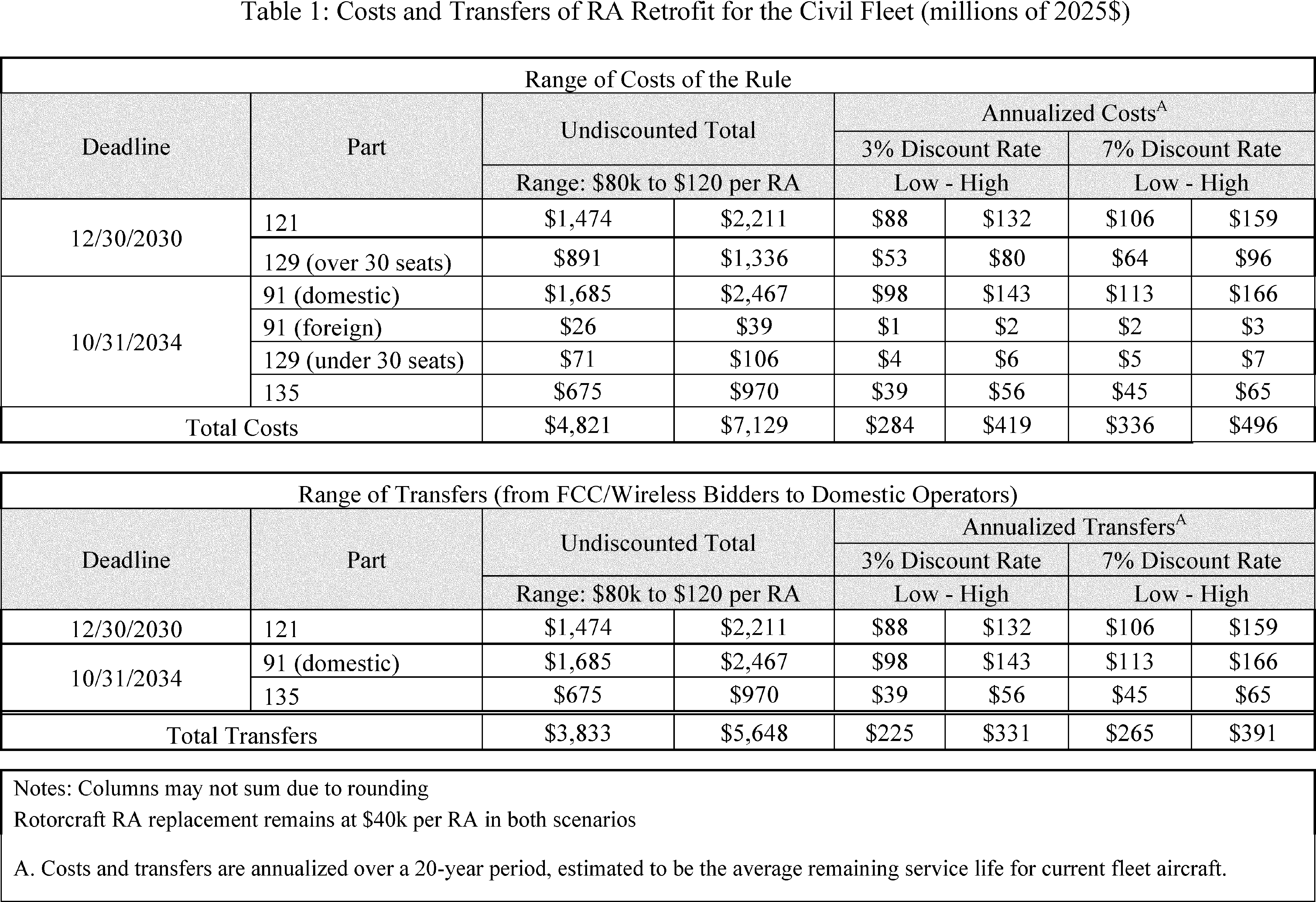
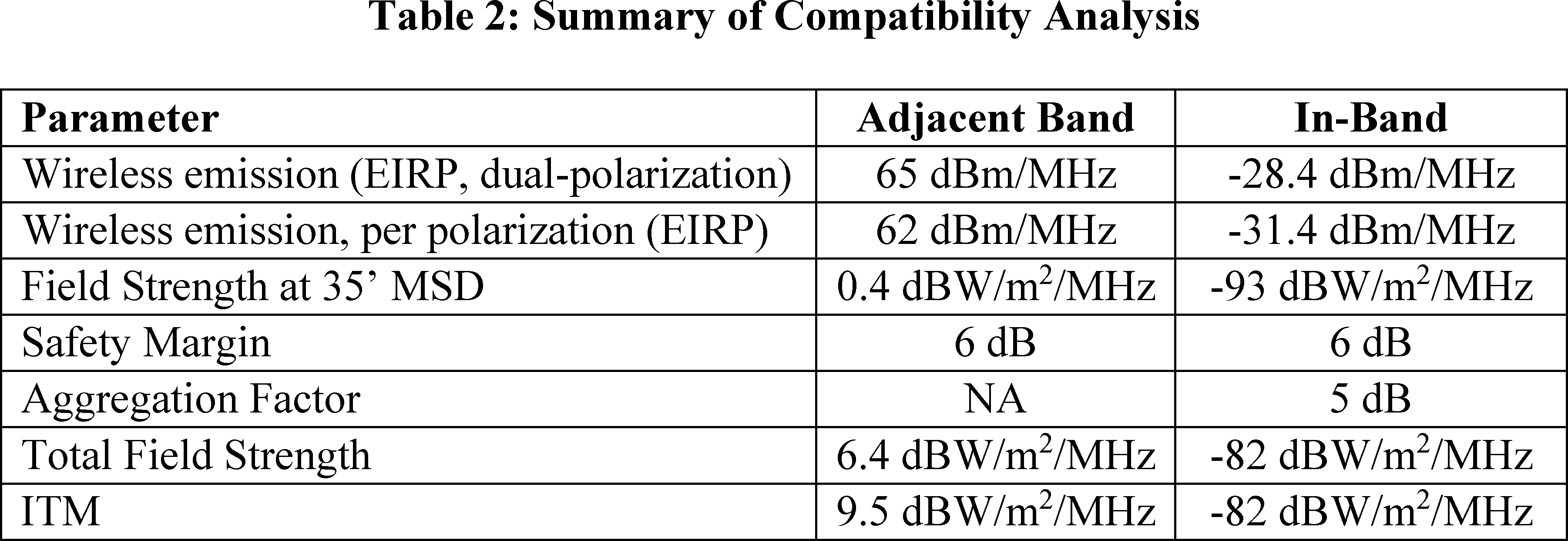
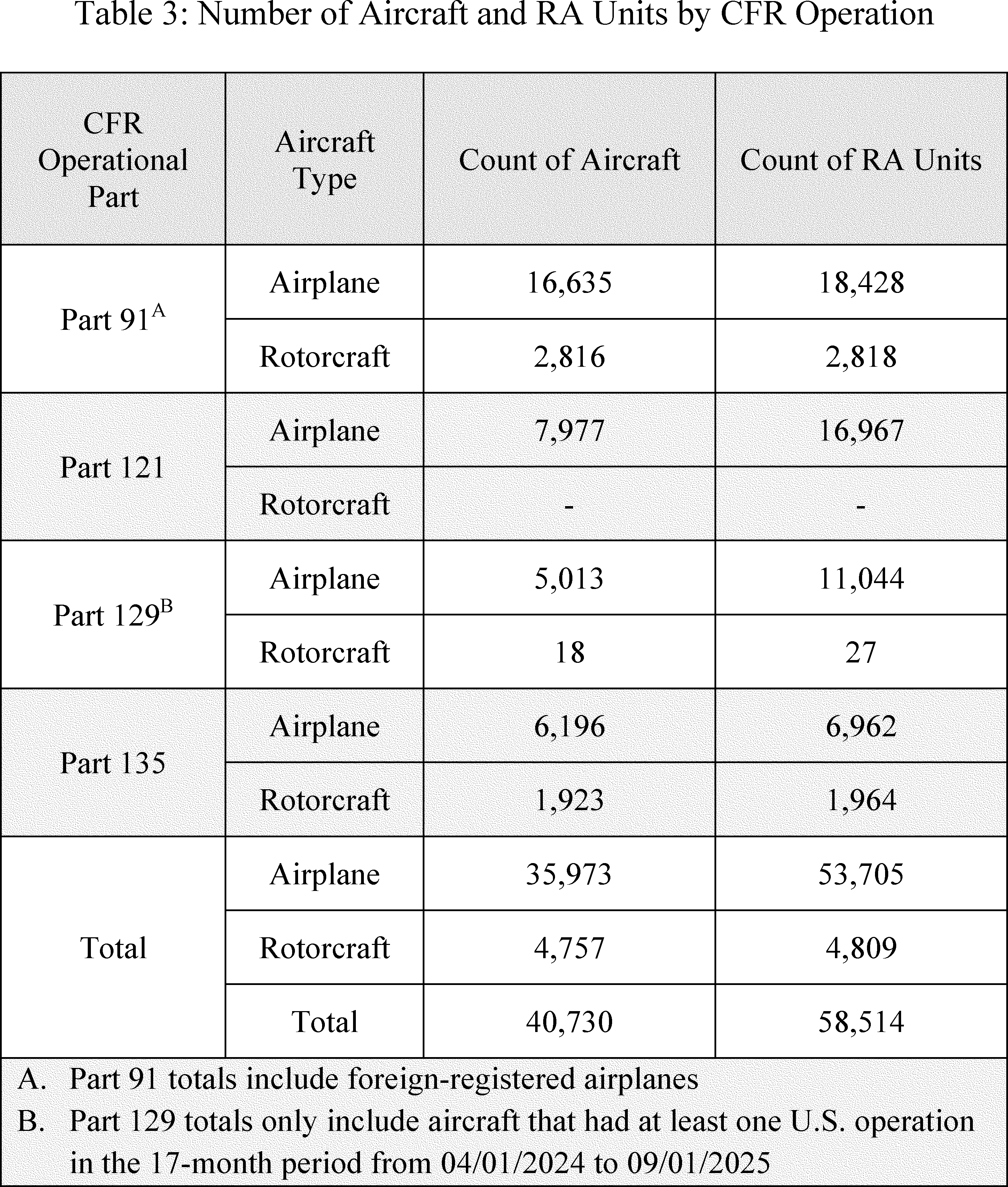
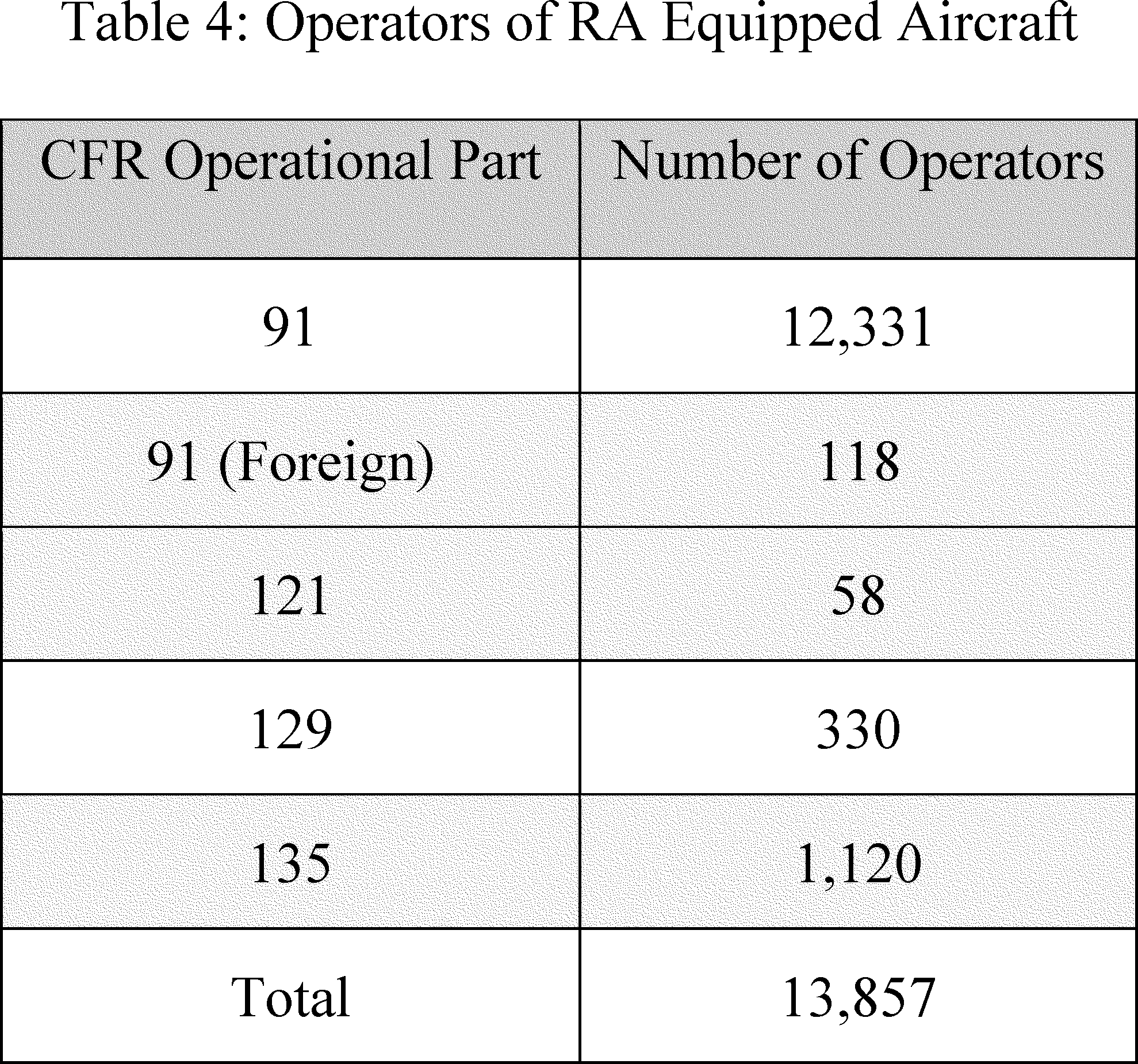
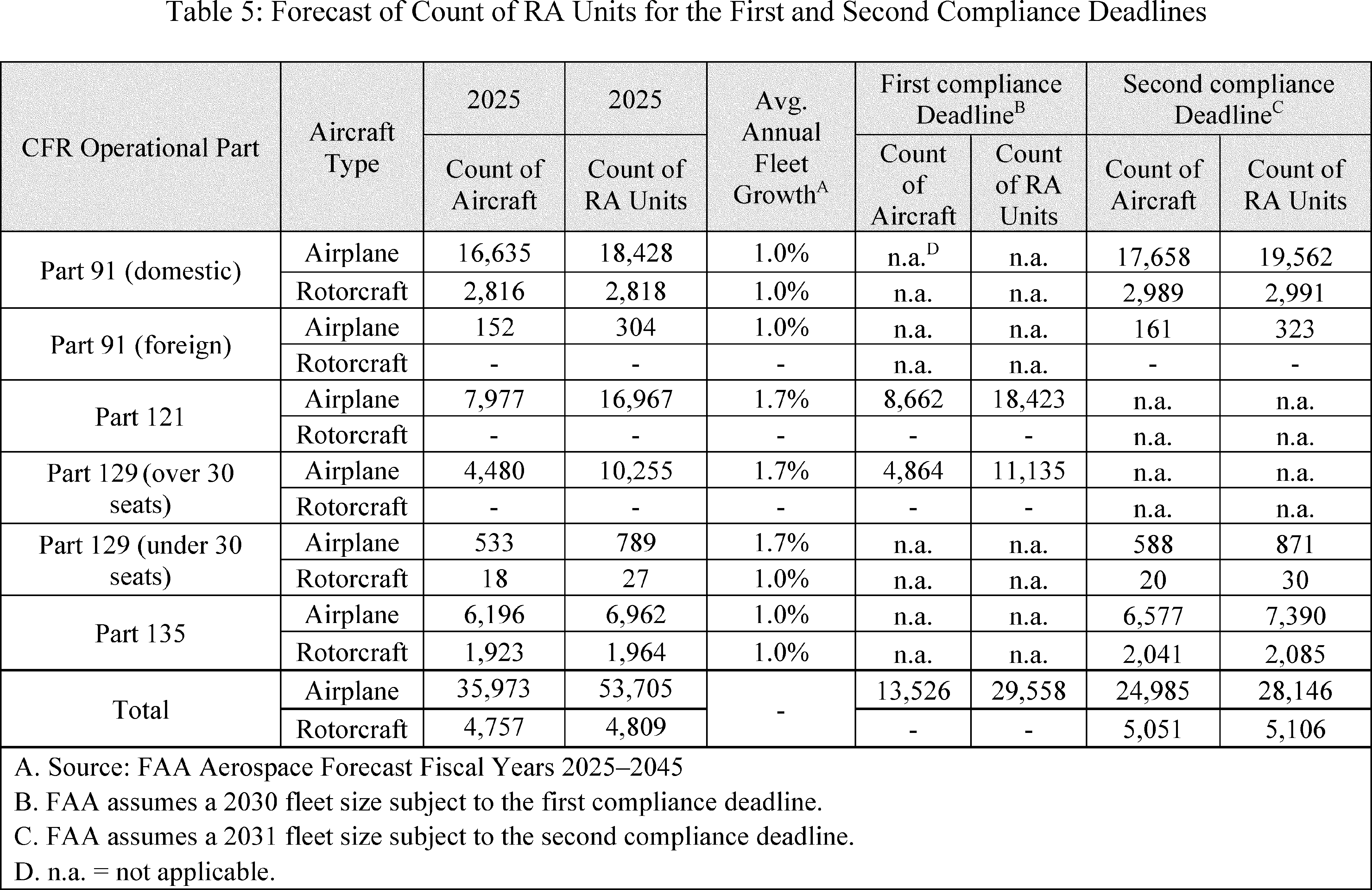
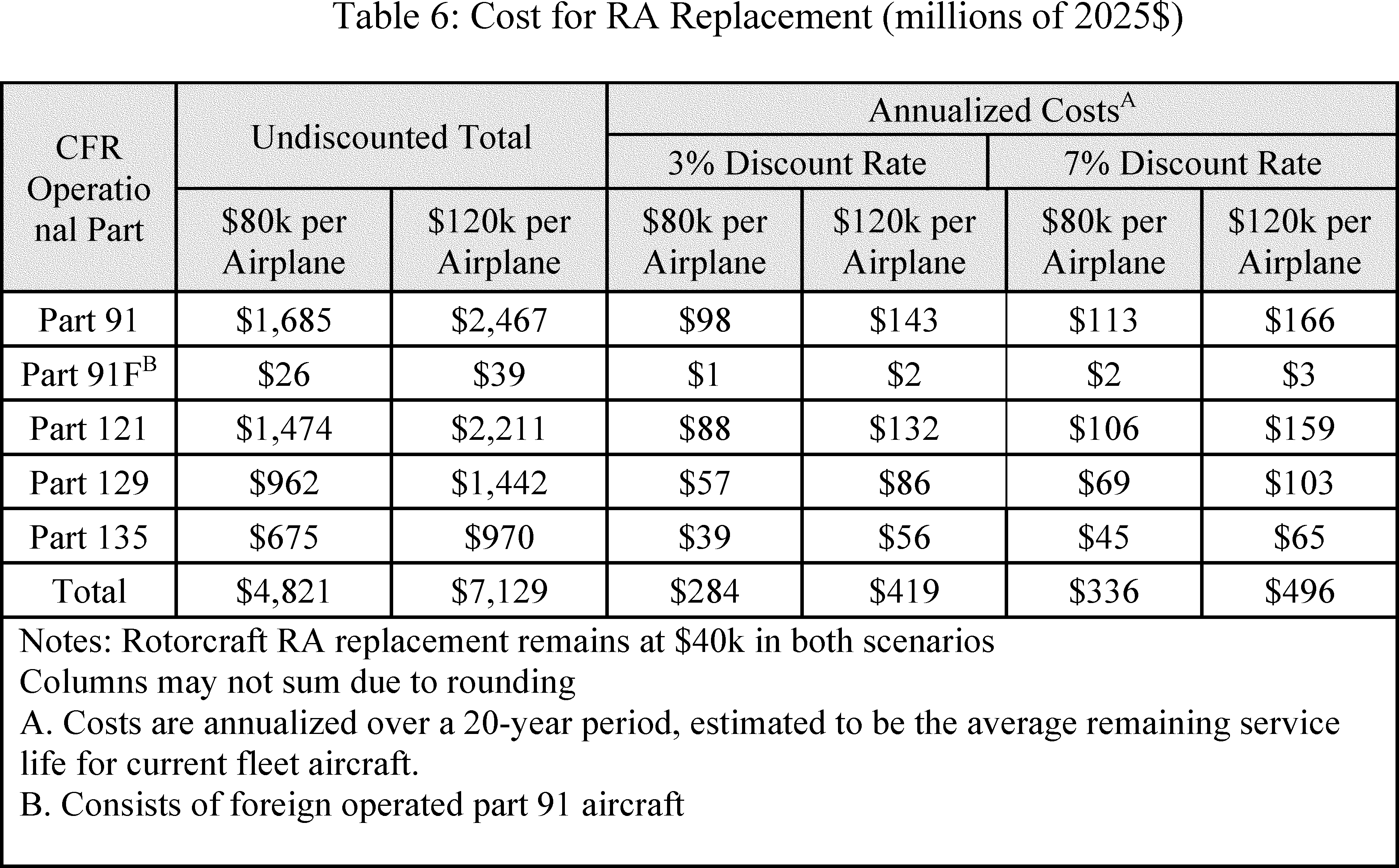
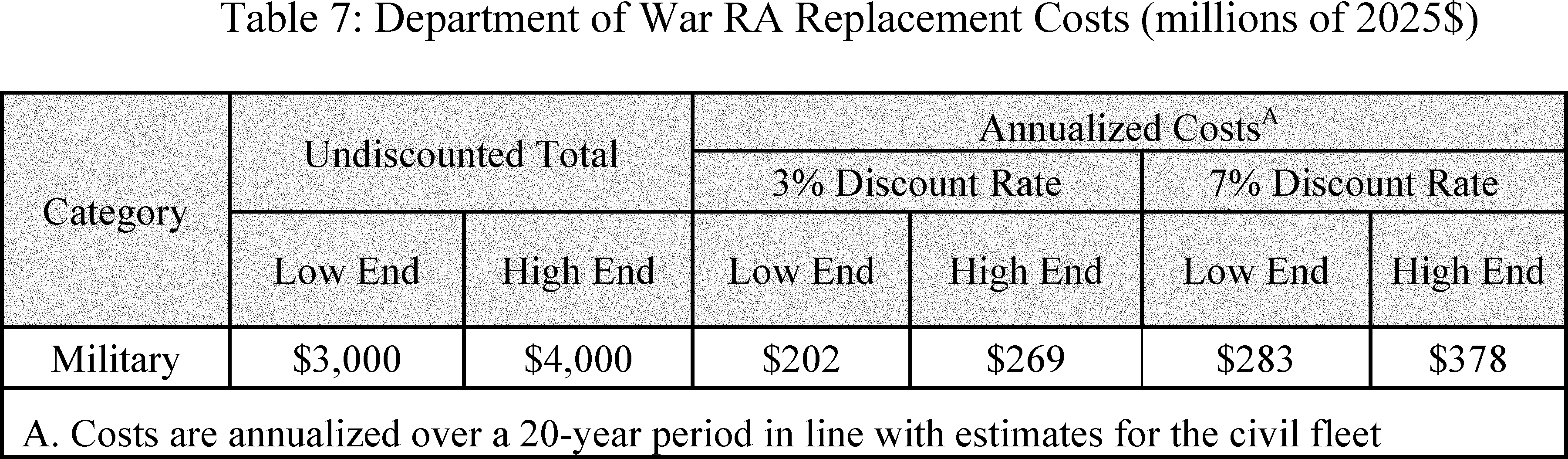
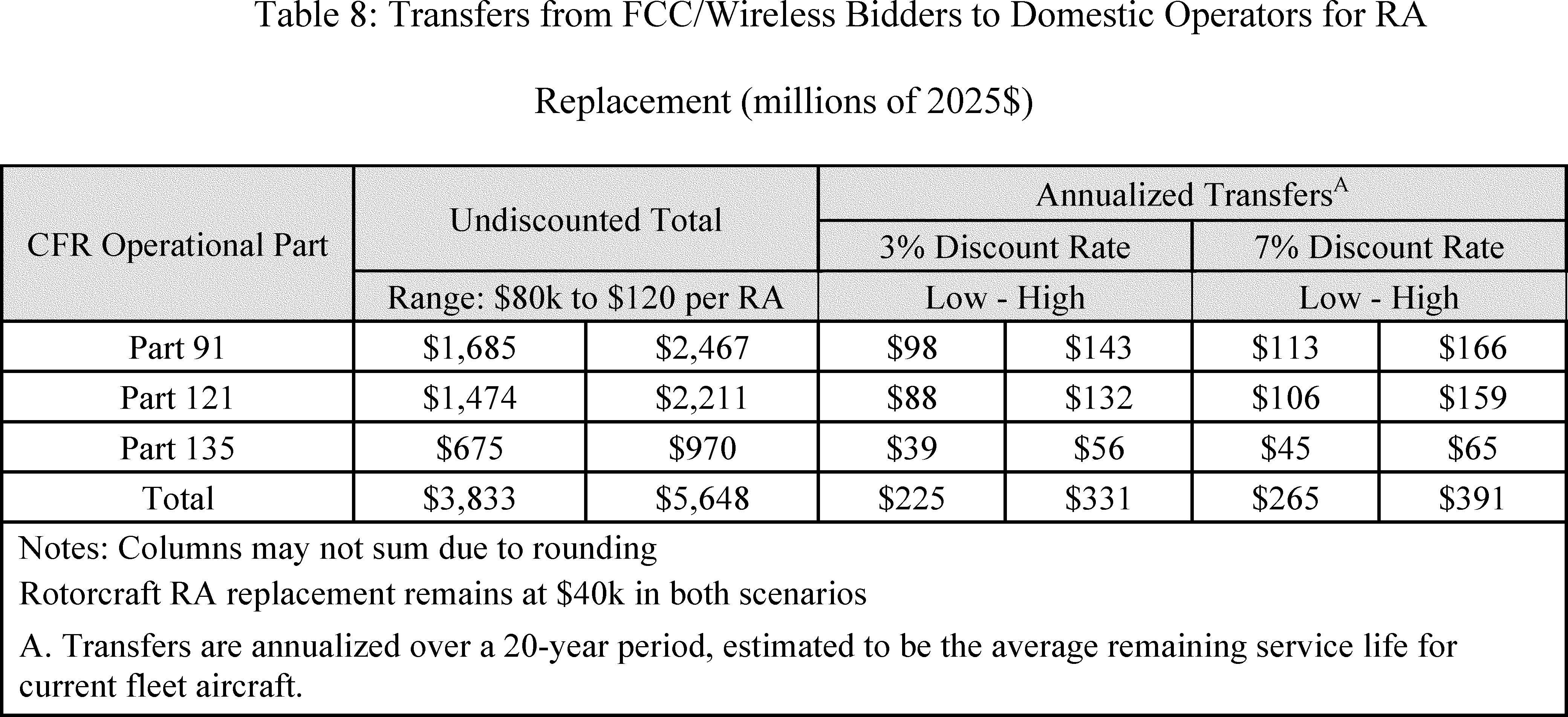
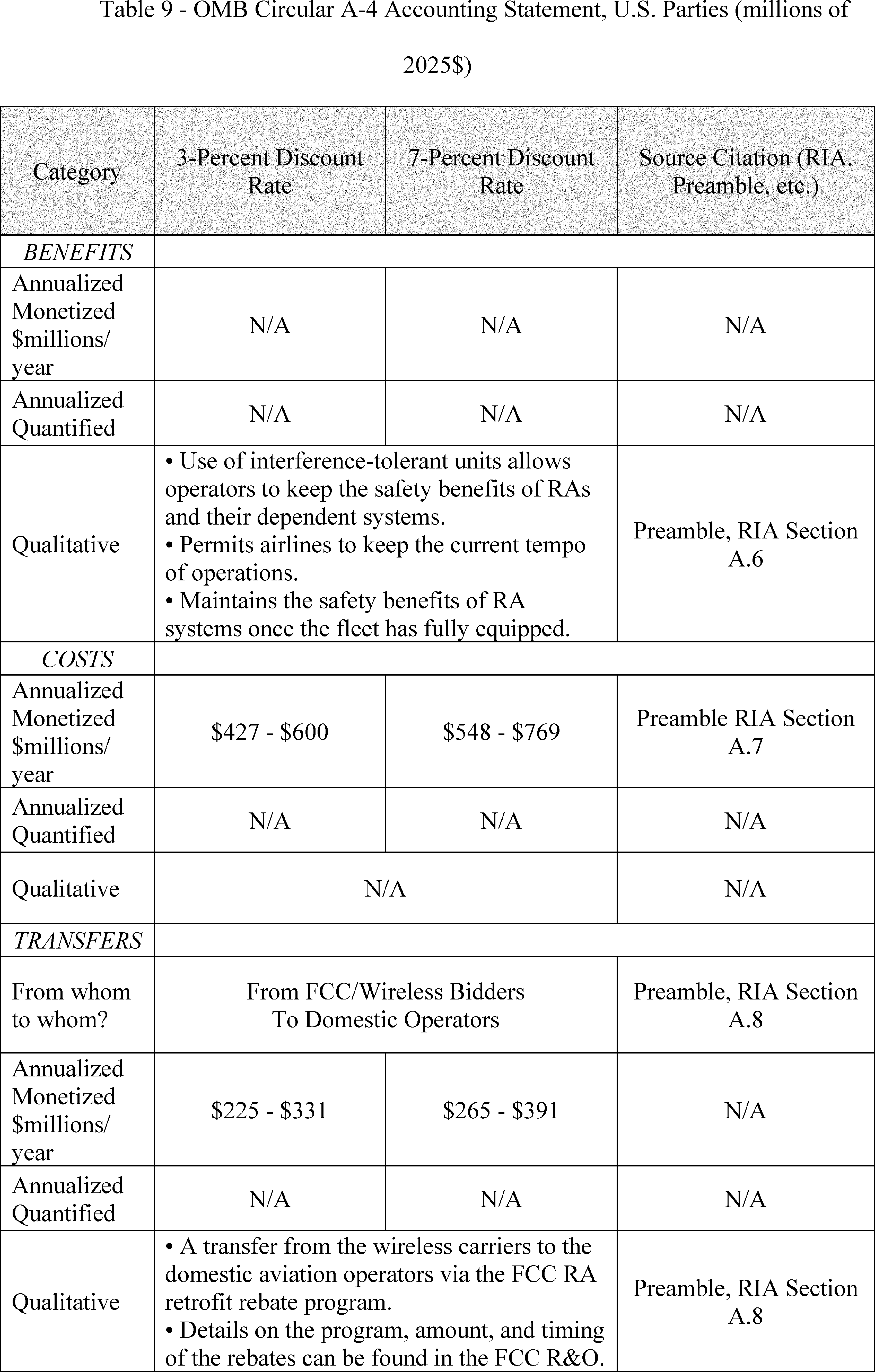
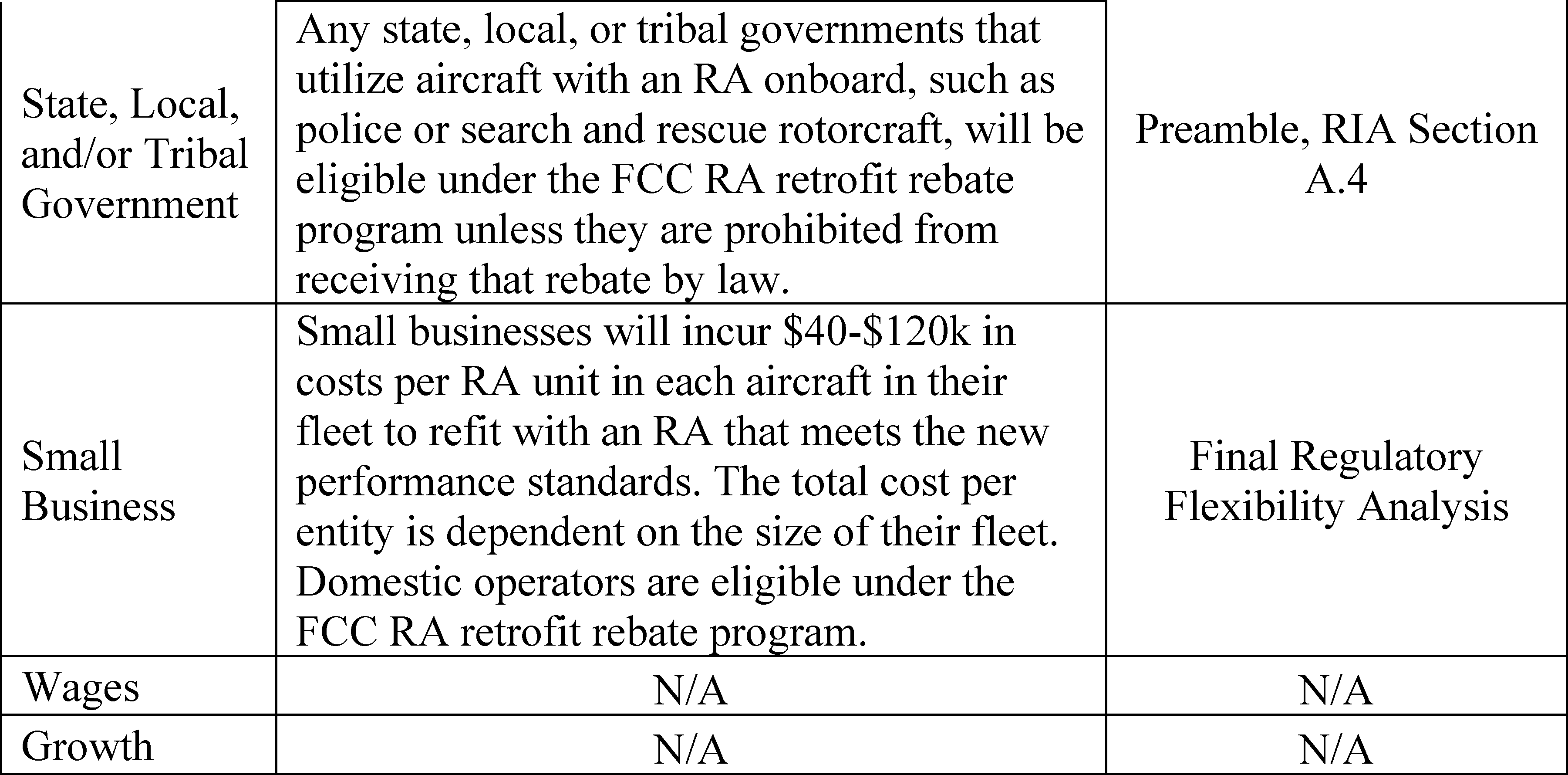
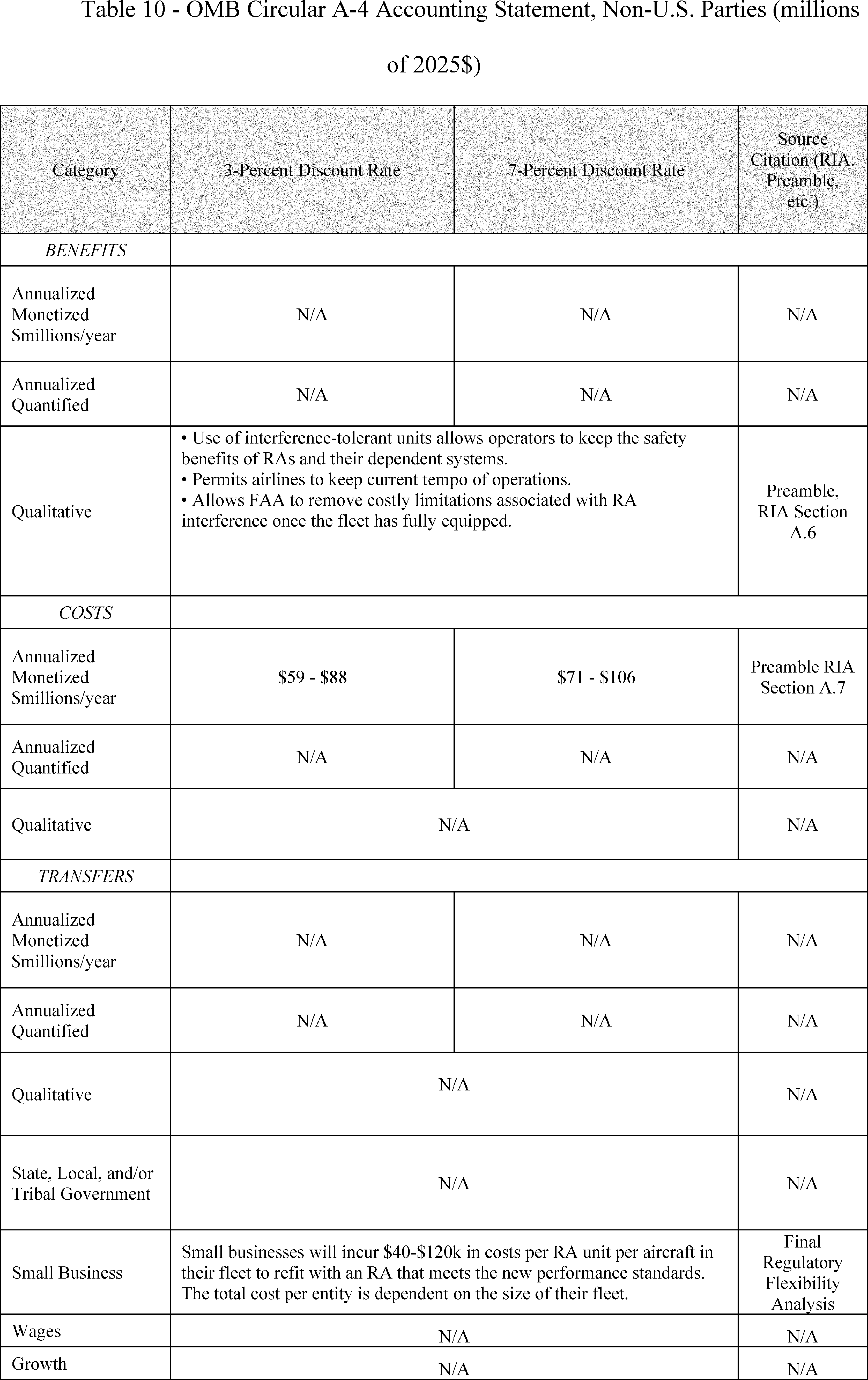
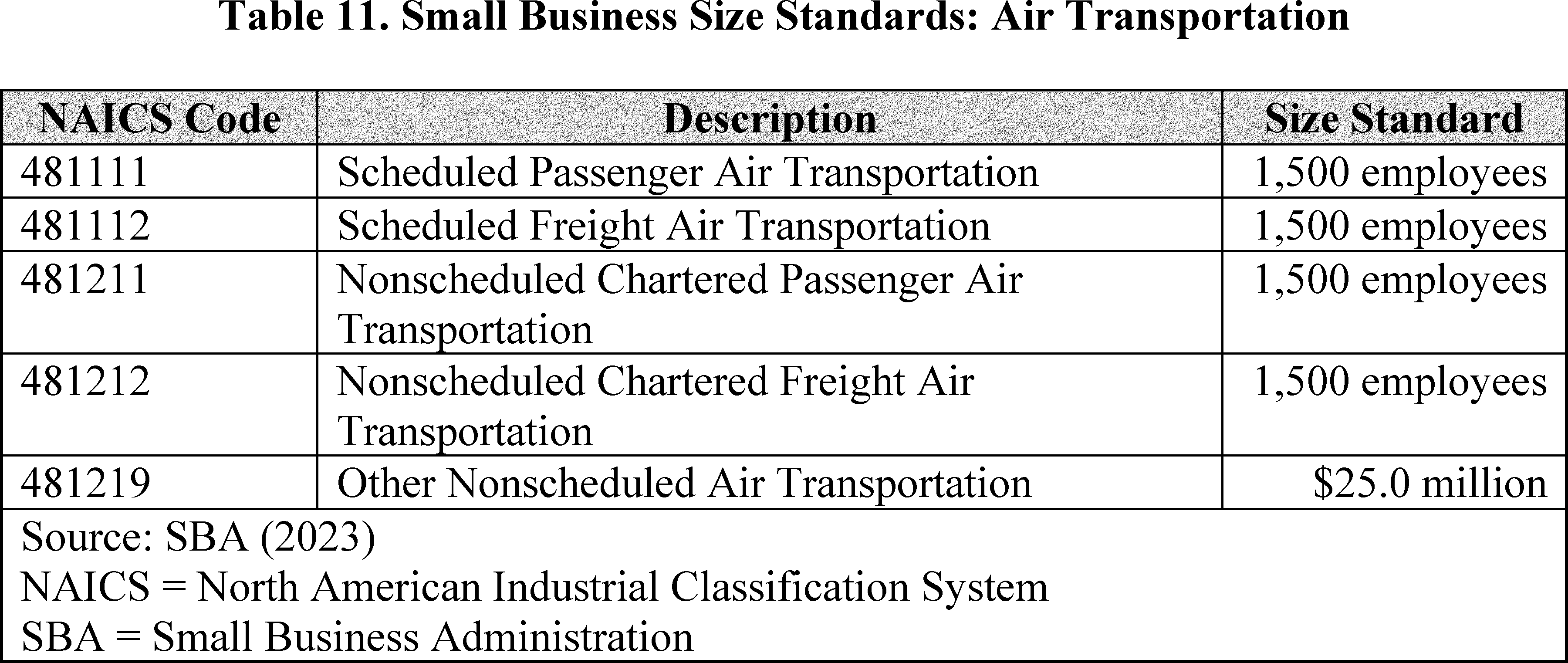
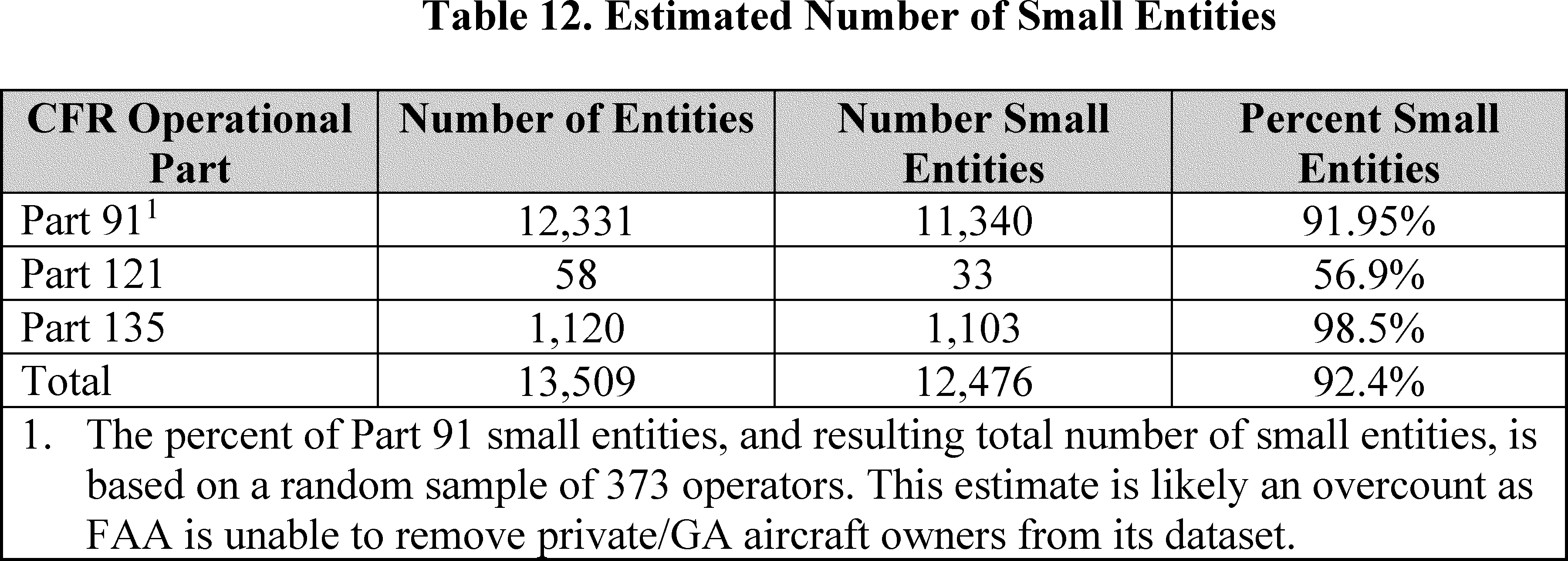
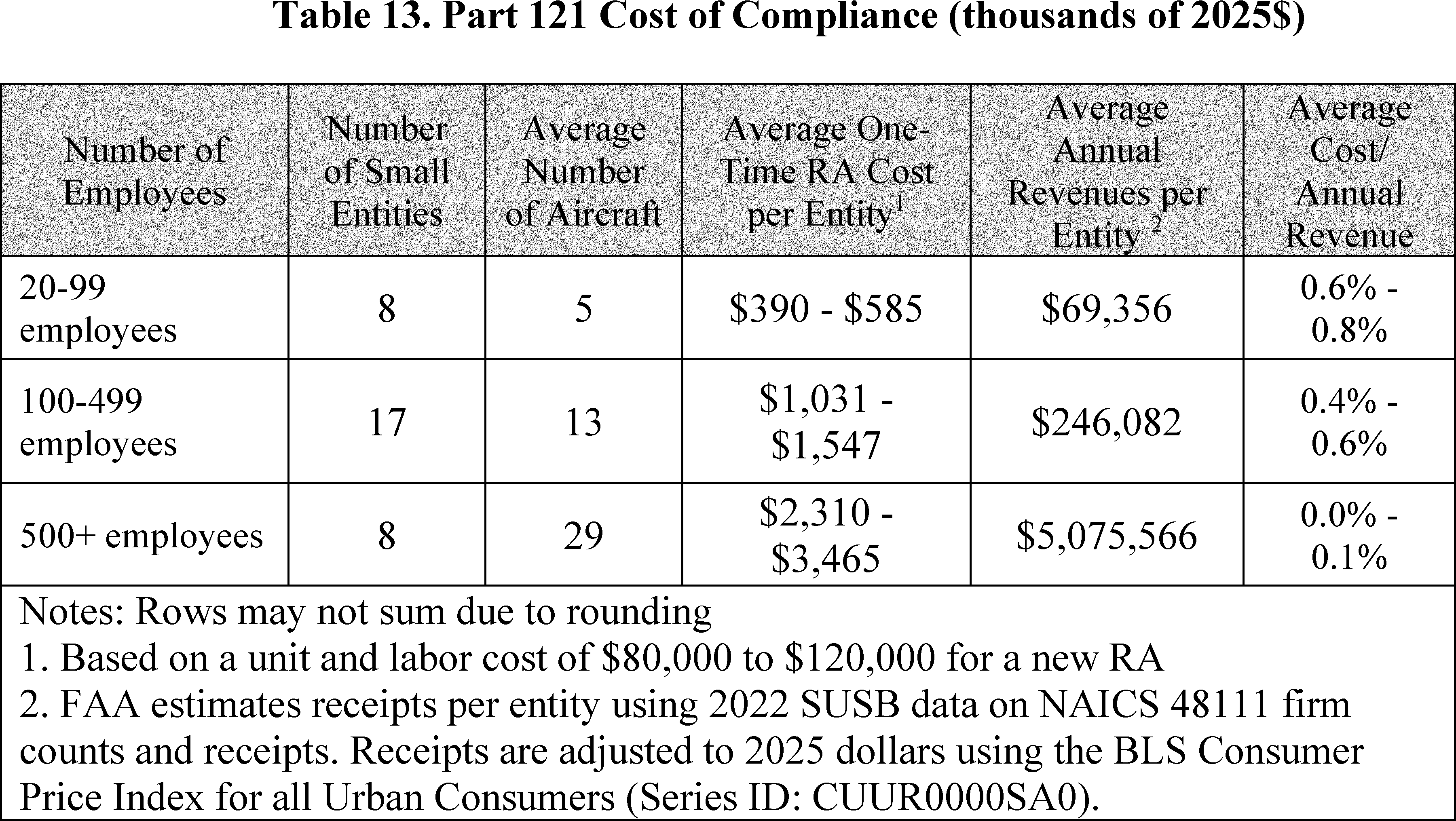
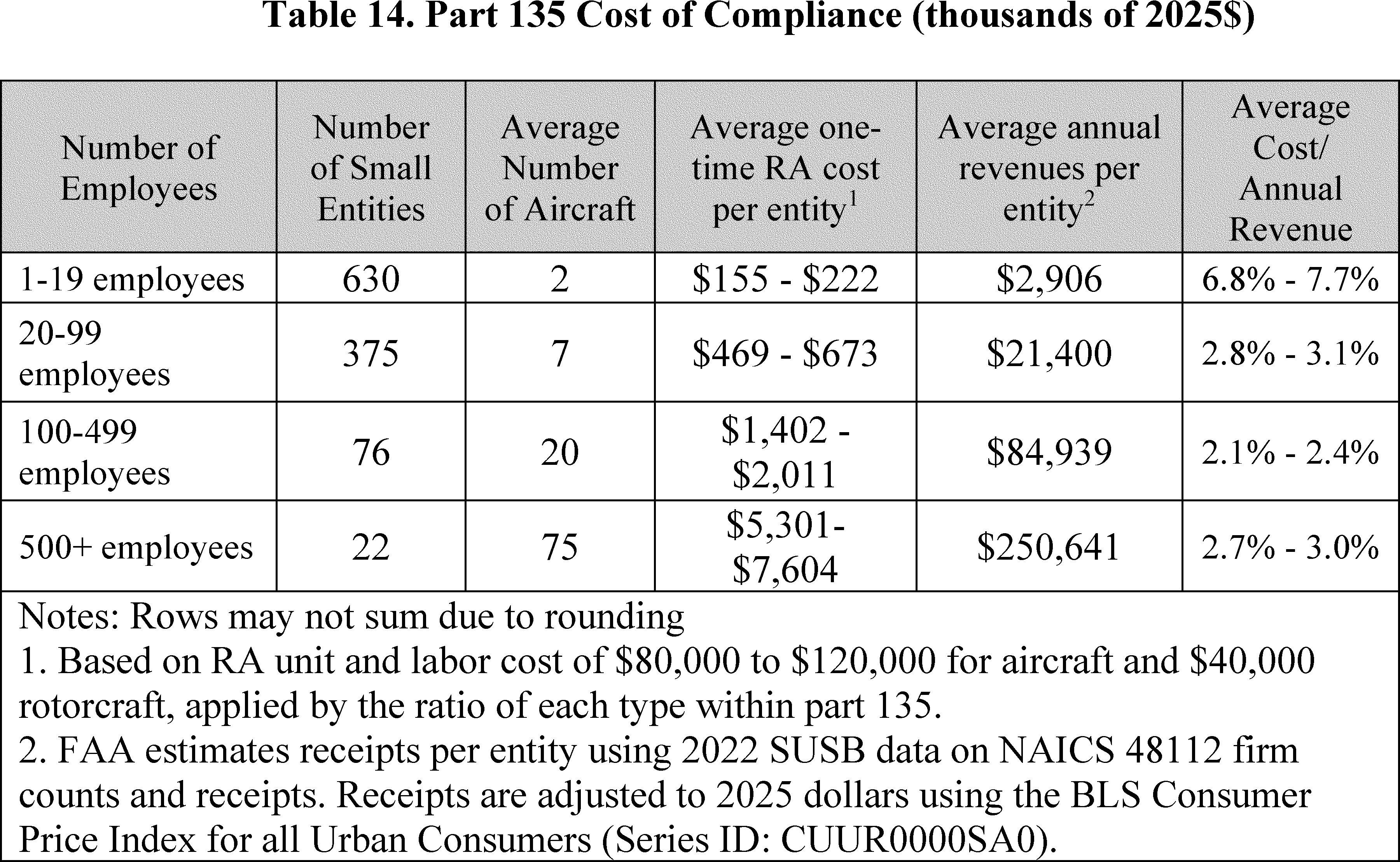
 www.regulations.gov
 www.federalregister.gov
 www.faa.gov/regulations_policies
 www.fcc.gov/document/fcc-expands-flexible-use-c-band-5g-0
 www.rtca.org/sc-239/
 www.eurocae.net/working-group/wg-119/
 its.ntia.gov/publications/details?pub=3289
 docdb.cept.org/download/4596
 www.icao.int/FSMP/documents
 drs.faa.gov/browse/excelExternalWindow/DRSDOCID108541392520230719162111.0001
 www.whitehouse.gov/wp-content/uploads/2025/08/CircularA-4.pdf
 www.chinaaviationdaily.com/news/0/456.html
 www.transportation.gov/office-policy/transportation-policy/revised-departmental-guidance-on-valuation-of-a-statistical-life-in-economic-analysis
 aviex.goflexair.com/flight-school-training-faq/how-many-passengers-can-a-commercial-plane-carry
 www.aspm.faa.gov/aspmhelp/index/Core_30.html
 aerology.substack.com/p/what-does-low-visibility-mean
 www.airlines.org/news-update/new-data-shows-huge-impact-of-the-government-shutdown-on-airlines-and-our-customers/
 rosap.ntl.bts.gov/view/dot/6234
 data.bls.gov/timeseries/CUUR0000SA0
 www.census.gov/naics/