Medicare Program; Prospective Payment System and Consolidated Billing for Skilled Nursing Facilities; Updates to the Quality Reporting Program for Federal Fiscal Year 2027
This final rule finalizes changes and updates to the policies and payment rates used under the Skilled Nursing Facility (SNF) Prospective Payment System (PPS) for fiscal year (F...
Centers for Medicare & Medicaid Services (CMS), Department of Health and Human Services (HHS)
ACTION:
Final rule.
SUMMARY:
This final rule finalizes changes and updates to the policies and payment rates used under the Skilled Nursing Facility (SNF) Prospective Payment System (PPS) for fiscal year (FY) 2027. This final rule also updates the requirements for the SNF Quality Reporting Program and the SNF Value-Based Purchasing Program.
DATES:
These regulations are effective on October 1, 2026.
Heidi Magladry, (410) 786-6034, for information related to the Skilled Nursing Facility Quality Reporting Program.
Christopher Palmer, (410) 786-8025, for information related to the Skilled Nursing Facility Value-Based Purchasing Program.
Availability of Certain Tables Exclusively Through the Internet on the CMS Website
As discussed in the FY 2014 SNF PPS final rule (78 FR 47936), tables setting forth the Wage Index for Urban Areas Based on Labor Market Areas aligned with CBSA delineations and the Wage Index Based on CBSA Labor Market Areas for Rural Areas are no longer published in the
Federal Register
. Instead, these tables are available exclusively on the CMS website. The wage index tables for this final rule can be accessed on the SNF PPS Wage Index home page, at
www.cms.gov/medicare/payment/prospective-payment-systems/skilled-nursing-facility-snf/wage-index.
Readers who experience any problems accessing any of these online SNF PPS wage index tables should contact Patricia Taft at (410) 786-4561.
SUPPLEMENTARY INFORMATION:
I. Executive Summary
A. Purpose
This final rule will update the SNF prospective payment rates for FY 2027, as required under section 1888(e)(4)(E) of the Social Security Act (the Act). It would also implement section 1888(e)(4)(H) of the Act, which requires the Secretary to publish specified information relating to the payment update (see section II.C. of this final rule) in the
Federal Register
before the August 1 that precedes the start of each fiscal year. We proposed to continue to use the concurrent pre-floor, pre-reclassified Inpatient Prospective Payment System (IPPS) hospital wage index as the basis for the SNF wage index. In this final rule, we did not propose any substantive changes to the Patient Driven Payment Model (PDPM) International Classification of Diseases, 10th Revision, Clinical Modification (ICD-10) code mappings. This final rule updates the SNF Quality Reporting Program (QRP) requirements including removing two measures from the program, specifically the COVID-19 Vaccination Coverage Among Healthcare Personnel (HCP) Measure and the COVID-19 Vaccine: Percent of Patients/Residents Who Are Up to Date Measure. This final rule also revises the SNF QRP data submission deadlines and finalizes the requirement for the submission of minimum data set (MDS) data on each resident receiving covered skilled care in a SNF, regardless of payer. This final rule also discusses comments received in response to a request for information (RFI) on future measure concepts for the SNF QRP. Finally, this rule updates the Skilled Nursing Facility Value-Based Purchasing (SNF VBP) Program, including providing final performance standards, updating the review and correction policy for measures calculated with MDS assessment data, and making technical updates to our regulatory text. This final rule also discusses comments received in response to an RFI on the methodology for quantifying and addressing case-mix creep under PDPM that was published in the proposed rule.
B. Summary of Major Provisions
In accordance with sections 1888(e)(4)(E)(ii)(IV) and (e)(5) of the Act, this final rule updates the annual rates that we published in the SNF PPS final rule for FY 2026 (90 FR 37310).
For the SNF QRP we are finalizing our proposal to remove two measures beginning with the FY 2028 SNF QRP: the COVID-19 Vaccination Coverage Among Healthcare Personnel Measure and the COVID-19 Vaccine: Percent of Patients/Residents Who are Up to Date Measure. Additionally, we are finalizing our proposal to change the data submission deadlines for data collected for the SNF QRP from 4.5 months after the end of each quarter to the 15th day of the second month after the end of the quarter, beginning with the FY 2029 SNF QRP. We are finalizing our proposal to require the submission of MDS data on all SNF residents admitted for covered skilled care regardless of payer beginning with the FY 2031 SNF QRP. Finally, we are summarizing comments received in response to an RFI on future measure concepts for the SNF QRP.
For the SNF VBP Program, we are providing final performance standards for the FY 2029 and FY 2030 program years to comply with the Program's statutory notice deadline. We are also finalizing revisions to the “snapshot date” codified at 42 CFR 413.338(f)(1)(v) for two measures that are calculated using MDS assessment data to maintain alignment with SNF QRP's revised submission deadlines for MDS assessment data, beginning with FY 2027 data. Lastly, we are finalizing technical updates to our regulatory text.
C. Summary of Cost and Benefits
( printed page 48589)
II. Background on SNF PPS
A. Statutory Basis and Scope
As amended by section 4432 of the Balanced Budget Act of 1997 (BBA 1997) (Pub. L. 10533, enacted August 5, 1997), section 1888(e) of the Act provides for the implementation of a PPS for SNFs. This methodology uses prospective, case-mix adjusted per diem payment rates applicable to all covered SNF services defined in section 1888(e)(2)(A) of the Act. The SNF PPS is effective for cost reporting periods beginning on or after July 1, 1998, and covers virtually all costs of furnishing covered SNF services (routine, ancillary, and capital-related costs) other than costs associated with approved educational activities and bad debts. Under section 1888(e)(2)(A)(i) of the Act, covered SNF services include post-hospital extended care services for which benefits are provided under Medicare Part A, as well as those items and services (other than a small number of excluded services, such as physicians' services) for which payment may otherwise be made under Medicare Part B and which are furnished to Medicare beneficiaries who are residents in a SNF during a covered Medicare Part A stay. A comprehensive discussion of these provisions appears in the May 12, 1998, interim final rule (63 FR 26252). In addition, a detailed discussion of the legislative history of the SNF PPS is available online at
www.cms.gov/Medicare/Medicare-Fee-for-Service-Payment/SNFPPS/Downloads/Legislative_History_2018-10-01.pdf.
Section 215(a) of the Protecting Access to Medicare Act of 2014 (PAMA) (Pub. L. 113-93, enacted April 1, 2014) added new section 1888(g) to the Act, requiring the Secretary to specify an all-cause all-condition hospital readmission measure and an all-condition risk-adjusted potentially preventable hospital readmission measure for the SNF setting. Additionally, section 215(b) of PAMA added section 1888(h) to the Act requiring the Secretary to implement a VBP program for SNFs. In 2014, section 2(c)(4) of the Improving Medicare Post-Acute Care Transformation (IMPACT) Act of 2014 (Pub. L. 113-185, enacted October 6, 2014) amended section 1888(e)(6) of the Act, which requires the Secretary to implement a QRP for SNFs under which SNFs report data on measures and resident assessment data. Finally, section 111 of the Consolidated Appropriations Act, 2021 (CAA, 2021) (Pub. L. 116-260, enacted December 27, 2020) amended section 1888(h)(2)(A) of the Act, authorizing the Secretary to apply up to ten measures to the VBP program for SNFs.
B. Initial Transition for the SNF PPS
Under sections 1888(e)(1)(A) and (e)(11) of the Act, the SNF PPS included an initial, three-phase transition that blended a facility-specific rate (reflecting the individual facility's historical cost experience) with the Federal case-mix adjusted rate. The transition extended through the facility's first 3 cost reporting periods under the prospective payment system, up to and including the one that began in FY 2001. Thus, the SNF PPS is no longer operating under the transition, as all facilities have been paid at the full Federal rate effective with cost reporting periods beginning in FY 2002. As we now base payments for SNFs entirely on the adjusted Federal per diem rates, we no longer include adjustment factors under the transition related to facility-specific rates for the upcoming FY.
C. Required Annual Rate Updates
Section 1888(e)(4)(E) of the Act requires the SNF PPS payment rates to be updated annually. The most recent annual update occurred in a final rule that set forth updates to the SNF PPS payment rates for FY 2026 (90 FR 37310).
Section 1888(e)(4)(H) of the Act specifies that we provide for publication annually in the
Federal Register
the following:
The unadjusted Federal per diem rates to be applied to days of covered SNF services furnished during the upcoming FY.
The case-mix classification system to be applied for these services during the upcoming FY.
The factors to be applied in making the area wage adjustment for these services.
Along with other revisions discussed in this preamble, this final rule will set out the required annual updates to the per diem payment rates for SNFs for FY 2027.
III. SNF PPS Rate Setting Methodology and FY 2027 Payment Update
A. Federal Base Rates
Under section 1888(e)(4) of the Act, the SNF PPS uses per diem Federal payment rates based on mean SNF costs in a base year (FY 1995) updated for inflation to the first effective period of the PPS. We developed the Federal payment rates using allowable costs from hospital-based and freestanding SNF cost reports for reporting periods beginning in FY 1995. The data used in developing the Federal rates also incorporated a Medicare Part B add-on, which is an estimate of the amounts that, prior to the SNF PPS, would be payable under Medicare Part B for covered SNF services furnished to individuals during a covered Medicare Part A stay in a SNF.
In developing the rates for the initial period, we updated costs to the first effective year of the PPS (the 15-month period beginning July 1, 1998) using the SNF market basket and then standardized for geographic variations in wages and for the costs of facility differences in case-mix. In compiling
( printed page 48590)
the database used to compute the Federal payment rates, we excluded those providers that received new provider exemptions from the routine cost limits, as well as costs related to payments for exceptions to the routine cost limits. Using the formula that the BBA 1997 prescribed, we set the Federal rates at a level equal to the weighted mean of freestanding costs plus 50 percent of the difference between the freestanding mean and weighted mean of all SNF costs (hospital-based and freestanding) combined. We computed and applied separately the payment rates for facilities located in urban and rural areas and adjusted the portion of the Federal rate attributable to wage related costs by a wage index to reflect geographic variations in wages. We are finalizing as proposed.
B. SNF Market Basket Update
1. SNF Market Basket
Section 1888(e)(5)(A) of the Act requires us to establish a SNF market basket that reflects changes over time in the prices of an appropriate mix of goods and services included in covered SNF services. Accordingly, we have developed a SNF market basket that encompasses the most commonly used cost categories for SNF routine services, ancillary services, and capital-related expenses. In the SNF PPS final rule for FY 2025 (89 FR 64065 through 64082), we rebased and revised the SNF market basket, which included updating the base year from 2018 to 2022.
The SNF market basket is used to compute the market basket percentage increase that is used to update the SNF Federal rates on an annual basis, as required by section 1888(e)(4)(E)(ii)(IV) of the Act. This market basket percentage increase is adjusted by a forecast error adjustment, if applicable, and then further adjusted by the application of a productivity adjustment as required by section 1888(e)(5)(B)(ii) of the Act and described in section III.B.4. of this final rule.
As outlined in the proposed rule, we proposed a FY 2027 SNF market basket percentage increase of 3.2 percent based on IHS Global Inc.'s (IGI's) fourth-quarter 2025 forecast of the 2022-based SNF market basket (before application of the forecast error adjustment and productivity adjustment). We also proposed that if more recent data subsequently became available (for example, a more recent estimate of the market basket, the productivity adjustment, or the forecast error adjustment), we would use such data, if appropriate, to determine the FY 2027 SNF market basket percentage increase, labor-related share relative importance, forecast error adjustment, and productivity adjustment in the SNF PPS final rule.
Since the proposed rule, we have updated the FY 2027 market basket percentage increase based on IGI's second quarter 2026 forecast with historical data through the first quarter of 2026. The FY 2027 growth rate of the 2022-based SNF market basket is estimated to be 3.3 percent.
2. Market Basket Update Factor for FY 2027
Section 1888(e)(5)(B) of the Act defines the SNF market basket percentage increase as the percentage change in the SNF market basket from the midpoint of the previous FY to the midpoint of the current FY. For the Federal rates outlined in this final rule, we use the percentage change in the SNF market basket to compute the update factor for FY 2027. This factor is based on the FY 2027 percentage increase in the 2022-based SNF market basket reflecting routine, ancillary, and capital-related expenses. Sections 1888(e)(4)(E)(ii)(IV) and (e)(5)(B)(i) of the Act require that the update factor used to establish the FY 2027 unadjusted Federal rates be at a level equal to the SNF market basket percentage increase. Accordingly, we determined the total growth from the average market basket level for the period of October 1, 2025, through September 30, 2026, to the average market basket level for the period of October 1, 2026, through September 30, 2027. As outlined in the proposed rule, this process yielded a proposed percentage increase in the 2022-based SNF market basket of 3.2 percent for FY 2027. For this final rule, based on IGI's second quarter 2026 forecast with historical data through the first quarter of 2026, the FY 2027 growth rate of the 2022-based SNF market basket is estimated to be 3.3 percent.
As further explained in section IV.B.3. of this final rule, as applicable, we adjust the percentage increase by the forecast error adjustment from the most recently available FY for which there is final data and apply this adjustment whenever the difference between the forecasted and actual percentage increase in the market basket exceeds a 0.5 percentage point threshold in absolute terms. Additionally, section 1888(e)(5)(B)(ii) of the Act requires us to reduce the market basket percentage increase by the productivity adjustment (the 10-year moving average of changes in annual economy-wide private nonfarm business total multifactor productivity for the period ending September 30, 2027), which is estimated to be 0.9 percentage point, as described in section IV.B.4. of this final rule.
We also note that section 1888(e)(6)(A)(i) of the Act provides that, beginning with FY 2018, SNFs that fail to submit data, as applicable, in accordance with sections 1888(e)(6)(B)(i)(II) and (III) of the Act for a FY will receive a 2.0 percentage point reduction to their market basket update for the FY involved, after application of section 1888(e)(5)(B)(ii) of the Act (the productivity adjustment) and section 1888(e)(5)(B)(iii) of the Act (the market basket increase). In addition, section 1888(e)(6)(A)(ii) of the Act states that application of the 2.0 percentage point reduction (after application of section 1888(e)(5)(B)(ii) and (iii) of the Act) may result in the market basket percentage change being less than zero for a FY and may result in payment rates for a FY being less than such payment rates for the preceding FY. Section 1888(e)(6)(A)(iii) of the Act further specifies that the 2.0 percentage point reduction is applied in a noncumulative manner, so that any reduction made under section 1888(e)(6)(A)(i) of the Act applies only to the FY involved, and that the reduction cannot be taken into account in computing the payment amount for a subsequent FY.
We received public comments on the proposed FY 2027 SNF market basket percentage increase to the SNF PPS rates. The following is a summary of the comments we received and our responses.
Comment:
Many commenters expressed appreciation for the proposed 3.2 percent increase in the market basket but expressed concern that the proposed increase is insufficient to address actual cost pressures facing skilled nursing facilities. Commenters stated that the 2.4 percent net update (after application of the 0.8 percentage point productivity adjustment) fails to keep pace with actual cost increases in the year they occur. Commenters stated that the 2025 Consumer Price Index for Medical Care was 3.2 percent and urged CMS to increase the net update to at least 3.0 percent.
Multiple commenters addressed the broader inflationary environment and its impact on SNF operations and profit margins. Commenters identified sustained inflationary pressures in labor, pharmaceuticals, medical supplies, and utilities as primary drivers of the perceived inadequacy of the proposed update.
Multiple commenters stated the severity of workforce-related cost pressures, including elevated wage pressures for nurses and nursing
( printed page 48591)
assistants, with contract labor remaining above pre-pandemic levels. Commenters stated that SNFs continue to grapple with workforce shortages, and that nursing homes face increased competition from other healthcare providers for the same labor pool.
Several commenters raised concerns about the growth of drug expenses driven by higher utilization, increasing unit costs, and the continued introduction of high-cost specialty medications, and stated that Medicare beneficiaries that need SNF services typically require higher cost prescription drugs, including IV antibiotics and anticoagulants.
One commenter urged CMS to consider a prospective percentage add-on to reflect the impact of wage and benefit costs.
Response:
We appreciate the comments regarding the proposed FY 2027 SNF PPS market basket update and recognize the concerns raised about inflationary pressures affecting skilled nursing facilities. Section 1888(e)(5)(A) of the Act requires us to establish a SNF market basket that reflects changes over time in the prices of an appropriate mix of goods and services included in covered SNF services. The 2022-based SNF market basket is a fixed-weight, Laspeyres-type price index that measures the change in price, over time, of the most commonly used cost categories for SNF routine services, ancillary services, and capital-related expenses.
We recognize that the market basket updates may differ from other overall inflation indexes such as the CPI; however, we would reiterate that these topline indexes are not comparable since they measure different mixes of products, services, or wages than the legislatively defined SNF market basket. We would highlight that the market basket percentage increase is a forecast of the price pressures that SNFs are expected to face in FY 2027. We also note that when IHS Global, Inc. (IGI) develops their forecast for the various price indexes used in the SNF market basket, they consider industry-specific and overall economic conditions. IGI is a nationally recognized economic and financial forecasting firm with which CMS contracts to forecast the components of the market baskets.
The proposed FY 2027 SNF market basket percentage increase of 3.2 percent reflected the most-recent forecast available at the time of rulemaking. As stated in the SNF PPS proposed rule for FY 2027 (91 FR 17680), we proposed that if more recent data subsequently became available (for example, a more recent estimate of the market basket and/or the productivity adjustment), we would use such data, if appropriate, to determine the FY 2027 SNF market basket percentage increase in the SNF PPS final rule. For this final rule, we have incorporated the most recent historical data and forecasts provided by IGI to capture the expected price and wage pressures facing SNFs in FY 2027. The FY 2027 market basket update in this final rule reflects historical data through the first quarter of 2026 and forecasted data from the second quarter of 2026 through the third quarter of 2027. Accordingly, the final FY 2027 market basket update reflects an updated and revised outlook on the U.S. economy.
Based on IGI's second-quarter 2026 forecast with historical data through first-quarter 2026, the FY 2027 growth rate of the 2022-based SNF market basket is 3.3 percent. By incorporating the most recent estimates available of the market basket percentage increase, we believe these data reflect the best available projection of input price inflation faced by SNFs in FY 2027.
Comment:
Some commenters referenced the Medicare Payment Advisory Commission (MedPAC) March 2026 Report to Congress in their comments, which recommended that CMS reduce SNF base payment rates by 4 percent for FY 2027. These commenters expressed support for the SNF base payment rate reduction discussed by MedPAC. Additionally, some commenters referenced MedPAC's payment adequacy analyses, which indicated that the aggregate fee-for service (FFS) Medicare margin for freestanding SNFs in 2024 was 24.4 percent, and added that a reduction in payment rates would not impede beneficiary access to care given the adequate capacity and supply of providers.
Response:
We thank commenters for their recommendation and agree that current law requires us to update SNF PPS payments by the market basket percentage increase reduced by a productivity adjustment, as directed by sections 1888(e)(4)(E)(ii)(IV) and 1888(e)(5)(B)(ii) of the Act.
After consideration of the comments received on the FY 2027 SNF market basket percentage increase, we are finalizing a FY 2027 SNF market basket percentage increase of 3.3 percent (prior to the application of the forecast error adjustment and productivity adjustment, which are discussed later in this section).
3. Forecast Error Adjustment
As discussed in the June 10, 2003, supplemental proposed rule (68 FR 34768) and finalized in the August 4, 2003, final rule (68 FR 46057 through 46059), § 413.337(d)(2) provides for an adjustment to account for SNF market basket forecast error. The initial adjustment for SNF market basket forecast error applied to the update of the FY 2003 rate for FY 2004 and considered the cumulative forecast error for the period from FY 2000 through FY 2002, resulting in an increase of 3.26 percent to the FY 2004 update. Subsequent adjustments in succeeding FYs take into account the forecast error from the most recently available FY for which there is final data and apply the difference between the forecasted and actual change in the market basket when the difference exceeds a specified threshold. We originally used a 0.25 percentage point threshold for this purpose; however, for the reasons specified in the FY 2008 SNF PPS final rule (72 FR 43425), we adopted a 0.5 percentage point threshold effective for FY 2008 and subsequent FYs. As we stated in the final rule for FY 2004 that first issued the market basket forecast error adjustment (68 FR 46058), the adjustment will reflect both upward and downward adjustments, as appropriate.
For FY 2025 (the most recently available FY for which there is final data), the forecasted or estimated increase in the SNF market basket was 3.0 percent, and the actual increase for FY 2025 was 2.8 percent, resulting in the actual increase being 0.2 percentage point lower than the estimated increase. Accordingly, as the difference between the estimated and actual percentage increase in the market basket does not exceed the 0.5 percentage point threshold, under the policy previously described (comparing the forecasted and actual market basket percentage increase), the FY 2027 market basket percentage increase of 3.3 percent would not be adjusted to account for the forecast error correction.
Table 2 shows the forecasted and actual market basket percentage increases for FY 2025.
( printed page 48592)
We received public comments on the forecast error adjustment. The following is a summary of the comments we received and our responses.
Comment:
Commenters requested that CMS publicly disclose FY 2025 forecast error calculations and publish multi-year retrospective comparisons of projected versus actual market basket growth to identify potential systematic under-forecasting. Commenters stated that greater transparency in forecast error methodology would enable stakeholders to better assess the accuracy of market basket projections and their cumulative impact on SNF payment adequacy over time. Multiple commenters encouraged CMS to remain vigilant in monitoring forecast accuracy and to apply corrections promptly when the threshold is met. Some commenters urged CMS to consider implementing prospective percentage add-ons to reflect the impact of increasing wage and benefit costs.
Response:
The SNF market basket updates are set prospectively, which means that the update relies on a mix of both historical data for part of the period for which the update is calculated and forecasted data for the remainder. For instance, the FY 2027 market basket update in this final rule reflects historical data through the first quarter of CY 2026 and forecasted data from the second quarter of 2026 through the third quarter of CY 2027.
Forecast error can be calculated by comparing the actual market basket increase for a given year less the forecasted market basket increase. Due to the uncertainty regarding future price trends, forecast errors can be both positive and negative. While we recognize the appeal of alternative approaches such as prospective adjustments during periods of economic volatility, this would have the potential to introduce more variable and unstable updates. The threshold at which forecast error adjustments are triggered under the SNF PPS is 0.5 percentage point in absolute terms, which is intended to distinguish typical statistical variances from more major unanticipated impacts. The forecasted growth in the 2022-based SNF market basket for FY 2025 was 3.0 percent, and the actual historical growth was 2.8 percent, meaning the SNF market basket was over-forecast by 0.2 percent. Since this is below the 0.5 percentage point threshold, there will be no forecast error adjustment to the FY 2027 market basket percent change.
After consideration of public comments, we are finalizing our proposal that no forecast error adjustment will be applied for FY 2027, as the 0.5 percentage point threshold was not met.
4. Productivity Adjustment
Section 1888(e)(5)(B)(ii) of the Act, as added by section 3401(b) of the Patient Protection and Affordable Care Act (Affordable Care Act) (Pub. L. 111-148, enacted March 23, 2010), requires that, in FY 2012 and in subsequent FYs, the market basket percentage under the SNF payment system (as described in section 1888(e)(5)(B)(i) of the Act) is to be reduced annually by the productivity adjustment described in section 1886(b)(3)(B)(xi)(II) of the Act.
Section 1886(b)(3)(B)(xi)(II) of the Act, in turn, defines the productivity adjustment to be equal to the 10-year moving average of changes in annual economy-wide, private nonfarm business multifactor productivity (MFP) (as projected by the Secretary of the Department of Health and Human Services (Secretary) for the 10-year period ending with the applicable FY, year, cost reporting period, or other annual period) (the “productivity adjustment”).
The United States Department of Labor's Bureau of Labor Statistics (BLS) publishes the official measure of productivity for the United States. The productivity measure referenced in section 1886(b)(3)(B)(xi)(II) of the Act is published by BLS as private nonfarm business total factor productivity (TFP), previously referred to as multifactor productivity.[1]
We refer readers to the BLS website at
www.bls.gov/productivity
for the BLS historical published TFP data. A complete description of IGI's TFP projection methodology is available on CMS's website at:
www.cms.gov/Research-Statistics-Data-and-Systems/Statistics-Trends-and-Reports/MedicareProgramRatesStats/MarketBasketResearch.
Section 1888(e)(5)(B)(ii) of the Act further states that the reduction of the market basket percentage by the productivity adjustment may result in the market basket percentage being less than zero for a FY and may result in payment rates under section 1888(e) of the Act being less than such payment rates for the preceding FY. Thus, if the application of the productivity adjustment to the market basket percentage calculated under section 1888(e)(5)(B)(i) of the Act results in a productivity adjusted market basket percentage that is less than zero, then the annual update to the unadjusted Federal per diem rates under section 1888(e)(4)(E)(ii) of the Act would be negative, and such rates would decrease relative to the prior FY.
Based on the data available for the FY 2027 SNF PPS proposed rule, the proposed productivity adjustment (the 10-year moving average of changes in annual economy-wide private nonfarm business TFP for the period ending September 30, 2027) was projected to be 0.8 percentage point.
We received public comments on the productivity adjustment. The following is a summary of the comments received and our responses.
Comment:
Multiple commenters, while acknowledging the statutory basis for the productivity adjustment, expressed concern that the productivity
( printed page 48593)
adjustment is inappropriate for the healthcare sector and overstates actual productivity gains achievable in labor-intensive care settings. Commenters stated that healthcare outputs—such as patient volume and procedures—do not equate to productivity gains in the manner applicable to goods-producing industries, and that healthcare providers cannot adjust prices like private businesses. Commenters stated that a CMS Office of the Actuary analysis in 2022 examined the TFP methodology and found that TFP lagged other private non-farm businesses by between 0.3 percent and 0.4 percent, and that BLS's industry-specific TFP indicates that hospital and nursing and residential care facilities' TFP in 2024 was −0.1 percent. Additionally, commenters stated that they continue to find it troubling that the productivity adjustment appears to be applied only when it reduces Medicare payments.
Commenters urged CMS to consider the cumulative financial impact on providers operating in a high-cost, labor-intensive care environment and to explore available mechanisms to mitigate the effect of the productivity adjustment on facilities facing the most significant cost pressures.
A few commenters urged CMS to reduce or waive the productivity adjustment using its “special exceptions and adjustments” authority, citing the disproportionate impact on labor-intensive SNF operations, or that CMS engage Congress on an alternative to the productivity adjustment that might be more representative of nursing home output.
Response:
As commenters acknowledged, section 1888(e)(5)(B)(ii) of the Act requires the application of the productivity adjustment described in section 1886(b)(3)(B)(xi)(II) of the Act to the SNF PPS market basket increase factor. As required by statute, the FY 2027 productivity adjustment is derived based on the 10-year moving average growth in economy-wide nonfarm business TFP for the period ending in FY 2027. We recognize the concerns of the commenters regarding the appropriateness of the productivity adjustment; however, we are required under section 1888(e)(5)(B)(ii) of the Act to apply the specific productivity adjustment described here.
We have always made available on the CMS website the general method for calculating the productivity adjustment. This includes providing a link (
www.bls.gov/productivity/) to the most recent BLS historical TFP data, which currently allows interested parties to obtain historical TFP annual index levels for 1987 through 2025. We also provided the IGI projection model (
www.cms.gov/research-statistics-data-and-systems/statistics-trends-and-reports/medicareprogramratesstats/downloads/tfp_methodology.pdf), which for this final rule is used to derive annual TFP growth rates for 2026 and 2027. The annual index level derived from this method is then interpolated to quarterly levels, and the FY 2027 productivity adjustment is equal to the percent change in the 40-quarter moving average projected level for the period ending September 30, 2027, relative to the 40-quarter moving average projected level for the period ending September 30, 2026. We believe our methodology for the productivity adjustment is consistent with section 1886(b)(3)(B)(xi)(II) of the Act, which states that the productivity adjustment is equal to the 10-year moving average of changes in annual economy-wide private nonfarm business multi-factor productivity (as projected by the Secretary for the 10-year period ending with the applicable fiscal year, year, cost reporting period, or other annual period).
At the time of this final rule, the 2027 productivity adjustment reflects BLS historical TFP data through 2025 (released on March 19, 2026) and IGI's forecasted TFP growth for 2026 and 2027. The average annual growth rate of historical TFP published by BLS for 2018 through 2025 is currently 1.0 percent and IGI is projecting average TFP growth of about 0.7 percent for 2026 and 2027 based on IGI's second-quarter 2026 forecast. Combining the historical and projected TFP data over the entire 10-year time period and interpolating into quarterly index levels results in a 10-year moving average growth rate of TFP of 0.9 percent for FY 2027. The productivity adjustment (based on the 10-year period ending with FY 2027) for the FY 2027 final rule is 0.1 percentage point higher than the FY 2027 SNF PPS proposed rule mainly due to the incorporation of updated BLS historical data.
In response to commenters' concerns about the productivity adjustment only being applied if it reduces the payment update, and as noted in the FY 2026 SNF final rule (90 FR 37316), we note that the productivity adjustment was established under the Affordable Care Act with a specific policy intent to encourage efficiency improvements in healthcare delivery by linking Medicare payment updates to economy-wide productivity gains. The statutory language in section 1886(j)(3)(C)(ii) of the Act requires that the Secretary reduce the market basket percentage increase by changes in economy-wide productivity; therefore, only productivity adjustments that reduce the market basket percentage increase in a given year are applied.
Comment:
Commenters requested that CMS utilize its special exceptions and adjustments authority to waive the 0.8 percentage point productivity adjustment for FY 2027 due to the current economic environment.
Response:
We appreciate the commenters' request to waive the 0.8 percentage point productivity adjustment. We recognize the concerns of the commenters regarding the economic environment; however, we are required under section 1888(e)(5)(B)(ii) of the Act to apply the specific productivity adjustment described here in this section. The productivity adjustment was established under the Affordable Care Act with a specific policy intent to encourage efficiency improvements in healthcare delivery by linking Medicare payment updates to economy-wide productivity gains.
In the proposed rule, the FY 2027 productivity adjustment was estimated to be 0.8 percentage point based on IGI's fourth quarter 2025 forecast. For this final rule, based on IGI's second quarter 2026 forecast, the productivity adjustment (the 10-year moving average of changes in annual economy-wide private nonfarm business TFP for the period ending September 30, 2027) is 0.9 percentage point.
Consistent with section 1888(e)(5)(B)(i) of the Act and § 413.337(d)(2), and as outlined previously in section III.B.1. of this final rule, the market basket percentage increase for FY 2027 for the SNF PPS, based on IGI's second quarter 2026 forecast of the SNF market basket percentage increase, is estimated to be 3.3 percent. As outlined earlier in this section, we are applying a proposed 0.9 percentage point productivity adjustment to the FY 2027 SNF market basket percentage increase. Therefore, the resulting FY 2027 SNF market basket update is equal to 2.4 percent.
5. Unadjusted Federal Per Diem Rates for FY 2027
As stated in the FY 2019 SNF PPS final rule (83 FR 39162), in FY 2020 we implemented a new case-mix classification system to classify SNF patients under the SNF PPS, the PDPM. As stated in section V.B.1. of that final rule (83 FR 39189), under PDPM, the unadjusted Federal per diem rates are divided into six components, five of which are case-mix adjusted components (physical therapy [PT], occupational therapy [OT], speech-
( printed page 48594)
language pathology [SLP], nursing, and non-therapy ancillaries [NTA]), and one of which is a non-case-mix component, as existed under the previous Resource Utilization Groups, Version IV (RUG-IV) model. We proposed to use the SNF market basket update, adjusted as outlined previously in sections through III.B.4. of this final rule, to adjust each per diem component of the Federal rates forward to reflect the change in the average prices for FY 2027 from the average prices for FY 2026. We also proposed further adjusting the rates by a wage index budget neutrality factor outlined in section III.D. of this final rule.
Further, in the past, we used the revised Office of Management and Budget (OMB) delineations adopted in the FY 2015 SNF PPS final rule (79 FR 45632, 45634), with updates as reflected in OMB Bulletins Nos. 15-01 and 17-01 to identify a facility's urban or rural status for the purpose of determining which set of rate tables apply to the facility. As discussed in the FY 2021 SNF PPS proposed and final rules, we adopted the revised OMB delineations identified in OMB Bulletin No. 18-04 (available at
www.cms.gov/medicare/payment/prospective-payment-systems/skilled-nursing-facility-snf) to identify a facility's urban or rural status effective beginning with FY 2021. As discussed in the FY 2025 SNF PPS proposed and final rules, we adopted the revised OMB delineations identified in OMB Bulletin No. 23-01 (available at
www.whitehouse.gov/wp-content/uploads/2023/07/OMB-Bulletin-23-01.pdf)
to identify a facility's urban or rural status effective beginning with FY 2025.
Tables 3 and 4 reflect the unadjusted Federal rates for FY 2027, prior to adjustment for case-mix.
We received public comments on the unadjusted Federal rates for FY 2027. The following is a summary of the comments we received and our responses.
Comment:
Several commenters inquired about the rationale for the unadjusted Federal per diem nursing rates being lower for rural areas than urban areas. Commenters emphasized the need to eliminate rural-urban nursing payment disparities given the persisting nursing shortage, citing that rural areas are expected to face more severe deficits.
Response:
We thank commenters for their recommendation to align nursing rates across rural and urban areas. As we continue to pursue the goal to improve rural access to care, we will take this under consideration during future rulemaking. We are finalizing our proposal as proposed.
C. Case-Mix Adjustment
Under section 1888(e)(4)(G)(i) of the Act, the Federal rate also incorporates an adjustment to account for facility case-mix, using a classification system that accounts for the relative resource utilization of different patient types. The statute specifies that the adjustment is to reflect both a resident classification system that the Secretary establishes to account for the relative resource use of different patient types, as well as resident assessment data and other data that the Secretary considers appropriate. The previous RUG-IV model classified most patients into a therapy payment group and primarily used the volume of therapy services provided to the patient as the basis for payment classification, thus creating an incentive for SNFs to furnish therapy regardless of the individual patient's unique characteristics, goals, or needs. PDPM eliminates this incentive and improves the overall accuracy and appropriateness of SNF payments by classifying patients into payment groups based on specific, data-driven patient characteristics, while simultaneously reducing the administrative burden on SNFs.
The PDPM uses clinical data from the MDS, a core set of screening, clinical, and functional status data elements, including common definitions and coding categories, which form the foundation of a comprehensive assessment for all residents of nursing homes certified to participate in Medicare or Medicaid, consistent with the provisions of section 1888(e)(4)(G)(i) of the Act. As outlined in section IV.A. of this final rule, the clinical orientation of the case-mix classification system supports the SNF PPS's use of an administrative presumption that considers a beneficiary's initial case-mix classification to assist in making certain SNF level of care determinations. Further, because the MDS is used as a basis for payment, as well as a clinical assessment, we have provided extensive training on proper coding and the timeframes for MDS completion in our Resident Assessment Instrument (RAI) Manual. As previously stated, for an MDS to be considered valid for use in determining payment, the MDS assessment must be completed in compliance with the instructions in the RAI Manual in effect at the time the assessment is completed. For payment and quality monitoring purposes, the
( printed page 48595)
RAI Manual consists of both the Manual instructions and the interpretive guidance and policy clarifications posted on the appropriate MDS website at
www.cms.gov/medicare/quality/nursing-home-improvement/resident-assessment-instrument-manual.
Under section 1888(e)(4)(H) of the Act, each update of the payment rates must include the case-mix classification methodology applicable for the upcoming FY. The FY 2027 payment rates set forth in this final rule reflect the use of the PDPM case-mix classification system from October 1, 2026 through September 30, 2027. The case-mix adjusted PDPM payment rates for FY 2027 are listed separately for urban and rural SNFs, in Tables B4 and B5 with corresponding case-mix values.
Given the differences between the previous RUG-IV model and PDPM in terms of patient classification and billing, it was important that the format of Tables B4 and B5 reflect these differences. More specifically, under both RUG-IV and PDPM, providers use a Health Insurance Prospective Payment System (HIPPS) code on a claim to bill for covered SNF services. Under RUG-IV, the HIPPS code included the three-character RUG-IV group into which the patient classified, as well as a two-character assessment indicator code that represented the assessment used to generate this code. Under PDPM, while providers still use a HIPPS code, the characters in that code represent different things. For example, the first character represents the PT and OT group into which the patient classifies. If the patient is classified into the PT and OT group “TA”, then the first character in the patient's HIPPS code would be an “A.” Similarly, if the patient is classified into the SLP group “SB”, then the second character in the patient's HIPPS code would be a “B.” The third character represents the Nursing group into which the patient classifies. The fourth character represents the NTA group into which the patient classifies. Finally, the fifth character represents the assessment used to generate the HIPPS code.
Tables 5 and 6 reflect the PDPM's structure. Accordingly, Column 1 of Tables 5 and 6 represents the character in the HIPPS code associated with a given PDPM component. Columns 2 and 3 provide the case-mix index and associated case-mix adjusted component rate, respectively, for the relevant PT group. Columns 4 and 5 provide the case-mix index and associated case-mix adjusted component rate, respectively, for the relevant OT group. Columns 6 and 7 provide the case-mix index and associated case-mix adjusted component rate, respectively, for the relevant SLP group. Column 8 provides the nursing case-mix group (CMG) connected with a given PDPM HIPPS character. For example, if the patient qualified for the nursing group CBC1, then the third character in the patient's HIPPS code would be a “P.” Columns 9 and 10 provide the case-mix index and associated case-mix adjusted component rate, respectively, for the relevant nursing group. Finally, columns 11 and 12 provide the case-mix index and associated case-mix adjusted component rate, respectively, for the relevant NTA group.
Tables 5 and 6 do not reflect adjustments which may be made to the SNF PPS rates as a result of the SNF VBP Program, outlined in section VII. of this final rule, or other adjustments, such as the variable per diem adjustment.
( printed page 48596)
( printed page 48597)
We did not receive public comments on this provision, and therefore, we are finalizing as proposed.
D. Wage Index Adjustment
Section 1888(e)(4)(G)(ii) of the Act requires that we adjust the Federal payment rates to account for differences in area wage levels, using a wage index that the Secretary determines appropriate. Since the inception of the SNF PPS, we have used hospital inpatient wage data in developing a wage index to be applied to SNFs. We will continue this practice for FY 2027, as we continue to believe that in the absence of SNF-specific wage data, using the hospital inpatient wage index data is appropriate and reasonable for the SNF PPS. As explained in the update notice for FY 2005 (69 FR 45786), the SNF PPS does not use the hospital area wage index's occupational mix adjustment, as this adjustment serves specifically to define the occupational categories more clearly in a hospital setting; moreover, the collection of the occupational wage data under the acute care hospital inpatient prospective payment system (IPPS) also excludes any wage data related to SNFs. Therefore, we believe that using the updated wage data exclusive of the occupational mix adjustment continues to be appropriate for SNF payments. As in previous years, we proposed to continue to use the pre-reclassified IPPS hospital wage data, without applying the occupational mix, rural floor, or outmigration adjustment, as the basis for the SNF PPS wage index. For FY 2027, the updated wage data are for hospital cost reporting periods beginning on or after October 1, 2022, and before October 1, 2023 (FY 2023 cost report data).
Section 315 of the Medicare, Medicaid, and SCHIP Benefits Improvement and Protection Act of 2000 (BIPA) (Pub. L. 106-554, enacted December 21, 2000) gave the Secretary the discretion to establish a geographic reclassification procedure specific to SNFs, but only after collecting the data necessary to establish a SNF PPS wage index that is based on wage data from nursing homes. To date, this has proven to be unfeasible, due to the volatility of existing SNF wage data and the significant resources that would be required to improve the quality of the data. More specifically, auditing all SNF cost reports, similar to the process used to audit inpatient hospital cost reports for purposes of the IPPS wage index, would place a burden on providers in terms of recordkeeping and completion of the cost report worksheet. Adopting such an approach would require a significant commitment of resources by CMS and the Medicare Administrative Contractors (MACs), potentially far more than those required under the IPPS, given that there are nearly five times as many SNFs as there are inpatient hospitals. While we do not believe this undertaking is feasible at this time, we will continue to explore implementation of a spot audit process to improve SNF cost reports to ensure they are adequately accurate for cost
( printed page 48598)
development purposes, in such a manner as to permit us to establish a SNF-specific wage index in the future. We will continue to monitor the appropriateness of using the hospital data as a proxy and adjust in future rulemaking if we identify a better approach to the wage index.
In addition, we continue to use the same methodology discussed in the SNF PPS final rule for FY 2008 (72 FR 43423) to address those geographic areas in which there are no hospitals, and thus, no hospital wage index data on which to base the calculation of the FY 2027 SNF PPS wage index. For rural geographic areas that do not have hospitals and therefore lack hospital wage data on which to base an area wage adjustment, we will continue using the average wage index from all contiguous CBSAs as a reasonable proxy. For FY 2027, the only rural area without wage index data available is North Dakota. For urban areas without specific hospital wage index data, we will continue using the average wage indexes of all urban areas within the state to serve as a reasonable proxy for the wage index of that urban CBSA. For FY 2027, the only urban area without wage index data available is CBSA 25980, Hinesville-Fort Stewart, GA.
In the SNF PPS final rule for FY 2006 (70 FR 45026, August 4, 2005), we adopted the changes discussed in OMB Bulletin No. 03-04 (June 6, 2003), which announced revised definitions for MSAs and the creation of micropolitan statistical areas and combined statistical areas. In adopting the CBSA geographic designations, we provided for a 1-year transition in FY 2006 with a blended wage index for all providers. For FY 2006, the wage index for each provider consisted of a blend of 50 percent of the FY 2006 MSA-based wage index and 50 percent of the FY 2006 CBSA-based wage index (both using FY 2002 hospital data). We referred to the blended wage index as the FY 2006 SNF PPS transition wage index. As discussed in the SNF PPS final rule for FY 2006 (70 FR 45041), after the expiration of this 1-year transition on September 30, 2006, we used the full CBSA-based wage index values.
In the FY 2015 SNF PPS final rule (79 FR 45644 through 45646), we finalized changes to the SNF PPS wage index based on the newest OMB delineations, as described in OMB Bulletin No. 13-01, beginning in FY 2015, including a 1-year transition with a blended wage index for FY 2015. OMB Bulletin No. 13-01 established revised delineations for Metropolitan Statistical Areas, Micropolitan Statistical Areas, and Combined Statistical Areas in the United States and Puerto Rico based on the 2010 Census and provided guidance on the use of the delineations of these statistical areas using standards published in the June 28, 2010,
Federal Register
(75 FR 37246 through 37252). Subsequently, on July 15, 2015, OMB issued OMB Bulletin No. 15-01, which provided minor updates to and superseded OMB Bulletin No. 13-01 that was issued on February 28, 2013. The attachment to OMB Bulletin No. 15-01 provided detailed information on the update to statistical areas since February 28, 2013. The updates provided in OMB Bulletin No. 15-01 were based on the application of the 2010 Standards for Delineating Metropolitan and Micropolitan Statistical Areas to Census Bureau population estimates for July 1, 2012, and July 1, 2013, and were adopted under the SNF PPS in the FY 2017 SNF PPS final rule (81 FR 51983, August 5, 2016). In addition, on August 15, 2017, OMB issued Bulletin No. 17-01 which announced a new urban CBSA, Twin Falls, Idaho (CBSA 46300), which was adopted in the SNF PPS final rule for FY 2019 (83 FR 39173, August 8, 2018).
As stated in the FY 2021 SNF PPS final rule (85 FR 47594), we adopted the revised OMB delineations identified in OMB Bulletin No. 18-04 (available at
www.whitehouse.gov/wp-content/uploads/2018/09/Bulletin-18-04.pdf) beginning October 1, 2020, including a 1-year transition for FY 2021 under which we applied a 5 percent cap on any decrease in a hospital's wage index compared to its wage index for the prior FY 2020. We believe that the use of the updated OMB delineations will allow us to more accurately reflect the contemporary urban and rural nature of areas across the country, and the use of such delineations allows us to determine more accurately the appropriate wage index and rate tables to apply under the SNF PPS.
In the FY 2023 SNF PPS final rule (87 FR 47521 through 47525), we finalized a policy to apply a permanent 5 percent cap on any decreases to a provider's wage index from its wage index in the prior year, regardless of the circumstances causing the decline. We amended the SNF PPS regulations at 42 CFR 413.337(b)(4)(ii) to reflect this permanent cap on wage index reductions. Additionally, we finalized a policy that a new SNF would be paid the wage index for the area in which it is geographically located for its first full or partial FY with no cap applied because a new SNF would not have a wage index in the prior FY. A full discussion of the adoption of this policy is found in the FY 2023 SNF PPS final rule.
As stated in the FY 2008 SNF PPS proposed and final rules (72 FR 25538 through 25539, and 72 FR 43423, respectively), this and all subsequent SNF PPS rules and notices are considered to incorporate any updates and revisions set forth in the most recent OMB bulletin that applies to the hospital wage data used to determine the current SNF PPS wage index. OMB issued further revised CBSA delineations in OMB Bulletin No. 20-01, on March 6, 2020 (available on the web at
www.whitehouse.gov/wp-content/uploads/2020/03/Bulletin-20-01.pdf).
However, we determined that the changes in OMB Bulletin No. 20-01 do not impact the CBSA-based labor market area delineations adopted in FY 2021. Therefore, we did not propose adopting the revised OMB delineations identified in OMB Bulletin No. 20-01 for FY 2022 through FY 2024.
On July 21, 2023, OMB issued OMB Bulletin No. 23-01, which updates and supersedes OMB Bulletin No. 20-01 based on the decennial census. OMB Bulletin No. 23-01 revised delineations for CBSAs which are made up of counties and equivalent entities (for example, boroughs; a city and borough, and a municipality in Alaska; planning regions in Connecticut; parishes in Louisiana; municipios in Puerto Rico; and independent cities in Maryland, Missouri, Nevada, and Virginia). As stated in the FY 2025 SNF PPS final rule (89 FR 64059), we adopted the revised OMB delineations identified in OMB Bulletin No. 23-01 (available at
www.whitehouse.gov/wp-content/uploads/2023/07/OMB-Bulletin-23-01.pdf). OMB has not published further delineation revisions since OMB Bulletin No. 23-01. Therefore, for FY 2027, we proposed to maintain the current CBSA delineations. The wage index applicable to FY 2027 is set forth in Table A and B, available on the CMS website at
www.cms.gov/medicare/payment/prospective-payment-systems/skilled-nursing-facility-snf/wage-index.
Once calculated, we will apply the wage index adjustment to the labor-related share of the Federal rate. Each year, we calculate a labor-related share, based on the relative importance of labor-related cost categories (that is, those cost categories that are labor-intensive and vary with the local labor market) in the input price index. In the FY 2025 SNF final rule (89 FR 64060), we finalized a proposal to revise the labor-related share to reflect the relative importance of the 2022-based SNF
( printed page 48599)
market basket cost weights for the following cost categories: Wages and Salaries; Employee Benefits; Professional Fees: Labor-Related; Administrative and Facilities Support Services; Installation, Maintenance, and Repair Services; All Other: Labor-Related Services; and a proportion of Capital-Related expenses. The methodology for calculating the labor-related share beginning in FY 2025 is discussed in detail in the FY 2025 SNF PPS final rule (89 FR 64080 through 64081).
We calculate the labor-related relative importance from the SNF market basket, and it approximates the labor-related share of the total costs after accounting for historical and projected price changes between the base year and FY 2027. The price proxies that move the different cost categories in the market basket do not necessarily change at the same rate, and the relative importance captures these changes. Accordingly, the relative importance figure more closely reflects the cost share weights for FY 2027 than the base year weights from the SNF market basket. We calculate the labor-related relative importance for FY 2027 in four steps. First, we compute the FY 2027 price index level for the total market basket and each cost category of the market basket. Second, we calculate a ratio for each cost category by dividing the FY 2027 price index level for that cost category by the total market basket price index level. Third, we determine the FY 2027 relative importance for each cost category by multiplying this ratio by the base year (2022) weight. Finally, we add the FY 2027 relative importance for each of the labor-related cost categories (Wages and Salaries; Employee Benefits; Professional Fees: Labor-Related; Administrative and Facilities Support Services; Installation, Maintenance, and Repair Services; All Other: Labor-Related Services; and a portion of Capital-Related expenses) to produce the proposed FY 2027 labor-related share.
To calculate the labor portion of the case-mix adjusted per diem rate, we will multiply the total case-mix adjusted per diem rate, which is the sum of all five case-mix adjusted components into which a patient classifies, and the non-case-mix component rate, by the FY 2027 labor-related share percentage provided in Table 7. The remaining portion of the rate will be the non-labor portion. Under the previous RUG-IV model, we included tables which provided the case-mix adjusted RUG-IV rates, by RUG-IV group, broken out by total rate, labor portion and non-labor portion, such as Table 8 of the FY 2019 SNF PPS final rule (83 FR 39175). However, as we discussed in the FY 2020 SNF PPS final rule (84 FR 38738), under PDPM, as the total rate is calculated as a combination of six different component rates, five of which are case-mix adjusted, and given the sheer volume of possible combinations of these five case-mix adjusted components, it is not feasible to provide tables similar to those that existed in the prior rulemaking.
Therefore, to aid interested parties in understanding the effect of the wage index on the calculation of the SNF per diem rate, we have included a hypothetical rate calculation in Table 9.
Section 1888(e)(4)(G)(ii) of the Act also requires that we apply this wage index in a manner that does not result in aggregate payments under the SNF PPS that are greater or less than would otherwise be made if the wage adjustment had not been made. For FY 2027 (Federal rates effective October 1, 2026), we apply an adjustment to fulfill the budget neutrality requirement. We meet this requirement by multiplying each of the components of the unadjusted Federal rates by a budget neutrality factor, equal to the ratio of the weighted average wage adjustment factor for FY 2026 to the weighted average wage adjustment factor for FY 2027. For this calculation, we will use the same FY 2025 claims utilization data for both the numerator and denominator of this ratio. We define the wage adjustment factor used in this calculation as the labor portion of the rate component multiplied by the wage index plus the non-labor portion of the rate component. The budget neutrality factor for FY 2027 is 0.9989.
We also proposed that if more recent data became available (for example, revised wage data and/or updated claims data), we would use such data, if appropriate, to determine the wage index budget neutrality factor in the SNF PPS final rule.
We received public comments on the wage index and labor-related share for FY 2027. The following is a summary of the comments we received and our responses.
Comment:
Commenters supported the permanent 5-percent cap on wage index decreases. A few commenters encouraged CMS to implement these caps in a non-budget neutral manner to stabilize provider reimbursement and
( printed page 48600)
avoid further unexpected reductions for other providers.
Response:
We appreciate the commenters' support of the permanent cap on wage index decreases. As for budget neutrality, we do not believe that the permanent 5-percent cap policy for the SNF wage index should be applied in a non-budget-neutral manner. The statute at section 1888(e)(4)(G)(ii) of the Act requires that adjustments for geographic variations in labor costs for a FY are made in a budget-neutral manner. We refer readers to the FY 2023 SNF PPS final rule (87 FR 47521 through 47523) for a detailed discussion and for responses to these and other comments relating to the wage index cap policy.
Comment:
A few commenters raised concerns regarding the overall distributional impact of the wage index revisions, observing that nearly half of all skilled nursing facility geographic wage indexes are projected to experience a decrease under the current methodology. They stated that for facilities in these regions, the effective payment update will fall substantially below the national average and could result in a net decrease in reimbursement. These commenters requested that the agency provide transparent, facility-level impact files to assist providers in forecasting their operational budgets and navigating these geographic disparities.
Response:
We appreciate the commenters' concerns regarding the overall distributional impact of the wage index revision. We note that the purpose of the wage index is designed to reflect relative geographic differences in labor costs, annual updates to wage index values may increase for some facilities and decrease for others. Such distributional effects are an expected result of a budget-neutral wage index adjustment that reallocates payments based on updated labor market data.
We recognize commenters' interest in understanding the facility-specific implications of wage index changes for budgeting and operational planning purposes. To promote transparency, we include impact analyses in the annual rulemaking process that estimate the effects of proposed and final policy changes on providers by facility type and geographic classification. In addition, the wage index values and related files used to establish payment rates are publicly available alongside the rule. We will continue to consider opportunities to enhance the accessibility and usability of payment impact information for stakeholders.
Comment:
Commenters referenced the labor-related share detailed in Table 7 of the proposed rule (91 FR 17685) and questioned its magnitude given a study of 2019 Medicare cost report data that estimated spending for direct care to be 66 percent of net revenues.[2]
Multiple commenters recommended that CMS implement a direct-care spending standard for Medicare SNF payments of at least 85 percent, and to limit all non-labor related costs to 15 percent of payments, in order to allocate Medicare funds to beneficiary treatment and services rather than administrative costs and profit margins.
Response:
As described above, we define the labor-related share as those expenses that are labor-intensive and vary with, or are influenced by, the local labor market. Each year, we calculate a revised labor-related share based on the relative importance of labor-related cost categories in the input price index. For the 2022-based SNF market basket, those cost categories are: (1) Wages and Salaries (including allocated contract labor costs); (2) Employee Benefits (including allocated contract labor costs); (3) Professional Fees: Labor-Related; (4) Administrative and Facilities Support Services; (5) Installation, Maintenance, and Repair Services; (6) All Other: Labor-Related Services; and (7) a proportion of capital-related expenses. The full methodology for determining the labor-related share of the 2022-based SNF market basket is detailed in the FY 2025 SNF PPS final rule (89 FR 64080). We thank the commenter for their feedback and will take the findings of the study under advisement.
The proposed FY 2027 labor-related share of 72.0 was based on the relative importance of the labor-related cost categories of the 2022-based SNF market basket using IHS Global Inc.'s fourth quarter 2025 forecast. The price proxies that move the different cost categories in the market basket do not necessarily change at the same rate, and the relative importance captures these changes. As was stated in the FY 2027 SNF PPS proposed rule, if more recent data subsequently became available, we would use such data, if appropriate, to determine the FY 2027 SNF labor-related share relative importance. Accordingly, based on IGI's second-quarter 2026 forecast with historical data through the first quarter of 2026, the labor-related share for FY 2027 is 72.0 percent.
We appreciate commenters' suggestion to implement an 85 percent direct care spending for Medicare SNF payments. We will take this under consideration during future rulemaking cycles.
After consideration of public comments, we are finalizing our proposal regarding the wage index adjustment for FY 2027.
E. SNF Value-Based Purchasing Program
Beginning with payment for services furnished on October 1, 2018, section 1888(h) of the Act requires the Secretary to reduce the adjusted Federal per diem rate determined under section 1888(e)(4)(G) of the Act otherwise applicable to a SNF for services furnished during a FY by 2 percent, and to adjust the resulting rate for a SNF by the value-based incentive payment amount earned by the SNF based on the SNF's performance score for that FY under the SNF VBP Program. To implement these requirements, we finalized- in the FY 2019 SNF PPS final rule the addition of 42 CFR 413.337(f) to our regulations (83 FR 39178).
We refer readers to section VII. of this final rule for further discussion of the updates we are finalizing for the SNF VBP Program.
F. Adjusted Rate Computation Example
Tables 8 through 10 provide examples generally illustrating payment calculations during FY 2027 under PDPM for a hypothetical 30-day SNF stay, involving the hypothetical SNF XYZ, located in Frederick, MD (Urban CBSA 23224), for a hypothetical patient who is classified into such groups that the patient's HIPPS code is NHNC1. Table 8 shows the adjustments made to the Federal per diem rates (prior to application of any adjustments under the SNF VBP Program as discussed) to compute the provider's case-mix adjusted per diem rate for FY 2027, based on the patient's PDPM classification, as well as how the variable per diem (VPD) adjustment factor affects calculation of the per diem rate for a given day of the stay. Table 9 shows the adjustments made to the case-mix adjusted per diem rate from Table 8 to account for the provider's wage index. The wage index used in this example is based on the FY 2027 SNF PPS wage index that appears in Table 8 available on the CMS website at
www.cms.gov/medicare/payment/prospective-payment-systems/skilled-nursing-facility-snf/wage-index.
Finally, Table 10 provides the case-mix and wage index adjusted per-diem rate for this patient for each day of the 30-day
( printed page 48601)
stay, as well as the total payment for this stay. Table 10 also includes the VPD adjustment factors for each day of the patient's stay, to clarify why the patient's per diem rate changes for certain days of the stay. As illustrated in Table 10, SNF XYZ's total PPS payment for this patient's stay would equal $23,413.26.
( printed page 48602)
IV. Additional Aspects of the SNF PPS
A. SNF Level of Care—Administrative Presumption
The establishment of the SNF PPS did not change Medicare's fundamental requirements for SNF coverage. However, because the case-mix classification is based, in part, on the beneficiary's need for skilled nursing care and therapy, we have attempted, where possible, to coordinate claims review procedures with the existing resident assessment process and case-mix classification system outlined in section IV.C. of this final rule. This approach includes an administrative presumption that utilizes a beneficiary's correct assignment, at the outset of the SNF stay, of one of the case-mix classifiers designated for this purpose to assist in making certain SNF level of care determinations.
In accordance with 42 CFR 413.345, we include in each update of the Federal payment rates in the
Federal Register
a discussion of the resident classification system that provides the basis for case-mix adjustment. We also designate those specific classifiers under the case-mix classification system that represent the required SNF level of care, as provided in 42 CFR 409.30. This designation reflects an administrative presumption that those beneficiaries who are correctly assigned one of the designated case-mix classifiers on the initial Medicare assessment are automatically classified as meeting the SNF level of care definition up to and including the assessment reference date (ARD) for that assessment.
A beneficiary who does not qualify for the presumption is not automatically classified as either meeting or not meeting the level of care definition but instead receives an individual determination on this point using the existing administrative criteria. This presumption recognizes the strong likelihood that those beneficiaries who are correctly assigned one of the designated case-mix classifiers during the immediate post-hospital period would require a covered level of care, which would be less likely for other beneficiaries.
In the July 30, 1999 final rule (64 FR 41670), we indicated that we would announce any changes to the guidelines for Medicare level of care determinations related to modifications in the case-mix classification structure. The FY 2018 final rule (82 FR 36544) further specified that we would henceforth disseminate the standard description of the administrative
( printed page 48603)
presumption's designated groups via the SNF PPS website at
www.cms.gov/medicare/payment/prospective-payment-systems/skilled-nursing-facility-snf
(where such designations appear in the paragraph entitled “Case-Mix Adjustment”) and would publish such designations in rulemaking only to the extent that we actually intend to propose changes in them. Under that approach, the set of case-mix classifiers designated for this purpose under PDPM was finalized in the FY 2019 SNF PPS final rule (83 FR 39253) and is posted on the SNF PPS website at
www.cms.gov/medicare/payment/prospective-payment-systems/skilled-nursing-facility-snf
in the paragraph entitled “Case-Mix Adjustment.”
However, we note that this administrative presumption policy does not supersede the SNF's responsibility to ensure that its decisions relating to level of care are appropriate and timely, including a review to confirm that any services prompting the assignment of one of the designated case-mix classifiers (which, in turn, serves to trigger the administrative presumption) are themselves medically necessary. As previously stated in the FY 2000 SNF PPS final rule (64 FR 41667), the administrative presumption is itself rebuttable in those individual cases in which the services actually received by the resident do not meet the basic statutory criterion of being reasonable and necessary to diagnose or treat a beneficiary's condition (according to section 1862(a)(1) of the Act). Accordingly, the presumption would not apply, for example, in those situations where the sole classifier that triggers the presumption is itself assigned through the receipt of services that are subsequently determined to be not reasonable and necessary. Moreover, we want to stress the importance of careful monitoring for changes in each patient's condition to determine the continuing need for Medicare Part A SNF benefits after the ARD of the initial Medicare assessment.
We did not receive public comments on this proposal. We are finalizing as proposed.
B. Consolidated Billing
Sections 1842(b)(6)(E) and 1862(a)(18) of the Act (as added by section 4432(b) of the BBA 1997) require a SNF to submit consolidated Medicare bills to its Medicare Administrative Contractor (MAC) for almost all the services that its residents receive during a covered Part A stay. In addition, section 1862(a)(18) of the Act places the responsibility with the SNF for billing Medicare for PT, OT, and SLP services that the resident receives during a noncovered stay. Section 1888(e)(2)(A) of the Act excludes a small list of services from the consolidated billing provision (primarily those services furnished by physicians and certain other types of practitioners), which remain separately billable under Medicare Part B when furnished to a SNF's Part A resident. These excluded service categories are discussed in greater detail in section V.B.2. of the May 12, 1998, interim final rule (63 FR 26295 through 26297). Effective with services furnished on or after January 1, 2024, section 4121(a)(4) of the Consolidated Appropriations Act, 2023 (CAA, 2023) (Pub. L. 117-328, enacted December 29, 2022) added marriage and family therapists and mental health counselors to the list of practitioners at section 1888(e)(2)(A)(ii) of the Act whose services are excluded from the consolidated billing provision.
Section 103 of the Medicare, Medicaid, and SCHIP Balanced Budget Refinement Act of 1999 (BBRA 1999) (Pub. L. 106-113, enacted November 29, 1999) amended section 1888(e)(2)(A)(iii) of the Act by further excluding a number of individual high-cost, low-probability services, identified by HCPCS codes, within several broader categories (chemotherapy items, chemotherapy administration services, radioisotope services, and customized prosthetic devices) that otherwise remained subject to the provision. We discuss this BBRA 1999 amendment in greater detail in the FY 2001 SNF PPS proposed and final rules (65 FR 19231 through 19232, April 10, 2000, and 65 FR 46790 through 46795, July 31, 2000), as well as in Program Memorandum AB-00-18 (Change Request #1070), issued March 2000, which is available online at
www.cms.gov/regulations-and-guidance/guidance/transmittals/downloads/dwnlds/ab001860pdf.
As explained in the FY 2001 proposed rule (65 FR 19232), the amendments enacted in section 103 of the BBRA 1999 not only identified for exclusion from this provision a number of particular service codes within four specified categories (that is, chemotherapy items, chemotherapy administration services, radioisotope services, and customized prosthetic devices), but also gave the Secretary the authority to designate certain additional, individual services for exclusion within each of these four specified service categories. In the FY 2001 SNF PPS proposed rule, we stated that the BBRA 1999 Conference report (H.R. Conf. Rep. No. 106-479 at 854 (1999)) characterizes the individual services that this legislation targets for exclusion as high-cost, low-probability events that could have devastating financial impacts because their costs far exceed the payment SNFs receive under the PPS. According to the conferees, section 103(a) of the BBRA 1999 is an attempt to exclude from the PPS certain services and costly items that are provided infrequently in SNFs. By contrast, the amendments enacted in section 103 of the BBRA 1999 do not designate for exclusion any of the remaining services within those four categories (thus, leaving all those services subject to SNF consolidated billing), because they are relatively inexpensive and are furnished routinely in SNFs.
Effective with items and services furnished on or after October 1, 2021, section 134 in Division CC of the CAA, 2021 (Pub. L. 116-260) established an additional fifth category of excluded codes in section 1888(e)(2)(A)(iii)(VI) of the Act, for certain blood clotting factors for the treatment of patients with hemophilia and other bleeding disorders along with items and services related to the furnishing of such factors under section 1842(o)(5)(C) of the Act. Like the provisions enacted in the BBRA 1999, section 1888(e)(2)(A)(iii)(VI) of the Act gives the Secretary the authority to designate additional items and services for exclusion within the category of items and services related to blood clotting factors, as described in that section.
As stated in the FY 2001 SNF PPS final rule(65 FR 46790), and as is consistent with our longstanding policy, any additional service codes that we might designate for exclusion under our discretionary authority must meet the same statutory criteria used in identifying the original codes excluded from consolidated billing under section 103(a) of the BBRA 1999: they must fall within one of the five service categories specified in the BBRA 1999 and CAA, 2021; and they also must meet the same standards of high-cost and low-probability in the SNF setting, as discussed in the BBRA 1999 Conference report. Accordingly, we characterized this statutory authority to identify additional service codes for exclusion within the defined categories as essentially affording the flexibility to revise the list of excluded codes in response to changes of major
( printed page 48604)
significance that may occur over time (for example, the development of new medical technologies or other advances in the state of medical practice) (65 FR 46791).
In the FY 2001 SNF PPS proposed rule, we specifically solicited public comments identifying HCPCS codes in any of these five service categories (chemotherapy items, chemotherapy administration services, radioisotope services, customized prosthetic devices, and blood clotting factors) representing recent medical advances that might meet our criteria for exclusion from SNF consolidated billing. We stated in the FY 2001 SNF PPS proposed rule that we may consider excluding a particular service if it meets our criteria for exclusion. We requested that commenters identify in their comments the specific HCPCS code that is associated with the service in question, as well as their rationale for requesting that the identified HCPCS code(s) be excluded.
We also stated in the FY 2001 SNF PPS proposed rule that the original BBRA amendment and the CAA, 2021 identified a set of excluded items and services by means of specifying individual HCPCS codes within the designated categories that were in effect as of a particular date (in the case of the BBRA 1999, July 1, 1999, and in the case of the CAA, 2021, July 1, 2020), as subsequently modified by the Secretary. In addition, as stated in the FY 2001 SNF PPS proposed rule, the statute (sections 1888(e)(2)(A)(iii)(II) through (VI) of the Act) gives the Secretary authority to identify additional items and services for exclusion within the five specified categories of items and services described in the statute, which are also designated by HCPCS code. Designating the excluded services in this manner makes it possible for us to utilize program issuances as the vehicle for accomplishing routine updates to the excluded codes to reflect any minor revisions that might subsequently occur in the coding system itself, such as the assignment of a different code number to a service already designated as excluded, or the creation of a new code for a type of service that falls within one of the established exclusion categories and meets our criteria for exclusion.
Accordingly, if we identify through the current rulemaking cycle any new services that meet the criteria for exclusion from SNF consolidated billing, we will identify these additional excluded services by means of the HCPCS codes that are in effect as of a specific date (in this case, October 1, 2024). By making any new exclusions in this manner, we can similarly accomplish routine future updates of these additional codes through the issuance of program instructions. The latest list of excluded codes can be found on the SNF Consolidated Billing website at
www.cms.gov/medicare/coding-billing/skilled-nursing-facility-snf-consolidated-billing.
We received public comments on consolidated billing. The following is a summary of the comments we received and our responses.
Comment:
Commenters requested that CMS add TECVAYLI®/teclistamab-cqyv, J9380 and TALVEY®/talquetamab-tgvs, J3055 to the SNF consolidated billing exclusion list under the chemotherapy items category. Commenters stated that the drugs are used for multiple myeloma, are rarely administered in SNFs, and have high weekly acquisition costs that could create access barriers if included in the SNF bundle. Commenters requested that CMS exempt all chemotherapy drugs above a certain low dollar threshold, rather than identify each excluded drug by HCPCS code.
Response:
We appreciate the commenters' request and the information provided regarding the clinical use, frequency of administration in the SNF setting, and cost of these therapies. As discussed in the proposed rule, section 1888(e)(2)(A)(iii) of the Act excludes certain high-cost, low-probability services from SNF consolidated billing, including specified chemotherapy items identified by HCPCS code. CMS reviews requests for additions to the consolidated billing exclusion lists to determine whether the item or service falls within a statutory exclusion category and satisfies the applicable criteria for exclusion.
We also appreciate the commenters' recommendation that all chemotherapy drugs above a specified cost threshold be excluded from SNF consolidated billing. However, the statute authorizes CMS to identify excluded chemotherapy items through HCPCS code-level designations rather than through a broad cost-based exemption. Accordingly, CMS evaluates individual drugs and biologicals on a case-by-case basis consistent with the statutory framework and established criteria.
Accordingly, we will review and analyze the HCPCS codes J9380 and J3055 for consideration to be added or omitted from the SNF consolidated billing exclusion list.
Comment:
Commenters discussed CMS's consolidated billing HCPCS update and stated that identifying chemotherapy drugs excluded from consolidated billing can help beneficiaries obtain SNF placement when facilities initially deny admission due to concerns about expensive cancer medications.
Response:
We appreciate the commenters' support and agree that accurate and timely updates to the consolidated billing exclusion lists can help promote beneficiary access to medically necessary SNF care. The consolidated billing exclusions are intended, in part, to address certain high-cost, low-probability items and services that would otherwise be difficult to accommodate within the SNF PPS per diem. We will continue to review HCPCS code requests within the statutory categories and update the exclusion files as appropriate to reflect new technologies, new codes, and changes in clinical practice.
Comment:
Other commenters requested that CMS add HCPCS codes L1940, L1960, L1970, L3905, and L3906 to the SNF consolidated billing exclusion list. The commenters stated that these specialized orthotic devices support residents with neurological, orthopedic, spinal, and rehabilitative needs, and are important for mobility restoration, fall prevention, contracture prevention, rehabilitation progress, and safe discharge planning. Commenters stated that inclusion of these items in consolidated billing may create financial and operational barriers to timely access.
Response:
We appreciate the commenters' request and the information provided regarding the role of these devices in rehabilitation and discharge planning. However, the statutory authority to exclude devices from SNF consolidated billing is limited to customized prosthetic devices, as specified in section 1888(e)(2)(A)(iii) of the Act. The HCPCS codes identified by the commenters describe orthotic devices rather than customized prosthetic devices. As such, these codes do not fall within the statutory category of items that CMS may designate for exclusion from SNF consolidated billing through this process.
Accordingly, we are not adding HCPCS codes L1940, L1960, L1970, L3905, or L3906 to the SNF consolidated billing exclusion list for FY 2027. We will continue to review requests for consolidated billing exclusions in accordance with the statutory categories and applicable criteria
Comment:
Commenters requested that CMS remove CPT code 97610 from the “sometimes therapy” designation and remove the code from SNF Consolidated Billing File 4, while maintaining it on File 1 as an excluded physician service. Commenters stated that CPT code 97610
( printed page 48605)
describes low-frequency, non-contact, non-thermal ultrasound wound therapy and involves wound assessment, treatment planning, dressing decisions, and clinical judgment typically furnished by physicians, nurse practitioners, or physician assistants. Commenters stated that physical therapists bill only a small share of services reported under this code and that the “sometimes therapy” designation has caused claims processing confusion and inappropriate denials.
Response:
We appreciate the commenters' detailed information regarding CPT code 97610, including the clinical description of the service, the commenters' concerns regarding claims processing, and the commenters' request that CMS revise the code's consolidated billing file placement and therapy designation. Physician professional services are excluded from SNF consolidated billing under section 1888(e)(2)(A)(ii) of the Act. To the extent CPT code 97610 is furnished and billed as a physician professional service, it is not subject to SNF consolidated billing.
We also recognize commenters' concerns regarding the “sometimes therapy” designation and the interaction between consolidated billing edits, therapy modifiers, place-of-service reporting, and claims processing. However, the designation of a code as “sometimes therapy” is not itself a determination under the high-cost, low-probability consolidated billing exclusion categories discussed in this rulemaking. We will consider the commenters' concerns as part of our ongoing review of the SNF consolidated billing files and related claims processing instructions, which CMS maintains through the Annual SNF Consolidated Billing HCPCS Update and the Medicare Claims Processing Manual. New exclusion candidates are evaluated at the individual HCPCS code level.
Comment:
Commenters submitted several comments that are beyond the agency's statutory authority and/or have already been addressed in previous rulemaking cycles. Commenters reiterated a previous recommendation that CMS develop a policy to exclude high-cost items/services from consolidated billing. Other commenters requested that CMS work with Congress, or otherwise, explore administrative options to expand the exclusion list beyond those categories described in statute.
Response:
As previously specified in this section of the preamble, the authority afforded to us under the law to modify the list of services excluded from SNF consolidated billing is limited to adding or removing HCPCS codes representing high-cost low-probability services from the five specific service categories identified in the statute including: (1) chemotherapy items; (2) chemotherapy administration services; (3) radioisotope services; (4) customized prosthetic devices; and (5) blood clotting factors. Any of the modifications to consolidated billing or the SNF program suggested by the previously mentioned comments would require an act of Congress to modify the law. CMS will continue to evaluate HCPCS codes that meet the criteria for exclusion from consolidated billing within the five specific service categories identified in the statute, including those items and services recommended by stakeholders as part of our annual notice and comment rulemaking and regular review processes.
C. Payment for SNF-Level Swing-Bed Services
Section 1883 of the Act permits certain small, rural hospitals to enter into a Medicare swing-bed agreement, under which the hospital can use its beds to provide either acute or SNF-level care, as needed. For critical access hospitals (CAHs), Medicare Part A pays on a reasonable cost basis for SNF-level services furnished under a swing-bed agreement. However, in accordance with section 1888(e)(7) of the Act, SNF-level services furnished by non-CAH rural hospitals are paid under the SNF PPS, effective with cost reporting periods beginning on or after July 1, 2002. As stated in the FY SNF 2002 PPS final rule (66 FR 39562), this effective date is consistent with the statutory provision to integrate swing-bed rural hospitals into the SNF PPS by the end of the transition period, June 30, 2002.
Accordingly, all non-CAH swing-bed rural hospitals have now come under the SNF PPS. Therefore, all rates and wage indexes outlined in earlier sections of this final rule for the SNF PPS also apply to all non-CAH swing-bed rural hospitals. As finalized in the FY 2010 SNF PPS final rule (74 FR 40356 through 40357), effective October 1, 2010, non-CAH swing-bed rural hospitals are required to complete an MDS 3.0 swing-bed assessment, which is limited to the required demographic, payment, and quality items. As stated in the FY 2019 SNF PPS final rule (83 FR 39235), revisions were made to the swing bed assessment to support implementation of PDPM, effective October 1, 2019. A discussion of the assessment schedule and the MDS effective beginning FY 2020 appears in the FY 2019 SNF PPS final rule (83 FR 39229 through 39237). The latest changes in the MDS for swing-bed rural hospitals appear on.
www.cms.gov/medicare/payment/prospective-payment-systems/skilled-nursing-facility-snf.
We did not receive public comments on the payment for SNF-level swing-bed services provision, and therefore, we are finalizing as proposed.
V. Other SNF PPS Issues
A. Technical Updates to the PDPM ICD-10 Mappings
1. Background
In the FY 2019 SNF PPS final rule (83 FR 39162), we finalized the implementation of the Patient-Driven Payment Model (PDPM), effective October 1, 2019. The PDPM uses ICD-10 diagnosis codes in several ways, including assigning beneficiaries to clinical categories under the PT, OT, SLP, and NTA components based on the beneficiary's primary diagnosis. Although additional ICD-10 codes may be reported as secondary diagnoses and recognized as comorbidities, the PDPM does not use secondary diagnoses to assign beneficiaries to clinical categories. The ICD-10 code to clinical category mappings and the ICD-10 code to SLP comorbidity mappings and ICD-10 code to NTA comorbidity mappings (collectively referred to as the PDPM ICD-10 code mappings) are available on the CMS website:
www.cms.gov/Medicare/Medicare-Fee-for-Service-Payment/SNFPPS/PDPM.
In the FY 2020 SNF PPS final rule (84 FR 38750), we described the process for maintaining and updating the PDPM ICD-10 code mappings, as well as the SNF Grouper software and other related patient classification and billing products, to ensure they reflect the most current ICD-10 codes. Beginning with FY 2020 updates, we have implemented non-substantive changes to the PDPM ICD-10 code mappings through a sub-regulatory process by posting the updated mappings on the CMS website:
www.cms.gov/Medicare/Medicare-Fee-for-Service-Payment/SNFPPS/PDPM.
Such non-substantive changes are limited to changes necessary to maintain consistency with the most current PDPM ICD-10 code mappings.
Substantive changes that extend beyond maintaining consistency with the most current PDPM ICD-10 code mappings—such as changes to the assignment of a diagnosis code to a clinical category or comorbidity list—are implemented through notice-and-comment rulemaking, as these changes
( printed page 48606)
affect payment policy. We stated in the proposed rule that the classification of diagnoses to the “Return to Provider” clinical category, whether currently mapped or proposed to be mapped, is not intended to reflect any judgment regarding the clinical significance of these conditions or the importance of their recognition and treatment. Rather, we believe there are more specific or appropriate diagnoses that better reflect the primary reason for a Medicare Part A-covered SNF stay. For example, this differs from the “Medical Management” clinical category, which is used for medical conditions that do not map to any of the other nine more specific categories but are appropriate and specific reasons to serve as primary diagnoses for part A SNF care. The ICD-10-CM codes included in the “Medical Management” clinical category encompass a clinically heterogeneous mix including device and implant complications, some metabolic and endocrine disorders, non-cancer neoplasms, non-surgical wound care. By contrast, “Return to Provider” is a category representing ICD-10-CM codes that are too nonspecific or otherwise inappropriate to serve as part A SNF primary diagnoses.
2. Clinical Category Changes for New ICD-10 Codes for FY 2027
For FY 2027, we did not identify any substantive changes to the PDPM ICD-10 code mappings. We identified only non-substantive updates, which do not alter policy or payment methodology. Consistent with prior practice, we implemented these non-substantive updates through a subregulatory process by posting the revised PDPM ICD-10 code mappings on the CMS website.
A discussion of the public comments received on the PDPM ICD-10 mappings, along with our responses, can be found below.
Comment:
Commenters requested that ICD-10 codes Z51.A (
Encounter for Sepsis Aftercare) and F01.50 (
Vascular Dementia) be reclassified from the “Return to Provider” clinical category to “Medical Management”.
Response:
We appreciate the recommendation to reclassify the clinical category for the Z51.A (
Encounter for Sepsis Aftercare) and F01.50 (
Vascular Dementia) codes. We will take this under consideration during future rulemaking cycles.
Comment:
Commenters requested that ICD-10 codes R62.7 (
Adult Failure to Thrive) and M62.81 (
Muscle Weakness [Generalized]) should be reclassified from the “Return to Provider” clinical category to “Medical Management” to overcome an operational gap.
Response:
We thank commenters for their suggestions. We find that the ICD-10 codes R62.7 (
Adult Failure to Thrive) and M62.81 (
Muscle Weakness [Generalized]) are too broad due to lacking specificity, and should remain as “Return to Provider”.
Comment:
Commenters stated that the SLP comorbidity ICD-10 code list should be expanded to include additional dysphagia codes to be used in combination with clinically related diagnoses. These include the following dysphagia codes: R13.11 (
Dysphagia, oral phase), R13.12 (
Dysphagia, oropharyngeal phase), R13.13 (
Dysphagia, pharyngeal phase), R13.14 (
Dysphagia, pharyngoesophageal phase), and R13.19 (
Other dysphagia). They added that inclusion of these codes would more accurately recognize residents with clinically significant swallowing impairment and further align SLP comorbidity classification with skilled service needs.
Response:
We appreciate the suggestion to expand the SLP comorbidity ICD-10 code list and will take into consideration during future rulemaking cycles.
Comment:
Commenters shared their continued support for Malnutrition remaining a valid primary diagnosis for SNF admission.
Response:
We appreciate the continued support for Malnutrition remaining a valid primary diagnosis for SNF admission.
Comment:
A commenter shared concerns regarding the classification of eating disorder diagnoses—such as anorexia nervosa (restricting and binge/purge types), bulimia nervosa, pica, and rumination disorder—from “Medical Management” to “Return to Provider,” which was included in the FY 2026 SNF Final Rule.
Response:
We appreciate the thoughtful comments regarding our proposal to remap the codes for Anorexia Nervosa, Restricting Type, Anorexia Nervosa, Binge Eating/Purging Type, Bulimia Nervosa, Pica, and Rumination Disorder, from “Medical Management” to “Return to Provider”. We understand the commenter's concerns about potential care gaps and alignment with health initiatives, and we value their acknowledgment that eating disorders may co-occur with other conditions requiring skilled care, however they would not formulate the basis for needing SNF admission. The primary interventions for eating disorders as primary diagnoses, including behavioral therapy, nutritional counseling, environmental modifications, and pharmacological interventions, are most effectively delivered in specialized outpatient settings or dedicated eating disorder treatment facilities. These interventions do not typically require the skilled nursing services that characterize appropriate Medicare Part A SNF admissions. By remapping these codes to Return to Provider, patients can receive care in the most clinically appropriate and therapeutically effective environment. Requiring claims reporting of primary diagnoses that are the reason for SNF admission enables their mapping to clinical categories that reflect the most accurate resource use and does not preclude their inclusion in beneficiaries' plan of care. These eating disorder codes may continue to be used as secondary diagnoses when clinically relevant and medically necessary. Additional details for this remapping can be found in the FY 2026 SNF PPS final rule. Therefore, consistent with the rationale discussed in the FY 2026 SNF PPS rule, we believe these diagnoses are not appropriate as primary diagnoses for a Medicare Part A SNF stay and should be mapped to “Return to Provider”.
3. Request for Information: Methodology for Quantifying and Addressing Case-Mix Creep Under the Patient Driven Payment Model
a. Background
On October 1, 2019, we implemented the PDPM under the SNF PPS, a new case-mix classification model that replaced the prior case-mix classification model, the Resource Utilization Groups, Version IV (RUG-IV). The previous RUG-IV model classified most patients into a therapy payment group and primarily used the volume of therapy services provided to the patient as the basis for payment classification, thus creating an incentive for SNFs to furnish therapy regardless of the individual patient's unique characteristics, goals, or needs. The PDPM uses clinical data from the MDS, a core set of screening, clinical, and functional status data elements, including common definitions and coding categories, which form the foundation of a comprehensive assessment for all residents of nursing homes certified to participate in Medicare or Medicaid, consistent with the provisions of section 1888(e)(4)(G)(i) of the Act.
As discussed in the FY 2019 SNF PPS final rule (83 FR 39256), as with prior system transitions, we proposed and finalized implementing PDPM in a budget neutral manner. This means that the transition to PDPM, along with the related policies finalized in the FY 2019 SNF PPS final rule, were not intended
( printed page 48607)
to result in an increase or decrease in the aggregate amount of Medicare Part A payment to SNFs. We believe ensuring parity is integral to the process of providing “for an appropriate adjustment to account for case-mix”, such mix shall be based on appropriate data in accordance with section 1888(e)(4)(G)(i) of the Act. Section V.I. of the FY 2019 SNF PPS final rule (83 FR 39255 through 39256) discusses the methodology that we used to implement PDPM in a budget neutral manner.
Since PDPM implementation, we have closely monitored SNF utilization data to determine if the parity adjustment finalized in the FY 2020 SNF PPS final rule (84 FR 38734 through 38735) provided for a budget neutral transition between RUG-IV and PDPM. In the FY 2023 SNF PPS final rule (87 FR 22737 through 22743), we finalized the FY 2023 SNF PPS Parity Adjustment Methodology so that the PDPM was implemented in a budget-neutral manner using a parity adjustment based on expected payments under RUG-IV. More specifically, projected aggregate payments using RUG-IV data were applied to the case-mix indexes (CMIs) to avoid a change in aggregate payment under PDPM. Subsequent monitoring indicated that actual payments under PDPM exceeded expected levels, leading CMS to implement a 4.6 percent parity adjustment recalibration phased in over two years.
As PDPM has matured, CMS has continued to monitor case-mix trends to ensure that payment remains aligned with actual patient acuity rather than changes in coding practices. CMS has collected data that reflects coding behavior after the initial transition years under the PDPM. With the COVID-19 Public Health Emergency (PHE) ending in May 2023, CMS has collected more recent data that better reflect trends in typical care delivery and utilization patterns following the establishment of PDPM as the SNF payment system.
As in the case Proposed Parity Adjustment Methodology finalized in the FY 2023 SNF PPS final rule (87 FR 47525 through 47534), Section 1888(e)(4)(F) of the Social Security Act authorizes CMS to address “changes in the coding or classification of residents that do not reflect the real changes in case-mix” by adjusting SNF per-diem rates to “eliminate the effect of such coding or classification changes.” Consistent with that authority, CMS is developing a regression framework to quantify the extent to which recent case-mix trends may reflect nominal coding changes, commonly referred to as “case-mix creep.”
b. Observed Case-Mix Trends
These data suggest significant increases in certain CMIs that are unlikely to reflect underlying health status trends in the patient population. For example, reporting of the malnutrition item (I5600) increased from a rate of 5 percent of stays prior to PDPM implementation to 47 percent in FY 2024. Although only a small number of items demonstrate changes of this magnitude, many others show smaller but meaningful shifts. For example, swallowing disorder (K0100) increased from 4 percent to 21 percent and depression (D0160 or D0600) increased from 4 percent to 19 percent. Some items also show declines, such as fever (J1550A) which decreased from 2 percent to 1 percent.
More broadly, as described at
www.cms.gov/medicare/payment/prospective-payment-systems/skilled-nursing-facility-snf/list-federal-regulations/cms-1843-p,
CMS has observed that average CMIs have increased at a rate that exceeds what would be expected based solely on changes in patient health status, while median per-diem costs, which reflect patient resource utilization, have declined. For example, the median per-diem PT costs decreased from $67 to $51, median per-diem OT costs decreased from $58 to $45, median per-diem SLP costs decreased from $34 to $28, and median per-diem NTA costs decreased from $43 to $39. This divergence suggests a potential disconnect between reported acuity and observed resource utilization. Collectively, these patterns underscore the need for a systematic approach to evaluating how much observed case-mix growth reflects real changes versus changes in coding or documentation.
c. Policy Rationale
As CMS continues monitoring case-mix trends to ensure that payment remains aligned with actual patient acuity rather than changes in coding practices, recent data suggests significant increases in certain CMIs that are unlikely to reflect underlying health status trends of the patients. These patterns underscore the need to address how much observed case-mix growth reflects real changes versus changes in coding or documentation and to make the appropriate adjustments.
CMS is exploring a potential approach that addresses the issue and considers the changing patient caseload as well as underlying real-time trends. This Request for Information is intended to receive feedback from stakeholders on CMS observations of case-mix creep issue in the PDPM and of the approach to address it. The following section includes details of the methodology that CMS is considering for addressing the case-mix creep that could be included in future rulemaking.
d. Methodology Overview
(1) Definitions and Conceptual Foundations
PDPM is designed to classify beneficiaries based on clinical characteristics and service needs associated with resource use to determine appropriate Medicare payment. Patient acuity reflects a combination of diagnostic factors, comorbidities, functional status, and treatment needs. The payment items, relying on both claims and assessment data, are designed to capture differences in resource needs across patient acuity groups, or PDPM CMGs, measured by a concise set of items that represent those clinical complexity factors.
CMGs are determined by the composition of payment items across the five case-mix adjusted components: PT, OT, SLP, NTA, and Nursing. Each component has its own set of clinical complexity factors or payment items, and by extension, its own set of CMGs.
Changes in case-mix over time can be assessed by examining changes in the distribution of CMGs. The CMI, a numerical representation of CMGs, provides a summary measure of case-mix for each component. Increases in average CMIs indicate higher reported patient acuity and higher expected resource needs. This is a key feature that makes CMIs crucial for measuring case-mix changes and that other payment elements, such as base rates which only reflect average resource use, do not possess.
For analytic purposes, “Total Case-Mix Change” is defined as the overall observed change in CMGs and CMIs. This total change can be separated into three components:
Real Population Health and Utilization Changes (RPHU):
Changes in beneficiary demographics, clinical conditions, service needs, and system-level utilization patterns.
Real Time Trends:
Systematic changes over time that occur independently of PDPM.
Nominal Change:
Changes in coding or classification that do not reflect real change in patient acuity and may indicate case-mix upcoding.
Real Population Health and Utilization Changes refer to shifts in the characteristics and care needs of SNF beneficiaries, as well as broader trends in how and where patients receive post-acute care. These include demographic factors such as age, sex, and race; clinical diagnoses and service needs; growth in Medicare Advantage (MA) enrollment; and changes in site-of-care patterns across post-acute care settings.
To assess the degree to which observed case-mix changes reflect real shifts in patient needs, CMS evaluates measures derived from pre-SNF inpatient claims and selected non-payment items of MDS admission assessments that are less sensitive to PDPM coding incentives.
Real Time Trends represent systematic, non-random changes over time that are not attributable to PDPM itself. To estimate these trends, CMS uses a study period that spans FY 2017 through FY 2024, allowing pre-PDPM years to establish baseline SNF patterns unrelated to the PDPM payment structure. These estimated trends are projected into the PDPM period to help isolate changes that would have been expected based on historical patterns alone.
Nominal Changes refer to the portion of observed case-mix growth that may result from changes in coding or classification practices rather than from actual changes in patient acuity. These changes are the primary focus of this analysis, as they may affect reported case-mix levels without reflecting differences in clinical need.
Because PDPM payment is determined by a combination of several interacting payment items, it is difficult to attribute nominal changes to specific diagnoses or codes. To assess these effects, CMS evaluates case-mix creep at the PDPM component level by examining the full distribution of CMGs. The component-specific CMI provides a single summary measure of these distributions and serves as a practical metric for quantifying nominal changes in case-mix over time.
(2) Adjustment Factor Determination
Table 11 includes the PDPM component-level adjustment factors calculated using the methodology for quantifying case-mix creep. The Average Actual CMI represents the actual case-mix index that occurred between FY 2020 and FY 2024 after adjusting for parity, reflecting real population health changes, utilization patterns, real-time trends, and nominal changes. The Average Target CMI represents the estimated case-mix index over the same period that accounts for real population and utilization changes and real-time trends but removes nominal shifts in coding or classification. The ratio of Target to Actual is the Case-Mix Creep Adjustment Factor.
Based on the data of this analysis, the factors would be implemented through the CMI or the base rate for each component: +3.3 percent for PT, +4.1 percent for OT, -15.9 percent for SLP, −1.9 percent for NTA, and −10.6 percent for Nursing.
Alternatively, if a system-wide PDPM case-mix creep adjustment factor is implemented, the resulting adjustment factor would be 0.957, which can also be interpreted as a blanket 4.3 percent reduction in CMIs or base rates, or a 3.6 percent reduction in total payment across the payment system, which also includes the non-case-mix portion of payment.
e. Request for Information
In the proposed rule, we requested information on the aforementioned approach to identify and address case-mix creep, specifically:
The overall methodology for quantifying case-mix creep, including the conceptual framework that separates total case-mix change into real population health and utilization changes, real-time trends, and nominal changes.
The data sources and measures used to assess real population health and utilization changes, including the use of pre-SNF inpatient claims and selected non-payment MDS items.
The approach to estimating real-time trends using a study period spanning FY 2017 through FY 2024.
Alternative approaches to implementing case-mix creep adjustments, including component-specific adjustments versus a system-wide adjustment factor.
Any other considerations CMS should consider when finalizing a methodology to address case-mix creep in future rulemaking.
We received public comments on the Methodology for Quantifying and Addressing Case-Mix Creep Under the Patient Driven Payment Model RFI. The following is a summary of the comments we received.
Many commenters, including MedPAC, expressed support for the agency's efforts to address case-mix creep, noting that current trends suggest coding practices are being utilized to maximize reimbursement rather than meet genuine patient needs. These commenters pointed to the divergence between rising reported acuity and declining per diem costs, emphasizing that current case-mix weights artificially inflate program payments and reduce the value of Medicare spending.
Many commenters opposed the implementation of any future payment reductions related to case-mix creep adjustment. These stakeholders asserted that the rise in the reporting of specific
( printed page 48609)
conditions reflects the intended design of the PDPM, which was established to better capture patient characteristics and their nursing and non-therapy ancillary resource needs, rather than to incentivize therapy volume. They stated that PDPM implementation has resulted in improved clinical documentation practices, enhanced interdisciplinary collaboration, and more comprehensive identification of conditions that were previously underreported.
Commenters noted that the observed increases in conditions mentioned in the RFI, such as malnutrition, depression, and swallowing disorders reflect improvements in clinical identification and documentation accuracy. Several providers highlighted real shifts in SNF patient acuity, noting that acute-care hospitals are discharging increasingly complex and medically fragile patients to post-acute settings. These commenters cautioned that treating such changes as nominal changes could risk penalizing facilities for appropriately managing medically complex beneficiary populations. Commenters requested a longitudinal analysis of coding trends beyond the three conditions mentioned in the RFI.
Many commenters raised concerns regarding the study periods evaluated, particularly the inclusion of data from the COVID-19 public health emergency (PHE) and periods prior to the parity adjustment. A number of industry stakeholders stated that PHE-related regulatory waivers, atypical hospital referral patterns, and operational disruptions may limit the representativeness of the data from the PHE period. Commenters stated that the parity adjustment already accounted for the initial behavioral shifts associated with the payment model's implementation and recommended that any future case-mix creep analysis be limited to post-FY 2024 data to avoid potential duplication in payment reductions. A few commenters requested detailed methodology and data files to better understand and evaluate the RFI. One commenter suggested exploring alternative data sources such as cost reports to address case-mix creep.
Several commenters stated that evaluations focusing on median therapy costs may not fully capture total resource utilization under PDPM, which distributes payment across nursing and non-therapy ancillary components in addition to therapy services. Commenters recommended updating non-therapy component rates using more recent cost data. A few commenters expressed concern over the magnitude of the calculated adjustment factors, particularly the large negative adjustments proposed for the nursing and NTA components. Comments from provider organizations cautioned that these specific reductions are misaligned with the intensive nursing hours, dietary interventions, and costly pharmaceutical therapies required by the SNF population. MedPAC recommended implementing a component-specific approach to case-mix creep adjustment, stating that such a methodology may better target localized coding practices compared to a uniform reduction. However, other commenters urged the agency to proceed cautiously and transparently, and recommended deferring any policy changes until additional, independently validated data are available. Commenters also suggested that CMS should improve assessment instructions directly, such as separating the “malnutrition” item from the “risk of malnutrition” item, and target individual providers with problematic coding behaviors through auditing and education, rather than reducing payment rates across the board. A few commenters voiced concerns about downstream effects on other payers that rely on PDPM. Several commenters also requested that if any adjustment is ultimately finalized, it should be phased in over multiple fiscal years with ample advance notice and accompanied by transparent facility-level impact analyses to mitigate potential disruptions in beneficiary access to care.
Response:
We thank commenters for their responses to the Methodology for Quantifying and Addressing Case-Mix Creep Under the Patient Driven Payment Model RFI and we will take these comments under advisement as we consider proposed adjustments in future rulemaking.
4. IPPS Wage Index
For FY 2027, we proposed to continue to use the concurrent pre-floor, pre-reclassified IPPS hospital wage index as the basis for the SNF wage index.
We continue to consider this an appropriate data source of wage index to estimate costs per day, in accordance with our longstanding wage index policy at 42 CFR 413.337(b)(4). At the same time, we routinely assess whether more recent or alternative data sources may further enhance the accuracy and representativeness of our estimates. We note that other payment systems have explored and are exploring alternative wage index methodologies under their specific programmatic and statutory circumstances. For example, CMS finalized changes to the End-Stage Renal Disease (ESRD) Prospective Payment System (PPS) wage index using Bureau of Labor Statistics (BLS) occupation-level wage data in the CY 2025 ESRD PPS final rule (89 FR 89116). While this approach was developed under the specific programmatic and statutory circumstances of the ESRD PPS and may not be directly transferable to the SNF PPS, CMS is interested in exploring whether similar methodologies using publicly available wage data could be adapted to better reflect the geographic variation in labor costs for skilled nursing facilities.
In its 2023 Report to Congress,[3]
MedPAC discussed various conceptual approaches to Medicare wage indexes, including the use of county-level wage data from BLS with an occupational mix to construct wage indexes that are more specific to the payment setting. MedPAC has previously written about using all-employer, occupation-level wage data to establish different weights for setting-specific occupational labor mixes as one approach to geographic adjustments.
We solicited comments on whether we should consider using alternative data sources to construct a SNF-specific wage index for potential use in future years. CMS sought feedback to better understand the potential advantages and limitations of using alternative data sources, such as BLS data and SNF cost reports, as well as other methodologies that interested parties believe could appropriately reflect the geographic variation in labor costs for skilled nursing facilities. In addition, as discussed elsewhere in the
Federal Register
, we note that we are also considering the potential use of alternative data sources in other payment systems including the Inpatient Rehabilitation Facilities PPS, Inpatient Psychiatric Facilities PPS, and Hospice PPS. We sought feedback on the unique considerations applicable to SNFs that should inform how CMS could consider the potential use of alternative data sources.
We received public comments on the Alternative to the IPPS Wage Index RFI. The following is a summary of the comments we received and our responses.
Many commenters expressed broad support for development of a SNF-specific wage index, an alternative to the current IPPS wage index. Commenters noted that the current reliance on the IPPS wage index fails to accurately reflect the unique labor costs, occupational mix, and workforce structures of SNFs. Commenters stated
( printed page 48610)
that hospitals and nursing facilities operate with distinct staffing patterns—with nursing facilities relying more heavily on certified nursing assistants and specialized rehabilitation therapists—and that applying hospital wage data often leads to regional reimbursement fluctuations that are not reflective of actual post-acute care wage expenditures. Despite this general support for a SNF-specific wage index, several commenters highlighted the need for the agency to proceed with caution, recommending any future methodology to accurately account for local competition for clinical staff and avoid unintentionally disadvantaging providers in rural areas.
Comments were split on the underlying data sources that could be used to develop the SNF-specific wage index. A few commenters, including MedPAC, supported the potential use of Bureau of Labor Statistics Occupational Employment and Wage Statistics (BLS-OEWS) data, highlighting substantial benefits such as the data being publicly available, highly current, and the potential to substantially reduce the administrative burden on both the agency and providers compared to auditing cost reports. On the other hand, many commenters opposed the use of BLS data, noting that it aggregates nursing facility staff with non-healthcare employers in the region—which could bias wage estimates, fail to capture total compensation—such as crucial health benefits and highly expensive contract or agency labor fees—and lack the rigorous, transparent review and correction processes. Commenters additionally raised concern that BLS data exclude hospital-based nursing homes—which represent a meaningful share of SNFs in certain regions. Some of these commenters recommended the agency to prioritize facility-specific Medicare cost report data, adding that despite the administrative burden to audit the data, it provides a much more precise reflection of the actual economic pressures facing Medicare-participating providers. However, some commenters cautioned that reliance on SNF-reported cost data to set the SNF wage index could introduce circularity, as facilities would effectively be able to influence their own reimbursement values. Some commenters recommended using the Payroll-Based Journal (PBJ) for data on staff hours, as PBJ can be verified from facilities payment records and is already used in the Nursing Home Five-Star Program.
Several commenters expressed concern for potential financial impacts on providers from a transition to a SNF-specific wage index. These commenters highlighted the prior implementation of the End-Stage Renal Disease-specific wage index, noting that transitioning to a new geographic system under budget neutrality requirements could inadvertently result in base rate cuts for a majority of facilities. Commenters emphasized that the agency must publish comprehensive, simulated wage index values and provider-level impact files for public review prior to implementation to mitigate these risks. Furthermore, comments from providers requested that if a transition occurs, the agency must phase-in the implementation of such a change and maintain protective measures, such as the current 5-percent cap on year-over-year wage index reductions, to prevent unintended redistribution of reimbursement.
Some commenters recommend adding adjustment mechanism to SNF wage index to allow SNFs to seek redesignation to a different rural or urban labor market area.
Finally, focusing on the relationship between the wage index and direct clinical compensation, several professional nursing and labor advocacy organizations approached the request for information through the lens of wage parity. Several commenters from the professional nursing and labor advocacy organizations mentioned that because the agency currently utilizes hospital wage data to calculate skilled nursing facility payment rates, which has higher pay rates for nurses, it inherently assumes that facilities are compensating their nursing staff at competitive hospital levels. However, these commenters stated that these Medicare funds do not consistently reach the nursing workforce, worsening severe staffing shortages and workforce instability. The commenters added that the agency should implement enforceable wage pass-through requirements. To support this accountability, they recommended that the agency mandate the submission of fully audited cost reports, prepared by independent certified public accountants, ensuring transparent tracking of how federal wage adjustments are directed toward direct patient care.
Response:
We thank commenters for their responses to the IPPS Wage Index RFI and we will take these comments under advisement as we consider development of a SNF-specific wage index in future rulemaking.
VI. Skilled Nursing Facility Quality Reporting Program (SNF QRP)
A. Background and Statutory Authority
The SNF QRP is authorized by section 1888(e)(6) of the Act. The SNF QRP applies to freestanding SNFs, SNFs affiliated with acute care facilities, and all non-critical access hospital (CAH) swing-bed rural hospitals. Section 1888(e)(6)(A)(i) of the Act requires the Secretary to reduce by 2 percentage points the annual market basket percentage increase described in section 1888(e)(5)(B)(i) of the Act applicable to a SNF for a FY, after application of section 1888(e)(5)(B)(ii) of the Act (the productivity adjustment) and section 1888(e)(5)(B)(iii) of the Act, in the case of a SNF that does not submit data in accordance with sections 1888(e)(6)(B)(i)(II) and (III) of the Act for that FY. Section 1890A of the Act requires that the Secretary establish and follow a pre-rulemaking process, in coordination with the consensus-based entity (CBE) with a contract under section 1890(a) of the Act, to solicit input from certain groups regarding the selection of quality and efficiency measures for the SNF QRP. We have codified our program requirements at § 413.360.
In sections VI.C. and VI.D. of this final rule, we finalize our proposal to remove two measures, specifically the COVID-19 Vaccination Coverage Among Healthcare Personnel (HCP) measure and the COVID-19 Vaccine: Percent of Patients/Residents Who Are Up to Date measure, beginning with the FY 2028 SNF QRP. In section VI.F.2. of this final rule, we finalize our proposal to revise the SNF QRP data submission deadlines beginning with the FY 2029 SNF QRP. We also finalize our proposal to require the submission of MDS data on each resident receiving covered skilled care in a SNF, regardless of payer, beginning with the FY 2031 SNF QRP as described in section VI.F.3. of this final rule. Finally, we provide a summary of public comments received on a Request for Information (RFI) on future measure concepts for the SNF QRP in section VI.E. of this final rule.
B. General Considerations Used for the Selection of Measures for the SNF QRP
For a detailed discussion of the considerations that we historically used for the selection of quality, resource use, or other measures for the SNF QRP, we refer readers to the FY 2016 SNF PPS final rule (80 FR 46429 through 46431).
The SNF QRP currently has 15 adopted measures, which are set forth in Table 12. We did not propose to adopt
( printed page 48611)
any new measures for the SNF QRP in this final rule.
For a discussion of the factors we use to evaluate whether a measure must be removed from the SNF QRP, we refer readers to our regulations at 42 CFR 413.360(b)(2) and to the FY 2019 SNF PPS final rule (83 FR 39267 through 39269).
C. Removal of the COVID-19 Vaccination Coverage Among Healthcare Personnel (HCP) Measure Beginning With the FY 2028 SNF QRP
We refer readers to the FY 2022 SNF PPS final rule where we adopted the COVID-19 Vaccination Coverage among HCP measure (HCP COVID-19 Vaccine measure) into the SNF QRP (86 FR 42480 through 42489) and the FY 2024 SNF PPS final rule where we modified the HCP COVID-19 Vaccine measure to account for updated COVID-19 vaccine guidance (88 FR 53223 through 53233). The HCP COVID-19 Vaccine measure requires SNFs to report the COVID-19 vaccination status of HCP through the National Healthcare Safety Network (NHSN). SNFs must collect current vaccination status for all employees, licensed independent practitioners, adult trainees, students, and volunteers, as well as certain contract personnel one week out of each month and report these data on a quarterly basis (88 FR 53227).
In the proposed rule, we proposed removing the HCP COVID-19 Vaccine measure beginning with the FY 2028 SNF QRP under measure removal Factor 3: a measure does not align with current clinical guidelines or practice (42 CFR 413.360(b)(2)(iii)).
When we originally adopted this measure, the United States was in the midst of a Public Health Emergency (PHE) with millions of COVID-19 cases and over 550,000 COVID-19 deaths (86 FR 42480). In March 2021, when this measure was being proposed, the United States was averaging over 5,000 deaths per week. In April 2023, the last full month of the PHE, the weekly number of deaths due to COVID-19 averaged 1,260.[4]
While preventing the spread of COVID-19 remains a public health goal, the PHE ended on May 11, 2023,[5]
and the COVID-19 death rate has continued to decrease. At the time of the proposed rule, weekly deaths attributed to COVID-19 ranged from 188 to 488 during the 6-month period from the week ending August 2, 2025 through the week ending January 31, 2026.[6]
Since the proposed rule's publication, more recent data indicate a decline in COVID-19 mortality. During the period from the week ending April 4, 2026, through the week ending June 20, 2026,
( printed page 48612)
weekly deaths attributed to COVID-19 ranged from 16 to 172.[7]
With the end of the PHE and the decrease in COVID-19 deaths, we believed the continued costs and burden to providers of reporting on this measure outweighed the benefit of continued information collection on the HCP COVID-19 Vaccine measure in several settings. We have already removed this measure from the Hospital Inpatient Quality Reporting Program (90 FR 37010 through 37012), the Inpatient Psychiatric Facility Quality Reporting Program (90 FR 37657 through 37658), the Ambulatory Surgical Center Quality Reporting (90 FR 53917 through 53919), the Hospital Outpatient Quality Reporting Programs (90 FR 53917 through 53919), and the Inpatient Rehabilitation Facility Quality Reporting Program (90 FR 37700 through 37702).
Since the end of the PHE, the CDC's clinical recommendations for COVID-19 vaccination have changed. In December 2020, the CDC's Advisory Committee on Immunization Practices (ACIP) recommended that HCP should receive a complete vaccination course.[8]
In the FY 2024 SNF PPS final rule, we modified the measure to utilize the term “up to date” in the HCP vaccination definition to stay aligned with evolving CDC guidance, and we indicated the definition of “up to date” may change based on CDC's latest guidelines (88 FR 53228). At the time the HCP COVID-19 Vaccine measure was adopted in August 2021, vaccination was a critical part of the nation's strategy to effectively counter the spread of COVID-19 in an effort to restore societal functioning.[9]
There were well-defined parameters for receiving the COVID-19 vaccination intended to capture routine, catch-up, and risk-based immunization recommendations.
However, these parameters no longer apply, due to evolving circumstances. At the time the proposed rule was published, the latest CDC COVID-19 vaccination recommendations for the 2025-2026 season were based on shared clinical decision-making (also known as individual-based decision-making).[10]
For shared clinical decision-making, there is not a default decision to vaccinate for a defined population.[11]
Given that there is no single default recommendation to vaccinate a defined population, both receipt and nonreceipt of vaccination may be consistent with the application of shared clinical decision-making. This differs from the guidance in place when this measure was finalized.
On this basis, we proposed to remove the measure from the SNF QRP under removal Factor 3, since the measure does not align with current clinical guidelines or practice.
We proposed that SNFs would no longer be required to report calendar year (CY) 2026 HCP COVID-19 Vaccine measure data for purposes of the FY 2028 payment determination (that is, SNFs that do not report CY 2026 HCP COVID-19 Vaccine measure data will not be penalized for the FY 2028 annual payment update under the SNF QRP). Any CY 2026 HCP COVID-19 Vaccine measure data received by CMS would not be used for SNF QRP compliance or public reporting.
The following is a summary of the public comments received on our proposal to remove the COVID-19 Vaccination Coverage among Healthcare Personnel measure from the SNF QRP beginning with the FY 2028 SNF QRP, along with our responses.
Comment:
Several commenters supported the proposed removal because they believe the COVID-19 Vaccination Coverage among Healthcare Personnel measure no longer aligns with current clinical guidance and practice. Some of these commenters noted that current COVID-19 vaccination recommendations rely on shared clinical decision-making rather than a uniform recommendation for a defined population. Other commenters stated that COVID-19 vaccine guidance continues to evolve, creating uncertainty regarding how to interpret and apply the guidance for purposes of quality reporting. Several of these commenters noted that clinical standards for administering COVID-19 vaccination are not clearly defined. One of these commenters specifically stated the changing definition of what is considered fully vaccinated made it difficult to capture data for the quality measure. A number of these commenters also noted that the measure no longer aligns with current clinical practice and evolving public health guidance, reducing the measure's usefulness as a standardized quality measure.
Several commenters supported the proposal because they believed the measure is no longer a meaningful indicator of facility quality or quality performance. Some of these commenters stated that vaccination decisions are increasingly reflective of individualized clinical decision-making and personal choice rather than the quality of care a facility provided. Other commenters stated that the measure no longer meaningfully differentiates provider performance.
Several commenters supported the proposal because CMS has already removed similar COVID-19 vaccination measures from other quality reporting programs. These commenters stated that removing the measure from the SNF QRP would promote consistency across Medicare quality reporting programs and better align SNF quality reporting with broader CMS quality.
Response:
We thank the commenters for their support. As discussed in the proposed rule, we believe the COVID-19 Vaccination Coverage among Healthcare Personnel measure no longer aligns with current clinical guidelines and practice. We also acknowledge that publicly available guidance materials [12]
about what is considered “up to date” with regard to COVID-19 vaccination continue to recommend individual-based or shared clinical decision-making, which may create uncertainty for providers when reporting the data.
Comment:
Several commenters supported the proposal because they believed the burden associated with collecting and reporting measure data outweighs its current value. Some of these commenters stated that continued reporting requires significant staff time and resources given changes to CDC guidance, while providing limited benefit in the current public health environment.
Response:
We acknowledge that some commenters are supportive of the proposal because of the burden associated with collecting and reporting data. We agree that the burden of continued reporting is an important consideration. Therefore, we also believe removal of this measure is further supported by Measure Removal Factor 8, the cost associated with a measure outweighs the benefit of its continued use in the program.
( printed page 48613)
Comment:
One commenter who supported the proposal recommended removing the measure one year earlier than proposed because the reporting burden remains significant while the measure no longer meaningfully differentiates quality of care among providers.
Response:
We wish to clarify that we proposed removing this measure effective with the FY 2028 SNF QRP, which means that if finalized, SNFs would no longer be required to report CY 2026 HCP COVID-19 Vaccine measure data for purposes of the FY 2028 payment determination. Specifically, SNFs that do not report CY 2026 HCP COVID-19 Vaccine measure data would not be penalized for the FY 2028 annual payment update under the SNF QRP.
Comment:
Several commenters opposed the proposal to remove the COVID-19 Vaccination Coverage among Healthcare Personnel measure because they believe COVID-19 vaccination remains an important infection prevention strategy for protecting SNF residents and healthcare personnel. In addition, several commenters stated that SNF residents remain particularly vulnerable to severe illness due to age, disability, comorbidities, and congregate living arrangements.
Some commenters cited evidence linking healthcare personnel vaccination to improved resident outcomes and urged that continued reporting encourages vaccination uptake and supports facility infection prevention efforts.
Response:
We recognize the important role that vaccinations may play in protecting healthcare personnel and SNF residents from infectious disease and our proposal is not intended to minimize the fact that vaccinations are effective and important. Rather, we proposed removal of the measure under Measure Removal Factor 3 because the measure no longer aligns with current clinical guidelines and practice. As discussed in the proposed rule, current CDC recommendations for the 2025-2026 season were based on shared clinical decision-making, meaning there is no longer a single default recommendation to vaccinate a defined population. Under this framework, both receipt and nonreceipt of vaccination may be consistent with current clinical guidance.
However, on March 16, 2026, the U.S. District Court for the District of Massachusetts issued a stay delaying the effective date of the ACIP committee votes made after June 11, 2025, which included the 2025-2026 COVID-19 vaccine recommendations for older adults. Given the current uncertainty about which set of recommendations will be maintained and which set providers are utilizing, we believe this measure no longer yields meaningful quality measure results. We acknowledge the evolving nature of COVID-19 from pandemic to endemicity and continued burden of the disease, and CMS may consider a revised version of the measure in the future.
Comment:
Several commenters requested clarification regarding the impact of measure removal on NHSN reporting requirements and whether CMS intends to continue collecting vaccination surveillance information through NHSN. Other commenters expressed concerns regarding the loss of vaccination surveillance data and the impact on infection prevention activities. Commenters also requested clarification regarding the relationship between SNF QRP reporting requirements and other Federal reporting requirements.
Response:
As previously stated, SNFs would no longer be required to report CY 2026 HCP COVID-19 Vaccine measure data for purposes of the SNF QRP FY 2028 payment determination. However, removal of the measure from the SNF QRP has no bearing on the SNF's ability to continue tracking vaccination surveillance data to understand the impact on infection prevention activities in their facility and does not alter any separate documentation or reporting requirements such as those that may be required under 42 CFR 483.80.
After consideration of public comments, we are finalizing the removal of the COVID-19 Vaccination Coverage among Healthcare Personnel measure from the SNF QRP beginning with the FY 2028 SNF QRP. We are finalizing the removal of this measure under Measure Removal Factor 3, as proposed, as well as Measure Removal Factor 8.
D. Removal of the COVID-19 Vaccine: Percent of Patients/Residents Who Are Up to Date Measure Beginning With the FY 2028 SNF QRP
We refer readers to the FY 2024 SNF PPS final rule (88 FR 53256 through 53265), where we finalized the COVID-19 Vaccine: Percent of Patients/Residents Who Are Up to Date (Patient/Resident COVID-19 Vaccine) measure for the FY 2026 SNF QRP. The measure is an assessment-based process measure that reports the percent of stays in which residents in a SNF are up to date on their COVID-19 vaccinations per the CDC's latest guidance.
In the proposed rule, we proposed to remove the Patient/Resident COVID-19 Vaccine measure beginning with the FY 2028 SNF QRP under removal Factor 3: a measure does not align with current clinical guidelines or practice (42 CFR 413.360(b)(2)(iii)).
When we originally adopted the Patient/Resident COVID-19 Vaccine measure, COVID-19 continued to be a major challenge for SNFs, with older adults at a significantly higher risk of mortality, severe disease, and death following infection (88 FR 53256 and 53257). In August 2023, when this measure was adopted, CDC COVID-19 vaccination guidance emphasized population-level vaccination expectations for older adults and other high-risk groups, and the evidence base focused on demonstrating broad protective benefit at the population level. CDC data at that time showed that, among adults aged 50 years and older, individuals who had received a primary vaccination series and booster dose experienced significantly lower risks of COVID-19-related hospitalization and death compared to those who were unvaccinated, and that additional booster doses, including bivalent booster formulations, further reduced the risk of severe outcomes, including hospitalization and death, in the context of emerging variants (88 FR 53257). These data supported an infection prevention framework under which being “up to date” with COVID-19 vaccination was treated as a broadly applicable expectation for high-risk populations and therefore appropriate for monitoring through a facility-level quality measure.
At the time the Patient/Resident COVID-19 Vaccine measure was adopted, it was intended to capture routine, catch-up, and risk-based immunization recommendations. In the FY 2024 SNF PPS final rule (88 FR 53264), we recognized that the definition of “up to date” may change based on the CDC's latest guidelines. At the time the FY 2027 SNF PPS proposed rule was published, the CDC COVID-19 vaccination recommendations for the 2025-2026 season were based on shared clinical decision-making (also known as individual-based decision-making).[13]
For shared clinical decision-making, there is not a default decision to vaccinate for a defined population.[14]
Given that there is no single default recommendation to vaccinate a defined
( printed page 48614)
population, both vaccination and non-vaccination may be consistent with the application of shared clinical decision-making. This differs from the guidance in place when this measure was finalized.
When there were more narrow parameters for receiving the COVID-19 vaccination, the Patient/Resident COVID-19 Vaccine measure promoted consumer transparency and choice by giving consumers clear information on the number of patients in a SNF who were vaccinated. However, at the time of the proposed rule, these parameters no longer applied due to the revised CDC clinical guidance, that recommended shared clinical decision-making for COVID-19 vaccination decisions. As a result, both vaccination and non-vaccination may reflect an “up to date” status using the guidance of shared clinical decision-making, and the Patient/Resident COVID-19 Vaccine measure may no longer provide information on the prevalence of COVID-19 vaccination in the SNF setting. On this basis, we proposed to remove the measure from the SNF QRP under removal Factor 3: a measure does not align with current clinical guidelines or practice.
Removing this measure will bring the SNF QRP into alignment with other post-acute care settings since we have already removed this measure from the Home Health Quality Reporting Program (HH QRP) (90 FR 55416 through 55418) and the Inpatient Rehabilitation Facility Quality Reporting Program (IRF QRP) (90 FR 37702 through 37704).
We proposed that beginning with residents discharged on or after October 1, 2026, SNFs would no longer be required to collect and submit the Patient/Resident COVID-19 Vaccine measure data to CMS. We also proposed to remove the Resident's COVID-19 vaccination is up to date data element (O0350) from the MDS effective October 1, 2027, since it is not technically feasible to remove this data element earlier. However, this data element would become voluntary and SNFs would not be required to collect and submit Patient/Resident COVID-19 Vaccine measure data beginning with residents discharged on or after October 1, 2026.
The following is a summary of the public comments we received on our proposal to remove the COVID-19 Vaccine: Percent of Patients/Residents Who Are Up to Date measure from the SNF QRP beginning with the FY 2028 SNF QRP, along with our responses.
Comment:
Several commenters supported the proposal because they believe the Patient/Resident COVID-19 Vaccine measure no longer aligns with current clinical guidance and practice. Some of these commenters noted that current COVID-19 vaccination recommendations rely on shared clinical decision-making rather than a uniform recommendation for a defined population. Other commenters stated that evolving vaccination guidance, changing definitions related to “up to date” vaccination status, and changing clinical circumstances have reduced the measure's usefulness and relevance as a quality measure in the SNF setting.
Several commenters supported the proposal because they believed the measure is no longer a meaningful performance indicator of clinical quality or quality of care. Some of these commenters stated that the measure no longer meaningfully differentiates provider performance or resident outcomes. Commenters stated that vaccination decisions increasingly reflect personal choice and individualized clinical decision-making rather than the quality of care provided by a facility.
Other commenters supported the proposal because CMS has already removed similar resident COVID-19 vaccination measures from other quality reporting programs. These commenters stated that removing the measure from the SNF QRP would promote consistency across CMS quality reporting programs and align SNF quality reporting with broader Medicare quality initiatives.
Response:
As discussed in the proposed rule, we believe the Patient/Resident COVID-19 Vaccine measure no longer aligns with current clinical guidelines and practice. We agree that changes in COVID-19 vaccination guidance and clinical practice, including the increased role of individualized clinical decision-making, have reduced the measure's usefulness as a standardized quality measure in the SNF QRP. We also recognize commenters' concerns that changing vaccination guidance and definitions of vaccination status may create uncertainty for providers when reporting the data. Publicly available materials providers use to determine whether a patient is up to date on COVID-19 vaccination also continue to reference shared or individual decision-making highlighting the difficulty of applying evolving vaccination recommendations in a standardized quality reporting context. Therefore, we believe removal of the measure under Measure Removal Factor 3 is appropriate.
Comment:
Several commenters supported the proposal because they believed the burden associated with collecting and reporting measure data outweighs its current value. Some of these commenters stated that continued reporting requires staff time and resources while providing limited benefit in the current clinical environment. Commenters also noted that evolving COVID-19 vaccination guidance and changing definitions related to vaccination status have created challenges for reporting the measure.
Response:
We acknowledge commenters' support for the proposal and their concerns regarding the burden associated with continued collection and reporting of this data. We agree that the burden of continued reporting is an important consideration. Therefore, we also believe removal of this measure is further supported by Measure Removal Factor 8, the cost associated with a measure outweighs the benefit of its continued use in the program.
Comment:
Several commenters opposed the proposal because they believe COVID-19 vaccination remains an important strategy for protecting SNF residents from severe illness, hospitalization, and death. Commenters stated that SNF residents remain particularly vulnerable to COVID-19 due to age, disability, comorbidities, immunocompromised status, and congregate living arrangements. Some commenters cited evidence supporting the effectiveness of COVID-19 vaccination and argued that continued reporting encourages vaccine uptake and supports infection prevention efforts.
Response:
We recognize the important role that vaccinations may play in protecting SNF residents from infectious disease and our proposal is not intended to minimize the importance of vaccination for individuals, including those at increased risk for severe illness. However, we continue to believe that the measure is no longer useful in the SNF QRP given changes in the COVID-19 public health landscape, vaccination guidance, and clinical practice.
As discussed in the proposed rule, current CDC recommendations for the 2025-2026 season were based on shared clinical decision-making, meaning there is no longer a single default recommendation to vaccinate a defined population.[15]
However, on March 16, 2026, the U.S. District Court for the District of Massachusetts issued a stay delaying the
( printed page 48615)
effective date of the ACIP committee votes made after June 11, 2025, which included the 2025-2026 COVID-19 vaccine recommendations for older adults. Given the current uncertainty about which set of recommendations will be maintained and which set providers are utilizing, we believe this measure no longer yields meaningful quality measure results. We acknowledge the evolving nature of COVID-19 from pandemic to endemicity and continued burden of the disease, and CMS may consider a revised version of the measure in the future.
Comment:
Several commenters opposed the proposal because they believed continued reporting of resident COVID-19 vaccination rates promotes transparency and accountability and provides important information to residents, families, caregivers, discharge planners, regulators, and other interested parties. Commenters stated that publicly reported vaccination information helps consumers assess infection prevention practices, evaluate facility performance, and make informed decisions regarding facility selection. Some commenters expressed concern that removing the measure would reduce transparency and weaken accountability for infection prevention efforts.
Response:
We acknowledge commenters' interest in maintaining transparency, accountability, and meaningful information for residents, families, caregivers, discharge planners, and other interested parties. However, given the changes in clinical practice since the measure was adopted, and the uncertainty about which set of recommendations will be maintained and which set providers are utilizing, we believe the measure has reduced utility as an indicator of SNF quality or infection prevention performance.
We also remind commenters that SNFs must establish an infection prevention and control program (IPCP) per § 483.80(a) and must designate one or more individuals as the infection preventionist (IP) who are responsible for the IPCP per § 483.80(b). Finally, the SNF QRP does include the SNF Healthcare-Associated Infections (HAI) Requiring Hospitalizations (SNF HAI) measure.
Comment:
Several commenters recommended alternatives to removing the measure. One commenter suggested modifying the measure to capture whether residents were offered and counseled regarding COVID-19 vaccination or whether residents declined vaccination with documented rationale rather than removing the measure entirely. Other commenters recommended maintaining infrastructure to support future vaccination reporting or tracking COVID-19 through other assessment or reporting mechanisms. One commenter recommended continued consideration of pharmacist authority and future vaccination frameworks if shared clinical decision-making continues to be used.
Response:
We appreciate commenters' suggestions regarding alternative approaches to measuring COVID-19 vaccination, maintaining reporting infrastructure, and future vaccination-related quality measurement activities. While these comments are outside the scope of our proposal, we may consider this feedback as part of future measure development and quality reporting activities.
After consideration of public comments, we are finalizing the removal of the COVID-19 Vaccine: Percent of Patients/Residents Who Are Up to Date measure from the SNF QRP beginning with the FY 2028 SNF QRP. We are finalizing the removal of this measure under Measure Removal Factor 3, as proposed, as well as Measure Removal Factor 8.
E. SNF QRP Quality Measure Concepts Under Consideration for Future Years—Request for Information
In the FY 2024 SNF PPS proposed rule (88 FR 21353 through 21355), we included an RFI on a set of principles for selecting and prioritizing SNF QRP measures, identifying measurement gaps, and suitable measures for filling these gaps. We refer readers to the FY 2024 SNF PPS final rule (88 FR 53265 through 53267) for a summary of the public comments received in response to the RFI.
In the proposed rule, we sought input on the importance, relevance, appropriateness, and applicability of the quality measure concepts related to advance care planning. Advance care planning is a continuous process that supports people in understanding and communicating their goals, values, and preferences regarding future medical decisions.[16 17]
The Patient Self Determination Act of 1990 [18]
supports this process by requiring healthcare facilities to inform residents of their rights regarding medical decisions, including advance directives and end of life care.[19]
In post-acute care (PAC) settings, where residents recover from acute illness, injury, or major procedures, their needs and goals may evolve as their condition changes. Factors such as clinical stability, functional status, therapy tolerance, cognitive function, prognosis, and personal preferences can all shift during recovery. Regular reassessment and transparent communication are essential to maintaining person-centered care, while advance care planning facilitates shared decision-making by documenting resident preferences and ensuring goal-concordant care throughout care transitions.[20]
As we review new measure concepts, we will prioritize evidence-based outcome measures that promote person-centered care practices. We sought input on the relevant aspects of advance care planning and measures appropriate for the SNF setting. We received public comments on this request for information, and the following is a summary of the comments we received.
Comment:
Many commenters expressed support for an advance care planning measure, stating that it supports patient-centered care and facilitates continuity of care across different care settings. A few of these commenters cited recent studies indicating that advance care planning and documented advance directives can lead to better patient outcomes, including a decrease in hospitalization near the end of life and increased hospice use. Another of these commenters stated that this measure could improve care consistency, reduce avoidable conflict during transitions, and help ensure that rehabilitation plans reflect what matters most to patients. Another commenter stated that this measure concept was especially relevant for the nursing home population due to the varying degrees of disease severity, adding that it is the responsibility of the nursing home to ensure that residents who are no longer able to live independently will have their wishes for care honored. Another commenter stated that this measure would be especially beneficial to residents facing financial hardship.
( printed page 48616)
Several commenters supported the measure concept but urged CMS to avoid process measures that may prioritize “checking a box” for documentation. A few of these commenters encouraged CMS to focus on goal-concordant processes rather than documentation completion alone.
Several commenters recommended a potential advance care planning measure specification and development. A commenter recommended prioritizing continuous reassessment instead of point-in-time documentation, to reflect iterative conversations about a resident's goals and preferences. Several recommended activities prior to implementing a measure, including pilot testing, convening a technical expert panel, and CBE endorsement prior to adoption. Another commenter recommended including nurses in measure development to facilitate adopting measures that reflect real-world clinical workflows, interdisciplinary care, and the critical role nurses play in advance care planning. A few commenters suggested explicitly including caregiver involvement in the measure framework. A commenter recommended aligning measure specifications with advance care planning measures in hospitals and other post-acute settings, and to recognize documentation completed in the immediately preceding acute care stay to avoid duplication. Another commenter suggested that the measure should be voluntary for a period to provide SNFs adequate time to adopt into clinical practice. A commenter recommended giving priority to measures informed by resident and family feedback, Quality Improvement Organization (QIO) outreach, ombudsman investigations, and surveyor reports. Another commenter recommended adopting the CoreQ measure as a practical proxy for evaluating aspects of resident-centered care experience while developing an advance care planning measure.
A few commenters provided recommendations related to technical aspects of an advance care planning measure. A few commenters recommended aligning the measure with United States Core Data for Interoperability (USCDI) and PACIO Advance Healthcare Directive Interoperability (ADI) standards to enable interoperability. Another commenter noted that while other CMS programs proposed adoption of an electronic clinical quality measure (eCQM), SNFs face technological challenges preventing eCQM use. This commenter urged CMS to maintain flexibility for different reporting approaches, including an MDS-based measure. Another commenter encouraged CMS to develop an eCQM or digital quality measure, utilizing existing claims data.
A few commenters provided specific recommendations for measure specification. A couple of these commenters recommended exclusion criteria, including residents with cognitive impairment or decision-making incapacity; another commenter recommended a minimum length of stay threshold for the measure. One commenter suggested that the measure should include review of Physician Orders for Life-Sustaining Treatment when appropriate.
A commenter expressed concerns about barriers to advance care planning in the SNF setting, including cognitive impairment, mistrust of the healthcare system, lack of preparedness on the part of residents, and how the measure would be operationalized. This commenter did not believe that this measure would reflect quality of care in the SNF setting. Another commenter expressed concerns about operational SNF conditions that may make advance care planning difficult, including high staff turnover, limited social work capacity, and inadequate time for resident and family counseling.
In addition to comments received on the measure concepts of advance care planning, we also received comments on other future measure concepts. A commenter recommended considering a nutrition-related measure. Another commenter suggested including a claims-based measure of Antipsychotic Drug Use, as well as staffing measures for nurses, therapists, and other staff in the SNF. A commenter suggested using claims-based, audited, and structural data when possible for future measures.
Response:
We thank all the commenters for responding to this RFI. While we are not responding to specific comments in response to the RFI in this final rule, we will take this feedback into consideration for our future measure development efforts for the SNF QRP.
F. Form, Manner, and Timing of Data Submission Under the SNF QRP
1. Background
We refer readers to the current regulatory text at 42 CFR 413.360(b) for information regarding the policies for reporting specified data for the SNF QRP.
2. Proposal To Revise SNF QRP Data Submission Deadlines Beginning With the FY 2029 SNF QRP
a. Background
Sections 1899B(f) and (g) of the Act require CMS to provide feedback to SNFs and to publicly report their performance on SNF quality measures specified under section 1899B(c)(1) of the Act and resource use and other measures specified under 1899B(d)(1) of the Act. More specifically, section 1899B(f)(1) of the Act requires the Secretary to provide confidential feedback reports to SNFs on their performance on the quality, resource use, and other measures specified under section 1899B(c)(1) and (d)(1) of the Act. Section 1899B(f)(2) of the Act provides that, to the extent feasible, the Secretary must make these confidential feedback reports available not less frequently than on a quarterly basis except in the case of measures reported on an annual basis, in which case confidential feedback reports may be made available annually. Additionally, section 1899B(g)(1) of the Act requires the Secretary to provide for the public reporting of each SNF's performance on the quality measures, resource use, and other measures specified.
Section 1888(e)(6)(B)(i) of the Act provides the Secretary with discretion to prescribe the manner and the timeframes for SNFs to submit data as specified for reporting for the SNF QRP. For MDS assessment-based measures, in the FY 2017 SNF PPS final rule (81 FR 52041 through 52043), we finalized that SNFs will have approximately 4.5 months after each quarterly data collection period to complete their data submissions and make corrections to such data where necessary. At that time, we received several comments supporting the alignment of the data submission and correction timeframes with other quality reporting programs, but we did not receive any comments on the 4.5-month data submission timeframe. We refer readers to the FY 2017 SNF PPS final rule (81 FR 52041 through 52043) for a discussion of our proposal and summary of comments received and responses thereto.
We also finalized data submission deadlines for SNF QRP measures that are submitted via the Centers for Disease Control and Prevention's (CDC) National Healthcare Safety Network (NHSN). In the FY 2022 SNF PPS final rule (86 FR 42494), we finalized that the COVID-19 Vaccination Coverage among HCP measure is reported to the CDC through the NHSN at least 1 week per month, with the CDC reporting data to CMS quarterly and allowing for corrections in
( printed page 48617)
the NHSN application in alignment with the CMS data submission deadlines. In the FY 2023 SNF PPS final rule (87 FR 47555), we finalized that the data collection period for the Influenza Vaccination Coverage among Healthcare Personnel (HCP) measure would be October 1 through March 31, with a data submission deadline of May 15th for each influenza season.
Public reporting of data collected under quality programs, such as the SNF QRP, is designed to provide consumers and their families with the most current information to empower them to make quality-informed decisions about where to receive their care. We have identified that the time between when data on measures is submitted to us and when those data are publicly reported (approximately nine months) may be too long to provide the most accurate and up to date information for the public. For example, through technical expert panels, we have received feedback from resident caregiver advocates that the aged data used in publicly reported quality measures diminishes their value to consumers. Furthermore, we have heard from SNFs that the SNF QRP measure results they receive prior to public reporting are not useful for their quality improvement efforts due to the aged data and the delay in when they receive these reports.
Currently, the largest contributing factor to the 9-month lag between the end of the data collection period and when measures are publicly reported is the 4.5-month timeframe for data submission. Reducing the data submission timeframe from 4.5 months to require data submission the 15th day of the second month after the end of the calendar quarter could reduce this lag by up to 3 months, resulting in more timely public reporting of data for consumers and increasing the value of publicly reported data. Additionally, this timeframe provides SNFs with more recent data in support of their quality improvement activities.
In the FY 2026 SNF PPS proposed rule, we included a request for information (RFI) on reducing the MDS assessment data submission deadline from 4.5 months to 45 days (90 FR 18608). We refer readers to the FY 2026 SNF PPS final rule (90 FR 37343) for a full summary of the public comments received.
b. Revisions to the SNF QRP Assessment Data Submission Deadline
In the proposed rule, we proposed that, beginning with the FY 2029 SNF QRP, SNFs must complete their data submissions and make corrections to their MDS assessment data where necessary no later than the 15th day of the second month after the end of the calendar quarter. However, if the 15th day of the second month falls on a Friday, weekend, or Federal holiday, the date is delayed until 11:59 p.m. EST on the next business day. We proposed that SNFs would follow the deadlines presented in Table 13 for the FY 2029 SNF QRP. We also proposed that similar calendar year data submission deadlines would apply to future years' payment determinations.
We believe that requiring SNFs to submit MDS assessment data by the 15th day of the second month after the end of the calendar quarter is reasonable. We conducted an analysis on the potential impact of reducing the timeframe by determining how many assessments are currently being submitted by this deadline, which is approximately within 45 days of the end of the quarter. Using 2024 data, we identified that 97.18 percent of all MDS assessments were submitted to CMS within a 45-day timeframe. Of the remaining 2.82 percent submitted beyond 45 days, 0.13 percent were submitted after the current 4.5-month data submission deadline and would not be further impacted by a change in the data submission deadline. Therefore, only 2.69 percent of MDS assessments would be impacted by changing the data submission deadline from 4.5 months to require data submission by the 15th day of the second month after the end of the calendar quarter.
c. Revisions to the CDC NHSN Data Submission Deadlines
We proposed that, beginning with the FY 2029 SNF QRP, SNFs must complete their data submissions and make corrections to their CDC NHSN data where necessary no later than the 15th day of the second month after the end of the calendar quarter. However, if the 15th day of the second month falls on a Friday, weekend, or Federal holiday, the date is delayed until 11:59 p.m. EST on the next business day. We proposed that SNFs would follow the deadlines presented in Table 14 for the FY 2029 SNF QRP. We also proposed that similar calendar year data submission deadlines would apply to future years' payment determinations.
( printed page 48618)
We believe that requiring SNFs to submit CDC NHSN data by the 15th day of the second month after the end of the calendar quarter is a reasonable timeframe to submit one week of data per month to the CDC NHSN to meet the data submission requirements of the HCP COVID-19 Vaccine measure. We note that there would be no change in the data submission deadline for the Influenza Vaccination Coverage among HCP measure, as the previously finalized data submission date is May 15th for each influenza season.
We conducted an analysis on the potential impact of reducing the timeframe by determining how many SNFs are currently reporting data by this deadline, which is approximately within 45 days of the end of the quarter. Using FY 2025 data, we identified that 95 percent of all SNFs submitted CDC NHSN data within a 45-day timeframe. On these bases, we believe revising the SNF QRP data submission deadline for CDC NHSN data to require SNFs to submit CDC NHSN data by the 15th day of the second month after the end of the calendar quarter would improve the timeliness of public reporting by 3 months, which is beneficial to both consumers and SNFs, with no change in burden to SNFs.
We received public comments on this proposal to require that SNFs complete their data submissions and make corrections to their MDS assessment data and CDC NHSN data where necessary no later than the 15th day of the second month after the end of the calendar quarter beginning with the FY 2029 SNF QRP. The following is a summary of the comments we received and our responses.
Comment:
Several commenters supported CMS' proposal to revise the data submission deadline, stating that more timely public reporting of SNF QRP data could help Medicare beneficiaries and their caregivers make better-informed decisions when selecting SNFs. A commenter also stated that this proposal would improve transparency and would be especially valuable for families coping with financial hardship and limited time for decision-making. Another commenters stated that the proposal would not present additional administrative burden and would benefit providers seeking to use this data in quality improvement activities. A few other commenters supported the proposal, citing that most MDS data is being submitted before day 45. Another commenter stated that more timely data submission would help alleviate administrative burden of SNFs trying to locate data for surveyors.
Response:
We thank commenters for their support and agree that this proposal would give residents and consumers more timely access to quality data and give SNFs better data for quality improvement.
Comment:
Several commenters supported the proposal and the goal of improving the timeliness of publicly reported data, but had concerns about operational and staffing challenges, administrative burden, and data validation. A few commenters expressed concerns that providers continue to experience staffing shortages and turnover of MDS coordinators and clinical reimbursement staff. A few other commenters had concerns about small or rural SNFs that may struggle with staffing challenges and operational issues. One commenter expressed concerns about operational challenges for SNFs given the current clinical and administrative burden. Several commenters encouraged CMS to establish a phased implementation or grace period to meet submission requirements, to provide flexibility for the first several data submission cycles.
Response:
We appreciate the commenters' concerns about operational and staffing challenges, especially for small or rural SNFs. However, we are not adding any new reporting requirements to the SNF QRP for the FY 2029 SNF QRP and do not believe that the proposal adds burden for MDS coordinators or reimbursement staff by changing the data submission deadline; rather, it shifts the existing workflow from 4.5 months after each quarterly data collection period to the 15th day of the second month after the end of the calendar quarter. We considered making the effective date of this proposal October 1, 2026, but believe that moving the effective date to January 1, 2027, provides SNFs sufficient time to address operational or staffing changes that may be required. Therefore, a phased implementation approach is not necessary. As we stated in the FY 2027 SNF PPS proposed rule, our internal analysis (91 FR 17696) showed that 97 percent of all MDS assessments and 95 percent of all CDC NHSN data is already being submitted within a 45-day timeframe, which suggests that data submission within this timeframe is not only feasible but current practice for most SNFs. Further, we believe a phased implementation approach would add operational complexity, as providers would have to update workflows and modify staffing multiple times. We will continue to monitor data submission compliance rates as part of program monitoring.
Comment:
A few commenters were concerned that this proposal, in addition to other new policies for the SNF QRP such as data validation and the requirement to collect the MDS on all residents admitted or readmitted for skilled care, regardless of payer, would overburden facilities.
Response:
We appreciate commenters' concerns about burden related to other policies for the SNF QRP. Regarding the SNF validation process, we note that this is not required for all SNFs; CMS randomly selects up to 1,500 SNFs out of all active SNFs for validation each year. Regarding the proposal to require the submission of MDS data on each resident receiving covered skilled care in a SNF, regardless of payer, as
( printed page 48619)
discussed in section VI.F.3. of this final rule, if finalized as proposed, this policy would not take effect until October 1, 2029. We believe that we are giving SNFs adequate time to prepare operationally for the new data submission deadlines, effective with CY 2027 data collection, after which SNFs would have more than 2 years to prepare for the additional MDS data submission requirements.
Comment:
A few commenters were concerned that the proposed timeline may not provide adequate time for facilities to validate data to identify and correct errors, particularly for new admissions near the end of a reporting quarter. One of these commenters stated that many providers rely on external vendors to validate MDS and NHSN submissions prior to final transmission. These review processes are critical to ensuring high-quality data but may no longer be feasible within a 45-day submission window.
Response:
We believe that we are giving SNFs enough time to adjust staffing and workflow operations that will allow them to validate data and make any corrections needed by the new deadline. We also note that CMS does not require providers to utilize external vendors to validate data. In general, we expect data validation and quality checks to be complete with the initial data submission, with better proximity to the patient. We would also like to note that this proposal will benefit SNFs by allowing them to have access to more timely data for quality improvement efforts.
Comment:
Many commenters supported CMS's goal to shorten the data submission deadline, but with a different timeframe to better allow for complete and accurate data. Several commenters recommended a data submission deadline of 90 days after the end of the quarter, to align with the current 90-day Minimum Data Set (MDS) modification period utilized for Nursing Home Five-Star Quality Rating System quality measures. One commenter recommended requiring submission by the “last business day of the month” for consistency.
Response:
We appreciate the recommendations for alternative data submission deadlines. We continue to believe that our proposed data submission deadline allows sufficient time for SNFs to submit data and corrections where needed, because our internal analysis (91 FR 17696) showed that most SNFs are already submitting data within a 45-day timeframe. We disagree with the recommendation to adopt a 90-day deadline because that would not allow us to close the 9-month lag between the end of the data collection period and when measures are publicly reported. A longer timeframe for data submission would not allow us to reach our goal of providing more timely data to consumers and SNFs.
Comment:
A few commenters supported the proposal but recommended allowing SNFs to request an extension if there are circumstances impacting the ability to submit data in a timely manner.
Response:
We already provide SNFs with the opportunity to request an exception or extension from the program's reporting requirements in the event they were unable to submit quality data due to extraordinary circumstances beyond their control. SNFs affected by a natural or man-made disaster or other extraordinary circumstances may request an exception or extension using instructions provided on the SNF QRP website:
www.cms.gov/medicare/quality/snf-quality-reporting-program/reconsideration-and-exception-extension.
Comment:
Several commenters recommended the implementation of this policy. A few commenters recommended that CMS provide enhanced technical assistance and support as part of the transition. Several commenters suggested updated guidance manuals and training resources. A few commenters recommended targeted outreach. Another commenter recommended that CMS monitor operational impacts of the updated deadlines.
Response:
We appreciate commenters' input and recommendations for implementation of this proposal. We would like to note that we currently conduct general outreach (such as email communications) and targeted outreach to individual SNFs about upcoming data submission deadlines. We also provide guidance and technical manuals, data submission deadline documents, and training resources. If this proposal is finalized, we intend to make updates to our outreach processes, manuals, data submission deadline documents and training resources. Regarding technical assistance and support, we list resources and several help desks on our website:
www.cms.gov/medicare/quality/snf-quality-reporting-program/help.
We plan to continue our routine program monitoring activities to evaluate the impacts of this policy on data submission and compliance with the SNF QRP requirements.
Comment:
A few commenters opposed to the proposal. A commenter opposed the proposal given operational challenges related to expanding the MDS reporting to all residents admitted for skilled care. The commenter recommended that CMS give special consideration for short-and-timely and unplanned discharges, where SNFs often struggle to complete resident interviews or assessments quickly enough to capture accurate data, or consider a 90-day data submission window. Another commenter opposed the proposal, stating that MDS nurses will be under pressure to submit earlier, especially in smaller SNFs with limited staff.
Response:
We considered the commenters' concerns about operational and staffing challenges, in conjunction with the proposed requirement to submit MDS data on each resident receiving covered skilled care in a SNF, regardless of payer. However, we wish to reiterate that, if the proposed requirement to submit MDS data on each resident receiving covered skilled care in a SNF, regardless of payer is finalized, this policy would not take effect until October 1, 2029, giving SNFs more than 2 years after the new data submission deadlines are effective to prepare for collecting all payer data.
We do not agree that “short-and-timely,” and unplanned discharges would require a longer data submission deadline and would not mitigate the challenge of completing patient interviews or assessments when residents leave early or unexpectedly. Additionally, it is not operationally feasible to have multiple data submission deadlines within the same quarter, based on discharge type. We believe giving different deadlines or instructions for these cases would cause confusion among providers.
We disagree with the recommendation to adopt a 90-day deadline, because that would not allow us to close the 9-month lag between the end of the data collection period and when measures are publicly reported. A longer time frame for data submission would not allow us to reach our goal of providing more timely data to consumers and SNFs.
We considered the concerns about pressure on nurses in SNFs with limited staff, and do not believe that the proposal adds burden for MDS coordinators by changing the deadline; rather, it shifts the existing workflow to a different time point. We also believe that since this proposal would be effective with CY 2027 data collection, we are giving SNFs adequate time to prepare for the new deadlines and modify any operational or staffing arrangements surrounding the end of the reporting period.
( printed page 48620)
After consideration of public comments, we are finalizing our proposal to require that SNFs submit their data and make corrections to their MDS assessment data and CDC NHSN data where necessary no later than the 15th day of the second month after the end of the calendar quarter beginning with the FY 2029 SNF QRP.
3. Require MDS Data Submission on all SNF Residents Beginning With the FY 2031 SNF QRP
a. Background
For over a decade, spanning the implementation of the Improving Medicare Post-Acute Care Transformation Act of 2014 (IMPACT Act) (Pub. L. 113-185) and the subsequent development of quality, resource use, and other measures and standardized patient assessments in accordance with the applicable statutory authority, interested parties have provided their input on and support for the need to standardize data collection across all payers in PAC settings.[21]
This includes input that the quality measures used in the SNF QRP should be calculated using data collected from all SNF residents, regardless of a resident's payer, and that such data collection and submission is feasible in the SNF setting.[22 23]
Additionally, we received feedback on this topic in response to a Request for Information (RFI) in the FY 2018 SNF PPS final rule (82 FR 36603 and 36604) and a proposal in the FY 2020 SNF PPS final rule (84 FR 38817 through 38819).
In the FY 2018 SNF PPS proposed rule (82 FR 21077), we issued an RFI on expanding the collection and submission of SNF MDS data to include all SNF residents, regardless of payer, and we received overwhelming support. Responding to our RFI in the FY 2018 SNF PPS proposed rule, MedPAC and other commenters highlighted that such data would serve to better inform beneficiaries on the broader quality of care within a SNF, especially regarding those who are or will become long-term residents of the same facility. Other commenters suggested it could support SNFs' comprehensive quality improvement efforts across payers. Furthermore, MedPAC added that while all data collection activity incurs some cost, their work has found that some SNFs already routinely assess all SNF residents regardless of payer because they feel that sorting which residents require assessments is almost as much work as completing the assessment. Additional commenters echoed MedPAC and added that collecting and submitting MDS data on all payers would be easier than having to determine which residents were Medicare fee-for-service (FFS). For a more detailed discussion of these comments, we refer readers to the FY 2018 SNF PPS final rule (82 FR 36603 and 36604).
In the FY 2020 SNF PPS proposed rule (84 FR 17678 and 17679), we proposed to expand the collection and submission of MDS data to all SNF residents regardless of payer for purposes of the SNF QRP. Although we decided not to finalize the proposal in the FY 2020 SNF PPS final rule (84 FR 38817 through 38819), we did receive comments from several commenters who supported aligning data collection and submission under the SNF QRP with the practices of other quality programs. These commenters noted that our proposal would give consumers a more complete picture of quality within a SNF and that ensuring quality of care is essential to the overall well-being of all SNF residents and should not be conditional on the payer source. However, other commenters did not support the proposal and expressed concern about the lack of details found in the proposal, including which residents would be captured under an expanded SNF MDS data collection and submission policy, the intended use of the data, and how this proposal would affect penalties for non-compliance in the SNF QRP. Commenters were also concerned about the reporting burden associated with expanding MDS data collection and submission and whether the data would be publicly reported. As noted previously, we did not finalize the proposal at the time but stated that we would use the input we received to revise our policy and propose it in future rulemaking. For a more detailed discussion of these comments and our decision not to finalize this proposal, we refer readers to the FY 2020 SNF PPS final rule (84 FR 38817 through 38819).
Since 2019, we have worked to address this feedback in anticipation of a future proposal. Our work included gathering additional feedback from interested parties on specific questions related to implementing a policy to expand data submission for the SNF QRP during two national SNF Listening Sessions hosted by our contractor in 2023 [24]
and 2024.[25]
During both listening sessions, we heard from SNFs that submitting data on all SNF residents is feasible, and that some SNFs currently collect MDS data on all residents, regardless of payer.
b. Support for Expanding MDS Data Submission on All SNF Residents Regardless of Payer
The concept of requiring data submission on all patients/residents regardless of payer is not new. We currently require data submission on all patients regardless of payer as part of the Inpatient Rehabilitation Facility (IRF) QRP, the Long-Term Care Hospital (LTCH) QRP, the Home Health (HH) QRP, and the Hospice QRP (HQRP). Eligible clinicians participating in the Merit-based Incentive Payment System (MIPS) who submit quality measure data on Qualified Clinical Data Registry (QCDR) measures, MIPS clinical quality measures (CQMs), or electronic clinical quality measures (eCQMs) must submit such data on a specified percentage of patients regardless of payer. Submitting such data on all SNF residents, regardless of payer, in the SNF setting would align the SNF QRP with the data submission practices of other CMS programs.
Until SNFs adopt a policy to submit MDS data on all SNF residents regardless of payer, the SNF QRP risks losing relevance to the SNF community and SNF consumers. According to the Congressional Budget Office (CBO), total Medicare Advantage enrollment in 2025 was estimated to be 54 percent of all beneficiaries and by 2034, the number is expected to rise to 64 percent of all beneficiaries.[26]
As a result, if any of
( printed page 48621)
those beneficiaries require SNF services, they would not be included in the SNF QRP since the program currently requires MDS data submission only for Medicare FFS residents. Therefore, submitting MDS data on all SNF residents, regardless of payer, would provide the most robust and accurate representation of SNF quality.
In addition to aligning the SNF QRP with the data submission practices of other CMS programs and providing the most robust and accurate representation of SNF quality, we believe that submitting data using the MDS should include all SNF residents regardless of payer for other reasons. For instance, requiring submission of MDS data on all SNF residents, regardless of payer, could promote higher quality more efficient healthcare for all residents through standardization of data submission and support for the exchange of longitudinal information between SNFs and other providers. This information exchange could facilitate coordinated care, continuity in care planning, and the discharge planning process. Furthermore, expanding data collection to all SNF residents regardless of payer could support SNFs in their quality improvement activities.[27]
Finally, adopting this policy could contribute to better healthcare outcomes for our beneficiaries, enabling them to make more informed decisions about where to receive SNF care.[28 29]
As stated previously, unless we adopt a policy to expand data submission to all SNF residents regardless of payer, SNFs will continue to lag behind other PAC settings who already submit this assessment information on all patients. However, we note that we would not use these data from non-Medicare FFS residents to update the payment rates used under the SNF PPS.
c. Considerations for Expansion of MDS Data Submission to All SNF Residents
As previously noted in section VI.F.3.a. of this final rule, we received several constructive comments when we proposed to expand the submission of MDS data in the FY 2020 SNF PPS proposed rule. We have used these comments to inform our proposals for the form, time, and manner of MDS data submission on all SNF residents regardless of payer in the FY 2027 SNF PPS proposed rule.
Implementation of a policy requiring MDS data submission on all SNF residents regardless of payer presents unique considerations for CMS that have not been encountered in other settings because the MDS data are required for reasons other than quality reporting and Medicare payment. One consideration is the Omnibus Budget Reconciliation Act of 1987 (OBRA) (PL 100-203) that requires nursing homes that are Medicare certified, Medicaid certified or both, conduct initial and periodic MDS assessments for both long-term residents and short-term residents in a rehabilitative program anticipating return to their previous environment or another environment of their choice. Another consideration is that data submitted in MDS assessments are used by many state Medicaid payment and quality programs. These considerations informed our proposals for the policies discussed next.
(1) Defining Skilled Services
In response to our FY 2020 SNF PPS proposal to expand SNF MDS data submission to all SNF residents regardless of payer, we heard from commenters that they needed to know how to identify the resident population for whom they would be required to submit MDS data under an expanded policy. Specifically, we received several questions about how “skilled services” would be defined for non-Medicare Part A FFS residents receiving skilled care (84 FR 17678 and 17679).
We define a skilled nursing facility level of care under the Medicare Part A benefit in the Medicare Benefit Policy Manual (MBPM) (100-2), Chapter 8, § 30.[30]
Care in a SNF is covered by the Medicare Part A benefit when the following four factors listed are met:
The patient requires skilled nursing services or skilled rehabilitation services, that is, services that must be performed by or under the supervision of professional or technical personnel (see MBPM §§ 30.2 through 30.4); are ordered by a physician and the services are rendered for a condition for which the beneficiary received inpatient hospital services or for a condition that arose while receiving care in a SNF for a condition for which he received inpatient hospital services.
The patient requires these skilled services on a daily basis (see MBPM § 30.6).
As a practical matter, considering economy and efficiency, the daily skilled services can be provided only on an inpatient basis in a SNF. (See MBPM § 30.7)
The services delivered are reasonable and necessary for the treatment of a patient's illness or injury, that is, are consistent with the nature and severity of the individual's illness or injury, the individual's particular medical needs, and accepted standards of medical practice. The services must also be reasonable in terms of duration and quantity.
SNFs should be familiar with this definition since they use it daily to make decisions about whether a Medicare Part A resident qualifies for a covered SNF level of care.
We presented this definition to interested parties attending the August 2023 SNF Listening Session: Possible Expansion of MDS Data Submission to All SNF Residents Regardless of Payer.[31]
We sought feedback about using this definition to identify SNF residents, regardless of payer, requiring an MDS assessment for purposes of submitting data. Participants of the 2023 SNF Listening Session generally supported the idea of a standardized definition of skilled services across all payers and stated that it would be feasible to use a modified definition of skilled services as described in the Medicare Benefits Policy Manual (Chapter 8, § 30) to identify residents for the purposes of MDS data submission.
We did not propose to change the coverage criteria for a Medicare Part A FFS covered stay. However, given the SNFs' familiarity with the definition of covered skilled services in the Medicare Benefits Policy Manual, we believe a modified version of Chapter 8, § 30 will work for determining whether an expanded resident population meets a skilled nursing facility level of care.
Therefore, we proposed that SNFs would submit MDS data on all SNF residents regardless of payer when all of the following four criteria are met:
When the resident is admitted to the SNF for covered skilled nursing services or skilled rehabilitation services, that is, services that must be
( printed page 48622)
performed by or under the supervision of professional or technical personnel (see MBPM §§ 30.2 through 30.4) and those services are ordered by a physician.
The resident requires these skilled services on a daily basis (see MBPM § 30.6).
As a practical matter, considering economy and efficiency, the daily skilled services can be provided only on an inpatient basis in a SNF (see MBPM § 30.7).
The services delivered are reasonable and necessary for the treatment of a resident's illness or injury, that is, are consistent with the nature and severity of the individual's illness or injury, the individual's particular medical needs, and accepted standards of medical practice, and are reasonable in terms of duration and quantity.
(2) Identifying the Resident Population for the Submission of MDS Data
SNFs are distinct from the IRF and LTCH settings, which only provide services to patients for limited periods of time and, in the case of IRFs, for certain medical conditions. In 2025, 95 percent of all SNFs were also certified under Medicaid as nursing facilities (NFs).[32]
These dually certified SNFs/NFs are long-term care facilities that furnish care continuously to both Medicare and Medicaid beneficiaries in the nursing home, which is their place of residence. The SNF QRP applies to freestanding SNFs, including dually certified SNFs/NFs, SNFs affiliated with acute care facilities, and all non-critical access hospital (CAH) swing bed rural hospitals. As such, our proposal would cover the resident populations of these facilities. For ease of reference, we will hereafter refer to these entities collectively as SNFs.
As noted previously, since residents can be admitted to a SNF for different reasons, such as short-term skilled care, or long-term services and supports for limitations in activities of daily living and instrumental activities of daily living, it is important that we further define the resident population for expanding the submission of MDS data.
Long-term residents in SNFs may experience changes in the level of care they require without leaving the facility. Specifically, a long-term resident's level of care may change from non-skilled to skilled without a hospitalization. Over the last several years, SNF care has evolved in response to internal and external factors, including increased clinical specialization of SNFs, an increasing number of beneficiaries choosing MA benefits and the competition among SNFs to be an `in-network provider,' an increased number of and attention to resource use measures in the SNF QRP and VBP, and the COVID-19 public health emergency (PHE). Increasingly, it is common practice for SNFs to “skill-in-place” their long-term residents who several years ago may have been immediately sent to the emergency department for evaluation. When a long-term resident is “skilled-in-place”, the SNF provides skilled services to address a long-term resident's change in condition to prevent or in lieu of a hospital admission.
Furthermore, MA organizations may authorize coverage of SNF care in the absence of a prior qualifying hospital stay. This includes long-term residents who may be enrolled in a Special Needs Plan (SNP) [33]
or may have other commercial insurances or long-term care policies that are covering their skilled care.
Therefore, expansion of a policy to include the submission of MDS data must address whether all residents receiving skilled services in a facility would be included in the policy. This could include being admitted after an inpatient stay for short term skilled services, or a long-term resident who develops a need for skilled services and receives them without being discharged to the hospital. We also heard from participants in both the 2023 and 2024 SNF Listening Sessions that identifying changes in level of care across different payers and resident types would be challenging and burdensome. Specifically, we heard in the 2024 SNF Listening Session that trying to manage a same day change in a long-term resident's need for skilled services would be difficult and add confusion to the process of determining which assessments would be required given the complexity of balancing SNF MDS assessments and MDS OBRA requirements.
In response to these concerns, we proposed to require submission of MDS data on residents admitted or readmitted for covered skilled services regardless of payer, rather than any long-term resident residing in the facility who becomes skilled in place, that is requiring skilled services without leaving the facility. We also proposed that long-term residents who take a leave of absence [34]
and return to the facility requiring skilled care would not require a skilled care admission assessment and submission of MDS data, while long-term residents that are discharged from the facility,[35]
and are subsequently readmitted for covered skilled care would trigger the submission of MDS data. We note, however, that under this proposal, we would not require the submission of MDS data if the services were not covered. Additionally, a short-term resident who was admitted for covered skilled care, who left the facility for any reason and returned to the same SNF requiring skilled services before the end of the interruption window,[36]
would not require a new MDS assessment as long as their services remained skilled and were covered. Instead, their subsequent stay is considered a continuation of the previous skilled care stay for purposes of the SNF QRP.
We believe that limiting the submission of MDS data to residents admitted or readmitted to the SNF for covered skilled services would align the SNF QRP population with other PAC QRPs, and meet the goal of obtaining full and complete data regarding the quality of care provided by the SNF to the residents receiving care in that facility.
Finally, while we appreciate that submitting MDS data on all SNF residents regardless of payer may create additional burden, we also note that this burden may be partially offset by the fact that SNFs would no longer have to determine which residents admitted or readmitted for covered skilled services require MDS data submission. We have also learned that many SNFs already collect MDS data on non-Medicare FFS
( printed page 48623)
residents but do not submit it.[37 38]
We also acknowledge past concerns raised by some interested parties with respect to the administrative challenges of implementing all payer data submission and the need to account for the burden related to the proposal. In section VIII.B. of this final rule, we provide an estimate of additional burden related to the proposal.
d. Require MDS Data Submission on All SNF Residents Regardless of Payer for the SNF QRP
We proposed to require the submission of MDS data on each resident receiving covered skilled care in a SNF, regardless of payer, beginning with the FY 2031 SNF QRP. Specifically, SNFs would be required to submit these data for all SNF residents, regardless of payer, beginning with residents admitted on October 1, 2029, for purposes of the FY 2031 SNF QRP.[39]
Starting in CY 2030, SNFs would be required to submit data for the entire calendar year beginning with the FY 2032 SNF QRP.
SNFs would submit these data on all non-Medicare FFS SNF residents at admission and discharge using the Nursing Home PPS (NP) and the Nursing Home Part A PPS Discharge (NPE) assessments and the corresponding Swing Bed assessments (SP and SD) in use at the time of data collection. Based on feedback shared by the SNFs during listening sessions, we believe many SNFs already collect MDS data on non-Medicare FFS residents but do not submit it.
In order to facilitate the collection of this new data, we would revise the current MDS for SNFs to submit data pursuant to the proposed policy. Specifically, we would modify one item and add three new items to the MDS. One item in the Type of Assessment section would be modified to indicate when an assessment is being completed at admission for a non-Medicare FFS resident receiving covered skilled services. The first new item would collect information on the resident's primary payer for the skilled stay at admission, and at discharge from covered skilled services. A second new item would capture the start and end dates of a covered skilled stay for a non-Medicare-FFS resident. Finally, a third new item would be added to the Type of Assessment section to indicate whether the assessment is being completed for a non-Medicare FFS resident at the time of discharge from covered skilled services. A draft of the proposed modified and new items can be found in the Downloads section of the SNF QRP Measures and Technical Information web page at
www.cms.gov/medicare/quality/snf-quality-reporting-program/measures-and-technical-information.
Furthermore, the Secretary must reduce the annual payment update applicable to a SNF for a fiscal year by 2 percentage points if the SNF does not submit data in accordance with the SNF QRP requirements established by the Secretary. As set forth in our regulations at 42 CFR 413.360(f)(1)(ii), 90 percent of the MDS assessments SNFs submitted through the CMS designated data system must contain 100 percent of the required data. Therefore, we proposed that the MDS data SNFs submit under this proposal for all SNF residents, regardless of payer, would be used to calculate SNF QRP compliance. The SNF QRP also requires the data be submitted to CMS according to the established data submission deadlines. The current SNF QRP data submission deadline for MDS data is approximately 4.5 months after each quarterly data collection period. In section VI.F.2. of this final rule, we proposed to revise the data submission deadline from 4.5 months to the 15th day of the second month after the end of the calendar quarter, which would have implications for this proposal if finalized.
Finally, we want to clarify that, while expanding the submission of MDS data to include all SNF residents admitted or readmitted for skilled covered care regardless of payer would permit the SNF QRP to make publicly available information regarding the quality of services furnished to the SNF population as a whole, we are not proposing any changes to our policies related to publicly reporting SNF QRP data collected on non-Medicare FFS residents at this time. We routinely monitor the SNF QRP data and any future changes related to the public reporting of the SNF QRP all payer data would be communicated through our normal communication channels.
We received public comments on this proposal to require the submission of MDS data on all SNF residents admitted for covered skilled care regardless of payer beginning with the FY 2031 SNF QRP. The following is a summary of the comments we received and our responses.
Comment:
Many commenters supported (some strongly) the proposal to collect data on all residents admitted or readmitted to the SNF for covered skilled services regardless of payer, including patient advocacy groups, SNF providers, hospitals, professional groups, vendors, and MedPAC. These commenters cited several reasons for their support including the number of Medicare beneficiaries enrolled in Medicare Advantage (MA), the importance of MDS data and reports accurately reflecting resident acuity, facility quality, and health outcomes, and for consistency and standardization with the current requirements of other post-acute care programs. Commenters elaborated that reporting on all residents is increasingly important as MA enrollment grows and other payers become an increasing proportion of the SNF population, stating that an accurate and representative picture of SNF care depends on having complete facility-wide data rather than only FFS data.
Response:
We thank commenters for their support. We take the importance of data accuracy in SNFs and standardization across PAC seriously and agree that the growing number of MA enrollees receiving skilled care in SNFs has the potential to greatly impact the ability of the SNF QRP data to be representative and relevant.
Comment:
Several supportive commenters requested that CMS not delay the date for SNFs to submit data on all SNF residents regardless of payer; a few of these commenters requested that the new reporting requirement be established for 2027. Another commenter specifically recommended that CMS implement the proposal no later than FY 2028. One of these commenters noted it has been several years that facilities have been aware of the potential data reporting change, referring to CMS's FY 2020 proposal as supporting evidence. Several commenters stated that most facilities are already completing MDS assessments on all residents because of existing resident assessment obligations. The commenters stated the need for comprehensive and accurate reporting on resident acuity, care planning, staffing needs, quality outcomes and facility performance, and emphasized that sorting Medicare FFS residents was almost as much work as completing the assessment. One commenter stated that there should be no additional facility burden for most facilities since the MDS assessments are required for all
( printed page 48624)
residents. Another commenter, a provider, believed the proposed change in MDS data submission requirements would generate a minimal shift in their current EHR procedures.
Response:
We thank commenters for their support and appreciate that many facilities are already completing the MDS assessment on all residents for various reasons and that these commenters believe some facilities will have no additional burden associated with this proposal. However, we acknowledge that this is not the case for all SNFs, and believe an implementation date of October 1, 2029, will provide adequate time for all SNFs to prepare for the collection of MDS data on all residents admitted or readmitted to the SNF for covered skilled services, regardless of payer.
Comment:
Some commenters, including MedPAC, supported the proposal stating that data reported on all SNF residents regardless of payer would potentially improve transparency for residents and families because it would allow for the representation of the full scope of a facility's quality of care. MedPAC also stated that expanding the MDS data would be particularly important to future long-term care residents. These commenters requested that CMS ensure the data is easily accessible and understandable to the public to support meaningful, informed decision making.
Other commenters noted that this data would enable comparisons of SNF care quality between Medicare FFS and other payers to help CMS better understand patterns of care, quality and outcomes across different resident populations. A few of these commenters stated that data representative of the entire skilled population improves the ability of CMS, researchers, and other interested parties in identifying disparities and quality issues specific to subsets of patients with serious illness across payers. Another commenter echoed the former, stating all-payer MDS data creates a stronger foundation for identifying disparities, particularly if CMS were to examine outcomes by payer, dual eligibility, and other social risk factors.
Response:
We thank commenters for supporting the proposal. We agree that this data could be beneficial for increased transparency and support residents and families as they make decisions about their care, particularly those becoming long-term care residents. However, we want to clarify that we did not propose any changes to our policies related to the public reporting of SNF QRP data at this time.
Although we received several comments supporting the proposal to collect MDS data on residents admitted or readmitted to the SNF for covered skilled services, regardless of payer, stating they appreciated CMS's intent to obtain a more complete picture of quality across all residents in the SNF setting, we also received comments stating concerns with the administrative and operational burdens associated with expanding the MDS reporting requirements to all payers. Specifically, they noted concerns about the definition of “skilled care” as proposed for this policy, the challenge of applying the definition to both short-term and long-stay residents, the challenge presented by other payers who may require SNFs to use proprietary guidelines when completing the MDS, and the need for increased staff education, software modifications, workflow changes, compliance oversight, and assessment and submission workload.
Still others opposed the proposal because of the additional financial and operational strain on standalone facilities, particularly small and rural providers with limited resources. These commenters urged CMS to reconsider the timing, scope, and approach of the proposal.
We address these concerns and the reasons commenters opposed the proposal below.
Comment:
A commenter expressed concern related to the statutory authority that CMS has to expand the SNF QRP to collect data on all residents regardless of payer. The commenter also stated that CMS' proposal would effectively require SNFs to apply a Medicare-based quality reporting framework to residents financed through other payers.
Response:
We disagree with the commenter and believe the proposal is within our authority. We believe that we have authority to collect all-payer data for the SNF QRP under section 1899B of the Act. Section 1899B promotes data standardization and interoperability across PAC settings. We believe it is necessary to obtain admission and discharge assessment data on all residents admitted or readmitted to the SNF for covered skilled services, regardless of payer in order to obtain full and complete data regarding the quality of care provided by the SNF. Furthermore, we note that section 1899B of the Act does not limit the Secretary to collecting data only on individuals with Medicare, and therefore this proposal is not inconsistent with CMS' statutory obligations. We also disagree with the commenter's assertion that CMS proposed a universal Medicare-based quality reporting framework across all payer systems. Our proposal is about collecting quality data in SNFs (and non-CAH swing beds) for the SNF QRP.
Comment:
Multiple commenters also expressed concerns about CMS' proposal for how to define the resident population for SNF QRP reporting using the skilled care definition we proposed and specifically, how to apply the definition across payers. One of these commenters stated that under this policy, SNFs would be required to determine if daily skilled care is provided at the time of admission or readmission for all payers, and may be required to complete additional Skilled Care Admission (SCA) assessments, monitor the daily level of skilled care, and coordinate the end of the skilled care to assess for and complete an additional Skilled Care Discharge (SCD) Assessments. A few of these commenters also pointed out that skilled coverage determinations vary widely among MA plans and other payers, and there are many differences in authorization processes, denial and appeal practices, and length-of-stay management.
Response:
As noted in the proposed rule (91 FR 17698 to 17699), we proposed that SNFs would submit MDS data on residents admitted or readmitted to the SNF for covered skilled services, regardless of payer, when all of the following four criteria are met:
When the resident is admitted [or readmitted] to the SNF for covered skilled nursing services or skilled rehabilitation services, that is, services that must be performed by or under the supervision of professional or technical personnel (see MBPM §§ 30.2 through 30.4) and those services are ordered by a physician.
The resident requires these skilled services on a daily basis (see MBPM § 30.6).
As a practical matter, considering economy and efficiency, the daily skilled services can be provided only on an inpatient basis in a SNF (see MBPM § 30.7).
The services delivered are reasonable and necessary for the treatment of a resident's illness or injury, that is, are consistent with the nature and severity of the individual's illness or injury, the individual's particular medical needs, and accepted standards of medical practice, and are reasonable in terms of duration and quantity.
We proposed this definition for identifying residents for whom an MDS would be required specifically because SNFs already use this definition to make decisions about whether a Medicare Part
( printed page 48625)
A resident qualifies for a covered SNF level of care. Therefore, it does not impose a new or unfamiliar requirement on SNFs.
Comment:
Several commenters stated that most facilities are already completing MDS assessments on all residents because of existing resident assessment obligations. A commenter also stated that SNFs are already required to complete additional assessments on MA residents and these residents are monitored daily for a skilled level of care.
Response:
While we acknowledge that skilled coverage determinations vary widely among MA plans and other payers, and there are many differences in authorization processes, denial and appeal practices, and length-of-stay management, it does not impact the application of the proposed definition of covered skilled services for identifying the residents for whom an MDS would be required.
We also heard concerns from commenters about the need for clear and standardized guidance on when a resident qualifies for SNF QRP reporting. Commenters noted that, without such guidance, providers may have difficulty defining skilled stays and applying reporting requirements consistently, which could increase the risk of errors, duplicative effort, and compliance challenges. In the discussion that follows, we address these concerns and provide additional clarification.
Comment:
Several commenters noted that the SNF setting differs significantly from other PAC settings because Medicare represents a much smaller share of overall SNF utilization, and SNFs serve both skilled short-stay PAC residents and custodial long-stay residents who may transition in and out of skilled levels of care after temporary hospitalizations.
The commenters stated their challenges would be particularly acute for dual-eligible residents and residents receiving “skill in-place” services, that is, residents transitioning between custodial and skilled status.
A commenter also stated that the proposed “skill-in-place” exclusions are insufficient to mitigate some of these concerns and would increase, rather than decrease, provider compliance burden, due to the extensive complexity of determining whether the listed exclusions would apply for payers that do not align easily with the proposed modification of the SNF FFS definition of “skilled care.”
Response:
We agree with the commenters that the SNF setting differs significantly from other PAC settings because they serve both skilled short-stay PAC residents and custodial long-stay residents. For that reason, we have carefully considered over a number of years how to develop a framework that would support the goal of collecting MDS data for all residents admitted or readmitted to the SNF for covered skilled services regardless of payer, while minimizing disruption to SNFs current MDS workflow.
The commenters stated that their challenges would be especially acute for dual-eligible residents and residents receiving “skill-in-place” services. We are interpreting the commenters to be referring to residents with Medicare and Medicaid who reside long-term in the SNF and may require intermittent skilled care without leaving (that is, discharging) the facility.
In the proposed rule, we stated we would not require submission of MDS data on long-term residents who become skilled in place, that is, requiring skilled services without leaving the facility. For example, if a long-term care resident is determined to require daily skilled nursing services to prevent hospitalization, and the SNF provides skilled services for 7 days, then the SNF would not be required to complete a skilled care admission (SCA) or a skilled care discharge (SCD) because the resident was not discharged and readmitted to the SNF. This would be true even if the daily skilled nursing services are covered by the resident's payer, and therefore, an SCA assessment is not required.
Comment:
Several commenters raised concerns about how payer changes would affect the requirement to submit an MDS including, for example, MA residents whose authorization periods change mid-stay; and residents whose payer source changes repeatedly. They believe that there will be substantial operational uncertainty regarding when a resident becomes “skilled;” and when a resident ceases to qualify as “skilled” requiring facilities to make complex and subjective determinations.
Response:
We appreciate the commenters' concerns and believe that our proposed definition can assist SNFs in answering these questions in a structured way. For example, the commenters had concerns about how authorization periods changing mid-stay would impact completion of the MDS. If an MA resident's authorization ends, and the resident decides to return home, the SNF would complete the SCD combined with the Nursing Home Discharge (ND). If the resident remained in the SNF after authorization ends, the SNF would complete a stand-alone SCD.
Regarding the scenario provided by commenters when a resident's payer source changes repeatedly, we believe this to be a rare occurrence. However, if a resident's payer source changed and the resident continued to be eligible for covered skilled services, then the SNF would complete the appropriate discharge assessment (that is, the PPS Discharge or the SCD) and then complete the appropriate admission assessment (that is, the 5-day PPS or the SCA).
As always, we want to reassure SNFs that we plan to provide training resources in advance of the implementation date for collecting the MDS on other payers, and the training will address the types of questions SNFs have raised.
Comment:
A few commenters raised questions about how to handle scenarios when a resident exhausts their benefits but continues to require skilled services. The example was given of a resident requiring ongoing management of a G-tube. Another commenter suggested that a resident may require a skilled level of care for several years related to the management of a G-tube and never trigger another SNF eligibility benefit period.
Response:
We interpret the commenters to be referring to residents receiving skilled services under their 100-day SNF benefit. While we did not propose any changes to the MDS completion requirements for SNF Part A beneficiaries, we will respond to the concern about residents with MA plans that also have a 100-day SNF benefit.
In this example, if the resident remains in the SNF as a long-term resident after exhausting their 100-day benefit, a SCD assessment should be completed. If the resident is discharged to their home after exhausting their 100-day benefit, a SCD could be combined with a Nursing Home Discharge assessment.
Comment:
A commenter also questioned how an interrupted stay would be handled if this proposal was finalized.
Response:
We interpret the commenter to be referring to new residents (that is, non-Medicare FFS) for whom an MDS would be required. As we noted in the proposed rule, when a resident is admitted to the SNF for covered skilled services, but leaves the facility for any reason and subsequently returns to the same SNF requiring covered skilled services before the end of the interruption window (that is, in less than 3 calendar days), we would not require a new MDS assessment as long as their services remained skilled and were covered. Instead, their
( printed page 48626)
subsequent stay is considered a continuation of the previous skilled care stay for purposes of SNF QRP.
Comment:
A few commenters stated concerns that expanding the SNF QRP to include all residents receiving “covered skilled services,” regardless of payer, risks capturing long-stay residents in QMs intended for short-stay populations, which would reduce the comparability of SNF QRP measures across PAC settings and dilute the validity of outcomes currently designed to reflect PAC performance.
Response:
We disagree with the commenters' concerns about capturing long-stay residents in QMs intended for short-stay populations. The SNF QRP QM specifications currently allow for a long-stay resident receiving covered skilled services to be represented in the short-stay QM(s) when they do not meet any of the exclusion criteria on the measure(s). For example, if a long-stay resident with Medicare Part A is admitted to the hospital, returns to the SNF after 4 nights, and qualifies for another SNF skilled benefit, then the SNF is going to complete a PPS 5-day MDS and PPS discharge assessment. Therefore, these residents are already included in the short-stay quality measures. However, we wish to clarify we did not propose any changes to our policies related to quality measures and will take this into consideration as we evaluate the impact of this data on our quality measures.
A few commenters raised concerns related to MDS assessment management within an all-payer framework. We address these concerns next.
Comment:
A commenter questioned how this policy would address situations where the MA plan denies coverage but skilled care continues in the SNF or where the MA plan denies prior authorization, yet the SNF believes skilled care is clinically necessary at the time of admission or readmission.
Response:
We proposed that SNFs would submit MDS data on residents admitted or readmitted to the SNF for covered skilled services, regardless of payer, when all of the four criteria outlined in the proposed rule (91 FR 17698 and 17699) are met. Neither of these scenarios meets the four criteria. Regarding the first scenario, the stay is no longer covered by the MA plan, then the SNF should complete a SCD. Regarding the second scenario, if the MA plan denies prior authorization for skilled care at the time of admission or readmission, the stay is not covered, and the SNF would not be required to complete a SCA.
Comment:
A commenter raised concerns about the influence of MA plans on the accuracy of MDS assessments and provided several examples noting that they often do not follow the Resident Assessment Instrument (RAI) User's Manual coding instructions. A few other commenters recommended CMS take steps to ensure that all-payer reporting requirements do not inadvertently create inconsistent documentation expectations across payers.
Response:
We acknowledge the commenters' concern. However, CMS requires that all MDS 3.0 items are coded according to the CMS item definitions, coding instructions, coding tips, and response options in the manual. State or other payer requirements do not replace, modify, or add to the item definitions, coding instructions, coding tips, or response options specified in the manual.
Comment:
A commenter requested CMS take steps to work with other payers to lessen burden on providers by utilizing the existing MDS assessment data for billing purposes rather than requiring unique assessments or documentation.
Response:
We acknowledge the commenter's concern, but CMS cannot control what other payers require for billing, and we do not expect to align rules with private insurers, since the completion of the SCA and SCD is for the purpose of meeting the SNF QRP data collection requirements.
Comment:
One commenter noted that MA plans often require the completion of the PPS 5-Day assessment to obtain a Health Insurance Prospective Payment System (HIPPS) code, which is then used to pay the SNF or to determine a payment level for the SNF. However, since CMS strictly forbids the submission of any PPS 5-Day assessment for non-Medicare FFS residents, the SNF does not currently submit them. They noted that if the SCA does not establish a PDPM HIPPS code, providers may still be required to complete a non-submitted 5-Day MDS to satisfy MA plan billing requirements.
Response:
We agree with the commenter and support the idea that the SCA should establish a PDPM HIPPS code. We plan to work internally to ensure the SCA will be included in the set of assessment types, as designated in response to MDS item A0310, that generate a PDPM HIPPS code for SNFs to use to satisfy MA plan billing requirements as necessary.
Comment:
A few commenters noted that SNFs do not complete a Nursing Home Part A PPS Discharge (NPE) item set on non-Medicare FFS residents. A commenter noted that this adds an additional burden and another inquired whether there would be a way to utilize the OBRA Discharge assessment alone for non-Medicare FFS residents.
Response:
We appreciate the commenter's question and considered various options for collecting information at discharge when implementing this policy. We also accounted for this requirement in our burden estimate. The currently required OBRA assessment does not collect all the items that would be required at the time of the skilled care discharge. We proposed that SNFs would submit these data on all non-Medicare FFS SNF residents at discharge using a revised NPE assessment and corresponding revised Swing Bed assessment (SD) as proposed at 91 FR 17700.
Additionally, we also note that CMS permits SNFs to combine assessments as outlined in the Resident Assessment Instrument Version 3.0 Manual on pages 2-17 through 2-20, and these combinations would apply to combining a Skilled Care Admission or Discharge Assessment with any required OBRA Nursing Home assessments.
Comment:
A commenter recommended that CMS have a separate item set for unplanned discharges, similar to the Long-Term Care Hospital (LTCH) Continuity Record and Evaluation (CARE) Data Set (LCDS) which does have a separate item set for unplanned discharges. They note several items they believe are inappropriate to assess when a patient has an unplanned discharge.
Response:
We appreciate the commenter's recommendation. Currently, in the event of an unplanned discharge, where A0310G = 2 [Type of Discharge, Unplanned], resident interview items are not active. As part of CMS' ongoing commitment to burden reduction, we are also considering whether there are items other than the interview items that would be appropriate to exclude when the resident experiences an unplanned discharge.
Comment:
Several commenters expressed concerns around the potential for an all-payer reporting requirement to produce unintended administrative friction or duplicative data submission. These commenters raised concerns about unintended consequences for the Medicaid programs. Specifically, they raised concerns about creating conflicts with existing state Medicaid processes as a result of expanding Federal requirements on MDS submission.
These commenters recommended CMS work proactively with other payers, including state Medicaid agencies, managed care organizations, and Medicare Advantage plans, to
( printed page 48627)
consider ways to ensure alignment and minimize the burden.
One of these commenters raised questions about how the proposed SNF QRP assessment schedule would or would not be impacted by other payer's assessment requirements and specifically whether all managed care products would have to adhere exclusively to the required SNF QRP assessment schedule. This commenter gave the example of an insurance carrier who required additional MDS assessments beyond the standard SNF schedule.
Another commenter pointed out concerns about the schedule for when to complete and submit MDS assessments, stating it is dictated by the payer, and there would be added burden to complete an MDS if the payer does not require one.
Response:
We acknowledge the commenters' concern, but CMS cannot control what other payers may or may not require for their assessment schedules or documentation. To the extent that other payer assessment schedules differ from CMS' schedule, we believe SNFs already have processes for managing these differences.
We also acknowledge that there may be additional burden to complete an MDS when the payer does not require it. However, we believe the benefit of having complete MDS data on all residents admitted or readmitted for a covered skilled stay regardless of payer is important since it would contribute to optimal health for all within our nation's health and long-term care systems as outlined in our
FY 2025 to FY 2028 Centers for Clinical Standards and Quality Strategic Roadmap: Optimal Health for All Within Our Nation's Health and Long-Term Care Systems.[40]
We also note that we accounted for this additional burden in our burden estimate in the proposed rule (91 FR 17706 to 17708). Finally, we intentionally proposed to leverage the same MDS assessments and SNF PPS assessment schedule to mitigate significant disruption to SNFs' current workflows.
Comment:
A commenter further requested that CMS require MA organizations and other payers to provide encounter or claims data to monitor quality, utilization, and access for all SNF residents, including residents whose care is not reflected in fee-for-service Medicare claims.
Response:
We want to clarify that MA organizations are currently required to submit encounter data to CMS. CMS uses these data not only to calculate risk scores and risk-adjusted payments to MA plans, but also to monitor quality and utilization. For example, CMS recently updated the Nursing Home Long stay Antipsychotic measure to include Medicare Advantage Encounter data. Regarding the request that CMS require other payers to provide encounter or claims data, CMS does not have the authority to require other payers to give us this information.
Comment:
A key concern expressed by a few commenters centered around the appropriateness of applying an all-payer framework to the SNF setting. These commenters stated that payer systems operate differently, so CMS would be improperly extending Medicare assumptions and methodologies into populations and payers it was not designed for, considering that other payers have different coverage rules, authorization structures, utilization management practices, quality oversight systems, network participation standards, reimbursement methodologies, and discharge incentives. A commenter stated that this challenge is magnified in SNF settings because SNFs routinely care for residents whose payer source, authorization status and level of care change during the stay.
Response:
We disagree with the commenters' concern regarding the appropriateness of applying the all-payer framework to the SNF setting. As we have stated in our previous responses, we do not believe that other payers' coverage rules, authorization structures, utilization management practices, quality oversight systems, network participation standards, reimbursement methodologies, and discharge incentives present an insurmountable barrier. Furthermore, given the many differences across payer type cited by the commenters which may have impacts on the quality of care received by SNF residents, we continue to believe it is crucial to require the collection of equivalent data regardless of payer, for residents admitted or readmitted to the SNF for covered skilled services, to support transparency and accountability and to enable eventual comparisons of quality outcomes, and care patterns by payer.
We received a number of comments and recommendations related to how CMS might use the data obtained by this proposal.
Comment:
These commenters expressed concern that some payers apply utilization management requirements including discharge timing, length of stay or authorization/treatment intensity parameters, effectively exercising control over what should be within a SNF's control, and which could impact quality outcome results. These commenters were concerned that if MA data were combined with Medicare FFS data in quality reporting or public display without appropriate distinction, it could distort SNFs' quality profiles and mislead consumers utilizing the CMS Care Compare Tool or the Five-Star program effectively penalizing a SNF for differences driven by payer rather than quality of care. A few commenters specifically recommended that CMS issue explicit guidance on future uses of the non-Medicare FFS data before implementation begins and to engage with interested parties before expanding use of the data for refinements to quality measures. Another commenter recommended that CMS analyze data collected under the expansion separately by payer type while a number of other commenters recommended that CMS commit to payer-stratified reporting that keeps MA and FFS data separate and distinct.
Response:
We interpret the commenters to be referring to how the data collected would be used for public reporting and specifically those activities associated with public reporting. We clarify for commenters that CMS did not make any proposals for policies related to publicly reporting SNF QRP data collected on non-Medicare patients. We appreciate these comments and intend to take these suggestions, including stratified quality measure reporting by payer, into consideration as we consider how the data might be publicly reported to best inform the public while being fair to the facility.
Comment:
A commenter stated that the SNF QRP measures were largely designed around Medicare short-stay post-acute rehabilitation episodes. They expressed concern that if the proposal is implemented as proposed, facilities could face conflicting incentives between state Medicaid quality programs, MA network performance requirements, commercial payer scorecards, hospital preferred-provider systems, and Federal Medicare-oriented SNF QRP methodologies. They suggest MA plans already maintain preferred SNF networks, internal readmission scorecards, episode spending analyses, utilization management evaluations, and proprietary quality methodologies. A SNF could perform well under one payer's evaluation system while performing poorly under another. The
( printed page 48628)
commenter stated that consumers may access or be provided with CMS Care Compare ratings, MA preferred-network designations, hospital preferred-provider lists, Medicaid quality rankings, and commercial payer scorecards that produce inconsistent conclusions about the same facility. The commenter believes this fragmentation risks creating substantial consumer confusion and undermining confidence in CMS public reporting.
Response:
We disagree with the commenter's rationale that the fragmentation and conflicting incentives across payers and networks is a valid reason to not finalize this proposal to collect SNF QRP data on all residents admitted or readmitted to the SNF for covered skilled services regardless of payer. The concerns with fragmentation pointed out by the commenter are not created by this proposal. In fact, we would assert that if CMS Care Compare ratings are already being provided to potential residents, they should reflect a more comprehensive picture of the quality of care provided in each facility.
We would also note that the other examples provided by the commenter are not rating systems about SNF-level quality of resident care. Instead, they could reflect a financial motivation unrelated to quality performance, a preferred partner based on contract arrangements, or a hospital's preference to refer to a provider within their system network.
We believe that the requirement to collect standard data via the MDS on all residents admitted or readmitted to the SNF for covered skilled services regardless of payer provides an opportunity to reduce the fragmentation described by the commenter, and in fact, could reduce consumer confusion by providing a more complete picture of the quality of care being provided by SNFs.
Comment:
A commenter noted that due to a lack of infrastructure for many SNFs to efficiently submit patient data electronically, CMS should only implement the proposed policy when this barrier to compliance has been adequately addressed. Another commenter stated that the combined proposals conflict with CMS's broader “Patients Over Paperwork” initiative and rather than reducing provider burden, it would move the SNF sector further toward manual compliance-oriented data processing rather than modernized, interoperable, automated quality measurement systems. This commenter and another one recommended prioritizing interoperability and standardized electronic exchange of post-acute assessment data to avoid duplicative manual data entry requirements across hospitals, SNFs, Medicare Advantage plans, Medicaid programs, and managed care entities. One of these commenters noted that hospitals already invest substantial resources in interoperability and quality data infrastructure, and CMS should leverage that infrastructure rather than create parallel reporting streams.
Response:
We acknowledge the Patients over Paperwork initiative launched by CMS in 2017 in response to a Federal directive to reduce unnecessary regulations and administrative burdens in healthcare. We still believe this goal to be important and are actively assessing the utility of all the data currently required to be collected for admission and discharge assessments. We are also committed to reviewing and considering the feedback on streamlining regulations and reducing administrative burden received on the “Unleashing Prosperity Through Deregulation” Executive Order (E.O.14192) RFI (as it applies to the Medicare program) in the FY 2026 proposed rule (90 FR 18590). We also want to point out that the Department of Health and Human Services (HHS) has a number of initiatives designed to encourage and support the adoption of interoperable health information technology and to promote nationwide health information exchange to improve health care and patient access to their digital health information.
We would like to note that in order to further interoperability in post-acute care settings, CMS and the Office of the National Coordinator for Health Information Technology (ONC) participate in the Post-Acute Care Interoperability Workgroup (PACIO) to facilitate collaboration with interested parties to develop Health Level Seven International® (HL7) Fast Healthcare Interoperability Resource® (FHIR) standards. Post-acute care providers and vendors, including SNFs and SNF vendors, are welcome to join this workgroup and become engaged in the conversations. More information can be found at:
pacioproject.org/.
We also want to note that in the most recent CMS HL7 Fast Healthcare Interoperability Resources (FHIR®) Connectathon hosted July 15-16, 2026, CMS demonstrated using FHIR for the first time with its patient assessment reporting programs. Using the recently proposed Inpatient Psychiatric Facilities Patient Assessment Instrument (IPF-PAI) as a use case, the Patient Assessment Reporting Interoperability Tool (PARIT) was introduced. PARIT is a FHIR-based web application designed to collect and submit patient assessment data. Using the proposed IPF-PAI, CMS contractors demonstrated FHIR-based functionality for patient assessment instruments through a CMS-developed web application using Application Programming Interfaces (APIs) CMS has built from FHIR. This initiative represented a potential first use of FHIR for data submission in a CMS quality reporting program. We believe this demonstrates CMS' ongoing commitment to advancing interoperability in its data submission requirements.
Comment:
Several commenters specifically expressed concern over measure validity and reliability implications, stating that the program and its measures were originally designed, tested, validated, calibrated, and risk-adjusted using Medicare FFS populations and claims. One of these commenters specifically pointed to the functional outcome measures, and the impact of premature discharges on QM performance. Another one of these commenters provided a detailed implementation timeline for data analyses, measure redevelopment, endorsement review, rulemaking, and public reporting.
Response:
We clarify for commenters that CMS did not make any proposals for policies related to how this data would be used in quality measures. However, we appreciate these concerns and will take them into consideration as we evaluate the impact of this data on our quality measures.
Comment:
Several commenters urged CMS to consider the potential of an increased number of SNFs failing to achieve the 90 percent MDS completion threshold. Some of these commenters stated that the additional reporting requirements imposed by this proposal has a more significant impact on the nursing home setting than other PAC settings. One of these commenters stated that it could substantially and disproportionally increase the compliance burden risk for losing the SNF QRP 2-percent payment adjustment.
Other commenters recommended a 2-year grace period for QRP compliance calculations. A commenter also recommended that CMS confirm that existing review and correction and appeals processes remain unchanged.
Response:
Regarding the comments that the additional reporting requirements imposed by this proposal will disproportionally increase the risk of SNFs losing their annual two-percent APU adjustment, we disagree. CMS has provided a number of educational resources and training materials for
( printed page 48629)
SNFs to take advantage of, reducing the burden to SNFs in creating their own training resources. Additionally, CMS recognizes that the effort of having to separate out Medicare beneficiaries from other residents has clinical and work flow implications that introduce burden, and collecting data on all residents admitted or readmitted to the SNF for covered skilled services regardless of payer would remove the burden of having to verify the resident's payer's requirements before beginning MDS collection. Data collection could begin immediately upon admission without delay. The SNF QRP Helpdesk and State RAI coordinators are also available to providers.
Regarding the comments that the additional reporting requirements imposed by this proposal have a more significant impact on the nursing home setting than other PAC settings, we disagree. SNFs have been collecting these items on all Medicare FFS residents since at least FY 2018, and most of these items on all residents regardless of payer for residents triggering OBRA requirements.
Additionally, CMS has several reports available to providers to monitor their compliance with the QRP reporting requirements during the year which help to reduce a SNF's risk of losing their SNF QRP 2-percent payment adjustment. These reports are available within iQIES to providers, including the SNF-Final Validation Report (FVR) and the Provider Threshold Report (PTR). The SNF FVR is automatically generated in iQIES within 24 hours of the submission of a file and placed in the provider's My Reports folder. The FVR provides detailed information about the status of submission files, including warnings and fatal errors encountered. The PTR allows providers to monitor their compliance status regarding the required data submission for the SNF QRP measures for the current Annual Payment Update (APU). It is a user-requested and on-demand report, meaning that it can be pulled anytime by the SNF.
Regarding the comments that recommended a 2-year grace period for QRP compliance calculations, we do not believe this is necessary and point out that providing a 3-year implementation runway provides SNFs with more time to prepare for the data collection than any other PAC setting was provided.
Comment:
Many commenters expressed concerns regarding the burden placed on SNFs with the completion of additional assessments, noting SNFs are already facing workforce and administrative challenges. A few of these commenters specifically expressed concerns about how SNFs are facing increasing workforce requirements due in part to staffing constraints driven by forces beyond their control. A commenter stated that the added burden would occur without a clear demonstration that the benefits of expanded data collection outweigh the operational impact on already strained provider staff. Another commenter stated CMS did not justify the estimated $88 million burden and pointed to the fact that Dr. Mehmet Oz stated there is a staffing shortage in long-term care in an official communication on the platform X (
t.co/69Sqaa29JV).
They also noted the cost of extending the SNF QRP program to all payers ($88 million annually) exceeds the one-time $75 million investment CMS is dedicating to the Nursing Home Staffing Campaign. Others expressed concern that vulnerable facilities (for example, rural facilities, high-Medicaid providers, standalone nursing homes, and providers lacking sophisticated compliance infrastructure) would experience the highest cost burden.
Several commenters expressed concern over existing challenges many facilities face with staffing resources. These commenters expressed additional concern that this strain, compounded with an increase in documentation, could impact direct care for residents or compromise care planning activities. One of these commenters further stated that, while the goal of submitting MDS data on all SNF residents regardless of payer may provide a robust and accurate representation of SNF quality it could potentially negatively impact quality by taking time away from direct care. Another one of these commenters encouraged CMS to proceed cautiously and ensure the burden caused by all-payer MDS data collection does not detract from resident care.
Response:
Although the expanded data submission outlined in this proposal will increase the burden associated with completing the MDS, we carefully considered this increased burden against the benefits, both short-term and long-term, of expanding the collection of data to all residents admitted or readmitted to the SNF for skilled care, regardless of payer. We continue to believe collecting such quality data on all residents in the SNF setting would provide the most robust and accurate representation of quality in the SNFs.
Additionally, we disagree that the expanded data collection has no clear benefit and believe that this benefit does outweigh the impact on the SNF staff. As we stated in the proposed rule, CMS currently has limited insight into the quality of care received by SNF residents because MDS submission is restricted to Medicare FFS residents. Expanding the collection of MDS data would ensure that CMS has full and complete data to assess the relative quality of care provided by SNFs to all residents, and to better evaluate the quality of care received by Medicare residents. We believe that this proposal will make the MDS assessment data more robust and represent the entire SNF population, rather than limiting the SNF QRP to only those patients with Medicare FFS benefits. We believe the expanded MDS data submission may promote higher quality healthcare for all SNFs residents through standardization of data submission, support for the exchange of longitudinal information between the SNFs and other providers and may advance SNFs' quality improvement activities. We also believe that by proposing implementation for the FY 2031 QRP, we are giving SNFs adequate time to prepare operationally for the additional requirements of the MDS data submission for residents admitted or readmitted to the SNF for covered skilled services regardless of payer.
Finally, we disagree that this policy, if finalized, would take time away from resident care. The items collected on the Nursing Home PPS (NP) and the Nursing Home Part A PPS Discharge (NPE) assessments are all important pieces of information to developing and administering a comprehensive plan of care. Rather than taking time away from resident care, providers will be submitting information they are likely already collecting through the course of providing care to their residents because the majority of NP and NPE items are already submitted for residents regardless of payer under the current OBRA requirements. Therefore, the new burden associated with the proposed policy is primarily for assessments for non-Medicare FFS residents with a length of stay less than 14 days and those non-Medicare FFS residents who are discharged to a non-skilled bed in the facility.
Comment:
A commenter stated this expanded reporting may further drive the divergence between SNF statutory productivity adjustments for reimbursement, and real productivity growth within SNFs. This commenter believes expansion of MDS reporting should only occur after CMS moves to reduce, eliminate, or automate overlapping administrative activities, and recommended combining MDS assessments or other screenings and assessments into a single standardized
( printed page 48630)
submission for all payer. This commenter also noted the overlap with similar existing assessments such as the Preadmission Screening and Resident Review (PASRR) for Medicaid.
Response:
We note that the application of a productivity adjustment is statutorily required by section 1888(e)(5)(B)(ii) of the Act and described in section III.B.4. of this final rule.
We acknowledge that administrative burden is a persistent challenge for SNFs. However, we also must balance advancing health system efficiency with improving the experience of delivering and receiving health care. This was recently outlined in the FY 2025 to FY 2028 Centers for Clinical Standards and Quality Strategic Roadmap: Optimal Health for All Within Our Nation's Health and Long-Term Care Systems.[41]
Specific to this proposal, CMS intentionally designed the proposal to reduce disruption to SNFs' workflows by mirroring the assessment schedule that SNFs are already familiar with. Furthermore, we would remind providers that SNFs are already required to complete and submit OBRA admissions and discharges on residents that are not Medicare FFS, and that CMS permits SNFs to combine assessments as outlined in the Resident Assessment Instrument Version 3.0 Manual on pages 2-17 through 2-20.
Additionally, CMS believes that the requirements of the policy do not overlap with the PASRR, which is required for all residents seeking admission to a Medicaid-certified nursing facility, regardless of the individual's payment source, to screen for possible mental illness, intellectual disability, or related conditions. Further, Federal regulations at 42 CFR 483.108(c) require PASRR to be coordinated with routine resident assessments. Given this existing and ongoing coordination requirement, CMS does not believe the changes in this rule will result in any duplication of effort between state Medicaid agencies and SNFs.
Comment:
A commenter noted that CMS did not address how the anticipated burden would be funded to implement these changes. Another commenter stated that this burden is especially problematic because nursing homes generally cannot recover the administrative costs. They expressed concern that facilities already operate under substantial Medicaid underfunding pressures, and Medicaid frequently pays below the actual cost of nursing facility care. Facilities generally cannot recover Federal reporting costs through Medicaid reimbursement; require MA plans to reimburse reporting infrastructure costs; or compel other Federal payers such as VA and TRICARE, or commercial payers to fund CMS compliance obligations.
Several other commenters recommended that CMS ensure SNF providers have adequate resources to support the requirement to submit MDS data on all SNF residents receiving covered skilled services regardless of payer, if finalized. Specifically, they pointed to the increase in administrative burden, lack of infrastructure for electronic data submission, financial strain, and the impact on nonprofit providers serving large Medicare populations, which could result in resources being diverted from direct care. One of these commenters recommended that there should be adequate funding to support the additional requirement if it is finalized. Other commenters urged CMS to explore targeted funding mechanisms, such as technical assistance grants, to help the smaller and rural SNFs build the capacity needed for this change.
Response:
We have examined the impacts of this proposed rule as required by Executive Order 12866, “Regulatory Planning and Review”; Executive Order 13132, “Federalism”; Executive Order 13563, “Improving Regulation and Regulatory Review”; Executive Order 14192, “Unleashing Prosperity Through Deregulation”; the Regulatory Flexibility Act (RFA) (Pub. L. 96354); section 1102(b) of the Social Security Act; section 202 of the Unfunded Mandates Reform Act of 1995 (Pub. L. 104-4). Executive Orders 12866 and 13563 direct agencies to assess all costs and benefits of available regulatory alternatives, ensure that public input is included in the process and, if regulation is necessary, to select regulatory approaches that maximize net benefits.
As required, we have considered the benefits and costs of the proposal to expand the MDS data submission to include all residents admitted or readmitted to the SNF for covered skilled services, regardless of payer. When considering the benefits and costs of the proposal we account for public input and reviewed several statements from the SNF community and other interested parties that completing MDS assessments on all residents would be less burdensome than the current process and is already being done by many SNFs. However, we acknowledge that the new burden will vary by SNF. For this reason, we proposed to implement this policy beginning with the FY 2031 SNF QRP which provides over 3 years for SNFs to adjust existing workflows, EHRs, and other processes. Finally, we proposed to add the minimum number of new MDS items needed to an existing MDS admission and discharge assessment to facilitate the submission of these data.
Comment:
Commenters raised concerns that the proposal conflicts with broader CMS goals and objectives. A commenter stated that the QRP all-payer proposal directly conflicts with CMS's FY 2025
to
FY 2028
Centers for Clinical Standards and Quality
Strategic
Roadmap: Optimal Health for All Within Our Nation's Health and Long-Term Care Systems.[42]
The fifth goal, “Reduce Burden,” focuses on simplifying the system so providers can spend more time with patients and less time on paperwork. CMS is identifying outdated requirements, streamlining oversight, and using automation to reduce unnecessary administrative work. Where possible, reporting systems are being aligned to cut down on redundant data submissions and make compliance more efficient.
Response:
We acknowledge the proposal will add burden, but we believe that the all-payer proposal aligns with CMS's second listed goal: “Improve Quality and Protect Safety.” Specifically, requiring MDS data submission for all SNF residents regardless of payer supports the desired outcome of Goal 2 by promoting transparency, and enhancing health outcomes. Additionally, the proposal will enable further alignment and streamlining of quality measures across care settings and payers, which are key actions to attain this goal.
Comment:
Commenters encouraged CMS to carefully evaluate the burden associated with submitting MDS data on all residents regardless of payer. Several commenters requested that CMS expand on how the burden was calculated and speak specifically to the estimated number of new MDS assessments. A few commenters expressed that the total estimated change in burden presented in the proposed rule was low. Another commenter expressed concern that the additional burden of obtaining prior authorization for MA plans due to the variability and complexity of MA
( printed page 48631)
documentation is significant. Additionally, some of these commenters were concerned that the burden estimate did not account for added operational complexities placed on facilities and vendors in order to maintain processes and compliance. A commenter also expressed that the added variation associated with MA plans will place an additional burden on health IT vendors, who must capture all the separate ways MA plans report patient assessment. A commenter requested additional burden analysis before implementation, specifically for small and rural facilities. A few other commenters expressed concern that the burden of compliance is likely more for facilities that will need to build new workflows from the ground up.
Response:
We acknowledge the commenters' concerns about the burden and wish to clarify what the burden estimate does and does not include.
Under current OBRA requirements SNFs are required to complete a comprehensive admission assessment for all residents regardless of payer when length of stay is ≥14 days, and to complete a discharge assessment when a resident is physically discharged from the facility. Therefore, we believe most of this new burden would occur when a non-Medicare FFS resident's length of stay (LOS) is <14 days and/or they are discharged to a non-certified bed in the nursing facility (NF), which would trigger a skilled care discharge. To estimate the number of new MDS assessments SNFs would submit under this proposed policy, we examined two characteristics of current Medicare FFS resident stays: (i) estimated LOS; and (ii) SNF practices for combining comprehensive (OBRA) and PPS item sets. First, we found that the average LOS for Medicare FFS beneficiaries was 27 days. However, while public information suggests that nationally, resident stays covered by MA plans, Medicaid, and other payers are shorter, they remain above the 14-day threshold. Therefore, SNFs would already be required to submit an MDS assessment for these resident stays due to the OBRA requirements.
Second, we examined SNF practices for combining assessments, and our finding was that SNFs combine 5-day PPS and OBRA Admission assessments 77.1 percent of the time and combine Part A PPS Discharge assessments and OBRA Discharge assessments 70 percent of the time. We assume provider behavior will not change under a MDS submission policy for all residents admitted or readmitted to the SNF for covered skilled services, regardless of payer. Specifically, we assume SNFs will combine assessments for non-Medicare FFS residents at admission 77.1 percent of the time and combine assessments for non-Medicare FFS residents at discharge 70 percent of the time. As a result, the additional burden of completing new MDS assessments under this proposed policy would be limited to assessments that are not combined, that is, about 22.9 percent of admission assessments and 30 percent of discharge assessments.
Regarding the comments about accounting for additional operational complexities, such as obtaining prior authorization, additional documentation and vendor updates to maintain processes, we remind readers that the SNF QRP is a reporting program, and the burden is limited to submitting MDS assessment data to CMS. We do not include operational burden in the burden assessment because these processes will vary across providers. Furthermore, our burden estimates are consistent with the methodology that we have used in the past.
Finally, in response to the commenter's request for additional burden analysis for small and rural facilities, we understand the request to be for a separate burden estimate for those providers. We have not developed separate estimates for these costs in the past. The MDS data submission requirements for small and rural facilities are the same as those for larger urban facilities, and because this estimate is limited to MDS data submission, we believe these facilities already have workflows in place to meet those requirements. For that reason, we do not believe a separate estimate is necessary. We do acknowledge, however, that the actual burden will vary across providers, with some experiencing more burden than our estimate and others less.
Comment:
Commenters also encouraged CMS to provide SNFs with clear guidance, education and technical assistance, sufficient implementation time, and ongoing communication and engagement during the process. One of these commenters also recommended CMS facilitate testing and revisit SNF readiness prior to final implementation for the FY 2031 SNF QRP.
Response:
Consistent with how we have managed changes to the SNF QRP reporting requirements in the past, we plan to provide training resources in advance of the implementation date to ensure that SNFs have the tools necessary to successfully meet the new reporting requirements. These training resources may include online learning modules, tip sheets, questions and answers documents and/or recorded webinars and videos.
Additionally, the MDS RAI Manual will be updated, and we intend to provide detailed guidance and examples for how to address specific issues such as payer changes. The SNF QRP Helpdesk and the State RAI coordinators will also be available to providers.
Regarding the comment recommending CMS facilitate testing and revisit SNF readiness prior to final implementation, we do not believe either is necessary. We interpret the commenter's suggestion that CMS facilitate testing to mean that MDS data submission should be tested. However, SNFs have been completing and submitting MDS data since 1999, and we are unaware of any specific issues that would necessitate retesting MDS data submission. Additionally, we believe since SNFs will have 3 years to adjust their existing workflows, EHRs, and other processes, there will be ample time for SNFs to prepare.
Comment:
A few commenters appreciate the FY 2031 timeline for this expansion, with one commenter stating the timeline was appropriate and provided enough time for EHR developers and SNFs to prepare for the change. This commenter requested, however, that CMS publish the new MDS item specifications in the Resident Assessment Instrument (RAI) Manual at least 18 months prior to the October 1, 2030, effective date, referring to the development cycle needed for the new items and modified item required to facilitate all-payer data submission to CMS. This commenter further requested that CMS provide clear specifications on how the new payer-type MDS items will interact with existing payer items.
Response:
We thank the commenters for their recognition that the three-year implementation timeline provides both EHR developers and SNFs adequate time to prepare for the change. We do wish to clarify that the proposal would become effective October 1, 2029, not October 1, 2030, for the FY 2031 SNF QRP.
Regarding the comment requesting CMS publish the item specifications at least 18 months prior to the effective date, we aim to give clear guidance to providers well in advance of the effective date, as we do with any release of the MDS. We intend to provide draft item sets and data specifications at least 1 year prior to implementation. These resources will provide clear guidance and specifications on how the new MDS items will interact with existing items.
Comment:
A few commenters expressed concern around the combined
( printed page 48632)
effect of the proposal to expand MDS data collection and the proposal to shorten the SNF QRP data submission deadline. They stated the larger number of MDS assessments within a short timeframe would demand increased effort for interdisciplinary clinical and administrative personnel. These commenters stated that implementing these two proposals together will substantially compress the period available for activities related to the SNF QRP data submission cycle such as coding review, validation and correction activities, and interdisciplinary reconciliation. One of these commenters stated that the combination of these two policies would create a significant escalation in operational complexity and staffing burden. A commenter shared additional details, stating that while currently many facilities complete the comprehensive MDS for certain MA residents, they have 14 days from their admission, and the impact of these combined proposals would mean a SNF would need to complete a new, separate admission assessment in fewer days.
Response:
We acknowledge that the combination of these two proposals may give the impression that they are being implemented in a parallel manner. However, as discussed in section VI.F.2.b of this final rule, we believe requiring SNFs to submit MDS assessment data by the 15th day of the second month after the end of the calendar quarter is reasonable, considering only 2.69 percent of MDS assessments would be impacted by changing the data submission deadline. Furthermore, this change is effective January 1, 2027.
The data collection for the proposal to submit MDS data on all residents admitted or readmitted to the SNF for covered skilled services regardless of payer would become effective on October 1, 2029. Even if we allow for the possibility that SNFs will need the entire 12 months of CY 2027 to adjust to the revised data submission deadline, that means SNFs would still have an additional 22 months to prepare for modifying their activities related to the expansion of the MDS data submission.
Regarding the comment that discussed the impact of completing a new assessment in fewer days, we believe we have addressed how we accounted for this potential burden earlier in our comment responses.
Comment:
Several commenters recommended that CMS phase-in the implementation of this policy to mitigate unintended consequences to care access. One of these commenters as well as others recommended that CMS limit its MDS assessment expansion to only MA patients and exclude all other non-Medicare payers to minimize reporting burden. A commenter provided several examples of alternative implementation approaches used by other PAC settings, including IRFs limited expansion to Medicare Part A and Medicare Part C payers for initial implementation and full expansion to all-payers in October 2024. The commenter had a few suggestions. The first was to adopt a phase-in approach that would include only Medicare Part C residents for at least the first 2 program years of implementation before expanding to all payers. The second was to allow for volunteer submission for the first 3 quarters of implementation. Finally, the commenter suggested combining the first two approaches and, if adopted, subsequently implement a volunteer reporting period any time the policy was expanded to include more payer types.
Response:
We do not believe that a phase-in approach or grace period is necessary since this proposal would not take effect until October 1, 2029. Further, we believe that phasing in the proposed data submission could add operational complexity, since both SNFs and vendors would have to update workflows multiple times. We also believe that a voluntary submission period would add unnecessary confusion for SNFs by complicating the data submission deadline. As we do with all new policies, we will continue to monitor data submission as part of our overall program monitoring.
Comment:
Another commenter stated that though MA-only expansion would be narrower than the proposed all-payer requirement, it would still impose a major unfunded compliance obligation because MA SNF volume is large and growing. They stated that in markets where MA admissions already exceed FFS Part A admissions, the marginal burden of adding MA could be larger than the current FFS SNF QRP reporting burden itself. The commenter expressed that this alternative should not be implemented without a phased, fully funded, and methodologically sound transition. They also stated that they do not accept CMS' assessment that a substantial number of SNFs already collect this data. They expressed concern that even if some SNFs collect this data for some non-Medicare FFS admissions, that data collection alone does not account for the additional compliance burden required, specifically because CMS currently prohibits the submission of such non-FFS assessments (and even penalizes some providers for such submissions). The commenter believes that, as a result, CMS should not treat MA-only expansion as a low-burden compromise.
Response:
We appreciate the commenters' concerns that even a potentially narrow MA-only expansion imposes significant obligations on a SNF. However, as the commenter correctly noted, the large and increasing volume of MA admissions is a primary reason we believe it is necessary to obtain admission and discharge assessment information on all residents admitted or readmitted to the SNF for covered skilled services, regardless of payer.
We believe that our assessment that a substantial number of SNFs already collect this data is accurate. For example, in response to this proposal, we received several comments stating that most facilities are already completing MDS assessments on all residents because of existing resident assessment obligations. A few of these commenters noted that this additional reporting would add no substantial burden to their existing processes.
Regarding the comment that CMS penalizes SNFs who inadvertently submit non-FFS assessments to iQIES, we are uncertain what penalties this commenter is referencing. Currently, the only way CMS would obtain a non-FFS assessment would be if a SNF incorrectly coded the assessment. While we do expect SNFs to contact their State RAI coordinator and submit a Manual Individual Correction/Deletion request, this is not associated with any penalty under the SNF QRP.
Additionally, we have previously acknowledged the potential additional burden for SNF providers not already collecting this information and provided further clarification in this final rule as to how we estimated the burden. However, we believe the benefit of expanding MDS data submission supports our proposal. We believe that having this additional data will benefit the SNF as well. As we have noted throughout this final rule, we received many comments, recommendations, and suggestions related to how the additional data should be carefully analyzed in order to support transparency and provide additional insight into the care patterns in a SNF. For example, several commenters suggested that CMS provide SNFs with stratified quality measure reporting by payer. We recognize why commenters would find value in this kind of report. Therefore, we intend to take these suggestions, including stratified quality measure reporting by payer, into consideration as we consider how the data might be publicly reported to best
( printed page 48633)
inform the public while being fair to the facility.
Comment:
We received a few comments discussing how MA plans approve or deny SNF coverage of skilled care and the various payment structures used by MA plans.
Response:
We deem these comments out of scope.
After consideration of public comments, we are finalizing our proposal to require the submission of MDS data on all residents admitted or readmitted to SNFs for covered skilled services regardless of payer beginning with the FY 2031 SNF QRP.
G. Policies Regarding Public Display of Measure Data for the SNF QRP
1. Background
We refer readers to the FY 2017 SNF PPS final rule (81 FR 52045 through 52048) for a discussion of our policies regarding public display of SNF QRP measure data and procedures for SNFs to review and correct data and information prior to their publication.
2. End the Public Display of the COVID-19 Vaccination Coverage Among Healthcare Personnel (HCP) Measure
In the FY 2022 SNF PPS final rule (86 FR 42496 through 42498), we finalized our proposal to publicly report the COVID-19 Vaccination Coverage among Healthcare Personnel (HCP) measure (HCP COVID-19 Vaccine) beginning with the October 2022 Care Compare refresh on
Medicare.gov. In section VI.C. of this final rule, we proposed to remove the HCP COVID-19 Vaccine measure beginning with the FY 2028 SNF QRP. If finalized as proposed, a SNFs' HCP COVID-19 Vaccine measure data would be publicly reported for the last time with the October 2026 Care Compare refresh on
Medicare.gov, based on data from Q4 of 2025. Thereafter, we would no longer display a SNF's HCP COVID-19 Vaccine measure data on the Care Compare tool at
Medicare.gov.
We received public comments on our proposal to end public display of the HCP COVID-19 Vaccine measure data after the October 2026 Care Compare refresh on the Care Compare tool at
Medicare.gov. The following is a summary of the comments we received and our responses.
Comment:
Several commenters supported removal of the measure from public reporting because it no longer reflects current clinical guidance and practice and provides diminishing value as COVID-19 transitions to routine clinical management. Commenters stated that the measure is no longer appropriate for quality program compliance or public reporting purposes.
A few commenters opposed removal from public reporting and stated that vaccination information provides important information to residents, families, caregivers, and discharge planners when evaluating skilled nursing facilities. Some commenters recommended maintaining public display of the measure or continuing to display voluntarily submitted data.
Response:
We thank the commenters for their feedback. We appreciate commenters' support for the removal of this measure from public reporting and acknowledge other commenters' interest in maintaining transparency and providing meaningful information to residents, families, caregivers, and discharge planners.
However, we disagree that the publicly reported information provides meaningful information to residents, families, caregivers, and discharge planners. As discussed in the proposed rule, current CDC COVID-19 vaccination recommendations are based on shared clinical decision-making rather than a uniform recommendation for a defined population. Given these changes to CDC recommendations regarding COVID-19 vaccination, these data no longer provide information to consumers that allows them to ascertain how many healthcare personnel at a SNF have been vaccinated. Therefore, we believe the measure is no longer appropriate for quality program compliance or public reporting purposes.
With regard to comments about continuing to display voluntarily submitted data, if finalized, we would no longer require data collection on this measure for purposes of the SNF QRP and would not obtain data submitted voluntarily to the CDC NHSN. Because the measure is being removed from the SNF QRP, associated public reporting will also cease.
After consideration of public comments, we are finalizing our proposal to end public display of the HCP COVID-19 Vaccine measure data after the October 2026 Care Compare refresh on the Care Compare tool at
Medicare.gov.
3. End the Public Display of the COVID-19 Vaccine: Percent of Patients/Residents Who Are Up to Date Measure
In the FY 2024 SNF PPS final rule (88 FR 53275 through 53276), we finalized our proposal to begin publicly displaying data for the COVID-19 Vaccine: Percent of Patients/Residents Who Are Up to Date measure (Patient/Resident COVID-19 Vaccine) beginning with the October 2025 Care Compare refresh. In section VI.D. of this final rule, we would remove the Patient/Resident COVID-19 Vaccine measure beginning with the FY 2028 SNF QRP. If finalized as proposed, the reporting of data for the “Resident's COVID-19 vaccination is up to date” data element would be voluntary effective October 1, 2026, and the Patient/Resident COVID-19 Vaccine measure data would be publicly reported for the last time with the October 2026 Care Compare refresh on
Medicare.gov, based on data from Q4 of 2025.
We invited public comment on our proposal to end the public display of Patient/Resident COVID-19 Vaccine measure data after the October 2026 Care Compare refresh on
Medicare.gov.
The following is a summary of the comments we received and our responses.
Comment:
Several commenters supported removal of the Patient/Resident COVID-19 Vaccine measure from public reporting because it no longer reflects current clinical guidance and practice. Commenters stated that the measure no longer serves as a meaningful or current indicator of quality and no longer provides meaningful or actionable information to consumers. Other commenters stated that continued public reporting provides diminishing value as COVID-19 transitions to routine clinical management.
Several commenters opposed removal of the Patient/Resident COVID-19 Vaccine measure from public reporting because they believe vaccination information provides important information to residents, families, caregivers, discharge planners, and other interested parties when evaluating skilled nursing facilities. Commenters stated that publicly reported vaccination information promotes transparency and accountability and helps consumers make informed decisions regarding facility selection. One commenter recommended that CMS continue publicly displaying voluntarily submitted COVID-19 vaccination data if mandatory reporting is removed.
Response:
We thank the commenters for their feedback. We appreciate commenters' support for the removal of this measure from public reporting and acknowledge other commenters' interest in maintaining transparency and providing meaningful information to residents, families, caregivers, and discharge planners.
However, we disagree that the publicly reported information provides meaningful information to residents, families, caregivers, and discharge
( printed page 48634)
planners. As discussed in the proposed rule, the Patient/Resident COVID-19 Vaccine measure was intended to provide consumers with information regarding the prevalence of COVID-19 vaccination among SNF residents. Given the changes to CDC recommendations regarding COVID-19 vaccination, both vaccination and non-vaccination may be consistent with current clinical guidance. As a result, these data no longer provide information that allows consumers to ascertain how many residents at a SNF have been vaccinated. Therefore, we believe the measure no longer provides meaningful or actionable information to consumers and that removal of the measure and associated public reporting is appropriate.
With regard to comments about continuing to display voluntarily submitted data, if finalized, we would no longer require data collection on this measure for purposes of the SNF QRP and would not publicly report voluntarily submitted data for a measure that has been removed from the program. Because the measure is being removed from the SNF QRP, associated public reporting will also cease.
After consideration of public comments, we are finalizing our proposal to end the public display of Patient/Resident COVID-19 Vaccine measure data after the October 2026 Care Compare refresh on
Medicare.gov.
H. Miscellaneous Comments
Comment:
Several of the comments received were outside the scope of the SNF QRP proposals in the FY 2027 SNF PPS proposed rule. Specifically, we received comments regarding advancing digital quality measurement and financial incentives for SNFs adopt technology that supports the electronic transmission of health information.
Response:
We thank the commenters for bringing these issues to our attention and will take these comments into consideration for potential policy refinements.
VII. Updates to the Skilled Nursing Facility Value-Based Purchasing (SNF VBP) Program
A. Statutory Background
Through the SNF VBP Program, we award incentive payments to SNFs to encourage improvements in the quality of care provided to Medicare beneficiaries. The SNF VBP Program is authorized by section 1888(h) of the Act, and it applies to freestanding SNFs, SNFs affiliated with acute care facilities, and all non-critical access hospitals (CAH) swing-bed rural hospitals. The SNF VBP Program has helped to transform how Medicare payment is made for SNF care, moving toward rewarding better value and outcomes instead of merely rewarding volume. Our codified policies for the SNF VBP Program can be found in our regulations at 42 CFR 413.337(f) and 413.338.
We received several general comments regarding the SNF VBP Program. The following is a summary of the comments and our response.
Comment:
A commenter encouraged CMS to continue evaluating the impact of the SNF VBP Program, specifically on providers serving rural, medically complex, and socially vulnerable populations.
A few commenters shared concerns regarding the current SNF VBP Program's payment methodology and payback percentage. Some of these commenters encouraged CMS to increase the annual payback percentage to better support facilities caring for complex resident populations or to better support facilities' investments in quality improvement initiatives and workforce development. Some other commenters specifically suggested that CMS implement a 70 percent annual payback percentage, the maximum percentage currently authorized by statute.
A commenter suggested that CMS reconsider the finalized case minimums for each measure, as well as the finalized measure minimum, and explore alternative statistical approaches to increase participation of lower-volume facilities without compromising measure reliability and validity. This commenter also asked CMS to provide more timely performance feedback, ideally quarterly, to support SNFs' quality improvement interventions.
Response:
We acknowledge the commenters' concerns and thank the commenters for their feedback. We intend to take this feedback into consideration as part of our SNF VBP Program monitoring and evaluation efforts.
With respect to the concern regarding providing timely performance feedback, we note that we currently provide quarterly confidential feedback reports to SNFs with information on their performance in the SNF VBP Program.
B. SNF VBP Program Measures
1. Background
Our current measure selection, retention, and removal policy is codified at 42 CFR 413.338(k). We also refer readers to the FY 2024 SNF PPS final rule for background on the measures we have adopted for the SNF VBP Program (88 FR 53276 through 53297). Table 15 lists the measures that have been adopted for the SNF VBP Program, along with their status in the program for the FY 2027 program year through the FY 2030 program year.
( printed page 48635)
While we did not propose any changes to the previously adopted SNF VBP Program measure set, we received several comments on quality measurement topics. The following is a summary of the comments we received and our response.
Comment:
A few commenters supported the Skilled Nursing Facility Healthcare-Associated Infections Requiring Hospitalization (SNF HAI), Total Nurse Staffing Hours per Resident Day (Total Nurse Staffing), and Total Nursing Staff Turnover (Nursing Staff Turnover) measures in the current SNF VBP Program measure set due to staffing level and stability being positively correlated with resident safety and quality of care, and the source data—claims and Payroll-Based Journal (PBJ) staffing data—being concrete and auditable. A commenter supported the Total Nurse Staffing and Nursing Staff Turnover measures in the current SNF VBP Program measure set as they believe staffing measures are one of the most reliable quality indicators. A commenter supported the Skilled Nursing Facility Readmission Measure (SNFRM), SNF HAI, Total Nurse Staffing, Nursing Staff Turnover, and Number of Hospitalizations per 1,000 Long Stay Resident Days (Long Stay Hospitalization) measures in the current SNF VBP Program measure set. A commenter supported the use of claims-based measures in the SNF VBP Program and encouraged the use of measures of hospitalization rates, successful community transitions, maintenance of function, staffing stability, and resident outcomes.
A few commenters shared concerns with the SNFRM and Long Stay Hospitalization measures due to these measures potentially incentivizing facilities to retain residents and avoid appropriate hospitalizations.
Some commenters expressed concern about the use of Minimum Data Set (MDS) assessment data in quality measures. They expressed the need for increased oversight, an auditing program, and a penalty system for inaccurate self-reported data, citing reputational incentives for facilities to manipulate this data as well as reports showing substantial underreporting of falls, pressure injuries, and other adverse outcomes. A commenter supported the use of PBJ data but urged CMS to implement a stronger and more frequent review and auditing process for this data. They suggested that CMS focus on auditing existing structural information within PBJ data, such as reported hours for professional services beyond nursing that are also essential to meeting residents' complex needs, like medical directors or social workers.
A commenter stated that the SNFRM, Total Nurse Staffing, Nursing Staff Turnover, Discharge to Community—Post-Acute Care Measure for Skilled Nursing Facilities (DTC PAC SNF), and Percent of Residents Experiencing One or More Falls with Major Injury (Long-Stay) (Falls with Major Injury (Long-Stay)) measure were highly relevant to patients with serious illnesses and caregiver needs, but encouraged CMS to continue exploring additional measures that directly address serious illness care in SNFs, including pain and symptom management, referral to palliative care or hospice, serious illness communication and goals of care discussions, and caregiver experience. A commenter recommended CMS develop a quality measure focused on the amount of care time provided per resident day by a variety of staff, not just nurses, to ensure that SNF residents are receiving sufficient hours of care by all professionals. Another commenter recommended CMS incorporate stronger community transition and discharge outcome measures into the SNF VBP Program, including measures related to sustained community discharge and reductions in avoidable long-stay institutionalization, as well as consider measures of behavioral health, dementia care quality, and caregiver engagement.
A few commenters recommended that CMS risk-adjust measures as appropriate so SNFs are incentivized to provide care to all patients.
Response:
We thank the commenters for their support and recommendations, as well as acknowledge their concerns. We intend to take this feedback into consideration as part of our monitoring and evaluation efforts related to the SNF VBP Program measure set.
With respect to commenters' recommendations of incorporating measures related to sustained community discharge and successful community transitions, hospitalization rates, maintenance of function, staffing stability, and resident outcomes, we note the current SNF VBP Program measure set addresses these concepts. Specifically, the DTC PAC SNF, Long Stay Hospitalization, Discharge Function Score for SNFs (DC Function) measure, and Nursing Staff Turnover measures, respectively, address one of these concepts directly, and overall, six of the eight currently adopted measures capture resident outcomes. In addition, with respect to the commenter's recommendation to risk-adjust measures as appropriate, we confirm six of the eight currently adopted measures implement a risk adjustment methodology when assessing SNF performance. We refer readers to the FY 2024 SNF PPS final rule for background on the measures we have adopted for the SNF VBP Program (88 FR 53276 through 53297).
With respect to commenters' concerns regarding the validation of MDS assessment data and PBJ staffing data, we note that validation programs are in place to regularly collect and review these data for compliance and accuracy. In particular, in response to new requirements at section 1888(h)(12) of the Act, we adopted a new MDS Validation Program in the FY 2024 SNF PPS final rule (88 FR 53324 through 53325) and began implementation of this new MDS Validation Program in FY 2026. More information is available on the CMS website:
www.cms.gov/medicare/quality/value-based-programs/value-based-purchasing-snf-vbp-program/data-validation-process.
2. Regulation Text Technical Update
In the FY 2027 SNF PPS proposed rule (91 FR 17701), we proposed to update a reference within our codified measure selection, retention, and removal policy that we finalized in the FY 2025 SNF PPS final rule (89 FR 64126 through 64127) but did not update when finalizing other updates to the regulations in the FY 2026 SNF PPS final rule (90 FR 37345 through 37352). Specifically, we proposed updating 42 CFR 413.338(k)(3) to reference § 413.338(k)(2) of the regulations for details on the measure selection, retention, and removal policy rather than § 413.338(l)(2).
We invited public comment on this proposed technical update to our regulation text. We received a public comment on this proposal. The following is a summary of the comment we received and our response.
Comment:
A commenter supported the regulation text technical updates for the SNF VBP Program.
Response:
We thank the commenters for their support.
After consideration of public comments, we are finalizing the regulation text technical updates as proposed.
C. SNF VBP Performance Standards
1. Background
Our current definitions for the performance standards are codified at 42 CFR 413.338(a), and our current performance standards notification and updates policies are codified at 42 CFR 413.338(m). We also refer readers to the FY 2024 SNF PPS final rule (88 FR 53299 through 53300) for a detailed
( printed page 48636)
history of our performance standards policies. In the FY 2026 SNF PPS final rule (90 FR 37348 through 37349), we adopted the final numerical performance standards for the remaining measures applicable to the FY 2028 program year, and the final numerical performance standards for the FY 2029 program year for the Discharge to Community—Post-Acute Care Measure for Skilled Nursing Facilities (DTC PAC SNF) and Skilled Nursing Facility Within-Stay Potentially Preventable Readmissions (SNF WS PPR) measures.
2. Performance Standards for the FY 2029 Program Year
To meet the requirements at section 1888(h)(3)(C) of the Act, we are providing the final numerical performance standards for the remaining measures applicable to the FY 2029 program year: the SNF HAI measure, Total Nurse Staffing measure, Nursing Staff Turnover measure, Falls with Major Injury (Long-Stay) measure, Long Stay Hospitalization measure, and DC Function measure. In accordance with our methodology for calculating performance standards previously finalized in the FY 2017 SNF PPS final rule (81 FR 51996 through 51998), the final numerical values for the FY 2029 program year performance standards are shown in Table 16. These final values are only minorly different from the estimated values included in the FY 2027 SNF PPS proposed rule (91 FR 17702).
3. Performance Standards for the FY 2030 Program Year
To meet the requirements at section 1888(h)(3)(C) of the Act, we are providing the final numerical performance standards for the FY 2030 program year for the DTC PAC SNF and SNF WS PPR measures. In accordance with our methodology for calculating performance standards previously finalized in the FY 2017 SNF PPS final rule (81 FR 51996 through 51998), the final numerical values for the FY 2030 program year performance standards for the DTC PAC SNF and SNF WS PPR measures are shown in Table 17. These final values are only minorly different from the estimated values included in the FY 2027 SNF PPS proposed rule (91 FR 17702).
We will provide the estimated numerical performance standards values for the remaining measures applicable to the FY 2030 program year in the FY 2028 SNF PPS proposed rule.
D. Updates to the SNF VBP Review and Correction Process
In Phase One of the review and correction process, codified at 42 CFR 413.338(f)(2), we accept correction requests for 30 days after distributing the baseline period and performance period quality measure quarterly reports, which contain the baseline period and performance period measure results, respectively. SNFs may submit requests for corrections to the measure results contained in those reports. The underlying data used to calculate the measure results are not subject to review and correction during this process. As provided in 42 CFR 413.338(f)(1), measure results included in those reports are calculated using data current as of specified dates for each measure. These specified dates are referred to as “snapshot dates.” If a SNF desires to correct their underlying data used to calculate a particular measure result, the underlying data must be corrected by the specified snapshot date to confirm the correction will be reflected in the SNF VBP Program's quarterly confidential feedback reports.
In Phase Two of the review and correction process, codified at 42 CFR 413.338(f)(3), we accept correction requests for 30 days after distributing the Performance Score Report, which contains the SNF performance score and ranking. SNFs may submit requests for corrections to the SNF performance
( printed page 48637)
score and ranking contained in this report.
Under our review and correction policy, the SNF must identify the error for which it is requesting correction, explain its reason for requesting the correction, and submit documentation or other evidence, if available, supporting the request. As provided in 42 CFR 413.338(f)(2) and (f)(3), correction requests must contain all of the following:
The SNF's CMS Certification Number (CCN).
The SNF's name.
The correction requested.
The reason for requesting the correction, including any available evidence to support the request.
We review all review and correction requests and notify the requesting SNF of our decision. We also implement any approved corrections before the affected data becomes publicly available on the website CMS uses to make quality data available to the public, currently the Provider Data Catalog website (
data.cms.gov/provider-data/).
In the reconsideration process, codified at 42 CFR 413.338(f)(6), we allow SNFs to seek reconsideration of a valid review and correction request if they are not satisfied with our decision on the review and correction request submitted under 42 CFR 413.338(f)(2) or (f)(3). We accept reconsideration requests for 15 days, starting the day after the date we issue a decision via email on the review and correction request (as noted on that decision). As provided in 42 CFR 413.338(f)(6), SNFs that seek reconsideration of a review and correction request decision have to submit their reconsideration requests via email in the form and manner specified by CMS in the review and correction decision, and the reconsideration request has to contain all of the following:
The SNF's CMS Certification Number (CCN).
The SNF's name.
The issue for which the SNF submitted a review and correction request, received a review and correction request decision, and are requesting reconsideration of.
The reason why the SNF is requesting reconsideration, which can be supported by any applicable documentation or other evidence.
We review all reconsideration requests and provide a written decision to the SNF in a timely manner before any affected data becomes publicly available on the website CMS uses to make quality data available to the public, currently the Provider Data Catalog website
(data.cms.gov/provider-data/).
In the FY 2027 SNF PPS proposed rule (91 FR 17703), we proposed to update the “snapshot dates” codified at 42 CFR 413.338(f)(1)(v) for two MDS-based measures, beginning with FY 2027 data, to maintain alignment with the proposed revisions to SNF QRP submission deadlines for MDS assessment data included in section VI.X. of the FY 2027 SNF PPS proposed rule (91 FR 17695 through 17696).
2. Updated “Snapshot Dates” for the SNF VBP Program's MDS-Based Measures
In the FY 2024 SNF PPS final rule (88 FR 53286 through 53293), we adopted the Falls with Major Injury (Long-Stay) and DC Function measures, both beginning with the FY 2027 SNF VBP program year. These two measures are calculated using assessment data reported by SNFs on the MDS 3.0.
In the FY 2025 SNF PPS final rule (89 FR 64136), we finalized application of the existing Phase One review and correction process to SNF VBP Program measures calculated using MDS data. That is, SNFs may submit requests for corrections to the measure results for the MDS-based measures adopted by the SNF VBP Program during Phase One of the review and correction process. We also adopted “snapshot dates” for the Falls with Major Injury (Long-Stay) and DC Function measures, the current two MDS-based measures adopted by the SNF VBP Program. For corrections to the underlying MDS assessment data to be reflected in the SNF VBP Program's quarterly confidential feedback reports, a SNF must make any corrections to the underlying data via the internet Quality Improvement Evaluation System (iQIES) before the snapshot date. We finalized that the snapshot date is the February 15th that is 4.5 months after the last day of the applicable baseline or performance period. However, if February 15th falls on a Friday, weekend, or Federal holiday, the snapshot date is delayed until 11:59 p.m. EST on the next business day. For example, for the FY 2027 SNF VBP program year, the performance period is FY 2025 (October 1, 2024, through September 30, 2025). The snapshot date for this performance period would normally be February 15, 2026. However, since February 15, 2026, falls on a Sunday, the snapshot date was extended until the next business day, which is Tuesday, February 17, 2026, due to Monday, February 16, 2026, being a Federal holiday. This is consistent with the SNF QRP QM User's Manual available at
www.cms.gov/files/document/snf-qm-calculations-and-reporting-users-manual-v70.pdf.
However, in the FY 2026 SNF PPS final rule (90 FR 37342 through 37343), we included a Request for Information (RFI) regarding shortening the SNF QRP's MDS assessment data submission deadline from 4.5 months to 45 days to improve the timeliness of measure calculations and public reporting. Many commenters noted their support for such a change, as timely reporting would be valuable for consumers, professionals, and facilities. In section VI.X. of the FY 2027 SNF PPS proposed rule (91 FR 17695 through 17696), we proposed updating the MDS assessment data submission deadline from 4.5 months to the 15th day of the second month after the end of each calendar quarter, beginning with CY 2027 data, to expedite the reporting of MDS assessment data via iQIES. As discussed in section VI.X. of the FY 2027 SNF PPS proposed rule (91 FR 17695 through 17696), this expedited deadline would improve the timeliness of public reporting by 3 months, which is beneficial to both consumers and SNFs, with minimal impact on data completeness, as the vast majority of SNFs submit their MDS assessment data within 45 days.
To maintain alignment with the revisions to the SNF QRP's submission deadline for MDS assessment data, in the FY 2027 SNF PPS proposed rule (91 FR 17703) we proposed updating the snapshot date definition for the DC Function and Falls with Major Injury (Long-Stay) measures beginning with data collected in FY 2027. We proposed to redefine the “snapshot date” as the 15th day of the second month after the last day of the applicable baseline or performance period. However, if the 15th day of the second month after the last day of the applicable baseline or performance period falls on a Friday, weekend, or Federal holiday, the snapshot date is delayed until 11:59 p.m. EST on the next business day. We expect this revision will be consistent with the updated SNF QRP QM User's Manual, to be published prior to the start of CY 2027.
We also proposed to codify this revision to the “snapshot date” for the DC Function and Falls with Major Injury (Long-Stay) measures by updating 42 CFR 413.338(f)(1)(v).
We invited and received public comments on these proposals. The following is a summary of the comments we received and our responses.
Comment:
Some commenters supported CMS' proposed updates to the MDS snapshot date for the SNF VBP
( printed page 48638)
Program to maintain alignment with the SNF QRP's submission deadline for MDS assessment data.
Response:
We thank the commenters for their support. We believe that aligning the SNF VBP Program snapshot date with the SNF QRP's submission deadline for MDS assessment data will be beneficial to SNFs, as it promotes consistency across CMS's quality programs.
Comment:
A few commenters supported the proposed updates to the MDS snapshot date for the SNF VBP Program but had additional recommendations. A commenter encouraged CMS to provide clear operational guidance, adequate education, and technical support so that SNFs can meet the accelerated timeline while maintaining data accuracy and completeness. A commenter shared that their organization's staff use the additional time available under the existing deadline for retrospective audits and data corrections, and encouraged CMS to explore opportunities to lessen other regulatory burdens for SNFs given this proposal will increase strain on MDS teams. A commenter recommended that CMS clearly communicate the proposed new snapshot date and suggested CMS implement a grace period during the first year to reduce any potential negative impacts from a missed deadline.
Response:
We thank the commenters for their support and recommendations, as well as acknowledge their concerns.
With respect to the commenters' concerns regarding the need for operational guidance and technical support, we note that the existing submission process for MDS assessment data utilized by SNFs will remain in place, and technical documentation, such as the SNF QRP QM User's Manual, will be updated to reflect the new submission deadline. Furthermore, no additional action beyond submitting MDS assessment data is needed from SNFs to support the SNF VBP Program's measure calculations, and documentation regarding the SNF VBP Program's snapshot dates for all adopted measures will be made available on the CMS website (
www.cms.gov/medicare/quality/nursing-home-improvement/value-based-purchasing).
With respect to the commenter's recommendation of a “grace period” for late submissions of MDS assessment data, we refer to the analysis included in the FY 2027 SNF PPS proposed rule (91 FR 17696) indicating that very few SNFs are likely to miss the revised submission deadline. Using 2024 data, we identified that 97.18 percent of all MDS assessments were submitted to CMS within a 45-day timeframe, and 0.13 percent were submitted after the existing 4.5-month data submission deadline, meaning only about 2.69 percent of MDS assessments would be impacted by the revised data submission deadline. Thus, we do not anticipate significant impacts to the SNF VBP Program's measure results calculated using MDS assessment data, and do not believe a grace period is warranted.
In addition, as discussed in the FY 2025 SNF PPS final rule (90 FR 64134), the use of a snapshot date enables us to provide SNF VBP Program results in as timely a manner as possible, both to SNFs for the purpose of quality improvement, and to the public for the purpose of transparency. After the snapshot date, it takes several months to extract Medicare claims data, PBJ staffing data, and MDS assessment data, incorporate other data needed for the measure and scoring calculations, complete the calculations, and populate and distribute the confidential quarterly reports and accompanying data to SNFs. Because several months lead-time is necessary after acquiring the input data to generate these calculations and reports, we believe delaying the snapshot date—and either delaying or potentially regenerating these calculations and reports—to accommodate a grace period would create an unacceptably long delay both for SNFs and the public to receive timely SNF VBP Program results.
Comment:
A few commenters did not support the proposed updates to the MDS snapshot date for the SNF VBP Program. While appreciating CMS' intent to align the SNF VBP Program with the SNF QRP's MDS assessment data submission deadline, they expressed concern that the proposed deadline may not provide adequate time for facilities to identify and correct assessment errors, particularly for residents admitted near the end of a reporting quarter. In lieu of the proposed data submission deadline and snapshot date, they encouraged CMS to consider a 90-day submission deadline and snapshot date.
Response:
We acknowledge the commenters' concern that that the proposed MDS data submission deadline does not provide facilities adequate time to prepare and submit MDS assessment data, and thank the commenters for their recommendation.
We again refer to the analysis included in the FY 2027 SNF PPS proposed rule (91 FR 17696) indicating that very few SNFs are likely to miss the revised submission deadline. Using 2024 data, we identified that 97.18 percent of all MDS assessments were submitted to CMS within a 45-day timeframe. SNFs' reporting efforts indicate they are generally prepared to meet the revised MDS data submission deadline. Thus, we do not anticipate significant impacts to the SNF VBP Program's measure results calculated using MDS assessment data, and do not believe an extended snapshot date is warranted. Moreover, the proposed snapshot date will maintain alignment with the SNF QRP's proposed submission deadline for MDS assessment data, as well as achieve alignment with the existing snapshot date for the SNF VBP Program's measures calculated with PBJ staffing data, promoting consistent processes across data sources and across CMS's quality programs, and reducing confusion for SNFs.
After consideration of public comments, we are finalizing our proposal and codifying this revision to the “snapshot date” for the DC Function and Falls with Major Injury (Long-Stay) measures by updating 42 CFR 413.338(f)(1)(v), as proposed without modification.
E. SNF VBP Extraordinary Circumstances Exception Policy
1. Background
We refer readers to 42 CFR 413.338(l) for details on the SNF VBP Program's Extraordinary Circumstances Exception (ECE) policy. The ECE policy allows SNFs to request an exception to the SNF VBP Program's requirements for one or more calendar months if the SNF is able to demonstrate that an extraordinary circumstance beyond the control of the SNF affected the care provided to its residents, and subsequent measure performance, or affected the SNF's ability to report SNF VBP data on one or more measures by the specified deadline.
SNFs must submit an ECE request within 90 days of the date that the extraordinary circumstance occurred.
We review exception requests, and at our discretion, based on our evaluation of the impact of the extraordinary circumstance on the SNF's care and/or its ability to report data, CMS will respond to the SNF with a decision as quickly as is feasible.
If we approve a SNF's ECE request, we exclude the SNF's underlying data for the calendar months during which the SNF was affected by the extraordinary circumstance from the SNF VBP Program's measure calculations, and calculate a SNF performance score for the program year
( printed page 48639)
that does not include the SNF's performance on the measure or measures during the months the SNF was affected by the extraordinary circumstance.
2. Regulation Text Technical Updates
In the FY 2027 SNF PPS proposed rule (91 FR 17703), we proposed to update certain references within our codified Extraordinary Circumstances Exception (ECE) policy that we finalized in the FY 2025 SNF PPS final rule (89 FR 64136 through 64137) but did not update when finalizing other updates to the regulations in the FY 2026 SNF PPS final rule (90 FR 37345 through 37352). Specifically, we proposed to update 42 CFR 413.338(l)(3) to reference 42 CFR 413.338(l)(4) and (2) of the regulations for details on the ECE policy rather than 42 CFR 413.338(m)(4) and (2).
We invited public comment on these proposed technical updates to our regulation text. We received a public comment on this proposal. The following is a summary of the comment received and our response.
Comment:
A commenter supported the regulation text technical updates for the SNF VBP Program.
Response:
We thank the commenters for their support.
After consideration of public comments, we are finalizing the regulation text technical updates as proposed.
VIII. Collection of Information Requirements
Under the Paperwork Reduction Act of 1995 (PRA), 44 U.S.C. 3501 through 3520, we are required to provide notice in the
Federal Register
and solicit public comment before a collection of information requirement is submitted to the Office of Management and Budget (OMB) for review and approval. To fairly evaluate whether an information collection should be approved by OMB, 44 U.S.C. 3506(c)(2)(A) requires that we solicit comment on the following issues:
The need for the information collection and its usefulness in carrying out the proper functions of our agency.
The accuracy of our estimate of the information collection burden.
The quality, utility, and clarity of the information to be collected.
Recommendations to minimize the information collection burden on the affected public, including automated collection techniques.
We solicited public comment on each of these issues for the following sections of this document that contain information collection requirements (ICRs):
A. ICRs Regarding the Skilled Nursing Facility Value-Based Purchasing Program (SNF VBP)
With regard to the SNF VBP Program, in section VII.X. of this final rule, we are finalizing our proposal to update the “snapshot date” codified at 42 CFR 413.338(f)(1)(v) for two measures that are calculated using MDS assessment data to maintain alignment with SNF QRP's revised submission deadlines for MDS assessment data, beginning with FY 2027 data. The snapshot date is utilized by the existing review and correction process, which provides SNFs an opportunity to review information that is to be made public with respect to the facility prior to such information being made public, as required by section 1888(g)(6)(B) of the Act. As noted in the FY 2027 SNF PPS proposed rule (91 FR 17704), this opportunity to review is exempt from the Paperwork Reduction Act, as specified by section 1888(g)(7) of the Act. This opportunity to review information during the review and correction process is also voluntary, and the modifications to the snapshot date do not create any new, required reporting burdens for SNFs.
Because this final rule does not remove, modify or add any new or revised collection of information requirements or burden specific to the SNF VBP Program, this final rule does not set out any new SNF VBP Program related collections of information that would be subject to OMB approval under the authority of the Paperwork Reduction Act of 1995 (PRA) (44 U.S.C. 3501et seq.). For the purpose of this section, collection of information is defined under 5 CFR 1320.3(c) of the PRA's implementing regulations.
Finally, we did not propose any new or revised information collection requirements for the SNF VBP Program, thus we did not invite any public comments. We also did not receive any public comments on the existing information collection requirements for the SNF VBP Program.
B. ICRs Regarding the Skilled Nursing Facility Quality Reporting Program (SNF QRP)
In accordance with section 1888(e)(6)(A)(i) of the Act, the Secretary must reduce by 2-percentage points the otherwise applicable annual payment update to a SNF for a fiscal year if the SNF does not comply with the requirements of the SNF QRP for that fiscal year.
As stated in section VI.F.2. of this final rule, we finalized our proposal to revise the SNF QRP assessment data submission deadline to no later than the 15th day of the second month after the end of each calendar quarter beginning with the FY 2029 SNF QRP. This requirement will not result in additional burden for the SNF QRP.
1. Wage Estimates
For the purposes of calculating the costs associated with the collection of information requirements, we obtained median hourly wages from the U.S. Bureau of Labor Statistics' (BLS) May 2024 National Occupational Employment and Wage Estimates.[43]
To account for overhead and fringe benefits, we have doubled the hourly wage. These amounts are detailed in Table 18.
( printed page 48640)
2. ICRs Regarding Measure Removal Updates Related to the SNF QRP Beginning With the FY 2028 SNF QRP
In section VI.C. of this final rule, we finalized our proposal to remove the COVID-19 Vaccination Coverage among Healthcare Personnel (HCP) (HCP COVID-19 Vaccine) measure. We also finalized our proposal, in section VI.D. of this final rule, to remove the COVID-19 Vaccine: Percent of Patients/Residents Who Are Up to Date (Patient/Resident COVID-19 Vaccine) measure. Both measure removals will be effective beginning with the FY 2028 SNF QRP.
a. ICRs Regarding the Removal of the COVID-19 Vaccination Coverage Among Healthcare Personnel (HCP) Measure Beginning With the FY 2028 SNF QRP
In section VI.C. of this final rule, we finalized our proposal to remove the HCP COVID-19 Vaccine measure, beginning with the FY 2028 SNF QRP. We note that the CDC would account for the burden associated with the HCP COVID-19 Vaccine measure collection under OMB control number 0920-1317 (expiration 01/31/2028). Currently, the CDC does not estimate burden for COVID-19 vaccination reporting under the CDC PRA package approved under OMB control number 0920-1317 because the agency has been granted a waiver under section 321 of the National Childhood Vaccine Injury Act of 1986 (Pub. L. 99-660, enacted on November 14, 1986 (NCVIA)).[44]
However, CMS is providing an estimate of the reduction in burden and cost for SNFs here. Consistent with the CDC's experience of collecting data using the NHSN, we estimate the removal of this measure will result in a reduction of 1 hour(s) per month to collect data for the HCP COVID-19 Vaccine measure and enter it into NHSN. We believe that this data would be entered by an administrative assistant. However, SNFs determine the staffing resources necessary.
For the purposes of calculating the costs associated with the collection of information requirements, we obtained median hourly wages for these staff from the U.S. Bureau of Labor Statistics' (BLS) May 2024 National Occupational Employment and Wage Estimates.[45]
To account for other indirect costs and fringe benefits, we doubled the hourly wage. These amounts are detailed in Table 18.
We estimate that the removal of the HCP COVID-19 measure from the SNF QRP will result in a reduction of 12.00 hours per SNF per year. Using FY 2025 data, we estimate an annual decrease of 178,728.00 hours (12.00 hours × 14,894 SNFs) for all SNFs. Given an estimated $43.82 hourly wage for administrative assistants, we estimate a decrease of $525.84 per SNF (12 hours × $43.82), or an annual decrease of $7,831,860.96 for all SNFs ($525.84 × 14,894 SNFs). The total estimated annual cost decrease is summarized in Table 19.
( printed page 48641)
b. ICRs Regarding the Removal of the COVID-19 Vaccine: Percent of Patients/Residents Who Are Up to Date Measure Beginning With the FY 2028 SNF QRP
In section VI.D. of this final rule, we finalized our proposal to remove the Patient/Resident COVID-19 Vaccine measure, and the MDS item that collects the measure data (O0350. Resident's COVID-19 vaccination is up to date) beginning with the FY 2028 SNF QRP. We identified the staff type based on past SNF burden calculations. We believe that the items would be completed equally by a registered nurse (RN) and a licensed practical and licensed vocational nurse (LPN/LVN). However, SNFs determine the staffing resources necessary.
For the purposes of calculating the costs associated with the collection of information requirements, we obtained median hourly wages for these staff from the U.S. Bureau of Labor Statistics' (BLS) May 2024 National Occupational Employment and Wage Estimates.[46]
To account for other indirect costs and fringe benefits, we doubled the hourly wage. These amounts are detailed in Table 18. We established a composite cost estimate using our adjusted wage estimates. The composite estimate of $78.16/hr was calculated by weighting each adjusted hourly wage equally (that is, 50 percent) [($61.68/hr × 0.5) plus ($94.64/hr × 0.5) = $78.16].
The net result of removing the related Patient/Resident COVID-19 Vaccine Status measure and the MDS item used to collect the measure data (O0350. Resident's COVID-19 vaccination is up to date) is a decrease of 0.3 minutes or 0.005 hour of clinical staff time. We estimate that the burden and cost for SNFs for complying with requirements of the FY 2028 SNF QRP would decrease under this proposal.
Using FY 2025 data, we estimate an annual total of 1,485,115 Discharge PPS assessments from 14,894 SNFs for an annual decrease of 7,426 hours (1,485,115 × 0.005 hour) for all SNFs. Given 0.005 hours at $78.16 per hour, we estimate the total cost to complete PPS Discharge assessments will decrease annually by $580,416.16 for all SNFs (7,426 hours × $78.16). For each SNF, we estimate an annual decrease in burden of 0.50 hours (7,426 hours/14,894 SNFs) and an annual decrease in cost of $38.97 ($580,416.16/14,894 SNFs).
The total estimated annual decrease in cost associated with the removal of the Patient/Resident COVID-19 Vaccine Status Measure beginning with the FY 2028 SNF QRP is summarized in Table 20.
c. Summary of ICRs Beginning With the FY 2028 SNF QRP
In summary, as a result of the policies in this final rule that begin with the FY 2028 SNF QRP, we estimate an annual decrease in burden of 186,153.58 hours for all SNFs or 12.50 hours per SNF. The total annual cost decrease is estimated at approximately $8,412,277.12 for all SNFs and $564.81 per SNF and is summarized in Table 21.
We invited public comments on the proposed information collection requirements and of this decrease in burden of 186,153.58 hours for 14,894 SNFs or 12.50 hours per SNF associated with the FY 2028 SNF QRP.
We have summarized the comments we received about the burden related to the removal of the removal of the HCP COVID-19 measure in section VI.C, and the Patient/Resident COVID-19 Vaccine Status Measure in section VI.D of this final rule and provided responses.
( printed page 48642)
After consideration of the public comments, we are finalizing our proposal to remove HCP COVID-19 measure in section VI.C. of this final rule, and the Patient/Resident COVID-19 Vaccine Status Measure from the SNF QRP beginning with the FY 2028 SNF QRP.
3. ICRs Regarding the Submission of MDS Data on All SNF Residents Beginning With the FY 2031 SNF QRP
As discussed in section VI.F.3. of this final rule, we finalized our proposal that SNFs participating in the SNF QRP be required to submit MDS data on all residents regardless of payer when the resident is admitted to the SNF for covered skilled care. Three items will be added to the MDS and one item on the MDS will be modified beginning with the FY 2031 SNF QRP to facilitate the submission of these data. To quantify the total estimated burden beginning with the FY 2031 SNF QRP, we first calculate the costs associated with the collection of information requirements for the three new items under the current SNF QRP data collection and submission requirements (that is, for Medicare fee-for-service (FFS) residents).[47]
Second, we calculate the estimated costs associated with the collection of information requirements under the proposed SNF QRP data submission on all residents admitted for covered skilled care regardless of payer. For the costs related to new required assessments, we assume SNFs are already submitting MDS data on many non-Medicare FFS residents due to OBRA requirements and therefore new burden would only be attributed to non-Medicare FFS residents with a LOS < 14 days and those non-Medicare FFS residents who are discharged to a non-skilled bed in the NF.
a. ICRs Regarding the Submission of Three New MDS Items Beginning With the FY 2031 SNF QRP
As discussed in section VI.F.3. of this final rule, three new items will be added to the MDS beginning with the FY 2031 SNF QRP to facilitate the submission of these data. One new item will collect information on the resident's primary payer for a skilled stay at admission and discharge. A second item will capture the start and end dates of a covered skilled stay for a non-Medicare-FFS resident. A third item will be added to A0310. Type of Assessment to indicate whether an assessment is being completed for a non-Medicare FFS resident at the time of discharge from skilled services. We believe the new items will be completed equally by a registered nurse (RN) or licensed practical and licensed vocational nurse (LPN/LVN). We identified the staff type based on past SNF burden calculations, and our assumptions are based on the categories generally necessary to collect this information. However, individual SNFs determine the staffing resources necessary.
For the purposes of calculating the costs associated with the collection of information requirements, we obtained median hourly wage estimates for these staff from the U.S. Bureau of Labor Statistics' (BLS) May 2024 National Occupational Employment and Wage Estimates.[48]
To account for other indirect costs and fringe benefits, we doubled the median hourly wage. These amounts are detailed in Table 18. We established a composite cost estimate using our adjusted hourly wage estimates. The composite estimate of $78.16/hr was calculated by weighting the adjusted hourly wage of the Registered Nurse (RN) and Licensed Practical and Licensed Vocational Nurse (LPN/LVN) equally [($61.68/hr × 0.5) plus ($94.64/hr × 0.5) = $78.16].
We estimate that the burden and cost for SNFs for complying with the requirements of the FY 2031 SNF QRP would increase under this proposal.
The result of collecting two new MDS items at admission is an increase of 0.6 minutes or 0.01 hour of clinical staff time [(2 items × 0.005 hour) = 0.01 hour]. Using FY 2025 data, we estimate a total of 1,584,102 5-day PPS assessments by 14,894 SNFs for an annual increase in burden of 15,841.02 hours for all SNFs at admission (1,584,102 5-day PPS assessments × 0.01 hour) or 1.06 hours per SNF at admission (15,841.02 hours/14,894 SNFs). We estimate the total annual increase in cost at admission would be $1,238,134.12 for all SNFs (15,841.02 hours × $78.16/hr) or $83.13 per SNF ($1,238,134.12/14,894 SNFs).
The result of collecting three new MDS items at discharge is an increase of 0.9 minutes or 0.015 hours of clinical staff time [(3 items × 0.005 hour) = 0.015 hours]. Using FY 2025 data, we also estimate a total of 1,485,115 Discharge PPS assessments by 14,894 SNFs for an annual increase in burden of 22,276.73 hours for all SNFs at discharge (1,485,115 Discharge PPS assessments × 0.015 hour) or 1.50 hours per SNF at discharge (22,276.73 hours/14,894 SNFs). We estimate the total annual increase in cost at discharge would be $1,741,149.22 for all SNFs (22,276.73 hours × $78.16/hr) or $116.90 per SNF ($1,741,149.22/14,894 SNFs).
The total estimated burden associated with the proposed collection of two new MDS items at admission and three new MDS items at discharge (as described in this section) is summarized in Table 22. The result of collecting new MDS items is an annual increase in burden of 38,117.75 hours for all SNFs (15,841.02 hours at admission + 22,276.73 hours at discharge), or 2.56 hours per SNF (1.06 hours at admission + 1.50 hours at discharge). We estimate the total annual increase in cost would be $2,979,283.34 ($1,238,134.12 at admission + $1,741,149.22 at discharge), or $200.03 for per SNF ($83.13 at admission + $116.90 at discharge).
The increase in burden will be accounted for in a revised information collection request under OMB control number 0938-1140/CMS-10387 (Expiration Date: 11/30/2028).
( printed page 48643)
b. ICRs Regarding the Submission of MDS Data on All Residents Admitted for Covered Skilled Care Beginning With the FY 2031 SNF QRP
In section VI.F.3. of this final rule, we finalized our proposal to update the data submission requirements for the SNF QRP beginning with the FY 2031 SNF QRP. Specifically, we finalized our proposal to require SNFs to submit MDS data on all residents regardless of payer when the resident is admitted for covered skilled care. Submitting MDS data on all residents regardless of payer will increase the burden on SNFs. However, as noted in section VI.F.3.a. of this final rule, during two national SNF Listening Sessions hosted by our contractor in 2023 [49]
and 2024,[50]
we heard from SNFs that submitting data on all SNF residents is feasible. We also heard that some SNFs currently collect MDS data on all residents, regardless of payer, even though they do not submit them to CMS because they want to have the information in the event they retroactively find out the resident disenrolled from their non-FFS benefit prior to their SNF admission.
Most of this new burden would occur when a non-Medicare FFS resident's length of stay (LOS) is < 14 days and/or they are discharged to a non-certified bed in the nursing facility (NF). Specifically, OBRA requirements already require SNFs to complete a comprehensive Admission assessment on all residents regardless of payer when a resident's LOS is equal to or greater than 14 days. Additionally, SNFs are required to complete a Discharge assessment on all residents regardless of payer when a resident is physically discharged from the SNF. Therefore, SNFs are already submitting MDS data on many of these non-Medicare FFS residents, and the new burden would only be attributed to non-Medicare FFS residents with a LOS < 14 days and those non-Medicare FFS residents who are discharged to a non-skilled bed in the NF.
To estimate the number of new MDS assessments SNFs would submit under this proposed policy, CMS examined two characteristics of current Medicare FFS resident stays: (i) SNF practices for combining comprehensive (OBRA) and PPS item sets; and (ii) estimated LOS. First, regarding SNF practices for combining assessments, our finding was that in practice, SNFs already combine PPS and OBRA assessments a high percentage of the time. Specifically, SNFs combine 5-day PPS and OBRA Admission assessments 77.1 percent of the time, and Part A PPS Discharge assessments and OBRA Discharge assessments 70 percent of the time. For purposes of our estimate, we assume provider behavior will not change under a MDS submission policy for all residents regardless of payer. Specifically, we believe SNFs will combine assessments for non-Medicare FFS residents at admission and discharge at a similar rate to their Medicare FFS resident assessments. The second finding was that the average LOS for Medicare FFS beneficiaries was 27 days. However, public information suggests that nationally, resident stays covered by MA plans, Medicaid, and other payers are shorter, but still remain above the 14-day threshold and would already be required to submit an MDS assessment due to OBRA.[51]
We believe the MDS items collected on the PPS Item Set at admission and the Part A PPS Discharge Item Set are completed by RNs, LVNs, Speech-Language Pathologists (SLP), Occupational Therapists (OT), and/or Physical Therapists (PT), depending on the item. We identified the staff type based on past SNF burden calculations in conjunction with expert opinion who have informed us that interdisciplinary participation in MDS data collection has increased since the implementation of the PDPM. Individual providers determine the staffing resources necessary. To account for overhead and fringe benefits, we have doubled the (BLS) May 2024 National Occupational Employment and Wage Estimates median hourly wage found in Table 18. We established a composite cost estimate using our adjusted hourly wage estimates. The composite estimate of $88.28/hr was calculated by weighting each hourly wage equally [($61.68/hr × 0.2) plus ($94.46/hr × 0.2) plus ($98.46/hr × 0.2) plus ($94.64/hr × 0.2) plus ($92.16/hr × 0.2) = $88.28].
We estimate an additional 1,133,649 MDS assessments would be submitted from 14,894 SNFs annually. Given the expected time to complete an MDS, we estimate an annual increase of 963,601.65 hours for all SNFs and 64.70 hours per SNF (963,601.65 hours/14,894 SNFs).
We estimate the total annual cost related to the additional reporting requirements is $85,066,753.66 for all SNFs (963,601.65 × $88.28/hr). We estimate an annual increase in cost of $5,711.48 per SNF ($85,066,753.66/14,894 SNFs). The total annual burden and cost related to the additional reporting requirements is summarized in Table 23. The increase in burden will be accounted for in a revised information collection request under OMB control number 0938-1140. The required 60-day and 30-day notices would publish in the
Federal Register
and the comment periods will be separate from those associated with this rulemaking.
( printed page 48644)
c. Summary of ICRs Beginning With the FY 2031 SNF QRP
In summary, as a result of the policies in this final rule that will begin with the FY 2031 SNF QRP, we estimate an annual increase in burden of 1,001,719.40 hours for 14,894 SNFs or 67.26 hours per SNF. The total annual cost increase is estimated at approximately $88,046,037.00 for all SNFs and $5,911.51 per SNF and is summarized in Table 24.
We invited public comments on the proposed information collection requirements and also on our assumptions and estimations of this burden at an increase of 1,001,719.40 hours for 14,894 SNFs or 67.26 hours per SNF.
We have summarized the comments we received in section VI.F.3. of this final rule and provided responses.
After consideration of the public comments, we are finalizing our proposal to require MDS Data on All SNF Residents Beginning with the FY 2031 SNF QRP.
We have submitted a copy of this final rule to OMB for its review of the rule's information collection and recordkeeping requirements. These requirements are not effective until they have been approved by the OMB.
IX. Regulatory Impact Analysis
A. Statement of Need
1. Statutory Provisions
This final rule updates the FY 2027 SNF prospective payment rates as required under section 1888(e)(4)(E) of the Act. It also responds to section 1888(e)(4)(H) of the Act, which requires the Secretary to provide for publication in the
Federal Register
before the August 1 that precedes the start of each FY, the unadjusted Federal per diem rates, the case-mix classification system, and the factors to be applied in making the area wage adjustment. These are statutory provisions that prescribe a detailed methodology for calculating and disseminating payment rates under the SNF PPS, and we do not have the discretion to adopt an alternative approach on these issues.
With respect to the SNF QRP, we are making several updates as described in section VI. of this final rule. Specifically, we are removing the COVID-19 Vaccination Coverage among Healthcare Personnel (HCP) (HCP COVID-19 Vaccine) measure and the COVID-19 Vaccine: Percent of Patients/Residents Who Are Up to Date (Patient/Resident COVID-19 Vaccine) measure, beginning with the FY 2028 SNF QRP. We are also revising the SNF QRP Data Submission Deadlines beginning with the FY 2029 SNF QRP. Finally, we are requiring the submission of MDS data on all residents receiving covered skilled care in a SNF, regardless of payer, beginning with the FY 2031 SNF QRP.
With respect to the SNF VBP Program, we are updating the SNF VBP Program requirements for FY 2027 and subsequent years as described in section VII. of this final rule. Specifically, section 1888(h)(3) of the Act requires the Secretary to establish and announce performance standards for SNF VBP Program measures no later than 60 days before the beginning of the performance period, and this final rule provides final numerical performance standards for the FY 2029 program year for the SNF HAI, Total Nurse Staffing, Nursing Staff Turnover, Falls with Major Injury (Long-Stay), DC Function, and Long Stay Hospitalization measures; and provides final numerical performance standards for the FY 2030 program year for the DTC PAC SNF and SNF WS PPR measures. We are also updating the “snapshot date” codified at 42 CFR 413.338(f)(1)(v) for two measures that are calculated using MDS assessment data to maintain alignment with SNF QRP's revised submission deadlines for MDS assessment data, beginning with FY 2027 data, and making technical updates to our regulatory text.
2. Discretionary Provisions
This final rule does not include any discretionary provisions.
( printed page 48645)
B. Overall Impact
We have examined the impacts of this rule as required by Executive Order 12866, “Regulatory Planning and Review”; Executive Order 13132, “Federalism”; Executive Order 13563, “Improving Regulation and Regulatory Review”; Executive Order 14192, “Unleashing Prosperity Through Deregulation”; the Regulatory Flexibility Act (RFA) (Pub. L. 96354); section 1102(b) of the Social Security Act; section 202 of the Unfunded Mandates Reform Act of 1995 (Pub. L. 104-4);. and the Congressional Review Act (5 U.S.C. 804(2)).
Executive Orders 12866 and 13563 direct agencies to assess all costs and benefits of available regulatory alternatives and, if regulation is necessary, to select those regulatory approaches that maximize net benefits (including potential economic, environmental, public health and safety, and other advantages; distributive impacts). Section 3(f) of Executive Order 12866 defines a “significant regulatory action” as any regulatory action that is likely to result in a rule that may: (1) have an annual effect on the economy of $100 million or more or adversely affect in a material way the economy, a sector of the economy, productivity, competition, jobs, the environment, public health or safety, or State, local, or tribal governments or communities; (2) create a serious inconsistency or otherwise interfere with an action taken or planned by another agency; (3) materially alter the budgetary impact of entitlements, grants, user fees, or loan programs or the rights and obligations of recipients thereof; or (4) raise novel legal or policy issues arising out of legal mandates, or the President's priorities.
A regulatory impact analysis (RIA) must be prepared for a regulatory action that is significant under section 3(f)(1) of E.O. 12866. Based on our estimates, the Office of Management and Budget's (OMB) Office of Information and Regulatory Affairs (OIRA) has determined this rulemaking is significant per section 3(f)(1). Accordingly, we have prepared an RIA that to the best of our ability presents the costs and benefits of the proposed rule.
C. Detailed Economic Analysis
1. Impacts for the FY 2027 SNF PPS
This rule updates the SNF PPS rates contained in the FY 2026 SNF PPS final rule (90 FR 37310). We estimate that the aggregate impact will be an increase of approximately $882.74 million (2.4 percent) in Part A payments to SNFs in FY 2027. These impact numbers do not incorporate the SNF VBP Program reductions that we estimate will total $203.60 million in FY 2027. We note that events may occur to limit the scope or accuracy of our impact analysis, as this analysis is future-oriented, and thus, susceptible to forecasting errors due to events that may occur within the assessed impact time period.
In accordance with sections 1888(e)(4)(E) and (e)(5) of the Act and implementing regulations at 42 CFR 413.337(d), we are updating the FY 2026 payment rates by a factor equal to the market basket percentage increase reduced by the productivity adjustment to determine the payment rates for FY 2027. The impact to Medicare is included in the total column of Table 25. The annual payment rate update in this rule applies to SNF PPS payments in FY 2027. Accordingly, the analysis of the impact of the annual update that follows only describes the impact of this single year. Furthermore, in accordance with the requirements of the Act, we will publish a rule or notice for each subsequent FY that will provide for an update to the payment rates and include an associated impact analysis.
The FY 2027 SNF PPS payment impacts appear in Table 25. Using the most recently available claims data, in this case FY 2025, we apply the current FY 2026 case-mix indices (CMIs), wage index and labor-related share value to the number of payment days to simulate FY 2026 payments. Then, using the same FY 2025 claims data, we apply the FY 2027 case-mix indices, wage index and labor-related share value to simulate FY 2027 payments. We tabulate the resulting payments according to the classifications in Table 25 (for example, facility type, geographic region, facility ownership) and compare the simulated FY 2026 payments to the simulated FY 2027 payments to determine the overall impact. The breakdown of the various categories of data in Table 25 is as follows:
The first column shows the breakdown of all SNFs by urban or rural status, hospital-based or freestanding status, census region, and ownership.
The first row of figures describes the estimated effects of the various changes contained in this proposed rule on all facilities. The next six rows show the effects on facilities split by hospital-based, freestanding, urban, and rural categories. The next twenty rows show the effects on facilities by urban versus rural status by census region. The last three rows show the effects on facilities by ownership (that is, government, for-profit, and non-profit status).
The second column shows the number of facilities in the impact database.
The third column shows the effect of the annual update to the wage index, including the updates to the labor related-share discussed in section III.D. of this final rule. This represents the effect of using the most recent wage data available as well as accounts for the 5 percent cap on wage index decreases. The total impact of this change is 0.0 percent. However, there are distributional effects of the change.
The fourth column shows the net (total) effect of all of the changes on the FY 2027 SNF PPS payments. This column reflects the overall 2.4 percent update applicable to all providers plus or minus the wage index adjustment in column 3. It is projected that aggregate payments will increase by 2.4 percent, assuming facilities do not change their care delivery and billing practices in response.
As illustrated in Table 25, the combined effects of all of the changes vary by specific types of providers and by location. For example, due to changes in this rule, rural providers will experience a 2.7 percent increase in FY 2027 total payments.
( printed page 48646)
2. Impacts for the SNF QRP Beginning FY 2028 and Beginning FY 2031
Estimated impacts for the SNF QRP are based on analysis discussed in section VI. of this final rule. In accordance with section 1888(e)(6)(A)(i) of the Act, the Secretary must reduce by 2 percentage points the annual payment update applicable to a SNF for a fiscal year if the SNF does not comply with the requirements of the SNF QRP for that fiscal year.
a. Impacts for Updates Related to the SNF QRP Beginning With the FY 2028 SNF QRP
As discussed in section VI.C. of this final rule, we are finalizing our proposal to remove the HCP COVID-19 Vaccine measure beginning with the FY 2028 SNF QRP. We estimate a decrease in burden of 12 hours and $525.84 per SNF per year. We estimate this equates to a decrease in burden of 178,728 hours and $7,831,860.96 for all SNFs annually ($525.84 × 14,894 SNFs).
As discussed in section VI.D. of this final rule, we are finalizing our proposal to remove the Patient/Resident COVID-19 Vaccine measure beginning with the FY 2028 SNF QRP. We estimate a decrease in burden of 0.50 hours and $38.97 per SNF per year. We estimate this equates to a decrease in burden of 7,426 hours and $580,416.16 for all SNFs annually (7,426 hours × $78.16).
b. Impacts for Submission of Data on All SNF Residents Beginning With the FY 2031 SNF QRP
As discussed in section VI.F.3. of this final rule, we are finalizing the proposal that SNFs participating in the SNF QRP be required to submit MDS data on all residents receiving covered skilled care in a SNF, regardless of payer, beginning with residents admitted on October 1, 2029, for the FY 2031 SNF QRP. Although the increase in burden for submitting MDS data on all residents admitted for covered skilled care regardless of payer will be accounted for in a revised information collection request under OMB control number (0938-1140), we are providing
( printed page 48647)
estimated impact information as reflected in Table 26.
(1) Impacts for Submission of Three New MDS Items Beginning With the FY 2031 SNF QRP
As discussed in section VIII.B.2.a. of this final rule, we estimate the net result of this proposal will increase burden. Three items will be added to the MDS. One new item will collect information on the resident's primary payer for a skilled stay at admission and discharge. A second item will capture the start and ends dates of a covered skilled stay for a non-Medicare-FFS resident. A third item will be added to the Type of Assessment section of the MDS to indicate whether an assessment is being completed for a non-Medicare-FFS resident at the time of discharge from skilled services.
Using FY 2025 data, we estimate a total of 1,584,102 5-day PPS assessments for an annual increase in burden of 15,841.02 hours and an increased cost of $1,238,134.12 (15,841.02 hours × $78.16/hr) for all SNFs at admission. For each SNF, we estimate an annual burden increase of 1.06 hours at an additional cost of $83.13 at admission. Using FY 2025 data, we also estimate a total of 1,485,115 Discharge PPS assessments for an annual increase in burden of 22,276.73 hours and an increase cost of $1,741,149.22 (22,276.73 hours × $78.16/hr) for all SNFs at discharge. For each SNF, we estimate an annual burden increase of 1.50 hours at an additional cost of $116.90 at discharge.
The result of collecting new MDS items is an annual burden increase of 38,117.75 hours for all SNFs or 2.56 hours per SNF. We estimate the total annual cost would increase by $2,979,283.34 or $200.03 per SNF.
(2) Impacts for the Submission of MDS Quality Data on All Residents Admitted for Covered Skilled Care Beginning With the FY 2031 SNF QRP
As discussed in section VIII.B.2.b. of this final rule, we estimate the net result of this proposal will increase burden. We estimate an additional 1,133,649 MDS assessments would be collected from 14,894 SNFs annually. This equates to an increase of 963,601.65 hours in burden for all SNFs and an increase of $85,066,753.66 (963,601.65 hours × $88.28/hr). For each SNF, we estimate an annual burden increase of 64.70 hours at an additional cost of $5,711.48.
We solicited public comments on the overall impact of the SNF QRP proposals for FY 2028 and FY 2031 displayed in Tables 26 and 27, respectively.
We have summarized the comments we received in sections VI.C, VI.D, and VI.F of this final rule and provided responses.
After consideration of the public comments, we are finalizing our proposal to remove HCP COVID-19 measure and the Patient/Resident COVID-19 Vaccine Status Measure from the SNF QRP beginning with the FY 2028 SNF QRP. We are also finalizing our proposal to require MDS Data on All SNF Residents Beginning with the FY 2031 SNF QRP.
3. Impacts for the SNF VBP Program
The estimated impacts of the FY 2027 SNF VBP Program are based on historical data and appear in Tables 28 through 30. We modeled SNF performance in the Program using SNFRM, SNF HAI, Total Nurse Staffing, Nursing Staff Turnover, Falls with Major Injury (Long-Stay), DC Function, and Long Stay Hospitalization measure results from FY 2022 as the baseline period and FY 2024 as the performance period, and using DTC PAC SNF measure results from FY 2020-FY 2021 as the baseline period and FY 2023 to FY 2024 as the performance period. Additionally, we modeled a logistic exchange function with a payback
( printed page 48648)
percentage of 60 percent, as we finalized in the FY 2018 SNF PPS final rule (82 FR 36619 through 36621).
For the FY 2027 program year, we will reduce each SNF's adjusted Federal per diem rate by 2 percent, as required by section 1888(h)(6)(B) of the Act. This 2 percent is referred to as the “withhold”. We will then redistribute 60 percent of that 2 percent withhold to SNFs based on their measure performance. Additionally, in the FY 2023 SNF PPS final rule (87 FR 47585 through 47587), we finalized a case minimum requirement for the SNFRM, Total Nurse Staffing, SNF HAI, and DTC PAC SNF measures, and in the FY 2024 SNF PPS final rule (88 FR 53301 through 53302) we finalized a case minimum requirement for the Nursing Staff Turnover, Falls with Major Injury (Long-Stay), DC Function, and Long Stay Hospitalization measures, as required by section 1888(h)(1)(C)(i) of the Act. Furthermore, in the FY 2024 SNF PPS final rule (88 FR 53302 through 53303), we finalized the measure minimum requirement for the FY 2027 SNF VBP program year, as required by section 1888(h)(1)(C)(ii) of the Act. As a result of these provisions, SNFs must meet the case minimum requirement for at least four of the eight measures during the applicable performance period to receive a SNF performance score and to receive a value-based incentive payment for FY 2027; SNFs that do not meet this measure minimum requirement finalized for the FY 2027 program year will be excluded from the Program and will receive their adjusted Federal per diem rate for that fiscal year. As previously finalized, this policy will maintain the overall payback percentage at 60 percent for the FY 2027 program year. Based on the 60 percent payback percentage, we estimated that we will redistribute approximately $305.39 million (of the estimated $508.99 million in withheld funds) in value-based incentive payments to SNFs in FY 2027, which means that the SNF VBP Program is estimated to result in approximately $203.60 million in savings to the Medicare Program in FY 2027.
Our detailed analysis of the impacts of the FY 2027 SNF VBP Program is shown in Tables 28 through 30.
( printed page 48649)
( printed page 48650)
( printed page 48651)
D. Alternatives Considered
Section 1888(e) of the Act establishes the SNF PPS for the payment of Medicare SNF services for cost reporting periods beginning on or after July 1, 1998. This section of the statute prescribes a detailed formula for calculating base payment rates under the SNF PPS and does not provide for the use of any alternative methodology. It specifies that the base year cost data to be used for computing the SNF PPS payment rates must be from FY 1995 (October 1, 1994, through September 30, 1995). In accordance with the statute, we also incorporated a number of elements into the SNF PPS (for example, case-mix classification methodology, a market basket update, a wage index, and the urban and rural distinction used in the development or adjustment of the Federal rates). Further, section 1888(e)(4)(H) of the Act specifically requires us to disseminate the payment rates for each new FY through the
Federal Register
, and to do so before the August 1 that precedes the start of the new FY. Accordingly, we are not pursuing alternatives for this process.
With regard to the updates to remove both the COVID-19 Vaccination Coverage among Healthcare Personnel (HCP) and COVID-19 Vaccine: Percent of Patients/Residents Who Are Up to Date measure, we considered keeping both measures. However, when these measures were adopted, there were well-defined parameters for receiving the COVID-19 vaccination. We determined that these measures no
( printed page 48652)
longer align with current clinical guidelines, and therefore the publicly reported measures may not be reliably give consumers information on the percent of HCP or residents that are vaccinated in a SNF.
With regard to the updates for the SNF QRP assessment data submission deadline from 4.5 months to no later than the 15th day of the second month after the end of each quarter, we considered keeping the deadline unchanged. We determined that the revised timeframe is a reasonable amount of time for SNFs to submit data and make any necessary corrections, and that the benefits of this shortened timeframe include making the data timelier and more actionable which increases the value of publicly reported data both for consumers and their families and for SNFs to use in their quality improvement activities.
With regard to the updates to require the submission of MDS data on residents receiving covered skilled care in a SNF, regardless of payer, we believe the data could support SNFs in their quality improvement activities and contribute to better healthcare outcomes for our beneficiaries by enabling them to make more informed decisions. Furthermore, we believe that this policy aligns with CMS' aims to pursue greater program alignment through standardization of data collection and submission on a consistent patient/resident population across provider settings. Therefore, we decided not to withdraw the proposal.
With regard to the updates for the SNF VBP Program, we discussed alternatives considered within those sections.
E. Regulatory Review Costs
Due to the uncertainty involved with accurately quantifying the number of entities that will review the rule, we assume that the total number of unique commenters on last year's proposed rule will be the number of reviewers of this year's final rule. We acknowledge that this assumption may understate or overstate the costs of reviewing this rule. It is possible that not all commenters reviewed last year's proposed rule in detail, and it is also possible that some reviewers chose not to comment on last year's proposed rule. For these reasons, we believe that the number of past commenters would be a fair estimate of the number of reviewers of this year's final rule.
We also recognize that different types of entities are in many cases affected by mutually exclusive sections of this final rule, and therefore, for the purposes of our estimate we assume that each reviewer reads approximately 50 percent of the rule.
The median wage rate for medical and health service managers (SOC 11-9111) in the May 2025 Bureau of Labor Statistics (BLS) is $59.55, assuming benefits plus other overhead costs equal 100 percent of wage rate, we estimate that the cost of reviewing this rule is $119.10 per hour, including overhead and fringe benefits. The median wage rate can be found at the following website:
www.bls.gov/oes/tables.htm.
Assuming an average reading speed, we estimate that it will take approximately 4 hours for the staff to review half of this final rule. For each SNF that reviews the rule, the estimated cost is $476.44 (4 hours × $119.10). Therefore, we estimate that the total cost of reviewing this regulation is $36,206 ($453.68 × 76 reviewers).
F. Accounting Statements and Tables
Consistent with OMB Circular A-4 (available online at
www.whitehouse.gov/wp-content/uploads/2025/08/CircularA-4.pdf), in Tables 31 through 34, we have prepared an accounting statement showing the classification of the expenditures associated with the provisions of this proposed rule for FY 2027. Tables 25 and 31 provide our best estimate of the possible changes in Medicare payments under the SNF PPS as a result of the policies outlined in this rule, based on the data for 14,894 SNFs in our database. Tables 32 and 33 provide our best estimate of the additional cost to SNFs to submit the data for the SNF QRP as a result of the policies outlined in this final rule. Table 34 provides our best estimate of the possible changes in Medicare payments under the SNF VBP as a result of the policies for this program.
( printed page 48653)
G. Conclusion
This rule updates the SNF PPS rates contained in the FY 2026 SNF PPS final rule (90 FR 37310). We estimate that the overall payments for SNFs under the SNF PPS in FY 2027 are projected to increase by approximately $882.74 million, or 2.4 percent, compared with those in FY 2026. We estimate that in FY 2027, SNFs in urban and rural areas will experience, on average, a 2.4 percent increase and 2.7 percent increase, respectively, in estimated payments compared with FY 2026. Providers in the rural New England region will experience the largest estimated increase in payments of approximately 4.6 percent. Providers in the rural Mountain region will experience the smallest estimated increase in payments of 0.5 percent.
H. Regulatory Flexibility Act Analysis
The RFA requires agencies to analyze options for regulatory relief of small entities, if a rule has a significant impact on a substantial number of small entities. For purposes of the RFA, small entities include small businesses, non-profit organizations, and small governmental jurisdictions. Most SNFs and most other providers and suppliers are small entities, either by reason of their non-profit status or by having revenues of $34 million or less in any 1 year. For the purposes of the RFA, we estimate that 92.3 percent of SNFs are small entities.[52]
As such, that term is used in the RFA, according to the Small Business Administration's latest size standards (NAICS 623110), with total revenues of $34 million or less in any 1 year. (For details, see the Small Business Administration's website at
www.sba.gov/document/support-table-size-standards). In addition, based on Table 25, approximately 20 percent of SNFs classified as small entities since they are non-profit organizations. Finally, individuals and States are not included in the definition of a small entity.
This rule updates the SNF PPS rates contained in the SNF PPS final rule for FY 2026 (90 FR 37310). We estimate that the aggregate impact for FY 2027 will be an increase of $882.74 million in payments to SNFs, resulting from the SNF market basket update to the payment rates. While it is projected in Table 25 that all providers will experience a net increase in payments, we note that some individual providers within the same region or group may experience different impacts on payments than others due to the distributional impact of the FY 2027 wage indexes and the degree of Medicare utilization.
Guidance issued by the Department of Health and Human Services on the proper assessment of the impact on small entities in rulemakings, utilizes a cost or revenue impact of 3 to 5 percent as a significance threshold under the RFA. In their March 2025 Report to Congress (available at
www.medpac.gov/document/march-2025-report-to-the-congress-medicare-payment-policy/), MedPAC states that Fee-for-Service (FFS) Medicare accounted for approximately 8 percent of total patient days in freestanding facilities and 14 percent of facility revenue in 2023. Analysis of FY 2024 SNF cost reports shows that FFS Medicare represents a relatively small share of patient days for most facilities. The median SNF derived only 7 percent of its total patient days from Medicare, and even at the 95th percentile, Medicare accounted for just 29 percent of total days. Because Medicare comprises a limited portion of overall utilization for the vast majority of SNFs, even relatively large Medicare payment changes would have only a modest effect on total facility revenues. Specifically, in combination with MedPAC's analysis, Medicare revenue would then account for 51 percent of the 95th percentile facility's total revenue (29 percent * 14 percent/8 percent). Since Medicare accounts for an estimated 51 percent of total revenue for the 95th percentile facility, in order to have an impact that surpasses 3 percent of annual revenues, the rule would need to update payments by 5.9 percent (3 percent/51 percent), larger than any of the payment updates. Therefore, the rule is not expected to have a significant economic impact on a substantial number of small SNFs. As indicated in Table 25, the effect on facilities is projected to be an aggregate positive impact of 2.4 percent for FY 2027. As the overall impact on small entities does not meet the 3 to 5 percent threshold discussed previously, the Secretary certifies that this final rule will not have a significant impact on a substantial number of small entities for FY 2027.
In addition, section 1102(b) of the Act requires us to prepare a regulatory impact analysis if a rule may have a significant impact on the operations of a substantial number of small rural hospitals. This analysis must conform to the provisions of section 604 of the RFA. For purposes of section 1102(b) of the Act, we define a small rural hospital as a hospital that is located outside of an MSA and has fewer than 100 beds. This final rule will affect small rural hospitals that: (1) furnish SNF services under a swing-bed agreement; or (2) have a hospital-based SNF. We anticipate that the impact on small rural hospitals will be similar to the impact on SNF providers overall. Moreover, as noted in previous SNF PPS final rules (most recently, the one for FY 2026 (90 FR 37310)), the category of small rural hospitals is included within the analysis of the impact of the rule on small entities in general. As the overall impact on the industry as a whole does not meet the 3 to 5 percent threshold discussed previously, the Secretary has determined that this final rule will not have a significant impact on a substantial number of small rural hospitals for FY 2027.
I. Unfunded Mandates Reform Act (UMRA)
Section 202 of the Unfunded Mandates Reform Act of 1995 also requires that agencies assess anticipated costs and benefits before issuing any rule whose mandates require spending in any 1 year of $100 million in 1995
( printed page 48654)
dollars, updated annually for inflation. In 2026, that threshold is approximately $193 million. This final rule would not impose mandates on State, local, or Tribal governments or on the private sector.
J. Federalism
Executive Order 13132 establishes certain requirements that an agency must meet when it issues a proposed rule (and subsequent proposed rule) that imposes substantial direct requirement costs on State and local governments, preempts State law, or otherwise has federalism implications. This final rule will have no substantial direct effect on State and local governments, preempt State law, or otherwise have Federalism implications.
K. E.O. 14192, “Unleashing Prosperity Through Deregulation”
Executive Order 14192, entitled “Unleashing Prosperity Through Deregulation” was issued on January 31, 2025, and requires that “any new incremental costs associated with new regulations shall, to the extent permitted by law, be offset by the elimination of existing costs associated with at least 10 prior regulations”. This rule is expected to be an E.O. 14192 regulatory action. We estimated that this rule will generate $47.09 million in annualized cost at a 7 percent discount rate, discounted relative to year 2024, over a perpetual time horizon.
Mehmet Oz, Administrator of the Centers for Medicare & Medicaid Services, approved this document on July 29, 2026.
(v) For the Discharge Function Score for SNFs (“DC Function measure”) and the Percent of Residents Experiencing One of More Falls with Major Injury (Long Stay) (“Falls with Major Injury (Long Stay)”) measure, beginning with data collected in FY 2023, and ending with data collected in FY 2026, the specified date is the February 15th that is approximately 4.5 months after the last day of the applicable baseline period or performance period. Beginning with data collected in FY 2027, the specified date is the 15th day of the second month after the last day of the applicable baseline period or performance period. If the 15th day of the second month after the last day of the applicable baseline period or performance period falls on a Friday, weekend, or Federal holiday, the date is delayed until 11:59 p.m. EST on the next business day.
* * * * *
(k) * * *
(3) Upon a determination by CMS that the continued requirement for SNFs to submit data on a measure specified under paragraph (k)(2) of this section raises specific resident safety concerns, CMS may elect to immediately remove the measure from the SNF VBP Program. Upon removal of the measure, CMS will provide notice to SNFs and the public, along with a statement of the specific patient safety concern that would be raised if SNFs continued to submit data on the measure. CMS will also provide notice of the removal in the
Federal Register
.
* * * * *
(l) * * *
(3) Except as provided in paragraph (l)(4) of this section, CMS will not consider an exception request unless the SNF requesting such exception has complied fully with the requirements in paragraph (l)(2) of this section.
* * * * *
Robert F. Kennedy, Jr.,
Secretary, Department of Health and Human Services.
2.
Harrington C, Mollot R, Braun RT, Williams D. United States' Nursing Home Finances: Spending, Profitability, and Capital Structure.
International Journal of Social Determinants of Health and Health Services.
2024;54(2):131-142. doi:10.1177/27551938231221509.
12.
As of July 2026, the CDC's website reflected that “CDC recommends a 2025-2026 COVID-19 vaccine for people ages 6 months and older based on individual-based decision-making.”
www.cdc.gov/covid/vaccines/stay-up-to-date.html.
15.
As of July 2026, the CDC's website reflected that “CDC recommends a 2025-2026 COVID-19 vaccine for people ages 6 months and older based on individual-based decision-making.”
www.cdc.gov/covid/vaccines/stay-up-to-date.html.
17.
McMahan, R. D., Tellez, I., & Sudore, R. L. (2021). Deconstructing the Complexities of Advance Care Planning Outcomes: What Do We Know and Where Do We Go? A Scoping Review.
Journal of the American Geriatrics Society, 69
(1), 234-244.
doi.org/10.1111/jgs.16801.
20.
McMahan RD, Tellez I, Sudore RL. Deconstructing the Complexities of Advance Care Planning Outcomes: What Do We Know and Where Do We Go? A Scoping Review. J Am Geriatr Soc. 2021 Jan;69(1): 234-244. doi: 10.1111/jgs.16801. Epub 2020 Sep 7. PMID: 32894787; PMCID: PMC7856112.
34.
A leave of absence occurs when a resident has a: temporary home visit of at least one night; or therapeutic leave of at least one night; or hospital observation stay less than 24 hours and the hospital does not admit the resident.
35.
A discharge occurs when: Resident is discharged from the facility to a private residence (as opposed to going on an LOA); Resident is admitted to a hospital or other care setting (regardless of whether the nursing home discharges or formally closes the record); Resident has a hospital observation stay greater than 24 hours, regardless of whether the hospital admits the resident. Resident is transferred from a Medicare- and/or Medicaid-certified bed to a non-certified bed. Resident's covered skilled stay ends, but the resident remains in the facility.
36.
An interruption window occurs when a resident leaves the facility for a 3-day period, starting with the calendar day of discharge and including the 2 immediately following calendar days.
47.
Note that we proposed a modification to one admission item that has no impact on burden, so is not included in the following calculations. The modification we are proposing is to add the response option '91. Other Skilled Care Admission Assessment’ to MDS Item A0310B.
Use this for formal legal and research references to the published document.
91 FR 48588
Web Citation
Suggested Web Citation
Use this when citing the archival web version of the document.
“Medicare Program; Prospective Payment System and Consolidated Billing for Skilled Nursing Facilities; Updates to the Quality Reporting Program for Federal Fiscal Year 2027,” thefederalregister.org (July 31, 2026), https://thefederalregister.org/documents/2026-15562/medicare-program-prospective-payment-system-and-consolidated-billing-for-skilled-nursing-facilities-updates-to-the-quali.
 www.cms.gov/medicare/payment/prospective-payment-systems/skilled-nursing-facility-snf/wage-index
 42 CFR 413.338(f)(1)(v)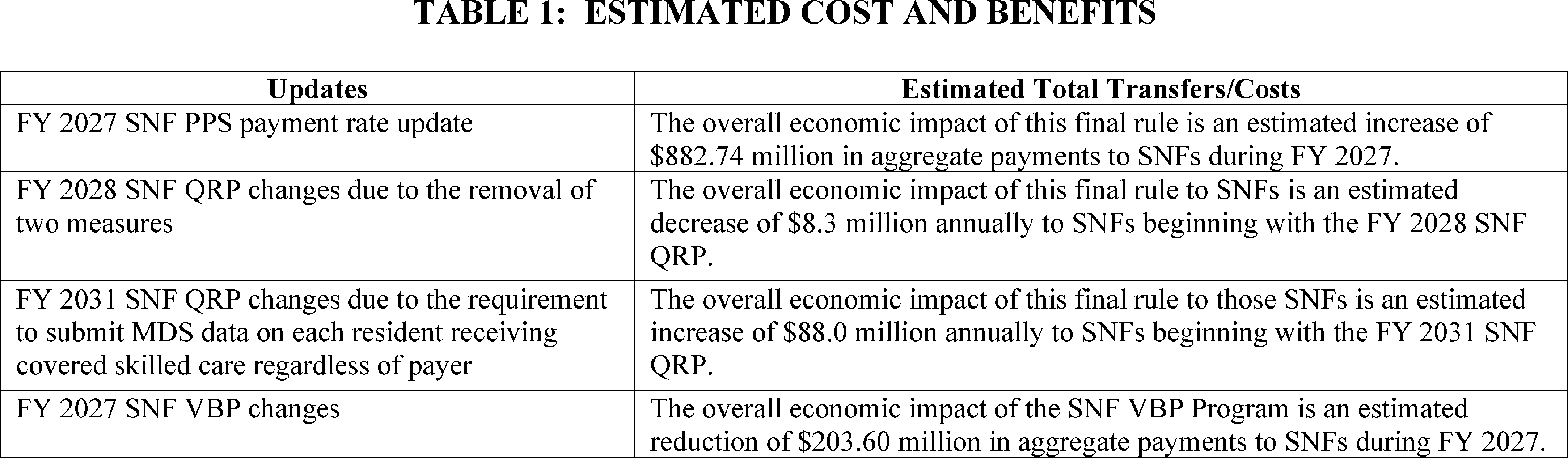
 Pub. L. 113-93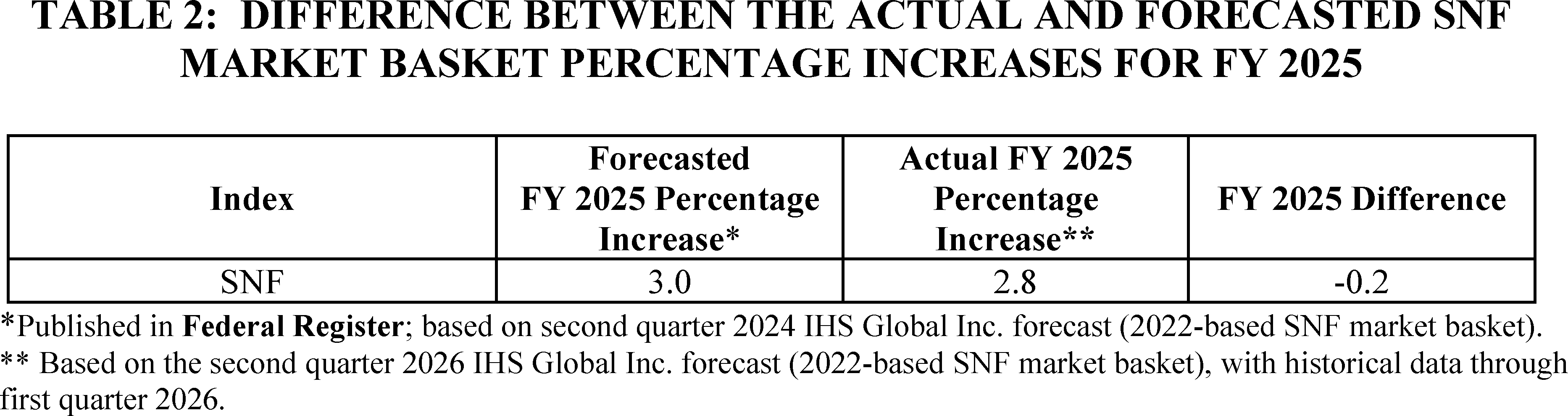
 www.bls.gov/productivity
 www.whitehouse.gov/wp-content/uploads/2023/07/OMB-Bulletin-23-01.pdf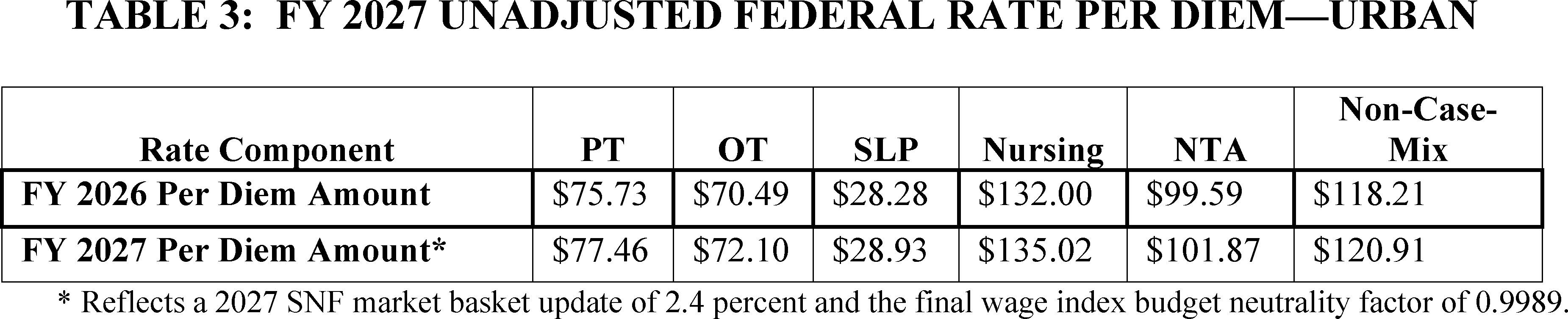

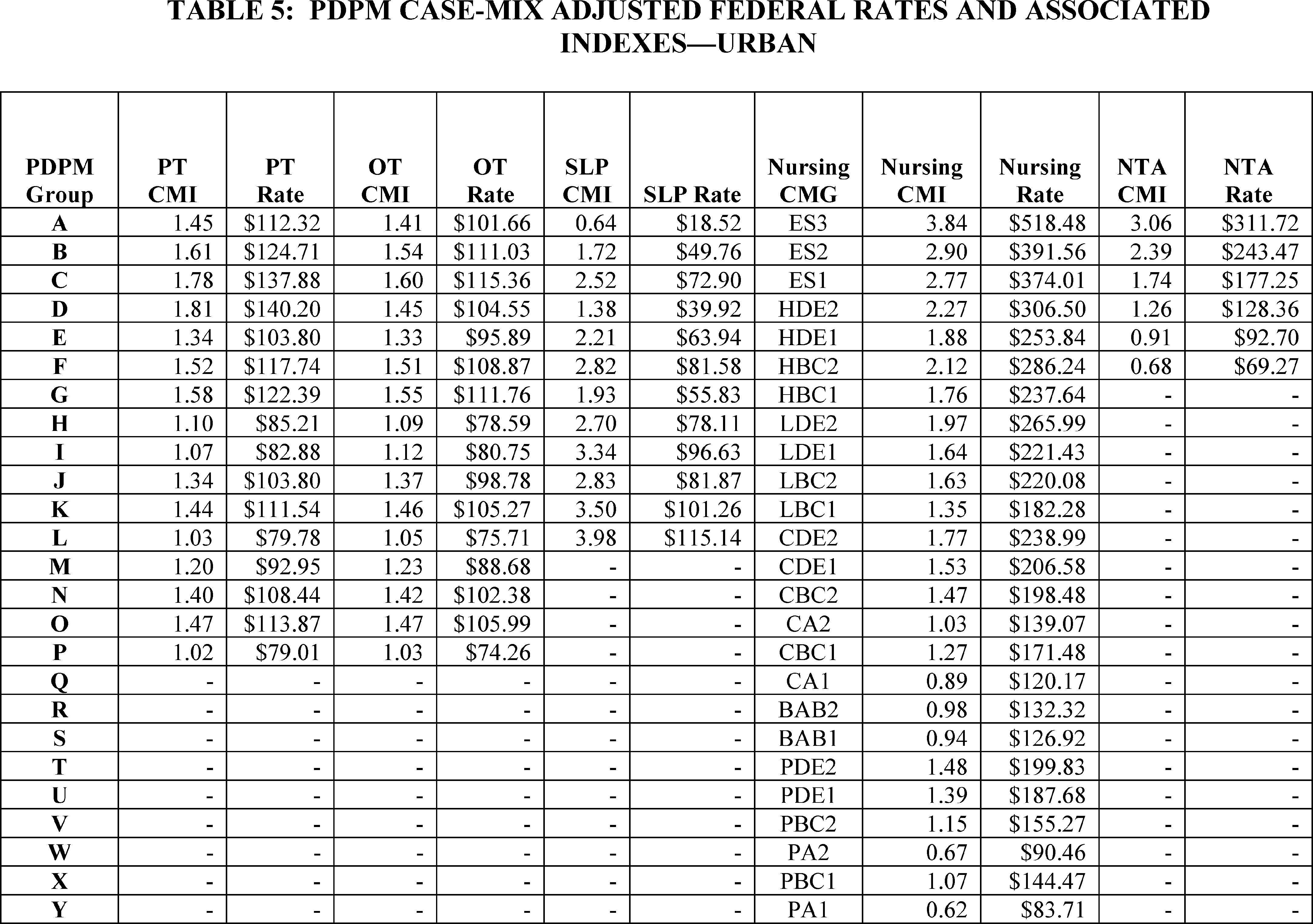
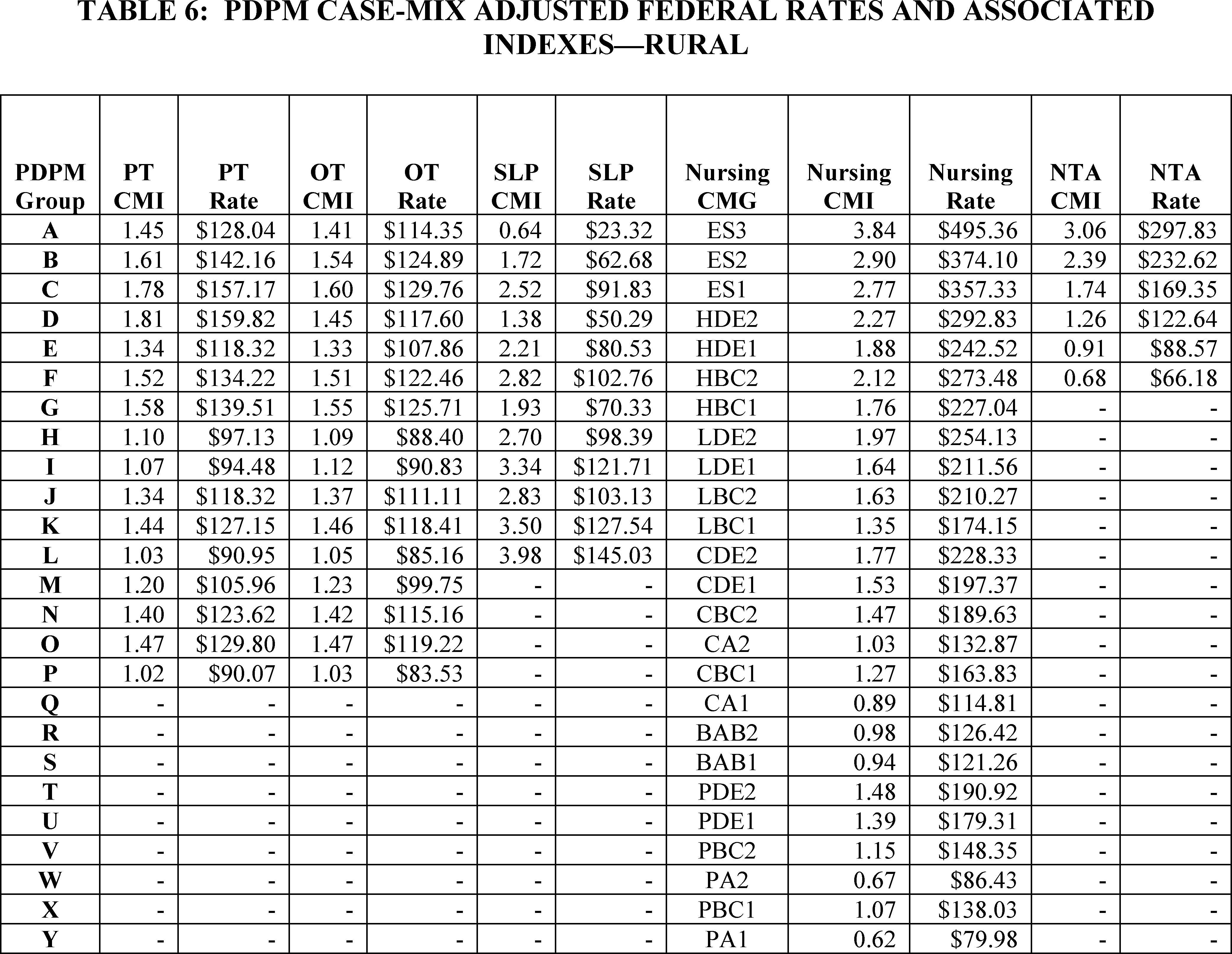
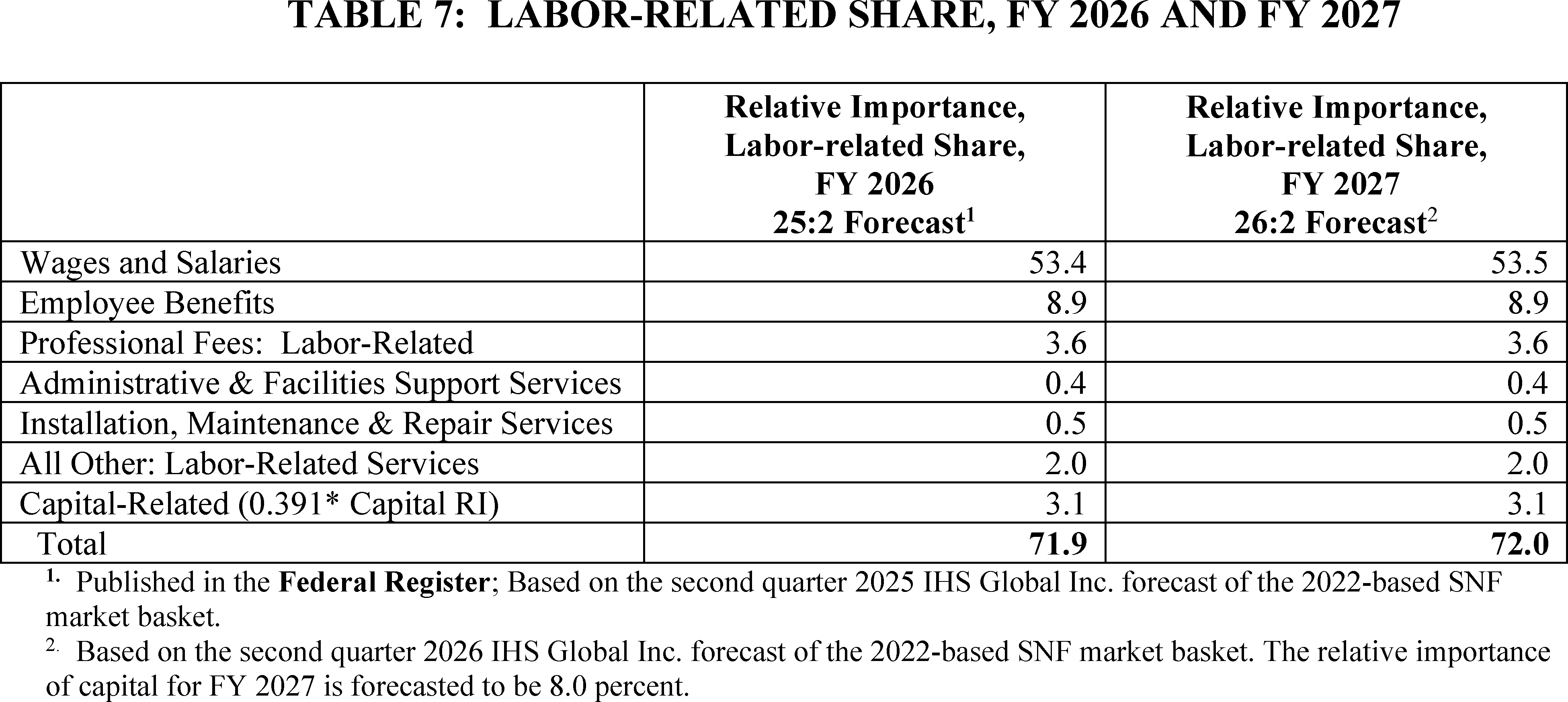
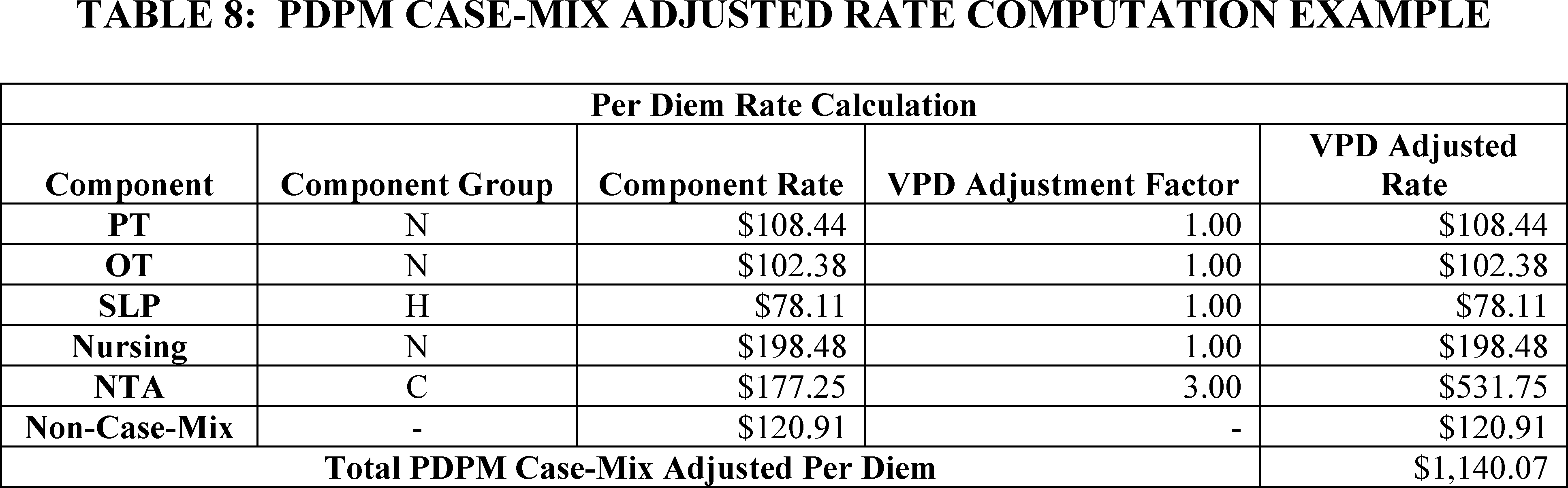

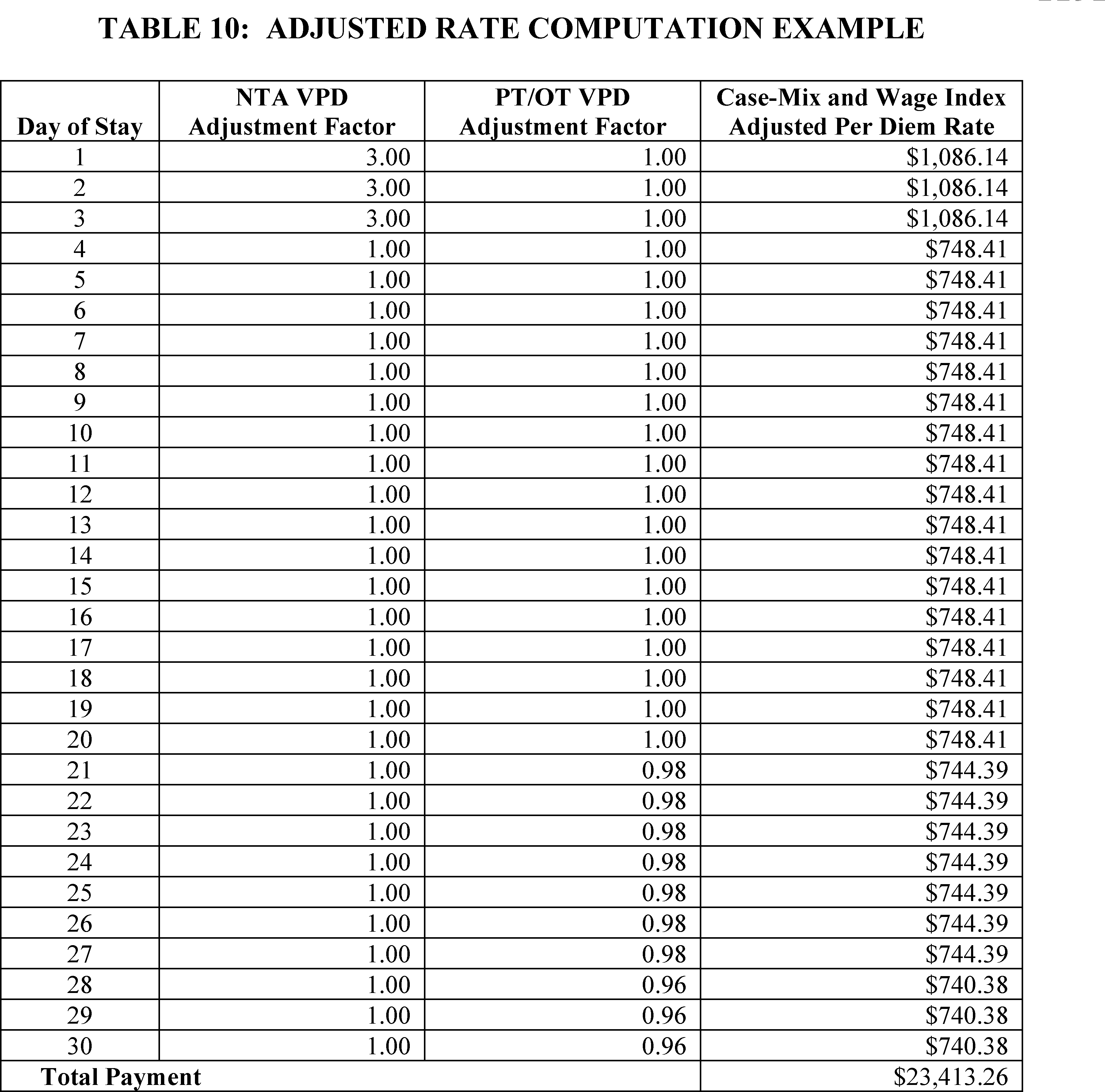
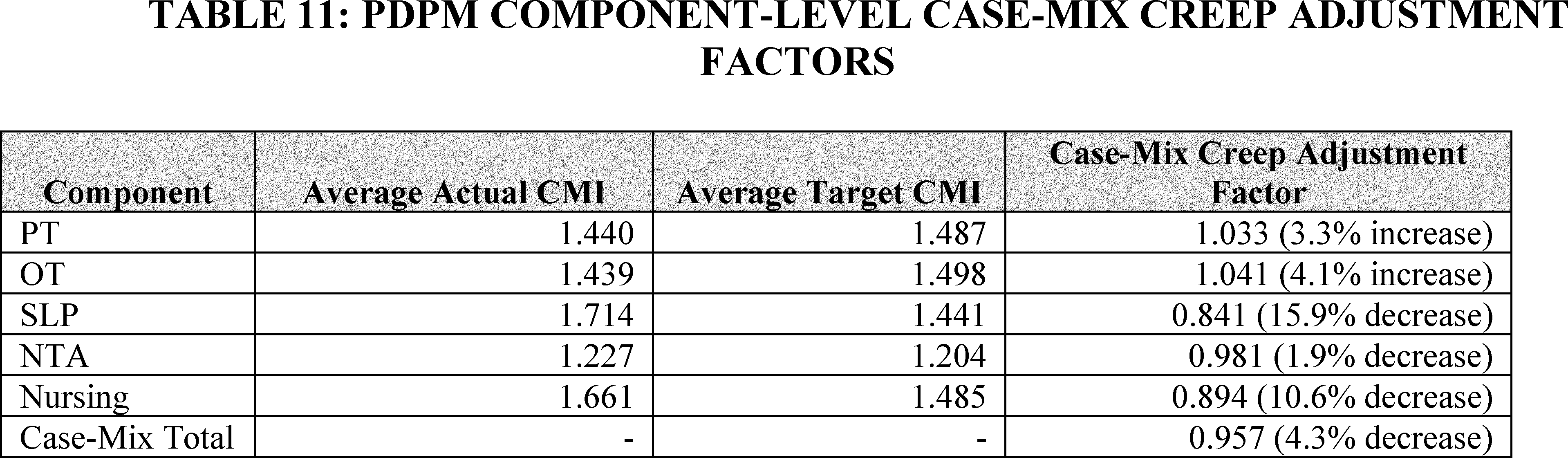
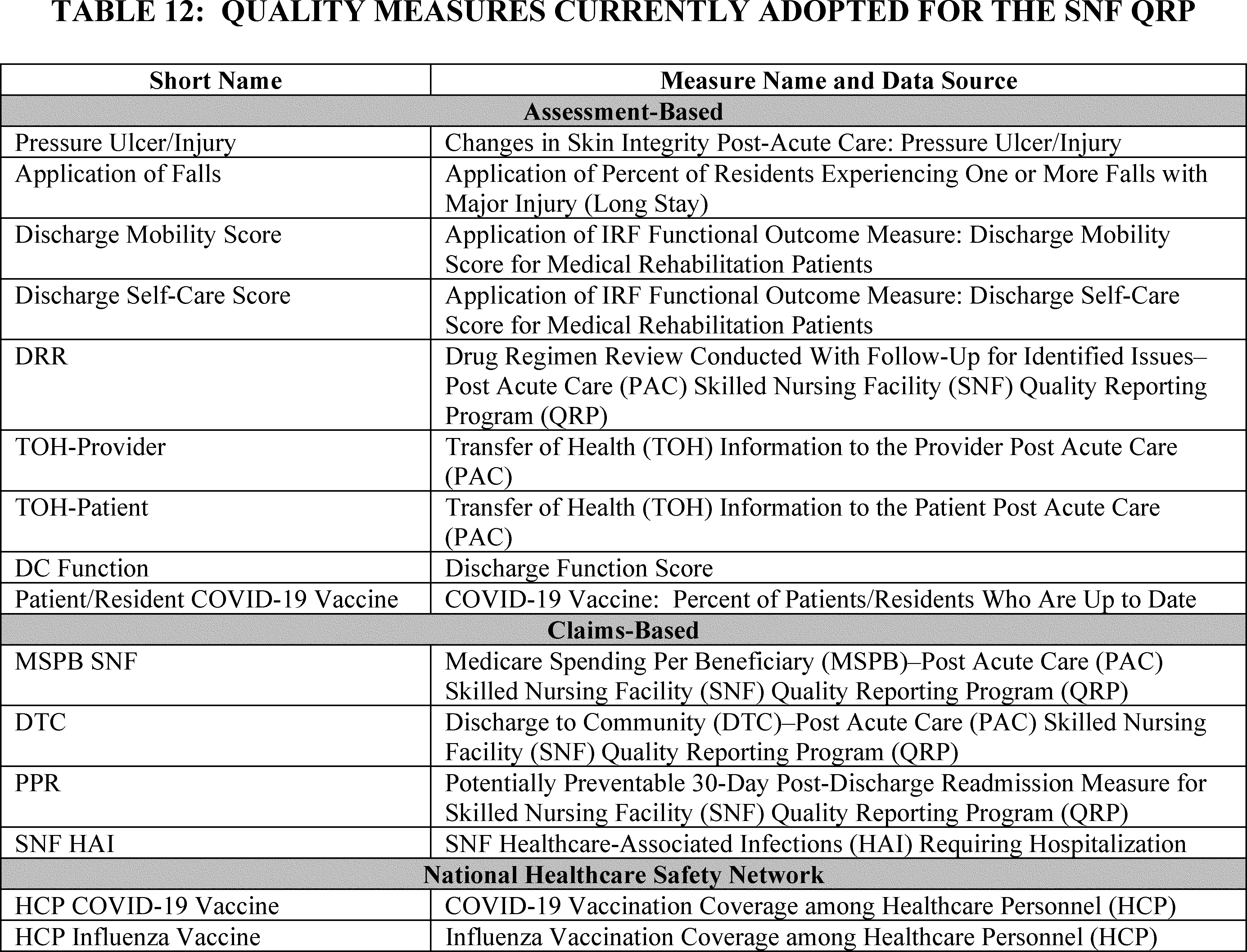
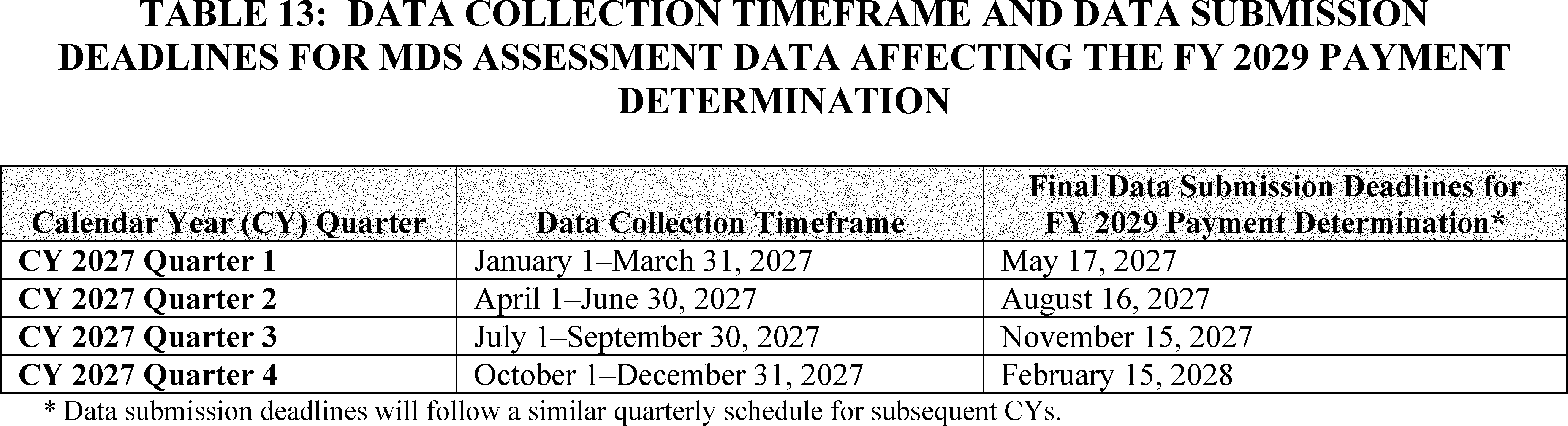
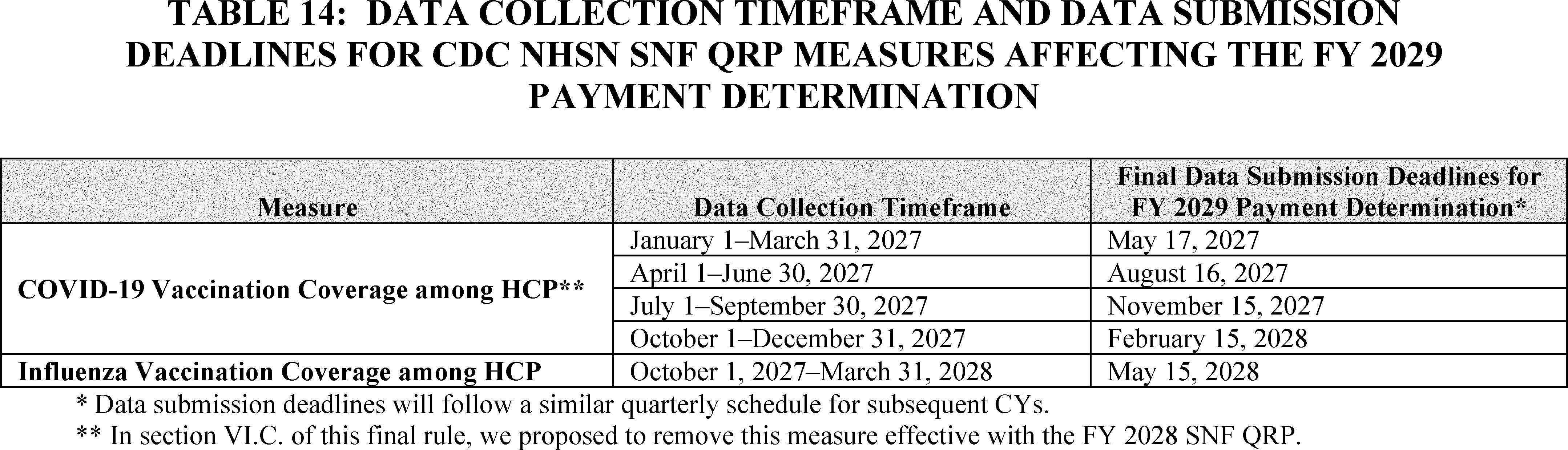
 pacioproject.org/
 t.co/69Sqaa29JV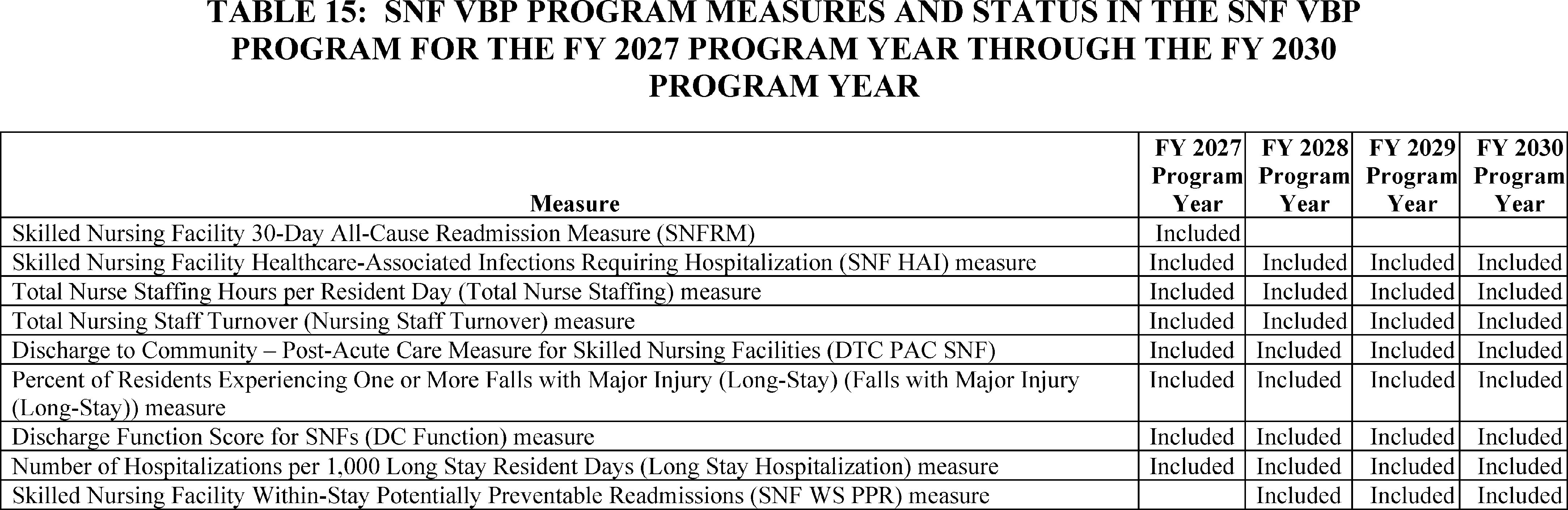
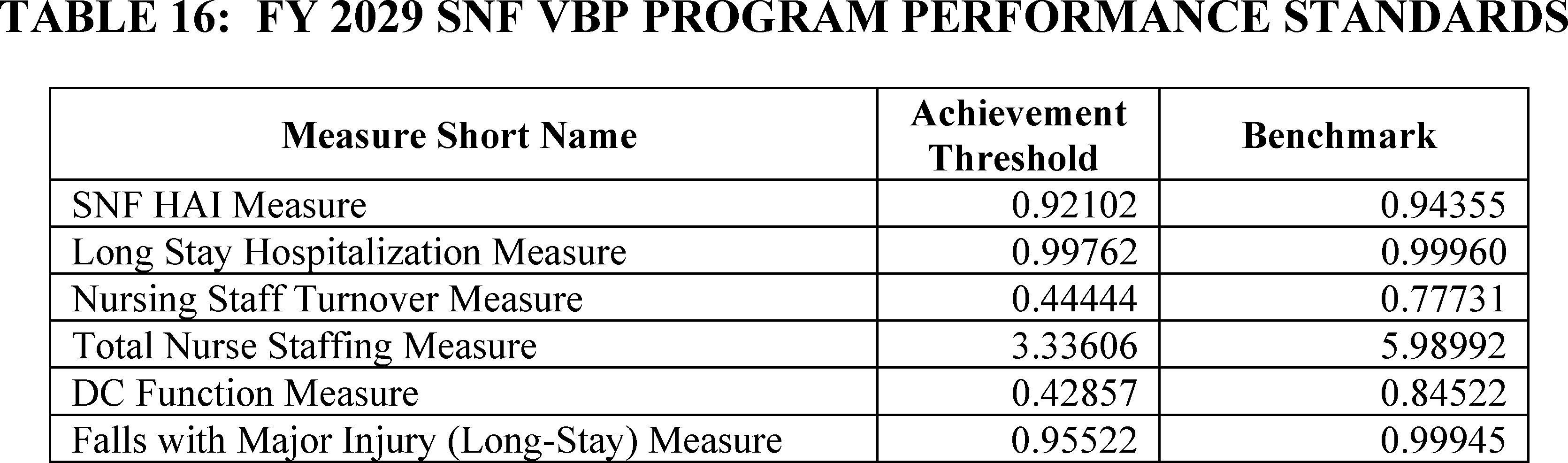

 data.cms.gov/provider-data/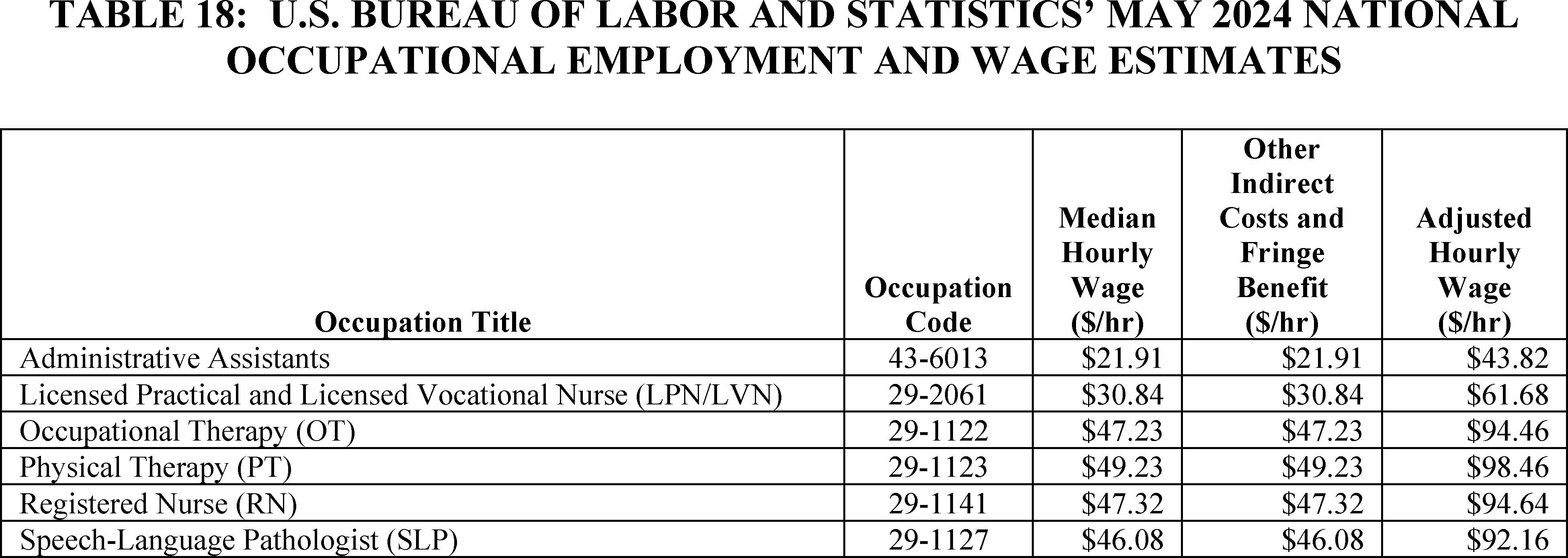
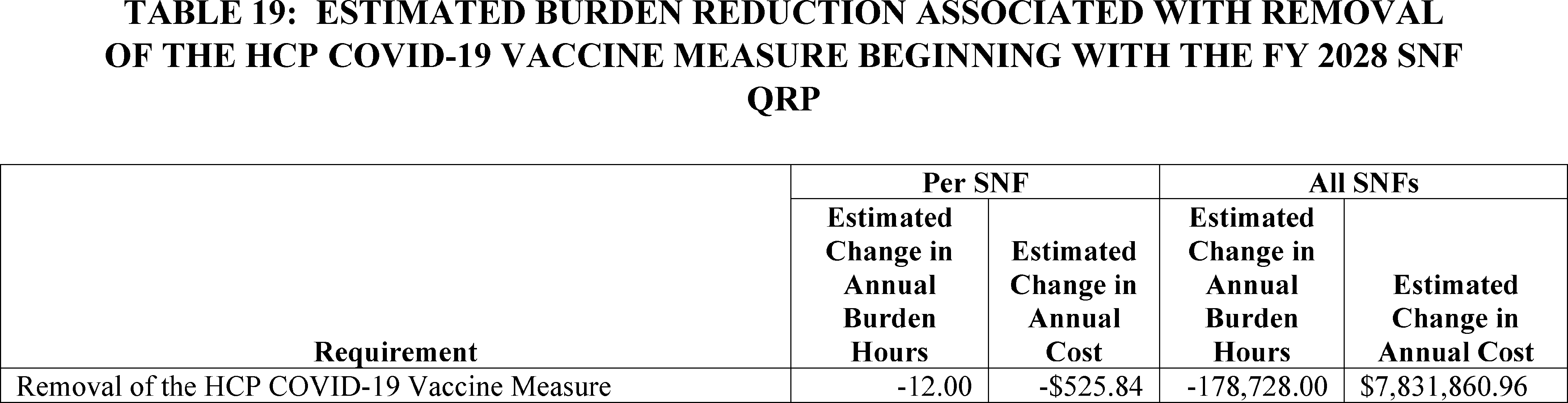
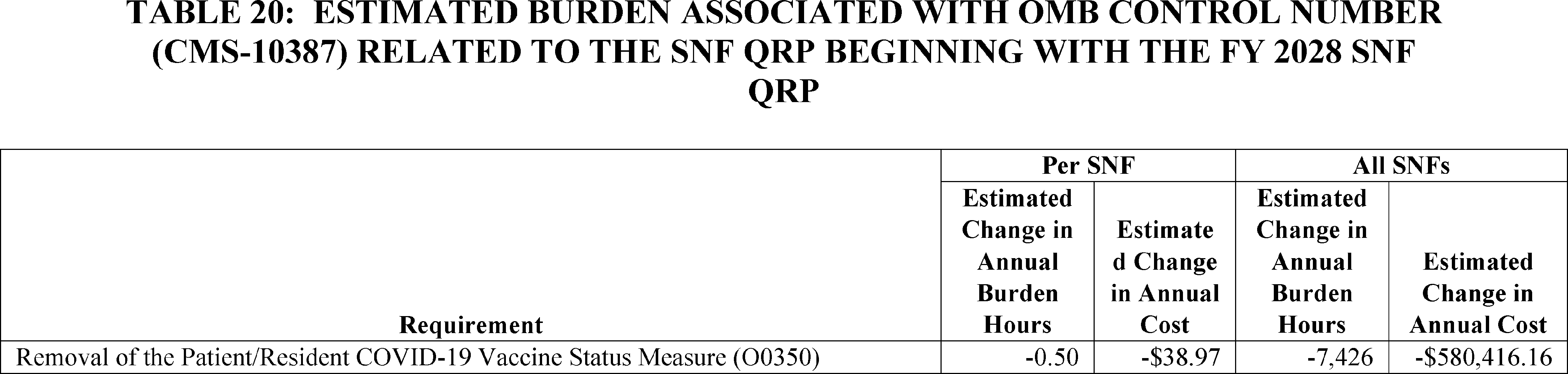
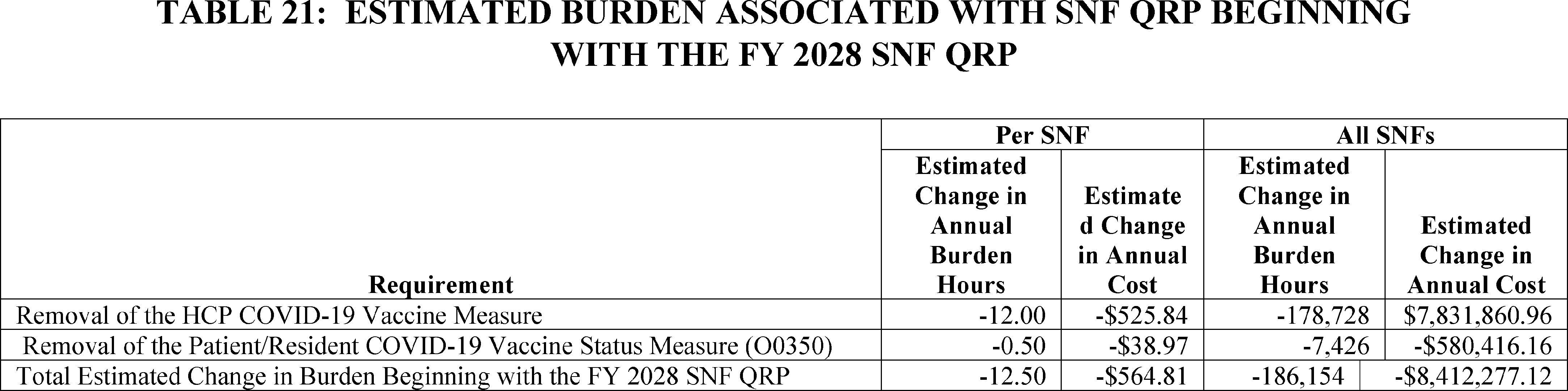
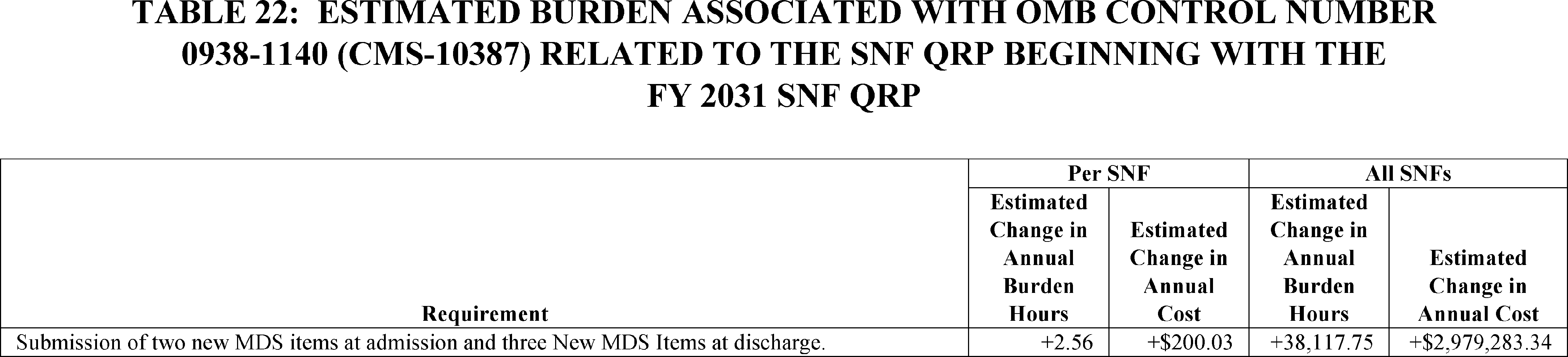
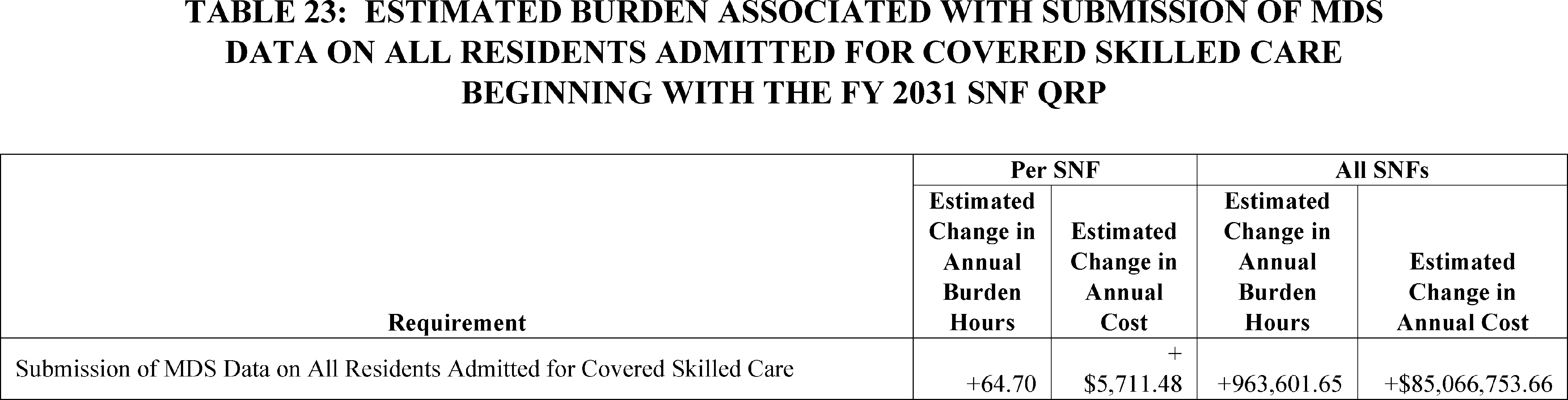
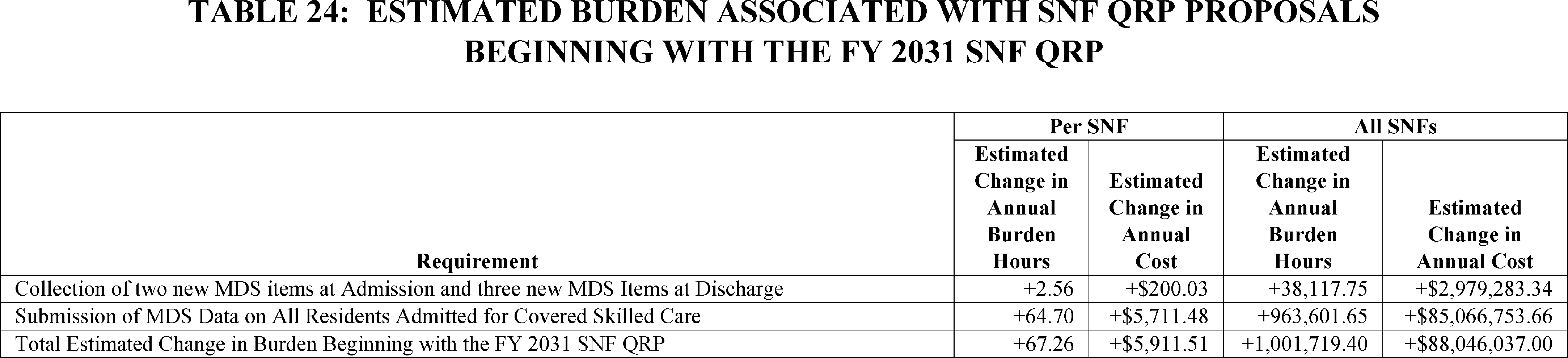
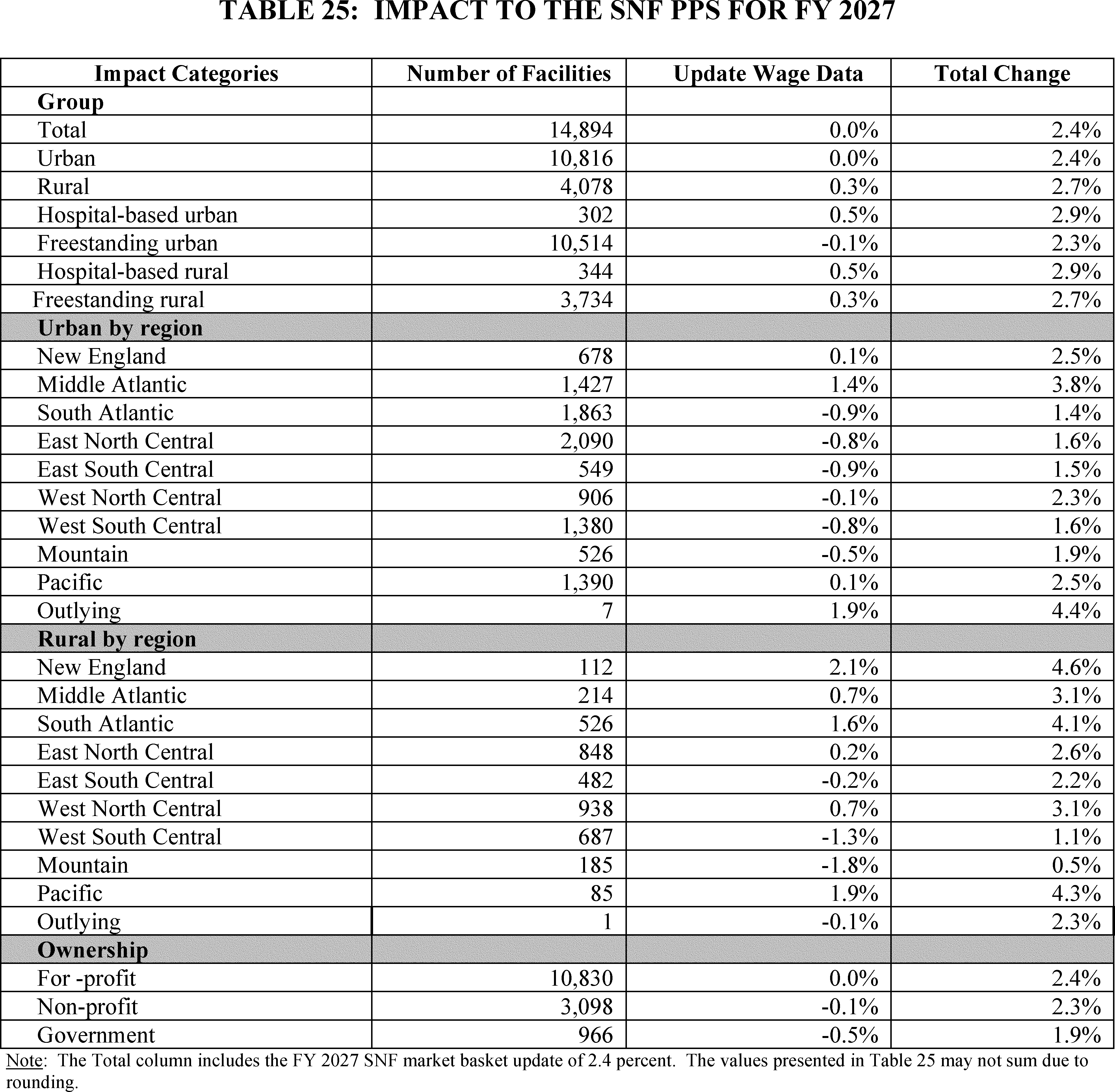
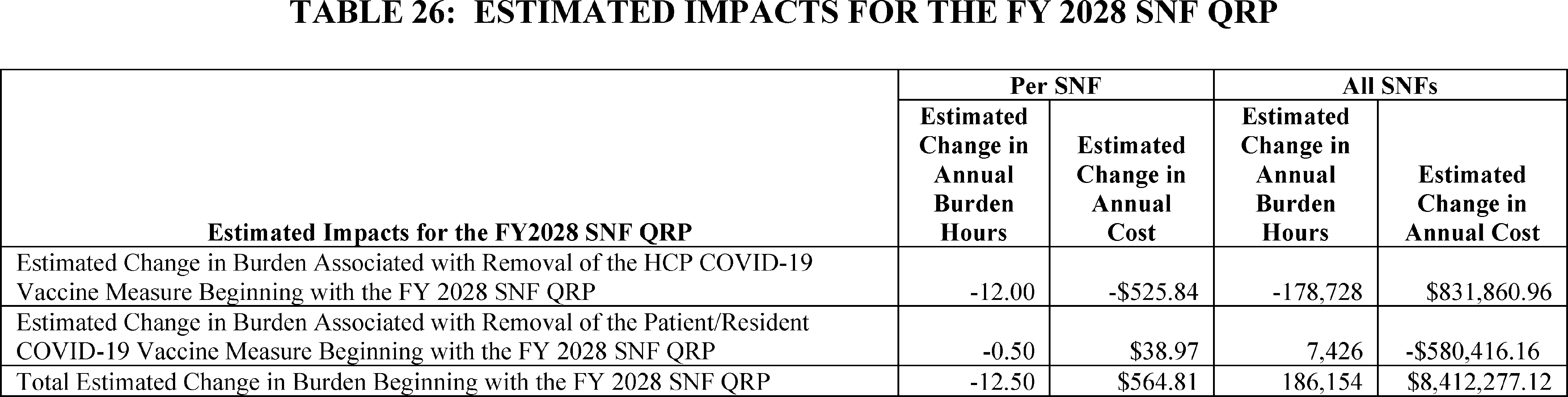
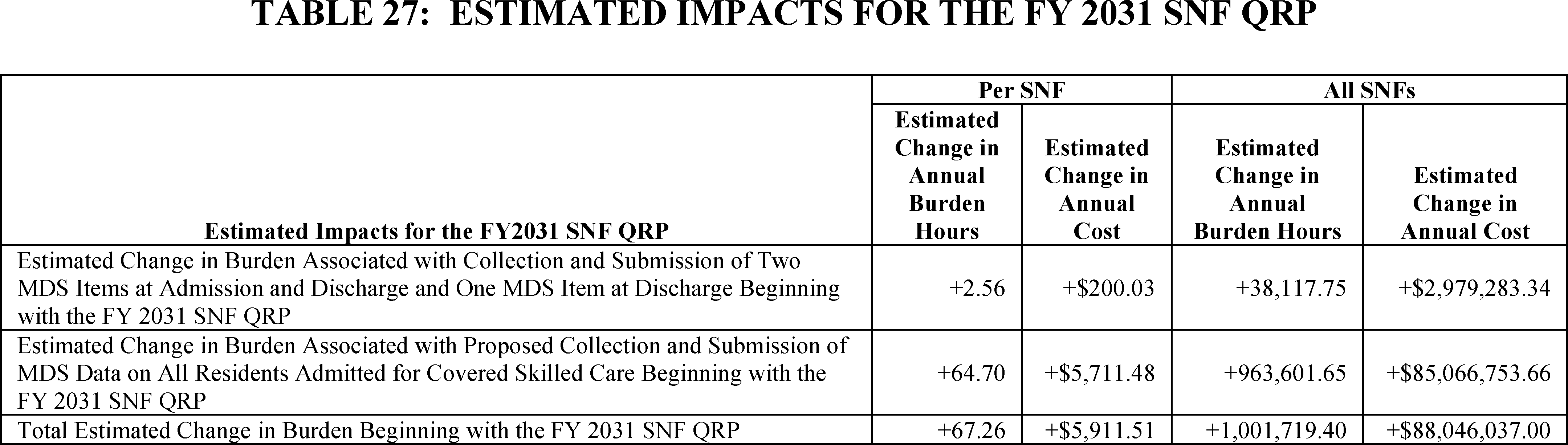
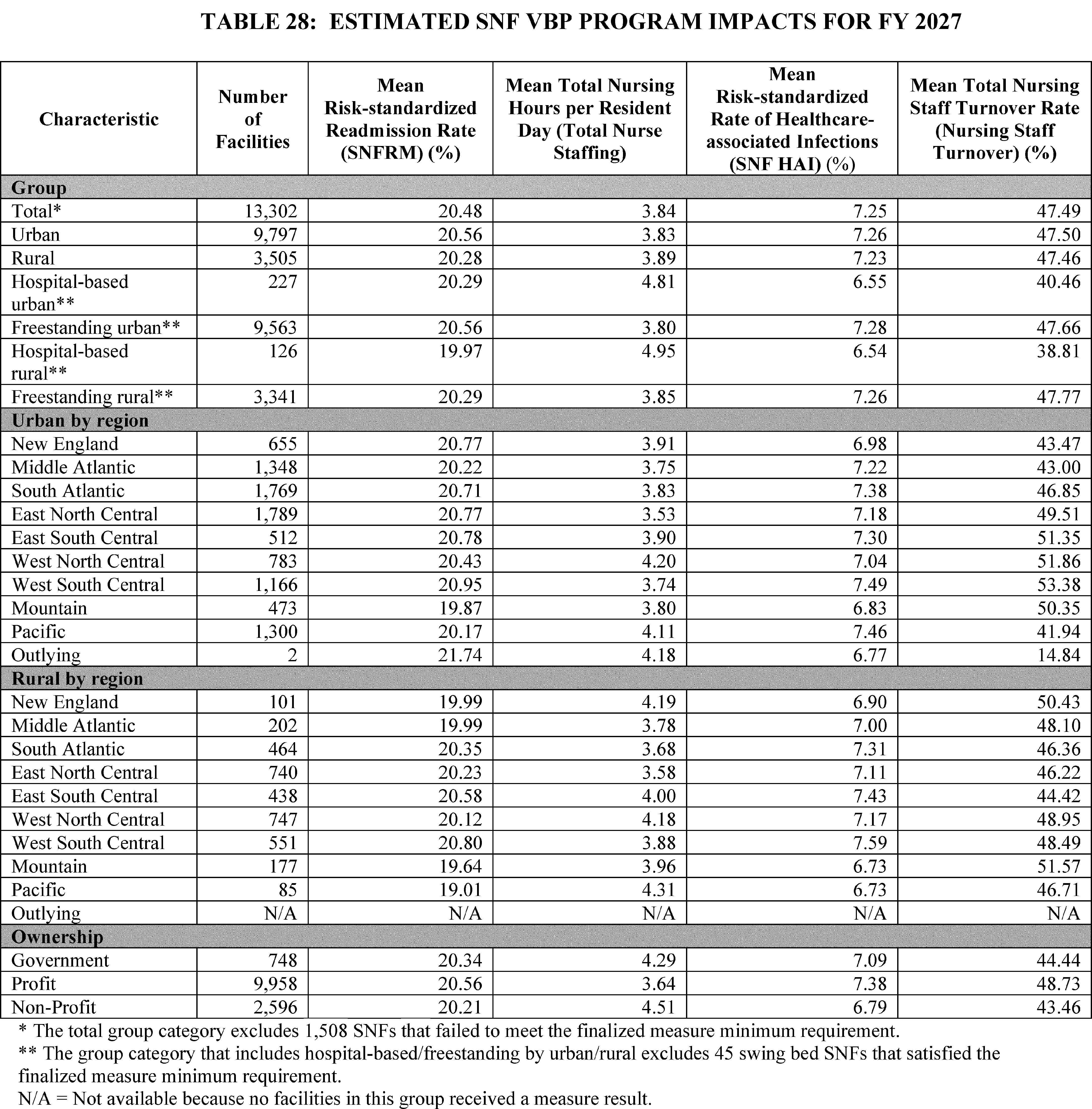
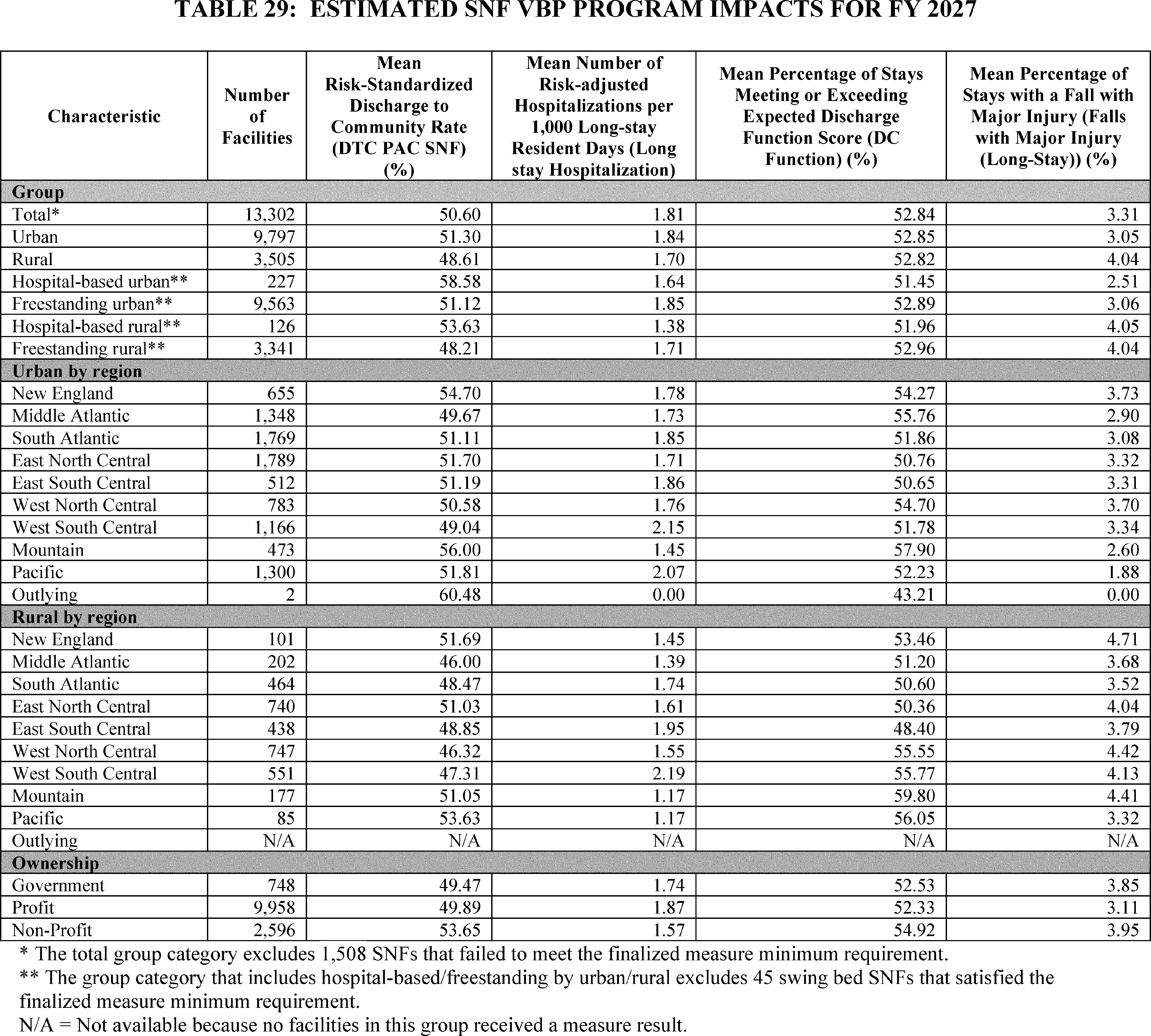
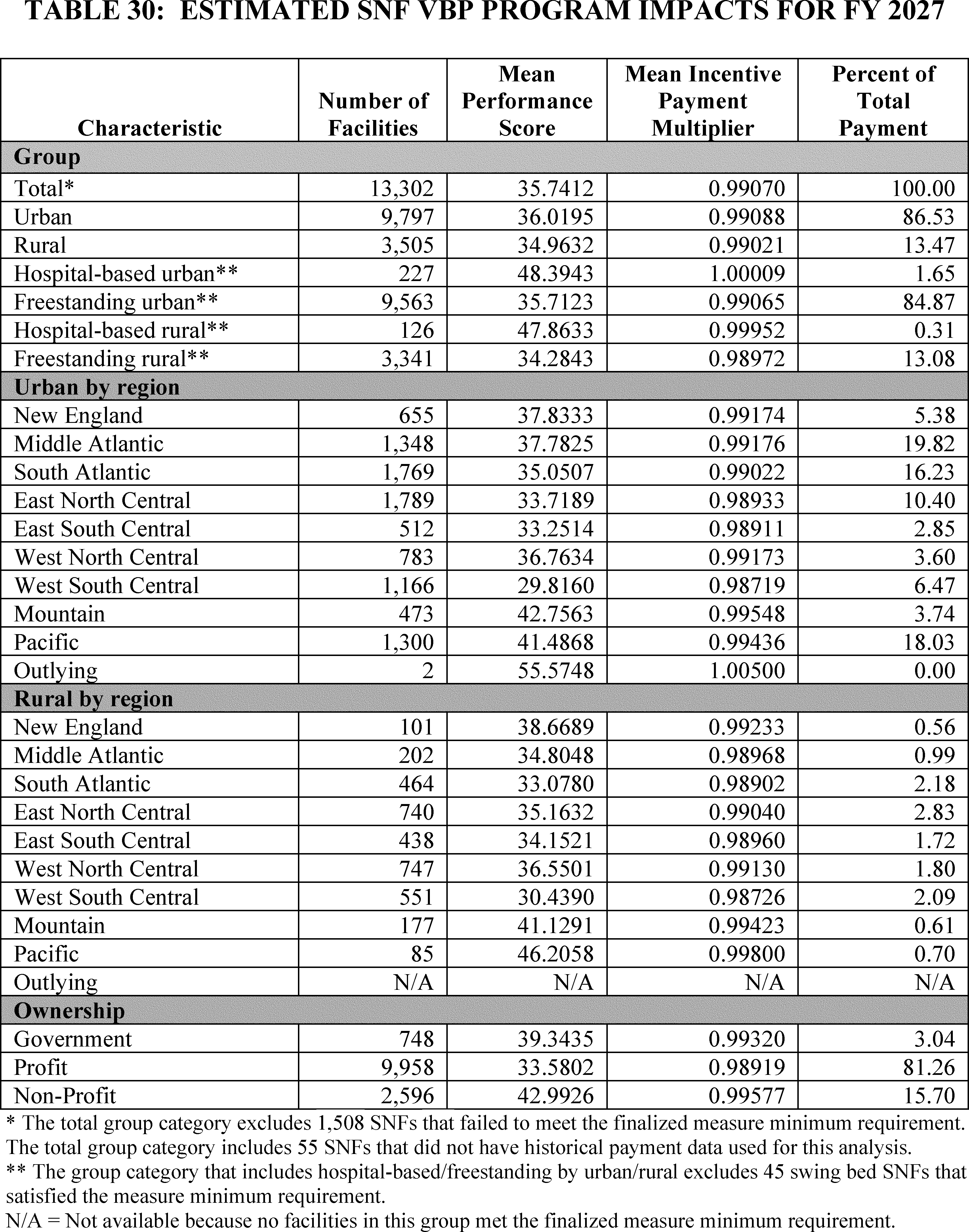



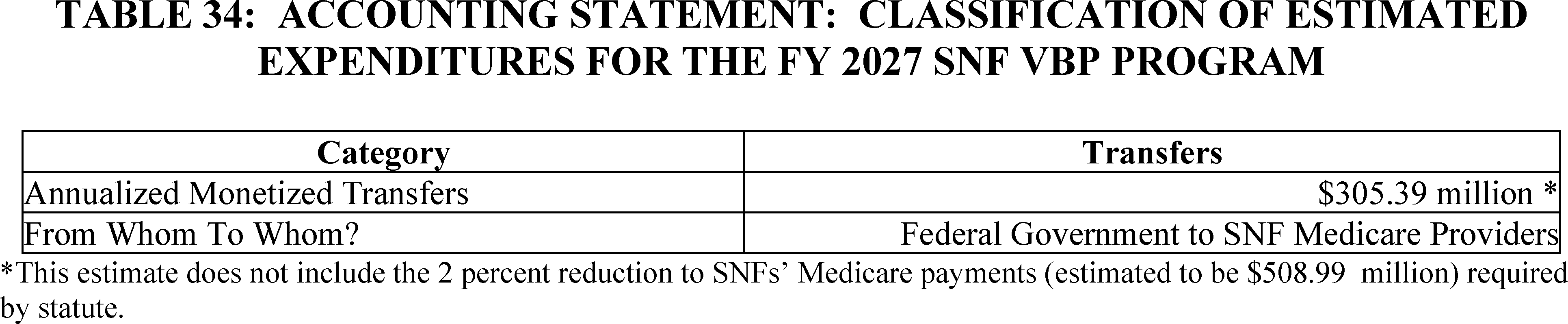
 www.sba.gov/document/support-table-size-standards
 www.medpac.gov/document/march-2025-report-to-the-congress-medicare-payment-policy/
 www.cdc.gov/nchs/nvss/vsrr/covid19/index.htm
 archive.cdc.gov/www_cdc_gov/coronavirus/2019-ncov/your-health/end-of-phe.html
 doi.org/10.1111/jgs.16801
 www.congress.gov/bill/101st-congress/house-bill/5835
 digitalassets.jointcommission.org/api/public/content/0309517406bf4b87972b9a433a689c87?v=0fa83028
 www.kff.org/medicare/medicare-advantage-enrollment-update-and-key-trends/
 www.census.gov/data/tables/2022/econ/susb/2022-susb-annual.html