Establishment of Class C Airspace and Removal of Class D Airspace; Wilmington International Airport, NC
This action proposes to establish Class C airspace and remove Class D airspace at Wilmington International Airport (ILM), NC. The FAA is proposing this action to enhance the eff...
This action proposes to establish Class C airspace and remove Class D airspace at Wilmington International Airport (ILM), NC. The FAA is proposing this action to enhance the efficient management of air traffic operations and reduce the potential for midair collision in the Wilmington, NC, terminal area. The Class C airspace would replace the existing Class D airspace at ILM. In addition, the non-regulatory Terminal Radar Service Area (TRSA) would be removed.
DATES:
Comments must be received on or before October 5, 2026.
ADDRESSES:
Send comments identified by FAA Docket No. FAA-2026-6934 and Airspace Docket No. 26-AWA-3 using any of the following methods:
*
Federal eRulemaking Portal:
Go to
www.regulations.gov
and follow the online instructions for sending your comments electronically.
*
Mail:
Send comments to Docket Operations; U.S. Department of Transportation, 1200 New Jersey Avenue SE, Room W58-213, West Building, 5th Floor, Washington, DC 20590.
*
Hand Delivery or Courier:
Take comments to Docket Operations in Room W58-213 of the West Building, 5th Floor at 1200 New Jersey Avenue SE, Washington, DC, between 9 a.m. and 5 p.m., Monday through Friday, except Federal holidays.
*
Fax:
Fax comments to Docket Operations at (202) 493-2251.
Docket:
Background documents or comments received may be read at
www.regulations.gov
at any time. Follow the online instructions for accessing the docket or go to the Docket Operations in Room W58-213 of the West Building, 5th Floor at 1200 New Jersey Avenue SE, Washington, DC, between 9 a.m. and 5 p.m., Monday through Friday, except Federal holidays.
FAA Order JO 7400.11K, Airspace Designations and Reporting Points, and subsequent amendments can be viewed online at
www.faa.gov/air_traffic/publications/.
You may also contact the Rules and Regulations Group, Policy Directorate, Federal Aviation Administration, 800 Independence Avenue SW, Washington, DC 20591; telephone: (202) 267-8783.
FOR FURTHER INFORMATION CONTACT:
Ashley Toth, Rules and Regulations Group, Policy Directorate, Federal Aviation Administration, 800 Independence Avenue SW, Washington, DC 20591; telephone: (202) 267-8783.
SUPPLEMENTARY INFORMATION:
Authority for This Rulemaking
The FAA's authority to issue rules regarding aviation safety is found in Title 49 of the United States Code. Subtitle I, Section 106 describes the authority of the FAA Administrator. Subtitle VII, Aviation Programs, describes in more detail the scope of the agency's authority. This rulemaking is promulgated under the authority described in Subtitle VII, Part A, Subpart I, Section 40103. Under that section, the FAA is charged with prescribing regulations to assign the use of the airspace necessary to ensure the safety of aircraft and the efficient use of airspace. This regulation is within the scope of that authority as it would modify the airspace structure as necessary to enhance the safe and efficient flow of air traffic within the Wilmington, NC, terminal area.
Comments Invited
The FAA invites interested persons to participate in this rulemaking by submitting written comments, data, or views. Comments are specifically invited on the overall regulatory, aeronautical, economic, environmental, and energy-related aspects of the proposal. The most helpful comments reference a specific portion of the proposal, explain the reason for any recommended change, and include supporting data. To ensure the docket does not contain duplicate comments, commenters should submit only one time if comments are filed electronically, or commenters should send only one copy of written comments if comments are filed in writing.
The FAA will file in the docket all comments it receives, as well as a report summarizing each substantive public contact with FAA personnel concerning this proposed rulemaking. Before acting on this proposal, the FAA will consider all comments it receives on or before the closing date for comments. The FAA will consider comments filed after the comment period has closed if it is possible to do so without incurring expense or delay. The FAA may change this proposal in light of the comments it receives.
Privacy:
In accordance with 5 U.S.C. 553(c), DOT solicits comments from the public to better inform its rulemaking process. DOT posts these comments, without edit, including any personal information the commenter provides, to
www.regulations.gov,
as described in the system of records notice (DOT/ALL-14 FDMS), which can be reviewed at
www.dot.gov/privacy.
You may review the public docket containing the proposal, any comments received and any final disposition in person in the Dockets Operations office (see
ADDRESSES
section for address, phone number, and hours of operations). An informal docket may also be examined during normal business hours at the office of the Eastern Service Center, Federal Aviation Administration, Room 210, 1701 Columbia Avenue, College Park, GA, 30337.
Incorporation by Reference
Class C airspace areas and Class D airspace areas are published in paragraphs 4000 and 5000, respectively,
( printed page 49373)
of FAA Order JO 7400.11, Airspace Designations and Reporting Points, which is incorporated by reference in 14 CFR 71.1 on an annual basis. This document proposes to amend the current version of that order, FAA Order JO 7400.11K, dated August 4, 2025, and effective September 15, 2025. These updates would be published in the next update to FAA Order JO 7400.11. FAA Order JO 7400.11K, which lists Class A, B, C, D, and E airspace areas, air traffic service routes, and reporting points, is publicly available as listed in the
ADDRESSES
section of this document.
Background
Wilmington International Airport (ILM) is located 3 miles northeast of the city of Wilmington, NC. The ILM Airport Traffic Control Tower (ATCT) consists of a combined tower and Terminal Radar Approach Control (TRACON) facility that operates from 0600 to 2300 local time, daily. Currently, Class D airspace, extending from surface to and including 2,500 feet mean sea level (MSL), surrounds the airport. When the ILM ATCT is closed, the ILM Class D airspace reverts to a Class E surface area. The Class D is effective during the specific dates and times established in advance by a Notice to Airmen (NOTAM), and thereafter as continuously published in the Chart Supplement.
A TRSA overlies the contiguous Class D airspace area in approximately a 20 nautical mile (NM) radius of ILM, within the TRACON's delegated airspace.
The airspace surrounding ILM is complex and congested due to runway configuration, geography, proximity to other airports, restricted airspace, navigational aids, flight training, tourists, skydiving, and military operations. Those factors coupled with the standard arrivals and departures into ILM make the TRSA airspace a web of intersecting flight paths. Participation in TRSA services is voluntary to pilots operating under visual flight rules (VFR). There are significant numbers of VFR pilots, which are not in contact with air traffic control (ATC), operating throughout the ILM terminal area. VFR pilots are often observed loitering or maneuvering in the departure corridors, along the final approach courses, or overhead the Class D. Without being in communication with ATC, air traffic controllers are unaware of the VFR pilots' intentions. Heading and altitude changes made by nonparticipating VFR aircraft are unpredictable, and this often requires controllers to take action to avoid possible conflicts with other aircraft under their control. With the current airspace configuration, there is no requirement for VFR pilots to contact ATC outside of the ILM Class D airspace area.
Class C Airspace and Terminal Radar Service Areas (TRSA)
Class C airspace areas are designated under 14 CFR part 71 rulemaking and can be used to improve aviation safety, reduce the risk of midair collisions in the terminal area, and enhance the management of air traffic operations therein. Operating requirements within Class C airspace keep ATC informed of all aircraft operating within the Class C airspace. Pilots are required to establish two-way radio communications with ATC prior to entering Class C airspace, and they must maintain communications with ATC while operating in Class C airspace. In addition, pursuant to 14 CFR part 91, no person may operate an aircraft in Class C airspace unless the aircraft is equipped with an operational transponder and Automatic Dependent Surveillance—Broadcast (ADS-B) Out.
TRSAs are not officially designated by airspace rulemaking action. They are not incorporated in 14 CFR part 71, nor are there any TRSA-specific operating rules in 14 CFR part 91. TRSAs are established around designated airports where ATC provides radar vectoring, sequencing, and separation services on a full-time basis for all instrument flight rules (IFR) and participating VFR aircraft. Pilots operating under VFR are encouraged to contact ATC to avail themselves of TRSA services. However, VFR pilot participation in TRSA services is voluntary. The limitations of the TRSA (
i.e.,
voluntary participation by VFR pilots) often fails to prevent nonparticipating VFR aircraft coming in direct conflict with higher-performance jets landing or departing ILM.
Need for Class C Airspace at ILM
Pursuant to FAA Order JO 7400.2, paragraph 16-2-1, to qualify for Class C airspace, an airport must be served by an operational ATCT and a radar approach control and meet one of the following criteria: (1) an annual instrument operations count of 75,000 at the primary airport; or (2) an annual instrument operations count of 100,000 and the primary and secondary airports; or (3) an annual count of 250,000 enplaned passengers at the primary airport.
ILM qualifies as a candidate for Class C airspace based on its annual enplaned passenger count. ILM's enplaned passenger count for calendar year (CY) 2024 (the latest year for which validated figures are available) was 737,065. This figure represents a 59.33% increase over CY 2021 numbers. Other factors considered are traffic volume, airspace complexity, and the potential for midair collision in the terminal area.
The existing TRSA does not adequately support the volume and diversity of aircraft operating in the congested ILM terminal area. Currently, there is no requirement for VFR pilots to establish radio contact with ATC outside of the existing ILM Class D airspace areas. Since participation in TRSA services is voluntary on the part of VFR pilots, the TRSA does not provide ATC with an adequate level of flight information or control required to segregate IFR and VFR aircraft operating in this complex airspace environment. VFR aircraft that are not in contact with ATC routinely operate in the area, and in so doing they cross ILM arrival and departure corridors and/or make unexpected heading and/or altitude changes. These aircraft frequently operate at altitudes that may conflict with aircraft arriving or departing ILM. As a result, IFR aircraft must alter their flight paths or altitudes to avoid them, thereby disrupting the orderly flow of ILM arrivals and departures.
Additionally, air traffic controller workload is increased due to the need for additional vectoring or altitude changes of ILM arrivals and departures to ensure separation from the non-participating VFR aircraft that are not communicating with ATC. Under this proposal, designation of Class C airspace would ensure that those VFR aircraft operating in the vicinity of the ILM arrival and departure corridors would be required to establish contact with ATC, making controllers aware of pilots' intentions and promoting increased safety and efficiency.
Benefits of Class C Airspace
All pilots would benefit from the enhanced safety provided by Class C services, which include the separation of aircraft, traffic advisories, and safety alerts. Class C airspace enhances safety by the requirement that two‐way radio communication must be established with ATC prior to a pilot entering Class C airspace and maintained for the duration of flight in Class C airspace. The requirements for operating within Class C airspace will allow air traffic controllers to be aware of the intentions of VFR pilots and provide the opportunity to safely separate VFR and IFR traffic with more precision. Nonparticipating VFR aircraft will need to remain clear of the Class C airspace which will decrease the number of ILM arrivals and departures encountering nonparticipating VFR aircraft, thereby
( printed page 49374)
reducing the potential for a midair collision. It also decreases the workload for air traffic controllers by minimizing the need to vector arrivals and departures to avoid conflicts with nonparticipating VFR aircraft due to the operating requirements for Class C airspace. Furthermore, it would minimize disruptions to the orderly flow of arrivals and departures to ensure pilots can fly stabilized approaches during a critical phase of flight.
Pre-NPRM Public Input
In 2024, the FAA approved the formation of an Ad Hoc Committee (Committee) to seek input and recommendations from representatives of affected aviation users for the FAA to consider in designing a proposed Class C airspace area at ILM. The Committee consisted of a diverse sampling of local aviation operators and organizations, including representatives from the Aircraft Owners and Pilots Association, pilots from the local airports and flight schools, the airlines, flight training, general aviation, military, business aviation, the ILM airport itself, and others.
Ad Hoc Committee Recommendations
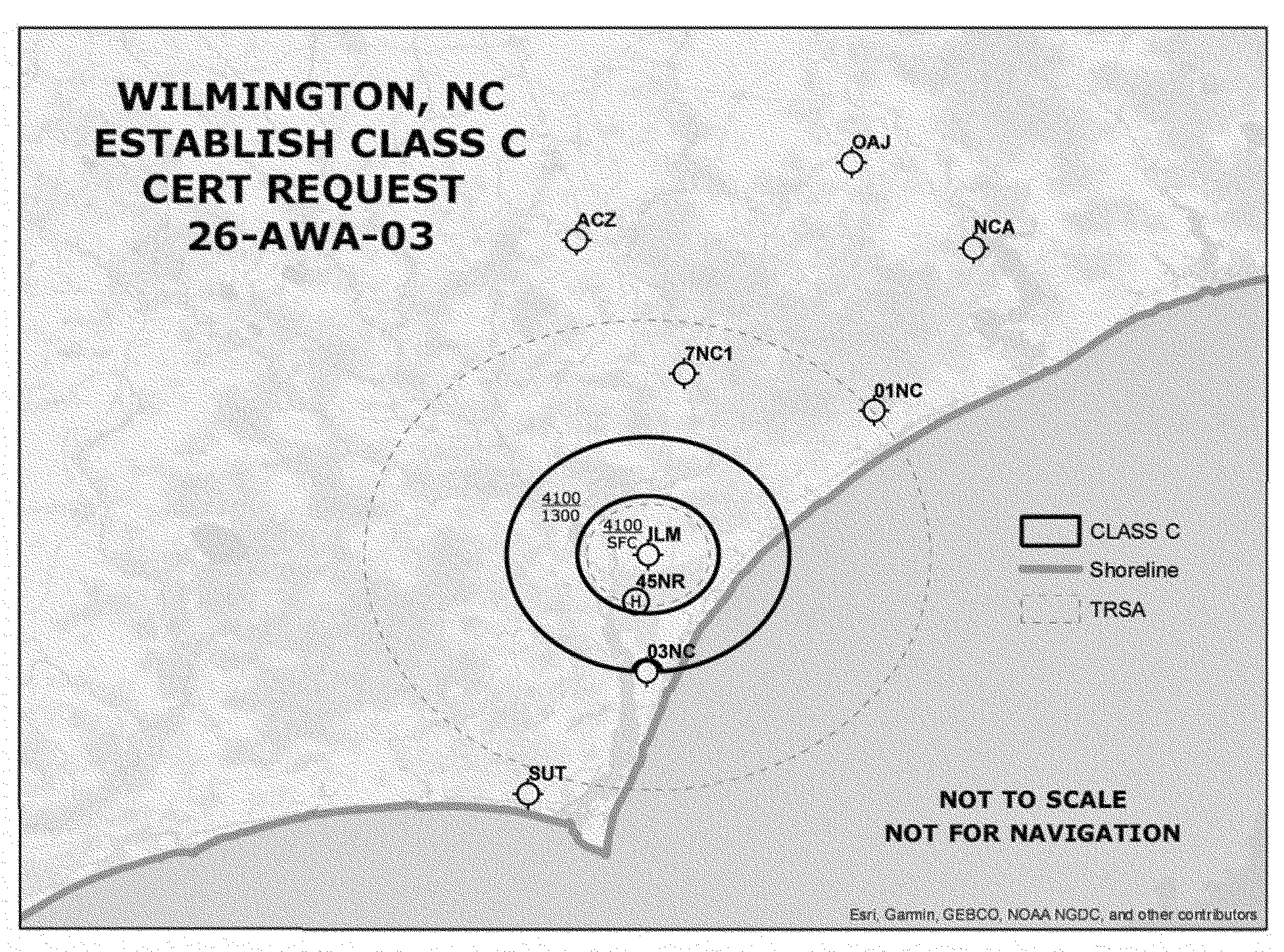
The Committee met throughout 2024 and submitted its report to the FAA in February 2025. The initial Class C airspace design presented to the Committee would have extended from the surface to and including 4,100 feet MSL within a 5 NM radius of ILM; and the airspace would have extended from 1,300 feet MSL to and including 4,100 feet MSL within a 10 NM radius of ILM. However, based on the input and discussions from the meetings, the Committee recommended that the FAA include a 1 NM cutout from the outer shelf on the southern side of the ILM Class C surface area to accommodate Pilots Ridge Airport (03NC), NC, operations outside or beneath Class C airspace.
The Committee proposed the modification because it would allow users of 03NC to easily ingress and egress the airport without any negative impact on other airspace users. This modification does not present any undue challenges due to the location of 03NC at the outer edge of the proposed ILM Class C airspace. Additionally, the proposed cutout is located between the approach and departure corridors for both runways at ILM.
The Committee also considered a possible option to remove a slice of the Class C airspace along a line parallel to, and 1 NM north of 03NC, but it was not ultimately recommended by the Committee. This option was rejected because it would remove the outer shelf of the Class C where it would bisect the approach corridor for Runway 35 at a point where ATC vectors larger aircraft onto the final approach course and would create the potential for additional conflict with nonparticipating VFR aircraft.
After thorough review and analysis, the FAA concurred with the Committee's sole recommendation for modifying the proposal,
i.e.,
to include the cutout for 03NC. The design ensures all aircraft traversing the airspace centered around ILM receive positive control from ATC. It will ensure aircraft receiving radar services are not in conflict with nonparticipating VFR aircraft, especially high-performance jets in critical phases of flight. The design will prevent nonparticipating VFR aircraft from impacting operations while safely transitioning through the area. Finally, this design decreases risk and improves safety and efficiency for passengers and aviation professionals while still allowing access to 03NC.
Informal Airspace Meeting
As announced in the
Federal Register
(90 FR 40048; August 18, 2025), the FAA held an informal airspace meeting on October 1, 2025. The meeting was held virtually via the Zoom platform and was simultaneously broadcast on the FAA's YouTube channel. A total of 56 people logged into the Zoom meeting with 10 concurrent streamers on YouTube. The purpose of the meeting was to provide interested airspace users with an opportunity to present their views and offer recommendations regarding the proposed establishment of Class C airspace at ILM. The meeting began with a presentation describing the current ILM TRSA airspace and air traffic safety concerns and a review of graphical depictions of the updated Class C airspace proposal.
Next, the panelists participated in a live question-and-answer session with meeting attendees. Several questions were asked about whether the proposed airspace would limit general aviation aircraft's ability to transit the airspace as they currently do. General questions were asked about the flow of traffic in and around the area of ILM, how to obtain safety data, clarification on the proposed airspace design and modification process, and ADS-B requirements for Class C. No comments or recommendations were received from the informal airspace meeting.
The Proposal
The FAA is proposing an amendment to 14 CFR part 71 to establish Class C airspace and remove the existing Class D airspace area at ILM. The latitude/longitude coordinates for the ILM airport reference points (ARP) would be updated to reflect the current Airport Master Records data. Also, the existing ILM TRSA would be removed from aeronautical charts and replaced by the Class C airspace area. The FAA is proposing this action to enhance the safe and efficient use of airspace and reduce the risk of midair collision in the ILM terminal area (see the attached chart).
The proposed Class C airspace area would consist of one area, described as follows. The Class C airspace would extend from the surface to and including 4,100 feet MSL within a 5 NM radius of ILM; and the airspace that would extend from 1,300 feet MSL to and including 4,100 feet MSL within a 10 NM radius of ILM, excluding that airspace within a 1 NM radius of Pilots Ridge Airport.
As previously stated, the ILM Class D airspace area and the ILM TRSA would be removed if the proposed Class C airspace is implemented.
Regulatory Impact Analysis
E.O. 12866 (“Regulatory Planning and Review”) and E.O. 13563 (“Improving Regulation and Regulatory Review”) require agencies to regulate in the “most cost-effective manner,” to make a “reasoned determination that the benefits of the intended regulation justify its costs,” and to develop regulations that “impose the least burden on society.” This rule is not a significant regulatory action as defined in Section 3(f) of E.O. 12866. This rule is not an E.O. 14192 regulatory action because this rule is not significant under E.O. 12866.
The airspace surrounding ILM is heavily trafficked, measured by the increase in enplanements since 2022. Currently, the airspace at ILM is class D with an overlying TSA, and serves commercial air carriers, general aviation aircraft, and military aircraft. ILM TRACON's traffic flow is dynamic and is routinely impacted by seasonal conditions, pilot training, Med-Evac, law enforcement, military operations, and the hourly activation and deactivation of military airspace. Beach traffic and pilot training increase significantly in the summer months. ILM has three flight schools based at the airport, and three flight schools are based at nearby airports that regularly use ILM for flight training requirements.
Nearby operations also include the Novant Health Regional Medical Center Heliport. The Novant Health Regional Medical Center, located 4 miles south of ILM, operates 4 Med-Evac helicopters.
( printed page 49375)
In addition, there are three nearby private airports, including Pilots Ridge Airport, Topsail Airpark, and Stag Air Park. The current, outdated ILM Airspace was last modified in 1993 through a rulemaking that amended the Class D airspace.[1]
The airspace no longer meets ILM's need for maintaining a safe and efficient airspace given the growth since 2022.
The FAA proposes establishing Class C airspace at ILM to replace the Class D airspace. The FAA's proposal adopts the Ad Hoc Committee's recommendation to include a 1 NM cutout from the outer shelf on the southern side of the ILM Class C surface area to accommodate Pilots Ridge Airport (03NC), NC, operations outside or beneath Class C airspace.
The FAA determined that this proposed rule would enhance the efficient management of air traffic operations and reduce the potential for midair collision in the ILM terminal area. The proposal would reduce air traffic controller workloads by lessening the need for additional vectoring of arrivals and departures to avoid conflicts with unknown VFR aircraft and minimize disruptions to the orderly flow of arrivals and departures to ensure pilots can fly stabilized approaches during a critical phase of flight. Pilots would also benefit from the enhanced safety provided by Class C services, including separation, traffic advisories, and safety alerts.
Class C airspace areas are designated under 14 CFR part 71 rulemaking to improve aviation safety by reducing the risk of midair collisions in the terminal area and enhancing the management of air traffic operations therein. Class C airspace is designed to keep ATC informed of all aircraft operating within the Class C airspace. Pilots are required to establish two-way radio communications with ATC prior to entering Class C airspace, and they must maintain communications while operating in Class C airspace. In addition, pursuant to 14 CFR part 91, no person may operate an aircraft in Class C airspace unless the aircraft is equipped with an operational transponder and ADS-B Out. VFR operators would only need to make minor adjustments to accommodate the proposed Class C airspace by flying under or around it. Therefore, the FAA expects the proposal would result in minimal cost to VFR operators. The FAA requests comments on the benefits and costs of this proposal to inform the final rule.
Regulatory Flexibility Act
The Regulatory Flexibility Act (RFA) of 1980, (5 U.S.C. 601-612), as amended by the Small Business Regulatory Enforcement Fairness Act of 1996 (Pub. L. 104-121) and the Small Business Jobs Act of 2010 (Pub. L. 111-240), requires Federal agencies to consider the effects of the regulatory action on small business and other small entities and to minimize any significant economic impact. The term “small entities” comprises small businesses and not-for-profit organizations that are independently owned and operated and are not dominant in their fields, and governmental jurisdictions with populations of less than 50,000.
The proposed rule would replace Class D airspace with Class C airspace at ILM. The FAA is proposing this action to enhance the efficient management of air traffic operations and reduce the potential for midair collision in the ILM terminal area. The change would affect general aviation operators using the proposed Class C airspace. Operators flying VFR would need to comply with Class C operating and equipage requirements or make small adjustments to their flight paths to avoid the modified Class C airspace, if preferred or needed. Some VFR operators are already avoiding the existing Class D airspace to avoid heavy traffic. If an agency determines a rulemaking will not result in a significant economic impact on a substantial number of small entities, the head of the agency may so certify under section 605(b) of the RFA. Therefore, as provided in section 605(b) and based on the foregoing, the FAA proposes to certify this rulemaking would not result in a significant economic impact on a substantial number of small entities. FAA requests comments on this proposed certification.
International Trade Impact Assessment
The Trade Agreements Act of 1979 (Pub. L. 96-39), as amended by the Uruguay Round Agreements Act (Pub. L. 103-465), prohibits Federal agencies from establishing standards or engaging in related activities that create unnecessary obstacles to the foreign commerce of the United States. Pursuant to these Acts, the establishment of standards is not considered an unnecessary obstacle to the foreign commerce of the United States, so long as the standard has a legitimate domestic objective, such as the protection of safety, and does not operate in a manner that excludes imports that meet this objective. The statute also requires consideration of international standards and, where appropriate, that they be the basis for U.S. standards.
The FAA has determined this proposal does not create an unnecessary obstacle to foreign commerce.
Unfunded Mandates Assessment
The Unfunded Mandates Reform Act of 1995 (2 U.S.C. 1531-1538) governs the issuance of Federal regulations that require unfunded mandates. An unfunded mandate is a regulation that requires a State, local, or Tribal government or the private sector to incur direct costs without the Federal government having first provided the funds to pay those costs. The FAA has determined the rule will not result in the expenditure of $193,000,000 or more ($100,000,000 adjusted for inflation using the most current Implicit Price Deflator for the Gross Domestic Product) by State, local, or Tribal governments, in the aggregate, or the private sector, in any one year.
Paperwork Reduction Act
The Paperwork Reduction Act of 1995 (44 U.S.C. 3507(d)) requires the FAA consider the impact of paperwork and other information collection burdens imposed on the public. The FAA has determined there is no new requirement for information collection associated with this proposed rule.
Environmental Review
This proposal will be subject to an environmental analysis in accordance with FAA Order 1050.1G, “
FAA National Environmental Policy Act Implementing Procedures”
prior to any FAA final regulatory action.
2. The incorporation by reference in 14 CFR 71.1 of FAA Order JO 7400.11K, Airspace Designations and Reporting
( printed page 49376)
Points, dated August 4, 2025, and effective September 15, 2025, is amended as follows:
Paragraph 4000 Subpart C—Class C Airspace
* * * * *
ASO NC C Wilmington, NC [New]
Wilmington International Airport, NC
(Lat. 34°16′27″ N, long. 77°54′17″ W)
Pilots Ridge Airport, NC
(Lat. 34°06′26″ N, long. 77°54′25″ W)
That airspace extending upward from the surface to and including 4,100 feet MSL within a 5-mile radius of the Wilmington International Airport; and that airspace extending upward from 1,300 feet MSL to and including 4,100 feet MSL within a 10-mile radius of the Wilmington International Airport, excluding that airspace within a 1-mile radius of Pilots Ridge Airport.
* * * * *
Paragraph 5000 Subpart D—Class D Airspace
* * * * *
ASO NC D Wilmington, NC [Removed]
* * * * *
Issued in Washington, DC, on July 31, 2026.
Alex W. Nelson,
Manager, Rules and Regulations Group.
Footnotes
1.
Amendment to Class D Airspace Areas,58 FR 54953 (Oct. 25, 1993).
Use this for formal legal and research references to the published document.
91 FR 49372
Web Citation
Suggested Web Citation
Use this when citing the archival web version of the document.
“Establishment of Class C Airspace and Removal of Class D Airspace; Wilmington International Airport, NC,” thefederalregister.org (August 4, 2026), https://thefederalregister.org/documents/2026-15758/establishment-of-class-c-airspace-and-removal-of-class-d-airspace-wilmington-international-airport-nc.
 www.regulations.gov
 www.faa.gov/air_traffic/publications/
 5 U.S.C. 553(c)
 www.dot.gov/privacy
 14 CFR 71.1