Magnuson-Stevens Fishery Conservation and Management Act Provisions; Fisheries of the Northeastern United States; Northeast Multispecies Fishery; Framework Adjustment 72
NMFS issues this interim final rule to implement Framework Adjustment 72 (Framework 72) to the Northeast Multispecies Fishery Management Plan (FMP), specifically to implement st...
National Marine Fisheries Service (NMFS), National Oceanic and Atmospheric Administration (NOAA), Commerce.
ACTION:
Interim final rule; request for comments.
SUMMARY:
NMFS issues this interim final rule to implement Framework Adjustment 72 (Framework 72) to the Northeast Multispecies Fishery Management Plan (FMP), specifically to implement status determination criteria for Georges Bank yellowtail flounder, set catch limits for multispecies (groundfish) stocks, and revise the process for setting recreational measures for Atlantic cod and haddock. This action is necessary to respond to updated scientific information and to achieve the goals and objectives of the FMP. The measures are intended to help prevent overfishing, rebuild overfished stocks, achieve optimum yield, and ensure that management measures are based on the best scientific information available.
DATES:
Effective August 4, 2026. Comments must be received by 5 p.m. EST on September 3, 2026.
ADDRESSES:
A plain language summary of this interim final rule is available at:
www.regulations.gov/docket/NOAA-NMFS-2026-0859.
You may submit comments, identified by NOAA-NMFS-2026-0859, by the following method:
Electronic Submission:
Submit all electronic public comments via the Federal e-Rulemaking Portal. Go to
www.regulations.gov
and type NOAA-NMFS-2026-0859 in the Search box (
note:
copying and pasting the FDMS Docket Number directly from this document may not yield search results). Click on the “Comment” icon, complete the required fields, and enter or attach your comments.
( printed page 49359)
Instructions:
Comments sent by any other method, to any other address or individual, or received after the end of the comment period, may not be considered. All comments received are a part of the public record and will generally be posted for public viewing on
www.regulations.gov
without change. All personal identifying information (
e.g.,
name, address), confidential business information, or otherwise sensitive information submitted voluntarily by the sender will be publicly accessible. You may submit anonymous comments by entering “N/A” in the required fields if you wish to remain anonymous.
Copies of Framework Adjustment 72, including the Supplemental Information Report (SIR), the Regulatory Impact Review, and supporting documents prepared by the New England Fishery Management Council (Council) in support of this action, are available from Dr. Cate O'Keefe, Executive Director, New England Fishery Management Council, 50 Water Street, Mill 2, Newburyport, MA 01950. The supporting documents are also accessible via the internet at:
www.nefmc.org/management-plans/northeast-multispecies
or
www.regulations.gov.
The Northeast Multispecies FMP specifies the management measures for 13 groundfish species. The FMP was prepared by the Council and is implemented by NMFS through regulations at 50 CFR part 648, consistent with the requirements of the Magnuson-Stevens Act. The groundfish fishery includes recreational and commercial components, and the members of the commercial fishery choose whether to fish as part of the sector program or the common pool. Annually, the commercial groundfish fishery has a value of approximately $40 million (ex-vessel revenue from the most recent complete fishing year). Recreational fisheries, including the recreational groundfish fishery, contribute substantial value to the regional and national economies.
This action implements Framework 72 to the Northeast Multispecies FMP. The New England Fishery Management Council reviewed the regulations included in this rulemaking and deemed them consistent with, and necessary to implement, Framework 72 in a March 16, 2026, letter from Council Chairman Daniel Salerno to Regional Administrator Michael Pentony. Under the Magnuson-Stevens Fishery Conservation and Management Act (Magnuson-Stevens Act, or Act), on behalf of the Secretary of Commerce, the Greater Atlantic Regional Fisheries Office's Regional Administrator approves, disapproves, or partially approves measures that the Council proposes, based on consistency with the Act and other applicable law.
To help ensure that Framework 72 is implemented as early as possible in the 2026 fishing year, which began May 1, 2026, NMFS is implementing Framework 72 through this interim final rule, which is effective upon publication. NMFS is also affording the public the opportunity to comment on this action by accepting public comment until September 3, 2026. NMFS will review all of the comments received on this interim final rule. If substantive comments are received, and NMFS determines that changes to the rule are appropriate in response, NMFS will publish a new final rule.
NMFS has approved and is implementing all of the measures in Framework 72, as recommended by the Council. Framework 72:
Incorporates status determination criteria (SDC) for Georges Bank (GB) yellowtail flounder provided by the most recent stock assessment;
Sets shared United States/Canada quotas for GB yellowtail flounder and eastern GB cod and haddock for fishing year 2026;
Sets specifications, including catch limits for 12 groundfish stocks: GB cod, GB haddock, and GB yellowtail flounder for fishing year 2026; and Southern New England/Mid-Atlantic (SNE/MA) yellowtail flounder, Cape Cod/Gulf of Maine (CC/GOM) yellowtail flounder, GB winter flounder, GOM winter flounder, SNE/MA winter flounder, redfish, white hake, ocean pout, and wolffish for fishing years 2026-2030; and
Modifies the regulatory process for the Regional Administrator to set recreational measures for cod and haddock stocks that do not have a recreational sub-annual catch limit (ACL).
This action also makes minor, clarifying regulatory changes that are not part of Framework 72, under section 305(d) authority in the Magnuson-Stevens Act to make changes necessary to carry out the FMP. NMFS is making these changes in conjunction with the Framework 72 measures for expediency purposes. These changes are described below under the heading, Minor, Clarifying Regulatory Changes under Secretarial Authority.
Status Determination Criteria
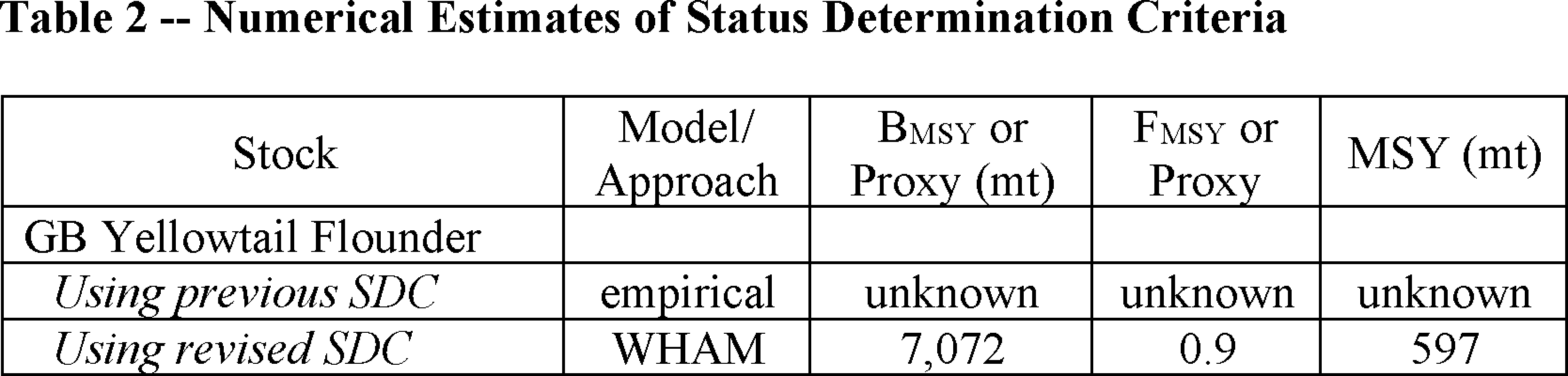
In 2024, the Northeast Fishery Science Center (Center) completed a research track assessment of GB yellowtail flounder, which transitioned the assessment to a Woods Hole Assessment Model (WHAM). This replaced the previous empirical approach that had been used to set catch advice for past fishing years. The 2025 management track assessment produced revised SDCs for GB yellowtail flounder, including revised numeric estimates.
Framework 72 incorporates the previously revised SDCs for GB yellowtail flounder, and provides updated numerical estimates of these criteria, in accordance with the results and peer review recommendations of the 2025 stock assessments (tables 1 and 2). These replace the “unknown” SDCs for GB yellowtail flounder that had been incorporated into the FMP by Framework 53 (80 FR 25110, May 1, 2015).
( printed page 49360)
Fishing Year 2026 Shared United States/Canada Quotas
Management of Transboundary Georges Bank Stocks
Eastern GB cod, eastern GB haddock, and GB yellowtail flounder are shared stocks that are jointly managed with Canada under the United States/Canada Resource Sharing Understanding (Understanding). As part of the Understanding, the United States and Canada consider the most recent stock information and develop shared quotas that are allocated between the United States and Canada based on a formula that considers historical catch (10-percent weighting) and the current resource distribution (90-percent weighting). For historical information about the Understanding, see:
www.bio.gc.ca/info/intercol/tmgc-cogst/index-en.php.
A new approach called the Integration of Science Advice for Transboundary Stocks (ISATS) process was followed to provide science advice to support the decision-making process for the management of the three transboundary stocks. ISATS includes a meeting of the stock assessment leads for both countries, where the outcomes of the United States and Canadian domestic assessments are compiled into a joint document, to be considered equally as the basis for informing catch advice. In 2025, the U.S. GB yellowtail flounder management track assessment was conducted after the ISATS process and results were considered directly.
For GB yellowtail flounder, the Council's Scientific and Statistical Committee (SSC) also recommends an acceptable biological catch (ABC) for the stock. The ABC is typically used to inform the development of the annual shared quota. Although the stock is jointly managed with Canada, the Council may not recommend catch limits that would exceed the SSC's recommendation. In 2025, the shared quota for GB yellowtail flounder was developed before the SSC had met to discuss the stock, and the SSC took this already-developed quota into consideration when making its recommendation to the Council. The SSC does not recommend ABCs for eastern GB cod and haddock because they are management units of the total GB cod and haddock stocks. The SSC recommends overall ABCs for the total GB cod and haddock stocks. The shared United States/Canada quota for eastern GB cod and haddock is included in these overall ABCs and must be consistent with the SSC's recommendation for the total GB stocks.
2026 United States/Canada Quotas
The United States and Canada developed shared quotas for 2026 based on the available domestic assessment information from both countries. The Council adopted these recommendations in Framework 72 (table 3), and this action approves them.
( printed page 49361)
The 2026 U.S. quotas for the eastern GB cod represent an 84-percent increase, compared to 2025; the eastern GB haddock and GB yellowtail flounder quotas represent 36-percent and 68-percent decreases, respectively. A more detailed discussion of the 2026 catch advice for shared stocks, including a description of each country's quota share, is accessible online at:
www.nefmc.org/.
The regulations implementing the United States/Canada Resource Sharing Understanding at 50 CFR 648.85(a) require deducting any overages of the U.S. quota for eastern GB cod, eastern GB haddock, or GB yellowtail flounder from the U.S. quota in the following fishing year. If catch information for the 2025 fishing year indicates that the U.S. fishery exceeded its quota for any of the shared stocks, NMFS will reduce the respective U.S. quotas for the 2026 fishing year in a future action, as close to May 1, 2026, as possible. If any fishery that is allocated a portion of the U.S. quota exceeds its allocation and causes an overage of the overall U.S. quota, the overage reduction would be applied only to that fishery's allocation in the following fishing year. This ensures that catch by one component of the overall fishery does not negatively affect another component of the overall fishery.
Catch Limits for Fishing Years 2026-2030
Summary of the Catch Limits
Specifications are adopted for multiple years. Any specifications for fishing years beyond 2026 are projections that will be considered and reaffirmed or adjusted in the annual framework for that fishing year. Previously, specifications have been adopted for 3 years, the Council's omnibus management flexibility amendment (Amendment 26 to the Northeast Multispecies FMP, 91 FR 27234, May 14, 2026) would increase this duration to up to 5 years. To reflect this, Framework 72 developed specifications for fishing years 2026-2030.
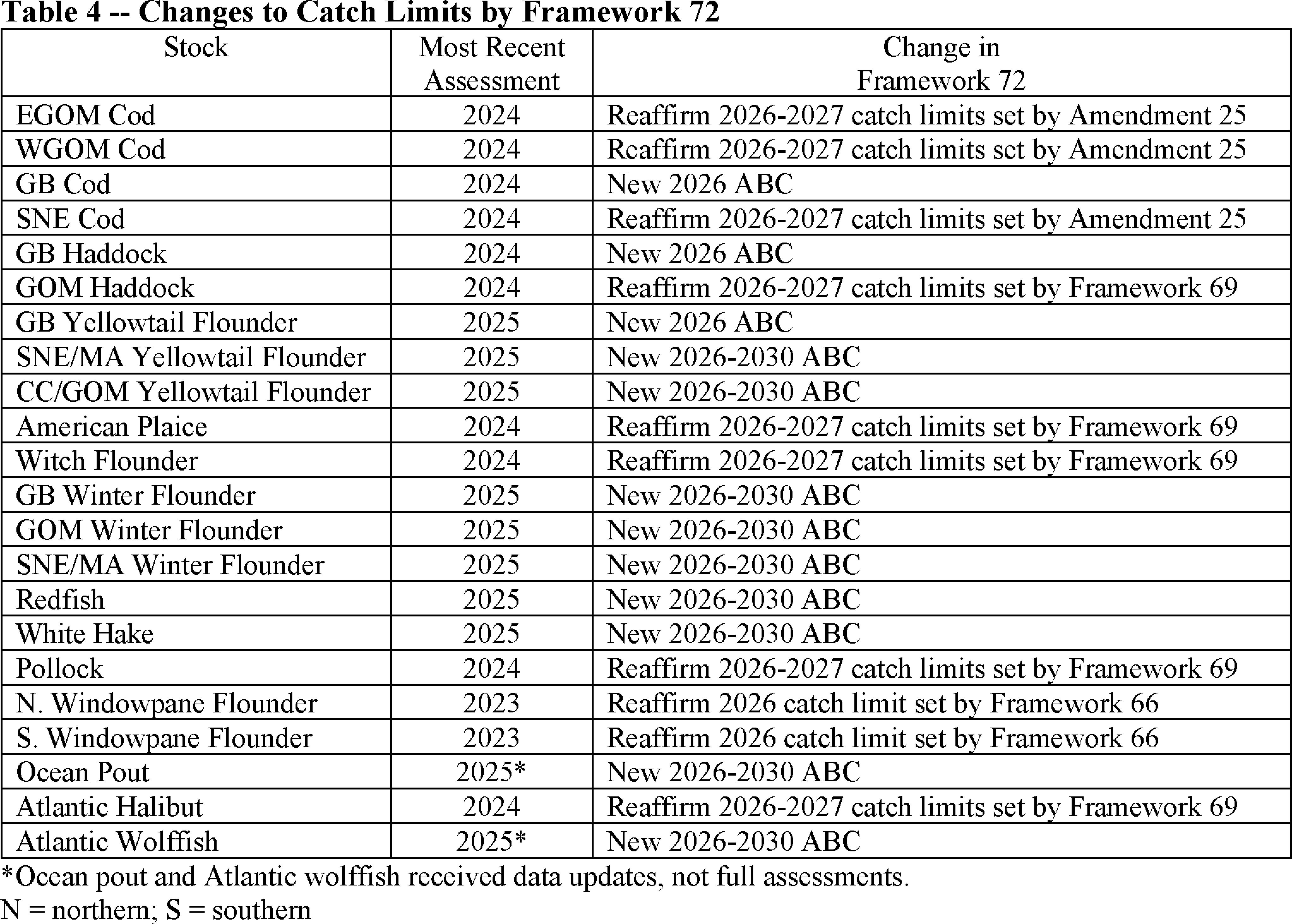
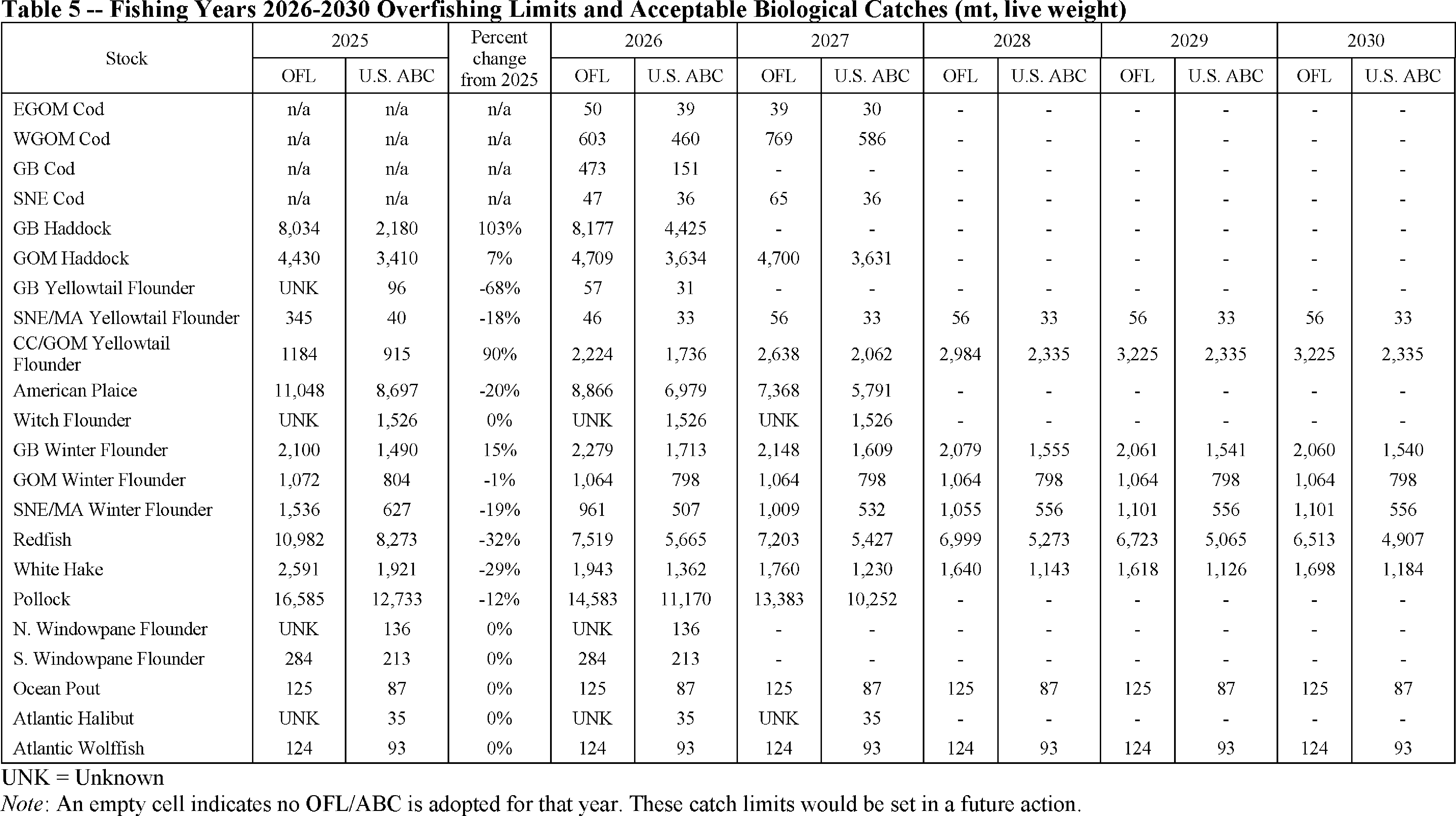
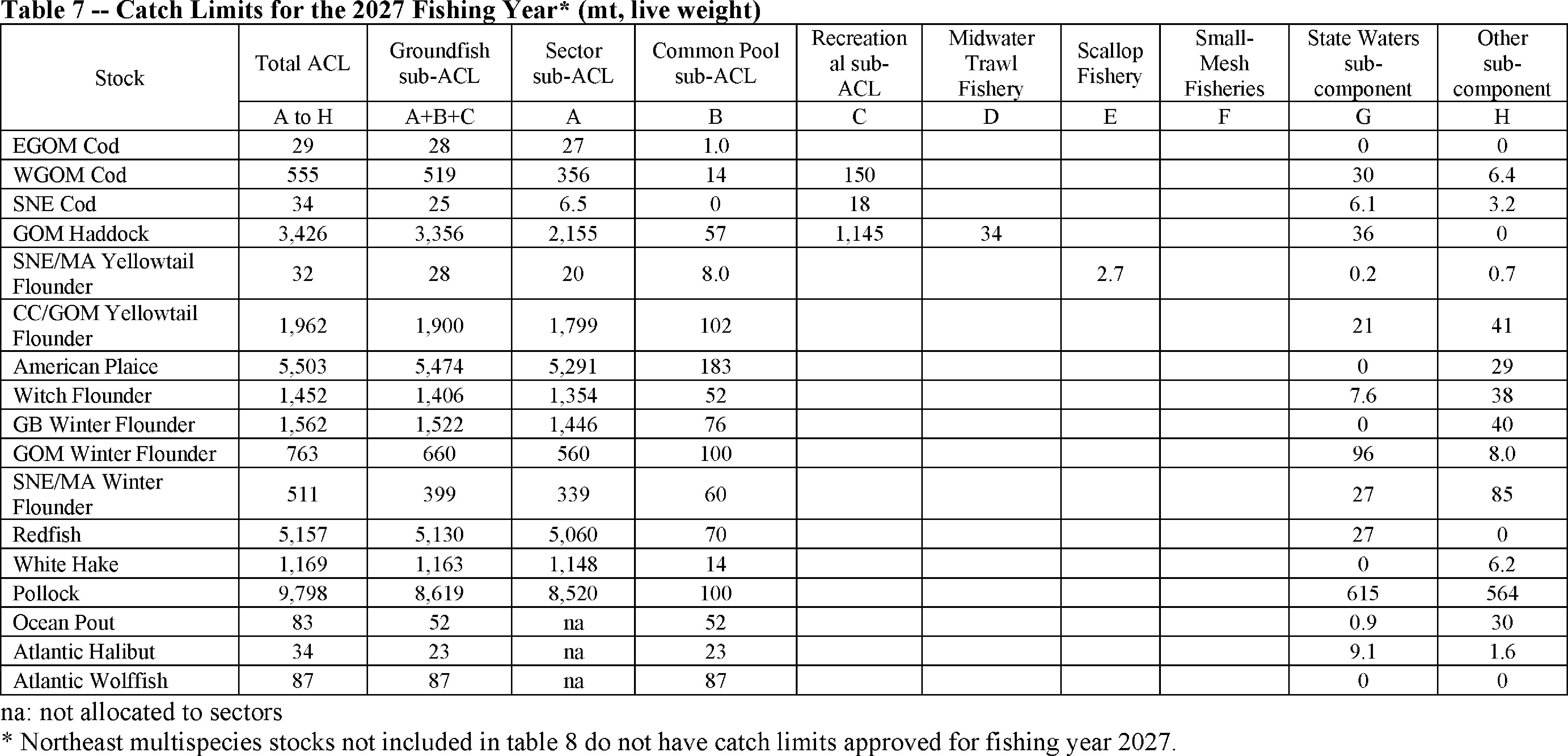

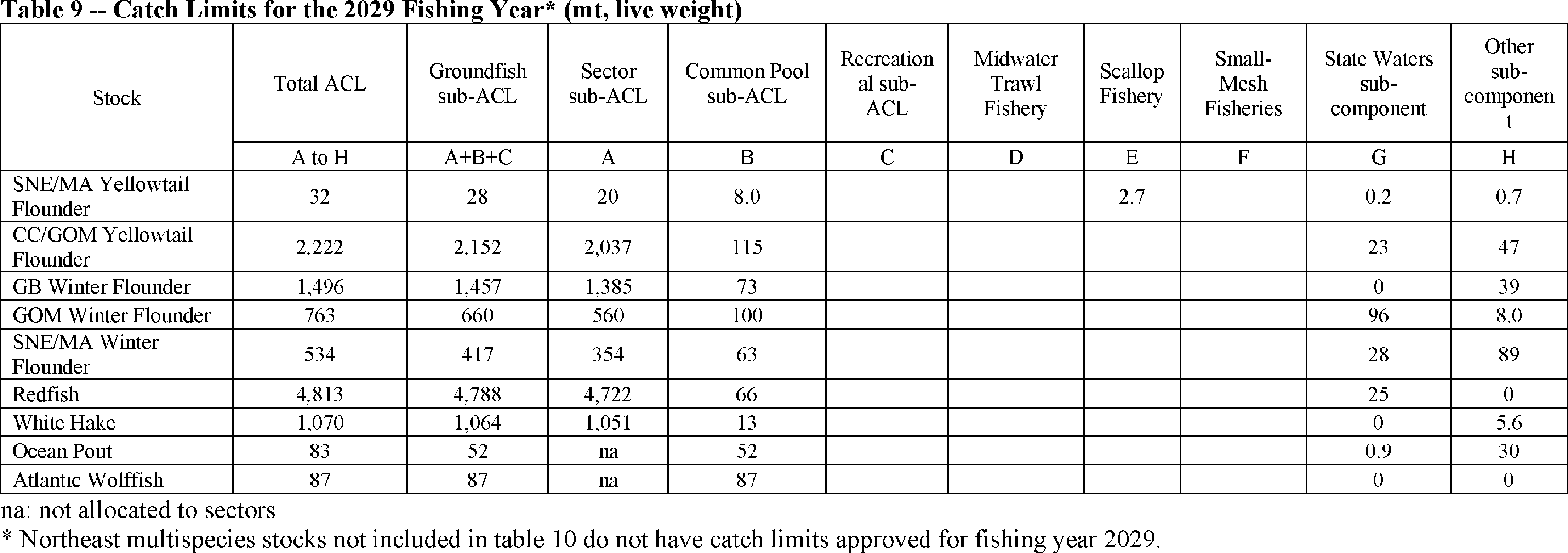
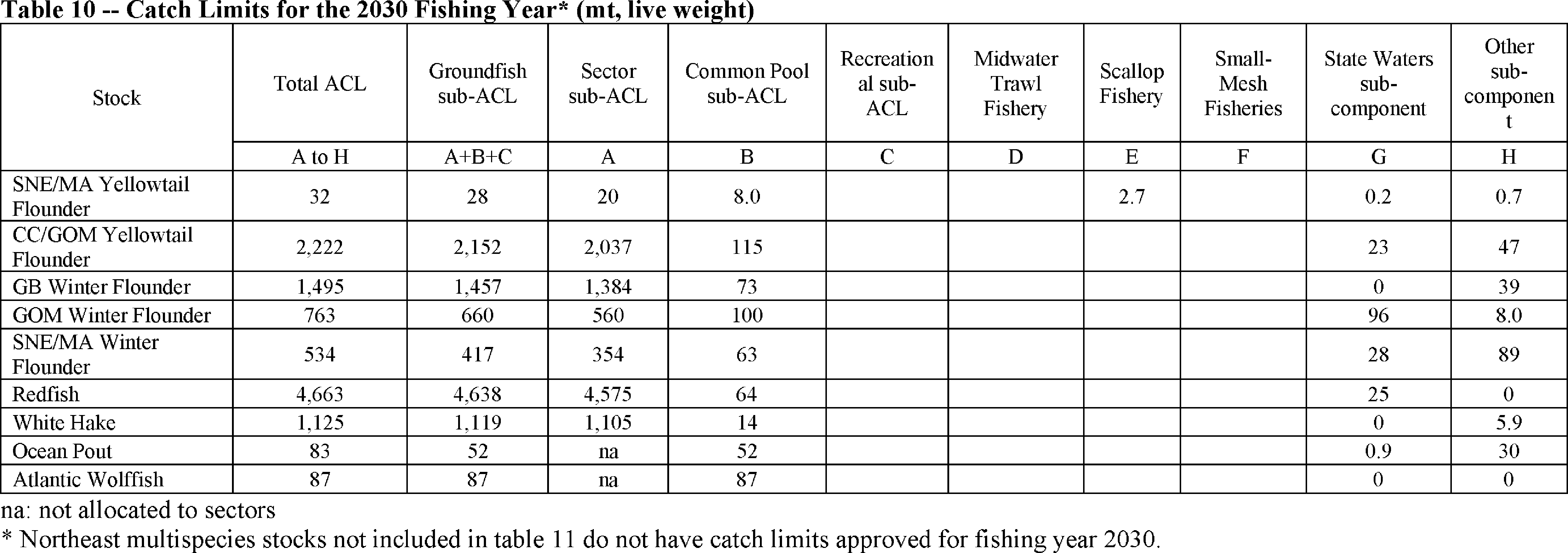
Tables 4 through 16 show the catch limits for the 2026-2030 fishing years. A brief summary of how these catch limits were developed is provided below. More details on the catch limits for each groundfish stock can be found in appendix II (Calculation of Northeast Multispecies Annual Catch Limits, FY 2026-FY 2030) to the Framework 72 SIR (see
ADDRESSES
for information on how to get this document).
Through Framework 72, the Council recommended catch limits, including overfishing limits (OFLs), for GB cod, GB haddock, GB yellowtail flounder for fishing year 2026, and CC/GOM yellowtail flounder, SNE/MA yellowtail flounder, GB winter flounder, GOM winter flounder, SNE/MA winter flounder, white hake, redfish, ocean pout, and Atlantic wolffish for the 2026-2030 fishing years, based on stock assessments or data updates completed in 2025. Specifications for the Atlantic cod stocks were set in Amendment 25 (Revised) (91 FR 39529, June 30, 2026). Framework 72 replaces the Amendment 25 (Revised) specifications for GB cod. Catch limits for other groundfish stocks were previously set by Framework 66 (89 FR 35755, May 2, 2024) and Framework 69 (91 FR 11141, March 9, 2026). Table 4 provides an overview of which catch limits change based on Framework 72, as well as when the stock was most recently assessed. Table 5 provides the percentage change in the 2026 catch limit compared to the 2025 fishing year.
All specifications projected for fishing year 2026 in previous frameworks or Amendment 25 (Revised) were considered for reaffirmation or adjustment, as warranted by the best scientific information available in the adopting framework/amendment, and any updates in this action. The previously projected and adopted specifications are reaffirmed, consistent with the considerations and determinations in the adopting frameworks and amendment, because no new or updated scientific information warranted changes to prior adopted specifications.
( printed page 49362)
( printed page 49363)
Overfishing Limits and Acceptable Biological Catches
The OFL is calculated to set the maximum amount of fish that can be caught in a year, without constituting overfishing. The ABC is typically set lower than the OFL to account for scientific uncertainty. For GB cod, GB haddock, and GB yellowtail flounder, the total ABC is reduced by the amount of the Canadian quota (see table 1 for the Canadian and United States shares of these stocks). Additionally, although GB winter flounder, white hake, and Atlantic halibut are not jointly managed with Canada, there is some Canadian catch of these stocks. Because the total ABC must account for all sources of fishing mortality, expected Canadian catch of GB winter flounder (38 metric tons; mt), white hake (57 mt), and Atlantic halibut (71 mt) is deducted from the total ABC. The United States ABC is the amount available to the domestic fishery after accounting for Canadian catch (see table 3). For stocks without Canadian catch, the United States ABC is equal to the total ABC.
Annual Catch Limits
Development of Annual Catch Limits
The U.S. ABC for each stock is divided among the various fishery components to account for all sources of fishing mortality. For stocks with a recreational allocation, the U.S. ABC is typically first divided between the commercial and recreational fisheries, before being further divided into sub-components and sub-ACLs. An estimate of catch expected from state waters and the other sub-component (
e.g.,
Federal commercial non-groundfish fisheries and some recreational groundfish fisheries, if there is not a recreational allocation) is deducted from the U.S. ABC. The remaining portion of the U.S. ABC is distributed to the fishery components that receive an allocation for the stock. Components of the fishery that receive an allocation have a sub-ACL set by reducing their portion of the ABC (the sub-ABC) to account for management uncertainty and are subject to accountability measures (AM) if they exceed their respective catch limit during the fishing year. This process is described fully in appendix II of the Framework 72 SIR.
Sector and Common Pool sub-ACLs
For stocks allocated to sectors, the commercial groundfish sub-ACL is further divided into the non-sector (common pool) sub-ACL and the sector sub-ACL, based on the total vessel enrollment in sectors and the cumulative potential sector contributions (PSC) associated with those sectors. The sector and common pool sub-ACLs implemented in this action are based on fishing year 2026 PSCs and sector rosters. All permits enrolled in a sector, and the vessels associated with those permits, had until April 30, 2026, to withdraw from a sector and fish in the common pool for the 2026 fishing year. In addition to the enrollment delay, all permits that changed ownership after the roster deadline were permitted to join a sector (or change sector) through April 30, 2026.
Management Uncertainty Buffer for Sectors
As mentioned generally above, management uncertainty is accounted for in the setting of ACLs that are equal to or lower than the ABC recommended by the SSC. This difference between an ABC and ACL or sub-ACL is known as a management uncertainty buffer. Without changing the process for setting management uncertainty buffers, Amendment 23 (87 FR 75852, December 9, 2022) implemented a measure to adjust the management uncertainty buffer for the sector sub-ACL for each allocated groundfish stock to zero when appropriate. In years that the at-sea monitoring (ASM) coverage target is set at 100 percent, the management uncertainty buffer will default to zero for the sector sub-ACL for allocated stocks, unless the Council's consideration of the 100-percent coverage target warrants specifying a different management uncertainty buffer in order to prevent exceeding the sub-ACL. Based on Amendment 25 (Revised), this provision does not apply for SNE cod.
As established in Amendment 23, the ASM coverage target is dependent on the level of funding for ASM and observers, and NMFS must evaluate overall annual appropriations from Congress to finalize the ASM coverage target. NMFS provides the target as soon as it can each year so that sectors can establish their rosters and meet annual deadlines. On March 13, 2026, the Regional Administrator announced that the preliminary fishing year 2026 ASM coverage target of 100 percent, and nothing has changed since that announcement to require a lower ASM coverage target or to change the determination that the coverage target provides a basis for removing the management uncertainty buffer. Therefore, in this action, NMFS is removing the management uncertainty buffer for each allocated stock, other than SNE cod, for all sectors for the entirety of the 2026 fishing year. Because removal of the buffer is dependent on the annual determination of the ASM coverage target and consideration of its merit, the determination regarding the buffer in fishing years 2027 and beyond would be made in a future action.
In Framework 72, the Council recommended the removal of the management uncertainty buffer for the sector sub-ACL for white hake, if the ASM coverage target is 90 percent or higher, for each fishing year through 2030. The Council's goal is to mitigate the adverse economic impacts of the ACLs for this potentially constraining stock by increasing the sector sub-ACLs if the ASM coverage target is high enough to reduce uncertainty. While this measure is moot for fishing year 2026, given this year's 100-percent coverage target, it is approved for the future fishing years.
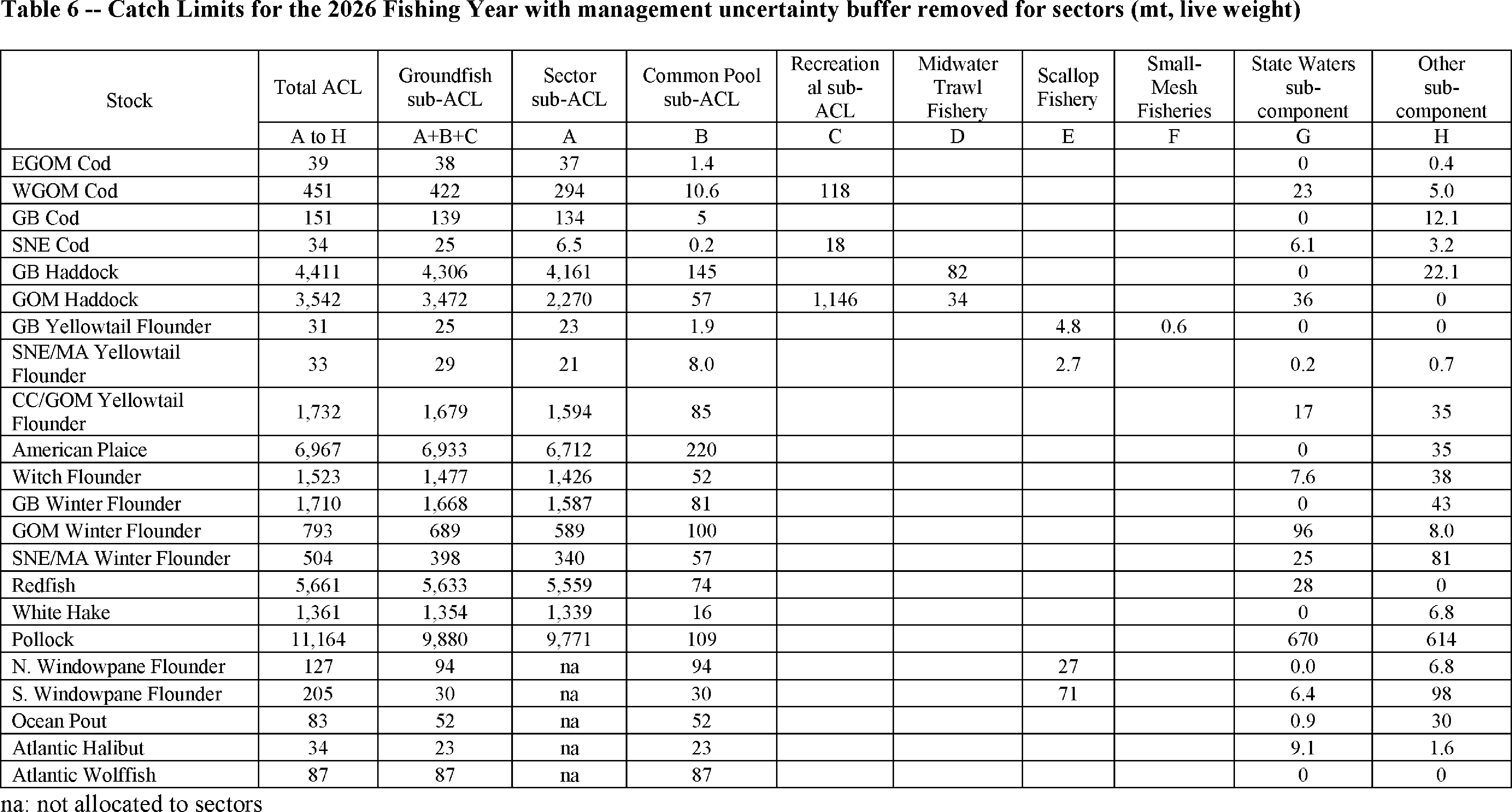
Table 6 provides the fishing year 2026 ACLs and sub-ACLs for all stocks with the management uncertainty buffer removed for sectors. Because the removal of the management uncertainty buffer for sectors is an annual decision, tables 7-10 show the ACLs and sub-ACLs for fishing years 2027-2030 with the buffer left in place, and these would be updated in a future action based on the coverage target for that fishing year.
The removal of the management uncertainty buffer for sectors alone is not likely to cause the ABC or OFL to be exceeded. The fishery remains accountable for remaining within the sub-ACLs allocated to it. Further, the revised management uncertainty buffer applies only to sectors and not to the common pool component of the fishery or other sub-ACLs or sub-components for any stocks. Therefore, the management uncertainty buffer continues to exist for the stock's ACL, but the sector-specific buffer is removed.
Sector Allocations for Fishing Year 2026
At the start of the 2026 fishing year, NMFS allocated annual catch entitlements (ACE) for the allocated stocks to each sector, based on preliminary sector rosters and the catch limits set by prior frameworks and default specifications for certain stocks. This rule updates the ACE allocated to sectors based on final sector rosters and the catch limits approved in Framework 72, including the revised GB cod ABC, and based on the catch limits for EGOM cod, WGOM cod, and SNE cod set by Amendment 25 (Revised). NMFS calculates a sector's allocation for each stock by summing its members' PSC for the stock and then multiplying that total
( printed page 49364)
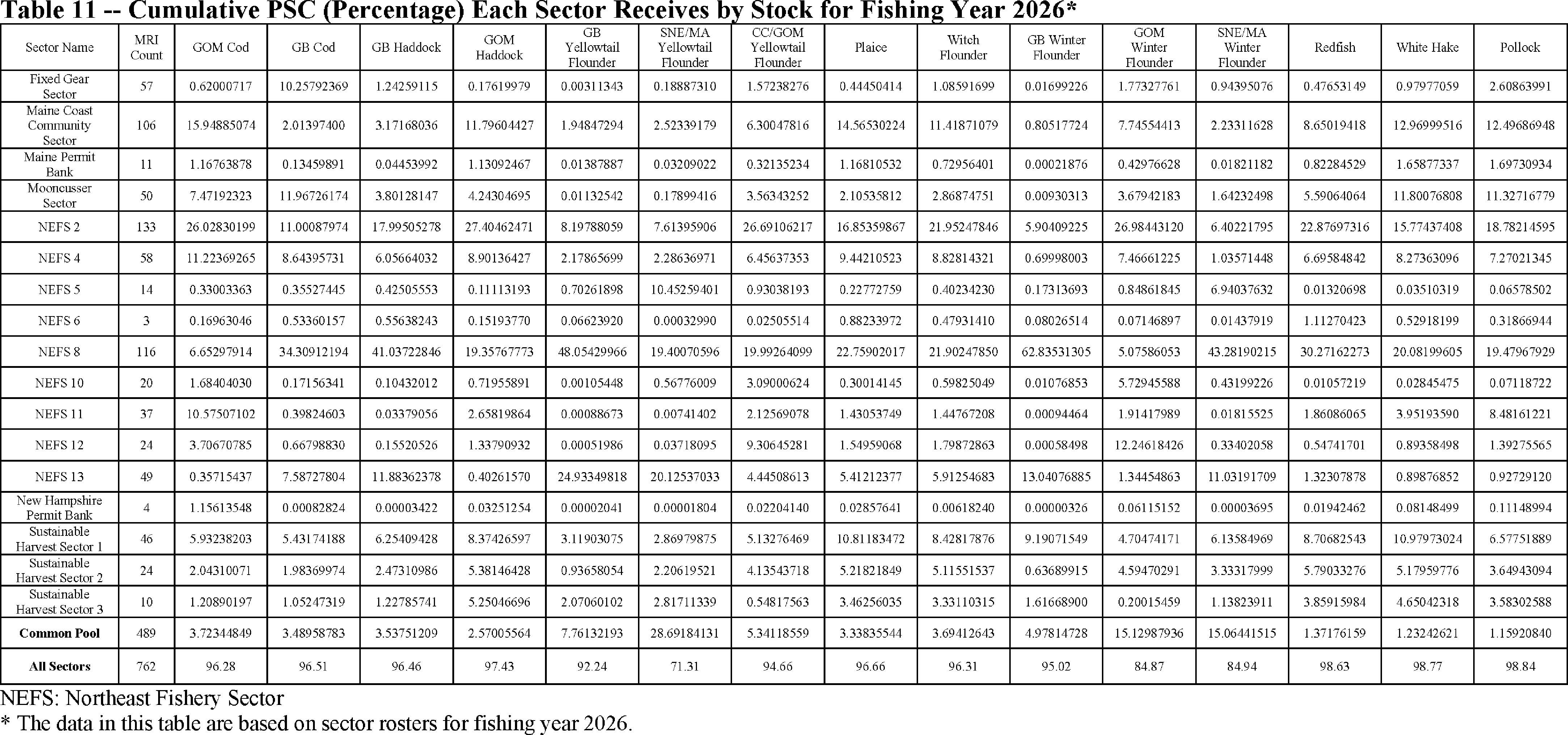
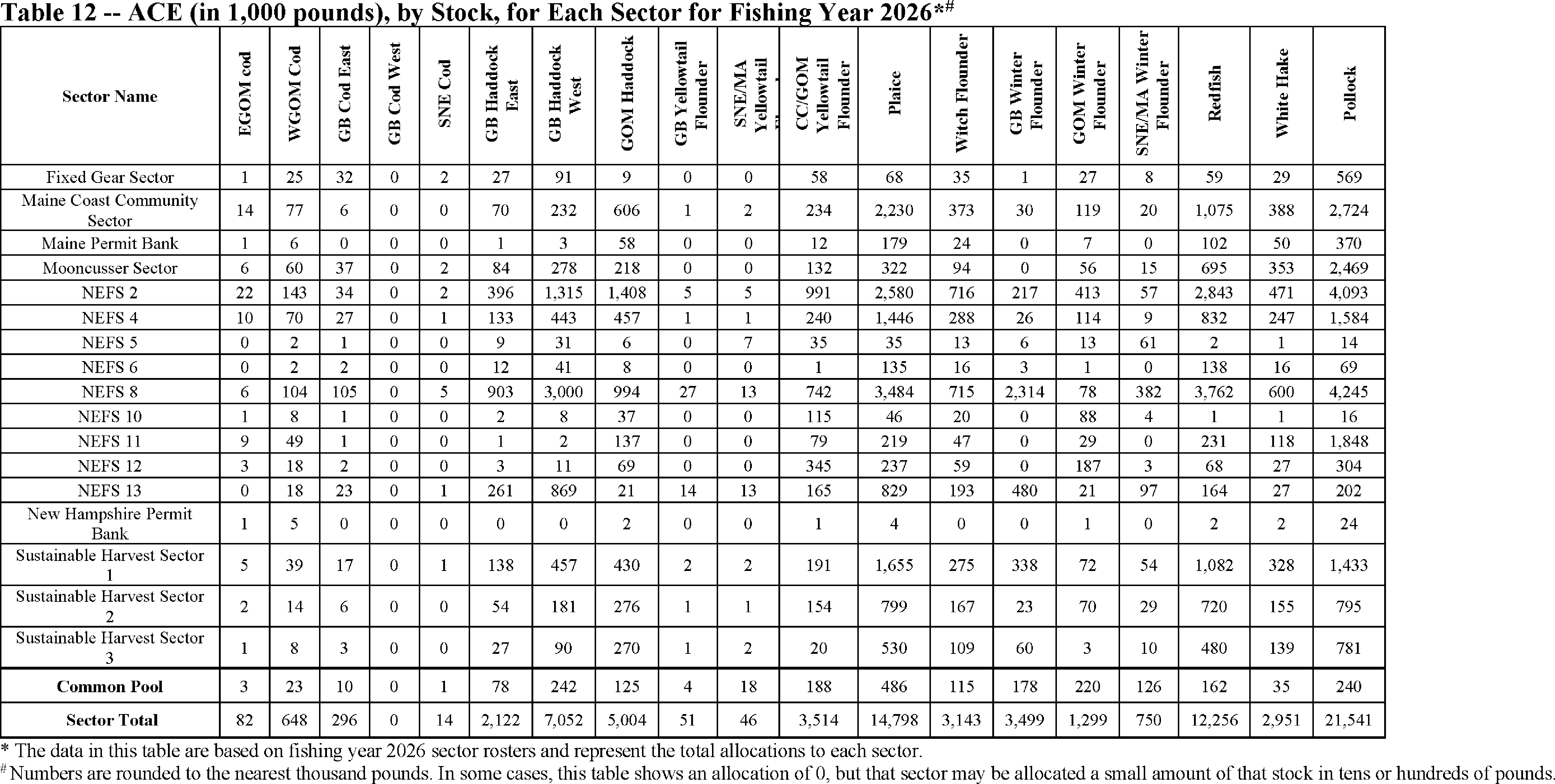
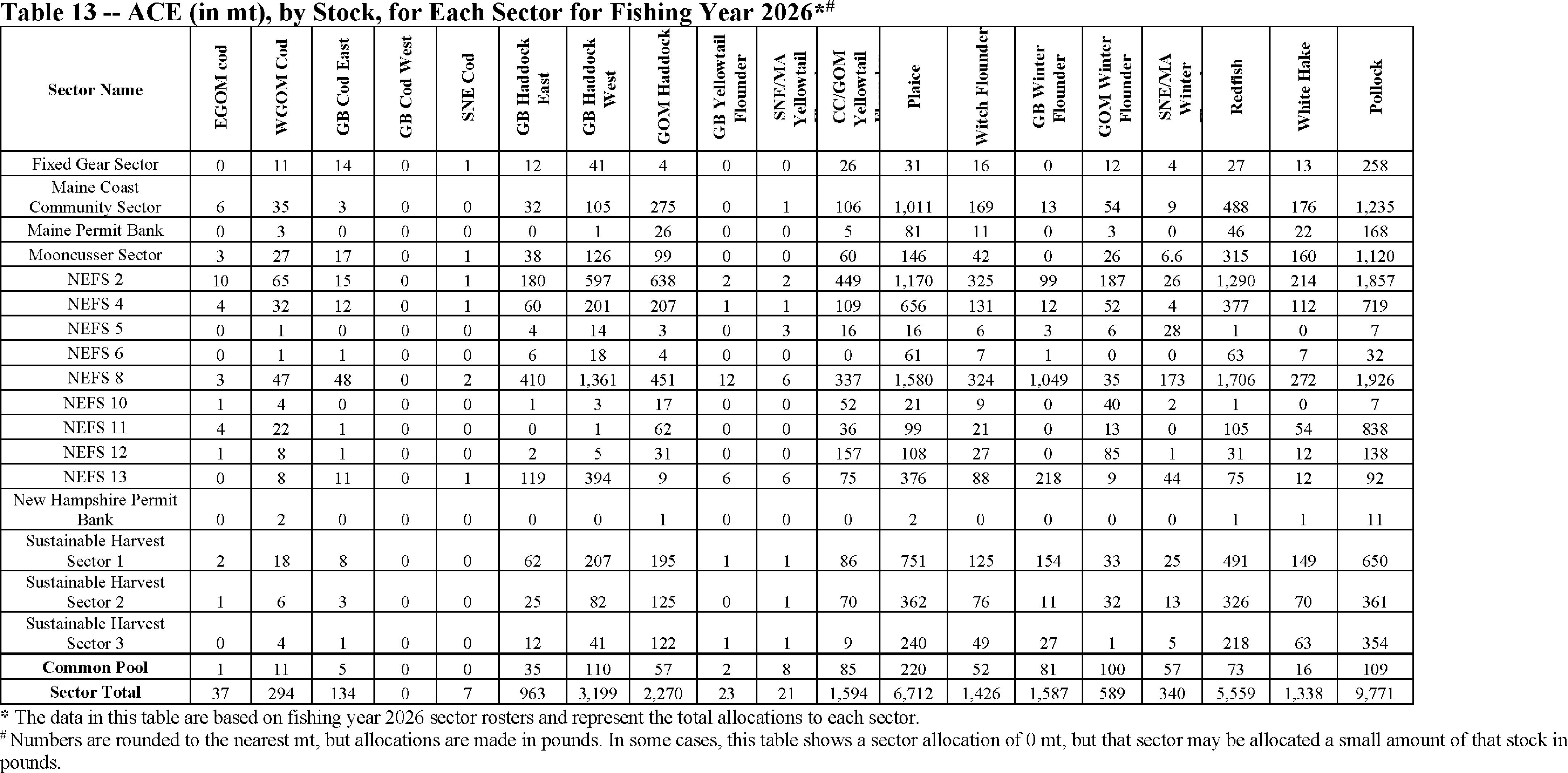
percentage by the commercial sub-ACL for that stock. The process for allocating ACE to sectors is more fully described in the final rule allocating ACE to sectors for the start of the 2026 fishing year (91 FR 22467, April 27, 2026) and is not repeated here. Table 11 shows the cumulative PSC by stock for each sector for fishing year 2026. Tables 12 and 13 show the ACEs allocated to each sector for fishing year 2026, in thousands of pounds and metric tons, respectively. NMFS has included the common pool sub-ACLs in tables 11 through 13 for comparison. NMFS uses final allocations, along with later adjustments including ACE transfers, reductions for overages, or increases for carryover, monitor sector catch.
Common Pool Total Allowable Catches
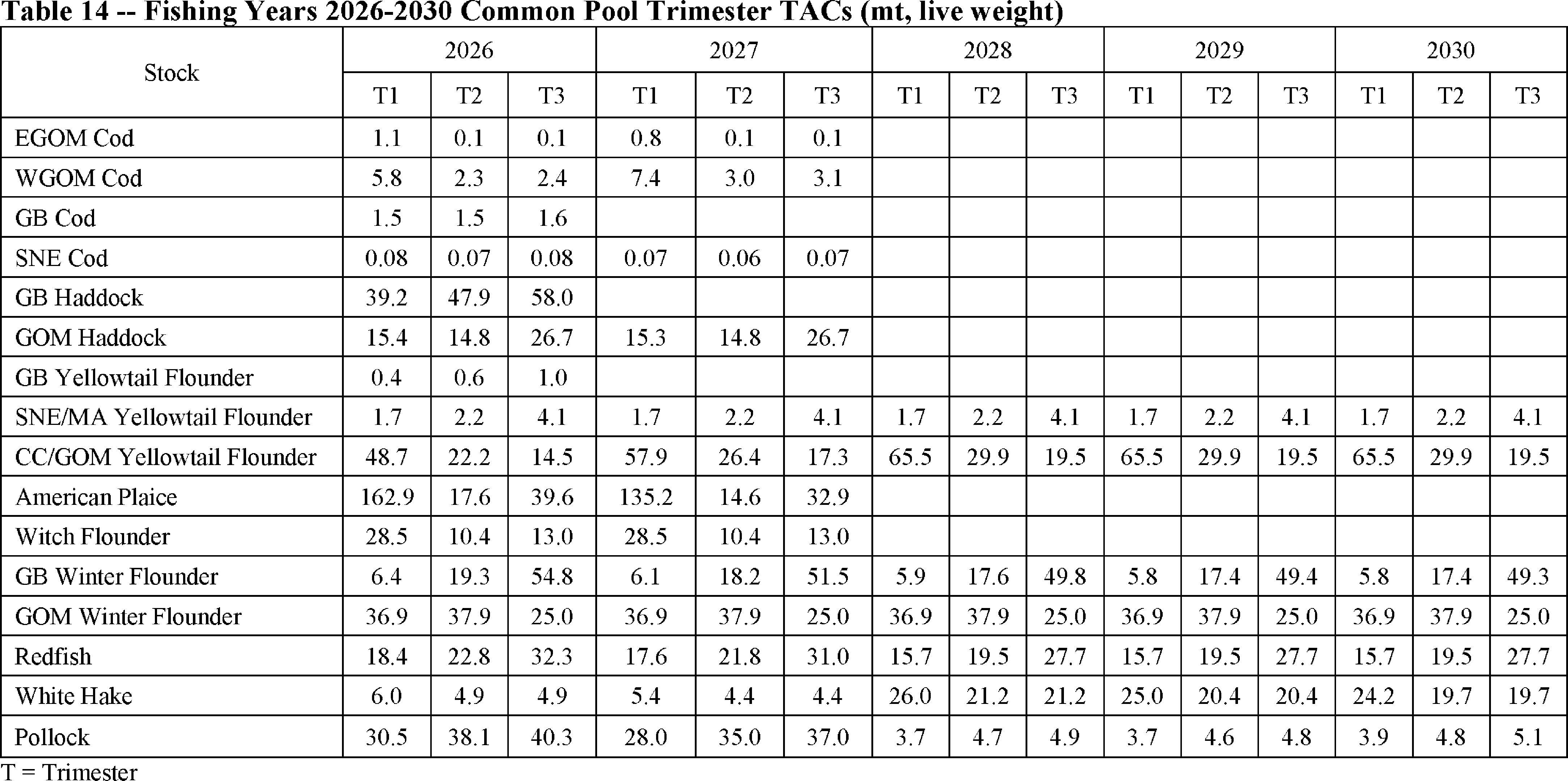
The common pool sub-ACL for each allocated stock (except for SNE/MA winter flounder) is further divided into trimester total allowable catches (TACs). Table 14 summarizes the common pool trimester TACs set in this action.
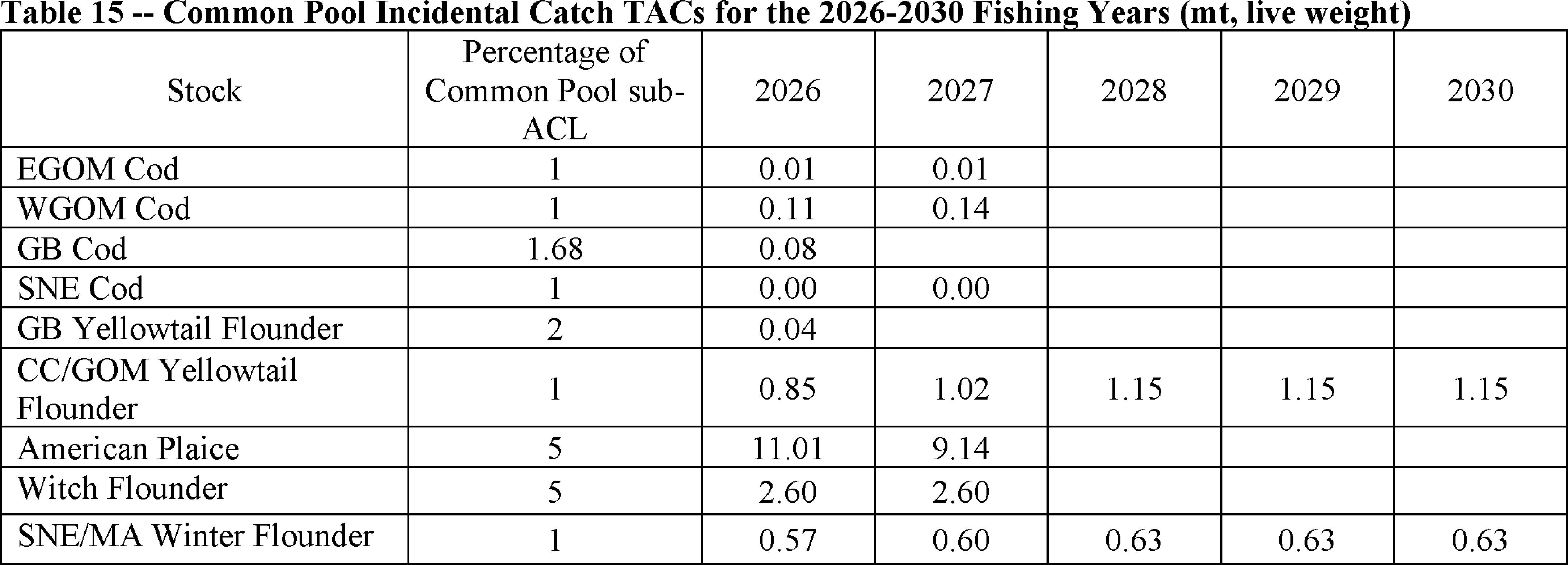
Incidental catch TACs are also specified for certain stocks of concern (
i.e.,
stocks that are overfished or subject to overfishing) for common pool vessels fishing in the special management programs (
i.e.,
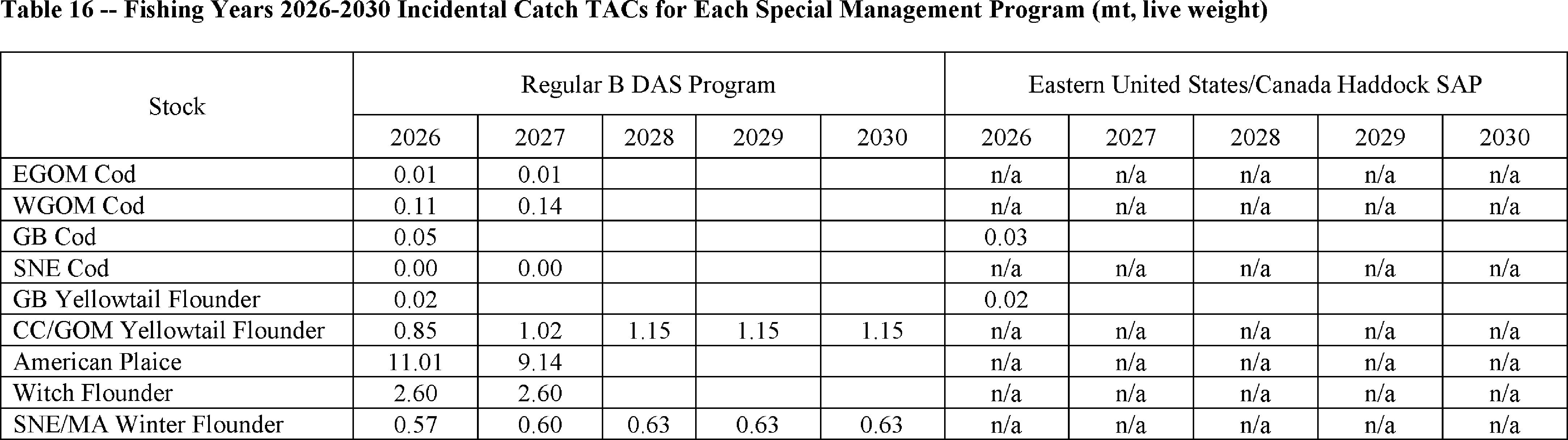
special access programs (SAP) and the Regular B Days-at-Sea (DAS) Program), in order to limit the catch of these stocks under each program. Tables 15 and 16 summarize the Incidental Catch TACs for each stock and the distribution of these TACs to each special management program.
( printed page 49365)
( printed page 49366)
( printed page 49367)
( printed page 49368)
Recreational Management Measures
Currently, the Regional Administrator sets recreational measures (open season, minimum fish size, and possession limit) for stocks that have a recreational sub-ACL (
i.e.,
WGOM cod, SNE cod, and GOM haddock) after consulting with the Council, consistent with regulations in the FMP and the Administrative Procedure Act. This process has been used to set recreational measures since 2013. Framework 72 provides for this process to be used for the two cod stocks and one haddock stock that do not have a recreational sub-ACL (
i.e.,
GB haddock, GB cod, and EGOM cod). This administrative change to recreational management measures setting is expected to result in more consistent development and
( printed page 49369)
implementation of measures across stocks that have recreational fisheries, even if they do not have recreational-specific allocations. Framework 72 makes no changes to the current recreational measures for any cod or haddock stock.
Minor, Clarifying Regulatory Changes Under Secretarial Authority
This rule makes minor, clarifying changes in the regulations. Specifically, this action revises 50 CFR 648.89(b)(2)(ii) to add a single word to improve clarity of the text. Additionally, this action revises § 648.82(e)(1)(i) to remove references to the regulations detailing differential days-at-sea accounting that were removed in a previous action.
Classification
The NMFS Assistant Administrator has determined that this interim final rule is consistent with the FMP, other provisions of the Magnuson-Stevens Act, and other applicable law.
Executive Orders 12866 and 14192
This interim final rule has been determined to be not significant for purposes of Executive Order (E.O.) 12866. This rule is not an E.O. 14192 regulatory action because this rule is not significant under E.O. 12866.
NMFS has determined that this action would not have a substantial direct effect on one or more Indian Tribes, on the relationship between the Federal Government and Indian Tribes, or on the distribution of power and responsibilities between the Federal Government and Indian Tribes. Therefore, consultation with Tribal officials under E.O. 13175 is not required, and the requirements of section (5)(b) and (c) of E.O. 13175 also do not apply. A Tribal summary impact statement under section (5)(b)(2)(B) and (c)(2) of E.O. 13175 is not required and has not been prepared.
Administrative Procedure Act
Pursuant to 5 U.S.C. 553(b)(B), there is good cause to waive prior notice and an opportunity for public comment on the implementation of Framework 72, as prior notice and comment would be contrary to the public interest. The delay caused by providing prior notice and opportunity for public comment would prevent affected entities from being able to take advantage of an overall increase in fishing capacity during the extremely important summer season.
The Northeast multispecies fishing year started on May 1, 2026. Absent implementation of this rule to adjust Northeast multispecies catch allocations for 2026, the fishery will continue to be constrained to low rollover specifications from 2025, many of which are further reduced to 75 percent of the 2025 specifications. Implementing Framework 72 immediately and without prior notice and the opportunity for public comment is necessary to achieve optimum yield in the northeast multispecies fishery. The Magnuson-Stevens Fishery Conservation and Management Act requires conservation and management measures to comply with ten National Standards, the first one of which mandates preventing overfishing while achieving optimum yield on a continuing basis. Thus, in the groundfish sector fishery, catch allocations for all Northeast multispecies stocks are implemented annually on the basis of the best scientific information available. The specifications for fishing year 2026 include the allocations for each species adjusted by Framework 72 and the removal of the management uncertainty buffer for all stocks. These allocations reflect a balance of interests consistent with the national standards to comprise the greatest benefit to the nation and provide the increased fishing opportunity to fishery participants that is necessary for optimizing fishing operations.
Because specifications were not implemented at the beginning of this fishing year, May 1, 2026, pursuant to the Northeast multispecies fishery management plan regulations, default specifications were automatically reduced to 75 percent of the previous year's specifications for the Northeast multispecies stocks that did not have previously set specifications for 2026. Those reduced specifications remain in place until they are replaced through implementation of new specifications for this fishing year or October 31, whichever is earlier. Default specifications are set conservatively at only a portion of the previous fishing year's specifications and are intended to be only temporary stopgap measures until the current year's specifications can be implemented based on the most recent stock assessments and updated fishery information from preceding years.
In addition to an overall increase in catch allocations, this year's specifications also include an additional increase in catch allocations through the removal of the management uncertainty buffer for sectors. The management uncertainty buffer is not necessary in fishing year 2026 based on the 100-percent fishery monitoring coverage target, as specified in 50 CFR 648.90(a)(4)(i)(B). Based on an analysis of the catch limits in Framework 72 being implemented at the beginning of the fishing year, sector groundfish revenues are expected to increase up to $1.8 million from immediate removal of the management uncertainty buffer alone. Until Framework 72 is in effect, the buffers remain in place and sector participants cannot access the benefits from this measure.
The changes to the quotas for various stocks for this fishing year are especially beneficial to fishery participants, while maintaining all the conservation goals. This is because the current default quota for GB haddock has been a particularly constraining stock for the fishery, and the new quota will increase by 103 percent compared to the fishing year 2025 allocation. Under the Sector program, which accounts for 98 percent of the commercial fishery's catch, the current default for GB haddock has been restricting fishing operations across all stocks because sector vessels cannot fish in a stock area without an allocation for every species within that stock area. A lack of allocation for one species halts a vessel's fishing in that area for any species, unless the vessel owners pay to lease additional quota.
The restrictive GB haddock default limits require fishermen who have exhausted their allocation to pay for quota today that they will be able to otherwise access at no cost once Framework 72's higher GB haddock quota is in effect. The lease payments they are making today will generally not be recoverable even after allocations are increased. After the higher allocations are implemented, a sector may want or need to lease allocation back to another member or sector because the original lease was not ultimately necessary. However, lease prices for GB haddock and other species' catch limits often decrease after the implementation of increased catch limits, so leasing back to another member or sector would result in a net loss of funds for the sector member or sector. Also, if a fisherman cannot afford to pay for additional quota or a fisherman attempts to avoid these higher and potentially unnecessary costs by not fishing, they lose opportunities to fish until after Framework 72 is in effect. In these cases, this in effect acts as a temporary fishing closure for such fishermen, and these missed fishing opportunities cannot be replaced.
Thus, while the new specifications include decreased catch limits, in
( printed page 49370)
addition to the limits that are being increased, the overall impact of the specifications provides stable and unfluctuating catch limits at the earliest available opportunity. While the decreased limits could potentially constrain some fishing activity, the greater availability of a higher value stock (
i.e.,
GB haddock) means the more constrained stocks may be limited only to when caught in pursuit of the higher value or more available stock. Due to GB haddock's value and availability, faster implementation of this fishing year's specifications allows more time for fishing under more accurate and beneficial market conditions.
Finally, losing fishing opportunities during the summer months redirects some fishing effort from warmer and generally calmer weather into colder and more hazardous weather. This is particularly challenging for smaller vessels, for which summer may be the only season in which they are able to participate in the fishery. Also, providing more days in a fishing year from which a fisherman can choose to fish generally provides a greater potential for choosing days with safer conditions. Implementing the 2026 fishing year quotas as soon as possible provides certainty and the greatest amount of time possible within this fishing year for participation.
For these reasons, there is good cause to waive the prior notice and opportunity for public comment for this rule.
For these same reasons, there is good cause under 5 U.S.C. 553(d)(3) for the measures in this final rule to become effective immediately upon publication. In addition, many of these measures relieve a restriction, pursuant to 5 U.S.C. 553(d)(1). Most of the allocations implemented through this rule are an increase over the current limits and setting the management uncertainty buffer at zero increases the allocation for all stocks. Therefore, the increased specifications and removal of the uncertainty buffer increases fishing opportunity for industry, thereby relieving current restrictions.
Although the rule will decrease the catch limit for a few stocks, it would be contrary to the public interest to implement allocation adjustments at different times. Implementing new catch limits, whether increasing or decreasing, in a piecemeal manner, would create confusion and add to the already ongoing difficult disruption to business planning and quota leasing markets arising from the current default specifications. And because the regulated community is expecting these decreases, sectors are already managing to the lower quotas. There is therefore no advantage to the regulated community for delaying implementation; fishery participants do not need to prepare to come into compliance and will not be able to maximize fishing opportunity for the stocks with quotas that are decreasing. In addition, there is potential danger of overfishing these stocks, which could then lead to the need for more restrictive conservation methods in future fishing years. Delaying the effective date of the lower quotas therefore offers no advantage for sector preparation, and immediate implementation does not disadvantage the non-fishing industry public in any way.
Stakeholder and industry groups have been aware of and have participated in the public meetings on Framework 72's development. Stakeholders voiced their strong support to have Framework 72 effective without delay. Public comments submitted in response to the Amendment 25 (Revised) proposed rule from industry groups, individual fishermen, and non-governmental organizations also urged quick implementation of both Amendment 25 (Revised) and Framework 72. Commenters noted that immediate implementation of both would provide economic and conservation benefits while averting the adverse economic and conservation impacts on fishery participants, fishing communities, and Northeast multispecies stocks that would result if these rulemakings were delayed. (Amendment 25 (Revised) was implemented on June 30, 2026 (91 FR 39529)). NMFS also has received correspondence citing a critical need for immediately implementing the new catch limits in Framework 72.
NMFS is inviting public comments on this interim final rule. NMFS will consider responding to any comments in a subsequent final rule, if warranted.
Regulatory Flexibility Act
Because prior notice and opportunity for public comment are not required for this rule by 5 U.S.C. 553, or any other law, the analytical requirements of the Regulatory Flexibility Act, 5 U.S.C. 601et seq.,
are inapplicable.
Paperwork Reduction Act
This final rule contains no information collection requirements under the Paperwork Reduction Act of 1995.
Effort-control program for NE multispecies vessels.
* * * * *
(e) * * *
(1) * * *
(i)
Common pool vessels.
For a common pool vessel, Category A DAS shall accrue in 24-hr increments. For example, a vessel that fished from 6 a.m. to 10 p.m. would be charged 24 hr of Category A DAS, not 16 hr; a vessel that fished for 25 hr would be charged 48 hr of Category A instead of 25 hr.
* * * * *
3. In § 648.89, revise paragraphs (b)(2)(ii) and (g) to read as follows:
Recreational and charter/party vessel restrictions.
* * * * *
(b) * * *
(2) * * *
(ii)
Transiting.
If the minimum size specified for cod and haddock differ between stock areas, vessels in possession of cod or haddock that meet the minimum size specified for fish caught in one stock area, as specified in § 648.88, may transit a different stock area with that cod and haddock, provided all bait and hooks are removed from fishing rods, and any cod and haddock on board has been gutted and stored.
* * * * *
(g)
Regional Administrator authority for cod and haddock recreational measures.
The Regional Administrator, after consultation with the NEFMC, may adjust recreational measures for cod and haddock stocks that do not have a recreational allocation to set consistent measures with other stock areas, as appropriate. Appropriate measures, including adjustments to fishing seasons, minimum fish sizes, or possession limits, may be implemented in a manner consistent with the Administrative Procedure Act, with the final measures published in the
Federal
( printed page 49371)
Register
prior to the start of the fishing year when possible. Separate measures may be implemented for the private and charter/party components of the recreational fishery.
 www.regulations.gov/docket/NOAA-NMFS-2026-0859
 www.nefmc.org/management-plans/northeast-multispecies
 50 CFR part 648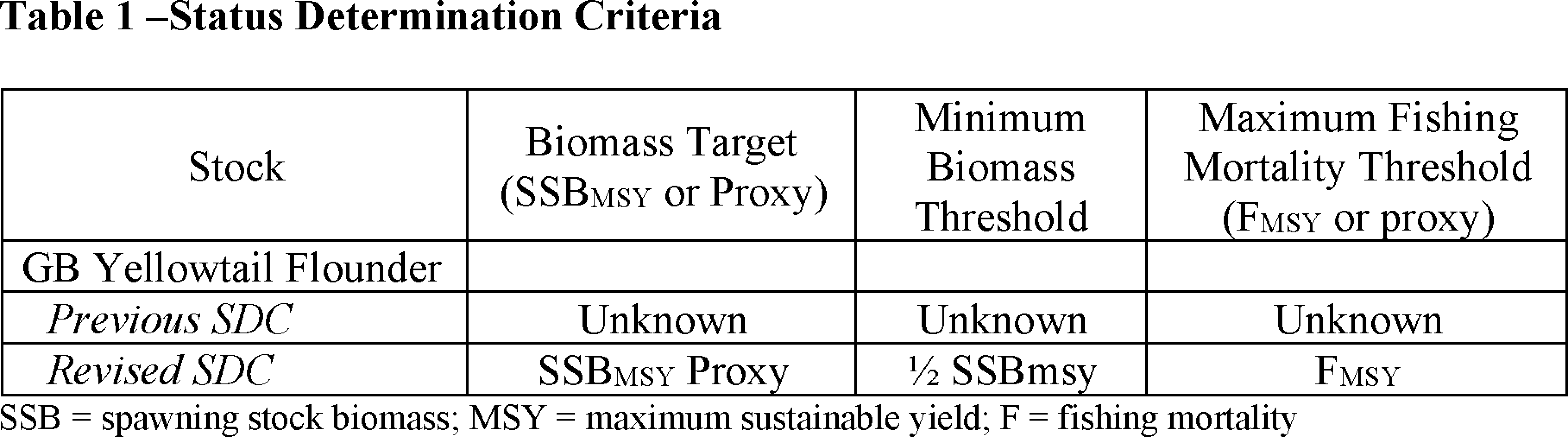
 www.bio.gc.ca/info/intercol/tmgc-cogst/index-en.php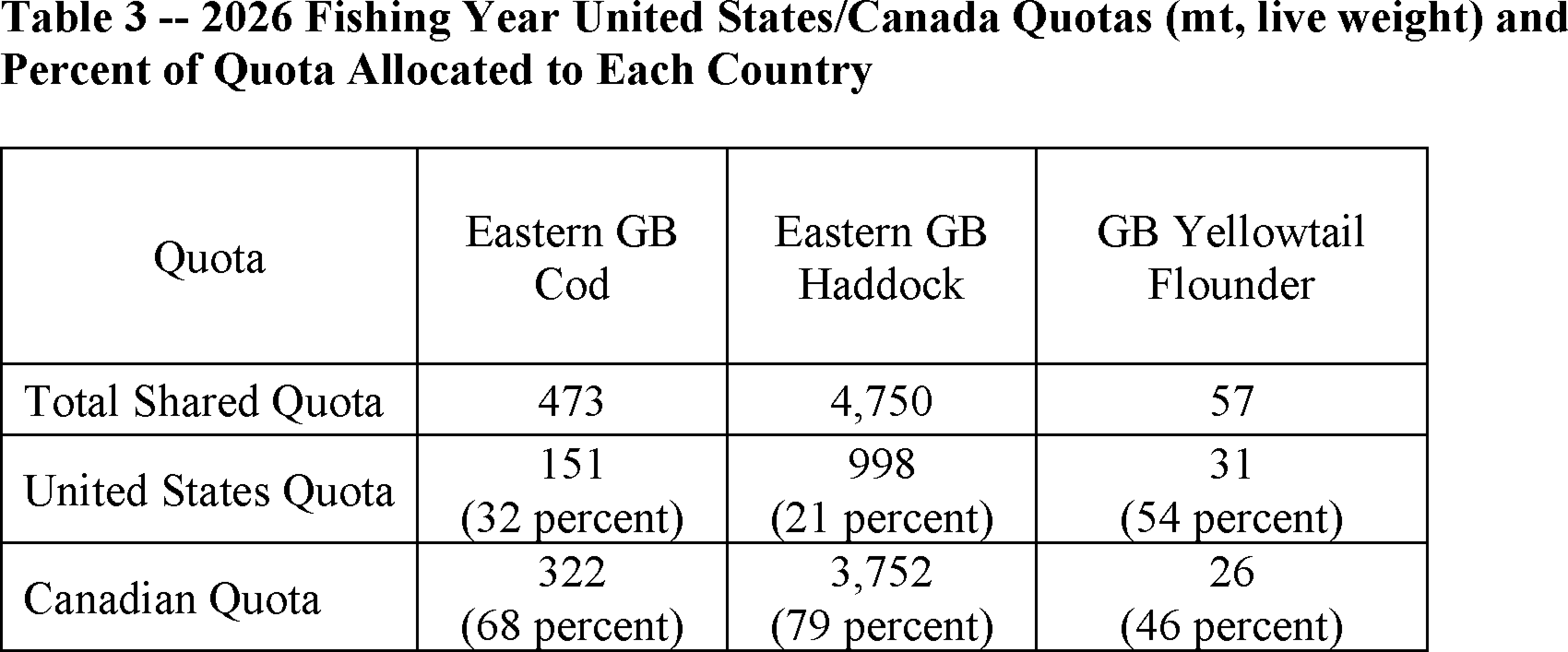
 5 U.S.C. 553(b)(B)