The U.S. Small Business Administration (SBA or the Agency) is proposing new size standards for 338 industry groups and industries. The new size standards are designed to better ...
The U.S. Small Business Administration (SBA or the Agency) is proposing new size standards for 338 industry groups and industries. The new size standards are designed to better reflect the nature of the markets in which small businesses compete. SBA seeks comments on its proposed changes to size standards.
DATES:
SBA must receive comments on this proposed rule on or before September 21, 2026.
ADDRESSES:
You may submit comments identified by RIN 3245-AI67 or Docket No. SBA-2026-0199 by one of the following methods:
(1)
Federal eRulemaking Portal: www.regulations.gov.
Follow the instructions for submitting comments; or
(2)
Mail/Hand Delivery/Courier:
Ryan Lambert, Associate Administrator, Office of Government Contracting and Business Development, 409 Third Street SW, Mail Code 6530, Washington, DC 20416.
SBA will post all comments on this proposed rule on
www.regulations.gov.
If you wish to submit confidential business information (CBI) as defined in the User Notice at
www.regulations.gov,
you must submit such information to
GCBDregs@sba.gov
with “RIN 3245-AI67” in the subject heading. Highlight the information that you consider to be CBI, and explain why you believe SBA should hold this information as confidential. SBA will review your information and determine whether it will make the information public. In accordance with 5 U.S.C. 553(b)(4), a summary of this rule may be found on
www.regulations.gov.
FOR FURTHER INFORMATION CONTACT:
Ryan Lambert, Associate Administrator, Office of Government Contracting and Business Development,
GCBDregs@sba.gov.
SUPPLEMENTARY INFORMATION:
To determine eligibility for Federal small business assistance, SBA establishes small business size definitions (usually referred to as “size standards”) for private sector industries in the United States pursuant to the Administrator's authority in the Small Business Act, 15 U.S.C. 631et seq.
(“the Act”).
See15 U.S.C. 632(a)(2)(A).
In conjunction with this Notice of Proposed Rulemaking, SBA is publishing a white paper on an updated methodology for calculating small business size standards for public comment (“Revised Methodology”). This Revised Methodology was used to calculate the size standards proposed herein and all background, analysis, and discussion in the Methodology are incorporated herein.
Briefly, SBA's proposed size standards methodology examines the structural characteristics of an industry or industry group as a basis to assess differences and the overall degree of competitiveness within the industry group or industry. To ensure its size standards offer complete coverage of all areas of the economy where small businesses may compete, SBA uses the most recent revision of the North American Industry Classification System (NAICS) as a method to group similar firms into markets. As used herein, SBA considers an industry to be a 5- or 6-digit NAICS code and an industry group to be a 4-digit NAICS code.
As described more fully in SBA's proposed size standards methodology accompanying this Notice of Proposed Rulemaking (NPRM), market structure is examined by analyzing its average market size. In turn, average market size can be broken down into three components. The first component is the total size of all participants in the industry group or industry, including for-profit businesses, not-for-profit entities, and government owned entities, which is referred to as the national industry size. The second component is the number of distinct geographic markets in which competition takes place. The third component is an adjustment for imports and exports to account for international competition faced by domestic firms.
Industry groups or industries with smaller average market sizes are given smaller size standards since less scale is required in those industries for a firm to be dominant. By contrast, industry groups or industries with larger average market sizes are given larger size standards as a greater level of scale is required for a firm to be dominant. When SBA's proposed or revised size standards deviate from the analytical results based on these factors, the Agency provides a detailed explanation.
In addition to reviewing all size standards and adjusting them as necessary to reflect market conditions, SBA's Methodology adjusts all receipt based standards for inflation and productivity growth. SBA most recently adjusted size standards for inflation on November 17, 2022, but has never before adjusted for productivity growth in the economy.
A. Background
In September 2010, Congress passed the Small Business Jobs Act (Pub. L. 111-240, 124 Stat. 2504 (September 27, 2010)) (Jobs Act) requiring SBA to review all size standards every five years and make necessary adjustments to reflect current industry and market conditions. Section 1831 of the National Defense Authorization Act for Fiscal Year 2017 (Pub. L. 114-328; December 23, 2016) (NDAA 2017) directed SBA to establish size standards for all agricultural enterprises in the same manner as for other industries and to include them in the five-year rolling review procedures established under section 1344(a) of the Jobs Act.
In accordance with the Jobs Act, SBA completed the first five-year review of all size standards (except size standards for agricultural enterprises) in 2016 [1]
and the second five-year review of size standards (including size standards for agricultural enterprises in accordance with NDAA 2017) in 2023,[2]
and made
( printed page 53742)
adjustments to size standards for a number of industries.
During the second five-year review of size standards under the Jobs Act, SBA reviewed a total of 1,037 size standards and increased the size standards for 436 specific industries. The analysis of available data at that time suggested that a total of 492 size standards might be decreased, but in response to ongoing economic impacts as a result of the COVID-19 pandemic, SBA decided to retain those size standards at the current levels.[3]
Currently, there are 102 different size standards levels, covering 978 NAICS industries and 18 subindustries (commonly known as “exceptions” in SBA's table of size standards). Seventy-three of these size levels are based on average annual receipts covering 496 industries and 13 subindustries (“exceptions”), 27 are based on average number of employees covering 477 industries and five subindustries (“exceptions”), one is based on refining capacity covering one industry, and one is based on average assets covering four industries.
SBA also adjusts its monetary based size standards for inflation at least once every five years. An interim final rule on SBA's latest inflation adjustment to size standards, effective December 19, 2022, was published in the
Federal Register
on November 17, 2022 (87 FR 69118), which SBA finalized on July 19, 2023, adopting the November 2022 interim rule (88 FR 46048). SBA also updates its size standards every five years to adopt the Office of Management and Budget's (OMB) quinquennial NAICS revisions to its table of small business size standards. Effective October 1, 2022, SBA adopted the OMB's 2022 NAICS revisions to its size standards (87 FR 59240, September 29, 2022).
On September 12, 2024, SBA issued a revised “Size Standards Methodology” (2024 Methodology), available at
www.sba.gov/size,
for establishing, reviewing, or modifying SBA existing size standards. In the paper, SBA examined the structural characteristics of an industry as a basis to assess industry differences and the overall degree of competitiveness of an industry and of firms within the industry. Industry structure was examined by analyzing four primary factors—average firm size, degree of competition within an industry, start-up costs and entry barriers, and distribution of firms by size. To assess the ability of small businesses to compete for Federal contracting opportunities under the current size standards, as the fifth primary factor, SBA also examined, for each industry averaging $20 million or more in average annual Federal contract dollars, the Federal contracting factor in terms of two disparity ratios. The first disparity ratio measured the small business share of total contracts relative to the small business share of the total population of firms that are willing, ready, and able to bid on and perform Federal contracts. The second disparity ratio represented the small business share of Federal contract dollars relative to the small business share in total industry's receipts. When warranted, SBA also considered other secondary factors that are relevant to the industries and the interests of small businesses, including the impacts of size standards changes on small businesses. These factors, while often associated with a firm's dominance in its field of operation, did not directly relate and in some cases led size standards astray. For example, the small size of farms led SBA to giving them size standards far below firms in other sectors of the economy despite the fact that the markets they competed in were national in scope.
B. Major Changes to the Size Standards Methodology
As discussed further in the Revised Methodology, SBA is proposing to make changes to the methodology of determining size standards to ensure the methodology aligns with statutory requirements. This section gives an overview of the most significant changes. For further details please see the full Revised Methodology, which is available in the docket for this rulemaking at
regulations.gov.
The five most significant changes are as follows:
1. Changing the NAICS level at which size standards are calculated from the 6-digit NAICS code to a mix of 4- and 5-digit NAICS codes—In the 2024 Methodology, size standards were set at the 6-digit NAICS code which produced nearly 1,000 individual size standards once exceptions for federal contracting were included. The Revised Methodology instead sets size standards at a combination of 4- and 5-digit NAICS code which simplifies these to 338 individual size standards. This will decrease confusion surrounding whether a small business fits into a specific 6-digit category bearing several similar industries. Along with the change in aggregation, SBA has also proposed to remove all size standard exceptions.
2. Converting numerous industry groups and industries from receipt-based size standards to an employee-based one—In the 2024 Methodology, it was SBA's policy to use receipt-based size standards in industries which were neither manufacturing nor services unless the industry maintained certain conditions such as high capital intensity or low operational costs. The proposed methodology takes the opposite approach and defaults to employment-based size standards for all industry groups or industries where SBA has discretion. This will reduce the number of firms fluctuating between small and other than small business status, due to business volatility, inflation, and productivity growth.
3. Updated factors determining small business size standards—In the 2024 Methodology, the SBA used seven factors for calculating size standards: simple average firm size, weighted average firm size, average assets per firm, national four firm concentration ratio, national Gini coefficient, and two disparity measures of federal contracts for any industries which received at least $20 million in federal contracts. By contrast, the proposed Revised Methodology uses three: national industry size, number of geographic markets, and an adjustment for net imports, which are combined together into an average market size measure. The changes in factors is intended to more closely align the size standard's methodology with the Small Business Act's statutory language requiring a small business concern to be one which is “not dominant in its field of operations”. SBA believes the best reading of the language is that a field of operations should include both the goods or services business provide as well as a geographic area in which they compete. This is similar to how the Federal Trade Administration and
( printed page 53743)
Department of Justice define a market in their Horizontal Merger Guidelines.[4]
4. Updated formula for calculating size standards—In the 2024 Methodology, SBA calculated a size standard for each of the seven factors separately by comparing the industry to other industries in a comparison group and then averaging the results of the seven together. SBA also imposed a minimum and maximum size standard imposing a narrow range for size standards even when the factors suggested a size standard outside the range—most often at the high end. In the Revised Methodology, the average market size for an industry is converted into a size standard by using a single function. The Revised Methodology has no explicit maximum size standard but does have a minimum size standard. This allows size standards to vary over a larger range and, in the case of some industries, allows for higher size standards than the existing methodology.
5. Added in a productivity adjustment for monetary based size standards—In the 2024 methodology, SBA adjusts monetary based size standards for inflation. In the proposed methodology, SBA continues to adjust for inflation but adds in an adjustment for general productivity increases in the U.S. economy as well. The productivity adjustment incorporates technological improvements and growing worker skills which increase business costs and receipts faster than inflation alone. This change allows firms with monetary based size standards to be placed on an equal footing to those with employment based size standards, which have an implicit productivity adjustment built in.
C. Changes to Methodology
SBA has long weighed prevailing economic conditions in deciding whether to revise size standards. Following the 2007-2009 recession, SBA declined in the first five-year review under the Jobs Act to lower any size standard, even where the then-current methodology supported reductions in some industries. SBA adopted the same policy in the second five-year review for standards retaining the same measure. Economic conditions will continue to inform SBA's analysis as a secondary factor.
Lowering a size standard—or retaining one that is already too low—would cost many currently small firms, especially the most experienced and capable, their small business status and their eligibility for Federal assistance and small business contracts.
Given the difficult conditions small businesses faced during 2021-2024, including high inflation and increased regulatory burdens, SBA believes reductions would stifle the economic growth now underway. SBA therefore proposes not to reduce any industry size standard, even in the 45 industries where analytics may propose a decrease. Unlike prior results, the new results generally give small businesses room to grow while still accurately distinguishing them from larger peers. Reducing standards would run counter to SBA's mission to aid, counsel, assist, and protect the interests of small business concerns, preserve free competitive enterprise, and maintain and strengthen the Nation's economy.
Lowering the threshold for what qualifies as a small business—whether by reducing a standard or leaving one too low—would carry negative effects across the economy: value to the taxpayer, Government contracting, subcontracting and supply chains, access to capital, competition and industry consolidation, innovation and entrepreneurship, job creation, economic growth, the defense industrial base and national security, and the small business industrial base.
Access to capital and other benefits.
Small firms without small status lose access to SBA-backed loans and guarantees, limiting investment in equipment, technology, and workforce development, along with other benefits such as lower taxes and exemptions from certain compliance and paperwork requirements. Some would slow expansion or close.
Economic growth and jobs.
Small businesses generate roughly 44 percent of U.S. GDP, two-thirds of net new jobs, and nearly half of private sector employment. Small firms without small status—and small firms without small status in industries where standards are already too low—would face financial pressure, reduce hiring, or lay off workers.
Industrial Base Resilience:
Small firms excluded from small business status would compete directly against large corporations with far greater resources. Many would be acquired or exit, consolidating key sectors such as manufacturing, construction, and IT, reducing innovation and choice, and raising costs to the taxpayer. That outcome would conflict with
Executive Order 14267
(
90 FR 15629,
April 9, 2025), which directs agencies to reduce anticompetitive regulatory barriers.
Small firms without small status would lose access to set-aside contracts, shrinking the pool of qualified suppliers in contract-dependent industries such as defense, construction and IT. Fewer contractors capable of high-value or technically demanding work means delays, lower quality, and higher prices. Firms would also lose subcontracting opportunities, as primes favor subcontractors that still count toward their small business goals.
Small businesses comprise 73 percent of companies in the U.S. defense industrial base (
Department of War), even while DoW small business vendor count decreased 49 percent between 2010 and 2024. Lowering standards or retaining one that is already too low would disqualify additional firms, narrow DoW's options for specialized capabilities, and further erode the flexibility and resilience essential to the defense and broader industrial base.
At a time of resurgent American manufacturing, preventing small businesses from obtaining small status would undercut American manufacturing, national security, and industrial base resilience. For these reasons, SBA proposes not to reduce any size standard where analytical results suggest a reduction. The 45 affected industries, which will retain their current size standards, are listed in the table below.
NAICS
Description
Recommended size standard
Proposed size standard
2122
Metal Ore Mining
1,450 employees
1,500 employees.
2211
Electric Power Generation, Transmission and Distribution
700 employees
1,150 employees.
2212
Natural Gas Distribution
500 employees
1,150 employees.
31131
Sugar Manufacturing
700 employees
1,150 employees.
31134
Nonchocolate Confectionery Manufacturing
900 employees
1,000 employees.
31181
Bread and Bakery Product Manufacturing
900 employees
1,000 employees.
31182
Cookie, Cracker, and Pasta Manufacturing
1,000 employees
1,250 employees.
( printed page 53744)
3119
Other Food Manufacturing
1,050 employees
1,250 employees.
3121
Beverage Manufacturing
1,150 employees
1,400 employees.
3122
Tobacco Manufacturing
1,150 employees
1,500 employees.
3149
Other Textile Product Mills
600 employees
1,000 employees.
3212
Veneer, Plywood, and Engineered Wood Product Manufacturing
1,100 employees
1,250 employees.
3241
Petroleum and Coal Products Manufacturing
1,250 employees
1,500 employees.
3253
Pesticide, Fertilizer, and Other Agricultural Chemical Manufacturing
600 employees
1,350 employees.
3256
Soap, Cleaning Compound, and Toilet Preparation Manufacturing
1,050 employees
1,250 employees.
3259
Other Chemical Product and Preparation Manufacturing
950 employees
1,500 employees.
3271
Clay Product and Refractory Manufacturing
850 employees
1,000 employees.
3272
Glass and Glass Product Manufacturing
1,050 employees
1,250 employees.
32731
Cement Manufacturing
750 employees
1,000 employees.
32733
Concrete Pipe, Brick, and Block Manufacturing
500 employees
750 employees.
32741
Lime Manufacturing
650 employees
1,050 employees.
32742
Gypsum Product Manufacturing
700 employees
1,500 employees.
3279
Other Nonmetallic Mineral Product Manufacturing
900 employees
1,500 employees.
3324
Boiler, Tank, and Shipping Container Manufacturing
1,300 employees
1,500 employees.
3329
Other Fabricated Metal Product Manufacturing
1,250 employees
1,500 employees.
3332
Industrial Machinery Manufacturing
1,250 employees
1,500 employees.
3333
Commercial and Service Industry Machinery Manufacturing
850 employees
1,000 employees.
3334
Ventilation, Heating, Air-Conditioning, and Commercial Refrigeration Equipment Manufacturing
1,050 employees
1,250 employees.
3336
Engine, Turbine, and Power Transmission Equipment Manufacturing
1,450 employees
1,500 employees.
3346
Manufacturing and Reproducing Magnetic and Optical Media
750 employees
1,250 employees.
3351
Electric Lighting Equipment Manufacturing
1,100 employees
1,250 employees.
3352
Household Appliance Manufacturing
1,450 employees
1,500 employees.
3359
Other Electrical Equipment and Component Manufacturing
1,200 employees
1,250 employees.
3365
Railroad Rolling Stock Manufacturing
1,200 employees
1,500 employees.
3369
Other Transportation Equipment Manufacturing
1,150 employees
1,500 employees.
33791
Mattress Manufacturing
800 employees
1,000 employees.
33792
Blind and Shade Manufacturing
850 employees
1,000 employees.
4812
Nonscheduled Air Transportation
1,300 employees
1,500 employees.
4831
Deep Sea, Coastal, and Great Lakes Water Transportation
1,400 employees
1,500 employees.
4861
Pipeline Transportation of Crude Oil
1,050 employees
1,500 employees.
4869
Other Pipeline Transportation
1,000 employees
1,500 employees.
4921
Couriers and Express Delivery Services
1,100 employees
1,500 employees.
5171
Wired and Wireless Telecommunications (except Satellite)
750 employees
1,500 employees.
5621
Waste Collection
$38 million in receipts
$47 million in receipts.
8123
Drycleaning and Laundry Services
$35 million in receipts
$47 million in receipts.
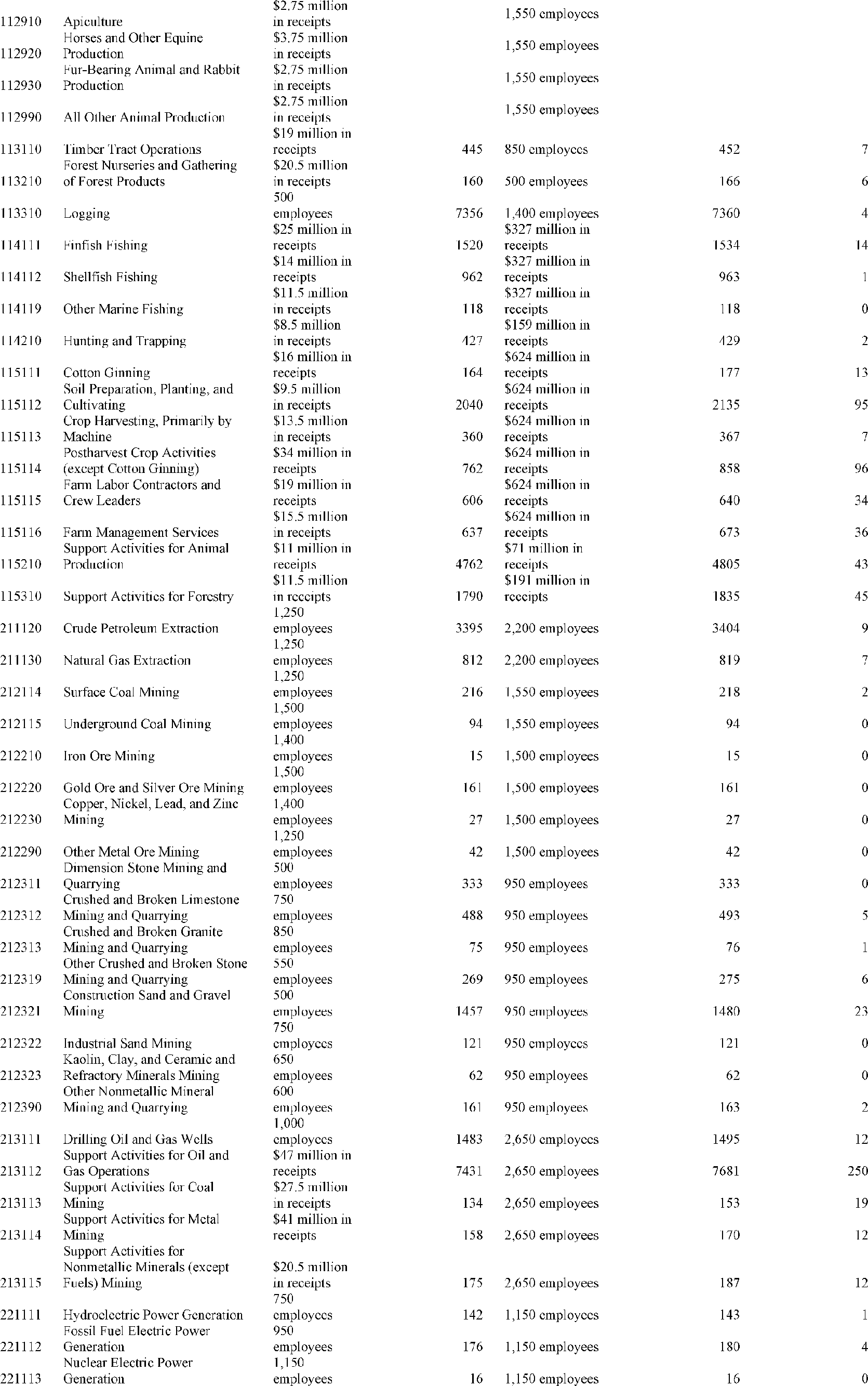
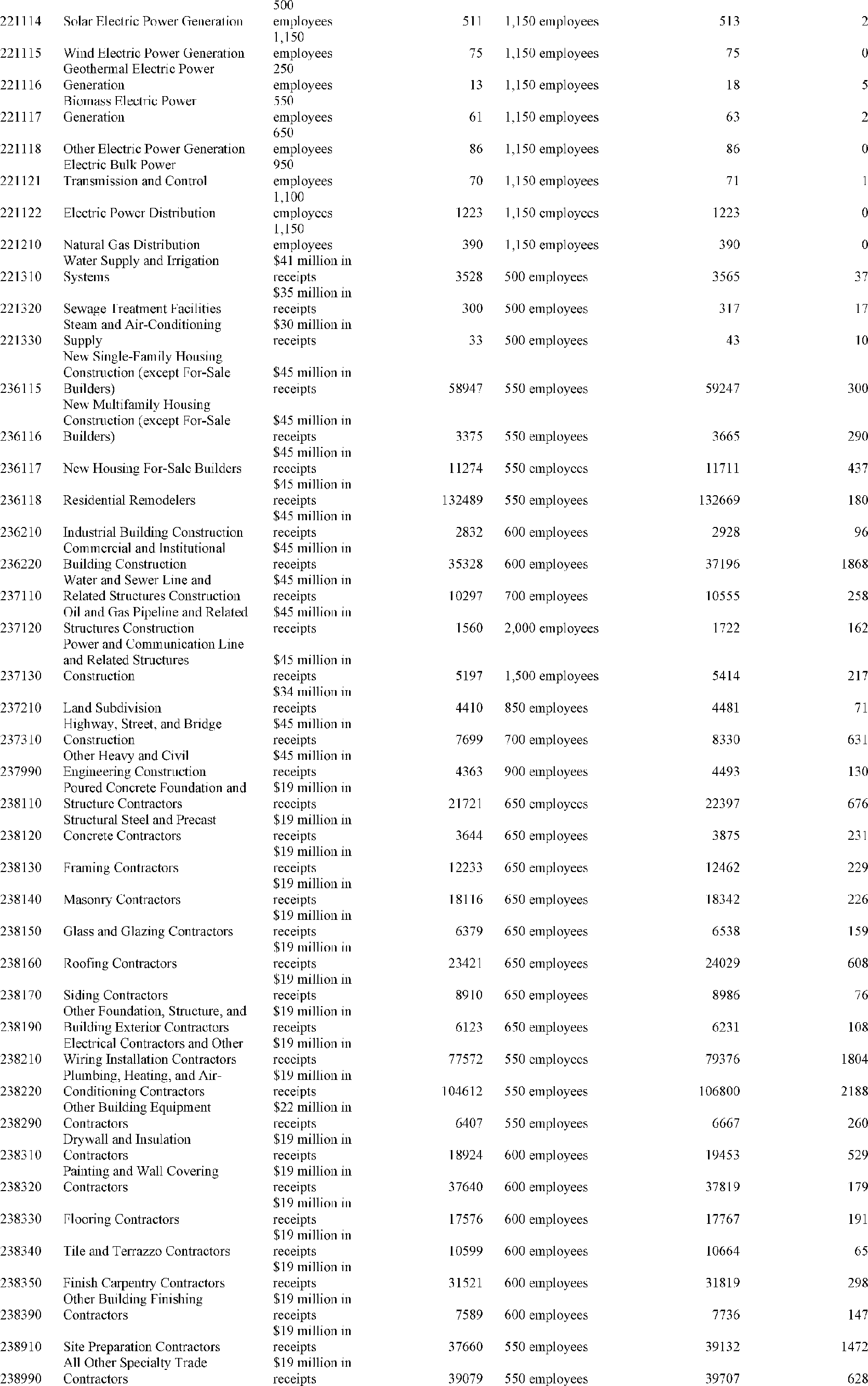
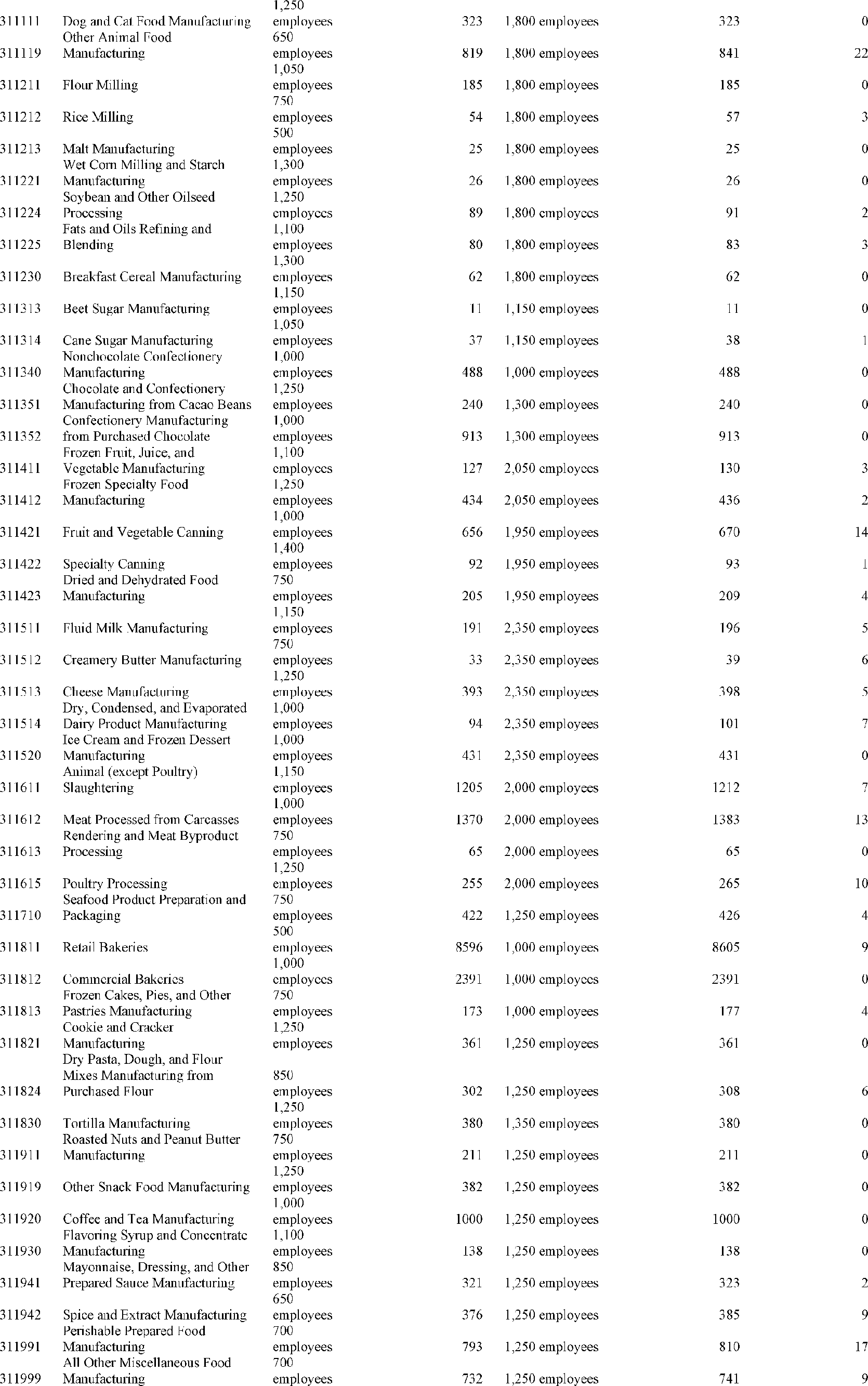
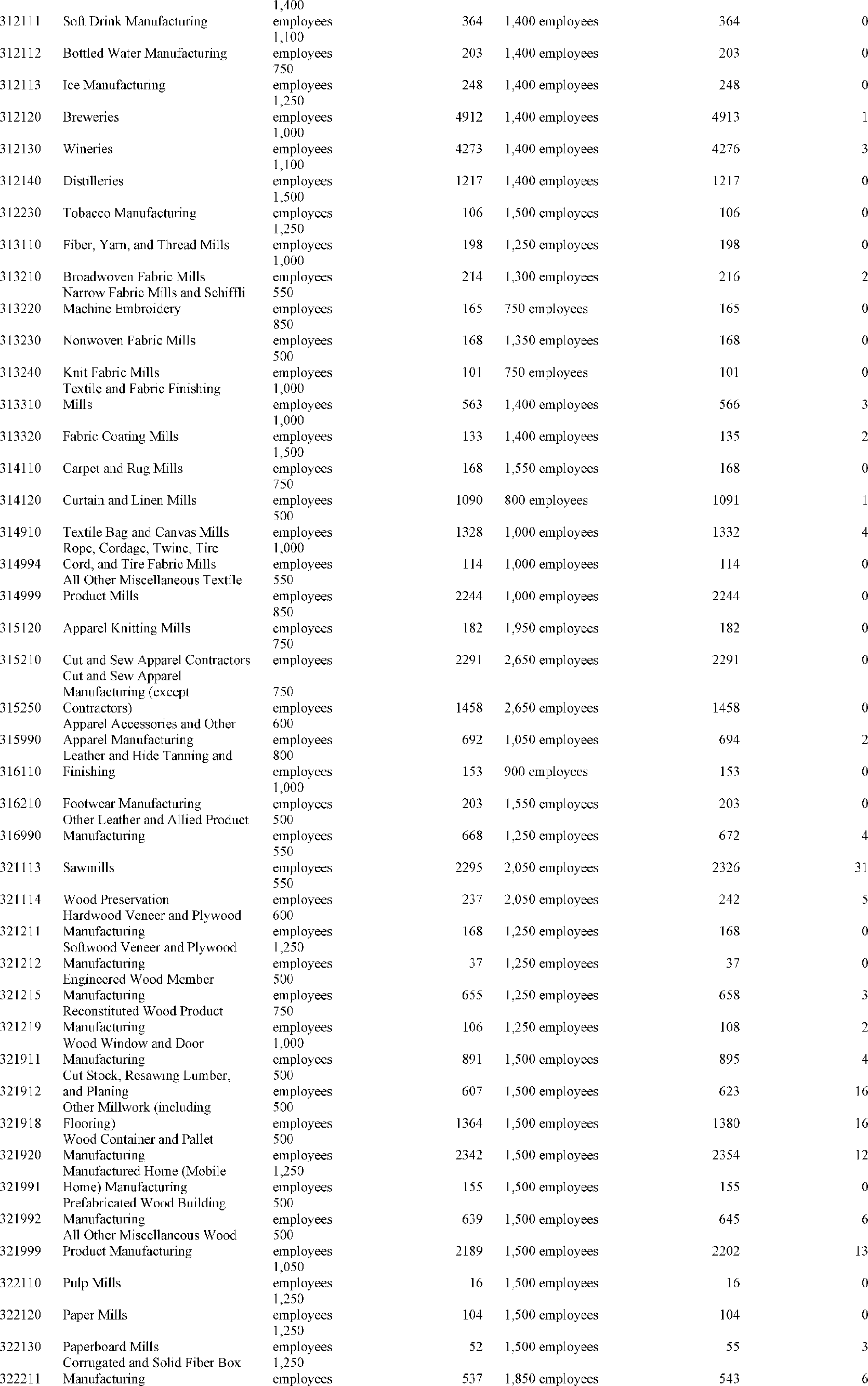
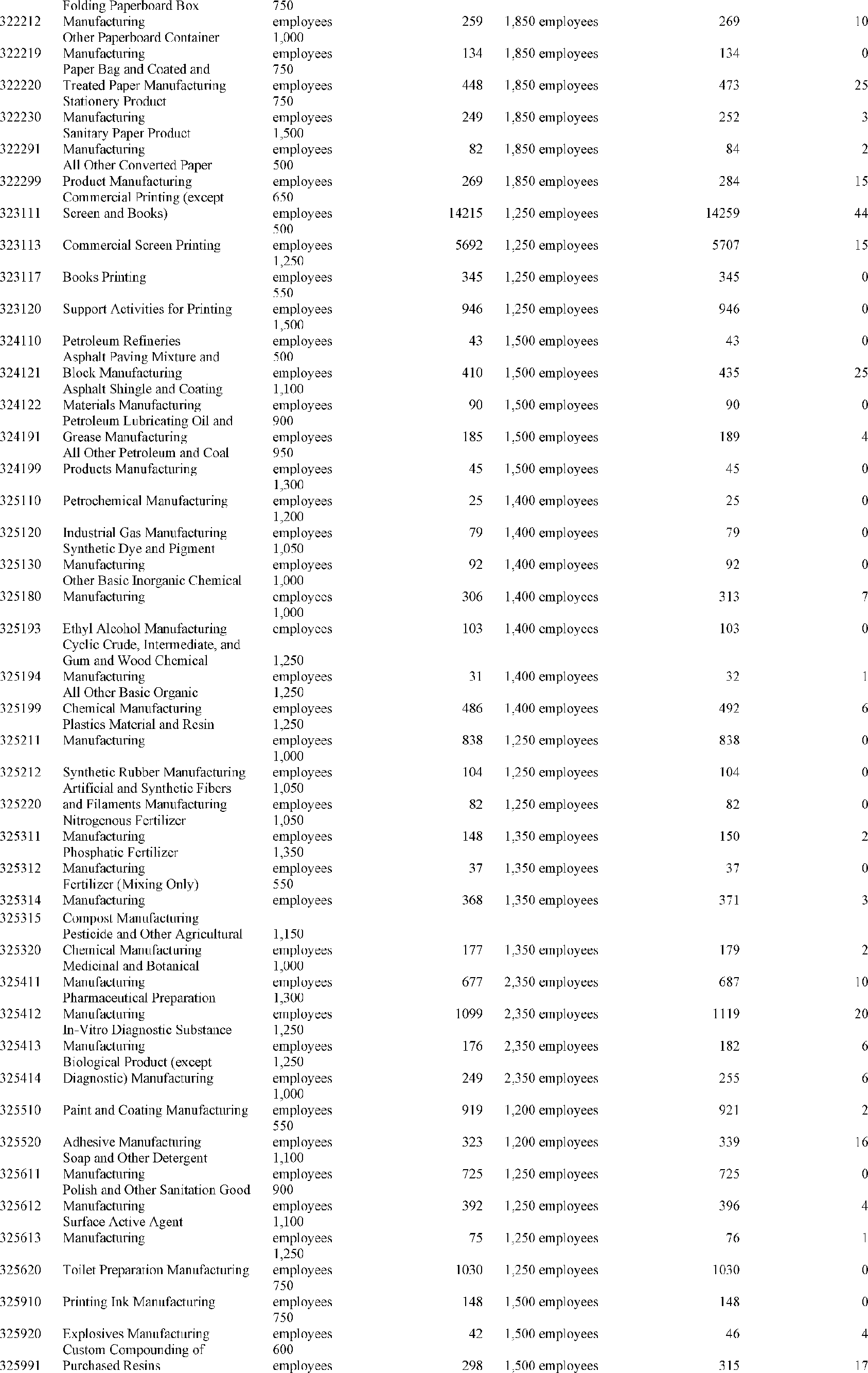
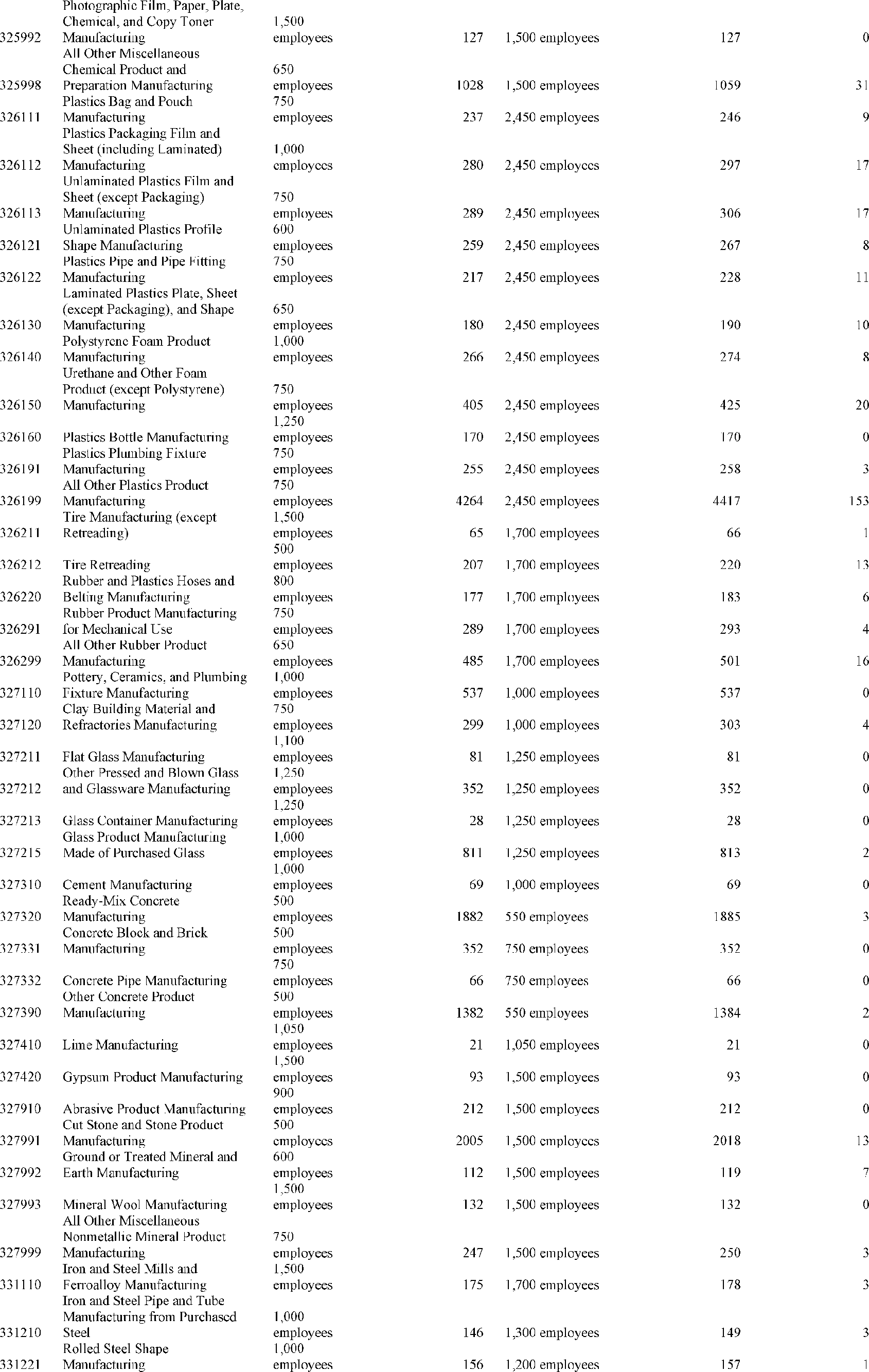
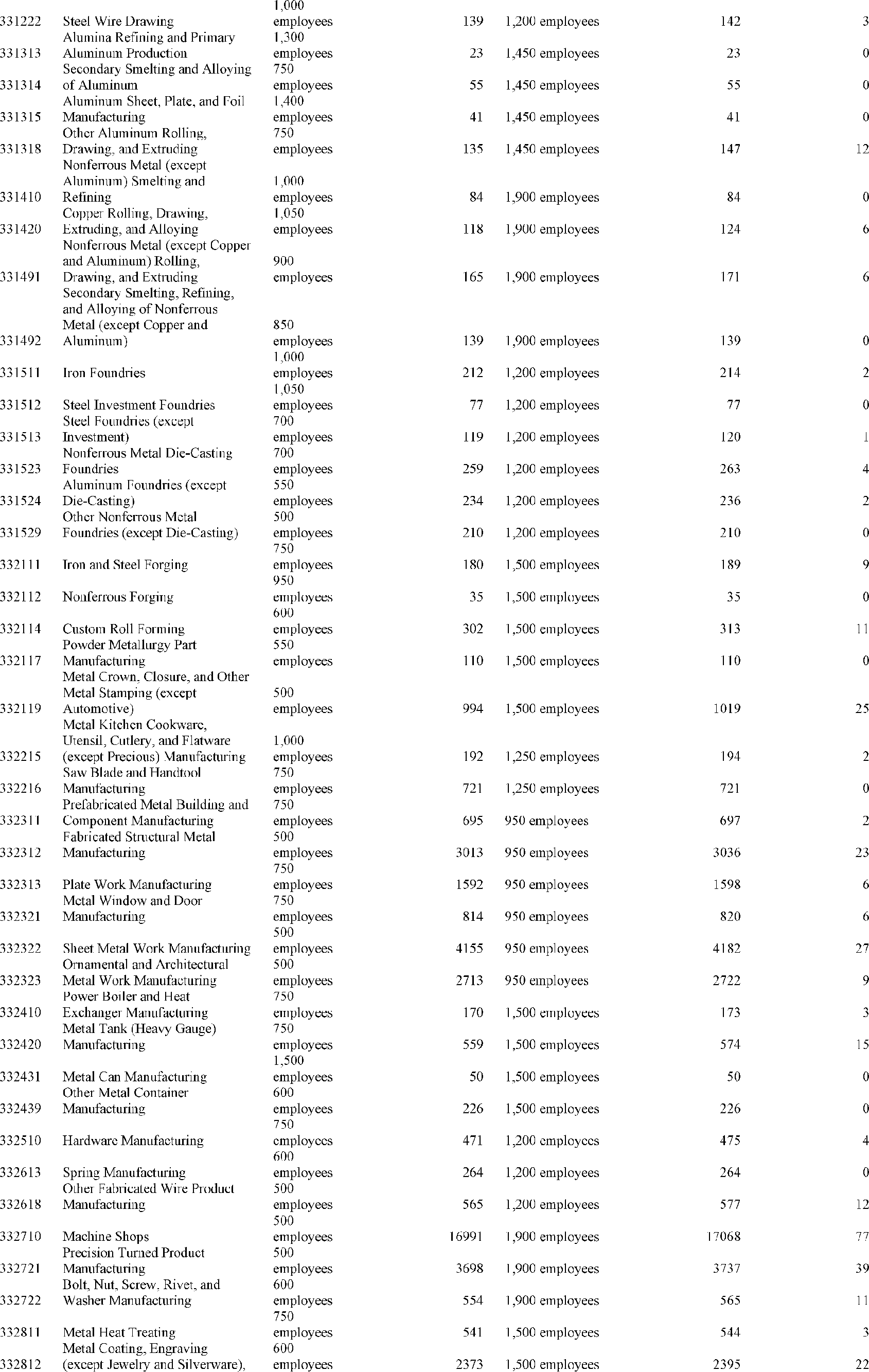
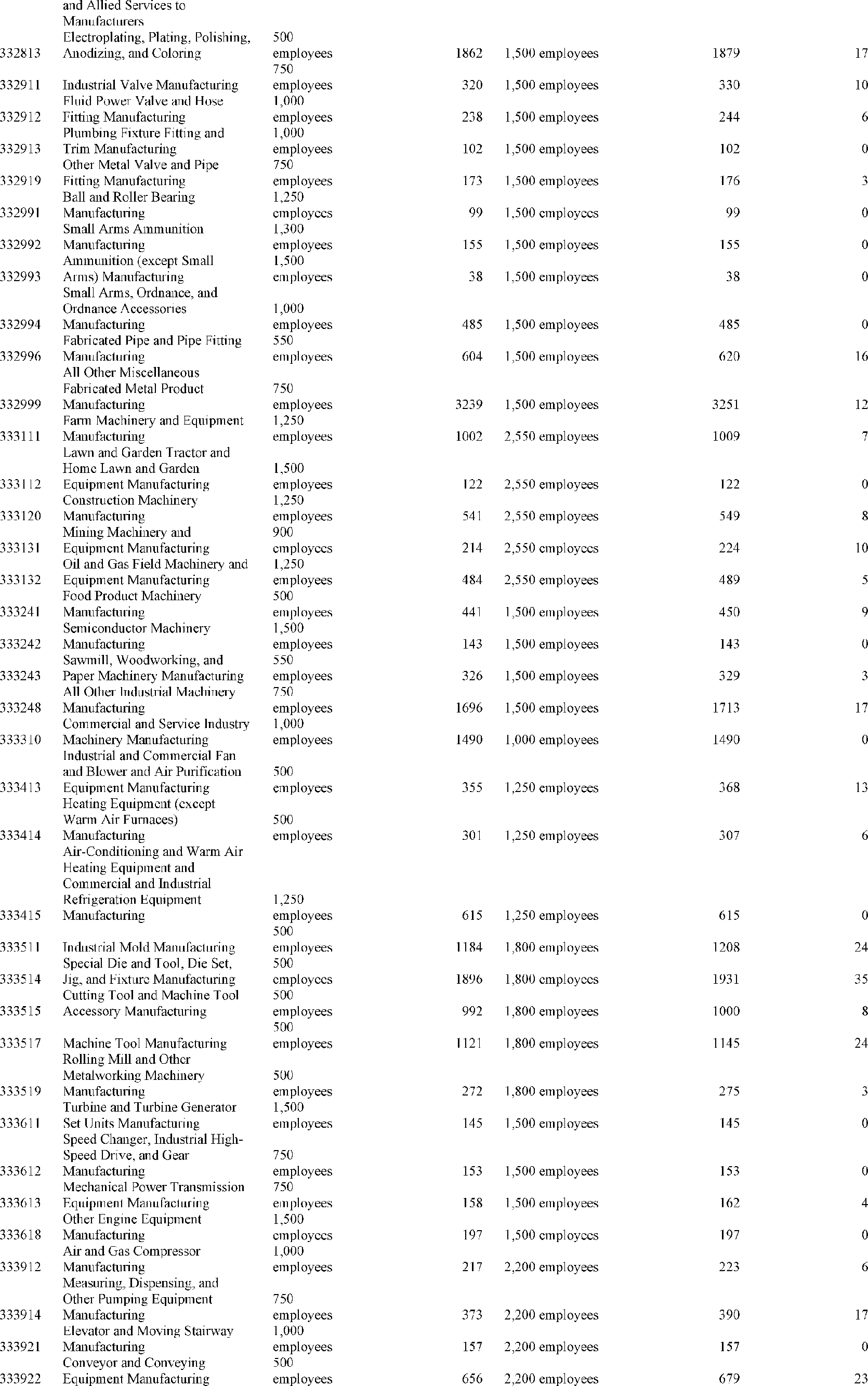
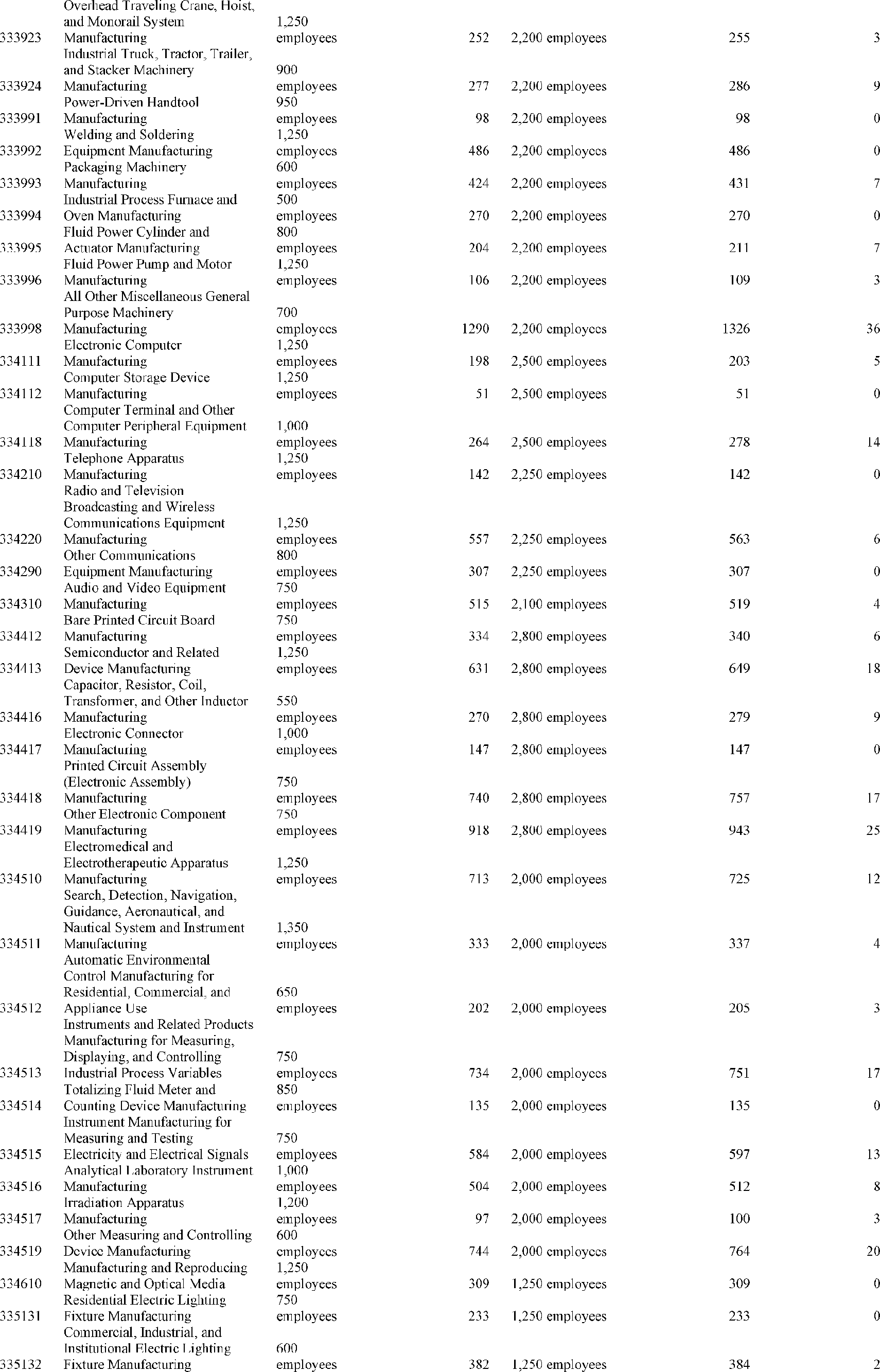
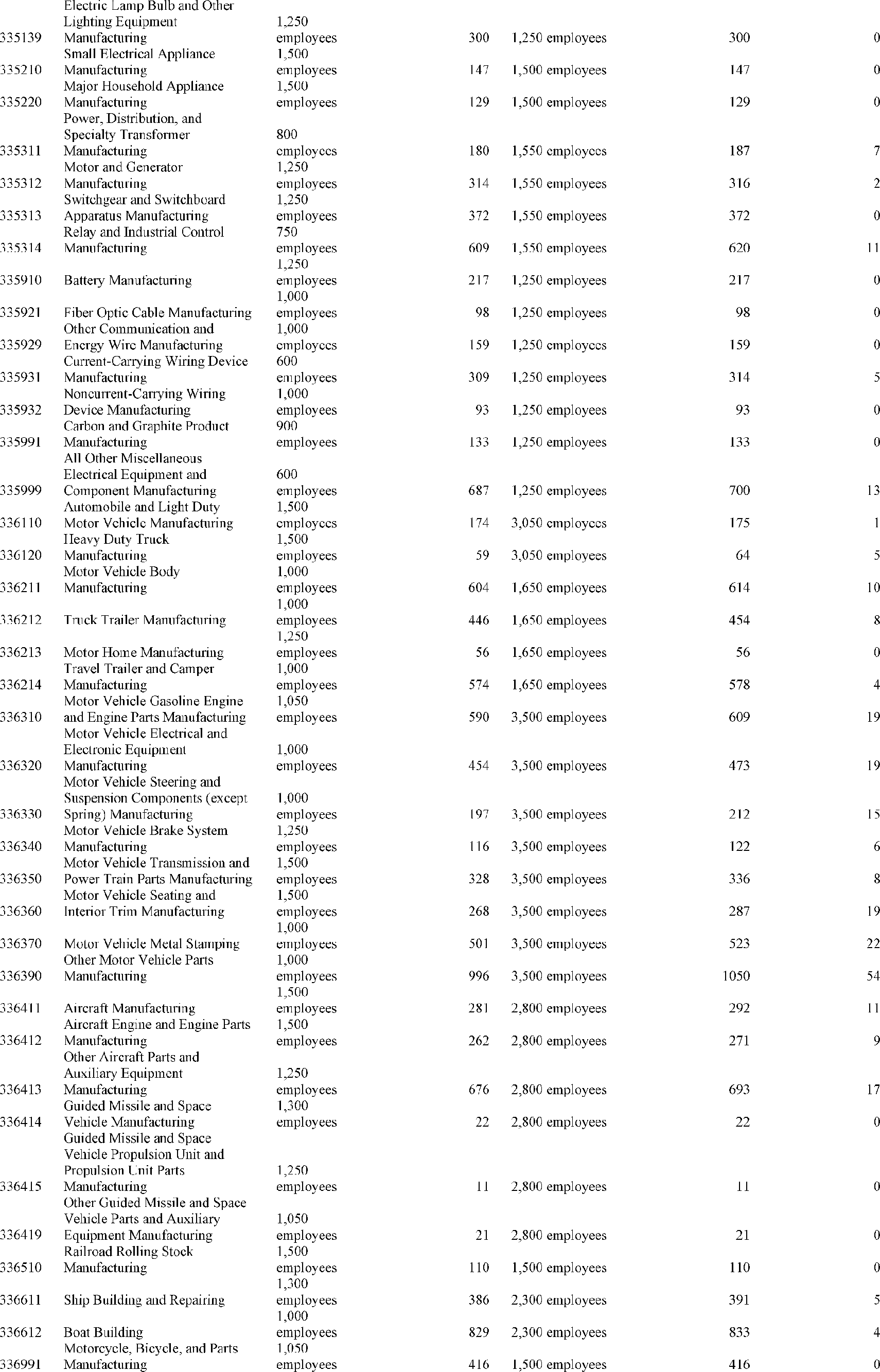
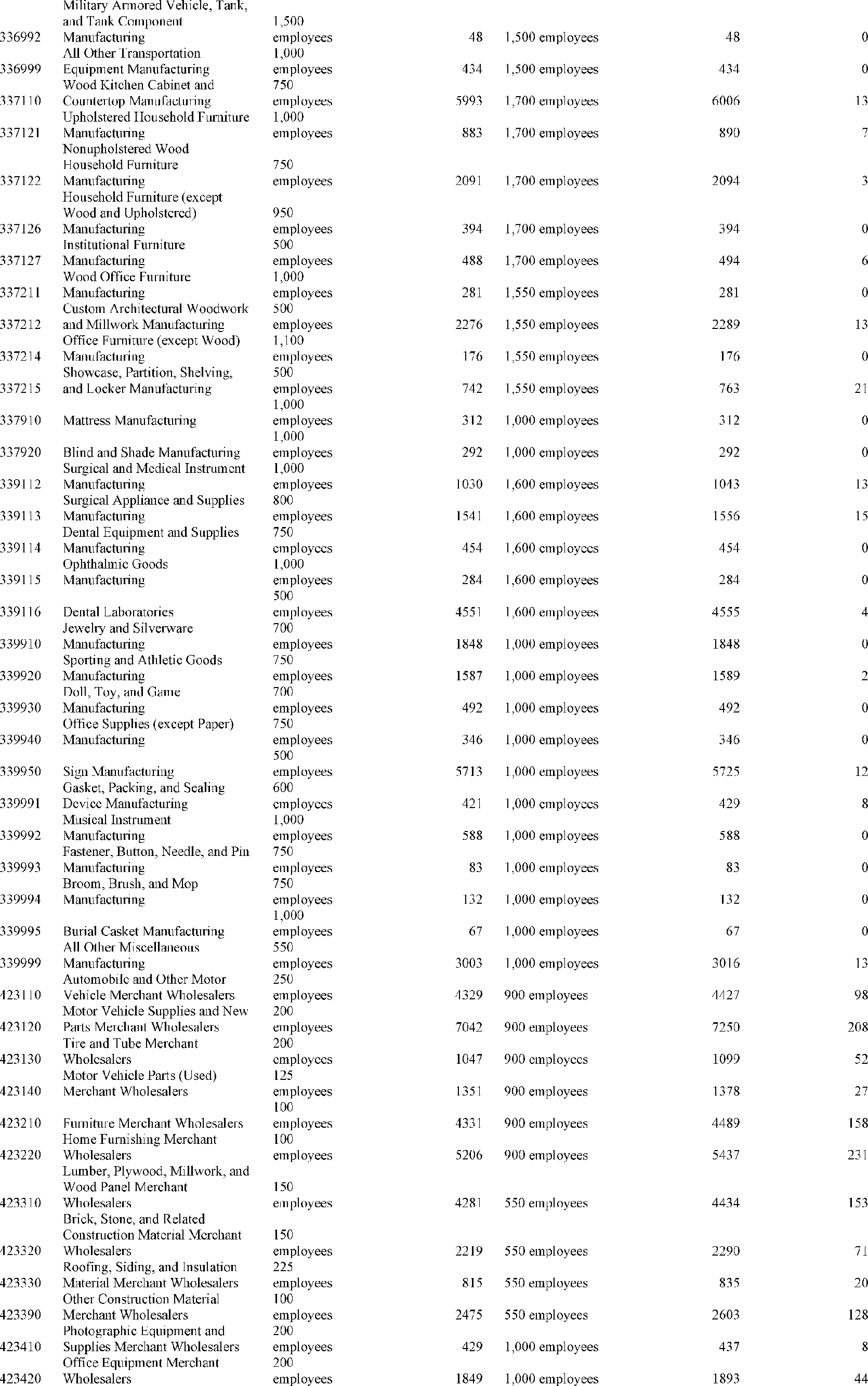
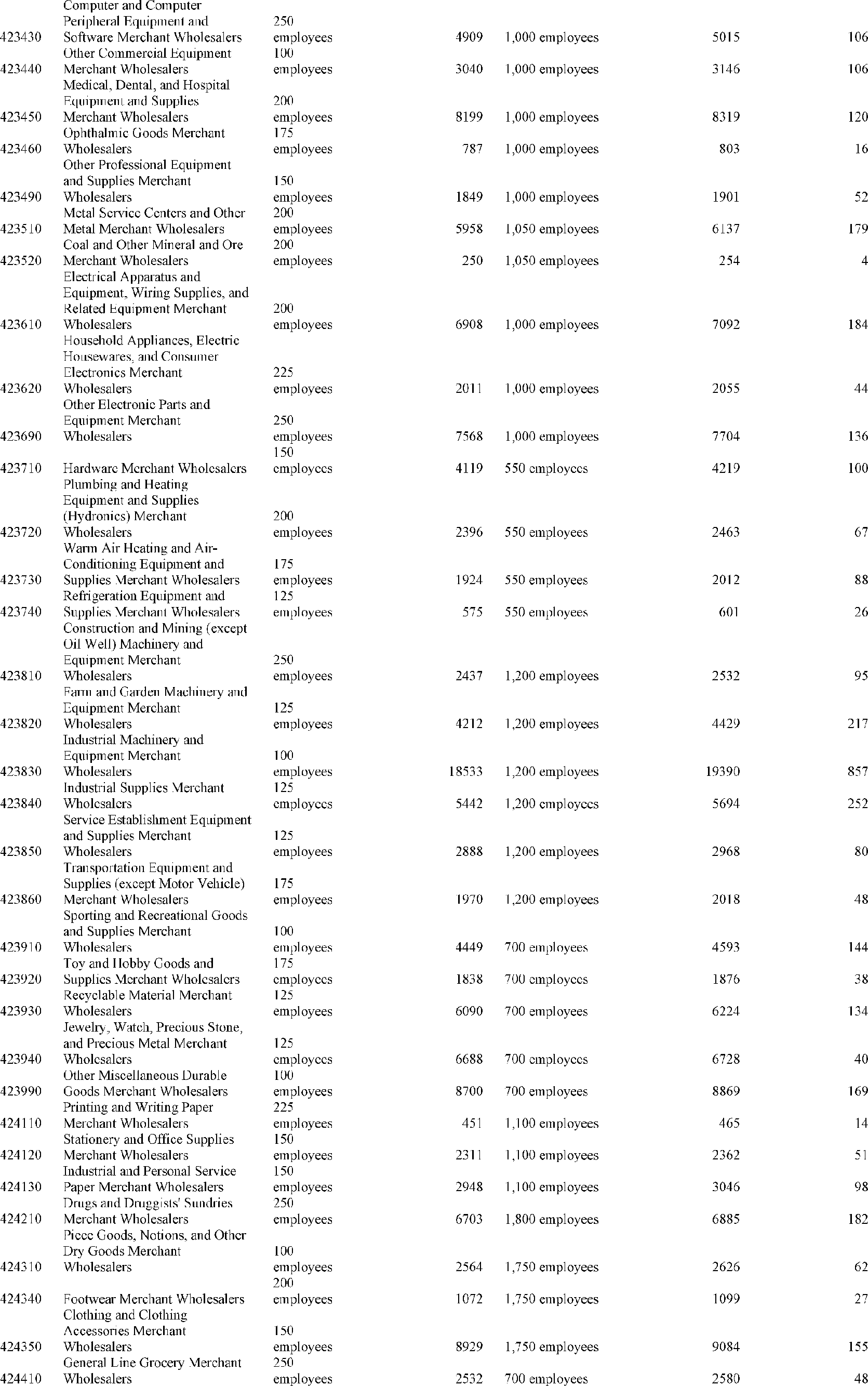
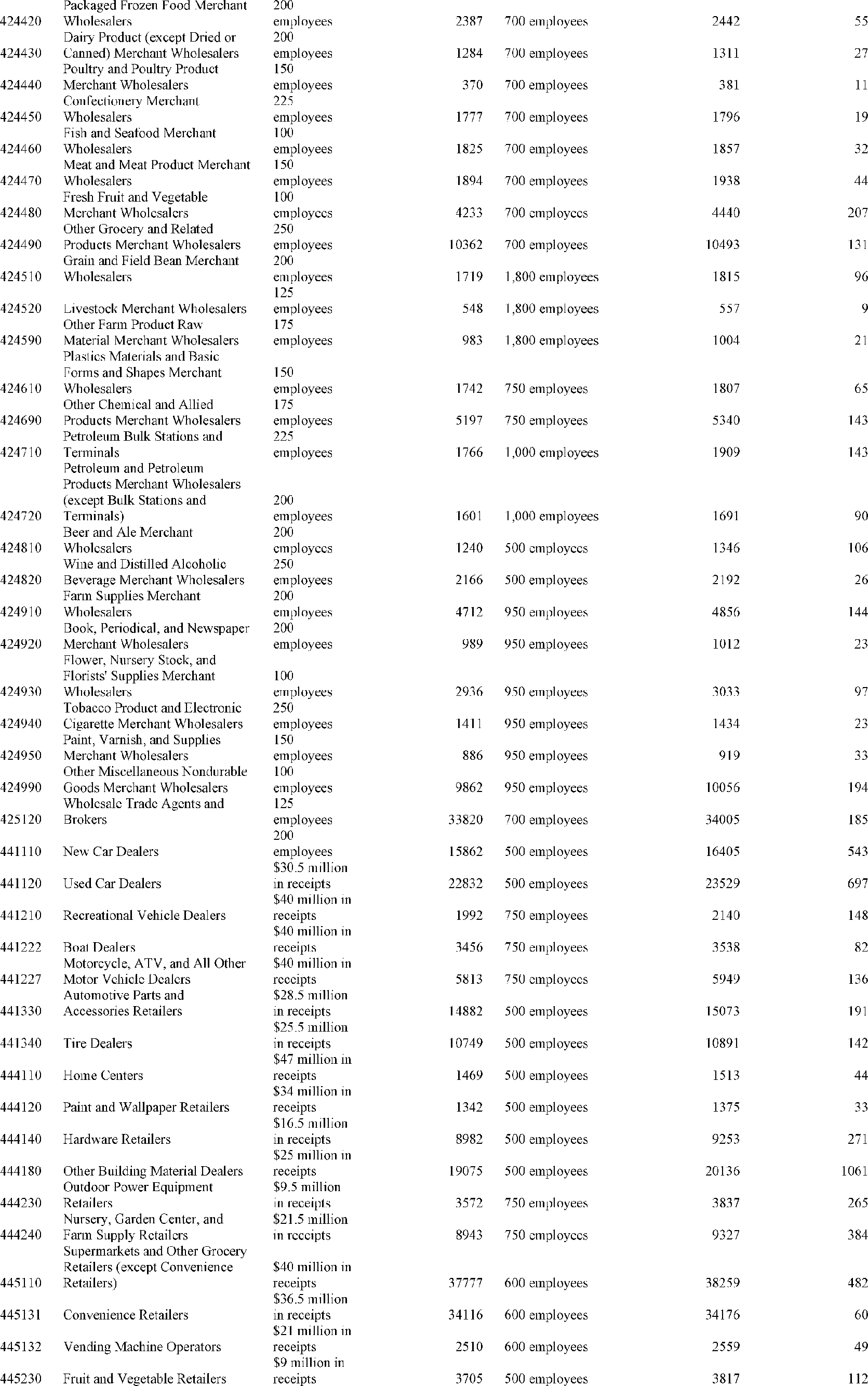
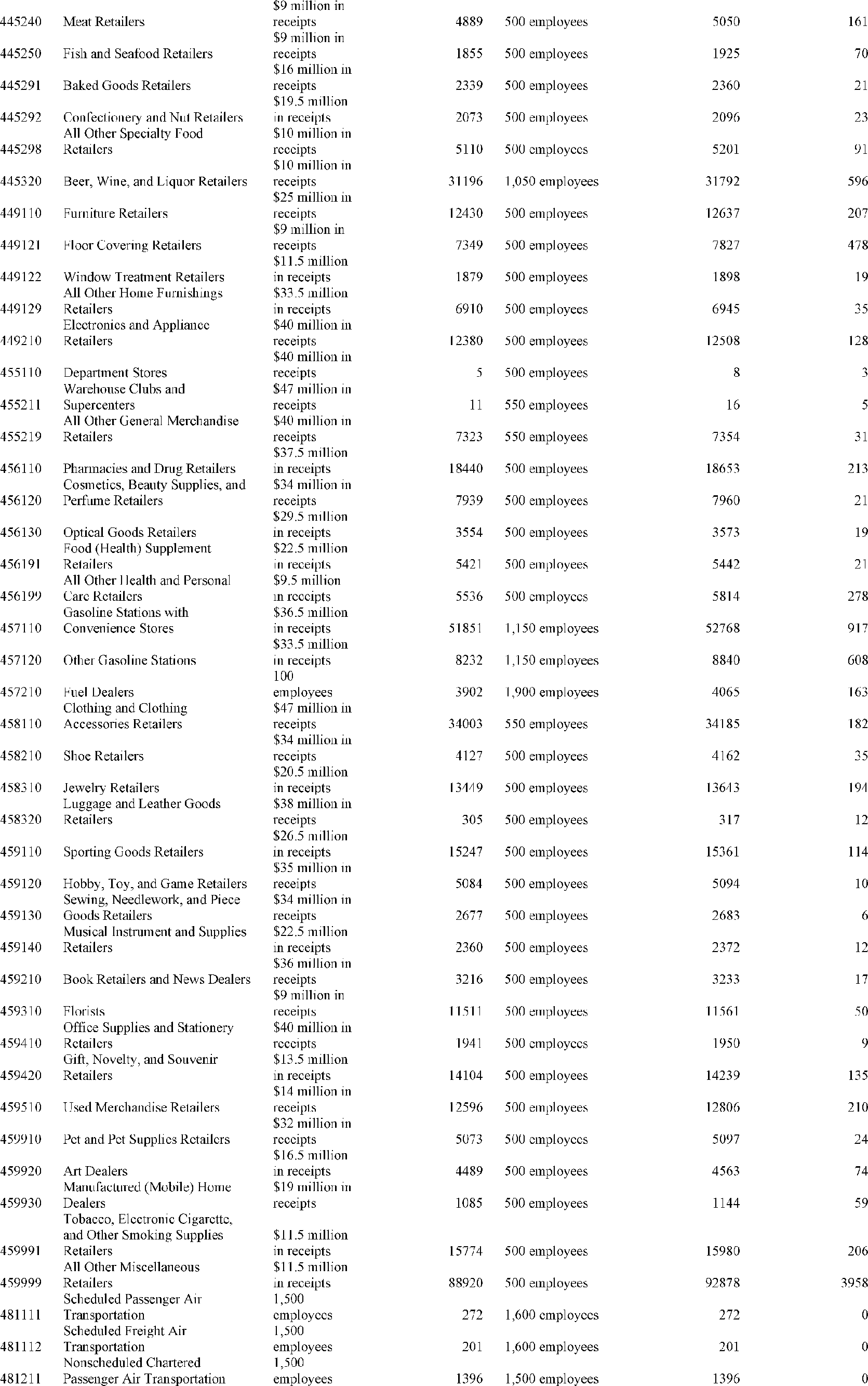
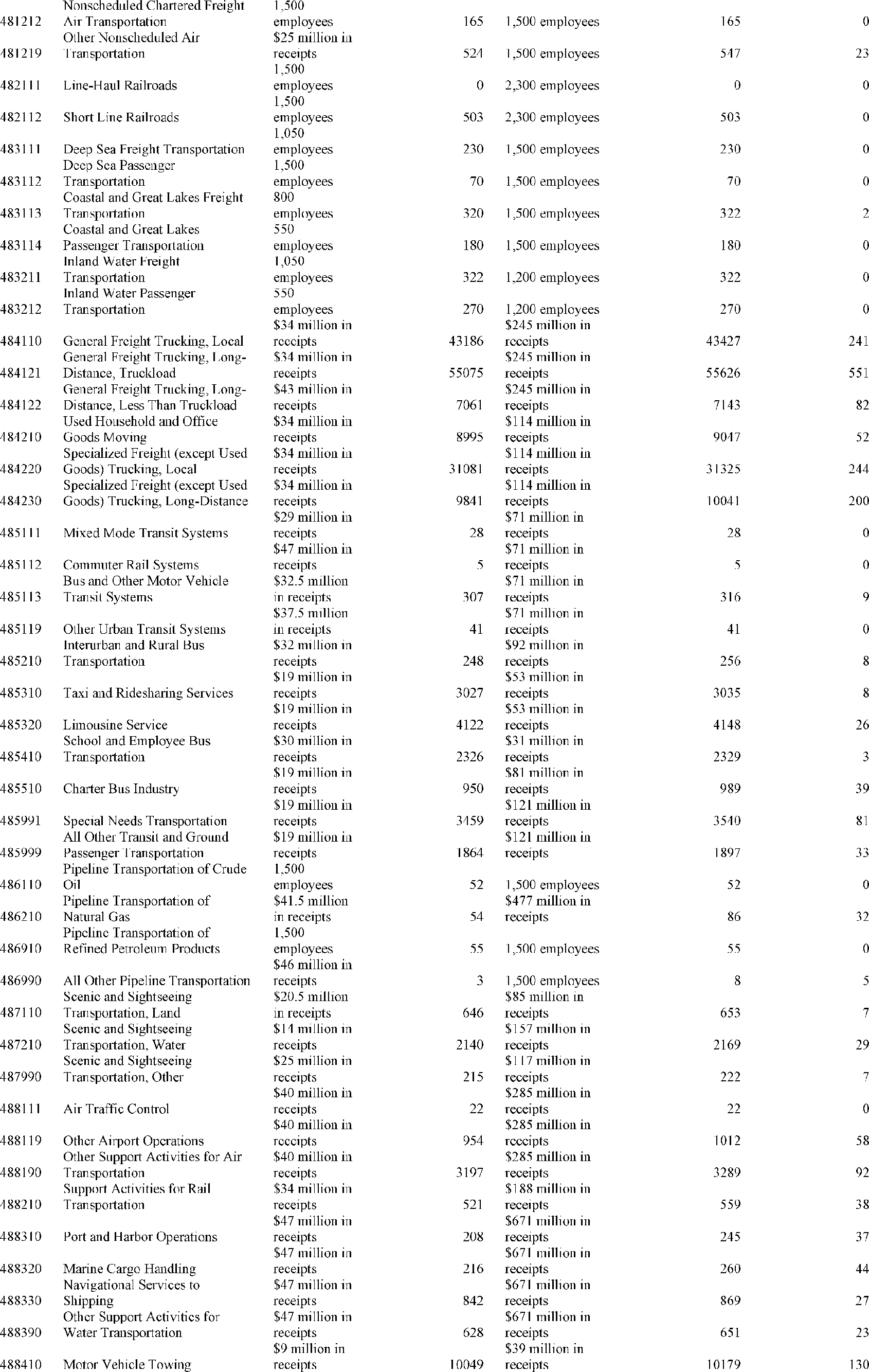
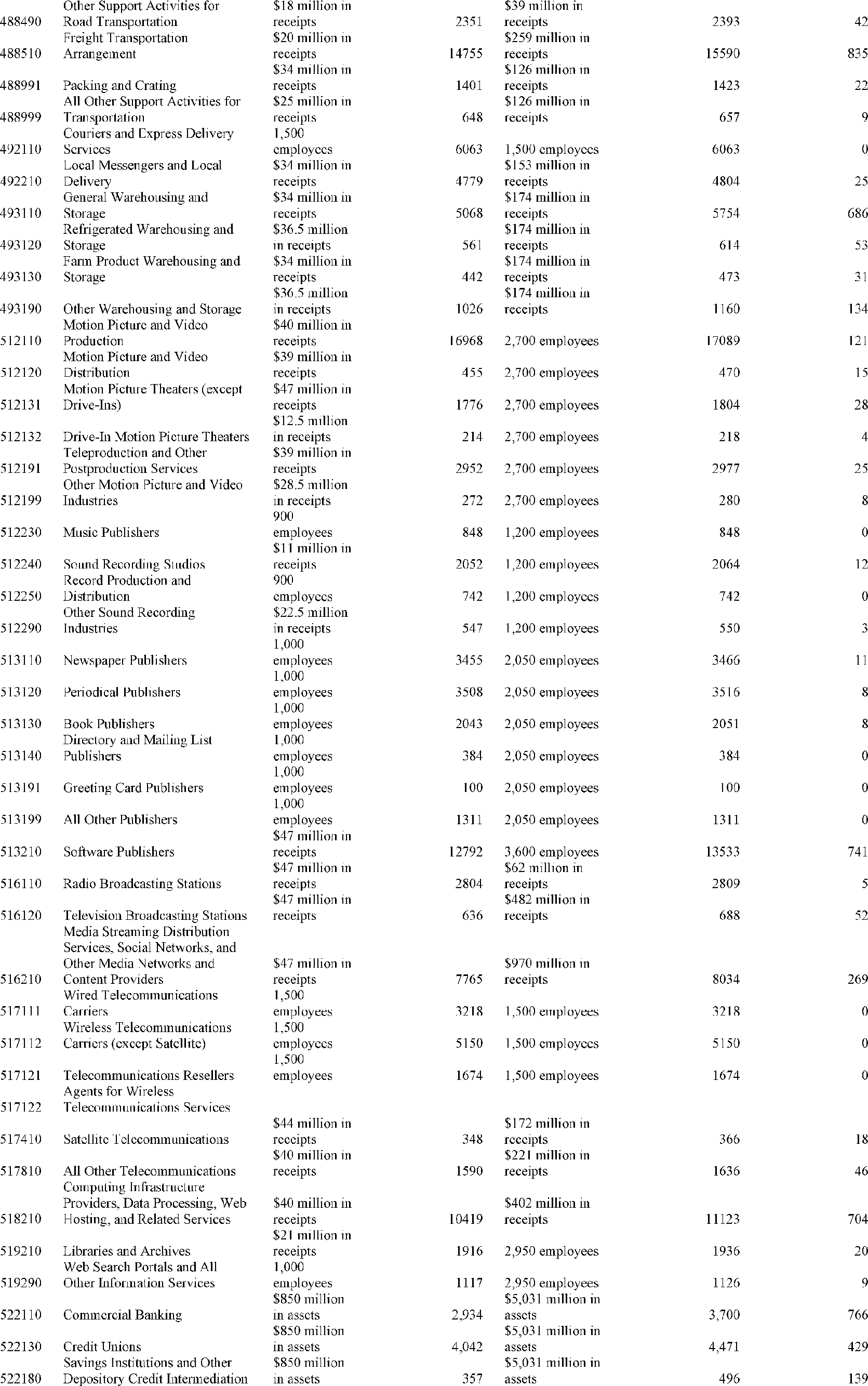
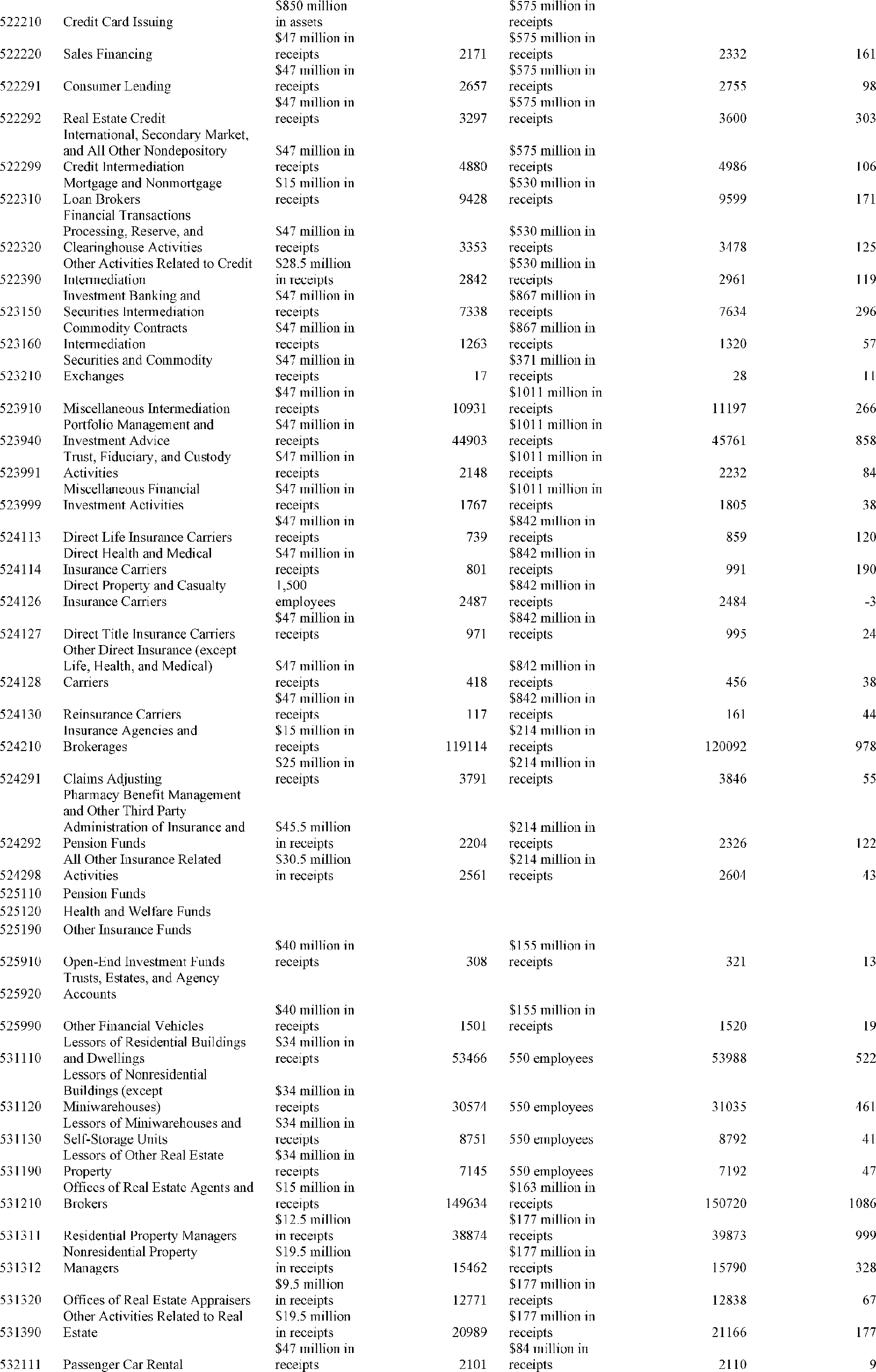
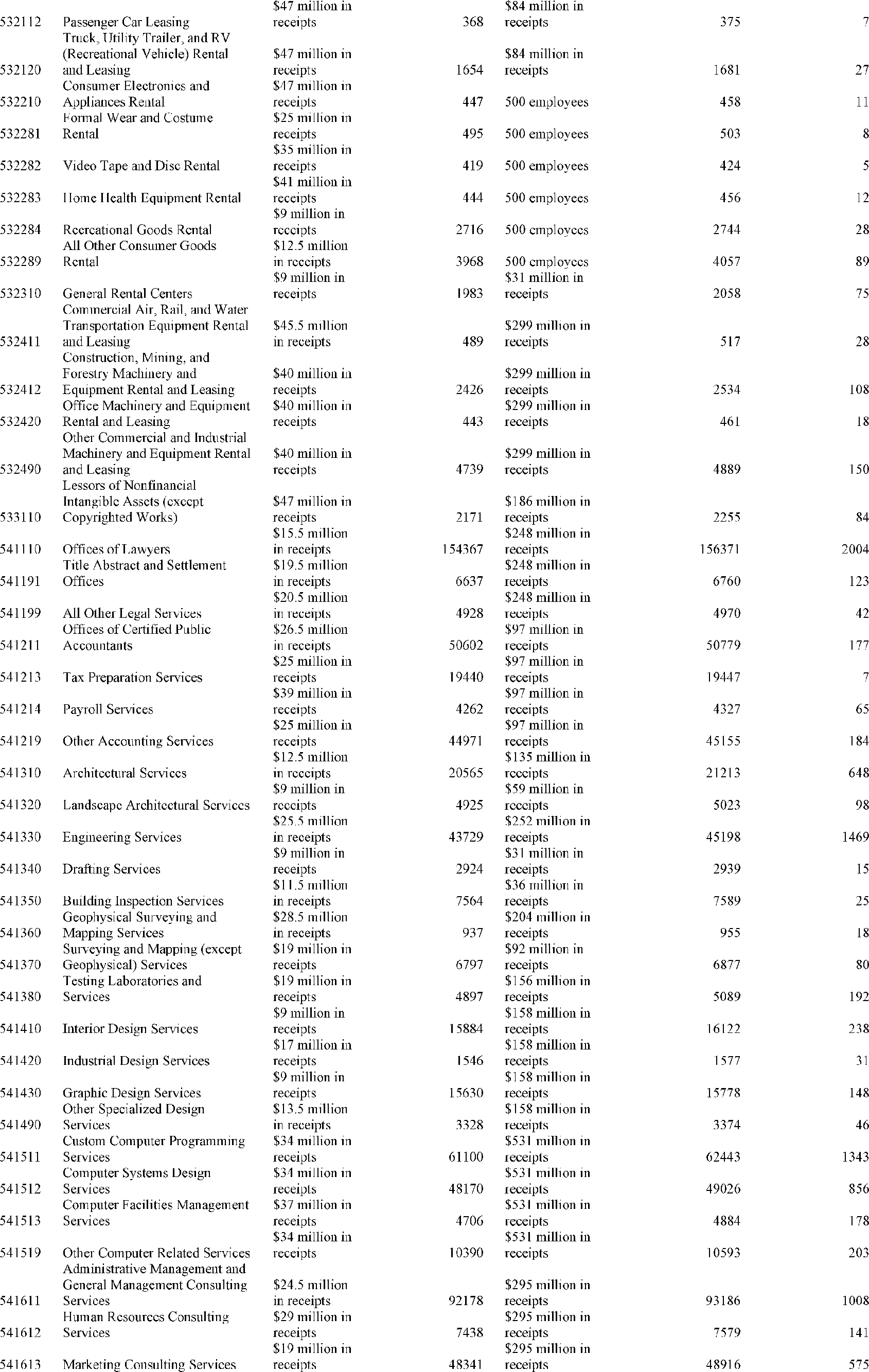
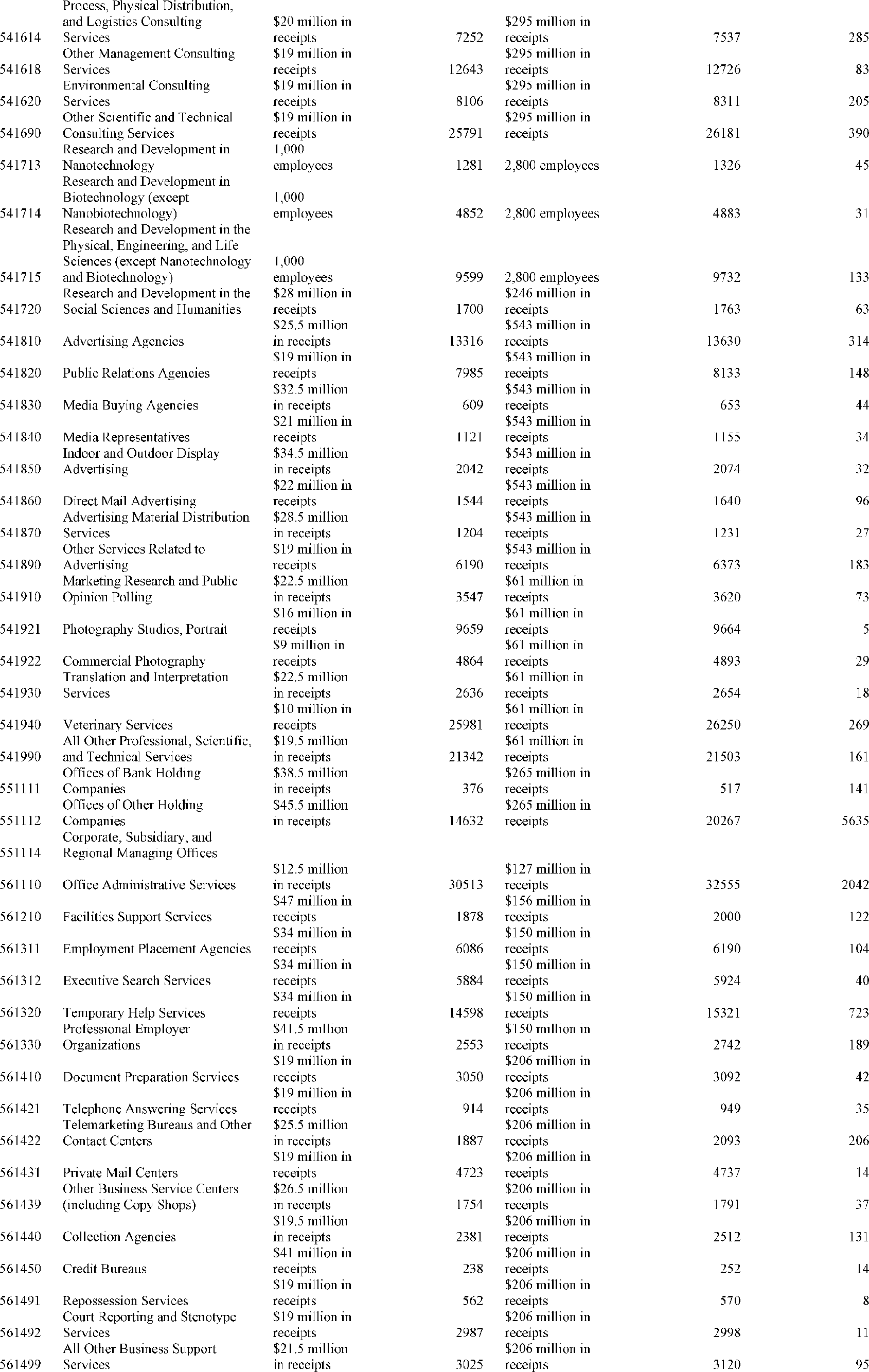
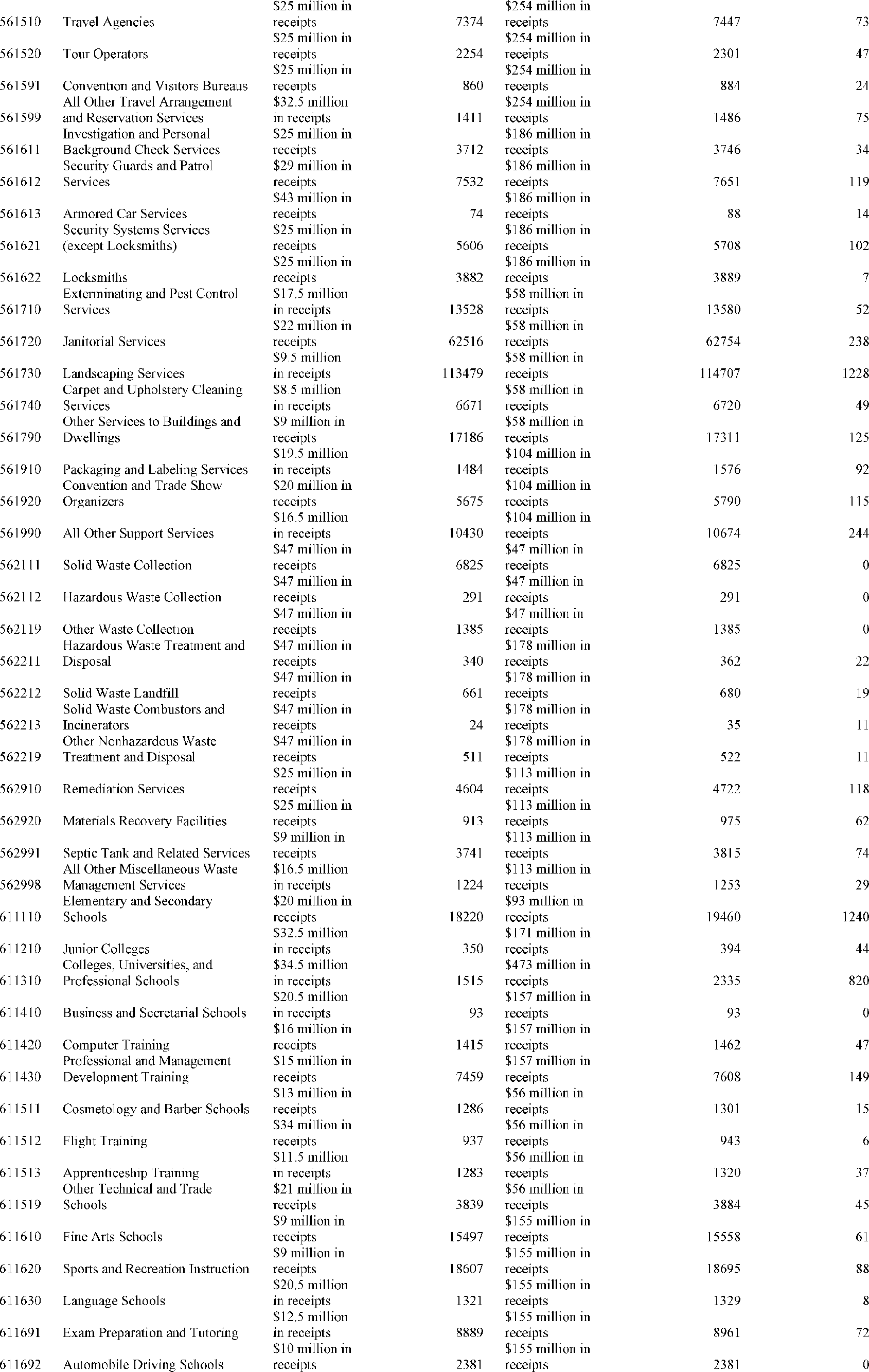
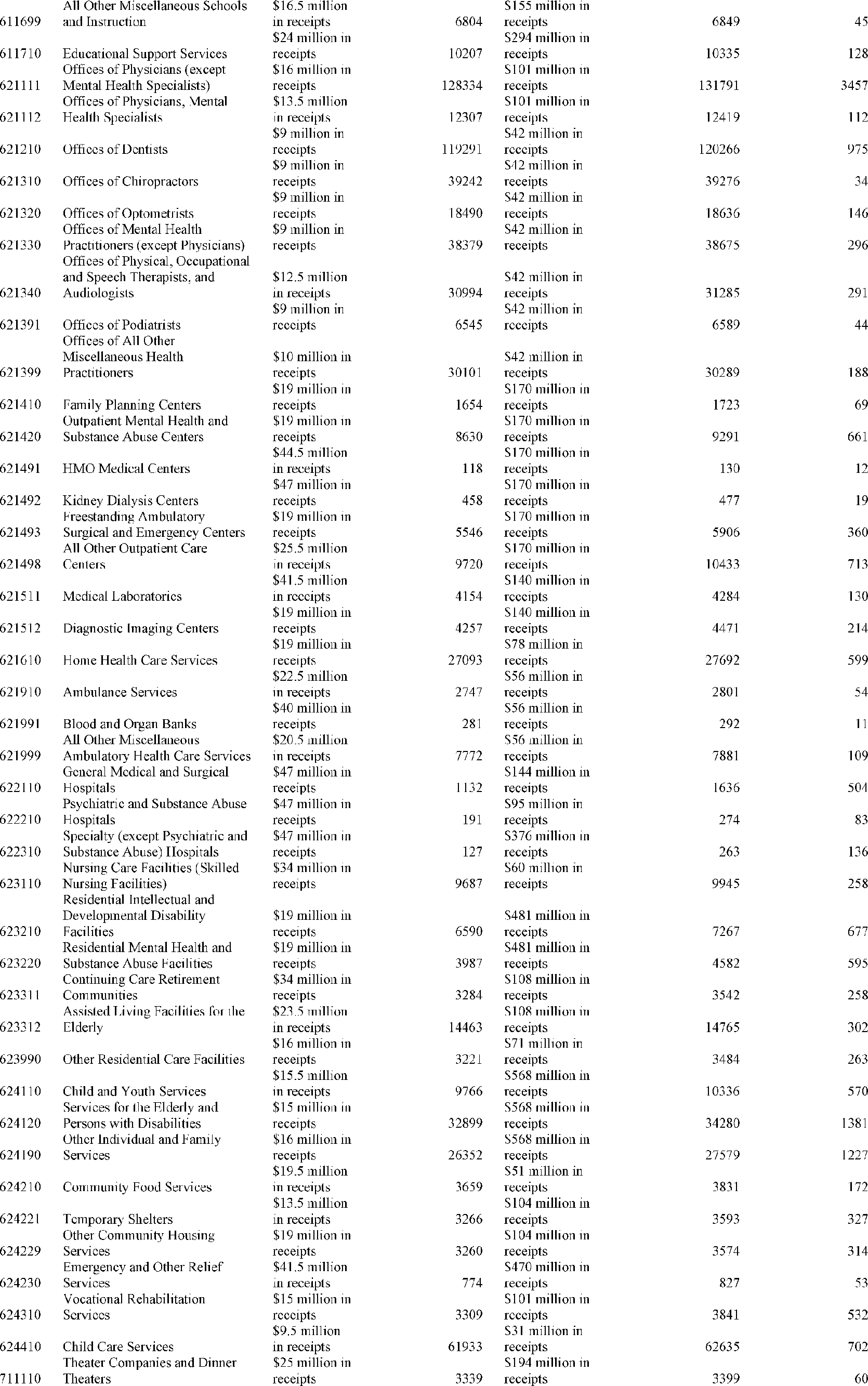
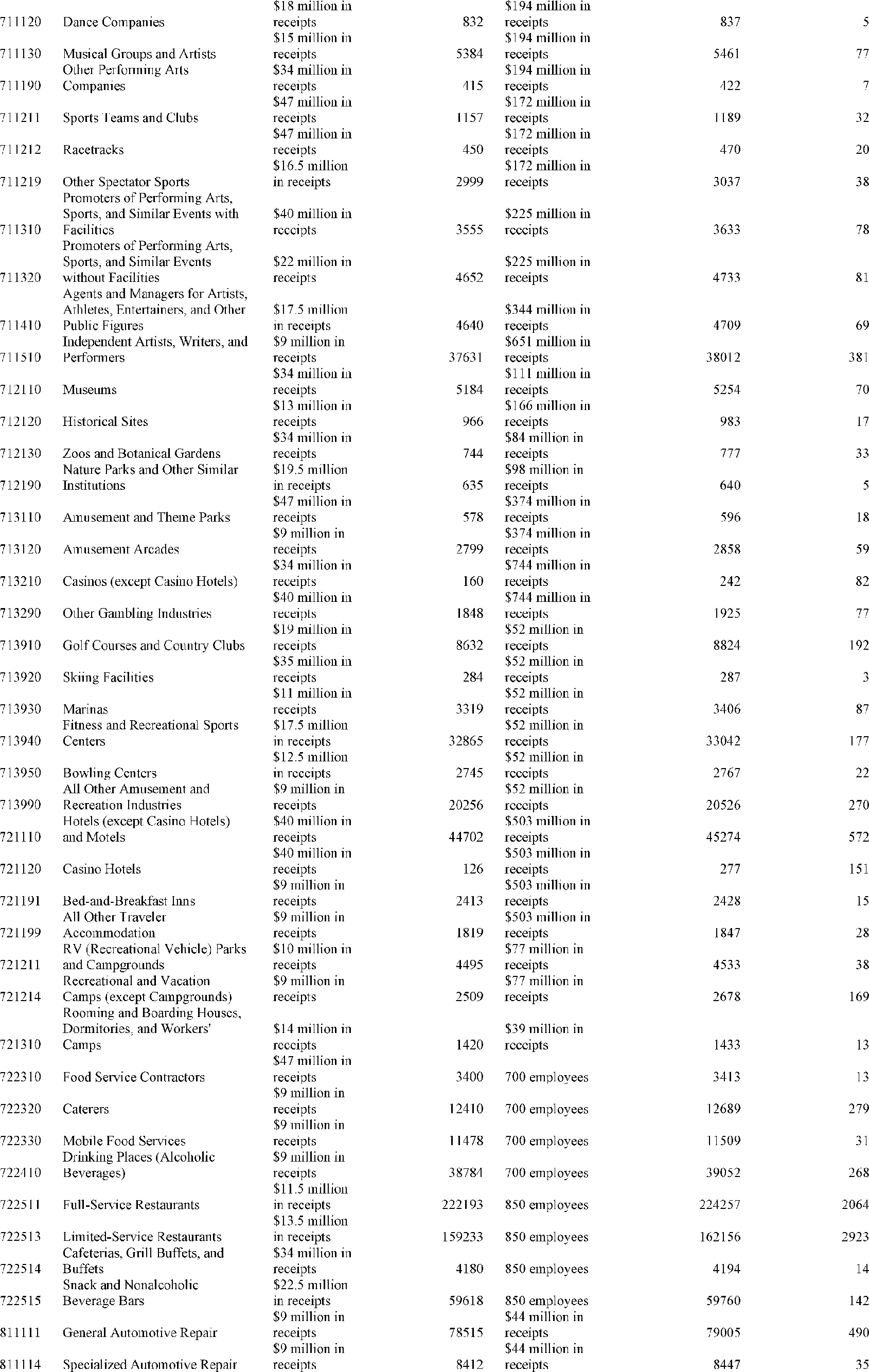
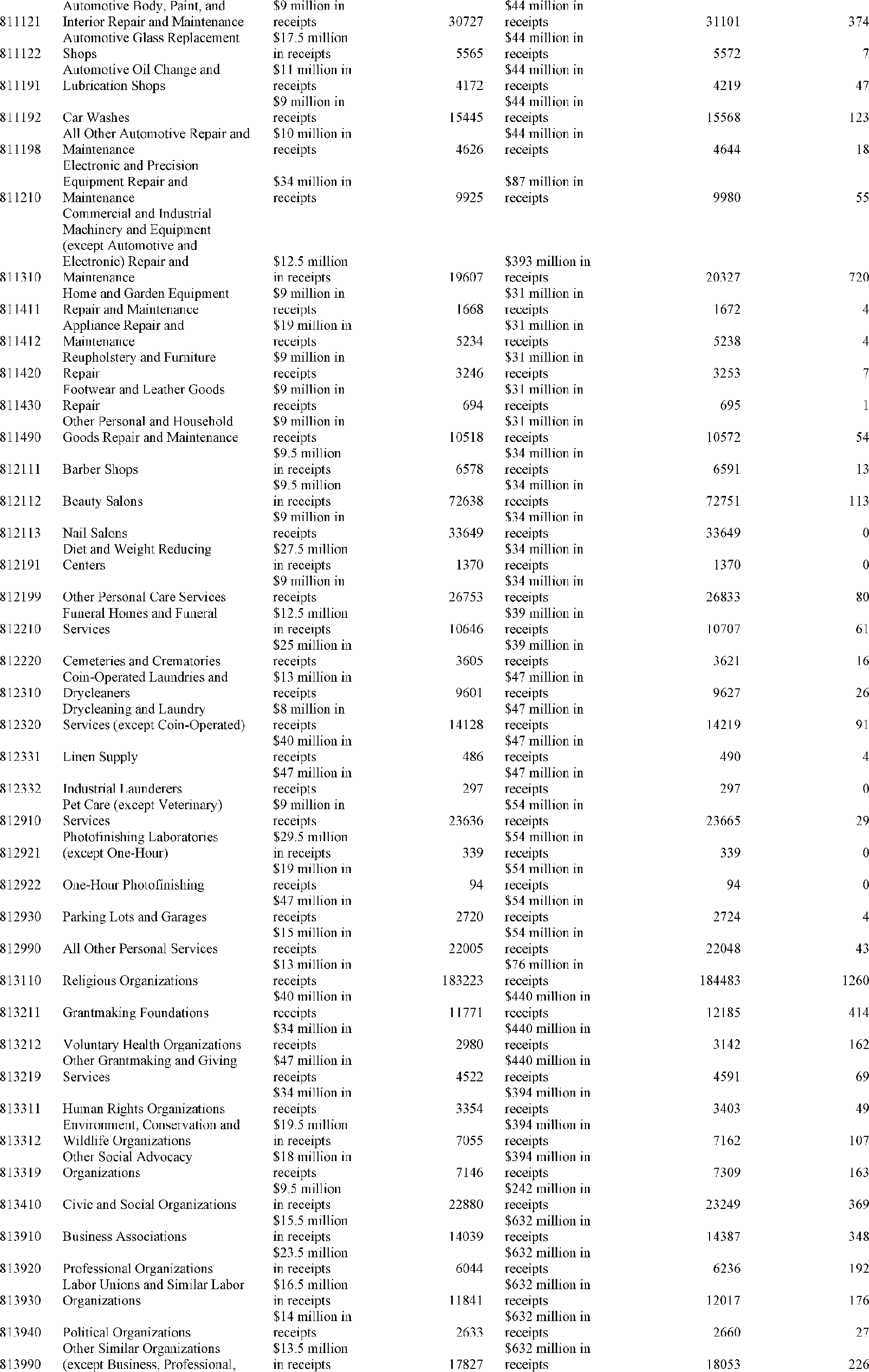
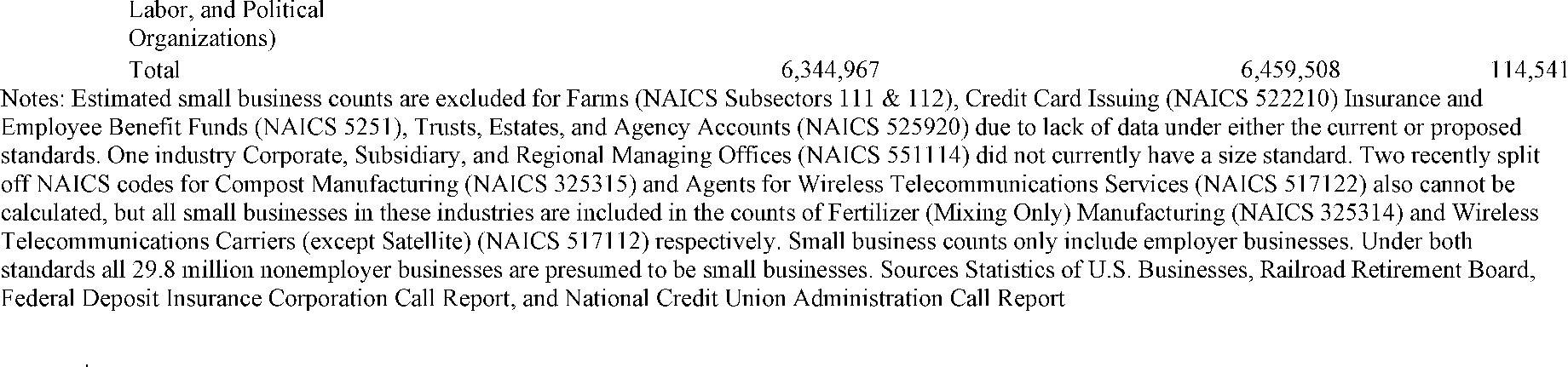
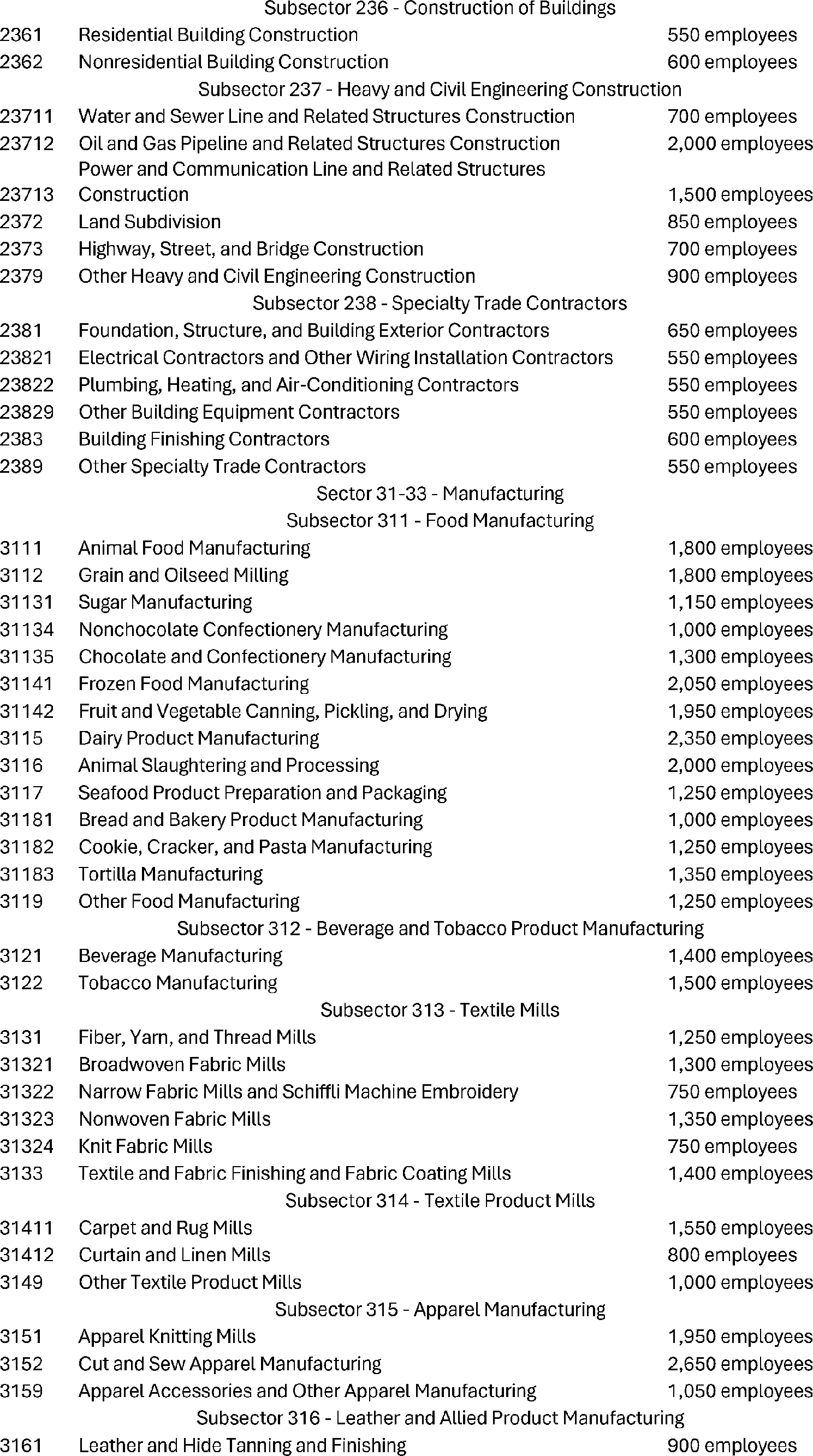
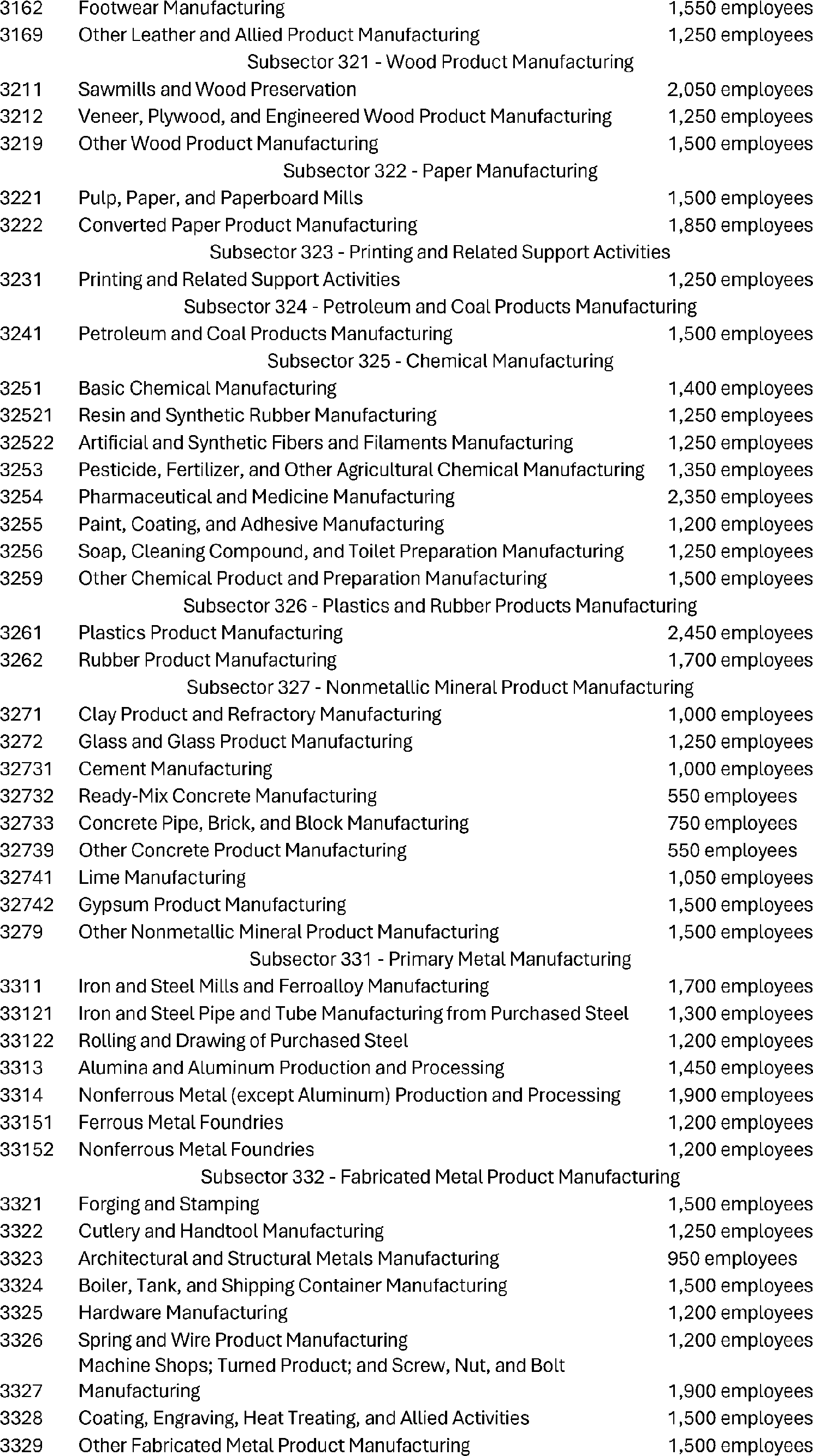
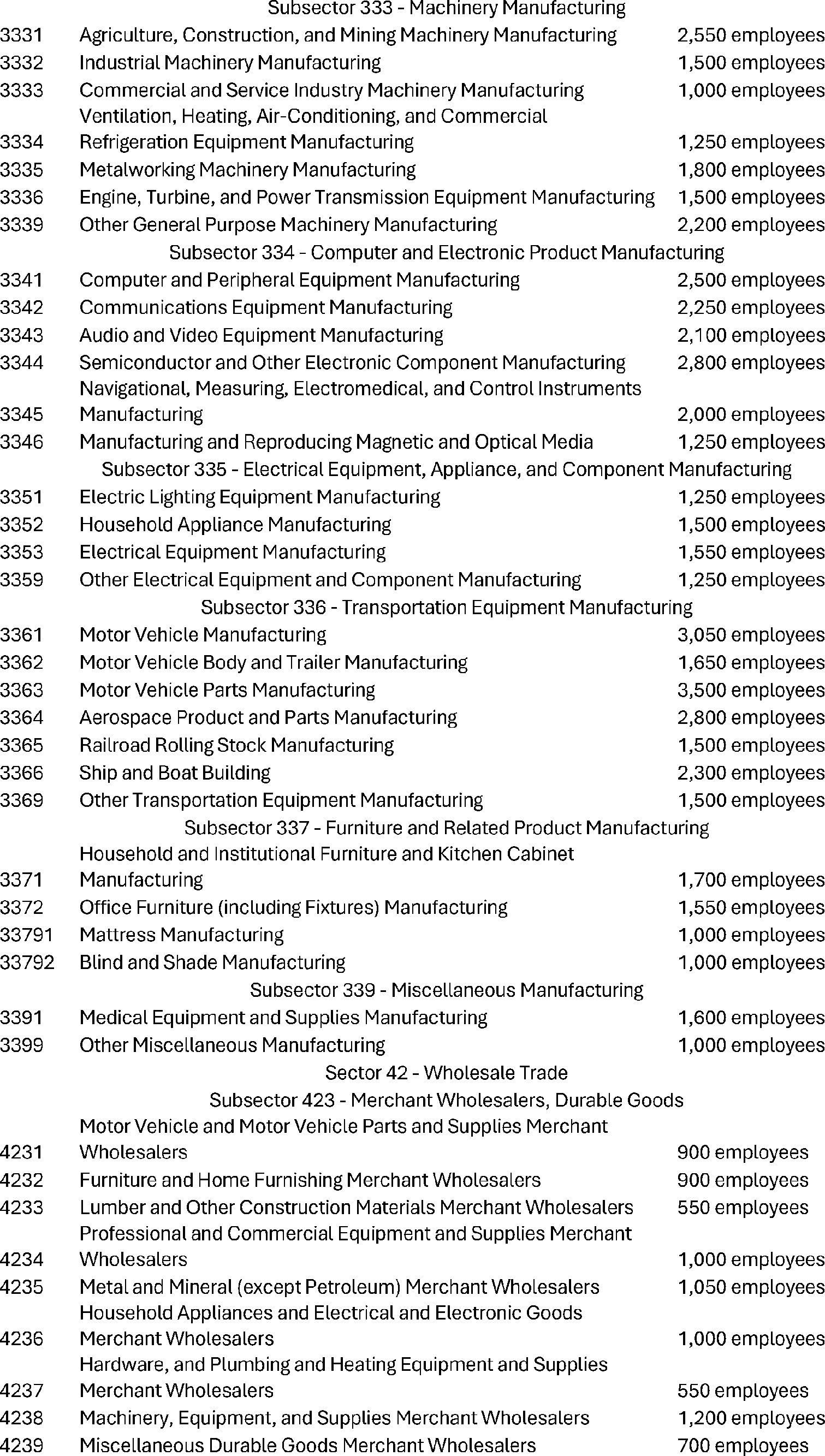
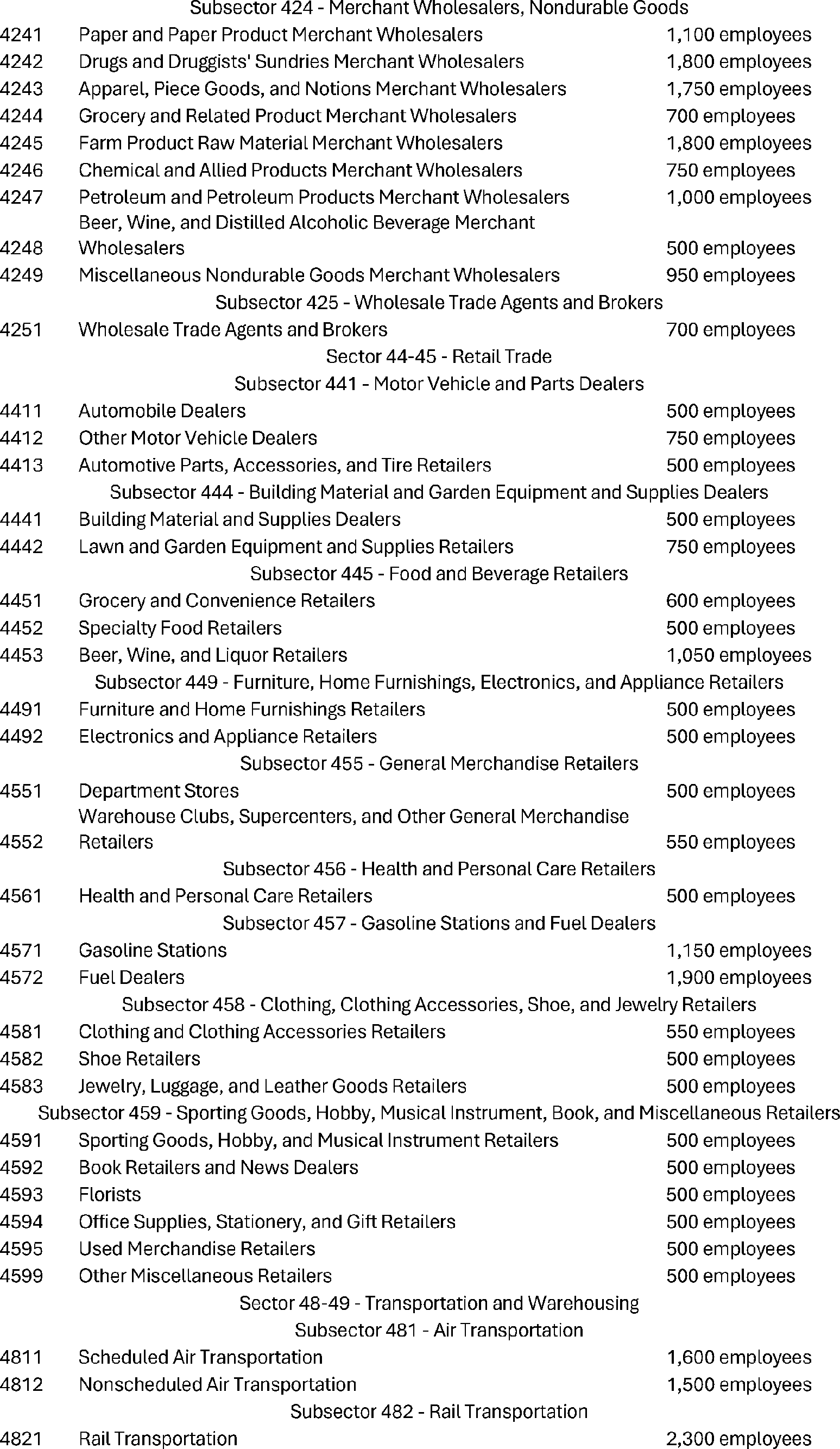
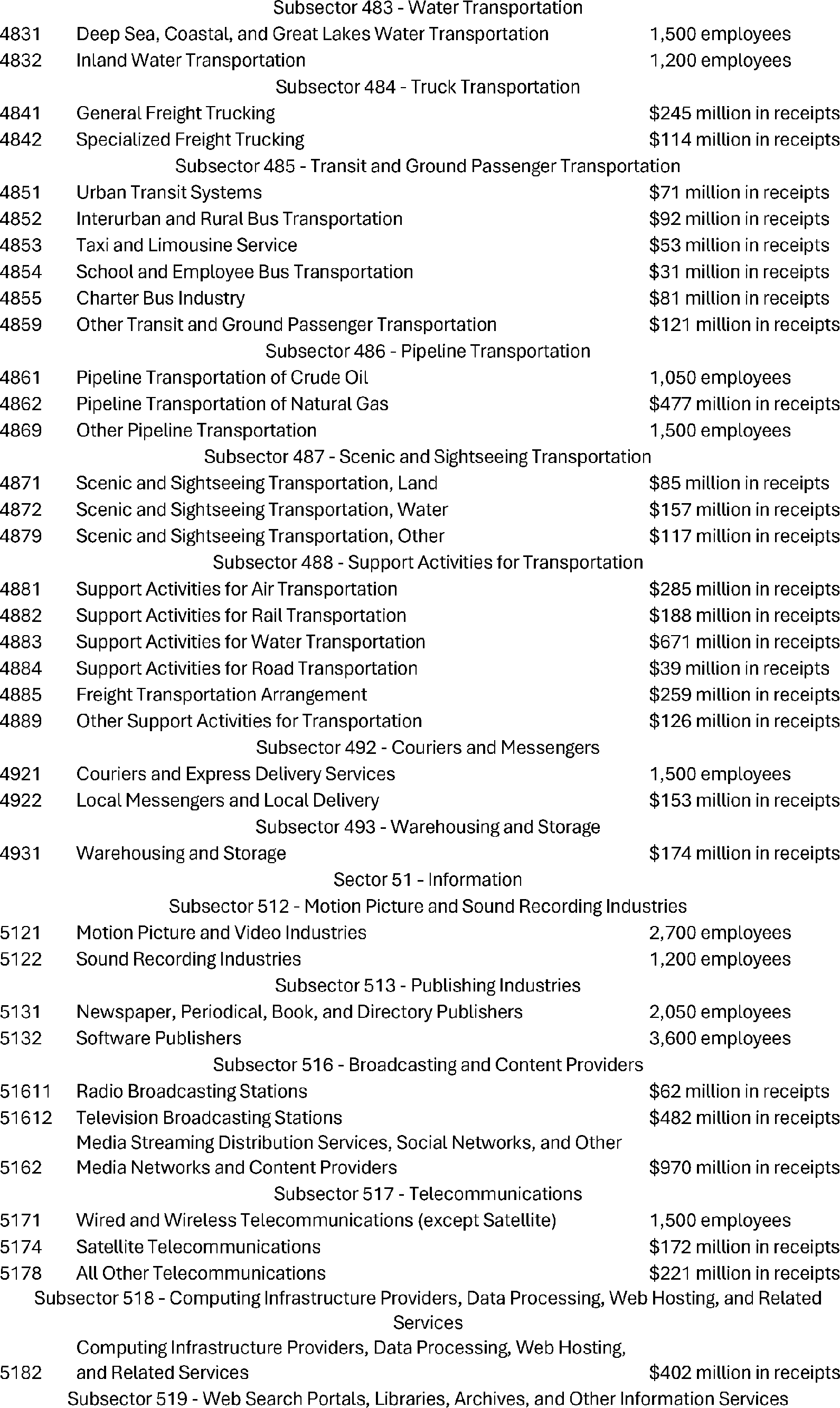
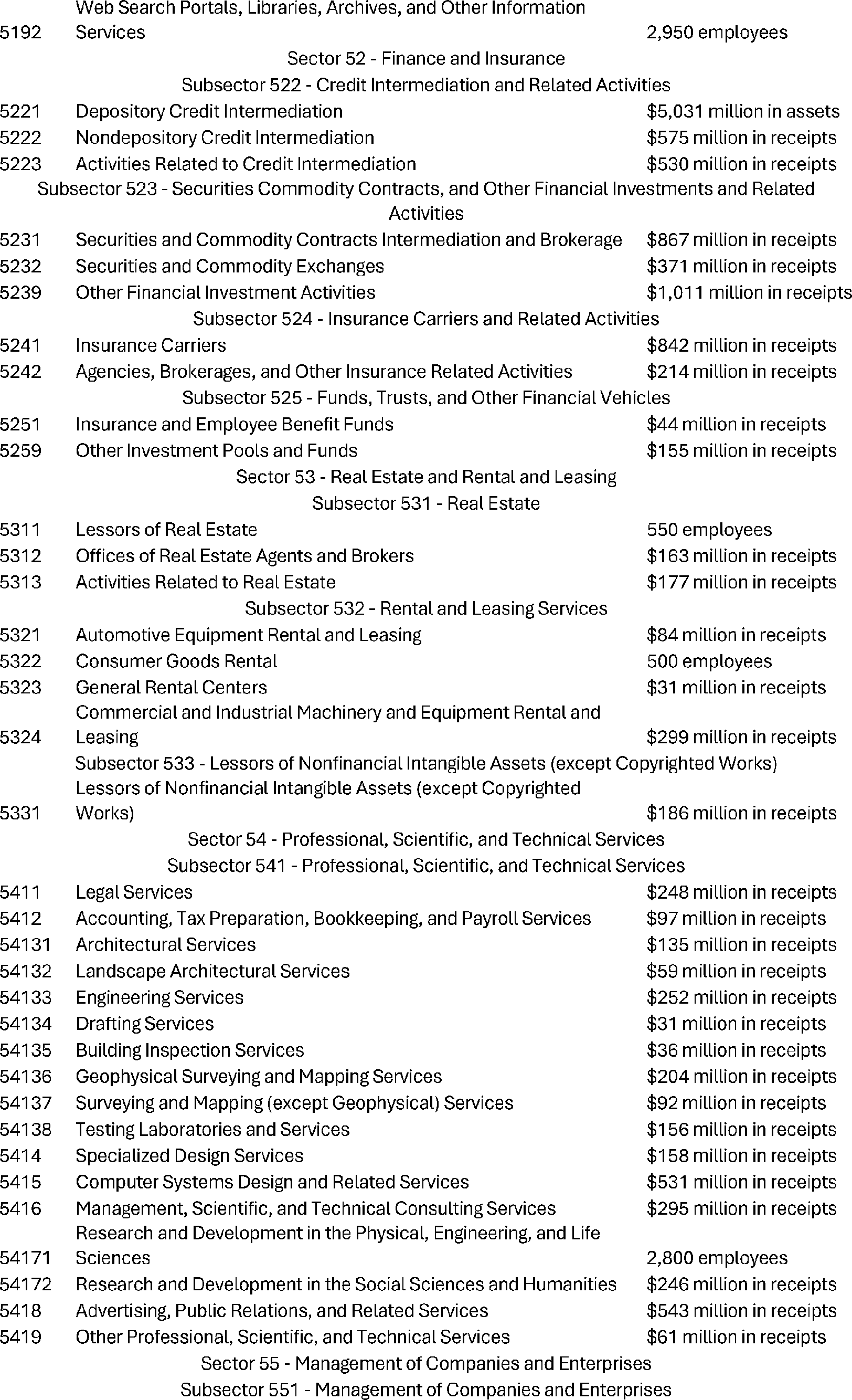
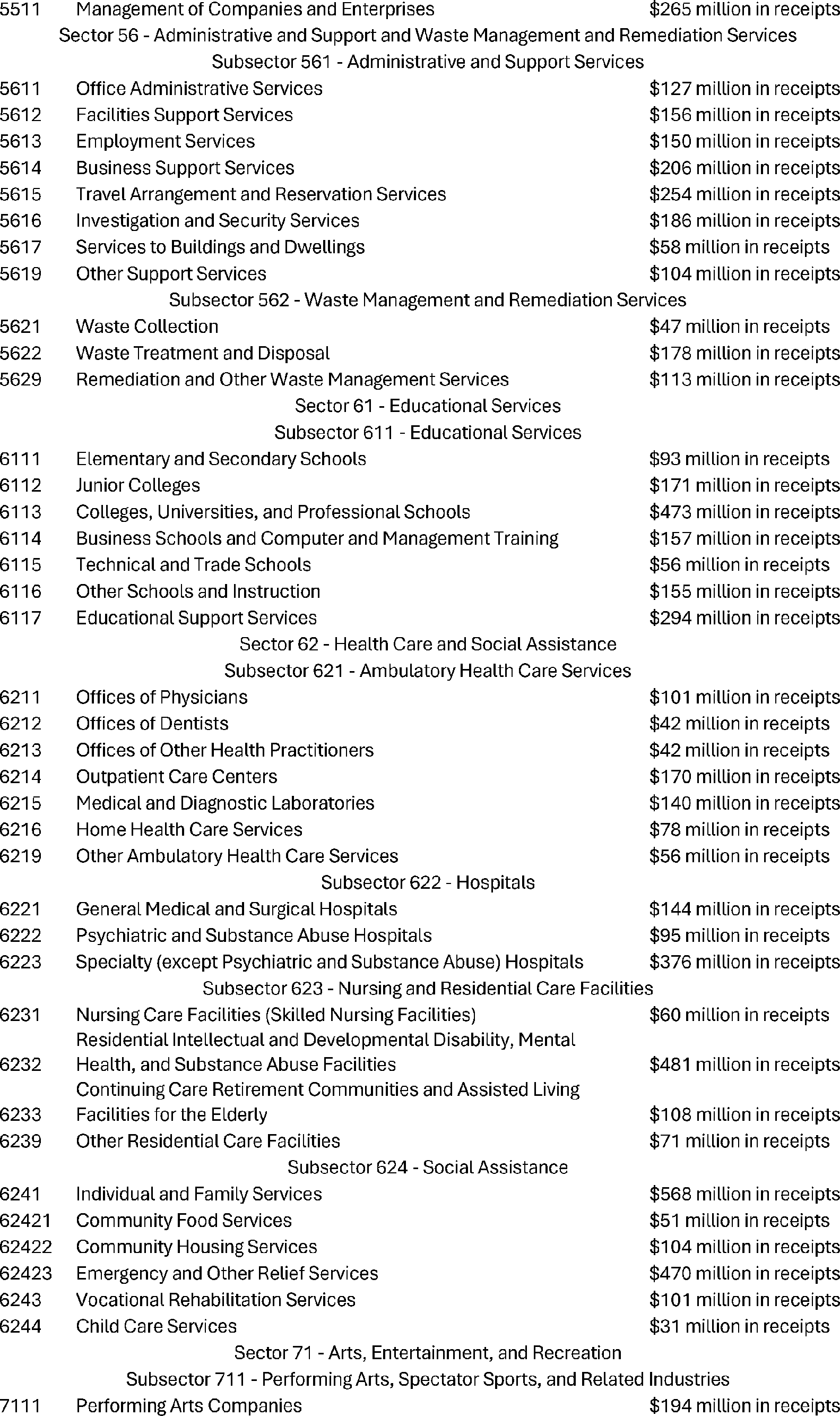
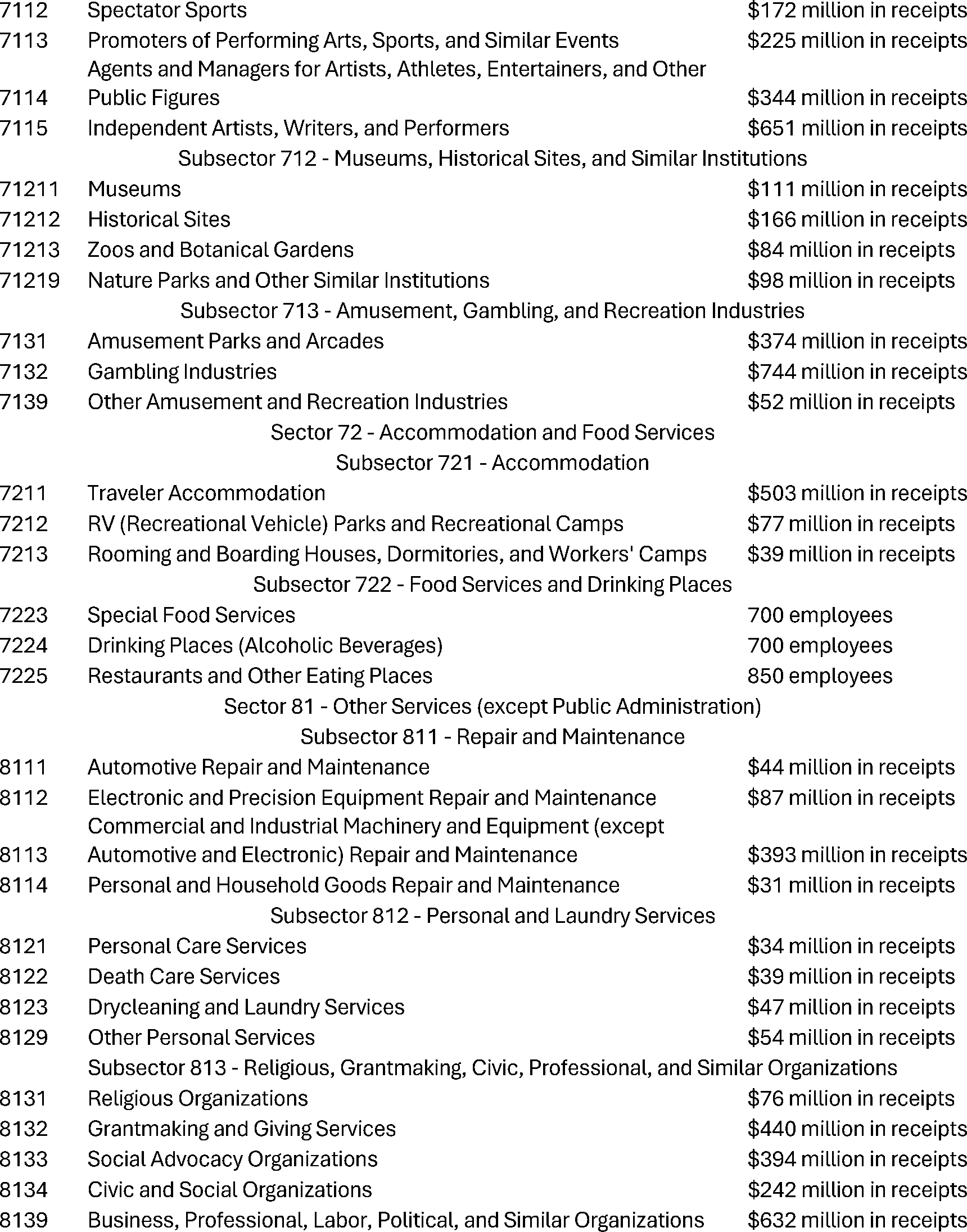
The following table describes the current size standards and presents the proposed size standard for each 6-digit NAICS code to facilitate easy comparisons for businesses. The table also provides estimates of the small business count under the current standard and the new standard as well as the difference between them. Empty cells indicate that no estimate is available for the current standard, the proposed standard, or both.[5]
To facilitate comparison between the current and proposed standard, if either count is missing, both are excluded from the totals and from the difference calculations.
( printed page 53745)
( printed page 53746)
( printed page 53747)
( printed page 53748)
( printed page 53749)
( printed page 53750)
( printed page 53751)
( printed page 53752)
( printed page 53753)
( printed page 53754)
( printed page 53755)
( printed page 53756)
( printed page 53757)
( printed page 53758)
( printed page 53759)
( printed page 53760)
( printed page 53761)
( printed page 53762)
( printed page 53763)
( printed page 53764)
( printed page 53765)
( printed page 53766)
( printed page 53767)
( printed page 53768)
( printed page 53769)
C. Compliance With Executive Orders 12866, 12988, 13132, 13563 and 14192, the Regulatory Flexibility Act (5 U.S.C. 601-612), and the Paperwork Reduction Act (44 U.S.C. Ch. 35)
Executive Orders (E.O.s) 12866 and 13563 direct agencies to assess costs and benefits of available regulatory alternatives and, if regulation is necessary, to select regulatory approaches that maximize net benefits (including potential economic, environmental, public health and safety effects, distributive impacts, and equity). E.O. 13563 emphasizes the importance of quantifying both costs and benefits, of reducing costs, of harmonizing rules, and of promoting flexibility. OMB has determined that this rule is not a significant regulatory action. The rule will not impact the total number of federal contracts and is expected to have a minimal impact on SBA's lending programs, including 7(a) and 504 loans, which are subject to statutory caps. As a result, any impact on the economy is expected to be de minimis. In the next section, SBA provides a Cost-Benefit Analysis of this proposed rule, including: (1) a statement of the need for the proposed action, (2) an evaluation of the benefits and costs—both quantitative and qualitative—of the proposed action; and (3) an examination of alternative approaches. SBA invites comments on Cost-Benefit Analysis.
Cost-Benefit Analysis
1. Need for This Regulatory Action
Under the Small Business Act (15 U.S.C. 632(a)), SBA's Administrator is responsible for establishing small business size definitions (or “size standards”) and ensuring that such definitions vary from industry to industry to reflect differences among industries. The Jobs Act requires SBA to review every five years all size standards and make necessary adjustments to reflect current market conditions. This proposed rule is part of the third five-year review of size standards in accordance with the Jobs Act. The first five-year review of size standards was completed in early 2016 and the second five-year review in early 2023.
2. Baseline and Proposed Changes
In Circular A-4 (September 17, 2003), OMB directs agencies to establish an appropriate baseline to evaluate any benefits, costs, or transfer impacts of regulatory actions and alternative approaches considered. The baseline should represent the agency's best assessment of what the world would look like absent the regulatory action.
For purposes of this regulatory action, the baseline is maintaining the “status quo,”
i.e.,
making no changes to the current size standards. Currently, there are 102 different size standards levels, covering 978 NAICS industries and 18 subindustries (commonly known as “exceptions” in SBA's table of size standards). Of these size levels, 73 are based on average annual receipts covering 496 industries and 13 subindustries (“exceptions”), 27 are based on average number of employees covering 477 industries and five subindustries (“exceptions”), one is based on refining capacity and number of employees covering one industry, and one is based on average assets covering four industries.
The proposed rule applies the Revised Methodology and moves from 6-digit NAICS industries to a combination of 4-digit NAICS industry groups and 5-digit NAICS industries and includes 338 size standards across all areas of the economy in which small businesses may compete (NAICS 4911, 5211, 8141, and all of sector 92 are excluded). The proposed rule also converts many receipt-based industries to employee-based industries, updates the factors used to calculate size standards, updates the process for translating those factors into size standards, and adds an adjustment for productivity growth to receipt based standards. Further details on the proposed changes are provided in the Proposed Size Standards Methodology section. The following table provides a short comparison of the proposed changes to the baseline.
Baseline
Proposed changes
Separate rules establishing receipt-based & employee-based size standards
One rule establishing all size standards.
978 size standards at the 6-digit NAICS level
276 size standards at the 4-digit NAICS level and 62 at the 5-digit NAICS level.
496 size standards based on annual revenue
129 size standards based on annual revenue (as required by statute).
478 size standards based on employee level
208 size standards based on employee level.
18 subindustries (exceptions)
No exceptions.
Maximum for revenue-based: $47 million; Maximum for employee-based: 1,500
No maximum.
Total number of small business firms: 6,344,967
Total number of small business firms: 6,459,508.
3. Benefits of Proposed Size Standards
The proposed simplified size standard benefits small businesses, banks including loans officers, federal government agencies including procurement officers, and the public in general.
Impact on Small Businesses
The proposed simplified size standard is easier to navigate and reduces time taken for review and determination of
( printed page 53770)
small business standards for small businesses. In addition, the proposed rule changes which businesses are classified as small. The changes to the size standards would result in a net increase of about 114,541 businesses classified as small. Classification as small confers economic advantages in three primary domains: preferential access to federal government contracts through set-aside programs, access to subsidized and guaranteed financing, and protection from regulatory burdens through the Regulatory Flexibility Act (RFA).
Simplified size standard:
In the current version of SBA size standards, there are nearly 1,000 unique size standards, with numerous alternative size standards for different special cases. For example, there is currently a different size standard for Ship Building (1,300 employees) than there is for Boat Building (1,000 employees). While Ships are larger than boats and are more likely to be used for commercial purposes, there is gray area where a firm could be uncertain which standard applied to them. By moving up to the 4-digit level this uncertainty is resolved as both NAICS 6-digit industries are combined into a single 4-digit one for purposes of size standards.
Increases potential for participating in government contracting programs:
The federal government is the world's largest buyer of goods and services, spending over $883 billion in federal contracts in Fiscal Year 2025 according to www.usapending,gov. Statute requires the federal government to set a goal for small business participation in the total value of prime contracts at no less than 23 percent. In FY 2024, the federal government exceeded this goal, awarding a record $179 billion in prime contract dollars to small businesses.[6]
To help meet these goals, contracting officers at these agencies can use restricted competition to all small businesses, Service-Disabled Veteran-Owned Small Businesses (SDVOSB), Women-Owned Small Businesses (WOSB), Historically Underutilized Business Zones (HUBZone), or 8(a) Business Development (BD) firms. Sole-source authorities exist in SDVOSB, WOSB, HUBZone, and 8(a) BD programs, although their usage differs by each program. In addition, the government can sole-source outside of these programs, including to small businesses, when the requirements are met to warrant a sole-source.
Both SBA's regulations and the Revolutionary Federal Acquisition Regulation (FAR) Overhaul (RFO) require consideration for small business preferences, set-asides, and SBA certification programs, including the 8(a) BD Program, the HUBZone Program, WOSB Program, the Economically Disadvantaged Women-Owned Small Businesses (EDWOSB) Program, and the SDVOSB Program.).[7]
Because of the preferences small businesses receive in federal contracting, newly classified small businesses may seek opportunities to participate in federal contracting where they may not have done so before.
Increases potential for participation in SBA business loan programs:
Small business determination also allows firms to participate in the SBA business loan programs including disaster loans.
For FY 2026 (current as of 7/6/26), for instance, $23 billion was approved for 43,089 loans in the 7(a) program and $5.5 billion to 4,710 firms for the 504 program.[8]
For the entire FY 2025, $37 billion was approved in 7(a) loans and $7 billion in 504 loans.[9]
Newly qualified businesses as well as businesses that retain eligibility will be able to participate in these and other SBA loan programs including the newly introduced 7(a) Working Capital Pilot Program that has delivered more than $150 million in new lending since its inception.[10]
Newly qualified small businesses will also benefit from Economic Injury Disaster Loans (EIDLs). Small businesses, small agricultural cooperatives, and most private nonprofit organizations located in a declared disaster area, and which have suffered substantial economic injury, are eligible. In FY 2022, the last year for which data is available, $131 million in EIDL loans were approved.[11]
Since the benefit provided through these loans programs is contingent on small businesses applying for loans following future disasters, SBA cannot make a meaningful estimate of the impact of the proposed rule.
Greater flexibility and lower compliance requirements for small businesses:
Besides contracting and financial assistance discussed above, small businesses also benefit through reduced fees and fewer compliance requirements that are available to small businesses through the Federal government. The Regulatory Flexibility Act requires agencies to give special consideration to small businesses in the regulatory process. Regulating agencies often take measures to decrease the burden of regulations on small businesses, including delaying compliance deadlines or even exempting small businesses altogether, and a small business determination under the size standard rule causes agencies to consider applying these exemptions or flexibilities.
For instance, in May 2026, the Consumer Financial Protection Bureau (CFPB) published the Small Business Lending Under the Equal Credit Opportunity Act (Regulation B) Rule governing collection and reporting of data regarding applications for credit by small businesses. This final rule amended coverage of certain credit transactions and financial institutions, the small business definition, and the compliance date. According to an Office of Advocacy Comment Letter,[12]
the change from the 2023 Rule reduces compliance costs estimated at $58,400-$95,200 annually for approximately 1,500 smaller financial institutions, while still capturing more than 90% of small business lending by volume.
In some cases, small businesses would have maintained access to the benefits described above through limiting their own growth. The new methods for determining size standards will allow small businesses to grow further before exceeding the size standards, enabling them to continue to benefit from the small business programs without sacrificing growth.
Impact on Federal Government (Including Contracting Officers)
Increases Competition:
With more businesses qualifying as small under the proposed increases to size standards, Federal agencies will have a larger pool of small businesses from which to draw for their small business procurement programs. The current, slow to adjust size-standards often leave small businesses with a decision to forego new growth opportunities in order to remain within the limited size threshold.[13]
To encourage economic growth and address similar concerns raised by small businesses, the SBA proposes to modernize the size-standards to foster an environment
( printed page 53771)
where small firms are encouraged to propose innovative solutions rather than forgo those growth opportunities in order to remain small in the currently restrictive, slow to move standards. By bringing such flexibility to small contractors, and the resulting increase in small firms, the federal government will have more capable firms to consider, and more competitive offers, when purchasing goods and services.
A Naval Postgraduate School Acquisition Research Program study summarizes this issue, stating “One of the other key policy objectives of the Small Business Act is to promote small business in order to foster economic growth. Yet as suppliers grow towards their NAICS thresholds, they encounter a “benefit cliff” that disincentivizes growth, counter to this goal.” [14]
Additionally, the study suggests that restricted competition contributes to weak competitive procurements, limiting the range of cost, quality, and delivery options. These constraints result in fewer choices to balance purchasing goals, such as cost and best-value to the government.
Small businesses voiced their concerns about the prior, restrictive size standards in a hearing held by Chairman Roger Williams (R-TX) in the House Committee on Small Business in the 118th Congress titled “Under the Microscope: Reviewing the SBA's Small Business Size Standards.” [15]
The hearing examined the previous size standards methodology, and as Chairman Williams' press release stated, “Today's hearing shed a light on how small businesses often get boxed out of the federal procurement marketplace. The federal government is the largest customer in our nation, so ensuring accurate size standards is incredibly important so more small firms can compete for contracts. Antiquated standards leave small businesses behind . . .” [16]
Additionally, as Ranking Member Velazquez (D-NY) stated, “Right-sizing the size standards is critical to ensure fairness, promote competition and encourage small businesses to enter and remain in the industrial base.”
Agency Goaling.
The proposed size standard increases the total number of eligible small businesses from 6,344,967 firms to 6,459,508 firms, an increase of close to 2%. As discussed above, the federal government has an annual small business federal contracting goal. Businesses with a new determination of `small business' status currently competing for government contracts will now be able to contribute towards these goals. Having small business status will enable these businesses to compete for contracts restricted to small businesses, while agencies will be able to count the contracts awarded to newly-small businesses toward their small business goals (regardless of whether such procurements were restricted to small businesses).
SBA estimates that nearly 37,002 unique firms with FY 2025 contracts will be newly eligible small businesses. Together these firms accounted for roughly 105,655 contracts in FY 2025 for a total of more than $71 billion.
The following table provides the top 20 industry groups by 6-digit NAICS with existing contracts in FY 2025 which will count toward small business goals under the proposed size standards owing to the small business determination of the contracting businesses under the proposed size standards. For instance, in Engineering Services (541330) 5,314 firms with current contracts will now be eligible to compete for small business restricted set asides and contracts awarded to these firms will count toward the small business contracting goals for agencies. In Other Computer Related Services (541519) and Custom Computer Programming Services (541511), 2,247 firms and 2,171 firms respectively will be eligible for small business goals.
NAICS
Description
Small
businesses
under
proposed
standards
541330
Engineering Services
5,314
541519
Other Computer Related Services
2,247
541511
Custom Computer Programming Services
2,171
541611
Administrative Management and General Management Consulting Services
1,818
541512
Computer Systems Design Services
1,663
541990
All Other Professional, Scientific, and Technical Services
1,427
811310
Commercial and Industrial Machinery and Equipment (except Automotive and Electronic) Repair and Maintenance
1,358
721110
Hotels (except Casino Hotels) and Motels
1,263
811210
Electronic and Precision Equipment Repair and Maintenance
1,214
623110
Nursing Care Facilities (Skilled Nursing Facilities)
1,178
115310
Support Activities for Forestry
1,111
518210
Computing Infrastructure Providers, Data Processing, Web Hosting, and Related Services
1,105
541930
Translation and Interpretation Services
1,083
611430
Professional and Management Development Training
959
541199
All Other Legal Services
870
541690
Other Scientific and Technical Consulting Services
719
561720
Research and Development in the Social Sciences and Humanities
672
541620
Environmental Consulting Services
596
541310
Architectural Services
530
611310
Colleges, Universities, and Professional Schools
507
GAO found that more competition leads to better performance and price.[17]
This indicates potential cost savings for agencies as non-sole source competitive contracts increase and agencies continue to prioritize small businesses
( printed page 53772)
in the federal procurement space, as an increased pool of small businesses will likely have a favorable effect on the use of procuring with small business by agencies. Having an increased pool of small businesses competing for contracts restricted to small business could also decrease prices by providing agencies with access to contractors with lower costs, improved offerings and that decrease in price would be a benefit to agencies and provide the best value to the taxpayers who ultimately fund every contract.
Simplifies administration:
This rule will decrease the administrative burden on procurement and contracting officers. The rule simplifies the system used to classify small businesses. The rule also combines the receipt-based and employee-based size standards previously published by SBA in two separate rules into a single rule, reducing the burden of understanding the size standards. Savings from publishing the new size standards in a single simplified rule could be meaningful. The current rules account for more than 150 pages in the
Federal Register
. Assuming 1,000 words per page (a
Federal Register
page is roughly two dense newspaper columns with small serif font and narrow margins, so it carries more text than a standard 8.5x11 manuscript page, estimated 900-1200 words per page), that is 150,000 words. The proposed rule is expected to reduce this by more than half as it combines the two rules (receipt-based and employee-based) into one and simplifies the system from 6-digit NAICS to a combination of 4-digit and 5-digit NAICS. Suppose this translates to 70 pages or 70,000 words: At 200 words per minute, that is 5 hours 50 minutes of reading time saved. To acknowledge both the capital and labor requirements, SBA applies an average dollar cost to an hour of $37.64, hourly average wage for nonfarm employees in June of 2026,[18]
resulting in $219.57 in savings per reading. The federal government employes about 37,600 contracting officers,[19]
so the value of the reduction in reading time could be substantial.
Impact on Banks and Loan Officers
As discussed in previous sections, the proposed size standard is shorter and easier to apply and will benefit not only small businesses and federal government but also banks and loan officers. For instance, since 2020, 1,877 FDIC monitored banks, 314 NCUA monitored Credit Unions as well as numerous smaller financial institutions and community banks provided SBA guaranteed 7(a) loans. Responsible loan officers at these institutions will save time in the review and approval of 7(a) loans. This is because the proposed size standard introduces a simplified process for assessing firm size eligibility.
4. Costs of Proposed Size Standards
Impact on Small Businesses
All businesses interested in doing business with Federal government must register in SAM and update their SAM profiles annually, regardless of their size status. Businesses that are newly classified as small may choose to incur these costs in pursuit of federal contracts. Besides having to register in SAM to be able to participate in Federal contracting and update the SAM profile annually, small businesses incur no direct costs to gain or retain their small business status because of increases to size standards.
There is, however, a potential impact on small businesses' ability to access SBA loans and government contracts. In addition, there is the possibility of increased administrative costs for the government. The costs caused by a loss in small business status invert the benefits discussed in the benefits section, including losses in economic efficiency caused by decreases in competition for federal contracts. However, the number of businesses gaining small business status using the proposed methodology is much larger than the number of businesses that could potentially lose small business status. SBA estimates that fewer than 200 businesses would lose small status under the proposed methodology, while about 114,236 would gain small status. Furthermore, SBA is proposing to not reduce any size standards which are keeping the same size standard measure. As such SBA estimates fewer than 5 small businesses in Direct Property and Casualty Insurance Carriers (NAICS 524126) will lose small business status due to the switch from employment to receipt-based size standards. Further discussion about impacts on small businesses can be found in the Regulatory Flexibility Act (RFA) section.
Federal contracting officers are required to ensure that all contracts entered into by the Federal government are provided at a fair market price. Increasing the number of eligible small businesses to compete for Federal contracts increases the likelihood that the government procures services and products from small businesses at a fair market value. The increased competition may, however, result in reduced profits as more small businesses are competing for federal contracts. These issues are discussed in more detail in the RFA.
In the single industry that may see a decrease in the number of small business due to changing, some businesses may no longer be eligible for SBA loan guarantees (7(a), 504) or EIDL loans. While it is not possible to accurately predict the behavior of businesses, a review of the data between 2020-2026 reveals that in NAICS 524126 (Direct Property and Casualty Insurance Carriers), all businesses with approved 7(a) loans are substantially below the size standard and will remain eligible for SBA loans under the proposed size standards.
Among those newly defined small businesses seeking SBA loans, there could be some additional costs associated with verification of their small business status. However, many of SBA's loan programs are subject to a statutory cap and thus increased new businesses would be unlikely to increase administrative costs, and information pertaining to revenue and employment is generally required in the loan application process notwithstanding size standard. Therefore, SBA believes that any added administrative costs will be small.
Impact on Government
There is a potential for increased administrative costs for the government in implementing the proposed size standards. To the extent that the newly qualified small businesses could become active in Federal procurement, the proposed increases to size standards, if adopted, may entail some additional administrative costs to the government because of more businesses qualifying as small for Federal small business programs. For example, there may be more firms seeking SBA loans, more firms potentially eligible for certification such as SDVOS, WOSB, EDWOSB, 8(a), HUBZone, or SBA Mentor-Protégé Program. A preliminary analysis of the FPDS database, however, reveals that most of the small businesses participating in the certification and loan programs are significantly below the size standard threshold. While it is not possible for SBA to accurately predict which newly classified firms would be eligible for certification or predict the behavior of newly eligible small businesses, the evidence from existing program participation data thus suggests that the newly eligible small businesses close to the size standard
( printed page 53773)
threshold in revenue or employment scale are not likely to apply for certification or loan guarantees in large numbers. Hence, SBA expects any rise in administrative costs to be small.
The SBA's historical data on size protests reveals that the number of size protests decreased following the increases size standards which resulted in more eligible small businesses. This was part of the first and second five-year reviews of size standards under the Jobs Act. Specifically, on an annual basis, the number of size protests fell from about 500-600 during 2011-2016 to an average of about 300 during 2020-2024.[20]
5. Transfer Impact of Size Standards
The proposed increases to size standards, if adopted, may result in some redistribution of Federal contracts between the newly qualified small businesses and other-than-small businesses and between the newly qualified small businesses and small businesses under the current standards. As discussed in the benefit and cost sections, some of the resulting changes in prices and profits would be the result of gains in economic efficiency. However, some other changes would be transfers between the federal government and small businesses and among small businesses.
With a close to 2% increase in number of firms qualifying as small businesses, there is likely to be an increase in competition for small business government contracts which may impact firms qualifying under the current size standards by reducing their likelihood of winning government contracts if they are not the best solution for the government. Increased competition is likely to have the greatest impact on businesses most similar in size to the businesses that would be newly classified as small, since these are more likely to be competing for the same contracts. In other words, the smallest businesses in particular industries are likely not to be competitive for the same contracts as the businesses closest to the current size standards, while small businesses closest to the current size standards would likely be competitive for the same contracts as the businesses newly classified as small under the proposed rule. Growing small businesses closer to the size standard are therefore likely to face the greatest competition from the newly eligible firms under the proposed rule. Having more eligible businesses compete for set asides may reduce some small businesses' chances of securing a government contract, but the number of small businesses being awarded federal contracts will not be reduced.
Research suggests that firms that remain active in federal contracting rely less on small business set asides over time. Girth and Brown (2018) tracked 977 federal suppliers and their contracts between 2005-2014 to study the potential impact of small business policies on supplier competitiveness, program participation, and growth.[21]
They demonstrated that firms that remained in the federal market for the decade under review had nearly twice as much contract activity in 2014 than 2005 with increasingly lower dependency on set asides. Growing firms successfully competed with large businesses in an open market, relying less and less on set asides. Therefore, while growing businesses that are approaching the size standards may face higher competition and lower profit margins from government contracts, they will likely benefit from higher standards by being able to accept more non set aside contracts and private market contracts without risk of losing their small business status because of growth in revenue or employment. For further discussion, please refer to the RFA section of this rule.
6. Alternatives to the Proposed Rule
OMB's Circular A-4 directs SBA to consider regulatory alternatives to the proposed changes in the proposed rule. Many such alternatives are discussed in the Revised Methodology document. At a high level, however, SBA considered two main alternatives to the proposed rule:
Alternative One would propose retaining all size standards for all industries. The current size standards were developed in 2022 during COVID and have not been adjusted for inflation since. This makes the standard unreasonably low for many of the industries, including the construction industry, which has remained largely static aside from occasional inflationary adjustments.[22]
The proposed standard not only addresses this issue by adjusting for inflation but also for the first time adjusts for productivity growth, developing a size standard that does not unfairly punish small businesses for growing productivity and efficiency.
Alternative Two would update current size standards at the 6-digit NAICS level. This would use the current, notably flawed methodology white paper published in 2024.[23]
This option was rejected because the new proposed size standards more closely track the statutorily required concept of non-dominance, adjusts for both inflation and productivity, and provides an easier to use size standard at the 4- or 5-digit NAICS level where appropriate. The SBA periodically updates its size standards to account for inflation. Including productivity growth helps ensure small businesses with receipts based size standards are able to maintain a more skilled workforce and incorporate new technology into their operations without decreasing head count. The proposed methodology also substantially increases the number of small businesses as compared to the existing methodology. As discussed before, while the existing methodology would cause less disruption for small businesses currently participating in the federal market in terms of their ability to secure contracts and earn profits from these contracts, it would also limit their ability to grow and continue to participate in the federal market because of the continuing low size standards. The proposed standards would create an estimated 114,541 newly eligible small businesses, including 37,002 businesses currently participating in the federal marketplace,[24]
which would become eligible for government contracts, SBA loans, and more simplified compliance mechanisms.[25]
This proposed rule is anticipated to be an Executive Order 14192 deregulatory action when finalized. This rulemaking will decrease regulatory burden by simplifying SBA size standards. Cost savings created by this rulemaking are expected to outweigh any new costs that may arise because of this rule. See the above Cost-Benefit Analysis for a full discussion of the costs of benefits of the rule.
Regulatory Flexibility Act
According to the Regulatory Flexibility Act (RFA), 5 U.S.C. 601-612,
( printed page 53774)
when an agency issues a rulemaking, it must prepare a regulatory flexibility analysis to address the impact of the rule on small entities. This proposed rule, if adopted, may have a significant impact on a substantial number of small businesses covered by this proposed rule. As described above, this rule may affect small businesses seeking Federal contracts, loans under SBA's 7(a), CDC/504, micro EIDL Loan Programs, and assistance under other Federal small business programs.
Initial Regulatory Flexibility Analysis
1. What is the need for and objective of the rule?
The Small Business Jobs Act of 2010 requires SBA to review every five years all size standards and make necessary adjustments to reflect market conditions. SBA completed the first five-year review of size standards in 2016 and the second five-year review in 2023. This rule serves as the third five-year review of size standards under the Jobs Act. Additional needs and objectives for the proposed rule are discussed in the Revised Methodology.
2. What is SBA's description and estimate of the number of small businesses to which the rule will apply?
The proposed rule applies to all small businesses and impacts access to government contracts, SBA loans, federal programs providing funding for small businesses, and regulatory flexibilities available to small businesses. The proposed rule increases the total number of eligible small businesses from 6,344,967 firms to 6,459,508 firms, an increase in 1.8%. Of the 338 size standards produced by the methodology, only 24 industry groups or industries result in a reduction in number of eligible firms with the total decrease expected to be less than 200. Additionally, SBA has chosen to deviate from the proposed methodology to keep all size standards which continue to use the same measure from decreasing. Because of this deviation only one industry, Direct Property and Casualty Insurance Carriers (NAICS 524126), is expected to see a decrease of fewer than five small businesses, as its size standard changes from 1,500 employees to $842 million in receipts. The expected net increase is 114,541 firms.
3. What is the projected reporting, record keeping and other compliance requirements of the rule?
The proposed size standard changes impose no additional reporting or record keeping requirements on small businesses. However, qualifying for Federal procurement and a number of other programs requires that businesses register in SAM and self-certify that they are small at least once annually. Therefore, businesses opting to participate in those programs must comply with SAM requirements. There are no costs associated with SAM registration or certification.
Impact on SBA Loans
Most industries will see an increase in the size standard and a corresponding increase in the number of firms eligible to apply to SBA programs. As noted, the methodology results in a reduced size standard for 45 industry groups or industries and a transition in size measure in one industry which effectively lowers the size standard, though only 24 would have seen a reduction in the number of small businesses, however SBA is proposing to adopt a policy of not reducing size standards for all industries maintaining the same size standard measure. As such fewer than 5 small businesses in NAICS 524126 (Direct Property and Casualty Insurance Carriers) are expected to lose small business status. A determination about 7(a) loan eligibility could not be made about this industry owing to lack of available revenue data for loan recipients. However, SBA finds it unlikely that any firm seeking SBA loans would lose access because most firms that take SBA loans are much smaller than the size standard threshold, as discussed earlier.
Impact on Government Contracts
The ability to compete for government contracts is one of the most significant benefits of being a small business. Using publicly available data from FPDS and SAM, SBA conducted a review of all small businesses with at least one contract in FY 2025. As in the case of loans, most certified businesses have revenue and employment well below the size standard. For the industry where the number of small businesses is lower under the proposed size standard than under the current size standard, SBA was unable to identified any firms with FY 2025 contracts [26]
that would likely no longer be small businesses under the proposed size standard.
Both existing and newly eligible small businesses currently active in SAM will be able to compete in federal contracts restricted to small business. More small firms would be size-eligible for SBA contracting programs, however, each program has additional and unique eligibility requirements, such as service-disabled veteran status, economic disadvantage requirements, or firm location dependent criteria. Another advantage is that small firms that outgrew the prior standards would regain access to small business contracting. In fact, under the proposed rule, about 114,541 new firms will become eligible to compete in the federal market. 37,002 firms with more than 105,655 contracts in FY 2025 (accounting for roughly $71 billion dollars in government contracts) will become small businesses under the proposed size standards.
Federal contracting officers are required to ensure that all contracts entered into by the Federal government are provided at a fair market price. Increasing the number of eligible small businesses to compete for Federal contracts increases the likelihood that the government procures services and products from small businesses at a fair market value. The increased competition may, however, result in reduced profits as more small businesses are competing for federal contracts.
Increased competition is likely to have the greatest impact on businesses that most resemble the newly classified small firms. This is because these similar businesses are more likely to compete for the same contracts. Growing small businesses closer to the size standard are therefore likely to face the greatest competition from the newly eligible firms under the proposed rule. While having more eligible businesses compete for set asides may reduce their chances of securing a government contract, the number of small businesses being awarded federal contracts will not be reduced.
However, firms that remain active in the federal marketplace rely less on small business set asides over time. Girth and Brown (2018) tracked 977 federal suppliers and their contracts between 2005-2014 to study the potential impact of small business policies on supplier competitiveness, program participation, and growth. They demonstrated that in the nearly 10 years documented in their study, though many firms exited the federal market, the firms that remained had nearly twice as much contract activity in 2014 than 2005. In 2005, all firms selected for the study had set aside contracts. Of the 424 suppliers with prime contract actions in 2014, 108 had no small business set aside actions. Growing firms successfully competed with large businesses in an open market, relying less and less on set asides.
Furthermore, growing businesses that are approaching the size standards will
( printed page 53775)
benefit from the potential to grow while retaining their small business status. Girth and Brown observed a “benefit cliff,” where firms considering the transition from small to mid-sized can face a disincentive to grow because they will enter a federal procurement market dominated by large firms with extensive past performance. The proposed size standard effectively pushes out this benefit cliff, allowing businesses to grow while retaining their small business status and the ability to compete for set asides that comes with it. This could prove to be a significant benefit for small businesses currently facing the risk of being sized out of the federal marketplace.
4. What are the relevant Federal rules, which may duplicate, overlap or conflict with the rule?
Under section 3(a)(2)(C) of the Small Business Act, 15 U.S.C. 632(a)(2)(c), Federal agencies must use SBA's size standards to define a small business, unless specifically authorized by statute to do otherwise. In 1995, SBA published in the
Federal Register
a list of statutory and regulatory size standards that identified the application of SBA's size standards as well as other size standards used by Federal agencies (60FR57988 (November 24, 1995)). SBA is not aware of any Federal rules that would duplicate or conflict with establishing size standards.
However, the Small Business Act and SBA's regulations allow Federal agencies to develop different size standards if they believe that SBA's size standards are not appropriate for their programs, with the approval of SBA's Administrator (13CFR121.903). The Regulatory Flexibility Act authorizes an agency to establish an alternative small business definition, after consultation with the Office of Advocacy of the U.S. Small Business Administration (5 U.S.C. 601(3)).
5. What alternatives will allow the Agency to accomplish its regulatory objectives while minimizing the impact on small entities?
By law, SBA is required to develop numerical size standards for establishing eligibility for Federal small business assistance programs. In this case, the alternatives considered in the E.O. 12866 section, cited below, also apply here, as do the alternatives discussed in the Revised Methodology:
Alternative One would propose retaining all size standards for all industries. The current size standards were developed in 2022 during COVID and have not been adjusted for inflation since. This makes the standard unreasonably low for many of the industries including construction. The proposed standard not only addresses this issue by adjusting for inflation but also for the first time adjusts for productivity growth, developing a size standard that does not unfairly punish small businesses for growing productivity and efficiency.
Alternative Two would update current size standards at the 6-digit NAICS level using existing methodology white paper published in 2024. This option was rejected because the new proposed size standards more closely track the statutorily required concept of non-dominance, adjust for both inflation and productivity, and provide an easier to use size standard at the 4-digit level where appropriate. The Revised Methodology also substantially increases the number of small businesses as compared to the existing methodology. As discussed before, the existing methodology would limit small businesses' ability to grow and continue to participate in the federal market because of the continuing low size standards. The proposed standards would create about 114,541 newly eligible small businesses including 37,002 with existing government contracts in FY 2025 that become eligible for government contracts, SBA loans and increased regulatory flexibility and decided to select the proposed method.
This action meets applicable standards set forth in sections 3(a) and 3(b)(2) of Executive Order 12988, Civil Justice Reform, to minimize litigation, eliminate ambiguity, and reduce burden. The action does not have retroactive or preemptive effect.
For purposes of Executive Order 13132, SBA has determined that this proposed rule will not have substantial, direct effects on the States, on the relationship between the national government and the States, or on the distribution of power and responsibilities among the various levels of government. Therefore, SBA has determined that this proposed rule has no federalism implications warranting preparation of a federalism assessment.
Paperwork Reduction Act
For the purpose of the Paperwork Reduction Act, 44 U.S.C. Ch. 35, SBA has determined that this proposed rule will not impose any new reporting or record keeping requirements.
3.
See Small Business Size Standards: Agriculture, Forestry, Fishing and Hunting, Mining, Quarrying, and Oil and Gas Extraction, Utilities, Construction (87 FR 18607, March 31, 2022), Small Business Size Standards: Transportation and Warehousing, Information, Finance and Insurance, Real Estate and Rental and Leasing (87 FR 18627, March 31, 2022), Small Business Size Standards: Professional, Scientific and Technical Services, Management of Companies and Enterprises, Administrative and Support and Waste Management and Remediation Services (87 FR 18665, March 31, 2022), Small Business Size Standards: Education Services, Health Care and Social Assistance, Arts, Entertainment and Recreation, Accommodation and Food Services, Other Services (87 FR 18646, March 31, 2022), and Small Business Size Standards: Wholesale Trade and Retail Trade (87 FR 35869, June 14, 2022, Small Business Size Standards: Manufacturing and Industries With Employee-Based Size Standards in Other Sectors Except Wholesale Trade and Retail Trade) (88 FR 9970).
5.
For farms (NAICS subsectors 111 and 112), the Census of Agriculture does not report data by firm size so the number of small businesses under the current or proposed standard cannot be estimated. Using the breakdown of farm establishments by receipts size there may be as many as 38,000 new small farm businesses. This number assumes all establishments are separate farms and that all farms will qualify as small businesses. For Credit Card Issuing (NAICS 522210), because the current size standard is in assets the Statistics of U.S. Businesses (SUSB) cannot be used to estimate number of firms. Two recently split off NAICS codes for Compost Manufacturing (NAICS 325315) and Agents for Wireless Telecommunications Services (NAICS 517122) also cannot be calculated, but all small businesses in these industries are included in the counts of Fertilizer (Mixing Only) Manufacturing (NAICS 325314) and Wireless Telecommunications Carriers (except Satellite) (NAICS 517112) respectively. One industry Corporate, Subsidiary, and Regional Managing Offices (NAICS 551114) did not currently have a size standard. Lastly, Insurance and Employee Benefit Funds (NAICS 5251), and Trusts, Estates, and Agency Accounts (NAICS 525920) are not included in SUSB so neither the number of small businesses under the current or proposed standards can be estimated.
18.
Table B-3. Average hourly and weekly earnings of all employees on private nonfarm payrolls by industry sector, seasonally adjusted—2026 M06 Results.
25.
This includes reduced reporting requirements and less stringent oversight under the SBA. This is notably more flexible than being under the jurisdiction of a financial regulator like the Securities and Exchange Commission.
26.
This is based on self-reported data available in
sam.gov.
Much of the revenue and number of employees data is outdated or inaccurate so there is a potential of more firms being impacted.
 www.regulations.gov
 5 U.S.C. 553(b)(4)
 www.sba.gov/size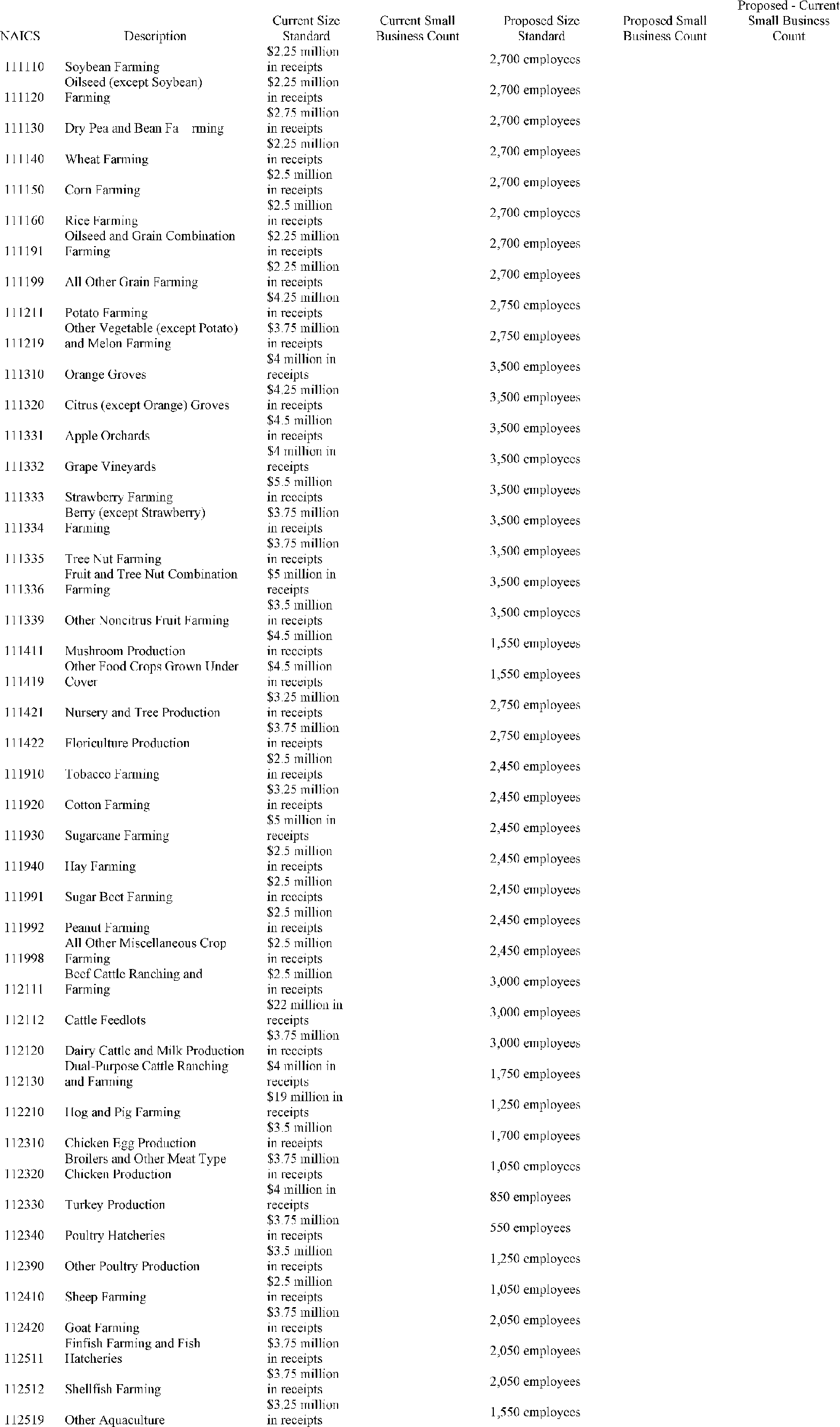
 www.usapending,gov
 13CFR121.903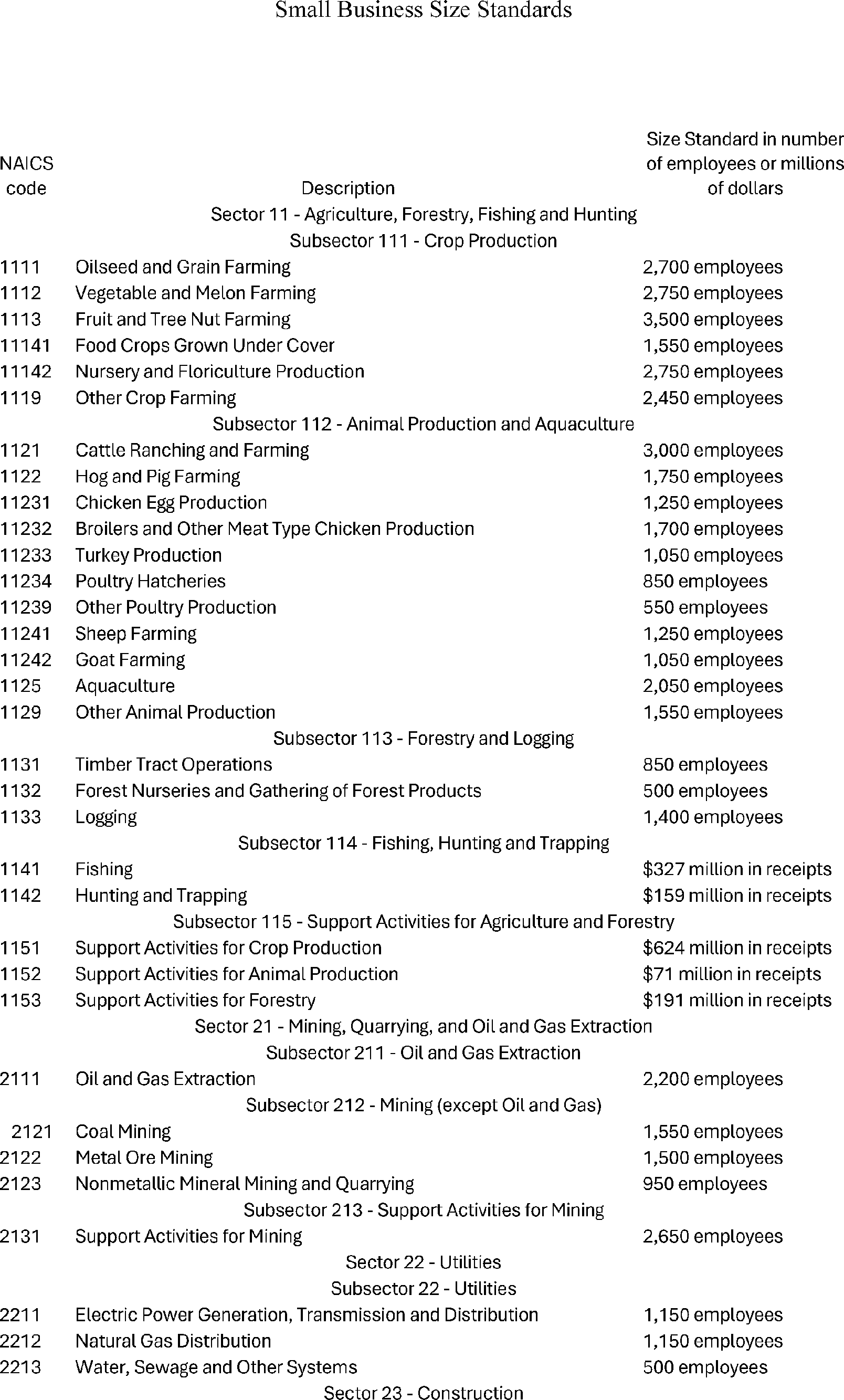
 www.congress.gov/event/118th-congress/house-event/116800
 smallbusiness.house.gov/news/documentsingle.aspx?DocumentID=405872
 www.smithcurrie.com/publications/common-sense-contract-law/key-takeaways-from-the-gaos-bid-protest-report-to-congress-for-fiscal-year-2024/