Federal Acquisition Regulation: Revolutionary Federal Acquisition Regulation Overhaul Parts 9, 27, and 47
OFPP, DoD, GSA, and NASA (collectively referred to as the Federal Acquisition Regulatory Council or FAR Council) are proposing to amend the Federal Acquisition Regulation (FAR) ...
[FAR Case 2026-011, Docket No. FAR-2026-0011, Sequence No. 1]
RIN 9000-AO84
( printed page 59584)
AGENCY:
Office of Federal Procurement Policy (OFPP), Office of Management and Budget (OMB); Department of Defense (DoD); General Services Administration (GSA); and National Aeronautics and Space Administration (NASA).
ACTION:
Proposed rule.
SUMMARY:
OFPP, DoD, GSA, and NASA (collectively referred to as the Federal Acquisition Regulatory Council or FAR Council) are proposing to amend the Federal Acquisition Regulation (FAR) to implement Executive Order (E.O.) 14275, Restoring Common Sense to Federal Procurement. The E.O. directs the elimination of excessive acquisition regulations to stop the inefficient use of American taxpayer dollars. The FAR Council is issuing twelve proposed rules that collectively, if finalized, would streamline the FAR in its entirety. This rule proposes revisions to FAR parts 9, 27, 47, and 52.
DATES:
Interested parties should submit written comments to the Regulatory Secretariat Division at the address shown below on or before October 19, 2026, to be considered in the formation of the final rule.
ADDRESSES:
Submit comments in response to FAR Case 2026-011 to the Federal eRulemaking portal at
www.regulations.gov.
Follow the instructions for sending comments.
Instructions:
Please submit comments only and cite “FAR Case 2026-011” in all correspondence related to this case. Include your name, company name (if any), and “FAR Case 2026-011” on any attached document. Comments received generally will be posted without change to
www.regulations.gov,
including any personal and/or business confidential information provided. Public comments may be submitted as an individual, as an organization, or anonymously (see frequently asked questions at
www.regulations.gov/faq). To confirm receipt of your comment(s), please check
www.regulations.gov,
approximately two to three days after submission to verify posting.
For clarification of content, contact
FARpolicy@gsa.gov
or call 202-969-4075 and cite “FAR Case 2026-011.” For information pertaining to status, publication schedules, or alternate instructions for submitting comments if
www.regulations.gov
cannot be used, contact the Regulatory Secretariat Division at 202-501-4755 or
GSARegSec@gsa.gov.
Please cite “FAR Case 2026-011.”
SUPPLEMENTARY INFORMATION:
I. Background
E.O. 14275, Restoring Common Sense to Federal Procurement (April 15, 2025), resets the foundation for Federal buying by requiring the FAR Council to produce a streamlined FAR that is simpler, clearer, and structured for speed. According to the E.O., the FAR has evolved from its original purpose (
i.e.,
to establish uniform procedures across executive departments and agencies), into an excessive and overcomplicated regulatory framework and bureaucracy. While meant to “deliver, on a timely basis, the best value product or service to the customer, while maintaining the public's trust and fulfilling public policy objectives,” the FAR has become an expensive barrier to achieving those objectives. As a result, the E.O. directed the FAR Council and OMB to create an agile, effective, and efficient regulation that contains only provisions required by statute or essential to sound procurement.
To implement E.O. 14275, OMB issued Memorandum M-25-26, Overhauling the Federal Acquisition Regulation, which announced the “Revolutionary FAR Overhaul” (RFO) and created a roadmap for producing simpler regulations aligned to statute, rewritten in plain language, and including nonstatutory requirements that are necessary to conducting a sound procurement. The memorandum described a new streamlined vision for the FAR, to be maintained alongside nonregulatory governmentwide guidance to provide a common-sense authoritative foundation for nimble response and delivery of mission capability.
This new vision represents a paradigm shift where over-engineered regulations designed for paperwork and compliance are replaced with streamlined regulations focused on core stewardship principles and nonregulatory guidance that will be used in concert with the streamlined FAR focused on proven buying strategies, critical thinking, market awareness (including to expand awareness of goods, products, and materials offered in the United States), and risk literacy to enhance workforce problem-solving. The significant reduction of unnecessary mandates is intended to clarify and reinforce the contracting officer's discretion to determine the best way to apply policies and practices. The newly established, nonregulatory guidance, which has been inspired by acquisition innovation advocates, category managers, other experienced practitioners, and many years of feedback from the contractor community—is expected to facilitate contracting officers' use of their discretion more efficiently and effectively to make smarter buying decisions.
OMB Memorandum M-25-26 also directed the FAR Council to complete the regulatory overhaul in two phases, each with robust public input. The FAR Council conducted its phase one effort in fiscal year 2025 by issuing model class deviations to replace each part in the FAR until such time as formal rulemaking occurred. This proposed rule is one of a series that constitute the FAR Council's phase two effort to obtain public comment through formal rulemaking.
II. Discussion and Analysis
A summary of proposed changes to existing FAR parts 9, 27, and 47, and their corresponding provisions and clauses in part 52 are as follows:
A. General
1. General RFO updates.
This proposed rule generally reorganizes the FAR parts into phases of acquisition and simplifies the text into plain language, where possible. The plain language efforts include changes to active voice, edits to improve readability, and reorganization to present information more logically. None of the plain language edits are intended to change existing FAR requirements. The rewriting of the entire FAR also required edits to harmonize the changes being proposed such as updating the cross-
( printed page 59585)
references. This aligns with Federal plain language guidelines as directed by the Plain Writing Act of 2010 (5 U.S.C. 301 note).
2. Standardization of prescriptions.
This rule proposes revisions to standardize prescriptions for provisions and clauses. These changes are intended to provide better clarity around the applicability of provisions and clauses such as whether they apply to commercial products and services.
3. Use of “must” instead of “shall”.
Additional revisions are being proposed throughout the FAR text and FAR provisions and clauses to replace the use of the term “shall” with “must” or “will,” as appropriate, to impose requirements.
4. Non-statutory requirements.
Section 4 of the E.O. required amendments to the FAR to ensure it contains only provisions that are required by statute or that are otherwise necessary to support simplicity and usability, strengthen the efficacy of the procurement system, or protect economic or national security. The FAR Council reviewed all non-statutory requirements to determine if they are still relevant and essential to sound procurement in today's contracting environment based on the criteria from section 4 of the E.O. The proposed rule retains non-statutory requirements that further one or more of the elements of sound procurements, including those requirements that serve as guardrails to protecting taxpayer interests and promote taxpayer confidence in the procurement system. Non-statutory requirements that were beneficial but not essential were retained in the non-regulatory guidance documents. Other non-statutory requirements that did not meet these standards, were removed. The Council considered the extent to which regulation is the most efficient means for capturing the benefit of the policy. For example, most “how to” requirements were found to be more appropriately suited for non-regulatory coverage which better enables a contracting officer to use discretion in determining the application of a strategy to a given situation and limits the risk of overapplication, which can create wasteful burden on the contracting parties.
As part of the RFO, the FAR Council has created a number of non-regulatory resources, including the FAR Companion, which provides insight from experienced practitioners across the government on using more streamlined practices and processes. The migration of significant coverage to non-regulatory guidance is intended to ensure that the benefits of the policy are not outweighed by the compliance burden of a more rigidly written regulation that is prone to application in an overly broad manner. This approach was explained to the public in a set of “frequently asked questions” that were posted on the Revolutionary FAR Overhaul homepage shortly after the initiative was launched.
B. FAR Part 9
1. Streamlining
This proposed rule would remove or relocate FAR content that is outdated, redundant, or otherwise unnecessary. These revisions align with the broader RFO initiatives and do not substantively change policy or procedures in the part. FAR section 9.000 “Scope of Part,” is proposed to be removed because the language is duplicative. The definition of “Surveying activity” is proposed to be removed from FAR section 9.101, “Definitions,” because the definition is unnecessary. FAR section 9.104-2, “Special Standards,” is proposed to be removed as unnecessary. FAR section 9.106, “Preaward Surveys,” is proposed to be removed; this includes the reference to utilizing the Standard Form 1403, Preaward Survey of Prospective Contractor (General). FAR section 9.107, “Surveys of Nonprofit Agencies Participating in the AbilityOne Program,” is proposed to be removed because the AbilityOne Program is covered in FAR part 8, and nuances of pre-award surveys relevant to the AbilityOne Program are now covered in nonregulatory content. FAR subpart 9.6, “Contractor Team Arrangements,” is proposed to be removed as unnecessary. FAR subpart 9.7, “Defense Production Pools and Research and Development Pools,” is proposed to be removed. Lastly, this rule proposes to revise FAR section 9.103-2(b), “Satisfactory performance record,” for clarity.
2. Section 812(a)(6) of the National Defense Authorization Act for Fiscal Year 2026
This rule would implement section 812(a)(6) of the National Defense Authorization Act for Fiscal Year 2026 (Pub. L. 119-60). Section 812(a)(6) strikes 10 U.S.C. 3243(d)(2), which, where fewer than two actual manufacturers were available to compete in a future procurement involving a qualification requirement, required DoD agencies to make a determination before bearing the cost for a small business and prospective competitor to undergo the testing and evaluation necessary to meet the qualification requirement. A corresponding requirement for civilian agencies remains in effect at 41 U.S.C. 3311(d)(2). FAR section 9.204(a)(2)(i) implements this requirement in the FAR. This rule proposes to change FAR 9.204(a)(2)(i) to exclude DoD from the requirement.
E.O. 14398 of March 26, 2026, Addressing DEI Discrimination by Federal Contractors, was published in the
Federal Register
on March 31, 2026, at 91 FR 16147. E.O. 14398 establishes that agencies should not do business with contractors that engage in any racially discriminatory diversity, equity, and inclusion (DEI) activities. Section 5 of E.O. 14398 directs the FAR Council to amend the FAR to implement the contract clause described in section 3 of the E.O. This rule proposes to add noncompliance with the resulting FAR clause, 52.222-XX, Addressing DEI Discrimination by Federal Contractors, to the list of causes for debarment and suspension at FAR 9.406-2(b)(1) and 9.407-2(a), respectively.
4. Other Editorials
FAR part 9 is proposed to be revised to remove reserved subparts, sections, subsections and paragraphs and to renumber the retained content to avoid numbering gaps.
FAR part 9 is proposed to be revised to replace the disused term “Federal Awardee Performance and Integrity Information System,” (FAPIIS) with “integrity records.” As part of its ongoing systems modernization effort, GSA retired FAPIIS, and integrity records are now accessed in
SAM.gov
and reported in CPARS.gov. The paragraph at FAR 9.105-2(b)(2)(iii), describing this distinction, is proposed to relocate to FAR 9.104-5.
The definition of “Qualified products list (QPL)” is proposed to relocate from FAR subpart 2.1 to FAR subpart 9.2 because the term is used only within the latter subpart. The definition itself remains unchanged.
C. FAR Part 27
1. Overhaul of FAR Subpart 27.4
This rule proposes to delete FAR subpart 27.4, Rights in Data and Copyrights, in its entirety, along with associated provisions and clauses, and replace it with analogous content derived from the Defense Federal Acquisition Regulation Supplement (DFARS). As revised, FAR subpart 27.4 would be titled “Technical Data, Computer Software, Computer Software Documentation, and Associated Rights Related to Other Than Commercial
( printed page 59586)
Products, Components, Services, Processes, and Computer Software.” This subpart would prescribe policies and procedures for the acquisition of other-than-commercial technical data, computer software, computer software documentation, and corresponding rights to use, modify, reproduce, release, perform, display, or disclose technical data. Further, this rule proposes to add DFARS-derived provisions and clauses basically for use in other than commercial acquisitions.
To complement FAR subpart 27.4, this rule proposes to add FAR subpart 27.5, titled “Technical Data, Computer Software, Computer Software Documentation, and Associated Rights Related to Commercial Products and Computer Services.” Further, this rule proposes to add DFARS-derived provisions and clauses basically for use in commercial acquisitions. This subpart, also derived from the DFARS, would prescribe policies and procedures for the acquisition of commercial technical data, computer software, and computer software documentation related to commercial products, components, services, processes, and computer software, and corresponding rights to use, modify, reproduce, release, perform, display, or disclose such data or software.
This rule proposes therefore to replace existing FAR subpart 27.4 with two new subparts to bifurcate treatment of acquisitions of other than commercial products and services and commercial products and services.
2. Additional Patent-Related Clauses
This rule proposes to add to FAR subpart 52.2 two DFARS-derived clauses: FAR 52.227-24, Patents—Reporting of Subject Inventions, and FAR 52.227-25, Patent Rights—Ownership by the Contractor (Large Business), to complement existing patent-related clauses, all of which substantially remain. Clause prescriptions are added accordingly to FAR subpart 27.3.
3. Small Business Innovation Research (SBIR) Program and Small Business Technology Transfer (STTR) Program
This rule proposes to update coverage of the SBIR program and to add coverage of the STTR program. This revised SBIR/STTR coverage would align the FAR with the Small Business Administration (SBA) SBIR/STTR Policy Directive, effective May 3, 2023. Accordingly, this rule proposes to update the SBIR/STTR data protection period to a single, non-extendable, 20-year period. This rule also proposes to grant the Government a Government purpose rights license after the expiration of the SBIR/STTR data protection period, rather than an unlimited rights license, and it would establish or revise several definitions to correspond to terminology used in the SBA Policy Directive.
4. Other Editorials
FAR part 27 is otherwise proposed to be revised to remove reserved sections, subsections and paragraphs and to renumber the retained content to avoid numbering gaps.
D. FAR Part 47
1. Streamlining
This rule proposes to revise FAR part 47 to eliminate outdated requirements not derived from statute or executive order. These revisions, including removing 33 clauses, align with the broader RFO initiatives and do not substantively change policy or procedures in the part.
FAR section 47.102, “Transportation Insurance”, is proposed to be deleted. FAR section 47.103-1 (renumbered as FAR 47.102-1), addressing “Transportation Payment and Audit Regulation”, is proposed to be updated from five paragraphs that detailed where and how to send paid freight bills to the General Services Administration (GSA) for audit, to a single sentence that states the statutory requirement for a prepayment audit program and directs users to 41 CFR part 102-118 for details. FAR section 47.105, “Transportation Assistance”, is proposed to be deleted. FAR subsection 47.301-2, “Participation of Transportation Officers”, is proposed to be deleted.
In FAR subsections 47.303-1 through 47.303-11, paragraph (b) of each subsection, each titled “Contractor Responsibilities,” is proposed to be removed because the content merely duplicates that found in the relevant contract clauses. The paragraphs within these subsections are proposed to be re-numbered accordingly.
The following sections or subsections are proposed to be removed because the content duplicates contracting principles established in other parts of the FAR or other regulations:
FAR 47.202, Presolicitation Planning
FAR 47.205, Availability of Term Contracts and Basic Ordering Agreements for Transportation or for Transportation-related Services
FAR 47.206, Preparation of Solicitations and Contracts
FAR 47.207-2, Duration of Contract and Time of Performance
FAR 47.207-10, Discrepancies Incident to Shipments
The following subsections are proposed to be removed because they are not required by statute or executive order, and they are not otherwise essential to sound procurement:
FAR 47.303-12, Ex dock, pier, or warehouse, port of importation
FAR 47.303-13, C.& f. destination
FAR 47.303-14, C.i.f. destination
FAR 47.303-15, F.o.b. designated air carrier's terminal, point of exportation
FAR 47.303-16, F.o.b. designated air carrier's terminal, point of importation
FAR 47.303-17, Contractor-prepaid commercial bills of lading, small package shipments
The following provisions and clauses are proposed to be removed because they are not required by statute or executive order, and they are not otherwise essential to sound procurement:
FAR 52.247-3, Capability To Perform a Contract for the Relocation of a Federal Office
FAR 52.247-4, Inspection of Shipping and Receiving Facilities
FAR 52.247-6, Financial Statement
FAR 52.247-7, Freight Excluded
FAR 52.247-9, Agreed Weight—General Freight
FAR 52.247-12, Supervision, Labor, or Materials
FAR 52.247-14, Contractor Responsibility for Receipt of Shipment
FAR 52.247-16, Contractor Responsibility for Returning Undelivered Freight
FAR 52.247-20, Estimated Quantities or Weights for Evaluation of Offers
FAR 52.247-24, Advance Notification by the Government
FAR 52.247-25, Government-Furnished Equipment With or Without Operators
FAR 52.247-26, Government Direction and Marking
FAR 52.247-27, Contract Not Affected by Oral Agreement
FAR 52.247-28, Contractor's Invoices
FAR 52.247-40, Ex Dock, Pier, or Warehouse, Port of Importation
FAR 52.247-41, C.& f. Destination
FAR 52.247-42, C.i.f. Destination
FAR 52.247-43, F.o.b. Designated Air Carrier's Terminal, Point of Exportation
FAR 52.247-44, F.o.b. Designated Air Carrier's Terminal, Point of Importation
FAR 52.247-45, F.o.b. Origin and/or F.o.b. Destination Evaluation
FAR 52.247-46, Shipping Point(s) Used in Evaluation of F.o.b. Origin Offers
FAR 52.247-47, Evaluation—F.o.b. Origin
( printed page 59587)
FAR 52.247-49, Destination Unknown
FAR 52.247-50, No Evaluation of Transportation Costs
FAR 52.247-51, Evaluation of Export Offers
FAR 52.247-55, F.o.b. Point for Delivery of Government-Furnished Property
FAR 52.247-57, Transportation Transit Privilege Credits
FAR 52.247-59, F.o.b. Origin—Carload and Truckload Shipments
FAR 52.247-60, Guaranteed Shipping Characteristics
FAR 52.247-61, F.o.b. Origin—Minimum Size of Shipments
FAR 52.247-62, Specific Quantities Unknown
FAR 52.247-65, F.o.b. Origin, Prepaid Freight—Small Package Shipments
FAR 52.247-66, Returnable Cylinders
2. Other Editorials
FAR part 47 is otherwise proposed to be revised to remove reserved sections, subsections and paragraphs and to renumber the retained content to avoid numbering gaps.
E. FAR Part 52 Renumbering
As a result of the RFO, the FAR Council is considering establishing a new FAR subpart in part 52 and relocating and renumbering all provisions and clauses under this new subpart. This means, if subpart 52.4 were used, all provisions and clauses would begin with 52.4 instead of 52.2. This change is anticipated to prevent confusion and increase compliance by creating a clear distinction between versions of a provision or clause prior to the RFO. Other benefits include avoiding potential clause numbering conflicts and information system and data collection impacts. The FAR Council welcomes comments on the potential impact of such a change on contractors, Government personnel, and other stakeholders.
III. Applicability to Contracts and Subcontracts Valued at or Below the Simplified Acquisition Threshold and for Commercial Products and Commercial Services
The following sections address the applicability of provisions and clauses prescribed in FAR parts 9, 27, and 47 to solicitations and contracts valued at or below the simplified acquisition threshold (SAT) and those for the acquisition of commercial products, commercially available off-the-shelf (COTS) items, and commercial services. Prescriptions for provisions and clauses in these parts have been updated to reflect applicability to commercial acquisitions.
A. Contracts and Subcontracts Valued at or Below the Simplified Acquisition Threshold
This proposed rule, if finalized, does not alter the prescriptions of provisions and clauses included in this proposed rule to change their applicability to contracts and subcontracts valued at or below the SAT.
B. Contracts and Subcontracts for Commercial Products, Commercially Available Off-the-Shelf Items, and Commercial Services
41 U.S.C. 1906 governs the applicability of laws to contracts for the acquisition of commercial products and commercial services and gives the FAR Council the authority to determine to apply a law to contracts or subcontracts for the acquisition of commercial products and commercial services. 41 U.S.C. 1907 exempts contracts for commercially available off-the-shelf (COTS) items from certain provisions of law unless the Administrator for Federal Procurement Policy determines that doing so would not be in the best interest of the Federal Government.
Section 839 of the John S. McCain National Defense Authorization Act (NDAA) for Fiscal Year (FY) 2019 (Pub. L. 115-232) required the FAR Council and the Administrator of Federal Procurement Policy to review prior determinations under 41 U.S.C. 1906 and 41 U.S.C. 1907, as well as the applicability of provisions and clauses to contracts and subcontracts for commercial products, COTS items, and commercial services that do not implement statute or Executive order, and propose amendments to the FAR to eliminate or exempt such requirements from commercial acquisitions, unless there are specific reasons to retain particular requirements.
In accordance with section 839 of the NDAA for FY 2019 and their authorities under 41 U.S.C. 1906 and 1907, the FAR Council reviewed the applicability of the provisions and clauses associated with the FAR parts covered by this proposed rule.
The following table reflects the FAR Council and Administrator of Federal Procurement Policy's proposed determination regarding the applicability of the provisions and clauses to solicitations and contracts for commercial products, COTS items, and/or commercial services. In making proposed applicability determinations, the FAR Council considered factors such as whether the provision or clause advances national security or economic security, contributes to the resilience of contractors and subcontractors in the federal marketplace, or advances uniformity and clarity in the performance of basic functions that are essential to sound procurement.
Accordingly, this proposed rule, if finalized, would revise provision and clause prescriptions to clearly reflect applicability to commercial acquisitions as outlined in the table. An “X” in the following table indicates the provision or clause would apply to that category of commercial acquisition, as prescribed:
Provision/clause No.
Title
Commercial
products
Commercial
services
COTS items
52.209-1
Qualification Requirements
X
X
52.209-2
Prohibition on Contracting With Inverted Domestic Corporations-Representation
X
X
X
52.209-3
First Article Approval-Contractor Testing
X
X
52.209-3 Alt I
First Article Approval-Contractor Testing
X
X
52.209-3 Alt II
First Article Approval-Contractor Testing
X
X
52.209-4
First Article Approval-Government Testing
52.209-4 Alt I
First Article Approval-Government Testing
52.209-4 Alt II
First Article Approval-Government Testing
52.209-5
Certification Regarding Responsibility Matters
X
X
X
52.209-6
Protecting the Government's Interest When Subcontracting With Contractors Debarred, Suspended, Proposed for Debarment, or Voluntarily Excluded
X
X
52.209-6 Alt I
Protecting the Government's Interest When Subcontracting With Contractors Debarred, Suspended, Proposed for Debarment, or Voluntarily Excluded
X
( printed page 59588)
52.209-7
Information Regarding Responsibility Matters
X
X
X
52.209-9
Updates of Publicly Available Information Regarding Responsibility Matters
X
X
X
52.209-10
Prohibition on Contracting With Inverted Domestic Corporations
X
X
X
52.209-11
Representation by Corporations Regarding Delinquent Tax Liability or a Felony Conviction under any Federal Law
X
X
X
52.209-12
Certification Regarding Tax Matters
X
X
X
52.209-13
Violation of Arms Control Treaties or Agreements-Certification
52.209-14
Reserve Officer Training Corps and Military Recruiting on Campus
52.227-1
Authorization and Consent
X
X
X
52.227-1 Alt I
Authorization and Consent
52.227-1 Alt II
Authorization and Consent
X
52.227-2
Notice and Assistance Regarding Patent and Copyright Infringement
X
X
X
52.227-3
Patent Indemnity
52.227-3 Alt I
Patent Indemnity
52.227-3 Alt II
Patent Indemnity
52.227-3 Alt III
Patent Indemnity
52.227-4
Patent Indemnity-Construction Contracts
X
52.227-4 Alt I
Patent Indemnity-Construction Contracts
52.227-5
Waiver of Indemnity
X
X
X
52.227-6
Royalty Information
52.227-6 Alt I
Royalty Information
52.227-9
Refund of Royalties
52.227-10
Filing of Patent Applications-Classified Subject Matter
X
X
X
52.227-11
Patent Rights-Ownership by the Contractor
X
X
X
52.227-11 Alt I
Patent Rights-Ownership by the Contractor
X
X
X
52.227-11 Alt II
Patent Rights-Ownership by the Contractor
X
X
X
52.227-11 Alt III
Patent Rights-Ownership by the Contractor
X
X
X
52.227-11 Alt IV
Patent Rights-Ownership by the Contractor
X
X
X
52.227-11 Alt V
Patent Rights-Ownership by the Contractor
X
X
X
52.227-13
Patent Rights-Ownership by the Government
X
X
X
52.227-13 Alt I
Patent Rights-Ownership by the Government
X
X
X
52.227-13 Alt II
Patent Rights-Ownership by the Government
X
X
X
52.227-24
Patents—Reporting of Subject Inventions
X
X
X
52.227-25
Patent Rights—Ownership by the Contractor (Large Business)
X
X
X
52.227-25 Alt I
Patent Rights—Ownership by the Contractor (Large Business)
X
X
X
52.227-25 Alt II
Patent Rights—Ownership by the Contractor (Large Business)
X
X
X
52.227-26
Rights in Technical Data, Computer Software, and Computer Software Documentation—Other Than Commercial Products and Commercial Services
X
X
X
52.227-26 Alt I
Rights in Technical Data, Computer Software, and Computer Software Documentation—Other Than Commercial Products and Commercial Services
X
X
X
52.227-26 Alt II
Rights in Technical Data, Computer Software, and Computer Software Documentation—Other Than Commercial Products and Commercial Services
X
X
X
52.227-27
Technical Data—Commercial Products and Commercial Services
X
X
X
52.227-27 Alt I
Technical Data—Commercial Products and Commercial Services
X
X
X
52.227-28
Rights in Bid or Proposal Information
X
X
X
52.227-29
Identification and Assertion of Use, Release, or Disclosure Restrictions
X
X
X
52.227-30
Rights in Other Than Commercial Technical Data and Other Than Commercial Computer Software—Small Business Innovation Research Program and Small Business Technology Transfer Program
X
X
X
52.227-31
Limitations on the Use or Disclosure of Government-Furnished Information Marked with Restrictive Legends
X
X
X
52.227-32
Deferred Ordering of Technical Data or Computer Software
X
X
X
52.227-33
Technical Data or Computer Software Previously Delivered to the Government
X
X
X
52.227-34
Technical Data—Withholding of Payment
X
X
X
52.227-35
Validation of Asserted Restrictions
X
X
X
52.227-36
Additional Preaward Requirements for Small Business Technology Transfer Program
X
X
X
52.227-37
Additional Postaward Requirements for Small Business Technology Transfer Program
X
X
X
52.247-1
Commercial Bill of Lading Notations
X
X
X
52.247-2
Permits, Authorities, or Franchises
X
X
X
52.247-5
Familiarization with Conditions
X
X
X
52.247-8
Estimated Weights or Quantities Not Guaranteed
X
X
X
52.247-10
Net Weight-General Freight
X
X
X
52.247-11
Net Weight-Household Goods or Office Furniture
X
X
X
52.247-13
Accessorial Services-Moving Contracts
X
X
X
52.247-15
Contractor Responsibility for Loading and Unloading
X
X
X
( printed page 59589)
52.247-17
Charges
X
X
X
52.247-18
Multiple Shipments
X
X
X
52.247-19
Stopping in Transit for Partial Unloading
X
X
X
52.247-21
Contractor Liability for Personal Injury and/or Property Damage.
X
X
X
52.247-22
Contractor Liability for Loss of and/or Damage to Freight other than Household Goods
X
X
X
52.247-23
Contractor Liability for Loss of and/or Damage to Household Goods
X
X
X
52.247-29
F.o.b. Origin
52.247-30
F.o.b. Origin, Contractor's Facility
52.247-31
F.o.b. Origin, Freight Allowed
52.247-32
F.o.b. Origin, Freight Prepaid
52.247-33
F.o.b. Origin, with Differentials
52.247-34
F.o.b. Destination
52.247-35
F.o.b. Destination, Within Consignee's Premises
52.247-36
F.a.s. Vessel, Port of Shipment
52.247-37
F.o.b. Vessel, Port of Shipment
52.247-38
F.o.b. Inland Carrier, Point of Exportation
52.247-39
F.o.b. Inland Point, Country of Importation
52.247-48
F.o.b. Destination-Evidence of Shipment
X
X
X
52.247-52
Clearance and Documentation Requirements-Shipments to DoD Air or Water Terminal Transshipment Points
X
X
X
52.247-53
Freight Classification Description
X
X
X
52.247-56
Transit Arrangements
X
X
X
52.247-58
Loading, Blocking, and Bracing of Freight Car Shipments
X
X
X
52.247-63
Preference for U.S.-Flag Air Carriers
X
52.247-64
Preference for Privately Owned U.S.-Flag Commercial Vessels
X
X
X
52.247-64 Alt I
Preference for Privately Owned U.S.-Flag Commercial Vessels
X
X
X
52.247-64 Alt II
Preference for Privately Owned U.S.-Flag Commercial Vessels
X
X
X
52.247-67
Submission of Transportation Documents for Audit
52.247-68
Report of Shipment (REPSHIP)
X
X
X
52.247-69
Reporting Requirement for U.S.-Flag Air Carriers Regarding Training to Prevent Human Trafficking
X
The FAR Council also reviewed subcontract flow down requirements in clauses associated with the FAR parts covered by this proposed rule. The following table reflects the FAR Council and Administrator of Federal Procurement Policy's proposal regarding whether those clauses flow down to subcontracts for commercial products, COTS items, and/or commercial services. This proposed rule, if finalized, would revise the subcontract paragraphs in these clauses to clearly state whether the clause flows down to commercial subcontracts, as outlined in the table. An “X” in the following table indicates the provision or clause would apply to subcontracts for that category of commercial subcontracts, as described in the clause:
Clause No.
Title
Commercial
products
Commercial
services
COTS items
52.209-6
Protecting the Government's Interest When Subcontracting With Contractors Debarred, Suspended, Proposed for Debarment, or Voluntarily Excluded
X
X
52.209-6 Alt I
Protecting the Government's Interest When Subcontracting With Contractors Debarred, Suspended, Proposed for Debarment, or Voluntarily Excluded
X
52.227-1
Authorization and Consent
X
X
X
52.227-1 Alt I
Authorization and Consent
X
X
X
52.227-1 Alt II
Authorization and Consent
X
X
X
52.227-2
Notice and Assistance Regarding Patent and Copyright Infringement
X
X
X
52.227-9
Refund of Royalties
52.227-10
Filing of Patent Applications-Classified Subject Matter
X
X
X
52.227-11
Patent Rights-Ownership by the Contractor
52.227-11 Alt I
Patent Rights-Ownership by the Contractor
52.227-11 Alt II
Patent Rights-Ownership by the Contractor
52.227-11 Alt III
Patent Rights-Ownership by the Contractor
52.227-11 Alt IV
Patent Rights-Ownership by the Contractor
52.227-11 Alt V
Patent Rights-Ownership by the Contractor
52.227-13
Patent Rights-Ownership by the Government
52.227-13 Alt I
Patent Rights-Ownership by the Government
52.227-13 Alt II
Patent Rights-Ownership by the Government
52.227-25
Patent Rights—Ownership by the Contractor (Large Business)
52.227-25 Alt I
Patent Rights—Ownership by the Contractor (Large Business)
52.227-25 Alt II
Patent Rights—Ownership by the Contractor (Large Business)
( printed page 59590)
52.227-26
Rights In Technical Data, Computer Software, and Computer Software Documentation—Other Than Commercial Products and Commercial Services
X
X
X
52.227-27
Technical Data—Commercial Products and Commercial Services
X
X
X
52.227-28
Rights in Bid or Proposal Information
X
X
X
52.227-30
Rights in Other Than Commercial Technical Data and Other than Commercial Computer Software-Small Business Innovation Research Program and Small Business Technology Transfer Program
X
X
X
52.227-35
Validation of Asserted Restrictions
X
X
X
52.247-63
Preference for U.S.-Flag Air Carriers
X
52.247-64
Preference for Privately Owned U.S.-Flag Commercial Vessels
X
X
X
52.247-64 Alt I
Preference for Privately Owned U.S.-Flag Commercial Vessels
X
X
X
52.247-64 Alt II
Preference for Privately Owned U.S.-Flag Commercial Vessels
X
X
X
IV. Expected Impact of the Rule
A. Overview
The intended impact of the RFO, as stated in E.O. 14275, is to restore the Government's ability to “deliver on a timely basis the best value product or service to the customer, while maintaining the public's trust and fulfilling public policy objectives.” Each of the RFO rulemakings is designed to contribute to this impact by emphasizing mission first, by aligning acquisition activities directly to achieving the agency's overarching objectives and serving the public interest and elevating the importance of fiscal responsibility. The proposed RFO rules focus on three goals in particular: (1) timely acquisition and delivery, (2) lower cost and accountability in all spending, and (3) increased competition.
Timeliness.
Timely acquisition and delivery are essential for mission success. To this end, RFO rules propose to eliminate mandates that unnecessarily interfere with agency discretion to determine the best way to procure products and services. The proposed RFO rules highlight more clearly streamlined and simplified authorities that allow buyers to use their time more efficiently and are expected to reduce time between solicitation and award. The proposed RFO rules are expected to make it easier for contracting officers to leverage commercial practices that are familiar to the commercial marketplace. This is expected to make it easier for sellers to engage and respond to Government solicitations more rapidly.
Lower cost.E.O. 14271, Ensuring Commercial, Cost-Effective Solutions in Federal Contracts (April 15, 2025), directs the Government to utilize, to the maximum extent practicable, the commercial marketplace and the innovations of private enterprise to provide better, more cost-effective services to taxpayers, as envisioned by the Federal Acquisition Streamlining Act. The procurement of custom products and services where a suitable or superior commercial solution would have fulfilled the Government's needs has resulted in avoidable waste to the detriment of American taxpayers.
To address these concerns, consistent with associated responsibilities in section 839 of the John S. McCain National Defense Authorization Act (NDAA) for Fiscal Year (FY) 2019 (Pub. L. 115-232), the FAR Council reviewed prescriptions for provisions and clauses to ensure all prescriptions are clear regarding their applicability to acquisitions for commercial products and services. Currently, many prescriptions do not specify applicability to commercial acquisitions and leave the applicability determination to contracting officer interpretation. By specifically stating when a provision or clause can be applied to commercial acquisitions, proposed RFO rules should decrease the likelihood of inclusion of provisions and clauses in commercial acquisitions that are not required by law and drive greater consistency in the terms and conditions used in these contracts. In turn, these changes should increase the participation of commercial sellers, who are unwilling or unable to manage the cost of complying with noncommercial requirements, and also improve taxpayer access to affordable commercial solutions.
Some RFO rules propose to delete requirements placed on commercial or noncommercial sellers that are not related to performance of the contract, drive up cost without attendant performance benefits, and may misdirect efforts away from innovation, investment and economic growth. Greater emphasis on timeliness should reduce bidders' carrying costs, enabling them to pass those savings on to customers through lower prices.
Increased competition.
Since enactment of the Competition in Contracting Act of 1984 (Title VII of Pub. L. 98-369), competition has been the cornerstone of the Federal acquisition system. The benefits of competition are well established: competition saves money for the taxpayer, improves contractor performance, curbs fraud, and promotes accountability for results. Competition also drives contractor resilience and positions the U.S. market to develop a strategic advantage for the nation.
According to data in the SAM Contract Award Management, roughly 45 percent of contract dollars were awarded in FY 2025 either without competition or with competition that received only one offer. Of equal concern, the Federal marketplace has seen a significant decline over the past 20 years in the number of businesses—especially small businesses—participating in the Federal supplier base. Studies suggest that high compliance costs lead to the misallocation of resources away from more profitable activities and discourage innovation, investment, and economic growth (Council of Economic Advisers, Executive Office of the President. June 2025. The Economic Benefits of Current Deregulatory Policies.
www.whitehouse.gov/wp-content/uploads/2025/03/The-Economic-Benefits-of-Current-Deregulatory-Efforts.pdf).
This may shelter incumbent contractors and stifle competition, reducing startup activity and job formation.
The RFO rules seek to increase participation in agency competitions and the resilience of the Federal supplier base, which includes commercial entities, small businesses, manufacturers, and nontraditional suppliers. The RFO will achieve this outcome by removing regulatory mandates that are not rooted in statute or essential to sound procurement, promoting greater reliance on practices that reduce transaction costs, and improving the quality of
( printed page 59591)
communications with offerors and potential offerors. Access to a broader range of solutions in a more dynamic marketplace will drive better return for each taxpayer dollar spent and increase taxpayer confidence in the Federal acquisition system.
B. Impact of Rule
The Government has conducted a regulatory impact analysis (RIA) for the RFO rulemaking inclusive of this proposed rule for FAR parts 9, 27, and 47. The RIA includes a discussion of the anticipated effects of the rulemakings as follows:
1. FAR Part 9
This proposed rule, if finalized, is not expected to have a significant impact on contractors or subcontracts. The proposed changes to FAR part 9 consist basically of removal of non-statutory material, streamlining and plain-language rewriting.
2. FAR Part 27
The proposed changes to part 27 are expected to have a significant positive impact on both industry and the Government.
Alignment with the DFARS. Aligning the FAR to the DFARS with regard to data rights would lower costs for contractors because they would spend less time determining application of data rights by contractor employees and outside consultants. This follows from the DFARS-derived content providing clear definitions, better organized guidance, and simple determinations of applicable data rights (
i.e.,
the source of funds and specific categories). The DFARS-derived content ensures contractors receive adequate data rights for technology developed with both Government and private funds by granting government purpose rights (GPR) whereas the FAR lacks this category. The conceptual lack of GPR in the FAR often results in uncertainty or inadequate data rights. Further, ensuring contractors receive adequate data rights for commercial technology through separate clauses for commercial acquisitions and other than commercial acquisitions. This alignment would also create economies of scale for contractors from having to train employees, and hiring outside consultants, to operate within a single system of data rights, across all agencies (
e.g.,
standardized markings), rather than essentially two systems of data rights. This would ultimately reduce burden on industry, including small business.
The Government would also benefit from aligning the FAR to the DFARS. Adopting the DFARS-derived data rights guidance and clauses at civilian agencies would provide better options for data rights when acquiring emerging technology. Civilian agencies would receive robust data rights and would not have to spend additional funds to acquire data rights in the future or be locked into sole-source vendors. The acquisition workforce and Government attorneys would spend less time determining application of data rights resulting from clear definitions, better organized guidance, and simpler determination of applicable data rights. This proposed change would also provide the Government with unlimited rights in eleven different categories of data, while the FAR currently provides unlimited data for only four categories. This proposed change provides clarity regarding Government rights in data developed with both Government and contractor funding. Aligning the FAR to DFARS would better allow the Government to buy as a single entity because it allows both for standardized buying and for economies of scale that are impossible with different sets of data rights. Finally, contractors would be more likely to lower prices if they have more assurance that they would receive adequate data rights and that their data would be better protected.
SBIR/STTR.
By updating SBIR coverage in part 27, and by adding STTR coverage, this rule proposes to align the FAR with the current SBA SBIR/STTR Policy Directive. This includes updating the SBIR/STTR data protection period to a single, non-extendable 20-year period, rather than an extendable 4-year period. The proposed rule also provides the Government with perpetual GPR license rights after the expiration of the SBIR/STTR data protection period, rather than unlimited rights. In addition, the proposed rule implements STTR-unique requirements in the SBIR/STTR Policy Directive related to allocation of IP rights between partnering institutions and contractors under the STTR program. The proposed rule therefore impacts both contractor and Government license rights in SBIR/STTR data while respecting existing data rights.
The SBIR/STTR Policy Directive emphasizes the need to protect the IP interests of small businesses. Accordingly, this proposed rule, if finalized, provides a transparent and consistent markings framework that permits the Government to easily identify and resolve inadvertently omitted restrictive markings. This allows the Government to better protect the IP interests of our small-business industry partners.
3. FAR Part 47
This proposed rule, if finalized, is expected to have a positive impact on both industry and the Government. This rule removes a large quantity of non-statutory material, including thirty-three provisions and clauses. These changes are intended to benefit and to reduce burden on both Government and contractors.
V. Executive Orders 12866 and 13563
Executive Orders (E.O.s) 12866 and 13563 direct agencies to assess the costs and benefits of available regulatory alternatives and, if regulation is necessary, to select regulatory approaches that maximize net benefits (including potential economic, environmental, public health and safety effects, distributive impacts, and equity). E.O. 13563 emphasizes the importance of quantifying both costs and benefits, of reducing costs, of harmonizing rules, and of promoting flexibility. This is a significant regulatory action and, therefore, was subject to review under Section 6(b) of E.O. 12866, Regulatory Planning and Review, dated September 30, 1993.
This rule is subject to E.O. 14192, Unleashing Prosperity Through Deregulation. This proposed rule, if finalized as proposed, is anticipated to be an E.O. 14192 deregulatory rule. See discussion in the “Expected Impact of the Rule” section of this preamble.
VII. Regulatory Flexibility Act
This proposed rule, if finalized, may have a significant economic impact on a substantial number of small entities within the meaning of the Regulatory Flexibility Act 5 U.S.C. 601-612. However, an Initial Regulatory Flexibility Analysis (IRFA) is as follows:
1. Reasons for the action.
Executive Order (E.O.) 14275, Restoring Common Sense to Federal Procurement, directs the elimination of excessive acquisition regulations to stop the inefficient use of American taxpayer dollars. The E.O. directs the first comprehensive end-to-end overhaul of the FAR in its 40-year history. The E.O. establishes the policy that the FAR should “contain only provisions that are required by statute or that are otherwise necessary to support simplicity and usability, strengthen the efficacy of the procurement system, or protect economic or national security interests.” In response to E.O. 14275, the Office of Management and Budget issued memorandum M-25-26, Overhauling the Federal Acquisition Regulation. The Memo directed the FAR Council to
( printed page 59592)
complete a “revolutionary overhaul” of the FAR. Therefore, the FAR Council is issuing twelve proposed rules that collectively, if finalized, would streamline the FAR in its entirety.
2. Objectives of, and legal basis for, the rule.
The revolutionary FAR overhaul (RFO) rewrite represents a paradigm shift in federal acquisition. It emphasizes streamlining, clarity, and accessibility, while ensuring that the regulation focuses only on statutory mandates and foundational procurement principles. The RFO is designed to simplify compliance for contracting professionals, improve acquisition speed and agility, and reinforce mission outcomes over process formalities.
3. Description of and an estimate of the number of small entities to which the rule will apply.
All small business concerns who want to contract with the Federal Government would need to familiarize themselves with the reorganized, streamlined, and revised FAR, including the content of this rulemaking. As of January 2026, there are 401,196 entities registered in the System for Award Management (SAM) that were small for at least one North American Industry Classification System (NAICS) code they had selected.
a. FAR Part 9.
The proposed changes to FAR part 9 consist generally of removing non-statutory content and plain-language rewriting. These revisions align with the broader RFO initiatives and do not substantively change policy. These revisions are not expected significantly to impact small businesses.
b. FAR Part 27.
The proposed changes to part 27 consist primarily of replacing the current FAR data-rights coverage and replacing it with analogous, DFARS-based coverage. This rule also proposes to add a new solicitation provision and a contract clause applicable to STTR awards where no such coverage has existed in the FAR.
c. FAR Part 47.
The proposed changes to FAR part 47 consist generally of removing non-statutory content, streamlining retained content, and plain-language rewriting. These revisions align with the broader RFO initiatives and do not substantively change policy. These revisions are not expected significantly to impact small businesses.
4. Description of projected reporting, recordkeeping, and other compliance requirements of the rule.
Unless stated otherwise below, this proposed rule does not create any new reporting or recordkeeping requirements, nor does it create any new compliance requirements.
a. FAR Part 27.
This proposed rule alters reporting or recordkeeping or other compliance requirements. The proposed changes to part 27 consist primarily of replacing the current FAR data-rights coverage and replacing it with analogous, DFARS-based coverage. Reporting or recordkeeping or other compliance requirements are largely similar to those in the superseded FAR material. Some requirements are currently contained in FAR clauses, such as 52.227-17, Rights in Data-Special Works, that have no analogue in the DFARS-based material, and such requirements are therefore removed from the FAR. By updating SBIR coverage and by adding STTR coverage, this rule benefits small entities particularly by emphasizing protection of small entities' intellectual property, therefore balancing any additional compliance requirements under the rule. While the changes in reporting or recordkeeping or other compliance requirements entail familiarizations costs, such costs are difficult to quantify. Additionally, by aligning FAR and DFARS data-right requirements, this rule, if finalized, would ultimately reduce burden on industry, including small entities.
b. FAR Part 47.
This proposed rule removes reporting, recordkeeping or other compliance requirements to the extent such requirements lie in clauses removed by this rule, specifically:
The requirement under 52.247-6 for offerors to furnish the Government with a current certified statement of the offeror's financial condition and such data as the Government may request with respect to the offeror's operations.
The requirement under 52.247-51 for offerors to nominate a port/terminal of loading they recommend for the purposes of evaluation of their offer and indicate whether the prices proposed are based on f.o.b. origin or f.o.b. destination.
The requirement under 52.247-57 for offerors to identify any transportation charges, including any transit charges, that the offeror agrees to pay, subject to reimbursement by the Government.
The requirement under 52.247-60 for offerors to provide details on the shipping container(s) to be used for each part or component that is packed or packaged separately.
Requirements under 52.247-41, 52.247-42, 52.247-43, 52.247-44, and 52.247-65 for contractors to prepare or provide special annotation on a Government or commercial bill of lading; provide an ocean bill of lading or airway bill; annotate commercial shipping documents; distribute copies of the bill of lading; provide applicable transportation receipts; assist in obtaining documents for exportation or importation destinations; and/or obtain insurance documents, as applicable.
5. Relevant Federal rules which may duplicate, overlap, or conflict with the rule.
The proposed rule, if finalized, would not duplicate, overlap, or conflict with other Federal rules.
6. Description of any significant alternatives to the rule which accomplish the stated objectives of applicable statutes, and which minimize any significant economic impact of the rule on small entities.
The FAR Council has not, at this stage, identified any significant alternatives that would minimize the impact of the rule on small entities while also implementing the requirements of E.O. 14275. The FAR Council will consider any significant alternatives identified by commenters for the final rule.
The Regulatory Secretariat Division has submitted a copy of the IRFA to the Chief Counsel for Advocacy of the Small Business Administration. A copy of the IRFA may be obtained from the Regulatory Secretariat Division. The FAR Council invites comments from small business concerns and other interested parties on the expected impact of this proposed rule on small entities.
The FAR Council will also consider comments from small entities concerning the existing regulations in subparts affected by the rule in accordance with 5 U.S.C. 610. Interested parties must submit such comments separately and should cite “5 U.S.C. 610 (FAR Case 2026-011)” in correspondence.
VIII. Paperwork Reduction Act
This rule includes information collections under the Paperwork Reduction Act (44 U.S.C. 3501-3521). Following are the specific collections associated with each FAR part in this rule as previously approved by OMB followed by how each collection would be affected by the proposed rule.
( printed page 59593)
A. FAR Part 9
OMB Control No 9000-0198, Certain Federal Acquisition Regulation Part 9 Requirements.
The changes under this proposed rule, if finalized, would not affect the information collection or the paperwork burden previously approved by OMB. The collection would remain unchanged.
B. FAR Part 27
OMB Control No. 9000-0095, Federal Acquisition Regulation Part 27 Requirements.
The changes under this proposed rule, if finalized, would revise this information collection and the paperwork burden previously approved by OMB. As explained in section II.C.1 of this preamble, the DFARS provisions and clauses related to FAR subpart 27.4 are proposed to be relocated to the FAR and replace the provisions and clauses at FAR 52.227-14 through 52.227-21 and FAR 52.227-23. This relocation of provisions and clauses from the DFARS to the FAR requires the following:
Revising the annual reporting burden for OMB Control No. 9000-0095 to be estimated as follows:
Respondents:
439.
Total Annual Responses:
13,634.
Total Burden Hours:
54,386.
Transferring to the FAR the following OMB Control Nos. 0704-0369, DFARS Subpart 227.71, Rights in Technical Data, and Subpart 227.72, Rights in Computer Software and Computer Software Documentation, and related provisions and clauses; and 0750-0010, Defense Federal Acquisition Regulation Supplement Part 227, Patents, Data, and Copyrights; Small Business Technology Transfer Program.
The total annual reporting burden for FAR part 27 is estimated as follows:
Respondents/Recordkeepers:
47,332.
Total Annual Responses:
442,149.
Total Burden Hours:
513,057.
C. FAR Part 47
OMB Control No. 9000-0061, Federal Acquisition Regulation Part 47 Transportation Requirements.
The changes under this proposed rule, if finalized, would revise this information collection and the paperwork burden previously approved by OMB. This rule proposes to remove certain requirements as explained in section VII.4.b of this preamble.
The revised public annual burden is estimated as follows:
Respondents/Recordkeepers:
12,656.
Total Annual Responses:
259,516.
Total Burden Hours:
17,661.
D. Comments Regarding Paperwork Burden.
The FAR Council will publish a separate first notice in accordance with the Paperwork Reduction Act seeking comments on the changes to the collections of information affected by this proposed rule.
IX. Severability
If any portion (
e.g.,
section, clause, sentence) of this rule is held to be invalid or unenforceable facially, or as applied to any entity or circumstance, it shall be severable from the remainder of this rule, and shall not affect the remainder thereof, or its application to entities not similarly situated or to other dissimilar circumstances. The various portions of this rule are independent and serve distinct purposes. Even if one aspect were rendered invalid, the other benefits of the rule would still be applicable.
Administrative proceeding
means a non-judicial process that is adjudicatory in nature in order to make a determination of fault or liability (
e.g.,
Securities and Exchange Commission Administrative Proceedings, Civilian Board of Contract Appeals Proceedings, and Armed Services Board of Contract Appeals Proceedings). This includes administrative proceedings at the Federal and state level but only in connection with performance of a Federal contract or grant. It does not include agency actions such as contract audits, site visits, corrective plans, or inspection of deliverables.
(a) Award contracts to responsible prospective contractors only.
(b) Do not award a contract before making an affirmative determination of contractor responsibility. Without a clear indication of responsibility, make a determination of nonresponsibility. If the prospective contractor is a small business concern, comply with 19.204, Certificates of Competency.
(c) A prospective contractor must affirmatively demonstrate its responsibility, including, when necessary, the responsibility of its proposed subcontractors.
To demonstrate responsibility, a prospective contractor must—
(a) Have, or have the ability to obtain, adequate financial resources to perform the contract (see 9.104-2(a));
(b) Be able to comply with the required or proposed delivery or performance schedule, taking into consideration all existing commercial and governmental business commitments;
(c) Have a satisfactory performance record (see 9.104-2(b) and part 42). Do not determine a prospective contractor responsible or nonresponsible based solely on a lack of relevant performance history;
(d) Have a satisfactory record of integrity and business ethics (see part 42);
(e) Have the necessary organization, experience, accounting and operational controls, and technical skills, or the ability to obtain them (including, as appropriate, such elements as production control procedures, property control systems, quality assurance measures, and safety programs applicable to materials to be produced or services to be performed by the prospective contractor and subcontractors) (see 9.104-2(a));
(f) Have the necessary production, construction, and technical equipment and facilities, or the ability to obtain them (see 9.104-2(a)); and
(g) Be otherwise qualified and eligible to receive an award under applicable laws and regulations (see also inverted domestic corporation prohibition at 9.106).
(a) Ability to obtain resources. Except to the extent that a prospective contractor has sufficient resources or proposes to perform the contract by subcontracting, require evidence of the prospective contractor's ability to obtain required resources (see 9.104-1(a), (e), and (f)).
(b) Satisfactory performance record. (1) When determining whether a prospective contractor has a satisfactory performance record, consider, as applicable, the prospective contractor's—
(i) History of meeting the quality requirements of a contract; and
(ii) History of previous compliance with subcontracting plans (if the pending contract requires a subcontracting plan).
(2) In addition to 9.104-2(b)(1)(i) and (ii), consider any other relevant information when making this determination, including—
(i) The number of contracts involved;
(ii) The extent of deficient performance in each contract;
(iii) The contractor's overall pattern of performance; and
(iv) Documented corrective actions.
(3) Presume a prospective contractor is nonresponsible if it is or has been seriously deficient in contract performance, unless the circumstances were beyond the contractor's control, or the contractor has taken meaningful corrective action.
(c)(1)
Affiliates.
Treat a prospective contractor's affiliates as separate entities. However, consider the affiliate's past performance and integrity when these factors may affect the prospective contractor's responsibility.
(2)
Joint ventures.
For a prospective contractor that is a party to a joint venture, consider the past performance of the joint venture. If the joint venture lacks past performance, consider the past performance of each party to the joint venture.
(d)(1)
Small business concerns.
Upon determining a small business concern to be nonresponsible, refer the matter to the Small Business Administration, which will decide whether to issue a Certificate of Competency (see 19.204).
(2)
Limitations on subcontracting.
A small business that does not agree to or is unable to comply with the limitations on subcontracting may be nonresponsible.
(a) Generally, prospective prime contractors are responsible for determining the responsibility of their prospective subcontractors (but see 9.405 and 9.405-2 regarding debarred, ineligible, or suspended firms). Determinations of prospective subcontractor responsibility may affect the determination of responsibility for the prospective prime contractor. Require a prospective contractor to provide written evidence of a proposed subcontractor's responsibility, as necessary to determine responsibility.
(b) When in the Government's interest, the contracting officer may directly determine a prospective subcontractor's responsibility (
e.g.,
when the prospective contract involves medical supplies, urgent requirements, or substantial subcontracting). Apply the same standards for prime contractor responsibility to determine subcontractor responsibility.
Representation and certifications regarding responsibility matters.
(a) When an offeror provides an affirmative response in paragraph (a)(1) of the provision at 52.209-5,
( printed page 59595)
Certification Regarding Responsibility Matters—
(1) Promptly, upon receipt of offers, request that the offeror submit additional information to demonstrate the offeror's responsibility to the contracting officer (but see 9.405); and
(2) Notify, prior to proceeding with award, in accordance with agency procedures (see 9.406-3(a) and 9.407-3(a)), the agency official responsible for initiating debarment or suspension action, where an offeror indicates the existence of an indictment, charge, conviction, or civil judgment, or Federal tax delinquency in an amount that exceeds $15,000.
(b) The provision at 52.209-11, Representation by Corporations Regarding Delinquent Tax Liability or a Felony Conviction under any Federal Law, implements sections 744 and 745 of Division E of the Consolidated and Further Continuing Appropriations Act, 2015 (Pub. L. 113-235) (and similar provisions in subsequent appropriations acts). When an offeror provides an affirmative response in paragraph (b)(1) or (2) of the provision at 52.209-11—
(1) Promptly, upon receipt of offers, request that the offeror submit additional information to demonstrate the offeror's responsibility to the contracting officer (but see 9.405);
(2) Notify, in accordance with agency procedures (see 9.406-3(a) and 9.407-3(a)), the agency official responsible for initiating debarment or suspension action; and
(3) Do not award to the offeror unless an agency suspending and debarring official has considered suspension or debarment of the corporation and made a determination that suspension or debarment is not necessary to protect the interests of the Government.
(c) If the provision at 52.209-12, Certification Regarding Tax Matters, is applicable (see 9.104-6(e)), do not award any contract in an amount greater than $7 million, unless the offeror affirmatively certified in its offer, as required by paragraph (b)(1), (2), and (3) of the provision.
(d) Give offerors who do not furnish the representation or certifications or other requested information an opportunity to remedy the deficiency. Failure to furnish the representation or certifications or other requested information may render the offeror nonresponsible.
(a) Integrity records refer to the documented history of the past performance and integrity information of an offeror or contractor. Integrity records consist of two segments, a non-public segment and a publicly-available segment:
(1) The non-public segment in
CPARS.gov
is where Government officials and contractors post information, which can only be viewed by—
(i) Government personnel and authorized users performing business on behalf of the Government; or
(ii) An offeror or contractor, when viewing data on itself; and
(2) The publicly-available segment in the responsibility/qualification (R/Q) section of
SAM.gov
is where data in the non-public segment is automatically made public after a waiting period of 14 calendar days, except for—
(ii) Information that is withdrawn during the 14-calendar-day waiting period by the Government official who posted it in accordance with 9.105-2(b)(2)(ii).
(b)(1) Before awarding a contract exceeding the simplified acquisition threshold, review the R/Q records in
SAM.gov.
(2) The R/Q records also identify—
(i) An affiliate that is an immediate owner or subsidiary of the offeror, if any; and
(ii) All predecessors of the offeror that held a Federal contract or grant within the last three years.
(c)(1) When making a responsibility determination, consider all the information available in the R/Q records regarding the offeror and any immediate owner, predecessor, or subsidiary identified for that offeror, as well as other past performance information on the offeror in
CPARS.gov
(see part 42).
(2) For evaluation of information available in the R/Q records relating to an affiliate of the offeror, see 9.104-2(c).
(3) For source selection evaluations of past performance, see part 15. Use sound judgment in determining the weight and relevance of the past performance information and how it relates to the present acquisition.
(4) Given the R/Q records may contain information on any of the offeror's previous contracts and information covering a 5-year period, some of that information might be irrelevant to a determination of present responsibility. For example, a prior administrative action such as debarment, suspension, voluntary exclusion, or administrative agreement, that has expired or otherwise been resolved, or information relating to contracts for completely different products or services, might be irrelevant.
(5) Integrity records in CPARS provide information about prime contractors. When the contracting officer posts information about a subcontractor such as trafficking in persons violations, to the record of the prime contractor (see subpart 42.14), the prime contractor may post any mitigating factors to the record. Consider any mitigating factors the prime contractor posted, such as degree of compliance by the prime contractor with the terms of clause 52.222-50.
(d) Upon obtaining relevant R/Q records regarding criminal, civil, or administrative proceedings in connection with the award or performance of a Government contract; terminations for default or cause; determinations of nonresponsibility because the contractor does not have a satisfactory performance record or a satisfactory record of integrity and business ethics; or comparable information relating to a grant, unless the contractor has already been debarred, suspended, or has agreed to a voluntary exclusion—
(1) Promptly request from the offeror additional information to demonstrate the offeror's responsibility (but see 9.405); and
(2) Notify, prior to proceeding with award, in accordance with agency procedures (see 9.406-3(a) and 9.407-3(a)), the agency official responsible for initiating debarment or suspension action, if the information appears appropriate for the official's consideration.
(e) Document the contract file for each contract exceeding the simplified acquisition threshold to indicate how the information in the R/Q records was considered in any responsibility determination, as well as the action that was taken as a result of the information. Post nonresponsibility determinations in the integrity records in
CPARS.gov
in accordance with 9.105-2 (b)(2).
(a) Insert the provision at 52.209-5, Certification Regarding Responsibility Matters, in solicitations, including those for commercial products and commercial services, if the acquisition value exceeds the simplified acquisition threshold.
(b) Insert the provision at 52.209-7, Information Regarding Responsibility Matters, in solicitations, including those for commercial products or commercial services, if the acquisition value exceeds $750,000.
(c) Insert the clause at 52.209-9, Updates of Publicly Available
( printed page 59596)
Information Regarding Responsibility Matters—
(1) In solicitations, including those for commercial products or commercial services, if the acquisition value exceeds $750,000; and
(2) In contracts, including those for commercial products or commercial services, if the prospective contractor checked “has” in paragraph (b) of the provision at 52.209-7.
(d) Insert the provision at 52.209-11, Representation by Corporations Regarding Delinquent Tax Liability or a Felony Conviction under any Federal Law, in all solicitations, including those for commercial products and commercial services.
(e) For agencies receiving funds subject to section 523 of Division B of the Consolidated and Further Continuing Appropriations Act, 2015 (Pub. L. 113-235) and similar provisions in subsequent appropriations acts, insert the provision at 52.209-12, Certification Regarding Tax Matters, in solicitations, including those for commercial products or commercial services, if the acquisition value exceeds $7 million.
(a) Before determining responsibility, obtain information establishing that a prospective contractor currently meets the standards in 9.104.
(b)(1) Generally, obtain information regarding responsibility promptly after a bid opening or receipt of offers. Limit such requests to information concerning the low bidder or those offerors in range for award.
(2) For negotiated contracting, especially for research and development, consider obtaining information regarding responsibility before issuing the request for proposals.
(3) To the extent feasible, obtain or update information regarding financial resources and performance capability up to the date of award.
(c) When determining responsibility, consider the R/Q records (see 9.104-5) regarding the offeror and any immediate owner, predecessor, or subsidiary identified for that offeror and any other relevant past performance information on the offeror in
CPARS.gov
(see 9.104-1(c) and part 42). In addition, consider using the following sources of information to support such determinations:
(1) Records and experience data, including verifiable knowledge of personnel within the contracting office, audit offices, contract administration offices, and other contracting offices.
(2) The prospective contractor, including bid or proposal information (including the certification at 52.209-5 (see 9.104-4), questionnaire replies, financial data, information on production equipment, and personnel information.
(3) Commercial sources of supplier information of a type offered to buyers in the private sector.
(4) Other sources, such as publications; suppliers, subcontractors, and customers of the prospective contractor; financial institutions; Government agencies; and business and trade associations.
(d) Contracting offices and cognizant contract administration offices that become aware of circumstances casting doubt on a contractor's ability to perform contracts successfully must promptly exchange relevant information.
(a)
Determinations.
(1) The contracting officer's signing of a contract constitutes a determination that the prospective contractor is responsible with respect to that contract. Upon rejecting an offer that would otherwise generate an award because the prospective contractor is nonresponsible, sign a determination of nonresponsibility, stating the grounds for nonresponsibility.
(2) Upon determining that a responsive small business lacks certain elements of responsibility, comply with the procedures in part 19. If, in response, the Small Business Administration issues a Certificate of Competency for the small business concern, award the contract to the concern.
(b)
Support documentation.
(1) Include in the contract file documents and reports supporting a determination of responsibility or nonresponsibility, including the use of R/Q records (see 9.104-5) and any applicable Certificate of Competency.
(2)(i) Post the determination of nonresponsibility in the integrity records in
CPARS.gov
within 3 business days of making a determination if—
(A) The contract is valued at more than the simplified acquisition threshold;
(B) The determination of nonresponsibility is based on lack of satisfactory performance record or satisfactory record of integrity and business ethics; and
(C) The Small Business Administration does not issue a Certificate of Competency.
(ii) Do not post any information in the non-public segment covered by a disclosure exemption under the Freedom of Information Act. If the contractor asserts within 7 calendar days, to the Government official who posted the information, that some of the information posted to the non-public segment is covered by a disclosure exemption under the Freedom of Information Act, the Government official who posted the information must, within 7 calendar days, remove the posting from the integrity records in
CPARS.gov.
Resolve the issue in accordance with agency Freedom of Information Act procedures prior to reposting the releasable information.
Except as provided in part 24 concerning the Freedom of Information Act, do not release or disclose outside the Government information gathered for purposes of determining the responsibility of a prospective contractor.
Inverted domestic corporation
means a foreign incorporated entity that meets the definition of an inverted domestic corporation under 6 U.S.C. 395(b), applied in accordance with the rules and definitions of 6 U.S.C. 395(c).
Subsidiary
means an entity in which more than 50 percent of the entity is owned—
(1) Directly by a parent corporation; or
(2) Through another subsidiary of a parent corporation.
Section 9.106 implements section 745 of Division D of the Consolidated Appropriations Act, 2008 (Pub. L. 110-161) and its successor provisions in subsequent appropriations acts (and as extended in continuing resolutions).
(a) Do not use appropriated funds, or funds otherwise made available, for contracts with either an inverted domestic corporation, or a subsidiary of such a corporation, except as provided in paragraph (b) of this section and in 9.106-5, Waiver.
(b) This prohibition does not apply to any contract entered into before December 26, 2007, or to any task order issued pursuant to such a contract.
(c) Consult with legal counsel if, during the performance of a contract, a contractor becomes an inverted domestic corporation or a subsidiary of one.
(a) To be eligible for contract award, an offeror must represent that it is neither an inverted domestic corporation, nor a subsidiary of an inverted domestic corporation. Any offeror that cannot so represent is ineligible for award of a contract, unless waived in accordance with the procedures at 9.106-5.
(b) The contracting officer may rely on an offeror's representation that it is not an inverted domestic corporation unless the contracting officer has reason to question the representation.
An agency head may waive the prohibition in section 9.106-3 and the requirement of section 9.106-4 for a specific contract if the agency head determines in writing that the waiver is required in the interest of national security. The agency head must report issuance of the waiver to Congress and to the Made in America Office.
(a) Include the provision at 52.209-2, Prohibition on Contracting with Inverted Domestic Corporations—Representation, in all solicitations, including those for commercial products and commercial services.
(b) Include the clause at 52.209-10, Prohibition on Contracting with Inverted Domestic Corporations, in all solicitations, including those for commercial products and commercial services.
Do not award, renew, or extend a contract with an entity identified as excluded in the System for Award Management, specifically for this subpart, based on involvement in activities that violate arms control treaties or agreements with the United States.
The prohibition in 9.107-2 does not apply to contracts for the procurement of products or services along a major route of supply to a zone of active combat or major contingency operation, as specified in statute or by the cognizant Combatant Commander, in consultation with the Chief of Mission.
(a) To be eligible for contract award, an offeror must—
(1) Certify that it does not engage and has not engaged in any activity that contributed to or was a significant factor in the President's or Secretary of State's determination that a foreign country is—
(i) In violation of its obligations undertaken in any arms control, nonproliferation, or disarmament agreement to which the United States is a party; or
(ii) Not adhering to its arms control, nonproliferation, or disarmament commitments in which the United States is a participating state; and
(2) Similarly certify regarding any entity owned or controlled by the offeror; or
(3) Provide with its offer information that the President of the United States has—
(b) If certifying in accordance with 52.209-13(b)(1), the Offeror is required to submit the certification with the offer. It is not included in the annual representations and certifications in the System for Award Management.
(c) The contracting officer may rely on an offeror's certification unless the contracting officer has reason to question the certification.
(d) Upon the determination of a false certification under 52.209-13, an offeror will be subject to such remedies as suspension or debarment under subpart 9.4, or termination of any contract resulting from the false certification. Debarments pursued as a remedy under subpart 9.4 are for a period of not less than 2 years, inclusive of any suspension period, if suspension precedes a debarment (see 9.406-4(a)(1)(iii) and (a)(2)).
Insert the provision at 52.209-13, Violation of Arms Control Treaties or Agreements—Certification, in solicitations, other than those for commercial products or commercial services, if the acquisition value exceeds the simplified acquisition threshold.
(2) Any department or agency for which regular appropriations are made in a Department of Labor, Health and Human Services, and Education, and Related Agencies Appropriations Act;
(3) The Department of Homeland Security;
(4) The National Nuclear Security Administration of the Department of Energy;
(5) The Department of Transportation; or
(6) The Central Intelligence Agency.
Institution of higher education
means an institution that meets the requirements of 20 U.S.C. 1001 and includes all sub-elements of such an institution.
(a) Except as provided in paragraph (b) of this section, 10 U.S.C. 983 prohibits a covered agency from providing funds by contract to an institution of higher education if the Secretary of Defense determines that the institution has a policy or practice that prohibits or in effect prevents—
(1) The Secretary of a military department from maintaining, establishing, or operating a unit of the Senior Reserve Officer Training Corps (ROTC) at that institution;
(2) A student at that institution from enrolling in a unit of the Senior ROTC at another institution of higher education;
(3) The Secretary of a military department or the Secretary of Homeland Security from gaining access to campuses, or access to students (who are 17 years of age or older) on campuses, for purposes of military recruiting in a manner that is at least equal in quality and scope to the access to campuses and to students that is provided to any other employer; or
(4) Military recruiters from accessing certain information pertaining to students (who are 17 years of age or older) enrolled at that institution:
(i) Name, address, and telephone listings.
(ii) Date and place of birth, educational level, academic majors,
( printed page 59598)
degrees received, and the most recent educational institution enrolled in by the student.
(b) The prohibition in paragraph (a) of this section does not apply to an institution of higher education if the Secretary of Defense determines that—
(1) The institution has ceased the policy or practice described in paragraph (a) of this section; or
(2) The institution has a long-standing policy of pacifism based on historical religious affiliation.
(a) If the Secretary of Defense determines, pursuant to the procedures at 32 CFR part 216, that an institution of higher education is ineligible to receive funds from a covered agency because of a policy or practice described in 9.108-3, then the Secretary of Defense will create an active exclusion record for the institution in the System for Award Management.
(b) Upon a determination described in paragraph (a), a covered agency must not solicit offers from, award contracts to, or consent to subcontracts with the institution. This prohibition does not apply to acquisitions at or below the simplified acquisition threshold or to acquisitions of commercial products and commercial services, including commercially available off-the-shelf items.
When using funds from a covered agency, insert the clause at 52.209-14, Reserve Officer Training Corps and Military Recruiting on Campus, in solicitations and contracts with institutions of higher education, other than those for commercial products or commercial services, if the acquisition value exceeds the simplified acquisition threshold.
Qualification requirement
means a requirement for testing or other quality assurance demonstration that must be completed by an offeror before award of a contract.
Qualified bidders list (QBL)
means a list of bidders who have had their products examined and tested and who have satisfied all applicable qualification requirements for that product or have otherwise satisfied all applicable qualification requirements.
Qualified manufacturers list (QML) means a list of manufacturers who have had their products examined and tested and who have satisfied all applicable qualification requirements for that product.
Qualified products list (QPL)
means a list of products that have been examined, tested, and have satisfied all applicable qualification requirements.
(a)(1) Before establishing a qualification requirement, the head of the agency must prepare a written justification—
(i) Stating the necessity for the qualification requirement and specifying why the qualification requirement must be demonstrated before contract award;
(ii) Estimating the likely costs for testing and evaluation which will be incurred by the potential offeror to become qualified; and
(iii) Specifying all requirements that a potential offeror (or its product) must satisfy to become qualified.
(2) Specify only the least restrictive qualification requirements necessary to meet agency purposes.
(3) Upon request, provide potential offerors—
(i) All requirements that they or their products must satisfy to become qualified; and
(ii) At their expense (but see 9.204(a)(2) with regard to small businesses), a prompt opportunity to demonstrate their abilities to meet the standards specified for qualification using qualified personnel and facilities of the agency concerned, or of another agency obtained through interagency agreements or under contract, or other methods approved by the agency (including use of approved testing and evaluation services not provided under contract to the agency).
(4) If the services in (a)(3)(ii) of this section are under contract, select only those contractors to provide testing and evaluation services that are—
(i) Not expected to benefit from an absence of additional qualified sources; and
(ii) Required by their contracts to adhere to any restriction on technical data asserted by the potential offeror seeking qualification.
(5) Promptly inform a potential offeror seeking qualification whether it attained qualification and, in the event it has not, promptly provide it specific reasons why it did not attain qualification.
(b)(1) When justified under the circumstances, the agency activity responsible for establishing a qualification requirement for an item must submit to the advocate for competition for the contracting activity responsible for purchasing the item, a determination that specifying a qualification requirement is unreasonable.
(2) After considering any comments from the advocate for competition reviewing the determination, the head of the contracting activity may waive the requirements of 9.202(a)(1)(ii) through (a)(5) of this section for up to 2 years with respect to the item subject to the qualification requirement. The waiver authority provided in this paragraph does not apply with respect to qualification requirements contained in a QPL, QML, or QBL.
(3) The head of the contracting activity must furnish a copy of the waiver to the head of the agency or other official responsible for actions under paragraph (a)(1) of this section.
(c) If a potential offeror can demonstrate to the satisfaction of the contracting officer that the potential offeror (or its product) meets qualification standards, or can meet them before the date specified for award of the contract, do not deny the potential offeror the opportunity to submit and have considered an offer for a contract solely because the potential offeror—
(1) Is not on a QPL, QML, or QBL maintained by the Department of Defense (DoD) or the National Aeronautics and Space Administration (NASA); or
(2) Has not been identified as meeting a qualification requirement established after October 19, 1984, by DoD or NASA; or
(3) Has not been identified as meeting a qualification requirement established by a civilian agency (not including NASA).
(d) The procedures in part 19 for referring matters to the Small Business Administration are not mandatory on the contracting officer when the basis for a referral would involve a challenge by the offeror to either the validity of the qualification requirement or the offeror's compliance with such requirement.
(e) The contracting officer need not delay a proposed award to provide a potential offeror with an opportunity to demonstrate its ability to meet qualification standards. In addition, when approved by the head of an agency or designee, a procurement need not be delayed in order to comply with paragraph (a) of this section.
(f) Within 7 years following enforcement of a QPL, QML, or QBL by DoD or NASA, or within 7 years after any qualification requirement was
( printed page 59599)
originally established by a civilian agency other than NASA, the qualification requirement must be examined and revalidated in accordance with the requirements of paragraph (a) of this section. For DoD and NASA, qualification requirements, other than QPLs, QMLs, and QBLs, must be examined and revalidated within 7 years after establishment of the requirement under paragraph (a) of this section. Any periods for which a waiver under paragraph (b) of this section is in effect must be excluded in computing the 7 years within which review and revalidation must occur.
(a)(1) Qualification in a QPL, QML, or QBL is the process by which—
(i) The Government obtains products from manufacturers or distributors for examination and testing for compliance with specification requirements; or
(ii) Manufacturers or potential offerors have an opportunity to demonstrate their abilities to meet the standards specified for qualification.
(2) Generally, qualification occurs in advance and independently of any specific acquisition action.
(3) After qualification, the products, manufacturers, or potential offerors are included in a Federal or Military QPL, QML, or QBL. (See 9.202(a)(3) regarding any product, manufacturer, or potential offeror not yet included on an applicable list.)
(b) Specifications requiring a qualified product are included—
(1) In the General Services Administration Index of Federal Specifications, Standards and Commercial Item Descriptions; and
(2) On the Department of Defense Acquisition Streamlining and Standardization Information System (ASSIST) website at
assist.dla.mil.
(c) Instructions concerning qualification procedures are included in the following publications:
Responsibilities when establishing qualification requirements.
(a)
Arranging publicity.
If active competition on anticipated future qualification requirements is likely to be fewer than two manufacturers or the products of two manufacturers, the activity responsible for establishment of the qualification requirements must—
(1) Periodically furnish through the Governmentwide point of entry (GPE) a notice seeking additional sources or products for qualification unless the contracting officer determines that such publication would compromise the national security.
(2) Bear the cost of conducting the specified testing and evaluation (excluding the costs associated with producing the item or establishing the production, quality control, or other system to be tested and evaluated) for a small business concern or a product manufactured by a small business concern which has met the standards specified for qualification and which could reasonably be expected to compete for a contract for that requirement.
(i) For agencies other than DoD, this cost may be borne only upon a determination in accordance with agency procedures that such additional qualified sources or products are likely to result in cost savings from increased competition for future requirements sufficient to amortize the costs incurred by the agency within a reasonable period, considering the duration and dollar value of anticipated future requirements.
(ii) A prospective contractor requesting the United States to bear testing and evaluation costs must certify as to its status as a small business concern under section 3 of the Small Business Act to receive further consideration.
(b) Other agency-activity responsibilities when establishing qualification requirements. Additional responsibilities of agencies that establish qualification requirements include:
(1) Qualifying products that meet specification requirements.
(2) Listing manufacturers and suppliers whose products are qualified in accordance with agency procedures.
(3) Furnishing QPLs, QMLs, or QBLs or the qualification requirements themselves to prospective offerors and the public upon request.
(4) Clarifying, as necessary, qualification requirements.
(5) In appropriate cases, when requested by the contracting officer, providing concurrence in a decision not to enforce a qualification requirement for a solicitation.
(6) Withdrawing or omitting qualification of a listed product, manufacturer or offeror, as necessary.
(7) Advising persons that are furnished any list of products, manufacturers or offerors meeting a qualification requirement and suppliers whose products are on any such list that—
(i) The list does not constitute endorsement of the product, manufacturer, or other source by the Government;
(ii) The products or sources listed have been qualified under the latest applicable specification;
(iii) The list may be amended without notice;
(iv) The listing of a product or source does not release the supplier from compliance with the specification; and
(v) Use of the list for advertising or publicity is permitted. However, the list must not state or imply that a particular product or source is the only product or source of that type qualified, or that the Government in any way recommends or endorses the products or the sources listed.
(8) Reexamining a qualified product or manufacturer when—
(i) The manufacturer has modified its product, or changed the material or the processing sufficiently so that the validity of previous qualification is questionable;
(ii) The requirements in the specification have been amended or revised sufficiently to affect the character of the product; or
(iii) Circumstances require confirmation that the product conforms with the specification.
(a) If an agency determines that a qualification requirement is necessary, the agency activity responsible for establishing the requirement must—
(1) Urge manufacturers and other potential sources to demonstrate their ability to meet the standards specified for qualification;
(2) When possible, give sufficient time to arrange for qualification before award; and
(3) Before establishing any qualification requirement, furnish notice through the GPE. The notice must include—
(i) A statement of the intent to establish a qualification requirement;
(ii) The specification number and name of the product;
(iii) The name and address of the activity to which to submit a request for the information and opportunity;
(iv) The anticipated date that the agency will begin awarding contracts subject to the qualification requirement;
(v) A precautionary notice that when a product is submitted for qualification testing, the applicant must furnish any specific information that may be
( printed page 59600)
requested of the manufacturer before testing will begin; and
(vi) The approximate time period following submission of a product for qualification testing within which the applicant will be notified whether the product passed or failed the qualification testing (see 9.202(a)(5)).
(b) The activity responsible for establishing a qualification requirement must keep any list maintained of those already qualified open for inclusion of additional products, manufacturers, or other potential sources.
(a) Do not enforce any QPL, QML, or QBL without first complying with the requirements of 9.202(a). However, qualification requirements themselves, whether or not previously embodied in a QPL, QML, or QBL, in either of the following categories are enforceable without regard to 9.202(a):
(1) Any qualification requirement established by statute prior to October 30, 1984, for civilian agencies (not including NASA).
(2) Any qualification requirement established by statute or administrative action prior to October 19, 1984, for DOD or NASA.
(b) Except when the agency head determines that an emergency exists, whenever an agency elects not to enforce a qualification requirement, the agency may not thereafter enforce that qualification requirement unless the agency complies with 9.202(a).
(c) If a qualification requirement applies, consider only those offers identified as meeting the requirement or included on the applicable QPL, QML, or QBL, unless an offeror can satisfactorily demonstrate that it or its product, or its subcontractor or its product, can meet the qualification standards before the date specified for award.
(d) If a component of an end item is subject to a qualification requirement, ensure that all such components and their qualification requirements are properly identified in the solicitation.
(e) In acquisitions subject to qualification requirements, take the following steps:
(1) Use presolicitation notices as appropriate to advise potential suppliers before issuing solicitations involving qualification requirements. The notices must identify the specification containing the qualification requirement and establish an allowable time period, consistent with delivery requirements, for prospective offerors to demonstrate their abilities to meet the qualification standards.
(2) Distribute solicitations to prospective contractors whether or not they have been identified as meeting applicable qualification requirements.
(3) When appropriate, request in accordance with agency procedures that a qualification requirement not be enforced in a particular acquisition and, if granted, so specify in the solicitation (see 9.206-1(b)).
(4) Forward requests from potential suppliers for information on a qualification requirement to the agency activity responsible for establishing the requirement.
(5) Allow the maximum time, consistent with delivery requirements, between issuing the solicitation and the contract award. As a minimum, comply with the time frames specified in part 5 when applicable.
Insert the clause at 52.209-1, Qualification Requirements, in solicitations and contracts, including those for commercial products or commercial services, when the acquisition is subject to a qualification requirement.
(a)
Presolicitation.
If a qualification requirement applies to an acquisition, review the applicable QPL, QML, or QBL or other identification of those sources meeting the requirement before issuing a solicitation to ascertain whether the number of sources is adequate for competition. If the number of sources is inadequate, request the agency activity which established the requirement to—
(1) Indicate the anticipated date on which any sources presently undergoing evaluation will have demonstrated their abilities to meet the qualification to allow for rescheduling; or
(2) Indicate whether a means other than the qualification requirement is feasible for testing or demonstrating quality assurance.
(b)
Postsolicitation.
Submit to the agency activity that established the qualification requirement the names and addresses of concerns that expressed interest in the acquisition but are not included on the applicable QPL, QML, or QBL or identified as meeting the qualification requirement. The activity will then assist interested concerns in meeting the standards specified for qualification (see 9.202(a)(3) and (5)).
Changes in status regarding qualification requirements.
(a) Promptly report to the agency activity that established the qualification requirement any conditions meriting removal or omission from a QPL, QML, or QBL or that affect whether a source should continue as identified as meeting the requirement. These conditions exist when—
(1) Products or services are submitted for inspection or acceptance that do not meet the qualification requirement;
(2) Products or services were previously rejected and the defects were not corrected when resubmitted for inspection or acceptance;
(3) A supplier fails to request reevaluation following change of location or ownership of the plant where the product which met the qualification requirement was manufactured (see the clause at 52.209-1, Qualification Requirements);
(4) A manufacturer of a product which met the qualification requirement has discontinued manufacture of the product;
(5) A source requests removal from a QPL, QML, or QBL;
(6) A condition of meeting the qualification requirement was violated;
e.g.,
advertising or publicity contrary to 9.204(b)(7)(v);
(7) A revised specification imposes a new qualification requirement;
(8) Manufacturing or design changes have been incorporated in the qualification requirement;
(9) The source is listed in the System for Award Management Exclusions (see subpart 9.4); or
(10) Performance of a contract subject to a qualification requirement is otherwise unsatisfactory.
(b) After considering these or other conditions related to whether a product or source continues to meet the standards specified for qualification, an agency may take appropriate action without advance notification. The agency must, however, promptly notify the affected parties if a product or source is removed from a QPL, QML, or QBL, or will no longer be identified as meeting the standards specified for qualification. This notice must contain specific information why the product or source no longer meets the qualification requirement.
First article testing and approval (testing and approval) ensures that the contractor can furnish a product conforming to all contract requirements for acceptance. Before requiring testing and approval, consider the—
(a) Impact on cost or time of delivery;
(b) Risk to the Government of foregoing such test; and
(c) Availability of other, less costly, methods of ensuring the desired quality.
Normally, do not require testing and approval in contracts for—
(a) Research or development;
(b) Products requiring qualification before award (
e.g.,
when an applicable qualified products list exists (see subpart 9.2));
(c) Products normally sold in the commercial market; or
(d) Products covered by complete and detailed technical specifications, unless the requirements are so novel or exacting that the products might not meet the requirements without testing and approval.
(a) Provide sufficient time in the delivery schedule for the contractor's acquisition of materials and components as well as for production after receipt of first article approval.
(b) The contracting officer may, before approval of the first article, authorize the contractor to acquire specific materials or components or commence production to the extent necessary to meet the delivery schedule (see Alternate II of the clause at 52.209-3, First Article Approval—Contractor Testing, and Alternate II of the clause at 52.209-4, First Article Approval—Government Testing). Costs incurred based on this authorization are allocable to the contract for—
(1) Progress payments; and
(2) Termination settlements if the contract is terminated for the convenience of the Government.
Solicitations including a testing and approval requirement must—
(a) Provide, where the contractor is responsible for the first article approval testing—
(1) The performance or other characteristics that the first article must meet for approval;
(2) The detailed technical requirements for the tests necessary for approval; and
(3) The data the contractor must submit in the first article approval test report;
(b) Provide, where the Government is responsible for the first article approval testing—
(1) The performance or other characteristics that the first article must meet for approval; and
(2) The tests to which the first article will be subjected for approval;
(c) Inform offerors that the requirement may be waived when supplies identical or similar to those called for have previously been delivered by the offeror and accepted by the Government (see 52.209-3(h) and 52.209-4(i));
(d) Permit the submission of alternative offers,
i.e.,
one including and the other excluding testing and approval (if eligible under paragraph (c) of this section);
(e) State clearly the first article's relationship to the contract quantity (see paragraph (e) of the clause at 52.209-3, First Article Approval—Contractor Testing, or 52.209-4, First Article Approval—Government Testing);
(f) Contain a delivery schedule for the production quantity. The delivery schedule may—
(1) Be the same whether or not testing and approval is waived; or
(2) Provide for earlier delivery when testing and approval is waived, and the Government requires earlier delivery. In the latter case, any resulting difference in delivery schedules must not be an evaluation factor for award. The clause at 52.209-4, First Article Approval—Government Testing, must contain the delivery schedule for the first article;
(g) Provide for the submission of contract numbers, if any, to document the offeror's eligibility under paragraph (c) of this section;
(h) State whether the approved first article will serve as a manufacturing standard;
(i) Include the Government's estimated testing costs as an evaluation factor, if appropriate, when the Government is responsible for first article testing; and
(j) Inform offerors that the prices for first articles and first article tests in relation to production quantities must not be materially unbalanced (see 15.404-1(g)) if first article test items or tests are to be separately priced.
(a) Before the contractor ships the first article, or the first article test report, to the Government laboratory or other activity responsible for approval, the contract administration office must provide that activity with as much advance notification as is feasible of the forthcoming shipment, and—
(1) Advise that activity of the contractual requirements for testing and approval, or evaluation, as appropriate;
(2) Call attention to the notice requirement in paragraph (b) of the clause at 52.209-3, First Article Approval—Contractor Testing, or 52.209-4, First Article Approval—Government Testing; and
(3) Request that the activity inform the contract administration office of the date when testing or evaluation will be completed.
(b) The Government laboratory or other activity responsible for first article testing or evaluation must inform the contracting office whether to approve, conditionally approve, or disapprove the first article. The contracting officer must then notify the contractor of the action taken and furnish a copy of the notice to the contract administration office. The notice must include the first article shipment number, when available, and the applicable line-item number. Make any necessary changes in the drawings, designs, or specifications only under the Changes clause.
(a) Insert the clause at 52.209-3, First Article Approval—Contractor Testing, in solicitations and contracts, including those for commercial products and commercial services, that require first article approval, and the Government requires the Contractor to conduct the first article testing.
(b) Use the clause with its Alternate I where the contract requires the contractor to produce the first article and the production quantity at the same facility.
(c) Use the clause with its Alternate II where necessary to authorize the contractor to purchase material or to
( printed page 59602)
commence production before first article approval.
(a) Insert the clause at 52.209-4, First Article Approval—Government Testing, in solicitations and contracts, other than those for commercial products or commercial services, that require first article approval, and the Government will conduct the first article test.
(b) Use the clause with its Alternate I where the contract requires the contractor to produce the first article and the production quantity at the same facility.
(c) Use the clause with its Alternate II where necessary to authorize the contractor to purchase material or to commence production before first article approval.
Subpart 9.4—Debarment, Suspension, and Ineligibility
(1) Prescribes policies and procedures governing the debarment and suspension of contractors by agencies for the causes given in 9.406-2 and 9.407-2;
(2) Provides for the listing of contractors debarred, suspended, proposed for debarment, and declared ineligible (see the definition of “ineligible” in 2.101); and
(3) Sets forth the consequences of this listing.
(b) Although this subpart does cover the listing of ineligible contractors (9.404) and the effect of this listing (9.405), it does not prescribe policies and procedures governing declarations of ineligibility except for contractors that have been declared ineligible pursuant to 10 U.S.C. 983 (see 9.108, and 9.405-1(b)).
(c) For Federal Acquisition Supply Chain Security Act (FASCSA) orders, see part 40.
In accordance with section 2455 of the Federal Acquisition Streamlining Act of 1994 (Pub. L. 103-355), and Executive Order 12689, any debarment, suspension or other Governmentwide exclusion initiated under the Nonprocurement Common Rule implementing Executive Order 12549 on or after August 25, 1995, must be recognized by and effective for Executive Branch agencies as a debarment or suspension under this subpart. Similarly, any debarment, suspension, proposed debarment or other Governmentwide exclusion initiated on or after August 25, 1995, under this subpart must also be recognized by and effective for those agencies and participants as an exclusion under the Nonprocurement Common Rule.
(a) Agencies must solicit offers from, award contracts to, and consent to subcontracts with responsible contractors only. Debarment and suspension are discretionary actions that, taken in accordance with this subpart, are appropriate means to effectuate this policy.
(b) The serious nature of debarment and suspension requires that these remedies be imposed only in the public interest for the Government's protection and not for purposes of punishment. Agencies must impose debarment or suspension to protect the Government's interest and only for the causes and in accordance with the procedures in this subpart.
(c) Agencies are encouraged to establish methods and procedures for coordinating their debarment or suspension actions.
(d) When more than one agency has an interest in the debarment or suspension of a contractor, the Interagency Suspension and Debarment Committee, established under Executive Order 12549, and authorized by section 873 of the National Defense Authorization Act for Fiscal Year 2009 (Pub. L. 110-417), must resolve the lead agency issue and coordinate such resolution among all interested agencies prior to the initiation of any suspension, debarment, or related administrative action by any agency.
(e) Agencies must establish appropriate procedures to implement the policies and procedures of this subpart.
Administrative agreement
means an agreement between an agency suspending and debarring official and the contractor used to resolve a suspension or debarment proceeding, or a potential suspension or debarment proceeding.
Affiliates.
—
(1) Business concerns, organizations, or individuals are affiliates of each other if, directly or indirectly—
(i) Either one controls or has the power to control the other; or
(ii) A third party controls or has the power to control both.
(2) Indicia of control include, but are not limited to, interlocking management or ownership, identity of interests among family members, shared facilities and equipment, common use of employees, or a business entity organized following the debarment, suspension, or proposed debarment of a contractor which has the same or similar management, ownership, or principal employees as the contractor that was debarred, suspended, or proposed for debarment.
Agency
means any executive department, military department or defense agency, or other agency or independent establishment of the executive branch.
Civil judgment
means the disposition of a civil action by any court of competent jurisdiction, whether by verdict, decision, settlement, stipulation, other disposition that creates a civil liability for the complained of wrongful acts, or a final determination of liability under the Program Fraud Civil Remedies Act of 1986 (31 U.S.C. 3801-3812).
Contractor
means any individual or other legal entity that—
(1) Directly or indirectly (
e.g.,
through an affiliate), submits offers for or is awarded, or reasonably may be expected to submit offers for or be awarded, a Government contract, including a contract for carriage under Government or commercial bills of lading, or a subcontract under a Government contract; or
(2) Conducts business, or reasonably may be expected to conduct business, with the Government as an agent or representative of another contractor.
Conviction
means—
(1) A judgment or any other determination of guilt of a criminal offense by any court of competent jurisdiction, whether entered upon a verdict or plea, including a plea of nolo contendere; or
(2) Any other resolution that is the functional equivalent of a judgment establishing a criminal offense by a court of competent jurisdiction, including probation before judgment and deferred prosecution. A disposition without the participation of the court is the functional equivalent of a judgment only if it includes an admission of guilt.
Indictment
means indictment for a criminal offense. An information or other filing by competent authority charging a criminal offense is given the same effect as an indictment.
Legal proceedings
means any civil judicial proceeding to which the Government is a party or any criminal proceeding. The term includes appeals from such proceedings.
Nonprocurement Common Rule
means the procedures used by Federal Executive Agencies to suspend, debar, or exclude individuals or entities from
( printed page 59603)
participation in nonprocurement transactions under Executive Order 12549. Examples of nonprocurement transactions are grants, cooperative agreements, scholarships, fellowships, contracts of assistance, loans, loan guarantees, subsidies, insurance, payments for specified use, and donation agreements. See 2 CFR part 180 and agency enacting regulations in 2 CFR subtitle B.
Pre-notice letter
means a written correspondence issued to a contractor in a suspension or debarment matter, which does not immediately result in an exclusion or ineligibility. The letter is issued at the discretion of the suspending and debarring official. The letter is not a mandatory step in the suspension or debarment process.
Unfair trade practices
means the commission of any of the following acts by a contractor:
(1) A violation of section 337 of the Tariff Act of 1930 (19 U.S.C. 1337) as determined by the International Trade Commission.
(2) A violation, as determined by the Secretary of Commerce, of any agreement of the group known as the “Coordination Committee” for purposes of the Export Administration Act of 1979 (50 U.S.C. App. 2401,
et seq.) or any similar bilateral or multilateral export control agreement.
(3) A knowingly false statement regarding a material element of a certification concerning the foreign content of an item of supply, as determined by the Secretary of the Department or the head of the agency to which such certificate was furnished.
Voluntary exclusion
means a contractor's written agreement to be excluded for a period under the terms of a settlement between the contractor and the suspending and debarring official of one or more agencies. A voluntary exclusion must have Governmentwide effect.
(1) Operates the web-based System for Award Management (SAM) at
www.sam.gov,
which contains exclusion records; and
(2) Provides technical assistance to Federal agencies in the use of SAM.
(b) An exclusion record in SAM contains the—
(1) Legal business name and physical address of the entities debarred, suspended, proposed for debarment, voluntarily excluded, declared ineligible, or excluded or disqualified under the nonprocurement common rule, with cross-references when more than one name is involved in a single action;
(2) Name of the agency or other authority taking the action;
(3) Cause for the action (see 9.406-2 and 9.407-2 for causes authorized under this subpart) or other statutory or regulatory authority;
(4) Effect of the action;
(5) Termination date for each listing;
(6) Unique Entity Identifier;
(7) Social Security Number (SSN), Employer Identification Number (EIN), or other Taxpayer Identification Number (TIN), if available; and
(8) Name and telephone number of the agency point of contact for the action.
(c) Each agency must—
(1) Identify the individual(s) responsible for entering and updating exclusions data in SAM and assign the appropriate roles;
(2) Remove the exclusion roles in SAM when the individual leaves the organization or changes functions;
(3) For each exclusion, including each voluntary exclusion, accomplished by the agency—
(i) Enter the information required by paragraph (b) of this section within 3 business days after the action becomes effective;
(ii) Determine whether it is legally permitted to enter the SSN, EIN, or other TIN, under agency authority to suspend or debar; and
(iii) Update the exclusion record in SAM, generally within 5 business days after modifying or rescinding an action;
(4) In accordance with internal retention procedures, maintain records relating to each debarment, suspension, proposed debarment, or voluntary exclusion taken or entered into by the agency;
(5) Establish procedures to ensure that the agency does not solicit offers from, award contracts to, or consent to subcontracts with contractors who have an active exclusion record in SAM, except as otherwise provided in this subpart; and
(6) Direct inquiries concerning listed contractors and other entities to the agency or other authority that took the action.
(a) Contractors debarred, suspended, proposed for debarment, or voluntarily excluded, are excluded from receiving contracts, and agencies must not solicit offers from, award contracts to, or consent to subcontracts with these contractors, unless the agency head determines that a compelling reason exists for such action (see 9.405-1(a)(2), 9.405-2, 9.406-1(d), 9.407-1(d), and 26.605-1(e)). Contractors debarred, suspended, proposed for debarment, or voluntarily excluded, are also excluded from conducting business with the Government as agents or representatives of other contractors.
(b) Contractors and other entities that have an active exclusion record in SAM because they have been declared ineligible based on statutory or other regulatory procedures are excluded from receiving contracts, and if applicable, subcontracts, under the conditions and for the period set forth in the statute or regulation. Do not solicit offers from, award contracts to, or consent to subcontracts with these contractors under those conditions and for that period.
(c) Do not enter into, renew, or extend contracts with contractors that have been declared ineligible pursuant to 22 U.S.C. 2593e.
(d) Contractors debarred, suspended, proposed for debarment, or voluntarily excluded, are excluded from acting as individual sureties (see part 28).
(e)(1) After the opening of bids or receipt of proposals or quotes, review the exclusion records in SAM.
(2) Bids received from any listed contractor in response to an invitation for bids must be entered on the abstract of bids and then rejected unless the agency head determines in writing that compelling reason exists to consider the bid.
(3) Unless the agency head determines in writing that a compelling reason exists otherwise, do not evaluate for award or include in the competitive range proposals, quotations, or offers received from, and do not conduct discussions with, a listed offeror during a period of ineligibility. If the period of ineligibility expires or is terminated prior to award, the contracting officer may, but is not required to, consider such proposals, quotations, or offers.
(4) Immediately prior to award, review again the exclusion records in SAM to ensure that no award is made to a listed contractor.
(a)
Contractors debarred, suspended, proposed for debarment, or voluntarily excluded.
(1) Notwithstanding the debarment, suspension, proposed debarment, or voluntary exclusion, of a contractor, agencies may continue contracts or subcontracts in existence at the time the contractor was debarred, suspended, proposed for debarment, or voluntarily excluded, unless the agency head directs otherwise. A decision as to the type of termination action, if any, to be taken should be made only after
( printed page 59604)
review by agency contracting and technical personnel and by counsel to ensure the propriety of the proposed action.
(2) For contractors debarred, suspended, proposed for debarment, or voluntarily excluded, unless the agency head makes a written determination of the compelling reasons for doing so, ordering activities must not—
(i) Place orders exceeding the guaranteed minimum under indefinite quantity contracts;
(ii) Place orders under Federal Supply Schedule contracts, blanket purchase agreements, or basic ordering agreements; or
(iii) Add new work, exercise options, or otherwise extend the duration of current contracts or orders.
(b)
Ineligible contractors.
A covered agency, as defined in 9.108-1, must terminate existing contracts and must not place new orders or award new contracts with contractors that have been declared ineligible pursuant to 10 U.S.C. 983 (see 9.108), except for contracts at or below the simplified acquisition threshold or contracts for the acquisition of commercial products and commercial services.
(a) If an offeror proposes a contractor debarred, suspended, proposed for debarment, or voluntarily excluded, as a subcontractor for any subcontract subject to Government consent (see part 44), do not consent to such subcontracts unless the agency head states in writing the compelling reasons for this approval action. (See 9.405 concerning declarations of ineligibility affecting subcontracting.)
(b) The Government suspends or debars contractors to protect the Government's interests. Contractors are prohibited from entering into any subcontract in excess of $45,000, other than a subcontract for a commercially available off-the-shelf item, with a contractor that has been debarred, suspended, proposed for debarment, or voluntarily excluded, unless a compelling reason exists to do so. If a contractor intends to enter into a subcontract in excess of $45,000, other than a subcontract for a commercially available off-the-shelf item, with a party that is debarred, suspended, proposed for debarment, or voluntarily excluded, as evidenced by the party's having an active exclusion record (see 9.404), a corporate officer or designee of the contractor is required by operation of the clause at 52.209-6, Protecting the Government's Interest when Subcontracting with Contractors Debarred, Suspended, Proposed for Debarment, or Voluntarily Excluded, to notify the contracting officer, in writing, before entering into such subcontract. For contracts for the acquisition of commercial products, the notification requirement applies only for first-tier subcontracts. For all other contracts, the notification requirement applies to subcontracts at any tier. The notice must provide the following:
(1) The name of the subcontractor;
(2) The contractor's knowledge of the reasons for the subcontractor having an active exclusion record;
(3) The compelling reason(s) for doing business with the subcontractor notwithstanding it having an active exclusion record; and
(4) The systems and procedures the contractor has established to ensure that it is fully protecting the Government's interests when dealing with such subcontractor in view of the specific basis for the party's debarment, suspension, proposed debarment, or voluntary exclusion.
(c) The contractor's compliance with the requirements of 52.209-6 will be reviewed during Contractor Purchasing System Reviews (see part 44).
(a) The suspending and debarring official is responsible for determining whether debarment is in the Government's interest. The suspending and debarring official may, in the public interest, debar a contractor for any of the causes in 9.406-2, using the procedures in 9.406-3. The existence of a cause for debarment, however, does not necessarily require that the contractor be debarred; the seriousness of the contractor's acts or omissions and any remedial measures, mitigating factors, or aggravating factors should be considered in making any debarment decision. Before arriving at any debarment decision, the suspending and debarring official should consider factors such as the following (some of the factors below could apply to individuals such as contractors that are individuals, and are so marked):
(1) Whether the contractor had effective standards of conduct and internal control systems in place at the time of the activity which constitutes cause for debarment or had adopted such procedures prior to any Government investigation of the activity cited as a cause for debarment.
(2) Whether the contractor (including an individual) brought the activity cited as a cause for debarment to the attention of the appropriate Government agency in a timely manner.
(3) Whether the contractor has fully investigated the circumstances surrounding the cause for debarment (or the individual cooperated with the investigation) and, if so, made the result of the investigation available to the suspending and debarring official.
(4) Whether the contractor (including an individual) cooperated fully with Government agencies during the investigation and any court or administrative action.
(5) Whether the contractor (including an individual) has paid or has agreed to pay all criminal, civil, and administrative liability for the improper activity, including any investigative or administrative costs incurred by the Government, and has made or agreed to make full restitution.
(6) Whether the contractor has taken appropriate disciplinary action against the individuals responsible for the activity which constitutes cause for debarment.
(7) Whether the contractor (including an individual) has implemented or agreed to implement remedial measures, including any identified by the Government.
(8)(i) Whether the contractor has instituted or agreed to institute new or revised review and control procedures, ethics training, or other relevant training programs.
(ii) For an individual, whether the individual has attended relevant remediation training.
(9) Whether the contractor (including an individual) has had adequate time to eliminate the circumstances that led to the cause for debarment.
(10)(i) Whether the contractor's management recognizes, accepts, and understands the seriousness of the misconduct giving rise to the cause for debarment and has implemented programs to prevent recurrence.
(ii) For an individual, whether the individual recognizes, accepts, and understands the seriousness of the misconduct giving rise to the cause for debarment and has adopted practices to prevent recurrence.
(11) Whether the contractor (including an individual) has a pattern or prior history of wrongdoing, the frequency of incidents and/or duration of the wrongdoing, and the actual or potential harm or impact that results, or may result, from the wrongdoing.
(12) Whether and to what extent the contractor (including an individual) planned, initiated, or carried out the wrongdoing, and the kind of positions within the contractor's organization held by the individual involved in the wrongdoing.
( printed page 59605)
(13) Whether the wrongdoing was pervasive within the contractor's organization.
(14) Whether the individual or the contractor's principals tolerated the offense.
(15) Whether the contractor (including an individual) is or has been excluded or disqualified by an agency of the Federal Government or has not been allowed to participate in State or local contracts or assistance agreements on a basis of conduct similar to one or more of the causes for debarment specified in this subpart.
(16) Whether the contractor (including an individual) has entered into an administrative agreement with a Federal agency or a similar agreement with a State or local government that is not Governmentwide but is based on conduct similar to one or more of the causes for debarment specified in this subpart.
(17) Whether any other factors meriting consideration exist for the contractor (including an individual) under the circumstances.
(b) The existence or nonexistence of any aggravating or mitigating factors or remedial measures such as set forth in paragraph (a) of this section is not necessarily determinative of a contractor's present responsibility. Accordingly, if a cause for debarment exists, the contractor has the burden of demonstrating, to the satisfaction of the suspending and debarring official, its present responsibility and that debarment is not necessary.
(c) Debarment constitutes debarment of all divisions or other organizational elements of the contractor, unless the debarment decision is limited by its terms to specific divisions, organizational elements, or commodities. The suspending and debarring official may extend the debarment decision to include any affiliates of the contractor if they are—
(1) Specifically named; and
(2) Given written notice of the proposed debarment and an opportunity to respond (see 9.406-3(c)).
(d) A contractor's debarment, or proposed debarment, is effective throughout the executive branch of the Government, unless the agency head or a designee (except see 26.605-1(e)) states in writing the compelling reasons justifying continued business dealings between that agency and the contractor.
(e)(1) When the suspending and debarring official has authority to debar contractors from both contracts pursuant to the Federal Acquisition Regulation in this chapter and contracts for the purchase of Federal personal property pursuant to the Federal Management Regulation (FMR) in 41 CFR part 102-38, that official must consider simultaneously debarring the contractor from the award of acquisition contracts and from the purchase of Federal personal property.
(2) A notice debarring a contractor from the award of acquisition contracts and from the purchase of Federal personal property must include the appropriate FAR and FMR citations.
(a) A contractor for a conviction of or civil judgment for—
(1) Commission of fraud or a criminal offense in connection with—
(i) Obtaining;
(ii) Attempting to obtain; or
(iii) Performing a public contract or subcontract.
(2) Violation of Federal or State antitrust statutes relating to the submission of offers;
(3) Commission of embezzlement, theft, forgery, bribery, falsification or destruction of records, making false statements, tax evasion, violating Federal criminal tax laws, or receiving stolen property;
(4) Intentionally affixing a label bearing a “Made in America” inscription (or any inscription having the same meaning) to a product sold in or shipped to the United States or its outlying areas, when the product was not made in the United States or its outlying areas (see Section 202 of the Defense Production Act (Public Law 102-558)); or
(5) Commission of any other offense indicating a lack of business integrity or business honesty that seriously and directly affects the present responsibility of a Government contractor or subcontractor.
(b)(1) A contractor, based upon a preponderance of the evidence, for any of the following—
(i) Violation of the terms of a Government contract or subcontract so serious as to justify debarment, such as—
(A) Willful failure to perform in accordance with the terms of one or more contracts; or
(B) A history of failure to perform, or of unsatisfactory performance of, one or more contracts.
(A) Failure to comply with the requirements of the clause at 52.226-7, Drug-Free Workplace; or
(B) Such a number of contractor employees convicted of violations of criminal drug statutes occurring in the workplace as to indicate that the contractor has failed to make a good faith effort to provide a drug-free workplace (see 26.605-1).
(iii) Intentionally affixing a label bearing a “Made in America” inscription (or any inscription having the same meaning) to a product sold in or shipped to the United States or its outlying areas, when the product was not made in the United States or its outlying areas (see Section 202 of the Defense Production Act (Public Law 102-558)).
(iv) Commission of an unfair trade practice as defined in 9.403 (see Section 201 of the Defense Production Act (Public Law 102-558)).
(v) Delinquent Federal taxes in an amount that exceeds the threshold at 9.104-4(a)(2). Federal taxes are considered delinquent for purposes of this provision if both of the following criteria apply:
(A) The tax liability is finally determined. The liability is finally determined if it has been assessed. A liability is not finally determined if a pending administrative or judicial challenge remains. In the case of a judicial challenge to the liability, the liability is not finally determined until all judicial appeal rights have been exhausted.
(B) The taxpayer is delinquent in making payment. A taxpayer is delinquent if the taxpayer has failed to pay the tax liability when full payment was due and required. A taxpayer is not delinquent in cases where enforced collection action is precluded.
(vi) Knowing failure by a principal, until 3 years after final payment on any Government contract awarded to the contractor, to timely disclose to the Government, in connection with the award, performance, or closeout of the contract or a subcontract thereunder, credible evidence of—
(A) Violation of Federal criminal law involving fraud, conflict of interest, bribery, or gratuity violations found in Title 18 of the United States Code;
(C) Significant overpayment(s) on the contract, other than overpayments resulting from contract financing payments as defined in 32.001.
(vii) Determination of a false certification under 52.209-13, Violation of Arms Control Treaties or Agreements-Certification.
(viii) Failure to comply with the requirements of the clause at 52.222-XX, Addressing DEI Discrimination by Federal Contractors.
(2) A contractor, based on a determination by the Secretary of
( printed page 59606)
Homeland Security or the Attorney General of the United States, that the contractor is not in compliance with Immigration and Nationality Act employment provisions (see Executive Order 12989, as amended by Executive Order 13286). Such determination is not reviewable in the debarment proceedings.
(c) A contractor or subcontractor based on any other cause of so serious or compelling a nature that it affects the present responsibility of the contractor or subcontractor.
(a)
Investigation and referral.
Agencies must establish procedures for the prompt reporting, investigation, and referral to the suspending and debarring official of matters appropriate for that official's consideration.
(b)
Decision-making process.
(1) Agencies must establish procedures governing the debarment decision-making process that are as informal as is practicable, consistent with principles of fundamental fairness. These procedures must afford the contractor (and any specifically named affiliates) an opportunity to submit, in person, in writing, or through a representative, information and argument in opposition to the proposed debarment. If the suspending and debarring official extends the opportunity for the contractor to submit material in opposition, then the official should also give a deadline for submission of materials. The suspending and debarring official may use flexible procedures to allow a contractor to present matters in opposition in person or remotely through appropriate technology; if so, the suspending and debarring official should change the notice in paragraph (c)(3)(iv) of this section to include those flexible procedures.
(2) In actions not based upon a conviction or civil judgment, if the contractor's submission in opposition raises a genuine dispute over facts material to the proposed debarment, agencies must also—
(i) Afford the contractor an opportunity to appear with counsel, submit documentary evidence, present witnesses, and confront any person the agency presents; and
(ii) Make a transcribed record of the proceedings and make it available at cost to the contractor upon request, unless the contractor and the agency, by mutual agreement, waive the requirement for a transcript.
(c)
Notice of proposal to debar.
The suspending and debarring official must issue the notice of proposed debarment to the contractor and any specifically named affiliates.
(1) The written notice must be sent—
(i) By U.S. mail or private delivery service to the last known street address, with delivery notification service;
(ii) By email to the point of contact email address in the contractor's SAM registration, if any, or to the last known email address as confirmed by the agency; or
(iii) By certified mail to the last known street address with return receipt requested.
(2) The notice must be sent—
(i) To the contractor, the contractor's identified counsel for purposes of the administrative proceedings, or the contractor's agent for service of process; and
(ii) For each specifically named affiliate, to the affiliate itself, the affiliate's identified counsel for purposes of the administrative proceedings, or the affiliate's agent for service of process.
(3) The notice must state—
(i) That debarment is being considered;
(ii) The reasons for the proposed debarment in terms sufficient to put the contractor on notice of the conduct or transaction(s) upon which it is based;
(iii) The cause(s) relied upon under 9.406-2 for proposing debarment;
(iv) That, within 30 days after receipt of the notice, the contractor may submit, in person, in writing, or through a representative, information and argument in opposition to the proposed debarment, including any additional specific information that raises a genuine dispute over the material facts;
(v) The agency's procedures governing debarment decision making;
(vi) The effect of the issuance of the notice of proposed debarment;
(vii) The potential effect of an actual debarment;
(viii) That in addition to any information and argument in opposition to a proposed debarment, the contractor must identify—
(A) Specific facts that contradict the statements contained in the notice of proposed debarment. Include any information about any of the factors listed in 9.406-1(a). A general denial is insufficient to raise a genuine dispute over facts material to the proposed debarment;
(B) All existing, proposed, or prior exclusions and all similar actions taken by Federal, State, or local agencies, including administrative agreements that affect only those agencies;
(C) All criminal and civil proceedings not included in the notice of proposed debarment that grew out of facts relevant to the cause(s) stated in the notice; and
(D) All of the contractor's affiliates; and
(ix) That if the contractor fails to disclose the information in paragraph (c)(3)(viii) of this section, or provides false information, the agency taking the action may seek further criminal, civil, or administrative action against the contractor, as appropriate.
(d)
Suspending and debarring official's decision.
(1) In actions based upon a conviction or civil judgment, or in which no genuine dispute exists over material facts, the suspending and debarring official must decide based on all the information in the administrative record, including any contractor submission. If no suspension is in effect, the suspending and debarring official must make a decision within 45 days from the date that the official administrative record is closed, unless the suspending and debarring official extends this period for good cause. The official record closes upon the expiration of the contractor's time to submit information and argument in opposition, including any extensions (see paragraph (b)(1) of this section).
(2)(i) In actions in which additional proceedings are necessary as to disputed material facts, written findings of fact must be prepared. The suspending and debarring official must base the decision on the facts as found, together with any information and argument submitted by the contractor and any other information in the administrative record.
(ii) The suspending and debarring official may refer matters involving disputed material facts to another official for findings of fact. The suspending and debarring official may reject any such findings, in whole or in part, only after specifically determining them to be arbitrary and capricious or clearly erroneous.
(iii) The suspending and debarring official must make a decision after the conclusion of the proceedings with respect to disputed facts.
(3) In any action in which the proposed debarment is not based upon a conviction or civil judgment, the cause for debarment must be established by a preponderance of the evidence.
(e)
Notice of suspending and debarring official's decision.
(1) If the suspending and debarring official decides to impose debarment, the contractor and any affiliates involved must be given prompt notice using the procedures in paragraphs (c)(1) and (2) of this section—
(i) Referring to the notice of proposed debarment;
( printed page 59607)
(ii) Specifying the reasons for debarment;
(iii) Stating the period of debarment, including effective dates; and
(iv) Advising that the debarment is effective throughout the executive branch of the Government unless the head of an agency or a designee makes the statement called for by 9.406-1(d).
(2) If debarment is not imposed, the suspending and debarring official must promptly notify the contractor and any affiliates involved, using the procedures in paragraphs (c)(1) and (2) of this section.
(f)
Administrative agreements.
(1) If the contractor enters into an administrative agreement with the Government in order to resolve a debarment or potential debarment proceeding, the suspending and debarring official must access the integrity records in
CPARS.gov,
enter the requested information, and upload documentation reflecting the administrative agreement.
(2) The suspending and debarring official is responsible for the timely and accurate submission of documentation reflecting the administrative agreement. The submission should be made within 3 business days.
(3) With regard to information that may be covered by a disclosure exemption under the Freedom of Information Act, the suspending and debarring official must follow the procedures at 9.105-2(b)(2)(ii).
(g)
Voluntary exclusions.
(1) If the contractor enters into a voluntary exclusion with the Government in order to resolve a debarment or potential debarment matter, the suspending and debarring official must access the System for Award Management website (available at
www.sam.gov) and enter the requested information into the exclusions section of SAM (see 9.404(c)(3)).
(2) The suspending and debarring official is responsible for the timely and accurate submission of documentation reflecting the voluntary exclusion. The submission should be made within 3 business days.
(3) Regarding information that may be covered by a disclosure exemption under the Freedom of Information Act, the suspending and debarring official must follow the procedures at 9.105-2(b)(2)(ii).
(h)
Pre-notice letters.
Prior to initiating a proposed debarment, the suspending and debarring official has discretion to issue a pre-notice letter. A pre-notice letter is not required to initiate debarment under this subpart. (See 9.403.)
(a)(1) Debarment must be for a period commensurate with the seriousness of the cause(s). Generally, debarment should not exceed 3 years, except that—
(i) Debarment for violation of the provisions of 41 U.S.C. chapter 81, Drug-Free Workplace (see 26.605-1(e)) may be for a period not to exceed 5 years;
(ii) Debarments under 9.406-2(b)(2) must be for 1 year unless extended pursuant to paragraph (b) of this section; and
(iii) Debarments under 9.406-2(b)(1)(vii) must be for a period of not less than 2 years, inclusive of any suspension period, if suspension precedes a debarment (see paragraph (a)(2) of this section).
(2) If suspension precedes a debarment, the suspension period factors into determining the debarment period.
(b) The suspending and debarring official may extend the debarment for an additional period, if that official determines that an extension is necessary to protect the Government's interest. However, a debarment may not be extended solely on the basis of the facts and circumstances upon which the initial debarment action was based. Debarments under 9.406-2(b)(2) may be extended for additional periods of one year if the Secretary of Homeland Security or the Attorney General determines that the contractor continues to be in violation of the employment provisions of the Immigration and Nationality Act. Upon determining that debarment for an additional period is necessary, the suspension and debarring official must follow the procedures in 9.406-3 to extend the debarment.
(c) The suspending and debarring official may reduce the period or extent of debarment, upon the contractor's request, supported by documentation, for reasons such as—
(1) Newly discovered material evidence;
(2) Reversal of the conviction or civil judgment upon which the debarment was based;
(3) Bona fide change in ownership or management;
(4) Elimination of other causes for which the debarment was imposed; or
(5) Other reasons the suspending and debarring official deems appropriate.
(a) The fraudulent, criminal, or other seriously improper conduct of any officer, director, shareholder, partner, employee, or other individual associated with a contractor may be imputed to the contractor when the conduct occurred in connection with the individual's performance of duties for or on behalf of the contractor, or with the contractor's knowledge, approval, or acquiescence. The contractor's acceptance of the benefits derived from the conduct is evidence of such knowledge, approval, or acquiescence.
(b) The fraudulent, criminal, or other seriously improper conduct of a contractor may be imputed to any officer, director, shareholder, partner, employee, or other individual associated with the contractor who participated in, knew of, or had reason to know of the contractor's conduct.
(c) The fraudulent, criminal, or other seriously improper conduct of one contractor participating in a joint venture or similar arrangement may be imputed to other participating contractors if the conduct occurred for or on behalf of the joint venture or similar arrangement, or with the knowledge, approval, or acquiescence of these contractors. Acceptance of the benefits derived from the conduct is evidence of such knowledge, approval, or acquiescence.
(a) The suspending and debarring official may, in the public interest, suspend a contractor for any of the causes in 9.407-2, using the procedures in 9.407-3.
(b)(1) Suspension is a serious action to be imposed based on adequate evidence, pending the completion of an investigation or legal proceedings, when the suspending and debarring official determines that immediate action is necessary to protect the Government's interest. In deciding whether immediate action is necessary to protect the Government's interest, the suspending and debarring official has wide discretion. The suspending and debarring official may infer the necessity for immediate action to protect the Government's interest either from the nature of the circumstances giving rise to a cause for suspension or from potential business relationships or involvement with a program of the Federal Government. In assessing the adequacy of the evidence, agencies should consider how much information is available, how credible it is given the circumstances, whether important allegations are corroborated, and what inferences can reasonably be drawn as a result. This assessment should include an examination of basic documents such as contracts, inspection reports, and correspondence. An indictment or other
( printed page 59608)
official findings by Federal, State, or local bodies that determine factual and/or legal matters, constitutes adequate evidence for purposes of suspension actions.
(2) The existence of a cause for suspension does not necessarily require that the contractor be suspended. The suspending and debarring official should consider the seriousness of the contractor's acts or omissions and may, but is not required to, consider remedial measures, mitigating factors, or aggravating factors, such as those in 9.406-1(a). A contractor has the burden of promptly presenting to the suspending and debarring official evidence of remedial measures or mitigating factors when it has reason to know that a cause for suspension exists. The existence or nonexistence of any remedial measures or aggravating or mitigating factors is not necessarily determinative of a contractor's present responsibility.
(c) Suspension constitutes suspension of all divisions or other organizational elements of the contractor, unless the suspension decision is limited by its terms to specific divisions, organizational elements, or commodities. The suspending and debarring official may extend the suspension decision to include any affiliates of the contractor if they are—
(1) Specifically named; and
(2) Given written notice of the suspension and an opportunity to respond (see 9.407-3(c)).
(d) A contractor's suspension is effective throughout the executive branch of the Government, unless the agency head or a designee (except see 26.605-1(e)) states in writing the compelling reasons justifying continued business dealings between that agency and the contractor.
(e)(1) When the suspending and debarring official has authority to suspend contractors from both contracts pursuant to the Federal Acquisition Regulation in this chapter and contracts for the purchase of Federal personal property pursuant to Federal Management Regulation (FMR) in 41 CFR part 102-38, that official must consider simultaneously suspending the contractor from the award of acquisition contracts and from the purchase of Federal personal property.
(2) A notice suspending a contractor from the award of acquisition contracts and from the purchase of Federal personal property must include the appropriate FAR and FMR citations.
(a) The suspending and debarring official may suspend a contractor suspected, upon adequate evidence, of—
(1) Commission of fraud or a criminal offense in connection with—
(i) Obtaining;
(ii) Attempting to obtain; or
(iii) Performing a public contract or subcontract.
(2) Violation of Federal or State antitrust statutes relating to the submission of offers;
(3) Commission of embezzlement, theft, forgery, bribery, falsification or destruction of records, making false statements, tax evasion, violating Federal criminal tax laws, or receiving stolen property;
(i) Failure to comply with the requirements of the clause at 52.226-7, Drug-Free Workplace; or
(ii) Such a number of contractor employees convicted of violations of criminal drug statutes occurring in the workplace as to indicate that the contractor has failed to make a good faith effort to provide a drug-free workplace (see 26.605-1);
(5) Intentionally affixing a label bearing a “Made in America” inscription (or any inscription having the same meaning) to a product sold in or shipped to the United States or its outlying areas, when the product was not made in the United States or its outlying areas (see Section 202 of the Defense Production Act (Public Law 102-558));
(6) Commission of an unfair trade practice as defined in 9.403 (see section 201 of the Defense Production Act (Pub. L. 102-558));
(7) Delinquent Federal taxes in an amount that exceeds the threshold at 9.104-4(a)(2). See the criteria at 9.406-2(b)(1)(v) for determination of when taxes are delinquent;
(8) Knowing failure by a principal, until 3 years after final payment on any Government contract awarded to the contractor, to timely disclose to the Government, in connection with the award, performance, or closeout of the contract or a subcontract thereunder, credible evidence of—
(i) Violation of Federal criminal law involving fraud, conflict of interest, bribery, or gratuity violations found in Title 18 of the United States Code;
(iii) Significant overpayment(s) on the contract, other than overpayments resulting from contract financing payments as defined in 32.001; or
(9) Determination of a false certification under 52.209-13, Violation of Arms Control Treaties or Agreements-Certification.
(10) Commission of any other offense indicating a lack of business integrity or business honesty that seriously and directly affects the present responsibility of a Government contractor or subcontractor.
(11) Failure to comply with the requirements of the clause at 52.222-XX, Addressing DEI Discrimination by Federal Contractors.
(b) Indictment for any of the causes in paragraph (a) of this section constitutes adequate evidence for suspension.
(c) The suspending and debarring official may upon adequate evidence also suspend a contractor for any other cause of so serious or compelling a nature that it affects the present responsibility of a Government contractor or subcontractor.
(a)
Investigation and referral.
Agencies must establish procedures for the prompt reporting, investigation, and referral to the suspending and debarring official of matters appropriate for that official's consideration.
(b)
Decision-making process.
(1) Agencies must establish procedures governing the suspension decision-making process that are as informal as is practicable, consistent with principles of fundamental fairness. These procedures must afford the contractor (and any specifically named affiliates) an opportunity, following the imposition of suspension, to submit, in person, in writing, or through a representative, information and argument in opposition to the suspension. If the suspending and debarring official extends the opportunity for the contractor to submit material in opposition, then the official should also give a deadline for submission of materials. The suspending and debarring official may use the flexible procedures in 9.406-3(b)(1); if so, the suspending and debarring official should change the notice in paragraph (c)(5) of this section to include those flexible procedures.
(2) In actions not based on an indictment, if the contractor's submission in opposition raises a genuine dispute over facts material to the suspension and if no determination has been made, on the basis of advice from the Department of Justice, a U.S. Attorney's office, State attorney general's office, or a State or local prosecutor's office, that substantial interests of the Government in pending or contemplated legal proceedings based on the same facts as the suspension would be prejudiced, agencies must also—
( printed page 59609)
(i) Afford the contractor an opportunity to appear with counsel, submit documentary evidence, present witnesses, and confront any person the agency presents; and
(ii) Make a transcribed record of the proceedings and make it available at cost to the contractor upon request, unless the contractor and the agency, by mutual agreement, waive the requirement for a transcript.
(c)
Notice of suspension.
When a contractor and any specifically named affiliates are suspended, the suspending and debarring official must immediately notify them using the procedures in 9.406-3(c)(1) and (2). While describing any irregularities in terms sufficient to place the contractor on notice without disclosing the Government's evidence, the notice must state—
(1) That they have been suspended and that the suspension is based on an indictment or other adequate evidence that the contractor has committed irregularities—
(i) Of a serious nature in business dealings with the Government; or
(ii) Seriously reflecting on the propriety of further Government dealings with the contractor;
(2) That the suspension is for a temporary period pending the completion of an investigation and such legal proceedings as may ensue;
(3) Of the cause(s) relied upon under 9.407-2 for imposing suspension;
(4) Of the effect of the suspension;
(5) That, within 30 days after receipt of the notice, the contractor may submit, in person, in writing, or through a representative, information and argument in opposition to the suspension, including any additional specific information that raises a genuine dispute over the material facts;
(6) That additional proceedings to determine disputed material facts will be conducted unless—
(i) The action is based on an indictment; or
(ii) A determination is made, on the basis of advice by the Department of Justice, a U.S. Attorney's office, State attorney general's office, or a State or local prosecutor's office, that the substantial interests of the Government in pending or contemplated legal proceedings based on the same facts as the suspension would be prejudiced;
(7) That, in addition to any information and argument in opposition to a suspension, the contractor must identify-
(i) Specific facts that contradict the statements contained in the notice of suspension. Include any information about any of the factors listed in 9.406-1(a). A general denial is insufficient to raise a genuine dispute over facts material to the suspension;
(ii) All existing, proposed, or prior exclusions and all similar actions taken by Federal, State, or local agencies, including administrative agreements that affect only those agencies;
(iii) All criminal and civil proceedings not included in the notice of suspension that grew out of facts relevant to the cause(s) stated in the notice; and
(iv) All of the contractor's affiliates; and
(8) That if the contractor fails to disclose the information in paragraph (c)(7) of this section or provides false information, the agency taking the action may seek further criminal, civil, or administrative action against the contractor, as appropriate.
(d)
Suspending and debarring official's decision.
(1) The suspending and debarring official must make a decision based on all the information in the administrative record, including any submission from the contractor, for actions—
(i) Based on an indictment;
(ii) In which the contractor's submission does not raise a genuine dispute over material facts; or
(iii) In which additional proceedings to determine disputed material facts have been denied based on advice from the Department of Justice, a U.S. Attorney's office, State attorney general's office, or a State or local prosecutor's office.
(2)(i) In actions in which additional proceedings are necessary as to disputed material facts, written findings of fact must be prepared. The suspending and debarring official must base the decision on the facts as found, together with any information and argument submitted by the contractor and any other information in the administrative record.
(ii) The suspending and debarring official may refer matters involving disputed material facts to another official for findings of fact. The suspending and debarring official may reject any such findings, in whole or in part, only after specifically determining them to be arbitrary and capricious or clearly erroneous.
(iii) The suspending and debarring official must make a decision after the conclusion of the proceedings with respect to disputed facts.
(3) The suspending and debarring official may modify or terminate the suspension or leave it in force (for example, see 9.406-4(c) for the reasons for reducing the period or extent of debarment). However, a decision to modify or terminate the suspension must be without prejudice to the subsequent imposition of—
(i) Suspension by any other agency; or
(ii) Debarment by any agency.
(4) Prompt written notice of the suspending and debarring official's decision must be sent to the contractor and any affiliates involved, using the procedures in 9.406-3(c)(1) and (2).
(e)
Administrative agreement.
(1) If the contractor enters into an administrative agreement with the Government to resolve a suspension or potential suspension proceeding, the suspending and debarring official must access the integrity records in
CPARS.gov, enter the requested information, and upload documentation reflecting the administrative agreement.
(2) The suspending and debarring official is responsible for the timely and accurate submission of documentation reflecting the administrative agreement. The submission should be made within 3 business days.
(3) With regard to information that may be covered by a disclosure exemption under the Freedom of Information Act, the suspending and debarring official must follow the procedures at 9.105-2(b)(2)(ii).
(f)
Voluntary exclusion.
(1) If the contractor enters into a voluntary exclusion with the Government in order to resolve a suspension or potential suspension proceeding, the suspending and debarring official must access the website (available at
www.sam.gov) and enter the requested information into the exclusions section of SAM (see 9.404(c)(3)).
(2) The suspending and debarring official is responsible for the timely and accurate submission of documentation reflecting the voluntary exclusion. The submission should be made within 3 business days.
(3) Regarding information that may be covered by a disclosure exemption under the Freedom of Information Act, the suspending and debarring official must follow the procedures at 9.105-2(b)(2)(ii).
(g)
Pre-notice letter.
Prior to initiating a suspension, the suspending and debarring official has discretion to issue a pre-notice letter. A pre-notice letter is not required to initiate suspension under this subpart. (See 9.403.)
(a) Suspension must be for a temporary period pending the completion of an investigation and any ensuing legal proceedings, unless sooner terminated by the suspending and debarring official or as provided in this section.
( printed page 59610)
(b) If legal proceedings are not initiated within 12 months after the date of the suspension notice, the suspension must be terminated unless an office of a U.S. Assistant Attorney General, U.S. Attorney, or other responsible prosecuting official requests its extension, in which case it may be extended for an additional 6 months. In no event may a suspension extend beyond 18 months, unless legal proceedings have been initiated within that period.
(c) The suspending and debarring official must notify the Department of Justice or other responsible prosecuting official of the proposed termination of the suspension, at least 30 days before the 12-month period expires, to give that official an opportunity to request an extension on the Government's behalf.
The scope of suspension must be the same as that for debarment (see 9.406-5), except that the procedures of 9.407-3 must be used in imposing suspension.
(a) Insert the clause at 52.209-6, Protecting the Government's Interest when Subcontracting with Contractors Debarred, Suspended, Proposed for Debarment, or Voluntarily Excluded, in solicitations and contracts when the acquisition value exceeds $45,000, including those for commercial products (other than commercially available off-the-shelf items) and commercial services.
(b) Use the clause with its Alternate I for acquisitions of commercial products (other than commercially available off-the-shelf items).
Subpart 9.5—Organizational and Consultant Conflicts of Interest
Marketing consultant
means any independent contractor who furnishes advice, information, direction, or assistance to an offeror or any other contractor in support of the preparation or submission of an offer for a Government contract by that offeror. An independent contractor is not a marketing consultant when rendering—
(1) Services excluded in subpart 37.4;
(2) Routine engineering and technical services (such as installation, operation, or maintenance of systems, equipment, software, components, or facilities);
(3) Routine legal, actuarial, auditing, and accounting services; and
(a) This subpart applies to contracts with either profit or nonprofit organizations, including nonprofit organizations created largely or wholly with Government funds.
(b) The applicability of this subpart is not limited to any particular kind of acquisition. However, organizational conflicts of interest are more likely to occur in contracts involving—
(1) Management support services;
(2) Consultant or other professional services;
(3) Contractor performance of or assistance in technical evaluations; or
(4) Systems engineering and technical direction work performed by a contractor that does not have overall contractual responsibility for development or production.
(c) An organizational conflict of interest may result when factors create an actual or potential conflict of interest on an instant contract, or when the nature of the work to be performed on the instant contract creates an actual or potential conflict of interest on a future acquisition. In the latter case, some restrictions on future activities of the contractor may be required.
(d) Acquisitions subject to unique agency organizational conflict of interest statutes are excluded from the requirements of this subpart.
The agency head or a designee may waive any general rule or procedure of this subpart by determining that its application in a particular situation would not be in the Government's interest. Any request for waiver must be in writing, must set forth the extent of the conflict, and requires approval by the agency head or a designee. Agency heads must not delegate waiver authority below the level of head of a contracting activity.
(a) Using the general rules, procedures, and examples in this subpart, contracting officers must analyze planned acquisitions in order to—
(1) Identify and evaluate potential organizational conflicts of interest as early in the acquisition process as possible; and
(2) Avoid, neutralize, or mitigate significant potential conflicts before contract award.
(b) Contracting officers should obtain the advice of counsel and the assistance of appropriate technical specialists in evaluating potential conflicts and in developing any necessary solicitation provisions and contract clauses (see 9.506).
(c) In fulfilling their responsibilities for identifying and resolving potential conflicts, contracting officers should avoid creating unnecessary delays, burdensome information requirements, and excessive documentation. The contracting officer's judgment need be formally documented only when a substantive issue concerning potential organizational conflict of interest exists.
(d) The contracting officer must award the contract to the apparent successful offeror unless a conflict of interest is determined to exist that cannot be avoided or mitigated. Before determining to withhold award based on conflict-of-interest considerations, the contracting officer must notify the contractor, provide the reasons therefor, and allow the contractor a reasonable opportunity to respond. If the contracting officer finds that it is in the best interest of the United States to award the contract notwithstanding a conflict of interest, a request for waiver must be submitted in accordance with 9.503. The waiver request and decision must be included in the contract file.
The general rules in 9.505-1 through 9.505-4 prescribe limitations on contracting as the means of avoiding, neutralizing, or mitigating organizational conflicts of interest that might otherwise exist in the stated situations. Some illustrative examples are provided in 9.508. Conflicts may arise in situations not expressly covered in this section 9.505 or in the examples in 9.508. Each individual contracting situation should be examined on the basis of its particular facts and the nature of the proposed contract. The exercise of common sense, good judgment, and sound discretion is required in both the decision on whether a significant potential conflict exists and, if it does, the development of an appropriate means for resolving it. The two underlying principles are—
(a) Preventing the existence of conflicting roles that might bias a contractor's judgment; and
( printed page 59611)
(b) Preventing unfair competitive advantage. In addition to the other situations described in this subpart, an unfair competitive advantage exists where a contractor competing for award of any Federal contract possesses—
(1) Proprietary information that was obtained from a Government official without proper authorization; or
(2) Source selection information that is relevant to the contract but is not available to all competitors, and such information would assist that contractor in obtaining the contract.
Providing systems engineering and technical direction.
(a) A contractor that provides systems engineering and technical direction for a system but does not have overall contractual responsibility for its development, its integration, assembly, and checkout, or its production must not—
(1) Be awarded a contract to supply the system or any of its major components; or
(2) Be a subcontractor or consultant to a supplier of the system or any of its major components.
(b) Systems engineering includes a combination of substantially all the following activities: determining specifications, identifying and resolving interface problems, developing test requirements, evaluating test data, and supervising design. Technical direction includes a combination of substantially all the following activities: developing work statements, determining parameters, directing other contractors' operations, and resolving technical controversies. In performing these activities, a contractor occupies a highly influential and responsible position in determining a system's basic concepts and supervising their execution by other contractors. This contractor should therefore not be in a position to make decisions favoring its own products or capabilities.
(a)(1) If a contractor prepares and furnishes complete specifications covering nondevelopmental items, to be used in a competitive acquisition, that contractor must not be allowed to furnish these items, either as a prime contractor or as a subcontractor, for a reasonable period of time including, at least, the duration of the initial production contract. The restriction in this paragraph (a)(1) must not apply to—
(i) Contractors that furnish at Government request specifications or data regarding a product they provide, even though the specifications or data may have been paid for separately or in the price of the product; or
(ii) Situations in which contractors, acting as industry representatives, help Government agencies prepare, refine, or coordinate specifications, regardless of source, provided this assistance is supervised and controlled by Government representatives.
(2) If a single contractor drafts complete specifications for nondevelopmental equipment, it should be eliminated for a reasonable time from competition for production based on the specifications. This should be done in order to avoid a situation in which the contractor could draft specifications favoring its own products or capabilities. In this way the Government can be assured of getting unbiased advice as to the content of the specifications and can avoid allegations of favoritism in the award of production contracts.
(3) In development work, it is normal to select firms that have done the most advanced work in the field. These firms can be expected to design and develop around their own prior knowledge. Development contractors can frequently start production earlier and more knowledgeably than firms that did not participate in the development, and this can affect the time and quality of production, both of which are important to the Government. In many instances the Government may have financed the development. Thus, while the development contractor has a competitive advantage, it is an unavoidable one that is not considered unfair; hence no prohibition should be imposed.
(b)(1) If a contractor prepares, or assists in preparing, a work statement to be used in competitively acquiring a system or services-or provides material leading directly, predictably, and without delay to such a work statement-that contractor may not supply the system, major components of the system, or the services unless—
(i) It is the sole source;
(ii) It has participated in the development and design work; or
(iii) More than one contractor has been involved in preparing the work statement.
(2) Agencies should normally prepare their own work statements. When contractor assistance is necessary, the contractor might often be in a position to favor its own products or capabilities. To overcome the possibility of bias, contractors are prohibited from supplying a system or services acquired on the basis of work statements growing out of their services, unless excepted in paragraph (b)(1) of this section.
(3) For the reasons given in paragraph (a)(3) of this section, no prohibitions are imposed on development and design contractors.
Contracts for the evaluation of offers for products or services must not be awarded to a contractor that will evaluate its own offers for products or services, or those of a competitor, without proper safeguards to ensure objectivity to protect the Government's interests.
(a) When a contractor requires proprietary information from others to perform a Government contract and can use the leverage of the contract to obtain it, the contractor may gain an unfair competitive advantage unless restrictions are imposed. These restrictions protect the information and encourage companies to provide it when necessary for contract performance. They are not intended to protect information—
(1) Furnished voluntarily without limitations on its use; or
(2) Available to the Government or contractor from other sources without restriction.
(b) A contractor that gains access to proprietary information of other companies in performing advisory and assistance services for the Government must agree with the other companies to protect their information from unauthorized use or disclosure for as long as it remains proprietary and refrain from using the information for any purpose other than that for which it was furnished. The contracting officer must obtain copies of these agreements and ensure that they are properly executed.
(c) Contractors also obtain proprietary and source selection information by acquiring the services of marketing consultants which, if used in connection with an acquisition, may give the contractor an unfair competitive advantage. Contractors should make inquiries of marketing consultants to ensure that the marketing consultant has provided no unfair competitive advantage.
(a) If information concerning prospective contractors is necessary to identify and evaluate potential organizational conflicts of interest or to develop recommended actions, contracting officers should first seek the information from within the Government or from other readily
( printed page 59612)
available sources. Government sources include the files and the knowledge of personnel within the contracting office, other contracting offices, the cognizant contract administration and audit activities and offices concerned with contract financing. Non-Government sources include publications and commercial services, such as credit rating services, trade and financial journals, and business directories and registers.
(b) If the contracting officer decides that a particular acquisition involves a significant potential organizational conflict of interest, the contracting officer must, before issuing the solicitation, submit for approval to the chief of the contracting office (unless a higher-level official is designated by the agency)—
(1) A written analysis, including a recommended course of action for avoiding, neutralizing, or mitigating the conflict, based on the general rules in 9.505 or on another basis not expressly stated in that section;
(2) A draft solicitation provision (see 9.507-1); and
(3) If appropriate, a proposed contract clause (see 9.507-2).
(c) The approving official must—
(1) Review the contracting officer's analysis and recommended course of action, including the draft provision and any proposed clause;
(2) Consider the benefits and detriments to the Government and prospective contractors; and
(3) Approve, modify, or reject the recommendations in writing.
(d) The contracting officer must—
(1) Include the approved provision(s) and any approved clause(s) in the solicitation or the contract, or both;
(2) Consider additional information provided by prospective contractors in response to the solicitation or during negotiations; and
(3) Before awarding the contract, resolve the conflict or the potential conflict in a manner consistent with the approval or other direction by the head of the contracting activity.
(e) If, during the effective period of any restriction (see 9.507), a contracting office transfers acquisition responsibility for the item or system involved, it must notify the successor contracting office of the restriction and send a copy of the contract under which the restriction was imposed.
As indicated in the general rules in 9.505, significant potential organizational conflicts of interest are normally resolved by imposing some restraint, appropriate to the nature of the conflict, upon the contractor's eligibility for future contracts or subcontracts. Therefore, affected solicitations must contain a provision that—
(a) Invites offerors' attention to this subpart;
(b) States the nature of the potential conflict as seen by the contracting officer;
(c) States the nature of the proposed restraint upon future contractor activities; and
(d) Depending on the nature of the acquisition, states whether or not the terms of any proposed clause and the application of this subpart to the contract are subject to negotiation.
(a) If, as a condition of award, the contractor's eligibility for future prime contract or subcontract awards will be restricted or the contractor must agree to some other restraint, the solicitation must contain a proposed clause that specifies both the nature and duration of the proposed restraint. The contracting officer must include the clause in the contract, first negotiating the clause's final terms with the successful offeror, if it is appropriate to do so (see 9.506(d)).
(b) The restraint imposed by a clause must be limited to a fixed term of reasonable duration, sufficient to avoid the circumstance of unfair competitive advantage or potential bias. This period varies. It might end, for example, when the first production contract using the contractor's specifications or work statement is awarded, or it might extend through the entire life of a system for which the contractor has performed systems engineering and technical direction. In every case, the restriction must specify termination by a specific date or upon the occurrence of an identifiable event.
The examples in paragraphs (a) through (i) of this section illustrate situations in which questions concerning organizational conflicts of interest may arise. They are not all inclusive but are intended to help the contracting officer apply the general rules in 9.505 to individual contract situations.
(a) Company A agrees to provide systems engineering and technical direction for the Navy on the powerplant for a group of submarines (
i.e.,
turbines, drive shafts, propellers, etc.). Company A should not be allowed to supply any powerplant components. Company A can, however, supply components of the submarine unrelated to the powerplant (
e.g.,
fire control, navigation, etc.). In this example, the system is the powerplant, not the submarine, and the ban on supplying components is limited to those for the system only.
(b) Company A is the systems engineering and technical direction contractor for system X. After some progress, but before completion, the system is canceled. Later, system Y is developed to achieve the same purposes as system X, but in a fundamentally different fashion. Company B is the systems engineering and technical direction contractor for system Y. Company A may supply system Y or its components.
(c) Company A develops new electronic equipment and, as a result of this development, prepares specifications. Company A may supply the equipment.
(d) XYZ Tool Company and PQR Machinery Company, representing the American Tool Institute, work under Government supervision and control to refine specifications or to clarify the requirements of a specific acquisition. These companies may supply the item.
(e) Before an acquisition for information technology is conducted, Company A is awarded a contract to prepare data system specifications and equipment performance criteria to be used as the basis for the equipment competition. Since the specifications are the basis for selection of commercial hardware, a potential conflict of interest exists. Company A should be excluded from the initial follow-on information technology hardware acquisition.
(f) Company A receives a contract to define the detailed performance characteristics an agency will require for purchasing rocket fuels. Company A has not developed the particular fuels. When the definition contract is awarded, it is clear to both parties that the agency will use the performance characteristics arrived at to choose competitively a contractor to develop or produce the fuels. Company A may not be awarded this follow-on contract.
(g) Company A receives a contract to prepare a detailed plan for scientific and technical training of an agency's personnel. It suggests a curriculum that the agency endorses and incorporates in its request for proposals to institutions to establish and conduct the training. Company A may not be awarded a contract to conduct the training.
(h) Company A is selected to study the use of lasers in communications. The agency intends to ask that firms
( printed page 59613)
doing research in the field make proprietary information available to Company A. The contract must require Company A to—
(1) Enter into agreements with these firms to protect any proprietary information they provide; and
(2) Refrain from using the information in supplying lasers to the Government or for any purpose other than that for which it was intended.
(i) An agency that regulates an industry wishes to develop a system for evaluating and processing license applications. Contractor X helps develop the system and process the applications. Contractor X should be prohibited from acting as a consultant to any of the applicants during its period of performance and for a reasonable period thereafter.
Licensing background patent rights to third parties.
Subpart 27.4—Technical Data, Computer Software, Computer Software Documentation, and Associated Rights Related to Other Than Commercial Products and Commercial Services
Providing technical data, computer software, or computer software documentation to foreign governments, foreign contractors, or international organizations.
Subpart 27.5—Technical Data, Computer Software, Computer Software Documentation, and Associated Rights Related to Commercial Products and Commercial Services
When applying this part, agencies may adopt alternative policies, procedures, solicitation provisions, and contract clauses to the extent necessary to meet the specific requirements of laws, executive orders, treaties, or international agreements.
(a) Pursuant to 28 U.S.C. 1498, the exclusive remedy for patent or copyright infringement by or on behalf of the Government is a suit for monetary damages against the Government in the Court of Federal Claims. No injunctive relief is available, and no direct cause of action lies against a contractor that is infringing a patent or copyright with the authorization or consent of the Government (
e.g.,
while performing a contract).
(b) The Government may expressly authorize and consent to a contractor's use or manufacture of inventions covered by U.S. patents by inserting the clause at 52.227-1, Authorization and Consent.
(c) Because of the exclusive remedies granted in 28 U.S.C. 1498, the Government requires notice and assistance from its contractors regarding any claims for patent or copyright infringement by inserting the clause at 52.227-2, Notice and Assistance, Regarding Patent and Copyright Infringement.
( printed page 59614)
(d) The Government may require a contractor to reimburse it for liability for patent infringement arising out of a contract for commercial products or commercial services by inserting the clause at 52.227-3, Patent Indemnity.
(a)(1) Insert the clause at 52.227-1, Authorization and Consent, in solicitations and contracts, including those for commercial products and commercial services, except for acquisitions for which both complete performance and delivery are outside the United States.
(2) Use the clause with its Alternate I in R&D solicitations and contracts for which the primary purpose is R&D work, except do not use this Alternate in construction and architect-engineer contracts unless the contract calls exclusively for R&D work. Do not, however, use this Alternate in solicitations or contracts for commercial products and commercial services.
(3) Use the clause with its Alternate II in solicitations and contracts for communication services with a common carrier where the services are unregulated and not priced by a tariff schedule set by a regulatory body.
(b) Insert the clause at 52.227-2, Notice and Assistance Regarding Patent and Copyright Infringement, in solicitations and contracts, including those for commercial products and commercial services, that include the clause at 52.227-1, Authorization and Consent.
(c)(1) Insert the clause at 52.227-3, Patent Indemnity, in solicitations and contracts that may result in the delivery of commercial products or the provision of commercial services, unless—
(i) The acquisition uses part 12 procedures;
(ii) Both complete performance and delivery are outside the United States; or
(iii) The contracting officer determines that omission of the clause would be consistent with commercial practice.
(2) Use the clause with either its Alternate I (identification of excluded items) or II (identification of included items) if—
(i) The contract also requires delivery of items that are not commercial products or the provision of services that are not commercial services; or
(ii) The contracting officer determines that limitation of applicability of the clause would be consistent with commercial practice.
(3) Use the clause with its Alternate III if the solicitation or contract is for communication services and facilities by a common carrier, and the services are unregulated and are not priced by a tariff schedule set by a regulatory body.
(d)(1) Insert the clause at 52.227-4, Patent Indemnity—Construction Contracts, in solicitations and contracts for construction or that are fixed-price for dismantling, demolition, or removal of improvements, including those for construction that is a commercial service. Do not insert the clause in contracts solely for architect-engineer services.
(2) If the contracting officer determines that the construction will necessarily involve the use of structures, products, materials, equipment, processes, or methods that are nonstandard, noncommercial, or special, the contracting officer may expressly exclude them from the patent indemnification by using the clause with its Alternate I. Note that this exclusion is for items, as distinguished from identified patents (see paragraph (e) of this subsection).
(e) When in the Government's interest, the agency head may exempt specific U.S. patents, as distinguished from items, from the patent indemnity clause. Upon written approval of the agency head, the contracting officer may insert the clause at 52.227-5, Waiver of Indemnity, in solicitations and contracts in addition to the appropriate patent indemnity clause.
(f) When in the Government's interest, the contracting officer may include a patent indemnity clause not otherwise prescribed in the solicitation and contract.
(g) Do not include in any solicitation or contract any clause whereby the Government agrees to indemnify a contractor for patent infringement.
(a)(1) Insert the provision at 52.227-6, Royalty Information, in—
(i) Solicitations, other than those for commercial products or commercial services, that may result in a negotiated contract for which royalty information is desired and for which certified cost or pricing data are obtained under 15.403; or
(ii) Solicitations using the procedures in part 14, other than those for commercial products or commercial services, but only if the need for such information is approved at a level above the contracting officer as being necessary for proper protection of the Government's interests.
(2) If the solicitation is for communication services and facilities by a common carrier, use the provision with its Alternate I.
(b) If the provision at 52.227-6 is not included in the solicitation, the contracting officer may require offerors to provide information sufficient to provide this notice to the other offerors, other than solicitations for commercial products or commercial services.
(c) Insert the clause at 52.227-9, Refund of Royalties, in negotiated fixed-price solicitations and contracts, other than those for commercial products or commercial services, when royalties may be paid under the contract. For fixed-price incentive contracts, change “price” to “target cost and target profit” wherever it appears in the clause. The clause may be used in cost-reimbursement contracts where agency approval of royalties is necessary to protect the Government's interests.
(a) Unauthorized disclosure of classified subject matter, whether in patent applications or resulting from the issuance of a patent, may violate 18 U.S.C. 792,
et seq.
(Chapter 37—Espionage and Censorship), and related statutes, and may be contrary to national security interests.
(b) Upon receipt of a patent application under paragraph (a) or (b) of the clause at 52.227-10, Filing of Patent Applications—Classified Subject Matter, ascertain the proper security classification of the patent application. If the application contains classified subject matter, inform the contractor how to transmit the application to the United States Patent Office in accordance with procedures provided by legal counsel. If the material is classified “Secret” or higher, notify the contractor within 30 days, if possible, of the Government's determination, pursuant to paragraph (a) of the clause.
(c) Upon receipt of information furnished by the contractor under paragraph (d) of the clause at 52.227-10, promptly submit that information to legal counsel regarding the security of the application.
(d) Act promptly on requests for approval of foreign filing under paragraph (c) of the clause at 52.227-10 to avoid jeopardizing patent rights of the Government or the contractor.
Insert the clause at 52.227-10, Filing of Patent Applications—Classified Subject Matter, in—
(a) All classified solicitations and contracts, including those for
( printed page 59615)
commercial products and commercial services; and
(b) Solicitations and contracts, including those for commercial products and commercial services, where the nature of the work reasonably might result in a patent application containing classified subject matter.
Subpart 27.3—Patent Rights Under Government Contracts
This subpart provides procedures, solicitation provisions, and contract clauses pertaining to inventions made in the performance of work under a Government contract or subcontract for experimental, developmental, or research work.
Invention
means any invention or discovery that is or may be patentable or otherwise protectable under title 35 of the U.S. Code, or any variety of plant that is or may be protectable under the Plant Variety Protection Act (7 U.S.C. 2321,
et seq.).
Made—
(1) When used in relation to any invention other than a plant variety, means the conception or first actual reduction to practice of the invention; or
(2) When used in relation to a plant variety, means that the contractor has at least tentatively determined that the variety has been reproduced with recognized characteristics.
Nonprofit organization
means a university or other institution of higher education or an organization of the type described in section 501(c)(3) of the Internal Revenue Code of 1954 (26 U.S.C. 501(c)) and exempt from taxation under section 501(a) of the Internal Revenue Code (26 U.S.C. 501(a)), or any nonprofit scientific or educational organization qualified under a State nonprofit organization statute.
Practical application
means to manufacture, in the case of a composition or product; to practice, in the case of a process or method; or to operate, in the case of a machine or system; and, in each case, under such conditions as to establish that the invention is being utilized and that its benefits are, to the extent permitted by law or Government regulations, available to the public on reasonable terms.
Subject invention
means any invention of the contractor made in the performance of work under a Government contract.
(a)(1) Insert a patent rights clause in solicitations and contracts for experimental, developmental, or research work as prescribed in this section.
(2) This section also applies to solicitations or contracts for construction work or architect-engineer services that include—
(i) Experimental, developmental, or research work;
(ii) Test and evaluation studies; or
(iii) The design of a Government facility that may involve novel structures, machines, products, materials, processes, or equipment (including construction equipment).
(3) Do not include a patent rights clause in solicitations or contracts for construction work or architect-engineer services that call for or can be expected to involve only “standard types of construction.” “Standard types of construction” are those involving previously developed equipment, methods, and processes and in which the distinctive features include only—
(i) Variations in size, shape, or capacity of conventional structures; or
(ii) Purely artistic or aesthetic (as distinguished from functionally significant) architectural configurations and designs of both structural and nonstructural members or groupings, whether or not they qualify for design patent protection.
(b)(1) Insert the clause at 52.227-11, Patent Rights—Ownership by the Contractor, in all solicitations and contracts for requirements identified in paragraph (a)(1) and (2) of this section, including those for commercial products and commercial services, unless an alternative patent rights clause is used in accordance with paragraph (c), (d), (e) or (g) of this section.
(2) To the extent the contract does not elsewhere require the information, and unless agency supplemental regulations specify otherwise, the contracting officer may modify 52.227-11(e) or otherwise supplement the clause to require the contractor to do one or more of the following:
(i) Provide periodic (but not more frequently than annually) listings of all subject inventions required to be disclosed during the period covered by the report.
(ii) Provide a report prior to the closeout of the contract listing all subject inventions or stating that there were none.
(iii) Provide the filing date, serial number, title, patent number and issue date for any patent application filed on any subject invention in any country or, upon request, copies of any patent application so identified.
(iv) Furnish the Government an irrevocable power to inspect and make copies of the patent application file when a Government employee is a co-inventor.
(3) Use the clause with its Alternate I if the Government must grant a foreign government a sublicense in subject inventions pursuant to a specified treaty or executive agreement. The contracting officer may modify Alternate I, if the agency head determines, at contract award, that it would be in the national interest to sublicense foreign governments or international organizations pursuant to any existing or future treaty or agreement. When necessary to effectuate a treaty or agreement, Alternate I may be appropriately modified.
(4) Use the clause with its Alternate II in contracts that may be affected by existing or future treaties or agreements.
(5) Use the clause with its Alternate III in contracts with nonprofit organizations for the operation of a Government-owned facility.
(6) If the contract is for the operation of a Government-owned facility, the contracting officer may use the clause with its Alternate IV.
(7) If the contract is for the performance of services at a Government owned and operated laboratory or at a Government owned and contractor operated laboratory directed by the Government to fulfill the Government's obligations under a Cooperative Research and Development Agreement (CRADA) authorized by 15 U.S.C. 3710a, the contracting officer may use the clause with its Alternate V. This provision is an exercise of an agency's “exceptional circumstances” authority, and the contracting officer must therefore comply with 37 CFR 401.3(e) and 401.4.
(c) Insert a patent rights clause in accordance with the procedures at 27.303-2 if the solicitation or contract is made on behalf of another Government agency.
(d) Insert a patent rights clause in accordance with agency procedures if the solicitation or contract is for DoD, Department of Energy (DOE), or the National Aeronautics and Space Administration, and the contractor is other than a small business concern or nonprofit organization.
(e)(1) The contracting officer may insert the clause at 52.227-13, Patent Rights—Ownership by the Government, or a clause prescribed by agency supplemental regulations, in solicitations and contracts, including those for commercial products and
( printed page 59616)
commercial services, except as provided in paragraph (e)(2) of this section, and after compliance with the applicable procedures in 27.303-1(a), if—
(i) The contractor is not located in the United States or does not have a place of business located in the United States or is subject to the control of a foreign government;
(ii) Exceptional circumstances apply, and the agency head determines that restriction or elimination of the right to retain title to any subject invention will better promote the policy and objectives of 35 U.S.C. chapter 18;
(iii) A Government authority authorized by statute or executive order to conduct foreign intelligence or counterintelligence activities determines that restriction or elimination of the right to retain any subject invention is necessary to protect the security of such activities; or
(iv) The contract includes the operation of a Government-owned, contractor-operated facility of DOE primarily dedicated to that Department's naval nuclear propulsion or weapons related programs.
(2) If the circumstances at paragraph (e)(1)(ii) or (iii) of this section apply in a contract with a small business concern or a nonprofit organization, use the clause at 52.227-11 with only those modifications necessary to address the exceptional circumstances and include in the modified clause greater rights determinations procedures equivalent to those at 52.227-13(b)(2).
(3) When using the clause at 52.227-13, Patent Rights—Ownership by the Government, the contracting officer may supplement the clause to require the contractor to—
(i) Furnish a copy of each subcontract containing a patent rights clause (but if a copy of a subcontract is furnished under another clause, do not request a duplicate under the patent rights clause);
(ii) Submit interim and final invention reports listing subject inventions and notifying the contracting officer of all subcontracts awarded for experimental, developmental, or research work;
(iii) Provide the filing date, serial number, title, patent number, and issue date for any patent application filed on any subject invention in any country or, upon specific request, copies of any patent application so identified; and
(iv) Submit periodic reports on the utilization of a subject invention.
(4) Use the clause at 52.227-13 with its Alternate I if—
(i) The Government must grant a foreign government a sublicense in subject inventions pursuant to a treaty or executive agreement; or
(ii) At contract award, the agency head determines, that it would be in the national interest, to sublicense foreign governments or international organizations pursuant to any existing or future treaty or agreement. If other rights are necessary to effectuate any treaty or agreement, modify Alternate I as appropriate.
(5) Use the clause at 52.227-13 with its Alternate II in the contract when necessary to effectuate an existing or future treaty or agreement.
(f) Insert the clause at 52.227-24, Patents—Reporting of Subject Inventions, in solicitations and contracts, including those for commercial products and commercial services, that include the clause at 52.227-11, Patent Rights—Ownership by the Contractor.
(g)(1) Insert the clause at 52.227-25, Patent Rights—Ownership by the Contractor (Large Business), instead of the clause at 52.227-11, in solicitations and contracts, including those for commercial products and commercial services, for experimental, developmental, or research work if—
(i) The contractor is other than a small business concern or nonprofit organization; and
(ii) No alternate patent rights clause is used in accordance with 27.302(c) or (e).
(2) Insert the clause with its Alternate I if—
(i) The acquisition of patent rights for the benefit of a foreign government is required under a treaty or executive agreement;
(ii) The agency head determines at the time of award that it would be in the national interest to acquire the right to sublicense to foreign governments or international organizations pursuant to any existing or future treaty or agreement; or
(iii) Other rights are necessary to effect a treaty or agreement, in which case Alternate I may be modified.
(3) Insert the clause with its Alternate II in long-term contracts if necessary to effectuate treaties or agreements to be entered into.
(a)
Exceptions.
(1) Before using any of the exceptions under 27.302(e)(1) in a contract with a small business concern or a nonprofit organization and before using the exception of 27.302(e)(1)(ii) for any contractor, the agency must follow applicable procedures at 37 CFR 401.
(2) A small business concern or nonprofit organization is entitled to an administrative review of the use of the exceptions at 27.302(e)(1)(i) through (e)(1)(iv) in accordance with agency procedures and 37 CFR part 401.
(b)
Greater rights determinations.
Whenever the contract contains the clause at 52.227-13, Patent Rights—Ownership by the Government, or a patent rights clause modified pursuant to 27.302(e)(2), the contractor (or an employee-inventor of the contractor after consultation with the contractor) may request greater rights to an identified invention within the period specified in the clause. The contracting officer may grant requests for greater rights if the contracting officer determines that the interests of the United States and the general public will be better served. In making these determinations, the contracting officer must consider at least the following objectives (see 37 CFR 401.3(b)):
(1) Promoting the utilization of inventions arising from federally supported research and development.
(2) Ensuring that inventions are used in a manner to promote full and open competition and free enterprise without unduly encumbering future research and discovery.
(3) Promoting public availability of inventions made in the United States by United States industry and labor.
(4) Ensuring that the Government obtains sufficient rights in federally supported inventions to meet the needs of the Government and protect the public against nonuse or unreasonable use of inventions.
(c)
Retention of rights by inventor.
If the contractor elects not to retain title to a subject invention, the agency may consider and, after consultation with the contractor, grant requests for retention of rights by the inventor. Retention of rights by the inventor will be subject to the conditions in paragraphs (d) (except paragraphs (d)(1)(i)), (e)(4), (f), (g), and (h) of the clause at 52.227-11, Patent Rights—Ownership by the Contractor.
(d)
Government assignment to contractor of rights in Government employees' inventions.
When a Government employee is a co-inventor of an invention made under a contract with a small business concern or nonprofit organization, the agency employing the co-inventor may license or assign whatever rights it may acquire in the subject invention from its employee to the contractor, subject at least to the conditions of 35 U.S.C. 202-204.
(e)
Revocation or modification of contractor's minimum rights.
Before revoking or modifying the contractor's license, the contracting officer must furnish the contractor a written notice of
( printed page 59617)
intention to revoke or modify the license. The agency must allow the contractor at least 30 days (or another time as may be authorized for good cause by the contracting officer) after the notice to show cause why the license should not be revoked or modified. The contractor has the right to appeal, in accordance with applicable regulations in 37 CFR part 404 and agency licensing regulations, any decisions concerning the revocation or modification.
(f)
Exercise of march-in rights.
When exercising march-in rights, agencies must follow the procedures set forth in 37 CFR 401.6.
(g)
Licenses and assignments under contracts with nonprofit organizations.
If the contractor is a nonprofit organization, paragraph (i) of the clause at 52.227-11 provides that certain contractor actions require agency approval.
Contracts placed by or for other Government agencies.
Apply the following procedures unless an interagency agreement provides otherwise:
(a) When a Government agency requests another Government agency award a contract on its behalf, the request should explain any special circumstances surrounding the contract and specify the patent rights clause. The clause should be selected and modified, if necessary, in accordance with the policies and procedures of this subpart. If, however, the request states that a clause of the requesting agency is required (
e.g.,
because of statutory requirements, a deviation, or exceptional circumstances), then use that clause rather than those of this subpart.
(1) If the request states that an agency clause is required and the work to be performed under the contract is not severable and is funded wholly or in part by the requesting agency, then use the requesting agency clause and no other patent rights clause in the contract.
(2) If the request states that an agency clause is required, and the work to be performed under the contract is severable, then apply the requesting agency clause only to the severable portion of the work. Apply the appropriate patent rights clause to the work for the awarding agency.
(3) If the request states that a requesting agency clause is not required in any resulting contract, then use the appropriate patent rights clause, if any.
(b) Any action requiring an agency determination, report, or deviation involved in the use of the requesting agency's clause is the responsibility of the requesting agency unless the agencies agree otherwise. However, do not alter the requesting agency's clause without prior approval of the requesting agency.
(c) The requesting agency may require, and provide instructions regarding, the forwarding or handling of any invention disclosures or other reporting requirements of the specified clauses. Normally, the requesting agency is responsible for the administration of any subject inventions. Establish this responsibility before awarding any contracts.
(a) The policies and procedures in this subpart apply to all subcontracts at any tier.
(b) Whenever a prime contractor or a subcontractor considers including a particular clause in a subcontract inappropriate, or a subcontractor refuses to accept the clause, consult with counsel before resolving the matter.
(c) Contractors must not use their ability to award subcontracts as economic leverage to acquire rights for themselves in inventions resulting from subcontracts.
(a) The designated agency official must provide the contractor with a written statement of the basis, including any relevant facts, for taking any of the following actions:
(1) A refusal to grant an extension to the invention disclosure period under paragraph (c)(4) of the clause at 52.227-11;
(2) A demand for a conveyance of title to the Government;
(3) A refusal to grant a waiver of requirements in the patent rights clause related to Preferences for United States industry; or
(4) A refusal to approve an assignment under 27.303-1(g).
(b) Each agency may establish and publish procedures under which any of these actions may be appealed. These appeal procedures should include administrative due process procedures and standards for fact-finding. The resolution of any appeal must consider both the factual and legal basis for the action and its consistency with the policy and objectives of 35 U.S.C. 200-206 and 210.
(c) To the extent that any of the actions described in paragraph (a) of this section are subject to appeal under the Contract Disputes statute, the procedures under that statute will satisfy the requirements of paragraph (b).
Licensing background patent rights to third parties.
(a) A contract with a small business concern or nonprofit organization must not contain a provision allowing the Government to require the licensing to third parties of inventions owned by the contractor that are not subject inventions unless the agency head on a nondelegable basis approves and signs a written justification in accordance with paragraph (b) of this section. The agency head may exercise the authority only upon determining that the—
(1) Use of the invention by others is necessary for the practice of a subject invention or for the use of a work object of the contract; and
(2) Action is necessary to achieve the practical application of the subject invention or work object.
(b) Any determination will be on the record after an opportunity for a hearing, and the agency must notify the contractor of the determination by certified or registered mail. The notification must include a statement that the contractor must bring any action for judicial review of the determination within 60 days after the notification.
Subpart 27.4—Technical Data, Computer Software, Computer Software Documentation, and Associated Rights Related to Other Than Commercial Products and Commercial Services
This subpart prescribes policies and procedures for the acquisition of other than commercial technical data, computer software, computer software documentation, and the rights to use, modify, reproduce, release, perform, display, or disclose such technical data and computer software.
Commercial computer software
means software developed or regularly used for nongovernmental purposes that—
(1) Has been sold, leased, or licensed to the public;
(2) Has been offered for sale, lease, or license to the public;
(3) Has not been offered, sold, leased, or licensed to the public but will be available for commercial sale, lease, or license in time to satisfy the delivery requirements of this contract; or
(4) Satisfies a criterion expressed in paragraph (1), (2), or (3) of this definition and would require only minor modification to meet the requirements of this contract.
Computer program
means a set of instructions, rules, or routines recorded
( printed page 59618)
in a form that is capable of causing a computer to perform a specific operation or series of operations.
Computer software
means computer programs, source code, source code listings, object code listings, design details, algorithms, processes, flow charts, formulae and related material that would enable the software to be reproduced, recreated, or recompiled. Computer software does not include computer databases or computer software documentation.
Contractor
means a contractor to include a contractor's subcontractors, suppliers, or potential subcontractors or suppliers at any tier.
Covered Government support contractor
means a contractor under a contract, the primary purpose of which is to furnish independent and impartial advice or technical assistance directly to the Government in support of the Government's management and oversight of a program or effort, rather than to directly furnish an end item or service to accomplish a program or effort, provided that the contractor—
(1) Is not affiliated with the prime contractor or a first-tier subcontractor on the program or effort, or with any direct competitor of such prime contractor or any such first-tier subcontractor in furnishing end items or services of the type developed or produced on the program or effort; and
(2) Receives access to technical data or computer software for performance of a Government contract that contains the clause at 52.227-31, Limitations on the Use or Disclosure of Government-Furnished Information Marked with Restrictive Legends.
Detailed manufacturing or process data
means technical data that describe the steps, sequences, and conditions of manufacturing, processing or assembly used by the manufacturer to produce an item or component or to perform a process.
Developed
means—
(1) (Applicable to technical data other than computer software documentation.) An item, component, or process exists and is workable. Thus, the item or component must have been constructed or the process practiced. Workability is generally established when the item, component, or process has been analyzed or tested sufficiently to demonstrate to reasonable people skilled in the applicable art that there is a high probability that it will operate as intended. Whether, how much, and what type of analysis or testing is required to establish workability depends on the nature of the item, component, or process, and the state of the art. To be considered “developed,” the item, component, or process need not be at the stage where it could be offered for sale or sold on the commercial market, nor must the item, component, or process be actually reduced to practice within the meaning of Title 35 of the United States Code;
(2) A computer program has been successfully operated in a computer and tested to the extent sufficient to demonstrate to reasonable persons skilled in the art that the program can reasonably be expected to perform its intended purpose;
(3) Computer software, other than computer programs, has been tested or analyzed to the extent sufficient to demonstrate to reasonable persons skilled in the art that the software can reasonably be expected to perform its intended purpose; or
(4) Computer software documentation the contractor must deliver under a contract has been written, in any medium, in sufficient detail to comply with requirements under that contract.
Developed exclusively at private expense
means development was accomplished entirely with costs charged to indirect cost pools, costs not allocated to a Government contract, or any combination thereof.
(1) Private expense determinations should be made at the lowest practicable level.
(2) Under fixed-price contracts, when total costs are greater than the firm-fixed-price or ceiling price of the contract, the additional costs necessary to complete development are not considered when determining whether development was at Government, private, or mixed expense.
Developed exclusively with Government funds
means development was not accomplished exclusively or partially at private expense.
Developed with mixed funding
means development was accomplished partially with costs charged to indirect cost pools and/or costs not allocated to a Government contract, and partially with costs charged directly to a Government contract.
Form, fit, and function data
means technical data that describe the required overall physical, functional, and performance characteristics (along with the qualification requirements, if applicable) of an item, component, or process to the extent necessary to permit identification of physically and functionally interchangeable items.
Generated
means, with regard to technical data or computer software, first created in the performance of the contract.
Government purpose
means any activity in which the United States Government is a party, including cooperative agreements with international or multi-national defense organizations, or sales or transfers by the United States Government to foreign governments or international organizations. Government purposes include competitive procurement, but do not include the rights to use, modify, reproduce, release, perform, display, or disclose technical data, computer software, or computer software documentation for commercial purposes or authorize others to do so.
Government purpose rights
means the rights to—
(1) Use, modify, reproduce, release, perform, display, or disclose technical data, computer software, or computer software documentation within the Government without restriction; and
(2) Release or disclose technical data, computer software, or computer software documentation outside the Government and authorize persons to whom release or disclosure has been made to use, modify, reproduce, release, perform, display, or disclose that data or software for United States Government purposes.
Limited rights
means the rights to use, modify, reproduce, release, perform, display, or disclose technical data, in whole or in part, within the Government. The Government may not, without the written permission of the party asserting limited rights, release or disclose the technical data outside the Government, use the technical data for manufacture, or authorize the technical data to be used by another party, except that the Government may reproduce, release, or disclose such data or authorize the use or reproduction of the data by persons outside the Government if—
(1) The reproduction, release, disclosure, or use is—
(i) Necessary for emergency repair and overhaul; or
(ii) A release or disclosure to—
(A) A covered Government support contractor in performance of its covered Government support contract for use, modification, reproduction, performance, display, or release or disclosure to a person authorized to receive limited rights technical data; or
(B) A foreign government, of technical data other than detailed manufacturing or process data, when use of such data by the foreign government is in the interest of the Government and is required for evaluational or informational purposes;
(2) The recipient of the technical data is subject to a prohibition on the further reproduction, release, disclosure, or use of the technical data; and
( printed page 59619)
(3) The contractor or subcontractor asserting the limited rights restriction is notified of such reproduction, release, disclosure, or use.
Offeror
means an offeror to include an offeror's subcontractors, suppliers, or potential subcontractors or suppliers at any tier.
Other than commercial computer software
means software that does not qualify as commercial computer software under the definition of “commercial computer software” in this subpart.
Restricted rights apply only to other than commercial computer software and mean the Government's rights to—
(1) Use a computer program with one computer at one time. The program may not be accessed by more than one terminal or central processing unit or time shared unless otherwise permitted by contract;
(2) Transfer a computer program to another Government agency without the further permission of the Contractor if the transferor destroys all copies of the program and related computer software documentation in its possession and notifies the licensor of the transfer;
(3) Make a reasonable number of copies of the computer software required for the purposes of safekeeping (archive), backup, modification, or other activities authorized in paragraphs (1), (2), (4) and (5) of this definition;
(4) Modify computer software provided that the Government may—
(i) Use the modified software only as provided in paragraphs (1) and (3) of this definition; and
(ii) Not release or disclose the modified software except as provided in paragraphs (2) and (5) of this definition;
(5) Use, modify, reproduce, perform, display, or release or disclose the computer software, and permit contractors, subcontractors, or covered Government support contractors to do so, for purposes set forth in subparagraph (i) of this paragraph, subject to the conditions set forth in subparagraphs (ii) of this paragraph:
(i)(A) In performance of service contracts (see part 37), to diagnose and correct deficiencies, to modify the software to enable a computer program to be combined with, adapted to, or merged with other computer programs, or when necessary to respond to urgent situations, provided that the Government notifies the party which has granted restricted rights that any such release or disclosure to particular contractors or subcontractors was made;
(B) To perform emergency repairs or overhaul of items or components procured under this or a related contract, when necessary to perform such repairs or overhaul; or
(C) For the management and oversight of a program or effort by a person authorized to receive restricted rights computer software, including in the performance of covered Government support contracts.
(ii)(A) Any contractor, subcontractor, or covered Government support contractor receiving access to the software for the purposes of subparagraphs (i) or (ii) of this paragraph must either be subject to the use and nondisclosure agreement at 27.402-7 or be performing a Government contract that contains the clause at 52.227-31, Limitations on the Use or Disclosure of Government-Furnished Information Marked with Restrictive Legends;
(B) The Government must not permit any recipient of the software under this paragraph to decompile, disassemble, or reverse engineer the software, or use software decompiled, disassembled, or reverse engineered by the Government pursuant to paragraph (4) of this definition, for any other purpose; and
(C) Any use, modification, reproduction, performance, display, release, or disclosure of the computer software under this paragraph remains subject to the limitations in paragraphs (1) through (4) of this definition.
Small Business Innovation Research/Small Business Technology Transfer (SBIR/STTR) data
means all technical data or computer software developed or generated in the performance of a phase I, II, or III SBIR/STTR contract or subcontract.
SBIR/STTR data protection period
means the time period during which the Government is obligated to protect SBIR/STTR data against unauthorized use and disclosure in accordance with SBIR/STTR data rights. The SBIR/STTR data protection period begins on the date of award of the contract under which the SBIR/STTR data are developed or generated and ends 20 years after that date unless, after the award, the agency and the contractor negotiate for some other protection period for the SBIR/STTR data developed or generated under that contract.
Technical data
means recorded information, regardless of the form or method of the recording, of a scientific or technical nature (including computer software documentation). The term does not include computer software or financial, administrative, cost or pricing, or management information, or information incidental to contract administration.
Unlimited rights
means rights to use, modify, reproduce, perform, display, release, or disclose technical data, computer software, or computer software documentation in whole or in part, in any manner, and for any purpose whatsoever, and to have or authorize others to do so.
(a) Government policy is to acquire only the technical data, computer software, and computer software documentation, and the associated rights, necessary to satisfy agency needs.
(b) Contracting officers must ensure that solicitations and contracts—
(1) Specify the technical data, computer software, and computer software documentation the contractor must deliver under a contract and delivery schedules for the data;
(2) Specify procedures for determining the acceptability of technical data, computer software, and computer software documentation;
(3) Specify separate line items, to the extent practicable, for the technical data, computer software, and computer software documentation the contractor must deliver under a contract and require offerors and contractors to price each deliverable data or computer software item separately; and
(4) Require offerors and contractors to identify, to the extent practicable, technical data and computer software they will furnish or deliver with restrictions on the Government's rights in the technical data or computer software.
(c) Do not require offerors, either as a condition of being responsive to a solicitation or as a condition for award, to sell or otherwise relinquish to the Government any rights in computer software developed at private expense or technical data related to items, components, or processes developed at private expense except for the data or the software identified at 27.402-5(a)(2), and (4) through (9).
(d) Do not prohibit offerors and contractors from furnishing or offering to furnish computer software, items, components, or processes developed at private expense solely because the Government's rights to use, modify, release, reproduce, perform, display, or disclose computer software or technical data related to those items may be restricted.
(e) Solicitations for major systems development contracts must not require
( printed page 59620)
offerors to submit proposals that would permit the Government to competitively acquire items identical to items developed at private expense unless a determination is made at a level above the contracting officer. The determination must address the following:
(1) The offeror will not be able to satisfy program schedule or delivery requirements.
(2) The offeror's proposal to meet mobilization requirements does not satisfy mobilization needs.
(f) For acquisitions involving major weapon systems or subsystems of major weapon systems, the acquisition plan must address acquisition strategies that provide for technical data, computer software, computer software documentation, and the associated license rights.
(g) The Government's rights in a vessel design, and in any useful article embodying a vessel design, must be consistent with the Government's rights in technical data related to the design.
Identification of restrictions on the Government's right to use, reproduce or disclose technical data or computer software.
(a)(1)(i) Offerors are required to identify to the contracting officer, prior to contract award, any technical data or computer software that the offeror asserts should be provided to the Government with restrictions on use, modification, reproduction, release or disclosure. Offerors are required to attach the notification and identification to their offer.
(ii)(A) An offeror's failure to submit the attachment or to complete it in accordance with the provision at 52.227-29, Identification and Assertion of Use, Release, or Disclosure Restrictions—
(
1) Constitutes a minor informality within the meaning of part 14; or
(
2) Provides reason to seek clarification within the meaning of part 15.
(B) Provide the offeror an opportunity to remedy the failure under the procedures in part 14 or 15. If the offeror does not correct the error, its offer will be ineligible for award.
(2)(i) Contracting officers may request information to enable the review and evaluation of any offeror-provided assertion. Resolve questions regarding the validity of asserted restrictions prior to contract award.
(ii) After award of the contract, use the procedures at 27.402-13 to evaluate an asserted restriction or asserted rights category.
(3) The Government may use information that offerors provide in response to the provision at 52.227-29 during source selection to evaluate the impact of restrictions on the Government's ability to use or disclose technical data or computer software. Do not—
(i) Prohibit offerors from offering products for which the offeror is entitled to provide the technical data or computer software with restrictions; or
(ii) Require offerors, either as a condition of being responsive to a solicitation or as a condition for award, to sell or otherwise relinquish rights in technical data or computer software except for the standard rights specified in the applicable clauses.
(4) Attach the successful offeror's assertions to the contract unless, in accordance with the procedures at 27.402-13, the parties have agreed that an asserted restriction is not justified. Validate that the contract attachment contains the same information regarding identification of the technical data, the asserted rights category, the basis for the assertion, and the name of the person asserting the restrictions that the offeror provided in response to the solicitation.
(5) Neither the contractor's pre- or post-award assertions, nor the fact that the attachment to the contract identifies certain assertions, determines the respective rights of the parties. As provided at 27.402-13, the Government has the right to review, verify, challenge and validate restrictive markings.
(b) After award of the contract, the contractor may make additional assertions under certain conditions. The contractor is required to make any additional assertions in accordance with the applicable clause.
(a)
Grant of license.
(1)(i) The Government obtains rights in technical data, computer software, and computer software documentation, including a copyright license, under an irrevocable license granted to or obtained for the Government by the contractor. The contractor or licensor retains all rights in the data or software not granted to the Government.
(ii) For technical data related to items, components, or processes, the source of funds used to develop the item, component, or process generally determines the scope of the license.
(iii) When the technical data do not relate to items, components, or processes, the source of funds used to create the data determines the scope of the license.
(iv) For computer software licenses, the source of funds used to develop the software generally determines the scope of the license.
(2)
Technical data and computer software.
(i)
Development exclusively at private expense; limited rights and restricted rights.
(A) Contractors or licensors may restrict the Government's rights to use, modify, release, reproduce, perform, display or disclose:
(
1) Technical data related to items, components, or processes developed exclusively at private expense unless an exception at 27.402-5(a) applies; or
(
2) Computer software developed exclusively at private expense, except as provided at 27.402-5(a)(12) through (15).
(B) The Government has a limited rights or restricted rights license in technical data or computer software described in paragraph (A).
(ii)
Development exclusively at Government expense; unlimited rights.
(A) Contractors or licensors may not restrict the Government's rights in technical data related to items, components, processes developed exclusively at Government expense without the Government's approval.
(B) Contractors or licensors may not, without the Government's agreement, restrict the Government's rights in computer software developed exclusively with Government funds or in computer software documentation that is a required deliverable under a contract.
(C) The Government has an unlimited rights license in such technical data or computer software described in paragraphs (A) and (B).
(iii)
Development with mixed funding; government purpose rights.
(A) When an item, component, or process is developed with mixed funding, except as provided at 27.402-5(a)(2), (a)(4) through (9), and (a)(11), the Government may use, modify, release, reproduce, perform, display or disclose the technical data related to such items, components, or processes within the Government without restriction but may release or disclose the data outside the Government only for government purposes.
(B) When computer software is developed with mixed funding, except as provided at 27.402-5(a)(12) through (15), the Government may use, modify, release, reproduce, perform, display or disclose the computer software within the Government without restriction but may release or disclose the computer software outside the Government only for government purposes.
(C) The Government has a government purpose rights license in such technical
( printed page 59621)
data or computer software described in paragraphs (A) and (B).
(3)
Technical data that do not relate to items, components, or processes.
Technical data may be created during the performance of a contract for a conceptual design or similar effort that does not require the development, manufacture, construction, or production of items, components, or processes. The Government generally obtains unlimited rights in such data when the data were created exclusively with Government funds, government purpose rights when the data were created with mixed funding, and limited rights when the data were created exclusively at private expense.
(b)
Source of funds determination.
(1) Agencies should make the determination of the source of development funds for technical data related to items, components, or processes at any practical sub-item or subcomponent level or for any segregable portion of a process. Contractors may assert limited rights in a segregable sub-item, sub-component, or portion of a process which otherwise qualifies for limited rights under the clause at 52.227-26, Rights in Technical Data, Computer Software, and Computer Software Documentation—Other Than Commercial Products and Commercial Services.
(2) Agencies should make the determination of the source of funds used to develop computer software at the lowest practicable segregable portion of the software or documentation (
e.g.,
a software sub-routine that performs a specific function). Contractors may assert restricted rights in a segregable portion of computer software which otherwise qualifies for restricted rights.
The standard license rights that a licensor grants to the Government are unlimited rights, government purpose rights, limited rights, or restricted rights. In unusual situations, the standard rights may not satisfy the Government's needs, or the Government may be willing to accept lesser rights in data or computer software in return for other consideration. In those cases, a special license may be negotiated. However, the licensor is not obligated to provide the Government greater rights, and the contracting officer is not required to accept lesser rights than the rights provided in the standard grant of license. The situations under which a particular grant of license applies are listed in paragraphs (a) through (d) of this section.
(a)
Unlimited rights.
The Government obtains unlimited rights in technical data, computer software, or computer software documentation that are—
(1) Technical data related to an item, component, or process which has been or will be developed exclusively with Government funds;
(2) Studies, analyses, test data, or similar data produced in the performance of a contract when the study, analysis, test, or similar work was specified as an element of performance;
(3) Created exclusively with Government funds in the performance of a contract that does not require the development, manufacture, construction, or production of items, components, or processes;
(4) Form, fit, and function data;
(5) Necessary for installation, operation, maintenance, or training purposes (other than detailed manufacturing or process data);
(6) Corrections or changes to—
(i) Government-furnished technical data; or
(ii) Government-furnished computer software or computer software documentation;
(7) Technical data, computer software, or computer software documentation that—
(i) Is publicly available; or
(ii) Was previously released or disclosed by the contractor or subcontractor without restrictions on further use, release or disclosure other than a release or disclosure resulting from—
(A) The sale, transfer, or other assignment of interest in the technical data or computer software to another party; or
(B) The sale or transfer of some or all of a business entity or its assets to another party;
(8) Technical data, computer software, or computer software documentation in which the Government has obtained unlimited rights under another Government contract or as a result of negotiations; or
(9) Technical data, computer software, or computer software documentation furnished to the Government, under a Government contract or subcontract, with—
(i) Restricted rights in computer software, limited rights in technical data, or government purpose license rights and the restrictive conditions have expired; or
(ii) Government purpose rights and the contractor's exclusive right to use such technical data or computer software for commercial purposes has expired;
(10) Computer software developed exclusively with Government funds; or
(11) Computer software documentation the contractor must deliver under a Government contract.
(b) Government purpose rights. (1) The Government obtains government purpose rights in—
(i) Technical data related to items, components, or processes developed with mixed funding except when the Government is entitled to unlimited rights as provided in paragraphs (a)(2) and (a)(4) through (9) of this section; or
(ii) Technical data created with mixed funding in the performance of a contract that does not require the development, manufacture, construction, or production of items, components, or processes; or
(iii) Computer software developed with mixed funding.
(2) The period during which government purpose rights are effective is negotiable. A five year period is nominal. Either the Government or the contractor may request a different period.
(3) The government purpose rights period begins upon execution of the contract, subcontract, or similar contractual instrument that required the development. Upon expiration of the Government rights period, the Government has unlimited rights in the data or software including the right to authorize others to use the data or software for commercial purposes.
(4) During the government purpose rights period, the Government may not use, or authorize other persons to use, technical data or computer software marked with government purpose rights legends for commercial purposes. The Government will not release or disclose data or software in which it has government purpose rights to any person, or authorize others to do so, unless—
(i) Prior to release or disclosure, the intended recipient is subject to the use and nondisclosure agreement at 27.402-7; or
(ii) The intended recipient is a Government contractor receiving access to the data or software for performance of a Government contract that contains the clause at 52.227-31, Limitations on the Use or Disclosure of Government-Furnished Information Marked with Restrictive Legends.
(5) When the Government will release or disclose technical data or computer software marked with government purpose rights legends to a contractor performing under a contract that does not include the clause at 52.227-31, modify the contract to include that clause prior to release or disclosure instead of requiring the contractor to
( printed page 59622)
complete a use and nondisclosure agreement.
(6)(i) Agencies must establish procedures to prevent the release or disclosure of marked technical data or computer software with government purpose rights legends to entities that are not subject to use and disclosure restrictions.
(ii) Public announcements in the System for Award Management or other publications must provide notice of the use of nondisclosure requirements, when providing government purpose rights technical data or software to offerors,
e.g.,
under 27.402-5(c)(4).
(iii) Consider using class use and nondisclosure agreements (
e.g.,
agreements covering all solicitations received by the XYZ company within a reasonable period). Enter into class agreements at any time prior to release or disclosure of government purpose rights data or software. Documents transmitting government purpose rights data or software to persons under class agreements must identify the technical data or computer software subject to government purpose rights and the class agreement providing such data or software.
(c)
Limited rights.
(1) The Government obtains limited rights in technical data—
(i) Related to items, components, or processes developed exclusively at private expense except when the Government is entitled to unlimited rights as provided in paragraphs (a)(2) and (a)(4) through (9) of this section; or
(ii) Created exclusively at private expense in the performance of a contract that does not require the development, manufacture, construction, or production of items, components, or processes.
(2) Do not use, release, or disclose data in which the Government has limited rights outside the Government without the permission of the contractor asserting the restriction except when it is—
(i) Necessary for emergency repair and overhaul;
(ii) To a covered Government support contractor; or
(iii) To a foreign government, other than detailed manufacturing or process data, when use, release, or disclosure is in the interest of the United States and is required for evaluational or informational purposes.
(3) The Government must notify the person asserting limited rights of its intent to release, disclose, or authorize others to use such data prior to release or disclosure of the data, except for emergency repair or overhaul. For emergency repair or overhaul, the Government will make the notification as soon as practicable.
(4) If the person asserting limited rights permits the Government to release, disclose, or have others use the data subject to restrictions on further use, release, or disclosure, or for a release under paragraph (c)(2)(i), (ii), or (iii) of this section, the intended recipient must, prior to receiving the limited rights data, either—
(i) Complete the use and nondisclosure agreement at 27.402-7; or
(ii) Be performing under a Government contract that contains the clause at 52.227-31.
(d)
Restricted rights.
(1) The Government obtains restricted rights in other than commercial computer software that the contractor must deliver or otherwise provide to the Government under a contract and that was developed exclusively at private expense.
(2)(i) Contractors are not required to provide the Government additional rights in computer software delivered or otherwise provided to the Government with restricted rights.
(ii) When the Government has a need for additional rights, negotiate with the contractor to determine acceptable terms for transferring such rights. Any resulting license agreement, made part of the contract (see paragraph (e) of this section), must list or describe all software for which the contractor has granted the Government additional rights, and specify the additional rights granted.
(e)
Specifically negotiated license rights.
(1)(i) Negotiate specific licenses when the parties agree to modify the standard license rights granted to the Government or when the Government needs to obtain rights in data or software in which it does not have rights.
(ii) When negotiating to obtain, relinquish, or increase the Government's rights in technical data, consider the acquisition strategy for the item, component, or process, including logistics support and other factors relevant to a particular procurement.
(iii) When negotiating to obtain, relinquish, or increase the Government's rights in computer software, consider the planned software maintenance philosophy, anticipated time or user sharing requirements, and other factors relevant to a particular procurement.
(iv) The Government may accept lesser rights when it has unlimited or government purpose rights in data or software but may not accept less than limited rights or restricted rights in such data or software, respectively.
(v) The negotiated license rights must stipulate what rights the Government has to release or disclose the data or software to other persons or to authorize others to use the data or software.
(vi) Identify all negotiated rights in a license agreement that are made part of the contract.
(2)(i) When the Government needs additional rights in data or software acquired with government purpose, limited rights, or restricted rights, negotiate with the contractor to determine acceptable terms for transferring such rights. Generally, conduct such negotiations only when—
(A) A need exists to disclose the data or software outside the Government; or
(B) The additional rights are required for competitive reprocurement and the anticipated savings through competition will likely exceed the acquisition cost of the additional rights.
(ii) Prior to negotiating for additional rights in limited rights data, consider alternatives such as—
(A) Using performance specifications and form, fit, and function data to acquire or develop functionally equivalent items, components, or processes;
(B) Obtaining a contractor's contractual commitment to qualify additional sources and maintain adequate competition among the sources; or
(C) Reverse engineering, or providing items from Government inventories to contractors who request the items to facilitate the development of equivalent items through reverse engineering.
(a)(1) Insert the clause at 52.227-26, Rights in Technical Data, Computer Software, and Computer Software Documentation—Other Than Commercial Products and Commercial Services, in solicitations and contracts, including those for commercial products and commercial services, when the contract requires delivery of technical data—
(i) Related to other than commercial products or commercial services; or
(ii) Related to commercial products or commercial services for which the Government will have paid for any portion of the development costs. For such contracts—
(A) The clause at 52.227-26 will govern the technical data related to any portion of a commercial product or commercial service that was developed in any part at Government expense; and
(B) The clause at 52.227-27 will govern the technical data related to any portion of a commercial product or commercial service that was developed exclusively at private expense.
( printed page 59623)
(2) Do not use the clause at 52.227-26 when the only deliverable items are commercial products or commercial services developed exclusively at private expense, existing works, or special works.
(3) When contracting under the Small Business Innovation Research (SBIR) Program or the Small Business Technology Transfer (STTR) Program, see 27.403-4(a).
(b)(1) Insert the clause at 52.227-26 with its Alternate I in solicitations and contracts for research upon determining that public dissemination by the contractor would be—
(i) In the interest of the Government; and
(ii) Facilitated by the Government relinquishing its right to publish the work for sale, or to have others publish the work for sale on behalf of the Government.
(2) Insert the clause at 52.227-26 with its Alternate II in solicitations and contracts for the development or delivery of a vessel design or any useful article embodying a vessel design.
(c) Insert the clause at 52.227-26 in solicitations and contracts when the contract will require the successful offeror to deliver other than commercial computer software or other than commercial computer software documentation.
(d) Insert the clause at 52.227-31, Limitations on the Use or Disclosure of Government Furnished Information Marked with Restrictive Legends, in solicitations and contracts, including those for commercial products and commercial services, if the Government anticipates providing the contractor technical data marked with another contractor's restrictive legend for performance of its contract.
(e) Insert the provision at 52.227-33, Technical Data or Computer Software Previously Delivered to the Government, in solicitations, including those for commercial products and commercial services, when the resulting contract will require the contractor to deliver technical data.
(f) Insert the following provisions and clauses in solicitations and contracts that include the clause at 52.227-26:
(1) 52.227-28, Rights in Bid or Proposal Information.
(2) 52.227-29, Identification and Assertion of Use, Release, or Disclosure Restrictions.
(3) 52.227-34, Technical Data—Withholding of Payment.
(4) 52.227-35, Validation of Asserted Restrictions (paragraph (e) of the clause contains information that must be included in a challenge).
(g) Insert the clause at 52.227-32, Deferred Ordering of Technical Data or Computer Software, in solicitations and contracts, including those for commercial products and commercial services, when a potential need exists for technical data, computer software or computer software documentation, but a firm requirement for the particular data item is not established prior to contract award.
(a) Except as provided in paragraph (b) of this section, agencies may not provide technical data or computer software delivered to the Government with restrictions on use, modification, reproduction, release, performance, display, or disclosure to third parties, until the intended recipient completes and signs the use and nondisclosure agreement at paragraph (c) of this section.
(1) In an attachment to the use and nondisclosure agreement, the Government must stipulate the specific conditions under which an intended recipient will be authorized to use, modify, reproduce, release, perform, display, or disclose technical data or computer software subject to limited rights, restricted rights, or SBIR/STTR data rights.
(2) Modify paragraph (1)(d) of the use and nondisclosure agreement in paragraph (c) of this section to enter the conditions for an intended release, disclosure or authorized use of technical data or computer software subject to special license rights, consistent with the license requirements, governing the recipient's obligations regarding use, modification, reproduction, release, performance, display, or disclosure of the data or software.
(b) Requirements for use and nondisclosure agreements does not apply to Government contractors needing access to a third party's data or software for the performance of a Government contract that contains the clause at 52.227-31, Limitations on the Use or Disclosure of Government-Furnished Information Marked with Restrictive Legends.
(c) The prescribed use and nondisclosure agreement is:
Use and NonDisclosure Agreement
The undersigned, ___
(
Insert Name), an authorized representative of the (
Insert Company Name), (which is hereinafter referred to as the “Recipient”) requests the Government to provide the Recipient with technical data or computer software (hereinafter referred to as “Data”) in which the Government's use, modification, reproduction, release, performance, display or disclosure rights are restricted. Those Data are identified in an attachment to this Agreement. In consideration for receiving such Data, the Recipient agrees to use the Data strictly in accordance with this Agreement:
(1) The Recipient must—
(a) Use, modify, reproduce, release, perform, display, or disclose Data marked with government purpose rights or SBIR/STTR data rights legends (after expiration of the SBIR/STTR data protection period provided in the SBIR/STTR data rights legend) only for government purposes and must not do so for any commercial purpose. The Recipient must not release, perform, display, or disclose these Data, without the express written permission of the contractor whose name appears in the restrictive legend (the “Contractor”), to any person other than its subcontractors or suppliers, or prospective subcontractors or suppliers, who require these Data to submit offers for, or perform, contracts with the Recipient. The Recipient must require its subcontractors or suppliers, or prospective subcontractors or suppliers, to sign a use and nondisclosure agreement prior to disclosing or releasing these Data to such persons. Such agreement must be consistent with the terms of this agreement.
(b) Use, modify, reproduce, release, perform, display, or disclose technical data marked with limited rights legends or SBIR/STTR data rights legends only as specified in the attachment to this Agreement. Release, performance, display, or disclosure to other persons is not authorized unless specified in the attachment to this Agreement or expressly permitted in writing by the Contractor. The Recipient must promptly notify the Contractor of the execution of this Agreement and identify the Contractor's Data that has been or will be provided to the Recipient, the date and place the Data were or will be received, and the name and address of the Government office that has provided or will provide the Data.
(c) Use computer software marked with restricted rights or SBIR/STTR data rights legends only in performance of Contract Number [
insert contract number(s)]. The recipient must not, for example, enhance, decompile, disassemble, or reverse engineer the software; time share, or use a computer program with more than one computer at a time. The recipient may not release, perform, display, or disclose such software to others unless expressly
( printed page 59624)
permitted in writing by the licensor whose name appears in the restrictive legend. The Recipient must promptly notify the software licensor of the execution of this Agreement and identify the software that has been or will be provided to the Recipient, the date and place the software were or will be received, and the name and address of the Government office that has provided or will provide the software.
(d) Use, modify, reproduce, release, perform, display, or disclose Data marked with special license rights legends. [
To be completed by the contracting officer. See 27.402-7(a)(2). Omit if none of the data requested is marked with special license rights legends.]
(2) The Recipient agrees to adopt or establish operating procedures and physical security measures designed to protect these Data from inadvertent release or disclosure to unauthorized third parties.
(3) The Recipient agrees to accept these Data “as is” without any Government representation as to suitability for intended use or warranty whatsoever. This disclaimer does not affect any obligation the Government may have regarding Data specified in a contract for the performance of that contract.
(4) The Recipient may enter into any agreement directly with the Contractor with respect to the use, modification, reproduction, release, performance, display, or disclosure of these Data.
(5) The Recipient agrees to indemnify and hold harmless the Government, its agents, and employees from every claim or liability, including attorneys' fees, court costs, and expenses arising out of, or in any way related to, the misuse or unauthorized modification, reproduction, release, performance, display, or disclosure of Data received from the Government with restrictive legends by the Recipient or any person to whom the Recipient has released or disclosed the Data.
(6) The Recipient is executing this Agreement for the benefit of the Contractor. The Contractor is a third-party beneficiary of this Agreement who, in addition to any other rights it may have, is intended to have the rights of direct action against the Recipient or any other person to whom the Recipient has released or disclosed the Data, to seek damages from any breach of this Agreement or to otherwise enforce this Agreement.
(7) The Recipient agrees to destroy these Data, and all copies of the Data in its possession, no later than 30 days after the date shown in paragraph (8) of this Agreement, to have all persons to whom it released the Data do so by that date, and to notify the Contractor that the Data have been destroyed.
(8) This Agreement is effective for the period commencing with the Recipient's execution of this Agreement and ending on (
Insert Date). The obligations imposed by this Agreement survive the expiration or termination of the Agreement.
Order as necessary any technical data, computer software or computer software documentation generated in the performance of the contract or subcontract at any time until three years after acceptance of all items (other than technical data or computer software) under the contract or contract termination, whichever is later. See the clause at 52.227-32, Deferred Ordering of Technical Data or Computer Software.
(a)
Copyright license.
(1) Contractors are required to grant or obtain for the Government license rights permitting the Government to reproduce data, distribute copies of the data, software, or software documentation, publicly perform or display the data, software, or software documentation or, through the right to modify data, prepare derivative works. The extent to which the Government, and others acting on its behalf, may exercise these rights varies for each of the standard data rights licenses obtained under the contract. When negotiating non-standard license rights in technical data or computer software, negotiate the extent of the copyright license as a part of the negotiations for the data rights license. Do not negotiate a copyright license that provides less rights than the standard limited rights license in technical data or restricted rights license in computer software.
(2) Contractors are not permitted to incorporate a third party's copyrighted data into a deliverable data or software item unless the contractor has obtained an appropriate license for the Government and, when applicable, others acting on the Government's behalf. Grant approval to use third-party copyrighted data or software in which the Government will not receive a copyright license only when the Government's requirements cannot be satisfied without the third-party material or when the use of the third-party material will result in cost savings to the Government which outweigh the lack of a copyright license.
(b)
Copyright considerations—acquisition of existing and special works.
See 27.404 or 27.405 for copyright considerations when acquiring existing or special works that are not SBIR/STTR data.
Contractor identification and marking of technical data or computer software to be delivered with restrictive markings.
(a)
Contractor marking requirements.
Contractors are required to—
(1) Place restrictive markings on the data or software, provide instructions for the placement of the restrictive markings, and authorize the use of certain restrictive markings when restricting the Government's rights in technical data or computer software; and
(2) Deliver, furnish, or otherwise provide to the Government any technical data or computer software in which the Government has previously obtained rights with the Government's preexisting rights in that data or software, unless restrictions on the Government's rights have expired. When restrictions still apply, the contractor is permitted to mark the data or software with the appropriate restrictive legend for which the data or software qualified.
(b)
Unmarked technical data.
(1) Presume technical data or computer software delivered or otherwise provided with unlimited rights under a contract without restrictive markings may be released or disclosed without restriction. To the extent practicable, if a contractor has requested permission (see paragraph (b)(2) of this section) to correct an inadvertent omission of markings, do not release or disclose the technical data or computer software pending evaluation of the request.
(2) A contractor may request permission to have appropriate legends placed on unmarked technical data or computer software at its expense. The request must be received by the contracting officer within 6 months following the furnishing or delivery of such data or software, or any extension of that time approved by the contracting officer. The person making the request must:
(i) Identify the technical data or computer software that should have been marked;
( printed page 59625)
(ii) Demonstrate that the omission of the marking was inadvertent, and that the proposed marking is justified and conforms with the requirements for the marking of technical data or computer software contained in the contract; and
(iii) Acknowledge, in writing, that the Government has no liability with respect to any disclosure, reproduction, or use of the technical data or computer software made prior to the addition of the marking or resulting from the omission of the marking.
(3) Contracting officers should grant permission to mark only if the technical data or computer software was not distributed outside the Government or was distributed outside the Government with restrictions on further use or disclosure.
(a) Contractors, and their subcontractors or suppliers that will deliver technical data or computer software with other than unlimited rights, are required to establish and follow written procedures to ensure that restrictive markings are used only when authorized and to maintain records to justify the validity of asserted restrictions on delivered data or software.
(b) Contractors are required to maintain sufficient records to justify the validity of restrictive markings on technical data or computer software the contractor must deliver under a Government contract.
Government right to establish conformity of markings.
(a)
Nonconforming markings.
(1) The marking requirements in the applicable clauses prescribe the content and format of authorized markings on technical data and computer software. All other markings are nonconforming markings. An authorized marking that is not in the form, or differs in substance, from the marking requirements in the clauses at 52.227-26 and 52.227-30 is also a nonconforming marking.
(2) Notify the contractor or offeror of technical data or computer software bearing nonconforming markings to provide that person an opportunity to correct or strike the nonconforming marking at that person's expense. If the contractor or offeror fails to correct the nonconformity and deliver the correctly marked data within 60 days following the person's receipt of the data or software, the contracting officer may correct or strike the nonconformity at that person's expense. Prior to correction, the Government may use the data in accordance with the proper restrictive marking.
(b)
Unjustified markings.
(1) An unjustified marking is an authorized marking that does not accurately depict restrictions applicable to the Government's use, modification, reproduction, release, performance, display, or disclosure of the marked technical data or computer software. Accordingly, a limited rights legend placed on technical data related to items, components, or processes developed under a Government contract either exclusively at Government expense or with mixed funding (situations under which the Government obtains unlimited or government purpose rights) is an unjustified marking. Similarly, a restricted rights legend placed on computer software developed under a Government contract either exclusively at Government expense or with mixed funding is an unjustified marking.
(2) The contracting officer has the right to review and challenge the validity of unjustified markings. However, at any time during performance of a contract and notwithstanding existence of a challenge, the contracting officer and the person who has asserted a restrictive marking may agree that the restrictive marking is not justified. Upon such agreement, the contracting officer may either—
(i) Strike or correct the unjustified marking at that person's expense; or
(ii) Instruct the person asserting the restriction to correct the technical data or computer software at that person's expense. If the person fails to correct or strike the unjustified restriction and deliver the corrected data or software to the contracting officer within 60 days following this instruction, strike or correct the unjustified marking at that person's expense.
Government right to review, verify, challenge, and validate asserted restrictions.
(a)
General.
(1) An offeror's assertion of restrictions on the Government's rights to use, modify, reproduce, release, or disclose technical data or computer software do not, by themselves, determine the extent of the Government's rights in the technical data or computer software.
(2) Review asserted restrictions before acceptance of technical data and computer software deliverables under a contract.
(3) The contracting officer may challenge asserted restrictions when reasonable grounds exist to believe an assertion is not valid.
(b)
Pre-award considerations.
See 27.402-3(a) for guidance on pre-award review of asserted restrictions.
(c)
Challenge considerations and presumption.
(1)
Requirements to initiate a challenge.
(i) Contracting officers must have reasonable grounds to challenge the validity of an asserted restriction. Before issuing a challenge to an asserted restriction, carefully consider all available information related to the assertion.
(ii) A need for additional license rights is not, by itself, a sufficient basis for requesting information concerning an asserted restriction.
(iii) Follow the procedures at 27.402-5(e) when the Government needs additional license rights but has no grounds to challenge an asserted restriction.
(2)
Commercial products and commercial services—presumption regarding development exclusively at private expense.
(i) Presume that a commercial product or commercial service was developed exclusively at private expense whether or not a contractor or subcontractor submits a justification in response to a challenge notice. A presumption and procedures exist regarding validation of asserted restrictions for technical data related to commercial products or commercial services on the basis of development exclusively at private expense.
(ii) Do not challenge a contractor's assertion that a commercial product or commercial service was developed exclusively at private expense unless the Government can specifically state the reasonable grounds to question the validity of the assertion. The challenge notice must include sufficient information to demonstrate that the commercial product or commercial service was not developed exclusively at private expense. To sustain the challenge, provide information demonstrating that the commercial product or commercial service was not developed exclusively at private expense.
(iii) The challenge notice and all related correspondence are subject to handling procedures for classified information and controlled unclassified information.
(iv) A contractor's or subcontractor's failure to respond to the challenge notice cannot be the sole basis for issuing a final decision denying the validity of an asserted restriction.
(d)
Challenge and validation.
(1)
Challenge period.
Review asserted restrictions before acceptance of technical data or computer software
( printed page 59626)
deliverable under the contract. Challenge assertions within six years after final payment under the contract or six years after delivery of the data or software, whichever is later. There is no time limit for challenging restrictive markings if the technical data or computer software—
(i) Is publicly available without restrictions;
(ii) Has been provided to the United States without restriction;
(iii) Has been otherwise made available without restriction other than through a release or disclosure resulting from the sale, transfer, or other assignment of interest in the technical data or computer software to another party or the sale or transfer of some or all of a business entity or its assets to another party; or
(iv) Is the subject of a fraudulently asserted use or release restriction.
(2)
Pre-challenge requests for information.
(i) Contracting officers may request the person asserting a restriction to furnish a written explanation of the facts and supporting documentation for the assertion in detail to enable the contracting officer to determine the basis of the restrictive markings. Request additional supporting documentation when the explanation does not, in the contracting officer's opinion, establish the validity of the assertion.
(ii) Consider challenging the assertion when—
(A) The person asserting the restriction fails to respond to the contracting officer's request for information or additional supporting documentation; or
(B) The information submitted, or any other available relevant information known to the contracting officer, does not justify the asserted restriction.
(3)
Transacting matters directly with subcontractors.
Contracting officers should permit, after obtaining the contractor's agreement, a subcontractor or supplier to transact challenge and validation matters directly with the Government when—
(i) A subcontractor's or supplier's business interests in its technical data or computer software would be compromised if the data were disclosed to a higher tier contractor;
(ii) The contractor is unlikely to respond in a timely manner to a challenge, and an untimely response would jeopardize a subcontractor's or suppliers right to assert restrictions; or
(iii) A subcontractor or supplier requests it.
(4)
Challenge notice.
(i) Do not issue a challenge notice unless reasonable grounds exist to question the validity of an assertion. For commercial products or commercial services, also see paragraph (c)(2) of this section.
(ii) No requirement exists to request information under paragraph (d)(2) of this section before issuing a challenge.
(iii) Issue challenge notices, in writing, to the contractor or, after consideration of the situations described in paragraph (d)(3) of this section, the person asserting the restriction.
(5)
Extension of response time.
If the contractor submits a written request for additional time to prepare a response, the contracting officer will extend the time for response as appropriate, in accordance with paragraph (f)(2) of the clause at 52.227-35.
(6)
Contracting officer's final decision.
Issue a final decision for each challenged assertion, whether or not the contractor justified the assertion.
(i)
Failure to respond.
If the person asserting the restriction fails to respond to the challenge within 60 days or any extension of time the contracting officer granted, issue a final decision that the assertion is not justified as soon as practicable.
(ii)
Assertion justified.
If the assertion is determined to be justified based on the response to the challenge notice, issue the final decision sustaining the validity of the restriction. The contracting officer will issue this final decision within 60 days after receipt of the response to the challenge notice, or within a longer period that the contracting officer has notified the contractor or subcontractor that the Government will require. The contracting officer will provide notification of any longer period for issuance of a final decision within 60 days after receipt of the response to the challenge notice. The Contracting Officer will provide notification of any longer period for issuance of a final decision within 60 days after receipt of the response to the challenge notice. If the contractor made the asserted restriction subsequent to submitting its offer, then add the asserted restriction to the contract attachment.
(iii)
Assertion not justified.
If the assertion is determined not to be justified based on the information provided, issue a final decision. The decision must be issued within 60 days after receipt of the response to the challenge notice, or within a longer period that the contracting officer has notified the contractor or subcontractor that the Government will require. The Contracting Officer will provide notification of any longer period for issuance of a final decision within 60 days after receipt of the response to the challenge notice. As provided in paragraph (h) of the clause, the Government is obligated to continue to respect the asserted restrictions through final disposition of any appeal unless the agency head notifies the person asserting the restriction that urgent or compelling circumstances dictate otherwise.
(7)
Multiple challenges to an asserted restriction.
When more than one contracting officer challenges an asserted restriction, the contracting officer who made the earliest challenge is responsible for coordinating the Government challenges. That contracting officer must consult with all other contracting officers making challenges, verify that all challenges apply to the same asserted restriction and, after consulting with the contractor, subcontractor, or supplier asserting the restriction, issue a schedule that provides that person a reasonable opportunity to respond to each challenge.
(8)
Validation.
Only a contracting officer's final decision, actions of an agency board of contract appeals, or a court of competent jurisdiction sustaining the validity of an asserted restriction, constitutes validation of the asserted restriction.
Conformity, acceptance, and warranty of technical data and computer software.
(a)
Conformity and acceptance.
(1) Solicitations and contracts requiring the delivery of technical data, including computer software documentation, must specify the requirements that the data must satisfy to be acceptable. Contracting officers, or their authorized representatives, are responsible for determining whether technical data tendered for acceptance conform to the contractual requirements.
(2) The clause at 52.227-34, Technical Data—Withholding of Payment, provides for withholding up to 10 percent of the contract price pending either correction or replacement of the nonconforming technical data, or negotiation of an equitable reduction in contract price. The amount subject to withholding may be expressed as a fixed dollar amount or as a percentage of the contract price. In either case, consider the relative value and importance of the data when determining the amount.
(3) Do not accept technical data that do not conform to the contractual requirements in all respects. Except for nonconforming restrictive markings (see paragraph (b)(4) of this section), require correction or replacement of
( printed page 59627)
nonconforming data (or an equitable reduction in contract price when correction or replacement of the nonconforming data is not practicable or is not in the Government's interests) in accordance with—
(i) The provisions of a contract clause providing for inspection and acceptance of deliverables and remedies for nonconforming deliverables; or
(ii) The procedures at 46.407(c) through (g), if the contract does not contain an inspection clause providing remedies for nonconforming deliverables.
(4) Follow the procedures at 27.402-12(a)(2) if nonconforming markings are the sole reason technical data fail to conform to contractual requirements. The contracting officer may withhold an amount for payment, consistent with the terms of the clause at 52.227-34, pending correction of the nonconforming markings.
(5)(i) Specify, in solicitations and contracts requiring the delivery of computer software, requirements the software must satisfy to be acceptable under the contract.
(ii) Contracting officers, or their authorized representatives, are responsible for determining whether computer software tendered for acceptance conforms to the contractual requirements.
(iii) Except for nonconforming restrictive markings, do not accept software that does not conform in all respects to applicable contractual requirements. However, follow the procedures at 27.402-12(a) if nonconforming markings are the sole reason computer software tendered for acceptance fails to conform to contractual requirements.
(iv) Require correction or replacement of nonconforming software (or an equitable reduction in contract price when correction or replacement of the nonconforming data is not practicable or is not in the Government's interests) in accordance with—
(A) The provisions of a contract clause providing for inspection and acceptance of deliverables and remedies for nonconforming deliverables; or
(B) The procedures at 46.407(c) through (g), if the contract does not contain an inspection clause providing remedies for nonconforming deliverables.
(b)
Warranty.
(1) Consider the intended use of the technical data (including repair and maintenance) and the costs to obtain the warranty before deciding to obtain a data warranty (see part 46).
(2) The contracting officer must approve use of a computer software warranty other than a weapon system warranty. Consider the factors at 46.703 when deciding whether to obtain a computer software warranty.
Subcontractor rights in technical data, computer software, or computer software documentation.
(a) Subcontractors and suppliers at all tiers should receive the same protection for their rights in technical data, computer software or computer software documentation as are provided to prime contractors.
(b) When a subcontractor or supplier exercises its right to transact validation matters directly with the Government, contracting officers must deal directly with such persons, as provided at 27.402-13(d)(3).
(c) Require prime contractors whose contracts include the following clauses to include those clauses, without modification except for appropriate identification of the parties, in contracts with subcontractors or suppliers, at all tiers, if furnishing technical data for other than commercial products or commercial services or other than commercial computer software in response to a Government requirement:
(1) 52.227-26, Rights in Technical Data, Computer Software, and Computer Software Documentation—Other Than Commercial Products and Commercial Services.
(2) 52.227-31, Limitations on the Use or Disclosure of Government-Furnished Information Marked with Restrictive Legends.
(3) 52.227-33, Technical Data or Computer Software Previously Delivered to the Government.
(4) 52.227-35, Validation of Asserted Restrictions.
(d) Do not require, as a condition of award of any contract action, that a contractor compel its subcontractors or suppliers at any tier to relinquish rights in technical data or computer software. This limitation does not apply to the Government's license rights obtained under the clause at 52.227-26, Rights in Technical Data, Computer Software, and Computer Software Documentation—Other Than Commercial Products and Commercial Services.
Providing technical data, computer software, or computer software documentation to foreign governments, foreign contractors, or international organizations.
Technical data, computer software, or computer software documentation may be released or disclosed to foreign governments, foreign contractors, or international organizations only if release or disclosure is otherwise permitted both by Federal export controls and other national security laws or regulations. Subject to such laws and regulations, the Government—
(a) May release or disclose technical data, computer software, or computer software documentation in which it has obtained unlimited rights to such foreign entities or authorize the use of such data or software by those entities; and
(b) May not release or disclose technical data, computer software, or computer software documentation that have asserted restrictions on use, release, or disclosure to foreign entities, or authorize the use of technical data, computer software, or computer software documentation by those entities, unless the intended recipient is subject to the same provisions as included in the use and nondisclosure agreement at 27.402-7 and the requirements of the clause at 52.227-26, Rights in Technical Data, Computer Software, and Computer Software Documentation—Other Than Commercial Products and Commercial Services.
(a) Do not require an offeror, either as a condition of being responsive to a solicitation or as a condition for award, to sell or otherwise relinquish to the Government any rights in technical data related to items, components, or processes developed under a SBIR/STTR contract or any rights in computer software generated under a SBIR/STTR contract except for the standard rights identified at 27.403-2.
(b) Do not prohibit contractors and offerors from furnishing or offering to furnish items, components, or processes developed under a SBIR/STTR contract or computer software generated under a SBIR/STTR contract solely because the Government's rights to use, modify, release, reproduce, perform, display, or disclose such computer software or technical data related to those items, components, or processes may be restricted.
(c) Consistent with the guidance in this section, 27.402-3(a)(5), and other acquisition guidance applicable to SBIR/STTR solicitations, the Government may use information provided by offerors in response to a solicitation in the source selection process to evaluate the impact of proposed restrictions on the Government's ability to use or disclose technical data or computer software.
( printed page 59628)
(d) SBIR/STTR data rights apply to SBIR/STTR data that are delivered, developed, or generated in the performance of a contract or agreement that is covered by SBIR/STTR policies, including contracts and subcontracts that include phase III work. Phase III work refers to work that derives from, extends, or completes an effort made under prior SBIR/STTR contracts or agreements, and is funded by sources other than SBIR/STTR programs.
(e) For SBIR/STTR data that is other than commercial technical data, and other than commercial computer software and computer software documentation, see—
(1) 27.402-9 for guidance on copyright licenses;
(2) 27.402-3 and 27.402-10 for guidance on contractor identification and marking of technical data and computer software to be delivered with restrictive markings;
(3) 27.402-11 for guidance on maintenance of contractor records; and
(4) 27.402-12 for guidance on nonconforming and unjustified markings.
(a) The Government obtains the following standard license rights in SBIR/STTR data:
(1) Unlimited rights in the technical data and computer software listed in paragraph (c)(1) of the clause at 52.227-30, Rights in Other Than Commercial Technical Data and Other than Commercial Computer Software-Small Business Innovation Research Program and Small Business Technology Transfer Program.
(2) SBIR/STTR data rights in all other technical data and computer software developed or generated under the phase I, II, or III SBIR/STTR contract or subcontract and marked with the SBIR/STTR data rights marking.
(i) SBIR/STTR data rights provide the Government limited rights in such technical data and restricted rights in such computer software during the SBIR/STTR data protection period commencing on the date of contract award and ending 20 years after that date unless, after award, the agency and the contractor negotiate for some other protection period for the SBIR/STTR data.
(ii) Upon expiration of the SBIR/STTR data protection period, the Government has government purpose rights in the SBIR/STTR data. These government purpose rights do not expire.
(b) During the SBIR/STTR data protection period, the Government may not release or disclose technical data or computer software subject to SBIR/STTR data rights to any person except as authorized for limited rights technical data or restricted rights computer software, respectively.
(c) The Government and contractor or subcontractor may negotiate special license rights only after contract award. The Government must not condition contract award on the contractor or subcontractor negotiating or consenting to negotiate special license rights. Negotiation of special license rights is authorized only after contract award by mutual agreement of the parties.
(d) The Small Business Administration's SBIR and STTR Program Policy Directive (effective May 3, 2023) provides for special consideration regarding the handling (
e.g.,
disclosure, reverse engineering) of prototypes generated under SBIR and STTR awards, to avoid effects that may appear to be inconsistent with the SBIR and STTR program objectives and to allow the SBIR/STTR awardee to retain rights in SBIR/STTR data during the SBIR/STTR data protection period.
(e) The clause at 52.227-30 specifies the Government's license rights in SBIR/STTR data. However, the following clauses or guidance specify the Government's license rights in any data that are not SBIR/STTR data:
(1) For technical data related to other than commercial products or commercial services or to any portion of a commercial product or commercial service that was developed in any part at Government expense, the clause at 52.227-26, Rights in Technical Data, Computer Software, and Computer Software Documentation—Other Than Commercial Products and Commercial Services, governs such technical data.
(2) For technical data related to any portion of a commercial product or commercial service developed exclusively at private expense, the clause at 52.227-27, Technical Data—Commercial Products and Commercial Services, governs such technical data.
(3) For other than commercial computer software or computer software documentation, the clause at 52.227-26, Rights in Technical Data, Computer Software, and Computer Software Documentation—Other Than Commercial Products and Commercial Services, governs such software and computer software documentation, in accordance with 27.402-6(c).
(4) For commercial computer software and computer software documentation, the license customarily provided to the public governs such software and documentation, in accordance with 27.502-2.
(a) Before award of a contract under STTR program requirements offerors submit, as part of their proposal, a written agreement between the offeror and a research institution that allocates any rights in intellectual property and the offeror's written representation that the offeror is satisfied with the agreement. Review the agreement to ensure it does not conflict with the requirements of the solicitation or any right to carry out follow-on research. If such conflicts exist and cannot be resolved, the submitted proposal is not eligible for award.
(b) At contract award for STTR program requirements, attach to the contract the accepted written agreement and representation provided by the contractor pursuant to the provision at 52.227-36.
(c) After contract award, for any modification to the written agreement between the contractor and research institution, review the agreement and representation to ensure the modified agreement adheres to the requirements of 52.227-37. If acceptable, attach the modified agreement to the contract.
(a)(1) Insert the clause at 52.227-30, Rights in Other Than Commercial Technical Data and Other than Commercial Computer Software-Small Business Innovation Research Program and Small Business Technology Transfer Program, in solicitations and contracts, including those for commercial products or commercial services, when SBIR/STTR data are delivered, developed, or generated during contract performance, and when any portion of contract performance is governed by SBIR or STTR policies (
e.g.,
performance of one or more subcontracts qualifies as a phase III SBIR or STTR award). See 27.403-1(d) for guidance on contracts or subcontracts governed by SBIR or STTR policies.
(2) For the remainder of the technical data or computer software delivered, developed, or generated under the contract, see 27.402-6 for guidance on applicable clauses.
(b) See 27.402-6 for other applicable provisions in solicitations and clauses in solicitations and contracts that include the clause at 52.227-30.
(c)(1) Insert the provision at 52.227-36, Additional Preaward Requirements for Small Business Technology Transfer Program, in solicitations that contain the clause at 52.227-37.
(2) Insert the clause at 52.227-37, Additional Postaward Requirements for
( printed page 59629)
Small Business Technology Transfer Program, in solicitations and contracts, including those for commercial products or commercial services, for acquisitions under the STTR program.
(a) Existing works include motion pictures, television recordings, video recordings, and other audiovisual works in any medium; sound recordings in any medium; musical, dramatic, and literary works; pantomimes and choreographic works; pictorial, graphic, and sculptural works; and works of a similar nature. Usually, these or similar works were not first created, developed, generated, originated, prepared, or produced under a Government contract. Therefore, the Government must obtain a license in the work if it intends to reproduce the work, distribute copies of the work, prepare derivative works, or perform or display the work publicly. When the Government is not responsible for the content of an existing work, it should require the copyright owner to indemnify the Government for liabilities that may arise out of the content, performance, use, or disclosure of that content.
(b)(1) Follow the procedures at 27.405 for special works that will be first created, developed, generated, originated, prepared, or produced under a Government contract and the Government—
(i) Needs to control distribution of the work; or
(ii) Has a specific need to obtain indemnity for liabilities that may arise out of the creation, content, performance, use, or disclosure of the work or from libelous or other unlawful material contained in the work.
(2) Follow the procedures at 27.402 when the Government does not need to control distribution of such works or obtain such indemnities.
Acquisition of existing works without modification.
(a) No specific contract clause governs the Government's rights in existing works. Negotiate contract terms related to use and distribution of existing works when—
(1) The existing works will be acquired without modification; and
(2) The Government requires the right to reproduce, prepare derivative works, or publicly perform or display the existing works; or
(3) The Government has a specific need to obtain indemnity for liabilities that may arise out of the content, performance, use, or disclosure of such data.
(b) Negotiated terms should provide the Government, and others acting on its behalf, a paid-up, non-exclusive, irrevocable, world-wide license to reproduce, prepare derivative works and publicly perform or display the works called for by a contract and to authorize others to do so for government purposes.
(c) A contract clause is not required to acquire existing works such as books, magazines and periodicals, in any storage or retrieval medium, when the Government will not reproduce the books, magazines or periodicals, or prepare derivative works.
(a)(1) Contracts primarily for the production or compilation of works first produced, created, or generated in the performance of a contract (special works) for the Government's own use, must specifically address the Government's rights to use, disclose, modify, distribute, and reproduce the special works.
(2)(i) Contracts may include negotiated terms controlling contractor use and distribution of special works by obtaining an assignment of copyright or obtaining indemnity for liabilities that might arise out of the content, performance, or disclosure of special works.
(ii) Negotiated terms may specify the purposes and conditions (including time limitations) under which the contractor may use, release, or reproduce the special works other than for contract performance.
(iii) Such contract terms should not permit a contractor to incorporate into a special work any works copyrighted by others unless the contractor obtains the contracting officer's permission to do so and obtains for the Government a non-exclusive, paid up, world-wide license to make and distribute copies of that work, to prepare derivative works, to perform or display publicly any portion of the work, and to permit others to do so for government purposes.
(iv) Contracting officers should grant such permissions only when the Government's requirements cannot be satisfied unless the third-party work is included in the deliverable work.
(b) No specific contract clause governs the Government's rights in special works. Negotiate contract terms regarding control of, use, and distribution of special works—
(1) When the Government must own or control copyright in all works first produced, created, or generated and which the contractor must deliver under a contract; or
(2) In addition to the clause at 52.227-26 when the Government must own or control copyright in a portion of a work first produced, created, or generated and which the contractor must deliver under a contract. The specific portion in which the Government must own or control copyright must be identified in a special contract requirement.
Subpart 27.5—Technical Data, Computer Software, Computer Software Documentation, and Associated Rights Related to Commercial Products and Commercial Services
This subpart prescribes policies and procedures for the acquisition of technical data, computer software and computer software documentation related to commercial products, components, services, processes, and computer software, and the rights to use, modify, reproduce, release, perform, display, or disclose such data or software.
Commercial computer software
means software developed or regularly used for nongovernmental purposes that—
(1) Has been sold, leased, or licensed to the public;
(2) Has been offered for sale, lease, or license to the public;
(3) Has not been offered, sold, leased, or licensed to the public but will be available for commercial sale, lease, or license in time to satisfy the delivery requirements of this contract; or
(4) Satisfies a criterion expressed in paragraph (1), (2), or (3) of this definition and would require only minor modification to meet the requirements of this contract.
Computer software
means computer programs, source code, source code listings, object code listings, design details, algorithms, processes, flow charts, formulae and related material that would enable the software to be reproduced, recreated, or recompiled. Computer software does not include computer databases or computer software documentation.
Contractor
means a contractor to include a contractor's subcontractors, suppliers, or potential subcontractors or suppliers at any tier.
( printed page 59630)
Covered Government support contractor
means a contractor under a contract, the primary purpose of which is to furnish independent and impartial advice or technical assistance directly to the Government in support of the Government's management and oversight of a program or effort, rather than to directly furnish an end item or service to accomplish a program or effort, provided that the contractor—
(1) Is not affiliated with the prime contractor or a first-tier subcontractor on the program or effort, or with any direct competitor of such prime contractor or any such first-tier subcontractor in furnishing end items or services of the type developed or produced on the program or effort; and
(2) Receives access to technical data or computer software for performance of a Government contract that contains the clause at 52.227-31, Limitations on the Use or Disclosure of Government-Furnished Information Marked with Restrictive Legends.
Offeror
means an offeror to include an offeror's subcontractors, suppliers, or potential subcontractors or suppliers at any tier.
Technical data
means recorded information, regardless of the form or method of the recording, of a scientific or technical nature (including computer software documentation). The term does not include computer software or financial, administrative, cost or pricing, or management information, or information incidental to contract administration.
(a) Acquire commercial computer software or commercial computer software documentation under the licenses customarily provided to the public to the extent such licenses are consistent with Federal law and otherwise satisfy the Government's needs.
(b) Do not require offerors and contractors to—
(1) Furnish technical information related to commercial computer software or commercial computer software documentation that is not customarily provided to the public except for information documenting the specific modifications made at Government expense to such software or documentation to meet the requirements of a Government solicitation; or
(2) Relinquish to, or otherwise provide, the Government rights to use, modify, reproduce, release, perform, display, or disclose commercial computer software or commercial computer software documentation except for a transfer of rights mutually agreed upon.
Rights in commercial computer software or commercial computer software documentation.
(a) The Government has the rights specified in the license under which the Government obtained the commercial computer software or commercial computer software documentation.
(b) No contract clause governs the Government's rights in commercial computer software or commercial computer software documentation.
(c) If the Government has a need for rights not conveyed under the license customarily provided to the public, negotiate with the contractor to determine acceptable terms for transferring such rights. Any resulting license agreement, made part of the contract, must list or describe all software and software documentation for which the contractor has granted the Government additional rights, and specify the additional rights granted.
(a) Government policy is to acquire only the technical data customarily provided to the public with a commercial product, commercial service, or commercial process, except technical data that—
(1) Are form, fit, and function data;
(2) Are required for repair or maintenance of commercial products or commercial processes, or for the proper installation, operating, or handling of a commercial product, either as a stand-alone unit or as a part of a system, when such data are not customarily provided to commercial users or the data provided to commercial users is not sufficient for agency purposes; or
(3) Describe the modifications made at Government expense to a commercial product, commercial service, or commercial process in order to meet the requirements of a Government solicitation.
(b) To encourage offerors and contractors to offer or use commercial products to satisfy agency requirements, do not require (except for the technical data described in paragraph (a) of this section) offerors, and contractors to—
(1) Furnish technical information related to commercial products, commercial services, or commercial processes that is not customarily provided to the public; or
(2) Relinquish to, or otherwise provide, the Government rights to use, modify, reproduce, release, perform, display, or disclose technical data related to commercial products, commercial services, or commercial processes except for a mutually agreed transfer of rights.
(c) The Government's rights in a vessel design, and in any useful article embodying a vessel design, must be consistent with the Government's rights in technical data related to the design.
(a) The Government has specific license rights in technical data related to commercial products, commercial services, or commercial processes.
(1) The Government may use, modify, reproduce, release, perform, display, or disclose data only within the Government.
(2) The data may not be used to manufacture additional quantities of the commercial products and, except for emergency repair or overhaul and for covered Government support contractors, may not be released or disclosed to, or used by, third parties without the contractor's written permission.
(3) The restrictions stated at section 27.503-2(a)(1) and (2) do not apply to the technical data described in 27.503-1(a).
(b) If the Government requires additional rights, negotiate with the contractor to determine whether acceptable terms exist for transferring such rights. Any resulting license agreement, made part of the contract, must list or describe all technical data for which the contractor has granted the Government additional rights, and specify the additional rights granted
Government right to review, verify, challenge, and validate asserted restrictions.
Follow the procedures at 27.402-13 regarding the validation of asserted restrictions on technical data related to commercial products or commercial services.
(a)(1) Insert the clause at 52.227-27, Technical Data—Commercial Products and Commercial Services, in solicitations and contracts, including those for commercial products and commercial services, when the contract will require delivery of technical data related to commercial products, commercial components, commercial services, or commercial processes. See also paragraph (b) of this section.
( printed page 59631)
(2) Insert the clause at 52.227-27 with its Alternate I in solicitations and contracts, including those for commercial products and commercial services, for the development or delivery of a vessel design or any useful article embodying a vessel design.
(b)(1)
Government development funding.
When the Government has paid for any portion of the development of a commercial product or commercial service, insert the clause at 52.227-26, Rights in Technical Data, Computer Software, and Computer Software Documentation—Other Than Commercial Products and Commercial Services, in addition to the clause at 52.227-27.
(2)
Applicability.
For technical data, the clause at 52.227-26 governs the technical data related to the Government-funded portions, and the clause at 52.227-27 governs the technical data related to the portions developed exclusively at private expense. These clauses do not apply to commercial computer software or to commercial software documentation.
(c) Insert the clause at 52.227-35, Validation of Asserted Restrictions on Technical Data, in solicitations and contracts that include the clause at 52.227-26 or the clause at 52.227-27.
(a) This part describes policies and procedures for—
(1) Applying transportation and traffic management considerations in the acquisition of supplies; and
(2) Acquiring transportation or transportation-related services by contract methods other than bills of lading, transportation requests, transportation warrants, and similar transportation forms.
(b) Acquire transportation and transportation services either subject to the FAR or using the bill of lading as the contract under 49 U.S.C. 10721 or 49 U.S.C. 13712. The FAR does not regulate acquisition of transportation or transportation-related services when the bill of lading is the contract, but this contract method is common and, therefore, section 47.103 provides guidance on this method.
Bill of lading
means a transportation document, used as a receipt of goods, as documentary evidence of title, for clearing customs, and generally used as a contract of carriage.
(1) Commercial bill of lading (CBL), unlike the Government bill of lading, is not an accountable transportation document.
(2) Government bill of lading (GBL) is an accountable transportation document, authorized and prepared by a Government official.
Carrier or commercial carrier
means a common carrier or a contract carrier.
Common carrier
means a person holding itself out to the general public to provide transportation for compensation.
Contract carrier
means a person providing transportation for compensation under continuing agreements with one person or a limited number of persons.
Government rate tender
means, under 49 U.S.C. 10721 and 13712, an offer by a common carrier to the United States at a rate below the regulated rate offered to the general public.
Household goods
means, in accordance with 49 U.S.C. 13102, personal effects and property used or to be used in a dwelling, when a part of the equipment or supply of such dwelling, and similar property if the transportation of such effects or property is arranged and paid for by—
(1) The householder, except such term does not include property moving from a factory or store, other than property that the householder has purchased with the intent to use in his or her dwelling and is transported at the request of, and the transportation charges are paid to the carrier by, the householder; or
(2) Another party.
Noncontiguous domestic trade
means transportation (except with regard to bulk cargo, forest products, recycled metal scrap, waste paper, and paper waste) subject to regulation by the Surface Transportation Board involving traffic originating in or destined to Alaska, Hawaii, or a territory or possession of the United States (see 49 U.S.C. 13102(17) and 13702).
Released or declared value
means the assigned value of the cargo for reimbursement purposes, not necessarily the actual value of the cargo. Released value may be more or less than the actual value of the cargo. The released value is the maximum amount that could be recovered by the agency in the event of loss or damage for the shipments of freight and household goods.
(a) For domestic shipments, authorize shipments on commercial bills of lading (CBL's). Government bills of lading (GBL's) may be used for international or noncontiguous domestic trade shipments or when otherwise authorized.
(b) The contract administration office (CAO) must ensure that instructions to contractors result in the most efficient and economical use of transportation services and equipment. Transportation personnel will assist and provide transportation management expertise to the CAO. The Federal Management Regulation at 41 CFR parts 102-117 and 102-118 provides specific responsibilities and details on transportation management. (For the Department of Defense (DoD), see DoD 4500.9-R, Defense Transportation Regulation.)
(c) Obtain traffic management advice and assistance when considering transportation factors required for—
(1) Solicitations and awards;
(2) Contract administration, modification, and termination; and
(3) Transportation of property by the Government to and from contractors' plants.
(d)(1) The preferred method of transporting supplies for the Government is by commercial carriers. However, Government-owned, leased, or chartered vehicles, aircraft, and vessels may be used if—
(i) They are available and not fully utilized,
(ii) Their use will result in substantial economies, and
(iii) Their use complies with all applicable statutes, agency policies and regulations.
(2) If the three circumstances listed in paragraph (d)(1) apply, then Government vehicles may be used for purposes such as—
(i) Local transportation of supplies between Government installations;
(ii) Pickup and delivery services that commercial carriers do not perform in connection with line-haul transportation;
(iii) Transporting supplies to meet emergencies; and
(iv) Accomplishing program objectives that cannot be attained by using commercial carriers.
(e) Agencies must not accord preferential treatment to any mode of transportation or to any particular carrier either in awarding or administering contracts for the acquisition of supplies or in awarding contracts for the acquisition of transportation. (See subparts 47.2 and 47.3 for situations in which the contracting officer is permitted to use specific modes of transportation.)
(f) When a contract specifies delivery of supplies f.o.b. origin with transportation costs to be paid by the Government, the contractor must make shipments on bills of lading, or on other shipping documents prescribed by Military Surface Deployment and Distribution Command (SDDC) in the case of seavan containers, either at the direction of or furnished by the CAO or the appropriate agency transportation office.
Pursuant to 31 U.S.C. 3726, each agency receiving a transportation invoice must verify its correctness through an audit. See 41 CFR 102-118 for audit requirements.
Complete and insert the clause at 52.247-67, Submission of Transportation Documents for Audit, in solicitations and contracts when the Government expects to award a cost-reimbursement contract, and the contract, or a first-tier cost-reimbursement subcontract under it, will authorize reimbursement of transportation as a direct charge to the contract or subcontract. Do not include in solicitations/contracts for commercial products or commercial services.
Government rate tenders under sections 10721 and 13712 of the Interstate Commerce Act (49 U.S.C. 10721 and 13712).
(a) This section explains statutory authority for common carriers subject to the jurisdiction of the Surface Transportation Board,
i.e.,
motor carrier, water carrier, freight forwarder, rail carrier, to offer to transport persons or property for the account of the United States without charge or at “a rate reduced from the applicable commercial rate.” A carrier offers reduced rates in a Government rate tender. Additional information for civilian agencies is available in the Federal Management Regulation (41 CFR parts 102-117 and 102-118) and for DoD in the Defense Transportation Regulation (DoD 4500.9-R).
(b) Reduced rates offered in a Government rate tender are authorized for transportation provided by a rail carrier, for the movement of household goods, and for movement by or with a water carrier in noncontiguous domestic trade.
(1) For Government rate tenders submitted by a rail carrier, a rate reduced from the applicable commercial rate is a rate reduced from a rate regulated by the Surface Transportation Board.
(2) For Government rate tenders submitted for the movement of household goods, “a rate reduced from the applicable commercial rate” is a rate reduced from a rate contained in a published tariff subject to regulation by the Surface Transportation Board.
(3) For Government rate tenders submitted for movement by or with a water carrier in noncontiguous domestic trade, “a rate reduced from the applicable commercial rate” is a rate reduced from a rate contained in a published tariff required to be filed with the Surface Transportation Board.
(a) 49 U.S.C. 10721 and 13712 rates are published in Government rate tenders and apply to shipments moving for the account of the Government on—
(1) Commercial bills of lading endorsed to show that the Government is assigned, and will reimburse, total transportation charges (see the clause at 52.247-1, Commercial Bill of Lading Notations); and
(2) Government bills of lading.
(b) Agencies may negotiate with carriers for additional or revised 49 U.S.C. 10721 and 13712 rates. Only personnel authorized under agency procedures may negotiate such rates.
(a)
F.o.b. destination.49 U.S.C. 10721 and 13712 rates do not apply to shipments under fixed-price f.o.b. destination contracts (delivered price).
(b)
F.o.b. origin.
The contracting officer may occasionally require the contractor to prepay the freight charges to a specific destination. In such cases, the contractor must use a commercial bill of lading, and the contractor must invoice the direct and actual transportation cost as a separate item. The clause at 52.247-1, Commercial Bill of Lading Notations, ensures that the Government in this type of arrangement obtains the benefit of 49 U.S.C. 10721 and 13712 rates.
(a) 49 U.S.C. 10721 and 13712 rates may apply to shipments other than those made by the Government if the total benefit accrues to the Government,
i.e.,
the Government pays the charges or
( printed page 59633)
reimburses the party that initially assumed the freight charges. Therefore, 49 U.S.C. 10721 and 13712 rates may apply to shipments moving on commercial bills of lading in cost reimbursement contracts under which the transportation costs are direct and allowable costs under the cost principles of Part 31.
(b) 49 U.S.C. 10721 and 13712 rates may apply to the movement of household goods and personal effects of contractor employees who are relocated for the convenience and at the direction of the Government and whose total transportation costs are reimbursed by the Government.
(c) The clause at 52.247-1, Commercial Bill of Lading Notations, ensures that the Government receives the benefit of lower 49 U.S.C. 10721 and 13712 rates in cost-reimbursement contracts as described in paragraphs (a) and (b) of this section.
(d) Contracting officers must—
(1) Include in contracts a statement requiring the contractor to use carriers that offer acceptable service at reduced rates if available; and
(2) Ensure that contractors receive the name and location of the transportation officer designated to furnish support and guidance when using Government rate tenders.
(a) Insert the clause at 52.247-1, Commercial Bill of Lading Notations, in solicitations and contracts, including those for commercial products and commercial services, when the contracts will be—
(1) Cost-reimbursement contracts, including those that may involve the movement of household goods (see 47.103-3(b)); or
(2) Fixed-price f.o.b. origin contracts if the acquisition value exceeds the simplified acquisition threshold (see 47.103-2(b) and 47.103-3).
(b) The contracting officer may insert the clause at 52.247-1, Commercial Bill of Lading Notations, in solicitations and contracts if the acquisition value is at or below the simplified acquisition threshold when the delivery terms will be f.o.b. origin.
When 49 U.S.C. 10721 and 13712 rates apply, transportation offices or contractors, as appropriate, must identify the applicable Government rate tender by endorsement on bills of lading.
Subpart 47.2—Contracts for Transportation or for Transportation-Related Services
(a) This subpart describes procedures for the acquisition by sealed bid or negotiated contracts of—
(1) Freight transportation (including local drayage) from rail, motor (including bus), domestic water (including inland, coastwise, and intercoastal) carriers, and from freight forwarders; and
(2) Transportation-related services including but not limited to stevedoring, storage, packing, marking, and ocean freight forwarding.
(b) Except as provided in paragraph (c) below, this subpart does not apply to—
(1) The acquisition of freight transportation from—
(i) Domestic or international air carriers (see subpart 47.4); and
(ii) International ocean carriers (see subpart 47.5);
(2) Freight transportation acquired by bills of lading;
(3) Household goods for which rates are negotiated under 49 U.S.C. 10721 and 13712. (These statutes do not apply in intrastate moves); or
(4) Contracts at or below the simplified acquisition threshold.
(c) With appropriate modifications, apply the procedures in this subpart as necessary to the acquisition of freight transportation from the carriers listed in paragraph (b)(1) above and passenger transportation from any carrier or mode.
(d) The procedures in this subpart apply to the transportation of household goods of persons being relocated at Government expense except when acquired—
(1) Under the commuted rate schedules as required in the Federal Travel Regulation (41 CFR Chapter 302);
(2) By the Department of Defense under DoD 4500.9-R, Defense Transportation Regulation; or
(3) Under 49 U.S.C. 10721 and 13712 rates. (These statutes do not apply in intrastate moves.)
General freight
means supplies, goods, and transportable property not encompassed in the definitions of household goods or office furniture.
Office furniture
means furniture, equipment, fixtures, records, and other equipment and materials used in Government offices, hospitals, and similar establishments.
Contracting officers may award single-movement contracts for unique transportation services not otherwise available under carrier tariffs or covered by DoD or the General Services Administration contracts,
e.g.,
special requirements at origin and/or destination.
(a) Insert the clause at 52.247-2, Permits, Authorities, or Franchises, in solicitations and contracts, including those for commercial products and commercial services, when regulated transportation is involved except when a Federal office move is intrastate and the contracting officer determines that applying the requirement for holding or obtaining State authority to operate within the State is not in the Government's interest.
(b) Insert the clause at 52.247-5, Familiarization with Conditions, in solicitations and contracts, including those for commercial products and commercial services, for transportation or for transportation-related services to ensure that offerors become familiar with conditions under which and where the services will be performed.
(1) Details regarding the location from which the freight is to be shipped;
(2) Details regarding delivery points;
(3) An inventory if the freight consists of nonbulk items;
(4) The freight classification description, which the transportation office should provide. If a freight classification description is not available, use a clear nontechnical description. Include additional details necessary to ensure that the prospective offerors have complete information about the freight,
e.g.,
size, weight, hazardous material, whether packed for export, or unusual value; and
(5) The actual weight of the freight or a reasonably accurate estimate.
(b) Insert the clause at 52.247-8, Estimated Weights or Quantities Not Guaranteed, in solicitations and contracts, including those for commercial products and commercial services, for transportation or for transportation-related services when weights or quantities are estimated.
(a) Specify in the contract the method of determining the weight of shipments as appropriate for the kind of freight
( printed page 59634)
involved and the type of service required.
(b) Insert the clause at 52.247-10, Net Weight—General Freight, in solicitations and contracts, including those for commercial products and commercial services, for transportation or for transportation-related services when the weight of shipments of freight other than household goods or office furniture is not known at the time of shipment and the contractor is responsible for determining the net weight of the shipments.
(c) Insert the clause at 52.247-11, Net Weight—Household Goods or Office Furniture, in solicitations and contracts, including those for commercial products and commercial services, for transportation or for transportation-related services when movements of Government employees' household goods or relocations of Government offices.
(a) Specify in the solicitation and contract those service requirements that are not normal or typical transportation or transportation-related requirements.
(b) As necessary, specify in the solicitation and contract the type and size of equipment the contractor must furnish. Otherwise, state that the contractor must furnish clean and sound closed-type equipment of sufficient size to accommodate the shipment.
(c) Insert the clause at 52.247-13, Accessorial Services—Moving Contracts, in solicitations and contracts, including those for commercial products and commercial services, that involve the transportation of household goods or office furniture.
(d) Insert the clause at 52.247-15, Contractor Responsibility for Loading and Unloading, in solicitations and contracts, including those for commercial products and commercial services, for transportation or for transportation-related services when the contractor is responsible for loading and unloading shipments.
(a) Include in the solicitation a statement that the charges in the contract must not exceed the contractor's charges for the same service that is—
(1) Available to the general public; or
(2) Otherwise tendered to the Government.
(b) Include in the solicitation a tabulation listing each required service and the basis for the rate (price),
e.g.,
unit of weight or per work-hour, leaving sufficient space for offerors to insert the rates offered for each service.
(c) The following guidelines apply to the composition of a tabulation of transportation or of transportation-related services and their rate (price) bases:
(1)
Combination of pricing bases.
If a contract requires various types of services with different bases for assessing charges, show each service separately and the applicable basis for that service.
(2)
Hourly rate basis.
If charges are based on an hourly rate, state the method for charging for fractions of an hour,
e.g.,
—
(i) A period of 30 minutes or less is charged at one-half the hourly rate; and
(ii) The hourly rate applies to any portion of an hour that exceeds 30 minutes.
(3)
Shipments of varying weights.
If charges are based on weight and shipments will vary in weight, request rates on a graduated weight basis. Include a table of graduated weights for offerors to insert rates.
(4)
Multiple origins and/or destinations.
Specify whether rates are requested for each origin and/or each destination or for specific groups of origins and/or destinations.
(5)
Multiple shipments from one origin.
If multiple shipments will be tendered at one time to the contractor for delivery to two or more consignees at the same destination, request the rate applicable to the aggregate weight. If such shipments are for delivery to various destinations along the route between origin and last destination, request the rate applicable to the aggregate weight and a stopoff charge for each intermediate destination.
(6)
Additional services.
State the conditions for payment for any services in addition to those covered in the basic rate,
e.g.,
inside delivery.
(d) Insert the clause at 52.247-17, Charges, in solicitations and contracts, including those for commercial products or commercial services, for transportation or for transportation-related services.
(e) Insert the clause at 52.247-18, Multiple Shipments, in solicitations and contracts, including those for commercial products or commercial services, for transportation or for transportation-related services when multiple shipments are tendered at one time to the contractor for transportation from one origin to two or more consignees at the same destination.
(f) Insert the clause at 52.247-19, Stopping in Transit for Partial Unloading, in solicitations and contracts, including those for commercial products or commercial services, for transportation or for transportation-related services when multiple shipments are tendered at one time to the contractor for transportation from one origin to two or more consignees along the route between origin and last destination.
(1) The contractor's liability for injury to persons or damage to property other than the freight being transported;
(2) The contractor's liability for loss of and/or damage to the freight being transported; and
(3) The amount of insurance the contractor must maintain.
(b) When the contractor's liability for loss of and/or damage to the freight being transported is not specified, the usual measure of liability as prescribed in section 11706 of the Interstate Commerce Act (49 U.S.C. 11706) applies.
(c) Insert the clause at 52.247-21, Contractor Liability for Personal Injury and/or Property Damage, in solicitations and contracts, including those for commercial products or commercial services, for transportation or for transportation-related services.
(d) Insert the clause at 52.247-22, Contractor Liability for Loss of and/or Damage to Freight other than Household Goods, in solicitations and contracts, including those for commercial products or commercial services, for the transportation of freight other than household goods.
(e) Insert the clause at 52.247-23, Contractor Liability for Loss of and/or Damage to Household Goods, in solicitations and contracts, including those for commercial products or commercial services, for the transportation of household goods, including the rate per pound appropriate to the situation.
(f) When freight is not shipped under rates subject to released or declared value, see 28.313(a) and the clause at 52.228-9, Cargo Insurance.
(g) When vehicular liability and/or general public liability insurance required by law are not sufficient for a contract, see 28.313(b) and the clause at 52.228-10, Vehicular and General Public Liability Insurance.
State clearly the Government's responsibilities that have a direct bearing on the contractor's performance under the contract,
e.g.,
the Government's responsibility to notify the contractor in advance when hazardous materials are included in a shipment.
Annotation and distribution of shipping and billing documents.
State in detail the responsibilities of the contractor, the contracting agency, and, if appropriate, the consignee for the annotation and distribution of shipping and billing documents. See 41 CFR part 102-118, Transportation Payment and Audit.
Volume movements within the contiguous United States.
(a) For purposes of contract administration, a volume movement is—
(1) For DoD, the aggregate of freight shipments amounting to or exceeding 25 carloads, 25 truckloads, or 500,000 pounds, to move during the contract period from one origin point for delivery to one destination point or area; and
(2) For civilian agencies, 50 short tons (100,000 pounds) in the aggregate to move during the contract period from one origin point for delivery to one destination point or area.
(b) Transportation personnel assigned to or supporting the contract administration office, or appropriate agency personnel, must report planned and actual volume movements in accordance with agency regulations. DoD activities report to the Military Surface Deployment and Distribution Command (SDDC) under DoD 4500.9-R, Defense Transportation Regulation.
Military and, as required, civilian agency, storage and distribution points, depots, and other receiving activities require advance notice of shipments en route from contractors' plants. Generally, this notification is required only for classified material; sensitive, controlled, and certain other protected material; explosives, and some other hazardous materials; selected shipments requiring movement control; or minimum carload or truckload shipments. It facilitates arrangements for transportation control, labor, space, and use of materials handling equipment at destination. Also, timely receipt of notices by the consignee transportation office precludes the incurring of demurrage and vehicle detention charges.
Insert the clause at 52.247-68, Report of Shipment (REPSHIP), in solicitations and contracts, including those for commercial products or commercial services, requiring advance notice of shipment for safety or security reasons, or where the contract requires carload or truckload shipments to DoD installations or to civilian agency facilities.
(a) This subpart describes policies and procedures for the application of transportation and traffic management considerations in the acquisition of supplies. The terms and conditions in this subpart apply to fixed-price contracts.
(b) If a special requirement exists for application of any of these terms and conditions to other types of contracts,
e.g.,
cost-reimbursement contracts, for which transportation arrangements are normally the responsibility of the contractor and transportation costs are allowable, then use the terms and conditions in this subpart as a guide for—
(1) Contract coverage of transportation; and
(2) Instructions to the contractor to minimize the ultimate transportation costs to the Government.
(a) Obtain from traffic management offices transportation factors required for—
(1) Solicitations and awards; and
(2) Contract administration, modification, and termination, including the movement of property by the Government to and from contractors' plants.
(b) Request transportation office participation especially before making an initial acquisition of supplies that are unusually large, heavy, high, wide, or long; have sensitive or dangerous characteristics; or lend themselves to containerized movements from the source. In determining total transportation charges, also consider additional costs arising from factors such as the use of special equipment, excess blocking and bracing material, or circuitous routing.
(a) All military and civilian agencies shipping, or arranging for the acquisition and shipment by Government contractors, using military-controlled transport or through military transshipment facilities must follow Department of Defense (DoD) Regulation DoD 4500.9-R, Defense Transportation Regulation, Part II. This regulation establishes uniform procedures and documents for the generation, documentation, communication, and use of transportation information, thus providing the capability for control of shipments moving in the DTS. DoD 4500.9-R Part II has been implemented on a world-wide basis.
(b) Contracting activities are responsible for—
(1) Ensuring that the requirements of DoD 4500.9-R Part II regulation are included in appropriate contracts for all applicable shipments; and
(2) Enforcing these requirements regarding shipments under their control. This includes requirements relating to documentation, marking, advance notification of shipment dates, and terminal clearances.
(c) Designate in contractual documents a contract administration office (see 42.202(a)) as the point of contact to whom the contractor will provide information necessary to—
(1) Effect DoD 4500.9-R Part II documentation and movement control, including air or water terminal shipment clearances; and
(2) Obtain data necessary for shipment marking and freight routing. Contractual documents must specify that the contractor must not ship directly to a military air or water port terminal without authorization from the designated contract administration office (see 47.305-4(e)).
(a) The policies and procedures in 47.304-1 and -2 govern the transportation of supplies from sources in the Contiguous United States (CONUS), except when identifiable costs, nature of the supplies (security, safety, or value), delivery requirements (premium modes of transport, escorts, transit arrangements, and tentative conditions), or other advantages, limitations, or requirements dictate otherwise. The policies and procedures in 47.304-3 govern the transportation of supplies from sources outside CONUS.
(b) Generally, solicit offers, and award contracts, with delivery terms on the basis prescribed in 47.304.
(c)(1) The delivery term must not dictate the place of performance of Government acquisition quality assurance actions or the place of acceptance, except that if acceptance is at destination, use f.o.b. destination (see 47.304-1(f)).
(2) The fact that transportation is f.o.b. destination does not necessitate changing the place of acceptance from origin to destination. Further, the fact that acceptance is at origin does not necessitate an f.o.b. origin delivery term. Providing for inspection and acceptance
( printed page 59636)
at origin (if appropriate under 46.402), in conjunction with an f.o.b. destination term, might benefit both the Government and the contractor. Government acceptance of title at origin permits payment to the contractor, provided the invoice is supported either—
(i) By a copy of the signed commercial bill of lading (indicating the carrier's receipt of the supplies covered by the invoice for transportation to the destination specified in the contract); or
(ii) By other appropriate evidence of shipment to the destination for the contractor's account.
This section lists standard delivery terms and associated contract clauses. See 47.300(b) regarding applicability to cost reimbursement contracts.
47.303-1 F.o.b. origin.
(a) F.o.b. origin means free of expense to the Government delivered—
(1) On board the indicated type of conveyance of the carrier (or of the Government, if specified) at a designated point in the city, county, and State from which the shipment will be made and from which line-haul transportation service (as distinguished from switching, local drayage, or other terminal service) will begin;
(2) To, and placed on, the carrier's wharf (at shipside, within reach of the ship's loading tackle, when the shipping point is within a port area having water transportation service) or the carrier's freight station;
(3) To a U.S. Postal Service facility; or
(4) If stated in the solicitation, to any Government-designated point located within the same city or commercial zone as the f.o.b. origin point specified in the contract (the Federal Motor Carrier Safety Administration prescribes commercial zones at Subpart B of 49 CFR part 372).
(b) Insert the clause at 52.247-29, F.o.b. Origin, in solicitations and contracts, other than those for commercial products or commercial services, when the delivery term is f.o.b. origin.
(a) F.o.b. origin, contractor's facility means free of expense to the Government delivered on board the indicated type of conveyance of the carrier (or of the Government if specified) at the designated facility, on the named street or highway, in the city, county, and State from which the shipment will be made.
(b) Insert the clause at 52.247-30, F.o.b. Origin, Contractor's Facility, in solicitations and contracts, other than those for commercial products or commercial services, when the delivery term is f.o.b. origin, contractor's facility.
(i) On board the indicated type or conveyance of the carrier (or of the Government, if specified) at a designated point in the city, county, and State from which the shipments will be made and from which line-haul transportation service (as distinguished from switching, local drayage, or other terminal service) will begin;
(ii) To, and placed on, the carrier's wharf (at shipside, within reach of the ship's loading tackle, when the shipping point is within a port area having water transportation service) or the carrier's freight station;
(iii) To a U.S. Postal Service facility; or
(iv) If stated in the solicitation, to any Government-designated point located within the same city or commercial zone as the f.o.b. origin point specified in the contract (the Federal Motor Carrier Safety Administration prescribes commercial zones at Subpart B of 49 CFR part 372); and
(2) An allowance for freight, based on applicable published tariff rates (or Government rate tenders) between the points specified in the contract, is deducted from the contract price.
(b) Insert the clause at 52.247-31, F.o.b. Origin, Freight Allowed, in solicitations and contracts, other than those for commercial products or commercial services, when the delivery term is f.o.b. origin, freight allowed.
(i) On board the indicated type of conveyance of the carrier (or of the Government, if specified) at a designated point in the city, county, and State from which the shipments will be made and from which line-haul transportation service (as distinguished from switching, local drayage, or other terminal service) will begin;
(ii) To, and placed on, the carrier's wharf (at shipside, within reach of the ship's loading tackle, when the shipping point is within a port area having water transportation service) or the carrier's freight station;
(iii) To a U.S. Postal Service facility; or
(iv) If stated in the solicitation, to any Government-designated point located within the same city or commercial zone as the f.o.b. origin point specified in the contract (the Federal Motor Carrier Safety Administration prescribes commercial zones at Subpart B of 49 CFR part 372); and
(2) The cost of transportation, ultimately the Government's obligation, is prepaid by the contractor to the point specified in the contract.
(b) Insert the clause at 52.247-32, F.o.b. Origin, Freight Prepaid, in solicitations and contracts, other than those for commercial products or commercial services, when the delivery term is f.o.b. origin, freight prepaid.
(i) On board the indicated type of conveyance of the carrier (or of the Government, if specified) at a designated point in the city, county, and State from which the shipments will be made and from which line-haul transportation service (as distinguished from switching, local drayage, or other terminal service) will begin;
(ii) To, and placed on, the carrier's wharf (at shipside, within reach of the ship's loading tackle, when the shipping point is within a port area having water transportation service) or the carrier's freight station;
(iii) To a U.S. Postal Service facility; or
(iv) If stated in the solicitation, to any Government-designated point located within the same city or commercial zone as the f.o.b. origin point specified in the contract (the Federal Motor Carrier Safety Administration prescribes commercial zones at Subpart B of 49 CFR part 372); and
(2) Differentials for mode of transportation, type of vehicle, or place of delivery as indicated in contractor's offer may be added to the contract price.
(b) Insert the clause at 52.247-33, F.o.b. Origin, with Differentials, in solicitations and contracts, other than those for commercial products or commercial services, when offerors are likely to include in f.o.b. origin offers a contingency to compensate for a possibly unfavorable routing condition by the Government at the time of shipment.
(1) Free of expense to the Government delivered, on board the carrier's conveyance, at a specified delivery
( printed page 59637)
point where the consignee's facility (plant, warehouse, store, lot, or other location to which shipment can be made) is located; and
(2)(i) Supplies must be delivered to the destination consignee's wharf (if destination is a port city and supplies are for export), warehouse unloading platform, or receiving dock, at the expense of the contractor.
(ii) The Government will not be liable for any delivery, storage, demurrage, accessorial, or other charges involved before the actual delivery (or constructive placement as defined in carrier tariffs) of the supplies to the destination, unless such charges are caused by an act or order of the Government acting in its contractual capacity.
(iii) If rail carrier is used, supplies must be delivered to the specified unloading platform of the consignee.
(iv) If motor carrier (including “piggyback”) is used, supplies must be delivered to truck tailgate at the unloading platform of the consignee, except when the supplies delivered meet the requirements of Item 568 of the National Motor Freight Classification for “heavy or bulky freight.”
(v) When supplies meeting the requirements of the referenced Item 568 are delivered, unloading (including movement to the tailgate) must be performed by the consignee, with assistance from the truck driver, if requested.
(vi) If the contractor uses rail carrier or freight forwarder for less than carload shipments, the contractor must ensure that the carrier will furnish tailgate delivery when required, if transfer to truck is required to complete delivery to consignee.
(b) Insert the clause at 52.247-34, F.o.b. Destination, in solicitations and contracts, other than those for commercial products or commercial services, when the delivery term is f.o.b. destination.
(a) F.o.b. destination, within consignee's premises means free of expense to the Government delivered and laid down within the doors of the consignee's premises, including delivery to specific rooms within a building if so specified.
(b) Insert the clause at 52.247-35, F.o.b. Destination, within Consignee's Premises, in solicitations and contracts, other than those for commercial products or commercial services, when the delivery term is f.o.b. destination, within consignee's premises.
(a) F.a.s. vessel, port of shipment means free of expense to the Government delivered alongside the ocean vessel and within reach of its loading tackle at the specified port of shipment.
(b) Insert the clause at 52.247-36, F.a.s. Vessel, Port of Shipment, in solicitations and contracts, other than those for commercial products or commercial services, when the delivery term is f.a.s. vessel, port of shipment.
(a) F.o.b. vessel, port shipment means free of expense to the Government loaded, stowed, and trimmed on board the ocean vessel at the specified port of shipment.
(b) Insert the clause at 52.247-37, F.o.b. Vessel, Port of Shipment, in solicitations and contracts, other than those for commercial products or commercial services, when the delivery term is f.o.b. vessel, port of shipment.
(a) F.o.b. inland carrier, point of exportation means free of expense to the Government, on board the conveyance of the inland carrier, delivered to the specified point of exportation.
(b) Insert the clause at 52.247-38, F.o.b. Inland Carrier, Point of Exportation, in solicitations and contracts, other than those for commercial products or commercial services, when the delivery term is f.o.b. inland carrier, point of exportation.
(a) F.o.b. inland point, country of importation means free of expense to the Government, on board the indicated type of conveyance of the carrier, delivered to the specified inland point where the consignee's facility is located.
(b) Insert the clause at 52.247-39, F.o.b. Inland Point, Country of Importation, in solicitations and contracts, other than those for commercial products or commercial services, when the delivery term is f.o.b. inland point, country of importation.
(a) In general, determine f.o.b. terms based on overall costs, considering the criteria in this section.
(b) Specify in solicitations whether offerors must submit offers f.o.b. origin, f.o.b. destination, or both, or whether offerors may choose the basis on which they make an offer. Consider the most advantageous delivery point, such as—
(1) F.o.b. origin, carrier's equipment, wharf, or specified freight station near contractor's plant; or
(2) F.o.b. destination.
(c) In determining whether f.o.b. origin or f.o.b. destination is more advantageous to the Government, consider the availability of lower freight rates,
i.e.,
Government rate tenders, to the Government for f.o.b. origin acquisitions. F.o.b. origin contracts also present other desirable traffic management features, in that they—
(1) Permit use of transit privileges (see 47.305-11);
(2) Permit diversions to new destinations without price adjustment for transportation (see 47.305-9);
(3) Facilitate use of special routings or types of equipment (
e.g.,
circuitous routing or oversize shipments) (see 47.305-12);
(4) Facilitate, if necessary, use of premium cost transportation and permit Government-controlled transportation;
(5) Permit negotiations for reduced freight rates (see 47.103-1(b)); and
(6) Permit use of small shipment consolidation stations.
(d) When destinations are tentative or unknown, specify in the solicitation f.o.b. origin only.
(e) When the size or quantity of supplies with confidential or higher security classification requires commercial transportation services, generally specify f.o.b. origin acquisitions.
(f) When acceptance must be at destination, specify in the solicitation f.o.b. destination only.
(g) Here follow examples of situations in which solicitations will normally be on an f.o.b. destination only basis as advantageous to the Government (see 47.305-3):
(1) Bulk supplies, such as coal, that require other than Government-owned or operated handling, storage, and loading facilities, are destined for shipment outside CONUS.
(2) Steel or other bulk construction products are destined for shipment outside CONUS.
(3) Supplies consist of forest products such as lumber.
(4) Perishable or medical supplies are subject to in-transit deterioration.
(5) Evaluation of f.o.b. origin offers will likely result in increased administrative lead time or administrative cost that would outweigh the potential advantages of an f.o.b. origin determination.
(a) When Government acquisitions involve shipments from CONUS to
( printed page 59638)
overseas destinations, delivery f.o.b. origin may afford not only the economies of lower freight rates available to the Government within CONUS, but also flexibility for selection of—
(1) The port of export; and
(2) The ocean transportation providing the lowest overall cost to the Government.
(b)(1) Unless a valid reason exists to the contrary (see 47.304-4), make acquisition of supplies originating within CONUS for ultimate delivery to destinations outside CONUS on an f.o.b. origin basis. This policy applies to supplies and equipment shipped either directly to a port area for export or to a storage or holding area for subsequent forwarding to a port area for export.
(2) Solicitation of offers on other than an f.o.b. origin basis requires written justification.
(c) Export cargo involves considerations of operational and cost factors from the point of origin within CONUS to the overseas port destination. Determine the lowest cost of shipping only upon considering and comparing the various prospective landed costs, including inland, terminal, and ocean costs. Also, agencies may have export licensing privileges for shipments to foreign destinations. Obtain advice from the transportation officer to ensure full use of these privileges.
(a) Unless a valid reason exists to the contrary (see 47.304-4), make acquisition of supplies originating outside CONUS for ultimate delivery to destinations within CONUS or elsewhere, regardless of the quantity of the shipments, on either an f.o.b. origin or an f.o.b. destination basis, whichever is more advantageous to the Government.
(b) When developing acquisition documents, request the advice of the transportation officer to determine the best place of delivery, considering the possible use of Government transportation facilities, reduced rates available, special licensing or custom requirements, and availability of U.S.-flag shipping services between the points involved (see subpart 47.5).
(a) Unusual conditions or circumstances might dictate the use of terms other than f.o.b. origin or f.o.b. destination. Such conditions or circumstances include, but are not limited to—
(1) Transportation disabilities at origin or destination;
(2) Mode of transportation required;
(3) Availability of Government or commercial loading, unloading, or transshipment facilities;
(4) Characteristics of the supplies;
(5) Trade customs related to certain supplies;
(6) Origins or destinations in Alaska and Hawaii; and
(7) Program requirements.
(b) Obtain assistance from transportation officers before issuing solicitations when unusual conditions or circumstances exist that relate to f.o.b. terms.
When the acquisition of supplies is on f.o.b. origin or f.o.b. destination delivery terms, include in solicitations a requirement that the offeror furnish the Government as much of the following data as is applicable to the particular acquisition:
(a) Modes of transportation and, if rail transportation is used, names of rail carriers serving the offeror's facility.
(b) The number of railroad cars, motor trucks, or other conveyances that can be loaded per day.
(c) Type of packaging,
e.g.,
box, carton, crate, drum, bundle, skids, and when applicable, package number from the governing freight classification.
(d) Number of units packed in one container.
(e) Guaranteed maximum shipping weight; cubic measurement; and length, width, and height of each container.
(f) Minimum size of each shipment.
(g) Number of containers or units that can be loaded in a car, truck, or other conveyance of the size normally used (specify type and size) for the commodity.
(h) Description of material in terms of the governing freight classification or tariff (or Government rate tender) under which lowest freight rates apply.
(i) Benefits available to the Government under transit arrangements.
(j) Other requirements as stated under specific section headings.
When preparing f.o.b. origin solicitations, see 47.303 for clause prescriptions. Include in supply solicitations that will or may result in f.o.b. origin contracts any requirements, information, provisions, and clauses concerning the following items:
(a) Delivery in carload or truckload lots f.o.b. carrier's equipment, wharf, or freight station.
(b) The requirement that the offeror furnish the following information with the offer:
(1) Location of the offeror's actual shipping point(s) (street address, city, State, and ZIP code) from which supplies will be delivered to the Government.
(2) Whether the offeror's shipping point has a private railroad siding, and the name of the rail carrier serving it.
(3) When the offeror's shipping point does not have a private siding, the names and addresses of the nearest public rail siding and of the carrier serving it. This will enable transportation officers, when issuing routing instructions, to select the mode of transportation providing the required service at the lowest overall cost.
(4) The quantity of supplies to be shipped from each shipping point.
(c) When delivery is f.o.b. origin, contractor's facility, and the designated facility is not covered by the line-haul transportation rate, the charges required to deliver the shipment to the point where the line-haul rate is applicable.
(d) When delivery is f.o.b. origin, freight allowed, the basis on which transportation charges will be allowed, including the origin and destination locations.
(e) When the Government will accept only f.o.b. origin offers, a statement that the Government will reject as nonresponsive offers submitted on any other basis.
(f) The methods of transportation used in evaluating offers, as applicable, to establish the cost of transportation between offeror's shipping point and the destination within the contiguous United States. Add this transportation cost to the offer price to determine the Government's overall cost. The Government normally uses land transportation by regulated common carriers between points in the 48 contiguous United States and the District of Columbia.
(g)(1) When offerors are likely to include in f.o.b. origin offers a contingency to compensate for a possibly unfavorable routing condition by the Government at the time of shipment, the contracting officer may permit offerors to state in offers a reimbursable differential that represents the cost of bringing the supplies to any f.o.b. origin place of delivery the Government specifies at the time of shipment. See the clause at 52.247-33, F.o.b. Origin, with Differentials.
(2) Here follow situations that might impose on the contractor a substantial cost above at plant or commercial shipping point prices because of Government-required routings:
(i) The loading nature of the supplies,
e.g.,
wheeled vehicles.
( printed page 59639)
(ii) Government-specified methods of shipment,
e.g.,
towaway, driveaway, tri-level vehicle, or rail car, that might increase the contractor's cost for bringing the supplies to, or loading and bracing the supplies at, the specified place of delivery.
(iii) The contractor's f.o.b. origin shipping point is a port city served by United States inland, coastwise, or intercoastal water transportation, and the contractor would incur additional costs to make delivery f.o.b. a wharf in that city to accommodate Government-specified water routing.
(iv) The contractor's plant lacks a private rail siding, and shipping by a Government-specified rail routing would require the contractor to deliver the supplies to a public siding or freight terminal and to load, brace, and install dunnage in rail cars.
(a) When preparing f.o.b. destination solicitations, see 47.303 for clause prescriptions.
(b) When the Government will accept only f.o.b. destination offers, state in the solicitation that the Government will reject as nonresponsive offers submitted on a basis other than f.o.b. destination.
(c) Insert the clause at 52.247-48, F.o.b. Destination—Evidence of Shipment, in solicitations and contracts, including those for commercial products or commercial services, when the solicitation or contract for supplies specifies f.o.b. destination.
(a) When acquiring supplies based on the delivery terms in 47.303-8 through 47.303-11, include in the solicitation a requirement that the offeror furnish the Government the following information:
(1) When the delivery term is f.a.s. vessel, port of shipment; f.o.b. vessel, port of shipment; or f.o.b. inland carrier, point of exportation, the offeror must furnish—
(i) A delivery schedule in number of units and/or long or short tons;
(ii) Maximum quantities available per shipment;
(iii) The quantity that can be made available for loading to vessel per running day of 24 hours (if acquisition involves a commodity to be shipped in bulk);
(iv) The minimum lead time required to make supplies available for loading to vessel; and
(v) The port and pier or other designation and, when applicable, the maximum draft of vessel (in feet) that can be accommodated.
(2) When the delivery term is f.o.b. inland point, country of importation, the offeror must furnish—
(i) A delivery schedule in number of units and/or long or short tons;
(ii) Maximum quantities available per shipment; and
(iii) Other data appropriate to shipment by air carrier.
(b) When acquiring supplies that originate within CONUS for known destinations outside CONUS, for transportation evaluation purposes, note in the solicitation the CONUS port of loading or point of exit (aerial or water) and the water port of debarkation that serves the overseas destination.
(c) The contracting officer may also, for evaluation purposes, list in the solicitation other CONUS ports compatible with the nature and quantity of the supplies, their destination, type of carrier required, and specified overseas delivery dates. This allows offerors that are geographically remote from the port that normally serves the overseas destination to offer competitive transportation costs.
(d) Unless logistics requirements limit the ports of loading to the ports listed in the solicitation, state in the solicitation that—
(1) Offerors may nominate additional ports (including ports in Alaska and Hawaii) more favorably located to their shipping points; and
(2) When evaluating offers, the Government will consider such additional ports that possess the capabilities of the listed ports, considering the type of supplies.
(e)(1) When the supplies will move in the DTS (see 47.301-2), specify in the contract that—
(i) A Transportation Control Movement Document (TCMD) must be sent to the appropriate DoD air or water clearance authority in accordance with DoD 4500.9-R, Defense Transportation Regulation, Part II, procedures for all shipments consigned to DoD air or water terminal transshipment points; and
(ii) An Export Release must be obtained for supplies to be transshipped via a water port of loading to overseas destinations, except for shipments for which an Export Release is not required, generally shipments of less than 10,000 pounds, (see DoD 4500.9-R Part II).
(2) Insert the clause at 52.247-52, Clearance and Documentation Requirements—Shipments to DoD Air or Water Terminal Transshipment Points, in solicitations and contracts, including those for commercial products or commercial services, when shipments will be consigned to DoD air or water terminal transshipment points.
(f) When a contract will not generate any shipments that require an Export Release, list in the solicitation only the DoD CONUS ports that serve the overseas destination, except that the contracting officer may limit the water ports listed when necessary to meet delivery or other requirements.
(g) Specify in the award the United States ports of loading that afford the lowest overall cost to the overseas destination.
(h) When supplies will originate outside CONUS to destinations either within or outside CONUS, use the appropriate f.o.b. term and include evaluation-of-offers information.
(i) In furtherance of the Cargo Preference Act of 1954 (46 U.S.C. 55305), to encourage and foster the American Merchant Marine, the port of delivery of supplies originating outside the United States and shipped by ocean vessel must derive from availability of United States-flag vessels between the ports involved, unless the acquiring activity has given other specific instructions. See subpart 47.5.
Quantity analysis, direct delivery, and reduction of crosshauling and backhauling.
(a)
Quantity analysis.
(1) The requiring activity must consider the acquisition of carload or truckload quantities.
(2) When transporting additional quantities of the supplies will result in lower unit transportation costs (or a de minimus increase in total transportation costs), without impairing the program schedule, determine from the requiring activity whether a known requirement exists for additional quantities. This situation might arise, for example, when the activity could store the additional quantity for future use, or when multiple activities on the same transportation route or in the same geographical area could use or store the additional quantity.
(b)
Direct delivery.
When a requiring activity normally acquires supplies in large quantities for shipment to a central point and for subsequent distribution, to reduce the cost of transportation and handling, consider—
(1) Whether the quantities involved warrant scheduling direct delivery; and
(2) The feasibility of providing for direct delivery from the contractor to the using activity.
(c)
Crosshauling and backhauling.
Select distribution and transshipment facilities intermediate to origins and ultimate destinations to minimize crosshauling and backhauling,
i.e.,
the transportation of personal property of the same kind in opposite directions or
( printed page 59640)
the return of the property to or through areas previously traversed in shipment.
Consolidation of small shipments and the use of stopoff privileges.
(a)
Consolidation of small shipments.
Consolidation of small shipments into larger lots frequently results in lower transportation costs. Therefore, the contracting officer, after consultation with the transportation office and the requiring activity, may revise the delivery schedules to provide for deliveries in larger quantities.
(b)
Stopping for partial unloading.
When feasible, consolidate schedules for delivery of supplies to multiple destinations. Direct the use of stopoff privileges permitted under carrier tariffs for partial unloading at one or more points directly en route between the point of origin and the last destination.
(a) Generally, the freight rate for supplies is based on the rating applicable to the freight classification description published in the National Motor Freight Classification (NMFC) (for carriers) and the Uniform Freight Classification (UFC) (for rail) filed with Federal and State regulatory bodies. Therefore, state in the solicitation a complete description of the commodity and the packing requirements to determine proper transportation charges for the evaluation of offers. If proper classification of supplies using freight classification tariffs is impracticable, or if doubt exists, then obtain the applicable freight classification from the transportation office. Additionally, offerors may provide an official freight classification description.
(b)(1) Insert the provision at 52.247-53, Freight Classification Description, in solicitations, including those for commercial products or commercial services, when the supplies are new to the supply system, nonstandard, or modifications of previously shipped items, and different freight classifications might apply.
(2) Alert the transportation officer to the possibility of negotiations for appropriate freight classification ratings and reasonable transportation rates.
(c) Include in the solicitation adequate descriptions of explosives and other dangerous supplies according to—
(1) The regular freight classification; and
(2) The hazardous material description and hazard class as shown in 49 CFR 172.101.
(d) Furnish the freight classification information developed in 47.305-7 to the contract administration office.
(a) Include in acquisition documents packing and marking requirements necessary to prevent deterioration of supplies and damages due to the hazards of shipping, handling, and storage, and, when appropriate, marking in accordance with the requirements of 49 CFR 172.300.
(b) Include in contracts complete consignment and marking instructions at the time the contract is awarded to ensure that supplies are delivered to proper destinations without delay. If complete consignment information is initially unknown, then issue amended delivery instructions under the Changes clause of the contract (see part 43) as soon as the information becomes known.
(c) As necessary to meet required delivery schedules, issue instructions by telephone or electronic means. Confirm telephonic instructions in writing, and confirm electronic instructions in the absence of confirmation of receipt.
(d) Marking and consignment instructions for military shipments must conform to the current issue of MIL-STD-129 (Military Standard Marking for Shipment and Storage) and other applicable DoD regulations. Mark shipments for civilian agencies as specified in Federal Standard 123, Marking for Domestic Shipment (Civil Agencies).
Although the clauses prescribed in subpart 43.2 allow certain changes regarding shipment and delivery, generally provide specifically for certain options in the solicitation. The Government may reserve the right to—
(a) Direct deliveries of all or part of the contract quantity to destinations or to consignees other than those specified in the solicitation and in the contract;
(b) Direct shipments in quantities requiring transportation rates different from those on which the contract price is based; and
(c) Direct shipments by a mode of transportation other than that stipulated in the solicitation and in the contract.
(a) When a solicitation contemplates Government-furnished property, and transportation costs to the Government factor in the evaluation of offers, include in the solicitation a clear description of the property, its location, and other information necessary for preparation of cost estimates.
(b) Describe any explosive and dangerous material according to—
(1) The regular freight classification; and
(2) The hazardous material description and hazard class as shown in 49 CFR 172.101.
(a)(1) Transit arrangements permit the stopping of a carload or truckload shipment at a specific intermediate point en route to the final destination for storage, processing, or other purposes, as specified in carrier tariffs or rate tenders. A single through rate is charged from origin to final destination plus a transit or other related charge, rather than a more expensive combination of rates to and from the transit point.
(2) Consider possible benefits available to the Government using existing transit arrangements or through efforts to obtain additional transit privileges from the carriers. Restrict solicitations incorporating transit arrangements to f.o.b. origin offers, because f.o.b. destination offers can only include fixed overall delivered prices at first destination.
(3) Traffic management personnel must furnish information and analyses of situations in which transit arrangements might benefit the Government. The quantity awarded must entail sufficient tonnage to ensure the contractor can make carload/truckload shipments, and reasonable certainty should exist that carload/truckload quantities will ship upon request from the transit point.
(b) Insert the provision at 52.247-56, Transit Arrangements, in solicitations, including those for commercial products or commercial services, when benefits might accrue to the Government because transit arrangements might apply.
Generally, do not specify in solicitations a particular mode of transportation or a particular carrier. If, however, a program requires particular types of carriers, then state in the solicitation that the Government will consider only offers involving the specified types of carriers. Obtain all specifications for mode, route, delivery, etc., from the transportation office.
(a)(1) Contractors are responsible for loading, blocking, and bracing carload shipments as specified in standards published by the Association of American Railroads.
(2) Insert the clause at 52.247-58, Loading, Blocking, and Bracing of
( printed page 59641)
Freight Car Shipments, in solicitations and contracts, including those for commercial products or commercial services when supplies may be shipped in carload lots by rail.
(b) If the nature of the supplies, or safety, environmental, or transportability factors, require special methods for securing the supplies on the carrier's equipment, or if only a special mode of transportation or vehicle is appropriate, then include in solicitations detailed specifications coordinated with the transportation office.
Subpart 47.4—Air Transportation by U.S.-Flag Carriers
This subpart describes policies and procedures for implementing 49 U.S.C. 40118, Government-financed air transportation, commonly known as the Fly America Act.
Air freight forwarder
means an indirect air carrier that is responsible for the transportation of property from the point of receipt to the point of destination, and it utilizes for the whole or any part of such transportation the services of a direct air carrier or its agent, or of another air freight forwarder.
Gateway airport abroad
means the airport from which the traveler last embarks en route to the United States or at which the traveler first debarks incident to travel from the United States.
Gateway airport in the United States
means the last U.S. airport from which the traveler's flight departs or the first U.S. airport at which the traveler's flight arrives.
International air transportation
means transportation by air between a place in the United States and a place outside the United States or between two places both of which are outside the United States.
United States
means the 50 States, the District of Columbia, and outlying areas of the United States.
U.S.-flag air carrier
means an entity granted authority to provide air transportation in the form of a certificate of public convenience and necessity under 49 U.S.C. 41102.
Under the Fly America Act, Federal employees and their dependents, consultants, contractors, grantees, and others must use, if available, U.S.-flag air carriers for U.S. Government-financed international air travel and transportation of their personal effects or property.
Guidelines for implementation of the Fly America Act.
This section 47.403 reflects the Guidelines for Implementation of the Fly America Act (case number B-138942), issued by the Comptroller General of the United States on March 31, 1981.
Availability and unavailability of U.S.-flag air carrier service.
(a) If a U.S.-flag air carrier cannot provide the international air transportation needed or if use of U.S.-flag air carrier service would not accomplish an agency's mission, the agency may use a foreign-flag air carrier service as necessary.
(b) Consider a U.S.-flag air carrier service as available even though—
(1) A foreign-flag air carrier can provide comparable or a different kind of service at less cost;
(2) The agency or traveler prefers, or finds convenient, foreign-flag air carrier service; or
(3) Excess foreign currency is available to pay for foreign-flag air carrier service (unless U.S.-flag air carriers decline to accept excess or near excess foreign currencies for transportation payable only out of such monies).
(c) Except as provided in paragraph (a), use U.S.-flag air carrier service for U.S. Government-financed commercial foreign air travel if U.S.-flag air carrier service is available. In determining availability of a U.S.-flag air carrier, apply the following scheduling principles unless their application would result in the last or first leg of travel to or from the United States being performed by a foreign-flag air carrier:
(1) Use U.S.-flag air carrier service available at point of origin to destination or, in the absence of direct or through service, to the farthest interchange point on a usually traveled route.
(2) When a U.S.-flag air carrier does not serve an origin or interchange point, use foreign-flag air carrier service only to the nearest interchange point on a usually traveled route to connect with U.S.-flag air carrier service.
(3) When a U.S.-flag air carrier involuntarily reroutes the traveler via a foreign-flag air carrier, the traveler may use the foreign-flag air carrier notwithstanding the availability of alternative U.S.-flag air carrier service.
(d) For travel between a gateway airport in the United States and a gateway airport abroad, consider passenger service by U.S.-flag air carrier unavailable if—
(1) The gateway airport abroad is the traveler's origin or destination airport, and use of U.S.-flag air carrier service would extend the time in a travel status, including delay at origin and accelerated arrival at destination, by at least 24 hours more than travel by a foreign-flag air carrier; or
(2)(i) The gateway airport abroad is an interchange point and use of U.S.-flag air carrier service would require the traveler to wait 6 hours or more to make connections at that point; or
(ii) Delayed departure from, or accelerated arrival at, the gateway airport in the United States would extend time in a travel status by at least 6 hours more than travel by a foreign-flag air carrier.
(e) The rules in paragraphs (a), (b), and (c) apply to travel between two points outside the United States, but do not consider passenger service by a U.S.-flag air carrier reasonably available if—
(1) Travel by a foreign-flag air carrier would eliminate two or more aircraft changes en route;
(2) One of the two points abroad is the gateway airport en route to or from the United States and the use of a U.S.-flag air carrier would extend the time in a travel status by at least 6 hours more than travel by a foreign-flag air carrier, including accelerated arrival at the overseas destination or delayed departure from the overseas origin, as well as delay at the gateway airport or other interchange point abroad; or
(3) The travel is not part of the trip to or from the United States and the use of a U.S.-flag air carrier would extend the time in a travel status by at least 6 hours more than travel by a foreign-flag air carrier including delay at origin, delay en route, and accelerated arrival at destination.
(f) For all short-distance travel under either paragraph (d) or paragraph (e), do not consider U.S. air carrier service available when the elapsed travel time on a scheduled flight from origin to destination airport by foreign-flag air carrier is 3 hours or less and service by a U.S.-flag air carrier would involve at least 6 hours of travel time.
Air transport agreements between the United States and foreign governments.
Nothing in the guidelines of the Comptroller General (see 47.403) precludes, and no penalty results from, use of a foreign-flag air carrier that provides transportation under an air transport agreement between the United States and a foreign government, the
( printed page 59642)
terms of which are consistent with the international aviation policy goals at 49 U.S.C. 40101 and provide reciprocal rights and benefits.
(a)(1) Agencies must disallow expenditures for U.S. Government-financed commercial international air transportation on foreign-flag air carriers unless the contractor attaches to the voucher a memorandum adequately explaining why—
(i) Service by U.S.-flag air carriers was not available; or
(ii) Use of foreign-flag air carriers was necessary.
(2) The contractor's use of a statement of unavailability similar to the one contained in the clause at 52.247-63, Preference for U.S.-Flag Air Carriers, satisfies this memorandum requirement.
(b) When the travel is by indirect route, or the traveler otherwise fails to use available U.S.-flag air carrier service, the amount disallowed against the traveler is based on the loss of revenues suffered by U.S.-flag air carriers. Use the following formula, which is prescribed and more fully explained in 56 Comp. Gen. 209 (1977), to calculate the amount disallowed:
(a) Agencies may use air freight forwarders that are engaged in international air transportation (49 U.S.C. 40102(a)(23)) for U.S. Government-financed movements of property. The rule on disallowance of expenditures in 47.403-3(a) applies also to the air carriers used by these international air freight forwarders.
(b) Agency personnel must inform international air freight forwarders that to facilitate prompt payments of their bills, the forwarder must submit with their bills—
(1) A copy of the airway bill or manifest showing the air carriers used; and
(2) Justification for the use of foreign-flag air carriers similar to the one shown in the clause at 52.247-63, Preference for U.S.-Flag Air Carriers.
(a) Insert the clause at 52.247-63, Preference for U.S.-Flag Air Carriers, in solicitations and contracts, including those for commercial services, but excluding those for commercial products, when the possibility exists that performance of the contract will entail U.S. Government-financed international air transportation of personnel (and their personal effects) or property. This clause does not apply to contracts awarded using the simplified acquisition procedures in part 13 (see part 12).
(b) Insert the clause at 52.247-69, Reporting Requirement for U.S.-Flag Air Carriers Regarding Training to Prevent Human Trafficking, in solicitations and contracts, including those for commercial services, but excluding those for commercial products, with a U.S.-flag air carrier for the transportation by air of passengers. This clause does not apply to solicitations issued or contracts awarded by the Department of Defense.
Subpart 47.5—Ocean Transportation by U.S.-Flag Vessels
(a) This subpart describes policy and procedures for giving preference to U.S.-flag vessels when transportation of supplies by ocean vessel is required.
(b) This subpart does not apply to the Department of Defense (DoD). Policy and procedures applicable to DoD appear in DFARS subpart 247.5.
Dry bulk carrier
means a vessel used primarily for the carriage of shipload lots of homogeneous unmarked nonliquid cargoes such as grain, coal, cement, and lumber.
Dry cargo liner
means a vessel used for the carriage of heterogeneous marked cargoes in parcel lots. However, any cargo may be carried in these vessels, including part cargoes of dry bulk items or, when carried in deep tanks, bulk liquids such as petroleum and vegetable oils.
Foreign-flag vessel
means any vessel of foreign registry including vessels owned by U.S. citizens but registered in a nation other than the United States.
Government vessel
means a vessel owned by the U.S. Government and operated directly by the Government or for the Government by an agent or contractor, including a privately owned U.S.-flag vessel under bareboat charter to the Government.
Privately owned U.S.-flag commercial vessel
means a vessel (1) registered and operated under the laws of the United States, (2) used in commercial trade of the United States, (3) owned and operated by U.S. citizens, including a vessel under voyage or time charter to the Government, and (4) a Government-owned vessel under bareboat charter to, and operated by, U.S. citizens.
Tanker
means a vessel used primarily for the carriage of bulk liquid cargoes such as liquid petroleum products, vegetable oils, and molasses.
U.S.-flag vessel when used independently
means either a Government vessel or a privately owned U.S.-flag commercial vessel.
(a) The Cargo Preference Act of 1954 (46 U.S.C. 55305) requires Government agencies acquiring, either within or outside the United States, supplies that might require ocean transportation to ensure that contractors transport at least
( printed page 59643)
50 percent of the gross tonnage of these supplies (computed separately for dry bulk carriers, dry cargo liners, and tankers) on privately owned U.S.-flag commercial vessels. This requirement applies—
(1) To the extent that such vessels are available at rates that are fair and reasonable for U.S.-flag commercial vessels; and
(2) When the supplies are—
(i) Acquired for the account of the United States;
(ii) Furnished to, or for the account of, a foreign nation without provision for reimbursement;
(iii) Furnished for the account of a foreign nation in connection with which the United States advances funds or credits, or guarantees the convertibility of foreign currencies; or
(iv) Acquired with advance of funds, loans, or guaranties made by or on behalf of the United States.
(b) The Cargo Preference Act of 1904 (10 U.S.C. 2631) requires agencies buying supplies for the Department of Defense to use only U.S.-flag vessels for ocean transportation, unless those vessels are not available at fair and reasonable rates.
(a) Except as stated in paragraph (b) below and in 47.504, the Cargo Preference Acts of 1904 and 1954, described in 47.502, apply to the following cargoes:
(1) Supplies owned by the Government and in the possession of—
(i) The Government;
(ii) A contractor; or
(iii) A subcontractor at any tier.
(2) Supplies not owned by the Government at the time of shipment that the Government acquires for its own use and for which it requires subsequent delivery to a Government activity.
(3) Supplies not owned by the Government at the time of shipment that are to be transported for distribution to foreign assistance programs, but only if these supplies are not acquired or contracted for with local currency funds (see 47.504(b)).
(b) Government-owned supplies to be shipped commercially that are—
(1) In the possession of a department, a contractor, or a subcontractor at any tier; and
(2) For use of military departments must be transported exclusively in privately owned U.S.-flag commercial vessels if such vessels are available at rates that are fair and reasonable for U.S.-flag commercial vessels.
(c) The 50-percent requirement does not preclude use of privately owned U.S.-flag commercial vessels for transportation of up to 100 percent of the cargo subject to the Cargo Preference Act of 1954.
The policy and procedures in this subpart do not apply to the following:
(a) Shipments aboard vessels as required or authorized by law or treaty.
(b) Ocean transportation between foreign countries of supplies purchased with foreign currencies made available, or derived from funds that are made available, under the Foreign Assistance Act of 1961 (22 U.S.C. 2353).
(c) Shipments of classified supplies when the classification prohibits the use of non-Government vessels.
(d) Subcontracts for the acquisition of commercial products, including commercial components, or commercial services (see part 12). This exception does not apply to—
(1) Grants-in-aid shipments, such as agricultural and food-aid shipments;
(2) Shipments covered under 46 U.S.C. 55305, such as those generated by Export-Import Bank loans or guarantees;
(3) Subcontracts under—
(i) Government contracts or agreements for ocean transportation services; or
(ii) Construction contracts; or
(4) Shipments of commercial products that are—
(i) Items the contractor is reselling or distributing to the Government without adding value (see part 12). Generally, the contractor does not add value to the items when it subcontracts items for f.o.b. destination shipment; or
(ii) Shipped in direct support of U.S. military—
(A) Contingency operations;
(B) Exercises; or
(C) Forces deployed in connection with United Nations or North Atlantic Treaty Organization humanitarian or peacekeeping operations.
If the contractor notifies the contracting officer that a privately owned U.S.-flag commercial vessel is not available, then seek assistance from the transportation activity.
(a)(1) Insert the clause at 52.247-64, Preference for Privately Owned U.S.-Flag Commercial Vessels, in solicitations and contracts, including those for commercial products and commercial services, that may involve ocean transportation of supplies subject to the Cargo Preference Act of 1954. (For application of the Cargo Preference Act of 1954, see 47.502(a), 47.503(a), and 47.504.)
(2) If a statute or agency procedures require transportation of the supplies furnished under the contracts exclusively in privately owned U.S.-flag commercial vessels (see 47.502(b) and 47.503(b)), use the clause with its Alternate I.
(3) Except for contracts or agreements for ocean transportation services or construction contracts, use the clause with its Alternate II if any of the supplies to be transported are commercial products that are shipped in direct support of U.S. military—
(i) Contingency operations;
(ii) Exercises; or
(iii) Forces deployed in connection with United Nations or North Atlantic Treaty Organization humanitarian or peacekeeping operations.
(b) The contracting officer may, under agency procedures, insert in solicitations and contracts additional clauses concerning the vessels used.
PART 52—SOLICITATION PROVISIONS AND CONTRACT CLAUSES
2. The authority citation for 48 CFR Part 52 continues to read as follows:
As prescribed in 9.206-2, insert the following clause:
Qualification Requirements (DATE)
(a)
Definition.
As used in this clause—
Qualification requirement
means a Government requirement for testing or other quality assurance demonstration that must be completed before award.
(b) One or more qualification requirements apply to the supplies or services covered by this contract. For those supplies or services requiring qualification, whether the covered product or service is an end item under this contract or simply a component of an end item, the product, manufacturer, or source must have demonstrated that it meets the standards prescribed for qualification before award of this contract. The product, manufacturer, or source must be qualified at the time of award whether or not the name of the product, manufacturer, or source is actually included on a qualified products list, qualified manufacturers list, or qualified bidders list. Offerors should contact the agency activity designated below to obtain all requirements that they or their products or services, or their subcontractors or their products or services, must satisfy to become qualified and to arrange for an opportunity to demonstrate their abilities to meet the standards specified for qualification.
(Name)
(Address)
( printed page 59644)
(c) If an offeror, manufacturer, source, product or service covered by a qualification requirement has already met the standards specified, the relevant information noted below should be provided, to the extent known.
Offeror's Name
Manufacturer's Name
Source's Name
Item Name
Service Identification
Test Number
(d) Even though a product or service subject to a qualification requirement is not itself an end item under this contract, the product, manufacturer, or source must nevertheless be qualified at the time of award of this contract. This is necessary whether the Contractor or a subcontractor will ultimately provide the product or service in question. If, after award, the Contracting Officer discovers that an applicable qualification requirement was not in fact met at the time of award, the Contracting Officer may either terminate this contract for default or allow performance to continue if adequate consideration is offered and the action is determined to be otherwise in the Government's best interests.
(e) If an offeror, manufacturer, source, product or service has met the qualification requirement but is not yet on a qualified products list, qualified manufacturers list, or qualified bidders list, the offeror must submit evidence of qualification prior to award of this contract. Unless determined to be in the Government's interest, the Government will not delay contract award to permit an offeror to submit evidence of qualification.
(f) Any change in location or ownership of the plant where a previously qualified product or service was manufactured or performed requires reevaluation of the qualification. Similarly, any change in location or ownership of a previously qualified manufacturer or source requires reevaluation of the qualification. The reevaluation must be accomplished before the date of award.
Prohibition on Contracting With Inverted Domestic Corporations—Representation.
As prescribed in 9.106-6(a), insert the following provision:
Prohibition on Contracting With Inverted Domestic Corporations—Representation (DATE)
(a)
Definitions.
As used in this clause—
Inverted domestic corporation
means a foreign incorporated entity that meets the definition of an inverted domestic corporation under 6 U.S.C. 395(b), applied in accordance with the rules and definitions of 6 U.S.C. 395(c).
Subsidiary
means an entity in which more than 50 percent of the entity is owned—
(1) Directly by a parent corporation; or
(2) Through another subsidiary of a parent corporation.
(b)
Prohibition.
Government agencies are not permitted to use appropriated (or otherwise made available) funds for contracts with either an inverted domestic corporation, or a subsidiary of an inverted domestic corporation, unless the exception at 9.106-3(b) applies or the requirement is waived in accordance with 9.106-5.
(c)
Representation.
The Offeror represents that—
(1) It □ is, □ is not an inverted domestic corporation; and
(2) It □ is, □ is not a subsidiary of an inverted domestic corporation.
As prescribed in 9.308-1(a), insert the following clause:
First Article Approval—Contractor Testing (DATE)
[
Contracting Officer inserts details]
(a) The Contractor must test ___unit(s) of Lot/Item ___as specified in this contract. At least ___calendar days before the beginning of first article tests, the Contractor must notify the Contracting Officer, in writing, of the time and location of the testing so that the Government may witness the tests.
(b) The Contractor must submit the first article test report within ___calendar days from the date of this contract to ___[
Contracting Officer to insert address of the Government activity to receive the report] marked “FIRST ARTICLE TEST REPORT: Contract No. ___, Lot/Item No. ___.” Within ___calendar days after the Government receives the test report, the Contracting Officer will notify the Contractor, in writing, of the conditional approval, approval, or disapproval of the first article. The notice of conditional approval or approval does not relieve the Contractor from complying with all requirements of the specifications and all other terms and conditions of this contract. A notice of conditional approval will state any further action required of the Contractor. A notice of disapproval will cite reasons for the disapproval.
(c) If the first article is disapproved, the Contractor, upon Government request, must repeat any or all first article tests. After each request for additional tests, the Contractor must make any necessary changes, modifications, or repairs to the first article or select another first article for testing. The Contractor must bear all costs related to these, including any and all costs for additional tests following a disapproval. The Contractor must then conduct the tests and deliver another report to the Government under the terms and conditions and within the time specified by the Government. The Government will take action on this report within the time specified in paragraph (b) above. The Government reserves the right to require an equitable adjustment of the contract price for any extension of the delivery schedule, or for any additional costs to the Government related to these tests.
(d) If the Contractor fails to deliver any first article report on time, or the Contracting Officer disapproves any first article, the Contractor is deemed to have failed to make delivery within the meaning of the Default clause of this contract.
(e) Unless otherwise provided in the contract, and if the approved first article is not consumed or destroyed in testing, the Contractor may deliver the approved first article as part of the contract quantity if it meets all contract requirements for acceptance.
(f) If the Government does not act within the time specified in paragraph (b) or (c) above, the Contracting Officer will, upon timely written request from the Contractor, equitably adjust under the Changes clause of this contract the delivery or performance dates and/or the contract price, and any other contractual term affected by the delay.
(g) Before first article approval, the acquisition of materials or components for, or the commencement of production of, the balance of the contract quantity is at the sole risk of the Contractor. Before first article approval, the costs thereof are not allocable to this contract for (1) progress payments, or (2) termination settlements if the contract is terminated for the convenience of the Government.
(h) The Government may waive the requirement for first article approval test where the Offeror/Contractor delivered identical or similar supplies, and the Government accepted them. The offeror/contractor may request a waiver.
(End of clause)
Alternate I
(DATE). As prescribed in 9.308-1(b), add the following paragraph (i) to the basic clause:
(i) The Contractor must produce both the first article and the production quantity at the same facility.
Alternate II
(DATE). As prescribed in 9.308-1(c), substitute the following paragraph (g) for paragraph (g) of the basic clause:
(g) Before first article approval, the Contracting Officer may, by written authorization, authorize the Contractor to acquire specific materials or components or to commence production to the extent essential to meet the delivery schedules. Until the Government grants first article approval, only costs for the first article and costs incurred under this authorization are allocable to this contract for progress payments, or termination settlements if the contract is terminated for the convenience of the Government. If first article tests reveal deviations from contract requirements, the Contractor must, at the location designated by the Government, make the required changes or replace all items produced under this contract at no change in the contract price.
As prescribed in 9.308-2(a), insert the following clause:
( printed page 59645)
First Article Approval—Government Testing (DATE)
[
Contracting Officer to insert details]
(a) The Contractor must deliver ___units(s) of Lot/Item within ___calendar days from the date of this contract to the Government at ___[
insert name and address of the testing facility] for first article tests. The shipping documentation must contain this contract number and the Lot/Item identification. This contract elsewhere specifies the characteristics that the first article must meet and the testing.
(b) Within ___calendar days after the Government receives the first article, the Contracting Officer will notify the Contractor, in writing, of the conditional approval, approval, or disapproval of the first article. The notice of conditional approval or approval does not relieve the Contractor from complying with all requirements of the specifications and all other terms and conditions of this contract. A notice of conditional approval will state any further action required of the Contractor. A notice of disapproval will cite reasons for the disapproval.
(c) If the Government disapproves the first article, the Contractor, upon Government request, must submit an additional first article for testing. After each request, the Contractor must make any necessary changes, modifications, or repairs to the first article or select another first article for testing. The Contractor must bear all costs related to these, including any and all costs for additional tests following a disapproval. The Contractor must furnish any additional first article to the Government under the terms and conditions and within the time the Government specifies. The Government will act on this first article within the time limit specified in paragraph (b) above. The Government reserves the right to require an equitable adjustment of the contract price for any extension of the delivery schedule or for any additional costs to the Government related to these tests.
(d) If the Contractor fails to deliver any first article on time, or the Contracting Officer disapproves any first article, the Contractor will have failed to make delivery within the meaning of the Default clause of this contract.
(e) Unless otherwise provided in the contract, the Contractor—
(1) May deliver the approved first article as a part of the contract quantity, provided it meets all contract requirements for acceptance and was not consumed or destroyed in testing; and
(2) Must remove and dispose of any first article from the Government test facility at the Contractor's expense.
(f) If the Government does not act within the time specified in paragraph (b) or (c) above, the Contracting Officer will, upon timely written request from the Contractor, equitably adjust under the Changes clause of this contract the delivery or performance dates, the contract price, or both, and any other contractual term affected by the delay.
(g) The Contractor is responsible for providing operating and maintenance instructions, spare parts support, and repair of the first article during any first article test.
(h) Before first article approval, the acquisition of materials or components for, or the commencement of production of, the balance of the contract quantity is at the sole risk of the Contractor. Before first article approval, the costs thereof are not allocable to this contract for (1) progress payments or (2) termination settlements if the contract is terminated for the convenience of the Government.
(i) The Government may waive the requirement for first article approval test where the Offeror/Contractor has delivered identical or similar supplies, and the Government accepted them. The Offeror/Contractor may request a waiver.
(End of clause)
Alternate I
(DATE). As prescribed in 9.308-2(b), add the following paragraph (j) to the basic clause:
(j) The Contractor must produce both the first article and the production quantity at the same facility.
Alternate II
(DATE). As prescribed in 9.308-2(c), substitute the following paragraph (h) for paragraph (h) of the basic clause:
(h) Before first article approval, the Contracting Officer may, by written authorization, authorize the Contractor to acquire specific materials or components or to commence production to the extent essential to meet the delivery schedules. Until first article approval is granted, only costs for the first article and costs incurred under this authorization are allocable to this contract for progress payments or termination settlements if the contract is terminated for the convenience of the Government. If first article tests reveal deviations from contract requirements, the Contractor must, at the location designated by the Government, make the required changes or replace all items produced under this contract at no change in the contract price.
(a)(1) The Offeror certifies, to the best of its knowledge and belief, that—
(i) The Offeror and/or any of its Principals—
(A) Are ( ) are not ( ) presently debarred, suspended, proposed for debarment, or declared ineligible for the award of contracts by any Federal agency;
(B) Have ( ) have not ( ), within a three-year period preceding this offer, been convicted of or had a civil judgment rendered against them for: commission of fraud or a criminal offense in connection with obtaining, attempting to obtain, or performing a public (Federal, State, or local) contract or subcontract; violation of Federal or State antitrust statutes relating to the submission of offers; or commission of embezzlement, theft, forgery, bribery, falsification or destruction of records, making false statements, tax evasion, violating Federal criminal tax laws, or receiving stolen property (if offeror checks “have”, the offeror must also see 52.209-7, if included in this solicitation);
(C) Are ( ) are not ( ) presently indicted for, or otherwise criminally or civilly charged by a governmental entity with, commission of any of the offenses enumerated in paragraph (a)(1)(i)(B) of this provision; and
(D) Have ( ), have not ( ), within a three-year period preceding this offer, been notified of any delinquent Federal taxes in an amount that exceeds the threshold at 9.104-4(a)(2) for which the liability remains unsatisfied. Federal taxes are considered delinquent if both of the following criteria apply:
(1)
The tax liability is finally determined.
The liability is finally determined if it has been assessed. A liability is not finally determined if a pending administrative or judicial challenge remains. In the case of a judicial challenge to the liability, the liability is not finally determined until all judicial appeal rights have been exhausted.
(2)
The taxpayer is delinquent in making payment.
A taxpayer is delinquent if the taxpayer has failed to pay the tax liability when full payment was due and required. A taxpayer is not delinquent in cases where enforced collection action is precluded.
(ii) The Offeror has ( ) has not ( ), within a 3-year period preceding this offer, had one or more contracts terminated for default by any Federal agency.
(2) Principal, for the purposes of this certification, means an officer, director, owner, partner, or a person having primary management or supervisory responsibilities within a business entity (
e.g.,
general manager; plant manager; head of a division or business segment; and similar positions).
(b) The Offeror must provide immediate written notice to the Contracting Officer if, at any time prior to contract award, the Offeror learns that its certification was erroneous when submitted or has become erroneous by reason of changed circumstances.
(c) A certification that any of the items in paragraph (a) of this provision exists will not necessarily result in withholding of an award under this solicitation. However, the Government will consider the certification in connection with a determination of the Offeror's responsibility. Failure of the Offeror to furnish a certification or provide such additional information as requested by the Contracting Officer may render the Offeror nonresponsible.
(d) This provision does not require establishment of a system of records in order to render, in good faith, the certification required by paragraph (a). The knowledge and information of an Offeror is not required to exceed that which is normally possessed by a prudent person in the ordinary course of business dealings.
(e) The certification in paragraph (a) of this provision is a material representation of fact upon which reliance was placed when making award. If the Government later
( printed page 59646)
determines that the Offeror knowingly rendered an erroneous certification, in addition to other remedies available to the Government, the Contracting Officer may terminate the contract resulting from this solicitation for default.
Protecting the Government's Interest When Subcontracting with Contractors Debarred, Suspended, Proposed for Debarment, or Voluntarily Excluded.
As prescribed in 9.408(a), insert the following clause:
Protecting the Government's Interest When Subcontracting with Contractors Debarred, Suspended, Proposed for Debarment, or Voluntarily Excluded (DATE)
(a)
Restriction.
The Government suspends or debars Contractors to protect the Government's interests. Other than a subcontract for a commercially available off-the-shelf (COTS) item, the Contractor must not enter into any subcontract, in excess of the threshold specified in FAR 9.405-2(b) on the date of subcontract award, with a Contractor that is debarred, suspended, or proposed for debarment by any executive agency unless a compelling reason exists to do so.
(b)
Requirement.
The Contractor must require each proposed subcontractor whose subcontract will exceed the threshold specified in FAR 9.405-2(b) on the date of subcontract award, other than a subcontractor providing a commercially available off-the-shelf item, to disclose to the Contractor, in writing, whether as of the time of award of the subcontract, the subcontractor, or its principals, is or is not debarred, suspended, proposed for debarment, or voluntarily excluded by the Federal Government.
(c)
Notification.
A corporate officer or a designee of the Contractor must notify the Contracting Officer, in writing, before entering into a subcontract with a party (other than a subcontractor providing a commercially available off-the-shelf item) that is debarred, suspended, proposed for debarment, or voluntarily excluded (see FAR 9.404 for information on the System for Award Management (SAM) Exclusions). The notice must include the following:
(1) The name of the subcontractor.
(2) The Contractor's knowledge of the reasons for the subcontractor being listed with an exclusion in SAM.
(3) The compelling reason(s) for doing business with the subcontractor notwithstanding its being listed with an exclusion in SAM.
(4) The systems and procedures the Contractor has established to ensure that it is fully protecting the Government's interests when dealing with such subcontractor in view of the specific basis for the party's debarment, suspension, proposed debarment, or voluntary exclusion.
(d)
Subcontracts.
The Contractor must include the substance of this clause, including this paragraph (e), in subcontracts under this contract, including those for commercial products (other than COTS items) and commercial services, if the value of the subcontract exceeds the threshold specified in FAR 9.408(a) on the date of subcontract award.
(End of clause)
Alternate I
(DATE). As prescribed in 9.408(b), substitute the following paragraph (e) in place of paragraph (e) of the basic clause:
(d)
Subcontracts.
The Contractor must include the substance of this clause in first tier subcontracts under this contract, including those for commercial products (other than those for COTS items), if the value of the subcontract exceeds the threshold specified in FAR 9.408(a) on the date of subcontract award.
As prescribed at 9.104-6(b), insert the following provision:
Information Regarding Responsibility Matters (DATE)
(a)
Definitions.
As used in this provision—
Administrative proceeding
means a non-judicial process that is adjudicatory in nature in order to make a determination of fault or liability (
e.g.,
Securities and Exchange Commission Administrative Proceedings, Civilian Board of Contract Appeals Proceedings, and Armed Services Board of Contract Appeals Proceedings). This includes administrative proceedings at the Federal and State level but only in connection with performance of a Federal contract or grant. It does not include agency actions such as contract audits, site visits, corrective plans, or inspection of deliverables.
Federal contracts and grants with total value greater than $10,000,000
means—
(1) The total value of all current, active contracts and grants, including all priced options; and
(2) The total value of all current, active orders including all priced options under indefinite-delivery, indefinite-quantity, 8(a), or requirements contracts (including task and delivery and multiple-award Schedules).
Principal
means an officer, director, owner, partner, or a person having primary management or supervisory responsibilities within a business entity (
e.g.,
general manager; plant manager; head of a division or business segment; and similar positions).
(b) The Offeror [ ] has [ ] does not have current active Federal contracts and grants with total value greater than $10,000,000.
(c) If the Offeror checked “has” in paragraph (b) of this provision, the Offeror represents, by submission of this offer, that the information it has entered in the integrity records in
CPARS.gov
is current, accurate, and complete as of the date of submission of this offer with regard to the following information:
(1) Whether the Offeror, and/or any of its principals has or has not, within the last five years, in connection with the award to or performance by the Offeror of a Federal contract or grant, been the subject of a proceeding, at the Federal or State level that resulted in any of the following dispositions:
(i) In a criminal proceeding, a conviction.
(ii) In a civil proceeding, a finding of fault and liability that results in the payment of a monetary fine, penalty, reimbursement, restitution, or damages of $5,000 or more.
(iii) In an administrative proceeding, a finding of fault and liability that results in—
(A) The payment of a monetary fine or penalty of $5,000 or more; or
(B) The payment of a reimbursement, restitution, or damages in excess of $100,000.
(iv) In a criminal, civil, or administrative proceeding, a disposition of the matter by consent or compromise with an acknowledgment of fault by the Contractor if the proceeding could have led to any of the outcomes specified in paragraphs (c)(1)(i), (c)(1)(ii), or (c)(1)(iii) of this provision.
(2) If the Offeror has been involved in the last five years in any of the occurrences listed in (c)(1) of this provision, whether the Offeror has provided the requested information with regard to each occurrence.
(d) The Offeror must post the information in paragraphs (c)(1)(i) through (c)(1)(iv) of this provision in the integrity records in
CPARS.gov.
(End of provision)
4. Revise section 52.209-9 through 52.209-14 to read as follows:
Updates of Publicly Available Information Regarding Responsibility Matters.
As prescribed at 9.104-6(c), insert the following clause:
Updates of Publicly Available Information Regarding Responsibility Matters (DATE)
(a) The Contractor must update the information in the integrity records in the Contractor Performance Assessment Reporting System (CPARS) at
CPARS.gov
on a semi-annual basis, throughout the life of the contract.
(b) Information posted in the integrity records in
CPARS.gov,
except past performance reviews, will be publicly available (section 3010 of Pub. L. 111-212)(41 U.S.C. 2313). The integrity records consist of two segments—
(1) The non-public segment, into which Government officials and the Contractor post information, which can only be viewed by—
(i) Government personnel and authorized users performing business on behalf of the Government; or
(ii) The Contractor, when viewing data on itself; and
(2) The publicly-available segment in
SAM.gov,
to which data in the non-public segment of the integrity records in
CPARS.gov
is automatically transferred after a waiting period of 14 calendar days, except for—
(i) Past performance reviews required by part 42; or
(ii) Information that is withdrawn during the 14-calendar-day waiting period by the
( printed page 59647)
Government official who posted it in accordance with paragraph (c)(1) of this clause.
(c) The Contractor will receive notification when the Government posts new information to the Contractor's record.
(1) If the Contractor asserts in writing within 7 calendar days, to the Government official who posted the information, that some of the information posted to the non-public segment of the integrity records in
CPARS.gov
is covered by a disclosure exemption under the Freedom of Information Act, the Government official who posted the information must within 7 calendar days remove the posting from the integrity records and resolve the issue in accordance with agency Freedom of Information procedures, prior to reposting the releasable information. The Contractor must cite FAR 52.209-9 and request removal within 7 calendar days of the posting to the integrity records in
CPARS.gov.
(2) The Contractor will also have an opportunity to post comments regarding information that the Government has posted. The integrity records in
CPARS.gov
will retain the comments as long as the associated information is retained,
i.e.,
for a total period of 6 years. Contractor comments will remain a part of the record unless the Contractor revises them.
Prohibition on Contracting with Inverted Domestic Corporations.
As prescribed in 9.106-6(b), insert the following clause:
Prohibition on Contracting With Inverted Domestic Corporations (DATE)
(a)
Definitions.
As used in this clause—
Inverted domestic corporation
means a foreign incorporated entity that meets the definition of an inverted domestic corporation under 6 U.S.C. 395(b), applied in accordance with the rules and definitions of 6 U.S.C. 395(c).
Subsidiary
means an entity in which more than 50 percent of the entity is owned—
(1) Directly by a parent corporation; or
(2) Through another subsidiary of a parent corporation.
(b) If the contractor reorganizes as an inverted domestic corporation or becomes a subsidiary of an inverted domestic corporation at any time during the period of performance of this contract, applicable law may prohibit the Government from paying for Contractor activities performed after the date when it becomes an inverted domestic corporation or subsidiary. The Government may seek any available remedies in the event the Contractor fails to perform in accordance with the terms and conditions of the contract as a result of Government action under this clause.
(c) Exceptions to this prohibition are located at 9.106-3.
(d) In the event the Contractor becomes either an inverted domestic corporation, or a subsidiary of an inverted domestic corporation during contract performance, the Contractor must give written notice to the Contracting Officer within 5 business days from the date of the inversion event.
Representation by Corporations Regarding Delinquent Tax Liability or a Felony Conviction Under any Federal Law.
As prescribed in 9.104-6(d), insert the following provision:
Representation by Corporations Regarding Delinquent Tax Liability or a Felony Conviction Under any Federal Law (DATE)
(a) The Government will not enter into a contract with any corporation that—
(1) Has any unpaid Federal tax liability that has been assessed, for which all judicial and administrative remedies have been exhausted or have lapsed, and that is not being paid in a timely manner pursuant to an agreement with the authority responsible for collecting the tax liability, where the awarding agency is aware of the unpaid tax liability, unless an agency has considered suspension or debarment of the corporation and made a determination that suspension or debarment is not necessary to protect the interests of the Government; or
(2) Was convicted of a felony criminal violation under any Federal law within the preceding 24 months, where the awarding agency is aware of the conviction, unless an agency has considered suspension or debarment of the corporation and made a determination that this action is not necessary to protect the interests of the Government.
(b) The Offeror represents that—
(1) It is [ ] is not [ ] a corporation that has any unpaid Federal tax liability that has been assessed, for which all judicial and administrative remedies have been exhausted or have lapsed, and that is not being paid in a timely manner pursuant to an agreement with the authority responsible for collecting the tax liability; and
(2) It is [ ] is not [ ] a corporation that was convicted of a felony criminal violation under a Federal law within the preceding 24 months.
As prescribed in 9.104-6(e), insert the following provision:
Certification Regarding Tax Matters (DATE)
(a) This provision implements section 523 of Division B of the Consolidated and Further Continuing Appropriations Act, 2015 (Pub. L. 113-235), and similar provisions, if contained in subsequent appropriations acts.
(b) If the Offeror is proposing a total contract price that will exceed $7 million (including options), the Offeror must certify that, to the best of its knowledge and belief, it—
(1) Has [ ] filed all Federal tax returns required during the three years preceding the certification;
(2) Has not [ ] been convicted of a criminal offense under the Internal Revenue Code of 1986; and
(3) Has not [ ], more than 90 days prior to certification, been notified of any unpaid Federal tax assessment for which the liability remains unsatisfied, unless the assessment is the subject of an installment agreement or offer in compromise that has been approved by the Internal Revenue Service and is not in default, or the assessment is the subject of a non-frivolous administrative or judicial proceeding.
Violation of Arms Control Treaties or Agreements—Certification.
As prescribed in 9.107-5, insert the following provision:
Violation of Arms Control Treaties or Agreements—Certification (DATE)
(a) This provision does not apply to acquisitions at or below the simplified acquisition threshold or to acquisitions of commercial products and commercial services.
(b)
Certification.
[Offeror must check either (1) or (2).]
(1) The Offeror certifies that—
(i) It does not engage and has not engaged in any activity that contributed to or was a significant factor in the President's or Secretary of State's determination that a foreign country is in violation of its obligations undertaken in any arms control, nonproliferation, or disarmament agreement to which the United States is a party, or is not adhering to its arms control, nonproliferation, or disarmament commitments in which the United States is a participating state. The determinations are described in the most recent unclassified annual report provided to Congress pursuant to section 403 of the Arms Control and Disarmament Act (22 U.S.C. 2593a). The report is available at
www.state.gov/adherence-to-and-compliance-with-arms-control-nonproliferation-and-disarmament-agreements-and-commitments/;
and
(ii) No entity owned or controlled by the Offeror has engaged in any activity that contributed to or was a significant factor in the President's or Secretary of State's determination that a foreign country is in violation of its obligations undertaken in any arms control, nonproliferation, or disarmament agreement to which the United States is a party, or is not adhering to its arms control, nonproliferation, or disarmament commitments in which the United States is a participating state. The determinations are described in the most recent unclassified annual report provided to Congress pursuant to section 403 of the Arms Control and Disarmament Act (22 U.S.C. 2593a). The report is available at
www.state.gov/adherence-to-and-compliance-with-arms-control-nonproliferation-and-disarmament-agreements-and-commitments/;
or
(2) The Offeror is providing separate information with its offer in accordance with paragraph (d)(2) of this provision.
(c)
Procedures for reviewing the annual unclassified report (see paragraph (b)(1) of this provision).
For clarity, references to the report in this section refer to the entirety of the annual unclassified report, including any
( printed page 59648)
separate reports that are incorporated by reference into the annual unclassified report.
(1) Check the table of contents of the annual unclassified report and the country section headings of the reports incorporated by reference to identify the foreign countries listed there. Determine whether the Offeror or any person owned or controlled by the Offeror may have engaged in any activity related to one or more of such foreign countries.
(2) If such activity might have occurred, review all findings in the report associated with those foreign countries to determine whether or not each such foreign country was determined to be in violation of its obligations undertaken in an arms control, nonproliferation, or disarmament agreement to which the United States is a party, or to be not adhering to its arms control, nonproliferation, or disarmament commitments in which the United States is a participating state. For clarity, in the annual report an explicit certification of non-compliance is equivalent to a determination of violation. However, the following statements in the annual report are not equivalent to a determination of violation:
(i) An inability to certify compliance.
(ii) An inability to conclude compliance.
(iii) A statement about compliance concerns.
(3) If so, determine whether the Offeror or any person owned or controlled by the Offeror has engaged in any activity that contributed to or is a significant factor in the determination in the report that one or more of these foreign countries is in violation of its obligations undertaken in an arms control, nonproliferation, or disarmament agreement to which the United States is a party, or is not adhering to its arms control, nonproliferation, or disarmament commitments in which the United States is a participating state. Review the narrative for any such findings reflecting a determination of violation or non-adherence related to those foreign countries in the report, including the finding itself, and to the extent necessary, the conduct giving rise to the compliance or adherence concerns, the analysis of compliance or adherence concerns, and efforts to resolve compliance or adherence concerns.
(4) The Offeror may submit any questions regarding this report by email to
NDAA1290Cert@state.gov.
To the extent feasible, the Department of State will respond to such email inquiries within 3 business days.
(d) Do not submit an offer unless—
(1) A certification is provided in paragraph (b)(1) of this provision and submitted with the offer; or
(2) In accordance with paragraph (b)(2) of this provision, the Offeror provides with its offer information that the President of the United States has—
(i) Waived application under U.S.C. 2593e(d) or (e); or
(e)
Remedies.
The certification in paragraph (b)(1) of this provision is a material representation of fact upon which reliance was placed when making award. If the Government later determines that the Offeror knowingly submitted a false certification, in addition to other remedies available to the Government, such as suspension or debarment, the Contracting Officer may terminate any contract resulting from the false certification.
Reserve Officer Training Corps and Military Recruiting on Campus.
As prescribed in 9.108-5, insert the following clause:
Reserve Officer Training Corps and Military Recruiting on Campus (DATE)
(a)
Definitions.
As used in this clause—
Covered agency
means—
(1) The Department of Defense;
(2) Any department or agency for which regular appropriations are made in a Department of Labor, Health and Human Services; and Education, and Related Agencies Appropriations Act;
(3) The Department of Homeland Security;
(4) The National Nuclear Security Administration of the Department of Energy;
(5) The Department of Transportation; or
(6) The Central Intelligence Agency.
Institution of higher education
means an institution that meets the requirements of 20 U.S.C. 1001 and includes all sub-elements of such an institution.
(b)
Limitation on contract award.
Except as provided in paragraph (c) of this clause, an institution of higher education is ineligible for contract award if the Secretary of Defense determines that the institution has a policy or practice (regardless of when implemented) that prohibits or in effect prevents—
(1) The Secretary of a military department from maintaining, establishing, or operating a unit of the Senior Reserve Officer Training Corps (ROTC) at that institution (or any sub-element of that institution);
(2) A student at that institution (or any sub-element of that institution) from enrolling in a unit of the Senior ROTC at another institution of higher education;
(3) The Secretary of a military department or the Secretary of Homeland Security from gaining access to campuses, or access to students (who are 17 years of age or older) on campuses, for purposes of military recruiting; or
(4) Military recruiters from accessing, for purposes of military recruiting, the following information pertaining to students (who are 17 years of age or older) enrolled at that institution:
(i) Name, address, and telephone listings.
(ii) Date and place of birth, educational level, academic majors, degrees received, and the most recent educational institution enrolled in by the student.
(c)
Exception.
The limitation in paragraph (b) of this clause does not apply to an institution of higher education if the Secretary of Defense determines that—
(1) The institution has ceased the policy or practice described in paragraph (b) of this clause; or
(2) The institution has a long-standing policy of pacifism based on historical religious affiliation.
(d) Notwithstanding any other clause of this contract, if the Secretary of Defense determines that the institution has violated the contract in paragraph (b) of this clause—
(1) The institution will be ineligible for further payments under this and any other contracts with this agency and any other covered agency, except for contracts at or below the simplified acquisition threshold or contracts for the acquisition of commercial products and commercial services; and
(2) The Government will terminate this contract for default for the institution's material failure to comply with the terms and conditions of award.
(End of clause)
5. Revise sections 52.227-1 through 52.227-6 to read as follows:
As prescribed in 27.201-2(a)(1), insert the following clause:
Authorization and Consent (DATE)
(a)
Authorization and consent.
The Government authorizes and consents to all use and manufacture, in performing this contract or any subcontract at any tier, of any invention described in and covered by a United States patent—
(1) Embodied in the structure or composition of any article the delivery of which is accepted by the Government under this contract; or
(2) Used in machinery, tools, or methods whose use necessarily results from compliance by the Contractor or a subcontractor with specifications or written provisions forming a part of this contract or compliance with specific written instructions given by the Contracting Officer directing the manner of performance. The entire liability to the Government for infringement of a United States patent is determined solely by the provisions of the indemnity clause, if any, included in this contract or any subcontract hereunder (including any lower-tier subcontract), and the Government assumes liability for all other infringement to the extent of the authorization and consent hereinabove granted.
(b)
Subcontracts.
The Contractor must include the substance of this clause, including this paragraph (b), in subcontracts, including those for commercial products and commercial services, that are expected to exceed the simplified acquisition threshold, as defined in Federal Acquisition Regulation (FAR) 2.101 on the date of subcontract award. However, omission of this clause from any subcontract, including those at or below the simplified acquisition threshold, as defined in FAR 2.101 on the date of subcontract award, does not affect this authorization and consent.
(End of clause)
Alternate I
(DATE). As prescribed in 27.201-2(a)(2), substitute the following paragraph (a) for paragraph (a) of the basic clause:
( printed page 59649)
(a)
Authorization and consent.
The Government authorizes and consents to all use and manufacture of any invention described in and covered by a United States patent in the performance of this contract or any subcontract at any tier.
Alternate II
(DATE). As prescribed in 27.201-2(a)(3), substitute the following paragraph (a) for paragraph (a) of the basic clause:
(a)
Authorization and consent.
The Government authorizes and consents to all use and manufacture in the performance of any order at any tier or subcontract at any tier placed under this contract for communication services and facilities for which rates, charges, and tariffs are not established by a government regulatory body, of any invention described in and covered by a United States patent (1) embodied in the structure or composition of any article the delivery of which is accepted by the Government under this contract or (2) used in machinery, tools, or methods whose use necessarily results from compliance by the contractor or a subcontractor with specifications or written provisions forming a part of this contract or with specific written instructions given by the Contracting Officer directing the manner of performance.
Notice and Assistance Regarding Patent and Copyright Infringement.
As prescribed in 27.201-2(b), insert the following clause:
Notice And Assistance Regarding Patent and Copyright Infringement (DATE)
(a)
Notice.
The Contractor must report to the Contracting Officer, promptly and in reasonable written detail, each notice or claim of patent or copyright infringement based on the performance of this contract of which the Contractor has knowledge.
(b)
Assistance.
In the event of any claim or suit against the Government on account of any alleged patent or copyright infringement arising out of the performance of this contract or out of the use of any supplies furnished or work or services performed under this contract, the Contractor must furnish to the Government, when requested by the Contracting Officer, all evidence and information in the Contractor's possession pertaining to such claim or suit. The Contractor must provide such evidence and information at the expense of the Government except where the Contractor has agreed to indemnify the Government.
(c)
Subcontracts.
The Contractor must include the substance of this clause, including this paragraph (c), in subcontracts, including those for commercial products and commercial services, that are expected to exceed the simplified acquisition threshold, as defined in Federal Acquisition Regulation (FAR) 2.101 on the date of subcontract award.
As prescribed in 27.201-2(c)(1), insert the following clause:
Patent Indemnity (DATE)
(a) The Contractor must indemnifythe Government and its officers, agents, and employees against liability, including costs, for infringement of any United States patent (except a patent issued upon an application that is now or may hereafter be withheld from issue pursuant to a Secrecy Order under 35 U.S.C. 181) arising out of the manufacture or delivery of supplies, the performance of services, or the construction, alteration, modification, or repair of real property (hereinafter referred to as
construction work) under this contract, or out of the use or disposal by or for the account of the Government of such supplies or construction work.
(b) This indemnity does not apply unless the Government informed the Contractor as soon as practicable of the suit or action alleging such infringement and the Contractor has received such opportunity in accordance with applicable laws, rules, or regulations to participate in its defense. Further, this indemnity does not apply to—
(1) An infringement resulting from compliance with specific written instructions of the Contracting Officer directing a change in the supplies to be delivered or in the materials or equipment to be used, or directing a manner of performance of the contract the Contractor does not normally use,
(2) An infringement resulting from addition to or change in supplies or components furnished or construction work performed that was made subsequent to delivery or performance; or
(3) A claimed infringement that is unreasonably settled without the consent of the Contractor, unless required by final decree of a court of competent jurisdiction.
(End of clause)
Alternate I
(DATE). As prescribed in 27.201-2(c)(2), add the following paragraph (c) to the basic clause:
(c) This patent indemnification does not apply to the following items:
_________ [
Contracting Officer list and/or identify the items to be excluded from this indemnity.]
Alternate II
(DATE). As prescribed in 27.201-2(c)(2), add the following paragraph (c) to the basic clause:
(c) This patent indemnification covers the following items: ___
_________ [
Contracting officer to list or identify the items to be included under this indemnity.]
Alternate III
(DATE). As prescribed in 27.201-2(c)(3), add the following paragraph to the basic clause:
As to subcontracts at any tier for communication service, this clause applies only to individual communication service authorizations over the simplified acquisition threshold, as defined in Federal Acquisition Regulation 2.101 on the date of subcontract award, issued under this contract and covering those communications services and facilities—
(1) That the Contractor has sold or offered for sale to the public,
(2) That can be provided over commercially available equipment; or
As prescribed in 27.201-2(d)(1), insert the following clause:
Patent Indemnity—Construction Contracts (DATE)
Except as otherwise provided, the Contractor must indemnify the Government and its officers, agents, and employees against liability, including costs and expenses, for infringement of any United States patent (except a patent issued upon an application that is now or may hereafter be withheld from issue pursuant to a Secrecy Order under 35 U.S.C. 181) arising out of performing this contract or out of the use or disposal by or for the account of the Government of supplies furnished or work performed under this contract.
(End of clause)
Alternate I
(DATE). As prescribed in 27.201-2(d)(2), designate the first paragraph of the basic clause as paragraph (a) and add the following paragraph (b) to the basic clause:
(b) This patent indemnification does not apply to the following items: ___
_________ [
Contracting Officer list the items to be excluded.]
As prescribed in 27.201-2(e), insert the following clause:
Waiver of Indemnity (Date)
Any provision or clause of this contract to the contrary notwithstanding, the Government hereby authorizes and consents to the use and manufacture, solely in performing this contract, of any invention covered by the United States patents identified below and waives indemnification by the Contractor with respect to such patents: ___
______ [
Contracting Officer identify the patents by number or by other means if more appropriate.]
As prescribed in 27.202-1(a)(1), insert the following provision:
( printed page 59650)
Royalty Information (DATE)
(a)
Cost or charges for royalties.
When the response to this solicitation contains costs or charges for royalties totaling more than $250, the Offeror must include the following information in the response relating to each separate item of royalty or license fee:
(1) Name and address of licensor.
(2) Date of license agreement.
(3) Patent numbers, patent application serial numbers, or other basis on which the royalty is payable.
(4) Brief description, including any part or model numbers of each contract item or component on which the royalty is payable.
(5) Percentage or dollar rate of royalty per unit.
(6) Unit price of contract item.
(7) Number of units.
(8) Total dollar amount of royalties.
(b)
Copies of current licenses.
In addition, if specifically requested by the Contracting Officer before execution of the contract, the Offeror must furnish a copy of the current license agreement and an identification of applicable claims of specific patents.
(End of provision)
Alternate I
(DATE). As prescribed in 27.202-1(a)(2), substitute the following for the introductory portion of paragraph (a) of the basic provision:
When the response to this solicitation covers charges for special construction or special assembly that contain costs or charges for royalties totaling more than $250, the Offeror must include the following information in the response relating to each separate item of royalty or license fee: ______
As prescribed in 27.202-1(c), insert the following clause:
Refund Of Royalties (DATE)
(a)
Contract price.
The contract price includes certain amounts for royalties payable by the Contractor or subcontractors or both, which amounts have been reported to the Contracting Officer.
(b)
Explanation of term.
The term
royalties
as used in this clause refers to any costs or charges in the nature of royalties, license fees, patent or license amortization costs, or the like, for the use of or for rights in patents and patent applications in connection with performing this contract or any subcontract hereunder.
(c)
Statement of royalties paid.
The Contractor must furnish to the Contracting Officer, before final payment under this contract, a statement of royalties paid or required to be paid in connection with performing this contract and subcontracts hereunder together with the reasons.
(d)
Compensation.
The Government will compensate the contractor for royalties reported under paragraph (c) of this clause, only to the extent that the contract price includes such royalties, and the Contracting Officer determines such royalties to be properly chargeable to the Government and allocable to the contract. To the extent that the contract price includes any royalties that are not in fact paid by the Contractor or are determined by the Contracting Officer not to be properly chargeable to the Government and allocable to the contract, the Government will reduce the contract price. The Contractor must repay or credit the Government as the Contracting Officer directs.
(e)
Final contract price.
If, at any time within 3 years after final payment under this contract, the Contractor for any reason is relieved in whole or in part from the payment of the royalties included in the final contract price as adjusted pursuant to paragraph (d) of this clause, the Contractor must promptly notify the Contracting Officer of that fact and must reimburse the Government in a corresponding amount.
(f)
Subcontracts.
The Contractor must include the substance of this clause, including this paragraph (f), in subcontracts, other than those for commercial products or commercial services, for which the amount of royalties reported during negotiation of the subcontract exceeds $250.
Filing of Patent Applications—Classified Subject Matter.
As prescribed at 27.203-2, insert the following clause:
Filing Of Patent Applications—Classified Subject Matter (DATE)
(a)
Patent application.
Before filing or causing to be filed a patent application in the United States disclosing any subject matter of this contract classified
Secret
or higher, the Contractor must, citing the 30-day provision below, transmit the proposed application to the Contracting Officer. The Government will determine whether, for reasons of national security, the application should be placed under an order of secrecy, sealed in accordance with the provision of 35 U.S.C. 181-188, or the issuance of a patent otherwise delayed under pertinent United States statutes or regulations. The Contractor must observe any instructions of the Contracting Officer regarding the manner of delivery of the patent application to the United States Patent Office, but the Contractor will not be denied the right to file the application. If the Contracting Officer has not given any such instructions within 30 days from the date of mailing or other transmittal of the proposed application, the Contractor may file the application.
(b)
Order of secrecy.
Before filing a patent application in the United States disclosing any subject matter of this contract classified
Confidential,
the Contractor must furnish to the Contracting Officer a copy of the application for Government determination whether, for reasons of national security, the application should be placed under an order of secrecy or the issuance of a patent should be otherwise delayed under pertinent United States statutes or regulations.
(c)
Classified subject matter.
Where the subject matter of this contract is classified for reasons of security, the Contractor must not file, or cause to be filed, in any country other than in the United States as provided in paragraphs (a) and (b) of this clause, an application or registration for a patent containing any of the subject matter of this contract without first obtaining written approval of the Contracting Officer.
(d)
Security regulations.
When filing any patent application within the scope of this clause, the Contractor must observe all applicable security regulations covering the transmission of classified subject matter and must promptly furnish to the Contracting Officer the serial number, filing date, and name of the country of any such application. When transmitting the application to the United States Patent Office, the Contractor must by separate letter identify by agency and number the contract or contracts that require security classification markings to be placed on the application.
(e)
Subcontracts.
The Contractor must include the substance of this clause, including this paragraph (e), in subcontracts, including those for commercial products or commercial services, that cover or are likely to cover classified subject matter.
As prescribed in 27.302(b)(1), insert the following clause:
Patent Rights—Ownership by The Contractor (DATE)
(a)
Definitions.
As used in this clause—
Invention
means any invention or discovery that is or may be patentable or otherwise protectable under title 35 of the U.S. Code, or any variety of plant that is or may be protectable under the Plant Variety Protection Act (7 U.S.C. 2321,
et seq.)
Made
means—
(1) When used in relation to any invention other than a plant variety, the conception or first actual reduction to practice of the invention; or
(2) When used in relation to a plant variety, that the Contractor has at least tentatively determined that the variety has been reproduced with recognized characteristics.
Nonprofit organization
means a university or other institution of higher education or an organization of the type described in section 501(c)(3) of the Internal Revenue Code of 1954 (26 U.S.C. 501(c)) and exempt from taxation under section 501(a) of the Internal Revenue Code (26 U.S.C. 501(a)), or any nonprofit scientific or educational organization qualified under a State nonprofit organization statute.
Practical application
means to manufacture, in the case of a composition of product; to practice, in the case of a process or method; or to operate, in the case of a machine or system; and, in each case, under such conditions as to establish that the invention is being utilized and that its benefits are, to the extent permitted by law or Government regulations, available to the public on reasonable terms.
( printed page 59651)
Subject invention
means any invention of the Contractor made in the performance of work under this contract.
(b)
Contractor's rights.
(1)
Ownership.
The Contractor may retain ownership of each subject invention throughout the world in accordance with the provisions of this clause.
(2)
License.
(i) The Contractor retains a nonexclusive royalty-free license throughout the world in each subject invention to which the Government obtains title, unless the Contractor fails to disclose the invention within the times specified in paragraph (c) of this clause. The Contractor's license extends to any domestic subsidiaries and affiliates within the corporate structure of which the Contractor is a part, and it includes the right to grant sublicenses to the extent the Contractor was legally obligated to do so at contract award. The license is transferable only with the written approval of the agency, except when transferred to the successor of that part of the Contractor's business to which the invention pertains.
(ii) The agency may revoke or modify the Contractor's license to the extent necessary to achieve expeditious practical application of the subject invention in a particular country in accordance with the procedures in Federal Acquisition Regulation (FAR) 27.303-1(e).
(c)
Contractor's obligations.
(1) The Contractor must disclose in writing each subject invention to the Contracting Officer within 2 months after the inventor discloses it in writing to Contractor personnel responsible for patent matters. The disclosure must identify the inventor(s) and this contract under which the subject invention was made. It must be sufficiently complete in technical detail to convey a clear understanding of the subject invention. The disclosure must also identify any publication, on sale (
i.e.,
sale or offer for sale), or public use of the subject invention, or whether a manuscript describing the subject invention has been submitted for publication and, if so, whether it has been accepted for publication. In addition, after disclosure to the agency, the Contractor must promptly notify the Contracting Officer of the acceptance of any manuscript describing the subject invention for publication and any on sale or public use.
(2) The Contractor must elect in writing whether or not to retain ownership of any subject invention by notifying the Contracting Officer within 2 years of disclosure to the agency. However, in any case where publication, on sale, or public use has initiated the 1-year statutory period during which valid patent protection can be obtained in the United States, the agency may shorten the period for election of title to a date that is no more than 60 days prior to the end of the statutory period.
(3) The Contractor must file either a provisional or a nonprovisional patent application or a Plant Variety Protection Application on an elected subject invention within 1 year after election. However, in any case where a publication, on sale, or public use has initiated the 1-year statutory period during which valid patent protection can be obtained in the United States, the Contractor must file the application prior to the end of that statutory period. If the Contractor files a provisional application, it must file a nonprovisional application within 10 months of the filing of the provisional application. The Contractor must file patent applications in additional countries or international patent offices within either 10 months of the first filed patent application (whether provisional or nonprovisional) or 6 months from the date permission is granted by the Commissioner of Patents to file foreign patent applications where such filing has been prohibited by a Secrecy Order.
(4) The Contractor may request extensions of time for disclosure, election, or filing under paragraphs (c)(1), (c)(2), and (c)(3) of this clause.
(d)
Government's rights.
(1)
Ownership.
The Contractor must assign to the agency, on written request, title to any subject invention—
(i) If the Contractor fails to disclose or elect ownership to the subject invention within the times specified in paragraph (c) of this clause, or elects not to retain ownership; provided, that the agency may request title only within 60 days after learning of the Contractor's failure to disclose or elect within the specified times.
(ii) In those countries in which the Contractor fails to file patent applications within the times specified in paragraph (c) of this clause; provided, however, that if the Contractor has filed a patent application in a country after the times specified in paragraph (c) of this clause, but prior to its receipt of the agency's written request, the Contractor continues to retain ownership in that country.
(iii) In any country in which the Contractor decides not to continue the prosecution of any application for, to pay the maintenance fees on, or defend in reexamination or opposition proceeding on, a patent on a subject invention.
(2)
License.
If the Contractor retains ownership of any subject invention, the Government has a nonexclusive, nontransferable, irrevocable, paid-up license to practice, or have practiced for or on its behalf, the subject invention throughout the world.
(e)
Contractor action to protect the Government's interest.
(1) The Contractor must execute or have executed and promptly deliver to the agency all instruments necessary to—
(i) Establish or confirm the rights the Government has throughout the world in those subject inventions in which the Contractor elects to retain ownership; and
(ii) Assign title to the agency when requested under paragraph (d) of this clause and to enable the Government to obtain patent protection and plant variety protection for that subject invention in any country.
(2) The Contractor must require, by written agreement, its employees, other than clerical and nontechnical employees, to disclose promptly in writing to personnel identified as responsible for the administration of patent matters and in the Contractor's format, each subject invention in order that the Contractor can comply with the disclosure provisions of paragraph (c) of this clause, and to execute all papers necessary to file patent applications on subject inventions and to establish the Government's rights in the subject inventions. The disclosure format should require, as a minimum, the information required by paragraph (c)(1) of this clause. The Contractor must instruct such employees, through employee agreements or other suitable educational programs, as to the importance of reporting inventions in sufficient time to permit the filing of patent applications prior to U.S. or foreign statutory bars.
(3) The Contractor must notify the Contracting Officer of any decisions not to file a nonprovisional patent application, continue the prosecution of a patent application, pay maintenance fees, or defend in a reexamination or opposition proceeding on a patent, in any country, not less than 30 days before the expiration of the response or filing period required by the relevant patent office.
(4) The Contractor must include, within the specification of any United States nonprovisional patent or plant variety protection application and any patent or plant variety protection certificate issuing thereon covering a subject invention, the following statement, “This invention was made with Government support under (identify the contract) awarded by (identify the agency). The Government has certain rights in the invention.”
(f)
Reporting on utilization of subject inventions.
The Contractor must submit, on request, periodic reports no more frequently than annually on the utilization of a subject invention or on efforts at obtaining utilization of the subject invention that are being made by the Contractor or its licensees or assignees. The reports must include information regarding the status of development, date of first commercial sale or use, gross royalties received by the Contractor, and other data and information as the agency may reasonably specify. The Contractor also must provide additional reports as may be requested by the agency in connection with any march-in proceeding undertaken by the agency in accordance with paragraph (h) of this clause. The Contractor also must mark any utilization report as confidential/proprietary to help prevent inadvertent release outside the Government. As required by 35 U.S.C. 202(c)(5), the agency will not disclose that information to persons outside the Government without the Contractor's permission.
(g)
Preference for United States industry.
Notwithstanding any other provision of this clause, neither the Contractor nor any assignee may grant to any person the exclusive right to use or sell any subject invention in the United States unless the person agrees that any products embodying the subject invention or produced through the use of the subject invention will be manufactured substantially in the United States. However, in individual cases, the requirement for an agreement may be waived by the agency upon a showing by the Contractor or its assignee that reasonable but unsuccessful efforts have been made to grant licenses on similar terms to potential licensees that would be likely to manufacture substantially in the United States, or that under the circumstances domestic manufacture is not commercially feasible.
( printed page 59652)
(h)
March-in rights.
The Contractor acknowledges that, with respect to any subject invention in which it has retained ownership, the agency has the right to require licensing pursuant to 35 U.S.C. 203 and 210(c), and in accordance with the procedures in 37 CFR 401.6 and any supplemental regulations of the agency in effect on the date of contract award.
(i)
Special provisions for contracts with nonprofit organizations.
If the Contractor is a nonprofit organization, it must—
(1) Not assign rights to a subject invention in the United States without the written approval of the agency, except where an assignment is made to an organization that has as one of its primary functions the management of inventions,
provided,
that the assignee must be subject to the same provisions as the Contractor;
(2) Share royalties collected on a subject invention with the inventor, including Federal employee co-inventors (but through their agency if the agency deems it appropriate) when the subject invention is assigned in accordance with 35 U.S.C. 202(e) and 37 CFR 401.10;
(3) Use the balance of any royalties or income earned by the Contractor with respect to subject inventions, after payment of expenses (including payments to inventors) incidental to the administration of subject inventions for the support of scientific research or education; and
(4) Make efforts that are reasonable under the circumstances to attract licensees of subject inventions that are small business concerns, and give a preference to a small business concern when licensing a subject invention if the Contractor determines that the small business concern has a plan or proposal for marketing the invention which, if executed, is equally as likely to bring the invention to practical application as any plans or proposals from applicants that are not small business concerns;
provided,
that the Contractor is also satisfied that the small business concern has the capability and resources to carry out its plan or proposal. The decision whether to give a preference in any specific case will be at the discretion of the Contractor.
(5) Allow the Secretary of Commerce to review the Contractor's licensing program and decisions regarding small business applicants, and negotiate changes to its licensing policies, procedures, or practices with the Secretary of Commerce when the Secretary's review discloses that the Contractor could take reasonable steps to more effectively implement the requirements of paragraph (i)(4) of this clause.
(j)
Communications.
[
Complete according to agency instructions.]
(k)
Subcontracts.
(1) The Contractor must include the substance of this clause, including this paragraph (k), in subcontracts for experimental, developmental, or research work to be performed by a small business concern or nonprofit organization. Do not include the substance of this clause in subcontracts for commercial products or commercial services.
(2) The Contractor must include in all other subcontracts for experimental, developmental, or research work the substance of the patent rights clause required by FAR subpart 27.3.
(3) At all tiers, the patent rights clause must be modified to identify the parties as follows: references to the Government are not changed, and the subcontractor has all rights and obligations of the Contractor in the clause. The Contractor must not, as part of the consideration for awarding the subcontract, obtain rights in the subcontractor's subject inventions.
(4) In subcontracts, at any tier, the agency, the subcontractor, and the Contractor agree that the mutual obligations of the parties created by this clause constitute a contract between the subcontractor and the agency with respect to the matters covered by the clause; provided, however, that nothing in this paragraph is intended to confer any jurisdiction under the Contract Disputes statute in connection with proceedings under paragraph (h) of this clause.
(End of clause)
Alternate I
(DATE). As prescribed in 27.302(b)(3), add the following sentence at the end of paragraph (d)(2) of the basic clause:
The license must include the right of the Government to sublicense foreign governments, their nationals and international organizations pursuant to the following treaties or international agreements: ___*
[
* Contracting Officer complete with the names of applicable existing treaties or international agreements. The above language is not intended to apply to treaties or agreements that are in effect on the date of the award but are not listed.]
Alternate II
(DATE). As prescribed in 27.302(b)(4), add the following sentence at the end of paragraph (d)(2) of the basic clause:
The agency reserves the right to unilaterally amend this contract to identify specific treaties or international agreements entered into by the Government before or after the effective date of the contract and effectuate those license or other rights that are necessary for the Government to meet its obligations to foreign governments, their nationals, and international organizations under the treaties or international agreements with respect to subject inventions made after the date of the amendment.
Alternate III
(DATE). As prescribed in 27.302(b)(5), substitute the following paragraph (i)(3) in place of paragraph (i)(3) of the basic clause:
(i)(3) After payment of patenting costs, licensing costs, payments to inventors, and other expenses incidental to the administration of subject inventions, the balance of any royalties or income earned and retained by the Contractor during any fiscal year on subject inventions under this or any successor contract containing the same requirement, up to any amount equal to 5 percent of the budget of the facility for that fiscal year, must be used by the Contractor for the scientific research, development, and education consistent with the research and development mission and objectives of the facility, including activities that increase the licensing potential of other inventions of the facility. If the balance exceeds 5 percent, 75 percent of the excess above 5 percent must be paid by the Contractor to the Treasury of the United States and the remaining 25 percent must be used by the Contractor only for the same purposes as described above. To the extent it provides the most effective technology transfer, the licensing of subject inventions must be administered by Contractor employees on location at the facility.
Alternate IV
(DATE). As prescribed in 27.302(b)(6), include the following paragraph (e)(5) in paragraph (e) of the basic clause:
(e)(5) The Contractor must establish and maintain active and effective procedures to ensure that subject inventions are promptly identified and timely disclosed, and it must submit a description of the procedures to the Contracting Officer so that the Contracting Officer may evaluate and determine their effectiveness.
Alternate V
(DATE) As prescribed in 27.302(b)(7), include the following paragraph (d)(3) in paragraph (d) of the basic clause:
(d)(3)
CRADA licensing.
If the Contractor performs services at a Government owned and operated laboratory or at a Government owned and Contractor operated laboratory directed by the Government to fulfill the Government's obligations under a Cooperative Research and Development Agreement (CRADA) authorized by 15 U.S.C. 3710a, the Government may require the Contractor to negotiate an agreement with the CRADA collaborating party or parties regarding the allocation of rights to any subject invention the Contractor makes, solely or jointly, under the CRADA. The agreement must be negotiated prior to the Contractor undertaking the CRADA work or, with the permission of the Government, upon the identification of a subject invention. In the absence of such an agreement, the Contractor agrees to grant the collaborating party or parties an option for a license in its inventions of the same scope and terms set forth in the CRADA for inventions made by the Government.
As prescribed at 27.302(e), insert the following clause:
Patent Rights—Ownership by The Government (DATE)
(a)
Definitions.
As used in this clause—
Invention
means any invention or discovery that is or may be patentable or otherwise protectable under title 35 of the U.S. Code or any variety of plant that is or may be protectable under the Plant Variety Protection Act (7 U.S.C. 2321,
et seq.)
Made
means—
(1) When used in relation to any invention other than a plant variety, means the conception or first actual reduction to practice of the invention; or
(2) When used in relation to a plant variety, means that the Contractor has at least tentatively determined that the variety has been reproduced with recognized characteristics.
Practical application,
means to manufacture, in the case of a composition or product; to practice, in the case of a process or method; or to operate, in the case of a machine or system; and, in each case, under such conditions as to establish that the invention is being utilized and that its benefits are, to the extent permitted by law or Government regulations, available to the public on reasonable terms.
Subject invention
means any invention of the Contractor made in the performance of work under this contract.
(b)
Ownership
—(1)
Assignment to the Government.
The Contractor must assign to the Government title throughout the world to each subject invention, except to the extent that rights are retained under paragraphs (b)(2) and (d) of this clause.
(2)
Greater rights determinations.
(i) The Contractor, or an employee-inventor after consultation with the Contractor, may request greater rights than the nonexclusive license provided in paragraph (d) of this clause. The request for a greater rights must be submitted to the Contracting Officer at the time of the first disclosure of the subject invention pursuant to paragraph (e)(2) of this clause, or not later than 8 months thereafter, unless a longer period is authorized in writing by the Contracting Officer for good cause shown in writing by the Contractor. Each determination of greater rights under this contract is normally subject to paragraph (c) of this clause, and to the reservations and conditions deemed to be appropriate by the agency.
(ii) Upon request, the Contractor must provide the filing date, serial number and title, a copy of the patent application (including an English-language version if filed in a language other than English), and patent number and issue date for any subject invention in any country for which the Contractor has retained title.
(iii) Upon request, the Contractor must furnish the agency an irrevocable power to inspect and make copies of the patent application file.
(c)
Minimum rights acquired by the Government.
(1) Regarding each subject invention to which the Contractor retains ownership, the Contractor agrees as follows:
(i) The Government has a nonexclusive, nontransferable, irrevocable, paid-up license to practice, or have practiced for or on its behalf, the subject invention throughout the world.
(ii) The agency has the right to require licensing pursuant to 35 U.S.C. 203 and 210(c) and in accordance with the procedures set forth in 37 CFR 401.6 and any supplemental regulations of the agency in effect on the date of the contract award.
(iii) Upon request, the Contractor must submit periodic reports no more frequently than annually on the utilization, or efforts to obtain utilization, of a subject invention by the Contractor or its licensees or assignees. The reports must include information regarding the status of development, date of first commercial sale or use, gross royalties received by the Contractor, and any other data and information as the agency may reasonably specify. The Contractor also must provide additional reports as may be requested by the agency in connection with any march-in proceedings undertaken by the agency in accordance with paragraph (c)(1)(ii) of this clause. To the extent data or information supplied under this section is considered by the Contractor, or its licensees, or assignees to be privileged and confidential and is so marked, the agency, to the extent permitted by law, will not disclose such information to persons outside the Government.
(iv) When licensing a subject invention, the Contractor must—
(A) Ensure that no royalties are charged on acquisitions involving Government funds, including funds derived through a Military Assistance Program of the Government or otherwise derived through the Government;
(B) Refund any amounts received as royalty charges on a subject invention in acquisitions for, or on behalf of, the Government;
(C) Provide for this refund in any instrument transferring rights in the subject invention to any party.
(v) When transferring rights in a subject invention, the Contractor must provide for the Government's rights set forth in paragraphs (c)(1)(i) through (c)(1)(iv) of this clause.
(2) Nothing contained in paragraph (c) of this clause grants the Government rights in any invention other than a subject invention.
(d)
Minimum rights to the Contractor.
(1) The Contractor is hereby granted a revocable, nonexclusive, paid-up license in each patent application filed in any country on a subject invention and any resulting patent in which the Government obtains title, unless the Contractor fails to disclose the subject invention within the times specified in paragraph (e)(2) of this clause. The Contractor's license extends to any of its domestic subsidiaries and affiliates within the corporate structure of which the Contractor is a part, and it includes the right to grant sublicenses to the extent the Contractor was legally obligated to do so at contract award. The license is transferable only with the written approval of the agency except when transferred to the successor of that part of the Contractor's business to which the subject invention pertains.
(2) The Contractor's license may be revoked or modified by the agency to the extent necessary to achieve expeditious practical application of the subject invention in a particular country in accordance with the procedures in Federal Acquisition Regulation (FAR) 27.303-1(e).
(3) When the Government elects not to apply for a patent in any foreign country, the Contractor retains rights in that foreign country to apply for a patent, subject to the Government's rights in paragraph (c)(1) of this clause.
(e)
Invention identification, disclosures, and reports.
(1) The Contractor must establish and maintain active and effective procedures to educate its employees to ensure that subject inventions are promptly identified and disclosed to Contractor personnel responsible for patent matters. The procedures must include the maintenance of laboratory notebooks or equivalent records and other records as are reasonably necessary to document the conception and/or the first actual reduction to practice of subject inventions. The procedures must also include the maintenance of records that show the procedures for identifying and disclosing subject inventions are followed. Upon request, the Contractor must furnish the Contracting Officer a description of these procedures for evaluation and for a determination as to their effectiveness.
(2) The Contractor must disclose in writing each subject invention to the Contracting Officer within 2 months after the inventor discloses it in writing to Contractor personnel responsible for patent matters or, if earlier, within 6 months after the Contractor becomes aware that a subject invention has been made, but in any event before any on sale (
i.e.,
sale or offer for sale), public use, or publication of the subject invention known to the Contractor. The disclosure must identify the contract under which the subject invention was made and the inventor(s). It must be sufficiently complete in technical detail to convey a clear understanding of the subject invention. The disclosure must also identify any publication, on sale, or public use of the subject invention and whether a manuscript describing the subject invention has been submitted for publication and, if so, whether it has been accepted for publication. In addition, after disclosure to the agency, the Contractor must promptly notify the Contracting Officer of the acceptance of any manuscript describing the subject invention for publication and any on sale or public use.
(3) The Contractor must furnish the Contracting Officer the following:
(i) Interim reports every 12 months (or a longer period as may be specified by the Contracting Officer) from the date of the contract, listing subject inventions during that period, and stating that all subject inventions have been disclosed (or that there are none) and that the procedures required by paragraph (e)(1) of this clause have been followed.
(ii) A final report, within 3 months after completion of the contracted work, listing all subject inventions or stating that there were none, and listing all subcontracts at any tier containing a patent rights clause or stating that there were none.
( printed page 59654)
(4) The Contractor must require, by written agreement, its employees, other than clerical and nontechnical employees, to disclose promptly in writing to personnel identified as responsible for the administration of patent matters and in the Contractor's format each subject invention in order that the Contractor can comply with the disclosure provisions of paragraph (c) of this clause, and to execute all papers necessary to file patent applications on subject inventions and to establish the Government's rights in the subject inventions. This disclosure format should require, as a minimum, the information required by paragraph (e)(2) of this clause. The Contractor must instruct such employees, through employee agreements or other suitable educational programs, as to the importance of reporting inventions in sufficient time to permit the filing of patent applications prior to U.S. or foreign statutory bars.
(5) The Contractor agrees that the Government may duplicate and disclose subject invention disclosures and all other reports and papers furnished or required to be furnished pursuant to this clause.
(f)
Examination of records relating to inventions.
(1) The Contracting Officer or any authorized representative has, until 3 years after final payment under this contract, the right to examine any books (including laboratory notebooks), records, and documents of the Contractor relating to the conception or first actual reduction to practice of inventions in the same field of technology as the work under this contract to determine whether—
(i) Any inventions are subject inventions;
(ii) The Contractor has established and maintains the procedures required by paragraphs (e)(1) and (e)(4) of this clause; and
(iii) The Contractor and its inventors have complied with the procedures.
(2) The Contractor must disclose to the Contracting Officer, for the determination of ownership rights, any unreported invention that the Contracting Officer believes may be a subject invention.
(3) Any examination of records under paragraph (f) of this clause will be subject to appropriate conditions to protect the confidentiality of the information involved.
(g)
Withholding of payment.
(This paragraph does not apply to subcontracts.) (1) Any time before final payment under this contract, the Contracting Officer may, in the Government's interest, withhold payment until a reserve not exceeding $50,000 or 5 percent of the amount of this contract, whichever is less, will have been set aside if, in the Contracting Officer's opinion, the Contractor fails to—
(i) Establish, maintain, and follow effective procedures for identifying and disclosing subject inventions pursuant to paragraph (e)(1) of this clause;
(ii) Disclose any subject invention pursuant to paragraph (e)(2) of this clause;
(iii) Deliver acceptable interim reports pursuant to paragraph (e)(3)(i) of this clause; or
(iv) Provide the information regarding subcontracts pursuant to paragraph (i)(4) of this clause.
(2) The Contracting Officer will withhold the reserve or balance until the Contracting Officer has determined that the Contractor has rectified whatever deficiencies exist and has delivered all reports, disclosures, and other information required by this clause.
(3) The Contracting Officer will not make final payment under this contract before the Contractor delivers to the Contracting Officer, as required by this clause, all disclosures of subject inventions, an acceptable final report, and all due confirmatory instruments.
(4) The Contracting Officer may decrease or increase the sums withheld up to the maximum authorized. The Contracting Officer will not withhold any amount under this paragraph while the amount specified by this paragraph is being withheld under other provisions of the contract. The withholding of any amount or the subsequent payment does not result in a waiver of any Government rights.
(h)
Preference for United States industry.
Unless provided otherwise, neither the Contractor nor any assignee must grant to any person the exclusive right to use or sell any subject invention in the United States unless the person agrees that any products embodying the subject invention or produced using the subject invention will be manufactured substantially in the United States. However, in individual cases, the agency may waive the requirement upon a showing by the Contractor or assignee that—
(1) It made reasonable but unsuccessful efforts to grant licenses on similar terms to potential licensees that would likely have manufactured substantially in the United States; or
(2) Under the circumstances, domestic manufacture is not commercially feasible.
(i)
Subcontracts.
(1) The Contractor must include the substance of the patent rights clause required by FAR Subpart 27.3 in subcontracts, other than those for commercial products and commercial services, for experimental, developmental, or research work. The Contractor must modify the prescribed patent rights clause to identify the parties as follows: references to the Government are not changed, and the subcontractor has rights and obligations of the Contractor in the clause. The Contractor must not, as part of the consideration for awarding the subcontract, obtain rights in the subcontractor's subject inventions.
(2) In the event of a refusal by a prospective subcontractor to accept the clause, the Contractor—
(i) Must promptly submit a written notice to the Contracting Officer setting forth the subcontractor's reasons for such refusal and other pertinent information that may expedite disposition of the matter; and
(ii) Must not proceed with such subcontract without the written authorization of the Contracting Officer.
(3) In subcontracts at any tier, the agency, the subcontractor, and the Contractor agree that the mutual obligations of the parties created by the patent rights clause constitute a contract between the subcontractor and the agency with respect to those matters covered by this clause.
(4) The Contractor must promptly notify the Contracting Officer in writing upon the award of any subcontract at any tier containing a patent rights clause by identifying the subcontractor, the applicable patent rights clause, the work to be performed under the subcontract, and the dates of award and estimated completion. Upon request of the Contracting Officer, the Contractor must furnish a copy of such subcontract and, no more frequently than annually, a listing of the subcontracts that have been awarded.
(End of clause)
Alternate I
(DATE). As prescribed in 27.302(e)(4), add the following sentence at the end of paragraph (c)(1)(i) of the basic clause:
The license will include the right of the Government to sublicense foreign governments, their nationals, and international organizations pursuant to the following treaties or international agreements: ___*
[
* Contracting Officer complete with the names of applicable existing treaties or international agreements. The above language is not intended to apply to treaties or agreements that are in effect on the date of the award but are not listed.]
Alternate II
(DATE). As prescribed in 27.302(e) (5), add the following sentence at the end of paragraph (c)(1)(i) of the basic clause:
The agency reserves the right to unilaterally amend this contract to identify specific treaties or international agreements entered into by the Government before or after the effective date of this contract, and effectuate those license or other rights that are necessary for the Government to meet its obligations to foreign governments, their nationals, and international organizations under treaties or international agreements with respect to subject inventions made after the date of the amendment.
As prescribed in 27.302(f), use the following clause:
Patents—Reporting of Subject Inventions (DATE)
The Contractor must furnish the Contracting Officer the following:
(a) Interim reports every twelve (12) months (or such longer period as may be specified by the Contracting Officer) from the date of the contract, listing subject inventions during that period and stating that all subject inventions have been disclosed or that there are no such inventions.
(b) A final report, within three (3) months after completion of the contracted work,
( printed page 59655)
listing all subject inventions or stating that there were no such inventions.
(c) Upon request, the filing date, serial number and title, a copy of the patent application and patent number, and issue data for any subject invention for which the Contractor has retained title.
(d) Upon request, the Contractor must furnish the Government an irrevocable power to inspect and make copies of the patent application file.
Patent Rights—Ownership by the Contractor (Large Business).
As prescribed in 27.302(g), use the following clause:
Patent Rights—Ownership by The Contractor (Large Business) (DATE)
(a)
Definitions.
As used in this clause—
Invention
means—
(1) Any invention or discovery that is or may be patentable or otherwise protectable under Title 35 of the United States Code; or
(2) Any variety of plant that is or may be protectable under the Plant Variety Protection Act (7 U.S.C. 2321,
et seq.).
Made—
(1) When used in relation to any invention other than a plant variety, means the conception or first actual reduction to practice of the invention; or
(2) When used in relation to a plant variety, means that the Contractor has at least tentatively determined that the variety has been reproduced with recognized characteristics.
Nonprofit organization
means—
(1) A university or other institution of higher education;
(2) An organization of the type described in the Internal Revenue Code at 26 U.S.C. 501(c)(3) and exempt from taxation under 26 U.S.C. 501(a); or
(3) Any nonprofit scientific or educational organization qualified under a State nonprofit organization statute.
Practical application
means—
(1)(i) To manufacture, in the case of a composition or product;
(ii) To practice, in the case of a process or method; or
(iii) To operate, in the case of a machine or system; and
(2) In each case, under such conditions as to establish that—
(i) The invention is being utilized; and
(ii) The benefits of the invention are, to the extent permitted by law or Government regulations, available to the public on reasonable terms.
Subject invention
means any invention of the Contractor made in the performance of work under this contract.
(b)
Contractor's rights.
(1)
Ownership.
The Contractor may elect to retain ownership of each subject invention throughout the world in accordance with the provisions of this clause.
(2)
License.
(i) The Contractor must retain a nonexclusive royalty-free license throughout the world in each subject invention to which the Government obtains title, unless the Contractor fails to disclose the invention within the times specified in paragraph (c) of this clause. The Contractor's license—
(A) Extends to any domestic subsidiaries and affiliates within the corporate structure of which the Contractor is a part;
(B) Includes the right to grant sublicenses to the extent the Contractor was legally obligated to do so at the time of contract award; and
(C) Is transferable only with the approval of the agency, except when transferred to the successor of that part of the Contractor's business to which the invention pertains.
(ii) The agency—
(A) May revoke or modify the Contractor's domestic license to the extent necessary to achieve expeditious practical application of the subject invention pursuant to an application for an exclusive license submitted in accordance with 37 CFR part 404 and agency licensing regulations;
(B) Will not revoke the license in that field of use or the geographical areas in which the Contractor has achieved practical application and continues to make the benefits of the invention reasonably accessible to the public; and
(C) May revoke or modify the license in any foreign country to the extent the Contractor, its licensees, or the domestic subsidiaries or affiliates have failed to achieve practical application in that foreign country.
(iii) Before revoking or modifying the license, the agency—
(A) Will furnish the Contractor a written notice of its intention to revoke or modify the license; and
(B) Will allow the Contractor 30 days (or such other time as the funding agency may authorize for good cause shown by the Contractor) after the notice to show cause why the license should not be revoked or modified.
(iv) The Contractor has the right to appeal, in accordance with 37 CFR part 404 and agency regulations, concerning the licensing of Government-owned inventions, any decision concerning the revocation or modification of the license.
(c)
Contractor's obligations.
(1) The Contractor must—
(i) Disclose, in writing, each subject invention to the Contracting Officer within 2 months after the inventor discloses it in writing to Contractor personnel responsible for patent matters, or within 6 months after the Contractor first becomes aware that a subject invention has been made, whichever is earlier;
(ii) Include in the disclosure—
(A) The inventor(s) and the contract under which the invention was made;
(B) Sufficient technical detail to convey a clear understanding of the invention; and
(C) Any publication, on sale (
i.e.,
sale or offer for sale), or public use of the invention and whether a manuscript describing the invention has been submitted for publication and, if so, whether it has been accepted for publication; and
(iii) After submission of the disclosure, promptly notify the Contracting Officer of the acceptance of any manuscript describing the invention for publication and of any on sale or public use.
(2) The Contractor must elect in writing whether or not to retain ownership of any subject invention by notifying the Contracting Officer at the time of disclosure or within 8 months of disclosure, as to those countries (including the United States) in which the Contractor will retain ownership. However, in any case where publication, on sale, or public use has initiated the 1-year statutory period during which valid patent protection can be obtained in the United States, the agency may shorten the period of election of title to a date that is no more than 60 days prior to the end of the statutory period.
(3) The Contractor must—
(i) File either a provisional or a nonprovisional patent application on an elected subject invention within 1 year after election, provided that in all cases the application is filed prior to the end of any statutory period wherein valid patent protection can be obtained in the United States after a publication, on sale, or public use;
(ii) File a nonprovisional application within 10 months of the filing of any provisional application; and
(iii) File patent applications in additional countries or international patent offices within either 10 months of the first filed patent application (whether provisional or nonprovisional) or 6 months from the date the Commissioner of Patents grants permission to file foreign patent applications where such filing has been prohibited by a Secrecy Order.
(4) The Contractor may request extensions of time for disclosure, election, or filing under paragraphs (c)(1), (2), and (3) of this clause. The Contracting Officer will normally grant the extension unless there is reason to believe the extension would prejudice the Government's interests.
(d)
Government's rights
—(1)
Ownership.
The Contractor must assign to the agency, upon written request, title to any subject invention—
(i) If the Contractor elects not to retain title to a subject invention;
(ii) If the Contractor fails to disclose or elect the subject invention within the times specified in paragraph (c) of this clause and the agency requests title within 60 days after learning of the Contractor's failure to report or elect within the specified times;
(iii) In those countries in which the Contractor fails to file patent applications within the times specified in paragraph (c) of this clause, provided that, if the Contractor has filed a patent application in a country after the times specified in paragraph (c) of this clause, but prior to its receipt of the written request of the agency, the Contractor must continue to retain ownership in that country; and
(iv) In any country in which the Contractor decides not to continue the prosecution of any application for, to pay the maintenance fees on, or defend in reexamination or opposition proceeding on, a patent on a subject invention.
(2)
License.
If the Contractor retains ownership of any subject invention, the Government will have a nonexclusive, nontransferable, irrevocable, paid-up license
( printed page 59656)
to practice, or have practiced for or on behalf of the United States, the subject invention throughout the world.
(e)
Contractor action to protect the Government's interest.
(1) The Contractor must execute or have executed and promptly deliver to the agency all instruments necessary to—
(i) Establish or confirm the rights the Government has throughout the world in those subject inventions in which the Contractor elects to retain ownership; and
(ii) Assign title to the agency when requested under paragraph (d)(1) of this clause and enable the Government to obtain patent protection for that subject invention in any country.
(2) The Contractor must—
(i) Require, by written agreement, its employees, other than clerical and nontechnical employees, to—
(A) Disclose each subject invention promptly in writing to personnel identified as responsible for the administration of patent matters, so that the Contractor can comply with the disclosure provisions in paragraph (c) of this clause; and
(B) Provide the disclosure in the Contractor's format, which should require, as a minimum, the information required by paragraph (c)(1) of this clause;
(ii) Instruct its employees, through employee agreements or other suitable educational programs, as to the importance of reporting inventions in sufficient time to permit the filing of patent applications prior to U.S. or statutory foreign bars; and
(iii) Execute all papers necessary to file patent applications on subject inventions and to establish the Government's rights in the subject inventions.
(3) The Contractor must notify the Contracting Officer of any decisions not to file a nonprovisional patent application, continue the prosecution of a patent application, pay maintenance fees, or defend in a reexamination or opposition proceeding on a patent, in any country, not less than 30 days before the expiration of the response or filing period required by the relevant patent office.
(4) The Contractor must include, within the specification of any United States nonprovisional patent application and any patent issuing thereon covering a subject invention, the following statement: “This invention was made with Government support under (identify the contract) awarded by (identify the agency). The Government has certain rights in this invention.”
(5) The Contractor must—
(i) Establish and maintain active and effective procedures to ensure that subject inventions are promptly identified and disclosed to Contractor personnel responsible for patent matters;
(ii) Include in these procedures the maintenance of—
(A) Laboratory notebooks or equivalent records and other records as are reasonably necessary to document the conception and/or the first actual reduction to practice of subject inventions; and
(B) Records that show that the procedures for identifying and disclosing the inventions are followed; and
(iii) Upon request, furnish the Contracting Officer a description of these procedures for evaluation and for determination as to their effectiveness.
(6) The Contractor must, when licensing a subject invention, arrange to—
(i) Avoid royalty charges on acquisitions involving Government funds, including funds derived through the Government's Military Assistance Program or otherwise derived through the Government;
(ii) Refund any amounts received as royalty charges on the subject inventions in acquisitions for, or on behalf of, the Government; and
(iii) Provide for the refund in any instrument transferring rights in the invention to any party.
(7) The Contractor must furnish to the Contracting Officer the following:
(i) Interim reports every 12 months (or any longer period as may be specified by the Contracting Officer) from the date of the contract, listing subject inventions during that period and stating that all subject inventions have been disclosed or that there are no subject inventions.
(ii) A final report, within 3 months after completion of the contracted work, listing all subject inventions or stating that there were no subject inventions, and listing all subcontracts at any tier containing a patent rights clause or stating that there were no subcontracts.
(8)(i) The Contractor must promptly notify the Contracting Officer in writing upon the award of any subcontract at any tier containing a patent rights clause by identifying—
(A) The subcontractor;
(B) The applicable patent rights clause;
(C) The work to be performed under the subcontract; and
(D) The dates of award and estimated completion.
(ii) The Contractor must furnish, upon request, a copy of the subcontract, and no more frequently than annually, a listing of the subcontracts that have been awarded.
(9) In the event of a refusal by a prospective subcontractor to accept one of the clauses specified in paragraph (l)(1) of this clause, the Contractor—
(i) Must promptly submit a written notice to the Contracting Officer setting forth the subcontractor's reasons for the refusal and other pertinent information that may expedite disposition of the matter; and
(ii) Must not proceed with that subcontract without the written authorization of the Contracting Officer.
(10) The Contractor must provide to the Contracting Officer, upon request, the following information for any subject invention for which the Contractor has retained ownership:
(i) Filing date.
(ii) Serial number and title.
(iii) A copy of any patent application (including an English-language version if filed in a language other than English).
(iv) Patent number and issue date.
(11) The Contractor must furnish to the Government, upon request, an irrevocable power to inspect and make copies of any patent application file.
(f)
Reporting on utilization of subject inventions.
(1) The Contractor must—
(i) Submit upon request periodic reports no more frequently than annually on the utilization of a subject invention or on efforts in obtaining utilization of the subject invention that are being made by the Contractor or its licensees or assignees;
(ii) Include in the reports information regarding the status of development, date of first commercial sale or use, gross royalties received by the Contractor, and other information as the agency may reasonably specify; and
(iii) Provide additional reports that the agency may request in connection with any march-in proceedings undertaken by the agency in accordance with paragraph (h) of this clause.
(2) To the extent permitted by law, the agency will not disclose the information provided under paragraph (f)(1) of this clause to persons outside the Government without the Contractor's permission, if the data or information is considered by the Contractor or its licensee or assignee to be “privileged and confidential” (see 5 U.S.C. 552(b)(4)) and is so marked.
(g)
Preference for United States industry.
Notwithstanding any other provision of this clause, the Contractor agrees that neither the Contractor nor any assignee will grant to any person the exclusive right to use or sell any subject invention in the United States unless the person agrees that any products embodying the subject invention or produced through the use of the subject invention will be manufactured substantially in the United States. However, in individual cases, the agency may waive the requirement for an exclusive license agreement upon a showing by the Contractor or its assignee that—
(1) Reasonable but unsuccessful efforts have been made to grant licenses on similar terms to potential licensees that would be likely to manufacture substantially in the United States; or
(2) Under the circumstances, domestic manufacture is not commercially feasible.
(h)
March-in rights.
The Contractor acknowledges that, with respect to any subject invention in which it has retained ownership, the agency has the right to require licensing pursuant to 35 U.S.C. 203 and 210(c), 37 CFR 401.6, and any supplemental regulations of the agency in effect on the date of contract award.
(i)
Other inventions.
Nothing contained in this clause grants to the Government any rights with respect to any invention other than a subject invention.
(j)
Examination of records relating to inventions.
(1) The Contracting Officer or any authorized representative will, until 3 years after final payment under this contract, have the right to examine any books (including laboratory notebooks), records, and documents of the Contractor relating to the conception or first reduction to practice of inventions in the same field of technology as the work under this contract to determine whether—
(i) Any inventions are subject inventions;
(ii) The Contractor has established procedures required by paragraph (e)(5) of this clause; and
( printed page 59657)
(iii) The Contractor and its inventors have complied with the procedures.
(2) If the Contracting Officer learns of an unreported Contractor invention that the Contracting Officer believes may be a subject invention, the Contractor is required to disclose the invention to the agency for a determination of ownership rights.
(3) Any examination of records under this paragraph (j) is subject to appropriate conditions to protect the confidentiality of the information involved.
(k)
Withholding of payment (this paragraph does not apply to subcontracts).
(1) Any time before final payment under this contract, the Contracting Officer may, in the Government's interest, withhold payment until a reserve not exceeding $50,000 or 5 percent of the amount of the contract, whichever is less, is set aside if, in the Contracting Officer's opinion, the Contractor fails to—
(i) Establish, maintain, and follow effective procedures for identifying and disclosing subject inventions pursuant to paragraph (e)(5) of this clause;
(ii) Disclose any subject invention pursuant to paragraph (c)(1) of this clause;
(iii) Deliver acceptable interim reports pursuant to paragraph (e)(7)(i) of this clause; or
(iv) Provide the information regarding subcontracts pursuant to paragraph (e)(8) of this clause.
(2) The reserve or balance will be withheld until the Contracting Officer has determined that the Contractor has rectified whatever deficiencies exist and has delivered all reports, disclosures, and other information required by this clause.
(3) The Government will not make final payment under this contract before the Contractor delivers to the Contracting Officer—
(i) All disclosures of subject inventions required by paragraph (c)(1) of this clause;
(ii) An acceptable final report pursuant to paragraph (e)(7)(ii) of this clause; and
(iii) All past due confirmatory instruments.
(4) The Contracting Officer may decrease or increase the sums withheld up to the maximum authorized in paragraph (k)(1) of this clause. No amount will be withheld under this paragraph while the amount specified by this paragraph is being withheld under other provisions of the contract. The withholding of any amount or the subsequent payment thereof is not construed as a waiver of any Government right.
(l)
Subcontracts.
(1) The Contractor—
(i) Must include the substance of the Patent Rights-Ownership by the Contractor clause set forth at 52.227-11 of the Federal Acquisition Regulation (FAR), in subcontracts, including those for commercial products and commercial services, for experimental, developmental, or research work to be performed by a small business concern or nonprofit organization; and
(ii) Must include the substance of this clause, including this paragraph (l), in other subcontracts, including those for commercial products and commercial services, for experimental, developmental, or research work, unless a different patent rights clause is required by FAR 27.302.
(2) For subcontracts at any tier—
(i) The patents rights clause included in the subcontract must retain all references to the Government and must provide to the subcontractor all the rights and obligations provided to the Contractor in the clause. The Contractor must not, as consideration for awarding the subcontract, obtain rights in the subcontractor's subject inventions; and
(ii) The Government, the Contractor, and the subcontractor agree that the mutual obligations of the parties created by this clause constitute a contract between the subcontractor and the Government with respect to those matters covered by this clause. However, nothing in this paragraph is intended to confer any jurisdiction under the Contract Disputes statute in connection with proceedings under paragraph (h) of this clause.
(End of clause)
Alternate I
(DATE). As prescribed in 27.302(g)(2), add the following paragraph (b)(2)(v) to the basic clause:
(v) The license must include the right of the Government to sublicense foreign governments, their nationals, and international organizations pursuant to the following treaties or international agreements: ___*. [
* Contracting Officer to complete with the names of applicable existing treaties or international agreements. This paragraph is not intended to apply to treaties or agreements that are in effect on the date of the award but are not listed.]
Alternate II
(DATE). As prescribed in 27.302(g)(3), add the following paragraph (b)(2)(v) to the basic clause:
(v) The agency reserves the right to—
(A) Unilaterally amend this contract to identify specific treaties or international agreements entered into or to be entered into by the Government after the effective date of this contract; and
(B) Exercise those license or other rights that are necessary for the Government to meet its obligations to foreign governments, their nationals, and international organizations under any treaties or international agreement with respect to subject inventions made after the date of the amendment.
Rights in Technical Data, Computer Software, and Computer Software Documentation—Other Than Commercial Products and Commercial Services.
As prescribed in 27.402-6(a) or (c), or 27.504-4(b)(1), use the following clause:
Rights in Technical Data, Computer Software, and Computer Software Documentation—Other Than Commercial Products and Commercial Services (DATE)
(a)
Definitions.
As used in this clause—
Commercial computer software
means software developed or regularly used for nongovernmental purposes that—
(1) Has been sold, leased, or licensed to the public;
(2) Has been offered for sale, lease, or license to the public;
(3) Has not been offered, sold, leased, or licensed to the public but will be available for commercial sale, lease, or license in time to satisfy the delivery requirements of this contract; or
(4) Satisfies a criterion expressed in paragraph (1), (2), or (3) of this definition and would require only minor modification to meet the requirements of this contract.
Computer database
means a collection of data recorded in a form capable of being processed by a computer. The term does not include computer software.
Computer program
means a set of instructions, rules, or routines recorded in a form that is capable of causing a computer to perform a specific operation or series of operations.
Computer software
means computer programs, source code, source code listings, object code listings, design details, algorithms, processes, flow charts, formulae and related material that would enable the software to be reproduced, recreated, or recompiled. Computer software does not include computer databases or computer software documentation.
Covered Government support contractor
means a contractor under a contract, the primary purpose of which is to furnish independent and impartial advice or technical assistance directly to the Government in support of the Government's management and oversight of a program or effort, rather than to directly furnish an end item or service to accomplish a program or effort, provided that the contractor—
(1) Is not affiliated with the prime contractor or a first-tier subcontractor on the program or effort, or with any direct competitor of such prime contractor or any such first-tier subcontractor in furnishing end items or services of the type developed or produced on the program or effort; and
(2) Receives access to technical data or computer software for performance of a Government contract that contains the clause at 52.227-31, Limitations on the Use or Disclosure of Government-Furnished Information Marked with Restrictive Legends.
Detailed manufacturing or process data
means technical data that describe the steps, sequences, and conditions of manufacturing, processing or assembly used by the manufacturer to produce an item or component or to perform a process.
Developed
means—
(1) (Applicable to technical data other than computer software documentation.) An item, component, or process exists and is workable. Thus, the item or component must have been constructed or the process practiced. Workability is generally established when the item, component, or process has been analyzed or tested sufficiently to demonstrate to reasonable people skilled in the applicable art that there is a high probability that it will operate as
( printed page 59658)
intended. Whether, how much, and what type of analysis or testing is required to establish workability depends on the nature of the item, component, or process, and the state of the art. To be considered “developed,” the item, component, or process need not be at the stage where it could be offered for sale or sold on the commercial market, nor must the item, component, or process be actually reduced to practice within the meaning of Title 35 of the United States Code;
(2) A computer program has been successfully operated in a computer and tested to the extent sufficient to demonstrate to reasonable persons skilled in the art that the program can reasonably be expected to perform its intended purpose;
(3) Computer software, other than computer programs, has been tested or analyzed to the extent sufficient to demonstrate to reasonable persons skilled in the art that the software can reasonably be expected to perform its intended purpose; or
(4) Computer software documentation the contractor must deliver under a contract has been written, in any medium, in sufficient detail to comply with requirements under that contract.
Developed exclusively at private expense
means development was accomplished entirely with costs charged to indirect cost pools, costs not allocated to a Government contract, or any combination thereof.
(1) Private expense determinations should be made at the lowest practicable level.
(2) Under fixed-price contracts, when total costs are greater than the firm-fixed-price or ceiling price of the contract, the additional development costs necessary to complete development are not considered when determining whether development was at Government, private, or mixed expense.
Developed exclusively with Government funds
means development was not accomplished exclusively or partially at private expense.
Developed with mixed funding
means development was accomplished partially with costs charged to indirect cost pools and/or costs not allocated to a Government contract, and partially with costs charged directly to a Government contract.
Form, fit, and function data
means technical data that describe the required overall physical, functional, and performance characteristics (along with the qualification requirements, if applicable) of an item, component, or process to the extent necessary to permit identification of physically and functionally interchangeable items.
Generated
means, with regard to technical data or computer software, first created in the performance of this contract.
Government purpose
means any activity in which the United States Government is a party, including cooperative agreements with international or multi-national defense organizations, or sales or transfers by the United States Government to foreign governments or international organizations. Government purposes include competitive procurement, but do not include the rights to use, modify, reproduce, release, perform, display, or disclose technical data, computer software, or computer software documentation for commercial purposes or authorize others to do so.
Government purpose rights
means the rights to—
(1) Use, modify, reproduce, release, perform, display, or disclose technical data, computer software, or computer software documentation within the Government without restriction; and
(2) Release or disclose technical data, computer software, or computer software documentation outside the Government and authorize persons to whom release or disclosure has been made to use, modify, reproduce, release, perform, display, or disclose that data or software for United States Government purposes.
Limited rights
means the rights to use, modify, reproduce, release, perform, display, or disclose technical data, in whole or in part, within the Government. The Government may not, without the written permission of the party asserting limited rights, release or disclose the technical data outside the Government, use the technical data for manufacture, or authorize the technical data to be used by another party, except that the Government may reproduce, release, or disclose such data or authorize the use or reproduction of the data by persons outside the Government if—
(1) The reproduction, release, disclosure, or use is—
(i) Necessary for emergency repair and overhaul; or
(ii) A release or disclosure to—
(A) A covered Government support contractor in performance of its covered Government support contract for use, modification, reproduction, performance, display, or release or disclosure to a person authorized to receive limited rights technical data; or
(B) A foreign government, of technical data other than detailed manufacturing or process data, when use of such data by the foreign government is in the interest of the Government and is required for evaluational or informational purposes;
(2) The recipient of the technical data is subject to a prohibition on the further reproduction, release, disclosure, or use of the technical data; and
(3) The contractor or subcontractor asserting the restriction is notified of such reproduction, release, disclosure, or use.
Minor modification
means a modification that does not significantly alter the nongovernmental function or purpose of the software or is of the type customarily provided in the commercial marketplace.
Other than commercial computer software
means software that does not qualify as commercial computer software under the definition of “commercial computer software” of this clause.
Restricted rights
apply only to other than commercial computer software and mean the Government's rights to—
(1) Use a computer program with one computer at one time. The program may not be accessed by more than one terminal or central processing unit or time shared unless otherwise permitted by this contract;
(2) Transfer a computer program to another Government agency without the further permission of the Contractor if the transferor destroys all copies of the program and related computer software documentation in its possession and notifies the licensor of the transfer. Transferred programs remain subject to the provisions of this clause;
(3) Make a reasonable number of copies of the computer software required for the purposes of safekeeping (archive), backup, modification, or other activities authorized in paragraphs (1), (2), (4) and (5) of this definition;
(4) Modify computer software provided that the Government may—
(i) Use the modified software only as provided in paragraphs (1) and (3) of this definition; and
(ii) Not release or disclose the modified software except as provided in paragraphs (2) and (5) of this clause;
(5) Use, modify, reproduce, perform, display, or release or disclose the computer software, and permit contractors, subcontractors, or covered Government support contractors to do so, for purposes set forth in subparagraph (i) of this paragraph, subject to the conditions set forth in subparagraphs (ii) of this paragraph:
(i)(A) In performance of service contracts (see Federal Acquisition Regulation (FAR) 37.101), to diagnose and correct deficiencies, to modify the software to enable a computer program to be combined with, adapted to, or merged with other computer programs, or when necessary to respond to urgent situations, provided that the Government notifies the party which has granted restricted rights that any such release or disclosure to particular contractors or subcontractors was made;
(B) To perform emergency repairs or overhaul of items or components procured under this or a related contract, when necessary to perform such repairs or overhaul; or
(C) For the management and oversight of a program or effort by a person authorized to receive restricted rights computer software, including in the performance of covered Government support contracts.
(ii)(A) Any contractor, subcontractor, or covered Government support contractor receiving access to the software for the purposes of subparagraphs (i), (ii), or (iii) of this paragraph is subject to the use and nondisclosure agreement at 27.402-7 or be performing a Government contract that contains the clause at 52.227-31, Limitations on the Use or Disclosure of Government-Furnished Information Marked with Restrictive Legends;
(B) The Government must not permit any recipient of the software under this paragraph to decompile, disassemble, or reverse engineer the software, or use software decompiled, disassembled, or reverse engineered by the Government pursuant to paragraph (4) of this definition, for any other purpose; and
(C) Any use, modification, reproduction, performance, display, release, or disclosure of the computer software under this paragraph remains subject to the limitations in paragraphs (1) through (4) of this definition.
Small Business Innovation Research/Small Business Technology Transfer (SBIR/STTR)
( printed page 59659)
data
means all technical data or computer software developed or generated in the performance of a phase I, II, or III SBIR/STTR contract or subcontract.
Technical data
means recorded information, regardless of the form or method of the recording, of a scientific or technical nature (including computer software documentation). The term does not include computer software or financial, administrative, cost or pricing, or management information, or information incidental to contract administration.
Unlimited rights
means rights to use, modify, reproduce, perform, display, release, or disclose technical data, computer software, or computer software documentation in whole or in part, in any manner, and for any purpose whatsoever, and to have or authorize others to do so.
(b)
Applicability.
(1) Except as provided in paragraph (b)(2) of this clause—
(i) This clause governs all technical data related to other than commercial products or commercial services or to any portion of a commercial product or commercial service that was developed in any part at Government expense;
(ii) This clause governs all other than commercial computer software or other than commercial computer software documentation; and
(iii) The clause at FAR 52.227-27, Technical Data—Commercial Products and Commercial Services, governs the technical data related to any portion of a commercial product or commercial service that was developed exclusively at private expense.
(2) The clause at FAR 52.227-30, Rights in Other Than Commercial Technical Data and Other than Commercial Computer Software-Small Business Innovation Research Program and Small Business Technology Transfer Program, governs technical data that are SBIR/STTR data.
(c)
Rights in technical data and computer software.
The Contractor grants or must obtain for the Government the following royalty free, worldwide, nonexclusive, irrevocable license rights:
(1)
Unlimited rights.
The Government has unlimited rights in technical data, computer software, or computer software documentation that are—
(i) Data related to an item, component, or process which has been or will be developed exclusively with Government funds;
(ii) Studies, analyses, test data, or similar data produced for this contract, when the study, analysis, test, or similar work was specified as an element of performance;
(iii) Technical data created exclusively with Government funds in the performance of a contract that does not require the development, manufacture, construction, or production of items, components, or processes;
(iv) Form, fit, and function data;
(v) Technical data necessary for installation, operation, maintenance, or training purposes (other than detailed manufacturing or process data);
(vi) Government-furnished corrections or changes to—
(A) Technical data furnished to the Contractor by the Government; or
(B) Computer software or computer software documentation;
(vii) Data, computer software, or computer software documentation that is publicly available or previously released or disclosed by the Contractor or subcontractor without restrictions on further use, release or disclosure, other than a release or disclosure resulting from the sale, transfer, or other assignment of interest in the technical data to another party or the sale or transfer of some or all of a business entity or its assets to another party;
(viii) Data, computer software, or computer software documentation in which the Government has obtained unlimited rights under another Government contract or as a result of negotiations;
(ix) Data furnished to the Government, under this or any other Government contract or subcontract, with—
(A) Government purpose license rights or limited rights and the restrictive condition(s) has/have expired; or
(B) Government purpose rights and the Contractor's exclusive right to use such data for commercial purposes has expired; or
(x) Computer software developed exclusively with Government funds;
(xi) Computer software documentation the contractor must deliver under this contract; or
(xvii) Computer software or computer software documentation furnished to the Government, under this or any other Government contract or subcontract with—
(A) Restricted rights in computer software, limited rights in technical data, or government purpose license rights and the restrictive conditions have expired; or
(B) Government purpose rights and the Contractor's exclusive right to use such software or documentation for commercial purposes has expired.
(2)
Government purpose rights.
(i) The Government has government purpose rights for a 5-year period, or such other period as may be negotiated, in technical data or computer software—
(A) Related to items, components, or processes developed with mixed funding except when the Government is entitled to unlimited rights in such data or software as provided in paragraphs (c)(1)(ii), (c)(1)(iv) through (c)(1)(ix), and (c)(1)(xii) through (c)(1)(x)(v)(i) of this clause; or
(B) Created with mixed funding in the performance of a contract that does not require the development, manufacture, construction, or production of items, components, or processes.
(ii) The 5-year period, or such other period as may have been negotiated, begins upon execution of the contract, subcontract, letter contract (or similar contractual instrument), contract modification, or option exercise that required development of the items, components, or processes, development of the computer software, or creation of the data described in paragraph (c)(2)(i)(B) of this clause. Upon expiration of the 5-year or other negotiated period, the Government has unlimited rights in the technical data or computer software.
(iii) The Government will not release or disclose technical data or computer software in which it has government purpose rights unless—
(A) Prior to release or disclosure, the intended recipient completes the nondisclosure agreement at FAR 27.402-7; or
(B) The recipient is a Government contractor receiving access to the data or software for performance of a Government contract that contains the clause at FAR 52.227-31, Limitations on the Use or Disclosure of Government-Furnished Information Marked with Restrictive Legends.
(iv) The Contractor has the exclusive right, including the right to license others, to use technical data or computer software in which the Government has obtained government purpose rights under this contract for any commercial purpose during the time period specified in the government purpose rights legend prescribed in paragraph (g)(3) of this clause.
(3)
Limited rights.
(i) Except as provided in paragraphs (c)(1)(ii) and (c)(1)(iv) through (c)(1)(ix) of this clause, the Government has limited rights in technical data—
(A) Related to items, components, or processes developed exclusively at private expense and marked with the limited rights legend prescribed in paragraph (g) of this clause; or
(B) Created exclusively at private expense in the performance of a contract that does not require the development, manufacture, construction, or production of items, components, or processes.
(ii) The Government will require a recipient of limited rights data for emergency repair or overhaul to destroy the data and all copies in its possession promptly following completion of the emergency repair/overhaul and to notify the Contractor that the data have been destroyed.
(iii) The Contractor, its subcontractors, and suppliers are not required to provide the Government additional rights to use, modify, reproduce, release, perform, display, or disclose technical data furnished to the Government with limited rights. However, if the Government desires to obtain additional rights in technical data in which it has limited rights, the Contractor agrees to promptly enter into negotiations with the Contracting Officer to determine whether there are acceptable terms for transferring such rights. The Contractor must ensure that any resulting license agreement, made part of the contract, lists or describes all technical data for which the Government has been granted additional rights and specifies those additional rights.
(iv) The Contractor acknowledges that—
(A) The Government is authorized to release or disclose limited rights data to covered Government support contractors;
(B) The Government will notify the contractor of such release or disclosure;
(C) The Contractor or the party asserting restrictions in the limited rights legend may—
(1)
Require each covered Government support contractor to enter into a nondisclosure agreement directly with the Contractor or the party asserting restrictions regarding use of the data; or
(2)
Waive in writing the requirement for a nondisclosure agreement; and
( printed page 59660)
(D) Any such nondisclosure agreement must address the restrictions on the covered Government support contractor's use of the limited rights data as set forth in the clause at FAR 52.227-31, Limitations on the Use or Disclosure of Government-Furnished Information Marked with Restrictive Legends. The nondisclosure agreement must not include any additional terms and conditions unless mutually agreed to by the parties to the nondisclosure agreement.
(4)
Restricted rights.
(i) The Government has restricted rights in other than commercial computer software the contractor must deliver, or that is otherwise provided, to the Government under this contract that was developed exclusively at private expense.
(ii) The Contractor, its subcontractors, or suppliers are not required to provide the Government additional rights in other than commercial computer software delivered or otherwise provided to the Government with restricted rights. However, if the Government desires to obtain additional rights in such software, the Contractor agrees to promptly enter into negotiations with the Contracting Officer to determine whether there are acceptable terms for transferring such rights. The Contractor must ensure that any resulting license agreement, made part of the contract, lists or describes all other than commercial computer software for which the Government has been granted additional rights and specifies those additional rights.
(iii) The Contractor acknowledges that—
(A) The Government is authorized to release or disclose restricted rights computer software to covered Government support contractors;
(B) The Government will notify the Contractor of such release or disclosure;
(C) The Contractor or the party asserting restrictions in the restricted rights legend may—
(
1) Require each such covered Government support contractor to enter into a nondisclosure agreement directly with the Contractor or the party asserting restrictions regarding the use of the software; or
(
2) Waive in writing the requirement for a nondisclosure agreement; and
(D) Any such nondisclosure agreement must address the restrictions on the covered Government support contractor's use of the restricted rights software as set forth in the clause at FAR 52.227-31, Limitations on the Use or Disclosure of Government-Furnished Information Marked with Restrictive Legends. The nondisclosure agreement must not include any additional terms and conditions unless mutually agreed to by the parties to the nondisclosure agreement.
(5)
Specifically negotiated license rights.
The standard license rights granted to the Government under paragraphs (c)(1) through (c)(4) of this clause, including the period during which the Government has government purpose rights in technical data or computer software, may be modified by mutual agreement but must not provide the Government lesser rights than provided in the definition of “limited rights” or “restricted rights” of this clause. Any negotiated rights must be identified in a license agreement made part of this contract.
(6)
Prior government rights.
Technical data or computer software that will be delivered, furnished, or otherwise provided to the Government under this contract, in which the Government has previously obtained rights must be delivered, furnished, or provided with the preexisting rights, unless—
(i) The parties have agreed otherwise; or
(ii) The restrictions on the Government's rights to use, modify, reproduce, release, perform, display, or disclose the data or software have expired or no longer apply.
(7)
Release from liability.
The Contractor agrees to release the Government from liability for any authorized release or disclosure of technical data or computer software made in accordance with this clause or any negotiated license agreement. This release from liability for the Government also applies to releases or disclosures made by a third party who received the data or software from an authorized recipient. For any unauthorized use or disclosure by such third parties of technical data or computer software marked with restrictive legends, the Contractor agrees to seek relief solely from that party.
(d)
Contractor rights in technical data and computer software.
The Contractor retains all rights not granted to the Government.
(e)
Third-party copyrighted data and software.
The Contractor must not, without the written approval of the Contracting Officer, incorporate any copyrighted data or software in the technical data or computer software the Contractor must deliver under this contract unless the Contractor is the copyright owner or has obtained license rights for the Government of the appropriate scope set forth in paragraph (c) of this clause, and has affixed a statement of the license or licenses obtained on behalf of the Government and other persons to the data transmittal document.
(f)
Identification and delivery of data to be delivered with restrictions on use, release, or disclosure.
(1) This paragraph does not apply to restrictions based solely on copyright.
(2) Except as provided in paragraph (f)(3) of this clause, technical data or computer software that the Contractor asserts should be furnished to the Government with restrictions on use, release, or disclosure are identified in an attachment to this contract (the Attachment). The Contractor must not deliver any data or software with restrictive markings unless the data are listed on the Attachment.
(3) In addition to the assertions made in the Attachment, the Contractor may identify other assertions after award when based on new information or inadvertent omissions unless the inadvertent omissions would have materially affected the source selection decision. The Contractor must submit such identification and assertions to the Contracting Officer as soon as practicable prior to the scheduled date for delivery of the data or software, in the following format, and signed by an official authorized to contractually obligate the Contractor:
Identification and Assertion of Restrictions on the Government's Use, Release, or Disclosure of Technical Data or Computer Software
The Contractor asserts for itself, or the persons identified below, that the Government's rights to use, release, or disclose the following technical data or computer software should be restricted—
Technical data or computer software to be delivered with
restrictions 1
Basis for assertion 2
Asserted rights
category 3
Name of person asserting restrictions 4
(LIST)
(LIST)
(LIST)
(LIST).
1
If the assertion is applicable to items, components, or processes developed at private expense, identify both the data and each such item, component, or process.
2
Generally, the development of an item, component, process, or computer software at private expense, either exclusively or partially, is the only basis for asserting restrictions on the Government's rights to use, release, or disclose computer software or technical data related to such items, components, or processes. Indicate whether development was exclusively or partially at private expense. If development was not at private expense, enter the specific reason for asserting that the Government's rights should be restricted.
3
Enter asserted rights category (e.g., rights in SBIR/STTR data generated under another contract, limited rights, restricted rights, or government purpose rights under this or a prior contract, or specifically negotiated licenses).
4
Corporation, individual, or other person, as appropriate.
Date
Printed Name and Title
Signature
(End of identification and assertion)
(4) When requested by the Contracting Officer, the Contractor must provide sufficient information to enable the Contracting Officer to evaluate the Contractor's assertions. The Contracting Officer reserves the right to add the Contractor's assertions to the Attachment and validate any listed assertion, at a later date, in accordance with the procedures in the FAR 52.227-35, Validation of Asserted Restrictions, clause of this contract.
(g)
Marking requirements.
The Contractor, and its subcontractors or suppliers, may only assert restrictions on the Government's rights to use, modify, reproduce, release, perform, display, or disclose technical data or computer software the Contractor must deliver under this contract by marking
( printed page 59661)
the deliverable data or software subject to restriction. Except as provided in paragraph (g)(7) of this clause, only the following legends are authorized under this contract: the government purpose rights legend at paragraph (g)(3) of this clause; the limited rights legend at paragraph (g)(4) of this clause; the restricted rights legend at paragraph (g)(5) of this clause; the special license rights legend at paragraph (g)(6) of this clause; and a notice of copyright as prescribed under 17 U.S.C. 401 or 402.
(1)
General marking instructions.
The Contractor, or its subcontractors or suppliers, must conspicuously and legibly mark the appropriate legend on all technical data or computer software that qualify for such markings. The authorized legends must be placed on the transmittal document or storage container and, for printed material, each page of the printed material containing technical data or computer software for which restrictions are asserted. When only portions of a page of printed material are subject to the asserted restrictions, such portions must be identified by circling, underscoring, with a note, or other appropriate identifier. Technical data or computer software transmitted directly from one computer or computer terminal to another must contain a notice of asserted restrictions. For software that will or might be used in combat or situations that simulate combat conditions, the contractor must not insert instructions that interfere with or delay the operation of computer software in order to display a restrictive rights legend or other license statement at any time prior to or during use of the computer software, or otherwise cause such interference or delay, unless the Contracting Officer's written permission to deliver such software has been obtained prior to delivery. Reproductions of technical data or computer software or any portions thereof subject to asserted restrictions must also reproduce the asserted restrictions.
(2)
Omitted markings.
(i) Technical data or computer software delivered or otherwise provided under this contract without restrictive markings will be presumed to have been delivered with unlimited rights. To the extent practicable, if the Contractor has requested permission (see paragraph (g)(2)(ii) of this clause) to correct an inadvertent omission of markings, the Contracting Officer will not release or disclose the technical data or computer software pending evaluation of the request.
(ii) The Contractor may request permission to have conforming and justified restrictive markings placed on unmarked technical data or computer software at its expense. The request must be received by the Contracting Officer within 6 months following the furnishing or delivery of such technical data or computer software, or any extension of that time approved by the Contracting Officer. The Contractor must—
(A) Identify the technical data or computer software that should have been marked;
(B) Demonstrate that the omission of the marking was inadvertent, the proposed marking is justified and conforms with the requirements for the marking of technical data or computer software contained in this clause; and
(C) Acknowledge, in writing, that the Government has no liability with respect to any disclosure, reproduction, or use of the technical data or computer software made prior to the addition of the marking or resulting from the omission of the marking.
(3)
Government purpose rights markings.
Technical data or computer software delivered or otherwise furnished to the Government with government purpose rights must be marked as follows:
GOVERNMENT PURPOSE RIGHTS
Contract Number
Contractor Name
Contractor Address
Expiration Date
The Government's rights to use, modify, reproduce, release, perform, display, or disclose these technical data or computer software are restricted by the government purpose rights license in the FAR 52.227-26, Rights in Technical Data, Computer Software, and Computer Software Documentation—Other Than Commercial Products and Commercial Services, clause contained in the above identified contract. No restrictions apply after the expiration date shown above. Any reproduction of technical data or portions thereof marked with this legend must also reproduce the markings.
(End of legend)
(4)
Limited rights markings.
Data delivered or otherwise furnished to the Government with limited rights must be marked as follows:
LIMITED RIGHTS
Contract Number
Contractor Name
Contractor Address
The Government's rights to use, modify, reproduce, release, perform, display, or disclose these technical data are restricted by the limited rights license in the FAR 52.227-26, Rights in Technical Data, Computer Software, and Computer Software Documentation—Other Than Commercial Products and Commercial Services, clause contained in the above identified contract. Any reproduction of technical data or portions thereof marked with this legend must also reproduce the markings. Any person, other than the Government, who has been provided access to such data must promptly notify the above named Contractor.
(End of legend)
(5)
Restricted rights markings.
Software delivered or otherwise furnished to the Government with restricted rights must be marked as follows:
RESTRICTED RIGHTS
Contract Number
Contractor Name
Contractor Address
The Government's rights to use, modify, reproduce, release, perform, display, or disclose this software are restricted by the restricted rights license in the FAR 52.227-26, Rights in Technical Data, Computer Software, and Computer Software Documentation—Other Than Commercial Products and Commercial Services, clause contained in the above identified contract. Any reproduction of computer software or portions thereof marked with this legend must also reproduce the markings. Any person, other than the Government, who has been provided access to such software must promptly notify the above named Contractor.
(End of legend)
(6)
Special license rights markings.
(i) Technical data or computer software in which the Government's rights stem from a specifically negotiated license must be marked as follows:
SPECIAL LICENSE RIGHTS
The Government's rights to use, modify, reproduce, release, perform, display, or disclose these data or software are restricted by Contract Number [Insert contract number], License Number [Insert license identifier]. Any reproduction of technical data, computer software, or portions thereof marked with this legend must also reproduce the markings.
(End of legend)
(ii) For purposes of this clause, special licenses do not include government purpose license rights acquired under a prior contract (see paragraph (c)(5) of this clause).
( printed page 59662)
(7)
Preexisting data or software markings.
If the terms of a prior contract or license permitted the Contractor to restrict the Government's rights to use, modify, reproduce, release, perform, display, or disclose technical data or computer software deliverable under this contract, and those restrictions are still applicable, the Contractor may mark such data or software with the appropriate restrictive legend for which the data or software qualified under the prior contract or license. The Contractor must follow the marking procedures in paragraph (g)(1) of this clause.
(h)
Contractor procedures and records.
Throughout performance of this contract, the Contractor and its subcontractors or suppliers that will deliver technical data or computer software with other than unlimited rights, must—
(1) Have, maintain, and follow written procedures sufficient to endure that restrictive markings are used only when authorized by the terms of this clause; and
(2) Maintain records sufficient to justify the validity of any restrictive markings on technical data or computer software delivered under this contract.
(i)
Removal of unjustified and nonconforming markings
—(1)
Unjustified technical data markings.
The rights and obligations of the parties regarding the validation of restrictive markings on technical data or computer software delivered or to be delivered under this contract are contained in the FAR 52.227-35, Validation of Asserted Restrictions, clause of this contract. Notwithstanding any provision of this contract concerning inspection and acceptance, the Government may ignore or, at the Contractor's expense, correct or strike a marking if, in accordance with the procedures in the Validation of Asserted Restrictions clause of this contract, a restrictive marking is determined to be unjustified.
(2)
Nonconforming technical data or computer software markings.
A nonconforming marking is a marking placed on technical data or computer software delivered or otherwise furnished to the Government under this contract that is not in the format authorized by this contract. Correction of nonconforming markings is not subject to the FAR 52.227-35, Validation of Asserted Restrictions, clause of this contract. If the Contracting Officer notifies the Contractor of a nonconforming marking and the Contractor fails to remove or correct such marking within 60 days, the Government may ignore or, at the Contractor's expense, remove or correct any nonconforming marking.
(j)
Relation to patents.
Nothing contained in this clause implies a license to the Government under any patent or be construed as affecting the scope of any license or other right otherwise granted to the Government under any patent.
(k)
Limitation on charges for rights in technical data, computer software, or computer software documentation.
(1) The Contractor must not charge to this contract any cost, including, but not limited to, license fees, royalties, or similar charges, for rights in technical data, computer software, or computer software documentation the Contractor must deliver under this contract when—
(i) The Government has acquired, by any means, the same or greater rights in the data or software; or
(ii) The data or software are available to the public without restrictions.
(2) The limitation in paragraph (k)(1) of this clause—
(i) Includes costs charged by a subcontractor or supplier, at any tier, or costs incurred by the Contractor to acquire rights in subcontractor or supplier technical data, computer software, or computer software documentation, if the subcontractor or supplier has been paid for such rights under any other Government contract or under a license conveying the rights to the Government; and
(ii) Does not include the reasonable costs of reproducing, handling, or mailing the documents or other media in which the technical data, computer software, or computer software documentation will be delivered.
(l)
Applicability to subcontractors or suppliers.
(1) The Contractor must grant its subcontractors and suppliers the same rights afforded the Contractor under this clause.
(2)(i) Except as provided in paragraph (l)(2)(ii) of this clause, the Contractor must include this clause in any subcontract or contractual instrument under which technical data or computer software will be obtained from a subcontractor or supplier for delivery to the Government. This requirement applies to technical data or software related to other than commercial products or commercial services, or related to commercial products or commercial services developed in any part with Government funds. The Contractor must also require its subcontractors and suppliers to include this clause, without alteration except to identify the parties, in any contractual instrument under which technical data or computer software will be obtained from a subcontractor or supplier for delivery to the Government. This clause will govern the technical data related to an other than commercial product or service or to any portion of a commercial product or commercial service that was developed in any part at Government expense, and the clause at 52.227-27 will govern the technical data related to any portion of a commercial item that was developed exclusively at private expense. No other clause must be used to expand or reduce the Government's, the Contractor's, or a higher-tier subcontractor's or supplier's rights in a subcontractor's or supplier's technical data, computer software, or computer software documentation.
(ii) The Contractor must use the clause at FAR 52.227-30, Rights in Other Than Commercial Technical Data and Other than Commercial Computer Software-Small Business Innovation Research Program and Small Business Technology Transfer Program, to govern technical data, computer software, or computer software documentation that is SBIR/STTR data.
(3) Technical data, computer software, or computer software documentation a subcontractor or supplier must deliver must normally be delivered to the next higher-tier contractor, subcontractor, or supplier. However, when there is a requirement in the prime contract for data which may be submitted with other than unlimited rights by a subcontractor or supplier, then said subcontractor or supplier may fulfill its requirement by submitting such data or software directly to the Government, rather than through a higher-tier contractor, subcontractor, or supplier.
(4) The Contractor and higher-tier subcontractors or suppliers must not use the award of a contract as economic leverage to obtain rights in technical data, computer software, or computer software documentation from their subcontractors or suppliers.
(5) The Contractor must in no event use its obligation to recognize and protect subcontractor or supplier rights in technical data, computer software, or computer software documentation as an excuse for failing to satisfy its contractual obligations to the Government.
(End of clause)
Alternate I
(DATE). As prescribed in 27.402-6(b)(1), add the following paragraph (m) to the basic clause:
(m)
Publication for sale.
(1) This paragraph only applies to technical data or computer software in which the Government has obtained unlimited rights or a license to make an unrestricted release of technical data or computer software.
( printed page 59663)
(2) The Government will not publish a deliverable technical data or computer software item or items identified in this contract as being subject to paragraph (m) of this clause or authorize others to publish such data or software on its behalf if, prior to publication for sale by the Government and within 24 months following the date specified in this contract for delivery of such data or software or the removal of any national security or export control restrictions, whichever is later, the Contractor publishes that item or items for sale and promptly notifies the Contracting Officer of such publication(s). Any such publication must include a notice identifying the number of this contract and the Government's rights in the published data or software.
(3) This limitation on the Government's right to publish for sale continues as long as the data are reasonably available to the public for purchase.
Alternate II
(DATE). As prescribed in 27.402-6(b)(2), add the following definition of “Vessel design” in alphabetical order to paragraph (a) and add paragraph (c)(7) to the basic clause:
(a)
Vessel design
means the design of a vessel, boat, or craft, and its components, including the hull, decks, superstructure, and the exterior surface shape of all external shipboard equipment and systems.
(c)(7)
Vessel designs.
For a vessel design (including a vessel design embodied in a useful article) that is developed or delivered under this contract, the Government has the right to make and have made any useful article that embodies the vessel design, to import the article, to sell the article, and to distribute the article for sale or to use the article in trade, to the same extent that the Government is granted rights in the technical data related to the vessel design.
Technical Data—Commercial Products and Commercial Services.
As prescribed in 27.503-4(a)(1), use the following clause:
Technical Data—Commercial Products and Commercial Services (DATE)
(a) Definitions. As used in this clause—
Commercial product and commercial service
includes commercial components and commercial processes but does not include commercial computer software.
Covered Government support contractor
means a contractor under a contract, the primary purpose of which is to furnish independent and impartial advice or technical assistance directly to the Government in support of the Government's management and oversight of a program or effort (rather than to directly furnish an end item or service to accomplish a program or effort), provided that the contractor—
(1) Is not affiliated with the prime contractor or a first-tier subcontractor on the program or effort, or with any direct competitor of such prime contractor or any such first-tier subcontractor in furnishing end items or services of the type developed or produced on the program or effort; and
(2) Receives access to technical data or computer software for performance of a Government contract that contains the clause at 52.227-31, Limitations on the Use or Disclosure of Government-Furnished Information Marked with Restrictive Legends.
Form, fit, and function data
means technical data that describe the required overall physical, functional, and performance characteristics (along with the qualification requirements, if applicable) of an item, component, or process to the extent necessary to permit identification of physically and functionally interchangeable items.
Technical data
means recorded information, regardless of the form or method of recording, of a scientific or technical nature (including computer software documentation). The term does not include computer software or financial, administrative, cost or pricing, or management information, or information incidental to contract administration.
(b)
Applicability.
This clause governs the technical data related to any portion of a commercial product or commercial service that was developed exclusively at private expense. If the commercial product or commercial service was developed in any part at Government expense—
(1) The clause at Federal Acquisition Regulation (FAR) 52.227-30, Rights in Other Than Commercial Technical Data and Other than Commercial Computer Software-Small Business Innovation Research Program and Small Business Technology Transfer Program, governs technical data that are generated during any portion of performance that is covered under the Small Business Innovation Research (SBIR) Program or Small Business Technology Transfer (STTR) Program; and
(2) The clause at FAR 52.227-26, Rights in Technical Data, Computer Software, and Computer Software Documentation—Other Than Commercial Products and Commercial Services, governs the technical data related to any portion of a commercial product or commercial service that was developed in any part at Government expense and is not covered under the SBIR or STTR program.
(c)
License.
(1) The Government has the unrestricted right to use, modify, reproduce, release, perform, display, or disclose technical data, and to permit others to do so, that—
(i) Have been provided to the Government or others without restrictions on use, modification, reproduction, release, or further disclosure other than a release or disclosure resulting from the sale, transfer, or other assignment of interest in the technical data to another party or the sale or transfer of some or all of a business entity or its assets to another party;
(ii) Are form, fit, and function data;
(iii) Are a correction or change to technical data furnished to the Contractor by the Government;
(iv) Are necessary for operation, maintenance, installation, or training (other than detailed manufacturing or process data); or
(v) Have been provided to the Government under a prior contract or licensing agreement through which the Government has acquired the rights to use, modify, reproduce, release, perform, display, or disclose the data without restrictions.
(2) Except as provided in paragraph (c)(1) of this clause, the Government may use, modify, reproduce, release, perform, display, or disclose technical data within the Government only. The Government will not—
(i) Use the technical data to manufacture additional quantities of the commercial products; or
(ii) Release, perform, display, disclose, or authorize use of the technical data outside the Government without the Contractor's written permission unless a release, disclosure, or permitted use is necessary for emergency repair or overhaul of the commercial products furnished under this contract, or for performance of work by covered Government support contractors.
(3) The Contractor acknowledges that—
(i) The Government is authorized to release or disclose technical data covered by paragraph (c)(2) of this clause to covered Government support contractors;
(ii) The Government will notify the Contractor of such release or disclosure;
(iii) The Contractor or the party asserting restrictions in a restrictive legend may—
(A) Require each such covered Government support contractor to enter into a nondisclosure agreement directly with the Contractor or the party asserting restrictions regarding the use of the data; or
(B) Waive in writing the requirement for a nondisclosure agreement; and
(iv) Any such nondisclosure agreement must address the restrictions on the covered Government support contractor's use of the data as set forth in the clause at FAR 52.227-31, Limitations on the Use or Disclosure of Government-Furnished Information Marked with Restrictive Legends. The nondisclosure agreement must not include any additional terms and conditions unless mutually agreed to by the parties to the nondisclosure agreement.
(d)
Additional license rights.
The Contractor, its subcontractors, and suppliers are not required to provide the Government additional rights to use, modify, reproduce, release, perform, display, or disclose technical data. However, if the Government desires to obtain additional rights in technical data, the Contractor agrees to promptly enter into negotiations with the Contracting Officer to determine whether there are acceptable terms for transferring such rights. The Contractor must ensure that any resulting special license agreement, made part of the contract, lists or describes all technical data for which the Government has been granted additional rights and specifies those additional rights.
( printed page 59664)
(e)
Release from liability.
The Contractor agrees that the Government, and other persons to whom the Government may have released or disclosed technical data delivered or otherwise furnished under this contract, has no liability for any release or disclosure of technical data that are not marked to indicate that such data are licensed data subject to use, modification, reproduction, release, performance, display, or disclosure restrictions.
(f)
Subcontractors or suppliers.
(1) The Contractor must grant its subcontractors and suppliers the same rights afforded the Contractor under this clause.
(2) Whenever any technical data related to commercial products or commercial services developed in any part at private expense will be obtained from a subcontractor or supplier for delivery to the Government under this contract, the Contractor must use this clause in the subcontract or other contractual instrument, including subcontracts and other contractual instruments for commercial products or commercial services, and require its subcontractors or suppliers to do so, without alteration, except to identify the parties. This clause will govern the technical data related to any portion of a commercial product or commercial service that was developed exclusively at private expense, and the Contractor must use the following clauses to govern the technical data related to any portion of a commercial product or commercial service that was developed in any part at Government expense:
(i) Use the clause at FAR 52.227-26, Rights in Technical Data, Computer Software, and Computer Software Documentation—Other Than Commercial Products and Commercial Services, to govern any technical data that are not generated during any portion of performance that is covered under the SBIR or STTR program.
(ii) Use the clause at FAR 52.227-30, Rights in Other Than Commercial Technical Data and Other than Commercial Computer Software-Small Business Innovation Research Program and Small Business Technology Transfer Program, to govern technical data that are generated during any portion of performance that is covered under the SBIR or STTR program.
(End of clause)
Alternate I
(DATE). As prescribed in 27.503-4(a)(2), add the following definition of “Vessel design” in alphabetical order to paragraph (a) and add (c)(4) to the basic clause:
(a)
Vessel design
means the design of a vessel, boat, or craft, and its components, including the hull, decks, superstructure, and the exterior surface shape of all external shipboard equipment and systems.
(c)(4)
Vessel designs.
For a vessel design (including a vessel design embodied in a useful article) that is developed or delivered under this contract, the Government shall have the right to make and have made any useful article that embodies the vessel design, to import the article, to sell the article, and to distribute the article for sale or to use the article in trade, to the same extent that the Government is granted rights in the technical data related to the vessel design.
As prescribed in 27.402-6(f)(1), use the following clause:
Rights In Bid or Proposal Information (DATE)
(a)
Definitions.
As used in this clause—
Computer software
is defined in—
(1) The 52.227-26, Rights in Technical Data, Computer Software, and Computer Software Documentation—Other Than Commercial Products and Commercial Services, clause of this contract; or
(2) If this is a contract awarded under the Small Business Innovation Research Program or Small Business Technology Transfer Program, the 52.227-30, Rights in Other Than Commercial Technical Data and Other than Commercial Computer Software-Small Business Innovation Research Program and Small Business Technology Transfer Program, clause of this contract.
Technical data
is defined in—
(1) The 52.227-26, Rights in Technical Data, Computer Software, and Computer Software Documentation—Other Than Commercial Products and Commercial Services, clause of this contract; or
(2) If this is a contract awarded under the Small Business Innovation Research Program or Small Business Technology Transfer Program, the 52.227-30, Rights in Other Than Commercial Technical Data and Other than Commercial Computer Software-Small Business Innovation Research Program and Small Business Technology Transfer Program, clause of this contract.
(b)
Government rights before contract award.
By submission of its offer, the Offeror agrees that the Government—
(1) May reproduce the bid or proposal, or any portions thereof, to the extent necessary to evaluate the offer.
(2) Except as provided in paragraph (d) of this clause, will use information contained in the bid or proposal only for evaluation purposes and will not disclose, directly or indirectly, such information to any person including potential evaluators, unless that person has been authorized by the head of the agency, his or her designee, or the Contracting Officer to receive such information.
(c)
Government rights after contract award.
The Contractor agrees—
(1) Except as provided in paragraphs (c)(2), (d), and (e) of this clause, the Government has the rights to use, modify, reproduce, release, perform, display, or disclose information contained in the Contractor's bid or proposal within the Government. The Government will not release, perform, display, or disclose such information outside the Government without the Contractor's written permission.
(2) The Government's right to use, modify, reproduce, release, perform, display, or disclose information that is technical data or computer software the Contractor must deliver under this contract are determined by the Federal Acquisition Regulation (FAR) 52.227-26, Rights in Technical Data, Computer Software, and Computer Software Documentation—Other Than Commercial Products and Commercial Services; or FAR 52.227-30, Rights in Other Than Commercial Technical Data and Other than Commercial Computer Software-Small Business Innovation Research Program and Small Business Technology Transfer Program, clause of this contract.
(d)
Government-furnished information.
The Government's rights with respect to Government-furnished technical data or computer software contained in the Contractor's bid or proposal are subject only to restrictions on use, modification, reproduction, release, performance, display, or disclosure, if any, imposed by the developer or licensor of such data or software.
(e)
Information available without restrictions.
The Government's rights to use, modify, reproduce, release, perform, display, or, disclose information contained in a bid or proposal, including technical data or computer software, and to permit others to do so, are not restricted in any manner if such information has been released or disclosed to the Government or to other persons without restrictions other than a release or disclosure resulting from the sale, transfer, or other assignment of interest in the information to another party or the sale or transfer of some or all of a business entity or its assets to another party.
(f)
Subcontracts.
The Contractor must include this clause in all subcontracts, including those for commercial products and commercial services, or similar contractual instruments, and require its subcontractors or suppliers to do so without alteration, except to identify the parties.
Identification and Assertion of Use, Release, or Disclosure Restrictions.
As prescribed in 27.402-6(f)(2), use the following provision:
Identification and Assertion of Use, Release, or Disclosure Restrictions (DATE)
(a) Definitions. As used in this provision—
Computer software
is defined in—
(1) The 52.227-26, Rights in Technical Data, Computer Software, and Computer Software Documentation—Other Than Commercial Products and Commercial Services; or
(2) If this solicitation contemplates a contract under the Small Business Innovation Research Program or Small Business Technology Transfer Program, the 52.227-30, Rights in Other Than Commercial Technical Data and Other than Commercial Computer Software-Small Business Innovation Research Program and Small Business Technology Transfer Program, clause of this solicitation.
SBIR/STTR data
is defined in the 52.227-30, Rights in Other Than Commercial Technical Data and Other than Commercial
( printed page 59665)
Computer Software-Small Business Innovation Research Program and Small Business Technology Transfer Program, clause of this solicitation.
Technical data
is defined in—
(1) The 52.227-26, Rights in Technical Data, Computer Software, and Computer Software Documentation—Other Than Commercial Products and Commercial Services, clause of this solicitation; or
(2) If this solicitation contemplates a contract under the Small Business Innovation Research Program or Small Business Technology Transfer Program, the 52.227-30, Rights in Other Than Commercial Technical Data and Other than Commercial Computer Software-Small Business Innovation Research Program and Small Business Technology Transfer Program, clause of this solicitation.
(b) The identification and assertion requirements in this provision apply only to technical data, including computer software documentation, or computer software the Contractor must deliver with other than unlimited rights. For contracts to be awarded under the Small Business Innovation Research (SBIR) Program or Small Business Technology Transfer Program (STTR) Program, these requirements apply to SBIR/STTR data that will be generated under the resulting contract and will be delivered with SBIR/STTR data rights and to any other data that will be delivered with other than unlimited rights. Notification and identification are not required for restrictions based solely on copyright.
(c) Offers submitted in response to this solicitation must identify, to the extent known at the time an offer is submitted to the Government, the technical data or computer software that the Offeror, its subcontractors or suppliers, or potential subcontractors or suppliers, assert should be furnished to the Government with restrictions on use, release, or disclosure.
(d) The Offeror's assertions, including the assertions of its subcontractors or suppliers or potential subcontractors or suppliers, must be submitted as an attachment to its offer in the following format, dated and signed by an official authorized to contractually obligate the Offeror:
Identification and Assertion of Restrictions on the Government's Use, Release, or Disclosure of Technical Data or Computer Software
The Offeror asserts for itself, or the persons identified below, that the Government's rights to use, release, or disclose the following technical data or computer software should be restricted:
Technical data or computer software to be delivered with restrictions 1
Basis for assertion 2
Asserted rights category 3
Name of person asserting restrictions 4
(LIST) 5
(LIST)
(LIST)
(LIST).
1
For technical data (other than computer software documentation) related to items, components, or processes developed at private expense, identify both the deliverable technical data and each such items, component, or process. For computer software or computer software documentation identify the software or documentation.
2
Generally, development at private expense, either exclusively or partially, is the only basis for asserting restrictions. For technical data, other than computer software documentation, development refers to development of the item, component, or process to which the data relate. The Government's rights in computer software documentation generally may not be restricted. For computer software, development refers to the software. Indicate whether development was accomplished exclusively or partially at private expense. If development was not accomplished at private expense, or for computer software documentation, enter the specific basis for asserting restrictions.
3
Enter asserted rights category (
e.g.,
government purpose license rights from a prior contract, rights in SBIR/STTR data generated under a contract resulting from this solicitation or under another contract, limited, restricted, or government purpose rights under a contract resulting from this solicitation or under a prior contract, or specially negotiated licenses).
4
Corporation, individual, or other person, as appropriate.
5
Enter “none” when all data or software will be submitted without restrictions.
Date
Printed Name and Title
Signature
(End of identification and assertion)
(e) An offeror's failure to submit, complete, or sign the notification and identification required by paragraph (d) of this provision with its offer may render the offer ineligible for award.
(f) If the Offeror is awarded a contract, the assertions identified in paragraph (d) of this provision will be listed in an attachment to that contract. Upon request by the Contracting Officer, the Offeror must provide sufficient information to enable the Contracting Officer to evaluate any listed assertion.
Rights in Other Than Commercial Technical Data and Other than Commercial Computer Software-Small Business Innovation Research Program and Small Business Technology Transfer Program.
As prescribed in 27.403-4(a)(1), use the following clause:
Rights in Other Than Commercial Technical Data and Other Than Commercial Computer Software-Small Business Innovation Research Program and Small Business Technology Transfer Program (DATE)
(a) Definitions. As used in this clause—
Commercial computer software
means software developed or regularly used for nongovernmental purposes that—
(1) Has been sold, leased, or licensed to the public;
(2) Has been offered for sale, lease, or license to the public;
(3) Has not been offered, sold, leased, or licensed to the public but will be available for commercial sale, lease, or license in time to satisfy the delivery requirements of this contract; or
(4) Satisfies a criterion expressed in paragraph (1), (2), or (3) of this definition and would require only minor modification to meet the requirements of this contract.
Computer database
means a collection of recorded data in a form capable of being processed by a computer. The term does not include computer software.
Computer program
means a set of instructions, rules, or routines, recorded in a form that is capable of causing a computer to perform a specific operation or series of operations.
Computer software
means computer programs, source code, source code listings, object code listings, design details, algorithms, processes, flow charts, formulae, and related material that would enable the software to be reproduced, re-created, or recompiled. Computer software does not include computer databases or computer software documentation.
Covered Government support contractor
means a contractor under a contract, the primary purpose of which is to furnish independent and impartial advice or technical assistance directly to the Government in support of the Government's management and oversight of a program or effort (rather than to directly furnish an end item or service to accomplish a program or effort), provided that the contractor—
(1) Is not affiliated with the prime contractor or a first-tier subcontractor on the program or effort, or with any direct competitor of such prime contractor or any such first-tier subcontractor in furnishing end items or services of the type developed or produced on the program or effort; and
(2) Receives access to the technical data or computer software for performance of a Government contract that contains the clause at 52.227-31, Limitations on the Use or Disclosure of Government-Furnished Information Marked with Restrictive Legends.
( printed page 59666)
Detailed manufacturing or process data
means technical data that describe the steps, sequences, and conditions of manufacturing, processing or assembly used by the manufacturer to produce an item or component or to perform a process.
Developed
means—
(1) (Applicable to technical data other than computer software documentation.) An item, component, or process, exists and is workable. Thus, the item or component must have been constructed or the process practiced. Workability is generally established when the item, component, or process has been analyzed or tested sufficiently to demonstrate to reasonable people skilled in the applicable art that there is a high probability that it will operate as intended. Whether, how much, and what type of analysis or testing is required to establish workability depends on the nature of the item, component, or process, and the state of the art. To be considered “developed,” the item, component, or process need not be at the stage where it could be offered for sale or sold on the commercial market, nor must the item, component or process be actually reduced to practice within the meaning of Title 35 of the United States Code;
(2) A computer program has been successfully operated in a computer and tested to the extent sufficient to demonstrate to reasonable persons skilled in the art that the program can reasonably be expected to perform its intended purpose;
(3) Computer software, other than computer programs, has been tested or analyzed to the extent sufficient to demonstrate to reasonable persons skilled in the art that the software can reasonably be expected to perform its intended purpose; or
(4) Computer software documentation the Contractor must deliver under a contract has been written, in any medium, in sufficient detail to comply with requirements under that contract.
Developed exclusively at private expense
means development was accomplished entirely with costs charged to indirect cost pools, costs not allocated to a government contract, or any combination thereof.
(1) Private expense determinations should be made at the lowest practicable level.
(2) Under fixed-price contracts, when total costs are greater than the firm-fixed-price or ceiling price of the contract, the additional development costs necessary to complete development are not considered when determining whether development was at government, private, or mixed expense.
Developed exclusively with government funds
means development was not accomplished exclusively or partially at private expense.
Developed with mixed funding
means development was accomplished partially with costs charged to indirect cost pools and/or costs not allocated to a government contract, and partially with costs charged directly to a government contract.
Form, fit, and function data
means technical data that describe the required overall physical, functional, and performance characteristics (along with the qualification requirements, if applicable) of an item, component, or process to the extent necessary to permit identification of physically and functionally interchangeable items.
Generated
means, with respect to technical data or computer software, first created in the performance of this contract.
Government purpose
means any activity in which the United States Government is a party, including cooperative agreements with international or multi-national defense organizations or sales or transfers by the United States Government to foreign governments or international organizations. Government purposes include competitive procurement, but do not include the rights to use, modify, reproduce, release, perform, display, or disclose technical data or computer software for commercial purposes or authorize others to do so.
Government purpose rights
means the rights to—
(1) Use, modify, reproduce, release, perform, display, or disclose technical data or computer software within the Government without restriction; and
(2) Release or disclose technical data or computer software outside the Government and authorize persons to whom release or disclosure has been made to use, modify, reproduce, release, perform, display, or disclose that data for United States Government purposes.
Limited rights
means the rights to use, modify, reproduce, release, perform, display, or disclose technical data, in whole or in part, within the Government. The Government may not, without the written permission of the party asserting limited rights, release or disclose the technical data outside the Government, use the technical data for manufacture, or authorize the technical data to be used by another party, except that the Government may reproduce, release, or disclose such data or authorize the use or reproduction of the data by persons outside the Government if—
(1) The reproduction, release, disclosure, or use is—
(i) Necessary for emergency repair and overhaul; or
(ii) A release or disclosure to—
(A) A covered Government support contractor in performance of its covered Government support contracts for use, modification, reproduction, performance, display, or release or disclosure to a person authorized to receive limited rights technical data; or
(B) A foreign government, of technical data other than detailed manufacturing or process data, when use of such data by the foreign government is in the interest of the Government and is required for evaluational or informational purposes;
(2) The recipient of the technical data is subject to a prohibition on the further reproduction, release, disclosure, or use of the technical data; and
(3) The contractor or subcontractor asserting the restriction is notified of such reproduction, release, disclosure, or use.
Minor modification
means a modification that does not significantly alter the nongovernmental function or purpose of computer software or is of the type customarily provided in the commercial marketplace.
Other than commercial computer software
means software that does not qualify as commercial computer software under the definition of “commercial computer software” of this clause.
Restricted rights apply only to other than commercial computer software and mean the Government's rights to—
(1) Use a computer program with one computer at one time. The program may not be accessed by more than one terminal or central processing unit or time shared unless otherwise permitted by this contract;
(2) Transfer a computer program to another Government agency without the further permission of the Contractor if the transferor destroys all copies of the program and related computer software documentation in its possession and notifies the licensor of the transfer. Transferred programs remain subject to the provisions of this clause;
(3) Make a reasonable number of copies of the computer software required for the purposes of safekeeping (archive), backup, modification, or other activities authorized in paragraphs (1), (2), (4) and (5) of this definition;
(4) Modify computer software provided that the Government may—
(i) Use the modified software only as provided in paragraphs (1) and (3) of this definition; and
(ii) Not release or disclose the modified software except as provided in paragraphs (2) and (5) of this clause;
(5) Use, modify, reproduce, perform, display, or release or disclose the computer software, and permit contractors, subcontractors, or covered Government support contractors to do so, for purposes set forth in subparagraph (i) of this paragraph, subject to the conditions set forth in subparagraphs (ii) of this paragraph:
(i)(A) In performance of service contracts (see Federal Acquisition Regulation (FAR) 37.101), to diagnose and correct deficiencies, to modify the software to enable a computer program to be combined with, adapted to, or merged with other computer programs, or when necessary to respond to urgent situations, provided that the Government notifies the party which has granted restricted rights that any such release or disclosure to particular contractors or subcontractors was made;
(B) To perform emergency repairs or overhaul of items or components procured under this or a related contract, when necessary to perform such repairs or overhaul; or
(C) For the management and oversight of a program or effort by a person authorized to receive restricted rights computer software, including in the performance of covered Government support contracts.
(ii)(A) Any contractor, subcontractor, or covered Government support contractor receiving access to the software for the purposes of subparagraphs (i), (ii), or (iii) of this paragraph is subject to the use and nondisclosure agreement at 27.402-7 or be performing a Government contract that contains the clause at 52.227-31, Limitations on the Use or Disclosure of Government-
( printed page 59667)
Furnished Information Marked with Restrictive Legends;
(B) The Government must not permit any recipient of the software under this paragraph to decompile, disassemble, or reverse engineer the software, or use software decompiled, disassembled, or reverse engineered by the Government pursuant to paragraph (4) of this definition, for any other purpose; and
(C) Any use, modification, reproduction, performance, display, release, or disclosure of the computer software under this paragraph remains subject to the limitations in paragraphs (1) through (4) of this definition.
Small Business Innovation Research/Small Business Technology Transfer (SBIR/STTR) data
means all technical data or computer software developed or generated in the performance of a phase I, II, or III SBIR/STTR contract or subcontract.
SBIR/STTR data protection period
means the time period during which the Government is obligated to protect SBIR/STTR data against unauthorized use and disclosure in accordance with SBIR/STTR data rights. The SBIR/STTR data protection period begins on the date of award of the contract under which the SBIR/STTR data are developed or generated and ends 20 years after that date unless, after the award, the agency and the Contractor negotiate for some other protection period for the SBIR/STTR data developed or generated under that contract.
SBIR/STTR data rights
means the Government's rights, during the SBIR/STTR data protection period, in SBIR/STTR data covered by paragraph (c)(5) of this clause, as follows:
(1) Limited rights in such SBIR/STTR technical data; and
(2) Restricted rights in such SBIR/STTR computer software.
Technical data
means recorded information, regardless of the form or method of the recording, of a scientific or technical nature (including computer software documentation). The term does not include computer software or financial, administrative, cost or pricing, or management information, or information incidental to contract administration.
Unlimited rights
means rights to use, modify, reproduce, release, perform, display, or disclose, technical data or computer software in whole or in part, in any manner and for any purpose whatsoever, and to have or authorize others to do so.
(b)
Applicability.
This clause governs all SBIR/STTR data. For any data that are not SBIR/STTR data—
(1) The clause at FAR 52.227-26, Rights in Technical Data, Computer Software, and Computer Software Documentation—Other Than Commercial Products and Commercial Services, governs the technical data related to other than commercial products and commercial services or to any portion of a commercial product or commercial service that was developed in any part at Government expense, and the clause at FAR 52.227-27, Technical Data—Commercial Products and Commercial Services, governs the technical data related to any portion of a commercial product or commercial service that was developed exclusively at private expense;
(2) The clause at FAR 52.227-26, Rights in Technical Data, Computer Software, and Computer Software Documentation—Other Than Commercial Products and Commercial Services, governs other than commercial computer software and other than commercial computer software documentation; and
(3) A license consistent with FAR 27.502 governs commercial computer software and commercial computer software documentation.
(c)
Rights in technical data and computer software.
The Contractor grants or must obtain for the Government the following royalty-free, worldwide, nonexclusive, irrevocable license rights in technical data or other than commercial computer software. The Contractor retains all rights not granted to the Government.
(1)
Unlimited rights.
The Government has unlimited rights in technical data or computer software, including such data generated under this contract, that are—
(i) Form, fit, and function data;
(ii) Necessary for installation, operation, maintenance, or training purposes (other than detailed manufacturing or process data);
(iii) Corrections or changes to Government-furnished technical data or computer software;
(iv) Otherwise publicly available or have been released or disclosed by the Contractor or a subcontractor without restrictions on further use, release, or disclosure other than a release or disclosure resulting from the sale, transfer, or other assignment of interest in the technical data or computer software to another party or the sale or transfer of some or all of a business entity or its assets to another party;
(v) Technical data or computer software in which the Government has acquired previously unlimited rights under another Government contract or as a result of negotiations;
(vi) Technical data or computer software furnished to the Government, under this or any other Government contract or subcontract thereunder, with license rights for which all restrictive conditions on the Government have expired; and
(vii) Computer software documentation generated or the Contractor must deliver under this contract.
(2)
Government purpose rights.
(i) The Government has government purpose rights for the period specified in paragraph (c)(2)(ii) of this clause in data that are—
(A) Not SBIR/STTR data, and are—
(
1) Technical data related to items, components, or processes developed with mixed funding, or are computer software developed with mixed funding, except when the Government is entitled to unlimited rights in such data as provided in paragraph (c)(1) of this clause;
(
2) Created with mixed funding in the performance of a contract that does not require the development, manufacture, construction, or production of items, components, or processes; or
(B) SBIR/STTR data, upon expiration of the SBIR/STTR data protection period.
(ii)(A) For the non-SBIR/STTR data described in paragraph (c)(2)(i)(A) of this clause, the Government has government purpose rights for a period of 5 years, or such other period as may be negotiated. This period commences upon award of the contract, subcontract, letter contract (or similar contractual instrument), or contract modification (including a modification to exercise an option) that required development of the items, components, or processes, or creation of the data described in paragraph (c)(2)(i)(A)(2) of this clause. Upon expiration of the 5-year or other negotiated period, the Government will have unlimited rights in the data.
(B) For the SBIR/STTR data described in paragraph (c)(2)(i)(B) of this clause, the Government has government purpose rights perpetually. This Government purpose rights period commences upon the expiration of the SBIR/STTR data protection period.
(iii) The Government will not release or disclose data in which it has government purpose rights unless—
(A) Prior to release or disclosure, the intended recipient is subject to the nondisclosure agreement at FAR 27.402-7; or
(B) The recipient is a Government contractor receiving access to the data for performance of a Government contract that contains the clause at FAR 52.227-31, Limitations on the Use or Disclosure of Government-Furnished Information Marked with Restrictive Legends.
(iv) The Contractor has the exclusive right, including the right to license others, to use technical data in which the Government has obtained government purpose rights under this contract for any commercial purpose during the time period specified in the government purpose rights marking prescribed in paragraph (g)(3) of this clause.
(3)
Limited rights.
The Government has limited rights in technical data that were not generated under this contract, are related to items, components, or processes developed exclusively at private expense, and are marked, in accordance with the marking instructions in paragraph (g)(1) of this clause, with the legend prescribed in paragraph (g)(4) of this clause.
(4)
Restricted rights in computer software.
The Government has restricted rights in other than commercial computer software the Contractor must deliver or otherwise furnished to the Government under this contract that was developed exclusively at private expense and was not generated under this contract.
(5)
SBIR/STTR data rights.
Except for technical data, including computer software documentation, or computer software in which the Government has unlimited rights under paragraph (c)(1) of this clause, the Government has SBIR/STTR data rights, during the SBIR/STTR data protection period of this contract, in all SBIR/STTR data developed or generated under this contract. This protection period is not extended by any subsequent SBIR/STTR contracts under which any portion of that SBIR/STTR data is used or delivered. The SBIR/STTR data protection period of any such subsequent SBIR/STTR contract applies only to the SBIR/STTR data that are developed or
( printed page 59668)
generated under that subsequent contract. The SBIR/STTR data protection period is governed by the version of this clause that is incorporated in the contract under which the SBIR/STTR data are developed or generated. If the SBIR/STTR data were developed or generated under a contract that included a previous version of this clause, then the SBIR/STTR data protection period is governed by that previous version of this clause.
(6)
Specifically negotiated license rights.
After contract award, the standard license rights granted to the Government under paragraphs (c)(1) through (5) of this clause may be modified by mutual agreement to provide such rights as the parties consider appropriate but must not provide the Government lesser rights in technical data, including computer software documentation, than are enumerated in the definition of “limited rights” of this clause or lesser rights in computer software than are enumerated in the definition of “restricted rights” of this clause. Any rights so negotiated must be identified in a license agreement made part of this contract.
(7)
Prior government rights.
Technical data, including computer software documentation, or computer software that will be delivered, furnished, or otherwise provided to the Government under this contract, in which the Government has previously obtained rights must be delivered, furnished, or provided with the preexisting rights, unless—
(i) The parties have agreed otherwise; or
(ii) Any restrictions on the Government's rights to use, modify, release, perform, display, or disclose the technical data or computer software have expired or no longer apply.
(8)
Release from liability.
The Contractor agrees to release the Government from liability for any authorized release or disclosure of technical data or computer software made in accordance with this clause or any negotiated license agreement. This release from liability for the Government also applies to releases or disclosures made by a third party who received the data or software from an authorized recipient. For any unauthorized use or disclosure by such third parties of technical data or computer software marked with restrictive legends, the Contractor agrees to seek relief solely from that party.
(9)
Covered Government support contractors.
The Contractor acknowledges that—
(i) The Government is authorized to release or disclose limited rights technical data and restricted rights computer software to covered Government support contractors;
(ii) The Government will notify the Contractor of such release or disclosure;
(iii) The Contractor or the party asserting restrictions in a restrictive legend may—
(A) Require each such covered Government support contractor to enter into a nondisclosure agreement directly with the Contractor or the party asserting restrictions regarding the use of the data or software; or
(B) Waive in writing the requirement for a nondisclosure agreement; and
(iv) Any such nondisclosure agreement must address the restrictions on the covered Government support contractor's use of the data or software as set forth in the clause at FAR 52.227-31, Limitations on the Use or Disclosure of Government-Furnished Information Marked with Restrictive Legends. The nondisclosure agreement must not include any additional terms and conditions unless mutually agreed to by the parties to the nondisclosure agreement.
(d)
Rights in derivative computer software or computer software documentation.
The Government retains its rights in the unchanged portions of any computer software or computer software documentation delivered under this contract that the Contractor uses to prepare, or includes in, derivative software or documentation.
(e)
Third-party copyrighted technical data and computer software.
The Contractor must not, without the written approval of the Contracting Officer, incorporate any copyrighted technical data, including computer software documentation, or computer software in the data or software the Contractor must deliver under this contract unless the Contractor is the copyright owner or has obtained license rights for the Government of the appropriate scope set forth in paragraph (c) of this clause and, prior to delivery of such—
(1) Technical data, has affixed to the transmittal document a statement of the license rights obtained; or
(2) Computer software, has provided a statement of the license rights obtained in a form acceptable to the Contracting Officer.
(f)
Identification and delivery of technical data or computer software to be delivered with restrictions on use, release, or disclosure.
(1) This paragraph does not apply to restrictions based solely on copyright.
(2) Except as provided in paragraph (f)(3) of this clause, technical data or computer software that the Contractor asserts should be furnished to the Government with restrictions on use, release, or disclosure is identified in an attachment to this contract (the Attachment). The Contractor must not deliver any technical data or computer software with restrictive markings unless the technical data or computer software are listed on the Attachment.
(3) In addition to the assertions made in the Attachment, other assertions may be identified after award when based on new information or inadvertent omissions unless the inadvertent omissions would have materially affected the source selection decision. Such identification and assertion must be submitted to the Contracting Officer as soon as practicable prior to the scheduled date for delivery of the technical data or computer software, in the following format, and signed by an official authorized to contractually obligate the Contractor:
Identification and Assertion of Restrictions on the Government's Use, Release, or Disclosure of Technical Data or Computer Software
The Contractor asserts for itself, or the persons identified below, that the Government's rights to use, release, or disclose the following technical data or computer software should be restricted:
Technical data or computer software to be delivered with restrictions 1
Basis for assertion 2
Asserted rights category 3
Name of person asserting restrictions 4
(LIST)
(LIST)
(LIST)
(LIST).
1
If the assertion is applicable to items, components, or processes developed at private expense, identify both the technical data and each such item, component, or process.
2
Generally, development at private expense, either exclusively or partially, is the only basis for asserting restrictions on the Government's rights to use, release, or disclose technical data or computer software. Indicate whether development was exclusively or partially at private expense. If development was not at private expense, enter the specific reason for asserting that the Government's rights should be restricted.
3
Enter asserted rights category (
e.g.,
limited rights, restricted rights, or government purpose rights from a prior contract, SBIR/STTR data rights under this or another contract, or specifically negotiated licenses).
4
Corporation, individual, or other person, as appropriate.
Date
Printed Name and Title
Signature
(End of identification and assertion)
(4) When requested by the Contracting Officer, the Contractor must provide sufficient information to enable the Contracting Officer to evaluate the Contractor's assertions. The Contracting Officer reserves the right to add the Contractor's assertions to the Attachment and validate any listed assertions, at a later date, in accordance with the procedures in the FAR 52.227-35, Validation of Asserted Restrictions, clause of this contract.
(g)
Marking requirements.
The Contractor, and its subcontractors or suppliers, may only assert restrictions on the Government's rights to use, modify, reproduce, release, perform, display, or disclose technical data or computer software the Contractor must deliver under this contract by marking the deliverable data or software subject to restriction. Except as provided in paragraph (g)(8) of this clause, only the following markings are authorized under this contract: the government purpose rights marking at paragraph (g)(3) of this clause; the limited rights legend at paragraph (g)(4) of this clause; the restricted rights legend at paragraph (g)(5) of this clause; the SBIR/STTR data rights legend at paragraph (g)(6) of this clause; or the special license rights
( printed page 59669)
legend at paragraph (g)(7) of this clause; and a notice of copyright as prescribed under 17 U.S.C. 401 or 402.
(1)
General marking instructions.
The Contractor, or its subcontractors or suppliers, must conspicuously and legibly mark the appropriate legend to all technical data and computer software that qualify for such markings. The authorized legends must be placed on the transmittal document or storage container and, for printed material, each page of the printed material containing technical data or computer software for which restrictions are asserted. When only portions of a page of printed material are subject to the asserted restrictions, such portions must be identified by circling, underscoring, with a note, or other appropriate identifier. Technical data or computer software transmitted directly from one computer or computer terminal to another must contain a notice of asserted restrictions. However, instructions that interfere with or delay the operation of computer software in order to display a restrictive rights legend or other license statement at any time prior to or during use of the computer software, or otherwise cause such interference or delay, must not be inserted in software that will or might be used in combat or situations that simulate combat conditions, unless the Contracting Officer's written permission to deliver such software has been obtained prior to delivery. Reproductions of technical data, computer software, or any portions thereof subject to asserted restrictions must also reproduce the asserted restrictions.
(2)
Omitted markings.
(i) Technical data, computer software, or computer software documentation delivered or otherwise provided under this contract without restrictive markings is presumed to have been delivered with unlimited rights. To the extent practicable, if the Contractor has requested permission (see paragraph (g)(2)(ii) of this clause) to correct an inadvertent omission of markings, the Contracting Officer will not release or disclose the technical data, software, or documentation pending evaluation of the request.
(ii) The Contractor may request permission to have conforming and justified restrictive markings placed on unmarked technical data, computer software, or computer software documentation at its expense. The request must be received by the Contracting Officer within 6 months following the furnishing or delivery of such technical data, software, or documentation, or any extension of that time approved by the Contracting Officer. The Contractor must—
(A) Identify the technical data, software, or documentation that should have been marked;
(B) Demonstrate that the omission of the marking was inadvertent, the proposed marking is justified and conforms with the requirements for the marking of technical data, computer software, or computer software documentation contained in this clause; and
(C) Acknowledge, in writing, that the Government has no liability with respect to any disclosure, reproduction, or use of the technical data, software, or documentation made prior to the addition of the marking or resulting from the omission of the marking.
(3)
Government purpose rights markings.
Technical data or computer software delivered or otherwise furnished to the Government with government purpose rights must be marked as follows:
GOVERNMENT PURPOSE RIGHTS
Contract Number
Contractor Name
Contractor Address
Expiration Date
The Government's rights to use, modify, reproduce, release, perform, display, or disclose these technical data or computer software are restricted by the government purpose rights license in the FAR 52.227-30, Rights in Other Than Commercial Technical Data and Other than Commercial Computer Software-Small Business Innovation Research Program and Small Business Technology Transfer Program, clause contained in the above identified contract. No restrictions apply after the expiration date shown above. Any reproduction of technical data or computer software or portions thereof marked with this restrictive marking must also reproduce the markings.
(End of legend)
(4)
Limited rights markings.
Technical data not generated under this contract that are related to items, components, or processes developed exclusively at private expense and delivered or otherwise furnished with limited rights must be marked as follows:
LIMITED RIGHTS
Contract Number
Contractor Name
Contractor Address
The Government's rights to use, modify, reproduce, release, perform, display, or disclose these technical data are restricted by the limited rights license in the FAR 52.227-30, Rights in Other Than Commercial Technical Data and Other than Commercial Computer Software-Small Business Innovation Research Program and Small Business Technology Transfer Program, clause contained in the above identified contract. Any reproduction of technical data or portions thereof marked with this legend must also reproduce the markings. Any person, other than the Government, who has been provided access to such data must promptly notify the above named Contractor.
(End of legend)
(5)
Restricted rights markings.
Computer software delivered or otherwise furnished to the Government with restricted rights must be marked as follows:
RESTRICTED RIGHTS
Contract Number
Contractor Name
Contractor Address
The Government's rights to use, modify, reproduce, release, perform, display, or disclose this software are restricted by the restricted rights license in the FAR 52.227-30, Rights in Other Than Commercial Technical Data and Other than Commercial Computer Software-Small Business Innovation Research Program and Small Business Technology Transfer Program, clause contained in the above identified contract. Any reproduction of computer software or portions thereof marked with this legend must also reproduce the markings. Any person, other than the Government, who has been provided access to such software must promptly notify the above named Contractor.
(End of legend)
(6)
SBIR/STTR data rights markings.
Except for technical data or computer software in which the Government has acquired unlimited rights under paragraph (c)(1) of this clause or negotiated special license rights as provided in paragraph (c)(6) of this clause, technical data or computer software generated under this contract must be marked as follows. The Contractor must enter the expiration date for the SBIR/STTR data protection period on the legend:
SBIR/STTR DATA RIGHTS
Contract Number
Contractor Name
Contractor Address
Expiration of SBIR/STTR Data Protection Period
Expiration of the Government Purpose Rights Period
The Government's rights to use, modify, reproduce, release, perform, display, or disclose technical data or computer software marked with this legend are restricted during the period shown as provided in the SBIR/STTR data rights license in the FAR 52.227-30, Rights in Other Than Commercial Technical Data and Other than Commercial Computer Software-Small Business Innovation Research Program and Small Business Technology Transfer Program, clause contained in the above identified contract. After the SBIR/STTR data protection period expiration date shown above, the Government has perpetual government purpose rights as provided in the clause, unless otherwise indicated by the government purpose rights expiration date shown above. Any reproduction of technical data, computer software, or portions thereof marked with this legend must also reproduce the markings.
(End of legend)
(7)
Special license rights markings.
(i) Technical data or computer software in which the Government's rights stem from a specifically negotiated license must be marked as follows:
SPECIAL LICENSE RIGHTS
The Government's rights to use, modify, reproduce, release, perform, display, or disclose this technical data or computer software are restricted by Contract Number [Insert contract number], License Number [Insert license identifier]. Any reproduction of technical data, computer software, or portions thereof marked with this marking must also reproduce the markings.
(End of legend)
(ii) For purposes of this clause, special licenses do not include government purpose license rights acquired under a prior contract (see paragraph (c)(7) of this clause).
(8)
Preexisting data markings.
If the terms of a prior contract or license permitted the Contractor to restrict the Government's rights
( printed page 59670)
to use, modify, reproduce, release, perform, display, or disclose technical data or computer software, and those restrictions are still applicable, the Contractor may mark such data or software with the appropriate restrictive legend for which the data or software qualified under the prior contract or license. The Contractor must follow the marking procedures in paragraph (g)(1) of this clause.
(h)
Contractor procedures and records.
Throughout performance of this contract, the Contractor, and its subcontractors or suppliers that will deliver technical data or computer software with other than unlimited rights, must—
(1) Have, maintain, and follow written procedures sufficient to ensure that restrictive markings are used only when authorized by the terms of this clause; and
(2) Maintain records sufficient to justify the validity of any restrictive markings on technical data or computer software delivered under this contract.
(i)
Removal of unjustified and nonconforming markings.
(1)
Unjustified markings.
The rights and obligations of the parties regarding the validation of restrictive markings on technical data or computer software delivered or to be delivered under this contract are contained in the FAR 52.227-35, Validation of Asserted Restrictions, clause of this contract, respectively. Notwithstanding any provision of this contract concerning inspection and acceptance, the Government may ignore or, at the Contractor's expense, correct or strike a marking if, in accordance with the applicable procedures of those clauses, a restrictive marking is determined to be unjustified.
(2)
Nonconforming markings.
A nonconforming marking is a marking placed on technical data or computer software delivered or otherwise furnished to the Government under this contract that is not in the format authorized by this contract. Correction of nonconforming markings is not subject to the FAR 52.227-35, Validation of Asserted Restrictions, clause of this contract. If the Contracting Officer notifies the Contractor of a nonconforming marking or markings and the Contractor fails to remove or correct such markings within 60 days, the Government may ignore or, at the Contractor's expense, remove or correct any nonconforming markings.
(j)
Relation to patents.
Nothing contained in this clause implies a license to the Government under any patent or be construed as affecting the scope of any license or other right otherwise granted to the Government under any patent.
(k)
Limitation on charges for rights in technical data or computer software.
(1) The Contractor must not charge to this contract any cost, including but not limited to, license fees, royalties, or similar charges, for rights in technical data or computer software the Contractor must deliver under this contract when—
(i) The Government has acquired, by any means, the same or greater rights in the data or software; or
(ii) The data are available to the public without restrictions.
(2) The limitation in paragraph (k)(1) of this clause—
(i) Includes costs charged by a subcontractor or supplier, at any tier, or costs incurred by the Contractor to acquire rights in subcontractor of supplier technical data or computer software, if the subcontractor or supplier has been paid for such rights under any other Government contract or under a license conveying the rights to the Government; and
(ii) Does not include the reasonable costs of reproducing, handling, or mailing the documents or other media in which the technical data or computer software will be delivered.
(l)
Subcontractors or suppliers.
(1) The Contractor must grant its subcontractors and suppliers the same rights afforded the Contractor under this clause.
(2) The Contractor must include the following clauses in subcontracts, including those for commercial products or commercial services, or other contractual instrument, whenever any other than commercial technical data or computer software is to be obtained from a subcontractor or supplier for delivery to the Government under this contract, and, the Contractor must also require its subcontractors or suppliers do so, without alteration, except to identify the parties:
(i) Except as provided in paragraph (l)(2)(ii) of this clause, use this clause to govern SBIR/STTR data.
(ii) For data that are not SBIR/STTR data—
(A) Use the clause at 52.227-26, Rights in Technical Data, Computer Software, and Computer Software Documentation—Other Than Commercial Products and Commercial Services, to govern the technical data related to other than commercial products or commercial services or to any portion of a commercial product or commercial service that was developed in any part at Government expense, and use the clause at 52.227-27, Technical Data—Commercial Products and Commercial Services, to govern the technical data related to any portion of a commercial product or commercial service that was developed exclusively at private expense;
(B) Use the clause at 52.227-26, Rights in Technical Data, Computer Software, and Computer Software Documentation—Other Than Commercial Products and Commercial Services, to govern other than commercial computer software and computer software documentation; and
(C) Use the license under which the data are customarily provided to the public, in accordance with FAR 27.502, for commercial computer software and commercial computer software documentation.
(iii) No other clause must be used to expand or reduce the Government's, the Contractor's, or a higher tier subcontractor's or supplier's rights in a subcontractor's or supplier's technical data or computer software.
(3) Technical data the Contractor must deliver by a subcontractor or supplier must normally be delivered to the next higher tier contractor, subcontractor, or supplier. However, when there is a requirement in the prime contract for technical data which may be submitted with other than unlimited rights by a subcontractor or supplier, then said subcontractor or supplier may fulfill its requirement by submitting such technical data directly to the Government, rather than through a higher tier contractor, subcontractor, or supplier.
(4) The Contractor and higher tier subcontractors or suppliers must not use their power to award contracts as economic leverage to obtain rights in technical data or computer software from their subcontractors or suppliers.
(5) The Contractor must in no event use its obligation to recognize and protect subcontractor or supplier rights in technical data or computer software as an excuse for failing to satisfy its contractual obligation to the Government.
Limitations on the Use or Disclosure of Government-Furnished Information Marked with Restrictive Legends.
As prescribed in 27.402-6(d), use the following clause:
Limitations on the Use or Disclosure of Government-Furnished Information Marked with Restrictive Legends (DATE)
(a)
Definitions.
As used in this clause—
(1) For contracts in which the Government will furnish the Contractor with technical data, the terms covered
Government support contractor, limited rights,restricted rights,
and
Government purpose rights
are defined in the clause at 52.227-26, Rights in Technical Data, Computer Software, and Computer Software Documentation—Other Than Commercial Products and Commercial Services.
(2) For Small Business Innovation Research (SBIR) Program and Small Business Technology Transfer (STTR) Program contracts, the terms
covered Government support contractor, government purpose rights,limited rights, restricted rights,
and
SBIR/STTR data rights
are defined in the clause at 52.227-30, Rights in Other Than Commercial Technical Data and Other than Commercial Computer Software—Small Business Innovation Research Program and Small Business Technology Transfer Program.
(b)
Government-furnished information.
Technical data or computer software provided to the Contractor as Government-furnished information (GFI) under this contract may be subject to restrictions on use, modification, reproduction, release, performance, display, or further disclosure.
(1)
GFI marked with limited rights, restricted rights, or SBIR/STTR data rights legends.
(i) The Contractor must use, modify, reproduce, perform, or display technical data received from the Government with limited rights legends, computer software received with restricted rights legends, or SBIR/STTR technical data or computer software received with SBIR/STTR data rights legends (during the SBIR/STTR data protection period) only in the performance of this contract. The Contractor must not, without the express written permission of the party whose name appears in the legend, release or disclose
( printed page 59671)
such data or software to any unauthorized person.
(ii) If the Contractor is a covered Government support contractor, the Contractor is also subject to the additional terms and conditions at paragraph (b)(5) of this clause.
(2)
GFI marked with government purpose rights legends.
The Contractor must use technical data or computer software received from the Government with government purpose rights legends for government purposes only. The Contractor must not, without the express written permission of the party whose name appears in the restrictive legend, use, modify, reproduce, release, perform, or display such data or software for any commercial purpose or disclose such data or software to a person other than its subcontractors, suppliers, or prospective subcontractors or suppliers, who require the data or software to submit offers for, or perform, contracts under this contract. Prior to disclosing the data or software, the Contractor must require the persons to whom disclosure will be made to complete and sign the nondisclosure agreement at Federal Acquisition Regulation (FAR) 27.402-7.
(3)
GFI marked with specially negotiated license rights legends.
(i) The Contractor must use, modify, reproduce, release, perform, or display technical data or computer software received from the Government with specially negotiated license legends only as permitted in the license. Such data or software may not be released or disclosed to other persons unless permitted by the license and, prior to release or disclosure, the intended recipient has completed the nondisclosure agreement at FAR 27.402-7. The Contractor must modify paragraph (1)(c) of the nondisclosure agreement to reflect the recipient's obligations regarding use, modification, reproduction, release, performance, display, and disclosure of the data or software.
(ii) If the Contractor is a covered Government support contractor, the Contractor may also be subject to some or all of the additional terms and conditions at paragraph (b)(5) of this clause, to the extent such terms and conditions are required by the specially negotiated license.
(4)
GFI technical data marked with commercial restrictive legends.
(i) The Contractor must use, modify, reproduce, perform, or display technical data that are or are related to a commercial product or commercial service and are received from the Government with a commercial restrictive legend (
i.e.,
marked to indicate that such data are subject to use, modification, reproduction, release, performance, display, or disclosure restrictions) only in the performance of this contract. The Contractor must not, without the express written permission of the party whose name appears in the legend, use the technical data to manufacture additional quantities of the commercial products or commercial services, or release or disclose such data to any unauthorized person.
(ii) If the Contractor is a covered Government support contractor, the Contractor is also subject to the additional terms and conditions at paragraph (b)(5) of this clause.
(5)
Covered Government support contractors.
If the Contractor is a covered Government support contractor receiving technical data or computer software marked with restrictive legends pursuant to paragraphs (b)(1)(ii), (b)(3)(ii), or (b)(4)(ii) of this clause, the Contractor further agrees and acknowledges that—
(i) The technical data or computer software will be accessed and used for the sole purpose of furnishing independent and impartial advice or technical assistance directly to the Government in support of the Government's management and oversight of the program or effort to which such technical data or computer software relates, as stated in this contract, and must not be used to compete for any Government or non-Government contract;
(ii) The Contractor must take all reasonable steps to protect the technical data or computer software against any unauthorized release or disclosure;
(iii) The Contractor must ensure that the party whose name appears in the legend is notified of the access or use within 30 days of the Contractor's access or use of such data or software;
(iv) The Contractor must enter into a nondisclosure agreement with the party whose name appears in the legend, if required to do so by that party, and that any such nondisclosure agreement will implement the restrictions on the Contractor's use of such data or software as set forth in this clause. The nondisclosure agreement must not include any additional terms and conditions unless mutually agreed to by the parties to the nondisclosure agreement; and
(v) That a breach of these obligations or restrictions may subject the Contractor to—
(A) Criminal, civil, administrative, and contractual actions in law and equity for penalties, damages, and other appropriate remedies by the United States; and
(B) Civil actions for damages and other appropriate remedies by the party whose name appears in the legend.
(c)
Indemnification and creation of third-party beneficiary rights.
The Contractor agrees—
(1) To indemnify and hold harmless the Government, its agents, and employees from every claim or liability, including attorneys fees, court costs, and expenses, arising out of, or in any way related to, the misuse or unauthorized modification, reproduction, release, performance, display, or disclosure of technical data or computer software received from the Government with restrictive legends by the Contractor or any person to whom the Contractor has released or disclosed such data or software; and
(2) That the party whose name appears on the restrictive legend, in addition to any other rights it may have, is a third-party beneficiary who has the right of direct action against the Contractor, or any person to whom the Contractor has released or disclosed such data or software, for the unauthorized duplication, release, or disclosure of technical data or computer software subject to restrictive legends.
(d)
Use and nondisclosure obligations.
The Contractor must ensure that its employees are subject to use and nondisclosure obligations consistent with this clause prior to the employees being provided access to or use of any GFI covered by this clause.
Deferred Ordering of Technical Data or Computer Software.
As prescribed at 27.402-6(g), use the following clause:
Deferred Ordering of Technical Data or Computer Software (DATE)
In addition to technical data or computer software the Contractor must deliver elsewhere in this contract, the Government may, at any time during the performance of this contract or within a period of three years after acceptance of all items (other than technical data or computer software) the Contractor must deliver under this contract or the termination of this contract, order any technical data or computer software generated in the performance of this contract or any of its subcontracts. When the technical data or computer software is ordered, the Contractor will be compensated for converting the data or computer software into the prescribed form, for reproduction and delivery. The Contractor's obligation to deliver technical data related to an item from a subcontractor expires three years after the Contractor accepts the final delivery of that item from that subcontractor. The Government's rights to use the data or computer software are pursuant to the clause at 52.227-26, Rights in Technical Data, Computer Software, and Computer Software Documentation—Other Than Commercial Products or Commercial Services, of this contract.
Technical Data or Computer Software Previously Delivered to the Government.
As prescribed in 27.402-6(e), use the following provision:
Technical Data or Computer Software Previously Delivered to The Government (DATE)
The Offeror must attach to its offer an identification of all documents or other media incorporating technical data or computer software it intends to deliver under this contract with other than unlimited rights that are identical or substantially similar to documents or other media that the Offeror has produced for, delivered to, or is obligated to deliver to the Government under any contract or subcontract. The attachment must identify, as applicable—
(a) The contract number under which the data or software were produced;
(b) The contract number under which, and the name and address of the organization to whom, the data or software were most recently delivered or will be delivered; and
(c) Any limitations on the Government's rights to use or disclose the data or software, including, when applicable, identification of the earliest date the limitations expire.
As prescribed at 27.402-6(f)(3), use the following clause:
Technical Data—Withholding of Payment (DATE)
(a) If technical data the Contractor must deliver under this contract is not delivered within the time specified by this contract or is deficient upon delivery (including having restrictive markings not identified in the list described in the clause at 52.227-26(f)(2) or 52.227-30(f)(2) of this contract), the Contracting Officer may until such data is accepted by the Government, withhold payment to the Contractor of ten percent (10%) of the total contract price or amount unless a lesser withholding is specified in the contract. Payments will not be withheld nor any other action taken pursuant to this paragraph when the Contractor's failure to make timely delivery or to deliver such data without deficiencies arises out of causes beyond the control and without the fault or negligence of the Contractor.
(b) The withholding of any amount or subsequent payment to the Contractor does not operate as a waiver of any rights accruing to the Government under this contract.
As prescribed in 27.402-6(f)(4) or 27.503-4(c), use the following clause:
Validation Of Asserted Restrictions (DATE)
(a)
Definitions.
The terms used in this clause are defined in the 52.227-26, Rights in Technical Data, Computer Software, and Computer Software Documentation—Other Than Commercial Products and Commercial Services, clause of this contract.
(b)
Technical data related to commercial products or commercial services—presumption regarding development exclusively at private expense.
For technical data related to commercial products or commercial services, the Contracting Officer will presume that the Contractor's or a subcontractor's asserted use or release restrictions with respect to a commercial product or commercial service are justified on the basis that the item was developed exclusively at private expense. The Contracting Officer will not issue a challenge unless there are reasonable grounds to question the validity of the assertion that the commercial item was developed exclusively at private expense.
(c)
Justification.
The Contractor or subcontractor at any tier is responsible for maintaining records sufficient to justify the validity of its asserted restrictions on the rights of the Government and others to use, duplicate, release, or disclose technical data or computer software delivered, required to be delivered, or otherwise provided to the Government under the contract or subcontract. Except as provided in paragraph (b) of this clause, the Contractor or subcontractor must be prepared to furnish to the Contracting Officer a written justification for such asserted restrictions in response to a challenge under paragraph (e) of this clause.
(d)
Prechallenge request for information related to asserted restrictions on technical data.
(1) The Contracting Officer may request the Contractor or subcontractor to furnish a written explanation for any asserted restriction on the right of the United States or others to use, disclose, or release technical data. If, upon review of the explanation submitted, the Contracting Officer cannot determine the basis of the asserted restriction, the Contracting Officer may further request the Contractor or subcontractor to furnish additional information in the records of, or otherwise in the possession of or reasonably available to, the Contractor or subcontractor to justify the validity of any asserted restriction on technical data delivered, to be delivered, or otherwise provided to the Government under the contract or subcontract (
e.g.,
a statement of facts accompanied with supporting documentation). The Contractor or subcontractor must submit such written data as requested by the Contracting Officer within the time required or such longer period as may be mutually agreed.
(2) If the Contracting Officer, after reviewing the written data furnished pursuant to paragraph (d)(1) of this clause, or any other available information related to the validity of an asserted restriction, determines that reasonable grounds exist to question the current validity of the asserted restriction and that continued adherence to the asserted restriction would make impracticable the subsequent competitive acquisition of the item or process to which the technical data relates, the Contracting Officer will follow the procedures in paragraph (f) of this clause.
(3) If the Contractor or subcontractor fails to respond to the Contracting Officer's request for information under paragraph (d)(1) of this clause, and the Contracting Officer determines that continued adherence to the asserted restriction would make impracticable the subsequent competitive acquisition of the item or process to which the technical data relates, the Contracting Officer may challenge the validity of the asserted restriction as described in paragraph (f) of this clause.
(e)
Prechallenge request for information related to assertion restrictions on computer software.
(1) The Contracting Officer may request the Contractor to provide sufficient information to enable the Contracting Officer to evaluate the Contractor's asserted restrictions. Such information must be based upon the records required by this clause or other information reasonably available to the Contractor.
(2) Based upon the information provided, if the—
(i) Contractor agrees that an asserted restriction is not valid, the Contracting Officer may—
(A) Strike or correct the unjustified marking at the Contractor's expense; or
(B) Return the computer software to the Contractor for correction at the Contractor's expense. If the Contractor fails to correct or strike the unjustified marking and return the corrected software to the Contracting Officer within 60 days following receipt of the software, the Contracting Officer may correct or strike the marking at the Contractor's expense;
(ii) Contracting Officer concludes that the asserted restriction is appropriate for this contract, the Contracting Officer will so notify the Contractor in writing.
(3) The Contractor's failure to provide a timely response to a Contracting Officer's request for information or failure to provide sufficient information to enable the Contracting Officer to evaluate an asserted restriction constitutes reasonable grounds for questioning the validity of an asserted restriction.
(f)
Challenge.
(1) Notwithstanding any provision of this contract concerning inspection and acceptance, if the Contracting Officer determines that a challenge to the asserted restriction is warranted, the Contracting Officer will send a written challenge notice to the Contractor or subcontractor making the asserted restriction. The challenge notice and all related correspondence are subject to handling procedures for classified information and controlled unclassified information. Such challenge will—
(i) State the specific grounds for challenging the asserted restriction including, for technical data related to commercial products or commercial services, sufficient information to reasonably demonstrate that the commercial product or commercial service was not developed exclusively at private expense;
(ii) Require a response within 60 days justifying the assertion based upon records kept in accordance with paragraph (c) of this clause and providing sufficient evidence as to the current validity of the asserted restriction;
(iii) State that a Contracting Officer's final decision, issued pursuant to paragraph (h) of this clause, or action of a court of competent jurisdiction or Board of Contract Appeals that sustained the validity of an identical assertion made by the Contractor (or a licensee) sustaining the validity of a prior asserted restriction identical to the current asserted restriction, within the 3-year period preceding the current challenge, serves as justification for the current asserted restriction if the prior validated restriction was asserted by the same Contractor or subcontractor (or any licensee of such Contractor or subcontractor) to which such notice is being provided; and
(iv) State that failure to respond to the challenge notice may result in issuance of a final decision pursuant to paragraph (g) of this clause.
(2) The Contracting Officer will extend the time for response as appropriate if the Contractor or subcontractor submits a written request showing the need for additional time to prepare a response.
(3) The Contractor's or subcontractor's written response will be considered a claim within the meaning of the 41 U.S.C. 7101, Contract Disputes, and must be certified in the form prescribed at 33.207 of the Federal
( printed page 59673)
Acquisition Regulation, regardless of dollar amount.
(4) A Contractor or subcontractor receiving challenges to the same asserted restrictions from more than one Contracting Officer must notify each Contracting Officer of the existence of more than one challenge. The notice must also state which Contracting Officer initiated the first in time unanswered challenge. The Contracting Officer initiating the first in time unanswered challenge after consultation with the Contractor or subcontractor and the other Contracting Officers, will formulate and distribute a schedule for responding to each of the challenge notices to all interested parties. The schedule will afford the Contractor or subcontractor a reasonable opportunity to respond to each challenge notice. All parties will be bound by this schedule.
(5) The Contracting Officer may request additional supporting documentation if, in the Contracting Officer's opinion, the Contractor's explanation does not provide sufficient evidence to justify the validity of the asserted restrictions. The Contractor agrees to promptly respond to the Contracting Officer's request for additional supporting documentation.
(6) Notwithstanding challenge by the Contracting Officer, the parties may agree on the disposition of an asserted restriction at any time prior to a Contracting Officer's final decision or, if the Contractor has appealed that decision, filed suit, or provided notice of an intent to file suit, at any time prior to a decision by a court of competent jurisdiction or Board of Contract Appeals.
(g)
Final decision when Contractor or subcontractor fails to respond.
Upon a failure of a Contractor or subcontractor to submit any response to the challenge notice or a request for additional information (under paragraphs (f)(1) and (f)(5) of this clause), the Contracting Officer will issue a final decision to the Contractor or subcontractor in accordance with the Disputes clause of this contract. In order to sustain the challenge for commercial products or commercial services, the Contracting Officer will provide information demonstrating that the commercial product or commercial service was not developed exclusively at private expense. This final decision will be issued as soon as possible after the expiration of the time period of paragraph (f)(1)(ii) or (f)(2) of this clause. Following issuance of the final decision, the Contracting Officer will comply with the procedures in paragraphs (h)(2)(ii) through (iv) of this clause.
(h)
Final decision when Contractor or subcontractor responds.
(1) If the Contracting Officer determines that the Contractor or subcontractor has justified the validity of the asserted restriction, the Contracting Officer will issue a final decision to the Contractor or subcontractor that sustains the validity of the asserted restriction and that states that the Government will continue to be bound by the asserted restriction. The Contracting Officer will issue this final decision within 60 days after receipt of the Contractor's or subcontractor's response to the challenge notice, or within such longer period that the Contracting Officer has notified the Contractor or subcontractor that the Government will require. The Contracting Officer will provide notification of any longer period for issuance of a final decision within 60 days after receipt of the response to the challenge notice.
(2)(i) If the Contracting Officer determines that the validity of the asserted restriction is not justified, the Contracting Officer will issue a final decision to the Contractor or subcontractor in accordance with the Disputes clause of this contract. To sustain the challenge for technical data related to commercial products or commercial services, the Contracting Officer will provide information demonstrating that the commercial product or commercial service was not developed exclusively at private expense. Notwithstanding paragraph (e) of the Disputes clause, the final decision will be issued within 60 days after receipt of the Contractor's or subcontractor's response to the challenge notice, or within such longer period that the Contracting Officer has notified the Contractor or subcontractor that the Government will require. The notification of a longer period for issuance of a final decision will be made within 60 days after receipt of the response to the challenge notice.
(ii) The Government agrees that it will continue to be bound by the asserted restriction for a period of 90 days from the issuance of the Contracting Officer's final decision under paragraph (h)(2)(i) of this clause. The Contractor or subcontractor agrees that, if it intends to file suit in the United States Court of Federal Claims, it will provide a notice of intent to file suit to the Contracting Officer within 90 days from the issuance of the Contracting Officer's final decision under paragraph (h)(2)(i) of this clause. If the Contractor or subcontractor fails to appeal to an agency Board of Contract Appeals, file suit in an appropriate court, or provide a notice of intent to file suit in an appropriate court to the Contracting Officer within the 90-day period, the Government may cancel or ignore the restrictive markings that are based on the asserted restrictions, and the failure of the Contractor or subcontractor to take the required action constitutes agreement with such Government action.
(iii) The Government agrees that it will continue to be bound by the asserted restriction where a notice of intent to file suit in the United States Court of Federal Claims is provided to the Contracting Officer within 90 days from the issuance of the final decision under paragraph (h)(2)(i) of this clause. The Government will no longer be bound, and the Contractor or subcontractor agrees that the Government may strike or ignore the restrictive marking that is based on the asserted restriction, if the Contractor or subcontractor fails to file its suit within 1 year after issuance of the final decision. Notwithstanding the foregoing, where the head of an agency determines, on a nondelegable basis, that urgent or compelling circumstances will not permit waiting for the filing of a suit in the United States Court of Federal Claims, the Contractor or subcontractor agrees that the agency may, following notice to the Contractor or subcontractor, authorize release or disclosure of the technical data or computer software. The Government agrees not to release or disclose such technical data or computer software unless, prior to release or disclosure, the intended recipient is subject to the use and nondisclosure agreement at Federal Acquisition Regulation (FAR) 27.402-7, or is a Government contractor receiving access to the technical data or computer software for performance of a Government contract that contains the clause at FAR 52.227-31, Limitations on the Use or Disclosure of Government-Furnished Information Marked with Restrictive Legends. Such agency determination may be made at any time after issuance of the final decision and will not affect the Contractor's or subcontractor's right to damages against the United States where its asserted restrictions are ultimately upheld or to pursue other relief, if any, as may be provided by law.
(iv) The Government agrees that it will be bound by the asserted restrictions where an appeal or suit is filed pursuant to the Contract Disputes statute until final disposition by an agency Board of Contract Appeals or the United States Court of Federal Claims. Notwithstanding the foregoing, where the head of an agency determines, on a nondelegable basis, following notice to the Contractor that urgent or compelling circumstances will not permit awaiting the decision by such Board of Contract Appeals or the United States Court of Federal Claims, the Contractor or subcontractor agrees that the agency may authorize release or disclosure of the technical data or computer software. The Government agrees not to release or disclose such technical data or computer software unless, prior to release or disclosure, the intended recipient is subject to the use and nondisclosure agreement at FAR 27.402-7, or is a Government contractor receiving access to the technical data or computer software for performance of a Government contract that contains the clause at FAR 52.227-31, Limitations on the Use or Disclosure of Government-Furnished Information Marked with Restrictive Legends. Such agency determination may be made at any time after issuance of the final decision and will not affect the Contractor's or subcontractor's right to damages against the United States where its asserted restrictions are ultimately upheld or to pursue other relief, if any, as may be provided by law.
(i)
Final disposition of appeal or suit.
(1) If the Contractor or subcontractor appeals or files suit and if, upon final disposition of the appeal or suit, the Contracting Officer's decision is sustained—
(i) The restrictive marking that is based on the asserted restriction on the technical data or computer software will be cancelled, corrected or ignored; and
(ii) If the asserted restriction is found not to be substantially justified, the Contractor or subcontractor, as appropriate, will be liable to the Government for payment of the cost to the Government of reviewing the asserted restriction and the fees and other expenses (as defined in 28 U.S.C. 2412(d)(2)(A)) incurred by the Government in challenging the asserted restriction, unless special
( printed page 59674)
circumstances would make such payment unjust.
(2) If the Contractor or subcontractor appeals or files suit and if, upon final disposition of the appeal or suit, the Contracting Officer's decision is not sustained—
(i) The Government will continue to be bound by the restrictive marking; and
(ii) The Government will be liable to the Contractor or subcontractor for payment of fees and other expenses (as defined in 28 U.S.C. 2412(d)(2)(A)) incurred by the Contractor or subcontractor in defending the marking, if the challenge by the Government is found not to have been made in good faith.
(j)
Duration of right to challenge.
(1) The Government may review the validity of any restriction on technical data or computer software, delivered or that the Contractor must deliver under a contract, asserted by the Contractor or subcontractor. During the period within 6 years of final payment on a contract or within 6 years of delivery of the technical data or computer software to the Government, whichever is later, the Contracting Officer may review and make a written determination to challenge the restriction. The Government may, however, challenge a restriction on the release, disclosure, or use of technical data or computer software at any time if such technical data or computer software—
(i) Are publicly available;
(ii) Have been furnished to the United States without restriction;
(iii) Have been otherwise made available without restriction; or
(iv) Are the subject of a fraudulently asserted use or release restriction.
(2) Only the Contracting Officer's final decision resolving a formal challenge by sustaining the validity of a restrictive marking or actions of an agency Board of Contract Appeals or a court of competent jurisdiction that sustain the validity of an asserted restriction constitute “validation.”
(k)
Decision not to challenge.
A decision by the Government, or a determination by the Contracting Officer, not to challenge the restrictive marking or asserted restriction does not constitute “validation.”
(l)
Privity of contract.
The Contractor or subcontractor agrees that the Contracting Officer may transact matters under this clause directly with subcontractors at any tier that assert restrictions. However, this clause neither creates nor implies privity of contract between the Government and subcontractor.
(m)
Subcontracts.
The Contractor must include the substance of this clause in subcontracts, or other contractual instruments, including those for commercial products or commercial services, requiring the delivery of technical data or computer software. The clause may not be altered other than to identify the appropriate parties.
Additional Preaward Requirements for Small Business Technology Transfer Program.
As prescribed in 27.403-4(c)(1), use the following provision:
Additional Preaward Requirements for Small Business Technology Transfer Program (DATE)
(a)
Definitions.
As used in this provision, the terms
research institution
and
United States
have the meaning given in the 52.227-37, Additional Postaward Requirements for Small Business Technology Transfer Program, clause of this solicitation.
(b) Offers submitted in response to this solicitation must include the following:
(1) The written agreement between the Offeror and a research institution, which must contain—
(i) A specific allocation of ownership, rights, and responsibilities for intellectual property (including inventions, patents, technical data, and computer software) resulting from the Small Business Technology Transfer (STTR) Program award;
(ii) Identification of which party to the written agreement may obtain United States or foreign patents or otherwise protect any inventions that result from a STTR award; and
(iii) No terms or conditions that conflict with the requirements of the clause at 52.227-30, Rights in Other Than Commercial Technical Data and Other than Commercial Computer Software-Small Business Innovation Research Program and Small Business Technology Transfer Program, or this provision, including the rights of the United States, the Offeror, and the research institution regarding intellectual property, and regarding any right to carry out follow-on research.
(2) The Offeror's written representation that—
(i) The Offeror is satisfied with its written agreement with the research institution; and
(ii) The written agreement does not conflict with the requirements of this solicitation.
(c) The Offeror must submit the written representation required by paragraph (b)(2) of this provision as an attachment to its offer, dated and signed by an official authorized to contractually obligate the Offeror.
(d) The Offeror's failure to submit the written agreement or written representation required by paragraph (b) of this provision with its offer may render the offer ineligible for award.
(e) If the Offeror is awarded a contract, the Contracting Officer will include the written agreement and written representation required by paragraph (b) of this provision in an attachment to that contract.
Additional Postaward Requirements for Small Business Technology Transfer Program.
As prescribed in 27.403-4(c)(2), use the following clause:
Additional Postaward Requirements for Small Business Technology Transfer Program (DATE)
(a)
Definitions.
As used in this clause—
Research institution
means an institution or entity that—
(1) Has a place of business located in the United States;
(2) Operates primarily within the United States or makes a significant contribution to the U.S. economy through payment of taxes or use of American products, materials, or labor; and
(3) Is either—
(i) A nonprofit institution that is owned and operated exclusively for scientific or educational purposes, no part of the net earnings of which inures to the benefit of any private shareholder or individual (section 4(3) of the Stevenson-Wydler Technology Innovation Act of 1980); or
(ii) A federally-funded research or research and development center as identified by the National Science Foundation (
www.nsf.gov/statistics/ffrdclist
/) in accordance with the guidance at Federal Acquisition Regulation (FAR) 35.017.
United States
means the 50 States and the District of Columbia, the territories and possessions of the Government, the Commonwealth of Puerto Rico, the Republic of the Marshall Islands, the Federated States of Micronesia, and the Republic of Palau.
(b)
Preaward submissions.
Attached to this contract are the following documents, submitted by the Contractor pursuant to FAR 52.227-36, Additional Preaward Requirements for Small Business Technology Transfer Program:
(1) The written agreement between the Contractor and a research institution.
(2) The Contractor's written representation that the Contractor is satisfied with that written agreement, which does not conflict with the clause at FAR 52.227-30, Rights in Other Than Commercial Technical Data and Other than Commercial Computer Software-Small Business Innovation Research Program and Small Business Technology Transfer Program, or this clause.
(c)
Postaward updates.
The Contractor must not allow any modification to its written agreement with the research institution, unless the written agreement, as modified, contains—
(1) A specific allocation of ownership, rights, and responsibilities for intellectual property (including inventions, patents, technical data, and computer software) resulting from performance of this contract;
(2) Identification of which party to the written agreement may obtain United States or foreign patents or otherwise protect any inventions that result from a Small Business Technology Transfer Program award;
(3) The Contractor's written, dated, and signed representation that—
(i) The Contractor is satisfied with its written agreement with the research institution, as modified; and
(ii) The written agreement, as modified, does not conflict with the clause at FAR 52.227-30, Rights in Other Than Commercial Technical Data and Other than Commercial Computer Software-Small Business Innovation Research Program and Small Business Technology Transfer Program, or this clause; and
(4) No terms and conditions that conflict with the clause at FAR 52.227-30, Rights in Other Than Commercial Technical Data and Other than Commercial Computer Software-Small Business Innovation Research Program and Small Business Technology Transfer
( printed page 59675)
Program, or this clause, including the rights of the United States, the Contractor, and the research institution regarding intellectual property, and regarding any right to carry out follow-on research.
(d)
Submission of updated agreement.
Within 30 days of execution of the modified written agreement described in paragraph (b)(1) of this clause, the Contractor must submit a copy of that updated written agreement and the updated written representation described in paragraph (b)(2) of this clause to the Contracting Officer for review and attachment to this contract.
(End of clause)
11. Revise sections 52.247-1 through 52.247-2 to read as follows:
As prescribed in 47.103-4, insert the following clause:
Commercial Bill of Lading Notations (DATE)
When the Contracting Officer authorizes supplies to be shipped on a commercial bill of lading and the Contractor will be reimbursed these transportation costs as direct allowable costs, the Contractor must ensure before shipment is made that the commercial shipping documents are annotated with either of the following notations, as appropriate:
(a) If the Government is shown as the consignor or the consignee, the Contractor must annotate as follows: “Transportation is for the ___[
name the specific agency] and the actual total transportation charges paid to the carrier(s) by the consignor or consignee are assignable to, and will be reimbursed by, the Government.”
(b) If the Government is not shown as the consignor or the consignee, the Contractor must annotate as follows: “Transportation is for the ___[
name the specific agency] and the actual total transportation charges paid to the carrier(s) by the consignor or consignee will be reimbursed by the Government, pursuant to cost-reimbursement contract No. ___. This may be confirmed by contacting ___[
Name and address of the contract administration office listed in the contract].”
As prescribed in 47.203-1(a), insert the following clause:
Permits, Authorities, or Franchises (DATE)
(a) The offeror does □, does not □, hold authorization from the Federal Highway Administration (FHWA) or other cognizant regulatory body. If authorization is held, it is as follows:
_______ (Name of regulatory body)
_______ (Authorization No.)
(b) The offeror must furnish to the Government, if requested, copies of the authorization before moving the material under any contract awarded. In addition, the offeror must, at the offeror's expense, obtain and maintain any permits, franchises, licenses, and other authorities issued by State and local governments.
As prescribed in 47.203-1(b), insert the following clause:
Familiarization With Conditions (DATE)
The offeror must become familiar with all available information regarding difficulties that may be encountered and the conditions, including safety precautions, under which the work must be accomplished under the contract. The offeror is not relieved from assuming all responsibility for properly estimating the difficulties and the cost of performing the services required in this contract because the offeror failed to investigate the conditions or to become acquainted with all information concerning the services to be performed.
As prescribed in 47.203-2(b), insert the following clause:
Estimated Weights or Quantities Not Guaranteed (DATE)
The estimated weights or quantities are not a guarantee of actual weights or quantities, because the Government does not guarantee any particular volume of traffic described in this contract. However, to the extent services are required as described in this contract, and in accordance with the terms of this contract, the Government will order these services from the Contractor.
As prescribed in 47.203-3(b), insert the following clause:
Net Weight-General Freight (DATE)
(a) The net weight of the shipment is calculated by deducting the tare weight of the vehicle (determined by having the empty vehicle with a full tank of fuel weighed by a certified weighmaster on a certified scale) from the gross weight of the vehicle (determined by having the loaded vehicle with a full tank of fuel weighed by a certified weighmaster on a certified scale).
(b) The Contractor must attach the original copies of the empty and loaded weight certificates to the invoice for services.
As prescribed in 47.203-3(c), insert the following clause:
Net Weight-Household Goods or Office Furniture (DATE)
(a)
Net weight-full loads.
The net weight of the shipment is calculated by deducting the tare weight of the vehicle (determined by having a certified weighmaster weigh on a certified scale the empty vehicle with all blankets, pads, chains, dollies, hand trucks, and all other necessary equipment inside the vehicle) from the gross weight of the vehicle (determined by having a certified weighmaster weigh on a certified scale the fully loaded vehicle before arrival at destination).
(b)
Net weight-part loads.
The net weight of the first part load is calculated in the same manner as specified for a full load. The net weight of the second part load is calculated by using as the tare weight of the vehicle the gross weight of the vehicle containing the first part load and deducting this weight from the new gross weight (determined by having the loaded vehicle weighed again, in the same manner as specified for the full load). The same procedure applies to each succeeding part load.
(c)
Weight certificates.
The contractor must attach the original copy of each weight certificate to the invoice for services.
As prescribed in 47.203-4(c), insert the following clause:
Accessorial Services—Moving Contracts (DATE)
(a)
Packing and/or crating and padding.
The Contractor must—
(1) Perform all of the packing and/or crating and padding necessary for the protection of the goods to be transported;
(2) Furnish packing containers, including, but not limited to, barrels, boxes, wardrobes, and cartons; all crating materials; and all padding materials and equipment;
(3) Furnish or cause to be furnished, when necessary, padding or other protective material for the interior of the buildings,
( printed page 59676)
including elevators, from and to which the property will be moved under this contract; and
(4) Ensure that all containers and materials are clean and of quality sufficient for protection of the goods.
(b)
Disassembling and reassembling of property and servicing appliances.
The Contractor must disassemble property;
e.g.,
beds and sectional bookcases, and prepare appliances;
e.g.,
washers, driers, refrigerators, and audio-visual equipment, for shipment. The Contractor must reassemble the property and service the appliances upon delivery at the new location.
(c)
Unpacking and/or uncrating and placement of property.
The Contractor must unpack and/or uncrate all property that was packed and/or crated for movement under this contract. The Contractor must also place the property in the new location as instructed by the owner of the property or authorized representative, and it must remove all packing and similar or related material from the premises as the owner requests.
Contractor Responsibility for Loading and Unloading.
As prescribed in 47.203-4(d), insert the following clause:
Contractor Responsibility for Loading and Unloading (DATE)
(a)(1) Unless otherwise specified in this contract to cover store-door or inside delivery, the Contractor must load and unload shipments at no additional expense to the Government.
(2) The Government or its agent will place or receive freight at the tailgate of the Contractor's vehicle. Tailgate delivery, for purposes of this contract, is defined as that which enables a forklift truck or similar equipment, with operator only, to place or remove cargo from the tailgate of the Contractor's vehicle.
(b) If loading is the responsibility of the Contractor, the Contractor must perform all shoring, blocking, and bracing. The Contractor must provide dunnage at the Contractor's expense.
As prescribed in 47.203-5(e), insert the following clause:
Multiple Shipments (DATE)
When multiple shipments are tendered at one time to the Contractor for movement from one origin to multiple consignees at the same destination, the rate charged for each shipment must be the rate applicable to the aggregate weight.
As prescribed in 47.203-5(f), insert the following clause:
Stopping in Transit for Partial Unloading (DATE)
When multiple shipments are tendered at one time to the Contractor for movement from one origin to two or more consignees along the route between the origin and the last destination, the rate charged must be the rate applicable to the aggregate weight, plus a charge of $___ for each shipment unloaded at an intermediate point en route to the last destination.
Contractor Liability for Personal Injury and/or Property Damage.
As prescribed in 47.203-6(c), insert the following clause:
Contractor Liability for Personal Injury and/or Property Damage (DATE)
(a) The Contractor assumes responsibility for all damage or injury to persons or property occasioned through the use, maintenance, and operation of the Contractor's vehicles or other equipment by, or the action of, the Contractor or the Contractor's employees and agents.
(b) The Contractor, at the Contractor's expense, must maintain adequate public liability and property damage insurance during the continuance of this contract, insuring the Contractor against all claims for injury or damage.
(c) The Contractor must maintain Workers' Compensation and other legally required insurance with respect to the Contractor's own employees and agents.
(d) The Government will in no event be liable or responsible for damage or injury to any person or property occasioned through the use, maintenance, or operation of any vehicle or other equipment by, or the action of, the Contractor or the Contractor's employees and agents in performing under this contract, and the Government must be indemnified and saved harmless against claims for damage or injury in such cases.
Contractor Liability for Loss of and/or Damage to Freight other than Household Goods.
As prescribed in 47.203-6(d), insert the following clause:
Contractor Liability for Loss of and/or Damage to Freight Other Than Household Goods (DATE)
Except when loss and/or damage arises out of causes beyond the control and without the fault or negligence of the Contractor, the Contractor assumes full liability for any and all goods lost and/or damaged in the movement covered by this contract.
Contractor Liability for Loss of and/or Damage to Household Goods.
As prescribed in 47.203-6(e), insert the following clause:
Contractor Liability for Loss of and/or Damage to Household Goods (DATE)
(a) Except when loss and/or damage arise out of causes beyond the control and without the fault or negligence of the Contractor, the Contractor is liable to the owner for the loss of and/or damage to any article while being—
(1) Packed, picked up, loaded, transported, delivered, unloaded, or unpacked;
(2) Stored in transit; or
(3) Serviced (appliances, etc.) by a third person hired by the Contractor to perform the servicing.
(b) The Contractor is liable for loss and/or damage discovered by the owner if written notice of such loss and/or damage is dispatched to the Contractor not later than 75 days following the date of delivery.
(c) The Contractor must indemnify the owner of the goods at a rate of $___ per pound per article.
As prescribed in 47.303-1(b), insert the following clause:
F.o.b. Origin (DATE)
(a) The term “f.o.b. origin,” as used in this clause, means free of expense to the Government delivered—
(1) On board the indicated type of conveyance of the carrier (or of the Government, if specified) at a designated point in the city, county, and State from which the shipment will be made and from
( printed page 59677)
which line-haul transportation service (as distinguished from switching, local drayage, or other terminal service) will begin;
(2) To, and placed on, the carrier's wharf (at shipside, within reach of the ship's loading tackle, when the shipping point is within a port area having water transportation service) or the carrier's freight station;
(3) To a U.S. Postal Service facility; or
(4) If stated in the solicitation, to any Government designated point located within the same city or commercial zone as the f.o.b. origin point specified in the contract (the Federal Motor Carrier Safety Administration prescribes commercial zones at Subpart B of 49 CFR part 372).
(b) The Contractor must—
(1)(i) Pack and mark the shipment to comply with contract specifications; or
(ii) In the absence of specifications, prepare the shipment in conformance with carrier requirements to protect the goods and to ensure assessment of the lowest applicable transportation charge;
(2)(i) Order specified carrier equipment when requested by the Government; or
(ii) If not specified, order appropriate carrier equipment not in excess of capacity to accommodate shipment;
(3) Deliver the shipment in good order and condition to the carrier, and load, stow, trim, block, and/or brace carload or truckload shipment (when loaded by the Contractor) on or in the carrier's conveyance as required by carrier rules and regulations;
(4) Be responsible for any loss of and/or damage to the goods—
(i) Occurring before delivery to the carrier;
(ii) Resulting from improper packing and marking; or
(iii) Resulting from improper loading, stowing, trimming, blocking, and/or bracing of the shipment, if loaded by the Contractor on or in the carrier's conveyance;
(5) Complete the Government bill of lading supplied by the ordering agency or, when a Government bill of lading is not supplied, prepare a commercial bill of lading or other transportation receipt. The bill of lading must show—
(i) A description of the shipment in terms of the governing freight classification or tariff (or Government rate tender) under which lowest freight rates are applicable;
(ii) The seals affixed to the conveyance with their serial numbers or other identification;
(iii) Lengths and capacities of cars or trucks ordered and furnished;
(iv) Other pertinent information required to effect prompt delivery to the consignee, including name, delivery address, postal address and ZIP code of consignee, routing, etc.;
(v) Special instructions or annotations requested by the ordering agency for commercial bills of lading;
e.g.,
“This shipment is the property of, and the freight charges paid to the carrier(s) will be reimbursed by, the Government”; and
(vi) The signature of the carrier's agent and the date the shipment is received by the carrier; and
(6) Distribute the copies of the bill of lading, or other transportation receipts, as directed by the ordering agency.
(c) These Contractor responsibilities are specified for performance at the plant or plants at which the supplies are to be finally inspected and accepted, unless the facilities for shipment by carrier's equipment are not available at the Contractor's plant, in which case the responsibilities must be performed f.o.b. the point or points in the same or nearest city where the specified carrier's facilities are available; subject, however, to the following qualifications:
(1) If the Contractor's shipping plant is in the State of Alaska or Hawaii, the Contractor must deliver the supplies listed for shipment outside Alaska or Hawaii to the port of loading in Alaska or Hawaii, respectively, as specified in the contract, at Contractor's expense, and to that extent the contract must be “f.o.b. destination.”
(2) Notwithstanding paragraph (c)(1) of this clause, if the Contractor's shipping plant is in the State of Hawaii, and the contract requires delivery to be made by container service, the Contractor must deliver the supplies, at the Contractor's expense, to the container yard in the same or nearest city where seavan container service is available.
As prescribed in 47.303-2(b), insert the following clause:
F.o.b., Contractor's Facility (DATE)
(a) The term “f.o.b. origin, contractor's facility,” as used in this clause, means free of expense to the Government delivered on board the indicated type of conveyance of the carrier (or of the Government, if specified) at the designated facility, on the named street or highway, in the city, county, and State from which the shipment will be made.
(b) The Contractor must—
(1)(i) Pack and mark the shipment to comply with contract specifications; or
(ii) In the absence of specifications, prepare the shipment in conformance with carrier requirements to protect the goods and to ensure assessment of the lowest applicable transportation charge;
(2)(i) Order specified carrier equipment when the Government requests it; or
(ii) If not specified, order appropriate carrier equipment not in excess of capacity to accommodate shipment;
(3) Deliver the shipment in good order and condition to the carrier, and load, stow, trim, block, and/or brace carload or truckload shipment (when loaded by the Contractor) on or in the carrier's conveyance as required by carrier rules and regulations;
(4) Be responsible for any loss of and/or damage to the goods—
(i) Occurring before delivery to the carrier;
(ii) Resulting from improper packing and marking; or
(iii) Resulting from improper loading, stowing, trimming, blocking, and/or bracing of the shipment, if loaded by the Contractor on or in the carrier's conveyance;
(5) Complete the Government bill of lading supplied by the ordering agency or, when a Government bill of lading is not supplied, prepare a commercial bill of lading or other transportation receipt. The bill of lading shall show—
(i) A description of the shipment in terms of the governing freight classification or tariff (or Government rate tender) under which lowest freight rates are applicable;
(ii) The seals affixed to the conveyance with their serial numbers or other identification;
(iii) Lengths and capacities of cars or trucks ordered and furnished;
(iv) Other pertinent information required to effect prompt delivery to the consignee, including name, delivery address, postal address and ZIP code of consignee, routing, etc.;
(v) Special instructions or annotations requested by the ordering agency for bills of lading;
e.g.,
“This shipment is the property of, and the freight charges paid to the carrier(s) will be reimbursed by, the Government”; and
(vi) The signature of the carrier's agent and the date the shipment is received by the carrier; and
(6) Distribute the copies of the bill of lading, or other transportation receipts, as directed by the ordering agency.
As prescribed in 47.303-3(b), insert the following clause:
F.o.b. Origin, Freight Allowed (DATE)
(a) The term “f.o.b. origin, freight allowed,” as used in this clause, means—
(1) Free of expense to the Government delivered—
(i) On board the indicated type of conveyance of the carrier (or of the Government, if specified) at a designated point in the city, county, and State from which the shipments will be made and from which line-haul transportation service (as distinguished from switching, local drayage, or other terminal service) will begin;
(ii) To, and placed on, the carrier's wharf (at shipside within reach of the ship's loading tackle when the shipping point is within a port area having water transportation service) or the carrier's freight station;
(iii) To a U.S. Postal Service facility; or
(iv) If stated in the solicitation, to any Government-designated point located within the same city or commercial zone as the f.o.b. origin point specified in the contract the Federal Motor Carrier Safety Administration prescribes commercial zones at Subpart B of 49 CFR part 372; and
(2) An allowance for freight, based on applicable published tariff rates (or Government rate tenders) between the points specified in the contract, is deducted from the contract price.
(b) The Contractor must—
(1)(i) Pack and mark the shipment to comply with contract specifications; or
(ii) In the absence of specifications, prepare the shipment in conformance with carrier requirements to protect the goods and to ensure assessment of the lowest applicable transportation charge;
(2)(i) Order specified carrier equipment when the Government requests it; or
( printed page 59678)
(ii) If not specified, order appropriate carrier equipment not in excess of capacity to accommodate shipment;
(3) Deliver the shipment in good order and condition to the carrier, and load, stow, trim, block, and/or brace carload or truckload shipment (when loaded by the Contractor) on or in the carrier's conveyance as required by carrier rules and regulations;
(4) Be responsible for any loss of and/or damage to the goods—
(i) Occurring before delivery to the carrier;
(ii) Resulting from improper packing and marking; or
(iii) Resulting from improper loading, stowing, trimming, blocking, and/or bracing of the shipment, if loaded by the Contractor on or in the carrier's conveyance;
(5) Complete the Government bill of lading supplied by the ordering agency, or when a Government bill of lading is not supplied, prepare a commercial bill of lading or other transportation receipt. The bill of lading must show—
(i) A description of the shipment in terms of the governing freight classification or tariff (or Government rate tender) under which lowest freight rates are applicable;
(ii) The seals affixed to the conveyance with their serial numbers or other identification;
(iii) Lengths and capacities of cars or trucks ordered and furnished;
(iv) Other pertinent information required to effect prompt delivery to the consignee, including name, delivery address, postal address and ZIP code of consignee, routing, etc.;
(v) Special instructions or annotations requested by the ordering agency for commercial bills of lading;
e.g.,
“This shipment is the property of, and the freight charges paid to the carrier(s) will be reimbursed by, the Government”; and
(vi) The signature of the carrier's agent and the date the shipment is received by the carrier; and
(6) Distribute the copies of the bill of lading, or other transportation receipts, as directed by the ordering agency.
(c) These Contractor responsibilities are specified for performance at the plant or plants at which the supplies are to be finally inspected and accepted, unless the facilities for shipment by carrier's equipment are not available at the Contractor's plant, in which case the responsibilities must be performed f.o.b. the point or points in the same or nearest city where the specified carrier's facilities are available; subject, however, to the following qualifications:
(1) If the Contractor's shipping plant is in the State of Alaska or Hawaii, the Contractor must deliver the supplies listed for shipment outside Alaska or Hawaii to the port of loading in Alaska or Hawaii, respectively, as specified in the contract, at Contractor's expense, and to that extent the contract will be “f.o.b. destination.”
(2) Notwithstanding paragraph (c)(1) of this clause, if the Contractor's shipping plant is in the State of Hawaii, and the contract requires delivery to be made by container service, the Contractor must deliver the supplies, at the Contractor's expense, to the container yard in the same or nearest city where seavan container service is available.
As prescribed in 47.303-4(b), insert the following clause:
F.o.b. Origin, Freight Prepaid (DATE)
(a) The term “f.o.b. origin, freight prepaid,” as used in this clause, means—
(1) Free of expense to the Government delivered—
(i) On board the indicated type of conveyance of the carrier (or of the Government, if specified) at a designated point in the city, county, and State from which the shipments will be made and from which line-haul transportation service (as distinguished from switching, local drayage, or other terminal service) will begin;
(ii) To, and placed on, the carrier's wharf (at shipside, within reach of the ship's loading tackle, when the shipping point is within a port area having water transportation service) or the carrier's freight station;
(iii) To a U.S. Postal Service facility; or
(iv) If stated in the solicitation, to any Government-designated point located within the same city or commercial zone as the f.o.b. origin point specified in the contract (the Federal Motor Carrier Safety Administration prescribes commercial zones at Subpart B of 49 CFR part 372); and
(2) The cost of transportation, ultimately the Government's obligation, is prepaid by the contractor to the point specified in the contract.
(b) The Contractor must—
(1)(i) Pack and mark the shipment to comply with contract specifications; or
(ii) In the absence of specifications, prepare the shipment in conformance with carrier requirements to protect the goods and to ensure assessment of the lowest applicable transportation charge;
(2)(i) Order specified carrier equipment when the Government requests it; or
(ii) If not specified, order appropriate carrier equipment not in excess of capacity to accommodate shipment;
(3) Deliver the shipment in good order and condition to the carrier, and load, stow, trim, block, and/or brace carload or truckload shipment (when loaded by the Contractor) on or in the carrier's conveyance as required by carrier rules and regulations;
(4) Be responsible for any loss of and/or damage to the goods—
(i) Occurring before delivery to the carrier;
(ii) Resulting from improper packing or marking; or
(iii) Resulting from improper loading, stowing, trimming, blocking, and/or bracing of the shipment, if loaded by the Contractor on or in the carrier's conveyance;
(5) Prepare a bill of lading or other transportation receipt. The bill of lading must show—
(i) A description of the shipment in terms of the governing freight classification or tariff (or Government rate tender) under which lowest freight rates are applicable;
(ii) The seals affixed to the conveyance with their serial numbers or other identification;
(iii) Lengths and capacities of cars or trucks ordered and furnished;
(iv) Other pertinent information required to effect prompt delivery to the consignee, including name, delivery address, postal address and ZIP code of consignee, routing, etc.;
(v) Special instructions or annotations requested by the ordering agency for bills of lading;
e.g.,
“This shipment is the property of, and the freight charges paid to the carrier(s) will be reimbursed by, the Government”; and
(vi) The signature of the carrier's agent and the date the shipment is received by the carrier;
(6) Distribute the copies of the bill of lading, or other transportation receipts, as directed by the ordering agency; and
(7) Prepay all freight charges to the extent specified in the contract.
(c) These Contractor responsibilities are specified for performance at the plant or plants at which these supplies are to be finally inspected and accepted, unless the facilities for shipment by carrier's equipment are not available at the Contractor's plant, in which case the responsibilities must be performed f.o.b. the point or points in the same or nearest city where the specified carrier's facilities are available; subject, however, to the following qualifications:
(1) If the Contractor's shipping plant is in the State of Alaska or Hawaii, the Contractor must deliver the supplies listed for shipment outside Alaska or Hawaii to the port of loading in Alaska or Hawaii, respectively, as specified in the contract, at Contractor's expense, and to that extent the contract will be “f.o.b. destination.”
(2) Notwithstanding paragraph (c)(1) of this clause, if the Contractor's shipping plant is in the State of Hawaii, and the contract requires delivery to be made by container service, the Contractor must deliver the supplies, at the Contractor's expense, to the container yard in the same or nearest city where seavan container service is available.
As prescribed in 47.303-5(b), insert the following clause:
F.o.b. Origin, With Differentials (DATE)
(a) The term “f.o.b. origin, with differentials,” as used in this clause, means—
(1) Free of expense to the Government delivered—
(i) On board the indicated type of conveyance of the carrier (or of the Government, if specified) at a designated point in the city, county, and State from which the shipments will be made and from which line-haul transportation service (as distinguished from switching, local drayage, or other terminal service) will begin;
(ii) To, and placed on, the carrier's wharf (at shipside, within reach of the ship's loading tackle, when the shipping point is within a port area having water transportation service) or the carrier's freight station;
(iii) To a U.S. Postal Service facility; or
(iv) If stated in the solicitation, to any Government-designated point located within
( printed page 59679)
the same city or commercial zone as the f.o.b. origin point specified in the contract (the Federal Motor Carrier Safety Administration prescribes commercial zones at Subpart B of 49 CFR part 372); and
(2) Differentials for mode of transportation, type of vehicle, or place of delivery as indicated in Contractor's offer may be added to the contract price.
(b) The Contractor must—
(1)(i) Pack and mark the shipment to comply with contract specification; or
(ii) In the absence of specifications, prepare the shipment in conformance with carrier requirements to protect the goods and to ensure assessment of the lowest applicable transportation charge;
(2)(i) Order specified carrier equipment when the Government requests it; or
(ii) If not specified, order appropriate carrier equipment not in excess of capacity to accommodate shipment;
(3) Deliver the shipment in good order and condition to the carrier, and load, stow, trim, block, and/or brace carload or truckload shipment (when loaded by the Contractor) on or in the carrier's conveyance as required by carrier rules and regulations;
(4) Be responsible for any loss of and/or damage to the goods—
(i) Occurring before delivery to the carrier;
(ii) Resulting from improper packing and marking; or
(iii) Resulting from improper loading, stowing, trimming, blocking, and/or bracing of the shipment, if loaded by the Contractor on or in the carrier's conveyance;
(5) Complete the Government bill of lading supplied by the ordering agency or, when a Government bill of lading is not supplied, prepare a commercial bill of lading or other transportation receipt. The bill of lading must show—
(i) A description of the shipment in terms of the governing freight classification or tariff (or Government rate tender) under which lowest freight rates are applicable;
(ii) The seals affixed to the conveyance with their serial numbers or other identification;
(iii) Lengths and capacities of cars or trucks ordered and furnished;
(iv) Other pertinent information required to effect prompt delivery to the consignee, including name, delivery address, postal address and ZIP code of consignee, routing, etc.;
(v) Special instructions or annotations requested by the ordering agency for bills of lading;
e.g.,
“This shipment is the property of, and the freight charges paid to the carrier will be reimbursed by, the Government”; and
(vi) The signature of the carrier's agent and the date the shipment is received by the carrier; and
(6) Distribute the copies of the bill of lading, or other transportation receipts, as directed by the ordering agency.
(c)(1) It may be advantageous to the offeror to submit f.o.b. origin prices that include only the lowest cost to the Contractor for loading of shipment at the Contractor's plant or most favorable shipping point. The cost beyond that plant or point of bringing the supplies to the place of delivery and the cost of loading, blocking, and bracing on the type of vehicle specified by the Government at the time of shipment may exceed the offeror's lowest cost when the offeror ships for the offeror's account. Accordingly, the offeror may indicate differentials that may be added to the offered price. The offeror must express these differentials as a rate in cents for each 100 pounds (CWT) of the supplies for one or more of the options under this clause that the Government may specify at the time of shipment.
(2) The Government will consider these differential(s) in the evaluation of offers to determine the lowest overall cost to the Government. If, at the time of shipment, the Government specifies a mode of transportation, type of vehicle, or place of delivery for which the offeror has set forth a differential, the Contractor must include the total of such differential costs (the applicable differential multiplied by the actual weight) as a separate reimbursable item on the Contractor's invoice for the supplies.
(3) The Government will have the option of performing or arranging at its own expense any transportation from Contractor's shipping plant or point to carrier's facility at the time of shipment and, whenever this option is exercised, the Government will make no reimbursement based on a quoted differential.
(4) Offeror's differentials in cents for each 100 pounds for optional mode of transportation, types of vehicle, transportation within a mode, or place of delivery, specified by the Government at the time of shipment and not included in the f.o.b. origin price indicated in the Schedule by the offeror, are as follows:
As prescribed in 47.303-6(b), insert the following clause:
F.o.b. Destination (DATE)
(a) The term “f.o.b. destination,” as used in this clause, means—
(1) Free of expense to the Government, on board the carrier's conveyance, at a specified delivery point where the consignee's facility (plant, warehouse, store, lot, or other location to which shipment can be made) is located; and
(2)(i) Supplies must be delivered to the destination consignee's wharf (if destination is a port city and supplies are for export), warehouse unloading platform, or receiving dock, at the expense of the Contractor.
(ii) The Government is not liable for any delivery, storage, demurrage, accessorial, or other charges involved before the actual delivery (or “constructive placement” as defined in carrier tariffs) of the supplies to the destination, unless such charges are caused by an act or order of the Government acting in its contractual capacity.
(iii)(A) If rail carrier is used, supplies must be delivered to the specified unloading platform of the consignee. If motor carrier (including “piggyback”) is used, supplies must be delivered to truck tailgate at the unloading platform of the consignee, except when the supplies delivered meet the requirements of Item 568 of the National Motor Freight Classification for “heavy or bulky freight.”
(B) When supplies meeting the requirements of the referenced Item 568 are delivered, the consignee must perform any unloading (including movement to the tailgate), with assistance from the truck driver, if requested.
(C) If the contractor uses rail carrier or freight forwarder for less than carload shipments, the contractor must ensure that the carrier will furnish tailgate delivery, when required, if transfer to truck is required to complete delivery to consignee.
(b) The Contractor must—
(1)(i) Pack and mark the shipment to comply with contract specifications; or
(ii) In the absence of specifications, prepare the shipment in conformance with carrier requirements;
(2) Prepare and distribute commercial bills of lading;
(3) Deliver the shipment in good order and condition to the point of delivery specified in the contract;
(4) Be responsible for any loss of and/or damage to the goods occurring before receipt of the shipment by the consignee at the delivery point specified in the contract;
(5) Furnish a delivery schedule and designate the mode of delivering carrier; and
(6) Pay and bear all charges to the specified point of delivery.
As prescribed in 47.303-7(b), insert the following clause:
F.o.b. Destination, Within Consignee's Premises (DATE)
(a) The term “f.o.b. destination, within consignee's premises,” as used in this clause, means free of expense to the Government delivered and laid down within the doors of the consignee's premises, including delivery to specific rooms within a building if so specified.
(b) The Contractor must—
(1)(i) Pack and mark the shipment to comply with contract specifications; or
(ii) In the absence of specifications, prepare the shipment in conformance with carrier requirements;
(2) Prepare and distribute commercial bills of lading;
(3) Deliver the shipment in good order and condition to the point of delivery specified in the contract;
(4) Be responsible for any loss of and/or damage to the goods occurring before receipt of the shipment by the consignee at the delivery point specified in the contract;
(5) Furnish a delivery schedule and designate the mode of delivering carrier; and
(6) Pay and bear all charges to the specified point of delivery.
As prescribed in 47.303-8(b), insert the following clause:
( printed page 59680)
F.a.s. Vessel, Port Of Shipment (DATE)
(a) The term “f.a.s. vessel, port of shipment,” as used in this clause, means free of expense to the Government delivered alongside the ocean vessel and within reach of its loading tackle at the specified port of shipment.
(b) The Contractor must—
(1)(i) Pack and mark the shipment to comply with contract specifications; or
(ii) In the absence of specifications, prepare the shipment for ocean transportation in conformance with carrier requirements to protect the goods and to ensure assessment of the lowest applicable transportation charge;
(2)(i) Deliver the shipment in good order and condition alongside the ocean vessel and within reach of its loading tackle, at the point of delivery and on the date or within the period specified in the contract; and
(ii) Pay and bear all applicable charges, including transportation costs, wharfage, handling, and heavy lift charges, if necessary, up to this point;
(3) Provide a clean dock or ship's receipt;
(4) Be responsible for any loss of and/or damage to the goods occurring before delivery of the shipment to the point specified in the contract; and
(5) At the Government's request and expense, assist obtaining the documents required for—
As prescribed in 47.303-9(b), insert the following clause:
F.O.B. Vessel, Port of Shipment (DATE)
(a) The term “f.o.b. vessel, port of shipment,” as used in this clause, means free of expense to the Government loaded, stowed, and trimmed on board the ocean vessel at the specified port of shipment.
(b) The Contractor must—
(1)(i) Pack and mark the shipment to comply with contract specifications; or
(ii) In the absence of specifications, prepare the shipment for ocean transportation in conformance with carrier requirements to protect the goods and to ensure assessment of the lowest applicable transportation charge;
(2)(i) Deliver the shipment on board the ocean vessel in good order and condition on the date or within the period fixed; and
(ii) Pay and bear all charges incurred in placing the shipment actually on board;
(3) Provide a clean ship's receipt or on-board ocean bill of lading;
(4) Be responsible for any loss of and/or damage to the goods occurring before delivery of the shipment on board the ocean vessel; and
(5) At the Government's request and expense, assist in obtaining the documents required for—
As prescribed in 47.303-10(b), insert the following clause:
F.O.B. Inland Carrier, Point of Exportation (DATE)
(a) The term “f.o.b. inland carrier, point of exportation,” as used in this clause, means free of expense to the Government, on board the conveyance of the inland carrier, delivered to the specified point of exportation.
(b) The Contractor must—
(1)(i) Pack and mark the shipment to comply with contract specifications; or
(ii) In the absence of specifications, prepare the shipment for ocean transportation in conformance with carrier requirements to protect the goods and to ensure assessment of the lowest applicable transportation charge;
(2) Prepare and distribute commercial bills of lading or other transportation receipt;
(3)(i) Deliver the shipment in good order and condition in or on the conveyance of the carrier on the date or within the period specified; and
(ii) Pay and bear all applicable charges, including transportation costs, to the point of delivery specified in the contract;
(4) Be responsible for any loss of and/or damage to the goods occurring before delivery of the shipment to the point of delivery in the contract; and
(5) At the Government's request and expense, assist in obtaining the documents required for—
As prescribed in 47.303-11(b), insert the following clause:
F.O.B. Inland Point, Country of Importation (DATE)
(a) The term “f.o.b. inland point, country of importation,” as used in this clause, means free of expense to the Government, on board the indicated type of conveyance of the carrier, delivered to the specified inland point where the consignee's facility is located.
(b) The Contractor must—
(1)(i) Pack and mark the shipment to comply with contract specifications; or
(ii) In the absence of specifications, prepare the shipment for ocean transportation in conformance with carrier requirements to protect the goods;
(2)(i) Deliver, in or on the inland carrier's conveyance, the shipment in good order and condition to the specified inland point where the consignee's facility is located; and
(ii) Pay and bear all applicable charges incurred up to the point of delivery, including transportation costs; export, import, or other fees or taxes; costs of landing; wharfage costs; customs duties and costs of certificates of origin; consular invoices; and other documents that may be required for importation; and
(3) Be responsible for any loss of and/or damage to the goods until their arrival on or in the carrier's conveyance at the specified inland point.
As prescribed in 47.305-3(c), insert the following clause:
F.O.B. Destination-Evidence of Shipment (DATE)
(a) If this contract is awarded on a free on board (f.o.b.) destination basis, the Contractor—
(1) Must not submit an invoice for payment until the supplies covered by the invoice have been shipped to the destination; and
(2) Must retain, and make available to the Government for review as necessary, the following evidence of shipment documentation for a period of 3 years after final payment under the contract:
(i) If transportation is accomplished by common carrier, a signed copy of the commercial bill of lading for the supplies covered by the Contractor's invoice, indicating the carrier's intent to ship the supplies to the destination specified in the contract.
(ii) If transportation is accomplished by parcel post, a copy of the certificate of mailing.
(iii) If transportation is accomplished by other than common carrier or parcel post, a copy of the delivery document showing receipt at the destination specified in the contract.
(b) The Contractor is not required to submit evidence of shipment documentation with its invoice.
Clearance and Documentation Requirements-Shipments to DoD Air or Water Terminal Transshipment Points.
As prescribed in 47.305-4(e)(2), insert the following clause:
Clearance And Documentation Requirements-Shipments to DoD Air or Water Terminal Transshipment Points (DATE)
All shipments to water or airports for transshipment to overseas destinations are
( printed page 59681)
subject to the following requirements unless clearance and documentation requirements have been expressly delegated to the Contractor:
(a) At least 10 days before shipping cargo to a water port, the Contractor must obtain an Export Release from the Government transportation office for—
(1) Each shipment weighing 10,000 pounds or more; and
(2) Each shipment weighing less than 10,000 pounds; if the cargo either—
(i) Is classified TOP SECRET, SECRET, OR CONFIDENTIAL;
(ii) Will require exclusive use of a motor vehicle;
(iii) Will occupy full visible capacity of a railway car or motor vehicle;
(iv) Is less than a carload or truckload, but will be tendered as a carload or truckload; or
(v) Is to be shipped to an ammunition outloading port for water shipment; or
(3) Each shipment weighing less than 10,000 pounds if the cargo consists of—
(i) Narcotics;
(ii) Perishable biological material;
(iii) Vehicles to be offered for driveaway service;
(iv) Explosives, ammunition, poisons or other dangerous articles classified as class 1, division 1.1, 1.2, 1.3, 1.4; class 2, division 2.3; and class 6, division 6.1; or
(v) Radioactive material, as defined in 49 CFR 173.403, class 7.
(b) The Contractor must not order railway cars or motor vehicles for loading until an Export Release has been received.
(c) If the Contracting Officer directs delivery within a shorter period than 10 days, the Contractor must advise the transportation office of the date on which the cargo will be ready for shipment.
(d) At least 5 days before shipping cargo to either a water port or an airport (regardless of the weight, security classification, or the commodity description), the Contractor must provide the Government transportation office the information shown in paragraph (e) below to permit preparation of a Transportation Control and Movement Document (TCMD).
(e) When applying for the Export Release in paragraph (a) above or when providing information for preparation of the TCMD in accordance with paragraph (d) above, the Contractor must furnish the—
(1) Proposed date or dates of shipment;
(2) Number and type of containers;
(3) Gross weight and cube of the shipment;
(4) Number of cars or trucks that will be involved;
(5) Transportation Control Number(s) (TCN) as required for marking under MIL-STD-129 or Federal Standard 123; and
(6) Proper shipping name as specified in 49 CFR 172.101 for all items classified as dangerous substances as required for marking under MIL-STD-129.
(f) The Contractor must annotate all movement documents (Government or commercial bills of lading or other delivery documents) with the—
(1) Transportation Control Number, Consignor Code of activity directing the shipment;
i.e.,
cognizant contract administration office, purchasing office when contract administration has been retained, or a Contractor specifically delegated transportation responsibilities under DoD 4500.9-R, Defense Transportation Regulation, responsibilities in the contract, whichever is appropriate, Consignee Code, and Transportation Priority for each shipment unit;
(2) Export Release Number and valid shipping period, if stated (if expired, the Contractor shall request a renewal); and
(3) Cubic foot measurement of each shipment unit.
(g) All annotations on the movement documents must be made in the Description of Articles space except, on Government bills of lading the Export Release number and shipping period must be entered in the space entitled Route Order/Release No.
(h) The Contractor must (1) mail a copy of the bill of lading or other movement document to the transshipment point and (2) give a copy of the bill of lading or other movement document to the carrier for presentation to the transshipment point with delivery of the shipment.
As prescribed in 47.305-7(b)(1), insert the following provision:
Freight Classification Description (DATE)
(a)(1) Offerors must state below the full Uniform Freight Classification (rail) description, or the National Motor Freight Classification description applicable to the supplies, that the offeror uses for commercial shipment.
(2) This description should include the packing of the commodity (box, crate, bundle, loose, setup, knocked down, compressed, unwrapped, etc.), the container material (fiberboard, wooden, etc.), unusual shipping dimensions, and other conditions affecting traffic descriptions.
(3) The Government will use these descriptions as well as other information available to determine the classification description most appropriate and advantageous to the Government.
(b) Offeror understands that shipments on any f.o.b. origin contract awarded, as a result of this solicitation, will conform with the shipping classification description the Government specifies, which may be different from the classification description furnished below.
For Freight Classification Purposes, Offeror Describes This Commodity as ___.
As prescribed in 47.305-11(b), insert the following provision:
Transit Arrangements (DATE)
In evaluating offers, the Government will use the lowest appropriate common carrier transportation costs, including offeror's through-transit rates and charges when applicable, from offeror's shipping points, via the transit point, to the ultimate destination.
Loading, Blocking, and Bracing of Freight Car Shipments.
As prescribed in 47.305-13(a)(2), insert the following clause:
Loading, Blocking, and Bracing of Freight Car Shipments (DATE)
(a) Upon receipt of shipping instructions, as provided in this contract, the Contractor must load, block and brace the supplies included in any carload shipment by rail in accordance with the standards published by the Association of American Railroads and effective at the time of shipment.
(b) For shipments for which the Association of American Railroads has published no such standards, the Contractor must load, block and brace any shipments in accordance with standards established by the shipper as evidenced by written acceptance of an authorized representative of the carrier.
(c) The Contractor is liable for payment of any damage to any supplies caused by the failure to load, block, and brace in accordance with acceptable standards set forth herein.
(d) A copy of the appropriate pamphlet of the Association of American Railroads may be obtained from that Association.
As prescribed in 47.405(a), insert the following clause:
Preference for U.S.-Flag Air Carriers (DATE)
(a) Definitions. As used in this clause—
International air transportation
means transportation by air between a place in the United States and a place outside the United States or between two places both of which are outside the United States.
United States
means the 50 States, the District of Columbia, and outlying areas.
( printed page 59682)
U.S.-flag air carrier
means an entity granted authority to provide air transportation in the form of a certificate of public convenience and necessity under 49 U.S.C. 41102.
(b)
U.S. Government-financed international air transportation.49 U.S.C. 40118, Government-financed air transportation (commonly referred to as the Fly America Act), requires that all Federal agencies and Government contractors and subcontractors use U.S.-flag air carriers for U.S. Government-financed international air transportation of personnel (and their personal effects) or property, to the extent that service by those carriers is available. It requires the General Services Administration to issue regulations that, in the absence of satisfactory proof of the necessity for foreign-flag air transportation, disallow expenditures from funds, appropriated or otherwise established for the account of the United States, for international air transportation secured aboard a foreign-flag air carrier if a U.S.-flag air carrier is available to provide such services.
(c)
Use of U.S.-flag carriers for international air transportation.
If available, the Contractor, in performing work under this contract, must use U.S.-flag carriers for international air transportation of personnel (and their personal effects) or property.
(d)
Statement of unavailability of U.S.-flag air carriers.
In the event that the Contractor selects a carrier other than a U.S.-flag air carrier for international air transportation, the Contractor must include a statement on vouchers involving such transportation essentially as follows:
Statement of Unavailability of U.S.-Flag Air Carriers
International air transportation of persons (and their personal effects) or property by U.S.-flag air carrier was not available or it was necessary to use foreign-flag air carrier service for the following reasons (see section 47.403 of the Federal Acquisition Regulation) [
State reasons:]
(End of statement)
(e)
Subcontracts.
The Contractor must include the substance of this clause, including this paragraph (e), in subcontracts, including those for commercial services, but excluding those for commercial products, that may involve international air transportation.
Preference for Privately Owned U.S.-Flag Commercial Vessels.
As prescribed in 47.506(a)(1), insert the following clause:
Preference For Privately Owned U.S.-Flag Commercial Vessels (DATE)
(a) Except as provided in paragraph (e) of this clause, the Cargo Preference Act of 1954 (46 U.S.C. 55305) requires that Federal departments and agencies must transport in privately owned U.S.-flag commercial vessels at least 50 percent of the gross tonnage of equipment, materials, or commodities that may be transported in ocean vessels (computed separately for dry bulk carriers, dry cargo liners, and tankers). Such transportation must be accomplished when any equipment, materials, or commodities, located within or outside the United States, that may be transported by ocean vessel are—
(1) Acquired for a U.S. Government agency account;
(2) Furnished to, or for the account of, any foreign nation without provision for reimbursement;
(3) Furnished for the account of a foreign nation in connection with which the United States advances funds or credits, or guarantees the convertibility of foreign currencies; or
(4) Acquired with advance of funds, loans, or guaranties made by or on behalf of the United States.
(b) The Contractor must use privately owned U.S.-flag commercial vessels to ship at least 50 percent of the gross tonnage involved under this contract (computed separately for dry bulk carriers, dry cargo liners, and tankers) whenever shipping any equipment, materials, or commodities under the conditions set forth in paragraph (a) above, to the extent that such vessels are available at rates that are fair and reasonable for privately owned U.S.-flag commercial vessels.
(c)(1) The Contractor must submit one legible copy of a rated on-board ocean bill of lading for each shipment to both the Contracting Officer and the Office of Cargo Preference, Maritime Administration (MAR-590), 400 Seventh Street SW, Washington, DC 20590. Subcontractors must submit bills of lading through the Prime Contractor.
(2) The Contractor must furnish these bill of lading copies within 20 working days of the date of loading for shipments originating in the United States, or within 30 working days for shipments originating outside the United States. Each bill of lading copy must contain the following information:
(i) Sponsoring U.S. Government agency.
(ii) Name of vessel.
(iii) Vessel flag of registry.
(iv) Date of loading.
(v) Port of loading.
(vi) Port of final discharge.
(vii) Description of commodity.
(viii) Gross weight in pounds and cubic feet if available.
(ix) Total ocean freight revenue in U.S. dollars.
(d) The Contractor must insert the substance of this clause, including this paragraph (d), in all subcontracts or purchase orders under this contract, except those described in paragraph (e)(4).
(e) The requirement in paragraph (a) does not apply to—
(1) Cargoes carried in vessels as required or authorized by law or treaty;
(2) Ocean transportation between foreign countries of supplies purchased with foreign currencies made available, or derived from funds that are made available, under the Foreign Assistance Act of 1961 (22 U.S.C. 2353);
(3) Shipments of classified supplies when the classification prohibits the use of non-Government vessels; and
(4) Subcontracts or purchase orders for the acquisition of commercial products or commercial services unless—
(i) This contract is—
(A) A contract or agreement for ocean transportation services; or
(B) A construction contract; or
(ii) The supplies being transported are—
(A) Items the Contractor is reselling or distributing to the Government without adding value. (Generally, the Contractor does not add value to the items when it subcontracts items for f.o.b. destination shipment); or
(B) Shipped in direct support of U.S. military—
(
1) Contingency operations;
(
2) Exercises; or
(
3) Forces deployed in connection with United Nations or North Atlantic Treaty Organization humanitarian or peacekeeping operations.
(f) Guidance regarding fair and reasonable rates for privately owned U.S.-flag commercial vessels may be obtained from the Office of Costs and Rates, Maritime Administration, 400 Seventh Street SW, Washington, DC 20590, Phone: 202-366-4610.
(End of clause)
Alternate I
(DATE). As prescribed in 47.506(a)(2), substitute the following paragraphs (a) and (b) for paragraphs (a) and (b) of the basic clause:
(a) Except as provided in paragraphs (b) and (e) of this clause, the Contractor must use privately owned U.S.-flag commercial vessels, and no others, in the ocean transportation of any supplies to be furnished under this contract.
(b) If such vessels are not available for timely shipment at rates that are fair and reasonable for privately owned U.S.-flag commercial vessels, the Contractor must notify the Contracting Officer and request (1) authorization to ship in foreign-flag vessels or (2) designation of available U.S.-flag vessels. If the Contracting Officer authorizes the Contractor in writing to ship the supplies in foreign-flag vessels, the contract price will be equitably adjusted to reflect the difference in costs of shipping the supplies in privately owned U.S.-flag commercial vessels and in foreign-flag vessels.
Alternate II
(DATE). As prescribed in 47. 506(a)(3), substitute the following paragraph (e) for paragraph (e) of the basic clause:
(e) The requirement in paragraph (a) does not apply to—
(1) Cargoes carried in vessels as required or authorized by law or treaty;
(2) Ocean transportation between foreign countries of supplies purchased with foreign currencies made available, or derived from funds that are made available, under the Foreign Assistance Act of 1961 (22 U.S.C. 2353); and
( printed page 59683)
(3) Shipments of classified supplies when the classification prohibits the use of non-Government vessels.
(4) Subcontracts or purchase orders under this contract for the acquisition of commercial products or commercial services unless the supplies being transported are—
(i) Items the Contractor is reselling or distributing to the Government without adding value. (Generally, the Contractor does not add value to the items when it subcontracts items for f.o.b. destination shipment); or
(ii) Shipments in direct support of U.S. military—
(A) Contingency operations;
(B) Exercises; or
(C) Forces deployed in connection with United Nations or North Atlantic Treaty Organization humanitarian or peacekeeping operations. (
Note: This contract requires shipment of commercial products in direct support of U.S. military contingency operations, exercises, or forces deployed in connection with United Nations or North Atlantic Treaty Organization humanitarian or peacekeeping operations.)
As prescribed in 47.102-2, insert the following clause:
Submission Of Transportation Documents for Audit (DATE)
(a) The Contractor must submit to the address identified below, for audit, transportation documents on which the United States will assume freight charges that were paid—
(1) By the Contractor under a cost-reimbursement contract; and
(2) By a first-tier subcontractor under a cost-reimbursement subcontract thereunder.
(b) Cost-reimbursement Contractors must only submit for audit those bills of lading with freight shipment charges exceeding $100. Bills under $100 shall be retained on-site by the Contractor and made available for on-site audits. This exception only applies to freight shipment bills and does not apply to bills and invoices for any other transportation services.
(c) Contractors must submit the above referenced transportation documents to—
As prescribed in 47.204-2, insert the following clause:
Report Of Shipment (REPSHIP) (DATE)
(a)
Definition.
As used in this clause—
Domestic destination
means—
(1) A destination within the contiguous United States; or
(2) If shipment originates in Alaska or Hawaii, a destination in Alaska or Hawaii, respectively.
(b)
Report of Shipment.
Unless otherwise directed by the Contracting Officer, the Contractor must—
(1) Send a prepaid notice of shipment to the consignee transportation officer—
(i) For all shipments of—
(A) Classified material, protected sensitive, and protected controlled material;
(B) Explosives and poisons, class 1, division 1.1, 1.2 and 1.3; class 2, division 2.3 and class 6, division 6.1;
(C) Radioactive materials requiring the use of a III bar label; or
(ii) When a truckload/carload shipment of supplies weighing 20,000 pounds or more, or a shipment of less weight that occupies the full visible capacity of a railway car or motor vehicle, is given to any carrier (common, contract, or private) for transportation to a domestic destination (other than a port for export);
(2) Transmits the notice by rapid means to be received by the consignee transportation officer at least 24 hours before the arrival of the shipment; and
(3) Send, to the receiving transportation officer, the bill of lading or letter or other document containing the following information and prominently identified as a “Report of Shipment” or “REPSHIP FOR T.O.”
REPSHIP FOR T.O. 2025 JUN 01
TRANSPORTATION OFFICER
DEFENSE DEPOT, MEMPHIS, TN.
SHIPPED YOUR DEPOT 2025 JUN 1 540 CTNS MENS COTTON TROUSERS, 30,240 LB, 1782 CUBE, VIA XX-YY *
IN CAR NO. XX 123456* *—BL* * *—C98000031* * * *
CONTRACT DLA___ETA* * * * *—JUNE 5 JONES & CO., JERSEY CITY, N.J.
* Name of rail carrier, trucker, or other carrier.
* * Vehicle identification.
* * * Bill of lading.
* * * * * If not shipped by BL, identify lading document and state whether paid by contractor.
Reporting Requirement for U.S.-Flag Air Carriers Regarding Training To Prevent Human Trafficking.
As prescribed in 47.405(b), insert the following clause:
Reporting Requirement for U.S.-Flag Air Carriers Regarding Training To Prevent Human Trafficking (DATE)
(a)
Definitions.
As used in this clause—
Human trafficking
means “Severe forms of trafficking in persons” or “Sex trafficking.”
Severe forms of trafficking in persons
means—
(1) Sex trafficking in which a commercial sex act is induced by force, fraud, or coercion, or in which the person induced to perform such act has not attained 18 years of age; or
(2) The recruitment, harboring, transportation, provision, or obtaining of a person for labor or services, through the use of force, fraud, or coercion for the purpose of subjection to involuntary servitude, peonage, debt bondage, or slavery.
Sex trafficking
means the recruitment, harboring, transportation, provision, or obtaining of a person for the purpose of a commercial sex act.
(b)
Annual reporting requirement.
(1) In accordance with 49 U.S.C. 40118(g), the Contractor must provide the annual report described in paragraph (b)(2) of this clause by October 30th, via email, to the following agencies:
(v) U.S. Customs and Border Protection:
CLP@cbp.dhs.gov;
and
(vi) DHS Center for Countering Human Trafficking:
Info@CCHT.dhs.gov.
(2) The annual report must include information from the preceding Government fiscal year (October 1 through September 30) regarding—
(i) The number of personnel trained in the detection and reporting of potential human trafficking, including the training required under 49 U.S.C. 44734(a)(4);
(ii) The number of notifications of potential human trafficking victims received from staff or other passengers; and
(iii)(A) Whether the Contractor notified the Global Human Trafficking Hotline, another comparable hotline, or law enforcement at the relevant airport of the potential human trafficking victim for each such notification of potential human trafficking; and
(B) If the Contractor made a notification, the date the notification was made and the method of notification (
e.g.,
text to Hotline, call to law enforcement).
(c)
Training.
In accordance with 49 U.S.C. 44734 and 44738, personnel trained in the detection and reporting of potential human trafficking should include the following:
(1) Flight attendants;
(2) Ticket counter agents;
(3) Gate agents; and
(4) Other air carrier workers whose jobs require regular interaction with passengers.
 www.regulations.gov
 5 U.S.C. 301 note
 41 CFR part 102-118
 www.whitehouse.gov/wp-content/uploads/2025/03/The-Economic-Benefits-of-Current-Deregulatory-Efforts.pdf
 www.state.gov/adherence-to-and-compliance-with-arms-control-nonproliferation-and-disarmament-agreements-and-commitments/
 assist.dla.mil
 www.esd.whs.mil/Directives/Issuances/dodm
 www.sam.gov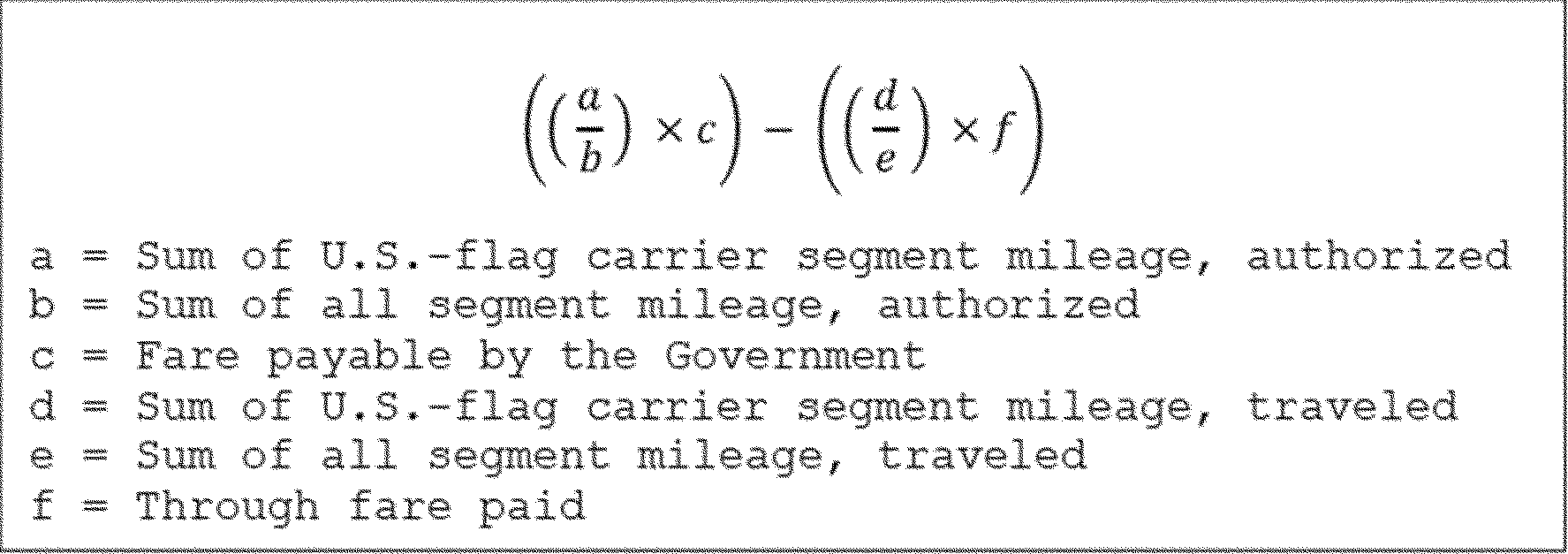
 www.nsf.gov/statistics/ffrdclist