Rescission of Rule 14a-8's Federal Regulation of Shareholder Proposals and Amendments to Rule 14a-4
The Securities and Exchange Commission ("Commission") is proposing to rescind Rule 14a-8 under the Securities Exchange Act of 1934 ("Exchange Act") and leave determinations abou...
The Securities and Exchange Commission (“Commission”) is proposing to rescind Rule 14a-8 under the Securities Exchange Act of 1934 (“Exchange Act”) and leave determinations about the role of shareholder proposals to State law and company governing documents. The Commission also is proposing to amend Rule 14a-4 under the Exchange Act to expand the circumstances under which a company may exercise, with respect to proxies it receives, discretionary voting authority on proposals that will be presented at a shareholder meeting but not included in the company's proxy materials. At the same time, the proposed amendments to Rule 14a-4 would provide shareholders with the means to elect to prevent the company from exercising such authority with respect to their individual shares.
DATES:
This release was published in the
Federal Register
on September 21, 2026. Comments should be received on or before November 20, 2026.
ADDRESSES:
Comments may be submitted by any of the following methods:
Send an email torule-comments@sec.gov.
Please include File Number S7-2026-32 on the subject line.
Paper Comments
Send paper comments to Vanessa A. Countryman, Secretary, Securities and Exchange Commission, 100 F Street NE, Washington, DC 20549-1090.
All submissions should refer to File Number S7-2026-32. This file number should be included on the subject line if email is used. To help the Commission process and review your comments more efficiently, please use only one method of submission. The Commission will post all submitted comments on the Commission's website (
www.sec.gov/rules-regulations/public-comments/s7-2026-32). Do not include personally identifiable information in submissions; you should submit only information that you wish to make available publicly. The Commission may redact in part or withhold entirely from publication submitted material that is obscene or subject to copyright protection. Studies, memoranda, or other substantive items may be added by the Commission or staff to the comment file during this rulemaking. A notification of the inclusion in the comment file of any such materials will be made available on the Commission's website. To ensure direct electronic receipt of such notifications, sign up through the “Stay Connected” option at
www.sec.gov
to receive notifications by email. A summary of the proposal of not more than 100 words is posted on the Commission's website (
www.sec.gov/rules-regulations/2026/09/s7-2026-32).
FOR FURTHER INFORMATION CONTACT:
Jenny J. Choi, Special Counsel, or Matt McNair, Senior Adviser to the Chief Counsel, Office of Chief Counsel, at (202) 551-3500, David M. Plattner, Special Counsel, or Blake M. Grady, Special Counsel, Office of Mergers and Acquisitions, at (202) 551-3440, Division of Corporation Finance, U.S. Securities and Exchange Commission, 100 F Street NE, Washington, DC 20549.
SUPPLEMENTARY INFORMATION:
The Commission is proposing to rescind 17 CFR 240.14a-8 (“Rule 14a-8”) and amend the following rules and forms:
Table of Contents
I. Introduction
II. Discussion of Proposed Amendments
A. Proposed Rescission of Rule 14a-8
1. Rule 14a-8 Exceeds the Commission's Statutory Authority
2. Policy Reasons for Rescinding Rule 14a-8
3. Investment Company Considerations
B. Proposed Amendments to Rule 14a-4(c)
1. Overview of Current Rules Related to Discretionary Voting Authority
( printed page 59905)
2. Historical Background
3. Proposed Rule Amendments
C. Other Proposed Amendments
D. General Request for Comment
III. Other Matters
IV. Economic Analysis
A. Introduction
B. Baseline
1. Current Regulatory Framework
2. Affected Parties
3. Current Practices
C. Benefits and Costs
1. Proposed Rescission of Rule 14a-8
2. Proposed Amendments to Rule 14a-4(c)
3. The Benefits and Costs for Proxy-Related Service Providers
4. Aggregate Monetized Benefits and Costs
D. Effects on Efficiency, Competition, and Capital Formation
1. Efficiency
2. Competition
3. Capital Formation
E. Reasonable Alternatives
1. Alternative to Rescinding Rule 14a-8
2. Switch the Default Choice of Check Box in Proposed Rule 14a-4(c)(2) Amendment
3. Require a Separate Check Box for Each Proposal
F. Request for Comment
V. Paperwork Reduction Act
A. Summary of the Collection of Information
B. Estimated Paperwork Burden Effects of the Proposed Amendments
C. Incremental and Aggregate Burden and Cost Estimates for the Proposed Amendments
D. Request for Comment
VI. Congressional Review Act
VII. Initial Regulatory Flexibility Act Analysis
A. Reasons for, and Objectives of, the Proposed Action
B. Legal Basis
C. Small Entities Subject to the Proposed Amendments
D. Projected Reporting, Recordkeeping, and Other Compliance Requirements
E. Duplicative, Overlapping, or Conflicting Federal Rules
F. Significant Alternatives
G. Request for Comment
Statutory Authority
I. Introduction
“Corporations are creatures of state law.” [4]
Because “regulation of corporate governance is regulation of entities whose very existence and attributes are a product of state law,” “[n]o principle of corporation law and practice is more firmly established than a State's authority to regulate domestic corporations, including the authority to define the voting rights of shareholders.” [5]
Shareholder voting rights are generally exercised at shareholder meetings, where proposals are put before the shareholders for a vote.[6]
The conduct of shareholder meetings, including how proposals are presented, is governed by State law.[7]
The manner in which shareholders exercise their rights to vote at shareholder meetings has evolved over time. Historically, shareholders exercised their rights by attending the shareholder meeting and voting in person. However, the development of large corporations with widely dispersed shareholders led to the rise of proxy voting, which permits shareholders to vote through a representative without being present at the shareholder meeting.[8]
Before 1934, State law governed the manner in which proxies to cast shareholders' votes were solicited, but “[t]oo often proxies [were] solicited without explanation to the stockholder of the real nature of the questions for which authority to cast his vote [was] sought.” [9]
In response, when it passed the Exchange Act in 1934, Congress included section 14 [10]
to give the Commission authority to regulate the proxy solicitation process.[11]
Section 14(a) [12]
makes it unlawful to solicit any proxy or consent or authorization in respect of any security “in contravention of such rules and regulations as the Commission may prescribe as necessary or appropriate in the public interest or for the protection of investors.” [13]
Relying on its authority under section 14(a), the Commission in 1942 adopted the predecessor of Rule 14a-8 to require a company to include certain shareholder proposals in its proxy statement and identify the proposal in its form of proxy.[14]
As explained by then-Chairman Ganson Purcell, Rule 14a-8 was adopted to facilitate shareholders' ability under State law [15]
to present certain proposals for consideration at a company's annual or special meeting,[16]
and to facilitate the ability of all shareholders to consider and vote by proxy on such proposals.[17]
Specifically, shortly after the rule was adopted, Chairman Purcell stated that the purpose of the rule was to “assure to the stockholders . . . those rights that [the stockholder] has traditionally had under State law, to appear at the meeting; to make a proposal; to speak on that proposal at appropriate length; and to have [the] proposal voted on.” [18]
The rule originally required a company to include a shareholder proposal that is
( printed page 59906)
“a proper subject for action by the security holders,” as long as the shareholder proponent [19]
provided “reasonable notice” to the company.[20]
Although the rule did not specify that State law provides the standard for determining what was “a proper subject for action by the security holders,” the Commission subsequently issued a release containing a letter from the then-Director of the Division of Corporation Finance clarifying [21]
that State law provided the applicable standard. The Commission later amended the text of Rule 14a-8 to make this point explicit by providing that a proposal could be excluded from a company's proxy materials if “the proposal as submitted is, under the laws of the issuer's domicile, not a proper subject for action by security holders.” [22]
As discussed in greater detail in section II.A.1.b, however, the Commission has amended Rule 14a-8 multiple times in ways that incrementally have increased the Commission's role in defining and interpreting standards that implicate core State law corporate governance matters, such as shareholder voting rights. As a result, despite the Commission's prior statements asserting that Rule 14a-8 was not “intended to supplant [S]tate law but . . . to reinforce [it] with a sturdy [F]ederal disclosure and proxy solicitation regime,” [23]
numerous observers have expressed the view that Rule 14a-8 effectively has evolved to function as a Federal common law as to what constitutes a proper subject for shareholder action.[24]
But Congress's grant of authority to the Commission in the Exchange Act does not authorize such evolution. Section 14 does not purport to displace State law with respect to shareholder governance rights. As discussed below, only Congress can authorize the Commission to intervene in matters traditionally left to State law.
Accordingly, as discussed in more detail in the sections that follow, we propose to rescind Rule 14a-8 in its entirety because the rule exceeds the Commission's statutory authority under section 14(a) by improperly intruding into State law without express authorization from Congress.[25]
Moreover, even if the rule or aspects of it were within the Commission's statutory authority, there are independent policy reasons to rescind Rule 14a-8 in its entirety and leave decisions regarding the appropriate role of shareholder proposals in the corporate governance process to the States or, if permitted by State law, to companies. In reaching this determination, we note that: (i) many of the justifications that were originally provided to support adoption of Rule 14a-8 either have not been substantiated in practice or are less compelling today; (ii) Rule 14a-8 has had, and will continue to have, certain unintended consequences that further undermine any justification for retaining the rule; and (iii) retaining any version of Rule 14a-8—assuming the Commission were authorized to do so—is unwarranted and unlikely to avoid those unintended consequences.[26]
Nevertheless, to better understand the potential impact of rescinding Rule 14a-8, we are seeking comment on the proposed rescission, potential reliance interests in the current rule, and alternative approaches within the scope of the Commission's authority.[27]
We are also proposing amendments to 17 CFR 240.14a-4(c) (“Rule 14a-4(c)”), which addresses when a proxy card submitted by a shareholder may confer discretionary voting authority on the proxy holder with respect to a matter that is not included on the proxy card. The proposed amendments to Rule 14a-4(c) are intended to provide companies with greater flexibility, and shareholders with greater control, regarding proposals for which a company may seek discretionary voting
( printed page 59907)
authority. Occasions for seeking such authority may become more frequent if Rule 14a-8 is rescinded, as proposed. While our proposed amendments to Rule 14a-4(c) are aligned with our proposed rescission of Rule 14a-8, there are independent justifications for the proposed amendments to Rule 14a-4 even if the proposed rescission of Rule 14a-8 is not adopted.
Finally, we are proposing certain other amendments to facilitate implementation of the proposed changes to the proxy rules and conforming amendments to our rules and forms.
II. Discussion of Proposed Amendments
A. Proposed Rescission of Rule 14a-8
We are proposing to rescind Rule 14a-8 because the rule exceeds the Commission's statutory authority. We also believe there are independent policy reasons to rescind Rule 14a-8. Under the proposed rescission, the Federal proxy rules would no longer require companies to include in their proxy materials shareholder proposals on the basis that they satisfy procedural and substantive requirements established under Federal law. Instead, State law or, if permitted by State law, a company's governing documents would determine whether a shareholder proposal would be required to be included in a company's proxy materials.
1. Rule 14a-8 Exceeds the Commission's Statutory Authority
Although section 14(a) authorizes the Commission to regulate proxy solicitations, the question of whether the vote that is the subject of such a solicitation is permissible in the first instance—
i.e.,
whether shareholders have a right to present a matter for other shareholders to vote on—is distinct and is determined by State law or, if permitted by State law, a company's governing documents. Because section 14(a) does not authorize the Commission to regulate the scope of matters presented to shareholders for a vote, the Commission lacks the power to override State law on this threshold question.[28]
To the contrary, it has long been understood that section 14(a) empowers the Commission to facilitate—not alter—State law rights by regulating the manner in which the proxy solicitation is made and the information that the soliciting party must disclose.[29]
As explained below, the rule has come to operate not as a procedural mechanism to facilitate shareholders' rights under State law through the proxy process, but as a substantive Federal overlay that improperly intrudes into matters of State law by dictating that companies include (or allowing them to exclude) certain shareholder proposals in the companies' proxy materials. Because Congress has not expressly authorized such an intrusion, Rule 14a-8 exceeds the scope of the Commission's authority. We therefore propose to rescind the rule in its entirety.
a. Scope of Section 14(a) Authority
Section 14(a) makes it unlawful “to solicit any proxy or consent or authorization in respect of any security” “in contravention of such rules and regulations as the Commission may prescribe as necessary or appropriate in the public interest or for the protection of investors.” [30]
The statutory text limits the Commission's regulatory authority to proxy solicitation—the request for the power to vote on a shareholder's behalf—which encompasses the manner in which that solicitation is made (
e.g.,
the timing and form of proxy) and the information that the soliciting party must disclose in the request. The Commission therefore is authorized to regulate the form of proxy solicitation and the means by which shareholders are asked to express their voting position in response to the solicitation. We construe “in the public interest or for the protection of investors” in light of the statutory context to authorize the Commission to prohibit false or misleading statements in a proxy solicitation and to promulgate disclosure requirements ensuring that shareholders are adequately informed of the proposals on which they may vote under State law and the voting positions for which their proxies would be used.[31]
This authority is consistent with other grants of authority provided to the Commission under the Exchange Act, which focus on ensuring that investors receive accurate disclosure of material information.[32]
While section 14(a) provides authority to facilitate shareholders' exercise of State law rights by regulating the proxy solicitation process, nothing in section 14(a) authorizes the Commission to regulate the scope of the voting or other rights shareholders may have under State law, such as the right to propose a matter for a shareholder vote.[33]
Rather, by focusing on the
solicitation
of a shareholder's vote, the text makes clear that Congress's purpose was to ensure that shareholders are fully informed as to the use of the proxy being solicited and to protect them from being denied the fair exercise of their State law voting rights.[34]
Section 14(a)'s grant of authority to regulate solicitations of the power to vote on a shareholder's behalf presupposes that the shareholder already has a right to vote on particular proposals. The scope of those rights has traditionally been governed by State law, and section 14(a) does not purport to disturb that allocation.[35]
If Congress had intended section 14(a) to displace State law on the subject of shareholder voting, presumably it would have referred to shareholder voting in section 14(a). For example, the Public Utility Holding Company Act (“PUHCA”), enacted by Congress in the year after the Exchange Act,[36]
directed the Commission to oversee the allocation of voting power in public utility companies. Section 11(b)(2) of that law authorized the Commission “[t]o require by order . . . that the corporate structure . . . does not . . . unfairly or inequitably distribute voting power among security holders.” [37]
No
( printed page 59908)
comparable language appears in section 14(a).[38]
Therefore, the Commission's authority under section 14(a) to regulate the proxy solicitation process does not permit the Commission to displace State law regarding shareholder voting rights.[39]
By establishing standards not found in State law for when a shareholder proposal must be included in, or may be excluded from, a company's proxy materials, the Commission effectively dictates the scope of shareholder voting rights and, therefore, exceeds its authority.
To the extent legislative history is considered, it only underscores the limitations on the Commission's authority that are inherent in the statutory text and structure. That history indicates that Congress's purpose in enacting this provision was to empower the Commission to facilitate “fair corporate suffrage” on the proxy by regulating the “conditions under which proxies may be solicited.” [40]
It also suggests an intent to authorize regulations that would protect “free exercise of the voting rights” of shareholders,[41]
require “adequate disclosure” of the matters to be decided at the shareholder meeting,[42]
and prevent “irresponsible outsiders” and “unscrupulous corporate officials” from “concealing and distorting facts” in their proxy solicitations.[43]
Courts have thus interpreted section 14(a) as bearing “almost exclusively on disclosure,” with a “central concern” that proxies not be obtained through “deceptive or inadequate disclosure in proxy solicitation.” [44]
These limitations are also consistent with the Commission's longstanding understanding that its authority under section 14(a) is limited to promulgating “federal proxy rules [that] facilitate shareholders' exercise of [S]tate law rights,” [45]
such that the corporate proxy process “functions, as nearly as possible, as a replacement for an actual, in-person gathering of security holders.” [46]
As the Commission has acknowledged, section 14(a) does not grant it authority to “alter those [State law] rights.” [47]
Interpreting section 14(a)(1) more broadly would not only lack any basis in the statutory text and structure but would inappropriately interfere with matters traditionally reserved to the States. As the Supreme Court explained in
Santa Fe Industries, Inc.
v.
Green,
“[a]bsent a clear indication of congressional intent, we are reluctant to federalize the substantial portion of the law of corporations that deals with transactions in securities, particularly where established State policies of corporate regulation would be overridden.” [48]
The approach taken by the Supreme Court in
Santa Fe
accords with a substantial body of precedent establishing a clear statement rule for laws tilting the balance of federalism.[49]
For example, in
Business Roundtable,
the U.S. Court of Appeals for the District of Columbia Circuit found that section 14(a)(1) did not express an intention by Congress to override State law with respect to “corporate governance.” [50]
To the contrary, the court explained, those advocating for the Exchange Act in Congress expressly disclaimed any intent to confer upon the Commission authority to interfere in corporate management: opponents had raised concerns that the bill would confer “power to interfere in the management of corporations,” and the Senate Committee on Banking and Currency responded that it had “no such intention” and that the bill “furnish[ed] no justification for such an interpretation.” [51]
Similarly, neither the text nor legislative history of section 14(a) contains any indication that the statute authorizes the Commission to interfere with shareholder rights established by State law. More generally, members of Congress have repeatedly proposed bills to create a “federal corporation law,” but none has been enacted.[52]
On the rare occasions when Congress has intended for the Commission to intervene directly in the governance of public companies, it has done so through clear statutory mandates.[53]
Nor do the references to the “public interest” and “protection of investors” in section 14(a) provide a basis for the Commission to intrude into shareholder voting rights or corporate management. Courts have consistently recognized that “public interest” is not an open-ended delegation of power; rather, such language “must be limited to the purposes Congress had in mind when it enacted the legislation.” [54]
Those statutory purposes are discerned from the text and context of the statute, which in turn cabin what is “necessary or appropriate” under the Commission's
( printed page 59909)
rulemaking authority.[55]
In the context of section 14(a), this means that rules adopted under this provision must focus on the statute's core concern with regulating the proxy solicitation process and the disclosures within the solicitations—not on defining or reshaping the substantive scope of shareholder voting rights. The phrase “protection of investors” likewise cannot reasonably be construed to authorize the Commission to engage in such intrusions into State law.[56]
To read these terms otherwise would permit the Commission to use the Federal securities laws to supplement or override “firmly established” State law authority over shareholder rights—an approach that the Supreme Court has rejected absent explicit congressional authorization.[57]
b. Evolution of Rule 14a-8
The earliest versions of the Commission's proxy rules enacted under section 14(a) focused on disclosure and providing shareholders with the means to specify the action to be taken pursuant to their proxies.[58]
In 1942, the Commission adopted Rule 14a-8's predecessor, Rule X-14A-7, which established a requirement that management include in the company's proxy materials a shareholder proposal that “is a proper subject for action by the security holders.” [59]
Although the Commission did not define “proper subject” in the rule, it issued a release in 1945 that contained a letter from Division of Corporation Finance Director Baldwin B. Bane explaining that the term referred to “such matters . . . as are proper subjects for stockholders' action under the laws of the [S]tate under which [the company] is organized.” [60]
The letter responded to a company that sought exclusion of proposals relating to matters of a “general political, social or economic nature” and asked whether such proposals were a proper subject for shareholder action under Rule X-14A-7. Without referencing the laws of the State under which the company was organized, Director Bane stated that “[i]t is my conclusion that the proposals which have been presented to you are not `proper subjects for action' by your company's stockholders within the meaning of that phrase as used in Rule X-14A-7. Consequently, it will be unnecessary for you to include the proposals in the management's proxy statement if you do not wish to do so.” [61]
Director Bane also stated that “[it] was not the intent of Rule X-14A-7 to permit stockholders to obtain the consensus of other stockholders with respect to matters which are of a general political, social or economic nature. Other forums exist for the presentation of such views.” [62]
Whether intentionally or not, Director Bane's letter effectively positioned Rule X-14A-7 as a new Federal common law for shareholder voting rights, and the letter's informal understanding of whether a matter was “a proper subject for action” does not appear to have been based on the law of any particular State, let alone the State under which the company was organized.
In the years that followed, the Commission repeatedly amended what is now Rule 14a-8 in ways that progressively expanded the Commission's role in determining, interpreting, and effectively shaping matters traditionally governed by State law. As discussed above, the 1942 rule relied substantially on the concept of “proper subject for action” to determine which proposals must be included on the company's proxy. Due to a lack of relevant State laws to provide guidance on what was a “proper subject,” as questions arose about the content of shareholder proposals, proponent conduct, and management objections, the Commission increasingly inserted Federal criteria in place of State law standards.[63]
Through a series of amendments adopted in 1947 and 1948, the Commission required issuers to provide an explanation to the Commission when asserting that shareholder proposals were improper or untimely [64]
and introduced new bases for excluding such proposals.[65]
These amendments provide an early example of how the proxy rules began to delineate the limits of shareholder voting rights independent of State law. In particular, adding new exclusionary bases that went beyond whether a proposal was a “proper subject for action” under State law opened the door for more grounds for exclusion to be added, sometimes on a seemingly ad hoc basis in response to emergent issues. As a result of these and subsequent amendments, it became possible—as remains the case today—for there to be circumstances under which a shareholder's proposal is a “proper subject for action” and thereby permissible under State law but eligible for exclusion from the proxy materials under Rule 14a-8.[66]
( printed page 59910)
Later amendments, including the 1952 exclusion for proposals promoting “general economic, political, racial, religious, social or similar causes” [67]
and the 1954 “ordinary business” exclusion,[68]
further entangled Federal criteria with State law requirements. The application of these criteria often required judgments about matters of boards' authority and shareholders' role in corporate decision-making. The 1954 amendments also restructured Rule 14a-8 such that the “proper subject for action” criterion was no longer a threshold qualification for the inclusion of a shareholder proposal; instead, it was re-framed as a basis permitting an issuer to exclude a proposal if it was
not
a proper subject for action under State law.[69]
Moreover, “the burden of proof” to make that showing was placed “upon the management.” [70]
In 1976, the Commission reorganized the rule into the modern structure of 13 substantive exclusions.[71]
In doing so, the Commission made inclusion of shareholder proposals in the company's proxy materials dependent on, among other things, whether proposals relate significantly to an issuer's business or implicate areas of board and management discretion.[72]
Some of these exclusions were based on the Commission's interpretation of State law allocations of authority between shareholders and management, and the rest lacked any connection to State law.[73]
The Commission also added a note to Rule 14a-8(i)(1) explaining that the propriety of a shareholder proposal under State law may depend on whether the proposal is precatory or mandatory, signaling broader Federal takeover in the purported application of State law concepts.[74]
The note, as discussed further in section II.A.1.c below, effectively created a presumption that precatory proposals are proper based on the Commission's own interpretation of State law, as opposed to deferring to States to resolve the question.
The Commission again modified the regulatory framework for shareholder proposals in 1983.[75]
The adopted amendments (including revisions to the relevance, resubmission, and personal grievance exclusions) and Commission interpretive guidance on the ordinary business and mootness exclusions largely preserved the central role that the Commission's understandings of shareholder authority and corporate decision-making—traditionally the province of State law—played in the administration of the Commission's rule. Similarly, revisions made in 1998, while primarily structural and intended to improve readability by recasting the rule in a question-and-answer format, carried over the existing exclusionary framework.[76]
Subsequent amendments—frequently relating to shareholder-proponent eligibility, resubmission thresholds, and procedural requirements—have continued to revise a Federal overlay that either constrains or expands the rights of shareholders to present a matter for a vote without any grounding in State law.[77]
Taken together, the evolution of Rule 14a-8 demonstrates a consistent trend: over time, through rulemaking, the Commission has increasingly assumed responsibility for defining and interpreting standards that implicate core State law concepts of corporate governance.
As this history illustrates, the evolution of current Rule 14a-8 has taken the Commission from its original 1942 posture of deferring to State law on the scope of which matters are a proper subject for shareholder action to a regime in which the rule now purports to prescribe the “few specific circumstances” under which a company is “permitted to exclude” a shareholder proposal, including a presumption that precatory proposals are “proper unless the company demonstrates otherwise.” [78]
Throughout this evolution, there has been little meaningful analysis of State law to justify the Commission's line drawing. Instead, the Commission has relied on generalized impressions of what State law requires or on inferences drawn from its own experience administering the Federal proxy rules to construct what is, in substance, a Federal standard governing when a shareholder proposal is a proper subject for shareholder action. Nothing in the text or context of section 14(a) supports the Commission's authority to prescribe such a standard. Indeed, the plain and best reading of section 14(a) confirms that Congress did not grant the Commission such authority.
c. Rule 14a-8 Exceeds the Commission's Authority Under Section 14(a)
As discussed above, Rule 14a-8 dictates when a company “must include” a shareholder proposal in its proxy materials. The rule prescribes eligibility and procedural requirements that a shareholder must satisfy to have
( printed page 59911)
a proposal included. It then identifies the bases on which a company may exclude a proposal. It also sets forth certain steps that a company must follow if it seeks to rely on one of those bases.[79]
Collectively, these provisions effectively operate as a Federal standard governing when a matter is properly put before shareholders for a vote through the proxy.[80]
Because section 14(a) empowers the Commission to regulate the proxy solicitation process—not codify its own understanding of State law rights as a matter of Federal law—Rule 14a-8 exceeds the Commission's authority under section 14(a).
In its current form, Rule 14a-8(i) contains 13 substantive bases for exclusion. Of these, only Rule 14a-8(i)(1) and Rule 14a-8(i)(2) directly refer to State law by permitting exclusion when a proposal “is not a proper subject for action by shareholders under the laws of the jurisdiction of the company's organization,” [81]
or when a proposal “would, if implemented, cause the company to violate any [S]tate . . . law to which it is subject.” [82]
The remaining exclusion bases codify criteria developed by the Commission—often evolving over time—regarding what matters are appropriate for inclusion in a company's proxy materials, some of which derived from the Commission's own interpretation of State law and the rest of which lacked any identified connection to State law.[83]
These criteria include the proposal's subject matter (such as matters relating to ordinary business operations, the director election process, or dividend amount determinations) and other considerations (such as the motivation of the proponent, economic relevance, duplication, substantial implementation, or the level of past shareholder support).[84]
Although some of these exclusion bases may intersect with concepts found in State law, they are not derived from, and do not consistently track, State law frameworks governing shareholder rights to present a proposal at a meeting for a vote by their fellow shareholders.
Even where Rule 14a-8 incorporates State law considerations in Rule 14a-8(i)(1), the rule conditions that reference with a Commission-created presumption that non-binding, precatory proposals are proper subjects for shareholder action under State law.[85]
This presumption, grounded in prior Commission staff “experience,” effectively places a thumb on the scale in favor of inclusion. A company bears the burden to overcome the presumption, but meeting that burden, in practice, is often difficult. State law is frequently undeveloped, ambiguous, or fact-specific with respect to shareholder proposals, and the company is required to submit an opinion of counsel supporting its views on State law, which may be particularly difficult to obtain when State law is silent on the subject. In these situations, companies could lack a meaningful pathway to meet their burden to rebut the presumption. As a result, what is framed as a presumption operates in substance as a mandate. Rather than looking or deferring to State law, the Commission has, instead, substituted its own judgment for which proposals are proper under State law.
Beyond the 13 substantive bases for exclusion and the presumption regarding precatory proposals, the overall structure of Rule 14a-8 underscores its function as a
de facto
Federal standard for shareholder voting rights by specifying which shareholder proposals are appropriate for inclusion in company proxy materials. Rule 14a-8 has, over time and through successive revisions, evolved into a detailed framework that identifies the “few specific circumstances” in which a company is “permitted to exclude” a shareholder proposal. As an illustration of how Rule 14a-8 has expanded in complexity over time, the predecessor to Rule 14a-8 was a little over 200 words whereas the current provision is over 3,000 words. Companies seeking to exclude a proposal must explain the basis for exclusion—often by citing one or more of the 13 substantive grounds noted above—and, where the basis relies on State or foreign law, provide a supporting opinion of counsel.[86]
The rule also imposes numerous requirements that a shareholder must satisfy to require inclusion of a proposal in the company's proxy materials, including eligibility criteria based on the amount and duration of share ownership; a requirement that the shareholder (or a qualified representative) personally attend the meeting to present the proposal; and limits on the number and length of proposals.[87]
None of these requirements is grounded in State law.[88]
Despite the Commission's stated goal of “facilitat[ing] shareholders' exercise of [S]tate law rights” [89]
and making the proxy process “function[ ], as nearly as possible, as a replacement for an actual in-person gathering of security holders,” [90]
these conditions and exclusions—which constitute the vast majority of Rule 14a-8's provisions—bear little or no connection to whether the proposal is proper for a shareholder vote at the shareholder meeting under State law. Instead, these requirements create a complex Federal regime governing the rights of shareholders to present proposals for shareholder action that functionally supplants State law.[91]
Section 14(a) does not empower the Commission to create such a regime.
It might be argued that Rule 14a-8 does not dictate the scope of proposals submitted by one shareholder to be voted on by other shareholders but rather defines the conditions under which a shareholder may take advantage of the opportunity provided by Federal law to have a proposal included in the company's proxy materials.[92]
But, as
( printed page 59912)
described above, by establishing standards not found in State law for whether a shareholder proposal must be included in a company's proxy materials, the Commission effectively dictates the scope of shareholder voting rights and, therefore, exceeds its authority. Because voting by proxy has largely replaced attendance at the shareholder meeting as the primary means of corporate suffrage, applying the Commission's determinations of whether and what shareholder proposals may properly appear on a company's proxy materials effectively alters the corporate voting process.[93]
By way of contrast, in the context of director elections, the Commission has facilitated the ability of shareholders to exercise the voting rights they have under State law. In 2021, the Commission adopted rules requiring the use of a universal proxy card in non-exempt solicitations involving director election contests.[94]
The foundation for the universal proxy rules is the right of shareholders—explicit in State law—to vote for the election of directors.[95]
Accordingly, the predicate question of whether under State law the proposal (
i.e.,
the election of directors) is proper for a shareholder vote at the shareholder meeting is clearly answered by State law.[96]
To ensure that shareholders voting by proxy are able to participate in the election of directors in the same manner they could if voting in person at a shareholder meeting, the rule requires that a proxy card include the names of all duly nominated [97]
director candidates presented for election,[98]
thereby allowing shareholders voting by proxy in contested elections to replicate the vote they could cast if they voted in person. Such an exercise of the Commission's rulemaking authority under section 14(a) works in conjunction with State law.
It is not always clear whether a matter is a proper subject for shareholder action under State law. In some instances, State law entitlements are relatively straightforward. For example, it is widely recognized that State law generally confers voting rights on equity shareholders in director elections but does not confer voting rights on bondholders in those elections.[99]
In other instances, applying State law can present difficult interpretive questions, even within a single jurisdiction. For example, it remains uncertain whether the Delaware General Corporation Law (“DGCL”) permits precatory proposals; the statute does not speak to the question.[100]
These difficulties are compounded by the fact that States vary in how they address particular governance matters.[101]
But section 14(a) does not authorize the Commission to resolve ambiguous questions of State law or to impose a uniform Federal standard. Indeed, doing so has inhibited and may continue to inhibit the development of State law by State legislatures and courts interpreting the law of the relevant States of incorporation, as we discuss below.[102]
Absent clear congressional direction to the contrary, State legislatures and courts interpreting State law are the appropriate bodies to develop and define the scope of shareholder rights.
The Commission has, at times, noted that its authority to promulgate Rule 14a-8 under section 14(a) was upheld in 1947 in
SEC
v.
Transamerica Corp.[103]
But in
Transamerica,
which upheld an application of the 1942 version of the rule, the scope of the Commission's authority under section 14(a) was not squarely presented or addressed. To the extent the court's analysis could be read to endorse a more expansive view of the Commission's authority than the Commission's interpretation in this release, the Commission disagrees with such a reading for the reasons discussed above.
d. Rule 14a-8 Should Be Rescinded
An administrative agency must act within its statutory authority.[104]
As
( printed page 59913)
discussed, Rule 14a-8 exceeds the plain and best reading of the Commission's rulemaking authority under section 14(a). Accordingly, we propose to rescind the rule. Furthermore, as discussed below, even if the Commission had the authority to adopt Rule 14a-8 or aspects of the rule, for independent policy reasons, the Commission is proposing to rescind the rule in its entirety.
We acknowledge that Rule 14a-8 has been in existence for many years and that both shareholders and companies are likely to have shaped certain governance and engagement practices around the rule's provisions. However, agencies may not add to their powers by adverse possession; longevity is not a substitute for legal authority. Indeed, the passage of time has seen Rule 14a-8 stray further from section 14's authorization. That said, to better understand the potential impact of rescinding Rule 14a-8 and possible measures to mitigate such impact, we are seeking comment on reliance interests in the current rule and on alternatives to complete rescission that would fall within our authority.
2. Policy Reasons for Rescinding Rule 14a-8
Independent of our lack of statutory authority, there are also policy reasons for rescinding Rule 14a-8 in its entirety. Specifically, we believe that (i) many of the justifications that were originally provided to support adoption of Rule 14a-8 either have not been substantiated in practice or are less compelling today; (ii) Rule 14a-8 has had, and will continue to have, certain unintended consequences; and (iii) retaining any version of Rule 14a-8—assuming the Commission were authorized to do so—is unwarranted and unlikely to avoid these unintended consequences.
a. Many of the Original Justifications for Adopting Rule 14a-8 Either Have Not Been Substantiated in Practice or Are Less Compelling Today
When the Commission first adopted Rule 14a-8, Chairman Purcell stated that the rule was adopted with the understanding that (i) the cost to companies to include shareholder proposals in their proxy materials was “small;” [105]
(ii) many proposals were either already supported by management or received meaningful shareholder support; [106]
(iii) the overall volume of proposals was low; [107]
and (iv) the rights of shareholders to present certain matters for a vote to their fellow shareholders under State law was reasonably clear, such that the Commission's rules could operate to facilitate those rights.[108]
As discussed below, many of these justifications either have not been substantiated in practice or have become less compelling given the evolution of the shareholder proposal process, and ambiguity about the scope of shareholder voting rights under State law. In addition to these considerations, other developments, including the reduced burden in conducting independent solicitations and availability of other methods of shareholder engagement due to technological advancements, also may have rendered Rule 14a-8's original justifications less compelling.
First, the cost to companies of addressing and including shareholder proposals in proxy materials is no longer small. In response to commenter feedback on the proposing release to the Commission's 2020 amendments to Rule 14a-8, the Commission estimated that the cost to a company ranged from $20,000 to $150,000 per proposal.[109]
One recent survey found that the aggregate direct costs over a four-year period that companies incurred to comply with Rule 14a-8 varied widely among 35 public company respondents: 20 percent reported four-year aggregate direct costs of less than $100,000; 25.7 percent reported between $100,000 and $250,000; and 17.1 percent reported between $251,000 and $500,000.[110]
Nearly one-quarter reported aggregate, four-year costs exceeding $500,000, including 14.3 percent reporting between $501,000 and $1,000,000 and 11.4 percent reporting more than $1,000,000 over that period.[111]
Another survey found that nearly 20 percent of the 35 responding companies, including some companies that have small market capitalization, noted that they spend over $500,000 in external costs addressing shareholder proposals in a typical proxy season.[112]
Companies incur costs, including internal time, as well as external legal and compliance expenditures.[113]
Companies also incur indirect costs associated with addressing shareholder proposals, including internal legal and administrative resources, management time, and opportunity costs from diverting management's attention away from core business operations, which may be substantial.[114]
These costs
( printed page 59914)
ultimately are borne by the company's shareholders,[115]
who, in addition to absorbing the costs incurred by the company, face their own costs in analyzing and voting on proposals.[116]
Second, most shareholder proposals today do not receive majority shareholder support and are not supported by management. We estimate that approximately seven percent of submitted proposals and 11 percent of proposals that were voted on received majority shareholder support in 2025.[117]
It is also clear that management frequently opposes shareholder proposals today, as reflected in the number of proposals companies exclude from their proxy materials each proxy season,[118]
the number of proposals companies seek to exclude,[119]
and the opposition statements companies routinely include in their proxy materials to rebut proposals that are included and voted on.[120]
Third, the volume of shareholder proposals has increased significantly over time in comparison to the increase in the number of companies required to file proxy statements.[121]
In contrast to the relatively low number of shareholder proposals included in company proxy materials between 1943 and 1946, which totaled between 34 and 66,[122]
the annual number of shareholder proposals submitted to companies between 2020 and 2025 is estimated to have ranged from 697 to 932, with an estimated 437 to 599 proposals included in company proxy materials each year.[123]
Finally, when it adopted Rule 14a-8, the Commission appears to have assumed that it would be clear, or at least reasonably easy to determine, which matters are proper to present to shareholders for a vote under State law. However, State law is often unclear or silent as to what matters may be presented to shareholders. For instance, Delaware law is unclear about the status of precatory proposals—the most common type of Rule 14a-8 proposal.[124]
While section 211 of the DGCL states that, in addition to the election of directors, “[a]ny other proper business may be transacted at the annual meeting,” it does not define what can be considered as “proper business.” [125]
Consequently, there is a diversity of opinion about whether the DGCL permits precatory proposals. While a number of commentators have observed that Delaware law does not explicitly authorize or contemplate precatory proposals as proper subjects for shareholder action,[126]
the question remains unresolved. For example, one scholar of Delaware law has stated that section 211 of the DGCL could be interpreted to authorize precatory proposals as proper [127]
and another legal scholar has argued that the authority to present and vote on precatory proposals is an “incidental power[ ]” derived from section 121 of the DGCL and the broader governance framework created by statute.[128]
Regardless of their views, no commentator has identified any controlling authority from a Delaware court on this issue, and the DGCL (like the MBCA) does not directly address the question as to whether precatory proposals are proper subjects for a shareholder vote.[129]
Moreover, even if Delaware law were clear on this issue, other States may take a different position.
The Commission appears to have underestimated the challenges associated with discerning and applying State corporate law when it adopted Rule 14a-8, leading to subsequent efforts to provide clarity through incremental amendments to the rule (such as, for example, through the current codified presumption regarding precatory proposals [130]
). However, as explained in section II.A, when State law is unclear or silent as to what matters can be presented to shareholders, it is not the Commission's role to fill those gaps or impose
( printed page 59915)
uniformity through the Federal proxy rules.
In addition to the specific considerations discussed above, other developments also may have rendered Rule 14a-8's original justifications less compelling. For example, independent solicitation may have become less burdensome due to, among other factors, technological and regulatory advancements, including the introduction of the Commission's e-proxy rules (
i.e.,
notice and access).[131]
In 2021, we estimated that the median basic cost of soliciting shareholders, namely, the proxy distribution fees and postage costs for the first mailing, was approximately $14,000.[132]
We also estimated that the costs of a nominal solicitation—where dissidents minimize their solicitation efforts and rely on the notice-and-access mechanism—would fall within a range of $5,300 to $9,800, with the specific cost dependent on the subject company's market capitalization.[133]
These estimates assumed that the dissident would meet the minimum 67 percent solicitation requirement under 17 CFR 240.14a-19 (“Rule 14a-19”), the Commission's universal proxy rule, which is not applicable if a shareholder does not solicit proxies in support of director nominees other than the company's nominees.[134]
While estimating the total costs of a specific solicitation is challenging due to the variability of discretionary solicitation expenditures, we believe that technological and regulatory advancements have helped to facilitate independent solicitations.
In addition, although the original purpose of Rule 14a-8 was not to facilitate shareholder engagement or communication, shareholders frequently use the rule for these purposes, as discussed in section II.A.2.b.i below. To the extent shareholders use Rule 14a-8 for these purposes, technological advancements have given rise to a wide range of alternative channels—such as online platforms and social media forums—that facilitate communication among shareholders, enable the expression of shareholders' views, and allow investors to attempt to influence corporate behavior.[135]
These means were not available when Rule 14a-8 was first adopted. Modern technology allows investors—including smaller shareholders—to communicate both with management and fellow shareholders, mitigating concerns that rescinding Rule 14a-8 would limit engagement to larger shareholders or those with more access to management or board members.[136]
b. Rule 14a-8 Has Had, and Will Continue To Have, Certain Unintended Consequences
i. Rule 14a-8 Has Become a Mechanism for Influencing the Interactions Between Companies and Their Shareholders in Ways That Are Inconsistent With the Rule's Original Purpose
Under Rule 14a-8, a company is required to include a shareholder proposal in its proxy statement and form of proxy unless it can identify a basis to exclude it, in which case it must file with the Commission its reasons for exclusion.[137]
If a company excludes or attempts to exclude a proposal, it may be exposed to litigation risk.[138]
Proponents may thus use Rule 14a-8 in an attempt to gain leverage in negotiations with company management or to secure private benefits from such negotiations.[139]
Use of Rule 14a-8 in this way represents a departure from the rule's original purpose and implicates matters more appropriately addressed by State law.
For example, proponents may submit proposals to initiate a dialogue with a company when they have little or no intent for their proposals to actually be included in company proxy materials and voted on by fellow shareholders. In fact, many shareholder proposals today are resolved without a shareholder vote, suggesting that the Rule 14a-8 process has deviated from its original purpose.[140]
For instance, based on available data, proponents withdrew their proposals at rates ranging from 18.4 percent to 32.1 percent during the four-year period between 2021 and 2025, with approximately 18 percent of proposals being withdrawn in 2025.[141]
Companies and proponents alike may have incentives to settle privately, rather than proceed to a shareholder vote.[142]
For companies, the perceived
( printed page 59916)
advantages of private resolution may include reducing reputational risk associated with proposals, mitigating litigation risk related to statements made in opposition or in connection with exclusion, or avoiding the potentially greater costs associated with either including a proposal in the proxy materials or seeking to exclude it under the Commission's rules.[143]
For proponents, reaching a settlement can provide a more certain path to achieving a tangible outcome since shareholder proposals are typically non-binding even when they receive majority support.[144]
The frequent withdrawal of shareholder proposals as part of the Rule 14a-8 process does not fully align with Congress's intent that section 14(a) and the Federal proxy rules promote “fair corporate suffrage.” [145]
Rather than having their proposals reach a shareholder vote through the proxy process, proponents often utilize the existence of the rule as leverage for private negotiations with companies, while company management may also find it advantageous when proposals are withdrawn.[146]
Furthermore, Rule 14a-8 can serve as a mechanism for shareholder proponents to advance interests that in many cases may not be shared by a company's shareholders at large. For instance, in 2025, only 56 out of 786 submitted proposals (seven percent) received majority support.[147]
In addition, a significant proportion of shareholder proposals are submitted by a small number of proponents who advance substantially similar proposals across numerous companies.[148]
In 2025, 10 shareholder proponents submitted an aggregate of 58 percent of all proposals (455 out of 786).[149]
Such use is counter to how the Commission intended the rule to be used. For example, when the rule was first adopted, Chairman Purcell explained, “[I]f [a shareholder proponent] were going to use the corporate proxy machinery for making a stump speech for some political party, that obviously is without the spirit of [the rule] . . . .” [150]
The Commission also subsequently noted that it did not intend for the rule to be used as a “publicity mechanism” for advancing personal or partisan interests unrelated to the interests of a company's shareholders.[151]
Yet Rule 14a-8 often serves as a stump from which, figuratively, a small number of shareholders give speeches.[152]
Furthermore, since Rule 14a-8 includes substantive and procedural bases that companies may use to exclude proposals that otherwise may be permitted under State law, companies may seek to use the rule to exclude proposals they disfavor or to limit shareholder involvement in corporate affairs. The various default positions, bases for exclusion, and eligibility criteria have made Rule 14a-8 a contested vehicle for influencing corporate governance practices and other corporate behavior. However, the allocation of power between shareholders and management, as well as determinations about the appropriate role of shareholder advocacy in corporate governance, are matters for the States to resolve and not the appropriate province of the Commission.[153]
ii. The Existence of Rule 14a-8 Places the Commission in the Position of Making Judgments About the Application of State Law That Are Best Left to Other Actors
In our experience, Rule 14a-8 has drawn the Commission into matters that should be addressed by State legislatures, courts, and, if permitted by relevant State law, companies.[154]
Although certain aspects of State law may be clear—for example, State law generally affords shareholders the right to elect directors [155]
and amend the bylaws [156]
—many other areas contain
( printed page 59917)
gaps, ambiguities, or conflicting interpretations. State legislatures and courts—not the Commission—are the appropriate authorities to resolve those gaps, ambiguities, and conflicts. Similarly, it is not the Commission's role to synthesize potentially conflicting State laws for purposes of administering the Federal proxy rules. For example, State corporate codes are silent as to whether precatory proposals are proper to present for a shareholder vote.[157]
Historically, however, in assessing whether a proposal is a proper subject for shareholder action under State law, the Commission has assumed precatory proposals are presumptively proper.[158]
The Commission cannot provide definitive answers to State law questions. Such questions are properly decided by courts, with the highest court in each State exercising final authority on questions of State law.[159]
More generally, we do not believe that section 14(a) authorizes the Commission to direct or influence substantive corporate governance matters that fall within the purview of State legislatures, courts, and the private ordering mechanisms established in a company's governing documents.
The continued existence of a Federal rule governing shareholder proposals—even one that purports facially to defer to State law—encourages companies and shareholders to look to the Commission to resolve ambiguities in the application of such rule. Moreover, because the Commission has authority to bring actions to enforce compliance with the proxy rules, including Rule 14a-8, companies inevitably turn to the Commission and its staff for guidance on the application of the Federal rule.[160]
As a result of the foregoing, State authorities who are the appropriate bodies to resolve corporate governance matters may have little incentive or occasion to provide clarity on the role of shareholder proposals. This dynamic is reflected in the fact that, with the recent exception of Texas,[161]
no State has adopted legislation governing shareholder proposals in more than 80 years since Rule 14a-8 was first adopted, and we are not aware of any companies that have incorporated their own framework for addressing shareholder proposals into their governing documents.[162]
Under the proposed rescission of Rule 14a-8, the Commission would continue to oversee the Federal proxy process but would no longer determine which shareholder proposals must be presented to shareholders through a company's proxy materials. Removing the Commission from the shareholder proposal process would ensure that the appropriate bodies—
i.e.,
State legislatures, courts, and, when permitted by relevant State law, companies—determine the circumstances under which proposals should be included in a company's proxy materials.
iii. The Presence of a Federal Rule Has Inhibited the Development of State Law and Private Ordering
Although States can enact laws determining the appropriate role of shareholder proposals and establishing whether and to what extent shareholders have access to company proxy materials for their proposals, they have largely declined to do so. As discussed above, Rule 14a-8 was not intended to displace State law; rather, it was originally designed to facilitate State law rights through a Federal disclosure and proxy solicitation framework.[163]
Although the rule has evolved over time in ways that stray from this original intent, a remnant of this principle remains in Rule 14a-8(i)(1), which expressly permits companies to exclude proposals that are “not a proper subject for action by shareholders under the laws of the jurisdiction of the company's organization.” [164]
Accordingly, where State law sets forth standards governing which proposals may be presented for a vote of shareholders, a proposal not meeting those standards is excludable under Rule 14a-8(i)(1) as “not a proper subject for action by shareholders.” [165]
Similarly, if permitted by State law, companies can adopt standards in their governing documents, such as establishing company-specific ownership thresholds for presenting proposals for shareholder action or limits on the types of proposals that may be presented, and a proposal not complying with those requirements could be excluded under Rule 14a-8(i)(1).[166]
For example, if State law or a company's governing documents (if permitted by State law) were to disallow precatory shareholder proposals, then a company may exclude such precatory proposals pursuant to Rule 14a-8(i)(1).
Although current Rule 14a-8(i)(1) accommodates the ability of States and their domiciled companies to tailor the shareholder proposal process to reflect their own views about the optimal approach to corporate governance and the particular circumstances of the company and its shareholders, States and companies have, with one notable exception, generally declined to exercise this authority to date.[167]
This reluctance may stem from concerns that adopting standards that deviate from those in Rule 14a-8 could bring unwanted public attention and criticism from investors and other parties. In this regard, State authorities may be disinclined to undertake politically contentious decisions and companies may fear that adopting such standards could lead to accusations of disenfranchising shareholders, trigger organized investor campaigns, and/or
( printed page 59918)
result in voting recommendations against board nominees by proxy advisory firms. Indeed, simply being singled out as insufficiently responsive to a perceived shareholder right could impose reputational costs for companies.[168]
Despite the capacity of States to enact laws and companies to engage in private ordering under Rule 14a-8(i)(1), there have been only limited efforts to tailor the modern shareholder proposal regime.[169]
In addition, despite prior Commission statements to the contrary,[170]
some uncertainty may exist as to whether States and companies can establish shareholder proposal standards that differ from those set forth in Rule 14a-8.[171]
Part of this uncertainty may stem from an early judicial decision—
SEC
v.
Transamerica Corp.[172] —
which some have interpreted as holding that Rule 14a-8 preempts State law and privately ordered procedures governing the submission of shareholder proposals.[173]
Rescinding Rule 14a-8 would eliminate any implication of preemption stemming from
Transamerica
or otherwise and thus remove that potential disincentive for States to develop their own laws governing shareholder proposals. To the extent some believe that Rule 14a-8 currently preempts State law, we expect that if the rule were rescinded, States and/or companies, in compliance with State law, would be more inclined to adopt their own standards for when shareholder proposals must be included in, or may be excluded from, the company's proxy materials.
Finally, we note that, to the extent State law or a company's governing documents were to require inclusion of a shareholder proposal in a company's proxy statement, the company would be required to comply with the Commission's proxy rules with respect to that proposal.
c. Retaining Rule 14a-8 Is Unwarranted and Unlikely To Avoid Unintended Consequences
Even if the Commission had authority to retain some version of Rule 14a-8, doing so would require the Commission to establish certain baseline assumptions, such as whether shareholder proposals should, by default, be included in or excluded from a company's proxy materials. Whatever default rule the Commission were to select—inclusion or exclusion—would establish the starting point for how disputes are resolved. The rule also would have to articulate what a company or a shareholder must do to opt out of the default. In doing so, the rule necessarily would advantage one side over the other by shaping the burdens of persuasion and the practical likelihood of success. Such a structural choice, even if made with the intention of neutrality, would have the practical effect of shaping how companies and shareholders interact, negotiate, and ultimately view the costs and utility of the shareholder proposal process.
Even if the Commission could attempt to amend the rule to completely defer to State law, in practice we do not believe such an alternative would address our fundamental concern about the Commission's entanglement in State law issues. So long as a Federal rule remains, experience has shown that parties will continue to look to that rule—and the Commission—to resolve questions about the inclusion of shareholder proposals in a company's proxy materials given the greater uniformity offered by a Federal framework and notwithstanding the fact that State law determines the proper scope of a shareholder's power to present a proposal to their fellow shareholders for a vote.[174]
The history of Rule 14a-8 underscores this dynamic as, over time, the Federal rule has become the primary reference for determining the scope, operation, and limits of shareholder proposals, effectively displacing the authority of State law notwithstanding the Commission's disclaimers of any intention to do so. Thus, even if the Commission had the authority to retain a version of Rule 14a-8—with the clear intention of deferring to State law—over time it would inevitably be drawn into matters that should be left to States or private ordering.
In addition, we do not believe that retaining such a version of Rule 14a-8 would be warranted. We expect that total rescission of the rule would lead the States and/or (where authorized by State law) companies to be more inclined to adopt their own standards in this area. State courts are the proper venue to resolve any disputes that may arise directly based on State law and the terms of corporate governance documents, without need for a Federal rule that would itself necessarily incorporate State law (and risk overriding it). Accordingly, we believe it is prudent for the Commission to defer to States and companies to determine if, and under what circumstances, shareholder proposals must be included in company proxy materials.[175]
3. Investment Company Considerations
Section 20(a) of the Investment Company Act includes substantially the same language as section 14(a) but relates to proxies, consents, or authorizations in respect of any security issued by registered investment companies. The Commission has used the authority under section 20(a) of the
( printed page 59919)
Investment Company Act to adopt a rule that requires any proxy, consent, or authorization with respect to any security issued by a registered investment company to comply with the rules and regulations adopted pursuant to section 14(a) of the Exchange Act.[176]
As a result, registered investment companies are subject to Rule 14a-8 regardless of whether they have a class of equity securities registered under section 12 of the Exchange Act.
We are proposing to rescind Rule 14a-8 for all companies, including registered investment companies and business development companies [177]
(together, “regulated funds”). We recognize that the regulatory framework for regulated funds is different from that of other companies that have a class of equity securities registered under section 12 of the Exchange Act (“operating companies”). In particular, the Investment Company Act provides regulated fund shareholders with voting rights that are independent of State law corporate governance provisions.[178]
For example, section 18(i) of the Investment Company Act requires that, with limited exceptions, every share of investment company stock must “be a voting stock and have equal voting rights with every other outstanding voting stock.” [179]
In addition, several provisions of the Investment Company Act require shareholder approval by vote on matters such as changes to an investment company's fundamental investment policies, approval of an investment company's advisory contract, or certain director elections.[180]
Moreover, any investment advisory agreement with a regulated fund must provide that it may be terminated at any time by vote of a majority of the outstanding voting securities.[181]
The proposed rescission of Rule 14a-8 would not affect the status or applicability of these statutory voting rights.[182]
The fact that Congress established voting rights in these instances, however, does not alter the scope of the Commission's authority over the solicitation of proxies.[183]
While section 20(a) of the Investment Company Act, like section 14(a) of the Exchange Act, provides authority to regulate the proxy solicitation process, section 20(a) does not empower the Commission to expand upon or restrict the scope of shareholder voting rights.[184]
By establishing standards for when a shareholder proposal must be included in, or may be excluded from, a company's proxy materials that are neither grounded in State law nor authorized by other statutory provisions, Rule 14a-8 effectively dictates the scope of shareholder voting rights at regulated funds. Thus, Rule 14a-8 exceeds the scope of the Commission's authority to regulate the proxy solicitation process with respect to regulated funds just as with respect to operating companies.
Apart from legal authority considerations, we recognize that regulated funds' experiences with shareholder proposals differ in some respects compared to operating companies. For example, regulated funds generally receive fewer shareholder proposals than other types of companies and, on average, the shareholder proposals that regulated funds receive gain higher levels of shareholder support.[185]
In addition, open-end investment companies and unlisted closed-end investment companies generally do not hold shareholder meetings annually, reducing the likelihood of shareholder proposals in proxy materials in any given year for these companies. While these considerations may mean that including shareholder proposals in proxy materials may be less costly for regulated funds than for other types of companies, we also understand that general costs associated with proxy solicitations may be different for regulated funds than for other types of companies. For example, obtaining sufficient votes on regulated fund proxy matters can present challenges because these funds often have diffuse, retail-oriented shareholder bases.[186]
Given the unique considerations that apply with respect to the proxy process for regulated funds, we are soliciting comment below on whether to take a different approach to shareholder proposals for these funds.
Request for Comment
1. Should Rule 14a-8 be rescinded as proposed? Why or why not? Are there alternative approaches within the scope of the Commission's authority we should consider that would adequately address our policy concerns with respect to Rule 14a-8?
2. Do companies and proponents have reliance interests in Rule 14a-8 that should be considered? If so, what are those interests and how can we balance the need to address the Commission's authority concerns with the potential effects on affected parties?
3. To what extent have the original justifications for adopting Rule 14a-8 been or not been substantiated in practice given the evolution of the shareholder proposal process?
4. To what extent have costs to registrants associated with Rule 14a-8 (such as the costs of addressing and including shareholder proposals), the volume of shareholder proposals, and the degree of shareholder support changed since the adoption of Rule 14a-8?
5. As discussed above, in many cases, State law is unclear or silent as to whether particular types of proposals, including precatory proposals, are proper subjects for action by shareholders in a given jurisdiction. Is this an accurate assessment of the current status of State law as it pertains to shareholder proposals? Are there any additional observations or analyses regarding State law that we should consider?
( printed page 59920)
6. To what extent have recent developments, including the potentially lower burdens of independent solicitation campaigns and the emergence of alternative shareholder engagement channels, weakened the original justifications for a Federal shareholder proposal rule? To what extent have costs to proponents associated with conducting an independent solicitation changed since the adoption of Rule 14a-8?
7. As discussed above, Rule 14a-8 has had certain unintended consequences, such as becoming a mechanism for influencing interactions between companies and their shareholders and potentially inhibiting the development of State law and private ordering. Are there alternatives to full rescission within the Commission's authority that would avoid these unintended consequences? If so, how could the Commission retain a Federal rule on shareholder proposals without becoming entangled in State law issues?
8. If Rule 14a-8 is rescinded as proposed, would States and, where authorized by State law, companies be more likely to set their own standards and requirements regarding shareholder proposals? If so, what would be the advantages and disadvantages? If not, what would be the advantages and disadvantages?
9. If Rule 14a-8 is rescinded, what are the most likely forms of State and private ordering that would develop? For example, would States adopt uniform standards applicable to all companies organized in their jurisdiction, or would they instead enable companies to establish their own standards? If the latter, would a market-wide standard likely develop or would companies largely adopt their own individual standards?
10. What impact would rescission of Rule 14a-8 together with the proposed amendments to Rule 14a-4 (described in section II.B, below) have on shareholders and shareholder voting rights under State law?
11. If the Commission rescinds Rule 14a-8 as proposed, should the Commission provide guidance regarding any other relevant rules adopted pursuant to section 14? If so, which rules?
12. Would rescinding Rule 14a-8 have different effects on regulated funds and their shareholders than it would on other companies and shareholders?
13. Should we rescind Rule 14a-8, including for regulated funds, as proposed, or should we take a different approach to shareholder proposals for regulated funds? For example, should we adopt a new rule under the Investment Company Act that addresses inclusion in regulated funds' proxy materials of shareholder proposals relating to matters on which the Investment Company Act provides shareholder voting rights? If so, are there additional requirements or conditions that should be included in such a rule that would be within the scope of our authority to regulate the proxy solicitation process?
B. Proposed Amendments to Rule 14a-4(c)
1. Overview of Current Rules Related to Discretionary Voting Authority
Historically, few shareholders of companies with a class of equity securities registered under the Exchange Act attend shareholder meetings to vote in person. Instead, the most common way by which shareholders learn about matters to be voted on at a shareholder meeting and vote on such matters is through the proxy process.[187]
State corporate law generally authorizes the use of proxies to permit shareholders to vote through a representative without attending the shareholder meeting.[188]
Parties soliciting proxy authority to vote Exchange Act-registered securities on behalf of shareholders entitled to vote at the meeting must comply with the Federal proxy rules pursuant to section 14 of the Exchange Act.[189]
Currently, the Federal proxy rules provide shareholders two methods to present proposals for consideration by company shareholders voting by proxy at a shareholder meeting. First, a shareholder may seek inclusion of its proposal in the company's proxy materials in accordance with Rule 14a-8.[190]
Second, a shareholder may submit its proposal to the company pursuant to the company's governing documents [191]
and conduct its own proxy solicitation for its proposal, at the shareholder's expense, using its own proxy materials.
The company has two means to vote shares represented by proxies it receives from shareholders on a given matter, including a shareholder proposal. The company may seek direct voting authority for a proposal included in the company's proxy statement and form of proxy (
i.e.,
proxy card), in which case the company would receive direction as to how to vote on the proposal from the selection made (
e.g.,
“for” or “against” the proposal) by shareholders on their proxy cards. Alternatively, the company may seek discretionary voting authority (as further explained below) with respect to a proposal omitted from the company's proxy statement and proxy card in the limited circumstances where a company is allowed to do so under the current proxy rules, in which case the company would be authorized to exercise its discretion to determine how to vote on the proposal.
Current Rule 14a-4 addresses when a proxy card submitted by a shareholder may confer discretionary voting authority on the proxy holder.[192]
Discretionary voting authority under Rule 14a-4(c) is the proxy holder's power to vote on behalf of a shareholder with respect to a matter that is not included on the proxy card.[193]
A company may omit from its proxy card a shareholder proposal presented by means other than Rule 14a-8 [194]
and may vote the shares represented by proxies the company receives against the proposal if, under Rule 14a-4(c), the proposal is a matter on which a proxy may confer discretionary voting authority. Current 17 CFR 240.14a-4(c)(1) (“Rule 14a-4(c)(1)”) permits a company to exercise discretionary voting authority at an annual meeting to
( printed page 59921)
vote the shares represented by proxies with respect to matters for which the company did not receive timely notice, provided a specific statement to that effect is made in the company's proxy statement or form of proxy.[195]
Current 17 CFR 240.14a-4(c)(2) (“Rule 14a-4(c)(2)”) permits a company to exercise discretionary voting authority at an annual meeting with respect to matters for which the company has received timely notice, provided the company includes, in its proxy statement, “advice” [196]
on the nature of the matter and how the company intends to exercise its discretion to vote on each matter. Currently, however, a company may not exercise discretionary voting authority under Rule 14a-4(c)(2) if the shareholder proponent does the following: (i) notifies the company on a timely basis in accordance with the rule that it intends to send its own proxy materials to holders of at least the percentage of the company's voting shares required under applicable law to carry the proposal; [197]
(ii) includes the same statement in its own proxy materials; [198]
and (iii) provides evidence to the company that it has in fact solicited the holders of at least the percentage of voting shares required to carry the proposal.[199]
17 CFR 240.14a-4(c)(3) (“Rule 14a-4(c)(3)”) through 17 CFR 240.14a-4(c)(7) (“Rule 14a-4(c)(7)”) set forth additional matters on which a proxy may confer discretionary voting authority. These consist of:
for solicitations by the company related to special meetings, or for solicitations by persons other than the company related to annual or special meetings, matters which the persons making the solicitation do not know, a “reasonable time” before the solicitation, are to be presented at the meeting, if a specific statement to that effect is made in the proxy statement or form of proxy; [200]
approval of the minutes of the prior meeting if such approval does not amount to ratification of the action taken at that meeting; [201]
the election of any person to any office for which a bona fide nominee is named in a proxy statement and such nominee is unable to serve or for good cause will not serve; [202]
any proposal omitted from the proxy statement and form of proxy pursuant to Rule 14a-8 or17 CFR 240.14a-9 (“Rule 14a-9”); [203]
and
matters incident to the conduct of the meeting.[204]
2. Historical Background
Beginning in 1948, the Commission has sought to balance flexibility for companies with shareholder protection by adopting amendments to the rules governing discretionary voting authority, with amendments often related to the determination of when a company has received sufficient notice of a shareholder's proposal.[205]
Nonetheless, there have been numerous disputes between companies and shareholder proponents, often involving Commission staff as well, regarding the timeliness of proposals, particularly in the period leading up to, and into, the 1990s.[206]
Under Rule 14a-4 as it existed at that time, a company could not exercise discretionary voting authority on matters known to the company a “reasonable time” before its solicitation.[207]
With the aim of striking an appropriate balance between the competing interests involved, the Commission staff, in 1996, expressed its view in a no-action letter to the Idaho Power Company (the “
Idaho Power
letter”) that it would not object to the exercise of discretionary voting authority to vote against a timely received shareholder proposal not subject to Rule 14a-8, so long as the company advised shareholders about the matter and specified how the shares would be voted.[208]
The
Idaho Power
letter also indicated, however, that in the staff's view a company could not exercise discretionary voting authority if the proponent delivered a proxy statement and form of proxy to holders of a majority of the shares entitled to vote on the matter or, if a greater percentage were required under applicable law to carry the proposal, holders of the minimum required.
In 1997, the Commission proposed amendments to Rule 14a-4 to establish that a proposal would be considered timely if it were received 45 days before the date on which the company first mailed its proxy materials for the prior year's annual meeting (or otherwise, in the case of an applicable advance notice bylaw provision).[209]
The proposed rules also would have permitted companies to exercise discretionary voting authority on timely received proposals, provided
( printed page 59922)
companies included in their proxy statements a “discussion of the nature” of the proposals, as well as, on the proxy card, a cross-reference to this discussion in the proxy statement and a check box to permit shareholders to prevent the proxy holder from exercising discretionary voting authority.[210]
In 1998, following public comment on the proposed rules, the Commission declined to adopt the check box concept and instead effectively adopted the approach set out in the
Idaho Power
letter, namely that companies could exercise discretionary voting authority with respect to timely received proposals, unless, among other matters, the proponent solicited a sufficient number of shareholders.[211]
The final rule did, however, retain the proposed 45-day period, or alternative advance notice deadline, to determine whether a proposal is timely received.[212]
The Rule 14a-4 framework adopted in 1998 continues to apply today, although, as discussed further below, the likelihood of companies including shareholder proposals in their proxy materials even when not required appears to have increased following the Commission's adoption of the universal proxy rules in 2021.[213]
3. Proposed Rule Amendments
As further described below, under the current proxy rules, companies may feel compelled to include on their proxy cards certain shareholder proposals received outside of Rule 14a-8, notwithstanding that the Federal proxy rules (and existing State law) do not require that they do so. We are proposing amendments to Rule 14a-4(c) that are intended to address this issue by providing companies with greater flexibility to seek and obtain discretionary voting authority regarding such proposals. At the same time, the proposed amendments would provide shareholders with the means to elect to prevent the company from exercising such authority with respect to their individual shares.
The proposed amendments to Rule 14a-4(c) are aligned with our proposed rescission of Rule 14a-8, as companies may receive shareholder proposals outside of Rule 14a-8 more frequently if Rule 14a-8 is rescinded, as proposed. As described in more detail below, there are also independent justifications for the proposed amendments to Rule 14a-4, even if the proposed rescission of Rule14a-8 is not adopted.
We are proposing to amend Rule 14a-4(c)(2) to no longer prohibit a company from exercising discretionary voting authority with respect to timely received shareholder proposals submitted outside the Rule 14a-8 process, regardless of whether the shareholder proponent delivers its own proxy materials to holders of the requisite percentage of the company's shares necessary to carry the proposal.
Under the proposed amendments, a company would be able to exercise discretionary voting authority with respect to timely received shareholder proposals if it includes: (i) in the proxy statement, a brief description [214]
of the matter (for example, “a non-binding proposal from a pension fund that the company adopt a proxy access bylaw provision”),[215]
and how the company intends to vote through its exercise of discretionary authority; (ii) on the proxy card, a cross-reference to the location of this disclosure in the proxy statement; and (iii) a check box on the proxy card that, if checked by a shareholder, would prevent the company from exercising its discretion.[216]
The Commission declined to adopt a check box requirement in 1998 due, in part, to some commenters' concerns about potential shareholder confusion.[217]
However, as discussed below, we believe that these potential concerns are less likely to materialize under the proposed amendments.
By eliminating the circumstances under which a single shareholder proponent could effectively prevent a company from seeking and obtaining discretionary voting authority, the proposed amendments are intended to provide companies with greater flexibility, and shareholders with greater agency, regarding the use of discretionary voting authority for proposals that companies receive outside the Rule 14a-8 process. Under the proposed rules, each shareholder would be able to prevent the company from exercising discretionary voting authority on such proposals solely with respect to the proxy card the shareholder returns to the company, while under the current rules, a single shareholder proponent (through its satisfaction of the solicitation threshold under Rule 14a-4(c)) may prevent the company from exercising discretionary voting authority with respect to
all
proxy cards that the company receives.
Under the current rules, when a company is unable to exercise discretionary voting authority for a shareholder proposal received outside of the Rule 14a-8 process, the company may determine to include the proposal in its proxy materials even though it is not required to do so by our rules, so that the company can seek and exercise proxy voting authority from shareholders on the proposal.[218]
Otherwise, if the company were to omit the proposal from its proxy card, the company would be unable to solicit votes with respect to the proposal on the company's card.[219]
In those circumstances, the proponent's solicitation effort may obtain sufficient votes needed to pass the proposal using the proponent's card.[220]
The shareholder proponent, who may be soliciting less than all shareholders, thus may be able to effectively obtain
( printed page 59923)
inclusion of its proposal on a company's proxy card that is distributed to all shareholders, thereby benefitting from the company's solicitation efforts toward all shareholders without having to incur the full costs associated with such solicitation efforts.
If Rule 14a-8 is rescinded, as proposed, more proponents may choose to conduct their own solicitations, including solicitations of the requisite percentage of shareholders under current Rule 14a-4(c)(2) that would prevent a company from exercising discretionary voting authority on proposals omitted from the company's proxy card. Under those circumstances, if current Rule 14a-4(c)(2) were to remain in effect, more companies may feel compelled to include a proponent's proposals in the company's own proxy materials to obtain proxy voting authority from shareholders on the proposals, which would perpetuate the ability of proponents to effectively obtain inclusion of their proposals on the company's proxy card at the company's expense, even if Rule 14a-8 is rescinded. As discussed in section II.A, part of the Commission's goal in proposing to rescind Rule 14a-8 is to leave decisions about the appropriate role of shareholder proposals in corporate governance to the States and companies, by reducing the impact of the Federal proxy rules on these matters. It would be counter to that goal if another Commission rule (Rule 14a-4(c)) nonetheless resulted in companies including shareholder proposals in company proxy materials even when not required under State law or the company's governing documents.
In addition, the likelihood of companies including shareholder proposals in their proxy materials even when not required appears to have increased in recent years following the Commission's adoption of the universal proxy rules.[221]
Following those amendments, a proponent, when conducting a proxy solicitation for a shareholder proposal, can include the company's director nominees on the proponent's proxy card, even when the proponent does not present its own competing director nominees (often referred to as a “zero slate” campaign).[222]
In these circumstances, if the company does not also include the proponent's proposals (submitted outside Rule 14a-8) on the company's proxy card, shareholders may be more likely to use the proponent's proxy card to vote their shares instead of the company's proxy card, given that the proponent's card would provide shareholders the ability to vote on
both
the company's nominees and the proponent's proposals. The proposed amendments are intended to address the pressure companies may feel to include proponent proposals submitted outside Rule 14a-8 in the companies' own proxy materials following the adoption of the universal proxy rules.[223]
Under the proposed amendments, a proponent's proxy card could include the company's nominees, management proposals, and the proponent's proposals, while the company's card could solely include the company's nominees and management proposals. The company could then exercise discretionary voting authority to vote proxies it receives against the proponent's proposals, other than for proxy cards the company receives on which shareholders have checked the proposed box, as described below.[224]
While we are proposing to expand the circumstances under which a company may seek and exercise discretionary voting authority, we are also proposing to require a check box on company proxy cards that would provide shareholders an option to prohibit the company from exercising discretionary voting authority on proposals omitted from the company's proxy card. This proposed requirement is intended to increase shareholders' control with respect to the company's exercise of discretionary voting authority by allowing shareholders, particularly those who are not solicited by a proponent, to vote on a company's proxy card without effectively obligating those shareholders to grant discretionary authority to the company to vote those shareholders' shares on matters not included on the card. Without the proposed check box, simply by voting on a company's card, rather than on a proponent's card, the shareholder would grant the company discretionary authority to vote on any matters not included on the company's card. Under those circumstances, such a shareholder would typically have two choices. One option would be to vote using the company's proxy card notwithstanding that the company may use its discretionary authority to vote the shareholder's shares contrary to the shareholder's wishes on a proposal omitted from the card. Unless the shareholder is able to attend the meeting or obtain a proxy card from the proponent, the shareholder's other option would be to not vote at all.[225]
In addition, under the current rules, a proponent effectively has the ability to determine whether the company is prevented from seeking and exercising discretionary voting authority—on behalf of all shareholders—with respect to the proponent's proposals, through the proponent's decision whether to solicit the requisite percentage of shareholders. The presence of the check box, alongside the absence of a solicitation threshold under the proposed rules that would restrict the company's ability to exercise discretionary voting authority, would shift that agency from the proponent to each individual shareholder to make that determination on an individual basis.
( printed page 59924)
In sum, we believe that the check box would appropriately balance the additional flexibility granted to companies under the proposed rules with the ability of shareholders to prevent companies from exercising discretionary voting authority with respect to their shares. Providing this option is consistent with Congress's intent that section 14(a) and the Federal proxy rules facilitate the exercise of shareholders' voting rights under State law through the proxy process.[226]
With respect to concerns that were raised in the past [227]
indicating that a check box might create confusion among shareholders, we believe that, given the practice of most shareholders to cast their votes through electronic voting platforms rather than paper proxy cards,[228]
as well as the resulting shareholder familiarity with electronic voting platforms and continued advances in the ease of use of electronic voting platforms, the risk of confusion has been reduced. In addition, both companies and shareholder proponents could further mitigate confusion by including clear instructions and disclosure in their proxy materials. Such instructions and disclosure could address, for example, the treatment under State law of the proxy cards of a shareholder voting to approve a shareholder proposal on a proponent's proxy card and later not marking the check box on the company's card, thereby allowing the company to exercise discretion to vote against the shareholder proposal.[229]
Proposed Rule 14a-4(c)(2) would require at least a single check box, regardless of the number of matters subject to discretionary voting authority under the rule. We are proposing that companies may use a single check box, as opposed to requiring a check box for each non-management proposal subject to discretionary voting authority, to address potential shareholder confusion, as a single check box would result in a simpler proxy card in situations involving multiple shareholder proposals. The proposed use of a single check box allows a company to avoid listing all non-management proposals subject to discretionary voting authority on the proxy card, which would be necessary under a multiple-check-box approach and potentially create a system for effectively providing shareholder proposals access to the company's proxy card.[230]
However, nothing in the proposed rules would prevent a company from voluntarily providing multiple check boxes for multiple non-management proposals subject to discretionary voting authority, should a company wish to provide shareholders with additional flexibility.
Request for Comment
14. Should we adopt the proposed amendments to Rule 14a-4(c)? Why or why not?
15. Do the proposed amendments, taken as a whole, strike an appropriate balance between, on the one hand, guarding against possible abuse of discretionary voting authority by companies, and, on the other hand, avoiding the present situation where proponents, as a practical matter, are often able to obtain inclusion of their proposals in companies' proxy materials while not fully bearing the costs of solicitation?
16. If the proposed amendments to Rule 14a-4(c) and the proposed rescission of Rule 14a-8 are adopted, are there reasons to expect that a company may continue to voluntarily include, on its own proxy card, shareholder proposals as to which proponents are conducting their own solicitation?
17. Under the proposed amendments to Rule 14a-4(c)(2), consistent with the requirements of the current rule, a company would be able to exercise discretionary voting authority if, among other things, it includes in its proxy statement a brief description of the proposal. Accordingly, a company would not need to disclose the full text of a non-Rule 14a-8 proposal to exercise discretionary voting authority. Should we maintain in the proposed amendments the requirement for a brief description of the proposal? Is the disclosure currently provided by companies under this requirement appropriate to inform shareholders about shareholder proposals submitted outside of Rule 14a-8 as to which the company intends to exercise discretionary voting authority? Would a brief description provide sufficient information for a shareholder to assess the company's position on the proposal and to decide whether to prohibit the company from exercising discretionary voting authority via the proposed check box or leave the box unmarked thereby permitting the company to exercise discretionary voting authority? In addition, are there reasons that we should require companies to identify the specific source of the proposal as part of the brief description of the proposal?
18. Should we adopt the check box requirement, as proposed? Why or why not? Should we instead consider an amendment allowing companies to exercise discretionary voting authority while not providing shareholders with the means to elect to prevent the company from exercising such authority with respect to their individual shares via a check box? Should the requirement that companies provide the check box be tied to a particular solicitation threshold being met by the relevant proponent? Why or why not?
19. Should we consider any modifications to the proposed check box requirement, or a different mechanism to give shareholders an option to prevent the company from exercising discretionary voting authority on matters not included on the proxy card? For example, should the default rule be that companies do not have discretionary voting authority, and that shareholders must check a box to elect to grant such authority?
20. We are proposing that companies may use a single check box, as opposed to requiring a check box for each non-management proposal subject to discretionary voting authority. As an alternative approach, should we instead require companies to include a check box for each non-management proposal subject to discretionary voting authority, thereby allowing shareholders the option to prevent the company from exercising its discretion on each such matter on an individualized basis?
21. Could the proposed check box be confusing to shareholders? What challenges may occur in implementing the proposed check box requirement (including shareholders' use of the check box)? How could such challenges be mitigated?
22. A shareholder that submits a proposal outside of Rule 14a-8 to a company may not be aware of proposals submitted by other proponents. Under the current rules, a soliciting shareholder may exercise discretionary authority to vote the shares represented by proxies it receives on matters that it
( printed page 59925)
does not know, a “reasonable time” before its solicitation, are to be presented at the meeting, so long as a specific statement to that effect is made in the shareholder's proxy statement or form of proxy.[231]
Given the uncertainty associated with “a reasonable time,” and the potential for this provision (Rule 14a-4(c)(3)) to be used more frequently in light of the proposed rescission of Rule 14a-8, should we amend Rule 14a-4(c)(3) to replace “a reasonable time” with a definite length of time, such as three or five business days before the date on which the shareholder proponent's proxy statement and form of proxy are first sent or given to shareholders? Why or why not? As this rule covers both companies in non-annual meeting situations and shareholders in all situations, would there be reasons to distinguish between companies and shareholders when it comes to establishing the appropriate timing requirement?
23. Should companies be required to notify proponents when other proponents submit proposals outside of Rule 14a-8? If so, what deadlines and method of notification would be appropriate?
24. It is our understanding that, generally, under State law, a later dated proxy card overrides an earlier dated proxy card. However, we also understand that, to the extent that no conflict or inconsistency is present as between two (or more) proxy cards (for example, a shareholder marks the check box on the company's proxy card so as not to confer discretionary voting authority to the company on a proposal, and separately votes either for or against a proposal on the proponent's card), State law generally is capable of honoring or otherwise resolving the voting choices made on each of the cards. Are there additional amendments to our rules that we should consider to facilitate the reconciliation of a shareholder's instructions on multiple proxy cards, or any other factors with respect to the proxy process or State law we should take into consideration, particularly related to the proposed check box? Please explain in detail. Would proxy service providers' electronic voting platforms be able to accommodate the submission of multiple proxy cards by the same shareholder and to ensure that non-conflicting instructions are in fact honored and tabulated across such cards?
25. Should we amend 17 CFR 240.14a-101 (“Schedule 14A”) to require companies to provide a brief description of shareholder proposals not included on the company's proxy card and for which the company does not seek discretionary voting authority? Why or why not?
C. Other Proposed Amendments
The proposed rescission of Rule 14a-8 and the proposed amendments to Rule 14a-4(c)(2), if adopted as proposed, would necessitate corresponding amendments to other provisions of the proxy rules. We are also proposing certain amendments to facilitate implementation of these proposed changes to the proxy rules.
As discussed above in section II.B., current Rule 14a-4(c) addresses when a proxy card submitted by a shareholder may confer discretionary voting authority on the proxy holder, and current Rule 14a-4(c)(1) sets forth deadlines for determining whether a company has received timely notice of a matter for purposes of exercising discretionary voting authority on such matter.[232]
We are proposing to amend Rule 14a-4(c) to clarify that discretionary voting authority under this provision only relates to matters that are not included on the proxy card.[233]
We are proposing to amend Rule 14a-4(c)(1) to clarify that a company's advance notice provision, or an applicable State or foreign law provision, generally determines whether a company has received timely notice of a matter, and, only in the absence of such a provision would the default deadline under Rule 14a-4(c)(1) (
i.e.,
at least 45 days before the date on which the company first sent its proxy materials for the prior year's annual meeting of shareholders, as is currently the case under the rule) apply. We are also similarly proposing to amend Rule 14a-4(c)(1) to provide that if a company did not hold an annual meeting during the prior year, or if the date of the meeting has changed more than 30 days from the prior year, any deadline established under the company's advance notice provision, or an applicable State or foreign law provision, would govern instead of the default deadline in the current rule (
i.e.,
a reasonable time before the registrant sends its proxy materials), which would, under the proposed amendment, only apply in the absence of such a provision.[234]
We are also proposing to delete 17 CFR 240.14a-4(c)(6) (“Rule 14a-4(c)(6)”).[235]
In light of the proposed rescission of Rule 14a-8 and proposed amendments to Rule 14a-4(c)(2), we do not see benefit in retaining Rule 14a-4(c)(6). Retaining the provision with only a reference to Rule 14a-9 may further expand the ability of companies to use discretionary voting authority but without providing the disclosure required by proposed Rule 14a-4(c)(2).
Current 17 CFR 240.14a-5(e) (“Rule 14a-5(e)”) sets forth certain deadlines that must be disclosed in all proxy statements.[236]
We propose to amend 17 CFR 240.14a-5(e)(1) (“Rule 14a-5(e)(1)”) to reflect that, if Rule 14a-8 is rescinded as proposed, the relevant deadline, if any, for submitting shareholder proposals for inclusion in a company's proxy statement and form of proxy would be pursuant to an applicable State or foreign law provision or the company's governing documents, which would eliminate the reference to Rule 14a-8 currently in the rule.[237]
Similarly, we propose to amend 17 CFR 240.14a-5(e)(2) (“Rule 14a-5(e)(2)”) to provide that the deadline required to be disclosed under that provision relates to shareholder proposals for which the shareholder is not seeking inclusion in the company's proxy statement and form of proxy and also to eliminate the current reference to Rule 14a-8.[238]
The deadline to be disclosed under Rule 14a-5(e)(2), as proposed to be amended, would be the deadline set forth in Rule 14a-4(c)(1), as proposed to be amended, which would be the deadline established under an applicable State or foreign law provision or the company's governing documents, or, in the absence of such a provision, the default deadline under Rule 14a-4(c)(1).
Current 17 CFR 240.14a-5(f) (“Rule 14a-5(f)”) sets forth a registrant's obligations to disclose changed deadlines under Rules 14a-5(e)(1) and (e)(2) in the event of a change in the date of the registrant's annual meeting. We are proposing to amend Rule 14a-5(f) to require that such disclosure be provided regarding paragraphs (e)(1) through (e)(4) of Rule 14a-5 to the extent applicable.[239]
Currently, the rule only requires disclosure of changed deadlines with respect to paragraphs (e)(1) and (e)(2) of Rule 14a-5, but the same rationale for requiring such disclosure—
i.e.,
the need to inform
( printed page 59926)
shareholders of such changes in a timely manner—applies equally to changed deadlines under paragraphs (e)(3) and (e)(4).[240]
We also propose to amend current 17 CFR 240.14a-6(a) (“Rule 14a-6(a)”), which sets forth the circumstances in which companies are not required to file a preliminary proxy statement. Under current Rule 14a-6(a),[241]
companies are not required to file proxy materials in preliminary form on account of the inclusion of a shareholder proposal under Rule 14a-8.[242]
There is not currently an analogous provision for companies that receive adequate notice of a shareholder proposal submitted outside of Rule 14a-8, and in fact, current Rule 14a-6(a) explicitly states that companies are not excluded from the preliminary proxy statement filing requirement if they, in their proxy materials, comment upon or refer to a solicitation in opposition.[243]
We believe that a company should not be required to file a preliminary proxy statement and form of proxy whenever the company provides disclosure in accordance with Rule 14a-4(c)(2). At the same time, we believe that a preliminary filing by a company may be appropriate when that company is facing a shareholder proposal that is the subject of an independent, non-exempt solicitation. Therefore, we are proposing amendments that would provide that a company does not need to file its proxy statement in preliminary form solely because of the submission of a shareholder proposal.[244]
However, we are proposing that the company would need to file preliminary proxy materials if such a shareholder proposal, or the company's election of directors, involves a “solicitation in opposition,” which would include any solicitation (other than a solicitation exempt under 17 CFR 240.14a-2 (“Rule 14a-2”)): (i) subject to Rule 14a-19; (ii) to vote against or withhold votes from any of the registrant's director nominee(s); (iii) to vote against a proposal that the registrant expressly supports in its proxy materials; and (iv) to vote in support of a proposal that the registrant does not expressly support in its proxy materials.[245]
In each case, the registrant's obligation to file in preliminary form is subject to the additional condition that the registrant knows, or reasonably should know, of such solicitation.[246]
In other words, just the inclusion of a shareholder proposal in a company's proxy materials (or the exclusion therefrom), without a corresponding non-exempt solicitation made by the shareholder proponent, would not require the company to file a preliminary proxy statement. If, however, (i) the company includes a shareholder proposal in (or excludes from) its proxy materials and (ii) the shareholder proponent prepares and distributes its own proxy materials to shareholders, the company would be required to file a preliminary proxy statement.[247]
In addition, we propose to delete current Note 2 to paragraph (a) of Rule 14a-6,[248]
as companies already are aware of the importance of verifying the accuracy and completeness of information in their proxy materials, as well as the benefits associated with filing preliminary proxy materials at the earliest practicable date.[249]
While these instructions were helpful when adopted over 50 years ago, we believe they are no longer necessary.[250]
Relatedly, we are proposing to amend 17 CFR 240.14c-5(a) (“Rule 14c-5(a)”), which sets forth the circumstances in which companies are not required to file a preliminary information statement,[251]
in the same manner as we propose to amend Rule 14a-6(a), to the extent applicable.
We also propose to amend Rule 14c-101 to remove Item 4 from Schedule 14C and to amend Rule 14c-5(a) to remove the references to Item 4.[252]
Currently, if a company will distribute an information statement required by 17 CFR 240.14c-2 and a shareholder has submitted a proposal for action at the shareholder meeting a reasonable time before the company distributes the information statement, the company must “make a statement to that effect, identify the proposal and indicate the disposition proposed to be made of the proposal by the [company] at the meeting.” [253]
If Rule 14a-8 is rescinded as proposed and Rule 14a-4(c)(2) is amended as proposed, the only circumstance in which a company would be expressly required by the Federal proxy rules to identify or describe a shareholder proposal in its proxy materials would be if the company is seeking to exercise discretionary voting authority with respect to a proposal not included on its proxy card under proposed Rule 14a-4(c)(2). That circumstance would not arise in connection with an information statement that is distributed to shareholders from whom proxies are not solicited. Accordingly, we propose to
( printed page 59927)
remove Item 4 of Schedule 14C, which requires the company to identify timely received shareholder proposals in information statements, so that, under the proposed amendments, shareholders receiving proxy statements and information statements receive equivalent information.
Finally, we are also proposing to remove references [254]
to Rule 14a-8 throughout the Federal securities rules.[255]
Request for Comment
26. Should we adopt the additional proposed amendments discussed above? Why or why not?
27. We are proposing to delete Rule 14a-4(c)(6) in its entirety. Should we instead remove the rule's current reference to Rule 14a-8 but retain the reference to Rule 14a-9? Why or why not?
28. Have we taken the appropriate approach in proposing revisions to Rule 14a-6(a) (regarding companies' preliminary proxy statement filing requirements) and Rule 14c-5(a) (regarding companies' preliminary information statement filing requirements)? Have we selected the appropriate types of “solicitations in opposition” for which a preliminary proxy statement filing by the company would be required under the proposal? Is our proposal underinclusive or overinclusive in that respect? Relatedly, should we consider any changes to Rule 14a-6(a)'s current requirement that shareholder proponents file proxy materials in preliminary form in all cases without exception? Are there any considerations particular to information statements, as compared to proxy statements, that we should take into account?
29. Our proposed changes to Rule 14a-6(a) and Rule 14c-5(a) also would remove current rule text providing that a registrant's commenting on or referring to a solicitation in opposition is a trigger for a preliminary filing. Would it be more appropriate to retain that element of these rules? Are there any benefits associated with a company filing in preliminary form under these circumstances?
30. We are proposing to amend Rule 14a-6 and Rule 14c-5 to provide that a registrant's obligation to file in preliminary form is subject to the additional condition that a registrant knows, or reasonably should know, of a non-exempt solicitation in opposition described in proposed Note 2 to paragraph (a) [256]
of Rule 14a-6 and Rule 14c-5. Should we instead include a different standard in proposed Note 2 to paragraph (a) of Rule 14a-6 and Rule 14c-5? For example, should we amend the rule to provide that the registrant's obligation to file in preliminary form is subject to the additional condition that a shareholder has filed proxy materials in connection with the shareholder's solicitation in opposition?
31. We are proposing to remove Item 4 of Schedule 14C,[257]
which requires a company to disclose that it has received a shareholder proposal and identify that proposal, if it receives such a proposal a “reasonable time” before the information statement is to be transmitted to security holders.[258]
Should we instead retain Item 4? Are there any changes we should make to Item 4, if retained?
32. In light of the proposed rescission of Rule 14a-8 and the proposed amendments to Rule 14a-4 and the other rules discussed above, are there other aspects of any of the Commission's proxy rules that we should amend or as to which market participants would benefit from additional guidance?
D. General Request for Comment
We request and encourage any interested person to submit comments on any aspect of the proposed amendments, other matters that might have an impact on the proposed amendments, and any suggestions for additional changes. With respect to any comments, we note that they are of greatest assistance if accompanied by supporting data and analysis of the issues addressed in those comments and by alternatives to our proposals where appropriate.
III. Other Matters
This proposing release is an economically significant regulatory action under section 3(f)(1) of Executive Order 12866 and has been reviewed by the Office of Management and Budget (“OMB”), consistent with Executive Order 14215. This action, if finalized as proposed, is expected to be an Executive Order 14192 deregulatory action.
IV. Economic Analysis
A. Introduction
The Commission is mindful of the costs imposed by, and the benefits obtained from, its rules. Section 2(b) of the Securities Act of 1933 and section 3(f) of the Exchange Act require the Commission, when engaging in rulemaking where it is required to consider or determine whether an action is necessary or appropriate in the public interest, to consider, in addition to the protection of investors, whether the action will promote efficiency, competition, and capital formation.[259]
Section 23(a)(2) of the Exchange Act separately requires the Commission to consider the effects on competition of any rules it adopts under the Exchange Act and prohibits the Commission from adopting any rule that would impose a burden on competition not necessary or appropriate in furtherance of the purposes of the Exchange Act.[260]
We are proposing to rescind Rule 14a-8, which requires companies to include shareholder proposals in their proxy materials, subject to certain procedural requirements and substantive bases for exclusion. We are also proposing amendments to Rule 14a-4(c), which governs the circumstances under which a company may exercise discretionary voting authority with respect to matters not included on the company's proxy card. Although these two proposed changes to our rules are separate and address distinct aspects of the proxy rules, they both have implications for the costs and burdens associated with the proxy solicitation process for shareholders and companies. Accordingly, where appropriate, we consider how the economic effects of the two proposed changes might interact with one another.
This economic analysis identifies the principal economic effects of the proposed amendments, the parties that would bear them, and the key sources
( printed page 59928)
of uncertainty that would affect the magnitude of those effects. Many of the benefits and costs identified in this analysis are difficult to quantify with precision. Where quantification is not practicable, the analysis provides a qualitative assessment of the expected direction and relative magnitude of the relevant effects. The Commission encourages commenters to provide data, including relevant quantitative estimates, and information that would help quantify the benefits and costs of the proposed amendments and their potential impacts on efficiency, competition, and capital formation.
B. Baseline
The baseline against which the costs, benefits, and the impact on efficiency, competition, and capital formation of the proposed amendments are measured consists of the current regulatory framework governing the shareholder proposal process as well as the current practices of companies and shareholders related to shareholder proposals.[261]
1. Current Regulatory Framework
State laws, company charters and bylaws (and other governing documents), and the Federal securities laws jointly govern the shareholder proposal process. State law determines the substantive and procedural requirements for presenting a shareholder proposal for a vote at the annual meeting, whereas the Federal proxy rules currently govern (i) procedural and substantive conditions for when shareholder proposals must be included in, or may be excluded from, a company's proxy materials under Rule 14a-8 and (ii) the process for soliciting authority to vote on such matters by proxy under Rule 14a-4.
a. Commission Rules
Currently, the Federal proxy rules provide shareholders two methods to present proposals for consideration by company shareholders who intend to vote by proxy. First, a shareholder may seek to include its proposal in the company's proxy materials pursuant to Rule 14a-8. Among other things, Rule 14a-8 specifies procedural and substantive requirements that a shareholder must satisfy to have a proposal included in the company's proxy materials. The requirements of Rule 14a-8 are described in further detail in section II.A.1.
Second, a shareholder may conduct its own solicitation for its proposal, at the shareholder's expense, using its own proxy statement.[262]
To do so, the shareholder must comply with the requirements to furnish a proxy statement,[263]
satisfy the form and disclosure requirements regarding the proxy card,[264]
and the presentation and disclosure requirements regarding the proxy statement,[265]
file the applicable preliminary and definitive proxy materials,[266]
and ensure that the solicitation does not contain any materially false or misleading statements.[267]
With respect to independent solicitations, where a company omits from its proxy card a proposal presented through an independent solicitation, Rule 14a-4(c) specifies the circumstances under which a company may exercise discretionary authority to vote on such proposals by proxy. The current regulatory framework governing a company's discretionary authority to vote on proposals that will be presented at a shareholder meeting but not included in the company's proxy materials is described in further detail in section II.B.1.
Beyond these provisions, several other aspects of the Federal proxy rules bear on the shareholder proposal process. For instance, the Federal proxy rules currently allow proponents to include the company's director nominees on their own proxy card, even if they do not nominate alternative directors.[268]
When shareholders undertake a zero slate campaign, companies may choose to include shareholder proposals on their own proxy cards in order to exercise proxy voting authority with respect to those proposals.[269]
If so, this may result in those proponents having their proposals considered by all shareholders rather than only the shareholders that were solicited by the proponent.
In addition, Rule 14a-2 provides multiple exemptions for certain shareholder communications and solicitations, either by shareholders or certain third parties, from the proxy disclosure and filing requirements that may provide alternatives to the Rule 14a-8 submission process or independent non-exempt solicitations.[270]
Finally, the Commission is concurrently proposing amendments to modernize certain rules related to proxy solicitations.[271]
If adopted as proposed, those amendments primarily would eliminate the requirement that registrants deliver an annual report to security holders, eliminate the delivery deadline when documents are incorporated by reference into a proxy statement, eliminate the requirement to file soliciting material regarding certain exempt solicitations, and shorten the minimum broker search period for proxy solicitations.
b. State Law and Corporate Charters and Bylaws on Shareholder Proposals
State law and, if State law permits, company governing documents govern when and how shareholder proposals can be presented for a shareholder vote.[272]
Notwithstanding that such matters are traditionally reserved to the States, State law is often silent or ambiguous about what matters may be presented for a shareholder vote. For example, State law is unclear as to whether the presentation of nonbinding shareholder proposals is permitted.[273]
Because shareholder proposals fall under the purview of State law, States may enact legislation that either enables or restricts the ability of shareholders to submit proposals. One State recently enacted legislation permitting companies to impose additional eligibility requirements on shareholders
( printed page 59929)
seeking to submit proposals for approval at a shareholder meeting.[274]
If permitted under State law, companies generally may establish or modify shareholder rights through their charter or bylaw provisions.[275]
For example, State corporate law may provide default rules that govern shareholder action, while allowing companies to modify such rules through their governing documents. As a result, companies may have the ability to adopt provisions in their governing documents that expand, limit, or eliminate certain procedures and conditions related to shareholder action.[276]
2. Affected Parties
The proposed rescission of Rule 14a-8 and the proposed amendments to Rule 14a-4(c) would affect different but overlapping populations. The proposed rescission of Rule 14a-8 would primarily affect companies subject to the Federal proxy rules that receive shareholder proposals submitted pursuant to Rule 14a-8, as well as the proponents of those proposals and the non-proponent shareholders of those companies. The proposed amendments to Rule 14a-4(c) would primarily affect companies that receive shareholder proposals presented through proponents' own proxy solicitations, as well as the proponents of those proposals and the non-proponent shareholders of those companies. In addition, the proposed amendments could have indirect effects on providers of administrative and advisory services related to proxy solicitation and shareholder voting.
a. Companies
Companies that have a class of equity securities registered under section 12 of the Exchange Act are subject to the Federal proxy rules, including Rule 14a-8 and Rule 14a-4(c). In addition, registered investment companies and business development companies are subject to the Federal proxy rules.[277]
Finally, there are certain companies that voluntarily file proxy materials that could be affected to the extent that they receive shareholder proposals.
We estimate that 5,357 companies, including 142 business development companies, had a class of securities registered under section 12 of the Exchange Act and filed on domestic forms during calendar year 2025.[278]
This estimate represents an upper bound estimate of the number of potentially affected companies because some of these companies may not file proxy materials or receive a shareholder proposal in a given year. Out of the 5,357 potentially affected companies mentioned above, 4,527 (85 percent) filed proxy materials with the Commission during calendar year 2025.[279]
In addition, there were 74 companies that voluntarily filed proxy materials in calendar year 2025.[280]
As of December 31, 2025, there were 2,720 registered investment companies [281]
that were subject to the Federal proxy rules, of which 718 (26 percent) reported to have submitted matters for their security holders' vote during the reporting period.[282]
The percentage of registered investment companies that submitted matters to shareholders for a vote is lower than for other types of companies because open-end investment companies (which are the most common form of investment company) and unlisted closed-end investment companies generally do not hold shareholder meetings annually. We estimate that 816 unique entities associated with registered investment companies [283]
filed proxy materials with the Commission during calendar year 2025 on 1,634 unique forms.[284]
b. Shareholder Proponents
Proponents of shareholder proposals also would be affected by the proposed rule amendments. We estimate that there were approximately 184 identified proponents that submitted a shareholder proposal under Rule 14a-8 to be included in a company's proxy materials as lead proponents [285]
during
( printed page 59930)
calendar year 2025.[286]
Because proponents may not submit a shareholder proposal every year, this estimate, which is based solely on 2025 submissions, likely understates the number of proponents that could be affected by the proposed amendments. For example, there were approximately 502 unique lead proponents that submitted a shareholder proposal to be included in a company's proxy materials for annual and special meetings from 2022 through 2025.[287]
c. Non-Proponent Shareholders
Non-proponent shareholders of companies also could be indirectly affected by the proposed rule amendments. According to a study based on the 2022 Survey of Consumer Finances, approximately 76 million households owned publicly traded stock directly or indirectly (through other investment instruments, such as pooled investment funds, retirement accounts, and other managed assets).[288]
Moreover, based on an academic study using U.S. retail shareholder voting data from Broadridge covering nearly all annual and special meetings from 2015 to 2017, there were approximately 46 million retail accounts that directly held shares of U.S. public companies.[289]
Our analysis of institutional investor data also shows that there were 9,184 unique institutional investors during 2025.[290]
With respect to registered investment companies, there are approximately 76 million households owning these funds, comprising approximately 56% of U.S. households.[291]
3. Current Practices
a. Rule 14a-8 Shareholder Proposals
The practices relating to shareholder proposals in more recent years may differ from prior years due to certain amendments to Rule 14a-8 that have applied to proposals submitted for annual or special meetings held on or after January 1, 2022.[292]
As a result, the bulk of our analysis focuses on shareholder proposals submitted for meetings held from January 1, 2022 through December 31, 2025. The percentage of proposals submitted but not included in companies' proxy materials can vary considerably from one proxy season to the next, limiting our ability to draw conclusions regarding the current practices related to shareholder proposal exclusions based on data from any individual proxy season.
Our data [293]
on shareholder proposals contains proposals that were (i) included in companies' proxy materials and voted on by shareholders; (ii) omitted from companies' proxy materials following a no-action letter [294]
or notice of exclusion; or (iii) submitted by the proponents but withdrawn prior to a vote, where the information about the proposal is publicly available.[295]
Throughout the analysis, we disaggregate statistics by company size, proponent types, and proposal topics to understand how the practices related to shareholder proposals have varied across these categories.
Focusing first on shareholder proposals submitted to companies for annual and special meetings held in 2025, the most recent full calendar year for which we have data, we find that 786 shareholder proposals were submitted to be included in companies' proxy materials under Rule 14a-8. Of these submissions, the majority of proposals (64 percent) were included in companies' proxy materials and voted on, while 22 percent were omitted and 14 percent were withdrawn by the proponent prior to the applicable meeting.[296]
The majority (74 percent) of
( printed page 59931)
proposals were submitted to S&P 500 companies. For those proposals where we can identify the proponent, we estimate that 53 percent of proposals were submitted by individual proponents while 47 percent were submitted by institutional proponents.[297]
The average (median) shareholder support for proposals that proceeded to a vote (“voted proposals”) during this period was 24 (14) percent of the total number of votes cast, with approximately seven percent of all proposals being approved by the voting shareholders (11 percent of voted proposals). Lastly, the volume and substance of shareholder proposal submissions is not uniform across companies. There were 449 different companies receiving a shareholder proposal for meetings held in 2025, five of which were registered investment companies. The average (median) number of proposals received by a company per meeting was 1.8 (one), and the maximum number any company received was 21.
Because the number and characteristics of shareholder proposal submissions can vary from one year to the next, we also repeat the analysis above for shareholder proposals submitted for annual and special meetings held in the four-year period from 2022 through 2025. A total of 3,205 proposals were submitted for inclusion in companies' proxy materials for annual and special meetings held from 2022 through 2025, representing an average of approximately 801 proposals submitted each year (see Table 1 below). Of the submissions during this period, the majority of proposals (74 percent) were included in companies' proxy materials and voted on, while 14 percent were omitted following a no-action letter, and 12 percent were withdrawn by the proponents prior to the applicable meeting.[298]
Shareholder proposal activity in this four-year period was concentrated among the S&P 500 companies, with 77 percent of proposals submitted to this group.[299]
Lastly, 1,429 proposals were submitted by proponents identified as individuals,[300]
but these proposals were more likely to be omitted and less likely to be withdrawn than those submitted by proponents identified as institutions.[301]
There were 716 unique companies receiving one or more shareholder proposals under Rule 14a-8 for meetings held between 2022 and 2025, 21 of which were registered investment companies. The average (median) number of proposals received per company and meeting among these 716 companies was 2.0 (one), and the maximum number any company received for one single meeting was 21.
The number of omitted proposals in Table 1 above represents proposals
( printed page 59932)
excluded from companies' proxy materials following receipt of a no-action letter issued by the Commission staff on either procedural or substantive grounds under Rule 14a-8. With respect to all shareholder proposals received for meetings held in the 2022-2025 period, companies submitted 1,073 no-action requests (corresponding to 33 percent of all proposal submissions). No-action letters concurring with the company were issued for 462 of those proposals, which is equal to 43 percent of the no-action letter requests. All but four proposals for which a no-action letter was issued were subsequently excluded by the company.
Table 2 summarizes data on shareholder support and proponent types. The average (median) shareholder support for voted proposals over the four-year sample period was 26 (21) percent of the total number of votes cast, with approximately 10 percent of proposals receiving majority support. Shareholder support varied across proponent types. In particular, proposals submitted by individual proponents received higher shareholder support on average and were more likely to be supported by the majority of voting shareholders than proposals submitted by institutional proponents.[303]
Table 3 presents data on shareholder support for proposals submitted to registered investment companies for the 2022-2025 period. There were 33 such proposals submitted to 21 different registered investment companies. Of the 33 proposals, 25 were voted on and 8 were withdrawn. As the data in Table 3 suggests, proposals submitted to such companies received high support on average compared to proposals submitted to operating companies: an average of 45% and a median of 53%. Most of the proponents were institutions: 24 of the 25 proposals were submitted by institutions, and one was submitted by an individual.
( printed page 59933)
b. Proxy Contests
We identify 69 proxy contests containing a solicitation for one or more proposals that were initiated through the filing of preliminary proxy statements by proponents for annual or special shareholder meetings held in calendar years 2022-2025 across all companies subject to the Federal proxy rules.[304]
Out of these contests, 11 contests included binding proposals, 49 included nonbinding proposals, and 9 included both binding and nonbinding proposals. Furthermore, 63 out of the 69 contests included one or more proponent director nominees, whereas six contests were solely proponent solicitations for one or more proposals. Out of the six proxy contests not involving board nominations, only two contests solely involved non-binding proposals.[305]
In terms of the characteristics of the companies targeted for the above proxy contests involving proposals, 14 percent (10 companies) of contests involved S&P 500 companies, which contrasts with the 77 percent of S&P 500 companies that received Rule 14a-8 shareholder proposals.[306]
In addition, more than 43 percent of contests (30 contests) targeted closed-end funds, which is a notable difference compared to the much lower proportion of funds among registrants receiving Rule 14a-8 proposals. In terms of the type of proponents initiating proxy contests involving proposals, 13 percent (9 contests) were initiated by individuals, and the rest by institutions (mainly hedge funds and other types of institutional investors).
Around 45 percent of the proxy contests with proposals (31 contests) ended before the proposals were voted on at a meeting (either because they were withdrawn by the proponent or settled in some other manner prior to the meeting). Among the 38 contests that lasted through a shareholder meeting, there were 57 proponent proposals up for a vote, around 49 percent of which (28 proposals) received enough voting support to pass the specific voting requirements applicable to each proposal. Of these 57 proposals, 24 targeted investment companies, and 67 percent of these 24 received sufficient voting support to pass.
In proxy contests, both companies and proponents incur direct costs of solicitation.[307]
These costs may include, for example, fees paid to proxy solicitors, expenditures for attorneys and public relations advisors, and printing and mailing costs. We understand that for companies, the costs of solicitation in proxy contests generally exceed the solicitation costs associated with a shareholder meeting without a contested election. Both proponents and companies are required to provide estimates of the costs of solicitation in their proxy statements.[308]
As shown in Table 4 below, based on available data on estimated solicitation costs for the proxy contests involving proponents at meetings held in years 2022-2025, the median reported estimated total costs per contest were approximately $825,000 for companies and approximately $275,000 for proponents.
Beyond these estimated solicitation expenses, proxy contests may be associated with other indirect costs, such as the cost of management or proponent time spent in the process of conducting the contest and expenses associated with any discussions held between management and the proponent(s) or other participants who could influence the outcome (
e.g.,
large investors and proxy advisor firms). We do not have data on these indirect costs.
Turning to current voting mechanics in shareholder proposal proxy solicitations, as an alternative to the Rule 14a-8 process, a proponent can present a proposal to shareholders by sending its own separate proxy card.[310]
Such a solicitation is conducted by sending out electronically and/or via regular mail a proxy statement to some subset of shareholders. Shareholders that are solicited may then choose between returning the proponent's proxy card or the company's proxy card if they wish to vote on the proxy matters, as an alternative to attending the meeting. A shareholder that is not initially solicited by the proponent may be able to expend effort to contact the
( printed page 59934)
proponent to request solicitation, but the success of this effort is not guaranteed. Those that are not solicited by the proponent are limited to using the company's proxy card if voting by proxy. The company is not required, unlike with the Rule 14a-8 process, to include the proponent's proposal in its proxy materials. If the company omits the proposal, however, and if the proponent satisfies the solicitation threshold and related requirements set out in current Rule 14a-4(c)(2)(i)-(iii), the company would be unable to exercise discretionary voting authority with respect to the proponent's proposal under current Rule 14a-4(c)(2). In other words, the company would not be allowed to vote on the proponent's proposal on behalf of shareholders who return the company's proxy. With votes with respect to the proposal coming only from shareholders who received and returned the proponent's card and from shareholders who vote in person or virtually at the meeting, the proponent's solicitation effort may obtain sufficient votes needed to pass the proposal using the proponent's card.
A company may include proponent proposals received outside the Rule 14a-8 process in its proxy materials, which would provide a means for shareholders to vote with respect to the proposal using the company's proxy card.[311]
To the extent shareholders who choose to return the company's proxy card are more inclined to vote with management than shareholders who choose to return the proponent's proxy card, including the proponent's proposal may allow the company to increase the proportion of votes with respect to the proposal that are favorable to the company. Under current rules, the company could also vote on behalf of shareholders who do not vote at all with respect to such proposal but return a signed proxy card provided the company stated on its proxy card how it intends to vote proxy cards that are returned signed but without specifying a choice regarding the proposal.[312]
If the company is not in favor of the proposal, for example, the shares of shareholders who sign and return the company's proxy card but do not vote with respect to the proposal would be counted as “against” votes as long as the proxy card includes such disclosure.
A company's decision on whether to include a proponent's proposal presented outside the Rule 14a-8 process in its proxy materials, where the company does not support the proposal, thus involves a tradeoff. On the one hand, not including the proposal potentially increases the likelihood that the non-Rule 14a-8 proponent's solicitation effort obtains the votes needed to pass the proposal if shareholders who vote using the proponent's proxy card are more amenable to the proposal. On the other hand, including the proposal incurs many of the same costs incurred with Rule 14a-8 proposals.
c. Other Forms of Shareholder Engagement
Although Rule 14a-8 was not adopted to serve as a means of shareholder engagement, we recognize for purposes of assessing the baseline that some shareholders use the Rule 14a-8 process as an engagement tool.[313]
The baseline of the existing regulatory regime with respect to shareholder proposals is discussed in section IV.B.1 above. The baseline also includes other existing forms of shareholder engagement that can serve as complements to or substitutes for shareholder proposals. These alternative engagement methods include, among others, voting in director elections and on management proposals, communicating with management informally, conducting exempt solicitations, calling a special meeting of shareholders, acting by written consent, nominating one or more directors for election to a company's board of directors, using proxy access provisions, making floor proposals or nominations, using social media platforms, and leveraging the threat of divestment. The availability and effectiveness of these mechanisms as substitutes for Rule 14a-8 proposals varies considerably, as discussed below.
Below we discuss available research on existing practices related to these forms of shareholder engagement. Where academic research on any particular form of engagement is limited, the lack of specific data and evidence makes it difficult to quantify the pros and cons of these particular methods. In addition, the costs and benefits of using a particular shareholder engagement method may vary depending on the investor and the company involved. In particular, as noted in various instances below, State law and companies' governing documents may dictate the form of, restrict, or have other implications for the feasibility and expense of undertaking, a given approach.[314]
Voting in director elections and on management proposals is, broadly speaking, a method of shareholder engagement.[315]
The ability to vote in director elections is accessible to shareholders irrespective of their level of share ownership and can be construed as a low-cost form of shareholder engagement. Although most director elections are uncontested and directors typically receive majority support,[316]
some research suggests that the level of support can influence governance, management changes, and corporate decisions.[317]
Other evidence suggests that the level of support for management-sponsored proposals—particularly in the context of executive compensation—has a limited effect.[318]
Shareholders that are dissatisfied with
( printed page 59935)
management performance, or have other unrelated concerns, also sometimes express their views by voting against a company's executive compensation in a “say-on-pay” (“SOP”) vote.[319]
Although SOP votes are non-binding, advisory votes, there is some evidence that they can affect board composition and management compensation practices.[320]
However, not all companies are required to conduct SOP votes.[321]
These mechanisms are reactive in nature, allowing shareholders to express dissatisfaction with existing management decisions but do not provide a channel for proposing specific governance changes, which limits their effectiveness as substitutes for the Rule 14a-8 submission process.
Informal communication with management, a method commonly used by large institutional investors, is another means of shareholder engagement.[322]
This method is most effective when it involves shareholders with larger stakes or groups of shareholders. However, shareholders with greater than five percent beneficial ownership of a company's equity securities may be deterred from pursuing this channel as a substitute for Rule 14a-8 proposals to the extent their contemplated engagement could constitute “changing or influencing control,” thereby affecting their eligibility to report on Schedule 13G rather than Schedule 13D and subjecting them to accelerated filing deadlines and additional disclosure requirements.[323]
Shareholders with concerns who wish to express their views about management actions or who desire to effect change at companies also may conduct “exempt solicitations,” [324]
which include solicitations that are exempt from most of the Federal proxy rules other than the antifraud provision [325]
because the person soliciting does not directly or indirectly seek authority to act as proxy and does not furnish or request a form of revocation, abstention, consent, or authorization. Such a solicitation may include creating a website to gather and publicize views about the company's decisions, organizing certain forms of “vote no” campaigns,[326]
or undertaking certain other communications to shareholders.[327]
Academic research has shown that “vote no” campaigns can result in changes to CEO pay and board decisions sought by the shareholder.[328]
Shareholders also may request a special meeting between annual meetings or an action by written consent, if permitted by State law and a company's governing documents.[329]
Commission rules provide for certain other forms of engagement exempt from the proxy rules, such as solicitations limited to no more than 10 persons.[330]
However, data and research specific to such activity are lacking (in large part due to the absence of a proxy filing
( printed page 59936)
obligation for shareholders undertaking this type of exempt solicitation).
“Proxy access” provisions, which allow shareholders to include their director nominees directly on a company's proxy card (if permitted by the company's governing documents), is another available avenue of shareholder engagement.[331]
Shareholders also may engage with companies by making proposals or director nominations from the floor at a shareholders' meeting, subject to compliance with a company's governing documents (
e.g.,
advance notice requirements).[332]
Social media platforms represent a lower-cost alternative voice mechanism that may be more accessible to resource-constrained shareholders than independent solicitation or other formal engagement mechanisms. Recent research documents the use of social media by shareholders to mobilize support, share information, and coordinate governance engagement.[333]
However, social media engagement is a less formal and less direct mechanism for influencing specific governance outcomes than the Rule 14a-8 process, and the evidence on its effectiveness as a substitute is limited.
Finally, academic literature has also discussed the role of the threat of divestment as a potentially important alternative to more traditional methods of shareholder engagement.[334]
The effectiveness of this method directly depends on the credibility of the exit threat, the magnitude of the shareholder's stake, and the extent to which the shareholder is well-informed about managerial conduct.[335]
This strategy is likely to be more effective for larger shareholders, as selling a significant stake can have greater impact on the stock price, making the threat of divestment more significant. The threat of divestment also can complement other methods of shareholder engagement.[336]
Divestment is an exit mechanism rather than a direct engagement mechanism, however, and its effectiveness as a substitute for the proactive governance engagement that Rule 14a-8 shareholder proposals may enable is therefore limited, particularly for smaller individual shareholders for whom the exit threat may not be significant.
C. Benefits and Costs
In this section, we consider the potential benefits and costs of the proposed amendments. Some of the benefits and costs are difficult to quantify or estimate with certainty.[337]
Accordingly, the discussion contains qualitative assessments and, where possible, we provide quantitative estimates of the potential benefits and costs.
The potential benefits and costs of the proposed amendments will depend, to a certain degree, on the value of the shareholder proposals that may be forgone under the proposed amendments. By “value,” we mean the degree to which the proposals are associated with value-enhancing or value-reducing corporate policy changes and thus more likely to be of interest to the broader shareholder base. Such changes are not necessarily limited to traditional corporate governance (or agency cost) concerns but may encompass broader considerations, such as corporate strategy or management dynamics.[338]
In the analysis that follows, we discuss how the economic effects of the proposed amendments may differ depending upon the value of underlying shareholder proposals, without characterizing any particular types of proposals as value-enhancing or value-reducing.[339]
1. Proposed Rescission of Rule 14a-8
As discussed in section II.A.1, the principal basis for the proposed rescission of Rule 14a-8 is the Commission's conclusion that the rule exceeds the Commission's authority under section 14(a) of the Exchange Act. Independent of that conclusion, the policy reasons discussed in section II.A also provide a basis for rescinding Rule 14a-8 in its entirety. In this section, we examine economic dimensions of those policy reasons, focusing on two principal economic issues.
First, Rule 14a-8 creates a cost structure that generates an externality. The rule requires a company to include qualifying shareholder proposals in its proxy materials, meaning that the
( printed page 59937)
incremental costs of including and distributing the proposal are borne by the company (and its shareholders). More precisely, the marginal cost the proponent bears is below the total marginal cost that the submission process imposes on all affected parties (including the company and its non-proponent shareholders), thus creating a wedge that is the source of the externality.[340]
Because the proponent does not bear the full costs of submission, the decision to submit a proposal may be only weakly disciplined by its expected value to those who bear those costs.[341]
As a result, there may be a greater total volume, or a different mix, of proposals than would emerge if proponents bore a larger share of the costs resulting from their submission.[342]
Second, Rule 14a-8's Federal framework has given States and companies little occasion or incentive to develop their own shareholder proposal frameworks—frameworks that States competing for incorporations might otherwise tailor to differences in ownership structure, industry, size, and other company-specific circumstances, and that companies might otherwise develop through charter and bylaw provisions to reflect their particular circumstances. With limited exceptions, most States have not enacted a comprehensive shareholder proposal framework during the more than 80 years that Rule 14a-8 has been in place, and the Commission is not aware of any company that has adopted such a framework in its own governing documents.[343]
The proposed rescission would address these considerations by leaving the allocation of proposal-related costs to State law and private ordering, thus providing States and companies more opportunities to develop frameworks suited to their circumstances.[344]
a. Benefits of the Proposed Rescission of Rule 14a-8
We identify four principal categories of potential benefits of the proposed rescission: direct compliance cost savings for issuers, reallocation of managerial time and resources, potential improvements in the focus of corporate communications, and reductions in voting costs for shareholders. Each of these potential benefits is discussed in turn below, and the magnitude of each benefit is subject to uncertainty. Where State law or company governing documents require inclusion of shareholder proposals in circumstances similar to Rule 14a-8, affected companies and non-proponent shareholders would not experience the full benefits described below.
i. Direct Cost Savings for Companies and Their Shareholders
A direct benefit of the proposed rescission would be a reduction of the compliance costs that Rule 14a-8 currently imposes on issuers. Without the rule, companies would no longer be required by the Federal proxy rules to include shareholder proposals in their proxy materials. Some companies may decline to include such proposals absent an independent State law requirement, while others may adopt their own framework for addressing shareholder proposals in their governing documents, if permitted by State law. The magnitude of the resulting direct cost savings is uncertain and depends on various factors, including the extent to which companies would continue to include shareholder proposals in their proxy materials voluntarily or as a result of State law or other requirements.
Currently, the direct costs that companies may incur under Rule 14a-8 include, to the extent applicable, the costs to: (i) review the submitted proposal and respond to issues raised in the proposal (including time spent by internal legal, corporate governance, communications, and investor relations staff, law firms and other service providers, subject matter experts, executive management, and the board of directors on evaluating each proposal); [345]
(ii) engage in discussions and other communications with the proponent(s); [346]
(iii) prepare a statement of opposition to the submission, if the company chooses; (iv) print and distribute proxy materials,[347]
and monitor votes on the proposal; (v) communicate with outside consultants such as proxy solicitation firms and engage with non-proponent shareholders; and (vi) where the company intends to exclude the proposal, conduct a legal analysis and file a notice with the Commission [348]
(collectively, these activities are referred to as “processing” a proposal). Opportunity costs also arise, as these expenditures could otherwise support more value-enhancing activities. The magnitude of these opportunity costs cannot be estimated but may be significant for companies receiving large numbers of proposals involving complex issues.
The direct cost to companies of addressing Rule 14a-8 proposals cannot
( printed page 59938)
be precisely measured. However, several sources provide estimates of its magnitude. In the 2020 Adopting Release, the Commission estimated the direct cost to companies of addressing a single shareholder proposal at $20,000 to $150,000, based on estimates provided by market participants and commenters.[349]
Adjusted for inflation, this range is equivalent to approximately $25,000 to $188,000 in 2026 dollars.[350]
In this release, we estimate that each proposal carries a burden of 107 hours, 80.25 of which are borne internally and 26.75 of which are external.[351]
We monetize both the internal and external burdens at an hourly rate of $462 [352]
to estimate a cost savings of the proposed rescission of about $49,000 per proposal, which is consistent with the range presented in the 2020 Adopting Release.[353]
Survey data help illustrate the magnitude of direct costs. A 2025 survey based on responses by 35 public companies found that 25.7 percent of respondents reported cumulative four-season direct costs between $100,000 and $250,000 to address shareholder proposals, while 14.3 percent reported costs between $501,000 and $1,000,000, and 11.4 percent reported costs above $1,000,000.[354]
A separate 2025 survey found that nearly 20 percent of responding companies spend over $500,000 in external costs in a typical proxy season, including some small-cap firms.[355]
The wide dispersion in reported costs may reflect substantial heterogeneity in the compliance burden across companies, which results in part from the variability in the number of proposals received by different companies (which is itself correlated with company size). An interview-based study documents that the costs vary by the type of proposal.[356]
Because these surveys involve small samples of uncertain representativeness, the available data may be subject to response bias. For example, if companies with higher compliance costs are more likely to respond to surveys about compliance costs, then the responses would overestimate the magnitude of the direct costs of Rule 14a-8. However, if the responses include only external costs, then the survey responses would understate the direct costs since internal costs associated with a company's response to Rule 14a-8 proposals would not be captured. Surveys can also be subject to design concerns such as whether questions might influence survey responses. Thus, we cannot provide a reliable aggregate estimate of total annual issuer compliance costs.[357]
We invite comments on data that would support such an estimate.
Where a company seeks to exclude a Rule 14a-8 proposal, the data in section IV.B.3.a suggest that complying with the notice requirement in Rule 14a-8(j) is an additional resource-intensive process.[358]
Specifically, over the 2022-2025 period, companies submitted 1,073 notices/no-action requests, corresponding to 33 percent of all proposals received.[359]
Also, the costs of the notice/no-action process could fluctuate from year to year depending on a variety of factors, such as the subject matter of the proposals submitted for inclusion and staff application of Rule 14a-8's exclusion bases and procedural requirements. Additional cost uncertainty could arise from negotiation between companies and proponents that seek private resolution and proposal withdrawal. A withdrawal, with any concessions by the company, could be lower cost for the company than proceeding to proposal inclusion (or else it would not likely decide to engage in negotiation in the first place), as well as possibly lowering costs for non-proponent shareholders who would not need to review the proposal.[360]
Negotiation could fail, however. In that case, the direct costs of proceeding with proposal inclusion would still apply, with the added burden of the negotiation expenses.[361]
The cost savings from the proposed rescission would not be uniformly distributed across companies. Over the 2022-2025 period, 716 companies received at least one proposal, with an average of 2.0 proposals per company and a median of one. The gap between the mean and the median indicates a distribution in which a small number of companies receive a disproportionately large share of proposals, while most companies that receive at least one proposal receive only one. Companies receiving large numbers of proposals involving complex issues would experience substantially greater savings than companies receiving one or two proposals involving less complex issues. Companies receiving no proposals
( printed page 59939)
would experience minimal direct cost savings.
Several factors would partially offset these savings. First, the rescission may result in the loss of value-increasing proposals, and this would represent a cost to companies and their shareholders. Although theoretical arguments support a valuable role for nonbinding shareholder proposals as a communication and engagement mechanism, the empirical evidence on their economic impact is mixed. Some empirical research suggests that Rule 14a-8 proposals can improve company performance by motivating value-enhancing policy changes, limiting insider entrenchment, and providing management with useful information about shareholder views.[362]
The counterview is that shareholder proposals can result in costs for companies and for those shareholders who do not support a given proposal, as they require company resources to address (including the cost of diverting attention of management and the board from their primary responsibilities).[363]
The fact that many proposals often receive less than majority support [364]
suggests that they may address issues of interest primarily to a minority of shareholders rather than shareholders more broadly and therefore can result in costs without commensurate benefit,[365]
although minority support alone does not mean a proposal is not important or of no value to the company.
Second, State law or company governing documents that require inclusion of shareholder proposals in circumstances similar to Rule 14a-8 would reduce the full savings described above. To the extent that a State adopts statutory criteria governing the inclusion of shareholder proposals, or, if State law permits, a company incorporates such criteria into its charter or bylaws, companies subject to those requirements would continue to bear many of the same processing costs they currently incur under Rule 14a-8, regardless of whether the Federal rule is rescinded.[366]
The degree to which this factor offsets the direct cost savings from the proposed rescission would depend on how States and companies respond to the proposed rescission, which is uncertain at this time and would likely vary across jurisdictions and companies.
Third, savings would be partially offset if proponents were to decide, should Rule 14a-8 be rescinded, to conduct independent solicitations and management were to choose to engage with them. Under current rules, companies facing independent solicitations may choose to include proponent proposals in their own proxy materials to obtain discretionary voting authority,[367]
incurring many of the same costs as they would when facing a shareholder proposal submitted under Rule 14a-8. Additionally, savings from the proposed rescission could be partially offset if proponents switch to alternative engagement mechanisms such as calling a special meeting, acting by written consent, utilizing proxy access provisions (where available), and submitting floor proposals, as issuers would have to expend resources. The overall magnitude of such offsetting effects is difficult to quantify because it is difficult to ascertain how proponents, companies, and States may respond to the proposed rescission.
Fourth, the proposed rescission is being considered alongside proposed amendments to Rule 14a-4(c)(2). As discussed in section IV.B.2, those amendments may reduce the probability that a proposal submitted through independent solicitation would receive majority support, all else equal. This may reduce proponents' incentives to conduct their own solicitations as a substitute for the Rule 14a-8 process. The volume of independent solicitations, and therefore the degree to which the benefits of the proposed rescission would be offset by substitution activity, likely would be smaller under the combined set of proposed amendments than under the proposed rescission of Rule 14a-8 alone.
ii. Reallocation of Managerial Resources and Reduction in Agency Costs
Beyond the direct costs described above, addressing shareholder proposals generates indirect opportunity costs: the time and attention that management and the board devote to shareholder proposals could otherwise support core business functions, strategic planning, and other value-enhancing activities. To the extent the proposed rescission reduces the total volume of proposals, rather than simply redirecting them to alternative channels, it would free those resources for value-enhancing activities. The magnitude of this benefit therefore depends on the degree to which proposals are actually forgone following rescission rather than substituted through alternative mechanisms, and the extent to which freed up managerial resources are used for value-enhancing activities, which is uncertain and is discussed further in the context of the offsetting factors above.
The proposed rescission of Rule 14a-8 could affect agency costs in two opposing ways. On the one hand, where management or the board has private incentives to resist proposals that would benefit shareholders, they may devote more resources to opposition than shareholder value maximization requires. To the extent rescission eliminates such proposals, it would reduce this wasteful expenditure. On the other hand, if rescission eliminates value-enhancing proposals, then it would increase rather than reduce agency costs. The net effect on agency costs therefore depends on the distribution of proposals between those that are value-enhancing and those that are not. The two effects cannot be bifurcated with available data, and we accordingly treat the net agency cost effect of rescission as uncertain.
A related benefit of the proposed rescission of Rule 14a-8 would be the reduction in management's perceived pressure to implement value-reducing proposals. Because Rule 14a-8 proposals are generally nonbinding, implementation is often discretionary. Academic evidence suggests that management sometimes implements value-reducing proposals due to reputational concerns about disregarding proposals that receive widespread shareholder support.[368]
The costs of implementing value-reducing proposals are distinct from processing costs; the proposed rescission could reduce both. The magnitude of this effect is uncertain as the frequency of such implementations and the
( printed page 59940)
associated reduction in value are not directly observable from available data.
iii. Potential Improvements in the Focus of Corporate Communications
A related potential benefit of the proposed rescission is a reduction in the burden that low-value proposals impose on the broader shareholder base. Where proposals reflect concerns not broadly shared by the shareholder base, the inclusion of proposal text, supporting statements by proponents, and any voluntary opposition statements by the company in its proxy materials may consume shareholder attention without commensurate benefit, potentially distracting from communications of greater relevance. Under the current rule, this cost falls not just on companies but also on all shareholders who review and process the resulting proxy materials. To the extent the proposed rescission reduces the frequency of such proposals, it could allow the proxy materials to serve more effectively as a channel for communications relevant to the broader shareholder base. The magnitude of this benefit depends on the proportion of forgone proposals that would not have provided meaningful informational value to the broader shareholder base, an issue that the available data do not allow us to assess with confidence. In addition, although not commonly used today, any potential reduction in shareholder communications might be offset by an increase in use of electronic shareholder forums permitted by Rule 14a-17 as an alternative option for communication.
iv. Reductions in Voting Costs for Shareholders and Their Fiduciaries
Voting shareholders (including institutional investors acting on behalf of beneficiaries) currently incur costs to analyze proposals, cast votes, and report on voting decisions to their own stakeholders (if any). These costs scale with the volume and complexity of proposals each proxy season. The proposed rescission of Rule 14a-8 would reduce these costs to the extent it reduces the number of proposals presented for a vote.
The baseline data show that over the 2022 to 2025 period, the average voted proposal received support from 26 percent of votes cast, with a median of 21 percent, and approximately 90 percent of voted proposals failed to pass.[369]
These figures are consistent with the view that a large portion of proposals submitted under Rule 14a-8 do not reflect broadly shared shareholder concerns. To the extent that such proposals do not reflect broadly shared shareholder concerns, a reduction in their number would allow shareholders and their fiduciaries to redirect time and resources to more productive uses. Voting support is, however, a noisy signal of proposal quality: shareholder apathy, management solicitation against proposals, proxy advisor recommendations, and institutional voting policies may all affect the measured support independently of the underlying proposal value. Accordingly, these figures are not able to speak to whether the proposals most likely to be forgone following the proposed rescission necessarily would be those of low value for companies and shareholders.
For institutional investors acting as fiduciaries, the voting costs described above carry legal significance beyond their administrative dimension. Depending on the scope of voting authority assumed in the relationship, investment advisers, pension fund managers subject to the Employee Retirement Income Security Act of 1974, and other institutional investors subject to analogous fiduciary frameworks can be responsible for making voting determinations for their clients or beneficiaries. Under these circumstances, the voting determinations must be consistent with the relevant fiduciary duties of the party, and in many cases votes are documented and reported.
These obligations can result in costs that scale directly with the number of proposals presented for a vote: each additional proposal can involve incremental analysis, documentation, and reporting regardless of the ultimate voting outcome. This cost may be partially, but not fully, mitigated to the extent that institutional fiduciaries retain proxy advisory firms to provide voting recommendations or voting execution services.[370]
To the extent that a meaningful share of current Rule 14a-8 proposals do not reflect broadly shared shareholder concerns, institutional fiduciaries currently can incur voting-related costs on proposals that may generate limited value for their clients.[371]
The proposed rescission would reduce these fiduciary voting-related costs to the extent it reduces the number of proposals presented for a vote. However, the magnitude of this benefit cannot be quantified with available data.
b. Costs of the Proposed Rescission of Rule 14a-8
We identify two principal categories of costs: costs to shareholder proponents, and costs to non-proponent shareholders and the broader shareholder base. As with the expected benefits, these costs would be reduced to the extent that State law or company governing documents require inclusion of shareholder proposals in certain circumstances.
i. Costs to Proponents
Direct costs due to rescission.
Submission of shareholder proposals pursuant to Rule 14a-8 is generally the only mechanism currently available to shareholders for communicating their views or concerns directly to the full shareholder base through the company's own proxy materials. Rescission would remove this mechanism, leaving an independent proxy solicitation as the most direct substitute available to proponents.[372]
Although technological and regulatory developments have reduced the cost of independent proxy solicitation, the cost differential between independent solicitation and the Rule 14a-8 submission process is likely to be meaningful for many proponents; the magnitude of that differential, however, is uncertain. Theoretical work on shareholder engagement suggests that shareholders will use more costly forms of engagement only when expected benefits exceed expected costs.[373]
Accordingly, we anticipate that the proposals most likely to be pursued through independent solicitation
( printed page 59941)
following the proposed rescission would be those with the greatest value-enhancement potential for the broader shareholder base or those that benefit the proponent's private interests (and not those of the broader shareholder base), while proposals with lower value-enhancement potential would more likely be forgone or pursued through other channels.
The substitution effect from Rule 14a-8 proposals to independent solicitations would depend on the cost structure of independent solicitation and the distribution of value-enhancing proposals in the current baseline. Proxy solicitation costs are generally lower with respect to smaller companies, as they tend to have less dispersed ownership, making it easier for proponents to reach a large fraction of a company's shareholders. The baseline data indicate that 23 percent of proposals submitted between 2022 and 2025 were directed to non-S&P 500 companies. This distribution could shift towards smaller companies following the proposed rescission. At the same time, smaller companies tend to have more concentrated insider ownership, which could reduce the probability that an independent solicitation will succeed and thereby partially offset the cost advantage of targeting smaller companies.
The proposed rescission could disproportionately affect less well-resourced proponents—including individual retail investors and smaller advocacy groups—for whom independent solicitation could be cost-prohibitive. Individual proponents accounted for approximately 45 percent of proposals submitted between 2022 and 2025, a share that rose to 53 percent in 2025. Whether this increase reflects a trend or year-to-year variation is uncertain, but it suggests that a group of proponents potentially most affected by the proposed rescission may be a group that has accounted for a growing share of proposal activity under the baseline.
Proposals submitted by individual proponents received higher voting support (average: 32 percent; median: 31 percent) and a higher majority support rate (14 percent of voted proposals) than those submitted by institutional proponents (average: 20 percent; median: 15 percent; majority support rate: 6 percent of voted proposals).[374]
Subject to the caveat about the noisiness of voting support as a signal of proposal value,[375]
these figures indicate that individual proponents are more likely to submit proposals reflecting broadly shared shareholder concerns. The loss of Rule 14a-8 as an engagement mechanism for this group therefore could result in governance costs, the magnitude of which depends on the degree to which individual proponent proposals generate value for the broader shareholder base and on the degree to which State law or the company's governing documents allow similar access for shareholder proponents in a world without Rule 14a-8.[376]
Costs associated with switching to alternative engagement mechanisms.
The costs to proponents could be mitigated by utilizing alternative engagement mechanisms. Several alternatives to Rule 14a-8 may be available where permitted by State law and a company's governing documents. First, as discussed above, subject to State law and a company's governing documents, proponents may be able to nominate directors (proxy access), call special meetings, or act by written consent. These mechanisms can provide engagement channels for shareholders. Their availability is not uniform, however, and companies with more restrictive governing documents would offer shareholders fewer substitutes, increasing the engagement costs for proponents. Also, engagement based on the Rule 14a-8 process provides companies with a lower friction, lower reputation cost mechanism to come to an agreement and learn about shareholder preferences. Switching to these alternative engagement mechanisms, even if available, might increase costs for both proponents and companies.
Second, exempt solicitations—including public advocacy campaigns, vote-no campaigns, and other communications intended to influence voting without involving a shareholder proposal—are available as an alternative to the Rule 14a-8 proposal submission process.
Third, voting in director elections, participating in say-on-pay votes, and divesting are all available alternative engagement mechanisms to shareholders but are not perfect substitutes for the type of proactive shareholder engagement that Rule 14a-8 proposals enable. For example, divestment is an exit mechanism rather than a direct engagement mechanism, and its effectiveness as a substitute for engagement under Rule 14a-8 depends on the size of the shareholder's stake and the significance of the exit threat. These are conditions that are least likely to be met by the smaller individual shareholders that may be most affected by the proposed rescission.
Fourth, social media platforms could serve as a lower-cost alternative engagement mechanism for some proponents compared to independent solicitation.[377]
However, as noted in section IV.B.3, social media engagement is a less formal and direct mechanism for influencing specific corporate governance issues and outcomes than the Rule 14a-8 submission process, and the evidence on its effectiveness as a substitute is limited. The net effect of rescission on social media engagement is uncertain—the proposed rescission may prompt some proponents to shift their engagement to social media, while others may disengage entirely in the absence of a formal proposal mechanism.
Lastly, proponents may engage in informal communications with management. For smaller proponents, such communications are less likely to compel management attention. Some small or resource-constrained proponents may find that better-resourced shareholders with aligned interests are willing to sponsor solicitations on their behalf, particularly for proposals with greater expected benefits. The extent to which this substitution would occur is uncertain. Multiple proponents targeting the same company may also have incentives to conduct joint solicitations, sharing the fixed cost component. As mentioned in section IV.B.3, however, shareholders with five percent or greater beneficial ownership may be deterred from pursuing this channel to the extent their contemplated engagement could affect their eligibility to use Schedule 13G rather than Schedule 13D.
Taken together, these alternative mechanisms of engagement may not provide a uniform or complete substitute for the Rule 14a-8 process. Their availability and effectiveness vary systematically with shareholder size, company governing documents, and State law in ways that may disadvantage smaller proponents and shareholders of
( printed page 59942)
companies with governing documents that have more restrictive requirements related to shareholder proposals. The costs of the rescission would be higher for proponents of companies whose governing documents and State laws provide fewer (or no) alternative mechanisms, and lower with respect to companies whose governing documents and State laws provide more mechanisms. The revealed preferences of current proponents are consistent with the view that they regard the Rule 14a-8 process as preferable to the available alternatives, though this preference may reflect factors other than the relative cost and effectiveness of the mechanisms, such as familiarity and the formal structure of the process.
Costs associated with loss of shareholder leverage in negotiations with management.
Although not the intended use of Rule 14a-8, proponents may also lose a means for exercising leverage in private negotiations with management. Between 2022 and 2025, approximately 12 percent of proposals submitted under Rule 14a-8 (382 in total) were withdrawn prior to the applicable meeting, suggesting that negotiated withdrawals following communication between management and proponents occurred in some or many of these cases.[378]
The frequency of such negotiated outcomes reflects the bargaining structure that Rule 14a-8 creates: a proponent can credibly threaten to place a proposal on the company's proxy at near-zero marginal cost to the proponent but at a cost to the company. This asymmetric cost structure incentivizes company management to negotiate. Private negotiations are effective precisely because the threat is credible and cheap to execute for proponents. To the extent that these proposals were value-enhancing to the company, their withdrawals may represent improvements achieved without an actual vote. Withdrawal practices vary across proponent types: institutional proponents accounted for 60 percent of withdrawals despite submitting 47 percent of proposals, while individual proponents accounted for only 30 percent of withdrawals despite submitting 45 percent of proposals. As evidenced by this data, the negotiated withdrawal mechanism operates more prevalently with respect to institutional proponents. The potential unavailability of this mechanism as a result of the proposed rescission of Rule 14a-8 therefore would be expected to have a greater impact on those proponents than individual proponents.
The potential value of Rule 14a-8 proposals as leverage in private negotiations with management could be gauged by the frequency of submissions and withdrawals of various shareholder proposals under Rule 14a-8. For example, environmental and social proposals accounted for 61 percent of withdrawals despite representing 53 percent of submissions, while governance proposals accounted for only 36 percent of withdrawals despite representing 45 percent of submissions. This higher withdrawal rate for environmental and social proposals suggests that proponents bringing proposals in this category may be more likely to negotiate with management and withdraw following engagement.[379]
The proposed rescission would eliminate this negotiation-and-withdrawal channel along with the Rule 14a-8 submission process. This analysis assumes that, absent Rule 14a-8, companies would not engage with shareholder proponents; however, that assumption may not be accurate, as some companies may still choose to negotiate privately with proponents even without the possibility of being compelled to include a shareholder proposal in their proxy materials if alternative engagement mechanisms are employed.[380]
Accordingly, the extent to which the proposed rescission of Rule 14a-8 would reduce such engagement is uncertain.
ii. Costs to Non-Proponent Shareholders
The costs of the rescission could extend beyond proponents to the broader non-proponent shareholder base through several channels.
Loss of valuable shareholder engagement mechanism.
The proposed rescission of Rule 14a-8 could generate costs for non-proponent shareholders through the loss of value-enhancing shareholder proposals that Rule 14a-8 currently facilitates, although academic evidence on the value of Rule 14a-8 proposals is mixed. This cost may be mitigated to the extent that proponents use available mechanisms under State law and company governing documents to bring about the same result as they currently do under Rule 14a-8. As discussed in section IV.C.1, theory holds that shareholders engage only when expected benefits exceed expected costs, and the value of engagement to shareholders varies along a continuum depending on its form.[381]
As generally nonbinding instruments, Rule 14a-8 proposals occupy a comparatively low position on the value-enhancement continuum. Their value depends on shareholder participation in voting, management's willingness to implement proposals that pass or receive broad support, and any informational benefits due to management learning about shareholder preferences. A recent meta-analysis of the academic literature on shareholder activism finds that shareholder proposals have the smallest wealth effects of any form of shareholder engagement (close to zero on average) and notes that selective-reporting bias in the literature may lead to an overstatement of positive effects.[382]
This evidence is consistent with the view that the average value of proposals forgone under the proposed rescission may be limited, though the cross-sectional variation in proposal value effects identified in the literature suggests that the forgone benefits due to rescission may be more significant for a subset of proposals than the average evidence implies.[383]
The literature does, however, identify meaningful cross-sectional variation in proposal value effects. Studies find more positive short-run market reactions for proposals related to eliminating poison pills, adopting cumulative voting, and reducing antitakeover protections.[384]
Some evidence suggests that environmental and social proposals passing by a small margin elicit a positive stock market reaction.[385]
Market reactions are also
( printed page 59943)
higher for firms that have had poorer recent stock returns.[386]
The evidence on whether individual or institutional proponent proposals generate larger market reactions is also conflicting. One study finds higher market reactions for proposals sponsored by individuals than those sponsored by institutions; [387]
however, another study finds the opposite.[388]
One study finds that passing proposals submitted by the most active individual proponents result in negative abnormal returns and trigger sales by mutual funds that voted against them.[389]
Another study finds a negative market reaction to proposals submitted by labor unions in years when a new labor contract is being negotiated.[390]
This conflicting evidence indicates that the academic literature does not consistently identify proposals from any particular proponent category (or proposal subject matter) as uniformly value-enhancing or value-reducing.
Beyond short-run stock price evidence, the academic literature documents long-run value effects and corporate changes following proposal passage. One study finds that firms where proposals pass by a narrow margin subsequently improve on multiple operating dimensions, with the adoption of these proposals estimated to raise long-run shareholder value by roughly 2.8 percent.[391]
Subject to the caveat that long-run returns may reflect other concurrent changes, this evidence suggests that some benefits of the proposals are not fully captured in short-run stock price reactions, and that the forgone benefits of the proposed rescission may exceed what the short-run evidence alone implies.
Loss of a preference expression mechanism.
Most shareholders do not initiate proposals but instead use voting on others' proposals to express their preferences. Between 2022 and 2025, 2,363 proposals were voted on across 716 companies, providing shareholders at those companies with a channel for expressing their preferences on certain topics at a generally lower cost than other channels of engagement. To the extent that fewer proposals would be presented following rescission, these shareholders may have fewer opportunities to use this mechanism. One study has shown that advisory votes can aggregate dispersed shareholder beliefs and convey that information to the board, enabling more informed governance decisions.[392]
This aggregation is most valuable when shareholders hold value-relevant but dispersed beliefs.[393]
It is less effective when shareholder inputs are noisy or driven by motivations unrelated to company outcomes. The extent to which the loss of this mechanism represents a significant cost therefore depends on the composition of proposals that would be forgone.
Loss of informational signals from proposal activity and voting outcomes.
The submission of proposals under Rule 14a-8 and the outcome of proxy voting provide informational signals to management about the distribution of shareholder support for specific corporate policies and positions. These signals may be difficult to replicate through other channels, as the formal proposal and voting process provides a direct and quantified measure of shareholder sentiment on specific governance issues. To the extent that these signals provide benefits to companies (such as by enabling more informed corporate decisions, revealing shareholder dissatisfaction before it escalates to more disruptive forms of engagement, or prompting value-enhancing corporate policy changes), their loss represents a cost of rescission.[394]
The magnitude of this cost is uncertain and depends on the degree to which current proposals reflect value-enhancing shareholder beliefs rather than special interests. To the extent that proponents use available mechanisms under State law and company governing documents to bring about the same or similar result as they currently do under Rule 14a-8, this cost could be mitigated. Also, the effectiveness of informational signals from proposal voting is not uniform: signals are most valuable when management and shareholders differ in their beliefs about potential outcomes rather than in their underlying incentives, and less valuable when shareholder inputs are noisy or driven by motivations unrelated to firm outcomes. The available empirical evidence suggests that the informational value of proposal activity is heterogeneous rather than uniformly high or low—a meaningful subset of proposals appears to generate governance benefits that are not fully captured in contemporaneous voting outcomes, while a substantial proportion of proposals receive limited voting support and may have limited informational value for the broader shareholder base and for management.[395]
The forgone informational benefits of rescission may therefore be meaningful for a subset of proposals, even if the value of forgone proposals cannot be quantified with the
( printed page 59944)
available data and the average value of forgone proposals is limited.
Loss of informational signals from management responses.
Non-proponent shareholders also benefit from the information conveyed through management's responses to proposals—including opposition statements, pre-vote adjustments,[396]
and negotiated withdrawals—which may reveal the management's views and priorities on various issues and how the board responds to shareholder concerns. The proposed rescission would remove this signaling mechanism, potentially reducing the ability of shareholders to learn of management's governance priorities. The magnitude of this cost depends on how management has responded under the current framework, which may vary across companies and proposals, and on the degree to which that information is not available through other channels. To the extent that management's responses are perfunctory or that the information they convey is available through other disclosure mechanisms, the loss of this signaling channel would represent a smaller cost to non-proponent shareholders.
Informational spillovers to the broader market.
Shareholder activity and voting results currently generate informational spillovers beyond the shareholders of individual companies. Voting outcomes on proposals at one company may provide signals that other companies and their shareholders can use to assess corporate policies and shareholder sentiment more broadly. The proposed rescission could reduce these spillovers, representing a cost to the broader market and to companies. The magnitude of this cost depends on two conditions: the degree to which voting outcomes at one company provide information not already available through other channels, and the degree to which the proposals most likely to be forgone following the proposed rescission are those that generate the most valuable spillovers. To the extent that the proposals most likely to be forgone are those with limited informational value for the broader market, as suggested by the low average voting support documented in the baseline data, the reduction in informational spillovers may be modest. Conversely, to the extent that a meaningful subset of forgone proposals would have generated valuable spillovers (
e.g.,
proposals addressing governance issues that are common across companies or industries), the cost to the broader investment community could be more significant.
Transition costs.
The proposed rescission could also impose transition costs on companies, proponents, and non-proponent shareholders in the period after the proposed rescission of Rule 14a-8, during which State law and private ordering and alternative engagement practices generally may develop. Rule 14a-8 has governed the shareholder proposal process for more than 80 years, and both companies and proponents have developed governance and engagement practices around its provisions. Many companies have established internal processes and governance approaches premised on the existence of a Federal rule; many proponents have organized their engagement strategies around the rule's requirements, including those regarding eligibility, submission deadlines, and substantive standards. The rescission of Rule 14a-8 would require both groups to develop new frameworks and practices during a period of legal uncertainty, before State legislatures and courts have taken any steps to address unresolved questions left by the rescission of the Federal rule. The transition period may also be associated with elevated litigation costs, to the extent that the frequency of disputes about whether a proposal is a proper subject for shareholder action under State law increases following the proposed rescission. These litigation costs may include court fees, legal representation and the time and resources required to resolve disputes through court proceedings.
The magnitude of the impacts and duration of this transition period are uncertain and would depend on the degree to which State law and private ordering develop frameworks that address shareholder proposal activity in the absence of Rule 14a-8 and the pace at which State legislatures act, State courts resolve relevant legal questions, and companies and their shareholders agree upon new frameworks and practices. It is possible that this transition period could extend for several years. These transition costs would be temporary in nature and would diminish if and to the extent State law develops and private ordering is implemented, but they may be significant in the near term.
Non-proponent shareholders could also be affected during the transition period to the extent that legal uncertainty about the standards applicable to shareholder proposals affects the governance of companies in which they hold shares. The degree to which non-proponent shareholders are affected similarly would depend on the pace of the transition and the degree to which State law and private ordering develop frameworks that address shareholder proposal activity in the absence of Rule 14a-8.
2. Proposed Amendments to Rule 14a-4(c)
The proposed amendments to Rule 14a-4(c) address an externality that is related to that arising in the context of Rule 14-8 but is also distinct: under current Rule 14a-4(c)(2), a proponent's decision to conduct an independent solicitation can lead to costs for a company that the proponent does not bear and therefore does not internalize. Specifically, a company is restricted from exercising discretionary voting authority with respect to an omitted proposal if the proponent distributes its own proxy materials to holders of at least the percentage of the company's voting shares required under applicable law to carry the proposal and satisfies related procedural requirements.[397]
Once the proponent satisfies that threshold, the company faces a binary choice: include the proposal in its proxy materials and bear the associated inclusion and solicitation costs, or omit it and forgo the ability to collect and cast votes on the proposal through its proxy card.[398]
Neither option is costless, and the company cannot recover the costs imposed by either choice.
Amendments to the proxy rules to facilitate the universal proxy rules adopted in 2021 increased the significance of this choice.[399]
A proponent soliciting votes for its proposals may include the company's director nominees on its own proxy card even when it does not nominate competing directors.[400]
This “zero slate” structure allows shareholders to vote on the company's nominees and on the proponent's proposals using the proponent's proxy card. If the company omits the proponent's proposals, shareholders may shift to the proponent's card in order to be able to vote on both the company's nominees and the proponent's proposals. A company may conclude that it has little practical choice but to include the proponent's proposals in its own proxy
( printed page 59945)
materials and bear the associated costs if it wants shareholders to use its proxy card, even though neither State law nor the Federal proxy rules require their inclusion.
The proposed amendments to Rule 14a-4(c) would address both the general and zero-slate cases by replacing the solicitation threshold with an individual shareholder opt-out check box. A company that omits a proposal would remain able to collect and cast votes on it through discretionary voting authority, except for shares represented by proxy cards on which shareholders opt out. In a zero-slate campaign, the company would likewise no longer need to include the proponent's proposals on its proxy card to exercise proxy voting authority with respect to those proposals. The following economic analysis examines the potential benefits and costs of the proposed amendments to Rule 14a-4(c), including the potential effects on proposal volume, proposal composition, and shareholder voting. The proposed amendments could increase the number of proposals that companies omit from their proxy cards and reduce the number of proposals submitted by proponents, with consequences for shareholder voting and governance examined below. We also examine the interaction of the proposed amendments to Rule 14a-4(c) with the proposed rescission of Rule 14a-8.
To illustrate the effects of the proposed amendments to Rule 14a-4(c) on shareholder voting, consider a scenario in which: (i) a proponent submits a proposal outside of Rule 14a-8 and delivers its own proxy materials to holders of the percentage of the company's shares necessary to carry the proposal; and (ii) the proposal is timely received by the company. Under the current rule, the company faces a binary choice: include the proposal in its proxy materials in order to exercise proxy voting authority with respect to that proposal (because it cannot exercise discretionary voting authority with respect to the proposal) or omit the proposal from its proxy materials and forgo the ability to exercise proxy voting authority with respect to that proposal. Assume additionally within the scenario that: (iii) the company omits the proponent's proposal from its proxy card while providing the disclosure required under Rule 14a-4(c)(2); and (iv) a shareholder signs the company's proxy card. Under the baseline, this shareholder's proxy is counted as a non-vote on the proponent's proposal (
i.e.,
a vote not cast) because the company lacks any proxy voting authority on the proposal. Under the proposed amendments, the company would be allowed to exercise discretionary voting authority on the proposal with respect to the shares of any shareholder who signs the company's proxy card and does not check the proposed opt-out check box, allowing the company to vote the shareholder's proxy in accordance with the company's disclosed intention.
The proposed amendments would therefore enable a company to exercise discretionary voting authority on the proposal without including the proposal in its proxy materials, reducing certain costs of inclusion where a company chooses to omit a proposal from its proxy card. The proposed amendments would also provide an additional option to a shareholder who uses the company's proxy card where the company omits the proposal: such a shareholder would be able to preserve the baseline of a non-vote outcome by checking the proposed opt-out box in lieu of having its vote cast through the company's discretionary authority by leaving the box unchecked.
a. Direct Cost Savings to Issuers
When a proponent submits a proposal outside of Rule 14a-8, delivers its own proxy materials to holders of the percentage of the company's shares necessary to carry the proposal, and ensures the proposal is timely received by the company, the company currently faces a binary choice between inclusion and omission—where omission means forgoing any ability to receive and exercise proxy voting authority from shareholders through its own proxy card with respect to the proposal. The proposed amendments do not change this binary choice, but they do change the consequence of choosing omission. Under the proposed amendments, a company that omits a proposal from its proxy card can receive and exercise discretionary voting authority, subject to the proposed opt-out check box. Where companies that currently would have otherwise included the proposal but choose to omit a proposal under the proposed amendments, they would no longer face certain direct costs associated with inclusion.
Under the baseline, few practical differences exist between a company's activities and costs in connection with inclusion and omission: a company would generally conduct legal review, management and board review, and communications with outside consultants in both cases. The costs that vary between inclusion and omission consist primarily of the incremental costs of including the proposal and the board's recommendation to shareholders regarding the proposal in the proxy materials and conducting active solicitation campaigns that some companies undertake when including a proponent's proposal on their proxy card.
Active solicitation efforts may involve proxy solicitation firms, investor outreach, and substantial management time, which can collectively be a significant cost driver.[401]
To the extent the proposed amendments enable companies to omit a proposal from their proxy card while still collecting and casting votes through discretionary voting authority, they may reduce the costs associated with active solicitation campaigns. The magnitude of this cost saving depends in part on the degree to which shareholders actively use the proposed opt-out check box, as discussed in section IV.B.2.f below. To the extent shareholders do not check the box, management may be able to exercise discretionary authority over a substantial proportion of votes, reducing the need for active solicitation efforts.
The cost savings identified above are also related to the costs that the proposed amendment may impose on certain shareholders. Under the baseline, companies that ultimately include proposals may respond by conducting active solicitation campaigns. The proposed amendments give these companies the option to switch to omission while retaining the ability to exercise discretionary voting authority, generating the largest cost savings for companies that currently bear the highest costs of inclusion and active solicitation. At these same companies, however, shareholders who wish to vote in a manner that is opposite to management's intended vote currently have a direct path to doing so through the company's proxy card because the proposal is included on the company's card, which is a path that would be removed if the company switches to omission. The cost savings to the company and the loss of voting options for shareholders who wish to vote opposite to management's intended vote on the company's card are therefore two consequences of the same decision by the same set of companies. This analysis is subject to the qualification that not all companies will switch to omission: some may continue to include proposals for strategic or reputational reasons, in which case neither effect would materialize.
( printed page 59946)
b. Potential Compliance Costs Incurred by Issuers
Issuers who take advantage of the additional flexibility with respect to discretionary voting authority would face compliance costs of doing so. These compliance costs are estimated to be approximately $1,100 annually in aggregate across all affected issuers, reflecting $625 per hour for 0.1 hours per proposal.[402]
However, the costs are not distributed evenly across issuers. Issuers would not incur these costs if they chose not to take advantage of the additional flexibility with respect to discretionary voting authority or if they are not faced with independent solicitations. These compliance costs also assume the proposal would not affect the volume of proposals and that issuers would exercise this discretionary voting authority on all independent solicitations. The costs could be higher or lower depending on how the proposed rule affects the volume of proposals. The costs would be lower if issuers would not always exercise the additional discretionary voting authority.
c. Effects on Proposal Volume
The proposed amendments may reduce the total volume of proposals submitted through independent solicitation. By enabling companies to exercise discretionary voting authority, even where the proponent has delivered its own proxy materials to holders of the percentage of the company's shares necessary to carry the proposal, the proposed amendments would allow companies to cast votes against a proposal on behalf of shareholders who use the company's proxy card and do not check the proposed opt-out check box. Such votes would have been counted as non-votes under the current framework. This reduces the proponent's expected probability of success, which may affect the proponent's incentives to conduct an independent solicitation.[403]
Whether the volume of proposals submitted through independent solicitation would decline would depend on the degree to which the reduced probability of success affects the proponent's assessment of whether expected benefits justify those costs. Proponents with strong motivations and sufficient resources may conclude that the expected benefits justify the costs despite the reduced probability of success, while proponents with less to gain or fewer resources may be deterred.
The proposed amendments to Rule 14a-4(c) should also be considered in conjunction with the Commission's concurrent proposal to rescind Rule 14a-8. Under the baseline, non-Rule 14a-8 proposals are uncommon,[404]
as Rule 14a-8 provides shareholders with a lower-cost mechanism for submitting proposals. The proposed rescission of Rule 14a-8 could redirect a portion of the existing Rule 14a-8 proposals into the independent solicitation channel, potentially increasing the volume of independent solicitations. The magnitude of this effect is uncertain. If a substantial proportion of shareholders who would have submitted a proposal under Rule 14a-8 cease submitting proposals entirely due to the higher costs of independent solicitations, the volume increase of independent solicitations would be small. Additionally, the proposed amendments to Rule 14a-4(c) may attenuate this volume increase, as some former Rule 14a-8 proponents may be deterred by the reduction in the expected probability of success discussed above. The aggregate effect of these two concurrent proposed changes on the total volume of non-Rule 14a-8 proposals may be impacted by the relative sizes of these two proposal populations. From 2022 to 2025, there were 3,205 Rule 14a-8 proposals submitted but only 69 proxy contests containing an independent solicitation for one or more proposals (and thus the number of proposals in these 69 contests is likely slightly higher than 69). Although it is uncertain how many of the existing Rule 14a-8 proposals would be redirected into the independent solicitation channel, a switch by a very small percentage of current Rule 14a-8 proposals would likely more than offset any reduction in non-14a-8 proposals.
The proposed amendments could also compound the effect on less well-resourced proponents. The proposed rescission of Rule 14a-8 would disproportionately affect less well-resourced proponents, including individual retail investors and smaller
( printed page 59947)
advocacy groups, for whom independent solicitation could be cost-prohibitive. Less well-resourced proponents who nonetheless shift to independent solicitation as an alternative channel would face not only higher direct costs of solicitation relative to the Rule 14a-8 process, but also a reduced probability that their proposals would receive majority support. The combination of higher costs and lower probability of success could further reduce the participation of less well-resourced proponents relative to large institutional investors and activist hedge funds, which have greater resources and established solicitation infrastructure. To the extent the two proposed changes together produce a greater reduction in less well-resourced proponent participation than either change alone, the combined effect on proponent participation would exceed what either the rescission of Rule 14a-8 or the amendments to Rule 14a-4(c) would produce individually.
d. Effects on Proposal Composition
The proposed amendments may affect the characteristics of proposals submitted through independent solicitation in two ways. First, by reducing the expected probability of a successful outcome for proposals submitted through independent solicitation, the amendments may affect which proponents find it worthwhile to conduct independent solicitations and for which proposals, potentially changing the composition of submitted proposals. Second, the concurrent rescission of Rule 14a-8 would raise the cost threshold for presenting proposals, potentially changing the composition of the broader proposal population by filtering out some of the proponents (and therefore their proposals) who otherwise would have relied on Rule 14a-8's lower-cost mechanism.
Data on shareholder voting outcomes indicate that, over the 2022 to 2025 period, the average shareholder support for voted Rule 14a-8 proposals was approximately 26 percent of votes cast, with only approximately 10 percent of proposals receiving majority support. These figures are consistent with the finding that most currently submitted Rule 14a-8 proposals lack broad shareholder support. To the extent that proposals lacking majority support reflect the preferences of a minority of shareholders rather than the shareholder base as a whole, a reduction in such proposals may reduce the costs that the majority of shareholders incur in reviewing and voting on them and may allow shareholder attention to be directed toward proposals with broader support. This benefit is contingent, however, on the proposals that would no longer be submitted being those with lower shareholder support. Data on proposals submitted through independent solicitations and voted on show that a higher fraction, 49 percent, of such proposals (and 67 percent of those targeting regulated funds) pass.[405]
We draw limited inferences from the voting data for two reasons. First, support levels are a noisy signal of a proposal's value to the company and shareholders: shareholder apathy, management solicitation against proposals, and institutional standing voting policies may all affect shareholders' votes on a proposal, independently of underlying proposal value. Second, the voting data cover only proposals that proceeded to a vote, which may differ systematically from those that would no longer be submitted under the proposed amendment.
The higher cost threshold, all else equal, under a post-rescission regime may operate as a filter in two distinct ways. First, it may filter out proposals less likely to receive broad shareholder support, which would be beneficial to companies and shareholders to the extent it reduces the burden of reviewing and voting on proposals that do not reflect broadly shared concerns. This filtering benefit assumes, however, that proponents of low-support proposals are primarily motivated by the prospect of a successful voting outcome and will therefore be deterred by the reduced probability of success. To the extent that some proponents submit proposals primarily to make a statement, generate publicity, or put a governance concern on the record, rather than to garner majority support, the reduced probability of success may have little effect on their submission behavior. These proponents may therefore be among the least filtered out by a higher cost threshold, which would attenuate the filtering benefit identified above.
Second, it may filter out proponents with fewer resources, regardless of the value of their proposals, which is not necessarily beneficial as such proponents may have proposals that would have benefited shareholders and the company. The direction and magnitude of these filtering effects depend on which proposals are most likely to be affected by the higher cost threshold, and the available evidence suggests that opposing forces bear on the question, as discussed below.
On the one hand, the filtering benefit assumes that the proposals most sensitive to the cost increase are those submitted by proponents whose proposals lack broad shareholder support. However, individual proponents constituted approximately 49 percent of the identified Rule 14a-8 population (during the 2022-2025 period), and their proposals received higher average shareholder support (approximately 32 percent) than those submitted by institutional proponents (approximately 20 percent) in the historical voting data.[406]
Because individual proponents are less likely on average than institutional proponents to have the resources necessary to sustain an independent solicitation, they may be most sensitive to the cost increase and therefore most likely to cease pursuing proposals. If this is correct, the filtering effect may operate in the opposite direction from that assumed by the benefit case: the cost increase would disproportionately affect a class of proposals that received relatively higher shareholder support in the historical data, while leaving largely unaffected the institutional proposals that received lower average support. However, considering independent solicitations for proposals, where nearly half receive enough voting support to pass, only 13 percent were initiated by individuals. Thus, most of these independent solicitations would not likely be deterred solely by a cost increase.
On the other hand, several considerations qualify the inference that the filtering effect would operate against the benefit case. First, the subset of individual proponents who would transition to independent solicitation may be more sophisticated and better resourced than the broader Rule 14a-8 individual proponent population, as the higher costs of independent solicitation would themselves function as a filter on proponent sophistication and resources. If this is correct, the proposals submitted by individual proponents under the new regime may not be as sensitive to the cost increase as the prior argument assumes. Second, this inference depends on the Rule 14a-8 proponent population being representative of the population likely to submit proposals under the new regime—an assumption that may not hold if proponents who have committed to independent solicitation differ systematically in sophistication and resources from the historical Rule 14a-8 population. Indeed, we find evidence this is the case, as proposals submitted through independent solicitation are
( printed page 59948)
more likely to be submitted by institutions.[407]
Third, average support figures mask heterogeneity within both the individual and institutional proponent categories, and the proposals most likely to be affected may not be representative of their category averages.
These opposing forces introduce uncertainty about the magnitude as well as the direction of the filtering effect, as the available data do not support a firm inference that the proposals most likely to no longer be presented under the proposed amendment are those with the weakest underlying shareholder support. We therefore treat the filtering effect as uncertain in both direction and magnitude.
The economic significance of these composition effects depends on the direction of the filtering effect. If the proposals most likely to exit the system are those with the weakest underlying shareholder support, companies and shareholders would benefit from a reduction in the burden of reviewing and voting on proposals that do not reflect broadly shared concerns. If, however, the proposals that would most likely not be presented are those with stronger underlying shareholder support—as the individual proponent data suggest is possible—the composition effect would represent a cost rather than a benefit, as the set of proposals that might include value-enhancing proposals would no longer be submitted. Further, independent solicitations have historically received significant shareholder support (close to half of them passed during the 2022-2025 period).[408]
Thus, to the extent the proposed amendments to Rule 14a-4(c) reduce these submissions, this could represent a cost. Given the uncertainty about the direction of the filtering effect identified above, we cannot assess with confidence whether the composition effect represents a net benefit or a net cost for companies and shareholders.
The voting data also do not capture outcomes produced through the negotiation and withdrawal of proposals. A significant proportion of shareholder proposals are withdrawn before a vote, often following negotiation with management, which may thus produce governance outcomes that do not appear in voting data. Management may be more committed to implementing a negotiated outcome than the outcome of a majority vote on a shareholder proposal, suggesting that the value effect of the negotiation and withdrawal of proposals channel may exceed what the voting data alone capture. The likelihood of proceeding to a vote is the primary source of proponent leverage in these negotiations. To the extent that the proposed amendments alter the credible threat of a successful outside solicitation, they may affect proponent leverage in pre-vote negotiations, the negotiating dynamic between companies and proponents, and the rate of negotiated withdrawals and the outcomes associated with them. The direction of this effect depends on the degree to which the proposed amendments change proponent leverage and negotiating incentives. The voting data therefore do not provide insight into all the activity that the proposed amendments may affect.
Uncertainty about the change in value from changes in proposal composition is consistent with broader mixed results when attempting to value shareholder proposals. Empirical research on stock price reactions to shareholder proposals suggests that the average wealth effects of non-binding proposals are close to zero, though with significant cross-sectional variation.[409]
Studies using the no-action letter process as a natural experiment find that markets react positively, on average, when a no-action letter concurring with the company is issued, with larger effects for proposals sponsored by individuals and those classified (by the studies' authors) as pursuing special interests.[410]
This literature provides the closest available quasi-experimental evidence on the value effects of proposal exclusion, but its applicability to the proposed amendments is limited.
e. Agency Conflicts and Governance Effects
The proposed amendments would increase management's expected probability of success when faced with independent solicitations. The extent to which this is a benefit or cost of the proposed amendments depends in part on the degree of managerial agency conflict in companies targeted by independent solicitations. An agency conflict occurs when the managers of a company have different incentives or objectives than the owners (shareholders) of the company. For example, managers might reduce board independence, weaken compensation oversight, or entrench anti-takeover provisions such as poison pills (also known as shareholder rights plans) to increase their compensation, improve executive job security, or insulate themselves from accountability.
If managers are aligned with shareholder interests and possess superior information as insiders, then providing them with additional discretionary authority over independent proposal solicitations would likely increase the likelihood of higher-value vote outcomes. However, if the proposal exacerbates managerial agency conflicts, it could increase the likelihood of lower-value vote outcomes. The balance between these potential outcomes depends on which companies would likely be targeted by independent solicitations under the proposed amendments, how these companies chose to exercise their discretionary voting, and the potential severity of the agency conflicts. Ultimately, the magnitudes of these effects are uncertain.
i. Characteristics of Companies and Proposals Most Likely Affected
The population of companies that attract independent solicitations is unlikely to be representative of the broader universe of public companies, and independent solicitations may skew toward target companies with agency conflicts. Independent solicitations are costly, and proponents may pursue them only after exhausting lower-cost engagement channels or determining that these other engagement channels have proven insufficient. Agency conflicts would frustrate these other engagement channels. Accordingly, companies that attract independent solicitation may disproportionately be those with agency conflicts that are, in the view of proponents, significant enough to warrant the expense of independent solicitations.
This inference faces several limitations. First, companies may attract independent solicitations, despite their cost, for reasons other than concerns about company value, including their size and public profile, the industries in which they operate, or ownership structures that make them attractive targets for particular types of proponents. Second, declining solicitation costs (
e.g.,
due to technological changes) could weaken the attrition bias, making the affected population more representative of all public companies. Third, proponents themselves may have agency conflicts, pursuing interests of stakeholders that differ from the interests of non-
( printed page 59949)
proponent shareholders.[411]
The proposed amendments could benefit (non-proponent) shareholders in these cases by more easily allowing companies to vote against such proposals. Finally, the proposed rescission of Rule 14a-8 may alter which companies attract independent solicitations, introducing further uncertainty.[412]
It is also unclear to what extent proposals redirected into independent solicitation would address agency conflicts. Currently, Rule 14a-8 proposals receive less shareholder support on average than independent solicitations, though ones that would switch to independent solicitation under the proposed rescission may be more value-enhancing for the company than the average Rule 14a-8 proposal to the extent they are more similar to current independent solicitations, which receive higher shareholder support.
ii. Exercise of Discretionary Voting Power
Any conclusion that the proposals are costly because of agency conflicts would depend on management using their additional voting discretion to defeat value-enhancing proposals, but the available evidence does not establish that management would necessarily do so. Nearly half (49 percent) of proposals submitted outside the Rule 14a-8 process from 2022 to 2025 that went to a vote received enough support to pass.[413]
Shareholder approval of these proposals may signal that they are value-enhancing for the company. Management could use the proposed amendments to seek and obtain discretionary voting authority and vote against such value-enhancing proposals. Available data and current literature do not allow us to characterize with confidence the prevalence of agency conflicts across the population of companies targeted by independent solicitation.
Academic research suggests that corporate governance structures develop endogenously to the existing agency conflicts within a firm, and that management incentives and objectives can shape governance arrangements and corporate outcomes over time.[414]
Given this endogeneity, the literature supports two distinct interpretations of the governance profile of companies that are likely to attract independent solicitations.
Under the first interpretation, management has shaped governance to extract private benefits at shareholders' expense, reducing board independence, weakening compensation oversight, or entrenching anti-takeover provisions to insulate itself from accountability. Under this interpretation, the governance concerns motivating independent solicitations are well-founded, management opposition reflects agency conflict, and the proposed amendments' effect in reducing the probability of success of independent solicitations may be adverse to shareholder interests.
Under the second interpretation, management has shaped governance to be less restrictive, not to extract private benefits but to preserve operational flexibility in the service of shareholder value. Governance structures that appear suboptimal by reference to general best-practice standards may reflect rational adaptation to firm-specific circumstances, such as industry, strategy, or competitive environment. Proposals identifying these arrangements as concerns may therefore mischaracterize legitimate managerial discretion as an agency problem, and management opposition may reflect a valid assessment of shareholder interests rather than entrenchment. The same governance profile could be consistent with both interpretations.
iii. Additional Uncertainties
Two additional factors create uncertainties in the potential magnitude of the agency conflict concern. First, the argument that the proposed amendments would have a negative effect in the presence of agency conflicts assumes that management at these companies would be aware of the amendments (if adopted) and then act on them to seek discretionary voting authority. If the additional authority under the proposed amendments is not used, then the agency conflict risk would be smaller than the argument implies. Second, the agency conflict concern may be most relevant for companies with moderate rather than the most severe governance concerns: companies with very significant governance problems may have already been subjected to other forms of shareholder intervention (such as shareholder campaigns or board reconstitution) that reduce the marginal role of independent solicitations under the proposed amendments.
f. Effects on Shareholder Voting
The proposed amendments would affect shareholders who use the company's proxy card differently depending on whether they wish to vote with or opposite to management's voting recommendation on a proposal.
A shareholder who wishes to vote with management's recommended vote in the case where the company omits the proposal from its proxy card would be better off under the proposed amendments. Under the baseline, the only possible result of such a shareholder's proxy is a non-vote, whereas under the proposed amendments the shareholder would be able to leave the proposed opt-out check box blank and have its vote cast in accordance with management's recommendation. This benefit is conditional on the company having omitted the proposal under the baseline. To the extent companies would have included proposals in their proxy materials under the baseline, allowing shareholders to vote directly according to their preference, these shareholders would benefit less from the proposed amendments, as they could already vote in accordance with management's voting recommendation on the company's proxy card.
A shareholder who wishes to vote opposite management's intended vote could be worse off under the proposed amendments. First, consider the case where the company omits the proposal under both the baseline and the proposed amendments. Under the baseline, such a shareholder using the company's proxy card is counted as a non-vote. Under the proposed amendments, the same shareholder would have to affirmatively check the proposed opt-out check box to be counted as a non-vote; failing to do so would result in the company exercising its discretionary authority to cast the vote in accordance with its disclosed intention, contrary to the shareholder's preference. Second, consider the case where the proposed amendments would make the company more likely to switch from inclusion to omission. Under the
( printed page 59950)
baseline, the shareholder can vote opposite to management's recommendation directly through the company's proxy card. Under the proposed amendments, the same shareholder's best available option using the company's proxy card would be a non-vote, achieved by checking the proposed opt-out check box—and if the shareholder fails to check the box, the company would be able to exercise its discretionary authority to cast the vote contrary to the shareholder's preference.[415]
Companies' switch from inclusion of a proposal to omission would also have informational consequences for shareholders. Under inclusion, shareholders receive the proposal and the board's recommendation regarding the proposal with reasons for their support or lack of support. Under omission (absent the proposed amendments) and under the proposed amendments, shareholders would receive a brief description of the proposal in the proxy statement, as required under current Rule 14a-4(c)(2), as well as how the company intends to vote through its exercise of discretionary authority (although reasons would not be required). The proxy card would include a cross-reference to the location of this information in the proxy statement and the proposed opt-out check box. The net informational effect of the proposed amendments therefore depends on the proportion of companies that would have chosen inclusion rather than omission under the baseline. For companies that would have chosen inclusion absent the proposed amendments, the proposed amendments would represent an informational reduction; for companies that would have chosen omission, the informational effect is neutral.[416]
This informational reduction may be partially offset for shareholders who value more concise disclosure, particularly where there are multiple shareholder proposals and shareholder attention is limited, as noted above. Shorter disclosure may lead to more overall information absorption.
A shareholder who wishes to abstain faces a situation similar to that of a shareholder who wishes to vote opposite to management's recommendation in the case where the company omits the proposal under both the baseline and the proposed amendments. Under the baseline, such a shareholder is automatically counted as a non-vote, whereas under the proposed amendments the shareholder would be counted as a non-vote if he or she affirmatively checks the proposed opt-out check box. In the case where the proposed amendments would make the company more likely to switch from inclusion to omission, the extent to which a non-vote and an abstention (available if the proposal were included) are practically equivalent depends on the applicable voting standard: under a percent-of-outstanding-shares standard the two are equivalent, while under a percent-of-votes-cast standard a non-vote reduces the denominator and may affect the outcome differently than a formal abstention. To the extent the proposed amendments would increase omission rates and more shareholders would not have their votes cast on the proposal, the effect on proposal outcomes would therefore depend on the applicable voting standard.
g. Default Effects
The analysis above (section IV.C.2.f) assumes that shareholders are fully aware of the proposed opt-out check box mechanism and do in fact choose the action that best aligns with their preferences. However, a substantial body of empirical research on default effects demonstrates that defaults exert a considerable and consistent influence on decisions across a wide range of contexts, and that the option presented as the default is chosen at higher rates than preferences alone would predict.[417]
Because the proposed opt-out check box must be affirmatively checked to prevent management from exercising discretionary voting authority, shareholders who do not act (including those who fail to act for reasons such as inertia, limited attention, or an interpretation of the default as an implied recommendation) will have their votes cast by management regardless of their actual preferences.
The default effect is likely to vary across the shareholder population. Institutional investors with dedicated proxy voting teams are unlikely to be materially affected by inertia or limited attention, given their established processes for reviewing proxy materials and making voting decisions. The impact of the default effect would therefore likely be more concentrated among retail shareholders, who hold a meaningful minority share of most public companies' outstanding equity. The proposed mandatory disclosure of management's voting recommendation would provide information to shareholders who read the proxy materials carefully but may not address the inertia and limited attention components of the default effect for shareholders who engage less thoroughly with proxy materials—precisely the shareholders for whom the default effect is most likely to be significant.
The proposed opt-out check box mechanism has practical limitations that would bear on its effectiveness in mitigating the default effect. First, mitigating the default effect through the proposed check box mechanism would require shareholders to be informed about the importance of checking the opt-out box through channels independent of the company's proxy materials. Proponents may or may not undertake this effort, and some proponents may face resource constraints to do so, as noted above. Second, the check box mechanism faces a structural limitation independent of the communication problem. A shareholder who wishes to vote opposite to management's recommendation and checks the proposed opt-out check box achieves only a non-vote, not an affirmative vote opposite to management's recommended vote. The proposed check box would therefore address one dimension of the default effect: it prevents management from casting a vote in accordance with its disclosed
( printed page 59951)
intention on behalf of shareholders who have not actively chosen that outcome. It does not, however, provide a mechanism on the company's card for shareholders who wish to vote opposite management's recommendation to do so affirmatively.[418]
If management discloses its intention to vote in favor of a proposal in accordance with the proposed amendments, however, a shareholder who leaves the opt-out box unchecked can effectively delegate the vote to the company's discretionary authority, resulting in a vote consistent with the shareholder's preference.
The default effect may result in votes being cast in accordance with management's recommended vote regardless of shareholders' actual preferences. In addition, shareholders who check the proposed opt-out box under the mistaken belief that doing so constitutes a vote opposite to management's recommended vote will have their preferences only partially realized. The net distributional effect depends on the composition of shareholder preferences relative to management's recommended votes across the affected population of companies and proposals; this composition varies considerably and cannot be assessed in the aggregate.
h. Effects on Zero Slate Campaigns
The proposed amendments address a distortion created by the interaction between current Rule 14a-4(c)(2) and Rule 14a-4(d)(1) (the “bona fide nominee” rule), which was amended in connection with the adoption of the universal proxy rules. This distortion differs from the general cost of inclusion problem.
Under the current proxy rules, a proponent soliciting votes for a shareholder proposal may place the company's director nominees on the proponent's own proxy card, even when offering no competing nominees. This “zero slate” approach allows the proponent's card to offer shareholders both the company's director nominees and the proponent's proposals on a single card, making it generally more appealing to shareholders than the company's card when that card contains only the company's nominees and management proposals. As a result, shareholders who want to support the company's nominees but also vote on the proponent's proposals have strong incentives to use the proponent's proxy card rather than the company's card in this instance.
This dynamic can result in companies feeling compelled to include a proponent's proposals on their own proxy card, even though the Federal proxy rules (and existing State laws) do not require that they do so. If the company omits the proposals, then it will not have proxy voting authority with respect to the proponent's proposals. To avoid that loss of proxy voting authority, a company may decide to include the proponent's proposals, thereby assuming the full costs of inclusion and solicitation while the proponent only incurs the costs of its own solicitation.
This is a form of cost externalization because the proponent benefits from the company's proxy distribution infrastructure and solicitation efforts without bearing the associated expense of soliciting all shareholders. The company, in turn, incurs costs it would not otherwise face, not because the Federal proxy rules require inclusion, but because the interaction between Rules 14a-4(c)(2) and 14a-4(d)(1) creates structural pressure to include the proposals voluntarily. As a result, a single proponent, through a zero slate campaign, may be able to compel the company to place its proposals on the company's proxy card at the company's expense.
By allowing companies to exercise discretionary voting authority even when the proponent has distributed proxy materials to the requisite percentage of shareholders, the amendments remove the binary choice that makes omission costly today. A company that omits a proposal from its proxy card would still be able to exercise discretionary authority, subject to the proposed opt-out check box. As a result, the company would no longer need to include the proponent's proposals on its own card to exercise proxy voting authority.
The benefit of the proposed amendments in this context is the removal of the coercive dynamic currently created by zero slate campaigns. Companies that currently feel compelled to include a proponent's proposals to exercise proxy voting authority would be able to omit those proposals while still exercising discretionary voting authority. This benefit differs from the general cost savings described above, which concern companies that include proposals because of the solicitation-threshold mechanism in current Rule 14a-4(c)(2). The zero slate benefit is narrower and more targeted: it applies to companies whose pressure to include proposals stems not from the threshold itself, but from its interaction with the bona fide nominee rule.
The benefit of the proposed amendments in the zero slate context is subject to qualifications. First, the benefit arises only for companies that would have faced zero slate campaigns in the absence of the proposed amendments and would depend on how frequently proponents choose to use zero slate campaigns following the rescission of Rule 14a-8. Second, the benefit assumes that the amendments do not result in other changes that may lead to costs for companies. For example, if proponents instead increase their use of exempt solicitations, public campaigns, or informal engagement, the benefit of eliminating the zero slate dynamic may be reduced. Third, the benefit depends on companies choosing to omit proposals under the amended framework rather than continuing to include them voluntarily for strategic or reputational reasons. Companies that would have included the proposals regardless of the zero slate coercive dynamic would not experience this benefit.
3. The Benefits and Costs for Proxy-Related Service Providers
The proposed rescission of Rule 14a-8 and the proposed amendments in Rule 14a-4(c) may generate benefits and costs for providers of administrative and advisory services related to proxy solicitation and shareholder voting (“proxy-related service providers”). If the proposed rescission results in fewer shareholder proposals, such providers may incur costs in the form of forgone revenue as a result of reduction in business. Such an effect could be mitigated to the extent that States adopt statutory criteria governing the inclusion of shareholder proposals, or, if State law permits, companies incorporate such criteria into their charter or bylaws; but only to the extent that those frameworks result in shareholders submitting proposals at levels comparable to the current Rule 14a-8 process. State or bylaw frameworks that are more restrictive than Rule 14a-8, or that companies or shareholders do not actively use, would provide limited mitigation. These costs could also be mitigated if the proposed rescission of Rule 14a-8 redirects a portion of the existing Rule 14a-8 proposals into the independent solicitation channel, potentially increasing the demand for solicitation-related services.
Additionally, proxy-related service providers could incur transition costs due to the proposed rescission of Rule 14a-8. If the proposed rescission leads States to adopt statutory criteria governing the inclusion of shareholder
( printed page 59952)
proposals or if companies incorporate such criteria into their governing documents, when permitted by State law, proxy-related service providers would need to devote time and resources to become familiar with such criteria and their impact on the proxy solicitation process.
4. Aggregate Monetized Benefits and Costs
Throughout this economic analysis, we have estimated monetized benefits and costs per proposal. In this section, we present estimates of aggregate monetized benefits and costs. These totals include only benefits and costs that are monetized in the economic analysis and thus do not encompass all of the proposed rule's benefits and costs. For example, we were not able to quantify the cost savings to issuers resulting from the amendments to Rule 14a-4(c).[419]
a. Aggregate Monetized Benefits and Costs Across Affected Entities
We did not monetize any one-time initial costs or benefits of the proposed rule. As shown in Table 5, we estimate that the proposed rescission of Rule 14a-8 would result in aggregate annual monetized cost savings (
i.e.,
benefits) for covered entities of approximately $29.7 million attributable to a reduction in internal burden hours [420]
and an additional $9.9 million attributable to a reduction in external costs, for a total of about $39.6 million. In addition, as shown in Table 6, we estimate that the proposed amendments to Rule 14a-4(c) would result in aggregate annual costs for companies of approximately $1,063, attributable to an increase in internal burden hours.[421]
These figures are based on Paperwork Reduction Act estimates.[422]
( printed page 59953)
b. Present Values and Annualized Values of Aggregate Monetized Benefits and Costs
Consistent with the requirements of Executive Order 12866, the Commission reports estimated total monetized benefits and costs for all affected entities in two additional ways specified in OMB Circular A-4.[424]
These two presentations address the fact that the benefits and costs of the proposed rule accrue at different points in time, and that benefits and costs realized sooner are generally more valuable than those realized later.[425]
We report (1) the present values of expected benefits and costs that are monetized in our economic analysis, aggregated across all affected entities over a 10-year time horizon starting in 2026, and (2) the annualized values over the same time horizon, derived from the present values. This time horizon represents the period over which the principal benefits and costs that are monetized in the Economic Analysis are expected to accrue.[426]
The present values and annualized values account for the timing of benefits and costs through discounting, which is a procedure that accounts for the time value of money.[427]
Table 9 reports annualized aggregate monetized benefits and costs using real discount rates of 3 percent and 7 percent over a 10-year horizon.[428]
The lump sum present values of aggregate monetized benefits and costs reported in Table 8 are converted in Table 9 into a constant stream of annualized benefits and costs over a 10-year time horizon, starting in 2026.[429]
Annualized benefits and costs may differ from the sum of recurring monetized annual benefits and costs discussed earlier in this Economic Analysis because they incorporate the timing of benefits and costs through discounting, and combine one-time and
( printed page 59954)
recurring benefits and costs.[430]
We estimate that annualized total monetized benefits are about $39.6 million using a three percent discount rate and about $39.6 million using a seven percent discount rate. In addition, we estimate that annualized total monetized costs are about $1,063 per year using a three percent discount rate and about $1,063 per year using a seven percent discount rate.
D. Effects on Efficiency, Competition, and Capital Formation
This section addresses the potential effects of the proposed rescission of Rule 14a-8 and the proposed amendments to Rule 14a-4(c) on efficiency, competition, and capital formation.
1. Efficiency
The proposed rescission of Rule 14a-8 could affect efficiency through several channels. The proposed rescission could improve allocative efficiency by allowing governance arrangements to better reflect the circumstances of individual companies and industries. Rule 14a-8 establishes a uniform Federal framework governing which shareholder proposals companies must include in their proxy materials. Through its eligibility requirements, procedural requirements, and substantive exclusion grounds, the rule has influenced which matters are presented for shareholder consideration. As discussed in section II.A.2.c, Rule 14a-8's uniform Federal framework may have given States and companies little occasion or incentive to develop their own shareholder proposal frameworks, including frameworks tailored to differences in ownership structure, industry, size, and other company-specific circumstances. The proposed rescission would instead leave these determinations to State law and, where State law permits, to private ordering through a company's choice of jurisdiction and the terms of its charter and bylaws. To the extent that the resulting arrangements better serve companies and their shareholders than the uniform Federal framework, the proposed rescission would improve allocative efficiency.
To the extent that the proposed rescission reduces the number of shareholder proposals, companies would incur fewer legal and administrative costs associated with evaluating proponent eligibility, preparing responses, and managing the proxy process. As discussed in section IV.B.3, these costs can be large, particularly in contested solicitations and sustained shareholder campaigns, and can divert resources from productive uses. If the proposals that are eliminated do not generate benefits commensurate with their costs, reducing these expenses would improve productive efficiency. If companies redirect the resulting savings, management attention, and other resources toward higher-value activities, the proposed rescission could also improve allocative efficiency. Both effects depend on whether the proposed rescission reduces the number of proposals companies process, which would turn on how State law and company governing documents develop.
Beyond the administrative costs of processing proposals in general, Rule 14a-8 may also facilitate a distinct category of resource consumption, specifically a form of rent-seeking to obtain private benefits through the proposal process. On the proponent side, some proponents may use the credible threat of a proposal to obtain concessions from management that benefit the proponents. If those concessions merely transfer value from the company or its other shareholders to the proponent rather than creating value, they represent a private benefit rather than a governance improvement. On the company side, management may devote legal fees, executive time, and other resources to such proposals.[431]
To the extent that both sets of expenditures (by the proponent pursuing concessions and by the company resisting them) are directed at determining who captures existing value rather than creating new value, the resources consumed on both sides are consumed without creating value, regardless of which party prevails. Reducing those expenditures would improve productive efficiency. However, the magnitude of any such gain is uncertain. As discussed in section IV.B.1.b, the same negotiating process may in some cases produce governance changes that benefit shareholders more broadly, and some proposals may be withdrawn following changes companies adopt in response to proponent pressure. The available evidence does not allow us to assess what proportion of negotiated outcomes represents rent extraction as opposed to genuine governance improvement.
( printed page 59955)
The proposed amendments to Rule 14a-4(c) could affect informational efficiency through a different channel. Under the amendments, a company would not have to include a non-Rule 14a-8 proposal in its proxy materials to exercise proxy voting authority over the proposal. Research has documented that investors have limited attention and may not fully process all available information in complex or lengthy disclosures, which can affect the quality of financial decision-making.[432]
To the extent that these limitations apply to proxy cards, the proposed amendments to Rule 14a-4(c) could improve the informational efficiency of the proxy process to some degree with respect to those items. Any such benefit would depend on the number of non-Rule 14a-8 proposals a company receives.
The proposed opt-out structure in Rule 14a-4(c) can also be analyzed as a form of delegated decision-making. If a shareholder returns the company's proxy card without checking the opt-out box, the company would have discretionary authority to vote the shareholder's shares on non-Rule 14a-8 proposals in accordance with its disclosed intention. When management is better informed than individual shareholders about the merits of a particular proposal (
e.g.,
because it has greater familiarity with the company's operations, strategy, or governance), delegating voting authority to management could result in votes that better serve shareholders broadly, which can improve the allocative efficiency of the voting process. This mechanism is consistent with the broader literature on delegated decision-making, which suggests that delegation can improve outcomes when the delegate has an informational advantage and the parties' interests are sufficiently aligned.[433]
Any such benefit would depend on the alignment of managerial and shareholder interests, which may vary across companies and proposals, and on whether a shareholder's failure to check the box reflects a decision to delegate rather than inattention, as discussed in section IV.C.2.g.
The proposed rescission of Rule 14a-8 could reduce efficiency through several channels. Under the baseline, shareholder proposals may provide useful information even when they do not receive majority support. They can reveal shareholder preferences, bring attention to issues that management might not otherwise consider, and generate public discussion that informs corporate decision-making. To the extent that the proposed rescission reduces the number of proposals presented, companies and shareholders could lose these informational benefits. Moreover, if proposals that are no longer presented would have prompted value-enhancing changes in corporate policy, rescission could prevent resources from being directed toward higher-valued uses, reducing allocative efficiency.
The proposed rescission of Rule 14a-8 could also reduce allocative efficiency by weakening managerial discipline. Rule 14a-8 gives shareholders a relatively low-cost means of seeking changes to governance arrangements, including board structure, takeover defenses, and compensation practices. If the prospect that shareholders may submit such proposals and attract support currently discourages entrenchment or capital misallocation, the proposed rescission could weaken that disciplining effect.[434]
This channel operates through the availability and credibility of the Rule 14a-8 submission process rather than solely through proposals actually submitted. Its magnitude would therefore depend less on the number of proposals presented than on whether State law and company governing documents preserve a comparable channel. To the extent that no comparable channel remains (at this time), managerial agency costs could increase and corporate resources could be directed toward lower-valued uses.
The proposed rescission of Rule 14a-8 could also reduce allocative efficiency by narrowing the range of perspectives that reach the board of directors (or similar governing body). Rule 14a-8's low-cost access mechanism enables proponents, including less well-resourced proponents, retail investors, and smaller institutional investors, to present proposals to the broader shareholder base at minimal incremental cost, with the cost of inclusion and distribution borne by the company. Without that mechanism, and to the extent State law and company governing documents do not provide a comparable one, participation in the governance process would require resources sufficient to conduct an independent solicitation. As discussed in section IV.C.2.c, when combined with the proposed amendments to Rule 14a-4(c), this cost differential could systematically reduce the participation of less well-resourced proponents. To the extent that those proponents currently surface governance concerns that are not otherwise raised, and to the extent that the resulting diversity of perspectives improves the quality of corporate decision-making, their reduced participation could diminish the information available in the governance process and reduce allocative efficiency.
The proposed amendments to Rule 14a-4(c) could reduce informational efficiency, with consequences for allocative efficiency. Because a company would not need to disclose the full text of a non-Rule 14a-8 proposal in its proxy materials to exercise discretionary voting authority over the proposal, shareholders who do not affirmatively opt out may effectively delegate their voting authority without full information about the matter. A brief description may not provide enough information for a shareholder to assess the company's position or to evaluate the proposal on its merits. To the extent this results in the rejection of value-enhancing proposals or the approval of value-reducing ones, the amendments would reduce allocative efficiency. The informational effect would fall principally on shareholders whom the proponent does not solicit, because shareholders who receive the proponent's proxy materials would have access to the full text of the proposal.
The proposed amendments to Rule 14a-4(c) could also reduce allocative efficiency by weakening shareholder oversight through two related but distinct mechanisms. First, by eliminating the solicitation threshold that currently limits a company's discretionary voting authority, the proposed amendments would expand the circumstances under which companies can vote on behalf of shareholders on omitted proposals, shifting the exercise of discretionary voting authority toward management. Second, as discussed in section IV.B.2.f,
( printed page 59956)
the proposed opt-out default structure would mean that shareholders who do not understand or affirmatively act on the check box mechanism would have their shares voted in accordance with the company's disclosed intention, even when that outcome differs from their preferences. To the extent voting outcomes differ from those shareholders would choose if they affirmatively expressed their preferences, the amendments could reduce allocative efficiency. This effect could be greater at companies with dispersed ownership, where individual shareholders have weaker incentives to monitor management or coordinate with other shareholders.[435]
Its magnitude would also depend on the extent to which managerial and shareholder interests are aligned and on the availability of other governance mechanisms.
The transition following the proposed rescission of Rule 14a-8 could itself reduce efficiency, apart from the direct costs of adapting to a new framework. The proposed rescission would likely eliminate the Federal standard before it is clear whether (and to what extent) State law and private-ordering alternatives may develop. In many jurisdictions, State law is silent or unclear as to which proposals are proper subjects for shareholder action, and these questions may be resolved over time by State legislators and courts. In the interim, companies would need to make decisions about whether to include or exclude a proposal, and shareholders would need to decide whether to pursue proposals or other forms of engagement, without clear and settled requirements. Companies might base inclusion decisions primarily on litigation exposure rather than on a fuller assessment of the expected costs and benefits of inclusion or exclusion, and they might defer changes to their governing documents or State of incorporation while awaiting greater clarity. Legal advice and litigation devoted to resolving these questions would consume resources, reducing productive efficiency. Decisions made or delayed because of uncertainty could also direct resources away from higher-valued uses, reducing allocative efficiency. The transition could therefore create uncertainty, delay, and litigation costs that would not necessarily arise under either the current Federal framework or the arrangements that may ultimately emerge.
Finally, shareholders may respond to the proposed rescission by shifting to alternative forms of engagement, including direct outreach to management, exempt solicitations, and independent proxy solicitations. The costs of these alternatives would vary. For proponents, independent proxy solicitations require bearing the full cost of soliciting shareholders directly, which are costs that are largely borne by the company under Rule 14a-8. For companies, response costs may persist regardless of the channel used by the proponent, and companies facing independent solicitations may still choose to include the proposals in their own proxy materials to exercise proxy voting authority (absent the concurrent proposed amendments to Rule 14a-4(c)), thereby incurring many of the same costs as under Rule 14a-8. To the extent that total resources consumed across proponents and companies combined are greater under independent solicitation than under the Rule 14a-8 process, substitution would offset some of the processing-cost savings described above and reduce productive efficiency.
2. Competition
The proposed rescission of Rule 14a-8 and the proposed amendments to Rule 14a-4(c) could affect competition along several dimensions. Because Rules 14a-8 and 14a-4(c) apply only to companies subject to the Federal proxy rules, the associated costs may currently place those companies at a competitive disadvantage relative to companies in the same product markets that are not subject to those rules, including private companies and foreign private issuers. These costs may also be difficult to predict because they depend on the number and nature of the proposals a company receives. As discussed in section IV.B.3, however, these costs are concentrated: most companies subject to the proxy rules receive no shareholder proposals in a given year, and most of those that do receive only one. The asymmetry therefore falls unevenly across public companies, and its competitive significance would depend on the number and cost of proposals a particular company expects to receive. To the extent the proposed changes reduce these costs, they could narrow the cost differential between public and private companies competing in the same product markets.[436]
Among public companies, the competitive effects of the proposed changes could vary by company size. As discussed in section IV.B.3.a, using S&P 500 membership as a proxy for larger company size, Rule 14a-8 proposals are concentrated among larger companies, which therefore bear a disproportionate share of proposal-related processing costs.[437]
To the extent the proposed rescission reduces those costs, the savings would accrue disproportionately to larger companies. Smaller companies could also benefit from the proposed rescission, however, to the extent compliance with Rule 14a-8 entails fixed or recurring legal, governance, and administrative costs that represent a larger share of their resources. The proposed amendments to Rule 14a-4(c) could have a different distributional effect. As discussed in section IV.B.3.b, approximately 86 percent of the proxy contests involving proposals identified in our sample (contests identified through preliminary proxy statement filings for meetings held from 2022 through 2025) targeted companies outside the S&P 500. To the extent the amendments reduce the costs associated with such contests, the benefits may therefore accrue more often to smaller companies.[438]
Any resulting effect on competition between larger and smaller public companies would depend on the incidence and magnitude of the costs avoided.
The proposed changes could also affect competition in the market for corporate control. Shareholder proposals provide one channel through which shareholders may seek changes to takeover defenses and related governance arrangements. To the extent the proposed rescission reduces the availability or use of that channel, and State law and company governing documents do not provide a comparable one, such arrangements may become more difficult to challenge or remove. This could reduce the contestability of control at affected companies and weaken competitive pressure from potential acquisitions. A proponent could still pursue such changes through an independent solicitation, although the proposed amendments to Rule 14a-4(c) would permit the company to exercise discretionary voting authority over the proposal as described above, potentially making it harder for the
( printed page 59957)
proponent to obtain the shareholder support needed to succeed, as discussed in section IV.C.2.c. The magnitude of this effect would depend on how effectively other mechanisms substitute for the shareholder proposal process, including shareholders' State-law rights to nominate and elect directors and, where applicable, amend companies' governing documents.
The proposed rescission of Rule 14a-8 could also affect competition among States to attract companies for incorporation within their jurisdictions. States currently have authority to determine the role of shareholder proposals in corporate governance but, with one exception, have not adopted legislation governing shareholder proposals in more than 80 years since Rule 14a-8 was first adopted. The proposed rescission could encourage more States to legislate in this area, and companies' ability to choose their State of incorporation would give States an incentive to adopt frameworks that attract and retain incorporations.[439]
Differences in State approaches to shareholder proposals could therefore affect competition for incorporations and the distribution of incorporations among States. The magnitude of this effect would depend on whether States develop materially different frameworks and whether companies consider those differences when choosing where to incorporate. The proposed amendments to Rule 14a-4(c) could moderate this effect to the extent they reduce the practical significance of proposals permitted under State law, making differences among State proposal regimes less important to companies and investors.
3. Capital Formation
The proposed rescission of Rule 14a-8 and the proposed amendments to Rule 14a-4(c) could affect capital formation through their influence on the costs and attractiveness of public markets, the cost of capital, and the incentives of companies and investors to participate in public equity markets.
To the extent the proposed changes reduce the costs associated with being a public company, they could make public markets more attractive relative to private alternatives. Whether the proposed changes affect a particular company's decision to go or remain public would depend in part on the proposal-related costs it expects to incur, which may be difficult to predict. Proposal-related costs are one of several factors companies may consider in deciding whether to go or remain public,[440]
and we are unable to assess the weight companies would place on them.[441]
The magnitude of any effect would also depend on whether State law and company governing documents preserve comparable requirements and on the extent to which the proposed amendments to Rule 14a-4(c) reduce the costs associated with non-Rule 14a-8 proposals. To the extent the proposed changes affect these decisions, they could influence the availability of investment opportunities for investors who cannot access private markets as well as companies' access to public equity capital.
The proposed changes could also affect the cost of capital if investors regard them as reducing practical access to shareholder-governance mechanisms. Evidence on how investors value particular governance mechanisms is mixed.[442]
The proposed changes would not alter shareholders' voting rights under State law, and the extent to which investors would view the proposed changes as increasing governance risk is uncertain. The proposed rescission of Rule 14a-8 would affect the inclusion of shareholder proposals in company proxy materials, while the proposed amendments to Rule 14a-4(c) would affect a company's exercise of discretionary voting authority over proposals presented outside those materials when shareholders return the company's proxy card without opting out. To the extent investors view the proposed changes as limiting their practical ability to raise governance concerns or influence voting outcomes, they may require incrementally higher expected returns, increasing the cost of equity capital for affected companies. The magnitude of any effect would depend on whether State law, company governing documents, and other governance mechanisms provide comparable means of shareholder participation, and on the extent to which shareholders understand and use the opt-out mechanism.
The proposed amendments to Rule 14a-4(c) could have distinct effects on capital formation by closed-end funds. As discussed in section IV.B.3, proxy contests involving shareholder proposals are more frequent among closed-end funds, so these funds may be affected by the proposed amendments. Shareholder proposals at closed-end funds may seek tender offers, conversion to an open-end structure, liquidation, or other actions intended to address the difference between a fund's market price and its net asset value. Because closed-end funds generally may not issue common shares below net asset value, a persistent discount can limit their ability to raise additional equity.[443]
Research on shareholder campaigns at closed-end funds finds that attempts to convert to an open-end structure substantially reduce discounts, that discounts narrow in anticipation of future campaigns, and that campaign activity responds to the costs of communication among shareholders.[444]
The proposed amendments could therefore affect fund discounts through changes in the expected likelihood that a shareholder campaign succeeds, not only through campaigns actually
( printed page 59958)
conducted. The direction of the resulting effect on capital formation is uncertain. If reduced shareholder pressure allows discounts to persist, it could constrain additional equity issuance; if it reduces the likelihood of tender offers, conversion, or liquidation, it could reduce the contraction or elimination of existing closed-end funds. The magnitude of any effect would depend on the proposals presented, how funds exercise discretionary voting authority, and how investors respond.
E. Reasonable Alternatives
1. Alternative To Rescinding Rule 14a-8
We considered whether a reasonable alternative to full rescission of Rule 14a-8 would be to substantially revise the rule and leave in place a version of Rule 14a-8 that defers entirely to State law as to whether a shareholder proposal is a proper subject for shareholder action and therefore must be included in a company's proxy materials. Under such an alternative, companies would be required to include shareholder proposals in their proxy materials if they are proper subjects for shareholder action under State law, without additional criteria or conditions established by our rules.
Even assuming we had authority to adopt such a rule, this approach would offer companies fewer potential benefits than fully rescinding the rule and would result in increased costs to companies when compared to the baseline. This is because, in jurisdictions that do not impose limits on what is a proper subject for shareholder action, that require companies to include shareholder proposals in their proxy materials, or where companies are unable to adopt their own limits on such submissions, the number of proposals required to be included in company proxy materials could increase compared to the baseline, perhaps significantly, thereby expanding preparation, review, and disclosure burdens. Moreover, as discussed in section II.A.2.c, retaining a Federal rule (even a limited one) that requires inclusion of shareholder proposals that are proper subjects for shareholder action under State law could create a perception of Federal preemption, discouraging States and companies from developing their own standards with respect to the inclusion of proposals in company proxy materials. This could leave a situation similar to the current baseline, under which very few States and companies have developed their own standards. While this alternative could potentially reduce certain costs for proponents by increasing their ability to have proposals included in company proxy materials, it would increase costs for companies by requiring them to include more proposals, to prepare longer and more complex proxy materials, and to impose greater review and decision-making burdens on non-proponent shareholders.
We recognize that the costs and benefits of this alternative could vary depending on how States, companies, and proponents choose to respond to such a rule. We invite comments on possible reasonable alternatives that would achieve the goals identified in this release while imposing fewer costs.
Similarly, we considered an alternative of leaving in place a version of Rule 14a-8, or proposing a similar rule under the Investment Company Act, that refers to the Investment Company Act and State law as to whether a shareholder proposal is a proper subject for shareholder action and therefore must be included in a regulated fund's proxy materials. While referring to the Investment Company Act would establish some limits on the matters that would be appropriate for shareholder action and that would be required to be included in a regulated fund's proxy materials, referring to State law would raise many of the same issues as discussed above. Moreover, under this approach, proponents may be incentivized to attempt to frame matters as being related to Investment Company Act voting matters even where such connection is tenuous, which could lead to a potentially resource-intensive process for the regulated funds to determine whether such proposals can be excluded from their proxy materials.
2. Switch the Default Choice of Check Box in Proposed Rule 14a-4(c)(2) Amendment
As an alternative approach to the proposed amendments to Rule 14a-4(c), we could have chosen to retain the baseline rule prohibiting a company from exercising discretionary voting authority with respect to timely received shareholder proposals submitted outside the Rule 14a-8 process if the shareholder proponent delivers its own proxy materials to holders of the requisite percentage of the company's shares necessary to carry the proposal. Under this alternative, we could then require the inclusion of a check box that, if checked by the shareholder, would grant the company discretionary voting authority. This would theoretically be no different than the proposed amendment structure, if not for the behavioral default check box effects discussed in section IV.C.2.g. Because shareholders who do not act for reasons that may include inertia, limited attention, or an interpretation of the default as an implied recommendation would produce the default outcome, this alternative would likely result in discretionary voting authority being exercised less often by management than under the proposed rules. Whereas the default structure as proposed could result in some (likely retail) shareholders granting authority when that might not be their actual preference, this alternative could result in some shareholders submitting a non-vote when that might not be their actual preference.
3. Require a Separate Check Box for Each Proposal
For non-management proposals subject to discretionary voting authority, we could have required companies to include a separate discretionary authority check box on the proxy card for each such proposal, as opposed to a single check box that would apply to all proposals, as under the proposed amendments. Allowing shareholders the flexibility to make individualized choices would be beneficial if shareholders using the company's card wished to vote with management on some proposals (leaving these boxes unchecked) while not wishing to grant discretionary authority on others (by checking these boxes). Companies could also benefit by receiving more granular information as to shareholders' preferences. However, under the proposed rules, for omitted proposals, the proxy card need only include a cross-reference to the location in the proxy statement of disclosures regarding proposals' descriptions and the company's recommended votes. A separate check box for each proposal would necessitate a separate, identifying description on the proxy card for each proposal. This could lengthen the contents of the proxy card and distract shareholders from communications of greater relevance as they review and process the resulting proxy materials.
F. Request for Comment
We request comments on all aspects of our economic analysis, including the potential costs and benefits of the proposed amendments and alternatives, and whether the proposed amendments, if adopted, would promote efficiency, competition, and capital formation. Commenters are requested to provide empirical data, estimation methodologies, and other factual support for their views, in particular, on
( printed page 59959)
any estimates of costs and benefits of the proposed amendments. Specifically, we seek comment with respect to the following questions:
33. Have we correctly characterized the baseline of shareholder proposals and independent solicitations? Have we correctly characterized the affected entities? Are there other important elements of the baseline? Please provide supportive data to the extent available.
34. Have we correctly characterized the benefits and costs of the proposed amendments to affected parties? Are there other effects that should be considered? Please provide supportive data to the extent available.
35. Have we correctly characterized the effects on efficiency, competition, and capital formation from the proposed amendments? Are there any other effects that should be considered? Please provide supportive data to the extent available.
36. To what extent would proponents who would have submitted proposals under Rule 14a-8 switch to alternative forms of engagement if the rule were rescinded? Which alternative methods would likely be used, and how would their effectiveness in achieving the proponent's goals compare to submitting proposals under Rule 14a-8? Are certain types of proponents more likely to adopt specific alternative engagement methods?
37. What are the costs of the alternative engagement mechanisms that proponents may use if Rule 14a-8 is rescinded, compared to the cost of the current Rule 14a-8 process? Please provide estimates to the extent possible.
38. What is the cost of an independent proxy solicitation per proponent? Does it vary by type of proposal, type of proponent (
e.g.,
institutional investor vs. retail investor), or type of subject registrant (
e.g.,
large vs. small, operating company vs. registered investment company)? Please provide estimates where possible.
39. What effect would the proposed amendments to Rule 14a-4(c) have on the likelihood of potential proponents conducting independent solicitations? What alternative engagement methods might they use instead, and how effective would these alternatives be?
40. Would the proposed amendments to Rule 14a-4(c) influence companies' decisions regarding whether to include or exclude proposals that are the subject of independent solicitations in their proxy materials?
41. For proposals that are the subject of independent solicitations, what is the difference in the current cost to companies between including the proposal in their proxy materials and omitting the proposal? Would this difference in cost change under the proposed amendments which would require, if omitting: (i) in the proxy statement, a brief description of the matter and how the company intends to vote through its exercise of discretionary authority; and (ii) on the proxy card, a cross-reference to the location of this disclosure in the proxy statement and a check box? What are the primary cost drivers that currently contribute to the cost difference between including and omitting?
42. The proposed rescission of Rule 14a-8 could redirect a portion of the existing Rule 14a-8 proposals into the independent solicitation channel. However, the proposed amendments to Rule 14a-4(c) may reduce the number of independent solicitations. What would be the aggregate effect of the concurrent proposed changes to Rules 14a-8 and 14a-4(c) on the total volume of non-Rule 14a-8 proposals?
43. To what extent would shareholders' ability to express their views on proposals introduced through independent proxy solicitations be affected by the proposed amendments to Rule 14a-4(c)?
44. Would the rescission of Rule 14a-8 and the proposed amendments to Rule 14a-4(c) impact companies' decisions to go public or stay public?
45. To what extent would the proposed amendments result in management being less aware of shareholder views and concerns? Would this impact cost of capital and capital formation?
46. What State laws or company governing document provisions (private ordering) with respect to shareholder proposals are likely to emerge upon any rescission of Rule 14a-8, and how might these compare to current laws and practices under the baseline?
47. How significant would the transition costs be during the period in which State law and private ordering may develop in response to the proposed amendments?
48. Are there any other reasonable alternatives to the proposed rescission of the entirety of Rule 14a-8 that we should consider?
49. Are there any other reasonable alternatives to the proposed amendments to Rule 14a-4(c) that we should consider?
V. Paperwork Reduction Act
A. Summary of the Collection of Information
Certain provisions of our rules and schedules that would be affected by the proposed amendments contain “collection of information” requirements within the meaning of the Paperwork Reduction Act of 1995 (“PRA”).[445]
We are submitting the proposed amendments to OMB for review in accordance with the PRA.[446]
The hours and costs associated with preparing, filing, and sending the schedules, including preparing documentation required by the shareholder proposal process under Rule 14a-8, constitute paperwork burdens imposed by the collection of information. An agency may not conduct or sponsor, and a person is not required to comply with, a collection of information requirement unless it displays a currently valid OMB control number. The title for the affected collection of information is:
“Regulation 14A (Commission Rules 14a-1 through 14a-21 and Schedule 14A)” (OMB Control No. 3235-0059).
The regulations and schedule listed above were adopted pursuant to the Exchange Act. The regulations and schedule set forth the disclosure and other requirements for proxy statements filed by issuers and other soliciting parties. Responses to this collection of information are mandatory. Responses to this information collection are not kept confidential, and there is no mandatory retention period for the information disclosed.
A detailed description of the proposed amendments can be found in section II above, and a discussion of the expected economic effects of the proposed amendments can be found in section IV above.
B. Estimated Paperwork Burden Effects of the Proposed Amendments
As discussed in section II.A above, we are proposing to rescind Rule 14a-8. The proposed rescission, therefore, would eliminate any information collection requirements associated with Rule 14a-8. We are also proposing to amend Rule 14a-4(c) to require that companies seeking discretionary voting authority on proposals that will be presented at a shareholder meeting but not included in the company's proxy materials to include a check box on the proxy card that, if checked by a shareholder, would prevent the company from exercising voting authority on such matters. The following PRA Table 1 summarizes the estimated effects of the proposed rescission of Rule 14a-8 and addition of the check box on the paperwork
( printed page 59960)
burdens associated with the affected collection of information.
( printed page 59961)
C. Incremental and Aggregate Burden and Cost Estimates for the Proposed Amendments
We estimate below the incremental and aggregate change in paperwork burden as a result of the proposed amendments. These estimates represent the average burden for all issuers, both large and small. In deriving our estimates, we recognize that the burdens will likely vary among individual respondents based on numerous factors, including the size and complexity of their business. These estimates include the time and the cost of preparing and reviewing disclosure, filing documents, coordinating and engaging with proponents, and retaining records. We believe that some issuers would experience costs in excess of this average cost and some issuers would experience less than such average cost. Our methodologies for deriving these estimates are discussed in section IV.C above.
For purposes of this PRA analysis, the burden is generally allocated between burden hours and costs. The cost burden generally reflects the portion of the burden carried by outside professionals, while the burden hours generally reflect the portion of the burden carried by the issuer internally. The following PRA Table 2 summarizes the estimated total annual number of responses, the average burden hours per response, and the average cost burden per response for each information collection affected by the proposed amendments and, using those amounts, calculates the estimated total annual burden hours and total annual cost burden associated with each affected collection of information under the proposed amendments. The total annual burden hours and cost burdens are rounded to the nearest whole number, and the burden hours per response and cost burden per response are rounded to the second decimal point.
Evaluate whether the proposed changes to the collection of information are necessary for the proper performance of the functions of the Commission, including whether the information will have practical utility;
Evaluate the accuracy and assumptions and estimates of the burden of the proposed collection of information;
Determine whether there are ways to enhance the quality, utility, and clarity of the information to be collected;
Evaluate whether there are ways to minimize the burden of the collection of information on those who respond, including through the use of automated collection techniques or other forms of information technology; and
Evaluate whether the proposed amendments would have any effects on any other collection of information not previously identified in this section.
Any member of the public may direct to us any comments concerning the accuracy of these burden estimates and any suggestions for reducing these burdens. Persons submitting comments on the collection of information requirements should direct their comments to the OMB Desk Officer for the Securities and Exchange Commission,
MBX.OMB.OIRA.SEC_desk_officer@omb.eop.gov,
and should send a copy to Vanessa A. Countryman, Secretary, Securities and Exchange Commission, using any of the methods in the
ADDRESSES
section, with reference to File No. S7-2026-32. Requests for materials submitted to OMB by the Commission with regard to the collection of information should be in writing, refer to File No. S7-2026-32 and be submitted to the Securities and Exchange Commission, Office of FOIA Services, 100 F Street NE, Washington, DC 20549-2736. OMB is required to make a decision concerning the collection of information between 30 and 60 days after publication of this proposed rule. Consequently, a comment to OMB is best assured of having its full effect if the OMB receives it within 30 days of publication.
VI. Congressional Review Act
For purposes of Subtitle E of the Small Business Regulatory Enforcement Fairness Act of 1996 (also known as the Congressional Review Act),[447]
the Commission must seek OMB's determination as to whether a final regulation constitutes a “major rule.” Under the Congressional Review Act, a rule is considered “major” where, if adopted, it results in or is likely to result in:
An annual effect on the economy of $100 million or more;
A major increase in costs or prices for consumers or individual industries; or
Significant adverse effects on competition, investment, or innovation.[448]
To help inform OMB's determination as to whether any final rule that results from the proposal would be a “major rule,” we solicit comment and data on:
The potential effect on the U.S. economy on an annual basis;
Any potential increase in costs or prices for consumers or individual industries; and
Any potential effect on competition, investment, or innovation.
Commenters are requested to provide empirical data and other factual support for their views to the extent possible, to inform OMB's determination regarding whether any final rule following this proposal is likely to be a “major rule” for the purposes of the Congressional Review Act.
VII. Initial Regulatory Flexibility Act Analysis
The Regulatory Flexibility Act (“RFA”) [449]
requires an agency, when issuing a rulemaking proposal, to prepare and make available for public comment an Initial Regulatory Flexibility Analysis (“IRFA”) that describes the impact of the proposed rule on small entities.[450]
This IRFA has been prepared in accordance with the RFA and relates to the proposed amendments described in section II above.
A. Reasons for, and Objectives of, the Proposed Action
We are proposing to rescind Rule 14a-8 because the rule exceeds the Commission's statutory authority. We also believe there are independent policy reasons to rescind Rule 14a-8. Under the proposed rescission, the Federal proxy rules would no longer require companies to include in their proxy materials shareholder proposals on the basis that they satisfy procedural and substantive requirements established under Federal law. Instead, State law or, if State law permits, a company's governing documents would determine whether a shareholder proposal would be required to be included in a company's proxy materials.
We are also proposing amendments to Rule 14a-4(c), which addresses when a proxy card submitted by a shareholder may confer discretionary voting authority on the proxy holder with respect to a matter that is not included on the proxy card. The proposed amendments to Rule 14a-4(c) are intended to provide companies with greater flexibility, and shareholders with greater control, regarding proposals for which a company may seek discretionary voting authority, which may become more frequent if Rule 14a-8 is rescinded, as proposed.
Finally, we are proposing certain other amendments to facilitate implementation of the proposed changes to the proxy rules and conforming amendments to our rules and forms.
The reasons for, and objectives of, the proposed rescission and amendments are discussed in more detail in section II above.
B. Legal Basis
The amendments contained in this release are proposed under the authority set forth in sections 3(b), 14, and 23(a) of the Exchange Act, as amended, and sections 20(a) and 38 of the Investment Company Act, as amended.
C. Small Entities Subject to the Proposed Amendments
The proposed amendments would apply to: (i) shareholder proponents that submit Rule 14a-8 proposals and those that present proposals through their own proxy solicitations, and (ii) registrants (including issuers and investment companies) subject to the Federal proxy rules that receive Rule 14a-8 proposals and/or proposals presented through proponents' own proxy solicitations. The RFA defines “small entity” to mean “small business,” “small organization,” or “small governmental jurisdiction.” [451]
The definition of “small entity” does not include individuals. For purposes of the RFA, under our rules, an issuer of securities or a person, other than an investment company, is a “small business” or “small organization” if it had total assets of $5 million or less on the last day of its most recent fiscal year.[452]
We estimate that there are
( printed page 59964)
approximately 506 issuers that are subject to the Federal proxy rules, other than investment companies, that may be considered small entities.[453]
An investment company, including a business development company, is considered to be a “small business” if it, together with other investment companies in the same group of related investment companies, has net assets of $50 million or less as of the end of its most recent fiscal year.[454]
There are approximately five business development companies and 62 registered investment companies subject to the Federal proxy rules that may be considered small entities.[455]
We are unable to estimate the number of potential shareholder proponents that may be considered small entities; [456]
therefore, we request comment on the number of these small entities.
D. Projected Reporting, Recordkeeping, and Other Compliance Requirements
If adopted, the proposed rescission of Rule 14a-8, the proposed amendment to Rule 14a-4, and the related amendments to the proxy rules would apply to small entities to the same extent as other entities, irrespective of size. As discussed in section IV above, the nature of any benefits and costs associated with the proposed rescission and amendments may vary for large and small entities. However, as a general matter, we are unable to isolate the costs and benefits associated with the proposed amendments for small entities alone, because we lack information necessary to make reasonable estimates.
If Rule 14a-8 is rescinded, States and companies may or may not adopt frameworks that address shareholder proposals in ways that may impact large and small entities, including companies and shareholder proponents, differently. In addition, the proposed amendments to Rule 14a-4, if adopted, would allow companies of all sizes to exercise discretionary voting authority with regard to timely received shareholder proposals presented other than through Rule 14a-8 even if the shareholder proponent delivers its own proxy materials to holders of the requisite percentage of the company's shares necessary to carry the proposal. We refer to the discussion of the economic impact of the proposed amendments, including the estimated costs and benefits, on all affected parties, including small entities, in section IV above. Consistent with that discussion, we anticipate that the economic benefits and costs likely could vary among small entities (including both proponents and companies) based on a number of factors, such as the amount of resources a particular shareholder proponent has, or the number of shareholder proposals received by a particular company. With respect to shareholder proponents in particular, as discussed in section IV above, the proposed rescission of Rule 14a-8 could disproportionately affect less well-resourced proponents, for whom independent solicitation could be cost-prohibitive, while smaller companies could also benefit from the proposed rescission of Rule 14a-8 to the extent compliance with Rule 14a-8 entails fixed or recurring legal, governance, and administrative costs that represent a larger share of their resources.
While the proposed amendments would not impose any compliance or reporting requirements under a Federal rule (other than the burden of including a check box and cross-reference on the proxy card), we request comment on how the proposed amendments would affect small entities, including available empirical data. We discuss the economic impact of, and potential alternatives to, the proposed amendments in section IV, and the estimated compliance costs and burdens of the proposed amendments for purposes of the PRA in section V, above.
E. Duplicative, Overlapping, or Conflicting Federal Rules
We do not expect the proposed rescission of Rule 14a-8 or amendments to Rule 14a-4 and other proxy rules, if adopted, to duplicate, overlap, or conflict with other Federal rules.
F. Significant Alternatives
The RFA directs us to consider significant alternatives that would accomplish our stated objectives, while minimizing any significant adverse impact on small entities. In connection with the proposed rule, we considered the following alternatives:
Establishing different compliance or reporting requirements or timetables that take into account the resources available to small entities;
Clarifying, consolidating, or simplifying compliance and reporting requirements under the rules for small entities;
Using performance rather than design standards; and
Exempting small entities from all or part of the requirements.
The Commission is proposing to rescind Rule 14a-8 and to defer to States and companies to determine if, and under what circumstances, shareholder proposals must be included in a company's proxy materials.
Imposing different standards or requirements regarding the inclusion of shareholder proposals in company proxy materials based on the size of companies or shareholder proponents would not accomplish our stated objective of ending the Commission's entanglement in State law corporate governance matters. Indeed, imposing different standards and requirements is likely to exacerbate the adverse effects of such entanglement, as described in section II.A.2 above. Furthermore, as we are proposing to rescind Rule 14a-8 in its entirety, we do not believe there are any alternatives that would further minimize the compliance and reporting requirements of small entities subject to Rule 14a-8. As we are proposing to rescind Rule 14a-8 in its entirety, it is also not necessary to exempt any small entities from the rule or provide them with alternative compliance timetables.
The proposed amendments to Rule 14a-4 would allow companies of all sizes to exercise discretionary voting authority with regard to timely received shareholder proposals presented other than through Rule 14a-8, subject to certain requirements, even if the
( printed page 59965)
shareholder proponent delivers its own proxy materials to holders of the requisite percentage of the company's shares necessary to carry the proposal. The other proposed amendments to the proxy rules would also apply equally to companies of all sizes.
We do not believe that imposing different standards or requirements based on the size of the company or shareholder proponent for these amendments is necessary. In fact, different standards may result in additional costs associated with ascertaining whether a particular company or shareholder proponent may avail itself of such different standards. For these reasons, we are not proposing differing compliance or reporting requirements or timetables, or an exception, for companies and shareholder proponents that are small entities.
Similarly, as the proposed amendments to Rule 14a-4 and the other proxy rules would not impose new compliance or reporting burdens on any entities (other than the burden of including a check box and cross-reference on the proxy card), we find that clarifying, consolidating or simplifying compliance and reporting requirements for small entities, or utilizing performance rather than design standards is not necessary, although we solicit comment on how the proposed amendments could be revised to reduce existing burdens on small entities, including with respect to shareholder proponents that are small entities.
G. Request for Comment
We encourage the submission of comments with respect to any aspect of this IRFA. In particular, we request comments regarding:
The number of small entities that may be affected by the proposed amendments;
The existence or nature of the potential impact of the proposed amendments on small entities discussed in this analysis;
Whether there are any alternative approaches to the proposed amendments that can achieve the objective of this proposal with a lower burden on small entities (including shareholder proponents);
How the proposed amendments could further lower the burden on small entities;
How to quantify the impact of the proposed amendments; and
Whether there are any Federal rules that duplicate, overlap, or conflict with the proposed amendments.
Commenters are asked to describe the nature of any impact and provide empirical data supporting the extent of the impact. Comments will be considered in the preparation of the Final Regulatory Flexibility Analysis, if the proposed amendments are adopted, and will be placed in the same public file as comments on the proposed amendments themselves.
Statutory Authority
The rule amendments contained in this release are being proposed under the authority set forth in sections 3(b), 14, and 23(a) of the Exchange Act, as amended, and sections 20(a) and 38 of the Investment Company Act, as amended.
2. Amend § 200.30-1 by, in paragraph (f)(4), removing the words “and 240.14a-8(j)(1)”.
3. Remove and reserve § 200.82.
PART 229—STANDARD INSTRUCTIONS FOR FILING FORMS UNDER SECURITIES ACT OF 1933, SECURITIES EXCHANGE ACT OF 1934 AND ENERGY POLICY AND CONSERVATION ACT OF 1975—REGULATION S-K
4. The authority citation for part 229 continues to read as follows:
Solicitations to which § 240.14a-3 to § 240.14a-15 apply.
* * * * *
(a) * * *
(b) Sections 240.14a-3 through 240.14a-6 (other than § 240.14a-6(g)
( printed page 59966)
and (p)), 240.14a-10, 240.14a-12 through 240.14a-15, and 240.14a-19 do not apply to the following:
* * * * *
10. Amend § 240.14a-4 by:
a. Revising the introductory text to paragraph (c);
(c) A proxy may confer discretionary authority to vote on any of the following matters not included on the form of proxy:
(1) For an annual meeting of shareholders, if the registrant did not have notice of the matter by the deadline established pursuant to an applicable state or foreign law provision or the registrant's governing documents (or, in the absence of such a deadline, at least 45 days before the anniversary of the date on which the registrant first sent its proxy materials for the prior year's annual meeting of shareholders), and a specific statement to that effect is made in the proxy statement or form of proxy. If during the prior year the registrant did not hold an annual meeting, or if the date of the meeting has changed more than 30 days from the prior year, then notice must not have been received a reasonable time before the registrant sends its proxy materials for the current year (unless a provision of applicable state or foreign law or the registrant's governing documents establishes an applicable deadline for such notice, in which case such deadline applies).
(2) In the case in which the registrant has received timely notice in connection with an annual meeting of shareholders (as determined under paragraph (c)(1) of this section), if the registrant includes:
(i) In the proxy statement, a brief description of the matter or matters and how the registrant intends to exercise its discretion to vote on each matter, and
(ii) On the form of proxy, a cross-reference to such description in the proxy statement and a box by which a security holder may elect not to confer discretionary voting authority on the same matter(s).
(3) * * *
(4) * * *
(5) * * *
(6) Matters incident to the conduct of the meeting.
(1) The deadline for submitting shareholder proposals for inclusion in the registrant's proxy statement and form of proxy pursuant to an applicable state or foreign law provision or a registrant's governing documents as they relate to the inclusion of shareholder proposals in the registrant's proxy materials for the registrant's next annual meeting;
(2) The deadline for providing notice of shareholder proposals that are not for inclusion in the registrant's proxy statement and form of proxy, after which the notice would be considered untimely under § 240.14a-4(c)(1);
(3) * * *
(4) * * *
(f) If the date of the next annual meeting is subsequently advanced or delayed by more than 30 calendar days from the date of the annual meeting to which the proxy statement relates, the registrant must, in a timely manner, inform shareholders of such change, and the new dates referred to in paragraphs (e)(1) through (e)(4) of this section (to the extent applicable), by including a notice, under Item 5, in its earliest possible quarterly report on Form 10-Q (§ 249.308a of this chapter), or, in the case of investment companies, in a shareholder report under § 270.30d-1 of this chapter under the Investment Company Act of 1940, or, if impracticable, any means reasonably calculated to inform shareholders.
12. Amend § 240.14a-6 by:
a. Revising paragraph (a);
b. Revising paragraph (a)(3);
c. Revising paragraph (a)(4);
d. Removing the undesignated paragraph immediately following (a)(8);
e. Removing Note 2 to paragraph (a);
f. Redesignating Note 3 to paragraph (a) as Note 2 to paragraph (a);
g. Revising newly redesignated Note 2 to paragraph (a); and
(a) Preliminary proxy statement. Five preliminary copies of the proxy statement and form of proxy must be filed with the Commission at least 10 calendar days prior to the date definitive copies of such material are first sent or given to security holders, or such shorter period prior to that date as the Commission may authorize upon a showing of good cause thereunder. A registrant, however, need not file with the Commission a preliminary proxy statement, form of proxy or other soliciting material to be furnished to security holders concurrently therewith if the solicitation relates to an annual (or special meeting in lieu of the annual) meeting, or for an investment company registered under the Investment Company Act of 1940 (15 U.S.C. 80a-1et seq.) or a business development company, if the solicitation relates to any meeting of security holders, at which the only matters to be acted upon are:
(1) * * *
(2) * * *
(3) One or more security holder proposals;
(4) One or more shareholder nominees for director included pursuant to an applicable state or foreign law provision or a registrant's governing documents as they relate to the inclusion of shareholder director nominees in the registrant's proxy materials;
(5) * * *
(6) * * *
(7) * * *
(8) A vote to approve the compensation of executives as required pursuant to section 14A(a)(1) of the Securities Exchange Act of 1934 (15 U.S.C. 78n-1(a)(1)) and § 240.14a-21(a) of this chapter, or pursuant to section 111(e)(1) of the Emergency Economic Stabilization Act of 2008 (12 U.S.C. 5221(e)(1)) and § 240.14a-20 of this chapter, a vote to determine the frequency of shareholder votes to approve the compensation of executives as required pursuant to Section 14A(a)(2) of the Securities Exchange Act of 1934 (15 U.S.C. 78n-1(a)(2)) and § 240.14a-21(b) of this chapter, or any other shareholder advisory vote on executive compensation.
Note 1 to paragraph (a):
* * *
Note 2 to paragraph (a):
The exclusion from filing preliminary proxy material does not apply if any of the matters to be acted upon is subject to a solicitation in opposition. Each of the following constitutes a “solicitation in opposition” (other than any solicitation exempt under § 240.14a-2, which does not constitute a solicitation in opposition): (i) a solicitation subject to § 240.14a-19; (ii) a solicitation of votes against or withhold votes from any of the registrant's nominee(s); (iii) a solicitation of votes against a proposal that the registrant expressly supports in its proxy materials; and (iv) a solicitation of votes in support of a proposal that the registrant does not expressly support in its proxy materials, in
( printed page 59967)
each case, if the registrant knows, or reasonably should know, of such solicitation.
* * * * *
13. Remove and reserve § 240.14a-8.
14. Amend § 240.14c-5 by revising paragraph (a) and its accompanying Note 2, and removing Notes 3 and 4. The revisions to read as follows:
(a) Preliminary information statement. Five preliminary copies of the information statement must be filed with the Commission at least 10 calendar days prior to the date definitive copies of such statement are first sent or given to security holders, or such shorter period prior to that date as the Commission may authorize upon a showing of good cause therefor. In computing the 10-day period, the filing date of the preliminary copies is to be counted as the first day and the 11th day is the date on which definitive copies of the information statement may be sent to security holders. A registrant, however, need not file with the Commission a preliminary information statement if it relates to an annual (or special meeting in lieu of the annual) meeting, of security holders at which the only matters to be acted upon are:
(1) * * *
(2) * * *
(3) One or more security holder proposals; and/or
(4) The approval or ratification of a plan as defined in paragraph (a)(6)(ii) of Item 402 of Regulation S-K (§ 229.402(a)(6)(ii) of this chapter) or amendments to such a plan.
Note 1:
* * *
Note 2:
The exclusion from filing a preliminary information statement does not apply if any of the matters to be acted upon is subject to a solicitation in opposition. Each of the following constitutes a “solicitation in opposition” (other than any solicitation exempt under § 240.14a-2, which does not constitute a solicitation in opposition): (i) a solicitation of votes against a proposal that the registrant expressly supports in its information statement; and (ii) a solicitation of votes in support of a proposal that the registrant does not expressly support in its information statement, in each case, if the registrant knows, or reasonably should know, of such solicitation.
* * * * *
15. Amend § 240.14c-101 by:
a. In the Note to Cover Page, removing the words “Where any item, other than Item 4,” and adding, in their place, “Where any item”;
b. Removing Item 4 and the instructions to Item 4; and
c. Redesignating Item 5 as Item 4.
PART 249—FORMS, SECURITIES EXCHANGE ACT OF 1934
16. The authority citation for part 249 continues to read, in part, as follows:
17. Amend Form 8-K (referenced in § 249.308) by, in Item 5.07, paragraph (d), removing the words “but in no event later than sixty calendar days prior to the deadline for submission of shareholder proposals under § 240.14a-8, as disclosed in the registrant's most recent proxy statement for an annual or other meeting of shareholders relating to the election of directors at which shareholders voted on the frequency of shareholder votes on the compensation of executives as required by section 14A(a)(2) of the Securities Exchange Act of 1934 ( 15 U.S.C. 78n-1(a)(2)),”.
4.
Cort
v.
Ash, 422 U.S. 66, 84 (1975). Foreign issuers, as that term is defined in 17 CFR 240.3b-4(b), are not creatures of State law. Accordingly, to the extent this release refers to State law, the corresponding reference for foreign issuers would be to the applicable foreign law. Foreign private issuers, as defined in 17 CFR 240.3b-4, are exempt from the Commission's proxy requirements with respect to solicitations of their own security holders, 17 CFR 240.3a12-3(b); Regulation 14A (17 CFR 240.14a-1 through 240.14b-2). Foreign private issuers also are not subject to information statement requirements.
See
Regulation 14C (17 CFR 240.14c-1 through 240.14c-101).
6.
If permitted under State law, and in accordance with any applicable provisions in a company's governing documents, action may be taken by written consent without a meeting and without a vote.
See, e.g.,
8 Del. C. section 228.
8.
See
Jill E. Fisch,
From Legitimacy to Logic: Reconstructing Proxy Regulation,
46 Vand. L. Rev. 1129, 1134-38 (1993) (“Fisch 1993”) (explaining that “proxy voting developed as a means of giving dispersed shareholders an opportunity to vote.”).
9.
S.Rep. No. 792, 73d Cong., 2d Sess. (1934) at 12;
see also
H.R. Rep. No. 1383 at 13-14, 73 Cong., 2d Sess. (1934) (“Insiders have at times solicited proxies without fairly informing the stockholders of the purposes for which the proxies are to be used and have used such proxies to take from the stockholders for their own selfish advantage valuable property rights.”).
11.
See
H.R. Rep. No. 1383 at 13-14, 73d Cong., 2d Sess. (1934) (“the proposed bill gives the Commission power to control the conditions under which proxies may be solicited with a view to preventing the recurrence of abuses which have frustrated the free exercise of the voting rights of stockholders.”).
13.
15 U.S.C. 78n(a)(1).
See also,
section II.A.3, discussing the Commission's authority under Section 20(a) of the Investment Company Act of 1940 (“Investment Company Act”).
14.
See
Release No. 34-3347 (Dec. 18, 1942) [7 FR 10655 (Dec. 22, 1942)] (adopting Rule X-14A-7, 17 CFR 240.14a-7) (“1942 Adopting Release”). In 1947, the Commission renumbered the rule to its present designation, 17 CFR 240.14a-8.
See Adoption of Revised Proxy Rules,
Release No. 34-4037 (Dec. 16, 1947) [12 FR 8768 (Dec. 24, 1947)]. A reference in this release to “Rule 14a-8” includes Rule X-14A-7 unless stated otherwise. In addition, we use the terms “companies,” “registrants,” and “issuers” interchangeably in this release. Unless otherwise specified, these terms are intended to be broadly inclusive and encompass not only corporations, but also other types of entities, such as partnerships and other business organizations, that may be subject to our proxy rules and regulations. The use of different terms in different places is not meant to connote a substantive difference.
16.
See, e.g.,
8 Del. C. section 211; Model Bus. Corp. Act section 7.01. Throughout this release, when discussing State corporate law, we frequently refer to Delaware law because of the large percentage of public companies incorporated under that State's law. The Delaware Division of Corporations reports that over 50% of publicly traded companies listed on U.S. stock exchanges are incorporated in Delaware.
See
Delaware Dep't of State,
Facts and Myths,
Delaware Corporate Law (n.d.),
corplaw.delaware.gov/facts-and-myths/.
We also frequently refer to the Model Business Corporation Act (“MBCA”) because the corporate statutes of many States adopt or closely track its provisions.
17.
See Securit[ies] and Exchange Commission Proxy Rules: Hearings on H.R. 1493, H.R. 1821, and H.R. 2019 Before the House Comm. on Interstate and Foreign Commerce,
78th Cong., 1st Sess. 172 (1943) (Statement of the Hon. Ganson Purcell, Chairman, Securities and Exchange Commission) (“Statement of Chairman Purcell”).
19.
Throughout this release, references to “shareholder proponent” and “proponent” generally refer to shareholders who submit proposals under Rule 14a-8, and references to “shareholder proposal” and “proposal” generally refer to proposals submitted under Rule 14a-8, unless the context otherwise requires, such as when discussing proposed amendments to Rule 14a-4 in the context of discretionary voting authority for proposals submitted outside the Rule 14a-8 process.
20.
See
1942 Adopting Release in which the predecessor of current Rule 14a-8, Rule X-14A-7, provided that “[i]n the event that a qualified security holder of the issuer has given the management reasonable notice that such security holder intends to present for action at a meeting of security holders of the issuer a proposal which is a proper subject for action by the security holders, the management shall set forth the proposal and provide means by which security holders can make a specification” on such matter;
see also infra
section II.A.1.b.
21.
See
Release No. 40-375, 34-3638 (Jan. 3, 1945) [Letter of Division of Corporation Finance Director published at 11 FR 10988, 10995 (Sept. 27, 1946)] (“1945 Release”) (stating that Rule 14a-8 pertains to matters that “are proper subjects for stockholders' action under the laws of the state under which [the company] is organized”). In a subsequent release, the Commission stated that it had previously adopted as its own the view that “State law is the standard” for determining what is a proper subject for shareholder action.
See also Adoption of Amendments to Proxy Rules,
Release No. 34-4979 (Jan. 6, 1954) [19 FR 246 (Jan. 14, 1954)] (“
1954 Adopting Release”) (citing 1945 Release).
22.
1954 Adopting Release. The rule's current language—“If the proposal is not a proper subject for action by shareholders under the laws of the jurisdiction of the company's organization”—was adopted in 1998.
See Amendments to Rules on Shareholder Proposals,
Release No. 34-40018 (May 21, 1998) [63 FR 29106, 29120 (May 28, 1998)] (“1998 Adopting Release”).
23.
See, e.g., Shareholder Proposals,
Release No. 34-56160 (July 27, 2007) [72 FR 43466, 43467 (Aug. 3, 2007)] (“2007 Proxy Access Long Release”) (explaining that “the federal proxy authority is not intended to supplant state law, but rather to reinforce state law rights with a sturdy federal disclosure and proxy solicitation regime,” and noting as an example that “Rule 14a-8, the shareholder proposal rule, explicitly provides that a shareholder proposal is not required to be included in a company's proxy materials if it `is not a proper subject for action by shareholders under the laws of the jurisdiction of the company's organization'” (citing 17 CFR 240.14a-8(i)(1))).
24.
See, e.g.,
Jill Fisch et al.,
Stockholder Proposals—Law and Policy Considerations,
Harv. L. Sch. F. Corp. Governance (Dec. 9, 2025), available at
corpgov.law.harvard.edu/2025/12/09/stockholder-proposals-law-and-policy-considerations/
(“Yet, by regulating proxy access, the SEC determines what matters are proper or improper for stockholder meetings, often restricting stockholder rights beyond the contours of state law.”); Fisch 1993 at 1151 (“[B]oth in determining appropriate criteria for excluding shareholder proposals and in applying those criteria, the SEC does not replicate passively the annual meeting process by applying state law principles, but creates a Federal common law as to what constitutes a proper subject for shareholder action”); Kevin W. Waite,
Note, The Ordinary Business Operations Exception to the Shareholder Proposal Rule: A Return to Predictability,
64 Fordham L. Rev. 1253, 1259-60 (1995) (“Because little state law was developed discussing what was a proper subject for action by security holders, the SEC staff developed its own common law regarding what was a proper subject for shareholder action. While the SEC claimed to be relying on state law in determining what was a proper subject for shareholder action, the SEC more accurately appeared to be deciding what the state law was and influencing state courts in deciding the rare case that arose regarding what was a proper subject for shareholder action.”) (citations omitted).
26.
See infra
section II.A. President Donald J. Trump issued an executive order titled, “Protecting American Investors from Foreign-Owned and Politically-Motivated Proxy Advisors” on Dec. 16, 2025. This order, among other things, ordered the “SEC Chairman . . . [to] consider revising or rescinding all rules, regulations, guidance, bulletins, and memoranda relating to shareholder proposals, including Rule 14a-8 (17 CFR 240.14a-8), that are inconsistent with the purposes of [such executive order].” Exec. Order No. 14366,
Protecting American Investors from Foreign-Owned and Politically-Motivated Proxy Advisors,90 FR 58503 (Dec. 16, 2025).
27.
The Commission has recently received several rulemaking petitions requesting to preserve or amend, but largely retain, Rule 14a-8.
See, e.g.,
Ceres et al.,
Petition Regarding Amendments to Rule 14a-8 Under the Securities Exchange Act of 1934
(July 23, 2026), available at
www.sec.gov/files/rules/petitions/2026/petn4-917.pdf;
Shareholder Rights Group et al.,
Defend Shareholder Rights Petition
(July 20, 2026), available at
www.sec.gov/files/rules/petitions/2026/petn4-918.pdf;
Bruce A. Burkey et al.,
Americans for Financial Reform
(July 20, 2026), available at
www.sec.gov/files/rules/petitions/2026/petn4-918.pdf.
We will consider these petitions, together with any comments received in response to this release, when considering whether to finalize the proposed rescission of Rule 14a-8.
28.
Congress requires that certain matters be presented to shareholders for a vote.
See, e.g.,15 U.S.C. 78n-1 (requiring advisory say-on-pay, say-on-frequency, and golden parachute arrangements to be submitted for shareholder vote) and section II.A.3 (discussing provisions of the Investment Company Act that require certain matters to be presented to shareholders for a vote). The fact that Congress has established Federal voting rights in these instances does not alter the scope of the Commission's authority over the solicitation of proxies under section 14. Nor does the discussion in this release of the Commission's authority under section 14 address the legal status of these other provisions.
31.
See, e.g., Virginia Bankshares, Inc.
v.
Sandberg,
501 U.S. 1083 (1991) (applying Rule 14a-9 to allegedly misleading disclosures by directors seeking shareholder approval of a merger).
34.
Cf. Bus. Roundtable
v.
SEC,
905 F.2d 406, 410 (D.C. Cir. 1990) (“Proxy solicitations are, after all, only
communications
with potential absentee voters. The goal of federal proxy regulation was to improve those communications and thereby to enable proxy voters to control the corporation as effectively as they might have by attending a shareholder meeting.” (italics in original)).
37.
15 U.S.C. 79k(b)(2) (2004);
see also
PUHCA section 7(c)(1) (granting the Commission authority to prohibit the sale of common stock unless it has “at least equal voting rights with[ ] any outstanding security of the declarant”) and (e) (barring the exercise of voting rights if “the Commission finds that such exercise of such privilege or right will result in an unfair or inequitable distribution of voting power among holders of the securities of the declarant”) [15 U.S.C. 79g(c)(1), (e) (2004)];
supra
note 28.
39.
Cf. Bus. Roundtable,
905 F.2d at 411 (stating that section 14(a) was not intended to authorize the Commission to “step beyond control of voting procedure and into the distribution of voting power”).
46.
Id.
at 43467 n.19 and accompanying text (citing
Bus. Roundtable,
905 F.2d at 410); see also
Facilitating Shareholder Director Nominations,
Release No. 33-9046 (June 10, 2009) [74 FR 29024 (June 18, 2009)].
48.
430 U.S. 462, 479 (1977);
see id.
(rejecting an interpretation of Exchange Act Rule 10b-5 that “would overlap and quite possibly interfere with state corporate law”);
see also Bus. Roundtable,
905 F.2d at 408 (“[T]he Exchange Act cannot be understood to include regulation of an issue that is so far beyond matters of disclosure . . . and that is concededly a part of corporate governance traditionally left to the states.”). In section II.A.1.c below, we discuss how the structure and conditions of current Rule 14a-8, including its various eligibility criteria and bases for exclusion, can act to supplant State law voting rights.
49.
Ala. Ass'n of Realtors
v.
Dep't of Health & Hum. Servs.,
594 U.S. 758, 764 (2021) (“Our precedents require Congress to enact exceedingly clear language if it wishes to significantly alter the balance between federal and state power . . . .”) (quoting
U.S. Forest Serv.
v.
Cowpasture River Pres. Ass'n,
590 U.S. 604, 621-622 (2020)).
52.
Manuel Cohen,
Federal Legislation Affecting the Public Offering of Securities,
28 Geo. Wash. L. Rev. 119, 124 n.18 (1959) (“For some years after the passage of Securities Act of 1933, bills were introduced in the Senate proposing federal incorporation. None of these were enacted.”); Joel Seligman,
The Transformation of Wall Street: A History of the Securities and Exchange Commission and Modern Corporate Finance 205-10
(3d ed. Aspen Publ'rs 2003) (describing efforts by the Roosevelt administration to regulate corporate governance and its eventual abandonment); Symposium: Federal Chartering of Corporations: A Proposal, 61 Geo. L.J. 89, 89 n. 1 (1972) (collecting bills that would have established federal corporate chartering from the 1930s).
53.
See, e.g.,
Exchange Act section 10A(m) (directing the Commission to adopt rules requiring national securities exchanges to prohibit the listing of any security of an issuer that does not meet certain specified requirements related to audit committee procedures and independence) [15 U.S.C. 78j-1(m)]; Exchange Act section 14A (requiring public companies, among other things, to conduct a separate shareholder advisory vote to approve the compensation of executives, as disclosed pursuant to Item 402 of Regulation S-K) [15 U.S.C. 78n-1].
54.
Bus. Roundtable,
905 F.2d at 413 (quoting
NAACP
v.
Fed. Power Comm'n,
425 U.S. 662, 670 (1976));
see generally FCC
v.
Consumers' Research,
606 U.S. 656, 690 (2025) (explaining that the Supreme Court has “long held that the words `public interest' in a regulatory statute do not encompass the general public welfare but rather take meaning from the purposes of the regulatory legislation”) (quotation marks and citation omitted).
See also Acceleration of Effectiveness of Registration Statements of Issuers with Certain Mandatory Arbitration Provisions,
Release No. 33-11389 (Sept. 17, 2025) [90 FR 45125 (Sept. 19, 2025)] (noting that courts have considered the scope of the public interest and investor protection standard in the context of the Federal securities laws and determined that, when applying this standard, it is only permissible to consider those matters over which the Commission has authority under the Federal securities laws).
55.
See Davis
v.
Mich. Dep't of Treasury,
489 U.S. 803, 809 (1989) (explaining that “statutory language cannot be construed in a vacuum,” but rather “the words of a statute must be read in their context and with a view to their place in the overall statutory scheme”).
58.
Release No. 34-378 (Sept. 24, 1935) 1935 WL 29270 (requiring a “brief description” of the matters to be considered, together with the proposed action to be taken by the proxy holder, requiring the mailing of proxy materials to record owners at the requesting shareholder's expense, and prohibiting materially false or misleading statements under a general anti-fraud provision); Release No. 34-1823 (Aug. 11, 1938) [3 FR 1991 (Aug. 13, 1938)] (introducing the concept of the proxy statement that must be given to each person solicited, and requiring that each matter to be considered be subject to a separate yes or no vote).
59.
RuleX-14A-7 provided in pertinent part: “In the event that a qualified security holder of the issuer has given the management reasonable notice that such security holder intends to present for action at a meeting of security holders of the issuer a proposal which is a proper subject for action by the security holders, the management shall set forth the proposal and provide means by which security holders can make a specification as provided in [the proxy rules].”17 CFR 240.14a-7 (1943). The 1942 rule also introduced the requirement that management, if it opposed the shareholder's proposal, include in its proxy materials the name and address of the proponent and a 100-word statement in support of the proposal, if requested by the proponent.
Id.
The maximum length of a proponent's supporting statement under Rule 14a-8 has been revised by the Commission on several occasions and is currently 500 words, inclusive of the proposal text.
63.
See Medical Committee for Human Rights
v.
SEC,
432 F.2d 659, 677 (D.C. Cir. 1970),
vacated,
404 U.S. 403 (1972) (noting that “the paucity of applicable state law giving content to the concept of `proper subject' led the Commission to seek guidance from precedent existing in jurisdictions which had a highly developed commercial and corporate law and to develop its own `common law' relating to proper subjects for shareholder action”);
see also Hearings on Problems in Enforcing the Securities Laws Before a Subcommittee of the Senate Committee on Banking and Currency,
85th Cong., 1st Sess. 117-118 (1957) (“In the absence of a State statute establishing that a proposal is a proper subject for stockholder action, the Commission will rely on the common law if this can be ascertained. It will also consider other sources such as the corporate law of other States, particularly of the leading commercial States, as well as the decisions of the Federal courts, textbooks, law journals, and other similar material where the question may be discussed.”).
66.
See
1948 Adopting Release. For example, the 1948 amendments added provisions permitting exclusion on the basis of, among other things, a personal grievance or resubmission of a proposal. Thus, a proposal that may have been a proper subject for shareholder action under State law but that (1) could be characterized as submitted “primarily for the purpose of enforcing a personal claim or of redressing a personal grievance against the issuer or its management” or (2) was substantially the same proposal as was submitted for a vote of shareholders at the previous annual meeting (or any subsequent special meeting) that received less than three percent of votes cast could be excluded from a company's proxy materials.
Id.
at 6679. These exclusions remain, as subsequently revised, in the current rule.
See 17 CFR 240.14a-8.
67.
See Amendment of Proxy Rules,
Release No. 34-4775 (Dec. 11, 1952) [17 FR 11431 (Dec. 18, 1952)]. In 1972, the Commission revised the existing “social policy” exclusion relating to “general economic, political, racial, religious, social or similar causes” to eliminate the formulation that focused on whether a proposal was submitted “primarily for the purpose of” promoting a particular cause.
Solicitations of Proxies,
Release No. 34-9784 (Sept. 22, 1972) [37 FR 23178 (Oct. 31, 1972)]. In its place, the Commission adopted a broadened standard that turned on the relationship between the issuer and the subject matter of the proposal.
Id.
at 23179 (permitting exclusion of a matter that is “not significantly related to the business of the issuer or is not within the control of the issuer”). As the adopting release explained, the amendment sought “to replace the subjective terms of the provision with objective standards to the extent feasible and thereby create greater certainty in the application of the rule.”
Id.
at 23178. The Commission also made a corresponding revision to the personal grievance exclusion, removing similar language so that the two exclusions no longer required inquiry into a proponent's motivations.
See id.
at 23179.
69.
See id.
Through this amended language, the 1954 amendments included in Rule 14a-8 for the first time an express reference to State law, which was previously referenced only in the 1945 Release.
71.
See Adoption of Amendments Relating to Proposals by Security Holders,
Release No. 34-12999 (Nov. 22, 1976) [41 FR 52994 (Dec. 3, 1976)] (“1976 Adopting Release”). The 1976 amendments significantly changed the approach to the existing “social policy” exclusion. Specifically, the Commission removed from the exclusion the express references to “economic, political, racial, religious, social, or similar causes.” In the adopting release for the amendments, the Commission stated that those “illustrative references” to various causes were “superfluous and unnecessary” and that, in revising the provision, the “substance” of the existing exclusionary basis was retained.
Id.
at 52997.
72.
See, e.g., id.
at 52998 (discussing the adoption of subordinate (i)(7) of Rule 14a-8—permitting exclusion of proposals dealing with a “matter relating to the conduct of the ordinary business operations of the issuer”—and stating that matters that have “significant policy, economic or other implications inherent in them” were to be “considered beyond the realm of an issuer's ordinary business operations” and therefore not excludable under that subordinate).
73.
For example, the Commission adopted Rule 14a-8(i)(11) [17 CFR 240.14a-8(i)(11)] to permit the exclusion of a proposal that substantially duplicates one previously submitted by another shareholder. The Commission explained that this rule was adopted “in order to eliminate the possibility of shareholders having to consider two or more substantially identical proposals submitted to an issuer by proponents acting independently of each other,” without citing any connection to State law.
See
1976 Adopting Release.
75.
See Amendments to Rule 14a-8 Under the Securities Exchange Act of 1934 Relating to Proposals by Security Holders,
Release No. 34-20091 (Aug. 16, 1983) [48 FR 38218 (Aug. 23, 1983)];
see also Proposed Amendments to Rule 14a-8 Under the Securities Exchange Act of 1934 Relating to Proposals by Security Holders,
Release No. 34-19135 (Oct. 14, 1982) [47 FR 47420 (Oct. 26, 1982)] (“1982 Proposing Release”) (proposing three alternative approaches to Rule 14a-8).
80.
See
Fisch 1993 at 1149-50 (“Many of the restrictions imposed by the proxy rules can be attributed to a pragmatic effort by the SEC to limit the number of shareholder proposals and to restrict use of the proxy statement to issues of general importance to shareholders. Although such limits may be desirable, they have no foundation in state or common-law restrictions regarding proper subjects to be raised at a shareholders' meeting. The SEC's authority to impose these restrictions on the use of the proxy mechanism is therefore unclear.”).
85.
The current Note to Rule 14a-8(i)(1) reads as follows: “Depending on the subject matter, some proposals are not considered proper under state law if they would be binding on the company if approved by shareholders. In our experience, most proposals that are cast as recommendations or requests that the board of directors take specified action are proper under state law. Accordingly, we will assume that a proposal drafted as a recommendation or suggestion is proper unless the company demonstrates otherwise.”
88.
While the procedural and eligibility requirements may have been intended to foster an orderly process for the inclusion of proposals, because the Commission is not authorized by section 14(a) to interpose Federal criteria on shareholders' or companies' State law rights, these requirements similarly are not supported by our statutory authority.
91.
See
Fisch 1993 at 1151 (“[B]oth in determining appropriate criteria for excluding shareholder proposals and in applying those criteria, the SEC does not replicate passively the annual meeting process by applying state law principles, but creates a federal common law as to what constitutes a proper subject for shareholder action. The SEC has thereby thrust itself into the role of determining the proper balance of power between management and shareholders.”) (citing Louis Loss, Fundamentals of Securities Regulation 537-38 (1983) (“Inevitably the Commission (normally its staff), while purporting to find and apply a general[ly] nonexistent state law, has been building a `common law' of its own as to what constitutes a `proper subject' for shareholder action.”)).
92.
See, e.g., Dyer
v.
SEC,
266 F.2d 33 (8th Cir. 1959) (stating that Rule 14a-8 “affords a privilege
[to have a proposal included in the company's proxy statement], which does not otherwise ordinarily exist in favor of stockholders. Necessarily, the Commission could properly impose reasonable conditions and limitations on the scope and manner of enjoyment of the privilege, in relation to the other elements of holding stockholder meetings and conducting corporate affairs.”).
93.
See
Fisch 1993 at 1170 (“[T]he SEC's proxy rules are not passive attempts to implement shareholders' state law rights in an increasingly large and impersonal voting system. Instead, the rules change the voting process, both by determining issues upon which shareholder democracy is appropriate and by structuring the way in which such democracy can be exercised.”).
94.
See Universal Proxy,
Release No. 34-93596 (Nov. 17, 2021) [86 FR 68330 (Dec. 1, 2021)] (“Universal Proxy Release”). The universal proxy rules do not apply to solicitations involving director election contests for registered investment companies and business development companies.
95.
See
Universal Proxy Release at 68330 (“State statutes require corporations to hold an annual meeting of shareholders for the purpose of electing directors. A shareholder's ability to participate in the election of directors is a fundamental right under state corporate law, and the process by which directors are elected is a fundamental aspect of corporate governance that is central to maintaining the accountability of directors to shareholders.”) (footnotes omitted).
97.
See
Universal Proxy Release at 68331-32 (noting that universal proxy cards “must include the names of all duly nominated director candidates presented for election by any party . . .” and explaining that “[a] duly nominated director candidate is a candidate whose nomination satisfies the requirements of any applicable [S]tate or foreign law provision and a registrant's governing documents as they relate to director nominations”).
99.
Compare
8 Del. C. section 212 (granting voting rights to stockholders)
with
8 Del. C. section 221 (authorizing a corporation to grant bondholders rights similar to those held by stockholders, including the right to vote, because such rights do not exist by default under State law).
100.
See
Mohsen Manesh,
The Corporate Contract & The Private Ordering of Shareholder Proposals,
50 J. Corp. L. 1, 29 (2024) (noting that the statutory text of the DGCL is silent as to whether shareholders have the right to make or vote on a precatory proposal) (“Manesh 2024”).
See also
Kyle A. Pinder,
The Non-Binding Bind: Reframing Precatory Stockholder Proposals Under Delaware Law,
15 Mich. Bus. & Entrepreneurial L. Rev. 1 (2026), available at:
repository.law.umich.edu/mbelr/vol15/iss1/2
(concluding that Delaware law does not provide an inherent precatory proposal right).
101.
See
Stephen M. Bainbridge,
Revitalizing SEC Rule 14a-8's Ordinary Business Exclusion: Preventing Shareholder Micromanagement by Proposal,
85 Fordham L. Rev. 705 (2016) (“[T]here is an unfortunate degree of inconsistency from state to state as to which actions are deemed extraordinary and which are deemed ordinary. States are divided, for example, as to whether such basic matters as filing a lawsuit or executing a guarantee of another corporation's debts are ordinary or extraordinary.”). While many states have adopted the MBCA, its adoption is not universal, and some states have adopted it only in part.
See
American Bar Ass'n, Bus. Law Section, Model Business Corporation Act Resource Center, available at
www.americanbar.org/groups/business_law/resources/model-business-corporation-act/
(noting that 36 jurisdictions have adopted the MBCA in whole or in part).
102.
See
section II.A.2.b.ii.
See also
Fisch 1993 at 1192-93 (“The interdependence of the state and federal regulatory systems has several consequences. First, the mere existence of the federal proxy rules may have restrained the development of state corporation law in the area of voting regulation. A state statute that conflicted with the proxy rules might not be valid under the Supremacy Clause. Additionally, the federal rules subdue state motivation to legislate. State legislatures have become accustomed to leaving the regulation of the voting process to the SEC and defer to that agency's expertise. State and federal courts also have grown accustomed to viewing shareholder proxy rights as those rights defined by the SEC rules. In spite of the SEC's statements that its rules simply enable shareholders to realize state law rights, courts are loathe to recognize ballot access, information, or procedural rights that extend beyond those explicitly guaranteed by federal law.”).
103.
163 F.2d 511 (3d Cir. 1947);
see, e.g., Shareholder Proposals Relating to the Election of Directors,
Release No. 34-56161 (July 27, 2007) [72 FR 43488, 43489 n.8 (Aug. 3, 2007)].
But see
1954 Adopting Release (explaining that “state law is to be the standard of eligibility of a proposal under the rule” and that “[t]he Commission wishes to make it clear that it considers this standard consistent with [
Transamerica]”).
104.
See Bd. of Governors of Fed. Rsrv. Sys.
v.
Dimension Fin. Corp.,
474 U.S. 361, 373 n.6 (1986) (holding that an administrative agency, in this case the Federal Reserve Board, only has the power “to police within the boundaries of the [relevant authorizing statute]” and not “to expand its jurisdiction beyond the boundaries established by Congress”);
West Virginia
v.
EPA,
597 U.S. 697, 723 (2022) (“Agencies have only those powers given to
them by Congress, and `enabling legislation' is generally not an open book to which the agency [may] add pages and change the plot line.”) (citation omitted);
Util. Air Regul. Grp.
v.
EPA,
573 U.S. 302, 327-328 (2014) (stating that to avoid “a severe blow to the Constitution's separation of powers,” an agency must act within the bounds established by Congress and may not rewrite statutory terms “to suit its own sense of how [a] statute should operate”);
City of Arlington
v.
FCC,
569 U.S. 290, 297 (2013) (“No matter how it is framed, the question a court faces when confronted with an agency's interpretation of a statute it administers is always, simply,
whether the agency has stayed within the bounds of its statutory authority.”) (italics in original);
K Mart Corp.
v.
Cartier, Inc.,
486 U.S. 281, 291 (1988) (“In determining whether a challenged regulation is valid, a reviewing court must first determine if the regulation is consistent with the language of the statute.”);
Stark
v.
Wickard,
321 U.S. 288, 309 (1944) (“When Congress passes an Act empowering administrative agencies to carry on governmental activities, the power of those agencies is circumscribed by the authority granted.”);
Cal. Indep. Sys. Operator Corp.
v.
FERC,
372 F.3d 395, 398 (D.C. Cir. 2004) (stating that a Federal agency is a creature of statute, has no constitutional or common law existence or authority, and has “
only
those authorities conferred upon it by Congress”) (italics in original) (citation omitted).
105.
See
Statement of Chairman Purcell (“It is a very small item of expense, so far as the company's funds are concerned and one that can very readily and rightfully be used for the purpose, it seems to us.”).
106.
See id.
at 181 (“Many [shareholder proposals] have been accepted by managements, and others have secured respectable percentages of the votes cast.”). We were unable to confirm shareholder support rates for these earlier proposals.
108.
See id.
(describing a situation in which a company's chairman ruled a shareholder's floor proposal out of order, causing “so much opposition among the assembled stockholders that the chairman rescinded his ruling and permitted full discussion of the matter” and observing that “the stockholders made it clear that in that corporation, whether or not they agreed with their fellow stockholders, they believed that every stockholder should be given an opportunity to present his point of view to his fellow stockholders and to have them express their own judgment on its merits. This is the right that the State law intended to give stockholders and it is that right our rules protect and make a reality.”).
110.
See
Lawrence A. Cunningham,
Shareholder Proposal Survey: Report and Analysis of Results,
University of Delaware, John L. Weinberg Center for Corporate Governance (Jan. 2026), at 4, available at
papers.ssrn.com/sol3/papers.cfm?abstract_id=6045474.
The report states that public companies responding to this survey were predominantly large capitalization or mega capitalization firms, drawn from diverse industries. The estimated costs may vary for other types of companies, such as investment companies.
114.
See Procedural Requirements and Resubmission Thresholds under Exchange Act Rule 14a-8,
Release No. 34-87458 (Nov. 5, 2019) [84 FR 66458, 66496 (Dec. 4, 2019)] (“2019 Proposing Release”) (“Shareholder proposals also impose opportunity costs on companies and their shareholders because management, the board, and the voting shareholders could spend the time spent on processing a shareholder proposal and voting on the proposal to engage in other value enhancing activities.”); Mary Jo White, Chair, SEC, Speech at the 69th Nat'l Conf. of the Soc'y of Corp. Secretaries and Governance Professionals: Building Meaningful
Communication and Engagement with Shareholders (June 25, 2015),
www.sec.gov/newsroom/speeches-statements/building-meaningful-communication-engagement-shareholde
[
perma.cc/NQ8C-NRRE] (“Briefing boards [on shareholder proposals], analyzing issues and determining how to communicate the company's views to shareholders and markets take time and resources, as does hiring lawyers to analyze the proper interpretation of the Commission's grounds for exclusion and preparing communications with the staff.”).
115.
See Substantial Implementation, Duplication, and Resubmission of Shareholder Proposals Under Exchange Act Rule 14a-8,
Release No. 34-95267 (July 13, 2022) [87 FR 45052, 45067 (July 27, 2022)] (“[C]ompanies may bear both direct costs and opportunity costs associated with the submission of a shareholder proposal, and these costs may be passed on to shareholders.”); 2020 Adopting Release at 70267 (“[A]ll shareholders may incur passed-through costs associated with companies' consideration and processing of shareholder proposals and experience the economic impact of shareholder proposals that are implemented.”).
116.
See
2020 Adopting Release at 70277 (“[T]he costs to non-proponent shareholders of analyzing and voting on shareholder proposals are significant.”).
119.
For example, between Oct. 1, 2024 and Sept. 30, 2025, companies sought to exclude approximately 370 proposals.
See
U.S. Securities & Exchange Commission, Shareholder Proposals, available at
www.sec.gov/rules-regulations/shareholder-proposals.
120.
See
Asaf Eckstein,
The Rise of Corporate Guidelines in the United States, 2005-2021: Theory and Evidence,
98 Indiana L.J. 921 (2023), available at
www.repository.law.indiana.edu/ilj/vol98/iss3/6/
(stating that boards choose to recommend against shareholder proposals that are included in a company's proxy statement “most of the time”).
121.
There were 1,467 proxy statements filed by companies in 1943,
see
Securities and Exchange Commission, Thirteenth Annual Report of the Securities and Exchange Commission Fiscal Year Ended June 30, 1947, 42 (1948), available at
www.sec.gov/about/annual_report/1947.pdf,
and we estimate that 6,043 proxy statements are filed by companies today,
see
section V.C.
122.
See
Securities and Exchange Commission, Thirteenth Annual Report of the Securities and Exchange Commission Fiscal Year Ended June 30, 1947, 42 (1948), available at
www.sec.gov/about/annual_report/1947.pdf
(noting that the number of shareholder proposals included in company proxy statements was 66 in 1943, 38 in 1944, 34 in 1945, and 34 in 1946).
123.
See
Matteo Tonello,
2025 Proxy Season Review: From Escalation to Recalibration,
Harv. L. Sch. F. Corp. Governance (Sept. 15, 2025), available at
corpgov.law.harvard.edu/2025/09/15/2025-proxy-season-review-from-escalation-to-recalibration/
(estimating the total number of shareholder proposal submissions to be 697 proposals in 2020, 715 in 2021, 801 in 2022, 836 in 2023, 932 in 2024, and 781 in 2025, while estimating the total number of voted shareholder proposals to be 437 in 2020, 419 in 2021, 538 in 2022, 586 in 2023, 599 in 2024, and 462 in 2025).
126.
See e.g.,
Manesh,
supra
note 100, at 29 (“For one, there is nothing in Delaware's statute or caselaw establishing as `settled' public policy the right of shareholders to make or vote on a proposal at a shareholder meeting. As previously noted, the statutory text of the [Delaware General Corporation Law] makes no reference to such a right. And to the extent that right is recognized by case law, judicial references to it are scant and fleeting”); Pinder,
supra
note 100 (“[T]he Delaware General Corporation Law . . . does not contemplate (and thus does not expressly authorize) precatory stockholder proposals.”); Unofficial Transcript of the Roundtable Discussion Regarding the Federal Proxy Rules and State Corporation Law Before the Chairman and Commissioners of the Securities and Exchange Commission (May 7, 2007), available at www.sec.gov/spotlight/proxyprocess/proxy-transcript050707.pdf (“2007 Proxy Roundtable Transcript”) comment of Stanley Keller (“14a-8 in and of itself I think has created the non-binding proposal. I think as a matter of state law it really didn't exist outside of 14a-8”);
cf.
Leo E. Strine, Jr.,
Breaking the Corporate Governance Logjam in Washington: Some Constructive Thoughts on a Responsible Path Forward,
63 Bus. Law. 1079, 1088 (2008) (“Strangely, precisely because state corporation laws do not contemplate non-binding stockholder votes on anything, the SEC has permitted non-binding or `precatory' proposals on virtually everything, including takeover defenses and executive compensation.”).
127.
See
2007 Proxy Roundtable Transcript
,
comment of Frank Balotti (“I think precatory resolutions are authorized by [section] 211 [of the DGCL], which says that a stockholder can bring before a meeting anything that is proper for a stockholder to act on. I believe that it is proper for stockholders to ask directors to do whatever, as opposed to telling directors to do whatever.”).
131.
See
Broadridge,
2025 Proxy Season Key Stats and Performance Ratings
(2025), available at
www.broadridge.com/campaign/2025-proxy-season-key-stats-and-performance-ratings
(noting that 90% of the proxy communications Broadridge processed were digital and that issuers and funds experienced an estimated $5 billion in cost savings on paper and postage). The Commission's e-proxy rules require issuers and other soliciting persons to post their proxy materials on an internet website and furnish notice of the materials' availability to shareholders. The notice and access model was intended to promote the use of the internet as a reliable and cost-efficient means of making proxy materials available to shareholders.
See Amendments to Rules Requiring Internet Availability of Proxy Materials,
Release No. 33-9108 (Feb. 22, 2010) [75 FR 9074 (Feb. 26, 2010)].
132.
See
Universal Proxy Release, at 68359 (the Commission calculated this estimate based on industry data provided by a proxy services provider for a sample of 31 proxy contests from July 1, 2018 through June 30, 2019).
134.
Rule 14a-19 requires the use of universal proxy cards by companies and by persons soliciting proxy votes for their own candidates in contested director elections. The universal proxy card must include the names of all company and dissident director nominees. Rule 14a-19 establishes certain notice and filing requirements, as well as formatting and presentation requirements for universal proxy cards, and requires dissidents to solicit at least 67% of the voting power of shares entitled to vote on the election of directors. Rule 14a-19 does not apply, however, in a “zero-slate” campaign in which the dissident does not nominate or solicit proxies for its own director nominees.
135.
See, e.g.,
Donna Fuscaldo,
Say Gives Retail Investors A Voice And Tesla Listens,
Forbes (Feb. 19, 2019), available at
www.forbes.com/sites/donnafuscaldo/2019/02/19/say-gives-retail-investors-a-voice-and-tesla-listens/
(describing a digital platform that offers retail investors the ability to engage with companies they invest in); Seth C. Oranburg,
A Little Birdie Said: How Twitter Is Disrupting Shareholder Activism,
20 Fordham J. Corp. & Fin. L. 695, 707 (2015), available at
papers.ssrn.com/sol3/papers.cfm?abstract_id=2544363
(“Activists can now access virtually all shareholders and influence public opinion through social networks, relatively unencumbered by reporting requirements under SEC rules.”); Taylor Nicole Rogers,
Robby Starbuck: the activist pushing U.S. companies to ditch their DEI vows,
Fin. Times (Sep. 5, 2024), available at
www.ft.com/content/0c8974ee-60bf-4edb-839c-bc24b8ecbc81
(reporting on how a shareholder uses his social media presence to influence corporate initiatives).
136.
Cf.
Fisch et al.,
supra
note 24 (suggesting that eliminating precatory proposals would lead to only those with large share holdings or personal relationships with board members having access to the board).
139.
See
Sarah C. Haan,
Shareholder Proposal Settlements and the Private Ordering of Public Elections,
126 Yale L.J. 262, 298-299 (2016) (stating that shareholder proponents are incentivized to negotiate settlements because they “may extract private benefits from settlements” and that they may “bring a proposal solely for the purpose of bargaining it away, or to put pressure on management to accede to a different demand”).
140.
See id.
at 293 (“[I]n virtually all cases, the private settlement of a proposal undercuts the basic justifications for the shareholder-proposal framework under Rule 14a-8.”).
141.
See
Subodh Mishra,
2025 U.S. Governance Post-Season Review Evolving Priorities in a Shifting Landscape,
ISS STOXX, Harv. L. Sch. F. Corp. Governance (Oct. 15, 2025), available at
corpgov.law.harvard.edu/2025/10/13/2025-u-s-governance-post-season-review-evolving-priorities-in-a-shifting-landscape/
(explaining that, of proposals submitted from Jan. 1 to June 30, 2025, 58% were voted on, 23.6% were omitted from the proxy statement, and 18.4% were withdrawn or not presented). Note that these numbers do not represent the full scope of withdrawn proposals, such as proposals that were withdrawn before companies filed no-action requests to exclude them from their proxy materials.
142.
Cf., e.g.,
Ross Kerber,
This conservative activist is no fan of Trump's SEC,Reuters.com
(Mar. 4, 2026), available at
www.reuters.com/markets/us/this-conservative-activist-is-no-fan-trumps-sec-2026-03-04/
(quoting a shareholder proponent as saying, “[C]ompanies hate
shareholder proposals. They're a nuisance to them. Usually somebody's bringing it because they have a criticism of the company and they just, they want to do everything they can that's possible to get the proponent to withdraw. So if they can work out some kind of minimally painful step to [get] us to withdraw, they do it.”).
143.
See
Haan,
supra
note 139, at 293-297;
see also
Kobi Kastiel and Yaron Nili,
The Giant Shadow of Corporate Gadflies,
94 So. Cal. L. Rev. 569, 617 (2021).
144.
See
Nickolay Gantchev & Mariassunta Giannetti,
The Costs and Benefits of Shareholder Democracy,
Eur. Corp. Governance Inst. (Nov. 2019), available at
www.ecgi.global/sites/default/files/working_papers/documents/finalgantchevgiannetti_2.pdf
(“Gantchev Article”) (noting that an “overall low implementation rate” of approximately 16% of proposals “indicates that management may choose not to implement proposals even when they are approved by a majority of the voting shareholders”);
see also
John G. Matsusaka et al.,
Can Shareholder Proposals Hurt Shareholders? Evidence from Securities and Exchange Commission No-Action -Letter Decisions,
64 J.L. & Econ. 107, 110 (2021), available at
www.journals.uchicago.edu/doi/epdf/10.1086/710828
(“When a proposal is withdrawn, it often means that the company granted some concession to the proponent, who in exchange withdrew the proposal.”).
146.
See., e.g.,
Ross Kerber,
Shareholder activist Behar says Trump is `disassembling capitalism,' Reuters.com
(Jan. 21, 2026), available at
www.reuters.com/sustainability/sustainable-finance-reporting/shareholder-activist-behar-says-trump-is-disassembling-capitalism-2026-01-21/
(quoting a shareholder proponent as saying “Most companies will have a dialogue. There are those where you have to escalate by filing a resolution, about half of those then say, `OK, if you withdraw it, we'll take some action.' Then there are the really resistant ones, about 25% or so, that you have to go to a vote . . . We've had some of our biggest wins at 6% (support), we've had some of our biggest losses at 80%. We want to bring forth new ideas.”).
147.
The data cover proposals submitted for meetings held in calendar year 2025. Data is retrieved from the FactSet SharkRepellent Proxy Proposal dataset, which includes around 5,000 U.S.-incorporated public companies and some foreign-incorporated companies. Unless otherwise specified, we exclude from our analysis shareholder proposals that are not subject to Rule 14a-8, such as proposals related to proxy contests and other proposals appearing in dissident shareholders' proxy soliciting material, proposals that were raised from the floor of the annual or special meetings and were not submitted to appear in the companies' proxy statements, and proposals submitted for a vote at meetings of foreign private issuers, as defined in 17 CFR 240.3b-4, which are not subject to the Federal proxy rules.
See
section IV.B.3.a.
148.
See
Gantchev Article
supra
note 144 (“The press has widely reported that a small group of individuals, often referred to as corporate gadflies, submits a disproportionate number of proposals. These individual sponsors, such as John Chevedden and William Steiner, do not acquire large stakes and are not particularly wealthy, but submit dozens of shareholder proposals every year, convinced that `it is the right thing to do.' ”);
see also
Kobi Kastiel and Yaron Nili,
The Giant Shadow of Corporate Gadflies,
94 So. Cal. L. Rev. 569, 591 (2020) (reporting that five individual investors accounted for almost 40% of shareholder proposals submitted to S&P 500 companies in 2018).
See
section IV.B.3.a.
151.
See, e.g.,
1982 Proposing Release at 47422 n.8 (explaining that “the rule was not designed to burden the proxy solicitation process by requiring the inclusion” of proposals submitted by proponents “us[ing] the rule as a publicity mechanism to further personal interests that are unrelated to the interests of security holders as security holders”).
152.
See, e.g.,
Business Roundtable,
supra
note 112 (“One repeat proponent openly stated they would not withdraw their proposal, not due to company-specific concerns, but because keeping it on the proxy statement provided a larger platform for their cause.”).
153.
See
Fisch 1993 (explaining that Rule 14a-8 permits shareholder proposals to be excluded from company proxy materials for reasons that are not grounded in State law, discussing the rule's role in shaping corporate governance, and describing the role of Federal and State law in regulating proxy solicitations and shareholder voting).
154.
See
Alan R. Palmiter,
The Shareholder Proposal Rule: A Failed Experiment in Merit Regulation,
45 Ala. L. Rev. 879, 910 (1994) (citing then-Commissioner Richard Roberts who stated that “it is neither fair nor reasonable to expect securities experts to deduce the prevailing wind on public policy issues that have yet to be addressed by Congress in any decisive fashion.”).
155.
See, e.g.,
Julian Velasco,
The Fundamental Rights of the Shareholder,
40 U.C. Davis L. Rev 407 (2006), available at
scholarship.law.nd.edu/cgi/viewcontent.cgi?article=1314&context=law_faculty_scholarship
(noting that the right to elect directors is a fundamental right of shareholders); 8 Del. C. section 109(a) (“the power to adopt, amend or repeal bylaws shall be in the stockholders entitled to vote.”).
156.
See
Albert H. Choi et al.,
Contractarian Theory and Unilateral Bylaw Amendments,
104:1 Iowa L. Rev 1, 36 (2018), available at
ssrn.com/abstract=3024873
(stating that under both the
MBCA and DGCL, the shareholders' right to amend bylaws cannot be restricted).
159.
See Fidelity Union Trust Co.
v.
Field,
311 U.S. 169, 177 (1940). Decisions by courts, not the Commission, provide precedent that proponents and companies may appropriately rely on going forward.
160.
As discussed in section IV.B.3.a, during the 2022-2025 period, companies submitted 1,073 no-action requests to the Commission to exclude shareholder proposals submitted under Rule 14a-8 (corresponding to 33 percent of all proposal submissions).
161.
See
Tex. Bus. Orgs. Code Ann. section 21.373 (for eligible publicly traded companies that opt in, requiring a shareholder or group of shareholders to hold a minimum amount of a company's securities for a minimum amount of time, and to solicit a minimum percentage of shares entitled to vote on the proposal, in order to submit a matter for a shareholder vote).
165.
See Shareholder Proposals Relating to the Election of Directors,
Release No. 34-56914 (Dec. 6, 2007) [72 FR 70450 (Dec. 11, 2007)] (“With respect to subjects and procedures for shareholder votes, most state corporation laws provide that a corporation's charter or bylaws can specify the types of proposals that are permitted to be brought before the shareholders for a vote at an annual or special meeting. Rule 14a-8(i)(1) supports these determinations by providing that a proposal that is not a proper subject for action by shareholders under the laws of the jurisdiction of the corporation's organization may be excluded from the corporation's proxy materials.”);
see also Shareholder Proposals Relating to the Election of Directors,
Release No. 34-56161 (July 27, 2007) [72 FR 43488, 43490 (Aug. 3, 2007)] (same).
167.
But see supra
notes 161 and 162. We also note that companies have sought to exclude shareholder proposals based on limitations in their governing documents about what matters shareholders may vote on.
See, e.g.,
Senior Hous. Props. Tr., SEC Staff No-Action Letter, 2019 WL 530450 (Mar. 13, 2019) (agreeing with the company that a proposal could be omitted from the proxy statement under 17 CFR 240.14a-8(b), which, among other things, requires a proponent to hold “securities to be entitled to vote on the proposal,” because the company's governing documents limited the matters shareholders could vote on and the proposal dealt with a matter that was not within the enumerated list of matters as to which shareholders were entitled to vote on); RAIT Financial Trust, SEC Staff No-Action Letter, 2017 WL 373305 (Mar. 20, 2017) (similar); Scripps Networks Interactive, Inc., SEC Staff No-Action Letter, 2016 WL 390053 (Jan. 14, 2016) (agreeing with exclusion of a proposal where the company had multiple classes of stock and the proponent owned a class of common shares that were not entitled to vote on the proposal).
168.
See
Manesh 2024 (“The risk of political backlash, resistance among investors, and other practical considerations may lead some, perhaps most, companies to leave shareholder proposal rights untouched.”).
170.
See supra
note 165;
but see
1982 Proposing Release. By proposing, in the 1982 Proposing Release, a new rule that would have allowed companies and their shareholders to establish customized requirements for submitting and including shareholder proposals in the company's proxy materials—subject to shareholder approval, periodic reapproval, and potentially certain minimum ownership and other requirements—the Commission may have suggested that the Federal rule preempts State law.
171.
See, e.g.,
Elizabeth Ising, Ronald Mueller & Julia Lapitskaya,
Considerations for Shareholder Proposals in a Post-Rule14a-8 World,
Harv. L. Sch. F. Corp. Governance (June 15, 2026), available at
corpgov.law.harvard.edu/2026/06/15/considerations-for-shareholder-proposals-in-a-post-rule-14a-8-world/#10
(“As Rule 14a-8 has increasingly contained provisions that are not reflected in state corporate laws, it has become unclear whether and to what extent Rule 14a-8 preempts state law.”).
173.
See, e.g.,
Jill Fisch, The
Transamerica
Case, The Iconic Cases in Corporate Law (Jonathan Macey, ed. 2008) (stating that the court “concluded that any issuer-specific limitations on the shareholder voting power conferred by [Rule 14a-8] were improper”).
175.
To the extent the Commission has previously suggested that the mere omission of a shareholder proposal from a company's proxy materials could render those materials materially false or misleading in the absence of a rule like Rule 14a-8, we disagree.
Cf.
Statement of Chairman Purcell (“The proxy statement purports to tell the stockholders everything that is going to be taken up at the meeting. The management knew [shareholder] proposals were going to be taken up at the meeting. It knew that it intended to oppose them. Any [proxy] statement which did not include those proposals and the position of the management was obviously misleading, because the soliciting material purported to tell the stockholders everything that is going to be taken up at a meeting that management knew about.”). The omission of a shareholder proposal from a company's proxy materials or the failure to disclose that it will be considered at the meeting is generally not, without more, materially false or misleading.
Cf. Heinze
v.
Tesco Corp.,
971 F.3d 475 (5th Cir. 2020) (rejecting a pure-omissions theory under Rule 14a-9);
cf. also Basic
v.
Levinson,
485 U.S. 224, 239, n.17 (1988) (“Silence, absent a duty to disclose, is not misleading under Rule 10b-5.”);
Macquarie Infrastructure Corp.
v.
Moab Partners LP,
601 U.S. 257, 266 (2024) (holding that pure omissions are not actionable under Rule 10b-5(b)). There could, however, be situations where the failure to disclose a shareholder proposal could be false and misleading under the circumstances. If, for example, management were to state that it was unaware of any other business to come before the meeting when it had in fact been advised that a shareholder intended to present a matter, such statement may be materially false and misleading in the context of soliciting discretionary voting authority for such matter.
177.
Business development companies are a category of closed-end investment company that do not register under the Investment Company Act but rather elect to be subject to the provisions of sections 55 through 65 of the Investment Company Act.
See
section 2(a)(48) of the Investment Company Act [15 U.S.C. 80a-2(a)(48)].
178.
See
New Germany Fund, SEC No-Action Letter (May 8, 1998) (the Commission declined to provide a no-action position with respect to a fund's request to exclude a shareholder proposal to terminate the fund's advisory agreement based on the argument that State law vested in the board exclusive authority to terminate the agreement and noted that “Section 15(a)(3) of the [Investment Company] Act confers independent authority on the Fund's shareholders to terminate the Fund's investment advisory agreement at any time”).
179.
15 U.S.C. 80a-18(i).
See also15 U.S.C. 80a-18(a) (providing an exception for specific voting rights of holders of any senior security of a closed-end fund that is stock,
e.g.,
preferred stock).
180.
See, e.g.,15 U.S.C. 80a-13, 80a-15, 80a-16. Business development companies are subject to some of these shareholder voting requirements to the same extent as registered investment companies and have some separate shareholder voting requirements under the Investment Company Act.
See, e.g.,15 U.S.C. 80a-57, 80a-58.
181.
15 U.S.C. 80a-15(a), 80a-58 (applying section 15(a) to a business development company to the same extent as if it were a registered closed-end investment company).
182.
For example, following any rescission of Rule 14a-8, proponents wishing to terminate an advisory agreement would remain free to present a proposal to that effect at a meeting of shareholders or conduct an independent proxy solicitation with respect to such a proposal.
183.
Indeed, the fact that Congress mandated certain voting rights for shareholders of regulated funds under the Investment Company Act only underscores that when Congress intends to intervene in corporate governance matters, it does so expressly.
184.
For the avoidance of doubt, this release addresses the scope of the Commission's authority to regulate the proxy solicitation process under section 14(a) of the Exchange Act and section 20(a) of the Investment Company Act. It does not relate to or address the scope of any other authorities available to the Commission under those statutes.
188.
See, e.g.,
8 Del. C. section 212(b) (“Each stockholder entitled to vote at a meeting of stockholders . . . may authorize another person or persons to act for such stockholder by proxy . . . .”); Model Bus. Corp. Act section 7.22(a) (“A shareholder may vote the shareholder's shares in person or by proxy.”).
191.
State law generally requires that, where a company has advance notice bylaw provisions, a proposal comply with those provisions. Advance notice bylaws generally provide procedural and informational requirements that shareholders must satisfy to submit valid director nominations or other proposals at a shareholder meeting, outside of the processes associated with Rule 14a-8 and proxy access bylaws. Advance notice bylaws generally require a shareholder who intends to nominate a director or make a proposal at a shareholder meeting to provide certain information to the company about itself, its director nominees, and its proposals within a specified period of time in advance of the meeting.
193.
See 17 CFR 240.14a-4(c). This authority differs from broker discretionary authority, which relates to the ability of brokers to vote uninstructed shares held in “street name” (
i.e.,
held in the name of the bank, broker, or other intermediary on behalf of the shareholder), generally regarding routine matters on the proxy card.
See
New York Stock Exchange Rule 452. Discretionary voting authority under Rule 14a-4(c) also differs from discretionary authority under 17 CFR 240.14a-4(b)(1) (“Rule 14a-4(b)(1)”), pursuant to which a company (or soliciting shareholder, as the case may be) receives the power to vote on behalf of a shareholder because the shareholder has submitted a signed proxy card without specifying a choice regarding one or more proposals listed on the card.
194.
By “means other than Rule 14a-8,” “other than through Rule 14a-8,” or “outside of the Rule 14a-8 process,” we mean, generally, proposals that are submitted pursuant to the advance notice provisions of a company's governing documents and are a proper subject for shareholder action under applicable State law, and that a shareholder intends to present for a vote at the shareholder meeting but does not expressly request that the company include in the company's proxy materials.
195.
Rule 14a-4(c)(1) provides that a company has not received timely notice if the company did not have notice of the matter at least 45 days before the date on which the company first sent its proxy materials for the prior year's annual meeting of shareholders (or the date specified by an applicable advance notice provision in the company's bylaws). In addition, if during the prior year the company did not hold an annual meeting, or if the date of the meeting has changed more than 30 days from the prior year, then notice is not sufficient if the company has not received it a “reasonable time” before the company sends its proxy materials for the current year.
See 17 CFR 240.14a-4(c)(1).
205.
See Solicitation of Proxies,
Release No. 4185 (Nov. 5, 1948) [13 FR 6678 (Nov. 13, 1948)];
see also, e.g., Amendments to Rules on Shareholder Proposals,
Release No. 34-39093 (Sept. 18, 1997) [62 FR 50682, 50692-50693 (Sept. 26, 1997)] (“1997 Proposing Release”) (highlighting (i) companies' interest in avoiding potential delay and expense when they are notified of proposals after they have begun to print or even mail proxy materials to shareholders; (ii) shareholders' interest in having some control over companies' discretionary voting authority on matters for which the company received adequate notice, meaningful opportunity to review disclosures in the proxy statement, and sufficient information to make informed voting decisions; and (iii) companies' and shareholders' interest in clearer and more predictable ground rules).
206.
See, e.g., United Mine Workers of Am., et al.
v.
Pittston Co.,
No. 89-0962, 1989 WL 201060 (D.D.C. Nov. 24, 1989) (finding that the company did not have discretionary voting authority because it had received sufficient notice, under Rule 14a-4(c)(1), of a shareholder's proposals, where the shareholder provided the company the text of the proposals approximately one month before the company's annual meeting);
see also Larkin
v.
Baltimore Bancorp,
769 F. Supp. 919, 925 (D.Md. 1991) (noting that Commission staff had notified a company that the company could not exercise discretionary voting authority where the company received notice of the dissident's proposals 12 days before the annual meeting);
Union of Needletrades, Industrial and Textile Employees et al.
v.
May Department Stores Company,
26 F. Supp. 2d 577 (S.D.N.Y. 1997).
207.
At the time, Rule 14a-4(c)(1) provided that “[a] proxy may confer discretionary authority to vote with respect to . . . [m]atters which the persons making the solicitation do not know, a reasonable time before the solicitation, are to be presented at the meeting, if a specific statement to that effect is made in the proxy statement or form of proxy.”
See Proxy and Stockholder Information Rules,
Release No. 34-8206 (Dec. 14, 1967) [32 FR 20960, 20963 (Dec. 29, 1967)].
208.
See
Idaho Power Co., SEC No-Action Letter, 1996 WL 114545 (Mar. 13, 1996); s
ee also
Borg-Warner Security Corp., SEC No-Action Letter, 1996 WL 119943 (Mar. 14, 1996). The statements in staff no-action letters and any other staff statements or guidance referenced in this release represent the views of Commission staff.
See 17 CFR 202.1(d). Any such staff statements are not a rule, regulation, or statement of the Commission. Further, the Commission has neither approved nor disapproved their content. These statements, like all staff statements, have no legal force or effect; they do not alter or amend applicable law, and they create no new or additional obligations for any person.
See generally Statement of Informal Procedures for the Rendering of Staff Advice with Respect to Shareholder Proposals,
Release No. 34-12599 (July 7, 1976) [41 FR 29989 (July 20, 1976)].
209.
See
1997 Proposing Release at 50692. The Commission noted that the availability of discretionary voting authority on proposals had “been the subject of litigation and attendant uncertainty.”
211.
See
1998 Adopting Release at 29110. This provision was codified—and remains to this day—as Rule 14a-4(c)(2).
See
section II.B.3 below for a discussion of why the Commission in 1998 abandoned the check box approach in favor of the
Idaho Power
approach, and why we are now once again proposing to adopt the check box approach.
212.
This provision was codified—and remains to this day—as Rule 14a-4(c)(1). We are now proposing clarifying changes to that rule.
See
section II.C. below.
214.
Current Rule 14a-4(c)(2) states that registrants must include, in the proxy statement, “advice on the nature of the matter,” which results in disclosure of a brief description of the matter. We propose to amend Rule 14a-4(c)(2) to instead state that registrants must provide “a brief description of the matter,” solely for clarity; we do not intend for this proposed amendment to change the scope of the disclosure that registrants must provide regarding the proposal.
215.
Generally, we would expect that such disclosure, without more, would suffice. As with any disclosures in the proxy statement, the description would be subject to the antifraud provision in Rule 14a-9.
216.
The company's description of the proposal, under the proposed amendments, remains at the discretion of the company. In addition, Rule 14a-4(c), as proposed to be amended, would not establish a right of proponents to comment on, or seek revision of, the description.
217.
See
1998 Adopting Release at 29110. Other commenters objected to the check box concept because of concerns that the availability of the box “would in effect create a new system for submitting shareholder proposals without having to comply with the restrictions under [R]ule 14a-8.”
Id.
We do not find such arguments compelling, given that, unlike shareholders that submit proposals under the current Rule 14a-8 framework, shareholders that submit proposals outside of Rule 14a-8 must engage in their own solicitations, and such proposals are not automatically included on companies' proxy cards.
219.
We note that this discussion assumes that the proponent has satisfied the solicitation threshold and related requirements set forth in Rule 14a-4(c)(2)(i)-(iii). If the proponent has not done so, the company may seek and exercise discretionary authority to vote against the proponent's proposal.
See supra
notes 197 through 199 and related text.
220.
The possibility of the proposal passing is more likely if the proposal is subject to a majority-of-votes-cast standard as opposed to, for example, a majority-of-shares-outstanding standard.
222.
When the Commission adopted the universal proxy rules in 2021, 17 CFR 240.14a-4(d)(1) (“Rule 14a-4(d)(1)”), referred to as the “bona fide nominee rule,” was amended to facilitate the use of universal proxy cards by requiring a director nominee to consent to being named in
any
proxy statement for the meeting rather than just one specific party's proxy statement.
See
Universal Proxy Release.
223.
The Commission staff has observed at least three zero slate campaigns since the universal proxy rules went into effect in 2022, and in each case the company included the proponent's proposal(s) on the company's proxy card: in 2024, one by the United Mine Workers of America with respect to Warrior Met Coal, Inc. (the company supported one of the five non-binding proposals submitted by the United Mine Workers of America) and another by Starboard Value with respect to News Corporation; and in 2026, one by Stilwell Activist Investments, L.P. with respect to Central Plains Bancshares, Inc. (the company indicated in its proxy statement that because Stilwell's “proposal is advisory in nature only, [the company] would like to use this proposal as an opportunity for our stockholders to express their views on this subject.”). In addition, in the 2026 proxy season, at least two separate proponents—Trillium Asset Management (with respect to BJ's Wholesale Club Holdings, Inc.) and Communications Workers of America (with respect to Nexstar Media Group, Inc.)—threatened zero slate campaigns in an effort to exert pressure on companies.
See
Meredith Ervine,
Another Proponent Uses Rule 14a-4 for Multiple Proposals,
The Corporate Counsel (May 1, 2026), available at
www.thecorporatecounsel.net/blog/2026/05/another-proponent-uses-rule-14a-4-for-multiple-proposals.html.
224.
We expect that, under the proposed amendments, the company would not feel compelled to include the proponent's proposals on the company's proxy card, because the company could seek and exercise discretionary voting authority to vote the proxy cards the company receives against the proponent's proposals.
225.
See
John C. Coffee, Jr.
The Bylaw Battlefield: Can Institutions Change the Outcome of Corporate Control Contests?
51 U. Miami L. Rev. 605, 620 (1997) (stating that if a shareholder is not solicited, “the public shareholder faces Hobson's Choice: the shareholder can either grant a proxy to management (knowing that management will vote against this proposal) or refrain from voting”);
see also
J. Robert Brown, Jr.,
The Proxy Rules and Restrictions on Shareholder Voting Rights,
47 Seton Hall L. Rev. 45, 79 (2016) (stating that the “rule allows for the involuntary transfer of voting rights for proposals known to management well in advance of the meeting. Shareholders are left with a Hobson's choice of either conceding the transfer or preventing discretionary authority by giving up the right to vote” (internal citations omitted) (citing Coffee,
supra,
at 620)).
226.
See
Statement of Chairman Purcell (“[t]he rights that we are endeavoring to assure to the stockholders are those rights that he has traditionally had under State law . . .”);
see also
H.R. Rep. No. 1383 at 13, 73 Cong., 2d Sess. (1934) (“Fair corporate suffrage is an important right that should attach to every equity security bought on a public exchange.”).
228.
See
Broadridge Financial Solutions,
2025 Proxy Season Key Stats and Performance Ratings,
available at
www.broadridge.com/_assets/pdf/2025proxykeystats_report.pdf
(“Over 97% of the voted shares were cast electronically via Broadridge's secure digital platforms.”).
229.
We believe that, as a matter of both current technology and State law, proxy service providers' electronic voting platforms should be able to accommodate the submission of multiple proxy cards by the same shareholder and to ensure that non-conflicting instructions are in fact honored and tabulated across such cards.
235.
Rule 14a-4(c)(6) currently states that a proxy may confer discretionary authority to vote on “[a]ny proposal omitted from the proxy statement and form of proxy pursuant to § 240.14a-8 or § 240.14a-9 of this chapter.”
240.
17 CFR 240.14a-5(e)(3) relates to the deadline for submitting nominees for inclusion in the registrant's proxy statement and form of proxy pursuant to an applicable State or foreign law provision or a registrant's governing documents as they relate to the inclusion of shareholder director nominees in the registrant's proxy materials for the registrant's next annual meeting of shareholders. 17 CFR 240.14a-5(e)(4) relates to the deadline for providing notice of a solicitation of proxies in support of director nominees other than the registrant's nominees pursuant to 17 CFR 240.14a-19 for the registrant's next annual meeting unless the registrant is an investment company registered under the Investment Company Act or a business development company as defined by section 2(a)(48) of the Investment Company Act (15 U.S.C. 80a-2(a)(48)).
244.
Rule 14a-6(a) currently states that “[a] registrant . . . shall not file with the Commission a preliminary proxy statement” with respect to an annual meeting (or special meeting in lieu of the annual meeting) at which only the enumerated matters are to be acted upon.
See
Rule 14a-6(a). We propose to change “shall not file” to “need not file” in order to clarify that companies are permitted to voluntarily file in preliminary form.
245.
A registrant's disclosure under proposed Rule 14a-4(c)(2) that it intends to exercise its discretion to vote against a proposal omitted from the proxy card would constitute the registrant “not expressly support[ing]” the proposal for purposes of clause (iv), thereby requiring the registrant to file in preliminary form, so long as the proponent is conducting an independent, non-exempt solicitation. Our approach taken under the proposed rules is designed to be consistent with the approach taken under the current rules, in that under both the existing and proposed framework, with respect to a “solicitation in opposition,” a registrant's obligation to make a preliminary filing arises if and only if a matter is truly contested, as determined by the existence of an independent, non-exempt solicitation by a shareholder.
246.
A company would know, for example, of materials furnished or filed on the company's EDGAR page and of notices submitted to the company pursuant to a company's advance notice bylaw.
247.
Rule 14a-6(a) currently requires that shareholder proponents file proxy materials in preliminary form in all cases without exception. We do not propose to change that requirement.
248.
The first sentence of current Note 2 to paragraph (a) of Rule 14a-6 states that “[t]he official responsible for the preparation of the proxy material should make every effort to verify the accuracy and completeness of the information required by the applicable rules.”
See
current Note 2 to paragraph (a) of Rule 14a-6.
249.
The specific filing deadline is set out in the opening sentence of Rule 14a-6(a), which requires that preliminary proxy materials be filed with the Commission at least 10 calendar days prior to the date definitive copies of such materials are first sent or given to security holders.
251.
The information statement required to be distributed to shareholders from whom the company is not soliciting proxies is intended to provide those shareholders with information equivalent to that which is provided to shareholders in a proxy statement.
See Stockholder Information Statements,
Release No. 34-7774 (Dec. 30, 1965) [31 FR 262 (Jan. 7, 1966)] (noting that information statements delivered to shareholders pursuant to Regulation 14C are “required to contain substantially the same information as that which would be required in a proxy statement if proxies were solicited.”). The information statement is required by section 14(c) of the Exchange Act.
255.
The Commission recently proposed and is concurrently proposing amendments to certain proxy rules in other Commission proposing releases.
See Electronic Delivery of Information Under the Federal Securities Laws,
Release No. 33-11430 (July 16, 2026) [91 FR 45884 (July 21, 2026)] (“Reg E-Delivery Proposal”), Proxy Solicitation Modernization, Release No. 34-106385 (September 16, 2026) [[•] FR [•] ([•], 2026)] (“Proxy Solicitation Modernization Proposal”). The discussion in section II of the amendments we are proposing in this release does not reflect the amendments to certain proxy rules proposed in other Commission releases because they have not been adopted. Similarly, the text of proposed amendments set forth in this release does not reflect the amendments to certain proxy rules proposed in other Commission releases because they have not been adopted.
256.
By “proposed Note 2 to paragraph (a),” we are referring to the proposed revision to current Note 3 to paragraph (a), which we propose to redesignate as Note 2 given the proposed deletion of current Note 2, for each of Rule 14a-6(a) and Rule 14c-5(a).
258.
Such disclosure need only be provided if the shareholder provides notice to the company of the shareholder's intention to present the proposal for action at the meeting.
See
Item 4 of 17 CFR 240.14c-101.
261.
See, e.g., Nasdaq
v.
SEC,
34 F.4th 1105, 1111-14 (D.C. Cir. 2022). This approach also follows Commission staff guidance on economic analysis for rulemaking.
See
SEC Staff,
Current Guidance on Economic Analysis in SEC Rulemaking
(Mar. 16, 2012), available at
www.sec.gov/divisions/riskfin/rsfi_guidance_econ_analy_secrulemaking.pdf
(“The economic consequences of proposed rules (potential costs and benefits including effects on efficiency, competition, and capital formation) should be measured against a baseline, which is the best assessment of how the world would look in the absence of the proposed action.”);
id.
at 7 (“The baseline includes both the economic attributes of the relevant market and the existing regulatory structure.”).
269.
The Commission staff has observed at least three zero slate campaigns since the universal proxy rules went into effect in 2022, and in each case the company included the proponent's proposal(s) on the company's proxy card.
See supra
note 223.
272.
See e.g., Restatement of the Law, Corporate Governance
section 1.01 cmt. a (Am. L. Inst. 2022) and the MBCA sections 7.01 through 7.05 (shareholder meetings and voting), section 7.04 (shareholder amendment of bylaws), section 10.20 (shareholder action by written consent) (Am. Bar Ass'n 2016);
see also
Thomas Lee Hazen,
Treatise on the Law of Securities Regulation
section 10:27 (7th ed. 2016). While shareholder voting rights are typically defined by State law, as discussed in section II.A.1.a, there are instances in which Federal law may establish voting rights for shareholders. This is especially true with respect to registered investment companies.
See
section II.A.3.
275.
See, e.g.,
Model Bus. Corp. Act section7.04(b) (permitting corporations to alter the default rule requiring unanimous written consent by specifying alternative consent thresholds in their articles of incorporation).
276.
See, e.g.,
8 Del. C. section228 (permitting corporations to restrict shareholder action by written consent through the certificate of incorporation); N.Y. Bus. Corp. Law section601(b) (authorizing bylaws to address matters relating to shareholder rights and powers); Model Bus. Corp. Act section7.04 (permitting corporations to modify the default rule requiring unanimous written consent).
277.
See supra
section II.A.3. Business development companies are a category of closed-end investment company that are not registered under the Investment Company Act [15 U.S.C. 80a-2(a)(48)].
278.
We estimate the number of companies other than issuers of asset-backed securities and registered investment companies with a class of securities registered under section 12 of the Exchange Act by reviewing all filers, by unique Central Index Key (CIK), of Forms 10-K and amendments thereto filed during calendar year 2025.
279.
The proxy materials we consider in our analysis are materials filed via EDGAR under submission types DEF 14A, DEF 14C, DEFA14A, DEFC14A, DEFM14A, DEFM14C, DEFR14A, DEFR14C, DFAN14A, PRE 14A, PRE 14C, PREC14A, PREM14A, PREM14C, PRER14A, PRER14C, N-14, S-4, and F-4. Forms N-14, S-4, and F-4 can be a registration statement and/or proxy statement. For purposes of this economic analysis, we have reviewed all Forms N-14, S-4, and F-4 filed during calendar year 2025 with the Commission and excluded from our estimates above Forms N-14, S-4, and F-4 that are exclusively registration statements.
280.
We identify companies that voluntarily file proxy materials as companies reporting pursuant to section 15(d) of the Exchange Act but not registered under section 12(b) or section 12(g) of the Exchange Act and foreign private issuers that filed any proxy materials during calendar year 2025 with the Commission.
281.
The number of registered investment companies was based on Form N-CEN data for the reporting period ending Dec. 2025 with filings received through Mar. 31, 2026. These 2,720 registered investment companies were associated with the following funds: (i) 12,710 open-end funds, out of which 4,194 were Exchange Traded Funds (“ETFs”) registered as open-end funds or open-end funds that had an ETF share class; (ii) 707 closed-end funds; (iii) 15 variable annuity separate accounts registered as management investment companies; (iv) 414 variable annuity separate accounts registered as unit investment trusts; (v) 239 variable insurance contracts registered as unit investment trusts; (vi) 40 other unit investment trusts; and (vi) 2 face amount certificate companies. Open-end funds are series of trusts registered on Form N-1A. Closed-end funds are trusts registered on Form N-2. Variable annuity separate accounts registered as management companies are trusts registered on Form N-3. Variable annuity separate accounts registered as unit investment trusts are registered on Form N-4. Variable insurance contracts registered as unit investment trusts are registered on Form N-6. All other unit investment trusts in this time frame are registered on Form N-8B-2. Face amount certificates were found on Form 10-K by manually reviewing non-BDC investment companies.
282.
Only management investment companies submitted matters for their security holders' vote during this time frame. We estimate this number by reviewing Item B.10 in all Forms N-CEN of management companies active through Dec. 2025 received by the Commission as of Mar. 31, 2026. These 718 management companies were associated with the following funds: (i) 2,811 open-end funds, out of which 740 were ETFs registered as open-end funds or open-end funds that had an ETF share class; (ii) 388 closed-end funds; and (iii) no variable annuity separate accounts.
283.
The proxy materials we consider in our analysis are materials filed via EDGAR under submission types DEF 14A, DEF 14C, DEFA14A, DEFC14A, DEFM14A, DEFM14C, DEFR14A, DEFR14C, DFAN14A, PRE 14A, PRE 14C, PREC14A, PREM14A, PREM14C, PRER14A, PRER14C, N-14, S-4, and F-4. Forms N-14, S-4, and F-4 can be a registration statement and/or proxy statement. For purposes of this economic analysis, we have reviewed all Forms N-14, S-4. and F-4 filed during calendar year 2025 with the Commission and excluded from our estimates above Forms N-14, S-4, and F-4 that are exclusively registration statements. Because management investment companies could comprise multiple funds and proxy materials could be filed with the Commission at the management company, fund family, a combination of funds or fund families, or individual fund level, the number of entities associated with management companies that filed proxy materials during calendar year 2025 exceeds that number of management companies that submitted matters for their security holders' vote.
284.
We estimate the number of unique proxy filings by reviewing the unique accession numbers of proxy materials filed by entities associated with registered investment companies.
286.
Data is retrieved from the FactSet SharkRepellent Proxy Proposal dataset.
See infra
note 293. This data allows for the unique identification of a sole lead proponent of each proposal, but not the unique identification of all co-proponents across proposals. As a result, our estimated number of proponents should be interpreted as a lower bound on the total number of unique shareholder proponents.
288.
See
Aditya Aladangady et al.,
Changes in U.S. Family Finances from 2019 to 2022: Evidence from the Survey of Consumer Finances,
Washington: Board of Governors of the Federal Reserve System, Oct. (2023), available at
www.federalreserve.gov/publications/files/scf23.pdf
(reporting that 58% of the 131.3 million families represented owned stock in publicly-traded companies). Indirect holdings of publicly-traded stock are those in pooled investment funds, retirement accounts, and other managed assets. The same study estimates that approximately 28 million households (21%) held publicly traded stock directly in 2019. This is a triennial survey, and the latest data available as of this time is from the 2022 survey.
289.
See
Alon Brav et al.,
Retail Shareholder Participation in the Proxy Process: Monitoring, Engagement, and Voting,
144 J. Fin. Econ. 492, 497 (2022). The number of retail accounts is an approximation of the number of retail investors because each retail investor can hold multiple accounts and multiple retail investors can hold a single account. Further, this data only covers a subset of all retail accounts.
290.
Data is retrieved from the Thomson/Refinitiv Institutional (13F) Holdings dataset. Unique institutional investors are composed of filers with a unique Manager Number that filed a Form 13F at least for one quarter during calendar year 2025 with the Commission. The estimated number of institutional investors is a lower bound of the actual number of institutional investors because only institutional investment managers that exercise discretion over $100 million or more in section 13(f) securities on the last trading day of any month of any calendar year must file Form 13F with the Commission.
See 17 CFR 240.13f-1.
292.
The 2020 amendments to Rule 14a-8, which apply to shareholder proposals submitted for annual and special meetings held on or after Jan. 1, 2022, introduced several changes, including revised ownership and resubmission thresholds.
See
2020 Adopting Release.
293.
Unless stated otherwise, all data in this section is retrieved from the FactSet SharkRepellent Proxy Proposal dataset (accessed on May 10, 2026). Dataset coverage for 2025 includes around 5,000 U.S.-incorporated public companies and some foreign-incorporated companies. FactSet extracts and processes proxy data from regulatory filings and press releases, as well as through web monitoring and in rare instances, direct engagement with companies and shareholder proponents. Unless otherwise specified, we exclude from our analysis shareholder proposals that are not subject to Rule 14a-8, such as proposals related to proxy contests and other proposals appearing in dissident shareholders' proxy soliciting material, proposals that were raised from the floor of the annual or special meetings and were not submitted to appear in the companies' proxy statements, and proposals submitted for a vote at meetings of foreign private issuers, which are not subject to the Federal proxy rules.
294.
On Nov. 17, 2025 the Division of Corporation Finance (the “Division”) announced that for the 2025-2026 proxy season it would not respond to no-action requests for, and would instead express no views on, companies' intended reliance on any basis for exclusion of shareholder proposals under Rule 14a-8, other than no-action requests to exclude a proposal under Rule 14a-8(i)(1).
See
U.S. Sec. & Exch. Comm'n, Division of Corporation Finance,
Statement Regarding the Division of Corporation Finance's Role in the Exchange Act Rule 14a-8 Process for the Current Proxy Season
(Nov. 17, 2025), available at
www.sec.gov/newsroom/speeches-statements/statement-regarding-division-corporation-finances-role-exchange-act-rule-14a-8-process-current-proxy-season.
Accordingly, data in our analysis from any date on or after Nov. 17, 2025 reflects exclusions based on a company's notice of exclusion rather than a response to a no-action request. On Aug. 14, 2026, the Division announced that, effective immediately, it had determined to discontinue responding to Rule 14a-8 no-action requests entirely, including those submitted under subsection (i)(1). The Aug. 14 announcement also stated that the Division would no longer respond to notices filed under Rule 14a-8(j) with a letter indicating that it will not object if a company omits a proposal from its proxy materials. Companies continue to be required under Rule 14a-8(j) to submit notices to the Commission when they intend to exclude proposals from their proxy materials. The Division of Investment Management will take a substantially similar approach to reviewing Rule 14a-8 requests related to investment companies.
See
U.S. Sec. & Exch. Comm'n, Division of Corporation Finance,
Updated Statement Regarding Rule 14a-8 No-Action Requests
(Aug. 14, 2026), available at
www.sec.gov/newsroom/speeches-statements/corpfin-statement-rule-14a-8-process-081426.
295.
Our data is comprehensive with respect to shareholder proposals that appear in companies' proxy statements and those for which the company submitted a no-action request or notice of exclusion to Commission staff. However, proposal submission counts in our analysis represent a lower bound on all shareholder proposal submissions because this data may not include all shareholder proposals that were withdrawn by proponents. In particular, if a submitted but withdrawn proposal did not appear in a press release or a company's no-action request, it may not be included in the data we use for the analysis in this section.
296.
See supra
note 295, which discusses the potential underestimation of the volume of
withdrawn proposals in our analysis. In this analysis, we classify a shareholder proposal that was included in a company's proxy statement but was not voted on in the annual or special meeting as a withdrawn proposal.
297.
Throughout our analysis, “individual” proponents are composed of retail investors. “Institutional” proponents are composed of asset managers, unions, pension funds, religious organizations, nonprofit organizations, and other organizations. The data is missing lead proponents' identities for 94 (11%) of shareholder proposals over this period which is presumably because companies are not required to disclose the identity of the proponent in proxy statements.
See 17 CFR 240.14a-8(l).
299.
We note that the volume of shareholder proposal submissions is not uniform across companies. Over the four-year period, around one quarter of S&P 500 companies received no shareholder proposals, while 42 S&P 500 companies received four or more proposals on average per year. We also estimate that approximately 1% of all shareholder proposals were submitted to registered investment companies.
300.
See supra
note 297 for a description of how we categorized proponent types. The data is missing lead proponents' identities for 277 (9%) of shareholder proposals over the 2022-2025 period. Because proponent identity is missing for some proposals in our data, the percentages in the Proponent Type rows of Table 1 do not sum up to 100%.
301.
Some find that the higher likelihood of withdrawal for proposals submitted by institutional shareholder-proponents could be due to these shareholders having more direct channels of communication and engagement and influence with companies than individual investors.
See, e.g.,
Eugene Soltes et al.,
What Else do Shareholders Want? Shareholder Proposals Contested by Firm Management
(Harv. Bus. Sch. Acct. & Mgmt Unit, Working Paper, July 14, 2017), available at
ssrn.com/abstract=2771114
(retrieved from SSRN Elsevier database) (finding that the level of shareholder ownership of shares is positively associated with the probability that a proposal is withdrawn, which is consistent with the idea that large shareholders “are more influential and are more likely to have dialogue with managers that would facilitate implementation of their proposal prior to a shareholder vote”) (“Soltes et al. (2017)”).
302.
The percentages in parentheses in each column of the table represent percentages of the total number of proposals in the first row of each column.
303.
Differences in the types of proposals submitted by individual and institutional shareholder proponents could be driving the differences in the voting support across these two groups. For example, we find that individual shareholder proponents submitted the majority of voted governance proposals (75%) over the four-year period, while institutional shareholder proponents submitted the majority of voted social and environmental proposals (70%).
304.
Based on information from FactSet's SharkRepellent database and staff's review of EDGAR filings. This total number of proxy contests includes all cases in which a proponent initiated a “solicitation in opposition” to the company which included a proposal from the proponent to be presented and voted on, whether or not the proponent's proxy also included its own director nominees. This total does not include proxy contests that are only for directors' nominations.
305.
The two contests that solely involved non-binding proposals were “zero slate” contests involving Warrior Met Coal, Inc. and News Corporation, discussed earlier in the release.
See supra
note 223 and related text. The remaining four contests are not ones typically considered “zero slate,” as they involved special meetings in which the proponent sought to remove existing board members, rather than annual meetings involving the election of directors.
307.
In some cases, proponents may seek reimbursement of their expenses from companies. Such potential reimbursement is governed by State law and is more likely in the case of a successful proxy contest. The Federal proxy rules require proponents to disclose whether reimbursement will be sought from the company, and, if so, whether the question of such reimbursement will be submitted to a vote of shareholders.
See 17 CFR 240.14a-101, Item 4(b)(5).
308.
Companies may, but do not have to, exclude from the total estimated solicitation costs the amount normally expended for a proxy solicitation in the absence of a contest, and costs represented by salaries and wages of regular employees and officers, provided a statement to that effect is included in the proxy statement. It is our understanding that most companies exclude such costs from their estimated total costs.
309.
Based on data from Factset's SharkRepellent database in calendar years 2022-2025.
314.
See, e.g.,
the survey in Matthew R. Denes et al.,
Thirty Years of Shareholder Activism: A Survey of Empirical Research,
44 J. Corp. Fin. 405 (2017), available at
ssrn.com/abstract=2608085
(retrieved from SSRN Elsevier database) (“Denes et al. (2017)”); Tara Bhandari et al.,
Governance Changes through Shareholder Initiatives: The Case of Proxy Access,
44 J. Fin. Quant. Anal. 405 (2017), available at
doi.org/10.1017/S0022109020000484;
James A. Brickley et al.,
Corporate Voting: Evidence from Charter Amendment Proposals,
1 J. Corp. Fin. 5 (1994).
315.
See, e.g.,
Randall S. Thomas & Patrick C. Tricker,
Shareholder Voting in Proxy Contests for Corporate Control, Uncontested Director Elections and Management Proposals: A Review of the Empirical Literature,
70 OKLA. L. REV. 9 (2017) at 12, available at
digitalcommons.law.ou.edu/cgi/viewcontent.cgi?article=1311&context=olr.
316.
See, e.g., 2025 Proxy Season Review: From Escalation to Recalibration,
at Figure 11 (showing that in 2024 and 2025 proxy seasons directors received approximately 94.5% and 94.9% votes on average, respectively).
317.
See, e.g.,
Fabrizio Ferri,
Low-Cost' Shareholder Activism: A Review of the Evidence,
in Research Handbook on the Economics of Corporate Law 192 (Claire A. Hill & Brett H. McDonnell eds., Edward Elgar Publishing, 2012); David L. Yermack,
Shareholder Voting and Corporate Governance,
2 ANN. REV. Fin. Econ. 103 (2010), available at
doi.org/10.1146/annurev-financial-073009-104034. See also, e.g.,
Jie Cai et al.,
Electing Directors,
64 J. Fin. 2389 (2009) (documenting that “shareholder votes are significantly related to firm performance, governance, director performance, and voting mechanisms” but also noting that “differences in votes are statistically significant but economically minor”); Paul E. Fischer et al.,
Investor Perceptions of Board Performance: Evidence from Uncontested Director Elections,
48 J. Acct. Econ. 172 (2009) (finding that “firms with low vote approval are more likely to experience CEO turnover, greater board turnover, lower CEO compensation, fewer and better-received acquisitions, and more and better-received divestitures in the future”). As a caveat, it is not always possible to rule out that low vote approval parallels other engagement by dissatisfied shareholders that is not fully accounted for in the studies but that may also contribute to the direction of the effect on management and corporate decisions.
318.
See, e.g.,
Christopher Armstrong et al.,
The Efficacy of Shareholder Voting: Evidence from Equity Compensation Plans,
51 J. Acct. Rsch. 909 (2013) (finding “little evidence that either lower shareholder voting support for, or outright rejection of, proposed equity compensation plans leads to decreases in the level or composition of future CEO incentive compensation”).
319.
The requirement to conduct SOP votes is in accordance with section 14A of the Exchange Act, as added by section 951 of the Dodd-Frank Act 17 U.S.C. 78n-1; Public Law 111-203, 124 Stat. 1376 (2010), sec. 951. The Commission adopted rules implementing section 951 in 2011.
See 17 CFR 240.14a-21,
Shareholder Approval of Executive Compensation and Golden Parachute Compensation,
Release No. 33-9178 (Jan. 25, 2011) [76 FR 6009 (Feb. 2, 2011)].
320.
See, e.g.,
Mary Elizabeth Badgett et al.,
Director Reputational Penalties When Shareholders Disapprove of Executive Compensation,
45 J. Fin. Rsch. 759 (2022) (examining “directors of firms that receive a low-support Say-on-Pay (SOP) vote” and finding that “[t]hese affected directors face a significantly greater likelihood of losing board seats, both at the voting firm and in the external labor market”); Yonca Ertimur et al.,
Shareholder Votes and Proxy Advisors: Evidence From Say on Pay,
51 J. Acct. Rsch. 951 (2013) (examining the role of proxy advisors in mandatory SOP votes and also finding that “[m]ore than half of the firms respond to the adverse shareholder vote triggered by a negative recommendation by engaging with investors and making changes to their compensation plan”).
321.
Title I of the JOBS Act exempted Emerging Growth Companies from the requirement to conduct SOP votes. Public Law 112-106, 126 Stat. 306 (2012), sec. 102(a)(1). A recent Commission proposal, if adopted, would also exempt the class of non-accelerated filers, as defined in the proposed rulemaking, from the SOP requirement.
See Enhancement of Emerging Growth Company Accommodations and Simplification of Filer Status for Reporting Companies,
Release No. 34-105515 (May 19, 2026) [91 FR 30086 (May 21, 2026)].
322.
See, e.g.,
Stuart L. Gillan & Laura T. Starks,
The Evolution of Shareholder Activism in the United States,
19 J. Appl. Corp. Fin. 55 (2007).
See also
Joseph A. McCahery et al.,
Behind the Scenes: The Corporate Governance Preferences of Institutional Investors,
71 J. Fin. 2905 (2016) (“McCahery et al. (2016)”) (finding in a 2012-2013 survey of “143 respondents, mostly very large institutional investors with a long-term focus” that “voice, especially when conducted behind the scenes, is important. For example, 63% of respondents state that in the past five years they have engaged in direct discussions with management, and 45% state that they have had private discussions with a company's board outside of management's presence”).
See also, e.g.,
a UK study examining engagement data provided by a single institutional investor. Marco Becht et al.,
Returns to Shareholder Activism: Evidence From a Clinical Study of the Hermes UK Focus Fund,
22 Rev. Fin. Stud. 3093 (2009).
323.
See
Tonello,
supra
note 123 (noting that in 2025 “Institutional investor engagement was affected by new SEC guidance issued in Feb. 2025, which introduced uncertainty around Schedule 13G eligibility. Some investors temporarily paused or narrowed the scope of engagement, shaping a more cautious, issuer-led dialogue environment heading into the 2026 proxy season.”);
See also
Maia Gez et al.,
“Under Pressure”: Walking the Fine Line of Section 13(d) Passive Investor Status,
Harv. L. Sch. F. Corp. Governance (Mar. 29, 2025), available at
corpgov.law.harvard.edu/2025/03/29/under-pressure-walking-the-fine-line-of-section-13d-passive-investor-status/; Modernization of Beneficial Ownership Reporting,
Release No. 34-98787 (Oct. 10, 2023) [88 FR 72700 (Oct. 25, 2023)]. Coordination among activists undertaking a campaign also may result in their share ownership being consolidated for purposes of the application of the Schedule 13D reporting threshold.
324.
See 17 CFR 240.14a-2(b). Rule 14a-6(g) requires shareholders that own more than $5 million of a company's securities and that are engaged in an exempt solicitation to file Notice of Exempt Solicitation (submission type PX14A6G). Data prior to Jan. 2026 included voluntarily submitted exempt solicitation notices, including those by shareholders with a smaller stake. In Jan. 2026, Commission staff issued guidance stating it will object to the voluntary submission of Notices of Exempt Solicitation.
See
Proxy Rules and Schedules 14A/14C Corporation Finance Interpretation 126.06 (Jan. 23, 2026), available at
www.sec.gov/rules-regulations/staff-guidance/corporation-finance-interpretations/proxy-rules-schedules-14a14c.
Thus, post-2025 exempt solicitation notice data only includes larger shareholders.
326.
As one source describes it, “[i]n a vote-no campaign, an activist shareholder files an exempt solicitation to urge fellow investors to vote against certain management proposals or directors (or withhold votes on those directors),” seeking to “register shareholder discontent and pressure the board or management . . . through the weight of negative votes and public pressure, even if no alternate director is standing for election.” Such campaigns may combine filings with other communications, such as “press releases, open letters, and social media to amplify their impact.”
See
Matteo Tonello,
The Recent Evolution of Shareholder Activism in the United States,
Harv. L. Sch. F. Corp. Governance (Dec. 24, 2025), available at
corpgov.law.harvard.edu/2025/12/24/the-recent-evolution-of-shareholder-activism-in-the-unit.
328.
See, e.g.,
Diane Del Guercio et al.,
Do Boards Pay Attention when Institutional Investor Activists “Just Vote No”
?, 90 J. Fin. Econ. 84 (2008) (examining another researcher's hypothesis “that a substantial withheld vote motivates directors to take immediate action”); Joseph A. Grundfest,
Just Vote No: A Minimalist Strategy for Dealing With Barbarians Inside the Gates,
45 Stanford L. Rev. 857 (1993), available at
doi.org/10.2307/1229199
(finding that “a variety of supportive evidence, including operating performance improvements and abnormal disciplinary chief executive officer (CEO) turnover, indicating that such campaigns induce boards to take actions in shareholders' interests.”); Yonca Ertimur et al.,
Shareholder Activism and CEO Pay,
24 Rev. Fin. Stud. 535 (2011) (finding that “[f]irms with excess CEO pay targeted by vote-no campaigns experience a significant reduction in CEO pay”).
329.
See, e.g.,
Emiliano M. Catan & Marcel Kahan,
The Never-Ending Quest for Shareholder Rights: Special Meetings and Written Consent,
99 B. U. L. Rev. 743 (2019); Paul Gompers et al.,
Corporate Governance and Equity Prices,
118 Q. J. Econ. 107 (2003) (including limits on the ability to call a special meeting “that either increase the level of shareholder support required to call a special meeting beyond that specified by state law or eliminate the ability to call one entirely” in the paper's measure of greater management power (lower shareholder power) and noting that “[s]uch provisions add extra time to proxy fights, since bidders must wait until the regularly scheduled annual meeting to replace board members or dismantle takeover defenses. This delay is especially potent when combined with limitations on actions by written consent.”). Calling a special shareholder meeting could be a part of the proxy fight (see section IV.B.3.b for more discussion of proxy contests).
331.
See, e.g.,
Denes et al. (2017),
supra
note 314. A proxy contest may still take place for the same meeting, however, if a separate solicitation (by a different shareholder) ends up being put forth (as discussed above in section IV.B.3.b).
332.
See, e.g.,
Broc Romanek,
Brush Up on the Floor Proposal Process Before Your Annual Meeting,
Mar. 31, 2025, The Governance Beat—Cooley, available at
governancebeat.cooley.com/brush-up-on-the-floor-proposal-process-before-your-annual-meeting/
(retrieved May 21, 2016) (stating that “[f]loor proposals allow shareholders to raise issues at an annual meeting if they properly notify the company in accordance with the company's bylaws”). The reach of floor proposals is also qualified to the extent companies make efforts to preserve discretionary voting authority over such proposals by including requisite language in the proxy card in reliance on Rule 14a-4(c)(1).
Id.
333.
See, e.g.,
James S. Ang et al.,
The Role of Social Media in Corporate Governance,
96 Acc. Rev. 1 (2021) (showing that “small investors' negative postings are able to predict a potential acquirer's subsequent decision to withdraw its attempt . . .” and “that message board criticisms are also able to predict governance outcomes beyond acquisition decisions”); J. Anthony Cookson et al.,
Can Social Media Inform Corporate Decisions? Evidence from Merger Withdrawals,
81 J. Fin. 91 (2026) (showing that social media sentiment signals can be important for corporate M&A decisions); Daniel Cahill, Zhangxin (Frank) Liu, & Theresa Santoso,
Media and Social Media Sentiment and CEO Pay Cuts,
48 J. Acc. Lit. 311 (2026) (finding that firms facing more negative sentiment are more likely to engage in pay cuts).
334.
See
Anat R. Admati & Paul Pfleiderer,
The “Wall Street Walk” and Shareholder Activism: Exit as a Form of Voice,
22 Rev. Fin. Stud. 2645 (2009) (showing in a theoretical setting that a large shareholder's threat of exit can reduce agency costs); Alex Edmans,
Blockholder Trading, Market Efficiency, and Managerial Myopia,
64 J. Fin. 2481 (2009); Alex Edmans,
Blockholders and Corporate Governance,
6 Annu. Rev. Fin. Econ. 23 (2014); Alex Edmans & Clifford G. Holderness,
Blockholders: A Survey of Theory and Evidence,
in 1 The Handbook of the Economics of Corporate Governance 541 (Benjamin E. Hermalin & Michael S. Weisbach eds., North-Holland 2017). For an empirical analysis in the context of CEO turnover, see, for example, Robert Parrino et al.,
Voting with Their Feet: Institutional Ownership Changes Around Forced CEO Turnover,
68 J. Fin. Econ. 3 (2003); Jean Helwege et al.,
Voting with their Feet or Activism? Institutional Investors' Impact on CEO Turnover,
18 J. Corp. Fin. 22 (2012) (examining the role of activism and exit in driving CEO turnover); and Sreedhar T. Bharath et al.,
Exit as Governance: An Empirical Analysis,
68 J. Fin. 2515 (2013). For investor survey evidence, see, for example, McCahery et al. (2016),
supra
note 322 (“document[ing] widespread behind-the-scenes intervention as well as governance-motivated exit. These governance mechanisms are viewed as complementary devices, with intervention typically occurring prior to a potential exit.”).
But see also
Doron Levit et al.,
Trading and Shareholder Democracy,
79 J. Fin. 257 (2024) (noting, in a theoretical framework, among other findings, that “when shareholders can trade, shareholder voting may not lead to optimal outcomes. First, shareholders with extreme views can accumulate large positions and use their voting power to implement their preferred policies, which can be detrimental to moderate shareholders and to shareholder welfare . . .” and that “trading may exacerbate, rather than alleviate, the collective action problems of the shareholder voting process.”).
335.
See
Dragana Cvijanovic et al.,
The Wall Street Stampede: Exit as Governance With Interacting Blockholders,
144 J. Fin. Econ. 433 (2022) (finding an activist hedge fund's exit can lead to correlated institutional exits).
See also
Qingyuan Li et al.,
The Information Advantage of Industry Common Owners and its Spillover Effect on Stock Price Crash Risk,
92 J. Corp. Fin. 102764 (2025) (noting shareholders who hold multiple firms in an industry may be better informed about the individual firms).
339.
See
2020 Adopting Release at 70265 (“As a threshold matter, under state corporate law, [such] evaluations are properly left to the company's owners—the shareholders. In addition, our regulation of shareholder proposals under Rule 14a-8 has not been designed to judge the economic value of any particular shareholder proposal, or intended to take a position on the merits of any shareholder proposal topic.”)
340.
Although Rule 14a-8 requires proponents to hold a minimum ownership stake as a condition of eligibility, the minimum eligibility thresholds are low relative to the total outstanding equity of most affected companies, and the proponent's pro-rata share of company processing costs through its ownership interest may not discipline the submission decision.
See supra
section IV.B.1.a.
341.
The same asymmetric cost structure may give proponents leverage in private negotiations with management. To the extent that proponents use the shareholder proposal process to obtain concessions reflecting private interests rather than those of shareholders more broadly, the resources devoted to pursuing and resisting those concessions represent economic costs not offset by commensurate benefits to other shareholders.
342.
See
section IV.C.1.a for a discussion of the direct compliance costs associated with Rule 14a-8 proposals.
See
Table 2 in section IV.B.3.a. for statistics on shareholder support of proposals.
345.
These costs can vary depending on the nature of the proposal, including whether the topic of the proposal is one with which the company is familiar.
See, e.g.,
letters in response to the 2019 Proposing Release from Council of Institutional Investors dated Jan. 30, 2020; Richard A. Liroff dated Jan. 28, 2020. In addition, these costs can be smaller if the proposal is a resubmission rather than an initial submission. For example, some commenters stated that in the case of statements in opposition of resubmitted proposals, companies often repeat the arguments made in a prior year, which should result in a lower cost of responding to resubmissions relative to first-time submissions.
See, e.g.,
letters in response to 2019 Proposing Release from AFL-CIO dated Feb. 3, 2020; CalPERS dated Feb. 3, 2020; Council of Institutional Investors dated Jan. 30, 2020; Interfaith Center on Corporate Responsibility dated Jan. 27, 2020; International Brotherhood of Teamsters dated Feb. 3, 2020; Principles for Responsible Investment dated Feb. 3, 2020; UAW Retiree Medical Benefits Trust dated Jan. 30, 2020.
See also
letter in response to the Proxy Process Roundtable from Shareholder Rights Group dated Dec. 4, 2018. In certain instances, however, resubmissions could be costlier than initial submissions. For example, companies might decide to challenge a resubmission or to make a concession to the proponent in exchange for the proposal being dropped and incur the associated costs.
346.
If there is engagement, the costs vary depending on the manner of the engagement (
e.g.,
face-to-face meetings versus phone calls).
See, e.g.,
comment letters received in response to the 2019 Proposing Release from Council of Institutional Investors dated Jan. 30, 2020; International Brotherhood of Teamsters dated Feb. 3, 2020; Richard A. Liroff dated Jan. 28, 2020.
347.
To the extent the Reg E-Delivery Proposal is adopted as proposed and reduces companies' costs for printing and distributing proxy materials when addressing shareholder proposals under Rule14a-8, the cost savings from printing and distribution anticipated under this proposal may be correspondingly diminished for those companies that choose to rely on Regulation E-Delivery to electronically deliver proxy materials.
See supra
note 255.
348.
These costs have varied in the past depending on whether the company submitted a no-action request and the extent to which the company submitted rebuttals to proponent communications submitted pursuant to 17 CFR 240.14a-8(k).
See, e.g.,
comment letters in response to the 2019 Proposing Release from CalPERS dated Feb. 3, 2020; John Coates and Barbara Roper dated Jan. 30, 2020; Council of Institutional Investors dated Jan. 30, 2020; International Brotherhood of Teamsters dated Feb. 3, 2020; Richard A. Liroff dated Jan. 28, 2020.
350.
Inflation calculations use historical annual data on the GDP price index from 2020 to 2025, along with the Congressional Budget Office's most recent projection of the increase in the GDP price index from 2025 to 2026, to convert 2020 dollars to 2026 dollars.
353.
See
PRA Table 1, table note 2, along with the public memo, section 2.4, “Use of Occupational Hourly Rates for Monetizing Internal and External Burdens,” which explains that “Commission staff may determine that it is appropriate to apply the same occupational hourly rate to monetize burden hours” when “external labor and internal labor have equivalent knowledge, skills, and abilities for a task.” The $49,000 is a rounded estimate that reflects the sum of internal costs (80.25 hours × $462 ≉ $37,000) and external costs (20.75 hours × $462 ≉ $12,000).
354.
See
Cunningham (2026),
supra
note 110. The survey was open from Nov. 19 through Dec. 24, 2025. The reported cumulative four-season expenditures span a wide range: 20.0% (n=7) reported cumulative costs of less than $100,000, 25.7% (n=9) report cumulative costs between $100,000 and $250,000, 17.1% (n=6) report a range between $251,000 and $500,000, 14.3% (n=5) report costs between $501,000 and $1,000,000, and 11.4% (n=4) report costs above $1,000,000. Cunningham (2026) also reports results for distribution of these costs (“Reliance on outside counsel accounts for a substantial portion of these costs. Most company respondents (57.1%, n=20) report that more than half of their Rule 14a-8 compliance costs are paid to external lawyers, including 37.1% (n=13) indicating that more than 75% of costs are external and 20.0% (n=7) reporting allocations of 51-75%. Only a small minority report minimal or no spending on outside counsel, including 2.9% (n=1) reporting zero external costs and 5.7% (n=2) reporting allocations of 1-10%.”). As a caveat, the sample consists of 35 very large companies, and thus the numbers may not be representative of all firms.
357.
The costs discussed here, which range in dollars from tens of thousands to one million, are small relative to the market capitalizations (in the billions and trillions) of S&P 500 companies which most Rule 14a-8 proposals target (
see supra
section IV.B.3.b). These costs would be proportionally more significant for smaller public companies.
358.
Prior to Nov. 17, 2025, companies typically submitted these notices as no-action requests. Beginning that month, however, the Division determined to not respond to no-action requests for, and express no views on, companies' intended reliance on any basis for exclusion of shareholder proposals under Rule 14a-8, other than no-action requests to exclude a proposal under Rule 14a-8(i)(1). When a company's Rule 14a-8(j) notice included an unqualified representation that the company had a reasonable basis to exclude the proposal under Rule 14a-8, the Division issued a letter stating that, based solely on the company's or counsel's representation, it would not object to the company omitting the proposal from its proxy materials.
See
U.S. Sec. & Exch. Comm'n, Division of Corporation Finance,
Statement Regarding the Division of Corporation Finance's Role in the Exchange Act Rule 14a-8 Process for the Current Proxy Season
(Nov. 17, 2025), available at
www.sec.gov/newsroom/speeches-statements/statement-regarding-division-corporation-finances-role-exchange-act-rule-14a-8-process-current-proxy-season. See also supra
note 294 (discussing the Division's Aug. 14, 2026 statement announcing, among other things, the Division's determination to discontinue responding to Rule 14a-8 no-action requests altogether).
359.
With respect to all shareholder proposals received for meetings held in the 2022-2025 period, the staff received approximately 198 notices of intent to exclude a shareholder proposal.
362.
See, e.g.,
Vicente Cuñat et al.,
The Vote Is Cast: The Effect of Corporate Governance on Shareholder Value,
67 J. Fin. 1943 (2012); Luc Renneboog & Peter G. Szilagyi,
The Role of Shareholder Proposals in Corporate Governance,
17 J. Corp. Fin. 167 (2011); John G. Matsusaka, Oguzhan Ozbas & Irene Yi,
Opportunistic Proposals by Union Shareholders,
32 Rev. Fin. Stud. 3215 (2019) (“Matsusaka et al. (2019)”).
363.
See, e.g.,
Gantchev Article,
supra
note 144; Maxime Couvert,
What Are the Firm Value Implications of SEC-Challenged Shareholder Proposals?,
71 Mgmt. Sci. 4533 (2025) available at
doi.org/10.1287/mnsc.2022.
365.
See, e.g.,
Stuart L. Gillan & Laura T. Starks,
Corporate Governance Proposals and Shareholder Activism: The Role of Institutional Investors,
57 J. Fin. Econ. 275 (2000) (“Gillan & Starks (2000)”).
366.
Since a company's decision to adopt provisions in its governing documents regarding the inclusion of shareholder proposals (absent a State law requirement) would be within its control, it seems reasonable to assume that the company would elect to adopt such a provision, and accept its attendant costs, only if it determines that doing so is beneficial.
370.
For example, the Commission has stated that investment advisers retaining proxy advisory firms should consider taking steps to evaluate whether the proxy advisory firm's voting recommendations are consistent with its voting policies and procedures and in the client's best interest before the votes are cast, which could include a higher degree of analysis for certain votes.
See Commission Guidance Regarding Proxy Voting Responsibilities of Investment Advisers,
Investment Advisers Act Release No. 5325 (Aug. 21, 2019) [84 FR 47420 (Sept. 20, 2019)].
371.
A client and its investment adviser may agree that the adviser would not exercise voting authority on certain types of matters where the cost of voting would be high, or the benefit to the client would be low.
See id.
at discussion accompanying n.35. As a result, the extent to which advisers incur voting-related costs on shareholder proposals depends, in part, on the agreement between the adviser and its client on the scope of the adviser's authority and responsibilities to vote proxies on behalf of the client.
372.
Shareholder proponents may also be able to use social media campaigns, shareholder forums, and exempt solicitations as a means of communicating with management and fellow shareholders, although as discussed below, these alternative mechanisms are unlikely to be as effective as conducting an independent solicitation.
373.
See
Andrei Shleifer & Robert W. Vishny,
Large Shareholders and Corporate Control,
94 J. Pol. Econ. 461 (1986), available at
www.jstor.org/stable/1833044
(“Shleifer & Vishny (1986)”).
375.
Shareholder apathy, management solicitation against proposals, proxy advisor recommendations, and institutional voting policies may all affect support independently of proposal value.
See supra
section IV.C.1.a.iv.
376.
According to researchers, Rule 14a-8 can serve as a valuable advisory role by providing a cost-effective method of communicating shareholder views to management, whose decisions benefit from managerial learning when there is large heterogeneity in beliefs about such decisions. This is especially important for shareholders who are not able to engage with management directly.
See
Ali Kakhbod et al.,
Advising the Management: A Theory of Shareholder Engagement,
36 Rev. Fin. Stud. 1319 (2023), available at
ssrn.com/abstract=3231365
(retrieved from SSRN Elsevier database) (“Kakhbod et al., 2023”).
379.
See
Reena Aggarwal et al.,
Public Sentiment Decomposition and Shareholder Actions
(Fisher Coll. Bus, Working Paper No. 2024-26, Dec. 2, 2024), available at
ssrn.com/abstract=5040715
(retrieved from SSRN Elsevier database).
381.
See
Shleifer & Vishny (1986),
supra
note 373. The study notes that informal communications with management are less costly but also less likely to generate large value increases than more intensive forms of engagement (
e.g.,
takeovers).
383.
We note that it is difficult to isolate the effect of a single proposal on a company's stock price from the effects of other items voted on at the same meeting, or from concurrent direct engagement between shareholders and management. Also, observed stock price changes may reflect several effects simultaneously—including signaling effects from the proposal submission, market expectations about the voting outcome, and market expectations about the probability of implementation—making it difficult to attribute price movements to the proposal's governance content alone. These limitations do not invalidate the evidence discussed above, but they counsel caution in drawing strong causal inferences.
384.
See
Gillan & Starks (2000),
supra
note 365. This study examines a sample of proposals submitted between 1987 and 1994. Hence, the generalizability of some of the findings of this study to present time could be limited.
385.
See
Caroline Flammer,
Does Corporate Social Responsibility Lead to Superior Financial
Performance? A Regression Discontinuity Approach,
61 Mgmt. Sci. 2549 (2015), available at
www.jstor.org/stable/24551545.
Nevertheless, the study also notes that “although [the] results imply that adopting close call [environmental and social] proposals is beneficial to companies, they do not necessarily imply that [environmental and social] proposals are beneficial in general.” In particular, the study finds that shareholder proposals on social and environmental issues receive low shareholder support, on average, and only a small and unrepresentative sample of shareholder proposals on social and environmental issues is associated with positive stock market reactions.
See also
Henk Berkman et al.,
The Value Impact of Climate and Non-climate Environmental Shareholder Proposals, 89 J. Corp. Fin. 102653
(2024), available at
ssrn.com/abstract=4748646
(retrieved from SSRN Elsevier database).
386.
See
Luc Renneboog & Peter G. Szilagyi,
The Role of Shareholder Proposals in Corporate Governance,
17 J. Corp. Fin. 167 (2011). They also find potential poorer governance indicators such as the use of anti-takeover devices are related to higher stock price reactions to proposal announcements.
388.
See
Vicente Cuñat et al.,
The Vote is Cast: The Effect of Corporate Governance on Shareholder Value,
67 J. Fin. 1943 (2012) (“Cuñat et al., 2012”) The different findings of the cited papers may be attributable to different samples and methodologies used.
390.
See
Matsusaka et al. (2019),
supra
note 362. For similar evidence of stock market reaction to union-sponsored proposals, see Jie Cai & Ralph A. Walkling,
Shareholders' Say on Pay: Does it Create Value?,
46 J. Fin. & Quantitative Analysis 299 (2011), available at
www.jstor.org/stable/pdf/23018411.pdf;
Andrew K. Prevost et al.,
Labor Unions as Shareholder Activists: Champions or Detractors?,
47 Fin. Rev. 327 (2012).
391.
See
Cuñat et al., 2012,
supra
note 362. The study uses a regression discontinuity design around closely contested votes and finds that passage of a shareholder-sponsored corporate governance provision generates a 1.3% abnormal return on the day of the vote, an implied market value per provision of 2.8%, and evidence of changes in investment behavior and long-term performance improvements. The study uses Tobin's Q—the market value of a company's assets divided by the book value of its assets—as a measure of long-term performance, but this measure can be imprecise. In addition, the study's research design around closely contested votes may mean its findings are less applicable to less contested votes.
393.
Value-relevant but dispersed beliefs means that shareholders have private information about the value of the company, with each shareholder possessing a piece of information that is different from what other shareholders possess. Thus, shareholder engagement can be beneficial because shareholders learn about those private pieces of information.
394.
For example, an academic study finds that higher voting support for environmental and social proposals can predict future firm risk, which in turn affects firm value—suggesting that voting outcomes contain forward-looking information not captured through other channels (
see
Yazhou Ellen Heet al.,
ES Risks and Shareholder Voice,
36 Rev. Fin. Stud 4824 (2023)). In a similar vein, other studies show that the number of shareholder proposals predicts subsequent forced CEO turnover and director turnover, indicating that proposal activity is informative about shareholder dissatisfaction with real governance consequences (s
ee supra
note 389). The empirical literature also documents concrete governance changes and long-run value effects following proposal activity.
396.
Pre-vote adjustments refer to the processes used by financial institutions, broker-dealers, and institutional investors to accurately determine which investors are entitled to vote and precisely reconcile the number of shares that can be voted before the proxy materials are sent and the votes are submitted.
401.
See supra
section IV.B.3.b, at Table 4. For companies, mean (median) reported estimates of solicitation expenses in election contests with proposals at shareholder meetings held in 2022-2025 were $5,460,302 ($825,000).
402.
See
Table 6 in section IV.C.4 and PRA Table 1 note 3. The PRA estimates 0.1 hours per proposal. Multiplying 0.1 hours per proposal by $625 for the blended hourly labor rate and 17 for the average number of proxy contests per year generates $1,062.5, or approximately $1,100. The rate of $625 per hour is a blended hourly rate of our current estimate of the hourly rate for each of four occupations: lawyers ($774), accountants and auditors ($330), financial managers ($730), and general and operations managers ($656). This blended hourly rate assumes that lawyers will account for 50 percent of the time spent on compliance activities; accountants and auditors, 30 percent; financial managers, 10 percent; and general operations managers, 10 percent. We expect that the types of individuals, the rates for those individuals, and the proportion of each individual's contributions would vary among registrants and could differ depending on which specific information collection a registrant is completing. Nonetheless, for purposes of this economic analysis, we believe the $625 per hour rate is a reasonable estimate of the hourly cost of completing the required information collection. To calculate the occupational hourly rates used in this release, the Commission uses the May 2025 occupational mean hourly wage data from the Occupational Employment and Wage Statistics (OEWS) program of the Bureau of Labor Statistics (BLS) for “Securities, Commodity Contracts, and Other Financial Investments and Related Activities” (NAICS 523).
See
Occupational Employment and Wage Statistics, U.S. Bureau of Labor Statistics, available at
www.bls.gov/oes/; see also
Standard Occupational Classification, U.S. Bureau of Labor Statistics, available at
www.bls.gov/soc/
(describing occupational classification system used by BLS); Exec. Off. of the President, Off. of Mgmt. & Budget, North American Industry Classification System (2022), available at
www.census.gov/naics/reference_files_tools/2022_NAICS_Manual.pdf
(describing the industry classification system used by BLS and other agencies). The mean hourly wage for each occupation is multiplied by an employment cost index (ECI) factor of 1.0227, calculated as one plus the percentage change in the seasonally adjusted ECI for wages and salaries of private industry workers from the second quarter of 2025 (ECI=173.563), which contains the May 2025 OEWS reference period, to the first quarter of 2026 (ECI=177.498), which is the date of the most recently available ECI observations when the occupational hourly rates used in this release were calculated.
See
Employment Cost Index, U.S. Bureau of Labor Statistics, Seasonal Data 2001-Present, available at
www.bls.gov/eci/tables.htm.
The adjusted mean hourly wage is then multiplied by a nonwage cost adjustment factor of 5.734, which accounts for nonwage costs borne by employers, such as bonuses, benefits, and overhead. This factor is calculated as the average over 2016-2025 of the ratio of the Bureau of Economic Analysis's gross output for the NAICS 523 to total wages across all occupations for the NAICS 523 in the OEWS data.
See
Gross Output by Industry, U.S. Bureau of Economic Analysis, available at
www.bea.gov/data/industries/gross-output-by-industry;
Occupational Employment and Wage Statistics, U.S. Bureau of Labor Statistics, available at
www.bls.gov/oes/.
For example, the $774 occupational hourly rate for lawyers is calculated as $131.91 × 1.0227 × 5.734, or approximately $774 (where $131.91 is the May 2025 mean hourly wage for lawyers in NAICS 523). The final product is the occupational hourly rate.
See generally
Updated Methodology for Calculating Occupational Hourly Rates (Dec. 19, 2025), available at
www.sec.gov/files/method-occupational-hourly-rates.pdf.
403.
The reduction in the expected probability of a successful outcome is partially mitigated by the ability of shareholders who wish to vote in favor of the proposal to vote the proponent's proxy card rather than the company's card. This mitigation is incomplete, however, as voting the proponent's card involves frictions (for example, awareness of the proponent's card, the ability to obtain it, and the willingness to use it in place of the company's card) that are likely to be more pronounced for certain shareholders than for others. To the extent these frictions limit the rate at which shareholders switch to the proponent's card, the reduction in the expected probability of a successful outcome identified above would be larger. The effects of these frictions on shareholder voting options are discussed further in section IV.B.3.b.
404.
There were 69 total proxy contests that contained a solicitation for one or more proposals that were initiated through the filing of preliminary proxy statements in calendar years 2022-2025.
See supra
section IV.B.3.b.
410.
See
John G. Matsusaka et al.,
Can Shareholder Proposals Hurt Shareholders? Evidence From Securities and Exchange Commission No-Action-Letter Decisions,
64 J.L. & Econ. 107, 110 (2021), available at
www.journals.uchicago.edu/doi/epdf/10.1086/710828.
414.
For references on endogenous governance structures, and the role of executive character and style in shaping corporate outcomes,
see, e.g.,
Aiyesha Dey,
Corporate Governance and Agency Conflicts,
46 J. Acct. Rsch. 1143 (2008); Benjamin E. Hermalin and Michael S. Weisbach,
Endogenously Chosen Boards of Directors and the Monitoring of the CEO,
88 Am. Econ. Rev. 96 (1998); Benjamin E. Hermalin & Michael S. Weisbach,
Boards of Directors as an Endogenously Determined Institution: a Survey of the Economic Literature
(Apr. 2003), Econ. Pol'y Rev. available at
ssrn.com/abstract=794804
(retrieved from SSRN Elsevier database); Marianne Bertrand & Antoinette Schoar,
Managing With Style: The Effect of Managers on Firm Policies,
118 Q. J. Econ. 1169 (2003); and Robert Davidson et al.,
Executives' “Off-The-Job” Behavior, Corporate Culture, and Financial Reporting Risk,
117 J. Fin. Econ. 5 (2015).
415.
Under both the baseline and proposed amendments, a shareholder who wishes to vote opposite management's recommendation when the company omits the proposal can do so by returning, instead, the proponent's proxy card or attending the meeting in person or virtually and voting at the meeting. For such shareholders not solicited by the proponent, however, additional cost would be required to attempt to take this action, and it is not guaranteed that these shareholders would ultimately be solicited.
See supra
section IV.B.3.b.
416.
Under the baseline, a company that would have chosen omission for proposals received outside of Rule 14a-8 could attempt to seek discretionary authority (nevertheless preventable by the proponent under current Rule 14a-4(c)(2)) by including, in its proxy statement, “advice” (brief disclosure) on the nature of each matter and how the company intends to exercise its discretion to vote. Thus, the amount of information available to investors if the company chooses to omit such proposals under the baseline would likely be similar to the information available under the proposed amendments. It is possible under the baseline that a company that plans to omit, knowing a proponent may prevent discretionary authority regardless of the company's actions, would choose to not even include the brief disclosure. In this case, the proposed amendments could result in marginally more information being made available to shareholders.
417.
See Jon M. Jachimowicz et al.,
When and Why Defaults Influence Decisions: A Meta-Analysis of Default Effects,
3 Behav. Pub. Pol'y 159 M(2019) for a survey of the literature.
See also
Brigitte C. Madrian & Dennis F. Shea,
The Power of Suggestion: Inertia in 401(k) Participation and Savings Behavior,
116 Q.J. Econ 1149 (2001).
See also
Richard H. Thaler & Shlomo Benartzi,
Save More Tomorrow TM.
: Using Behavioral Economics to Increase Employee Saving,
112 J. Pol. Econ.S164 (2004).
420.
See supra
note 353 and accompanying text;
see also
PRA Table 1, footnotes 1 and 2, which characterize the external cost savings as a share of the total reduction in burden hours and monetize these hours at a rate of $462 per hour. The rate of $462 per hour is a blended hourly rate of our current estimate of the hourly rate for each of four occupations: lawyers ($774), paralegals and legal assistants ($281), general and operations managers ($656), and general office clerks ($142). This blended hourly rate assumes that lawyers will account for 30 percent of the time spent on compliance activities; paralegals and legal assistants, 20 percent; general and operations managers, 20 percent; and general office clerks, 30 percent. We expect that the types of individuals, the rates for those individuals, and the proportion of each individual's contributions would vary among respondents and could differ depending on which specific information collection a respondent is completing. Nonetheless, for purposes of this economic analysis, we believe the $462 per hour rate is a reasonable estimate of the hourly cost of completing the required information collection. For additional information on the methodology used to calculate this rate, please see the explanation in note 402.
424.
See E.O. No. 12866 (Sept. 30, 1993), 58 FR 51735, 51741 (Oct. 4, 1993) (requiring agencies to provide an analysis of benefits, costs, and regulatory alternatives to OIRA for significant regulatory actions); OMB, Circular A-4, at 31-34, 45 (Sept. 17, 2003) (providing guidance to agencies regarding compliance with E.O. 12866);
see alsoE.O. No. 14215 (Feb. 18, 2025), 90 FR 10447, 10448 (Feb. 24, 2025) (requiring all Federal agencies, including the Securities and Exchange Commission, to comply with E.O. No. 12866). In addition, E.O. 14192 requires agencies to provide their best approximation of the total costs or savings associated with each new regulation or repealed regulation consistent with the analyses required by E.O. 12866.
See E.O. No. 14192 (Jan. 31, 2025), 90 FR 9065, 9066 (Feb. 6, 2025).
426.
See id.
at 31 (stating that “[t]he ending point should be far enough in the future to encompass all the significant benefits and costs likely to result from the rule”). For the purposes of this analysis, we assume the effective date of the proposal, as well as the start year for the analysis's time horizon, is the present year.
427.
See id.
at 32 (“The Rationale for Discounting”) and 45 (“Treatment of Benefits and Costs over Time”);
see also
OIRA, Regulatory Impact Analysis: A Primer, at 11 (Aug. 15, 2011), available at
www.reginfo.gov/public/jsp/Utilities/circular-a-4_regulatory-impact-analysis-a-primer.pdf
(“To provide an accurate assessment of benefits and costs that occur at different points in time or over different time horizons, an agency should use discounting. Agencies should provide benefit and cost estimates using both 3 percent and 7 percent annual discount rates expressed as a present value as well as annualized.”); Harvey S. Rosen & Ted Gayer, Public Finance 151 (8th ed. 2008) (defining present value as “the value today of a given amount of money to be paid or received in the future”).
428.
This approach is consistent with the recommended treatment of benefits and costs over time in Circular A-4.
See id.
at 45 (“You should present annualized benefits and costs using real discount rates of 3 and 7 percent.”).
429.
For each discount rate, the annualized monetized benefits (costs, respectively) in Table 9 represent the constant annual stream of benefits (costs, respectively) whose present value over the time horizon equates the corresponding present value in Table 8. See Table 9, note a, for additional calculation details.
431.
See
Matsusaka et al. (2019),
supra
note 390 (finding that labor unions increase their rate of shareholder proposal submissions in years when a collective bargaining agreement expires, that a substantial proportion of such proposals is withdrawn before a vote, and that withdrawn proposals are associated with more favorable wage outcomes for union members, consistent with proposals being used as leverage to obtain concessions from management).
432.
See
Tim Loughran & Bill McDonald,
Measuring Readability in Financial Disclosures
69 J. Fin. 1643 (2014) (showing that longer financial disclosures are associated with worse investor comprehension and processing), and David Hirshleifer & Siew Hong Teoh,
Limited Attention, Information Disclosure, and Financial Reporting,
36 J. Acct. & Econ. 337 (2003) (developing a model of limited investor attention showing that disclosure format and complexity affect information processing).
433.
See
Wouter Dessein,
Authority and Communication in Organizations,
69 Rev. Econ. Stud. 811 (2002) (developing a model in which a principal prefers to delegate control to a better-informed agent when the incentive conflict is not too large relative to the principal's uncertainty).
But see
Milton Harris & Artur Raviv,
Control of Corporate Decisions: Shareholders vs. Management, 23 Rev. Fin. Stud. 4115
(2010) (developing a model in which shareholders' informational disadvantages do not, by themselves, justify managerial control, but concluding that shareholders nevertheless should not control all major corporate decisions).
434.
See
Cuñat et al., 2012,
supra
note 391. For discussions of agency costs,
see generally,
Michael C. Jensen & William H. Meckling,
Theory of the Firm: Managerial Behavior, Agency Costs and Ownership Structure,
3 J. Fin. Econ. 305 (1976) (developing a theory of agency costs arising from conflicts between managers and shareholders).
435.
See, e.g.,
Andrei Shleifer & Robert W. Vishny,
A Survey of Corporate Governance,
52 J. Fin. 737 (1997) (discussing collective-action and free-rider problems that weaken the incentives of dispersed shareholders to monitor management).
437.
See
section IV.B.3.a (noting that 74% of Rule 14a-8 proposals in the sample targeted S&P 500 companies, which we use here as a proxy for larger company size).
438.
See
section IV.B.3.b (noting that only 14% of proxy contests involving one or more proposals and initiated through the filing of preliminary proxy statements targeted S&P 500 companies).
439.
See, e.g.,
Roberta Romano,
Law as a Product: Some Pieces of the Incorporation Puzzle,
1 J.L. Econ. & Org. 225 (1985) (analyzing competition among States in the production of corporate law and companies' choices of where to incorporate); Lucian A. Bebchuk & Alma Cohen,
Firms' Decisions Where to Incorporate, 46 J.L. & Econ. 383
(2003) (finding that differences in State corporate law, including anti-takeover protections, affect companies' incorporation decisions).
440.
Craig G. Doidge et al.,
The U.S. Listing Gap,
123 J. Fin. Econ. 464 (2017). Michael Dambra et al.,
The JOBS Act and IPO Volume: Evidence That Disclosure Costs Affect the IPO Decision, 116 J. Fin. Econ. 121
(2015).
441.
Although relatively few Rule 14a-8 proposals are received by new public companies, companies may consider the unpredictability of these costs, as well as the medium/long-term effects associated with the shareholder proposal process in making decisions about whether to go and remain public.
442.
Event studies of the Commission's 2010 proxy-access rule found that companies most exposed to proxy access lost value when implementation was delayed and when the rule was vacated.
See
Bo Becker et al.,
Does Shareholder Proxy Access Improve Firm Value? Evidence from the Business Roundtable's Challenge,
56 J.L. & Econ. 127 (2013); Jonathan B. Cohn et al.,
On Enhancing Shareholder Control: A (Dodd-)Frank Assessment of Proxy Access,
71 J. Fin. 1623 (2016) (finding positive valuation effects from increases in perceived shareholder control, particularly at poorly performing companies, but more limited benefits where shareholders may pursue objectives other than shareholder-value maximization). Other research finds that markets reacted positively, on average, when Commission staff issue a no-action letter concurring with the company's decision to exclude a shareholder proposal.
See
John G. Matsusaka et al.,
Can Shareholder Proposals Hurt Shareholders? Evidence from Securities and Exchange Commission No-Action-Letter Decisions,
64 J.L. & Econ. 107 (2021). Neither line of research estimates the effect of removing the Rule 14a-8 process as a whole or directly measures companies' cost of capital. Moreover, the no-action letter evidence reflects proposals that companies challenged under particular Rule 14a-8 exclusion grounds and may not generalize to the broader set of proposals affected by the proposed rescission.
443.
See
section 23(b) of the Investment Company Act (generally prohibiting a registered closed-end investment company from selling common stock below its current net asset value, subject to specified exceptions).
444.
See
Michael Bradley et al.,
Activist Arbitrage: A Study of Open-Ending Attempts of Closed-End Funds,
95 J. Fin. Econ. 1 (2010) (finding that attempts to convert closed-end funds to open-end funds reduced fund discounts, on average, to approximately half their prior level; that discounts narrowed in anticipation of future activist campaigns; and that campaign activity increased after the 1992 proxy rule amendments reduced the costs of shareholder communication and was more frequent where communication costs were lower).
452.
17 CFR 240.0-10(a). The Commission has proposed amendments to the definitions of “small business” and “small organization” in 17 CFR 230.157 and 17 CFR 240.0-10(a).
See Enhancement
of Emerging Growth Company Accommodations and Simplification of Filer Status for Reporting Companies,
Release No. 33-11419 (May 19, 2026) [91 FR 30086, 30124 (May 21, 2026)]. We encourage commenters to review that proposal to determine whether it might affect their comments on this IRFA.
453.
We estimate the number of small entity companies other than asset-backed securities, registered investment companies, and BDCs with a class of securities registered under section 12 of the Exchange Act by reviewing all filers with total assets less than or equal to $5 million, by unique Central Index Key (CIK), of Forms 10-K and amendments thereto filed during calendar year 2025.
454.
17 CFR 270.0-10. The Commission has a pending proposal addressing the definition under the Investment Company Act of small organization and small business for purposes of the Regulatory Flexibility Act. The Commission encourages commenters to review the proposal to determine whether it might affect their comments on this IRFA.
See Amendments to the “Small Business” and “Small Organization” Definitions for Investment Companies and Investment Advisers for Purposes of the Regulatory Flexibility Act,
Investment Company Act Release No. 35864 (Jan. 7, 2026) [91 FR 1107 (Jan. 12, 2026)].
455.
Based on Commission staff estimates that as of Dec. 2025, approximately 27 open-end funds (including 7 exchange-traded funds), 34 closed-end funds, 1 unit investment trust, and 5 business development companies are small entities.
456.
For the purposes of our Economic Analysis, we have estimated that there were approximately 184 proponents that submitted a shareholder proposal to be included in a company's proxy statement as a lead proponent during calendar year 2025.
See supra
section IV.B.2.b. Out of these 184 proponents, 44 were individuals, 81 were institutions, and 59 were missing description of type. Thus, at most, 140 (184-44) of these unique proponents could be considered small entities. This data allows for the identification of a sole lead proponent of each proposal, but not all of a proposal's proponents, and, as a result, it should be interpreted as a lower bound on the total number of unique proponents.
Use this for formal legal and research references to the published document.
91 FR 59904
Web Citation
Suggested Web Citation
Use this when citing the archival web version of the document.
“Rescission of Rule 14a-8's Federal Regulation of Shareholder Proposals and Amendments to Rule 14a-4,” thefederalregister.org (September 21, 2026), https://thefederalregister.org/documents/2026-19260/rescission-of-rule-14a-8-s-federal-regulation-of-shareholder-proposals-and-amendments-to-rule-14a-4.
 www.sec.gov/comments/s7-2026-32/rescission-rule-14a-8s-federal-regulation-shareholder-proposals-amendments-rule-14a-4
 17 CFR 240.14a-8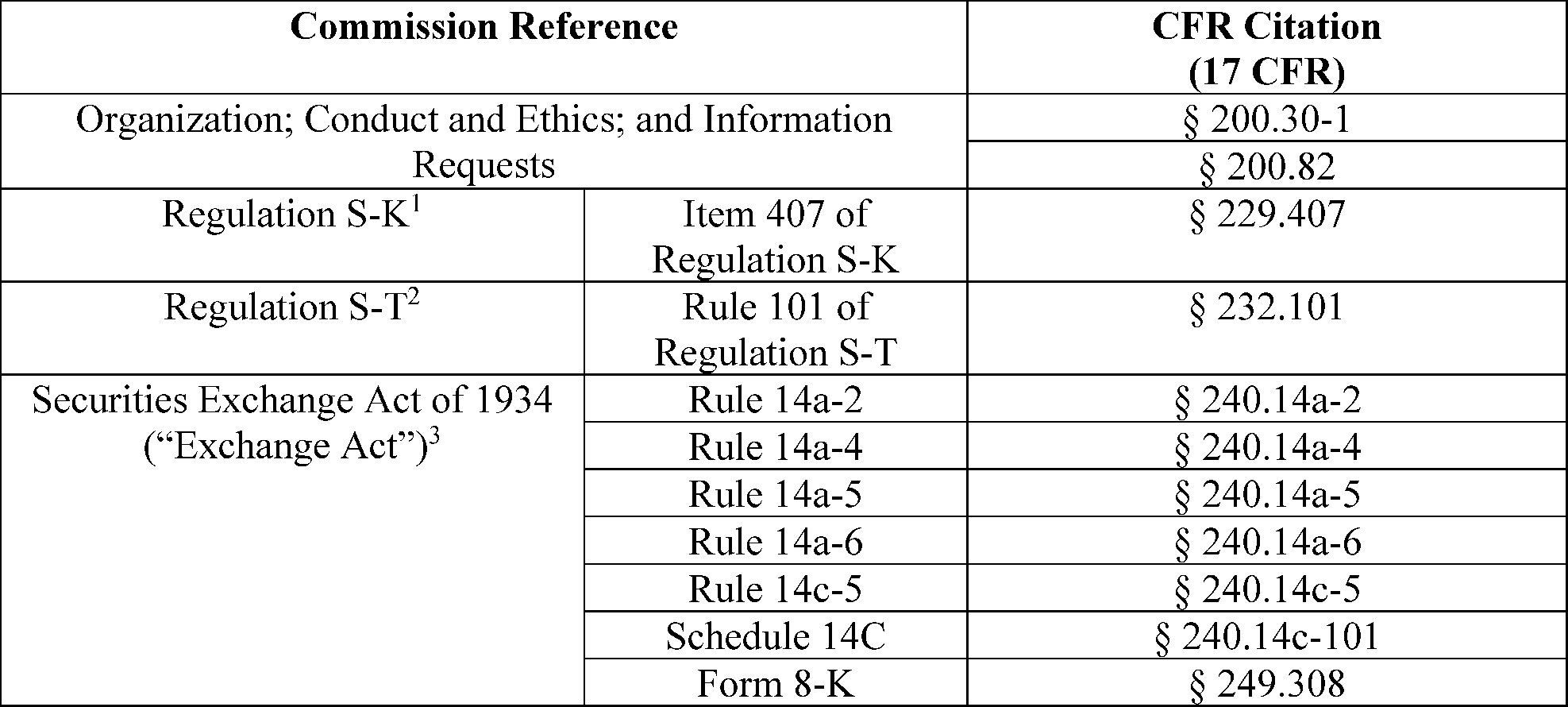
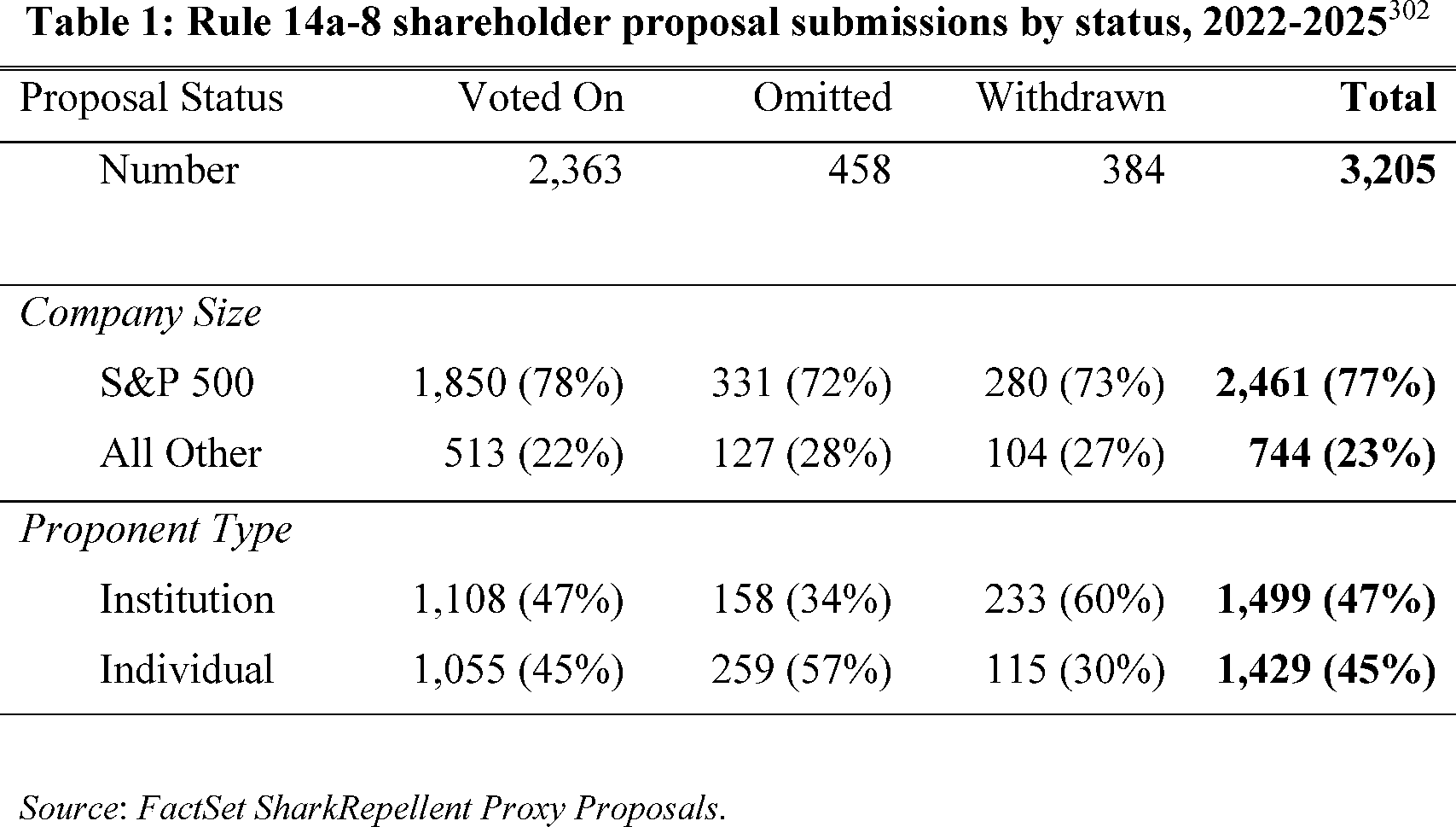
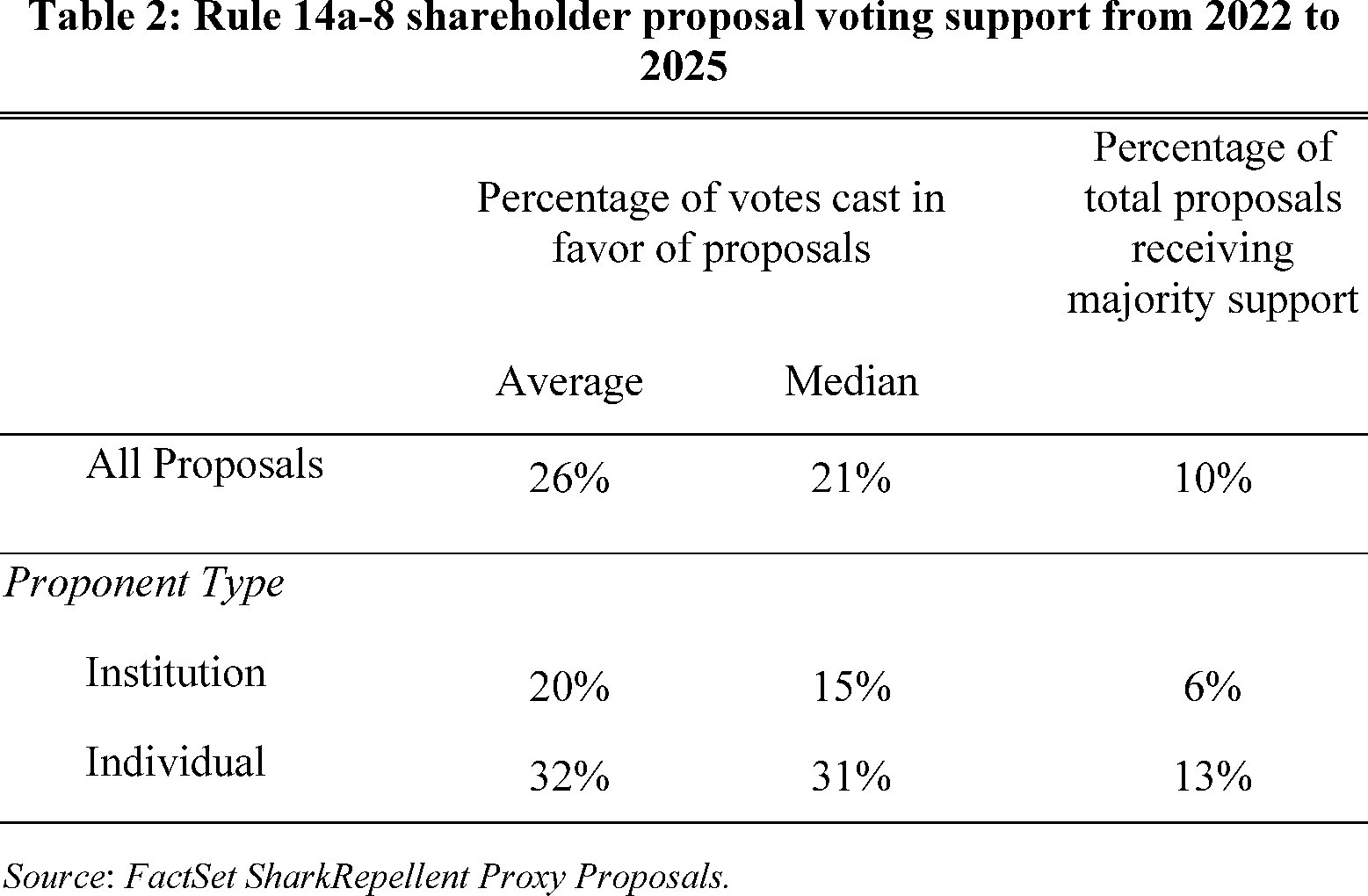
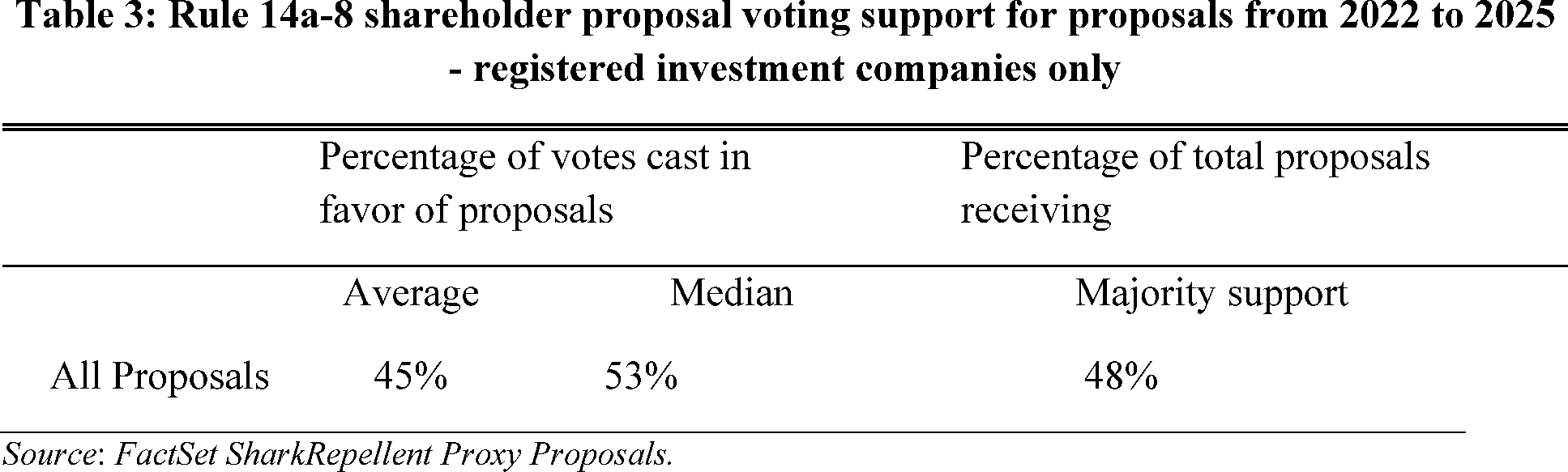
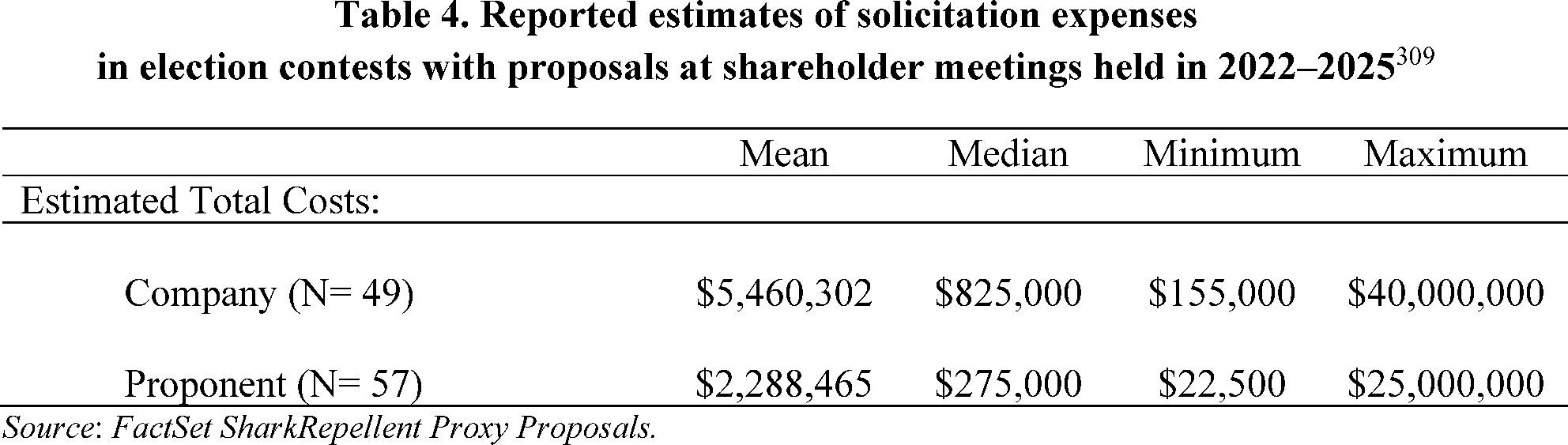
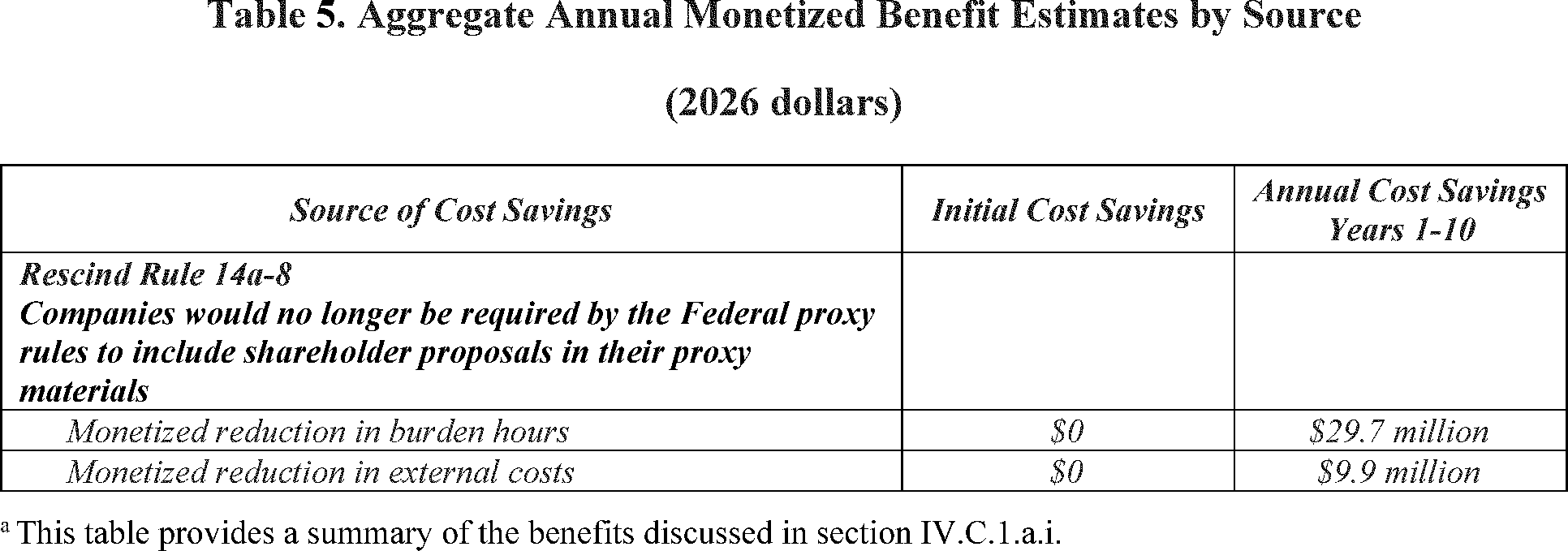
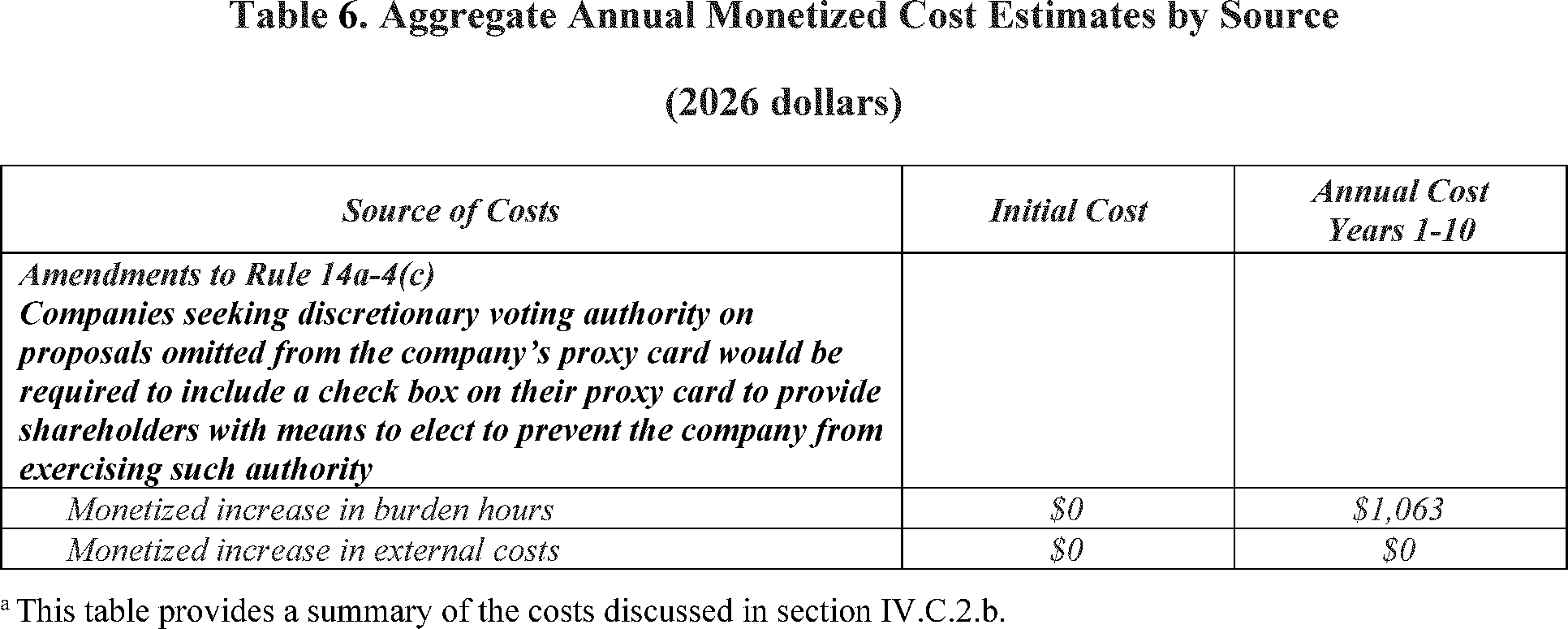
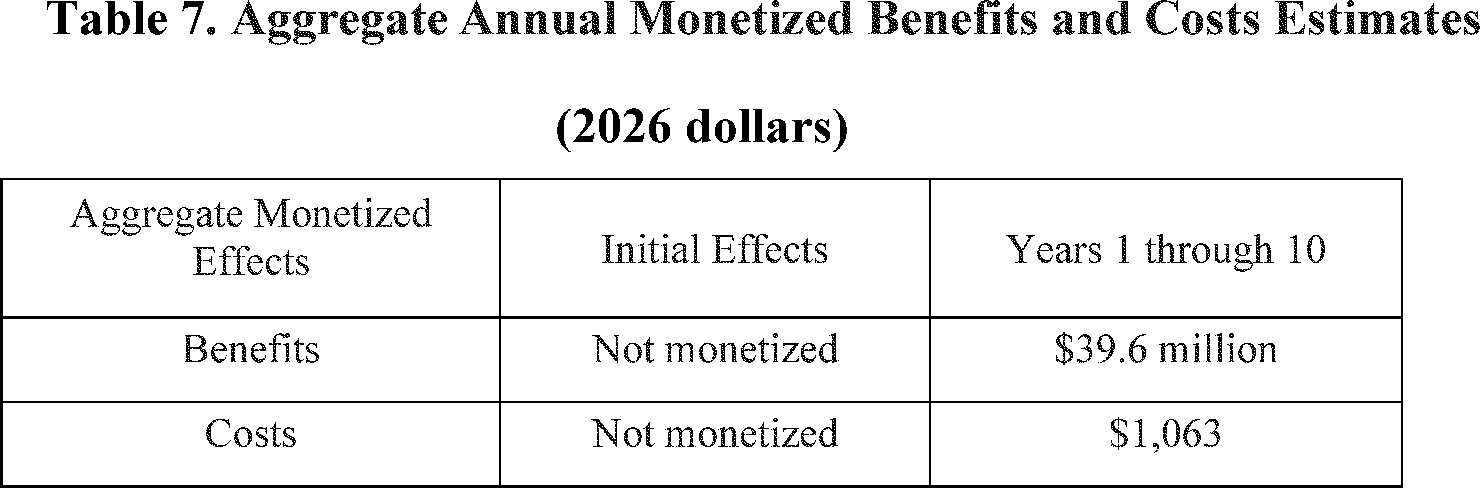
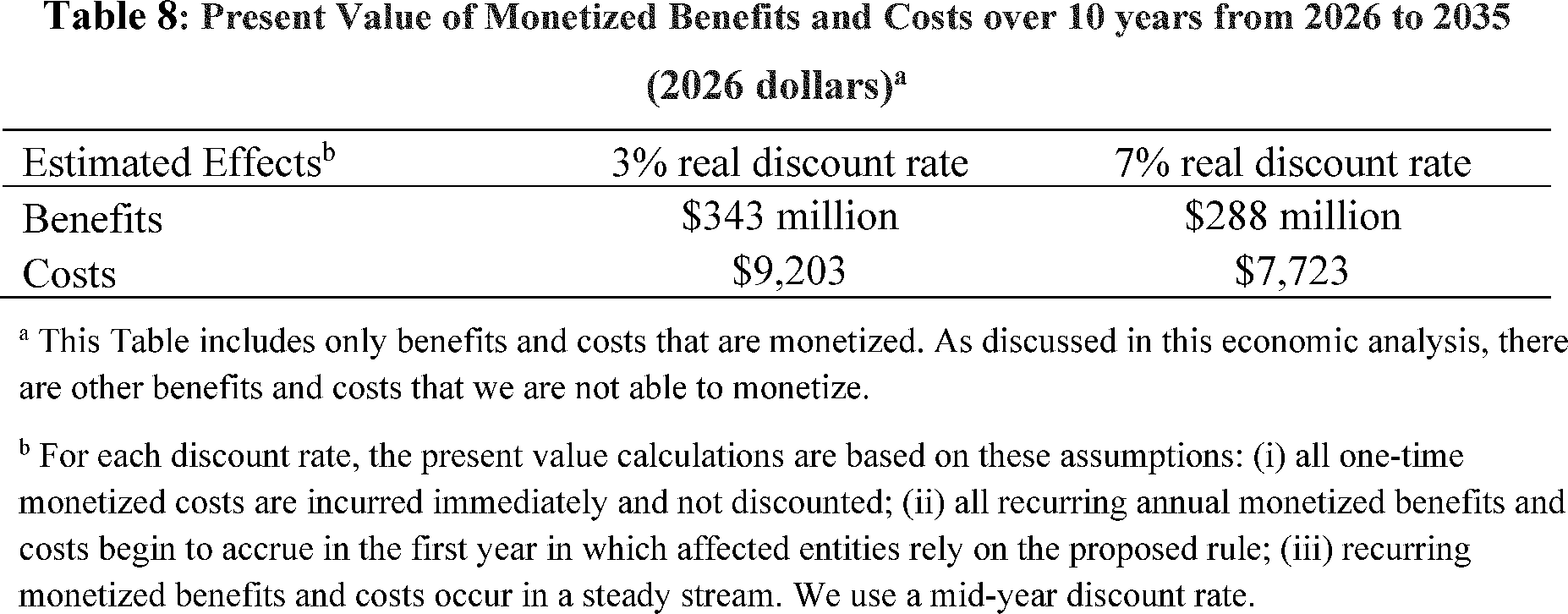
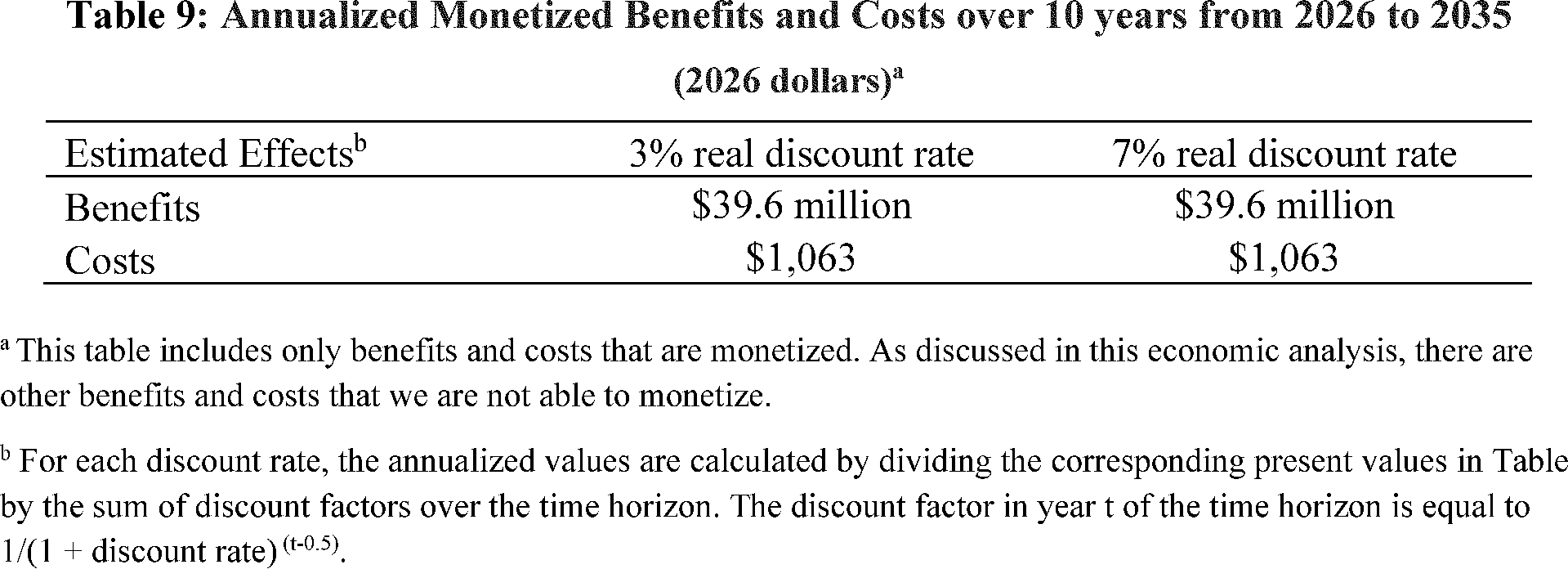
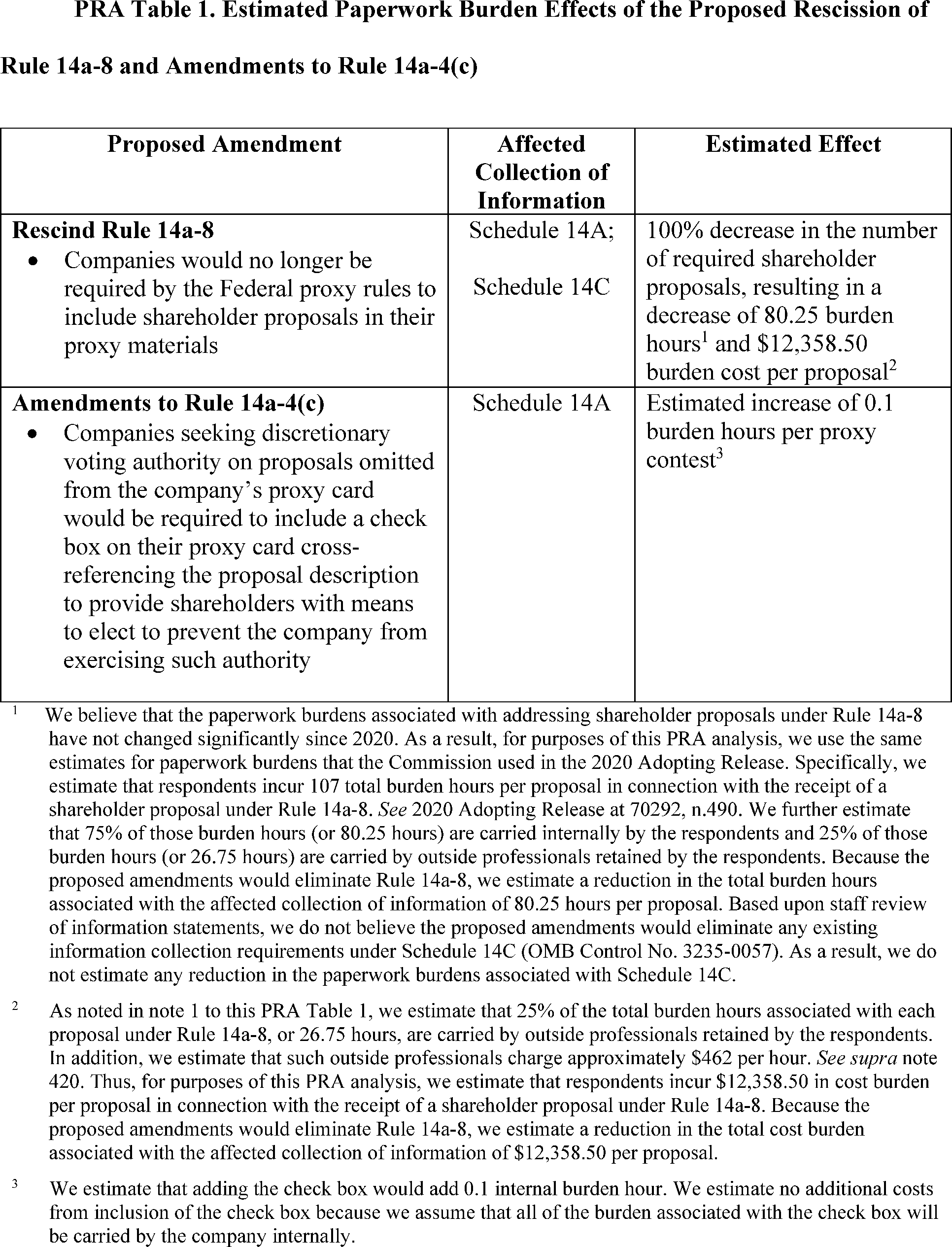
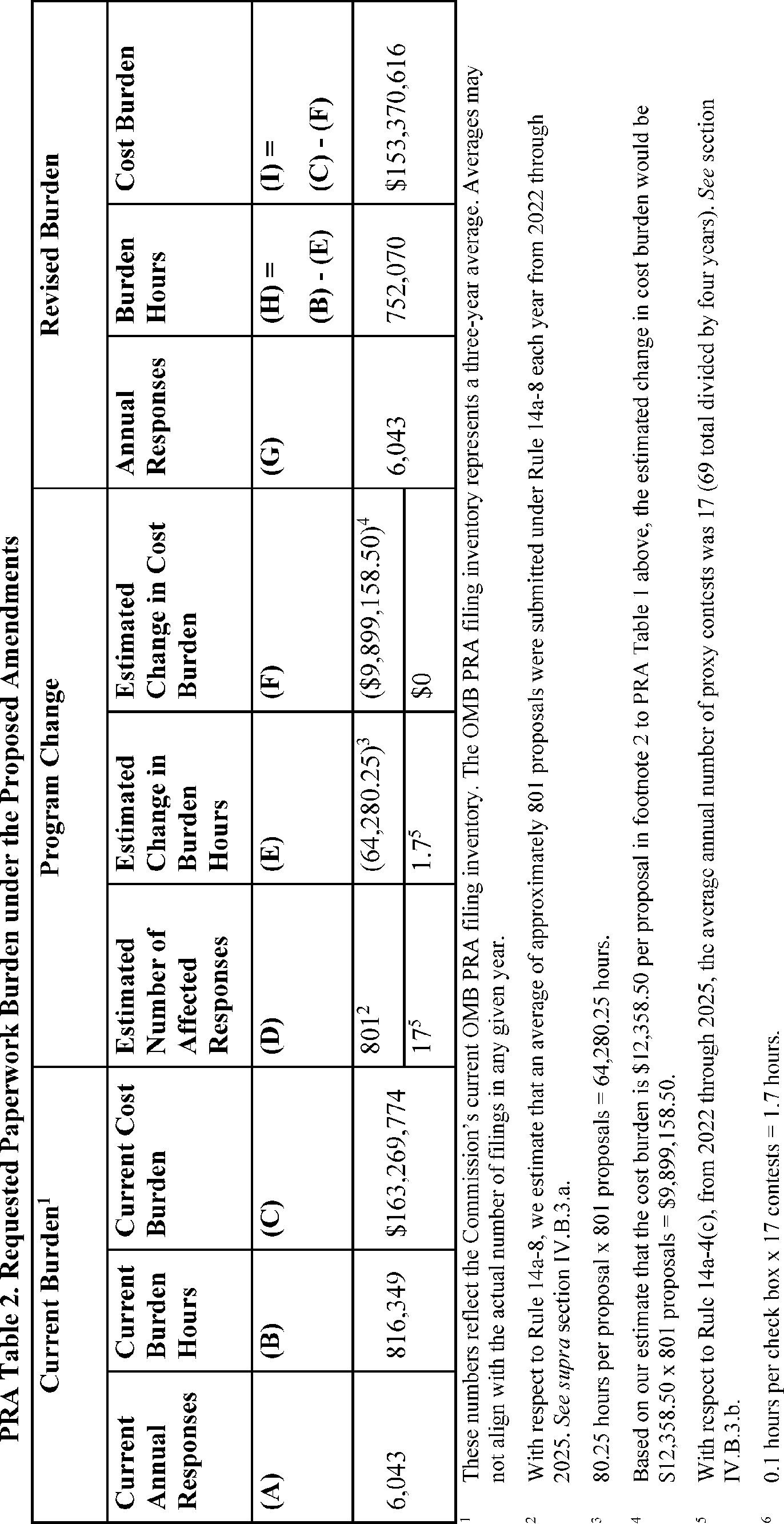
 44 U.S.C. 3506(c)(2)(B)
 corplaw.delaware.gov/facts-and-myths/
 corpgov.law.harvard.edu/2025/12/09/stockholder-proposals-law-and-policy-considerations/
 repository.law.umich.edu/mbelr/vol15/iss1/2
 www.americanbar.org/groups/business_law/resources/model-business-corporation-act/
 papers.ssrn.com/sol3/papers.cfm?abstract_id=6045474
 www.businessroundtable.org/the-need-for-bold-proxy-process-reforms
 perma.cc/NQ8C-NRRE
 www.repository.law.indiana.edu/ilj/vol98/iss3/6/
 www.broadridge.com/campaign/2025-proxy-season-key-stats-and-performance-ratings
 www.forbes.com/sites/donnafuscaldo/2019/02/19/say-gives-retail-investors-a-voice-and-tesla-listens/
 www.ft.com/content/0c8974ee-60bf-4edb-839c-bc24b8ecbc81
 www.reuters.com/markets/us/this-conservative-activist-is-no-fan-trumps-sec-2026-03-04/
 www.ecgi.global/sites/default/files/working_papers/documents/finalgantchevgiannetti_2.pdf
 www.journals.uchicago.edu/doi/epdf/10.1086/710828
 scholarship.law.nd.edu/cgi/viewcontent.cgi?article=1314&context=law_faculty_scholarship
 ssrn.com/abstract=3024873
 www.ici.org/system/files/2026-03/26-confronting-growing-burden-fund-proxy-campaigns.pdf
 www.thecorporatecounsel.net/blog/2026/05/another-proponent-uses-rule-14a-4-for-multiple-proposals.html
 www.federalreserve.gov/publications/files/scf23.pdf
 www.icifactbook.org/pdf/2026-factbook.pdf
 doi.org/10.1017/S0022109020000484
 digitalcommons.law.ou.edu/cgi/viewcontent.cgi?article=1311&context=olr
 governancebeat.cooley.com/brush-up-on-the-floor-proposal-process-before-your-annual-meeting/
 roberteccles.com/wp-content/uploads/2026/07/RBI-Rule-14a-8-in-Practice.pdf
 www.jstor.org/stable/1833044
 www.bls.gov/oes/
 www.census.gov/naics/reference_files_tools/2022_NAICS_Manual.pdf
 www.bea.gov/data/industries/gross-output-by-industry
 www.reginfo.gov/public/jsp/Utilities/circular-a-4_regulatory-impact-analysis-a-primer.pdf