Federal Reserve System
- 12 CFR Parts 225, 238, and 252
- [Regulations Y, LL, and YY; Docket No R-1873]
- RIN 7100-AH05
AGENCY:
Board of Governors of the Federal Reserve System (Board).
ACTION:
Final rule; amendments to policy statements.
SUMMARY:
The Board of Governors of the Federal Reserve System (Board) has adopted final amendments to Regulations Y, LL, and YY to enhance the transparency and public accountability of the Board's stress testing framework. The Board is also finalizing amendments to the Policy Statement on the Scenario Design Framework for Stress Testing and the Stress Testing Policy Statement. The Board is also announcing that it is finalizing models for the 2027 stress test and proposing for public input additional changes to the stress test models for the 2027 stress test. Finally, the Board is finalizing changes to the stress test data collection (FR Y-14A/Q/M).
DATES:
This final rule and policy statements are effective November 2, 2026.
FOR FURTHER INFORMATION CONTACT:
Doriana Ruffino, Associate Director (202) 452-5235, Hillel Kipnis, Assistant Director, (202) 452-2924, John Simone, Manager, (202) 245-4256, and Theo Pistner, Financial Institution and Policy Analyst III, (202) 941-1825, Division of Supervision and Regulation; William Bassett, Senior Associate Director, (202) 736-5644, Bora Durdu, Deputy Associate Director, (202) 452-3755, and Anni Isojaervi, Senior Economist, (202) 596-4054, Division of Financial Stability; Asad Kudiya, Associate General Counsel, (202) 360-6887, Julie Anthony, Senior Special Counsel, (202) 658-9400, Jonah Kind, Senior Counsel, (202) 452-2045, Brian Kesten, Senior Counsel (202) 843-4079, Tara Hofbauer, Senior Attorney (202) 680-2503, and Rye Salerno, Attorney (240) 374-7788, Legal Division. Board of Governors of the Federal Reserve System, 20th Street and Constitution Avenue NW, Washington, DC 20551. For users of TDD-TYY, please call 711 from any telephone, anywhere in the United States.
SUPPLEMENTARY INFORMATION:
Table of Contents
I. Introduction
A. Background on Stress Testing
B. Prior Supervisory Stress Disclosures and Policy Statements
C. Supervisory Stress Test Modeling Framework
D. Stress Test Models
E. Overview and Purpose of the Proposal
F. General Summary of Comments
G. Overview of the Final Rule and Final Policy Statements
H. Interactions With Other Proposals
II. Enhanced Disclosure Process
A. Annual Disclosure of Models
B. Model Changes
C. Material Model Changes
D. Annual Disclosure of Scenarios
E. Other Revisions to the Stress Testing and Capital Plan Rules
F. Stress Capital Buffer Requirement Reconsideration Process
III. Revisions to the Stress Testing Policy Statement
A. Supervisory Stress Test Results Disclosures
B. Other Revisions to the Stress Testing Policy Statement
IV. Revisions to the FR Y-14A/Q/M
A. FR Y-14 Supporting Documentation
B. Collection of Mailing Address Information
C. Private Equity
D. Hedges
E. Exchange Traded Funds
F. Credit Card Revenue and Loss Sharing Agreements
G. Stress Test Date Changes
H. Other FR Y-14 Revisions and Comments
V. Changes to the Stress Test Modeling Framework
A. Changes to Stress Test Models
B. Analysis of Final Model Changes
VI. Changes to the Scenario Design Policy Statement
A. Changes to the Background and Overview and Scope Sections
B. Changes to the Content of the Stress Test Scenarios Section
C. Approach for Formulating Macroeconomic Assumptions in the Baseline Scenario
D. Scenario Narrative, the Recession Approach, and Salient Risks
E. Changes to Construction of Certain Variables in the Severely Adverse Scenario
F. Scenario Design Principles Derived from Stress Testing Literature: Severity, Credibility, and Not Adding to Procyclicality
G. Description of Variable Guides in the Severely Adverse Scenario
H. Global Market Shock
VII. Economic Analysis
A. Baseline
B. Final Policy Changes
C. Analysis of Benefits and Costs of Enhanced Model Disclosure
D. Conclusion
VIII. Administrative Law Matters
A. Paperwork Reduction Act Analysis
B. Regulatory Flexibility Act Analysis
C. Plain Language
I. Introduction
In October 2025, the Board invited public comment on changes to the Board's stress testing framework and the comprehensive model documentation for the 2026 stress test, which included proposed changes to the models relative to the 2025 stress test.[1] The comprehensive model documentation is available at www.federalreserve.gov/supervisionreg/dfa-stress-tests-2026.htm. The Board also invited comment on the proposed scenarios for the 2026 stress test through a separate notice.[2] These proposals sought to improve the transparency and public accountability of the supervisory stress test, while retaining appropriate risk sensitivity and risk capture in the stress test, ensuring that the stress test remains an effective tool to understand and assess risk. The final rule, together with the finalization of the models for the 2027 stress test, advances these goals by adopting (1) incorporating public input into the final models for the 2027 stress test, and (2) disclosure and public input processes for the scenarios and models used in future stress tests.
 www.federalreserve.gov/supervisionreg/dfa-stress-tests-2026.htm
A. Background on Stress Testing
1. Stress Testing Framework
Congress enacted the Dodd-Frank Wall Street Reform and Consumer Protection Act (Dodd-Frank Act) in the wake of the 2007-09 financial crisis.[3] Section 165 of the Dodd-Frank Act, as amended by section 401 of the Economic Growth, Regulatory Relief, and Consumer Protection Act,[4] requires the Board to establish enhanced prudential standards for nonbank financial companies supervised by the Board and bank holding companies with $250 billion or more in total consolidated assets.[5] The purpose of ( printed page 62871) these enhanced prudential standards is to prevent or mitigate risks to the financial stability of the United States that could arise from the material financial distress or failure, or ongoing activities, of large, interconnected financial institutions.
Section 165(i)(1) of the Dodd-Frank Act requires the Board to conduct an annual supervisory stress test of nonbank financial companies supervised by the Board and bank holding companies with $250 billion or more in total consolidated assets to evaluate whether the firm has the capital, on a total consolidated basis, necessary to absorb losses as a result of adverse economic conditions.[6] Section 401(e) of the Economic Growth, Regulatory Relief, and Consumer Protection Act requires the Board to conduct periodic stress tests for bank holding companies with total consolidated assets between $100 billion and $250 billion.[7] Section 165(i)(1) of the Dodd-Frank Act requires the Board to publish a summary of the supervisory stress test results.[8] In 2012, the Board adopted a final rule implementing the stress test requirements established in the Dodd-Frank Act.[9]
The Dodd-Frank Act also requires bank holding companies with $250 billion or more in total consolidated assets, as well as nonbank financial companies supervised by the Board, to conduct company-run stress tests on a periodic basis.[10] Under the Board's rules, firms subject to Category I, II, or III standards must conduct company-run stress tests.[11] Company-run stress tests provide forward-looking information to supervisors to assist in their overall assessments of a firm's capital adequacy, help to better identify downside risks and the potential impact of adverse outcomes on the firm's capital adequacy, and assist in achieving the financial stability goals of the Dodd-Frank Act. Further, the company-run stress tests help improve firms' stress testing practices with respect to their own internal assessments of capital adequacy and overall capital planning.
Each June, the Board publishes the results of its annual supervisory stress test, including each firm's projected capital ratios, pre-tax net income, losses, revenues, and expenses, under hypothetical, severely adverse economic and financial conditions.[12] These disclosures provide the public with valuable information about each firm's financial condition and the ability of each firm to absorb losses considering a stressful economic environment. However, the supervisory stress test is not designed or intended to be predictive of future economic conditions.
Following the 2007-09 financial crisis, the Board also made changes to its capital rule to address weaknesses observed during the crisis.[13] These changes included the establishment of a minimum common equity tier 1 capital requirement and a fixed capital conservation buffer equal to 2.5 percent of risk-weighted assets.[14] Large firms also became subject to a countercyclical capital buffer requirement, and the largest and most systemically important firms—global systemically important bank holding companies, or GSIBs—became subject to an additional capital buffer based on a measure of their systemic risk, the GSIB surcharge.[15] In 2020, the Board adopted the stress capital buffer requirement for certain firms.[16] Because a firm's stress capital buffer requirement is informed by the firm's performance under the hypothetical economic conditions modeled by the supervisory stress test, each firm's stress capital buffer requirement is tailored to its risk profile.
Supervisory stress testing and stronger capital requirements have significantly improved the resilience of the U.S. banking system. Since 2009, the common equity capital ratios of firms subject to the test have more than doubled, with common equity capital of such firms increasing by over $1 trillion.[17] Greater transparency into the stress test and the calculation of the stress capital buffer requirement would allow firms to better understand the capital requirements associated with investment and expansion of different business lines and would facilitate more effective long-term capital planning. This, in turn, could enhance firms' ability to supply credit to households and businesses, ultimately supporting economic growth and financial stability.
B. Prior Supervisory Stress Disclosures and Policy Statements
In addition to the annual stress test results disclosure, the Board has historically published detailed descriptions and information about the supervisory stress test scenarios and models. This section provides an overview of the Board's disclosures and policy statements prior to the proposal.
1. Stress Test Scenarios
The Board's stress test rules have provided that the Board will notify firms, by no later than February 15 of each year, of the scenarios that the Board will apply to conduct its annual supervisory stress test and that firms must use to conduct their company-run stress tests.[18] The Board also has provided a narrative description of the scenarios no later than February 15 of each calendar year.[19]
In 2013, the Board increased the transparency of the scenarios by finalizing the Policy Statement on the ( printed page 62872) Scenario Design Framework for Stress Testing (Scenario Design Policy Statement), which articulated the Board's approach to scenario design for the supervisory and company-run stress tests, outlining the characteristics of the stress test scenarios, and explaining the considerations and procedures that underlie the formulation of these scenarios.[20] The Scenario Design Policy Statement also described the baseline and severely adverse scenarios, the Board's approach for developing these two macroeconomic scenarios, and the approach for developing any additional components of the stress test scenarios. The Scenario Design Policy Statement explained that the severely adverse scenario is designed to reflect conditions that have characterized post-war U.S. recessions (the recession approach). Historically, recessions have typically featured increases in the unemployment rate, contractions in aggregate incomes and economic activity, and declines in inflation and interest rates.
In the 2013 Scenario Design Policy Statement, the Board explained that, in light of the typical co-movement of measures of economic activity during economic downturns, such as the unemployment rate and gross domestic product, the Board would first specify a path for the unemployment rate and then develop paths for other measures of activity broadly consistent with the course of the unemployment rate in developing the severely adverse scenario. The 2013 Scenario Design Policy Statement also stated that economic variables included in the scenarios may change over time, and that the Board may augment the recession approach with certain salient risks, which would involve incorporating features that address aspects of the current economic or financial market environment that represent higher-than-normal risks to the condition of the banking system.
In 2019, the Board updated the Scenario Design Policy Statement, increasing the transparency and predictability of the scenarios. The updates allowed for a smaller-than-usual increase in unemployment if the stress test were to occur during an economic downturn, a change that would pass through to reduced severity of other key scenario variables due to the deference given to historical correlations. The 2019 update also introduced a formula with countercyclical features to guide the evolution of the ratio of housing prices to disposable income in the scenario, which provided more predictability in the way that the stress test would treat business lines affected by changes in house prices. However, the Board believes that the design of scenarios could be made more transparent and predictable through the use of additional guides for certain macroeconomic variables, and the disclosure of additional detailed information on the methodology used to create the global market shock component of the severely adverse scenario, as described below.
2. Trading and Counterparty Components
For a subset of firms, the severely adverse scenario also includes two additional components: the global market shock component and the largest counterparty default component.[21] The global market shock component is a group of hypothetical shocks to a large set of risk factors reflecting general market distress and heightened uncertainty that the Board may require certain firms to include in the severely adverse scenario.[22] The Board generally expects that firms with significant trading activity will consider the global market shock component as part of its severely adverse scenario and recognize associated losses in the first quarter of the projection horizon.[23] The global market shock component has been applied to asset positions held by the firms on a given as-of date.[24] In addition, for certain large and highly interconnected firms, the same global market shock component is generally applied to counterparty exposures under the largest counterparty default component.[25] The largest counterparty default component is intended to assess the potential losses and capital impact associated with the default of the largest counterparty of each applicable firm, and the as-of date aligns with that of the global market shock component.
The design and specification of the global market shock component differs from the design and specification of the severely adverse scenario in several respects. First, in alignment with U.S. generally accepted accounting principles (U.S. GAAP), profits and losses from trading and counterparty credit positions are measured in mark-to-market accounting terms in the global market shock, while revenues and losses from traditional banking activities, as generated under macroeconomic scenarios, are generally measured using the accrual accounting method. Second, the timing of loss recognition differs between the global market shock and the severely adverse macroeconomic scenario. The global market shock affects the mark-to-market value of trading positions and counterparty credit losses in the first quarter of the severely adverse scenario. This timing is based on an observation that market dislocations can happen rapidly and unpredictably at any time under stressed conditions. In addition, the severely adverse scenario has been applied as of December 31 of each year (the jump-off date), whereas the global market shock as-of date changes every year (within the window specified in the Board's stress test rules, as applicable) and does not necessarily coincide with the year-end. This timing is also based on a scenario assumption that market dislocations can happen rapidly and unpredictably at any time during the scenario horizon. Recognizing the global market shock in the first quarter helps ensure that potential losses from trading and counterparty exposures are incorporated into firms' capital ratios in each quarter of the severely adverse scenario.
( printed page 62873)3. Stress Test Models
Prior to 2019, the annual stress test results disclosure document contained an appendix describing the Board's supervisory stress test models.[26] In 2019, the Board increased the transparency of the supervisory stress test models by finalizing the Stress Testing Policy Statement [27] and the Enhanced Disclosure of the Models Used in the Federal Reserve's Supervisory Stress Test (Enhanced Model Disclosure).[28] The Stress Testing Policy Statement describes the Board's policies and procedures that guide the development, implementation, and validation of the models.[29] The Stress Testing Policy Statement also describes the Board's principles for stress test model design, namely that the system of models used in the supervisory stress test should result in projections that are (1) independent of firm projections; (2) forward-looking in that they project future losses and revenue; (3) consistent and comparable across firms; (4) generated from simple approaches, where appropriate; (5) robust and stable; (6) conservative; and (7) able to capture the effect of severe economic stress. The Board has developed stress test models in accordance with these principles, which are the foundation for the stress test modeling decisions described in the comprehensive documentation of the supervisory stress test models that the Board is publishing in conjunction with this proposal.
The Enhanced Model Disclosure supplemented prior public descriptions of the stress test models by providing some information about their structure and by including a list of key variables that influence the results of each model.[30]
C. Supervisory Stress Test Modeling Framework
The Board's stress test models take macroeconomic variables from the Board's severely adverse scenario and data from firms as inputs to produce each firm's projected capital ratios over a nine-quarter projection horizon (projection horizon). The minimum projected common equity tier 1 capital ratio is used to inform each firm's stress capital buffer requirement, which becomes part of a firm's capital conservation buffer.
The stress test models are intended to capture how a firm's regulatory capital would be affected by the macroeconomic and financial conditions described in the stress test scenarios, given the characteristics of the firm's business model and balance sheet composition. The Board uses a variety of statistical modeling techniques to produce the stress test results, including multivariate regression, which uses relationships in historical data to produce projections of a variable (such as a loss given default). These models are represented by a set of formulas and coefficients that produce the projections.
The Board estimates the effect of the severely adverse scenario on the regulatory capital ratios of firms by projecting revenues, expenses, and losses for each firm over the projection horizon. The projection horizon spans nine quarters to ensure that the firms can continue to provide credit and serve as financial intermediaries despite several quarters of adverse economic conditions, as well as to promote the forward-looking nature of capital planning by firms.
Projected net income, adjusted for the effect of taxes, is combined with assumptions regarding capital actions and other changes to regulatory capital to produce post-stress capital ratios. The Board's approach to modeling supervisory stress test results, including the calculation of post-stress capital ratios, is generally in alignment with U.S. GAAP and the regulatory capital framework.[31] However, the stress test models may deviate from U.S. GAAP and the regulatory capital framework, as circumstances warrant.
The Board established the Stress Testing Policy Statement modeling principles to ensure that the models are well suited for their purpose in the regulatory framework. In some cases, the Board's adherence to the principles limits modeling choices and results in certain common limitations across similarly constructed component models. For instance, consistent with the principles of independence, consistency and comparability, and simplicity, models are not designed to capture all firm-specific nuances, future strategic initiatives, or planned capital actions. Additionally, models may be limited by their reliance on historic relationships and by the nature of the data captured in firms' regulatory reports. Detailed assumptions and limitations for the models are discussed in the comprehensive documentation, which is available at www.federalreserve.gov/supervisionreg/dfa-stress-tests-2026.htm.
Under the Stress Testing Policy Statement, the Board's projections also assume that a firm's balance sheet remains unchanged throughout the projection horizon.[32] This assumption seeks to help ensure that a firm cannot “shrink to health” and that it remains sufficiently capitalized to accommodate credit demand in a severe downturn.
D. Stress Test Models
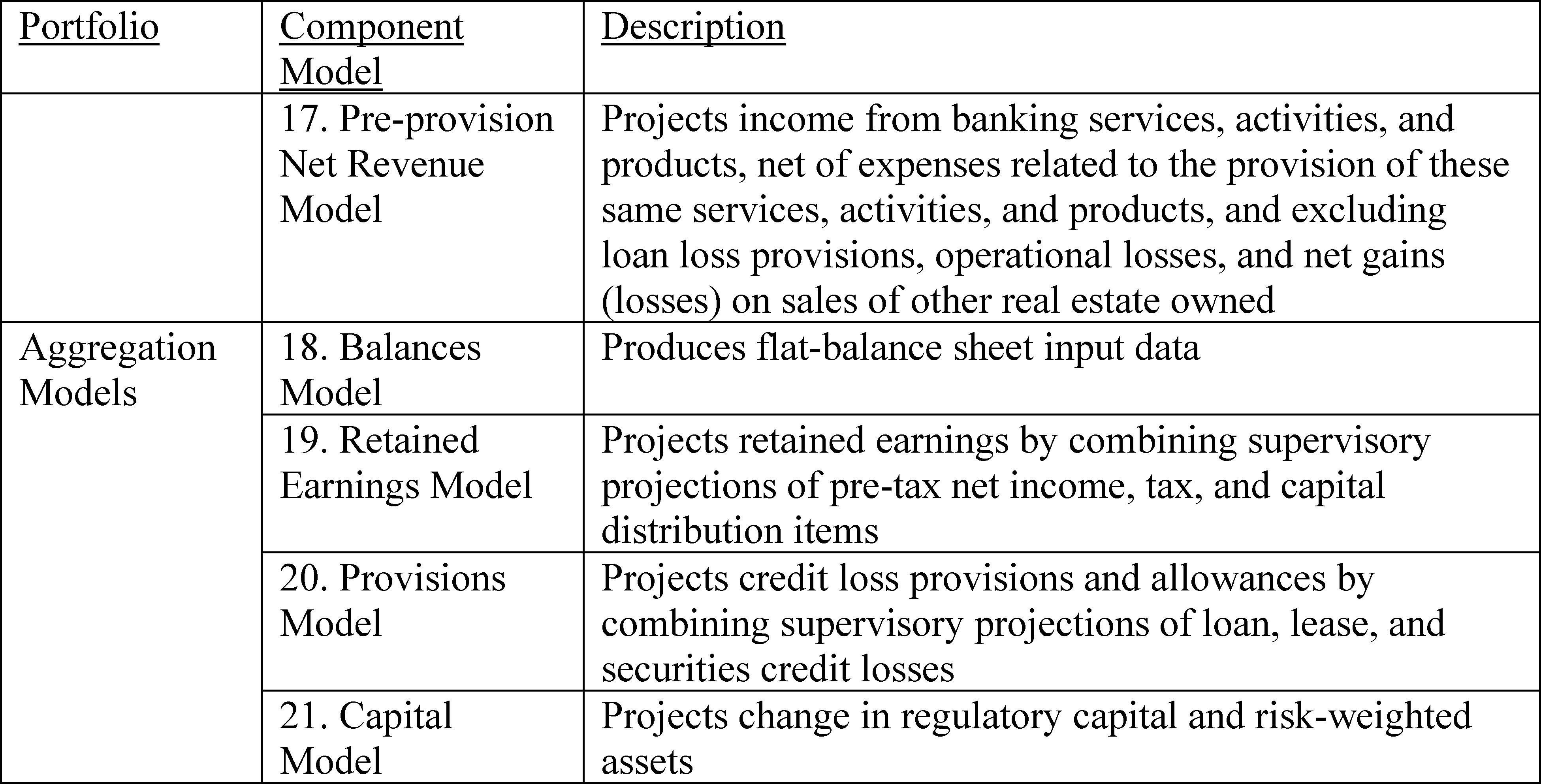
The Board's stress test models comprise twenty-one component models that, when aggregated, produce projected regulatory capital ratios for each firm (see Table 1 below). The models can be grouped into four categories: credit risk, market risk, net revenue, and aggregation. These models enable the Board to estimate the effect of the scenarios on the regulatory capital ratios of firms participating in the stress test by projecting net income and other components of regulatory capital for each firm over a nine-quarter projection horizon.
Credit risk models capture losses associated with retail and wholesale loans that are held at amortized cost. Market risk models capture losses associated with trading and counterparty exposures, securities, and other assets held at fair value. Net revenue models capture income and expenses, including those related to operational risk, earned or incurred by a firm. Positive pre-provision net revenue typically offsets credit and market risk losses in the calculation of a firm's pre-tax net income. Aggregation models calculate a firm's pre-tax net income, which is then adjusted for other elements such as taxes and regulatory capital deductions to arrive at the projection of a firm's regulatory capital, which is used to calculate a firm's projected capital ratios. Additional detail about these component models is included in the comprehensive model documentation available at www.federalreserve.gov/supervisionreg/dfa-stress-tests-2027.htm.[33]
( printed page 62874)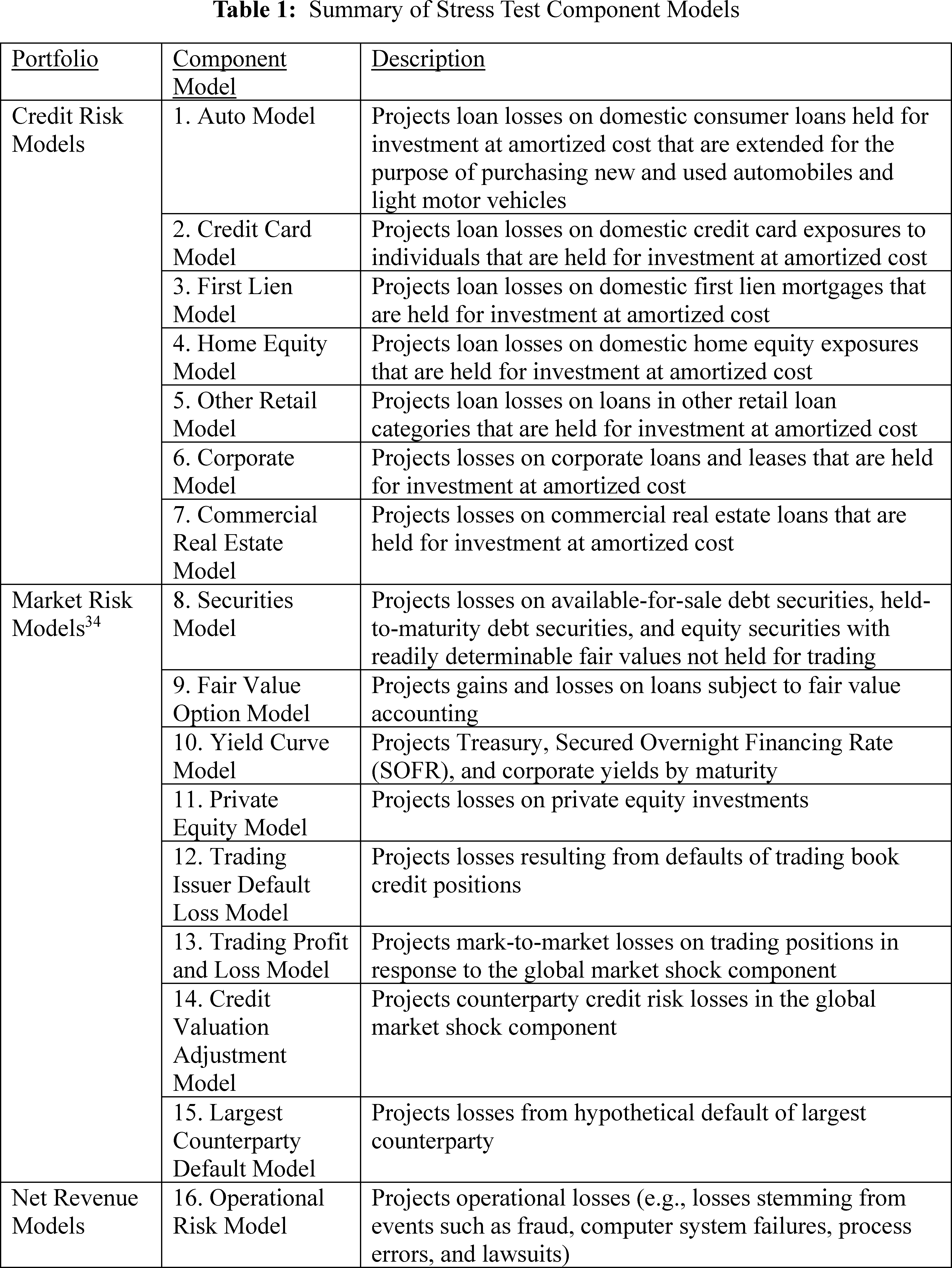
E. Overview and Purpose of the Proposal
This section summarizes the contents and purpose of the proposal.
1. Overview of the Proposal
The Board proposed to codify an enhanced disclosure process that would build on the previous efforts that the Board has made to increase the transparency and public accountability of the supervisory stress test. Under this enhanced disclosure process, the Board would annually publish comprehensive model documentation on the stress test models, invite public comment on any material changes that the Board seeks to make to those models, and annually publish the stress test scenarios for comment. The Board would have also committed to responding to substantive public comments on any material model changes before implementing such changes. The proposal would have revised the Stress Testing Policy Statement to align with this enhanced disclosure process, as well as to amend the Board's general policy related to disclosing additional information directly to a firm about that firm's supervisory stress test results. To accommodate the annual comment process on the scenarios, the proposal would have also shifted the jump-off date of the supervisory and company-run stress tests from December 31 to September 30.
Additionally, the proposal would have amended the Scenario Design Policy Statement in several ways. The Board would have included in the Scenario Design Policy Statement detailed descriptions of additional guides that are used to inform the Board's choice of the values of the scenario variables along their scenario paths. The guides were designed to balance the competing objectives of predictability and transparency with the severity and relevance of the macroeconomic and financial market scenarios. Most of the proposed guides also incorporated features similar to the range of options in the existing unemployment guide or the automatic adjustment of the house price path to current housing market conditions in the existing house price guide. This approach would have allowed the Board to continue to adjust the severity of those variables as necessary to avoid inducing greater procyclicality in the financial system and macroeconomy.
Similarly, the Board proposed to incorporate additional information into the Scenario Design Policy Statement about the framework used to create the global market shock component of the severely adverse scenario. This information included, but was not limited to, details on the logic underlying the severity of the shocks and a description of the processes used to generate the shock values. The Board also proposed to update the global market shock methodology to simplify the scenario and better align certain elements of the global market shock with the nature of an “instantaneous” shock. The proposal would have also revised the stress test rules to improve the risk capture of the supervisory stress test by widening the as-of date window for the global market shock.
The proposal also would have made changes to the FR Y-14A/Q/M reports to remove items and documentation requirements that would no longer be needed to conduct the supervisory stress test, as well as to collect additional data to improve risk capture.
The Board also published comprehensive documentation on the stress test models on the Board's website, which is available at www.federalreserve.gov/supervisionreg/dfa-stress-tests-2026.htm. This documentation contains information on the models that produce the results of the supervisory stress test, including the equations, variables, and coefficients used in each model (where applicable); assumptions and limitations of each model; rationales for modeling decisions; and discussions of alternative models. Section VI.A of this SUPPLEMENTARY INFORMATION summarizes changes to the models, relative to the 2025 stress test, that the Board plans to implement in the 2027 stress test cycle; Section VI.B of this SUPPLEMENTARY INFORMATION contains an analysis of the potential effects of these proposed model changes. Detailed documentation on these changes is also provided on the Board's website, at www.federalreserve.gov/supervisionreg/dfa-stress-tests-2027.htm. ( printed page 62876)
2. Purpose of the Proposal
The purpose of this proposal was to provide the public with more information about the stress test models and scenarios and to help ensure that the public has an opportunity to comment on the models and scenarios. While the Board has increased the transparency of the stress test models over time, disclosing additional information about the models and their underlying methodologies will further increase transparency and improve public accountability. At the same time, these changes were intended to improve the risk capture of the supervisory stress test and ensure the test's ability to capture changes in risks in the financial industry over time.
As described in the proposal, publishing detailed descriptions of the stress test models for comment, as well as committing to future enhanced disclosures, has benefits. First, the increase in transparency would increase public accountability and instill confidence in the fairness of the supervisory stress tests. Second, the disclosure process would create a new mechanism for obtaining feedback from the public, including academics, financial analysts, and firms, on the design and specifications of the models, which should lead to model improvements. Third, a firm would have a better sense of how its risk profile would factor into its stress test results and stress capital buffer requirement, which would reduce the likelihood of unanticipated stress test results and allow for better capital and business planning by firms. Finally, the public disclosure of additional information about supervisory stress tests should strengthen market discipline, because investors, counterparties, and rating agencies would be able to better assess a firm's risk profile.[35] The costs and benefits of publishing descriptions of the models and committing to future enhanced disclosures were described in Section X of the Supplementary Information in the proposal.
With respect to the proposed amendments to the Scenario Design Policy Statement, the proposal also built on the contents of the current Scenario Design Policy Statement and would have amended it to provide additional transparency, public accountability, and predictability in the variable paths. The changes would have supported the Board in developing scenarios, inviting comment on those scenarios, incorporating input from commenters, and maintaining the current schedule for release of the final scenarios. Despite the increased predictability in the scenarios, the proposed framework would have remained flexible enough to suitably assess whether firms could maintain an adequate amount of loss-absorbing capital to stay above minimum regulatory requirements and continue financial intermediation during periods of stress. Further, the proposed framework would have promoted the scenario design principle of avoiding adding procyclicality to the financial system. In practice, the scenarios resulting from the revised framework were expected to remain consistent with the current Scenario Design Policy Statement and should not have resulted, on average over a typical business cycle, in materially different scenarios than would have been designed previously.
Taken together, these changes were intended to improve transparency, public accountability, and predictability of the supervisory scenarios, while ensuring the supervisory stress test's ability to capture changes in risks in the financial industry over time.
F. General Summary of Comments
The Board received 30 comments on the proposal from banking organizations, trade associations, public interest groups, and private individuals.[36] Most commenters were supportive of the proposal's objective of enhancing the transparency and public accountability the stress test models and scenarios while also ensuring the supervisory stress test's ability to capture changes in the risks in the financial industry over time. However, some commenters objected to the increased transparency of the stress test, stating that it would undermine the effectiveness and dynamism of the test. Commenters provided a range of views on the proposed changes to the stress test rules, policy statements, and the scenarios and models.
With respect to the proposed changes to the Board's stress testing rules, including the annual calendar of stress test disclosures and results and capital planning submissions, the Board received comments that supported scenario disclosure only after the stress test jump-off date. However, some commenters suggested an alternative schedule that would accommodate the public comment period on scenarios and material model changes while retaining the December 31 jump-off date. One commenter recommended the inclusion of additional scenarios with more severe assumptions and also recommended that the Board introduce a qualitative objection process. Another commenter recommended that the Board adopt quantitative parameters that govern scenario and shock design. Commenters also provided input on the applicability of the global market shock component and the dividend add-on to different categories of firms. Some commenters also recommended that all model changes be published for public input, not just material model changes.
Commenters provided general support and input on the proposed changes to the Stress Test Policy Statement and Scenario Design Policy Statement. Commenters also provided input on the proposed modifications to the FR Y-14A/Q/M reports, while suggesting additional changes to the reporting forms that would enhance the granularity of certain stress test models or reduce regulatory burden.
( printed page 62877)With respect to the proposed models for the 2026 stress test, commenters provided a mix of comments that expressed general support for the proposed models, as well as suggestions for additional changes, including many conceptual and technical adjustments. In general, many commenters recommended increasing the complexity and granularity of the models to better reflect differences across the firms subject to the stress test. For instance, some commenters suggested significant changes to the pre-provision net revenue (PPNR) models related to noninterest income and noninterest expense. Several of these commenters also recommended the Board adjust its modeling approach to better reflect risk mitigants on firms' balance sheets in stress test results, such as through broader consideration of hedging instruments in the stress test models. Several commenters also suggested implementation of additional stress test components that would capture risks related to digital assets or climate events.
Finally, commenters also provided input on other proposals and their interaction with this one, such as the Board's Volatility Proposal and the Board's recent capital proposals.[37] To the extent those comments were relevant to this proposal, they are addressed in the Supplementary Information below.
G. Overview of the Final Rule and Final Policy Statements
The Board is finalizing the rule and the policy statements largely as proposed, but with several modifications. These revisions would further improve the transparency and public accountability of the stress test, while maintaining the dynamism and risk sensitivity of the stress test framework.
1. Key Changes in Response to Comments
In considering the comments provided by the public and the purposes of the proposal, the Board determined to make several key changes to the final rule relative to the proposal.
Stress Testing Calendar
The Board proposed to revise several dates in the annual stress test cycle and sought feedback on revising other dates to comport with any final changes to cycle deadlines. For the final rule, the Board determined to revise several dates that are set out in the stress test rule and policy statements. The Board proposed to move the annual jump-off date to September 30 from December 31 to accommodate a public input period without requiring any accompanying changes to the rest of the stress test calendar. However, the Board is finalizing this rule without changing the current stress test jump-off date given concerns from commenters about operational burden and data integrity related to existing year-end processes. Retaining the December 31 jump-off date requires several adjustments to the annual cycle to enable public input on stress test scenarios, as described below.
With respect to model disclosure, the Board did not propose a single date by which the Board would publish material model changes for comment. However, the Board is finalizing August 31 of the year prior to the stress test as the date by which the Board will publish any such proposed changes for public input. This date will ensure that the Board can meaningfully engage with public comments before implementing material model changes.
With respect to scenario disclosure, the Board proposed to disclose scenarios for public input on October 15 of the year prior to the stress test, but it will adopt January 10 of the year of the stress test in this final rule so that the scenarios are proposed after the jump-off date. Disclosing proposed scenarios after the jump-off date prevents firms from adjusting their exposures based on the published scenario information. In addition, to ensure that a firm subject to Category IV standards must decide whether to participate in the stress test in an odd-numbered year prior to the disclosure of the proposed scenarios, the final rule would move the date by which these firms must make that determination from January 15 to January 5.[38] Next, the Board proposed a public input period of at least 30 days for proposed scenarios, and it has retained this proposed public input period in this final rule to ensure the public has time to consider the proposed scenarios and provide input, as appropriate. Relatedly, the Board proposed to retain the February 15 date to publish final scenarios, but it is revising this date to February 28 to ensure that the Board has sufficient time to consider public input prior to finalizing the scenarios.
The Board also did not propose changes to the capital plan submission deadline or to the date by which firms subject to Category I-III standards must conduct company-run stress tests, but it is adopting April 30 as the deadline for both of these requirements under the final rule to ensure firms have sufficient time to submit capital plans and conduct company-run stress tests following the publication of the final scenarios.
The Board did not propose changes to the 15 calendar day timeframe in which a firm can request reconsideration of its stress capital buffer requirement. However, to provide firms with more time to consider whether to request reconsideration, the Board is revising this timeframe to 15 business days. The Board also did not propose revising the date by which it must disclose final stress capital buffer requirements, which is currently August 31. However, the final rule moves this date to September 30 to better ensure that the Board can adequately assess reconsideration requests before disclosing final stress capital buffer requirements.
Finally, as part of a separate final rule associated with the Volatility Proposal, the Board is moving the effective date of firms' stress capital buffer requirement from October 1 to January 1 to allow firms more time to comply with their new requirement. While not discussed in this final rule, this effective date change is included in Table 2 for completeness.
( printed page 62878)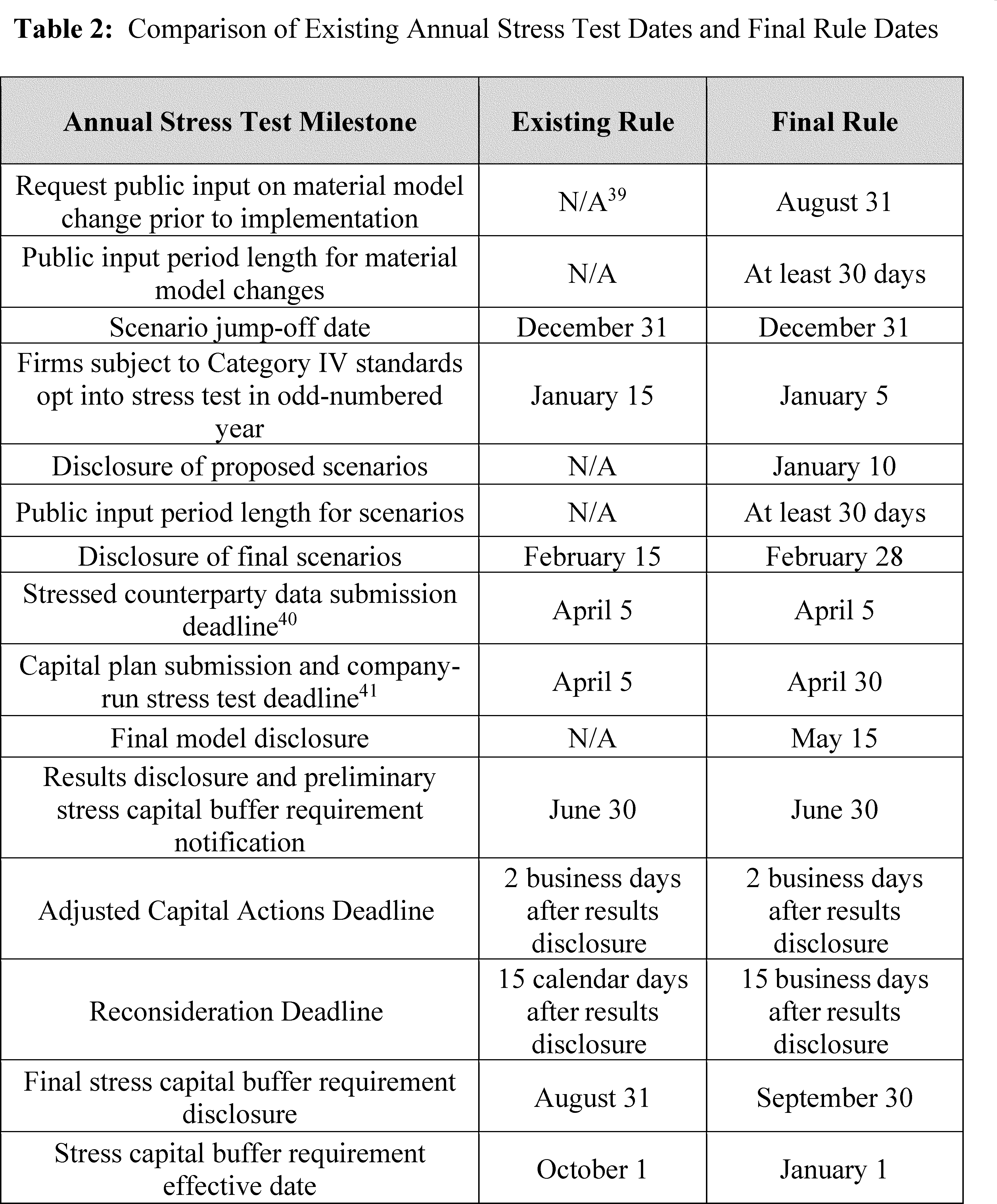
Material Model Changes
The Board also proposed to introduce a material model change definition, which would have required the Board to publish for public input prior to implementation certain model changes that could have, in the Board's estimation, an impact on the post-stress common equity tier 1 capital ratio of any firm, or on the average post-stress common equity tier 1 capital ratios of all firms required to participate in the upcoming stress test cycle, based on the prior year's severely adverse scenario and prior year's input data, equal to (i) a change of 20 basis points or more in the projected common equity tier 1 ratio of any firm participating in the upcoming stress test cycle; or (ii) a change of 10 basis points or more in the average of the absolute value of each firm's change in projected common equity tier 1 ratio. In the final rule, the Board is revising this proposed definition so that the criteria to determine whether a model change would be published for public input ( printed page 62879) prior to implementation is based on the post-stress common equity tier 1 capital ratio of each of the firms subject to the supervisory stress test, as described below in Section II.C of this Supplementary Information . As a result, the Board will consider a model change's impact on all firms that have at least $100 billion in total consolidated assets, and which have completed transition arrangements and continue to be subject to the stress test, regardless of whether those firms are actually required to participate in the upcoming stress test cycle. More specifically, this revision would ensure that the potential capital impact on all such firms is considered when determining whether a model change would be material.
Other Changes
Additionally, the Board is finalizing the proposed changes to the FR Y-14A/Q/M forms with some additional changes. To reduce reporting burden, the final rule would remove items, schedules, and supporting documentation requirements that are no longer needed to conduct the supervisory stress test, largely as proposed. The final rule would also add a limited number of items to enable implementation of the models for the 2027 stress test, as well as to allow for potential future model enhancements.
Finally, the Board is also making additional changes to the global market shock component of the severely adverse scenario, which is set out in the final rule for company-run stress tests and the Scenario Design Policy Statement. These changes concern the date range in which the global market shock as-of date must occur and the number of global market shock scenarios for a given stress test, both of which improve the risk capture of the global market shock component. The Board proposed to revise the date selection range of the GMS as-of date to be a full year, between October 1 of two years prior to a given stress test cycle to October 1 of the year prior to a given stress test cycle. The final rule adopts a date selection range of nine months, between April 1 and December 31 of the year prior to the stress test. This nine-month range would allow the Board to consider a wider array of market conditions for the as-of date of the global market shock component than is possible using the current range of five months. Additionally, the revised Scenario Design Policy Statement will explain that the Board expects to establish two different GMS scenarios on a single date for a given annual stress test, which would differ from the current approach of having one GMS scenario on a single date.
The Board is also finalizing the Board's Stress Testing Policy Statement and Scenario Design Policy Statement largely as proposed, but with several modifications. With respect to the Stress Testing Policy Statement, the Board is amending this policy statement to affirm its expectation to continue providing the enhanced firm and public disclosure processes described in this notice. With respect to the Scenario Design Policy Statement, the Board is finalizing the proposal's substantive and technical changes to the policy statement that provide additional transparency into the Board's scenario design process, with several technical adjustments relative to the proposal.
2. Purpose of the Final Rule and the Final Policy Statements
As stated above, the purpose of the proposal was generally to increase transparency and public accountability while improving the risk capture of the supervisory stress test and ensuring the test's ability to capture changes in risks in the financial industry over time.
The Board received a range of comments on the purposes of the proposed rule, which the Board considered in evaluating policy options for this final rulemaking.
Many commenters supported the Board's actions to increase the transparency of the stress test, stating that improved transparency would support the predictability of the stress test. Increased predictability would improve capital allocation and planning at firms subject to the stress test. One commenter also stated that predictable stress tests would improve market discipline, as investors, counterparties, and analysts would be better able to understand stress test results, while also improving the public's confidence in the stress test.
Commenters that supported the purposes of the proposal specifically highlighted the proposed public input processes for stress test scenarios and models. Commenters suggested that the public input process would improve model quality by enabling public input in identifying weaknesses or challenging assumptions in the models. One commenter stated that the increased transparency would lower risk in the financial system by improving the risk capture of the stress test models.
Commenters also suggested that the proposal would, if finalized, reduce the volatility of stress capital buffer requirements. According to these commenters, reducing the volatility of the stress test would support effective capital planning and the deployment of capital and liquidity into the broader economy, which would improve the availability and cost of credit for businesses and households because firms would be able to better anticipate volatility in stress capital buffer requirements.
Other commenters opposed the proposal and its purpose to increase the transparency of the stress test. Some commenters stated that the proposal would increase the predictability of the stress test, which would reduce the dynamism of the stress test and limit its ability to capture salient and unseen or under-appreciated risks by making the annual test more repetitive. These commenters generally expressed concern that model and scenario disclosure would enable or incentivize firms to limit their stress test losses by adjusting their balance sheets. These commenters argued that firms would be able to optimize their balance sheets for the stress test, which would enable them to lower their stress capital buffer requirements without necessarily reducing the riskiness of their portfolios. Some commenters expressed concern that model disclosure would lead to “model monoculture,” whereby firms adjust their internal models to adopt the Board's stress test models and miss specific risks that would be relevant to a given firm or set of firms. However, another commenter argued that concerns about “model monoculture” and balance sheet optimization are misplaced, and that supervisory attention and firm incentives eliminate any realistic possibility of balance sheet optimization based on the disclosed models.
Commenters also provided feedback on the Board's retained discretion in model and scenario design, and they suggested that the Board take steps to prevent model arbitrage and balance sheet optimization, and to continuously evaluate the impacts of the transparency introduced by the proposal, including through publication of model and scenario specifications prior to the stress test jump-off date. One commenter offered suggestions for adjusting the global market shock component so that it incorporates two shock scenarios in order to mitigate these risks. Commenters also suggested that the Board provide additional explanation of how it would balance the transparency of the proposal with the integrity of the stress test, or how the Board would exercise its discretion with respect to certain modeling decisions, such as modeling changes that would occur after the publication of the model ( printed page 62880) documentation. Some commenters also suggested that the Board retain the confidentiality of some information related to the models and scenario specifications and rationales, or that the Board publish this information on a delayed basis, to mitigate the risk that firms tailor portfolios to the stress test models rather than underlying risks.
After considering input from the public, the Board remains committed to the proposal's goals of increasing transparency and public accountability while improving the risk capture of the supervisory stress test and supporting the broader goals of the stress test program. The Board expects that, under the final rule, the stress test models and scenarios will remain robust and effectively able to capture risks to the financial system. As described in the proposal, seeking public input on the scenarios and models has several benefits, including increased public accountability and confidence in the fairness of the stress test, improved scenarios and models that incorporate public feedback, improved capital planning due to the reduced likelihood of unanticipated stress test results, and stronger market discipline, as the public will be able to better assess a firm's risk profile. Together with enhancements to the Board's models and scenario design framework, and the Volatility final rule, the Board expects this final action will improve the transparency and public accountability of the stress test, while enabling the Board to continue to meet the goals of the stress test.
The Board's response to comments on specific aspects of the proposal, as well as its rationale for the final rule and policy statements, are described below.
H. Interactions With Other Proposals
The Board has published other policy actions for public comment and received input on those proposals, including the Volatility Proposal and the 2026 Capital Proposals. Some commenters on those proposals also provided comments on the enhanced transparency and public accountability of the stress test proposal, including with respect to interactions between these proposals. For example, some commenters suggested that the Board should consider overlaps between the risks captured by the Board's stress test models and the 2026 Capital Proposals, and that the Board should develop an implementation timeline that considers effective dates of each proposal. The Board addressed comments on the Volatility Proposal in the final action described in a separate Federal Register notice. The Board has addressed comments on this enhanced transparency and public accountability of the stress test proposal in this notice, and will address comments on the 2026 Capital Proposals in any final action on those proposals.
II. Enhanced Disclosure Process
Under the proposal, the Board would have codified an enhanced disclosure process. As part of this process, the Board would annually publish comprehensive documentation on the stress test models, invite public input on any material changes that the Board seeks to make to those models, and annually publish the stress test scenarios for comment. The Board is finalizing this aspect of the proposal, with several enhancements and adjustments.
A. Annual Disclosure of Models
Under the proposal, the Board would have annually published the models used to conduct the supervisory stress test. The form of this disclosure would be similar to the comprehensive documentation on the stress test models that was published with the proposal at www.federalreserve.gov/supervisionreg/dfa-stress-tests-2026.htm. The Board would have been required to disclose its models by May 15 of the year in which the stress test is performed, and the models described in the documentation would be used to produce the stress test results disclosed by the Board by June 30 of that year. In addition, the Board would seek public input, and respond to such substantive public input, on any material changes to the models before implementing those changes in a stress test. Material model changes are discussed in more detail in Section II.C of this Supplementary Information . To implement this enhanced disclosure process, the Board proposed to revise Regulations YY and LL, as well as the Stress Testing Policy Statement.
The Board received many comments on the proposal to annually disclose the models used in the stress test as well as the date of disclosure. Commenters provided a range of feedback on the Board's approach to model disclosure. As described above in Section I.G of this Supplementary Information , many commenters supported the Board's actions to increase the transparency of the stress test, stating that improved transparency would support the predictability of the stress test for firms subject to the stress test, which would improve capital allocation and planning.
Conversely, some commenters opposed the enhanced model disclosures described in the proposal, stating that these disclosures would increase the predictability of the stress test, reduce the dynamism of the stress test, and limit its ability to capture salient and unseen or under-appreciated risks by making the annual test more repetitive. These commenters expressed concerns that these disclosures would enable firms to adjust their balance sheets to reduce their stress capital buffer requirements without necessarily reducing actual risks. These commenters also expressed concern that model disclosure would lead to “model monoculture,” whereby firms adjust their internal models to adopt the Board's stress test models and miss specific risks that would be relevant to a given firm or set of firms. One of these commenters further stated that while disclosure of the conceptual bases for the models would be appropriate, certain operational details may need to be held as confidential to avoid creating incentives for firms to tailor their exposures to the stress test models rather than the firm's assessment of risk. Another commenter recommended that the Board also disclose other model details, such as validation information, to better facilitate public comment. One commenter suggested that the Board align its disclosure practices with international peers and establish a review mechanism where independent experts would periodically evaluate the Board's stress test methodologies.
With respect to the May 15 model disclosure date, one commenter stated that the Board should publish the final model documentation prior to the capital plan submission date, which was set as April 5 of each year under the current stress testing rules.[42] This commenter stated that it would be important for firms to understand the models used in the stress test prior to submitting their capital plans, and that the Board's approach would not comply with the Board's legal obligations under the Administrative Procedure Act and the Due Process Clause of the U.S. Constitution.
One commenter stated that establishing a set timeline for model disclosure could leave models outdated as financial markets and risk profiles can change rapidly. This commenter suggested that the Board adopt a mechanism for expedited procedures for urgent model updates that respond to threats to financial stability. This commenter also expressed concern that the annual stress test cycle would be compressed further by incorporating ( printed page 62881) public input on the models, which could limit the Board's ability to incorporate feedback without disrupting the annual stress test cycle.
The Board is adopting this aspect of the proposal, with one change to enable disclosure of necessary additional adjustments to models that may occur after May 15.
As described above in Section I.G of this Supplementary Information , the Board is committed to enhancing the transparency and public accountability of the stress test, including through disclosure of the models the Board uses in the annual stress test. The Board has considered the risks identified by commenters in disclosing the Board's stress test models and has implemented several mitigating measures in this final action, as described throughout this Supplementary Information , and also retained certain mitigating measures, such as the Model Validation Council, which is a council of external academic experts that provides independent advice on the Board's process to assess models used in the supervisory stress test and is described in the Stress Testing Policy Statement.[43]
The Board considered comments about milestones in the broader stress test cycle, discussed throughout this Supplementary Information , and determined that a May 15 disclosure date would best balance the public's interest in timely disclosure with the operational demands of the stress test cycle, particularly in implementing an additional public input process into the annual cycle. Disclosure of stress test models before May 15 would not allow the Board to adequately develop, propose, and evaluate public input on changes to the stress test models for use in that year's stress test, or to update model parameters based on recent data submissions. Further, material model changes will be disclosed for public input well in advance of May 15 each year, providing firms and the public with a reasonable sense of the impacts to results of any such adjustments to the Board's models.
Additionally, in a change from the proposal and in consideration of comments received, the Board is adopting a process by which the Board could make non-material, technical changes after the final models have been disclosed, including after May 15. Such adjustments would be limited to fixing clear errors, making technical changes, and addressing circumstances where the Board determines that a change in the models is necessary to accurately determine firms' stress test losses. These types of post May 15 changes and disclosures would ensure that the Board can correct identified errors in the stress test models or documentation and would ensure the effective administration of the stress test before stress test results are finalized. These changes would be published so that the public could understand the changes and firms could understand their results. In this situation, the Board would publish a description of the model updates no later than June 30.
Additionally, the Board considered whether it could be appropriate to retain the confidentiality of certain aspects of the Board's models at this time or in the future. The Board has provided detailed descriptions of its stress test models and has not determined to implement a mechanism that would establish that certain aspects of the Board's models would remain confidential. However, the Board has not disclosed some information related to the models, such as the firm-specific fixed effects and third party vendor information. The Board does not view publishing this information as necessary to meet the goals of this final rule. However, the Board is committed to the transparency of the stress test, and will continue to consider any appropriate disclosure enhancements in the future.
B. Model Changes
The proposed rule would have defined a “model change” to mean “the introduction of a new model or a conceptual change to an existing model.” The Board's proposed definition of “model change” is an important component of the Board's proposed definition of “material model changes,” which is discussed in greater detail in Section II.C. of this Supplementary Information . As explained in the proposal, the Board would publish “material model changes” for public input prior to implementing those changes in the supervisory stress test. To balance the benefit of public feedback with the operational and resource costs of seeking such feedback and to allow the Board to ensure reasonable results, the Board would not formally invite public comment on model adjustments or updates that are not new models or conceptual changes to existing models before implementing them in the stress test; however, the Board would welcome public feedback on these and all other aspects of the stress test models once they are published.
Some commenters suggested that all changes to the models should be published for comment before they are implemented, with one commenter suggesting they be published by August 31 for a 60-day comment period. One commenter said that the Board's definition of “model change” is unduly narrow and argued that the Board should revise the definition to capture any change to the modeling process that affects results, including changes to methodology, removal of firm data, re-estimation of model parameters, or changes to the scope of a model's use.[44] As described below in Section II.C of this Supplementary Information , the Board also considered comments that stated the Board's approach would violate the Administrative Procedure Act and the Due Process Clause of the U.S. Constitution.
The Board is finalizing this aspect of the proposal as proposed, with technical adjustments to the regulation text definition of “model change” to incorporate descriptive language which had been included in the proposal's preamble.
As explained in the proposal, a “new model” means a model that fully replaces one of the twenty-one component models described in this Section of this Supplementary Information , or is added to the modeling suite ( e.g., a 22nd component model). Conceptual changes to existing models would include changes to model assumptions, incorporation of a new statistical technique, or the addition or deletion of any model components or sub-components that currently inform a firm's stress capital buffer requirement.
Model changes would not include changes resulting from updates or adjustments to input data, such as firm data, third-party vendor data, and scenario data, including any re-estimation based on this data, as well as changes related to accounting definitions or to the mechanical implementation of federal, state, or local laws that are directly embedded in a stress test model ( e.g., the federal statutory tax rate). In this final rule, the Board is including this detail regarding the Board's definition of “model change” directly in the regulation text, in order to promote the clarity and predictability of this definition. As is current practice, the Board would generally continue to implement changes in accounting definitions or regulatory capital rules and model parameter re-estimation based on newly available data with immediate effect. These types of adjustments would not be considered model changes because ( printed page 62882) they do not substantively change the form of the stress test models as described in the documentation. For example, the Board re-estimates many of its models with updated data each year when it runs the supervisory stress test. This re-estimation may result in changes to the statistical coefficients produced by some of the models, even though the Board has made no conceptual changes to the models. Under the proposed definition of model change, such re-estimation would not be viewed as a model change because the resulting changes stem solely from updated data and not from a conceptual change to the models. Similarly, changes to the estimation sample periods would not be considered model changes. Finally, the definition of model changes would exclude model adjustments made in response to a reconsideration request granted by the Board.
The Board considered the range of comments on this aspect of the proposal, including those that suggested that all changes to the Board's stress test models should be published for comment, as well as other comments that suggested that none of the models should be put out for comment, or only a portion of the models or aspects of the models.
The Board is committed to enhancing the transparency and public accountability of the stress test, and the Board is balancing those considerations with practical operational challenges of administering the annual stress test. Under the approach finalized here, the public is able to provide input on the most important changes to the models before they are implemented, while other necessary and appropriate adjustments to the models will continue to occur without disrupting or disincentivizing model improvements within and across the annual stress test cycles.
As explained in the proposal, the Board will annually disclose adjustments to the models that are not “model changes” and will welcome public feedback, whether within a public input period on proposed material model changes or informally, on these adjustments and all other aspects of the stress test models as they are published. Notably, firms will be able to review these changes prior to the deadline to submit requests for reconsideration of their stress capital buffer requirements. In considering these comments, the Board determined that adopting the proposed definition of “model change,” with additional clarification, as part of the regulation text rather than solely in this Supplementary Information , appropriately balances the public's interest in transparency with the goals and operational challenges of the stress test program.
The Board also considered comments suggesting that it should disclose adjustments to models that do not meet the definition of model changes and provide a measurement of their expected impact. The Board is not adopting a formal template or criteria for disclosing these adjustments. Rather, the Board expects to continue to use the existing format for identifying adjustments to the models, which best balances the public's interest in transparency with the practical limitations of an annual stress test, the complexity of the Board's stress test models, and the potential to refine disclosures over time. Consistent with the disclosure methods described in this Section and Section II.A of this Supplementary Information to provide transparency on adjustments to the models year to year, these adjustments will be included in applicable model documentation published by May 15.[45]
Finally, the Board also considered comments that stated the Board's approach would violate the Administrative Procedure Act and the Due Process Clause of the U.S. Constitution. These comments are discussed below in Section II.C of this Supplementary Information .
C. Material Model Changes
The proposal would have established a definition of “material model change,” so that such material model changes would be published for public input prior to implementation in the annual stress test. This approach would balance the public's interest in commenting on the most important changes to the Board's stress test modeling framework with the importance of maintaining a dynamic stress test modeling framework that achieves the goals of the Board's stress test program, and operational burden in administering the program.
The Board proposed to define a “material model change” as a model change that could have, in the Board's estimation, an impact on the post-stress common equity tier 1 capital ratio of any firm, or on the average post-stress common equity tier 1 capital ratios of all firms required to participate in the upcoming stress test cycle, based on the prior year's severely adverse scenario and prior year's input data, equal to (i) a change of 20 basis points or more in the projected common equity tier 1 ratio of any firm participating in the upcoming stress test cycle; or (ii) a change of 10 basis points or more in the average of the absolute value of each firm's change in projected common equity tier 1 ratio.[46] The Board proposed to apply this definition of a material model change such that the individual materiality threshold would apply to all firms required to participate in the next stress test, and such that the Board's estimation of whether a change meets the aggregate materiality threshold would be determined across all firms required to participate in the next stress test.
The proposed rule did not establish a specific deadline by which the Board would publish material model changes for public input or the length of the public input period. However, the proposal asked for public feedback on the appropriate length of the public input period.
The Board received many comments on this aspect of the proposal. Several commenters supported publishing material model changes for comment, as described below in Section II.E and Section III.B of this Supplementary Information . With respect to the proposed definition of “material model change,” some commenters disagreed with the inclusion of a materiality threshold, suggesting that the Board instead publish all changes to the models for comment, as described above in Sections II.A and II.B of this Supplementary Information . One commenter stated that the Board's proposed definition of “material” model change does not capture all changes that could result in significant effects on stress test results. The commenter argued that, if the Board retains the materiality threshold, it should be revised to capture changes to models that are significant in aggregate for one year or over multiple cycles and that the aggregation should be based on absolute value of all changes rather than net impact. The commenter recommended a threshold of a 10 basis point change in the aggregated impact of the absolute value of changes for any particular firm. Without the aggregate impact, the commenter asserted that the Board could influence what is proposed as “material” based on its definition of an individual change. The commenter also ( printed page 62883) recommended that the Board disclose the impact of each change. The commenter suggested that the Board's definition of “material changes” should include changes that are below the capital materiality threshold but have a substantial effect on losses associated with a particular asset or exposure, which could potentially disincentivize stress tested firms' participation in affected markets. The commenter also proposed certain principles for defining materiality, including that immaterial changes should not affect a firm's capital requirement; that immaterial changes should not affect the incentives that firms have to enter or exit a particular business; and that materiality analysis should be robust to different scenarios and jump-off data.
Other commenters opposed subjecting material model changes to public input because the increased transparency would reduce the dynamism of the stress test and undermine its purposes. These commenters noted that the public comment process would slow the development of the Board's models, making them out-of-date and therefore unable to capture salient and evolving risks. The Board also considered comments discussed above in Section II.A and Section II.B of this Supplementary Information , which raised concerns that the model disclosure process would pose risks to the Board's stress testing program, and that the public input process could introduce challenges in completing the annual stress test cycle. Additional discussion of comments regarding the purposes of the proposal are described above in Section I.E-G of this Supplementary Information .
Commenters also provided feedback on how the Board would calculate materiality. One commenter stated that the Board should use two years of data in the materiality analysis because materiality could change based on the scenario or jump-off data. Alternatively, the commenter proposed that the Board could periodically conduct and publish sensitivity analysis on material changes. Another commenter stated that the proposed definition of “material model change” would be defined based on the firms that are required to participate in a given year's stress testing cycle, which excluded firms subject to Category IV standards in years when those firms are not required to participate in the stress test. The commenter recommended that the effects of a model change on firms subject to Category IV standards be reflected in the materiality analysis, including in years when a firm subject to Category IV standards is not required to participate in the stress test.
With respect to the proposed public input process for material model changes, several commenters supported the Board's proposal to respond to substantive comments on material model changes. One commenter suggested that the Board publish proposed model changes by August 31 of the year prior to the stress test, and adopt a 60-day comment period for proposed model changes. One commenter suggested that the Board adopt a phased disclosure process that initially presents only high-level information to mitigate the risk that firms reverse-engineer the results of the stress test. Another commenter suggested that the Board codify the timing for proposing material model changes and disclosing all other changes. The commenter also recommended that the model disclosure timeline be revised so that final models are published in advance of capital plan submission dates, which is discussed below in Section II.E of this Supplementary Information .
As described above in Section II.B of this Supplementary Information , the Board also considered comments that stated the Board's approach would violate the Administrative Procedure Act and the Due Process Clause of the U.S. Constitution. This commenter asserted that limiting proposed model changes to only those that are material violates the APA and the Due Process Clause of the U.S. Constitution. The commenter argued that the models themselves are legislative rules, and thus they can only be amended by a legislative rule. The commenter further asserted that a materiality threshold is inconsistent with the letter and spirit of the APA and noted that the APA allows flexibility (like interim final rules or direct final rulemaking) for rare cases when the Board would need to make urgent changes. The commenter argued that the Board should publish the full suite of stress test models each year but should still specify the changes made and the impact from each change.
In addition, the commenter argued that limiting proposed model changes to only those that are material is ambiguous and increases administrative burdens on the Board and firms, and further said that the Board would need to determine and explain the scope of “model change” and “material model change.” The Board also considered comments discussed above in Section II of this Supplementary Information , which raised concerns that the model disclosure process would pose risks to the Board's stress testing program, and that the public input process could introduce challenges in compressing the annual stress test cycle. The Board also received comments on the proposal's definition of “model change” together with comments on the proposal's definition of “material model change,” which are addressed here and above in Section II.B of this Supplementary Information .
The Board is finalizing this aspect of the proposal with adjustments, as explained below. In considering the comments on the proposal, the Board is revising the proposal's definition of “material model change” to include all of the firms subject to the stress test, as described below, rather than only those firms subject to the stress test in a given year. This approach expands the set of firms considered and is expected to result in more model changes meeting the threshold for a “material model change.” Under this approach, a “material model change” will be defined as any model change resulting in either (i) an impact of 20 basis points or more to the projected common equity tier 1 capital ratio of any “materiality determination company” (as defined below), or (ii) a change of 10 basis points or more in the average of the absolute value of changes in the projected common equity tier 1 capital ratio for all materiality determination companies.[47] The Board is defining a materiality determination company to mean any company that (1) in at least one of the past two stress test cycles, has been subject to the Board's stress test analysis, (2) in both the year prior to the year in which the stress test is performed and the year in which the stress test is performed, is subject to the stress test rules, and (3) has average total consolidated assets of at least $100 billion, as of the date of disclosure of material model changes. The Board is also establishing that material model changes will be published for public input by August 31 of the year prior to the year in which the stress test will be administered, for a period of at least 30 days.
As described above in Section II.B of this Supplementary Information , the Board considered the range of comments on this aspect of the proposal, including those that suggested that all changes to the Board's stress test models should be published for public input, as well as other comments that suggested that none of the models should be put out for comment, or that only a portion of the models or aspects ( printed page 62884) of the models should be published for public input.
As described in the proposal, a materiality threshold is important because many adjustments to models and model changes are necessary to ensure that the models remain dynamic ( i.e., can be enhanced to capture emerging risks), produce reasonable results, identify salient risks at firms, and maintain an optimal level of robustness and stability. Many of these adjustments typically occur throughout the annual stress test cycle, including after scenarios are published. This threshold allows the Board to refine and enhance its models to reflect advances in modeling techniques, respond to model validation findings, incorporate richer and more detailed data, or identify more stable models or models with improved performance, particularly under stressful economic conditions. The Board's process for making these adjustments is an important aspect of the modeling framework and helps to ensure that the stress test models can more quickly capture changes in borrower and lender behavior, as well as in bank business practices.
In addition, the Board has sometimes needed to make changes to its stress test models while the stress test is ongoing. These changes have often been in response to unforeseen events or circumstances and are necessary to ensure that model output is reasonable. For example, during the COVID-19 pandemic, the vacancy rates for hotel properties were unprecedented, and the Board made certain adjustments to yield sensible commercial real estate loan losses in the model output. Without these in-cycle changes, the results of the stress test would have been irrational and may have led to stress capital buffer requirements that were not commensurate with certain firms' risk profiles, including results that may have overstated firm risk profiles.
In the Board's judgment, it is not necessary or practical to solicit public input on every adjustment and model change before implementing them in an annual stress test. The Board proposed and received input on the comprehensive disclosure of all of the stress test models as part of the proposal in 2025. While the Board is establishing a process to ensure that material model changes will be published for input before implementing them in the future, repetition of a comprehensive model publication, comment, and review process every year is not necessary for the models that have already received public input. An annual process for commenting on all of the stress test models would significantly increase the uncertainty related to the stress test models year to year, reduce the focus of the public input process on any material model changes, and demand significant resources from firms and the Board to administer each year.
As explained above in Section II.B, the public disclosure process for other, non-material changes or adjustments to the models will provide an appropriate level of transparency and opportunity for feedback on these changes without posing significant operational challenges or resulting in excessive volumes and publications within each stress test cycle. This approach balances the benefit of public feedback with the operational and resource costs of seeking such feedback. It also allows the Board to make timely model adjustments to ensure reasonable results, consistent with the purposes of the stress test program. For example, many econometric models are updated annually to ensure that they are relevant and incorporate data that reflects the current business environment.
Notably, the Board would not implement any in-cycle adjustments that are considered material model changes prior to seeking public input on the adjustments. In addition, the Board would review and respond to all substantive public input on material model changes before implementing the changes in the stress test.
With respect to the specific thresholds in the definition of materiality, the Board considered the comments and determined to keep the proposed threshold of a 20 basis point change in the common equity tier 1 capital ratio for individual firms. This threshold will ensure that the public can comment on any change likely to affect a firm's stress capital buffer requirement prior to its implementation. Considering the history of recent model changes, and the finalization of the Volatility Proposal, a threshold of 20 basis points would generally scope in model changes that involve conceptual enhancements to model specifications, such as to incorporate improved modeling techniques or to capture emerging risks. It would scope out those changes that are simpler model refinements, such as those implemented to ensure that the models maintain consistency given changing requirements ( e.g., refinements made to accommodate the transition from the London Interbank Offered Rate to SOFR). Therefore, changes of smaller magnitudes would be unlikely to impact a firm's stress capital buffer requirement, particularly because the Board has also adopted the proposed two-year averaging approach to calculate a firm's stress capital buffer requirement.[48]
The Board is also finalizing the threshold of a 10 basis point average change in the absolute value of the change to each firm's projected common equity tier 1 capital ratio. The Board will take the absolute value of each firm's change in projected common equity tier 1 ratio following a specific model change, then it will average those values. If the average is 10 basis points or greater, the change would constitute a material model change. This additional threshold covers cases when a model change has minimal individual impacts but has a notable aggregate impact on the firms subject to supervisory stress test requirements. The Board selected 10 basis points for this aggregate prong because a model change of this size would be likely to impact the aggregate projected common equity tier 1 capital ratio decline, which is rounded to 0.1 percent or 10 basis points. The aggregate projected CET1 capital decline is a frequently cited metric from the annual stress test and a salient measure of the health of the banking system. A change that satisfies one or both of the materiality thresholds would be considered a material model change. The Board considers this two-prong approach to be reasonable and appropriate for identifying the most important model changes that should receive public input prior to implementation.
In a change from the proposal, the Board adjusted the scope of firms included in the materiality analysis to include firms that (1) in at least one of the past two stress test cycles, have been subject to the Board's stress test analysis, (2) in both the year prior to the year in which the stress test is performed and the year in which the stress test is performed, are subject to the stress test rules, and (3) have average total consolidated assets of at least $100 billion, as of the date of disclosure of material model changes. Under this approach, the Board will consider a model change's impact on all firms that have at least $100 billion in total consolidated assets, and which have completed transition arrangements and continue to be subject to the stress test, regardless of whether those firms are actually required to participate in the upcoming stress test cycle. This approach will increase the operational burden associated with administering this aspect of the stress test program, but it will help ensure that firms and the public can provide input on adjustments to the Board's stress test ( printed page 62885) models that materially affect a firm's results, even if that firm is not participating in the current year's test.
The Board also considered comments that recommended that the Board conduct the materiality assessment at a more granular level or that the Board disclose additional information about the analysis in its disclosures. As explained in the proposal, the Board proposed conducting the materiality assessment without aggregating or netting across component models. The Board is finalizing this materiality assessment as proposed. For example, if the Board proposed a change to both the Pre-Provision Net Revenue Model and Corporate Model in the same stress test cycle, the Board would estimate the effects of each change separately for purposes of determining materiality. Similarly, for purposes of assessing materiality, model changes would not be aggregated or netted within component models. For example, if the Board proposed two changes to a component model, the Board would evaluate the materiality of each change separately. Conducting the assessment without aggregating or netting across component models will better ensure that the impact of each model change is considered individually, and that the public will have an opportunity to provide input on material model changes.
With respect to the form of disclosure of material model changes, the Board considered comments suggesting that the Board should disclose all model adjustments and provide a measurement of their expected impact. Consistent with the description above in Sections II.A-B of this Supplementary Information , the Board is not adopting a formal template or criteria for disclosing these adjustments. Rather, the Board expects to continue to utilize the existing format for identifying model adjustments. The model documentation is maintained on the Board's website and includes a document describing model changes year to year.[49] Consistent with the disclosure methods described in this Section and Section II.A of this Supplementary Information , in order to provide transparency about adjustments to the models year to year, the Board will propose material model changes each year by August 31, and then, as appropriate, include such changes in applicable model documentation published by May 15.[50] Additionally, the Board expects to provide a measurement of impact for proposed material model changes during a given year.
Additionally, the final rule specifies that the public input period for material model changes will be at least 30 days. The Board will evaluate the nature and extent of any material model changes that are proposed for public input and may select a longer comment period if a longer period more appropriately balances the public's interest in a reasonable opportunity to provide input with the Board's operational limitations within the annual stress test cycle. In most cases, a comment period for 30, 45, or 60 days is expected to be reasonable and practical for these purposes. However, the Board considered that the volume and nature of material model changes will vary year to year, and therefore determined that a degree of flexibility in this process would best ensure that the public has a reasonable public input period for material model changes for a given year.
Finally, as described above in Section II.B of this Supplementary Information , the Board also considered comments that stated the Board's approach would violate the Administrative Procedure Act and the Due Process Clause of the U.S. Constitution. The Board considered these comments and determined to finalize as proposed the form of the models, scenarios, scenario guides, and other aspects of the stress capital buffer requirement determination process. The structure of the Board's existing stress capital buffer requirement determination process allows the Board to ensure the stress test can meet its statutory and regulatory objectives by remaining robust, flexible, and able to address changing market conditions. In reaching this determination, the Board considered the public's interest in transparency, the goals of the stress test, and the Board's legal obligations. The purposes of this final rule are described in greater detail in Section I.G of this Supplementary Information .
D. Annual Disclosure of Scenarios
Under the proposal, the Board would have annually published for public input the proposed stress test scenarios by October 15 of the calendar year prior to the stress test, for at least a 30-day period. This approach was intended to permit sufficient time for the Board to consider and respond to comments and to finalize the scenarios within the current window for publication by February 15 of each annual stress test cycle.[51] This disclosure, along with the implementation of additional scenario variable guides and revisions to the Scenario Design Policy Statement, were intended to meaningfully improve the transparency, public accountability, and predictability of the annual stress tests, while mitigating risks that could materialize if the proposed scenarios were disclosed prior to the jump-off date of the supervisory stress test. The Board explained the purpose of the proposal's timeline and its interactions with other parts of the stress test calendar, as well as asked several questions in order to solicit public input on other changes to the stress test calendar that could be necessary to incorporate annual disclosure of scenarios.[52]
The Board received several comments on this aspect of the proposal. Two commenters recommended that the Board publish proposed stress test scenarios by January 5 each year, with final scenarios published by February 28 of each year. These commenters recommended that the Board retain the current December 31 jump-off date, as discussed in Section II.E of this Supplementary Information , and also recommended that the comment period for scenarios not begin until after the jump-off date has occurred. These commenters stated that the scenario comment period should be at least 15 days to accommodate publication of final scenarios in February. One of these commenters noted that this timeline would provide the Board with 40 days to consider and respond to any comments on the proposed scenarios. Another commenter agreed that the Board should retain the December 31 jump-off date with the Board publishing the proposed scenario in early January and completing the annual stress test by June 30. The Board also considered comments that provided input on whether the Board should publish scenarios for public input, which is discussed in greater detail in Section II.D of this Supplementary Information .
The Board is finalizing this aspect of the proposal with changes to accommodate the public input process while retaining the December 31 stress test jump-off date, as described in greater detail in Section II.E.1 of this ( printed page 62886) Supplementary Information . Under the final rule, the Board will propose scenarios for the stress test by January 10, with final scenarios published by February 28. The Board will provide a public input period of at least 30 days. The final rule establishes that the publication of final scenarios will occur by February 28, which will provide the Board with sufficient time to respond to public input and update applicable materials between the end of the public input period and the publication date.
The Board determined that it would publish the proposed scenarios only after the annual stress test jump-off date to mitigate the risk that firms could adjust their balance sheets after the publication of the proposed scenarios. As a result, to retain the December 31 jump-off date, the Board recognized that it would be necessary to provide a limited period for input on annual scenarios in order to minimize adjustments to, and operational risks for, the remaining milestones in the annual stress test.
The Board selected January 10 for the disclosure of proposed scenarios. The Board did not select an earlier date to limit potential operational challenges at the beginning of the calendar year. When possible, the Board will publish proposed scenarios prior to this date but after December 31 of the previous calendar year. The Board selected February 28 as the publication date for final scenarios in order to provide the public with additional time to review the proposed scenarios, and for the Board to consider any comments received and adjust the scenarios due to incoming data, as necessary and appropriate. When possible, the Board will publish final scenarios in advance of February 28. If this timeline presents challenges for the public or the Board, the Board will consider and propose additional adjustments to these dates in a future action.
As explained in the proposal, by designing and publishing the revisions to the Scenario Design Policy Statement, including the guides described in Section VI.G of this Supplementary Information , the Board expects that the annual severely adverse scenarios will generally be more consistent and predictable year-to-year. As a result, the Board weighed whether publishing the annual scenarios for comment in a typical year would contribute meaningful additional accountability that would improve the stress test program, and whether the Board should limit publication of the annual scenarios for public input to situations where the Board is proposing to incorporate a salient risk into the scenarios that is not described in this proposal. However, in the interest of enhancing transparency and public accountability, the Board determined to finalize a process that involves the publication of proposed and final annual scenarios and the receipt of public input, with the process formalized through changes to Regulations LL and YY. Additionally, the Board is updating its existing delegations of authority to be consistent with this revised process, so that a joint determination by the Director of the Division of Supervision and Regulation and the Director of the Division of Financial Stability, with the concurrence of the Chair of the Board's Committee on Supervision and Regulation, would continue to apply to the proposed and final scenarios that may be published in the Federal Register going forward.[53]
E. Other Revisions to the Stress Testing and Capital Plan Rules
The Board also proposed to revise the stress testing and capital plan rules to reflect the Board's efforts to disclose more information about the stress test scenarios and allow time for those additional processes. The Board is finalizing this aspect of the proposal, with several enhancements and adjustments to accommodate the public input process, as described in Section III of this Supplementary Information , and the retention of the current stress test jump-off date.
1. Stress Test Jump-Off Date Change
Under the proposal, the Board would have modified the jump-off date of the supervisory and company-run stress tests from December 31 to September 30, while leaving unchanged the other dates associated with publication of the final scenario and stress test results.[54] In the proposal, the Board explained that the disclosure of the proposed scenarios prior to the jump-off date of the supervisory stress test could incent firms to temporarily modify their businesses to affect the results of the stress test without changing the actual risk profile of the firms. Such changes to firm business profiles could also result in greater than typical quarter-to-quarter variability in the banking books of firms. The Board proposed moving the jump-off date to September 30 to address this potential risk associated with increased transparency. In the proposal, the Board also acknowledged that this change would affect other aspects and dates in the established annual stress test cycle, such as the capital plan submission dates, and also requested feedback from the public on whether it would be appropriate to implement other modifications to limit the ability of firms to adjust their balance sheets in response to the proposed scenario prior to the jump-off date of the stress test.
Two commenters supported the proposed jump-off date of September 30, stating that the change would prevent firms from adjusting their exposures based on the proposed scenarios, and that the additional full quarter of execution time would reduce operational burden without compressing the capital planning cycle or interfering with year-end reporting.
However, many other commenters opposed the proposed change and suggested that the Board retain December 31 as the jump-off date. These commenters generally stated that the proposal would increase operational burden for firms subject to the stress test, as other stress testing regulations promulgated by other federal agencies would be expected to continue to use December 31. Some commenters stated that the approach would add an additional quarter of staleness into the stress test, which would result in a less accurate measure of bank resilience, or that a September 30 date would introduce more seasonable variability into the stress test, causing volatility in results. Other commenters noted that an advantage of the December 31 jump-off date is that it aligns with other year-end reporting obligations, as well as capital and liquidity planning milestones, for firms subject to the stress test.
Many commenters that opposed changing the jump-off date suggested that it was unnecessary to mitigate risks that firms could adjust their balance sheets after the publication of the proposed scenario. These commenters argued that it would be impractical for firms subject to the stress test to make meaningful balance sheet adjustments after the publication of the proposed scenario.
Some of these commenters also recommended that the Board consider alternative approaches to achieve its goals of collecting public input and avoiding incentivizing firms to adjust their balance sheets. These alternative approaches are discussed in greater detail in Section II.E.2 and II.E.3 of this Supplementary Information . ( printed page 62887)
The Board will not adopt the proposed jump-off date of September 30, and will retain the December 31 date in the final rule. However, as described in Section III of this Supplementary Information , the Board is making additional adjustments to the stress test calendar in order to accommodate the public input process while mitigating risks that firms could adjust their balance sheets following the disclosure of a proposed scenario.
In considering the comments on the proposal, the Board recognized that the shift to September 30 was likely to introduce significant operational and administrative burden for most firms subject to the stress test. Furthermore, a December 31 jump-off date better aligns with most firms' year end processes and capital planning activities, and it ensures that the stress test is based upon more recent and relevant data. However, the Board considers it necessary to make additional adjustments to the annual stress test cycle in order to accommodate the public input process and mitigate risks that firms adjust their balance sheets due to the publication of proposed components of the stress test prior to the jump-off date. These additional adjustments are described in Section II.E of this Supplementary Information .
2. Global Market Shock Scenarios, Date, Notifications, and Applicability
The global market shock (GMS) component has historically been applied to market risk positions held by firms on a given as-of date.[55] Under the Board's regulations, the GMS component can apply to both the supervisory stress test and the company-run stress test for applicable firms.[56] The Board also has authority to require a covered company to include one or more additional components in its severely adverse scenario in the stress test required by this section based on the company's financial condition, size, complexity, risk profile, scope of operations, or activities, or risks to the U.S. economy.[57]
Under the proposal, the Board would have revised the date range for the GMS as-of date to occur between (inclusive of) October 1 of the calendar year two years prior to the year in which the stress test is performed to (exclusive of) October 1 of the calendar year one year prior to the year in which the stress test is performed. The current GMS as-of date range is established for company-run stress tests, and extends between (inclusive of) October 1 of the year prior to the stress test to (exclusive of) March 1 of the year of the stress test.[58] In the proposal, the Board explained that a wider date range would allow the Board to capture a broader set of market risks across different time periods, thereby improving the risk capture of the global market shock. The Board has historically selected a cycle-specific as-of date each year and, typically, announced it to firms about two weeks later to ensure that firms retain necessary data. The as-of date is expected to change from year to year to avoid creating potential incentives for firms to take temporary trading positions. However, in practice, there is a comprehensive date selection process that shortens the actual window during which the GMS as-of date is generally selected. As described in this Section of the Supplementary Information , certain changes are implemented through revisions to the Board's stress test regulations, while other changes are implemented through revisions to the Board's Scenario Design Policy Statement or the model documentation for the global market shock component.[59]
For the supervisory stress test and the company-run stress test, the Board has generally provided each affected firm with a description of the GMS scenario and with the specific GMS as-of date by March 1 of the year in which the stress test occurs.[60] For the company-run stress test, the Board is generally required to also notify each affected firm by December 31 of year preceding the stress test that the firm is required to include additional components or scenarios in its company-run stress test.[61] To align the GMS component with the other proposed changes to the annual stress test cycle, the Board proposed to change the date by which the Board needs to notify affected firms of this as-of date from March 1 of the year in which the stress test occurs to October 15 of the calendar year one year prior to the year in which the stress test is performed. Finally, the Board also proposed to change the date by which the Board must notify firms that they are required to include additional components or scenarios in their company-run stress test from December 31 to September 30 of the year preceding the stress test. This change would have ensured that firms are aware of the components to which they would be subject prior to the annual publication of the proposed scenarios.
As part of the proposal, the Board did not propose to change the number of GMS components applied to firms' positions. However, the Board sought comment on whether it should consider alternative approaches to increase the risk captures of the GMS, including by applying the GMS to more than one as-of date or using more than one set of shocks in a given stress test.
The Board received many comments on this aspect of the proposal. With respect to the proposed one-year window for the GMS component as-of date, most commenters recommended that the Board retain the current five-month window. These commenters stated that the proposed one-year window would increase burden and operational complexity for firms subject to the supervisory stress test. They stated that the longer window would require firms to calculate and maintain records of daily portfolio compositions and price sensitivities. One commenter explained that a one-year cycle could cause firms to rely on manual controls to preserve trading and counterparty information needed to calculate the GMS data that firms must provide to the Board, which could complicate model governance and could introduce additional volatility in stress test results.
Other commenters suggested that the Board adopt alternative GMS windows. One commenter suggested that the Board adopt a different window, from May to October of the year prior to the year of the stress test, to improve the Board's flexibility without imposing additional challenges and burdens on firms subject to the stress test. Another commenter suggested that the Board shift the window to August 1 to December 31, stating that any concerns about balance sheet adjustments following the publication of stress test scenarios could be mitigated through ongoing monitoring and supervision.
Other commenters opposed the expansion of the GMS window because the one-year period would permit the Board to conduct the GMS component using firm data and market conditions that would be relatively more stale. One of these commenters asserted that this issue would be further compounded if the Volatility Proposal were to be adopted because that proposal would ( printed page 62888) average the results of two consecutive stress tests to inform stress capital buffer requirements.
With respect to the number of GMS scenarios, one commenter recommended retaining the Board's current approach of using a single GMS scenario. As an alternative, the commenter also recommended adopting a two-month window with two GMS scenarios applied on a single as-of date. The commenter suggested that two GMS scenarios would sufficiently capture trading book dynamics while balancing burden and the Board's principle of simplicity. Other commenters expressed concern about “window dressing,” whereby firms could temporarily adjust their balance sheets to reduce losses from the GMS component without reducing actual risk. These commenters recommended that the Board apply two GMS scenarios with the same as-of date. One commenter further recommended that if the Board adopted a second GMS scenario, then the Board should average the results of the two scenarios to calculate GMS losses in the stress test, while another commenter suggested that the Board use the results of the scenario that showed greater losses to calculate GMS losses in the stress test. Another commenter opposed an approach where the Board would adopt two GMS scenarios, stating that it would add significant costs without advancing the objectives or usefulness of the supervisory stress test. One commenter suggested that, if the two GMS scenarios approach were adopted, the Board should eliminate exploratory scenarios, which do not impact stress test results, and reduce data requests.
Regarding the proposed changes to GMS component notifications, one commenter recommended disclosing the GMS as-of date, once chosen, publicly rather than only to firms subject to the GMS. The commenter stated that some firms voluntarily run the GMS scenario and would benefit from earlier knowledge of the as-of date. Two commenters asked that the Board codify its usual practice of providing notice of the GMS as-of date within two weeks of that date. These commenters noted that codifying the period would provide certainty to firms about when they must preserve trading and counterparty data, which is important given the costs of data retention.
Commenters also provided feedback on a question raised by the Board in the proposal that requested feedback on the current applicability of the GMS component to firms subject to Category I, II, and III standards that have aggregate trading assets and liabilities of $50 billion or more, or trading assets and liabilities equal to or greater than 10 percent of total consolidated assets. Commenters generally recommended that the Board reconsider these thresholds or recalibrate them. One commenter stated that the GMS component imposed an outsized burden on intermediate holding companies of foreign banking organizations because these entities are generally smaller than their domestic counterparts subject to the GMS component, but compliance costs represent a fixed cost for each such firm.
Some commenters recommended that the $50 billion threshold be revised to account for economic growth and inflation, including through an automatic mechanism to adjust the threshold over time. Commenters also suggested that the GMS threshold should be tailored across the firms subject to Category I, II, and III standards, so that the GMS would apply differently to those firms based on their respective category in a way that balances the prudential benefits of the GMS component with the burdens imposed on firms. One commenter suggested that the Board revise the threshold to $200 billion or more, arguing that firms below this threshold face a high operational burden if they are subject to the GMS component. This commenter also stated that changes to the Basel capital framework would sufficiently capture market risks for firms below a $200 billion threshold. Another commenter suggested increasing the threshold to $100 billion, with further indexing to account for inflation and economic growth.
Other commenters suggested removing the prong of the threshold that applies the GMS to firms with aggregate trading assets and liabilities equal to 10 percent or more of total consolidated assets. One commenter stated that this prong was not relevant to determining the systemic risk that a firm might pose, and that for firms that meet this threshold but do not pose risks to financial stability, the existing market risk capital requirements and the other components of the severely adverse scenario already ensure sufficient capital. This commenter stated that the ongoing operational burden of the GMS component was not justified by the incremental capital effect of the GMS component. This commenter suggested that the Board replace the existing thresholds with other objective criteria to determine which firms have substantial trading or custodial operations. Another commenter suggested removing U.S. Treasury securities from the calculation of trading assets and liabilities, arguing that they do not pose the same risks as other trading assets and are not subject to the same regulatory treatment.
After considering the comments, the Board is adopting this final rule with three changes from the proposal to improve risk capture, in alignment with the Board's stress testing principle of conservatism, and to mitigate compliance burden. First, the final rule includes a 9-month GMS as-of date window, spanning from April 1 to December 31 of the calendar year prior to the year the stress test is administered. Second, the final rule codifies the practice that the Board notify applicable firms of the GMS as-of date within two weeks after the date. Third, the revisions to the Scenario Design Policy Statement specify that the Board expects to have two GMS scenarios on a single as-of date for a single stress test, and that the Board will use the maximum loss of the combined trading and counterparty results across both GMS scenarios to determine a firm's stress test results. These changes are discussed below.
Separately, the Board is not adopting any changes to the GMS applicability threshold as part of this final rule, nor is the Board adjusting the Board's ability to conduct other analysis to inform supervision or risks to financial stability, such as through exploratory scenarios.
a. GMS as-of Date Window
After considering comments regarding the operational and data retention burden of a 12-month GMS as-of date window, the Board is adopting this final rule with a 9-month GMS as-of date window. By way of example, this change would mean that for the 2028 supervisory stress test, the GMS as-of date could fall on any date from April 1, 2027, to December 31, 2027. Table 3 below describes the date ranges associated with the current practice, the proposal, and the final rule.
( printed page 62889)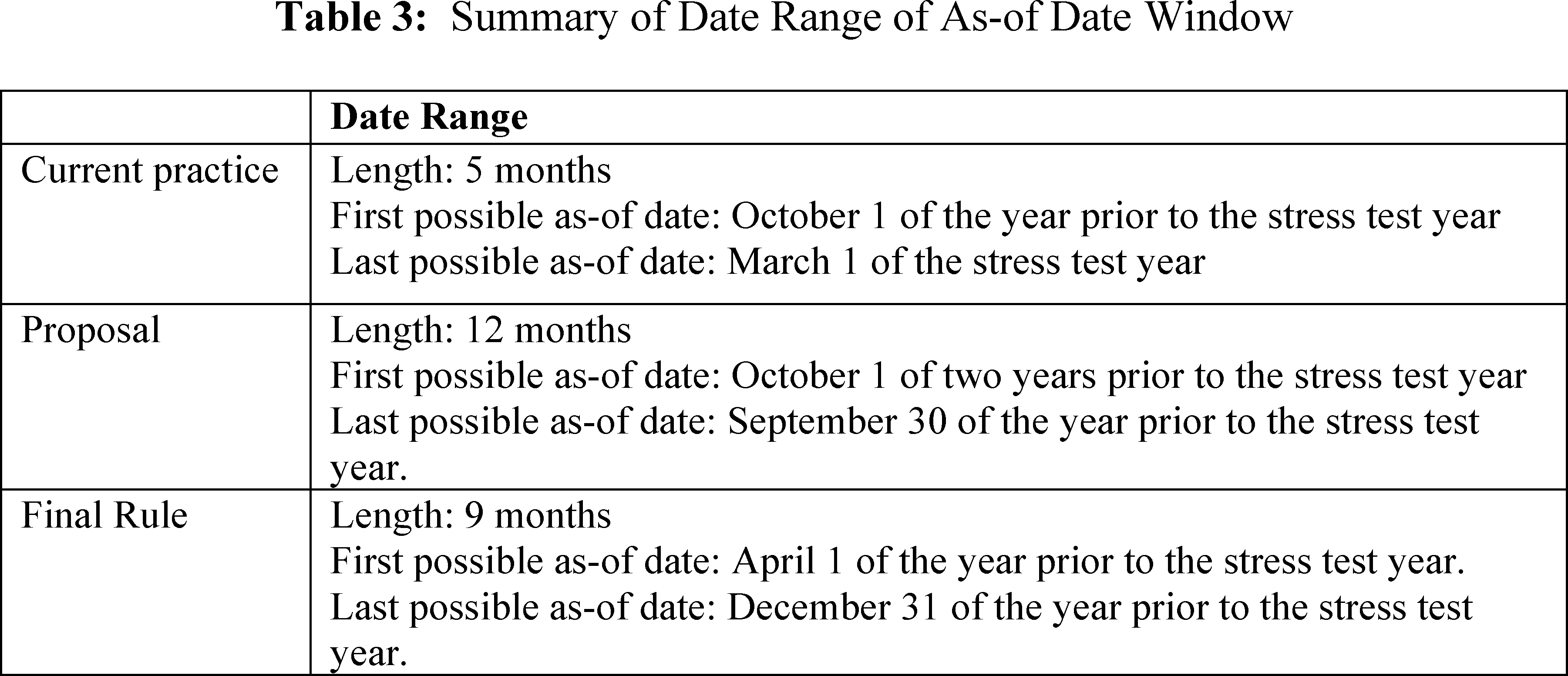
Adopting the 9-month as-of-date window in the final rule improves risk capture compared to the current 5-month window. The 9-month window will enable the Board to consider a wider array of potential GMS as-of dates, especially because, in practice, the comprehensive selection process eliminates a range of potential dates within the current window. This wider set of potential dates will allow the as-of date to occur under various economic and financial conditions and will avoid creating potential incentives for firms to take temporary trading positions in anticipation of the as-of date. Given the fluctuations in firms' trading positions, the 9-month window provides the Board the flexibility to capture a wider range of firms' portfolio compositions and risk sensitivities. Additionally, the 9-month window would include only dates prior to the release of the given stress test cycle's GMS scenario for public input. Therefore, firms subject to the GMS would not be able to use their knowledge of the GMS as-of date to optimize their balance sheet positions or adjust their portfolios based on the proposed GMS scenario.
The Board recognizes the potential operational burdens associated with the 12-month as-of-date window in the proposal, as expressed by some commenters. The 9-month window will best balance the objective of improving risk capture with the potential operational burden that firms could face. The 9-month window is longer than those recommended by many commenters, but shorter than the 12-month window put forth in the proposal. The window also does not extend as far back into the past as put forth in the proposal, reducing the potential for staleness of the stress test results. Compared to the 12-month window, the 9-month window reduces the operational burden associated with long-term data maintenance.
b. Two GMS Scenarios
As discussed above, the Board received several comments on the possibility of having more than one GMS scenario. After considering these comments, the Board is revising the Scenario Design Policy Statement to state that the Board expects to select up to two GMS scenarios that occur on a single as-of date for each annual stress test. Historically, the Board has generally disclosed a single GMS scenario for each stress test, and this component has been used to calculate trading and counterparty losses. However, the single GMS scenario has limited capability to capture risks in firms' portfolios because different firms may be exposed to different directions of shocks on the same as-of date. For example, one firm may experience losses when the U.S. dollar appreciates compared to the Japanese Yen, while another firm may experience gains in this situation. A second GMS scenario will improve the risk capture of the stress test by allowing the Board to capture a wider range of firms' vulnerabilities with opposite directions of shocks.
Additionally, introducing a second GMS scenario is likely to reduce year-over-year volatility in trading and counterparty losses. Under a single GMS scenario, a change in the direction of the shocks from one year to the next could lead to substantial variation in losses because a firm's portfolio may be particularly exposed to shocks in one direction. Due to differences in GMS scenarios from year to year, this variability can occur even if a firm's portfolio remains unchanged. The use of two GMS scenarios with potentially directionally opposite shocks can mitigate this concern because both directions of the exposures can be tested. With the introduction of a second GMS scenario, the Board expects trading and counterparty losses to be more stable over time and also more reflective of the changes in firms' risk exposures instead of changes in scenarios.
The Board determined to use the largest combined trading and counterparty losses across the two scenarios in each firm's stress test results and to inform each firm's stress capital buffer requirement. The Board also considered the option of averaging the GMS losses across the two scenarios but determined that this approach would not sufficiently reflect firms' vulnerabilities to a severe market shock. Therefore, having two GMS scenarios in one stress test with the maximum losses determining stress test results better ensures that firms are appropriately capitalized to a broader range of market events. This approach is discussed further in Section VI of this SUPPLEMENTARY INFORMATION .
c. Codification of GMS Notification Date
While not currently required by the stress test rules, the Board typically notifies applicable firms of the GMS as-of date within two weeks after the as-of date. This notification ensures that these firms can preserve trading and counterparty data for the as-of date. The final rule codifies this practice so that the Board would be required to notify firms subject to the GMS component of the date no later than two weeks after the as-of date. The notification ensures that firms subject to the GMS component retain necessary data, and reduces firms' data retention burden. The public and all firms not subject to the GMS component will continue to be notified of the as-of date when the ( printed page 62890) scenarios are proposed for a given stress test.
d. GMS Applicability Threshold
The Board considered comments on the current thresholds for applicability of the GMS component. The current threshold includes firms that have aggregate trading assets and liabilities of $50 billion or more, or trading assets and liabilities of 10 percent of total assets. This approach captures firms where market risk is a key risk. With respect to the aggregate size of $50 billion or more, at this time, the Board considers this threshold to be reasonably appropriate to capture trading activities that are significant to the firm and to markets. Any changes to this threshold would be accomplished through a specific proposed rulemaking. With respect to the 10 percent prong, this proportion represents a significant portion of the firm's total assets, and it continues to be appropriate for the GMS component to apply to these firms to more accurately identify the firm's trading asset and liability risks. At this time, the Board considers it appropriate to retain this threshold as an applicability criterion. The Board expects any future changes to the GMS threshold to be preceded by a proposal for public comment.
3. Other Adjustments to the Stress Test Cycle
As described in Section II of this SUPPLEMENTARY INFORMATION , the proposal would have moved the jump-off date of the annual stress test to September 30 to accommodate the public input process and mitigate the risk of firms adjusting their balance sheets following the publication of proposed scenarios prior to the jump-off date. Because the Board is retaining the December 31 as-of date in this final rule, the Board is also implementing additional changes to the annual stress test cycle to complement this decision and support the goals of the rulemaking.
As mentioned in Section II.E.1 of this SUPPLEMENTARY INFORMATION , commenters suggested many alternative approaches to the proposed September 30 jump-off date. These alternatives generally involved additional changes to key dates in the annual stress test cycle. Two commenters suggested that the Board retain the December 31 as-of date and adjust the existing and proposed dates for several components of the annual stress test, the capital plan submission deadline, and the deadline to request reconsideration. One commenter also recommended that preliminary stress capital buffer requirements, including any enhanced disclosures, should be published by June 30, 2027, for the 2027 stress test cycle. The Board also considered input from one commenter that stated that a compressed timeline for scenario development and public comment within the annual stress test cycle could impose challenges for the Board, including the Board's ability to substantively incorporate feedback within an annual cycle.
The Board is finalizing several additional changes to milestones in the annual stress test cycle as part of this final rule. While the proposal did not include specific adjustments to these components of the stress test rules, the Board asked detailed questions on the annual stress test cycle, including many of the aspects described below, and indicated that the Board was considering revisions to its rules to achieve the purposes of the proposal. Furthermore, many commenters provided suggestions to improve the annual stress test cycle and align it with other changes to dates in the proposal. The changes described below take into account the comments received, reduce regulatory burden, and support the goals of the rulemaking and the stress test program.
a. Biennial Opt-In for Category IV Firms
Under the current stress testing rules, Category IV bank holding companies, Category IV U.S. intermediate holding companies, and Category IV covered savings and loan holding companies subject to the supervisory stress test may elect to have the Board conduct a stress test with respect to that company in a year ending in an odd number by January 15.[62] This timing enables firms to consider their balance sheets as of the stress test jump-off date (December 31) but prevents these firms from considering the scenario when determining whether to opt into the stress test. As explained above in Section II.D of this SUPPLEMENTARY INFORMATION , the Board proposed to adjust the jump-off date for the supervisory stress test in order to implement the annual disclosure of scenarios for public input, while mitigating risks that could materialize if the proposed scenarios were disclosed prior to the jump-off date of the supervisory stress test. The Board asked several questions in order to solicit public input on other changes to the stress test calendar that could be necessary to incorporate annual disclosure of scenarios for all of the firms subject to the supervisory stress test.[63]
The Board did not propose to change this opt in date and did not receive any comments regarding this date. However, to accommodate the publication of proposed scenarios by January 10, the final rule moves the opt in date to January 5. This timing will enable firms to continue to consider their balance sheets as of the stress test jump-off date (December 31), but it will not allow them to consider the variable paths specified in the proposed scenario.
b. Capital Plan Submission and Company-Run Stress Test Dates
The Board did not propose to change the April 5 submission date for firms' annual capital plans or for firms subject to Category I-III standards to conduct company-run stress tests. However, two commenters recommended that the Board move the capital plan submission deadline to April 30 of each year so that firms would have ample time to create and review their capital plans following the publication of the final scenarios. The process for proposing and finalizing scenarios is described above; these commenters had recommended moving the final scenario publication date to February 28 to accommodate a 15-day public input period. In recommending that the Board move the capital plan submission date to April 30, these commenters argued that certain elements of the annual capital plans rely on information provided in the final scenarios publication. One of these commenters recommended a capital plan submission date of April 30 and the disclosure of final models for a given stress test by March 31. This commenter argued that this sequencing would improve capital plans because firms would have ample time to review the final scenarios and model documentation prior to submitting their annual capital plans.
In response to these comments, the final rule moves the deadline for annual capital plan submissions and date by which applicable firms must conduct company-run stress tests to April 30 to provide firms with sufficient time to submit capital plans and conduct company-run stress tests following the publication of the final scenarios. Firms need information from the final scenarios to prepare annual capital plan submissions and to conduct company-run stress tests, and these deadlines give firms additional time to meet these requirements. Relatedly, due to the connection between the data reported on the FR Y-14A report and the data ( printed page 62891) submitted in firms' annual capital plans and in company-run stress tests, the final rule also moves the submission date for all FR Y-14A data not needed to calculate trading and counterparty losses in the stress test to April 30. The FR Y-14A data needed to calculate trading and counterparty losses will continue to be due April 5. Further discussion of changes in FR Y-14A reporting requirements is discussed in Section IV of this Supplementary Information .
c. Adjusted Capital Actions Deadline
Currently, firms subject to the supervisory stress test must notify the Board of any adjustments to their planned capital actions within two business days of receipt of notice of a stress capital buffer requirement.[64] The Board received one comment suggesting that the Board revise this deadline to provide firms with 10 business days, in order to reduce burden for firms and avoid rushed decision making.
Under the final rule, the Board is retaining the requirement for firms to notify the Board of any adjustments to their planned capital actions within two business days of receipt of notice of their stress capital buffer requirement. In the Board's experience, the current deadline for adjustments to planned capital actions provides firms with sufficient time to confidentially determine whether they wish to submit adjusted capital actions and to support alignment of firm capital actions and any applicable securities reporting obligations.
d. Final Stress Capital Buffer Requirement Notification Date
Currently, the Board provides firms subject to the supervisory stress test with their final stress capital buffer requirements and confirmed planned capital distributions by August 31 of the calendar year that a capital plan was submitted.[65] The Board received comments on the stress capital buffer reconsideration request process that suggested that the Board retain the August 31 calendar date unless the stress capital buffer effective date is moved to January 1 of the year after a capital plan was submitted. The commenter stated that if the effective date of the stress capital buffer requirement is moved, then the August 31 deadline should be extended by at least 30 days.
Under the final rule, the stress capital buffer requirement notification deadline will occur by September 30. This change is appropriate to account for the revisions described above that grant additional time for firms to submit reconsideration requests, while also enabling the Board to process any such requests efficiently. It also retains sufficient time between the notification date and the effective date to allow firms to prepare for any changes in capital requirements.[66] Additional discussion of the Board's adjustment of the effective date is included below and in the Volatility final rule.
e. Stress Capital Buffer Effective Date
Finally, the Board is also revising the stress capital buffer effective date, which is currently October 1, in a separate rulemaking.[67] As explained in the notice for the Volatility Rule, that final rule revises the effective date to be January 1.
4. Amendment to the Dividend Add-On Component Calculation
Under the proposal, the Board would have adjusted the dividend add-on component of the stress capital buffer to align with the proposed change to the jump-off date from December 31 to September 30. To maintain alignment between the dividend add-on component of the stress capital buffer requirement and the one-year period during which the requirement is typically effective, the Board proposed to change the dividend add-on component to cover dividends issued in quarters five through eight, instead of quarters four through seven, of the planning horizon of the supervisory stress test. This change would have involved updates to the capital plan rules, at Regulation Y and Regulation LL, to any references to the relevant quarters of the planning horizon.[68]
The dividend add-on component of the stress capital buffer requirement currently comprises planned dividends in the fourth through seventh quarters of the planning (or projection) horizon of the supervisory stress test.[69] Under the current framework, the planned dividends that are incorporated in the stress capital buffer requirement align with the effective date of the stress capital buffer requirement (that is, October 1 as the first day of the fourth quarter of the existing planning horizon) and last for the one-year period through which the stress capital buffer requirement is expected to be effective (that is, through the seventh quarter of the existing planning horizon, after which the following year's stress capital buffer requirement would be expected to take effect).
Commenters did not provide input on this specific aspect of the proposal, but they did provide other feedback related to the dividend add-on component. Several commenters recommended that the Board eliminate the dividend add-on component of the stress test. These commenters stated that this component is overly conservative and causes firms to duplicate their capitalization of dividends, particularly with the capital conservation buffer requirement and existing firm capital management buffers. One commenter argued that the Board's previous rationale for the dividend add-on component, which referenced historical experience from the 2007-2009 financial crisis, was no longer relevant.
Several commenters representing foreign banking organizations specifically commented that the dividend add-on component should be eliminated for foreign banking organizations with intermediate holding companies. These commenters stated that dividends from the intermediate holding company serve a different function for these foreign banking organizations compared to domestic firms, as the dividends are primarily a mechanism to upstream surplus capital to the foreign banking organization parent. Noting that the dividend add-on component does not apply to share repurchases, these commenters also stated that the exclusion of share repurchases is not beneficial for intermediate holding companies, giving domestic firms an advantage over foreign banking organizations. Commenters also stated that dividends do not pose the same reputational or systemic risk concerns for foreign banking organizations as for domestic firms. These commenters suggested that, if the Board retains the dividend add-on component, the Board should adopt alternative approaches, such as scaling the component for intermediate holding companies or using a discount approach to the component for intermediate holding companies that is consistent with recent domestic bank activity. Others suggested alternatives that would involve recalibrating the dividend add- ( printed page 62892) on to reduce it as dividends are actually paid out over time.
The Board is declining to adopt the proposed change to the quarters subject to the dividend add-on component in the final rule. As explained in the proposal, this change to the dividend add-on component was contingent upon changing the jump-off date to September 30. Accordingly, the Board is not adjusting the planning horizon period for planned dividends in this final rule.
Additionally, the Board is not eliminating the dividend add-on component in response to comments. Removing the dividend add-on component of the stress capital buffer was outside of the scope of the proposal.
To align with the Board's principle of consistency and comparability across firms, including intermediate holding companies of foreign banking organizations, to ensure that all firms subject to the stress test engage in appropriate capital planning, and to limit procyclical aspects of the stress test, the final rule maintains that the dividend add-on component applies to all firms and that it remains constant over the period that a firm's applicable stress capital buffer requirement is in effect.
F. Stress Capital Buffer Requirement Reconsideration Process
The Board did not propose to amend the Board's capital planning rules that govern firm requests to reconsider the Board's calculation of preliminary stress capital buffer requirements. The current rules require firms to request reconsideration within 15 calendar days of receiving notice of the preliminary requirement.[70] Firms may also request informal hearings with the Board to discuss reconsideration requests.[71] Though the Board did not propose any changes to this process, the proposal requested public input on potential enhancements to the stress capital buffer requirement reconsideration process, including whether additional enhancements to this process would be appropriate.
The Board received several comments on the reconsideration request deadline, as well as the reconsideration request process itself. Regarding the reconsideration request deadline, several commenters suggested that the Board extend this deadline to either 15 business days or 30 days or more, particularly if the stress capital buffer effective date is moved to January 1, as was proposed in the Volatility Proposal. These commenters stated that the Board's reconsideration process should better align with the Board's supervisory appeals process, and they stated that additional time would improve the arguments presented by firms in their reconsideration requests, which would reduce the risk of calculation errors while improving the transparency, integrity, and credibility of the stress capital buffer framework. Commenters also emphasized that reconsideration requests should be due a reasonable period of time after firms receive firm-specific results disclosures.
Regarding the Board's reconsideration request review process, several commenters suggested that the Board provide additional information or introduce new guardrails to the Board's review process. Some commenters stated that the reconsideration process was inadequate for firms to challenge stress capital buffer determinations. These commenters recommended that the Board expand the scope of appealable issues to include instances where results are unrealistic, overly conservative, inconsistent with empirical performance, or conflict with the Board's Stress Testing Policy Statement principles, even if no modeling errors are identified. One commenter added that a firm should be able to request reconsideration for any adjustment applied to its results. One commenter further suggested that the Board codify the permissible basis for which a firm could request reconsideration and that the Board codify that the window for the request begin when firm-specific disclosures are provided. The commenter suggested that the Board publish a list of research issues identified in reconsideration request letters and identify whether any changes to models were made in response to reconsideration requests. Two commenters requested that the Board define the criteria it considers in granting an informal hearing in response to reconsideration requests. Another commenter suggested that the Board create a transparency framework to track, implement, and disclose the outcomes of all reconsideration requests, and that the Board provide a response to each reconsideration request with the Board's rationale for its decision making. Another commenter recommended that the Board establish specific review timelines for reconsideration requests.
The Board is revising the deadline by which a firm subject to the supervisory stress test must request reconsideration. Under the final rule, this request must occur within 15 business days after the preliminary stress capital buffer notification occurs, replacing the current deadline of 15 calendar days. This change is expected to reduce burden on firms subject to the supervisory stress test while also providing the Board with sufficient time to consider any such requests and make appropriate adjustments prior to the disclosure and effective date of final stress capital buffer requirements. The Board addressed comments related to enhanced results disclosures in Section II.A of this Supplementary Information .
With respect to comments suggesting changes to the Board's reconsideration request review process, beyond those regarding the window to request reconsideration, the Board is not adopting any changes at this time. The current capital plan rules do not provide a limit on the scope of a firm's reconsideration request. Instead, the rules provide that, “a request for reconsideration must include a detailed explanation of why reconsideration should be granted.” [72] The Board has not established a scope of appealable issues and will continue to implement a flexible approach that enables firms to request reconsideration for any aspect of their stress capital buffer requirement and on any basis. While the Board recognizes that establishing a certain set of criteria or basis for reconsideration could provide firms and the public with greater transparency around the Board's reconsideration review process, the Board considers the current broad scope appropriate to enable the Board to continue to engage with firms in the reconsideration request process on an unrestrained scope of issues identified by firms. Therefore, in the final rule, the Board does not codify the scope of issues for which a firm could request reconsideration of its stress capital buffer requirement. Additionally, the Board anticipates that the public input process for stress test models and scenarios will provide an appropriate and effective avenue for firms and the public to provide feedback on aspects of the stress test program that apply to each firm's stress test results, which will help ensure the consistency and fairness of the stress testing program.
With respect to additional disclosures or timelines related to the Board's reconsideration request review process, the Board considered the comments and its experience administering the reconsideration request process. At this time, the Board is not adopting additional changes to this process, which effectively balances interests in transparency with the Board's need to handle confidential materials ( printed page 62893) appropriately and conduct a fair and efficient stress capital buffer determination process for each firm within the constraints of the annual stress test cycle. Under the Board's rules, the Board notifies each firm of the Board's decision to affirm or modify the firm's preliminary stress capital buffer requirement within 30 calendar days of receipt of the reconsideration request.[73] Typically, the Board responds to the firm through a letter; in the past, a version of the letter that redacts confidential supervisory information has also typically been released publicly with a press release. To preserve confidentiality and flexibility, the Board is not making additional changes to the reconsideration process or disclosures at this time beyond extending the window for submission of reconsideration requests.
Additionally, the Board considered a comment that suggested that the Board should define criteria for granting an informal hearing. Under the Board's stress test rules, a request for reconsideration may include a request for an informal hearing on the firm's request for reconsideration; the Board may, in its sole discretion, order an informal hearing if the Board finds that a hearing is appropriate or necessary to resolve disputes regarding material issues of fact.[74] Given the wide range of reasons why a firm may request reconsideration and what information such a request could encompass, establishing a set criteria could narrow the scope of bases for granting an informal hearing. As a result, the Board is not defining criteria for granting an informal hearing.
III. Revisions to the Stress Testing Policy Statement
Under the proposal, the Board would have made changes to the Stress Testing Policy Statement to (i) amend the section related to disclosure of information related to the stress test; and (ii) to align the Stress Testing Policy Statement with the proposed enhanced disclosure process. The Board is adopting these changes largely as proposed, with adjustments as described below.
A. Supervisory Stress Test Results Disclosures
To provide additional transparency, the Board proposed to revise the Stress Testing Policy Statement to clarify that the Board will generally disclose information directly to a firm about the firm's supervisory stress test results that is not available to the broader public, so long as the Board discloses similar information to the other firms participating in a given stress test cycle. In the proposal, the Board explained that, for example, the Board may provide a firm its common equity tier 1 capital ratio during all quarters of the projection horizon. Providing firm-specific results directly to the affected firms even when that information is not disclosed to the broader public was expected to allow firms to better understand their results while preventing potentially sensitive information about a firm from being shared with competitors. Under the proposal, the Board would have continued to disclose the supervisory stress test results to the public.
The Board received three comments suggesting that the Board codify a requirement that the Board transmit certain non-public information to firms in their results disclosures, while another commenter also suggested that the Board codify the type of information that the Board provides to firms when transmitting the firms' results. In particular, this commenter suggested that the Board provide firms with a firm-specific, granular breakdown of projections and a quarter-by-quarter view of the results. The commenter stated that this disclosure should, at a minimum, be similar to the Board's disclosure of aggregate stress test results related to the 2025 stress test.[75] Two commenters stated that the disclosures should include model-level impacts to the firm from any model changes that are significant to a specific firm, as well as model adjustments, such as overlays, including the rationale for any adjustments.
One commenter further recommended that the Board provide firms with more model details in private disclosures, such as the firm-specific fixed effects for applicable models. Another commenter had a similar sentiment, stating that the Board should provide firms with more information about projections and quarter-by-quarter results of component models ( e.g., noninterest income), as opposed to projections and results of broader modeling areas ( e.g., total pre-provision net revenue). These commenters explained that these disclosures and processes would improve firms' understanding of the Board's modeling methodology and the firms' results, which would therefore improve firms' capital planning.
The Board is finalizing this aspect of the proposal without changes. The Board's current approach is flexible and enables the Board to tailor its firm-specific results disclosures to changes in the stress test over time. Establishing detailed requirements for firm-specific results disclosures could constrain the Board's ability to provide detailed disclosures or change the format of the disclosures over time. Additionally, the Board recognizes that increasing the granularity of firm-specific disclosures within the annual stress test cycle would proportionally increase the operational burden and complexity of administering the stress test, particularly within the compressed time available to the Board to conduct the stress test. Within each cycle, the Board aims to provide results that balance these challenges with the benefits of additional disclosures, while ensuring consistency in results reporting so that firm-specific results would not advantage individual firms. As a result, the Board is not implementing a change to the Board's stress test rules to require a specific format or contents for firm-specific results disclosures.
B. Other Revisions to the Stress Testing Policy Statement
In addition, the Board proposed to revise the Stress Testing Policy Statement to align it with the proposed enhanced disclosure process, such as to reflect the model disclosure and public input process for material model changes.
The Board did not receive comments on this aspect of the proposal. Other comments related to the proposed enhanced disclosure process are addressed in Sections II of this Supplementary Information .
The Board is finalizing this aspect of the proposal without changes.
Separately, two commenters provided their views on the Board's “flat balance sheet” assumption, which is described in the Board's Stress Testing Policy Statement. One commenter asserted that the assumption distorts estimated capital levels under stress, and recommended that the Board's projections should instead allow for balance sheet growth. Another commenter stated that this assumption is overly simplified, unsupported by empirical evidence, and leads to higher borrowing costs and reduced credit availability for consumers.
The Board did not propose to adjust this assumption in the proposal and the Board is not adopting changes to the flat ( printed page 62894) balance sheet assumption as part of this final rule. The existing balance sheet assumption aligns with the Board's principles of simplicity, as well as consistency and comparability, and also ensures that firms do not reduce the supply of credit under a stress scenario.
IV. Revisions to the FR Y-14A/Q/M
To reduce regulatory reporting burden, support the proposed model changes, and improve risk capture, the Board proposed to adopt several revisions to the FR Y-14A/Q/M. To reduce regulatory reporting burden, the Board proposed to remove items and documentation requirements that are no longer needed to conduct the supervisory stress test. These revisions, as well as other revisions incorporating feedback from public comments, are described in this Section of this Supplementary Information .
Commenters broadly supported the proposed revisions to the FR Y-14. Commenters also recommended that additional items be added to the FR Y-14 reports to support suggested changes to the models, as well as recommended areas that could be further streamlined. After considering these comments, the Board is adopting the revisions largely as proposed, and it is also adopting other changes to the FR Y-14 reports following consideration of these comments, as described below and in the Board's 2027 Model Review of Comments and Summary of Changes, available on the Board's website.[76]
A. FR Y-14 Supporting Documentation
FR Y-14A
To ensure that the FR Y-14A requirements do not capture information that is no longer needed and to reduce reporting burden, the proposal would have removed Appendix A “Supporting Documentation” from the FR Y-14A report. Commenters supported this proposed removal as it would decrease reporting burden and requested that the Board clarify response times for potential additional requests from supervisors during the annual capital plan review.
In connection with the supervisory review of capital plans, recent practice has been to communicate the focus of each year's review and anticipated targeted required information in detail through examination first-day letters prior to the submission date. This process is intended to minimize follow-up requests after the submission date, and supervisors tailor the suggested turnaround times based on the size and nature of the request. In addition, supervisors may incorporate input from supervised firms on the nature and timing of large follow-up requests, as appropriate. With this clarification, the final rule removes Appendix A from the FR Y-14A.
FR Y-14Q
To streamline FR Y-14Q, Schedule L (Counterparty) and reduce reporting burden, the proposal would have replaced the existing Schedule L supporting documentation with a more limited set of questions that is relevant for supervisors to assess Schedule L data. Similarly, the proposal would have introduced supporting documentation for FR Y-14Q, Schedule F (Trading) that includes five questions related to a firm's trading projections and Schedule F submissions.
Commenters opposed these changes, as they believe they would significantly increase reporting burden. Additionally, commenters stated that Schedule F collects information on firms' trading exposures, not trading projections, so it would not be appropriate to collect information on projections in connection with Schedule F. Finally, to reduce reporting burden around the timing of FR Y-14Q submissions, commenters recommended that, if adopted, the Schedule L supporting documentation be due at least 30 days after the submission of data.
The Board recognizes that Schedule F does not collect projection data, and the final notice does not adopt the Schedule F supporting documentation requirement, though, supervisors may request additional information from firms to better understand their trading exposures and projections. However, the underlying methodology for stressed counterparty data is necessary to understand firms' Schedule L submissions, so the final notice adopts a revised Schedule L supporting documentation requirement. To be responsive to the commenters' burden concerns, the final notice streamlines the supporting documentation requirement by removing or simplifying questions, and by offering additional time to provide responses to certain requests, where appropriate.
B. Collection of Mailing Address Information
The proposal would have removed item 6 (Mailing Stress Address), item 7 (Mailing City), item 8 (Mailing State), and item 9 (Mailing Zip Code) from FR Y-14M, Schedule C (Address Matching). Commenters supported these proposed removals and asked that the Board retire the entire Schedule C asserting that it does not provide unique information. The final notice removes these mailing address items from Schedule C but does not implement further changes, as the schedule collects important information that is not available elsewhere, such as property address data. This information is needed to match junior and senior loans that use the same collateral.
C. Private Equity
The proposal would have revised FR Y-14Q, Schedule F.24 (Private Equity) in four ways: (1) to have private equity reported as of December 31, (2) to have carry values reported net of embedded goodwill or investments in the capital of unconsolidated financial institutions that are deducted from CET1 capital, (3) to collect data on private equity hedges, and (4) to introduce a materiality threshold for reporting private equity exposures that aligns with other banking book portfolios.
Commenters suggested that the Board modify certain aspects of the proposed private equity revisions to clarify the instructions or simplify reporting. For example, commenters requested the Board clarify how to define a material private equity portfolio, add items to capture capital deduction items associated with private equity separately instead of reporting carrying value offset of these deductions, revise the instructions to reflect the capital deduction thresholds based on those applicable to the reporting firm, and introduce a separate version of Schedule F to capture private equity exposures and their associated hedges. As these recommendations would simplify reporting and not impact the Board's ability to model private equity losses, the final notice incorporates revisions based on these comments. Finally, as proposed, the Board is revising Schedule F.24 to be reported as of quarter-end for each quarter, instead of the GMS as-of date for the fourth quarter submission.
D. Hedges
The proposal would have revised Schedule F, which is currently subject to a materiality threshold, to capture data on hedges from any firms with reportable hedges. As proposed, firms, including those not required to submit Schedule F, could submit a version of Schedule F to report hedges but would not be required to do so. Commenters requested that the Board clarify the expectation of when hedges are to be ( printed page 62895) reported on Schedule F, asserting that the language in the proposed instructions was unclear. To provide clarity, the final notice revises the instructions to indicate that submissions of Schedule F for hedges are optional except that, if a firm chooses to report a given hedge type (for example “AL Hedges”), then all relevant worksheets within Schedule F must be reported with respect to that hedge type. Additionally, the final notice clarifies that once that hedge type has been reported for a given reporting quarter, it must be reported for each subsequent quarter.
Additionally, to improve the risk capture of the supervisory stress test by incorporating the effects of additional hedges, the proposal would have revised FR Y-14Q, Schedule B.2 (Investment Securities with Designated Accounting Hedges) to capture all qualified accounting hedges. The proposal would have also implemented a new schedule to more comprehensively map hedging relationships (FR Y-14Q, Schedule B.3—“Investment Securities with Designated Accounting Hedge Mapping”). Commenters recommended various changes to Schedule B, including expanding the scope of reportable hedges on Schedule B.2 to capture all economic hedges, adding a clean present value field to Schedule B.2, and introducing a new sub-schedule to better map long-term debt/borrowings.
To improve and clarify the reporting of hedges, the final notice largely incorporates these recommended changes into the Schedule B instructions. However, the Board has determined that a dedicated sub-schedule for long-term debt/borrowings is not needed at this time. These revisions will enable the Board to better assess firm hedges.
E. Exchange Traded Funds
To ensure consistent reporting, the proposal would have clarified Schedule F instructions such that all exchange traded funds (ETFs) would be reported in the Schedule F worksheet that corresponds to the underlying asset class and risk exposure. One commenter stated that it is not practical to decompose all positions in funds, including ETFs, and recommended that firms be allowed to treat non-decomposed funds as a single name equity reported in the equity worksheet.
The Board is cognizant of reporting burden; however, it is important that exposures are reported consistently and based on their underlying risk. Therefore, the final notice adopts the proposed instructional clarification. However, to address the commenter's concern, the final instructions indicate that reporting can be based on the primary underlying asset class and risk exposure, if decomposition is not possible.
F. Credit Card Revenue and Loss Sharing Agreements
The proposal solicited public comment on two versions of a credit card revenue and loss sharing (RLSA) collection on FR Y-14M, Schedule D (Credit Card): one that would have captured portfolio-level details and one that would have captured agreement-level details. Commenters supported the portfolio-level approach, asserting it would increase standardization across firms while providing the Board with appropriately granular information. Commenters also recommended additional changes such as clarifying certain items, introducing a materiality threshold, and adding new items. Additionally, one commenter requested that firms be provided 12 months to implement the necessary reporting system changes.
As discussed in the Retail section of the Review of Comments documentation, the Board has determined that portfolio-level, rather than agreement-level, reporting is appropriate for collecting information on RLSAs and has adopted the proposed portfolio-level approach, with certain adjustments in response to comments.
To align with the final PPNR models that rely on data reported on FR Y-14Q, Schedule G (PPNR), the Board has removed items from FR Y-14M, Schedule D.3 that capture data associated with RLSA payments and added new items to FR Y-14Q, Schedule G to collect RLSA payment amounts that are reflected in interest income, noninterest income, and noninterest expense. For consistency between reports, the Board is also adding these items to FR Y-14A, Schedule A.7.a (PPNR Projections) and Schedule A.7.b (PPNR Net Interest Income), as applicable. Additionally, the Board has clarified Schedule D.3 to implement consistency in charge-off and recovery reporting and firm accounting practices. To avoid imposing reporting burden on firms with small RLSA balances, the Board has implemented a materiality threshold for Schedule D.3 such that firms that either report $5 billion or more in total partnership agreement balances or have total partnership agreement balances exceeding 5 percent of the firm's total domestic consumer bank card balances at quarter-end must report Schedule D.3. To further reduce reporting burden, the Board has revised the cadence of Schedule D.3 reporting such that it is submitted quarterly instead of monthly. Finally, the Board is adopting the RLSA reporting revisions for the December 31, 2027, as-of date to provide firms the time necessary to submit accurate data.
G. Stress Test Date Changes
To align with proposed changes to the stress test calendar, the proposal would have revised the FR Y-14A jump-off date to be September 30 and modified the submissions of FR Y-14 such that, for the quarter containing the GMS component as-of date, the submission of data associated with the GMS component would be submitted as of the date instead of quarter-end. As discussed in Section II.E of this Supplementary Information , the Board is not revising the FR Y-14A jump-off date.
Therefore, the final notice does not alter the current December 31 jump-off date for the FR Y-14A. Additionally, as discussed in Section II.E of this Supplementary Information , the final rule adopts an as-of date window for the GMS component of April 1 to December 31 of the year preceding the stress test. Consistent with this expanded as-of date window, the final notice revises the FR Y-14 instructions such that, for the quarter containing the GMS component as-of date, the submission of data associated with the GMS component is submitted as of that date, instead of quarter-end.
( printed page 62896)Finally, as discussed in Section II.E of this Supplementary Information , the Board is adopting several changes to dates in the annual stress test cycle. For example, the due date for annual capital plan submissions and for applicable firms to conduct company-run stress tests is April 30, instead of April 5. However, the timely submission of certain FR Y-14 data is critical to ensure that the stress test results are final by June 30. Specifically, the stressed submission of FR Y-14Q, Schedule L (Counterparty) and alternative starting values for certain capital deduction items on FR Y-14A, Schedule A.1.d (Capital) are necessary to calculate projected losses under the GMS component. Therefore, the Board is retaining an April 5 due date for these items but revising the due date of the remaining FR Y-14A data to April 30, consistent with the revised due date of firms' capital plans and the date to conduct a company-run stress test.
H. Other FR Y-14 Revisions and Comments
Comments on Further Reporting Reductions
As described above, the proposal included revisions that would have reduced reporting burden. Commenters provided several recommendations as to how this burden could be further reduced. For example, one commenter asked that the Board conduct a line-by-line inventory of all FR Y-14 items and explain which are used in the supervisory models or are necessary for supervision and regulation, or to otherwise justify collecting that data. The commenter suggested that any items not on either list be retired. The commenter recommended that the Board consider developing materiality frameworks for firms to consider for reporting the FR Y-14Q and FR Y-14M reports. The commenter suggested that collecting data on only material items would reduce burden on firms. Alternatively, the commenter suggested that the Board identify critical data elements and make the non-critical elements optional or best efforts. Another commenter recommended that the Board reconsider the reporting frequency for certain areas, such as the FR Y-14M report, and consider limiting historical data requirements for firms newly subject to reporting FR Y-14Q schedules.
The Board is cognizant of regulatory reporting burden and has already undertaken significant steps to reduce reporting burden by retiring supporting documentation, line items that are no longer necessary, and historical data requirements that are no longer necessary. Additionally, while an item may not be an input to the stress test models, it is important that the Board receive fulsome data to support model monitoring or other supervisory activities. Further, a materiality framework or reporting on a best efforts basis could result in critical data not being reported, which could hinder supervisory activities. Therefore, the Board is not removing additional items from the FR Y-14 at this time. The Board will continue to assess whether it is appropriate to retire select items or requirements that are no longer necessary.
Comments on Reporting in Connection With Modeling Suggestions
Additionally, in response to the proposed models, commenters recommended that the Board improve aspects of the models, and some of these recommendations would require the collection of additional data. Further, commenters recommended that specific schedules be modified or clarified to improve reporting. Comments that suggested additional data collections to support commenter recommendations to revise model specifications or improve reporting are discussed in the Board's 2027 Model Review of Comments and Summary of Changes, available on the Board's website.[77]
V. Changes to the Stress Test Modeling Framework
The Board proposed to use the models described in the documents posted on the Board's website to generate results for the 2026 supervisory stress test. Included in these descriptions were some model specifications that were not used to conduct the 2025 supervisory stress test but were proposed to be used for the 2026 supervisory stress test. Section V.A of this Supplementary Information discussed the model changes adopted at this time and Section V.B of this Supplementary Information provides an updated analysis of the potential effects of the changes, as compared to the proposal. Based on this analysis, implementing the final model changes and final revisions to the GMS scenario design in the 2024, 2025, and 2026 stress tests would have, independent of other factors, increased the aggregate projected CET1 stress ratio, on average, by 17 basis points.[78]
A. Changes to Stress Test Models
The Board proposed a series of changes to the Board's stress test models in the proposal, which were described in the proposal and in greater detail in the documentation published on the Board's website.[79] The Board received many comments on the proposed changes to stress test models described in the proposal. As described above in Section I.F of this Supplementary Information , commenters provided a mix of comments that expressed general support for the proposed models, as well as suggestions for additional changes to these proposed models, including many conceptual and technical adjustments. The Board considered these comments and addressed them in the Board's Review of Comments, available on the Board's website.[80]
With respect to the credit risk models, the Board proposed to change how it uses geography in scenario variables (First Lien, Home Equity, Credit Cards, Auto, and Commercial Real Estate Models); change how it treats foreclosures under judicial supervision (First Lien and Home Equity Models); change how it calculates loss given default for international loans (Commercial Real Estate and Corporate Models); change how it includes losses attributable to accrued interest and carrying costs (First Lien and Home Equity Models); change how it uses multipliers in the Provisions Model; revise the mortgage loss given default model in the First Lien Model; revise the bank card model in the Credit Card Model; change how it projects losses on auto leases in the Auto Model; and update the probability of default, loss given default, and exposure at default components in the Corporate Model. The Board is finalizing these changes largely as proposed.
( printed page 62897)With respect to the market risk models, the Board proposed to update several of its market risk models for the 2026 stress test, including to simplify the Yield Curve Model; adjust its process for projecting credit valuation adjustments for derivative positions in the Credit Valuation Adjustment Model; lower the loss given default assumption amount and loan equivalent factor parameter in the Fair Value Option Model; update and simplify the Securities Model; and exclude additional counterparties in the Largest Counterparty Default Model. The Board is also finalizing these changes largely as proposed.
With respect to the net revenue models, the Board proposed an alternative suite of pre-provision net revenue component models that depart from the current panel regression-based approach. This alternative suite was described in the Pre-provision Net Revenue Model documentation, available at www.federalreserve.gov/supervisionreg/dfa-stress-tests-2026.htm. The Board also proposed to discontinue the current regression model used to project operational risk losses and instead project losses with a distributional model. This alternative model was described in the Operational Risk Model documentation, also available at www.federalreserve.gov/supervisionreg/dfa-stress-tests-2026.htm. The Board is finalizing some of these changes at this time, and is also proposing further changes to the adopted noninterest income expense model.
The Board received detailed feedback on the proposed model changes for the 2026 stress test, and on the model documentation as a whole. The Board has considered these comments and described its rationale for the final models for the 2027 stress test, as well as additional proposed changes to the noninterest income expense model for the 2027 stress test, in documentation on the Board's website, available at www.federalreserve.gov/supervisionreg/dfa-stress-tests-2027.htm.
B. Analysis of Final Model Changes
This section describes illustrative analysis of how the model adjustments described above could have affected past stress test results. As discussed in Section V.A of the SUPPLEMENTARY INFORMATION , the Board is adopting several model changes in response to public comments, as well as changes to the GMS scenario design described in Section II.E of this SUPPLEMENTARY INFORMATION . For example, the final FVO models would adopt more risk-sensitive loss given default assumptions for corporate and commercial real estate loans. Similarly, the pre-provision net revenue models would adopt several revisions, such as changing the base rate assumption for fixed-rate wholesale loans in the interest income on loans model and anchoring each firm's projected efficiency ratio to its own recent experience to better incorporate business heterogeneity in the noninterest expense model. All model changes adopted as part of this final notice are discussed in the model documentation available on the Board's website.81
In aggregate, these changes are not expected to materially change capital requirements for firms subject to the supervisory stress test, across various stress scenarios and jump-off conditions at the start of the test. As in the proposal, to illustrate the effect of these model changes, the Board's analysis estimated the impact of these model changes on the CET1 stress ratio for a balanced sample of 30 firms subject to the 2024 stress test, then aggregated the averages.82 Using this analysis, table 4 illustrates the potential impact of these changes for each risk stripe across various stress test scenarios and jump-off dates. Based on this analysis, the final model changes can be expected to result in slightly lower projected common equity tier 1 (CET1) capital ratio declines compared to the proposed models, mostly due to the updated calculation of the valuation allowance for deferred tax assets to better align with U.S. GAAP accounting practices.
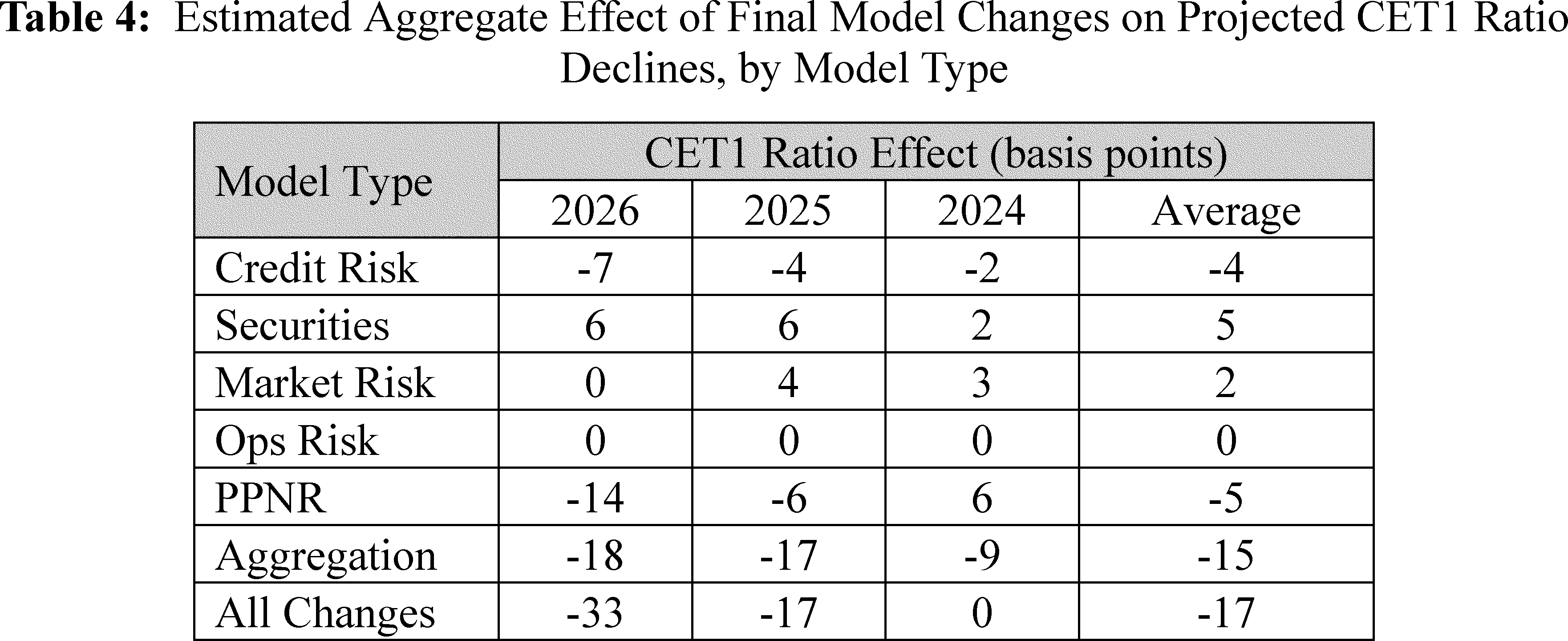
Table 5 below provides a separate analysis of estimates of stress losses across firm types that are subject to the stress capital buffer requirement. The analysis shows that the reduction in projected CET1 capital ratio declines due to the final model changes is concentrated at larger firms.
( printed page 62898)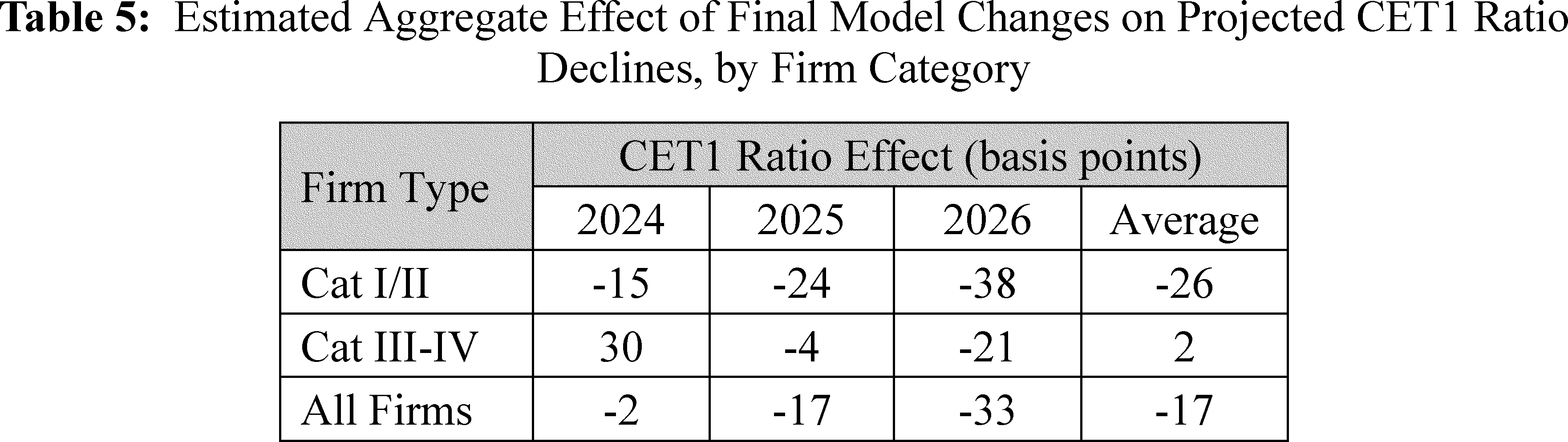
Table 6 illustrates the estimated impact of the model changes described in this notice, updated to include the results of the 2026 stress test.
As indicated, the Board's analysis estimates that the impact of the model changes adopted for the 2027 stress test, could lower the common equity tier 1 capital requirements of Category I and II firms by 0.9 percent. Similarly, the impact could lower the common equity tier 1 capital requirements for Category III and IV firms by 2.0 percent. Relative to the results from the 2024, 2025, and 2026 stress testing cycles, the analysis estimates that the adopted changes could have reduced aggregate stress capital buffer requirements by approximately 1 percent of required common equity tier 1 capital.
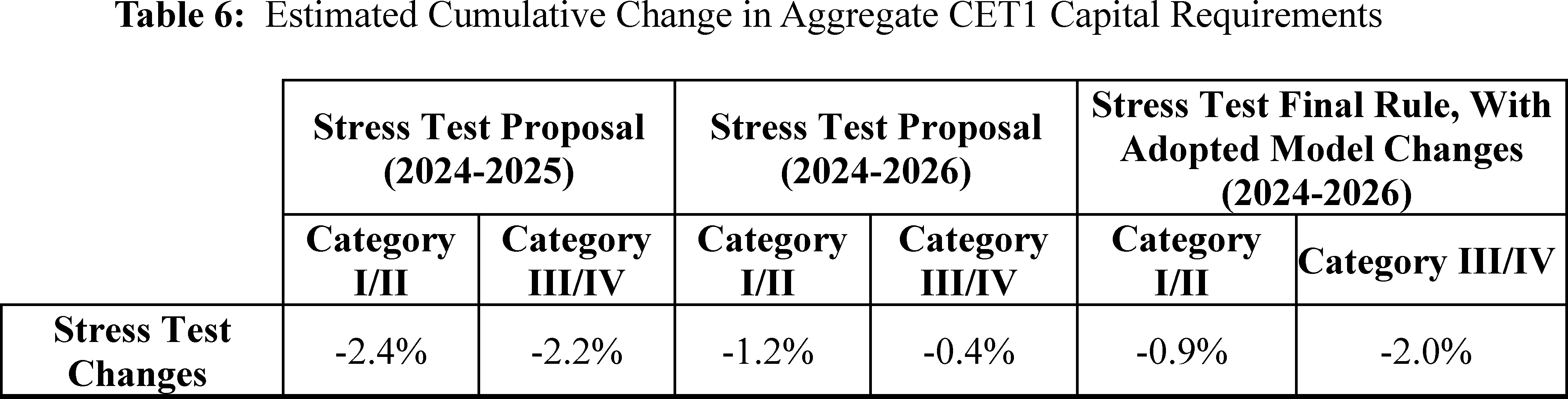
VI. Changes to the Scenario Design Policy Statement
The Board also proposed several changes to its Scenario Design Policy Statement. This section describes those changes, and summarizes and responds to comments received on those changes.
A. Changes to the Background and Overview and Scope Sections
The Board proposed to make limited changes to the first two sections of the Scenario Design Policy Statement, which address background and overview and scope topics, respectively. In the Background section, the Board proposed to clarify that the stress tests primarily focus on credit risk, operational risk, and market risk. The inclusion of operational risk in this list was intended to help clarify the Board's continued focus on designing a supervisory tool that makes a valuable forward-looking assessment of large financial companies' capital adequacy under hypothetical economic and financial market conditions. The Board proposed to also clarify that it expected to provide only two different sets of macroeconomic scenarios for both the supervisory and company-run stress tests: the baseline and severely adverse scenarios. This change would clarify the quantity of macroeconomic scenarios the Board expects to provide, consistent with the previous removal of a separate adverse scenario.[83]
In the Overview and Scope section, the Board proposed to make conforming edits to the description of the organization of the Scenario Design Policy Statement to reflect the changes discussed earlier in this proposal.
The Board did not receive comment on these technical changes, and is finalizing, as proposed, changes to the Background and Overview and Scope section of the Scenario Design Policy Statement.
B. Changes to the Content of the Stress Test Scenarios Section
The Board proposed to make two general changes to this section, which describes the Board's expectations for the content of the published stress test scenarios. First, this section would have been amended to make clarifications that the Board expects to generally publish two different macroeconomic scenarios: the baseline and severely adverse scenarios. This section would also have been revised to clarify that the Board expects to invite comment on severely adverse scenarios. Second, as described in Sections II.E and VI.H of this SUPPLEMENTARY INFORMATION , the Board proposed to make certain changes related to the global market shock component. See Sections II.E and VI.H of this SUPPLEMENTARY INFORMATION for a discussion of those changes. Comments related to the public input period for proposed scenarios are discussed above in Section II.D of this SUPPLEMENTARY INFORMATION .
One commenter suggested that the Board design a matrix of all possible values to use for the variables in scenario design and run the stress test on every possible scenario.
Another commenter, providing research in support of their claims, recommended that the Board incorporate climate tail scenarios into the stress test, which would enable the Board to capture tail amplification, nonlinear effects, and cross-bank differences to extreme weather exposures. Another commenter stated that the limited incorporation of climate-related financial risks is a ( printed page 62899) significant gap in the Board's scenario design and that the Board should consider how climate factors might interact with traditional economic and financial stresses to improve the forward-looking nature of the stress test.
The Board has considered the comments submitted and has determined to finalize, as proposed, the changes to the Content of the Stress Test Scenarios section described in the proposal.
The Board considered comments requesting that the stress test feature a matrix with all possible variables that could be used in scenario design, with the stress test run against all possible scenarios. This approach would be operationally burdensome, particularly within the revised stress testing calendar. Further, it would be impractical to seek public input on an approach that uses all possible scenarios, and the approach would not align with the Board's scenario development process as described by the Scenario Design Policy Statement.[84]
Regarding comments recommending that the stress test include climate-related financial risks and climate tail scenarios, the Board finds that the final stress test scenarios are well-suited to capture various types of shocks contained within the historical data, and to meet the Board's scenario design goals. Additionally, the existing and final scenario design principles ensure that the Board strives to ensure that scenarios are sufficiently severe.[85]
C. Approach for Formulating Macroeconomic Assumptions in the Baseline Scenario
The Board proposed to provide additional details describing the process by which the Board would set the paths of the variables in the baseline and severely adverse scenarios. In particular, the amendments reflected the publication, on the Board's website, of a description of the macroeconomic model utilized to support the construction of the baseline and severely adverse scenarios in the annual stress test (the “macroeconomic model for stress testing”).[86] By posting a description of this model on the Board's website, the Board expected to improve the transparency, public accountability, and predictability of the Board's scenario design framework, particularly with respect to the baseline scenario and certain variables in the severely adverse scenario. These models are used solely for stress testing purposes and the output is not a forecast of the Board.
One commenter asserted that the Board did not provide sufficient transparency or guardrails regarding how the Board would determine the final jump-off values for each year's scenarios. The commenter recommended that the Board further explain how it would revise the jump-off values for these variables, and that the final scenarios should be broadly aligned with the proposed scenarios in terms of overall severity.
The Board has considered the comments submitted and has determined to finalize, as proposed, the changes to the Approach for Formulating Macroeconomic Assumptions in the Baseline Scenario section described in the proposal.
To increase transparency into how the Board determines final jump-off values, the Board has previously supplemented the explanation in the Board's macroeconomic model for stress testing to clarify the methodology the Board used to determine the jump-off values in the final 2026 scenario.[87] In addition, the Board had updated this documentation to clarify how the determination of jump-off values may have been affected by the 2025 government shutdown.[88]
D. Scenario Narrative, the Recession Approach, and Salient Risks
In this section of the Scenario Design Policy Statement, the Board has provided a description of how it expects to incorporate a recession approach into the annual scenario narrative, and how the Board could incorporate salient risks into that annual scenario. The proposed scenario design principles are discussed below in Section VI.F of this Supplementary Information , and the construction of certain variables and description of certain variable guides are described below in Sections VI.E and VI.G of this Supplementary Information , respectively.
The Board proposed to continue to use a recession approach to develop the severely adverse scenario. Under the recession approach, the Board expected to specify the future paths of variables to reflect conditions that characterize post-war U.S. recessions, generating either a typical or specific recreation of a post-war U.S. recession; and that the Board expects that there will be some important instances when it will be appropriate to augment the recession approach with salient risks, and in some cases, set variable values outside of the ranges and values provided in the guides in the Scenario Design Policy Statement. As explained in the proposal, recessions have historically differed in cause, character, and consequence—from oil price shocks and housing slumps to asset-price busts and pandemics, from short to long, and from mild to moderate to severe—therefore, the Board augments the basic recession approach with an annual scenario narrative. The annual scenario narrative provides qualitative direction on how the Board builds that year's severely adverse scenario. Under the proposal, the Board expected that the macroeconomic scenario used in the Board's annual supervisory severely adverse scenario would begin with a sudden and significant increase in uncertainty and associated rapid deterioration in risk appetite that, together, cause a spike in financial market volatility and a sharp decline in many U.S. and foreign financial assets.
Additionally, in the proposal, the Board explained that it continued to expect that there would be some important instances when it would be appropriate to augment the recession approach with salient risks, and in some cases, set variables' values outside of the ranges and values provided in the guides in the Scenario Design Policy Statement. As a result, each year, the Board proposed to consider particular risks to the financial system and to the domestic and international macroeconomic outlook identified by its economists, bank supervisors, and financial market experts.
In the proposal, the Board proposed two changes to its consideration of salient risks in the severely adverse scenario. First, the Board would remove paragraph 4.2.4(d) from the Scenario Design Policy Statement in order to improve the transparency of the scenario design process by limiting the Board's expectations for considering risks of uncertain significance. Second, where the Board does consider salient risks in designing the severely adverse scenario, the Board would endeavor to disclose and explain the Board's reasoning in the publication of the annual stress test scenarios, and would subsequently adjust those aspects of the scenario, if necessary, in response to those comments.
One commenter, expressing general concern with the publication of the ( printed page 62900) annual scenarios and the Proposed 2025 Scenario Design Policy Statement, argued that the proposal would reduce the dynamism of the stress test and limit the Board's ability to capture salient and unseen or under-appreciated risks. Another commenter expressed concern with the proposed amendments to the Scenario Design Policy Statement, indicating that the framework, including through the Board's identification of salient risks, would permit deviation from the ranges and values provided in the proposed guides, without being thoroughly described and explained in the proposed scenarios. Another commenter stated that, because stress test models and scenarios are highly complex, they require a degree of Board judgment that warrants retaining discretion for aspects of scenario design. This commenter suggested that the Board clarify how it will apply its discretion and justify any departures from specified ranges.
The Board has considered the comments submitted and has determined to finalize, as proposed, the scenario narrative and recession approach, and amendments to the salient risk framework described in section IX.D of the proposal's Supplementary Information (Scenario Narrative: Refinement to the Recession Approach).
As described in the proposal, the Board expects that the severely adverse scenario would be developed each year to reflect the current level of vulnerabilities or risks to the banking sector that are apparent in relevant indicators of economic and financial conditions. The Board also anticipates that the finalized guides for scenario variables described below provide an appropriate range of values to design the severely adverse scenario in most years. The waxing and waning of relevant indicators of economic and financial conditions will inform the Board's decisions about where to set the value of those parameters within those ranges for each variable.
However, the Board continues to expect that there will be some important instances when it will be appropriate to augment the recession approach with salient risks, and in some cases, set variables values outside of the ranges and values provided in the guides in the Scenario Design Policy Statement. As a result, each year, the Board will consider particular risks to the financial system and to the domestic and international macroeconomic outlook identified by its economists, bank supervisors, and financial market experts. The Board, using its internal analysis and supervisory information and in consultation with the Federal Deposit Insurance Corporation and the Office of the Comptroller of the Currency, will then determine whether any of those risks appear significantly more elevated than usual or, conversely, whether risks are unusually low at a particular time, such that they cannot be appropriately reflected by choosing values within the ranges of the final guides. In those cases, which it expects to be infrequent, the Board will make appropriate adjustments to the paths of specific economic variables, and will explain any deviations from the guides as part of the proposed scenarios for that year's stress test. The scenario variable values and associated rationale for guide deviations will be subject to public input prior to finalization. These adjustments will not always be reflected in the general severity of the recession and, thus, all macroeconomic variables; rather, the adjustments will sometimes apply to a subset of variables to reflect co-movements in these variables that are historically less typical.
To assist the public in assessing the use of salient risks in the scenario, the Board considered the following examples, which were discussed in the proposal. A stress test initiated in a period of unusually high uncertainty and rapid deterioration in economic and financial conditions, such as the first quarter of 2009 or the first quarter of 2020, likely would prove challenging for the ranges in this proposed framework. In each case, the prevailing conditions made it plausible that key variables would settle beyond the range of their previous peak or trough values, on which the guides for the variables in the severely adverse scenario are calibrated. Although the unemployment guide remained flexible enough to respond to the spike in the unemployment rate to nearly 15 percent during the first months of the COVID-19 pandemic-related business closures in 2020, the paths of other variables may have needed to be adjusted more severely if the economy had not recovered as quickly as it did.
As another example, the Board may become increasingly concerned about vulnerabilities related to a particular asset class that is experiencing rapid and persistent price increases supported by increasingly leveraged investors. Those circumstances existed in the housing market in the early 2000s and may have tested the credibility of a guide framework based solely on past performance of home prices, given that up until then, the price index for homes the Board uses for stress testing had rarely experienced a decline.[89]
Sometimes, the salient risk may arise within a particular subset of an asset class. The Board most recently incorporated this type of salient risk in the severely adverse scenario for the 2024 supervisory stress test. That year, the Board noted unusually high vulnerabilities in types of commercial properties that could be most at risk for a sustained drop in income and asset values due to the prevalence of remote work.[90]
The Board has considered comments submitted on the proposal and has determined to finalize, as proposed, the scenario narrative and recession approach, and amendments to the salient risk framework as described in Section VI.D of the proposal's Supplementary Information .
E. Changes to Construction of Certain Variables in the Severely Adverse Scenario
The Board proposed to maintain existing guides for setting the size of the maximum change in the unemployment rate and the timing of its peak, as well as the size of the maximum decline in house prices in the severely adverse scenario and the timing of their trough; introduce guides that would be used to set the changes in the values, and the timing of those changes, for more variables in the severely adverse scenario; and provide additional context for the path of each variable before it reaches the maximum change both for the existing unemployment rate and house price guides as well as the new guides introduced for other scenario variables. In addition, the Board separately disclosed a specific macroeconomic model used to translate the paths of certain variables that are set using the proposed guides into internally consistent projections for the remaining variables, such as the 3-month Treasury bill rate, gross domestic product (GDP), Disposable Personal Income (DPI), and inflation.[91] The additional introduced guides addressed each of the following variables: equity prices; the VIX index; 5-year Treasury yields; 10-year Treasury yields; BBB corporate bond yields; mortgage spread; ( printed page 62901) commercial real estate prices; and the international scenario values. Comments on these specific proposed guides are discussed in Section VI.G of this Supplementary Information.
One commenter recommended adding the price of bitcoin as a scenario variable in the macroeconomic scenarios, allowing firms to directly model exposures without reliance on different price assumptions across firms. The same commenter advocated for several methods for determining the price path of bitcoin, such as historical characteristics, regime switching, and jump-diffusion modeling, if adopted into the macroeconomic scenarios or global market shock. The commenter indicated that bitcoin has an unstable relationship with other macroeconomic variables and can be a material driver of market and counterparty risk, and these modeling approaches would be able to incorporate this variability.
The Board has considered the comments submitted and has determined to finalize, as proposed, changes to the construction of certain variables in the severely adverse scenario.
The proposed and final guides include all but one of the financial market variables typically included in the domestic severely adverse scenario disclosure each year (the exception being the 3-month Treasury bill rate, which is informed by the Board's macroeconomic model for stress testing [92] ). The Board considered the commenter's recommendation, but determined that the existing set of variables used in the severely adverse scenario is representative of macroeconomic conditions, and implementing the recommendation at this time would add model complexity and reporting burden without adding commensurate benefits.
F. Scenario Design Principles Derived From Stress Testing Literature: Severity, Credibility, and Not Adding to Procyclicality
In formulating the proposed guides, the Board described three principles suggested by the literature that inform the Board's scenario design framework: the importance of severity, the importance of credibility, and the importance of not adding to procyclicality.[93]
One commenter welcomed the introduction of scenario design principles as a step towards systemic, rules-based scenario development. The commenter stated that these transparent principles reduce a perception of arbitrariness and inform stakeholders. However, this commenter advised that the final principles should not be overly rigid, as the Board must retain flexibility to design scenarios that capture novel risks and tail events that may not fit established patterns. As support, the commenter noted that financial crises consistently involve unexpected combinations of stresses, which may not be captured by a constrained scenario design approach. The commenter suggested that the Board specify criteria for invoking expedited procedures to update scenarios when necessary, such as when the Financial Stability Oversight Council identifies systemic risks or when material changes in financial conditions occur.
The Board also considered comments on the nature of the guides and their role in the scenario design framework as relevant to these principles. One commenter explained that, in their view, the proposed guides would make the severely adverse scenario in future stress tests more predictable and therefore, more easily gamed by firms subject to the supervisory stress test. In the commenter's view, the predictability of the scenarios would also provide “false comfort” to the public that firms had sufficient capital.
One commenter suggested that using both guide- and model-based types of variables could reduce the coherence of the supervisory stress testing narrative, and at times may require trade-offs between scenario consistency and other design principles, such as severity. The commenter stated that the Board must sufficiently explain and justify its design choices with respect to a given scenario to allow the public to assess trade-offs between scenario design principles. This commenter also stated that the Board should reflect the structural and regulatory changes that distinguish historical periods of stress from stress that is plausible after intervening reforms in determining values for its scenario guides. This commenter also asserted that the use of unemployment and house prices as main variables to determine the path of other macroeconomic variables is not conceptually sound, particularly as it would violate the principle of avoiding adding sources of procyclicality. To the extent the Board intends to use unemployment rate and house prices to determine the path of other variables, the commenter recommended that the Board consider additional data points to capture the idiosyncratic nature of those other variables ( e.g., spot prices, year-over-year trends).
One commenter, while supporting the Board's objective of preserving flexibility and allowing supervisory judgment in severity calibration, stated that scenario guides should support predictability while preserving the Board's ability to adjust severity to avoid reinforcing economic contractions. This commenter also stated that scenario design should mitigate, not exacerbate, procyclicality, and that rigid scenario design or overly mechanical modeling could amplify procyclicality by tightening capital in times of stress. One commenter recommended that the Board provide plain-language explanations of why the scenarios are chosen, how they relate to evolving risks, and how the severity of scenarios avoids becoming procyclical.
The Board has considered the comments submitted and has determined to finalize, as proposed, scenario design principles derived from stress testing literature: severity, credibility, and not adding to procyclicality.
The Board has recognized that the academic literature and some commenters highlight the need for stress tests to avoid adding to other sources of procyclicality in the financial system.[94] Despite the increased predictability in the scenarios, the new framework would remain flexible enough to suitably assess whether firms can maintain an adequate amount of loss-absorbing capital to stay above minimum regulatory requirements and continue financial intermediation during periods of stress, as well as adjust features that might add to existing procyclicality in the financial system, as appropriate.[95] In practice, the scenarios resulting from the revised framework are expected to remain consistent with the prior and current Scenario Design Policy Statement and, on average over a typical business cycle, should not result in materially different scenarios than would have been designed previously. The Board understood these comments to also implicate the Board's proposed principle of flexibility.
Additionally, as explained in the proposal, the guides and the macro model for Stress Testing are constructed to remain flexible enough to ensure that the Board can adjust the severely adverse scenario to capture emerging risks and changes in the level of systemic risk since the previous stress test in a timely fashion. This flexibility ( printed page 62902) includes the ability to increase scenario severity when systemic risks may have built up during robust economic expansions or periods when risk appetite is high or to avoid adding sources of procyclicality through the stress test. The final rule helps ensure that the scenarios continue to maintain a minimum severity level, even when economic and financial conditions are strained.
As discussed in greater detail in the proposal, in designing the guides for the construction of the severely adverse scenario presented in this framework, the Board is informed by the stress testing literature,[96] which provides certain principles for scenario design also reflected in the Board's Stress Testing Policy Statement.[97] First, the literature emphasizes the need for adequately severe scenarios, even when the economy and financial system are in a stressed condition—complementing the Board's principle of conservatism.[98] Second, the literature offers insights on how historical data should inform the design of an adequately severe scenario, augmenting the Board's recession approach. Third, the literature highlights the need for stress tests to avoid adding to other sources of procyclicality in the financial system.
Further evidence for the importance of sufficiently stressful scenarios to maintaining public credibility comes from past U.S. stress tests. For example, the rapid deterioration in the U.S. economy in early 2009 led to realized unemployment rates that approached the peak of the unemployment rate path in the severely adverse scenario used for the Supervisory Capital Assessment Program (SCAP) in 2009.[99] As described in the proposal, this example helps demonstrate the importance of the principle of severity when considering historical data and current conditions in the construction of an adequately severe scenario.[100]
That experience reinforces the need for the framework to support variable paths that exceed levels observed in the historical data. Choosing a historical scenario has a price—“it does not test for anything new.” [101] While the recession approach dictates that variable movements follow historical recessions, when current conditions are already extreme, a credible scenario may replicate historical recessions in terms of the size of movements previously observed, leading to levels of variables that may exceed historical levels. Several of the guides in this framework allow, at times, for variables to exceed their historical range, either in levels or in magnitude of changes, in order to maintain adequate severity.
At the same time, the Board recognizes that the severity of the annual stress tests potentially can have unintended effects on firms' operations. For instance, the academic literature finds that stress tests improve financial stability by reducing riskier bank lending.[102] Ensuring that firms are appropriately capitalized for the risks they are taking is a goal of stress testing; however, if those effects are not well aligned with the true riskiness of a particular type of loan, then stress tests could unintentionally reduce banks' credit supply. For instance, some evidence exists that counties in which stress tested banks had high market share may have experienced a lower supply of credit to small and young businesses, which are generally considered riskier than established businesses but can generate a disproportionate share of growth in employment and income.[103]
However, other research concludes that businesses largely offset the reduction in loans from banks that participate in the stress tests with other sources of credit. Those sources include loans from smaller banks not in the stress tests,[104] debt issuance in capital markets, or loans from nonbank financial institutions.[105] Moreover, these potential unintended effects on credit supply by stress tested firms must be weighed against the benefits, discussed above, that more credible stress tests bring to the economy and the financial system. By ensuring that firms have sufficient quantity and quality of loss-absorbing capital to cover the risks that they are taking, the stress tests ensure the resilience and stability of the banking sector even in circumstances when stresses take unexpected forms.
The balance of those advantages and disadvantages of scenario severity can change over time. Losses at financial institutions are more likely to arise when the economy slows. Profits are more robust during periods of economic growth, in turn increasing resources available to cover future losses. In other words, capital is naturally procyclical, having an underlying tendency towards a positive correlation with financial conditions. Moreover, when underlying conditions are favorable and firm losses are low, firms sometimes project forward an expectation for low losses, paving the way to take more risk.[106] Conversely, when conditions are bad, firms may overcompensate and restrict credit even to otherwise creditworthy borrowers, exacerbating the downturn. Thus, firms' behavior may amplify underlying procyclicality.
Stress tests could, through different designs, either amplify or mitigate this procyclicality. If stress tests are always more severe in bad times, despite an expectation that conditions could soon improve, then this severity would add undue stress to the financial system, reducing financial intermediation with negative implications for the macroeconomy. That said, the purpose of the stress test scenarios is not to serve as an explicit countercyclical offset to the financial system, but rather to ensure that the firms are properly capitalized to withstand severe economic and financial conditions. Hence, the Board adopts a middle path, seeking to specify the severely adverse scenario to avoid adding sources of procyclicality to the financial system, neither explicitly mitigating any existing procyclical tendencies nor magnifying them. Indeed, Kohn and Liang (2019) argue that the ability to adjust elements that potentially add procyclicality can be a major benefit of stress tests as “banks with forward-looking, less-procyclical capital buffers will not pull back as much when a downturn occurs.” [107]
( printed page 62903)When considering these principles in light of the recession approach and the scenario narrative, the Board also identified the importance of maintaining flexibility in the Board's scenario design framework and in establishing guides for certain values. As explained in the proposal, the flexibility principle helps ensure that the Board's efforts to increase the transparency, public accountability, and predictability of stress tests do not come at the expense of the overall effectiveness of the Board's stress testing program.
For instance, predictability and transparency could be achieved with a completely specified, entirely formulaic scenario that leaves no flexibility. However, simple, fixed guides may not achieve at least one of the goals of severity, credibility, or not adding to procyclicality. Similarly, more sophisticated formulations might improve on simple rules by accounting for the factors affecting firms' balance sheets and overall economic and financial conditions. For many types of economic indicators used in the Board's scenario framework, however, a fixed rule for the design of a scenario variable that satisfied the principles related to procyclicality and severity laid out above could require a complex structure that would conflict with the Board's principle of simplicity.[108]
A lack of simplicity is not, however, the only concern with a framework that eliminates flexibility. Unexpected shocks occur, like oil embargoes, national house price collapses, and pandemics. Moreover, the implications of these shocks are often not readily captured in concurrent data: especially their future effects on the economy and financial stability in the United States, and so on firms' future financial condition. Maintaining a degree of flexibility would allow the scenarios to adapt to evolving conditions while adhering to the principles outlined above.
In specifying the guides in this framework, the Board seeks to maintain flexibility by specifying ranges for the peak or trough value, the timing of that value, or the speed of adjustment for many of the variables. The amount of flexibility in the guides, as measured by the size of ranges specified, is calibrated to be as narrow as possible while adhering to the principles laid out above and is based on research and analysis of the behavior of those variables during past recessions, consistent with the recession approach, or periods of stress in financial markets. In addition to suggesting typical ranges within which scenarios will vary, the Board seeks to provide explanations of how the guide flexibility would be applied in different economic and financial conditions.
Generally speaking, the Board would design a more severe path for the scenario variables when it judged the level of systemic risks to be high, and a less severe path for the scenario variables when it judged systemic risks to be low. In some cases, the level of systemic risk can be tied to the level of specific indicators. For instance, when the unemployment rate is very high, the level of risk aversion also tends to be high, and that causes firms to reduce risk across their various business lines. In other cases, the Board would consider overall assessments by economists, supervisors, and financial market experts to assess the level of systemic risks, which typically incorporate many of the specific indicators mentioned in the discussions of individual guides below, when it is difficult to do so using individual or small sets of scenario variables.[109]
Therefore, the Board expects that, in an annual scenario, it may choose to have similar severities for variable values for those variables where the Board retains discretion within established ranges of the proposed guides. This expectation reflects the Board's consistent view that annual scenarios are not forecasts of potential future outcomes in the baseline or in a hypothetical stress environment. Establishing variable values with similar severity levels enhances the transparency and predictability of the annual scenarios, and reflects an expectation that these variables are likely to experience stress concurrently in a hypothetical stress scenario. As discussed below, if the Board were to determine that a specific salient risk should be addressed in a particular annual stress test, it would provide a specific assessment of that risk and the rationale for an alternative calibration of the variable's severity in the scenario disclosure for comment.
While flexibility allows scenarios to adapt to fast-evolving conditions, the guides in this framework are based on observed structural features of the economy. Macroeconomic history, however, features many examples where new data have contradicted long-held beliefs about underlying structural relationships. Also, the financial system is constantly evolving, presenting new risks and vulnerabilities. The relatively narrow ranges in the guides may not always allow for a fulsome response by the scenarios to significant developments. Therefore, the Board also sets out expectations for circumstances that could require additional flexibility in setting the specifications of the variables in the stress tests, so that the public can anticipate where the Board could adopt a specification that differs from those identified in the guides in this proposal. For instance, if events occur that alter the historical severity of a given variable, the Board could incorporate that data in its evaluation of the appropriate path for a given variable in annual scenarios that occur following such an event. The Board continuously monitors the macroeconomy and the financial system. If ongoing developments warrant, the Board may revisit this framework and adjust guides.
Finally, the increased predictability and transparency of the scenario as specified in this framework may allow firms to adjust their portfolios to reduce capital requirements, perhaps without a commensurate reduction in risk. While the Board acknowledged this possibility in the proposal and reiterates recognition of this risk, the Board expects that adherence to the principle of severity embraced in this framework will produce scenarios that adequately test such risks. At the same time, flexibility is maintained to allow scenarios to adapt to evolving conditions, not to reduce predictability and transparency. Overall, the Board finds that the degree of flexibility and the goals of transparency and predictability are well balanced as proposed, given the other requirements for designing effective and credible stress tests, and is adopting these principles without material changes.
G. Description of Variable Guides in the Severely Adverse Scenario
1. Unemployment Rate
The Board proposed to retain the guide established in the 2019 Scenario Design Policy Statement, with some additional explanation that would set out the following trajectories:
( printed page 62904)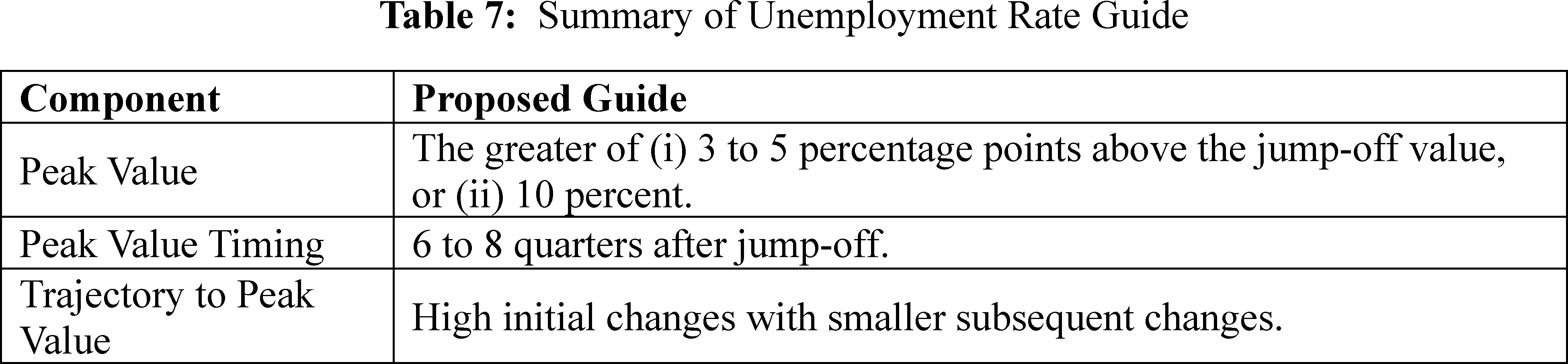
The most common features of recessions are increases in the unemployment rate and contractions in aggregate incomes and economic activity.[110] For this and the following reasons, the Board intended to use the unemployment rate as the primary basis for specifying the severely adverse scenario. First, the unemployment rate is likely the most representative single summary indicator of adverse economic conditions. Second, in comparison to GDP, labor market data have traditionally featured more prominently in the set of indicators that the National Bureau of Economic Research (NBER) reviews to inform its recession dates.[111] Third and finally, the growth rate of potential output can cause the size of the decline in GDP to vary between recessions. While changes in the unemployment rate can also vary over time due to demographic factors, this seems to have more limited implications over time relative to changes in potential output growth. The unemployment rate used in the severely adverse scenario will reflect an unemployment rate that has been observed in severe post-war U.S. recessions, measuring severity by changes in the unemployment rate and GDP.[112] In the proposal, the Board described historical data that informed the Board's proposed guide specifications.[113]
The Board did not receive comment on this aspect of the proposal and has determined to finalize, as proposed, the guide for unemployment rate in the severely adverse scenario.
2. House Prices
The Board proposed to retain the guide established in the previous Scenario Design Policy Statement, with some additional information, including the timing of the trough value and the trajectory to the trough value.[114]
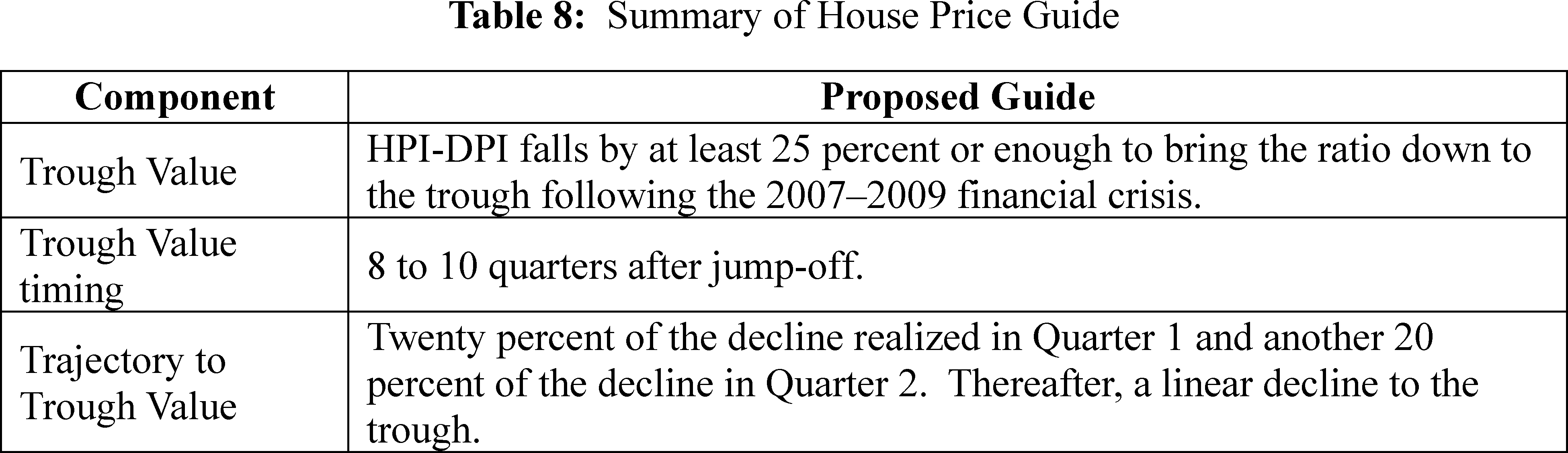
Firms subject to the supervisory stress test have a substantial exposure to the residential real estate market.[115] Given firms' direct exposures, and the broader impact of the housing sector on household balance sheets and the macroeconomy, the Board's methodology for supervisory stress tests incorporates house prices into a number of models.[116] Moreover, house price build-ups sometimes precede episodes of banking stress, with a notable example being the 2007-2009 financial crisis. By incorporating house prices into macroeconomic scenarios, supervisory stress tests help ensure that firms subject to the stress test are prepared for a range of market outcomes, including periods of large declines in house prices directly affecting loan performance and firms' balance sheets. This helps maintain the overall stability and resilience of the financial system. In the proposal, the ( printed page 62905) Board described historical data that informed the Board's proposed guide specifications.[117]
The Board did not receive comment on this aspect of the proposal and has determined to finalize, as proposed, the guide for house prices in the severely adverse scenario.
3. Commercial Real Estate Prices
The Board proposed a guide that would set out the following trajectories for commercial real estate prices as reported in the Board's Z.1 statistical release: [118]
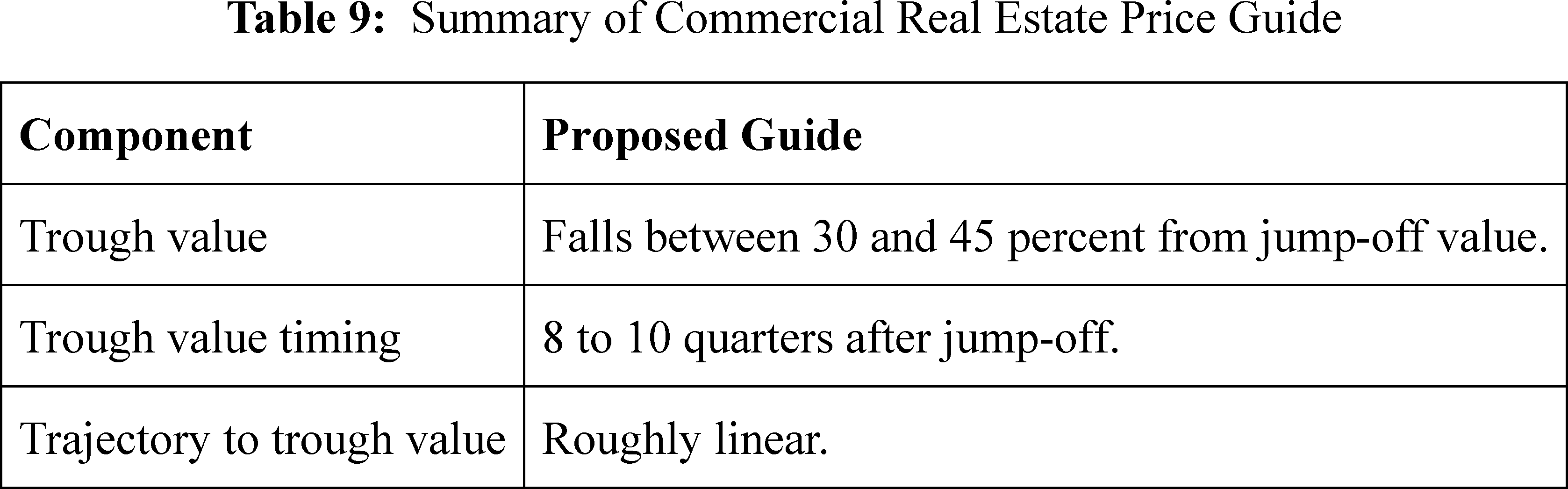
The Commercial Real Estate Price Index aggregates price indices across office, retail, industrial and other types of properties. In the supervisory stress test, commercial real estate prices capture a key part of the risks to firms from their commercial real estate exposures, which are reported by firms on FR Y-14Q, Schedule H.2 (Commercial Real Estate). Most firms subject to the supervisory stress test have a substantial exposure to the commercial real estate market. Moreover, commercial real estate price build-ups often precede episodes of market stress. By incorporating commercial real estate prices into macroeconomic scenarios, supervisory stress tests help ensure that firms subject to the stress test are prepared for a range of market conditions, including periods involving a large decline in commercial real estate prices directly affecting the firms' balance sheets. This helps maintain the overall stability and resilience of the financial system. In the proposal, the Board described historical data that informed the Board's proposed guide specifications.[119]
The Board did not receive comment on this aspect of the proposal and has determined to finalize, as proposed, the guide for commercial real estate prices in the severely adverse scenario.
4. Equity Prices
The Board proposed a guide that would set out the following trajectories for equity prices, as proxied by the U.S. Dow Jones Total Stock Market Index (DWCF): [120]
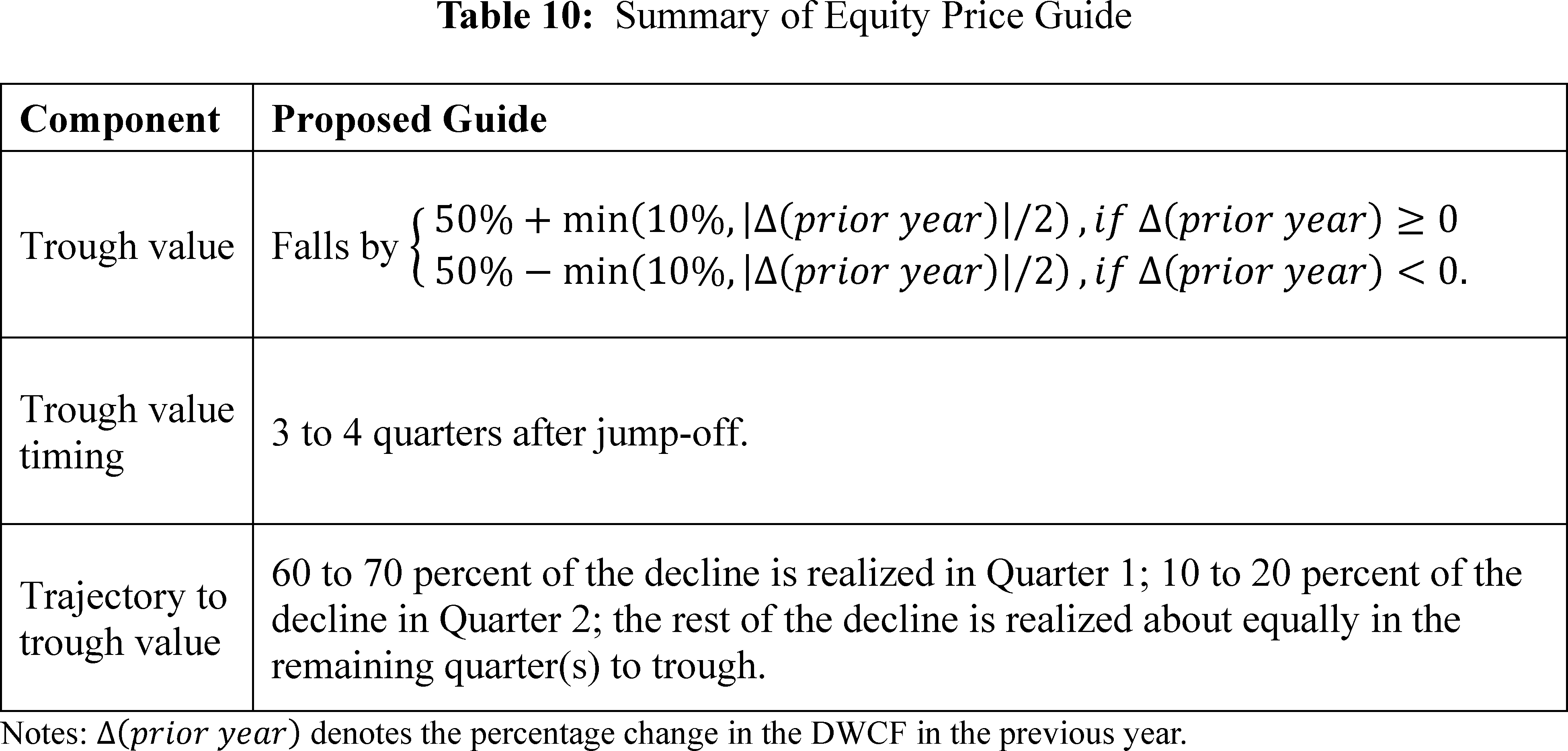
Along with commercial real estate prices, housing prices, and the VIX, equity prices are an essential gauge for asset prices that affect the U.S. economy and the financial conditions of financial and nonfinancial firms. Equity prices are generally recognized as a leading indicator of future economic conditions broadly, including economic growth and inflation.[121] Therefore, testing the ability of a firm to withstand a steep decline in equity prices helps ensure that these firms are properly capitalized to withstand severe economic and financial conditions. In the proposal, the Board described historical data that informed the Board's proposed guide specifications.[122]
One commenter criticized the equity prices guide, stating that the proposed guide for equity prices permits a maximal decline in equity prices that exceeds the decline observed during the 2007-2009 financial crisis, and that the paths for equity prices in the proposed 2026 scenario included a trough and pace of the decline in equity prices that considerably exceeds that observed historically.
The Board has considered comments submitted on the proposal and has determined to finalize, as proposed, the guide for equity prices in the severely adverse scenario.
While the Scenario Design Policy Statement establishes that the Board's scenario design process is informed by historical experience, the Board's scenario design process recognizes that “historical relationships between macroeconomic variables could change over time” [123] and that scenarios should be forward-looking, “introduce[ing] elements outside of the realm of historical experience into the supervisory stress test.” [124] Further, declines in equity prices greater than those experienced in the 2007-2009 financial crisis could reasonably occur in the future; and unprecedented policy interventions helped stabilize the economy and financial markets during the 2007-2009 financial crisis, which the stress test does not assume to occur during the hypothetical stress test scenarios.[125] Consistent with existing stress testing principles, the stress test assumes that, although permanent government stabilization programs ( e.g., unemployment insurance) and monetary policy in the United States and elsewhere would function normally, there would be no extraordinary measures taken by fiscal or financial authorities to support the economy or financial markets during the scenarios.
The Board addressed aspects of this comment that relate to the specification of the equity prices path for the final 2026 scenario in the 2026 Scenarios Review of Comments.[126]
5. VIX
The Board proposed a guide that would set out the following trajectories for the Chicago Board Options Exchange's CBOE Volatility Index (“VIX”):
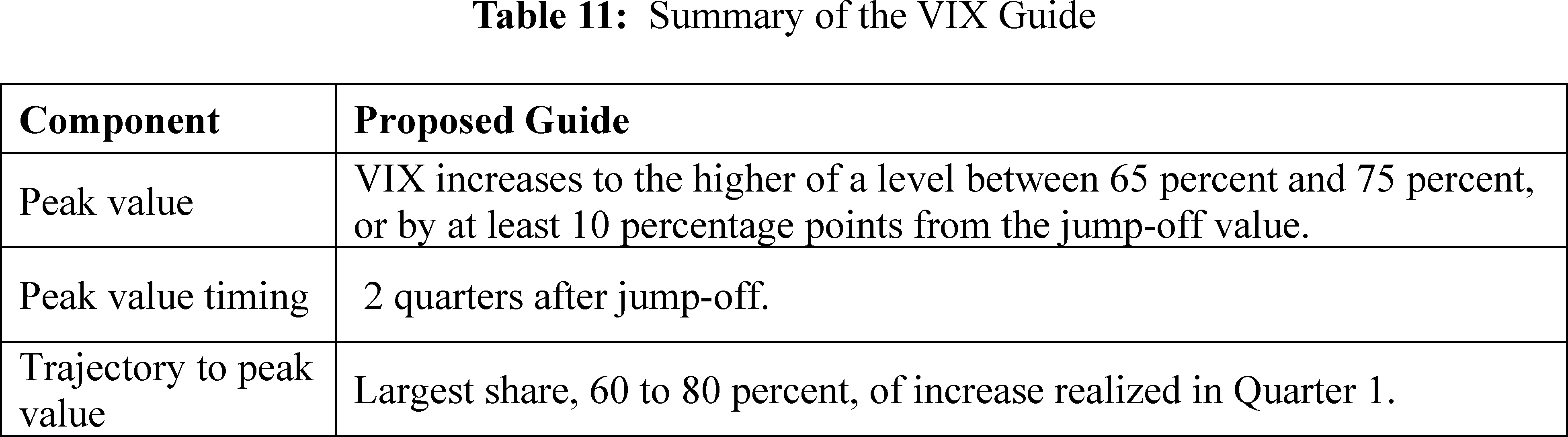
In the supervisory stress test models that use the macroeconomic scenario, the VIX can act as an indicator of stress for a wide range of important assets and income streams even if those business lines are not specifically linked to the VIX index. By incorporating the VIX into scenarios, stress tests help ensure that firms are prepared for a wide range of market conditions, including periods of extreme volatility and uncertainty and any associated economic downturn.[127] This helps maintain the overall stability and resilience of the financial system. In the proposal, the Board described historical data that informed the Board's proposed guide specifications.[128]
One commenter stated that the proposed VIX level remains at or close to its peak for a longer period over the course of the proposed 2026 scenario than has been observed historically. The commenter explained that this difference was likely due to the linear reversion approach the Board used to determine the peak-to-endpoint path and suggested that an exponential decay approach would be more appropriate.
The Board has considered comments submitted on the proposed 2026 scenario, for purposes of this proposal, and has determined to finalize, as proposed, the guide for the VIX in the severely adverse scenario.
The trajectory from peak or trough to end value for variables in the severely adverse scenario each year is expected to generally be determined by a roughly ( printed page 62907) linear interpolation, and generally will be smooth for variables determined by guides and follow the model path for modeled variables; [129] however, the final variable guides, including the guide for the VIX, do not provide a specific guide for the trajectory of the peak-to-endpoint path. As discussed in the Board's Review of Comments and Summary of Changes to the Proposed 2026 Stress Test Scenarios, in evaluating whether an exponential decay approach would be more appropriate, the Board considered that this approach may have a strong historical fit to the data.[130] However, the Board's selection of a linear peak-to-endpoint path in the 2026 severely adverse scenario and in the guide is consistent with the convergence properties of the other variables in the final 2026 scenario. Additionally, the recovery of the VIX level was consistent with the broader 2026 scenario narrative, which featured GDP continuing to fall and the unemployment rate continuing to rise through later quarters of the scenario. The Board also considered academic research finding evidence that indicates that the VIX level would remain elevated when economic activity is weak.[131]
6. 5-Year Treasury Yield
The Board proposed a guide that would set out the following trajectories for the 5-year Treasury yield, which is measured using the quarterly average of the yield on 5-year U.S. Treasury notes: [132]
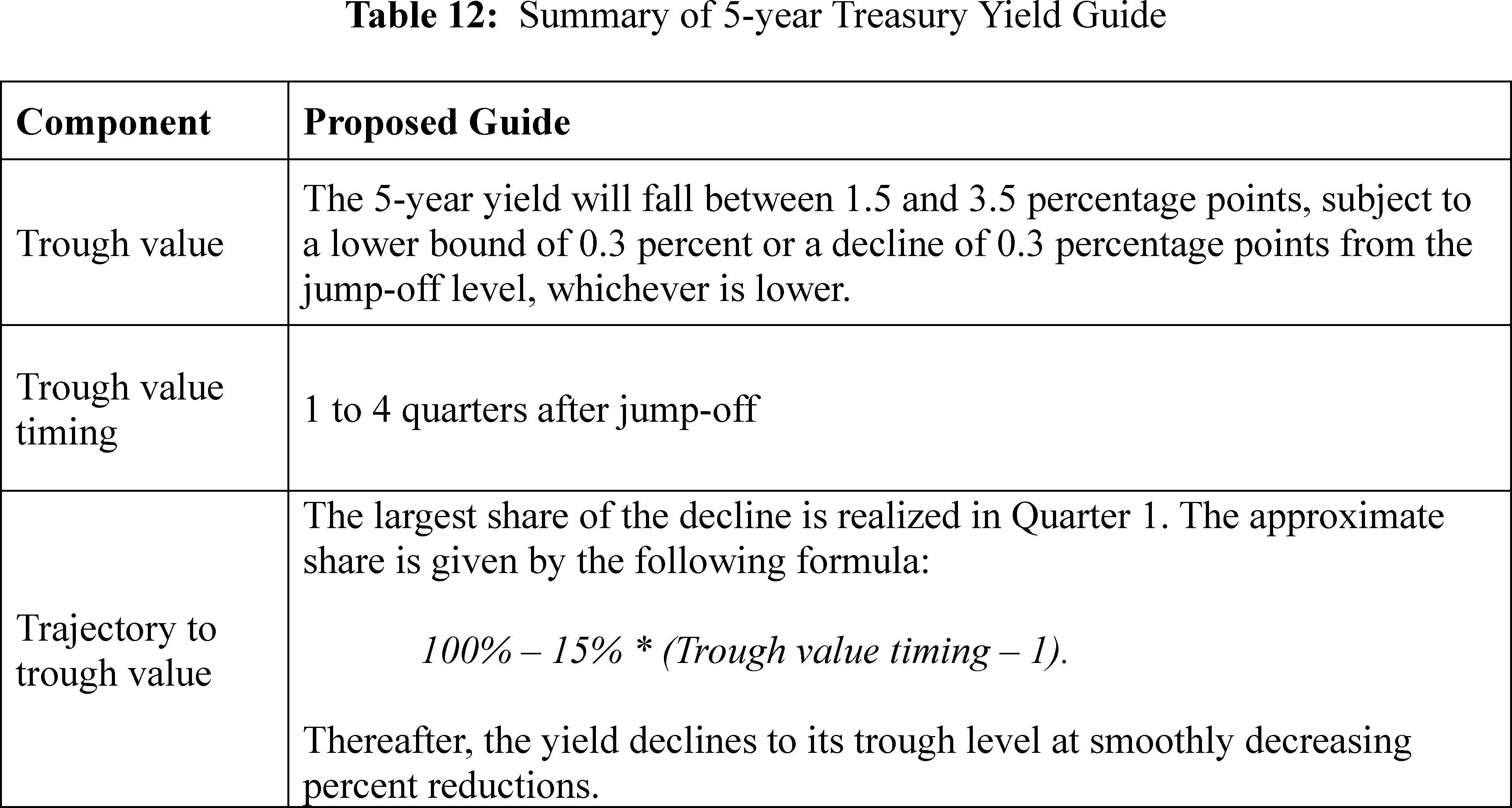
Because banks generally engage in maturity transformation by borrowing short-term ( i.e., deposits) to fund longer-term assets, fluctuations in interest rates can affect their financial health in various ways.[133] The 5-year Treasury yield is an important benchmark rate for credit markets and is, thus, directly related to the profitability of banks' investments in loans and securities as well as their trading activities. For example, a decline in longer-term Treasury yields that exceeds the decline in short-term yields (known as a flattening of the yield curve) tends to compress firms' net interest margins and can therefore reduce their profitability. At the same time, the decline in such yields tends to increase the market value of firms' investments in long-term fixed-rate bonds, some which is reflected in various measures of capital at firms.[134] Incorporating the 5-year Treasury yield into the supervisory stress test helps to ensure that firms are prepared for a wide range of market conditions, including periods with a sudden decline in a credit market benchmark rate. This helps maintain the overall stability and resilience of the financial system. In the proposal, the Board described historical data that informed the Board's proposed guide specifications.[135]
The Board did not receive comment on this aspect of the proposal and has determined to finalize, as proposed, the guide for the 5-year Treasury yield in the severely adverse scenario.
7. 10-Year Treasury Yield
The Board proposed a guide that would set out the following trajectories for the 10-year Treasury yield, which is measured using the quarterly average of ( printed page 62908) the yield on 10-year U.S. Treasury notes: [136]
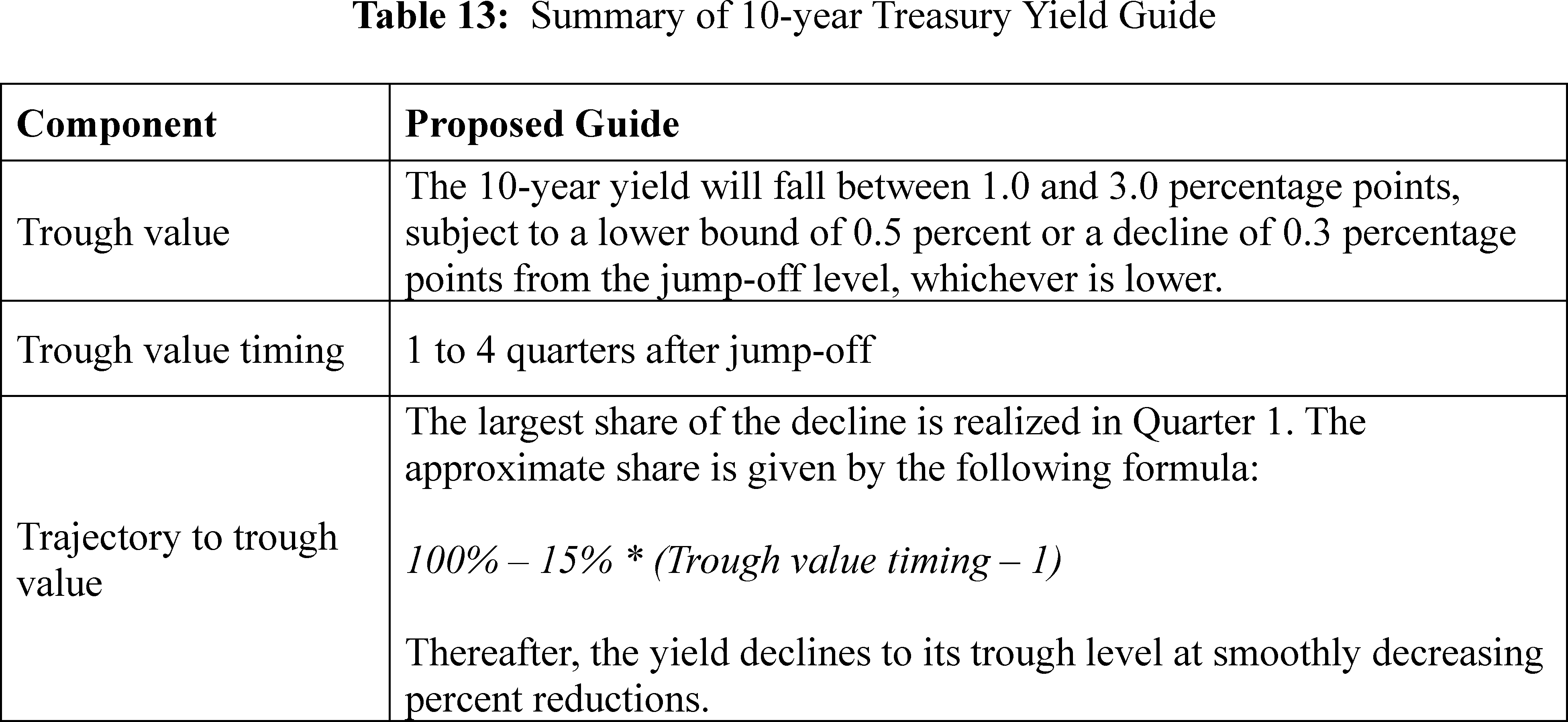
As noted above, because banks generally engage in maturity transformation by borrowing short-term ( i.e., deposits) to fund longer-term assets, fluctuations in interest rates can affect their financial health in various ways. Like the 5-year Treasury yield, the 10-year Treasury yield is an important benchmark rate for credit markets and is, thus, directly related to the profitability of firms' investments in loans and securities as well as their trading activities. For example, a decline in longer-term Treasury yields that exceeds the decline in short-term yields (known as a flattening of the yield curve) tends to compress firms' net interest margins and can therefore reduce their profitability. At the same time, the decline in such yields tends to increase the value of firms' investments in long-term fixed-rate bonds, some of which is reflected in various measures of capital at firms.[137] Incorporating the 10-year Treasury yield into the supervisory stress test helps to ensure that firms are prepared for a wide range of market conditions, including periods with a sudden decline in a credit market benchmark rate. This helps maintain the overall stability and resilience of the financial system. In the proposal, the Board described historical data that informed the Board's proposed guide specifications.[138]
The Board did not receive comment on this aspect of the proposal and has determined to finalize, as proposed, the guide for the 10-year Treasury yield in the severely adverse scenario.
8. BBB Yield
The Board proposed a guide that would set out the following trajectories for the BBB corporate spread, which is measured by the quarterly average of ICE BofA U.S. Corporate 7-10 Year Yield-to-Maturity Index relative to the 10-year Treasury yield: [139]
( printed page 62909)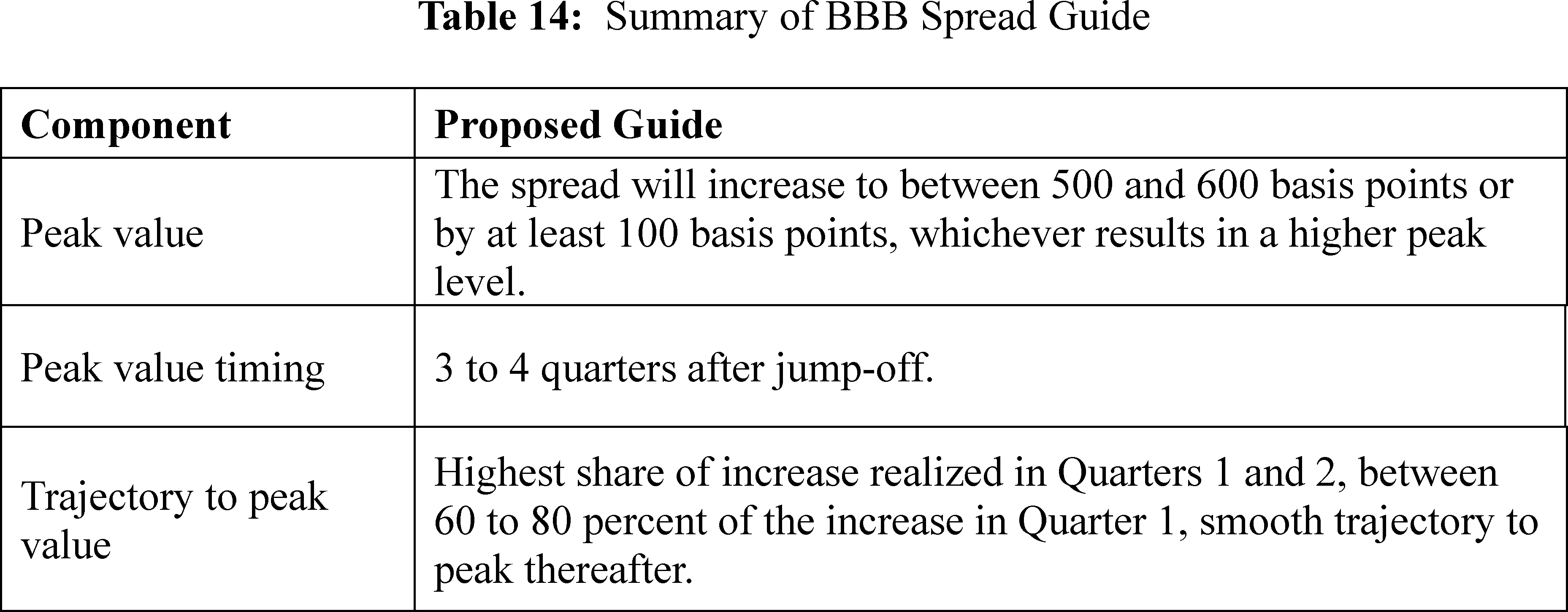
Although firms subject to the supervisory stress test do not hold substantial volumes of BBB corporate bonds on their balance sheets, they make business loans to large- and middle-market firms and hold other types of business debt on their balance sheets, e.g., commercial and industrial (C&I) loans and collateralized loan obligations (CLOs). Corporate bond spreads and CLO spreads tend to move together in times of financial stress and high uncertainty. C&I loans to large- and middle-market firms, some of whom are also issuers of corporate bonds, account for 65 percent of total C&I loans. Because of these similarities with bond-issuing firms, changes in business conditions that underlie changes in spreads on BBB corporate bonds would affect these borrowers as well (and hence the balance sheets of the stress tested firms). In fact, empirical research finds that bank borrowers are more sensitive to macroeconomic and financial shocks than publicly-traded borrowers due to their relatively more-restricted access to funding sources. Hence, in the context of the severely adverse scenario, the Board views BBB corporate bond spreads as a measure representing conditions in the business sector more generally. In the proposal, the Board described historical data that informed the Board's proposed guide specifications.[140]
The Board did not receive comment on this aspect of the proposal and has determined to finalize, as proposed, the guide for the BBB yield in the severely adverse scenario.
9. Mortgage Spreads
The Board proposed a guide that would set out the following trajectories for the mortgage spread, as proxied by the quarterly average of weekly series for the interest rate of a conventional, conforming, 30-year fixed-rate mortgage, obtained from the Freddie Mac Primary Mortgage Market Survey relative to the 10-year Treasury yield.[141]
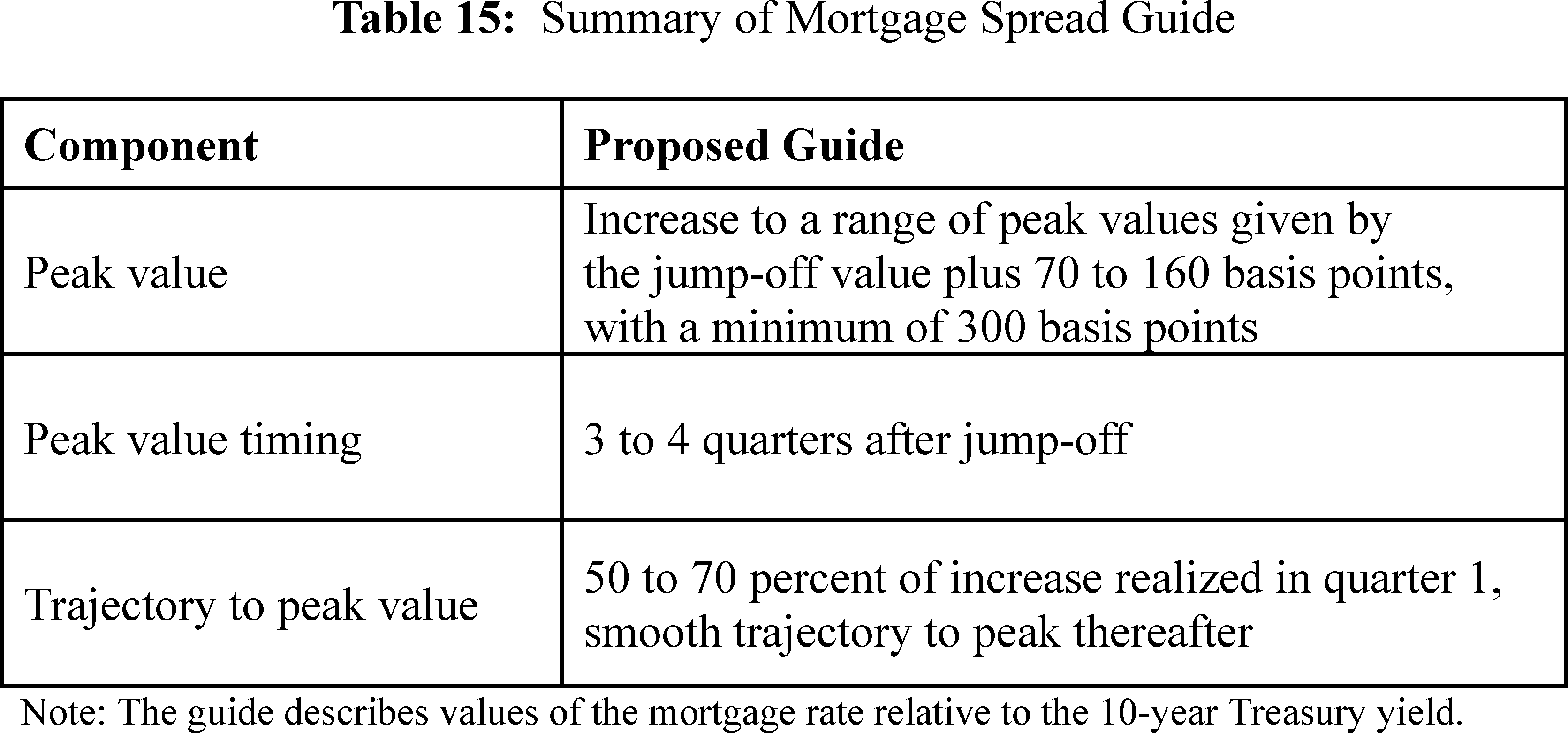
In the supervisory stress test, the mortgage spread can act as both (i) an indicator of stress for certain important assets under the scenarios and (ii) a source of stress for firms subject to the supervisory stress test with substantial exposure to assets that are tied to mortgage spreads, such as mortgage loan portfolio or mortgage-backed securities, which are reported by firms on FR Y-14M, Schedule A (First Lien) and FR Y-14Q, Schedule B (Securities). Firms subject to the supervisory stress test typically have substantial exposure to the assets referenced in the mortgage ( printed page 62910) spread, and as a result, by incorporating the mortgage spread into scenarios, stress tests help ensure that firms are prepared for a wide range of market conditions, including periods of elevated mortgage spreads, in part reflecting financial shocks and any associated economic downturn. This helps maintain the overall stability and resilience of the financial system. In the proposal, the Board described historical data that informed the Board's proposed guide specifications.[142]
The Board did not receive comment on this aspect of the proposal and has determined to finalize, as proposed, the guide for the mortgage spread in the severely adverse scenario.
10. International Variables
The Board proposed a guide that would set out the following trajectories for the international variables in the severely adverse scenario, including the path for real GDP, consumer price inflation, and the nominal exchange rate for four country blocs: the euro area, the U.K., Japan, and Developing Asia: [143]
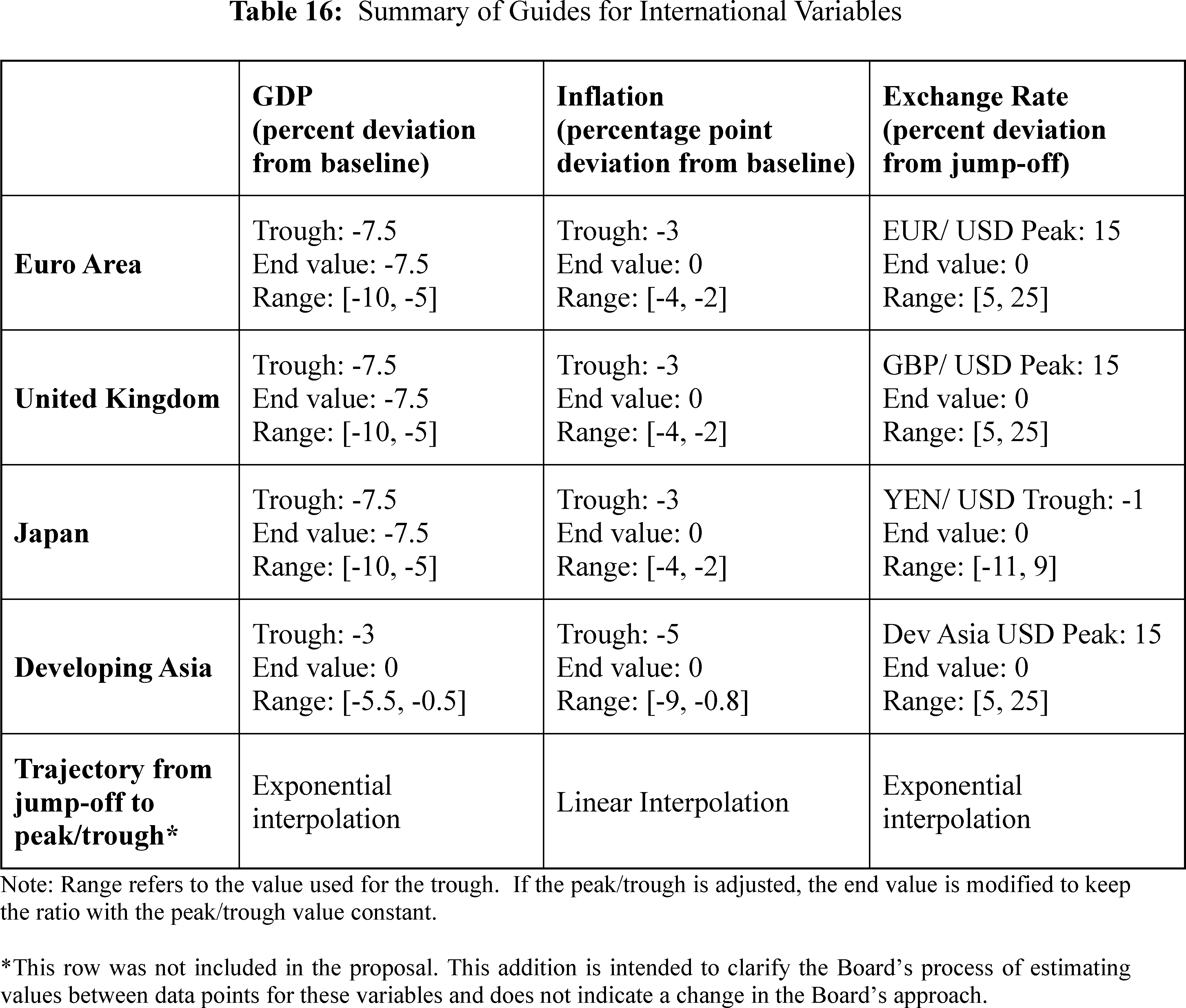
In conjunction with these guides, the Board proposed an approach that relies on both judgment and insights from economic models that informs the path of international variables.[144] As described in the Scenario Design Policy Statement, a scenario that targets all specific risk factor groups includes judgement on the projected paths of selected international variables. Recessions that occur simultaneously across countries are an important source of stress to the balance sheets of firms with notable international exposures but are not a typical feature of the international economy even when the United States is in recession. As a result, simply adopting the typical path of international variables in a severe U.S. recession would likely underestimate the risks stemming from the international economy. Consequently, an approach that relies on both judgment and insights from ( printed page 62911) economic models informs the path of international variables. In the proposal, the Board described historical data that informed the Board's proposed guide specifications.[145]
One commenter stated that the use of identical trough values and ranges of GDP and inflation for the euro area, the United Kingdom, and Japan, would not be conceptually sound given that each of these three jurisdictions has operated on different economic trajectories since the 2007-2009 financial crisis. The commenter recommended that the Board incorporate jurisdiction-specific factors in determining the guides for these countries/regions, rather than applying a common shock across multiple jurisdictions, and explain how trough values within the prescribed range are chosen and the variables analyzed in making that choice when scenarios are released for comment.
The Board has considered the comments submitted and has determined to finalize, as proposed, the guides for international variables in the severely adverse scenario.
Differences in the economic trajectories of a given country bloc are reflected in the international variables in the baseline scenario—since variable specifications are expressed as deviations relative to the baseline scenario. Furthermore, the guides are expressed as ranges, so further differences could be imposed by selecting different values for different countries. Therefore, the Board determined that the proposed guides are appropriately formulated to set the paths of the international variables in the severely adverse scenario in a simple and reasonable manner. Other comments related to the Board's macroeconomic model for stress testing are addressed in 2027 Model Review of Comments and Summary of Changes.
H. Global Market Shock
The global market shock component is applied to market risk positions held by the firms on a given as-of date. Under the Board's regulations, the global market shock can apply to both the supervisory stress test and the company-run stress test for applicable firms. This section describes the Board's proposal related to the global market shock component in the Scenario Design Policy Statement, and comments received on that proposal. A discussion of adjustments to the global market shock component of the supervisory stress test, including the as-of date window, use of two scenarios on a single date, notification, and applicability, are discussed above in Section II.E. of this Supplementary Information .
1. Design of the Global Market Shock
In the proposal, the Board explained that the global market shock component comprises a large set of financial risk factors and associated hypothetical shocks to those risk factors. The Board considers emerging and ongoing areas of financial market vulnerabilities in the development of the global market shock component, informed by financial stability reports, supervisory information, and internal and external assessments of potential sources of distress such as geopolitical, economic, and financial market events. Financial risk factor shocks are calibrated based on assumed time horizons that reflect several scenario design considerations. The Board also considers liquidity characteristics of the different asset classes that constitute certain risk factors. These liquidity horizons approximate the variation in speed at which banks could reasonably close out, or effectively hedge, the associated risk exposures in the event of market stress. The Board has also published a summary of the models and processes of the global market shock component for the 2026 stress test on the Board's website.[146]
The Board considered enhancements to the design of the global market shock in the annual stress test to improve the stress test's ability to capture the impact of severe economic stress in financial markets. The Board also considered alternative approaches to the global market shock, including employing instantaneous shock events across multiple as-of dates, rather than the current approach of selecting a single date for an instantaneous shock event; and an annual stress test that features multiple global market shock components on a single as-of date, which would allow the Board to compare a given firm's losses across a variety of types of shocks for a given set of trading position, which could be aggregated using a simple average, an average of the two worst outcomes, or another technique.
2. Additional Guardrails
One commenter stated that the current methodology provides significant discretion in specifying primary risk factor shocks. The commenter stated that this discretion can lead to year-over-year volatility in capital requirements and suggested that the Board should establish, disclose, and publish guardrails for selecting and adjusting global market shock scenarios. Another commenter stated that the Board should not implement guardrails for the global market shock component, stating that advance disclosure of these parameters would allow large trading firms to optimize their portfolios around known stress test scenarios.
In consideration of these comments, the Board has determined to revise the range of “severe” shocks of the primary risk factors. The Board has revised the upper bound of the “severe” shock from the historical maximum to the 99.9th percentile (and the lower bound from the historical minimum to the 0.1th percentile). The Board will disclose the upper and the lower bound values associated with the revised range of “severe” shocks for each of the primary risk factors in the Fall2026 Global Market Shock Component Documentation. On an exceptional basis, the Board may consider shocks outside the range of “severe” shocks if a given scenario narrative includes forward-looking emerging risks, heightened vulnerabilities in particular asset classes, or stressed current financial market conditions.
The Board recognizes the existing judgment-based element of the global market shock scenario design framework. The February 2026 Global Market Shock Component Documentation specifies the percentile ranges for shock values within the given severity category. For example, as described in the February 2026 Global Market Shock Component Documentation, a “severe” shock can fall between the 99th percentile and the historical maximum. Selecting primary risk factor shock values from the extreme observations (such as the historical maximum or beyond the historical maximum) on a regular basis may, in some cases, contribute to volatility in year-to-year capital requirement.
The revised range of the “severe” shock category limits the discretion in the primary shock severity selection by limiting application of the extreme observations in the historical distributions. The Board will disclose the upper bound and lower bound values of “severe” shock in the Fall2026 Global Market Shock Component Documentation to provide additional transparency and predictability. The Board also clarifies that the Board may consider shocks outside the revised range of “severe” category only on an exceptional basis. The Board describes ( printed page 62912) the basis for such exceptions in the Fall2026 Global Market Shock Component Documentation. This further promotes accountability of the shock severity selection process and is expected to improve the year-to-year stability of the stress test results, because it would likely reduce the application of historical minimum and maximum shock values, or exceeding these values, in the global market shock component.
The Board expects to continue to derive secondary and other remaining GMS shocks via models as described in the model documentation without defining ranges for these shocks. Restricting these model-based shocks to pre-determined ranges could result in less-coherent or less-plausible global market shock scenarios. The Board also expects to continue to seek public comment on the global market shock component each year, including on shock severities. This approach can continue to allow the Board to specify shock severities that are consistent with scenario narratives and sufficiently severe, while improving the transparency of the framework.
The Board considers that the current scenario design framework, including the revised percentile ranges, will help ensure the internal consistency of the market shocks in the global market shock component. As described in the 2019 Scenario Design Policy Statement and the February2026 Global Market Shock Component Documentation, the Board considers multiple sources of information specifying scenario narratives, which informs the shock size for primary risk factors. This includes supervisory experience and forward-looking expert judgment, as well as statistical analysis of historical and recent financial data, and consideration of historical shocks in combination with past firm risk exposures.[147] The percentile ranges allow the Board to specify shocks that are consistent with both the severity dictated by the narrative and current market conditions, and to adjust the shocks within the range as needed when conditions change during the comment period. In comparison, applying fixed percentile points ( e.g., using the same standardized percentile such as 99th or 95th percentiles for key shocks) mechanically without taking the scenario narratives and the current market conditions into consideration can lead to shocks that are not internally consistent with the narrative or not reflecting salient risks, if present.
Compared with fixed percentiles, percentile ranges provide flexibility that can, in some cases, promote the stability of the global market shock component year to year. While the scenario narrative determines the severity category and associated relevant percentile range, nuances in a given narrative may necessitate the selection of shocks from different points within the range. In addition, changes in market conditions and firms' trading positions impact the severity of shocks. For example, a shock that is considered severe in one environment may not be considered severe in others. Finally, the percentile ranges allow the Board to select primary risk factor shock values that are coherent and internally consistent, which may not be achievable if the severity category is mapped to fixed percentiles.
For the reasons described above, the Board believes that the approach adopted in this final Scenario Design Policy Statement, including the revised percentile ranges, is appropriate.
3. Global Market Shock Overlap With Risk-Based Capital Requirements
Several commenters recommended that the Board resolve overlaps between risk-based capital requirements, including in the credit valuation adjustment (CVA) and fundamental review of the trading book (FRTB) frameworks in the large bank capital proposal and the GMS component of the stress test, in order to prevent excessive capital requirements for firms' capital markets activities, to ensure that requirements are aligned with actual risks.
The Board has considered comments submitted on the proposal and has determined to finalize, with the revisions described above, the framework for the global market shock component.
The Board is mindful of potential overlaps between the capital and stress testing frameworks. The Board's supervisory stress test complements the risk-based framework by adding forward-looking granularity and risk sensitivity to ensure that firms subject to the stress test are sufficiently capitalized to absorb losses during a stress event. In contrast, the Board's 2026 Capital Proposals establish minimum capital requirements, which are designed to promote the safety and soundness of firms subject to those requirements.[148] As noted in the Board's recent proposals to modernize the regulatory capital framework, the Board considered the combined calibration of these frameworks and determined that they would be appropriate. The Board will further consider comments on the 2026 Capital Proposals, and the interaction of that proposal with this final action, in any final capital rulemakings.
4. Digital Assets
One commenter suggested that the Board should include certain digital asset market shocks to the global market shock component of the stress test scenario, while another commenter suggested that the Board clarify how exposures to crypto-related assets are treated.
The Board has considered the comments submitted and has determined to finalize, as proposed, the global market shock component described in the proposal without adding additional digital asset-based shocks.
The Board considered the commenter's suggestion of adding certain digital asset market shocks to the global market shock component of the stress test scenario and has determined not to add digital asset market shocks. Developing digital asset market shocks would require detailed data regarding firms' digital asset market exposures that are not sufficiently captured at the level of granularity necessary to develop market shocks in the FR Y-14Q and are not otherwise available. Capturing such data would increase reporting burden for firms. While the Board is finalizing this aspect of the proposal as-proposed, the Board regularly assesses the performance of the supervisory stress test, and may consider changes, as well as revisions to regulatory reports to assess potential changes, in the future.
5. Multiple Market Shocks—Two Global Market Shock Scenarios
A discussion of adjustments to the global market shock component of the supervisory stress test, including the use of two scenarios on a single date, are discussed above in Section II.E of this Supplementary Information.
6. Shock Values
The Board proposed the following shock definitions by asset class; shock values are generated for all exposures in the global market shock template: [149]
( printed page 62913)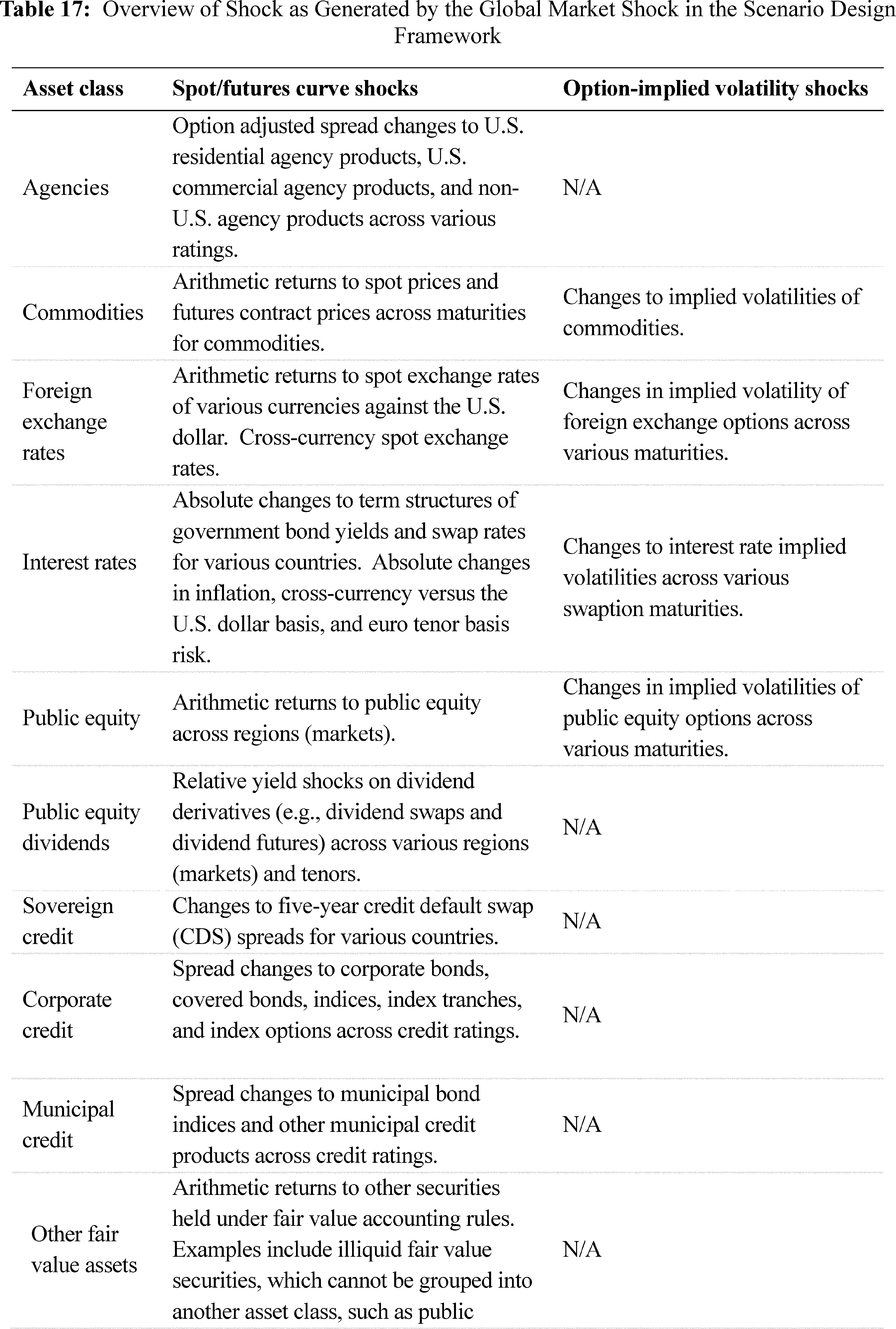
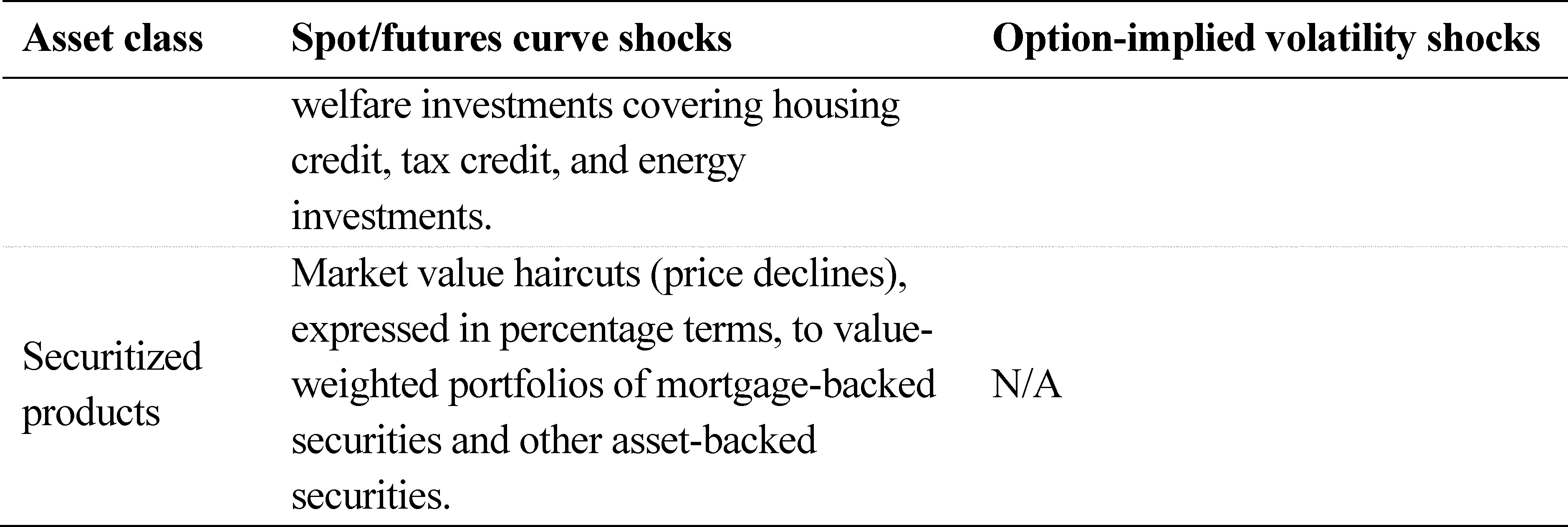
The Board has considered comments submitted on the proposal and has determined to finalize, as proposed, the shock values in the global market shock component.
7. Liquidity Horizons
For the global market shock component, the Board proposed to amend the Scenario Design Policy Statement to make the following changes to the liquidity horizons, which are broadly consistent with the standards in the Basel Committee on Banking Supervision's FRTB.[150] The proposed liquidity horizons were selected, in part referencing the FRTB, because those horizons represent a general consensus of a broad range of regulation authorities and the industry. Therefore, they can be considered to be a reasonable benchmark for defining the shock horizons that would be used in the global market shock component. The horizons in the proposal departed from the FRTB slightly by specifying the same liquidity horizon to all risk factors in the same asset class. This choice was consistent with the Board's stress test principle of simplicity and facilitated a more straightforward modeling framework for the global market shock. Additionally, these shortened horizons were proposed because they better align with the projection horizon in the stress test, and help avoid outlier outcomes that would both increase and decrease losses related to trading.
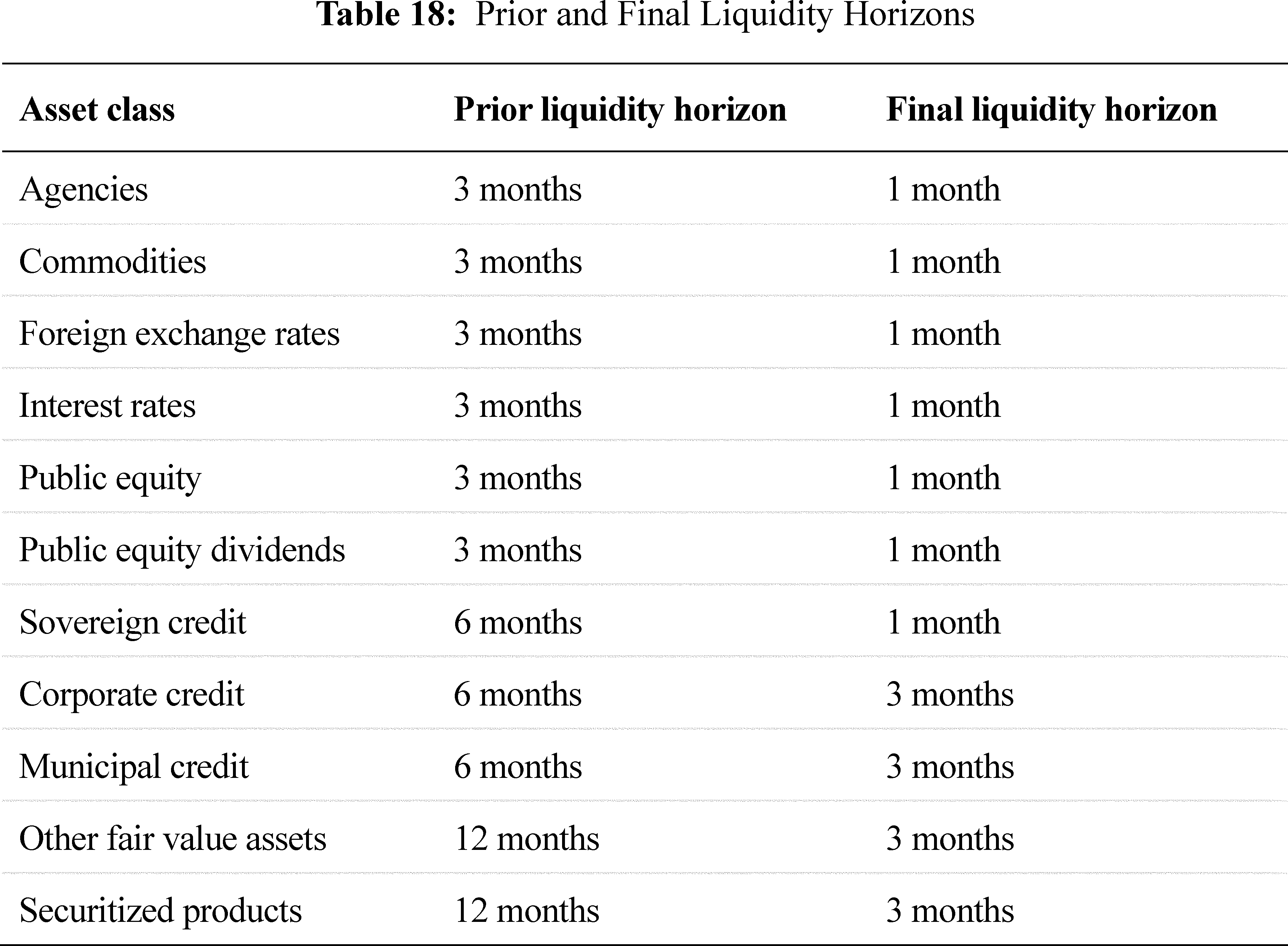
One commenter supported the revised liquidity horizon assumptions, including using the same liquidity horizons for all risk factors within the same asset class. The commenter also stated that the current instantaneous shock approach is preferable to the alternative dynamic approach. Another commenter also supported the revised liquidity horizon assumptions, and stated that this revision should lead to less year-over-year volatility in global market shock results and less atypical trading outcomes.
Consistent with these commenters, and for the reasons discussed in the proposal, for future scenarios, the Board is adopting the revised liquidity horizon assumptions as proposed and maintaining the current instantaneous shock approach.
8. Global Market Shock Simplification
The Board proposed to substantially reduce the number of disclosed risk factors from over 20,000 to approximately 2,300 shocks, determined based on their relevance for developing a global market shock scenario narrative, the materiality of the risk factor, data quality, and consistency across asset classes. Under this approach, the Board would also review consistency across asset classes. In this regard, where possible, the Board would generate shocks to the same set of countries, regions, and tenor points across different asset classes. Such consistency would simplify shock comparison across different asset classes and improve public understanding of the global market shock component. Additionally, the Board proposed to remove the inclusion of shocks to the values of private equity positions in section 3.2(b)(viii) of the Scenario Design Policy Statement, because private equity exposures are now stressed using the severely adverse macroeconomic scenario.
One commenter supported retaining the current level of risk factor granularity, as, in their view, it is essential to generating a scenario that accurately captures risk to financial market activities. The commenter suggested that, if the Board does reduce the number of disclosed risk factors, as proposed, then the Board should publish mapping methods for public review and perform the mapping itself to maintain consistency across firms.
The Board has considered the comments submitted and has determined to finalize, as proposed, the simplification of disclosed risk factors in the global market shock component.
In the proposal, the Board proposed to reduce the number of disclosed risk factors in the global market shock component from more than 20,000 to approximately 2,300 shocks in order to simplify the global market shock component, and help focus the disclosure on the most material shocks, as many of the 20,000 risk factors are often not material (for example, certain commodity shocks) and do not necessarily enhance the risk capture of the global market shock component.[151] The Board determined the shocks that would continue to be disclosed by assessing their relevance for developing a global market shock scenario narrative, the materiality of the risk factor, data quality, and consistency across asset classes.
To provide the ability to map from the simplified shocks to the full list of shocks in future scenarios, the Board has published detailed instructions for relative shock conversions and instructions on how to map from the simplified template to the original full template for public comment. These instructions include (1) the mapping between the simplified shock template and the original full shock template, (2) instructions on how to calculate foreign exchange crosses for non-U.S. dollar-denominated pairs, (3) descriptions of risk factors to use for conversions of absolute shocks to relative shocks on the as-of date, and (4) descriptions of any interpolation and extrapolation methods involved in the relative shock conversions.
For future scenarios, the Board expects to use the simplified shock template in substantially the same form as was disclosed in the 2026 scenarios without continuing to publish the full shock template at the same time; the full shock template, with the values of the over 20,000 shocks, can be determined, as desired, by using the mapping instructions published alongside the proposed and final scenarios.
VII. Economic Analysis
As discussed above in Sections I.E and I.G of this Supplementary Information , this final rule's goal is generally to increase transparency and public accountability while improving the risk capture of the supervisory stress test and ensuring the test's ability to capture changes in the risks in the financial industry over time. These changes, which also involve adjustments to the stress test calendar, are expected to provide meaningful benefits to the public, as discussed below. This section provides economic analysis of the adopted enhanced disclosure of the supervisory stress test framework.
The Board's supervisory stress test has historically operated with some disclosure regarding the stress test models and scenarios used, with an increase in information shared with the public beginning in 2019, as discussed in Section I.B of this Supplementary Information . The enhanced disclosure, including the publication of comprehensive model documentation and the new disclosure process for the models and scenarios, provides several benefits. These benefits include improved credibility of the stress test, improved feedback regarding the modeling process, better informed investors, and improved market discipline. However, the enhanced disclosure comes with costs as well, including reduced model dynamism and increased systemic reliance on a single model, or “model monoculture.” These benefits and costs were described in the October 2025 proposal.[152]
The Board received several comments on the benefits and costs of the proposal. As described above in Section I.F of this Supplementary Information , most commenters were supportive of the proposal's objective to provide the public with more information about the stress test models and scenarios and to improve the transparency, public accountability, and predictability of the supervisory scenarios. However, some commenters objected to the increased transparency of the stress test, stating that it would undermine the effectiveness and dynamism of the stress test.
A. Baseline
The economic analysis uses the stress testing framework in effect prior to the proposal, including the current disclosure regime, as the baseline. Throughout the analysis, the Board assesses the economic impact of the final rule by comparing outcomes under the final rule to the outcomes estimated under the baseline.
B. Final Policy Changes
With this final rule, the Board is publishing final, comprehensive descriptions of the modeling framework used to conduct the supervisory stress test after reviewing public input. These descriptions include the equations, variables, and parameters of each model used to estimate the projections that, when aggregated, produce the results of the supervisory stress test. This final rule also codifies an enhanced disclosure process under which the ( printed page 62916) Board will annually publish the stress test models, invite public input on any material model changes prior to implementing them in the stress test, and seek public input on the annual stress test scenarios prior to their finalization. This represents a significant increase in disclosure relative to the baseline, as prior stress test disclosures were relatively more limited. For example, prior disclosures were limited to the structure of the stress testing model framework and certain key variables.
In addition, this final rule will adjust several dates in the stress test calendar, including the GMS as-of date window, as described in Sections III.E of this Supplementary Information . Other changes to the calendar, such as the shift in the capital plan submission date, adjust the stress testing schedule to accommodate the public input process and mitigate risks that the enhanced disclosure provided under the final rule would undermine the goals of supervisory stress testing.
Section VI.A of this Supplementary Information summarizes the changes made to the stress testing models from the 2025 to the 2027 supervisory stress test, which will inform the Board's determination of firms' stress capital buffer requirements.[153] Section VI.B provides an analysis of the potential effects of these model changes.
Finally, Sections IV and VII of this Supplementary Information describe changes to the Board's Stress Testing Policy Statement and Scenario Design Policy Statement, respectively. The changes to the Board's Stress Testing Policy Statement and Scenario Design Policy Statement express the Board's expectations for how the Board will conduct the annual supervisory stress test and design annual scenarios for the supervisory stress test. These changes will provide additional transparency, public accountability, and predictability without creating binding legal obligations or economic impact. As described in Section I.H of this Supplementary Information , comments and interactions with other proposals that are not described in this notice will be addressed in any final actions associated with those proposals.
C. Analysis of Benefits and Costs of Enhanced Model Disclosure
1. Benefits
Drawing from available literature, the proposal described several expected benefits: improved credibility of the stress test; improved model feedback from the public; improved ability for firms to evaluate business plans; and better informed investors and improved market discipline.
The Board received several comments on the benefits of the proposal. These commenters stated that improved transparency would support the predictability of the stress test for firms subject to the test; this predictability would improve capital allocation and planning. Commenters also suggested that the proposal would reduce the volatility of stress capital buffer requirements, which would support effective capital planning and the deployment of capital and liquidity into the broader economy and, in turn, improve the availability and cost of credit for businesses and households. One commenter further stated that reducing volatility would help limit risk migration out of the banking system.
One commenter supported the proposal because it would increase the predictability of the stress test, stating that predictable stress tests would improve market discipline by helping investors, counterparties, and analysts better understand stress test results. The commenter also noted that predictability would also improve the public's confidence in the stress test.
Commenters also suggested that the public input process would improve model quality by enabling feedback from the public to identify weaknesses or challenge assumptions in the models. One commenter stated that improving the risk capture of the stress test models through the public input process would lower risk in the financial system.
Other commenters stated that the proposal risked the credibility of the stress test, as described below in the Board's assessment of the costs of the final rule, because a less severe or dynamic annual stress test could lead to stress test results that offer false comfort that the banking system is safe. The Board considered these comments on the benefits of the proposal and assessed them below relative to the components of this final notice.
a. Improved Credibility of the Stress Test
As described in the proposal and above in Section II of this Supplementary Information , the supervisory stress test provides material safety and soundness benefits, and these benefits are expected to be more sustainable when the Board's stress testing program operates with high levels of accountability and credibility. The disclosure of comprehensive model documentation to the public, and the commitment to continue this disclosure, will help ensure that all institutions and stakeholders have equal access to the Board's supervisory stress test methodology. This access will strengthen accountability in supervisory decisions and promote fairness. Publicly disclosing the stress test models and scenarios also enhances trust in the stress testing process,[154] as stakeholders may be able to better assess the soundness of models and their alignment with best practices.[155] As a result, firms may better understand where there are discrepancies between their own internal stress testing models and the supervisory stress testing models, and consequently they may be better positioned to communicate specific concerns with supervisors. With greater transparency and public accountability, stakeholders may be more confident that the supervisory stress test results do not reflect the desires of firms or supervisors to obtain a specific outcome.[156] While the Board has previously released enhanced disclosures of the stress test models, such as portfolio-level average loss rates, risk drivers, and connections between hypothetical scenario values and losses, the comprehensive model documentation disclosed in connection with this proposal better illustrates how supervisors incorporate model refinements and emerging risks, which could further improve credibility of the supervisory stress test over time.
In addition, as described in Section II.E of this Supplementary Information , this final rule extends the date selection range of the GMS component as-of date from five months (between October 1 of ( printed page 62917) the previous year and March 1 of a given year) to nine months (between April 1 and December 31 of the calendar year prior to the year the stress test is administered). Thus, the GMS component could be applied to market risk positions held by the firms on any selected date within a wider, nine-month period, instead of the current five-month period. This change could reduce the risk of gaming activities, such as “window dressing,” whereby firms subject to the GMS component could temporarily adjust their balance sheets to reduce losses without reducing actual risk. Additionally, revisions to the Scenario Design Policy Statement specify that the Board expects to subject firms to two GMS scenarios on a single as-of date for a single stress test. The Board expects to use the maximum loss of the combined trading and counterparty results across both GMS scenarios to determine a firm's stress test results. A second GMS scenario is expected to improve the risk capture and identification of the stress test by allowing the Board to capture a wider range of firms' vulnerabilities with opposite directions of shocks, and it is expected to reduce year-over-year volatility in trading and counterparty losses.
While the Board acknowledges comments that stated that the proposal, and therefore this final rule, would reduce the credibility of the stress test, the Board expects that the improved risk capture and identification, as well as reduced volatility in stress test results, will instead enhance the credibility of the stress test results.
b. Improved Model Feedback
The Board's supervisory stress test models consist of equations, parameters, and assumptions that translate hypothetical macroeconomic shocks under designed stress scenarios into loss estimates across asset classes, income streams, and capital ratios. Despite their complexity, the supervisory stress test models and stress scenarios, like all theoretical models, remain simplified representations of reality. As such, they benefit from feedback and refinement. Disclosure of models and scenarios is expected to enable academics, industry professionals, and the broader public to provide more effective feedback.[157] For example, the Board received significant feedback on the models disclosed with this proposal, and adopted several changes to the models incorporating that feedback, as described above in Section V of this Supplementary Information . This feedback also helped inform additional changes to the models that the Board is separately proposing for the 2027 stress test.
As demonstrated by this initial public input process, such feedback can be reasonably expected to help to refine and improve the models and scenarios as, over time, they could be updated to mitigate concerns and adopt improved modeling approaches where appropriate. In this sense, the final rule's enhanced disclosure enables stakeholders' feedback, which could ultimately lead to better model performance and further enhance the credibility of the supervisory stress testing process.[158]
c. Improved Ability To Evaluate Business Plans
Comprehensive disclosure of the stress test models is expected to help firms better understand how supervisors assess losses under severely stressed hypothetical scenarios. This may allow firms to more accurately predict their required capital ratios, reducing capital planning uncertainty [159] and possibly increasing firms' willingness to lend.[160] As described in the proposal and noted by certain commenters, reduced capital requirement uncertainty could help firms plan more effectively for future business decisions, as firms would better understand the impact of these decisions as it relates to stress test results and related capital requirements.
d. Better Informed Investors and Improved Market Discipline
Research suggests that investors use stress test results to assess firms' resilience. Indeed, disclosures of results from the stress test tend to affect firms' stock prices and CDS spreads.[161] Through such financial market signals, investors may help discipline firms' risk taking [162] behavior and incentivize firms to strengthen capital positions.[163] As described in the proposal and noted by certain commenters, the comprehensive disclosure of the supervisory stress testing models and scenarios may allow investors to make better informed decisions, potentially improving the effectiveness of market discipline.
2. Costs
The Board also received several comments on the costs of the proposal. Some commenters argued that the proposal would increase the predictability of the stress test, thereby reducing its dynamism. This would limit the stress test's ability to capture salient and unseen or under-appreciated risks by making the annual test more repetitive. These commenters generally expressed concern that model and scenario disclosure would enable or incentivize firms to limit their stress test losses under the test by adjusting their balance sheets. These commenters argued that firms would be able to optimize their balance sheets for the stress test, which would enable firms to lower their stress capital buffer requirements without necessarily reducing the riskiness of their portfolios.
One commenter stated that the proposal, together with other proposed and implemented changes to the supervisory stress test, would undermine the value of the stress test ( printed page 62918) and make the largest banks, the financial system, and the economy more vulnerable. Commenters also stated that the proposal would have the effect of reducing capital requirements for firms subject to the supervisory stress test, which would reduce the resilience of such firms during periods of economic stress.
Commenters also stated that the public input process could slow the development of models over time, causing them to be outdated by the time any model changes are implemented. Additionally, some commenters expressed concern that model disclosure would lead to “model monoculture,” whereby firms adjust their internal models to adopt the Board's stress test models, and ultimately omit specific risks in these models that would be relevant to an applicable firm or set of firms. Other commenters disagreed, stating that concerns about “model monoculture” and balance sheet optimization are misplaced, and that supervisory attention and firm incentives eliminate any realistic possibility of such balance sheet optimization based on the disclosed models.
The Board considered these comments on the costs of the proposal and assessed them relative to the components of this final notice.
a. Reduced Dynamism
As discussed above, models are necessarily a simplified version of reality. As forecasting methodologies evolve or conditions in the economy and the financial system change, the existing models may no longer adequately capture risks. For this reason, an effective stress test must be able to adapt. Under this final rule, future material changes to the stress testing models would be published for public input, and the Board would be required to respond to such comments before implementing the material model changes in the supervisory stress test. This process will increase the resources needed to propose, develop, and implement material model changes, particularly to the extent that any changes are complex, present many alternatives, or affect firms' ability to distribute capital. As a result, according to certain academic literature and as described in the October 2025 proposal, the use of new models or model changes that explore less established risks may pose a high resource burden under the enhanced disclosure regime. This burden could limit the supervisory stress test to simpler, less controversial, and more familiar modeling approaches.[164] Tests of new risk dimensions or emerging threats may take significantly more time to implement. With less dynamism, the supervisory stress test may fail to capture new risk and could produce an increasingly stale view of how firms would likely perform under stressed conditions, according to certain academic literature.[165]
In consideration of the comments and the available literature described in the proposal and in this section, the Board recognizes several features that mitigate potential reduced dynamism in the final rule. First, firms subject to the stress test will not have the precise specifications of the proposed or final scenarios, or the final models to be used in the stress test, until after the stress test jump-off date or GMS as-of date for a given year. Additionally, the Board is implementing changes to the GMS component that expand the as-of date window and set the expectation that there will be two GMS scenarios for a given stress test. These process and substantive changes help mitigate the risk that firms could optimize their balance sheets for the stress test, which could in turn enable firms to lower their stress capital buffer requirements without necessarily reducing the riskiness of their portfolios. Additionally, the Board expects that the enhanced disclosure process for the scenarios and models will help the Board, firms, and the public better identify any impacts to the stress test results that could weaken the credibility of the supervisory stress test over time or in a given year.
The Board also considered comments related to slower model development. As explained above, the Board will continue to develop and enhance its models year-to-year, though certain model changes that meet the Board's definition of material model changes will be subject to public input prior to implementation in the annual stress test. This approach is similar to the Board's previous policy, which involved phasing in highly material changes to the models over a two-year period.[166] The enhanced disclosure process will also mitigate concerns about slower model development, as the public will be better able to review the Board's models and suggest enhancements that reflect the most up-to-date data and modeling techniques.
b. Reduced Risk Sensitivity and Overreliance on a Single Model Framework
Supervisory stress test results are important inputs to the capital requirements associated with firms' banking activities. With comprehensive model disclosure likely reducing the uncertainty of supervisory stress test results, firms' estimates of future regulatory capital requirements could rely more on the Board's stress test models and less on their own internal stress testing models or internal risk management tools, both of which may be less useful than before the introduction of enhanced disclosure for managing regulatory capital.[167] To the extent that firms' own internal stress testing models or risk management tools provide additional information about risk, the expected capital requirements could become less risk-sensitive as a result, which could reduce firms' incentives to independently measure and manage their vulnerabilities.
Disclosure could also enable firms to more easily optimize their exposures to minimize capital requirements in the supervisory stress test, which could allow vulnerabilities to build up where risks are not well or fully represented by standardized supervisory models.
Reliance on the supervisory stress testing models could extend further if enhanced disclosure results in firms increasing the similarity of their own stress models to the stress test models.[168] Increased reliance of all stress-tested firms on a single model, known as “model monoculture,” combined with a delay in material model changes, could cause risks to build in areas that are treated benignly in the stress test. Firms may face a greater incentive to shift business activities towards these areas to reduce their capital requirements.[169] The ( printed page 62919) resulting convergence of risk taking could increase the vulnerability of the banking system, particularly to those risks that are under-reflected by the supervisory stress testing models.[170]
In addition to the comments considered above, the Board considered comments stating that the proposal would encourage overreliance on a single model framework. The Board expects that significant differences in the purposes of the Board's supervisory stress test models compared to firms' own risk management models are likely to discourage firms from supplanting their models with the Board's stress test models. For example, the Board uses models that assess risk on an industry-wide basis and at the level of detail reported in the FR Y-14 reporting forms. These models are applied to all firms subject to the stress test. By contrast, firms have more granular data related to their own positions and risks, which better enables firms to assess their own risks internally according to their own models. In the event that a firm adopts the Board's models in place of the firm's own models, supervisors retain appropriate tools to assess the firm's models and model development practices.
D. Conclusion
As discussed above, comprehensive model documentation published in connection with this final rule, as well as the finalized enhanced disclosure process, provide several benefits that outweigh the costs of the final notice.
Taken together, the Board assessed that the benefits of the changes described in this final notice justify the costs.
VIII. Administrative Law Matters
A. Paperwork Reduction Act Analysis
In accordance with the requirements of the Paperwork Reduction Act (PRA) of 1995 (44 U.S.C. 3501-3521), the Board may not conduct or sponsor, and the respondent is not required to respond to, an information collection unless it displays a currently valid Office of Management and Budget (OMB) control number. The Board reviewed the information collections related to the proposed rule under the authority delegated to the Board by OMB.
 44 U.S.C. 3501-3521
The proposed rule would not have created any information collections subject to the PRA; however, the proposal would have revised the FR Y-14A/Q/M to reduce regulatory reporting burden by retiring items and removing supporting documentation requirements that are no longer needed to conduct the supervisory stress test. Additionally, the proposal would have collected additional information to support the proposed supervisory stress test models.
Final Approval Under OMB Delegated Authority To Extend for Three Years, With Revision, the Following Information Collection
Collection Title: Capital Assessments and Stress Testing Reports.
Collection Identifier: FR Y-14A/Q/M.
OMB Control Number: 7100-0341.
General Description of Collection: The FR Y-14 reports collect stress test and capital plan data from the largest holding companies, which are those with $100 billion or more in total consolidated assets. The data collected through the FR Y-14 reports provide the Board with the information needed to help ensure that large holding companies have strong, firm‐wide risk measurement and management processes supporting their internal assessments of capital adequacy and that their capital resources are sufficient given their business focus, activities, and resulting risk exposures. Information gathered in this data collection is also used in the supervision and regulation of these financial institutions.
Current Actions: The final rule adopts the proposed revisions to the FR Y-14A/Q/M, with modifications as discussed below, to remove supporting documentation requirements, schedules, and data items that are no longer needed to conduct the supervisory stress test. The final rule also makes other revisions necessary to facilitate the stress test modeling decisions. Except as discussed below, all revisions to the FR Y-14Q and FR Y-14M are effective for the June 30, 2027, report date, and revisions to the FR Y-14A for the December 31, 2027, report date.
Supporting Documentation
As discussed in Section IV.A of this Supplementary Information , the Board is removing the FR Y-14A supporting documentation requirement as it is no longer necessary to assess firms' company-run stress test results and capital plans. This revision is effective for the December 31, 2026, report date.
Additionally, as previously described in Section IV.A of this Supplementary Information , the Board is not adopting a FR Y-14Q, Schedule F (Trading) supporting documentation requirement. However, the Board is adopting a supporting documentation requirement for FR Y-14Q, Schedule L (Counterparty) with a limited set of requests related to firms' submissions of counterparty data. This revisions is effective for the December 31, 2026, report date.
Revisions To Support Modeling Decisions
As outlined in Section IV of this , the Board is adopting several FR Y-14 revisions to support the final stress test models. For example, private equity exposures are modeled under the macroeconomic scenario, so the Board is revising FR Y-14Q, Schedule F to capture private equity data in a manner that better aligns with this treatment. This revision is effective for the June 30, 2027, report date.
Additionally, to more comprehensively incorporate hedges into the stress test models, the final notice revises FR Y-14Q, Schedule B (Securities) and FR Y-14Q, Schedule F to capture data on additional types of hedges and hedging relationships, as well as from a broader set of firms. Similarly, the Board is adopting revisions to FR Y-14M, Schedule D (Credit Card) and FR Y-14Q, Schedule G (PPNR) to capture data on credit card revenue and loss sharing agreements (RLSAs). The hedge revisions are effective for the June 30, 2027, report date and the RLSA revisions are effective for the December 31, 2027, report date.
Other Changes From the Initial Notice
GMS
To align with the changes to the stress test calendar discussed in Section II.E of this Supplementary Information , the jump-off date for the supervisory stress test will remain December 31 and the as-of date range for the GMS will be between April 1 and December 31 of the year preceding the stress test. Therefore, ( printed page 62920) the Board is adopting revisions to conform the FR Y-14A and FR Y-14Q to this GMS as-of date window while retaining a December 31 jump-off date for the FR Y-14A. Additionally, as discussed in Section II.E of this Supplementary Information , the Board is adopting a two GMS scenario per stress test approach. To align the FR Y-14 with this change, the Board is revising FR Y-14Q, Schedule L (Counterparty) such that applicable firms must report this schedule under both GMS scenarios. On the FR Y-14A, the Board is revising the instructions to instruct firms to report internal projections under the GMS scenario that results in the larger projected CET1 capital decline. However, to enable the Board's calculation of GMS losses under both scenarios, the Board is revising FR Y-14A, Schedule A.1.d (Capital) to collect adjusted starting values under both GMS scenarios. The revisions to collect the data necessary to conduct both GMS scenarios are effective for the December 31, 2026, report date.
Address Matching and Pre-Payment
The Board is also retiring several items from FR Y-14M, Schedule C (Address Matching) that are no longer necessary as discussed in Section IV.B of this Supplementary Information . Similarly, the Board proposed to retire several items from FR Y-14M, Schedule B (Home Equity). One commenter noted that since item 51 (“Pre-payment Penalty Term”) was proposed to be retired, item 50 (“Pre-payment Penalty Flag”) should also be retired. The Board agrees item 50 is no longer necessary. Therefore, the Board is adopting the removal of the items from Schedule B, including item 50. These revisions are effective for the December 31, 2026, report date.
Exchange Traded Funds
As discussed in Section IV.E of this Supplementary Information , the Board is revising the instructions for FR Y-14Q, Schedule F to clarify how firms should decompose exposures in exchange traded funds. This revision is effective for the June 30, 2027, report date.
Sovereign Counterparties
As discussed in Section V, the Board is adopting final models for the 2027 stress test. In support of these models, the Board is also revising certain aspects of the FR Y-14A/Q/M reports. As discussed in the final Market Risk Model Documentation, the Board excludes sovereign counterparties from the largest counterparty default (“LCPD”) component that are rated AA- or higher based on external ratings. To support this exclusion methodology, the Board is revising Schedule L to capture country codes for sovereign counterparties. This revision is effective for the June 30, 2027, report date.
Client-Cleared Derivatives
The Schedule L instructions for certain items that collect netting set characteristics allow for them to be left blank when the agreements in those netting sets are not legally enforceable. Specifically, the “agreement role” item on Schedule L.5.1 provides for this option. However, this item is used to identify client-cleared derivatives (“CCDs”), which are excluded from the LCPD model. To allow for better identification of CCDs, the Board is revising the instructions for this item such that it must be populated for CCDs. This revision is effective for the June 30, 2027, report date.
Credit Spreads
Additionally, the instructions for FR Y-14Q, Schedule F.18, Schedule F.19, and Schedule F.20 encourage firms to report relative changes in credit spreads. This instruction is no longer applicable as the GMS component shocks are now prescribed in absolute terms. Therefore, to align reporting practices with this approach, the Board is removing the language that instructs firms to report profit/(loss) for relative changes in credit spreads on Schedule F.18, Schedule F.19, and Schedule F.20. This revision is effective for the June 30, 2027, report date.
Other Revisions
The Board requested comment on FR Y-14M, Schedule D, item 86 (Cycles Past Due at Cycle Date) as it is currently inconsistently reported. To address ambiguity in the instructions, the Board is revising item 86, as well as items 53 (Days Past Due) and 87 (Cycles Past Due at Month-End), to clarify that firms should consider a missed payment to be a cycle past due. This revision is effective for the June 30, 2027, report date.
Other Comments
The Board also received comments on other areas of the FR Y-14 where it did not propose changes.
Further Item Removals
Commenters asked that the Board to conduct a line-by-line inventory of all FR Y-14 items and explain which are used in the supervisory models or are necessary for supervision and regulation, or to otherwise justify collecting that data. If an item does not fall into one of these buckets, the commenters suggested that it be retired. The Board has already undertaken significant steps to reduce reporting burden by proposing to retire the supporting documentation, removing line items no longer necessary, and proposing to reduce the historical data reporting requirements. Additionally, while many items may not currently be used as inputs to the stress test models, they are important for model development or other supervisory activities. Therefore, the Board is not proposing additional changes to the FR Y-14 at this time. As has been the Board's practice, it will continue to evaluate the usefulness of FR Y-14 line items.
FR Y-14M Reporting Frequency
The FR Y-14M collects data on firms' first lien, home equity, and credit card portfolios on a monthly cadence. Commenters recommended that the FR Y-14M instead be reported quarterly to reduce reporting burden. Data on firms' large retail portfolios is critical for monitoring purposes, especially during a period of economic stress, and used for monitoring purposes other than the supervisory stress test. To ensure that the Board continue to receive this data in a timely fashion, the Board is declining to adjust the cadence of FR Y-14M reporting.
Materiality Frameworks
One commenter recommended that the Board consider developing materiality frameworks for firms to consider for reporting the FR Y-14Q and FR Y-14M. The commenter suggested that collecting data on only material items would reduce burden on firms. Alternatively, the commenter suggested that the Board identify critical data elements and make the non-critical elements optional or best efforts. However, implementing a materiality threshold could result in crucial data not being reported and reflected in the stress test. Additionally, the FR Y-14 instructions allow for items to be reported as N/A if the data is not relevant or available. Therefore, the Board does not intend to implement materiality thresholds at this time.
Business Plan Changes Schedule
One commenter stated that the Board should remove FR Y-14A, Schedule F (Business Plan Changes) as they appear to not have any supervisory use. However, FR Y-14A, Schedule F contains information that is useful for analysis associated with capital plan resubmissions due to observed or expected changes to firms' risk profile, ( printed page 62921) financial condition, or corporate structure since the last capital plan submission. Therefore, the Board is retaining FR Y-14A, Schedule F.
Alignment With U.S. GAAP
One commenter recommended that the Board align the FR Y-14 with U.S. GAAP to mitigate operational burdens and reduce the risk of potential reporting errors. The commenter noted that the FR Y-14Q instructions include different criteria to classify a loan as modified, as compared to U.S. GAAP. The Board recently published in the Federal Register revisions to the FR Y-14 that introduces fields to capture loan modifications to borrowers experiencing financial difficulty, consistent with ASU 2022-02.[171] The Board aims to align the FR Y-14 with U.S. GAAP where appropriate; however divergences may exist in situations where information is needed to support the supervisory stress test or broader supervision of large firms.
Respondents: Holding companies with $100 billion or more in total consolidated assets, as based on (1) the average of the firm's total consolidated assets in the four most recent quarters as reported quarterly on the firm's Consolidated Financial Statements for Holding Companies (FR Y-9C; OMB No. 7100-0128) or (2) the average of the firm's total consolidated assets in the most recent consecutive quarters as reported quarterly on the firm's FR Y-9Cs, if the firm has not filed an FR Y-9C for each of the most recent four quarters.
Total estimated number of respondents: 35.
Estimated change in burden:
- FR Y-14A: −3,605 hours.
- FR Y-14Q: −420 hours.
- FR Y-14M: −1,584 hours.
- Total estimated change in burden: −5,609.
Total estimated annual burden hours: 754,819.
B. Regulatory Flexibility Act Analysis
The Regulatory Flexibility Act (“RFA”) generally requires that, in connection with a final rulemaking, an agency prepare and make available a final regulatory flexibility analysis describing the impact of the final rule on small entities.[172] However, a final regulatory flexibility analysis is not required if the agency certifies that the final rule will not have a significant economic impact on a substantial number of small entities.
Under regulations issued by the U.S. Small Business Administration (“SBA”), a small entity includes a depository institution, bank holding company, or savings and loan holding company with total assets of $850 million or less.[173] Consistent with the SBA's General Principles of Affiliation, the Board includes the assets of all domestic and foreign affiliates toward the applicable size threshold when determining whether to classify a particular entity as a small entity.[174] For the reasons stated below and under section 605(b), the Board certifies that the rule will not have a significant economic impact on a substantial number of small entities.[175]
In connection with the proposed rule, the Board stated that it believed that the proposal would not have a significant economic impact on a substantial number of small entities. Nevertheless, the Board published and invited comments on an initial regulatory flexibility analysis of the proposal. No comments were received on the initial regulatory flexibility analysis.
As discussed in this Supplemental Information , the Board's final rule establishes a process to enhance the transparency and public accountability of the Board's stress testing framework. The rule amends the Policy Statement on the Scenario Design Framework for Stress Testing, including to implement guides for additional scenario variables, and the Stress Testing Policy Statement. The final rule codifies an enhanced disclosure process under which the Board would annually publish comprehensive documentation on the stress test models, invite public comment on any material changes that the Board seeks to make to those models, and annually publish the stress test scenarios for comment. Lastly, the final rule makes changes to the FR Y-14A/Q/M to remove items that are no longer needed to conduct the supervisory stress test and to collect additional data to support the stress test models and improve risk capture.
The Board has considered whether to conduct a final regulatory flexibility analysis in connection with the final rule. However, the final rule applies to bank holding companies, U.S. intermediate holding companies of foreign banking organizations, and savings and loan holding companies, each with at least $100 billion in total consolidated assets, as well as state member banks with more than $250 billion in total consolidated assets, certain nonbank financial companies supervised by the Board, and any other bank holding company or covered savings and loan holding company domiciled in the United States that is made subject to the capital plan rule by order of the Board.[176] Companies that would be impacted by the final rule therefore substantially exceed the $850 million asset threshold at which a banking entity is considered a “small entity” under SBA regulations. Further, although the Board does not project there to be a direct impact to reporting, recordkeeping, or other compliance requirements as a result of the rule, the Board also is proposing to revise the FR Y-14A/Q/M (Capital Assessments and Stress Testing) reports to remove items that are no longer needed to conduct the supervisory stress test and to collect data that would improve the calculation of the stress capital buffer requirement. These reports are submitted by firms subject to the Board's capital plan rule requirements; thus, the changes would not impact small entities. Because the final rule does not apply to any company with total assets of $850 million or less, it is not expected to apply to any small entity for purposes of the RFA. In light of the foregoing, the Board certifies that the final rule does not have a significant economic impact on a substantial number of small entities.
C. Plain Language
Section 722(a) of the Gram-Leach-Bliley Act (12 U.S.C. 4809(a)) requires the Board to use plain language in its proposed and final rulemakings. In the proposal, the Board invited but did not receive comments on its use of plain language. In the final rule, the Board uses plain language.
List of Subjects
12 CFR Part 225
 12 CFR Part 225
- Administrative practice and procedure
- Banks
- Banking
- Federal Reserve System
- Holding companies
- Reporting and recordkeeping requirements
- Securities
12 CFR Part 238
- Administrative practice and procedure
- Banks
- Banking
- Federal Reserve System
- Holding companies
- Reporting and recordkeeping requirements
- Securities
12 CFR Part 252
- Administrative practice and procedure
- Banks
- Banking
- Capital planning
- Federal Reserve System
- Holding companies
- Reporting and recordkeeping requirements
- Securities
- Stress testing
Authority and Issuance
For the reasons stated in the preamble, the Board of Governors of the Federal Reserve System amends 12 CFR chapter II as follows:
PART 225—BANK HOLDING COMPANIES AND CHANGE IN BANK CONTROL (REGULATION Y)
1. The authority citation for part 225 continues to read as follows:
Authority: 12 U.S.C. 1817(j)(13), 1818, 1828(o), 1831i, 1831p-1, 1843(c)(8), 1844(b), 1972(1), 3106, 3108, 3310, 3331-3351, 3354, 3906, 3907, and 3909; 15 U.S.C. 1681s, 1681w, 6801 and 6805.
Subpart A—General Provisions
2. In § 225.8:
a. In paragraph (e)(1)(ii), remove the text “April 5” and add in its place the text “April 30”.
b. In paragraph (h)(4)(i), remove the text “August 31” and add in its place the text “September 30”.
c. In paragraph (i)(2), remove the text “15 calendar days” and add in its place the text “15 business days”.
PART 238—SAVINGS AND LOAN HOLDING COMPANIES (REGULATION LL)
3. The authority citation for part 238 continues to read as follows:
Authority: 5 U.S.C. 552, 559; 12 U.S.C. 1462, 1462a, 1463, 1464, 1467, 1467a, 1468, 5365; 1813, 1817, 1829e, 1831i, 1972, 15 U.S.C. 78 l.
Subpart O—Supervisory Stress Test Requirements for Covered Savings and Loan Holding Companies
4. In § 238.130, add definitions of Material model change, Materiality determination company, Model change, and Model or models in alphabetical order to read as follows:
Material model change means a model change that, based on the prior year's severely adverse scenario and the prior year's input data, could have, in the Board's estimation, an impact equal to:
(1) A change of 20 basis points or more in any materiality determination company's projected post-stress common equity tier 1 capital ratio, as defined in 12 CFR part 217; or
(2) A change of 10 basis points or more in the average of all materiality determination companies' absolute value of the change in projected post-stress common equity tier 1 capital ratios, as defined in 12 CFR part 217.
Materiality determination company means a company that:
(1) In at least one of the past two stress test cycles, has been subject to a supervisory stress test;
(2) In both the year prior to the year in which the stress test is performed and in the year the stress test is performed, is subject to the requirements of either this subpart, pursuant to § 238.131, or 12 CFR part 252, subpart E, pursuant to § 252.43; and
(3) Has average total consolidated assets of $100 billion or more, as of the date of disclosure of material model changes pursuant to § 238.132(e)(2).
Model change means the introduction of a new model or a conceptual change to an existing model.
Model or models means the analytical techniques that the Board determines are appropriate for use in the supervisory stress test.
5. In § 238.132:
a. Revise paragraph (b).
b. In paragraph (c)(2)(ii), remove the text “January 15” and add in its place the text “January 5”.
c. Add paragraph (e).
The revision and addition read as follows:
(b) Economic and financial scenarios related to the Board's analysis. The Board will conduct its analysis using a minimum of two different scenarios, including a baseline scenario and a severely adverse scenario. The Board will disclose proposed scenarios by January 10 of the calendar year in which the stress test is performed, and will provide for at least a 30-day period for public input. The Board will disclose the final scenarios by no later than February 28 of that year in which the stress test is performed, except with respect to trading and counterparty or any other components of the scenarios and any additional scenarios that the Board will apply to conduct the analysis, which will be communicated by no later than March 1 of that year. The data used in any trading and counterparty component of the scenarios must be as of a date selected by the Board that is no earlier than April 1 of the calendar year one year prior to the year in which the stress test is performed and that precedes January 1 of the year in which the stress test is performed. Unless otherwise determined by the Board, the as-of date for any trading and counterparty component of the scenarios will be communicated by the Board to any applicable covered companies by no later than two weeks following the occurrence of the as-of date selected by the Board.
(e) Disclosure of models and material model changes —(1) Annual disclosure. The Board will publicly disclose the models that the Board used to conduct the analysis for the stress test by May 15 of the calendar year in which the stress test is performed pursuant to this section, with any additional adjustments to the models used to conduct the analysis for the stress test published no later than June 30 of the calendar year in which such stress test is performed. Additional adjustments would be limited to fixing clear errors, making technical changes, and addressing circumstances where the Board determines that a change in the models is necessary to accurately determine covered companies' projected post-stress common equity tier 1 capital ratio, as defined in 12 CFR part 217.
(2) Material model changes from previous stress test cycle. The Board will invite public input on any material model changes before implementing them. Beginning with the 2028 stress test cycle, the Board will invite public input, for a period of no less than 30 days, on any material model changes, by August 31 of the year prior to the year in which the stress test is performed, before implementing such material model changes in the stress test.
(3) Response to public input on material model changes. The Board will consider and respond to substantive public input on any material model changes before implementing such material model changes in the stress test.
Subpart P—Company-Run Stress Test Requirements for Savings and Loan Holding Companies
6. In § 238.143:
a. In table 1 to paragraph (a)(2)(i), remove the text “April 5” wherever it appears and add in its place the text “April 30”.
b. In paragraph (b)(1), remove the text “February 15” and add in its place the text “February 28”.
c. Revise paragraph (b)(2)(i).
The revision reads as follows:
(b) * * *
(2) * * * ( printed page 62923)
(i) The Board may require a covered company with significant trading activity, as determined by the Board and specified in the Capital Assessments and Stress Testing report (FR Y-14), to include a trading and counterparty component in its severely adverse scenario in the stress test required by this section. The data used in this component must be as of a date selected by the Board that is no earlier than April 1 of the calendar year one year prior to the year in which the stress test is performed and that precedes January 1 of the year in which the stress test is performed pursuant to this section. Unless otherwise determined by the Board, the as-of date of such component will be communicated to the company by no later than two weeks following the occurrence of the as-of date selected by the Board and a final description of the component will be communicated to the company by no later than March 1 of the calendar year in which the stress test is performed pursuant to this section.
7. In § 238.145, revise paragraph (a) to read as follows:
(a) Reports to the Board of stress test results. A covered company must report the results of the stress test required under § 238.143 to the Board in the manner and form prescribed by the Board. Except as required by the relevant reporting forms and the instructions thereto, such results must be submitted by April 30 of the calendar year in which the stress test is performed pursuant to § 238.143, unless that time is extended by the Board in writing.
Subpart S—Capital Planning and Stress Capital Buffer Requirement
8. In § 238.170:
a. In paragraph (e)(1)(ii), remove the text “April 5” and add in its place the text “April 30”.
b. In paragraph (h)(4)(i), remove the text “August 31” and add in its place the text “September 30”.
c. In paragraph (i)(2), remove the text “15 calendar days” and add in its place the text “15 business days”.
PART 252—ENHANCED PRUDENTIAL STANDARDS (REGULATION YY)
9. The authority citation for part 252 continues to read as follows:
Authority: 12 U.S.C. 321-338a, 481-486, 1467a, 1818, 1828, 1831n, 1831o, 1831p-1, 1831w, 1835, 1844(b), 1844(c), 3101 et seq., 3101 note, 3904, 3906-3909, 4808, 5361, 5362, 5365, 5366, 5367, 5368, 5371.
Subpart B—Company-Run Stress Test Requirements for State Member Banks With Total Consolidated Assets Over $250 Billion
10. In § 252.14:
a. In table 1 to paragraph (a)(2)(i), remove the text “April 5” wherever it appears and add in its place the text “April 30”.
b. In paragraph (b)(1), remove the text “February 15” and add in its place the text “February 28”.
c. Revise paragraph (b)(2)(i).
The revision reads as follows:
(b) * * *
(2) * * *
(i) The Board may require a state member bank with significant trading activity, as determined by the Board and specified in the Capital Assessments and Stress Testing report (FR Y-14), to include a trading and counterparty component in its severely adverse scenario in the stress test required by this section. The Board may also require a state member bank that is subject to 12 CFR part 217, subpart F, or that is a subsidiary of a bank holding company that is subject to section § 252.54(b)(2)(i) to include a trading and counterparty component in the state member bank's severely adverse scenario in the stress test required by this section. The data used in this component must be as of a date selected by the Board that is no earlier than April 1 of the calendar year one year prior to the year in which the stress test is performed and that precedes January 1 of the year in which the stress test is performed pursuant to this section. Unless otherwise determined by the Board, the as-of date of such component will be communicated to the company by no later than two weeks following the occurrence of the as-of date selected by the Board and a final description of the component will be communicated to the company by no later than March 1 of the calendar year in which the stress test is performed pursuant to this section.
11. In § 252.16, revise paragraph (a)(2)(i) to read as follows:
(a) * * *
(2) * * *
(i) Except as required by the relevant reporting forms and the instructions thereto, a state member bank that is a covered company subsidiary must report the results of the stress test to the Board by April 30, unless that time is extended by the Board in writing; and
Subpart E—Supervisory Stress Test Requirements for Certain U.S. Banking Organizations With $100 Billion or More in Total Consolidated Assets and Nonbank Financial Companies Supervised by the Board
12. In § 252.42, add definitions of Material model change, Materiality determination company,Model change, and Model or models in alphabetical order to read as follows:
Material model change means a model change that, based on the prior year's severely adverse scenario and the prior year's input data, could have, in the Board's estimation, an impact equal to:
(1) A change of 20 basis points or more in any materiality determination company's projected post-stress common equity tier 1 capital ratio, as defined in 12 CFR part 217; or
(2) A change of 10 basis points or more in the average of all materiality determination companies' absolute value of the change in projected post-stress common equity tier 1 capital ratios, as defined in 12 CFR part 217.
Materiality determination company means a company that:
(1) In at least one of the past two stress test cycles, has been subject to a supervisory stress test;
(2) In both the year prior to the year in which the stress test is performed and in the year the stress test is performed, is subject to the requirements of either this subpart, pursuant to § 252.43, or 12 CFR part 238, subpart O, pursuant to § 238.131; and
(3) Has average total consolidated assets of $100 billion or more, as of the date of disclosure of material model changes pursuant to § 252.44(e)(2).
Model change means the introduction of a new model or a conceptual change to an existing model.
Model or models means the analytical techniques that the Board determines are appropriate for use in the supervisory stress test.
13. In § 252.44:
a. Revise paragraph (b).
b. In paragraph (d)(2)(ii), remove the text “January 15” and add in its place the text “January 5”.
c. Add paragraph (e). ( printed page 62924)
The revision and addition read as follows:
(b) Economic and financial scenarios related to the Board's analysis. The Board will conduct its analysis using a minimum of two different scenarios, including a baseline scenario and a severely adverse scenario. The Board will disclose proposed scenarios by January 10 of the calendar year in which the stress test is performed, and will provide for at least a 30-day period for public input. The Board will disclose the final scenarios by no later than February 28 of that year in which the stress test is performed, except with respect to trading and counterparty or any other components of the scenarios and any additional scenarios that the Board will apply to conduct the analysis, which will be communicated by no later than March 1 of that year. The data used in any trading and counterparty component of the scenarios must be as of a date selected by the Board that is no earlier than April 1 of the calendar year one year prior to the year in which the stress test is performed and that precedes January 1 of the year in which the stress test is performed. Unless otherwise determined by the Board, the as-of date for any trading and counterparty component of the scenarios will be communicated by the Board to any applicable covered companies by no later than two weeks following the occurrence of the as-of date selected by the Board.
(e) Disclosure of models and material model changes —(1) Annual disclosure. The Board will publicly disclose the models that the Board used to conduct the analysis for the stress test by May 15 of the calendar year in which the stress test is conducted pursuant to this section, with any additional adjustments to the models used to conduct the analysis for the stress test published no later than June 30 of the calendar year in which such stress test is performed. Additional adjustments would be limited to fixing clear errors, making technical changes, and addressing circumstances where the Board determines that a change in the models is necessary to accurately determine covered companies' projected post-stress common equity tier 1 capital ratio, as defined in 12 CFR part 217.
(2) Material model changes from previous stress test cycle. The Board will invite public input on any material model changes before implementing them. Beginning with the 2028 stress test cycle, the Board will invite public input, for a period of no less than 30 days, on any material model changes, by August 31 of the year prior to the year in which the stress test is performed, before implementing such material model changes in the stress test.
(3) Response to public input on material model changes. The Board will consider and respond to substantive public input on any material model changes before implementing such material model changes in the stress test.
Subpart F—Company-Run Stress Test Requirements for Certain U.S. Bank Holding Companies and Nonbank Financial Companies Supervised by the Board
14. In § 252.54:
a. In table 1 to paragraph (a)(2)(i), remove the text “April 5” wherever it appears and add in its place the text “April 30”.
b. In paragraph (b)(1), remove the text “February 15” and add in its place the text “February 28”.
c. Revise paragraph (b)(2)(i).
The revision reads as follows:
(b) * * *
(2) * * *
(i) The Board may require a covered company with significant trading activity to include a trading and counterparty component in its severely adverse scenario in the stress test required by this section. The data used in this component must be as of a date selected by the Board that is no earlier than April 1 of the calendar year one year prior to the year in which the stress test is performed and that precedes January 1 of the year in which the stress test is performed pursuant to this section. Unless otherwise determined by the Board, the as-of date of such component will be communicated to the company by no later than two weeks following the occurrence of the as-of date selected by the Board and a final description of the component will be communicated to the company by no later than March 1 of the calendar year in which the stress test is performed pursuant to this section. A covered company has significant trading activity if it has:
(A) Aggregate trading assets and liabilities of $50 billion or more, or aggregate trading assets and liabilities equal to 10 percent or more of total consolidated assets; and
(B) Is not a Category IV bank holding company.
15. In § 252.57, revise paragraph (a) to read as follows:
(a) Reports to the Board of stress test results. A covered company must report the results of the stress test required under § 252.54 to the Board in the manner and form prescribed by the Board. Except as required by the relevant reporting forms and the instructions thereto, such results must be submitted by April 30 of the calendar year in which the stress test is conducted pursuant to § 252.54, unless that time is extended by the Board in writing.
16. Appendix A to part 252 is revised to read as follows:
Appendix A to Part 252—Policy Statement on the Scenario Design Framework for Stress Testing
1. Background
(a) The Board has imposed stress testing requirements through its regulations (stress test rules) implementing section 165(i) of the Dodd-Frank Wall Street Reform and Consumer Protection Act (Dodd-Frank Act or Act), section 10(g) of the Home Owners' Loan Act, and section 401(e) of the Economic Growth, Regulatory Relief, and Consumer Protection Act, and through its capital plan rule (§ 225.8). Under the stress test rules, the Board conducts a supervisory stress test of each bank holding company with total consolidated assets of $100 billion or more, intermediate holding company of a foreign banking organization with total consolidated assets of $100 billion or more, and nonbank financial company that the Financial Stability Oversight Council has designated for supervision by the Board (together, covered companies).[1] In addition, under the stress test rules, certain firms are also subject to company-run stress test requirements.[2] The Board will provide two different sets of conditions (each set, a scenario), including baseline and severely adverse scenario for both supervisory and company-run stress tests (macroeconomic scenarios).[3]
(b) The stress test rules provide that the Board will notify covered companies, by no ( printed page 62925) later than February 28 of each year, of the scenarios it will use to conduct its supervisory stress tests and provide, also by no later than February 28, covered companies and other financial companies subject to the final rules, the set of scenarios they must use to conduct their company-run stress tests. Under the stress test rules, the Board may require certain companies to use additional components in the severely adverse scenario or additional scenarios. For example, the Board expects to require large banking organizations with significant trading activities to include a trading and counterparty component (market shock, described in the following sections) in their severely adverse scenario. The Board will provide any additional components or scenarios by no later than March 1 of each year.[4] The Board expects that the scenarios it will require the companies to use will be the same as those the Board will use to conduct its supervisory stress tests (together, stress test scenarios).
(c) In addition, § 225.8 (capital plan rule) requires covered companies to submit annual capital plans, including stress test results, to the Board in order to allow the Board to assess whether they have robust, forward-looking capital planning processes and have sufficient capital to continue operations throughout times of economic and financial stress.[5]
(d) Stress tests required under the stress test rules and under the capital plan rule require the Board and financial companies to calculate pro-forma capital levels—rather than “current” or actual levels—over a specified planning horizon under baseline and stressful scenarios. This approach integrates key lessons of the 2007-2009 financial crisis and subsequent stress events into the Board's supervisory framework. During the financial crisis, investor and counterparty confidence in the capitalization of financial companies eroded rapidly in the face of changes in the current and expected economic and financial conditions, and this loss in market confidence imperiled companies' ability to access funding, continue operations, serve as a credit intermediary, and meet obligations to creditors and counterparties. Importantly, such a loss in confidence occurred even when a financial institution's capital ratios were in excess of regulatory minimums. This is because the institution's capital ratios were perceived as lagging indicators of its financial condition, particularly when conditions were changing.
(e) The stress tests required under the stress test rules and capital plan rule are a valuable supervisory tool that provide a forward-looking assessment of large financial companies' capital adequacy under hypothetical economic and financial market conditions. Currently, these stress tests primarily focus on credit risk, operational risk, and market risk—that is, risk of mark-to-market losses associated with companies' trading and counterparty positions—and not on other types of risk, such as liquidity risk. Pressures stemming from these sources are considered in separate supervisory exercises. No single supervisory tool, including the stress tests, can provide an assessment of a company's ability to withstand every potential source of risk.
(f) Selecting appropriate scenarios is an especially significant consideration for stress tests required under the capital plan rule, which ties the review of a company's performance under stress scenarios to its ability to make capital distributions. More severe scenarios, all other things being equal, generally translate into larger projected declines in banks' capital. Thus, a company would need more capital today to meet its minimum capital requirements in more stressful scenarios and have the ability to continue making capital distributions, such as common dividend payments. This translation is far from mechanical, however; it will depend on factors that are specific to a given company, such as underwriting standards and the company's business model, which would also greatly affect projected revenue, losses, and capital.
2. Overview and Scope
(a) This policy statement provides more detail on the characteristics of the stress test scenarios and explains the considerations and procedures that underlie the approach for formulating these scenarios. The considerations and procedures described in this policy statement apply to the Board's stress testing framework, including to the stress tests required under subparts B, E, and F of this part as well as the Board's capital plan rule (§ 225.8).[6]
(b) Although the Board does not envision that the broad approach used to develop scenarios will change from year to year, the stress test scenarios will reflect changes in the outlook for economic and financial conditions and changes to specific risks or vulnerabilities that the Board, in consultation with the other federal banking agencies, determines should be considered in the annual stress tests. The stress test scenarios should not be regarded as forecasts; rather, they are hypothetical paths of economic variables that will be used to assess the strength and resilience of the companies' capital in various economic and financial environments.
(c) The remainder of this policy statement is organized as follows. Section 3 provides a broad description of the baseline and severely adverse scenarios and describes the relationship between the macroeconomic scenario and the market shock component of the severely adverse scenario applicable to companies with significant trading activity. This section also describes the types of variables that the Board expects to include in the macroeconomic scenarios and the market shock component. Section 4 describes the Board's approach for developing the macroeconomic scenarios, and section 5 describes the approach for the market shocks. Section 6 provides a timeline for the formulation and publication of the macroeconomic assumptions and market shocks.
3. Content of the Stress Test Scenarios
(a) The Board will publish two different scenarios, including baseline and severely adverse conditions, for use in stress tests required in the stress test rules.[7] In general, the Board anticipates that it will not issue additional scenarios. Specific circumstances or vulnerabilities that in any given year the Board may determine require particular vigilance to help ensure the resilience of the banking sector may be captured in the severely adverse scenario. The Board would expect to explain such a determination through the comment process in those stress test cycles.
(b) While the Board generally expects to use the same scenarios for all companies subject to the final rule, it may require a subset of companies—depending on a company's financial condition, size, complexity, risk profile, scope of operations, or activities, or risks to the U.S. economy—to include additional scenario components or additional scenarios that are designed to capture different effects of adverse events on revenue, losses, and capital. One example of such components is the market shock that applies only to companies with significant trading activity. Additional components or scenarios may also include other stress factors that may not necessarily be directly correlated to macroeconomic or financial assumptions but nevertheless can materially affect companies' risks, such as the unexpected default of a major counterparty.
(c) Early in each stress testing cycle, the Board plans to publish the macroeconomic scenarios along with a brief narrative summary that provides a description of the economic situation underlying the scenario and explains how the scenarios have changed relative to the previous year. In addition, to assist companies in projecting the paths of additional variables in a manner consistent with the scenario, the narrative will provide descriptions of the general path of some additional variables. These descriptions will be general—that is, they will describe developments for broad classes of variables rather than for specific variables—and will specify the intensity and direction of variable changes but not numeric magnitudes. These descriptions should provide guidance that will be useful to companies in specifying the paths of the additional variables for their company-run stress tests. Note that in practice it will not be possible for the narrative to include descriptions of all the additional variables that companies may need for their company-run stress tests. In cases where scenarios are designed to reflect particular risks and vulnerabilities, the narrative will also explain the underlying motivation for these features of the scenario. The Board also plans to release a description of the market shock components.
3.1 Macroeconomic Scenarios
(a) The macroeconomic scenarios will consist of the future paths of a set of economic and financial variables.[8] The ( printed page 62926) economic and financial variables included in the scenarios will likely comprise those included in the “2014 Supervisory Scenarios for Annual Stress Tests Required under the Dodd-Frank Act Stress Testing Rules and the Capital Plan Rule” (2013 supervisory scenarios). The domestic U.S. variables provided for in the 2013 supervisory scenarios included:
(1) Six measures of economic activity and prices: Real and nominal gross domestic product (GDP) growth, the unemployment rate of the civilian non-institutional population aged 16 and over, real and nominal disposable personal income growth, and the Consumer Price Index (CPI) inflation rate;
(2) Four measures of developments in equity and property markets: The Core Logic National House Price Index, the National Council for Real Estate Investment Fiduciaries Commercial Real Estate Price Index, the Dow Jones Total Stock Market Index, and the Chicago Board Options Exchange Market Volatility Index; and
(3) Six measures of interest rates: The rate on the 3-month Treasury bill, the yield on the 5-year Treasury bond, the yield on the 10-year Treasury bond, the yield on a 10-year BBB corporate security, the prime rate, and the interest rate associated with a conforming, conventional, fixed-rate, 30-year mortgage.
(b) The international variables provided for in the 2014 supervisory scenarios included, for the euro area, the United Kingdom, developing Asia, and Japan:
(1) Percent change in real GDP;
(2) Percent change in the CPI or local equivalent; and
(3) The U.S./foreign currency exchange rate.[9]
(c) The economic variables included in the scenarios influence key items affecting financial companies' net income, including pre-provision net revenue and credit losses on loans and securities. Moreover, these variables exhibit fairly typical trends in adverse economic climates that can have unfavorable implications for companies' net income and, thus, capital positions.
(d) The economic variables included in the scenario may change over time. For example, the Board may add variables to a scenario if the international footprint of companies that are subject to the stress testing rules changed notably over time such that the variables already included in the scenario no longer sufficiently capture the material risks of these companies. Alternatively, historical relationships between macroeconomic variables could change over time such that one variable ( e.g., disposable personal income growth) that previously provided a good proxy for another ( e.g., light vehicle sales) in modeling companies' pre-provision net revenue or credit losses ceases to do so, resulting in the need to create a separate path, or alternative proxy, for the other variable. However, recognizing the amount of work required for companies to incorporate the scenario variables into their stress testing models, the Board expects to eliminate variables from the scenarios only in rare instances.
(e) The Board expects that the company may not use all of the variables provided in the scenario, if those variables are not appropriate to the company's line of business, or may add additional variables, as appropriate. The Board expects the companies to ensure that the paths of such additional variables are consistent with the scenarios the Board provided. For example, the companies may use, as part of their internal stress test models, local-level variables, such as state-level unemployment rates or city-level house prices. While the Board does not plan to include local-level macro variables in the stress test scenarios it provides, it expects the companies to evaluate the paths of local-level macro variables as needed for their internal models, and ensure internal consistency between these variables and their aggregate, macro-economic counterparts. The Board will provide the macroeconomic scenario component of the stress test scenarios for a period that spans a minimum of 13 quarters. The scenario horizon reflects the supervisory stress test approach that the Board plans to use. Under the stress test rules, the Board will assess the effect of different scenarios on the consolidated capital of each company over a forward-looking planning horizon of at least nine quarters.
3.2 Market Shock Component
(a) The market shock component of the severely adverse scenario will only apply to companies with significant trading activity and their subsidiaries.[10] The component consists of large moves in market prices and rates that would be expected to generate losses. Market shocks differ from macroeconomic scenarios in several ways, both in their design and application. For instance, market shocks that might typically be observed over an extended period ( e.g., 3 months) are assumed to affect the market value of the companies' trading assets and liabilities immediately. In addition, under the stress test rules, the as-of date for market shocks will usually differ from the as-of date of the macroeconomic scenario, and the Board will provide the as-of date for market shocks within two weeks of the date occurring. Finally, as described in section 4, the market shock includes a much larger set of risk factors than the set of economic and financial variables included in macroeconomic scenarios. Broadly, these risk factors include shocks to financial market variables that affect asset prices, such as a credit spread or the yield on a bond, and, in some cases, the value of the position itself ( e.g., the market value of securitized positions).
(b) The Board envisions that the market shocks will include shocks to a broad range of risk factors that are similar in granularity to those risk factors that trading companies use internally to produce profit and loss estimates, under stressful market scenarios, for all asset classes that are considered trading assets, including public equities, credit, interest rates, foreign exchange rates, and commodities. Examples of risk factors include, but are not limited to:
(1) Public equity indices to which companies with significant trading activity may have exposure, along with term structures of implied volatilities;
(2) Cross-currency foreign exchange rates of selected currencies, along term structures of implied volatilities;
(3) Term structures of government rates ( e.g., U.S. Treasuries), interbank rates ( e.g., swap rates) and potentially other key rates ( e.g., commercial paper) for developed markets and for developing and emerging market nations to which companies may have exposure;
(4) Term structures of implied volatilities that are key inputs to the pricing of interest rate derivatives;
(5) Term structures of futures prices for energy products including crude oil (differentiated by country of origin), natural gas, and power;
(6) Term structures of futures prices for metals and agricultural commodities; and
(7) Credit spreads or instrument prices for credit-sensitive product segments including: corporate bonds, credit default swaps, and collateralized debt obligations by risk; non-agency residential mortgage-backed securities and commercial mortgage-backed securities by risk and vintage; sovereign debt; and, municipal bonds.
(c) The Board expects to structure the market shock component so that it reflects two separate market shock scenarios, which would occur on the same date within the stress test. To calculate trading and counterparty losses for a given stress test, the Board expects that the losses from whichever market shock scenario produces the largest dollar losses would be used to determine a firm's stress test results. This approach can help improve the risk capture of the stress test.
4. Approach for Formulating the Macroeconomic Assumptions for Scenarios
(a) This section describes the Board's approach for formulating macroeconomic assumptions for each scenario. The methodologies for formulating this part of each scenario differ by scenario, so these methodologies for the baseline and severely adverse scenarios are described separately in each of the following subsections.
(b) In general, the baseline scenario will reflect the most recently available consensus views of the macroeconomic outlook expressed by professional forecasters, government agencies, and other public-sector organizations as of the beginning of the stress-test cycle. The severely adverse ( printed page 62927) scenario will consist of a set of economic and financial conditions that reflect the conditions of post-war U.S. recessions.
(c) Each of these scenarios is described further in sections below as follows: Baseline (subsection 4.1) and severely adverse (subsection 4.2).
4.1 Approach for Formulating Macroeconomic Assumptions in the Baseline Scenario
(a) The stress test rules define the baseline scenario as a set of conditions that affect the U.S. economy or the financial condition of a banking organization, and that reflect the consensus views of the economic and financial outlook. Projections under a baseline scenario are used to evaluate how companies would perform in more likely economic and financial conditions. The baseline serves also as a point of comparison to the severely adverse scenario, giving some sense of how much of the company's capital decline could be ascribed to the scenario as opposed to the company's capital adequacy under expected conditions.
(b) The baseline scenario will be developed around a macroeconomic projection that captures the prevailing views of private-sector forecasters ( e.g., Blue Chip Consensus Forecasts and the Survey of Professional Forecasters), government agencies, and other public-sector organizations ( e.g., the International Monetary Fund and the Organization for Economic Co-operation and Development) near the beginning of the annual stress-test cycle. The baseline scenario is designed to represent a consensus expectation of certain economic variables over the time period of the tests and it is not the Board's internal forecast for those economic variables. For example, the baseline path of short-term interest rates is constructed from consensus forecasts and may differ from that implied by the Federal Open Market Committee's Summary of Economic Projections.
(c) For some scenario variables—such as U.S. real GDP growth, the unemployment rate, and the consumer price index—there will be many different forecasts available to project the paths of these variables in the baseline scenario. For others, a more limited number of forecasts will be available. If available forecasts diverge notably, the baseline scenario will reflect an assessment of the forecast that is deemed to be most plausible. The Board also considers the output of a macroeconomic model, for which the Board will maintain a description separately on the Board's website, developed by Board staff for use in constructing the values of some of the variables in the scenarios for the annual stress test. In setting the paths of variables in the baseline scenario, particular care will be taken to ensure that, together, the paths present a coherent and plausible outlook for the U.S. and global economy, given the economic climate in which they are formulated. However, the macroeconomic model was designed to meet the specific needs of the stress testing program, and the resulting baseline scenarios are not Federal Reserve forecasts.
4.2 Approach for Formulating the Macroeconomic Assumptions in the Severely Adverse Scenario
The stress test rules define a severely adverse scenario as a set of conditions that affect the U.S. economy or the financial condition of a covered company and that overall are significantly more severe than those associated with the baseline scenario. The covered company will be required to publicly disclose a summary of the results of its stress test under the severely adverse scenario, and the Board intends to publicly disclose the results of its analysis of the covered company under the severely adverse scenario.
4.2.1 General Approach: The Recession Approach
(a) The Board intends to use a recession approach to develop the severely adverse scenario. In the recession approach, the Board will specify the future paths of variables to reflect conditions that characterize post-war U.S. recessions, generating either a typical or specific recreation of a post-war U.S. recession. The Board chose this approach because it has observed that the conditions that typically occur in recessions—such as increasing unemployment, declining asset prices, and contracting loan demand—can put significant stress on companies' balance sheets. This stress can occur through a variety of channels, including higher loss provisions due to increased delinquencies and defaults; losses on trading positions through sharp moves in market prices; and lower bank income through reduced loan originations. For these reasons, the Board believes that the paths of economic and financial variables in the severely adverse scenario should, at a minimum, resemble the paths of those variables observed during a recession.
(b) This approach requires consideration of the type of recession to feature. All post-war U.S. recessions have not been identical: Some recessions have been associated with very elevated interest rates, some have been associated with sizable asset price declines, and some have been relatively more global. Recessions that are caused by or exacerbated by a financial crisis often are deeper and more protracted than other recessions. The Board therefore believes that the severely adverse scenario should be triggered by a sudden and substantial increase in risk aversion and uncertainty that causes sharp declines in risky financial asset prices, lower interest rates on safe assets, and a rise in volatility big enough to disrupt functioning in some markets. Although markets resume normal functioning within a few months, the rise in uncertainty and decline in wealth causes businesses to take nearly simultaneous steps to reduce employment and investment and households to reduce spending. Negative feedback effects between contracting economic activity and financial markets' response lead to a deep and prolonged decline in overall economic activity, inflation, and asset prices followed by a shallow recovery.
(c) Indeed, the most common features of recessions are increases in the unemployment rate and contractions in aggregate incomes and economic activity. For this and the following reasons, the Board intends to use a rise in the unemployment rate as the primary basis for calibrating the severity of the severely adverse scenario. First, the unemployment rate is likely the most representative single summary indicator of adverse economic conditions. Second, in comparison to GDP, labor market data have traditionally featured more prominently than GDP in the set of indicators that the National Bureau of Economic Research reviews to inform its recession dates.[11] Third and finally, the growth rate of potential output can cause the size of the decline in GDP to vary between recessions. While changes in the unemployment rate can also vary over time due to demographic factors, this seems to have more limited implications over time relative to changes in potential output growth. The unemployment rate used in the severely adverse scenario will reflect an unemployment rate that has been observed in severe post-war U.S. recessions, measuring severity by the absolute level of and relative increase in the unemployment rate.[12]
(d) The Board believes that the severely adverse scenario should also reflect a housing recession. The house prices path set in the severely adverse scenario will reflect developments that have been observed in post-war U.S. housing recessions, measuring severity by the absolute level of and relative decrease in the house prices.
(e) As described below, the Board has developed guides for several additional variables including equity prices; the Chicago Board Options Exchange's Volatility Index (VIX); BBB corporate spread (relative to the 10-year Treasury yield); conventional, conforming, 30-year fixed-rate mortgage spread (relative to the 10-year Treasury yield), commercial real estate prices, and 5-year and 10-year Treasury yields. The international variables (GDP, inflation, and exchange rates) are also subject to guides.
(f) The Board's specification of the paths of the macroeconomic and financial market variables listed in paragraph 4.2.1(e) will be informed by their behavior during previous recessions or other periods of financial stress, as well as informed assessments of how that behavior co-moved with the paths of unemployment, income, house prices, and activity during periods of macrofinancial stress. Some of these other variables, however, have taken divergent paths in previous recessions ( e.g., foreign GDP). The analysis that the Board conducted to develop the guides informed its judgment in selecting the appropriate ranges for the peak or trough, and the timing of that peak or trough. In ( printed page 62928) general, the path for these variables also will be based on their underlying structure at the time that the scenario is designed ( e.g., economic or financial-system vulnerabilities in other countries).
(g) The Board considered alternative methods for scenario design of the severely adverse scenario, including a probabilistic approach. The probabilistic approach constructs a baseline forecast from a large-scale macroeconomic model and identifies a scenario that would have a specific probabilistic likelihood given the baseline forecast. The Board believes that, at this time, the recession approach is better suited for developing the severely adverse scenario than a probabilistic approach because it guarantees a recession of some specified severity. In contrast, the probabilistic approach requires the choice of an extreme tail outcome—relative to baseline—to characterize the severely adverse scenario ( e.g., a 5 percent or a 1 percent tail outcome). In practice, this choice is difficult as adverse economic outcomes are typically thought of in terms of how variables evolve in an absolute sense rather than how far they lie in the probability space away from the baseline. In this sense, a scenario featuring a recession may be somewhat clearer and more straightforward to communicate. Finally, the probabilistic approach relies on estimates of uncertainty around the baseline scenario and such estimates are in practice model-dependent.
4.2.2 Setting Variables in the Severely Adverse Scenario
(a) Generally, the variables in the severely adverse scenario will be specified to be consistent with their expected behavior in severe recessions or periods of market stress. The approach for specifying the paths of these variables in the scenario will reflect the Board's assessment of:
(1) how economic models suggest that these variables should evolve given the path of the unemployment rate,
(2) how these variables have typically evolved in past U.S. recessions or other relevant periods of significant stress in particular asset markets, and
(3) other relevant factors, including the current state of the economy; the level of vulnerabilities in the financial system; and consensus estimates of long-run equilibrium values of potential GDP, interest rates, and inflation expectations.
(b) For certain variables subject to guides that provide a range or potential values (BBB spread, VIX, commercial real estate prices, and mortgage rate spread), the Board expects that it could be appropriate to set the paths for these variables at similar levels of severity. In making this determination, the Board would consider the expected severity of the unemployment rate and house prices variables and the prevailing macroeconomic and financial conditions described in the baseline scenario.
(c) The expected trajectories for the variables related to unemployment, long-term bond yields and spreads, asset prices, and volatility will be informed by quantitative guides. These guides provide plausible ranges within which the Board expects to choose the level of the peak or trough that each of these variables will reach in the scenario, and the timing of that peak or trough. The Board's choices relative to those ranges will be informed by the factors listed in paragraph 4.2.2(a).
(d) Economic models—such as medium-scale macroeconomic models—should be able to generate plausible paths consistent with the unemployment rate for a number of scenario variables, such as real GDP growth, CPI inflation, and short-term interest rates, which have relatively stable (direct or indirect) relationships with the unemployment rate ( e.g., Okun's Law, the Phillips Curve, and interest rate feedback rules). The Board has developed a model specifically structured and calibrated to the needs of the stress testing program to inform the trajectories of these variables (as well as disposable personal income, or DPI), a description of which will be maintained on the Board's website. The output of this model is not a forecast of the Federal Reserve.
(e) In addition, judgment is necessary in projecting the path of a scenario's international variables. Recessions that occur simultaneously across countries are an important source of stress to the balance sheets of companies with notable international exposures but are not a typical feature of the international economy even when the U.S. is in recession. As a result, simply adopting the typical path of international variables in a severe U.S. recession would likely underestimate the risks stemming from the international economy. Consequently, an approach that uses the guides set out in section 4.2.2.10, and both judgment and economic models informs the path of international variables.
(f) The Board expects that the variables described in this section 4.2.2 will be specified in the annual scenarios in the severely adverse scenario to be consistent with certain scenario design principles and the guides for each variable below. In designing these guides and setting the values for the variables in the severely adverse scenario, the Board will consider the following scenario design principles:
(1) Severity: The scenarios should be sufficiently severe. Severity is an important component in ensuring that covered companies are adequately capitalized against a hypothetical severe recession and in maintaining the public credibility of stress tests. In determining the adequate level of severity for these guides, the principle of severity requires that, at times, variable paths may exceed levels observed in the historical data. Since no single scenario can account for all potential contingencies, the scenario must be sufficiently severe to ensure that banks will be resilient to a range of alternative and plausible scenarios that could generate net losses that are of similar magnitudes, even if such scenarios would have different characteristics from the single annual scenario. In establishing a sufficiently severe scenario, the Board considers the potential unintended effects of the scenario on the operations of firms subject to the stress tests.
(2) Credibility: The scenarios should be credible. Credible stress tests maintain the confidence of the public and financial markets that the stress tests are sufficiently severe to ensure that the firms are properly capitalized to withstand severe economic and financial conditions.
(3) Avoiding adding procyclicality: The scenarios should avoid adding sources of procyclicality. If stress tests are relatively more severe in already stressed conditions, then this severity could add undue stress to the financial system, reducing financial intermediation with negative implications for the macroeconomy. The stress tests should balance the need for an adequately severe scenario without unduly magnifying existing procyclical tendencies in the financial system.
(4) Flexibility: While the Board's scenario design framework promotes transparency and predictability, fixed paths often would fail to achieve at least one of the Board's goals of severity, credibility, and not adding to procyclicality, as well as the principles established in the Board's Stress Testing Policy Statement.[13] As a result, the Board has designed guides in this section that generally establish ranges of historically observed values that can be selected for a given severely adverse scenario. At the same time, the scenario design framework enables the Board to consider testing unexpected shocks that may have implications for the economy and the financial stability of the United States, and therefore, firms' future financial condition, even if these shocks could exceed historically observed values. Further, flexibility is important to enable the Board to implement reasonable technical adjustments to the values and trajectories of the variables, consistent with these scenario design principles.
(g) The guides described in this section set out paths for each variable until it reaches its peak/trough in the severely adverse scenario. The stress test requires projections of 13 quarters' worth of losses to determine capital ratios at the end of 9 quarters of the scenario, because loss provisions in quarter 9 are affected by bank performance in quarters 10 to 13. To describe these paths, most guides adopt a simple framework involving the following 4 parameters:
(1) the jump-off value: the value of the variable in the quarter preceding the scenario. The jump-off value will be set to reflect the conditions at the time that the scenario is designed.
(2) the peak or trough value: the paths in each guide specify that each variable in the scenario will either increase or decrease from its jump-off value. If the variable increases, it will reach a maximum or peak value during the scenario. If it decreases, it will reach a minimum or trough value during the scenario.
(3) the timing of the peak or trough: the quarter of the scenario in which the variable path reaches its peak or trough.
(4) the trajectory from jump-off to peak or trough: the values between the jump-off and peak or trough will be determined with a roughly linear interpolation, a nonlinear function, or by specifying the proportion of the change from jump-off to peak or trough that will obtain in each of the intervening quarters. ( printed page 62929)
(h) The severely adverse scenario will also set out end values and trajectories to end values. The end value is expected to generally be consistent with the historical values of a given variable within a 10 to 15 quarter window after the beginning of either a recession or other identified stress event. The trajectory from peak or trough to end value is expected to generally be determined by a roughly linear interpolation. The trajectory from the peak or trough to the end value generally will be smooth for variables determined by guides and follow the model path for modeled variables.
4.2.2.1 Setting the Unemployment Rate Under the Severely Adverse Scenario
(a) The Board anticipates that the severely adverse scenario will feature an unemployment rate peak value that increases between 3 to 5 percentage points from its jump-off value. However, if a 3 to 5 percentage point increase in the unemployment rate does not raise the level of the unemployment rate to at least 10 percent, the path of the unemployment rate in most cases will be specified so as to raise the unemployment rate to at least 10 percent.
(b) The Board anticipates that the unemployment rate peak value will occur between quarters 6 and 8 after the jump-off point for the scenario. The trajectory to peak value is expected to experience high initial changes with smaller subsequent changes quarter to quarter.
4.2.2.2 Setting House Prices in the Severely Adverse Scenario
(a) In specifying the path for nominal house prices, the Board will consider the ratio of the nominal house price index (HPI) to nominal per capita DPI. The Board anticipates that the severely adverse scenario will feature an HPI-DPI ratio that falls (1) by at least 25 percent, or (2) by enough to bring the ratio down to the trough reached in the first quarter of 2012 after the 2007-2009 financial crisis.
(b) The trough is expected to occur between quarter 8 and quarter 10 after the jump-off quarter. The trajectory to trough value is expected to experience 20 percent of the decline realized in quarter 1 and another 20 percent of the decline in quarter 2 (40 percent in total), with a roughly linear trajectory to trough thereafter.
4.2.2.3 Setting the BBB Spread for the Severely Adverse Scenario
(a) The Board anticipates that the severely adverse scenario will feature a BBB corporate spread value, defined as the difference between the yield on BBB corporate bonds and the 10-year Treasury yield, that increases to the higher of (1) between a spread level of 500 to 600 basis points, or (2) a total increase of about 100 basis points from the jump-off value.
(b) The Board anticipates that the BBB spread peak value will occur between quarters 3 and 4 after the jump-off point for the scenario. The trajectory to peak value is expected to experience the highest share of the increase in quarters 1 and 2, with between 60 and 80 percent of the increase in quarter 1, followed by a smooth trajectory to peak thereafter.
4.2.2.4 Setting the Mortgage Rate Spread for the Severely Adverse Scenario
(a) The Board anticipates that the severely adverse scenario will feature a mortgage rate spread value, relative to the 10-year Treasury yield, that will be set based on the conditions at the time that the scenario is designed. The Board anticipates that the severely adverse scenario will increase to the higher of (1) between a 70 to 160 basis point increase in the mortgage rate spread, or (2) increase to a level of at least 300 basis points.
(b) The Board anticipates that the mortgage rate spread peak value will occur between quarters 3 and 4 after the jump-off point for the scenario. The trajectory to peak value is expected to experience between 50 and 70 percent of the increase realized in quarter 1, with a smooth trajectory to peak thereafter.
4.2.2.5 Setting the VIX for the Severely Adverse Scenario
(a) The Board anticipates that the severely adverse scenario will feature a VIX peak value that will increase to the higher of (1) between 65 and 75 percent or (2) by at least 10 percentage points from the jump-off value.
(b) The Board anticipates that the VIX peak value will occur in quarter 2 after the jump-off point for the scenario. The trajectory to peak value is expected to experience the largest share of the increase, of 60 to 80 percent, in quarter 1.
4.2.2.6 Setting Equity Prices for the Severely Adverse Scenario
(a) The Board anticipates that the severely adverse scenario will feature an equity price value that falls by around 50 percent plus or minus up to 10 percent, depending on the performance of equity prices over the 12-month period prior to the jump-off value. When equity prices have risen over the past 12 months, equity prices will fall to a trough level below the jump-off value of 50 percent plus one half of the percentage increase in equity prices up to a maximum of 10 percent. When equity prices have decreased over the past 12 months, equity prices will fall to a trough level below the jump-off value of 50 percent minus one half of the percentage decrease in equity prices, up to a maximum of 10 percent. Thus, the equity prices reach a trough level of between 40 and 60 percent below the jump-off value.
(b) The Board anticipates that the equity price trough value will occur in quarter 3 or 4 after the jump-off point for the scenario. The trajectory to trough value is expected to experience the highest share of the decrease, 60 to 70 percent, in quarter 1, with 10 to 20 percent of the decline occurring in quarter 2 and the remaining decline realized about equally in the remaining quarter(s) to the trough value.
4.2.2.7 Setting CRE Prices for the Severely Adverse Scenario
(a) The Board anticipates that the severely adverse scenario will feature a CRE price value that falls between 30 and 45 percent from its jump-off value.
(b) The Board anticipates that the CRE trough value will occur between 8 and 10 quarters after the jump-off value for the scenario. The trajectory to trough value is expected to be roughly linear.
4.2.2.8 Setting the 5-Year Treasury Yield for the Severely Adverse Scenario
(a) The Board anticipates that the severely adverse scenario will feature a 5-year Treasury yield value that falls to the lower of (1) between 1.5 and 3.5 percentage points from its jump-off value, subject to a lower bound of 0.3 percent, or (2) a decline of 0.3 percent from the jump-off level.
(b) The Board anticipates that the 5-year Treasury yield trough value will occur between 1 and 4 quarters after the jump-off value for the scenario. The trajectory to trough value is expected to experience the highest share of the decrease in quarter 1, depending on the quarter that the trough value will occur, such that the share of the decrease in quarter 1 will be between 55 percent and 100 percent. If the trough value is set to occur in quarters 2, 3, or 4, the yield decline trajectory following quarter 1 will decrease smoothly to the trough quarter.
4.2.2.9 Setting the 10-Year Treasury Yield for the Severely Adverse Scenario
(a) The Board anticipates that the severely adverse scenario will feature a 10-year Treasury yield value that falls to the lower of (1) between 1 and 3 percentage points from its jump-off value, subject to a lower bound of 0.5 percent, or (2) a decline of 0.3 percent from the jump-off level.
(b) The Board anticipates that the 10-year Treasury yield trough value will occur between 1 and 4 quarters after the jump-off value for the scenario. The trajectory to trough value is expected to experience the highest share of the decrease in quarter 1, depending on the quarter that the trough value will occur, such that the share of the decrease in quarter 1 will be between 55 percent and 100 percent. If the trough value is set as quarters 2, 3, or 4, the yield decline trajectory following quarter 1 will decrease smoothly to the trough quarter.
4.2.2.10 Setting the Calibration of International Variables
(a) The Board expects to calibrate values for certain international variables in the euro area, the United Kingdom, Japan, and Developing Asia.
(b) For the euro area, the Board expects in general to specify that GDP will decline by 7.5 percent from the baseline value to its trough in the scenario, and reach an end value of 7.5 percent below the baseline value. However, the Board may choose a value for the decline in GDP between 5 and 10 percent. The Board expects to specify that euro area inflation will decline by 3 percentage points from the baseline scenario to its trough, and reach an end value of 0 percentage points below the baseline value. However, the Board may choose a value for the decline in inflation between 2 and 4 percentage points. The Board expects to specify that the U.S. dollar will appreciate against the euro by approximately 15 percent from its jump-off value at its peak and then revert back to the jump-off value by the end of the scenario. However, the Board may choose a value for U.S. dollar appreciation between 5 and 25 percent.
(c) For the United Kingdom, the Board expects in general to specify that GDP will decline by 7.5 percent from the baseline ( printed page 62930) value to its trough in the scenario, and reach an end value of 7.5 percent below the baseline value. However, the Board may choose a value for the decline in GDP between 5 and 10 percent. The Board expects to specify that inflation will decline by 3 percentage points from the baseline value to its trough, and reach an end value of 0 percentage points below the baseline value. However, the Board may choose a value for the decline in inflation between 2 and 4 percentage points. The Board expects to specify that the U.S. dollar will appreciate against the Great Britain Pound by 15 percent from its jump-off value at its peak and then revert back to the jump-off value by the end of the scenario. However, the Board may choose a value for U.S. dollar appreciation between 5 and 25 percent.
(d) For Japan, the Board expects in general to specify that GDP will decline by 7.5 percent from the baseline value to its trough in the scenario, and reach an end value of 7.5 percent below the baseline value. However, the Board may choose a value for the decline in GDP between 5 and 10 percent. The Board expects to specify that inflation will decline by 3 percentage points from the baseline value to its trough, and reach an end value of 0 percentage points below the baseline value. However, the Board may choose a value for the decline in inflation between 2 and 4 percentage points. The Board expects to specify that the U.S. dollar will depreciate against the Japanese yen by 1 percent from its jump-off value at its peak and then revert back to the jump-off value by the end of the scenario. However, the Board may choose a value for change in value of the U.S. dollar against the Japanese yen ranging from a 9 percent depreciation to an 11 percent appreciation.
(e) For Developing Asia, the Board expects in general to specify that GDP will decline by 3 percent from the baseline value to its trough, and reach an end value of 0 percent below the baseline value. However, the Board may choose a value for the decline in GDP between 0.5 and 5.5 percent. The Board expects to specify that inflation will decline by 5 percentage points from the baseline value to its trough, and reach an end value of 0 percentage points below the baseline value. However, the Board may choose a value for the decline in inflation between 0.8 and 9 percentage points. The Board expects to specify that the U.S. dollar will appreciate against the currencies in Developing Asia by 15 percent from its jump-off value at its peak and then revert back to the jump-off value by the end of the scenario. However, the Board may choose a value for the appreciation of the U.S. dollar between 5 and 25 percent.
4.2.3 Adding Salient Risks to the Severely Adverse Scenario
(a) The severely adverse scenario will be developed to reflect specific risks to the economic and financial outlook that are especially salient but that would feature minimally in the scenario if the Board were to use only approaches that looked to past recessions or relied on historical relationships between variables.
(b) There are some important instances in which it will be appropriate to augment the recession approach with salient risks. For example, if an asset price were especially elevated and thus potentially vulnerable to an abrupt and potentially destabilizing decline, it would be appropriate to include such a decline in the scenario even if such a large drop were not typical in a severe recession. Likewise, if economic developments abroad were particularly unfavorable, assuming a weakening in international conditions larger than what typically occurs in severe U.S. recessions would likely also be appropriate.
(c) While the recession component of the severely adverse scenario is within some predictable range, the salient risk aspect of the scenario is far less so, and therefore, needs an annual assessment. As appropriate, the Board will identify the risks to the financial system and the domestic and international economic outlooks that appear more elevated than usual, using its internal analysis and supervisory information and in consultation with the Federal Deposit Insurance Corporation (FDIC) and the Office of the Comptroller of the Currency (OCC). Using the same information, the Board will then calibrate the paths of the macroeconomic and financial variables in the scenario to reflect these risks.
(d) The Board will factor in particular risks to the domestic and international macroeconomic outlook identified by its economists, bank supervisors, and financial market experts and make appropriate adjustments to the paths of specific economic variables. These adjustments will not be reflected in the general severity of the recession and, thus, all macroeconomic variables; rather, the adjustments will apply to a subset of variables to reflect co-movements in these variables that are historically less typical. The Board plans to discuss the motivation for the adjustments that it makes to variables to highlight systemic risks in the narrative describing the scenarios, which will be released for public comment and subsequently adjusted, if necessary, in response to those comments.[14]
5. Approach for Formulating the Market Shock Component
(a) This section discusses the approach the Board proposes to adopt for developing the market shock component of the severely adverse scenario appropriate for companies with significant trading activities. The design and specification of the market shock component differs from that of the macroeconomic scenarios because profits and losses from trading are measured in mark-to-market terms, while revenues and losses from traditional banking are generally measured using the accrual method. As noted above, another critical difference is the time-evolution of the market shock component. The market shock component consists of a sudden “shock” to a large number of risk factors that determine the mark-to-market value of trading positions, while the macroeconomic scenarios supply a projected path of economic variables that affect traditional banking activities over the entire planning period.
(b) The development approaches for the market shock component that are detailed in this section are as follows: baseline (subsection 5.1) and severely adverse (subsection 5.2).
5.1 Approach for Formulating the Market Shock Component Under the Baseline Scenario
Market shocks are large, previously unanticipated moves in asset prices and rates. Under the baseline scenario, asset prices should, broadly speaking, reflect consensus opinions about the future evolution of the economy. Sudden price movements, as envisioned in the market shock, should not occur along the baseline path. As a result, the market shock will not be included in the baseline scenario.
5.2 Approach for Formulating the Market Shock Component Under the Severely Adverse Scenario
This section addresses possible approaches to designing the market shock component in the severely adverse scenario, including important considerations for scenario design, possible approaches to designing scenarios, and a development strategy for implementing the preferred approach.
5.2.1 Design Considerations for Market Shocks
(a) The general market practice for stressing a trading portfolio is to specify market shocks either in terms of changes to observable, broad financial market indicators and risk factors or directly as changes to the mark-to-market values of financial instruments.
(b) While the number of market shocks used in companies' pricing and stress-testing models typically exceeds that provided in the Board's scenarios, the number of market shocks in the Board's scenarios allows for the consistency and comparability of market losses across companies. However, the benefit from specifying a large set of market shocks is at least partly offset by the potential difficulty in creating shocks that are coherent and internally consistent, particularly as the framework for developing market shocks deviates from historical events. The Board's process for generating the scenario market shocks has developed over time to rely less on models and has expanded its use of simpler methods, such as multipliers and mappings to modeled risk factors.
(c) Also, importantly, the ultimate losses associated with a given market shock will depend on a company's trading positions, which can make it difficult to rank order, ex ante, the severity of the scenarios. In certain instances, market shocks that include large market moves may not be particularly ( printed page 62931) stressful for a given company. Aligning the market shock with the macroeconomic scenario for consistency may result in certain companies actually benefiting from risk factor moves of larger magnitude in the market scenario if the companies are hedging against salient risks to other parts of their business. Thus, the severity of market shocks must be calibrated to take into account how a complex set of risks, such as directional risks and basis risks, interacts with each other, given the companies' trading positions at the time of stress. For instance, a large depreciation in a foreign currency would benefit companies with net short positions in the currency while hurting those with net long positions. In addition, longer maturity positions may move differently from shorter maturity positions, adding further complexity.
(d) The sudden nature of market shocks and the early recognition of mark-to-market losses add another element to the design of market shocks, and to determining the appropriate severity of shocks. The design of the market shocks must factor in appropriate assumptions around the period of time during which market events will unfold and any associated market responses.
(e) The design of market shocks includes calibration of shock magnitudes based on assumed time horizons that reflect several scenario design considerations. One consideration is the liquidity characteristics of different asset classes. More specifically, the calibration horizons reflect the variation in speed at which banks could reasonably close out, or effectively hedge, the associated risk exposures in the event of a market stress. The horizons are generally longer than the typical times needed to liquidate exposures under normal conditions because they are designed to capture the unpredictable liquidity conditions that prevail in times of stress. Another consideration is maintaining consistency between the assumed time horizons used to calibrate market shocks and the timeline for attributing the losses stemming from them. Specifically, losses associated with the global market shock component are attributed in one quarter of the stress test horizon, which implies an upper bound of three months for calibrating the shocks.
(f) Given these considerations, shock liquidity horizons are chosen to be broadly consistent with the standards in the Fundamental Review of the Trading Book (FRTB). The horizons in the FRTB are specified based on recommendations from consultations with the financial industry and its regulators. The horizons in the FRTB are therefore considered a reasonable benchmark for defining the shock horizons used in the global market shock. The liquidity horizons used in the market shock scenarios are not expected to be perfectly matched with the FRTB liquidity horizons due to granularity differences between the FRTB standards and the global market shock template. The FRTB specifies horizons at a more granular level, often using different horizons within each asset class, whereas the Board uses the same liquidity horizon for all market shocks within each asset class. Given these differences, the global market shock scenario aims to align with the horizons specified by the FRTB by using a weighted average of the FRTB horizons within each asset class. The weights are determined using aggregate firm exposures. For example, FRTB horizons for equity risk factors vary between 10 and 60 business days, and the global market shock horizon for this asset class is assumed to be 4 weeks. Because the Board imposes an upper bound on global market shock horizons of one quarter, there are cases where in which the range of FRTB horizons is longer than the global market shock horizon. For example, FRTB horizons for corporate credit market shocks vary between 60 and 120 business days, but the Board uses a horizon of 3 months for corporate credit.
5.2.2 Approaches to Market Shock Design
(a) As an additional component of the severely adverse scenario, the Board plans to use a standardized set of market shocks that apply to all companies with significant trading activity. The market shocks could be based on a single historical episode, hypothetical (but plausible) events, or some combination of historical episodes, with or without the addition of-hypothetical events (hybrid approach). Depending on the type of hypothetical events, a scenario based on such events may result in changes in risk factors that were not previously observed.
(b) For the market shock component in the severely adverse scenario, the Board plans to use the hybrid approach to develop shocks. The hybrid approach allows the Board to maintain certain core elements of consistency in market shocks each year while providing flexibility to add hypothetical elements based on market conditions at the time of the stress tests. In addition, this approach will help ensure internal consistency in the scenario because of its basis in historical episodes; however, combining the historical episode and hypothetical events may require some adjustments to ensure mutual consistency of the joint moves. In general, the hybrid approach provides considerable flexibility in developing scenarios that are relevant each year, and by introducing variations in the scenario, the approach will also reduce the ability of companies with significant trading activity to modify or shift their portfolios to minimize expected losses in the severely adverse market shock.
(c) The Board has considered a number of alternative approaches for the design of market shocks. For example, the Board explored an option of providing tailored market shocks for each trading company, using information on the companies' portfolios gathered through ongoing supervision, or other means. By specifically targeting known or potential vulnerabilities in a company's trading position, the tailored approach would be useful in assessing each company's capital adequacy as it relates to the company's idiosyncratic risk. However, the Board does not believe this approach to be well-suited for the stress tests required by regulation. Consistency and comparability are key features of annual supervisory stress tests and annual company-run stress tests required in the stress test rules. It would be difficult to use the information on the companies' portfolios to design a common set of shocks that are universally stressful for all covered companies. As a result, this approach would be better suited to more customized, tailored stress tests that are part of the company's internal capital planning process or to other supervisory efforts outside of the stress tests conducted under the capital rule and the stress test rules.
5.2.3 Development of the Market Shock
(a) Consistent with the approach described above, the market shock component for the severely adverse scenario will incorporate key elements of market developments during historical periods of stress, and may include other price and rate movements in certain markets that the Board deems to be plausible, though such movements may not have been observed historically.
(b) The Board will identify potential market stress scenarios, based on multiple sources of information, including financial stability reports, supervisory information, and internal and external assessments of market risks and potential flash points. The hypothetical elements could originate from major geopolitical, economic, or financial market events with potentially significant impacts on market risk factors. The severity of these hypothetical moves will likely be guided by similar historical events, assumptions embedded in the companies' internal stress tests or market participants, and other available information.
(c) Once broad market scenarios are agreed upon, the implications for key risk factor groups will be defined. For example, a scenario involving the failure of a large, interconnected globally active financial institution could begin with a sharp increase in credit default swap spreads and a precipitous decline in asset prices across multiple markets, as investors become more risk averse and market liquidity evaporates. These broad market movements will be extrapolated to the granular level for all risk factors by examining transmission channels and the historical relationships between variables, though in some cases, the movement in particular risk factors may be amplified based on theoretical relationships, market observations, or the saliency to company trading books. If there is a disagreement between the risk factor movements in the historical event used in the scenario and the hypothetical event, the Board will reconcile the differences by assessing a priori expectations based on financial and economic theory and the importance of the risk factors to the trading positions of the firms.
6. Consistency Between the Macroeconomic Scenarios and the Market Shock
(a) As discussed earlier, the market shock comprises a set of movements in a large number of risk factors that are realized in the first quarter of the stress test horizon. Among the risk factors specified in the market shock are several variables also specified in the macroeconomic scenarios, such as short- and long-maturity interest rates on Treasury and corporate debt, the level and volatility of U.S. stock prices, and exchange rates.
(b) The market shock component is an add-on to the macroeconomic scenarios that reflects abrupt market disruptions. As a result, the market shock component may not ( printed page 62932) always be directionally consistent with the macroeconomic scenario. Because the market shock is designed, in part, to mimic the effects of a sudden market dislocation, while the macroeconomic scenarios are designed to provide a description of the evolution of the real economy over two or more years, assumed economic conditions can move in significantly different ways. In effect, the market shock can simulate a market panic, during which financial asset prices move rapidly in unexpected directions, and the macroeconomic assumptions can simulate the severe recession that follows. Indeed, the pattern of a financial crisis, characterized by a short period of wild swings in asset prices followed by a prolonged period of moribund activity, and a subsequent severe recession is familiar and plausible.
(c) As discussed in section 4.2.3, the Board may feature a particularly salient risk in the macroeconomic assumptions for the severely adverse scenario, such as a fall in an elevated asset price. In such instances, the Board may also seek to reflect same risk in the market shock. For example, if the macroeconomic scenario were to feature a substantial decline in house prices, it may be plausible for the market shock to feature a significant decline in market values of any securities that are closely tied to the housing sector or residential mortgages.
7. Timeline for Scenario Publication
(a) The Board will provide a final description of the macroeconomic scenarios by no later than February 28. During the period immediately preceding the publication of the scenarios, the Board will collect and consider information from academics, professional forecasters, international organizations, domestic and foreign supervisors, and other private-sector analysts that regularly conduct stress tests based on U.S. and global economic and financial scenarios, including analysts at the firms. In addition, the Board will consult with the FDIC and the OCC on setting the guides in the scenarios. The Board expects to conduct this process each year and disclose the developed scenarios for public comment. The Board will update the scenarios, based on the public comments and incoming macroeconomic data releases and other information.
(b) The Board expects to provide a broad overview of the market shock component along with the macroeconomic scenarios. The Board will publish the market shock templates by no later than March 1 of each year.
| Peak (1) | Trough (2) | Severity (3) | Duration (quarters) (4) | Decline in real GDP (5) | Change in the unemployment rate during the recession (6) | Total change in the unemployment rate (incl. after the recession) (7) |
|---|---|---|---|---|---|---|
| 1957Q3 | 1958Q2 | Severe | 4 (Medium) | −3.0 | 3.2 | 3.2 |
| 1960Q2 | 1961Q1 | Moderate | 4 (Medium) | −0.1 | 1.6 | 1.8 |
| 1969Q4 | 1970Q4 | Moderate | 5 (Medium) | −0.2 | 2.2 | 2.4 |
| 1973Q4 | 1975Q1 | Severe | 6 (Long) | −3.1 | 3.5 | 4.1 |
| 1980Q1 | 1980Q3 | Moderate | 3 (Short) | −2.2 | 1.4 | 1.4 |
| 1981Q3 | 1982Q4 | Severe | 6 (Long) | −2.5 | 3.3 | 3.3 |
| 1990Q3 | 1991Q1 | Mild | 3 (Short) | −1.4 | 0.9 | 1.9 |
| 2001Q1 | 2001Q4 | Mild | 4 (Medium) | 0.5 | 1.3 | 1.9 |
| 2007Q4 | 2009Q2 | Severe | 7 (Long) | −3.8 | 4.5 | 5.1 |
| 2019Q4 | 2020Q2 | Severe | 2 (Short) | −9.2 | 9.4 | 9.4 |
| Average | Severe | 5 | −4.3 | 4.8 | 5 | |
| Average | Moderate | 4 | −0.8 | 1.7 | 1.9 | |
| Average | Mild | 3 | −0.4 | 1.1 | 1.9 | |
| Source: Bureau of Economic Analysis, National Income and Product Accounts and Bureau of Labor Statistics. | ||||||
| Notes: (1) Peak refers to a peak quarter of the business cycle as defined by the NBER US Business Expansions and Contractions; (2) Trough refers to a trough quarter of the business cycle as defined by the NBER US Business Cycle Expansions and Contractions; (3) There is no universal agreement on how to categorize recession severity. For the purposes of this table, the following categorization is employed: Recessions where the decline in real GDP or the increase in the unemployment rate are less than 1.5 percent or 1.5 percentage points, respectively, are considered mild; recessions where the decline in real GSP is 2.5 percent or more, or the increase in the unemployment rate is 3 percentage points or more, are considered severe; all other recessions are considered moderate; (4) Recession duration is categorized as follows: <4 quarters, short; 4-5 quarters, medium; >5 quarters, long; (5) Real GDP is real GDP adjusted for inflation from the Bureau of Economic Analysis (National Income and Products Accounts table 1.1.6, line 1); (6) Unemployment rate is the quarterly average of seasonally adjusted monthly unemployment rates for the civilian, non-institutional population aged 16 years and older from Bureau of Labor Statistics (series LNS14000000); (7) Total change in the unemployment rate (incl. after the recession) calculates the difference between the maximum unemployment rate achieved during the NBER-defined recession period or the subsequent six quarters and the value of the unemployment rate during the peak quarter. | ||||||
| Peak | Trough | Severity | Duration (quarters) | %-Change in NHPI | %-Change in HPI-DPI | HPI-DPI trough level (2000:Q1 = 100) |
|---|---|---|---|---|---|---|
| 1980Q2 | 1985Q2 | Moderate | 19 (long) | 24.2 | −13.1 | 100.2 |
| 1989Q4 | 1997Q1 | Moderate | 30 (long) | 12.5 | −16.8 | 93.6 |
| 2005Q4 | 2012Q1 | Severe | 25 (long) | −28.7 | −40.4 | 89.5 |
| Average | 24.7 | 2.7 | −23.4 | 94.4 | ||
| Source: CoreLogic, Bureau of Economic Analysis. | ||||||
| Note: The date ranges of housing recessions listed in Table 2 are based on the timing of house-price retrenchments. | ||||||
17. In appendix B to part 252:
a. Revise paragraph (a) of section 2.1.
b. Revise section 2.2.
c. Remove the text “and non-public information about” from paragraph (b) of section 3.1.
d. Revise paragraph (c) of section 3.2.
The revisions read as follows:
Appendix B to Part 252—Stress Testing Policy Statement
2.1 Soundness in Model Design
(a) During development, the Federal Reserve
(i) subjects supervisory models to extensive review of model theory and logic and general conceptual soundness;
(ii) examines and evaluates justifications for modeling assumptions;
(iii) tests models to establish the accuracy and stability of the estimates and forecasts that they produce; and ( printed page 62933)
(iv) invites, evaluates, and responds to substantive public input on material model changes.
2.2. Disclosure of Information Related to the Supervisory Stress Test
(a) In general, the Board does not disclose information related to the supervisory stress test to covered companies if that information is not also publicly disclosed. However, the Board will generally provide additional information directly to a covered company about such covered company's supervisory stress test results, provided that the Board will only do so if it provides the same type of information to all other covered companies participating in the same stress test cycle.
(b) The Board has increased the breadth of its public disclosure since the inception of the supervisory stress test to include comprehensive descriptions of the supervisory stress models, changes to those models, and, for each supervisory stress test cycle, more information about model changes and key risk drivers, in addition to more detail on different components of projected net revenues and losses. Increasing public disclosure can help the public understand and interpret the results of the supervisory stress test, particularly with respect to the condition and capital adequacy of participating firms. Providing additional information about the supervisory stress test allows the public to make an evaluation of the quality of the Board's assessment. This policy also promotes consistent and equitable treatment of covered companies by ensuring that institutions do not have access to information about the supervisory stress test that is not also accessible to other covered companies, corresponding to the principle of consistency and comparability.
3.2. Technical Competence of Validation Staff
(c) The model validation program covers three main areas of validation:
(1) Conceptual soundness;
(2) ongoing monitoring; and
(3) outcomes analysis. Validation staff evaluates all aspects of model development, implementation, and use, including but not limited to theory, design, methodology, input data, testing, performance, documentation standards, implementation controls (including access and change controls), and code verification.
PART 265—RULES REGARDING DELEGATION OF AUTHORITY
18. The authority citation for part 265 continues to read as follows:
Authority: 12 U.S.C. 248(i) and (k).
Subpart B—Delegations of Authority
19. In § 265.7, revise paragraph (c)(11)(i)(A) to read as follows:
(c) * * *
(11) * * *
(i) * * *
(A) To develop proposed and final scenarios, respond to public input received on draft scenarios, and publish in the Federal Register notices of such scenarios, including, but not limited to, the baseline scenario and the severely adverse scenario, that the Board would use to conduct analyses under § 238.132 of Regulation LL (12 CFR 238.132) or § 252.44 of Regulation YY (12 CFR 252.44) and that a company would use to conduct its stress tests under § 238.143 of Regulation LL (12 CFR 238.143) or § 252.14 or § 252.54 of Regulation YY (12 CFR 252.14 or 252.54), as appropriate; and
20. In § 265.13, revise paragraph (a)(1)(i)(A) to read as follows:
(a) * * *
(1) * * *
(i) * * *
(A) To develop proposed and final scenarios, respond to public input received on draft scenarios, and publish in the Federal Register notices of such scenarios, including, but not limited to, the baseline scenario and the severely adverse scenario, that the Board would use to conduct analyses under § 238.132 of Regulation LL (12 CFR 238.132) or § 252.44 of Regulation YY (12 CFR 252.44) and that a company would use to conduct its stress tests under § 238.143 of Regulation LL (12 CFR 238.143) or § 252.14 or § 252.54 of Regulation YY (12 CFR 252.14 or 252.54), as appropriate; and
By order of the Board of Governors of the Federal Reserve System.
Michele Taylor Fennell,
Associate Secretary of the Board.
Footnotes
1. See 90 FR 51856 (Nov. 18, 2025) (the “enhanced transparency and public accountability of the stress test” proposal or the “proposal”). Separately, in April 2025, the Board issued a proposal that would have amended the calculation of the stress capital buffer requirement to reduce the volatility of the requirement (the “Volatility Proposal”). Final action related to that proposal is addressed in a separate Federal Register notice. See 90 FR 16843 (Apr. 22, 2025).
Back to Citation2. See 90 FR 51762 (Nov. 18, 2025).
Back to Citation3. Dodd-Frank Wall Street Reform and Consumer Protection Act, Public Law 111-203, 124 Stat. 1376 (2010).
Back to Citation4. Economic Growth, Regulatory Relief, and Consumer Protection Act, Public Law 115-174, 132 Stat. 1296 (2018).
Back to Citation5. See 12 U.S.C. 5365(a). In addition, the International Lending Supervision Act of 1983 provides the Board with broad discretionary authority to set minimum capital levels for state member banks and certain affiliates of insured depository institutions, including holding companies, supervised by the Board. See 12 U.S.C. 3902(1); 3907(a); 3909(a). Under section 5(b) of the Bank Holding Company Act of 1956 (Bank Holding Company Act), the Board may issue such regulations and orders relating to capital requirements of bank holding companies as may be necessary for the Board to carry out the purposes of the Bank Holding Company Act. 12 U.S.C. 1844(b). Foreign banking organizations with a U.S. branch, agency, or commercial lending company subsidiary are made subject by the International Banking Act of 1978 (International Banking Act) to the provisions of the Bank Holding Company Act in the same manner as bank holding companies, see12 U.S.C. 3106; therefore, the Board is also authorized under section 5(b) of the Bank Holding Company Act to impose these requirements on those foreign banking organizations, including on their U.S. operations. Similarly, with regard to savings and loan holding companies, section 10(g) of the Home Owners' Loan Act authorizes the Board to issue such regulations and orders relating to capital requirements as the Board deems necessary and appropriate to carry out the purposes of the Home Owners' Loan Act. See 12 U.S.C. 1467a(g)(1).
Back to Citation7. 12 U.S.C. 5365 note (Supervisory Stress Test).
Back to Citation9. See 77 FR 62378 (Oct. 12, 2012).
Back to Citation11. See 84 FR 59032 (Nov. 1, 2019); 12 CFR 238.142; 12 CFR 252.53. State member banks with average total consolidated assets of greater than $250 billion must also conduct company-run stress tests. 12 CFR 252.13.
Back to Citation12. A firm subject to Category I through III standards must participate in the supervisory stress test every year, while a firm subject to Category IV standards is generally required to participate only every other year. See 12 CFR 217.2; 12 CFR 238.10; 12 CFR 252.5; 84 FR 59032 (Nov. 1, 2019).
Back to Citation13. See generally 12 CFR part 217.
Back to Citation14. See 78 FR 62018 (Oct. 11, 2013); 12 CFR 217.11.
Back to Citation15. See 80 FR 49082 (Aug. 14, 2015).
Back to Citation16. In 2020, the Board finalized a rule to integrate supervisory stress test results into the capital framework, through the stress capital buffer requirement. See 85 FR 15576 (Mar. 18, 2020). The stress capital buffer requirement is calculated as the difference between a firm's starting and lowest projected common equity tier 1 capital ratio under the severely adverse scenario in the supervisory stress test plus four quarters of planned common stock dividends, expressed as a percentage of risk-weighted assets. See 12 CFR 225.8(f); 12 CFR 238.170(f). The stress capital buffer requirement framework generally applies to firms with $100 billion or more in total consolidated assets.
Back to Citation17. Based on FR Y-9C (Consolidated Financial Statements for Holding Companies) filings.
Back to Citation18. See 12 CFR 238.132(b); 12 CFR 238.143(b); 12 CFR 252.14(b); 12 CFR 252.44(b); 12 CFR 252.54(b).
Back to Citation19. See, e.g., Board, 2025 Stress Test Scenarios (Feb. 2025), www.federalreserve.gov/publications/files/2025-stress-test-scenarios-20250205.pdf.
Back to Citation21. See 12 CFR 238.143(b)(2)(i); 12 CFR 252.14(b)(2)(i); 12 CFR 252.54(b)(2)(i). For more information on the scenarios and components, see Board, 2025 Stress Test Scenarios (Feb. 2025), www.federalreserve.gov/publications/files/2025-stress-test-scenarios-20250205.pdf.
Back to Citation22. Id.
Back to Citation23. The global market shock component of the company-run stress test may apply to firms subject to Category I, II, and III standards that have aggregate trading assets and liabilities of $50 billion or more, or trading assets and liabilities equal to or greater than 10 percent of total consolidated assets. See 12 CFR 238.143(b)(2)(i); 12 CFR 252.14(b)(2)(i); 12 CFR 252.54(b)(2)(i). The Board expects to require this group of firms with significant trading activities to include a trading and counterparty component in the severely adverse scenario for the supervisory stress test. See 12 CFR 252, Appendix A, sections 1(b) and 3.2(a).
Back to Citation24. Under the Board's current stress test rules, the global market shock as-of date must occur between October 1 and March 1. See 12 CFR 238.143(b)(2)(i); 12 CFR 252.14(b)(2)(i); 12 CFR 252.54(b)(2)(i).
Back to Citation25. The largest counterparty default component generally applies to all firms subject to the global market shock component, as well as firms with substantial processing and custodial operations.
Back to Citation26. See, e.g., Board, 2018 Supervisory Stress Test Results (Jun. 2018), www.federalreserve.gov/publications/files/2018-dfast-methodology-results-20180621.pdf.
Back to Citation27. See 84 FR 6664 (Feb. 28, 2019).
Back to Citation28. See 84 FR 6784 (Feb. 28, 2019).
Back to Citation29. See 12 CFR 252, Appendix B.
Back to Citation30. See, e.g., Board, 2025 Supervisory Stress Test Methodology (Jun. 2025), www.federalreserve.gov/publications/files/2025-june-supervisory-stress-test-methodology.pdf.
Back to Citation31. See generally12 CFR part 217.
Back to Citation32. See 12 CFR 252, Appendix B, section 2.7.
Back to Citation33. See Board, 2025 Supervisory Stress Test Methodology (Jun. 2025), www.federalreserve.gov/publications/files/2025-june-supervisory-stress-test-methodology.pdf; Board, Dodd-Frank Act Stress Tests 2026 (Jun. 2026), www.federalreserve.gov/supervisionreg/dfa-stress-tests-2026.htm.
Back to Citation34. The Trading Issuer Default Loss Model, Trading Profit and Loss Model, Credit Valuation Adjustment Model, and Largest Counterparty Default Model apply only to a subset of firms. See Section II.B of this SUPPLEMENTARY INFORMATION .
Back to Citation35. See, e.g., N. Gambetta, M.A. García-Benau, and A. Zorio-Grima, Stress test impact and bank risk profile: Evidence from macro stress testing in Europe, International Review of Economics & Finance 61 (2019), 347-54; I. Goldstein and Y. Leitner, “Stress test disclosure: theory, practice, and new perspectives,” Handbook of Financial Stress Testing (2022), 208-223.
Back to Citation36. See Enhanced Transparency and Public Accountability of the Supervisory Stress Test Models and Scenarios; Modifications to the Capital Planning and Stress Capital Buffer Requirement Rule, Enhanced Prudential Standards Rule, and Regulation LL [R-1873], www.federalreserve.gov/apps/proposals/FR-2025-0063-01/details.
Back to Citation37. 91 FR 14908 (Mar. 27, 2026); 91 FR 14952 (Mar. 27, 2026); and 91 FR 15332 (Mar. 27, 2026) (together, the “2026 Capital Proposals”).
Back to Citation38. Category IV firms generally are not required to participate in the supervisory stress test during odd-numbered years. 12 CFR 252.44(d)(1). However, Category IV firms may elect to participate in the stress test in a year ending in an odd number by providing notice to the Board. 12 CFR 252.44(d)(2)(ii).
Back to Citation39. Previously, the Board's practice was to publish all material model changes in the annual model methodology document and phase in material model changes over two years. See, e.g., Board, 2025 Supervisory Stress Test Methodology (Jun. 2025), www.federalreserve.gov/publications/files/2025-june-supervisory-stress-test-methodology.pdf. See also12 CFR 252, Appendix B, section 2.3.
40. Submission of FR Y-14A data needed for the Board to calculate stress test losses related to the global market shock component would also continue to be due on this date.
41. Submission of FR Y-14A data not needed to calculate stress test losses related to the global market shock component would also be due on this date.
Back to Citation42. An adjustment to this aspect of the Board's stress testing rules is described in Section II.E of this Supplementary Information .
Back to Citation43. 12 CFR 252, Appendix B, section 3.
Back to Citation44. Re-estimation comprises updates to model parameters based on consideration of different input data ( e.g., incorporating the most recent year's data as a model input, or incorporating data from new stress test entrants or from mergers).
Back to Citation45. As noted in Section II.A of this Supplementary Information , the Board could correct errors and make technical changes to the models, as well as address circumstances necessary to accurately determine firms' stress test losses, potentially after May 15. In such cases, documentation of the updates would be published no later than the date of results disclosure.
Back to Citation46. The Board would take the absolute value of each firm's change in projected common equity tier 1 ratio, then average those values. If the average is 10 basis points or greater, the change would constitute a material model change.
Back to Citation47. Regarding (ii), the Board will take the absolute value of each materiality determination company's change in projected common equity tier 1 ratio, then average those values. If the average is 10 basis points or greater, the change will constitute a material model change.
Back to Citation48. See 90 FR 16843 (Apr. 22, 2025).
Back to Citation49. See, e.g., Board, Dodd-Frank Act Stress Tests 2026 (Jun. 2026), www.federalreserve.gov/supervisionreg/dfa-stress-tests-2026.htm.
Back to Citation50. As noted in Section II.A of this Supplementary Information , the Board could make late-stage updates to the models, potentially after May 15. In these cases, documentation of the updates would be published no later than the date of results disclosure.
Back to Citation51. Trading or other components of the scenarios, and any additional scenarios used by the Board, would continue to be communicated by March 1 of the calendar year in which the stress test is performed. 12 CFR 238.132(b); 12 CFR 238.143(b)(2)(i); 12 CFR 252.14(b)(2)(i); 12 CFR 252.44(b); 12 CFR 252.54(b)(2)(i).
Back to Citation52. 90 FR 51856, 51873 (Nov. 18, 2025).
Back to Citation54. The Board has experience operating the annual supervisory stress test with a September 30 jump-off date. See, e.g., Board, 2015 Supervisory Scenarios for Annual Stress Tests Required under the Dodd-Frank Act Stress Testing Rules and the Capital Plan Rule (Oct. 23, 2014), www.federalreserve.gov/newsevents/pressreleases/files/bcreg20141023a1.pdf.
Back to Citation55. See, e.g.,12 CFR 238.143(b)(2); 12 CFR 252.14(b)(2); 12 CFR 252.54(b)(2).
Back to Citation56. Id.
Back to Citation58. See, e.g.,12 CFR 238.143(b)(2); 12 CFR 252.14(b)(2); 12 CFR 252.54(b)(2).
Back to Citation59. Current and historical documentation is available on the Board's website. See, e.g., Board, Dodd-Frank Act Stress Tests 2026 (Jun. 2026), www.federalreserve.gov/supervisionreg/dfa-stress-tests-2026.htm.
Back to Citation60. See, e.g.,12 CFR 238.132(b); 12 CFR 238.143(b)(2); 12 CFR 252.14(b)(2); 12 CFR 252.44(b); 12 CFR 252.54(b)(2).
Back to Citation61. See, e.g.,12 CFR 238.143(b)(4)(i); 12 CFR 252.14(b)(4)(i); 12 CFR 252.54(b)(4)(i).
Back to Citation63. 90 FR 51856, 51873.
Back to Citation66. The period between the notification and effective dates of the stress capital buffer requirements would go from one month under the current rule (August 31 to October 1) to three months under this rule and the Volatility Rule (September 30 to January 1).
Back to Citation68. 12 CFR 225.8(f)(2)(i)(C)(1); 12 CFR 225.8(f)(4); 12 CFR 225.8(h)(2)(ii)(A); 12 CFR 225.8(h)(2)(ii)(B); 12 CFR 225.8(k)(2); 12 CFR 238.170(f)(2)(i)(C)(1); 12 CFR 238.170(f)(4); 12 CFR 238.170(h)(2)(ii)(A); 12 CFR 238.170(h)(2)(ii)(B); 12 CFR 238.170(k)(2).
Back to Citation69. See 12 CFR 225.8(d)(16); 12 CFR 238.130. The planning (or projection) horizon for the supervisory stress test is nine consecutive quarters starting on the jump-off date of the supervisory stress test.
Back to Citation70. 12 CFR 225.8(h)(2)(i); 12 CFR 225.8(i)(2); 12 CFR 238.170(h)(2)(i); 12 CFR 238.170(i)(2).
Back to Citation74. 12 CFR 225.8(i)(3)(ii); 12 CFR 225.8(i)(4); 12 CFR 238.170(i)(3)(ii); 12 CFR 238.170(i)(4).
Back to Citation75. See Board, 2025 Detailed Nine Quarter Paths, available at www.federalreserve.gov/supervisionreg/dfa-stress-tests-2026.htm; see also Board, 2025 Detailed Hypothetical Nine Quarter Paths Under Proposed Models, available at www.federalreserve.gov/supervisionreg/dfa-stress-tests-2026.htm.
Back to Citation76. The documentation is available on the Board's website. See Board, 2027 Model Review of Comments and Summary of Changes, www.federalreserve.gov/supervisionreg/dfa-stress-tests-2027.htm.
Back to Citation77. The documentation is available on the Board's website. See Board, 2027 Model Review of Comments and Summary of Changes, www.federalreserve.gov/supervisionreg/dfa-stress-tests-2027.htm.
Back to Citation78. The Board is separately finalizing the Volatility Proposal in order to reduce the volatility of stress capital buffer requirements. Section II of that final rule's preamble includes an estimate of its impact on required capital. See [ Federal Register notice for Volatility final rule, section II].
Back to Citation79. Board, Model Changes 2025 to 2026 (Oct. 24, 2025), available at www.federalreserve.gov/supervisionreg/dfa-stress-tests-2026.htm.
Back to Citation80. The documentation is available on the Board's website. See Board, 2027 Model Review of Comments and Summary of Changes, www.federalreserve.gov/supervisionreg/dfa-stress-tests-2027.htm.
Back to Citation81. See Board, Dodd-Frank Act Stress Tests 2026 (Jun. 2026), www.federalreserve.gov/supervisionreg/dfa-stress-tests-2026.htm.
82. This analysis used the 2024, 2025, and 2026 scenarios, respectively, and the same data used for those years' stress tests. The estimated impact of these changes remains highly sensitive to the stress test scenario and firm-specific data for each year. In addition, the estimated impact of the changes to the GMS scenario design relies on additional counterparty modeling assumptions, since the historical data alone cannot incorporate these changes. While the precise impact will vary each year based on stress test scenarios and specific firm data, Board analysis across a range of conditions shows that capital requirements should remain essentially unchanged.
Back to Citation83. 84 FR 59032, 59061 (Nov. 1, 2019).
Back to Citation84. See 12 CFR 252, Appendix A, section 1(a).
Back to Citation85. See 12 CFR 252, Appendix A, section 4.2.2(f)(1).
Back to Citation86. See Board, Macroeconomic Model Guide (Oct. 2025), www.federalreserve.gov/supervisionreg/files/macroeconomic-model-guide.pdf.
Back to Citation87. The documentation is available on the Board's website. See Board, Dodd-Frank Act Stress Tests 2026 (Jun. 2026), www.federalreserve.gov/supervisionreg/dfa-stress-tests-2026.htm.
Back to Citation88. See Board, Macroeconomic Model Guide (Feb. 2026), www.federalreserve.gov/supervisionreg/files/2026-final-macroeconomic-model-guide.pdf.
Back to Citation89. The Board uses the Price Index for Owner-Occupied Real Estate, Z.1 Release (Financial Accounts of the United States), Federal Reserve Board (series FL075035243.Q).
Back to Citation90. See Board, 2024 Stress Test Scenarios (Feb. 2024), at 6-7, www.federalreserve.gov/publications/files/2024-stress-test-scenarios-20240215.pdf.
Back to Citation91. See Board, Macroeconomic Model Guide (Oct. 2025), www.federalreserve.gov/supervisionreg/files/macroeconomic-model-guide.pdf.
Back to Citation92. This approach is consistent with how the Board has designed recent stress test scenarios. See 84 FR 6651, 6659 (Feb. 28, 2019).
Back to Citation93. See Section IX.F of the Supplementary Information in the proposal.
Back to Citation94. See, e.g.,12 CFR 252, Appendix A, section 4.2.2(g); 90 FR 51856, 51877 (Nov. 18, 2025).
Back to Citation95. Id.
Back to Citation96. Some of the well-known contributions are T. Schuermann, Stress Testing Banks, International Journal of Forecasting 30 (2014), 717-28; and N. Liang, Well-Designed Stress Test Scenarios Are Important for Financial Stability, Brookings Institution Paper (2018), www.brookings.edu/articles/well-designed-stress-test-scenarios-are-important-for-financial-stability.
Back to Citation www.brookings.edu/articles/well-designed-stress-test-scenarios-are-important-for-financial-stability
97. See 12 CFR 252, Appendix B.
Back to Citation98. Id.
Back to Citation99. See Schuermann (2014), supra note 95.
Back to Citation100. See 90 FR 51856, 51880-51881 (Nov. 18, 2025).
Back to Citation101. See Schuermann (2014), supra note 95.
Back to Citation102. V. Acharya, A. Berger, and R. Roman, Lending implications of U.S. bank stress tests: Costs or benefits? Journal of Financial Intermediation 34 (2018), 58-90.
Back to Citation103. See S. Doerr, Stress Tests, Entrepreneurship, and Innovation, Review of Finance 25, 1609-1637 (2021).
Back to Citation104. See K.R. Cortés, Y. Demyanyk, L. Lei, E. Loutskina, and P. Strahan, Stress tests and small business lending, Journal of Financial Economics 136 (2021), 260-279.
Back to Citation105. See J. Berrospide and R. Edge, Bank capital buffers and lending, firm financing and spending: What can be learned from five years of stress test results? Journal Financial Intermediation 47 (2024), 1010-61; T. Davydiuk, T. Marchuk, and S. Rosen, Direct lenders in the U.S. middle market, Journal of Financial Economics 162 (2024), 103946.
Back to Citation106. See A. Berger and G. Udell, The institutional memory hypothesis and the procyclicality of bank lending behavior, Journal of Financial Intermediation 13 (2004), 458-495; A. Greenspan, “Challenges facing community banks,” Remarks before the Independent Community Bankers of America (Mar. 8, 2000), www.federalreserve.gov/boarddocs/speeches/2000/20000308.htm.
Back to Citation107. D. Kohn and N. Liang, Understanding the Effects of the U.S. Stress Tests, Brookings Institution (Jul. 2019), www.brookings.edu/ articles/understanding-the-effects-of-the-u-s-stress-tests/.
Back to Citation108. Alongside conservatism, simplicity is one of the Board's principles for supervisory stress testing. See 12 CFR 252, Appendix B.
Back to Citation109. For examples of relevant statistical analyses, see, e.g., V. Acharya, L.H. Pedersen, T. Philippon, and M. Richardson. Measuring Systemic Risk, Review of Financial Studies 30 (2017), 2-47; T. Adrian and M. Brunnermeier, CoVaR, American Economic Review 106 (2016), 1705-41.
Back to Citation110. To define the unemployment rate, the Board uses the quarterly average of seasonally adjusted monthly unemployment rates for the civilian, non-institutional population aged 16 years and older series from the Bureau of Labor Statistics (series LNS14000000).
Back to Citation111. More recently, a monthly measure of GDP has been added to the list of indicators.
Back to Citation112. Even though all recessions feature increases in the unemployment rate and contractions in incomes and economic activity, the size of this change has varied over post-war U.S. recessions. Table 5 documents the variability in the depth of post-war U.S. recessions. There is no universal agreement on how to categorize recession severity. For the purposes of this guide, the following categorization is employed: Recessions where the decline in real GDP and the increase in the unemployment rate are less than 1.5 percent or 1.5 percentage points, respectively, are considered mild; recessions where the decline in real GDP is 2.5 percent or more, or the increase in the unemployment rate is 3 percentage points or more, are considered severe; all other recessions are considered moderate.
Back to Citation113. See 90 FR 51856, 51886-88 (Nov. 18, 2025).
Back to Citation114. Trough value represents the minimum value achieved during the scenario.
Back to Citation115. Regarding the importance of house prices to insured depository institutions generally, in 2025:Q1, mortgages and mortgage-backed securities comprised more than 20 percent of FDIC insured firms' assets (based on the ratio of Loans Secured by Real Estate, 1-4 Family Residential Mortgages, plus Mortgage-backed Securities, divided by Total Assets from Table II-A: Aggregate Condition and Income Data, All FDIC-Insured Institutions, FDIC Quarterly 2025, 19(2), 7, www.fdic.gov/quarterly-banking-profile/fdic-quarterly-2025-volume-19-number-2.pdf).
Back to Citation www.fdic.gov/quarterly-banking-profile/fdic-quarterly-2025-volume-19-number-2.pdf
116. See Board, 2025 Supervisory Stress Test Methodology (Jun. 2025), h t tps://www.federalreserve.gov/publications/files/2025-june-supervisory-stress-test-methodology.pdf.
Back to Citation117. See 90 FR 51856, at 5188993.
Back to Citation118. The source for the data is the Commercial Real Estate Price Index, Z.1 Release (Financial Accounts of the United States), Federal Reserve Board. This index is based on quarterly change of the Value Weighted Costar U.S. Composite Index Excluding Multifamily.
Back to Citation119. See 90 FR 51856, at 51893-96 (Nov. 18, 2025).
Back to Citation120. Specifically, the Board uses the U.S. Dow Jones Total Stock Market (Float Cap) Index (DWCF): End-of-quarter value via Bloomberg Finance L.P.; this index encompasses a wider universe of stocks than the S&P 500 Composite.
Back to Citation121. In the academic literature, stock prices are well-known to be fast-moving or forward-looking variables that react to shocks quickly. One prominent example is the study by B. Bernanke, J. Boivin, and P. Eliasz, Measuring the Effects of Monetary Policy: A Factor-Augmented Vector Autoregressive (FAVAR) Approach, Quarterly Journal of Economics 120 (2005), 387-422 (classifying stock market prices as fast-moving variables that respond to shocks on impact).
Back to Citation122. See 90 FR 51856, at 51897-51900 (Nov. 18, 2025).
Back to Citation123. 12 CFR 252, Appendix A, section 3.1(d).
Back to Citation124. 12 CFR 252, Appendix B, section 1.2(b). See also section 2.4(a): “The supervisory scenarios may potentially incorporate events that have not occurred historically. It is not necessarily consistent with the purpose of a stress testing exercise to assume that the future will be like the past.” These design principles are also consistent with those more detailed expectations described in this final Scenario Design Policy Statement.
Back to Citation125. See F. Mishkin, Over the Cliff: From the Subprime to the Global Financial Crisis, Journal of Economic Perspectives 25 (2011), 49-70.
Back to Citation126. See Board, Review of Comments and Summary of Changes to the Proposed 2026 Stress Test Scenarios, at 20, available at www.federalreserve.gov/supervisionreg/dfa-stress-tests-2026.htm.
Back to Citation127. See, e.g., N. Bloom, The Impact of Uncertainty Shocks, Econometrica 77 (2009), 623-85; S. Baker, N. Bloom, and S. Davis, Measuring Economic Policy Uncertainty, Quarterly Journal of Economics 131 (2016), 1593-1636.
Back to Citation128. See 90 FR 51856, at 51900-4 (Nov. 18, 2025).
Back to Citation129. See 12 CFR 252, Appendix A, section 4.2.2(h).
Back to Citation130. See Board, Review of Comments and Summary of Changes to the Proposed 2026 Stress Test Scenarios, at 22-23, available at www.federalreserve.gov/supervisionreg/dfa-stress-tests-2026.htm.
Back to Citation131. This approach is also described in the Board's proposed 2025 Scenario Design Policy Statement. See 90 FR 51856, at 51900 (Nov. 18, 2025), note 174, citing N. Bloom, Fluctuations in Uncertainty, Journal of Economic Perspectives 28(2) (2014), 153-76.
Back to Citation132. This series is constructed by Federal Reserve staff based on the Svensson smoothed term structure model. L. Svensson, Estimating Forward Interest Rates with the Extended Nelson-Siegel Method, Sveriges Riksbank Quarterly Review 3 (1995), 13-26.
Back to Citation133. See W. English, S. Van den Heuvel, and E. Zakrajsek, Interest Rate Risk and Bank Equity Valuations, Journal of Monetary Economics 98 (2018), 80-97.
Back to Citation134. The change in the fair value of securities held for sale is reflected in common equity for all firms and in common equity tier 1 for firms subject to Category I and Category II standards, as well as firms that opt into that treatment. See 12 CFR part 252.
Back to Citation135. See 90 FR 51856, 51904-9 (Nov. 18, 2025).
Back to Citation136. This series is constructed by Federal Reserve staff based on the Svensson smoothed term structure model. Svensson (1995), supra note 131.
Back to Citation137. The change in the fair value of securities held for sale is reflected in common equity for all firms and in common equity tier 1 for firms subject to Category I and Category II standards, as well as firms that opt into that treatment. See 12 CFR part 252.
Back to Citation138. See 90 FR 51856, 51909-13 (Nov. 18, 2025).
Back to Citation139. The source for the BBB corporate spread series is ICE BofAML U.S. Corporate 7-10 Year Yield-to-Maturity Index, ICE Data Indices, LLC, (C4A4 series). The 10-year yield is computed as the quarterly average of the yield on 10-year U.S. Treasury notes, constructed by Federal Reserve staff based on the Svensson smoothed term structure model. See Svensson (1995), supra note 131.
Back to Citation140. See 90 FR 51856, 51913-17 (Nov. 18, 2025).
Back to Citation141. The 10-year Treasury yield is calculated using the quarterly average of the yield on 10-year Treasury notes by the Federal Reserve Board based on the Svensson smoothed term structure model. See Svensson (1995), supra note 131.
Back to Citation142. See 90 FR 51856, 51917-22 (Nov. 18, 2025).
Back to Citation143. For the purpose of the supervisory stress tests, the Board defines Developing Asia as China, India, Hong Kong, South Korea, and Taiwan. Aggregate variables for this bloc (GDP, inflation, and the nominal exchange rate) are obtained by weighting country-specific variables by their relative share of the total nominal GDP (expressed in U.S. dollars). These economies capture the majority of the foreign exposure of U.S. banks.
Back to Citation144. See Board, February 2026 Macroeconomic Model Guide (Feb. 2026), www.federalreserve.gov/supervisionreg/files/2026-final-macroeconomic-model-guide.pdf.
Back to Citation145. See 90 FR 51856, at 51922-27 (Nov. 18, 2025).
Back to Citation146. See Board, Final 2026 Global Market Shock Component (Feb. 2026), www.federalreserve.gov/supervisionreg/files/gms-model.pdf (the “February 2026 GMS Component Model Documentation”).
Back to Citation147. See 12 CFR 252, Appendix A, section 5; February 2026 GMS Component Model Documentation, supra note 145, at 12-14.
Back to Citation148. See the 2026 Capital Proposals, supra note 37.
Back to Citation149. Shock values represent the magnitudes of changes to the financial risk factors and reflect the severity of market stress that these risk factors experience in the scenario.
Back to Citation150. See Basel Committee on Banking Supervision, “Calculation of RWA for market risk,” The Basel Framework, 675-970, www.bis.org/committees/bcbs/basel-framework/basel-framework.pdf. See also88 FR 64028, 64138 (Sep. 18, 2023).
Back to Citation www.bis.org/committees/bcbs/basel-framework/basel-framework.pdf
151. 90 FR 51856, 51930 (Nov. 18, 2025).
Back to Citation152. See 90 FR 51762 (Nov. 18, 2025).
Back to Citation153. For a more detailed discussion of the proposed model changes, see Board, Review of Comments and Summary of Changes to the Proposed 2026 Stress Test Scenarios, at 22-23, available at www.federalreserve.gov/supervisionreg/dfa-stress-tests-2026.htm.
Back to Citation154. For an overview of studies on the impact of government transparency, which generally suggest a mixed-to-positive impact on trust, see M. Cucciniello, G.A. Porumbescu, and S. Grimmelikhuijsen, 25 Years of Transparency Research: Evidence and Future Directions, Public Administration Review 77 (2017), 32-44.
Back to Citation155. See Goldstein and Leitner (2022), supra note 35.
Back to Citation156. See I. Goldstein and H. Sapra, Should Banks' Stress Test Results Be Disclosed? An Analysis of the Costs and Benefits, Foundations and Trends in Finance 8 (2013), 1-54 (2013); F. Niepmann and V. Stebunovs, Modeling our stress away, Journal of Banking & Finance 158 (2024), 107042. When regulators are more constrained in their ability to make the models more or less severe, this could alleviate inefficient strategic interactions between supervisors and banks, referred to as “policy traps.” J. Shapiro and J. Zeng, Stress Testing and Bank Lending, Review of Financial Studies 37 (2024), 1265-1314.
Back to Citation157. See Goldstein and Leitner (2022), supra note 35; B. Hirtle, “Structural and Cyclical Macroprudential Objectives in Supervisory Stress Testing,” Remarks at The Effects of Post-Crisis Banking Reforms Conference (Jun. 22, 2018), www.newyorkfed.org/newsevents/speeches/2018/hir180622.
Back to Citation www.newyorkfed.org/newsevents/speeches/2018/hir180622
158. As an example of feedback on the Pre-provision Net Revenue Model under the current disclosure regime, see M. Xiao, “What Goldman's appeal victory means for Fed stress tests,” Risk.net (Oct. 30, 2024), www.risk.net/risk-management/7960102/what-goldmans-appeal-victory-means-for-fed-stress-tests.
Back to Citation www.risk.net/risk-management/7960102/what-goldmans-appeal-victory-means-for-fed-stress-tests
159. See G. Gallardo, T. Scheurmann, and M. Duane, Stress testing convergence, Journal of Risk Management in Financial Institutions 9 (2016), 32-45; Hirtle (2018), supra note 156.
Back to Citation160. For evidence on the impact of regulatory uncertainty on lending, see S. Gissler, J. Oldfather, and D. Ruffino, Lending on hold: regulatory uncertainty and bank lending standards, Journal of Monetary Economics 81(2016), 89-101 (2016).
Back to Citation161. See C. Sahin, J. de Haan, and E. Neretina, Banking stress test effects on returns and risks, Journal of Banking & Finance 117 (2020), 105843; L. Guerrieri and M. Modugno, The information content of stress test announcements, Journal of Banking & Finance 160 (2024), 107087; M. Flannery, B. Hirtle, and A. Kovner, Evaluating the information in the federal reserve stress tests, Journal of Financial Intermediation 29 (2017), 1-18; G. Petrella and A. Resti, Supervisors as information producers: Do stress tests reduce bank opaqueness? Journal of Banking & Finance 37 (2013), 5406-20; D. P. Morgan, S. Peristiani, and V. Savino, The Information Value of the Stress Test, Journal of Money, Credit & Banking 46 (2014), 1479-1500 (2014); C. Alves, V. Mendes, and P. Silva, Do stress tests matter? A study on the impact of the disclosure of stress test results on European financial stocks and CDS markets, Applied Economics 47 (2015), 1213-29; O. Georgescu, M. Gross, D. Kapp, and C. Kok, Do stress tests matter? European Central Bank Working Paper 2054 (2017), www.ecb.europa.eu/pub/pdf/scpwps/ecb.wp2054.sv.pdf; L. Ahnert, P. Vogt, V. Vonhoff, and F. Weigert, Regulatory stress testing and bank performance, European Financial Management 26 (2020), 1449-88; L. Gu, K. Wang, and J. Wu, “The asset market effects of bank stress-test disclosures,” Stress Testing (2nd Edition): Approaches, Methods and Applications (2019).
Back to Citation www.ecb.europa.eu/pub/pdf/scpwps/ecb.wp2054.sv.pdf
162. Id.
Back to Citation163. For evidence on the impact of stress test disclosure on bank risk-taking, see supra note 160. However, the impact on risk-taking is attributed more to supervisory scrutiny than disclosure in other research. See C. Kok, C. Müller, S. Ongena, and C. Pancaro, The disciplining effect of supervisory scrutiny in the EU-wide stress test, Journal of Financial Intermediation 53 (2023), 101015.
Back to Citation164. See M. Flannery, Transparency and model evolution in stress testing, SSRN Working Paper (2019), dx.doi.org/10.2139/ssrn.3431679. Even the current approach to stress testing may not allow for the optimal level of dynamism or macroprudential considerations. See D. Tarullo, Reconsidering the regulatory uses of stress testing, Hutchins Center Working Paper 92 (2024), www.brookings.edu/wp-content/uploads/2024/05/WP92_Tarullo-stress-testing.pdf; W. Bassett and D. Rappoport, “Enhancing stress tests by adding macroprudential elements,” Handbook of Financial Stress Testing, 455-83 (2022).
Back to Citation dx.doi.org/10.2139/ssrn.3431679
165. For an example of the reduced utility of a stale stress model, see W.S. Frame, K. Gerardi, and P.S. Willen, The failure of supervisory stress testing: Fannie Mae, Freddie Mac, and OFHEO, Federal Reserve Bank of Boston Working Paper 15-4 (2015), www.bostonfed.org/-/media/Documents/Workingpapers/PDF/wp1504.pdf.
Back to Citation www.bostonfed.org/-/media/Documents/Workingpapers/PDF/wp1504.pdf
166. See 12 CFR 252, Appendix B, section 2.3.
Back to Citation167. See, e.g., T. Schuermann, “The Fed's Stress Tests Add Risk to the Financial System,” Wall Street Journal (Mar. 19, 2013).
Back to Citation168. Of course, as noted above, there is benefit to these changes to the extent that they are adopted to improve the ability of firms' models to capture risk.
Back to Citation169. Relatedly, banks may have a stronger incentive to temporarily curtail those risk exposures treated adversely by the stress testing models, i.e., to “window dress.” See P. Alexander, “How banks game stress tests: the `shocking' truth,” Risk.net (Sep. 30, 2019), www.risk.net/regulation/6989811/how-banks-game-stress-tests-the-shocking-truth; M.M. Cornett, K. Minnick, P. Schorno, and H. Tehranian, An Examination of Bank Behavior around Federal Reserve Stress Tests, Journal of Financial Intermediation 41 (2020), 100789.
Back to Citation170. See Y. Leitner and B. Williams, Model Secrecy and Stress Tests, Journal of Finance 78 (2023), 1055-95; K. Rhee and K. Dogra, Stress Tests and Model Monoculture, Journal of Financial Economics 152 (2024), 103760; B. Hirtle (2018), supra note 156; M.J. Flannery, Transparency and Model Evolution in Stress Testing, SSRN, Working Paper (2019), dx.doi.org/10.2139/ssrn.3431679; B. Bernanke, “Stress testing banks: what have we learned?” Remarks at Maintaining Financial Stability: Holding a Tiger by the Tail Conference (Apr. 8, 2013), www.bis.org/review/r130409c.pdf; Goldstein and Leitner (2022), supra note 35; F. Bräuning and J. Fillat, Stress Testing Effects on Portfolio Similarities Among Large US Banks, Federal Reserve Bank of Boston Policy Perspectives Paper 19-1 (2019), www.bostonfed.org/-/media/Documents/Workingpapers/PDF/2019/cpp1901.pdf.
Back to Citation171. See 91 FR 29485.
Back to Citation172. 5 U.S.C. 601 et seq.
Back to Citation173. 13 CFR 121.201 (sectors 522110-522180).
Back to Citation176. There currently are no entities with less than $100 billion in total consolidated assets subject to the capital plan rule or to the stress test rules.
Back to Citation1. 12 U.S.C. 5365(i)(1); subpart E of this part.
Back to Citation2. 12 U.S.C. 5365(i)(2); subparts B and F of this part.
Back to Citation3. The stress test rules define scenarios as those sets of conditions that affect the United States economy or the financial condition of a company that the Board determines are appropriate for use in stress tests, including, but not limited to, baseline and severely adverse scenarios. The stress test rules define baseline scenario as a set of conditions that affect the United States economy or the financial condition of a company and that reflect the consensus views of the economic and financial outlook. The stress test rules define severely adverse scenario as a set of conditions that affect the U.S. economy or the financial condition of a company and that overall are significantly more severe than those associated with the baseline scenario and may include trading or other additional components.
Back to Citation4. Sections 252.14(b); 252.44(b); 252.54(b).
Back to Citation5. See § 225.8.
Back to Citation6. Sections 252.14(a); 252.44(a); 252.54(a).
Back to Citation7. Sections 252.14(b); 252.44(b); 252.54(b).
Back to Citation8. The future path of a variable refers to its specification over a given time period. For example, the path of unemployment can be described in percentage terms on a quarterly basis over the stress testing time horizon.
Back to Citation9. The Board may increase the range of countries or regions included in future scenarios, as appropriate.
Back to Citation10. Currently, companies with significant trading activity include any bank holding company or intermediate holding company that (1) has aggregate trading assets and liabilities of $50 billion or more, or aggregate trading assets and liabilities equal to 10 percent or more of total consolidated assets, and (2) is not a Category IV firm. The Board may also subject a state member bank subsidiary of any such bank holding company to the market shock component. The set of companies subject to the market shock component could change over time as the size, scope, and complexity of the covered company's trading activities evolve.
Back to Citation11. More recently, a monthly measure of GDP has been added to the list of indicators.
Back to Citation12. Even though all recessions feature increases in the unemployment rate and contractions in incomes and economic activity, the size of this change has varied over post-war U.S. recessions. Table 1 documents the variability in the depth of post-war U.S. recessions. Some recessions—labeled mild in Table 1—have been relatively modest, with GDP declining less than one percent and the unemployment rate moving up about a percentage point on average. Other recessions—labeled severe in Table 1—have been much harsher, with GDP dropping 3.75 percent and the unemployment rate moving up a total of about 4 percentage points.
Back to Citation13. Appendix B to this part.
Back to Citation14. The means of effecting an adjustment to the severely adverse scenario to address salient systemic risks differs from the means used to adjust variables within the ranges specified by the guides or the paths suggested by the macroeconomic model. For example, in adjusting the scenario for an increased unemployment rate, the Board would modify all variables such that the future paths of the variables would be similar to how these variables have moved historically in response to a change in the unemployment rate. In contrast, to address salient risks, the Board may only modify a small number of variables in the scenario and, as such, their future paths in the scenario would be somewhat more atypical, but not implausible, given existing risks.
Back to Citation